تقدم الامتصاص الفيزيائي بديلاً واعدًا للتقطير عند درجات الحرارة المنخفضة لالتقاط أقوى غاز دفيئة،، لكن المواد الماصة الحالية تواجه تحديات في تلبية المخاوف الكيميائية والهندسية المتنوعة. هنا، مع رؤى حول كيمياء المسام وتصميم العمليات الصناعية، نبلغ عن تحقيق منهجي تم فيه بناء كريات مركبة منخفضة التكلفة (Al(fum)@2%HPC و Al(fum)@5%Kaolin) مرتبطة بعملية امتصاص حراري تحت فراغ مزدوجة المراحل مبتكرة (VTSA) لاستعادة فائقة الكفاءة للتركيزات المنخفضة.مناختيارات قياسية عالية ) و القدرات الديناميكية ) تم تحقيقها، بينما كانت استثنائية الإنتاجياتيؤدي إلى، وإمكانية إعادة التدوير (تم إثبات (الدورات) في تجارب الامتزاز-الامتزاز العكسي في سرير ثابت تحت ظروف تجديد معتدلة. كشفت تحليلات NMR الصلبة ثنائية الأبعاد/FTIR في الموقع، ومحاكاة الربط/الانتشار باستخدام DFT-D عن نمط الربط متعدد المواقع والانتشار الفائق السرعة لـداخل القنوات. لقد نجحت عمليات VTSA المقترحة في تلبية المتطلبات الصارمة المزدوجة لكل من حماية البيئة وتشغيل معدات الكهرباء:استعادةمرفق بـنقاء/قدرة العمل على، الذي تفوق بشكل كبير على مادة الامتصاص الصناعية المستخدمة زيولايت 13 X وأظهر فقط استهلاك الطاقة في التقطير المبرد.
لقد أصبحت ظاهرة الاحتباس الحراري وتغير المناخ تحديات رئيسية تواجه العالم اليوم، وأصبح تقليل انبعاثات غازات الدفيئة (GHG) قضية رئيسية في معالجة هذه التحديات. من بين غازات الدفيئة المختلفة، يعتبر سداسي فلوريد الكبريت (لديه أعلى إمكانات الاحترار العالمي (GWP) – 23,900 مرة من ثاني أكسيد الكربونوأطول عمر جوي يصل إلى 3200 سنة، وبالتالي يتم إدراجه كأحد غازات الدفيئة المنظمة التي تتطلب اهتمامًا عاجلاً في بروتوكول كيوتو لعام 1997.. ومع ذلك، ، بفضل خصائصه الممتازة في العزل الكهربائي وإخماد القوس، كان دائمًا الأكثر غاز عازل مهم في صناعة الطاقة، ولا يزال من الصعب استبداله بغازات أخرى، خاصة في معدات الطاقة عالية الجهد.في السنوات الأخيرة، من أجل تحقيق التوازن بين حماية البيئة وسلامة الطاقة، فضلت الصناعة استخدامخلائط الغازإلىبحسب الحجم) كبديل عن النقي، مما يمكن أن يقلل بشكل كبير من استهلاكلكن كيف يمكن استعادة التركيز المنخفض بكفاءةلقد أصبحت مسألة المعدات في نهاية عمرها الافتراضي وغازات العادم قضية مهمة من الجوانب البيئية والاقتصادية على حد سواء.هذه عملية التعافي صعبة للغاية لأن
يتطلب ليس فقط استردادًا عاليًا لـ (عادةً ) للامتثال لمعايير الانبعاثات المتزايدة الصرامة، ولكن أيضًا نقاء عالي للمسترجع (أيضًا لتلبية المتطلبات التشغيلية لمعدات الطاقة.
التسييل هو طريقة فصل كلاسيكية تعتمد على الفرق في نقاط الغليان بين و ، على التوالي، عند ضغط جوي قياسي. ومع ذلك، فإن الضغط المطلوب في هذه العملية يزيد بشكل كبير عندما تزداد تركيز منخفض نسبيًا. على سبيل المثال، بينما الضغط المطلوب لتسييل النقيهو 2 ميغاباسكال عند 293 كلفن، يتجمدمنالمزيج يتطلبعلى الرغم من أن تقنية التقطير بالتبريد العميق يمكن أن تقلل من ضغط التشغيل، إلا أنها لا تزال تعتمد على عملية تغيير الطور وتستهلك كمية كبيرة من الطاقة، خاصة عند التخفيضتركيز إلى مستويات تتبعبالمقارنة، يُعتبر الامتصاص الفيزيائي باستخدام المواد الماصة المسامية بديلاً واعدًا لتوفير الطاقة مقارنة بتقنيات التسييل والتقطير بسبب عدم وجود تغيير في الطور، خاصة لفصل المكونات ذات التركيز المنخفض.. ومع ذلك، فإن إمكانيات المواد الماصة التقليدية، مثل الكربون النشط والزيوليت، لـتعيق القدرة والانتقائية غير الكافية عملية الالتقاط والفصل (الجدولان التكميليان 10 و 11).
إطارات معدنية عضوية (MOFs)، كجيل جديد من المواد المسامية في هذا القرن، قد حظيت باهتمام متزايد لالتقاط الغاز وفصله بسبب تنوعها الجذاب في هياكل المسام مع خصائص السطح القابلة للتعديل حسب الطلب.من الجدير بالذكر أن أكثر من عشرين مادة إطار معدني عضوي (MOFs) قد تم تصميمها لـالامتزاز (من )، وقد أظهر بعضهم بالفعل أداءً محسّنًا، مثل قدرة امتصاص أعلى أو انتقائية، مقارنةً بالزيوليتات . ومع ذلك، من وجهة نظر كيميائية وهندسية، لا يزال البحث الحالي بعيدًا عن التطبيق العملي. كيميائيًا، فإن سعة الامتزاز والانتقائية لـلا تزال غير كافية لمتطلبات “الثنائية” الصارمةالمتطلبات المذكورة أعلاه بسبب الدقة المحدودة في مطابقة هيكل المسام معالجزيء، وهناك تبادل واضح بينهما. من وجهة نظر هندسية، لم تتلقَ المزيد من القضايا اهتمامًا كافيًا بعد: أولاً، الدراسات المبلغ عنها تستخدم تقريبًا حصريًا MOFs متعددة البلورات المسحوقة كمواد ماصة، مما يؤدي إلى عدد من المشاكل مثل انخفاض ضغط السرير وتكوين الغبار.; ثانياً، نقطة غالباً ما يتم تجاهلها هي أنه، على عكس العمليات المستمرة التي تعتبر ضرورية في الممارسة الصناعية، فإن تقييم المواد الماصة في الدراسات المبلغ عنها يعتمد فقط على تجارب دفعة مختبرية (الامتصاص الثابت واختراق السرير الثابت)، مما يجعل من الصعب تقييم جدوى حل مشاكل الفصل الصعبة من خلال عمليات الامتصاص بدقة، وقد يحد أيضاً من تقييم واختيار المواد الماصة المختلفة. بالإضافة إلى ذلك، هناك دائماً مخاوف بشأن تكلفة واستقرار المواد الماصة. فقط عندما يتم معالجة جميع هذه القضايا بشكل كافٍ يمكن أن يتحقق الانتقال من الأطر المعدنية العضوية من البحث إلى الممارسة بشكل حقيقي.
في هذا التقرير، نقدم بحثًا متماسكًا “من المسام إلى العملية” لمعالجة التحدي المتقدم لاستعادة التركيز المنخفضمنخليط باستخدام مركبات MOF المتطابقة مع السطح كمواد ماصة قوية منخفضة التكلفة مقترنة بعملية امتصاص حراري تحت فراغ مزدوج المراحل (VTSA). استنادًا إلى الفهم حول التوزيعات المختلفة للإمكانات الكهروستاتيكية بين و الأسطح الجزيئية، كان من المتوقع أن يكون الممتز الذي يتمتع بجهد سطحي إيجابي واسع وحجم مسام متطابق بدقة، أي، في هذا العمل، سيكون لديه القدرة على تحقيق أقصى استفادةالانجذاب أثناء الضعفالارتباط من خلال تأثيرات الجذب والطرد التنافسية (الشكل 1A). كما هو متوقع، فقد حققت تجارب الامتصاص بالفعل مستوى عالٍ جداً.الانتقائية، مع السجلسعة ديناميكية، حرارة امتصاص معتدلة، درجة حرارة تجديد معتدلة وانتشار سريع داخل المسام، وتم التحقق من آلية الامتصاص من خلال مجموعة من التقنيات المتقدمة مثل تحليل الرنين المغناطيسي النووي الصلب ثنائي الأبعاد، وتحليل FTIR في الموقع، ومحاكاة الربط/الانتشار باستخدام نظرية دالة الكثافة. للتغلب على مختلف نواقص مساحيق MOF، مادتان ممتصتان مركبتان بناءً على تخليق الألمنيوم (فوم) على نطاق واسع عبر مواد لاصقة مضادة للتمزق واللزجة، و تم تحضير الكاولين بنجاح، حيث أظهر فقدانًا ضئيلًا في كفاءة الفصل، واستقرارًا ميكانيكيًا جيدًا، وانخفاضًا كبيرًا في ضغط السرير مقارنةً بالمساحيق الأصلية. علاوة على ذلك، لتوضيح الآفاق الواعدة للمواد الماصة المركبة في التطبيقات العملية، تم إجراء تصميم عملية منطقي واستكشاف شامل لبارامترات العملية، مما أسفر عن عملية VTSA ذات مرحلتين قوية حققت كل من الانبعاثات المنخفضة والاسترداد العالي بالإضافة إلى نقاء عالي.. من المهم أن هذه العملية لا تلبي فقط معايير حماية البيئة الصارمة ولكنها تلبي أيضًا متطلبات السلامة الكهربائية الصارمة، مع وجود واضح (خفض في استهلاك الطاقة مقارنة بالتقطير الكريوجيني المحاكى.
النتائج
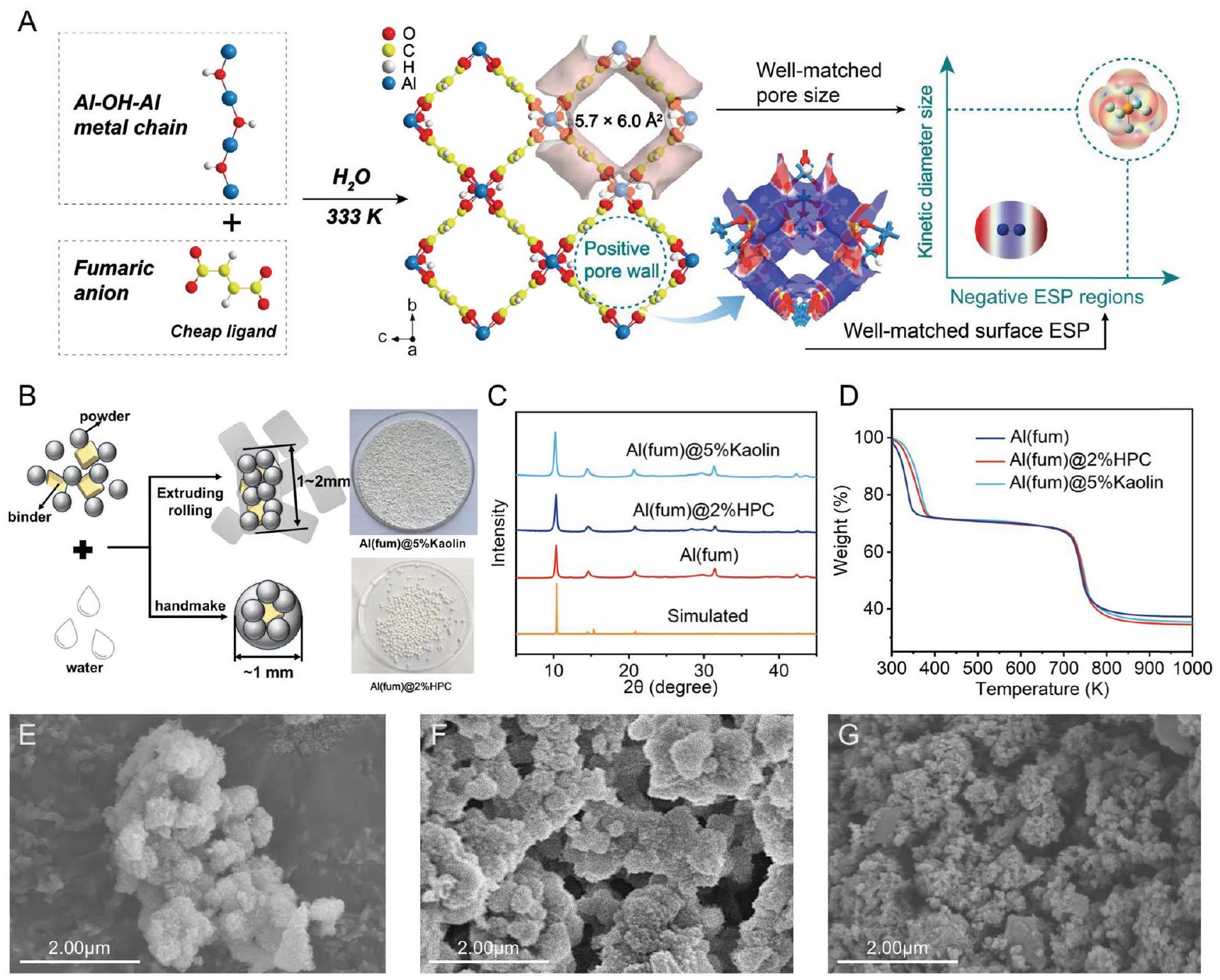
تمت تخليقه بسهولة من خلال التحريك البسيط في الماء، دون استخدام أي مذيبات عضوية، عند درجة حرارة معتدلة نسبياً، والتي يمكن زيادتها بسهولة (على سبيل المثال، 35.58 جرام من مسحوق الألمنيوم (فوم) مع عائد مرتفع يبلغ حواليفي هذا العمل). التركيب البلوري لـأظهر أن العقدة المعدنية الوحيدة من الألمنيوم تعمل كمركز تنسيق سداسي يربط بين أربع ذرات أكسجين في مجموعات الكربوكسيلات من الليغاندات الفومارية المستقلة وذرتين من الأكسجين في – مجموعات OH من الاتجاه العمودي، تشكل هيكل ثماني السطوحهيكل مرتبط بواسطة روابط الفومارات لتشكيل إطار ثلاثي الأبعاد (3D) مع قنوات مربعة أحادية البعد (1D) دورية لا نهائية (الشكل 1A). ومن المثير للاهتمام، أن تحليل ESP لـفومأظهر الإطار أن سطح هيكل جدار المسام، المحاط بروابط الفومارات، يظهر ESP إيجابي على نطاق واسع، وفي نفس الوقت، فإن ESP المحلي لـتكون مجموعات -OH في الاتجاه العمودي أيضًا إيجابية وتصل إلى داخل قناة المسام كـ “زاوية”. وبالتالي، فإن توزيع ESP الإيجابي الواسع الذي يغطي تقريبًا كامل داخل قنوات المسام يجعلفومفخ واعد لـ ESP، حيث إنه يسهل التفاعل بشكل موحد مع جزيء تغطي سطحه الخارجي شحنة كهربائية سالبة. علاوة على ذلك، تم تقدير حجم المسام الثابت لـ Al(fum) ليكونأقرب إلى القطر الحركي لـ جزيء بدلاً من ، مما يمكن أن يحسن بشكل كبير التوافق/التفاعل بين المضيف والضيف لتعزيز الارتباط الانتقائي لـ.
نمط حيود الأشعة السينية البودرة التجريبية (PXRD) لـموضح في الشكل 1C. تتوافق مواقع وكثافات القمم المميزة للنتائج التجريبية مع الأطياف المحاكاة، وتشير حدة القمم إلى البلورية الممتازة لـ Al (fum). بالإضافة إلى ذلك، لم يُلاحظ أي فقدان في البلورية لـ Al (fum) خلال التعرض للهواء أو النقع في الماء، مما يشير إلى أن Al (fum) قوي للغاية (الشكل التوضيحي 1). كما أظهر Al(fum) استقرارًا حراريًا ممتازًا، كما يتضح من منحنى التحليل الحراري الوزني (TGA) (الشكل 1D)، حيث يمكن إزالة جزيئات المذيب في قنوات المسام تمامًا عند 393 كلفن ويمكن الحفاظ على هيكل ضخم مستقر حتى 673 كلفن. لتوصيف المسامية الدائمة للـ امتصاصتم تحديده على العينة المفعلة عند 77 كلفن، وكشفت منحنى الإيزوثرم (الشكل التكميلي 5) عن تشبع نظام المسام عند ضغط منخفض جداً ( )، التي استخلصنا منها مساحة السطح وفقًا لطريقة بروناور-إيميت-تيلر (BET) .
على الرغم من المسامية العالية والاستقرار الممتاز لـعينات المسحوق، فإن العديد من عيوب المواد في شكل مسحوق، بما في ذلك انخفاض ضغط السرير المفرط، وتلوث الغبار، وانسداد الأنابيب، وصعوبات النقل، ستعيق بشكل كبير تصنيعه. للتغلب على هذه العيوب، تم استخدام تقنية التحبيب الرطب لإنتاج كريات الألمنيوم (فوم) المشكّلة (والتي هي في الواقع مركبات)، باستخدام مواد لاصقة قوية مضادة للتمزق ولزجة، مثل السليلوز هيدروكسي بروبيل (HPC) والكاولين.البودرة تظهر قابلية تشكيل متعددة، مما يسمح بإنتاج كريات مصنوعة يدويًا من خلال دمج القليل منرابط HPC
الشكل 1 | التركيب البلوري لـ AI(fum) وخصائص عينات المسحوق والقرص. A التركيب البلوري لـمع قنوات 1D، الجهد الكهربائي السطحي لـفومإطار العمل، و و جزيئات بمقياس يتراوح من -0.001 (أحمر) إلى 0.005 وحدة ذرية (أزرق). ب عملية التشكيلفوم مسحوق مع كاولين أو رابط HPC. أنماط حيود الأشعة السينية لمسحوق C ومنحنيات TGA لـ و كاولين. صور المجهر الإلكتروني الماسح لـمسحوق (E)، و كاولين (ج)، على التوالي. (المشار إليه بـ. بدلاً من ذلك، يصبح الإنتاج الميكانيكي ممكنًا من خلال استخداممواد الربط الكاولينية (المعروفة باسم كلا النسختين منتظهر الكريات المركبة شكلًا جيدًا وسطحًا أملسًا (الشكل 1B). في الوقت نفسه، أظهرت فقط فقدانًا طفيفًا في الكتلة ضمنتحت التذبذب عندو 200 دورة في الدقيقة لمدة 120 ساعة (الأشكال التكميلية 11 و 12)، مما يثبت القوة الميكانيكية الجيدة. علاوة على ذلك، أظهرت اختبارات الإجهاد والانفعال القوة الانضغاطية الممتازة لـكاولين، يقيس 7.2 ميغاباسكال، والذي هوأعلى من تلك الخاصة بحبيبات الزيوليت التجاري 13 X (5.3 ميغاباسكال) (الشكل التكميلي 13). اختبارات طيف الأشعة السينية للألكترونات (XPS) أكدت أن محتويات العناصر من العناصر المميزة في و كانوا أساسًا متفقين مع أولئك الذينالبودرة (الشكل التوضيحي 38 والجدول 14)، بينما المحتوى الأعلى قليلاً من O/C فيفومومحتويات O/Al فيفومكان سبب الكاولين هو إضافة كمية صغيرة من HPC ومواد ربط الكاولين، على التوالي. كشفت نتائج نمط PXRD عن فقدان شبه معدوم في البلورية لمركبات Al(fum)@2%HPC وAl(fum)@5%Kaolin مقارنة بالمساحيق الأصلية، حتى عند تعرضها للهواء لمدة شهر، مما يشير إلى التأثير الضئيل لعملية التشكيل على الهيكل البلوري (الأشكال التكميلية 1-3). منحنى TGA لـفوم و فومكان الكاولين (الشكل 1D) أيضًا في وفقًا لـ Al (fum)، مع فقدان المذيب عند حوالي 393 كلفن بينما تظل مستقرة حتى 693 كلفن، مما يؤكد الاستقرار الحراري للمركبات المشكّلة التي يمكن أن تلبي بشكل جيد معظم التطبيقات الصناعية. ومن الجدير بالذكر أن مشكلة طويلة الأمد تم الإبلاغ عنها في تشكيل المواد الممتصة عن طريق التحبيب الرطب هي انسداد المسام، مما سيقلل بشكل خطير من أداء الامتصاص.. ومع ذلك، وجدنا أن Al(fum)@2%HPC و Al(fum)@5%Kaolin أظهرا انخفاضًا طفيفًا في المسامية مقارنةً بـفوم، مع مساحة سطح BET الخاصة بهم (الأشكال التكميلية 5-7) من (Al(fum)@2%HPC)، 1087 (Al(fum)@5%Kaolin) و (Al(fum))، مما يعني أن الهيكل المسامي الأصلي تم الحفاظ عليه جيدًا بعد التشكيل. من نتائج المجهر الإلكتروني الماسح (SEM)، فإن الشكل الأصلي لـفوم البلورة (الشكل 1E) أظهرت تغيرًا ضئيلًا في (الشكل 1F) و كاولين (الشكل 1G) مع إضافة كمية صغيرة من الرابط.تمت ملاحظة أن البلورات ملتصقة بواسطة رابط HPC في مجموعات فيفوم HPC، بينما في كانوا ملتصقين بواسطة رابط الكاولين على شكل رقائق بطريقة نقطة إلى وجه.
سلوكيات الامتزاز لـ و تم استكشافها من خلال إجراء إيزوثرم الامتصاص ذو المكون الواحد علىفومالبودرة والكرات. كما هو موضح في الشكل 2A، يُلاحظ أنفومعرضت منحنى من النوع الأول (منحنى لانغمور) علىمع زيادة ملحوظة
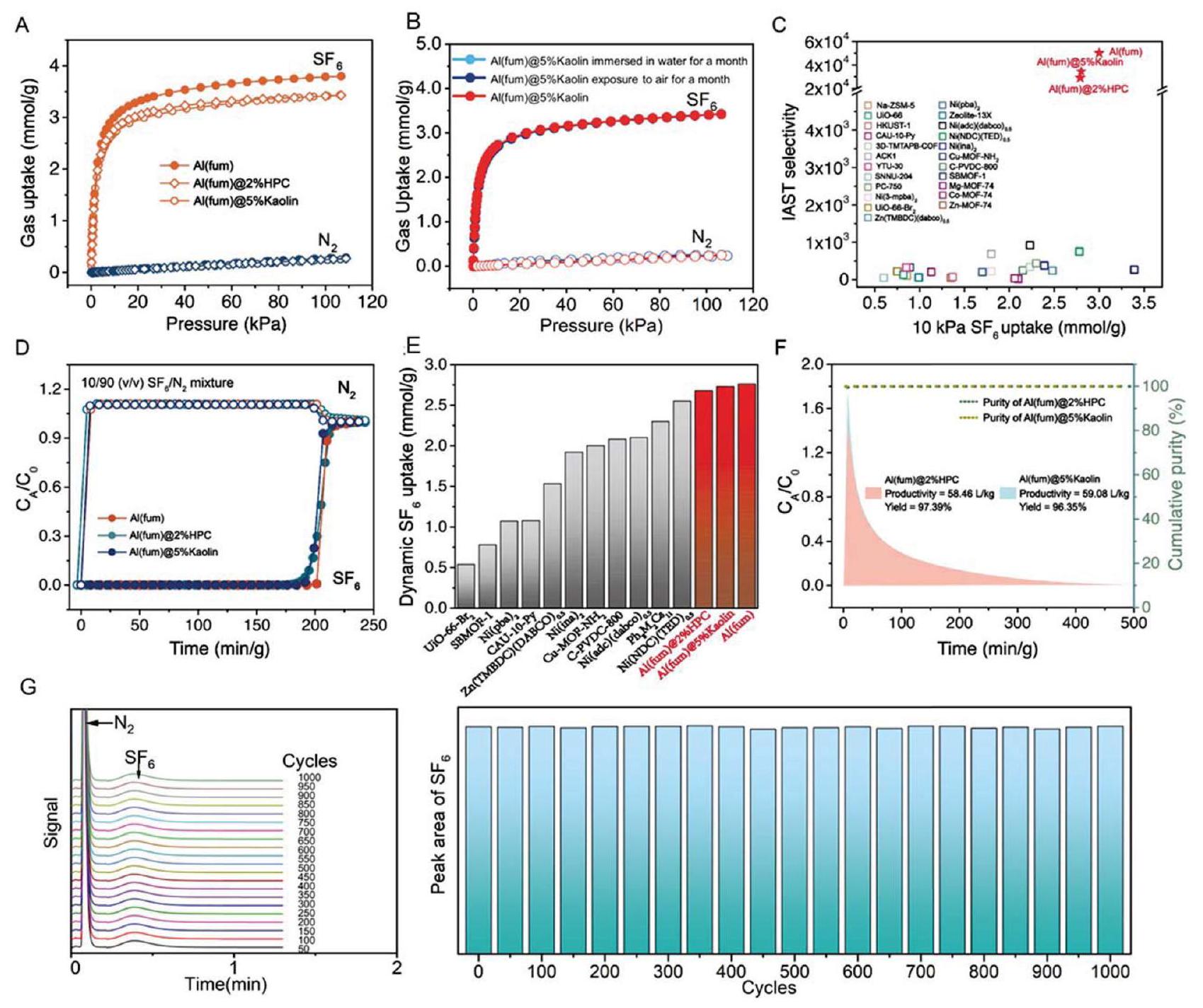
الشكل 2 | خصائص فصل امتصاص الغازفومفومAI(fum)@5%كاولين. أ هو منحنيات التوازن ذات المكون الواحد لـ و على، ، و كاولين عند 298 كلفن، على التوالي. الـ و إيزوثيرمات الامتزازكاولين بعد غمره في الماء أو تعرضه للهواء لمدة شهر عند 298 كلفن. ج مقارنة الـالامتصاص عند 10 كيلو باسكال وانتقائيات IAST لـخليطعند 1 بار على مواد ماصة مختلفة عند 298 كلفن.
اختبارات الاختراق علىأعمدة لـخليطعند 298 كلفن. مقارنة الديناميكيةاستيعاب لـخليطبين المواد المسامية التمثيلية. منحنى إزالة الامتصاص المشبع و عمود الكاولين لـخليطعند 313 كلفن. دورات الامتزاز-الامتزاز العكسي لـفومعمود بواسطة حقن نبضات بمعدل 1000 مرة عند 373 كلفن. منعند 298 كلفن و1 بار. في هذه الأثناء،أظهرت منحنيات الأيزوثرم انحدارًا ملحوظًا عند الضغوط المنخفضة، مما يوحي بقوةالتوافق الذي يتماشى مع التوقعات الناتجة عن التحليل الهيكلي لـ. حقق مستوى عالٍ للغايةاستيعابج عند 10 كيلو باسكال و298 كلفن، وهو أعلى من معظم المواد الماصة المسامية الرائدة في نفس الظروف (الشكل 2C) وأقل قليلاً فقط من Cu-MOF-. في نفس الوقت، يُلاحظ تأثير استبعاد جزيئي تقريبي في الامتزاز، مع الاستهلاك فقطعند 1 بار. حرارة الامتزاز الأيزوستيريكيةمن و علىتم حساب الحمل عند الصفر بواسطة معادلة فيريال استنادًا إلى منحنيات الامتصاص أحادية المكون لتكونمول وعلى التوالي (الأشكال التكميلية 17 و 20). الملحوظالفرق بين الغازين قدم دعماً قوياً للاختلاف الديناميكي الحراري في الامتزاز، وقيمة لـمن المتوقع أن يتيح تقليل استهلاك الطاقة في تجديد الممتزات (الشكل التكميلي 41). من المهم، وفقًا لـنتائج الامتزاز، الكريات المركبة المشكّلة و احتفظ الكاولين بأداء الامتزاز الممتاز مقارنةً بـفوم. كما هو موضح في
الشكل 2A، ملفات الأيزوثرم لـ و على و كانت الكاولين متوافقة جيدًا مع ذلك على. الـكانت تأثيرات الغازات على AI(fum)@2%HPC و Alfum@5%Kaolin قريبة أيضًا من تلك على Al(fum) (الأشكال التكميلية 18 و19 و21 و22).
اختيارات الامتزاز على و تم التنبؤ بالكاولين باستخدام نظرية المحلول الممتص المثالي (IAST) عند 298 كلفن لـخلائط الغاز )، عند ملاءمة إيزوثيرم الامتصاص أحادية المكون مع معادلات لانغموير-فريندليش ذات الموقعين (تم توفير معلمات الملاءمة في الجداول التكميلية 1-3). من اللافت للنظر أن هذه المساحيق والكرات أظهرت انتقائيات IAST ممتازة بين جميع المواد المسامية المبلغ عنها (الشكل 2C والجدول التكميلية 10). على سبيل المثال، عند 298 كلفن و100 كيلو باسكال، كانت انتقائية IAST لـفوميصل إلى قيمة استثنائية قدرها 50139، وهو ما يزيد بشكل كبير عن المعيار السابقوغيرها من المواد الأدبية ذات الأداء العالي مثل و بينما و كما حافظ الكاولين على الانتقائيات الممتازة 28978 و34409 بنفس ترتيب الحجم، على التوالي (الأشكال التكميلية 30 و31). بشكل عام،
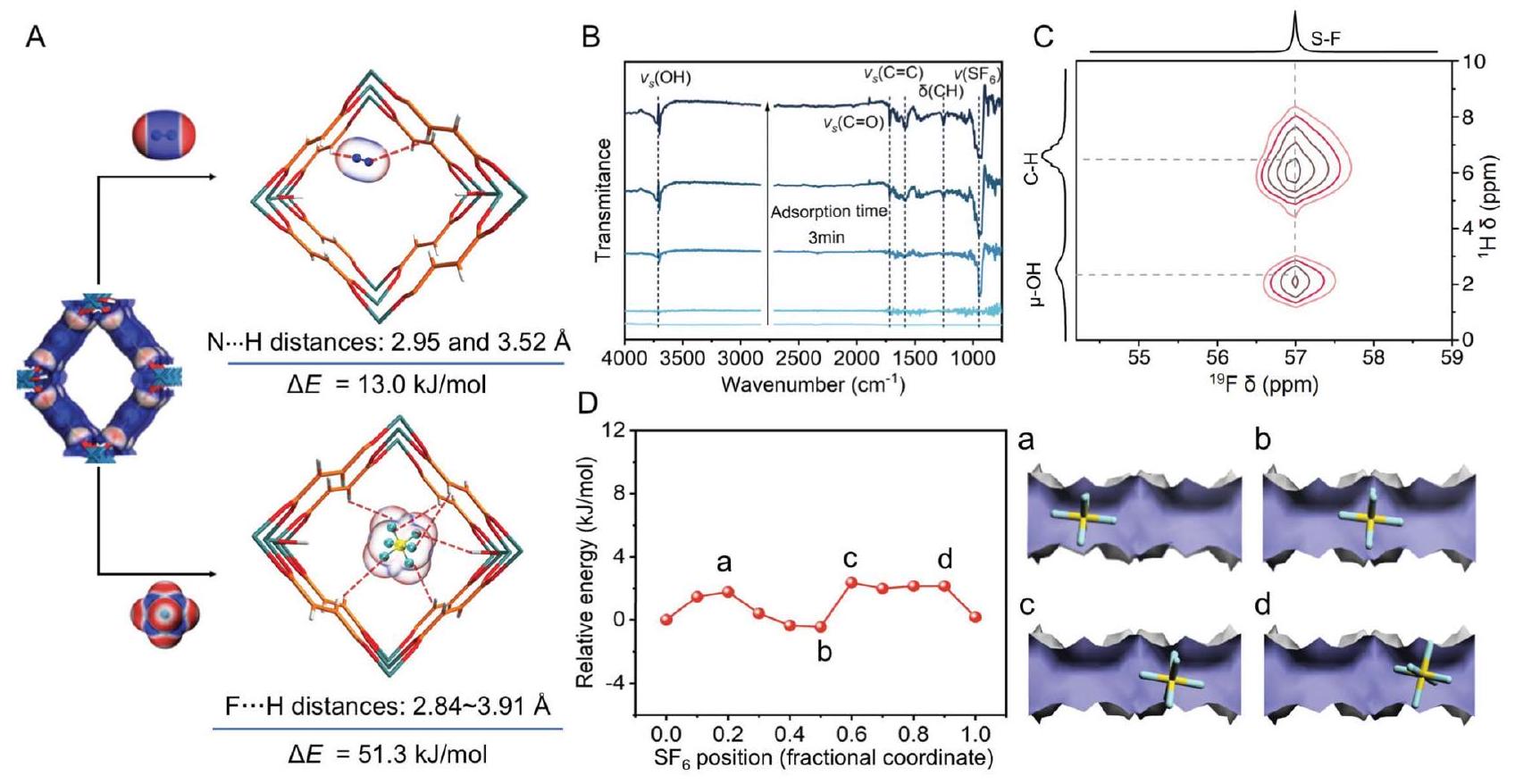
الشكل 3 | آلية الامتزاز والانتشار على المستوى الجزيئي لـ و على (فوم). و مواقع الربط على Al (fum) وطاقة الربط من حساب DFT-D، مع عرض السطح الجزيئي ESP لسطح المسام وجزيئات الغاز. ب. طيف FT-IR في الموقع لعينة Al(fum) المنشط المعرضة لـ غاز في درجة حرارة الغرفة.طيف الرنين المغناطيسي النووي للحالة الصلبةممتص على. د ملف مسار الطاقة الدنيا (MEP) واللقطات لـفيفوم. آلية الامتصاص السطحي في المواد الإطار المعدني العضوي (MOFs) التي تدفع عمليات فصل الغاز غالبًا ما تؤدي إلى تناقض ملحوظ بين انتقائية الامتصاص والسعة، مما يؤثر بشكل كبير على الإنتاجية وكفاءة الفصل في الممارسة العملية. ومع ذلك،فوم، و لقد حققت الكاولين التوازن بنجاح بين العاليالانتقائية وسعة الامتزاز (الشكل 2C).
لتقييم أداء الفصل لـخليط، اختبارات ديناميكية تجريبية رائدة تحاكي الظروف الفعلية (النوعية المعتادةتم إجراء (خليط الغاز) على و على التوالي. كما هو موضح في الشكل 2D،الغاز انطلق على الفور منالعمود عند 298 كلفن وصل بسرعة إلى التوازن بسبب ضعفه في التعلق، مما يتوافق مع الامتصاص الضئيل في الإيزوثيرم الثابت. على النقيض، فإن زمن الاحتفاظ لـعلىكان بطولالسعة الديناميكية للاحتجازعلىفومتم حسابه كقيمة قياسية عالية، وهو قريب تمامًا من امتصاصه الثابت عند 10 كيلو باسكال وأعلى من المواد الممتزة ذات الأداء العالي التي تم الإبلاغ عنها سابقًا (الشكل 2E)، وإنتاجية نقاء عالٍتم حسابه ليكون. أل(فم)@2%HPC وكما حافظ الكاولين على الديناميكية العاليةالامتصاص (الشكل 2E). على سبيل المثال، الديناميكيةاستيعابفومكانعند 298 كلفن، الذي كانمن ذلكفوممسحوق؛ والديناميكياستيعابوصل الكاولين أيضًا ج ، الذي كان من ذلك من الأل (فوم). من المهم، على الرغم من الكثافة العالية للتعبئةفوممسحوق وفومأعمدة الحبيبات المصنوعة يدويًا و ، على التوالي)، انخفاض ضغط السرير لـكان العمود أقل بكثير من عمود Al(fum) كما هو موضح في الشكل التكميلية 45، مما يثبت أهمية عملية تشكيل الممتزات في الفصل الديناميكي من منظور هندسي. أداء تجديد الغاز المشبعفومتم تحديد حبيبات المركب لإظهار قابلية إعادة استخدام الممتص وللحصول على مادة نقية.. للغاز المشبعفومفيخليط غازات، الـتم إزالته على الفور مع كمية ضئيلة فقط منمساهمًا في نقاء تراكمي لـالمتعافى. الـ كمية مزالةتم حسابه ليكون، مما يتوافق مع عائد مرتفع ( ) وإنتاجية عالية ( ) من من الإزالة (الشكل 2F). بالإضافة إلى ذلك، فإن أداء الفصل الممتاز لـ Al(fum)@2%HPC لم يتغير تقريبًا حتى بعد 1000 دورة امتصاص-إزالة (الشكل 2G). وبالمثل، أظهر AI(fum)@5% كاولين أيضًا أداءً ممتازًا في التجديد وقابلية إعادة الاستخدام (الشكل التكميلية 46). كمية الإزالة منتم حسابه ليكون، مما يتوافق مع عائد مرتفع ( ) وإنتاجية عالية ( ) من من إزالة الامتصاص (الشكل 2F).
للحصول على فهم أعمق لسلوك الامتزاز المختلف لـ و وآلية الفصل على تم إجراء كل من حسابات نظرية الكثافة المصححة بتصحيح التشتت (DFT-D) والتجارب الطيفية في الموقع. كما هو موضح في الشكل 3A، أظهرت حسابات DFT-D أن و تم تحديد جزيئات ذات توزيعات مختلفة للطاقة السطحية الكهربائية في موضع مشابه داخل القناة. ومع ذلك، لوحظت اختلافات كبيرة في نمط تفاعلها وطاقة ارتباطها مع الإطار. على وجه التحديد، لوحظ أن جميع ذرات الفلور من الـتم التقاط الجزيئات بواسطة ذرات الهيدروجين من روابط الفومارات و – مجموعة OH من خلال تفاعلات متعددة من فان دير فالس وتفاعلات الروابط الهيدروجينية (الـالمسافات كانت )، وهو يتوافق جيدًا مع توزيع ESP الخاص بهم (يغطي ESP السطحي السالب ذرة F، بينما يغطي ESP السطحي الموجب – CH ومجموعة). ونتيجة لذلك، فإن طاقة الربط نسبياً عالية ( ) من تم إدراكه لـ، مما يؤكد القدرة الاستثنائية على الامتزاز لـودعمت البيانات التجريبية المذكورة أعلاه. على النقيض من ذلك، العدد الرقمي لمواقع الارتباط لـكان أقل بكثير من (2 مقابل 6)، بينما التفاعلات الكهروستاتيكية بين روابط الفوماريك و كانت أضعف بشكل ملحوظ (الـكانت المسافات 2.95 و )، مما يؤدي إلى انخفاض كبير في منعند المقارنة معتم استخدام مطيافية الأشعة تحت الحمراء بتقنية تحويل فورييه في الموقع (FT-IR) والرنين المغناطيسي النووي الثنائي الأبعاد في الحالة الصلبة (2D solid-state NMR) للتعمق في التفاعلات بين المضيف والضيف.الجزيء وفومالإطار. ومن الجدير بالذكر أن طيف FT-IR الموضح في الشكل 3B من Al(fum) أظهر اختلافات مميزة في القمم.
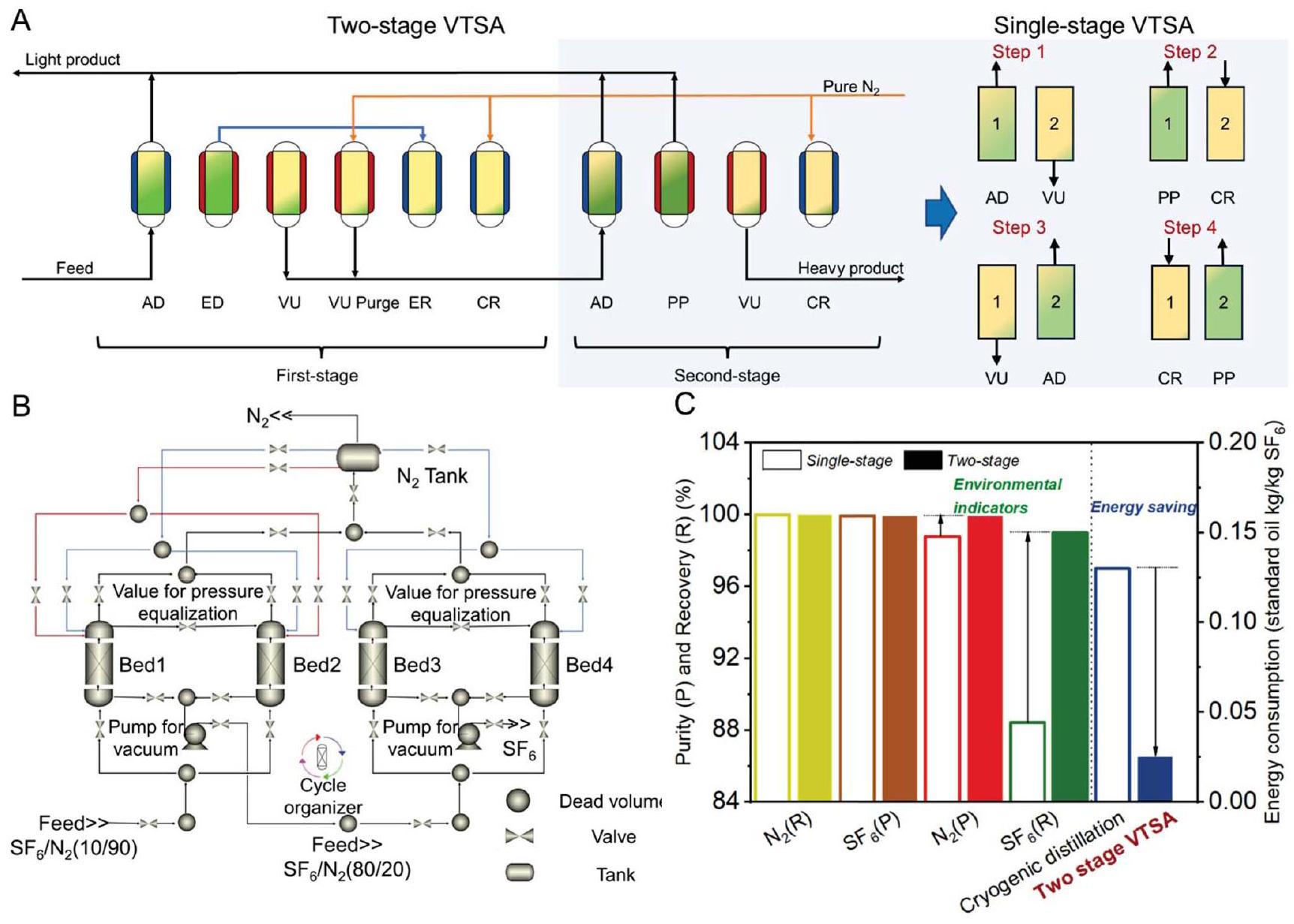
الشكل 4 | نتائج عملية امتصاص الفراغ بتقنية التغير في درجة الحرارة المحاكية. رسم تخطيطي لدورة VTSA، على اليسار، VTSA من مرحلتين، على اليمين، VTSA من مرحلة واحدة مع استخدام السرير (أصفر) إلى (أخضر)، (AD، الامتصاص؛ ED، تخفيض الضغط المتساوي؛ VU، الامتصاص تحت الفراغ؛ VU Purge، الامتصاص تحت الفراغ مع التطهير؛ ER، الضغط المتساوي؛ CR، الضغط مع التبريد؛
PP، تفريغ الحرارة المتزامن؛ رمز اللون: الأزرق، التبريد؛ الأحمر، التسخين). نموذج تخطيطي لعملية VTSA ذات المرحلتين. نتائج المحاكاة لعملية VTSA ذات المرحلة الواحدة وذات المرحلتين واستهلاك الطاقة لعملية VTSA ذات المرحلتين والتقطير بالتبريد. يتوافق مع و خلالالامتصاص في درجة حرارة الغرفة، مما يشير إلى التفاعلات المتعددة بين المضيف والضيف و الجزيئات. علاوة على ذلك، كشفت قياسات FT-IR في الموقع عن سرعةوقت التوازن (في غضون 3 دقائق)، متسق مع الحاجز الطاقي المنخفض نسبيًا للانتشارمستمد من محاكاة الانتشار DFT-D ( ) (الشكل 3D). الثنائي الأبعاد طيف الرنين المغناطيسي النووي للحالة الصلبة MAS لـ-المحمّل Al (fum) أيضًا تحقق من و التفاعلات (الشكل 3C)، متوافقة مع نتائج DFT-D و FT-IR في الموقع المذكورة أعلاه.
وفقًا للنتائج المذكورة أعلاه، من المثير أن الكريات المركبة المشكّلة و لقد أظهرت الكاولين وعودًا كبيرةأداء الالتقاط والفصل وقد استوفت الآن معايير أساسية متنوعة لم adsorbent الصناعي، بما في ذلك امتصاص الإعلانات (الشكل 2C والجدول التكميلي 10)، الانتقائية (الشكل 2C)، الاستقرار (الشكل 2B)، التكلفة (الجدول التكميلي 15)، إلخ. من أجل تقييم أداء المواد الماصة بطريقة قابلة للتصنيع، فإن التصميم العقلاني لعملية فصل-امتصاص مستمرة أمر ضروري. الـتم استخدام حبيبات أولين، التي تم إنتاجها من خلال وسائل ميكانيكية، في عملية الامتزاز بتقلب درجة الحرارة تحت الفراغ (VTSA) من مرحلة واحدة لتقييم الفعليأداء الفصل. تم إجراء المحاكاة عند 1.5 بار و298 كيلفن معمنخليط، وتسلسل الدورة المقابل له موضح على اليمين في الشكل 4 أ (تم توفير تحسين المعلمات التشغيلية في المعلومات التكميلية، الجدول التكميلية 8). وبناءً عليه، فإن مستوى عالٍ نقاءتم الحصول عليه بعائد مرتفع ( ) في نظام VTSA من مرحلة واحدة باستخدام سريرين بقطر 15 سم محملة بـ 6.44 كجم من الألمنيوم (فوم)كاولين. ومع ذلك، لوحظ أنفقدت في خطوات الامتصاص (AD) والتسخين المتزامن (PP) وتركيز المنتج الخفيف كان، لذا الشفاء كانالذي يبتعد كثيرًا عن تلبية المتطلبات الصارمة لحماية البيئة (الشكل 4C). لحل هذه المشكلة، تم إنشاء عملية VTSA من مرحلتين مع ظروف تغذية متطابقة (درجة الحرارة، الضغط ومعدل تدفق التغذية) لتلك الخاصة بعملية VTSA من مرحلة واحدة. يتم عرض المخطط والنموذج لعملية VTSA من مرحلتين على اليسار من الشكل 4A وB. كما هو موضح في الشكل التكميلي 53، بعد 4 دورات، وصلت المرحلة الأولى من عملية VTSA من مرحلتين إلى الحالة الثابتة الدورية (CSS) والقدرة التشغيلية لـفومكاولين كانالتي كانت أكبر بكثير منامتصاص عند 10 كيلو باسكال للمواد الممتزة التقليدية زيولايت 13 Xمن الجدير بالذكر أن المنتج المختلط من الضوء، الذي جمع الغاز من أعلى السرير في المرحلة الأولى من VTSA والمرحلة الثانية من VTSA، لديهمحتوىالتي تلبي متطلبات حماية البيئة. علاوة على ذلك، بسبب حقيقة أنتم امتصاصه بالتسخين وأزاحفي مرحلة الكتلة، مسامية الكريات المشكّلة خلال خطوة PP، المتوسط الدوري المحصل عليهالنقاء كانعندما وصلت العملية إلى CSS (الشكل 4C). إمكانيات نظام VTSA ذو المرحلتين لاستعادةتم تقييمه بشكل إضافي من خلال تحليل استهلاك الطاقة باستخدام التقطير الكريوجيني التقليدي كخطة أساسية (المكمل
الجدول 9). كما هو موضح في الشكل 4C، كان استهلاك الطاقة لنظام VTSA ذو المرحلتين فقطمن تلك الخاصة بالتقطير الكريوجيني، حيث كان التقطير الكريوجيني يعادل 0.13 من النفط القياسي.بينما كان إجمالي استهلاك الطاقة لنظام VTSA ذو المرحلتين 0.025 من النفط القياسي المكافئ. بالإضافة إلى ذلك، نظرًا لعملية تجديد VTSA لـيتضمن الكاولين التسخين، وقد أظهرت MOFs الرائدة التي تم الإبلاغ عنها سابقًا القدرة على تحقيقالاسترداد والتجديد عند درجة حرارة الغرفة في الاختبارات المعملية، من المهم تقييم ما إذا كانفوميتميز الكاولين بعيب من حيث استهلاك الطاقة في العمليات مقارنةً بهذه المواد العضوية المعدنية. لمعالجة ذلك، تم إنشاء عملية الامتزاز بتقلب الضغط الفراغي (VPSA) استنادًا إلى مادة عضوية معدنية رائدة، وتم إجراء تقدير أولي لاستهلاك الطاقة الخاص بها. تشير النتائج إلى أن استهلاك الطاقة في VPSA قد لا يكون بالضرورة أقل من VTSA، حيث أن ضاغط الغاز المطلوب لمعالجة الغاز المدخل يتطلب استهلاكًا كبيرًا للطاقة الكهربائية (الجدول التكميلي 18).
نقاش
تُتوقع تقنيات الامتزاز المعتمدة على المواد الممتزة المسامية على نطاق واسع أن تحل محل عمليات فصل الغاز ذات تغيير الطور التي تتطلب طاقة عالية، حيث يكمن المفتاح في التغلب على التوازن بين سعة الامتزاز والانتقائية مع امتلاك خصائص متنوعة مطلوبة للتصنيع في نفس الوقت. مع التركيز على التحدي العام لالتقاط غازات الاحتباس الحراري، أجرت هذه الدراسة دراسة شاملة حول الفصل بالامتزاز للتركيزات المنخفضة.من كل من المنظورين الكيميائي والهندسي، بما في ذلك تحليل كيمياء المسام، تخليق المواد، تجارب الامتزاز، الرنين المغناطيسي النووي الثنائي الأبعاد في الحالة الصلبة/ FTIR في الموقع، محاكاة الربط/ الانتشار باستخدام DFT-D، تصميم العمليات وتحسينها، وقد أظهر مواد ماصة قوية وعملية فصل مستمرة ذات إمكانات عالية للتصنيع. كفخ ESP عالي الكفاءة لـالجزيئات ذات سطح المسام المتطابق جيدًا مع ESP وحجم المسام، أظهرت الألمنيوم (فوم) قدرة قوية على التآلف والتمييز الانتقائي لـ، مما أدى إلى ارتفاع قياسي في الانتقائية وسعة الامتزاز الديناميكية. علاوة على ذلك، Al (fum)@2%HPC و Al (fum) @تم تحضير كريات الكاولين، التي لم تحتفظ فقط بجميع الخصائص الممتازة لـفومالبودرة ولكنها أظهرت أيضًا قوة ميكانيكية جيدة وانخفاضًا كبيرًا في فقد الضغط في سرير الامتزاز. بالإضافة إلى ذلك، تم مراعاة مجموعة من المزايا التالية، والتي تعتبر جميعها ضرورية لعملية فصل الامتزاز العملية: انخفاض تكلفة مواد التفاعل (من المتوقع أن تكون مشابهة للزيوليتات التجارية)؛ إمكانية التوسع وطبيعة عملية التخليق الصديقة للبيئة؛ نقل الكتلة السريع؛ سهولة التجديد؛ استقرار حراري وجوي جيد؛ قابلية استرداد استثنائية. من المهم أن نظام VTSA ذو المرحلتين المقدم في هذا العمل حققنقاء و الاسترداد، meeting بنجاح المتطلبات المزدوجة لسلامة المعدات الكهربائية وحماية البيئة، مع استهلاك طاقة يبلغ فقطتلك الخاصة بالتقطير الكريوجيني. بشكل عام، لا تضع هذه الدراسة معيارًا فقط لالتقاط وفصلمن خلال تقنية الامتزاز، ولكنها أيضًا توفر مرجعًا لتسريع تقنيات الامتزاز المعتمدة على MOFs من البحث في المختبر إلى التطبيقات العملية.
طرق
حمض الفوماريككبريتات الألمنيوم ثمانية عشر هيدرات“علاء الدين” وهيدروكسيد الصوديومعلاء الدين)، إيثانولتم توفير هيدروكسي بروبيل السليلوز (HPC، 99%، ماكلين)، الكاولين (كاولين، علاء الدين) تجارياً واستخدمت كما هي دون مزيد من التنقية.هو، و خلط الغازتم شراؤها من شركة جولون (الصين).
تركيب Al (fum) (مسحوق)
فومتمت تخليقه باستخدام الطريقة المعززة.تم إذابته في 300 مل من الماء المقطر عند 333 كلفن لتحضير المحلول A، في حين تم استخدام كمية محددة من حمض الفوماريك و تم إذابة 0.63 مول في 360 مل من الماء المقطر عند 333 كلفن لتحضير المحلول. بعد ذلك، تم خلط المحاليل لمدة 10 دقائق مع التحريك المستمر عند 333 كلفن. تم تصفية المحلول الناتج، واستبداله بالماء المقطر 3 مرات، ثم تم غسله بالإيثانول وتجفيفه لمدة 12 ساعة طوال الليل.العائد بناءً على أل).
تركيب AI(fum)@2%HPC (كريات)
الألفوم@تم تحضيره باستخدام طريقة التحبيب الرطب اليدوية. 980 ملغ مجفففومتم خلط المسحوق مع 20 ملغ من HPC، ثم أضيف 2 مل من الماء المقطر إلى خليط المسحوق عدة مرات أثناء طحن خليط المسحوق باستمرار لتشكيل معجون. تم تشكيل المعجون شبه الجاف إلىكراتقطر.
تركيب Al(fum)@5%كاولين (كريات)
تم تحضير Alfum@5%Kaolin باستخدام طريقة التحبيب الرطب الميكانيكي. 9.5 جرام من المجفففومتم خلط المسحوق مع 0.5 جرام من الكاولين كربط باستخدام جهاز خلط الكريات (CML، Caleva). تم إضافة المسحوق المخلوط مع كمية صغيرة من الماء المقطر ببطء إلى جهاز البثق، وعند بثقه إلى شريط، تم إضافته إلى جزء الدرفلة وقطعه إلى كريات صغيرة. ثم، تم إضافة Al(fum)@تم تجفيف حبيبات الكاولين عند 373 كلفن طوال الليل لإزالة الماء المقطر من الحبيبات. لضمان توزيع حجم موحد،تمت غربلة الكريات من خلال منخلين بحجم 16 و 20.
توصيف
تم جمع بيانات حيود الأشعة السينية بالمسحوق (PXRD) في درجة حرارة الغرفة على جهاز حيود X’Pert. ) بقدرة تشغيلية تبلغ 40 كيلو فولت. النطاق المجمّع من هو تم جمع التحليل الحراري الوزني (TGA) على جهاز SDT 650 مع وعاء من البلاتين تحت تدفق النيتروجين بمعدل تسخينمنإلىتم تحليل المجهر الإلكتروني الماسح (SEM) بواسطة Hitachi SU-8100. 2Dتم جمع طيف الرنين المغناطيسي النووي للحالة الصلبة على جهاز Bruker Avance NEO 600 WB عند درجة حرارة الغرفة. تم جمع طيف الأشعة تحت الحمراء التحويلية في الموقع (FT-IR في الموقع) على جهاز Thermo Fisher Scientific FTIR-650 عند درجة حرارة الغرفة.
قياسات امتصاص الغاز
تم إجراء قياسات إزالة الغازات، ومساحة السطح BET، وامتصاص الغاز على جهاز تحليل مساحة السطح Micromeritics 2460.فومفوم، و فومتم إزالة الغازات من عينات الكاولين عند 393 كلفن و لمدة 24 ساعة قبل التحليل. الـمساحة سطح BET لـفومفوم، و فومتم قياس الكاولين عند 77 ك. و تم قياس إيزوثيرم الامتزاز عندعلى العينات المفعلة، على التوالي.
حسابات انتقائية IAST
قبل تقدير الانتقائية لخلائط الغاز الثنائية، يجب دراسة منحنيات الامتصاص لمكون واحد من و تم تجهيزها بنموذج لانغموير-فرويدليتش ذو الموقعين (DSLF).
نموذج لانغموير-فريندليش ذو المواقع المزدوجة (DSLF):
أين هو مقدار الامتزاز، هو الضغط، هو مقدار الامتزاز، هو ثابت لانغموير، ، هو تجانس موقع الامتزاز. وتبادل الحرارة بين الغاز والمبادل الحراري.
أينهو الموصلية الحرارية لغاز المحور, هو السعة الحرارية للغاز في حالة ثابتة الحجم، ميغا جول/(كمول كيلفن)، HTC هو الثابت لمعامل نقل الحرارة بين الغاز والمواد الممتصة، .
نموذج إيزوثرم الامتزاز
يتم استخدام نموذج لانغموير الموسع 2 لوصف تحميل التوازن لـعلىالكاولين، الذي يتناسب بشكل جيد مع بيانات الإيزوثرم التجريبية كما هو موضح في ما يلي.
أينهو تحميل التوازن للمكونعلى الحبيبة، كمول/هو الضغط الجزئي للمكونبارهي درجة الحرارة، ك،هو معامل الإيزوثرم للمكونهو من أجل و على التوالي. معلمات نموذج الإيزوثرم لـفوميمكن العثور على الكاولين في امتصاص أسبن في الجدول التكميلي 5.
نموذج حركية الامتزاز
يتم استخدام نموذج حركية الامتزاز لوصف مقاومة نقل الكتلة في عملية الامتزاز، والتي تتأثر بمقاومة الفيلم الخارجي، وانتشار المسام الكبيرة، وانتشار المسام الصغيرة. يتم تعريف معادلة القوة الدافعة الخطية (LDF) كنموذج الأكثر شيوعًا الذي يمكن تقديره في المعادلة:
أينهو معامل نقل الكتلة (MTC)،هو تحميل الامتزاز لـهو تحميل التوازن،هو الوقت،هو من أجل و على التوالي.
تسلسل دوري للمحاكاة
تم استخدام تحليل الحساسية للتحقيق في العلاقة المعقدة بين أداء الدورة والمعلمات التشغيلية، مما يوفر دعماً نظرياً لتصميم العملية. كانت تسلسلات المحاكاة الدورية المحسّنة كما يلي.
VTSA من مرحلة واحدة (سريرين و4 خطوات) الخطوة 1: AD. تم ضخ خليط العلف المضغوط إلى السرير 1، حيثتم امتصاصه. الخطوة 2: PP.في مرحلة الكتلة، تم استبدال المسامية بـواستخرج من السرير 1 إلىالخزان. تم تسخين الممتص في السرير 1 بشكل غير مباشر بواسطة تيار ساخن في الجاكيت. الخطوة 3: VU. تم تسخين الممتزّ في السرير 1 بشكل غير مباشر بواسطة بخار ساخن في الجاكيت. كماتم امتصاصه وإطلاقه من أسفل السرير، وانخفض الضغط تدريجياً. الخطوة 4: الضغط في السرير 1 تم زيادته، مما أعاد السرير 1 إلى حالته الأصلية. كان الامتصاص في السرير 1 يتم تبريده بشكل غير مباشر بواسطة تيار بارد في الجاكيت. نظام VTSA ذو المرحلتين (4 أسرّة و10 خطوات) الخطوة 1: الإعلانات. مشابهة للخطوة 1 من VTSA ذات المرحلة الواحدة، لقد خضعت السرير 1 لعملية الامتصاص.
الخطوة 2: ED. تم توصيل السرير 1 في نهاية الامتصاص بالسرير 2 في نهاية تطهير التفريغ الفراغي. الخطوة 3: VU. مشابهة للخطوة 3 من VTSA ذو المرحلة الواحدة. الخطوة 4: تطهير VU. المنتج الخفيف منتم إدخال الخزان لتطهير السرير 1 عند ضغط منخفض. الخطوة 5: ER. مشابهة للخطوة 2. كانت السرير 1 متصلة بالسرير 2 وضغطت بواسطة السرير 2. الخطوة 6: CR. تم ضغط السرير 1 بواسطة منتج خفيف بينما كان الممتزّ في السرير 1 يتم تبريده بشكل غير مباشر بواسطة تيار بارد في الجاكيت.
معايير الأداء لتقييم عملية VTSA
أثناء تقييم أداء العملية، تكون المعلمات الرئيسية هي السعة التشغيلية، النقاء، الاسترداد والعائد.
القدرة على العمل:
أينهو سعة الامتزاز بعد خطوة AD،هي سعة الامتزاز بعد خطوة VU أو خطوة تطهير VU،هو من أجل و على التوالي.
نقاء
أينهو معدل تدفق المول للمنتج البخاري، مول/ثانية،هو كسر المولفي سلسلة المنتجات،هو من أجل و على التوالي. الشفاء:
استرداد:
العائد:
تحليل استهلاك الطاقة الكلي لـ VTSA والتقطير بالتبريد
تم حساب استهلاك الطاقة الكهربائية من خلال المعادلات التالية.
أينهي الطاقة الكهربائية للضاغط أو المضخة في دورة،هو نسبة سعة الحرارةهي درجة حرارة البخار، و هي ضغط المخرج والمدخل للمعدات، بار،هو معدل تدفق المول من البخار، كمول/ثانية،هي الكفاءة الميكانيكية والقيمة مختارة كـ 0.95.
يفترض أن سترة السرير لم تنقل الطاقة مع المحيط، بل فقط مع الوسط، وبالتالي يمكن أن تكون قدرة الحرارة محسوب بواسطة المعادلات التالية.
أينهو واجب الحرارة،هي درجة حرارة الامتزاز،هي درجة حرارة الإزالة,هو السعة العاملة للمواد الماصة،هو سعة جدار السرير،هو حرارة الامتصاص الأيزوستيرية،هو من أجل و على التوالي.
عن طريق التحويل إلى زيت قياسي وفقًا للمعيار الوطني لجمهورية الصين (GB/T50441-2016)تم حساب استهلاك الطاقة الإجمالي لعملية الفصل بالتبخير ثنائي المراحل والتقطير المبرد على النحو التالي.
حيث e هو إجمالي استهلاك الطاقة، مكافئ النفط القياسي كجم/كجمهو استهلاك الطاقة الحرارية والكهربائية،هو تحويل المرافق إلى زيت قياسي.
توفر البيانات
يعلن المؤلفون أن البيانات الرئيسية التي تدعم نتائج هذه الدراسة متاحة ضمن المقالة وملفات المعلومات التكميلية الخاصة بها. يتم توفير بيانات المصدر التي تدعم نتائج هذه الدراسة كملف بيانات مصدر. يتم تقديم بيانات المصدر في هذه الورقة.
References
Ravishankara, A. R., Solomon, S., Turnipseed, A. A. & Warren, R. F. Atmospheric lifetimes of long-lived halogenated species. Science 259, 194-199 (1993).
Fang, X. et al. Sulfur hexafluoride ( )emission estimates for China: An inventory for 1990-2010 and a projection to 2020. Environ. Sci. Technol. 47, 3848-3855 (2013).
Hasell, T. et al. Porous organic cages for sulfur hexafluoride separation. J. Am. Chem. Soc. 138, 1653-1659 (2016).
Kim, M. et al. Highly selective adsorption of over in a bromine-functionalized zirconium-based metal-organic framework. Chem. Eng. J. 339, 223-229 (2018).
Ren, J. et al. Computer-aided discovery of MOFs with calixareneanalogous microenvironment for exceptional capture. Chem. Mater. 33, 5108-5114 (2021).
Builes, S., Roussel, T. & Vega, L. F. Optimization of the separation of sulfur hexafluoride and nitrogen by selective adsorption using monte carlo simulations. AIChE J. 57, 962 (2011).
Toyoda, M. et al. Application of pressure swing adsorption to separation and liquefaction from mixtures. In IEEE Power Engineering Society Winter Meeting Singapore 2156-2161 (IEEE, 2000).
Kim, K. et al. Status of separation/refining technology development for electric industry in Korea. Sep. Purif. Technol. 200, 29-35 (2018).
Xu, G. et al. An improved separation and purification system based on cryogenic separation and distillation theory. Energies 7, 3484-3502 (2014).
Zhou, J. et al. Highly efficient separation of aromatic isomers by rationally designed nonaromatic metal-organic frameworks. J. Am. Chem. Soc. 144, 21417-21424 (2022).
Zhou, J. et al. Tunable confined aliphatic pore environment in robust MOFs for efficient separation of gases with comparable size and property. J. Am. Chem. Soc. 144, 14322-14329 (2022).
Shen, J. et al. Simultaneous interlayer and intralayer space control in two-dimensional metal-organic frameworks for acetylene/ethylene separation. Nat. Commun. 11, 6259 (2020).
. et al. Molecular sieving of alkene from alkyne with tuned threshold pressure in robust layered metal-organic frameworks. Angew. Chem. Int. Ed. 59, 12725-12730 (2020).
Zhu, X. et al. Vertex strategy in layered 2D MOFs: Simultaneous improvement of thermodynamics and kinetics for record separation performance. J. Am. Chem. Soc. 145, 9254-9263 (2023).
Chuah, C. Y., Yu, S., Na, K. & Bae, T.-H. Enhanced recovery by hierarchically structured MFI zeolite. J. Ind. Eng. Chem. 62, 64-71 (2018).
Matito-Martos, I. et al. Zeolites for the selective adsorption of sulfur hexafluoride. Phys. Chem. Chem. Phys. 17, 18121-18130 (2015).
Chen, K. et al. Synergistic sorbent separation for one-step ethylene purification from a four-component mixture. Science 366, 241-246 (2019).
Zeng, H. et al. Orthogonal-array dynamic molecular sieving of propylene/propane mixtures. Nature 595, 542-548 (2021).
Nugent, P. et al. Porous materials with optimal adsorption thermodynamics and kinetics for separation. Nature 495, 80-84 (2013).
Gu, C. et al. Design and control of gas diffusion process in a nanoporous soft crystal. Science 363, 387-391 (2019).
Xie, X. et al. Gate-opening effect in a flexible metal-organic framework for sieving acetylene. Chem. Bio. Eng. 1, 150-156 (2024).
Matsuda, R. et al. Highly controlled acetylene accommodation in a metal-organic microporous material. Nature 436, 241-248 (2005).
Li, H., Eddaoudi, M., O’Keeffe, M. & Yaghi, O. M. Design and synthesis of an exceptionally stable and highly porous metal-organic framework. Nature 402, 276-279 (1999).
Cadiau, A., Adil, K., Bhatt, P. M., Belmabkhout, Y. & Eddaoudi, M. A metal-organic framework-based splitter for separating propylene from propane. Science 353, 137-140 (2016).
Kim, M., Lee, S., Lee, C. & Bae, Y. High selectivities and capacities in isostructural metal-organic frameworks with proper pore sizes and highly dense unsaturated metal sites. Micropor. Mesopor. Mat. 190, 356-361 (2014).
Kim, M. et al. Efficient separation at high pressures using a zirconium-based mesoporous metal-organic framework. J. Ind. Eng. Chem. 84, 179-184 (2020).
Yang, M., Chang, M., Yan, T. & Liu, D. A nickel-based metal-organic framework for efficient separation with record uptake and selectivity. Sep. Purif. Technol. 295, 121340 (2022).
Wang, T. et al. Calcium-based metal-organic framework for efficient capture of sulfur hexafluoride at low concentrations. Ind. Eng. Chem. Res. 60, 5976-5983 (2021).
Skarmoutsos, I., Eddaoudi, M. & Maurin, G. Highly tunable sulfur hexafluoride separation by interpenetration control in metalorganic frameworks. Micropor. Mesopor. Mat. 281, 44-49 (2019).
Kim, M. et al. High selectivity in a hydrothermally stable zirconium-based metal-organic framework. Chem. Eng. J. 276, 315-321 (2015).
Chuah, C., Goh, K. & Bae, T. Hierarchically structured HKUST-1 nanocrystals for enhanced capture and recovery. J. Phys. Chem. C 121, 6748-6755 (2017).
Kim, P. et al. Separation of from mixture using metalorganic framework MIL-100 (Fe) granule. Chem. Eng. J. 262, 683-690 (2015).
Wang, S. et al. Pore-structure control in metal-organic frameworks (MOFs) for capture of the greenhouse gas with record separation. Angew. Chem. Int. Ed. 61, e202207066 (2022).
Wanigarathna, D., Gao, J. & Liu, B. Metal organic frameworks for adsorption-based separation of fluorocompounds: A review. Mater. Adv. 1, 310 (2020).
Köppen, M. et al. Synthesis, transformation, catalysis, and gas sorption investigations on the bismuth metal-organic framework CAU-17. Eur. J. Inorg. Chem. 2018, 3496-3503 (2018).
Yan, L. et al. Methyl-functionalized flexible ultra-microporous MOF for efficient mixture separation. Chem. Eng. J. 472, 145145 (2023).
Yan, J. et al. An In(III)-MOF based on pore engineering for efficient capture from mixture. Sep. Purif. Technol. 327, 124929 (2023).
Hu, Y. et al. Pore engineering in cost-effective and stable Al-MOFs for efficient capture of the greenhouse gas . Chem. Eng. J. 471, 144851 (2023).
Chang, M. et al. Metal-organic framework-based single-molecule trap for record capture. Chem. Mater. 34, 9134-9143 (2022).
Yeskendir, B. et al. From metal-organic framework powders to shaped solids: recent developments and challenges. Adv. Mater. 2, 7139-7186 (2021).
Alvarez, E. et al. The structure of the aluminum fumarate metalorganic framework A520. Angew. Chem. Int. Ed. 54, 3664-3668 (2015).
Song, Y. et al. Shaped layered two-dimensional fluorinated metalorganic frameworks for highly efficient acetylene/ethylene separation. Sep. Purif. Technol. 323, 124377 (2023).
Myers, A. & Prausnitz, J. Thermodynamics of mixed-gas adsorption. AlChE J. 11, 121-127 (1965).
Segall, M. et al. First-principles simulation: ideas, illustrations and the CASTEP code. J. Phys. Condens. Matter. 14, 2717-2744 (2002).
Lu, T. & Chen, F. Multiwfn. A multifunctional wavefunction analyzer. J. Comput. Chem. 33, 580592 (2012).
Humphrey, W., Dalke, A. & Schulten, K. VMD: visual molecular dynamics. J. Mol. Graph. 14, 33-38 (1996).
Ministry of Housing and Urban-Rural Development of the People’s Republic of China. PRC National Standard: Standard for calculation of energy consumption in petrochemical engineering design. https://www.chinesestandard.net/PDF/English.aspx/GBT504412016 (2016).
شكر وتقدير
تم دعم هذا العمل من قبل المؤسسة الوطنية للعلوم الطبيعية في الصين (رقم 22288102، 22178305، 22225802، 22308312) ومؤسسة العلوم الطبيعية لمقاطعة تشجيانغ في الصين (LR21B060002).
مساهمات المؤلفين
ق.ي. صمم النهج المفاهيمي للبحث؛ ج.ل. و ي.ج. نفذا اختبارات التجميع التجريبية وأجريا المحاكاة الحاسوبية؛ ت.ك. ساهم في التجميع، واختبار الفصل، والنقاش. ي.ج. ساهم في اختبارات الفصل الرائدة؛ ر.ف. وقدم G.X. المساهمة في التخليق والاختبارات التجريبية؛ وقدم L.Y. المساهمة في إعداد المعدات واكتساب البيانات؛ وقدم Z.B. وZ.Z. وQ.R. وQ.Y. الإشراف والنقاش؛ وكتب J.L. وT.K. وQ.Y. وراجعوا المخطوطة؛ وراجع جميع المؤلفين ووافقوا على المخطوطة.
يجب توجيه المراسلات والطلبات للحصول على المواد إلى تيان كي أو تشي وي يانغ.
معلومات مراجعة الأقران تشكر مجلة Nature Communications شيوفينغ شيو والمراجعين المجهولين الآخرين على مساهمتهم في مراجعة هذا العمل. يتوفر ملف مراجعة الأقران.
ملاحظة الناشر: تظل شركة سبرينغر ناتشر محايدة فيما يتعلق بالمطالبات القضائية في الخرائط المنشورة والانتماءات المؤسسية.
الوصول المفتوح هذه المقالة مرخصة بموجب رخصة المشاع الإبداعي النسب-غير التجارية-عدم الاشتقاق 4.0 الدولية، التي تسمح بأي استخدام غير تجاري، ومشاركة، وتوزيع، وإعادة إنتاج في أي وسيلة أو صيغة، طالما أنك تعطي الائتمان المناسب للمؤلفين الأصليين والمصدر، وتوفر رابطًا لرخصة المشاع الإبداعي، وتوضح إذا قمت بتعديل المادة المرخصة. ليس لديك إذن بموجب هذه الرخصة لمشاركة المواد المعدلة المشتقة من هذه المقالة أو أجزاء منها. الصور أو المواد الأخرى من طرف ثالث في هذه المقالة مشمولة في رخصة المشاع الإبداعي الخاصة بالمقالة، ما لم يُشار إلى خلاف ذلك في سطر الائتمان للمادة. إذا لم تكن المادة مشمولة في رخصة المشاع الإبداعي الخاصة بالمقالة وكان استخدامك المقصود غير مسموح به بموجب اللوائح القانونية أو يتجاوز الاستخدام المسموح به، فستحتاج إلى الحصول على إذن مباشرة من صاحب حقوق الطبع والنشر. لعرض نسخة من هذه الرخصة، قم بزيارة http:// creativecommons.org/licenses/by-nc-nd/4.0/. (ج) المؤلف(ون) 2025
المختبر الرئيسي للهندسة الكيميائية للكتلة الحيوية بوزارة التعليم، كلية الهندسة الكيميائية والبيولوجية، جامعة تشجيانغ، هانغتشو، تشجيانغ، الصين.معهد جامعة تشجيانغ – كوتشو، كوتشو، تشجيانغ، الصين.ساهم هؤلاء المؤلفون بالتساوي: جينجيان لي، يوتينغ تشين. ® البريد الإلكتروني: ketian@zju.edu.cn; yangqw@zju.edu.cn
Efficient continuous separation using low-cost and robust metal-organic frameworks composites
Received: 4 May 2024
Accepted: 3 January 2025
Published online: 13 January 2025
Check for updates
Jinjian , Yuting Chen , Tian , Yuanyuan Jin , Rongrong Fan , Guihong Xu , Liu Yang , Zhiguo Zhang , Zongbi Bao , Qilong Ren & Qiwei Yang
Physisorption presents a promising alternative to cryogenic distillation for capturing the most potent greenhouse gas, , but existing adsorbents face challenges in meeting diverse chemical and engineering concerns. Herein, with insights into in-pore chemistry and industrial process design, we report a systematic investigation that constructed two low-cost composites pellets (Al(fum)@2%HPC and Al(fum)@5%Kaolin) coupled with an innovative twostage Vacuum Temperature Swing Adsorption (VTSA) process for the ultraefficient recovery of low-concentration from . Record-high selectivities ( ) and dynamic capacities ( ) were achieved, while exceptional productivities , yields , and recyclability ( cycles) were demonstrated in fixed-bed adsorption-desorption experiments under mild regeneration conditions. 2D solid-state NMR/in-situ FTIR, DFT-D binding/diffusion simulation analyses revealed the multi-site binding mode and the ultra-fast diffusion of within the channels. The proposed VTSA processes successfully met the dual stringent requirements of both environmental protection and electricity equipment operation: the recovery of accompanied with a purity/working capacity of , which significantly outperformed the industrial employed adsorbent zeolite 13 X and showed only the energy consumption of the cryogenic distillation.
Global warming and climate change have become major challenges facing the world today, and reducing greenhouse gas (GHG) emissions has become a key issue in addressing these challenges. Among the various GHGs, sulfur hexafluoride ( ) has the highest global warming potential (GWP) – 23,900 times that of carbon dioxide ( )and the longest atmospheric lifetime of up to 3200 years, and is therefore listed as one of the regulated GHGs requiring urgent attention in the 1997 Kyoto Protocol . However, , with its excellent dielectric and arc extinguishing properties, has always been the most
important insulating gas in the power industry, and it is still difficult to replace with other gases, especially in high-voltage power equipment . In recent years, in order to balance environmental protection and power safety, the industry has favored the use of gas mixtures ( to by volume) as a substitute for pure , which can greatly reduce the consumption of , but how to efficiently recover the low concentration from the end-of-life equipment and exhaust gases has become an important issue from both environmental and economic aspects . This recovery process is very challenging because
it requires not only a high recovery of (typically ) to meet increasingly stringent emission standards, but also a high purity of the recovered (also ) to meet the operational requirements of the power equipment.
Liquefaction is a classical separation method that relies on the difference in boiling points between and , respectively, at a standard atmospheric pressure. However, the pressure required in this process increases significantly when the concentration of is relatively low . For example, while the pressure required to liquefy pure is 2 MPa at 293 K , liquefying from a mixture requires . Although cryogenic distillation technology can reduce operating pressure, it still relies on the phase change process and consumes a large amount of energy, especially when reducing concentration to trace levels ( . In comparison, physisorption using porous solid adsorbents is widely recognized as a promising energy-saving alternative to liquefaction and distillation technologies due to the absence of a phase change, particularly for separating low-concentration components . However, the potential of traditional porous adsorbents, like active carbon and zeolite, for capture and separation is hindered by their insufficient capacity and selectivity (Supplementary Tables 10 and 11) .
Metal-organic frameworks (MOFs), as a new generation of porous materials in this century, have received increasing attention for gas capture and separation due to their attractive diversity in pore structures together with on-demand tunable surface properties . Notably, more than twenty MOFs have been designed for adsorption (from ), and some of them have indeed exhibited enhanced performance, such as higher uptake capacity or selectivity, compared to zeolites . However, from both a chemical and engineering point of view, current research is still a long way from practical application. Chemically, the adsorption capacity and selectivity of still fall short of the stringent “dual ” requirements mentioned above due to limited precision in matching the pore structure to the molecule, and there is an obvious trade-off between them. From an engineering point of view, more issues have not yet received sufficient attention: First, the reported studies almost exclusively use powdered polycrystalline MOFs as adsorbents, leading to a number of problems such as bed pressure drop and dust formation ; Second, an often overlooked point is that, unlike the continuous processes that are essential in industrial practice, the evaluation of adsorbents in the reported studies is based solely on laboratory-scale batch experiments (static adsorption and fixed-bed breakthrough), which not only makes it difficult to accurately assess the feasibility of solving challenging separation problems through adsorption processes but may also limit the evaluation and selection of different adsorbents. In addition, there are always concerns about the cost and stability of adsorbents. Only when all these issues are adequately addressed can the transition of MOFs from research to practice be truly realized.
Herein, we report a coherent “from pore to process” research to address the cutting-edge challenge of recovering low-concentration from mixtures using surface-matched MOF composites as low-cost robust adsorbents coupled with a two-stage continuous Vacuum Temperature Swing Adsorption (VTSA) process. Based on the insight into the different electrostatic potential distributions between and molecular surfaces, it was expected that an adsorbent with widely positive surface ESP and precisely matched pore size, i.e., the in this work, would have the ability to maximize affinity while weakening binding via the competitive attraction-repulsion effects (Fig. 1A). As expected, the adsorption experiments have indeed achieved a super-high selectivity ( , together with record dynamic capacity, moderate heat of adsorption, mild regeneration temperature and rapid in-pore diffusion, and the adsorption mechanism was verified by a group of advanced technologies such as 2D solid-state NMR analysis, in situ FTIR analysis and DFTD binding/diffusion simulation. To overcome the various
shortcomings of MOF powders, two composite adsorbents based on the scale-up synthesis of Al (fum) via anti-tearing and sticky binders, and Kaolin, were successfully prepared, showing negligible loss of separation efficiency, good mechanical stability and much lower bed pressure drop compared to the original powders. Furthermore, to illustrate the promising prospect of the composite adsorbents in practical applications, a rational process design and thorough exploration of process parameters were carried out, resulting in a powerful two-stage VTSA process that achieved both low emission and high recovery as well as high purity of . Significantly, this process not only meets the stringent environmental protection standards but also meets the stringent electrical safety requirements, with an obvious ( ) reduction in energy consumption compared to simulated cryogenic distillation.
Results
was readily synthesized by a simple stirring in water, without the use of any organic solvents, at a relatively mild temperature of , which can be easily scaled up (e.g., 35.58 g Al (fum) powder with a high yield of about in this work). The crystal structure of showed that the single Al metal node acts as a six-coordination center connecting four O atoms in carboxylate groups from independent fumarate ligands and two O atoms in – OH groups from orthogonal orientation, forming an octahedral structure which is linked by fumarate ligands to form a three-dimensional (3D) framework with infinite periodic one-dimensional (1D) square channels (Fig. 1A). Interestingly, the ESP analysis of the fum framework showed that the surface of the pore wall structure, surrounded by fumarate ligands, exhibits widely-positive ESP, and at the same time, the local ESP of the -OH groups in the orthogonal direction is also positive and reaches into the interior of the pore channel as the “corner”. Thus, the widely positive ESP distribution covering almost the entire interior of the pore channels makes fum a promising ESP trap for , as it is conducive to interacting uniformly with the molecule whose outer surface is covered with negative ESP. Furthermore, the static pore size of Al(fum) was estimated to be , closer to the kinetic diameter of the molecule ( ) rather than , which can maximally improve the host-guest match/interaction to enhance the selective binding of .
The experimental powder X-ray diffraction (PXRD) pattern of is shown in Fig. 1C. The positions and relative intensities of the characteristic peaks of the experimental results are in agreement with the simulated spectra, and the sharpness of the peaks indicates the excellent crystallinity of Al (fum). In addition, no loss of crystallinity was observed for Al (fum) during the exposure to air or soaking in water, suggesting that the Al (fum) is quite robust (Supplementary Fig. 1). Al(fum) also exhibited excellent thermal stability, as shown by the thermogravimetric analysis (TGA) curve (Fig. 1D), in which the solvent molecules in the pore channels can be completely removed at 393 K and a stable bulk structure can be maintained up to 673 K . To characterize the permanent porosity of the synthesized , the adsorption of on the activated sample was determined at 77 K , and the isotherm curve (Supplementary Fig. 5) revealed the saturation of the pore system at very low pressure ( ), from which we derived the Brunauer-Emmett-Teller (BET) surface area of .
In spite of the high porosity and excellent stability of the powder samples, the many disadvantages of the powder-form materials, including excessive bed pressure drop, dust pollution, pipeline blockage, and transportation difficulties, will greatly hinder its industrialization. To overcome these drawbacks, a wet granulation technology was employed to produce shaped Al (fum) pellets (which are actually composites), using strongly anti-tearing and viscous substances, hydroxypropyl cellulose (HPC) and Kaolin, as binders. The powder shows versatile formability, allowing the production of handmade pellets by incorporating as little as HPC binder
Fig. 1 | Crystal structure of AI(fum) and characterization of its powder and pellet samples. A The crystal structure of with 1D channels, the surface electrostatic potential of the fum framework, and the and molecules with a scale spanning -0.001 (red) to 0.005 a.u. (blue). B The process of shaping fum)
powder with Kaolin or HPC binder. C Powder X-ray diffraction patterns and the (D), TGA curves of and Kaolin. The SEM images of powder (E), , and Kaolin (G), respectively.
(referred to as . Alternatively, mechanized production becomes feasible by utilizing Kaolin binders (designated as . Both variants of composite pellets exhibit good morphology and smooth surface (Fig. 1B). Meanwhile, they exhibited only a slight mass loss within under oscillation at and 200 rpm for 120 h (Supplementary Figs. 11 and 12), proving the good mechanical strength. Furthermore, the stress-strain tests demonstrated the excellent compressive strength of Kaolin, measuring 7.2 MPa , which is higher than that of the commercial zeolite 13 X pellet ( 5.3 MPa ) (Supplementary Fig. 13). X-ray photoelectron spectroscopy (XPS) tests verified that the element contents of the characterized elements in and were basically in agreement with those of powder (Supplementary Fig. 38 and Table 14), while the slightly higher O/C content in fum and O/Al contents in fum Kaolin were due to the addition of a small amount of HPC and Kaolin binders, respectively. The PXRD pattern results revealed the almost lossless crystallinity of Al(fum)@2%HPC and Al(fum)@5%Kaolin composites compared with the pristine powders, even when exposed to air for one month, indicating the negligible influence of the shaping process on the crystal structure (Supplementary Figs. 1-3). The TGA curve of fum and fum Kaolin (Fig. 1D) was also in
accord with Al (fum), with a solvent loss at around 393 K while remaining stable up to 693 K , confirming the thermal stability of the shaped composites that can well meet the majority of industrial applications. It is noteworthy that a reported long-standing problem in adsorbent shaping by wet granulation is pore-blocking which will seriously reduce the adsorption performance . However, we found that Al(fum)@2%HPC and Al(fum)@5%Kaolin showed merely a subtle decrease of porosity compared to fum , with their BET surface area (Supplementary Figs. 5-7) of (Al(fum)@2%HPC), 1087 (Al(fum)@5%Kaolin) and (Al(fum)), respectively, implying that the original pore structure was well preserved after shaping. From the scanning electron microscope (SEM) results, the original morphology of fum crystal (Fig. 1E) showed negligible change in (Fig. 1F) and Kaolin (Fig. 1G) with the addition of a small amount of binder. The crystals were observed to be adhered by the HPC binder in clusters in fum HPC, while in olin they were adhered by the flakeshaped Kaolin binder in a point-to-face format.
The adsorption behaviors of and were explored by conducting the single-component adsorption isotherms on fum powder and pellets. As shown in Fig. 2A, it is noted that fum displayed a type I (the Langmuir isotherm) curve on with a considerable uptake
Fig. 2 | Gas adsorption separation properties of fum fum AI(fum)@5%Kaolin. A The single-component isotherms of and on , , and Kaolin at 298 K , respectively. The and adsorption isotherms of Kaolin after immersed in water or exposure to air for a month at 298 K . C Comparison of the uptakes at 10 kPa and the IAST selectivities of mixture at 1 bar on different adsorbents at 298 K .
D Breakthrough tests on columns for the mixture at 298 K . E Comparison of the dynamic uptake for the mixture among representative porous materials. F Desorption curve of the saturated and Kaolin column for mixture at 313 K . G The adsorption-desorption cycles of the fum column by 1000 times pulse injection at 373 K .
of at 298 K and 1 bar . Meanwhile, the isotherm curve exhibited a marked steepness at low pressures, implying a strong affinity that is consistent with the prediction from the structural analysis for . achieved an ultra-high uptake of g at 10 kPa and 298 K , which is higher than most of the leading porous adsorbents at the same conditions (Fig. 2C) and only slightly lower than Cu -MOF- . At the same time, an approximate molecular exclusion effect is observed in adsorption, with the uptake being only at 1 bar. The isosteric heat of adsorption of and on at zero loading was calculated by the Virial equation based on the single-component adsorption isotherms to be mol and , respectively (Supplementary Figs. 17 and 20). The notable difference between the two gases provided strong support for their thermodynamic discrepancy in adsorption, and the moderate value of is anticipated to enable lower energy consumption in adsorbent regeneration (Supplementary Fig. 41). Importantly, in accord with the adsorption results, the shaped composite pellets and Kaolin maintained the excellent adsorption performance compared to fum . As shown in
Fig. 2A, the isotherm profiles of and on and Kaolin were well consistent with that on . The of gases on AI(fum)@2%HPC and Alfum@5%Kaolin were also close to that on Al(fum) (Supplementary Figs. 18, 19, 21 and 22).
The adsorption selectivities on and Kaolin were predicted using ideal adsorbed solution theory (IAST) at 298 K for gas mixtures ( ), upon fitting the single-component adsorption isotherms to the dual-site LangmuirFreundlich (DSLF) equations (the fitting parameters are provided in Supplementary Tables 1-3). Strikingly, these powders and pellets displayed excellent IAST selectivities among all reported porous materials (Fig. 2C and Supplementary Table 10). For example, at 298 K and 100 kPa , the IAST selectivity of fum reaches an exceptional value of 50139, which is significantly higher than the previous benchmark and other top-performing literature materials such as and , while the and Kaolin also maintained the excellent selectivities of 28978 and 34409 in the same order of magnitude, respectively (Supplementary Figs. 30 and 31). In general, the
Fig. 3 | The molecular-level adsorption and diffusion mechanism of and on (fum). and binding sites on Al (fum) and binding energies from DFT-D calculation, with presentation of the molecular surface ESP for the pore surface and gas molecules. B In situ FT-IR spectra of the activated Al(fum) sample exposed to gas at room temperature. solid-state NMR spectra of adsorbed on . D The minimum energy path (MEP) profile and the snapshots for in the fum .
physisorption mechanism in MOFs driving gas separations often leads to a notable trade-off between adsorption selectivity and capacity, which significantly affects the productivity and separation efficiency in practice. Nevertheless, fum , and Kaolin have successfully achieved the balance between high selectivity and adsorption capacity (Fig. 2C).
To evaluate the separation performance of the mixture, experimental dynamic breakthrough tests mimicking actual conditions (the typical gas mixture) were conducted on and , respectively. As shown in Fig. 2D, the gas immediately flew out of the column at 298 K and quickly reached equilibrium due to its weak affinity, agreeing with the negligible adsorption uptake in the static isotherm. In contrast, the retention time of on was as long as . The dynamic adsorption capacity of on fum was calculated as a record-high value of , which is exactly close to its static uptake at 10 kPa and higher than the previously reported top-performing adsorbents (Fig. 2E), and productivity of high-purity was calculated to be . Al(fum)@2%HPC and Kaolin also maintained the high dynamic uptake (Fig. 2E). For example, the dynamic uptake of fum was at 298 K , which was of that of fum powder; and the dynamic uptake of Kaolin also reached g , which was of that of Al (fum). Importantly, despite the close packing density of fum powder and fum handmade pellet columns ( and , respectively), the bed pressure drop of column was significantly lower than that of Al(fum) column as shown in Supplementary Fig. 45, verifying the significance of adsorbent shaping process on dynamic separation from an engineering perspective. The regeneration performance of gassaturated fum composite pellets was determined to demonstrate the adsorbent recyclability and to obtain purified . For the gassaturated fum in gas mixture , the was immediately desorbed with only a negligible amount of , contributing to a cumulative purity of of recovered . The
desorbed amount of was calculated to be , corresponding to a high yield ( ) and high productivity ( ) of from desorption (Fig. 2F). In addition, the excellent separation performance of Al(fum)@2%HPC was hardly changed even after 1000 adsorption-desorption cycles (Fig. 2G). Similarly, the AI(fum)@5% Kaolin also exhibited excellent regeneration performance and recyclability (Supplementary Fig. 46). The desorbed amount of was calculated to be , corresponding to a high yield ( ) and high productivity ( ) of from desorption (Fig. 2F).
To gain a deeper insight into the different adsorption behavior of and and the separation mechanism on , both the firstprinciples dispersion-corrected density functional theory (DFT-D) calculation and in situ spectral experiments were further conducted. As shown in Fig. 3A, DFT-D calculation showed that and molecules with different surface ESP distributions were located in a similar position inside the channel. However, large differences were noted in their interaction mode and binding energy with the framework. Specifically, it is observed that all the F atoms of the molecule were captured by the H atoms from fumarate ligands and – OH group through multiple van der Waals and hydrogen bonding interactions (the distances were ), which is well agreeing with their ESP distribution (the negative surface ESP covers the F atom, while the positive surface ESP covers the – CH and group). As a result, a relatively high binding energy ( ) of was realized for , which confirms the exceptional adsorption ability of and supported the above experimental data. In contrast, the numerical count of binding sites for was significantly lower than that of (2 vs. 6), while the electrostatic interactions between the fumaric ligands and were notably weaker (the distances were 2.95 and ), leading to a considerably lower of when compared to . The experimental in situ Fourier transform infrared spectroscopy (FT-IR), and 2D solid-state nuclear magnetic resonance (2D solid-state NMR) were employed to delve into the host-guest interactions between the molecule and the fum framework. Notably, the FT-IR spectrum shown in Fig. 3B of Al(fum) exhibited peak characteristic differences
Fig. 4 | The simulated temperature vacuum swing adsorption process results. A Schematic diagram of the VTSA cycle, left, two-stage VTSA, right, single-stage VTSA with bed utilization (yellow) to (green), (AD, Adsorption; ED, Equalization depressurization; VU, Vacuum desorption; VU Purge, Vacuum desorption with Purge; ER, Equalization pressurization; CR, Pressurization with cooling;
PP, Heating co-current blowdown; color code: blue, cooling; red, heating).
B Schematic model of the two-stage VTSA process. C Simulation results of singlestage and two-stage VTSA and energy consumption for two-stage VTSA and cryogenic distillation.
corresponding to and during adsorption at room temperature, indicating the multiple host-guest interactions between and molecules. Furthermore, the in situ FT-IR measurement revealed a rapid equilibrium time (within 3 minutes), consistent with the relatively low diffusion energy barrier of derived from the DFT-D diffusion simulation ( ) (Fig. 3D). The 2D MAS solid-state NMR spectra of the -loaded Al (fum) also verified the and interactions (Fig. 3C), consistent with the above DFT-D and in situ FT-IR results.
According to the above results, it is exciting that the shaped composite pellets and Kaolin have shown highly promising capture and separation performance and have now met various essential criteria for an industrial adsorbent, including adsorption uptake (Fig. 2C and Supplementary Table 10), selectivity (Fig. 2C), stability (Fig. 2B), cost (Supplementary Table 15), etc. In order to evaluate the performance of the adsorbents in an industrializable manner, a rational design of a continuous adsorptionseparation process is essential. The olin pellet, produced through mechanized mean, was employed in a single-stage Vacuum Temperature Swing Adsorption (VTSA) process to evaluate the actual separation performance. The simulation was conducted at 1.5 bar and 298 K with of mixture ( , and its corresponding cycle sequence is shown in the right of Fig. 4 A (the optimization of operational parameters was provided in Supplemental Information, Supplementary Table 8). Accordingly, a high
purity ( was obtained with a high yield ( ) in a single-stage VTSA using two beds of 15 cm ID loaded with 6.44 kg Al (fum) Kaolin. However, it was noted that was lost in the Adsorption (AD) and Heating co-current blowdown (PP) steps and the concentration in the light product was , so the recovery was which is far away from meeting the stringent requirements of environmental protection (Fig. 4C). To solve this issue, a two-stage VTSA process was established with the identical feed conditions (temperature, pressure and feed flow rate) to those of the single-stage VTSA. The schematic diagram and model of the two-stage VTSA are shown on the left of Fig. 4A, B. As shown in Supplementary Fig. 53, after 4 cycles, the first stage of the two-stage VTSA process reached the Cyclic Steady State (CSS) and the working capacity of the fum Kaolin was , which was significantly larger than the uptake at 10 kPa of the conventional adsorbent zeolite 13 X . Notably, the mixed light product, which combined gas from the top of the bed in the first-stage VTSA and the secondstage VTSA, has an content of which meets the environmental protection requirements. Moreover, due to the fact that was desorbed by heating and displaced the in the bulk phase porosity of the shaped pellets during the PP step, the obtained cyclic average purity was when the process reached CSS (Fig. 4C). The potential of the two-stage VTSA for recovering was further evaluated by an energy consumption analysis with conventional cryogenic distillation as the fundamental scheme (Supplementary
Table 9). As shown in Fig. 4C, the energy consumption of the two-stage VTSA was only of that of the cryogenic distillation, where cryogenic distillation was 0.13 equivalent standard oil while the overall energy consumption of the two-stage VTSA was 0.025 equivalent standard oil . In addition, since the VTSA regeneration process for Kaolin involves heating, and the previously reported leading MOFs have demonstrated the ability to achieve recovery and regeneration at ambient temperature in laboratory tests, it is important to assess whether fum Kaolin has a disadvantage in terms of process energy consumption compared to these MOFs. To address this, the Vacuum Pressure Swing Adsorption (VPSA) process based on a leading MOF was established, and a preliminary estimation of its energy consumption was conducted. The results indicate that the energy consumption of VPSA may not necessarily be lower than VTSA, as the gas compressor required for feed gas handling incurs substantial electrical energy consumption (Supplementary Table 18).
Discussion
Adsorption technologies based on porous adsorbents are widely expected to replace energy-intensive phase-change gas separation processes, the key to which is to overcome the trade-off between adsorption capacity and selectivity while possessing various properties required for industrialization at the same time. With a focus on the general challenge of GHG gas capture, this work has conducted a comprehensive study on the adsorptive separation of lowconcentration from both chemical and engineering perspectives, including pore chemistry analysis, materials synthesis, adsorption experiments, 2D solid-state NMR/in situ FTIR, DFT-D binding/diffusion simulation, process design and optimization, and has demonstrated powerful adsorbents and a continuous separation process with high potential for industrialization. As a highly efficient ESP trap for molecules with well-matched pore surface ESP and pore size, the Al (fum) showed a strong affinity and selective recognition ability to , resulting in record-high selectivity and dynamic adsorption capacity. Furthermore, Al (fum)@2%HPC and Al (fum) @ kaolin pellets were prepared, which not only retained all the excellent properties of fum powder but also exhibited good mechanical strength and significantly reduced pressure drop of the adsorption bed. In addition, a combination of the following advantages, all of which are essential for a practical adsorption separation process was accompanied: low cost of synthesis precursors (expected to be similar to commercial zeolites); scale-up feasibility and green nature of the synthesis method; rapid mass transfer; easy regeneration; good thermal and air stability; exceptional recyclability. Importantly, the two-stage VTSA system presented in this work achieved purity of and recovery, successfully meeting the dual requirements of electrical equipment safety and environmental protection, with an energy consumption of only that of cryogenic distillation. Overall, this study not only sets a benchmark for the capture and separation of by adsorption technology but also provides a reference for accelerating MOFsbased adsorption technologies from laboratory research to practical applications.
Methods
Fumaric acid ( , Aladdin), Aluminum sulfate octadecahydrate , Aladdin) and sodium hydroxide ( , Aladdin), ethanol , Sigma-Aldrich), Hydroxypropyl cellulose (HPC, 99%, Macklin), Kaolin (Kaolin, Aladdin) were commercially available and used as supplied without further purification. , He , and mixing gas were purchased form Julun Company (China).
Synthesis of Al (fum) (powder)
fum was synthesized using the scaledup method. was dissolved in 300 mL DI water at 333 K to make solution A, meanwhile, a specific amount of fumaric acid and , 0.63 mol ) were dissolved in 360 mL DI water at 333 K to make solution. Next, solutions were mixed for 10 min with constant stirring at 333 K . The produced solution was filtered, replaced with DI water 3 times, then washed with ethanol and dried for 12 h overnight ( yield based on Al ).
Synthesis of AI(fum)@2%HPC (Pellet)
The Alfum@ was prepared using the handmade wet granulating method. 980 mg dried fum powder was mixed with 20 mg HPC, and then 2 mL deionized water was added to the powder mixture several times while grinding the powder mixture continuously to form a paste. The semi-dry paste was formed into pellets of diameter.
Synthesis of Al(fum)@5%Kaolin (Pellet)
The Alfum@5%Kaolin was prepared using the mechanical wet granulating method. 9.5 g dried fum powder was mixed with 0.5 g Kaolin as a binder using a mixing pelletizer (CML, Caleva). The mixed powder with a small account of DI water was slowly added into the pelletiser extruder, when extruded into a strip, it was added into a rolling part and cut into small pellets. Then, the Al(fum)@ Kaolin pellet was dried at 373 K overnight to remove DI water from the granule. To ensure uniform size distribution, pellets were sieved through 16 and 20 mesh sieves.
Characterization
Powder X-ray diffraction (PXRD) data were collected at room temperature on an X’Pert diffractometer ( ) with an operating power of 40 kV . The collected range of is . The thermal gravimetric analysis (TGA) was collected on SDT 650 with a platinum pan under nitrogen flow with a heating rate of from to . The scanning electron microscope (SEM) was analyzed by Hitachi SU-8100. 2D solid-state NMR spectra were collected on a Bruker Avance NEO 600 WB spectrometer at ambient temperature. The in situ Fourier Transform Infrared Spectrum (in situ FT-IR) was collected on Thermo Fisher Scientific FTIR-650 at ambient temperature.
Gas adsorption measurements
Degassing, BET surface area, and gas adsorption measurements were conducted on a Micromeritics 2460 surface area analyzer. The fum fum , and fum Kaolin samples were degassed at 393 K and for 24 h before analysis. The BET surface area of the fum fum , and fum Kaolin were measured at 77 K . The and adsorption isotherms were measured at on activated samples, respectively.
IAST selectivity calculations
Before estimating the selectivity for binary gas mixture, the singlecomponent adsorption isotherms of and were fitted with the Dual-sites Langmuir-Freundlich model (DSLF).
Dual-sites Langmuir-Freundlich model (DSLF):
Where is the amount of adsorption, is the pressure, is the amount of adsorption, is the Langmuir constant, , is the uniformity of the adsorption site.
and heat exchange between gas and jacket exchanger.
Where is the axial gas phase thermal conductivity, is the specific gas phase heat capacity at constant volume, MJ/(kmol K), HTC is the constant for heat transfer coefficient between gas and adsorbent, .
Adsorption isotherm model
The extended Langmuir 2 model is used to describe the equilibrium loading of on the Kaolin, which gives a good fit to the experimental isotherm data as shown in the following.
Where is the equilibrium loading of component on granule, kmol/ is the partial pressure of component , bar, is the temperature, K , is the isotherm parameter of component is for and respectively. Isotherm model parameters for fum Kaolin in Aspen Adsorption can be found in Supplementary Table 5.
Adsorption kinetic model
The adsorption kinetic model is used to describe the mass transfer resistance in the adsorption process, which is influenced by the external film resistance, the macropore diffusion, and the micropore diffusion. The Linear Driving Force (LDF) equation is defined as the most common model that can be estimated in the equation:
Where is the mass transfer coefficient (MTC), is the adsorption loading of is the equilibrium loading, is the time, is for and respectively.
Simulation cyclic sequence
Sensitivity analysis was utilized to investigate the intricate relationship between cycle performance and operational parameters, providing theoretical support for process design. The optimized simulation cyclic sequences were as follows.
Single-stage VTSA (2 beds and 4 steps)
Step 1: AD. The compressed feed mixture flew into bed 1, where was adsorbed.
Step 2: PP. in the bulk phase porosity was replaced by and extracted from bed 1 to tank. The adsorbent in bed 1 was indirectly heated by a hot stream in the jacket.
Step 3: VU. The adsorbent in bed 1 was indirectly heated by hot steam in the jacket. As was desorbed and released from the bottom of the bed, the pressure gradually decreased.
Step 4: CR. The pressure of bed 1 was increased, ultimately returning bed 1 to its original state. The adsorbent in bed 1 was indirectly cooling by a cool stream in the jacket.
Two-stage VTSA (4 beds and 10 steps)
Step 1: AD. Similar to step 1 of single-stage VTSA, bed 1 has undergone adsorption.
Step 2: ED. Bed 1 at the end of adsorption was connected to bed 2 at the end of the vacuum desorption purge.
Step 3: VU. Similar to step 3 of single-stage VTSA.
Step 4: VU Purge. The light product from the tank was introduced to purge bed 1 at low pressure.
Step 5: ER. Similar to the step 2. Bed 1 was connected to bed 2 and pressurized by bed 2.
Step 6: CR. The bed 1 was pressurized by light product while the adsorbent in the bed 1 was indirectly cooling by a cool stream in the jacket.
Performance parameters for evaluation of VTSA process
While evaluating the performance of the process, the key parameters are working capacity, purity, recovery and yield.
Working capacity:
Where is the adsorption capacity after AD step, is the adsorption capacity after VU or VU Purge step, is for and respectively.
Purity
Where is the molar flow rate of product steam, mol/s, is molar fraction of in product steam, is for and respectively. recovery:
recovery:
Yield:
Overall energy consumption analysis for VTSA and cryogenic distillation
The electrical energy consumption was calculated by following equations.
Where is the electric energy of the compressor or pump in a cycle, is the heat capacity ratio is the temperature of steam, and are the outlet and inlet pressure of equipment, bar, is the molar flow rate of steam, kmol/s, is the mechanical efficiency and the value is selected as 0.95 .
It is assumed that the bed jacket did not transfer energy with the surroundings, only with the medium and so heat duty can be
calculated by following equations.
Where is the heat duty, is the adsorption temperature, is the desorption temperature, is the working capacity for adsorbent, is the bed wall capacity, is the isosteric heat of adsorption, is for and respectively.
By converting to standard oil according to PRC National Standard (GB/T50441-2016) , the overall energy consumption of two-stage VTSA and cryogenic distillation was calculated by following.
Where e is the total energy consumption, equivalent standard oil kg/kg is the thermal and electrical energy consumption, is the conversion of utilities into standard oil.
Data availability
The authors declare that the main data supporting the findings of this study are available within the article and its Supplementary Information files. Source data that support the findings of this study are provided as a source data file. Source data are provided in this paper.
References
Ravishankara, A. R., Solomon, S., Turnipseed, A. A. & Warren, R. F. Atmospheric lifetimes of long-lived halogenated species. Science 259, 194-199 (1993).
Fang, X. et al. Sulfur hexafluoride ( )emission estimates for China: An inventory for 1990-2010 and a projection to 2020. Environ. Sci. Technol. 47, 3848-3855 (2013).
Hasell, T. et al. Porous organic cages for sulfur hexafluoride separation. J. Am. Chem. Soc. 138, 1653-1659 (2016).
Kim, M. et al. Highly selective adsorption of over in a bromine-functionalized zirconium-based metal-organic framework. Chem. Eng. J. 339, 223-229 (2018).
Ren, J. et al. Computer-aided discovery of MOFs with calixareneanalogous microenvironment for exceptional capture. Chem. Mater. 33, 5108-5114 (2021).
Builes, S., Roussel, T. & Vega, L. F. Optimization of the separation of sulfur hexafluoride and nitrogen by selective adsorption using monte carlo simulations. AIChE J. 57, 962 (2011).
Toyoda, M. et al. Application of pressure swing adsorption to separation and liquefaction from mixtures. In IEEE Power Engineering Society Winter Meeting Singapore 2156-2161 (IEEE, 2000).
Kim, K. et al. Status of separation/refining technology development for electric industry in Korea. Sep. Purif. Technol. 200, 29-35 (2018).
Xu, G. et al. An improved separation and purification system based on cryogenic separation and distillation theory. Energies 7, 3484-3502 (2014).
Zhou, J. et al. Highly efficient separation of aromatic isomers by rationally designed nonaromatic metal-organic frameworks. J. Am. Chem. Soc. 144, 21417-21424 (2022).
Zhou, J. et al. Tunable confined aliphatic pore environment in robust MOFs for efficient separation of gases with comparable size and property. J. Am. Chem. Soc. 144, 14322-14329 (2022).
Shen, J. et al. Simultaneous interlayer and intralayer space control in two-dimensional metal-organic frameworks for acetylene/ethylene separation. Nat. Commun. 11, 6259 (2020).
. et al. Molecular sieving of alkene from alkyne with tuned threshold pressure in robust layered metal-organic frameworks. Angew. Chem. Int. Ed. 59, 12725-12730 (2020).
Zhu, X. et al. Vertex strategy in layered 2D MOFs: Simultaneous improvement of thermodynamics and kinetics for record separation performance. J. Am. Chem. Soc. 145, 9254-9263 (2023).
Chuah, C. Y., Yu, S., Na, K. & Bae, T.-H. Enhanced recovery by hierarchically structured MFI zeolite. J. Ind. Eng. Chem. 62, 64-71 (2018).
Matito-Martos, I. et al. Zeolites for the selective adsorption of sulfur hexafluoride. Phys. Chem. Chem. Phys. 17, 18121-18130 (2015).
Chen, K. et al. Synergistic sorbent separation for one-step ethylene purification from a four-component mixture. Science 366, 241-246 (2019).
Zeng, H. et al. Orthogonal-array dynamic molecular sieving of propylene/propane mixtures. Nature 595, 542-548 (2021).
Nugent, P. et al. Porous materials with optimal adsorption thermodynamics and kinetics for separation. Nature 495, 80-84 (2013).
Gu, C. et al. Design and control of gas diffusion process in a nanoporous soft crystal. Science 363, 387-391 (2019).
Xie, X. et al. Gate-opening effect in a flexible metal-organic framework for sieving acetylene. Chem. Bio. Eng. 1, 150-156 (2024).
Matsuda, R. et al. Highly controlled acetylene accommodation in a metal-organic microporous material. Nature 436, 241-248 (2005).
Li, H., Eddaoudi, M., O’Keeffe, M. & Yaghi, O. M. Design and synthesis of an exceptionally stable and highly porous metal-organic framework. Nature 402, 276-279 (1999).
Cadiau, A., Adil, K., Bhatt, P. M., Belmabkhout, Y. & Eddaoudi, M. A metal-organic framework-based splitter for separating propylene from propane. Science 353, 137-140 (2016).
Kim, M., Lee, S., Lee, C. & Bae, Y. High selectivities and capacities in isostructural metal-organic frameworks with proper pore sizes and highly dense unsaturated metal sites. Micropor. Mesopor. Mat. 190, 356-361 (2014).
Kim, M. et al. Efficient separation at high pressures using a zirconium-based mesoporous metal-organic framework. J. Ind. Eng. Chem. 84, 179-184 (2020).
Yang, M., Chang, M., Yan, T. & Liu, D. A nickel-based metal-organic framework for efficient separation with record uptake and selectivity. Sep. Purif. Technol. 295, 121340 (2022).
Wang, T. et al. Calcium-based metal-organic framework for efficient capture of sulfur hexafluoride at low concentrations. Ind. Eng. Chem. Res. 60, 5976-5983 (2021).
Skarmoutsos, I., Eddaoudi, M. & Maurin, G. Highly tunable sulfur hexafluoride separation by interpenetration control in metalorganic frameworks. Micropor. Mesopor. Mat. 281, 44-49 (2019).
Kim, M. et al. High selectivity in a hydrothermally stable zirconium-based metal-organic framework. Chem. Eng. J. 276, 315-321 (2015).
Chuah, C., Goh, K. & Bae, T. Hierarchically structured HKUST-1 nanocrystals for enhanced capture and recovery. J. Phys. Chem. C 121, 6748-6755 (2017).
Kim, P. et al. Separation of from mixture using metalorganic framework MIL-100 (Fe) granule. Chem. Eng. J. 262, 683-690 (2015).
Wang, S. et al. Pore-structure control in metal-organic frameworks (MOFs) for capture of the greenhouse gas with record separation. Angew. Chem. Int. Ed. 61, e202207066 (2022).
Wanigarathna, D., Gao, J. & Liu, B. Metal organic frameworks for adsorption-based separation of fluorocompounds: A review. Mater. Adv. 1, 310 (2020).
Köppen, M. et al. Synthesis, transformation, catalysis, and gas sorption investigations on the bismuth metal-organic framework CAU-17. Eur. J. Inorg. Chem. 2018, 3496-3503 (2018).
Yan, L. et al. Methyl-functionalized flexible ultra-microporous MOF for efficient mixture separation. Chem. Eng. J. 472, 145145 (2023).
Yan, J. et al. An In(III)-MOF based on pore engineering for efficient capture from mixture. Sep. Purif. Technol. 327, 124929 (2023).
Hu, Y. et al. Pore engineering in cost-effective and stable Al-MOFs for efficient capture of the greenhouse gas . Chem. Eng. J. 471, 144851 (2023).
Chang, M. et al. Metal-organic framework-based single-molecule trap for record capture. Chem. Mater. 34, 9134-9143 (2022).
Yeskendir, B. et al. From metal-organic framework powders to shaped solids: recent developments and challenges. Adv. Mater. 2, 7139-7186 (2021).
Alvarez, E. et al. The structure of the aluminum fumarate metalorganic framework A520. Angew. Chem. Int. Ed. 54, 3664-3668 (2015).
Song, Y. et al. Shaped layered two-dimensional fluorinated metalorganic frameworks for highly efficient acetylene/ethylene separation. Sep. Purif. Technol. 323, 124377 (2023).
Myers, A. & Prausnitz, J. Thermodynamics of mixed-gas adsorption. AlChE J. 11, 121-127 (1965).
Segall, M. et al. First-principles simulation: ideas, illustrations and the CASTEP code. J. Phys. Condens. Matter. 14, 2717-2744 (2002).
Lu, T. & Chen, F. Multiwfn. A multifunctional wavefunction analyzer. J. Comput. Chem. 33, 580592 (2012).
Humphrey, W., Dalke, A. & Schulten, K. VMD: visual molecular dynamics. J. Mol. Graph. 14, 33-38 (1996).
Ministry of Housing and Urban-Rural Development of the People’s Republic of China. PRC National Standard: Standard for calculation of energy consumption in petrochemical engineering design. https://www.chinesestandard.net/PDF/English.aspx/GBT504412016 (2016).
Acknowledgements
This work was supported by the National Natural Science Foundation of China (No. 22288102, 22178305, 22225802, 22308312) and the Zhejiang Provincial Natural Science Foudation of China (LR21B060002).
Author contributions
Q.Y. designed the conceptual approach for research; J.L. and Y.C. carried out the synthesis experimental tests and conducted the computational simulations; T.K. contributed to the synthesis, separation test, and discussion. Y.J. contributed to the breakthrough separation tests; R.F.
and G.X. contributed to the synthesis and experimental tests; L.Y. contributed to equipment preparation and data acquisition; Z.B., Z.Z., Q.R., and Q.Y. offered supervision and discussion; J.L., T.K. and Q.Y. wrote and revised the manuscript; All authors reviewed and approved the manuscript.
Correspondence and requests for materials should be addressed to Tian Ke or Qiwei Yang.
Peer review information Nature Communications thanks Xiufeng Xu and the other anonymous reviewer(s) for their contribution to the peer review of this work. A peer review file is available.
Publisher’s note Springer Nature remains neutral with regard to jurisdictional claims in published maps and institutional affiliations.
Open Access This article is licensed under a Creative Commons Attribution-NonCommercial-NoDerivatives 4.0 International License, which permits any non-commercial use, sharing, distribution and reproduction in any medium or format, as long as you give appropriate credit to the original author(s) and the source, provide a link to the Creative Commons licence, and indicate if you modified the licensed material. You do not have permission under this licence to share adapted material derived from this article or parts of it. The images or other third party material in this article are included in the article’s Creative Commons licence, unless indicated otherwise in a credit line to the material. If material is not included in the article’s Creative Commons licence and your intended use is not permitted by statutory regulation or exceeds the permitted use, you will need to obtain permission directly from the copyright holder. To view a copy of this licence, visit http:// creativecommons.org/licenses/by-nc-nd/4.0/.
(c) The Author(s) 2025
Key Laboratory of Biomass Chemical Engineering of Ministry of Education, College of Chemical and Biological Engineering, Zhejiang University, Hangzhou, Zhejiang, China. Institute of Zhejiang University-Quzhou, Quzhou, Zhejiang, China. These authors contributed equally: Jinjian Li, Yuting Chen.
® e-mail: ketian@zju.edu.cn; yangqw@zju.edu.cn