كيف تدفع المالية الرقمية انتقال الطاقة؟ منظور قائم على الاستثمار الأخضر How does digital finance drive energy transition? A green investment-based perspective

المجلة: Financial Innovation، المجلد: 11، العدد: 1
DOI: https://doi.org/10.1186/s40854-025-00772-1
تاريخ النشر: 2025-03-03

كيف تدفع المالية الرقمية انتقال الطاقة؟ منظور قائم على الاستثمار الأخضر

بوقيانغ ويونغجينغ شيا

*المراسلة:
bqlin@xmu.edu.cn; bqlin2004@vip.sina.com
كلية الإدارة، معهد الصين لدراسات سياسة الطاقة، مركز الابتكار التعاوني لاقتصاد الطاقة وسياسة الطاقة، جامعة شيامن، شيامن 361005، فوجيان، الصين

الملخص

تعتبر الاستثمارات الخضراء (Gls) في صناعة الطاقة ضرورية لدفع الانتقال إلى الطاقة النظيفة وتعزيز الاستدامة البيئية. في عصر الاقتصاد الرقمي، لم يتم إعطاء اهتمام كافٍ لتأثير المالية الرقمية (DF) على Gls في الشركات العاملة في مجال الطاقة، مما قد يؤدي إلى التقليل من تأثيرها. استخدمت دراستنا نموذج التأثيرات الثابتة ذات الاتجاهين، حيث قمنا بتحليل بيانات من 108 شركة طاقة مدرجة من 2011 إلى 2020، للتحقيق تجريبيًا في تأثير DF على GIs في صناعة الطاقة في الصين. كانت نتائج البحث كما يلي: (1) يمكن أن يؤدي زيادة وحدة واحدة في DF إلى تحسين كثافة GIs في صناعة الطاقة عن طريق تخفيف قيود التمويل، وزيادة التدفق النقدي، وتصحيح عدم تطابق التمويل. (2) لدى DF تأثير عتبة كبير على GIs، حيث أن اللوائح البيئية القائمة على الحوافز السوقية والأوامر والسيطرة لها عتبات تبلغ 16.98 و0.98 على التوالي. (3) أداء GI للشركات الكبيرة المملوكة للدولة في المناطق ذات الفوائد السوقية الأعلى يستفيد أكثر من DF. اقترحنا اقتراحات سياسية مخصصة وفقًا لهذه النتائج. الكلمات الرئيسية: المالية الرقمية، الانتقال إلى الطاقة، الاستثمارات الخضراء، اللوائح البيئية، تأثير العتبة

تصنيف JEL: G23، Q30، Q56
المقدمة

في سياق تغير المناخ العالمي والحاجة الملحة للانتقال إلى الطاقة الخضراء (Engel-Cox وChapman 2023؛ Kou et al. 2024)، من الضروري أن تحقق الصين، أكبر مستهلك للطاقة في العالم، تقدمًا نحو مستقبل طاقة مستدام (Lee وLee 2022؛ Dong et al. 2023؛ Sun et al. 2023a). ومع ذلك، لا تزال حصة الصين من الطاقة الخضراء منخفضة وغير موزعة بشكل متساوٍ (Zhao et al. 2011؛ Dato 2018؛ Gao et al. 2024). في عام 2021، شكل استهلاك الطاقة الأحفورية في الصين

بينما شكلت الطاقة غير الأحفورية فقط تشير هذه الفجوة إلى الحاجة الملحة لزيادة الاستثمارات الخضراء (GIs) في صناعة الطاقة، والتي ستدفع الانتقال إلى نظام طاقة أكثر صداقة للبيئة (He et al. 2019؛ Zhang et al. 2019؛ Hassan et al. 2022).
تتطلب GIs في صناعة الطاقة تمويلًا كبيرًا ولها فترة استرداد استثمار طويلة؛ وبالتالي، تحتاج إلى دعم نظام مالي سليم (Ferreira et al.
2018؛ Taghizadeh-Hesary وYoshino 2019؛ Wu وHuang 2022). تواجه الأنظمة المالية التقليدية، على الرغم من كونها أساسية، قيودًا من حيث تكاليف التشغيل وكفاءة الخدمة والتغطية وقدرات إدارة المخاطر (Zhong وJiang 2021؛ Zhang et al. 2023a)، مما يعيق قدرتها على تلبية متطلبات GIs بشكل كامل (Wu وHuang 2022؛ Tong et al. 2022).
كجزء متنامٍ من الاقتصاد الرقمي، تقدم المالية الرقمية (DF) حلاً واعدًا (Li وXu 2021؛ Yan et al. 2023؛ Xiao et al. 2024). تتضمن DF استخدام التقنيات الرقمية لتعزيز الخدمات المالية التقليدية، مما يخلق خدمات مالية فعالة من حيث الموارد وصديقة للبيئة (Ding et al. 2023). مقارنةً بالنماذج المالية التقليدية، يمكن أن تحقق DF خدمات منخفضة التكلفة وعالية الكفاءة باستخدام التكنولوجيا الرقمية، مما يغطي قاعدة عملاء أوسع ويحقق تحكمًا أكثر دقة في المخاطر (Deng وLiu 2022؛ Fan وChen 2022؛ Guo et al. 2023)، مما قد يكسر الاختناقات في انتقال الطاقة الخضراء في الصين (Yu et al. 2022). ومع ذلك، لا تزال هناك مخاوف بشأن قدرة DF على تفاقم المالية (Jiang et al. 2022b)، مما يحول الأموال بعيدًا عن GIs طويلة الأجل نحو استثمارات قصيرة الأجل ذات عوائد مرتفعة. وبالتالي، لا يزال التأثير الصافي لـ DF على GIs في صناعة الطاقة غير واضح.
علاوة على ذلك، تلعب اللوائح البيئية (ERs) دورًا محوريًا في تشكيل سلوك GIs. يمكن أن تحفز ERs أو تقيد GIs من خلال فرض سياسات تهدف إلى تقليل التلوث والحفاظ على الموارد. وجدت الدراسات الحديثة تأثير عتبة لـ ERs على GIs (Huang وLei 2021؛ Wang et al. 2022). ومع ذلك، لم تحظَ التفاعلات بين DF وERs وGIs باهتمام كبير في الأدبيات، مما يترك فجوة في فهمنا لتأثيراتها المشتركة.
لذلك، اقترحنا الأسئلة التالية: كيف تؤثر DF على GIs في صناعة الطاقة في الصين؟ ما هي الآليات الكامنة وراء تأثيراتها؟ هل يختلف تأثير DF على GIs تحت مستويات مختلفة من ER؟
فحصت هذه الدراسة العلاقة المعقدة بين DF وERs وGIs في صناعة الطاقة في الصين، باستخدام بيانات على المستوى الجزئي من 108 شركة طاقة مدرجة من 2011 إلى 2020. مساهماتنا ثلاثية: أولاً، ركزت الدراسات السابقة حول DF وGIs بشكل رئيسي على الصناعات الملوثة بشدة وحققت استنتاجات غير متسقة. في ظل الانتقال الأخضر في قطاع الطاقة، من المهم استكشاف تأثير DF على GIs في صناعة الطاقة. باستخدام بيانات على المستوى الجزئي من الشركات العاملة في مجال الطاقة، قدمنا رؤى جديدة حول تأثير DF على GIs في قطاع الطاقة ووضحنا آلية تفاعلها، مما يملأ الفجوة في هذا المجال البحثي. ثانيًا، دمجنا DF وERs وGIs في إطار متماسك، موضحين العلاقة غير الخطية بين DF وGIs تحت مستويات مختلفة من ER، مما يثري إطار البحث المتعلق بـ DF وGIs. أخيرًا، قدمت نتائجنا توصيات سياسية قابلة للتنفيذ لتعزيز التحول إلى الطاقة الخضراء وتعزيز التنمية الاقتصادية المستدامة.
من المهم أن نلاحظ أنه بينما تقدم دراستنا رؤى قيمة، إلا أنها ليست خالية من القيود. تعتبر عملية اختيار العينة والنطاق الجغرافي عوامل يمكن أن تعالجها الأبحاث المستقبلية لتحسين فهمنا لهذه العلاقة المعقدة بشكل أكبر.

مراجعة الأدبيات

المالية الرقمية والاستثمارات الخضراء

مع اعتراف المجتمع العالمي بشكل متزايد بالحاجة الملحة للتحول الأخضر (Dilanchiev et al. 2024؛ Yu et al. 2024؛ Bakhsh et al. 2024c)، أصبحت GIs ذات أهمية قصوى
(Pata et al. 2022؛ Zhang et al. 2023b). تشير GIs إلى تخصيص الموارد المالية لمشاريع تتماشى مع الطاقة المستدامة، وتعزيز كفاءة الطاقة، وتقليل الكربون، والتقنيات الصديقة للبيئة (Chen وMa 2021؛ Zhang et al. 2024). تعتبر DF نموذجًا ماليًا مبتكرًا يحظى باهتمام كبير (Bakhsh et al. 2023، 2024a)، مع منتجاته المالية المتطورة وكفاءة الخدمة المحسنة (Ding et al. 2023؛ Wang et al. 2023؛ Razzaq وYang 2023) التي قد تحدث ثورة في GIs.
ومع ذلك، هناك جدل حول تأثير DF على GIs. تجادل بعض الدراسات بأن DF قد عززت GIs بشكل كبير، حيث تدعي أن DF تقلل من الحواجز أمام دخول مشاريع GI، مما يجعلها أكثر وصولًا وجاذبية للمستثمرين. بالإضافة إلى ذلك، تمكّن DF من تخصيص رأس المال بكفاءة نحو المشاريع المستدامة بيئيًا، مما يسرع الانتقال نحو اقتصاد أخضر. على سبيل المثال، وجدت الدراسات التي أجراها Ding et al. (2023) وJaveed et al. (2024) أن DF تعزز GIs بشكل كبير في الشركات الملوثة بشدة.
على النقيض من ذلك، يحذر آخرون من أن DF قد تعزز المالية المؤسسية، مما قد يقلل من GIs. وفقًا لهؤلاء النقاد، قد تشجع سهولة وراحة أدوات DF الشركات على إعطاء الأولوية للعوائد المالية قصيرة الأجل على الاستدامة البيئية طويلة الأجل. وبالتالي، قد يحدث تحول نحو مشاريع أكثر ربحية ماليًا ولكنها ضارة بيئيًا، مما يؤدي إلى تهميش GIs. على سبيل المثال، وجدت Jiang et al. (2022b) أن DF تزيد من الاستثمارات المالية في الشركات الملوثة بشدة، مما يمارس تأثير تهميش على GIs.
تسلط هذه الآراء المتضاربة الضوء على تعقيد العلاقة بين DF وGIs. هناك حاجة إلى مزيد من الأبحاث التي تفحص بعمق الآليات والظروف التي تشكل علاقتهما لتسوية هذه المنظورات المختلفة.

اللوائح البيئية والاستثمارات الخضراء

تشمل أنظمة الإدارة استخدام اللوائح الإدارية، والتدابير الاقتصادية، وآليات السوق من قبل الحكومات والوكالات التنظيمية الأخرى لمعالجة القضايا البيئية (وانغ وزانغ 2022). بينما تعتبر المبادرات الخضراء ضرورية لتعزيز التحول الاقتصادي الأخضر، فقد تم مناقشة فعالية أنظمة الإدارة في تحفيز المبادرات الخضراء بشكل واسع.
يجادل المؤيدون بأن أنظمة الإدارة الصارمة يمكن أن تحفز المبادرات الخضراء. وجد شيا وآخرون (2021) أن أنظمة الإدارة تزيد من نسبة المبادرات الخضراء في قطاع الطاقة. وبالمثل، أفاد ليو وآخرون (2023) أن أنظمة الإدارة تعزز بشكل كبير المبادرات الخضراء في الشركات الملوثة بشدة. السبب الأساسي لهذه النتائج هو “فرضية بورتر”، التي تقترح أن أنظمة الإدارة المناسبة من المحتمل أن تعزز الابتكار التكنولوجي، مما يتطلب دعمًا ماليًا أكبر للتقنيات الخضراء، مما يؤدي في النهاية إلى زيادة المبادرات الخضراء.
ومع ذلك، يجادل بعض الباحثين بأن تأثير أنظمة الإدارة على المبادرات الخضراء قد يكون غير مواتٍ. وجد دو وآخرون (2022) أن أنظمة الإدارة الأقوى قد تقمع المبادرات الخضراء في الشركات الملوثة بشدة. كما لاحظ هو وآخرون (2023) أن أنظمة الإدارة قد تقلل مؤقتًا من المبادرات الخضراء داخل الشركات. الحجة هي أن أنظمة الإدارة تزيد من تكاليف الإنتاج وتزاحم الأموال التي كان يمكن استثمارها في المشاريع الخضراء.

ملخص

لقد درست الدراسات السابقة تأثيرات التمويل المباشر وأنظمة الإدارة على المبادرات الخضراء بشكل شامل، مما أسفر عن نتائج غنية. ومع ذلك، لا تزال بعض القيود قائمة. أولاً، تركز معظم هذه الدراسات على الصناعات الملوثة بشدة، وهناك جدل كبير حول استنتاجاتها. بالنظر إلى خلفية التحول منخفض الكربون، فإن تحقيق التحول الأخضر في قطاع الطاقة أمر بالغ الأهمية. لذلك، هناك حاجة إلى مزيد من البحث حول دور المبادرات الخضراء في صناعة الطاقة.
يستكشف البحث بشكل أساسي تأثير التمويل المباشر على المبادرات الخضراء من منظور خطي. ومع ذلك، أشارت الدراسات الحديثة إلى أن أنظمة الإدارة لها تأثير عتبة على المبادرات الخضراء (هوانغ ولي 2021؛ وانغ وآخرون 2022). وبالتالي، قد يكون تأثير التمويل المباشر على المبادرات الخضراء غير خطي تحت مستويات مختلفة من أنظمة الإدارة. بالإشارة إلى الأدبيات، ركزنا على الشركات الصينية في مجال الطاقة واستكشفنا تأثير العتبة للتمويل المباشر على المبادرات الخضراء من منظور أنظمة الإدارة.

تحليل الآلية النظرية

تأثير التمويل المباشر على المبادرات الخضراء في الشركات الطاقية

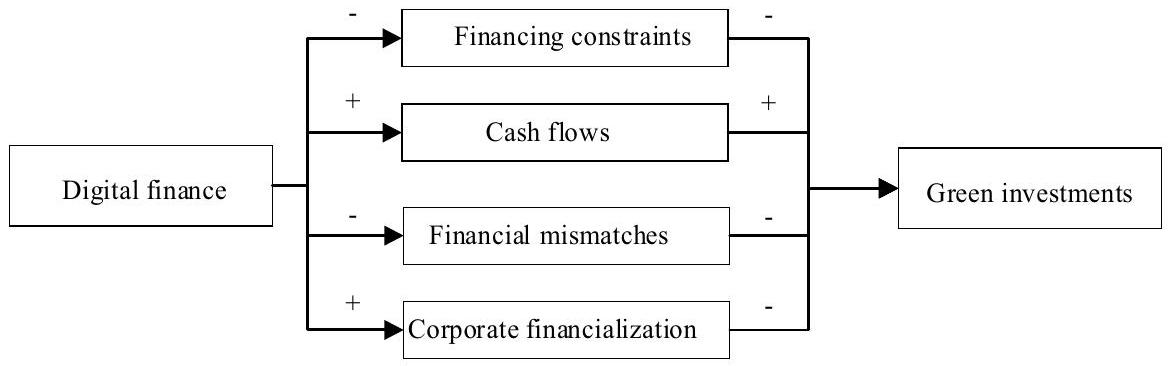
يمكن أن يكون لنمو التمويل المباشر آثار كبيرة على المبادرات الخضراء في شركات الطاقة. يتم تصوير آليات التأثير المحتملة في الشكل 1، والتي تشمل أربعة مسارات مؤثرة.

التمويل المباشر، قيود التمويل، والمبادرات الخضراء
أشارت الأبحاث السابقة إلى أن قيود التمويل تمثل عائقًا كبيرًا أمام تقدم المبادرات الخضراء داخل الشركات (تشي وآخرون 2023). من خلال آليات تصنيف ائتماني مبتكرة، تقدم منصات التمويل المباشر حلولًا تحويلية من خلال تعزيز جدارة الائتمان لشركات الطاقة وتسهيل الوصول إلى تكاليف تمويل أقل. تقوم هذه المنصات بتقييم جدارة ائتمان الشركات بعناية، مما يمكنها من تقديم ملف مالي أكثر ملاءمة للمستثمرين المحتملين. يمكن أن تقدم منصات التمويل المباشر للمستثمرين مزيدًا من ضمانات الائتمان، مما يقلل من إدراك المخاطر لدى المستثمرين، ويزيد من ثقتهم في شركات الطاقة، وفي النهاية يخفف من قيود التمويل على شركات الطاقة. تسهل منصات التمويل المباشر تدفق رؤوس الأموال نحو المشاريع المستدامة من خلال تقليل المخاطر المدركة المرتبطة بالمشاريع الخضراء. في الوقت نفسه، توفر منصات التمويل المباشر لشركات الطاقة المزيد من قنوات التمويل من خلال توريق الأصول (تشن وآخرون 2022؛ دينغ وآخرون 2023). تتيح هذه الاستراتيجية لشركات الطاقة الحصول على التمويل دون فقدان السيطرة، بينما تسمح للمستثمرين بتحقيق عوائد مستقرة من خلال امتلاك أوراق مالية مدعومة بالأصول. بالنسبة للمستثمرين، تمثل هذه فرصة لتأمين عوائد مستقرة من خلال امتلاك أوراق مالية مدعومة بالأصول، مما يحفز تخصيص رأس المال نحو المشاريع المسؤولة بيئيًا. بالإضافة إلى ذلك، يمكن أن تقدم منصات التمويل المباشر دعمًا تقنيًا لمساعدة شركات الطاقة في تقليل تكاليف التمويل وتحسين كفاءة التمويل، مما يحسن من إمكانية الوصول إلى التمويل. وبالتالي، من خلال تخفيف قيود التمويل، قد يعزز التمويل المباشر المبادرات الخضراء في شركات الطاقة.
الشكل 1 الآلية النظرية

التمويل المباشر، التدفقات النقدية، والمبادرات الخضراء

يتطلب السعي نحو المبادرات الخضراء في شركات الطاقة دعمًا ماليًا كبيرًا، وهو أمر صعب. بالمقارنة مع آليات التمويل التقليدية، أحدثت تقنيات التمويل المباشر ثورة في عمليات جمع الأموال وتخصيص رأس المال، مما يوفر لشركات الطاقة وصولًا غير مسبوق إلى مصادر تمويل متنوعة (غو وآخرون 2023). يسهل هذا الوصول المحسن تأمين الأموال للمشاريع الخضراء، مما يمكّن شركات الطاقة من الاستجابة بسرعة وكفاءة للمتطلبات المالية لمشاريعها الصديقة للبيئة. بالإضافة إلى ذلك، تقدم منصات التمويل المباشر خدمات تمويل سلسلة التوريد لشركات الطاقة (سونغ وآخرون 2021)، مما يوفر شروط دفع موسعة ويخفف من ضغوط التدفق النقدي الفورية على الشركات أثناء انطلاقها في مبادرات خضراء واسعة النطاق. من خلال منح وقت إضافي لتأمين التمويل، تسهل منصات التمويل المباشر الانتقال السلس نحو الاستثمارات المستدامة، مما يضمن أن شركات الطاقة يمكنها الحفاظ على استقرار العمليات أثناء السعي نحو مشاريع مسؤولة بيئيًا. أخيرًا، تزيد منصات التمويل المباشر من التدفق النقدي لشركات الطاقة من خلال تحسين الأصول. على سبيل المثال، يمكن أن تقدم منصات التمويل المباشر لشركات الطاقة خدمات تأجير الأصول والإيجار، مما يسمح لها بتحويل الأصول غير المستغلة إلى تدفق نقدي. في الأساس، يعمل التمويل المباشر كعامل محفز، مما يعزز قدرات التدفق النقدي لشركات الطاقة، وبالتالي يسهل توسيع المبادرات الخضراء.

التمويل المباشر، عدم تطابق التمويل، والمبادرات الخضراء

يعد التخصيص الفعال للموارد المالية أمرًا ضروريًا لتعزيز المبادرات الخضراء في الشركات. ومع ذلك، فإن التمييز في الملكية، والسياسات الائتمانية الصارمة، وعدم كفاءة تشغيل الأسواق المالية في المؤسسات المالية التقليدية (ليو وآخرون 2021a؛ تشونغ وجيانغ 2021) قد تسبب في عدم تطابق شديد في سوق رأس المال. يمكن أن تحدث منصات التمويل المباشر ثورة في المشهد المالي من خلال تحليلات البيانات الكبيرة من خلال تعزيز الشفافية والكفاءة. تقوم منصات التمويل المباشر بإجراء تحليلات متعمقة لكميات هائلة من البيانات، مما يتيح لها الحصول على رؤى حول الظروف التشغيلية الفعلية لشركات الطاقة ومتطلبات التمويل المحددة (غو وآخرون 2023؛ سون وآخرون 2023b). يسمح هذا المستوى من الاستهداف الدقيق بمطابقة أكثر دقة لرأس المال مع الاحتياجات الحقيقية للمشاريع الخضراء، مما يعالج المشكلة المستمرة لعدم تطابق التمويل في سوق رأس المال. علاوة على ذلك، تنفذ منصات التمويل المباشر استراتيجيات متقدمة لإدارة المخاطر، بما في ذلك التحكم الذكي في المخاطر والتقييمات الشاملة للمخاطر (تانغ وآخرون 2022). تساعد هذه الآليات المتقدمة في التخفيف من المخاطر المالية لشركات الطاقة، مما يجعلها أكثر جاذبية للمستثمرين والمقرضين. وبالتالي، من خلال توفير خيارات تمويل أكثر موثوقية وتخصيصًا، تشجع منصات التمويل المباشر شركات الطاقة على الاستثمار في المشاريع الصديقة للبيئة بثقة أكبر. وبالتالي، قد يعزز التمويل المباشر المبادرات الخضراء في شركات الطاقة من خلال تصحيح عدم تطابق التمويل.

التمويل المباشر، المالية المؤسسية، والمبادرات الخضراء

تشير المالية المؤسسية إلى سلوك الشركات غير المالية التي تشارك في الأسواق المالية وتشارك في الأنشطة المالية (جين وآخرون 2022). قد تعزز منصات التمويل المباشر المالية لشركات الطاقة من خلال تقديم خدمات تمويل مريحة ومنخفضة التكلفة وفعالة (جيانغ وآخرون 2022b). علاوة على ذلك، قد تغير منصات التمويل المباشر كيفية تخصيص الأموال في السوق المالية. قد تفضل بعض المؤسسات المالية تقديم خدمات التمويل للمشاريع قصيرة الأجل وعالية المخاطر وعالية العائد (جيانغ وآخرون 2022b). وهذا يعني أن زيادة توفر خيارات التمويل من خلال
منصات التمويل المباشر قد تحفز شركات الطاقة على إعطاء الأولوية للعوائد المالية قصيرة الأجل على الأهداف الاستراتيجية طويلة الأجل. يمكن أن تقوض مثل هذه “المالية قصيرة الأجل” أسس التنمية المستدامة وتعيق تقدم المبادرات الخضراء في قطاع الطاقة. وبالتالي، قد يعزز التمويل المباشر المالية لشركات الطاقة، مما يزاحم المبادرات الخضراء في شركات الطاقة.

تأثير العتبة لأنظمة الإدارة

استنادًا إلى الأبحاث الحالية (بان وآخرون 2019؛ ليو وآخرون 2021ب؛ تشينغ وكونغ 2022)، قسمت هذه الدراسة أنظمة التنظيم البيئي إلى تنظيم بيئي قائم على الحوافز السوقية (IER) وتنظيم بيئي قائم على الأوامر والسيطرة (CER).

IER

تشمل IER استخدام آليات السوق، مثل الدعم الحكومي، ورسوم التلوث، وتصاريح الانبعاثات القابلة للتداول، لتحفيز الشركات على الانخراط في التحول الأخضر (Tsireme et al. 2012). قد يكون للتفاعل المعقد بين IER ومشهد التمويل آثار على دور DF في تعزيز الابتكارات الخضراء في قطاع الطاقة.
أولاً، من خلال تنفيذ IER، يمكن للحكومة التأثير على تدفق النقد في الشركات وتغيير احتياجات تمويل شركات الطاقة (Liao et al. 2022). وهذا يعني أنه عندما تقدم الحكومة دعمًا ماليًا كافيًا يتعلق بالبيئة وحوافز، ستقل احتياجات التمويل للشركات من GIs المقدمة من DF. وبالتالي، قد يتقلص التأثير الترويجي لـ DF على GIs داخل شركات الطاقة حيث أن الدعم المالي المباشر من الحكومة يؤدي غرضًا مشابهًا. ثانيًا، يشير تلقي دعم مالي كبير يتعلق بالبيئة إلى أن شركات الطاقة قد حققت بالفعل معيارًا بيئيًا معينًا؛ حيث تم الوفاء بالمتطلبات الأساسية، قد يتناقص الدافع الإضافي للاستثمار في GIs. قد يؤدي هذا التناقص في الرغبة للاستثمار في GIs إلى تقليل قدرة DF على تحفيز GIs إضافية. علاوة على ذلك، قد تؤدي المستويات المفرطة من IER إلى استغلال الشركات لمزايا عدم التماثل في المعلومات لديها للانخراط في سلوك البحث عن الإيجارات، ساعية للحصول على دعم حكومي إضافي. يمكن أن يمتص هذا البحث عن الإيجارات الموارد التي كان من الممكن توجيهها نحو GIs الإنتاجية، مما يزاحم التأثير الإيجابي لـ DF على GIs في شركات الطاقة (Chen et al. 2022). لذلك، قد يتناقص التأثير الإيجابي لـ DF على GIs في شركات الطاقة إذا تجاوز IER حدًا معينًا.

سي إي آر

تشير CER إلى السيطرة المباشرة للحكومات على عواقب تلوث الشركات من خلال وضع معايير انبعاثات التلوث واللوائح ذات الصلة، مع فرض عقوبات قانونية أو إدارية على الشركات غير الملتزمة (Tsireme et al. 2012; Pan et al. 2019). يؤثر تكثيف CER بشكل كبير على المشهد التشغيلي لشركات الطاقة، لا سيما من حيث هياكل تكاليفها وقرارات الاستثمار، مع تداعيات على دور DF في تعزيز GIs.
مع تزايد متطلبات تقليل الانبعاثات الكربونية، قد تواجه شركات الطاقة ضغوط تكاليف أعلى (سونغ وآخرون 2020)؛ حيث يتطلب الأمر اعتماد تقنيات خضراء أكثر تكلفة لتقليل انبعاثاتها الكربونية (تشانغ وآخرون 2022)، مما يزيد من تكاليف التشغيل ويقلل من ربحيتها. قد تعتمد شركات الطاقة استراتيجيات للتخفيف من هذه الأعباء المالية، مثل تقليل الاستثمارات في البنية التحتية الخضراء أو نقل مرافق الإنتاج إلى مناطق ذات تكاليف أقل.
معايير صارمة. في هذه الحالة، قد تركز شركات الطاقة أكثر على خفض تكاليف الإنتاج بدلاً من توسيع المبادرات الخضراء، مما يضعف تأثير الإطار التنظيمي على المبادرات الخضراء. علاوة على ذلك، يمكن أن يخلق تهديد العقوبات بسبب عدم الامتثال ثقافة تجنب المخاطر داخل شركات الطاقة، مما يثني عن التجريب بالتقنيات الخضراء المبتكرة أو الاستثمارات حيث تسعى الشركات لتجنب العواقب القانونية أو الإدارية المحتملة. في مثل هذا السيناريو، قد يكون تأثير الإطار التنظيمي على تمويل وتعزيز المبادرات الخضراء محدودًا حيث تصبح الشركات أكثر تحفظًا في استراتيجياتها البيئية. وبالتالي، عندما يتجاوز الإطار التنظيمي عتبة معينة، قد يضعف التأثير الإيجابي للإطار التنظيمي على المبادرات الخضراء في شركات الطاقة.

تصميم البحث

بيانات

اعتمدت هذه الدراسة تعريف شركات الطاقة المستخدم في الدراسات السابقة (تشن وما 2021؛ زانغ وكونغ 2022) واختارت الشركات المدرجة ذات الرموز الصناعية B06 وB07 وC25 وD44 وD45 وD46 كعينة بحث. نظرًا للنمو السريع للطاقة المتجددة في الصين منذ عام 2010، فإن فترة الملاحظة في دراستنا هي من 2011 إلى 2020. تنتهي في عام 2020 لأن البيانات المستخدمة في قياس الملوثات المستخدمة في حسابات انبعاثات الكربون محدثة فقط حتى عام 2020. وفقًا للأبحاث السابقة (لين وشيا 2023a)، شملت عملية اختيار العينة في هذه الدراسة الخطوات التالية: (1) استبعدنا العينات المدرجة بعد عام 2011، مما يضمن أن جميع الشركات المدرجة في الدراسة لديها تاريخ تشغيلي كافٍ ضمن فترة الملاحظة، مما يوفر أساسًا أكثر موثوقية للتحليل. (2) قمنا بإزالة العينات ذات البيانات المالية غير الطبيعية لتقليل التأثير المحتمل للبيانات الخاطئة أو الشاذة على التحليل العام. (3) من خلال استبعاد العينات التي تفتقر إلى بيانات حيوية، يمكننا منع التحيزات المحتملة أو المعلومات غير المكتملة من التأثير على التحليل. أخيرًا، تم الاحتفاظ بـ 108 شركة مدرجة في قطاع الطاقة. لقد خففنا من تأثير القيم الشاذة من خلال تطبيق طريقة وينزور على المتغيرات المستمرة في العينة عند و النسب المئوية (Lin و Xie 2023b). تم جمع البيانات حول المتغيرات الرئيسية من قاعدة بيانات CSMAR، التقارير السنوية للشركات (CAR)، قاعدة بيانات CEIC، ودليل الإحصاءات السنوي للصين (CSY).

المتغيرات

المتغير التابع

تماشيًا مع الأبحاث السابقة (جيانغ وآخرون 2022ب؛ دينغ وآخرون 2023)، استخدمت هذه الدراسة تقنيات استخراج النصوص لتحديد المشاريع التي تحتوي أسماؤها على كلمات رئيسية تتعلق بالاستثمارات الخضراء، مثل الطاقة الريحية، والطاقة الشمسية، وحماية البيئة، وما إلى ذلك، من أعمدة البناء الجاري، ومصروفات الإدارة، والمستحقات الأخرى في CAR، مما أدى إلى الحصول على إجمالي مبلغ استثمارات الشركات الخضراء.

المتغير المستقل

تماشيًا مع معظم الأبحاث الحالية (موغاني وآخرون 2022؛ لي وآخرون 2022ب، أ)، قمنا بقياس DF من خلال الاستفادة من مؤشر المالية الرقمية الشاملة على مستوى المقاطعة الذي أصدرته جامعة بكين. تم تطوير هذا المؤشر باستخدام عملية التحليل الهرمي واشتمل على
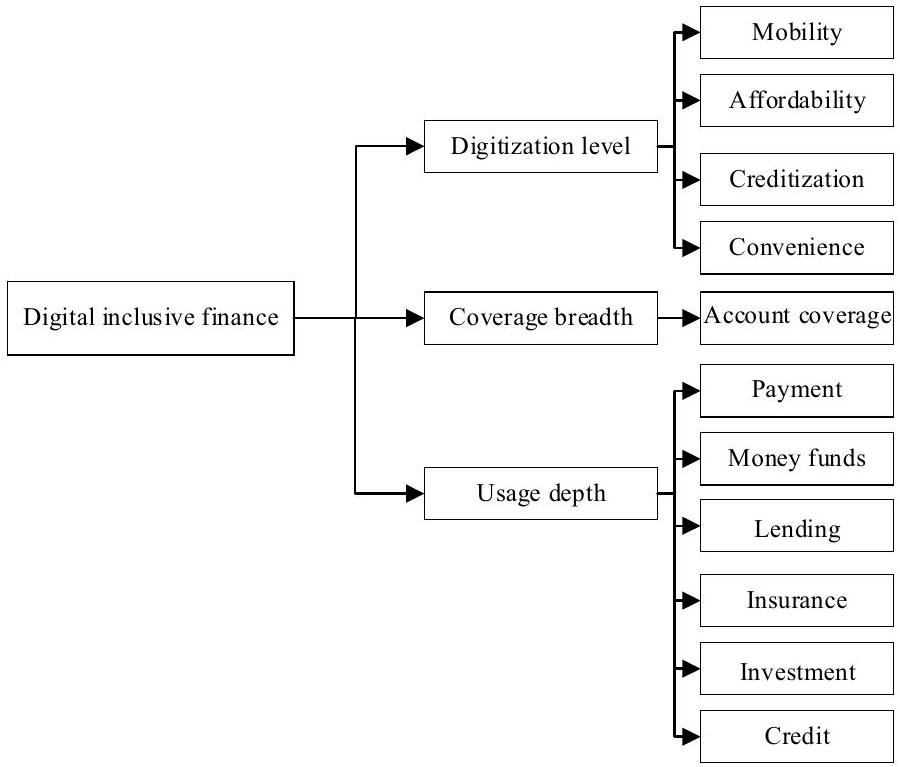
الشكل 2 نظام مؤشرات التمويل الشامل الرقمي
إطار عمل يحتوي على ثلاثة مؤشرات رئيسية و11 مؤشراً ثانوياً (كما هو موضح في الشكل 2). لمزيد من المعلومات التفصيلية حول هذا المؤشر، يرجى الرجوع إلى البحث الذي أجراه قوه وآخرون (2020). نظراً لشمولية نظام المؤشرات وغطاء البيانات الواسع، تم استخدام هذا المؤشر بشكل واسع في الأبحاث ذات الصلة بالديون الخارجية في الصين (وي وآخرون 2023).
ومع ذلك، فإن هذا المؤشر له أيضًا بعض القيود. على سبيل المثال، يعتمد بشكل أساسي على البيانات الدقيقة من حسابات معاملات خدمة أنط المالية، والتي قد لا تعكس الصورة الكاملة للتمويل الرقمي في منطقة ما (رازق ويانغ 2023). حاول بعض العلماء إعادة قياس التمويل الرقمي في السنوات الأخيرة من خلال التحليل النصي. على سبيل المثال، استخدم رازق ويانغ (2023) تقنيات الزحف على الويب لجمع عدد الكلمات الرئيسية المتعلقة بالتمويل الرقمي من بايدو، أكبر محرك بحث في الصين، لبناء مؤشر شامل للـ DF. لذلك، اعتمدنا على هذا المؤشر الجديد في قسم القوة لإعادة قياس DF.

المتغيرات الوسيطة

اعتمدنا التمويل القيود، التدفق النقدي، عدم التوافق المالي، والتمويل المؤسسي كمتغيرات وسيطة. على وجه التحديد، تم قياس قيود التمويل بواسطة مؤشر SA (هاي وآخرون 2022؛ لي وآخرون 2023أ)، حيث تشير القيمة الأعلى إلى مستوى أقل من قيود التمويل. قمنا بقياس مستويات التدفق النقدي للشركات باستخدام الأموال النقدية المعلنة في التقارير السنوية (غوبتا وماهاكود 2019؛ يي وآخرون 2023). تم التقاط عدم التوافق المالي من خلال الانحراف بين تكلفة رأس المال للشركة ومتوسط تكلفة رأس المال في الصناعة (ليو وآخرون 2022؛ كيو وآخرون 2023). أخيرًا، قمنا بقياس التمويل المؤسسي كنسبة الأصول المالية إلى إجمالي الأصول (تشاو وسو 2022؛ جيانغ وآخرون 2022ب).

متغيرات العتبة

IER و CER هما المتغيرات الحدية. القياسات النموذجية لـ IER تشمل دعم الحوكمة البيئية، ورسوم التلوث، وسياسات تداول انبعاثات الكربون (Wang et al. 2019; Ta et al. 2020; Kim et al. 2021). نظرًا لعدم اكتمال البيانات حول رسوم التلوث (Liu et al. 2021b) ولأن سياسات تداول انبعاثات الكربون هي متغيرات وهمية غير مناسبة كمتغيرات حدية، استخدمت هذه الدراسة دعم الحوكمة البيئية لقياس IER (Tsireme et al. 2012). علاوة على ذلك، تم قياس CER باستخدام مؤشر مركب للتلوث البيئي تم حسابه بواسطة طريقة الإنتروبيا استنادًا إلى تصريف مياه الصرف الصناعي، وانبعاثات SO2، وانبعاثات الغبار (Cao et al. 2020; Du et al. 2021).

متغيرات التحكم

ركزنا بشكل أساسي على بعدين رئيسيين أثناء اختيار متغيرات التحكم. أولاً، استندنا إلى أبحاث المعلومات الجغرافية لتحديد العوامل المحتملة التي تؤثر على قرارات المعلومات الجغرافية لمؤسسات الطاقة (جيانغ وآخرون 2022ب؛ دينغ وآخرون 2023). ثانياً، قمنا أيضاً بإدراج متغيرات اقتصادية واجتماعية ومؤسسية مرتبطة بشكل معقد بالتنمية المستدامة (دينغ وآخرون 2023). على وجه التحديد، على مستوى المؤسسة، ركزنا على متغيرات التحكم، بما في ذلك حجم المؤسسة ( ) ، الملكية ( قدرة سداد الديون نسبة النقد ( ) وحجم اللوحة ( على المستوى الإقليمي، أخذنا في الاعتبار متغيرات التحكم مثل الهيكل الصناعي (INS) ومستوى التعليم (EDU) ومستوى التسويق (MAR). تم توضيح المنهجيات المحددة لقياس هذه المتغيرات بشكل شامل في الجدول 9 في الملحق.

المنهجية

نموذج أساسي

يساعد نموذج التأثيرات الثابتة ثنائية الاتجاه في التحكم في التباين غير الملحوظ عبر الكيانات والزمن، مما يقلل من مشاكل الاندماج ويخفف من تحيز المتغيرات المفقودة (دينغ وآخرون 2023؛ جافيد وآخرون 2024). لذلك، قمنا بإنشاء نموذج الانحدار الأساسي التالي لتقييم التأثير المباشر لـ DF على GIs في شركات الطاقة. في هذا النموذج، أضفنا التأثيرات الثابتة الفردية. وتأثيرات ثابتة زمنياً .
أين ، و تمثل الشركة، المقاطعة، والسنة، على التوالي. و هي المتغيرات التابعة والمستقلة، على التوالي. تشير الضوابط إلى المتغيرات الضابطة، و هو مصطلح الخطأ العشوائي.

نماذج الوساطة

استنادًا إلى الأبحاث الحالية (كونغ وآخرون 2022)، نقوم بالتحقق من فعالية آليات التأثير المذكورة في القسم “أثر DF على GIs في شركات الطاقة” من خلال تضمين المتغيرات الوسيطة ( ، و ) في النموذج لتأسيس نماذج تأثير الوساطة التالية:
الجدول 1 الإحصائيات الوصفية
متغير ملاحظة معنى الانحراف المعياري من ماكس الانحراف التفرطح جارك-بيرا
جي آي ١٠٨٠ 1.368 2.652 0.000 14.700 ٢.٩٣٦ ١٢.٣٧٤ ٥٥٠٥.٨٥٢
DF ١٠٨٠ ٢٢٥٫٧٤٧ ٩٨.٨٣٦ ٢٤.٥١٠ ٤١٧.٨٧٥ -0.252 2.272 ٣٥٫٢٨٠
نادي كرة القدم ١٠٨٠ -3.778 0.335 -4.304 -2.353 1.750 7.753 ١٥٦٧.٨٤٥
CF ١٠٨٠ 44.531 ١٢٢.٧٢٢ 0.554 ٩٥١.٣٣٠ ٥.٧٤٥ ٣٨.٥٤٦ 62,799.220
إف إم ١٠٨٠ 0.077 0.543 -1.000 ٢.٥٣٩ 1.154 7.243 ١٠٤٩.٨٤٦
CFI ١٠٨٠ ٢٠.٣٢٤ ١٤٫٤٥٩ 2.038 73.647 1.514 ٥.٤٢١ 676.351
IER ١٠٨٠ ٥.٣٥٠ 7.085 0.000 18.250 0.626 1.504 171.248
شهادة المطابقة ١٠٨٠ 0.770 0.158 0.348 0.996 -0.637 ٢.٩١٢ 73.387
إس ١٠٨٠ 8.322 1.492 ٥.٤٦٠ 13.009 0.616 ٣.٤٠٩ 75.830
أوه ١٠٨٠ 0.833 0.373 0.000 1.000 -1.789 ٤.٢٠٠ 640.894
دا ١٠٨٠ ٥٣.٠٤٩ ١٦.٤٨٦ 12.148 86.543 -0.333 ٢.٦٣٥ 25.955
كاليفورنيا ١٠٨٠ 0.432 0.555 0.014 ٤.٢١٩ ٤.٢٨٤ ٢٦.٤٨٧ ٢٨,١٢٧.٢٤١
هراء ١٠٨٠ 10.000 2.279 ٦٫٠٠٠ 17.000 0.956 3.692 186.057
INS ١٠٨٠ 50.223 ١٢.٤٤٠ ٣٢.٥٠٠ ٨٣٫٩٠٠ 1.162 3.868 ٢٧٦.٩٤٨
تعليم ١٠٨٠ ١٣٫٢٠٠ 0.552 10.950 14.016 -1.216 5.668 586.478
مار ١٠٨٠ 8.458 1.836 ٣.٥٨٠ 11.673 -0.521 2.703 52.829

نماذج العتبة

تُستخدم نماذج تأثير العتبة لتقييم ما إذا كان هناك فرق كبير في تأثير متغير مستقل على متغير تابع قبل وبعد قيمة عتبة معينة (وانغ وآخرون 2022). استنادًا إلى الأبحاث السابقة (شبير وآخرون 2021؛ باخش وزانغ 2023)، استخدمنا نماذج العتبة لفحص العلاقة غير الخطية بين DF و GIs في شركات الطاقة على النحو التالي:
أين و هي متغيرات العتبة، و و هي قيم العتبة.

النتائج التجريبية والمناقشة

الإحصائيات الوصفية

استنادًا إلى البحث الذي أجراه باخش وآخرون (2024ب)، قمنا بتلخيص الإحصائيات الوصفية للمتغيرات الرئيسية في الجدول 1. تتراوح قيم مؤشر الجهد (GI) من 0.000 إلى 14.700، مما يشير إلى وجود اختلافات كبيرة في أداء مؤشر الجهد بين شركات الطاقة. تتراوح القيم من 24.510 إلى 417.875، مما يشير إلى اختلافات كبيرة في مستويات DF بين المناطق المختلفة. بالإضافة إلى ذلك، فإن القيمة المتوسطة لعامل تضخم التباين هي ، مما يشير إلى عدم وجود مشاكل شديدة في التعدد الخطي (كوك ولين 2012).

الانحدار الأساسي

M1 من الجدول 2 يقدم نتائج الانحدار الأساسية التي تشمل فقط المتغيرات المستقلة. المعامل الإيجابي الكبير لـ تشير إلى أن DF له تأثير إيجابي كبير على GIs في مؤسسات الطاقة. بعد ذلك، قدمنا متغيرات تحكم على مستوى المؤسسة والإقليم في M2 وM3، على التوالي. تظهر النتائج أن معاملات تظل إيجابية بشكل ملحوظ، مما يؤكد قوة تأثير DF الإيجابي على GIs. علاوة على ذلك، يدعم اختبار هاوسمان بقوة اختيارنا لنموذج التأثيرات الثابتة. ). أخيرًا، نقوم بتحسين قوة نتائج الانحدار من خلال إدخال أخطاء معيارية قوية في M4. توصلنا إلى استنتاج مشابه: لزيادة بمقدار وحدة واحدة في مستوى DF الإقليمي، تزداد شدة GI لمؤسسات الطاقة بمعدل متوسط قدره .
توفر نتائجنا رؤى قيمة حول العلاقة المعقدة بين DF و GIs في مؤسسات الطاقة. كشفت الدراسة عن تأثير إيجابي كبير لـ DF في تعزيز GIs. تدعم نتائجنا الأبحاث التي أجراها دينغ وآخرون (2023) وجافيد وآخرون (2024)، الذين قاموا بالتحقق بشكل مستقل من التأثير المفيد لـ DF في تعزيز GIs في الشركات الملوثة بشدة. تعزز هذه التوافقية في الأدلة حجتنا وتقترح أن DF يمكن أن يكون دافعًا قويًا لـ GIs ومستقبل طاقة أكثر استدامة.
الجدول 2 الانحدار الأساسي
متغير M1 M2 M3 M4
جل جي آي جي آي جي آي
DF 0.0335*** 0.0307*** 0.0335*** 0.0335***
(4.04) (3.74) (٤.٠٠) (3.96)
إس 0.1155 0.1269 0.1269
(0.80) (0.88) (1.00)
أوه 2.3491*** 2.4292*** 2.4292***
(3.24) (3.31) (2.86)
دا 0.0393*** 0.0390*** 0.0390***
(4.59) (4.53) (4.07)
كاليفورنيا 0.0713 0.0845 0.0845
(0.43) (0.51) (0.53)
هراء -0.0375 -0.0230 -0.0230
(-0.54) (-0.33) (-0.36)
INS -0.0546** -0.0546**
(-1.99) (-1.97)
تعليم -0.6417 -0.6417
(-0.50) (-0.48)
مار -0.0788 -0.0788
(-0.45) (-0.46)
ثابت -6.1855*** -10.2195*** 0.7371 0.7371
(-3.31) (-4.22) (0.04) (0.04)
شركة FE
سنة FE
0.440 0.460 0.464 0.464
ملاحظة ١٠٨٠ ١٠٨٠ ١٠٨٠ ١٠٨٠

اختبارات المتانة

مشكلة الاندماج الذاتي

  1. قمنا بتضمين المتغيرات البيئية كمتغير تحكم لتقليل تأثير المتغيرات المفقودة في نموذجنا. تم تفصيل طريقة قياس المتغيرات البيئية في الجدول 9 من الملحق. تُعرض نتائج الانحدار بعد دمج المتغيرات البيئية في M1 من الجدول 3. بناءً على بحث Bu et al. (2024)، قمنا بتضمين تأثيرات ثابتة مشتركة من الدرجة العليا للزمن والصناعة، مما يتيح مزيدًا من التحكم في تأثير العوامل المتغيرة مع الزمن على مستوى الصناعة. يتم تلخيص النتائج في M2 من الجدول 3.
  2. نظرًا للتداخل المحتمل للسببية العكسية على نتائجنا، قمنا بتأخير المتغير المستقل بفترة واحدة للتحليل الانحداري (جيانغ وآخرون 2022ب). تتيح لنا هذه الطريقة الكشف عن العلاقة السببية بين المتغيرات بدقة أكبر، وتظهر نتائج الانحدار في M3 من الجدول 3.
  3. قمنا بتوظيف طريقة فعالة من خطوتين لتعميم لحظات لتناول مشكلة التداخل بشكل أفضل. أولاً، استخدمنا المستوى المتوسط من DF في المقاطعات المجاورة كأول متغير آلي (IV) لـ (جيانغ وآخرون 2022أ)، المسمى Sur_DF، لأن عمليات DF تظهر عمومًا تواصلًا عابرًا للمناطق بشكل كبير. وبالتالي، قد يؤثر مستوى تطوير DF وجودة الخدمة في المقاطعات المجاورة على المنطقة المحلية. في الوقت نفسه، لا يؤثر مستوى DF في المناطق المجاورة بشكل مباشر على قرارات GI لشركات الطاقة المحلية، مما يوفر لنا IV فعالة لتقليل تأثير التداخل. ثانيًا، قمنا بإنشاء متغير Bartik كـ IV إضافي (تابيليني 2020؛ حسن وآخرون 2020). يتم حساب هذا المتغير كمنتج لمؤشر DF الإقليمي المتأخر والفرق من الدرجة الأولى في مؤشر DF الوطني على مر الزمن، مما يلتقط التغيرات الديناميكية.
جدول 3 اختبارات الاندماج
متغير M1 جي M2 جي M3 جي M4 DF M5 جي
DF 0.0332*** (3.57) 0.0254*** (2.76) 0.0647*** (3.79)
DF_1 0.0284*** (2.92)
سور_دي إف 1.0338*** (22.32)
بارتيك_الرابع 0.0020*** (2.87)
ثابت 0.6771 (0.04) 14.8046 (0.78) -8.4745 (-0.43) 127.3052 (1.51) -3.0787 (-0.16)
تحكم
شركة FE
سنة FE
صناعة × سنة FE
أندرسون إل إم 155.735***
كراج-دونالد والد ف ٢٦٥٫٧٠٠
0.464 0.573 0.485 0.481
ملاحظة ١٠٨٠ ١٠٨٠ 972 972 972
في DF وتأثيرها على GIs. تم تقديم نتائج المرحلة الأولى والثانية من طريقة IV في M4 وM5 من الجدول 3، على التوالي.

استبدال المتغيرات المستقلة

مماثل للبحوث السابقة (جيانغ وآخرون 2022ب)، استخدمنا مؤشر المالية الرقمية الشاملة على مستوى المدينة لقياس DF. تم تقديم نتائج الانحدار بناءً على هذا المؤشر في M1 من الجدول 4. بالإضافة إلى ذلك، قمنا بإجراء اختبار موثوقية باستخدام مؤشر DF الذي تم بناؤه بواسطة رضاك ويانغ (2023). تظهر نتائج الانحدار في M2 من الجدول 4.

استبدال المتغيرات التابعة

قمنا بقياس مؤشرات الأداء باستخدام نسبة مؤشرات الأداء إلى تكاليف التشغيل في شركات الطاقة، وتُعرض النتائج المستندة إلى هذا المقياس البديل في M3 من الجدول 4.

استبدال النموذج

نظرًا لأن قيمة المؤشرات الجغرافية غير سالبة، اعتمدنا نموذج توبي (Lin و Xie 2024a، b) وقدمنا النتائج في M4 من الجدول 4.

اختبارات القوة الأخرى

نظرًا لأن أزمة المالية لعام 2015 قد أثرت على سلوك الشركات الطاقية (دينغ وآخرون 2023)، قمنا باستبعاد البيانات من عام 2015 لتقليل تأثير الأزمة. يتم تقديم النتائج في M5 من الجدول 4.

تحليل الآلية

تظهر الأبحاث أن قيود التمويل، وتدفق النقد، وعدم التوافق المالي، والتمويل المؤسسي هي عوامل مؤثرة رئيسية على الابتكارات الخضراء (جيانغ وآخرون 2022ب؛ دينغ وآخرون 2023؛ لي وآخرون 2023ب؛ وو وآخرون 2024). استنادًا إلى استنتاجاتهم، سنناقش المزيد عن آلية تأثير التمويل المباشر على الابتكارات الخضراء.
تظهر النتائج في الجدول 5 كيف يؤثر DF على GIs في شركات الطاقة من خلال فحص الآلية الأساسية. يكشف M1 أن تقدم DF يساعد في التخفيف من
الجدول 4 اختبارات المتانة
متغير M1 M2 M3 M4 M5
جي آي جي آي جل جي آي جي آي
DF 0.0345*** 2.6386*** 0.1784*** 0.0354*** 0.0302***
(3.19) (3.19) (3.38) (3.38) (3.61)
ثابت 0.8999 5.3530 -18.2045 ٢٨.٣٤٦٥ 3.4191
(0.05) (0.32) (-0.14) (1.33) (0.20)
تحكم
شركة FE
سنة FE
0.467 0.463 0.486 0.490
ملاحظة 1070 ١٠٨٠ ١٠٨٠ ١٠٨٠ 972
قيود التمويل التي تواجهها شركات الطاقة ). تشير M2 إلى أن تعزيز DF يزيد من التدفق النقدي لشركات الطاقة ( ). M3 يعني أن تعزيز DF يسهل التخفيف من عدم التوافق المالي في سوق رأس المال ( ). ومع ذلك، تشير M4 إلى عدم وجود دليل مباشر على تأثير DF في تسريع المالية لشركات الطاقة ( يمكن أن يُعزى ذلك إلى الكثافة العالية لرأس المال والربحية المستقرة التي لوحظت في شركات الطاقة (Liu et al. 2020; Du et al. 2020). وبالتالي، قد لا يكون تأثير DF على خيارات الاستثمار المالي لشركات الطاقة كبيرًا. على النقيض من بحثنا، وجد Jiang et al. (2022b) أن DF يسهل الاستثمار المالي للشركات الملوثة بشدة، مما يؤدي إلى تهميش استثماراتها الخضراء. وهذا يشير إلى وجود اختلافات في تأثير DF على المالية في الشركات بين الصناعات المختلفة.
بشكل عام، يعزز التمويل المباشر بشكل غير مباشر العلامات الجغرافية في شركات الطاقة من خلال تخفيف قيود التمويل، وزيادة تدفق النقد في المؤسسات، وتصحيح الت mismatches المالية.

أثر العتبة

أجرت هذه الدراسة تحليل انحدار العتبة باستخدام شدة IER و CER كمتغيرات عتبة لدراسة الآثار المختلفة لـ DF على أداء GI لشركات الطاقة تحت مستويات مختلفة من ER.

اختبار تأثير العتبة

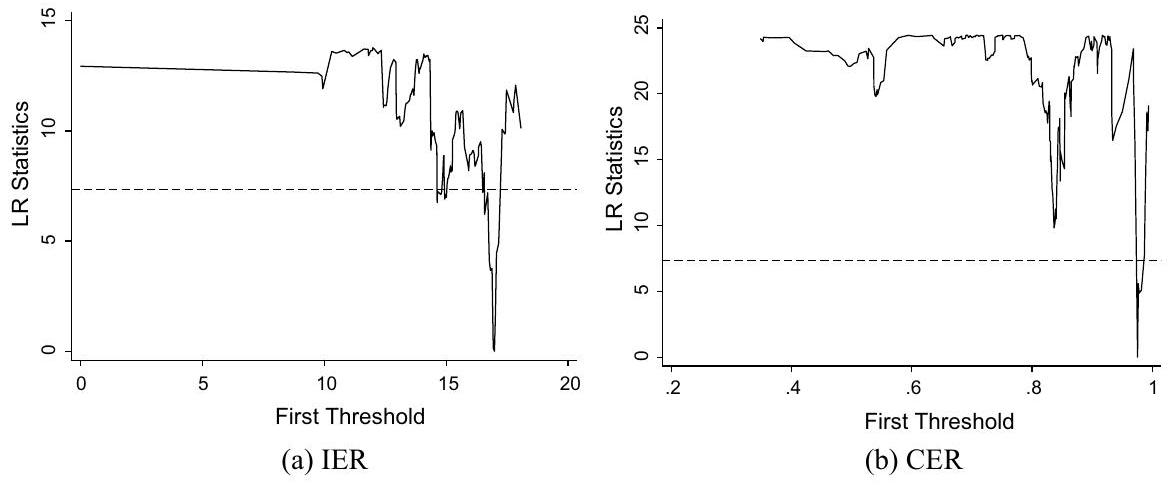
تشير النتائج الملخصة في الجدول 6 إلى أن تأثير DF على مؤشرات الأداء البيئي لشركات الطاقة يظهر تأثير عتبة واحدة بناءً على شدة IER و CER، مع قيم عتبة تبلغ 16.9802 و 0.9755 على التوالي. كما قمنا برسم مخططات دالة نسبة الاحتمال في الشكل 3(أ) و 3(ب)، مما يوضح قوة استنتاجنا.

تحليل نتائج انحدار تأثير العتبة

تقدم الجدول 7 نتائج تحليل الانحدار الحدّي. يُظهر M1 أنه بالنسبة لشدات IER التي تقل عن 16.98، فإن زيادة وحدة واحدة في DF تؤدي إلى زيادة في أداء GI لشركات الطاقة. ومع ذلك، بالنسبة لكثافات IER التي تتجاوز القيمة الحدية، يضعف تأثير DF على أداء GI، حيث ينخفض الزيادة إلى . هذا يشير إلى أن الأثر الإيجابي للـ DF على أداء GI يتناقص عندما تكون شدة IER فوق القيمة الحدية.
الجدول 5 تحليل الآلية
متغير M1 FC M2 CF إم 3 إف إم M4 CFI
DF 0.0014*** 0.7274*** -0.0025** -0.0183
(7.39) (3.56) (-1.97) (-0.85)
ثابت -4.0381*** 519.4478** 0.9264 ٢٤.٣٤٨٣
(-12.70) (2.12) (0.32) (0.48)
تحكم
شركة FE
سنة FE
0.988 0.879 0.592 0.850
ملاحظة ١٠٨٠ ١٠٨٠ ١٠٨٠ ١٠٨٠
M2 يظهر أنه بالنسبة لشدات CER التي تقل عن 0.98، فإن زيادة وحدة واحدة في DF تؤدي إلى زيادة في أداء الشركات الطاقية في مجال GI. ومع ذلك، بالنسبة لكثافات CER التي تتجاوز القيمة الحدية، فإن زيادة أداء GI تنخفض إلى ، مما يشير إلى أن تأثير DF على أداء GI يتقلص عندما تتجاوز شدة CER القيمة الحدية.
توفر نتائجنا رؤى مثيرة حول تأثيرات العتبة للموارد البيئية على تأثير التنمية المستدامة على أداء الشركات في قطاع الطاقة. على وجه التحديد، تشير نتائجنا إلى أنه عندما تتجاوز شدة الموارد البيئية الداخلية أو الخارجية قيمها العتبية، فإن التأثير الإيجابي للتنمية المستدامة على الشركات في قطاع الطاقة يتضاءل. وهذا يشير إلى أنه بينما يمكن أن تكون التنمية المستدامة أداة فعالة لتعزيز الشركات، فإن فعاليتها تعتمد على مستوى الموارد البيئية.
الجدول 6 اختبارات نسبة الاحتمال
متغيرات العتبة عتبة واحدة عتبة مزدوجة قيمة العتبة فترة الثقة 95%
قيمة F -قيمة قيمة F -قيمة
IER 12.76 0.027 3.24 0.707 16.9802 [16.7459, 17.0240]
شهادة المطابقة ٢٢.٦٣ 0.003 14.19 0.193 0.9755 [0.9731, 0.9761]
الشكل 3 مخططات دالة نسبة الاحتمالية
الجدول 7 تأثيرات العتبة
متغير M1 M2
جي آي جل
DF 0.0314**(IER ) سي إي آر
(2.52) (3.01)
0.0247*(IER > 16.9802) 0.0398***(CER > 0.9755)
(1.97) (2.77)
ثابت ٤.٠٣٦١ 7.2842
(0.17) (0.30)
تحكم
شركة FE
سنة FE
0.0936 0.0947
ملاحظة ١٠٨٠ ١٠٨٠
تم فرضها. قد تحد المستويات المفرطة من ER من قدرة DF على دفع GIs، مما قد يقلل من تأثيراتها الإيجابية بشكل عام. تشمل الأسباب المحتملة حقيقة أن المستويات المفرطة من IER قد تشجع سلوك البحث عن الإيجارات بين الشركات، وقد تؤدي CER المرتفعة بشكل مفرط إلى زيادة الضغوط التكلفة على شركات الطاقة، مما يضعف بالتالي التأثير الإيجابي لـ DF على GIs في شركات الطاقة. وبالمثل، جادل هوانغ ولي (2021) ووانغ وآخرون (2022) أيضًا بأن ERs المفرطة ليست مواتية لـ GIs. ومع ذلك، تشير بعض الدراسات إلى استنتاجات مختلفة عن استنتاجاتنا. على سبيل المثال، اقترحت دراسة جافيد وآخرون (2024) أن ERs تعزز التأثير الإيجابي لـ DF على GIs في الصناعات الملوثة بشدة. تشير هذه التباينات إلى أن تأثير ERs قد يختلف بشكل كبير عبر الصناعات.

تحليل التباين

الملكية

قد تمتلك شركات الطاقة ذات الملكيات المختلفة تفضيلات وقيود متباينة في مؤشرات الأداء البيئي. تشير M1 وM2 في الجدول 8 إلى أن الشركات المملوكة للدولة تستفيد بشكل أكبر من التأثير الإيجابي للتمويل التنموي على أدائها في المؤشرات البيئية مقارنة بالشركات غير المملوكة للدولة. وبالمثل، كشف Ding وآخرون (2023) وJaveed وآخرون (2024) أن التمويل التنموي أكثر بروزًا في تعزيز المؤشرات البيئية في الشركات المملوكة للدولة ذات التلوث الثقيل؛ قد يُعزى هذا الناتج إلى أن الشركات المملوكة للدولة عادة ما تكون أكثر عرضة للسياسات واللوائح الحكومية، وتولي الأولوية لمسؤولياتها الاجتماعية والتزاماتها في حماية البيئة. وبالتالي، فإن تأثير التمويل التنموي على أداء المؤشرات البيئية يكون أكثر أهمية. في المقابل، تعطي الشركات غير المملوكة للدولة الأولوية عمومًا للمنافع الاقتصادية والمنافسة في السوق، وتتميز المؤشرات البيئية بفترات طويلة ومخاطر عالية؛ وبالتالي، قد لا يكون تأثير التمويل التنموي على أدائها في المؤشرات البيئية بنفس القدر من الأهمية.

حجم المؤسسة

قد تكون لدى شركات الطاقة ذات الأحجام المختلفة اعتبارات وقدرات تخصيص موارد مختلفة عند اتخاذ قرارات الاستثمار. تشير M3 وM4 من الجدول 8 إلى أنه، بالمقارنة مع الشركات الصغيرة والمتوسطة (SMEs)، تستفيد الشركات الكبيرة (LEs) بشكل أكبر من التأثير الإيجابي للتمويل المباشر (DF) على أدائها في مجال الاستثمار الأخضر (GI). أحد التفسيرات المحتملة هو أن الاستثمارات في مجال الاستثمار الأخضر لها فترة استرداد طويلة و مخاطر عالية.
الجدول 8 تحليل التباين
متغير الملكية حجم المؤسسة مستوى التسويق
M1 M2 M3 M4 M5 M6
SOE NSOE لي المؤسسات الصغيرة والمتوسطة حمير لمار
DF 0.0355*** 0.0148 0.0262*** 0.0317 0.0310** 0.0323
(3.69) (1.04) (2.97) (1.09) (2.27) (1.02)
ثابت 12.4834 -42.0629 -3.2788 -43.9853 -7.1121 -21.1086
(0.64) (-1.13) (-0.19) (-0.67) (-0.19) (-0.75)
تحكم
شركة FE
سنة FE
0.467 0.482 0.521 0.542 0.494 0.457
ملاحظة ٩٠٠ 180 ٨٨٧ 193 706 374
خصوصًا في الشركات الصغيرة والمتوسطة التي تواجه مزيدًا من عدم اليقين. قد تكون مؤسسات التنمية حذرة بشأن هذا عدم اليقين، مما يحد من الفرص المتاحة للشركات الصغيرة والمتوسطة للحصول على الدعم من مؤسسات التنمية. على سبيل المثال، خلص سون وآخرون (2023) إلى أن الشركات الكبيرة قد تمتلك موارد ومزايا أكثر في البيئة التنظيمية والسياسية، مما يسهل وصولها إلى الدعم من مؤسسات التنمية.

مستوى التسويق

تماشيًا مع البحث الذي أجراه يو ودينغ (2021)، قمنا بقياس درجة السوقية من خلال اعتماد مستوى مؤشر السوقية الشامل الذي كشف عنه المعهد الوطني للبحوث الاقتصادية (NERI). قمنا بتصنيف العينات إلى مجموعتين: مستوى عالٍ من التسويق (HMAR) ومستوى منخفض من التسويق (LMAR)، وفقًا لمستوى التسويق في المناطق التي تقع فيها الشركات. كما هو موضح في M5 وM6 من الجدول 8، تساهم DF بشكل كبير في GIs فقط في الشركات العاملة في مجال الطاقة الواقعة في مناطق HMAR. يمكن أن تعزى عدة عوامل إلى هذا الاختلاف. أولاً، تمتلك مناطق HMAR عادةً نظام خدمات مالية أكثر تطورًا وتطورًا أكثر نضجًا لـ DF، مما يعني أن شركات الطاقة في هذه المناطق يمكنها الوصول بسهولة أكبر إلى خدمات DF، مما يجعل GIs أكثر فعالية. بالإضافة إلى ذلك، تولي الحكومات في مناطق HMAR عمومًا مزيدًا من الاهتمام للتنمية الخضراء والمستدامة وقد تقدم سياسات تفضل GIs. أخيرًا، يتدفق رأس المال بحرية أكبر في مناطق HMAR، وتكون تخصيص الموارد أكثر كفاءة. يمكن أن توجه DF تدفقات رأس المال نحو مشاريع GI الأكثر وعدًا من خلال تحليل البيانات الكبيرة وتقييم المخاطر، مما يحقق تخصيصًا مثاليًا للموارد.

الخاتمة، الآثار السياسية، والقيود

الاستنتاجات

قدمت هذه الدراسة رؤى قيمة حول العلاقة بين DF وأداء GI في قطاع الطاقة، مما يشير إلى طرق جديدة لتحسين أداء GI لشركات الطاقة وإرشادات مفيدة لتطوير DF. كشفت الأبحاث عن النتائج التالية:
أولاً، يعزز تقدم DF من مؤشرات الأداء في شركات الطاقة. على وجه التحديد، يمكن أن يؤدي زيادة وحدة واحدة في مستوى DF إلى تحقيق شركات الطاقة لـ زيادة في مؤشرات الأداء العامة. يمكن أن يحسن DF أيضًا مؤشرات الأداء العامة في شركات الطاقة من خلال التخفيف من قيود التمويل، وزيادة التدفق النقدي، وتصحيح الت mismatches المالية.
ثانيًا، يتمتع DF بتأثير عتبة فردية كبيرة على أداء GI استنادًا إلى ERs. على وجه التحديد، عندما تتجاوز قيمة IER 16.98، أو تتجاوز قيمة CER 0.98، يتراجع الأثر الإيجابي لـ DF على GIs في الشركات الطاقية. وهذا يشير إلى أن مستوى معتدل من ERs هو أكثر ملاءمة للاستفادة من الآثار الإيجابية لـ DF على GIs في الشركات الطاقية.
أخيرًا، يختلف تأثير DF على GIs في شركات الطاقة اعتمادًا على الملكية والحجم ومستوى التسويق. على وجه التحديد، تستفيد الشركات الكبيرة المملوكة للدولة في المناطق ذات مستوى التسويق الأعلى بشكل أكبر من تطوير DF.

آثار السياسة

  1. نظرًا للتأثير الإيجابي للتمويل الرقمي على الاستثمارات الخضراء في قطاع الطاقة، يجب على الحكومة تسريع تطوير التمويل الرقمي. على وجه الخصوص، يمكن للحكومة زيادة تغطية التمويل الرقمي من خلال تعزيز بناء البنية التحتية ونشر المعرفة حول التمويل الرقمي. كما يمكنها تعميق استخدام التمويل الرقمي من خلال تحسين المنتجات والخدمات المالية الرقمية وتحسين النظام التنظيمي. بالإضافة إلى ذلك، يمكن للحكومة تعزيز مستويات الرقمنة من خلال تشجيع الابتكار التكنولوجي وتسهيل تبادل البيانات والانفتاح. علاوة على ذلك، يجب عليها تشجيع التوجه البيئي للتمويل الرقمي والسيطرة على المخاطر البيئية المرتبطة به. من خلال صياغة وتنظيم محتوى ومعايير ومخاطر التمويل الرقمي، تجعل الحكومة التمويل الرقمي إشارة فعالة لآليات تخصيص الموارد في سوق الاستثمارات الخضراء.
  2. تشير نتائج أبحاثنا إلى أن مستوى معتدل من الموارد البيئية (ERs) أكثر ملاءمة لتحقيق التأثير الإيجابي للتمويل الأخضر (DF) على الاستثمارات الخضراء (GIs) في قطاع الطاقة. لذلك، يجب على الحكومة تحسين آلية الدعم البيئي الحالية، مثل تحديد حدود الدعم وتعزيز الإشراف على استخدام الدعم، لمنع سلوكيات البحث عن الريع وسوء استخدام الأموال بشكل فعال. يمكن للحكومة أيضًا اتخاذ تدابير لتخفيف الضغط على الشركات فيما يتعلق بتقليل الانبعاثات، مثل صياغة سياسات ذات صلة تسمح للشركات بتعويض نسبة معينة من أهداف تقليل الانبعاثات الخاصة بها من خلال الاستثمارات الخضراء الجديدة. تشجع هذه السياسات الشركات على زيادة الاستثمارات الخضراء وتخفيف العبء الاقتصادي عليها خلال عملية تقليل الانبعاثات.
  3. نظرًا للاختلافات في تأثير DF على GIs في أنواع مختلفة من مؤسسات الطاقة، يجب على الحكومة صياغة سياسات تحفيزية مستهدفة. على سبيل المثال، يمكن للحكومة إنشاء صناديق خاصة لدعم الشركات الكبيرة المملوكة للدولة في بدء الابتكار التكنولوجي واستكشاف النماذج في DF. في الوقت نفسه، يجب تطوير منصات خدمات مالية رقمية لتوفير خدمات مالية رقمية مريحة للمؤسسات المملوكة للدولة والشركات الصغيرة والمتوسطة، مما يعزز قدراتها في GI. كما يجب على الحكومة الاستمرار في تشجيع الإصلاحات الموجهة نحو السوق في سوق الطاقة، لضمان أن تكاليف تقليل الانبعاثات لمؤسسات الطاقة تنعكس بالكامل في المعاملات القائمة على السوق، مما يقلل من ضغط تكاليفها لتقليل الانبعاثات.

القيود

اعتمدت هذه الدراسة على بيانات مستمدة من شركات الطاقة المدرجة، والتي تمثل ولكنها ليست شاملة ولا تغطي الشركات غير المدرجة. ستقوم الأبحاث المستقبلية بجمع بيانات من شركات الطاقة غير المدرجة من خلال استبيانات الشركات لشرح تأثير DF على GIs في صناعة الطاقة بشكل شامل. بالإضافة إلى ذلك، ركزت الدراسة فقط على الشركات الصينية وافتقرت إلى المقارنات الدولية. ستساهم مقارنة ممارسات شركات الطاقة في دول مختلفة في فهم الآليات وتأثيرات DF وتقديم توصيات سياسية مستهدفة للتحول الأخضر العالمي.

الملحق أ

انظر الجدول 9.

جدول 9 تعريفات المتغيرات
نوع أسماء المتغيرات اختصارات حساب مصدر وحدة
المتغير التابع الاستثمارات الخضراء جي آي الاستثمارات الخضراء / إجمالي الأصول × 100 سيارة %
المتغير المستقل التمويل الرقمي DF مؤشر التمويل الشامل الرقمي جامعة بكين
المتغيرات الوسيطة قيود التمويل نادي كرة القدم مؤشر SA CSMAR
التدفق النقدي CF النقد وما في حكمه سيارة 100 مليون يوان
عدم تطابق مالي إف إم (سعر الفائدة الخاص بالشركة – متوسط سعر الفائدة في الصناعة) / متوسط سعر الفائدة في الصناعة CSMAR
التمويل المؤسسي CFI الأصول المالية / إجمالي الأصول × 100 سيارة %
متغيرات العتبة تنظيم بيئي قائم على حوافز السوق IER لوغاريتم (دعم الحوكمة البيئية + 1) سيارة
تنظيم بيئي قائم على الأوامر والسيطرة شهادة المطابقة فهرس شامل لمؤشر تلوث البيئة سي إس واي
متغيرات التحكم حجم المؤسسة إس Ln (عدد الموظفين) سيارة
الملكية أوه إذا كانت الشركة مملوكة للدولة، فإن المتغير يساوي 1؛ وإلا، فإنه يساوي 0 CSMAR
قدرة دا إجمالي الالتزامات / إجمالي الأصول × 100 سيارة %
نسبة النقد كاليفورنيا النقد وما في حكمه / الالتزامات المتداولة سيارة
حجم المجلس هراء إجمالي عدد أعضاء المجلس سيارة أشخاص
الهيكل الصناعي INS نسبة القطاع الثالث في الناتج المحلي الإجمالي سي إي آي سي %
مستوى التعليم تعليم Ln (عدد الطلاب الجامعيين) سي إي آي سي
مستوى التسويق مار مؤشر تسويق السوق المقدم من NERI نيري

الاختصارات

جلز الاستثمارات الخضراء
DF التمويل الرقمي
غرف الطوارئ التشريعات البيئية
IER تنظيم بيئي قائم على الحوافز السوقية
شهادة المطابقة تنظيم بيئي قائم على الأوامر والسيطرة
الرابع متغير آلي
الشركات المملوكة للدولة المؤسسات المملوكة للدولة
المنظمات غير الربحية المؤسسات غير المملوكة للدولة
لي الشركات الكبيرة
المؤسسات الصغيرة والمتوسطة المؤسسات الصغيرة والمتوسطة
حمير مستوى عالٍ من التسويق
لمار مستوى منخفض من التسويق

شكر وتقدير

تدعم هذه الورقة المشاريع الرئيسية للبحوث في الفلسفة والعلوم الاجتماعية، وزارة التعليم، (رقم المنحة: 22JZD008).

مساهمات المؤلفين

قرأ جميع المؤلفين ووافقوا على المخطوطة النهائية. بوكيانغ لين: التصور، المنهجية، التحليل الرسمي، إدارة المشروع، الكتابة – المسودة الأصلية، الكتابة – المراجعة والتحرير. يونغجينغ شيا: التصور، المنهجية، البرمجيات، تنظيم البيانات، الكتابة – المسودة الأصلية، الكتابة – المراجعة والتحرير.

التمويل

تدعم هذه الورقة المشاريع الرئيسية للبحث في الفلسفة والعلوم الاجتماعية، وزارة التعليم، (رقم المنحة: 22JZD008).

توفر البيانات والمواد

غير قابل للتطبيق.

الإعلانات

المصالح المتنافسة

يعلن المؤلف أنه ليس لديه مصالح متنافسة.
تم الاستلام: 30 يناير 2024 تم القبول: 14 فبراير 2025
تم النشر عبر الإنترنت: 03 مارس 2025

References

Bakhsh S, Zhang W (2023) How does natural resource price volatility affect economic performance? A threshold effect of economic policy uncertainty. Resour Policy 82:103470. https://doi.org/10.1016/j.resourpol.2023.103470
Bakhsh S, Zhang W, Ali K, Anas M (2023) Can digital financial inclusion facilitate renewable energy consumption? Evidence from nonlinear analysis. Energy Environ. https://doi.org/10.1177/0958305X231204029
Bakhsh S, Zhang W, Ali K, Anas M (2024a) Transition towards environmental sustainability through financial inclusion, and digitalization in China: evidence from novel quantile-on-quantile regression and wavelet coherence approach. Technol Forecast Soc Change 198:123013. https://doi.org/10.1016/j.techfore.2023.123013
Bakhsh S, Zhang W, Ali K, Anas M (2024b) Energy transition and environmental stability prospects for OECD economies: the prominence role of environmental governance, and economic complexity: does the geopolitical risk matter? J Environ Manage 354:120358. https://doi.org/10.1016/j.jenvman.2024.120358
Bakhsh S, Zhang W, Ali K, Oláh J (2024c) Strategy towards sustainable energy transition: the effect of environmental governance, economic complexity and geopolitics. Energy Strategy Rev 52:101330. https://doi.org/10.1016/j.esr. 2024.101330
Bu Y, Du X, Wang Y et al (2024) Digital inclusive finance: a lever for SME financing? Int Rev Financ Anal 93:103115. https:// doi.org/10.1016/j.irfa.2024.103115
Cao Y, Liu J, Yu Y, Wei G (2020) Impact of environmental regulation on green growth in China’s manufacturing industrybased on the Malmquist-Luenberger index and the system GMM model. Environ Sci Pollut Res 27:41928-41945. https://doi.org/10.1007/s11356-020-10046-1
Chen Y, Ma Y (2021) Does green investment improve energy firm performance? Energy Policy 153:112252. https://doi. org/10.1016/j.enpol.2021.112252
Chen G, Wei B, Zhu R (2022) The impact of environmental subsidy on the performance of corporate environmental responsibility: evidence from China. Front Environ Sci 10:972328. https://doi.org/10.3389/fenvs.2022.972328
Cheng Z, Kong S (2022) The effect of environmental regulation on green total-factor productivity in China’s industry. Environ IMPACT Assess Rev 94:106757. https://doi.org/10.1016/j.eiar.2022.106757
Chi Y, Hu N, Lu D, Yang Y (2023) Green investment funds and corporate green innovation: from the logic of social value. Energy Econ 119:106532. https://doi.org/10.1016/j.eneco.2023.106532
Dato Investment in energy efficiency, adoption of renewable energy and household behavior: evidence from OECD countries. Energy J 39:213-244. https://doi.org/10.5547/01956574.39.3.pdat
Deng J, Liu Y (2022) Does digital finance reduce the employment in the finance industry? Evidence from China FINANCE Res Lett 48:102994. https://doi.org/10.1016/j.frl.2022.102994
Dilanchiev A, Sharif A, Ayad H, Nuta AC (2024) The interaction between remittance, FDI, renewable energy, and environmental quality: a panel data analysis for the top remittance-receiving countries. Environ Sci Pollut Res. https://doi. org/10.1007/s11356-024-32150-2
Ding Q, Huang J, Chen J (2023) Does digital finance matter for corporate green investment? Evidence from heavily polIuting industries in China. Energy Econ 117:106476. https://doi.org/10.1016/j.eneco.2022.106476
Dong K, Wang J, Ren X (2023) Does Internet development have a spatial fluctuation spillover effect on green total factor productivity in China? A spatial-SAR-ARCH model. Manag Environ Qual Int J 34:741-770. https://doi.org/10.1108/ MEQ-08-2022-0226
Du W, Li M, Wang F (2020) Role of rent-seeking or technological progress in maintaining the monopoly power of energy enterprises: an empirical analysis based on micro-data from China. Energy 202:117763. https://doi.org/10.1016/j. energy.2020.117763
Du K, Cheng Y, Yao X (2021) Environmental regulation, green technology innovation, and industrial structure upgrading: the road to the green transformation of Chinese cities. Energy Econ 98:105247. https://doi.org/10.1016/j.eneco. 2021.105247
Du M, Chai S, Li S, Sun Z (2022) How environmental regulation affects green investment of heavily polluting enterprises: evidence from steel and chemical Industries in China. Sustainability 14:11971. https://doi.org/10.3390/su141911971
Engel-Cox JA, Chapman A (2023) Accomplishments and challenges of metrics for sustainable energy, population, and economics as illustrated through three countries. Front Sustain Energy Policy. https://doi.org/10.3389/fsuep.2023. 1203520
Fan Y, Chen ST (2022) Research on the effects of digital inclusive finance on the efficiency of financial resource allocation. Front Environ Sci 10:957941. https://doi.org/10.3389/fenvs.2022.957941
Ferreira P, Loures L, Nunes J, Brito P (2018) Are renewable energy stocks a possibility to diversify portfolios considering an environmentally friendly approach? The view of DCCA correlation coefficient. Phys -Stat Mech ITS Appl 512:675681. https://doi.org/10.1016/j.physa.2018.08.108
Gao X, Zhang G, Zhang Z et al (2024) How does new energy demonstration city pilot policy affect carbon dioxide emissions? Evidence from a quasi-natural experiment in China. Environ Res 244:117912. https://doi.org/10.1016/j.envres. 2023.117912
Guo F, Wang J, Wang F et al (2020) Measuring China’s digital financial inclusion: index compilation and spatial characteristics. China Econ Q 19:1401-1418
Guo Q, Wu Z, Ding C et al (2023) An empirical analysis of the nexus between digital financial inclusion, industrial structure distortion, and China’s energy intensity. Environ Sci Pollut Res 30:49397-49411. https://doi.org/10.1007/ s11356-023-25323-y
Gupta G, Mahakud J (2019) Alternative measure of financial development and investment-cash flow sensitivity: evidence from an emerging economy. Financ Innov 5:1. https://doi.org/10.1186/s40854-018-0118-9
Hai B, Yin X, Xiong J, Chen J (2022) Could more innovation output bring better financial performance? The role of financial constraints. Financ Innov 8:6. https://doi.org/10.1186/s40854-021-00309-2
Hasan I, Hoi C-K, Wu Q, Zhang H (2020) Is social capital associated with corporate innovation? Evidence from publicly listed firms in the US. J Corp Fin 62:101623. https://doi.org/10.1016/j.jcorpfin.2020.101623
Hassan ST, Batool B, Sadiq M, Zhu B (2022) How do green energy investment, economic policy uncertainty, and natural resources affect greenhouse gas emissions? A Markov-switching equilibrium approach. Environ IMPACT Assess Rev 97:106887. https://doi.org/10.1016/j.eiar.2022.106887
He L, Zhang L, Zhong Z et al (2019) Green credit, renewable energy investment and green economy development: empirical analysis based on 150 listed companies of China. J Clean Prod 208:363-372. https://doi.org/10.1016/j.jclep ro.2018.10.119
Hu W-Q, Zhao J, Zhao L (2023) Does enhancing environmental regulation promote corporate green investment? Evidence from China. Energy Environ 34:3265-3291. https://doi.org/10.1177/0958305X221122931
Huang L, Lei Z (2021) How environmental regulation affect corporate green investment: evidence from China. J Clean Prod 279:123560. https://doi.org/10.1016/j.jclepro.2020.123560
Javeed SA, Latief R, Cai X, San Ong T (2024) Digital finance and corporate green investment: a perspective from institutional investors and environmental regulations. J Clean Prod 446:141367. https://doi.org/10.1016/j.jclepro. 2024. 141367
Jiang S, Liu X, Liu Z et al (2022a) Does green finance promote enterprises’ green technology innovation in China? Front Environ Sci 10:981013. https://doi.org/10.3389/fenvs.2022.981013
Jiang Y, Guo C, Wu Y (2022b) Does digital finance improve the green investment of Chinese listed heavily polluting companies? The perspective of corporate financialization. Environ Sci Pollut Res 29:71047-71063. https://doi.org/10. 1007/s11356-022-20803-z
Jin XM, Mai Y, Cheung AWK (2022) Corporate financialization and fixed investment rate: evidence from China. Finance Res Lett 48:102898. https://doi.org/10.1016/j.frl.2022.102898
Kim B, Kim SW, Park KS (2021) Promoting supplier’s environmental innovation via emission taxation. Int J Prod Econ 240:108240. https://doi.org/10.1016/j.jjpe.2021.108240
Kock N, Lynn GS (2012) Lateral collinearity and misleading results in variance-based SEM: an illustration and recommendations. J Assoc Inf Syst 13:546-580. https://doi.org/10.17705/1jais. 00302
Kong T, Sun R, Sun G, Song Y (2022) Effects of digital finance on green innovation considering information asymmetry: an empirical study based on Chinese listed firms. Emerg Mark Fin Trade 58:4399-4411. https://doi.org/10.1080/15404 96X.2022.2083953
Kou G, Pamucar D, Yuksel S et al (2024) Evaluation of multidimensional carbon neutrality policies in transportation using a novel quantum picture fuzzy rough modeling. IEEE Trans Eng Manag 71:7681-7700. https://doi.org/10.1109/TEM. 2024.3374385
Lee C-C, Lee C-C (2022) How does green finance affect green total factor productivity? Evidence from China Energy Econ 107:105863. https://doi.org/10.1016/j.eneco.2022.105863
Li B, Xu Z (2021) Insights into financial technology (FinTech): a bibliometric and visual study. Financ Innov 7:69. https:// doi.org/10.1186/s40854-021-00285-7
Li G, Zhang R, Feng S, Wang Y (2022a) Digital finance and sustainable development: evidence from environmental inequality in China. Bus Strategy Environ 31:3574-3594. https://doi.org/10.1002/bse. 3105
Li X, Shao X, Chang T, Albu LL (2022b) Does digital finance promote the green innovation of China?s listed companies? Energy Econ 114:106254. https://doi.org/10.1016/j.eneco.2022.106254
Li C, Wang Y, Zhou Z et al (2023a) Digital finance and enterprise financing constraints: structural characteristics and mechanism identification. J Bus Res 165:114074. https://doi.org/10.1016/j.jbusres.2023.114074
Li X, Wang S, Lu X, Guo F (2023b) Quantity or quality? The effect of green finance on enterprise green technology innovation. Eur J Innov Manag. https://doi.org/10.1108/EJIM-03-2023-0208
Liao F, Hu Y, Xu S (2022) How do environmental subsidies affect the environmental performance of heavily polluting enterprises: evidence from China. Econ Res-Ekon Istraz. https://doi.org/10.1080/1331677X.2022.2160777
Lin B, Xie Y (2023a) Positive or negative? R&D subsidies and green technology innovation: evidence from China’s renewable energy industry. Renew Energy 213:148-156. https://doi.org/10.1016/j.renene.2023.06.011
Lin B, Xie Y (2023b) The impact of government subsidies on capacity utilization in the Chinese renewable energy industry: Does technological innovation matter? Appl Energy 352:121959. https://doi.org/10.1016/j.apenergy.2023. 121959
Lin B, Xie Y (2024a) The role of venture capital in determining the total factor productivity of renewable energy enterprises: In the context of government subsidy reduction. Energy Econ 132:107454. https://doi.org/10.1016/j.eneco. 2024.107454
Lin B, Xie Y (2024b) How feed-in-tariff subsidies affect renewable energy investments in China? New evidence from firmlevel data. Energy 294:130853. https://doi.org/10.1016/j.energy.2024.130853
Liu R, He L, Liang X et al (2020) Is there any difference in the impact of economic policy uncertainty on the investment of traditional and renewable energy enterprises? – A comparative study based on regulatory effects. J Clean Prod 255:120102. https://doi.org/10.1016/j.jclepro.2020.120102
Liu J, Wang Z, Zhu W (2021a) Does privatization reform alleviate ownership discrimination? Evidence from the Split-share structure reform in China*. J Corp Fin 66:101848. https://doi.org/10.1016/j.jcorpfin.2020.101848
Liu L, Jiang J, Bian J et al (2021b) Are environmental regulations holding back industrial growth? Evidence from China. J Clean Prod 306:127007. https://doi.org/10.1016/j.jclepro.2021.127007
Liu X, Nie Z, Li B (2022) Financial mismatch and default risk: evidence from chinese nonfinancial listed private enterprises. Emerg Mark Fin Trade 58:852-862. https://doi.org/10.1080/1540496X.2021.1926235
Liu S, Liu H, Chen X (2023) Does environmental regulation promote corporate green investment? Evidence from China’s new environmental protection law. Environ Dev Sustain. https://doi.org/10.1007/s10668-023-03933-3
Muganyi T, Yan L, Yin Y et al (2022) Fintech, regtech, and financial development: evidence from China. Financ Innov 8:29. https://doi.org/10.1186/s40854-021-00313-6
Pan X, Ai B, Li C et al (2019) Dynamic relationship among environmental regulation, technological innovation and energy efficiency based on large scale provincial panel data in China. Technol Forecast Soc Change 144:428-435. https:// doi.org/10.1016/j.techfore.2017.12.012
Pata UK, Yilanci V, Zhang Q, Shah SAR (2022) Does financial development promote renewable energy consumption in the USA? Evidence from the Fourier-wavelet quantile causality test. Renew Energy 196:432-443. https://doi.org/10. 1016/j.renene.2022.07.008
Qu S, Wang J, Li Y, Wang K (2023) How does risk-taking affect the green technology innovation of high-tech enterprises in China: the moderating role of financial mismatch. Environ Sci Pollut Res 30:23747-23763. https://doi.org/10.1007/ s11356-022-23820-0
Razzaq A, Yang X (2023) Digital finance and green growth in China: appraising inclusive digital finance using web crawler technology and big data. Technol Forecast Soc Change 188:122262. https://doi.org/10.1016/j.techfore.2022.122262
Shabir M, Jiang P, Bakhsh S, Zhao Z (2021) Economic policy uncertainty and bank stability: threshold effect of institutional quality and competition. Pac-Basin Fin J 68:101610. https://doi.org/10.1016/j.pacfin.2021.101610
Song M, Wang S, Zhang H (2020) Could environmental regulation and R&D tax incentives affect green product innovation? J Clean Prod 258:120849. https://doi.org/10.1016/j.jclepro.2020.120849
Song H, Li M, Yu K (2021) Big data analytics in digital platforms: how do financial service providers customise supply chain finance? Int J Oper Prod Manag 41:410-435. https://doi.org/10.1108/IJOPM-07-2020-0485
Sun G, Li G, Dilanchiev A, Kazimova A (2023a) Promotion of green financing: role of renewable energy and energy transition in China. Renew Energy 210:769-775. https://doi.org/10.1016/j.renene.2023.04.044
Sun G, Li T, Ai Y, Li Q (2023b) Digital finance and corporate financial fraud. Int Rev Financ Anal 87:102566. https://doi.org/ 10.1016/j.irfa.2023.102566
Sun X, Zhang A, Zhu M (2023c) Impact of pilot zones for green finance reform and innovations on green technology innovations: evidence from Chinese manufacturing corporates. Environ Sci Pollut Res 30:43901-43913. https://doi. org/10.1007/s11356-023-25371-4
Ta H, Liu J, Mao J, Wu J (2020) The effects of emission trading system on corporate innovation and productivity-empirical evidence from China’s SO2 emission trading system. Environ Sci Pollut Res 27:21604-21620. https://doi.org/10.1007/ s11356-020-08566-x
Tabellini M (2020) Gifts of the immigrants, woes of the natives: lessons from the age of mass migration. Rev Econ Stud 87:454-486. https://doi.org/10.1093/restud/rdz027
Taghizadeh-Hesary F, Yoshino N (2019) The way to induce private participation in green finance and investment. Finance Res Lett 31:98-103. https://doi.org/10.1016/j.frl.2019.04.016
Tang X, Ding S, Gao X, Zhao T (2022) Can digital finance help increase the value of strategic emerging enterprises? Sustain Cities Soc 81:103829. https://doi.org/10.1016/j.scs.2022.103829
Tong L, JabbourBelgacem CJCSB et al (2022) Role of environmental regulations, green finance, and investment in green technologies in green total factor productivity: empirical evidence from Asian region. J Clean Prod 380:134930. https://doi.org/10.1016/j.jclepro.2022.134930
Tsireme AI, Nikolaou El, Georgantzis N, Tsagarakis KP (2012) The influence of environmental policy on the decisions of managers to adopt G-SCM practices. CLEAN Technol Environ POLICY 14:953-964. https://doi.org/10.1007/ s10098-012-0461-x
Wang H, Zhang R (2022) Effects of environmental regulation on CO2 emissions: an empirical analysis of 282 cities in China. Sustain Prod Consum 29:259-272. https://doi.org/10.1016/j.spc.2021.10.016
Wang K, Mi Z, Wei Y-M (2019) Will pollution taxes improve joint ecological and economic efficiency of thermal power industry in China?: A DEA-based materials balance approach. J Ind Ecol 23:389-401. https://doi.org/10.1111/jiec. 12740
Wang Z, Wang N, Hu X, Wang H (2022) Threshold effects of environmental regulation types on green investment by heavily polluting enterprises. Environ Sci Eur 34:26. https://doi.org/10.1186/s12302-022-00606-2
Wang W, Gao P, Wang J (2023) Nexus among digital inclusive finance and carbon neutrality: evidence from companylevel panel data analysis. Resour Policy 80:103201. https://doi.org/10.1016/j.resourpol.2022.103201
Wei Y, Wang L, Zhang H (2023) Digital finance and pollution: firm-level evidence from China. J Glob Inf Manag 31:321183. https://doi.org/10.4018/JGIM. 321183
Wu Y, Huang S (2022) The effects of digital finance and financial constraint on financial performance: firm-level evidence from China’s new energy enterprises. Energy Econ 112:106158. https://doi.org/10.1016/j.eneco.2022.106158
Wu W, Yang S, Li A et al (2024) Does interest rate liberalization affect corporate green investment? Energy Econ 131:107377. https://doi.org/10.1016/j.eneco.2024.107377
Xiao Y, Lin M, Wang L (2024) Impact of green digital finance on sustainable development: evidence from China’s pilot zones. Financ Innov 10:10. https://doi.org/10.1186/s40854-023-00552-9
Xie L, Li Z, Ye X, Jiang Y (2021) Environmental regulation and energy investment structure: empirical evidence from China’s power industry. Technol Forecast Soc CHANGE 167:120690. https://doi.org/10.1016/j.techfore.2021.120690
Yan W, Wang Y, Zheng S et al (2023) Nonlinear impact of the digital inclusive finance on enterprise technological innovation based on the AK Model and PSTR empirical analysis. J Glob Inf Manag 31:320191. https://doi.org/10.4018/JGIM. 320191
Yi R, Wang H, Lyu B, Xia Q (2023) Does venture capital help to promote open innovation practice? Evidence from China. Eur J Innov Manag 26:1-26. https://doi.org/10.1108/EJIM-03-2021-0161
Yu M, Deng X (2021) The inheritance of marketization level and regional human capital accumulation: evidence from China. Finance Res Lett 43:102268. https://doi.org/10.1016/j.frl.2021.102268
Yu M, Tsai F-S, Jin H, Zhang H (2022) Digital finance and renewable energy consumption: evidence from China. Financ Innov 8:58. https://doi.org/10.1186/s40854-022-00362-5
Yu X, Dilanchiev A, Bibi S (2024) Enhancing labor productivity as a key strategy for fostering green economic growth and resource efficiency. HELIYON 10:e24640. https://doi.org/10.1016/j.heliyon.2024.e24640
Zhang DY, Kong Q (2022) Green energy transition and sustainable development of energy firms: an assessment of renewable energy policy. Energy Econ 111:106060. https://doi.org/10.1016/j.eneco.2022.106060
Zhang MM, Wang Q, Zhou D, Ding H (2019) Evaluating uncertain investment decisions in low-carbon transition toward renewable energy. Appl Energy 240:1049-1060. https://doi.org/10.1016/j.apenergy.2019.01.205
Zhang Y, Song Y, Zou H (2022) Non-linear effects of heterogeneous environmental regulations on industrial relocation: do compliance costs work? J Environ Manage 323:116188. https://doi.org/10.1016/j.jenvman.2022.116188
Zhang Z, Wang J, Feng C, Chen X (2023a) Do pilot zones for green finance reform and innovation promote energy savings? Evidence from Chin Energy Econ 124:106763. https://doi.org/10.1016/j.eneco.2023.106763
Zhang Z, Zhang Y, Zhao M et al (2023b) What is the global causality among renewable energy consumption, financial development, and public health? New perspective of mineral energy substitution. Resour Policy 85:104036. https:// doi.org/10.1016/j.resourpol.2023.104036
Zhang W, Bakhsh S, Ali K, Anas M (2024) Fostering environmental sustainability: an analysis of green investment and digital financial inclusion in China using quantile-on-quantile regression and wavelet coherence approach. Gondwana Res 128:69-85. https://doi.org/10.1016/j.gr.2023.10.014
Zhao Y, Su K (2022) Economic policy uncertainty and corporate financialization: evidence from China. Int Rev Financ Anal 82:102182. https://doi.org/10.1016/j.irfa.2022.102182
Zhao Z-Y, Zuo J, Fan L-L, Zillante G (2011) Impacts of renewable energy regulations on the structure of power generation in China – A critical analysis. Renew Energy 36:24-30. https://doi.org/10.1016/j.renene.2010.05.015
Zhong W, Jiang T (2021) Can internet finance alleviate the exclusiveness of traditional finance? evidence from Chinese P2P lending markets. Finance Res Lett 40:101731. https://doi.org/10.1016/j.frl.2020.101731

ملاحظة الناشر

تظل Springer Nature محايدة فيما يتعلق بالمطالبات القضائية في الخرائط المنشورة والانتماءات المؤسسية.

  1. و -إحصائيات بين قوسين
  2. و -إحصائيات بين قوسين
  3. و -إحصائيات بين قوسين
  4. و -إحصائيات بين قوسين
  5. و -إحصائيات بين قوسين

Journal: Financial Innovation, Volume: 11, Issue: 1
DOI: https://doi.org/10.1186/s40854-025-00772-1
Publication Date: 2025-03-03

How does digital finance drive energy transition? A green investment-based perspective

Boqiang and Yongjing Xie

*Correspondence:
bqlin@xmu.edu.cn; bqlin2004@vip.sina.com
School of Management, China Institute for Studies in Energy Policy, Collaborative Innovation Center for Energy Economics and Energy Policy, Xiamen University, Xiamen 361005, Fujian, China

Abstract

Green investments (Gls) in the energy industry are crucial for driving a clean energy transition and fostering environmental sustainability. In the digital economy era, insufficient attention has been paid to digital finance’s (DF’s) influence on Gls in energy enterprises, potentially underestimating its impact. Our study utilized a two-way fixedeffects model, analyzing data from 108 listed energy firms from 2011 to 2020, to empirically investigate the influence of DF on GIs in China’s energy industry. The research findings are as follows: (1) An increase of one unit in DF can improve the intensity of GIs in the energy industry by by alleviating financing constraints, increasing cash flow, and correcting financial mismatches. (2) DF has a significant threshold effect on GIs, with market incentive- and command-and-control-based environmental regulations having thresholds of 16.98 and 0.98 , respectively. (3) The GI performance of large state-owned energy enterprises in regions with a higher marketization benefits more from DF. We suggested tailored policy suggestions according to these findings.

Keywords: Digital finance, Energy transition, Green investments, Environmental regulations, Threshold effect
JEL Classification: G23, Q30, Q56

Introduction

In the context of global climate change and the urgent need for a green energy transition (Engel-Cox and Chapman 2023; Kou et al. 2024), it is crucial for China, the world’s largest energy consumer, to make progress toward a sustainable energy future (Lee and Lee 2022; Dong et al. 2023; Sun et al. 2023a). However, China’s share of green energy remains low and unevenly distributed (Zhao et al. 2011; Dato 2018; Gao et al. 2024). In 2021, fossil energy consumption in China accounted for , while nonfossil energy made up for only This imbalance indicates an urgent need for increased green investments (GIs) in the energy industry, which will drive the transition to a more environmentally friendly energy system (He et al. 2019; Zhang et al. 2019; Hassan et al. 2022).
GIs in the energy industry require substantial funding and have an extended investment recovery period; thus, it requires the support of a sound financial system (Ferreira et al.
2018; Taghizadeh-Hesary and Yoshino 2019; Wu and Huang 2022). Traditional financial systems, while foundational, encounter limitations in terms of operational costs, service efficiency, coverage, and risk management capabilities (Zhong and Jiang 2021; Zhang et al. 2023a), hindering their ability to fully meet the demands of GIs (Wu and Huang 2022; Tong et al. 2022).
As a burgeoning constituent of the digital economy, digital finance (DF), offers a promising solution (Li and Xu 2021; Yan et al. 2023; Xiao et al. 2024). DF involves using digital technologies to enhance traditional financial services, creating resource-efficient and environmentally friendly financial services (Ding et al. 2023). Compared to traditional financial models, DF can achieve low-cost, high-efficiency services using digital technology, covering a broader customer base and achieving more precise risk control (Deng and Liu 2022; Fan and Chen 2022; Guo et al. 2023), potentially breaking the bottlenecks in China’s green energy transition (Yu et al. 2022). However, concerns remain about DF’s potential to exacerbate financialization (Jiang et al. 2022b), diverting funds away from long-term GIs toward short-term, high-yield investments. Thus, the net impact of DF on GIs in the energy industry remains unclear.
Furthermore, environmental regulations (ERs) are pivotal in shaping GI behavior. ERs can either incentivize or constrain GIs by enforcing policies aimed at pollution reduction and resource conservation. Recent studies have found a threshold effect of ERs on GIs (Huang and Lei 2021; Wang et al. 2022). However, the interplay between DF, ERs, and GIs has received limited attention in the literature, leaving a gap in our understanding of their combined effects.
Therefore, we proposed the following questions: How does DF affect the GIs in China’s energy industry? What are the mechanisms underlying its effects? Does the impact of DF on GIs vary under different ER levels?
This study examined the complex relationship between DF, ERs, and GIs in China’s energy industry, utilizing microlevel data from 108 listed energy firms from 2011 to 2020. Our contributions are threefold: First, previous studies on DF and GIs have mainly focused on heavily polluting industries and have reached inconsistent conclusions. Against the backdrop of the green transition in the energy sector, exploring DF’s impact on GIs in the energy industry is important. Using microlevel data from energy enterprises, we provided fresh insights on the effect of DF on GIs in the energy sector and clarified the mechanism of their interaction, filling the gap in this research field. Second, we integrated DF, ERs, and GIs into a cohesive framework, elucidating the nonlinear relationship between DF and GIs under varying ER levels and enriching the research framework related to DF and GIs. Finally, our findings offered actionable policy recommendations to advance green energy transformation and foster sustainable economic development.
It is important to note that while our study offers valuable insights, it is not without limitations. The sample selection and the geographical scope are factors that future research could address to refine our understanding of this complex relationship further.

Literature review

Digital finance and green investments

As the global community increasingly acknowledges the dire need for green transformation (Dilanchiev et al. 2024; Yu et al. 2024; Bakhsh et al. 2024c), GIs have become paramount
(Pata et al. 2022; Zhang et al. 2023b). GIs refer to allocating financial resources to projects aligned with sustainable energy, energy efficiency enhancement, carbon reduction, and environmentally friendly technologies (Chen and Ma 2021; Zhang et al. 2024). DF is an innovative financial model garnering significant attention (Bakhsh et al. 2023, 2024a), with its cutting-edge financial products and enhanced service efficiency (Ding et al. 2023; Wang et al. 2023; Razzaq and Yang 2023) potentially revolutionizing GIs.
However, controversy surrounds the impact of DF on GIs. Some studies argue that DF has significantly promoted GIs, contending that DF lowers the barriers to entry for GI projects, making them more accessible and appealing to investors. Additionally, DF enables efficient capital allocation toward environmentally sustainable projects, accelerating the transition toward a green economy. For instance, studies conducted by Ding et al. (2023) and Javeed et al. (2024) found that DF significantly boosts GIs in heavily polluting enterprises.
Conversely, others caution that DF may intensify corporate financialization, potentially diminishing GIs. According to these critics, the ease and convenience of DF tools may encourage firms to prioritize short-term financial gains over long-term environmental sustainability. Consequently, there may be a shift toward more financially lucrative but environmentally harmful projects, crowding out GIs. For example, Jiang et al. (2022b) found that DF increases financial investments in heavily polluting enterprises, exerting a crowd-ing-out effect on GIs.
These conflicting views highlight the complexity of the relationship between DF and GIs. Additional research that more deeply examines the mechanisms and conditions that shape their relationship are needed to reconcile these differing perspectives.

Environmental regulations and green investments

ERs involve using administrative regulations, economic measures, and market mechanisms by governments and other regulatory agencies to address environmental issues (Wang and Zhang 2022). While GIs are crucial for promoting economic green transformation, ERs’ effectiveness in stimulating GIs has been widely debated.
Proponents argue that strict ERs can catalyze GIs. Xie et al. (2021) found that ERs increase the proportion of GIs in the energy sector. Similarly, Liu et al. (2023) reported that ERs significantly boost GIs in heavily polluting enterprises. The underlying rationale for these findings is the “Porter Hypothesis,” suggesting that appropriate ERs likely enhance technological innovation, necessitating greater financial support for green technologies, ultimately leading to increased GIs.
However, some researchers contend ERs’ influence on GIs may be unfavorable. Du et al. (2022) found that stronger ERs may suppress GIs in heavily polluting enterprises. Hu et al. (2023) further observed that ERs may temporarily reduce GIs within enterprises. The argument is that ERs increase production costs and crowd out funds that would otherwise be invested in green projects.

Summary

Previous studies have thoroughly examined the impacts of DF and ERs on GIs, yielding rich findings. Nevertheless, some limitations remain. First, most of these studies focus on heavily polluting industries, and there is considerable controversy regarding their conclusions. Given the backdrop of low-carbon transformation, achieving green
transformation in the energy sector is crucial. Therefore, more research on the role of GIs in the energy industry is necessary. Second, research primarily explores DF’s impact on GIs from a linear perspective. However, recent studies have indicated that ERs have a threshold effect on GIs (Huang and Lei 2021; Wang et al. 2022). Thus, DF’s impact on GIs may be nonlinear under different ER levels. Referring to the literature, we focused on Chinese energy enterprises and explored the threshold effect of DF on GIs from an ER perspective.

Theoretical mechanism analysis

The impact of DF on Gls in energy enterprises

The growth of DF can have significant implications for the GIs in energy companies. The potential impact mechanisms are depicted in Fig. 1, encompassing four influential pathways.

DF, financing constraints, and Gls

Previous research has indicated that financing constraints are a significant barrier to GI progression within enterprises (Chi et al. 2023). Through innovative credit rating mechanisms, DF platforms offer transformative solutions by enhancing the creditworthiness of energy enterprises and facilitating access to lower financing costs. These platforms carefully assess enterprise creditworthiness, empowering them to present a more favorable financial profile to potential investors. DF platforms can offer investors more credit guarantees, reducing investors’ risk perception, increasing their trust in energy enterprises, and ultimately easing energy enterprises’ financing constraints. DF platforms facilitate increased capital flows toward sustainable ventures by reducing the perceived risks associated with green projects. Meanwhile, DF platforms provide energy enterprises with more financing channels through asset securitization (Chen et al. 2022; Ding et al. 2023). This strategy enables energy firms to obtain financing without losing control while allowing investors to earn stable returns by holding asset securities. For investors, it presents an opportunity to secure stable returns by owning asset-backed securities, incentivizing capital allocation toward environmentally responsible endeavors. Additionally, DF platforms can provide technical support to assist energy enterprises in reducing financing costs and improving financing efficiency, improving financing accessibility. Consequently, by alleviating financing constraints, DF may promote GIs in energy enterprises.
Fig. 1 The theoretical mechanism

DF, cash flows, and Gls

Pursuing GIs in energy enterprises requires substantial financial backing, which is challenging. In contrast to traditional financing mechanisms, DF technologies have revolutionized the fundraising and capital allocation processes, offering energy enterprises unprecedented access to diverse sources of financing (Guo et al. 2023). This enhanced accessibility streamlines securing funds for green projects, enabling energy companies to respond swiftly and efficiently to the financial demands of their eco-friendly endeavors. Additionally, DF platforms provide supply chain finance services to energy enterprises (Song et al. 2021), offering extended payment terms and alleviating the immediate cash flow pressures of companies as they embark on large-scale green initiatives. By granting additional time to secure funding, DF platforms facilitate a smoother transition toward sustainable investments, ensuring that energy enterprises can maintain operational stability while pursuing environmentally responsible projects. Finally, DF platforms increase energy enterprises’ cash flow through asset optimization. For example, DF platforms can offer energy enterprises asset leasing and rental services, allowing them to convert idle assets into cash flow. Essentially, DF acts as a catalyst, enhancing energy firms’ cash flow capabilities, thereby facilitating GI expansion.

DF, financial mismatches, and Gls

Effective allocation of financial resources is essential for enhancing GIs in firms. However, ownership discrimination, strict credit policies, and inefficient operation of capital markets in traditional financial institutions (Liu et al. 2021a; Zhong and Jiang 2021) have caused a severe mismatch in the capital market. DF platforms can revolutionize the financial landscape through big data analytics by enhancing transparency and efficiency. DF platforms conduct in-depth analyses of vast amounts of data, gaining insights into energy companies’ actual operating conditions and specific funding requirements (Guo et al. 2023; Sun et al. 2023b). This level of precision targeting allows for a more accurate matching of capital with the genuine needs of green projects, addressing the long-standing problem of financial mismatches in the capital market. Furthermore, DF platforms implement sophisticated risk management strategies, including intelligent risk control and comprehensive risk assessments (Tang et al. 2022). These advanced mechanisms help mitigate energy companies’ financial risks, making them more attractive to investors and lenders. Consequently, by providing more reliable and tailored financing options, DF platforms encourage energy enterprises to invest in environmentally friendly projects more confidently. Thus, DF may promote GIs in energy companies by correcting financial mismatches.

DF, corporate financialization, and Gls

Corporate financialization refers to the behavior of nonfinancial corporations participating in financial markets and engaging in financial activities (Jin et al. 2022). DF platforms may promote the financialization of energy enterprises by providing convenient, low-cost, and efficient financing services (Jiang et al. 2022b). Furthermore, DF platforms may change how funds are allocated in the financial market. Some financial institutions might prefer to offer financing services for short-term, high-risk, high-return projects (Jiang et al. 2022b). This means the increased availability of financing options through
DF platforms may incentivize energy enterprises to prioritize short-term financial gains over long-term strategic objectives. Such “financial short-termism,” can undermine the foundations of sustainable development and impede GI progress in the energy sector. Thereby, DF may promote the financialization of energy enterprises, crowding out GIs in energy companies.

Threshold effect of ERs

Following existing research (Pan et al. 2019; Liu et al. 2021b; Cheng and Kong 2022), this study divided ERs into market incentive-based environmental regulation (IER) and command-and-control-based environmental regulation (CER).

IER

IER involves using market mechanisms, such as government subsidies, pollution charges, and tradable emission permits, to incentivize companies to engage in green transformation (Tsireme et al. 2012). The complex interplay between IER and the financing landscape may have implications for DF’s role in promoting GIs in the energy sector.
First, by implementing IER, the government can influence enterprises’ cash flow and change energy companies’ financing needs (Liao et al. 2022). This means that when the government provides sufficient environmental-related financial support and incentives, the financing needs of enterprises for GIs provided by DF will be reduced. Consequently, the promotional effect of DF on GIs within energy companies may be lessened as direct financial support from the government serves a similar purpose. Second, receiving high environmental-related financial support suggests that energy firms have already met a certain environmental standard; where the baseline requirements have been met, the additional motivation to invest in GIs may diminish. This reduced appetite for further GIs may further limit DF’s potential to catalyze additional GIs. Moreover, excessive levels of IER may lead companies to exploit their information asymmetry advantages to engage in rent-seeking behavior, seeking additional government support. This rentseeking can absorb resources that would otherwise be directed toward productive GIs, crowding out the positive influence of DF on GIs in energy companies (Chen et al. 2022). Therefore, the positive impact of DF on GIs in energy companies may diminish if IER exceeds a certain threshold.

CER

CER refers to governments’ direct control of corporate pollution consequences by establishing pollution emission standards and related regulations, with legal or administrative penalties imposed on noncompliant enterprises (Tsireme et al. 2012; Pan et al. 2019). The intensification of CER significantly affects the operational landscape of energy firms, particularly in terms of their cost structures and investment decisions, with implications for DF’s role in promoting GIs.
As CERs intensify, energy enterprises may face higher cost pressures (Song et al. 2020); the requirement to adopt more expensive green technologies to reduce their carbon emissions (Zhang et al. 2022), increasing operating costs and reducing their profitability. Energy enterprises may adopt strategies to mitigate these financial burdens, such as reducing investments in GIs or relocating production facilities to regions with less
stringent ERs. In this case, energy enterprises may focus more on lowering production costs rather than expanding GIs, weakening DF’s effect on GIs. Furthermore, the threat of penalties for noncompliance can create a culture of risk aversion within energy companies, discouraging experimentation with innovative green technologies or investments as firms seek to avoid potential legal or administrative consequences. In such a scenario, the impact of DF on financing and promoting GIs may be limited as enterprises become more conservative in their environmental strategies. Consequently, when CER surpasses a particular threshold, DF’s positive influence on GIs in energy firms may weaken.

Research design

Data

This study adopted the definition of energy enterprises used in previous studies (Chen and Ma 2021; Zhang and Kong 2022) and selected listed companies with industry codes B06, B07, C25, D44, D45, and D46 as the research sample. Given the rapid growth of DF in China since 2010, our study’s observation period is 2011-2020. It ends in 2020 because the data for measuring pollutants used in the CER calculation is only updated until 2020. Following prior research (Lin and Xie 2023a), the sample selection process in this study included the following steps: (1) We excluded samples listed after 2011, ensuring that all companies included in the study have a sufficient operational history within the observation period, providing a more reliable basis for analysis. (2) We removed samples with abnormal financial data to minimize the potential influence of erroneous or outlier data on the overall analysis. (3) By eliminating samples with missing critical data, we can prevent potential biases or incomplete information from affecting the analysis. Finally, 108 energy-listed companies were retained. We mitigated the impact of outliers by winsorizing the continuous variables in the sample at the and quantiles (Lin and Xie 2023b). The data on the main variables were collected from the CSMAR database, corporate annual reports (CAR), the CEIC database, and the China Statistical Yearbook (CSY).

Variables

Dependent variable

Consistent with previous research (Jiang et al. 2022b; Ding et al. 2023), this study used text mining techniques to identify projects whose names contain keywords related to GIs, such as wind power, photovoltaics, environmental protection, etc., from the columns of construction in progress, management expenses, and other payables in CAR, obtaining the total amount of companies’ GIs.

Independent variable

Consistent with most existing research (Muganyi et al. 2022; Li et al. 2022b, a), we measured DF by leveraging the provincial digital inclusive financial index released by Peking University. This index was developed using the analytic hierarchy process and comprised
Fig. 2 The indicator system of digital inclusive finance
a framework with three primary and 11 secondary indicators (as shown in Fig. 2). For more detailed information on this index, please refer to the research conducted by Guo et al. (2020). Owing to its strong comprehensiveness in the indicator system and extensive data coverage, this index has been used extensively in relevant research on DF in China (Wei et al. 2023).
Nevertheless, this index also has certain limitations. For instance, it primarily relies on microdata from Ant Financial service transaction accounts, which may not fully capture the overall picture of DF in a region (Razzaq and Yang 2023). Some scholars have attempted to remeasure DF in recent years through textual analysis. For example, Razzaq and Yang (2023) utilized web crawling techniques to collect the number of keywords related to DF from Baidu, China’s largest search engine, to construct a comprehensive DF index. Therefore, we adopted this newly constructed indicator in the robustness section to remeasure DF.

Mediating variables

We adopted financing constraints, cash flow, financial mismatch, and corporate financialization as the mediating variables. Specifically, financing constraints were gauged by the SA index (Hai et al. 2022; Li et al. 2023a), where a higher value suggests a lower level of financing constraints. We measured the cash flow levels of firms using disclosed monetary funds in annual reports (Gupta and Mahakud 2019; Yi et al. 2023). The financial mismatch was captured by the deviation between the firm’s cost of capital and the average industry cost of capital (Liu et al. 2022; Qu et al. 2023). Finally, we measured corporate financialization as the ratio of financial assets to total assets (Zhao and Su 2022; Jiang et al. 2022b).

Threshold variables

IER and CER are the threshold variables. Typical measures of IER are environmental governance subsidies, pollution fees, and carbon emission trading policies (Wang et al. 2019; Ta et al. 2020; Kim et al. 2021). Due to the incomplete data on pollution fees (Liu et al. 2021b) and because carbon emission trading policies are dummy variables unsuitable as threshold variables, this study used environmental governance subsidies to measure IER (Tsireme et al. 2012). Moreover, CER was measured using an environmental pollution composite index calculated by the entropy method based on industrial wastewater discharge, SO2 emissions, and dust emissions (Cao et al. 2020; Du et al. 2021).

Control variables

We primarily focused on two key dimensions while selecting the control variables. First, we drew upon GI research to determine potential determinants of energy enterprises’ GI decisions (Jiang et al. 2022b; Ding et al. 2023). Second, we also incorporated economic, social, and institutional variables intricately linked with DF (Ding et al. 2023). Specifically, at the enterprise level, we zeroed in on control variables, including enterprise size ( ), ownership ( ), debt-paying ability ( ), cash ratio ( ), and board size ( ). At the regional level, we took into consideration control variables such as industrial structure (INS), education level (EDU), and marketization level (MAR). The specific methodologies for measuring these variables are comprehensively outlined in Appendix Table 9.

Methodology

Basic model

The two-way fixed effects model helps control for unobserved heterogeneity across entities and time, thereby reducing endogeneity issues and mitigating omitted variable bias (Ding et al. 2023; Javeed et al. 2024). Therefore, we established the following baseline regression model to evaluate the direct impact of DF on GIs in energy companies. In this model, we added the individual fixed effects and time-fixed effects .
where , and represent the firm, the province, and the year, respectively. and are the dependent and independent variables, respectively. Controls refer to the control variables, and is the random error term.

Mediation models

Following existing research (Kong et al. 2022), we validate the effectiveness of the influence mechanisms mentioned in Sect. “The impact of DF on GIs in energy enterprises” by incorporating the mediator variables ( , and ) into the model to establish the following mediation effect models:
Table 1 Descriptive statistics
Variable Obs Mean Std. dev Min Max Skewness Kurtosis Jarque-Bera
GI 1080 1.368 2.652 0.000 14.700 2.936 12.374 5505.852
DF 1080 225.747 98.836 24.510 417.875 -0.252 2.272 35.280
FC 1080 -3.778 0.335 -4.304 -2.353 1.750 7.753 1567.845
CF 1080 44.531 122.722 0.554 951.330 5.745 38.546 62,799.220
FM 1080 0.077 0.543 -1.000 2.539 1.154 7.243 1049.846
CFI 1080 20.324 14.459 2.038 73.647 1.514 5.421 676.351
IER 1080 5.350 7.085 0.000 18.250 0.626 1.504 171.248
CER 1080 0.770 0.158 0.348 0.996 -0.637 2.912 73.387
ES 1080 8.322 1.492 5.460 13.009 0.616 3.409 75.830
OW 1080 0.833 0.373 0.000 1.000 -1.789 4.200 640.894
DA 1080 53.049 16.486 12.148 86.543 -0.333 2.635 25.955
CA 1080 0.432 0.555 0.014 4.219 4.284 26.487 28,127.241
BS 1080 10.000 2.279 6.000 17.000 0.956 3.692 186.057
INS 1080 50.223 12.440 32.500 83.900 1.162 3.868 276.948
EDU 1080 13.200 0.552 10.950 14.016 -1.216 5.668 586.478
MAR 1080 8.458 1.836 3.580 11.673 -0.521 2.703 52.829

Threshold models

The threshold effect models are used to assess whether there is a significant difference in the impact of an independent variable on a dependent variable before and after a particular threshold value (Wang et al. 2022). Following previous research (Shabir et al. 2021; Bakhsh and Zhang 2023), we used threshold models to examine the nonlinear association between DF and GIs in energy firms as follows:
where and are threshold variables, and and are threshold values.

Empirical results and discussion

Descriptive statistics

Based on the research by Bakhsh et al. (2024b), we summarized the descriptive statistics of the main variables in Table 1. The GI values range from 0.000 to 14.700, indicating significant differences in GI performance among energy companies. The values range from 24.510 to 417.875 , indicating significant differences in DF levels among different regions. Additionally, the mean value of the variance inflation factor is , indicating no severe collinearity issues (Kock and Lynn 2012).

Baseline regression

M1 of Table 2 presents the baseline regression results that include only the independent variables. The significantly positive coefficient of indicates that DF has a substantial positive effect on GIs in energy enterprises. Subsequently, we introduced enterprise- and regional-level control variables in M2 and M3, respectively. The results show that the coefficients of remain significantly positive, confirming the robustness of DF’s positive effect on GIs. Moreover, the Hausman test strongly supports our choice of the fixedeffects model ( ). Finally, we enhance the robustness of the regression results by introducing robust standard errors in M4. We arrived at a similar conclusion: for a one-unit increase in the regional DF level, the GI intensity of energy enterprises is increased by an average of .
Our results provide valuable insights into the complex relationship between DF and GIs of energy enterprises. The study revealed a significantly positive impact of DF on promoting GIs. Our findings are corroborated by research by Ding et al. (2023) and Javeed et al. (2024), who have independently validated the beneficial impact of DF on advancing GIs in heavily polluting firms. This convergence of evidence strengthens our argument and suggests that DF could be a powerful driver of GIs and a more sustainable energy future.
Table 2 Baseline regression
Variable M1 M2 M3 M4
Gl GI GI GI
DF 0.0335*** 0.0307*** 0.0335*** 0.0335***
(4.04) (3.74) (4.00) (3.96)
ES 0.1155 0.1269 0.1269
(0.80) (0.88) (1.00)
OW 2.3491*** 2.4292*** 2.4292***
(3.24) (3.31) (2.86)
DA 0.0393*** 0.0390*** 0.0390***
(4.59) (4.53) (4.07)
CA 0.0713 0.0845 0.0845
(0.43) (0.51) (0.53)
BS -0.0375 -0.0230 -0.0230
(-0.54) (-0.33) (-0.36)
INS -0.0546** -0.0546**
(-1.99) (-1.97)
EDU -0.6417 -0.6417
(-0.50) (-0.48)
MAR -0.0788 -0.0788
(-0.45) (-0.46)
Constant -6.1855*** -10.2195*** 0.7371 0.7371
(-3.31) (-4.22) (0.04) (0.04)
Firm FE
Year FE
0.440 0.460 0.464 0.464
Obs 1080 1080 1080 1080

Robustness tests

Endogeneity problem

  1. We included ERs as the control variable to reduce the impact of omitted variables in our model. The measurement method for ERs is detailed in Appendix Table 9. The regression results after incorporating ERs are presented in M1 of Table 3. Following the research of Bu et al. (2024), we included higher-order joint fixed effects for time and industry, further controlling the influence of time-varying factors at the industry level. The outcomes are summarized in M2 of Table 3.
  2. Considering the potential interference of reverse causality on our results, we lagged the independent variable by one period for regression (Jiang et al. 2022b). This method enables us to reveal the causal relationship between the variables more accurately, and the regression results are shown in M3 of Table 3.
  3. We employed a two-step efficient generalized method of moments to address the endogeneity problem better. First, we utilized the average level of DF in neighboring provinces as the first instrumental variable (IV) for (Jiang et al. 2022a), labeled as Sur_DF, because DF operations generally demonstrate high cross-regional interconnectivity. Thus, the level of DF development and service quality in neighboring provinces may impact the local area. Simultaneously, the level of DF in neighboring regions does not directly impact the GI decisions of local energy enterprises, providing us with an effective IV for reducing the impact of endogeneity. Second, we constructed a Bartik variable as additional IV (Tabellini 2020; Hasan et al. 2020). This variable is calculated as the product of the lagged provincial DF index and the firstorder difference in the national DF index over time, capturing the dynamic changes
Table 3 Endogeneity tests
Variable M1 GI M2 GI M3 GI M4 DF M5 GI
DF 0.0332*** (3.57) 0.0254*** (2.76) 0.0647*** (3.79)
DF_1 0.0284*** (2.92)
Sur_DF 1.0338*** (22.32)
Bartik_IV 0.0020*** (2.87)
Constant 0.6771 (0.04) 14.8046 (0.78) -8.4745 (-0.43) 127.3052 (1.51) -3.0787 (-0.16)
Control
Firm FE
Year FE
Industry × Year FE
Anderson LM 155.735***
Cragg-Donald Wald F 265.700
0.464 0.573 0.485 0.481
Obs 1080 1080 972 972 972
in DF and their impact on GIs. The results of the IV method’s first and second stages are presented in M4 and M5 of Table 3, respectively.

Substitution of the independent variables

Similar to previous research (Jiang et al. 2022b), we utilized the city-level digital inclusive finance index to measure DF. The regression results based on this proxy are presented in M1 of Table 4. Additionally, we conducted a robustness check using the DF index constructed by Razzaq and Yang (2023). The regression results are shown in M2 of Table 4.

Substitution of the dependent variables

We measured GIs using the proportion of GIs to operating costs in energy enterprises, and the findings based on this alternative measure are presented in M3 of Table 4.

Replacement of the model

Considering that the value of GIs is non-negative, we adopted the Tobit model (Lin and Xie 2024a, b) and presented the results in M4 of Table 4.

Other robustness tests

Because the 2015 financial crisis may have affected the GI behavior of energy companies (Ding et al. 2023), we excluded the data from 2015 to lessen the influence of the crisis. The findings are presented in M5 of Table 4.

Mechanism analysis

Research shows that financing constraints, cash flow, financial mismatch, and corporate financialization are key influencing factors of GIs (Jiang et al. 2022b; Ding et al. 2023; Li et al. 2023b; Wu et al. 2024). Drawing on their conclusions, we will further discuss the impact mechanism of DF on GIs.
The findings in Table 5 demonstrate how DF impacts GIs in energy firms by examining the underlying mechanism. M1 reveals that the progress of DF assists in mitigating the
Table 4 Robustness tests
Variable M1 M2 M3 M4 M5
GI GI Gl GI GI
DF 0.0345*** 2.6386*** 0.1784*** 0.0354*** 0.0302***
(3.19) (3.19) (3.38) (3.38) (3.61)
Constant 0.8999 5.3530 -18.2045 28.3465 3.4191
(0.05) (0.32) (-0.14) (1.33) (0.20)
Control
Firm FE
Year FE
0.467 0.463 0.486 0.490
Obs 1070 1080 1080 1080 972
financing constraints confronted by energy firms ( ). M2 suggests that advancing DF increases the cash flow of energy companies ( ). M3 implies that advancing DF facilitates mitigating the financial mismatch in the capital market ( ). However, M4 indicates no direct evidence of DF’s impact on expediting energy firms’ financialization ( ). This could be attributed to the high capital intensity and stable profitability observed in energy enterprises (Liu et al. 2020; Du et al. 2020). Consequently, DF’s effect on the financial investment choices of energy firms may not be significant. In contrast with our research, Jiang et al. (2022b) found that DF facilitates the financial investment of heavily polluting enterprises, thus crowding out their GIs. This indicates differences in DF’s impact on enterprises’ financialization among different industries.
Overall, DF indirectly promotes GIs in energy firms by alleviating financing constraints, increasing enterprise cash flow, and correcting financial mismatches.

Threshold effect

This study conducted a threshold regression analysis using IER and CER intensity as threshold variables to further examine the differential effects of DF on energy firms’ GI performance under different levels of ER.

Threshold effect test

The results summarized in Table 6 indicate that DF’s impact on energy firms’ GIs exhibits a single threshold effect based on IER and CER intensity, with threshold values of 16.9802 and 0.9755 , respectively. We also plotted the likelihood ratio function graphs in Fig. 3(a) and 3(b), demonstrating the robustness of our conclusion.

Analysis of the threshold effect regression results

Table 7 presents the outcomes of the threshold regression analysis. M1 shows that for IER intensities below 16.98, a one-unit increase in DF results in a increase in the GI performance of energy companies. However, for IER intensities above the threshold value, DF’s impact on GI performance weakens, with the increase dropping to . This indicates that the beneficial impact of DF on GI performance declines when the intensity of IER is above the threshold value.
Table 5 Mechanism analysis
Variable M1 FC M2 CF M3 FM M4 CFI
DF 0.0014*** 0.7274*** -0.0025** -0.0183
(7.39) (3.56) (-1.97) (-0.85)
Constant -4.0381*** 519.4478** 0.9264 24.3483
(-12.70) (2.12) (0.32) (0.48)
Control
Firm FE
Year FE
0.988 0.879 0.592 0.850
Obs 1080 1080 1080 1080
M2 shows that for CER intensities below 0.98, a one-unit increase in DF results in a increase in energy firms’ GI performance. However, for CER intensities above the threshold value, the increase in GI performance falls to , indicating that DF’s influence on GI performance is lessened when the CER intensity exceeds the threshold value.
Our results provide intriguing insights into the threshold effects of ERs on DF’s impact on GI performance in the energy sector. Specifically, our findings indicate that when the intensity of IER or CER surpasses their respective threshold values, the positive impact of DF on GIs in energy companies is diminished. This suggests that while DF can be an effective tool for promoting GIs, its effectiveness is contingent on the level of ERs
Table 6 Likelihood ratio tests
Threshold variables Single threshold Double threshold Threshold value 95% confidence interval
F-value -value F-value -value
IER 12.76 0.027 3.24 0.707 16.9802 [16.7459, 17.0240]
CER 22.63 0.003 14.19 0.193 0.9755 [0.9731, 0.9761]
Fig. 3 The likelihood ratio function plots
Table 7 Threshold effects
Variable M1 M2
GI Gl
DF 0.0314**(IER ) CER
(2.52) (3.01)
0.0247*(IER > 16.9802) 0.0398***(CER > 0.9755)
(1.97) (2.77)
Constant 4.0361 7.2842
(0.17) (0.30)
Control
Firm FE
Year FE
0.0936 0.0947
Obs 1080 1080
imposed. Excessive ERs may limit DF’s ability to drive GIs, potentially curtailing its overall positive effects. Possible reasons include the fact that excessive levels of IER might encourage rent-seeking behavior among companies and excessively high CER could increase the cost pressures for energy companies, thus weakening the positive influence of DF on GIs in energy companies. Similarly, Huang and Lei (2021) and Wang et al. (2022) also argued that excessive ERs are not favorable for GIs. However, some studies draw different conclusions from ours. For instance, the survey by Javeed et al. (2024) suggested that ERs enhance the positive effect of DF on GIs in heavily polluting industries. Such discrepancies indicate that ERs’ impact may vary significantly across industries.

Heterogeneity analysis

Ownership

Energy enterprises with different ownership may have varying preferences and constraints in GIs. M1 and M2 of Table 8 suggest that state-owned enterprises (SOEs) benefit more significantly from the positive influence of DF on their GI performance than non-SOEs (NSOEs). Similarly, Ding et al. (2023) and Javeed et al. (2024) revealed that DF is more prominent in promoting GIs in state-owned heavy-polluting enterprises; this outcome might be attributed to the fact that SOEs are typically more susceptible to government policies and regulations, and they prioritize their social responsibilities and environmental protection obligations. Consequently, the influence of DF on GI performance is more significant. In contrast, NSOEs generally prioritize economic benefits and market competition, and GIs are characterized by long periods and high risks; thus, the promoting effect of DF on their GI performance may not be as significant.

Enterprise size

Energy enterprises of varying sizes may have different considerations and resource allocation capabilities when making investment decisions. M3 and M4 of Table 8 indicate that, compared to small and medium-sized enterprises (SMEs), large enterprises (LEs) benefit more significantly from the positive impact of DF on their GI performance. One possible explanation is that GIs have a long investment payback period and high risks,
Table 8 Heterogeneity analysis
Variable Ownership Enterprise size Marketization level
M1 M2 M3 M4 M5 M6
SOE NSOE LE SME HMAR LMAR
DF 0.0355*** 0.0148 0.0262*** 0.0317 0.0310** 0.0323
(3.69) (1.04) (2.97) (1.09) (2.27) (1.02)
Constant 12.4834 -42.0629 -3.2788 -43.9853 -7.1121 -21.1086
(0.64) (-1.13) (-0.19) (-0.67) (-0.19) (-0.75)
Control
Firm FE
Year FE
0.467 0.482 0.521 0.542 0.494 0.457
Obs 900 180 887 193 706 374
especially in SMEs with more uncertainty. DF institutions may be cautious about this uncertainty, limiting the opportunities for SMEs to obtain support from DF institutions. For example, Sun et al. (2023c) concluded that LEs may possess more resources and advantages in the regulatory and policy environment, facilitating their access to support from DF institutions.

Marketization level

Consistent with the research by Yu and Deng (2021), we measured the degree of marketization by adopting the comprehensive marketization index level disclosed by the National Economic Research Institute (NERI). We categorized the samples into two groups: high marketization level (HMAR) and low marketization level (LMAR), according to the marketization level of the regions where the enterprises are located. As shown in M5 and M6 of Table 8, DF significantly contributes to GIs only in energy enterprises located in HMAR regions. Several factors could account for this difference. First, HMAR regions typically possess a more sophisticated financial service system and a more mature development of DF, meaning energy enterprises in these regions can more easily access DF services, making GIs more effective. Additionally, governments in HMAR regions generally pay more attention to green and sustainable development and may introduce policies that favor GIs. Finally, capital flows more freely in HMAR regions, and resource allocation is more efficient. DF can guide capital flows toward more promising GI projects through big data analysis and risk assessment, achieving optimal resource allocation.

Conclusion, policy implications, and limitations

Conclusions

This study provided valuable insights into the relationship between DF and GI performance in the energy sector, suggesting new avenues for improving the GI performance of energy firms and useful guidance for advancing DF. The research revealed the following findings:
First, advancing DF enhances GIs in energy enterprises. Specifically, a one-unit increase in the DF level can result in energy companies achieving a rise in GIs. DF can also improve GIs in energy firms by mitigating financing constraints, augmenting cash flow, and rectifying financial mismatches.
Second, DF has a substantial singular threshold effect on the GI performance based on ERs. Specifically, when the value of IER surpasses 16.98, or the value of CER exceeds 0.98, the beneficial impact of DF on GIs in energy enterprises declines. This suggests that a moderate level of ERs is more favorable for leveraging the positive effects of DF on GIs in energy firms.
Finally, DF’s impact on GIs in energy firms varies depending on ownership, size, and marketization level. Specifically, large state-owned energy enterprises located in regions with higher marketization benefit more from DF development.

Policy implications

  1. Given the positive impact of DF on GIs in the energy sector, the government should accelerate the development of DF. Specifically, the government can increase DF coverage by strengthening infrastructure construction and disseminating DF knowledge. It can also deepen the usage of DF by optimizing digital financial products and services and improving the regulatory system. Additionally, the government can enhance digitalization levels by promoting technological innovation and facilitating data sharing and openness. Furthermore, it must encourage DF’s environmental orientation and control and restrain its environmental risks. By formulating and regulating DF businesses’ content, standards, and environmental risks, the government makes DF an effective signal of resource allocation mechanisms in the GI market.
  2. Our research results indicate that a moderate level of ERs is more conducive to exerting the positive impact of DF on GIs in the energy sector. Therefore, the government should further optimize the existing environmental subsidy mechanism, such as setting subsidy caps and strengthening the supervision of subsidy usage, to prevent rent-seeking behaviors and the misuse of funds effectively. The government can also take measures to ease the pressure on enterprises regarding emission reduction, such as formulating relevant policies that allow enterprises to offset a corresponding proportion of their emission reduction targets with their newly added GIs. Such policies encourage enterprises to increase GIs and lessen their economic burden during emission reduction.
  3. Given the differences in DF’s impact on GIs in different types of energy enterprises, the government must formulate targeted incentive policies. For example, the government can establish special funds to support state-owned large energy firms in initiating technological innovation and model exploration in DF. At the same time, digital financial service platforms should be developed to provide convenient digital financial services for NSOEs and SMEs, enhancing their GI capabilities. The government also must continue to encourage market-oriented reforms of the energy market, ensuring that the emission reduction costs of energy enterprises are fully reflected in market-based transactions, reducing their cost pressure for emission reduction.

Limitations

This study relied on data sourced from listed energy firms, which are representative but not comprehensive and do not cover unlisted enterprises. Future research would obtain data from unlisted energy companies through corporate surveys to comprehensively explain DF’s impact on GIs in the energy industry. Additionally, the study only focused on Chinese companies and lacked international comparisons. Comparing the practices of energy companies in different countries would contribute to understanding the mechanisms and effects of DF and provide targeted policy recommendations for the global green transformation.

Appendix A

See Table 9.

Table 9 Variable definitions
Type Variable names Abbreviations Calculation Source Unit
Dependent variable Green investments GI Green investments/total assets × 100 CAR %
Independent variable Digital finance DF Digital inclusive finance index Peking University
Mediating variables Financing constraints FC SA index CSMAR
Cash flow CF Cash and cash equivalents/ CAR 100 million yuan
Financial mismatch FM (Corporate interest rate -industry average interest rate)/industry average interest rate CSMAR
Corporate financialization CFI Financial assets/ total assets × 100 CAR %
Threshold variables Market incentivebased environmental regulation IER Ln (Environmental governance subsidy + 1) CAR
Command-and-control environmental regulation CER A comprehensive index of environmental pollution index CSY
Control variables Enterprise size ES Ln (Number of employees) CAR
Ownership OW If a firm is stateowned, then the variable is equal to 1 ; otherwise, it is equal to 0 CSMAR
ability DA Total liabilities/ total assets × 100 CAR %
Cash ratio CA Cash and cash equivalents/current liabilities CAR
Board size BS Total number of board members CAR Persons
Industrial structure INS The proportion of tertiary industry in GDP CEIC %
Education level EDU Ln (Number of undergraduate students) CEIC
Marketization level MAR Marketization index provided by NERI NERI

Abbreviations

Gls Green investments
DF Digital finance
ERs Environmental regulations
IER Market incentive-based environmental regulation
CER Command-and-control-based environmental regulation
IV Instrumental variable
SOEs State-owned enterprises
NSOEs Non-state-owned enterprises
LEs Large enterprises
SMEs Small and medium-sized enterprises
HMAR High marketization level
LMAR Low marketization level

Acknowledgements

This paper is supported by the Key Projects of Philosophy and Social Sciences Research, Ministry of Education, (Grant No.: 22JZD008).

Author contributions

All author(s) read and approved the final manuscript. Boqiang Lin: Conceptualization, Methodology, Formal analysis, Project administration, Writing – original draft, Writing—review & editing. Yongjing Xie: Conceptualization, Methodology, Software, Data curation, Writing – original draft, Writing—review & editing.

Funding

This paper is supported by the Key Projects of Philosophy and Social Sciences Research, Ministry of Education, (Grant No.: 22JZD008).

Availability of data and materials

Not applicable.

Declarations

Competing interests

The author declare that they have no competing interests.
Received: 30 January 2024 Accepted: 14 February 2025
Published online: 03 March 2025

References

Bakhsh S, Zhang W (2023) How does natural resource price volatility affect economic performance? A threshold effect of economic policy uncertainty. Resour Policy 82:103470. https://doi.org/10.1016/j.resourpol.2023.103470
Bakhsh S, Zhang W, Ali K, Anas M (2023) Can digital financial inclusion facilitate renewable energy consumption? Evidence from nonlinear analysis. Energy Environ. https://doi.org/10.1177/0958305X231204029
Bakhsh S, Zhang W, Ali K, Anas M (2024a) Transition towards environmental sustainability through financial inclusion, and digitalization in China: evidence from novel quantile-on-quantile regression and wavelet coherence approach. Technol Forecast Soc Change 198:123013. https://doi.org/10.1016/j.techfore.2023.123013
Bakhsh S, Zhang W, Ali K, Anas M (2024b) Energy transition and environmental stability prospects for OECD economies: the prominence role of environmental governance, and economic complexity: does the geopolitical risk matter? J Environ Manage 354:120358. https://doi.org/10.1016/j.jenvman.2024.120358
Bakhsh S, Zhang W, Ali K, Oláh J (2024c) Strategy towards sustainable energy transition: the effect of environmental governance, economic complexity and geopolitics. Energy Strategy Rev 52:101330. https://doi.org/10.1016/j.esr. 2024.101330
Bu Y, Du X, Wang Y et al (2024) Digital inclusive finance: a lever for SME financing? Int Rev Financ Anal 93:103115. https:// doi.org/10.1016/j.irfa.2024.103115
Cao Y, Liu J, Yu Y, Wei G (2020) Impact of environmental regulation on green growth in China’s manufacturing industrybased on the Malmquist-Luenberger index and the system GMM model. Environ Sci Pollut Res 27:41928-41945. https://doi.org/10.1007/s11356-020-10046-1
Chen Y, Ma Y (2021) Does green investment improve energy firm performance? Energy Policy 153:112252. https://doi. org/10.1016/j.enpol.2021.112252
Chen G, Wei B, Zhu R (2022) The impact of environmental subsidy on the performance of corporate environmental responsibility: evidence from China. Front Environ Sci 10:972328. https://doi.org/10.3389/fenvs.2022.972328
Cheng Z, Kong S (2022) The effect of environmental regulation on green total-factor productivity in China’s industry. Environ IMPACT Assess Rev 94:106757. https://doi.org/10.1016/j.eiar.2022.106757
Chi Y, Hu N, Lu D, Yang Y (2023) Green investment funds and corporate green innovation: from the logic of social value. Energy Econ 119:106532. https://doi.org/10.1016/j.eneco.2023.106532
Dato Investment in energy efficiency, adoption of renewable energy and household behavior: evidence from OECD countries. Energy J 39:213-244. https://doi.org/10.5547/01956574.39.3.pdat
Deng J, Liu Y (2022) Does digital finance reduce the employment in the finance industry? Evidence from China FINANCE Res Lett 48:102994. https://doi.org/10.1016/j.frl.2022.102994
Dilanchiev A, Sharif A, Ayad H, Nuta AC (2024) The interaction between remittance, FDI, renewable energy, and environmental quality: a panel data analysis for the top remittance-receiving countries. Environ Sci Pollut Res. https://doi. org/10.1007/s11356-024-32150-2
Ding Q, Huang J, Chen J (2023) Does digital finance matter for corporate green investment? Evidence from heavily polIuting industries in China. Energy Econ 117:106476. https://doi.org/10.1016/j.eneco.2022.106476
Dong K, Wang J, Ren X (2023) Does Internet development have a spatial fluctuation spillover effect on green total factor productivity in China? A spatial-SAR-ARCH model. Manag Environ Qual Int J 34:741-770. https://doi.org/10.1108/ MEQ-08-2022-0226
Du W, Li M, Wang F (2020) Role of rent-seeking or technological progress in maintaining the monopoly power of energy enterprises: an empirical analysis based on micro-data from China. Energy 202:117763. https://doi.org/10.1016/j. energy.2020.117763
Du K, Cheng Y, Yao X (2021) Environmental regulation, green technology innovation, and industrial structure upgrading: the road to the green transformation of Chinese cities. Energy Econ 98:105247. https://doi.org/10.1016/j.eneco. 2021.105247
Du M, Chai S, Li S, Sun Z (2022) How environmental regulation affects green investment of heavily polluting enterprises: evidence from steel and chemical Industries in China. Sustainability 14:11971. https://doi.org/10.3390/su141911971
Engel-Cox JA, Chapman A (2023) Accomplishments and challenges of metrics for sustainable energy, population, and economics as illustrated through three countries. Front Sustain Energy Policy. https://doi.org/10.3389/fsuep.2023. 1203520
Fan Y, Chen ST (2022) Research on the effects of digital inclusive finance on the efficiency of financial resource allocation. Front Environ Sci 10:957941. https://doi.org/10.3389/fenvs.2022.957941
Ferreira P, Loures L, Nunes J, Brito P (2018) Are renewable energy stocks a possibility to diversify portfolios considering an environmentally friendly approach? The view of DCCA correlation coefficient. Phys -Stat Mech ITS Appl 512:675681. https://doi.org/10.1016/j.physa.2018.08.108
Gao X, Zhang G, Zhang Z et al (2024) How does new energy demonstration city pilot policy affect carbon dioxide emissions? Evidence from a quasi-natural experiment in China. Environ Res 244:117912. https://doi.org/10.1016/j.envres. 2023.117912
Guo F, Wang J, Wang F et al (2020) Measuring China’s digital financial inclusion: index compilation and spatial characteristics. China Econ Q 19:1401-1418
Guo Q, Wu Z, Ding C et al (2023) An empirical analysis of the nexus between digital financial inclusion, industrial structure distortion, and China’s energy intensity. Environ Sci Pollut Res 30:49397-49411. https://doi.org/10.1007/ s11356-023-25323-y
Gupta G, Mahakud J (2019) Alternative measure of financial development and investment-cash flow sensitivity: evidence from an emerging economy. Financ Innov 5:1. https://doi.org/10.1186/s40854-018-0118-9
Hai B, Yin X, Xiong J, Chen J (2022) Could more innovation output bring better financial performance? The role of financial constraints. Financ Innov 8:6. https://doi.org/10.1186/s40854-021-00309-2
Hasan I, Hoi C-K, Wu Q, Zhang H (2020) Is social capital associated with corporate innovation? Evidence from publicly listed firms in the US. J Corp Fin 62:101623. https://doi.org/10.1016/j.jcorpfin.2020.101623
Hassan ST, Batool B, Sadiq M, Zhu B (2022) How do green energy investment, economic policy uncertainty, and natural resources affect greenhouse gas emissions? A Markov-switching equilibrium approach. Environ IMPACT Assess Rev 97:106887. https://doi.org/10.1016/j.eiar.2022.106887
He L, Zhang L, Zhong Z et al (2019) Green credit, renewable energy investment and green economy development: empirical analysis based on 150 listed companies of China. J Clean Prod 208:363-372. https://doi.org/10.1016/j.jclep ro.2018.10.119
Hu W-Q, Zhao J, Zhao L (2023) Does enhancing environmental regulation promote corporate green investment? Evidence from China. Energy Environ 34:3265-3291. https://doi.org/10.1177/0958305X221122931
Huang L, Lei Z (2021) How environmental regulation affect corporate green investment: evidence from China. J Clean Prod 279:123560. https://doi.org/10.1016/j.jclepro.2020.123560
Javeed SA, Latief R, Cai X, San Ong T (2024) Digital finance and corporate green investment: a perspective from institutional investors and environmental regulations. J Clean Prod 446:141367. https://doi.org/10.1016/j.jclepro. 2024. 141367
Jiang S, Liu X, Liu Z et al (2022a) Does green finance promote enterprises’ green technology innovation in China? Front Environ Sci 10:981013. https://doi.org/10.3389/fenvs.2022.981013
Jiang Y, Guo C, Wu Y (2022b) Does digital finance improve the green investment of Chinese listed heavily polluting companies? The perspective of corporate financialization. Environ Sci Pollut Res 29:71047-71063. https://doi.org/10. 1007/s11356-022-20803-z
Jin XM, Mai Y, Cheung AWK (2022) Corporate financialization and fixed investment rate: evidence from China. Finance Res Lett 48:102898. https://doi.org/10.1016/j.frl.2022.102898
Kim B, Kim SW, Park KS (2021) Promoting supplier’s environmental innovation via emission taxation. Int J Prod Econ 240:108240. https://doi.org/10.1016/j.jjpe.2021.108240
Kock N, Lynn GS (2012) Lateral collinearity and misleading results in variance-based SEM: an illustration and recommendations. J Assoc Inf Syst 13:546-580. https://doi.org/10.17705/1jais. 00302
Kong T, Sun R, Sun G, Song Y (2022) Effects of digital finance on green innovation considering information asymmetry: an empirical study based on Chinese listed firms. Emerg Mark Fin Trade 58:4399-4411. https://doi.org/10.1080/15404 96X.2022.2083953
Kou G, Pamucar D, Yuksel S et al (2024) Evaluation of multidimensional carbon neutrality policies in transportation using a novel quantum picture fuzzy rough modeling. IEEE Trans Eng Manag 71:7681-7700. https://doi.org/10.1109/TEM. 2024.3374385
Lee C-C, Lee C-C (2022) How does green finance affect green total factor productivity? Evidence from China Energy Econ 107:105863. https://doi.org/10.1016/j.eneco.2022.105863
Li B, Xu Z (2021) Insights into financial technology (FinTech): a bibliometric and visual study. Financ Innov 7:69. https:// doi.org/10.1186/s40854-021-00285-7
Li G, Zhang R, Feng S, Wang Y (2022a) Digital finance and sustainable development: evidence from environmental inequality in China. Bus Strategy Environ 31:3574-3594. https://doi.org/10.1002/bse. 3105
Li X, Shao X, Chang T, Albu LL (2022b) Does digital finance promote the green innovation of China?s listed companies? Energy Econ 114:106254. https://doi.org/10.1016/j.eneco.2022.106254
Li C, Wang Y, Zhou Z et al (2023a) Digital finance and enterprise financing constraints: structural characteristics and mechanism identification. J Bus Res 165:114074. https://doi.org/10.1016/j.jbusres.2023.114074
Li X, Wang S, Lu X, Guo F (2023b) Quantity or quality? The effect of green finance on enterprise green technology innovation. Eur J Innov Manag. https://doi.org/10.1108/EJIM-03-2023-0208
Liao F, Hu Y, Xu S (2022) How do environmental subsidies affect the environmental performance of heavily polluting enterprises: evidence from China. Econ Res-Ekon Istraz. https://doi.org/10.1080/1331677X.2022.2160777
Lin B, Xie Y (2023a) Positive or negative? R&D subsidies and green technology innovation: evidence from China’s renewable energy industry. Renew Energy 213:148-156. https://doi.org/10.1016/j.renene.2023.06.011
Lin B, Xie Y (2023b) The impact of government subsidies on capacity utilization in the Chinese renewable energy industry: Does technological innovation matter? Appl Energy 352:121959. https://doi.org/10.1016/j.apenergy.2023. 121959
Lin B, Xie Y (2024a) The role of venture capital in determining the total factor productivity of renewable energy enterprises: In the context of government subsidy reduction. Energy Econ 132:107454. https://doi.org/10.1016/j.eneco. 2024.107454
Lin B, Xie Y (2024b) How feed-in-tariff subsidies affect renewable energy investments in China? New evidence from firmlevel data. Energy 294:130853. https://doi.org/10.1016/j.energy.2024.130853
Liu R, He L, Liang X et al (2020) Is there any difference in the impact of economic policy uncertainty on the investment of traditional and renewable energy enterprises? – A comparative study based on regulatory effects. J Clean Prod 255:120102. https://doi.org/10.1016/j.jclepro.2020.120102
Liu J, Wang Z, Zhu W (2021a) Does privatization reform alleviate ownership discrimination? Evidence from the Split-share structure reform in China*. J Corp Fin 66:101848. https://doi.org/10.1016/j.jcorpfin.2020.101848
Liu L, Jiang J, Bian J et al (2021b) Are environmental regulations holding back industrial growth? Evidence from China. J Clean Prod 306:127007. https://doi.org/10.1016/j.jclepro.2021.127007
Liu X, Nie Z, Li B (2022) Financial mismatch and default risk: evidence from chinese nonfinancial listed private enterprises. Emerg Mark Fin Trade 58:852-862. https://doi.org/10.1080/1540496X.2021.1926235
Liu S, Liu H, Chen X (2023) Does environmental regulation promote corporate green investment? Evidence from China’s new environmental protection law. Environ Dev Sustain. https://doi.org/10.1007/s10668-023-03933-3
Muganyi T, Yan L, Yin Y et al (2022) Fintech, regtech, and financial development: evidence from China. Financ Innov 8:29. https://doi.org/10.1186/s40854-021-00313-6
Pan X, Ai B, Li C et al (2019) Dynamic relationship among environmental regulation, technological innovation and energy efficiency based on large scale provincial panel data in China. Technol Forecast Soc Change 144:428-435. https:// doi.org/10.1016/j.techfore.2017.12.012
Pata UK, Yilanci V, Zhang Q, Shah SAR (2022) Does financial development promote renewable energy consumption in the USA? Evidence from the Fourier-wavelet quantile causality test. Renew Energy 196:432-443. https://doi.org/10. 1016/j.renene.2022.07.008
Qu S, Wang J, Li Y, Wang K (2023) How does risk-taking affect the green technology innovation of high-tech enterprises in China: the moderating role of financial mismatch. Environ Sci Pollut Res 30:23747-23763. https://doi.org/10.1007/ s11356-022-23820-0
Razzaq A, Yang X (2023) Digital finance and green growth in China: appraising inclusive digital finance using web crawler technology and big data. Technol Forecast Soc Change 188:122262. https://doi.org/10.1016/j.techfore.2022.122262
Shabir M, Jiang P, Bakhsh S, Zhao Z (2021) Economic policy uncertainty and bank stability: threshold effect of institutional quality and competition. Pac-Basin Fin J 68:101610. https://doi.org/10.1016/j.pacfin.2021.101610
Song M, Wang S, Zhang H (2020) Could environmental regulation and R&D tax incentives affect green product innovation? J Clean Prod 258:120849. https://doi.org/10.1016/j.jclepro.2020.120849
Song H, Li M, Yu K (2021) Big data analytics in digital platforms: how do financial service providers customise supply chain finance? Int J Oper Prod Manag 41:410-435. https://doi.org/10.1108/IJOPM-07-2020-0485
Sun G, Li G, Dilanchiev A, Kazimova A (2023a) Promotion of green financing: role of renewable energy and energy transition in China. Renew Energy 210:769-775. https://doi.org/10.1016/j.renene.2023.04.044
Sun G, Li T, Ai Y, Li Q (2023b) Digital finance and corporate financial fraud. Int Rev Financ Anal 87:102566. https://doi.org/ 10.1016/j.irfa.2023.102566
Sun X, Zhang A, Zhu M (2023c) Impact of pilot zones for green finance reform and innovations on green technology innovations: evidence from Chinese manufacturing corporates. Environ Sci Pollut Res 30:43901-43913. https://doi. org/10.1007/s11356-023-25371-4
Ta H, Liu J, Mao J, Wu J (2020) The effects of emission trading system on corporate innovation and productivity-empirical evidence from China’s SO2 emission trading system. Environ Sci Pollut Res 27:21604-21620. https://doi.org/10.1007/ s11356-020-08566-x
Tabellini M (2020) Gifts of the immigrants, woes of the natives: lessons from the age of mass migration. Rev Econ Stud 87:454-486. https://doi.org/10.1093/restud/rdz027
Taghizadeh-Hesary F, Yoshino N (2019) The way to induce private participation in green finance and investment. Finance Res Lett 31:98-103. https://doi.org/10.1016/j.frl.2019.04.016
Tang X, Ding S, Gao X, Zhao T (2022) Can digital finance help increase the value of strategic emerging enterprises? Sustain Cities Soc 81:103829. https://doi.org/10.1016/j.scs.2022.103829
Tong L, JabbourBelgacem CJCSB et al (2022) Role of environmental regulations, green finance, and investment in green technologies in green total factor productivity: empirical evidence from Asian region. J Clean Prod 380:134930. https://doi.org/10.1016/j.jclepro.2022.134930
Tsireme AI, Nikolaou El, Georgantzis N, Tsagarakis KP (2012) The influence of environmental policy on the decisions of managers to adopt G-SCM practices. CLEAN Technol Environ POLICY 14:953-964. https://doi.org/10.1007/ s10098-012-0461-x
Wang H, Zhang R (2022) Effects of environmental regulation on CO2 emissions: an empirical analysis of 282 cities in China. Sustain Prod Consum 29:259-272. https://doi.org/10.1016/j.spc.2021.10.016
Wang K, Mi Z, Wei Y-M (2019) Will pollution taxes improve joint ecological and economic efficiency of thermal power industry in China?: A DEA-based materials balance approach. J Ind Ecol 23:389-401. https://doi.org/10.1111/jiec. 12740
Wang Z, Wang N, Hu X, Wang H (2022) Threshold effects of environmental regulation types on green investment by heavily polluting enterprises. Environ Sci Eur 34:26. https://doi.org/10.1186/s12302-022-00606-2
Wang W, Gao P, Wang J (2023) Nexus among digital inclusive finance and carbon neutrality: evidence from companylevel panel data analysis. Resour Policy 80:103201. https://doi.org/10.1016/j.resourpol.2022.103201
Wei Y, Wang L, Zhang H (2023) Digital finance and pollution: firm-level evidence from China. J Glob Inf Manag 31:321183. https://doi.org/10.4018/JGIM. 321183
Wu Y, Huang S (2022) The effects of digital finance and financial constraint on financial performance: firm-level evidence from China’s new energy enterprises. Energy Econ 112:106158. https://doi.org/10.1016/j.eneco.2022.106158
Wu W, Yang S, Li A et al (2024) Does interest rate liberalization affect corporate green investment? Energy Econ 131:107377. https://doi.org/10.1016/j.eneco.2024.107377
Xiao Y, Lin M, Wang L (2024) Impact of green digital finance on sustainable development: evidence from China’s pilot zones. Financ Innov 10:10. https://doi.org/10.1186/s40854-023-00552-9
Xie L, Li Z, Ye X, Jiang Y (2021) Environmental regulation and energy investment structure: empirical evidence from China’s power industry. Technol Forecast Soc CHANGE 167:120690. https://doi.org/10.1016/j.techfore.2021.120690
Yan W, Wang Y, Zheng S et al (2023) Nonlinear impact of the digital inclusive finance on enterprise technological innovation based on the AK Model and PSTR empirical analysis. J Glob Inf Manag 31:320191. https://doi.org/10.4018/JGIM. 320191
Yi R, Wang H, Lyu B, Xia Q (2023) Does venture capital help to promote open innovation practice? Evidence from China. Eur J Innov Manag 26:1-26. https://doi.org/10.1108/EJIM-03-2021-0161
Yu M, Deng X (2021) The inheritance of marketization level and regional human capital accumulation: evidence from China. Finance Res Lett 43:102268. https://doi.org/10.1016/j.frl.2021.102268
Yu M, Tsai F-S, Jin H, Zhang H (2022) Digital finance and renewable energy consumption: evidence from China. Financ Innov 8:58. https://doi.org/10.1186/s40854-022-00362-5
Yu X, Dilanchiev A, Bibi S (2024) Enhancing labor productivity as a key strategy for fostering green economic growth and resource efficiency. HELIYON 10:e24640. https://doi.org/10.1016/j.heliyon.2024.e24640
Zhang DY, Kong Q (2022) Green energy transition and sustainable development of energy firms: an assessment of renewable energy policy. Energy Econ 111:106060. https://doi.org/10.1016/j.eneco.2022.106060
Zhang MM, Wang Q, Zhou D, Ding H (2019) Evaluating uncertain investment decisions in low-carbon transition toward renewable energy. Appl Energy 240:1049-1060. https://doi.org/10.1016/j.apenergy.2019.01.205
Zhang Y, Song Y, Zou H (2022) Non-linear effects of heterogeneous environmental regulations on industrial relocation: do compliance costs work? J Environ Manage 323:116188. https://doi.org/10.1016/j.jenvman.2022.116188
Zhang Z, Wang J, Feng C, Chen X (2023a) Do pilot zones for green finance reform and innovation promote energy savings? Evidence from Chin Energy Econ 124:106763. https://doi.org/10.1016/j.eneco.2023.106763
Zhang Z, Zhang Y, Zhao M et al (2023b) What is the global causality among renewable energy consumption, financial development, and public health? New perspective of mineral energy substitution. Resour Policy 85:104036. https:// doi.org/10.1016/j.resourpol.2023.104036
Zhang W, Bakhsh S, Ali K, Anas M (2024) Fostering environmental sustainability: an analysis of green investment and digital financial inclusion in China using quantile-on-quantile regression and wavelet coherence approach. Gondwana Res 128:69-85. https://doi.org/10.1016/j.gr.2023.10.014
Zhao Y, Su K (2022) Economic policy uncertainty and corporate financialization: evidence from China. Int Rev Financ Anal 82:102182. https://doi.org/10.1016/j.irfa.2022.102182
Zhao Z-Y, Zuo J, Fan L-L, Zillante G (2011) Impacts of renewable energy regulations on the structure of power generation in China – A critical analysis. Renew Energy 36:24-30. https://doi.org/10.1016/j.renene.2010.05.015
Zhong W, Jiang T (2021) Can internet finance alleviate the exclusiveness of traditional finance? evidence from Chinese P2P lending markets. Finance Res Lett 40:101731. https://doi.org/10.1016/j.frl.2020.101731

Publisher’s Note

Springer Nature remains neutral with regard to jurisdictional claims in published maps and institutional affiliations.

  1. and -statistics in parentheses
  2. and -statistics in parentheses
  3. and -statistics in parentheses
  4. and -statistics in parentheses
  5. and -statistics in parentheses