لماذا لم تؤدِ علوم الحيوان إلى تحسين صحة ورفاهية الحيوانات الزراعية؟
ألبرت سوندريم*قسم تغذية الحيوان وصحة الحيوان، جامعة كاسل، ويتزنهاوزن، ألمانيا
الملخص
للحفاظ على الجدوى الاقتصادية لمزرعة حيوانات في سوق عالمي، يتميز بمنافسة خفض الأسعار، يُجبر المزارعون على التكيف مع ما يطلبه السوق. في الوقت نفسه، يجب عليهم العناية بوظائف نظام المزرعة ككل وبالأنظمة الفرعية، مثل الحيوانات الزراعية، حتى يتمكنوا من المساهمة في النجاح الاقتصادي. الآن، بعد أن أصبحت صحة ورفاهية الحيوانات (AHW) قضية تزداد أهمية للمواطنين والمستهلكين، لا يتم تحدي صانعي القرار فحسب، بل أيضًا تخصصات علوم الحيوان لتحسين مستوى AHW غير المرضي الذي تم تجاهله لفترة طويلة. ومع ذلك، يتطلب تقليل مشاكل AHW نهجًا مختلفًا تمامًا عن زيادة الكفاءة الإنتاجية. يمكن افتراض وجود حس سليم فيما يتعلق بالحاجة إلى السعي لتحقيق نسبة تكلفة إلى فائدة مثالية مع موازنة الآثار الإيجابية والسلبية لعمليات الإنتاج على الأرقام المستهدفة الاقتصادية و AHW. ومع ذلك، ما يتم تجاهله غالبًا هو حقيقة أن المطالب الاقتصادية والبيولوجية يجب أن تتوازن داخل نظام حي، مثل الحيوان الفردي ونظام المزرعة. تعمل هذه كأنظمة مرجعية ذات صلة في جميع الحالات التي يتم فيها النظر في تدابير تقليل مشاكل AHW. علاوة على ذلك، هناك فجوة كبيرة في المعرفة العلمية، ومع ذلك، ليس بالمعنى التقليدي. بينما تولد الأساليب السائدة، يقوم العلماء بتوليد معرفة قابلة للتعميم وغير متغيرة في السياق في تخصصات فرعية متنوعة، يتطلب حل المشكلات التخصيص والتوجيه والمعرفة الموجهة للعمل ضمن نهج متعددة التخصصات. السبب هو أن مشاكل AHW حساسة جدًا للسياق ومتعددة العوامل. تتطور ضمن الترابط المحدد للمزرعة لعوامل متعددة ومتنوعة للغاية، مما يخلق تعقيدًا لا يسمح ببيانات تنبؤية عبر الأساليب الاستقرائية ولكنه يتطلب إجراءً تكراريًا للتقرب من مستوى AHW المحدد للمزرعة، والذي يتوازن مع الهدف الشامل للجدوى الاقتصادية. يجب أن تكون المعرفة الموجهة للعمل الموصى بها ذات صلاحية خارجية وبيئية عالية، قبل أن يفكر المزارعون في تنفيذها في ممارسة المزرعة. من خلال التفكير في التناقض بين المعرفة المطلوبة لتقليل مشاكل AHW وما تقدمه علوم الحيوان، يُستنتج أنه يجب تحويل أنظمة المزرعة وكذلك الأساليب السائدة في علوم الحيوان. خلاف ذلك، لا توجد فرصة كبيرة لتقليل مشاكل AHW بشكل كبير في الحيوانات الزراعية.
1 المقدمة
للبقاء اقتصاديًا، يجب أن تتبع أنظمة المزارع المبادئ الاقتصادية. في سوق الغذاء العالمي، تدور المنافسة بشكل أساسي حول الكفاءة من حيث التكلفة في الإنتاج الأولي وفي سلاسل الإمداد الزراعية الغذائية التالية. يترك الإطار الاقتصادي مجالًا ضئيلًا للإجراءات التي لا تركز على الكفاءة الاقتصادية ويعيق جميع تلك الجهود في إدارة المزرعة التي يبدو أن العائد المالي منها غير محتمل. يشير المستوى المرتفع المستمر من مشاكل صحة ورفاهية الحيوانات (AHW) في مزارع الماشية إلى أن العديد من المزارعين يفشلون في توفير ما تحتاجه الحيوانات الزراعية لتتمكن من التكيف، وما يطلبه جزء متزايد من المواطنين والمستهلكين (سوندريم، 2020a). مع التركيز على الكفاءة الإنتاجية، غالبًا ما تكون الآثار الجانبية السلبية خارج نطاق الإدراك وبالتالي لا تؤخذ بعين الاعتبار بشكل كافٍ فيما يتعلق بتضارب المصالح والآثار السلبية على الحيوانات الزراعية، وجودة الغذاء، وتوقعات المستهلكين أو المصالح العامة. يمكن أن ينطبق هذا حتى على الآثار السلبية لمشاكل AHW على الجدوى الاقتصادية لنظام المزرعة، والتي يمكن أن تتعرض للتقويض من خلال خسائر مالية كبيرة دون أن يتم إدراكها بشكل كافٍ (هوشن-تاوبنر وآخرون، 2021). وبالتالي، فإن مشاكل AHW ليست فقط تهديدًا لبقاء الحيوانات الزراعية والجدوى الاقتصادية لنظام المزرعة، ولكنها أيضًا مسؤولة عن انخفاض الطلب على الأطعمة المشتقة من الحيوانات (ASF) في العديد من الدول الأوروبية (المفوضية الأوروبية، 2021). على المدى الطويل، يشكل هذا التطور تهديدًا لنموذج الأعمال في تربية الماشية. الصورة السلبية لا تقلل فقط من الطلب على ASF، بل تثير تساؤلات حول الدعم الاجتماعي واستمرار الدعم العام السخي. قد تفقد مزارع الماشية التي تتميز بمستوى AHW ضعيف جدًا حتى التراخيص الاجتماعية لإنتاج ASF (باركيما وآخرون، 2015؛ دنكان وآخرون، 2018؛ هامبتون وآخرون، 2020).
لقد رافقت علوم الحيوان تاريخيًا تطوير إنتاج الحيوانات من خلال توفير المعرفة المناسبة لتعزيز عمليات التكثيف ولتأمين انتشار الآثار الجانبية السلبية؛ الأولى بنجاح كبير، والأخيرة بنجاح محدود فقط. بينما كان هناك تقدم هائل في تربية الماشية فيما يتعلق بالإنتاجية، فإن الجهود السابقة فشلت في تحقيق تحسينات كبيرة فيما يتعلق بـ AHW. مع تزايد قلق المستهلكين بشأن مستوى AHW غير الكافي، يتم تحدي المزارعين وعلماء الحيوان للعثور على حلول تتوافق مع متطلبات السوق دون المساس بشكل مفرط بالجدوى الاقتصادية لنظام المزرعة. لمعالجة هذه المطالب المتناقضة جزئيًا، يجب على المزارعين السعي لتحقيق نسبة تكلفة إلى فائدة مثالية، موازنة الآثار الإيجابية والسلبية لعمليات الإنتاج على الأرقام المستهدفة الاقتصادية و AHW. الهدف من هذه الورقة هو التفكير في النقاط الضعيفة والعقبات التي تقف في طريق حل أو تقليل مشاكل AHW على مستوى المزرعة بسبب التوترات الناتجة عن المصالح المختلفة. علاوة على ذلك، من منظور علمي، تثار الأسئلة حول كيفية تمكن التخصصات المختلفة في علوم الحيوان من تحويل أنظمة الماشية نحو تحسين AHW ودعم اتخاذ قرارات أكثر توازنًا.
2 صحة الحيوان ورفاهيته
حماية صحة ورفاهية الحيوانات الزراعية ومنع الأمراض الحيوانية يساهم في حماية الصحة العامة وإنتاج الحيوانات والاقتصادات الريفية. عند اعتبار الرفاهية الحيوانية كمنفعة عامة (Appleby et al., 2003; Degeling and Johnson, 2015)، لا يمكن تركها لمصالح مجموعات معينة من أصحاب المصلحة أو تخصصات علمية معينة حول كيفية تعريف الرفاهية الحيوانية. في الوقت الحالي، المصدر الرئيسي لتعريف دولي لصحة ورفاهية الحيوانات الزراعية على أساس علمي هو مدونة الصحة الحيوانية البرية لمنظمة OIE، التي تم اعتمادها في عام 2008. وقد تم التصديق عليها من قبل 174 دولة وبالتالي يمكن أن تدعي تمثيل أعلى مستوى من الحس السليم الذي تم تحقيقه حتى الآن من حيث الرفاهية الحيوانية. تم الاتفاق على أن “رفاهية الحيوان تعني كيف يتعامل الحيوان مع الظروف التي يعيش فيها. يكون الحيوان في حالة جيدة من الرفاهية إذا (كما تشير الأدلة العلمية) كان صحيًا ومريحًا ومغذى جيدًا وآمنًا وقادرًا على التعبير عن سلوكه الفطري، وإذا لم يكن يعاني من حالات غير سارة مثل الألم والخوف والقلق. تتطلب رفاهية الحيوان الجيدة الوقاية من الأمراض والعلاج البيطري، والمأوى المناسب، والإدارة، والتغذية، والمعاملة الإنسانية، والذبح/القتل الإنساني. تشير رفاهية الحيوان إلى حالة الحيوان.
على الرغم من أن الرفاهية الحيوانية تشمل قضية معقدة جدًا، إلا أن التعريف يمكن أن يكون قابلًا للتطبيق من حيث أنه يشير إلى الحرية من الاضطرابات والأمراض الشديدة كشرط أساسي، على الرغم من أنه ليس كافيًا. بينما يسمح وجود الاضطرابات والأمراض الشديدة ببيان صالح حول ضعف الرفاهية الحيوانية، فإن غيابها لا يثبت أن الرفاهية الحيوانية جيدة. وهذا يعود بشكل خاص إلى حقيقة أن نسبة متغيرة، ولكن في المتوسط، عالية من الحيوانات الزراعية تعاني من اضطرابات وأمراض غير ظاهرة لا تظهر إلا عند بذل الجهود واستخدام أدوات تشخيصية مناسبة. في حالة الدجاج البياض، مثال بارز هو الانتشار العالي جدًا لكسور عظمة الصدر في الدجاج البياض. في تحقيق شامل بعد الوفاة، تم ملاحظة انتشار الكسور في النطاق في القطعان من الأنظمة غير المسجونة، بينما تراوح الانتشار في القطعان من الأقفاص المحسنة بين 50% – 98% (Thøfner et al., 2021). في دراسة طولية استندت إلى تقييم إشعاعي لضرر عظمة الصدر في الدجاج البياض، أظهرت أن حتى من الحيوانات أظهرت على الأقل آفة واحدة في عظمة الصدر خلال الدراسة و من الحيوانات كان لديها على الأقل كسر واحد في عظمة الصدر (Baur et al., 2020).
مثال آخر لمشكلة صحية ورفاهية مهمة ولكن غير مكتشفة في أنواع مختلفة هو القرحة المعدية. ينطبق هذا بشكل خاص على الخنازير السمينة والإناث الحوامل وكذلك العجول. في دراسة شاملة، كان أكثر من من معدة الخنازير تحتوي على إما قرحة مريئية-معدية أو تغييرات مرئية قبل القرحة. كانت وتيرة القرحة الشديدة (الدرجة 3) ، والقرحات الخفيفة (الدرجات 1 و 2) 73%. في حالة العجول، تراوح الانتشار عند الذبح من 70 إلى (Bus et al., 2019). تحدث عمليات التهابية تحت السريرية أخرى غالبًا في الجهاز التنفسي. على سبيل المثال، كانت التصلب الرئوي القحفي-البطني هو الآفة الرئوية الأكثر شيوعًا ( ) التي تم اكتشافها في
الخنازير السمينة في المسلخ، تليها الانسداد القطني مع التهاب الجنبة ( ) والتهاب الجنبة فقط ( ) (Pallarés et al., 2021).
عند تقييم انتشار الأمراض الإنتاجية تحت السريرية في الأبقار الحلوب في المزارع العضوية، كان انتشار المؤشرات التي تم تقييمها متنوعًا بشكل كبير بين المزارع والدول (Krieger et al., 2017). كان متوسط الانتشار هو للالتهاب الثديي تحت السريرية، و لخطر الكيتوزية، و لخطر الحماض. علاوة على ذلك، فإن نسبة أكبر أو أقل من الحيوانات داخل القطيع تفشل تمامًا في جهودها للتكيف مع ظروف المعيشة وتنهار أو يجب قتلها في ذبح طارئ دون أن يتم التعرف عليها في المسوحات العرضية (Compton et al., 2017). هذه الأمثلة المعطاة من المسوحات العلمية الفردية بعيدة عن تقديم نظرة شاملة حول حدوث الاضطرابات غير الظاهرة والأمراض تحت السريرية في الحيوانات الزراعية. إنها تشير فقط إلى بعض من المشاكل الشديدة في الرفاهية الحيوانية التي غالبًا ما يتم تجاهلها ولكنها تحدث في الممارسة الزراعية بالإضافة إلى الاضطرابات السلوكية الواضحة والأمراض السريرية، التي لم يتم تناولها هنا. يشير الانتشار العالي لمشاكل الرفاهية الحيوانية “المخفية” مع الاضطرابات والأمراض المرئية بسهولة إلى أن مشاكل الرفاهية الحيوانية ليست استثناءً بل هي القاعدة في إنتاج الماشية.
كان التركيز على غياب الاضطرابات الظاهرة هو نقطة البداية لمفاهيم الرفاهية العلمية. في عام 1965، حددت لجنة برامبل خمسة جوانب من رفاهية الحيوان، مما أدى إلى إطار “الحرية الخمس”. ومع ذلك، كانت هذه مقيدة بحرية الحركة (استجابة لممارسات الإسكان المكثفة) مثل حرية الدوران، وحرية الاستلقاء. كان ويبستر هو الذي أخذ العبارة وطوّرها إلى شيء أوسع بكثير (Webster, 2013). يُعترف بالمفهوم عالميًا كمفهوم أولي في رفاهية الحيوانات الزراعية ويشمل الحرية من الجوع والعطش، والانزعاج الناتج عن الرعاية، والألم، والإصابة والمرض، والخوف والضغط، بالإضافة إلى الحرية في التعبير عن أنماط السلوك الفطرية كشرط أساسي لحالة الصحة البدنية والعقلية. يتم اتباع نهج متقدم من خلال نموذج المجالات الخمسة (Mellor et al., 2020). تم صياغته في الأصل في عام 1994 لتقييم رفاهية الحيوان بهدف محدد هو تقييم وتصنيف الآثار السلبية للبحث والتعليم وإجراءات الاختبار على الحيوانات الحية. يفصل الجوانب التي يمكن قياسها (مثل الإصابات، والعمليات الالتهابية، ومستوى الأداء للسلوك الطبيعي) في 4 من تلك المجالات، عن العواقب الذاتية المحتملة للحيوانات (الألم، والإحباط) التي لا يمكن قياسها مباشرة، ولكن يمكن استنتاجها فقط. المجالات في النموذج الأكثر حداثة هي: التغذية، والبيئة الفيزيائية، والصحة، والتفاعلات السلوكية والحالة العقلية، بما في ذلك الآثار السلبية والإيجابية على الرفاهية. بغض النظر عن أي مفهوم يتم تفضيله في النهاية، من المهم الاعتراف بأنه دائمًا ما يكون هناك استمرارية في حالة الحيوانات، تتراوح من السلبية إلى الإيجابية.
ما يهم الحيوانات من حيث الرفاهية هو تجربتها الذاتية (Dawkins, 1980). تدرك الحيوانات وتعالج المعلومات الواردة من الحالة الفيزيائية/الوظيفية الداخلية عبر نظامها العصبي بالإضافة إلى العوامل الخارجية لظروف حياتها الناتجة عن المدخلات الحسية بشكل فردي وبالتالي بشكل مختلف عن بعضها البعض. إنها تزن أهمية هذه العوامل وفقًا لحكمها الخاص بالنسبة لنفسها.
رفاهية (بوايسي، 2019). وبناءً عليه، فإن الرفاهية هي نتيجة حساب فردي حيواني للدماغ، والذي يخضع لتغيرات ديناميكية حتى خلال اليوم. كل ميزة مضطربة أو معطلة تولد مدخلات حسية يتم معالجتها بواسطة الدماغ لتشكيل حالات عاطفية سلبية محددة، والتي ترتبط بتفاعلات فسيولوجية وسلوكية تعمل على استعادة الاستقرار الداخلي للجسم كشرط أساسي للاستدامة الذاتية. توفر الحالات العاطفية السلبية والإيجابية توجيهًا بشأن الأوضاع الفعلية بالإضافة إلى تقدير ما إذا كانت الأشياء جذابة أو يجب تجنبها من أجل تحسين فرصة البقاء (جيغاس، 2017). وبالتالي، فإن الحيوانات الزراعية تشير إلى نفسها فيما يتعلق بإدراكها وتفاعلاتها تجاه المحفزات. يعمل الفرد ككيان متكامل، منظم لتجنب أو حل أو تعويض الاختلالات والاضطرابات كـ ‘مشاعر سلبية حرجة للبقاء’ (ميلور وآخرون، 2020). من هذه الزاوية، تعبر رفاهية الحيوانات عن قدرة الفرد على التكيف مع ظروف المعيشة، بينما تشير الاختلالات إلى أن الحيوانات المعنية تعاني من ضغط زائد في قدرتها على التكيف (سندرم، 2015). رفاهية الحيوانات هي نتيجة لعملية تكيف ناجحة ومستمرة. تشير عمليات التكيف المعطلة إلى الاختلالات والاضطرابات أو الأمراض، الناتجة عن الفجوات بين ما يحتاجه الحيوان الفردي وما يتم توفيره من ظروف المعيشة.
ما يهم الحيوانات الزراعية لتكون قادرة على التكيف هو توفر الموارد المناسبة والحماية ضد الضغوط والاضطرابات المفرطة. إدارة الماشية كقطعان أو مجموعات أو أسراب، تتجاهل إلى حد كبير التباين الفردي في متطلبات الحيوانات. على العكس من ذلك، نادرًا ما يتصرف الأفراد بشكل موحد داخل مجموعة سكانية ولكنهم يظهرون بدلاً من ذلك تركيبات معقدة من استراتيجيات مختلفة في بيئة متغيرة. ونتيجة لذلك، يمكن أن يختلف الأفراد في نفس البيئة في توازناتهم بين هذه القوى الانتقائية مما يؤدي إلى تركيبات متغيرة من الخصائص التي تنظم على مستويات مختلفة (مثل، الوراثة، الفسيولوجيا، علم الأعصاب، أو السلوك) (سيه وآخرون، 2004). وبالتالي، يختلف الأفراد من نفس النوع في قدرتهم على التكيف وقد يتعاملون مع موقف مهدد بشكل مختلف عندما يكون لديهم موارد مختلفة تحت تصرفهم. على سبيل المثال، يمكن تحقيق تركيبة أفضل وأكثر ربحية من مجموعة الخنازير في التربية المكثفة عندما تستند إلى الخصائص السلوكية للخنزير (هيسينغ وآخرون، 1994). كما أن عض الذيل مرتبط إلى حد كبير بالسلوكيات العامة على المستوى الفردي، والتي يجب أخذها في الاعتبار عند محاولة تقليل انتشار عض الذيل (باجاريا وآخرون، 2022). الرأي الخبير حول أفضل المؤشرات لاستخدامها في تقييم رفاهية الدجاج على مستوى القطيع، مع أو بدون اعتبار القضايا العملية، هو تصنيف درجة الريش كأهم مؤشر من جميع المؤشرات (رودنبورغ وآخرون، 2008). تشير أعمال أخرى إلى أن تصنيفات الخبراء لا تتوافق مع تكامل الطيور لتجاربها في أنظمة السكن المختلفة حيث تظهر أنواع مختلفة من الطيور تفضيلات بيئية مختلفة (نيكول وآخرون، 2009).
في حالة الأبقار الحلوب، تشير التباينات الكبيرة بين الأفراد وفيما بينهم إلى متطلبات المغذيات وكذلك إلى تناول المغذيات وتوافرها كما هو موضح في حالة الأبقار الحلوب (رومفورست وآخرون، 2022؛ هابل وسندرم، 2023). وبالمثل، فإن توفير مغذيات غير كافٍ لمجموعة تغذية من الأبقار كما في حالة نظام التغذية المختلط الكلي يؤدي حتمًا
إلى وضع حيث يتم إما نقص إمداد جزء كبير من الحيوانات أو إطعامها بشكل مفرط، بينما يتم إطعام الأقلية فقط وفقًا لمتطلباتها اليومية. القدرة على التكيف مع اختلالات المغذيات لا تعتمد فقط على درجة الفجوة بين العرض والطلب ومدة استمرارها ولكن أيضًا تخضع لتباين كبير بين الحيوانات الزراعية التي تعيش تحت نفس الظروف (كيسل وآخرون، 2008). ينطبق نفس الشيء على القدرة على التعامل مع الضغوط الحيوية وغير الحيوية من أجل منع الألم والمعاناة والأضرار (هانسن وآريتشغا، 1999؛ شابل وآخرون، 2016). وبالتالي، فإن درجة مشاكل رفاهية الحيوانات داخل نظام المزارع الحيوانية تتناسب عكسيًا مع قدرة ومهارات إدارة المزرعة على توفير الموارد المناسبة وخدمات الحماية ضد الضغوط الحيوية وغير الحيوية وفقًا للاحتياجات الفردية. كلما زادت الفجوة بين احتياجات الأفراد للحفاظ على الاستقرار الداخلي للجسم والإمداد المقابل، زادت تعرض الحيوانات لخطر الاختلالات والاضطرابات التي تجهد قدرتها على التكيف. في مواجهة المشاكل العالية ولكن المتغيرة بشكل كبير في رفاهية الحيوانات في المزارع، من الواضح أن العديد من الحيوانات الزراعية لا تتلقى ما تحتاجه من أجل التكيف.
3 نظم زراعية صحية
مصطلح “صحي” لا ينطبق فقط على الحيوانات والبشر ولكن أيضًا على النظم البيئية (كوستانزا وماجيو، 1999). طور المؤلفون مفهوم صحة النظام البيئي كقياس شامل ومتعدد المقاييس وديناميكي وهرمي لمرونة النظام، متجسد في مصطلح ‘الاستدامة’ ويمثل نقطة نهاية مرغوبة لإدارة البيئة. يشير المصطلح إلى قدرة النظام على الحفاظ على هيكله (تنظيمه) ووظيفته (حيويته) مع مرور الوقت في مواجهة الضغوط الخارجية. وبناءً عليه، يجب أن يُنظر إلى النظام الصحي في ضوء كل من سياقه (النظام الأكبر الذي هو جزء منه) ومكوناته (الأنظمة الأصغر التي تشكله). ينطبق نفس الشيء على النظم الزراعية كما عرّفها كونواي (1987) كنظام بيئي تم تعديله بواسطة البشر لإنتاج الغذاء أو غيره من المنتجات الزراعية. يتضمن ذلك إجراء مقايضات بين الإنتاجية والاستقرار والاستدامة. مدير المزرعة هو جزء من النظام الزراعي وفي نفس الوقت ينتمي إلى نظام اجتماعي وسوقي أعلى، والذي يُستخدم لتبادل مختلف المدخلات والمخرجات بشكل أكثر أو أقل اتساعًا (جمعية الأبحاث الألمانية، 2005). بينما يتم تحدي إدارة المزرعة لتوجيه وتحويل النظام الزراعي نحو الاستقرار الداخلي، يجب عليها أيضًا أن تأخذ في الاعتبار التأثيرات والمتطلبات الداخلية والخارجية. درجة معينة من رفاهية الحيوانات هي هدف فرعي أساسي لكل من المتطلبات الداخلية والخارجية. من المنظور العلمي، تثار أسئلة حول المعرفة المناسبة التي يجب نقلها إلى إدارة المزرعة للمساهمة في تحويل أنظمة المزارع نحو مستوى رفاهية حيوانات محسّن. يجب أن تتناسب هذه المعرفة ليس فقط مع الاعتبارات الاقتصادية للمزارعين، ولكن أيضًا مع احتياجات الحيوانات الفردية وبالتالي مع السياق الذي تحدث فيه التفاعلات بين الحيوانات الزراعية الفردية وظروف المعيشة.
3.1 ما يهم مربي الماشية
يعتمد المزارعون على تجربتهم اليومية ومعرفتهم العملية حول كيفية إنتاج ماشيتهم بشكل مثالي، وهو ما يرتبطون به إيجابيًا مع رفاهية الحيوانات (بالزاني وهانلون، 2020). تُعتبر الإنتاجية وحالة رفاهية الحيوانات الزراعية وسيلة لضمان الجدوى الاقتصادية لنظام المزرعة. وبالتالي، يواجه المزارعون درجة عالية من التعقيد، والتي تنشأ من التفاعلات بين عوامل متعددة على مقاييس مختلفة داخل نظام المزرعة ومن التفاعلات مع العالم الخارجي. على وجه الخصوص، يتعين على مربي الماشية التعامل مع أسعار السوق المتقلبة للسلع الخام وأدوات الإنتاج مثل الأعلاف، والتي يصعب عليهم التأثير عليها ولكن يجب عليهم التكيف معها. أسعار البيع هي نتيجة لمنافسة الأسعار على مستوى عالمي، مما يجبر مربي الماشية على إنتاج السلع الخام بأقل تكلفة ممكنة. على الرغم من القلق بشأن الجدوى الاقتصادية للمزرعة، إلا أن مربي الماشية ليسوا بالضرورة موجهين بالتفكير العقلاني والأدلة. خاصةً الآثار الجانبية السلبية لعمليات الإنتاج مثل الأمراض الإنتاجية والعواقب الاقتصادية غالبًا ما يتم تجاهلها (هوغيفين وآخرون، 2019).
تعتبر المزرعة بأكملها نظام المرجع عندما يتعلق الأمر بالقرارات المتعلقة بتخصيص الموارد. من منظور المزارعين، فإن الاستثمارات في قضية رفاهية الحيوانات الزراعية لا تكون مبررة إلا عندما يمكن توقع عائد الاستثمار بشكل مباشر، في حين أنه لا يمكن توقع منهم العمل ضد مصالحهم الخاصة. وبالمثل، فإن القيود في توفر الموارد ذات الصلة (مثل الأعلاف عالية الجودة، والقدرة على العمل، والاستثمارات، والمعرفة) تسبب تنازلات عميقة عندما يتعين اتخاذ قرارات بشأن تخصيصها بين الأهداف الجزئية. من ناحية، هناك درجة كبيرة من التداخل بين هدف الإنتاجية والنجاح في حماية الحيوانات الزراعية من مشاكل رفاهية الحيوانات الزراعية الشديدة. من ناحية أخرى، يمكن أن يتعارض السعي المفرط والأحادي للإنتاجية مع الآثار الجانبية السلبية وتكاليف الفشل، خاصة بسبب مشاكل رفاهية الحيوانات الزراعية (لجنة رفاهية الحيوانات الزراعية، 2011). من الممكن أيضًا أن تكون التدابير لتحسين رفاهية الحيوانات الزراعية مكلفة لدرجة أن الإنتاجية الإجمالية تتناقص. بينما تعتبر حالة الصحة البدنية والعقلية هدفًا في حد ذاتها للحيوان الفردي، فإنها تعتبر وسيلة لتحقيق هدف للمزارع. لا يُنصح بالسعي لتحقيق أعلى مستوى ممكن من رفاهية الحيوانات الزراعية، بل لتحقيق الأمثل الخاص بالمزرعة الذي يوازن بين تكاليف الفشل بسبب مشاكل رفاهية الحيوانات الزراعية وتكاليف منع الخسائر من خلال تدابير مضادة مناسبة (هوغيفين وآخرون، 2019). وينطبق نفس الشيء على الاستراتيجيات لزيادة إنتاجية الحيوانات الزراعية، على سبيل المثال من خلال تعزيز مستوى الأداء. عندما تتجاوز النفقات المستوى الأمثل لنسبة التكلفة إلى الفائدة للحيوان الفردي، فإن المزارعين يحققون ربحًا هامشيًا سلبيًا.
3.2 ما الذي يهم لتحسين مستوى رفاهية الحيوانات الزراعية في نظام المزرعة؟
لتحسين مستوى رفاهية الحيوانات الزراعية، يجب معالجة العيوب والاضطرابات والاضطرابات أو الأمراض التي تظهر، ويجب إجراء تعديلات في تخصيص الموارد. ال
الخبرة لمواجهة التحديات الشاملة ليست مجمعة في واحدة ولكن مقسمة على تخصصات مختلفة. فيما يتعلق بعلاج الحيوانات المريضة، فإن جراحي البيطرة هم المتخصصون المدربون الذين يُتوقع منهم أن يكونوا قادرين على المساهمة في تحسينات كبيرة. ومع ذلك، لتحقيق ذلك، يجب الوفاء ببعض الشروط المسبقة. من بين أمور أخرى، يجب استشارتهم عند ظهور الأمراض، وتكليفهم بتحديد أسباب الأمراض، وتمكينهم من استغلال خيارات العلاج الممكنة وتقييم نجاح العلاج، وأخيرًا تمكينهم من القضاء على النقاط الضعيفة المحددة للمزرعة والأسباب الرئيسية للأمراض المتكررة. ليست الاستشارة فقط ولكن خصوصًا توصياتهم هي عامل تكلفة ذي صلة. لتحسين نجاح العلاج، يجب تكليف جراحي البيطرة، ودفع أجورهم، وأخيرًا، يجب على المزارعين تنفيذ التوصيات. وفقًا لدراسة تهدف إلى وصف الأسباب النوعية والكمية لالتزام المزارعين وعدم الالتزام بالتوصيات البيطرية، تم تحديد الثقة، والجدوى، والأولويات كالمواضيع الرئيسية (سفينسون وآخرون، 2019). ومع ذلك، هناك الكثير في اللعبة أكثر من الالتزام وعدم الالتزام بتوصيات الخبراء.
يتطلب الإدراك النظامي للحاجة إلى التعديلات إدارة مزرعة تركز على تشكيل البيئة (ويلز وماكلين، 2013). من الاعتراف بفشل الحيوانات في التكيف يتبع المتطلب التشغيلي لتصميم بيئة تتكيف بشكل أفضل مع احتياجات الحيوانات. لا يمكن تحقيق ذلك بفعالية إلا إذا تم تحديد وإصلاح أسباب العيوب. ومع ذلك، من الضروري أيضًا مراعاة فردية الحيوانات الزراعية ومرجعيتها الذاتية وتفاعلاتها المتغيرة مع ظروف المعيشة. يتم توضيح ذلك بمزيد من التفصيل من خلال أمثلة مختلفة لمشاكل رفاهية الحيوانات الزراعية في تربية الألبان، ولكن ينطبق أيضًا بشكل معدل على أنواع أخرى في إنتاج الماشية.
التهاب الضرع هو مرض إنتاجي رئيسي في الأبقار الحلوب. إن مسبباته معقدة ومتعددة العوامل كما هي الخيارات لعلاج أو منع التهاب الضرع بشكل فعال وبتكلفة فعالة (فليغر وآخرون، 2018). تشمل العوامل ذات القوة التفسيرية من بين أمور أخرى الفاصل الزمني بين العدوى والعلاج، والمعرفة حول مسببات الأمراض، ودرجة التغيرات في النسيج، وتكرار العلاجات السابقة، وتوازن الطاقة فيما يتعلق بتوفير المغذيات. يعتمد النجاح في تقليل التهاب الضرع بشكل أساسي على تنفيذ برنامج مراقبة واستراتيجية علاج مناسبة. أظهر استبيان في المزرعة أن النجاح العلاجي تراوح بين إلى بينما تراوحت التكاليف الإجمالية لالتهاب الضرع لكل بقرة في السنة بين إلى (دوهرينغ وسندرم، 2019). تشير الفروق الكبيرة بين المزارع وداخلها إلى أن الأرقام المتوسطة قد تعطي معلومات مضللة حول التدابير الفعالة والفعالة من حيث التكلفة. بسبب نقص البيانات العميقة، نادرًا ما يتم تقدير تكاليف الفشل لالتهاب الضرع والاستثمارات لمنعها بشكل مناسب (فان سويست وآخرون، 2019).
مثال آخر هو الاضطرابات الأيضية. إنها مشكلة رئيسية في فترة الانتقال للأبقار الحلوب وغالبًا ما تظهر كبداية لمشاكل صحية أخرى (سندرم، 2015؛ ويبستر، 2021). تنشأ بشكل رئيسي من الفجوات المتغيرة بين إمدادات المغذيات والطلب وتسبب تباينات في أنماط النشاط وسلوك التغذية (جاور وآخرون، 2012؛ إيتل وآخرون، 2015)، والتي تُسمى مجتمعة
“سلوك المرض” (هاردن وآخرون، 2015). تشير الاضطرابات الأيضية إلى قدرة مفرطة على التوازن بين المدخلات، والتقسيم، ومخرجات المتغيرات والتكيف مع عدم التوازن في الإمداد بالمغذيات. كلما تم تحديد الحيوانات المهددة والمريضة وعلاجها في وقت مبكر، كانت الاضطرابات أقل وارتفعت احتمالية نجاح التدابير المضادة. يمكن تحقيق انخفاض في انتشار الاضطرابات الأيضية على الأرجح عندما تحصل إدارة المزرعة على نظرة عامة على الحالة الغذائية للحيوانات الفردية، على سبيل المثال من خلال استخدام الميزانيات، على سبيل المثال فيما يتعلق بتوازن الطاقة (ثوروب وآخرون، 2018). من خلال هذه الوسيلة، يمكن تحديد الحيوانات المهددة وتعديل جانب العرض أو الطلب الفردي. تشير هذه الطريقة إلى إجراء أكثر فعالية وفعالية من حيث التكلفة من الاستراتيجيات التي تعتمد بشكل أساسي على تعديل نظام غذائي يُقدم لجميع الحيوانات في مجموعة التغذية مع تجاهل التباين داخل وبين احتياجات المغذيات الفردية (سندرم، 2020ب).
تشير عملية استبعاد الحيوانات الزراعية إلى الفشل النهائي في التكيف. ينطبق هذا على كل من الحيوانات الزراعية والمزارعين الذين لم يكونوا قادرين على تعديل ظروف المعيشة لتلبية المتطلبات الفردية للحيوانات الزراعية. يحدث استبعاد الأبقار الحلوب بشكل أساسي بسبب العقم أو الأمراض الإنتاجية (كومبتون وآخرون، 2017؛ ريلانتو وآخرون، 2020). غالبًا ما تسبق مراحل الألم والمعاناة والأضرار أكثر أو أقل من المدة. لا ترتبط أوقات وظروف الاستبعاد فقط بمشاكل رفاهية الحيوانات الزراعية الشديدة، ولكنها أيضًا محركات رئيسية للنتائج الاقتصادية (ديتشو وغودلينغ، 2008). يميل المزارعون غالبًا إلى التقليل من تقدير تكاليف الأمراض والاستبعاد والاستبدال (جونز وآخرون، 2016). يمكن أن تساهم الأبقار الفردية في دخل المزارعين فقط إذا تجاوزت إيراداتها الفردية من الحليب والذبح تكاليفها الفردية لتربية وتغذية ونصيبها من التكاليف الثابتة للمزرعة. وبالتالي، فإن الاستبعاد ليس مرغوبًا اقتصاديًا قبل أن تصل الأبقار إلى ذروتها الإنتاجية. تأخذ حسابات الدخل الفردية لكل بقرة على مدى عمر الخدمة ( IOLC) في الاعتبار البقرة الفردية كوحدة بيولوجية واقتصادية أساسية في مزرعة الألبان، مما يسمح بتخصيص جميع التكاليف والإيرادات لفرع الألبان إلى أعمار خدمة الأبقار الفردية (هابيل وآخرون، 2021). في دراسة شاملة على 32 مزرعة ألبان، تراوحت ربحية الأبقار الفردية على مدى الحياة بشكل كبير بين المزارع وكذلك بين الأبقار المستبعدة في نفس المزرعة. كانت الوسيط IOLC سلبية لـ المزارع التي تم التحقيق فيها اختلفت بشكل كبير بين المزارع. فشلت الغالبية العظمى من المزارع التي تم التحقيق فيها في اتخاذ قرارات مناسبة لتحسين استدامة حياة حيواناتها ولتوليد أرباح كافية من الاستثمارات.
لا شك أن حل مشاكل AHW يتطلب جهودًا وأموالًا. على الرغم من وجود أدبيات متزايدة حول اتخاذ القرارات من قبل المزارعين و’الحواجز أمام التبني’ فيما يتعلق بقطاعات الإنتاج المختلفة (بالزينسكي وآخرون، 2016؛ سفينسون وآخرون، 2019؛ فان كلومبنبرغ وكاساهون، 2022)، إلا أنه غالبًا ما يبقى غير واضح للمزارع أين يمكن أن تكون الاستثمارات والجهود ضرورية للبقاء، وأين قد تكون فعالة ومجدية، وأين تبدو غير منتجة. وبالمثل، قد يُمنع المزارعون من التصرف بسبب التعقيد الموجود. القليل من التكاليف واضحة: مثل إعادة تشكيل الحظائر، وإدارة التغذية المحسنة، والنظافة والعلاجات. استراتيجيات. قد تتطلب بعض التدخلات تكاليف إضافية مستمرة للموظفين أو خبرة بيطرية إضافية. وليس أقل إشكالية هو أن الفوائد المتوقعة أقل يقينًا من التكاليف، وأكثر صعوبة في التقييم من الناحية المالية (فيرنانديس وآخرون، 2021). في مراجعة، تم توضيح الفوائد المالية المختلفة للرفاهية الحيوانية الجيدة من خلال، على سبيل المثال، انخفاض معدل الوفيات، وتحسين الصحة، وزيادة المقاومة للأمراض، وتقليل الأدوية، وانخفاض خطر الأمراض الحيوانية والعدوى المنقولة من الحيوانات (داوكينز، 2017). على الرغم من أن هذه المعايير قد تؤثر بشكل مباشر على ربحية أعمال مزارع الماشية، إلا أنها لا تُعبر عن نفسها بمصطلحات اقتصادية ولا من حيث نسب التكلفة إلى الفائدة. بينما يُعترف على نطاق واسع بأن الحيوانات ذات الرفاهية السيئة من غير المحتمل أن تنتج بمستويات مثالية، فإن نسبة التكلفة إلى الفائدة للاستثمارات نادرًا ما تكون معروفة، لأنها تتغير بشكل كبير حسب السياق. ما يجعل الأمر أكثر تعقيدًا وإرباكًا للمزارع هو أن الاستثمارات تخضع للقانون العام لتناقص المنفعة الحدية.
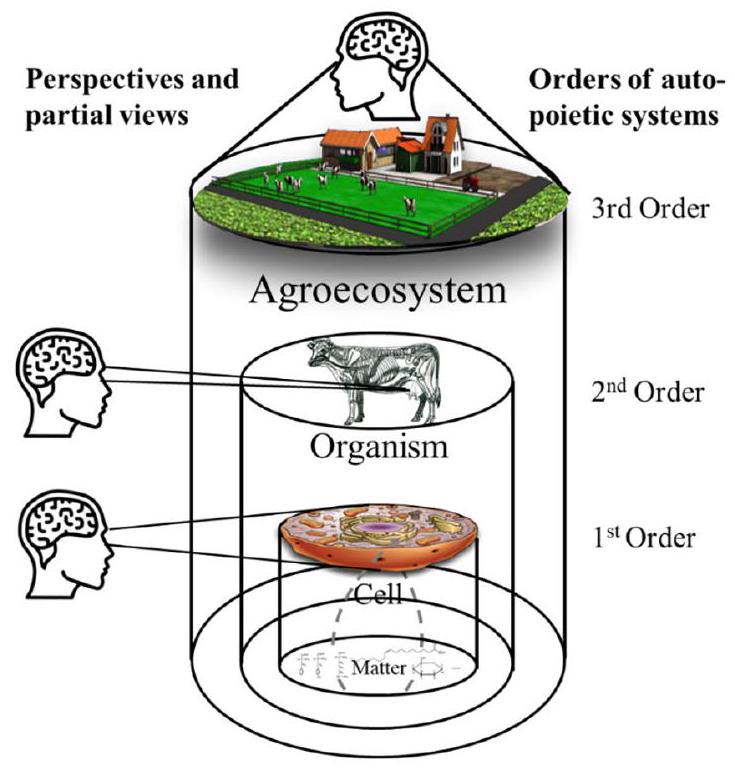
نظرًا لتنوع ظروف المزارع، ولتقليل مشاكل صحة الحيوان، لا يمكن للمزارعين الاعتماد على التوصيات العامة. يجب عليهم إيجاد نهج مركزي للمزرعة لتنظيم وتنظيم العمليات داخل نظام المزرعة. في دورهم، يكون المزارعون مراقبين وأجزاء من نظام المزرعة، موجهين أساسًا من منظور ذاتي. من أجل السعي لتحقيق توازن بين أهداف الكفاءة الإنتاجية العالية ومعدل منخفض من العيوب، على سبيل المثال، من حيث مشاكل صحة الحيوان، يمكنهم التعلم من تصور مزرعتهم كنظام زراعي بيئي. فيما يتعلق بخصائص الأنظمة الذاتية التنظيم (رازيتو-باري، 2012)، يمكن وصف هيكل الأنظمة الزراعية البيئية كهرمية من المقاييس كما هو موضح في الشكل 1.
الخلايا كنظم ذاتية الإنتاج“النظام الذاتي” يتفاعل مع المواد والعناصر المتاحة في بيئته بطريقة ذاتية الإشارة فيما يتعلق بما يحتاجه للبقاء والوظيفة عندما يتم تنظيمه مع خلايا أخرى في الأنسجة والأعضاء. علاوة على ذلك، فإنها تلبي احتياجات الكائن الحي الفردي كنظام ذاتي الإنتاج.النظام. الحيوانات الفردية هي جزء من القطيع وأنظمة فرعية من النظام البيئي الزراعي. بهذه الطريقة، يعمل كل نظام أعلى كبيئة للنظام الفرعي، الذي لا يمكن أن يوجد أو يستمر بدون الموارد والحماية التي يوفرها النظام الأعلى. تنتج الأنظمة الذاتية الاستدامة باستمرار المكونات التي تشكلها بنفسها، بينما تستمر هذه المكونات في دعم وتجديد النظام الأعلى (فارلا، 1997). الحيوانات الفردية هي نظام متكامل ووظيفي وتمثل كيانًا يتمتع بسلامة وظيفية. في سعيها للحفاظ على الذات، يتم تنظيم امتصاص المواد الخارجية وفقًا لأغراضها الخاصة عند دمج وتحويل المواد داخل النظام. تختار المكونات من البيئة وتعطيها معنى الحوافز، وأشياء الإدراك، والمصالح.
نظرًا لأن متطلبات واحتياجات حيوانات المزرعة وقدرتها على التكيف تختلف بشكل كبير حتى في المجموعات المتجانسة إلى حد كبير، فإنه من المهم جدًا مراعاة فردية حيوانات المزرعة، التي تتفاعل ضمن نظام أعلى يعتمد على وظيفة وسلامة أنظمته الفرعية الخاصة. كلما كانت إمدادات وتوزيع الموارد الغذائية والحماية من الضغوط الحيوية وغير الحيوية متناسبة مع المتطلبات الفردية، زادت فرصة أن يكون الفرد قادرًا على لذا، عند السعي لتقليل مشاكل AHW، يُنصح المزارعون بالاعتراف بالمزرعة والأنظمة الفرعية كأنظمة ذاتية الإنتاج، تكون مرجعية ذاتيًا فيما تحتاجه للتكيف، من أجل دعم وظيفة النظام الأعلى الذي هم جزء منه.
4 دور علوم الحيوان
بشكل عام، يمكن الافتراض أن توليد المعرفة من قبل التخصصات المختلفة في علوم الحيوان حول كيفية الاستفادة من التكثيف والتخصص والتقدم التكنولوجي قد ساهم بشكل كبير في زيادة الإنتاجية في إنتاج الثروة الحيوانية. على سبيل المثال، من عام 1957 إلى 2005، زادت نمو الدجاج اللاحم بأكثر من، مع وجودخفض في نسبة تحويل العلف (Zuidhof et al., 2014). في إنتاج الألبان، زاد إنتاج الحليب السنوي لكل بقرة بأكثر من 4 مرات في الـ 75 سنة الماضية دون وجود دليل على الاقتراب من مستوى ثابت (Baumgard et al., 2017). على مستوى المزرعة، ترتبط الكفاءات الأعلى في تخليق الحليب بتخفيف متطلبات الصيانة ويُقترح أنها السبب الرئيسي وراء الزيادة القوية في الإنتاجية. على مستوى البقرة، المصدر الرئيسي للزيادة في الكفاءة يتعلق بالتباين بين الحيوانات في توزيع المغذيات. تم استغلال هذه الإمكانية بشكل خاص من خلال استراتيجيات التربية، ورافق ذلك زيادة في المعرفة العلمية حول ما هو مطلوب لاستغلال القدرات الوراثية المتزايدة من خلال توفير إمدادات غذائية كافية وظروف بيئية مناسبة.
بينما تعتبر الاختلافات بين الحيوانات نقطة البداية للزيادة الهائلة في الأداء، فإنها في الوقت نفسه سبب للعديد من مشاكل الرفاهية الحيوانية. وتنبع هذه المشاكل من عدم التوافق في تخصيص المغذيات بين الأنظمة الفرعية المختلفة عندما لا تتلقى الحيوانات ما تحتاجه لمنع حدوث خلل وظيفي و
الشكل 1 الهياكل الهرمية للأنظمة الذاتية التكوين وإدراكها من وجهات نظر ذاتية مرجعية مختلفة.
التكيف (هابيل وسندرم، 2020). يتم التعبير عن التناقض في التباين بين حيوانات المزرعة بشكل مثالي من خلال نتائج ترتيب العاملial، حيث تم تقييم تأثيرات النمط الجيني (G) والبيئة (E) وتفاعلات G×E (Beerda et al.، 2007). بينما لا تؤثر مستويات إنتاج الحليب العالية بحد ذاتها على الحالة الصحية للأبقار، فإن الإنتاج العالي سيزيد من الحمل الألستاتي. يرتبط الجدارة الوراثية العالية لإنتاج الحليب ارتباطًا جوهريًا بزيادة المخاطر للإضطرابات ويبرز الآثار السلبية لتوفير المغذيات غير المناسب. في مراجعة حديثة، اعترف العلماء من مجال تربية الحيوانات بأن التقدم في إنتاج الحليب قد صاحبه تدهور في الآليات البيولوجية الرئيسية (مثل الصحة، والقدرة على التحمل، والصلابة، والرفاهية، وطول العمر) في أكثر سلالات الأبقار الحلوب شيوعًا (Brito et al.، 2021). على الرغم من التحسن الكبير في كفاءة الإنتاج، فقد حدثت عيوب قوية على طول الطريق. استنتج المؤلفون أن التقدم الوراثي الذي تم تحقيقه في الأبقار الحلوب عالية الإنتاج، المرتبط ارتباطًا وثيقًا بتكثيف مزارع الألبان، يصل إلى حدوده. قد تكون الأسباب المشتركة للحدود هي أن تناول العلف (Hristov et al.، 2005) بالإضافة إلى الكفاءة الهضمية (Ledinek et al.، 2019) والكفاءة الكبدية (Loncke et al.، 2020) لا تزيد بشكل متناسب مع الزيادات في إنتاج الحليب للأبقار الحلوب عالية الإنتاج. تشير الدراسات أيضًا إلى أن الزيادات في إنتاج الحليب تتطلب زيادات هامشية أكبر بشكل تدريجي في توفير المغذيات، مما يؤدي إلى انخفاض كفاءة العلف الهامشية في القطعان عالية الإنتاج (Bach et al.، 2020). نظرًا لأن تكاليف العلف الهامشية تزداد بشكل تدريجي مع إنتاج الحليب، فقد تكون الأرباح المرتبطة بتحسين إنتاج الحليب أقل بكثير مما هو متوقع.
ما ينطبق على مستوى الحيوان ينطبق أيضًا على مستوى المزرعة، حيث إن التباين العالي داخل الأفراد وبين الأفراد في الفجوة بين المتطلبات والإمدادات مسؤول بشكل مشترك عن الاختلالات والاضطرابات والأمراض اللاحقة وزيادة معدلات الإعدام (Rumphorst et al., 2022). هذه أيضًا سبب ذو صلة للأرباح الهامشية السلبية في أنظمة المزارع حيث تفشل الإدارة في ضمان أن تصبح الغالبية العظمى من الأبقار في القطيع ‘بقرة ربح’ قبل أن يتم إعدامها وبالتالي تساهم في الجدوى الاقتصادية لنظام المزرعة (Hoischen-Taubner et al., 2021). يمكن أن يؤدي التركيز على تقليل تكاليف الإنتاج، مثل تكاليف الأعلاف عالية الجودة، أو العمالة الماهرة في المزرعة، أو الوقاية من الأمراض، إلى آثار سلبية على إنتاجية وكفاءة قطيع الألبان (Põldaru and Luik-Lindsaar, 2020). على النقيض من ذلك، فقد أظهرت تحسينات إدارة الأمراض والخصوبة أيضًا أنها تزيد من كفاءة التغذية وإنتاجية الحياة للأبقار الفردية وقطعان الألبان (Knapp et al., 2014). تجعل العلاقات الموضحة من المعقول أن القدرة العامة لأبقار الألبان على زيادة إنتاج الحليب السنوي التي تقترب من الهضبة ليست هي المشكلة، بل قدرات إدارة المزرعة على التعامل بشكل مناسب مع المتطلبات والاحتياجات الفردية للحيوانات الزراعية.
على مدى عقود، كانت التأملات حول الآثار الجانبية غير المرغوب فيها لعمليات التكثيف في الأنواع الحيوانية المختلفة فيما يتعلق بمسألة رفاهية الحيوانات جزءًا من علوم الحيوان (راو وآخرون، 1998). على الرغم من أن الأبحاث حول مسألة رفاهية الحيوانات قد أنشأت كمية هائلة من المعرفة العلمية ذات الصلة من قبل تخصصات مختلفة، إلا أنه لا يوجد دليل على تقدم كبير في حل العديد من مشاكل رفاهية الحيوانات في المزارع. بدلاً من ذلك، تشير مجموعات البيانات الشاملة إلى عدم وجود تحسينات عامة، على سبيل المثال في حالة معدلات الوفيات (كومبتون وآخرون، 2017؛ كييلاند وآخرون، 2018؛ ريتير وآخرون، 2019)، أو الأمراض الإنتاجية (سوندروم، 2020أ). أيضًا حيث يتضح تنفيذ تحسينات كبيرة في ظروف المعيشة، كما هو الحال في تربية الماشية العضوية (سوندروم، 2014)، لم يتم تحديد اختلافات جوهرية بين المزارع العضوية والتقليدية في مستوى رفاهية الحيوانات، مما ينطبق أكثر أو أقل على جميع أنواع الحيوانات الزراعية التي تم تناولها في رسم خرائط منهجية للمعرفة الحالية (أكيرفيلدت وآخرون، 2021). بالطبع، لا يعني هذا أن تحسين ظروف المعيشة ليس له تأثير على مستوى رفاهية الحيوانات. ومع ذلك، تظهر بيانات التجربة الميدانية واسعة النطاق لإنتاج الماشية العضوية أن ظروف المعيشة في تأثيراتها على مستوى رفاهية الحيوانات تشمل أكثر بكثير من نظام التربية المحدد. فوق كل شيء، فإن القدرات والمهارات والمعرفة لإدارة المزرعة هي الحاسمة لما يتم تحقيقه في الممارسة الزراعية فيما يتعلق بمستوى رفاهية الحيوانات. في الوقت نفسه، فإن إدارة المزرعة مدمجة في نظام سوق يقدم حوافز هامشية فقط لتحسين رفاهية الحيوانات بينما يجبر في الوقت نفسه مزارع الماشية على الدخول في منافسة لتخفيض الأسعار.
في السياق العام، يتمثل دور علوم الحيوان في دعم المزارعين بالمعلومات ليس فقط فيما يتعلق بالكفاءة الإنتاجية ولكن أيضًا حول كيفية أن يكونوا فعالين وكفؤين لتحسين رفاهية الحيوانات في سياق المزرعة المحدد. ما تم تقديمه في الماضي من قبل علوم الحيوان ليس كافيًا بوضوح لحل مشاكل رفاهية الحيوانات في الممارسة الزراعية إلى درجة كبيرة. وبالتالي، تثار التساؤلات حول سبب عدم مصاحبة زيادة المعرفة العلمية بزيادة القدرة على حل مشاكل رفاهية الحيوانات في الممارسة الزراعية؟ بينما الأسباب متعددة وغالبًا ما تكون خارج نطاق تأثير ومسؤولية علوم الحيوان، يُعتبر جانبان ذا صلة خاصة من منظور علمي.
4.1 علوم الحيوان في البحث عن فجوات المعرفة
لقد أدى النمو الهائل في الأنشطة والمعرفة العلمية حتمًا إلى تجزئة المعرفة العلمية. لا تزال تمييز التخصصات وتخصص مجالات البحث تعتبر وصفة للنجاح. من خلال الإجابة على أسئلة البحث الرئيسية، تظهر أسئلة جديدة وتولد زخمًا مستدامًا، ليس بعيدًا عن الاعتماد على المسار في الأعمال الزراعية. إن التركيز على برامج البحث التخصصية يعني أن أجزاء كبيرة من تعقيد العالم الحقيقي يتم تجاهلها، مرتبطًا بتوقع غامض بأن هذه الأمور مغطاة من قبل تخصصات أخرى (كروه وآخرون، 2017). تتبع كل تخصص أهدافه وإطاره الخاص للمشكلات، بما في ذلك تعريف حدود النظام، ودور الفاعلين، واختيار مهام التصميم. تشير إلى أنظمة مرجعية مختلفة مثل مجموعات مختلفة من الحيوانات، وأنظمة الإسكان أو طرق الإنتاج. أدت التمييز والتخصص في المناهج العلمية إلى ما أطلق عليه ألروا ونوي (2011) عدم التماثل في المعرفة المنظورية. يمتلك العلماء وجهة نظر خاصة بمولد تخصصهم ويرون الأمور المعقدة بشكل مختلف. يدرك الخبراء فجوات المعرفة من داخل نماذجهم المهنية ويكونون على نطاق واسع. غير قادرين على تشكيل أحكام تتجاوز خبراتهم المحددة (ميلغرام، 2015).
وفقًا لفريزر (2008)، “اعتمد علماء مختلفون وجهات نظر مختلفة قائمة على القيم حول رفاهية الحيوانات – الصحة الأساسية والوظائف، والعيش الطبيعي، والحالات العاطفية – كمنطق لمناهج علمية مختلفة لتقييم وتحسين رفاهية الحيوانات”. ترتبط المناهج المختلفة بـ”معضلة تهدد بإدخال علم رفاهية الحيوانات في الفوضى”. وهذا هو الحال بشكل خاص، عندما تصل مناهج علمية مختلفة إلى استنتاجات متعارضة كما هو موضح في حالة إسكان الخنازير في حظائر الحمل. حدد فريزر (2008) سبب التناقضات في حقيقة أن أدوات العلم تُستخدم ضمن إطار من القيم وأن فهم رفاهية الحيوانات وتقييمها العلمي يعتمد على القيم والعلم. وبالتالي، فإن العلماء يشيرون إلى أنفسهم عند اختيار منظور معين حول قضية رفاهية الحيوانات أو تطبيق أدوات منهجية معينة قد أخذوا ملكيتها في تخصصهم. بينما يوفر التركيز التخصصي من خلال العدسات المنهجية المتأصلة نظرة أعمق في الترابط بين العمليات ضمن المجالات الفرعية، يصبح التركيز أكثر ضيقًا في البحث عن فجوات إضافية تتجاوز المعرفة المتاحة بالفعل. لقد أدت دوافع التخصص في علم الحيوان مثلما هو الحال في مجالات علمية أخرى إلى نهج تقليلي بينما الصورة الكاملة تصبح أكثر ضياعًا، مما يؤدي إلى تراجع المهارات لحل المشكلات المعقدة (جمعية الأبحاث الألمانية، 2005). ينطبق هذا بشكل خاص على المشكلات التي تتطور خارج حدود التخصصات، وهو الحال بالنسبة لمعظم مشكلات رفاهية الحيوانات. لا يمكن حل مثل هذه المشكلات إلا عندما يتم فهم الأسباب الكامنة ليس فقط من زاوية التخصصات الفردية ومن التركيز على عوامل فردية. لفهم نتائج التفاعلات المعقدة لعوامل مختلفة على مقاييس مختلفة، يجب فحصها من وجهات نظر مختلفة. يتطلب فهم النشأة متعددة العوامل لمشكلات رفاهية الحيوانات والمساهمة في تخفيفها نهجًا حلاً تكامليًا وبالتالي بين التخصصات وعبر التخصصات. من المرجح أن يتحقق ذلك عندما تحدد هيئات التمويل مخططات لتشجيع التفكير بين التخصصات وعبر التخصصات. ومع ذلك، فإن هذا وحده ليس كافيًا. نظرًا لأن النتائج العلمية دائمًا ما تحمل بعض العمومية وبعض الخصوصية، فإن من المهم للغاية لفرصة تنفيذ مقترحات الحلول في الممارسة الزراعية معرفة المزيد عن الغموض والاعتماد على السياق للطرق والتدابير. وبالتالي، هناك حاجة ملحة لتوسيع الاختبارات على الصلاحية الخارجية للتدابير والنتائج التي تم الحصول عليها في ظل ظروف محددة.
4.2 علم الحيوان في السعي لتحقيق نتائج قابلة للنشر
لا يعتبر العلماء فقط أنفسهم في ما يتعلق بموضوعات البحث ولكن يجب عليهم أيضًا مراعاة فوائدهم الخاصة عند إجراء العمل البحثي. عند السعي لتحقيق مسيرة علمية، لن يكون بإمكانهم تجنب الاعتماد على المنشورات في المجلات العلمية. وفقًا لدليل المؤلفين للعديد من المجلات العلمية، يمكن اعتبار الدراسات للنشر فقط إذا كانت
النتائج من المحتمل أن تكون ذات اهتمام دولي، أي أنه يجب أن يكون من الممكن تعميم النتائج باستخدام مناهج قائمة على العلم (ناشر إلسفير، 2023). بالطبع، لا ينطبق هذا على جميع المجلات العلمية. ومع ذلك، فإن معامل التأثير للمجلات التي تضع مثل هذه المطالب يميل إلى أن يكون أعلى، وبالتالي فهي أكثر جاذبية للعلماء. حيث يتنافس العلماء على تمويل الأبحاث وعلى عدد قليل نسبيًا من المناصب الدائمة، فإن العلماء الواعدين لديهم فرصة فقط لمتابعة مسيرة مهنية عندما يكونون حذرين في إظهار مهاراتهم في النشر. يؤثر الإطار العام للعمل البحثي على المجالات التي يبحث فيها العلماء عن فجوات المعرفة المناسبة لتوليد نتائج قابلة للتعميم وبالتالي قابلة للنشر. على العكس من ذلك، لا يتم مكافأة العلماء غالبًا على ترجمة نتائجهم لتكون مفيدة للمستخدمين النهائيين.
يجب أن تلبي المنشورات المعايير العلمية الرئيسية للصلاحية والموثوقية. تصف الصلاحية مدى جودة أداء أداة ما لما يُفترض أن تفعله. تصف الموثوقية الاتساق الذي يتم الحصول على النتائج به (أندرادي، 2018). فيما يتعلق بالصلاحية، يمكن التمييز بين الصلاحية الداخلية والخارجية والبيئية. تفحص الصلاحية الداخلية ما إذا كان تصميم الدراسة وإجراؤها وتحليلها يجيب على أسئلة البحث دون تحيز، ويسمح بإجابات موثوقة على أسئلة البحث في الدراسة. على سبيل المثال، يمكن أن تؤدي العشوائية غير الصحيحة، أو عدم التعمية غير المقصودة، أو البيانات المفقودة إلى تقويض موثوقية النتائج والاستنتاجات لتجربة عشوائية محكومة (RCT). تفحص الصلاحية الخارجية ما إذا كانت نتائج الدراسة يمكن تعميمها على سياقات أخرى، على سبيل المثال مرضى آخرين. تشير الصلاحية البيئية إلى الدرجة التي تعكس بها نتائج البحث الوظائف المتعلقة بالحياة الواقعية وتفحص مدى قرب التجربة من الظواهر الواقعية (فهمي وآخرون، 2023). يتم تقييم الصلاحية البيئية ضمن دراسة معينة، بينما يتم تقييم الصلاحية الخارجية للبحث ذو الحالة الفردية عبر مجموعة من الدراسات.
بينما تعتبر مواءمة ظروف التجربة ذات أهمية كبيرة عند السعي لتحقيق صلاحية داخلية عالية ولتوليد نتائج قابلة للنشر، يمكن أن تصبح نتائج الدراسة متأثرة بشكل متزايد بالظروف التجريبية المحددة التي تم إجراؤها فيها. وبالتالي، فإن مواءمة البيئة هي سبب، بدلاً من علاج، ضعف قابلية إعادة إنتاج النتائج التجريبية (ريختر وآخرون، 2009). لتقليل التباين داخل التجربة، يُنصح عادةً التجريبيون بمواءمة ظروف تجاربهم بأقصى قدر ممكن من الصرامة. يُعتقد أن مواءمة الظروف التجريبية تجعل استجابات الحيوانات للعلاجات التجريبية أكثر تجانسًا، مما يقلل من التباين داخل التجربة ويزيد من حساسية الاختبار. ونتيجة لذلك، قد تبدو نتائج الدراسة قابلة للتعميم وغير متعلقة بالسياق من منظور تخصصي، بينما يمكن أن تبدو محددة للغاية للسياق عند فحصها فيما يتعلق بالصلاحية الخارجية. ولا يقل أهمية عن ذلك هو أن الظروف الموحدة للغاية يمكن أن تكون مختلفة جدًا عما يوجد في المزارع التجارية. تختلف الدرجة التي تدفع بها الحيوانات الزراعية ثمن السعي لزيادة الإنتاجية مع القيود في توفر الموارد وفي الحماية ضد مجموعة كبيرة من الضغوط الحيوية وغير الحيوية بشكل كبير. تشمل مجموعة العوامل المزعزعة الكثافة العالية للسكان، مما يثير صراعات مع حيوانات أخرى، وارتفاع تركيزات مسببات الأمراض الميكروبيولوجية، والطفيلات أو السموم، والغازات الضارة. بالإضافة إلى ذلك، فإن تنوع التفاعلات
بين هذه العوامل يخضع لتغيرات ديناميكية، بينما تؤثر مجموعة العوامل المعنية على الحيوانات ليس بشكل منفصل ولكن بشكل مشترك.
على النقيض من ذلك، من المتأصل في المنظور التأديبي أن يركز على آثار مختارة، مما يعني بالضرورة أن جوانب أخرى يتم تجاهلها. إن التركيز على جوانب فردية أو اختيار معايير محددة يمس مشكلة جوهرية في علم الأحياء (كاسيرر، 1974): ‘مشكلة الجزء والكل’. داخل الكائن الحي، الأجزاء المختلفة والأنظمة الفرعية ليست منفصلة عن بعضها البعض، بل تعزز بعضها البعض وتعمل معًا نحو نفس الهدف: الحفاظ على حياة الكائن الحي. لا يوجد جزء لا يحتاج إلى دعم وتعاون تقريبًا جميع الأجزاء الأخرى. لا يمكن فهم نظام حي بشكل كامل دون النظر في الغرض وراء العمليات البيولوجية. ينطبق هذا بشكل خاص على التكيف كعملية وظيفية وموجهة نحو الهدف. سواء كان الكائن الحي بالكامل يستجيب بشكل مناسب للتحديات لا يمكن استنتاجه من الأجزاء الفردية أو من خلال المؤشرات. ما إذا كانت التدابير والعمليات التكيفية مفيدة أم لا يعتمد بشكل أساسي على السياق الذي تحدث فيه. إنها لا تتبع نهجًا موحدًا كما هو الحال في التجارب العشوائية المضبوطة، بل تتطلب تحققًا خارجيًا فيما يتعلق بالفعالية في الممارسة الزراعية (كراوس، 2018).
تُعطي التخصصات العلمية المختلفة الأولوية لمؤشرات مختلفة لتقييم حالة الصحة البدنية والعقلية للحيوانات الزراعية. بينما تكشف الآراء الجزئية عن رؤى جزئية فقط، فإن التقييمات المستندة إلى نتائج جزئية ومنهج استقرائي معرضة لخطر الأخطاء في الحكم والأخطاء الاستقرائية. إن النهج المجزأ في علم الحيوان يعمي الفاعلين عن الصراع الأكبر المحتمل لمشاكل صحة الحيوان. بينما يسعى العلماء في الدراسات التجريبية إلى تقليل التباين إلى أقصى حد ممكن، يمكن أن يكون التباين بين الحيوانات واسعًا في الممارسة الزراعية. ما هو صالح إحصائيًا لمجموعة من الحيوانات الزراعية تحت ظروف موحدة للغاية لا يعمل بالضرورة على الحيوانات الفردية، مما ينحرف عما قد يكون داعمًا عند تقييمه من حيث القيم المتوسطة. ينطبق هذا على سبيل المثال عند تقديم حصص غذائية مصممة لتلبية متطلبات المغذيات المتوسطة لمجموعة من الحيوانات الزراعية، على الرغم من أن الحيوانات تظهر درجة عالية من التباين في متطلباتها (Rumphorst et al., 2021). ومع ذلك، غالبًا ما يتم التحقق من آثار إمدادات المغذيات مقابل الآثار المتوسطة التي تم الكشف عنها بالنسبة لمجموعة التحكم، ولكن ليس مقابل حالة الصحة البدنية للأفراد، التي تُعتبر النظام المرجعي الصالح في سياق صحة الحيوان. تشير حالة الصحة البدنية والعقلية إلى الحيوانات الفردية في أي نقطة من حياتها. وبالتالي، لا يمكن حساب الحالة كمتوسط.
يمكن أن تكون الأمثلة المضادة المحتملة هي الدراسات الوبائية التي تحلل المخاطر في المزارع لمشاكل صحة الحيوانات (مثل العرج، التهاب الضرع، النقر، الكسور، السلوك غير الطبيعي) وتستكشف التباين في العالم الحقيقي، على الرغم من أنها نادراً ما تأخذ الحيوانات الفردية كوحدة مرجعية. يتم توضيح فوائد وقيود الدراسات الوبائية من خلال دراسة تبحث في عوامل الخطر للعرج في الأبقار الحلوب (Dippel et al., 2009). كشفت النتائج أن راحة الاستلقاء والتغذية تم تحديدها كمجالات خطر رئيسية للعرج عبر المناطق والسلالات وأنظمة الزراعة، مما يوفر معلومات حول أولوية العوامل التي يجب أخذها في الاعتبار. ومع ذلك، كانت العوامل على مستوى المزرعة في هذه الدراسة، كما هو الحال في العديد من الدراسات الأخرى (Rittweg et al., 2023)، مقيدة بـ توجد بعض المؤشرات القابلة للاكتشاف بسهولة، بينما تم تجاهل العديد من العوامل الأخرى التي تعتبر ذات صلة بتطور العرج، مثل جودة الأرض، والظروف الصحية، وتقليم الحوافر الوقائي (Sogstad et al., 2005)، والأمراض المصاحبة (Daros et al., 2020) أو توازن الطاقة للحيوان الفرد (Collard et al., 1999). بالإضافة إلى ذلك، فإن أولوية عوامل الخطر التي قد تكون صحيحة لمعظم مزارع الألبان ليست بالضرورة صحيحة لوضع مزرعة محددة. يختلف نشوء العرج المتعدد العوامل ليس فقط بين المزارع ولكن أولاً وقبل كل شيء بين الحيوانات الفردية. بينما تقدم النتائج الوبائية بعض التوجيه حول عوامل الخطر الأكثر احتمالاً التي يجب أخذها في الاعتبار فيما يتعلق بالتدابير الوقائية المحتملة، فإنها نادراً ما تؤدي إلى خيارات عمل ملموسة. ستتطلب هذه الخيارات قوة إقناع كافية تجاه المزارعين لإقناعهم بأن التدابير الموصى بها يمكن أن تكون فعالة وفعالة من حيث التكلفة في سياق المزرعة المحدد. فوق كل شيء، لا توفر النتائج الوبائية الجهود اللازمة لإجراء تشخيص شامل لتحديد الأسباب الرئيسية في الوضع المحدد للمزرعة والحيوان عندما يتعلق الأمر بالمهمة الأساسية لعلاج الحيوانات المعاناة في الوقت المناسب.
بينما تدعي العديد من الدراسات العلمية والتقنيات والممارسات أنها تؤدي إلى نتائج إيجابية في رفاهية الحيوان (Bertenshaw et al., 2008; Cronin et al., 2014; Westerath et al., 2014; Rentsch et al., 2023)، دون وجود أدلة فسيولوجية وسلوكية من الحيوان الفرد، ليس لدينا وسيلة لمعرفة ما إذا كانت هذه الادعاءات صحيحة (Fernandes et al., 2021). وبالتالي، ما هو موجه نحو الهدف عند السعي لمهنة علمية ليس بالضرورة مناسبًا لحل مشاكل رفاهية الحيوان التي تنشأ من خلل يعتمد بشكل كبير على السياق. إن السعي للحصول على نتائج قابلة للتعميم وقابلة للنشر يتجاهل إلى حد كبير الأهداف الجوهرية للكائنات الحية والمنطق الداخلي لأنظمة المزارع. وبالتالي، يُرى تناقض أساسي في الفجوة بين ما يسعى إليه علماء الحيوان وما هو مطلوب لفهم تعقيد العمليات داخل أنظمة المزارع. تفسر الاعتبارات الموضحة لماذا تقدم الأساليب السائدة في علم الحيوان بشكل أساسي نتائج مجزأة. ليس بعيدًا عن قطع الألغاز، فإن الاكتشافات الجديدة الناتجة عن تركيز تخصصي تحت ظروف تجريبية محددة متاحة لجميع من لديهم وصول إلى المجلات العلمية والذين يبحثون عن معلومات قد تكون ذات اهتمام لهم. يمكن تصنيف هذه المعرفة حول الأدوات والأسباب والآثار التي نشأت تحت ظروف محددة على أنها معرفة متاحة (Mittelstraß, 2001). تبدو المعرفة المتاحة كقطعة لغز مفقودة تبحث عن فجوة داخل صورة فسيفسائية كبيرة حيث قد تناسب. هنا مرة أخرى، يصبح التبادل واضحًا. لكي تكون قابلة للتعميم، يجب أن تكون شكل المعرفة المتاحة غير محدد إلى حد ما، بينما يمكن توقع الآثار المتصورة بشكل خاص، عندما يتناسب الدافع إلى حد كبير مع الاحتياجات في حالة خلل معينة.
5 معرفة التحول
لحل مشاكل AHW، من الضروري تحويل حالة عدم الوظيفة في نظام المزرعة إلى حالة وظيفية وصحية من خلال تعزيز الأنظمة التكيفية في قدرتها على التجدد. لذلك، يجب أن تكون الأسباب الرئيسية للاختلالات هي تم التعرف على المشكلات وتحسينها. يتطلب ذلك نظرة شاملة لتحديد الأجزاء وفقًا لأهميتها للنظام ككل، بالإضافة إلى ما يُطلب من الحيوانات الفردية في جهودها الفطرية للتكيف. يتم التعبير عن خبرة حل المشكلات من خلال القدرة على إدراك وتصنيف المشكلات والخلل بشكل مناسب. بجانب متطلبات الحيوانات الزراعية الفردية، يجب أخذ المطالب الخارجية للتنافسية في الاعتبار. في الوقت نفسه، يجب على المزارع ألا يغفل عن مطالب المستهلكين فيما يتعلق بجودة المنتجات الحيوانية والأهداف الاجتماعية المتعلقة بالسلع العامة. لدعم صانعي القرار، هناك حاجة إلى نهج علمي يرافق عملية التحول بشكل مناسب.
يجب ألا يتم إطلاق تحول نظام المزرعة دون معرفة مناسبة. يمكن تعريف المعرفة حول قضية ما على أنها القدرة على حل المشكلات المرتبطة بهذه القضية (رين، 2012). يتم تمكين ذلك من خلال ربط المعلومات حول القضية بالهياكل المعرفية، التي تكون ذات صلة لفهم سلوكها، وبناءً على ترميز التجارب، مما يمكّن الأفراد من حل المشكلات كجزء من سلوكهم التكيفي وقدرتهم. المزارعون هم الشخصيات الرئيسية في دورهم المزدوج كجزء من النظام وكوكيل للتحكم في النظام بأكمله. إنهم يمارسون تأثيرًا على المدخلات وكذلك المخرجات والتفاعلات داخل النظام. إنهم ليسوا فقط مسؤولين عن حيوانات المزرعة ولكن عليهم اتخاذ قرارات تتعلق بالأهداف الأساسية لنظام المزرعة، وكيف يتم تنظيم النظام وتنظيمه، وكيف يتم تخصيص الموارد الداخلية والخارجية المتاحة. مع المزارعين، الذين يعملون كواجهة، تعمل مجالات التكنولوجيا والاقتصاد والمجتمع على النظام العام (جمعية الأبحاث الألمانية، 2005). ينطبق نفس الشيء على المعرفة العلمية التي يجب أن تكون جذابة لعقلية المزارعين عند محاولة اتخاذ القرارات الصحيحة في تخصيص الموارد المحدودة وتنفيذ التدابير التي تعتبر فعالة وفعالة من حيث التكلفة فيما يتعلق بالأهداف المتوقعة. يمكن اعتبار الانتشار المستمر العالي للاضطرابات والأمراض غير الظاهرة والظاهرة في حيوانات المزرعة دليلاً على ترجمة ضعيفة للنطاق الهائل للمعرفة العلمية حول الخلفية والاحتمالات لتخفيف مشاكل صحة الحيوان المتاحة في الأدبيات.
تعقيد مشاكل صحة الحيوان يتجاوز بكثير نطاق أي تخصص معين في علوم الحيوان. بشكل عام، هي متعددة العوامل وبالتالي فهي متعددة التخصصات بطبيعتها، ومتغيرة في السياق، وغامضة وغنية بالتناقضات. تتطلب حلول مشاكل صحة الحيوان مزيجًا من الخبرة العلمية والتكنولوجية والاقتصادية والاجتماعية. وبالتالي، قد يكون هناك بعض الفائدة في تجميع خبراء مطلعين علميًا يمكنهم بشكل جماعي تقديم مدخلات مفصلة حول بيولوجيا الأنواع المحددة، والسلوك، والبيئة، والفسيولوجيا، وعلم الأمراض الفسيولوجية، والصحة والإدارة. مشروع WelfareQuality (بلوكهاوس وآخرون، 2013) هو مثال على مشاركة مجموعة واسعة من العلماء من تخصصات مختلفة. ومع ذلك، أدت الجهود الطموحة لإنشاء نظام تجميع لتقييم رفاهية الحيوان في المزرعة إلى بعض الخلافات. من بين أمور أخرى، تم الاستنتاج أنه يجب عدم فهم رفاهية الحيوان كوظيفة بسيطة مضافة للحالات السلبية أو الإيجابية بينما توجد اختلافات كبيرة في الصلاحية المدركة وأهمية أنواع مختلفة من مؤشرات الرفاه (ساندو وآخرون، 2019). بالنظر إلى التمييز بين التجميع داخل الأفراد وبين الأفراد، استنتج المؤلفون أن مفهوم جودة الرفاهية يفتقر إلى الشفافية، ويسمح بتغطية مشاكل مهمة، وله عيوب خطيرة عندما يتعلق الأمر بالدور المخصص للخبراء. من نتائج دراسة شاملة في المزرعة استندت إلى تنفيذ بروتوكول جودة الرفاهية ، تم الاستنتاج أن التحديات المختلفة، جنبًا إلى جنب مع الوقت الطويل للتقييم، كانت كبيرة جدًا لاستخدامه كأداة اعتماد (هيث وآخرون، 2014). من الواضح أنه لحل مشاكل صحة الحيوان، لا يساعد استدعاء ممثلين من تخصصات مختلفة و”وضعهم في غرفة” لتظهر الحلول. ما هو fundamentally خاطئ في هذا النهج هو الفشل في الاعتراف بأن عقليات مختلفة تجلس معًا لن تصل إلى الكثير (إلكانا، 2012). استنتج المؤلف أنه يجب أن نعتاد على حقيقة أن كل المعرفة يجب أن تُرى في السياق: ليس فقط عند النظر إلى أصلها، ولكن حتى عند محاولة إثبات صلاحيتها وحتى عند البحث عن تطبيقها المحتمل لحل المشاكل الملحة. طرح الأسئلة حول السياق هو أولاً وقبل كل شيء طرح أسئلة حول المعنى بكل مرونته، ومرونته، وغموضه، وتناقضاته.
صحة الحيوان هي نتيجة تفاعلات معقدة لحيوانات المزرعة ضمن الشبكة السببية لنظام المزرعة وكخاصية ناشئة لا يمكن استنتاجها من مؤشرات فردية. إن تجاهل فردية حيوانات المزرعة عند السعي للحصول على بيانات قابلة للتعميم في نهج يناسب الجميع يمكن اعتباره أحد أكثر النقاط العمياء أهمية في علوم الحيوان. ينطبق هذا أيضًا على التغيرات الديناميكية داخل حيوانات المزرعة، وظروف المعيشة والتفاعلات بين الاثنين على مر الزمن. تشكل هذه التفاعلات السياق الذي تحدث فيه الاضطرابات والأمراض الظاهرة لعدد أكبر أو أقل من حيوانات المزرعة، بينما تعاني حيوانات أخرى من نفس وحدة الإنتاج من اضطرابات وأمراض غير ظاهرة وأخرى قادرة على التكيف دون أي علامات على مشاكل صحة الحيوان. من التفاعلات بين الحيوانات الفردية وظروف المعيشة المحددة تنشأ تعقيد لا يمكن تقليله إلى علاقات سبب ونتيجة قابلة للتعميم تم الاتفاق عليها من قبل عدد من العلماء من تخصصات مختلفة. على العكس من ذلك، قد يمثل نهج أكثر وعدًا لتحويل المعرفة العلمية إلى تعقيد النظم البيئية الزراعية من قبل العلماء الذين لديهم معرفة في تخصصات متعددة وقادرين على التفكير بطريقة متعددة التخصصات (جمعية الأبحاث الألمانية، 2005). هؤلاء هم أيضًا الأشخاص الأكثر احتمالًا لتوفير ما هو مطلوب بشدة عند التعامل مع التعقيد: التوجيه.
5.1 المعرفة التوجيهية
في الماضي، كان الهدف الشامل من إنتاج الماشية هو زيادة الكفاءة الإنتاجية. غالبًا ما يتم معادلة هذا الهدف بزيادة مستمرة في مستوى الأداء ومع الفوائد الناتجة عن وفورات الحجم. كانت المعرفة المتعلقة بالتخلص التي تعتبر مناسبة للمساهمة في هذا الهدف تُعتبر ذات أولوية عالية، مما يفسر من بين أمور أخرى الجاذبية العالية لاستراتيجيات التربية (باومغارد وآخرون، 2017). بشكل عام، تتبع استراتيجيات التربية نهجًا استقرائيًا، ينتقل من سمات فينوتيبية محددة إلى تعميمات أوسع، وتكون على نطاق واسع
غير متغيرة في السياق، أي أنه من المتوقع أن يحدث تقدم في السمات ذات الصلة بغض النظر عن الظروف المحددة للمزرعة. بعض الأمثلة المضادة للتحولات في النهج، مثل اعتبار العوامل الاجتماعية (إلين وآخرون، 2014)، تحاول ضمان أن يتم الاختيار في بيئات المزرعة وأن يتم اعتبار التناقضات بين الإنتاجية وصحة الحيوان أكثر مما كان عليه الحال في الماضي (بريتو وآخرون، 2021).
الهدف من تقليل مشاكل صحة الحيوان مختلف تمامًا عن النهج السائد في التربية. يتطلب نهجًا استنتاجيًا وتكراريًا، على التوالي. بالإضافة إلى ذلك، ليس هدفًا في حد ذاته ولكن وسيلة لتحقيق الهدف العام لاستدامة نظام المزرعة، مما يحدد إطارًا محددًا للمزرعة لجميع خيارات العمل. الأنظمة المرجعية هي الحيوانات الفردية ونظام المزرعة المعني. كونها هدفًا تابعًا، فإن المستوى المتوقع لصحة الحيوان هو محدد للمزرعة. يجب تصميم المعرفة لتحويل مزرعة إلى نظام بيئي زراعي صحي لتحقيق وضع فوز-فوز-فوز يجمع بين مصالح المزارع ومصالح حيوانات المزرعة والسلع العامة. ومع ذلك، قبل أن يمكن تقدير أهمية تقليل مشاكل صحة الحيوان للجدوى الاقتصادية للمزرعة، تثار العديد من الأسئلة للمزارع، مثل: أين نحن الآن وأين نريد أن نكون في المستقبل؟ ماذا يجب أن يتغير؟ كيف نتقدم وكيف يمكننا التأكد من أن التدابير المنفذة فعالة وفعالة من حيث التكلفة؟ وأخيرًا وليس آخرًا، كيف يمكن قياس التحسينات؟
تتعلق التوجيهات بما هو مطلوب لوظائف مناسبة للأنظمة الفرعية، وما يقدمه النظام الأعلى من حيث الموارد وما يُطلب من النظام الفرعي للمساهمة في وظيفة النظام الأعلى (انظر الشكل 1). وبالمثل، يجب أخذ نظام مرجعي خارجي وداخلي في الاعتبار. كونها معلمة نسبية تتراوح من درجة منخفضة إلى درجة عالية، يمكن تقييم مستوى الرفاهية الحيوانية (AHW) مقابل مستويات الرفاهية الحيوانية في مزارع أخرى، مما يصنف موقع المزرعة الخاص بالمقارنة مع مزارع أخرى. مثال على مرجع خارجي يتمثل في نظام مراقبة لتقييم صحة الماشية في قطعان الألبان الهولندية استنادًا إلى البيانات المتاحة بشكل روتيني (بروير وآخرون، 2015). يمكن توسيع هذا النظام ودمجه مع تواريخ أخرى، مثل نتائج فحوصات اللحوم المرضية لمراقبة صحة الماشية بشكل أكثر شمولاً (فيلدهويز وآخرون، 2021). يتجاوز نطاق هذه المقالة الإشارة إلى مزايا وعيوب أنظمة المراقبة واستخدام متغيرات الجليد (مجلس رفاهية الحيوانات الزراعية، 2009) لتقييم مستوى الرفاهية الحيوانية بمزيد من التفصيل.
في السياق الحالي، يتم التأكيد على أنه من الممكن عمومًا وقد تم تنفيذه بالفعل في عدة دول لتقييم أنظمة المزارع وفقًا لدرجة تحقيقها للمصالح العامة فيما يتعلق بقضية رفاهية الحيوانات. في هذا الصدد، ساهمت علوم الحيوان بشكل كبير في تطوير المعايير (مولان وآخرون، 2016؛ ساندوي وآخرون، 2020؛ دي لوكا وآخرون، 2021). يوفر التقييم توجيهًا. ينطبق هذا في المقام الأول على المزارعين، الذين يتعرفون على مكان تصنيف نظام مزرعتهم فيما يتعلق بقضية رفاهية الحيوانات. علاوة على ذلك، فإن هذه المعرفة ضرورية في توجيه المزارعين لتحديد القيم المستهدفة المستقبلية فيما يتعلق بمستوى رفاهية الحيوانات. تعتبر القيم المستهدفة الخاصة بالمزرعة منارات لإعادة التوجيه وإعادة تنظيم الممارسات الزراعية، وهي أيضًا ذات صلة بتصميم المعرفة التحولية. نظرًا لقانون المنفعة الحدية المتناقصة العام، فإن الوضع الحالي تؤثر مرتبة الرتبة وكذلك الفجوة بين المرتبة الحالية والمرتبة المتوقعة بشكل كبير على نسبة التكلفة إلى الفائدة للتدابير. علاوة على ذلك، يوفر القياس المرجعي توجيهًا للمؤسسات العليا فيما يتعلق بدرجة التباين بين المزارع وتحديد تلك المزارع التي تحتاج بشكل خاص إلى عملية تحول.
تشير المعايير الداخلية إلى موقع قضية رفاهية الحيوان (AHW) ضمن نظام المزرعة وبالنسبة للهدف العام من الجدوى الاقتصادية. يجب أن يكون من الأهمية القصوى للمزارعين أن يعرفوا مدى تأثير الخسائر الاقتصادية الحالية الناتجة عن مشاكل رفاهية الحيوان على الجدوى الاقتصادية لنظام المزرعة. يشمل ذلك أيضًا المعرفة بدرجة مشاكل رفاهية الحيوان، والنفقات الإضافية اللازمة لحل مشاكل رفاهية الحيوان، وخلق وضع يحقق المنفعة للطرفين يتماشى مع المصالح الاقتصادية الخاصة وكذلك المصالح العامة. بينما يتجاوز ذلك بالتأكيد نطاق قدرات إدارة المزرعة للتعامل مع جميع الحيوانات بشكل شامل وفردي، يجب أن تكون نقطة الانطلاق عند محاولة تقليل مشاكل رفاهية الحيوان غير معتمدة على الأرقام المتوسطة، بل يجب أن تركز على تلك الحيوانات التي تعاني من أكثر مشاكل رفاهية الحيوان حدة. وبالمثل، يجب أن تُوجه التدابير الوقائية أولاً إلى تلك الحيوانات المعرضة لأكبر المخاطر في الفشل في التكيف بسبب أكبر فجوة بين ما هو مطلوب وما هو متوفر من ظروف المعيشة. وبالتالي، فإن التباين والحيوانات في كلا طرفي عرض التوزيع هما ما يهمان فيما يتعلق بمشاكل رفاهية الحيوان ونسبة التكلفة إلى الفائدة.
قد تكون هذه التلميحات كافية لفهم أن حل مشاكل الرفاهية الحيوانية في مزارع الماشية التجارية هو في المقام الأول مسألة اقتصادية. ومع ذلك، قد تكون التعميمات حول الآثار الاقتصادية مضللة بالنسبة للمزرعة الفردية (جارفيز وفالديس-دونوسو، 2018). غالبًا ما تبقى الآثار الاقتصادية المرتبطة بالاختلافات في الإنتاجية مخفية تحت الأرقام المتوسطة. الأنواع المختلفة من البيانات من المزرعة، مثل البيانات الاقتصادية والبيولوجية، تفتقر عادةً إلى الاتصال والتوافق على مستوى الحيوان (هابيل وآخرون، 2021). وبالتالي، لا يمتلك كل من علماء الزراعة أو المتخصصون الآخرون، ناهيك عن المزارعين أنفسهم، عادةً المعرفة الكافية المتاحة لديهم لاتخاذ قرارات مناسبة للسعي نحو تحقيق نسبة تكلفة إلى فائدة مثالية فيما يتعلق بمستوى الرفاهية الحيوانية. ما يجعل الوضع أكثر تعقيدًا هو أن الوعي بالمشاكل الأساسية للرفاهية الحيوانية في المزرعة وتحديد قيم أهداف جديدة للرفاهية الحيوانية لا يعني بالضرورة معرفة الأسباب والدوافع وراء المشاكل، ناهيك عن أكثر التدابير فعالية وكفاءة من حيث التكلفة لتقليلها.
5.2 المعرفة الموجهة للعمل
سيتفق المزارعون فقط على تنفيذ التدابير لحل مشاكل الرفاه الحيواني عندما يرون فرصة للاستفادة من مثل هذه الاستثمارات (جانسن وآخرون، 2010). لا يمكن توقع أن تكون التدابير فعالة إلا عندما تأخذ في الاعتبار الفجوة الفردية بين ما هو مطلوب وما تقدمه إدارة المزرعة وما هو مطلوب لدعم الحيوان الفردي للتكيف. وبالتالي، فإن الخطوة الأولى لتحسين مستوى الرفاه الحيواني من منظور نظامي ومن خلال الاستفادة من المعرفة الاستنتاجية (من العام إلى الخاص) هي الحصول على نظرة عامة على النواقص المحتملة والرفاه الحيواني. مشاكل في القطيع وتحديد الحيوانات الأكثر تهديدًا. في الماضي، كانت هناك جهود هائلة لتطوير خيارات تقنية، مثل استخدام أجهزة الاستشعار ‘الذكية’ ومبادئ وتقنية هندسة العمليات، لتحديد الانحرافات المحتملة للعديد من المؤشرات عن القيم المرجعية (بيركمانز، 2022). ومع ذلك، فإن تحديد الانحرافات لا يعادل تفسيرًا عميقًا لمعناها. التفسير، من بين أمور أخرى، يتعقد بسبب وجود منطقة تداخل أكثر أو أقل اتساعًا بين النتائج التشخيصية الإيجابية الكاذبة والسلبية الكاذبة. ليس كل الحيوانات التي لا تظهر عليها انحرافات واضحة خالية من مشاكل الرفاهية الحيوانية، وليس كل الانحرافات تشير إلى مشكلة في الرفاهية الحيوانية. فوق كل شيء، المعلومات المستمدة من مثل هذه التقنيات نادرًا ما تولد معرفة حول الأسباب الكامنة وراء الانحرافات.
تشير السلوكيات غير الطبيعية، وأعراض الأمراض السريرية، أو الانحرافات عن القيم المرجعية الفسيولوجية إلى الحاجة إلى إجراءات تشخيصية إضافية لتقييم الأسباب المحتملة وراء الاضطرابات ودرجة الشدة والتهديد المحتمل للتعافي أو بقاء الحيوانات. التشخيص في الأفراد استنتاجي وينتقل من العلامات العامة إلى الأسباب المحددة (سلينينغ، 2001). عند مواجهة فرد مريض، يبدأ الممارس بإعداد قائمة من المقارنات “الطبيعية”. كل “شذوذ” هو دليل على سبب المرض. وبالتالي، يمكن تصوير العملية الاستنتاجية كسلسلة من الأسئلة. تأخذ إجابات كل سؤال الفاحص في عملية اتخاذ قرار تتفرع بشكل متزايد. أخيرًا، تؤدي عملية التعرف على الأنماط إلى تشخيص واضح عندما يتطابق نمط المرض مع التعريف الرسمي للمرض المعني.
التعامل مع جميع الاضطرابات والخلل المحتمل التي قد تؤثر على الحيوانات الزراعية من خلال إجراء تشخيص وعلاج مناسب حتى حالة الاستعادة الكاملة هو أمر يستغرق وقتًا طويلاً ومكلفًا وبالتالي يتجاوز ما يعتقده المزارعون أنه يمكن تحمله. بدلاً من ذلك، عند السعي لاستراتيجيات توفير الجهد والتكلفة، تم إنشاء نهج تقليلي. يحاول هذا تضييق مشاكل صحة الحيوان إلى العوامل الرئيسية المتعلقة بالحيوانات المتأثرة ضمن مجموعة من الحيوانات مع تجاهل واسع لفردية مشاكل صحة الحيوان. وبالتالي، فإن التشخيص في القطعان أو المجموعات هو بشكل عام استقرائي وينتقل من الخصائص في عدد قليل من الأفراد إلى العموميات حول المجموعة (سلينينغ، 2001). يتم إجراء الاختبارات القائمة على القطيع عن طريق أخذ عينة من عدد من الأبقار، تمثل الحيوانات المعرضة للخطر ثم تقييم نسبة الأبقار التي تتجاوز نقطة قطع معينة. ومع ذلك، فإن العلامات نادراً ما تكون دقيقة. جميع الجوانب المحتملة التي قد تكون سببت معدل انتشار مشاكل صحة الحيوان الحالي على مستوى القطيع ستؤدي على الأرجح إلى قائمة طويلة من العوامل. ومع ذلك، فإن قائمة العوامل لا توفر يقينيات أو احتمالات فيما يتعلق بتصنيف هذه العوامل بالنسبة لحدوث مشاكل صحة الحيوان في الوضع المحدد للمزرعة. لتقليل مشاكل صحة الحيوان، يجب أن يتم توضيح المعرفة المتعلقة بالتخلص. ومع ذلك، لا يعمل هذا من خلال النهج الاستقرائي السائد ولكن يتطلب نهجًا تكراريًا يتناوب بين الاستنتاجات الاستنتاجية والاستقرائية، مما يعزز التآزر ويحل التبادلات.
تقليل الجهود كجزء من نهج تقليلي ليس واعدًا عندما يتم تجاهل في الوقت نفسه آثار جانبية سلبية كبيرة، وخاصة عندما تتوسع هذه إلى درجة تقوض الجدوى الاقتصادية لنظام المزرعة. غالبًا ما تصبح هذه قابلة للتقييم فقط عندما يتم ربط البيانات البيولوجية والاقتصادية مع الحيوان الفردي كنظام مرجعي. العديد من المزارعين يوفرون على أنفسهم جهد جمع البيانات المستهلكة للوقت ويعتمدون فقط على الأرقام المتوسطة. أظهرت دراسة حول الخسائر الاقتصادية المرتبطة بالتهاب الضرع في الأبقار الحلوب أنه قد يكون من المجدي الاستثمار في توثيق شامل وتحليل البيانات، بحيث يكون من الواضح أين يتطلب الأمر اتخاذ إجراء وأي الاستثمارات يمكن توقع أن تكون قابلة للتطبيق ماليًا (دوهرينغ وسندرم، 2019). بالمقابل، فإن الأرقام المتوسطة أو غير المكتملة تعرض خطر إعطاء انطباع خاطئ وتؤدي إلى استنتاجات خاطئة. نظرًا لعدم وجود مسار عام لتقليل مشاكل صحة الحيوان، فإن عمق تفاصيل جمع البيانات يخضع أيضًا لنسبة تكلفة إلى فائدة محددة بالسياق. تحدد درجة وطبيعة مشاكل صحة الحيوان المحددة بالمزرعة الجهود اللازمة للتغلب على منفعة هامشية سلبية. ينطبق نفس الشيء على الخبرة التخصصية اللازمة لتحديد الأسباب الرئيسية لمشاكل صحة الحيوان ودعم الحيوانات الفردية في قدرتها على التكيف.
يتماشى الاتجاه في ممارسة الزراعة مع الفكرة العامة للاقتصادات الحجمية عند السعي لتحقيق الهدف الشامل للكفاءة الإنتاجية مع النهج التقليلي والاتجاه نحو التخصص في علوم الحيوان. بعد أن فقدت بشكل واسع رؤية النظام الزراعي بالكامل، فإن علوم الحيوان في تنسيقها الحالي ليست قادرة على توفير التوجيه أو المعرفة المناسبة التي توجه العمل. عند التركيز على جوانب فرعية مختارة من منظور أحادي التخصص، يتم تجاهل السياق الذي تظهر فيه مشاكل صحة الحيوان كنتائج غير وظيفية للتفاعلات بين الحيوانات الفردية وظروف حياتها إلى حد كبير. استنادًا إلى نهج تقليلي، تم جمع كميات كبيرة من المعلومات التفصيلية مع القليل من المحاولات لدمجها في رؤية واسعة للموضوع بأكمله ودمجها في فهم متماسك للأنظمة المعقدة. وبالتالي، فإن أحد أكبر التحديات لعلماء الحيوان هو تفسير النتائج بطريقة ذات مغزى فيما يتعلق بالوظائف العامة لنظام الزراعة البيئية. خلاف ذلك، سيكون من الصعب تقديم تقديرات حول فعالية التدابير في تقليل مشاكل صحة الحيوان. من ناحية أخرى، فإن هذه التقديرات هي نقطة البداية في العثور على أفضل نسبة تكلفة إلى فائدة للتدابير. الخيارات لتحسين هذه النسبة هي مصدر مالي رئيسي وفي نفس الوقت دافع رئيسي قد يشجع المزارعين على الانخراط في جهود لتقليل مشاكل صحة الحيوان.
5.3 التحقق
إنه من البديهي أن الظروف التي تتطلب تحسينات تحتاج إلى تقييم وقياس ونجاح التدابير المنفذة كلما كان ذلك ممكنًا. خلاف ذلك، لن يكون من الممكن العمل ضد الحواجز الناتجة عن طرق التفكير الراسخة، أو عمليات الإنتاج أو المصالح المتعارضة داخل أو خارج نظام المزرعة. نظرًا لأن مشاكل صحة الحيوان هي قضية معقدة جدًا، حيث لم يتم اعتماد تقدم كبير بعد في العديد من المجالات، فإن التحسينات المحتملة مرتبطة بتحديات أساسية، تتطلب تغييرات نظامية بالإضافة إلى توجيه نحو معايير خارجية. في ضوء الضرورة لمتابعة نهج متغير حسب السياق عند محاولة حل مشاكل صحة الحيوان، يمكن القول إن تحويل أنظمة الثروة الحيوانية ليس مهمة لعلوم الحيوان ولكن للخدمات الاستشارية في المقام الأول. هؤلاء لديهم الوصول الأقرب إلى الظروف في المزارع المعنية وقد يكونون قادرين على ربط ما هو متاح من علوم الحيوان كمعرفة متاحة مع ظروف الحياة المحددة. ومع ذلك، فإن الحقيقة هي أن تحويل أنظمة الثروة الحيوانية إلى أنظمة زراعية صحية لا يمكن أن ينجح عندما لا يكون قائمًا على الأدلة، وهو مجال أساسي من مجالات العلم.
فيما يتعلق بالتحقق من التقدم في تقليل مشاكل صحة الحيوان، لا يوفر القياس فقط توجيهًا ولكنه يعمل كمعيار، يمكن من خلاله تقييم التقدم المحتمل. أي تغييرات في موقع الرتبة تعمل كتعليق للمزارعين حول ما إذا كانوا على المسار الصحيح أو يحتاجون إلى إعادة توجيه جهودهم. وبالتالي، فإن الاقتراحات السابقة في الأدبيات حول كيفية قياس أنظمة المزارع بالنسبة لمستوى صحة الحيوان (بروير وآخرون، 2015؛ نينهوس وآخرون، 2020) تحتاج إلى تطويرها بشكل أكبر ونقلها إلى جميع أنواع الحيوانات الزراعية. فيما يتعلق بالخيارات والاستراتيجيات المتعددة التي قد تؤخذ بعين الاعتبار عند محاولة تقليل مشاكل صحة الحيوان، يجب ألا يُترك الأمر للمنتجين الأساسيين وخدمات الاستشارة للعثور على حلول من خلال نهج التجربة والخطأ. قد يكون هذا مكلفًا للغاية وغير فعال وقد يمنع العديد من المزارعين من السير في طريق التحسينات. فيما يتعلق بفعالية التدابير لتقليل مشاكل صحة الحيوان، ليس من المهم في المقام الأول الصلاحية الداخلية ضمن الدراسات المعيارية العالية ولكن الصلاحية الخارجية والبيئية للنتائج العلمية.
تشير الصلاحية الخارجية إلى قوة العلاقة السببية خارج الظروف الضيقة التي تم تأسيسها فيها وبالتالي تحدد مدى إمكانية تعميم نتيجة علمية (ريختر وآخرون، 2016). إن انخفاض قابلية إعادة إنتاج النتائج يتطلب البحث في طرق عملية وفعالة للتنوع البيئي المنهجي. فيما يتعلق بمشاكل صحة الحيوان، يجب ألا تكون السؤال البحثي الأساسي ما إذا كانت المعلمات المختلفة تظهر فرقًا كبيرًا في القيم المتوسطة عند مقارنتها في نهج ceteris-paribus، ولكن ما إذا كانت الاستراتيجيات ناجحة في تقليل نسبة الحيوانات التي تعاني من مشاكل صحة الحيوان أو في زيادة نسبة الحيوانات القادرة على التكيف، على التوالي. يجب أن تهدف الأبحاث المستقبلية إلى جمع بيانات طولية عن الحيوانات الفردية والمزارع الفردية فيما يتعلق بمجموعة واسعة من مشاكل صحة الحيوان لتكون قادرة على متابعة الحيوانات الفردية والمزارع وتحديد الأنماط المحتملة بمرور الوقت.
الصلاحية البيئية تتماشى مع الظواهر الواقعية. في ضوء تعقيد مشاكل صحة الحيوان والرفاهية داخل أنظمة المزارع، فإن النظام بأكمله يعمل كنظام مرجعي. بدلاً من التجارب الكبيرة، يُقترح التركيز على العلاقات الفردية في الدراسات المقطعية (Rittweg et al., 2023)، حيث تُقترح دراسات الحالة الفردية لتعزيز فهم التفاعلات النظامية (Teixeira de Melo et al., 2020). لا يتناسب هذا النهج فقط مع تعقيد أنظمة المزارع وتطور مشاكل صحة الحيوان والرفاهية متعددة العوامل، ولكن أيضًا مع حقيقة أن العديد من العيوب والمشاكل التي يواجهها المزارعون لها عدد من الحلول المعادلة (Sundrum et al., 2016). من أجل التقاط وتقليل تعقيد العوامل المتعلقة بصحة الحيوان والرفاهية على مستوى المزرعة، يُقترح نهج مركزي للمزرعة ومتعدد النتائج لتقليل مشاكل صحة الحيوان والرفاهية من خلال الاستفادة من نهج تشاركي (Krieger et al., 2017). تم تطوير مثل هذا المفهوم لتمكين المزارعين من
تحديد التدابير الفعالة واستثمار الموارد بشكل أكثر كفاءة. يمكن أن تكون دراسات الحالة الأساس لتقسيم الأنظمة والأنظمة الفرعية وفقًا لظروف البداية وحدودها ووفقًا لاحتياجاتها وبالنظر إلى فعالية التدابير لتحسين صحة الحيوان والرفاهية. في خطوة أخرى، يجب تقييم الصلاحية الخارجية للبحث في الحالة الفردية عبر مجموعة من الدراسات القابلة للمقارنة في تحليل ميتا لفحص ما إذا كانت نتائج الدراسة يمكن تعميمها على سياقات أخرى. قد تشمل نتائج تحليل الميتا تقديرًا أكثر دقة لتأثير العلاج أو عامل الخطر للمرض، أو نتائج أخرى، مقارنة بأي دراسة فردية تساهم في التحليل المجمع (Lean et al., 2009).
بينما يسعى المزارعون للحصول على التدابير الأكثر كفاءة من حيث التكلفة عند النظر في تقليل مشاكل صحة الحيوان والرفاهية، هناك القليل من المعرفة التي يمكن اكتسابها من علوم الحيوان التقليدية. تكشف تلك الدراسات التي ربطت تدابير صحة الحيوان بنتائج اقتصادية على مستوى المزرعة عن مجموعة غير متجانسة من الأدلة من حيث الأساليب، وتدابير صحة الحيوان، وقياسات النتائج الاقتصادية المستخدمة. في مراجعة حديثة، لم تقم أي من الدراسات المدرجة بتقديم ادعاءات سببية واضحة بين تدابير صحة الحيوان والنتائج الاقتصادية (Sandeberg et al., 2023). من وجهة نظر اقتصادية، يمكن للمزارعين الاختيار بين خيارات مختلفة للتعامل مع مشاكل صحة الحيوان والرفاهية. على سبيل المثال، يمكنهم معالجة الحيوانات وفقًا لمشاكل صحة الحيوان والرفاهية الفردية ودعمها في قدرتها على التكيف. من الممكن أيضًا التخلي عنها لمصيرها، أو ذبحها قبل الموعد المحدد. علاوة على ذلك، يمكنهم أخذ حدوث مشاكل صحة الحيوان والرفاهية المحددة كسبب لإعادة ترتيب ظروف المعيشة واستراتيجيات الإدارة وتغيير تخصيص الموارد المتاحة من أجل منع أو تقليل عودة ظهور مشاكل صحة الحيوان والرفاهية. في هذا السياق، تلعب السلطات التنظيمية وكذلك معالجو الطعام وتجار التجزئة دورًا مهمًا في تقديم الملاحظات وتوضيح أن القرارات المتعلقة بدرجة مشاكل صحة الحيوان والرفاهية الخاصة بالمزرعة لا تُترك تمامًا للتقديرات الذاتية للمزارعين.
كيف يتم اتخاذ مثل هذه القرارات نادرًا ما يكون توازنًا دقيقًا بين الخيارات المختلفة ونسبة التكلفة إلى الفائدة الخاصة بها. للقيام بذلك، سيحتاج المزارعون إلى بيانات، والتي لا يمتلكونها عمومًا، ومنظور يختلف بشكل كبير عن استراتيجية تسعى لتحقيق الكفاءة الإنتاجية بشكل أساسي من خلال تدابير تتماشى مع تقليل الجهود. تشمل هذه، من بين أمور أخرى، استعدادًا محدودًا للاستثمار في جمع البيانات الشامل ومعالجتها وكذلك في الإجراءات التشخيصية على مستوى الحيوان والمزرعة لاكتساب المعرفة والرؤية حول خلفية مشاكل صحة الحيوان والرفاهية الخاصة بالحيوانات والمزارع. بدلاً من ذلك، يتعلق الأمر بالنظر في البدائل. سيتطلب ذلك تغييرًا في العقلية للتركيز على العيوب التي سيواجهها المزارعون إذا لم ينفذوا ما سيكون مناسبًا في الحالة المعنية، بدلاً من العيوب التي سيواجهونها إذا فعلوا ذلك. بدلاً من ذلك، غالبًا ما يطبق المزارعون قواعد عامة، والتي نادرًا ما يغيرونها على مر السنين، على سبيل المثال عند النظر في استراتيجية الإعدام فيما يتعلق بأكثر الأسباب شيوعًا للإعدام (Kulkarni et al., 2023).
من ناحية أخرى، قد تُعتبر الزيارات البيطرية المنتظمة استراتيجية واضحة لتوفير الفرص للمحادثات البناءة بين الأطباء البيطريين والمزارعين ولتحويل الإدارة من نهج تفاعلي إلى تحسين الصحة والرفاهية بشكل استباقي. ومع ذلك، كشفت دراسة بحثية حديثة في الزراعة الحليب
أن الزيارات البيطرية التي تهدف إلى تحسين صحة القطيع وإدارة الإنتاج ليست بالضرورة فعالة في استجواب استراتيجيات الإدارة السائدة (Ritter et al., 2021). في دراسة، تم تخصيص متوسط من من مدة الزيارة للتشخيصات المتعلقة بالحمل والخصوبة عبر المستقيم، وتم قضاء وقت كبير ( ) في إعداد الزيارة، والانتقال بين المهام، والمغادرة. كان متوسط مدة المناقشات دقيقتين، وتم قضاء فقط من مدة الزيارة في مناقشة مواضيع محددة تتعلق بالحليب. تشير مثل هذه الرؤى في العلاقة بين المزارعين وخدمات الاستشارة إلى أنه لا يمكن ترك الأمر للممارسة وحدها للتعامل مع مشاكل صحة الحيوان والرفاهية، عندما تُعتبر في نفس الوقت من المصلحة العامة.
بدلاً من ذلك، يبدو أن النهج الاستعادي خيار واعد لفهم الخلفية وراء العمليات. على سبيل المثال، يبدو أن زيادة نسبة ‘الحيوانات الربحية’ هدف استراتيجي مناسب لتوفير التوجيه لإدارة المزرعة والتحقق من التدابير المنفذة التي تأخذ في الاعتبار ظروف الزراعة المتنوعة (Habel et al., 2021). بينما تستبعد التحليلات الاستعادية إمكانية التفاعل في الوقت الحقيقي مع الأبقار الفردية، يمكن أن تساعد التقييمات النقدية المرتبطة بخصائص عمر الخدمة في تحديد الأولويات عند الاختيار بين خيارات الاستثمار المختلفة. على سبيل المثال، قد تستنتج الفحوصات الاستعادية أن ظروف المعيشة تحتاج إلى أن تُشكل وفقًا للاحتياجات الفردية للحيوانات للسماح بتحقيق نتيجة مرغوبة، بدلاً من السعي وراء تدابير تعمم أداء الحيوان والمزرعة. يمكن أن يساعد تقييم الربحية العامة على مدى الحياة مع تحديد خصائص القطيع الخاصة بالمزرعة ذات الربحية الاقتصادية الضعيفة في تحديد المشكلات، وتحسين إدارة القطيع، وتحديد أولويات احتياجات الاستثمار. إن دمج النتائج الاقتصادية وصحة الحيوان والرفاهية للحيوانات الفردية هو وسيلة لتغيير تصور مشاكل صحة الحيوان والرفاهية من أضرار جانبية إلى سبب لخسائر اقتصادية كبيرة. قد يعزز المعرفة المقابلة عمليات التغيير الفردية للمزرعة، بهدف تقليل مشاكل صحة الحيوان والرفاهية وزيادة نسبة التكلفة إلى الفائدة لصالح جميع الأطراف المعنية (Hoischen-Taubner et al., 2021).
6 الاستنتاجات
تواجه مزارع الماشية تحديات متزايدة لتلبية المطالب المتعلقة بقضية صحة الحيوان ورفاهية حيواناتها. يُطلب من علوم الحيوان دعمهم في تقليل مشاكل صحة الحيوان والرفاهية. ومع ذلك، فإن النهج التقليدي القائم على تقليل الأمور والذي يركز بشكل أساسي على الصلاحية الداخلية للنهج العلمية لتوليد نتائج قابلة للتعميم وبالتالي قابلة للنشر غير مناسب لحل مشاكل صحة الحيوان والرفاهية. هذه مشاكل حساسة للسياق ومتعددة العوامل. تتطور ضمن الترابط الخاص بالمزرعة لعوامل متعددة ومتنوعة للغاية، مما يخلق تعقيدًا لا يسمح ببيانات تنبؤية عبر النهج الاستقرائي ولكنه يتطلب إجراءً تكراريًا للتقرب من مستوى صحة الحيوان والرفاهية الخاص بالمزرعة. يجب أن تأخذ الجهود والنفقات لحل مشاكل صحة الحيوان والرفاهية في الاعتبار توازنًا بين تكاليف الفشل، الناتجة عن مشاكل صحة الحيوان والرفاهية، وتكاليف الوقاية لتقليلها مع السعي في الوقت نفسه لتحقيق الجدوى الاقتصادية لنظام المزرعة.
لمواجهة التحديات، من المهم فتح علم الحيوان للبحث عبر التخصصات في التعامل مع المشكلات المعقدة في العالم الحقيقي التي تحدث في سياق النظم الزراعية، والتي تشكل ككل خدمة حماية الحيوان ومستوى صحة الحيوان في المزرعة. إن معرفة التحول تعادل معرفة حل المشكلات التي أثبتت فعاليتها في السياق الذي يتم تطبيقها فيه. وبالتالي، يجب أن تكون المعرفة العلمية أكثر سهولة في الوصول إليها وفهمها من قبل صانعي القرار. يجب معالجة التبادلات على النطاق الذي تظهر فيه (مبدأ التفويض)، مع اتباع نهج ثنائي الاتجاه يعكس في الوقت نفسه السبب والنتيجة في الاتجاهين. بجانب الخبرة الكافية المعبر عنها من خلال الوصول إلى الجوانب المختلفة للمعرفة المتاحة، هناك حاجة إلى معرفة توجيهية ومرشدة للعمل، مدعومة بالأدلة. وبالتالي، يجب أن تكون الأهداف الأساسية هي توليد نتائج ذات صلاحية خارجية وإيكولوجية كافية. خلاف ذلك، لا يمكن تقييم فعالية التدابير لتقليل مشكلات صحة الحيوان بالقدر اللازم من الصلاحية لإقناع المزارعين بتنفيذها.
بيان توفر البيانات
المساهمات الأصلية المقدمة في الدراسة مدرجة في المقالة/المادة التكميلية. يمكن توجيه الاستفسارات الإضافية إلى المؤلف المراسل.
مساهمات المؤلف
يؤكد المؤلف أنه المساهم الوحيد في هذا العمل وقد وافق عليه للنشر.
التمويل
يعلن المؤلفون أنه لم يتم تلقي أي دعم مالي للبحث أو التأليف أو نشر هذه المقالة.
تعارض المصالح
يعلن المؤلف أن البحث تم إجراؤه في غياب أي علاقات تجارية أو مالية يمكن أن تُعتبر تعارضًا محتملاً للمصالح.
ملاحظة الناشر
جميع الادعاءات المعبر عنها في هذه المقالة هي فقط تلك الخاصة بالمؤلفين ولا تمثل بالضرورة تلك الخاصة بالمنظمات التابعة لهم، أو تلك الخاصة بالناشر، أو المحررين والمراجعين. أي منتج قد يتم تقييمه في هذه المقالة، أو ادعاء قد يتم تقديمه من قبل مصنّعه، غير مضمون أو مدعوم من قبل الناشر.
References
Åkerfeldt, M. P., Gunnarsson, S., Bernes, G., and Blanco-Penedo, I. (2021). Health and welfare in organic livestock production systems-a systematic mapping of current knowledge. Org. Agr. 11, 105-132. doi: 10.1007/s13165-020-00334-y
Alrøe, H. F., and Noe, E. (2011). The paradox of scientific expertise: A perspectivist approach to knowledge asymmetries. Int. J. Specialized Communication 24, 152-167.
Andrade, C. (2018). Internal, external, and ecological validity in research design, conduct, and evaluation. Indian J. psychol. Med. 40, 498-499. doi: 10.4103/ IJPSYM.IJPSYM_334_18
Appleby, M. C., Cutler, N., Gazzard, J., Goddard, P., Milne, J. A., Morgan, C., et al. (2003). “What price cheap food? J. Agric. Environ. Ethics 16, 395-408. doi: 10.1023/ A:1025607929777
Bach, A., Terré, M., and Vidal, M. (2020). Symposium review: Decomposing efficiency of milk production and maximizing profit. J. dairy Sci. 103, 5709-5725. doi: 10.3168/jds.2019-17304
Bagaria, M., Kuiper, L., Meijer, E., and Sterck, E. H. M. (2022). Individual behavioral correlates of tail biting in pre-finishing piglets. Front. veterinary Sci. 9. doi: 10.3389/ fvets.2022.1033463
Balzani, A., and Hanlon, A. (2020). Factors that influence farmers’ Views on farm animal welfare: A semi-systematic review and thematic analysis. Animals 10, 1-25. doi: 10.3390/ani10091524
Barkema, H. W., von Keyserlingk, M. A. G., Kastelic, J. P., Lam, T. J. G. M., Luby, C., Roy, J.-P., et al. (2015). Invited review: Changes in the dairy industry affecting dairy cattle health and welfare. J. dairy Sci. 98, 7426-7445. doi: 10.3168/jds.2015-9377
Baumgard, L. H., Collier, R. J., and Bauman, D. E. (2017). A 100-Year Review: Regulation of nutrient partitioning to support lactation. J. dairy Sci. 100, 10353-10366. doi: 10.3168/jds.2017-13242
Baur, S., Rufener, C., Toscano, M. J., and Geissbühler, U. (2020). Radiographic evaluation of keel bone damage in laying hens-Morphologic and temporal observations in a longitudinal study. Front. veterinary Sci. 7. doi: 10.3389/fvets.2020.00129
Beerda, B., Ouweltjes, W., Sebek, L. B. J., Windig, J. J., and Veerkamp, R. F. (2007). Effects of genotype by environment interactions on milk yield, energy balance, and protein balance. J. dairy Sci. 90, 219-228. doi: 10.3168/jds.S0022-0302(07)72623-1
Berckmans, D. (2022). Advances in precision livestock farming (Cambridge: Burleigh Dodds Science Publishing).
Bertenshaw, C., Rowlinson, P., Edge, H., Douglas, S., and Shiel, R. (2008). The effect of different degrees of ‘positive’ human-animal interaction during rearing on the welfare and subsequent production of commercial dairy heifers. Appl. Anim. Behav. Sci. 114, 65-75. doi: 10.1016/j.applanim.2007.12.002
Blokhuis, H., Miele, M., Veissier, I., and Jones, B. (2013). Improving farm animal welfare: Science and society working together: the Welfare Quality approach (Wageningen: Wageningen Academic Publishers).
Boissy, A. (2019). How to access animal sentience? The close relationship between emotions and cognition. In: Sophie Hild und Louis Schweitzer (Hg.): Animal Welfare: From Science to Law. (Paris), S. 21-31. INRA, Centre-Auvergne-Rhône-Alpes, France
Brito, L. F., Bedere, N., Douhard, F., Oliveira, H. R., Arnal, M., Peñagaricano, F., et al. (2021). Review: Genetic selection of high-yielding dairy cattle toward sustainable farming systems in a rapidly changing world. Animal 15 Suppl 1, 100292. doi: 10.1016/j.animal.2021.100292
Brouwer, H., Stegeman, J. A., Straatsma, J. W., Hooijer, G. A., and van Schaik, G. (2015). The validity of a monitoring system based on routinely collected dairy cattle health data relative to a standardized herd check. Prev. veterinary Med. 122, 76-82. doi: 10.1016/j.prevetmed.2015.09.009
Bus, J. D., Stockhofe, N., and Webb, L. E. (2019). Invited review: Abomasal damage in veal calves. J. dairy Sci. 102, 943-960. doi: 10.3168/jds.2018-15292
Cassirer, E. (1974). Das Erkenntnisproblem in der Philosophie und Wissenschaft der neueren Zeit (Darmstadt: Wissenschaftliche Buchgesellschaft).
Chebel, R. C., Silva, P. R. B., Endres, M. I., Ballou, M. A., and Luchterhand, K. L. (2016). Social stressors and their effects on immunity and health of periparturient dairy cows. J. dairy Sci. 99, 3217-3228. doi: 10.3168/jds.2015-10369
Collard, B. L., Boettcher, P. J., Dekkers, J. C. M., Schaeffer, L. R., and Petitclerc, D. (1999). Relationships between energy balance and health traits of dairy cattle in early lactation. BSAP Occas. Publ. 24, 171-175. doi: 10.1017/S146398150004320X
Compton, C. W. R., Heuer, C., Thomsen, P. T., Carpenter, T. E., Phyn, C. V. C., and McDougall, S. (2017). Invited review: A systematic literature review and meta-analysis of mortality and culling in dairy cattle. J. dairy Sci. 100, 1-16. doi: 10.3168/jds.2016-11302
Conway, G. R. (1987). The properties of agroecosystems. Agric. Syst. 24, 95-117. doi: 10.1016/0308-521X(87)90056-4
Costanza, R., and Mageau, M. (1999). What is a healthy ecosystem? Aquat. Ecol. 33, 105-115. doi: 10.1023/A:1009930313242
Cronin, G. M., Rault, J. L., and Glatz, P. C. (2014). Lessons learned from past experience with intensive livestock management systems. Revue scientifique et technique Vol. 33 (Paris: International Office of Epizootics), 139-151. doi: 10.20506/rst.33.1.2256
Daros, R. R., Eriksson, H. K., Weary, D. M., and von Keyserlingk, M. A. G. (2020). The relationship between transition period diseases and lameness, feeding time, and body condition during the dry period. J. dairy Sci. 103, 649-665. doi: 10.3168/jds.201916975
Dawkins, M. S. (1980). Animal suffering (Dordrecht: Springer Netherlands).
Dawkins, M. S. (2017). Animal welfare and efficient farming: is conflict inevitable? Anim. Prod. Sci. 57, 201. doi: 10.1071/AN15383
Dechow, C. D., and Goodling, R. C. (2008). Mortality, culling by sixty days in milk, and production profiles in high- and low-survival Pennsylvania herds. J. dairy Sci. 91, 4630-4639. doi:
Degeling, C., and Johnson, J. (2015). Citizens, consumers and animals: what role do experts assign to public values in establishing animal welfare standards? J. Agric. Environ. Ethics 28, 961-976. doi: 10.1007/s10806-015-9571-x
De Luca, S., Zanardi, E., Alborali, G. L., Ianieri, A., and Ghidini, S. (2021). Abattoirbased measures to assess swine welfare: analysis of the methods adopted in european slaughterhouses. Animals 11 (1), 226. doi: 10.3390/ani11010226
Deutsche Forschungsgemeinschaft (2005). Future perspectives of agricultural science and research (Oxford: Wiley).
Dippel, S., Dolezal, M., Brenninkmeyer, C., Brinkmann, J., March, S., Knierim, U., et al. (2009). Risk factors for lameness in freestall-housed dairy cows across two breeds, farming systems, and countries. J. dairy Sci. 92, 5476-5486. doi: 10.3168/jds.2009-2288
Doehring, C., and Sundrum, A. (2019). The informative value of an overview on antibiotic consumption, treatment efficacy and cost of clinical mastitis at farm level. Prev. veterinary Med. 165, 63-70. doi: 10.1016/j.prevetmed.2019.02.004
Duncan, E., Graham, R., and McManus, P. (2018). No one has even seen … smelt … or sensed a social licence’: Animal geographies and social licence to operate. Geoforum 96, 318-327. doi: 10.1016/j.geoforum.2018.08.020
Elkana, Y. (2012). “The university of the 21st century: an aspect of globalization,” in The globalization of knowledge in history: Based on the 97th Dahlem Workshop. Ed. J. Renn (Berlin: Edition Open Access), 605-630.
Ellen, E. D., Rodenburg, T. B., Albers, G. A. A., Bolhuis, J. E., Camerlink, I., Duijvesteijn, N., et al. (2014). The prospects of selection for social genetic effects to improve welfare and productivity in livestock. Front. Genet. 5. doi: 10.3389/ fgene.2014.00377
Elsevier publisher (2023) Guide for authors. Available at: https://www.elsevier.com/ journals/preventive-veterinary-medicine/0167-5877/guide-for-authors.
European Commission (2021). EU agricultural outlook for markets, income and environment: 2021-2031 (Brussels). Directorate-General for Agriculture and Rural Development, published on 9 December 2021 by the European Commission.
Fahmie, T. A., Rodriguez, N. M., Luczynski, K. C., Rahaman, J. A., Charles, B. M., and Zangrillo, A. N. (2023). Toward an explicit technology of ecological validity. J. Appl. Behav. Anal. 56, 302-322. doi: 10.1002/jaba. 972
Farm Animal Welfare Committee (2011). Economics and farm animal welfare. Department for Environment, Food & Rural Affairs, GOV.UK, London.
Farm Animal Welfare Council (2009). Farm animal welfare in great britain: past, present and future. Department for Environment, Food & Rural Affairs, GOV.UK, London.
Fernandes, J. N., Hemsworth, P. H., Coleman, G. J., and Tilbrook, A. J. (2021). Costs and benefits of improving farm animal welfare. Agriculture 11, 104. doi: 10.3390/ agriculture11020104
Fraser, D. (2008). Understanding animal welfare. Acta Veterinaria Scandinavica 2008,50(Suppl 1):S1. doi: 10.1186/1751-0147-50-S1-S1
Gygax, L. (2017). Wanting, liking and welfare: The role of affective states in proximate control of behaviour in vertebrates. Ethology 123, 689-704. doi: 10.1111/ eth. 12655
Habel, J., and Sundrum, A. (2020). Mismatch of glucose allocation between different life functions in the transition period of dairy cows. Animals: an Open Access J. 10 (6), 1028. doi: 10.3390/ani10061028
Habel, J., and Sundrum, A. (2023). Dairy cows are limited in their ability to increase glucose availability for immune function during disease. Animals: an Open Access J. 13 (6), 1034. doi: 10.3390/ani13061034
Habel, J., Uhlig, V., Hoischen-Taubner, S., Schwabenbauer, E.-M., Rumphorst, T., Ebert, L., et al. (2021). Income over service life cost – Estimation of individual profitability of dairy cows at time of death reveals farm-specific economic trade-offs. Livestock Sci. 254, 104765. doi: 10.1016/j.livsci.2021.104765
Hampton, J. O., Jones, B., and McGreevy, P. D. (2020). Social license and animal welfare: developments from the past decade in Australia. Animals: an Open Access J. 10, 2237. doi: 10.3390/ani10122237
Hansen, P. J., and Aréchiga, C. F. (1999). Strategies for managing reproduction in the heat-stressed dairy cow. J. Anim. Sci. 77 Suppl 2, 36-50. doi: 10.2527/ 1997.77suppl_236x
Harden, L. M., Kent, S., Pittman, Q. J., and Roth, J. (2015). Fever and sickness behavior: Friend or foe? Brain behavior Immun. 50, 322-333. doi: 10.1016/ j.bbi.2015.07.012
Heath, C. A., Lin, Y., Mullan, S., Browne, W. J., and Main, D. C. (2014). Implementing Welfare Quality in UK assurance schemes: evaluating the challenges. Anim. welf. 23, 95-107. doi: 10.7120/09627286.23.1.095
Hessing, M., Schouten, W., Wiepkema, P. R., and Tielen, M. (1994). Implications of individual behavioural characteristics on performance in pigs. Livestock Production Sci. 40, 187-196. doi: 10.1016/0301-6226(94)90048-5
Hogeveen, H., Steeneveld, W., and Wolf, C. A. (2019). Production diseases reduce the efficiency of dairy production: A review of the results, methods, and approaches regarding the economics of mastitis. Annu. Rev. Resour. Econ. 11, 289-312. doi: 10.1146/annurev-resource-100518-093954
Hoischen-Taubner, S., Habel, J., Uhlig, V., Schwabenbauer, E.-M., Rumphorst, T., Ebert, L., et al. (2021). The whole and the parts-A new perspective on production diseases and economic sustainability in dairy farming. Sustainability 13, 9044. doi: 10.3390/su13169044
Hristov, A. N., Price, W. J., and Shafii, B. (2005). A meta-analysis on the relationship between intake of nutrients and body weight with milk volume and milk protein yield in dairy cows. J. dairy Sci. 88, 2860-2869. doi: 10.3168/jds.S0022-0302(05)72967-2
Itle, A. J., Huzzey, J. M., Weary, D. M., and von Keyserlingk, M. A. G. (2015). Clinical ketosis and standing behavior in transition cows. J. dairy Sci. 98, 128-134. doi: 10.3168/ jds.2014-7932
Jansen, J., Steuten, C. D. M., Renes, R. J., Aarts, N., and Lam, T. J. G. M. (2010). Debunking the myth of the hard-to-reach farmer: effective communication on udder health. J. dairy Sci. 93, 1296-1306. doi: 10.3168/jds.2009-2794
Jarvis, L. S., and Valdes-Donoso, P. (2018). A selective review of the economic analysis of animal health management. J. Agric. Econ 69, 201-225. doi: 10.1111/14779552.12131
Jawor, P. E., Huzzey, J. M., LeBlanc, S. J., and von Keyserlingk, M. A. G. (2012). Associations of subclinical hypocalcemia at calving with milk yield, and feeding, drinking, and standing behaviors around parturition in Holstein cows. J. dairy Sci. 95, 1240-1248. doi: jds.2011-4586
Jones, P. J., Sok, J., Tranter, R. B., Blanco-Penedo, I., Fall, N., Fourichon, C., et al. (2016). Assessing, and understanding, European organic dairy farmers’ intentions to improve herd health. Prev. veterinary Med. 133, 84-96. doi: 10.1016/ j.prevetmed.2016.08.005
Kessel, S., Stroehl, M., Meyer, H. H. D., Hiss, S., Sauerwein, H., Schwarz, F. J., et al. (2008). Individual variability in physiological adaptation to metabolic stress during early lactation in dairy cows kept under equal conditions. J. Anim. Sci. 86, 2903-2912. doi: 10.2527/jas.2008-1016
Kielland, C., Wisløff, H., Valheim, M., Fauske, A. K., Reksen, O., and Framstad, T. (2018). Preweaning mortality in piglets in loose-housed herds: etiology and prevalence. Animal: an Int. J. Anim. bioscience 12, 1950-1957. doi: 10.1017/S1751731117003536
Knapp, J. R., Laur, G. L., Vadas, P. A., Weiss, W. P., and Tricarico, J. M. (2014). Invited review: Enteric methane in dairy cattle production: quantifying the opportunities and impact of reducing emissions. J. dairy Sci. 97, 3231-3261. doi: 10.3168/jds.2013-7234
Krauss, A. (2018). Why all randomised controlled trials produce biased results. Ann. Med. 50, 312-322. doi: 10.1080/07853890.2018.1453233
Krieger, M., Hoischen-Taubner, S., Emanuelson, U., Blanco-Penedo, I., Joybert, M., Duval, J. E., et al. (2017). Capturing systemic interrelationships by an impact analysis to help reduce production diseases in dairy farms. Agric. Syst. 153, 43-52. doi: 10.1016/ j.agsy.2017.01.022
Krohn, W., Grunwald, A., and Ukowitz, M. (2017). Transdisziplinäre Forschung revisited: Erkenntnisinteresse, Forschungsgegenstände, Wissensform und Methodologie. GAIA – Ecol. Perspect. Sci. Soc. 26, 341-347. doi: 10.14512/gaia.26.4.11
Kulkarni, P. S., Mourits, M. C. M., Slob, J., Veldhuis, A. M. B., Nielen, M., Hogeveen, H., et al. (2023). Dutch dairy farmers’ perspectives on culling reasons and strategies. Prev. veterinary Med. 218, 105997. doi: 10.1016/j.prevetmed.2023.105997
Lean, I. J., Rabiee, A. R., Duffield, T. F., and Dohoo, I. R. (2009). Invited review: Use of meta-analysis in animal health and reproduction: methods and applications. J. dairy Sci. 92, 3545-3565. doi: 10.3168/jds.2009-2140
Ledinek, M., Gruber, L., Steininger, F., Fuerst-Waltl, B., Zottl, K., Royer, M., et al. (2019). Analysis of lactating cows on commercial Austrian dairy farms: the influence of genotype and body weight on efficiency parameters. Arch. Anim. Breed. 62, 491-500. doi: 10.5194/aab-62-491-2019
Loncke, C., Nozière, P., Vernet, J., Lapierre, H., Bahloul, L., Al-Jammas, M., et al. (2020). Net hepatic release of glucose from precursor supply in ruminants: a metaanalysis. Animal 14, 1422-1437. doi: 10.1017/S1751731119003410
Mellor, D. J., Beausoleil, N. J., Littlewood, K. E., McLean, A. N., McGreevy, P. D., Jones, B., et al. (2020). The 2020 five domains model: including human-animal interactions in assessments of animal welfare. Animals. 10 (1870). doi: 10.3390/ ani10101870
Millgram, E. (2015). Great Endarkenment: Philosophy in an age of hyperspecialization (Oxford: OXFORD UNIV PRESS).
Mittelstraß, J. (2001). Wissen und Grenzen. Philosophische Studien: Für und wider einer Wissenschaftsethik (Frankfurt am Main: Suhrkamp).
Mullan, S., Szmaragd, C., Cooper, M. D., Wrathall, J. H., Jamieson, J., Bond, A., et al. (2016). Animal welfare initiatives improve feather cover of cage-free laying hens in the UK. Anim. welf. 25, 243-253. doi: 10.7120/09627286.25.2.243
Nicol, C. J., Caplen, G., Edgar, J., and Browne, W. J. (2009). Associations between welfare indicators and environmental choice in laying hens. Anim. Behav. 78, 413-424. doi: 10.1016/j.anbehav.2009.05.016
Nienhaus, F., Meemken, D., Schoneberg, C., Hartmann, M., Kornhoff, T., May, T., et al. (2020). Health scores for farmed animals: Screening pig health with register data from public and private databases. PloS One 15, e0228497. doi: 10.1371/ journal.pone. 0228497
Palczynski, L. J., Buller, H., Lambton, S. L., and Weeks, C. A. (2016). Farmer attitudes to injurious pecking in laying hens and to potential control strategies. Anim. welf. 25, 29-38. doi: 10.7120/09627286.25.1.029
Pallarés, F. J., Añón, J. A., Rodríguez-Gómez, I. M., Gómez-Laguna, J., Fabré, R., Sánchez-Carvajal, J. M., et al. (2021). Prevalence of mycoplasma-like lung lesions in pigs from commercial farms from Spain and Portugal. Porcine Health Manage. 7, 26. doi:
Põldaru, R., and Luik-Lindsaar, H. (2020). The impact of herd health on the efficiency of dairy farms. Agronomy Research. 18, Estonian University of Life Sciences. doi: 10.15159/AR.20.031
Rauw, W., Kanis, E., Noordhuizen-Stassen, E., and Grommers, F. (1998). Undesirable side effects of selection for high production efficiency in farm animals: a review. Livestock Production Sci. 56, 15-33. doi: 10.1016/S0301-6226(98) 00147-X
Razeto-Barry, P. (2012). Autopoiesis 40 years later. A review and a reformulation. Origins Life Evol. biosphere: J. Int. Soc. Study Origin Life 42, 543-567. doi: 10.1007/ s11084-012-9297-y
Renn, J. (2012). The globalization of knowledge in history: Based on the 97th Dahlem Workshop (Berlin: Edition Open Access).
Rentsch, A. K., Ellis, J. L., and Widowski, T. M. (2023). Fearfulness in commercial laying hens: a meta-analysis comparing brown and white egg layers. Poultry Sci. 102, 102664. doi: .2023.102664
Richter, S. H., Garner, J. P., and Würbel, H. (2009). Environmental standardization: cure or cause of poor reproducibility in animal experiments? Nat. Methods 6, 257-261. doi: 10.1038/NMETH. 1312
Richter, S. H., Spinello, C., and Macrì, S. (2016). “Improving external validity of experimental animal data,” in Animal models for human cancer: Discovery and development of novel therapeutics. Eds. M. I. Martic-Kehl and P. A. Schubiger (Weinheim: Wiley-VCH Verlag GmbH & Co. KGaA), 41-60.
Rilanto, T., Reimus, K., Orro, T., Emanuelson, U., Viltrop, A., and Mõtus, K. (2020). Culling reasons and risk factors in Estonian dairy cows. BMC veterinary Res. 16, 173. doi: 10.1186/s12917-020-02384-6
Ritter, G. D., Acuff, G. R., Bergeron, G., Bourassa, M. W., Chapman, B. J., Dickson, J. S., et al. (2019). Antimicrobial-resistant bacterial infections from foods of animal origin: understanding and effectively communicating to consumers. Ann. New York Acad. Sci. 1441, 40-49. doi: 10.1111/nyas. 14091
Ritter, C., Dorrestein, L., Kelton, D. F., and Barkema, H. W. (2021). Herd health and production management visits on Canadian dairy cattle farms: Structure, goals, and topics discussed. J. dairy Sci. 104, 7996-8008. doi: 10.3168/jds.2020-19833
Rittweg, N., Stock, A., Jensen, K. C., Merle, R., Stoll, A., Feist, M., et al. (2023). Associations of cow and farm characteristics with cow-level lameness using data from an extensive cross-sectional study across three structurally different dairy regions in Germany. J. dairy Sci. 106, 9287-9303. doi: 10.3168/jds.2022-23195
Rodenburg, T. B., Tuyttens, F. A., Reu, K., Herman, L., Zoons, J., and Sonck, B. (2008). Welfare assessment of laying hens in furnished cages and non-cage systems: an on-farm comparison. Anim. welf. 17, 363-373. doi: 10.1017/S096272860002786X
Rumphorst, T., Scheu, T., Koch, C., and Sundrum, A. (2021). Inter- and intraindividual variation in the behavior of feed intake on nutrient availability in early lactating dairy cows. Animals. 12 (1), 37. doi: 10.3390/ani12010037
Rumphorst, T., Scheu, T., Koch, C., and Sundrum, A. (2022). Balancing trade-offs in milk production by making use of animal individual energy balancing. Dairy 3, 345363. doi: 10.3390/dairy3020027
Sandeberg, A., Båge, R., Nyman, A.-K., Agenäs, S., and Hansson, H. (2023). Review: Linking animal health measures in dairy cows to farm level economic outcomes: A systematic literature mapping. Animal. 17 (2023), 100971. doi: 10.1016/ j.animal.2023.100971
Sandøe, P., Corr, S. A., Lund, T. B., and Forkman, B. (2019). Aggregating animal welfare indicators: can it be done in a transparent and ethically robust way? Anim. welf. 28, 67-76. doi: 10.7120/09627286.28.1.067
Sandøe, P., Hansen, H. O., Rhode, H. L. H., Houe, H., Palmer, C., Forkman, B., et al. (2020). Benchmarking farm animal welfare-A novel tool for cross-country comparison applied to pig production and pork consumption. Animals. 10 (6), 955. doi: 10.3390/ ani10060955
Sih, A., Bell, A. M., Johnson, J. C., and Ziemba, R. E. (2004). Behavioral syndromes: an intergrative overiew. Q. Rev. Biol. 79, 241-277. doi: 10.1086/422893
Slenning, B. D. (2001). “Quantitative tools for production-oriented veterinarians,” in Herd health: Food animal production medicine, 3rd Edition. Eds. O. M. Radostits and W. B. Saunders (Philadelphia: Pa. Saunders), 47-95.
Sogstad, A. M., Fjeldaas, T., and Osterås, O. (2005). Lameness and claw lesions of the Norwegian red dairy cattle housed in free stalls in relation to environment, parity and stage of lactation. Acta veterinaria Scandinavica 46, 203-217. doi: 10.1186/1751-0147-46-203
Sundrum, A. (2014). “Organic livestock production,” in Encyclopedia of agriculture and food systems. Ed. N. K. Van Alfen (San Diego: Elsevier), 287-303.
Sundrum, A. (2015). Metabolic disorders in the transition period indicate that the dairy cows’ Ability to adapt is overstressed. Animals 5, 978-1020. doi: 10.3390/ ani5040395
Sundrum, A. (2020a). Lack of success in improving farm animal health and welfare demands reflections on the role of animal science. Landbauforschung: J. Sustain. organic Agric. Syst. 70, 11-16. doi: 10.3220/LBF1590333104000
Sundrum, A. (2020b). “Nutrition and health-management in dairy production,” in Livestock health and farming. Ed. M. Abubakar (The Hague: IntechOpen).
Sundrum, A., Emanuelson, U., Fourichon, C., Hogeveen, H., Tranter, R., and Velarde, A. (2016). “”Farm centric and equifinal approach to reduce production diseases on dairy farms,” in 16th International Conference on Production diseases in farm animals: Book of Abstracts: ICPD 2016, Wageningen, the Netherlands, 20-23 June 2016. 186 (Wageningen, NL: Production diseases in farm animals, Wageningen Academic Publishers).
Svensson, C., Lind, N., Reyher, K. K., Bard, A. M., and Emanuelson, U. (2019). Trust, feasibility, and priorities influence Swedish dairy farmers’ adherence and nonadherence to veterinary advice. J. dairy Sci. 102, 10360-10368. doi: 10.3168/jds.2019-16470
Teixeira de Melo, A., Caves, L. S. D., Dewitt, A., Clutton, E., Macpherson, R., and Garnett, P. (2020). Thinking (in) complexity: (In) definitions and (mis)conceptions. Syst. Res. Behav. Sci. 37, 154-169. doi: 10.1002/sres. 2612
Thøfner, I. C. N., Dahl, J., and Christensen, J. P. (2021). Keel bone fractures in Danish laying hens: Prevalence and risk factors. PloS One 16, e0256105. doi: 10.1371/ journal.pone. 0256105
Thorup, V. M., Chagunda, M. G. G., Fischer, A., Weisbjerg, M. R., and Friggens, N. C. (2018). Robustness and sensitivity of a blueprint for on-farm estimation of dairy cow energy balance. J. dairy Sci. 101, 6002-6018. doi: 10.3168/jds.2017-14290
van Klompenburg, T., and Kassahun, A. (2022). Data-driven decision making in pig farming: A review of the literature. Livestock Sci. 261, 104961. doi: 10.1016/j.livsci.2022.104961
van Soest, F. J. S., Mourits, M. C. M., Blanco-Penedo, I., Duval, J., Fall, N., Krieger, M., et al. (2019). Farm-specific failure costs of production disorders in European organic dairy herds. Prev. veterinary Med. 168, 19-29. doi: 10.1016/j.prevetmed.2019.03.029
Varela, F. J. (1997). Patterns of life: intertwining identity and cognition. Brain Cogn. 34, 72-87. doi: 10.1006/brcg.1997.0907
Veldhuis, A. M. B., Smits, D., Bouwknegt, M., Worm, H., and van Schaik, G. (2021). Added value of meat inspection data for monitoring of dairy cattle health in the Netherlands. Front. veterinary Sci. 8. doi: 10.3389/fvets.2021.661459
Vliegher, S., de., Ohnstad, I., and Piepers, S. (2018). Management and prevention of mastitis: A multifactorial approach with a focus on milking, bedding and datamanagement. J. Integr. Agric. 17(6), 1214-1233. doi: 10.1016/S2095-3119(17)61893-8
Webster, J. (2013). International standards for farm animal welfare: science and values. Veterinary J. (London England: 1997) 198, 3-4. doi: 10.1016/j.tvjl.2013.08.034
Webster, J. (2021). Green milk from contented cows: is it possible? Front. Anim. Sci. 2. doi: 10.3389/fanim.2021.667196
Wells, S., and McLean, J. (2013). One way forward to beat the newtonian habit with a complexity perspective on organisational change. Systems 1, 66-84. doi: 10.3390/systems1040066
Westerath, H. S., Gygax, L., and Hillmann, E. (2014). Are special feed and being brushed judged as positive by calves? Appl. Anim. Behav. Sci. 156, 12-21. doi: 10.1016/ j.applanim.2014.04.003
Zuidhof, M. J., Schneider, B. L., Carney, V. L., Korver, D. R., and Robinson, F. E. (2014). Growth, efficiency, and yield of commercial broilers from 1957, 1978, and 2005. Poultry Sci. 93, 2970-2982. doi: 10.3382/ps.2014-04291
KEYWORDS
animal health and welfare, animal science, costs and benefits, external validation, knowledge transfer, production diseases, system science, transformation
ACCEPTED 14 December 2023
published 05 January 2024
CITATION
Sundrum A (2024) Why has animal science not led to improved farm animal health and welfare?.
Front. Anim. Sci. 4:1214889.
doi: 10.3389/fanim.2023.1214889
Why has animal science not led to improved farm animal health and welfare?
Albert Sundrum*Department of Animal Nutrition and Animal Health, University of Kassel, Witzenhausen, Germany
Abstract
To sustain the economic viability of a livestock farm in a global market, characterised by a price undercutting competition, farmers are forced to adapt to what the market demands. At the same time, they have to care for the functionality of the farm system as a whole and of the subsystems, such as the farm animals, so that they for their part they can contribute to an economic success. Now, that animal health and welfare (AHW) has become an increasingly important issue for citizens and consumers, not only the decision makers but also the disciplines of animal science are challenged to improve an unsatisfying AHW level that has been neglected for long. However, to reduce AHW problems requires a quite different approach than to increase productive efficiency. A common sense can be assumed concerning the need to strive for an optimal cost-to-benefit ratio while balancing positive and negative impacts of production processes on economic and AHW target figures. However, what is often not adequately considered is the fact that economic and biological demands have to be balanced within a living system, e.g. in the individual animal and farm system. These function as the relevant reference systems in all cases where measures to reduce AHW problems are considered. Furthermore, there is a large gap of scientific knowledge, however, not in the traditional sense. While the predominant approaches, scientists generate context-invariant, and thus generalisable disposal knowledge in diversified subdisciplines, problem solving requires contextualisation, orientation and action-guiding knowledge within transdisciplinary approaches. The reason is that AHW problems are highly context-sensitive as well as multifactorial. They develop within the farm specific interconnectedness of manifold and highly varying factors, emerging a complexity that does not allow predictive statements via inductive approaches but requires an iterative procedure to approach to a farm specific AHW level, which is balanced with the overarching goal of economic viability. Recommended action guiding knowledge has to be of high external and ecological validity, before farmers might consider it to be implemented in farm practice. From the reflection about the discrepancy between the knowledge needed to reduce AHW problems and what is offered by animal science, it is concluded that not only the farm systems but also the predominant approaches of animal science have to be transformed. Otherwise, there is not a big chance to considerably reduce AHW problems in farm animals.
1 Introduction
To survive economically, farm systems have to follow economic principles. In a global food market, competition primarily revolves around cost-efficiency in primary production and in the following agri-food supply chains. The economic framework leaves little scope for actions that are not focused on economic efficiency and hampers all those efforts in farm management from which a financial return appears unlikely. A persistent high level of animal health and welfare (AHW) problems in livestock farms indicates that many farmers fail to provide what farm animals need to be able to cope, and what an increasing portion of citizens and consumers demand (Sundrum, 2020a). With the focus on productive efficiency, negative side effects are often out of scope of perception and thus are not adequately considered with regard to the conflicts of interests and the negative impacts on farm animals, food quality, consumers’ expectations or public interests. This can apply even for the negative impacts of AHW problems on the economic viability of the farm system, which can be undermined by substantial financial losses without being adequately realised (Hoischen-Taubner et al., 2021). Thus, AHW problems are not only a threat to the survivability of the farm animals and the economic viability of the farm system, but are also responsible for a decrease in the demand for animal sourced foods (ASF) in many European countries (European Commission, 2021). In the long run, this development poses a threat to the business model of livestock farming. The negative image not only decreases the demand for ASF, but raises questions about the societal support and the continuance of the generous public subsidies. Livestock farms characterised by a very poor AHW level might even lose the social licences for producing ASF (Barkema et al., 2015; Duncan et al., 2018; Hampton et al., 2020).
Animal science has historically accompanied the development of animal production by providing adequate knowledge to foster the intensification processes and to hedge the proliferation of negative side effects; the first with great, the latter only with limited success. While there has been tremendous progress in livestock farming concerning productivity, previous efforts have failed to achieve substantial improvements concerning AHW. As consumers are increasingly concerned about the insufficient AHW level, farmers and animal scientists are challenged to find solutions that correspond with market demands without overly compromising the economic viability of the farm system. To address these partly contradicting demands, farmers must strive for an optimal cost-tobenefit ratio, balancing positive and negative impacts of production processes on economic and AHW target figures. The objective of this paper is to reflect on the weak points and obstacles which stand in the way of solving or reducing AHW problems at the farm level due to tensions created by differing interests. Furthermore, from a scientific perspective, the question arise as to how the various disciplines of animal science might be able to transform livestock systems towards improved AHW and support more balanced decision making.
2 Animal health and welfare
Safeguarding the health and welfare of farm animals and preventing animal diseases serves to protect public health, animal production and rural economies. When considering AHW as a public good (Appleby et al., 2003; Degeling and Johnson, 2015), it cannot be left to the interests of single groups of stakeholders or single scientific disciplines on how to define AHW. Currently, the principal source of an international definition of animal health and welfare for farm animals with a scientific basis is the OIE Terrestrial Animal Health Code, adopted in 2008. It has been ratified by 174 countries and thus can claim to represent the highest level of common sense that so far has been achieved in terms of AHW. It was agreed that “animal welfare means how an animal is coping with the conditions in which it lives. An animal is in a good state of welfare if (as indicated by scientific evidence) it is healthy, comfortable, well nourished, safe, able to express innate behaviour, and if it is not suffering from unpleasant states such as pain, fear and distress. Good animal welfare requires disease prevention and veterinary treatment, appropriate shelter, management, nutrition, humane handling and humane slaughter/killing. Animal welfare refers to the state of the animal”.
Although AHW encompasses a very complex issue, the definition is insofar operationalizable as it refers to the freedom of severe perturbations and diseases as an essential although not sufficient prerequisite. While the presence of severe perturbations and diseases allows a valid statement about poor AHW, their absence does not demonstrate that AHW is good. This is in particular due to the fact that a varying, but on average, high proportion of farm animals are suffering from inapparent disturbances and disorders which only become apparent when making efforts and use of appropriate diagnostic tools. In the case of laying hens, a striking example is the very high prevalence of sternum fractures in laying hens. In a full post mortem investigation, fracture prevalence in the range was observed in flocks from non-caged systems, whereas the prevalence in flocks from enriched cages ranged between 50% – 98% (Thøfner et al., 2021). In a longitudinal study based on a radiographic evaluation of keel bone damage in laying hens revealed that even of the animals showed at least one keel bone lesion during the study and of the animals had at least one keel bone fracture (Baur et al., 2020).
Another example of generally undetected but nevertheless important health and welfare problem in various species is gastric ulceration. This applies above all for fattening pigs and sows as well as veal calves. In a comprehensive study, over of stomachs of pigs had either an oesophago-gastric ulcer or visible pre-ulcerative changes. The frequency of severe ulceration (Grade 3) was , and mild ulcers (Grades 1 and 2) 73%. In the case of veal calves, the prevalence at slaughter ranged from 70 to (Bus et al., 2019). Other subclinical inflammatory processes often occur in the respiratory tract. For example, cranioventral pulmonary consolidation was the most frequent lung lesion ( ) detected in
fattening pigs at the abattoir, followed by dorsocaudal infarcts with pleurisy ( ) and pleurisy alone ( ) (Pallarés et al., 2021).
When assessing the prevalence of subclinical production disease of dairy cows on organic farms, the prevalence of the assessed indicators varied widely between farms and countries (Krieger et al., 2017). The median prevalence was for subclinical mastitis, for risk of ketosis, and for risk of acidosis. Furthermore, a more or less large proportion of animals within a herd fail completely in their efforts to adapt to the living conditions and collapse or have to be killed in an emergency slaughter without being recognised in occasional surveys (Compton et al., 2017). These given examples of single scientific surveys are far from providing a comprehensive overview about the occurrence of inapparent disturbances and subclinical diseases in farm animals. They indicate only some of the often disregarded but nevertheless severe AHW problems in farm practice that occur in addition to the obvious behavioural disturbances and clinical diseases, not addressed here. The high prevalence of “hidden” AHW problems together with easily visible disturbances and diseases indicate that AHW problems are not the exception but rather the rule in livestock production.
The focus on the absence of apparent perturbations has been the starting point of scientific welfare concepts. In 1965, the Brambell Committee outlined the five aspects of animal welfare, giving rise to the “five freedoms” framework. These, however, were restricted to freedoms of movement (in response to intensive housing practices) e.g. freedom to turn around, freedom to lie down. It was Webster who took the phrase and developed it into something far broader (Webster, 2013). The concept is globally recognized as the initial concept in farm animal welfare and includes freedom from hunger and thirst, discomfort caused by husbandry, pain, injury and disease, fear and stress, as well as the freedom to act out the species behavioural patterns as the essential prerequisites for the state of physical and mental health. An advanced approach is followed by the Five Domains Modell (Mellor et al., 2020). It was originally formulated in 1994 for animal welfare assessment with the specific purpose of assessing and grading the negative impacts of research, teaching and testing procedures on sentient animals. It separates out the aspects that can be measured (e.g. injuries, inflammatory processes, level of performance of normal behaviour) in 4 of those domains, from the possible subjective consequences for the animals (pain, frustration) which cannot be directly measured, but only inferred. The domains of the most up-to-date model are: nutrition, physical environment, health, behavioural interactions and mental state, including not only negative but also positive welfare impacts. Irrespective of which concept is finally preferred, it is important to acknowledge that there always is a continuum in the state of the animals, ranging from negative to positive.
What matters to animals in welfare terms is their subjective experience (Dawkins, 1980). Animals perceive and process the incoming information from the internal physical/functional state via their nervous system as well as the external factors of their living conditions generated by sensory inputs individually and thus differently from each other. They weight the importance of these factors according to their own judgement with respect to their own
well-being (Boissy, 2019). Accordingly, well-being is an animalindividual computation result of the brain, which is subject to dynamic changes even in the course of the day. Each disturbed or disrupted feature generates sensory inputs which are processed by the brain to form specific negative affective states, which are associated with physiological and behavioural reactions that act to restore the body’s internal stability as an essential prerequisite for self-sustaining. Negative and positive affective states provide orientation concerning the actual situations as well as the estimation whether objects are attractive or should be avoided in order to improve the chance to survive (Gygax, 2017). Thus, farm animals are self-referential with regard to their perception and their reactions towards stimuli. The individual operates as an integrated whole entity, organised to avoid, solve or compensate dysfunctions and disturbances as ‘survival-critical negative affects’ (Mellor et al., 2020). From this perspective, AHW expresses the capability of the individual to cope with the living conditions, whereas dysfunctions indicate that the respective animals are overstressed in their ability to cope (Sundrum, 2015). AHW is the result of a successful and ongoing process of adaptation. Impaired adaptation processes are indicated by dysfunctions, disturbances, disorders or diseases, caused by discrepancies between what is needed by the individual animal and what is provided by the living conditions.
What matters to farm animals to be able to cope is the availability of appropriate resources and protection against overstraining stressors and disorders. Managing livestock as flocks, groups or herds, widely ignores individual variation in animals’ requirements. In contrast, individuals rarely behave uniformly within a population but rather display complex combinations of different strategies in a variable environment. As a consequence, individuals in the same environment can differ in their trade-offs between such selective forces leading to varying combinations of characteristics regulated at different levels (e.g., genetics, physiology, neurobiology, or behaviour) (Sih et al., 2004). Thus, individuals of the same species differ in their ability to cope and may handle a threatening situation differently when having different resources to their disposal. For instance, a better and more profitable group composition of pigs in intensive husbandry can be realized when based on the behavioural characteristics of a pig (Hessing et al., 1994). Also tail biting is to a high degree related to general behaviours at the individual level, which should be considered when trying to reduce the prevalence of tail biting (Bagaria et al., 2022). Expert opinion about the best indicators to use for flock-level assessment of hen welfare, with and without consideration of practical issues, is rating plumage score as the most important indicator of all (Rodenburg et al., 2008). Other work suggests that the experts’ rankings does not correlate with the birds’ own integration of their experiences in different housing systems as different types of birds show different environmental preferences (Nicol et al., 2009).
In the case of dairy cows, large inter- and intraindividual variation refers not only to the nutrient requirements but also to the intake and the disposability of nutrients as exemplified in the case of dairy cows (Rumphorst et al., 2022; Habel and Sundrum, 2023). Correspondingly, an indifferent nutrient supply to a feeding group of cows as in the case of a total mixed ration inevitably leads
to a situation where a relevant part of the animals is either undersupplied or overfed, whereas only the minority of individual is fed closely according to their daily requirements. The capacity to cope with nutrient imbalances is not only depending on the degree of the gap between supply and demand and the time it lasts but underlies also a large variation between farm animals living under the same conditions (Kessel et al., 2008). The same applies for the capacity to deal with biotic and abiotic stressors in order to prevent pain, suffering and damage (Hansen and Aréchiga, 1999; Chebel et al., 2016). Thus, the degree of AHW problems within a livestock farm system is reciprocal to the ability, capacity and skills of the farm management to provide appropriate resources and protection services against biotic and abiotic stressors according to the individual needs. The wider the gap between individual needs to maintain the body’s internal stability and the corresponding supply, the more are animals exposed to the danger of dysfunctions and disturbances that overstress their ability to cope. In face of the generally high but highly variable AHW problems in livestock farms, it is obvious that many farm animals do not receive what they need in order to cope.
3 Healthy agroecosystems
The term “healthy” is not only attributable to animals and humans but also to ecosystems (Costanza and Mageau, 1999). The authors developed the concept of ecosystem health as a comprehensive, multiscale, dynamic, hierarchical measure of system resilience, embodied in the term ‘sustainability’ and representing a desired endpoint of environmental management. The term implies the system’s ability to maintain its structure (organization) and function (vigour) over time in the face of external stress. Accordingly, a healthy system must be seen in light of both its context (the larger system of which it is part) and its components (the smaller systems that make it up). The same applies for agroecosystems as defined by Conway (1987) as an ecological system modified by human beings to produce food or other agricultural products. It involves making trade-offs between productivity, stability, and sustainability. The farm manager is part of the agroecosystem and at the same time belongs to a superordinate societal and market system, which is used for more or less extended exchange of various inputs and outputs (Deutsche Forschungsgemeinschaft, 2005). While the farm management is challenged to steer and transform the agroecosystem towards inner stability, it has to consider also the internal and external influences and demands. A certain degree of AHW is an essential sub goal for both internal and external demands. From the scientific perspective, questions arise about the appropriate knowledge to be transferred to the farm management to contribute to the transformation of farm systems towards an improved AHW level. Such knowledge must fit not only to the economic considerations of the farmers, but also to the needs of the individual animals and thus to the context, in which the interactions between the individual farm animals and the living conditions occur.
3.1 What matters to livestock farmers
Farmers rely on their daily experience and practical knowledge of how their livestock will optimally produce, which is something they positively relate to AHW (Balzani and Hanlon, 2020). Productivity and AHW status of farm animals are seen as a means to ensure economic viability of the farm system. Thereby, farmers are confronted with a high degree of complexity, which emerges from the interactions between manifold factors on different scales within the farm system and from interactions with the external world. In particular, livestock farmers have to deal with volatile market prices for raw goods and production tools such as feed, which they can hardly influence but have to adapt to. Sales prices are the result of a price competition on a global level, forcing livestock farmers to produce raw goods to the lowest possible costs. Although being concerned about the economic viability of the farm, livestock farmers are not necessarily guided by rational thinking and evidence. Especially negative side effects of the production processes such as production diseases and the economic consequences are often disregarded (Hogeveen et al., 2019).
The whole farm is the reference system when it comes to decisions about the allocation of resources. From the perspective of farmers, investments in the AHW issue are only justified when a return of investment can be expected to directly pay off, whereas it cannot be expected from them to operate against their own interests. Correspondingly, limitations in the availability of relevant resources (e.g. high-quality feed, labour capacity, investments, know how) are causing profound trade-offs when decisions have to be taken regarding their allocation between partial goals. On the one hand, there is a large extend of overlap between the goal of productivity and the success in protecting farm animals against severe AHW problems. On the other hand, an excessive and unilateral pursuit of productivity can be counteracted by negative side effects and failure costs, particularly due to AHW problems (Farm Animal Welfare Committee, 2011). It is also possible that measures to improve AHW are so costly that the overall productivity diminished. While the state of physical and mental health is an end in itself for the individual animal, it is only a means to an end for the farmer. He/she is not well recommended to strive for the highest possible level of AHW but for the farm specific optimum that balances the failure costs due to AHW problems with the costs to prevent losses by appropriate countermeasures (Hogeveen et al., 2019). The same applies for strategies to increase the productivity of farm animals, e.g. by enhancing the performance level. When expenses exceed the optimum level of the cost-to-benefit ratio for the individual animal, farmers yield a negative marginal profit.
3.2 What matters to improve the level of AHW in the farm system?
To improve the level of AHW, appearing dysfunctions, disturbances, disorders or diseases have to be treated and modifications in the allocation of resources have to be made. The
expertise to meet the comprehensive challenges is not aggregated in one but divided up over different disciplines. Concerning the treatment of diseased animals, veterinarian surgeons are the trained specialists from which is expected that they are able to contribute to substantial improvements. However, to do so, some preconditions must be fulfilled. Inter alia, they have to be consulted at the onset of diseases, charged to identify the causes of diseases, enabled to exploit the possible treatment options and to assess treatment success, and last but not least enabled to eliminate the farm specific weak spots and main causes of recurrent diseases. Not only the consultation but particularly their recommendations are a relevant cost factor. To improve treatment success, veterinarian surgeons have to be charged, paid, and finally, farmers have to implement the recommendations. According to a study, aimed to qualitatively and quantitatively describe farmers’ reasons for adherence and nonadherence with veterinary recommendations, trust, feasibility, and priorities were identified as the main themes (Svensson et al., 2019). However, there is a lot more at stake than the adherence and nonadherence with the recommendations of experts.
A systemic perception of the need for alterations requires a farm management that focuses on shaping the environment (Wells and McLean, 2013). From the recognition of animals failing to cope follows the operational requirement to design an environment that is better adapted to the needs of the animals. This can only be achieved effectively if the causes of dysfunctions are identified and repaired. However, it is also necessary to consider the individuality and self-referentiality of farm animals and their context-variant interactions with the living conditions. This is illustrated in further detail by different examples of AHW problems in dairy farming, but applies in a modified form also to other species in livestock production.
Mastitis is a main production disease of dairy cows. Its aetiology is complex and multifactorial as are the options to treat or prevent mastitis effectively and cost-efficiently (Vliegher et al., 2018). Factors with explanatory power are inter alia the time interval between infection and treatment, knowledge about the pathogenicity of the pathogen germs, the degree of parenchyma alterations, the frequency of previous treatments, and the energy balance with respect to the nutrient supply. Success to reduce mastitis is above all depending on the implementation of a surveillance programme and an appropriate treatment strategy. An on-farm survey revealed that therapeutic success ranged between to while the total costs of mastitis per cow and year varied between to (Doehring and Sundrum, 2019). The large variation between and within farms indicates that average figures risk giving misleading information about effective and costefficient measures. Due to a lack of profound data, failure costs of mastitis and investments to prevent them are seldom estimated appropriately (van Soest et al., 2019).
Another example is given by metabolic disorders. They are a key problem in the transition period of dairy cows and often appear as onset of further health problems (Sundrum, 2015; Webster, 2021). They mainly derive from varying gaps between nutrient supply and demand and cause variations in activity and feeding behaviour patterns (Jawor et al., 2012; Itle et al., 2015), collectively called
“sickness behaviour” (Harden et al., 2015). Metabolic disorders indicate an overstressed ability to balance input, partitioning and output variables and to adapt to imbalances in the supply with nutrients. The earlier endangered and diseased animals are identified and treated accordingly, the lower are the impairments and the higher the probability that countermeasures succeed. A low prevalence of metabolic disorders can most likely be achieved when the farm management gets an overview of the nutritional status of the single animals, e.g. by making use of balance sheets, for example with respect to energy balance (Thorup et al., 2018). By this means, endangered animals can be identified and modifications of the individual supply or demand side engineered. Such an approach suggests a more effective and cost-efficient procedure than strategies that primarily rely on the adjustment of a diet which is fed to all animals of a feeding group while disregarding the intra- and interindividual variation of nutrient requirements (Sundrum, 2020b).
Culling of farm animals indicates the ultimate failure of adaptation. This applies for both, the farm animals and the farmers who were not capable to adjust the living conditions to meet the individual requirements of the farm animals. Culling of dairy cows is primarily due to infertility or production diseases (Compton et al., 2017; Rilanto et al., 2020). Often, more or less extended phases of pain, suffering and damage preceded the way towards the final end. Time and circumstances of culling are not only associated with severe AHW problems, but are also main drivers of economic results (Dechow and Goodling, 2008). Farmers often tend to underestimate costs of disease, culling and replacement (Jones et al., 2016). Individual cows can only contribute to farmers income, if their individual revenues from milk and slaughter override their individual costs for rearing, feeding and their share of the fix costs of the farm. Thus, culling is not economically desirable before cows reach their productive zenith. The cow-specific calculation of individual income over service life cost ( IOLC) regards the individual cow as both the basic biological and the basic economic unit of a dairy farm, which allows for allocation of all costs and revenues of the dairy branch to single cow’s service lives (Habel et al., 2021). In a comprehensive study on 32 dairy farms, lifetime profitability of individual cows varied considerably between farms as well as between the culled cows on the same farm. Median IOLC was negative for of the investigated farms and varied largely between farms. The majority of the investigated farms failed to take appropriate decisions to better sustain the lives of their animals and to generate sufficient profit from the investments.
There is no doubt that it costs efforts and money to solve AHW problems. Although there is growing literature on farmer decision making and ‘barriers to uptake’ with regard to the different production sectors (Palczynski et al., 2016; Svensson et al., 2019; van Klompenburg and Kassahun, 2022), it often remains unclear for the farmer where investments and efforts could prove essential to survival, where they might be effective and worthwhile, and where they seem counterproductive. Correspondingly, farmers may be prevented from acting because of the complexity at hand. Only few costs are obvious: e.g., the reconfiguration of pens, and administration of improved feeding, hygienic and treatments
strategies. Some interventions may require ongoing additional personnel costs or additional veterinary expertise. Not less problematic is the fact, that the projected benefits are less certain than the costs, and are more difficult to assess in financial terms (Fernandes et al., 2021). In a review, various financial benefits of good AHW through, for example, reduced mortality, improved health, improved resistance to disease and reduced medication, and lower risk of zoonoses and animal-borne infections have been outlined (Dawkins, 2017). Although these parameters might directly affect the profitability of the livestock farm businesses, they are neither expressed in economic terms nor in terms of cost-to-benefit ratios. While it is widely recognized that animals with poor welfare are unlikely to produce at optimal levels, the cost-to-benefit ratio of investments are seldom known, because they are highly context-variant. What makes it even more complex and confusing for the farmer is the fact that investments are underlying the general law of diminishing marginal utility.
Due to the heterogeneity of farm conditions, to reduce AHW problems, farmers cannot rely on general recommendations. They have to find a farm centric approach to organise and regulate the processes within the farm system. In their role, farmers are both observer and part of the farm system, primarily guided by a selfreferential perspective. To strive for a balance between the goals of a high productive efficiency and a low rate of dysfunctions, e.g. in terms of AHW problems, they could learn from perceiving their farm as an agroecosystem. Concerning the characteristics of selforganizing autopoietic systems (Razeto-Barry, 2012), the structure of agroecosystems can be described as a hierarchy of scales as illustrated in Figure 1.
Cells as autopoietic systems of order are interacting with available material and elements in their environment in a selfreferential way with respect to what they need to sustain and function when organised with other cells in tissues and organs. Furthermore, they fulfil demands of the individual organism as the autopoietic system of order. Individual animals are part of a herd and subsystems of the agroecosystem. In this way, each superordinate system acts as the environment for the subsystem, which cannot exist or be sustained without the resources and the protection provided by the superordinate system. Autopoietic systems continuously produce the components, which constitute it by itself, while these components steadily sustain and regenerate the superordinate system (Varela, 1997). Individual animals are an integral and functional system and represent an entity with a functional integrity. In striving for maintenance, the uptake of external material is regulated following own purposes when integrating and transforming the material within the system. They select components from the environment and give them a meaning of incentives, objects of perception, and interests.
Because the requirements and needs of farm animals and their ability to cope vary considerably even in largely homogenized groups, it is of high importance to consider the individuality of farm animals, interacting within a superordinate system based on the functionality and integrity of its own subsystems. The more supply and allocation of nutrient resources and protection against biotic and abiotic stressors are adapted to the individual requirements, the higher the chance that the individual is able to
cope. Thus, when striving for a reduction of AHW problems, farmers are well recommended to recognise the farm and the subsystems as autopoietic, being self-referential in what they need to cope, in order to be able to support the functionality the superior system in which they are embedded.
4 The role of animal science
In general, it can be assumed that the generation of knowledge by the various disciplines of animal science on how to make use of intensification, specialisation and technical progress has considerably contributed to the increase in productivity within livestock production. For instance, from 1957 to 2005, broiler growth increased by over , with a concurrent reduction in feed conversion ratio (Zuidhof et al., 2014). In dairy production, the annual milk yield per cow increased over 4 -fold in the last 75 years with no evidence of nearing a plateau (Baumgard et al., 2017). On the farm level, higher efficiencies for milk synthesis are associated with a dilution of maintenance requirements and are suggested as a main reason for the strong increase in productivity. On the cow level, the primary source for the gains in efficiency relate to inter-animal variation in nutrient partitioning. This potential was exploited particularly by breeding strategies, and accompanied by an increased scientific knowledge about what is required to exploit the increased genetic performance capacities by providing adequate nutrient supplies and environmental conditions.
While the variation between animals is the starting point of the tremendous increase in performance, it is at the same time the cause of many AHW problems. These derive inter alia from a mismatch of nutrient allocation between different subsystems when animals are not receiving what they need to prevent dysfunctions and to
FIGURE 1
Hierarchic structures of living autopoietic systems and their perception from different self-referential perspectives.
cope (Habel and Sundrum, 2020). The ambivalence of variation between farm animals is exemplary expressed by the results of a factorial arrangement, where the effects of genotype (G), environment (E), and G×E interactions were assessed (Beerda et al., 2007). Whereas high milk production levels per se do not compromise the health status of cows, high yield will increase allostatic load. The high genetic merit for milk yield is intrinsically connected to increased risks for disorders and underlines the negative impacts of an inappropriate nutrient supply. In a recent review, scientists from the discipline of animal breeding acknowledge that progress in milk production has been accompanied by deterioration of key biological mechanisms (e.g., health, resilience, robustness, welfare, longevity) in the most common dairy cattle breeds (Brito et al., 2021). Despite the great betterment in production efficiency, strong drawbacks have occurred along the way. The authors concluded that the genetic progress achieved in high-yielding dairy cattle, closely related to dairy farm intensification, reaches its limits. Jointly responsible for the limits might be that feed intake (Hristov et al., 2005) as well as digestive (Ledinek et al., 2019) and hepatic efficiencies (Loncke et al., 2020) do not increase proportionally to increases in milk production of high-yielding dairy cows. Studies also indicate that increases in milk yield require progressively greater marginal increases in nutrient supply, which leads to decreasing marginal feed efficiencies in high yielding herds (Bach et al., 2020). Because marginal feed costs increase progressively with milk production, profits associated with improving milk yield might be considerably lower than expected.
What applies on the animal level is also valid on the farm level, where the high intra- and interindividual variation of the gap between requirements and supply are jointly responsible for dysfunctions, disorders, subsequent diseases and increased culling rates (Rumphorst et al., 2022). These are also a relevant cause for negative marginal profits in farm systems where the management fails to ensure that at least the majority of cows in the herd become a ‘profit cow’ before being culled and thus contribute to the economic viability of the farm system (Hoischen-Taubner et al., 2021). Focusing on a reduction in production costs, such as costs for high-quality feedstuffs, skilled farm labour or disease prevention, can have adverse effects on the productivity and the efficiency of the dairy herd (Põldaru and Luik-Lindsaar, 2020). In contrast, improving disease and fertility management have been shown to also increase feed efficiency and lifetime productivity of individual cows and dairy herds (Knapp et al., 2014). The outlined relationships make it reasonable that it is not the general ability of dairy cows to further increase the annual milk yield that is nearing a plateau, but the capacities of farm management to deal appropriately with the individual requirements and needs of the farm animals.
Since decades, reflexions on undesired side effects of intensification processes in the various animal species on the issue of AHW have been part of animal science (Rauw et al., 1998). Although research work on the AHW issue has created an enormous amount of relevant scientific knowledge by various disciplines, there is no evidence of a substantial progress in solving many AHW problems of farm animals. Instead,
comprehensive data sets suggest a lack of general improvements, for example in the case of mortality rates (Compton et al., 2017; Kielland et al., 2018; Ritter et al., 2019), or production diseases (Sundrum, 2020a). Also where the implementation of substantial improvements in housing conditions are evident, as is the case in organic livestock farming (Sundrum, 2014), no fundamental differences have been identified between organic and conventional farms in the AHW level, applying more or less to all farm animal species that have been addressed in a systematic mapping of current knowledge (Akerfeldt et al., 2021). Of course, this does not mean that improved housing conditions have no effect on the AHW level. The data from the large-scaled field trial of organic livestock production show, however, that living conditions in their impacts on the AHW level comprise far more than defined husbandry system. Above all, capacities, skills and knowledge of the farm management are decisive for what is achieved in farm practice with respect to the AHW level. At the same time, the farm management is embedded in a market system that offers only marginal incentives to improve AHW while simultaneously forcing livestock farms into a price undercutting competition.
Within the overall context, the role of animal science is to support farmers with information not only with regard to productive efficiency but also on how to be effective and efficient to improve AHW within the farm specific context. What has been offered in the past by animal science is obviously not sufficiently adequate to solve AHW problems in farm practice to a considerable degree. Thus, the question arises, why an increase in scientific knowledge is not accompanied by an increase in the capability to solve AHW problems in farm practice? While the reasons are manifold, and often beyond the area of influence and responsibility of animal science, two aspects are considered to be of particular relevance from a scientific perspective.
4.1 Animal science in search of knowledge gaps
The enormous growth in scientific activities and knowledge has inevitably led to a fragmentation of scientific knowledge. Differentiation of disciplines and specialisation of research areas are still considered as a recipe for success. By answering key research questions, new questions arise and generate a selfsustaining momentum, not unlike the path dependency in farm business. The focus on disciplinary research programs entail that large parts of the real world complexity are disregarded, associated with a vague expectation that these are covered by other disciplines (Krohn et al., 2017). Each discipline follows its own goals and problem framing, encompassing the definition of system boundaries, the role of actors and the selection of design tasks. They refer to different reference systems such as different groups of animals, housing systems or production methods. Differentiation and specialisation of scientific approaches have resulted in what Alrøe and Noe (2011) called perspectival knowledge asymmetries. Scientists have their own discipline-born perspective and see complex matters differently. Experts perceive knowledge gaps from within their professional paradigms and are widely
incapable of forming judgements beyond their specific expertise (Millgram, 2015).
According to Fraser (2008), “different scientists adopted the different value-based views of animal welfare – basic health and functioning, natural living, and affective states – as the rationale for different scientific approaches to assessing and improving animal welfare”. The different approaches are associated with “a dilemma that threatens to throw animal welfare science into disarray”. This is particularly the case, when different scientific approaches arrive at opposite conclusions as exemplified in the case of housing sows in gestation stalls. Fraser (2008) identified the reason for contradictions in the fact that tools of science are used within a framework of values and that the understanding of animal welfare and its scientific assessment is both values-based and science-based. Thus, scientists are self-referential when choosing a specific perspective on the AHW issue or apply specific methodological tools they have taken ownership of in their specialist discipline. While the disciplinary focus through the inherent methodological lenses provides a deeper insight in the interconnectedness of processes within sub-areas, the focus becomes even more narrowed in search for further gaps beyond the knowledge that is already available. The drivers of specialisation in animal science like in other scientific areas have inevitably led to a reductionist approach while the whole picture is becoming more and more lost out of sight, leading to a decline in the skills to solve complex problems (Deutsche Forschungsgemeinschaft, 2005). This applies above all for problems that develop beyond the boundaries of disciplinary specialities, which is particularly the case for most of AHW problems. Such can only be solved when the underlying causes are understood not only from the ankle of single disciplines and from a focus on single factors. To grasp the outcomes of complex interactions of various factors involved on different scales, these have to be examined from different perspective. Understanding the multifactorial genesis of AHW problems and contributing to their mitigation requires an integrative and thus inter- and transdisciplinary solution approach. This is most likely to be achieved when funding bodies specify schemes to encourage inter- and transdisciplinary thinking. However, this alone is not sufficient. As scientific findings always have some generality and some specificity, it is of high importance for the chance that solution proposals are implemented in farm practice to know more about the ambiguity and context dependence of methods and measures. Consequently, there is an urgent need to extend tests on the external validity of measures and results obtained under specific conditions.
4.2 Animal science in striving for publishable results
Scientists are not only self-referential concerning the research subjects but have to consider also their own benefits when conducting research work. When striving for a scientific career they will not be able to avoid relying on publications in scientific journals. According to the guide for authors of many scientific journals, studies may be considered for publication only if the
results are likely to be of international interest, i.e. it must be possible to generalise the findings using scientifically based approaches (Elsevier publisher, 2023). Of course, this applies not for all scientific journals. However, the Impact Factor of the journals that make the such demands tends to be higher, and thus are of higher attractiveness for scientists. As scientists compete for research funding and for comparatively few permanent positions, promising scientists only have a chance to pursue a career when they are careful to demonstrate their publishing skills. The general framework of research work affects the areas where scientists are looking for gaps of knowledge suited to generate generalisable and therewith publishable results. In contrast, scientists are not often rewarded for translating their results to be useful to end-users.
Publications must satisfy the major scientific criteria of validity and reliability. Validity describes how well an instrument does what it is supposed to do. Reliability describes the consistency with which results are obtained (Andrade, 2018). Concerning validity, it can be distinguished between internal, external and ecological validity. Internal validity examines whether the study design, conduct, and analysis answer the research questions without bias, and allows trustworthy answers to the research questions in the study. For example, improper randomization, inadvertent unblinding, or missing data can all undermine the fidelity of the results and conclusions of a randomized controlled trial (RCT). External validity examines whether the study findings can be generalized to other contexts, for example other patients. Ecological validity refers to the degree to which research findings reflect real-life related functions and examines how closely an experiment aligns with real-world phenomena (Fahmie et al., 2023). Ecological validity is evaluated within a given study, external validity of single-case research is evaluated across a collection of studies.
While standardisation of experimental conditions is of high importance when striving for a high internal validity and for generating publishable results, study results can become increasingly determined by the specific experimental conditions in which they are conducted. Thus, environmental standardisation is a cause of, rather than a cure for, poor reproducibility of experimental outcomes (Richter et al., 2009). To reduce withinexperiment variation, experimenters are usually advised to standardize the conditions of their experiments as rigorously as possible. Standardising the experimental conditions is believed to render the animals’ responses to experimental treatments more homogeneous, thereby reducing within-experiment variation and increasing test sensitivity. As a consequence, study results might appear as generalisable and context-invariant from a disciplinary perspective, whereas they can appear as highly context-specific when being examined with regard to external validity. Not less important is the fact, that highly standardised conditions can be very different from what is found on commercial farms. The degree by which farm animals pay for the pursuit to increase productivity with limitations in the availability of resources and in the protection against a large variety of biotic and abiotic stressors vary considerably. The variety of disruptive factors includes high stocking density, provoking conflicts with other animals, high concentrations of microbiological pathogens, parasites or toxins, and harmful gases. In addition, the variety of the interactions
between these factors are subject of dynamic changes, whereas the combination of the respective factors affects the animals not separately but jointly.
In contrast, it is inherent for a disciplinary perspective to focus on selected effects, necessarily implying that other aspects are disregarded. The focus on single aspects or the selection of specific criteria touches upon a core problem of biology (Cassirer, 1974): the ‘part-whole-problem’. Within an organism, the different parts and subsystems are not separate from each other but are selfand mutually reinforcing and work together towards the same goal: to keep the organism alive. There is no part that does not need the support and cooperation of nearly all other parts. A living system cannot be fully understood without considering the purpose behind the biological processes. This applies particularly for adaptation as a functional and target-oriented process. Whether the whole organism responds adequately to challenges cannot be deduced from single parts or by indicators. Whether adaptive measures and processes are beneficial or not depends primarily on the context in which they take place. They do not follow a one-size-fits-all approach as is for instance conducted in randomized controlled trials, but require an external validation with regard to the effectiveness in farm practice (Krauss, 2018).
Different scientific disciplines prioritise different indicators to assess the state of physical and mental health of farm animals. While partial views reveal only partial insights, assessments based on partial results and on an inductive approach are at risk for misjudgements and inductive fallacies. The piecemeal approach of animal science blinds actors to the possible larger conflict constellation for AHW problems. Whereas in experimental studies scientist are striving for the greatest possible narrowing of the variation, variation between animals can be quite extended in farm practice. What is statistically valid for a group of farm animals under highly standardised conditions does not necessarily work for individual animals, deviating from what might be supportive when assessed in terms of means values. This applies for instance when providing feeding rations formulated to meet the average nutrient requirements of a group of farm animals, although animals show a high degree of variation in their requirements (Rumphorst et al., 2021). Nevertheless, effects of nutrient supplies are often validated against the mean effects revealed in relation to a control group, but not against the state of physical health of individuals, being the valid reference system in the AHW context. The state of physical and mental health refers to the individual animals at any point in their lifetime. Thus, the state cannot be averaged.
Possible counter-examples are epidemiological studies which are analysing on-farm risks for AHW problems (e.g. lameness, mastitis, pecking, fractures, abnormal behaviour) and explore realworld variation, although they seldom consider individual animals as the reference unit. Benefits and limitations of epidemiological studies are exemplified with a study investigating risk factors for lameness in dairy cows (Dippel et al., 2009). The results revealed that lying comfort and nutrition were identified as key risk areas for lameness across regions, breeds, and farming systems, therewith providing information about the priority of factors that have to be considered. However, the farm-level factors in this study, as is the case in many other studies (Rittweg et al., 2023), were restricted to
few easily detectable indicators, whereas many of those factors that are also relevant for the development of lameness, such as the quality of the floor, hygienic conditions and preventive hoof trimming (Sogstad et al., 2005), comorbidities (Daros et al., 2020) or the energy balance of the individual animal (Collard et al., 1999) have been disregarded. In addition, a priority of risk factors that might be valid for the majority of dairy farms is not necessarily true for a specific farm situation. The multifactorial genesis of lameness varies not only between farms but first of all between the individual animals. While epidemiological results offer some orientation about the most probable risk factors that should be considered with regard to possible preventive measures, they seldom lead to concrete options for action. These would require a sufficient persuasive power towards the farmers to convince them that the recommended measures can be expected to be effective and costefficient in the farm-specific context. Above all, epidemiological results do not save the efforts of a thorough diagnostic procedure to identify the main causes in the farm and animal specific situation when it comes to the foremost task to treat the suffering animals in due time.
While many scientific studies, technologies and practices claim to result in positive AHW (Bertenshaw et al., 2008; Cronin et al., 2014; Westerath et al., 2014; Rentsch et al., 2023), without physiological and behavioural evidence from the individual animal, we have no way of knowing whether these claims are valid (Fernandes et al., 2021). Thus, what is target-oriented when striving for a scientific career is not necessarily suited for solving AHW problems that emerge from highly context-dependent dysfunctions. Striving for generalisable and publishable results widely disregards the inherent goals of organisms and the inner logic of farm systems. Thus, a fundamental trade-off is seen in the discrepancy between what animal scientists are striving for and what is required to grasp the complexity of processes within the farm systems. The outlined considerations explain why the predominant approaches in animal science primarily deliver piecework. Not unlike puzzle pieces, new findings generated from a disciplinary focus under specific experimental conditions are to the disposal of all who have access to scientific journals and are in search of information that might be of interest for them. This knowledge about tools, causes and effects which has emerged under specific condition can be classified as disposal knowledge (Mittelstraß, 2001). Disposal knowledge seems like a missing puzzle piece in search of a gap within a large mosaic picture where it might fit. Here again, a trade-off becomes obvious. To be generalisable, the shape of the disposal knowledge should be rather unspecific, whereas envisaged effects can be expected in particular, when the impetus fits to a high degree to the needs in a specific dysfunctional situation.
5 Transformation knowledge
To solve AHW problems, it is necessary to transform a dysfunctional state of a farm system into a functional and healthy state by promoting adaptive systems in their capability to regenerate. Therefore, the main causes of dysfunctions have to be
identified and meliorated. This requires both an overall overview to locate parts according to their relevance for the whole system as well as what is demanded from the individual animals in their inherent efforts to cope. Problem solving expertise is expressed by the capability to perceive and classify problems and dysfunctions appropriately. Beside the requirements of the individual farm animals, the external demands of competitiveness have to be considered. At the same time, farmer should not lose sight of the demands of consumers with respect to the quality of ASF and the societal demands with respect to public goods. To support decisions makers, there is need for a scientific approach that adequately accompanies the transformation process.
The transformation of a farm system should not be launched without appropriate knowledge. Knowledge about an issue can be defined as the capability to solve problems connected with this issue (Renn, 2012). This is enabled by connecting information about the issue with cognitive structures, which are relevant for understanding its behaviour, and based on encoding experiences, enabling individuals to solve problems as part of their adaptive behavior and capacity. Farmers are the key figures in their dual role as part of the system and as control agent of the whole system. They exert influence on inputs as well as outputs and interactions within the system. They are not only in charge of the farm animals but have to take decisions concerning the primary goals of the farm system, how the system is organised and regulated, and how the internal and external resources available are allocated. With the farmers, functioning as an interface, the areas of technology, economy and society act upon the overall system (Deutsche Forschungsgemeinschaft, 2005). The same applies for scientific knowledge which has to be attractive for the mindset of the farmers when trying to take the right decisions in the allocation of limited resources and to implement measures which deem to be effective and cost-efficient with regard of the envisaged goals. The persistent high prevalence of inapparent and apparent disturbances and diseases in farm animals can be seen as evidence for a poor translation of the enormous scope of scientific knowledge about the background and the possibilities to mitigate AHW problems available in the literature.
The complexity of AHW problems goes far beyond the scope of any given discipline of animal science. In general, they are multifactorial and thus interdisciplinary in nature, contextvariant, ambiguous and rich in contradictions. Solutions to AHW problems require a combination of scientific, technological, economic and sociological expertise. Thus, there might be some merit in assembling scientifically informed experts who collectively can provide detailed input on species-specific biology, ethology, ecology, physiology, pathophysiology, health and management. The project WelfareQuality (Blokhuis et al., 2013) is an example for the involvement of a wide range of scientists from different disciplines. The ambitious efforts to set up an aggregation system for on-farm assessment of animal welfare gave, however, rise to some disagreements. Inter alia, it has been concluded that animal welfare should not be understood as a simple additive function of negative or positive states whereas there are significant differences in the perceived validity and importance of different kinds of welfare indicators (Sandøe et al., 2019). Considering the distinction between intra- and inter-individual aggregation, the
authors concluded that the Welfare Quality concept lacks transparency, allows important problems to be covered up, and has severe shortcomings when it comes to the role assigned to experts. From the results of a comprehensive on-farm study based on the implementation of the Welfare Quality protocol, it was concluded that various challenges, combined with the lengthy assessment time, were too great for its use as a certification tool (Heath et al., 2014). Obviously, to solve AHW problems, it does not help to convene representatives of various disciplines and “put them in a room” for a solution to emerge. What is fundamentally wrong with this approach is the failure to recognize that different mindsets sitting together will not come to much (Elkana, 2012). The author concluded that we should get used to the fact that all knowledge must be seen in context: not only when looking at its origin, but even when trying to establish its validity and even when looking for its possible application for solving burning problems. To raise questions about context is first and foremost to raise questions about meaning with all its flexibility, plasticity, ambiguities, and contradictions.
AHW is the outcome of complex interactions of farm animals within the causal network of a farm system and as such an emergent property which cannot be deduced by single indicators. Widely disregarding the individuality of farm animals when striving for generalisable statements in a one-size-fits-all approach can be seen as one of the most crucial blind spots of animal science. This applies as well for the dynamic changes within farm animals, living conditions and the interactions between both over time. These interactions form the context in which apparent dysfunctions and diseases occur to a more or less large number of farm animals, whereas other animals of the same production unit suffer from inapparent disturbances and diseases and others are able to cope without any signs of AHW problems. From the interactions between individual animals and the specific living conditions a complexity emerges that cannot be reduced to generalizable causeeffect relationships agreed upon by a number of scientists from various disciplines. In contrast, a more promising approach for the transformation of scientific knowledge into the complexity of agroecosystems might be represented by scholars with knowledge in multiple disciplines and capable of an interdisciplinary way of thinking (Deutsche Forschungsgemeinschaft, 2005). These are also the most likely persons to provide what is most urgently needed when dealing with complexity: orientation.
5.1 Orientational knowledge
In the past, the overarching goal of livestock production has been to increase productive efficiency. Often this goal is equated with a continuous increase in the performance level and with benefits created by economies of scale. Disposal knowledge deemed suited to contribute to this goal was perceived with a high priority, explaining inter alia the high attractiveness of breeding strategies (Baumgard et al., 2017). In general, breeding strategies follow an inductive approach, moving from specific phenotypic traits to broader generalisations, and being widely
context-invariant, i.e., a progress in relevant traits is expected to occur independent from the farm specific conditions. Some counter-examples of shifts in the approach, e.g. considering social factors (Ellen et al., 2014), try to ensure that selection takes place in farm environments and that the antagonisms between productivity and AHW is more considered than has been the case in the past (Brito et al., 2021).
The goal to reduce AHW problems is quite different from the predominant breeding approach. It requires a deductive and iterative approach, respectively. In addition, it is not an end in itself but a means to the overall goal of the sustainability of the farm system, setting a farm specific framework for all options of action. The reference systems are the individual animals and the respective farm system. Being a subordinated goal, the envisaged level of AHW is farm specific. Knowledge to transform a farm into a healthy agroecosystem must be designed to realise a win-win-win situation which conflates the interests of the farmer with those of the farm animals and public goods. However, before the relevance of reducing AHW problems for the economic viability of the farm can be estimated, various questions arise for the farmer, e.g.: Where are we now and where do we want to stand in the future? What has to be changed? How do we proceed and how can we assure that the implemented measures are effective and cost-efficient? And last but not least, how can improvements be measured?
Orientation concerns what is needed for an appropriate functionality of the subsystems, and what is provided by the superordinate system in terms of resources and what is demanded from the subsystem to contribute to the functionality of the superior system (see Figure 1). Correspondingly, both an external and internal benchmark system has to be considered. Being a relative parameter ranging from a low to a high grade, the AHW level can be benchmarked against the AHW levels of other farms, therewith classifying the farm’s own rank position in comparison to other farms. An example for an external benchmark is provided by a monitoring system for the assessment of cattle health in Dutch dairy herds based on routinely available data (Brouwer et al., 2015). This can be extended and combined with other dates, e.g. pathological meat inspections findings for a more comprehensive cattle health surveillance (Veldhuis et al., 2021). It is beyond the scope of this article to refer to the assets and drawbacks of surveillance systems and the use of iceberg variables (Farm Animal Welfare Council, 2009) for the assessment of the AHW level in further detail.
In the current context, it is emphasized that it is generally possible and already implemented in several countries to benchmark farm systems according to their degree of fulfilling public interests in relation to the AHW issue. In this respect, animal science has considerably contributed to the development of benchmarks (Mullan et al., 2016; Sandøe et al., 2020; De Luca et al., 2021). Benchmarking provides orientation. This applies in the first place for the farmers, who get to know where their farm system is classified concerning the AHW issue. Furthermore, this knowledge is essential in guiding farmers to define future target values with respect to the AHW level. Farm specific target values are the lighthouses for a reorientation and realignment of the farm practice and also relevant for designing transformation knowledge. Due to the general law of diminished marginal utility, the current
rank position as well as the gap between the current and the envisaged rank position have a considerable influence on the cost-to-benefit-ratio of measures. Furthermore, benchmarking provides orientation for superordinate institutions with regard to the degree of variation between farms and the identification of those farms that are particularly in need of a transformation process.
The internal benchmark refers to the position of the AHW issue within the farm system and in relation to the overall goal of economic viability. For the farmers it should be of high importance to know, how far the current economic losses through AHW problems undermine the economic viability of the farm system. This also includes knowledge about the degree of AHW problems, the additional expenditures needed to solve AHW problems and to create a win-win situation that corresponds with both, the own economic as well as the public interests. While it certainly goes beyond the scope of the capacities of the farm management to deal with all farm animals in a comprehensive individual manner, the starting point when trying to reduce AHW problems should not rely on average figures but should focus on those animals, which are affected with the most severe AHW problems. In a similar way, preventive measures should first be addressed to those animals being exposed to the greatest risks in failing to cope due to the largest gap between what is required and what is provided by the living conditions. Thus, it is the variation and the animals at both ends of the distributional width that count both in relation to AHW problems and cost-to-benefit ratio.
These hints may suffice to understand that solving AHW problems on commercial livestock farms is above all an economic question. However, generalizations of economic effects may be fallacious for the individual farm (Jarvis and Valdes-Donoso, 2018). The economic impacts associated with differences in productivity often remain hidden under average figures. The various types of data from a farm, e.g. economic and biologic data, commonly lack connectivity and compatibility at animal level (Habel et al., 2021). Thus, neither agronomists nor other specialists, let alone the farmers themselves generally have adequate knowledge to their disposal to take appropriate decisions to strive for an optimal cost-to-benefit ratio with respect to the AHW level. What makes the situation even more complicated is that being aware of the core AHW problems on the farm and having defined new AHW target values does not necessarily mean the reasons and causes behind the problems are known, let alone the most effective and cost-efficient measures to reduce them.
5.2 Action-guiding knowledge
Farmers will only agree in the implementation of measures to solve AHW problems, when they see a chance to benefit from such investments (Jansen et al., 2010). Measures can only be expected to be effective when they consider the individual gap between what is required and what is offered by the farm management and what is needed to support the individual animal to cope. Thus, the first step to improve the AHW level from a systemic perspective and by making use of deductive knowledge (from general to particular) is to get an overview of the possible shortcomings and AHW
problems in the herd and to identify the most threatened animals. In the past, there have been tremendous efforts to develop technical options, e.g. by the use of ‘smart’ sensors and the principles and technology of process engineering, to identify possible deviations of numerous indicators from reference values (Berckmans, 2022). However, identifying deviations is not equivalent with a profound interpretation about their meaning. Interpretation is, among other things, aggravated due to a more or less extended overlapping area between false positive and false negative diagnostic results. Not all animals without obvious deviations are without AHW problems and not all deviations indicate an AHW problem. Above all, the information deriving from such techniques seldom generates knowledge about the causes behind the deviations.
Abnormal behaviour, symptoms of a clinical disease or deviations from physiological reference values indicate the need for further diagnostic procedures to assess the possible causes behind the disturbances and the degree of severity and potential threat for the recovery or survival of the animals. Diagnosis in individuals is deductive and goes from general signs to specific aetiologies (Slenning, 2001). When faced with a sick individual, the practitioner begins by making a list of “normal” comparisons. Each “abnormality” is a clue to the cause of the illness. Thus, a deductive process can be depicted as a series of questions. The answers to each question take the examiner down an increasingly branching decision process. Finally, a process of pattern recognition leads to a clear diagnosis when the disease pattern matches with official definition of the respective disease.
Dealing with all possible dysfunctions and disturbances that might affect farm animals in an appropriate diagnostic and treatment procedure up to a state of restitutio ad integrum is very time-consuming and costly and thus beyond what the farmers think is affordable. Instead, when striving for effort and cost saving strategies, a reductionist approach has been created. This tries to narrow AHW problems to main factors in relation to the affected animals within a group of animals while widely disregarding the individuality of AHW problems. Thus, diagnosis in herds or groups is in general inductive and goes from the specifics in a few individuals to generalities about the group (Slenning, 2001). Herd-based testing is done by subsampling a number of cows, representative of the animals at risk and then evaluating the proportion of cows above a certain cut-point. However, the signs are rarely precise. All the possible aspects which might have caused the current prevalence rate of AHW problems on the herd level will probably lead to a long list of factors. However, the list of factors does not provide certainties or probabilities with respect to the ranking of these factors in relation to the occurrence of AHW problems in the farm specific situation. To reduce AHW problems, disposal knowledge has to be contextualized. However, this does not work by the predominant inductive approach but requires an iterative approach that alternates between deductive and inductive conclusions, thereby strengthening synergies and resolving trade-offs.
Reducing efforts as part of a reductionist approach is not promising when simultaneously considerable negative side effects are disregarded, and particularly when these expand to a degree that undermines the economic viability of the farm system. Often, these
become only assessable when biological and economic data are connected with the individual animal as reference system. Many farmers save themselves the effort of a time-consuming data acquisition and rely only on average figures. A study about the economic losses in connection with mastitis in dairy cows showed that it may be worthwhile to invest in a comprehensive documentation and analysis of data, so that it is clear where action is required and which investments can be expected to be financially feasible (Doehring and Sundrum, 2019). In contrast, average or incomplete figures risk giving the wrong impression and leading to false conclusions. As there is no general pathway to reduce AHW problems, also the detail depth of data acquisition underlies a context-specific cost-to-benefit ratio. The farm-specific degree and nature of AHW problems determine the efforts needed to overcome a negative marginal utility. The same applies for the disciplinary expertise needed to identify the main causes of AHW problems and to support individual farm animals in their ability to cope.
The trend in farm practise following the general idea of economies of scale when striving for the overarching goal of productive efficiency coincides with the reductionist approach and trend towards specialisation in animal science. Having widely lost sight of the whole farm system, animal science in its current alignment is neither able to provide orientation nor appropriate action-guiding knowledge. When focusing on selected sub-aspects from a mono-disciplinary perspective, the context in which AHW problems emerge as dysfunctional outcomes of the interactions between the individual animals and their living conditions is largely disregarded. Based on a reductionist approach, large quantities of detailed information have been accumulated with little attempt to incorporate it into a broad view of the whole subject and integrate it into a coherent understanding of complex systems. Thus, one of the biggest challenges for animal scientists is to interpret findings in a meaningful fashion in relation to the overall functionality of an agroecosystem. Otherwise, it is difficult to provide estimations about the effectiveness of measures in reducing AHW problems. On the other hand, these estimations are the starting point in finding the optimal cost-to-benefit ratio of measures. The options to improve this ratio is a main financial source and at the same time a main driver that might encouraged farmers to engage in efforts to reduce AHW problems.
5.3 Validation
It is a truism that conditions that require improvements need to be assessed, measured and the success of implemented measures whenever possible validated. Otherwise, it will not be possible to act against the barriers of established ways of thinking, of production processes or clashing interests within or outside the farm system. As AHW is a very complex issue, where substantial progress has not yet been adopted in many areas, possible improvements are associated with fundamental challenges, requiring systemic changes as well as an orientation towards external yardsticks. In light of the necessity to follow a context-variant approach when trying to solve AHW problems, it could be argued that the
transformation of livestock systems is not a task for animal science but for advisory services in the first place. These have the most nearly access to the conditions on the respective farms and might be able to link what is available from animal science as disposal knowledge with the specific living conditions. The fact is, however, that the transformation of livestock systems to healthy agroecosystems cannot succeed when it is not evidence based, being a core area of science.
Concerning the validation of progress in reducing AHW problems, benchmarking does not only provide orientation but functions as a yardstick, by which a possible progress can be assessed. Any changes in the rank position serve as feedback for the farmers whether they are on the right track or have to realign their efforts. Thus, the previous suggestions in the literature on how to benchmark farm systems in relation to the AHW level (Brouwer et al., 2015; Nienhaus et al., 2020) need to be developed further and to be transferred to all farm animal species. Concerning the manifold options and strategies that might be considered when trying to reduce AHW problems, it should not be left to the primary producers and the advisory services to find solutions in a trial and error approach. This could be very expensive as well as inefficient and might prevent many farmers to walk the path towards improvements. With respect to the effectiveness of measures to reduce AHW problems, it is not the internal validity within highly standardised studies that counts in the first place but the external and ecological validity of scientific results.
External validity refers to the robustness of a causal relation outside the narrow circumstances in which it was established and thus defines the extent to which a scientific result can be generalised (Richter et al., 2016). A low reproducibility of results calls for research into practicable and effective ways of systematic environmental heterogenization. Concerning AHW problems, it should not be the primary research question whether various parameters show a significant difference in mean values when compared in a ceteris-paribus approach, but if the strategies are successful in reducing the portion of animals with AHW problems or in increasing the portion of animals that are able to cope, respectively. Future research should aim to collect longitudinal data on single animals and single farms concerning a wide range of AHW problems to be able to follow individual animals and farms and to identify possible patterns over time.
Ecological validity is aligned to real-world phenomena. In light of the complexity of AHW problems within farm systems, it is the whole system that functions as a reference system. Instead of largenumber trials, focussing on single interrelationships in crosssectional studies (Rittweg et al., 2023), single case studies are suggested to advanced understanding of systemic interactions (Teixeira de Melo et al., 2020). This approach does not only fit to the complexity of farm systems and the development of multifactorial AHW problems but also to the fact that many dysfunctions and problems by which farmers are challenged have a number of equivalent solutions (Sundrum et al., 2016). In order to capture and reduce the complexity of AHW related factors on farm level, a farm centric and equifinal approach is suggested to reduce AHW problems by making use of a participatory approach (Krieger et al., 2017). Such a concept was developed to enable farmers to
identify effective measures and to invest resources more efficiently. Case studies can be the basic to subdivide systems and subsystems according their starting and their boundary conditions and according to their needs and regarding the effectiveness of measures to improve AHW. In a further step, the external validity of single-case research should be evaluated across a collection of comparable studies in a meta-analysis to examine whether study findings can be generalized to other contexts. Outcomes from a meta-analysis may include a more precise estimate of the effect of treatment or risk factor for disease, or other outcomes, than any individual study contributing to the pooled analysis (Lean et al., 2009).
While farmers are striving for the most cost-efficient measures when considering to reduce AHW problems, there is little knowledge to be gained from traditional animal science. Those studies that linked animal health measures to farm level economic outcomes reveal a heterogeneous body of evidence in terms of both methods, animal health measures and economic outcome measures used. In a recent review, none of the included studies made explicit causal claims between AHMs and economic outcomes (Sandeberg et al., 2023). From an economic point of view, farmers can select between different options to deal with AHW problems. E.g., they can treat animals according to their individual AHW problems and support them in their ability to cope. It is also possible, to abandon them to their fate, or to slaughter them ahead of schedule. Furthermore, they can take the occurrence of specific AHW problems as a reason to rearrange the living conditions and management strategies and to change the allocation of available resources in order to prevent or reduce the re-emergence of AHW problems. In this context, regulatory authorities as well as food processors and retailers play an important role to provide feedback and make clear that decisions about the farm specific degree of AHW problems are not completely left to the self-referential estimations of the farmers.
How such decisions are made is seldom a careful balancing between the different options and their respective cost-to-benefit ratio. To do so, farmers would need data, which they in general don’t have and a perspective that differs considerably from a strategy that seeks for productive efficiency primarily by measures going along with reduced efforts. Those enclose, among other things, a limited willingness to invest in comprehensive data collection and processing as well as in diagnostic procedures on the animal and farm level to gain knowledge and insight into the animal and farm specific background of AHW problems. Instead, it is about considering the alternatives. It would request a change in the mindset to focus on the disadvantages, farmers will face if they don’t implement what would be appropriate in the case at hand, as opposed to the disadvantages they will face if they do. Instead, farmers often apply rules of thumb, which they seldom change over the years, for instance when considering a culling strategy regarding the most common reasons for culling (Kulkarni et al., 2023).
On the other hand, regular veterinary visits might be seen as an obvious strategy to provide opportunities for constructive conversations between veterinarians and farmers and for shifting management from a reactionary approach to proactively optimizing health and welfare. However, a recent research study in dairy
farming revealed that veterinary visits intended to improve herd health and production management are not necessarily effective in questioning predominant management strategies (Ritter et al., 2021). In a study, a mean of of the visit duration was dedicated to transrectal pregnancy and fertility diagnostics, and a considerable amount of time ( ) was spent on visit preparation, transitions between tasks, and leaving. Mean length of discussions was 2 minutes, and only of the visit duration was spent discussing dairy-specific topics. Such insights in the relationship between farmers and advisory services suggest that it cannot be left to the practice alone to deal with AHW problems, when they are at the same time considered being of public interests.
Instead, a retrospective approach seems a promising option to understand the background behind the processes. For instance, raising the proportion of ‘profit animals’ seems a suitable strategic goal to provide orientation for the farm management and validation for implemented measures that consider heterogeneous farming conditions (Habel et al., 2021). While retrospective analyses exclude the possibility to react in real-time for individual cows, the monetary valuation associated with service life characteristics can help to prioritize when choosing between different options of investments. E.g., a retrospective examination might conclude that the living conditions need to be shaped according to the individual requirements of the animals to allow for a desired outcome, rather than to strive for measures that generalize animal and farm performance. Evaluation of the overall lifetime profitability along with identification of economically poor farmspecific herd characteristics can help to pinpoint problems, optimize herd management, and prioritize investment necessities. Joining economic results and AHW of individual animals is a way to change the perception of AHW problems from collateral damage to a cause for severe economic losses. The corresponding knowledge might foster farm individual, iterative change processes, aiming for less AHW problems and for a higher cost-to-benefit ratio to the benefit of all stakeholders involved (Hoischen-Taubner et al., 2021).
6 Conclusions
Livestock farms are increasingly challenged to meet the demands with respect to the issue of animal health and welfare of their farm animals. Animal science is called upon to support them in reducing AHW problems. However, the predominant reductionist and mainly mono-disciplinary approach of animal science with the main focus on the internal validity of scientific approaches to generate generalisable and therewith publishable results is ill-suited to solve AHW problems. These are contextsensitive as well as multifactorial. They develop within the farm specific interconnectedness of manifold and highly varying factors, emerging a complexity that does not allow predictive statements via inductive approaches but requires an iterative procedure to approach to a farm specific AHW level. Efforts and expenditures to solve AHW problems have to consider a balance between failure costs, caused by AHW problems, and preventive costs to reduce them while simultaneously striving for the economic viability of the farm system.
To face and meet the challenges, it is important to open animal science for a transdisciplinary research in the handling of complex, real-world problems that occur within the context of agroecosystems, which as a whole create the animal protection service and AHW level of a farm. Transformation knowledge is equivalent with problem solving knowledge that has proven to be effective in the context in which it is applied. Consequently, scientific knowledge needs to be more accessible and understood by the decision makers. Trade-offs have to be addressed on the scale where they emerge (principle of subsidiarity), following a bidirectional approach which simultaneously reflects upward and downward causation. Beside an adequate expertise expressed by the access to the various facets of disposal knowledge, orientational and action-guiding knowledge is required, duly substantiated by evidence. Thus, the primary goals should be to generate results with sufficient external and ecological validity. Otherwise, the effectiveness of measures to reduce AHW problems cannot be assessed with the necessary validity to convince farmers to implement them.
Data availability statement
The original contributions presented in the study are included in the article/supplementary material. Further inquiries can be directed to the corresponding author.
Author contributions
The author confirms being the sole contributor of this work and has approved it for publication.
Funding
The author(s) declare that no financial support was received for the research, authorship, and/or publication of this article.
Conflict of interest
The author declares that the research was conducted in the absence of any commercial or financial relationships that could be construed as a potential conflict of interest.
Publisher’s note
All claims expressed in this article are solely those of the authors and do not necessarily represent those of their affiliated organizations, or those of the publisher, the editors and the reviewers. Any product that may be evaluated in this article, or claim that may be made by its manufacturer, is not guaranteed or endorsed by the publisher.
References
Åkerfeldt, M. P., Gunnarsson, S., Bernes, G., and Blanco-Penedo, I. (2021). Health and welfare in organic livestock production systems-a systematic mapping of current knowledge. Org. Agr. 11, 105-132. doi: 10.1007/s13165-020-00334-y
Alrøe, H. F., and Noe, E. (2011). The paradox of scientific expertise: A perspectivist approach to knowledge asymmetries. Int. J. Specialized Communication 24, 152-167.
Andrade, C. (2018). Internal, external, and ecological validity in research design, conduct, and evaluation. Indian J. psychol. Med. 40, 498-499. doi: 10.4103/ IJPSYM.IJPSYM_334_18
Appleby, M. C., Cutler, N., Gazzard, J., Goddard, P., Milne, J. A., Morgan, C., et al. (2003). “What price cheap food? J. Agric. Environ. Ethics 16, 395-408. doi: 10.1023/ A:1025607929777
Bach, A., Terré, M., and Vidal, M. (2020). Symposium review: Decomposing efficiency of milk production and maximizing profit. J. dairy Sci. 103, 5709-5725. doi: 10.3168/jds.2019-17304
Bagaria, M., Kuiper, L., Meijer, E., and Sterck, E. H. M. (2022). Individual behavioral correlates of tail biting in pre-finishing piglets. Front. veterinary Sci. 9. doi: 10.3389/ fvets.2022.1033463
Balzani, A., and Hanlon, A. (2020). Factors that influence farmers’ Views on farm animal welfare: A semi-systematic review and thematic analysis. Animals 10, 1-25. doi: 10.3390/ani10091524
Barkema, H. W., von Keyserlingk, M. A. G., Kastelic, J. P., Lam, T. J. G. M., Luby, C., Roy, J.-P., et al. (2015). Invited review: Changes in the dairy industry affecting dairy cattle health and welfare. J. dairy Sci. 98, 7426-7445. doi: 10.3168/jds.2015-9377
Baumgard, L. H., Collier, R. J., and Bauman, D. E. (2017). A 100-Year Review: Regulation of nutrient partitioning to support lactation. J. dairy Sci. 100, 10353-10366. doi: 10.3168/jds.2017-13242
Baur, S., Rufener, C., Toscano, M. J., and Geissbühler, U. (2020). Radiographic evaluation of keel bone damage in laying hens-Morphologic and temporal observations in a longitudinal study. Front. veterinary Sci. 7. doi: 10.3389/fvets.2020.00129
Beerda, B., Ouweltjes, W., Sebek, L. B. J., Windig, J. J., and Veerkamp, R. F. (2007). Effects of genotype by environment interactions on milk yield, energy balance, and protein balance. J. dairy Sci. 90, 219-228. doi: 10.3168/jds.S0022-0302(07)72623-1
Berckmans, D. (2022). Advances in precision livestock farming (Cambridge: Burleigh Dodds Science Publishing).
Bertenshaw, C., Rowlinson, P., Edge, H., Douglas, S., and Shiel, R. (2008). The effect of different degrees of ‘positive’ human-animal interaction during rearing on the welfare and subsequent production of commercial dairy heifers. Appl. Anim. Behav. Sci. 114, 65-75. doi: 10.1016/j.applanim.2007.12.002
Blokhuis, H., Miele, M., Veissier, I., and Jones, B. (2013). Improving farm animal welfare: Science and society working together: the Welfare Quality approach (Wageningen: Wageningen Academic Publishers).
Boissy, A. (2019). How to access animal sentience? The close relationship between emotions and cognition. In: Sophie Hild und Louis Schweitzer (Hg.): Animal Welfare: From Science to Law. (Paris), S. 21-31. INRA, Centre-Auvergne-Rhône-Alpes, France
Brito, L. F., Bedere, N., Douhard, F., Oliveira, H. R., Arnal, M., Peñagaricano, F., et al. (2021). Review: Genetic selection of high-yielding dairy cattle toward sustainable farming systems in a rapidly changing world. Animal 15 Suppl 1, 100292. doi: 10.1016/j.animal.2021.100292
Brouwer, H., Stegeman, J. A., Straatsma, J. W., Hooijer, G. A., and van Schaik, G. (2015). The validity of a monitoring system based on routinely collected dairy cattle health data relative to a standardized herd check. Prev. veterinary Med. 122, 76-82. doi: 10.1016/j.prevetmed.2015.09.009
Bus, J. D., Stockhofe, N., and Webb, L. E. (2019). Invited review: Abomasal damage in veal calves. J. dairy Sci. 102, 943-960. doi: 10.3168/jds.2018-15292
Cassirer, E. (1974). Das Erkenntnisproblem in der Philosophie und Wissenschaft der neueren Zeit (Darmstadt: Wissenschaftliche Buchgesellschaft).
Chebel, R. C., Silva, P. R. B., Endres, M. I., Ballou, M. A., and Luchterhand, K. L. (2016). Social stressors and their effects on immunity and health of periparturient dairy cows. J. dairy Sci. 99, 3217-3228. doi: 10.3168/jds.2015-10369
Collard, B. L., Boettcher, P. J., Dekkers, J. C. M., Schaeffer, L. R., and Petitclerc, D. (1999). Relationships between energy balance and health traits of dairy cattle in early lactation. BSAP Occas. Publ. 24, 171-175. doi: 10.1017/S146398150004320X
Compton, C. W. R., Heuer, C., Thomsen, P. T., Carpenter, T. E., Phyn, C. V. C., and McDougall, S. (2017). Invited review: A systematic literature review and meta-analysis of mortality and culling in dairy cattle. J. dairy Sci. 100, 1-16. doi: 10.3168/jds.2016-11302
Conway, G. R. (1987). The properties of agroecosystems. Agric. Syst. 24, 95-117. doi: 10.1016/0308-521X(87)90056-4
Costanza, R., and Mageau, M. (1999). What is a healthy ecosystem? Aquat. Ecol. 33, 105-115. doi: 10.1023/A:1009930313242
Cronin, G. M., Rault, J. L., and Glatz, P. C. (2014). Lessons learned from past experience with intensive livestock management systems. Revue scientifique et technique Vol. 33 (Paris: International Office of Epizootics), 139-151. doi: 10.20506/rst.33.1.2256
Daros, R. R., Eriksson, H. K., Weary, D. M., and von Keyserlingk, M. A. G. (2020). The relationship between transition period diseases and lameness, feeding time, and body condition during the dry period. J. dairy Sci. 103, 649-665. doi: 10.3168/jds.201916975
Dawkins, M. S. (1980). Animal suffering (Dordrecht: Springer Netherlands).
Dawkins, M. S. (2017). Animal welfare and efficient farming: is conflict inevitable? Anim. Prod. Sci. 57, 201. doi: 10.1071/AN15383
Dechow, C. D., and Goodling, R. C. (2008). Mortality, culling by sixty days in milk, and production profiles in high- and low-survival Pennsylvania herds. J. dairy Sci. 91, 4630-4639. doi:
Degeling, C., and Johnson, J. (2015). Citizens, consumers and animals: what role do experts assign to public values in establishing animal welfare standards? J. Agric. Environ. Ethics 28, 961-976. doi: 10.1007/s10806-015-9571-x
De Luca, S., Zanardi, E., Alborali, G. L., Ianieri, A., and Ghidini, S. (2021). Abattoirbased measures to assess swine welfare: analysis of the methods adopted in european slaughterhouses. Animals 11 (1), 226. doi: 10.3390/ani11010226
Deutsche Forschungsgemeinschaft (2005). Future perspectives of agricultural science and research (Oxford: Wiley).
Dippel, S., Dolezal, M., Brenninkmeyer, C., Brinkmann, J., March, S., Knierim, U., et al. (2009). Risk factors for lameness in freestall-housed dairy cows across two breeds, farming systems, and countries. J. dairy Sci. 92, 5476-5486. doi: 10.3168/jds.2009-2288
Doehring, C., and Sundrum, A. (2019). The informative value of an overview on antibiotic consumption, treatment efficacy and cost of clinical mastitis at farm level. Prev. veterinary Med. 165, 63-70. doi: 10.1016/j.prevetmed.2019.02.004
Duncan, E., Graham, R., and McManus, P. (2018). No one has even seen … smelt … or sensed a social licence’: Animal geographies and social licence to operate. Geoforum 96, 318-327. doi: 10.1016/j.geoforum.2018.08.020
Elkana, Y. (2012). “The university of the 21st century: an aspect of globalization,” in The globalization of knowledge in history: Based on the 97th Dahlem Workshop. Ed. J. Renn (Berlin: Edition Open Access), 605-630.
Ellen, E. D., Rodenburg, T. B., Albers, G. A. A., Bolhuis, J. E., Camerlink, I., Duijvesteijn, N., et al. (2014). The prospects of selection for social genetic effects to improve welfare and productivity in livestock. Front. Genet. 5. doi: 10.3389/ fgene.2014.00377
Elsevier publisher (2023) Guide for authors. Available at: https://www.elsevier.com/ journals/preventive-veterinary-medicine/0167-5877/guide-for-authors.
European Commission (2021). EU agricultural outlook for markets, income and environment: 2021-2031 (Brussels). Directorate-General for Agriculture and Rural Development, published on 9 December 2021 by the European Commission.
Fahmie, T. A., Rodriguez, N. M., Luczynski, K. C., Rahaman, J. A., Charles, B. M., and Zangrillo, A. N. (2023). Toward an explicit technology of ecological validity. J. Appl. Behav. Anal. 56, 302-322. doi: 10.1002/jaba. 972
Farm Animal Welfare Committee (2011). Economics and farm animal welfare. Department for Environment, Food & Rural Affairs, GOV.UK, London.
Farm Animal Welfare Council (2009). Farm animal welfare in great britain: past, present and future. Department for Environment, Food & Rural Affairs, GOV.UK, London.
Fernandes, J. N., Hemsworth, P. H., Coleman, G. J., and Tilbrook, A. J. (2021). Costs and benefits of improving farm animal welfare. Agriculture 11, 104. doi: 10.3390/ agriculture11020104
Fraser, D. (2008). Understanding animal welfare. Acta Veterinaria Scandinavica 2008,50(Suppl 1):S1. doi: 10.1186/1751-0147-50-S1-S1
Gygax, L. (2017). Wanting, liking and welfare: The role of affective states in proximate control of behaviour in vertebrates. Ethology 123, 689-704. doi: 10.1111/ eth. 12655
Habel, J., and Sundrum, A. (2020). Mismatch of glucose allocation between different life functions in the transition period of dairy cows. Animals: an Open Access J. 10 (6), 1028. doi: 10.3390/ani10061028
Habel, J., and Sundrum, A. (2023). Dairy cows are limited in their ability to increase glucose availability for immune function during disease. Animals: an Open Access J. 13 (6), 1034. doi: 10.3390/ani13061034
Habel, J., Uhlig, V., Hoischen-Taubner, S., Schwabenbauer, E.-M., Rumphorst, T., Ebert, L., et al. (2021). Income over service life cost – Estimation of individual profitability of dairy cows at time of death reveals farm-specific economic trade-offs. Livestock Sci. 254, 104765. doi: 10.1016/j.livsci.2021.104765
Hampton, J. O., Jones, B., and McGreevy, P. D. (2020). Social license and animal welfare: developments from the past decade in Australia. Animals: an Open Access J. 10, 2237. doi: 10.3390/ani10122237
Hansen, P. J., and Aréchiga, C. F. (1999). Strategies for managing reproduction in the heat-stressed dairy cow. J. Anim. Sci. 77 Suppl 2, 36-50. doi: 10.2527/ 1997.77suppl_236x
Harden, L. M., Kent, S., Pittman, Q. J., and Roth, J. (2015). Fever and sickness behavior: Friend or foe? Brain behavior Immun. 50, 322-333. doi: 10.1016/ j.bbi.2015.07.012
Heath, C. A., Lin, Y., Mullan, S., Browne, W. J., and Main, D. C. (2014). Implementing Welfare Quality in UK assurance schemes: evaluating the challenges. Anim. welf. 23, 95-107. doi: 10.7120/09627286.23.1.095
Hessing, M., Schouten, W., Wiepkema, P. R., and Tielen, M. (1994). Implications of individual behavioural characteristics on performance in pigs. Livestock Production Sci. 40, 187-196. doi: 10.1016/0301-6226(94)90048-5
Hogeveen, H., Steeneveld, W., and Wolf, C. A. (2019). Production diseases reduce the efficiency of dairy production: A review of the results, methods, and approaches regarding the economics of mastitis. Annu. Rev. Resour. Econ. 11, 289-312. doi: 10.1146/annurev-resource-100518-093954
Hoischen-Taubner, S., Habel, J., Uhlig, V., Schwabenbauer, E.-M., Rumphorst, T., Ebert, L., et al. (2021). The whole and the parts-A new perspective on production diseases and economic sustainability in dairy farming. Sustainability 13, 9044. doi: 10.3390/su13169044
Hristov, A. N., Price, W. J., and Shafii, B. (2005). A meta-analysis on the relationship between intake of nutrients and body weight with milk volume and milk protein yield in dairy cows. J. dairy Sci. 88, 2860-2869. doi: 10.3168/jds.S0022-0302(05)72967-2
Itle, A. J., Huzzey, J. M., Weary, D. M., and von Keyserlingk, M. A. G. (2015). Clinical ketosis and standing behavior in transition cows. J. dairy Sci. 98, 128-134. doi: 10.3168/ jds.2014-7932
Jansen, J., Steuten, C. D. M., Renes, R. J., Aarts, N., and Lam, T. J. G. M. (2010). Debunking the myth of the hard-to-reach farmer: effective communication on udder health. J. dairy Sci. 93, 1296-1306. doi: 10.3168/jds.2009-2794
Jarvis, L. S., and Valdes-Donoso, P. (2018). A selective review of the economic analysis of animal health management. J. Agric. Econ 69, 201-225. doi: 10.1111/14779552.12131
Jawor, P. E., Huzzey, J. M., LeBlanc, S. J., and von Keyserlingk, M. A. G. (2012). Associations of subclinical hypocalcemia at calving with milk yield, and feeding, drinking, and standing behaviors around parturition in Holstein cows. J. dairy Sci. 95, 1240-1248. doi: jds.2011-4586
Jones, P. J., Sok, J., Tranter, R. B., Blanco-Penedo, I., Fall, N., Fourichon, C., et al. (2016). Assessing, and understanding, European organic dairy farmers’ intentions to improve herd health. Prev. veterinary Med. 133, 84-96. doi: 10.1016/ j.prevetmed.2016.08.005
Kessel, S., Stroehl, M., Meyer, H. H. D., Hiss, S., Sauerwein, H., Schwarz, F. J., et al. (2008). Individual variability in physiological adaptation to metabolic stress during early lactation in dairy cows kept under equal conditions. J. Anim. Sci. 86, 2903-2912. doi: 10.2527/jas.2008-1016
Kielland, C., Wisløff, H., Valheim, M., Fauske, A. K., Reksen, O., and Framstad, T. (2018). Preweaning mortality in piglets in loose-housed herds: etiology and prevalence. Animal: an Int. J. Anim. bioscience 12, 1950-1957. doi: 10.1017/S1751731117003536
Knapp, J. R., Laur, G. L., Vadas, P. A., Weiss, W. P., and Tricarico, J. M. (2014). Invited review: Enteric methane in dairy cattle production: quantifying the opportunities and impact of reducing emissions. J. dairy Sci. 97, 3231-3261. doi: 10.3168/jds.2013-7234
Krauss, A. (2018). Why all randomised controlled trials produce biased results. Ann. Med. 50, 312-322. doi: 10.1080/07853890.2018.1453233
Krieger, M., Hoischen-Taubner, S., Emanuelson, U., Blanco-Penedo, I., Joybert, M., Duval, J. E., et al. (2017). Capturing systemic interrelationships by an impact analysis to help reduce production diseases in dairy farms. Agric. Syst. 153, 43-52. doi: 10.1016/ j.agsy.2017.01.022
Krohn, W., Grunwald, A., and Ukowitz, M. (2017). Transdisziplinäre Forschung revisited: Erkenntnisinteresse, Forschungsgegenstände, Wissensform und Methodologie. GAIA – Ecol. Perspect. Sci. Soc. 26, 341-347. doi: 10.14512/gaia.26.4.11
Kulkarni, P. S., Mourits, M. C. M., Slob, J., Veldhuis, A. M. B., Nielen, M., Hogeveen, H., et al. (2023). Dutch dairy farmers’ perspectives on culling reasons and strategies. Prev. veterinary Med. 218, 105997. doi: 10.1016/j.prevetmed.2023.105997
Lean, I. J., Rabiee, A. R., Duffield, T. F., and Dohoo, I. R. (2009). Invited review: Use of meta-analysis in animal health and reproduction: methods and applications. J. dairy Sci. 92, 3545-3565. doi: 10.3168/jds.2009-2140
Ledinek, M., Gruber, L., Steininger, F., Fuerst-Waltl, B., Zottl, K., Royer, M., et al. (2019). Analysis of lactating cows on commercial Austrian dairy farms: the influence of genotype and body weight on efficiency parameters. Arch. Anim. Breed. 62, 491-500. doi: 10.5194/aab-62-491-2019
Loncke, C., Nozière, P., Vernet, J., Lapierre, H., Bahloul, L., Al-Jammas, M., et al. (2020). Net hepatic release of glucose from precursor supply in ruminants: a metaanalysis. Animal 14, 1422-1437. doi: 10.1017/S1751731119003410
Mellor, D. J., Beausoleil, N. J., Littlewood, K. E., McLean, A. N., McGreevy, P. D., Jones, B., et al. (2020). The 2020 five domains model: including human-animal interactions in assessments of animal welfare. Animals. 10 (1870). doi: 10.3390/ ani10101870
Millgram, E. (2015). Great Endarkenment: Philosophy in an age of hyperspecialization (Oxford: OXFORD UNIV PRESS).
Mittelstraß, J. (2001). Wissen und Grenzen. Philosophische Studien: Für und wider einer Wissenschaftsethik (Frankfurt am Main: Suhrkamp).
Mullan, S., Szmaragd, C., Cooper, M. D., Wrathall, J. H., Jamieson, J., Bond, A., et al. (2016). Animal welfare initiatives improve feather cover of cage-free laying hens in the UK. Anim. welf. 25, 243-253. doi: 10.7120/09627286.25.2.243
Nicol, C. J., Caplen, G., Edgar, J., and Browne, W. J. (2009). Associations between welfare indicators and environmental choice in laying hens. Anim. Behav. 78, 413-424. doi: 10.1016/j.anbehav.2009.05.016
Nienhaus, F., Meemken, D., Schoneberg, C., Hartmann, M., Kornhoff, T., May, T., et al. (2020). Health scores for farmed animals: Screening pig health with register data from public and private databases. PloS One 15, e0228497. doi: 10.1371/ journal.pone. 0228497
Palczynski, L. J., Buller, H., Lambton, S. L., and Weeks, C. A. (2016). Farmer attitudes to injurious pecking in laying hens and to potential control strategies. Anim. welf. 25, 29-38. doi: 10.7120/09627286.25.1.029
Pallarés, F. J., Añón, J. A., Rodríguez-Gómez, I. M., Gómez-Laguna, J., Fabré, R., Sánchez-Carvajal, J. M., et al. (2021). Prevalence of mycoplasma-like lung lesions in pigs from commercial farms from Spain and Portugal. Porcine Health Manage. 7, 26. doi:
Põldaru, R., and Luik-Lindsaar, H. (2020). The impact of herd health on the efficiency of dairy farms. Agronomy Research. 18, Estonian University of Life Sciences. doi: 10.15159/AR.20.031
Rauw, W., Kanis, E., Noordhuizen-Stassen, E., and Grommers, F. (1998). Undesirable side effects of selection for high production efficiency in farm animals: a review. Livestock Production Sci. 56, 15-33. doi: 10.1016/S0301-6226(98) 00147-X
Razeto-Barry, P. (2012). Autopoiesis 40 years later. A review and a reformulation. Origins Life Evol. biosphere: J. Int. Soc. Study Origin Life 42, 543-567. doi: 10.1007/ s11084-012-9297-y
Renn, J. (2012). The globalization of knowledge in history: Based on the 97th Dahlem Workshop (Berlin: Edition Open Access).
Rentsch, A. K., Ellis, J. L., and Widowski, T. M. (2023). Fearfulness in commercial laying hens: a meta-analysis comparing brown and white egg layers. Poultry Sci. 102, 102664. doi: .2023.102664
Richter, S. H., Garner, J. P., and Würbel, H. (2009). Environmental standardization: cure or cause of poor reproducibility in animal experiments? Nat. Methods 6, 257-261. doi: 10.1038/NMETH. 1312
Richter, S. H., Spinello, C., and Macrì, S. (2016). “Improving external validity of experimental animal data,” in Animal models for human cancer: Discovery and development of novel therapeutics. Eds. M. I. Martic-Kehl and P. A. Schubiger (Weinheim: Wiley-VCH Verlag GmbH & Co. KGaA), 41-60.
Rilanto, T., Reimus, K., Orro, T., Emanuelson, U., Viltrop, A., and Mõtus, K. (2020). Culling reasons and risk factors in Estonian dairy cows. BMC veterinary Res. 16, 173. doi: 10.1186/s12917-020-02384-6
Ritter, G. D., Acuff, G. R., Bergeron, G., Bourassa, M. W., Chapman, B. J., Dickson, J. S., et al. (2019). Antimicrobial-resistant bacterial infections from foods of animal origin: understanding and effectively communicating to consumers. Ann. New York Acad. Sci. 1441, 40-49. doi: 10.1111/nyas. 14091
Ritter, C., Dorrestein, L., Kelton, D. F., and Barkema, H. W. (2021). Herd health and production management visits on Canadian dairy cattle farms: Structure, goals, and topics discussed. J. dairy Sci. 104, 7996-8008. doi: 10.3168/jds.2020-19833
Rittweg, N., Stock, A., Jensen, K. C., Merle, R., Stoll, A., Feist, M., et al. (2023). Associations of cow and farm characteristics with cow-level lameness using data from an extensive cross-sectional study across three structurally different dairy regions in Germany. J. dairy Sci. 106, 9287-9303. doi: 10.3168/jds.2022-23195
Rodenburg, T. B., Tuyttens, F. A., Reu, K., Herman, L., Zoons, J., and Sonck, B. (2008). Welfare assessment of laying hens in furnished cages and non-cage systems: an on-farm comparison. Anim. welf. 17, 363-373. doi: 10.1017/S096272860002786X
Rumphorst, T., Scheu, T., Koch, C., and Sundrum, A. (2021). Inter- and intraindividual variation in the behavior of feed intake on nutrient availability in early lactating dairy cows. Animals. 12 (1), 37. doi: 10.3390/ani12010037
Rumphorst, T., Scheu, T., Koch, C., and Sundrum, A. (2022). Balancing trade-offs in milk production by making use of animal individual energy balancing. Dairy 3, 345363. doi: 10.3390/dairy3020027
Sandeberg, A., Båge, R., Nyman, A.-K., Agenäs, S., and Hansson, H. (2023). Review: Linking animal health measures in dairy cows to farm level economic outcomes: A systematic literature mapping. Animal. 17 (2023), 100971. doi: 10.1016/ j.animal.2023.100971
Sandøe, P., Corr, S. A., Lund, T. B., and Forkman, B. (2019). Aggregating animal welfare indicators: can it be done in a transparent and ethically robust way? Anim. welf. 28, 67-76. doi: 10.7120/09627286.28.1.067
Sandøe, P., Hansen, H. O., Rhode, H. L. H., Houe, H., Palmer, C., Forkman, B., et al. (2020). Benchmarking farm animal welfare-A novel tool for cross-country comparison applied to pig production and pork consumption. Animals. 10 (6), 955. doi: 10.3390/ ani10060955
Sih, A., Bell, A. M., Johnson, J. C., and Ziemba, R. E. (2004). Behavioral syndromes: an intergrative overiew. Q. Rev. Biol. 79, 241-277. doi: 10.1086/422893
Slenning, B. D. (2001). “Quantitative tools for production-oriented veterinarians,” in Herd health: Food animal production medicine, 3rd Edition. Eds. O. M. Radostits and W. B. Saunders (Philadelphia: Pa. Saunders), 47-95.
Sogstad, A. M., Fjeldaas, T., and Osterås, O. (2005). Lameness and claw lesions of the Norwegian red dairy cattle housed in free stalls in relation to environment, parity and stage of lactation. Acta veterinaria Scandinavica 46, 203-217. doi: 10.1186/1751-0147-46-203
Sundrum, A. (2014). “Organic livestock production,” in Encyclopedia of agriculture and food systems. Ed. N. K. Van Alfen (San Diego: Elsevier), 287-303.
Sundrum, A. (2015). Metabolic disorders in the transition period indicate that the dairy cows’ Ability to adapt is overstressed. Animals 5, 978-1020. doi: 10.3390/ ani5040395
Sundrum, A. (2020a). Lack of success in improving farm animal health and welfare demands reflections on the role of animal science. Landbauforschung: J. Sustain. organic Agric. Syst. 70, 11-16. doi: 10.3220/LBF1590333104000
Sundrum, A. (2020b). “Nutrition and health-management in dairy production,” in Livestock health and farming. Ed. M. Abubakar (The Hague: IntechOpen).
Sundrum, A., Emanuelson, U., Fourichon, C., Hogeveen, H., Tranter, R., and Velarde, A. (2016). “”Farm centric and equifinal approach to reduce production diseases on dairy farms,” in 16th International Conference on Production diseases in farm animals: Book of Abstracts: ICPD 2016, Wageningen, the Netherlands, 20-23 June 2016. 186 (Wageningen, NL: Production diseases in farm animals, Wageningen Academic Publishers).
Svensson, C., Lind, N., Reyher, K. K., Bard, A. M., and Emanuelson, U. (2019). Trust, feasibility, and priorities influence Swedish dairy farmers’ adherence and nonadherence to veterinary advice. J. dairy Sci. 102, 10360-10368. doi: 10.3168/jds.2019-16470
Teixeira de Melo, A., Caves, L. S. D., Dewitt, A., Clutton, E., Macpherson, R., and Garnett, P. (2020). Thinking (in) complexity: (In) definitions and (mis)conceptions. Syst. Res. Behav. Sci. 37, 154-169. doi: 10.1002/sres. 2612
Thøfner, I. C. N., Dahl, J., and Christensen, J. P. (2021). Keel bone fractures in Danish laying hens: Prevalence and risk factors. PloS One 16, e0256105. doi: 10.1371/ journal.pone. 0256105
Thorup, V. M., Chagunda, M. G. G., Fischer, A., Weisbjerg, M. R., and Friggens, N. C. (2018). Robustness and sensitivity of a blueprint for on-farm estimation of dairy cow energy balance. J. dairy Sci. 101, 6002-6018. doi: 10.3168/jds.2017-14290
van Klompenburg, T., and Kassahun, A. (2022). Data-driven decision making in pig farming: A review of the literature. Livestock Sci. 261, 104961. doi: 10.1016/j.livsci.2022.104961
van Soest, F. J. S., Mourits, M. C. M., Blanco-Penedo, I., Duval, J., Fall, N., Krieger, M., et al. (2019). Farm-specific failure costs of production disorders in European organic dairy herds. Prev. veterinary Med. 168, 19-29. doi: 10.1016/j.prevetmed.2019.03.029
Varela, F. J. (1997). Patterns of life: intertwining identity and cognition. Brain Cogn. 34, 72-87. doi: 10.1006/brcg.1997.0907
Veldhuis, A. M. B., Smits, D., Bouwknegt, M., Worm, H., and van Schaik, G. (2021). Added value of meat inspection data for monitoring of dairy cattle health in the Netherlands. Front. veterinary Sci. 8. doi: 10.3389/fvets.2021.661459
Vliegher, S., de., Ohnstad, I., and Piepers, S. (2018). Management and prevention of mastitis: A multifactorial approach with a focus on milking, bedding and datamanagement. J. Integr. Agric. 17(6), 1214-1233. doi: 10.1016/S2095-3119(17)61893-8
Webster, J. (2013). International standards for farm animal welfare: science and values. Veterinary J. (London England: 1997) 198, 3-4. doi: 10.1016/j.tvjl.2013.08.034
Webster, J. (2021). Green milk from contented cows: is it possible? Front. Anim. Sci. 2. doi: 10.3389/fanim.2021.667196
Wells, S., and McLean, J. (2013). One way forward to beat the newtonian habit with a complexity perspective on organisational change. Systems 1, 66-84. doi: 10.3390/systems1040066
Westerath, H. S., Gygax, L., and Hillmann, E. (2014). Are special feed and being brushed judged as positive by calves? Appl. Anim. Behav. Sci. 156, 12-21. doi: 10.1016/ j.applanim.2014.04.003
Zuidhof, M. J., Schneider, B. L., Carney, V. L., Korver, D. R., and Robinson, F. E. (2014). Growth, efficiency, and yield of commercial broilers from 1957, 1978, and 2005. Poultry Sci. 93, 2970-2982. doi: 10.3382/ps.2014-04291
KEYWORDS
animal health and welfare, animal science, costs and benefits, external validation, knowledge transfer, production diseases, system science, transformation