مبدأ ساباتير غير المعتاد في المحفزات من سبائك عالية الانتروبيا لتفاعلات تطور الهيدروجين Unusual Sabatier principle on high entropy alloy catalysts for hydrogen evolution reactions
مبدأ ساباتير يتم استكشافه على نطاق واسع في التحفيز غير المتجانس، ويتم تصويره رسوميًا في مخططات البراكين. النشاط الأكثر رغبة يقع في قمة البركان، ومن الممكن تحقيق مزيد من التقدم في النشاط بعد هذا الحد الأقصى من خلال تصميم محفز يتجاوز القيود التي ينطوي عليها مبدأ ساباتير. هنا، من خلال حسابات نظرية الكثافة الوظيفية، اكتشفنا مبدأ ساباتير غير العادي على سطح سبائك عالية الانتروبيا (HEA)، مميزًا “المناسب تمامًا” ( ) في مبدأ ساباتير لتفاعل تطور الهيدروجين (HER). تم اقتراح موصوف جديد لتصميم محفزات HEA لتفاعل HER. كدليل على الفكرة، يمنح المحفز HEA المكون من PtFeCoNiCu الذي تم تصنيعه أداءً تحفيزيًا عاليًا لتفاعل HER مع جهد زائد قدره 10.8 مللي فولت عند و 4.6 مرة أعلى نشاط داخلي مقارنةً بـ Pt/C المتقدم. علاوة على ذلك، يمكن توسيع مبدأ ساباتير غير العادي على المحفزات HEA ليشمل تفاعلات تحفيزية أخرى.
في مبدأ ساباتيه، يجب أن يرتبط الممتز بشكل لا يكون ضعيفًا جدًا (حتى لا تفشل المتفاعلات في التفعيل) ولا قويًا جدًا (حتى لا تفشل المنتجات في الانفصال).يوفر إرشادات مفيدة في التحفيز غير المتجانس ويعتبر أيضًا قاعدة أو حد يجب تجاوزه عندما يسعى المرء إلى تعزيز الأداء التحفيزي.تم استخدام الرسوم البيانية البركانية الناتجة لتوجيه تصميم المحفزات لـتفاعل اختزال ) تفاعل اختزال النيتروجين (NRR)تفاعل تطور الهيدروجين (HER)وتفاعل اختزال/تطور الأكسجين (ORR/OER)طاقة الامتزاز “المناسبة تمامًا” هي السعي وراء جميع التفاعلات الكيميائية. ومع ذلك، على الرغم من أننا نحقق “طاقة الامتزاز المناسبة تمامًا”، فإن النشاط التحفيزي يكون قريبًا جدًا من القمة. إن تحقيق اختراقات إضافية أو تجاوز البركان في النشاط التحفيزي يكاد يكون مستحيلًا. على سبيل المثال، قام نورسكو وآخرون بتطبيق حسابات نظرية الكثافة العالية الإنتاجية (DFT) لاستبعاد BiPt مع طاقة الامتزاز المثلى لـبين 736 سبيكة تمت معالجة هذا السبيكة وتجربتها تجريبيًا وأظهرت أداءً محسنًا في تفاعل تطور الهيدروجين مقارنة بالبلاتين، ومع ذلك، لا يزال أداؤها أقل من ذروة البركان..
تجاوز العلاقة البركانية من الممكن أن يحقق اختراقًا أو يتجاوز البركان في النشاط الحفاز.وقد تم التركيز على هذه القضية من خلال العديد من الجهودعلى سبيل المثال، أظهر تشين وآخرون أن العلاقة البركانية يمكن كسرها من خلال بناء واجهة بين المعادن الانتقالية وللأسف، فإن العدد القليل نسبيًا من المواقع النشطة قد أعاق التطبيق الواسع لتحفيز الواجهة.تم اقتراح استراتيجية أخرى لتأثير الإجهاد من قبل خورشيدي وآخرين، حيث يجب أن يحدث الإجهاد السطحي إما خارجيًا من خلال تطبيق تحميل ميكانيكي أو داخليًا من خلال إنشاء هياكل نانوية معقدة أو واجهات.ظاهرة محتملة أخرى قد تتجاوز العلاقة البركانية هيتسرب، حيثيظهر القدرة على الانتقال بين مواقع نشطة مختلفة. داي
أبلغ et al. عن أكسيد معقد أحادي الطورككهر catalysts HER عالية الأداء تستخدم على مقياس ذريأثر التسرب بين المواقع الحفازة متعددة الوظائفتتميز سبائك عالية الانتروبيا (HEAs) بمساحة تركيبية شاسعة ولها مواقع نشطة سطحية معقدة، مما يؤدي إلى امتصاص متباين مكاني للوسائط.يمكن استخدام بعض المواقع النشطة ذات الامتزاز القوي لتنشيط المتفاعلات، بينما تكون بعض المواقع النشطة ذات الامتزاز الضعيف ملائمة لتكوين المنتجات، مما يتجاوز مبدأ ساباتير إذا كانت الوسائط يمكن أن تنتشر بسهولة على سطح HEA. وهذا يعني أن محفزات HEA توفر فرصًا جديدة لتحقيق اختراق في النشاط الحفزي.
في هذه المقالة، وجدنا أن سطح HEA يحتوي على طاقة امتصاص حرة متغيرة مكانيًايتجاوز مبدأ ساباتير لعملية تقليل الهيدروجين. تشير حسابات DFT إلى أنتتبع المحفزات HEA توزيعًا غاوسيًا : توقع؛ : الانحراف المعياري] بسبب توزيع الإلكترونات المتدرج وانتشارعلى سطح HEA سهل نسبيًا مع حاجز صغير يبلغ 0.232 إلكترون فولت. بعض المواقع ذات الامتصاص القوي ( ) تُستخدم لـ الامتزاز، بينما توجد بعض المواقع ذات الامتزاز الضعيف ( ) تُستخدم لـ التكوين. وهذا يعني أن النشاط التحفيزي لتفاعل تقليل الهيدروجين سيكون أفضل إذا كانأقرب إلى 0 إلكترون فولت وأكبر، والذي يُعرف بأنه مبدأ ساباتير غير العادي. الـ و يمكن تنظيم القيم من خلال التركيب، وتأثيرات الإجهاد، وظروف التخليق لمحفزات HEA. مسترشدين بهذه النتائج النظرية، تم تصنيع محفز PtFeCoNiCu مع تدرجات في الإلكترونات والتركيب بدقة، مما يظهر أداءً تحفيزياً ممتازاً مع جهد زائد قدره 10.8 مللي فولت عندوأكثر من أربع مرات من النشاط الجوهري مقارنةً بأحدث التقنيات. نحن أيضًا نوضح أن هذا المبدأ غير العادي لساباتييه يمكن تمديده إلى مواد ماصة أخرى (، و ) على أسطح HEA، مما يشير إلى تطبيقات محتملة لمجموعة متنوعة من التفاعلات الحفزية.
النتائج
نموذج HEA ثنائي التدرج PtFeCoNiCu
تم تصميم محفز HEA من PtFeCoNiCu في الأصل بناءً على الجوانب الثلاثة التالية: (1) يقوم Pt بتحفيز تفاعل الهيدروجين ويعتبر خيارًا جيدًا لموقع النشاط لـ; (2) الأبعاد الذرية الأصغر لـ، و من ذلكسوف ينتج ضغطًا انضغاطيًا على سطح HEA، مما يؤدي إلى ضعفالامتزاز على مواقع السطح من البلاتين، مما يعزز الأداء التحفيزي لـ; و(3) يمكن تقليل تكلفة المحفزات بشكل كبير من خلال استخدام المعادن غير الثمينة.
مع الأخذ في الاعتبار أن (ط) بعض المعادن (الحديد، ) ستتآكل في إلكتروليت حمضي خلال عملية HER، و (ii) ستتعرض الطبقات الذرية الخارجية للنقش بشكل أكثر خطورة من الطبقات الداخلية، نموذج HEA من PtFeCoNiCu مع تدرج تركيز Pt من ، و تم تصميم الطبقات الخمس، كما هو موضح في الشكل 1a. إن ذرات التنسيق لمواقع البلاتين النشطة على السطح متنوعة بسبب طبيعة HEA، مما يؤدي إلى إعادة توزيع الإلكترونات المختلفة (تدرج إلكتروني)، كما هو موضح في الشكل 1b. يتم وصف توزيع شحنة بادير المقابل في الشكل التكميلية 1. يتسبب هذا التدرج الإلكتروني في قدرات امتصاص مختلفة لـ، حيث مواقع البلاتين السطحية ذات القوة العاليةالامتزاز هي مراكز نشطة لتفاعل فولمر (* ) بينما الذين لديهم ضعف الامتزاز هي مراكز نشطة لتافلأو تفاعل هييروفيسكي ( ). ، والنحاس ذو الأبعاد الذرية الأصغر من البلاتين سيفرض إجهادًا انضغاطيًا على ذرات البلاتين السطحية، مما ينظم بدوره الهياكل الإلكترونية لمواقع النشاطتظهر الشكل 1c أن مستوى الطاقة لـتبتعد المدارات في ذرات البلاتين السطحية تدريجياً عن مستوى فيرمي مع زيادة الضغط الانضغاطي، مما يشير إلى انخفاض النشاط. يمكن قياس هذه الظاهرة بشكل أكبر من خلال-مركز النطاق (قيم، حيث يكون أكثر سلبيةتشير القيمة إلى قدرة امتصاص أضعفمع زيادة الإجهاد الانضغاطي،تتغير القيم من -1.66 إلكترون فولت (HEA بدون إجهاد) إلى -1.72 ، -1.75 و -1.89 و -2.03 إلكترون فولت لـ 1.4%-HEA (HEA معإجهاد انضغاطي)-HEA،-HEA، و-HEA، على التوالي. التركيب-الضغط-تسمح علاقة النشاط بتصميم محفزات HEA مع طاقة امتصاص مثالية من خلال تنظيم التركيب..
التوزيع الغاوسي لـعلى سبائك PtFeCoNiCu
تم حسابه على HEA المصمم (111) مع إجهادات مختلفة (انظر الشكل 1d والشكل التوضيحي 2)، بما في ذلك أكثر من 400 نقطة بيانات.التوزيع يتوافق تقريبًا مع التوزيع الغاوسي. هنا و حدد الموقع والتباينعلى التوالي. كما هو موضح في الشكل 1d،تزداد القيمة مع زيادة الإجهاد الانضغاطي. هذا يتماشى معنظرية مركز الشريط، حيث يؤدي الضغط الانضغاطي الأكبر إلى المزيد من السلبيةمما يؤدي إلى امتصاص أضعفالهيكل المقابل (الإجهاد) – الخاصية-الأداءالعلاقة موضحة في الشكل التوضيحي 3. لاحظ أن الإجهاد الانضغاطي يظهر تأثيرًا ضئيلًا علىقيمة. أكبرتشير القيمة إلى أن بعض مواقع الامتزاز لديها امتزازات أقوى بينما تمتلك مواقع الامتزاز الأخرى امتزازات أضعف، مما يتطلب تدرجًا إلكترونيًا أكبر على السطح. فوق كل ذلك، المعلمتان ( و ) في التوزيع الغاوسي لـ يمكن أن يتم تنظيمه من خلال نوع وعدد عناصر السبائك في HEA، والتي تجلب إجهادات مختلفة وتدرجات إلكترونية سطحية.
كما هو معروف،تشير إلى الأداء التحفيزي الأمثل للعوامل المساعدة لتفاعل تقليل الهيدروجين بناءً على مبدأ ساباتيرمختلف عن المحفزات الثنائية المعدن والتقنية الثلاثية المعدنية التقليديةالمواقع النشطة لـ HEA أكثر تنوعًا والقيم تتبع توزيع غاوسي، بدلاً من قيمة محددة. ومن ثم، مبدأ ساباتيه ومعيارلم تعد فعالة لمحفزات HEA. في هذا العمل، اقترحنا مبدأ ساباتير غير عادي، حيث التوزيع الغاوسي لـمعقيمة أقرب إلى 0 إلكترون فولت و أكبريمكن استخدام القيمة على المحفزات HEA كموصوف للنشاط التحفيزي الأعلى لتفاعل تقليل الهيدروجين (HER). نظريًا، فإن المواقع التي و تعمل كمراكز نشطة لتفاعلات فولمر وتافل (أو هيروفسكي) (انظر الشكل التكميلي 4)، على التوالي. الأكبرتشير القيمة إلى أن المركز النشط لتفاعل فولمر لديه قوة أكبرالامتزاز بينما المركز النشط لتفاعل تافل (أو هيروفسكي) لديه ضعفالامتزاز (انظر الشكل التوضيحي التكميلي 5). هذا يعني أن هناك أكبرتؤدي القيمة إلى تسريع تفاعلات فولمر وتافل (أو هيروفسكي)، مما يشير إلى نشاط تحفيزي أعلى لتفاعل تقليل الهيدروجين. علاوة على ذلك، فإن تناظر التوزيع الغاوسي يحدد أن هذين المركزين النشطين مضمون أن يكونا الأقوى والأضعف، على التوالي، فقط إذا (انظر الشكل التوضيحي التكميلي 6). في غضون ذلك، مواقع أخرى ذات مستوى معتدل ) هي منطقة الانتشار (DR). انتشار على أسطح HEA يُعرف بـالتداعيات، التي ستتم مناقشتها بالتفصيل أدناه.
آلية تفاعل تقليل الهيدروجين على سبائك PtFeCoNiCu
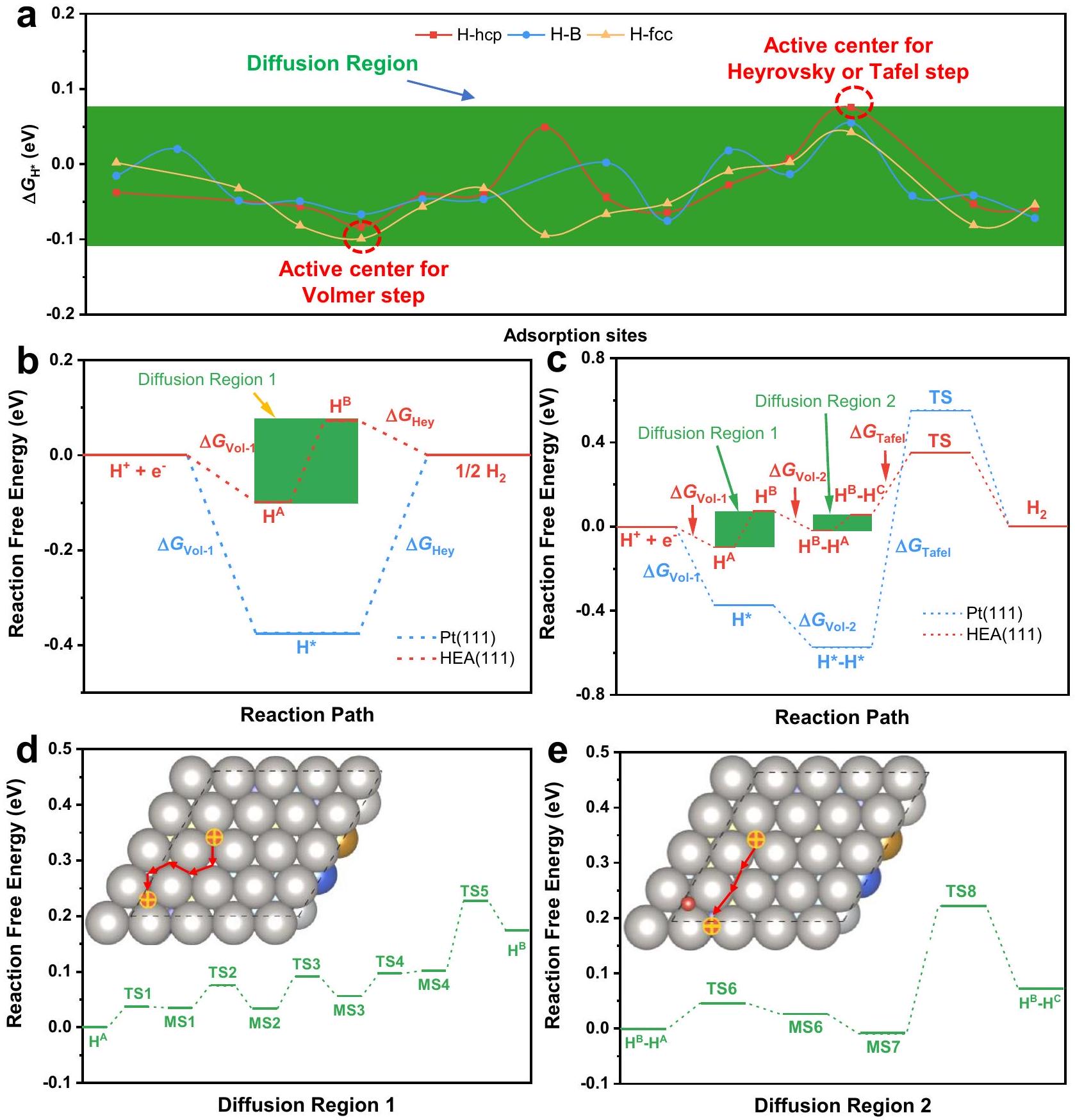
التم استخدام نظام HEA كمثال لدراسةالتدفق الزائد بناءً على الوصف الجديد لتوزيع غاوسيمع المفضل و (انظر الشكل التوضيحي الإضافي 7). الـقيم على بعض مواقع الامتزاز (48 موقعًا، بما في ذلك ثلاثة أنواع من مواقع الامتزاز، كما هو موضح في الشكل التكميلية 8) من-HEA موضحة في الشكل 2a، حيث تشير المنطقة الخضراء إلى DR. المركز النشط لتفاعل فولمر لديه أصغرمن -0.099 إلكترون فولت والمركز النشط لتفاعل تافل أو هيروفسكي له أكبر0.075 إلكترون فولت.
يتم اعتبار كل من آلية فولمر-هيدروفكسي (V-H) وآلية فولمر-تافل (V-T) في تفاعل الهيدروجين (HER) على Pt (111) و5.9%-HEA (111)، كما هو موضح في الشكل 2b، c. بالنسبة لآلية V-H على Pt (111)، فإن الخطوة المحددة للجهد (PLS) هي خطوة هيدروفكسي معتفاعل ماص للحرارة بجهد زائد قدره 0.375 فولت. ومع ذلك، لا يوجد PLS في آلية V-H على-HEA (111) عند النظر في تسرب. كل من خطوات فولمر وهيوروفيسكي هي تفاعلات طاردة للحرارة. مع و الممتصينتشر من الموقع A إلى الموقع B عبر DR1 (انظر الشكل 2d) مع الحد الأقصى لحاجز الطاقة البالغ 0.124 إلكترون فولت، وهو أقل بكثير من حاجز الطاقة الذي يؤدي إلى معدل تفاعل يبلغ حوالي موقع واحد.في درجة حرارة الغرفة، مما يدل على الانتشار السريع للغاية لـ.
بالنسبة لآلية V-T، فإن الخطوتين الأوليين من فولمر هما تفاعلات طاردة للحرارة. ) على Pt (111). وهي أيضًا تفاعلات طاردة للحرارة ( ) على -HEA (111). الخطوة التالية في تافل لديها حاجز طاقة كبير قدره 1.128 إلكترون فولت على Pt (111). على الرغم من أن حاجز الطاقة ينخفض إلى 0.466 إلكترون فولت مع زيادةالتغطية (انظر الشكل التوضيحي التكميلي 9)، لا تزال أكبر بكثير من تلك على-HEA (111) ( 0.297 eV ). بالنسبة لآلية V-T، يتم تضمين DR2 خلال عملية التفاعل، كما هو موضح في الشكل 2e. الحد الأقصى لحاجز الطاقة في DR2 هو 0.232 eV، وهو أقل من الخطوة المحددة لمعدل التفاعل (RDS) لتفاعل تافل ( 0.297 eV ) على –
HEA (111). فوق كل شيء، الـعمليات التسرب على كلا DRs لن تكون PLS أو RDS خلال HER على-HEA (111). لإزالة أي تأثير محتمل ناتج عن مراكز نشطة محددة، قمنا باختيار مركز نشط إضافي بشكل عشوائي على الـ – HEA (111) وحُسِبَت الأداء التحفيزي لتفاعل تقليل الهيدروجين (HER)، كما هو موضح في الشكل التكميلي 10 والجدول التكميلي 1. تشير التوافق الملحوظ في اتجاهات الأداء التحفيزي إلى أن الأداء التحفيزي لـ-HEA (111) ليس محدودًا بمركز نشط معين.
علاوة على ذلك، فإن عمليات التفاعل لـ HER على 5.9%-HEA (111) بدونتُعتبر التسربات أيضًا، كما هو موضح في الشكل التكميلي 11. بالنسبة لآلية V-H، فإن قيم طاقة التفاعل الحرة لـ PLS هي 0.075 إلكترون فولت و0.099 إلكترون فولت على مواقع الامتصاص الضعيفة والقوية، على التوالي. وهذا يعني أن قيم الجهد الزائد هيعلى مواقع الامتزاز الضعيفة/القوية، التي هي أصغر بكثير من تلك (0.375 فولت) لـ Pt (111). مع الأخذ في الاعتبارالتسرب، جميع الخطوات الكهروكيميائية
الشكل 2 | دراسات آلية التفاعل بواسطة حسابات DFT. أ توزيععلى HEA معإجهاد انضغاطي-HEA)، بما في ذلك مواقع الامتزاز المختلفة (موقع الحفرة hcp، موقع الحفرة fcc، وموقع الجسر). تشير الدوائر الحمراء المتقطعة إلى المراكز النشطة لخطوات فولمر وهيوروفسكي (أو تافل) على التوالي. تمثل المنطقة الخضراء منطقة الانتشار (DR) للمواد الممتزة
. آلية فولمر-هيورفسكي لتفاعل الهيدروجين (HER) على 5.9%-HEA (111) وPt (111). ج آلية فولمر-تافل لتفاعل الهيدروجين (HER) على 5.9%-HEA (111) وPt (111). د تسرب H* على DR1 (منطقة الانتشار للأولى ) لـ -HEA (111). e الـتسرب على DR2 (منطقة الانتشار الثانية) ) لـ -HEA (111). تتحول إلى تفاعلات عفوية، ويظهر RDS كـتسرب على سطح 5.9%-HEA (111) مع أكبر حاجز طاقة يبلغ 0.124 إلكترون فولت. وبالمثل، بالنسبة لآلية V-T، فإن قيمة الطاقة الحرة للتفاعل لـ PLS هي 0.075 إلكترون فولت على موقع الامتصاص الضعيف، مما سيجعلها تفاعل كيميائي كهربائي تلقائي عند الأخذ في الاعتبارالتسرب. في الحالة المتعلقة بموقع الامتصاص القوي، فإن حاجز الطاقة هو 0.519 إلكترون فولت لتكوين، وهو أكبر من ذلك (0.297 إلكترون فولت) معتسرب. علاوة على ذلك، التسرب أسهل بكثير في أنظمتنا المصممة HEA مع الحاجز الطاقي الأصغر منمن تلك ) على أنظمة أخرى تم الإبلاغ عنها حيث تسرب ثبت حدوثه. يعني أن يجب أن يؤدي التسرب إلى تحسين النشاط التحفيزي لأنظمة HEA بشكل أكبر. كما هو متوقع، يجب أن تكون المحفزات المصممة قد حسنت الأداء التحفيزي بشكل كبير مقارنة بالبلاتين. لاحظ أن مواقع الامتزاز التي تم اعتبارها في حسابات DFT محدودة جداً بالنسبة لتلك الموجودة على سطح HEA. في الممارسة العملية، يجب أن تكون المراكز النشطة لخطوات فولمر (تافل/هيوروفكسي) أقوى (أضعف).الامتزاز، على التوالي، مما يدل على أنشطة تحفيزية أفضل للسبائك عالية التشتت.
لا شك أن تأثير الإجهاد له أهمية محورية في تعزيز الأداء التحفيزي ضمن السبائك عالية التشتت. المحفزات. علاوة على ذلك، امتدت تحقيقاتنا لتشمل العملية التحفيزية لتفاعل الهيدروجين (HER) على كل من Pt (111) وHEA غير المتوتر (111) (انظر الشكل التكميلي 12). ومن الجدير بالذكر أن تحليلنا المقارن يكشف أنه، دون أي ضغوط، يظهر محفز HEA أداءً تحفيزياً متفوقاً عند مقارنته بـ Pt (111). يمكن أن يُعزى هذا التباين الملحوظ إلى التفاعل المعقد لطاقة الامتصاص لـالناشئة عن التدرجات الإلكترونية المتنوعة الموجودة على سطح محفزات HEA. علاوة على ذلك، قمنا ببناء نموذج مثاليهيكل PtNi يتكون من طبقة علوية واحدة من Pt وأربع طبقات سفلية من Ni، مما يؤدي إلى0.025 إلكترون فولت. هذه القيمة قابلة للمقارنة مععلى (111). الخطوة المقابلة لـ PLS هي خطوة فولمر مع من 0.025 إلكترون فولت وحاجز الطاقة لـالتكوين هو 0.612 إلكترون فولت، وهو لا يزال أعلى من ذلك (0.297 إلكترون فولت) على-HEA (111)، كما هو موضح في الشكل التكميلي 13. تشير هذه النتيجة من DFT إلى أنه، بالإضافة إلى ضعف طاقة الامتزاز (بسبب الضغط الانضغاطي وتأثيرات الرابطة)،يلعب التسرب دورًا محوريًا في تعزيز النشاط التحفيزي. وقد تم إثبات ذلك أيضًا في الأدبيات المفتوحة الحديثة..
تركيب وتوصيف سبائك HEA من البلاتين والحديد والكوبالت والنيكل والنحاس
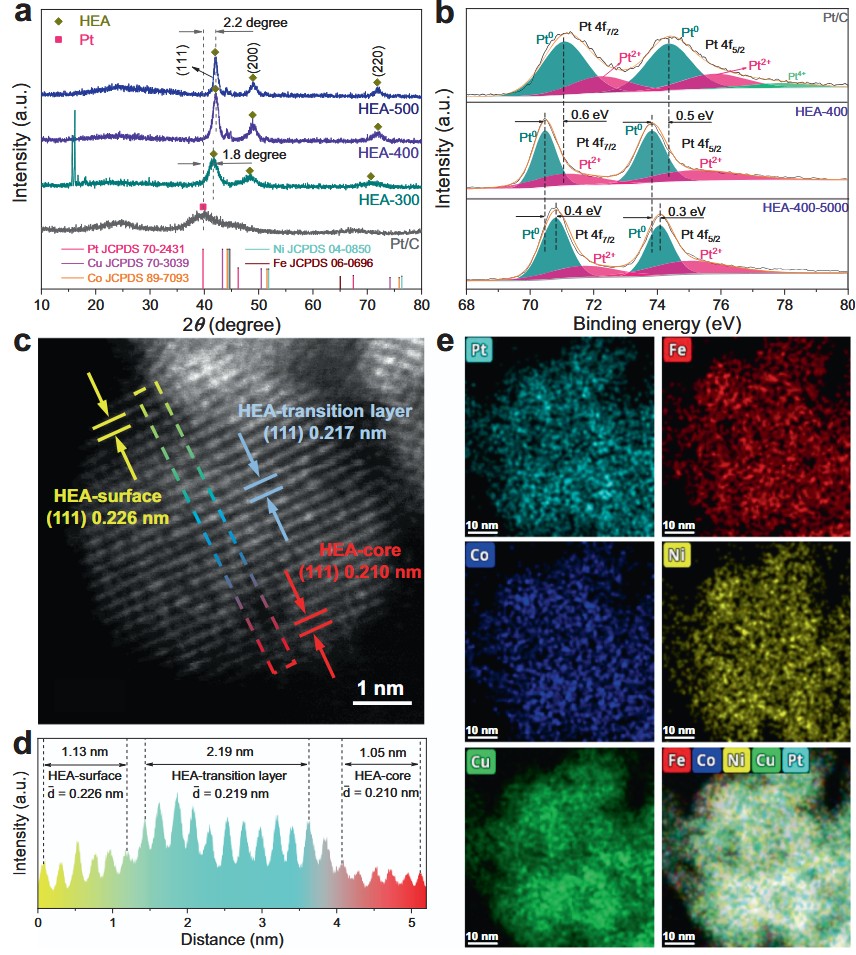
كإثبات للمفهوم، تم تخليق محفزات PtFeCoNiCu HEA من خلال تفاعل مائي متحلل يليه تلدين حراري، كما هو موضح في الشكل التوضيحي الإضافي 14. استنادًا إلى درجات حرارة تلدين مختلفة (300، 400، و )، تُسمى عينات HEA المُركبة بـ HEA-300 و HEA-400 و HEA-500، على التوالي. يزيد حجم جزيئات HEA المُركبة مع درجة حرارة التلدين، كما هو موضح في الشكل التكميلي 15. يوضح الشكل 3a أنماط XRD، حيث تظهر جميع HEAs هيكل مكعب مركزي الوجوه مع ثلاثة قمم رئيسية مميزة تتوافق مع مستويات (111) و (200) و (220). القمم الحادة عند و يمكن أن يُعزى في HEA-300 إلى كلوريد المعدن الانتقالي للسابقة، مما يوحي بأنليس مرتفعًا بما يكفي لتحويل السلف إلى HEA بشكل كامل. بالمقارنة مع موضع قمة (111) لـ Pt/C، تظهر عينات HEA-300 وHEA-400 وHEA-500 تحولات إيجابية من، و على التوالي، مما يشير إلى وجود إجهاد انضغاطي في السبائك عالية التداخل الناتج عن السبك مع، و تظهر ضغوط انضغاطية أكبر في HEA-400 و HEA-500 مقارنة بـ HEA-300، مما يوضح تأثير درجة حرارة التلدين على الانفعال، مما يؤدي إلى تنظيمالقيمة في التوزيع الغاوسي لـ. وبالمثل، تقدم HEA-300 و HEA-400 و HEA-500 تباعدات الشبكة (111) من ، و 0.207 نانومتر، على التوالي، كما هو موضح في الشكل التكميلي 16. بالمقارنة مع مستوى Pt (111) (0.226 نانومتر، انظر الشكل التكميلي 17)، تظهر HEA-300 و HEA-400 و HEA-500 ضغوط انضغاطية من و على التوالي. يحدث ذلك بسبب سبك، وCu مع أنصاف أقطار أصغر إلى Pt، وهو ما يتماشى مع نموذج DFT. استنادًا إلى نتائج DFT، فإن PtFeCoNiCu مع إجهاد انضغاطي قدرهيجب أن يكون لديهقيمة أقرب إلى 0 إلكترون فولت، مما يشير إلى نشاط تحفيزي أعلى. تتفق النتائج التجريبية مع نتيجة DFT، حيث تشير النتائج إلى أن HEA-400 مع إجهاد 7.1% لديه أداء تحفيزي أفضل من HEA-300 (إجهاد 5.8%) و HEA-500 (إجهاد 8.4%)، كما هو موضح في الشكل التكميلي 18. لذلك، فإن نظام HEA-400 هو موضوع بحثنا الرئيسي في الدراسة التالية.
تم إجراء تحليل طيف الإلكترون السيني (XPS) لاستكشاف إعادة توزيع الشحنة في محفزات HEA. كما هو موضح في الشكل 3b، كلاهما و تتحول القمم في HEA-400 سلبًا مقارنةً بـ، مما يدل على نقل الإلكترون من مكونات أخرى إلى البلاتين في HEA، وهو ما يتوافق جيدًا مع اختلافات الكهربية (الحديد: 1.83، الكوبالت: 1.88، النيكل: 1.91، النحاس: 1.90، والبلاتين: 2.28). بعد 5000 دورة من الفولتمترية الدورانية (CV) للتفعيل، كلا من و تتحول القمم في HEA-400-5000 (HEA-400 بعد تفعيل دورة CV لمدة 5000 دورة) بشكل إيجابي مقارنة بتلك الخاصة بـ HEA-400. وهذا ناتج عن التآكل من، وCu خلال عملية التنشيط. لذلك، يتم نقل الإلكترونات المخفضة إلى عنصر Pt. كميات الإلكترونات المنقولة بين ذرة Pt وجيرانها المختلفين هي متميز، مما يؤدي إلى تدرج في توزيع الإلكترونات على سطح البلاتين، وهو ما يتماشى مع نموذج DFT المقترح لدينا.
كمثال على HEA-400،، وتتابع عناصر النحاس نسبة ذرية تبلغ 18.8: 19.9: 22.3: 20.2: 18.8، وفقًا لقياس الطيف الضوئي الانبعاثي باستخدام البلازما المقترنة بالحث (ICP-OES). لاستبعاد تأثير المرحلة غير النقية ولإحداث تدرج في المكونات في HEA، يتم إجراء قياسات CV للتفعيل على مدى (مقابل RHE). محتويات وتم الكشف عن زيادة مستمرة في Cu في الإلكتروليت مع عملية تنشيط CV (انظر الجدول التكميلي 2). للتحقيق في حالة سطح HEA-400 بعد دورات مختلفة من اختبار CV، تم إجراء وتحليل خصائص HRTEM. 2000 دورة من اختبار CV غير كافية لإدخال تدرج في المكونات في HEA-400، كما هو موضح في الشكل التكميلي 23. بعد 5000 دورة من اختبار CV، يظهر تدرج في المكونات في HEA-400-5000 (انظر الشكل التكميلي 24 والملاحظة التكملية 2). بعد 10000 دورة من اختبار CV، تظهر جزيئات صغيرة من Pt في HEA-400-10000 (انظر الشكل التكميلي 25). تشير هذه النتيجة إلى أن اختبارات CV الإضافية ستؤدي إلى تآكل مفرط للعناصر غير النبيلة في سطح HEA، مما سيقلل من تدرج المكونات. تؤكد جميع هذه النتائج تآكل العناصر غير Pt أثناء التنشيط. وبالمثل، تزداد المسافات الشبكية المتوسطة لـ HEA-400 (111) مع دورات التنشيط، مما يدل على زيادة نسبة مكون Pt (انظر الشكل التكميلي 26). لتحليل المرحلة الخاصة بـ HEA-400 بعد دورات مختلفة من اختبار CV، تم إجراء خصائص XRD، كما هو موضح في الشكل التكميلي 27a. يظهر HEA-400-الأولي بعض قمم الشوائب التي تتوافق مع أنواع Co أو CoFe. بعد 100 دورة من اختبار CV، تختفي جميع قمم أنواع Co أو CoFe، مما يشير إلى أن HEA-400-100 هو HEA محدد جيدًا. يتم تآكل أنواع Co و CoFe التي تفشل في تشكيل HEA أولاً خلال عملية CV. بالإضافة إلى HEA-400-100، تقدم HEA-400-2000 و HEA-400-5000 و HEA-400-10000 جميعها قمم HEA محددة جيدًا.
تم توليد تدرج تركيز البلاتين على سطح محفز HEA، كما هو موضح في صورة TEM الماسح ذات الزاوية العالية (HAADF-STEM) لـ HEA-400-5000 (انظر الشكل 3c). تحتوي الطبقة (111) في سطح HEA على مسافة شبكية قدرها 0.226 نانومتر (انظر الشكل التكميلي 28)، وهو ما يتوافق مع مسافة Pt (111)، مما يشير إلى هيمنة البلاتين في الطبقات السطحية. تم قياس مسافة الشبكة (111) في النواة لتكون 0.210 نانومتر، وهي نفس القيمة في HEA-400 قبل التنشيط (انظر الشكل التكميلي 16b). بمعنى آخر، يظهر تأثير النقش فقط في الطبقات الخارجية (15~20 طبقة) من HEA. تم قياس مسافة الشبكة (111) في طبقة الانتقال لتكون 0.217 نانومتر، وهي بين تلك الموجودة في Pt (111) و HEA-400 (111)، مما يشير إلى النقش الجزئي للعناصر غير البلاتينية. تشير المسافات الشبكية المتناقصة تدريجياً من الطبقات الخارجية إلى النواة إلى وجود تدرج في تركيز البلاتين (انظر الشكل 3d). توضح خرائط العناصر HAADF-EDS توزيع العناصر بشكل متجانس في الجسيمات النانوية (انظر الشكل 3e). علاوة على ذلك، تم تأكيد تدرج تركيز البلاتين بشكل أكبر في خرائط العناصر القريبة من السطح (انظر الأشكال التكميلية 29-31)، حيث، و Ni يتم اكتشافهما أقل من Cu و Pt، بسبب القابلية للتآكل لـ، وNi خلال عملية التفعيل. علاوة على ذلك، تظهر نتائج مسح الخط HAADF (انظر الشكل التكميلية 32 و33) أيضًا زيادة تدريجية في درجة الحفر من ، و Ni من النواة إلى الطبقات الخارجية في HEA-400-5000. تشير جميع هذه النتائج إلى أن المحفزات HEA التي تم تصنيعها تتوافق مع نموذج HEA المزدوج المتدرج المصمم PtFeCoNiCu.
أداء التحفيز لـ PtFeCoNiCu HEA
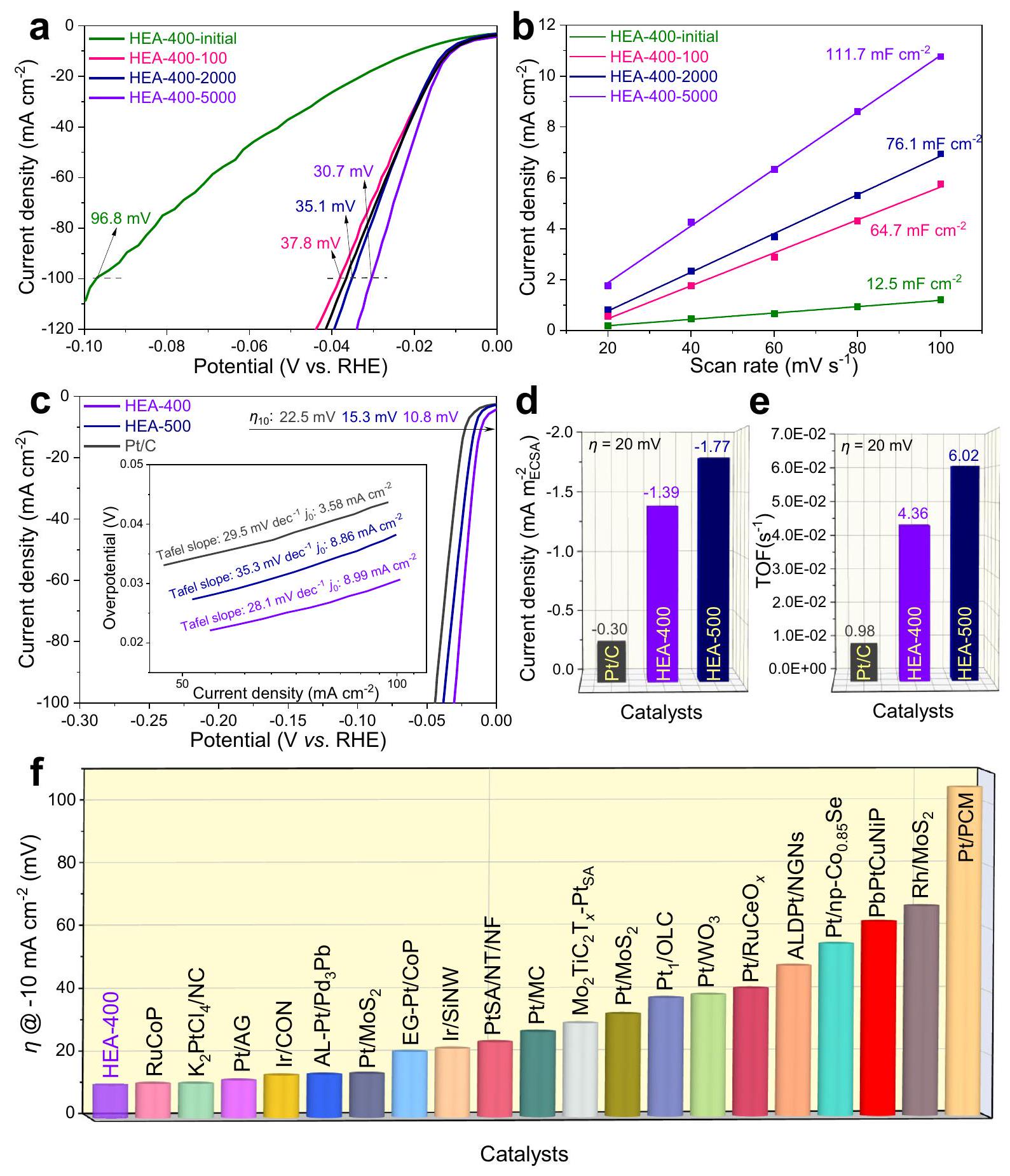
تم قياس أداء HER لمحفزات HEA في 0.5 م باستخدام تكوين ثلاثي الأقطاب نموذجي. توضح الشكل 4a منحنيات الاستقطاب لـ HEA-400 قبل وبعد اختبارات تنشيط CV. يظهر HEA-400 جهد زائد قدره 96.8 مللي فولت عند في منحنى الاستقطاب الأولي. بعد اختبار CV الذي يتضمن 100 دورة، يظهر HEA-400100 أداءً محسنًا بشكل كبير في تفاعل تطور الهيدروجين مع جهد زائد قدره 37.8 مللي فولت عندأداء HER لـ HEA-400 هو
من السطح إلى القلب في HEA-400-5000 كما هو موضح في خرائط العناصر HAADF-EDS لـ HEA-400-5000. تم تحسينه تدريجياً من خلال اختبارات الجهد المستمر حتى تحقيق أفضل أداء (الجهد الزائد 30.7 مللي فولت عند ) يتم تحقيقه بعد 5000 دورة CV. وهذا ناتج عن تعرض المزيد من عناصر البلاتين على السطح. تتبع عناصر البلاتين والحديد والكوبالت والنيكل والنحاس في HEA-400-5000 نسبة ذرية تبلغ 35.0: 12.3: 14.8: 17.3: 20.6 وفقًا لنتائج ICP-OES، مما يتماشى مع افتراضنا حول ذوبان “، ومكونات النحاس على السطح خلال تفعيل الجهد الكهربائي. ستؤدي المزيد من الدورات إلى زيادة فائضة، وعناصر النحاس المذابة، مما أدى إلى تدرج إلكتروني أصغر على سطح HEA وبالتالي أصغرقيمة. هذه هي السبب في أن HEA-400-10000 يظهر أداء التوهين مقارنةً بأداء HEA-400-5000 (انظر الشكل التكميلية 34). ومع ذلك، لا تزال النشاط التحفيزي لـ HEA-40010000 أفضل من Pt/C. بالإضافة إلى ذلك، تم التحقق من الاستقرار العالي لـ HEA-400-5000 من خلال القياس الجلفاني خلال اختبار مدته 80 ساعة (انظر الشكل التكميلية 35). الكفاءة الفاردية لـ HEA-يتم حسابه أيضًا ليكون (انظر الشكل التوضيحي التكميلي 36)، مما يوضح أن تقريبًا كل التيار في الاختبار يُستخدم لتفاعل تقليل الهيدروجين (HER). يتم إثبات تأثير التنشيط لـ HEA-400 بشكل أكبر من خلال السعة الكهربائية الثنائية الطبقة الكهروكيميائية ( )، كما هو موضح في الشكل 4ب. متسق مع ميل نشاط HER، الـمن HEA-400
الشكل 4 | الأداء الكهروكيميائي. أ منحنيات الاستقطاب لـ HEA-400 قبل وبعد تنشيط الفولتمتر الدوري (CV).مخططات التيارات السعوية بمعدلات مسح مختلفة لـ HEA-400 قبل وبعد تنشيط CV. ج منحنيات الاستقطاب لـ HEA-400 المنشطة، HEA-500 المنشطة، وPt/C. المخططات المقابلة لتافل وكثافة التيار المتبادل. ) موصوفة في الإطار. د الأنشطة المحددة لـ تم تفعيل HEA-400، تم تفعيل HEA-500، وفي. e TOFs من HEA-400 المنشط، HEA-500 المنشط، وPt/C عند . مقارنة أداء HER لـ HEA-400 مع المحفزات الأخرى المبلغ عنها في (انظر الجدول التكميلي 3 لمزيد من التفاصيل). يزداد باستمرار ليصل إلى القيمة القصوى لـبعد 5000 دورة من اختبار الجهد الكهربائي. وهذا يشير إلى الزيادة الكبيرة في المساحة السطحية الكهروكيميائية (ECSA) الناتجة عن التدرج المزدوج المتكون في HEA. يتم تقديم أداء HER الأكثر تفصيلاً لـ HEA-400 قبل وبعد اختبارات الجهد الكهربائي في الأشكال التكميلية 37 و 38. من أجل تسليط الضوء على مزايا محفزات HEA من نوع PtFeCoNiCu، يتم مقارنة أداء HER لسبائك PtFeCo الثلاثية وسبائك PtFeCoNi الرباعية (انظر الأشكال التكميلية 39-41). كما هو موضح في الشكل التكميلية 41، يقدم محفز PtFeCoNiCu أداءً أفضل في HER. أداء أفضل من PtFeCo وPtFeCoNi، مما يوضح فوائد نظام التحفيز ذو التدرج المزدوج في HEA. بالإضافة إلى ذلك، تم قياس أداء HER لأنظمة HEA بدون معادن نبيلة. كما هو موضح في الشكل التكميلية 42، لا يوجد سلوك تنشيط في FeCoNiCuMn أو FeCoNiCrMn، مما يشير إلى أن سلوك التنشيط الكهروكيميائي قد يوجد فقط في نظام HEA مع مواقع نشطة محددة، والتي تتمتع بمقاومة ممتازة للتآكل الحمضي.
يلاحظ تأثير التنشيط الكهروكيميائي أيضًا في HEA-500، كما هو موضح في الأشكال التكميلية 43 و44. مقارنة بين HER النشاط بين HEA-400 المنشط (HEA-400-5000) و HEA-500 المنشط (HEA-500-2000) و Pt/C موضح في الشكل 4c، حيث أن HEA400 لديه أقل جهد زائد يبلغ 10.8 مللي فولت عندتشير الرسوم البيانية لتافل المقابلة (انظر الإطار في الشكل 4c) إلى أن HEA-400 المنشط يقدم أقل ميل لتافل.، مما يدل على أفضل حركيات HER، والتي تم التحقق منها أيضًا من خلال أكبر كثافة تيار تبادل (. بالإضافة إلى ذلك، عند تطبيعها إلى ECSA (انظر الشكل التوضيحي 45)، يظهر HEA-400 نشاطًا كهربائيًا محددًا أعلى بمقدار 4.6 مرةمن تلك الخاصة بـ Pt/C (، انظر الشكل 4d) عند جهد زائد قدره 20 مللي فولت. في الوقت نفسه، فإن تردد الدوران لـ HEA-400في هذه الإمكانية أيضًا أعلى بكثير من، مما يؤكد النشاط الجوهري الممتاز (انظر الشكل 4e). إن النشاط الجوهري المعزز بشكل كبير لـ HEA-400 ينشأ من الهياكل ذات التدرج المزدوج، حيثظاهرة التسرب موجودة.يمكن ملاحظة ظاهرة التسرب بشكل بديهي من خلال تغيير اللون في خليط المحفز وخلال عملية HER. كما هو موضح في الشكل التوضيحي 46، ألوان و تظل دون تغيير بعد اختبار HER في عام 1800 (تُعرض عمليات HER في الشكل التوضيحي 47). ومع ذلك، فإن لون HEA-400تغير من الأصفر الداكن إلى الأزرق الداكن بعد اختبار HER لمدة 170 ثانية فقط. وذلك لأن الهيدروجين المتسرب ينتقل على سطح HEA ويتفاعل بسهولة معلتشكيل الأزرق الداكنتغيير اللون أعلاه يؤكدظاهرة التسرب على HEA، بينما لايحدث التسرب على Pt/C. بالإضافة إلى ذلك،تم التحقق من ظاهرة التسرب على HEA من خلال العلاقة المعتمدة على pH لتفاعل تقليل الهيدروجين (HER). استنادًا إلى التقارير السابقة،يتميز محفز HER القائم على التسرب بترتيب تفاعل نظري يبلغ 2.0 بينوقيمة الرقم الهيدروجينيعند جهد قدره -0.05 فولت (مقابل RHE، انظر الشكل التكميلي 48a)، تم قياس ترتيب التفاعل المعتمد على الرقم الهيدروجيني لـ HEA-400-5000 ليكون 2.03 (انظر الشكل التكميلي 48b)، وهو ما يتماشى مع القيمة النظرية 2.0، مما يؤكدظاهرة التسرب. بالإضافة إلى ذلك، يتم دراسة حركيات إزالة الهيدروجين في الموقع لدعم المزيد منظاهرة التسرب على HEA. لتحديد حركية إزالة الهيدروجين، يتم إجراء اختبارات CV من (مقابل RHE) لمراقبة قمم انبعاث الهيدروجينكما هو موضح في الشكل التكميلي 49a و b، فإن قمم انبعاث الهيدروجين تتحول مع زيادة معدلات المسح لكل من Pt/C و HEA-400-5000. لذلك، يمكن قياس حركية انبعاث الهيدروجين من خلال مقارنة الميل بين موضع قمة انبعاث الهيدروجين مقابل معدلات المسح. كما هو موضح في الشكل التكميلي 49c، يظهر HEA-4005000 ميلًا مخفضًا بشكل ملحوظ مقارنة بـ Pt/C، مما يدل على تحسين حركية انبعاث الهيدروجين. أظهرت دراسة سابقة أنيمكن أن يؤثر تأثير التسرب بشكل فعال على تسريع حركية إزالة الهيدروجين للمواد المحفزة الكهربائية.. وبالتالي، يمكن أن تنشأ الديناميات المعجلة لامتصاص الهيدروجين لـ HEA-400-5000 من ظاهرة التسرب على السطح. بالإضافة إلى ذلك، تم مقارنة أداء HER لـ HEA-400-5000 معنظام بدونأثر التسرب، كما هو موضح في الشكل التكميلي 50. يظهر HEA-400-5000 أداءً أفضل في تفاعل الهيدروجين.في )، على الرغم من أن قيمة لـقد تكون قريبة من تلك الخاصة بـ HEA-400-5000 (في نطاق حوالي )، مما يشير إلى تسرب يلعب دورًا محوريًا في تعزيز النشاط التحفيزي. تم تقديم مقارنة أكثر تفصيلًا للتفاعل الكهربائي الهيدروجيني بين HEA و Pt/C في الأشكال التكميلية 51-53. بالمقارنة مع المحفزات الأخرى المبلغ عنها لتفاعل الهيدروجين (انظر الشكل 4e والجدول التكميلية 3)، يظهر HEA ذو التدرج المزدوج المصمم أقل جهد زائد يبلغ 10.8 مللي فولت عند، مما يدل على تقدم في الأداء التحفيزي لتفاعل تقليل الهيدروجين.
تمديد إلى، و
تم توسيع مبدأ ساباتير غير العادي ليشمل مواد ماصة أخرى، و على المحفزات المصممة HEA. استنادًا إلى علاقة BEP، فإن الامتصاص القوي يؤدي إلى حاجز انتشار كبير للمواد الممتصة. هذا يعني أن، و يجب أن يكون التسرب صعبًا بسبب امتصاصها الأقوى من ذلك لـفيما يلي، طاقات الامتزاز لـ، و على المصمم-تم حساب HEA، كما هو موضح في الأشكال التكميلية 54-56. كما أن قيم طاقة الامتصاص الخاصة بهم تتبع تقريبًا التوزيع الغاوسي مع و قيم 1.662 و و و 0.104 إلكترون فولت، لـ، و ، على التوالي. مشابه لامتصاص المصمملا يزال لدى HEA مركزان نشطان مع امتصاصات قوية وضعيفة لهذه المواد الممتصة.، و تظهر التأثيرات المتبادلة بين المركزين النشطين في الأشكال التكميلية 57-59. قيم حاجز الانتشار لعملية تحديد السرعة الخاصة بهم هي، و 0.801 إلكترون فولت لـ، و على التوالي. على الرغم من أن قيم حاجز الانتشار هذه أكبر من تلك الخاصة بـ، لا تزال قيمًا صغيرة نسبيًا، تكفي لتأثيرات التسرب من، و حدوثه في درجة حرارة الغرفة. لذلك، يمكن توسيع مبدأ ساباتير غير العادي المقترح في هذا العمل ليشمل تفاعلات تحفيزية أخرى مرتبطة بهذه المواد الممتصة، مثل ، ORR/OER، NRR، إلخ.
نقاش
باختصار، اكتشفنا مبدأ ساباتير غير العادي على المحفزات HEA لتفاعل تقليل الهيدروجين. الوصف الجديد لـ و تقترح للإشارة إلى النشاط التحفيزي لمحفزات HEA لتفاعل تقليل الهيدروجين استنادًا إلى التوزيع الغاوسيمن. رياضياً، أكبر قيم النتائج بـيؤدي إلى نشاط تحفيزي أعلى لتفاعل تقليل الهيدروجين. من الناحية الفيزيائية، فإن المحفزات HEA ذات نطاق طاقة الامتزاز الأوسع حول 0 eV تعزز من امتصاصوتشكيل، في الوقت نفسه. وفقًا للرؤى النظرية الجديدة، يتم تصنيع محفز PtFeCoNiCu بدقة مع تدرجات مزدوجة (تدرجات إلكترونية وتركيبية). يتمتع المحفز HEA المصمم بأداء تحفيزي ممتاز لتفاعل تقليل الهيدروجين مع جهد زائد قدره 10.8 مللي فولت عندو 4.6 مرات أعلى نشاط داخلي من ذلك لـ. أثبت مبدأ ساباتيه غير المعتاد أنه قابل للتطبيق على مواد ماصة أخرى أيضًا. يمكن أن تسرع هذه النتائج من تطوير محفزات HEA وتفتح آفاقًا لتحقيق تقدم في الأداء التحفيزي.
طرق
المواد الكيميائية
كلوريد الحديد (III)كلوريد الكروم (II) كلوريد الكوبالت (II) سداسي الماءكلوريد النيكل (II) سداسي الماءكلوريد النحاس(II) ثنائي الهيدراتكلوريد المنغنيز (II) رباعي الماءحمض الكلوروبلاتينيكتم شراء بوليمر البولي فينيل بيروليدون (PVP) من سيغما ألدريتش. جميع المواد الكيميائية ذات نقاء تحليلي وتستخدم دون مزيد من التنقية.
تركيب محفز HEA من PtFeCoNiCu
0.5 مليمول من و تم إضافة إلى 40 مل من الماء النقي للغاية لتشكيل خليط متجانس. تم تحريك الخليط باستمرار في حمام زيت عندحتى تبخر كل الماء، مكونًا معلقًا أصفر داكن. تم الحصول على HEA-300 و HEA-400 و HEA-500 و HEA-700 و HEA-900 من خلال تلدين المعلق تحتالجو لمدة ساعتين عند 300 و 400 و 500 و 700، على التوالي.
تركيب محفزات PtFeCoNi و PtFeCo
طريقة تخليق PtFeCoNi هي نفسها طريقة HEA-400، باستثناء أن المادة الأولية لـلم يتم إضافته. طريقة تخليق PtFeCo هي نفسها طريقة HEA-400، باستثناء أن المواد الأولية لـ و لم يتم إضافتها.
تركيب محفز HEA من الحديد والكوبالت والنيكل والكروم والمنغنيز
0.5 مليمول من و تم إضافة إلى 40 مل من الماء النقي للغاية لتشكيل خليط متجانس. تم تحريك الخليط باستمرار في حمام زيت عندحتى تبخر كل الماء، مكونًا معلقًا رماديًا داكنًا. كانت سبائك FeCoNiCrMn تم الحصول عليه من خلال معالجة الملاط بالتسخينجو لمدة ساعتين عند.
تركيب محفز HEA من الحديد والكوبالت والنيكل والنحاس والمنغنيز
0.5 مليمول من و تم إضافة إلى 40 مل من الماء النقي للغاية لتشكيل خليط متجانس. تم تحريك الخليط باستمرار في حمام زيت عندحتى تبخر كل الماء، مكونًا معلقًا أصفر داكن. تم الحصول على سبائك FeCoNiCuMn من خلال تلدين المعلق تحتجو لمدة ساعتين عند.
تركيبمحفز
تركيبكان يستخدم الطريقة وفقًا لتقرير وانغ وآخرون.. عادةً، 0.4 مليمول من وتم إذابة 287.2 ملغ من PVP في 50 مل من الماء النقي للغاية وتمت الموجات فوق الصوتية لمدة ساعة. ثم تم رش المحلول على لوحة زجاجية محفوظة عندللتبخر السريع. ثم تم تنظيف المسحوق الم collected من خلال الطرد المركزي 3 مرات باستخدام الماء النقي للغاية.تم الحصول عليه من خلال تلدين المسحوق تحتجو لمدة ساعتين عند.
توصيف المواد
لأغراض التوصيف الهيكلي، تم إجراء تحليل حيود الأشعة السينية (XRD) علىمقياس الانكسار معالإشعاع. تم الكشف عن طيف الإلكترونات بالأشعة السينية (XPS) من خلال مطياف ESCALAB 250Xi مع مصدر ألومنيوم أحادي اللون. تم إجراء توصيف الشكل باستخدام مجهر إلكتروني نافذ (TEM) من طراز JEM-2100F للحصول على صور TEM وصور TEM عالية الدقة (HRTEM) وأنماط حيّز الإلكترون المختار (SAED). تم الحصول على صور الحقل المظلم الحلقي بزاوية عالية (HAADF) من خلال مجهر إلكتروني FEI Titan Themis 300 مصحح مزدوج. تم تأكيد تحليل المكونات باستخدام مطياف انبعاث بصري بلازما مقترن بالحث (ICP-OES).
القياسات الكهروكيميائية
تم إجراء جميع القياسات الكهروكيميائية على جهاز Ivium-n-Stat الكهروكيميائي تحت نظام ثلاثي الأقطاب قياسي. تم استخدام قطب جرافيت، وقطب كولوميل المشبع (SCE) وقطب قرص دوار (RDE) مغطى بأفلام محفزات كأقطاب مضادة، ومرجعية، وعاملة، على التوالي. تم توزيع 3 ملغ من كل مسحوق محفز في 0.5 مل من محلول الماء-الإيزوبروبانول. ) تم استخدامها كحبر محفز. 30 تم أخذ كمية من حبر المحفز وتجفيفها على سطح RDE للقياس في كل مرة.محلول نافيون-إيزوبروبانول (1:19،تم أخذها وتغطيتها على أفلام المحفز المجففة كربط.
تم إجراء قياسات أداء HER فيمشبعلتفعيلتم إجراء اختبارات الفولتمترية الدورية (CV) على المحفزات PtFeCo و FeCoNiCrMn و FeCoNiCuMn في نطاق جهد (مقابل القطب الهيدروجيني القابل للعكس، RHE) عند معدل مسح تم إجراء اختبارات الفولتمترية ذات المسح الخطي (LSV) بمعدل مسحبمعدل دوران يبلغ 2025 دورة في الدقيقة. لقياس سعة الطبقة المزدوجة، تم إجراء اختبارات CV في نطاق جهد من 100 إلى 200 مللي فولت (بالنسبة لـ RHE) عند معدلات مسح و على التوالي. تم إجراء اختبارات الجلفانستاتيك عند كثافة تيار مطبقة قدرها لمدة 80 ساعة. تم إجراء قياسات impedância الكهروكيميائية عند 10 مللي فولت (مقابل RHE) من 100 كيلو هرتز إلى 0.1 هرتز. تم قياس إنتاج الهيدروجين باستخدام جهاز كروماتوغرافيا الغاز (GC-2014)، باستخدام كاشف الموصلية الحرارية (TCD) للكشف عن محتوى كل 10 دقائق. لاكتشاف كمية الإنتاجتم تحميل المحفز على رغوة النيكل مع كمية كافية من نافيون كربط. تم إجراء جميع القياسات في درجة حرارة الغرفة. تم تحويل جميع الجهود إلى RHE من خلال، حيث و تشير إلى إمكانات تطور الهيدروجين القابلة للعكس والإمكانات المقاسة، على التوالي.
حساب نظرية الكثافة الوظيفية
تم إجراء جميع الحسابات باستخدام حزمة محاكاة فيينا من البداية (VASP) المعتمدة على نظرية الكثافة المعتمدة على التدوير (DFT)تم استخدام نموذج الجهد الزائف المعزز بواسطة البروجيكتور لمعالجة الإلكترونات الأساسية.تم اعتماد تقريب التدرج العام (GGA) مع دالة بيردو-بورك-إرنزرهوف (PBE) في حسابات نظرية الكثافة (DFT).تم تعيين حد الطاقة الحركية لحسابات دالة الموجة إلى 550 إلكترون فولت. تم تطبيق دالة التمويه فيرمي مع عرض تمويه قدره 0.1 إلكترون فولت.تم اعتبار سوبرسيل مكون من خمس طبقات لجميع الأنظمة. تم استخدام شبكة نقاط ك-مونكهورست-باكوفجوة فراغية منتم استخدامه لتجنب التفاعلات بين النظام وصورته المرآة. تم إيقاف الاسترخاء الهندسي عندما كانت التغيرات التزايدية في الطاقة الكلية والقوى أصغر من و على التوالي. تم اعتبار تفاعل فان دير فالس من خلال طريقة DFT-D3 المقترحة من قبل غريم.. تم الحصول على جميع حالات الانتقال باستخدام طريقة الحزام المرن المدفوع بصورة تسلق (CI-NEB) مع قوة تقارب أقل من .
طاقة الامتزاز ( ) من المواد الممتزة ( ) تم حسابه بواسطة المعادلة التالية:
أين و تمثل الطاقة الكلية للحفاز مع المادة الممتصة، والحفاز المعزول، والمادة الممتصة المقابلة، على التوالي. لاحظ أن طاقات، و N تشير إلى طاقات غرافين، و ، على التوالي. تم تصحيح طاقة الامتزاز من خلال أخذ الطاقة الصفرية والانتروبيا في الاعتبار، كما هو موضح أدناه:
أين، و تشير إلى طاقة الامتزاز الحرة، وتغير طاقة النقطة الصفرية، وتغير الإنتروبيا، على التوالي.
ملخص التقرير
معلومات إضافية حول تصميم البحث متاحة في ملخص تقارير مجموعة نيتشر المرتبط بهذه المقالة.
Sabatier, P. La catalyse en chimie organique (University of Michigan Library, 1913).
Nørskov, J. K. et al. Universality in heterogeneous catalysis. J. Catal. 209, 275-278 (2002).
Calle-Vallejo, F., Loffreda, D., Koper, M. T. & Sautet, P. Introducing structural sensitivity into adsorption-energy scaling relations by means of coordination numbers. Nat. Chem. 7, 403-410 (2015).
Calle-Vallejo, F. et al. Finding optimal surface sites on heterogeneous catalysts by counting nearest neighbors. Science 350, 185-189 (2015).
Norskov, J. K., Bligaard, T., Rossmeisl, J. & Christensen, C. H. Towards the computational design of solid catalysts. Nat. Chem. 1, 37-46 (2009).
Seh, Z. W. et al. Combining theory and experiment in electrocatalysis: insights into materials design. Science 355, eaad4998 (2017).
Meirer, F. & Weckhuysen, B. M. Spatial and temporal exploration of heterogeneous catalysts with synchrotron radiation. Nat. Rev. Mater. 3, 324-340 (2018).
Khorshidi, A., Violet, J., Hashemi, J. & Peterson, A. A. How strain can break the scaling relations of catalysis. Nat. Catal. 1, 263-268 (2018).
Kuhl, K. P. et al. Electrocatalytic conversion of carbon dioxide to methane and methanol on transition metal surfaces. J. Am. Chem. Soc. 136, 14107-14113 (2014).
Montoya, J. H., Tsai, C., Vojvodic, A. & Norskov, J. K. The challenge of electrochemical ammonia synthesis: a new perspective on the role of nitrogen scaling relations. ChemSusChem 8, 2180-2186 (2015).
Nørskov, J. K. et al. Trends in the exchange current for hydrogen evolution. J. Electrochem Soc. 152, J23 (2005).
Nørskov, J. K. et al. Origin of the overpotential for oxygen reduction at a fuel-cell cathode. J. Phys. Chem. B 108, 17886-17892 (2004).
Bajdich, M., García-Mota, M., Vojvodic, A., Nørskov, J. K. & Bell, A. T. Theoretical investigation of the activity of cobalt oxides for the electrochemical oxidation of water. J. Am. Chem. Soc. 135, 13521-13530 (2013).
Greeley, J., Jaramillo, T. F., Bonde, J., Chorkendorff, I. B. & Norskov, J. K. Computational high-throughput screening of electrocatalytic materials for hydrogen evolution. Nat. Mater. 5, 909-913 (2006).
Huang, Z. F. et al. Strategies to break the scaling relation toward enhanced oxygen electrocatalysis. Matter 1, 1494-1518 (2019).
Hong, X., Chan, K., Tsai, C. & Norskov, J. K. How doped MoS breaks transition-metal scaling relations for electrochemical reduction. ACS Catal. 6, 4428-4437 (2016).
Sun, G. et al. Breaking the scaling relationship via thermally stable Pt/Cu single atom alloys for catalytic dehydrogenation. Nat. Commun. 9, 1-9 (2018).
Wang, P. et al. Breaking scaling relations to achieve lowtemperature ammonia synthesis through LiH-mediated nitrogen transfer and hydrogenation. Nat. Chem. 9, 64-70 (2016).
Subbaraman, R. et al. Enhancing hydrogen evolution activity in water splitting by tailoring -Pt interfaces. Science 334, 1256-1260 (2011).
Li, J. et al. A fundamental viewpoint on the hydrogen spillover phenomenon of electrocatalytic hydrogen evolution. Nat. Commun. 12, 3502 (2021).
Jiang, L. et al. Facet engineering accelerates spillover hydrogenation on highly diluted metal nanocatalysts. Nat. Nanotechnol. 15, 848-853 (2020).
Fu, H. Q. et al. Hydrogen spillover-bridged Volmer/Tafel processes enabling ampere-level current density alkaline hydrogen evolution reaction under low overpotential. J. Am. Chem. Soc. 144, 6028-6039 (2022).
Dai, J. et al. Hydrogen spillover in complex oxide multifunctional sites improves acidic hydrogen evolution electrocatalysis. Nat. Commun. 13, 1189 (2022).
Lu, Z., Chen, Z. W. & Singh, C. V. Neural network-assisted development of high-entropy alloy catalysts: decoupling ligand and coordination effects. Matter 3, 1318-1333 (2020).
Wang, D. et al. Tailoring lattice strain in ultra-fine high-entropy alloys for active and stable methanol oxidation. Sci. China Mater. 64, 2454-2466 (2021).
Escudero-Escribano, M. et al. Tuning the activity of Pt alloy electrocatalysts by means of the lanthanide contraction. Science 352, 73-76 (2016).
Kodama, K., Nagai, T., Kuwaki, A., Jinnouchi, R. & Morimoto, Y. Challenges in applying highly active Pt-based nanostructured catalysts for oxygen reduction reactions to fuel cell vehicles. Nat. Nanotechnol. 16, 140-147 (2021).
Hammer, B. & Nørskov, J. K. Theoretical surface science and catalysis-calculations and concepts. Adv. Catal. 45, 71-129 (2000).
Kitchin, J. R., Nørskov, J. K., Barteau, M. A. & Chen, J. G. Role of strain and ligand effects in the modification of the electronic and chemical properties of bimetallic surfaces. Phys. Rev. Lett. 93, 156801 (2004).
Li, C. Z. et al. Dendritic defect-rich palladium-copper-cobalt nanoalloys as robust multifunctional non-platinum electrocatalysts for fuel cells. Nat. Commun. 9, 3702 (2018).
Nørskov, J. K., Felix S., Frank A. P. & Thomas B. Fundamental concepts in heterogeneous catalysis (John Wiley & Sons, 2014).
Karim, W. et al. Catalyst support effects on hydrogen spillover. Nature 541, 68-71 (2017).
Mori, K. et al. Hydrogen spillover-driven synthesis of high-entropy alloy nanoparticles as a robust catalyst for hydrogenation. Nat. Commun. 12, 3884 (2021).
Chen, J. et al. Reversible hydrogen spillover in Ru- enhances hydrogen evolution activity in neutral pH water splitting. Nat. Commun. 13, 5382 (2022).
Wang, H. T. et al. Direct and continuous strain control of catalysts with tunable battery electrode materials. Science 354, 1031-1036 (2016).
Qin, Y. C. et al. Fine-tuning intrinsic strain in penta-twinned Pt-CuMn nanoframes boosts oxygen reduction catalysis. Adv. Funct. Mater. 30, 1910107 (2020).
Zhan, C. et al. Subnanometer high-entropy alloy nanowires enable remarkable hydrogen oxidation catalysis. Nat. Commun. 12, 6261 (2021).
Shi, Y. & Zhang, B. Recent advances in transition metal phosphide nanomaterials: synthesis and applications in hydrogen evolution reaction. Chem. Soc. Rev. 45, 1529-1541 (2016).
Huang, Z. P. et al. Cobalt phosphide nanorods as an efficient electrocatalyst for the hydrogen evolution reaction. Nano Energy 9, 373-382 (2014).
Khoobiar, S. Particle to particle migration of hydrogen atoms on platinum-alumina catalysts from particle to neighboring particles. J. Phys. Chem. 68, 411-412 (1964).
Zhu, L. et al. A rhodium/silicon co-electrocatalyst design concept to surpass platinum hydrogen evolution activity at high overpotentials. Nat. Commun. 7, 12272 (2016).
Cheng, Y. et al. Rh-MoS nanocomposite catalysts with Pt-like activity for hydrogen evolution reaction. Adv. Funct. Mater. 27, 1700359 (2017).
Park, J. et al. Investigation of the support effect in atomically dispersed Pt on for utilization of Pt in the hydrogen evolution reaction. Angew. Chem. Int. Ed. 58, 16038-16042 (2019).
Wang, S. et al. Synthesis of structurally stable and highly active ordered nanoparticles through an easily operated strategy for enhanced oxygen reduction reaction. ACS Appl. Mater. Interfaces 13, 827-835 (2021).
Kresse, G. & Furthmuller, J. Efficient iterative schemes for ab initio total-energy calculations using a plane-wave basis set. Phys. Rev. B 54, 11169 (1996).
Blochl, P. E. Projector augmented-wave method. Phys. Rev. B 50, 17953-17979 (1994).
Perdew, J. P., Burke, K. & Ernzerhof, M. Generalized gradient approximation made simple. Phys. Rev. Lett. 77, 3865 (1996).
Grimme, S., Antony, J., Ehrlich, S. & Krieg, H. A consistent and accurate ab initio parametrization of density functional dispersion correction (DFT-D) for the 94 elements H-Pu. J. Chem. Phys. 132, 154104 (2010).
Henkelman, G., Uberuaga, B. P. & Jonsson, H. A climbing image nudged elastic band method for finding saddle points and minimum energy paths. J. Chem. Phys. 113, 9901-9904 (2000).
شكر وتقدير
نود أن نشكر الدعم المالي من المؤسسة الوطنية للعلوم الطبيعية في الصين (رقم 52130101)، برنامج تطوير العلوم والتكنولوجيا في مقاطعة جيلين، الصين (رقم 20230402058GH)، مشروع التكامل والابتكار بين التخصصات في جامعة جيلين (رقم JLUXKJC2021ZY01)، وصندوق البحث الأساسي للجامعات المركزية في الصين، ومجلس أبحاث العلوم الطبيعية والهندسة في كندا (NSERC)، وكرسي هارت في جامعة تورونتو. نشكر البروفيسور إدوارد سارجنت على المناقشات المفيدة. كما نقر بالفضل لتحالف البحث الرقمي في كندا لتوفير موارد الحوسبة في SciNet وCalculQuebec وWestgrid. يكرس ز.و.تش هذا العمل لطفله، إنكسي، الذي من المتوقع أن ينضم إلى عائلته في يناير.. عسى أن تلهمها السعي وراء المعرفة والاستفسار العلمي في رحلتها بينما تنمو وتستكشف العالم.
مساهمات المؤلفين
C.C.Y. و C.V.S. و Q.J. تصوروا المشروع وأشرفوا على جميع مراحل البحث. Z.W.C. و J.L. صمموا المشروع. Q.J. و Z.W.C. و P.O. تصوروا النموذج النظري. C.V.S. و Z.W.C. أجروا الحسابات النظرية. C.C.Y. و J.L. أجروا التجارب. Z.W.C. و J.L. و P.O. قاموا بجمع البيانات وتحليلها. J.E.H. و Z.W. و L.C. و X.Y. و G.C. ناقشوا النتائج وعلقوا على المخطوطة.
يجب توجيه المراسلات وطلبات المواد إلى تشون تشينغ يانغ، تشاندرا فير سينغ أو كينغ جيانغ.
معلومات مراجعة الأقران تشكر Nature Communications SUPAREAK Praserthdam و Han Zhu والمراجعين الآخرين المجهولين على مساهمتهم في مراجعة الأقران لهذا العمل.
المختبر الرئيسي لمواد السيارات (جامعة جيلين)، وزارة التعليم، ومدرسة علوم المواد والهندسة، جامعة جيلين، تشانغتشون 130022، الصين. قسم علوم المواد والهندسة، جامعة تورونتو؛ 184 شارع كوليدج، جناح 140، تورونتو، ON M5S 3E4، كندا. قسم الهندسة الكهربائية وهندسة الكمبيوتر، جامعة تورونتو، تورونتو، ON M5S 1A4، كندا. قسم الهندسة الكيميائية والكيمياء التطبيقية، جامعة تورونتو؛ 200 شارع كوليدج، تورونتو، ON M5S 3E5، كندا. قسم الهندسة الميكانيكية والصناعية، جامعة تورونتو؛ 5 طريق كينغز كوليدج، تورونتو، ON M5S 3G8، كندا. هؤلاء المؤلفون ساهموا بالتساوي: زهي وين تشين، جيان لي. هؤلاء المؤلفون أشرفوا بشكل مشترك على هذا العمل: تشون تشينغ يانغ، تشاندرا فير سينغ، كينغ جيانغ. البريد الإلكتروني: ccyang@jlu.edu.cn; chandraveer.singh@utoronto.ca; jiangq@jlu.edu.cn
The Sabatier principle is widely explored in heterogeneous catalysis, graphically depicted in volcano plots. The most desirable activity is located at the peak of the volcano, and further advances in activity past this optimum are possible by designing a catalyst that circumvents the limitation entailed by the Sabatier principle. Herein, by density functional theory calculations, we discovered an unusual Sabatier principle on high entropy alloy (HEA) surface, distinguishing the “just right” ( ) in the Sabatier principle of hydrogen evolution reaction (HER). A new descriptor was proposed to design HEA catalysts for HER. As a proof-of-concept, the synthesized PtFeCoNiCu HEA catalyst endows a high catalytic performance for HER with an overpotential of 10.8 mV at and 4.6 times higher intrinsic activity over the state-of-the-art Pt/C. Moreover, the unusual Sabatier principle on HEA catalysts can be extended to other catalytic reactions.
In the Sabatier principle, the adsorbate should bind neither too weakly (lest reactants fail to activate) nor too strongly (lest products fail to dissociate) . It provides useful guidance in heterogeneous catalysis and is also held up as a rule or limit to be circumvented when one seeks further to advance catalytic performance . The resultant volcano plots have been used to guide catalyst design for the reduction reaction ( ) , nitrogen reduction reaction (NRR) , hydrogen evolution reaction (HER) , and oxygen reduction/evolution reaction (ORR/OER) . “Just right” adsorption energy is the pursuit of all chemical reactions. However, although we achieve the “just right” adsorption energy, the catalytic activity is just infinitely close to the peak. Further breakthroughs or over the volcano in catalytic activity are almost impossible. For instance, Nørskov et al. applied highthroughput density functional theory (DFT) calculations to screen out BiPt with the optimal adsorption energy of among 736 alloy
systems. This alloy was synthesized and tested experimentally and showed improved HER performance compared with Pt, however, still below the volcano peak .
Circumventing the volcano relationship is plausible to achieve a breakthrough or over the volcano in catalytic activity , and numerous efforts have been focused on this issue . For example, Chen et al. demonstrated that the volcano relationship can be broken by building an interface between transition metals and . Unfortunately, the relatively few active sites have impeded the wide application of interface catalysis . Another strategy of strain effect was proposed by Khorshidi et al., the surface strain has to occur either externally by applying mechanical loading or internally by creating complex coreshell structures or interfaces . Another potential phenomenon that could circumvent the volcano relationship is spillover, in which exhibits the ability to diffuse between different active sites . Dai
et al. reported a single-phase complex oxide as a high performance HER electrocatalyst utilizing an atomic-scale spillover effect between multifunctional catalytic sites . High entropy alloys (HEAs) with huge composition space have complex surface active sites, resulting in spatially varying adsorption of intermediates . Some active sites with strong adsorption can be used to activate reactants, while some active sites with weak adsorption are favorable for the formation of products, which circumvents the Sabatier principle if the intermediates can easily diffuse on the HEA surface. It means the HEA catalysts provide new opportunities to achieve a breakthrough over the volcano in catalytic activity.
In this article, we found that HEA surface with spatially varying adsorption free energy of circumvents the Sabatier principle of HER. DFT calculations indicate that the on HEA catalysts follows a Gaussian distribution : expectation; : standard deviation] due to the gradient electron distribution and the diffusion of on HEA surface is fairly easy with the small barrier of 0.232 eV . Some sites with strong adsorption ( ) are used for adsorption, while some sites with weak adsorption ( ) are used for formation. It means that the catalytic activity for HER will be better if the is closer to 0 eV and the is larger, which is defined as an unusual Sabatier principle. The and values could be regulated by the composition, strain effects, and synthesis conditions of HEA catalysts. Guided by these theoretical findings, a PtFeCoNiCu catalyst with electron and composition gradients has been precisely fabricated, exhibiting excellent catalytic performance with an overpotential of 10.8 mV at and more than four times higher intrinsic activity over the state-of-the-art . We also show that this unusual Sabatier principle can be extended to other adsorbents ( , and ) on HEA surfaces, indicating potential applications for variety of catalytic reactions.
Results
Dual gradient PtFeCoNiCu HEA model
A PtFeCoNiCu HEA catalyst was originally designed based on the following three aspects: (1) Pt catalyzes HER and is a good choice of the active site for ; (2) the smaller atomic radii of , and than that of would produce compressive strain on the HEA surface, resulting in a weaker adsorption on surface Pt sites, which promotes the catalytic performance for ; and (3) the cost of catalysts could be greatly reduced by using non-noble metals .
Taking into consideration that (i) some metals (Fe, ) will be corroded away in an acidic electrolyte during the HER process, and (ii) the outer atomic layers will be etched more seriously than the inner layers, a PtFeCoNiCu HEA model with a Pt concentration gradient of , and for the five layers has been designed, as shown in Fig. 1a. The coordination atoms to surface Pt active sites are diverse due to the nature of HEA, which results in various electron redistributions (electronic gradient), as shown in Fig. 1b. The corresponding Bader charge distribution is described in Supplementary Fig. 1. Such an electronic gradient causes different adsorption abilities for , where surface Pt sites with strong adsorption are active centers for the Volmer reaction (* ) while the ones with weak adsorption are active centers for the Tafel or Heyrovsky reaction ( ). , and Cu with smaller atomic radii than that of Pt will induce a compressive strain on the surface Pt atoms, which further regulates the electron structures of active sites . Figure 1c shows that the energy level of orbitals in surface Pt atoms is gradually away from the Fermi level with increasing compressive strain, indicating the diminished activity. This phenomenon can be further quantified by their -band center ( ) values, where a more negative value indicates a weaker adsorption ability . With the increase of compressive strain, the values change from -1.66 eV (HEA without strain) to -1.72 ,
-1.75, -1.89, and -2.03 eV for 1.4%-HEA (HEA with compressive strain), -HEA, -HEA, and -HEA, respectively. The compo-sition-strain- -activity relation allows for designing HEA catalysts with optimal adsorption energy via composition regulation .
Gaussian distribution of on PtFeCoNiCu HEA
was calculated on the designed HEA (111) with different strains (see Fig. 1d and Supplementary Fig. 2), including more than 400 datapoints. The distribution roughly conforms to the Gaussian distribution . Herein, and determine the location and the variance of , respectively. As shown in Fig. 1d, the value increases with increasing compressive strain. This is consistent with the -band center theory, where a larger compressive strain brings more negative , resulting in weaker adsorption . The corresponding structure (strain)-property -performance relation is shown in Supplementary Fig. 3. Note that the compressive strain shows little influence on the value. A larger value indicates that some adsorption sites have stronger adsorptions while other adsorption sites have weaker adsorptions, which requires a larger electronic gradient on the surface. Above all, the two parameters ( and ) in the Gaussian distribution of could be regulated by the type and number of alloying elements in HEA, which bring various strains and surface electronic gradients.
As is well known, denotes the optimal catalytic performance of catalysts for HER based on the Sabatier principle . Different from the traditional bimetallic and ternary metallic catalysts , the active sites of HEA are more diverse and their values follow a Gaussian distribution, rather than a definite value. Hence, the Sabatier principle and the criterion of are no longer efficient for HEA catalysts. In this work, we proposed an unusual Sabatier principle, where the Gaussian distribution of with a value closer to 0 eV and a larger value on HEA catalysts could be used as the descriptor of the higher catalytic activity for HER. Theoretically, the sites with and serve as the active centers for Volmer and Tafel (or Heyrovsky) reactions (see Supplementary Fig. 4), respectively. The larger value indicates that the active center for the Volmer reaction has a stronger adsorption while the active center for Tafel (or Heyrovsky) reaction has a weaker adsorption (see Supplementary Fig. 5). This means that a larger value results in faster Volmer and Tafel (or Heyrovsky) reactions, indicating a higher catalytic activity for HER. Moreover, the symmetry of the Gaussian distribution dictates that these two active centers are guaranteed to be the strongest and the weakest, respectively, only if (see Supplementary Fig. 6). Meanwhile, other sites with moderate ) are the diffusion region (DR). The diffusion of on the HEA surfaces is known as spillover, which will be discussed in detail below.
Reaction mechanism of HER on PtFeCoNiCu HEA
The -HEA system was used as an example for studying the spillover based on the new descriptor of Gaussian distribution of with the preferable and (see Supplementary Fig. 7). The values on some adsorption sites ( 48 sites, including three types of adsorption sites, as shown in Supplementary Fig. 8) of -HEA are shown in Fig. 2a, where the green area denotes the DR. The active center for the Volmer reaction has the smallest of -0.099 eV and the active center for the Tafel or Heyrovsky reaction has the largest of 0.075 eV .
Both Volmer-Heyrovsky (V-H) and Volmer-Tafel (V-T) mechanisms in HER are considered on Pt (111) and 5.9%-HEA (111), as depicted in Fig. 2b, c. For the V-H mechanism on Pt (111), the potential limiting step (PLS) is the Heyrovsky step with , an endothermic reaction with the overpotential of 0.375 V . However, no PLS exists in the V-H mechanism on -HEA (111) when considering the spillover. Both the Volmer and Heyrovsky steps are exothermic reactions
with and , respectively. The adsorbed diffuses from Site A to Site B through the DR1 (see Fig. 2d) with the maximum energy barrier of 0.124 eV , which is much smaller than the energy barrier leading to a reaction rate of about 1 site at room temperature , indicating the exceedingly fast diffusion of .
For the V-T mechanism, the first two Volmer steps are exothermic reactions ( ) on Pt (111). They are also exothermic reactions ( ) on -HEA (111). The following Tafel step has a large energy barrier of 1.128 eV on Pt (111). Although the energy barrier decreases to 0.466 eV with increasing coverage (see Supplementary Fig. 9), it is still much larger than that on -HEA (111) ( 0.297 eV ). For the V-T mechanism, DR2 is involved during the reaction process, as shown in Fig. 2e. The maximum energy barrier in DR2 is 0.232 eV , which is smaller than the rate determining step (RDS) of the Tafel reaction ( 0.297 eV ) on –
HEA (111). Above all, the spillover processes on both DRs wouldn’t be the PLS or RDS during HER on -HEA (111). To eliminate any potential influence arising from specific active centers, we randomly selected an additional active center on the – HEA (111) and calculated the catalytic performance for HER, as shown in Supplementary Fig. 10 and Supplementary Table 1. The observed congruence in catalytic performance trends suggests that the catalytic performance of -HEA (111) is not limited to a particular active center.
Moreover, the reaction processes of HER on 5.9%-HEA (111) without spillover are also considered, as shown in Supplementary Fig. 11. For V-H mechanism, the reaction free energy values of PLS are 0.075 eV and 0.099 eV on the weak and strong adsorption sites, respectively. It means that the overpotential values are on weak/strong adsorption sites, which are much smaller than that ( 0.375 V ) of Pt (111). With the consideration of spillover, all the electrochemical steps
Fig. 2 | Reaction mechanism studies by DFT calculations. a The distribution of on HEA with compressive strain ( -HEA), including different adsorption sites (hcp hollow site, fcc hollow site, and bridge site). The red dashed circles indicate the active centers for Volmer and Heyrovsky (or Tafel) steps, respectively. The green area represents the diffusion region (DR) for the adsorbed
. Volmer-Heyrovsky mechanism of HER on 5.9%-HEA (111) and Pt (111). c Volmer-Tafel mechanism of HER on 5.9%-HEA (111) and Pt (111). d The H* spillover on DR1 (diffusion region for the first ) for -HEA (111). e The spillover on DR2 (diffusion region for the second ) for -HEA (111).
become spontaneous reactions, and the RDS manifests as the spillover on the surface of 5.9%-HEA (111) with the largest energy barrier of 0.124 eV . Similarly, for V-T mechanism, the reaction free energy value of the PLS is 0.075 eV on the weak adsorption site, which will become spontaneous electrochemical reaction with considering spillover. For the case on the strong adsorption site, the energy barrier is 0.519 eV for the formation of , which is larger than that ( 0.297 eV ) with spillover. Moreover, the spillover is much easier on our designed HEA systems with the smaller energy barrier of than those ( ) on other reported systems where spillover
proved to occur . It means that the spillover should further improve the catalytic activity of HEA systems. As expected, the designed catalysts should have greatly enhanced catalytic performance than Pt. Note that the adsorption sites considered in DFT calculations are very limited relative to those on the HEA surface. In practice, the active centers for the Volmer (Tafel/Heyrovsky) steps should have stronger (weaker) adsorption, respectively, which indicates better catalytic activities of HEAs.
Undoubtedly, the influence of strain effect holds a pivotal significance in the enhancement of catalytic performance within HEA
catalysts. Furthermore, our investigation extended to encompass the catalytic process of HER on both the Pt (111) and the unstrained HEA (111) (see Supplementary Fig. 12). Notably, our comparative analysis reveals that, without any strains, HEA catalyst exhibits superior catalytic performance when juxtaposed with Pt (111). This discernible disparity can potentially be attributed to the intricate interplay of adsorption energies of stemming from the variegated electronic gradients present across the surface of HEA catalysts. Furthermore, we constructed an idealized -PtNi structure comprising one top layer of Pt and four bottom layers of Ni , resulting in a of 0.025 eV . This value is comparable to the on (111). The corresponding PLS is the Volmer step with a of 0.025 eV and the energy barrier for formation is 0.612 eV , which is still higher than that ( 0.297 eV ) on -HEA (111), as illustrated in Supplementary Fig. 13. Such a DFT result suggests that, in addition to the weakened adsorption energy (due to the compressive strain and ligand effects), spillover plays a pivotal role in enhancing the catalytic activity. This has also been demonstrated in recent open literatures .
Synthesis and characterization of PtFeCoNiCu HEA
As a proof-of-concept, the PtFeCoNiCu HEA catalysts were synthesized through a solvothermal reaction followed by thermal annealing, as illustrated in Supplementary Fig. 14. Based on different annealing temperatures ( 300,400 , and ), the synthesized HEA samples are named as HEA-300, HEA-400, and HEA-500, respectively. The size of the synthesized HEA nanoparticles increases with the annealing temperature, as shown in Supplementary Fig. 15. Figure 3a shows the XRD patterns, where all HEAs present a face-centered cubic structure with three main characteristic peaks corresponding to (111), (200), and (220) planes. The sharp peaks at and in HEA-300 can be assigned to the transition metal chloride of the precursor, suggesting that is not high enough to transform the precursor into HEA thoroughly. Compared with the (111) peak position of Pt/C, the HEA300, HEA-400, and HEA-500 samples show positive shifts of , and , respectively, implying the existence of compressive strain in the HEAs caused by alloying with , and . Larger compressive strains appear in HEA-400 and HEA-500 than that in HEA-300, demonstrating the influence of annealing temperature on the strain, which results in the regulation of value in the Gaussian distribution of . Correspondingly, HEA-300, HEA-400, and HEA-500 present (111) lattice spacings of , and 0.207 nm , respectively, as shown in Supplementary Fig. 16. Compared with the Pt (111) plane ( 0.226 nm , see Supplementary Fig. 17), HEA-300, HEA-400 and HEA-500 show compressive stains of and , respectively. It is caused by the alloying of , and Cu with smaller radii into Pt , which is in accord with the DFT model. Based on the DFT results, the PtFeCoNiCu with a compressive strain of should have a value closer to 0 eV , indicating a higher catalytic activity. In agreement with the DFT result, the experimental results indicate HEA-400 with 7.1% strain has a better catalytic performance than HEA-300 (5.8% strain) and HEA-500 (8.4% strain), as shown in Supplementary Fig. 18. Therefore, the system of HEA-400 is our main research object in the following study.
X-ray photoelectron spectroscopy (XPS) analysis (see Supplementary Figs. 19-22) was performed to explore the charge redistribution in HEA catalysts. As shown in Fig. 3b, both and peaks in HEA-400 shift negatively compared with that of , demonstrating the electron transfer from other components to Pt in HEA, which agrees well with their electronegativity differences (Fe: 1.83, Co: 1.88, Ni: 1.91, Cu: 1.90, and Pt: 2.28) . After 5000 cycles of cyclic voltammetry (CV) activating, both the and peaks in HEA-400-5000 (HEA-400 after 5000-cycle CV activation) shift positively compared with those of HEA-400. This is caused by the corrosion of , and Cu during the activation process. Therefore, reduced electrons are transferred to the Pt element. The transferred electron amounts between Pt atom and its different neighbors are
distinct, leading to a gradient in electron distribution on surface Pt, which is consistent with our proposed DFT model.
Taking HEA-400 as an example, , and Cu elements follow an atomic ratio of 18.8: 19.9: 22.3: 20.2: 18.8, according to inductively coupled plasma optical emission spectroscopy (ICP-OES). To exclude the impact of impure phase and to bring component gradient in HEA, CV measurements are conducted for activation at a range of (vs. RHE). The contents of and Cu in the electrolyte are detected to increase continuously with the CV activation process (see Supplementary Table 2). To investigate the surface state of HEA-400 after different cycles of CV test, HRTEM characterizations are performed and analyzed. 2000 cycles of CV test are insufficient to introduce component gradient in HEA-400, as shown in Supplementary Fig. 23. After 5000 cycles of CV test, a component gradient appears in HEA-400-5000 (see Supplementary Fig. 24 and Supplementary Note 2). After 10000 cycles of CV test, small Pt particles appear in HEA-400-10000 (see Supplementary Fig. 25). This result indicates that extra CV tests will lead to excessive etching of non-noble elements in HEA-surface, which will reduce the component gradient. All these findings confirm the corrosion of non-Pt elements during the activation. Correspondingly, the average HEA-400 (111) lattice spacings increase with the activation cycles, which states the increase of Pt component proportion (see Supplementary Fig. 26). To further analyze the phase of HEA-400 after different cycles of CV test, XRD characterizations are performed, as shown in Supplementary Fig. 27a. HEA-400-initial presents some impurity peaks corresponding to Co or CoFe species. After 100 cycles of CV test, all the peaks of Co or CoFe species disappear, indicating that HEA-400-100 is a well-defined HEA. The Co and CoFe species that fail to form HEA are etched first during the CV process. In addition to HEA-400-100, HEA-400-2000, HEA-4005000 and HEA-400-10000 all present well-defined HEA peaks.
A Pt concentration gradient is generated on the surface of the HEA catalyst, as shown in the high-angle annular dark-field scanning TEM (HAADF-STEM) image of HEA-400-5000 (see Fig. 3c). The (111) plane in HEA-surface has a lattice spacing of 0.226 nm (see Supplementary Fig. 28), which is consistent with the Pt (111) spacing, indicating the predominance of Pt in surface layers. The (111) lattice spacing in the core is measured to be 0.210 nm , which is the same as that in HEA-400 before activation (see Supplementary Fig. 16b). Namely, the etching effect only appears in the outermost layers (15~20 layers) of HEA. A (111) lattice spacing in the transition layer is measured to be 0.217 nm , being between those in Pt (111) and HEA-400 (111), indicating the partial etching of non-Pt elements. The gradually diminished lattice spacings from the outermost layers to the core indicate a Pt concentration gradient (see Fig. 3d). The HAADF-EDS elemental maps demonstrate the homogeneously distributed elements in the nanoparticle (see Fig. 3e). Moreover, the Pt concentration gradient is further confirmed in the near-surface elemental maps (see Supplementary Figs. 29-31), where , and Ni are less detected than Cu and Pt , due to the susceptibility to corrosion of , and Ni during the activation process. Furthermore, the HAADF line scan results (see Supplementary Fig. 32 and 33) also display the gradually increased degree of the etching of , and Ni from the core to the outermost layers in HEA-400-5000. All these results indicate that the synthesized HEA catalysts are consistent with the designed dual gradient PtFeCoNiCu HEA model.
Catalytic performance of PtFeCoNiCu HEA
The HER performance of the HEA catalysts was measured in 0.5 M using a typical three-electrode configuration. Figure 4a shows polarization curves of HEA-400 before and after CV activation tests. The HEA-400 shows an overpotential of 96.8 mV at in the initial polarization curve. After the 100-cycle CV test, the HEA-400100 shows a greatly improved HER performance with an overpotential of 37.8 mV at . The HER performance of HEA-400 is
from the surface to the core in HEA-400-5000 as framed in c. e HAADF-EDS elemental maps of HEA-400-5000.
gradually enhanced with continuous CV tests until the best performance (the overpotential of 30.7 mV at ) is achieved after 5000 CV cycles. This is caused by the exposure of more Pt elements on the surface. The Pt, Fe, Co, Ni and Cu elements in HEA-400-5000 follow an atomic ratio of 35.0: 12.3: 14.8: 17.3: 20.6 according to ICP-OES results, consistent with our assumption of the dissolution of , and Cu components on the surface during the CV activation. Further cycling will make excess , and Cu elements dissolved, resulting in a smaller electron gradient on the HEA surface and thus a smaller value. This is the reason that HEA-400-10000 shows an
attenuation performance compared with that of HEA-400-5000 (see Supplementary Fig. 34). Even so, the catalytic activity of HEA-40010000 is still better than that of Pt/C. Besides, the high stability of HEA-400-5000 is verified through the galvanostatic measurement during an 80-h test (see Supplementary Fig. 35). The faradic efficiency of HEA- is also calculated to be (see Supplementary Fig. 36), demonstrating that almost all of the current in the test is used for HER. The activation effect of HEA-400 is further demonstrated by the electrochemical double-layer capacitance ( ), as shown in Fig. 4b. Consistent with the tendency of HER activity, the of HEA-400
Fig. 4 | Electrochemical performance. a Polarization curves of HEA-400 before and after cyclic voltammetry (CV) activation. Plots of capacitive currents with various scan rates for HEA-400 before and after CV activation. c Polarization curves of activated HEA-400, activated HEA-500, and Pt/C. The corresponding Tafel plots and exchange current density ( ) are described in the inset. d Specific activities of
activated HEA-400, activated HEA-500, and at . e TOFs of activated HEA-400, activated HEA-500, and Pt/C at . f Comparison of HER performance for HEA-400 with other reported catalysts in (see Supplementary Table 3 for more details).
increases continuously to reach the maximum value of after 5000 CV cycles. This indicates the greatly increased electrochemical surface area (ECSA) brought from the dual gradient formed in HEA. More detailed HER performance of HEA-400 before and after CV tests are provided in Supplementary Figs. 37 and 38. In order to highlight the advantages of PtFeCoNiCu HEA catalysts, the HER performances of a ternary PtFeCo alloy and a quaternary PtFeCoNi alloy are compared (see Supplementary Figs. 39-41). As shown in Supplementary Fig. 41, the PtFeCoNiCu catalyst presents better HER
performance than those of PtFeCo and PtFeCoNi, demonstrating the benefits of the dual gradient catalytic system in HEA. In addition, the HER performance of HEA systems without noble metals are measured. As shown in Supplementary Fig. 42, no activation behavior is present in FeCoNiCuMn or FeCoNiCrMn, indicating that the electrochemical activation behavior may exist only in a HEA system with specific active sites, which possess excellent acid corrosion resistance.
The electrochemical activation effect is also observed in HEA-500, as shown in Supplementary Figs. 43 and 44. A comparison of HER
activity among the activated HEA-400 (HEA-400-5000), activated HEA-500 (HEA-500-2000), and Pt/C is shown in Fig. 4c, where the HEA400 has the smallest overpotential of 10.8 mV at . The corresponding Tafel plots (see the inset in Fig. 4c) indicate that the activated HEA-400 presents the smallest Tafel slope of , denoting the best HER kinetics, which is further verified by the largest exchange current density ( . Additionally, when normalized to ECSA (see Supplementary Fig. 45), HEA-400 presents 4.6 times higher specific electrochemical activity than that of Pt/C ( , see Fig. 4d) at an overpotential of 20 mV . Meanwhile, the turnover frequency of HEA-400 at this potential is also much higher than that of , further confirming the excellent intrinsic activity (see Fig. 4e). The greatly enhanced intrinsic activity of HEA-400 derives from the dual gradient structures, where spillover phenomenon exists. The spillover phenomenon can be intuitively observed through the color change in the mixture of catalyst and during the HER process. As shown in Supplementary Fig. 46, the colors of and remain unchanged after an 1800-s HER test (the HER processes are presented in Supplementary Fig. 47). However, the color of HEA-400 changed from dark yellow to dark blue after only a 170 -s HER test. This is because the spilled-over hydrogen migrates on HEA surface and readily reacts with to form dark blue . The above color change confirms the spillover phenomenon on HEA, while no spillover occurs on Pt/C. Besides, the spillover phenomenon on HEA is verified through the pH -dependent relation of HER. Based on previous reports, the spillover based HER catalyst possesses a theoretical reaction order of 2.0 between and pH value . At a potential of -0.05 V (vs. RHE, see Supplementary Fig. 48a), the pH -dependent reaction order for HEA-400-5000 is measured to be 2.03 (see Supplementary Fig. 48b), which is in accord with the theoretical value of 2.0 , thus confirming the spillover phenomenon. In addition, in situ hydrogen desorption kinetics is studied to further support the spillover phenomenon on HEA. To determine the hydrogen desorption kinetics, CV tests are performed from (vs. RHE) to observe the hydrogen desorption peaks . As shown in Supplementary Fig. 49a, b, the hydrogen desorption peaks shift with increasing scan rates for both Pt/C and HEA-400-5000. Therefore, their hydrogen desorption kinetics can be quantified through comparing the slopes between the hydrogen desorption peak position vs. scan rates. As shown in Supplementary Fig. 49c, HEA-4005000 presents a significantly reduced slope than Pt/C, demonstrating the improved hydrogen desorption kinetics. Previous study reported that the spillover effect can effectively accelerate the hydrogen desorption kinetics for electrocatalysts . Thus, the accelerated hydrogen desorption kinetics for HEA-400-5000 could derive from the spillover phenomenon on the surface. Additionally, the HER performance of HEA-400-5000 was also compared with a system without spillover effect, as shown in Supplementary Fig. 50. HEA-400-5000 shows better HER performance than at ), even though the value of may be in close proximity to that of HEA-400-5000 ( in range around ), indicating the spillover of plays a pivotal role in enhancing the catalytic activity. More detailed electrochemical HER comparison between HEA and Pt/C are provided in Supplementary Figs. 51-53. Compared with other reported catalysts for HER (see Fig. 4e and Supplementary Table 3), the designed dual gradient HEA shows the smallest overpotential of 10.8 mV at , indicating a breakthrough in the catalytic performance for HER.
Extension to , and
The unusual Sabatier principle is also extended to other adsorbates ( , and ) on the designed HEA catalysts. Based on the BEP relation, the strong adsorption leads to a large diffusion barrier for adsorbates. This means that , and spillover should be difficult
due to their stronger adsorptions than that of . Herein, the adsorption energies of , and on the designed -HEA were calculated, as shown in Supplementary Figs. 54-56. Their adsorption energy values also roughly follow the Gaussian distribution with and values of 1.662 and and and 0.104 eV , for , and , respectively. Similar to the adsorption of , the designed HEA still has two active centers with strong and weak adsorptions of these adsorbates. The , and spillovers between the two active centers are shown in Supplementary Figs. 57-59. The diffusion barrier values of their RDS are , and 0.801 eV for , and , respectively. Although these diffusion barrier values are larger than that of , they are still relatively small values, being sufficient for the spillovers of , and to occur at room temperature . Therefore, the proposed unusual Sabatier principle in this work can be extended to other catalytic reactions associated with these adsorbates, such as , ORR/OER, NRR, etc.
Discussion
In summary, we discovered the unusual Sabatier principle on HEA catalysts for HER. The new descriptors of and are proposed to indicate the catalytic activity of HEA catalysts for HER based on the Gaussian distribution of . Mathematically, a larger value results with results in a higher catalytic activity for HER. Physically, the HEA catalysts with the wider adsorption energy range around 0 eV promoted the adsorption of and the formation of , simultaneously. According to the new theoretical insights, a PtFeCoNiCu catalyst with dual-gradient (electronic and composition gradients) is precisely synthesized. The designed HEA catalyst has an excellent catalytic performance for HER with an ovepotential of 10.8 mV at and 4.6 times higher intrinsic activity than that of . The unusual Sabatier principle proved to be applicable to other adsorbents as well. These findings could accelerate the development of HEA catalysts and open avenues to achieve a breakthrough in catalytic performance.
Methods
Chemicals
Iron(III) chloride ( ), Chromium(II) chloride ( ), Cobalt(II) chloride hexahydrate ( ), Nickel(II) chloride hexahydrate ( ), Copper(II) chloride dihydrate ( ), Manganese(II) chloride tetrahydrate ( ), Chloroplatinic acid and polyvinyl pyrrolidone (PVP) were purchased from Sigma Aldrich. All chemicals are of analytical purity and used without further purification.
Synthesis of PtFeCoNiCu HEA catalyst
0.5 mmol of and were added into 40 mL ultrapure water to form a uniform mixture. The mixture was stirred constantly in an oil bath at until all water evaporated, forming a dark yellow slurry. The HEA-300, HEA-400 HEA-500, HEA-700 and HEA-900 were obtained through annealing the slurry under atmosphere for 2 h at 300,400 , 500,700 and , respectively.
Synthesis of PtFeCoNi and PtFeCo catalysts
The synthesis method of PtFeCoNi is the same with that of HEA-400, except that the precursor of was not added. The synthesis method of PtFeCo is the same with that of HEA-400, except that the precursors of and were not added.
Synthesis of FeCoNiCrMn HEA catalyst
0.5 mmol of and were added into 40 mL ultrapure water to form a uniform mixture. The mixture was stirred constantly in an oil bath at until all water evaporated, forming a dark gray slurry. The FeCoNiCrMn HEA was
obtained through annealing the slurry under atmosphere for 2 h at .
Synthesis of FeCoNiCuMn HEA catalyst
0.5 mmol of and were added into 40 mL ultrapure water to form a uniform mixture. The mixture was stirred constantly in an oil bath at until all water evaporated, forming a dark yellow slurry. The FeCoNiCuMn HEA was obtained through annealing the slurry under atmosphere for 2 h at .
Synthesis of catalyst
The synthesis of was using the method according to the report of Wang et al. . Typically, 0.4 mmol of and 287.2 mg PVP were dissolved into 50 mL ultrapure water and sonicated for 1 h . Then, the solution was sprayed onto a glass plate maintained at for rapid evaporation. The collected powder was then cleaned through centrifugation for 3 times with ultrapure water. The was obtained through annealing the powder under atmosphere for 2 h at .
Material characterization
For the structural characterization, X-ray diffraction (XRD) was performed on a diffractometer with a radiation. X-ray photoelectron spectroscopy (XPS) detection was through an ESCALAB 250Xi spectrometer with a monochromatic Al-K source. The morphology characterization was conducted using a JEM-2100F transmission electron microscope (TEM) for TEM images, highresolution TEM (HRTEM) images and selected area electron diffraction (SAED) patterns. The high angle annular dark field (HAADF) images were obtained through a double-corrected FEI Titan Themis 300 electron microscope. The component analysis was confirmed using an inductively coupled plasma optical emission spectroscopy (ICP-OES).
Electrochemical measurements
All electrochemical measurements were performed on an Ivium-n-Stat electrochemical workstation under a standard three-electrode system. A graphite electrode, a saturated calomel electrode (SCE) and a rotating disk electrode (RDE) covered with catalyst films were used as the counter electrode, reference electrode, and working electrode, respectively. 3 mg of each catalyst powders distributed into 0.5 mL water-isopropanol solution ( ) were used as the catalyst ink. 30 of the catalyst ink was taken and dried on the RDE surface for measurement each time. Nafion-isopropanol solution (1:19, ) was taken and covered on the dried catalyst films as a binder.
The HER performance measurements were conducted in saturated . For the activation of , PtFeCo, FeCoNiCrMn and FeCoNiCuMn catalysts, cyclic voltammetry (CV) tests were performed at a potential range of (vs. reversible hydrogen electrode, RHE) at a scan rate of . Linear sweep voltammetry (LSV) tests were conducted at a scan rate of with a rotation rate of 2025 rpm . For measuring the doublelayer capacitance, CV tests were performed at a potential range of 100 to 200 mV (vs. RHE) at scan rates of and , respectively. Galvanostatic tests were performed at an applied current density of for 80 h . Electrochemical impedance measurements were performed at 10 mV (vs. RHE) from 100 kHz to 0.1 Hz . The hydrogen production was measured with a gas chromatograph (GC-2014), using a thermal conductivity detector (TCD) to detect content every 10 min . For detecting the amount of produced catalyst was loaded on the Ni foam with sufficient Nafion as the binder. All the measurements were performed at room temperature. All the potentials converted to the RHE were through , where and denote the
reversible hydrogen evolution potential and the measured potential, respectively.
Density functional theory calculation
All calculations were performed using the Vienna ab initio simulation package (VASP) based on spin-polarized density function theory (DFT) . The projector-augmented wave pseudopotential was applied to treat the core electrons . The generalized gradient approximation (GGA) with the Perdew-Burke-Ernzerhof functional (PBE) was adopted in the DFT calculations . The kinetic energy cutoff for the wavefunction calculations was set to 550 eV . The Fermi smearing function was applied with a smearing width of 0.1 eV . The supercell with five layers was considered for all systems. The Monkhorst-Pack grid of k-points was , and a vacuum gap of was used to avoid interactions between the system and its mirror images. The geometric relaxation was stopped when the incremental changes in total energy and forces were smaller than and , respectively. The van der Waals interaction was considered through the DFT-D3 method proposed by Grimme . All the transition states were obtained using the climbing image nudged elastic band (CI-NEB) method with a convergence force smaller than .
The adsorption energy ( ) of adsorbates ( ) was calculated by the following equation:
where and represent the total energy of the catalyst with the adsorbate, isolated catalyst, and the corresponding adsorbate, respectively. Note that the energies of , and N refer to the energies of , graphene, , and , respectively. The adsorption energy was corrected by considering the zero-point energy and entropy, as shown below:
where , and denote the adsorption free energy, zeropoint energy change, and entropy change, respectively.
Reporting summary
Further information on research design is available in the Nature Portfolio Reporting Summary linked to this article.
Data availability
All data are available within the Article, Supplementary Files, and the repository (https://github.com/chandrasinghuoft/PtFeCoNiCu.git), or available from the corresponding authors on reasonable request.
References
Sabatier, P. La catalyse en chimie organique (University of Michigan Library, 1913).
Nørskov, J. K. et al. Universality in heterogeneous catalysis. J. Catal. 209, 275-278 (2002).
Calle-Vallejo, F., Loffreda, D., Koper, M. T. & Sautet, P. Introducing structural sensitivity into adsorption-energy scaling relations by means of coordination numbers. Nat. Chem. 7, 403-410 (2015).
Calle-Vallejo, F. et al. Finding optimal surface sites on heterogeneous catalysts by counting nearest neighbors. Science 350, 185-189 (2015).
Norskov, J. K., Bligaard, T., Rossmeisl, J. & Christensen, C. H. Towards the computational design of solid catalysts. Nat. Chem. 1, 37-46 (2009).
Seh, Z. W. et al. Combining theory and experiment in electrocatalysis: insights into materials design. Science 355, eaad4998 (2017).
Meirer, F. & Weckhuysen, B. M. Spatial and temporal exploration of heterogeneous catalysts with synchrotron radiation. Nat. Rev. Mater. 3, 324-340 (2018).
Khorshidi, A., Violet, J., Hashemi, J. & Peterson, A. A. How strain can break the scaling relations of catalysis. Nat. Catal. 1, 263-268 (2018).
Kuhl, K. P. et al. Electrocatalytic conversion of carbon dioxide to methane and methanol on transition metal surfaces. J. Am. Chem. Soc. 136, 14107-14113 (2014).
Montoya, J. H., Tsai, C., Vojvodic, A. & Norskov, J. K. The challenge of electrochemical ammonia synthesis: a new perspective on the role of nitrogen scaling relations. ChemSusChem 8, 2180-2186 (2015).
Nørskov, J. K. et al. Trends in the exchange current for hydrogen evolution. J. Electrochem Soc. 152, J23 (2005).
Nørskov, J. K. et al. Origin of the overpotential for oxygen reduction at a fuel-cell cathode. J. Phys. Chem. B 108, 17886-17892 (2004).
Bajdich, M., García-Mota, M., Vojvodic, A., Nørskov, J. K. & Bell, A. T. Theoretical investigation of the activity of cobalt oxides for the electrochemical oxidation of water. J. Am. Chem. Soc. 135, 13521-13530 (2013).
Greeley, J., Jaramillo, T. F., Bonde, J., Chorkendorff, I. B. & Norskov, J. K. Computational high-throughput screening of electrocatalytic materials for hydrogen evolution. Nat. Mater. 5, 909-913 (2006).
Huang, Z. F. et al. Strategies to break the scaling relation toward enhanced oxygen electrocatalysis. Matter 1, 1494-1518 (2019).
Hong, X., Chan, K., Tsai, C. & Norskov, J. K. How doped MoS breaks transition-metal scaling relations for electrochemical reduction. ACS Catal. 6, 4428-4437 (2016).
Sun, G. et al. Breaking the scaling relationship via thermally stable Pt/Cu single atom alloys for catalytic dehydrogenation. Nat. Commun. 9, 1-9 (2018).
Wang, P. et al. Breaking scaling relations to achieve lowtemperature ammonia synthesis through LiH-mediated nitrogen transfer and hydrogenation. Nat. Chem. 9, 64-70 (2016).
Subbaraman, R. et al. Enhancing hydrogen evolution activity in water splitting by tailoring -Pt interfaces. Science 334, 1256-1260 (2011).
Li, J. et al. A fundamental viewpoint on the hydrogen spillover phenomenon of electrocatalytic hydrogen evolution. Nat. Commun. 12, 3502 (2021).
Jiang, L. et al. Facet engineering accelerates spillover hydrogenation on highly diluted metal nanocatalysts. Nat. Nanotechnol. 15, 848-853 (2020).
Fu, H. Q. et al. Hydrogen spillover-bridged Volmer/Tafel processes enabling ampere-level current density alkaline hydrogen evolution reaction under low overpotential. J. Am. Chem. Soc. 144, 6028-6039 (2022).
Dai, J. et al. Hydrogen spillover in complex oxide multifunctional sites improves acidic hydrogen evolution electrocatalysis. Nat. Commun. 13, 1189 (2022).
Lu, Z., Chen, Z. W. & Singh, C. V. Neural network-assisted development of high-entropy alloy catalysts: decoupling ligand and coordination effects. Matter 3, 1318-1333 (2020).
Wang, D. et al. Tailoring lattice strain in ultra-fine high-entropy alloys for active and stable methanol oxidation. Sci. China Mater. 64, 2454-2466 (2021).
Escudero-Escribano, M. et al. Tuning the activity of Pt alloy electrocatalysts by means of the lanthanide contraction. Science 352, 73-76 (2016).
Kodama, K., Nagai, T., Kuwaki, A., Jinnouchi, R. & Morimoto, Y. Challenges in applying highly active Pt-based nanostructured catalysts for oxygen reduction reactions to fuel cell vehicles. Nat. Nanotechnol. 16, 140-147 (2021).
Hammer, B. & Nørskov, J. K. Theoretical surface science and catalysis-calculations and concepts. Adv. Catal. 45, 71-129 (2000).
Kitchin, J. R., Nørskov, J. K., Barteau, M. A. & Chen, J. G. Role of strain and ligand effects in the modification of the electronic and chemical properties of bimetallic surfaces. Phys. Rev. Lett. 93, 156801 (2004).
Li, C. Z. et al. Dendritic defect-rich palladium-copper-cobalt nanoalloys as robust multifunctional non-platinum electrocatalysts for fuel cells. Nat. Commun. 9, 3702 (2018).
Nørskov, J. K., Felix S., Frank A. P. & Thomas B. Fundamental concepts in heterogeneous catalysis (John Wiley & Sons, 2014).
Karim, W. et al. Catalyst support effects on hydrogen spillover. Nature 541, 68-71 (2017).
Mori, K. et al. Hydrogen spillover-driven synthesis of high-entropy alloy nanoparticles as a robust catalyst for hydrogenation. Nat. Commun. 12, 3884 (2021).
Chen, J. et al. Reversible hydrogen spillover in Ru- enhances hydrogen evolution activity in neutral pH water splitting. Nat. Commun. 13, 5382 (2022).
Wang, H. T. et al. Direct and continuous strain control of catalysts with tunable battery electrode materials. Science 354, 1031-1036 (2016).
Qin, Y. C. et al. Fine-tuning intrinsic strain in penta-twinned Pt-CuMn nanoframes boosts oxygen reduction catalysis. Adv. Funct. Mater. 30, 1910107 (2020).
Zhan, C. et al. Subnanometer high-entropy alloy nanowires enable remarkable hydrogen oxidation catalysis. Nat. Commun. 12, 6261 (2021).
Shi, Y. & Zhang, B. Recent advances in transition metal phosphide nanomaterials: synthesis and applications in hydrogen evolution reaction. Chem. Soc. Rev. 45, 1529-1541 (2016).
Huang, Z. P. et al. Cobalt phosphide nanorods as an efficient electrocatalyst for the hydrogen evolution reaction. Nano Energy 9, 373-382 (2014).
Khoobiar, S. Particle to particle migration of hydrogen atoms on platinum-alumina catalysts from particle to neighboring particles. J. Phys. Chem. 68, 411-412 (1964).
Zhu, L. et al. A rhodium/silicon co-electrocatalyst design concept to surpass platinum hydrogen evolution activity at high overpotentials. Nat. Commun. 7, 12272 (2016).
Cheng, Y. et al. Rh-MoS nanocomposite catalysts with Pt-like activity for hydrogen evolution reaction. Adv. Funct. Mater. 27, 1700359 (2017).
Park, J. et al. Investigation of the support effect in atomically dispersed Pt on for utilization of Pt in the hydrogen evolution reaction. Angew. Chem. Int. Ed. 58, 16038-16042 (2019).
Wang, S. et al. Synthesis of structurally stable and highly active ordered nanoparticles through an easily operated strategy for enhanced oxygen reduction reaction. ACS Appl. Mater. Interfaces 13, 827-835 (2021).
Kresse, G. & Furthmuller, J. Efficient iterative schemes for ab initio total-energy calculations using a plane-wave basis set. Phys. Rev. B 54, 11169 (1996).
Blochl, P. E. Projector augmented-wave method. Phys. Rev. B 50, 17953-17979 (1994).
Perdew, J. P., Burke, K. & Ernzerhof, M. Generalized gradient approximation made simple. Phys. Rev. Lett. 77, 3865 (1996).
Grimme, S., Antony, J., Ehrlich, S. & Krieg, H. A consistent and accurate ab initio parametrization of density functional dispersion correction (DFT-D) for the 94 elements H-Pu. J. Chem. Phys. 132, 154104 (2010).
Henkelman, G., Uberuaga, B. P. & Jonsson, H. A climbing image nudged elastic band method for finding saddle points and minimum energy paths. J. Chem. Phys. 113, 9901-9904 (2000).
Acknowledgements
We wish to thank the financial supports from the National Natural Science Foundation of China (No. 52130101), Science and Technology Development Program of Jilin Province, China (No. 20230402058GH), Interdisciplinary Integration and Innovation Project of JLU (No. JLUXKJC2021ZY01), the Fundamental Research Funds for the Central Universities, China, the Nature Sciences and Engineer Research Council of Canada (NSERC), Hart Professorship and the University of Toronto. We thank Prof. Edward Sargent for the helpful discussions. We also acknowledge Digital Research Alliance of Canada for providing computing resources at the SciNet, CalculQuebec, and Westgrid consortia. Z.W.C. dedicates this work to his baby, Enxi, who is expected to join his family on Jan. . May the pursuit of knowledge and scientific inquiry inspire her journey as she grows and explores the world.
Author contributions
C.C.Y., C.V.S., and Q.J. conceived the project and oversaw all the research phases. Z.W.C. and J.L. designed the project. Q.J., Z.W.C., and P.O. conceived the theoretical model. C.V.S. and Z.W.C. conducted the theoretical calculations. C.C.Y. and J.L. conducted the experiments. Z.W.C., J.L., and P.O. conducted data collection and analysis. J.E.H., Z.W., L.C., X.Y., and G.C. discussed the results and commented on the manuscript.
Correspondence and requests for materials should be addressed to Chun Cheng Yang, Chandra Veer Singh or Qing Jiang.
Peer review information Nature Communications thanks SUPAREAK Praserthdam, Han Zhu and the other, anonymous, reviewers for their contribution to the peer review of this work.
Key Laboratory of Automobile Materials (Jilin University), Ministry of Education, and School of Materials Science and Engineering, Jilin University, Changchun 130022, China. Department of Materials Science and Engineering, University of Toronto; 184 College Street, Suite 140, Toronto, ON M5S 3E4, Canada. Department of Electrical and Computer Engineering, University of Toronto, Toronto, ON M5S 1A4, Canada. Department of Chemical Engineering and Applied Chemistry, University of Toronto; 200 College Street, Toronto, ON M5S 3E5, Canada. Department of Mechanical and Industrial Engineering, University of Toronto; 5 King’s College Road, Toronto, ON M5S 3G8, Canada. These authors contributed equally: Zhi Wen Chen, Jian Li. These authors jointly supervised this work: Chun Cheng Yang, Chandra Veer Singh, Qing Jiang. e-mail: ccyang@jlu.edu.cn; chandraveer.singh@utoronto.ca; jiangq@jlu.edu.cn