محفزات كهربائية هيتروستركتورية من NiMo-MoO2 مشوبة باليتروم لإنتاج الهيدروجين من مياه البحر القلوية Yttrium-doped NiMo-MoO2 heterostructure electrocatalysts for hydrogen production from alkaline seawater
تعتبر المحفزات الكهربائية النشطة والمستقرة ضرورية لإنتاج الهيدروجين من التحليل الكهربائي للماء القلوي. ومع ذلك، فإن التحكم بدقة في التفاعل بين المحفزات الكهربائية والوسائط التفاعلية، و ) لا يزال يمثل تحديًا. هنا، نعرض محفزًا كهربائيًا غير متجانس من NiMo-MoO2 مضاف إليه الإيتريوم، الذي يعزز بشكل فعال تفكك الماء ويسرع ديناميات الامتصاص/الإ desorption للوسطاء في الإلكتروليتات القلوية. إدخال الإيتريوم إلى الهياكل غير المتجانسة تحفز تمدد الشبكة وتعمل على تحسين-مركز نطاق مكون سبيكة NiMo، مما يعزز تفكك الماء وإزالة الامتصاص. كما أن إضافة الإيتريوم تزيد من تركيز فراغات الأكسجين في، مما يسرع بدوره من حركيات الشحن وإخلاء *OH الوسيطة بسرعة من المواقع النشطة. وبالتالي، يظهر الهيكل الهجين Y-NiMo/MoO2-x أداءً ملحوظًا حيث يتطلب فقط 189 و 220 مللي فولت من الجهد الزائد لتحقيق كثافة تيار تبلغ في المياه القلوية ومياه البحر، على التوالي. يوفر هذا العمل استراتيجية لتعديل المحفزات ذات الهياكل المختلطة لإنتاج الهيدروجين بشكل قابل للتوسع وذو جدوى اقتصادية من المياه ذات الجودة المنخفضة.
تحليل الماء كهربائيًا هو عملية واعدة لاستغلال مصادر الطاقة المتجددة والمستدامة وقد ظهرت كمسار استراتيجي للإنتاج والنشر على نطاق واسع للهيدروجين الأخضر.بين تقنيات التحليل الكهربائي للمياه المختلفة، برز التحليل الكهربائي للمياه القلوية كتقنية رائدة لإنتاج الهيدروجين على نطاق صناعي بسبب بساطة تصميم العملية، والنضج التكنولوجي النسبي، وانخفاض تكلفة التشغيل.توفر أجهزة التحليل الكهربائي للمياه القلوية (AWEs) ميزة رئيسية من خلال تقليل تآكل المحفزات وتمكين استخدام محفزات المعادن غير الثمينة لتفاعل تطور الهيدروجين (HER)، مما يعزز اقتصاديات إنتاج الهيدروجين. ومع ذلك، فإن أجهزة AWEs لديها قيود في كثافة التيار العالية وكفاءة الطاقة، والتي تعتبر حاسمة للتشغيل العملي على نطاق صناعي.مؤخراً، جذبت خلايا التحليل الكهربائي للماء ذات الغشاء الأيوني تبادلي اهتماماً أكبر بسبب قدرتها على التغلب على هذه القيود من خلال تقديم موصلية أيونية أعلى. كفاءة طاقة أفضل، والقدرة على العمل عند كثافات تيار أعلىومع ذلك، في ظل ظروف كثافة التيار العالية، لا يزال الاستهلاك السريع لمتفاعلات الإلكتروليت، جنبًا إلى جنب مع التكوين النشط لطبقة فقاعات الغاز على سطح الأقطاب، يمثل تحديًا لنشاط واستقرار المحفزات الكهروكيميائية..
في الوسط القلوي، تكون حركية تفاعل الهيدروجينأوامر من حيث الحجم أبطأ بكثير مما هي عليه في الوسط الحمضي. بالإضافة إلى طاقة الامتزاز الحرة لـ، والذي يعمل كموصوف رئيسي للنشاط لـخطوات أخرى تشمل تفكك الماءبالإضافة إلى عوامل مثل تأثير الحجب الناتج عن امتصاص أيونات الهيدروكسيد (* OH) على المواقع النشطةتصبح مؤثرة بشكل ملحوظ في الظروف القلوية. وفقًا لمبدأ ساباتيرقد تكون المحفزات ذات المكون الواحد غير قابلة للتطبيق لتنظيم تفكك الماء وكذلك الامتزاز وإزالة الامتزاز في نفس الوقت. و نوع. لذلك
غالبًا ما يتطلب التكامل العقلاني للمكونات النشطة ذات الأدوار المختلفة تشكيل هياكل مركبة أو سبائك معيارية من المحفزات القلوية. في هذه الحالة، أثبتت المحفزات المعتمدة على سبيكة NiMo أنها واعدة للغاية بسبب التأثير التآزري بين Ni و Mo الذي يضبط بشكل فعال طاقة السطح، والقدرة القوية على التحلل المائي لـ Ni، وقدرة الامتزاز على. بناءً عليه، أفاد زانغ وآخرون بـمحفز كهربائي مدعوم بـهياكل مكعبة على رغوة النيكل (NF) مع جهد بدء ضئيل لتفاعل الهيدروجين (HER) وفائض جهد منخفض بشكل مثير للإعجاب يبلغ 15 مللي فولت فقط عند كثافة تيار. ومع ذلك، فإن الموصلية الضعيفة لـسوف تعيق بشكل حتمي نقل الشحنة بين سبيكة النيكل والموليبدينوم والركيزة عند كثافات تيار عالية. من ناحية أخرى، يمثل تحسين الامتصاص/الإزالة للوسطاء في تفاعل الهيدروجين (HER) على سبائك النيكل والموليبدينوم وبالتالي تعزيز النشاط الجوهري تحت كثافات تيار عالية تحديًا آخر. يؤدي تشذيب الذرات الغريبة إلى إدخال ضغوط شبكية بسبب عدم التوافق في الحجم بين الذرات المضافة وذرات المضيف، مما ينتج عنه إما ضغوط شد أو ضغط، والتي بدورها تغير التركيب الإلكتروني للمحفز.لقد تم إثبات أن إضافة المعادن ذات القيمة المنخفضة في هياكل شبكات أكسيد المعادن يمكن أن تعدل تركيز فراغات الأكسجين مع تأثير تعويض الشحنة.. وبالتالي، تعد استراتيجية التعديل بالمواد المضافة بتنظيم فعّال للهيكل الإلكتروني لسبائك النيكل والموليبدينوم وتركيز فراغات الأكسجين في، مما يتيح التحسين المتزامن لـالهياكل غير المتجانسة وبالتالي تعزيز أدائها في تفاعل تقليل الهيدروجين في الوسط القلوي.
هنا، نقدم مادة مشوبة باليترومالهياكل غير المتجانسة التي تعدل بشكل متآزر-مركز النطاق في سبيكة النيكل والموليبدينوم وعيوب فراغات الأكسجين فيفي لقطة واحدة، تم تحقيق نشاط HER المحسن والاستقرار عند كثافات تيار عالية. وجدنا أن التخصيب باليوروبيوم يسهل بشكل فعال تفكك الماء والامتزاز-التحرر على سطح NiMo، بينما توجد فراغات أكسجين فيتوسط * OH ونقل الشحنة. تم تطوير Yالمحفز الكهربائي يتطلب فقط 18 و 189 مللي فولت من الجهد الزائد لتحقيق كثافات تيار تبلغ 10 وفي 1 م كوه ويحتفظ بحوالي 98.8% من الأداء الأولي بعد 2500 ساعة من التشغيل المستمر عند كثافة تيار عالية من. ال- نيمو/ المحفز الكهربائي يظهر أيضًا جهدًا زائدًا منخفضًا قدره 220 مللي فولت لتحقيقفي مياه البحر القلوية الطبيعيةمياه البحرالـ يترابيا المشوب باليورانيوم المصنعتم تطبيق المحفز الكهربائي على إلكتروليزر غشاء تبادل الأنيونات (AEM) الذي تم تغذيته بمياه البحر القلوية الطبيعية.مياه البحر) وحقق كثافة تيار عالية منعند جهد خلية منخفض للغاية يبلغ 1.78 فولت، مما يمثل أحد أفضل النتائج بين المحفزات الخالية من المعادن النبيلة..
النتائج
تركيب وتوصيف الـمحفز كهربائي
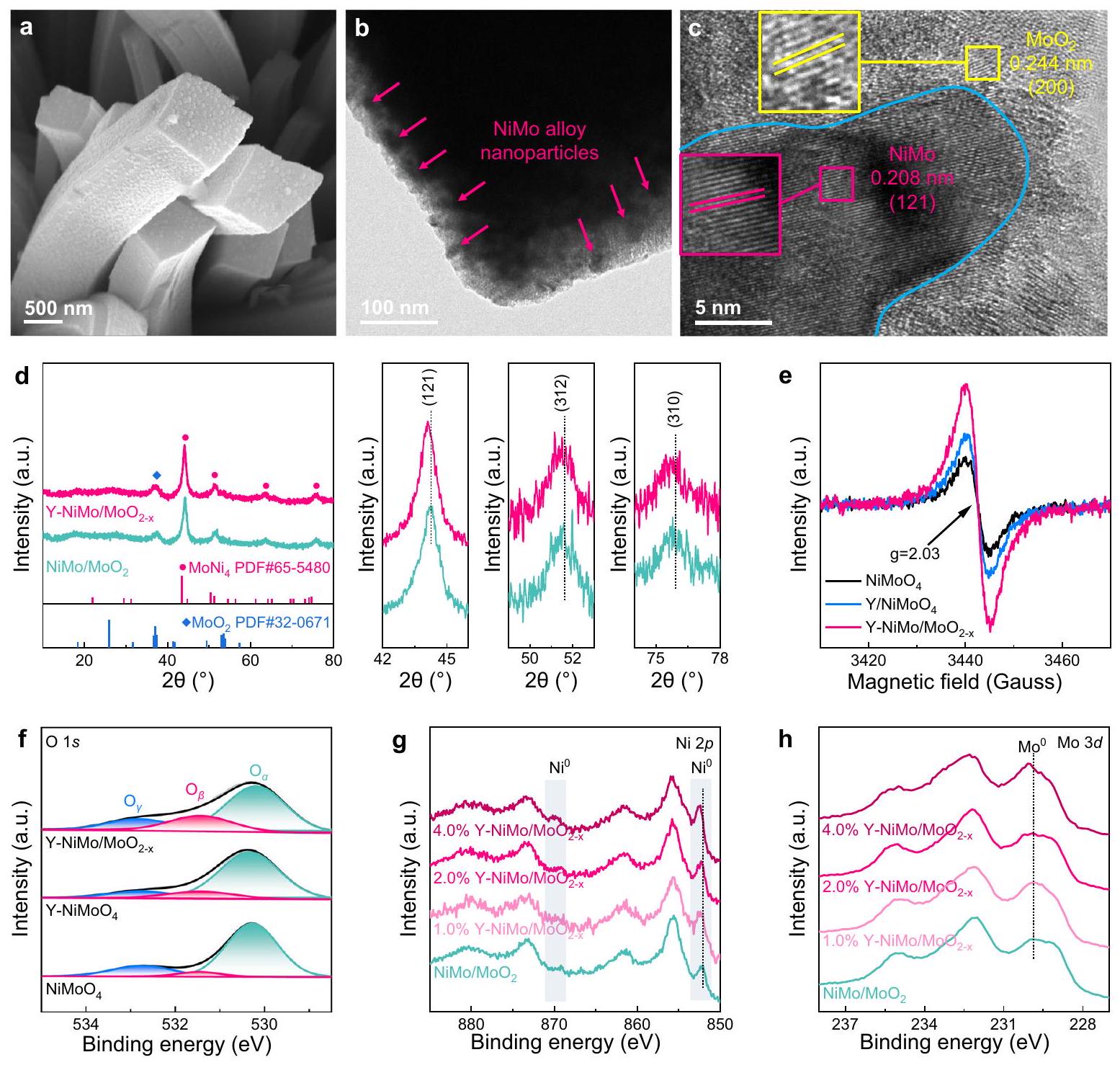
المخلوط باليترومتم تصنيع المحفزات الكهروكيميائية ذات الهيكل غير المتجانس بهدف تعديل التركيب الإلكتروني لسبائك النيكل والموليبدينوم وتركيز فراغات الأكسجين فيالمخلوط باليتروم (المشار إليه بـ Y- تم زراعته أولاً على NF عبر طريقة هيدروحرارية ثم تم تحويله إلى مادة مشوبة باليتروم. (المشار إليه بـ محفزات الهيكل غير المتجانس من خلال تفاعل الاختزال (الشكل التكميلي 1)تم تقييم تأثير إضافة الإيتريوم على هيكل المحفز من خلال ضبط العنصرنسب المولات. تظهر تقنية المجهر الإلكتروني الماسح (SEM) التوصيف (نسبة مولات Y: Ni ) نانو القضبان ذات السطح الأملس نمت عمودياً على NF (الشكل التكميلي 2). لم تُلاحظ تغييرات شكلية كبيرة في المورفولوجيا المجهرية لـ مقارنةً بالبيئة النقية . بعد العلاج في فيفي جو تقليل، احتفظ Y-NiMo/MoO2-x بشكل النانورود، لكن السطح أصبح أكثر خشونة بشكل ملحوظ كما هو موضح في الشكل 1a.
تظهر تقنية المجهر الإلكتروني الناقل (TEM) نقاطًا سوداء علىسطح في Y –الذي يمكن أن يُنسب إلى جزيئات نانوية من سبائك النيكل والموليبدينوم (الشكل 1ب). المسافة الشبكية لـ و تتوافق مع المستويات (200) و (121)ومكونات NiMo، على التوالي (الشكل 1c). كلا المسافات الشبكية أكبر من تلك الخاصة بـفي المكونات المقابلة (الشكل التكميلي 4ب). بالإضافة إلى ذلك،تظهر الهيكلية غير المتجانسة هالة خافتة منتشرة في نمط SAED بعد إضافة اليورانيوم (الشكل التكميلي 5)، مما يشير إلى تراجع نسبي في البلورية. وبالمثل، يتم ملاحظة نمط SEAD ضعيف أيضًا لـمقارنة بـ (الشكل التوضيحي التكميلي 6c و6f). كما تظهر مطيافية الطاقة المشتتة (EDS) توزيعًا متجانسًا للعناصرو Y في الهيكل غير المتجانس (الأشكال التكميلية 7 و 8).
نمط حيود الأشعة السينية (XRD) لـمع وبدون إضافة الإيتريوم يظهر ثلاث انكسارات رئيسية عند، ، و ، والتي تتوافق مع مستويات (121)، (310)، (321)، و(312) من سبيكة نيكل-موليبدينوم (الشكل 1d) ذروة الانكسار الواسعة عنديتوافق بشكل أساسي مع ( طائرةمع المساهمات المحتملة من المستويات (200) و(111) و(202) بسبب المسافات الشبكية القريبةتظهر قمم XRD المكبرة في الشكل 1d تحولًا نحو منطقة الزاوية المنخفضة مع إضافة اليورانيوم، مما يشير إلى توسع تدريجي في الشبكة المقابلة. وذلك بسبب نصف القطر الأيوني لـلـ أكبر من ذلك لـ لـ و لـيمكن ملاحظة تمدد الشبكة بشكل متسق من خلال أنماط XRD لـ Y-نسب مولية مختلفة من Ni إلى Y:، و (الشكل التوضيحي 10). تزداد عرض قمم الانكسار تدريجياً مع زيادة محتوى اليوتروم وتصبح شدة هذه القمم أضعف، مما يشير إلى أن إدخال اليوتروم يؤدي إلى ضعف البلورية، وهو ما يتوافق مع ملاحظة TEM ومن المحتمل أن يكون بسبب زيادة العيوب الداخلية الناتجة عن إضافة اليوتروم.تؤكد مطيافية رامان أيضًا التطور الهيكلي للهياكل غير المتجانسة عند إدخال الإيتريوم. القمم المميزة عند 818.9 و 893.1 ويتوافق مع الاهتزازات وتظهر انزياحًا أزرق طفيفًا بعد إضافة الإيتريوم (الشكل التكميلي 11)، والذي يمكن أن يُعزى إلى تمدد الشبكة البلورية .
البنية الإلكترونية لـ، و يتم دراستها بشكل أعمق بواسطة مطيافية الرنين المغناطيسي الإلكتروني (EPR) ومطيافية الأشعة السينية للألكترونات (XPS). وجود فراغات الأكسجين ( ) يتم تأكيده بواسطة إشارة الذروة المكتشفة عند (الشكل 1e) . ال – نيمو/ تظهر الهيكلية غير المتجانسة أقوى إشارة EPR، مما يشير إلى زيادة تركيز فراغات الأكسجين مع إضافة اليورانيوم والتسخين بالهيدروجين.. الشكل. إذا يظهر دقة عاليةطيف XPS لـ، و Y ، حيث الإشارات الملحوظة ذات طاقات الربط ، و532.8 إلكترون فولت تُنسب إلى الأكسجين الشبكي ( )، أكسجين السطح ( ) ، وأنواع الأكسجين الأخرى المرتبطة بشكل ضعيف ( )، على التوالي باستخدام الطرق المقترحة من قبل جيانغ وآخرين للحصول على مناطق الذروة المفككة، يمكن تقدير محتوى فراغات الأكسجين بشكل أكبر ليكون. وبالتالي، فإن محتوى فراغات الأكسجين في الـ Y – عينة هي، متجاوزًا القيمة في (الجدول التكميلي 2). وهذا يشير إلى أن إدخال Y يزيد من تركيز . الـيزداد التركيز بشكل أكبر حتىفيعينات تم الحصول عليها عن طريق التلدين Y-في جو مختزللذلك، فإن الجمع بين تخديم الإيتريوم مع الاختزال يثبت أنه استراتيجية فعالة لزيادة تركيز فراغات الأكسجين.تُلخص الشكل التوضيحي الإضافي 14 تركيزات Vo التي تم تقييمها بواسطة طرق مختلفة والعينات. من الواضح أن تركيزات Vo المحسوبة من XPS وEPR تتبع نفس الاتجاه، مما يشير إلى أن إضافة الإيتريوم والتسخين بالهيدروجين فعّالان للغاية في إنتاج Vo. طيف XPS عالي الدقة لـ Ni (الشكل 1g) و Mo 3d (الشكل 1h) من Y-NiMo/MoO2-x توضح انتقالًا نحو طاقات ربط أعلى مع إضافة الإيتريوم. قد يؤدي الانتقال الملحوظ أيضًا إلى انتقال نحو الأسفل لـ -مركز النطاق لمكون سبيكة النيكل-الموليبدينومالقمة الأضعف
الشكل 1 | توصيف المواد. صورة SEM لـنانورودصورة TEM لـتم تمييز مواقع جزيئات نانو سبيكة النيكل والموليبدينوم باستخدام الأسهم. ج صورة HRTEM لـ. الحدود بين سبيكة النيكل والموليبدينوم وتُحدد المراحل بخط أزرق فاتح. أنماط XRD لـ NiMo/ و قياس EPR لـ، و Y – XPS عالي الدقة من، و موطيف لـمخلوط بنسب مختلفة من، و . شدة الـ Yيؤكد طيف XPS وجود محتوى منخفض من الإيتريوم في الهياكل غير المتجانسة (الشكل التكميلي 13b)، بما يتماشى مع ملاحظة TEM (الشكل التكميلي 8).
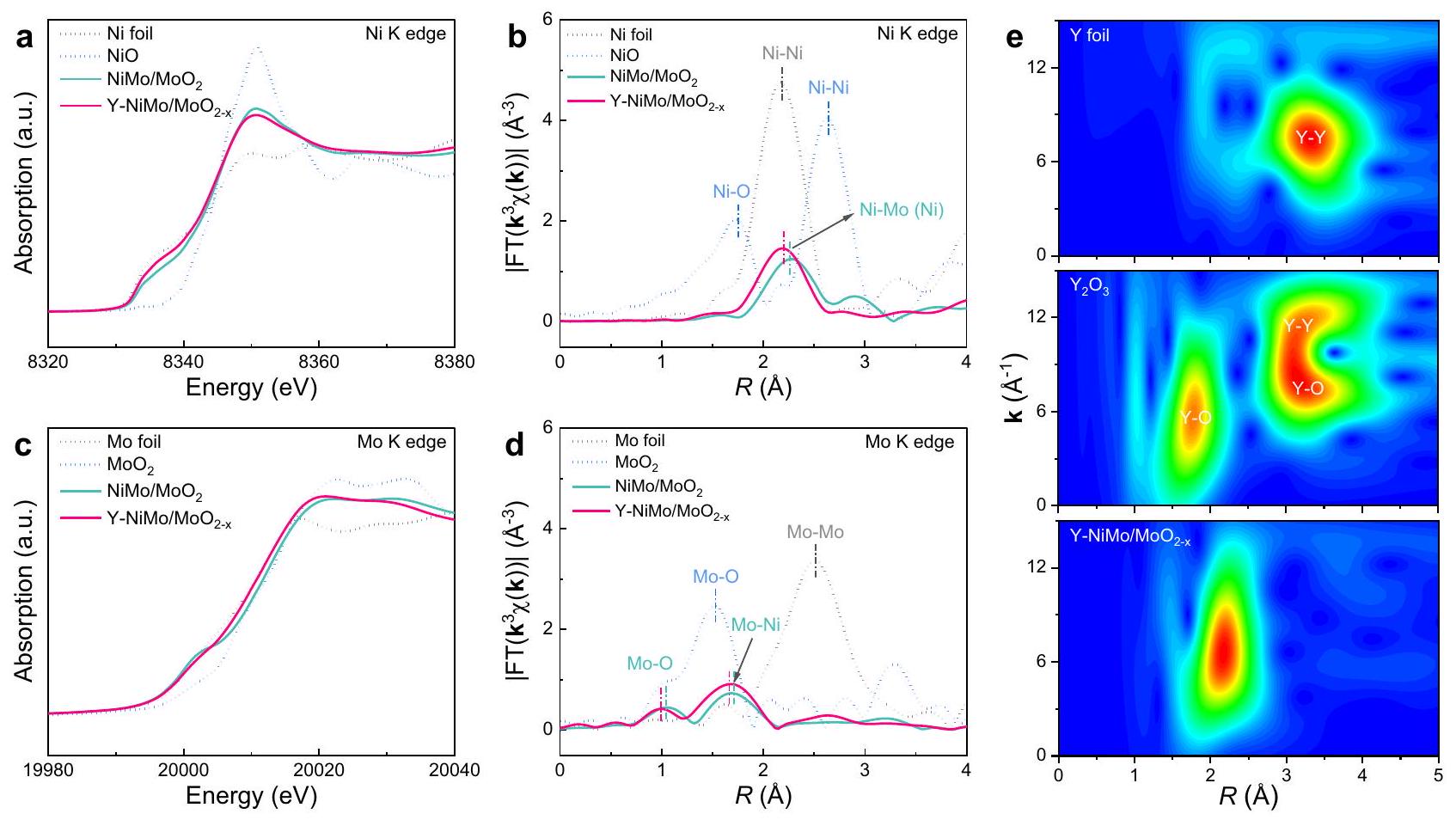
تم إجراء مطيافية امتصاص الأشعة السينية للتحقيق بشكل أعمق في تأثيرات إضافة الإيتريوم على الهيكل الإلكتروني وبيئة التنسيق لـالهياكل غير المتجانسة. الشكل 2أ يوضح طيف امتصاص الأشعة السينية بالقرب من حافة Ni K – و . للمقارنة، رقائق النيكل وتم قياس المراجع بنفس الطريقة. قمم ما قبل الحافة لـ و تتواجد بين تلك الخاصة برقائق النيكل ومرجع أكسيد النيكل وتظهر تشابهًا أكبر مع مرجع رقائق النيكل (الشكل 2أ). التحويل فورييه المقابلتظهر طيف الامتصاص الدقيق للأشعة السينية الممتد (EXAFS) المعزز بالوزن قمة سائدة حولالذي يُنسب إلىرابطة فيسبائك (الشكل 2ب). علاوة على ذلك، عندما يتم إدخال الإيتريوم في النظام، الموقع الذروي لـ (Ni) الروابط تتحول قليلاً إلى أطوال روابط أقصر. تشير هذه الانكماشات في الروابط إلى قوة أكبرالتفاعلات، التي من المتوقع أن تحسن استقرار المحفز. حافة مو ك
تكشف طيفيات XANES أن الحواف السابقة لـو Y – قريبة من تلك الخاصة بورق الموليبدينوم، على الرغم من أنها shifted قليلاً إلى طاقات أعلى بسبب وجودالطور (الشكل 2ج)من الجدير بالذكر أنه بعد إضافة الإيتريوم، تنتقل طيف امتصاص حافة النيكل وحافة الموليبدينوم إلى طاقات أقل مقارنةً بالعينة غير المخدرة.، مما يشير إلى انخفاض في متوسط حالات الأكسدة للنيكل وهذا الانخفاض في حالات الأكسدة يعزز الطابع المعدني لـالعامل المساعد ويسهل نقل الإلكترونات بشكل أسرع خلال العمليات الحفزية. كما هو موضح في تحويل فورييه-طيف EXAFS الموزون عند حافة Mo K (الشكل 2d)،الهياكل غير المتجانسة، سواء قبل أو بعد إضافة اليورانيوم، تظهر الروابط المرتبطة بمرحلة سبيكة النيكل-الموليبدينوم السندات المقابلة لـمرحلة. بعد إضافة الإيتريوم، يتم ملاحظة تقصير في طول الرابطة مرة أخرى، وهو ما يتماشى مع تقصير الـالرابطة، مما يدعم بشكل أكبر الاستنتاج بأن التلاعب باليتروم يقوي التفاعلات الرابطة ويزيد من الاستقرار الهيكلي للمحفز. تشير XANES عند حافة Y K إلى أن قمة ما قبل الحافة يقع بين تلك الخاصة بورق اليو (الشكل التوضيحي الإضافي 15)،
الشكل 2 | تحليل هيكل الإلكترون وبيئة التنسيق. حافة النيكل K (أ) XANES و-طيف EXAFS الموزون لرقائق النيكل، NiO، NiMo/MoO2 ويمثل المسافة الشعاعية. حافة مو ك زانيس و – طيف EXAFS الموزون لرقائق الموليبدينوم و . e k مخططات تحويلات الموجات المتوسطة EXAFS الموزونة لرقائق Y،، و و تمثل المسافة الشعاعية ومتجه الموجة، على التوالي. مؤشرًا على حالة التكافؤ لـ Y في Y –يَكْمُنُ بَيْنَ و . بالإضافة إلى ذلك، تم إجراء ملاءمة EXAFS المعتمدة على النموذج علىرقائق، و (الشكل التوضيحي 16 والجدول التوضيحي 4). في الـ-طيف الفضاء لـالقمة الرئيسية عند حوالييتوافق معرابطة، بينما الذروة عند حوالي. يُنسب إلى رابطة. هذا يشير إلى أن ذرات الإيتريوم فيتنسيق مع ذرات المعدن في سبيكة النيكل والموليبدينوم وذرات الأكسجين فيتقدم الشكل 2e تحويل الموجات عالية الدقة EXAFS في كلا من-فضاء و-الفضاء، مع التشتت الرئيسي عند و الموافق لـرابطة. علاوة على ذلك، لا يوجد تشتت يتوافق معسندات و يلاحظ، كما هو موضح في ورقة Y. تؤكد هذه الغياب أن ذرات الإيتريوم موزعة بشكل موحد داخلالهياكل غير المتجانسة دون تشكيل تكتلات.
أداء التحفيز الكهربائي لتفاعل الهيدروجين
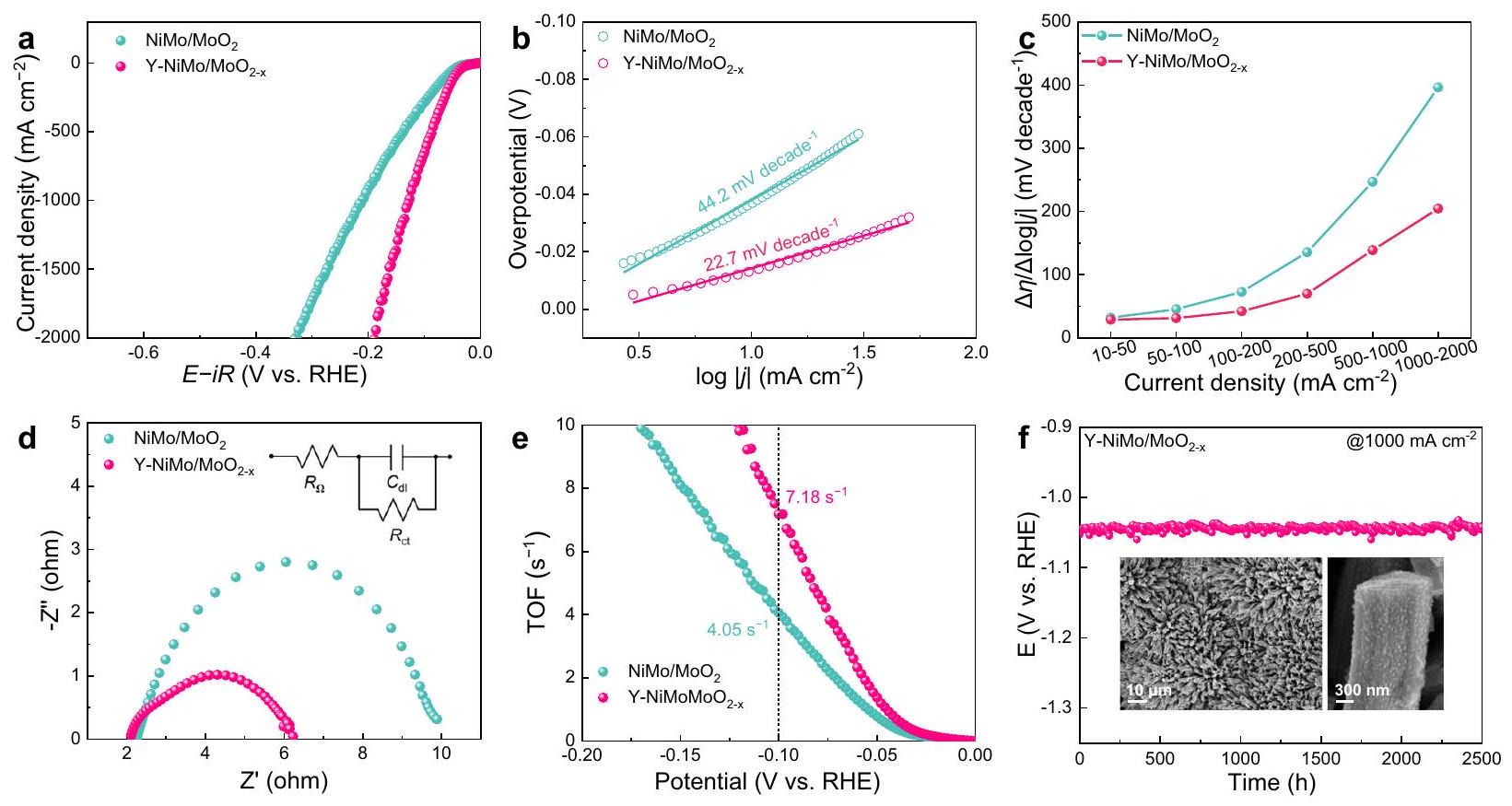
تم تقييم الأداء الكهروكيميائي لتفاعل تقليل الهيدروجين (HER) في المحاليل القلوية.باستخدام تكوين خلية ثلاثية الأقطاب مع المحفزات الكهروكيميائية المعدة على دعم NF،القطب الكهربائي، وقضيب جرافيت بقطر 3 مم كقطب عمل، وقطب مرجعي، وقطب مضاد، على التوالي. تأثير معلمات التخليق بما في ذلك تركيز تشويب الإيتريوم، ودرجة حرارة التلدين، ومدة التلدين علىكما هو موضح في الشكل التكميلي 18. تشير النتائج إلى أن الهيكل غير المتجانس مع نسبة تشويب من الإيتريوم (تمت معالجته في لمدة 30 دقيقة ) هو الأكثر نشاطًا بالنسبة لها. لذلك، فإن هذه الهيكلية غير المتجانسة (المعروفة باسم Y ) تم استخدامه للنقاش أدناه دون بيان خاص. الشكل 3أ يعرض منحنيات الاستقطاب للأقطاب الكهربائية المحضرة عبر الفولتمترية ذات المسح الخطي بمعدل مسح معتعويض iR. الواي – تظهر القطب الكهربائي فروقات جهد صغيرة جداً تبلغ 18 مللي فولت و47 مللي فولت عند كثافات تيار و ، على التوالي، والتي هي أقل بمقدار 9 مللي فولت و 16 مللي فولت من القيم التي تم الحصول عليها لـ القطب الكهربائي. هذه دليل واضح على التأثير الكبير لتطعيم الإيتريوم في تعزيز
نشاطها. ومن الجدير بالذكر أن القطب Y-NiMo/MoO2-x يظهر فواتير جهد منخفضة بشكل مثير للإعجاب تبلغ 129 مللي فولت و 189 مللي فولت لتحقيق كثافات تيار عالية من و ، على التوالي. بالمقابل، يتطلب القطب الكهربائي جهدًا أكبر بمقدار 83 مللي فولت و 141 مللي فولت لتوصيل نفس كثافات التيار. يُعزى النشاط الملحوظ الذي تم تحقيقه عند كثافات تيار عالية بشكل أساسي إلى شكل النانورود مع السطح الخشن الذي نما على رغوة النيكل ثلاثية الأبعاد (3D). لا يزيد هذا الشكل فقط من المساحة السطحية النشطة لتسريع نقل الإلكترونات والمواد المتفاعلة، بل يسهل أيضًا الإفراج السريع عن فقاعات الغاز تحت تحميل تيار عالي، مما يعزز الأداء الكهروكيميائي.. بالإضافة إلى ذلك، تلعب خصائص ترطيب أسطح المحفز دورًا حاسمًا في نقل الكتلة، خاصة عند كثافات التيار العالية. تم إجراء قياسات زاوية الاتصال لتقييم المحبة للماء لـ، و الأقطاب الكهربائية. كما هو موضح في الشكل التوضيحي 22، الـتظهر الهيكلية غير المتجانسة زيادة ملحوظة في المحبة للماء مقارنة بالطبيعة الكارهة للماء لركيزة رغوة النيكل. مع مزيد من إضافة اليورانيوم،يظهر المحفز امتصاصًا شبه فوري للإلكتروليت خلال 60 مللي ثانية، مما يدل على قدراته الاستثنائية في نقل الكتلة. الجدول التكميلي 5 يقارن الفائض المحتمل الذي تم الحصول عليه لـوأحدث المحفزات الكهربائية المتطورة لتفاعل الهيدروجين القلوي عند كثافات تيار تبلغ 500 والجدول التكميلي 6 يقارن الأداءات الكهروكيميائية لـومؤخراً تم تطوير محفزات كهربائية قلوية لتفاعل الهيدروجين مع استراتيجيات تخديم متنوعة.القطب الكهربائي في هذه الدراسة يقدم نشاطًا عاليًا خاصة عند كثافات تيار عالية في محلول 1 م كوه. نسبةإلىتم الكشف عن المنتجات لتكون حوالي، قريب من القيمة النظرية، مما يشير إلى كفاءة فاراداي قريبة من الواحد (الشكل التكميلي 23). يتم دراسة الحركيات الكهروكيميائية والنشاط الداخلي لتفاعل تقليل الهيدروجين من خلال الميل Tafel المقابل المستخرج من منحنيات استقطاب تفاعل تقليل الهيدروجين (الشكل 3b). Y-NiMo/ تظهر القطب الكهربائي ميل تافل صغير قدره 22.7 مللي فولت لكل عقدةأقل من 44.2 مللي فولت لكل عقد
الشكل 3 | التوصيف الكهروكيميائي. أ منحنيات الاستقطاب لـ و أقطاب كهربائية فيمخططات تافل المقابلة لها،نسبة عند كثافات تيار مختلفة، مخططات نايكويست من قياسات الطيف الكهروكيميائي (الإطار يظهر المعادل دوائر). e منحنيات TOF المحسوبة. الخط المنقط الأسود يمثل جهدًا قدره -0.1 فولت مقابل RHE. f اختبار الاستقرار لـفيفي 1 م كوه. يظهر الإدراج صور SEM لـبعد اختبار المتانة. تم الاستحواذ عليه من أجلالقطب الكهربائي. وبالتالي، تتبع حركية تفاعل الهيدروجين (HER) آلية فولمر-تافل كخطوة محددة للسرعة (RDS) على سطح الـالقطب. بالمقابل، فإن RDS لـيُنسب كل قطب كهربائي بشكل منفصل إلى مسار هيروفسكي. وهذا يشير إلى أن إضافة الإيتريوم تسرع تفاعل تقليل الهيدروجين.السطح. لتقييم أداء HER بشكل أكبر،تم رسم النسبة مقابل كثافة التيار لكل من القطبين لمقارنة الفائض المحتمل المطلوب مع زيادة كثافة التيار في نطاق واسع (الشكل 3c). مع زيادة كثافة التيار، فإن Y –القطب الكهربائي يحافظ على قيمة صغيرة مننسبة، في حين يمكن ملاحظة زيادة ملحوظة لـ NiMo/القطب عندما تتجاوز كثافة التيار. هذا يؤكد الكفاءة الأعلى في التحفيز الكهربائي لـالقطب عند كثافات تيار عالية.
تم إجراء طيف الامتياز الكهربائي الكيميائي (EIS) للتحقيق في نقل الشحنة عند واجهة القطب/الالكتروليت. الشكل 3d يقارن بين مخططات نايكويست لـ و الأقطاب عند -0.2 فولت (مقابل RHE). يتم ملاءمة مخططات نايكويست بواسطة دائرة مكافئة بسيطة (انظر الشكل المرفق)، حيث المقاومة ( ) يرمز إلى المقاومة الداخلية لنظام الإلكتروليت والقطب الكهربائي، ويمثل الدائرة المتوازية RC نقل الشحنة عبر واجهة القطب الكهربائي/الإلكتروليت ( ) وسعة طبقة مزدوجة مقابلة ( لأخذ الخصائص السطحية في الاعتبار. الـالقطب الكهربائي يظهر أصغرمنإلكترود ) في الجدول التكميلي 8. تردد الدوران (TOF) لـ Y – يتم حساب القطب الكهربائي ليكونعند جهد زائد قدره 100 مللي فولت، وهو أعلى من ذلك لـلـ (الشكل 3e). إدخال الإيتريوم في يظهر أن الهيكل غير المتجانس يزيد من المساحة السطحية الكهروكيميائية (ECSA) من 9.9 إلى (الشكل التوضيحي التكميلي 26)، مما يشير إلى وجود مواقع إضافية نشطة كيميائيًا. يُعزى التحسن في ECSA إلى حقيقة أن المواد المضافة من الإيتريوم تمنع تكتل نانورود وتعزيز نمو موحد وكثيف للنانورودات على ركيزة NF ثلاثية الأبعاد (مكمل)
الشكل 3). تم إجراء الكرونو بوتنشيومترية على المدى الطويل عند كثافة تيار عالية منيشير إلى أداء مستقر لمدة 2500 ساعة (الشكل 3f)، مما يوضح الاستقرار القوي لـ Y-NiMo/القطب الكهربائي في ظروف كثافة تيار عالية وملاءمته للتطبيقات العملية. لم يُلاحظ أي تغيير واضح في الشكل عبر الصور المجهرية الإلكترونية المقابلة، وتم الحفاظ على هيكل القضيب النانوي الملفوف بإحكام حول NF بعد اختبار الاستقرار على المدى الطويل (الإطار في الشكل 3f). بالإضافة إلى ذلك، مقارنةً بمحفز NiMo، الذي أظهر زيادة قدرها 55 مللي فولت في الجهد الزائد بعد 500 ساعة من التشغيل في، الـأظهر المحفز زيادة قدرها 22 مللي فولت فقط بعد 2500 ساعة تحت نفس الظروف (الشكل التوضيحي 27). يُعزى هذا الاستقرار المحسن بشكل أساسي إلى النمو المتجانس والكثيف للأنابيب النانوية على ركيزة NF بعد إضافة اليورانيوم، مما يساعد في الحفاظ على السلامة الهيكلية تحت الظروف القاسية لعملية التحليل الكهربائي بكثافة تيار عالية. تشير تحليلات XPS الإضافية إلى أن انخفاض النشاط التحفيزي بعد اختبار الاستقرار المطول يرجع بشكل رئيسي إلى الأكسدة التدريجية لسبيكة NiMo السطحية (الشكل التوضيحي 28a، b).. ومع ذلك، فإن الزيادة في عدد فراغات الأكسجين مع مرور الوقت تكشف عن مواقع نشطة إضافية، مما قد يعوض عن تدهور مواقع السبائك ويحافظ على النشاط طويل الأمد للمحفز (الشكل التوضيحي 28c).
رؤى حول الآلية الأساسية لـ HER
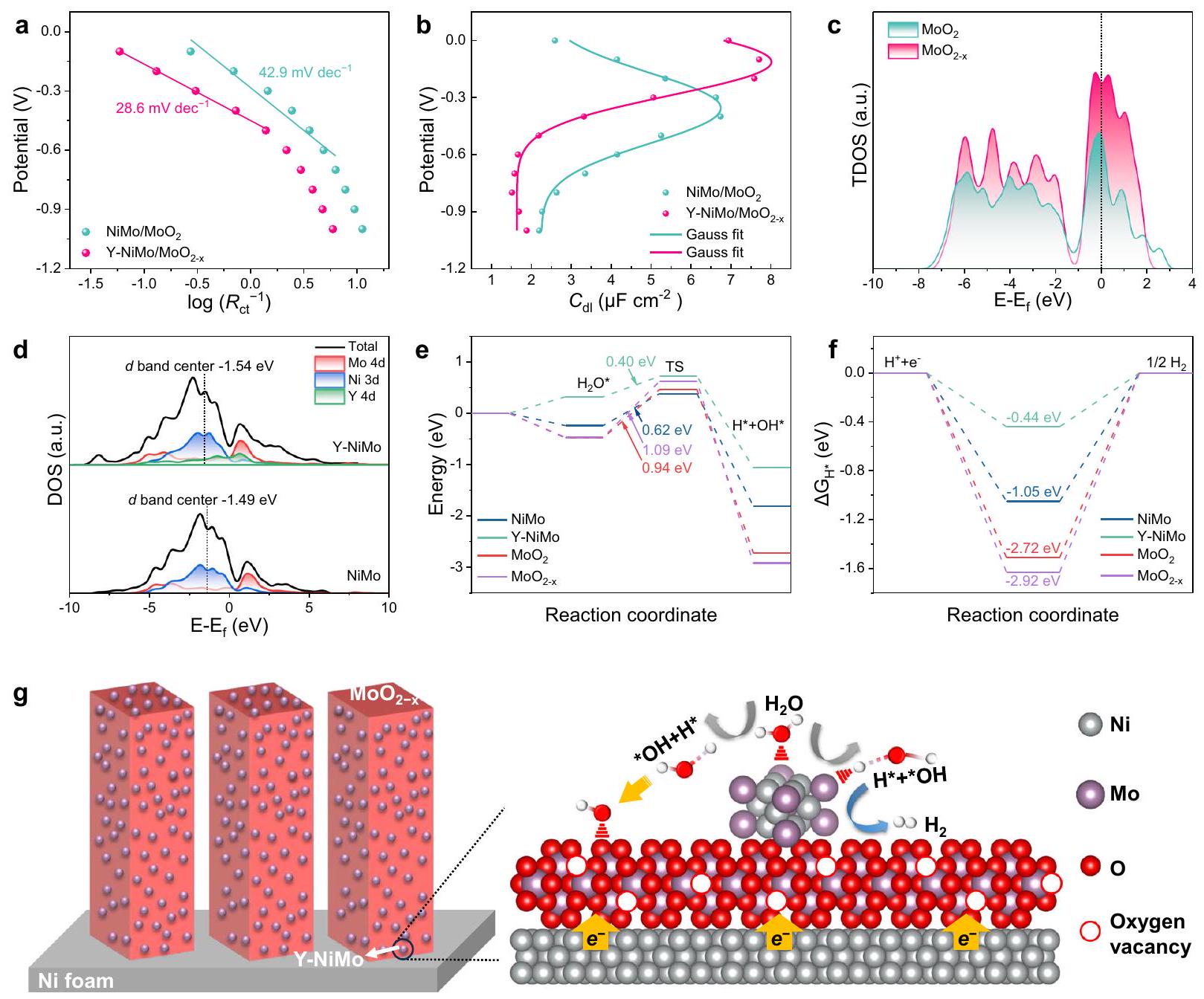
الشكل التكميلية 29 يعرض مخططات نايكويست ومخططات بود المقابلة لـ و الأقطاب الكهربائية على نطاق جهد من 0 إلى -1.0 فولت (مقابل RHE). تسرد الجداول التكميلية 10 و 11 المعلمات التي تم الحصول عليها بما في ذلك مقاومة نقل الشحنة على الواجهة ( ) وسعة الطبقة المزدوجة المقابلة ( ). الشكل 4أ يشير إلى تغير ضد الجهد المحتمل المطبق على القطب. الميل الذي تم الحصول عليه تحت الاستقطاب لـ Y-NiMo/القطب الكهربائي هو 28.6 مللي فولت لكل عقدةالذي هو أصغر من ذلك منإلكترودعقدويشير إلى الانتقال في حركياتها من آلية فولمر-هيدروفكسي إلى آلية فولمر-تافل مع
الشكل 4 | الحساب المرتبط. أ. تغيرمع الجهد المطبق على القطبالمُستَحَصل عليهكنتيجة لإمكانية لـو Y – مقاومة نقل الشحنةوسعة الطبقة المزدوجة يتم الحصول عليها من قياسات طيف الامتياز الكهربائي. ج تمثل الرسوم البيانية لكثافة الحالات الكلية (TDOS) لـ و و ال تم حساب كثافة حالات الإسقاط لـ NiMo و Y-NiMo من حسابات DFT.رسم توضيحي لمخطط الطاقات الحرة لخطوة فولمر ومخطط الطاقات الحرة لـالامتزاز. الرسم التخطيطي لـكعامل حفاز فعال لتحليل الماء في وسط قلوي. تطعيم اليتريومالهياكل غير المتجانسة. تتفق هذه الملاحظة جيدًا مع RDS المحدد من منحنيات الاستقطاب (الشكل 4ب). تأثير إضافة الإيتريوم على الامتصاص وإزالة الامتصاص للوسائط التفاعلية (مثل، و على سطحيتم تحليلها بشكل أعمق باستخدام سعة الطبقة المزدوجة المستمدة من قياسات EISالشكل 4ب يوضح تغيرضد الجهد المطبق علىو Yالأقطاب الكهربائية. الـتظهر القيم توزيعًا غاوسيًا مميزًا لكل من الأقطاب، مما يشير إلى انتقال بين السعة الزائفة المشغولة وغير المشغولة على سطح القطب.. ال- نيمو/ electrode يظهر ذروة في عند جهد أقل مقارنة مع إلكترود. هذا يؤكد امتصاص الماء الميسر وتكوين وسائط تفاعل الهيدروجين.القطب عند جهد تشغيل منخفض، مما يؤكد تسارع حركية التفاعل.
تم حساب كثافة حالات الإلكترون (DOS) للهياكل غير المتجانسة المصنعة عبر نظرية الكثافة الوظيفية (DFT) للحصول على فهم أعمق لأصل تعديل حالة الإلكترون وضبط طاقة الربط المتوسطة من خلال إضافة اليورانيوم ووجود فراغات الأكسجين. تقدم الشكل التكميلي 31 النماذج الحاسوبية، التي تشمل المستوى (121) من سبيكة NiMo مع وبدون يورانيوم. التنشط، جنبًا إلى جنب مع الطائرة (ī11) منتتميز بوجود وغياب فراغات الأكسجين. الشكل 4c والشكل التكميلي 32 يعرضان الكثافة الإلكترونية المحسوبة لـ و تشير وفرة فراغات الأكسجين إلى كثافة حالة مشغولة مرتفعة في محيط مستوى فيرمي بالنسبة للحالة النقية.. وبناءً عليه، فإن الموصلية المعززة الغنية بعيوب الأكسجينيسهل نقل الشحنة خلالتقدم الشكل 4d الكثافة الجزئية للحالات لسبائك NiMo و Y-NiMo. جميع النماذج الهيكلية تظهر خصائص معدنية مع فجوات نطاق صفرية، مما يشير إلى موصلية كهربائية عالية. يتم توضيح التفاعل بين الممتز والمحفز المعدني بواسطة-نموذج مركز النطاق.-مركز النطاقتم حسابه بواسطة المعادلة التالية:، حيث هو الطاقة، و هو نظام التشغيل DOS. الـ-مركز نطاق الطاقة يتحول سلبًا من -1.49 إلى -1.54 إلكترون فولت عند إدخال الإيتريوم. بالإضافة إلى ذلك، توفر طيف الإلكترونات فوق البنفسجية (UPS) دليلًا مباشرًا على هذا التحول، حيث يظهر أن الحد الأقصى لنطاق التكافؤ يتحول من 2.94 إلى 3.31 إلكترون فولت عند إضافة الإيتريوم (الشكل التكميلي 33). كما هو موضح في الشكل التكميلي 34، يمكن إدراك التفاعلات الإلكترونية على أنها ارتباط بين حالات التكافؤ للمواد الممتصة ويحدد المعدن، موفراً الارتفاع إلى حالات الترابط والحالات المضادة للترابط. من الأهمية الخاصة هو موقع حالة المضاد للرابطة، المرتبط ارتباطًا وثيقًا بـ-مركز النطاق، الذي يلعب دورًا محوريًا في التحكم في قوة الامتزازيؤدي تشويب الإيتريوم إلى حدوث انزلاق نحو الأسفل لـ-مركز النطاق ويسهل تشكيل حالة مضادة للرابطة ذات الطاقة المنخفضة. وبالتالي، فإن انخفاض الامتصاص لـيفضل إنتاج الهيدروجين. بشكل عام، فإن التمدد الشبكي الناتج عن إضافة الإيتريوم يضبط -مركز نطاق NiMo السبائك، بينما تسهل الفراغات الأكسجينية المتولدة في الوقت نفسه نقل الإلكترونات أثناء عملية تقليل الهيدروجين.
نماذج الامتصاص الكيميائي للأنواع الوسيطة (على سبيل المثال،مفعل، و ) على ,Y – ، و تم تحسين الأسطح، وتم تقييم طاقات الامتزاز المقابلة من خلال حسابات DFT (الشكل التكميلي 35). يقدم الشكل 4e حاجز الطاقة الحركية المحسوب لتفكك الماء على NiMo، Y-NiMo،، و حاجز تفكك الماء لسبيكة نيكل-موليبدينوم (0.62 إلكترون فولت) أقل من ذلك لـ، مما يشير إلى أن مواقع NiMo أكثر ملاءمة لتفكك الماء بالكامل إلى و إن إدخال الإيتريوم يقلل الحاجز إلى 0.4 إلكترون فولت، مما يسرع بشكل فعال خطوة فولمر البطيئة في الوسط القلوي. بالإضافة إلى ذلك، فإن الطاقة الحرة لـالامتزاز هو وصف صالح آخر لتقييم النشاط الكهروتحفيزي تجاه تفاعل تقليل الهيدروجين في الوسط القلوي ويسمح بتحديد خطوة تحويل المنتج الناتج.الوسطاء إلىالمنتج. الـتم تقييم Y – NiMo عند -0.44 eV (الشكل 4f)، وهو أقل بكثير من NiMo.، مما يشير إلى سطح أكثر ملاءمة لعملية إزالة الأنواع الهيدروجينية المتولدة. طاقات الامتزاز لـ و على و كما يتم المقارنة (الشكل التوضيحي التكميلي 36). تم حساب طاقة امتصاص عالية (-2.72 إلكترون فولت) لـ *OH علىالسطح، الذي يزيد إلى -2.92 إلكترون فولت مع إدخال فراغات الأكسجين، مما يشير إلى أنيمكن أن تنقل *OH بفعالية لتخفيف تأثير الحجب. الشكل 4 ج يلخص العوامل الرئيسية التي تسهم في النشاط التحفيزي الممتاز والاستقرار لـ Y.المحفز. أولاً، يساهم تشويب الإيتريوم في تعزيز التوزيع المتساوي ونمو كثيف للنانورودات على ركيزة رغوة النيكل، مما يسهل النقل السريع للكتلة وإطلاق الفقاعات. ثانيًا، يقوم تشذيب الإيتريوم بضبط-مركز نطاق NiMo السبيكة، مما يسرع من تفكك الماء والتطور اللاحق لـالمتوسطات. ثالثًا، يقوم تشويب الإيتريوم بتعديل تركيز فراغات الأكسجين فيالذي لا يحسن فقط نقل الإلكترونات بكفاءة خلال عملية HER ولكن يعزز أيضًا إزالة *OH، مما يمنع تأثيرات الانسداد.
أداء التحليل الكهربائي للمياه البحرية بشكل عام
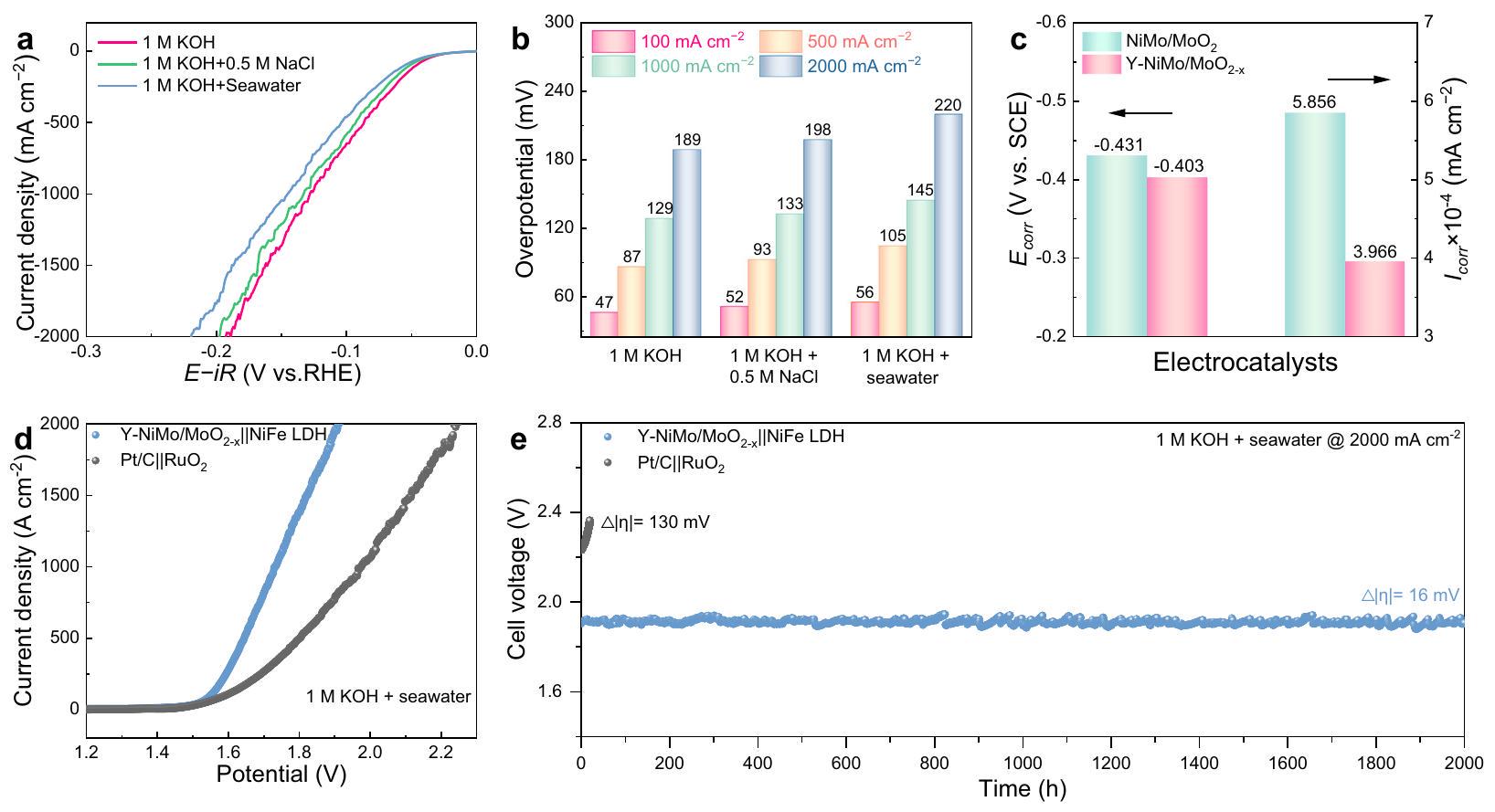
بالنظر إلى الأداء الملحوظ لـ HER من القطب الكهربائي في الإلكتروليت القلوي، يتم تقييم تطبيقه المحتمل في التحليل الكهربائي لمياه البحر بشكل أكبر. يعتبر التحليل الكهربائي لمياه البحر بديلاً جذابًا نظرًا لوفرة مياه البحر بالإضافة إلى توصيلها العالي وملوحتها.تم اختيار مياه البحر القلوية كإلكتروليت لما لها من مزايا على مياه البحر الطبيعية في عملية التحليل الكهربائي للماء. أولاً، تحتوي مياه البحر الطبيعية على تركيزات عالية من الكاتيونات الصلبة. و ) التي يمكن أن تشكل راسب على سطح المحفز وتسد المواقع النشطة. في بيئة قلوية، تترسب هذه الكاتيونات كـ و والتي يمكن إزالتها بسهولة (الشكل التوضيحي 37)ثانيًا، فإن تفاعل تطور الكلور في مياه البحر يكون أقل ملاءمة عند مستويات pH العالية بسبب وجود جهد زائد نظري أعلى، مما يقلل من تكوين الكلور والهيبوكلوريت عند كثافات التيار المرتفعة.. هنا، مياه البحر القلوية المحاكاة ( ) ومياه البحر القلوية الطبيعية ( 1 م كOH + مياه البحرتم اختيارها كإلكتروليتات لتقييم أداء الـالقطب في وجود أيونات الكلوريد التآكلية بالإضافة إلى التركيب الأيوني المعقد في مياه البحر الطبيعية. الشكل 5أ يقارن بين منحنيات الاستقطاب لـقطب كهربائي في الماء القلويمياه البحر القلوية المحاكاةومياه البحر القلوية الطبيعيةالمياه المالحة) الوسائط. لوحظت انخفاضات طفيفة في نشاط تفاعل تطور الهيدروجين في مياه البحر القلوية المحاكاة والطبيعية مقارنة بتلك الموجودة في الإلكتروليت القلوي النقي، والتي يمكن أن تُعزى إلىأيونات
الشكل 5 | أداء إنتاج الهيدروجين الكهروكيميائي. أ منحنيات الاستقطاب لـإلكترود في، و مياه البحر. ب مقارنة الجهد الزائد المطلوب لـ عند كثافات تيار تصل إلى ، و في إلكتروليتات مختلفة. ج و منو Y – العوامل المساعدة في مياه البحر الطبيعية. منحنيات الاستقطاب لتفكيك الماء بشكل عام للخلية الكهروكيميائية المعتمدة على و الأزواج فيمياه البحر. اختبار الاستقرار على المدى الطويل لـ Y-NiMo/ ||NiFe LDH و Pt/C||RuO2 أزواج في 1 ممياه البحر. الامتصاص على سطح القطب وتقليل نقل الشحنة البينية على المحفزالجهود الزائدة المطلوبة لـ Y-NiMo/إلكترود لتوصيل كثافات التيار من و في مياه البحر القلوية المحاكية، تكون القيم 52 و93 و133 و198 مللي فولت، على التوالي، وهي تقريبًا متطابقة مع تلك التي تم الحصول عليها في المياه القلوية (الشكل 5ب). إن نشاط تفاعل تطور الهيدروجين ممتاز حتى في مياه البحر القلوية الطبيعية المعقدة، ويقدم قطب Y-NiMo/MoO2-x كثافات تيار تبلغ 100 و500 و1000 و عند فواتير جهد صغيرة جداً تبلغ 56 و 105 و 145 و 220 مللي فولت، على التوالي، والتي هي أقل بكثير من تلك التي تم الحصول عليها للمواد الأصلية.القطب الكهربائي (الشكل التوضيحي 38). النشاط المحقق لتفاعل تطور الهيدروجينيتم مقارنة القطب في مياه البحر القلوية الطبيعية والمحاكاة مع المحفزات الكهربية التي تم الإبلاغ عنها مؤخرًا (الجدول التكميلي 13). Y-NiMo/تُعتبر حاليًا واحدة من أبرز المحفزات الكهربية القائمة على المعادن غير الثمينة لعملية التحليل الكهربائي للمياه المالحة القلوية. علاوة على ذلك، يتم دراسة سلوك التآكل للأقطاب الكهربائية خلال عملية التحليل الكهربائي للمياه المالحة. الشكل التوضيحي الإضافي 39 يعرض منحنيات الاستقطاب الديناميكي.و Y – الأقطاب تحت ظروف اختبار الجهد المفتوح في مياه البحر القلوية الطبيعية. باستخدام استقراء تافلكثافة تيار التآكل لـ Y-NiMo/يتم تحديد القطب الكهربائي على أنه مجرد، وهو أقل من لـالقطب الكهربائي (الشكل 5ج). وهذا يشير إلى أن إضافة الإيتريوم تعزز مقاومة التآكل للقطب الكهربائي الهيكلي. الحصول على جهد تآكل أعلى لـمقارنة بـيشير بشكل أكبر إلى زيادة المقاومة للتآكل في مياه البحر.
تم إنشاء تكوين ذو قطبين باستخدام Yككاثود وهيدروكسيدات النيكل والحديد المزدوجة (LDHs) كأنود لتقييم الأداء العام لتفكيك الماء في الظروف الطبيعية مياه البحر القلوية. للمقارنة، جهاز التحليل الكهربائي المصنوع من محفزات المعادن الثمينة المتاحة تجارياً مع Pt/C كالكاثود وكما يتم استخدام الأنود. كما هو موضح في الشكل 5d، الفولتية المطلوبة لـ Y-NiMo/MoO2-xمحلل NiFe LDHs لتوفير كثافات تيار من، و هم، و 1.91 فولت، على التوالي، أقل بكثير من تلك التي تم الحصول عليها لـمحلل كهربائي، و 2.24 فولت، على التوالي). متانة LDHs و تمت دراسة المحللات الكهربائية أيضًا في مياه البحر القلوية الطبيعية. Y-NiMo/يظهر جهاز التحليل الكهربائي LDHs استقرارًا قابلًا للمقارنة دون تدهور ملحوظ لأكثر من 2000 ساعة عند كثافة تيار عالية من (الشكل 5e). على النقيض، فإن Pt/C يظهر المحلل الكهربائي انحرافًا في الجهد قدره 130 مللي فولت بعد 20 ساعة فقط من التشغيل.
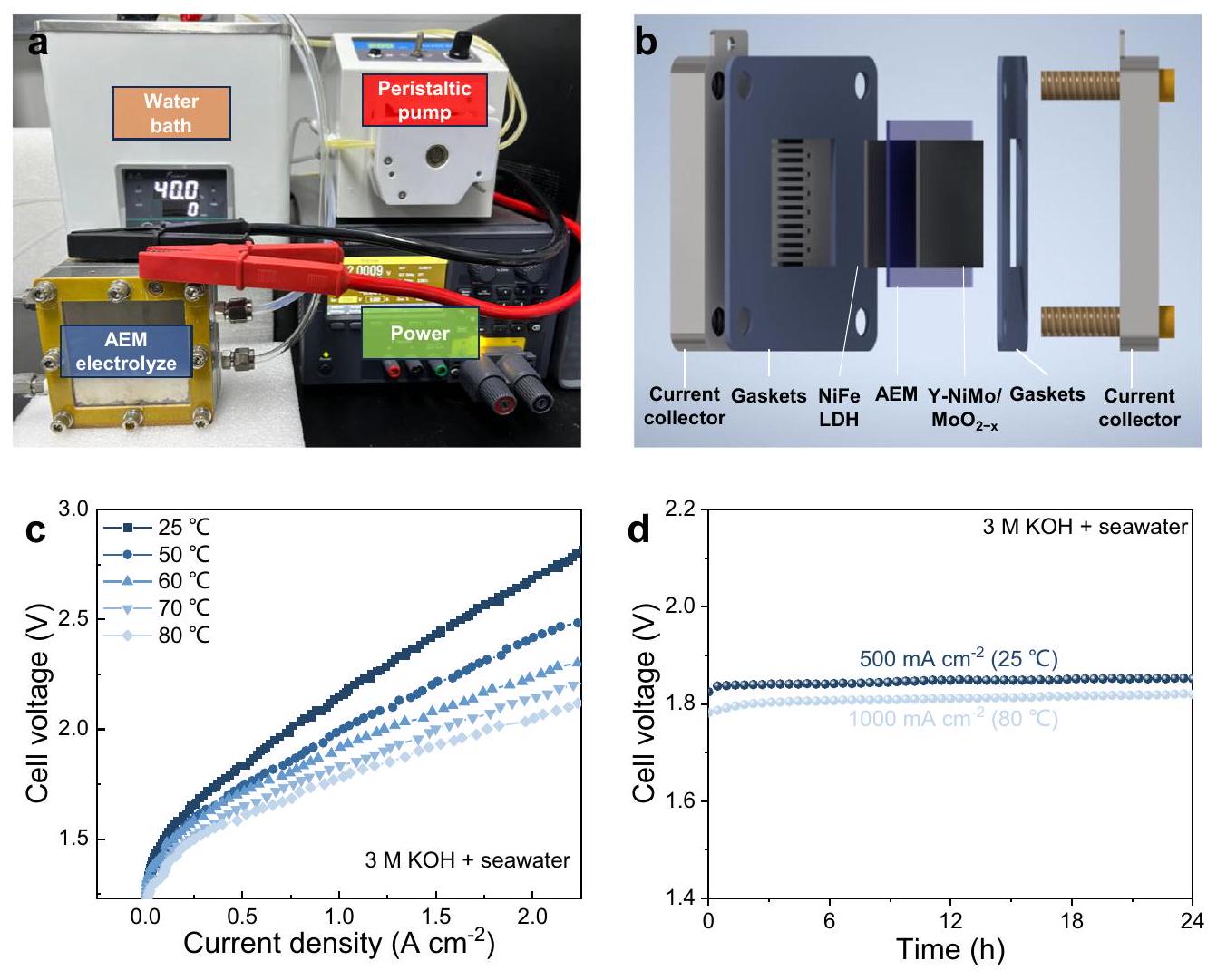
تم بناء جهاز تحليل كهربائي للبحرية القلوية الطبيعية مع تجميع غشاء الكهروضوئي كما هو موضح في الشكل 6a لتقييم الأداء والمتانة بشكل أكبر.الهياكل غير المتجانسة. يتكون جهاز التحليل الكهربائي AEM للمياه البحرية القلوية الطبيعية بشكل أساسي من مجمعات التيار الكاثودي والأنودي وحشوات، وطبقة محفز الكاثود ( )، غشاء تبادل الأنيونات (X37-50 درجة T)، وطبقة محفز الأنود (NiFe-LDHs) (الشكل 6b والشكل التكميلي 41). تسهل هذه الإعدادات فحص أداء المحفز الكهربي الهجين المُصنع في تكوين مشابه للتطبيقات العملية. في هذا الصدد، يتضمن توسيع نطاق المحفزات والأقطاب الكهربائية، بما في ذلك حجم المساحة الكبيرة لـ و يتم تنفيذ ذلك لخلية التحليل الكهربائي AEM للمياه البحرية القلوية الطبيعية (الأشكال التكميلية 42 و 43). توضح الشكل 6c النتائج التي تم الحصول عليها-منحنيات V من المحلل الكهربائي تحت درجات حرارة التحليل الكهربائي المتغيرة. يظهر المحلل الكهربائي أداءً استثنائيًا في تحليل الماء، حيث يتطلب فقط 1.78 فولت و 2.05 فولت من جهد الخلية لتحقيق كثافات تيار من و في مياه البحر القلوية الطبيعيةمياه البحر. هذا يبرز الارتفاع
الشكل 6 | أداء المحللات الكهربائية. أ الصورة لمحلل كهربائي منزلي من نوع AEM يعمل بالمياه المالحة القلوية الطبيعيةالمخطط التخطيطي المقابل.-منحنيات V لخلية التحليل الكهربائي AEM المحملة بـ Y-NiMo/MoO2-xNiFe LDH يعمل عند درجة حرارة مختلفة فيمياه البحر. د تم قياس متانة المحلل الكهربائي عند و فيمياه البحر. نشاط الـمحفز الهيكل غير المتجانس حتى تحت ظروف صناعية صارمة. كما أن النشاط العالي يقارن بشكل إيجابي مع معظم المحفزات الكهروكيميائية المعتمدة على المعادن غير الثمينة التي تم الإبلاغ عنها سابقًا والتي تم استخدامها في جهاز التحليل الكهربائي AEM (الجدول التكميلي 14). علاوة على ذلك، حافظ جهاز التحليل الكهربائي AEM في مياه البحر القلوية الطبيعية على تشغيل مستقر لمدة 24 ساعة عند كثافة تيار و (الشكل 6د)، مما يبرز متانته للتطبيقات الصناعية.
نقاش
تحسين تفكك الماء وامتصاص/إطلاق و المتوسطات في تفاعل الهيدروجين القلوي ضرورية لتطوير محفزات فعالة ومستقرة تحت ظروف التحليل الكهربائي ذات الكثافة الحالية العالية. في هذه الدراسة،تم تصميم الهيكل غير المتجانس مع إضافة الإيتريوم لتحقيق أداء عالي الكفاءة ودائم في تفاعل الهيدروجين القلوي عند كثافات تيار عالية. الإيتريوم المضاف لا يؤدي فقط إلى توسيع الشبكة البلورية لتعزيز تفكك الماء وتطور الـمتوسط إلىولكنه يعزز أيضًا تركيز فراغات الأكسجين فيمكون لتسريع إزالة الوسط *OH. يتم نقل وسائط *OH على الفور إلىمكون، في حين أنتتقدم الوسائط مع تطور الهيدروجين على سطح سبيكة نيكل-موليبدينوم. ونتيجة لذلك، فإن تسريع تفكك الماء على سبيكة نيكل-موليبدينوم ينتج و المتوسطات والهياكل غير المتجانسة معيسهل نقل شحنتها. وبالتالي، فإن المنتج المصنوعيمكن أن تظهر الهياكل غير المتجانسة أداءً متفوقًا في تفاعل تطور الهيدروجين في كل من المياه القلوية ومياه البحر تحت ظروف كثافة تيار عالية، وتفتح آفاقًا جديدة لتطوير محفزات كهربائية فعالة ومستقرة لتلبية الطلبات الصناعية المستقبلية.
طرق
المواد الكيميائية
رباعي هيدرات موليبدات الأمونيومنيترات النيكلوأكسيد الروثينيوم، تم شراء ( ) من شركة شنغهاي علاء الدين للتكنولوجيا الحيوية المحدودة. نترات الإيتريومهيدروكسيد البوتاسيوميوريافلوريد الأمونيومنترات المنغنيز، والبلاتين على الكربون (تم شراء ) من شركة شانغهاي ماكلين للتكنولوجيا الحيوية المحدودة. نترات الحديدونترات الكوبالتنترات الإيتريومتم شراءها من شركة شنغهاي تيتان للعلوم المحدودة. تم شراء رغوة النيكل (NF، 99.9%) من شركة كوانتشو يونزونغتشنغ للمواد الجديدة المحدودة. تم شراء نافيون 117 (5%) من شركة سيغما-ألدريتش. جميع المواد الكيميائية ذات نقاء تحليلي وتستخدم دون مزيد من التنقية.
تركيب – و – ني مو/ محفزات
لإعدادو 0.7415 جرامتم إذابتها في 60 مل من ماء ميلي-كيو وتم التحريك حتى تشكلت محلول متجانس.ثم أُضيفت بنسب مولارية مختلفة (، و بالنسبة لـ Ni )، وتم الإشارة إلى العينات المقابلة بـ و ي – ، على التوالي. الرغوة النيكل (تم تنظيفها بواسطة علاجات فوق صوتية متتابعة في حمض الهيدروكلوريك 3 م، وماء ميلي-كيو، والإيثانول لمدة 15 دقيقة لكل منها. ثم، تم نقل محلول السلف إلى وعاء ضغط من الفولاذ المقاوم للصدأ مبطن بتفلون سعة 100 مل مع قطعة من رغوة النيكل المنظفة للتفاعل فيلمدة 6 ساعات. تم غسل المحفز الناتج جيدًا بالماء المقطر والإيثانول وتجفيفه عندلمدة 12 ساعة. من أجل تخليق Y-NiMo/، الـتم تقليل السلف بواسطة التسخين في فرن أنبوبي تحتالغلاف الجويبمعدل انحداروتم عقده فيلمدة ساعتين.
تركيب Y-CoMo/و Y-MnMo/محفزات
للمقارنة، ي- و ي- تمت تخليقها باستخدام نهج مشابه. أو تم استخدامه بدلاً منكمقدمة معدنية للمواد الحفازة المعنية. تم غسل المقدمات الناتجة وتجفيفها، ثم تم تسخينها تحت نفس ظروف جو الهيدروجين كما هو موصوف لـي yield و محفزات.
تركيب محفز NiFe LDH
تم تخليق NiFe LDH عن طريق إذابة، ، و في 50 مل من ماء ميلي-كيو. تم غمر NF المنظف في محلول السلف وحدث تفاعل عندلمدة 4 ساعات. تم غسل المحفز NiFe LDH الناتج بشكل كامل بالماء المقطر والإيثانول وتجفيفه عندلمدة 12 ساعة.
تحضير Pt/C ومحفز على NF
تم تحميل Y-NiMo/MoO2-x على NF بكتلة تقريبية مناستنادًا إلى زيادة الوزن بعد التفاعل الهيدروحراري. للمقارنة، تم إعداد تعليق متجانس عن طريق توزيع 20 ملغ من محفز Pt/C التجاري في خليط يحتوي علىمننافيوين من الإيثانول، و من ماء ميلي-كيو. أتم تطبيق جزء من هذا المعلق على NF نظيف ثم تم تجفيفه في الهواء عند درجة حرارة الغرفة. المنتج التجاريتم تحميل المحفز على NF بنفس الطريقة التي تم بها تحميل محفز Pt/C.
توصيف
تم فحص الشكل الخارجي والتوزيع العنصري للعينات باستخدام المجهر الإلكتروني الماسح (SEM، ZEISS GeminiSEM 500) والمجهر الإلكتروني الناقل (TEM، JEOL-JEM 2100F) المرفق مع تحليل الطاقة الطيفية (EDS). تم تحليل التركيب البلوري وتركيب الطور بواسطة حيود الأشعة السينية (XRD، PANalytical X’pert PRO) معإشعاعتم تسجيل أطياف رامان على جهاز طيفي Horiba iHR320 باستخدامالليزر كمصدر للإثارة. تم تحديد التركيب الكيميائي وحالات السطح الإلكترونية بواسطة مطيافية الأشعة السينية للألكترونات (XPS، Thermo Scientific K-Alpha). تم إجراء مطيافية الرنين المغناطيسي الإلكتروني على جهاز Bruker A300 فيلكشف الإلكترونات غير المتزاوجة والأنواع البارامغناطيسية. تم تقييم قابلية رطوبة المحفزات من خلال قياسات زاوية الاتصال (CA) باستخدام جهاز Dataphysics OCA20. تم تحديد تركيبة مياه البحر عبر كروماتوغرافيا الأيونات (IC، Thermo Scientific Dionex Aquion). تم استخدام مطيافية الإلكترونات فوق البنفسجية (UPS، Shimadzu AXIS SUPRA+) لاستكشاف بنية الحزمة الإلكترونية للمواد. تم إجراء قياسات هيكل الامتصاص الدقيق للأشعة السينية (XAFS) في منشأة الإشعاع المتزامن في شنغهاي (الخط الشعاعي BL14W1، الصين) في وضع النقل لحواف Ni و Mo وفي وضع الفلورة لحافة Y. تم إجراء معالجة البيانات، بما في ذلك طرح الخلفية، والتطبيع، والتحويل فورييه، باستخدام حزمة البرمجيات ATHENA (الإصدار 0.9.26).تحليل تحويل الموجاتتم إجراء البيانات باستخدام كود هاما فورتران للحصول على رؤى هيكلية متقدمة.
القياسات الكهروكيميائية
تم إجراء التجارب الكهروكيميائية باستخدام محطة عمل Autolab (PGSTA302N) مزودة بوحدة BOOSTER10A في تكوين ثلاثي الأقطاب. تم استخدام إعداد ثلاثي الأقطاب، حيث تم تحضير المحفز (المساحة النشطة: ) تم استخدامه كالكاثود العامل، وقضيب جرافيت بقطر 3 مم كالكاثود المضاد، والقطب الكهربائي كقطب مرجعي. تم اختيار هذا التكوين لتوافقه مع الإلكتروليتات القلوية واستقرار الإشارة الموثوق. تم تحضير الإلكتروليت (1 م KOH) عن طريق إذابة 56.11 جرام من KOH في ماء ميلي-كيو لإعداد حجم إجمالي قدره 1000 مل، تلاه التخزين في PTFE. زجاجة لمنع التلوث. أظهرت المحلول درجة حموضةمعايرة الـتم إجراء قياس القطب المرجعي بالنسبة للقطب الهيدروجيني القابل للعكس (RHE) فيمحلول KOH 1 M المشبع. تم تحويل الجهد باستخدام المعادلة:. هنا،تم تحديده عبر الفولتمترية الدورية (CV) بمعدل مسحفي نطاق الجهد الكهروكيميائي للهيدروجين، باستخدام إلكترود من رقائق البلاتين.تم الحصول على القيمة كمتوسط لنقطتي التقاطع عند التيار الصفري على منحنى CV. تم إجراء جميع قياسات منحنيات الاستقطاب بعد 30 دورة تكييف CV. كانت منحنيات الاستقطاب الناتجة مصححة بتعويض iR.لأخذ مقاومة المحلول في الاعتبار. تم جمع بيانات EIS عبر نطاق تردد من 0.1 إلى“. في دراسات EIS في الموقع، تم تطبيق إمكانيات تتراوح من 0 إلى 1.0 فولت (مقابل RHE) تحت ظروف تردد متطابقة. سعة الطبقة الثنائية الكهربائية (تم تحديده عبر CV في نطاق جهد غير فاراداي. مقابل RHE) عند معدلات المسح لـ . الـتم الحصول على القيمة من ميل التناسب الخطي بين فرق كثافة التيار (ومعدل المسح باستخدام العلاقة:ثم تم تقدير المساحة السطحية النشطة كيميائيًا (ECSA) على النحو التالي:، حيث تم أخذه كـتم حساب TOF لتقييم النشاط الجوهري للمحفز باستخدام المعادلة:. هنا،هو كثافة التيار، هو مساحة القطب الكهربائي، هو ثابت فاراداي، و هو عدد مولات المادة الفعالة. الـ تم اشتقاق القيمة من الشحنة المتكاملة ( ) في الفولتمترات الدورية التي أجريت في محلول PBS بتركيز 1 م بمعدل مسح قدرهتم قياس الكفاءة فاراداي من خلال تحليل الغاز أثناء قياسات الجهد الزمني التي أجريت عند كثافة تيار ثابتة منفي 1 م KOH. تم إجراء قياسات TOF والكفاءة فاراداي وقياسات TOF مرة واحدة تحت ظروف تجريبية محكومة. تم الحصول على منحنيات استقطاب التآكل في مياه البحر الطبيعية لمحاكاة الظروف العملية. استخدمت قياسات قطب غليكولي مشبع كقطب مرجعي، مع غمر القطب العامل لضمان التعرض المستمر للوسط التآكلي.
قياسات إلكتروليزر AEM
تم تجميع جهاز التحليل الكهربائي AEM مع أنود (القطب السالب“، وغشاء تبادل الأنيونات (AEM، درجة X37-50، مواد ثنائي الأكسيد). أولاً، تم غمر غشاء AEM في 1 م KOH لمدة 24 ساعة قبل بناء إلكتروليزر AEM. Y-NiMo/وتم استخدام محفز NiFe LDH مع رغوة النيكل مباشرة كالكاثود والأنود، على التوالي، لبناءمحلل AEM من NiFe LDH. لا تتطلب عملية تجميع محلل AEM أي عمليات إضافية، مثل التسخين أو الضغط. ثم تم إجراء محلل AEM فيلمدة 5 دقائق للاستقرار. تم دراسة أداء إلكتروليزر AEM باستخدام جهاز قياس الجهد الثابت (E36154A، كيزايت) في مياه البحر القلوية الطبيعية.محلول إلكتروليتي من مياه البحر عند درجات حرارة مختلفة.
حساب DFT
تم استخدام حزمة فيينا لمحاكاة أب initio لإجراء حسابات DFTتمت معالجة تفاعلات التبادل-الارتباط من خلال تطبيق دالة بيردو-بورك-إرنزرهوف (PBE) ضمن التقريب العام للتدرج.تم استخدام إمكانيات الزيف لموجات مكبرة من المشروع (PAW) لتفاعلات الأيونات والإلكترونات، مع طاقة قطع لموجة مستوية قدرهاتم تحديد معايير التقارب إلىللطاقة الإلكترونية وللقوى الذرية. الأسطح الحفازة لسبائك نيكل-موليبدينوم، وسبائك نيكل-موليبدينوم المدعمة باليوروبيوم،، و مع فراغات الأكسجين تم نمذجتها، وامتصاص الماء والوسطاء ( و تم فحص ( ) في مواقع نشطة مختلفة من هذه المواد. تم تحسين هندسة الامتزاز، وتم حساب كثافة الحالة لكل محفز. تم حسابها للحصول على رؤى حول الهيكل الإلكتروني، وهو أمر أساسي لفهم خصائصها الحفازة. تم حساب طاقات الامتزاز للوسائط *OH و *H خلال عملية تقليل الهيدروجين في وسط قلوي باستخدام التعبير الديناميكي الحراري التالي:، حيث يمثل الطاقة المحسوبة بواسطة تحويل فورييه السريع، هو طاقة النقطة الصفرية المستمدة من التحليل الاهتزازي، و يأخذ في الاعتبار مساهمة الإنتروبيا. تم الحصول على تصحيحات الديناميكا الحرارية لجزيئات الطور الغازي من قواعد البيانات المرجعية القياسية.
توفر البيانات
البيانات التي تدعم نتائج هذه الدراسة متاحة ضمن المقال وملفات المعلومات التكميلية الخاصة به. جميع البيانات الأخرى متاحة من المؤلف المراسل عند الطلب. تم إيداع ملف بيانات المصدر في Figshare تحت رمز الوصولhttps://doi. org/10.6084/m9.figshare.27532875 .
References
Yu, Z. et al. Clean and affordable hydrogen fuel from alkaline water splitting: past, recent progress, and future prospects. Adv. Mater. 33, 2007100 (2021).
Zhu, J., Hu, L., Zhao, P., Lee, L. & Wong, K. Recent advances in electrocatalytic hydrogen evolution using nanoparticles. Chem. Rev. 120, 851-918 (2020).
Anantharaj, S. et al. Strategies and perspectives to catch the missing pieces in energy-efficient hydrogen evolution reaction in alkaline media. Angew. Chem. Int. Ed. 60, 18981-19006 (2021).
Jin, M. et al. Strategies for designing high-performance hydrogen evolution reaction electrocatalysts at large current densities above . ACS Nano 16, 11577-11597 (2022).
Zhao, T. et al. Cooperative boron and vanadium doping of nickel phosphides for hydrogen evolution in alkaline and anion exchange membrane water/seawater electrolyzers. Small 19, 2208076 (2023).
Xiao, X. et al. In situ growth of Ru nanoparticles on to boost hydrogen evolution activity at high current density in alkaline media. Small Methods 4, 1900796 (2020).
. et al. Breaking the symmetry of single-atom catalysts enables an extremely low energy barrier and high stability for large-current-density water splitting. Energy Environ. Sci. 15, 4048-4057 (2022).
Yao, R. et al. Stable hydrogen evolution reaction at high current densities via designing the Ni single atoms and Ru nanoparticles linked by carbon bridges. Nat. Commun. 15, 2218 (2024).
Sheng, W., Gasteiger, H. & Shao-Horn, Y. Hydrogen oxidation and evolution reaction kinetics on platinum: acid vs alkaline electrolytes. J. Electrochem. Soc. 157, B1529 (2010).
Strmcnik, D. et al. Improving the hydrogen oxidation reaction rate by promotion of hydroxyl adsorption. Nat. Chem. 5, 300-306 (2013).
Lao, M. et al. From fundamentals and theories to heterostructured electrocatalyst design: An in-depth understanding of alkaline hydrogen evolution reaction. Nano Energy 98, 107231 (2022).
Fajín, J., Cordeiro, M. & Gomes, J. Density functional theory study of the water dissociation on platinum surfaces: general trends. J. Phys. Chem. A 118, 5832-5840 (2014).
Trasatti, S. Work function, electronegativity, and electrochemical behaviour of metals: III. Electrolytic hydrogen evolution in acid solutions. J. Electroanal. Chem. Interfacial Electrochem. 39, 163-184 (1972).
Sabatier, P. Hydrogénations et déshydrogénations par catalyse. Ber. Dtsch. Chem. Ges. 44, 1984-2001 (1911).
Wang, J. et al. Non-precious-metal catalysts for alkaline water electrolysis: operando characterizations, theoretical calculations, and recent advances. Chem. Soc. Rev. 49, 9154-9196 (2020).
Wang, X. et al. Rationally modulating the functions of nanocomposite electrocatalysts towards enhanced hydrogen evolution reaction. Angew. Chem. Int. Ed. 62, e202301562 (2023).
Park, S., To, D. & Myung, N. A review of nickel-molybdenum based hydrogen evolution electrocatalysts from theory to experiment. Appl. Catal. A 651, 119013 (2023).
Nairan, A. et al. NiMo solid solution nanowire array electrodes for highly efficient hydrogen evolution reaction. Adv. Funct. Mater. 29, 1903747 (2019).
Song, J. et al. Phase-separated Mo-Ni alloy for hydrogen oxidation and evolution reactions with high activity and enhanced stability. Adv. Energy Mater. 11, 2003511 (2021).
Zhang, J. et al. Efficient hydrogen production on electrocatalysts with fast water dissociation kinetics. Nat. Commun. 8, 15437 (2017).
Westsson, E., Picken, S. & Koper, G. The effect of lattice strain on catalytic activity. Chem. Commun. 55, 1338-1341 (2019).
Sun, Y. et al. Strong electronic interaction in dual-cationincorporated nanosheets with lattice distortion for highly efficient overall water splitting. Adv. Mater. 30, 1802121 (2018).
Zhao, S. et al. Spontaneous formation of asymmetric oxygen vacancies in transition-metal-doped nanorods with improved activity for carbonyl sulfide hydrolysis. ACS Catal. 10, 11739-11750 (2020).
Xiao, Z. et al. Engineering oxygen vacancies and nickel dispersion on by Pr doping for highly stable ethanol steam reforming. Appl. Catal. B 258, 117940 (2019).
Huang, C. et al. Functional bimetal Co-modification for boosting large-current-density seawater electrolysis by inhibiting adsorption of chloride ions. Adv. Energy Mater. 13, 2301475 (2023).
Guo L. et al. Phosphorus defect mediated electron redistribution to boost anion exchange membrane-based alkaline seawater electrolysis. Adv. Energy Mater. 14, 2400975 (2024).
Sun, J. et al. Joule heating synthesis of well lattice-matched heterointerfaces with greatly improved hydrogen evolution reaction in alkaline seawater electrolysis with 12.4% STH efficiency. Appl. Catal. B 338, 123015 (2023).
Dastafkan, K., Shen, X., Hocking, R., Meyer, Q. & Zhao, C. Monometallic interphasic synergy via nano-hetero-interfacing for hydrogen evolution in alkaline electrolytes. Nat. Commun. 14, 547 (2023).
Chen, Y. et al. Self-templated fabrication of nanorod arrays with dual active components for highly efficient hydrogen evolution. Adv. Mater. 29, 1703311 (2017).
Wei, J. et al. High-efficient electrocatalyst of nanorod for hydrogen evolution reaction in alkaline solutions. J. Alloys Compd 876, 160152 (2021).
Yang, F. et al. A durable and efficient electrocatalyst for saline water splitting with current density exceeding . Adv. Funct. Mater. 31, 2010367 (2021).
Liu, S. et al. Promoting the hydrogen evolution reaction through oxygen vacancies and phase transformation engineering on layered double hydroxide nanosheets. J. Mater. Chem. A 8, 2490-2497 (2020).
Dury, F., Gaigneaux, E. & Ruiz, P. The active role of at low temperature in oxidation processes: the case of the oxidative dehydrogenation of propane on catalysts. Appl. Catal. A 242, 187-203 (2003).
Wang, Y. et al. Vanadium-incorporated with lattice expansion for highly efficient acidic overall water splitting. Angew. Chem. Int. Ed. 61, e202116233 (2022).
Wu, Z. et al. Conversion of catalytically inert 2D bismuth oxide nanosheets for effective electrochemical hydrogen evolution
reaction catalysis via oxygen vacancy concentration modulation. Nano-Micro Lett. 14, 90 (2022).
Lei, F. et al. Oxygen vacancies confined in ultrathin indium oxide porous sheets for promoted visible-light water splitting. J. Am. Chem. Soc. 136, 6826-6829 (2014).
Kang, Y. et al. Quasi-2D oxide with facilely activated basal planes for efficient evolution. Adv. Funct. Mater. 34, 2310674 (2024).
Jiang, F. et al. Insights into the influence of crystal facet on hydrogenation to methanol over catalysts. ACS Catal. 10, 11493-11509 (2020).
Yu, J. et al. Defect-rich electrocatalyst with ultrahigh stability and low overpotential for water oxidation. ACS Catal. 9, 1605-1611 (2019).
Liang, W. et al. Oxygen-vacancy-rich supported nickel as electrocatalysts to promote alkaline hydrogen evolution and oxidation reactions. Chem. Eng. J. 464, 142671 (2023).
Lu, B. et al. Structurally disordered phosphorus-doped Pt as a highly active electrocatalyst for an oxygen reduction reaction. ACS Catal. 11, 355-363 (2021).
Wang, K. et al. Cu-doped heterointerfaced Ru/RuSe nanosheets with optimized H and adsorption boost hydrogen evolution catalysis. Adv. Mater. 35, 2300980 (2023).
Kang, X. et al. A corrosion-resistant RuMoNi catalyst for efficient and long-lasting seawater oxidation and anion exchange membrane electrolyzer. Nat. Commun. 14, 3607 (2023).
Chen, G. et al. Yttrium- and nitrogen-doped NiCo phosphide nanosheets for high-efficiency water electrolysis. Carbon Energy 6, e522 (2024).
Wang, M. et al. Alloying nickel with molybdenum significantly accelerates alkaline hydrogen electrocatalysis. Angew. Chem. Int. Ed. 60, 5771-5777 (2021).
Duan, Y. et al. Bimetallic nickel-molybdenum/tungsten nanoalloys for high-efficiency hydrogen oxidation catalysis in alkaline electrolytes. Nat. Commun. 11, 4789 (2020).
Zhu, Y. et al. Facilitating alkaline hydrogen evolution reaction on the hetero-interfaced Ru/RuO2 through Pt single atoms doping. Nat. Commun. 15, 1447 (2024).
Zhang, R. et al. Single-atomic platinum on fullerene C60 surfaces for accelerated alkaline hydrogen evolution. Nat. Commun. 14, 2460 (2023).
Yu, L. et al. Non-noble metal-nitride based electrocatalysts for highperformance alkaline seawater electrolysis. Nat. Commun. 10, 5106 (2019).
Jothi, V. et al. Corrosion and alloy engineering in rational design of high current density electrodes for efficient water splitting. Adv. Energy Mater. 10, 1904020 (2020).
Jia, H. et al. Unravelling electrocatalytic concerted diatomicensembles over superior hydrogen-evolution array structured by heteronanojunctions. Appl. Catal. B 343, 123362 (2024).
Du, W., Shi, Y., Zhou, W., Yu, Y. & Zhang, B. Unveiling the in situ dissolution and polymerization of Mo in alloy for promoting the hydrogen evolution reaction. Angew. Chem. Int. Ed. 60, 7051-7055 (2021).
Liu, X. et al. Lattice strain with stabilized oxygen vacancies boosts ceria for robust alkaline hydrogen evolution outperforming benchmark Pt. Adv. Mater. 36, 2405970 (2024).
Doyle, R. & Lyons, M. Kinetics and mechanistic aspects of the oxygen evolution reaction at hydrous iron oxide films in base. J. Electrochem. Soc. 160, H142 (2013).
Su, H. et al. In-situ spectroscopic observation of dynamic-coupling oxygen on atomically dispersed iridium electrocatalyst for acidic water oxidation. Nat. Commun. 12, 6118 (2021).
Bertoluzzi, L., Lopez-Varo, P., Jiménez, Tejada, J. & Bisquert, J. Charge transfer processes at the semiconductor/electrolyte interface for solar fuel production: insight from impedance spectroscopy. J. Mater. Chem. A 4, 2873-2879 (2016).
Zhang, B., Jiang, Z., Shang, X., Li, S. & Jiang, Z. Accelerated hydrogen evolution reaction in tri-phase composites with rich crystalline interfaces and oxygen vacancies achieved by plasma assisted phosphorization. J. Mater. Chem. A 9, 25934-25943 (2021).
Du, H. et al. Durable electrocatalytic reduction of nitrate to ammonia over defective pseudobrookite nanofibers with abundant oxygen vacancies. Angew. Chem. Int. Ed. 62, e202215782 (2023).
Nørskov J., Studt F., Abild-Pedersen F., Bligaard T. Fundamental concepts in heterogeneous catalysis. in Fundamental Concepts in Heterogeneous Catalysis (Wiley, 2014).
Chen, Z. et al. Tailoring the d-Band centers enables nanosheets to be highly active for hydrogen evolution catalysis. Angew. Chem. Int. Ed. 57, 5076-5080 (2018).
Santos, E. & Schmickler, W. d-Band catalysis in electrochemistry. ChemPhysChem 7, 2282-2285 (2006).
Vojvodic, A. & Nørskov, J. Optimizing perovskites for the watersplitting reaction. Science 334, 1355-1356 (2011).
Liu, S., Ren, S., Gao, R., Liu, X. & Wang, L. Atomically embedded Ag on transition metal hydroxides triggers the lattice oxygen towards sustained seawater electrolysis. Nano Energy 98, 107212 (2022).
Jin, H. et al. Stable and highly efficient hydrogen evolution from seawater enabled by an unsaturated nickel surface nitride. Adv. Mater. 33, 2007508 (2021).
Tong, W. et al. Electrolysis of low-grade and saline surface water. Nat. Energy 5, 367-377 (2020).
Dresp, S., Dionigi, F., Klingenhof, M. & Strasser, P. Direct electrolytic splitting of seawater: opportunities and challenges. ACS Energy Lett. 4, 933-942 (2019).
McCafferty, E. Validation of corrosion rates measured by the Tafel extrapolation method. Corros. Sci. 47, 3202-3215 (2005).
Ravel, B. & Newville, M. ATHENA, ARTEMIS, HEPHAESTUS: data analysis for X-ray absorption spectroscopy using IFEFFIT. J. Synchrotron Radiat. 12, 537-541 (2005).
Funke, H., Scheinost, A. & Chukalina, M. Wavelet analysis of extended x-ray absorption fine structure data. Phys. Rev. B 71, 094110 (2005).
Liang, Y. et al. nanocrystals on graphene as a synergistic catalyst for oxygen reduction reaction. Nat. Mater. 10, 780-786 (2011).
Kresse, G. & Furthmüller, J. Efficiency of ab-initio total energy calculations for metals and semiconductors using a plane-wave basis set. Comput. Mater. Sci. 6, 15-50 (1996).
Perdew, J. P., Burke, K. & Ernzerhof, M. Generalized gradient approximation made simple. Phys. Rev. Lett. 77, 3865-3868 (1996).
Kresse, G. & Joubert, D. From ultrasoft pseudopotentials to the projector augmented-wave method. Phys. Rev. B 59, 1758-1775 (1999).
Liu S., Zhang Z., Dastafkan K., Shen Y., Wang M. Yttrium-dopped heterostructure electrocatalysts for hydrogen production from alkaline seawater. figshare, https://doi.org/10.6084/ m9.figshare. 27532875 (2024).
شكر وتقدير
يقر المؤلفون بالدعم من البرنامج الوطني الرئيسي للبحث والتطوير في الصين (2022YFB3803600)، ومؤسسة العلوم الطبيعية الوطنية في الصين (22372065)، وبرنامج البحث والتطوير الرئيسي في مقاطعة هوبى (2023BAB113) ومجلس الأبحاث الأسترالي (IC200100023، DP220103294). نشكر المهندس جون سو في مركز تصنيع وتوصيف الميكرو والنانو البصري، WNLO في HUST على الدعم في اختبارات SEM وTEM. كما نشكر المركز التحليلي والاختباري في HUST على المساعدة في القياسات.
مساهمات المؤلفين
M.W. و C.Z. و Y.S. أداروا مشروع البحث وأشرفوا على تصميم التجارب. S.L. وضعت الفكرة وأجرت معظم التجارب. Z.Z. ساهمت في حسابات المبادئ الأولى. S.L. و K.D. ساعدا في تحليل البيانات. S.L. و K.D. و Y.S. و C.Z. و M.W. كتبوا الورقة. ناقش جميع المؤلفين النتائج وعلقوا على المخطوطة.
يجب توجيه المراسلات والطلبات للحصول على المواد إلى يان شين، تشوان تشاو أو مينغكوي وانغ.
تُعرب مجلة Nature Communications عن شكرها لجينغوين ما، وهيروشي ساكاغوتشي، والمراجعين المجهولين الآخرين على مساهمتهم في مراجعة هذا العمل. يتوفر ملف مراجعة الأقران.
ملاحظة الناشر: تظل شركة سبرينغر ناتشر محايدة فيما يتعلق بالمطالبات القضائية في الخرائط المنشورة والانتماءات المؤسسية.
الوصول المفتوح. هذه المقالة مرخصة بموجب رخصة المشاع الإبداعي النسب-غير التجارية-عدم الاشتقاق 4.0 الدولية، والتي تسمح بأي استخدام غير تجاري، ومشاركة، وتوزيع، وإعادة إنتاج في أي وسيلة أو صيغة، طالما أنك تعطي الائتمان المناسب للمؤلفين الأصليين والمصدر، وتوفر رابطًا لرخصة المشاع الإبداعي، وتوضح إذا قمت بتعديل المادة المرخصة. ليس لديك إذن بموجب هذه الرخصة لمشاركة المواد المعدلة المشتقة من هذه المقالة أو أجزاء منها. الصور أو المواد الأخرى من طرف ثالث في هذه المقالة مشمولة في رخصة المشاع الإبداعي الخاصة بالمقالة، ما لم يُشار إلى خلاف ذلك في سطر الائتمان للمادة. إذا لم تكن المادة مشمولة في رخصة المشاع الإبداعي الخاصة بالمقالة وكان استخدامك المقصود غير مسموح به بموجب اللوائح القانونية أو يتجاوز الاستخدام المسموح به، ستحتاج إلى الحصول على إذن مباشرة من صاحب حقوق الطبع والنشر. لعرض نسخة من هذه الرخصة، قم بزيارة http:// creativecommons.org/licenses/by-nc-nd/4.0/.
(ج) المؤلفون 2025
Yttrium-doped NiMo-MoO2 heterostructure electrocatalysts for hydrogen production from alkaline seawater
Received: 24 July 2024
Accepted: 31 December 2024
Published online: 17 January 2025
Check for updates
Shujie Liu , Zhiguo Zhang , Kamran Dastafkan , Yan Shen ®, Chuan Zhao & Mingkui Wang ®
Active and stable electrocatalysts are essential for hydrogen production from alkaline water electrolysis. However, precisely controlling the interaction between electrocatalysts and reaction intermediates ( , and ) remains challenging. Here, we demonstrate an yttrium-doped NiMo-MoO2 heterogenous electrocatalyst that efficiently promotes water dissociation and accelerates the intermediate adsorption/desorption dynamics in alkaline electrolytes. Introducing yttrium into the heterostructure induces lattice expansion and optimizes the -band center of NiMo alloy component, enhancing water dissociation and desorption. Yttrium doping also increases the concentration of oxygen vacancies in , which in turn accelerates the charge kinetics and the swift evacuation of *OH intermediates from the active sites. Consequently, the Y-NiMo/MoO2-x heterostructure exhibits notable performance by requiring only 189 and 220 mV overpotentials to achieve current density of in alkaline water and seawater, respectively. This work provides a strategy to modulate heterostructure catalysts for scalable, economically viable hydrogen production from low-quality waters.
Water electrolysis is a promising process for harnessing renewable and sustainable energy sources and has emerged as a strategic pathway for the large-scale production and deployment of green hydrogen Among different water electrolysis technologies, alkaline water electrolysis has emerged as a leading technology for industrial-scale hydrogen production due to the simplicity of process design, relative technological maturity and low-cost operation Alkaline water electrolyzers (AWEs) provide a key advantage by reducing catalyst corrosion and enabling the use of non-noble metal catalysts for the hydrogen evolution reaction (HER), thereby advancing the economics of hydrogen production. However, AWEs have limitations in high current density and energy efficiency, which are critical for practical industrial-scale operation Recently, anion exchange membrane water electrolyzers have attracted greater attention due to their potential to overcome these limitations by offering higher ionic conductivity,
better energy efficiency, and the capability to operate at higher current densities .Nevertheless, under high current density conditions, the rapid consumption of electrolyte reactants coupled with the vigorous formation of a gas bubble layer on the electrodes surface remains a challenge to the activity and stability of the electrocatalysts .
In alkaline media, HER kinetics is orders of magnitude slower than in acidic media . In addition to the adsorption free energy of , which serves as the primary activity descriptor for , other steps including water dissociation as well as factors such as the blocking effect caused by the adsorption of hydroxide ions (* OH ) onto active sites become notably influential in alkaline conditions. According to the Sabatier principle , single-component catalysts could be infeasible to simultaneously regulate water dissociation as well as the adsorption and desorption of and species . For this
reason, rational integration of active components with different roles is often required to form composite structures or alloy benchmark catalysts for alkaline . In this case, NiMo alloy-based catalysts have proven to be highly promising due to the synergistic effect between Ni and Mo that effectively tunes the surface energetics, the strong hydrolysis dissociation ability of Ni , and the strong adsorption ability of . Accordingly, Zhang et al. reported a electrocatalyst bolstered by cubic structures on nickel foam (NF) with a negligible onset potential for HER and an impressively low overpotential of merely 15 mV at a current density of . However, the poor conductivity of would inevitably impede charge transfer between the NiMo alloy and the substrate at high current densities. On the other hand, optimizing the adsorption/desorption of HER intermediates over NiMo alloys and thereby enhancing the intrinsic activity under high current densities represents another challenge. Heteroatom doping introduces lattice strains due to size mismatch between dopant and host atoms, resulting in either tensile or compressive strains, which subsequently alter the electronic structure of the catalyst . Doping of low-valent metals in metal oxide lattice structures has been previously demonstrated to modulate oxygen vacancy concentration with charge compensation effect . Consequently, the doping strategy promises to effectively regulate the electronic structure of NiMo alloys and the oxygen vacancy concentration in , enabling the simultaneous optimization of the heterostructure and consequently enhancing its HER performance in alkaline media.
Here, we introduce an yttrium-doped heterostructure that synergistically modulates the -band center of the NiMo alloy and oxygen vacancy defects in in one shot, realizing an enhanced HER activity and stability at high current densities. We found that doping with yttrium effectively facilitates the dissociation of water and adsorption-desorption on the NiMo surface, while oxygen vacancies in mediate * OH and charge transfer. The developed Y electrocatalyst requires only 18 and 189 mV overpotential to yield current densities of 10 and in 1 M KOH and retains ca. 98.8% of the initial performance after 2500 h of continuous operation at a high current density of . The Y- NiMo/ electrocatalyst also exhibit a low overpotential of 220 mV to achieve in natural alkaline seawater seawater . The fabricated yttrium-doped electrocatalyst was applied to an anion exchange membrane (AEM) electrolyzer fed with natural alkaline seawater ( seawater) and achieved a high current density of at an ultralow cell voltage of 1.78 V , representing one of the best results among the noble metal-free catalysts .
Results
Synthesis and characterizations of the electrocatalyst
The yttrium-doped heterostructure electrocatalysts are fabricated with the aim of simultaneously modulating the electronic structure of the NiMo alloy and the oxygen vacancy concentration in . The yttrium-doped (denoted as Y- ) was first grown on NF via a hydrothermal method and then transformed into the yttrium-doped (denoted as ) heterostructure catalysts via a reduction reaction (Supplementary Fig. 1) . The impact of yttrium doping on the catalyst structure is evaluated by tuning the elemental mole ratios. Scanning electron microscopy (SEM) characterization shows (Y: Ni mole ratio ) nanorods with smooth surface grown vertically on NF (Supplementary Fig. 2). No significant morphological changes were observed in the microscopic morphology of compared to the pristine . After treatment at in reduction atmosphere, the Y-NiMo/MoO2-x retained the nanorod morphology, but the surface became considerably rougher as shown in Fig. 1a.
Transmission electron microscopy (TEM) characterization shows black dots on the surface in Y – , which can be ascribed to NiMo alloy nanoparticles (Fig. 1b). The lattice spacing of and correspond to the (200) and (121) planes of and NiMo components, respectively (Fig. 1c). Both lattice spacings are larger than those of in the corresponding components (Supplementary Fig. 4b). In addition, heterostructure depicts a faint diffuse halo in the SAED pattern after yttrium doping (Supplementary Fig. 5), indicating relatively weakened crystallinity. Similarly, a weak SEAD pattern is also observed for compared to (Supplementary Fig. 6c and 6f). Energy dispersive spectroscopy (EDS) also shows a uniform distribution of the elements and Y in the heterostructure (Supplementary Figs. 7 and 8).
The X-ray diffraction (XRD) pattern of with and without yttrium doping depicts three main diffractions at , , and , corresponding to (121), (310), (321), and (312) planes of NiMo alloy (Fig. 1d) . The wide diffraction peak at primarily corresponds to the ( ) plane of , with possible contributions from the (200), (111), and (202) planes due to close lattice spacings . The magnified XRD peaks in Fig. 1d reveal a shift to the lower-angle region with yttrium doping, indicating a gradual expansion of the corresponding lattice. This is because the ionic radius of for ) is larger than that of for and for . Consistently, the lattice expansion can be observed by the XRD patterns of Y- with different Y: Ni mole ratios ( , and ) (Supplementary Fig. 10). The diffraction peaks gradually become broader with increasing Y content and their intensity becomes weaker, suggesting that the introduction of Y leads to poor crystallinity, which is consistent with the TEM observation and is likely due to the increase in internal defects caused by the yttrium doping . Raman spectroscopy further confirms the structural evolution of the heterostructure upon introducing yttrium. The characteristic peaks at 818.9, 893.1 , and correspond to vibrations and show a slight blue shift after adding yttrium (Supplementary Fig. 11), which can be attributed to the lattice expansion .
The electronic structure of , and is further studied by electron paramagnetic resonance (EPR) spectroscopy and X-ray photoelectron spectroscopy (XPS). The presence of oxygen vacancies ( ) is confirmed by the detected peak signal at (Fig. 1e) . The Y – NiMo/ heterostructure shows the strongest EPR signal, indicating the increased oxygen vacancy concentration with yttrium doping and hydrogen annealing . Fig. If shows high-resolution XPS spectra of , and Y , where the observed signals with binding energies of , and 532.8 eV are assigned to lattice oxygen ( ), surface oxygen ( ), and the other weakly bound oxygen species ( ), respectively . Using the methods suggested by Jiang et al. to obtain deconvoluted peak areas, the oxygen vacancy content could be further estimated to be . Consequently, the oxygen vacancy content in the Y – sample is , surpassing the value in (Supplementary Table 2). This indicates that the introduction of Y increases the concentration of . The concentration further increases up to in the samples obtained by annealing Y- in a reduction atmosphere ( ). Therefore, the combination of yttrium doping with reduction proves to be an effective strategy to increase oxygen vacancy concentration . Supplementary Fig. 14 summarizes the Vo concentration assessed by different methods and the samples. It is obvious that the Vo concentrations calculated from XPS and EPR follow the same trend, indicating that yttrium doping and hydrogen annealing are highly effective in producing Vo. High-resolution XPS spectra of Ni (Fig. 1g) and Mo 3d (Fig. 1h) of Y-NiMo/MoO2-x illustrate a shift towards higher binding energies with the addition of yttrium. The observed shift may also induce a downward shift of the -band center of the NiMo alloy component . The weaker peak
Fig. 1 | Material characterization. a SEM image of nanorod. TEM image of . The positions of the NiMo alloy nanoparticles are marked using arrows. c HRTEM image of . The boundary between the NiMo alloy and phases is marked with a light blue line. d XRD pattens of NiMo/ and . e EPR measurement of , and Y – . High-resolution XPS of , and Mo spectra for doped with different ratios of , and .
intensity of the Y XPS spectrum confirms a low yttrium content in the heterostructures (Supplementary Fig. 13b), in agreement with the TEM observation (Supplementary Fig. 8).
X-ray absorption spectroscopy was performed to further investigate the effects of yttrium-doping on the electronic structure and coordination environment of the heterostructure. Figure 2a shows the X-ray absorption near-edge structure (XANES) spectra of Ni K -edge for and . For comparison, Ni foil and references were measured in the same way. The pre-edge peaks of and lie between those of the Ni foil and the NiO reference and show greater similarity to the Ni foil reference (Fig. 2a). The corresponding Fourier-transformed -weighted extended X-ray absorption fine structure spectra (EXAFS) show a dominant peak around , which is attributed to the bond in the alloy (Fig. 2b) . Furthermore, when yttrium is introduced into the system, the peak position of the (Ni) bond shifts slightly to shorter bond lengths. This bond contraction suggests stronger interactions, which are expected to improve the stability of the catalyst . The Mo K-edge
XANES spectra reveal that the pre-edges of and Y – are close to those of the Mo foil, although they are slightly shifted to higher energies due to the presence of the phase (Fig. 2c) . Notably, after doping with yttrium, both Ni K-edge and Mo K-edge absorption spectra shift to lower energies compared to undoped , indicating a reduction in the average oxidation states of Ni and . This decrease in oxidation states enhances the metallic character of the catalyst and enables faster electron transfer during catalytic processes. As shown in the Fouriertransformed -weighted EXAFS spectra at the Mo K-edge (Fig. 2d), the heterostructure, both before and after yttrium doping, exhibits bonds associated with the NiMo alloy phase and bonds corresponding to the phase . After doping with yttrium, a shortening of the bond length is again observed, which is consistent with the shortening of the bond, further supporting the conclusion that doping with yttrium strengthens the bonding interactions and increases the structural stability of the catalyst. The XANES at Y K -edge indicates that the pre-edge peak of is situated between those of the Y foil and (Supplementary Fig. 15),
Fig. 2 | Analysis of the electron structure and coordination environment. The Ni K-edge (a) XANES and -weighted EXAFS spectra of Ni foil, NiO, NiMo/MoO2 and represents the radial distance. The Mo K -edge XANES and –
weighted EXAFS spectra of Mo foil, and . e k weighted EXAFS wavelet transforms plots of Y foil, , and and represent the radial distance and the wave vector, respectively.
indicating that the valence state of Y in Y – lies between and . Additionally, model-based EXAFS fitting was performed on foil, , and (Supplementary Fig. 16 and Supplementary Table 4). In the -space spectra of , the main peak at ca. corresponds to the bond, while the peak at ca. is attributed to the bond. This indicates that yttrium atoms in coordinate with metal atoms in the NiMo alloy and oxygen atoms in . Figure 2e presents the highresolution wavelet transform EXAFS in both -space and -space, with the main scattering at and corresponding to the bond. Moreover, no scattering corresponding to bonds and is observed, as seen in the Y foil. This absence confirms that yttrium atoms are uniformly dispersed within the heterostructure without forming agglomerates.
Electrocatalytic HER performance
The electrochemical performance for HER was evaluated in alkaline electrolytes using a three-electrode cell configuration with the prepared electrocatalysts on NF support, a electrode, and a 3 mm diameter graphite rod as working electrode, reference electrode, and counter electrode, respectively. The influence of synthesis parameters including yttrium doping concentration, annealing temperature and time on as HER electrocatalyst is shown in Supplementary Fig. 18. The results indicate that the heterostructure with an yttrium doping ratio of (treated at for 30 min ) is the most active for HER. Therefore, this heterostructure (noted as Y ) was used for the discussion below without special statement. Figure 3a presents the polarization curves of as-prepared electrodes via linear sweep voltammetry at a scan rate of with iR compensation . The Y – electrode exhibits very small overpotentials of 18 mV and 47 mV at current densities of and , respectively, which are 9 mV and 16 mV lower than the values obtained for the electrode. This is clear evidence of the significant effect of yttrium doping in enhancing
HER activity. Notably, the Y-NiMo/MoO2-x electrode shows impressively low overpotentials of 129 mV and 189 mV to achieve high current densities of and , respectively. In contrast, the electrode requires 83 mV and 141 mV larger applied potential to deliver the same current densities. The notable activity achieved at high current densities is primarily attributed to the nanorod morphology with rough surface grown on a threedimensional (3D) nickel foam. This morphology not only increases the active surface area to accelerate the transport of electrons and reactants but also facilitates the rapid release of gas bubbles under high current loading, thereby enhancing the electrocatalytic performance . In addition, the wetting properties of the catalyst surfaces play a crucial role in mass transport, especially at high current densities. Contact angle measurements were performed to assess the hydrophilicity of the , and electrodes. As shown in Supplementary Fig. 22, the heterostructure exhibits notably increased hydrophilicity compared to the hydrophobic nature of the Ni foam substrate. With further yttrium doping, the catalyst shows almost instantaneous electrolyte absorption within 60 ms , indicating its exceptional mass transfer capabilities. Supplementary Table 5 compares the overpotentials obtained for and recent state-of-the-art electrocatalysts for alkaline HER at current densities of 500 and . Supplementary Table 6 compares the electrochemical performances of and recently developed alkaline HER electrocatalysts with various doping strategies. The electrode in this study delivers a high activity especially at high current densities in 1 M KOH electrolyte. The ratio of to products was detected to be about , close to the theoretical value, indicating a Faraday efficiency close to unity (Supplementary Fig. 23). The electrocatalytic kinetics and intrinsic HER activity are studied via the respective Tafel slopes acquired from the HER polarization curves (Fig. 3b). The Y-NiMo/ electrode exhibits a small Tafel slope of 22.7 mV decade , lower than the 44.2 mV decade
Fig. 3 | Electrochemical characterization. a Polarization curves of and electrodes in their corresponding Tafel plots, the ratio of at different current densities, the Nyquist plots from electrochemical impedance spectroscopy measurements (inset shows the equivalent
circuit). e The calculated TOF curves. The black dotted line represents a potential of -0.1 V vs. RHE. f The stability test of at in 1 M KOH . Inset shows SEM images of after durability test.
acquired for the electrode. Consequently, the HER kinetics follows the Volmer-Tafel mechanism as a rate-determining step (RDS) over the surface of the electrode. In contrast, the RDS for the electrode is separately attributed to the Heyrovsky pathway. This indicates that yttrium doping accelerates the HER reaction on surface. To further evaluate the HER performance, the ratio against current density is plotted for both electrodes to compare the overpotentials required as the current density increases in a broad range (Fig. 3c). With increasing the current density, the Y – electrode maintains a small value of ratio, whereas a marked increase can be observed for NiMo/ electrode when the current density surpasses . This verifies the higher electrocatalytic efficiency of the electrode at high current densities.
Electrochemical impedance spectroscopy (EIS) is further carried out to investigate the charge transfer at the electrode/electrolyte interface. Figure 3d compares the Nyquist plots of and electrodes at -0.2 V (vs. RHE). The Nyquist plots are fitted by a simple equivalent circuit (see inset), in which the resistance ( ) symbolizes the internal resistance of electrolyte and electrode system, and the RC parallel circuit embodies the charge transfer across the electrode/electrolyte interface ( ) and a corresponding double layer capacitance ( ) to take interfacial characteristics into account . The electrode shows a smaller than the electrode ( ) in Supplementary Table 8. The turnover frequency (TOF) of the Y – electrode is calculated to be at an overpotential of 100 mV , which is higher than that of for (Fig. 3e). The incorporation of yttrium into the heterostructure is shown to increase the electrochemical surface area (ECSA) from 9.9 to (Supplementary Fig. 26), indicating additional electrochemically active sites. The improvement in ECSA is attributed to the fact that yttrium dopants inhibit the agglomeration of nanorod and promote a uniform and dense growth of the nanorods on the 3D NF substrate (Supplementary
Fig. 3). The long-term chronopotentiometry performed at a high current density of indicates a stable performance for 2500 h (Fig. 3f), demonstrating the robust stability of the Y-NiMo/ electrode at high current density conditions and its suitability for practical applications. No obvious change in morphology is observed via the corresponding SEM images and the nano-rod structure tightly wrapped around the NF was maintained after the long-term stability test (inset in Fig. 3f). Additionally, compared to the NiMo catalyst, which showed a 55 mV increase in overpotential after 500 h of operation at , the catalyst exhibited only a 22 mV increase after 2500 h under the same conditions (Supplementary Fig. 27). This enhanced stability is primarily attributed to the uniform and dense growth of nanorods on the NF substrate after yttrium doping, which helps maintain structural integrity under the harsh conditions of high current density electrolysis. Further XPS analysis indicates that the decreased catalytic activity after prolonged stability testing is mainly due to the gradual oxidation of the surface NiMo alloy (Supplementary Fig. 28a, b) . However, the increasing number of oxygen vacancies over time exposes additional active sites, potentially compensating for the degradation of the alloy sites and maintaining the long-term activity of the catalyst (Supplementary Fig. 28c) .
Insights into the underlying HER mechanism
Supplementary Fig. 29 presents the Nyquist and corresponding Bode plots of and electrodes over a potential range of 0 to -1.0 V (vs. RHE). Supplementary Tables 10 and 11 list the obtained parameters including the interfacial charge transfer resistance ( ) and the corresponding double layer capacitance ( ). Figure 4a indicates the variation of against the potential applied to the electrode. The obtained slope under polarization for the Y-NiMo/ electrode is 28.6 mV decade , which is smaller than that of the electrode decade and signifies the transition in HER kinetics from Volmer-Heyrovsky to Volmer-Tafel mechanism with
Fig. 4 | The correlated calculation. aThe variation of with the applied potential onto electrode and the obtained as a function of potential for and Y – . The charge transfer resistance and double layer capacitance are obtained from electrochemical impedance spectroscopy measurements. c The total density of states (TDOS) plots of and and the
calculated projection density of states for NiMo and Y-NiMo from DFT calculation. The illustration of free energies diagram of Volmer step and the free energies diagram of adsorption. g Schematic diagram of as an efficient catalyst for the electrolysis of water in alkaline media.
yttrium doping of heterostructure . This observation agrees well with the RDS determined from the polarization curves (Fig. 4b). The effect of yttrium doping on the adsorption and desorption of the reaction intermediates (e.g., and ) on the surface of is further analyzed using the double layer capacitance obtained from EIS measurements . Fig. 4b shows the variation of against the applied potential on the and Y electrodes. The values present a characteristic Gaussian distribution for both electrodes, suggesting a transition between occupied and unoccupied pseudo-capacitance on the electrode surface . The Y- NiMo/ electrode shows a peak in at a lower potential compared with the electrode . This verifies the facilitated water adsorption and the formation of HER intermediates over the electrode at low driving potentials, confirming the accelerated reaction kinetics .
The electronic density of states (DOS) for the fabricated heterostructures is calculated via density functional theory (DFT) to gain a deeper insight into the origin of electron state modulation and intermediate binding energy tuning by yttrium doping and oxygen vacancies. Supplementary Fig. 31 presents the computational models, which encompass the (121) plane of NiMo alloy with and without yttrium
doping, along with the (ī11) plane of featuring the presence and absence of oxygen vacancies. Figure 4c and Supplementary Fig. 32 present the calculated DOS for and . The abundance of oxygen vacancies is indicated by a heightened occupied state density in the vicinity of the Fermi level with respect to the pristine . Accordingly, the augmented conductivity of oxygen-vacancy-rich facilitates charge transfer during the . Fig. 4d presents the partial density of states for NiMo and Y-NiMo alloys. All structural models exhibit metallic character with zero band gaps, indicating high electrical conductivity. The interaction between the adsorbent and the metal catalyst is elucidated by the -band center model. The -band center was calculated by the following equation: , where is energy, and is the DOS . The -band center shifts negatively from -1.49 to -1.54 eV upon the introduction of yttrium. Additionally, ultraviolet photoelectron spectroscopy (UPS) provides direct evidence for this shift, showing that the valence band maximum shifts from 2.94 to 3.31 eV upon doping with yttrium (Supplementary Fig. 33). As illustrated in Supplementary Fig. 34, electronic interactions can be perceived as a coupling between the valence states of the adsorbate and the states the metal, giving
rise to bonding and antibonding states . Of particular importance is the position of the antibonding state, intimately tied to the -band center, which plays a pivotal role in governing the adsorption strength . Yttrium doping instigates a downward shift of the -band center and facilitates the formation of a low-energy antibonding state. Consequently, the diminished adsorption of favors hydrogen production . Overall, the lattice expansion induced by yttrium doping tunes the -band center of the NiMo alloy, while the concurrently generated oxygen vacancies facilitate the electron transfer during HER.
The chemisorption models of intermediate species (e.g., , activated , and ) on ,Y – , and surfaces are optimized, and the corresponding adsorption energies are evaluated by DFT calculations (Supplementary Fig. 35). Figure 4e presents the calculated kinetic energy barrier of water dissociation on NiMo, Y-NiMo, , and . The water dissociation barrier for NiMo alloy ( 0.62 eV ) is lower than that of , indicating NiMo sites are more conducive to complete water dissociation into and . The introduction of yttrium further reduces the barrier to 0.4 eV , effectively expediting the sluggish Volmer step in alkaline media. Additionally, the free energy for adsorption is another valid descriptor for evaluating electrocatalytic activity toward HER in alkaline media and allows determining the step of conversion of the asformed intermediates into product. The for Y – NiMo is evaluated at -0.44 eV (Fig. 4f), which is much smaller than that of NiMo , indicating a more conducive surface for the desorption of the generated hydrogen species. The adsorption energies for and on and are also compared (Supplementary Fig. 36). A high adsorption energy ( -2.72 eV ) is calculated for * OH on the surface, which increases to -2.92 eV with the introduction of oxygen vacancies, suggesting that can effectively transfer *OH to attenuate the blocking effect. Figure 4 g summarizes the key factors contributing to the excellent catalytic activity and stability of the Y catalyst. First, yttrium doping promotes the uniform
and dense growth of nanorods on the Ni foam substrate, facilitating rapid mass transport and bubble release. Second, yttrium doping tunes the -band center of the NiMo alloy, accelerating water dissociation and the subsequent evolution of intermediates. Third, yttrium doping modulates the concentration of oxygen vacancies in , which not only improves efficient electron transfer during the HER process but also promotes *OH desorption, thereby preventing blocking effects.
Overall seawater splitting and AEM electrolyzer performance
Considering the notable HER performance of the electrode in the alkaline electrolyte, its potential application in seawater electrolysis is further evaluated. Seawater electrolysis is an attractive alternative due to the abundance of seawater as well as its high conductivity and salinity . Alkaline seawater is chosen as the electrolyte for its advantages over natural seawater in water electrolysis. Firstly, natural seawater contains high concentrations of hard cations ( and ) that can form precipitates on the catalyst surface and block the active sites. In an alkaline environment, these cations precipitate as and , which can be easily removed (Supplementary Fig. 37) . Secondly, the chlorine evolution reaction in seawater is less favorable at high pH levels due to a higher theoretical overpotential, thereby minimizing the formation of chlorine and hypochlorite at the elevated current densities . Here, simulated alkaline seawater ( ) and natural alkaline seawater ( 1 M KOH + seawater were chosen as electrolytes to evaluate the performance of the electrode in the presence of corrosive chloride ions as well as the complex ionic composition in natural seawater. Figure 5a compares the polarization curves of the electrode in alkaline water , simulated alkaline seawater and natural alkaline seawater ( seawater) media. Slight decreases in HER activity are noticed in the simulated and natural alkaline seawaters compared to those in the pure alkaline electrolyte, which can be ascribed to ions
Fig. 5 | Electrocatalytica hydrogen production performance. a The polarization curves of electrode in , and seawater. b The comparison of overpotential required for at current densities up to , and in different electrolytes. c and of and Y – catalysts in natural seawater.
d The polarization curves for overall water splitting of electrolyzer based on and couples in seawater. e The long-term stability test of Y-NiMo/ ||NiFe LDH and Pt/C||RuO2 couples in 1 M seawater.
adsorbing on the electrode surface and reducing the interfacial charge transfer on the catalyst . The overpotentials required for the Y-NiMo/ electrode to deliver current densities of and in the simulated alkaline seawater are 52, 93, 133, and 198 mV , respectively, which are almost identical to those obtained in alkaline water (Fig. 5b). The HER activity is even excellent in the complex natural alkaline seawater, and the Y-NiMo/MoO2-x electrode delivers current densities of 100, 5001000 and at considerably small overpotentials of 56, 105, 145 and 220 mV , respectively, which are remarkably lower than those obtained for the pristine electrode (Supplementary Fig. 38). The achieved HER activity of the electrode in simulated and natural alkaline seawaters is compared with the recently reported electrocatalysts (Supplementary Table 13). The Y-NiMo/ is currently positioned as one of the leading non-precious metal-based electrocatalysts for alkaline seawater electrolysis. Furthermore, the corrosion behavior of the electrodes during seawater electrolysis is investigated. Supplementary Fig. 39 presents the potentiodynamic polarization curves of and Y – electrodes under open circuit potential test conditions in natural alkaline seawater. Using Tafel extrapolation , the corrosion current density of the Y-NiMo/ electrode is determined to be merely , which is lower than for the electrode (Fig. 5c). This suggests that yttrium doping enhances the corrosion resistance of the heterostructure electrode. Obtaining a higher corrosion potential for compared to further signifies the increased resistance to corrosion in seawater.
A two-electrode configuration is constructed by employing Y as cathode and NiFe layered double hydroxides (LDHs) as anode to evaluate the overall water splitting performance in natural
alkaline seawater. For comparison, an electrolyzer made of commercially available precious metal catalysts with Pt/C as the cathode and as the anode is used. As shown in Fig. 5d, the voltages required for the Y-NiMo/MoO2-x NiFe LDHs electrolyzer to deliver current densities of , and are , and 1.91 V , respectively, much lower than those obtained for the electrolyzer , and 2.24 V , respectively). The durability of LDHs and electrolyzers is also examined in natural alkaline seawater. The Y-NiMo/ LDHs electrolyzer exhibits comparable stability without noticeable degradation for over 2000 h at a high current density of (Fig. 5e). In contrast, the Pt/C electrolyzer shows a voltage deviation of 130 mV after only 20 h of operation.
A natural alkaline seawater AEM electrolyzer is constructed with a membrane electrode assembly as illustrated in Fig. 6a to further evaluate the performance and durability of the heterostructure. The natural alkaline seawater AEM electrolyzer primarily comprises cathodic and anodic current collectors and gaskets, the cathode catalyst layer ( ), an anion exchange membrane (X37-50 Grade T), and the anode catalyst layer (NiFe-LDHs) (Fig. 6b and Supplementary Fig. 41). This setup facilitates examining the performance of the fabricated heterostructure electrocatalyst in a configuration similar to practical applications. In this regard, the scaleup of catalysts and electrodes, including large area size of and , is performed for the natural alkaline seawater AEM electrolyzer (Supplementary Figs. 42 and 43). Figure 6c illustrates the obtained -V curves from the electrolyzer under varying electrolysis temperatures. The electrolyzer shows an exceptional water electrolysis performance, requiring merely 1.78 V and 2.05 V of cell voltage to attain current densities of and in natural alkaline seawater ( seawater) at . This underscores the high
Fig. 6 | Performance of electrolyzers. a The photograph of a homemade natural alkaline seawater AEM electrolyzer and the corresponding schematic diagram. -V curves of AEM electrolyzer loaded with Y-NiMo/MoO2-x NiFe LDH operated at
different temperature in seawater. d The durability of electrolyzer measured at and in seawater.
activity of the heterostructure catalyst even under stringent industrial conditions. The high activity also compares favorably to most previously reported non-precious metal-based electrocatalysts that were used in the AEM electrolyzer (Supplementary Table 14). Furthermore, the natural alkaline seawater AEM electrolyzer maintained stable operation for 24 h at a current density of and (Fig. 6d), highlighting its robustness for industrial applications.
Discussion
Optimization of water dissociation and adsorption/desorption of and intermediates in alkaline HER is essential for the development of efficient and stable catalysts under high current density electrolysis conditions. In this study, a heterostructure with yttrium doping is designed to achieve highly efficient and durable alkaline HER performance at high current densities. The introduced yttrium not only induces lattice expansion to promote water dissociation and the evolution of the intermediate to but also enhances oxygen vacancy concentration in the component to expedite desorption of * OH intermediate. The *OH intermediates are promptly relocated to the component, whereas intermediates proceed with hydrogen evolution over NiMo alloy surface. As a result, the accelerated water dissociation over NiMo alloy yields and intermediates and the heterostructure with facilitates HER charge transfer. Thereby, the fabricated heterostructure can exhibit superior HER performance in both alkaline waters and seawaters under high current density conditions and opens up new opportunities for the development of efficient and stable electrocatalysts to meet future industrial demands.
Methods
Chemicals
Ammonium molybdate tetrahydrate , nickel nitrate , and ruthenium dioxide , ) were purchased from Shanghai Aladdin Biochemical Technology Co., Ltd. Yttrium nitrate , potassium hydroxide , urea , ammonium fluoride , manganese nitrate , and platinum on carbon ( ) were purchased from Shanghai Macklin Biochemical Technology Co., Ltd. Ferric nitrate and cobalt nitrate , and yttrium nitrate were purchased from Shanghai Titan Scientific Co., Ltd. Nickel foam (NF, 99.9%) was purchased from Quanzhou Yunzongcheng New Material Co., Ltd. Nafion 117 (5%) was purchased from Sigma-Aldrich. All chemicals are of analytical purity and used without further purification.
Synthesis of – and – NiMo/ catalysts
To prepare and 0.7415 g were dissolved in 60 mL of Milli-Q water and stirred until a homogeneous solution formed. was then added in different molar ratios ( , and relative to Ni ), and the corresponding samples were denoted as and Y – , respectively. The nickel foam ( ) was cleaned by sequential ultrasonic treatments in 3 M hydrochloric acid, Milli-Q water, and ethanol for 15 min each. Then, the precursor solution was transferred to 100 mL stainless-steel Teflon-lined autoclave with a piece of cleaned nickel foam for reaction at for 6 h . The obtained catalyst was thoroughly washed with deionized water and ethanol and dried at for 12 h . For the synthesis of Y-NiMo/ , the precursor was reduced by heating in a tube furnace under an atmosphere with a ramp rate of and held at for 2 h .
Synthesis of Y-CoMo/ and Y-MnMo/ catalysts
For comparison, Y- and Y- were synthesized using a similar approach. or were used instead of as metal precursors for the respective catalysts. The obtained precursors were washed, dried, and then annealed under the same hydrogen atmosphere conditions as described for to yield and catalysts.
Synthesis of NiFe LDH catalyst
NiFe LDH was synthesized by dissolving , , and in 50 mL Milli-Q water. A cleaned NF was immersed in the precursor solution and reacted at for 4 h . The obtained NiFe LDH catalyst was thoroughly washed with deionized water and ethanol and dried at for 12 h .
Preparation of Pt/C and catalyst on NF
The Y-NiMo/MoO2-x was loaded onto NF at an approximate mass of based on the weight increase after hydrothermal reaction. For comparison, a homogeneous suspension was prepared by dispersing 20 mg of commercial Pt/C catalyst in a mixture containing of Nafion, of ethanol, and of Milli-Q water. A aliquot of this slurry was then applied to clean NF and air-dried at room temperature. The commercial catalyst was loaded onto NF in the same method as the Pt/C catalyst.
Characterization
The morphology and elemental distribution of the samples were examined using scanning electron microscopy (SEM, ZEISS GeminiSEM 500) and transmission electron microscopy (TEM, JEOL-JEM 2100F) coupled with EDS. Crystal structure and phase composition were analyzed by X-ray diffraction (XRD, PANalytical X’pert PRO) with radiation . Raman spectra were recorded on a Horiba iHR320 spectrometer using a laser as the excitation source. The chemical composition and surface electronic states were characterized by X-ray photoelectron spectroscopy (XPS, Thermo Scientific K-Alpha). EPR spectroscopy was performed on a Bruker A300 instrument at to detect unpaired electrons and paramagnetic species. The wettability of the catalysts was evaluated through contact angle (CA) measurements using a Dataphysics OCA20 instrument. Seawater composition was determined via ion chromatography (IC, Thermo Scientific Dionex Aquion). Ultraviolet photoelectron spectroscopy (UPS, Shimadzu AXIS SUPRA+) was used to probe the valence band electronic structure of the materials. X-ray absorption fine structure (XAFS) measurements were carried out at the Shanghai Synchrotron Radiation Facility (beamline BL14W1, China) in transmission mode for the Ni and Mo K edges and in fluorescence mode for the Y K edge. Data preprocessing, including background subtraction, normalization, and Fourier transformation, was performed using the ATHENA software package (version 0.9.26) . Wavelet transform analysis of the data was conducted using the Hama Fortran code for advanced structural insights .
Electrochemical measurements
The electrochemical experiments were conducted using an Autolab (PGSTA302N) workstation equipped with a BOOSTER10A module in a three-electrode configuration. A three-electrode setup was employed, where the prepared catalyst (active area: ) was used as the working electrode, a 3 mm diameter graphite rod as the counter electrode, and a electrode as the reference electrode. This configuration was chosen for its compatibility with alkaline electrolytes and reliable signal stability. The electrolyte ( 1 M KOH ) was prepared by dissolving 56.11 g of KOH in Milli-Q water to make up a total volume of 1000 mL , followed by storage in a PTFE
bottle to prevent contamination. The solution exhibited a pH of . Calibration of the reference electrode relative to the reversible hydrogen electrode (RHE) was performed in saturated 1 M KOH solution. The potential was converted using the equation: . Here, was determined via cyclic voltammetry (CV) at a scan rate of in the hydrogen electrocatalytic potential range, using a platinum foil electrode. The value was obtained as the average of the two zero-current intercepts on the CV curve. All polarization curves measurements were conducted after 30 CV conditioning cycles. The resulting polarization curves were iR-compensated to account for solution resistance. EIS data were collected across a frequency range from 0.1 to . For in situ EIS studies, potentials ranging from 0 to 1.0 V (vs. RHE) were applied under identical frequency conditions. The electrochemical double-layer capacitance ( ) was determined via CV in a non-faradaic potential range ( vs. RHE) at scan rates of . The value was obtained from the slope of the linear fit between the current density difference ( ) and the scan rate using the relation: . The electrochemically active surface area (ECSA) was then estimated as: , where was taken as . The TOF was calculated to evaluate the intrinsic activity of the catalyst using the equation: . Here, is the current density, is the electrode area, is the Faraday constant, and is the number of moles of active material. The value was derived from the integrated charge ( ) in cyclic voltammograms conducted in a 1 M PBS solution at a scan rate of . Faradaic efficiency was quantified via gas-phase analysis during chronopotentiometric measurements conducted at a constant current density of in 1 M KOH . The TOF and Faradaic efficiency and TOF measurements were conducted once under controlled experimental conditions. Corrosion polarization curves were obtained in natural seawater to simulate practical conditions. Measurements employed a saturated glycolic electrode as the reference electrode, with the working electrode submerged for consistent exposure to the corrosive medium.
AEM electrolyzer measurements
The AEM electrolyzer was assembled with an anode ( ), cathode , and anion exchange membrane (AEM, X37-50 Grade T, Dioxide Materials). First, the AEM was immersed into 1 M KOH for 24 h before the construction of the AEM electrolyzer. The Y-NiMo/ and NiFe LDH electrocatalyst with nickel foam was directly used as the cathode and anode, respectively, to construct the NiFe LDH AEM electrolyzer. No additional processes, such as heating or pressing, are required for the assembly of AEM electrolyzer. Then the AEM electrolyzer was conducted at for 5 min to stabilize. The performance of AEM electrolyzer was investigated using a constant potentiostat (E36154A, Keysight) in natural alkaline seawater ( seawater) electrolyte at different temperatures .
DFT calculation
The Vienna Ab initio Simulation Package was used to conduct DFT calculations . The exchange-correlation interactions were treated by applying the Perdew-Burke-Ernzerhof (PBE) functional within the generalized gradient approximation . Projector augmented wave (PAW) pseudopotentials were utilized for ion-electron interactions, with a plane-wave cutoff energy of . Convergence criteria were set to for electronic energy and for atomic forces. The catalytic surfaces of NiMo alloys, yttrium-doped NiMo alloys, , and with oxygen vacancies were modeled, and the adsorption of water and intermediates ( and ) was examined on various active sites of these materials. The adsorption geometries were optimized, and the DOS for each catalyst was
calculated to gain insights into the electronic structure, which is essential for understanding their catalytic properties. The adsorption energies of *OH and *H intermediates during the HER in an alkaline medium were calculated using the following thermodynamic expression: , where represents the DFT-calculated energy, is the zero-point energy obtained from vibrational analysis, and accounts for the entropy contribution. Thermodynamic corrections for the gas-phase molecules were obtained from standard reference databases.
Data availability
The data supporting the findings of this study are available within the article and its Supplementary Information files. All other data are available from the corresponding author upon request. Source Data file has been deposited in Figshare under accession code https://doi. org/10.6084/m9.figshare.27532875 .
References
Yu, Z. et al. Clean and affordable hydrogen fuel from alkaline water splitting: past, recent progress, and future prospects. Adv. Mater. 33, 2007100 (2021).
Zhu, J., Hu, L., Zhao, P., Lee, L. & Wong, K. Recent advances in electrocatalytic hydrogen evolution using nanoparticles. Chem. Rev. 120, 851-918 (2020).
Anantharaj, S. et al. Strategies and perspectives to catch the missing pieces in energy-efficient hydrogen evolution reaction in alkaline media. Angew. Chem. Int. Ed. 60, 18981-19006 (2021).
Jin, M. et al. Strategies for designing high-performance hydrogen evolution reaction electrocatalysts at large current densities above . ACS Nano 16, 11577-11597 (2022).
Zhao, T. et al. Cooperative boron and vanadium doping of nickel phosphides for hydrogen evolution in alkaline and anion exchange membrane water/seawater electrolyzers. Small 19, 2208076 (2023).
Xiao, X. et al. In situ growth of Ru nanoparticles on to boost hydrogen evolution activity at high current density in alkaline media. Small Methods 4, 1900796 (2020).
. et al. Breaking the symmetry of single-atom catalysts enables an extremely low energy barrier and high stability for large-current-density water splitting. Energy Environ. Sci. 15, 4048-4057 (2022).
Yao, R. et al. Stable hydrogen evolution reaction at high current densities via designing the Ni single atoms and Ru nanoparticles linked by carbon bridges. Nat. Commun. 15, 2218 (2024).
Sheng, W., Gasteiger, H. & Shao-Horn, Y. Hydrogen oxidation and evolution reaction kinetics on platinum: acid vs alkaline electrolytes. J. Electrochem. Soc. 157, B1529 (2010).
Strmcnik, D. et al. Improving the hydrogen oxidation reaction rate by promotion of hydroxyl adsorption. Nat. Chem. 5, 300-306 (2013).
Lao, M. et al. From fundamentals and theories to heterostructured electrocatalyst design: An in-depth understanding of alkaline hydrogen evolution reaction. Nano Energy 98, 107231 (2022).
Fajín, J., Cordeiro, M. & Gomes, J. Density functional theory study of the water dissociation on platinum surfaces: general trends. J. Phys. Chem. A 118, 5832-5840 (2014).
Trasatti, S. Work function, electronegativity, and electrochemical behaviour of metals: III. Electrolytic hydrogen evolution in acid solutions. J. Electroanal. Chem. Interfacial Electrochem. 39, 163-184 (1972).
Sabatier, P. Hydrogénations et déshydrogénations par catalyse. Ber. Dtsch. Chem. Ges. 44, 1984-2001 (1911).
Wang, J. et al. Non-precious-metal catalysts for alkaline water electrolysis: operando characterizations, theoretical calculations, and recent advances. Chem. Soc. Rev. 49, 9154-9196 (2020).
Wang, X. et al. Rationally modulating the functions of nanocomposite electrocatalysts towards enhanced hydrogen evolution reaction. Angew. Chem. Int. Ed. 62, e202301562 (2023).
Park, S., To, D. & Myung, N. A review of nickel-molybdenum based hydrogen evolution electrocatalysts from theory to experiment. Appl. Catal. A 651, 119013 (2023).
Nairan, A. et al. NiMo solid solution nanowire array electrodes for highly efficient hydrogen evolution reaction. Adv. Funct. Mater. 29, 1903747 (2019).
Song, J. et al. Phase-separated Mo-Ni alloy for hydrogen oxidation and evolution reactions with high activity and enhanced stability. Adv. Energy Mater. 11, 2003511 (2021).
Zhang, J. et al. Efficient hydrogen production on electrocatalysts with fast water dissociation kinetics. Nat. Commun. 8, 15437 (2017).
Westsson, E., Picken, S. & Koper, G. The effect of lattice strain on catalytic activity. Chem. Commun. 55, 1338-1341 (2019).
Sun, Y. et al. Strong electronic interaction in dual-cationincorporated nanosheets with lattice distortion for highly efficient overall water splitting. Adv. Mater. 30, 1802121 (2018).
Zhao, S. et al. Spontaneous formation of asymmetric oxygen vacancies in transition-metal-doped nanorods with improved activity for carbonyl sulfide hydrolysis. ACS Catal. 10, 11739-11750 (2020).
Xiao, Z. et al. Engineering oxygen vacancies and nickel dispersion on by Pr doping for highly stable ethanol steam reforming. Appl. Catal. B 258, 117940 (2019).
Huang, C. et al. Functional bimetal Co-modification for boosting large-current-density seawater electrolysis by inhibiting adsorption of chloride ions. Adv. Energy Mater. 13, 2301475 (2023).
Guo L. et al. Phosphorus defect mediated electron redistribution to boost anion exchange membrane-based alkaline seawater electrolysis. Adv. Energy Mater. 14, 2400975 (2024).
Sun, J. et al. Joule heating synthesis of well lattice-matched heterointerfaces with greatly improved hydrogen evolution reaction in alkaline seawater electrolysis with 12.4% STH efficiency. Appl. Catal. B 338, 123015 (2023).
Dastafkan, K., Shen, X., Hocking, R., Meyer, Q. & Zhao, C. Monometallic interphasic synergy via nano-hetero-interfacing for hydrogen evolution in alkaline electrolytes. Nat. Commun. 14, 547 (2023).
Chen, Y. et al. Self-templated fabrication of nanorod arrays with dual active components for highly efficient hydrogen evolution. Adv. Mater. 29, 1703311 (2017).
Wei, J. et al. High-efficient electrocatalyst of nanorod for hydrogen evolution reaction in alkaline solutions. J. Alloys Compd 876, 160152 (2021).
Yang, F. et al. A durable and efficient electrocatalyst for saline water splitting with current density exceeding . Adv. Funct. Mater. 31, 2010367 (2021).
Liu, S. et al. Promoting the hydrogen evolution reaction through oxygen vacancies and phase transformation engineering on layered double hydroxide nanosheets. J. Mater. Chem. A 8, 2490-2497 (2020).
Dury, F., Gaigneaux, E. & Ruiz, P. The active role of at low temperature in oxidation processes: the case of the oxidative dehydrogenation of propane on catalysts. Appl. Catal. A 242, 187-203 (2003).
Wang, Y. et al. Vanadium-incorporated with lattice expansion for highly efficient acidic overall water splitting. Angew. Chem. Int. Ed. 61, e202116233 (2022).
Wu, Z. et al. Conversion of catalytically inert 2D bismuth oxide nanosheets for effective electrochemical hydrogen evolution
reaction catalysis via oxygen vacancy concentration modulation. Nano-Micro Lett. 14, 90 (2022).
Lei, F. et al. Oxygen vacancies confined in ultrathin indium oxide porous sheets for promoted visible-light water splitting. J. Am. Chem. Soc. 136, 6826-6829 (2014).
Kang, Y. et al. Quasi-2D oxide with facilely activated basal planes for efficient evolution. Adv. Funct. Mater. 34, 2310674 (2024).
Jiang, F. et al. Insights into the influence of crystal facet on hydrogenation to methanol over catalysts. ACS Catal. 10, 11493-11509 (2020).
Yu, J. et al. Defect-rich electrocatalyst with ultrahigh stability and low overpotential for water oxidation. ACS Catal. 9, 1605-1611 (2019).
Liang, W. et al. Oxygen-vacancy-rich supported nickel as electrocatalysts to promote alkaline hydrogen evolution and oxidation reactions. Chem. Eng. J. 464, 142671 (2023).
Lu, B. et al. Structurally disordered phosphorus-doped Pt as a highly active electrocatalyst for an oxygen reduction reaction. ACS Catal. 11, 355-363 (2021).
Wang, K. et al. Cu-doped heterointerfaced Ru/RuSe nanosheets with optimized H and adsorption boost hydrogen evolution catalysis. Adv. Mater. 35, 2300980 (2023).
Kang, X. et al. A corrosion-resistant RuMoNi catalyst for efficient and long-lasting seawater oxidation and anion exchange membrane electrolyzer. Nat. Commun. 14, 3607 (2023).
Chen, G. et al. Yttrium- and nitrogen-doped NiCo phosphide nanosheets for high-efficiency water electrolysis. Carbon Energy 6, e522 (2024).
Wang, M. et al. Alloying nickel with molybdenum significantly accelerates alkaline hydrogen electrocatalysis. Angew. Chem. Int. Ed. 60, 5771-5777 (2021).
Duan, Y. et al. Bimetallic nickel-molybdenum/tungsten nanoalloys for high-efficiency hydrogen oxidation catalysis in alkaline electrolytes. Nat. Commun. 11, 4789 (2020).
Zhu, Y. et al. Facilitating alkaline hydrogen evolution reaction on the hetero-interfaced Ru/RuO2 through Pt single atoms doping. Nat. Commun. 15, 1447 (2024).
Zhang, R. et al. Single-atomic platinum on fullerene C60 surfaces for accelerated alkaline hydrogen evolution. Nat. Commun. 14, 2460 (2023).
Yu, L. et al. Non-noble metal-nitride based electrocatalysts for highperformance alkaline seawater electrolysis. Nat. Commun. 10, 5106 (2019).
Jothi, V. et al. Corrosion and alloy engineering in rational design of high current density electrodes for efficient water splitting. Adv. Energy Mater. 10, 1904020 (2020).
Jia, H. et al. Unravelling electrocatalytic concerted diatomicensembles over superior hydrogen-evolution array structured by heteronanojunctions. Appl. Catal. B 343, 123362 (2024).
Du, W., Shi, Y., Zhou, W., Yu, Y. & Zhang, B. Unveiling the in situ dissolution and polymerization of Mo in alloy for promoting the hydrogen evolution reaction. Angew. Chem. Int. Ed. 60, 7051-7055 (2021).
Liu, X. et al. Lattice strain with stabilized oxygen vacancies boosts ceria for robust alkaline hydrogen evolution outperforming benchmark Pt. Adv. Mater. 36, 2405970 (2024).
Doyle, R. & Lyons, M. Kinetics and mechanistic aspects of the oxygen evolution reaction at hydrous iron oxide films in base. J. Electrochem. Soc. 160, H142 (2013).
Su, H. et al. In-situ spectroscopic observation of dynamic-coupling oxygen on atomically dispersed iridium electrocatalyst for acidic water oxidation. Nat. Commun. 12, 6118 (2021).
Bertoluzzi, L., Lopez-Varo, P., Jiménez, Tejada, J. & Bisquert, J. Charge transfer processes at the semiconductor/electrolyte interface for solar fuel production: insight from impedance spectroscopy. J. Mater. Chem. A 4, 2873-2879 (2016).
Zhang, B., Jiang, Z., Shang, X., Li, S. & Jiang, Z. Accelerated hydrogen evolution reaction in tri-phase composites with rich crystalline interfaces and oxygen vacancies achieved by plasma assisted phosphorization. J. Mater. Chem. A 9, 25934-25943 (2021).
Du, H. et al. Durable electrocatalytic reduction of nitrate to ammonia over defective pseudobrookite nanofibers with abundant oxygen vacancies. Angew. Chem. Int. Ed. 62, e202215782 (2023).
Nørskov J., Studt F., Abild-Pedersen F., Bligaard T. Fundamental concepts in heterogeneous catalysis. in Fundamental Concepts in Heterogeneous Catalysis (Wiley, 2014).
Chen, Z. et al. Tailoring the d-Band centers enables nanosheets to be highly active for hydrogen evolution catalysis. Angew. Chem. Int. Ed. 57, 5076-5080 (2018).
Santos, E. & Schmickler, W. d-Band catalysis in electrochemistry. ChemPhysChem 7, 2282-2285 (2006).
Vojvodic, A. & Nørskov, J. Optimizing perovskites for the watersplitting reaction. Science 334, 1355-1356 (2011).
Liu, S., Ren, S., Gao, R., Liu, X. & Wang, L. Atomically embedded Ag on transition metal hydroxides triggers the lattice oxygen towards sustained seawater electrolysis. Nano Energy 98, 107212 (2022).
Jin, H. et al. Stable and highly efficient hydrogen evolution from seawater enabled by an unsaturated nickel surface nitride. Adv. Mater. 33, 2007508 (2021).
Tong, W. et al. Electrolysis of low-grade and saline surface water. Nat. Energy 5, 367-377 (2020).
Dresp, S., Dionigi, F., Klingenhof, M. & Strasser, P. Direct electrolytic splitting of seawater: opportunities and challenges. ACS Energy Lett. 4, 933-942 (2019).
McCafferty, E. Validation of corrosion rates measured by the Tafel extrapolation method. Corros. Sci. 47, 3202-3215 (2005).
Ravel, B. & Newville, M. ATHENA, ARTEMIS, HEPHAESTUS: data analysis for X-ray absorption spectroscopy using IFEFFIT. J. Synchrotron Radiat. 12, 537-541 (2005).
Funke, H., Scheinost, A. & Chukalina, M. Wavelet analysis of extended x-ray absorption fine structure data. Phys. Rev. B 71, 094110 (2005).
Liang, Y. et al. nanocrystals on graphene as a synergistic catalyst for oxygen reduction reaction. Nat. Mater. 10, 780-786 (2011).
Kresse, G. & Furthmüller, J. Efficiency of ab-initio total energy calculations for metals and semiconductors using a plane-wave basis set. Comput. Mater. Sci. 6, 15-50 (1996).
Perdew, J. P., Burke, K. & Ernzerhof, M. Generalized gradient approximation made simple. Phys. Rev. Lett. 77, 3865-3868 (1996).
Kresse, G. & Joubert, D. From ultrasoft pseudopotentials to the projector augmented-wave method. Phys. Rev. B 59, 1758-1775 (1999).
Liu S., Zhang Z., Dastafkan K., Shen Y., Wang M. Yttrium-dopped heterostructure electrocatalysts for hydrogen production from alkaline seawater. figshare, https://doi.org/10.6084/ m9.figshare. 27532875 (2024).
Acknowledgements
The authors acknowledge support from the National Key Research and Development program of China (2022YFB3803600), National Natural Science Foundation of China (22372065), Hubei Provincial Key Research and Development Program (2023BAB113) and the Australian Research Council (IC200100023, DP220103294). We thank engineer Jun Su in the Center of Optoelectronic Micro&Nano Fabrication and Characterizing Facility, WNLO of HUST for the support in the SEM and TEM tests. We also thank the Analytical and Testing Center of HUST for assistance with the measurements.
Author contributions
M.W. C.Z. and Y.S. directed the research project and supervised the experimental design. S.L. conceived the idea and performed most of the experiments. Z.Z. contributed to the first-principles calculation. S.L. and K.D. assisted in analyzing the data. S.L., K.D., Y.S., C.Z., and M.W. wrote the paper. All authors discussed the results and commented on the manuscript.
Correspondence and requests for materials should be addressed to Yan Shen, Chuan Zhao or Mingkui Wang.
Peer review information Nature Communications thanks Jingwen Ma, Hiroshi Sakaguchi and the other anonymous reviewer(s) for their contribution to the peer review of this work. A peer review file is available.
Publisher’s note Springer Nature remains neutral with regard to jurisdictional claims in published maps and institutional affiliations.
Open Access This article is licensed under a Creative Commons Attribution-NonCommercial-NoDerivatives 4.0 International License, which permits any non-commercial use, sharing, distribution and reproduction in any medium or format, as long as you give appropriate credit to the original author(s) and the source, provide a link to the Creative Commons licence, and indicate if you modified the licensed material. You do not have permission under this licence to share adapted material derived from this article or parts of it. The images or other third party material in this article are included in the article’s Creative Commons licence, unless indicated otherwise in a credit line to the material. If material is not included in the article’s Creative Commons licence and your intended use is not permitted by statutory regulation or exceeds the permitted use, you will need to obtain permission directly from the copyright holder. To view a copy of this licence, visit http:// creativecommons.org/licenses/by-nc-nd/4.0/.
(c) The Author(s) 2025
Wuhan National Laboratory for Optoelectronics, School of Optoelectronic Science and Engineering, Huazhong University of Science and Technology, Wuhan, PR China. School of Chemistry, University of New South Wales, Sydney, Australia. e-mail: ciac_sheny@mail.hust.edu.cn; chuan.zhao@unsw.edu.au; mingkui.wang@mail.hust.edu.cn