
المجلة: npj Heritage Science، المجلد: 13، العدد: 1
DOI: https://doi.org/10.1038/s40494-025-01636-8
تاريخ النشر: 2025-03-28
DOI: https://doi.org/10.1038/s40494-025-01636-8
تاريخ النشر: 2025-03-28
مراجعة منهجية: تحليل علمي ميتري لحالة واتجاهات وتحديات تطبيق التكنولوجيا الرقمية في الحفاظ على التراث الثقافي (2019-2024)
منذ عام 2019، انتقل تطبيق التكنولوجيا الرقمية (DT) في الحفاظ على التراث الثقافي (CHC) عبر مراحل مختلفة: من التنبؤ الهيكلي والصيانة، إلى سير العمل النمذجة المعلمية، إلى إدارة التراث والتقييم التعاوني، وأخيرًا إلى دمج التقنيات والتطبيقات الجديدة عبر المجالات متعددة التخصصات. ما هي اتجاهات التطوير التي يمكن ملاحظتها في تطبيق DT على CHC في السنوات الأخيرة؟ ما هي الصعوبات والتحديات التي يواجهها؟ ركزت الدراسات الحديثة بشكل أساسي على الأساليب المدفوعة بالتكنولوجيا، ولكن هناك نقص في المراجعات المنهجية حول الحالة الحالية للبحث، وتقدم التطبيق، واتجاهات التطوير. تتناول هذه الورقة هذه الفجوات البحثية من خلال استخدام تقنيات الببليومترية، بما في ذلك تحليل الاتجاهات من خلال الرسوم البيانية السنوية للنشر والاستشهاد، ورسم الخرائط باستخدام أدوات بصرية، وتصنيف الموضوعات وإحصائيات التوزيع، والتعاون المشترك وتحليل الكتل الثنائية المعتمدة على الكلمات الرئيسية، وتحليل تكرار الكلمات الرئيسية، وشبكات التواجد الموضوعي، وتحليل المحتوى للمقالات الرئيسية. تم إجراء تحليل علمي باستخدام COOC 6.725 و VOS Viewer، حيث تم تطبيق استراتيجية بحث بوليانية لتصفية 345 مقالة من مجموعة Web of Science Core، تغطي الفترة من 2019 إلى 2024. تشمل أنواع الوثائق التي تم تحليلها المقالات والمراجعات وأعمال المؤتمرات، جميعها باللغة الإنجليزية. أهداف هذه الورقة هي: (1) تلخيص اتجاهات البحث التقدمية؛ (2) تحليل التكامل بين التخصصات؛ (3) رسم خرائط لشبكات التعاون بين المؤلفين؛ (4) استكشاف الإمكانات التطبيقية لـ DT؛ (5) الكشف عن الموضوعات الرائدة؛ و (6) التحقيق في القضايا المحورية. أخيرًا، تناقش هذه الورقة القضايا الأخلاقية والاجتماعية المتعلقة بتطبيقات DT، وخاصة التحديات المتعلقة بإمكانية الوصول إلى التكنولوجيا وحماية البيانات. مع التطور السريع للذكاء الاصطناعي وDT، من المتوقع أن تظهر DT إمكانات وقيمة أكبر في CHC.
يمثل التراث الثقافي شهادات هامة من تاريخ البشرية وتطور الثقافة، ويُقدَّر ليس فقط لشكله المادي ولكن أيضًا للمعاني التاريخية والثقافية العميقة التي يحتويها
يلعب دورًا لا يمكن تعويضه في دراسة التحولات الاجتماعية وتطور الثقافة
يلعب دورًا لا يمكن تعويضه في دراسة التحولات الاجتماعية وتطور الثقافة
جهود الحفاظ
تمثل DT نهجًا ثوريًا لأساليب CHC التقليدية، تهدف إلى تحقيق توثيق مفصل، وتحليل عميق، وعرض مبتكر للتراث من خلال وسائل تكنولوجية حديثة
أبايدين
باستخدام الصيغة “allintitle: heritage review” للبحث في Google Scholar، وجدت هذه الدراسة أن عدد المنشورات سنويًا من 2019 إلى 2024 زاد من 143 إلى 173، مما يعكس اهتمام المجتمع المتزايد بـ CHC. بعد مراجعة العناوين والملخصات، تم تصنيف 173 ورقة تم استرجاعها اعتبارًا من 13 أكتوبر 2024 إلى خمس مجالات موضوعية. تركز الفئة الأولى على إدارة التراث والتخطيط، وتناقش نماذج الحوكمة، واستراتيجيات التخطيط، والحماية الفعالة لموارد التراث، خاصة في سياق الإدارة المستدامة وسط التحضر الحديث. تستعرض الفئة الثانية دور DT في CHC، وعرضه، وعمليات الترميم. تستكشف الفئة الثالثة العلاقة بين السياحة التراثية، والحماية، والتنمية الاقتصادية. تحقق الفئة الرابعة في التحديات التي تطرحها تغيرات المناخ على CHC، بما في ذلك تأثير الفيضانات والكوارث الطبيعية الأخرى على المباني التراثية. تعتبر الفئة الخامسة دمج التعليم مع التراث الثقافي، حيث تتناول كيفية نقل التراث من خلال التعليم وتطبيقه في نماذج التدريس الحديثة. تعكس 34 مقالة تطبيقات DT مباشرة في الحفاظ على التراث، مما يبرز إمكاناتها وقيمتها.
رامتوهل وكيدو
مندلي، يفحص حسن وآخرون
تشير الزيادة المتزايدة في عدد المنشورات كل عام إلى قيمة التكنولوجيا الرقمية في التراث الثقافي، بينما تظهر المجالات الموضوعية المتنوعة نطاق تطبيقات التكنولوجيا الرقمية. تستخدم العديد من الدراسات طرق المراجعة اليدوية، بينما يركز بعض العلماء على تطبيق تقنيات محددة للتكنولوجيا الرقمية. تستخدم بعض الدراسات القوائم العلمية لمراجعة الوضع الحالي والاتجاهات للتكنولوجيا الرقمية في التراث الثقافي، مثل عمل ليان وشيا
في السنوات الأخيرة، دفعت التكنولوجيا الرقمية العرض الرقمي والوظائف التعليمية للتراث الثقافي، مما يمكّن الجماهير من فهم أعمق للأهمية الاجتماعية للتراث من خلال تجارب متعددة الحواس. شهدت الأبحاث ذات الصلة تطورًا متعدد المراحل، تطورت من جمع البيانات والأرشفة الرقمية إلى إعادة البناء الافتراضية والتجارب الغامرة. ما هي الاتجاهات التطويرية التي تتضح حاليًا في تطبيق التكنولوجيا الرقمية في التراث الثقافي؟ ما هي الصعوبات والتحديات التي تواجهها؟ استجابةً لهذه القضايا، تهدف هذه الورقة إلى تحليل أحدث الاتجاهات التطبيقية والوضع الحالي للتكنولوجيا الرقمية في التراث الثقافي من 2019 إلى 2024، مع الأهداف التحليلية التالية: (1) تلخيص الاتجاهات البحثية الخاصة بكل مرحلة من إحصائيات المنشورات السنوية والاستشهادات، واستخدام تصور الخرائط لعرض التأثير الدولي للبحث الإقليمي؛ (2) تحليل تطبيق التكنولوجيا الرقمية في التكامل متعدد التخصصات من خلال إحصائيات تصنيفات الموضوعات وعدد المقالات تحت كل فئة؛ (3) استكشاف التعاون بين المؤلفين من خلال تحليل التجميع المشترك بناءً على المؤلفين والكلمات الرئيسية؛ (4) تقديم الاتجاهات المهمة للتكنولوجيا الرقمية والتكنولوجيات من خلال تحليل تكرار الكلمات؛ (5) تقديم عدة مواضيع بحثية أساسية باستخدام شبكة التكرار الموضوعي؛ و(6) التركيز على المواضيع الحدودية والقضايا الساخنة من خلال تحليل الأدبيات الرئيسية. أخيرًا، تلخص هذه الورقة بشكل منهجي الوضع الحالي والاتجاهات لتطبيقات التكنولوجيا الرقمية في التراث الثقافي وتوسع النقاش إلى مستوى المسؤولية الأخلاقية والاجتماعية، خاصة فيما يتعلق بالتحديات في الوصول التكنولوجي وحماية البيانات. لا توفر تطوير التكنولوجيا الرقمية وجهات نظر وأدوات جديدة للتراث الثقافي فحسب، بل تواجه أيضًا تحديات مثل التكيف التكنولوجي، استدامة التمويل، دعم السياسات، والحساسية الثقافية.
المنهجية
طريقة الببليومترية
استنادًا إلى قيود الطرق الكمية التقليدية، مثل القيود على عدد التنفيذات، والقيود في التحليل الديناميكي،
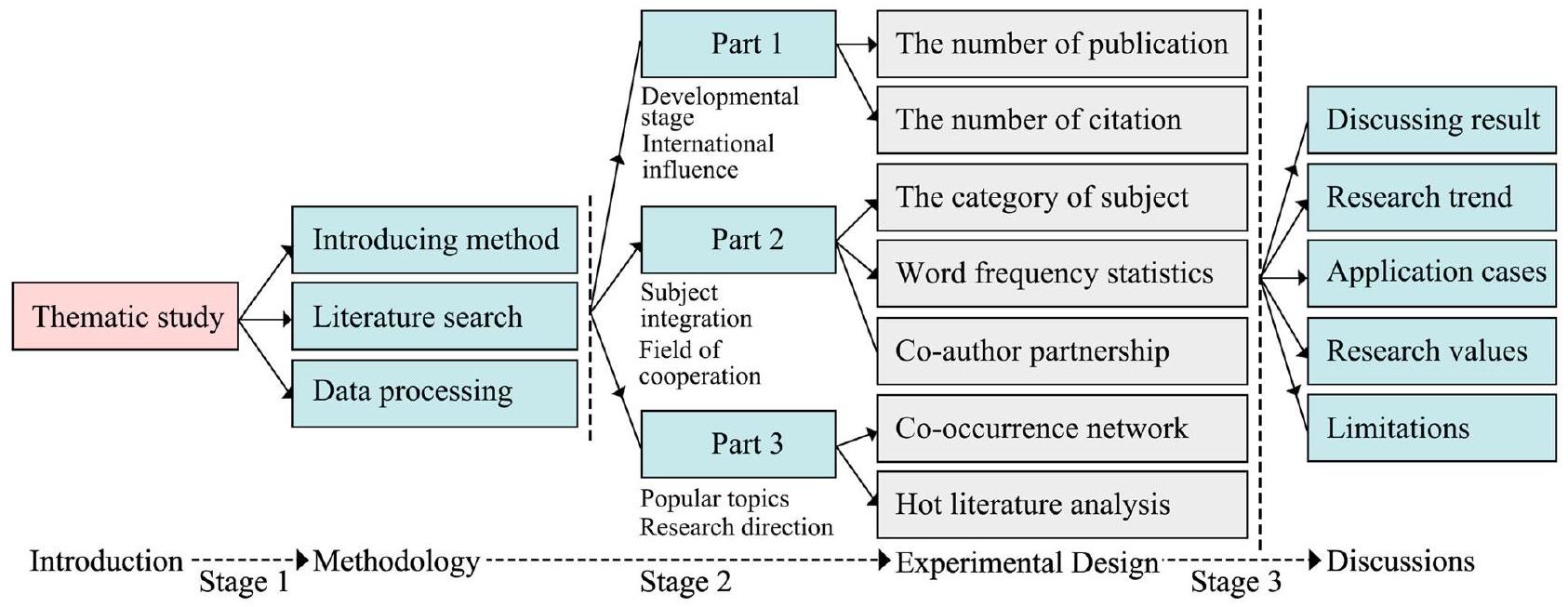
الشكل 1 | إطار البحث والبنية.
وتكاليف حسابية عالية
على عكس البرمجيات مثل CiteSpace وHistCite وVOS Viewer، تستخدم هذه الدراسة الإصدار 6.725 من أداة COOC التي طورتها فريق أكاديمي من الجامعات الصينية لأداء الببليومترية، والتي تدعم وظائف متعددة مثل الشبكات المشتركة، التجميع الدلالي، وإحصائيات التكرار
بالإضافة إلى التحليل الإحصائي للمنشورات والاستشهادات، تستخدم هذه الورقة عدة طرق ببليومترية، بما في ذلك تحليل تكرار الكلمات، رسم الخرائط الثنائية، الشبكات المشتركة الموضوعية، وتحليل الأدبيات الساخنة. تهدف هذه الطرق إلى كشف الاتجاهات الأساسية وهياكل المعرفة في مجال البحث من خلال تحليل البيانات متعدد الأبعاد، وبالتالي تحديد الحالة الحالية والاتجاهات داخل مجال البحث. يساعد تحليل تكرار الكلمات، من خلال حساب تكرار ظهور الكلمات الرئيسية، في تحديد المفاهيم والمواضيع ذات التكرار العالي، مما يبرز المناطق المركزة من التركيز البحثي والمواضيع الرائجة. يسهل ذلك اكتشاف الاتجاهات البحثية الرئيسية وتوزيعها عبر الأدبيات
مراجعة الأدبيات الساخنة المدرجة في لوحة بيانات Web of Science، يمكن للعلماء استكشاف المواضيع التي تتلقى حاليًا اهتمامًا واسعًا وتحديد الفجوات المعرفية المحتملة والحدود البحثية الناشئة داخل المجال.
مراجعة الأدبيات الساخنة المدرجة في لوحة بيانات Web of Science، يمكن للعلماء استكشاف المواضيع التي تتلقى حاليًا اهتمامًا واسعًا وتحديد الفجوات المعرفية المحتملة والحدود البحثية الناشئة داخل المجال.
تقدم الشكل 1 إطار البحث لهذه الورقة: (1) بعد توضيح مواضيع البحث، يقدم المنهجية المبادئ الأساسية للببليومترية، مع شرح للأدوات التحليلية المستخدمة والأسباب وراء اختيارها (الطريقة الببليومترية). بعد ذلك، تم وضع معايير البحث للأدبيات، وتم إجراء تنظيف للبيانات على نتائج البحث لضمان دقة التحليلات اللاحقة (معالجة البيانات). (2) تنقسم مرحلة التصميم التجريبي إلى ثلاثة أجزاء مع سبع تحليلات محتوى. الجزء 1 يحلل المنشورات والاستشهادات لرسم خرائط مراحل تطور البحث وتأثير المناطق المختلفة (إحصائيات المنشورات والاستشهادات السنوية). الجزء 2، باستخدام لوحة تصنيف الموضوعات من Web of Science وإحصائيات تكرار الكلمات وشبكة شراكة المؤلفين المقدمة من COOC 6.725، يكشف عن الاتجاهات الديناميكية للتكامل بين التخصصات (تحليل الموضوعات الحدودية بناءً على تصنيف التخصصات، مصفوفة ثنائية الأبعاد). الجزء 3 يستخدم شبكة التكرار والتحليل للمقالات الساخنة لكشف الموضوعات الشائعة واتجاهات البحث (تحليل اتجاهات البحث والمواضيع الساخنة بناءً على الشبكات المتكررة والمقالات ذات الاستشهادات العالية). (3) تناقش المرحلة 3 نتائج البحث والاتجاهات، مع تحليل حالات التطبيق الحالية لتسليط الضوء على الإمكانات والقيمة للتكنولوجيا الرقمية في التراث الثقافي. أخيرًا، تحدد الورقة قضايا جديدة، وتناقش قيود البحث، وتقدم اقتراحات للتحسين (المناقشات).
معالجة البيانات
تتضمن الخطوة الأولى تحديد موضوع البحث ونطاقه. تم الحصول على البيانات لهذه الورقة من قاعدة بيانات Web of Science الأساسية. تستخدم هذه الدراسة مجموعة Web of Science الأساسية لتحليل الأدبيات، مع تحديد الإطار الزمني من 1 يناير 2019 إلى 5 مارس 2024، من أجل تحليل الاتجاهات والنتائج البحثية الحديثة. استراتيجية البحث البوليانية هي طريقة تعزز كفاءة البحث من خلال دمج الكلمات الرئيسية بدقة، بهدف تضييق نطاق البحث بشكل فعال باستخدام العوامل المنطقية (مثل AND، OR، NOT)، مما يضمن أن الأدبيات المسترجعة تتماشى عن كثب مع موضوع البحث.
الجدول 1 | شروط البحث في الأدبيات.
| عبارة البحث | صيغة البحث | |
| الكلمة الرئيسية | أشكال الكلمات الموسعة | |
| تراث | مبنى تاريخي، مبنى تاريخي، عمارة تاريخية، عمارة تاريخية، نموذج معلومات مبنى التراث، نموذج معلومات مبنى التراث | عنوان
|
| رقمنة | رقمي، رقمنة، رقمنة، واقع افتراضي، VR، واقع معزز، AR، ذكي، AI، تلقائي | عنوان
|
قاعدة البيانات: فهرس استشهادات العلوم الموسع (SCI)؛ فهرس استشهادات العلوم الاجتماعية (SSCI)؛ فهرس استشهادات الفنون والعلوم الإنسانية (AHCI).
أنواع الوثائق: مقال؛ ورقة مؤتمر؛ مقال مراجعة.
نطاق الوقت: من 2019-01-01 إلى 2024-03-05.
اللغة: الإنجليزية.
أنواع الوثائق: مقال؛ ورقة مؤتمر؛ مقال مراجعة.
نطاق الوقت: من 2019-01-01 إلى 2024-03-05.
اللغة: الإنجليزية.
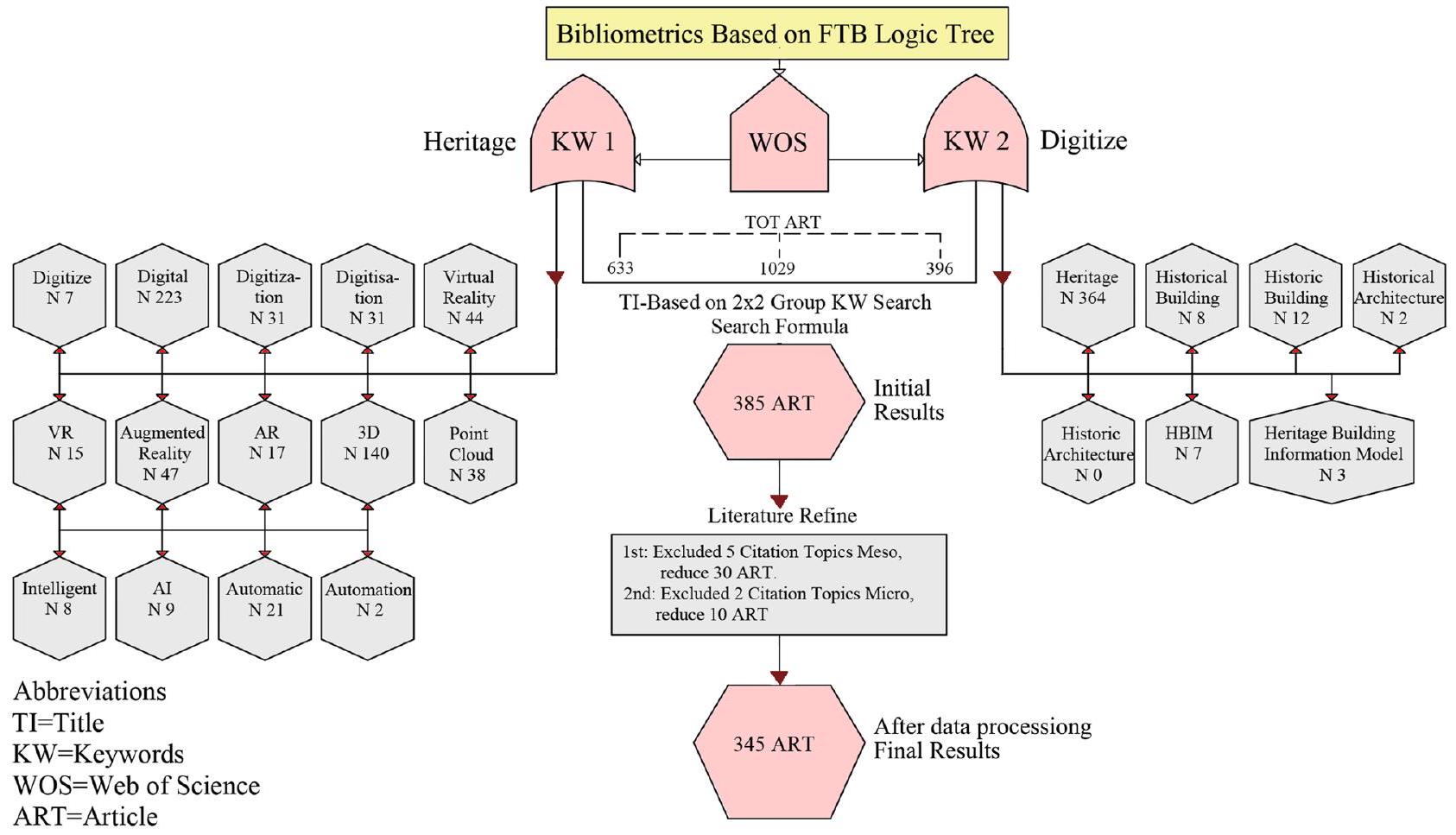
الشكل 2 | خريطة تفاصيل البحث الأدبي.
قاعدة بيانات العلوم تتعرف تلقائيًا على المصطلحات المفردة والجمع وتدمجها. عند البحث عن ‘بناء’، ستتضمن النتائج بالفعل مقالات تستخدم ‘مباني’ ككلمة مفتاحية، مما يتجنب إمكانية البحث المكرر أو فقدان الأدبيات ذات الصلة؛ 3) اعتبار توسيع الأفعال والصفات: ‘رقمي’ و’رقمنة’ هما الشكلان الصفي والفعل من الاسم ‘رقمنة’، بينما ‘تاريخي’ هو شكل موسع من ‘تاريخي’. يساعد التغطية الشاملة للمصطلحات الموسعة في زيادة دقة وشمولية البحث؛ 4) اعتبار اختلافات تهجئة الإنجليزية البريطانية والأمريكية: قد يكون لنفس المصطلح تهجئات مختلفة في الإنجليزية البريطانية والأمريكية. إذا تم اختيار ‘رقمنة’ ككلمة مفتاحية، فيجب أيضًا تضمين ‘رقمنة’ في مجموعة مصطلحات البحث؛ 5) اعتبار الكلمات المركبة والاختصارات: قد تستخدم العديد من المقالات المتعلقة بـ ‘نموذج معلومات المباني التراثية’ شكلها المختصر، ‘HBIM.’ عند البحث، يجب اعتبار كل من المصطلح الكامل واختصاره لضمان استرجاع جميع المقالات التي تستخدم أيًا من الشكل الكامل أو المختصر؛ 6) لا حاجة للتمييز بين الكتابة بحروف كبيرة وصغيرة: عند البحث عن ‘ذكي’، يمكن استرجاع المقالات التي تحتوي على ‘ذكي’ أو ‘ذكي’ في العنوان. من خلال اعتماد الاستراتيجيات المذكورة أعلاه، يمكن تحسين جودة استرجاع الأدبيات بشكل كبير. تم استرجاع ما مجموعه 385 مقالة بناءً على المعايير المحددة في الجدول 1.
الخطوة الثانية تتضمن استخراج ومعالجة بيانات الأدبيات. تنظيف البيانات هو تقنية حيوية في معالجة البيانات تُستخدم لتحديد و
تصحيح الأخطاء والتناقضات والبيانات غير المكتملة داخل مجموعات البيانات، مما يضمن فعالية وموثوقية التحليلات.
تصحيح الأخطاء والتناقضات والبيانات غير المكتملة داخل مجموعات البيانات، مما يضمن فعالية وموثوقية التحليلات.
الجدول 2 | المنشورات والاستشهادات سنويًا في أعلى 5 دول
| سنة | نشر سنوي في أفضل 5 دول | الاقتباسات سنوياً في أعلى 5 دول | ||||||||
| إيطاليا | إسبانيا | البرتغال | الصين | الولايات المتحدة الأمريكية | إيطاليا | إسبانيا | فرنسا | الصين | اليونان | |
| 2019 | ٣٩ | ٥ | 1 | ٦ | 2 | 609 | 62 | 81 | 169 | 60 |
| ٢٠٢٠ | ٢٢ | 10 | ٥ | 1 | 2 | ٤٨٣ | 297 | 91 | 15 | 42 |
| 2021 | ٢٣ | ٨ | ٤ | ٣ | 2 | ٣٠٧ | ١٢٤ | 64 | 16 | 17 |
| ٢٠٢٢ | ٣٣ | 11 | 14 | ٦ | ٧ | ١٧٥ | 77 | ٤ | ٣٦ | 9 |
| ٢٠٢٣ | ٣٣ | 18 | 1 | ٧ | ٨ | 75 | 27 | 1 | 2 | 1 |
| ٢٠٢٤ | ٥ | ٤ | ٢ | 0 | 0 | 0 | 0 | 0 | 0 | 0 |
| إجمالي | 155 | ٥٦ | 27 | 23 | 21 | 1649 | 587 | 239 | 238 | ١٢٩ |
استنادًا إلى معايير الفحص المذكورة أعلاه، تم استبعاد 40 مقالة ذات صلة منخفضة. ثم تم تصدير المقالات المتبقية البالغ عددها 345 من Web of Science بتنسيق نص عادي (مع الحفاظ على السجلات الكاملة والاستشهادات المرجعية) وتم دمجها باستخدام COOC 6.725. بعد ذلك، تم فرز البيانات ومراجعتها وتصفيتها في Excel بناءً على سنة النشر، المؤلف، الكلمات الرئيسية، والملخصات لإزالة أي شذوذ. بعد الفحص، وُجد أن معلومات المقالات الـ 345 كانت كاملة وذات صلة عالية، مما يضمن موثوقية التحليل اللاحق.
النتائج
سيتم تقسيم عرض نتائج التحليل إلى ثلاثة أقسام: (1) قسم إحصائيات النشر والاستشهاد السنوية يوفر إحصائيات سنوية عن نشر واستشهاد 345 مقالة تم استرجاعها بين عامي 2019 و2024 باستخدام برنامج Stata SE (64 بت). يهدف هذا التحليل إلى كشف النمو وتطور الأنشطة البحثية في هذا المجال بمرور الوقت، مما يساهم في فهم اتجاهات البحث. (2) قسم تحليل الموضوعات الحدودية بناءً على التصنيف التخصصي، يستخدم مصفوفة ثنائية الأبعاد لتحليل توزيع الموضوعات لهذه المقالات، مع تحديد نسبة المساهمات من مختلف التخصصات في أبحاث CHC واتجاهات التعاون بين التخصصات. بالإضافة إلى ذلك، يتضمن هذا القسم إحصائيات تكرار الكلمات وتحليل شبكة التأليف المشترك لاستكشاف أنماط التعاون بين المجموعات الأكاديمية الرئيسية وتأثيرها في CHC. (3) قسم تحليل اتجاهات البحث والمواضيع الساخنة بناءً على الشبكات المتزامنة والمقالات ذات الاستشهادات العالية يستخدم أداة VOS Viewer لإجراء تحليل شبكة التزامن بناءً على الكلمات الرئيسية، بهدف كشف المجالات الموضوعية الأساسية وكشف العلاقات بين مواضيع البحث المختلفة وبناء أنظمة معرفتها. علاوة على ذلك، ستقوم هذه الورقة بتحليل 19 مقالة ساخنة لتقديم مواضيع ومحتوى رائج.
من خلال تنظيم الأقسام حول مراحل التطور الزمني، توزيع موضوعات المقالات، إحصائيات تكرار الكلمات، الشبكات الاجتماعية، وأبحاث المقالات الساخنة، يسهل هذا الهيكل مراجعة منهجية من منظور كلي إلى جزئي. يدعم هذا الإطار التحليلي التقدمي تحقيق الأهداف البحثية الستة المقترحة في قسم ‘المقدمة’. تظهر نتائج التحليل أنه على الرغم من وجود انخفاض في المنشورات في عام 2023، إلا أن الطلب على البحث في DT لا يزال ينمو. جودة البحث ليست مرتبطة تمامًا بعدد المنشورات. لقد مرت تطبيقات DT في CHC بفترة استكشاف، وفترة تطوير متنوعة، وفترة تكامل، مما يبرز الأدوار الرئيسية للتعاون بين التخصصات والتقدم التكنولوجي. علاوة على ذلك، هناك اتجاه واضح نحو التكامل متعدد التخصصات في مجال DT، لا سيما في علوم الاستشعار عن بعد والتصوير، على الرغم من أن التكامل مع التخصصات الأساسية لا يزال يحتاج إلى تحسين. كانت إعادة البناء الرقمية وتقييم المخاطر هما الاتجاهان الرئيسيان لتطبيقات DT في CHC من 2019 إلى 2024.
إحصائيات النشر والاستشهاد السنوية
تحليل النشر والاستشهاد هو عملية لت quantifying وتحليل الأدبيات حول موضوع معين ضمن مجال أكاديمي لتحديد التحولات والاتجاهات في النشاط البحثي.
المُنشورة واستشهاداتها المتعلقة بالدراسات من 2019 إلى 2024، جنبًا إلى جنب مع تكرار المصطلحات (TF) للكلمات الرئيسية المرادفة لـ ‘الرقمنة’. تتضمن الأرقام أيضًا بيانات من أعلى 5 دول. توضح الشكل 3 التغيرات في الاتجاهات السنوية في هذه البيانات. في فترة الست سنوات، كانت أعلى خمس دول من حيث حجم النشر، من الأعلى إلى الأدنى، هي إيطاليا (155)، إسبانيا (56)، البرتغال (27)، الصين (23)، والولايات المتحدة (21). من حيث حجم الاستشهادات، كانت الترتيبات هي إيطاليا (1649)، إسبانيا (587)، فرنسا (239)، الصين (238)، واليونان (129). بدأ التركيز على تطبيق DT في الحفاظ على التراث في عام 2022. على الرغم من وجود انخفاض في المنشورات في 2023-2024، إلا أن TF لـ DT المذكور مباشرة في الكلمات الرئيسية وصل إلى 28 مرة في 2023، مما يعكس طلب المجتمع الأكاديمي على ابتكار DT. تشير خاصية وجود منشورات منخفضة (45) ولكن استشهادات عالية (1008) إلى أن النتائج المنشورة في 2020 كانت معترف بها على نطاق واسع، خاصة استشهادات إسبانيا (297). تشير هذه البيانات إلى أن الانتباه لا يعكس بالضرورة جودة البحث بالكامل؛ 4) يظهر العدد الإجمالي للمنشورات اتجاهًا تصاعديًا عامًا (من 45 إلى 91)، كما تكشف المنشورات المهمة (عدد متوسط النشر السنوي هو 25، عدد متوسط الاستشهاد السنوي هو 275) أيضًا عن المستوى العالي من الاهتمام الذي يوليه العلماء الإيطاليون للتراث الرقمي. تطورت مواضيع البحث من التنبؤ الهيكلي والصيانة، إلى سير العمل في النمذجة المعلمية، إلى إدارة التراث التعاونية والتقييم، وإلى تكامل التكنولوجيا والتطبيقات الجديدة عبر المجالات متعددة التخصصات. يعرض هذا التحول تفكير العلماء الجديد واستكشافهم لـ DT من التطبيقات المحلية إلى الشاملة، من الجزئي إلى الكلي، ومن التطبيقات المحددة إلى الواسعة.
المُنشورة واستشهاداتها المتعلقة بالدراسات من 2019 إلى 2024، جنبًا إلى جنب مع تكرار المصطلحات (TF) للكلمات الرئيسية المرادفة لـ ‘الرقمنة’. تتضمن الأرقام أيضًا بيانات من أعلى 5 دول. توضح الشكل 3 التغيرات في الاتجاهات السنوية في هذه البيانات. في فترة الست سنوات، كانت أعلى خمس دول من حيث حجم النشر، من الأعلى إلى الأدنى، هي إيطاليا (155)، إسبانيا (56)، البرتغال (27)، الصين (23)، والولايات المتحدة (21). من حيث حجم الاستشهادات، كانت الترتيبات هي إيطاليا (1649)، إسبانيا (587)، فرنسا (239)، الصين (238)، واليونان (129). بدأ التركيز على تطبيق DT في الحفاظ على التراث في عام 2022. على الرغم من وجود انخفاض في المنشورات في 2023-2024، إلا أن TF لـ DT المذكور مباشرة في الكلمات الرئيسية وصل إلى 28 مرة في 2023، مما يعكس طلب المجتمع الأكاديمي على ابتكار DT. تشير خاصية وجود منشورات منخفضة (45) ولكن استشهادات عالية (1008) إلى أن النتائج المنشورة في 2020 كانت معترف بها على نطاق واسع، خاصة استشهادات إسبانيا (297). تشير هذه البيانات إلى أن الانتباه لا يعكس بالضرورة جودة البحث بالكامل؛ 4) يظهر العدد الإجمالي للمنشورات اتجاهًا تصاعديًا عامًا (من 45 إلى 91)، كما تكشف المنشورات المهمة (عدد متوسط النشر السنوي هو 25، عدد متوسط الاستشهاد السنوي هو 275) أيضًا عن المستوى العالي من الاهتمام الذي يوليه العلماء الإيطاليون للتراث الرقمي. تطورت مواضيع البحث من التنبؤ الهيكلي والصيانة، إلى سير العمل في النمذجة المعلمية، إلى إدارة التراث التعاونية والتقييم، وإلى تكامل التكنولوجيا والتطبيقات الجديدة عبر المجالات متعددة التخصصات. يعرض هذا التحول تفكير العلماء الجديد واستكشافهم لـ DT من التطبيقات المحلية إلى الشاملة، من الجزئي إلى الكلي، ومن التطبيقات المحددة إلى الواسعة.
في مراحل التطور، كانت المرحلة الأولى (2019-2020) تمثل فترة الاستكشاف لـ DT، لا سيما في مجالات مثل التعلم العميق
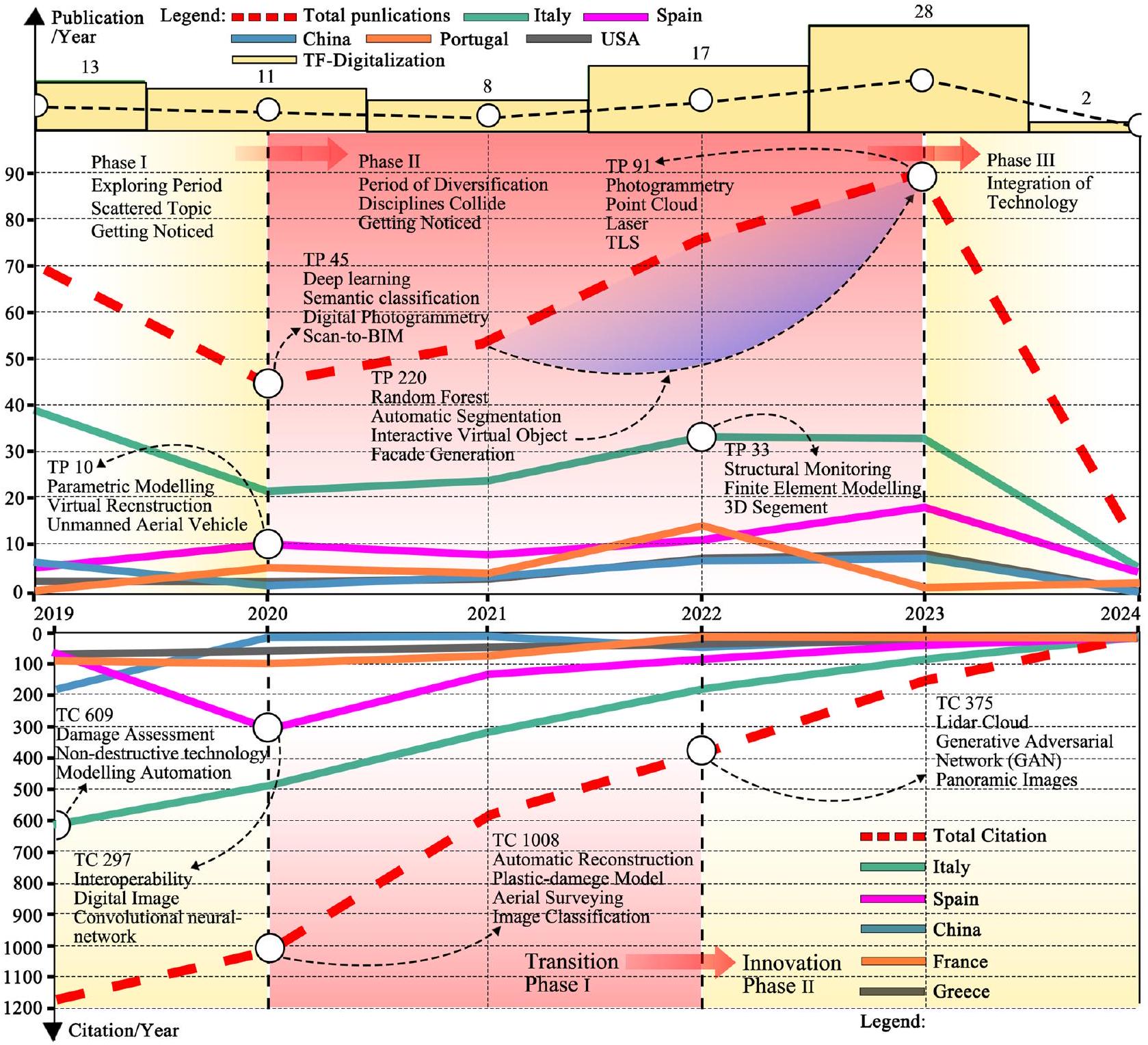
الشكل 3 | نمو النشر والاستشهاد 2019-2024.
تظهر الشكل 4 إحصائيات الاقتباسات لـ 41 منطقة نشر من 2019 إلى 2024، حيث لم يتم اقتباس مقالات من ست مناطق، وهي بلغاريا، قبرص، إندونيسيا، إسرائيل، هولندا، ورومانيا. على الرغم من أن الصين تتخلف عن المناطق الأخرى من حيث حجم النشر، إلا أن عدد الاقتباسات المرتفع نسبيًا يشير إلى جودة بحث جيدة؛ ومع ذلك، لا يزال المستوى العام للتكنولوجيا الرقمية متخلفًا عن ذلك في المناطق الأوروبية. المناطق ذات التاريخ الطويل تعطي أهمية أكبر للتراث الثقافي، مثل إيطاليا، إسبانيا، البرتغال، فرنسا، والصين. نتائج البحث الأوروبية هي الأكثر تأثيرًا (حيث تتجاوز الاقتباسات الإجمالية تلك الخاصة بالمناطق الأخرى بكثير)، وتمثل أعلى جودة بحث على مستوى العالم، تليها آسيا، أمريكا الجنوبية، وأمريكا الشمالية. ربما بسبب الاختلافات في مستويات التحضر، معايير التعليم، والتقدم التكنولوجي، فإن تطبيق التكنولوجيا الرقمية في مجال التراث هو هامشي نسبيًا في المناطق ذات مستويات التنمية الحضرية المنخفضة، مثل أفريقيا وأوقيانوسيا.
تحليل موضوع الحدود بناءً على التصنيف التخصصي، مصفوفة ثنائية الأبعاد
تكشف لوحة البحث في Web of Science عن تصنيف الموضوعات لـ 345 مقالة نُشرت بين عامي 2019 و2024. يتم تصنيف هذه المقالات إلى 54 تخصصًا رئيسيًا، و39 موضوعًا ميسو للاقتباس، و39 موضوعًا للاقتباس.
الميكرو. توضح الشكل 5a عدد المقالات في كل فئة، مع تسليط الضوء على المواضيع المتعلقة بالاستشعار عن بعد، والجغرافيا، وعلوم الحاسوب، وعلوم المعلومات باللون الأحمر. يقدم الشكل 5b عدد المقالات في أعلى 10 مواضيع ضمن مواضيع الاقتباس الميسو ومواضيع الاقتباس الميكرو، باستخدام ألوان مختلفة لتمييز التباينات في الكمية. تشير الخطوط المنقطة المتصلة بالنقاط البيضاء إلى القيمة الوسيطة للبيانات. يعكس الشكل 5 بشكل شامل اتجاه البحث في التكامل متعدد التخصصات. لقد تجاوزت المناقشات الأكاديمية في CHC الحدود التقليدية، متوسعة إلى مجالات متعددة التخصصات مثل الاستشعار عن بعد، وعلوم التصوير، وعلوم الحاسوب متعددة التخصصات، وعلوم المواد متعددة التخصصات، التي تحمل أهمية كبيرة. تكشف هذه التوزيعة البيانية عن إمكانيات التكنولوجيا الحديثة في CHC. تظل علم الآثار، والهندسة المعمارية، والعلوم الإنسانية متعددة التخصصات، وتكنولوجيا بناء الإنشاءات من التخصصات الأساسية في CHC، مما يشير إلى أن تكامل هذا المجال مع التخصصات الأخرى لا يزال يتطلب مزيدًا من التطوير.
في الأقسام التالية، ستوضح هذه الدراسة اتجاهات التطبيق ضمن CHC من خلال تحليل تكرار الكلمات الرئيسية. أولاً، تم نسخ 1,632 كلمة رئيسية من 345 مقالًا في جدول بيانات المصدر إلى مستند فارغ، وتم تصحيح أي تناقضات في التنسيق – مثل المسافات الزائدة، أو السلاسل غير المتسقة، أو الاختلافات في حالة الأحرف. بعد ذلك،
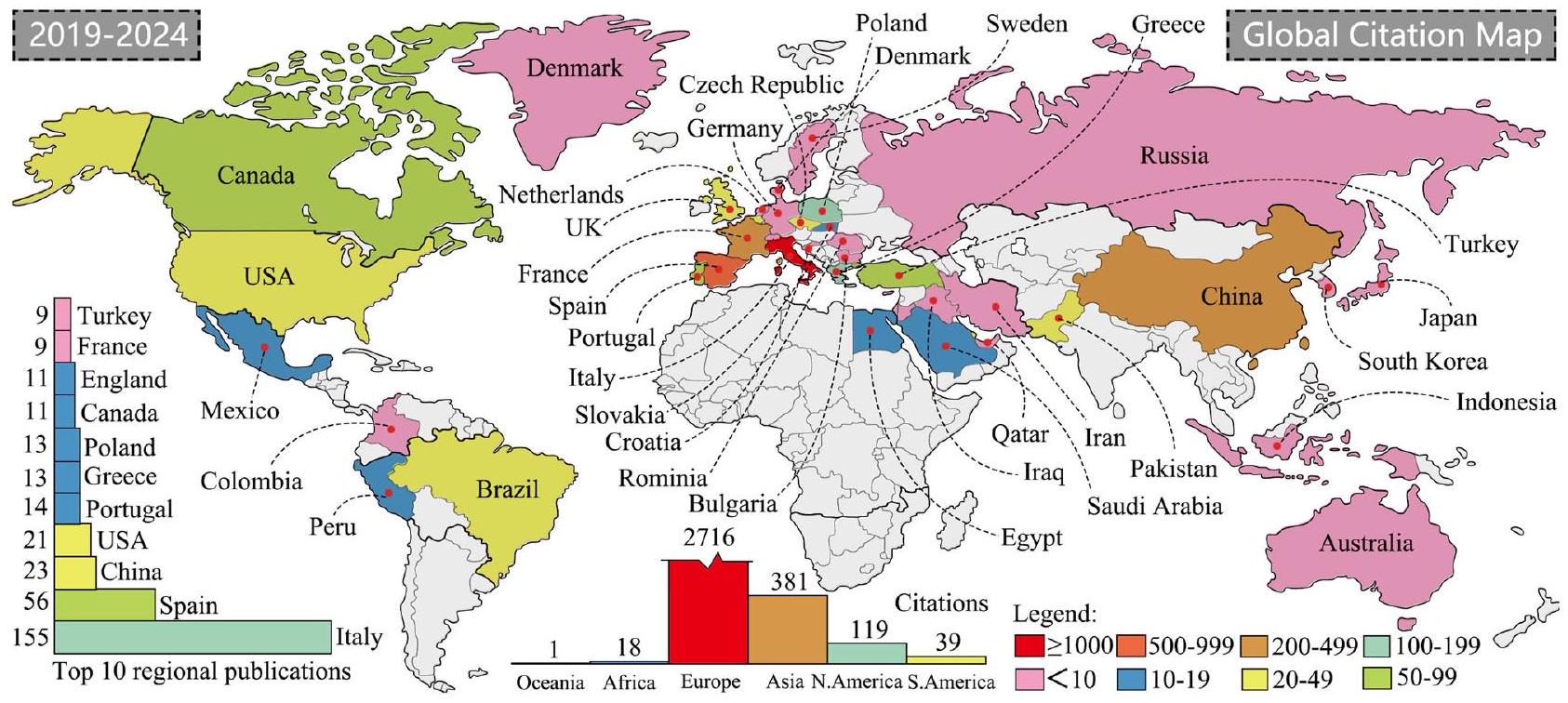
الشكل 4 | توزيع الاقتباسات في 41 دولة (2019-2024).
الشكل 5 | التوزيع التخصصي لمقالات الموضوع. أ عدد تصنيفات الموضوع لـ 345 مقالة.
الجدول 3 | تكرار الكلمات الرئيسية الخمسين الأعلى.
| لا | كلمات | TF | لا | كلمات | TF |
| 1 | HBIM | ١٢٩ | 26 | تصنيف | ٦ |
| 2 | التراث الثقافي | ١٠٣ | 27 | النمذجة البارامترية | ٦ |
| ٣ | نمذجة معلومات البناء | 78 | ٢٨ | طريقة العناصر المحدودة (FEM) | ٦ |
| ٤ | المسح بالليزر الأرضي | 50 | ٢٩ | التشغيل البيني | ٥ |
| ٥ | نموذج ثلاثي الأبعاد | ٤٩ | 30 | أداء | ٥ |
| ٦ | سحابة النقاط | 41 | 31 | المراقبة | ٥ |
| ٧ | التراث المعماري | ٣٩ | 32 | تقييم الأضرار | ٥ |
| ٨ | الحفاظ | ٣٤ | ٣٣ | درجة الجيل (GOG) | ٥ |
| 9 | إعادة بناء ثلاثية الأبعاد | ٣٢ | ٣٤ | أنظمة | ٥ |
| 10 | الفيتوغرامترية الرقمية | 26 | ٣٥ | الويب الدلالي | ٥ |
| 11 | المسح إلى نموذج معلومات البناء | 19 | ٣٦ | ليدار | ٥ |
| 12 | الإدارة | 15 | ٣٧ | تقييم المخاطر | ٤ |
| ١٣ | الواقع الافتراضي (VR) | 15 | ٣٨ | استطلاع رقمي | ٤ |
| 14 | المباني التاريخية | 15 | ٣٩ | الواقع | ٤ |
| 15 | نظم المعلومات الجغرافية | 11 | 40 | طائرة مسيرة | ٤ |
| 16 | مستوى التفاصيل (LOD) | 9 | 41 | البناء | ٤ |
| 17 | التوأم الرقمي | ٨ | 42 | تحليل الدفع | ٤ |
| ١٨ | التعلم العميق | ٨ | 43 | خوارزمية | ٤ |
| 19 | معلومات | ٨ | ٤٤ | ضرر | ٤ |
| 20 | الأنطولوجيا | ٨ | ٤٥ | لغات البرمجة المرئية (VPL) | ٤ |
| 21 | جودة | ٧ | ٤٦ | الذكاء الاصطناعي | ٤ |
| ٢٢ | جيل | ٧ | ٤٧ | صيانة | ٤ |
| 23 | مباني | ٧ | ٤٨ | معرفة | ٤ |
| ٢٤ | الضعف | ٧ | ٤٩ | فصول أساس الصناعة (IFC) | ٤ |
| 25 | دقة | ٧ | 50 | التجزئة | ٤ |
تم استخدام لوحة إحصائيات تكرار الكلمات في أداة COOC 6.725، وتم استيراد الملف إلى البرنامج بتنسيق Excel لتقسيم الكلمات الرئيسية وحساب التكرار. ثم، استنادًا إلى وظيفة تمييز التكرار في Excel، تم إجراء مراجعة يدوية للتشابهات الدلالية والتكرارات بين الكلمات الرئيسية، وتم دمج الكلمات الرئيسية المتشابهة. نظرًا لأن COOC 6.725 غير قادر على التعرف تلقائيًا ودمج أزواج المفرد والجمع (مثل “أنظمة” و “نظام”) أو الأشكال المختصرة (مثل “ثلاثة أبعاد” و “3D”)، كانت التحقق اليدوي خطوة حاسمة. بعد ذلك، تم فرز الكلمات الرئيسية بترتيب تنازلي بناءً على التكرار، وتم إجراء جولة ثانية من التحقق لضمان دقة البيانات. تقدم الجدول 3 أعلى 50 كلمة رئيسية حسب التكرار. النص الغامق يظهر المصطلحات التقنية المستخدمة بشكل شائع في مجال CHC. التقنيات المستخدمة بشكل متكرر (
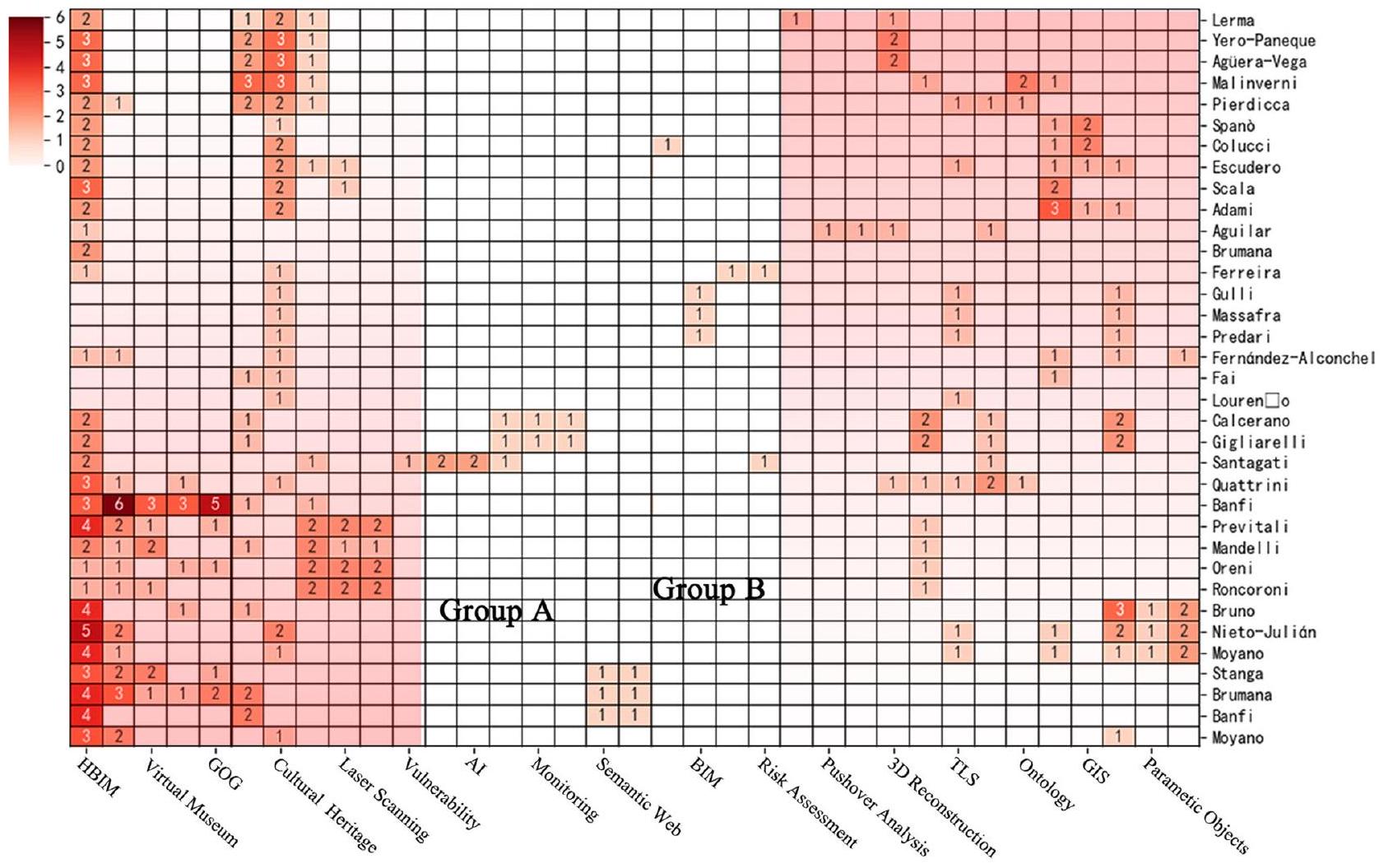
تقوم هذه الدراسة بإنشاء شبكة مصفوفة ثنائية الأبعاد تعتمد على المؤلفين والكلمات الرئيسية باستخدام أداة COOC 6.725. تم تعيين معايير التحليل على حجم نشر قدره
لقد garnered اهتمامًا كبيرًا في المجموعة A والمجموعة B. يكشف أنه على مدار السنوات الست الماضية، كانت اتجاهات البحث تركز بشكل أساسي على مواضيع مثل HBIM، المتاحف الافتراضية، GOG، والمسح بالليزر. بالإضافة إلى ذلك، كان هناك تركيز ثانوي على الكائنات المعمارية المعقدة، نظم المعلومات الجغرافية، الأنطولوجيا، وTLS. تعكس هذه الظاهرة الاعتماد المتزايد للمجتمع الأكاديمي على التقنيات المتقدمة في الحفاظ على التراث وإدارته، فضلاً عن استكشاف التقنيات الناشئة في التطبيقات العملية. بالإضافة إلى ذلك، تُظهر الشكل 6 نمط توزيع مع مناطق مركزة عند الأطراف ووسط نادر، مما يشير إلى تركيز منخفض على مجالات معينة ونتيجة تكتل متشظي ومتناثر. تكشف هذه الظاهرة أيضًا بشكل غير مباشر عن أوجه القصور في التعاون بين التخصصات، ودمج المعرفة، ودمج تطبيقات DT في الحفاظ على التراث، مما يكشف عن فجوات كبيرة في التآزر والتعاون بين التخصصات. يشير هذا النمط التوزيعي إلى أنه بينما يتم تطبيق DT بشكل واسع في مجال التراث، فإن مستويات تطبيقه ودمجه تختلف بشكل كبير بين المجتمعات البحثية والتخصصات المختلفة، مما يؤدي إلى تشتت المعرفة وتطبيقات التكنولوجيا.
لقد garnered اهتمامًا كبيرًا في المجموعة A والمجموعة B. يكشف أنه على مدار السنوات الست الماضية، كانت اتجاهات البحث تركز بشكل أساسي على مواضيع مثل HBIM، المتاحف الافتراضية، GOG، والمسح بالليزر. بالإضافة إلى ذلك، كان هناك تركيز ثانوي على الكائنات المعمارية المعقدة، نظم المعلومات الجغرافية، الأنطولوجيا، وTLS. تعكس هذه الظاهرة الاعتماد المتزايد للمجتمع الأكاديمي على التقنيات المتقدمة في الحفاظ على التراث وإدارته، فضلاً عن استكشاف التقنيات الناشئة في التطبيقات العملية. بالإضافة إلى ذلك، تُظهر الشكل 6 نمط توزيع مع مناطق مركزة عند الأطراف ووسط نادر، مما يشير إلى تركيز منخفض على مجالات معينة ونتيجة تكتل متشظي ومتناثر. تكشف هذه الظاهرة أيضًا بشكل غير مباشر عن أوجه القصور في التعاون بين التخصصات، ودمج المعرفة، ودمج تطبيقات DT في الحفاظ على التراث، مما يكشف عن فجوات كبيرة في التآزر والتعاون بين التخصصات. يشير هذا النمط التوزيعي إلى أنه بينما يتم تطبيق DT بشكل واسع في مجال التراث، فإن مستويات تطبيقه ودمجه تختلف بشكل كبير بين المجتمعات البحثية والتخصصات المختلفة، مما يؤدي إلى تشتت المعرفة وتطبيقات التكنولوجيا.
تحليل اتجاهات البحث والمواضيع الساخنة استنادًا إلى الشبكات المتزامنة والمقالات ذات الاقتباسات العالية
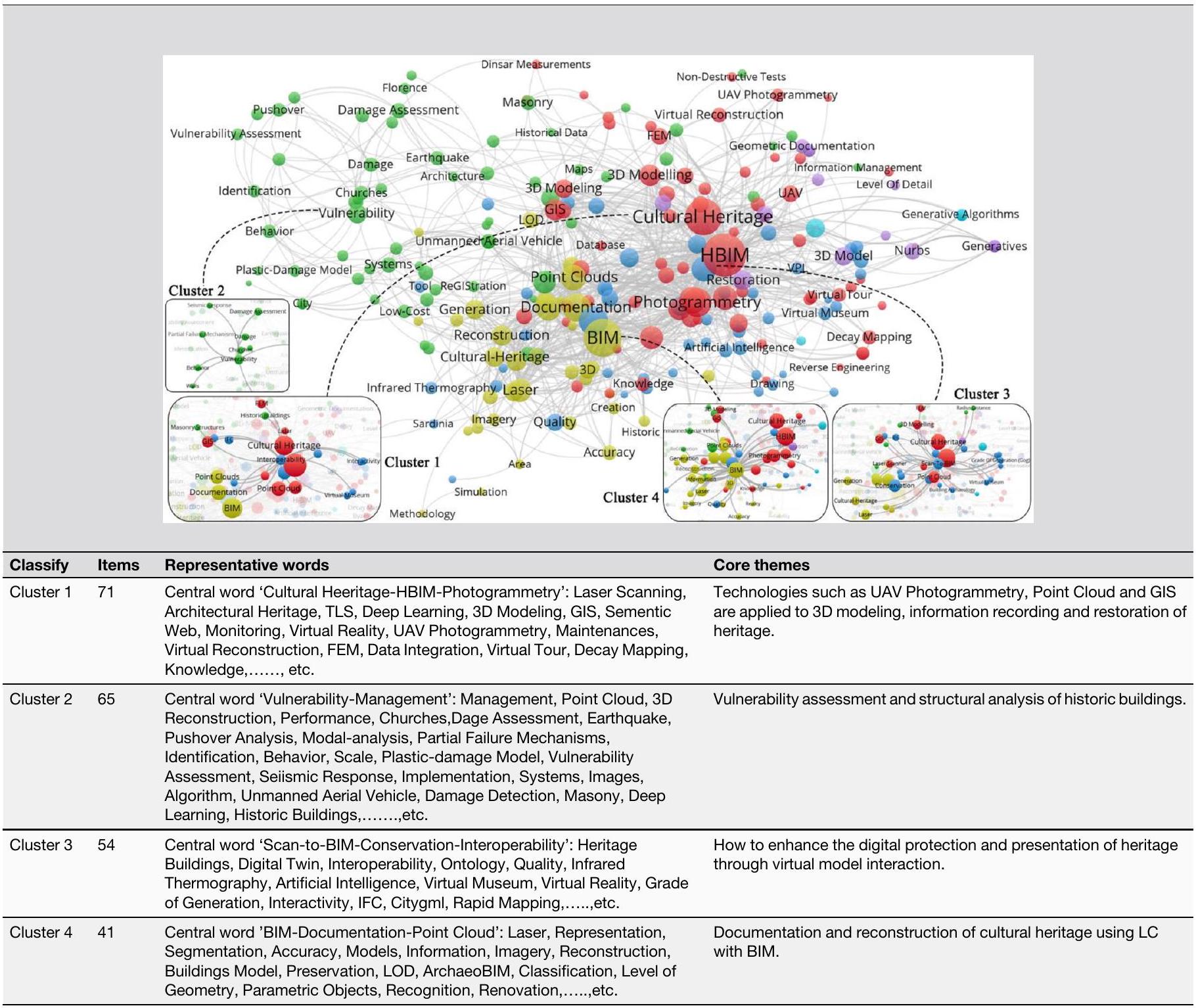
تستكشف هذه القسم الاتجاهات السائدة لتطبيقات التكنولوجيا الرقمية في مجال الحفاظ على التراث. من خلال تنظيم الكلمات الرئيسية في جدول بيانات Excel وإنشاء مصفوفة تكرار مشترك، استخدمت هذه الدراسة أيضًا برنامج VOS Viewer لبناء خريطة شبكة تكرار موضوعية. في هذه الشبكة، يتم تمييز الكلمات الرئيسية المرتبطة أو المجاورة لبعضها البعض بنفس اللون لتسهيل التعرف على الكتل الموضوعية. تم تشكيل ما مجموعه ثمانية كتل، مع أربعة كتل رئيسية تركزت حول الكلمات الرئيسية الأساسية ‘التراث الثقافي – HBIM – التصوير الفوتوغرافي ثلاثي الأبعاد’، ‘BIM – التوثيق – سحابة النقاط’، ‘Scan-to-BIM – الحفاظ – التوافق’، و ‘الهشاشة – الإدارة’. تعرض الجدول 4 العناصر المكونة والمواضيع الأساسية لهذه الكتل. بشكل عام، يمكن تصنيف هذه المواضيع الأربعة بشكل أكبر إلى الاتجاهين التاليين: (1) تطبيق تقنيات التسجيل الرقمي الشامل وإعادة البناء للتراث الثقافي؛ (2) استراتيجيات لتقييم المخاطر والافتراضية لمباني التراث الثقافي.
توجه 1 يركز على استخدام تكنولوجيا المعلومات الرقمية (DT) للتوثيق وإعادة البناء الديناميكي ثلاثي الأبعاد للتراث الثقافي، موفراً أدوات لتخزين المعلومات والتصور لدعم جهود الحفظ والترميم. باستخدام إطار عمل HBIM، برونو ورونسيلا
الشكل 6 | خريطة علاقة التجميع بناءً على المؤلفين والكلمات الرئيسية.
استخدام النماذج ثلاثية الأبعاد والواقع المعزز لدراسة والتواصل حول القيم المعمارية والحضرية، وتعزيز “التراث الذكي” من خلال دمج الأبعاد الرقمية والمادية، كما يتضح من خلال دراستين حالتين لدير سانت باسيل وكنيسة كوليماغيو. تبرز هذه الدراسات اعتماد التراث الثقافي التاريخي على البيانات الأولية الدقيقة وعمليات معالجة البيانات المعقدة.
تتركز الاتجاه 2 على إمكانيات التكنولوجيا الرقمية في تقييم المخاطر والضعف الهيكلي للمباني التراثية، مما يعزز من سلامة وكفاءة إدارة التراث. وانغ وآخرون.
بشكل شامل، تكشف محتويات الأبحاث لـ 19 مقالة ساخنة في الجدول 5 أن إدارة التراث الرقمي قد اندمجت بعمق في مراحل جمع البيانات، ومعالجة البيانات وإدارتها، والتحليل والتطبيق، والتكامل الشامل بين التخصصات.
تقدم خريطة الأورثوفوتو قياسات دقيقة، وتقييمات للحالة، ورصد الأضرار للمواقع التراثية باستخدام صور عالية الارتفاع خالية من تشويه المنظور.
المناقشات
على مدى السنوات الست الماضية، أظهرت الأبحاث حول التحول الرقمي في التراث الثقافي الميل نحو التطبيقات التكنولوجية، مع نقص في المناقشات المعمقة حول تأثيراته الاجتماعية وقابليته الثقافية. استنادًا إلى التحليل البيبليومتري، يكشف هذا البحث عن الحالة الحالية للأبحاث، وتقدم التطبيقات، والاتجاهات الناشئة. أظهرت المراجعات الأدبية السابقة أن التحول الرقمي يظهر إمكانات كبيرة في تعزيز الهوية الثقافية، وإعادة بناء العمارة افتراضيًا، وبناء الإنتاج، والتصنيف التلقائي. تسرد الجدول 6 أمثلة محددة للتحول الرقمي في هذه المجالات التطبيقية. هذه الحالات مستمدة من تجميع المؤلف وتلخيصه أثناء قراءة المقالات. لقد أدت إدخال تقنيات التحول الرقمي مثل سحب النقاط ثلاثية الأبعاد، والواقع الافتراضي، والضوء ثلاثي الأبعاد، والكاميرا الرقمية عالية الدقة، وخريطة الأورثوفوتو الرقمية، ونموذج معلومات البناء التاريخي إلى تحسين عمليات جمع البيانات والتصور للتراث الثقافي.
ومع ذلك، لا تزال العديد من تقنيات التحول الرقمي في مرحلة التطوير وتواجه تحديات تتعلق بجودة البحث وقابلية الاستخدام.
الجدول 4 | تحليل شبكة التزامن الموضوعي القائم على الكلمات الرئيسية
الاستكشاف. على الرغم من أن تقنية سحابة النقاط ثلاثية الأبعاد يمكن أن توفر بيانات مكانية عالية الدقة، إلا أن قضايا مثل استهلاك الموارد العالي لتخزين البيانات ومعالجتها، وكيفية دمج البيانات متعددة المصادر بشكل فعال لتعزيز قابلية استخدام النموذج ودقته، تظل تحديات رئيسية لتطوير التكنولوجيا.
بالإضافة إلى التطبيقات العملية لتقنية التحول الرقمي نفسها، فإن اعتمادها الواسع وتعزيزها يتأثران أيضًا بعوامل خارجية. غالبًا ما تكون الأجهزة الرقمية المتقدمة والتقنيات مكلفة ومعقدة في التشغيل، مما يتطلب معرفة متخصصة في المجالات ذات الصلة. وقد استكشفت المقالات ذات الصلة العديد من التقنيات البديلة منخفضة التكلفة، لكن لا تزال تطبيقاتها العملية بحاجة إلى التحقق.
بالآثار صعبة الالتقاط والمحاكاة بالكامل باستخدام التقنيات الحالية
بالآثار صعبة الالتقاط والمحاكاة بالكامل باستخدام التقنيات الحالية
يعتمد تعزيز وتطبيق التوائم الرقمية في التراث الثقافي على الجهود المشتركة لكل من الأساليب من أعلى إلى أسفل ومن أسفل إلى أعلى. على الرغم من أن المنظمات الدولية مثل اليونسكو تدعو إلى التراث الثقافي ضمن إطار عالمي، إلا أن هذه الاستراتيجيات من أعلى إلى أسفل غالبًا ما تكافح لتلبية الاحتياجات المحددة للمجتمعات المحلية، مما قد يؤدي إلى تجانس ونزع الطابع المحلي للتراث الثقافي تحت هيمنة الخطاب العالمي
الجدول 5 | تحليل محتوى البحث لـ 19 مقالة ساخنة
| لا. | المؤلفون | محتوى البحث | سنة النشر | المتوسط سنويًا | إجمالي الاقتباسات |
| 1 | فيوروتشي وآخرون.
|
من الطرق الإحصائية الأساسية إلى نماذج التعلم العميق المعقدة، استعرض المؤلفون تطور تطبيقات التعلم الآلي (ML) في مجال التراث الثقافي واستكشفوا الآثار العملية للتحسينات النظرية في خوارزميات التعلم الآلي. | 2020 | 27.8 | 139 |
| 2 | وانغ وآخرون.
|
قدم المؤلفون نظامًا آليًا للكشف عن الأضرار في المباني. يمكن لهذا النظام تحديد الأضرار الناتجة عن التزهير والتقشر بدقة ويحقق وظائف في الوقت الحقيقي من خلال دمج كاميرات الشبكة IP والهواتف الذكية، مما يحسن بشكل كبير من كفاءة وموثوقية وراحة حماية وإدارة المباني التاريخية. | 2019 | 21.33 | 128 |
| 3 | أنجيليو وآخرون.
|
تطور الورقة نموذج محاكاة لتطبيق التوائم الرقمية في المباني التاريخية المبنية من الطوب. يدمج هذا النموذج الواقع الفيزيائي التجريبي ويستخدم لدراسة استجابة الهيكل والصيانة الوقائية وعمليات التعزيز للنظام. | 2020 | 20.4 | 102 |
| 4 | جو وهونغ
|
تظهر هذه الدراسة فعالية دمج المسح بالليزر الأرضي وتصوير الطائرات بدون طيار لإنشاء نموذج ثلاثي الأبعاد عالي الدقة وتوثيق رقمي لمعبد ماجوكسا، حيث يوفر المسح بالليزر دقة موضعية متفوقة بينما تفوق تصوير الطائرات بدون طيار في جمع بيانات المنطقة العليا. | 2019 | 16.17 | 97 |
| 5 | يانغ وآخرون.
|
تلخص المقالة تطبيقات التوائم الرقمية في توثيق التراث، لا سيما في استخدام نمذجة معلومات البناء (BIM) وتصوير الفوتوغرافيا والمسح بالليزر والرسوميات الحاسوبية ونظم المعلومات الجغرافية وأدوات الأنطولوجيا لنمذجة الهندسة وإدارة المعرفة الدلالية. | 2020 | 18.2 | 91 |
| 6 | بان وآخرون.
|
تقدم هذه الدراسة إطارًا شبه آلي لتوليد نماذج سطح ثلاثية الأبعاد لجسور التراث باستخدام تصوير الطائرات بدون طيار وسحب النقاط، محققة دقة عالية في تقسيم العناصر الهيكلية والتعرف عليها، مع تجارب على جسرين في الصين تظهر خطأ إعادة بناء منخفضًا يصل إلى
|
2019 | 12.67 | 76 |
| 7 | أندرياسيان وآخرون.
|
تستكشف الدراسة تطبيق النمذجة البارامترية في نمذجة معلومات البناء التاريخية (HBIM) من خلال تحويل بيانات سحابة النقاط من المسح بالليزر الأرضي (TLS) وهيكل الحركة (SfM) إلى كائنات BIM باستخدام سير عمل Rhino+Grasshopper-ArchiCAD، مما يظهر دقة، على الرغم من كونها أقل قليلاً من الطرق الأخرى، إلا أنها كافية لدراسة الحالة. | 2020 | 15 | 75 |
| 8 | برونو ورونسيلا.
|
تنظم الورقة وتخزن وتدير المعلومات الهندسية بناءً على نمذجة معلومات البناء التاريخية (HBIM) وتصمم قاعدة بيانات مستقلة مرتبطة بالنموذج ثلاثي الأبعاد. تحقق مشاركة البيانات وقابليتها للاستخدام من خلال تطبيقات سطح المكتب وواجهات الويب للتغلب على قيود HBIM في أعمال الحفظ العملية. | 2019 | 12.33 | 74 |
| 9 | بانفي وآخرون.
|
يستكشف المؤلفون كيف يعزز دمج المسح ثلاثي الأبعاد، والنمذجة ثلاثية الأبعاد، ونمذجة معلومات البناء (BIM)، وتقنيات الواقع الممتد (XR) نشر الوعي بالتراث المعماري، باستخدام بازيليكا سانت أمبروجيو كدراسة حالة، ويظهرون إنشاء تجربة تفاعلية للواقع الممتد يمكن الوصول إليها عبر أجهزة وأنواع مستخدمين مختلفة. | 2019 | 11.83 | 71 |
| 10 | بيبي وآخرون.
|
أنشأ المؤلفون عملية فعالة لبناء نمذجة معلومات البناء التاريخية (HBIM) وإنشاء نماذج رقمية للتحليل الهيكلي. | 2020 | 12.6 | 63 |
| 11 | غالانتوتشي وفاتيغوسو.
|
استنادًا إلى مجموعات محددة من المرشحات المكانية والشكلية، استخدم المؤلفون أدوات برمجيات القياس ثلاثي الأبعاد وتضاريس السطح للكشف عن الأضرار في النماذج ثلاثية الأبعاد. من هذا، يمكن استخراج معلومات كمية حول أنواع معينة من التغيرات (مثل الشقوق أو الميزات الناتجة عن فقدان المواد) من سحب النقاط أو الشبكات المتعددة الأضلاع. | 2019 | 10.5 | 63 |
| 12 | فالنتي وآخرون.
|
أجرى المؤلفون محاكاة عددية متقدمة باستخدام طريقة العناصر المحدودة ثلاثية الأبعاد لدراسة الاستجابة الزلزالية لهياكل تاريخية معقدة في سورا، لاتسيو، وسط إيطاليا. أظهر تقييم أدائها خلال الزلازل مستوى عالٍ من الضعف لهذه الهياكل. | 2019 | 10.17 | 61 |
| 13 | كروس وآخرون.
|
تقدم الورقة طريقة شبه آلية لإعادة بناء نمذجة معلومات البناء التاريخية (HBIM) من بيانات سحابة النقاط باستخدام تقنيات التعلم الآلي. يتم استخدام تطبيق مثل هذا النظام المعلوماتي الرقمي بشكل متزايد في توثيق وتحليل التراث المعماري. | 2021 | 13.75 | 55 |
| 14 | يانغ وآخرون.
|
استخدم المؤلفون نمذجة معلومات البناء (BIM) والنماذج ثلاثية الأبعاد لتوثيق وإدارة التراث رقميًا وطوروا طرقًا جديدة لتحويل الشبكات إلى نمذجة معلومات البناء التاريخية (HBIM)، موضحين كيفية دمج العناصر الهندسية مع المعرفة التاريخية. | 2019 | 8.67 | 52 |
| 15 | مورا وآخرون.
|
تقدم هذه الدراسة نهجًا للحفظ الوقائي للمباني التاريخية باستخدام استراتيجيات نمذجة معلومات البناء التاريخية (HBIM)، مع دمج بروتوكولات الفحص المتقدمة، وأدوات الرقمنة، وشبكات المراقبة اللاسلكية، تم التحقق منها في المكتبة التاريخية العامة لجامعة سالامانكا، إسبانيا. | 2021 | 12.75 | 51 |
| 16 | مويانو وآخرون.
|
تقدم الدراسة منهجية باستخدام التوائم الرقمية وتقنيات إعادة البناء ثلاثية الأبعاد، مدعومة بنمذجة معلومات البناء (BIM) والنمذجة البارامترية، لتقييم ومراقبة الانحرافات الهيكلية بدقة في المباني التاريخية، مع نتائج تظهر انحرافًا ضئيلًا بين طرق جمع البيانات المختلفة، مما يؤكد فعاليتها في الحفاظ على التراث المعماري. | 2022 | 11 | 44 |
| 17 | نيتو-خوليان وآخرون.
|
تقدم الدراسة إجراءين للنمذجة لإنشاء نمذجة معلومات البناء التاريخية (HBIM) لجناح كارلوس الخامس، مما يظهر اختلافات هندسية كبيرة بين النمذجة النظرية (HBIM) والنمذجة كما تم بناؤها (HBIM) الناتجة عن المسح بالليزر الأرضي والتصوير الفوتوغرافي، مما يبرز الحاجة إلى تحسين عمليات النمذجة في جهود الحفظ. | 2020 | 8.4 | 42 |
| 18 | مويانو وآخرون.
|
تستعرض هذه الورقة الأدبيات العلمية حول دمج بيانات المسح بالليزر الأرضي (TLS) وبيانات هيكل الحركة/الستيريو المتعدد (SfM/MVS) في نمذجة معلومات البناء التاريخية (HBIM)، مما يبرز الحاجة إلى منهجية أكثر تنظيمًا لدمج بيانات سحابة النقاط. | 2022 | 7.5 | 30 |
| 19 | برونو وآخرون.
|
تستكشف هذه الدراسة إمكانيات التقنيات الرقمية، مثل الواقع المعزز (AR) والواقع الافتراضي (VR)، لتعزيز الوصول وتجربة المستخدم في مواقع التراث الثقافي والطبيعي تحت الماء، مقترحة خطة متعددة التخصصات لدعم السياحة المستدامة والابتكار في صناعة الغوص في البحر الأبيض المتوسط. | 2020 | 3 | 15 |
مهمش. غالبًا ما تهيمن النخبة والخبراء على اتخاذ القرار في تخطيط التراث، متجاهلين مشاركة واهتمامات المجتمعات المحلية.
كيفية دمج البيانات متعددة المصادر بشكل فعال في تطبيق تكنولوجيا التحول الرقمي لتحسين دقة وكفاءة الرعاية الصحية وإدارتها. فينسنت وآخرون.
الجدول 6 | الحالات والإمكانات لتطبيق التحول الرقمي على الرعاية الصحية المجتمعية
| حالات | تطبيق | مؤلف |
| التراث الثقافي والهوية | 1) استخدمت مؤسسة التعليم البيئي الدولية (IEEF) التراث الحضري ومركز حماية التراث الثقافي والهوية (CPCHI) تقنية المسح والطباعة ثلاثية الأبعاد، والواقع الافتراضي لتطوير أول خارطة طريق لحماية هوية التراث الثقافي العراقي؛ 2) يهدف هذا العمل إلى زيادة الوعي بقضايا التراث الثقافي في المدينة المقدسة النجف من خلال تحديد تلك المواقع التراثية، والمعالم، والآثار، والأشياء المهمة. | البغدادي
|
| إعادة بناء افتراضية للمباني | 1) قياس كنيسة سانتا ماريا في بورتونوفو، إيطاليا باستخدام TSL والنمذجة في برنامج Revit؛ 2) تقييم جودة نموذج BIM من خلال المقارنة مع سحابة النقاط ثلاثية الأبعاد. | كواتريني وآخرون
|
| إعادة إنتاج العناصر الزخرفية للمباني التاريخية | 1) قياس البيانات البُعدية لمكونات المباني التاريخية باستخدام ماسح ثلاثي الأبعاد محمول باليد؛ 2) تنسيق النموذج الصلب كملف STL وإدخاله في برنامج الطباعة ثلاثية الأبعاد؛ و 3) التحكم في برنامج الطباعة وتنسيق حركات الآلة لبناء المكونات على شكل طبقات للطباعة ثلاثية الأبعاد في النهاية. | شو وآخرون
|
| هيكل شبكة جديد لتقسيم السحابة النقطية ثلاثية الأبعاد في المشاهد الداخلية | يتم استخدام شبكة متعددة الطبقات من الخلايا العصبية (MLP) تتكون من عدة طبقات من الخلايا العصبية مع دالة تفعيل غير خطية لترميز كل نقطة بشكل مستقل، مما يلتقط ميزات كل نقطة في الفضاء عالي الأبعاد؛ 2) يتم استخدام تعلم تجميع الحلقات متعددة المقاييس، المستوحى من الالتفاف المتباين، لاستخراج معلومات متعددة المقاييس من ترميز النقاط الذي يؤدي بشكل أفضل، بهدف تعلم الميزات المحلية لكل نقطة تمثيلية؛ 3) يتم استخدام طريقة الوزن المعتمد على المسافة العكسية لدمج الميزات المستقلة وميزات الجوار على مقاييس مختلفة، بينما يتم إدخال وحدة انتباه القناة لتحسين نتائج التجزئة. من خلال هذه الخطوات، تعزز شبكة التجميع الحلقي العصبية مع وحدة الانتباه (RGAM) القدرة على التعرف على مهام تجزئة السحابة النقطية ثلاثية الأبعاد. | تشن وآخرون
|
| تصنيف أنواع الأسطح المعمارية | يتم أولاً تقسيم سحابة النقاط لتحديد نوع السقف المتعلق بعدد القطاعات، يلي ذلك تقدير معلمات سطح السقف؛ 2) يتم تطبيق طريقة استخراج السقف لتقسيم سحابة النقاط إلى نقاط الواجهة ونقاط السقف، وبالتالي الحصول على الميزة NoRE. إذا كانت NoREs
|
دونغ وآخرون
|
يمكن أن توفر البيانات معلومات تراثية أكثر شمولاً ودقة، مما يساعد في صياغة استراتيجيات حماية أكثر علمية. بالإضافة إلى ذلك، كيفية تحقيق التوازن بين التوتر بين الابتكار التكنولوجي والأصالة التاريخية في العرض الافتراضي للتراث الثقافي باستخدام تقنية التوأم الرقمي. لقد جعل التطور السريع للتكنولوجيا العروض الافتراضية ممكنة، لكنه يجلب أيضًا تحديات للأصالة التاريخية.
غرازيانوفا وميساروس
يجب أن لا يركز تطبيق التكنولوجيا الرقمية في التراث على الدافع التكنولوجي فحسب، بل يجب أيضًا أن يأخذ في الاعتبار القيمة التاريخية، وسلامة الهيكل، وأهمية المجتمع للتراث المادي. يمكن أن تؤدي القرارات الخاطئة المستندة إلى الخوارزميات إلى أضرار لا يمكن إصلاحها للمباني القديمة، مما يمثل ليس فقط فشلاً تكنولوجيًا ولكن أيضًا خسائر لا يمكن تعويضها.
في سياق التحول التكنولوجي المدفوع بالذكاء الاصطناعي، أصبحت هشاشة التراث الثقافي والضغوط المتزايدة على الحفاظ عليه أكثر وضوحًا، مما دفع الباحثين إلى إعادة تقييم دور التحول الرقمي في إدارة التراث بشكل نقدي. تواجه الطرق التقليدية في التراث الثقافي تحديات في
تعالج المتطلبات المعقدة للإدارة، مما يستلزم إعادة تقييم الجوانب العملية وأهمية دمج التكنولوجيا الرقمية في عمليات التراث الثقافي. إن دمج التكنولوجيا الرقمية ليس مجرد استبدال بسيط لطرق الترميم التقليدية. بدلاً من ذلك، يسعى إلى إنشاء نظام حماية متعدد التخصصات وتعاوني، يقدم مسارات جديدة لتحقيق أهداف التنمية المستدامة التي وضعتها اليونسكو. بناءً على ذلك، يعكس العلماء حاليًا بعدين رئيسيين: 1) كيف يمكن للتكنولوجيا الرقمية الحفاظ على أصالة ونزاهة التراث، وتجنب تشويه أهميته الثقافية؟ 2) ما هو مدى قابلية وملاءمة التكنولوجيا الرقمية في إدارة التراث؟ يحاول مؤيدو نظريات التفاعل الرمزي ورأس المال الثقافي ربط التكنولوجيا الرقمية بالأصالة الثقافية.
تعالج المتطلبات المعقدة للإدارة، مما يستلزم إعادة تقييم الجوانب العملية وأهمية دمج التكنولوجيا الرقمية في عمليات التراث الثقافي. إن دمج التكنولوجيا الرقمية ليس مجرد استبدال بسيط لطرق الترميم التقليدية. بدلاً من ذلك، يسعى إلى إنشاء نظام حماية متعدد التخصصات وتعاوني، يقدم مسارات جديدة لتحقيق أهداف التنمية المستدامة التي وضعتها اليونسكو. بناءً على ذلك، يعكس العلماء حاليًا بعدين رئيسيين: 1) كيف يمكن للتكنولوجيا الرقمية الحفاظ على أصالة ونزاهة التراث، وتجنب تشويه أهميته الثقافية؟ 2) ما هو مدى قابلية وملاءمة التكنولوجيا الرقمية في إدارة التراث؟ يحاول مؤيدو نظريات التفاعل الرمزي ورأس المال الثقافي ربط التكنولوجيا الرقمية بالأصالة الثقافية.
أعمال لوفيل وآخرون
تقترح هذه الدراسة ثلاثة مستويات لتحقيق مسارات تطبيق التراث الثقافي الرقمي (CHC) والتكنولوجيا الرقمية (DT). يوفر المستوى الأول الدعم اللازم من حيث الأجهزة والبرمجيات، مما يضمن تخزينًا آمنًا ومعالجة فعالة للبيانات، بما في ذلك معدات الحوسبة عالية الأداء وحلول التخزين السحابي. يتمثل المستوى الثاني في تعزيز قابلية استخدام البيانات ودقتها من خلال خوارزميات متقدمة وأدوات تحليلية، تتضمن تقنيات مثل التعلم الآلي ومعالجة الصور. أما المستوى الثالث فهو زيادة الوعي العام والمشاركة في التراث الثقافي الرقمي من خلال وسائل نشر وتعليم فعالة، بما في ذلك عروض الواقع الافتراضي والمشاريع التعليمية. ركزت الدراسات السابقة على المستويين الأولين، ومع ذلك، تؤكد هذه الدراسة أن تطبيق وتعزيز أعمال التراث الثقافي الرقمي لهما أهمية متساوية.
تنعكس قيود هذه الدراسة بشكل أساسي في قيود فترة الأدبيات ومصادر البيانات. تغطي اختيار الأدبيات الفترة من 2019 إلى 2024 فقط. بينما يسلط هذا الضوء على الاتجاهات الحديثة في تطوير التحول الرقمي في سياق الرعاية الصحية المجتمعية، فإنه يفشل في التقاط أنماط التطور على المدى الطويل. بالإضافة إلى ذلك، كانت عملية البحث في الأدبيات مقيدة بمجموعات ويب أوف ساينس الأساسية، مما استبعد قواعد بيانات هامة أخرى مثل سكوبس وإنجينيرينغ فيليدج، مما يحد من شمولية البحث. علاوة على ذلك، كانت التحليلات محصورة في المنشورات باللغة الإنجليزية، متجاهلة الدراسات بلغات أخرى. يجب على الأبحاث المستقبلية توسيع نطاق مصادر الأدبيات لتعزيز فهم متعدد الأبعاد لتطبيقات التحول الرقمي في الرعاية الصحية المجتمعية.
الاستنتاجات
النتائج: (1) تطور مسار التحول الرقمي في التراث الثقافي من خلال ثلاث مراحل متميزة: مرحلة استكشافية، ومرحلة تطوير متنوع، ومرحلة تكامل تكنولوجي وابتكار، culminating in a multidisciplinary convergence with a notable surge in interest in 2023; (2) يبرز حجم الاقتباسات الكبير المستوى المتقدم لتطبيق التحول الرقمي في المناطق الأوروبية، مثل إيطاليا، إسبانيا، البرتغال، فرنسا، والصين، مع اهتمام لاحق في آسيا، أمريكا الجنوبية، وأمريكا الشمالية. على العكس، تعاني المناطق ذات مستويات التحضر المنخفضة من تهميش نسبي؛ (3) ركزت الدراسات الحديثة على أربعة مواضيع رئيسية: “التحول الرقمي وتقنيات إعادة الإعمار” و”تقييم المخاطر والعروض التفاعلية”; (4) على مدار السنوات الست الماضية، كانت اتجاهات البحث تتركز بشكل أساسي على نمذجة معلومات البناء التاريخية، المتاحف الافتراضية، الألعاب الجغرافية، والمسح بالليزر، تليها اهتمامات في الكائنات البرامترية، نظم المعلومات الجغرافية، الأنطولوجيا، والمسح بالليزر ثلاثي الأبعاد; (5) على الرغم من التقدم، يظهر التحول الرقمي في التراث الثقافي نقصًا في البحث التعاوني بين التخصصات، كما يتضح من تفتت المعرفة وتطبيق التكنولوجيا; (6) ظهرت التوقعات الهيكلية والصيانة كمواضيع بارزة، خاصة في الدراسة المتخصصة للكشف التلقائي عن الأضرار والصيانة في المباني التاريخية.
لقد انتقل تطبيق التكنولوجيا الرقمية في التراث الثقافي من التركيز على التنبؤات الهيكلية والصيانة نحو سير عمل يتضمن النمذجة المعلمية، والتعاون في إدارة التراث والتقييم، ودمج التكنولوجيا عبر المجالات التخصصية، مع تركيز عام على البحث المدفوع بالتكنولوجيا. الهدف العام من الدراسات الحالية هو تعزيز قدرات مراقبة الصحة، والترميم، وإدارة المخاطر في التراث الثقافي من خلال تكنولوجيا رقمية متنوعة وهياكل أنظمة. من المتوقع أن تحقق التكنولوجيا الرقمية إمكانيات أكبر في التراث الثقافي مع تقدم التكنولوجيا.
توفر البيانات
لم يتم إنشاء أو تحليل أي مجموعات بيانات خلال الدراسة الحالية.
تاريخ الاستلام: 13 يونيو 2024؛ تاريخ القبول: 15 نوفمبر 2024؛
نُشر على الإنترنت: 28 مارس 2025
تاريخ الاستلام: 13 يونيو 2024؛ تاريخ القبول: 15 نوفمبر 2024؛
نُشر على الإنترنت: 28 مارس 2025
References
- Xie, Q. et al. Investigating the influencing factors of the perception experience of historical commercial streets: a case study of Guangzhou’s Beijing road pedestrian street. Buildings 14, 138 (2024).
- Ao, J., Li, W., Ji, S. & Chen, S. Maritime silk road heritage: quantitative typological analysis of qing dynasty export porcelain bowls from Guangzhou from the perspective of social factors. Herit. Sci. 11, 263 (2023).
- Zhang, Y., Li, W. & Cai, X. A cultural geography study of the spatial art and cultural features of the interior of Lingnan ancestral halls in the Ming and Qing dynasties. J. Asian Architecture Build. Eng. 22, 3128-40 (2023).
- Ao, J., Xu, Z., Li, W., Ji, S. & Qiu, R. Quantitative typological analysis applied to the morphology of export mugs and their social factors in the Ming and Qing dynasties from the perspective of East-West trade. Herit. Sci. 12, 125 (2024).
- Wang, N. et al. Automatic damage detection of historic masonry buildings based on mobile deep learning. Autom. Constr. 103, 53-66 (2019).
- Yang, X. et al. Review of built heritage modelling: integration of HBIM and other information techniques. J. Cultural Herit. 46, 350-60 (2020).
- Fadli, F. & AlSaeed, M. Digitizing vanishing architectural heritage. The design and development of Qatar historic buildings information modeling [Q-HBIM] platform. Sustainability 11, 2501 (2019).
- Wang, Z., Sun, H. & Yang, L. A bibliometric analysis of research on historical buildings and digitization. Buildings 13, 1607 (2023).
- Martínez-Carricondo, P., Carvajal-Ramírez, F., Yero-Paneque, L. & Agüera-Vega, F. Combination of nadiral and oblique UAV photogrammetry and HBIM for the virtual reconstruction of cultural heritage. Case study of Cortijo del Fraile in Níjar, Almería (Spain). Build. Res. Inf. 48, 140-59 (2020).
- Apaydin, V. Critical Perspectives on Cultural Memory and Heritage: Construction, Transformation and Destruction (UCL Press, 2020). https://library.oapen.org/bitstream/handle/20.500.12657/22337/ Critical-Perspectives-on-Cultural-Memory-and-Heritage.pdf? sequence
. - Li, W., Gao, X., Du, Z., Chen, S. & Zhao, M. The correlation between the architectural and cultural origins of the academies and the ancestral halls in Guangdong, China, from the perspective of kinship politics. J. Asian Architecture Build. Eng. 23, 1536-49 (2024).
- Li, W. et al. Artistic heritage conservation: the relevance and cultural value of Guangzhou clan building paintings to traditional rituals from a kinship perspective through perceptual assessment and data mining. Herit. Sci. 12, 216 (2024).
- Li, W. et al. Cultural rituality and heritage revitalization values of ancestral temple architecture painting art from the perspective of relational sociology theory. Herit. Sci. 12, 340 (2024).
- Ao, J. et al. Analysis of factors related to the morphological evolution of Lingnan export mugs in the 18th-20th centuries in the context of one belt and one road. PLoS ONE 19, e0304104 (2024).
- Meissner, M. Intangible Cultural Heritage and Sustainable Development (Springer International Publishing, 2021).
- Ao, J., Ye, Z., Li, W. & Ji, S. Impressions of Guangzhou city in Qing dynasty export paintings in the context of trade economy: a color analysis of paintings based on k-means clustering algorithm. Herit. Sci. 12, 77 (2024).
- Brosius, C. & Polit, K. M. Ritual, Heritage and Identity: the Politics of Culture and Performance in A Globalised World (Taylor & Francis, 2020). https://www.routledge.com/Ritual-Heritage-and-Identity-The-Politics-of-Culture-and-Performance-in-a-Globalised-World/ Brosius-Polit/p/book/9780367818005.
- Ramtohul, A. & Khedo, K. K. Augmented reality systems in the cultural heritage domains: a systematic review. Digital Appl. Archaeol. Cultural Herit. 32, e00317 (2024).
- Mishra, M. & Lourenço, P. B. Artificial intelligence-assisted visual inspection for cultural heritage: State-of-the-art review. J. Cultural Herit. 66, 536-50 (2024).
- Rodriguez-Garcia, B., Guillen-Sanz, H., Checa, D. & Bustillo, A. A systematic review of virtual 3D reconstructions of Cultural Heritage in immersive Virtual Reality. Multimedia Tools and Applications. 2024:1-51. https://doi.org/10.1007/s11042-024-18700-3.
- Silva, C. & Oliveira, L. Artificial Intelligence at the Interface between cultural heritage and photography: a systematic literature review. Heritage 7, 3799-820 (2024).
- Privitera, A. G., Fontana F. & Geronazzo M. The role of audio in immersive storytelling: a systematic review in cultural heritage. Multimed. Tools Appl. 1-39 (2024). https://doi.org/10.1007/s11042-024-19288-4.
- Hasssan, N. H., Saman, W. S. & Shaifuddin, N. Evaluating the scholarly trends on issues, strategies and sustainable development of digitisation of documentary heritage: a thematic review. Environ.Behav. Proc. J. 9, 247-54 (2024).
- Harth, A. The study of pigments in cultural heritage: a review using machine learning. Heritage 7, 3664-95 (2024).
- Suryana, I. et al. Systematic literature review on optimization and exploration of retrieval methods digital image of ancient manuscript as an attempt conservation of cultural heritage. Int. J. Data Netw. Sci. 8, 453-62 (2024).
- Kumar, P. & Gupta, V. Preserving artistic heritage: a comprehensive review of virtual restoration methods for damaged artworks. Arch. Comput. Methods Eng. 32, 1199-1227 (2024).
- Liu, J. & Li, B. Heritage building information modelling (HBIM): a review of published case studies. Int. Arch. Photogrammetry Remote Sensing Spatial Inform. Sci. 48, 387-93 (2024).
- Ding, Q. K. & Liang, H. E. Digital restoration and reconstruction of heritage clothing: a review. Herit. Sci. 12, 225 (2024).
- Nikolarakis, A. & Koutsabasis, P. Mobile AR interaction design patterns for storytelling in cultural heritage: a systematic review. Multimodal Technol. Interact. 8, 52 (2024).
- Rocha, J. H. et al. The utilization of unmanned aerial vehicles (UAVs) in cultural heritage buildings: a systematic literature review. Iranian J. Sci. Technol. Trans. Civil Eng. 1-6. https://doi.org/10.1007/s40996-024-01523-5 (2024).
- Towarek, A., Halicz, L., Matwin, S. & Wagner, B. Machine learning in analytical chemistry for cultural heritage: a comprehensive review. J. Cultural Herit. 70, 64-70 (2024).
- Grazianova, M. & Mesaros, P. Cultural heritage management from traditional methods to digital systems: a review from bim to digital twin. In: E3S Web of Conferences Vol. 550, 01015 (EDP Sciences, 2024).
- Lian, Y. & Xie, J. The evolution of digital cultural heritage research: identifying key trends, hotspots, and challenges through bibliometric analysis. Sustainability 16, 7125 (2024).
- Zhang, J., Wan Yahaya, W. A. & Sanmugam, M. The impact of immersive technologies on cultural heritage: a bibliometric study of VR, AR, and MR applications. Sustainability 16, 6446 (2024).
- Harisanty, D., Obille, K. L., Anna, N. E., Purwanti, E. & Retrialisca, F. Cultural heritage preservation in the digital age, harnessing artificial intelligence for the future: a bibliometric analysis. Digital Library Perspectives. https://doi.org/10.1108/DLP-01-2024-0018 (2024).
- Puerto, A. et al. Building information modeling and complementary technologies in heritage buildings: a bibliometric analysis. Results Eng. 22, 102192 (2024).
- Perruchet, C. in Advanced Mathematical and Computational Tools in Metrology VI. https://doi.org/10.1142/9789812702647_0008 (2024).
- Tague-Sutcliffe, J. An introduction to informetrics. Inf. Process. Manag. 28, 1-3 (1992).
- de Solla Price, D. J. & Page, T. Science since Babylon. Am. J. Phys. 29, 863-864 (1961).
- Leimkuhler, F. F. The bradford distribution. J. Documentation 23, 197-207 (1967).
- Voos, H. Lotka and information science. J. Am. Soc. Inf. Sci. 25, 270-2 (1974).
- Brookes, B. C. Theory of the Bradford law. J. Documentation 33, 180-209 (1977).
- Garfield, E. The history and meaning of the journal impact factor. JAMA 295, 90-3 (2006).
- Hulme, E. W. Statistical bibliography in relation to the growth of modern civilization: two lectures delivered in the University of Cambridge in May, 1922. Nature 112, 585-586 (1923).
- Pritchard, A. Statistical bibliography or bibliometrics. J. Documentation 25, 348 (1969).
- Cole, F. J. & Eales, N. B. The history of comparative anatomy: Part I.-A statistical analysis of the literature. Sci. Prog. 11, 578-96 (1917).
- Lawani, S. M. Bibliometrics: its theoretical foundations, methods and applications. Libri 31, 294-315 (1981).
- Tan A. H. Text mining: The state of the art and the challenges. In: Proceedings of the Pakdd 1999 Workshop on Knowledge Disocovery from Advanced Databases (1999). https://citeseerx.ist. psu.edu/document?repid=rep1&type=pdf&doi= 9a80ec16880ae43dc20c792ea3734862d85ba4d7.
- Krippendorff, K. Content Analysis: an Introduction to Its Methodology (Sage Publications, 2018). http://pascal-francis.inist. fr/vibad/index.php?action=getRecordDetail&idt=12476993.
- Linstone, H. A. & Turoff, M. (eds.) The Delphi Method (AddisonWesley, 1975). http://eduq.info/xmlui/handle/11515/11320.
- Li, W., Lv, H., Liu, Y., Chen, S. & Shi, W. An investigating on the ritual elements influencing factor of decorative art: based on Guangdong’s ancestral hall architectural murals text mining. Herit. Sci. 11, 234 (2023).
- Bai, W., Yan, L., Liang, J. & Zhang, L. Mapping knowledge domain on economic growth and water sustainability: a scientometric analysis. Water Resour. Manag. 36, 4137-59 (2022).
- Kun, W. A. Research on Perceived Image of Historical and Cultural District Based on Grounded Theory—Take Dashilan as an example. In: E3S Web of Conferences (EDP Sciences, 2020). https://doi.org/ 10.1051/e3sconf/202021401046.
- Van Eck, N. J. & Waltman, L. VOSviewer manual. Univeristeit Leiden. 1, 1-53 (2013).
- Sooryamoorthy, R. Scientometrics for the Humanities and Social Sciences (Routledge, 2020).
- Li, F., Li, M., Guan, P., Ma, S. & Cui, L. Mapping publication trends and identifying hot spots of research on Internet health information seeking behavior: a quantitative and co-word biclustering analysis. J. Med. Internet Res. 17, e3326 (2015).
- Vlase, I. & Lähdesmäki, T. A bibliometric analysis of cultural heritage research in the humanities: the Web of Science as a tool of knowledge management. Humanities Soc. Sci. Commun. 10, 1-4 (2023).
- Stapleton, J., Carter, C. & Bredahl, L. Developing systematic search methods for the library literature: methods and analysis. J. Academic Librariansh. 46, 102190 (2020).
- Ravikumar, S., Agrahari, A. & Singh, S. N. Mapping the intellectual structure of scientometrics: A co-word analysis of the journal Scientometrics (2005-2010). Scientometrics 102, 929-55 (2015).
- Wang, M. & Chai, L. Three new bibliometric indicators/approaches derived from keyword analysis. Scientometrics 116, 721-50 (2018).
- Donthu, N., Kumar, S., Mukherjee, D., Pandey, N. & Lim, W. M. How to conduct a bibliometric analysis: an overview and guidelines. J. Bus. Res. 133, 285-96 (2021).
- Chu, X., Ilyas, I. F., Krishnan, S. & Wang J. Data cleaning: overview and emerging challenges. In: Proceedings of the 2016 International Conference on Management of Data https://doi.org/10.1145/ 2882903.2912574 (2016).
- Van Raan, A. Measuring Science: Basic Principles and Application of Advanced Bibliometrics Springer Handbook of Science and Technology Indicators. 237-280 https://doi.org/10.1007/978-3-030-02511-3_10 (2019).
- Rousseau, R., Egghe, L. & Guns, R. Becoming Metric-wise: A Bibliometric Guide for Researchers (Chandos Publishing, 2018). https://hdl.handle.net/10067/1483580151162165141.
- Alsharif, A. H., Salleh, N. O. & Baharun, R. O. Bibliometric analysis. J. Theor. Appl. Inf. Technol. 98, 2948-62 (2020).
- Tsilimantou, E., Delegou, E. T., Nikitakos, I. A., loannidis, C. & Moropoulou, A. GIS and BIM as integrated digital environments for modeling and monitoring of historic buildings. Appl. Sci. 10, 1078 (2020).
- Galantucci, R. A. & Fatiguso, F. Advanced damage detection techniques in historical buildings using digital photogrammetry and 3D surface analysis. J. Cultural Herit. 36, 51-62 (2019).
- Pepe, M., Costantino, D. & Restuccia Garofalo, A. An efficient pipeline to obtain 3D model for HBIM and structural analysis purposes from 3D point clouds. Appl. Sci. 10, 1235 (2020).
- Croce, V. et al. From the semantic point cloud to heritage-building information modeling: a semiautomatic approach exploiting machine learning. Remote Sens. 13, 461 (2021).
- Moyano, J., Gil-Arizón, I., Nieto-Julián, J. E. & Marín-García, D. Analysis and management of structural deformations through parametric models and HBIM workflow in architectural heritage. J. Build. Eng. 45, 103274 (2022).
- Di Carlo, F. et al. On the integration of multi-temporal synthetic aperture radar interferometry products and historical surveys data for buildings structural monitoring. J. Civ. Struct. Health Monit. 11, 1429-47 (2021).
- Abbate, E., Invernizzi, S. & Spanò, A. HBIM parametric modelling from clouds to perform structural analyses based on finite elements: A case study on a parabolic concrete vault.Appl. Geomat. 14, 79-96 (2022).
- Moyano, J., León, J., Nieto-Julián, J. E. & Bruno, S. Semantic interpretation of architectural and archaeological geometries: Point cloud segmentation for HBIM parameterisation. Autom. Constr. 130, 103856 (2021).
- Massafra, A., Predari, G. & Gulli, R. Towards digital twin driven cultural heritage management: a Hbim-based workflow for energy improvement of Modern buildings. Int. Arch. Photogramm., Remote Sens. Spat. Inf. Sci. 46, 149-57 (2022).
- La Russa, F. M. & Santagati, C. An Al-based DSS for preventive conservation of museum collections in historic buildings. J. Archaeol. Sci.: Rep. 35, 102735 (2021).
- Banfi, F. The evolution of interactivity, immersion and interoperability in HBIM: Digital model uses, VR and AR for built cultural heritage. ISPRS Int. J. Geo-Inf. 10, 685 (2021).
- De Fino, M., Bruno, S. & Fatiguso, F. Dissemination, assessment and management of historic buildings by thematic virtual tours and 3D models. Virtual Archaeol. Rev. 13, 88-102 (2022).
- Lemenkova, P., De Plaen, R., Lecocq, T. & Debeir, O. Computer vision algorithms of digitseis for building a vectorised dataset of historical seismograms from the Archive of Royal Observatory of Belgium. Sensors 23, 56 (2022).
- Nieto-Julián, J. E., Farratell, J., Bouzas Cavada, M. & Moyano, J. Collaborative workflow in an HBIM project for the restoration and conservation of cultural heritage. Int. J. Architectural Herit. 17, 1813-32 (2023).
- Cortés Meseguer, L. & García Valldecabres, J. Digital Twins. HBIM information repositories to centralize knowledge and interdisciplinary management of architectural heritage. VITRUVIOInt. J. Architectural Technol. Sustainability 8, 64-75 (2023).
- Massafra, A., Costantino, C., Predari, G. & Gulli, R. Building information modeling and building performance simulation-based
decision support systems for improved built heritage operation. Sustainability 15, 11240 (2023). - Binega, E. & Memari, A. M. Learning from historical building construction in SUB-SAHARAN Africa to adapt for Green 3D printing of houses. J. Green. Build. 18, 3-28 (2023).
- Lasorella, M., de-Dato, P. & Cantatore, E. Web-based platform to collect, share and manage technical data of historical systemic architectures: the Telegraphic Towers along the Madrid-Valencia path. Virtual Archaeol. Rev. 15, 123-40 (2024).
- Cooney, J. P., Oloke, D. & Gyoh, L. A novel heritage BIM (HBIM) framework development for heritage buildings refurbishment based on an investigative study of microorganisms. J. Eng. Des. Technol. 21, 1046-82 (2023).
- Zou, Z., Zhao, X., Zhao, P., Qi, F. & Wang, N. CNN-based statistics and location estimation of missing components in routine inspection of historic buildings. J. Cultural Herit. 38, 221-30 (2019).
- Sun, C., Zhou, Y. & Han, Y. Automatic generation of architecture facade for historical urban renovation using generative adversarial network. Build. Environ. 212, 108781 (2022).
- Cai, J. et al. BIM technology of implicit and explicit parts of historical building components based on point cloud data and digital radiographic image: a review. J. Asian Architecture Building Eng. 1-2. https://doi.org/10.1080/13467581.2023.2215845 (2023).
- Banfi, F., Previtali, M., Stanga, C. & Brumana, R. A layered-web interface based on hbim and 360 panoramas for historical, material and geometric analysis. Int. Arch. Photogramm. Remote Sens. Spat. Inf. Sci. 42, 73-80 (2019).
- Banfi, F. et al. Generative modeling, virtual reality and HBIM interaction: Immersive environment for built heritage: case study of shaikh isa bin ali house, Bahrain. Int. Arch. Photogramm. Remote Sens. Spat. Inf. Sci. 42, 149-57 (2019).
- Banfi, F. The integration of a scan-To-hbim process in bim application: The development of an add-in to guide users in autodesk revit. Int. Arch. Photogramm. Remote Sens. Spat. Inf. Sci. 42, 141-8 (2019).
- Previtali, M., Brumana, R., Stanga, C. & Banfi, F. An ontology-based representation of vaulted system for HBIM. Appl. Sci. 10, 1377 (2020).
- Brumana, R., loannides, M. & Previtali, M. Holistic heritage building information modelling (hhbim): From nodes to hub networking, vocabularies and repositories. ISPRS Ann. Photogramm., Remote Sens. Spat. Inf. Sci. 42, 309-16 (2019).
- Brumana, R., Condoleo, P., Grimoldi, A. & Previtali, M. Towards a semantic based hub platform of vaulted systems: HBIM Meets A GeoDB. Int. Arch. Photogramm. Remote Sens. Spat. Inf. Sci. 42, 301-8 (2019).
- Brumana, R., Stanga, C. & Banfi, F. Models and scales for quality control: Toward the definition of specifications (GOA-LOG) for the generation and re-use of HBIM object libraries in a Common Data Environment. Appl. Geomatics 1-29. https://doi.org/10.1007/ s12518-020-00351-2 (2021).
- Brumana, R., Banfi, F., Cantini, L., Previtali, M. & Della Torre, S. Hbim level of detail-geometry-Accuracy and survey analysis for architectural preservation. Int. Arch. Photogramm. Remote Sens. Spat. Inf. Sci. 42, 293-9 (2019).
- Bruno, N. & Roncella, R. HBIM for conservation: a new proposal for information modeling. Remote Sens. 11, 1751 (2019).
- Nieto-Julián, J. E., Antón, D. & Moyano, J. J. Implementation and management of structural deformations into historic building information models. Int. J. Architectural Herit. https://doi.org/10. 1080/15583058.2019.1610523 (2019).
- Moyano, J., Carreno, E., Nieto-Julián, J. E., Gil-Arizón, I. & Bruno, S. Systematic approach to generate Historical Building Information Modelling (HBIM) in architectural restoration project. Autom. Constr. 143, 104551 (2022).
- Moyano, J., Justo-Estebaranz, Á., Nieto-Julián, J. E., Barrera, A. O. & Fernández-Alconchel, M. Evaluation of records using terrestrial laser scanner in architectural heritage for information modeling in HBIM construction: the case study of the La Anunciación church (Seville). J. Build. Eng. 62, 105190 (2022).
- Moyano, J., Fernández Alconchel, M., Nieto Julián, J. E., Marín García, D. & Bruno, S. Integration of dynamic information on energy parameters in hbim models. In: 29th CIPA Symposium “Documenting, Understanding, Preserving Cultural Heritage: Humanities and Digital Technologies for Shaping the Future 1089-1096 (2023) Copernicus Publications. https://doi.org/10. 5194/isprs-archives-XLVIII-M-2-2023-1089-2023.
- Moyano, J., Cabrera-Revuelta, E., Nieto-Julián, J. E., FernándezAlconchel, M. & Fernández-Valderrama, P. Evaluation of geometric data registration of small objects from non-invasive techniques: applicability to the HBIM field. Sensors 23, 1730 (2023).
- Quattrini, R., Sacco, G. L., De Angelis, G. & Battini, C. Knowledgebased modelling for automatizing hbim objects. the vaulted ceilings of Palazzo Ducale in Urbino. Int. Arch. Photogramm. Remote Sens. Spat. Inf. Sci. 48, 1271-8 (2023).
- Adami, A. et al. Geometric survey data and historical sources interpretation for HBIM process: the case of Mantua cathedral façade. ISPRS Ann. Photogramm. Remote Sens. Spat. Inf. Sci. 42, 29-35 (2019).
- Yang, X., Lu, Y. C., Murtiyoso, A., Koehl, M. & Grussenmeyer, P. HBIM modeling from the surface mesh and its extended capability of knowledge representation. ISPRS Int. J. Geo-Inf. 8, 301 (2019).
- Andriasyan, M., Moyano, J., Nieto-Julián, J. E. & Antón, D. From point cloud data to building information modelling: an automatic parametric workflow for heritage. Remote Sens. 12, 1094 (2020).
- Bianchini, C. & Potestà, G. BIM for built cultural heritage: semantic segmentation, architectural stratification and LOD of the baptistery of San Giovanni in Florence. In: From Building Information Modelling to Mixed Reality 1-15 (Springer International Publishing, 2021). https://doi.org/10.1007/978-3-030-49278-6_1.
- Brusaporci, S. & Maiezza, P. Smart architectural and urban heritage: an applied reflection. Heritage 4, 2044-53 (2021).
- Angjeliu, G., Coronelli, D. & Cardani, G. Development of the simulation model for Digital Twin applications in historical masonry buildings: The integration between numerical and experimental reality. Comput. Struct. 238, 106282 (2020).
- Valente, M., Milani, G., Grande, E. & Formisano, A. Historical masonry building aggregates: advanced numerical insight for an effective seismic assessment on two row housing compounds. Eng. Struct. 190, 360-79 (2019).
- Cillis, G., Statuto, D. & Picuno, P. Integrating remote-sensed and historical geodata to assess interactions between rural buildings and agroforestry land. J. Environ. Eng. Landsc. Manag. 29, 229-43 (2021).
- Morbidoni, C., Pierdicca, R., Quattrini, R. & Frontoni, E. Graph cnn with radius distance for semantic segmentation of historical buildings tls point clouds. Int. Arch. Photogramm. Remote Sens. Spat. Inf. Sci. 44, 95-102 (2020).
- Milosz, M., Kęsik, J. & Abdullaev, U. 3D scanning and modeling of highly detailed and geometrically complex historical architectural objects: the example of the Juma Mosque in Khiva (Uzbekistan). Herit. Sci. 12, 99 (2024).
- Terras, M. Cultural heritage information: artefacts and digitization technologies. Cultural heritage information: Access and Management. 63-88 https://doi.org/10.29085/9781783300662.005 (2015).
- Hou, Y., Kenderdine, S., Picca, D., Egloff, M. & Adamou, A. Digitizing intangible cultural heritage embodied: State of the art. J. Comput. Cultural Herit. (JOCCH) 15, 1-20 (2022).
- Colley, S. Ethics and Digital Heritage. in the Ethics of Cultural Heritage 13-32 (Springer New York, 2014). https://doi.org/10.1007/ 978-1-4939-1649-8_2.
- Cotella, V. A. From 3D point clouds to HBIM: application of artificial intelligence in cultural heritage. Autom. Constr. 152, 104936 (2023).
- Banfi, F. HBIM, 3D drawing and virtual reality for archaeological sites and ancient ruins. Virtual Archaeol. Rev. 11, 16-33 (2020).
- Fabris, M., Fontana Granotto, P. & Monego, M. Expeditious low-cost SfM photogrammetry and a TLS survey for the structural analysis of Illasi Castle (Italy). Drones 7, 101 (2023).
- Dong, Y., Hou, M., Xu, B., Li, Y. & Ji, Y. Ming and Qing Dynasty official-style architecture roof types classification based on the 3D point cloud. ISPRS Int. J. Geo-Inf. 10, 650 (2021).
- Meskell, L. A Future in Ruins: UNESCO, World Heritage, and the Dream of Peace (Oxford University Press, 2018). https://core.ac.uk/ download/pdf/341387127.pdf.
- Samuels, K. L. Mobilizing Heritage: Anthropological Practice and Transnational Prospects (University Press of Florida, 2018). https:// doi.org/10.1080/2159032X.2020.1715578.
- Rodenberg, J. & Wagenaar, P. Cultural Contestation: Heritage, Identity and the Role of Government (Springer International Publishing, 2018). https://doi.org/10.1007/978-3-319-91914-0_1.
- Scuotto, A., Cicellin, M. & Consiglio, S. Social bricolage and social business model in uncertain contexts: insights for the management of minor cultural heritage in Italy. Measuring Bus. Excell. 27, 89-106 (2023).
- Graham, B. Who Needs Experts?: Counter-mapping Cultural Heritage (Ashgate Publishing, Ltd, 2014). https://www.amazon. com/s?k=9781409439349&i=stripbooks&linkCode=qs.
- Xanthaki, A., Nuorgam, P. K., Heinämäki, L. & Valkonen, S. Indigenous peoples’ cultural heritage: Rights, debates, challenges. Brill https://doi.org/10.1163/9789004342194 (2017).
- Vincent, M. L., Bendicho, V. M., loannides, M. & Levy, T. E. Heritage and Archaeology in the Digital Age: Acquisition, Curation, and Dissemination of Spatial Cultural Heritage Data (Springer, 2017). https://doi.org/10.1007/978-3-319-65370-9.
- Chhabra, D. Resilience, Authenticity and Digital Heritage Tourism (Routledge, 2021). https://doi.org/10.4324/9781003098836.
- Grazianova, M. & Mesaros, P. Cultural heritage management from traditional methods to digital systems: A review from bim to digital twin. In: E3S Web of Conferences (EDP Sciences, 2024). https://doi. org/10.1051/e3sconf/202455001015.
- Shim, H., Oh, K. T., O’Malley, C., Jun, J. Y. & Shi, C. K. Heritage values, digital storytelling, and heritage communication: the exploration of cultural heritage sites in virtual environments. Digital Creativity 35, 171-97 (2024).
- Selim, G., Jamhawi, M., Holland, A. & Ma’bdeh, S. Digitizing heritage as an integrated, sustainable tool for interpretation of the past. Traditional Dwell. Settl. Rev. 32, 7-21 (2021).
- Holtorf, C. Averting loss aversion in cultural heritage. Int. J. Herit. Stud. 21, 405-421 (2015).
- Lovell, L. J., Davies, R. J. & Hunt, D. V. The application of historic building information modelling (HBIM) to cultural heritage: a review. Heritage 6, 6691-717 (2023).
- Arteaga, J. V., Gravini-Donado, M. & Riva, L. Z. Digital technologies for heritage teaching: trend analysis in new realities. Int. J. Emerg. Technol. Learn. (iJET) 16, 132-48 (2021).
- Mendoza, M. A., De La Hoz Franco, E. & Gómez, J. E. Technologies for the preservation of cultural heritage-a systematic review of the literature. Sustainability 15, 1059 (2023).
- Liu, J., Azhar, S., Willkens, D. & Li, B. Static terrestrial laser scanning (TLS) for heritage building information modeling (HBIM): a systematic review. In Virtual Worlds Vol. 2, 90-114 (MDPI, 2023). https://doi.org/10.3390/virtualworlds2020006.
- Fiorucci, M. et al. Machine learning for cultural heritage: a survey. Pattern Recognit. Lett. 133, 102-8 (2020).
- Jo, Y. H. & Hong, S. Three-dimensional digital documentation of cultural heritage site based on the convergence of terrestrial laser scanning and unmanned aerial vehicle photogrammetry. ISPRS Int. J. Geo-Inf. 8, 53 (2019).
- Pan, Y., Dong, Y., Wang, D., Chen, A. & Ye, Z. Three-dimensional reconstruction of structural surface model of heritage bridges using UAV-based photogrammetric point clouds. Remote Sens. 11, 1204 (2019).
- Banfi, F., Brumana, R. & Stanga, C. Extended reality and informative models for the architectural heritage: from scan-to-BIM process to virtual and augmented reality. Virtual Archaeol. Rev. 10, 14-30 (2019).
- Mora, R. et al. An historical building information modelling approach for the preventive conservation of historical constructions: Application to the Historical Library of Salamanca. Autom. Constr. 121, 103449 (2021).
- Moyano, J., Nieto-Julián, J. E., Lenin, L. M. & Bruno, S. Operability of point cloud data in an architectural heritage information model. Int. J. Architectural Herit. 16, 1588-607 (2022).
- Bruno, F. et al. Digital technologies for the sustainable development of the accessible underwater cultural heritage sites. J. Mar. Sci. Eng. 8, 955 (2020).
- Al-Baghdadi, M. 3d scanning, 3d virtual reality, and 3d printing for Najaf holy city’s cultural heritage and identity. Int. J. Energy Environ. 9, 515-28 (2018).
- Quattrini, R., Malinverni, E. S., Clini, P., Nespeca, R. & Orlietti, E. From TLS to HBIM. High quality semantically-aware 3D modeling of complex architecture. Int. Arch. Photogramm. Remote Sens. Spat. Inf. Sci. 40, 367-74 (2015).
- Xu, J., Ding, L. & Love, P. E. Digital reproduction of historical building ornamental components: From 3D scanning to 3D printing. Autom. Constr. 76, 85-96 (2017).
- Chen, X. T., Li, Y., Fan, J. H. & Wang, R. RGAM: a novel network architecture for 3D point cloud semantic segmentation in indoor scenes. Inf. Sci. 571, 87-103 (2021).
شكر وتقدير
تم تمويل هذه الدراسة من قبل مشروع التخطيط المشترك للفلسفة والعلوم الاجتماعية في قوانغدونغ لعام 2024 (رقم المنحة GD24XYS007)؛ مشروع البحث في الفلسفة والعلوم الاجتماعية لمدينة فوشان لعام 2024 (رقم المنحة 2024-GJ077)؛ مشروع تعزيز الأكاديمية الفردية لعام 2024 من
مشروع جامعة بركة (رقم المنحة 24XSC14)؛ مشروع إصلاح التعليم العالي لطلاب الجامعات في قوانغدونغ لعام 2023 من أكاديمية قوانغتشو للفنون الجميلة (رقم المنحة 6040324106)؛ مشروع التخطيط المشترك للفلسفة والعلوم الاجتماعية في قوانغدونغ لعام 2024 (رقم المنحة GD24XYS027).
مساهمات المؤلفين
S.J. و M.Y. و J.S. و H.L. كانوا مسؤولين عن جمع البيانات. W.L. و Q.X. و J.A. كانوا مسؤولين عن تحليل البيانات. W.L. و J.A. كتبوا وراجعوا المخطوطة، بالإضافة إلى الإشراف على دقة التصميم التجريبي. J.A. و Q.X. قدما الدعم المالي.
المصالح المتنافسة
يعلن المؤلفون عدم وجود مصالح متنافسة.
معلومات إضافية
يجب توجيه المراسلات والطلبات للحصول على المواد إلى جينغهوي آو.
معلومات إعادة الطباعة والتصاريح متاحة على
http://www.nature.com/reprints
http://www.nature.com/reprints
ملاحظة الناشر: تظل شركة سبرينجر ناتشر محايدة فيما يتعلق بالمطالبات القضائية في الخرائط المنشورة والانتماءات المؤسسية.
الوصول المفتوح هذه المقالة مرخصة بموجب رخصة المشاع الإبداعي النسب 4.0 الدولية، التي تسمح بالاستخدام والمشاركة والتكيف والتوزيع وإعادة الإنتاج بأي وسيلة أو صيغة، طالما أنك تعطي الائتمان المناسب للمؤلفين الأصليين والمصدر، وتوفر رابطًا لرخصة المشاع الإبداعي، وتوضح إذا ما تم إجراء تغييرات. الصور أو المواد الأخرى من طرف ثالث في هذه المقالة مشمولة في رخصة المشاع الإبداعي الخاصة بالمقالة، ما لم يُشار إلى خلاف ذلك في سطر الائتمان للمواد. إذا لم تكن المادة مشمولة في رخصة المشاع الإبداعي الخاصة بالمقالة وكان استخدامك المقصود غير مسموح به بموجب اللوائح القانونية أو يتجاوز الاستخدام المسموح به، فستحتاج إلى الحصول على إذن مباشرة من صاحب حقوق الطبع والنشر. لعرض نسخة من هذه الرخصة، قم بزيارةhttp://creativecommons.org/licenses/by/4.0/.
© المؤلف(ون) 2025
© المؤلف(ون) 2025
- ¹كلية البيئة المبنية والمسح، جامعة تكنولوجيا ماليزيا، سكوداي، جوهور باهرو، 81310 جوهور، ماليزيا.
كلية العمارة والفنون التطبيقية، أكاديمية قوانغتشو للفنون الجميلة، 510006 قوانغتشو، الصين. كلية الفن والتصميم، جامعة قوانغدونغ للمالية والاقتصاد، 510320 قوانغتشو، الصين. مدرسة التصميم الإبداعي الرقمي، كلية قوانغدونغ نانهوا المهنية للصناعة والتجارة، 510507 قوانغتشو، الصين. كلية العمارة والفنون، جامعة شمال الصين للتكنولوجيا، 100144 بكين، الصين. ساهم هؤلاء المؤلفون بالتساوي: ويكونغ لي، تشيان شيا. □ البريد الإلكتروني: ajh2020@gdufe.edu.cn
Journal: npj Heritage Science, Volume: 13, Issue: 1
DOI: https://doi.org/10.1038/s40494-025-01636-8
Publication Date: 2025-03-28
DOI: https://doi.org/10.1038/s40494-025-01636-8
Publication Date: 2025-03-28
Systematic review: a scientometric analysis of the status, trends and challenges in the application of digital technology to cultural heritage conservation (2019-2024)
Since 2019, the application of digital technology (DT) in cultural heritage conservation (CHC) has transitioned through various phases: from structural prediction and maintenance, to parametric modeling workflows, to collaborative heritage management and assessment, and finally to the integration of technologies and new applications across interdisciplinary fields. What development trends can be observed in the application of DT to CHC in recent years? What difficulties and challenges does it face? Recent studies have primarily focused on technology-driven approaches, but there is a lack of systematic reviews on the current state of research, application progress, and development trends. This paper addresses these research gaps by utilizing bibliometric techniques, including trend analysis through yearly publication and citation line graphs, mapping with visual tools, subject categorization and distribution statistics, co-authorship and keyword-based biclustering, keyword frequency analysis, thematic cooccurrence networks, and content analysis of key articles. A scientometric analysis, conducted using COOC 6.725 and VOS Viewer, applied a Boolean search strategy to filter 345 articles from the Web of Science Core Collection, covering the period from 2019 to 2024. The document types analyzed include articles, reviews, and conference proceedings, all in the English language. The objectives of this paper are to: (1) summarize progressive research trends; (2) analyze interdisciplinary integration; (3) map out author collaboration networks; (4) explore the application potential of DT; (5) reveal cutting-edge topics; and (6) investigate focal issues. Lastly, this paper discusses ethical and social responsibility concerns in DT applications, particularly the challenges related to technology accessibility and data protection. With the rapid development of AI and DT, DT is expected to demonstrate even greater potential and value in CHC.
Cultural heritage embodies significant testimonies of human history and cultural evolution, valued not only for its material form but also for the profound historical and cultural meanings it encapsulates
playing an irreplaceable role in the study of societal transformations and cultural evolution
playing an irreplaceable role in the study of societal transformations and cultural evolution
preservation efforts
DT represents a revolutionary approach to traditional CHC methods, aimed at achieving detailed documentation, in-depth analysis, and innovative presentation of heritage through modern technological means
Apaydin
Using the formula “allintitle: heritage review” for searches in Google Scholar, this study found that the number of publications annually from 2019 to 2024 increased from 143 to 173, reflecting society’s growing attention to CHC. After reviewing the titles and abstracts, the 173 papers retrieved as of October 13, 2024, were categorized into five thematic areas. The first category focuses on heritage management and planning, discussing governance models, planning strategies, and effective protection of heritage resources, especially in the context of sustainable management amid modern urbanization. The second category examines the role of DT in CHC, display, and restoration processes. The third category explores the relationship between heritage tourism, protection, and economic development. The fourth category investigates the challenges posed by climate change to CHC, including the impact of floods and other natural disasters on heritage buildings. The fifth category considers the integration of education with cultural heritage, addressing how heritage is passed down through education and its application in modern teaching models. 34 articles directly reflect DT applications in heritage preservation, highlighting their potential and value.
Ramtohul and Khedo
Mendeley, Hasssan et al.
The growing number of publications each year indicates the value of DT in CHC, while the diverse thematic areas show the broad scope of DT applications. Many studies employ manual review methods, while some scholars focus on the application of specific DT technologies. A few studies use scientometrics to review the current status and trends of DT in CHC, such as the work of Lian and Xie
In recent years, DT has driven the digital presentation and educational functions of cultural heritage, enabling audiences to gain a deeper understanding of the social significance of heritage through multi-sensory experiences. Relevant research has undergone a multi-phase development, evolving from data collection and digital archiving to virtual reconstruction and immersive experiences. What developmental trends are currently evident in the application of DT in CHC? What difficulties and challenges does it face? In response to these issues, this paper aims to analyze the latest application trends and current situation of DT in CHC from 2019 to 2024, with the following analytical objectives: (1) Summarizing the phase-specific research trends from the statistics of yearly publications and citations, and using map visualization to display the international influence of regional research; (2) Analyzing the application of DT in multidisciplinary integration through statistics on subject classifications and the number of articles under each category; (3) Exploring the collaboration among authors through a co-clustering analysis based on authors and keywords; (4) Presenting important DT and technological trends through word frequency analysis; (5) Introducing several core research topics using a thematic cooccurrence network; and (6) Focusing on frontier topics and hot issues by analyzing key literature. Finally, this paper systematically summarizes the current status and trends of DT applications in CHC and extends the discussion to the level of ethical and social responsibility, especially regarding challenges in technological accessibility and data protection. The development of DT not only provides new perspectives and tools for CHC but also faces challenges such as technological adaptability, funding sustainability, policy support, and cultural sensitivity.
Methodology
Bibliometric method
Based on the limitations of traditional quantitative methods, such as restrictions on the number of executions, limitations in dynamic analysis,
Fig. 1 | Research framework and structure.
and high computational costs
Unlike software such as CiteSpace, HistCite, and VOS Viewer, this study employs version 6.725 of the COOC tool developed by an academic team from Chinese universities to perform bibliometrics, which supports multiple functions like co-occurrence networks, semantic clustering, and frequency statistics
In addition to statistical analysis of publications and citations, this paper employs several bibliometric methods, including word frequency analysis, biclustering mapping, thematic co-occurrence networks, and hot literature analysis. These methods aim to reveal core trends and knowledge structures in the research field through multidimensional data analysis, thereby identifying the current state and trends within the research area. Word frequency analysis, by calculating the frequency of keyword occurrences, helps to identify high-frequency concepts and themes, highlighting concentrated areas of research focus and trending topics. This facilitates the discovery of key research directions and their distribution across the literature
reviewing the hot literature listed in the Web of Science data panel, scholars can explore the topics currently receiving widespread attention and identify potential knowledge gaps and emerging research frontiers within the field.
reviewing the hot literature listed in the Web of Science data panel, scholars can explore the topics currently receiving widespread attention and identify potential knowledge gaps and emerging research frontiers within the field.
Figure 1 presents the research framework of this paper: (1) After clarifying the research topics, the methodology introduces the basic principles of bibliometrics, along with an explanation of the analytical tools used and the rationale for their selection (Bibliometric Method). Next, search criteria for the literature were established, and data cleaning was performed on the search results to ensure the accuracy of subsequent analyses (Data Processing). (2) The experimental design stage is divided into three parts with seven content analyses. Part 1 analyzes publications and citations to map the development stages of the research and the influence of different regions (Annual Publication and Citation Statistics). Part 2, using the subjects classification panel from Web of Science and word frequency statistics and the co-author partnership network provided by COOC 6.725, reveals dynamic trends of interdisciplinary integration (Frontier Theme Analysis Based on Disciplinary Classification, 2D Matrix). Part 3 uses cooccurrence network and hot article analysis to uncover popular themes and research directions (Analysis of Research Directions and Hot Topics Based on Co-occurring Networks and Highly Cited Articles). 3) Stage 3 discusses the research findings and trends, analyzing existing application cases to highlight the potential and value of DT in CHC. Finally, the paper outlines new issues, discusses research limitations, and offers suggestions for improvement (Discussions).
Data processing
The first step involves defining the research topic and scope. Data for this paper were sourced from the Web of Science core database. This study utilizes the Web of Science Core Collection for literature analysis, with the time frame set from January 1, 2019, to March 5, 2024, in order to analyze recent research trends and findings. The Boolean search strategy is a method that improves search efficiency by precisely combining keywords, aiming to effectively narrow the search scope using logical operators (such as AND, OR, NOT), ensuring that the retrieved literature closely aligns with the research topic
Table 1 | Literature Search Conditions.
| Search Term | Search Formula | |
| Keyword | Expanded Word Forms | |
| Heritage | Historical Building, Historic Building, Historical Architecture, Historic Architecture, HBIM, Heritage Building Information Model | Title
|
| Digitize | Digital, Digitization, Digitization, Virtual Reality, VR, Augmented Reality, AR, Intelligent, AI, Automatic | Title
|
Database: Science Citation Indey Exnanded (SCI) ;Social Sciences Citation Index (SSCI) ;Arts & Humanities Citation Index (AHCI).
Document Types: Article; Proceeding Paper; Review Article.
Time Range: 2019-01-01 to 2024-03-05.
Language: English.
Document Types: Article; Proceeding Paper; Review Article.
Time Range: 2019-01-01 to 2024-03-05.
Language: English.
Fig. 2 | Literature search detail map.
Science database automatically recognize and integrate singular and plural terms. When searching for ‘Building,’ the results will already include articles using ‘Buildings’ as a keyword, thus avoiding the possibility of duplicate searches or missing relevant literature; 3) Consideration of verb and adjective expansions: ‘Digital’ and ‘Digitize’ are the adjective and verb forms of the noun ‘Digitization,’ while ‘Historic’ is an expanded form of ‘Historical.’ Comprehensive coverage of expanded terms helps increase the precision and comprehensiveness of the search; 4) Consideration of British and American English spelling variations: The same term may have different spellings in British and American English. If ‘Digitization’ is chosen as a keyword, then ‘Digitization’ should also be included in the search term pool; 5) Consideration of compound words and abbreviations: Many articles related to ‘Heritage Building Information Model’ may use its abbreviated form, ‘HBIM.’ When searching, both the full term and its abbreviation should be considered to ensure that all articles using either the full or abbreviated form are retrieved; 6) No need to distinguish between uppercase and lowercase spelling: When searching for ‘intelligent,’ articles with ‘INTELLIGENT’ or ‘Intelligent’ in the title can all be retrieved. By adopting the above strategies, the quality of literature retrieval can be significantly improved. A total of 385 articles were retrieved based on the parameters set in Table 1.
The second step involves extracting and processing the literature data. Data cleaning is a critical data preprocessing technique used to identify and
correct errors, inconsistencies, and incomplete data within datasets, thereby ensuring the effectiveness and reliability of analyses
correct errors, inconsistencies, and incomplete data within datasets, thereby ensuring the effectiveness and reliability of analyses
Table 2 | Year-by-year publications and citations in the Top 5 countries
| Year | Year-by-year publication in the Top 5 countries | Year-by-year citation in the Top 5 countries | ||||||||
| Italy | Spain | Portugal | China | USA | Italy | Spain | France | China | Greece | |
| 2019 | 39 | 5 | 1 | 6 | 2 | 609 | 62 | 81 | 169 | 60 |
| 2020 | 22 | 10 | 5 | 1 | 2 | 483 | 297 | 91 | 15 | 42 |
| 2021 | 23 | 8 | 4 | 3 | 2 | 307 | 124 | 64 | 16 | 17 |
| 2022 | 33 | 11 | 14 | 6 | 7 | 175 | 77 | 4 | 36 | 9 |
| 2023 | 33 | 18 | 1 | 7 | 8 | 75 | 27 | 1 | 2 | 1 |
| 2024 | 5 | 4 | 2 | 0 | 0 | 0 | 0 | 0 | 0 | 0 |
| Total | 155 | 56 | 27 | 23 | 21 | 1649 | 587 | 239 | 238 | 129 |
Based on the above screening criteria, 40 low-relevance articles were excluded. The remaining 345 articles were then exported from Web of Science in plain text format (preserving full records and referenced citations) and integrated using COOC 6.725. Subsequently, the data were sorted, reviewed, and filtered in Excel based on publication year, author, keywords, and abstracts to remove any anomalies. After inspection, the information of the 345 articles was found to be complete and highly relevant, ensuring the reliability of the subsequent analysis.
Results
The presentation of the analysis results will be divided into three sections: (1) The section Annual Publication and Citation Statistics provides annual statistics on the publication and citation of 345 articles retrieved between 2019 and 2024 using Stata SE (64-bit) software. This analysis aims to reveal the growth and evolution of research activities in this field over time, contributing to the understanding of research trends. (2) The section Frontier Theme Analysis Based On Disciplinary Classification, 2D Matrix employs the Web of Science results panel to analyze the subject distribution of these articles, identifying the proportion of contributions from various disciplines to CHC research and trends in interdisciplinary collaboration. Additionally, this section incorporates word frequency statistics and co-authorship network analysis to explore the collaboration patterns among major academic groups and their influence in CHC. (3) The section Analysis of Research Directions and Hot Topics Based on Cooccurring Networks and Highly Cited Articles utilizes the VOS Viewer tool to conduct a co-occurrence network analysis based on keywords, aiming to uncover core thematic areas and reveal the interrelations between different research topics and the construction of their knowledge systems. Furthermore, this paper will analyze 19 hotspot articles to introduce trending topics and content.
By organizing the sections around the temporal development stages, subject distribution of articles, word frequency statistics, social networks, and hotspot article research, this structure facilitates a systematic review from a macro to micro perspective. This progressive analytical framework supports the achievement of the six research objectives proposed in the ‘Introduction’ section. The analysis results show that although there was a decrease in publications in 2023, the demand for research on DT continues to grow. Research quality is not fully correlated with the number of publications. The application of DT in CHC has undergone an exploring period, a diversified development period, and an integration period, highlighting the key roles of interdisciplinary collaboration and technological advancement. Moreover, there is a clear trend of multidisciplinary integration in the DT field, particularly in remote sensing and imaging sciences, though integration with foundational disciplines still requires improvement. Digital reconstruction and risk assessment have been the two main directions of DT applications in CHC from 2019 to 2024.
Annual publication and citation statistics
Publication and citation analysis is a process of quantifying and analyzing the literature on a specific topic within an academic field to identify shifts and trends in research activity
published and their citations related to studies from 2019 to 2024, along with the term frequency (TF) of keywords synonymous with ‘digitalization.’ The figure also includes data from the top 5 countries. Figure 3 illustrates the yearly trend changes in this data. In the six-year period, the top five countries in terms of publication volume, from highest to lowest, are Italy (155), Spain (56), Portugal (27), China (23), and the USA (21). In terms of citation volume, the rankings are Italy (1649), Spain (587), France (239), China (238), and Greece (129). The application of DT to heritage conservation began to be emphasized in 2022. Although there was a decline in publications in 2023-2024, the TF of DT mentioned directly in keywords reached 28 times in 2023, reflecting the academic community’s demand for DT innovation. The characteristic of having low publications (45) but high citations (1008) indicates that the results published in 2020 were widely recognized, especially Spain’s citations (297). This data suggests that attention does not necessarily fully reflect research quality; 4) The total number of publications shows an overall upward trend (from 45 to 91), and the significant publications (the number of annual average publication is 25 , the number of annual citation average is 275 ) also reveal the high level of attention Italian scholars pay to digital heritage. Research topics have evolved from structural prediction and maintenance, to parametric modeling workflows, to collaborative heritage management and evaluation, and to the integration of technology and new applications across interdisciplinary fields. This shift showcases scholars’ new thinking and exploration of DT from localized to holistic, micro to macro, and specific to broad applications.
published and their citations related to studies from 2019 to 2024, along with the term frequency (TF) of keywords synonymous with ‘digitalization.’ The figure also includes data from the top 5 countries. Figure 3 illustrates the yearly trend changes in this data. In the six-year period, the top five countries in terms of publication volume, from highest to lowest, are Italy (155), Spain (56), Portugal (27), China (23), and the USA (21). In terms of citation volume, the rankings are Italy (1649), Spain (587), France (239), China (238), and Greece (129). The application of DT to heritage conservation began to be emphasized in 2022. Although there was a decline in publications in 2023-2024, the TF of DT mentioned directly in keywords reached 28 times in 2023, reflecting the academic community’s demand for DT innovation. The characteristic of having low publications (45) but high citations (1008) indicates that the results published in 2020 were widely recognized, especially Spain’s citations (297). This data suggests that attention does not necessarily fully reflect research quality; 4) The total number of publications shows an overall upward trend (from 45 to 91), and the significant publications (the number of annual average publication is 25 , the number of annual citation average is 275 ) also reveal the high level of attention Italian scholars pay to digital heritage. Research topics have evolved from structural prediction and maintenance, to parametric modeling workflows, to collaborative heritage management and evaluation, and to the integration of technology and new applications across interdisciplinary fields. This shift showcases scholars’ new thinking and exploration of DT from localized to holistic, micro to macro, and specific to broad applications.
In developmental stages, Phase One (2019-2020) marked the exploratory period for DT, particularly in areas such as deep learning
Fig. 3 | Growth of publication and citation 2019-2024.
Figure 4 reveals the citation statistics for a total of 41 publishing regions from 2019 to 2024, among which articles from six regions, namely Bulgaria, Cyprus, Indonesia, Israel, the Netherlands, and Romania, were not cited. Although China lags behind other regions in terms of publication volume, the relatively high citation count indicates good research quality; however, the overall level of DT still lags behind that of European regions. Regions with a long history place greater emphasis on CHC, such as Italy, Spain, Portugal, France, and China. European research outcomes are the most influential (total citations far exceed those of other regions), representing the highest research quality globally, followed by Asia, South America, and North America. Possibly due to differences in urbanization levels, education standards, and technological advancement, the application of DT in the heritage field is relatively marginalized in regions with lower levels of urban development, such as Africa and Oceania.
Frontier theme analysis based on disciplinary classification, 2D matrix
The search panel of Web of Science reveals the classification of subjects for 345 articles published between 2019 and 2024. These articles are categorized into 54 major disciplines, 39 Citation Topics Meso, and 39 Citation Topics
Micro. Figure 5a illustrates the number of articles in each category, with subjects related to remote sensing, geography, computer, and information science highlighted in red. Figure 5b presents the number of articles in the top 10 subjects within Citation Topics Meso and Citation Topics Micro, using different colors to distinguish the variations in quantity. The dashed lines connected by white dots indicate the median value of the data. Figure 5 comprehensively reflects the research trend of multidisciplinary integration. CHC academic discussions have transcended traditional boundaries, expanding into various interdisciplinary fields such as remote sensing, imaging science, computer science interdisciplinary, and materials science multidisciplinary, which hold significant importance. This data distribution reveals the potential of modern technology in CHC. Archeology, architecture, humanities multidisciplinary, and construction building technology remain foundational disciplines of CHC, indicating that the integration of this field with other disciplines still requires further development.
In the following sections, this study will illustrate the application trends within the CHC by analyzing the frequency of keywords. First, the 1,632 keywords from 345 articles in the source data table were copied into a blank document, and any formatting inconsistencies-such as leading spaces, inconsistent strings, or differences in capitalization-were corrected. Next,
Fig. 4 | Distribution of citations in 41 countries (2019-2024).
Fig. 5 | Disciplinary distribution of subject articles. a The number of subject classification of 345 articles.
Table 3 | Top 50 keywords word frequency.
| No | Words | TF | No | Words | TF |
| 1 | HBIM | 129 | 26 | Classification | 6 |
| 2 | Cultural Heritage | 103 | 27 | Parametric Modeling | 6 |
| 3 | BIM | 78 | 28 | Finite Element Method (FEM) | 6 |
| 4 | Terrestrial Laser Scanning | 50 | 29 | Interoperability | 5 |
| 5 | 3D Modeling | 49 | 30 | Performance | 5 |
| 6 | Point Cloud | 41 | 31 | Monitoring | 5 |
| 7 | Architectural Heritage | 39 | 32 | Damage Assessment | 5 |
| 8 | Conservation | 34 | 33 | Grade Of Generation (GOG) | 5 |
| 9 | 3D Reconstruction | 32 | 34 | Systems | 5 |
| 10 | Digital Photogrammetry | 26 | 35 | Semantic Web | 5 |
| 11 | Scan-To-BIM | 19 | 36 | Lidar | 5 |
| 12 | Management | 15 | 37 | Risk Assessment | 4 |
| 13 | Virtual Reality (VR) | 15 | 38 | Digital Survey | 4 |
| 14 | Historical Buildings | 15 | 39 | Reality | 4 |
| 15 | GIS | 11 | 40 | Unmanned Aerial Vehicle (UAV) | 4 |
| 16 | Level of Detail (LOD) | 9 | 41 | Masonry | 4 |
| 17 | Digital Twin | 8 | 42 | Pushover Analysis | 4 |
| 18 | Deep Learning | 8 | 43 | Algorithm | 4 |
| 19 | Information | 8 | 44 | Damage | 4 |
| 20 | Ontology | 8 | 45 | Visual Programming Languages (VPL) | 4 |
| 21 | Quality | 7 | 46 | Artificial Intelligence | 4 |
| 22 | Generation | 7 | 47 | Maintenance | 4 |
| 23 | Buildings | 7 | 48 | Knowledge | 4 |
| 24 | Vulnerability | 7 | 49 | Industry Foundation Classes (IFC) | 4 |
| 25 | Accuracy | 7 | 50 | Segmentation | 4 |
the word frequency statistics panel of the COOC 6.725 tool was used, and the file was imported into the software in Excel format for keyword splitting and frequency counting. Then, based on the duplicate highlighting function in Excel, a manual review of the semantic similarities and redundancies among keywords was conducted, and similar keywords were consolidated and merged. Since COOC 6.725 is unable to automatically recognize and merge plural-singular pairs (e.g., “systems” and “system”) or abbreviated forms (e.g., “three dimension” and “3D”), manual verification was a critical step. Subsequently, the keywords were sorted in descending order based on frequency, and a second round of verification was performed to ensure data accuracy. Table 3 presents the top 50 keywords by frequency. Bold text shows DTs commonly used in the CHC field. Frequently used technologies (
This study constructs a two-dimensional matrix network based on authors and keywords using the COOC 6.725 tool. The analysis parameters are set to a publication volume of
garnered significant attention in Group A and Group B. It reveals that over the past six years, the research trends have primarily focused on topics such as HBIM, virtual museums, GOG, and laser scanning. In addition, there has been secondary emphasis on parametric objects, GIS, Ontology, and TLS. This phenomenon reflects the increasing reliance of the academic community on advanced technologies in CHC and management, as well as the exploration of emerging technologies in practical applications. In addition, Fig. 6 shows a distribution pattern with concentrated areas at the extremes and a sparse middle, indicating a low focus on specific areas and a fragmented, dispersed clustering result. This phenomenon also indirectly reveals deficiencies in interdisciplinary collaboration, knowledge integration, and DT application integration in heritage conservation, exposing significant gaps in cross-disciplinary synergy and collaboration. This distribution pattern suggests that while DT is extensively applied in the heritage field, its application and integration levels vary significantly among different research communities and disciplines, leading to fragmented knowledge and technology applications. Banfi et al.
garnered significant attention in Group A and Group B. It reveals that over the past six years, the research trends have primarily focused on topics such as HBIM, virtual museums, GOG, and laser scanning. In addition, there has been secondary emphasis on parametric objects, GIS, Ontology, and TLS. This phenomenon reflects the increasing reliance of the academic community on advanced technologies in CHC and management, as well as the exploration of emerging technologies in practical applications. In addition, Fig. 6 shows a distribution pattern with concentrated areas at the extremes and a sparse middle, indicating a low focus on specific areas and a fragmented, dispersed clustering result. This phenomenon also indirectly reveals deficiencies in interdisciplinary collaboration, knowledge integration, and DT application integration in heritage conservation, exposing significant gaps in cross-disciplinary synergy and collaboration. This distribution pattern suggests that while DT is extensively applied in the heritage field, its application and integration levels vary significantly among different research communities and disciplines, leading to fragmented knowledge and technology applications. Banfi et al.
Analysis of research directions and hot topics based on cooccurring networks and highly cited articles
This section explores the mainstream directions of DT applications in the field of heritage conservation. By organizing keywords in an Excel spreadsheet and creating a co-occurrence matrix, this study further utilized VOS Viewer software to construct a thematic co-occurrence network map. In this network, keywords related or adjacent to each other are marked in the same color to facilitate the identification of thematic clusters. A total of eight clusters were formed, with four primary clusters centered around the core keywords ‘Cultural Heritage-HBIM-Photogrammetry,’ ‘BIM-Doc-umentation-Point Cloud,’ ‘Scan-to-BIM-Conservation-Interoperability,’ and ‘Vulnerability-Management.’ Table 4 displays the constituent elements and core themes of these clusters. Overall, these four themes can be further categorized into the following two directions: (1) the application of comprehensive digital recording and reconstruction technologies for cultural heritage; (2) strategies for risk assessment and virtualization of cultural heritage buildings.
Direction 1 focuses on the use of DT for documentation and dynamic 3D reconstruction of cultural heritage, providing tools for information storage and visualization to support conservation and restoration efforts. Utilizing the HBIM framework, Bruno and Roncella
Fig. 6 | Clustering relationship map based on authors and keywords.
the use of 3D models and AR to study and communicate architectural and urban values, promoting “smart heritage” by merging digital and physical dimensions, as demonstrated through two case studies of St. Basilio Monastery and the Basilica of Collemaggio. These studies highlight the dependency of CHC on accurate initial data and complex data processing workflows.
Direction 2 centers on the potential of DT in assessing risks and structural vulnerabilities of heritage buildings, thereby enhancing the safety and management efficiency of heritage. Wang et al.
Comprehensively, the research contents of 19 hot articles in Table 5 reveal that Digital heritage management has deeply integrated into the stages of data collection, data processing and management, analysis and application, and cross-disciplinary comprehensive integration. The Digital
Orthophoto Map provides precise measurements, condition assessments, and damage monitoring of heritage sites with high-altitude images free from perspective distortion
Discussions
Over the past 6 years, research on DT in CHC has exhibited a technologyoriented application tendency, lacking in-depth discussion on its social impacts and cultural adaptability. Based on bibliometric analysis, this paper reveals the current state of research, application advancements, and emerging trends. Previous literature reviews have revealed that DT demonstrate significant potential in enhancing cultural identity, virtual reconstruction of architecture, production construction, and automatic classification. Table 6 lists specific examples of DT in these application areas. These cases are derived from the author’s compilation and summarization while reading articles. The introduction of DTs such as 3D point clouds, VR, TSL, High Resolution Digital Camera (HRDC), Digital Orthophoto Map (DOM), and HBIM has optimized the processes of data collection and visualization for CHC .
However, many DT technologies are still in the developmental stage and face challenges related to research quality and usability
Table 4 | Keyword-based thematic co-occurrence network analysis
exploration. Although 3D point cloud technology can provide highprecision spatial data, issues such as high resource consumption for data storage and processing, and how to effectively integrate multi-source data to enhance model usability and accuracy, remain key challenges for technological development
In addition to the practical applications of DT itself, its widespread adoption and promotion are also influenced by external factors. Advanced digital devices and technologies are often expensive and complex to operate, requiring specialized knowledge in related fields. Relevant articles have explored several low-cost alternative technologies, but their practical applications still need verification
artifacts may be difficult to fully capture and simulate with existing technologies
artifacts may be difficult to fully capture and simulate with existing technologies
The promotion and application of DT in CHC rely on the combined efforts of both top-down and bottom-up approaches. Although international organizations like UNESCO advocate for CHC within a global framework, these top-down strategies often struggle to meet the specific needs of local communities, which may result in the homogenization and delocalization of cultural heritage under the dominance of globalized discourse
Table 5 | Research content analysis of 19 hot articles
| No. | Authors | Research Content | Year published | Average per year | Total Cited |
| 1 | Fiorucci et al.
|
From basic statistical methods to complex deep learning models, the authors reviewed the development of applications of machine learning (ML) in the field of CHC and explored the practical implications of theoretical improvements in ML algorithms. | 2020 | 27.8 | 139 |
| 2 | Wang et al.
|
The authors introduced an automated damage detection system for buildings. This system can accurately identify efflorescence and spalling damage and achieves real-time functionality through the integration of IP network cameras and smartphones, significantly improving the efficiency, reliability, and convenience of historic building protection and management. | 2019 | 21.33 | 128 |
| 3 | Angieliu et al.
|
The paper develops a simulation model for the application of digital twins in historic masonry buildings. This model integrates experimental physical reality and is used to study structural response, preventive maintenance, and reinforcement operations of the system. | 2020 | 20.4 | 102 |
| 4 | Jo and Hong
|
This study demonstrates the effectiveness of integrating terrestrial laser scanning and UAV photogrammetry for creating a high-accuracy 3D model and digital documentation of the Magoksa Temple, with laser scanning providing superior positional accuracy while UAV photogrammetry excelled in upper zone data acquisition. | 2019 | 16.17 | 97 |
| 5 | Yang et al.
|
The article summarizes the applications of DT in heritage documentation, particularly in utilizing BIM, photogrammetry, laser scanning, computer graphics, GIS, and ontology tools for geometric modeling and semantic knowledge management. | 2020 | 18.2 | 91 |
| 6 | Pan et al.
|
This study presents a semi-automated framework for generating 3D surface models of heritage bridges using UAV photogrammetry and point clouds, achieving high accuracy in segmentation and recognition of structural elements, with experiments on two bridges in China showing a reconstruction error as low as
|
2019 | 12.67 | 76 |
| 7 | Andriasyan et al.
|
The study explores the application of parametric modeling in HBIM by converting TLS and Structure from Motion (SfM) point cloud data into BIM objects using a Rhino+Grasshopper-ArchiCAD workflow, demonstrating an accuracy that, while slightly lower than other methods, is sufficient for the case study. | 2020 | 15 | 75 |
| 8 | Bruno and Roncella
|
The paper organizes, stores, and manages geometric information based on HBIM and designs an independent database connected to the 3D model. It achieves data sharing and usability through desktop applications and web interfaces to overcome limitations of HBIM in practical conservation work. | 2019 | 12.33 | 74 |
| 9 | Banfi et al.
|
Authors explore how integrating 3D survey, 3D modeling, BIM, and XR technologies enhances the dissemination and awareness of architectural heritage, using the Basilica of Sant’Ambrogio as a case study, and demonstrates the creation of an interactive XR experience accessible across various devices and user types. | 2019 | 11.83 | 71 |
| 10 | Pepe et al.
|
The authors established an efficient process to construct HBIM and create digital models for structural analysis. | 2020 | 12.6 | 63 |
| 11 | Galantucci and Fatiguso
|
Based on specific spatial and morphological filter sets, the authors used three-dimensional metrology and surface topography software tools to detect damage in 3D models. From this, quantitative information on certain types of changes (such as cracks or features caused by material loss) can be extracted from point clouds or polygon meshes. | 2019 | 10.5 | 63 |
| 12 | Valente et al.
|
The authors conducted advanced numerical simulations using the 3D finite element method to study the seismic response of two complex historical masonry structures in Sora, Lazio, Central Italy. The evaluation of their performance during earthquakes showed a high level of vulnerability of these structures. | 2019 | 10.17 | 61 |
| 13 | Croce et al.
|
The paper introduces a semi-automated method for reconstructing cultural heritage HBIM from point cloud data using machine learning techniques. The application of such a digital information system is increasingly used in the documentation and analysis of architectural heritage. | 2021 | 13.75 | 55 |
| 14 | Yang et al.
|
The authors utilized BIM and 3D models for the digital documentation and management of heritage and developed new methods for converting meshes to HBIM, demonstrating how to integrate geometric elements with historical knowledge. | 2019 | 8.67 | 52 |
| 15 | Mora et al.
|
This study introduces an approach for preventive conservation of historical buildings using HBIM strategies, integrating advanced inspection protocols, digitalization tools, and wireless monitoring networks, validated in the General Historical Library of the University of Salamanca, Spain. | 2021 | 12.75 | 51 |
| 16 | Moyano et al.
|
The study presents a methodology using digital twins and 3D reconstruction techniques, supported by BIM and parametric modeling, to accurately assess and monitor structural deviations in historical buildings, with results showing minimal deviation between different data acquisition methods, confirming their effectiveness for preserving architectural heritage. | 2022 | 11 | 44 |
| 17 | Nieto-Julián et al.
|
The study presents two modeling procedures for creating a structural HBIM for the Pavilion of Carlos V, demonstrating significant geometric discrepancies between the theoretical-HBIM and the as-built-HBIM generated from terrestrial laser scanning and photogrammetry, highlighting the need for improved modeling processes in conservation efforts. | 2020 | 8.4 | 42 |
| 18 | Moyano et al.
|
This paper reviews the scientific literature on integrating TLS and Structure-from-Motion/Multi-View Stereo (SfM/MVS) data into HBIM, highlighting the need for a more structured methodology for point cloud data integration. | 2022 | 7.5 | 30 |
| 19 | Bruno et al.
|
This study explores the potential of digital technologies, such as AR and VR, to enhance accessibility and user experience at underwater cultural and natural heritage sites, proposing a multidisciplinary plan to support sustainable tourism and innovation in the diving industry in the Mediterranean. | 2020 | 3 | 15 |
marginalized. Decision-making in heritage planning is frequently dominated by elites and experts, overlooking the participation and interests of local communities
How to effectively integrate multi-source data in the application of DT technology to improve the accuracy and efficiency of CHC and management. Vincent et al.
Table 6 | Cases and potentials of DT applied to CHC
| Cases | Application | Author |
| Cultural heritage and identity | 1) International Environmental Education Foundation’s (IEEF) Urban Heritage and Center for the Protection of Cultural Heritage and Identity (CPCHI) used 3D scanning and printing, and VR to develop the first roadmap for the protection of Iraqi’s cultural heritage identity; 2) This work aims to raise awareness of cultural heritage issues in the Holy City of Najaf by identifying those heritage sites, monuments, ruins and important artifacts. | Al-Baghdadi
|
| Virtual reconstruction of buildings | 1) Measurement of Santa Maria Church in Portonovo, Italian using TSL and modeling in Revit software; 2) Quality assessment of the BIM model by comparison with 3D point cloud. | Quattrini et al.
|
| Reproduction of decorative elements of historical buildings | 1) Measurement of dimensional data of historic building components using a hand-held structured 3D scanner; 2) Formatting the solid model as a STereo Lithography (STL) file and inputting it into a 3D printing program; and 3) Controlling the printing program and coordinating the machine movements in order to build the components in layers for eventual 3D printing. | Xu et al.
|
| A novel network architecture for 3D point cloud semantic segmentation in indoor scenes | A multi-layer perceptron (MLP) composed of multiple layers of neurons with a nonlinear activation function is used to independently encode each point, capturing the features of each point in high-dimensional space; 2) Multi-scale ring grouping learning, inspired by atrous convolution, is employed to extract multi-scale information from the betterperforming point encoding, aiming to learn the local features of each representative point; 3) The inverse distance weighted method is used to integrate independent features and neighborhood features at different scales, while a channel attention module is introduced to improve segmentation results. Through these steps, the ring grouping neural network with attention module (RGAM) enhances the recognition capability of 3D point cloud semantic segmentation tasks. | Chen et al.
|
| Classification of types of architectural roofs | The point cloud is first segmented to determine the roof type related to the number of segments, followed by estimating the roof plane parameters; 2) A roof extraction method is applied to segment the point cloud into facade points and roof points, thereby obtaining the feature NoRE. If NoREs
|
Dong et al.
|
data can provide more comprehensive and accurate heritage information, aiding in the formulation of more scientific protection strategies. In addition, how to balance the tension between technological innovation and historical authenticity in the virtual display of cultural heritage using DT technology. The rapid development of technology has made virtual displays possible, but it also brings challenges to historical authenticity
Grazianova and Mesaros
The application of DT in heritage should not only focus on technological drive but also consider the historical value, structural integrity, and community significance of material heritage. Misguided algorithmic decisions could lead to irreversible damage to ancient buildings, representing not only technological failures but also irrevocable losses to
In the context of AI-driven technological transformation, the vulnerability of cultural heritage and the increasing pressures on its preservation have become more pronounced, prompting scholars to critically reassess the role of DT in heritage management. Traditional CHC methods struggle to
address the complex demands of management, necessitating a reevaluation of the practicalities and significance of embedding DT into CHC processes. The integration of DT is not merely a straightforward replacement of traditional restoration methods. Instead, it seeks to establish an interdisciplinary and collaborative protection system, offering new pathways to achieve the sustainable development goals set by UNESCO. Based on this, scholars are currently reflecting on two key dimensions: 1) How can DT maintain the authenticity and integrity of heritage, avoiding distortion of its cultural significance? 2) What is the applicability and feasibility of DT in heritage management? Proponents of symbol interaction and cultural capital theories are attempting to bridge DT with cultural authenticity. Chhabra
address the complex demands of management, necessitating a reevaluation of the practicalities and significance of embedding DT into CHC processes. The integration of DT is not merely a straightforward replacement of traditional restoration methods. Instead, it seeks to establish an interdisciplinary and collaborative protection system, offering new pathways to achieve the sustainable development goals set by UNESCO. Based on this, scholars are currently reflecting on two key dimensions: 1) How can DT maintain the authenticity and integrity of heritage, avoiding distortion of its cultural significance? 2) What is the applicability and feasibility of DT in heritage management? Proponents of symbol interaction and cultural capital theories are attempting to bridge DT with cultural authenticity. Chhabra
The works of Lovell et al.
This study proposes three levels for achieving the application paths of CHC and DT. The first level provides the necessary hardware and software support, ensuring secure storage and efficient processing of data, including high-performance computing equipment and cloud storage solutions. The second level is to enhance the usability and accuracy of data through advanced algorithms and analytical tools, involving technologies such as machine learning and image processing. The third level is to increase public awareness and participation in CHC through effective dissemination and educational means, including virtual reality displays and educational projects. Previous studies have focused on the first two levels, however, this study emphasizes that the application and promotion of CHC work are equally important.
The limitations of this study are primarily reflected in the constraints of the literature time span and data sources. The selection of literature only covers the period from 2019 to 2024. While this highlights recent trends in the development of DT in the context of CHC, it fails to capture long-term development patterns. Additionally, the literature search was restricted to the Web of Science Core Collection, excluding other significant databases such as Scopus and Engineering Village, thereby limiting the comprehensiveness of the research. Furthermore, the analysis was confined to Englishlanguage publications, overlooking studies in other languages. Future research should broaden the range of literature sources to enhance a multidimensional understanding of DT applications in CHC.
Conclusions
Findings: (1) The trajectory of DT in CHC has evolved through three distinct phases: an exploratory phase, a phase of diversified development, and a stage of technological integration and innovation, culminating in a multidisciplinary convergence with a notable surge in interest in 2023; (2) A substantial citation volume highlights the advanced level of DT application in European regions, such as Italy, Spain, Portugal, France, and China, with subsequent attention in Asia, South America, and North America. Conversely, regions with lower levels of urbanization experience relative marginalization; (3) Recent study has focused on four primary themes: ‘DT and reconstruction technologies’ and ‘risk assessment and interactive displays’; (4) Over the past six years, research trends have predominantly centered on HBIM, virtual museums, GOG, and laser scanning, followed by interests in parametric objects, GIS, ontology, and TLS; (5) Despite advancements, DT in CHC shows deficiencies in interdisciplinary collaborative research, evidenced by a fragmentation in knowledge and technological application; (6) Structural forecasts and maintenance have emerged as prominent topics, particularly in the specialized study of automated damage detection and maintenance in historic buildings.
The application of DT in CHC has transitioned from a focus on structural forecasts and maintenance towards a workflow involving parametric modeling, heritage management collaboration and assessment, and the integration of technology across disciplinary areas, with a general emphasis on technology-driven research. The overarching goal of current studies is to enhance the capabilities of health monitoring, restoration, and risk management in CHC through diversified DT and system architectures. It is to be expected that DT will realize more potential in CHC with the advancement of technology.
Data availability
No datasets were generated or analysed during the current study.
Received: 13 June 2024; Accepted: 15 November 2024;
Published online: 28 March 2025
Received: 13 June 2024; Accepted: 15 November 2024;
Published online: 28 March 2025
References
- Xie, Q. et al. Investigating the influencing factors of the perception experience of historical commercial streets: a case study of Guangzhou’s Beijing road pedestrian street. Buildings 14, 138 (2024).
- Ao, J., Li, W., Ji, S. & Chen, S. Maritime silk road heritage: quantitative typological analysis of qing dynasty export porcelain bowls from Guangzhou from the perspective of social factors. Herit. Sci. 11, 263 (2023).
- Zhang, Y., Li, W. & Cai, X. A cultural geography study of the spatial art and cultural features of the interior of Lingnan ancestral halls in the Ming and Qing dynasties. J. Asian Architecture Build. Eng. 22, 3128-40 (2023).
- Ao, J., Xu, Z., Li, W., Ji, S. & Qiu, R. Quantitative typological analysis applied to the morphology of export mugs and their social factors in the Ming and Qing dynasties from the perspective of East-West trade. Herit. Sci. 12, 125 (2024).
- Wang, N. et al. Automatic damage detection of historic masonry buildings based on mobile deep learning. Autom. Constr. 103, 53-66 (2019).
- Yang, X. et al. Review of built heritage modelling: integration of HBIM and other information techniques. J. Cultural Herit. 46, 350-60 (2020).
- Fadli, F. & AlSaeed, M. Digitizing vanishing architectural heritage. The design and development of Qatar historic buildings information modeling [Q-HBIM] platform. Sustainability 11, 2501 (2019).
- Wang, Z., Sun, H. & Yang, L. A bibliometric analysis of research on historical buildings and digitization. Buildings 13, 1607 (2023).
- Martínez-Carricondo, P., Carvajal-Ramírez, F., Yero-Paneque, L. & Agüera-Vega, F. Combination of nadiral and oblique UAV photogrammetry and HBIM for the virtual reconstruction of cultural heritage. Case study of Cortijo del Fraile in Níjar, Almería (Spain). Build. Res. Inf. 48, 140-59 (2020).
- Apaydin, V. Critical Perspectives on Cultural Memory and Heritage: Construction, Transformation and Destruction (UCL Press, 2020). https://library.oapen.org/bitstream/handle/20.500.12657/22337/ Critical-Perspectives-on-Cultural-Memory-and-Heritage.pdf? sequence
. - Li, W., Gao, X., Du, Z., Chen, S. & Zhao, M. The correlation between the architectural and cultural origins of the academies and the ancestral halls in Guangdong, China, from the perspective of kinship politics. J. Asian Architecture Build. Eng. 23, 1536-49 (2024).
- Li, W. et al. Artistic heritage conservation: the relevance and cultural value of Guangzhou clan building paintings to traditional rituals from a kinship perspective through perceptual assessment and data mining. Herit. Sci. 12, 216 (2024).
- Li, W. et al. Cultural rituality and heritage revitalization values of ancestral temple architecture painting art from the perspective of relational sociology theory. Herit. Sci. 12, 340 (2024).
- Ao, J. et al. Analysis of factors related to the morphological evolution of Lingnan export mugs in the 18th-20th centuries in the context of one belt and one road. PLoS ONE 19, e0304104 (2024).
- Meissner, M. Intangible Cultural Heritage and Sustainable Development (Springer International Publishing, 2021).
- Ao, J., Ye, Z., Li, W. & Ji, S. Impressions of Guangzhou city in Qing dynasty export paintings in the context of trade economy: a color analysis of paintings based on k-means clustering algorithm. Herit. Sci. 12, 77 (2024).
- Brosius, C. & Polit, K. M. Ritual, Heritage and Identity: the Politics of Culture and Performance in A Globalised World (Taylor & Francis, 2020). https://www.routledge.com/Ritual-Heritage-and-Identity-The-Politics-of-Culture-and-Performance-in-a-Globalised-World/ Brosius-Polit/p/book/9780367818005.
- Ramtohul, A. & Khedo, K. K. Augmented reality systems in the cultural heritage domains: a systematic review. Digital Appl. Archaeol. Cultural Herit. 32, e00317 (2024).
- Mishra, M. & Lourenço, P. B. Artificial intelligence-assisted visual inspection for cultural heritage: State-of-the-art review. J. Cultural Herit. 66, 536-50 (2024).
- Rodriguez-Garcia, B., Guillen-Sanz, H., Checa, D. & Bustillo, A. A systematic review of virtual 3D reconstructions of Cultural Heritage in immersive Virtual Reality. Multimedia Tools and Applications. 2024:1-51. https://doi.org/10.1007/s11042-024-18700-3.
- Silva, C. & Oliveira, L. Artificial Intelligence at the Interface between cultural heritage and photography: a systematic literature review. Heritage 7, 3799-820 (2024).
- Privitera, A. G., Fontana F. & Geronazzo M. The role of audio in immersive storytelling: a systematic review in cultural heritage. Multimed. Tools Appl. 1-39 (2024). https://doi.org/10.1007/s11042-024-19288-4.
- Hasssan, N. H., Saman, W. S. & Shaifuddin, N. Evaluating the scholarly trends on issues, strategies and sustainable development of digitisation of documentary heritage: a thematic review. Environ.Behav. Proc. J. 9, 247-54 (2024).
- Harth, A. The study of pigments in cultural heritage: a review using machine learning. Heritage 7, 3664-95 (2024).
- Suryana, I. et al. Systematic literature review on optimization and exploration of retrieval methods digital image of ancient manuscript as an attempt conservation of cultural heritage. Int. J. Data Netw. Sci. 8, 453-62 (2024).
- Kumar, P. & Gupta, V. Preserving artistic heritage: a comprehensive review of virtual restoration methods for damaged artworks. Arch. Comput. Methods Eng. 32, 1199-1227 (2024).
- Liu, J. & Li, B. Heritage building information modelling (HBIM): a review of published case studies. Int. Arch. Photogrammetry Remote Sensing Spatial Inform. Sci. 48, 387-93 (2024).
- Ding, Q. K. & Liang, H. E. Digital restoration and reconstruction of heritage clothing: a review. Herit. Sci. 12, 225 (2024).
- Nikolarakis, A. & Koutsabasis, P. Mobile AR interaction design patterns for storytelling in cultural heritage: a systematic review. Multimodal Technol. Interact. 8, 52 (2024).
- Rocha, J. H. et al. The utilization of unmanned aerial vehicles (UAVs) in cultural heritage buildings: a systematic literature review. Iranian J. Sci. Technol. Trans. Civil Eng. 1-6. https://doi.org/10.1007/s40996-024-01523-5 (2024).
- Towarek, A., Halicz, L., Matwin, S. & Wagner, B. Machine learning in analytical chemistry for cultural heritage: a comprehensive review. J. Cultural Herit. 70, 64-70 (2024).
- Grazianova, M. & Mesaros, P. Cultural heritage management from traditional methods to digital systems: a review from bim to digital twin. In: E3S Web of Conferences Vol. 550, 01015 (EDP Sciences, 2024).
- Lian, Y. & Xie, J. The evolution of digital cultural heritage research: identifying key trends, hotspots, and challenges through bibliometric analysis. Sustainability 16, 7125 (2024).
- Zhang, J., Wan Yahaya, W. A. & Sanmugam, M. The impact of immersive technologies on cultural heritage: a bibliometric study of VR, AR, and MR applications. Sustainability 16, 6446 (2024).
- Harisanty, D., Obille, K. L., Anna, N. E., Purwanti, E. & Retrialisca, F. Cultural heritage preservation in the digital age, harnessing artificial intelligence for the future: a bibliometric analysis. Digital Library Perspectives. https://doi.org/10.1108/DLP-01-2024-0018 (2024).
- Puerto, A. et al. Building information modeling and complementary technologies in heritage buildings: a bibliometric analysis. Results Eng. 22, 102192 (2024).
- Perruchet, C. in Advanced Mathematical and Computational Tools in Metrology VI. https://doi.org/10.1142/9789812702647_0008 (2024).
- Tague-Sutcliffe, J. An introduction to informetrics. Inf. Process. Manag. 28, 1-3 (1992).
- de Solla Price, D. J. & Page, T. Science since Babylon. Am. J. Phys. 29, 863-864 (1961).
- Leimkuhler, F. F. The bradford distribution. J. Documentation 23, 197-207 (1967).
- Voos, H. Lotka and information science. J. Am. Soc. Inf. Sci. 25, 270-2 (1974).
- Brookes, B. C. Theory of the Bradford law. J. Documentation 33, 180-209 (1977).
- Garfield, E. The history and meaning of the journal impact factor. JAMA 295, 90-3 (2006).
- Hulme, E. W. Statistical bibliography in relation to the growth of modern civilization: two lectures delivered in the University of Cambridge in May, 1922. Nature 112, 585-586 (1923).
- Pritchard, A. Statistical bibliography or bibliometrics. J. Documentation 25, 348 (1969).
- Cole, F. J. & Eales, N. B. The history of comparative anatomy: Part I.-A statistical analysis of the literature. Sci. Prog. 11, 578-96 (1917).
- Lawani, S. M. Bibliometrics: its theoretical foundations, methods and applications. Libri 31, 294-315 (1981).
- Tan A. H. Text mining: The state of the art and the challenges. In: Proceedings of the Pakdd 1999 Workshop on Knowledge Disocovery from Advanced Databases (1999). https://citeseerx.ist. psu.edu/document?repid=rep1&type=pdf&doi= 9a80ec16880ae43dc20c792ea3734862d85ba4d7.
- Krippendorff, K. Content Analysis: an Introduction to Its Methodology (Sage Publications, 2018). http://pascal-francis.inist. fr/vibad/index.php?action=getRecordDetail&idt=12476993.
- Linstone, H. A. & Turoff, M. (eds.) The Delphi Method (AddisonWesley, 1975). http://eduq.info/xmlui/handle/11515/11320.
- Li, W., Lv, H., Liu, Y., Chen, S. & Shi, W. An investigating on the ritual elements influencing factor of decorative art: based on Guangdong’s ancestral hall architectural murals text mining. Herit. Sci. 11, 234 (2023).
- Bai, W., Yan, L., Liang, J. & Zhang, L. Mapping knowledge domain on economic growth and water sustainability: a scientometric analysis. Water Resour. Manag. 36, 4137-59 (2022).
- Kun, W. A. Research on Perceived Image of Historical and Cultural District Based on Grounded Theory—Take Dashilan as an example. In: E3S Web of Conferences (EDP Sciences, 2020). https://doi.org/ 10.1051/e3sconf/202021401046.
- Van Eck, N. J. & Waltman, L. VOSviewer manual. Univeristeit Leiden. 1, 1-53 (2013).
- Sooryamoorthy, R. Scientometrics for the Humanities and Social Sciences (Routledge, 2020).
- Li, F., Li, M., Guan, P., Ma, S. & Cui, L. Mapping publication trends and identifying hot spots of research on Internet health information seeking behavior: a quantitative and co-word biclustering analysis. J. Med. Internet Res. 17, e3326 (2015).
- Vlase, I. & Lähdesmäki, T. A bibliometric analysis of cultural heritage research in the humanities: the Web of Science as a tool of knowledge management. Humanities Soc. Sci. Commun. 10, 1-4 (2023).
- Stapleton, J., Carter, C. & Bredahl, L. Developing systematic search methods for the library literature: methods and analysis. J. Academic Librariansh. 46, 102190 (2020).
- Ravikumar, S., Agrahari, A. & Singh, S. N. Mapping the intellectual structure of scientometrics: A co-word analysis of the journal Scientometrics (2005-2010). Scientometrics 102, 929-55 (2015).
- Wang, M. & Chai, L. Three new bibliometric indicators/approaches derived from keyword analysis. Scientometrics 116, 721-50 (2018).
- Donthu, N., Kumar, S., Mukherjee, D., Pandey, N. & Lim, W. M. How to conduct a bibliometric analysis: an overview and guidelines. J. Bus. Res. 133, 285-96 (2021).
- Chu, X., Ilyas, I. F., Krishnan, S. & Wang J. Data cleaning: overview and emerging challenges. In: Proceedings of the 2016 International Conference on Management of Data https://doi.org/10.1145/ 2882903.2912574 (2016).
- Van Raan, A. Measuring Science: Basic Principles and Application of Advanced Bibliometrics Springer Handbook of Science and Technology Indicators. 237-280 https://doi.org/10.1007/978-3-030-02511-3_10 (2019).
- Rousseau, R., Egghe, L. & Guns, R. Becoming Metric-wise: A Bibliometric Guide for Researchers (Chandos Publishing, 2018). https://hdl.handle.net/10067/1483580151162165141.
- Alsharif, A. H., Salleh, N. O. & Baharun, R. O. Bibliometric analysis. J. Theor. Appl. Inf. Technol. 98, 2948-62 (2020).
- Tsilimantou, E., Delegou, E. T., Nikitakos, I. A., loannidis, C. & Moropoulou, A. GIS and BIM as integrated digital environments for modeling and monitoring of historic buildings. Appl. Sci. 10, 1078 (2020).
- Galantucci, R. A. & Fatiguso, F. Advanced damage detection techniques in historical buildings using digital photogrammetry and 3D surface analysis. J. Cultural Herit. 36, 51-62 (2019).
- Pepe, M., Costantino, D. & Restuccia Garofalo, A. An efficient pipeline to obtain 3D model for HBIM and structural analysis purposes from 3D point clouds. Appl. Sci. 10, 1235 (2020).
- Croce, V. et al. From the semantic point cloud to heritage-building information modeling: a semiautomatic approach exploiting machine learning. Remote Sens. 13, 461 (2021).
- Moyano, J., Gil-Arizón, I., Nieto-Julián, J. E. & Marín-García, D. Analysis and management of structural deformations through parametric models and HBIM workflow in architectural heritage. J. Build. Eng. 45, 103274 (2022).
- Di Carlo, F. et al. On the integration of multi-temporal synthetic aperture radar interferometry products and historical surveys data for buildings structural monitoring. J. Civ. Struct. Health Monit. 11, 1429-47 (2021).
- Abbate, E., Invernizzi, S. & Spanò, A. HBIM parametric modelling from clouds to perform structural analyses based on finite elements: A case study on a parabolic concrete vault.Appl. Geomat. 14, 79-96 (2022).
- Moyano, J., León, J., Nieto-Julián, J. E. & Bruno, S. Semantic interpretation of architectural and archaeological geometries: Point cloud segmentation for HBIM parameterisation. Autom. Constr. 130, 103856 (2021).
- Massafra, A., Predari, G. & Gulli, R. Towards digital twin driven cultural heritage management: a Hbim-based workflow for energy improvement of Modern buildings. Int. Arch. Photogramm., Remote Sens. Spat. Inf. Sci. 46, 149-57 (2022).
- La Russa, F. M. & Santagati, C. An Al-based DSS for preventive conservation of museum collections in historic buildings. J. Archaeol. Sci.: Rep. 35, 102735 (2021).
- Banfi, F. The evolution of interactivity, immersion and interoperability in HBIM: Digital model uses, VR and AR for built cultural heritage. ISPRS Int. J. Geo-Inf. 10, 685 (2021).
- De Fino, M., Bruno, S. & Fatiguso, F. Dissemination, assessment and management of historic buildings by thematic virtual tours and 3D models. Virtual Archaeol. Rev. 13, 88-102 (2022).
- Lemenkova, P., De Plaen, R., Lecocq, T. & Debeir, O. Computer vision algorithms of digitseis for building a vectorised dataset of historical seismograms from the Archive of Royal Observatory of Belgium. Sensors 23, 56 (2022).
- Nieto-Julián, J. E., Farratell, J., Bouzas Cavada, M. & Moyano, J. Collaborative workflow in an HBIM project for the restoration and conservation of cultural heritage. Int. J. Architectural Herit. 17, 1813-32 (2023).
- Cortés Meseguer, L. & García Valldecabres, J. Digital Twins. HBIM information repositories to centralize knowledge and interdisciplinary management of architectural heritage. VITRUVIOInt. J. Architectural Technol. Sustainability 8, 64-75 (2023).
- Massafra, A., Costantino, C., Predari, G. & Gulli, R. Building information modeling and building performance simulation-based
decision support systems for improved built heritage operation. Sustainability 15, 11240 (2023). - Binega, E. & Memari, A. M. Learning from historical building construction in SUB-SAHARAN Africa to adapt for Green 3D printing of houses. J. Green. Build. 18, 3-28 (2023).
- Lasorella, M., de-Dato, P. & Cantatore, E. Web-based platform to collect, share and manage technical data of historical systemic architectures: the Telegraphic Towers along the Madrid-Valencia path. Virtual Archaeol. Rev. 15, 123-40 (2024).
- Cooney, J. P., Oloke, D. & Gyoh, L. A novel heritage BIM (HBIM) framework development for heritage buildings refurbishment based on an investigative study of microorganisms. J. Eng. Des. Technol. 21, 1046-82 (2023).
- Zou, Z., Zhao, X., Zhao, P., Qi, F. & Wang, N. CNN-based statistics and location estimation of missing components in routine inspection of historic buildings. J. Cultural Herit. 38, 221-30 (2019).
- Sun, C., Zhou, Y. & Han, Y. Automatic generation of architecture facade for historical urban renovation using generative adversarial network. Build. Environ. 212, 108781 (2022).
- Cai, J. et al. BIM technology of implicit and explicit parts of historical building components based on point cloud data and digital radiographic image: a review. J. Asian Architecture Building Eng. 1-2. https://doi.org/10.1080/13467581.2023.2215845 (2023).
- Banfi, F., Previtali, M., Stanga, C. & Brumana, R. A layered-web interface based on hbim and 360 panoramas for historical, material and geometric analysis. Int. Arch. Photogramm. Remote Sens. Spat. Inf. Sci. 42, 73-80 (2019).
- Banfi, F. et al. Generative modeling, virtual reality and HBIM interaction: Immersive environment for built heritage: case study of shaikh isa bin ali house, Bahrain. Int. Arch. Photogramm. Remote Sens. Spat. Inf. Sci. 42, 149-57 (2019).
- Banfi, F. The integration of a scan-To-hbim process in bim application: The development of an add-in to guide users in autodesk revit. Int. Arch. Photogramm. Remote Sens. Spat. Inf. Sci. 42, 141-8 (2019).
- Previtali, M., Brumana, R., Stanga, C. & Banfi, F. An ontology-based representation of vaulted system for HBIM. Appl. Sci. 10, 1377 (2020).
- Brumana, R., loannides, M. & Previtali, M. Holistic heritage building information modelling (hhbim): From nodes to hub networking, vocabularies and repositories. ISPRS Ann. Photogramm., Remote Sens. Spat. Inf. Sci. 42, 309-16 (2019).
- Brumana, R., Condoleo, P., Grimoldi, A. & Previtali, M. Towards a semantic based hub platform of vaulted systems: HBIM Meets A GeoDB. Int. Arch. Photogramm. Remote Sens. Spat. Inf. Sci. 42, 301-8 (2019).
- Brumana, R., Stanga, C. & Banfi, F. Models and scales for quality control: Toward the definition of specifications (GOA-LOG) for the generation and re-use of HBIM object libraries in a Common Data Environment. Appl. Geomatics 1-29. https://doi.org/10.1007/ s12518-020-00351-2 (2021).
- Brumana, R., Banfi, F., Cantini, L., Previtali, M. & Della Torre, S. Hbim level of detail-geometry-Accuracy and survey analysis for architectural preservation. Int. Arch. Photogramm. Remote Sens. Spat. Inf. Sci. 42, 293-9 (2019).
- Bruno, N. & Roncella, R. HBIM for conservation: a new proposal for information modeling. Remote Sens. 11, 1751 (2019).
- Nieto-Julián, J. E., Antón, D. & Moyano, J. J. Implementation and management of structural deformations into historic building information models. Int. J. Architectural Herit. https://doi.org/10. 1080/15583058.2019.1610523 (2019).
- Moyano, J., Carreno, E., Nieto-Julián, J. E., Gil-Arizón, I. & Bruno, S. Systematic approach to generate Historical Building Information Modelling (HBIM) in architectural restoration project. Autom. Constr. 143, 104551 (2022).
- Moyano, J., Justo-Estebaranz, Á., Nieto-Julián, J. E., Barrera, A. O. & Fernández-Alconchel, M. Evaluation of records using terrestrial laser scanner in architectural heritage for information modeling in HBIM construction: the case study of the La Anunciación church (Seville). J. Build. Eng. 62, 105190 (2022).
- Moyano, J., Fernández Alconchel, M., Nieto Julián, J. E., Marín García, D. & Bruno, S. Integration of dynamic information on energy parameters in hbim models. In: 29th CIPA Symposium “Documenting, Understanding, Preserving Cultural Heritage: Humanities and Digital Technologies for Shaping the Future 1089-1096 (2023) Copernicus Publications. https://doi.org/10. 5194/isprs-archives-XLVIII-M-2-2023-1089-2023.
- Moyano, J., Cabrera-Revuelta, E., Nieto-Julián, J. E., FernándezAlconchel, M. & Fernández-Valderrama, P. Evaluation of geometric data registration of small objects from non-invasive techniques: applicability to the HBIM field. Sensors 23, 1730 (2023).
- Quattrini, R., Sacco, G. L., De Angelis, G. & Battini, C. Knowledgebased modelling for automatizing hbim objects. the vaulted ceilings of Palazzo Ducale in Urbino. Int. Arch. Photogramm. Remote Sens. Spat. Inf. Sci. 48, 1271-8 (2023).
- Adami, A. et al. Geometric survey data and historical sources interpretation for HBIM process: the case of Mantua cathedral façade. ISPRS Ann. Photogramm. Remote Sens. Spat. Inf. Sci. 42, 29-35 (2019).
- Yang, X., Lu, Y. C., Murtiyoso, A., Koehl, M. & Grussenmeyer, P. HBIM modeling from the surface mesh and its extended capability of knowledge representation. ISPRS Int. J. Geo-Inf. 8, 301 (2019).
- Andriasyan, M., Moyano, J., Nieto-Julián, J. E. & Antón, D. From point cloud data to building information modelling: an automatic parametric workflow for heritage. Remote Sens. 12, 1094 (2020).
- Bianchini, C. & Potestà, G. BIM for built cultural heritage: semantic segmentation, architectural stratification and LOD of the baptistery of San Giovanni in Florence. In: From Building Information Modelling to Mixed Reality 1-15 (Springer International Publishing, 2021). https://doi.org/10.1007/978-3-030-49278-6_1.
- Brusaporci, S. & Maiezza, P. Smart architectural and urban heritage: an applied reflection. Heritage 4, 2044-53 (2021).
- Angjeliu, G., Coronelli, D. & Cardani, G. Development of the simulation model for Digital Twin applications in historical masonry buildings: The integration between numerical and experimental reality. Comput. Struct. 238, 106282 (2020).
- Valente, M., Milani, G., Grande, E. & Formisano, A. Historical masonry building aggregates: advanced numerical insight for an effective seismic assessment on two row housing compounds. Eng. Struct. 190, 360-79 (2019).
- Cillis, G., Statuto, D. & Picuno, P. Integrating remote-sensed and historical geodata to assess interactions between rural buildings and agroforestry land. J. Environ. Eng. Landsc. Manag. 29, 229-43 (2021).
- Morbidoni, C., Pierdicca, R., Quattrini, R. & Frontoni, E. Graph cnn with radius distance for semantic segmentation of historical buildings tls point clouds. Int. Arch. Photogramm. Remote Sens. Spat. Inf. Sci. 44, 95-102 (2020).
- Milosz, M., Kęsik, J. & Abdullaev, U. 3D scanning and modeling of highly detailed and geometrically complex historical architectural objects: the example of the Juma Mosque in Khiva (Uzbekistan). Herit. Sci. 12, 99 (2024).
- Terras, M. Cultural heritage information: artefacts and digitization technologies. Cultural heritage information: Access and Management. 63-88 https://doi.org/10.29085/9781783300662.005 (2015).
- Hou, Y., Kenderdine, S., Picca, D., Egloff, M. & Adamou, A. Digitizing intangible cultural heritage embodied: State of the art. J. Comput. Cultural Herit. (JOCCH) 15, 1-20 (2022).
- Colley, S. Ethics and Digital Heritage. in the Ethics of Cultural Heritage 13-32 (Springer New York, 2014). https://doi.org/10.1007/ 978-1-4939-1649-8_2.
- Cotella, V. A. From 3D point clouds to HBIM: application of artificial intelligence in cultural heritage. Autom. Constr. 152, 104936 (2023).
- Banfi, F. HBIM, 3D drawing and virtual reality for archaeological sites and ancient ruins. Virtual Archaeol. Rev. 11, 16-33 (2020).
- Fabris, M., Fontana Granotto, P. & Monego, M. Expeditious low-cost SfM photogrammetry and a TLS survey for the structural analysis of Illasi Castle (Italy). Drones 7, 101 (2023).
- Dong, Y., Hou, M., Xu, B., Li, Y. & Ji, Y. Ming and Qing Dynasty official-style architecture roof types classification based on the 3D point cloud. ISPRS Int. J. Geo-Inf. 10, 650 (2021).
- Meskell, L. A Future in Ruins: UNESCO, World Heritage, and the Dream of Peace (Oxford University Press, 2018). https://core.ac.uk/ download/pdf/341387127.pdf.
- Samuels, K. L. Mobilizing Heritage: Anthropological Practice and Transnational Prospects (University Press of Florida, 2018). https:// doi.org/10.1080/2159032X.2020.1715578.
- Rodenberg, J. & Wagenaar, P. Cultural Contestation: Heritage, Identity and the Role of Government (Springer International Publishing, 2018). https://doi.org/10.1007/978-3-319-91914-0_1.
- Scuotto, A., Cicellin, M. & Consiglio, S. Social bricolage and social business model in uncertain contexts: insights for the management of minor cultural heritage in Italy. Measuring Bus. Excell. 27, 89-106 (2023).
- Graham, B. Who Needs Experts?: Counter-mapping Cultural Heritage (Ashgate Publishing, Ltd, 2014). https://www.amazon. com/s?k=9781409439349&i=stripbooks&linkCode=qs.
- Xanthaki, A., Nuorgam, P. K., Heinämäki, L. & Valkonen, S. Indigenous peoples’ cultural heritage: Rights, debates, challenges. Brill https://doi.org/10.1163/9789004342194 (2017).
- Vincent, M. L., Bendicho, V. M., loannides, M. & Levy, T. E. Heritage and Archaeology in the Digital Age: Acquisition, Curation, and Dissemination of Spatial Cultural Heritage Data (Springer, 2017). https://doi.org/10.1007/978-3-319-65370-9.
- Chhabra, D. Resilience, Authenticity and Digital Heritage Tourism (Routledge, 2021). https://doi.org/10.4324/9781003098836.
- Grazianova, M. & Mesaros, P. Cultural heritage management from traditional methods to digital systems: A review from bim to digital twin. In: E3S Web of Conferences (EDP Sciences, 2024). https://doi. org/10.1051/e3sconf/202455001015.
- Shim, H., Oh, K. T., O’Malley, C., Jun, J. Y. & Shi, C. K. Heritage values, digital storytelling, and heritage communication: the exploration of cultural heritage sites in virtual environments. Digital Creativity 35, 171-97 (2024).
- Selim, G., Jamhawi, M., Holland, A. & Ma’bdeh, S. Digitizing heritage as an integrated, sustainable tool for interpretation of the past. Traditional Dwell. Settl. Rev. 32, 7-21 (2021).
- Holtorf, C. Averting loss aversion in cultural heritage. Int. J. Herit. Stud. 21, 405-421 (2015).
- Lovell, L. J., Davies, R. J. & Hunt, D. V. The application of historic building information modelling (HBIM) to cultural heritage: a review. Heritage 6, 6691-717 (2023).
- Arteaga, J. V., Gravini-Donado, M. & Riva, L. Z. Digital technologies for heritage teaching: trend analysis in new realities. Int. J. Emerg. Technol. Learn. (iJET) 16, 132-48 (2021).
- Mendoza, M. A., De La Hoz Franco, E. & Gómez, J. E. Technologies for the preservation of cultural heritage-a systematic review of the literature. Sustainability 15, 1059 (2023).
- Liu, J., Azhar, S., Willkens, D. & Li, B. Static terrestrial laser scanning (TLS) for heritage building information modeling (HBIM): a systematic review. In Virtual Worlds Vol. 2, 90-114 (MDPI, 2023). https://doi.org/10.3390/virtualworlds2020006.
- Fiorucci, M. et al. Machine learning for cultural heritage: a survey. Pattern Recognit. Lett. 133, 102-8 (2020).
- Jo, Y. H. & Hong, S. Three-dimensional digital documentation of cultural heritage site based on the convergence of terrestrial laser scanning and unmanned aerial vehicle photogrammetry. ISPRS Int. J. Geo-Inf. 8, 53 (2019).
- Pan, Y., Dong, Y., Wang, D., Chen, A. & Ye, Z. Three-dimensional reconstruction of structural surface model of heritage bridges using UAV-based photogrammetric point clouds. Remote Sens. 11, 1204 (2019).
- Banfi, F., Brumana, R. & Stanga, C. Extended reality and informative models for the architectural heritage: from scan-to-BIM process to virtual and augmented reality. Virtual Archaeol. Rev. 10, 14-30 (2019).
- Mora, R. et al. An historical building information modelling approach for the preventive conservation of historical constructions: Application to the Historical Library of Salamanca. Autom. Constr. 121, 103449 (2021).
- Moyano, J., Nieto-Julián, J. E., Lenin, L. M. & Bruno, S. Operability of point cloud data in an architectural heritage information model. Int. J. Architectural Herit. 16, 1588-607 (2022).
- Bruno, F. et al. Digital technologies for the sustainable development of the accessible underwater cultural heritage sites. J. Mar. Sci. Eng. 8, 955 (2020).
- Al-Baghdadi, M. 3d scanning, 3d virtual reality, and 3d printing for Najaf holy city’s cultural heritage and identity. Int. J. Energy Environ. 9, 515-28 (2018).
- Quattrini, R., Malinverni, E. S., Clini, P., Nespeca, R. & Orlietti, E. From TLS to HBIM. High quality semantically-aware 3D modeling of complex architecture. Int. Arch. Photogramm. Remote Sens. Spat. Inf. Sci. 40, 367-74 (2015).
- Xu, J., Ding, L. & Love, P. E. Digital reproduction of historical building ornamental components: From 3D scanning to 3D printing. Autom. Constr. 76, 85-96 (2017).
- Chen, X. T., Li, Y., Fan, J. H. & Wang, R. RGAM: a novel network architecture for 3D point cloud semantic segmentation in indoor scenes. Inf. Sci. 571, 87-103 (2021).
Acknowledgements
This study is funded by the 2024 Guangdong Philosophy and Social Science Planning Co-construction Project (Grant No. GD24XYS007); the 2024 Foshan City Philosophy and Social Science Research Project (Grant No. 2024-GJ077); the 2024 Individual Academic Enhancement Project of the
University Project Pool (Grant No. 24XSC14); 2023 Guangdong Undergraduate Higher Education Teaching Reform Project from Guangzhou Academy of Fine Arts (Grant No. 6040324106); 2024 Guangdong Philosophy and Social Science Planning Co-construction Project (Grant No. GD24XYS027).
Author contributions
S.J., M.Y., J.S. and H.L. were responsible for data collection. W.L., Q.X. and J.A. were responsible for data analysis. W.L. and J.A. Wrote and revised manuscript, as well as supervised the accuracy of the experimental design. J.A. and Q.X. provided financial support.
Competing interests
The authors declare no competing interests.
Additional information
Correspondence and requests for materials should be addressed to Jinghui Ao.
Reprints and permissions information is available at
http://www.nature.com/reprints
http://www.nature.com/reprints
Publisher’s note Springer Nature remains neutral with regard to jurisdictional claims in published maps and institutional affiliations.
Open Access This article is licensed under a Creative Commons Attribution 4.0 International License, which permits use, sharing, adaptation, distribution and reproduction in any medium or format, as long as you give appropriate credit to the original author(s) and the source, provide a link to the Creative Commons licence, and indicate if changes were made. The images or other third party material in this article are included in the article’s Creative Commons licence, unless indicated otherwise in a credit line to the material. If material is not included in the article’s Creative Commons licence and your intended use is not permitted by statutory regulation or exceeds the permitted use, you will need to obtain permission directly from the copyright holder. To view a copy of this licence, visit http://creativecommons.org/licenses/by/4.0/.
© The Author(s) 2025
© The Author(s) 2025
- ¹Faculty of Built Environment and Surveying, Universiti Teknologi Malaysia, Skudai, Johor Bahru, 81310 Johor, Malaysia.
School of Architecture & Applied Arts, Guangzhou Academy of Fine Arts, 510006 Guangzhou, China. School of Art and Design, Guangdong University of Finance and Economics, 510320 Guangzhou, China. School of Digital Creative Design, Guangdong Nanhua Vocational College of Industry and Commerce, 510507 Guangzhou, China. School of Architecture and Art, North China University of Technology, 100144 Beijing, China. These authors contributed equally: Weicong Li, Qian Xie. □ e-mail: ajh2020@gdufe.edu.cn