مقارنة دورة الحياة لسلاسل إمداد إعادة تدوير بطاريات الليثيوم أيون على نطاق صناعي والتعدين Life cycle comparison of industrial-scale lithium-ion battery recycling and mining supply chains
يمكن أن تساعد إعادة تدوير بطاريات الليثيوم أيون (LIBs) في تلبية احتياجات المواد الحرجة وتحسين الاستدامة البيئية لسلاسل إمداد LIB. في هذا العمل، يتم مقارنة الآثار البيئية (انبعاثات غازات الدفيئة، استهلاك المياه، استهلاك الطاقة) للإنتاج على نطاق صناعي لمواد الكاثود من بطاريات LIB في نهاية عمرها الافتراضي بتلك الخاصة بسلاسل إمداد التعدين التقليدية. تحويل بطاريات LIB المختلطة إلى مواد من الدرجة البطارية يقلل من الآثار البيئية بنسبة لا تقل عن . إعادة تدوير البطاريات إلى منتجات معدنية مختلطة بدلاً من أملاح منفصلة يقلل من الآثار البيئية بشكل أكبر. تم تحديد استهلاك الكهرباء كأكبر مساهم في جميع الآثار البيئية لإعادة تدوير LIB، ويمكن أن تغير مصادر الكهرباء المختلفة انبعاثات غازات الدفيئة حتى خمس مرات. تساهم خطوات سلسلة الإمداد التي تسبق التكرير (استخراج المواد والنقل) بشكل هامشي في الآثار البيئية لسلاسل إمداد LIB الدائرية (<4%)، لكنها أكثر أهمية في سلاسل الإمداد التقليدية . توفر هذه التحليل رؤى لتقدم سلاسل إمداد LIB المستدامة، ويعلم تحسين الآثار البيئية على نطاق صناعي للجهود الناشئة في إعادة تدوير البطاريات.
أدى ارتفاع توليد الطاقة المتجددة المتقطع والكهرباء في المركبات إلى نمو هائل في إنتاج بطاريات الليثيوم أيون (LIB) يتجاوز الإلكترونيات الاستهلاكية. بحلول عام 2030، من المتوقع أن يهيمن قطاع المركبات الكهربائية (EV) على نمو LIB، حيث يمثل من إجمالي من إجمالي إنتاج LIB العالمي (الشكل التكميلي 1). ومع ذلك، فإن العرض المحدود من المواد الحرجة (مثل و ) اللازمة لكيميائيات LIB البارزة قد زاد من المخاوف البيئية والاقتصادية والأمن القومي وحقوق الإنسان . من المتوقع أن تصل المواد الحرجة لـ LIB إلى عجز كبير في توازن العرض والطلب العالمي قبل عام 2030 (الشكل التكميلي 1) دون استثمار إضافي لتحسين سلاسل الإمداد. علاوة على ذلك، يمكن أن يتسبب كل من تعدين مواد LIB والتخلص غير السليم من بطاريات LIB في نهاية عمرها الافتراضي في إلحاق الضرر بالنظم البيئية الطبيعية والبشرية،
تسبب في مخاطر مهنية أثناء التعامل، وتؤدي إلى خسائر مالية .
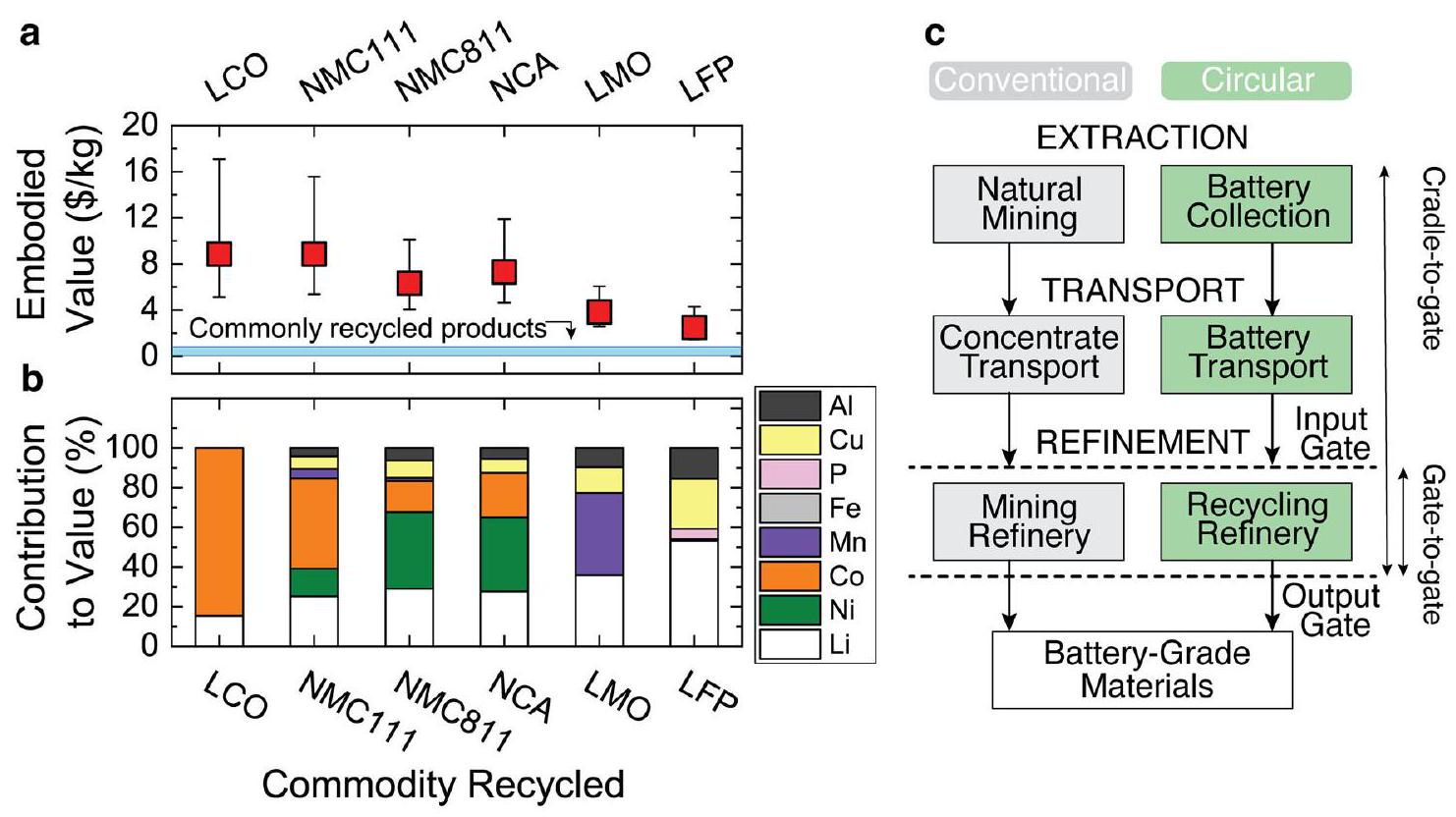
يمكن أن تساعد إعادة تدوير المواد الحرجة في بطاريات LIB في نهاية عمرها الافتراضي في تخفيف المخاوف البيئية المتزايدة وهي ضرورية لاستدامة النقل الكهربائي على المدى الطويل. بينما قد لا تسهم المواد المعاد تدويرها بشكل كبير في الطلب العالمي على LIB لعقود، فإن إنشاء سلاسل إمداد دائرية محلية هو عملية تكرارية، تتطلب منحنيات تعلم متعددة مع تطور العرض السائد لكيميائيات وأشكال بطاريات LIB في نهاية عمرها الافتراضي. تشمل العوامل المركزية لنجاح إعادة التدوير تكلفة جمع المنتجات، تكلفة عمليات إعادة التدوير، والقيمة الاقتصادية للمواد المستردة. بالنظر إلى أسعار LIB بين عامي 2018 و2021، تشكل Li وNi وCo أعلى قيمة اقتصادية متجسدة (الشكل 1a) ,
وAl وCu تمثل نسبة وزن كبيرة من حزم بطاريات EV . بينما يتم إعادة تدوير من بطاريات الرصاص الحمضية في الولايات المتحدة، تظهر LIBs قيمًا اقتصادية أعلى من 2-10 مرات ولكن يتم إعادة تدويرها فقط على مستوى العالم . تحفز الفوائد البيئية للدائرية أيضًا إعادة تدوير LIB نظرًا للإنتاج الهائل من LIB والتعدين المكثف للمعادن الأساسية. هناك حاجة ملحة لتقييم الفرصة البيئية عبر عدة مقاييس تطبيقية، من العديد من بطاريات LIB الإلكترونية الاستهلاكية الصغيرة (مثل ) إلى عدد أقل من حزم بطاريات النقل والتخزين الثابتة الكبيرة (مثل . بالإضافة إلى ذلك، تطورت الكيميائيات المفضلة من قبل شركات صناعة السيارات للتحوط من نقص المعادن الحرجة المحتمل والتفاعل مع تحولات السوق (مثل التركيز المتزايد على بطاريات فوسفات الحديد الليثيوم وبطاريات أيونات الصوديوم)، مثل الزيادة القريبة في أسعار كربونات الليثيوم في أوائل عام 2022. تسلط الاختلافات الحالية في LIB وتعقيد سلسلة الإمداد الضوء على الحاجة إلى تقييم دورة حياة منهجي ومقارن (LCA) بين الدائرية (أي، إعادة تدوير بطاريات نهاية العمر) وسلاسل الإمداد التقليدية، وهو ما هو مطلوب للـ LIBs الحالية واستراتيجيات إعادة التدوير المحتملة مع كيميائيات بطارية متنوعة في المستقبل.
على الرغم من التقدم الكبير، لا يزال الفهم الحالي للآثار البيئية لإعادة تدوير LIBs غير مكتمل. لم يتم نسب الاختلافات البيئية الأكثر أهمية بين إنتاج LIB من مواد الكاثود الدائرية والمعدنة تقليديًا بشكل موحد إلى خطوات سلسلة الإمداد المحددة التي نشير إليها باسم خطوات الاستخراج والنقل والتكرير (يشار إليها معًا باسم “من المهد إلى البوابة”، الشكل 1b). تشمل عمليات التكرير من البوابة إلى البوابة المستخدمة في المنشآت الدائرية القائمة والناشئة الفصل الميكانيكي (Me)، والبايروميتالورجيا (Py) , و
hydrometallurgy (Hy) . على وجه التحديد، يقوم Me بتفكيك LIBs جسديًا إلى مكوناتها، ويستخدم Py درجة حرارة مرتفعة لتسهيل تحويل المواد، ويفصل Hy المواد في المرحلة المائية عبر عمليات التذويب، والترسيب، واستخراج المذيبات. عملت الجهود السابقة نحو حساب الآثار البيئية (مثل استهلاك الطاقة، وانبعاث غازات الدفيئة، واستهلاك المياه) لمسارات تكرير LIB وجميع خطوات سلسلة الإمداد من المهد إلى البوابة. ومع ذلك، فإن التحليلات من البوابة إلى البوابة لعمليات التكرير الدائرية أبلغت عن آثار بيئية تختلف بأكثر من بسبب منهجيات غير متسقة. بالإضافة إلى ذلك، يتطلب تعزيز قدرات اتخاذ القرار لتوسيع سلاسل إمداد LIB المستدامة LCA مع بيانات أكثر تفصيلًا في كل خطوة. يمكن أن تُعلم بيانات التشغيل لتكرير على نطاق صناعي تصميم تقنيات التكرير بشكل عقلاني. تم توقع التطور المستقبلي لتصنيع LIB والدوافع لاقتصاد البطاريات الدائري من قبل الباحثين الأكاديميين والصناعيين , لكن الفهم على المستوى الصناعي لتأثيرات البيئة لمختلف المواد الخام ومنتجات التكرير لا يزال مفقودًا.
في هذه الدراسة، نقوم بتحديد الآثار البيئية من المهد إلى البوابة لمواد كاثود من الدرجة البطارية المصنعة في سلاسل إمداد تقليدية ودائرية عبر ثلاث خطوات رئيسية: استخراج المواد، النقل، والتكرير (الشكل 1b)، مع التركيز على خطوة التكرير. أولاً، نقوم بتحديد تكرير التركيز المستخرج من الرواسب الطبيعية إلى مواد من الدرجة البطارية في سلاسل الإمداد التقليدية ونقارنها بإنتاج هذه المواد بواسطة شركة ريدوود ماتييرالز (شركة إعادة تدوير في نيفادا، الولايات المتحدة) في عام 2021. يتم استكشاف مصدرين لـ LIB: نفايات إنتاج LIB غير المفعلة من مرافق التصنيع وبطاريات LIB في نهاية عمرها الافتراضي المجمعة من المستهلكين. تسهم هذه الدراسة برؤى لإعلام
الشكل 1 | المحركات الاقتصادية لإعادة تدوير بطاريات الليثيوم أيون (LIB) وخيارات سلسلة الإمداد لإنتاج مواد من الدرجة البطارية. أ قيم السلع للـ LIBs التمثيلية، و المساهمات النسبية للعناصر المعدنية المتجسدة في قيم LIB. الـ LIBs التمثيلية تأتي من الإلكترونيات الاستهلاكية باستخدام أكسيد الكوبالت الليثيوم (LCO)، وحزم بطاريات المركبات الكهربائية بما في ذلك أكسيد النيكل المنغنيز الكوبالت الليثيوم (NMC111 وNMC811)، أكسيد الألمنيوم النيكل الكوبالت الليثيوم (NCA)، أكسيد المنغنيز الليثيوم (LMO)، وفوسفات الحديد الليثيوم (LFP). تستند البيانات إلى قيم السوق بالدولار لعام 2021 المعدلة للتضخم بين يناير 2018 وديسمبر 2021 , وتدل عدم اليقين على فترة ثقة، والتي قد تتداخل مع نقطة البيانات في بعض الحالات، مما يحجب رؤيتها. تمثل المنطقة المظللة باللون الأزرق في (أ) متوسط قيم السلع للمنتجات المعاد تدويرها بشكل شائع: الزجاج، الورق، البلاستيك، وعلب المعادن (تُقدم المزيد من التفاصيل في
الخطوات من المهد إلى البوابة في تصنيع مواد بطاريات الليثيوم أيون ذات الجودة العالية (أي، الأملاح) من سلاسل التوريد التقليدية (الرمادية) والدائرية (الخضراء)، والتي تشمل ثلاث خطوات: الاستخراج، النقل، والتكرير. يشير الاستخراج التقليدي إلى التعدين الطبيعي، بينما يمثل نظيره الدائري جمع البطاريات. يتحرك النقل في سلاسل التوريد التقليدية والدائرية لنقل تركيز الخام والبطاريات، على التوالي. تستقبل مصافي التعدين التقليدية ومصافي إعادة التدوير الدائرية تركيزات الخام والبطاريات، على التوالي، وتستخدم تقنيات تكرير مختلفة. يعتبر الاستخراج والنقل “خطوات upstream” بالنسبة لتكرير من بوابة إلى بوابة، كما هو موضح في المنطقة بين بوابات “الإدخال” و”الإخراج”. تأخذ تحليل المهد إلى البوابة في الاعتبار عمليات التكرير والعمليات upstream معًا.
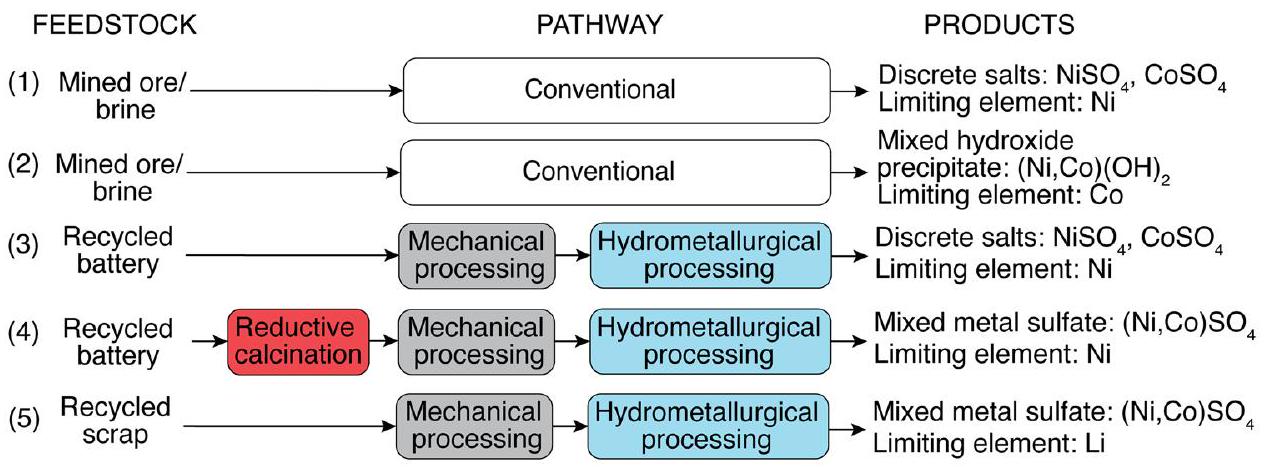
الشكل 2 | مخطط يلخص المواد الخام، والمسارات، والمنتجات في تحليلات التكرير. مخطط يوضح المواد الخام، والمسار، والمنتجات كدليل لطرق التكرير. خمسة تحليلات تكرير محددة في هذه الدراسة: التكرير التقليدي (1 و 2) يستقبل خامات مستخرجة ومياه مالحة، وطرق التكرير الدائرية (3-5) تعيد التدوير من البطاريات في نهاية عمرها الافتراضي أو الخردة. بينما جميع السيناريوهات إنتاج متطابق و توجد منتجات النيكل والكوبالت في شكل أملاح منفصلة، و ( 1 و 3 ) ، هيدروكسيد مختلط (2) أو كبريتات المعادن المختلطة (و 5تشير الألوان الحمراء والرمادية والزرقاء إلى عمليات التحميص الاختزالي، والعمليات البيروميتالورجية، والميكانيكية، والهيدروميتالورجية. تصنيع البطاريات الدائرية من خلال معالجة ثلاث فجوات حاسمة في الأدبيات. أولاً، يتم تحليل بيانات التشغيل على نطاق صناعي المقدمة من شركة ريدوود ماتييرالز من مستوى أكثر تفصيلاً مقارنة بالتقارير السابقة ومقارنتها بقيم سلسلة إمداد بطاريات الليثيوم أيون التقليدية استنادًا إلى نموذج غازات الدفيئة والانبعاثات المنظمة واستخدام الطاقة في التقنيات (GREET 2021) من مختبر أرجون الوطني.. يحدد هذا الاستخدام لإعادة التدوير على نطاق صناعي بشكل كمي الدور السائد للكهرباء من الشبكة المدخلة في تحسين الدائرة على مستوى منطقة التوازن بناءً على بيانات إعادة تدوير بطاريات الليثيوم أيون على نطاق صناعي. ثانيًا، يتم فحص تأثيرات تنسيقات المنتجات في مسارات التحسين الدائري على التأثيرات البيئية من خلال تغيير مسارات التحسين على نطاق صناعي. بالنسبة لكل من التحسين التقليدي والدائري، فإن تأثيرات إنتاج المزيجتم تحليل المركبات والأملاح المنفصلة، مما يظهر أن المنتجات المختلطة ذات التأثير المنخفض تستحق مزيدًا من التحقيق. ثالثًا، يتم نمذجة التأثيرات البيئية للعمليات السابقة للتكرير قبل التكرير من بوابة إلى بوابة. تشمل التقييمات السابقة استخراج مواد بطاريات الليثيوم من مصادر تقليدية (أي، خام مستخرج) أو دائرية (أي، بطاريات تم جمعها) ونقل المواد المستخرجة إلى مرافق التكرير ذات الصلة لإنتاج مواد كاثود ذات جودة بطارية.، وأملاح كبريتات النيكل أو كربونات النيكل. تُظهر نمذجة المراحل السابقة أن التكرير هو المساهم الرئيسي في التأثيرات البيئية في الحالة الدائرية، مما يبرز الفرص لتحسين الطاقة والانبعاثات المرتبطة بالتكرير. توفر هذه الدراسة رؤى تحليل دورة الحياة مع بيانات تكرير دائرية على نطاق صناعي تشمل مقارنة خطوة بخطوة من المهد إلى البوابة لسلاسل إمداد بطاريات الليثيوم أيون التقليدية والدائرية. مع المنهجيات والنتائج المبلغ عنها في هذه الدراسة، يمكن للباحثين تحديد الفرص الرئيسية لتحسين كفاءات العمليات، ويمكن للممارسين قياس تأثيراتهم البيئية، ويمكن لصانعي السياسات تحفيز ممارسات بيئية أفضل في إدارة سلسلة إمداد بطاريات الليثيوم أيون. يمكن أن تساعد الرؤى التفصيلية التي تقدمها هذه الدراسة استنادًا إلى بيانات العمليات الصناعية أيضًا المُعَادِين في تحسين التأثيرات البيئية لعمليات التكرير الخاصة بهم، وإشعال المزيد من التعاون الأكاديمي الصناعي لتعزيز هذا المجال.
النتائج
مسارات التكرير
في هذه الدراسة، تم تقديم تحليلات التأثيرات البيئية مع التركيز على خطوة التكرير، تليها تحليل خطوات استخراج المواد والنقل upstream. في سلاسل إمداد بطاريات الليثيوم أيون، تقوم خطوة التكرير بتحويل المواد الخام المجمعة إلى أملاح ذات جودة بطارية لمزيد من التصنيع (الشكل 2). في كل من سلاسل الإمداد التقليدية والدائرية، تختلف مسارات التكرير بشكل كبير اعتمادًا على عوامل متعددة. كانت هناك خمس مسارات تكرير. تمت المقارنة في هذه الدراسة (الشكل 2). يبدأ التحسين التقليدي بخامات/محاليل مستخرجة (السيناريوهات (1) و(2) في الشكل 2). يُعتبر خردة البطاريات الناتجة عن التصنيع والتجميع مصدر إعادة تدوير رئيسي اليوم، ومن المتوقع أن تمثل حوالي نصف مواد مصدر إعادة التدوير في العقد المقبل حيث يتجاوز إنتاج البطاريات توليد البطاريات المستهلكة.. لذلك، تم تحليل التحسين الدائري بدءًا من بطاريات نهاية العمر ((3) و(4)) أو خردة البطاريات (5). يمكن أن تكون النيكل والكوبالت في منتجات التحسين لأغراض التصنيع اللاحقة أملاحًا منفصلة ((1) و(3)) أو مركبات مختلطة ((2) و(4) و(5)). كانت المنتجات المستهدفة من المسارات التقليدية والدائرية مستندة إلى نموذج GREET وعمليات إعادة التدوير العملية، على التوالي. في الأقسام التالية، تم تحليل التأثيرات البيئية العامة لعملية التحسين أولاً، تليها تأثيرات تنسيقات المنتجات على خطوة التحسين والمساهمين الرئيسيين في التأثيرات البيئية لعملية التحسين. أخيرًا، تم تحليل التأثيرات البيئية upstream ومقارنتها بخطوة التحسين. ما لم يُذكر خلاف ذلك، كانت جميع التحليلات الرئيسية مستندة إلى بيانات عام 2021 (تم تلخيص سنوات مرجع البيانات في الجدول التكميلية 2).
تنقية بطاريات الليثيوم أيون قللت من الأثر البيئي
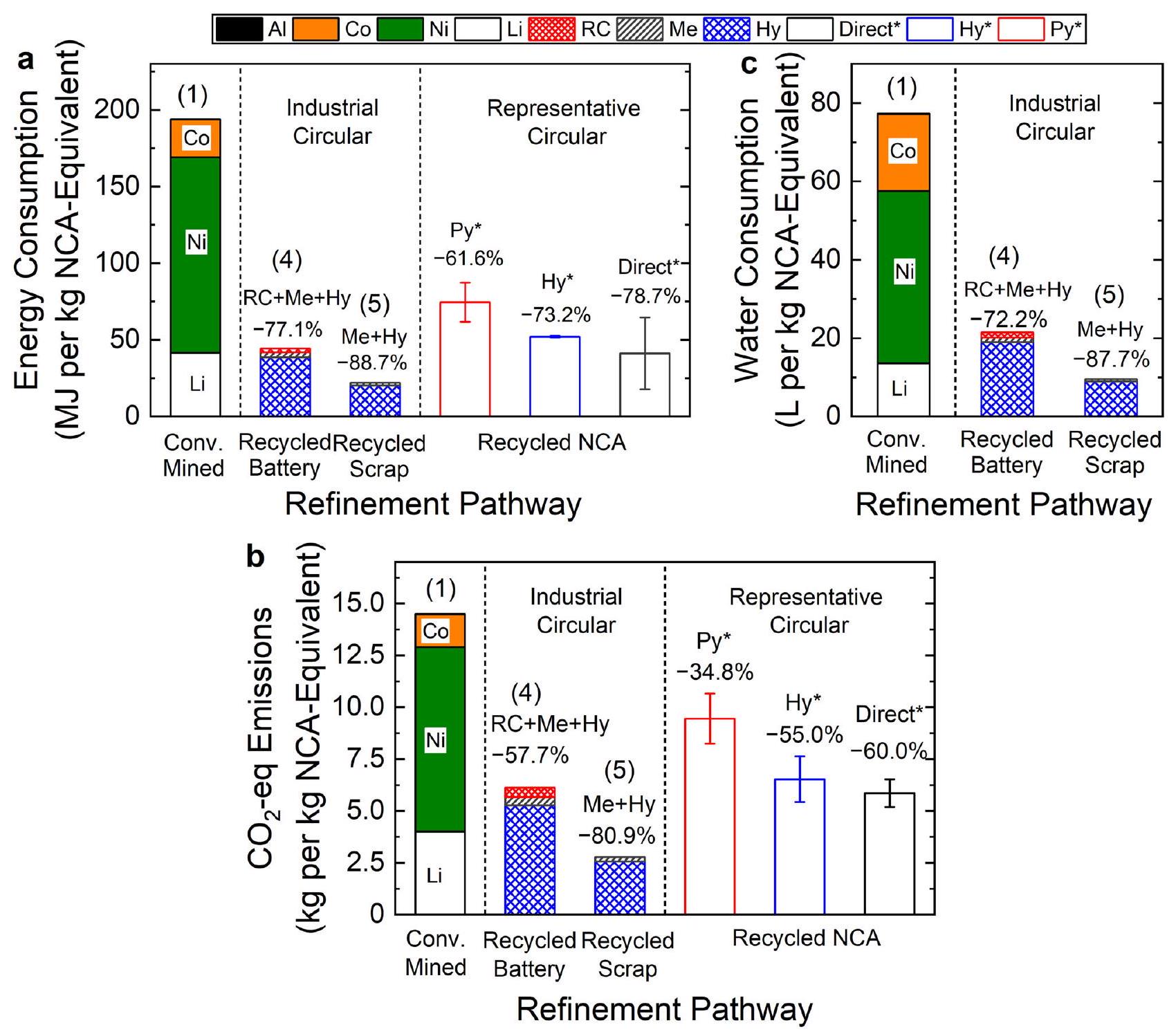
تم تحليل الآثار البيئية لمسارات التكرير في سلاسل إمداد بطاريات الليثيوم أيون التقليدية والدائرية في الشكل 3. تم اعتبار الخطوات السابقة لاستخراج المواد والنقل، التي لم تتوفر لها نفس البيانات الأولية الدقيقة مثل التكرير، في الأقسام اللاحقة. استهلاك الطاقة، وانبعاثات غازات الدفيئة (-معادلات،تم اختيار معايير إضافية لتلوث الهواء (المفصلة في الجدول التكميلي 3) واستهلاك المياه كمعايير رئيسية لتحليل الأثر البيئي لسلاسل إمداد بطاريات الليثيوم أيون في هذه الدراسة.تم استخدام كيلوغرام واحد من مادة كاثود أكسيد الليثيوم-النيكل-الكوبالت-الألمنيوم (NCA-eq) كوحدة وظيفية طوال هذه الدراسة لمقارنة سلسلة التوريد، مع الأخذ في الاعتبار المتطلبات العنصرية لإنتاج النسبة المولية.تم اختيار كيمياء NCA لأنها كانت تمثل ثاني أكبر فئة من كيمياء بطاريات السيارات الكهربائية بعد بطاريات NMC فيومن المتوقع أن يستخدم كميات أقل من الكوبالت مقارنةً بـ NMCباستثناء التأثيرات البيئية لاستخراج المواد وعمليات النقل، فإن إنتاج 1 كجم من مادة بطارية NCA-eq من المواد الطبيعية المستخرجة تقليديًا استهلك 193.9 ميجا جول وأثناء الانبعاث-eq (الشكل 3). كان تحسين تركيز المواد المستخرجة إلى مادة نيكل من الدرجة المستخدمة في البطاريات هو الذي يهيمن على التأثيرات البيئية لـ NCA، مما يمثل للقيم الإجمالية. لاحظ أن النتائج كانت مستندة إلى GREET 2021 لتتناسب مع الفترة التي تم فيها جمع بيانات التحسين الدائري في ريدوود؛ التأثيرات البيئية الأكثر حداثة لسلسلة الإمداد التقليدية
الشكل 3 | التأثيرات البيئية لتقنيات التكرير التقليدية والدائرية. أ استهلاك الطاقة،-انبعاثات -eq، واستهلاك المياه في عملية التكرير من البوابة إلى البوابة عبر مسارات مختلفة لأملاح بطاريات أكسيد النيكل والكوبالت والألمنيوم (NCA) من الدرجة البطارية. الأرقام بين قوسين الموضوعة في أعلى الأعمدة المكدسة تشير إلى طرق التكرير الملخصة في الشكل 2. المسار التقليدي المستخرج (Conv. Mined) يقوم بتكرير الرواسب الطبيعية وينتج أملاحًا منفصلة (الطريقة (1) في الشكل 2)؛ لاحظ أن الألمنيوم موجود في أعلى كل عمود مكدس لكن مساهماته صغيرة جدًا بحيث لا يمكن رؤيتها؛ تم تفصيل التأثيرات البيئية المحددة لكل عنصر مساهم في الجدول التكميلي 3. سلاسل الإمداد الدائرية تقوم بالتكرير إما من بطاريات أيون الليثيوم المختلطة المنتهية الصلاحية التي تم جمعها من المستهلكين (البطارية المعاد تدويرها، الطريقة (4) في الشكل 2) أو من خردة البطاريات غير المفعلة من منشأة الإنتاج (الخردة المعاد تدويرها، الطريقة (5) في الشكل 2)، مما ينتج كبريتات معدنية مختلطة. تشمل مسارات التكرير الدائرية متعددة الخطوات المعالجة الميكانيكية (Me، باللون الرمادي)، والتكلس الاختزالي (RC، باللون الأحمر)، والهيدروميتالورجيا (Hy، باللون الأزرق). RC هو خطوة معالجة إضافية للبطاريات المفعلة ولم يتم استخدامها. للنفايات المعاد تدويرها غير المفعلة. تشير القضبان المفتوحة في اللوحات “الدائرة التمثيلية” إلى التأثيرات البيئية لإعادة تدوير بطاريات NCA باستخدام طرق إعادة التدوير الحرارية (Py*)، والهيدرومعدنية (Hy*)، وإعادة التدوير المباشر (Direct*) كمقارنة، مع البيانات المستمدة من الأدبيات.تم تطبيع بيانات الأدبيات بواسطة نفس الوحدة الوظيفية في هذه الدراسة، وتم تحديد الشكوك من خلال دمج نوعين مختلفين من بطاريات: البطاريات الكيسية والأسطوانية. الخط العمودي المتقطع في كل رسم بياني يحدد أنواع البيانات المختلفة، حيث تم تلخيص المسارات التقليدية القائمة على النماذج والمسارات التمثيلية الموجودة في اللوحة اليسرى، وتم تقديم بيانات التشغيل من مواد ريدوود في اللوحة الوسطى (“الدائرة الصناعية”)، وبيانات الأدبيات في اللوحة اليمنى (“الدائرة التمثيلية”). لاحظ أن استهلاك المياه لم يتم قياسه بشكل عام في الدراسات السابقة، مما أدى إلى عدم وجود لوحة بيانات أدبية لـ (ب). لم يتم تضمين التأثيرات البيئية لاستخراج المواد ونقلها في سلاسل الإمداد. استنادًا إلى نموذج 2023 كانتأعلى من تلك الخاصة بعام 2021، وتم تقديمها في البيانات التكميلية. كانت قيم انبعاثات غازات الدفيئة قابلة للمقارنة مع الدراسات السابقة المستندة إلى مجموعات بيانات GREET. (مقارنة التأثيرات البيئية مع البيانات في الأدبيات مفصلة في الشكل التكميلية 2d).
تم تقديم التأثيرات البيئية لطريقتين دائريتين للتكرير في كل رسم بياني في الشكل 3 للمواد الخام المختلطة من بطاريات الليثيوم أيون المعالجة في شركة ريدوود ماتييرالز: الخردة غير المعالجة من منشآت إنتاج بطاريات الليثيوم أيون (الخردة المعاد تدويرها) والخردة المعالجة، في نهاية… تم جمع بطاريات الليثيوم أيون المستخدمة من المستهلكين (البطارية المعاد تدويرها). باستخدام نهج المادة المحددة لإنتاج 1 كجم من مواد NCA-eq، كانت متطلبات الطاقة لمعالجة الخردة المعاد تدويرها وتدفقات البطاريات المعاد تدويرها 22.0 ميجا جول و44.4 ميجا جول لكل كجم من مواد NCA-eq، وهو ما يقل بشكل كبير عن التكرير التقليدي بواسطة و ، على التوالي (الشكل 3أ). وبالمثل، 2.8 و-eq لكل كجم من المواد NCA-eq تم إنتاجها من الخردة وتيارات البطاريات، على التوالي، مما أدى إلى تقليل كبير فيانبعاثات -eq بواسطة و (الشكل 3ب). كان استهلاك الماء أيضًا أقل بـللقمامة و
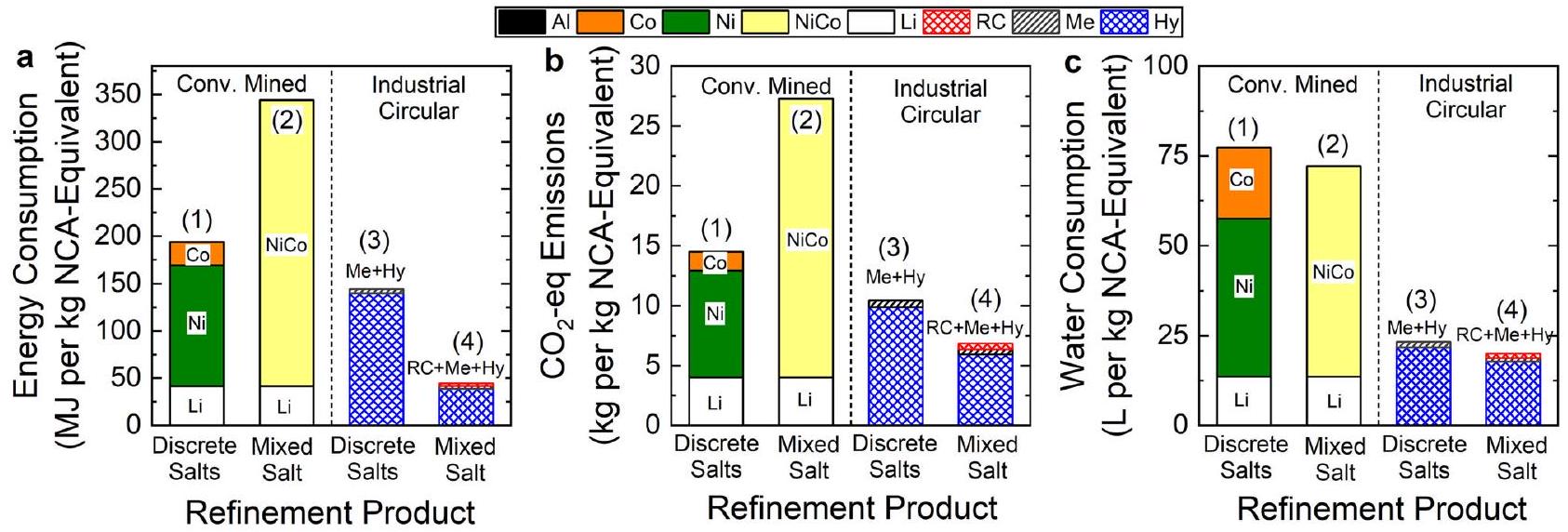
الشكل 4 | تأثيرات منتجات التكرير على التأثيرات البيئية في التكرير الدائري. أ استهلاك الطاقة،-انبعاثات -eq، واستهلاك المياه. تشير الألواح اليسرى واليمنى إلى المسارات الدائرية التقليدية (المعدنة التقليدية) والصناعية التي تقوم بتنقية البطاريات في نهاية عمرها إلى أملاح النيكل والكوبالت المنفصلة، أو المختلطة. المواد المالحة. لاحظ أن الألمنيوم يظهر في أعلى الأعمدة المكدسة لسلاسل الإمداد التقليدية ولكن مساهماته صغيرة جدًا بحيث لا يمكن رؤيتها (القيم التفصيلية في الجدول التكميلي 3). الأرقام بين قوسين الموضوعة في أعلى الأعمدة المكدسة تشير إلى طرق التكرير الملخصة في الشكل 2. لتدفقات البطارية مقارنة بالسيناريو التقليدي، الناتجة عن استهلاك 9.5 و لكل كيلوجرام من مواد NCA-eq، على التوالي (الشكل 3c). لاحظ أنه على الرغم من أن النسبة العنصرية كانت متطابقة، إلا أن المواد ذات درجة البطارية الناتجة اختلفت قليلاً بين التقليدية ( ) ودائري تحسين في قسم “الطرق”. يتم إنتاج وتداول كبريتات المعادن بشكل شائع في سوق إعادة تدوير البطاريات.تحويل المنتج النهائي من الليثيوم إلىلم تغير بشكل كبير التأثيرات البيئية لسلاسل الإمداد الدائرية (الملاحظة التكميلية 3، الشكل التكميلية 2)، ويتم فحص تأثيرات إنتاج المنتجات المنفصلة أو المختلطة في القسم التالي.
لإنتاج مواد كاثود من الدرجة البطارية، استخدمت شركة ريدوود ماتييرالز مزيجًا من عمليات التحميص الاختزالي (RC) والعمليات البيرومعدنية والميكانيكية (Me) والهيدرومعدنية (Hy) لتكرير بطاريات الليثيوم أيون (التفاصيل في الشكل التوضيحي 5). تعتبر عملية RC عملية بيرومعدنية حرارية صناعية على نطاق واسع تقلل من مركبات أكسيد المعادن الكاثودية في ظروف خالية من الأكسجين للتكرير اللاحق. على عكس العمليات البيرومعدنية الصناعية السائدة (مثل التحميص المباشر أو الصهر) التي تتطلب درجات حرارة عالية.تعمل عملية إعادة التدوير على تحسين ظروف العمل، مما يفضل الاختزال الكربوحراري دون استخدام الكربون الجرافيتي، وبالتالي تجنب المدخلات المباشرة من الوقود الأحفوري، واحتراق الجرافيت، وفقدان كبير لليثيوم. نظرًا لأن إعادة التدوير غير مطلوبة لإنتاج بطاريات الليثيوم أيون غير المفعلة، تم تحليل مجرى التغذية المكون من المواد القابلة لإعادة التدوير (الخردة المعاد تدويرها والبطاريات المعاد تدويرها) بشكل منفصل. استهلاك الطاقة وتم تقديم انبعاثات -eq لطرق إعادة التدوير الموجودة الممثلة من الأدبيات، بما في ذلك البيروميتالورجيا (Py*)، والهيدرو متالورجيا (Hy*)، وإعادة التدوير المباشر (Direct*)، في الشكل 3 للمقارنة. لاحظ أن خطوة المعالجة الميكانيكية غالبًا ما تكون مدرجة في تنقية Hy*. بشكل عام، أظهرت مسار RC+Me+Hy استهلاكًا للطاقة قابلًا للمقارنة و-انبعاثات -eq معوقيم الأدب المباشرة*وأثر بيئي أقل بكثير منتشبه عمليات البيروميتالورجيا الخالية من الأكسجين الناشئة، عمليات تقليل الكربوثرميك والتيرميت لإعادة تدوير مركبات المعادن الكاثودية عند درجات حرارة معتدلة.بينما تم دراسة معظم عمليات الاختزال الكربوحرارية والثرمايت على نطاق المختبر، أظهرت نتائجنا أن خطوة RC كانت مسؤولة عنمن إجمالي التأثيرات البيئية لخطوة التكرير الدائري (الشكل 3)، مما يوضح الجدوى البيئية لعملية الصهر الحراري القائم على تقليل الكربون على نطاق صناعي. لاحظ أن الصهر الحراري القائم على إعادة التدوير يمكنه معالجة البطاريات المشحونة بمستويات مختلفة من الشحن والصحة والتنسيقات مع الحد الأدنى من التعديل، في حين أن التقليدية غالبًا ما تتطلب الهيدروميتالورجيا تفريغ البطاريات المشحونة في حمام ملحي أو إزالة الإلكتروليت للمعالجة الميكانيكية بأمان. بينما كانت هذه التحليل مركزة على مسارات تنقية مواد ريدوود، يمكن استخدام المنهجية لتقييم مسارات تنقية إضافية (مثل تحليل مسار هيدروميتالورجيا تمثيلي للبطاريات المشحونة في نهاية عمرها المفيد كما هو موضح في الشكل التوضيحي 2d)، أو غيرها التي تستخدم مواد خام مختلفة، وعمليات تنقية، ومصادر طاقة.
من بين الدراسات القليلة التي تقارن مباشرة بين الآثار البيئية لتكرير NCA الدائري والتقليدي باستخدام بيانات تشغيلية على نطاق صناعي،تم الإبلاغ عن انخفاض انبعاثات غازات الدفيئة (الشكل التوضيحي 2) لـتحسين دائري مقارنة بالدراسة الحالية. ومع ذلك، يمكن أن تكون المقارنة المباشرة غير دقيقة بسبب الافتراضات الأساسية المختلفة ومصادر البيانات. على سبيل المثال، استخدمت نماذج مختبر أرجون الوطني GREET وEverBatt مزيجًا من أوصاف التكنولوجيا من طلبات براءات الاختراع، وبيانات الأدبيات حول استهلاك تدفقات العمليات، وزيارات مواقع الصناعة واستطلاعات الرأي، واستشارة الخبراء، والافتراضات المعلنة لتشكيل مسارات كاملة. علاوة على ذلك، قام Ciez وWhitacre بت quantifying التأثيرات البيئية باستخدام المنتجات الناتجة الممثلة كـ “تعويضات معدنية” للمعالجة الحرارية أو مع المعادن في المحلول للمعالجة المائية. (الملاحظة التكميلية 3)، بدلاً من أملاح الكاثود في هذه الدراسة. بالإضافة إلى ذلك، شملت الدراسات السابقة جزءًا من المواد المعدنية المعاد تدويرها في تحليل سلسلة التوريد التقليدية، في حين أن هذا العمل أشار فقط إلى الرواسب الطبيعية المستخرجة في سلاسل التوريد التقليدية لفك تشفير الآثار البيئية بالكامل.تسلط الاستنتاجات المختلفة الضوء على أساليب تقييم دورة الحياة المتباينة، وظروف المعالجة، وفائدة الوصول إلى البيانات الصناعية الأولية بالإضافة إلى نمذجة العمليات من مصادر الأدبيات..
أشكال منتجات التكرير التي تؤثر على الأثر البيئي
شكل المنتج هو عامل مهم في فهم ومقارنة مسارات تنقية الليثيوم أيون بشكل صحيح (الشكل 2). النيكل والكوبالت هما عنصران رئيسيان في تصنيع البطاريات، ويمكن تداولهما في شكل أملاح معدنية مختلطة أو منتجات ملحية منفصلة بين مصنعي البطاريات ومصنعي البطاريات.. لدراسة تأثيرات أشكال منتجات التكرير، تم مقارنة الآثار البيئية للتكرير إلى الملح المختلط (على سبيل المثال، المختلط و ) وتنقيح إلى أملاح الكبريتات المنفصلة، و (الشكل 4). تم تحليل كل من مسارات التحسين التقليدية والدائرية.
تم استخدام نموذج GREET لتحليل مسارات التعدين التقليدية المختلفة التي تنتج تنسيقات منتجات مختلفة (مفصلة في قسم “الطرق”). في التعدين التقليدي، يتم التكرير إلى مزيج رواسب الهيدروكسيد، (السيناريو (2) في الشكل 2)، زيادة استهلاك الطاقة وانبعاثات -eq بواسطة و ، على التوالي، على المسار القائم على الأملاح المتقطعة (الشكل 4 أ، ب، “المعدن التقليدي”). المنتجات المتقطعة و يتم إنتاجها بشكل منفصل من خامات غنية بالنيكل وخامات غنية بالكوبالت. على النقيض من ذلك، يبدأ إنتاج ملح الهيدروكسيد المختلط من خام النيكل اللاتيريتي، الذي يحتوي على تركيز منخفض من بالنسبة إلى. تركيز الكوبالت المنخفض هذا يحد من النسبة المولية لمركب NCA ويزيد من التكلفة الإجمالية للطاقة لإنتاج 1 كجم من المواد المعادلة لـ NCA. من ناحية أخرى، كان استهلاك المياه في تكرير الهيدروكسيدات المختلطة أقل قليلاً.من إنتاج الأملاح المنفصلة. بشكل عام، فإن المسار القائم على الأملاح المنفصلة هو المفضل للتكرير التقليدي لتقليل الأثر البيئي.
تم تحليل المسارات الدائرية التي تقوم بتنقية البطاريات إلى منتجات مختلفة باستخدام الصناعة بيانات هاي ونموذج طريقة إعادة تدوير البطاريات التمثيلية التي تجمع بين الميكانيكا والهيدروميتالورجيا مماثل لـفي الشكل 3) تحسين (السيناريو (3) في الشكل 2). الـتقوم تقنية هاي باثواي بتنقية البطاريات المعاد تدويرها إلى كبريتات المعادن المختلطة.بينما الممثلهي تنتج بشكل منفصل و تكرير إلى كبريتات المعادن المختلطة أظهر استهلاك طاقة أقل ) ، انبعاثات -eqواستهلاك المياهمنالمسار (الشكل 4)، لأنه يتجنب العلاج الإضافي الفاصل (إلى أملاح منفصلة. بشكل عام، أشارت نتائجنا إلى أن تحسين البطاريات إلى أملاح معدنية مختلطة بدلاً من الأملاح المنفصلة يمكن أن يوفر بشكل كبير في التأثيرات البيئية مع تلبية احتياجات سلاسل إمداد بطاريات الليثيوم أيون الدائرية. كما توفر نتائجنا رؤى مهمة لتحسين عمليات تكرير البطاريات على نطاق المصنع. في الأقسام التالية، تم تحليل المسارات المعتمدة على الأملاح المختلطة للتكرير.
هيمنت استهلاك الكهرباء على التحسين الدائري
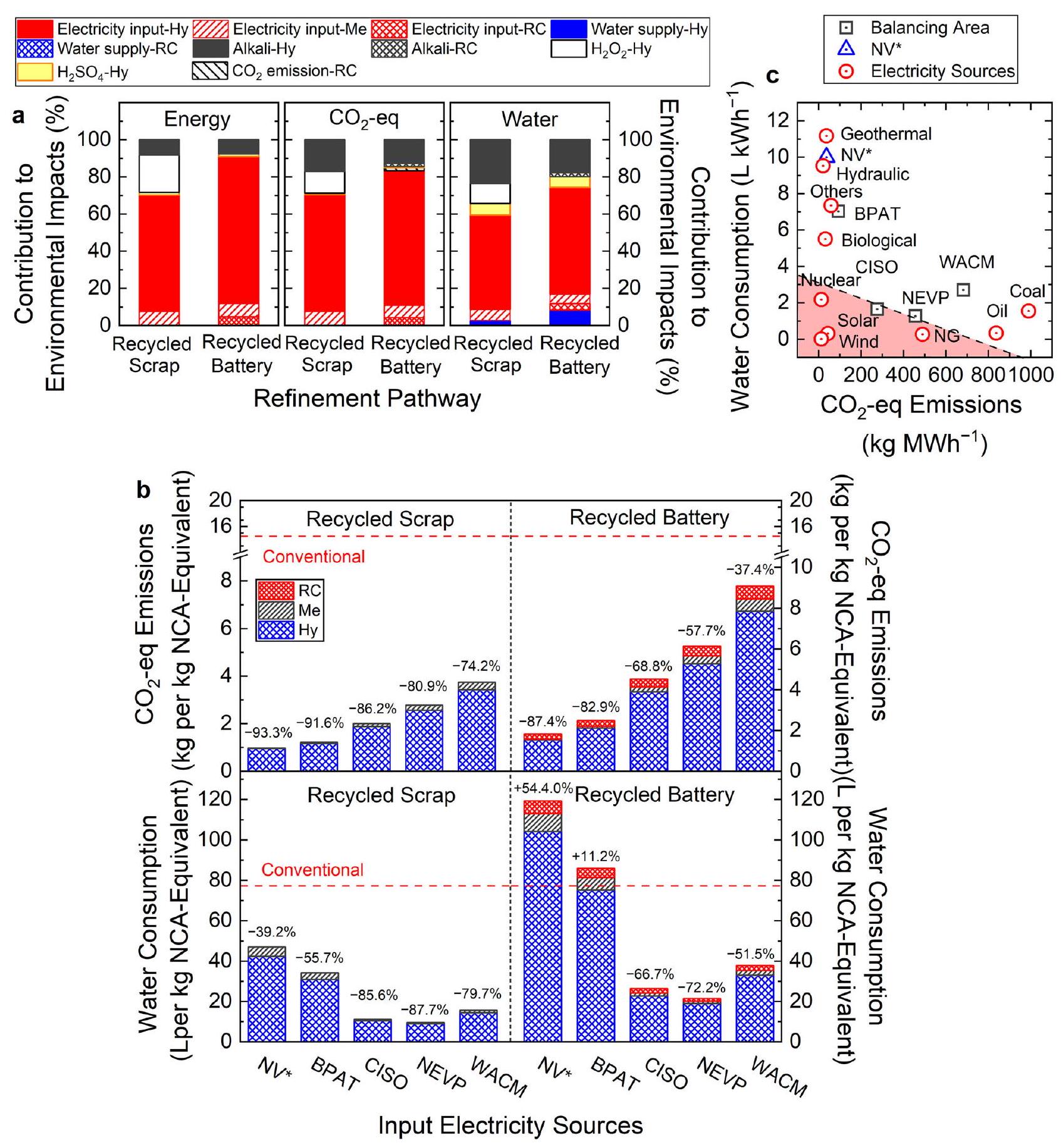
لفهم العوامل المحددة للأداء في خطوة التكرير بشكل أفضل، تم تفكيك التأثيرات البيئية النسبية للمواد الاستهلاكية المدخلة (مثل الطاقة، الماء، المواد الكيميائية الأساسية) في عمليات التكرير من البوابة إلى البوابة في الشكل 5 (ملوثات الهواء الإضافية في الجداول التكميلية 10، 11 والأشكال التكميلية 3، 6). تجدر الإشارة إلى أن التأثيرات البيئية المتجسدة لاستهلاك الكهرباء في الشكل 3 كانت مستندة إلى شركة نيفادا للطاقة (NEVP) في موقع مواد ريدوود. وُجد أن استهلاك الكهرباء هو عامل رئيسي يهيمن على التأثيرات البيئية. بالنسبة لكلا مساري المواد الخام لبطاريات الليثيوم أيون (السيناريوهات (4) و(5) في الشكل 2)، كانت الكهرباء تمثلمن إجمالي استهلاك الطاقة،من الإجمالي-انبعاثات -eq، واستهلاك المياه (الشكل 5أ). بالنسبة لكلا المصدرين، كانت عمليات Hy تشكل الغالبية العظمى من التأثيرات البيئية، حيث ساهمت بأكثر مناستهلاك الطاقة،إلى-انبعاثات، واستهلاك المياه. ومن الجدير بالذكر أن الخطوة الإضافية المطلوبة لمعالجة البطاريات المشحونة ساهمت بشكل هامشي فقط في-انبعاثات -eqمن الإجمالي). على عكس العمليات البيرومعدنية التقليدية التي تتطلب مصادر طاقة خارجيةتعتبر البيروميتالورجيا RC ذاتية الحرارة بشكل أساسي لأنها تستفيد من حرارة العملية الناتجة عن التفاعلات الطاردة للحرارة لمواد بطاريات الليثيوم أيون.. بالإضافة إلى استهلاك الكهرباء، ساهمت المواد الكيميائية المستخدمة في عمليات التكرير الدائري أيضًا في التأثيرات البيئية المتجسدة. ساهمت المواد القلوية المستخدمة لترسيب المعادن بنسبة تتراوح بين و من التأثيرات البيئية (أكبر مساهمة نسبية في استهلاك المياه).تم استخدامه لتقليل مركبات المعادن ذات الحالة الأكسيدية العالية لعمليات استخراج المعادن الهيدرومعدنية من المواد الخردة، ويمثلالتأثيرات البيئية (أكبر مساهمة نسبية في استهلاك الطاقة).
نظرًا لأن الكهرباء هيمنت على التأثيرات البيئية لعمليات إعادة تدوير بطاريات الليثيوم أيون، قمنا بمقارنة عدة مناطق توازن شبكة الكهرباء التي تطلق مجموعة منانبعاثات -eq لكل ميغاوات ساعة (متوسط لعام 2021)في الشكل 5ب (ملوثات الهواء الإضافية المفصلة في الجدول التكميلي 12). استبدال كهرباء NEVP بأخرى مناطق التوازن بما في ذلك إدارة الطاقة في بونفيل (BPAT)، مشغل النظام المستقل في كاليفورنيا (CISO)، إدارة الطاقة الغربية في كولورادو-ميسوري (WACM)، وتعرفة الطاقة المتجددة في نيفادا (NV*)، أسفرت عن تقليص كبير فيانبعاثات تصل إلى (خردة معاد تدويرها) و (البطارية المعاد تدويرها) مقارنة بالتكرير التقليدي (الشكل 5ب). وعلى العكس، يمكن أن يؤدي استخدام شبكات الكهرباء منخفضة الكربون إلى زيادة استهلاك المياه مقارنة بتشغيل NEVP، وفقًا للترتيب NV* BPAT > WACM > CISO > NEVP (الشكل 5ب). تجدر الإشارة إلى أن عمليات التكرير الدائرية المعتمدة على NV* و BPAT تجاوزت مستوى استهلاك المياه للتكرير التقليدي بسبب المساهمات الكبيرة من الطاقة المائية والحرارية الجوفية. كشفت المزيد من التحقيقات في مصادر الكهرباء الشبكية لمناطق التوازن عن وجود تبادل بينانبعاثات -eq واستهلاك المياه بناءً على نوع توليد الكهرباء (الشكل 5c)؛ معظم مصادر الكهرباء ذات الانبعاثات المنخفضة نسبيًاأظهرت انبعاثات -eq (مثل تلك المستندة إلى الطاقة الحيوية أو المائية أو الحرارية الجوفية) استهلاكًا عاليًا للمياه، والعكس صحيح. كما أن هذا التبادل يفسر التأثيرات المختلفة لمصادر الكهرباء على التأثيرات البيئية لخطوة تنقية مواد ريدوود ومسارات أخرى (المفصلة في الشكل التوضيحي 2d). ومع ذلك، ستؤثر مصادر الكهرباء لكل منطقة توازن على كلا-انبعاثات غازات الدفيئة واستهلاك المياه. على سبيل المثال، لأن الكهرباء المستندة إلى NEVP تشمل نسبة كبيرة نسبيًا ( ) من غاز طبيعي كثيف الانبعاثات مع استهلاك منخفض للمياه، التحول إلى مصادر كثيفة المياهستقل الكهرباء BPATانبعاثات -eq مع زيادة استهلاك المياه.
كانت التأثيرات البيئية upstream أقل في سلاسل الإمداد الدائرية
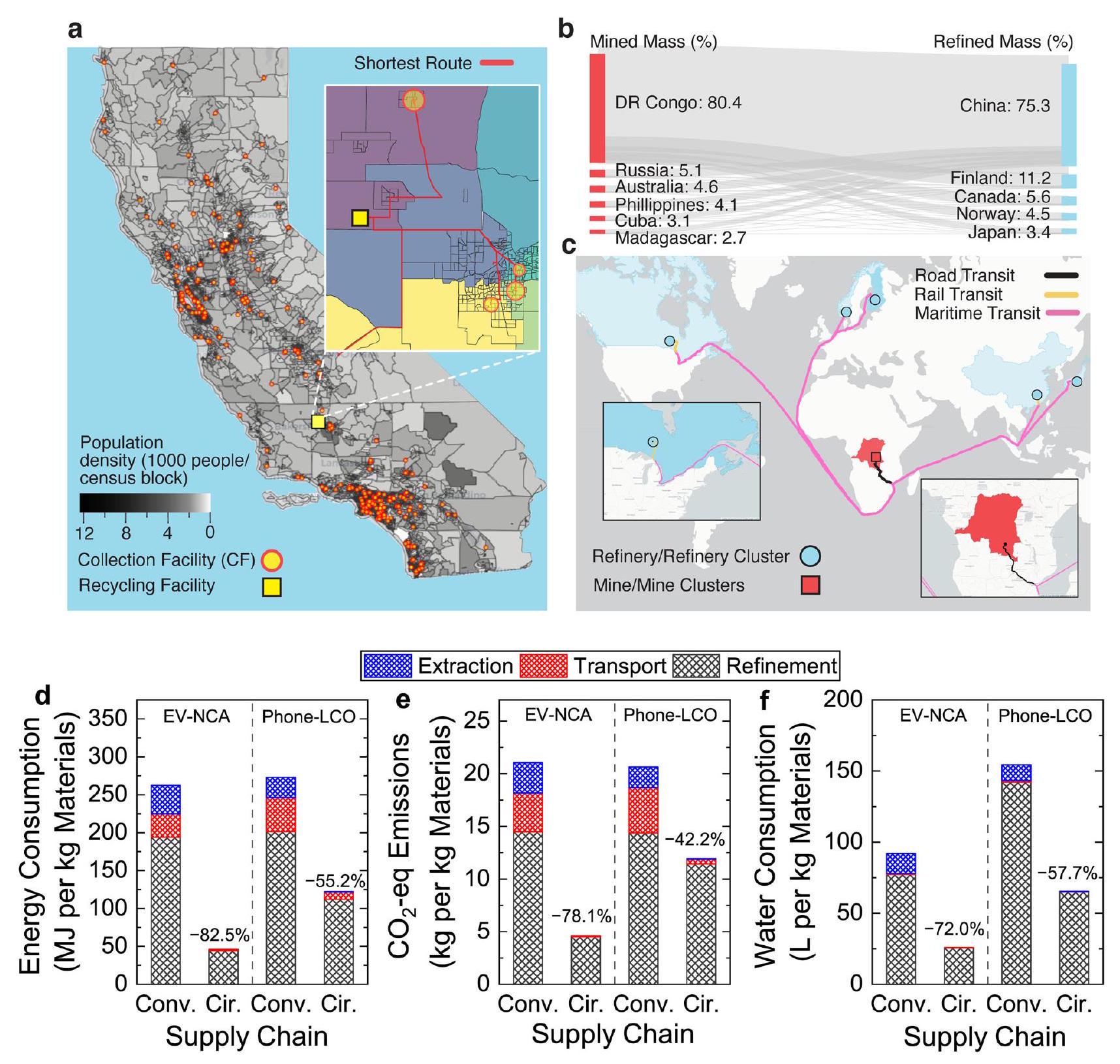
قبل خطوة التكرير، تمر بطاريات الليثيوم أيون بخطوات سابقة تتعلق باستخراج المواد ونقلها إلى مرافق التكرير (الشكل 1ب). تم تحليل الأثر البيئي لهذه الخطوات السابقة لاثنين من كيميائيات بطاريات الليثيوم أيون التمثيلية وحالات استخدام البطارية: NCA في حزم بطاريات السيارات الكهربائية، وأكسيد الكوبالت الليثيوم.أو LCO) في الهواتف الذكية. تم اختيار كاليفورنيا لتقييم الاستخراج الدائري لأنها تمتلك أكبر عدد من السكان وأكبر حصة في سوق السيارات الكهربائية في الولايات المتحدة الأمريكية.تم اعتبار الهواتف الذكية مستخرجة عند جمعها وتجميعها ونقلها من جميع سكان كاليفورنيا (تم تحليلها حسب كتلة التعداد) إلى أقرب منشأة جمع موجودة.تم تحديد أقصر مسار لجمع البيانات من خلال تقليل المسافات من مجموعة الكتل إلى مركز التجميع (الشكل 6أ؛ تم تلخيص النموذج في قسم “الطرق” وتفصيله في الملاحظة التكميلية 4)لتحديد الأثر البيئي لاستخراج المواد التقليدية من التعدين، تم تعديل بيانات سلسلة الإمداد العالمية من GREET. (الشكل التكميلي 4، الجداول التكمالية 14، 15). استخراج الهواتف الذكية في سلسلة التوريد الدائرية أصدر فقط -معادل لكل كجم LCO-eq، أقل بكثير من التعدين التقليدي ( -معادل لكل كجم LCO-eq) بمقدار . كان استهلاك الطاقة والمياه أقل بشكل مشابه في سلسلة التوريد الدائرية (الجدول التكميلي 15).
بعد الاستخراج، تم نقل تركيزات مواد LIB على طول الطرق المحلية والدولية بواسطة الشاحنات، والسكك الحديدية، والسفن البحرية إلى مواقع التكرير (جزء من نموذج الشبكة مقدم في الشكل التكميلي 4، والبيانات ملخصة في الجداول التكمالية ، و16. تم حساب التأثيرات البيئية للنقل من خلال حساب أقصر مسافة على طول الطرق الرئيسية للنقل بين الدول المشاركة مع وزن المساهمات النسبية للدول في السوق لكل عنصر (حالة الكوبالت مقدمة كمثال في الشكل 6b). يمكن العثور على تفاصيل طريقة النمذجة في الملاحظة التكمالية 5. تم حساب التأثيرات البيئية للتعدين التقليدي إلى التكرير لكل كجم من ، و معدن الألمنيوم (الجدول التكميلي 14). بينما تراوحت انبعاثات النقل لـ ، و Co بين -معادل لكل كجم من المعدن المتجسد، كان الألمنيوم أقل بثلاث مرات. بالنسبة للحالة الدائرية المطبقة على كاليفورنيا، تم نقل الهواتف الذكية وحزم بطاريات EV التي تم جمعها في CFs إلى
الشكل 5 | تحليل التأثيرات البيئية لإعادة تدوير بطارية أيون الليثيوم (LIB) باستخدام مصادر كهرباء مختلفة. أ المساهمات في التأثيرات البيئية لعمليات إعادة التدوير باستخدام الكهرباء من شركة نيفادا للطاقة، بما في ذلك استهلاك الطاقة، -معادل الانبعاث، واستهلاك المياه بواسطة مختلف المستهلكات المدخلة المستخدمة في العمليات الدائرية لمواد LIB من الخردة الإنتاجية (الخردة المعاد تدويرها) والبطاريات المنتهية الصلاحية (البطاريات المعاد تدويرها) المستخدمة من قبل مواد ريدوود. ب التأثيرات البيئية لمصادر الكهرباء المدخلة على -معادل الانبعاثات واستهلاك المياه في عمليات إعادة تدوير LIB التي تستخدمها طرق مواد ريدوود للخردة الإنتاجية والبطاريات المفعلة. -معادل الانبعاثات واستهلاك المياه استندت إلى الموارد المستهلكة من الكهرباء المولدة من عدة مصادر كهرباء: تعرفة الطاقة المتجددة في نيفادا (NV*)، إدارة الطاقة بونفيل
(BPAT)، مشغل النظام المستقل في كاليفورنيا (CISO)، شركة نيفادا للطاقة (NEVP)، وإدارة الطاقة في المنطقة الغربية: كولورادو-ميسوري (WACM). تشير الخطوط الحمراء المتقطعة إلى التأثيرات البيئية للعملية التقليدية المماثلة للتكرير. لاحظ أن تأثيرات مصادر الطاقة على التأثيرات البيئية مقدمة فقط لسلاسل التوريد الدائرية، وليس لسلاسل التوريد التقليدية. التأثيرات البيئية المحددة المقدمة في الأشكال مفصلة في الجدول التكميلي 12. ج العلاقة بين استهلاك المياه المتجسد و -معادل الانبعاث بواسطة مصادر الطاقة المختلفة، بما في ذلك الشبكات الكهربائية في مواقع مختلفة (دوائر)، ومصادر الطاقة النقية (مربعات)، وتعرفة الطاقة المتجددة في نيفادا ( ، مثلثات). تشير الخط الأحمر المتقطع إلى الحد الأدنى من أداء المياه-، أي الشبكات الكهربائية الموجودة التي لديها أقل استهلاك للمياه و -معادل الانبعاث في نفس الوقت.
الشكل 6 | التأثيرات البيئية من المهد إلى البوابة لسلاسل التوريد المختلفة. أ تم نمذجة استخراج دائري لهواتف ذكية قائمة على أكسيد الكوبالت الليثيوم (LCO) من كل مجموعة كتلة إحصائية بناءً على عدد السكان إلى أقرب منشأة جمع خاصة أو بلدية (CF) باستخدام خوارزمية أقصر مسار. تفاصيل النقل الدائري للنمذجة للهواتف الذكية المجمعة في CFs ثم نقلها إلى منشأة إعادة تدوير مركزية في مركز (نقطة الجاذبية) سكان كاليفورنيا بواسطة أقصر مسار (الخطوط الحمراء). تشير ألوان مجموعات الكتل إلى منطقة التجميع الخاصة بـ CF معينة، حيث يظهر حجم CF العدد النسبي للهواتف الذكية المجمعة في عام 2021. ب تقدير توزيع مرجح للوجستيات النقل الدولية لسلاسل التوريد التقليدية بين دول التعدين والتكرير بناءً على إنتاجية الكوبالت في الرسم البياني سانكي العلوي. ج مثال على لوجستيات النقل للكوبالت المستخرج والمجمع في جمهورية الكونغو الديمقراطية (DRC) ثم تم شحنه عبر الطرق الرئيسية، والسكك الحديدية، والطرق البحرية
باستخدام أقصر مسار إلى مواقع التكرير الرئيسية، مع إدراج توضح درجة التفاصيل المدروسة. تم إجراء تحليلات مماثلة لـ ، و Al . تقدم الإدراجات طرق النقل الأكثر تفصيلاً في DRC وكندا. د استهلاك الطاقة (يسار)، هـ -معادل الانبعاثات (وسط)، و استهلاك المياه (يمين) لسلاسل التوريد التقليدية (conv.) والدائرية (cir.) حسب خطوة سلسلة التوريد (استخراج المواد، النقل، التكرير). تم توفير كاثود NCA-eq المستخدم في المركبات الكهربائية (EVNCA، الألواح اليسرى) ومواد كاثود LCO-eq المستخدمة في الهواتف الذكية (Phone-LCO، الألواح اليمنى). تم تحليل التأثيرات البيئية للتكرير بناءً على الكهرباء المولدة من سلطة الشبكة المتوازنة CISO، وكانت خطوات سلسلة التوريد العليا (الاستخراج والنقل) مستندة إلى بيانات من نماذج GREET والنقل التي تم تطويرها في القسم السابق والمصورة في (أ-ج). تم تفصيل التأثيرات البيئية المحددة لكل خطوة في الجداول التكمالية 13-15.
منشأة تكرير LIB الدائرية المركزية الافتراضية في مركز الوزن السكاني (أي، نقطة الجاذبية) في كاليفورنيا (بالقرب من بيكرسفيلد) . في سلاسل التوريد التقليدية، كانت نقل تركيزات المواد المستخرجة تمثل -معادل لكل كجم NCA-eq و -معادل لكل كجم LCO-eq. بالمقارنة، كانت الانبعاثات لنقل حزم بطاريات NCA EV المنتهية الصلاحية المجمعة (أي، غير المفككة) وبطاريات الهواتف الذكية LCO (غير المفصولة عن
الهواتف) إلى منشأة تكرير دائرية كانت -معادل لكل كجم NCA-eq و -معادل لكل كجم LCO-eq، و أقل من نقل التركيز المستخرج، على التوالي. تم عزو الانخفاض في -معادل الانبعاثات إلى الاختلافات في تركيزات العناصر للمواد المنقولة والمسافة الإجمالية للنقل (على سبيل المثال، متوسط مرجح يبلغ 224 كم لمواد NCA-eq الدائرية، و لمواد NCA-eq التقليدية).
سلاسل التوريد الدائرية والتقليدية التي تهيمن عليها التكرير دمج خطوات استخراج المواد، والنقل، والتكرير أسفرت عن مقارنة من المهد إلى البوابة للخطوات المتميزة لسلاسل التوريد التقليدية والدائرية لـ إنتاج مواد كاثود من الدرجة البطارية (الشكل 6d-f). هنا تم تحليل التأثيرات البيئية لخطوة تكرير LIB في كاليفورنيا لسيناريو افتراضي يستخدم نفس تقنيات التكرير الدائرية متعددة الخطوات مثل مسار RC+Me+Hy في نيفادا، ولكن باستخدام كهرباء كاليفورنيا (CISO) لإنتاج مواد كاثود من الدرجة البطارية. أدت سلسلة التوريد الدائرية في كاليفورنيا لبطاريات NCA EV وبطاريات الهواتف الذكية LCO إلى خفض استهلاك الطاقة وانبعاثات غازات الدفيئة بنسبة لا تقل عن واستهلاك المياه بأكثر من . في حالة إعادة تدوير بطاريات NCA EV في كاليفورنيا، كانت إجمالي انبعاثات غازات الدفيئة من سلسلة التوريد الدائرية أقل من انبعاثات النقل للتركيز المستخرج في سلاسل التوريد التقليدية (الشكل 6d-f والجدول التكميلي 15). أدت الإنتاج الدائري لمواد من الدرجة LCO إلى تأثيرات بيئية أعلى من تلك الخاصة بمواد من الدرجة NCA بناءً على تركيبة المواد الخام المختلطة التي تم تحليلها في هذه الدراسة. لاحظ أن LCO لديه كثافات تعبئة أقل نسبيًا من المواد النشطة مقارنة بـ NCA (مفصلة في الجدول التكميلي 5، مما يزيد من التأثيرات البيئية لنقل LCO). بشكل عام، ساهمت الخطوات العليا (الاستخراج والنقل) بشكل هامشي في إجمالي التأثيرات البيئية لكلتا سلسلتي التوريد الدائريتين، حيث تمثل -معادل الانبعاث، استهلاك الطاقة، و استهلاك المياه. وبناءً عليه، هيمنت عملية التكرير على التأثيرات البيئية لسلسلة التوريد الدائرية. في المقابل، لعبت الخطوات العليا في سلسلة التوريد التقليدية دورًا أكبر (لا يزال أصغر من التكرير) في التأثيرات البيئية من المهد إلى البوابة، حيث ساهمت بين و في المقاييس البيئية المدروسة (الجدول التكميلي 15).
نقاش
تستخدم هذه الدراسة تحليل دورة الحياة الكمي من المهد إلى البوابة لسلاسل إمداد بطاريات الليثيوم أيون التقليدية والدائرية المفككة، وتشمل بيانات أولية من منشأة إعادة تدوير على نطاق صناعي. تم التركيز على وتحليل جوانب مهمة مختلفة من التأثيرات البيئية في خطوة التكرير باستخدام بيانات العمليات والوحدات من شركة إعادة تدوير بطاريات الليثيوم أيون، وتم استخدام النمذجة لفحص التأثيرات البيئية لخطوات استخراج المواد والنقل upstream. كشفت التحليلات أن تكرير بطاريات الليثيوم أيون في نهاية عمرها إلى مواد كاثود ذات جودة بطارية أظهر تأثيرات بيئية أقل من التكرير التقليدي للمواد المستخرجة، وأن المنتجات من الأملاح المختلطة كانت أكثر فائدة للتكرير الدائري، وأن مصدر الكهرباء المدخلة هو العامل الرئيسي الذي يحكم تأثيرات التكرير الدائري البيئية. تساهم خطوات سلسلة الإمداد الدائرية upstream بشكل هامشي في التأثيرات البيئية العامة، وتشكل خطوة التكرير أكبر مصدر للتأثيرات البيئية من المهد إلى البوابة.
تحليل مفصل لمسارات تحسين بطاريات الليثيوم أيون باستخدام بيانات صناعية قدم رؤى مهمة حول أداء وإمكانات عمليات التحسين المختلفة. تعتبر التقنيات البيرومعدنية مفيدة من حيث القابلية للتوسع وسلامة التشغيل.لكن يُعتبر على نطاق واسع أنها تتطلب موارد بيئية كثيفة بسبب درجة حرارة التفاعل العالية. تم التحقيق مؤخرًا في تقنيات الاختزال الكربوحراري الخالي من الأكسجين والاختزال الحراري على نطاق المختبر من أجل تحلل كاثودات بطاريات الليثيوم أيون بكفاءة طاقة.أظهرت تحليلاتنا أن تقنيات الصهر المعتمدة على الاختزال الكربوني على نطاق صناعي (RC) تتمتع بتأثيرات بيئية أقل بكثير مقارنةً بطرق الصهر المباشرة السائدة وطرق الصهر الهيدرومعدنية (الشكل التوضيحي 2). أظهرت نتائجنا وعدًا لتقنيات الصهر المعتمدة على الاختزال الكربوني في المعالجة المسبقة لبطاريات الليثيوم أيون في نهاية عمرها لإعادة التدوير؛ ومع ذلك، نلاحظ أن هناك حاجة إلى مزيد من العمل في التحكم في ظروف العملية لتحقيق تأثيرات بيئية مثلى وصيغ منتجات دون زيادة التكاليف. تُظهر عمليات التكرير التي تهيمن عليها الهيدرومعادن مزايا على الصهر من حيث كفاءة الطاقة ودقة التكرير. لكن يمكن أن تتطلب معالجة مسبقة مكلفة، وتعاني من محدودية القابلية للتوسع، وتولد سوائل نفايات ثانوية.لقد حدد تحليلنا المواد الكيميائية القابلة للاستهلاك مثلكمساهمين مهمين في الهيدروميتالورجيا، مما يشير إلى أن التأثيرات البيئية لعمليات الهيدروجين يمكن تقليلها من خلال طرق إنتاج أكثر استدامة للمدخلات الكيميائية (مثل، التوليد الكهروكيميائي لـتشير هذه الدراسة إلى أن تقنية إعادة التدوير المباشر البديلة تظهر تأثيرات بيئية مشابهة لطرق التكرير الدائرية.لكنها تتطلب تقييمًا إضافيًا بعد التنفيذ على نطاق صناعي. نلاحظ التناقضات بين الدراسات الحالية حول تقييم تحسين بطاريات الليثيوم أيون التقليدية بسبب اختلاف تركيبات المنتجات، مما يبرز الحاجة إلى توحيد الوحدة الوظيفية في تقارير التحليلات البيئية للدراسات المستقبلية في هذا المجال. وأبرزت الانحرافات بين نتائجنا من التحسين الدائري وبيانات الأدبيات المستندة إلى النماذج أهمية التوفيق بين النماذج وبيانات التشغيل على نطاق صناعي.
توفر نتائجنا إرشادات مهمة لمصادر المواد والمنتجات الناتجة في عمليات التكرير المستقبلية. تعتبر نفايات البطاريات المصدر الرئيسي لإعادة التدوير حاليًا مع دخول المزيد من المصانع العملاقة حيز التشغيل، لكنها ستنخفض في المستقبل مع تقدم تقنيات مراقبة الجودة في التصنيع.بينما يعتبر تنقية البطاريات في نهاية عمرها أكثر كثافة بيئيًا من تنقية خردة بطاريات الليثيوم أيون (الشكل 3)، من الضروري تحسين التقنيات لإعادة تدوير البطاريات المشحونة عندما يصبح هناك حجم أكبر من البطاريات في نهاية عمرها متاحًا من السيارات الكهربائية. كما أظهرت نتائجنا الفوائد البيئية لمنتجات تنقية كبريتات المعادن المختلطة مقارنة بالملح الأحادي في سلسلة التوريد الدائرية، مما يشير إلى أنه يمكن تجنب الفواصل الإضافية بين أملاح النيكل والكوبالت.
لقد أثرت الكهرباء بشكل كبير على التأثيرات البيئية في تحسين الدائرة المغلقة في LIB، وأوضحت التباينات بين مصادر الكهرباء من الشبكة وجود تناقض بينانبعاثات -eq واستهلاك المياه (الشكل 5). لذلك، بالنظر إلى استهلاك المياه وتعتبر انبعاثات -eq ضرورية لاختيار مواقع مرافق إعادة التدوير، لا سيما في السيناريوهات الحساسة للمياه أو الحساسة للانبعاثات. وأظهرت الفحوصات الإضافية أن التوازن مدفوع بشكل أساسي بالكهرباء المائية والحرارية الأرضية التي تتطلب كميات كبيرة من المياه في مواقع معينة مقابلالكهرباء من الفحم والغاز الطبيعي في البعض الآخر، مما يعني أن زيادة نسبة الكهرباء من مصادر الطاقة النووية وطاقة الرياح والطاقة الشمسية تقلل في الوقت نفسهانبعاثات -eq واستهلاك المياه بالنسبة لمناطق التوازن الحالية (الشكل 5).
أدت تحليلات التأثيرات البيئية في المنبع إلى تحسين العمليات بشكل أكثر كفاءة لخطوات الاستخراج والنقل المستقبلية التي توفر الموارد. كان التعدين التقليدي ومعالجة الخام أو المحلول الملحي مكلفًا من حيث الموارد بسبب التركيزات الطبيعية المنخفضة للمواد الحيوية.بينما ارتفعت تركيزات المواد الحرجة للنقل إلىبعد الاستفادة. يمكن أن يؤدي تركيز المواد بالقرب من مواقع المناجم أو بناء مصافي أقرب إلى مصادر المناجم إلى تقليل التأثيرات البيئية للمواد المستخرجة تقليديًا بشكل فعال. بالمقابل، تحتوي الهواتف الذكية على 5% من مادة LCO من حيث الكتلة، مع البطاريات نفسها بحواليتقلل عملية استخراج المواد الدائرية من خلال جمع LIB من الأثر البيئي عن طريقمقابل التقليدي. تم استخدام نهج “أقصر طريق” في هذه الدراسة لقياس الأثر البيئي لخطوات استخراج البطاريات ونقلها. من المحتمل أن تختلف عمليات جمع البطاريات العملية بناءً على اختيار الطريق واستراتيجية المعالجة المسبقة، مما يؤثر بشكل أكبر على الآثار البيئية.يمكن أن يساعد التحقيق الإضافي في التأثيرات البيئية لتفكيك البطاريات المجمعة من الأجهزة قبل النقل في تحقيق التوازن بين استخدام طاقة الاستخراج وانبعاثات النقل (الجدول التكميلي 5). تُستخدم الشاحنات كوسيلة النقل الرئيسية في تحليل النقل نظرًا للمخاوف التنظيمية التي تعتبر بطاريات الليثيوم أيون مواد خطرة في العديد من سيناريوهات النقل.. ومع ذلك، يمكن أن يقلل النقل البديل مثل السكك الحديدية من الأثر البيئي بمعدل يقارب أربعة أضعاف مقارنة بالشحن البري (الجدول التكميلي 6)، ويمكن استكشافه لاستخدامه كنقاط تجميع للنقل الطويل المدمج. مع النقل بالشاحنات. يتطلب تحسين العمليات upstream لتأثيرات البيئة مزيدًا من التحقيق، مثل مجال البحث النشط في الأتمتة عالية الإنتاجية لاستخراج بطاريات الليثيوم أيون من الأجهزة غير القياسية وحزم بطاريات السيارات الكهربائية أو التقييم السريع لبطاريات الليثيوم أيون لاستخدامات الحياة الثانية. بينما قامت الدراسة الحالية بنمذجة جمع ونقل محلي داخل ولاية كاليفورنيا، فإن توسيع النطاق إلى مناطق أكبر أمر حاسم لتقييم تأثيرات البيئة upstream بشكل أكبر.
مع تزايد انتشار بطاريات الليثيوم أيون في قطاع التنقل وما بعده، يمكن أن يسهم التوزيع الاستراتيجي لمرافق جمع وتنقية وتصنيع بطاريات الليثيوم أيون المحلية في تقليل التأثيرات البيئية المستقبلية من خلال مراعاة النمو المتنوع لبطاريات الليثيوم أيون حسب الموقع، وطريقة الجمع، والمسافة النقل، ومصدر الكهرباء لعمليات التنقية. مع زيادة إنتاج بطاريات الليثيوم أيون، ستكون هناك حاجة إلى سياسات مستندة إلى استطلاعات رأي المستهلكين، ومجموعات التركيز، واختبارات تجريبية، ومشاركة متنوعة من أصحاب المصلحة للبحث وتوسيع نطاق جمع البطاريات.من المحتمل أن تختلف نماذج الأعمال لجمع جميع أنواع وأحجام بطاريات الليثيوم من برامج جمع يقودها المصنعون إلى برامج جمع بلدية أو خاصة، ويمكن أن تتأثر بتكاليف السلامة أثناء جمع البطاريات في نهاية عمرها كمواد خطرة. بالإضافة إلى تكاليف الجمع، يتطلب نطاق الجمع المتنوع مزيدًا من التحقيق، لا سيما فيما يتعلق بالتأثيرات البيئية المحلية. ومن الجدير بالذكر أن التأثيرات الاقتصادية والبيئية المماثلة على النظم البيئية المحلية للتعدين التقليدي لم تؤخذ في الاعتبار في هذا التحليل، وتستدعي دراسات مستقبلية.بالإضافة إلى ذلك، يمكن أن يؤدي تصميم وتصنيع بطاريات الليثيوم أيون لإعادة التدوير في اقتصاد دائري إلى تقليل استخدام الموارد المحددة في هذه الدراسة.يمكن أن يؤدي استخدام حزم البطاريات القابلة لإعادة الاستخدام إلى تقليل طاقة التكرير ومدخلات المواد الكيميائية، وتصميم خلايا البطاريات والوحدات بشكل مناسب للاستخراج والتكامل سيقلل من الأثر البيئي للخطوات السابقة. يجب أن تركز الجهود المستقبلية أيضًا على تحسين عمليات التكرير للخطوات اللاحقة في سلسلة التوريد الدائرية في تصنيع بطاريات الليثيوم أيون، وأداء المنتج، والتكلفة الاقتصادية.
طرق
الهدف والنطاق
كان هدف هذه الدراسة هو مقارنة التأثيرات البيئية خطوة بخطوة من المهد إلى البوابة (استهلاك الطاقة،-eq الانبعاث، واستهلاك المياه) لسلسلتين من التوريد: سلسلة توريد تقليدية وخطية تغذيها المواد المستخرجة من المناجم الطبيعية لتكريرها إلى مواد بطارية، وسلسلة توريد دائرية تغذيها بطاريات أيونات الليثيوم. أنتجت كلتا سلسلتي التوريد مواد كاثود من الدرجة البطارية. تم إجراء تحليل شامل من المهد إلى البوابة لكلتا سلسلتي التوريد، حيث اعتبرت خطوات استخراج المواد، والنقل، والتكرير، بينما تم التحقيق في تحليل من بوابة إلى بوابة في خطوة التكرير، وهي محور هذه الدراسة. تم تعريف نطاق من بوابة إلى بوابة بشكل عام على أنه الحدود المحيطة بعمليات منشأة المعالجة. في هذا التحليل، اعتبرت عملية التكرير من بوابة إلى بوابة فقط المعالجة المباشرة (مثل التغيير، والتركيز، والترسيب) لمادة التغذية بمجرد استخراجها من حالتها الأصلية ونقلها إلى موقع التكرير (كما هو موضح في الشكل 1b). بالنسبة لمواد ريدوود، شمل هذا النطاق المعالجة الميكانيكية، والتكلس الاختزالي، والهيدروميتالورجيا (الشكل التكميلي 5). لم تشمل حدود النظام العمليات الأخرى خارج عمليات التكرير المباشرة كما تم مناقشته في قيود الدراسة أدناه.
تم تقييم مجاري المواد الخام لبطاريات الليثيوم أيون (LIB) على النحو التالي: (1) نفايات إنتاج البطاريات و (2) بطاريات ليثيوم أيون المستهلكة المختلطة. شمل الجزء العلوي من سلسلة الإمداد من البوابة إلى البوابة خطوات استخراج المواد والنقل. تم استخدام نموذج GREET لتحديد الأثر البيئي للتعدين في حالة الاستخراج التقليدي. تم تحديد النقل بين خطوات سلسلة الإمداد وخطوة الاستخراج الدائري باستخدام نموذج نقل لوجستي تم تطويره في هذه الدراسة، حيث تم تلخيص القيود أدناه.
المنهجية
تم إجراء تحليل دورة الحياة النسبي (LCA) لت quantifying ومقارنة سلاسل إمداد بطاريات الليثيوم أيون التقليدية والدائرية لإنتاج البطارية. مواد الكاثود. تتماشى هذه التحليل مع معايير المنظمة الدولية للتوحيد القياسي (ISO) 14040 ولكنها استبعدت التحويل إلى مؤشرات الأثر البيئي والمراجعة الخارجية.تم تعديل البيانات الخاصة باستخراج المواد التقليدية (مثل التعدين) والتكرير من مختبر أرجون الوطني حول غازات الدفيئة والانبعاثات المنظمة واستخدام الطاقة في النقل (GREETنموذج 2021. قاعدة بيانات GREET و ecoinvent 3.3تم استخدامهم لبيانات جرد دورة الحياة (LCI) للمواد الكيميائية القابلة للاستهلاك لسلاسل الإمداد التقليدية والدائرية.
لتقييم تحسين الدورات في بطاريات الليثيوم أيون، تم توفير بيانات تشغيلية أولية تتعلق بالطاقة والمياه والانبعاثات في الموقع واستخدام المستلزمات من قبل شركة ريدوود ماتييرالز وتم تطبيعها لتتناسب مع تدفقات الكتلة للعناصر المختلفة ذات الاهتمام في المواد المدخلة والمنتجات الناتجة. تم نمذجة تحسين دائري تمثيلي، الطريقة (2) في الشكل 2، باستخدام برنامج HSC Sim.استنادًا إلى الإجراءات الفنية المتاحة في الأدبياتوكمية المواد الخام العملية المستلمة من ريدوود.
تم نمذجة التنقية التقليدية من خلال تجميع التأثيرات البيئية لمسارات التكرير الفردية لكل عنصر من عناصر كاثود بطارية الليثيوم أيون (الجدول التكميلي 3)، مع تطبيعها حسب كتلة العنصر الفردي المعني ضمن المنتج النهائي (على سبيل المثال، الليثيوم في ) ثم يتم تطبيعها مرة أخرى بواسطة كتلة ذلك العنصر في الوحدة الوظيفية لهذه الدراسة (المحددة في القسم التالي). بالنسبة للعناصر التي توجد لها أكثر من مسار إنتاج واحد في نموذج GREET (مثل النيكل والليثيوم)، تم حساب التأثيرات البيئية الإجمالية من خلال متوسط المسارات مع وزنها حسب حصتها النسبية من الإنتاج العالمي.الإنتاج من المحلول الملحي ومن الخام، والإنتاج من راسب الهيدروكسيد المختلط ومن الصف 1 ن). تم النظر في كل من المنتجات الناتجة المنفصلة والمختلطة. تم الحصول على أملاح منفصلة من التكرير التقليدي., ، و ; بدلاً من ذلك، اعتُبر كمنتج مختلط. كانت مخرجات الليثيوم التي تنتجها شركة ريدوود ماتييرالز هي (التأثيرات البيئية للتحويل إلى مفصلة في الملاحظة التكميلية 3)، وكانت هناك مخرجات أخرى ككبريتات مختلطة من المعادن أو كـ و . مع العلاج الإضافي الذي يحول كبريتات المعادن المختلطة إلى مركبات منفصلة من النيكل والكوبالت، أملاح منفصلة و تم تحليلها بناءً على نمذجة سائدةمسار التكرير. في تحليل المهد إلى البوابة، لم يتم تضمين نقل المواد بين المراحل لأنه لم يكن متاحًا بشكل متسق في نموذج GREET. تختلف مصادر الكهرباء بين العناصر، وكذلك بين مراحل المسار. على سبيل المثال، إنتاج الخام مناستخدم مصدر كهرباء موزع في جمهورية الكونغو الديمقراطية، وتنقية هذه المواد إلى و استخدم مصدر كهرباء موزع في الصين. انظر البيانات التكميلية لتفصيل سير عمل بيانات التكرير التقليدية.
تحديد الوحدات الوظيفية
تقوم الوحدات الوظيفية بتوحيد المقارنات لاستهلاك الموارد والانبعاثات في تقييمات دورة الحياة. في هذه الدراسة، تم اعتبار وحدتين وظيفيتين لتطبيع الآثار البيئية بين سلاسل الإمداد التقليدية والدائرية: المادة ذات الجودة المناسبة للبطاريات المطلوبة لصنع 1 كجم من أكسيد الليثيوم والنيكل والكوبالت والألمنيوم الستيوكيومتري.نظير نيكيل كوبالت الألومنيوم (NCA-eq) وأكسيد الكوبالت الليثيومتم اختيار مادة الكاثود (LCO-eq). تم اختيار الكتلة كعامل تطبيقي أساسي لأن أي وحدة وظيفية تعتمد على الطاقة (مثل، لكل كيلووات ساعة) قد تختلف بناءً على خصائص تصنيع البطارية والدورات. تم اختيار كيمياء NCA لأن الكاثودات المستقبلية من المتوقع أن تستخدم كميات أقل من الكوبالت مقارنة ببطاريات NMC في السيارات الكهربائية.، وكانت NCA تشكل ثاني أكبر فئة من كيميائيات بطاريات السيارات الكهربائية في عام 2016، بعد بطاريات NMC. كانت LCO كيمياء تمثيلية مستخدمة في الأجهزة القابلة لإعادة الشحن المحمولة (مثل الهواتف المحمولة وأجهزة الكمبيوتر المحمولة) والتي تتوفر حاليًا لإعادة التدوير بكميات أكبر من بطاريات السيارات الكهربائية. يمكن العثور على التأثيرات البيئية للمواد الأخرى ذات الصلة ببطاريات الليثيوم أيون (النحاس والمنغنيز) في سلاسل التوريد التقليدية في الجدول التكميلي 14.
في كل من سلاسل الإمداد التقليدية والدائرية، تم تحويل خطوات الاستخراج والنقل والتكرير إلى تأثيرات بيئية لإنتاج مواد بطارية من الدرجة العالية وتم تطبيعها بواسطة وحدات NCA وLCO الوظيفية. تم استخدام نهج العامل المحدد لتحديد التأثيرات البيئية لوحدة وظيفية في مسارات التكرير الدائرية. وفقًا للمسارات متعددة الخطوات الحالية التي تستخدم مواد أولية مختلطة من بطاريات الليثيوم أيون (إما الخردة المعاد تدويرها أو البطاريات المعاد تدويرها)، كان ناتج الليثيوم هو العنصر المحدد لإنشاء 1 كجم من مواد NCA-eq من الخردة المعاد تدويرها، حيث تم إنتاج منتجات عنصرية مكررة أخرى بكميات زائدة. وبالمثل، كان النيكل هو العنصر المحدد الناتج من البطاريات المعاد تدويرها. بالنسبة لعمليات التكرير متعددة الخطوات، كانت نسبة استرداد النيكل والكوبالت هيولـ Li كانبالإضافة إلى ذلك، تم إجراء تحليل حساسية للتأثيرات البيئية الناتجة عن التحسين الدائري استنادًا إلى موقع المنشأة في مناطق توازن الشبكة المختلفة ومصادر الكهرباء المرتبطة بها.
جرد دورة الحياة والتقييم
تم تطبيع بيانات LCI لمسارات التعدين التقليدية حسب كل عنصر معدني حرج: Li و Ni و Co و Al و Cu و Mn (الجدول التكميلي 14). تم تعديل بيانات LCI للمواد الاستهلاكية في عملية ريدوود من نموذج GREET 2021 و ecoinvent 3.3 (الجدول التكميلي 10).. تم أيضًا إدراج استهلاك المياه والانبعاثات المعيارية لمصادر الكهرباء المختلفة حسب مناطق توازن الشبكة في غرب الولايات المتحدة الأمريكية (الجدول التكميلي 12). تم تفصيل ثلاث فئات من التأثيرات البيئية في هذه الدراسة: استهلاك الطاقة، وانبعاثات الملوثات الهوائية، واستهلاك المياه. شمل استهلاك الطاقة الكهرباء المدخلة لتطبيقات مختلفة والطاقة المطلوبة لإنتاج المستلزمات المطلوبة. شملت انبعاثات الملوثات الهوائية المعيارية الانبعاثات المتجسدة الناتجة عن إنتاج الكهرباء المدخلة والمواد الكيميائية المستهلكة., و كانت الملوثات الهوائية المقدمة في نموذج GREET والتي تم اعتبارها هنا. تم الإبلاغ عن انبعاثات غازات الدفيئة كـ مكافئات (-eq) مجموع , و موزونة حسب إمكانات الاحترار العالمي (GWP) لمدة 100 عام. اعتبر استهلاك المياه المياه المسحوبة التي لم تُعاد إلى المصدر الأصلي، وتم تضمين كل من استخدام مياه المدينة المدخلة واستهلاك المياه المتجسد في توليد الكهرباء وتصنيع المواد القابلة للاستهلاك.
تقدير التأثيرات البيئية لاستخراج المواد
بالنسبة للخامات والمحلول الملحي المستخرج تقليديًا، تم فصل قيم استهلاك الطاقة، و-eq الانبعاث، وقيم استهلاك المياه لعمليات استخراج المواد الموجودة في نموذج GREET. بالنسبة لحالة الاستخراج الدائري، تم افتراض جمع الهواتف الذكية المعتمدة على LCO ونقلها إلى مرافق الجمع الخاصة والبلدية الموجودة (CFs) من كل مجموعة كتلة إحصائية في كاليفورنيا، مع افتراض أن كل شخص يمتلك هاتفًا خلويًا ويشتري هاتفًا جديدًا كل 3 سنوات. تم تطوير طريقة أقصر مسار لنمذجة جمع LCO في أقرب مرفق جمع بلدي. تم تحديد الكتل الإحصائية التي تتركز حول CFs الخاصة بها أولاً لولاية كاليفورنيا بواسطة طريقة التجميع باستخدام -means، وتم تحديد مسارات نقل LCOs إلى CFs من خلال تقليل المسافة الممكنة للسفر، التي تم تحقيقها بواسطة خوارزمية ديكسترا . تم وصف تفاصيل الطرق في الملاحظة التكميلية 4.
تقدير التأثيرات البيئية لنقل المواد
في سلسلة التوريد التقليدية، تم إنشاء نموذج شبكة لمسارات النقل الأساسية التي تربط المناجم بمواقع التكرير لـ , و Al على أساس مستوى الدولة (الجدول التكميلي 4-9، 15، و 16) لأن كمية المواد المستخرجة المنقولة من كل منجم إلى كل مكرر لم تكن معروفة. تم حساب المسافات لأقصر مسارات بين المناجم والمصافي حسب الدولة، بناءً على أقرب وسائل النقل المتاحة (بما في ذلك الطرق، والسكك الحديدية، والبحرية). تم وصف تفاصيل طريقة النمذجة في الملاحظة التكميلية 5. تم اختيار مجموعة من المناجم الرئيسية أو موقع مكرر لتمثيل قيم النقل على مستوى الدولة (الجدول التكميلي 7 و 8) بناءً على أحجام الإنتاج، وتم تحديد المسافات بين الوجهات الدولية. تم استخدام هذه المسافات لحساب استهلاك الطاقة، و-eq الانبعاثات، واستهلاك المياه المرتبطة بنقل المواد الحيوية كمركز مستخرج. تشير مركز المستخرج إلى خام أو محلول ملحي تم تركيزه محليًا بما يتجاوز قيم التركيز الطبيعية لتقليل الوزن للنقل إلى مكرر. من خلال اعتبار الكتلة العنصرية الإجمالية ونسبة الوزن العنصري لمركز المستخرج المنقول على طول مسار (الجدول التكميلي 7 و 8)، تم حساب التأثيرات البيئية على أساس كل عنصر كمتوسط عالمي موزون (الجدول التكميلي 4) مع تفاصيل إضافية للعملية في الملاحظات التكميلية 4 و 5.
بالنسبة للحالة الدائرية المطبقة على كاليفورنيا، تم تجميع بطاريات NCA LIBs الخاصة بالسيارات الكهربائية في نهاية عمرها عند CF واحد لكل مقاطعة الأقرب إلى مركزها، حيث كانت بيانات مستوى المقاطعة هي أكثر البيانات تفصيلًا المتاحة. تم تجميع جميع الهواتف الذكية عند أقرب CFs لها. تم افتراض نقل الهواتف الذكية المجمعة وبطاريات السيارات الكهربائية عبر الشاحنة إلى مرفق إعادة تدوير واحد يقع عند نقطة الجاذبية لسكان كاليفورنيا بناءً على بيانات مستوى الكتلة الإحصائية (المفصلة في الملاحظة التكميلية 4). تم تحويل المسافات الكتلية المقطوعة إلى استهلاك الطاقة، و-eq الانبعاث، واستهلاك المياه (الجدول التكميلي 4 و 15).
ملخص قيود الدراسة
تمت مناقشة القيود بناءً على الافتراضات الرئيسية لخطوات سلسلة التوريد (الاستخراج، النقل، التكرير) في كل سلسلة توريد (تقليدية ودائرية) بإيجاز في هذا القسم.
تشير بيانات التعدين في سلاسل التوريد التقليدية في GREET غالبًا إلى دولة تعدين واحدة لكل مادة، مما يدل على أن سلسلة التوريد العالمية كان من الصعب التقاطها. تم استبعاد النقل المطلوب بين عمليات وحدة التعدين (مثل: السحق، والطفو، والتركيز) قبل التكرير من التحليل الحالي بسبب المعلومات المحدودة في GREET. في جمع بطاريات نهاية العمر في الهواتف الذكية، لم يتم اعتبار النقل غير الفعال إلى CF (مثل: قيادة كل هاتف ذكي بشكل فردي أو اتخاذ طرق نقل أطول إلى CF). بالإضافة إلى ذلك، تم افتراض أن جميع حزم بطاريات السيارات الكهربائية في نهاية عمرها تم قيادتها إلى كل CF في مركباتها الأصلية، وهو ما تم نسبته إلى مرحلة “استخدام المنتج” بدلاً من الاستخراج في LCA؛ لذلك، تم افتراض انبعاثات صفرية من -eq لخطوة الاستخراج لبطاريات السيارات الكهربائية. قد يتم جمع البطاريات كنفايات خطرة، لكن التأثيرات المحتملة لتكاليف السلامة لم تؤخذ بعين الاعتبار.
تم إجراء تقييم لنقل مواد LIB بين الدول ك توزيع موزون بين جميع دول التعدين والتكرير الرئيسية. كانت النتائج حساسة لنسبة الوزن للمواد الحيوية في المركز المنقول المقدمة في الجداول التكملية 7 و 8. لم يتم اعتبار النقل بين منجم محلي ومكرر، مما أدى إلى استخدام صافي صفر للموارد في مثل هذه الحالات. لم يتم اعتبار الموارد المطلوبة لفصل بطارية متجسدة عن جهازها قبل مرفق التكرير في سلاسل التوريد الدائرية. وبالمثل، لم يتم اعتبار تأثير نقل LIBs فقط المفصولة عن الأجهزة. يمكن أن يؤدي دمج النقل المحلي وعمليات فصل البطارية إلى زيادة التأثيرات البيئية.
كانت بيانات التكرير في سلاسل التوريد التقليدية محدودة بالسيناريوهات الوطنية المبلغ عنها في GREET، ولم يتم تضمين النقل بين عمليات وحدة التكرير. لم يتم اعتبار العمليات المساعدة (مثل: النقل بين عمليات الوحدة) بخلاف عمليات وحدة التكرير المباشرة والموارد المتجسدة لمعدات رأس المال المستخدمة في تكرير المواد في سلسلة التوريد الدائرية. تختلف الصيغ الكيميائية للمنتجات الناتجة بين سلاسل التوريد التقليدية والدائرية، لكن تحويلها إلى نفس
المنتجات لن يغير النتائج بشكل كبير بسبب التشابه بين أملاح الكاثود في سلسلتي التوريد (الملاحظة التكميلية 3). تم اختيار كبريتات المعادن الكاثودية من الدرجة البطارية كمنتجات التكرير للمقارنة الرئيسية، تختلف عن المواد الجاهزة للاستخدام للتصنيع، لكنها لا تؤثر بشكل كبير على عدالة المقارنة.
توفر البيانات
جميع البيانات المرسومة في الأشكال الرئيسية والتكميلية متاحة في ملف بيانات المصدر (.xlsx). تم توفير بيانات مصدر جرد دورة الحياة للأشكال 3-5 وجميع بيانات المصدر للشكل 6 في ملف بيانات المصدر، وتم إدراجها في الجداول التكملية. يمكن الحصول على بيانات المدخلات والمخرجات الكتلية لتكرير بطاريات الليثيوم أيون الصناعية للأشكال 3-5 عند الطلب. تم إيداع البيانات المستخدمة في بناء النموذج للشكل 6 في قاعدة بيانات OSF: https://osf.io/zvame/?view_only= 8fd188cde196485bbe625b217819242a. تم توفير بيانات المصدر مع هذه الورقة.
References
Gielen, D. et al. World Energy Transitions Outlook: Pathway (International Renewable Energy Agency, 2021).
FCAB. National Blueprint for Lithium Batteries 2021-2030 (Federal Consortium for Advanced Batteries, 2021).
IEA. Global Supply Chains of EV Batteries (International Energy Agency, 2022).
Winslow, K. M., Laux, S. J. & Townsend, T. G. A review on the growing concern and potential management strategies of waste lithium-ion batteries. Resour. Conserv. Recycl. 129, 263-277 (2018).
. et al. Future material demand for automotive lithium-based batteries. Commun. Mater. 1, 99 (2020).
Liu, B. et al. The impacts of critical metal shortage on China’s electric vehicle industry development and countermeasure policies. Energy 248, 123646 (2022).
Alves Dias, P., Blagoeva, D., Pavel, C. & Arvanitidis, N. Cobalt: Demand-Supply Balances in the Transition to Electric Mobility 97710 (Publications Office of the European Union, 2018).
Valenta, R. K., Kemp, D., Owen, J. R., Corder, G. D. & Lèbre, É. Rethinking complex orebodies: consequences for the future world supply of copper. J. Clean. Prod. 220, 816-826 (2019).
Underwood, R. et al. Abundant material consumption based on a learning curve for photovoltaic toward net-zero emissions by 2050. Solar RRL 7, 2200705 (2023).
Fraser, J. et al. Study on Future Demand and Supply Security of Nickel for Electric Vehicle Batteries. Report No. 9276291393 (Publications Office of the European Union, 2021).
Lombrana, L. M. & Farchy, J. A Million Tons of Copper is on the Way: It May not be Enough (Bloomberg, 2019).
Wood Mackenzie. Global Copper Long-term Outlook Q2 2019 (Wood Mackenzie, 2019).
Staub, C. MRF Operator: Lithium-lon Batteries are ‘Ticking Time Bombs’ (Resource Recycling, Inc., 2022).
Mayyas, A., Moawad, K., Chadly, A. & Alhseinat, E. Can circular economy and cathode chemistry evolution stabilize the supply chain of Li-ion batteries? Extr. Ind. Soc. 14, 101253 (2023).
Jacoby, M. It’s time to get serious about recycling lithium-ion batteries. Chem. Eng. News 97, 29-32 (2019).
Yu, L., Bai, Y., Polzin, B. & Belharouak, I. Unlocking the value of recycling scrap from Li-ion battery manufacturing: challenges and outlook. J. Power Sources 593, 233955 (2024).
Zhou, M., Li, B., Li, J. & Xu, Z. Pyrometallurgical technology in the recycling of a spent lithium ion battery: evolution and the challenge. ACS EST Eng. 1, 1369-1382 (2021).
Baum, Z. J., Bird, R. E., Yu, X. & Ma, J. Lithium-ion battery recy-cling-overview of techniques and trends. ACS Energy Lett. 7, 712-719 (2022).
Ciez, R. E. & Whitacre, J. F. Examining different recycling processes for lithium-ion batteries. Nat. Sustain. 2, 148-156 (2019).
Gaines, L., Dai, Q., Vaughey, J. T. & Gillard, S. Direct recycling R&D at the ReCell center. Recycling 6, 31 (2021).
Van Hoof, G., Robertz, B. & Verrecht, B. Towards sustainable battery recycling: a carbon footprint comparison between pyrometallurgical and hydrometallurgical battery recycling flowsheets. Metals 13, 1915 (2023).
Gaines, L. & Wang, Y. How to maximize the value recovered from Liion batteries: hydrometallurgical or direct recycling? Electrochem. Soc. Interface 30, 51 (2021).
Wang, M. The Greenhouse Gases, Regulated Emissions, and Energy Use in Transportation (GREET) 2021 (Center for Transportation Research, Argonne National Laboratory, 2021).
UN. The Sustainable Development Goals Report 2017 (United Nations, 2017).
Schenck, R. & White, P. Environmental Life Cycle Assessment: Measuring the Environmental Performance of Products (American Center for Life Cycle Assessment Vashon, Washington, 2014).
Steward, D., Mayyas, A. & Mann, M. Economics and challenges of Liion battery recycling from end-of-life vehicles. Procedia Manuf. 33, 272-279 (2019).
Crenna, E., Gauch, M., Widmer, R., Wäger, P. & Hischier, R. Towards more flexibility and transparency in life cycle inventories for Lithium-ion batteries. Resour. Conserv. Recycl. 170, 105619 (2021).
Vega, S. Huayou Cobalt Commits to Battery Recycling Efforts (The Assay, 2023).
Bittle, J. The Race to Close the EV Battery Recycling Loop (Popular Science, 2022).
Mcnees, M. LG Chem, Kemco form Battery Recycling JV (Recycling Today, 2022).
Reaugh, L. RecycLiCo Battery Materials Produces 99.99% Pure Lithium Sulfate from the RecycLiCo Process (RecycLiCo Battery Materials, 2021).
Makuza, B., Tian, Q., Guo, X., Chattopadhyay, K. & Yu, D. Pyrometallurgical options for recycling spent lithium-ion batteries: a comprehensive review. J. Power Sources 491, 229622 (2021).
Ma, Y. et al. A promising selective recovery process of valuable metals from spent lithium ion batteries via reduction roasting and ammonia leaching. J. Hazard. Mater. 402, 123491 (2021).
Li, J., Wang, G. & Xu, Z. Environmentally-friendly oxygen-free roasting/wet magnetic separation technology for in situ recycling cobalt, lithium carbonate and graphite from spent /graphite lithium batteries. J. Hazard. Mater. 302, 97-104 (2016).
Xiao, J., Li, J. & Xu, Z. Novel approach for in situ recovery of lithium carbonate from spent lithium ion batteries using vacuum metallurgy. Environ. Sci. Technol. 51, 11960-11966 (2017).
Kartini, E., Fakhrudin, M., Astuti, W., Sumardi, S. & Mubarok, M. Z. The study of (Ni,Mn,Co)SO4 as raw material for NMC precursor in lithium ion battery. AIP Conf. Proc. 2708, 070001 (2022).
Yang, Y., Xu, S. & He, Y. Lithium recycling and cathode material regeneration from acid leach liquor of spent lithium-ion battery via facile co-extraction and co-precipitation processes. Waste Manag. 64, 219-227 (2017).
Balachandran, S. et al. Comparative study for selective lithium recovery via chemical transformations during incineration and dynamic pyrolysis of EV Li-ion batteries. Metals 11, 1240 (2021).
Kim, S. et al. A comprehensive review on the pretreatment process in lithium-ion battery recycling. J. Clean. Prod. 294, 126329 (2021).
de Chalendar, J. A., Taggart, J. & Benson, S. M. Tracking emissions in the US electricity system. Proc. Natl. Acad. Sci. USA 116, 25497-25502 (2019).
de Chalendar, J. A. & Benson, S. M. A physics-informed data reconciliation framework for real-time electricity and emissions tracking. Appl. Energy 304, 117761 (2021).
Grubert, E. & Sanders, K. T. Water use in the United States energy system: a national assessment and unit process inventory of water consumption and withdrawals. Environ. Sci. Technol. 52, 6695-6703 (2018).
DOE. Electric Vehicle Registrations by State (U.S. Department of Energy, 2022).
USCB. United States Census Bureau Database (U.S. Census Bureau, 2020).
CalRecycle. Where to Recycle: Map of Public Recycling Locations (CalRecycle, 2022).
Gonçalves, M. C. A. et al. Chemical recycling of cell phone Li-ion batteries: application in environmental remediation. Waste Manag. 40, 144-150 (2015).
Center for International Earth Science Information Network. Global Roads Open Access Data Set (gROADS), v1 (1980-2010) (NASA Socioeconomic Data and Applications Center, 2010).
The Humanitarian Data Exchange. Global Railways (WFP SDI-T Logistics Database) (The Humanitarian Data Exchange, 2017).
USCB. TIGER/Line Shapefile. (U.S. Census Bureau, 2021).
Aquaplot. Aquaplot. (Aquaplot, 2021).
Lopez III, C. E. Optimizing Energy Power Consumption of Freight Railroad Bearings Using Experimental Data. The University of Texas Rio Grande Valley (2020).
Roithner, C., Cencic, O. & Rechberger, H. Product design and recyclability: how statistical entropy can form a bridge between these concepts-a case study of a smartphone. J. Clean. Prod. 331, 129971 (2022).
U.S.G. Survey. Mineral Commodity Summaries 2021 (Government Printing Office, 2021).
Davis, S. C. & Boundy, R. G. Transportation Energy Data Book: Edition 39 (Oak Ridge National Lab (ORNL), Oak Ridge, TN, USA, 2021).
Baumel, P., Hurburgh, C. R. & Lee, T. Estimates of Total Fuel Consumption in Transporting Grain from lowa to Major Grain Countries by Alternatives Modes and Routes (Iowa Grain Quality Initiative, Iowa, 2015).
Yacobucci, B. D. & Bamberger, R. Corporate Average Fuel Economy (CAFE): A Comparison of Selected Legislation in the 110th Congress (The Congressional Research Service, 2007).
Brückner, L., Frank, J. & Elwert, T. Industrial recycling of lithium-ion batteries-a critical review of metallurgical process routes. Metals 10, 1107 (2020).
Boyden, A., Soo, V. K. & Doolan, M. The environmental impacts of recycling portable lithium-ion batteries. Procedia Cirp 48, 188-193 (2016).
Larouche, F. et al. Progress and status of hydrometallurgical and direct recycling of Li-ion batteries and beyond. Materials 13, 801 (2020).
Xia, C., Xia, Y., Zhu, P., Fan, L. & Wang, H. Direct electrosynthesis of pure aqueous solutions up to by weight using a solid electrolyte. Science 366, 226-231 (2019).
Harper, G. et al. Recycling lithium-ion batteries from electric vehicles. Nature 575, 75-86 (2019).
DOT. Hazardous Materials: Transportation of Lithium Batteries (Pipeline and Hazardous Materials Safety Administration, 2014).
Sun, M., Yang, X., Huisingh, D., Wang, R. & Wang, Y. Consumer behavior and perspectives concerning spent household battery collection and recycling in China: a case study. J. Clean. Prod. 107, 775-785 (2015).
Daily, G. C. & Ruckelshaus, M. 25 years of valuing ecosystems in decision-making. Nature 606, 465-466 (2022).
Berger, K., Schöggl, J.-P. & Baumgartner, R. J. Digital battery passports to enable circular and sustainable value chains: conceptualization and use cases. J. Clean. Prod. 353, 131492 (2022).
Technical Committee ISO/TC, E. M. Environmental ManagementLife Cycle Assessment-Principles and Framework (International Organization for Standardization, 2006).
Wernet, G. et al. The ecoinvent database version 3 (part I): overview and methodology. Int. J. Life Cycle Assess. 21, 1218-1230 (2016).
Korolev, I. et al. HSC Sim simulation model of the Assarel copper flotation circuit based on process mineralogy and metallurgical testing. HSC Sim simulation model of the Assarel copper flotation circuit based on process mineralogy and metallurgical testing (2019).
Bae, H. & Kim, Y. Technologies of lithium recycling from waste lithium ion batteries: a review. Mater. Adv. 2, 3234-3250 (2021).
Syensqo. Battery Recycling Through Extraction of Metals from Spent Lithium-Ion Batteries (Syensqo, 2023).
Li-Cycle. Creating a Circular and Sustainable Battery Supply Chain (Li-Cycle, 2023).
Broumi, S., Bakal, A., Talea, M., Smarandache, F. & Vladareanu, L. Applying Dijkstra algorithm for solving neutrosophic shortest path problem. 2016 International Conference on Advanced Mechatronic Systems 412-416 (2016).
الشكر والتقدير
تم دعم هذا العمل ماليًا جزئيًا من قبل مبادرة StorageX ومعهد ستانفورد بريكورت للطاقة.
مساهمات المؤلفين
M.L.M. و X.C. و S.P.B. و W.A.T. قاموا بتصميم العمل وتصوره. ساهم M.L.M. و X.C. و S.P.B. بالتساوي. أجرى X.C. و S.P.B. و J.A.d.C. و M.L.M. تحليل تقنيات التحسين وتأثيرات الكهرباء. طور M.L.M. و G.F. و A.Y. نمذجة الخطوات الأولية. قام X.C. و M.L.M. و S.P.B. بتفسير البيانات وشاركوا في صياغة العمل. ناقش M.L.M. و X.C. و S.P.B. و J.A.d.C. و I.L.A. و S.B. و W.A.T. النتائج وعلقوا على المخطوطة. أجرى X.C. و W.A.T. مراجعات جوهرية للمخطوطة. أشرف W.A.T. على العمل وتأمين التمويل مع S.B. و I.L.A. النسخة المقدمة والمعدلة من المخطوطة تمت الموافقة عليها من قبل M.L.M. و X.C. و S.P.B. و G.F. و A.Y. و J.A.d.C. و I.L.A. و S.B. و W.A.T.
المصالح المتنافسة
تم دعم هذه الدراسة من قبل مبادرة Stanford StorageX ضمن معهد Precourt للطاقة. تم استشارة Redwood Materials للحصول على بيانات صناعية أولية ولكن تم تحليل النتائج وتفسيرها من قبل المؤلفين المذكورين.
¹قسم علوم وهندسة الطاقة، جامعة ستانفورد، ستانفورد، كاليفورنيا، الولايات المتحدة الأمريكية. ²معهد Precourt للطاقة، جامعة ستانفورد، ستانفورد، كاليفورنيا، الولايات المتحدة الأمريكية. قسم الهندسة الكيميائية، جامعة ستانفورد، ستانفورد، كاليفورنيا، الولايات المتحدة الأمريكية. مدرسة الطاقة والبيئة، جامعة مدينة هونغ كونغ، منطقة هونغ كونغ الإدارية الخاصة، الصين. قسم الفيزياء، كلية كينيون، غامبيير، أوهايو، الولايات المتحدة الأمريكية. هؤلاء المؤلفون ساهموا بالتساوي: مايكل ل. ماتشالا، شي تشين، سامانثا ب. بونك. هؤلاء المؤلفون أشرفوا بشكل مشترك على هذا العمل: شي تشين، ويليام أ. تاربيه. البريد الإلكتروني: xche26@cityu.edu.hk; wtarpeh@stanford.edu
Life cycle comparison of industrial-scale lithium-ion battery recycling and mining supply chains
Received: 29 September 2023
Accepted: 8 January 2025
Published online: 24 January 2025
Check for updates
Michael L. Machala , Xi Chen , Samantha P. Bunke , Gregory Forbes , Akarys Yegizbay , Jacques A. de Chalendar (1) , Inês L. Azevedo , Sally Benson & William A. Tarpeh
Recycling lithium-ion batteries (LIBs) can supplement critical materials and improve the environmental sustainability of LIB supply chains. In this work, environmental impacts (greenhouse gas emissions, water consumption, energy consumption) of industrial-scale production of battery-grade cathode materials from end-of-life LIBs are compared to those of conventional mining supply chains. Converting mixed-stream LIBs into battery-grade materials reduces environmental impacts by at least . Recycling batteries to mixed metal products instead of discrete salts further reduces environmental impacts. Electricity consumption is identified as the principal contributor to all LIB recycling environmental impacts, and different electricity sources can change greenhouse gas emissions up to five times. Supply chain steps that precede refinement (material extraction and transport) contribute marginally to the environmental impacts of circular LIB supply chains (<4%), but are more significant in conventional supply chains . This analysis provides insights for advancing sustainable LIB supply chains, and informs optimization of industrial-scale environmental impacts for emerging battery recycling efforts.
The rise of intermittent renewable energy generation and vehicle electrification has created exponential growth in lithium-ion battery (LIB) production beyond consumer electronics. By 2030, the electric vehicle (EV) sector is projected to dominate LIB growth, accounting for of an estimated of total global LIB production (Supplementary Fig. 1). However, the limited supply of critical materials (e.g., , and ) needed for prominent LIB chemistries has exacerbated environmental, economic, national security, and human rights concerns . Critical LIB materials are projected to reach major global supply-demand balance deficits before 2030 (Supplementary Fig. 1) without additional investment to improve supply chains. Further, both mining of LIB materials and improper disposal of end-of-life LIBs can damage natural and human
ecosystems, cause occupational hazards during handling, and result in monetary losses .
Recycling critical materials in end-of-life LIBs can help alleviate growing environmental concerns and is essential for the long-term sustainability of electrified transportation. While recycled materials may not contribute substantially to global LIB demand for decades, the establishment of domestic circular supply chains is iterative, requiring multiple learning curves as the dominant supply of end-of-life LIB chemistries and form factors evolve and as supply grows. Factors central to the success of recycling include the cost of collecting products, the cost of recycling processes, and the economic value of recovered materials. Considering LIB prices between 2018 and 2021, Li, Ni , and Co comprise the highest embodied economic value (Fig. 1a) ,
and Al and Cu account for a significant weight percentage of EV battery packs . While of lead-acid batteries are recycled in the USA, LIBs exhibit 2-10 times higher economic values but are only recycled globally . The environmental benefits of circularity also strongly motivate LIB recycling given the vast LIB production and emission-intensive mining refinement for key constituent metals. There is a critical need to evaluate the environmental opportunity across several application scales, from numerous small-scale consumer electronic LIBs (e.g., ) to fewer large-scale transportation and stationary storage LIB packs (e.g., . In addition, the preferred chemistries by automakers have evolved to hedge potential critical mineral shortages and react to market shifts (e.g., increasing emphasis on lithium iron phosphate and sodium-ion batteries), such as the near tripling of lithium carbonate prices in early 2022. Existing LIB variation and supply chain complexity highlight the need for a methodical and comparative life cycle assessment (LCA) between circular (i.e., recycling end-of-life batteries) and conventional supply chains, which is needed for incumbent LIBs today and for prospective recycling strategies with various battery chemistries in the future.
Despite significant progress, current understanding of the environmental impacts of recycling LIBs is still incomplete. The most significant environmental differences between LIB production from circular and conventionally mined cathode materials have not been uniformly attributed to specific supply chain steps which we refer to as extraction, transport, and refinement steps (together referred to as “cradle-to-gate,” Fig. 1b). The gate-to-gate refinement processes utilized at established and emerging circular refinement facilities include mechanical separation (Me), pyrometallurgy (Py) , and
hydrometallurgy (Hy) . Specifically, Me physically dismantles LIBs into constituent components, Py leverages elevated temperature to facilitate material transformations, and Hy separates materials in the aqueous phase via leaching, precipitation, and solvent extraction processes. Previous efforts have worked toward calculating environmental impacts (e.g., energy consumption, greenhouse gas emission, and water consumption) of LIB refinement pathways and all cradle-togate supply chain steps. However, gate-to-gate analyses of circular refinement processes reported environmental impacts differing by over due to inconsistent methodologies. In addition, advancing decision-making capabilities to scale sustainable LIB supply chains requires LCA with more granular data at each step. Incorporating industrial-scale refinement operational data can uniquely inform rational design of refinement technologies. The future development of LIB manufacturing and drivers for a circular battery economy have been projected by academic and industrial researchers , but industrial-level understanding of the environmental influences of different feedstocks and refinement products is still lacking.
In this study, we quantify the cradle-to-gate environmental impacts of battery-grade cathode material salts manufactured in conventional and circular supply chains across three major steps: material extraction, transport, and refinement (Fig. 1b), focusing on the refinement step. First, we quantify the refinement of mined concentrate from natural deposits into battery-grade materials in conventional supply chains and compare with production of these materials by Redwood Materials (a recycling company in Nevada, USA) in 2021. Two LIB feedstocks are explored: non-energized LIB production scrap from manufacturing facilities and energized end-of-life LIBs collected from consumers. This study contributes insights to inform
Fig. 1 | Economic drivers of lithium-ion battery (LIB) recycling and supply chain options for producing battery-grade materials. a Commodity values of representative LIBs, and relative contributions of embodied metal elements to the LIB values. Representative LIBs are from consumer electronics using lithium cobalt oxide (LCO), and electric vehicle battery packs including lithium nickel manganese cobalt oxide (NMC111 and NMC811), lithium nickel cobalt aluminum oxide (NCA), lithium manganese oxide (LMO), and lithium iron phosphate (LFP). Data are based on market values in 2021 dollars adjusted for inflation between January 2018 and December 2021 , and the uncertainty denotes a confidence interval, which may overlap with the data point in some instances, obscuring their view. The blue shaded area in (a) represents the average commodity values of commonly recycled products: glass, paper, plastic, and metal cans (more details are provided in
Supplementary Fig. 1). c Cradle-to-gate steps of manufacturing battery-grade LIB materials (i.e., salts) from conventional (gray) and circular (green) supply chains, both of which include three steps: extraction, transport, and refinement. Conventional extraction refers to natural mining, and the circular counterpart is battery collection. Transport in the conventional and circular supply chains move ore concentrate and batteries, respectively. Conventional mining refineries and circular recycling refineries receive ore concentrates and batteries, respectively, and employ different refining technologies. Extraction and transport are considered “upstream steps” relative to gate-to-gate refinement, indicated by the area between “input” and “output” gates. Cradle-to-gate analysis considers the refinement and upstream processes together.
Fig. 2 | Schematic summarizing feedstocks, pathways, and products in refinement analyses. Schematic showing the feedstock, pathway, and products as a legend for the refinement methods. Five specific refinement analyses in this study: conventional refining ( 1 and 2 ) receives mined ore and brines, and circular refining methods (3-5) recycle from end-of-life batteries or scrap. While all scenarios
produce identical and , Ni and Co products exist in the form of discrete salts, and ( 1 and 3 ), mixed hydroxide (2), or mixed metal sulfate ( and 5. Red, gray, and blue colors denote reductive calcination pyrometallurgical, mechanical, and hydrometallurgical processes.
circular battery manufacturing by addressing three critical gaps in the literature. First, industrial-scale operational data provided by Redwood Materials are analyzed from a more granular level than previous reports and compared to conventional LIB supply chain values based on Argonne National Laboratory’s Greenhouse Gases, Regulated Emissions, and Energy use in Technologies (GREET 2021) model . This use of industrial-scale recycling quantitatively identifies the dominant role of input grid electricity in circular refinement at the balancing area level on environmental impact metrics based on industrial-scale LIB recycling data. Second, the influences of the product formats in the circular refinement pathways on environmental impacts are examined by varying the industrial-scale refinement pathways. For both conventional and circular refinement, impacts of producing mixed compounds and discrete salts are analyzed, showing that lower-impact mixed products are worth further investigation. Third, the environmental impacts of upstream processes before gate-to-gate refinement are modeled. The upstream assessment includes the extraction of LIB material from conventional (i.e., mined ore) or circular (i.e., collected batteries) sources and the transport of extracted material to relevant refinement facilities for the production of battery-grade cathode materials as , and Ni sulfate or carbonate salts. This upstream modeling shows that refinement is the major contributor to environmental impacts in the circular case, which highlights opportunities to further improve refinement-associated energy and emissions. This study provides LCA insights with primary industrial-scale circular refinement data that includes stepwise, cradle-to-gate comparison of conventional and circular LIB supply chains. With the methodologies and results reported in this study, researchers can prioritize major opportunities to improve process efficiencies, practitioners can benchmark their environmental impacts, and policymakers can incentivize better environmental practices in LIB supply chain management. Granular insights provided by this study based on industrial operation data can also help recyclers optimize the environmental impacts of their refinement processes, and spark more academic-industrial collaborations to further advance the field.
Results
Refinement pathways
In this study, analyses of environmental impacts were presented with a focus on the refinement step, followed by analysis of the upstream material extraction and transport steps. In LIB supply chains, the refinement step converts the collected feedstocks into battery-grade salts for further manufacturing (Fig. 2). In both conventional and circular supply chains, the refinement pathways vary significantly depending on multiple factors. Five refinement pathways were
compared in this study (Fig. 2). Conventional refinement starts with mined ores/brines (Scenarios (1) and (2) in Fig. 2). Battery scrap generated from manufacturing and assembly is considered a primary recycling source today, and is projected to account for approximately half of the recycling source material in the next decade as battery production outpaces the generation of end-of-life energized batteries . Therefore, circular refinement was analyzed starting with either end-of-life batteries ((3) and (4)) or battery scrap (5). Ni and Co in refinement products for subsequent manufacturing can be discrete salts ((1) and (3)) or mixed compounds ((2), (4), and (5)). Target products of the conventional and circular pathways were based on the GREET model and practical recycling operations, respectively. In the following sections, the overall refining environmental impacts were first analyzed, followed by influences of product formats on the refinement step and key contributors to the refining environmental impacts. Lastly, upstream environmental impacts were analyzed and compared to the refinement step. Unless specifically noted, all major analyses were based on 2021 data (data reference years are summarized in Supplementary Table 2).
Environmental impacts of refinement pathways in conventional and circular LIB supply chains were analyzed in Fig. 3. The upstream steps of material extraction and transport, which did not have the same granular primary data as refinement, were considered in later sections. Energy consumption, greenhouse gas emissions ( -equivalents, -eq; additional criteria air pollutants are detailed in Supplementary Table 3), and water consumption were chosen as key metrics to analyze the environmental impacts of LIB supply chains in this study . One kg of lithium-nickel-cobalt-aluminum-oxide cathode-equivalent material (NCA-eq) was employed as a functional unit throughout this study for supply chain comparison, accounting for the elemental requirements to produce stoichiometric . NCA chemistry was selected because it accounted for the second-largest category of EV battery chemistries following NMC batteries in , and is projected to utilize less Co compared to NMC . Excluding the environmental impacts of material extraction and transport steps, the gate-to-gate production of 1 kg NCA-eq battery-grade material from state-of-the-art conventional mined natural materials consumed 193.9 MJ and while emitting -eq (Fig. 3). Refinement of mined material concentrate into battery-grade Ni material dominated NCA environmental impacts, representing of total values. Note that the results were based on GREET 2021 to match the period when circular refinement data were collected at Redwood; more recent environmental impacts of the conventional supply chain
Fig. 3 | Environmental impacts of conventional and circular refining technologies. a Energy consumption, -eq emissions, and water consumption of gate-to-gate refinement by different pathways for lithium nickel cobalt aluminum oxide (NCA) battery-grade salts. Numbers in parentheses labeled on the top of stacked bars denote the refinement methods summarized in Fig. 2. The conventional mined pathway (Conv. Mined) refines natural deposits and produces discrete salts (Method (1) in Fig. 2); note that Al is presented on the top of each stacked bar but its contributions are too small to be seen; specific environmental impacts of each element contributor were detailed in Supplementary Table 3. Circular supply chains refine from either mixed energized end-of-life lithium-ion batteries collected from consumers (Recycled Battery, Method (4) in Fig. 2) or non-energized battery scrap from a production facility (Recycled Scrap, Method (5) in Fig. 2), producing mixed metal sulfates. Multi-step circular refinement pathways include mechanical processing (Me, gray), reductive calcination (RC, red), and hydrometallurgy (Hy, blue). RC is an additional processing step for energized batteries and was not used
for non-energized recycled scrap. Open bars in the panels “Representative Circular” denote the environmental impacts of recycling NCA batteries with representative existing pyrometallurgical (Py*), hydrometallurgical (Hy*), and direct recycling (Direct*) methods as comparison, with data obtained from the literature . Literature data were normalized by the same functional unit in this study, and uncertainties were determined by combining two different battery form factors: pouch and cylindrical. The vertical dashed line in each graph demarcates different data types, where the model-based conventional and representative existing pathways were summarized in the left panel, operational data from Redwood Materials were presented in the middle panel (“industrial circular”), and literature data in the right panel (“representative circular”). Note that water consumption has generally not been quantified in previous studies, leading to no literature data panel for (b). Environmental impacts of material extraction and transport in the supply chains were not included.
based on the 2023 model were higher than that of 2021, and are presented in Supplementary Data. The greenhouse gas emissions values were comparable with previous studies based on GREET datasets (comparison of environmental impacts with data in literature is detailed in Supplementary Fig. 2d).
The environmental impacts of two circular refinement pathways were presented in each graph in Fig. 3 for mixed-stream LIB feedstocks processed at Redwood Materials: non-energized production scrap from LIB production facilities (recycled scrap) and energized, end-of-
life LIBs collected from consumers (recycled battery). Using a limitingreagent approach of output products to produce 1 kg NCA-eq material, energy requirements for processing recycled scrap and recycled battery streams were 22.0 MJ and 44.4 MJ per kg NCA-eq materials, significantly lower than conventional refinement by and , respectively (Fig. 3a). Relatedly, 2.8 and -eq per kg NCA-eq materials were generated from scrap and battery streams, respectively, a substantial reduction in -eq emissions by and (Fig. 3b). Water consumption was also lower by for scrap and
Fig. 4 | Influences of refining products on environmental impacts in circular refining. a Energy consumption, -eq emissions, and water consumption. Left and right panels denote conventional (Conv. Mined) and industrial circular pathways that refine end-of-life batteries to discrete Ni and Co salts, or mixed
salts. Note that Al is presented on the top of the stacked bars of conventional supply chains but its contributions are too small to be seen (detailed values in Supplementary Table 3). Numbers in parentheses labeled on the top of stacked bars denote the refinement methods summarized in Fig. 2. for battery streams relative to the conventional scenario, resulting from the consumption of 9.5 and per kg NCA-eq materials, respectively (Fig. 3c). Note that while the elemental stoichiometry was identical, the output battery-grade materials varied slightly between conventional ( ) and circular refinement in the “Methods” section. Metal sulfates are commonly produced and traded in the battery recycling market . Converting the final lithium product to did not substantially change the environmental impacts of the circular supply chains (Supplementary Note 3, Supplementary Fig. 2), and impacts of producing discrete or mixed products are examined in the following section.
To produce battery-grade cathode materials, Redwood Materials used a combination of reductive calcination (RC) pyrometallurgical, mechanical (Me), and hydrometallurgical (Hy) LIB refinement processes (pathways detailed in Supplementary Fig. 5). RC is an industrialscale exothermic pyrometallurgical process that reduces the cathode metal oxide compounds under oxygen-free conditions for subsequent refinement. Unlike dominant industrial pyrometallurgical processes (e.g., direct roasting or smelting) that require high temperature , the RC process optimizes the working conditions, favoring carbothermal reduction without using graphitic carbon, thus avoiding direct fossil fuel inputs, graphite combustion, and substantial Li loss. Because RC is not required for non-energized LIB production scrap materials, the two feedstock streams (recycled scrap and recycled batteries) were analyzed separately. Energy consumption and -eq emissions of representative existing recycling pathways from the literature, including pyrometallurgy (Py*), hydrometallurgy (Hy*), and direct recycling (Direct*), are also presented in Fig. 3 for comparison. Note that a mechanical processing step is often included in the Hy* refinement. In general, the RC+Me+Hy pathway exhibited comparable energy consumption and -eq emissions with and Direct* literature values , and substantially lower environmental impacts than . Similar to RC, emerging oxygen-free pyrometallurgical processes rely on carbothermic and thermite reduction for recycling cathode metal compounds at moderate temperatures . While most carbothermic and thermite reduction processes have been investigated at the lab scale , our results showed that the RC step accounted for of the total environmental impacts of the circular refinement step (Fig. 3), demonstrating the environmental feasibility of industrial-scale carbothermal reduction-based pyrometallurgy. Note that RC pyrometallurgy can process energized batteries of varying states of charge, health, and formats with minimal modification, whereas traditional
hydrometallurgy often requires discharging energized batteries in a salt bath or removing electrolyte for safe mechanical processing. While this analysis was focused on Redwood Materials refinement pathways, the methodology can be used to evaluate additional refinement pathways (e.g., analysis of a representative hydrometallurgy pathway for energized end-of-life batteries detailed in Supplementary Fig. 2d), or others that use different material feedstocks, refinement processes, and energy supplies.
Among the few studies that directly compare the environmental impacts of circular and conventional NCA refinement using industrialscale operational data, lower greenhouse gas emissions (Supplementary Fig. 2) were reported for circular refinement compared with the current study . However, direct comparison can be inexact due to varying underlying assumptions and data sources. For example, Argonne National Laboratory’s GREET and EverBatt models leveraged a combination of technology descriptions from patent applications, literature data on process flow consumptions, industry site visits and surveys, expert advice solicitation, and stated assumptions to form complete pathways. Further, Ciez and Whitacre quantified environmental impacts using output products represented as “metal offsets” for pyrometallurgy or with metals in solution for hydrometallurgy (Supplementary Note 3), rather than cathode salts in this study. In addition, the previous studies included a portion of recycled metal materials in conventional supply chain analysis, whereas this work referenced only mined natural deposits in conventional supply chains to fully deconvolute the environmental impacts . The different conclusions highlight divergent LCA approaches, processing conditions, and the utility of primary industrial data access in addition to modeling processes from literature sources .
Formats of refinement products influenced environmental impacts
Product format is an important factor in understanding and properly comparing LIB refinement pathways (Fig. 2). Ni and Co are key elements for battery manufacturing, and can be traded in the format of mixed metal salts or discrete salt products between battery refiners and battery manufacturers . To examine the influences of the refinement product formats, environmental impacts were compared for refinement to mixed salt (e.g., mixed and ) and refinement to discrete sulfate salts, and (Fig. 4). Both conventional and circular refinement pathways were analyzed.
The GREET model was employed to analyze different conventional mining pathways generating different product formats (detailed in the “Methods” section). In conventional mining, refining to mixed
hydroxide precipitate, (Scenario (2) in Fig. 2), increased energy consumption and -eq emissions by and , respectively, over the discrete salts-based pathway (Fig. 4a, b, “Conv. Mined”). The discrete products and are separately produced from Ni-rich and Co-rich ores. In contrast, generating mixed hydroxide salt starts from the Ni laterite ore, which has a low concentration of relative to . This low Co concentration limits the NCA stoichiometry and increases the total energy cost to generate 1 kg NCA-equivalent materials. On the other hand, water consumption of refining mixed hydroxides was slightly lower than that of producing discrete salts. In general, the discrete salts-based pathway is favorable for conventional refinement to reduce environmental impacts.
Circular pathways refining batteries to different products were analyzed using the industrial Hy data and the modeling of a representative battery recycling method combining mechanical and hydrometallurgy ( , analogous to the in Fig. 3) refinement (Scenario (3) in Fig. 2). The Hy pathway refines recycled batteries to mixed metal sulfate, , whereas the representative Hy produces discrete and . Refining into mixed metal sulfate exhibited lower energy consumption ( ), -eq emissions , and water consumption than the pathway (Fig. 4), because it avoids additional treatment separating ( to discrete salts. Overall, our results indicated that refining batteries to mixed metal salts instead of discrete salts can substantially save environmental impacts while still satisfying the needs of circular LIB supply chains. Our findings also provide important insights to optimizing plant-scale battery refining operations. In the following sections, mixed salt-based pathways were analyzed for refinement.
To further understand the performance limiting factors in the refinement step, the relative environmental impacts of input consumables (e.g., energy, water, commodity chemicals) in the gate-to-gate refinement processes were disaggregated in Fig. 5 (additional criteria air pollutants in Supplementary Tables 10, 11 and Supplementary Figs. 3, 6). Note that the embodied environmental impacts of electricity consumption in Fig. 3 were based on the Nevada Power Company (NEVP) at the Redwood Materials location. Electricity consumption was found to be a principal factor dominating the environmental impacts. For both LIB feedstock pathways (Scenarios (4) and (5) in Fig. 2), electricity accounted for of the total energy consumption, of the total -eq emissions, and of water consumption (Fig. 5a). For both feedstocks, Hy processes comprised the majority of environmental impacts, contributing more than to energy consumption, to -eq emission, and to water consumption. Notably, the additional RC step required for processing energized batteries only marginally contributed to -eq emissions ( of total). Unlike conventional pyrometallurgical processes that require external energy sources , RC pyrometallurgy is primarily autothermic because it leverages process heat released from exothermic reactions of the LIB materials . In addition to electricity consumption, chemical reagents used in circular refinement processes also contributed to embodied environmental impacts. Alkali reagents used to precipitate metals contributed between and of environmental impacts (largest relative contribution to water consumption). was used to reduce high oxidation state metal compounds for hydrometallurgical leaching of scrap material, and accounted for of environmental impacts (largest relative contribution to energy consumption).
Because electricity dominated the environmental impacts of LIB recycling processes, we compared several electricity grid balancing areas that emit a range of -eq emissions per MWh (averaged for 2021) in Fig. 5b (additional criteria air pollutants detailed in Supplementary Table 12). Substituting NEVP electricity with other
balancing areas including Bonneville Power Administration Transmission (BPAT), California Independent System Operator (CISO), Western Area Power Administration of Colorado-Missouri (WACM), and a Renewable Energy Tariff in Nevada (NV*), yielded a significant reduction in -eq emissions of up to (recycled scrap) and (recycled battery) relative to conventional refinement (Fig. 5b). Conversely, employing low-carbon electricity grids can increase water consumption compared with NEVP-based operation, following the order of NV* BPAT > WACM > CISO > NEVP (Fig. 5b). Note that NV*and BPAT-based circular refinement processes exceeded the water consumption level of conventional refinement due to significant contributions from hydro- and geothermal power. Further investigation into the grid electricity sources of balancing areas revealed a tradeoff between -eq emissions and water consumption based on electricity generation type (Fig. 5c); most electricity sources with relatively low -eq emissions (e.g., those based on bio-, hydro-, or geothermal energy) exhibited high water consumption, and vice versa. This tradeoff also explained the different influences of electricity sources on environmental impacts of the Redwood Materials refinement step and other pathways (detailed in Supplementary Fig. 2d). However, the electricity sources for each balancing area will affect both -eq emissions and water consumption. For example, because NEVP-based electricity includes a relatively large proportion ( ) from -eq emissions-intensive natural gas with low water consumption, a switch to hydro-intensive BPAT electricity would decrease -eq emissions while increasing water consumption.
Upstream environmental impacts were lower in circular supply chains
Before the refinement step, LIBs undergo the upstream steps of material extraction and transport to refinement facilities (Fig. 1b). Environmental impacts of these upstream steps were analyzed for two representative LIB chemistries and battery use cases: NCA in EV battery packs, and lithium cobalt oxide ( or LCO ) in smartphones. California was chosen to assess circular extraction because it has the largest population and EV market share in the USA . Smartphones were considered extracted when collected, aggregated, and transported from all California residents (analyzed per census block) to the nearest existing collection facility (CF) . A shortest-path route for collection was determined by minimizing the distances from block group to CF for the whole state (Fig. 6a; the model is summarized in the “Methods” section and detailed in Supplementary Note 4) . To quantify conventional material extraction environmental impacts from mining, global supply chain data were adapted from GREET (Supplementary Fig. 4, Supplementary Tables 14, 15). Smartphone extraction in the circular supply chain emitted only -eq per kg LCO-eq, significantly lower than conventional mining ( -eq per kg LCO-eq) by . Energy and water consumption were similarly lower in the circular supply chain (Supplementary Table 15).
After extraction, LIB material concentrates transported along domestic and international routes by truck, train rail, and maritime cargo ship to refinery locations (a portion of the network model is presented in Supplementary Fig. 4, and data summarized in Supplementary Tables , and 16. The environmental impacts of transport were quantified by calculating the shortest distance along major transport routes among the participating countries weighted by the relative contributions of the countries to the market for each element (the case of cobalt is presented as an example in Fig. 6b). Details of the modeling method can be found in Supplementary Note 5. Conventional mine-to-refinery environmental impacts were calculated for 1 kg of embodied , and Al metal (Supplementary Table 14). While transport emissions for , and Co ranged from -eq per kg embodied metal, Al was three times lower. For the circular case applied to California, smartphones and EV battery packs collected at CFs were transported to a
Fig. 5 | Breakdown of environmental impacts of lithium-ion battery (LIB) recycling using different input electricity sources. a Contributions to the environmental impacts of recycling processes using electricity from the Nevada Power Company, including energy consumption, -eq emission, and water consumption by different input consumables used in circular processes for LIB feedstocks from production scrap (recycled scrap) and used end-of-life energized batteries (recycled battery) used by Redwood Materials. b Environmental impacts of input electricity sources on -eq emissions and water consumption in the LIB recycling operations employed by Redwood Materials methods for production scrap and energized batteries. -eq emissions and water consumption were based on the resources consumed by electricity generated from several electricity sources: Nevada Renewable Energy Tariff (NV*), Bonneville Power Administration
(BPAT), California Independent System Operator (CISO), Nevada Power Company (NEVP), and Western Area Power Administration: Colorado-Missouri (WACM). The red dashed lines denote the environmental impacts of the analogous conventional refining process. Note that influences of energy sources on environmental impacts are only presented for the circular supply chains, but not for conventional supply chains. Specific environmental impacts presented in the figures are detailed in Supplementary Table 12. c Tradeoff relationship between embodied water consumption and -eq emission by different power sources, including electricity grids in different locations (circles), purely power sources (squares), and Nevada Renewable Energy Tariff ( , triangles). The red dashed line denotes the lower bound of the water- performance, i.e., the existing electricity grids that have the lowest water consumption and -eq emission simultaneously.
Fig. 6 | Cradle-to-gate environmental impacts of different supply chains. a Modeled circular extraction of lithium cobalt oxide (LCO)-based smartphones from every census-block group based on population to the closest existing private or municipal collection facility (CF) using a shortest-route algorithm. Inset details modeled circular transport of smartphones aggregated at CFs and then transported to a central recycling facility at the center (gravity point) of the California population by the shortest route (red lines). Colors of block groups indicate the catchment area of a specific CF, where CF size shows the relative number of smartphones collected in 2021. b A weighted distribution estimate of international transport logistics for conventional supply chains between mining and refining countries based on cobalt productivity in the top Sankey diagram. c An example of transport logistics for cobalt mined and aggregated in the Democratic Republic of the Congo (DRC) and then shipped via primary road, train rail, and maritime routes
using a shortest distance path to major refinery locations, with insets showing the degree of detail considered. Similar analyses were performed for , and Al . Inserts present more detailed transit routes in DRC and Canada. d Energy consumption (left), e -eq emissions (middle), and water consumption (right) of conventional (conv.) and circular (cir.) supply chains by supply chain step (material extraction, transport, refinement). NCA-eq cathode used in electric vehicles (EVNCA, left panels) and LCO-eq cathode material used in smartphones (Phone-LCO, right panels) were provided. Environmental impacts of refinement were analyzed based on electricity generated from balancing grid authority CISO, and upstream supply chain steps (extraction and transport) were based on data from GREET and transport models developed in the preceding section and depicted in (a-c). Specific environmental impacts of each step were detailed in Supplementary Tables 13-15.
hypothetical central LIB circular refinement facility at the population-weighted center (i.e., gravity point) of California (near Bakersfield) . In conventional supply chains, transporting mined material concentrates accounted for -eq per kg NCA-eq and -eq per kg LCO-eq. By comparison, emissions for the transport of aggregated end-of-life NCA EV battery packs (i.e., not disassembled) and LCO smartphone batteries (not separated from
phones) to a circular refinement facility were -eq per kg NCA-eq and -eq per kg LCO-eq, and lower than transport of mined concentrate, respectively. The reduction in -eq emissions was attributed to differences in elemental concentrations of transported materials and aggregate transport distance (e.g., a weighted average of 224 km for circular NCA-eq materials, and for conventional NCA-eq materials).
Refinement-dominated circular and conventional supply chains Combining material extraction, transport, and refinement steps yielded a cradle-to-gate comparison of the differentiated steps of conventional and circular LIB supply chains for producing battery-grade cathode materials (Fig. 6d-f). Here the environmental impacts of the LIB refinement step in California were analyzed for a hypothetical scenario employing the same circular multi-step refinement technologies as the RC+Me+Hy pathway in Nevada, but using California (CISO) electricity to produce battery-grade cathode materials. A circular supply chain in California for NCA EV and LCO smartphone batteries lowered energy and greenhouse gas emissions by at least and water consumption by over . In the case of recycling NCA EV batteries in California, the entire cradle-to-gate greenhouse gas emissions of the circular supply chain were lower than the transport emissions of mined concentrate in conventional supply chains (Fig. 6d-f and Supplementary Table 15). Circular production of LCO-grade materials led to higher environmental impacts than that of NCA-grade materials based on the mixed-stream feedstock composition analyzed in this study. Note that LCO has relatively lower packing densities of active materials compared with NCA (detailed in Supplementary Table 5, thus elevating the environmental impacts of transporting LCO). Overall, upstream steps (extraction and transport) contributed marginally to the total environmental impacts of both circular supply chains, accounting for -eq emission, energy consumption, and water consumption. Accordingly, the refinement process dominated the environmental impacts of the circular supply chain. In contrast, upstream steps in the conventional supply chain played a larger role (still smaller than refinement) in cradle-to-gate environmental impacts, contributing between and to the environmental metrics considered (Supplementary Table 15).
Discussion
This study uses a quantitative cradle-to-gate LCA of disaggregated conventional and circular LIB supply chains and includes primary data from an industrial-scale recycling facility. Various important aspects of the environmental impacts in the refinement step were focused on and analyzed using unit process and operations data from an LIB recycling company, and modeling was employed to examine the environmental impacts of upstream material extraction and transport steps. The analysis revealed that refining end-of-life LIBs into battery-grade cathode materials exhibited lower environmental impacts than conventional refinement of mined materials, mixed salts products were more beneficial for circular refinement, and the source of input electricity is the principal factor governing circular refinement environmental impacts. Upstream circular supply chain steps contribute marginally to overall environmental impacts, and the refinement step comprises the largest source of cradle-to-gate environmental impacts.
Disaggregated analysis of LIB refinement pathways using industrial data provided important insights into the performance and potential of different refinement processes. Pyrometallurgical technologies are advantageous in scalability and operating safety , but are widely considered environmentally intensive due to the high reaction temperature. Oxygen-free carbothermic reduction and thermite reduction have been recently investigated at lab scale for energyefficient LIB cathode pyrolysis . Our analysis showed that industrialscale carbothermal reduction-based pyrometallurgy (RC) exhibited much lower environmental impacts than prevailing direct roasting and smelting pyrometallurgical and hydrometallurgical pathways (Supplementary Fig. 2). Our findings showed the promise of carbothermal reduction-based pyrometallurgy for pretreatment of end-of-life LIBs for recycling; however, we note that additional work is warranted in controlling process conditions to achieve optimal environmental impacts and product formats without elevating the costs. Existing hydrometallurgy-dominated refinement exhibits advantages over pyrometallurgy in terms of energy efficiency and refinement precision,
but can require costly pretreatment, suffer from limited scalability, and generate secondary waste liquids . Our analysis identified chemical consumables such as as important contributors to hydrometallurgy, indicating that environmental impacts of Hy processes can be reduced through more sustainable production methods for chemical inputs (e.g., electrochemical generation of . The alternative direct recycling technology is reported to exhibit comparable environmental impacts to circular refining methods in this study , but warrants further assessment after industrial-scale implementation. We note the inconsistencies among existing studies on assessing conventional LIB refinement due to different product compositions, which underscores the need to standardize the functional unit in reporting environmental analyses for future studies in the field. The deviations between our results of circular refinement and model-based literature data highlighted the importance of reconciling models with industrialscale operating data.
Our findings provide important guidance for material sources and output products in future refinement. Battery scrap is currently the primary recycling source with more gigafactories coming online, but will decrease in the future with quality control advances in manufacturing . While refining end-of-life batteries is more environmentally intensive than refining LIB scrap (Fig. 3), it is critical to improve the technologies for recycling energized batteries when a larger volume of end-of-life batteries becomes available from EVs. Our findings also demonstrated the environmental benefits of mixed metal sulfate refinement products over single salts in the circular supply chain, indicating that the further separations between Ni and Co salts can be avoided.
Electricity greatly influenced environmental impacts in LIB circular refinement, and the variability among grid electricity sources elucidated a tradeoff between -eq emissions and water consumption (Fig. 5). Therefore, considering water consumption and -eq emissions is necessary for selecting recycling facility locations, particularly in water-sensitive or emissions-sensitive scenarios. Further examination suggested that the tradeoff is primarily driven by waterintensive hydroelectric and geothermal electricity in certain locations versus -intensive coal and natural gas in others, implying that increasing the proportion of electricity from nuclear, wind, and solar energy sources simultaneously reduces -eq emissions and water consumption relative to existing balancing areas (Fig. 5).
Analyses of upstream environmental impacts informed more efficient operations for future resource-saving extraction and transport steps. Conventional mining and processing of ore or brine was resource-intensive due to the low natural concentrations of critical materials , while critical material concentrations for transport rose to after beneficiation. Further concentrating materials near mine sites or building refineries closer to mine sources can efficiently reduce environmental impacts of the conventional mined materials. In contrast, smartphones contain 5% LCO material by mass, with the batteries themselves at approximately . Circular material extraction via LIB collection decreases environmental impacts by versus conventional. A “shortest-route” approach was used in this study to quantify the environmental impacts of battery extraction and transport supply chain steps. Practical battery collection operations will likely vary based on route selection and preprocessing strategy further influencing environmental impacts . Further investigating the environmental impacts of the disassembly of collected batteries from devices prior to transport can help balance between extraction energy usage and transport emissions (Supplementary Table 5). Trucks are used as the primary vehicle for transport analysis given regulatory concerns that consider LIBs hazardous material in many transportation scenarios . However, alternative transport like railway can further lower environmental impacts by approximately four times versus trucking (Supplementary Table 6), and can be explored for use as aggregation points for long transport combined
with trucking. Upstream process optimization of environmental impacts warrants further investigation, such as the active research area of high-throughput automation of LIB extraction from nonstandardized devices and EV battery packs or rapid assessment of LIBs for second life uses. While the current study modeled localized collection and transport inside the state of California, extending the scale to larger regions is critical to further assess the upstream environmental impacts.
As the prevalence of LIBs grows in the mobility sector and beyond, strategic placement of domestic LIB collection, refinement, and manufacturing facilities can further minimize future environmental impacts by considering heterogenous LIB growth by location, collection approach, transportation distance, and electricity source for refinement processes. As LIB production scales, policies informed by consumer surveys, focus groups, pilot testing, and diverse stakeholder engagement will be needed to research and scale battery collection . Business models for collection of all LIB types and sizes will likely vary from manufacturer-led to municipal or private collection programs, and can be influenced by the safety costs while collecting end-of-life batteries as hazardous wastes. In addition to collection costs, the varied scale of collection requires further investigation, particularly for localized environmental impacts. Notably, analogous economic and environmental impacts to local ecosystems of conventional mining are not considered in this analysis, and warrant future studies . Additionally, designing and manufacturing LIBs for recycling in a circular economy can reduce resource usage identified in this study . Employing reusable battery packs can reduce refinement energy and chemical inputs, and designing battery cells and modules favorable for extraction and integration will lower the environmental impacts of the upstream steps. Future efforts should also focus on optimizing refinement processes for subsequent steps of the circular supply chain in LIB manufacturing, product performance, and economic cost.
Methods
Goal and scope
The goal of this study was to compare stepwise cradle-to-gate environmental impacts (energy consumption, -eq emission, and water consumption) for two supply chains: a conventional, linear supply chain fed by natural mined material for refinement into battery materials, and a circular supply chain fed by LIBs. Both supply chains produced battery-grade cathode materials. A comprehensive cradle-to-gate analysis of both supply chains considered steps of material extraction, transport, and refinement, and gate-to-gate analysis investigated the refinement step, the focus of this study. A gate-to-gate scope was broadly defined as the boundary surrounding processing facility operations. In this analysis, gate-to-gate refinement only considered direct processing (e.g., alteration, concentration, precipitation) of the feedstock material once it was extracted from its original state and transported to the refinement location (shown in Fig. 1b). For Redwood Materials, this scope included mechanical processing, reductive calcination, and hydrometallurgy (Supplementary Fig. 5). The system boundary did not include other operations outside of the direct refinement processes as discussed in study limitations below.
Two LIB feedstock streams were evaluated: (1) battery production scrap and (2) mixed, spent LIBs from consumers (Supplementary Fig. 5). Upstream of the gate-to-gate supply chain included both material extraction and transport steps. For conventional extraction, GREET was used to quantify the environmental impacts of mining. Transport between the supply chain steps and the circular extraction step was quantified using a logistics transportation model developed in this study, where limitations were summarized below.
Methodology
An attributional LCA was conducted to quantify and compare conventional and circular LIB supply chains for the production of battery
cathode materials. This analysis complied with the International Organization for Standardization (ISO) 14040 standards but omitted conversion to environmental impact indicators and external review . Data for conventional material extraction (e.g., mining) and refining were adapted from the Argonne National Laboratory’s Greenhouse Gases, Regulated Emissions, and Energy Use in Transportation (GREET ) 2021 model. GREET and the ecoinvent 3.3 database were employed for life cycle inventory (LCI) data of chemical consumables for the conventional and circular supply chains.
To assess circular LIB refinement, primary operational data detailing energy, water, on-site emissions, and consumables usage were provided by Redwood Materials and normalized to mass flows of the different elements of interest in input feedstocks and output products. A representative prevailing circular refinement, Method (2) in Fig. 2, was modeled with the software HSC Sim , based on the technical procedures available in the literature and the practical feedstock amount received by Redwood.
Conventional refinement was modeled by aggregating the environmental impacts of the individual refining pathways for each LIB cathode element (Supplementary Table 3), normalizing by the mass of the individual element of interest within the output product (e.g., Li in ) and then normalizing again by the mass of that element in the functional unit for this LCA (defined in the next section). For elements where more than one pathway of production exists in the GREET model (i.e., Ni and Li ), the overall environmental impacts were calculated by averaging pathways weighted by their respective share of global production production from brine and from ore, and production from mixed hydroxide precipitate and from Class 1 Ni ). Both discrete and mixed output products were considered. Discrete salts from conventional refinement were , , and ; alternatively, was considered as the mixed product. Lithium outputs produced by Redwood Materials were (environmental impacts for converting to are detailed in Supplementary Note 3), and other outputs existed as mixed metal sulfates of or as and . With additional treatment further transforming the mixed metal sulfate into separate Ni and Co compounds, discrete salts and were analyzed based on modeling of a prevailing refinement pathway. In the cradle-to-gate analysis, material transportation between stages was not included because it was not consistently available in the GREET model. Electricity sources vary between elements, as well as between pathway stages. For example, crude production of used a distributed electricity source in the Democratic Republic of the Congo, and the refinement of these materials into and used a distributed electricity source in China. See Supplementary Data for the breakdown of the conventional refining data workflow.
Defining functional units
Functional units standardize comparisons of the resource consumption and emissions in LCAs. In this study, two functional units were considered to normalize environmental impacts between conventional and circular supply chains: the battery-grade material required to make 1 kg of stoichiometric lithium nickel cobalt aluminum oxide ( , NCA-eq) and lithium cobalt oxide ( , LCO-eq) cathode material. Mass was selected as the primary normalizing factor because any energy-based functional unit (e.g., per kWh) could vary based on battery manufacturing and cycling characteristics. NCA chemistry was selected because future cathodes were projected to utilize less Co compared to NMC batteries in EVs , and NCA comprised the second-largest category of EV battery chemistries in 2016, following NMC batteries. LCO was a representative chemistry used in handheld rechargeable devices (e.g., cellphones and laptops) which are currently available to recycle in larger quantities than EV LIBs. Environmental impacts of other LIB-relevant materials (Cu and Mn) in conventional supply chains can be found in Supplementary Table 14.
In both conventional and circular supply chains, the extraction, transport, and refinement steps were converted into environmental impacts for the production of battery-grade materials and normalized by NCA and LCO functional units. A limiting-reagent approach was used to quantify the environmental impacts of a functional unit in circular refinement pathways. According to current multi-step pathways using mixed-stream LIB feedstocks (either recycled scrap or recycled battery), the Li output was the limiting element for creating 1 kg of NCA-eq materials from recycled scrap, where other refined elemental products were produced in excess. Relatedly, Ni was the limiting output element from recycled batteries. For multi-step refinement processes, the recovery rate of Ni and Co was and for Li was . Additionally, a sensitivity analysis of environmental impacts from circular refinement was conducted based on facility location in different grid balancing areas and their associated electricity sources.
Life cycle inventory and assessment
The LCI data for conventional mining pathways were normalized by each critical metal element: Li, Ni, Co, Al, Cu, and Mn (Supplementary Table 14). The LCI data for consumables in the Redwood process were adapted from the GREET 2021 model and ecoinvent 3.3 (Supplementary Table 10) . The LCI for the Redwood processes also listed water consumption and criteria emissions for different electricity sources by grid balancing areas in the Western USA (Supplementary Table 12). Three categories of environmental impacts were detailed in this study: energy consumption, air pollutant emissions, and water consumption. Energy consumption included the input electricity for different applications and the energy required to produce required consumables. Criteria air pollutant emissions included the embodied emissions generated by the production of input electricity and the consumed reagents. , and were the air pollutants provided in the GREET model and considered here. Greenhouse gas emissions were reported as equivalents ( -eq) summing , and weighed by the corresponding 100-year global warming potential (GWP). Water consumption considered withdrawn water not returned to the original source, and both the input city water usage and the embodied water consumption in electricity generation and the manufacturing of consumable materials were included.
Estimating environmental impacts of material extraction
For conventionally mined ore and brine, energy consumption, -eq emission, and water consumption values were separated for the material extraction processes found in the GREET model. For the circular extraction case, LCO-based smartphones were assumed to be collected and transported to existing private and municipal collection facilities (CFs) from each census-block group in CA, assuming every person owned a cell phone and purchased a new phone every 3 years. A shortest-route method was developed for modeling LCO collection at the closest municipal collection facility. Census blocks centered by their CFs were first determined for the state of California by -means clustering method, and the pathways of transporting LCOs to CFs were identified through minimizing the possible travel distance, realized by Dijkstra’s algorithm . Details of the methods are described in Supplementary Note 4.
Estimating environmental impacts of material transport
In the conventional supply chain, a network model of primary transport routes was established that connects mines to refinery locations for , and Al on a country-level basis (Supplementary Tables 4-9, 15, and 16) because the amount of mined material transported from each mine to each refinery was not known. The distances of the shortest-path routes were calculated between mines and refineries by country, predicated on the closest available modes
of transport (including road, rail, and maritime). Details of the modeling method are described in Supplementary Note 5. A major mine cluster or refinery location was selected to represent countrylevel transport values (Supplementary Tables 7 and 8) based on production volumes, and distances were quantified between international destinations. These distances were used to calculate the energy consumption, -eq emissions, and water consumption associated with the transportation of critical materials as mined concentrate. Mined concentrate referred to ore or brine that was concentrated locally beyond natural concentration values to reduce weight for transport to a refinery. By considering the total elemental mass and elemental weight percentage of the mined concentrate transported along a route (Supplementary Tables 7 and 8), the environmental impacts on a per-element basis were calculated as a global weighted average (Supplementary Table 4) with additional process details in Supplementary Notes 4 and 5.
For the circular case applied to California, end-of-life EV NCA LIBs were aggregated at one CF per county closest to its centroid, where county-level data were the most granular data available. All smartphones were aggregated at their nearest CFs. Aggregated smartphone and EV batteries were assumed transported via truck to a single recycling facility located at the gravity point of California’s population based on census block-level data (detailed in Supplementary Note 4). The mass-distances traveled were converted to energy consumption, -eq emission, and water consumption (Supplementary Tables 4 and 15).
Summary of study limitations
Limitations based on key assumptions of supply chain steps (extraction, transport, refinement) in each supply chain (conventional and circular) are briefly discussed in this section.
Mining data in conventional supply chains in GREET often only refer to one mining country per material, indicating that the global supply chain was difficult to capture. Transport required between mining unit processes (e.g., crushing, flotation, and concentration) prior to refinement was excluded from the current analysis due to limited information in GREET. In collection of end-of-life batteries in smartphones, inefficient transport to a CF (e.g., driving each smartphone individually or taking longer transport routes to a CF) was not considered. In addition, all end-of-life EV battery packs were assumed to be driven to each CF in their original vehicles, which was attributed to the “product use” stage instead of extraction in LCA; therefore, zero -eq emissions were assumed for the extraction step of EV batteries. Batteries may be collected as hazardous wastes, but the potential influences of the safety costs were not considered.
An inter-country LIB material transportation assessment was performed as a weighted distribution between all major mining and refining countries. Results were sensitive to the weight percentage of critical material in transported concentrate presented in Supplementary Tables 7 and 8. Transport between a domestic mine and refinery was not considered, resulting in net zero use of resources in such cases. The resources required to separate an embedded battery from its device prior to a refinement facility were not considered in circular supply chains. Similarly, the effect of transporting only LIBs separated from the devices was not considered. Incorporating the domestic transport and battery separation operations can increase environmental impacts.
Refinement data in conventional supply chains were limited to the country scenarios reported in GREET, and transport between refinement unit processes was not included. Ancillary processes (e.g., transport between unit processes) beyond direct refinement unit processes and embodied resources of the capital equipment used for material refinement were not considered for the circular supply chain. The chemical formats of output products differ between the conventional and circular supply chains, but converting them to the same
products would not substantially change the results due to the similarity between the cathode salts of the two supply chains (Supplementary Note 3). Battery-grade cathode metal sulfates were chosen as the refinement products for the major comparison, differing from the ready-to-use materials for manufacturing, but not substantially influencing the fairness of the comparison.
Data availability
All data plotted in main and Supplementary Figs. are provided in the Source Data file (.xlsx). Life cycle inventory source data for Figs. 3-5 and all source data for Fig. 6 are provided in the Source Data file, and listed in Supplementary Tables. The mass input and output data of the industrial lithium-ion battery refinement for Figs. 3-5 can be obtained upon request. Data used in building the model for Fig. 6 have been deposited in the OSF database: https://osf.io/zvame/?view_only= 8fd188cde196485bbe625b217819242a. Source data are provided with this paper.
References
Gielen, D. et al. World Energy Transitions Outlook: Pathway (International Renewable Energy Agency, 2021).
FCAB. National Blueprint for Lithium Batteries 2021-2030 (Federal Consortium for Advanced Batteries, 2021).
IEA. Global Supply Chains of EV Batteries (International Energy Agency, 2022).
Winslow, K. M., Laux, S. J. & Townsend, T. G. A review on the growing concern and potential management strategies of waste lithium-ion batteries. Resour. Conserv. Recycl. 129, 263-277 (2018).
. et al. Future material demand for automotive lithium-based batteries. Commun. Mater. 1, 99 (2020).
Liu, B. et al. The impacts of critical metal shortage on China’s electric vehicle industry development and countermeasure policies. Energy 248, 123646 (2022).
Alves Dias, P., Blagoeva, D., Pavel, C. & Arvanitidis, N. Cobalt: Demand-Supply Balances in the Transition to Electric Mobility 97710 (Publications Office of the European Union, 2018).
Valenta, R. K., Kemp, D., Owen, J. R., Corder, G. D. & Lèbre, É. Rethinking complex orebodies: consequences for the future world supply of copper. J. Clean. Prod. 220, 816-826 (2019).
Underwood, R. et al. Abundant material consumption based on a learning curve for photovoltaic toward net-zero emissions by 2050. Solar RRL 7, 2200705 (2023).
Fraser, J. et al. Study on Future Demand and Supply Security of Nickel for Electric Vehicle Batteries. Report No. 9276291393 (Publications Office of the European Union, 2021).
Lombrana, L. M. & Farchy, J. A Million Tons of Copper is on the Way: It May not be Enough (Bloomberg, 2019).
Wood Mackenzie. Global Copper Long-term Outlook Q2 2019 (Wood Mackenzie, 2019).
Staub, C. MRF Operator: Lithium-lon Batteries are ‘Ticking Time Bombs’ (Resource Recycling, Inc., 2022).
Mayyas, A., Moawad, K., Chadly, A. & Alhseinat, E. Can circular economy and cathode chemistry evolution stabilize the supply chain of Li-ion batteries? Extr. Ind. Soc. 14, 101253 (2023).
Jacoby, M. It’s time to get serious about recycling lithium-ion batteries. Chem. Eng. News 97, 29-32 (2019).
Yu, L., Bai, Y., Polzin, B. & Belharouak, I. Unlocking the value of recycling scrap from Li-ion battery manufacturing: challenges and outlook. J. Power Sources 593, 233955 (2024).
Zhou, M., Li, B., Li, J. & Xu, Z. Pyrometallurgical technology in the recycling of a spent lithium ion battery: evolution and the challenge. ACS EST Eng. 1, 1369-1382 (2021).
Baum, Z. J., Bird, R. E., Yu, X. & Ma, J. Lithium-ion battery recy-cling-overview of techniques and trends. ACS Energy Lett. 7, 712-719 (2022).
Ciez, R. E. & Whitacre, J. F. Examining different recycling processes for lithium-ion batteries. Nat. Sustain. 2, 148-156 (2019).
Gaines, L., Dai, Q., Vaughey, J. T. & Gillard, S. Direct recycling R&D at the ReCell center. Recycling 6, 31 (2021).
Van Hoof, G., Robertz, B. & Verrecht, B. Towards sustainable battery recycling: a carbon footprint comparison between pyrometallurgical and hydrometallurgical battery recycling flowsheets. Metals 13, 1915 (2023).
Gaines, L. & Wang, Y. How to maximize the value recovered from Liion batteries: hydrometallurgical or direct recycling? Electrochem. Soc. Interface 30, 51 (2021).
Wang, M. The Greenhouse Gases, Regulated Emissions, and Energy Use in Transportation (GREET) 2021 (Center for Transportation Research, Argonne National Laboratory, 2021).
UN. The Sustainable Development Goals Report 2017 (United Nations, 2017).
Schenck, R. & White, P. Environmental Life Cycle Assessment: Measuring the Environmental Performance of Products (American Center for Life Cycle Assessment Vashon, Washington, 2014).
Steward, D., Mayyas, A. & Mann, M. Economics and challenges of Liion battery recycling from end-of-life vehicles. Procedia Manuf. 33, 272-279 (2019).
Crenna, E., Gauch, M., Widmer, R., Wäger, P. & Hischier, R. Towards more flexibility and transparency in life cycle inventories for Lithium-ion batteries. Resour. Conserv. Recycl. 170, 105619 (2021).
Vega, S. Huayou Cobalt Commits to Battery Recycling Efforts (The Assay, 2023).
Bittle, J. The Race to Close the EV Battery Recycling Loop (Popular Science, 2022).
Mcnees, M. LG Chem, Kemco form Battery Recycling JV (Recycling Today, 2022).
Reaugh, L. RecycLiCo Battery Materials Produces 99.99% Pure Lithium Sulfate from the RecycLiCo Process (RecycLiCo Battery Materials, 2021).
Makuza, B., Tian, Q., Guo, X., Chattopadhyay, K. & Yu, D. Pyrometallurgical options for recycling spent lithium-ion batteries: a comprehensive review. J. Power Sources 491, 229622 (2021).
Ma, Y. et al. A promising selective recovery process of valuable metals from spent lithium ion batteries via reduction roasting and ammonia leaching. J. Hazard. Mater. 402, 123491 (2021).
Li, J., Wang, G. & Xu, Z. Environmentally-friendly oxygen-free roasting/wet magnetic separation technology for in situ recycling cobalt, lithium carbonate and graphite from spent /graphite lithium batteries. J. Hazard. Mater. 302, 97-104 (2016).
Xiao, J., Li, J. & Xu, Z. Novel approach for in situ recovery of lithium carbonate from spent lithium ion batteries using vacuum metallurgy. Environ. Sci. Technol. 51, 11960-11966 (2017).
Kartini, E., Fakhrudin, M., Astuti, W., Sumardi, S. & Mubarok, M. Z. The study of (Ni,Mn,Co)SO4 as raw material for NMC precursor in lithium ion battery. AIP Conf. Proc. 2708, 070001 (2022).
Yang, Y., Xu, S. & He, Y. Lithium recycling and cathode material regeneration from acid leach liquor of spent lithium-ion battery via facile co-extraction and co-precipitation processes. Waste Manag. 64, 219-227 (2017).
Balachandran, S. et al. Comparative study for selective lithium recovery via chemical transformations during incineration and dynamic pyrolysis of EV Li-ion batteries. Metals 11, 1240 (2021).
Kim, S. et al. A comprehensive review on the pretreatment process in lithium-ion battery recycling. J. Clean. Prod. 294, 126329 (2021).
de Chalendar, J. A., Taggart, J. & Benson, S. M. Tracking emissions in the US electricity system. Proc. Natl. Acad. Sci. USA 116, 25497-25502 (2019).
de Chalendar, J. A. & Benson, S. M. A physics-informed data reconciliation framework for real-time electricity and emissions tracking. Appl. Energy 304, 117761 (2021).
Grubert, E. & Sanders, K. T. Water use in the United States energy system: a national assessment and unit process inventory of water consumption and withdrawals. Environ. Sci. Technol. 52, 6695-6703 (2018).
DOE. Electric Vehicle Registrations by State (U.S. Department of Energy, 2022).
USCB. United States Census Bureau Database (U.S. Census Bureau, 2020).
CalRecycle. Where to Recycle: Map of Public Recycling Locations (CalRecycle, 2022).
Gonçalves, M. C. A. et al. Chemical recycling of cell phone Li-ion batteries: application in environmental remediation. Waste Manag. 40, 144-150 (2015).
Center for International Earth Science Information Network. Global Roads Open Access Data Set (gROADS), v1 (1980-2010) (NASA Socioeconomic Data and Applications Center, 2010).
The Humanitarian Data Exchange. Global Railways (WFP SDI-T Logistics Database) (The Humanitarian Data Exchange, 2017).
USCB. TIGER/Line Shapefile. (U.S. Census Bureau, 2021).
Aquaplot. Aquaplot. (Aquaplot, 2021).
Lopez III, C. E. Optimizing Energy Power Consumption of Freight Railroad Bearings Using Experimental Data. The University of Texas Rio Grande Valley (2020).
Roithner, C., Cencic, O. & Rechberger, H. Product design and recyclability: how statistical entropy can form a bridge between these concepts-a case study of a smartphone. J. Clean. Prod. 331, 129971 (2022).
U.S.G. Survey. Mineral Commodity Summaries 2021 (Government Printing Office, 2021).
Davis, S. C. & Boundy, R. G. Transportation Energy Data Book: Edition 39 (Oak Ridge National Lab (ORNL), Oak Ridge, TN, USA, 2021).
Baumel, P., Hurburgh, C. R. & Lee, T. Estimates of Total Fuel Consumption in Transporting Grain from lowa to Major Grain Countries by Alternatives Modes and Routes (Iowa Grain Quality Initiative, Iowa, 2015).
Yacobucci, B. D. & Bamberger, R. Corporate Average Fuel Economy (CAFE): A Comparison of Selected Legislation in the 110th Congress (The Congressional Research Service, 2007).
Brückner, L., Frank, J. & Elwert, T. Industrial recycling of lithium-ion batteries-a critical review of metallurgical process routes. Metals 10, 1107 (2020).
Boyden, A., Soo, V. K. & Doolan, M. The environmental impacts of recycling portable lithium-ion batteries. Procedia Cirp 48, 188-193 (2016).
Larouche, F. et al. Progress and status of hydrometallurgical and direct recycling of Li-ion batteries and beyond. Materials 13, 801 (2020).
Xia, C., Xia, Y., Zhu, P., Fan, L. & Wang, H. Direct electrosynthesis of pure aqueous solutions up to by weight using a solid electrolyte. Science 366, 226-231 (2019).
Harper, G. et al. Recycling lithium-ion batteries from electric vehicles. Nature 575, 75-86 (2019).
DOT. Hazardous Materials: Transportation of Lithium Batteries (Pipeline and Hazardous Materials Safety Administration, 2014).
Sun, M., Yang, X., Huisingh, D., Wang, R. & Wang, Y. Consumer behavior and perspectives concerning spent household battery collection and recycling in China: a case study. J. Clean. Prod. 107, 775-785 (2015).
Daily, G. C. & Ruckelshaus, M. 25 years of valuing ecosystems in decision-making. Nature 606, 465-466 (2022).
Berger, K., Schöggl, J.-P. & Baumgartner, R. J. Digital battery passports to enable circular and sustainable value chains: conceptualization and use cases. J. Clean. Prod. 353, 131492 (2022).
Technical Committee ISO/TC, E. M. Environmental ManagementLife Cycle Assessment-Principles and Framework (International Organization for Standardization, 2006).
Wernet, G. et al. The ecoinvent database version 3 (part I): overview and methodology. Int. J. Life Cycle Assess. 21, 1218-1230 (2016).
Korolev, I. et al. HSC Sim simulation model of the Assarel copper flotation circuit based on process mineralogy and metallurgical testing. HSC Sim simulation model of the Assarel copper flotation circuit based on process mineralogy and metallurgical testing (2019).
Bae, H. & Kim, Y. Technologies of lithium recycling from waste lithium ion batteries: a review. Mater. Adv. 2, 3234-3250 (2021).
Syensqo. Battery Recycling Through Extraction of Metals from Spent Lithium-Ion Batteries (Syensqo, 2023).
Li-Cycle. Creating a Circular and Sustainable Battery Supply Chain (Li-Cycle, 2023).
Broumi, S., Bakal, A., Talea, M., Smarandache, F. & Vladareanu, L. Applying Dijkstra algorithm for solving neutrosophic shortest path problem. 2016 International Conference on Advanced Mechatronic Systems 412-416 (2016).
Acknowledgements
This work was financially supported in part by StorageX Initiative and Stanford Precourt Institute for Energy.
Author contributions
M.L.M., X.C., S.P.B., and W.A.T. conceptualized and designed the work. M.L.M., X.C., and S.P.B. contributed equally. X.C., S.P.B., J.A.d.C., and M.L.M. conducted the analysis of the refinement technologies and influences of electricity. M.L.M., G.F., and A.Y. developed the modeling of the upstream steps. X.C., M.L.M., and S.P.B. carried out the interpretation of the data and co-drafted the work. M.L.M., X.C., S.P.B., J.A.d.C., I.L.A., S.B., and W.A.T. discussed the results and commented on the manuscript. X.C. and W.A.T. conducted substantial revisions of the manuscript. W.A.T. supervised the work and secured funding along with S.B. and I.L.A. The submitted and modified version of the manuscript has been approved by M.L.M., X.C., S.P.B., G.F., A.Y., J.A.d.C., I.L.A., S.B., and W.A.T.
Competing interests
This study was supported by the Stanford StorageX Initiative within the Precourt Institute for Energy. Redwood Materials was consulted for primary industrial data but results were analyzed and interpreted by the listed authors.
Correspondence and requests for materials should be addressed to Xi Chen or William A. Tarpeh.
Peer review information Nature Communications thanks the anonymous, reviewer(s) for their contribution to the peer review of this work. A peer review file is available.
¹Department of Energy Science & Engineering, Stanford University, Stanford, CA, USA. ²Precourt Institute for Energy, Stanford University, Stanford, CA, USA. Department of Chemical Engineering, Stanford University, Stanford, CA, USA. School of Energy and Environment, City University of Hong Kong, Hong Kong SAR, China. Department of Physics, Kenyon College, Gambier, OH, USA. These authors contributed equally: Michael L. Machala, Xi Chen, Samantha P. Bunke. These authors jointly supervised this work: Xi Chen, William A. Tarpeh. e-mail: xche26@cityu.edu.hk; wtarpeh@stanford.edu