تحسين نشاط واستقرار المحفزات المعتمدة على الروثينيوم (Ru) في البيئات الحمضية يسعى لاستبدال المواد الأكثر تكلفة المعتمدة على الإيريديوم (Ir) كمحفز عملي للأنود في إلكتروليز المياه بغشاء تبادل البروتون (PEMWEs). هنا، تم تصميم نانو رياكتور ثنائي الاستمرارية يتكون من عيوب متعددة المقاييس.نانومونومرات ) يتم تصوره وتأكيده من خلال تقنية إعادة بناء التصوير المقطعي ثلاثي الأبعاد. توفر بنية النانو رياكتور ثنائية الاستمرارية مواقع نشطة وفيرة وقدرة سريعة على نقل الكتلة من خلال تأثير احتجاز التجاويف. بالإضافة إلى ذلك، فإن الشواغر الحالية وحدود الحبوب تمنح MD- – BN مع ذرات روثينيوم ذات تنسيق منخفض وسخي وتفاعل روثينيوم-أكسجين ضعيف، مما يمنع أكسدة الأكسجين الشبكي وذوبان الروثينيوم عالي التكافؤ. وبالتالي، في الوسط الحمضي، تم تحسين الهيكل الإلكتروني والميكروي بشكل متزامن.-BN يحقق نشاط أكسدة الماء الفائقومعدل تدهور منخفض للغاية منخلايا PEMWE محلية الصنع باستخدام MD-كما أن الأنود يوفر أداءً عاليًا في تحليل الماء ( ). تكشف الحسابات النظرية وطيف رامان في الموقع المزيد عن الهيكل الإلكتروني لـ وآلية عمليات أكسدة الماء، موضحًا الأداء المحسن من خلال التأثير التآزري للعيوب متعددة المقاييس والمواقع النشطة المحمية من الروثينيوم.
تحت مخطط اقتصاد الهيدروجين، يُعتبر استخدام الطاقة المتجددة المتقطعة لتشغيل إلكتروليزرات الماء بغشاء تبادل البروتون (PEMWEs) جذابًا لإنتاج الهيدروجين الأخضر نظرًا لكفاءته العالية وسلامته.ومع ذلك، لتحقيق التطبيق التجاري على نطاق واسع لخلية التحليل الكهربائي للماء القائم على البروتون، يصبح تطوير المحفزات عالية الأداء ومنخفضة التكلفة عنق الزجاجة الحرج.. وذلك لأن تفاعل تطور الأكسجين (OER) عند الأنود يتضمن كينتيك نقل بطيء لأربعة إلكترونات وعملية حرارية صعبة، مما يتطلب حواجز طاقة عالية جدًا لتسهيل التفاعل.علاوة على ذلك، باستثناء المحفزات القائمة على الإيريديوم (Ir) التي تعتبر باهظة الثمن، فإن معظم المحفزات الحالية لتفاعل الأكسدة الكهربائية للأكسجين (OER) من الصعب العمل بها بشكل مستمر ومستقر تحت ظروف حمضية وأكسيدية قاسية في خلايا الوقود ذات الأغشية البوليمرية.لذلك، يجب علينا استكشاف المحفزات الحمضية لتفاعل الأكسدة (OER) ذات التكلفة العالية والأداء العالي.
من خلال النظر الشامل في السعر والوفرة والنشاط، فإن أكسيد الروثينيوم ذو الهيكل الروتيلستكون المحفزات القائمة على )- الخيار الأفضل لمحفزات الأنود في خلايا الوقود ذات الأغشية البوليمريةومع ذلك، فإن أكبر عقبة هي عدم الاستقرار الطويل الأمد غير المرضي“. لأن عملية الأكسدة لموقع التحفيز ستؤدي إلى تكوين وحل أنواع الروثينيوم عالية التكافؤ ( و ) ومشاركة الأكسجين الشبكي. كل من فقدان الموقع النشط وتغير بنية البلورة يؤديان إلى التثبيط السريع لـ . حتى الآن، استراتيجيات هائلة، مثل ضبط الشكل والبنيةتطعيم الشبكةسبائكوحتى هندسة العيوبلقد تم تكريسها لتحسين الأداء لـللأسف، هناك القليل جداً من العمل الذي تم القيام به للقلق بشأنالمفاعلات النانوية والميكروية ذات المواقع النشطة الأكثر كفاءة، والتي لا تمنع فقط التفعيل
أنواع Ru ولكن أيضًا تعزز النشاط الجوهري لـمن ناحية أخرى، فإن بناء مفاعل مناسب يسهم في تعزيز الاستخدام الذري والاقتصاد، بالإضافة إلى نقل الكتلة وإطلاق الغاز، مما يساعد في الحفاظ على التشغيل الفعال والمستقر للمحفزات.لذلك، فإن مثل هذا التصميم المتكامل للهياكل الإلكترونية والميكروهيكليات مرغوب فيه بشدة للتطبيقات العملية لخلايا التحليل الكهربائي للمياه، ولكنه يمثل تحديًا في التصميم والتركيب والتحليل في علاقة الهيكل الدقيق بالنشاط.
هنا، نحن رواد في استخدام الملح المنصهر السائل لتحفيز التعديل المزدوج لخصائص الإلكترونيات لعنصر الروثينيوم والبيئات الميكروية المحلية، ونقوم ببناء نانو رياكتور معالبلورات النانوية كوسط. من خلال تقنية إعادة بناء التصوير المقطعي ثلاثي الأبعاد (3D)، تظهر بنية ثنائية الاستمرارية للنانوراكتر المكون من جزيئات فائقة الدقة.النانو مونومر، الذي لا يوفر فقط مواقع نشطة وفيرة ومناطق تفاعل للتفاعل التحفيزي، ولكن أيضًا يعزز نقل الكتلة والإلكترونات من خلال تأثير احتجاز الفراغ. علاوة على ذلك، تشير تحليلات التوصيف المتعمقة إلى وجود عيوب متعددة المقاييس مثل الفراغات وحدود الحبوب فيالجسيمات، التي تغير الهيكل الإلكتروني المحلي وبيئة التنسيق للروثينيوم، ثم تضعف تفاعل الروثينيوم-الأكسجين. الناتج هو نانو رياكتور ثنائي الاستمرارية يتكون من عيوب متعددة المقاييس.نانومونومرات )، مع تحسين متزامن للهياكل الإلكترونية والميكروية، يظهر بالفعل أداءً جيدًا في اختبارات OER الحمضية. كما نثبت وجود PEMWE عالي الأداء مع MD--BN عند الأنود، والذي ينتج جهد خلية منخفض جداً قدره 1.64 فولت عند كثافة تيارأخيرًا، تؤكد حسابات نظرية الكثافة الوظيفية (DFT) التأثير التآزري للعيوب متعددة المقاييس على تعزيزالنشاط والاستقرار. تُظهر هذه الدراسة فكرة قابلة للتطبيق لتصميم وتصنيع محفز قائم على الروثينيوم عالي الكفاءة ومستقر، مع وجود نانو رياكتورات غنية، مما يوفر وعدًا كبيرًا للتطبيقات العملية في خلايا الوقود ذات الأغشية البوليمرية.
النتائج
التصميم الهيكلي والتوصيف
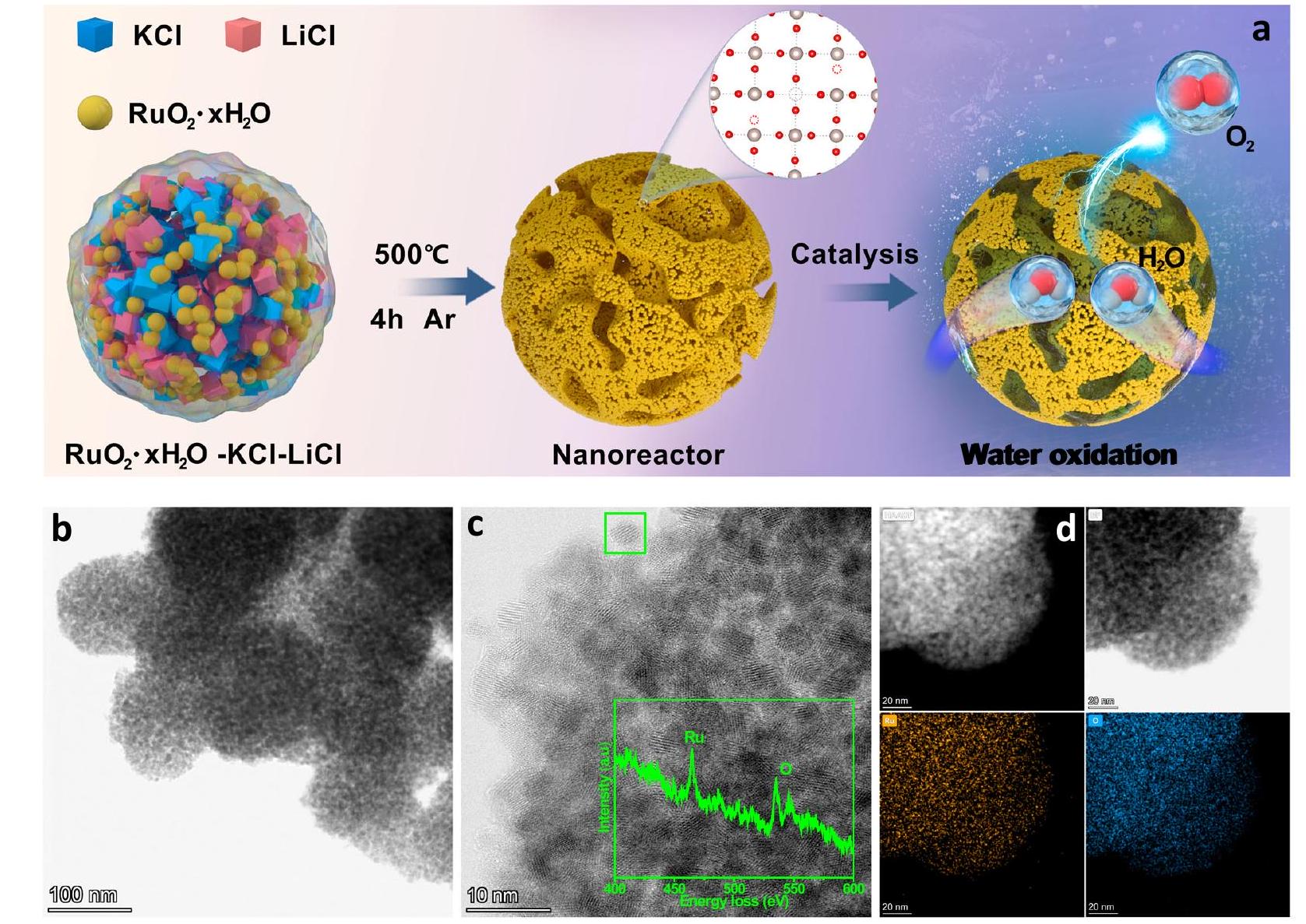
الشكل 1أ يوضح مخطط تصنيع وإجراء التحفيز لـ MD-. كزنقطة انطلاق للتفاعلات في جو الأرجون عند ، الـنظام الملح المنصهر، مع أدنى نقطة انصهار مشتركة لـ (الشكل S1) ، يحفز تكوين جزيئات نانوية تحتوي على عيوب متعددة المقاييس (بما في ذلك فراغات الروثينيوم والأكسجين، وحدود بين الحبيبات وداخلها) من خلال التآكل. في الوقت نفسه، بفضل سيولة وموحدة الملح المنصهر عند درجات حرارة عاليةعندما يتم تبريد التفاعل وإزالة الملح المعاد تبلوره، يتم الحصول على الجسيمات النانوية.سيتم تجميع الحبوب والمسامات الداخلية في نانو رياكتورات ثنائية الاستمرارية، مما يدفع أكسدة الماء بكفاءة واستقرار في الوسائط الحمضية. علاوة على ذلك، فإن هذه الطريقة السهلة للتخليق لا تنتج فقط ما يصل إلىولكن يمكن توسيعه بسهولة إلى إنتاج على نطاق واسع نسبيًا (الشكل S2)، وهو أمر حاسم لتعزيز الإنتاج التجاري لـمحفزات.
الشكل 1ب، ج يظهر التركيب المجهري للحفاز بواسطة مجهر إلكتروني ناقل مسح مصحح للانحراف الكروي المزدوج (AC-STEM). من خلال التكبير المحلي، يمكننا أن نجد أن MD-RuOيتكون BN من نانو مونو ميرات مترابطة بسخاء بحجم متوسط يبلغ حوالي 3 نانومتر فقط (الأشكال 1c و S3 و S4). هنا، ستسمح الحبوب فائقة الدقة والحدود الغنية بين الحبيبات بـلديها نسب تسرب أعلى من المواقع النشطة وانتقال شحنات أسرع على الواجهة. بالإضافة إلى ذلك، تم الكشف عن التعايش بين ذرات الروثينيوم والأكسجين، وتوزيعها المتجانس على كامل المحفز بواسطة مطيافية فقدان الطاقة الإلكترونية (EELS) لبلورة مفردة (الإطار في الشكل 1c) ورسم الخرائط العنصرية بواسطة الطيف المشتت للطاقة (EDS) (الأشكال 1d و S5). نمط حيود الأشعة السينية (XRD) (الشكل 1e) والبنية البلورية المقابلة (الشكل S6)، والمسافة الشبكية (0.25 والمعروض بواسطة صورة مجهر إلكتروني ناقل عالي الدقة (HRTEM) (الشكل S7)، يؤكد بشكل أكبر الحصول على هيكل الروتيلمن الجدير بالذكر أن قمة الانكسار لـ MD-RuO2-BN تصبح أوسع وأضعف من تلك الخاصة بالمنتج التجاري.، مما يعني تشكيل جزيئات نانوية صغيرة الحجم، متسقة مع نتائج ملاحظات TEM المذكورة أعلاه. للمقارنة، الشكل S8 يظهر أنيمتلك حجم حبيبات أكبر وغير متساوٍ، وهيكل مكاني غير منظم وواضح. التجميع النموذجي للنانوكريستالات المتجانسة لـيظهر أيضًا في منحنى الإيزوثرم من النوع الثاني النموذجي وحلقة الهسترس من النوع H1 (الشكل 1f). المقابلتظهر قياسات الامتزاز والانفصال المساحة السطحية لـلـ MD-، أكبر بكثير من ذلك. وقطر المسام وفقًا لطريقة بارّيت-جوانر-هاليندا و هو و 15.2 نانومتر (في الإطار الصغير من الشكل 1f)، على التوالي. تشير النتائج المذكورة أعلاه إلى بناء بنية ميكروية مناسبة تحتوي على مواقع نشطة غنية وموزعة بشكل كبير تجاه التحفيز.
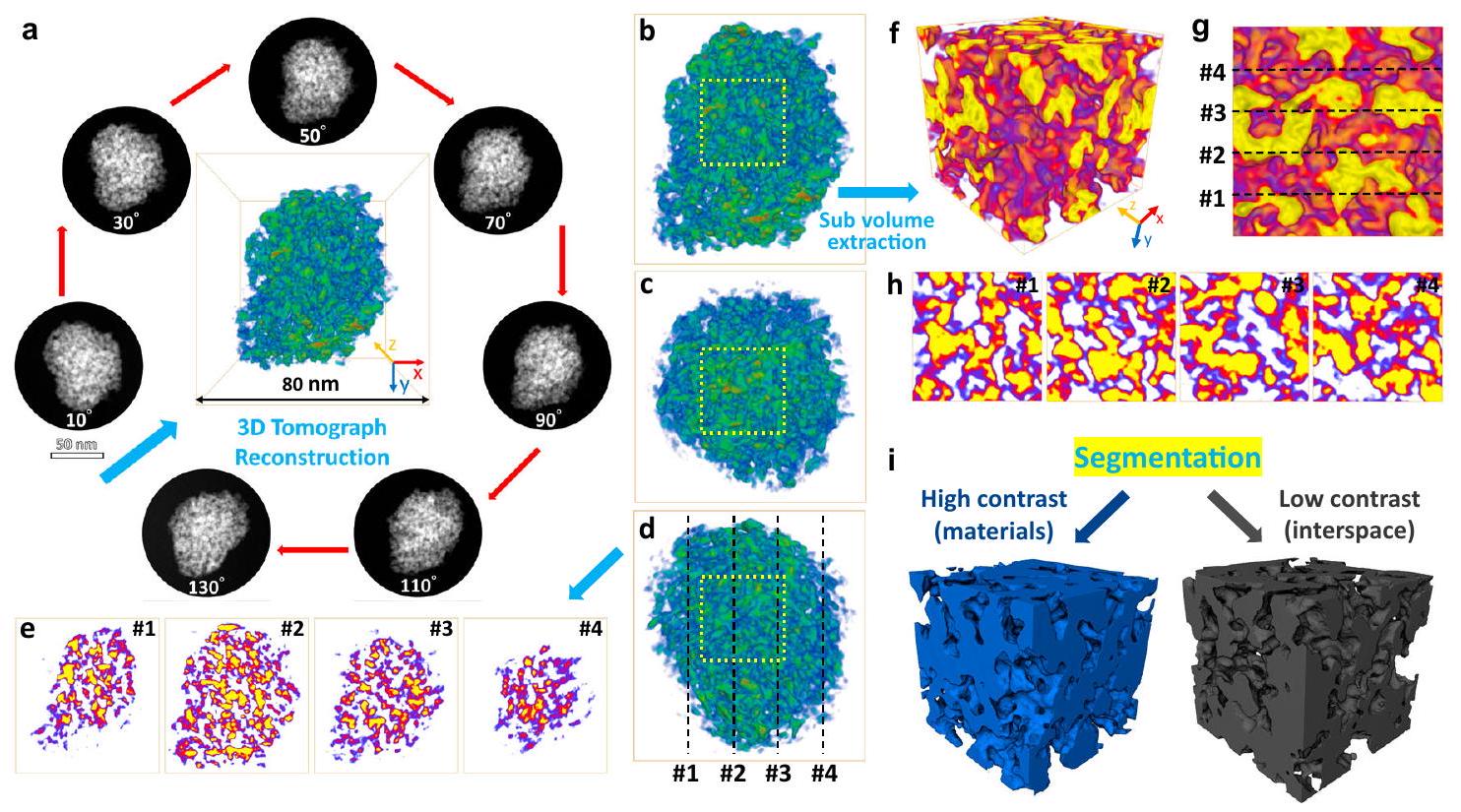
للحصول على مزيد من الفهم حول البيئة الدقيقة الداخلية لـ MD-تم إجراء إعادة بناء التصوير المقطعي. كما هو موضح في الفيلم التوضيحي الإضافي 1، تم جمع حوالي 90 صورة STEM-HAADF لإعادة بناء التصوير المقطعي لموقع تمثيلي بواسطةفترة، يفضل أن تكونتُعرض الوحدات الهيكلية المعاد بناؤها وبعض صور HAADF عند زوايا دوران مختلفة في الأشكال 2a و S9. الشكل المعاد بناؤه من الأمام يشبه تقريبًا صورة HAADF الملتقطة عند الزوايا المتوسطة. )، مما يثبت فعالية وموثوقية هذا الإعادة البناء. الشكل 2ب-د يعرض صور العرض الأمامي، العلوي والجانبي لوحدة الإعادة البناء، وطول ( المحور)، العرض ( المحور) والارتفاع ( محاور) صندوق الربط هي 80 و80 و120 نانومتر، على التوالي. علاوة على ذلك، يتم تقديم تباين الحجم في وضع الألوان الفيزيائية حيث يمثل الحجم باللون الأزرق/ الأخضر تباين HAADF مرتفع/ منخفض نسبيًا. نظرًا لأن المحفز يحتوي فقط علىالمكون، التباين العالي والمنخفض في الهيكل يتوافق معالجزيئات النانوية والمسافة بين الفضاء، على التوالي. الشريحة الأفقية التمثيلية (الشكل 2e) المحددة بخط متقطع أسود في العرض الأيمن لوحدة الإعادة البناء (الطائرات، عمودية علىمحور عند ) تشير بشكل أكبر إلى وجود نانو مفاعلات فريدة ثنائية الاستمرارية تتكون من نانوية فائقة الدقة النانو مونو ميرات والمسامات الداخلية. بالإضافة إلى ذلك، يتم عرض عملية الدوران والترشيح والتقطيع العمودي الديناميكية للجسيم المعاد بناؤه من أجل رؤية أفضل (فيلم إضافي 2).
بعد ذلك، لتأكيد هيكل النانو رياكتور ثنائي الاستمرارية، تم استخراج مكعب فرعي داخلي بحجم حافة يبلغ حوالي 30 نانومتر (الأشكال 2 ف و S 10) من الوحدة الهيكلية المعاد بناؤها (المنطقة المحددة بخط متقطع أصفر في الشكل 2ب-د). تم تحويل التباين إلى VolrenRed لتحسين تصور الهيكل الداخلي (فيلم إضافي 3). تم التعرف أيضًا على كل من السطح (الأشكال 2ج و S11) من اتجاهات عرض مختلفة، والهيكل الداخلي (الشكل 2ح) من الشرائح العمودية على أنهما ثنائي الاستمرارية. علاوة على ذلك، كما هو موضح في الشكل 2ي، لفصل الحجم عالي التباين ( ) وواحد ذو تباين منخفض (المسافة بينهما)، يتم إجراء تقسيم بواسطة تباين STEM-HAADF. تم إثبات أن كلا الحجمين المستخرجين من تقسيم التباين متصلان (الأشكال S12 و13 وفيلم الملحق 4)، مما يوفر دليلاً مباشراً على بناء نانو رياكتورات ثنائية الاستمرارية. تسهل تشكيل مثل هذه البنية الخاصة اختراق الإلكتروليت في العملية التحفيزية، ومن ثم يمكن تحقيق واجهة نشطة واسعة للتفاعل. كقناة جيدة لنقل الأيونات والإلكترونات، ستوفر المسام الداخلية المستمرة بيئة محلية من خلال قيود الإقليمية وتأثيرات التركيز، مما يعزز نقل الكتلة ويعمل على تحسين امتصاص وتحويل الوسائط النشطة.في الوقت نفسه، من المتوقع أن يتجنب النانو رياكتور ذو البنية الثنائية الاستمرارية تراكم المحفزات ويعزز قدرة إطلاق الغاز، مما يضمن النشاط التحفيزي العالي والاستقرار لتفاعل الأكسدة.
بالإضافة إلى ذلك، لإظهار دور المحاليل اليوتيكتية في إنشاء النانو رياكتور ذو الهيكل الثنائي المستمر الفريد وتحليل آلية التكوين بشكل أعمق، قمنا بإجراء تجربة ضابطة باستخدام KCl بدلاً مننظام يوتيكتك تحت نفس الظروف، الشكل S14). بسبب نقطة الانصهار الأعلى لـ KClمن درجة حرارة التخليق (نظام التفاعل
الشكل 1 | بناء وتوصيف هيكل المحفزات. أ رسم تخطيطي لعملية تصنيع وإجراء التحفيز لـ MD-RuO-BN. ب، ج صور STEM لـ MD-RuO-BN. إدراج: تحليل EELS لبلورة مفردة. خريطة STEM و
التوزيع العنصري المقابل لـ. أنماط XRD لـ MD- بي إن و مخطط إيزوثيرم الامتزاز-التحرر وتوزيع حجم المسام لـ و .
غير قادر على إنتاج وسط تفاعل سائل. تظهر التوصيفات النانوية المقابلة (الأشكال S15 و16) أن متوسط حجم الحبيبات لـيتم تقليله بالنسبة إلى“، لكنه لا يزال أكبر بكثير من MD-RuO2-BN ( ). من المهم، بسبب نقص وسط سائل يمكن أن يوفر بيئة نمو موحدة، فإن حجم الحبة من غير متساوي ومُرتب بشكل غير منظم. علاوة على ذلك، فإن نتيجة إعادة بناء التصوير المقطعي ثلاثي الأبعاد على (الأشكال S17-19) تشير أيضًا إلى أن لا يمتلك هيكل نانو رياكتور مثل في. لذلك، فإن البيئة السائلة والآثار الموجهة نحو الهيكل الناتجة عن الإيتكتك تؤدي الأملاح المنصهرة إلى تشكيل جزيئات فائقة الدقة، متجانسة ومستدامةنانومونومرات، وهياكل مسامية منتظمة دورياً مع اتصالات ثلاثية الأبعاد (الشكل S20)، والتي تعتبر مهمة لتكوين نانو رياكتورات ثنائية الاستمرارية.
الهياكل الإلكترونية الذرية والمحلية
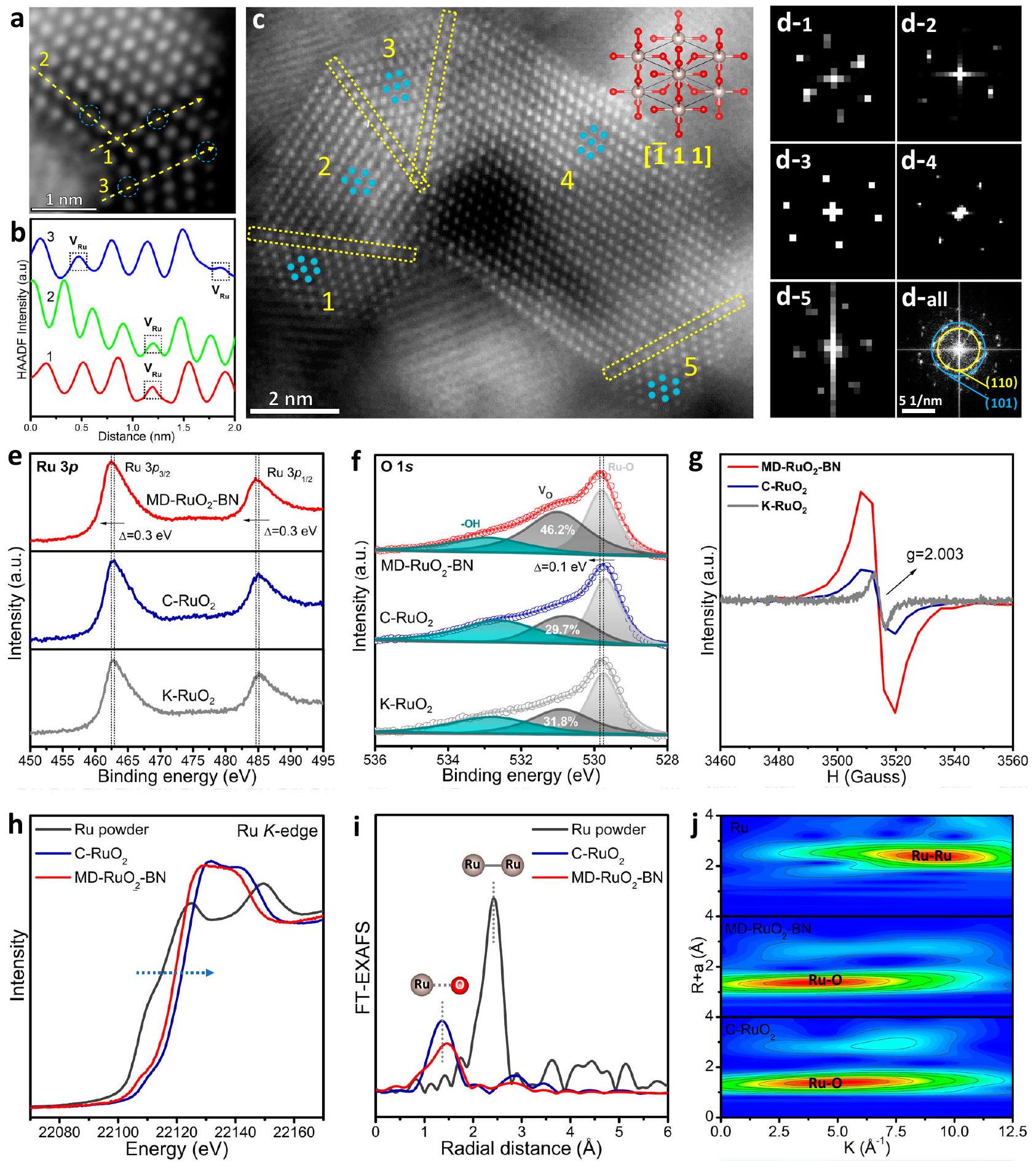
قمنا أيضًا بإجراء ملاحظات متعمقة على MD-RuO-BN على المقياس الذري. تكشف صور STEM (الأشكال 3a و S21) أن بعض مواقع الشبكة مشوشة أو حتى مفقودة (محددة بدائرة زرقاء)، مما يشير إلى وجود عيوب فراغية في الروثينيوم. )، وهو مزيد من
الشكل 2 | توضيح لـ MD-RuO2-BN من خلال إعادة بناء التصوير المقطعي ثلاثي الأبعاد. أ صور STEM-HAADF تمثيلية عند زوايا دوران مختلفة و MD-RuO المعاد بناؤه-BN من العرض الأمامي. ب-د العرض الأمامي والعلوي والجانبي المقابل لـ MD-RuO2-BN المعاد بناؤه. هـ شرائح أفقية تمثلها الخطوط المنقطة السوداء في (د) (الطائرات، عمودية علىمحور عند ). تم استخراجها حجم مكعب فرعي من منطقة الخط الأصفر المسمى في (ب-د). الجهة اليمنى من الحجم الفرعي.شرائح أفقية تمثلها خطوط منقطة سوداء في (ج). أحجام من التقسيم بواسطة التباين تتوافق مع (الأزرق) و الفضاء بين النجوم (الأسود)، على التوالي. تم التأكيد من خلال ملفات الخط الذري الخاصة بكثافة المسح الخطي المقابلة (الشكل 3ب) للخطوط الصفراء 1-3 في الشكل 3أ. بالإضافة إلى ذلك، فإن اتجاه الجسيمات النانوية داخل البلورة موزع عشوائيًا على طولمحور المنطقة (تترتب ذرات الروثينيوم والأكسجين في هيكل رباعي السطوح)، مما يؤدي إلى وجود عيوب غنية داخل الحبيبات (الشكل S22) بما في ذلك الهياكل المزدوجة الموضحة في الشكل 3c (صندوق الخط المنقط الأصفر يشير إلى الحدود). نمط التحويل السريع لفورييه (FFT) للمنطقة المقابلة (1-5) في الشكل 3c يحدد أيضًا أن مستويات البلورة (110) و(101) مرتبة في اتجاهات مختلفة (الشكل 3d).
يظهر طيف الإلكترون السيني (XPS) شبه متطابقطيف إلى و (الشكل 3e)، ولكن هناك ذروتان من الروثينيوم و لـينتقل حوالي 0.3 إلكترون فولت إلى طاقة ارتباط أقل بالنسبة لـ و ، مما يوحي بأن MD-RuO2-BN يحتوي على المزيد من أيونات الروثينيوم ذات الشحنة المنخفضة وعيوب فراغات الأكسجين . في O (الشكل 3f)، النسبة القصوى المنسوبة إلى من و هو ، و على التوالي، مما يدل على زيادة واضحة فيتركيز فيبالإضافة إلى ذلك، فإن موضع طاقة الربط لقمة Ru-O المميزة لـيتحول أيضًا بحوالي 0.1 إلكترون فولت بالنسبة لـ و ، مما يشير أيضًا إلى إعادة توزيع الشحنات. علاوة على ذلك، MD-يظهر إشارة رنين مغناطيسي إلكتروني (EPR) أقوى عند، مما يثبت أيضًا أن يحتوي على المزيد من و (الشكل 3 ج).
هيكل امتصاص الأشعة السينية بالقرب من الحافة (XANES) للروثينيوم-حافة لمسحوق الروث و يظهر أن تشكيل رابطة Ru-O يرفع بشكل كبير من طاقة الانتقال لـ XANES، وموقع حافة الامتصاص لـ يكون عند طاقات أقل مقارنةً بـ (الشكل 3h). تشير هذه إلى أن الحالة المتوسطة لعدد التكافؤ للروثينيوم في أقل من +4، وهو متسق أيضًا مع نتائج تحليل XPS. تظهر طيف الامتصاص بالأشعة السينية الممتدة (EXAFS) المقابلة أن المسافة المتوسطة بين Ru و O قد زادت وأن قوة رابطة Ru-O قد ضعفت بشكل واضح خلال تعديل الحالة الأصلية. (الشكل 3i). وبالتالي، فإن بيئة التنسيق للروثينيوم غير مشبعة، ونتائج التوافق المكاني (الشكل S23) تثبت بشكل أكبر أن العدد الكمي للتنسيق بين الروثينيوم والأكسجين قد انخفض منإلى. أخيرًا، الـ تحويل الموجات (WT) يؤكد نتيجة التحليل من طيف EXAFS ويصور التعايش بين مسارات Ru-O و Ru-Ru في MD- (الشكل 3j).
من التحقيقات أعلاه، يمكننا أن نجد أن هناك عيوب متعددة المقاييس بما في ذلك، وحدود الحبيبات الداخلية/الخارجية من النقطة إلى السطح في النانوالنانو مونو ميرات. هذه العيوب تغير الهيكل الإلكتروني المحلي للمحفز من خلال تقليل حالة الأكسدة للروثينيوم وإطالة رابطة الروثينيوم-الأكسجين، وبيئة التنسيق من خلال توليد ذرات روثينيوم ذات تنسيق منخفض بشكل كبير، مما يشكل شبكات غير متطابقة.إن كل من حالة الفالنس المنخفضة للروثينيوم والتفاعل الضعيف بين الروثينيوم والأكسجين ستعيق أكسدة الأكسجين الشبكي وذوبان الروثينيوم عالي الفالنس، مما يؤدي إلى تعزيز كبير في المتانة.لذلك، تم تجميع النانو رياكتورات ثنائية الاستمرارية من عيوب متعددة المقاييسمن المتوقع أن تلعب النانومونومرات دورًا مهمًا في التحفيز.
تقييم الأداء الكهروكيميائي
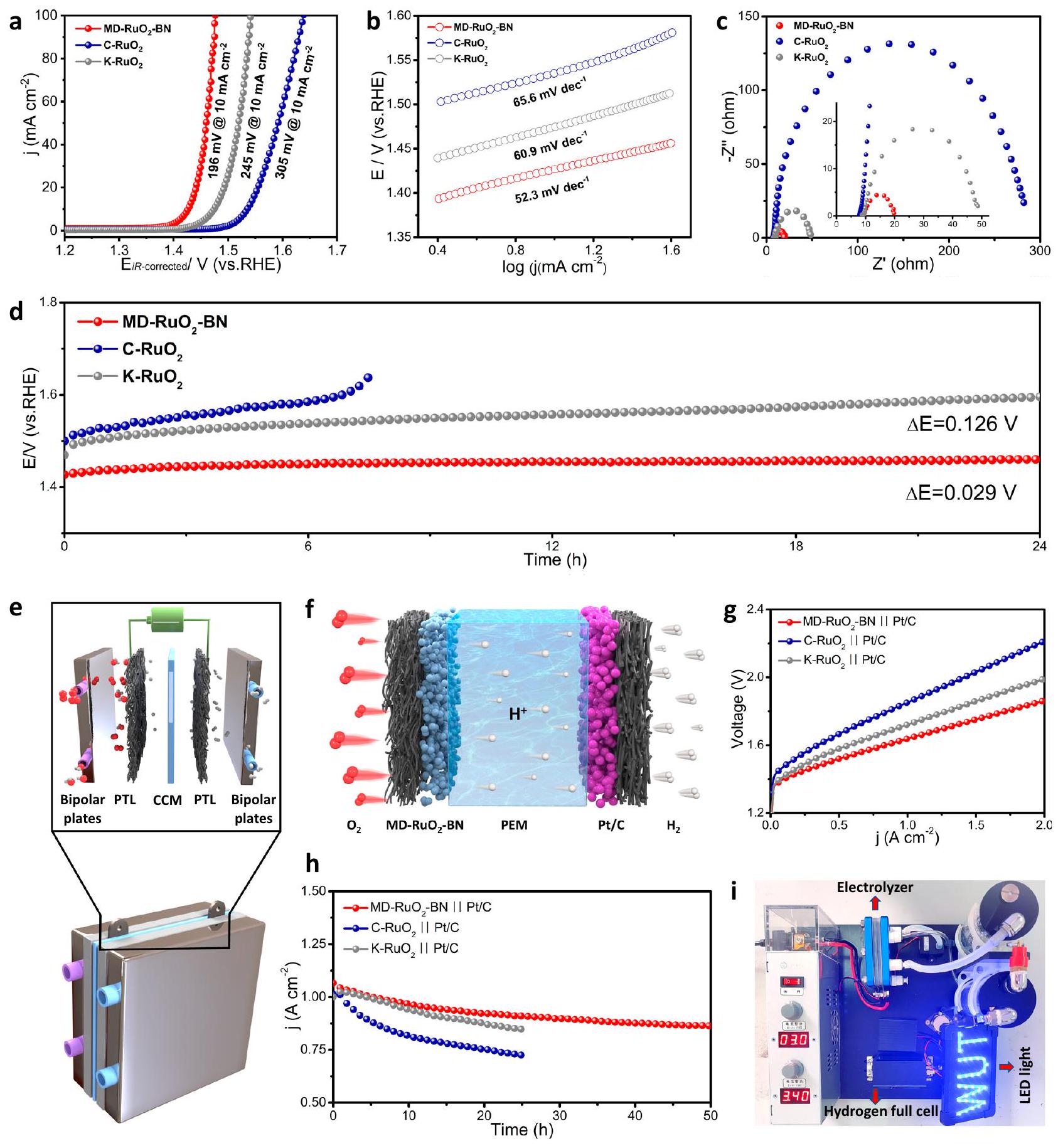
قمنا أولاً باختبار نشاط OER لـ MD-RuO-BN في ( 0.47، الشكل S24) مع نظام ثلاثي الأقطاب. كما هو موضح في الشكل 4a، من منحنيات الاستقطاب، يظهر جهدًا زائدًا منخفضًا قدره 196لـ-BN مقارنةً مع ذلك من ) و ، مما يشير إلى أن النشاط الأعلى يمكن تحقيقه من خلال التصميم الهيكلي وهندسة العيوب لـنانورياكتورات. علاوة على ذلك، يمكننا أن نجد أن MD-يمتلك BN ميل تافل أقل (الشكل 4b)، ومقاومة نقل شحنة أصغر (الشكل 4c) ومساحة سطح نشطة كهربائياً أعلى (الشكل S25) خلال عمليات OER. في الوقت نفسه، فإن تحسين الحبوب، وتشكيل الهياكل ثنائية الاستمرارية، وتوليد عيوب متنوعة يزيد من طاقة السطح.-BN (الشكل S26) وتحديد التوجه القوي للماء، مما أدى إلى انخفاض زاوية تماس الفقاعات بشكل واضح لـ MD- مقارنة معكما هو موضح في الشكل S27. بالإضافة إلى ذلك، يتم تسريع نقل الكتلة بسبب زيادة المحبة للماء على السطح وتحسين الهيكل الإلكتروني معًا.. وبالتالي، فإن الجهد الزائد المنخفض لتفاعل الأكسدة هويمكن أن يُعزى ذلك إلى زيادة عدد المواقع النشطة الفعالة، والنشاط الجوهري، وقدرة نقل الكتلة.
الشكل 3 | الهياكل الذرية والإلكترونية المحلية للمحفزات. أ صورة STEM ذرية لـ MD-RuO2-BN. ب ملف كثافة المسح الخطي المقابل للخطوط الصفراء في (أ). ج صورة HAADT-STEM تمثيلية لـ MD--BN. تم الحصول على صور FFT المقابلة من الحبوب في (ج). طيف XPS للروثينيومو O 1s (f) لـ
مد- -BN، ك – و . طيف EPR لـ و -edge XANES و (i) طيف EXAFS المقابل لمسحوق الروثينيوم، و WT لإشارات EXAFS.
بالإضافة إلى ذلك، نشاط OER الحمضي لـ MD--BN يتجاوز معظم المحفزات المعتمدة على الروثينيوم التي تم الإبلاغ عنها مؤخرًا (الجدول S1).
تظهر قياسات التدهور المعجل تحولًا طفيفًا في منحنيات الاستقطاب لـ-BN قبل وبعد 1000 دورة في عملية OER (الشكل S28). علاوة على ذلك، بعد 24 ساعة من التشغيل المستمر، يظهر قياس الجهد الثابت للتيار (الشكل 4d) زيادة في جهد OER بمقدار 0.029 فولت فقط (معدل التدهور لـ )، مما يشير إلى استقرار OER الأعلى لـ MD--BN من ذلك من و (تدهور سريع). سلسلة من التوصيفات بعد اختبار المتانة بما في ذلك XRD و XPS و STEM تؤكد استقرار الطور والبنية لـ MD-في عمليات OER الحمضية (الأشكال S29 و30). علاوة على ذلك، تم قياس تركيز أيونات Ru في المحلول الكهربائي باستخدام مطيافية الانبعاث الضوئي البلازمي المقترن بالحث (ICP-OES). ونسبة Ru المذاب من و خلال OER هو و على التوالي، بينما هو فقطلـدراسات ICP-OES بانتظام
الشكل 4 | الأداء التحفيزي لـ MD-RuO-BN. منحنيات الاستقطاب، منحنيات تافل ومخططات نايكويست لـ و تُستخدم منطقة التردد العالي في رسم نايكويست لتحديد مقاومة الحل (حوالي ) لـ -تصحيح. اختبار استقرار التيار الثابت لـ OER، لا-تصحيح.
مخطط تخطيطي لجهاز PEMWE نموذجي (e) ومكونات MEA (f). منحنيات الاستقطاب (g) ومنحنيات كثافة التيار المعتمدة على الزمن (h) لمحلل PEM المقاسة عندلا-تصحيح. عرض لإنتاج الهيدروجين من PEMWE لتشغيل خلية الوقود الهيدروجينية. فترات (24 ساعة) أثناء إجراء تجارب الكرونو بوتينسيومترية الممتدة لمدة 7 أيام (الأشكال S31 و32) تشير بشكل أكبر إلى فعالية تثبيط ذوبان الروثينيوم فيمقارنة مع (الجدول S2). وبالتالي، من الواضح أن MD- – تمتلك BN توازنًا ممتازًا بين النشاط والاستقرار لتفاعل الأكسدة.
خلية إلكتروليتية من نوع Hتم تجميعه لتفكيك الماء الحمضي بشكل عام، ويحتاج فقط إلى 1.465 فولت لتحفيز كثافة التيار (الشكل S33). مثل هذا الأداء أفضل بكثير من أزواج الأقطاب التجاريةفي ). تُظهر طريقة تصريف المياه تقريبًا العائد فاراداي من MD-RuO-BNالأنظمة (الأشكال S34 و 35. لذلك، تم تركيب خلية واحدة من PEMWE تتكون من غشاء مغطى بالعامل الحفاز (CCM) وطبقات نقل مسامية (PTL) وألواح ثنائية القطب في النهاية (الشكل 4e، f) وتم اختبارها (الشكل S36). العامل الحفاز في الأنود والكاثود هووتجاري، على التوالي، وغشاء PEM هو غشاء نافيوني (نافيونتوزيع إجهاد السطح في خريطة الضغط لطبقة النقل البروتوني (PTL) وورق حساس للضغط يشير إلى الاتصال الجيد بين الطبقات الحفازة وPTL تحت ضغط تجميع قدره 8 نيوتن متر (الشكل S37). بالإضافة إلى ذلك، تظهر الصور المقطعية والمستوية باستخدام المجهر الإلكتروني الماسح (SEM) لخلية الوقود مع MD-RuO2-BN (الشكل S38) أن تم طلاء الطبقة الحفازة بشكل موحد على الغشاء، وسمك الطبقة الحفازة هو.
يوضح منحنى الاستقطاب (الشكل 4g) لأجهزة التحليل الكهربائي للمياه باستخدام أغشية البوليمر (PEMWEs) أنه للوصول إلى كثافة تيار قدرهالتحليل الماء، MD-RuO-BN-PEM-Pt/ C معكعامل حفاز للأنود يتطلب فقط جهد خلية قدره 1.64 فولت، وهو أفضل من تلك الخاصة بـ K-RuO.-PEM-Pt/C ( ) و بالإضافة إلى ذلك، اخترنا 1.65 و 1.72 و 1.85 فولت كجهد ثابت لاختبارات الاستقرار، والذي ينبغي أن ينتجاستنادًا إلى LSV. تكشف منحنيات كثافة التيار المعتمدة على الزمن (الشكل 4 هـ) أن MD--الخلية الكهروكيميائية المعتمدة على BN تحافظ بشكل جيد على نشاط التحليل الكهربائي للماء لمدة 50 ساعة، بينما كلا و تجارب تراجع واضح في غضون 25 ساعة فقط من التشغيل، خاصة. هذا يثبت بشكل أكبر الاستقرار المحسن لتصميمناالمحفزات. علاوة على ذلك، توضح الشكل S39 أنه لا يوجد انفصال لـ MD-طبقة التحفيز على الأنود بعد التشغيل عندلمدة 50 ساعة. وتظهر المورفولوجيا العرضية والمستوية للMEA أن طبقة التحفيز وبنية الغشاء محفوظة بشكل جيد (الشكل S40). أخيرًا، صممنا نظام خلية وقود متجددة يجمع بين الإلكتروليزر المصنوع ذاتيًا وخلية وقود الهيدروجين التجارية (الأشكال 4i وS41 والفيلم التكميلي 5). تشير إضاءة الصمام الثنائي الباعث للضوء إلى تحقيق إعادة تدوير خضراء للهيدروجين القادم من الماء ثم العودة إلى الماء.
تحليل آلية النشاط المعزز والاستقرار
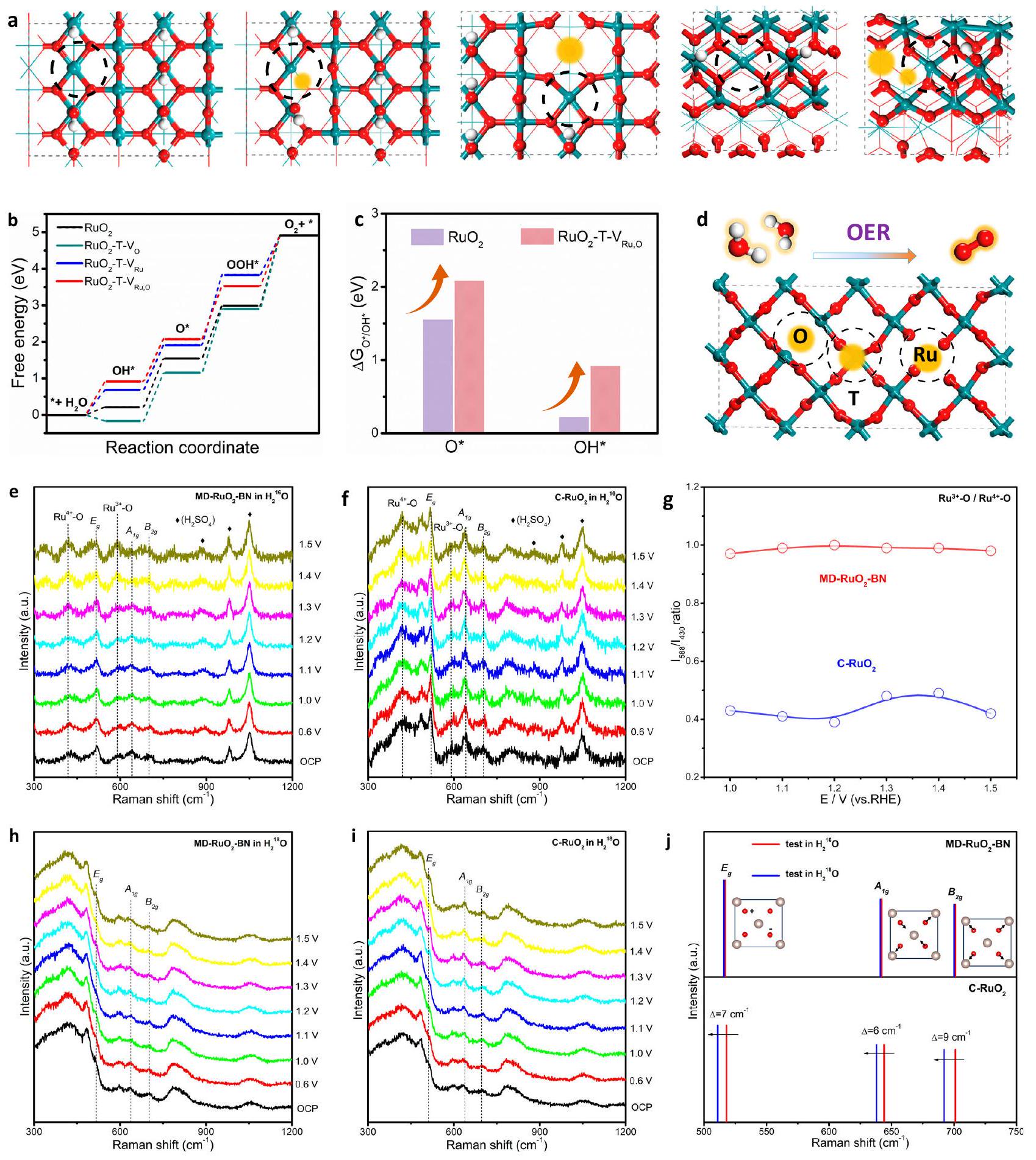
لاستكشاف الآلية لتحسين أداء تفاعل أكسدة الأكسجينبمساعدة فراغات الأكسجينوظائف Ru )، وحدود التوأم (T)، تم إجراء حسابات DFT. أولاً، قمنا بنمذجة سلسلة من الألواح (الشكل 5أ) للتحقيق في امتصاص الوسائط الحرجة على مواقع الروتين Ru (الشكل S42) للمواد النقية، ، و مع كليهما و ). كما هو موضح في الشكل S43، فإن الخطوة المحددة لمعدل (RDS) لتفاعل الأكسدة على هذا الموقع من Ru لـليس مُحسّنًا، وغير متسق مع النتائج التجريبية. بالإضافة إلى مواقع الروثينيوم الروتينية، تكشف التحقيقات الإضافية (الشكل S44) أن نشاط OER قد زاد بشكل واضح على مواقع الروثينيوم على حدود التوأم (TB-Ru) من. بالتحديد، نقي، ، و إظهار الفائض الكهربائي لـو 0.69 فولت، على التوالي، في الـإزالة الامتصاص أوخطوة التكوين، بينمايعرض جهدًا زائدًا منخفضًا قدره 0.22 فولت فيإلىخطوة التحويل (الشكل 5ب). لذلك، يُعزى النشاط العالي لتفاعل تطور الأكسجين إلى الانخفاض الكبير في حاجز الطاقة الحركية الناتج عن موقع TB-Ru. بالإضافة إلى ذلك، نظرًا لأن الامتزاز القوي للوسائط المؤكسدة عادة ما يؤدي إلى عدم استقرار مواقع المعادن.يظهر الزيادة و نسبي إلى النقي، مما يؤدي إلى امتصاص أضعف وبالتالي تحسين الاستقرار (الشكل 5c). باختصار، آلية أكسدة الماء لـتم اقتراح BN استنادًا إلى التحليل التجريبي والحاسوبي (الشكل 5d). التأثير التآزري للعيوب متعددة المقاييس بما في ذلكويسهل T بشكل كبير OER على مواقع T-Ru.
تم إجراء طيف رامان في الموقع بشكل إضافي لاستكشاف حالة سطح المحفزات تحت إمكانيات ثابتة تتزايد تدريجياً إلى الحدود الإيجابية من جهد الدائرة المفتوحة (الشكل S45). كما هو موضح في الشكل 5e و f، فإن الميزات الثلاثة الرئيسية لرامان للروتيل، وهي و يمكن ملاحظة أوضاع الاهتزاز على و في العادي. بالإضافة إلى ذلك، هناك شريطان رامان عند حوالي 430 وتعيين إلىالسندات والسندات، على التوالي. بشكل ملحوظ، عند مزيد من تطبيع شدة الشريط عند 588 و (الشكل 5 ج)، يمكننا أن نجد أن يقدم نسبة كثافة أعلى (حوالي 1.0) من (حوالي 0.4 )، وبالتالي تمتلك المزيد من الأنواع على السطح، مما يدعم بشكل أكبر المحتوى الأعلى من الأنواع منخفضة التكافؤ من الروثينيوم على MD--سطح BN الناتج عن عيوب متعددة المقاييس. ستؤدي حالة الفالنس المنخفضة للروثينيوم إلى تثبيط ذوبان الروثينيوم عالي الفالنس، مما يؤدي إلى تعزيز متانة عملية تطور الأكسجين.
قمنا أيضًا بإجراء رامان في الموقع فيموسوم (الشكل 5هـ، و). من خلال مقارنة تحول أوضاع الاهتزاز المميزة نُسِب إلىفي العادي والمُعَدَّة بالملصقات، يمكن أن يُعثر علىيظهر درجة معينة من الإزاحة السلبية عند و (الشكل 5j). ويرجع ذلك أساسًا إلى تبادل الأكسجين الشبكي في معفي الإلكتروليت عند جهد مطبق، مما يؤدي إلى تغيير في تردد الاهتزاز الناتج عن الاستبدال الجزئي لشبكة الروثينيوم-مع رو-بينما لا يُلاحظ أي تأثير نظائري في MD-RuO-BN بسبب انخفاض حالة الأكسدة للروثينيوم، والتفاعل الضعيف بين الروثينيوم والأكسجين يقلل من مشاركة الأكسجين الشبكي. توفر النتائج المذكورة أعلاه رؤى حول تحسين الاستقرار لـ MD-RuO.-BN من التغيرات في بنية السطح في الموقع.
نقاش
باختصار، نجمعنانومونومرات وفيرةالفراغات وحدود الحبيبات الداخلية/الخارجية في نانو رياكتور ثنائي الاستمرارية، مما يحقق التحسين المتزامن للهياكل الإلكترونية والميكروية لـإن حالة الأكسدة المنخفضة للروثينيوم ورابطة الروثينيوم-الأكسجين الممتدة تضعف التفاعل بين الروثينيوم والأكسجين، وتعيق أكسدة الأكسجين الشبكي وذوبان الروثينيوم عالي التكافؤ، مما يعزز المتانة.. في الوقت نفسه، تعزز مناطق التفاعل الوفيرة والذرات النشطة ذات التنسيق المنخفض الكفاءة النشاط التحفيزي بشكل مشترك. ونتيجة لذلك، يظهر MD-RuO2-BN المخصص نشاطًا واستقرارًا غير مسبوقين في تفاعل تطور الأكسجين (OER) في إعداد خلية ثلاثية الأقطاب وفي إلكتروليز المياه بغشاء تبادل البروتون (PEMWEs). علاوة على ذلك، يوفر عرض نظام الطاقة المتكامل للدورة الهيدروجينية المائية المزيد من الفرص لتطبيق المواد القائمة على الروثينيوم. تقدم هذه الدراسة نظرة ثاقبة لتحسين الأداء التحفيزي لمحفزات OER الخالية من الإريديوم، وستحفز تطوير PEMWEs على نطاق واسع.الجيل.
طرق
المواد الكيميائية
أكسيد الروثينيوم (IV) أحادي الهيدراتتم شراء ) من شركة ووكاي للمواد الكيميائية المحدودة. كلوريد الليثيوم اللامائي (LiCl) وكلوريد البوتاسيوم (KCl) وحمض الكبريتيك ( ) و الكحول الإيزوبروبيلي تم شراؤها من شركة سينوفارم للمواد الكيميائية. رو ، (20 ) ونافيوين ( ) تم الحصول عليها من سيغما-ألدريش. تم شراءه من شركة Rhawn Reagents Ltd. جميع المواد الكيميائية من الدرجة التحليلية وتستخدم دون معالجة إضافية. تم استخدام الماء المقطر (DI) كوسيط.
تركيبات المواد
تم استخدام نظام الملح المنصهر KCl-LiCl لتسهيل تخليق المحفز المستهدف MD-RuO2-BN. على وجه التحديد، 1.35 جرام من KCl، 1.15 جرام من LiCl وتم طحن المسحوق بشكل موحد إلى خليط تحت ظروف عزل الأكسجين والماء، في انتظار التفاعل عالي الحرارة اللاحق. كانت حالة التفاعل هي الحفاظ علىلمدة 4 ساعات تحت غاز خامل لضمان تفاعل كافٍ. بعد الانتهاء من التفاعل، كان من الضروري غسل المنتج الصلب جيدًا بالماء المنزوع الأيونات لإزالة المتبقي.. أخيرًا، بعد التجفيف بالفراغ في بين عشية وضحاها، المحفز المستهدف MD-تم الحصول عليه. كما أجرينا تجربة فارغة باستخدام KCl بدلاً مننظام يوتيكتك كتحكم تحت نفس الظروف ( ).
توصيف
تم جمع أنماط حيود الأشعة السينية (XRD) على جهاز حيود الأشعة السينية من نوع ريجاكو مزود بـمصدر الإشعاع للحصول على التركيب البلوري لجميع العينات. تم قياس منحنيات امتصاص/إزالة النيتروجين على جهاز ASAP2020M للحصول على مساحة السطح وفقًا لطريقة بروناور-إيميت-تيلر (BET) وقطر المسام وفقًا لطريقة بارّيت-جويتر-هاليندا. تم إجراء مطيافية الأشعة السينية للأشعة السطحية (XPS) ورنين الإلكترون البارامغناطيسي (EPR) ومطيافية امتصاص الأشعة السينية باستخدام إشعاع السنكروترون (XAS) للكشف عن التركيب الإلكتروني وتركيب الروابط التكافؤية. الشكل والمظهر و
الشكل 5 | حسابات DFT وطيف رامان في الموقع. أ) وجهات نظر علوية للـ، ، و تمثل الكرات الحمراء والنيليّة ذرات الأكسجين والروثينيوم، على التوالي. تشير الدوائر السوداء والتمييزات الصفراء إلى المواقع النشطة والفراغ، على التوالي.ملف الطاقة الحرة لتفاعل الأكسدة على مواقع TB-Ru. ج تم حسابه و طاقة الامتزاز و . المواقع النشطة (التسليط الأصفر) علىلتسريع الموارد التعليمية المفتوحة.رامان طيف لـ و في العاديشدة الطيف الراماني العادية عندإلى ذلك فيعلى المحفزات كدالة للجهد المطبق.، طيف رامان لـ MD- و فيموسوم. تحول قمم رامان التي تتوافق مع و أنماط الاهتزاز لـ MD- – BN و . تمت دراسة الهيكل باستخدام مجهر إلكتروني ناقل مزدوج التصحيح للانحراف الكروي (AC-STEM، Titan Cubed Themis G2 300). تم إجراء قياسات التسرب باستخدام مطياف الانبعاث الضوئي المقترن بلازما (ICP-OES) (سلسلة 700، Agilent Technologies). للحصول على قياسات رامان في الموقع، تم الحصول على أطياف رامان بواسطة Horiba LabRAM HR Evolution مع هيليوم/نيون. ليزر منتم إجراء اختبار الكرونوأمبيرومترية متعددة الإمكانيات بواسطة محطة عمل كيميائية كهربائية (Autolab PGSTAT 204) في خلية تفلون مخصصة معإلكتروليت. إلكترود من الذهب مدعوم بمحفز (قطرعملت كإلكترود عمل، واستخدمت إلكترود كولوميل المشبع كإلكترود مرجعي، وسلك بلاتيني مصقول كإلكترود مضاد.
القياسات الكهروكيميائية
تم إجراء جميع القياسات الكهروكيميائية في نظام تقليدي مكون من ثلاثة أقطاب في درجة حرارة الغرفة باستخدام محلل كهروكيميائي CHI 660 E (CHI Instruments، شنغهاي، الصين). الحمضي (تم إجراء القياسات الكهروكيميائية باستخدام قطب زئبقي مشبع (SCE) كقطب مرجعي، ولوح جرافيت كقطب مضاد، وقطب كربون زجاجي بقطر 3 مم كقطب عمل. تم تحضير حبر المحفز عن طريق توزيع 5 ملغ من العينة المحضرة في خليط (الكحول الإيزوبروبيليماء ومحلول نافيون) وتشتت بالموجات فوق الصوتية لمدة 30 دقيقة. للمقارنة، 5 ملغ من مسحوق المحفز التجاريتم توزيعها بالتساوي في نفس الخليط. كانت الحمولة النهائية لجميع المحفزات على الكربون الزجاجي حواليتم الحصول على بيانات الاستقطاب بمعدل مسح. في هذا العمل، تم تحويل جميع الجهود المقاسة مقابل القطب المرجعي المصنوع من الفضة والكلوريد (SCE) إلى مقياس القطب الهيدروجيني القابل للعكس (RHE) باستخدام:
في المعادلة المعطاة، تم الحصول على 0.241 فولت من خلال المعايرة بالنسبة إلى RHE وتم تحديد قيمة pH للكهارل لتكون 0.47 من خلال عدة قياسات.
كانت جميع منحنيات الاستقطاب-مصحح:
حيثهو مقاومة الحل، ومنطقة التردد العالي في رسم نايكويست تُستخدم لتحديد (حول ) لـ التصحيح. تم إجراء طيف الامتزاز الكهربائي الكيميائي (EIS) عند الجهود المقابلة لـ من منحنيات LSV، مع نطاق تردد من 0.01 هرتز إلى 100 كيلوهرتز مع سعة تيار متردد تبلغ 10 مللي فولت. سعة الطبقة الكهربائية المزدوجة (تم تحديده باستخدام قياسات الفولتمترية الدورية النموذجية (CV) عند معدلات مسح مختلفة و ) في المنطقة غير التفاعلية. تم تقييم المتانة من خلال قياسات التدهور المعجل وقياس الجهد المستمر. تم استخدام المحفز الكهربائي الناتج وPt/C كأنود وكاثود في تكوين ذو قطبين لعملية التحليل الكهربائي للماء بشكل عام. وتم توليد و تم جمع الغازات الناتجة عن عملية تحليل الماء بشكل كمي باستخدام طريقة تصريف الماء لتقييم كفاءة فاراداي.
اختبارات PEMWE
أنشطة الموارد التعليمية المفتوحة و تم تقييم التطبيقات العملية في خلية واحدة من PEMWE مصنوعة في المنزل والتي تتكون من CCM و PTL والألواح ثنائية القطب. أولاً، تم إعداد طبقات المحفز. تم إعداد حبر محفز الكاثود عن طريق خلط ( مسحوق، 300 ملغ من محلول نافيون ( )، 2 مل من الماء المقطر و 8 مل من الإيزوبروبانول ثم تم استخدام الموجات فوق الصوتية لمدة 60 دقيقة في حمام ثلجي. تم تحضير حبر محفز الأنود عن طريق خلط 40 ملغ من مسحوق، 200 ملغ من محلول نافيون (1 مل من الماء المقطر و4 مل من الإيزوبروبانول ثم تم استخدام الموجات فوق الصوتية لمدة 60 دقيقة في حمام ثلجي. تم نقل أحبار المحفز إلى أوراق من بولي تترافلورو إيثيلين (PTFE) عن طريق الرش، مما شكل طبقات المحفز. بعد ذلك، قمنا بتجميع CCM، حيث تم اختيار الإلكتروليت هو نافيون.غشاء ). النافيون تتطلب الغشاء المعالجة المسبقة التالية:تم معالجة بيروكسيد الهيدروجين عند 80 درجة لمدة ساعة، ثم تم نقعه في ماء منزوع الأيونات لـتم غلي حمض الكبريتيك المخفف عندلمدة ساعة واحدة، ثم تم نقعها في الماء منزوع الأيونات لمدة نصف ساعة. بعد ذلك، تم نقل الطبقات الحفازة المحملة على أوراق PTFE إلى كلا جانبي النافيو.الغشاء بواسطة طريقة الديكال التقليدية أو طباعة النقل الحراريكانت المعلمات التشغيلية المحددة: درجة حرارة الضغط الساخن لـضغط قدره 20 ميجا باسكال، ووقت ضغط ساخن قدره 10 دقائق. لمنع التشوه والانهيار للـ CCM الناتج عن إجهاد الانكماش أثناء عملية التبريد، بعد الضغط الساخن- كان من الضروري استخدام جسم ثقيل مسطح للضغط لمدة دقيقة واحدة ثم إزالة سطح PTFE بعناية. ثم CCM مع المنطقة النشطة من (تحميل طبقة المحفز للقطب السالب والقطب الموجب كان و ، على التوالي) تم الحصول عليه. أخيرًا، تم استخدام مفتاح عزم الدوران (8 نيوتن متر) لتجميع الألواح الثنائية القطبية، وPTL (الفلين التيتانيوم بسمك 0.6 مم)، وCCM المُعد إلى خلية واحدة من PEMWE، وتم إجراء اختبارات الأداء ذات الصلة (منحنيات الاستقطاب، منحنيات كثافة التيار المعتمدة على الزمن) في نظام الاختبار (درجة حرارة التشغيل لـمعدل التدفق ).
حسابات DFT
تم تنفيذ طريقة حسابات DFT في هذا العمل باستخدام حزمة المحاكاة الأولية فيينا (VASP). على وجه التحديد، تم تعيين الطاقة الحركية بحد قطع قدره 450 إلكترون فولت لكل ذرة ضمن ألواح. بالنسبة للبنية الإلكترونية،-نقطة أخذ العينات مع ( ) تم استخدام شبكة ضمن مخطط مونكهورست-باك. وأثناء عملية التحسين، استخدمنا التمويه الغاوسي (ISMEARبعرض تلطيف قدره 0.02 إلكترون فولت (سيغما ). لقد نمذنا الإلكترون التكافؤي في شكل -H (اختبار فائق النعومة، ) ، طبقة الفراغكما تم تطبيقه لتجنب التفاعلات الجانبية. لحساب التغير في الطاقة الحرة لجيبس ( )، تم اعتماد خطوات OER الكلاسيكية الأربعة للإلكترونات:
التم حساب قيمة كل خطوة من خطوات OER العنصرية بناءً على المعادلة التالية:
أين و تمثل القيم تغير الطاقة، والفرق في الطاقة، والانتروبيا بين الحالة الممتصة والغاز، على التوالي.عادةً ما تكون 298.15 ك.
توفر البيانات
البيانات التي تدعم الرسوم البيانية متاحة ضمن هذه الورقة ومعلوماتها التكميلية. جميع البيانات الأخرى ذات الصلة التي تدعم نتائج هذه الدراسة متاحة من المؤلفين المقابلين عند الطلب المعقول. البيانات الخاصة بالأشكال 1، 3-5 و S4، S14، S23، S25، S26، S28، S29، S32، S33، S35، S43 التي تم توليدها في هذه الدراسة متوفرة في ملفات البيانات المصدرية. تم توفير بيانات المصدر مع هذه الورقة.
References
Chatenet, M. et al. Water electrolysis: from textbook knowledge to the latest scientific strategies and industrial developments. Chem. Soc. Rev. 51, 4583-4762 (2022).
King, L. A. et al. A non-precious metal hydrogen catalyst in a commercial polymer electrolyte membrane electrolyser. Nat. Nanotechnol. 14, 1071-1074 (2019).
Yeo, K.-R., Lee, K.-S., Kim, H., Lee, J. & Kim, S.-K. A highly active and stable 3D dandelion spore-structured self-supporting Ir-based electrocatalyst for proton exchange membrane water electrolysis fabricated using structural reconstruction. Energy Environ. Sci. 15, 3449-3461 (2022).
An, L. et al. Recent development of oxygen evolution electrocatalysts in acidic environment. Adv. Mater. 33, 2006328 (2021).
Seh, Z. W. et al. Combining theory and experiment in electrocatalysis: insights into materials design. Science 355, eaad4998 (2017).
Kibsgaard, J. & Chorkendorff, I. Considerations for the scaling-up of water splitting catalysts. Nat. Energy 4, 430-433 (2019).
Xiao, Z. et al. Operando identification of the dynamic behavior of oxygen vacancy-rich Co3O4 for oxygen evolution reaction. J. Am. Chem. Soc. 142, 12087-12095 (2020).
Liu, Z. et al. Optimal geometrical configuration of cobalt cations in spinel oxides to promote oxygen evolution reaction. Angew. Chem. Int. Ed. 59, 4736-4742 (2020).
Wang, Q. et al. Ultrahigh-loading of Ir single atoms on NiO matrix to dramatically enhance oxygen evolution reaction. J. Am. Chem. Soc. 142, 7425-7433 (2020).
Ma, Q. & Mu, S. Acidic oxygen evolution reaction: mechanism, catalyst classification, and enhancement strategies. Interdiscip. Mater. 2, 53-90 (2023).
Spöri, C., Kwan, J. T. H., Bonakdarpour, A., Wilkinson, D. P. & Strasser, P . The stability challenges of oxygen evolving catalysts: towards a common fundamental understanding and mitigation of catalyst degradation. Angew. Chem. Int. Ed. 56, 5994-6021 (2017).
Chen, F.-Y., Wu, Z.-Y., Adler, Z. & Wang, H. Stability challenges of electrocatalytic oxygen evolution reaction: from mechanistic understanding to reactor design. Joule 5, 1704-1731 (2021).
Geiger, S. et al. The stability number as a metric for electrocatalyst stability benchmarking. Nat. Catal. 1, 508-515 (2018).
Wang, J. et al. Single-site Pt-doped hollow nanospheres with interstitial C for high-performance acidic overall water splitting. Sci. Adv. 8, eabl9271 (2022).
Huang, H. et al. Structure engineering defective and mass transferenhanced RuO2 nanosheets for proton exchange membrane water electrolyzer. Nano Energy 88, 106276 (2021).
Over, H. Surface chemistry of ruthenium dioxide in heterogeneous catalysis and electrocatalysis: from fundamental to applied research. Chem. Rev. 112, 3356-3426 (2012).
Zhang, L. et al. Sodium-decorated amorphous/crystalline with rich oxygen vacancies: a robust pH -universal oxygen evolution electrocatalyst. Angew. Chem. Int. Ed. 60, 18821-18829 (2021).
Wang, J. et al. Exceptionally active and stable with interstitial carbon for water oxidation in acid. Chem 8, 1673-1687 (2022).
Qin, Y. et al. electronic structure and lattice strain dual engineering for enhanced acidic oxygen evolution reaction performance. Nat. Commun. 13, 3784 (2022).
Du, K. et al. Interface engineering breaks both stability and activity limits of for sustainable water oxidation. Nat. Commun. 13, 5448 (2022).
Su, J. et al. Assembling ultrasmall copper-doped ruthenium oxide nanocrystals into hollow porous polyhedra: highly robust electrocatalysts for oxygen evolution in acidic media. Adv. Mater. 30, 1801351 (2018).
Chen, S. et al. Mn-doped nanocrystals as highly active electrocatalysts for enhanced oxygen evolution in acidic media. ACS Catal. 10, 1152-1160 (2020).
Zhuang, Z. et al. Three-dimensional open nano-netcage electrocatalysts for efficient pH-universal overall water splitting. Nat. Commun. 10, 4875 (2019).
Lin, Y. et al. Chromium-ruthenium oxide solid solution electrocatalyst for highly efficient oxygen evolution reaction in acidic media. Nat. Commun. 10, 162 (2019).
Shan, J., Ling, T., Davey, K., Zheng, Y. & Qiao, S.-Z. Transition-metaldoped Rulr bifunctional nanocrystals for overall water splitting in acidic environments. Adv. Mater. 31, 1900510 (2019).
Ge, R. et al. Ultrafine defective electrocatalyst integrated on carbon cloth for robust water oxidation in acidic media. Adv. Energy Mater. 9, 1901313 (2019).
. et al. 2 D intrinsically defective graphene heterostructures as All-pH efficient oxygen evolving electrocatalysts with unprecedented activity. Nano Energy 78, 105185 (2020).
Zhao, Z. L. et al. Boosting the oxygen evolution reaction using defect-rich ultra-thin ruthenium oxide nanosheets in acidic media. Energy Environ. Sci. 13, 5143-5151 (2020).
Wen, Y. et al. Stabilizing highly active Ru sites by suppressing lattice oxygen participation in acidic water oxidation. J. Am. Chem. Soc. 143, 6482-6490 (2021).
Jin, H. et al. Safeguarding the phase against lattice oxygen oxidation during acidic water electrooxidation. Energy Environ. Sci. 15, 1119-1130 (2022).
Ma, Y. et al. Remodeling nanodroplets into hierarchical mesoporous silica nanoreactors with multiple chambers. Nat. Commun. 13, 6136 (2022).
Li, Y. et al. Hierarchical C-MoCSx@MoS, nanoreactor as a chainmail catalyst for seawater splitting. Appl. Catal., B 318, 121832 (2022).
Gong, F. et al. Boosting electrochemical oxygen evolution over yolk-shell structured nanoreactors with sulfur vacancy and decorated Pt nanoparticles. Nano Energy 78, 105284 (2020).
Cheng, R. et al. Fibrous nanoreactors from microfluidic blow spinning for mass production of highly stable ligand-free perovskite quantum dots. Angew. Chem. Int. Ed. 61, e202204371 (2022).
Chen, D. et al. Work-function-induced interfacial built-in electric fields in heterostructures for active acidic and alkaline hydrogen evolution. Angew. Chem. Int. Ed. 61, e202208642 (2022).
Liang, X. et al. The directional crystallization process of poly (triazine imide) single crystals in molten salts. Angew. Chem. Int. Ed. 62, e202216434 (2023).
Jin, H. et al. Molten salt-directed catalytic synthesis of 2D layered transition-metal nitrides for efficient hydrogen evolution. Chem 6, 2382-2394 (2020).
Yi, L. et al. Molten-salt-assisted synthesis of Bismuth nanosheets for long-term continuous electrocatalytic conversion of to formate. Angew. Chem. Int. Ed. 59, 20112-20119 (2020).
Wu, J. et al. Scalable synthesis of 2D Mo2 C and thicknessdependent hydrogen evolution on its basal plane and edges. Adv. Mater. 35, 2209954 (2023).
Wang, Q. et al. Sub-3 nm intermetallic ordered clusters for oxygen reduction reaction. Adv. Sci. 7, 1901279 (2020).
Jiao, J. et al. Doping ruthenium into metal matrix for promoted universal hydrogen evolution. Adv. Sci. 9, 2200010 (2022).
Jiao, J. et al. Interface engineering of partially phosphidated Co@Co-P@NPCNTs for highly enhanced electrochemical overall water splitting. Small 16, 2002124 (2020).
Bai, C. et al. Hollow Cu2O@CoMn2O4 nanoreactors for electrochemical NO reduction to NH3: elucidating the void-confinement effects on intermediates. Adv. Funct. Mater. 32, 2205569 (2022).
Boyjoo, Y. et al. Molecular-level design of pyrrhotite electrocatalyst decorated hierarchical porous carbon spheres as nanoreactors for lithium-sulfur batteries. Adv. Energy Mater. 10, 2000651 (2020).
Sun, H. & Jung, W. Recent advances in doped ruthenium oxides as high-efficiency electrocatalysts for the oxygen evolution reaction. J. Mater. Chem. A 9, 15506-15521 (2021).
Zhu, N.-X. et al. Self-generation of surface roughness by low-surface-energy alkyl chains for highly stable superhydrophobic/ superoleophilic MOFs with multiple functionalities. Angew. Chem. Int. Ed. 58, 17033-17040 (2019).
Tam, J., Feng, B., Ikuhara, Y., Ohta, H. & Erb, U. Crystallographic orientation-surface energy-wetting property relationships of rare earth oxides. J. Mater. Chem. A 6, 18384-18388 (2018).
Shen, T.-H., Spillane, L., Peng, J., Shao-Horn, Y. & Tileli, V. Switchable wetting of oxygen-evolving oxide catalysts. Nat. Catal. 5, 30-36 (2022).
Chen, D. et al. Ultralow Ru loading transition metal phosphides as high-efficient bifunctional electrocatalyst for a solar-to-hydrogen generation system. Adv. Energy Mater. 10, 2000814 (2020).
Wu, Z.-Y. et al. Non-iridium-based electrocatalyst for durable acidic oxygen evolution reaction in proton exchange membrane water electrolysis. Nat. Mater. 22, 100-108 (2023).
Zhang, D. et al. Construction of Zn -doped nanowires for efficient and stable water oxidation in acidic media. Nat. Commun. 14, 2517 (2023).
Shi, Z. et al. Customized reaction route for ruthenium oxide towards stabilized water oxidation in high-performance PEM electrolyzers. Nat. Commun. 14, 843 (2023).
Kresse, G. & Furthmüller, J. Efficiency of ab-initio total energy calculations for metals and semiconductors using a plane-wave basis set. Comput. Mater. Sci. 6, 15-50 (1996).
Kresse, G. & Furthmüller, J. Efficient iterative schemes for ab initio total-energy calculations using a plane-wave basis set. Phys. Rev. B 54, 11169-11186 (1996).
شكر وتقدير
تم دعم هذا العمل من قبل المؤسسة الوطنية للعلوم الطبيعية في الصين (أرقام المنح: 22075223، 22379117، س.م.)، المختبر الوطني الرئيسي للتكنولوجيا المتقدمة في تخليق المواد ومعالجتها (جامعة ووهان للتكنولوجيا) (2023-ZT-1، س.م.).
مساهمات المؤلفين
قام D.C. و S.M. بتصميم الدراسات. قام D.C. بتخليق المواد، وأجرى خصائصها الكهروكيميائية، وحلل البيانات وكتب الورقة. دعم R.Y. و K.Y. التوصيفات والتحليلات. قام R.L. بإجراء حسابات DFT وتحليل النتائج. ساهم H.Z. و J.J. و Y.Y. في تخليق المواد والقياسات الكهروكيميائية. قدم J.Z. و J.W. و S.M. اقتراحات مفيدة وراجعوا المخطوطة. ناقش جميع المؤلفين النتائج وراجعوا المخطوطة بشكل نقدي.
المصالح المتنافسة
يعلن المؤلفون عدم وجود مصالح متنافسة.
معلومات إضافية
معلومات إضافية النسخة الإلكترونية تحتوي على مواد إضافية متاحة على https://doi.org/10.1038/s41467-024-48372-4. يجب توجيه المراسلات والطلبات للحصول على المواد إلى شيشون مو.
معلومات مراجعة الأقران تشكر مجلة Nature Communications المراجعين المجهولين على مساهمتهم في مراجعة هذا العمل. يتوفر ملف مراجعة الأقران.
Improving activity and stability of Ruthenium (Ru)-based catalysts in acidic environments is eager to replace more expensive Iridium (Ir)-based materials as practical anode catalyst for proton-exchange membrane water electrolyzers (PEMWEs). Here, a bicontinuous nanoreactor composed of multiscale defective nanomonomers ( ) is conceived and confirmed by threedimensional tomograph reconstruction technology. The unique bicontinuous nanoreactor structure provides abundant active sites and rapid mass transfer capability through a cavity confinement effect. Besides, existing vacancies and grain boundaries endow MD- – BN with generous low-coordination Ru atoms and weakened Ru-O interaction, inhibiting the oxidation of lattice oxygen and dissolution of high-valence Ru. Consequently, in acidic media, the electron- and micro-structure synchronously optimized MD- -BN achieves hyper water oxidation activity ( ) and an ultralow degradation rate of . A homemade PEMWE using MD- as anode also conveys high water splitting performance ( ). Theoretical calculations and in-situ Raman spectra further unveil the electronic structure of and the mechanism of water oxidation processes, rationalizing the enhanced performance by the synergistic effect of multiscale defects and protected active Ru sites.
Under the blueprint of the hydrogen economy, using intermittent renewable energy to drive proton-exchange membrane water electrolyzers (PEMWEs) is attractive for green hydrogen production due to high efficiency and safety . However, to realize the large-scale commercial application of PEMWEs, the development of high-performance and low-cost catalysts becomes a critical bottleneck . This is because the oxygen evolution reaction (OER) at anode involves a sluggish fourelectron transferred kinetics and thermodynamic uphill process, requiring much high energy barriers to facilitate the reaction . Furthermore, except for very expensive iridium (Ir)-based catalysts, most existing OER catalysts are difficult to work continuously and stably under harsh acidic and oxidative environments in PEMWEs . Therefore, we have to explore high cost-performance acid OER catalysts.
By comprehensive consideration of price, abundance and activity, the rutile-structured ruthenium oxide ( )-based catalysts would the best choice for anode catalysts of PEMWEs . However, the biggest obstacle is the unsatisfactory long-term stability . Because, the oxidation process of the catalytic site would cause the formation and dissolution of high-valence Ru species ( and ) and the participation of lattice oxygen. Both the active site loss and crystal structure change lead to the rapid inactivation of . To date, tremendous strategies, such as morphology and structure tuning , lattice doping , alloying and even defect engineering , have been devoted to improving the performance of . Regretfully, there is very little work done to concern the nano-micro reactors with more efficient active sites, which not only inhibits the inactivation
of Ru species but also boost the intrinsic activity of . On the other hand, the construction of a suitable reactor is conducive to the enhancement of the atomic utilization and economy, as well as the mass transfer and gas release, so as maintaining the efficient and stable operation of catalysts . Therefore, such an integrated design of electronic structures and microstructures is highly desirable for practical applications of PEMWEs, yet challenging in design, synthesis and analysis in the fine structure-activity relationship.
Herein, we pioneer the use of the liquid molten salt to trigger the dual modulation of Ru electronic characteristics and local microenvironments, and construct a nanoreactor with nanocrystals as matrix. By means of the three-dimensional (3D) tomograph reconstruction technology, it shows a bicontinuous structure for the nanoreactor composed of ultrafine nanomonomers, which not only provides abundant active sites and reaction regions for catalysis, but also enhances mass and electron transfer through a cavity confinement effect. Furthermore, the in-depth characterization analysis indicates that there are multiscale defects such as vacancies and grain boundaries in particles, which change the local electronic structure and coordination environment of Ru , and then weakens the Ru-O interaction. The resulting bicontinuous nanoreactor consisting of multiscale defective nanomonomers ( ), with simultaneous optimization of electron- and micro-structures, indeed exhibits good acidic OER performance in electrochemical tests. Also, we prove a highperformance PEMWE with MD- -BN at anode, which outputs a very low cell voltage of 1.64 V at a the current density of . Finally, the density functional theory (DFT) calculations confirm the synergistic effect of the multiscale defects on enhancing activity and stability. This work demonstrates a feasible idea to design and synthesize a highly-efficient and stable Ru-based catalyst with rich nanoreactors, offering a great promise for practical applications in PEMWEs.
Results
Structural design and characterization
Figure 1a shows the scheme of the fabrication and catalytic procedure for MD- . As the liquid trigger of reactions in Ar atmosphere at , the molten salt system , with the lowest eutectic point of (Fig. S1), induces the formation of nanoparticles with multiscale defects (including Ru and O vacancies, and inter and intra granular boundaries) through corrosion. Meanwhile, thanks to the fluidity and uniformity of the molten salt at high temperatures , when the reaction is cooled and the recrystallized salt is removed, the ultrafine grain and internal pore would be assembled into bicontinuous nanoreactors, thus driving water oxidation efficiently and stably in acidic media. Moreover, this facile synthesis route not only yields up to but also is easily expanded to a relatively large scale production (Fig. S2), crucial to promote the commercial production of catalysts.
Figure 1b, c shows the microstructure of the catalyst by double spherical aberration-corrected scanning transmission electron microscope (AC-STEM). By local magnification, we can find that MD-RuO BN is composed of generous interconnected nanomonomers with the average size of only about 3 nm (Figs. 1c and S3, S4). Here, ultrafine grains and rich inter granular boundaries would allow to have higher active site leakage ratios and faster interfacial charge transfer . In addition, the coexistence of Ru and O atoms, and their homogeneous distribution over entire catalyst are disclosed by electron energy loss spectroscopy (EELS) of a single crystal (inset of Fig. 1c) and energy dispersive spectrum (EDS) elemental mapping (Figs. 1d and S5). The X-ray diffraction (XRD) pattern (Fig. 1e) and corresponding crystal structure (Fig. S6), and lattice spacing ( 0.25 and displayed by a high-resolution transmission electron microscope (HRTEM) image (Fig. S7), further confirm the acquisition of the rutile-structured . Notably, the diffraction peak of MD-RuO2-BN becomes wider and weaker than that of commercial ,
implying the formation of small-sized nanoparticles , consistent with the above TEM observation results. For comparison, Fig. S8 exhibits that possesses larger and uneven grain size, and obviously disorganized and agglomerated spatial structures. The typical aggregation of homogeneous nanocrystals for is also reflected in its typical type II isotherm and H1 type hysteresis loop (Fig. 1f) . The corresponding adsorption-desorption measurements show the surface area of for MD- , much larger than that of . And the Barrett-Joyner-Halenda pore diameter of and is and 15.2 nm (inset of Fig. 1f), respectively. The above results imply construction of a suitable microstructure with rich and highly dispersed active sites toward catalysis.
To further gain insight into the internal microenvironment of MD- tomography reconstruction was carried out. As shown in Supplementary Movie 1, ~90 STEM-HAADF images for tomography reconstruction of representative position were collected by a interval, over preferably . The resulting reconstructed structural units and some HAADF images at different rotation angles are displayed in Figs. 2a and S9. The reconstructed shape at front view is roughly similar to HAADF image taken at middle angles ( ), proving the effectiveness and authenticity of this reconstruction. Figure 2b-d exhibits the front, top and right view images of the reconstruction unit, and the length ( axis), width ( axis) and height ( axis) of the bonding box are 80,80 and 120 nm , respectively. Moreover, the contrast of the volume is presented in physics color mode where the volume in blue/ green represents relatively high/low HAADF contrast. Since the catalyst only contains the component, the high and low contrast in the structure corresponds to nanoparticles and interspace, respectively. The representative ortho slice (Fig. 2e) marked by black dash line in the right view of the reconstruction unit ( planes, perpendicular to the axis at ) further indicates the presence of unique bicontinuous nanoreactors composed of ultrafine nanomonomers and internal pores. In addition, the rotation, filtering and ortho-slicing dynamic process of the reconstructed particle are presented for a better view (Supplementary Movie 2).
Next, to further confirm the bicontinuous nanoreactor structure, an internal sub-volume cube with an edge length of about 30 nm (Figs. 2 f and S 10 ) was extracted from the reconstructed structural unit (yellow dash line marked area in Fig. 2b-d). The contrast was converted to VolrenRed for a better visualization of the inner structure (Supplementary Movie 3). Both the surface (Figs. 2g and S11) from different view directions, and the inner structure (Fig. 2h) from ortho slices are also identified to be bi-continuous. Furthermore, as shown in Fig. 2i, to separate the high contrast volume ( ) and low contrast one (interspace), a segmentation is conducted by the STEM-HAADF contrast. Both volumes extracted from contrast segmentation are proven to be continuous (Figs. S12 and 13 and Supplementary Movie 4), providing direct evidence for construction of bicontinuous nanoreactors. The formation of such a special structure facilitates the penetration of electrolyte in the catalytic process, and then the broad active interface for the reaction can be realized. As a good ion-electron transport channel, the internal continuous pore would provide a localized environment through the regionalization constraint and enrichment effects, thereby strengthening mass transfer and optimizing the adsorption and conversion of active intermediates . Meanwhile, the bicontinuous nanoreactor is expected to avoid the accumulation of catalysts and enhance the ability of gas release, ensuring the high OER catalytic activity and stability.
In addition, to demonstrate the role of eutectic solutions in creating the unique bicontinuous structured nanoreactor and further analyze the formation mechanism, we conducted a control experiment using KCl instead of the eutectic system under the same condition ( , Fig. S14). Due to the higher melting point of KCl than the synthesis temperature ( ), the reaction system
Fig. 1 | Construction and structure characterization of catalysts. a Schematic illustration of the fabrication and catalytic procedure of MD-RuO -BN. b, c STEM images of MD-RuO -BN. Inset: EELS analysis of a single crystal. d STEM mapping and
corresponding elemental distribution of . e XRD patterns of MD- BN and adsorption-desorption isotherm and pore size distribution plot of and .
is unable to produce a liquid reaction medium. Corresponding nanostructure characterizations (Figs. S15 and 16) show that the average grain size of is reduced relative to , but still much larger than that of MD-RuO2-BN ( ). Importantly, due to lack of a liquid medium that can provide a uniform growth environment, the grain size of is uneven and disorderly arranged. Moreover, the 3D tomography reconstruction result on (Figs. S17-19) also indicates that does not possess a nanoreactor structure like in . Therefore, the liquid environment and structure-oriented effects generated by eutectic
molten salts induce the formation of ultrafine, uniform and continuous nanomonomers, and periodically regular porous structures with 3D interconnections (Fig. S20), which are important for formation of bicontinuous nanoreactors.
Atomic and local electronic structures
We further conducted in-depth observation of MD-RuO -BN on the atomic scale. STEM images (Figs. 3a and S21) reveal that some lattice positions are blurred or even missing (marked by blue circle), indicating the existence of Ru vacancy defects ( ), which is further
Fig. 2 | Illustration of MD-RuO2-BN by 3D tomography reconstruction. a Representative STEM-HAADF images at different rotation angles and reconstructed MD-RuO -BN at front view.b-d Corresponding front, top and right view of reconstructed MD-RuO2-BN. e Representative ortho slices marked by black dash line in (d) ( planes, perpendicular to the axis at ). f Extracted
cubic sub volume from the labeled yellow dash line area in (b-d).g The right view of sub volume. Representative ortho slices marked by black dash line in (g). i Volumes from segmentation by contrast corresponding to (blue) and interspace (black), respectively.
confirmed by the atomic line profiles corresponding line-scanning intensity (Fig. 3b) of the yellow lines 1-3 in Fig. 3a. In addition, the orientation of nanoparticles inside the crystal is randomly distributed along the zone axis (Ru and O atoms are arranged with a tetragonal structure), resulting in rich intra granular defects (Fig. S22) including the twinned structures shown in Fig. 3c (yellow dotted line box indicating the boundary). The fast Fourier transform (FFT) pattern of the corresponding region (1-5) in Fig. 3c further identifies that (110) and (101) crystal planes are arranged in different orientations (Fig. 3d).
The X-ray photoelectron spectroscopy (XPS) shows almost identical spectra to and (Fig. 3e), but two peaks of Ru and for shift about 0.3 eV to lower binding energy relative to and , implying MD-RuO2-BN possesses more low charge Ru ions and oxygen vacancy defects . In O (Fig. 3f), the peak proportion attributable to of and is , and , respectively, indicating an obvious increase of concentration in . Besides, the binding energy position of the Ru-O characteristic peak for also shifts by about 0.1 eV relative to and , further suggesting a redistribution of charges. Moreover, MD- shows a stronger electron paramagnetic resonance (EPR) signal at , also proving that contains more than and (Fig. 3 g ).
The X-ray absorption near edge structure (XANES) of Ru -edge for Ru powder, and exhibits that the formation of Ru-O bond greatly pushes up the transition energy of XANES, and the absorption edge position for is at lower energies compared with that of (Fig. 3h). These indicate that the average valence state of Ru in is less than +4 , also consistent with XPS analysis results. Corresponding extended X-ray absorption fine structure (EXAFS) spectra show that the average distance between Ru and O is lengthened and the strength of Ru-O bond is obviously weakened during the modification of pristine (Fig. 3i). Thus, the coordination environment of Ru is unsaturated, and the spatial fitting results (Fig. S23) further prove that the quantitative coordination number of Ru-O is reduced from to . Finally, the
wavelet transform (WT) validates the analysis result from EXAFS spectra and visualizes the co-existence of Ru-O and Ru-Ru paths in MD- (Fig. 3j).
From the above investigations, we can find that there are multiscale defects including , and intra/inter granular boundaries from point to surface in the ultrafine nanomonomers. These defects alter the local electronic structure of the catalyst by reducing oxidation state of Ru and lengthening Ru-O bond, and the coordination environment by generating generous low coordination Ru atoms, forming lattices-mismatched . Both the lowered Ru valence state and weakened Ru-O interaction would inhibit the oxidation of lattice oxygen and the dissolution of high-valence Ru, resulting in greatly enhanced durability . Therefore, the bicontinuous nanoreactors assembled from multiscale defective nanomonomers are expected to play an important role in catalysis.
Electrochemical performance evaluation
We first tested the OER activity of MD-RuO -BN in ( 0.47 , Fig. S24) with a three-electrode system. As shown in Fig. 4a, from polarization curves, it demonstrates a low overpotential of 196 for -BN compared with that of ) and , indicating the higher activity can be achieved by the structural design and defect engineering of nanoreactors. Moreover, we can find that MD- BN possesses the lower Tafel slope (Fig. 4b), smaller charge-transfer resistance (Fig. 4c) and higher electrochemically active surface area (Fig. S25) during OER processes. Meanwhile, the refinement of grains, the formation of bicontinuous structures, and the generation of various defects increase the surface energy of -BN (Fig. S26) and determine the strong hydrophilicity , resulting in the obviously decreased bubble contact angle of MD- compared with , as shown in Fig. S27. In addition, the mass transfer is accelerated due to increased surface hydrophilicity and electronic structure optimization together . Thus, the low OER overpotential of can be attributed to the increase of the number of effective active sites, the intrinsic activity and mass transfer capability.
Fig. 3 | Atomic and local electronic structures of catalysts. a Atomic STEM image of MD-RuO2-BN. b Corresponding line-scanning intensity profile of the yellow lines in (a). c Representative HAADT-STEM image of MD- -BN. d Corresponding FFT images are obtained from the grains in (c). XPS spectra of Ru and O 1s (f) for
MD- -BN, K – and . g EPR spectra of and -edge XANES and (i) corresponding EXAFS spectra of Ru powder, and WT for the EXAFS signals.
Besides, the acid OER activity of MD- -BN exceeds most other recently reported Ru-based catalysts (Table S1).
The accelerated degradation measurements show a slight shift of polarization curves for -BN before and after 1000 cycles in the OER process (Fig. S28). Furthermore, after 24 h continuous operation, the constant current chronopotentiometry (Fig. 4d) exhibits the increased OER potential by only 0.029 V (degradation rate of ), indicating the higher OER stability of MD- -BN than
that of and (rapid degradation). A series of characterizations after durability test including XRD, XPS and STEM verify the phase and structural stability of MD- in acidic OER processes (Figs. S29 and 30). Moreover, the concentration of Ru ions in the electrolyte was measured using inductively coupled plasma-optical emission spectroscopy (ICP-OES). And the percentage of Ru dissolved from and during the OER is and , respectively, while it is only for . ICP-OES studies at regular
Fig. 4 | Catalytic performance of MD-RuO -BN. Polarization curves, Tafel curves and Nyquist plots of and . The high-frequency region of Nyquist plot is used to determine the solution resistance (about ) for -correction. d Constant current stability testing for OER, no -correction.
Schematic diagram of a typical PEMWE device (e) and the MEA components (f). Polarization curves (g) and time-dependent current density curves (h) of the PEM electrolyzer measured at , no -correction. i Demonstration of hydrogen production from PEMWE to drive the hydrogen fuel cell.
intervals ( 24 h ) while running extended chronopotentiometry experiments for 7 days (Figs. S31 and 32) further indicate effective inhibition of the dissolution of Ru in compared with (Table S2). Thus, it is clear that MD- – BN possesses an excellent balance between activity and stability for OER.
A H-type electrolytic cell ( ) was assembled for acidic overall water splitting, and only 1.465 V is needed to drive the current density of (Fig. S33). Such performance is far better than commercial electrode pairs at ). The water drainage method demonstrates the almost Faradaic yield of MD-RuO -BN systems (Figs. S34 and 35. Therefore, a PEMWE single cell consisting of catalyst coated membrane (CCM), porous transport layers (PTL) and bipolar plates was finally installed (Fig. 4e, f) and tested (Fig. S36). The catalyst at anode and cathode is and commercial , respectively, and the PEM is Nafion membrane (Nafion ). Surface stress distribution nephogram of PTL and pressure-sensitive paper suggests the good contact of the catalytic layers with PTL under an assembly pressure of 8 Nm (Fig. S37). Besides, the cross-sectional and planar SEM images of the CCM with MD-RuO2-BN (Fig. S38) show that the
catalytic layer is uniformly coated on the membrane, and the thickness of catalytic layer is .
The polarization curve (Fig. 4g) of PEMWEs shows that, to reach a current density of for water electrolysis, MD-RuO -BN-PEM-Pt/ C with as anode catalyst only requires a cell voltage of 1.64 V , superior to those of K-RuO -PEM-Pt/C ( ) and . Besides, we selected 1.65, 1.72, and 1.85 V as the constant voltage for stability tests, which should yield based on the LSV. Time-dependent current density curves (Fig. 4 h ) reveal that our MD- -BN-based electrolyzer well maintains water electrolysis activity for 50 h , while both and experiences clear decline within only 25 h of operation, especially . This further proves the improved stability of our designed catalysts. Moreover, Fig. S39 shows that there is no detachment of the MD- catalytic layer on anode after operation at for 50 h . And the cross-sectional and planar morphology of the MEA further demonstrate that the catalytic layer and membrane structure are well preserved (Fig. S40). Finally, we designed a regenerative fuel cell system combining self-made electrolyzer and commercial hydrogen fuel cells (Figs. 4i and S41 and Supplementary Movie 5). The illumination of the light emitting diode marks the realization of green recycling for hydrogen coming from the water and then returning to water.
Mechanism analysis of enhanced activity and stability
To explore the mechanism for enhanced OER performance of with the assistance of oxygen vacancies ( ), Ru vacancies ( ), and twin boundaries (T), the DFT calculations were conducted. We first modeled a series of slabs (Fig. 5a) to investigate the adsorption of critical intermediates on routine Ru sites (Fig. S42) for pure , , and with both and ). As displayed in Fig. S43, the rate-determining step (RDS) of OER on this Ru site for is not optimized, inconsistent with the experimental results. Besides routine Ru sites, further investigation (Fig. S44) unveils that the OER activity is obviously increased on twin boundary Ru sites (TB-Ru) of . Specifically, pure , , and show overpotentials of and 0.69 V , respectively, in the desorption or the formation step, while exhibits a low overpotential of 0.22 V in the -to- converting step (Fig. 5b). Therefore, the high OER activity is attributed to the significant decrease in the kinetic energy barrier caused by the TB-Ru site. In addition, given that the strong adsorption of oxygenated intermediates usually induces the instability of metal sites shows the increased and relative to pure , leading to a weaker adsorption and thus improvement of stability (Fig. 5c). In sum, a water oxidation mechanism for BN is proposed based on experimental and computational analysis (Fig. 5d). The synergistic effect of multi-scale defects including and T highly facilitates OER on T-Ru sites.
The in situ Raman spectra were further performed to probe the surface state of catalysts under constant potentials progressively stepping to positive limits from the open-circuit potential (Fig. S45). As shown in Fig. 5e, f , the three major Raman features of rutile , namely the and vibration modes can be observed both on and in ordinary . Besides, two Raman bands at about 430 and assign to bonds and bonds, respectively . Significantly, when further normalizing the intensity of the band at 588 and (Fig. 5 g ), we can find that presents a higher intensity ratio (about 1.0) than (about 0.4 ), thereby possessing more species on the surface, further supporting the higher content of lowvalent Ru species on the MD- -BN surface caused by multiscale defects. The lowered Ru valence state would inhibit the dissolution of high-valence Ru, resulting in enhanced OER durability.
We also carried out in situ Raman in labeled (Fig. 5h, i). By comparing the shift of the characteristic vibration modes
attributed to in ordinary and labeled electrolytes, it can be found that exhibits a certain degree of negative displacement at and (Fig. 5j). This is mainly owing to the exchange of lattice oxygen in with in the electrolyte at an applied potential, resulting in a change in vibration frequency caused by partial replacement of lattice Ru- with Ru- . While no isotope effect is observed in MD-RuO -BN due to reduced oxidation state of Ru, and the weakened Ru-O interaction suppresses the participation of lattice oxygen. The above results provide insights into the stability improvement of MD-RuO -BN from the changes of the in situ surface structure.
Discussion
In summary, we assemble nanomonomers with abundant vacancies and intra/inter granular boundaries into a bicontinuous nanoreactor, achieving the simultaneous optimization of electron- and micro-structures for . The reduced oxidation state of Ru and the extended Ru-O bond weaken the Ru-O interaction, and inhibit the oxidation of lattice oxygen and the dissolution of high-valence Ru, thereby enhancing durability of . Meanwhile, abundant reaction regions and efficient low coordination active atoms jointly enhance catalytic activity. As a result, the customized MD-RuO2-BN exhibits unparallel oxygen evolution reaction (OER) activity and stability in three electrode cell setup and proton-exchange membrane water electrolyzers (PEMWEs). Furthermore, the demonstration of the integrated hydrogen-water circulating power supply system provides more opportunities for application of Ru-based materials. This work shews an insight into improving catalytic performance of the Ir-freebased OER catalysts, and will stimulate the development of PEMWEs for large-scale green generation.
Methods
Chemicals
Ruthenium (IV) oxide monohydrate ( ) was purchased from Wokai Reagents Ltd. Anhydrous lithium chloride (LiCl) and potassium chloride ( KCl ), sulfuric acid ( ) and isopropyl alcohol were purchased from Sinopharm Chemical Reagent Co., Ltd. Commercial RuO , (20 ) and Nafion ( ) were obtained from Sigma-Aldrich. was purchased from Rhawn Reagents Ltd. All the reagents are analytical grade and used without further treatment. Deionized (DI) water was employed as solvent.
Material syntheses
The KCl-LiCl molten salt assisted system was used for the facile synthesis of the target catalyst MD-RuO2-BN. Specifically, 1.35 g KCl , 1.15 g LiCl and powder were uniformly ground into a mixture under conditions of isolating oxygen and water, waiting for the subsequent high-temperature reaction. The reaction condition was to maintain for 4 h under inert gas to ensure sufficient reaction. After the reaction was completed, it was necessary to thoroughly wash the solid product with deionized water to remove residual . Finally, after vacuum dried at overnight, the target catalyst MD- was obtained. We also carried out a blank experiment using KCl instead of eutectic system as control under the same conditions ( ).
Characterization
X-ray diffraction (XRD) patterns were collected on a Rigaku X-ray diffractometer equipped with a radiation source to obtain the crystalline structure of all samples. Nitrogen adsorption/desorption isotherms were measured on ASAP2020M apparatus to obtain the Brunauer-Emmett-Teller (BET) surface area and Barrett-JoynerHalenda pore diameter. X-ray photoelectron spectroscopy (XPS), electron paramagnetic resonance (EPR) and synchrotron radiation X-ray absorption spectroscopy (XAS) were carried out to reveal the electronic structure and valence bond structure. The morphology and
Fig. 5 | DFT calculations and in situ Raman spectra. a Top views of pure , , and . The red and indigo balls represent the O and Ru atoms, respectively. The black circles and yellow highlights denote the active sites and vacancy, respectively. The free energy profile of OER on TB-Ru sites. c Calculated and adsorption energy of and . The active sites (yellow highlights) on for catalyzing OER. e, Raman
spectra for and in ordinary . g Normalized intensity of Raman band at to that at on the catalysts as a function of applied potential. , Raman spectra for MD- and in labeled . The shifting of Raman peaks corresponding to the and vibration modes for MD- – BN and .
structure were characterized by double spherical aberration-corrected scanning transmission electron microscope (AC-STEM, Titan Cubed Themis G2 300). Inductively coupled plasma-optical emission spectroscopy (ICP-OES) was carried (700 Series, Agilent Technologies) for the leaching measurements. For in situ Raman measurements, Raman spectra were obtained by Horiba LabRAM HR Evolution with a He/Ne
laser of . The multi-potential chronoamperometry test was performed by an electrochemical workstation (Autolab PGSTAT 204) in a customized Teflon cell with a electrolyte. A catalystsupported gold electrode (diameter ) worked as the working electrode, a saturated calomel electrode as the reference electrode, and a polished platinum wire as the counter electrode.
Electrochemical measurements
All electrochemical measurements were performed in a conventional three-electrode system at room temperature using a CHI 660 E electrochemical analyzer (CHI Instruments, Shanghai, China). The acidic ( ) electrochemical measurements were performed using a saturated calomel electrode (SCE) as the reference electrode, a graphite plate as the counter electrode, and a glassy carbon electrode with a diameter of 3 mm as the working electrode. The catalyst ink was prepared by dispersing 5 mg as-prepared sample into a mixture ( isopropyl alcohol, water and Nafion solution) and ultrasonic dispersion for 30 min . For comparison, 5 mg commercial catalyst powder was evenly dispersed into the same mixture. The final loading for all catalysts on the glassy carbon was about . Polarization data were obtained at a scan rate of . In this work, all potentials measured against SCE were converted to the reversible hydrogen electrode (RHE) scale using:
In the given equation, 0.241 V was obtained by calibration with respect to the RHE and the pH value of the electrolyte was determined to be 0.47 by several measurements.
All polarization curves were -corrected:
where the is the solution resistance, and the high-frequency region of Nyquist plot is used to determine the (about ) for correction. The electrochemical impedance spectroscopy (EIS) was conducted at the corresponding potentials of from LSV curves, with the frequency range of 0.01 Hz to 100 kHz with AC amplitude of 10 mV . The electrochemical double layer capacitance ( ) was determined with typical cyclic voltammetry (CV) measurements at various scan rates ( and ) in nonreactive region. The durability was evaluated by accelerated degradation measurements and constant current chronopotentiometry. The obtained electrocatalyst and Pt/C were used as anode and cathode in a two-electrode configuration for overall water splitting. And the generated and gases during overall water splitting were quantitatively collected by the water drainage method for evaluating Faraday efficiency.
PEMWE tests
OER activities of and in practical applications were evaluated in home-made PEMWE single cell which consisted of CCM, PTL and bipolar plates. First, the catalyst layers were prepared. The cathode catalyst ink was prepared by mixing ( ) powder, 300 mg of Nafion solution ( ), 2 ml of DI water and 8 ml of isopropanol and then sonicated for 60 min in an ice bath. The anode catalyst ink was prepared by mixing 40 mg of powder, 200 mg of Nafion solution ( ), 1 ml of DI water and 4 ml of isopropanol and then sonicated for 60 min in an ice bath. The catalyst inks were transferred to sheets of polytetrafluoroethylene (PTFE) by spraying, forming catalyst layers. Next, we performed the assembly of CCM, where the electrolyte selected is Nafion membrane ( ). The Nafion membrane requires the following pretreatment: hydrogen peroxide was treated at 80 degrees for 1 h , and then soaked in deionized water for dilute sulfuric acid was boiled at for 1 h , and then soaked in deionized water for 0.5 h . Then, the catalytic layers loaded on PTFE sheets were transferred to both sides of the Nafion membrane by the traditional decal method or the thermal transfer printing . The specific operating parameters were: hotpressing temperature of , pressure of 20 MPa , and hotpressing time of 10 min . To prevent deformation and collapse of CCM caused by shrinkage stress during the cooling process, after hot-
pressing, it was necessary to use a flat heavy object to press for 1 min and then carefully peel off the surface PTFE. And then the CCM with the active area of (the loading of the cathode and anode catalyst layer was and , respectively) was obtained. Finally, a torque wrench ( 8 N m ) was used to assemble the bipolar plates, PTL (the titanium felt with a thickness of 0.6 mm ), and prepared CCM into a PEMWE single cell, and relevant performance tests (polarization curves, time-dependent current density curves) were conducted in the testing system (operating temperature of , flow rate of ).
DFT calculations
The DFT calculations method performed in this work using Vienna ab initio simulation package (VASP) . Specifically, the kinetic energy with a cut-off energy of 450 eV was set for each atom within slabs. For electronic structure, -point sampling with a ( ) mesh within the Monkhorst-Pack scheme was utilized. And during the optimization, we employed Gaussian smearing (ISMEAR ) with a smearing width of 0.02 eV (SIGMA ). We modeled the valence electron in the form of -H (ultrasoft test, ), . The vacuum layer of as applied to avoid lateral interactions. For the calculation of the change in the Gibbs free energy ( ), the classic four-electron OER steps were adopted:
The value of each elemental OER steps was calculated based on the following equation:
where and values represent the energy change, the difference on energy, and the entropy between the adsorbed state and gas, respectively. is generally 298.15 K .
Data availability
The data that support the plots are available within this paper and its Supplementary Information. All other relevant data that support the findings of this study are available from the corresponding authors on reasonable request. Figures 1, 3-5 and S4, S14, S23, S25, S26, S28, S29, S32, S33, S35, S43 data generated in this study are provided in the Source data files. Source data are provided with this paper.
References
Chatenet, M. et al. Water electrolysis: from textbook knowledge to the latest scientific strategies and industrial developments. Chem. Soc. Rev. 51, 4583-4762 (2022).
King, L. A. et al. A non-precious metal hydrogen catalyst in a commercial polymer electrolyte membrane electrolyser. Nat. Nanotechnol. 14, 1071-1074 (2019).
Yeo, K.-R., Lee, K.-S., Kim, H., Lee, J. & Kim, S.-K. A highly active and stable 3D dandelion spore-structured self-supporting Ir-based electrocatalyst for proton exchange membrane water electrolysis fabricated using structural reconstruction. Energy Environ. Sci. 15, 3449-3461 (2022).
An, L. et al. Recent development of oxygen evolution electrocatalysts in acidic environment. Adv. Mater. 33, 2006328 (2021).
Seh, Z. W. et al. Combining theory and experiment in electrocatalysis: insights into materials design. Science 355, eaad4998 (2017).
Kibsgaard, J. & Chorkendorff, I. Considerations for the scaling-up of water splitting catalysts. Nat. Energy 4, 430-433 (2019).
Xiao, Z. et al. Operando identification of the dynamic behavior of oxygen vacancy-rich Co3O4 for oxygen evolution reaction. J. Am. Chem. Soc. 142, 12087-12095 (2020).
Liu, Z. et al. Optimal geometrical configuration of cobalt cations in spinel oxides to promote oxygen evolution reaction. Angew. Chem. Int. Ed. 59, 4736-4742 (2020).
Wang, Q. et al. Ultrahigh-loading of Ir single atoms on NiO matrix to dramatically enhance oxygen evolution reaction. J. Am. Chem. Soc. 142, 7425-7433 (2020).
Ma, Q. & Mu, S. Acidic oxygen evolution reaction: mechanism, catalyst classification, and enhancement strategies. Interdiscip. Mater. 2, 53-90 (2023).
Spöri, C., Kwan, J. T. H., Bonakdarpour, A., Wilkinson, D. P. & Strasser, P . The stability challenges of oxygen evolving catalysts: towards a common fundamental understanding and mitigation of catalyst degradation. Angew. Chem. Int. Ed. 56, 5994-6021 (2017).
Chen, F.-Y., Wu, Z.-Y., Adler, Z. & Wang, H. Stability challenges of electrocatalytic oxygen evolution reaction: from mechanistic understanding to reactor design. Joule 5, 1704-1731 (2021).
Geiger, S. et al. The stability number as a metric for electrocatalyst stability benchmarking. Nat. Catal. 1, 508-515 (2018).
Wang, J. et al. Single-site Pt-doped hollow nanospheres with interstitial C for high-performance acidic overall water splitting. Sci. Adv. 8, eabl9271 (2022).
Huang, H. et al. Structure engineering defective and mass transferenhanced RuO2 nanosheets for proton exchange membrane water electrolyzer. Nano Energy 88, 106276 (2021).
Over, H. Surface chemistry of ruthenium dioxide in heterogeneous catalysis and electrocatalysis: from fundamental to applied research. Chem. Rev. 112, 3356-3426 (2012).
Zhang, L. et al. Sodium-decorated amorphous/crystalline with rich oxygen vacancies: a robust pH -universal oxygen evolution electrocatalyst. Angew. Chem. Int. Ed. 60, 18821-18829 (2021).
Wang, J. et al. Exceptionally active and stable with interstitial carbon for water oxidation in acid. Chem 8, 1673-1687 (2022).
Qin, Y. et al. electronic structure and lattice strain dual engineering for enhanced acidic oxygen evolution reaction performance. Nat. Commun. 13, 3784 (2022).
Du, K. et al. Interface engineering breaks both stability and activity limits of for sustainable water oxidation. Nat. Commun. 13, 5448 (2022).
Su, J. et al. Assembling ultrasmall copper-doped ruthenium oxide nanocrystals into hollow porous polyhedra: highly robust electrocatalysts for oxygen evolution in acidic media. Adv. Mater. 30, 1801351 (2018).
Chen, S. et al. Mn-doped nanocrystals as highly active electrocatalysts for enhanced oxygen evolution in acidic media. ACS Catal. 10, 1152-1160 (2020).
Zhuang, Z. et al. Three-dimensional open nano-netcage electrocatalysts for efficient pH-universal overall water splitting. Nat. Commun. 10, 4875 (2019).
Lin, Y. et al. Chromium-ruthenium oxide solid solution electrocatalyst for highly efficient oxygen evolution reaction in acidic media. Nat. Commun. 10, 162 (2019).
Shan, J., Ling, T., Davey, K., Zheng, Y. & Qiao, S.-Z. Transition-metaldoped Rulr bifunctional nanocrystals for overall water splitting in acidic environments. Adv. Mater. 31, 1900510 (2019).
Ge, R. et al. Ultrafine defective electrocatalyst integrated on carbon cloth for robust water oxidation in acidic media. Adv. Energy Mater. 9, 1901313 (2019).
. et al. 2 D intrinsically defective graphene heterostructures as All-pH efficient oxygen evolving electrocatalysts with unprecedented activity. Nano Energy 78, 105185 (2020).
Zhao, Z. L. et al. Boosting the oxygen evolution reaction using defect-rich ultra-thin ruthenium oxide nanosheets in acidic media. Energy Environ. Sci. 13, 5143-5151 (2020).
Wen, Y. et al. Stabilizing highly active Ru sites by suppressing lattice oxygen participation in acidic water oxidation. J. Am. Chem. Soc. 143, 6482-6490 (2021).
Jin, H. et al. Safeguarding the phase against lattice oxygen oxidation during acidic water electrooxidation. Energy Environ. Sci. 15, 1119-1130 (2022).
Ma, Y. et al. Remodeling nanodroplets into hierarchical mesoporous silica nanoreactors with multiple chambers. Nat. Commun. 13, 6136 (2022).
Li, Y. et al. Hierarchical C-MoCSx@MoS, nanoreactor as a chainmail catalyst for seawater splitting. Appl. Catal., B 318, 121832 (2022).
Gong, F. et al. Boosting electrochemical oxygen evolution over yolk-shell structured nanoreactors with sulfur vacancy and decorated Pt nanoparticles. Nano Energy 78, 105284 (2020).
Cheng, R. et al. Fibrous nanoreactors from microfluidic blow spinning for mass production of highly stable ligand-free perovskite quantum dots. Angew. Chem. Int. Ed. 61, e202204371 (2022).
Chen, D. et al. Work-function-induced interfacial built-in electric fields in heterostructures for active acidic and alkaline hydrogen evolution. Angew. Chem. Int. Ed. 61, e202208642 (2022).
Liang, X. et al. The directional crystallization process of poly (triazine imide) single crystals in molten salts. Angew. Chem. Int. Ed. 62, e202216434 (2023).
Jin, H. et al. Molten salt-directed catalytic synthesis of 2D layered transition-metal nitrides for efficient hydrogen evolution. Chem 6, 2382-2394 (2020).
Yi, L. et al. Molten-salt-assisted synthesis of Bismuth nanosheets for long-term continuous electrocatalytic conversion of to formate. Angew. Chem. Int. Ed. 59, 20112-20119 (2020).
Wu, J. et al. Scalable synthesis of 2D Mo2 C and thicknessdependent hydrogen evolution on its basal plane and edges. Adv. Mater. 35, 2209954 (2023).
Wang, Q. et al. Sub-3 nm intermetallic ordered clusters for oxygen reduction reaction. Adv. Sci. 7, 1901279 (2020).
Jiao, J. et al. Doping ruthenium into metal matrix for promoted universal hydrogen evolution. Adv. Sci. 9, 2200010 (2022).
Jiao, J. et al. Interface engineering of partially phosphidated Co@Co-P@NPCNTs for highly enhanced electrochemical overall water splitting. Small 16, 2002124 (2020).
Bai, C. et al. Hollow Cu2O@CoMn2O4 nanoreactors for electrochemical NO reduction to NH3: elucidating the void-confinement effects on intermediates. Adv. Funct. Mater. 32, 2205569 (2022).
Boyjoo, Y. et al. Molecular-level design of pyrrhotite electrocatalyst decorated hierarchical porous carbon spheres as nanoreactors for lithium-sulfur batteries. Adv. Energy Mater. 10, 2000651 (2020).
Sun, H. & Jung, W. Recent advances in doped ruthenium oxides as high-efficiency electrocatalysts for the oxygen evolution reaction. J. Mater. Chem. A 9, 15506-15521 (2021).
Zhu, N.-X. et al. Self-generation of surface roughness by low-surface-energy alkyl chains for highly stable superhydrophobic/ superoleophilic MOFs with multiple functionalities. Angew. Chem. Int. Ed. 58, 17033-17040 (2019).
Tam, J., Feng, B., Ikuhara, Y., Ohta, H. & Erb, U. Crystallographic orientation-surface energy-wetting property relationships of rare earth oxides. J. Mater. Chem. A 6, 18384-18388 (2018).
Shen, T.-H., Spillane, L., Peng, J., Shao-Horn, Y. & Tileli, V. Switchable wetting of oxygen-evolving oxide catalysts. Nat. Catal. 5, 30-36 (2022).
Chen, D. et al. Ultralow Ru loading transition metal phosphides as high-efficient bifunctional electrocatalyst for a solar-to-hydrogen generation system. Adv. Energy Mater. 10, 2000814 (2020).
Wu, Z.-Y. et al. Non-iridium-based electrocatalyst for durable acidic oxygen evolution reaction in proton exchange membrane water electrolysis. Nat. Mater. 22, 100-108 (2023).
Zhang, D. et al. Construction of Zn -doped nanowires for efficient and stable water oxidation in acidic media. Nat. Commun. 14, 2517 (2023).
Shi, Z. et al. Customized reaction route for ruthenium oxide towards stabilized water oxidation in high-performance PEM electrolyzers. Nat. Commun. 14, 843 (2023).
Kresse, G. & Furthmüller, J. Efficiency of ab-initio total energy calculations for metals and semiconductors using a plane-wave basis set. Comput. Mater. Sci. 6, 15-50 (1996).
Kresse, G. & Furthmüller, J. Efficient iterative schemes for ab initio total-energy calculations using a plane-wave basis set. Phys. Rev. B 54, 11169-11186 (1996).
Acknowledgements
This work was supported by the National Natural Science Foundation of China (Grant Nos. 22075223, 22379117, S.M.), the State Key Laboratory of Advanced Technology for Materials Synthesis and Processing (Wuhan University of Technology) (2023-ZT-1, S.M.).
Author contributions
D.C. and S.M. conceived and designed the studies. D.C. synthesized the materials, performed their electrochemical properties, analyzed the data and wrote the paper. R.Y. and K.Y. supported the characterizations and analysis. R.L. performed the DFT calculations and result analyses. H.Z., J.J. and Y.Y. contributed to the materials synthesis and electrochemical measurements. J.Z., J.W. and S.M. provided helpful suggestions and revised the manuscript. All authors discussed the results and critically reviewed the manuscript.
Competing interests
The authors declare no competing interests.
Additional information
Supplementary information The online version contains supplementary material available at https://doi.org/10.1038/s41467-024-48372-4.
Correspondence and requests for materials should be addressed to Shichun Mu.
Peer review information Nature Communications thanks the anonymous, reviewers for their contribution to the peer review of this work. A peer review file is available.
State Key Laboratory of Advanced Technology for Materials Synthesis and Processing, Wuhan University of Technology, Wuhan 430070, China. The Sanya Science and Education Innovation Park of Wuhan University of Technology, Sanya 572000, China. NRC (Nanostructure Research Centre), Wuhan University of Technology, Wuhan 430070, China. These authors contributed equally: Ding Chen, Ruohan Yu, Kesong Yu, Ruihu Lu. e-mail: msc@whut.edu.cn