نحو الحياد الكربوني: دراسة شاملة حول استخدام واستعادة الموارد من النفايات الصلبة المعتمدة على الفحم Towards carbon neutrality: A comprehensive study on the utilization and resource recovery of coal-based solid wastes

المجلة: International Journal of Coal Science & Technology، المجلد: 12، العدد: 1
DOI: https://doi.org/10.1007/s40789-025-00775-4
تاريخ النشر: 2025-04-19

نحو الحياد الكربوني: دراسة شاملة حول استخدام واستعادة الموارد من النفايات الصلبة المعتمدة على الفحم

Zhiguo Zhang Cui Xu Gan Cheng (D) ⋅ Ee Von Lau

تاريخ الاستلام: 17 نوفمبر 2023 / تاريخ المراجعة: 6 سبتمبر 2024 / تاريخ القبول: 17 فبراير 2025
© المؤلفون 2025

الملخص

النفايات الصلبة المعتمدة على الفحم (CBSWs) هي منتجات ثانوية صناعية يمكن أن تكون ضارة بالبيئة. إن استغلال واستخدام CBSWs يوفر مزايا اجتماعية مثل الحفاظ على الموارد، وتقليل التلوث، وإنتاج بتكلفة فعالة. ومع ذلك، لا يزال الإدارة المستدامة بيئيًا تمثل تحديًا عالميًا بسبب حجم الإنتاج الكبير وسعة التخلص المحدودة من CBSWs. يتم تلخيص الخصائص الفيزيائية والكيميائية واستخدام CBSWs، بما في ذلك الرماد المتطاير، ونفايات الفحم، وخبث الغازification الفحم. كما يقدم الحالة الحالية للتطبيقات العالمية لموارد CBSWs ويفحص العرض والطلب في السوق. بعد ذلك، يقدم البحث نظرة عامة على الدراسات حول طرق استخدام CBSWs، مع تسليط الضوء على الطرق الرئيسية لاستغلال موارد CBSWs التي تأتي أساسًا من مجالات المواد الكيميائية، والمعادن، والزراعة. علاوة على ذلك، يتم إجراء تقييم مقارن لطرق استعادة موارد CBSWs المختلفة، موضحًا مزاياها وعيوبها. كما يتم مناقشة التطور المستقبلي لعمليات إعادة تدوير CBSWs. يستنتج المراجعة أنه بينما هناك حاجة متزايدة للاهتمام في إعادة تدوير CBSWs، فإن استخدامها سيتطلب مزيجًا من عمليات المعالجة الكبيرة والنقية. يهدف البحث إلى تقديم مراجع ورؤى للاستخدام الفعال وحماية البيئة لـ CBSWs. ستركز الاتجاهات المستقبلية على الاستخدام التعاوني لـ CBSWs، مع التأكيد على الجمع بين الاستخدام الكبير والقيمة العالية. بالإضافة إلى ذلك، هناك حاجة لإنشاء قاعدة بيانات شاملة تعتمد على ممارسات الإنتاج في الموقع، واستكشاف الحلول في الموقع لتقليل تكاليف النقل، وتحسين الخصائص الفيزيائية والكيميائية خلال عملية الإنتاج.

الكلمات الرئيسية: النفايات الصلبة المعتمدة على الفحم (CBSWs) • الاستخدام عالي القيمة • الحياد الكربوني • المواد

1 المقدمة

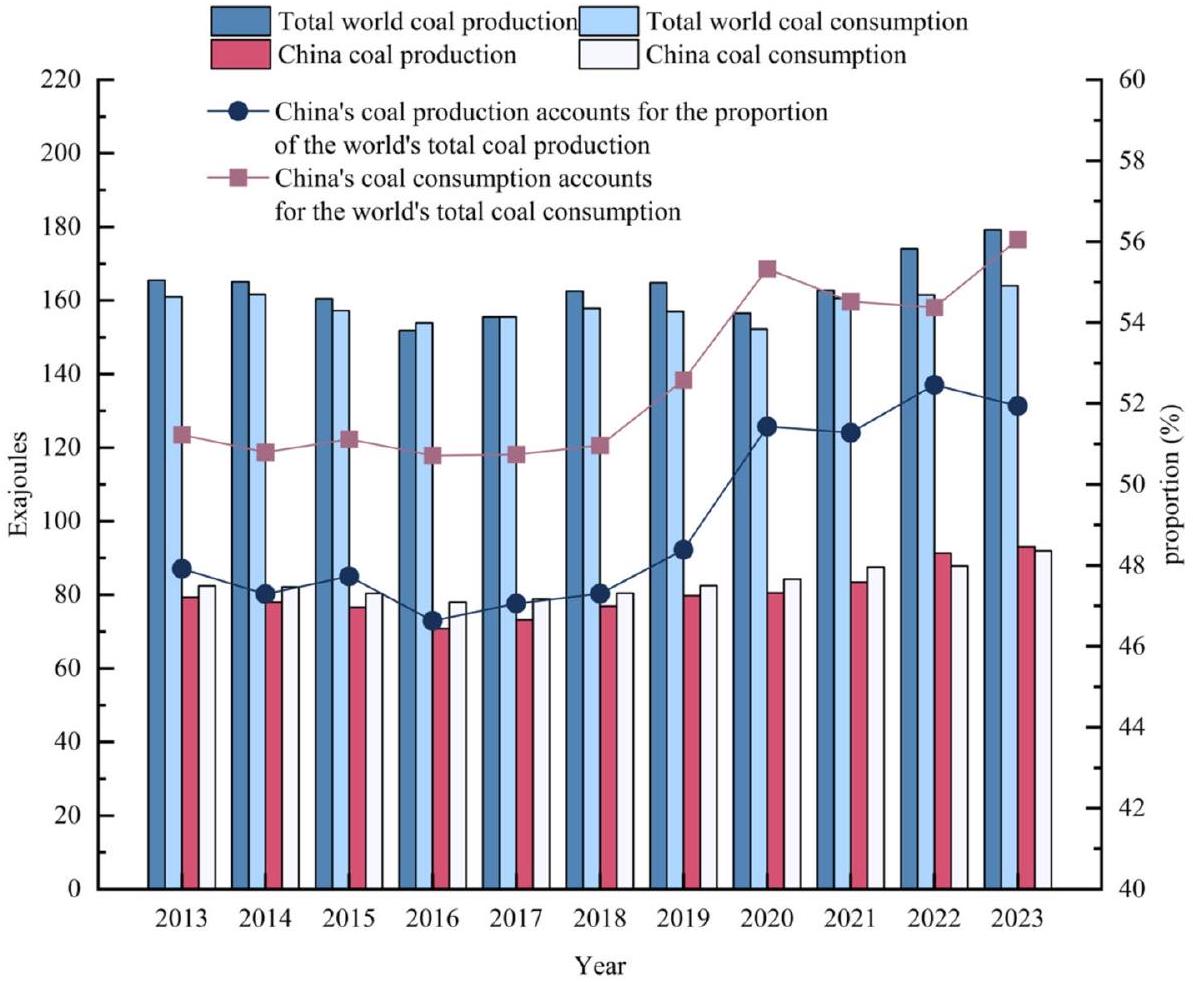
الفحم هو المصدر الرئيسي للطاقة من الوقود الأحفوري على مستوى العالم (Wang et al. 2022a; Zhang et al. 2023a; Cheng et al. 2024). في عام 2023، بلغ إنتاج الفحم العالمي 179.24 EJ (إكسا جول)، بينما تجاوز استهلاك الفحم العالمي 164.03 EJ. تعتبر الصين أكبر منتج ومستهلك للفحم في العالم، حيث بلغ إنتاجها السنوي 93.10
EJ في 2023. مقارنة بعام 2022، زاد استهلاك الفحم في الصين بمقدار 4.11 EJ في 2023 (https://www.energyinst. org/statistical-review)، ليصل إلى 91.94 EJ (Liu 2023a). من المتوقع أن يستمر إنتاج الفحم العالمي في الزيادة، مدفوعًا بشكل أساسي من قبل الصين والهند، اللتين من المتوقع أن تمثلان ثلثي استهلاك الفحم في العالم بحلول عام 2024. يوضح الشكل 1 إجمالي إنتاج واستهلاك الفحم لكل من العالم والصين من 2013 إلى 2023.
مع تعافي الاقتصاد العالمي، يزداد الطلب العام على الطاقة تدريجياً (Li et al. 2021a). في فبراير 2024، أصدرت برنامج الأمم المتحدة للبيئة (UNEP) تقريرًا جديدًا بعنوان “ما بعد عصر النفايات: تحويل القمامة إلى مورد”، مما يبرز الحاجة الملحة لفصل توليد النفايات عن النمو الاقتصادي والتحول نحو نهج الاقتصاد الدائري والصفر نفايات (برنامج الأمم المتحدة للبيئة 2024). يتم إنتاج كميات كبيرة من النفايات الصلبة المعتمدة على الفحم (CBSWs) مثل نفايات الفحم (CG)، الرماد المتطاير (FA)، وخبث الغازification الفحم (CGS) خلال التعدين، والمعالجة،
الشكل 1 إجمالي إنتاج واستهلاك الفحم في العالم والصين من 2013 إلى 2023
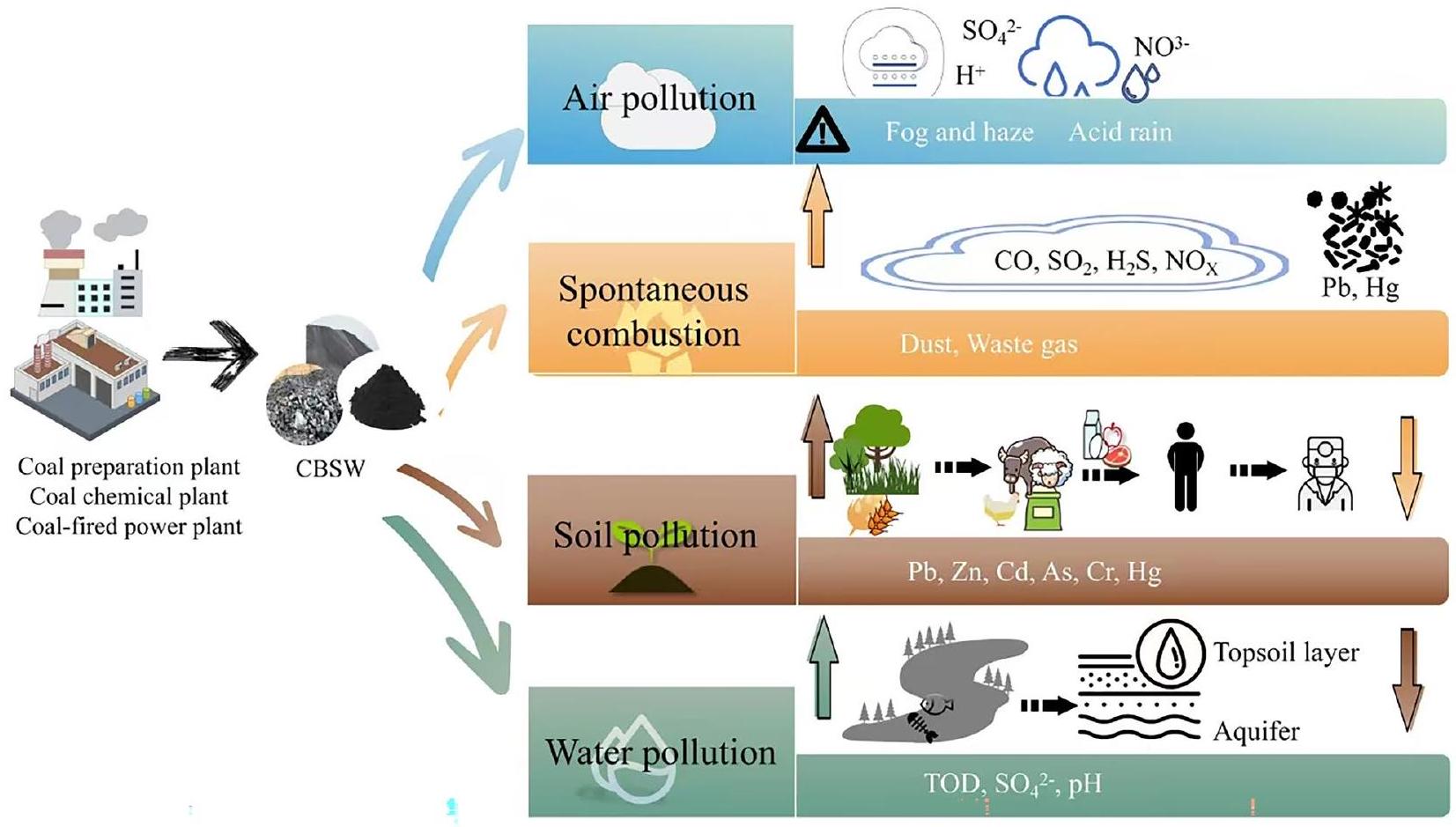
والحرق، والتحويل وعمليات أخرى (Cheng et al. 2023a; Lyashenko et al. 2018). هذه النفايات هي موارد محتملة، ولكن إذا تُركت دون استخدام، فإنها تشكل تهديدات خطيرة للبيئة الطبيعية وصحة الإنسان. تظهر المسارات الخطرة لـ CBSWs في الشكل 2. مع مرور الوقت، تهاجر المعادن الثقيلة في CBSW إلى التربة وتتراكم في المحاصيل، والحيوانات، والأسماك، مما يؤثر في النهاية على صحة الإنسان من خلال سلسلة الغذاء (Zou et al. 2024). بالإضافة إلى ذلك، تلوث CBSWs المياه الجوفية المحيطة، مما يزيد من مستويات الهيدروكربونات العطرية متعددة الحلقات (PAHs)، SO , و المعادن الثقيلة في المياه. علاوة على ذلك، فإن الاحتراق الذاتي وتلوث الغبار من CBSWs يطلق , , و , مما يساهم في الضباب، والضباب الدخاني، والأمطار الحمضية.
حاليًا، مع زيادة الطلب على الموارد وحماية البيئة، يتجه تطوير تقنيات تحويل واستخدام CBSWs نحو حلول صديقة للبيئة وعالية القيمة وعلى نطاق واسع (Yan et al. 2023a).

2 خصائص النفايات الصلبة المعتمدة على الفحم

2.1 نفايات الفحم

CG هو نوع من الصخور المدفونة داخل طبقات الفحم (Wang et al. 2024a) وينشأ من عمليات تعدين الفحم وإعداده (Cheng et al. 2023b). في الصين، تعتبر CG أكبر نفايات صلبة صناعية من حيث الإنتاج والتخزين،
تمثل من إجمالي إنتاج الفحم (Wu et al. 2024). يوضح الشكل 3 إنتاج CG في الصين والاستخدام الشامل من 2011 إلى 2021. في عام 2021، تم إنتاج حوالي 7.43 جيجا طن من CG (He et al. 2022a; Wu et al. 2023a). بحلول عام 2025، من المتوقع أن يصل الإنتاج السنوي لـ CG في الصين إلى حوالي 8 جيجا طن (Fan et al. 2023). ومع ذلك، فإن معدل استخدام CG أقل من 73% (Wang et al. 2024). بسبب محتواه المنخفض من الكربون والقيمة الحرارية (عادة أقل من )، فإن CG من الصعب استخدامه وغالبًا ما يتم تخزينه في أكوام مفتوحة حول مناطق التعدين. تحت استراتيجية “الكربون المزدوج”، حققت صناعة استغلال موارد CG تقدمًا كبيرًا. ومع ذلك، فإن عدم التوازن في التنمية الإقليمية، وانخفاض مستويات التكنولوجيا، وسلاسل الصناعة غير المكتملة، وتطوير الصناعة على مستوى منخفض تحد من استخدامه عالي القيمة. أظهرت الدراسات أن توزيع المعادن الثقيلة في CG يظهر خصائص إقليمية وجيولوجية محددة. بالإضافة إلى ذلك، فإن شركات CG صغيرة، مع أرباح منخفضة، والعديد من تقنيات استخدام CG عالية التقنية لم يتم تنفيذها بالكامل.

2.2 الرماد المتطاير

FA هو نفايات صلبة تتولد بعد احتراق الفحم المسحوق في محطات الطاقة الحرارية. تتأثر خصائصه بشكل كبير بنوع الفحم المستخدم وطرق الاحتراق، مما يؤدي إلى عدم استقرار الجودة وزيادة صعوبة استخدام الموارد. اعتبارًا من عام 2023،
الشكل 2 المسارات الخطرة لـ CBSWs
يُقدّر الإنتاج العالمي من FA بحوالي 592 مليون طن، مع توقعات تشير إلى أن هذا الرقم سيصل إلى حوالي 1090 مليون طن بحلول عام 2032. من المتوقع أن ينمو السوق بمعدل نمو سنوي مركب (CAGR) قدره من 2023 إلى 2032. ومع ذلك،
تختلف معدلات الاستخدام بشكل كبير بين الدول، حيث تتراوح من 99% في اليابان إلى 11% فقط في إفريقيا والشرق الأوسط (Jin et al. 2021; Xu and Zuo 2018). في عام 2021، بلغ إنتاج FA في الصين 7.9 مليار طن (Chen et al. 2024)، مع زيادة متوقعة إلى 9.25 مليار طن بحلول عام 2024 (Zhang
الشكل 3 الإنتاج السنوي والاستخدام الشامل لـ CG في الصين من 2011 إلى 2021 (Chang et al. 2022)
الجدول 1 معدل استخدام موارد FA حسب الدولة
طريقة الاستخدام معدل استخدام FA (%)
الصين أمريكا اليابان الاتحاد الأوروبي
مواد البناء 64 33.05 67.12 90.8
ملء المناجم 20 28.92 10.31
معالجة مياه الصرف 9 23.77 22.88 9.2
تعديل التربة 7 14.26
و Meng 2020). بدأت العديد من الدول في تقديم سياساتها وتدابيرها الخاصة لتعزيز استخدام FA. على الرغم من إنتاجه الواسع، فإن استخدام FA غير متوزع بشكل متساوٍ عبر المناطق. حاليًا، الاستخدامات الرئيسية لـ FA في الصين هي في مواد البناء والزراعة، مع تطبيقات محدودة على مستوى عالٍ، مثل استخراج المعادن النادرة وتصنيع المنتجات عالية القيمة. تشمل القضايا الرئيسية نظام الابتكار التكنولوجي غير المكتمل والمعدات القديمة. على مستوى العالم، يختلف معدل استخدام FA في مجالات مختلفة بسبب اختلافات في إنتاج FA، وتعقيد العمليات ومتطلبات الحماية البيئية التقنية. تظهر مسارات استخدام موارد FA في الدول الكبرى في الجدول 1.
وفقًا للجدول 1، فإن الاستخدام الحالي للرماد المتطاير في دول مختلفة يتركز بشكل رئيسي في أربعة جوانب رئيسية (شو 2023): مواد البناء، تعبئة المناجم، تعديل التربة ومعالجة مياه الصرف. مقارنةً بالدول المتقدمة الأخرى، فإن معدل استخدام الرماد المتطاير في الصين أعلى بكثير في مجال مواد البناء، بينما يكون معدل الاستخدام في المجالات الأخرى منخفضًا نسبيًا. في اليابان، يتم استخدام 67.12% من الرماد المتطاير في مواد البناء. بسبب نقص المواد الخام ومعارضة قوية من السكان لتراكم الرماد المتطاير في مدافن النفايات، حققت اليابان كفاءة عالية في الاستخدام الشامل للنفايات الصلبة، خاصة كمواد بناء وتعديلات للتربة. في الولايات المتحدة، تم تقديم “طريقة تقييم الجدوى لاستخدام النفايات الصلبة في محطات الطاقة التي تعمل بالفحم” و”طريقة تقييم الاستخدام المفيد للخرسانة المصنوعة من الرماد المتطاير ولوح الجبس” لتوجيه تطبيق الرماد المتطاير بشكل أفضل في هذين المجالين. بسبب نقص المواد الخام في منطقة الاتحاد الأوروبي، فإن استخدام الرماد المتطاير محدود، مع استخدام كمية كبيرة من الرماد المتطاير في مواد البناء وتعبئة المناجم.

2.3 خبث غاز الفحم

CGS (تشنغ وآخرون 2022) هو نفايات صلبة تنتج أثناء غازification الفحم (Gu وآخرون 2023). يتم إنتاج أكثر من 70 مليون طن من CGS سنويًا في الصين (Su وآخرون 2024)، مع استمرار زيادة الكمية الإجمالية (Yan وآخرون 2023a). على الرغم من إمكانيته في استغلال الموارد بسبب تركيبه من السيليكا، والألومينا، وأكسيد الكالسيوم، وأكسيد الحديد، إلا أن جزءًا صغيرًا جدًا من CGS يُستخدم حاليًا، بينما الغالبية العظمى
تُلقى الغالبية العظمى من CGS ببساطة أو تُدفن في المدافن. في عام 2019، تجاوزت انبعاثات CGS في الصين 35 مليون طن، مع معدل استخدام شامل يبلغ فقط (دونغ وآخرون 2024). بسبب محتواه العالي من الكربون والشوائب، فإن CGS غير مستقر في الجودة ومكلف في المعالجة، مما يؤدي إلى دفن معظمها في المدافن ويسبب تلوثًا كبيرًا (لي وآخرون 2023a). تركز جهود الاستخدام على نطاق واسع الحالية على مواد البناء، وإصلاح التربة والمياه، واستخدام الكربون المتبقي (لي وآخرون 2022a). حتى الآن، حققت الاستفادة من CBSWs إنجازات في الاختراقات التكنولوجية في القطاعات الكيميائية والبنائية والزراعية. ومع ذلك، تظل معدلات الاستخدام المنخفضة، والتكاليف العالية، وسوء قابلية التوسع تحديًا (ليو وآخرون 2022). على عكس CG و FA، لا تزال تقنيات التخلص الكبيرة الناضجة مفقودة في خبث الغازification.
توضح الجداول 2 و3 التركيب الكيميائي والمعدني لـ CBSWs من مناطق إنتاج الفحم المختلفة. كيميائيًا، يتكون CG بشكل أساسي من و المواد (غان ولو 2023)، مع كميات صغيرة من الكربون العضوي وأكاسيد المعادن الأخرى (دو وآخرون 2023). من الناحية المعدنية، يحتوي CG عادةً على الكاولينيت والكوارتز كأطوار بلورية، إلى جانب كميات ضئيلة من المواد غير المتبلورة مثل الماء، والمواد الكربونية، ومنتجات التجوية. تشمل المعادن البلورية المحتملة الأخرى الإيلايت، والمونتموريلونيت، والكلوريت، والموسكوفيت، والفلدسبار، والبايرايت، والسيديريت، والهيماتيت، والكلسيت. يتم تنشيط الكاولينيت والمعادن الطينية الأخرى بسهولة، بينما يتمتع الكوارتز، وهو معدن من الرمال، بمقاومة قوية للتجوية ولا يتحلل بسهولة. وبالتالي، يمكن استخدام CG في رصف السطح وملء المناجم تحت الأرض.
FA يحتوي أيضًا بشكل رئيسي على و بكميات كبيرة من والكربون غير المحترق، بالإضافة إلى كميات صغيرة من المركبات التي تحتوي على ، و Mg ، وعناصر أثرية مثل Cu و Zn . من الناحية المعدنية، يتكون FA بشكل أساسي من مراحل زجاجية غير متبلورة، مع مراحل بلورية تشمل الكوارتز، والموليت، وبعض الكالسيت والهيماتيت، والتي تختلف بشكل كبير عن التركيب المعدني لـ CG. يمكن استخدام FA في مواد البناء.
الجدول 2 المكون الكيميائي الرئيسي لـ CBSWs (%)
مكون/ محتوى سي جي فا CGS
٤٤.٧٨~٦١.٧٠ ٣٣.٩٠~٥٩.٧٠ 14.86~53.36
15.53~39.05 16.50~35.40 7.72~16.81
1.50 ~ 15.40 7.37~41.19
أكسيد الكالسيوم 0.33~4.14 6.79~19.04
أكسيد المغنيسيوم 0.86~2.40
1.55~3.22
يضحك بصوت عالٍ 13.99~16.30 1.20~23.50 1.19~52.91
الجدول 3 تركيب المرحلة المعدنية وطرق الاستخدام لمياه الصرف الصحي المعالجة (وانغ وآخرون 2024ب)
نوع التكوين الرئيسي التكوين الثانوي أنماط الاستخدام
سي جي
الطور البلوري
كاولينيت، كوارتز، إيللايت، كلوريت، موسكوفيت، فلسبار، بايريت، سيديريت، هيماتيت، كالسيت، إلخ
الطور غير المتبلور
رطوبة، كربونية، تآكل، إلخ
تعديلات التربة، المواد الكيميائية الخام القائمة على الألمنيوم، المنتجات الكيميائية القائمة على السيليكون والمواد الخام الخزفية، المواد الماصة، الأسمنت، الطوب والمواد الجدارية الجديدة
فا
الطور غير المتبلور
الجسم الزجاجي
الطور البلوري
الكوارز، الموليت، وبعض الكالسيت والهيماتيت، إلخ
الأسمنت، الخرسانة، تصنيع الجدران والطلاءات الوظيفية، تصنيع الأسمدة الزراعية، المواد الماصة، سيليكات الماء، إنشاء الطرق وملء مناطق هبوط تعدين الفحم
CGS الطور غير المتبلور الطور البلوري
ألواح تقسيم خزفية
تحضير مركبات السيليكون والكربون
الألومينوسيليكات غير المتبلور، الكربونية الكوارز، الموليت، الجالينايت والكلسيت مادة هلامية
لإنتاج الأسمنت، والخرسانة، والطوب المسامي، والمونة، والسيراميك. في المواد الكيميائية، يمكن استخدامه لتخليق المناخل الجزيئية واستخراج العناصر المعدنية النادرة. في الزراعة، يمكن استخدام FA لإنتاج الأسمدة المركبة وتعديلات التربة.
يتكون CGS بشكل أساسي من ومواد كربونية. تركيبتها الكيميائية مشابهة لتلك الخاصة بـ CG و FA، ولكن مع محتوى أقل من السيليكون والألمنيوم ومحتوى أعلى من أكاسيد المعادن الأخرى والمواد الكربونية. بالإضافة إلى ذلك، يحتوي الخبث الخشن في CGS على فقدان أقل عند الاحتراق مقارنة بالخبث الناعم، الذي يحتوي على المزيد من المواد القابلة للاحتراق. يمكن استخدام CGS لاستعادة واستخدام الكربون المتبقي، وتحضير مواد الامتزاز، ومواد امتصاص الموجات (Li et al. 2023b).
أيونات المعادن الثقيلة مثل وغيرها من النفايات الصلبة المعتمدة على الفحم تلوث البيئة التربة والمياه الجوفية (ليو 2023ب؛ لي وآخرون 2022ب). المعادن الثقيلة النموذجية في النفايات الصلبة المعتمدة على الفحم ضارة بصحة الإنسان كما هو موضح في الشكل 4. وبالتالي، أصبح التخلص المناسب من النفايات الصلبة المعتمدة على الفحم مصدر قلق رئيسي (فو وهان 2023؛ يانغ 2023).

3 تطبيقات CBSWs في مجال المواد الكيميائية

3.1 مواد البناء

توزع CBSWs على نطاق واسع ويتم إنتاجها بكميات كبيرة، مما يوفر إمكانيات بحثية عميقة لتحضير مواد البناء. في مجال مواد البناء، يُستخدم CG بشكل رئيسي كمواد خام للإسمنت، ومواد مساعدة للإسمنت، وركام الخرسانة، وقرميد محروق، وقرميد غير محروق، وركام خفيف سيراميكي، إلخ. (Ngo et al. 2023). نظرًا لفوائدها الاقتصادية والبيئية، يُستخدم CG أيضًا بشكل شائع كبديل
الشكل 4 المعادن الثقيلة النموذجية في النفايات الصلبة المعتمدة على الفحم ضارة بالجسم البشري
الم aggregates الطبيعية غير المتجددة في إنتاج الخرسانة. يمكن استخدام الخبث الناتج أثناء احتراق CG كمواد مضافة في مواد البناء الصديقة للبيئة وكمواد خام للخرسانة الخفيفة، إلخ. المحتوى العالي من و في الطوب النفايات FA مفيد لتحضير المواد السيليكات غير العضوية (كانغ 2022)، مثل السيراميك، الزجاج، الأسمنت، إلخ. بالإضافة إلى ذلك، يتم استخدام CBSWs أيضًا في مواد البناء بما في ذلك الأسمنت، حشو الخرسانة، حبيبات السيراميك، مواد الجدران، الطوب، إلخ، مع كون الأسمنت والخرسانة هما التطبيقات الأكثر بروزًا (تشو وآخرون 2021a، بو وآخرون 2023).

3.1.1 الأسمنت

تتميز CBSWs بتراكيب كيميائية مشابهة للطين. الحرارة المنبعثة من الكربون أثناء التحميص تحسن من جودة الكلنكر العادي للأسمنت وتقلل التكاليف من خلال استبدال الطين والوقود في إنتاج الأسمنت (He et al. 2023a). قام Xu et al. (2013) بتحضير أسمنت الأليت-سلفو ألومينات في باستخدام CG، والحجر الجيري، والجبس كمواد رئيسية، مع الفلوريت والبارايت كمواد ثانوية. أظهرت النتائج أن المعادن الرئيسية في الكلنكر في الأسمنت كانت سلفات الألومنيوم، والأليت، والألبايت، مع كون الألومينا الكالسيومية هي الهيدرات الأساسية، حيث أظهرت قوة ضغط الأسمنت 48.9 ميغاباسكال بعد 7 أيام. يمكن أن تعزز إضافة الرماد المتطاير الأداء العام للمواد عالية الماء إلى حد معين، مما يزيد من قوتها الضاغطة (غاو وآخرون 2024). أعد زو وآخرون (2023) مواد تعبئة قائمة على الأسمنت بمحتوى عالٍ من النفايات الصلبة. عندما كانت نسبة ملاط التعبئة الصافي إلى CG هي تمت ملاحظة أن تغليف CG في مادة تعبئة المناجم المعدة كان فعالاً. أدى إضافة FA كإضافة أثناء تحضير الخرسانة إلى تحسين أداء الخرسانة من خلال استبدال جزئي للأسمنت والرمل ومواد خام أخرى. استكشف شيا وآخرون (2023) جدوى استخدام CGS كإضافة للأسمنت. في هذه الدراسة، لوحظ أن آلية قوة المنتجات الصلبة الأسمنتية تأثرت بنوع CGS، حيث يمكن استخدام خبث الغاز الفحم الخشن كإضافة للأسمنت في الأسمنت الموضع. كسر الكتلة). يمكن أن توفر CGS وعناصر أخرى مطلوبة لترطيب الأسمنت وتخضع لترطيب مستمر تحت تأثير منشط، مما يزيد من درجة البوليمرة وكثافة المادة (دو وآخرون 2024).

3.1.2 الخرسانة

يتم استخدام CG عادة كركام في الخرسانة، مع التركيز على قابلية العمل، القوة، الانكماش، والمتانة (Zhang 2022). درس Cheng وآخرون (2023c) تأثير CG كإضافة على أداء المونة الجافة. أظهرت النتائج أن المحتوى الأمثل من CG المطحون بالمطرقة والذي تم تمريره بعد ذلك عبر منخل 3 مم، كان حيث تشكل الأسمنت 17% من الكتلة الإجمالية (وزن/وزن). محتوى الإضافات من المركب كان “، وكان محتوى الماء يتراوح من 194 إلى تحت هذه الظروف، بلغت اللزوجة 91.5 مم، وكانت نسبة احتباس الماء . بالإضافة إلى ذلك، تم العثور على مقاومة الضغط بعد 7 أيام أيضًا 10.6 ميغاباسكال، مما يلبي متطلبات الملاط الجاف المختلط للتجصيص العادي وملاط البناء (GB-T 25181-2019). يُستخدم الرماد المتطاير عادةً كإضافة معدنية، مما يؤثر بشكل كبير على خصائص الخرسانة المختلفة مثل الخصائص الطازجة، القوة، والمتانة. التغيرات في السيولة ووقت التصلب ملحوظة مع اختلاف الرماد المتطاير.
المحتوى. في دراسة أخرى، قام شيانغ وآخرون (2022) بالتحقيق في استخدام الرماد المتطاير كإضافة معدنية وCGS لاستبدال الرمل الطبيعي في تحضير خرسانة الرماد المتطاير. أظهرت نتائج هذه الدراسة زيادة في درجة كثافة الخرسانة مع إضافة CGS، الذي يُعزى بشكل رئيسي إلى فوائد حجم جزيئات الخبث. هنا، لوحظ أن الرماد المتطاير الذي تم استخدامه لاستبدال الركام الناعم قد حسّن توزيع حجم المسام والميكرو مورفولوجيا الخرسانة (Zhang et al. 2022). كما استكشف Huang (2023) تأثيرات إضافة الرماد المتطاير ومعدل استبدال الركام المعاد تدويره على الخصائص الميكانيكية للخرسانة المعاد تدويرها. تم تحقيق الخصائص الميكانيكية المثلى مع إضافة 15% من الرماد المتطاير و استبدال الركام المعاد تدويره. على الرغم من النشاط البوزولاني المحتمل للمواد النشطة ، إن تطبيق CGS محدود، بشكل أساسي بسبب محتواه العالي من الكربون واختلاف حجم الجسيمات. عادةً ما لا تتجاوز النسبة المثلى لإضافة CGS في الخرسانة تشير التوافقات البحثية إلى أن CGS يمكن أن يعزز من قابلية تدفق الخرسانة. مقارنةً بـ CG و FA، يظهر CGS مسامية أعلى ومحتوى كربوني أكبر، مما يؤدي إلى زيادة امتصاص الماء وانخفاض في الخصائص الميكانيكية. ومع ذلك، يختلف تأثيره على المتانة وقد يُعزى ذلك إلى الخصائص الأساسية لـ CGS، مثل النعومة، ومحتوى الكربون، والمكونات النشطة. استخدام المنشطات (مثل، “ و يمكن أن تعزز (CGS) التفاعل، مما يسهل استخدامها في مواد التعبئة. بشكل عام، لا يزال البحث حول (CGS) محدودًا نسبيًا، وسيكون تناول تأثير محتوى الكربون على مواد البناء نقطة محورية للتحقيقات المستقبلية.

3.1.3 مواد الجدران

نظرًا لتشابه تركيباتها الكيميائية والمعادن الشبيهة بالطين، يمكن استغلال CBSWs كمواد خام أساسية لاستبدال الطين في إنتاج الطوب المسنتر. يمكن أيضًا استخدام CG بشكل محتمل لإنتاج مجموعة متنوعة من الطوب، مثل الطوب القابل للاختراق، والطوب الصلب المسنتر، والطوب الخالي من الحرق، وطوب الاحتراق الداخلي، إلخ. (Yin و Xue 2023). مع تسرب مياه الأمطار إلى تحت الأرض وتجديد المياه الجوفية، يتم استخدام مواد بناء قائمة على FA بشكل متزايد لإنتاج الطوب الصلب المعقم، والطوب المجوف، والكتل المجوفة، إلخ. (Feng 2020). قد تؤثر الجرعة الزائدة في مواد الجدران على مستوى الإشعاع في المنتج النهائي. لذلك، يجب على شركات مواد الجدران مراقبة إشعاع FA والتحكم في محتواه كمواد خام لضمان سلامة الإشعاع لمنتجات مواد الجدران (Chen 2023). قدم Chen وآخرون (2021) مادة بناء جدارية مجوفة قائمة على FA، معالجين مشكلة النشاط المنخفض وتفاعل FA غير المكتمل من خلال إضافة مجاميع مركبة من خبث قاع الفرن وخبث كربيد الكالسيوم بنسبة وزن وجد سون وآخرون (2017) أن CGS يمكن استخدامه كمواد تعبئة في مناجم الفحم، مع إزالة الماء.
معدل مادة التعبئة السائلة يتغير مع محتوى CGS. مع زيادة محتوى CGA، انخفض معدل إزالة الماء من CGS.

3.1.4 المواد الخزفية

عناصر مثل ، إلخ. الموجودة في CBSWs يمكن أن تكون مواد خام ممتازة لإنتاج السيراميك (Liu et al. 2021a). قام Wang et al. (2023a) بتخليق مواد سيراميكية باستخدام CG، وأشاروا إلى أن زيادة درجة حرارة التسخين تعزز من تشكيل -مرحلة SiAlON. كانت درجة الحرارة المثلى ومدة الاحتفاظ هي و 4 ساعات، على التوالي، مع عرض المادة لقوة انحناء وقوة ضغط تبلغ 10.1 ميغاباسكال و 24.7 ميغاباسكال، على التوالي. بالإضافة إلى ذلك، تم العثور على الانكماش والمسامية أيضاً و على التوالي. استخدم جاو (جاو 2022) CGS لتحضير كريات سيراميكية عالية الأداء، محددًا خطة التحضير المثلى لكريات السيراميك غير المحترقة التي تتطلب درجة حرارة معالجة وقت المعالجة 12 ساعة، وتركيز المنبه القلوي من وونغ وآخرون (2023ب) أيضًا أعدوا كريات خزفية زيلوتية قائمة على الرماد المتطاير بدون حرق، قادرة على تحقيق معدل الإزالة .

3.1.5 الزجاجيات السيراميكية

تتميز السيراميك الزجاجية بخصائص كل من الزجاج والسيراميك، مثل الخصائص الميكانيكية الممتازة، ومقاومة التآكل، والاستقرار الحراري، مما يجعلها مفيدة في مجالات متنوعة بما في ذلك مواد البناء، والمواد المقاومة للحرارة، والصناعة الكيميائية (تشاي وآخرون 2023). تحتوي CBSWs على أكسيد السيليكون، وأكسيد الألومنيوم، وأكسيد الكالسيوم، وأكسيد الحديد، وهي المكونات الرئيسية للسيراميك الزجاجية. يمكن تحقيق تخليق السيراميك الزجاجية باستخدام FA من خلال طرق التلبيد والانصهار. في دراسة أجراها شانغ وآخرون (2017)، تم استخدام FA وخبث فرن الفوسفور الأصفر الذي يبرد طبيعياً كالمواد الخام الرئيسية للتحضير. تم تحضير السيراميك الزجاجي (CAS) عبر طريقة الانصهار. أظهرت النتائج أنه يمكن تحضير سيراميك زجاجي CAS بنجاح باستخدام هذه المواد عند دمجها مع كمية صغيرة من المواد المساعدة. كانت المرحلة البلورية الرئيسية الملحوظة هي الوولستونيت. مع إضافة ، أو .
إضافة أو قلل من طاقة تنشيط التبلور وعزز المرحلة البلورية، بينما كانت إضافة ، زادت من طاقة تنشيط التبلور وأعاقت المرحلة البلورية. في دراسة أخرى قام بها بينغ وآخرون (2012)، تم تحضير السيراميك الزجاجي (CAS) باستخدام الزجاج المستعمل والرماد المتطاير كالمواد الخام الرئيسية من خلال طريقة التلبيد المباشر والتبلور. تم تلبيد السيراميك الزجاجي CAS عند لمدة ساعة واحدة و
مُتبلور عند لـ 2 ساعة، أظهرت أقصى كثافة حجمية وأدنى امتصاص للماء، مع وجود زجاج سيراميك CAS الأمثل الذي يحتوي على مرحلة هيكلية واحدة فقط من الوولستونيت مع أقصى قوة انحناء تبلغ 81.5 ميغاباسكال.

3.1.6 الجيوبوليمر

الجيوبوليمر، وهو مادة هلامية خضراء جديدة تتميز بهيكل شبكي ثلاثي الأبعاد من السيليكا والألومينات (زينغ وآخرون 2023)، يُستخدم حاليًا على نطاق واسع في إدارة البيئة ومواد الخرسانة نظرًا لمقاومته القوية للتشقق والانحناء. يمكن تصنيع الجيوبوليمرات عبر البلمرة، مستفيدين من الخصائص الكيميائية لمخلفات CBSWs. استكشف فيجيلا وآخرون (2023) تأثير حجم جزيئات CG المطحونة على الخصائص الميكانيكية للجيوبوليمرات، ولاحظوا أن أعلى مقاومة ضغط وثني بلغت 19 ميجا باسكال و5.7 ميجا باسكال، على التوالي، تم تحقيقها عندما كان حجم الجسيمات أقل من حقق دانيار وآخرون (2022) في مزيج الجيوبوليمر (المعجون) الذي يتكون من الرماد المتطاير غير المطابق لمعايير ASTM وفتات الخبث المنصهر (GGBFS) المنتج في مصنع لصناعة الصلب. أظهرت النتائج أن زيادة محتوى الماء زادت من قوة الضغط والانكماش أثناء التجفيف لعينة الجيوبوليمر. وعلى العكس، أدى انخفاض محتوى القلويات إلى انخفاض في قوة الضغط وقابلية العمل ولكنه قلل بشكل فعال من الانكماش أثناء التجفيف. بالإضافة إلى ذلك، أظهر المزيج الذي يحتوي على 50% من GGBFS و50% من الرماد المتطاير قوة أعلى مقارنة بنسبة GGBFS/FA تبلغ 25/75. اختار كوين وآخرون (2024) slurry الفحم، مسحوق الخبث والرماد المتطاير كمواد خام، واستخدموا كبريتات الصوديوم وهيدروكسيد الصوديوم كمثيرات قلوية لتحضير مادة رصف الجيوبوليمر المعتمدة على slurry الفحم (CSGPM). تحت معايير التناسب المثلى، كان وقت التجلط لـ CSGPM هو 33 دقيقة وكانت قوة الضغط بعد 24 ساعة من المعالجة 11.20 ميجا باسكال.

3.1.7 مواد الموليت

تستخدم المواد القائمة على الموليت على نطاق واسع في مجالات المعادن، التحفيز، معالجة المياه، الطيران والمزيد، وذلك بفضل خصائصها الفيزيائية والكيميائية الممتازة مثل الاستقرار الحراري، القوة الميكانيكية، الخصائص الكهربائية والبصرية (غاو وآخرون 2021). يتم تلخيص التطبيقات الرئيسية لأنواع مختلفة من مواد الموليت في الجدول 4. أعدّ جيانغ (2022أ) الموليت باستخدام CG ولاحظ أن خصائصه كانت مثالية عندما كان حجم CG بين 0.180 و 0.250 مم، مع استخدام النشا كعامل لصنع المسام. في دراسة أخرى، استخدم يين (2020) الرماد المتطاير لإعداد مواد موليت خفيفة الوزن مسامية، مع إضافة من كإضافات. بعد التلبيد عند لمدة ساعتين، أظهر الموليتيت أقصى قوة انحناء وضغط.
الجدول 4 التطبيقات الرئيسية لأنواع مختلفة من مواد الموليتيت
مواد الموليت التطبيقات
المواد المقاومة للحرارة مواد البناء، المعادن، النفط، الصناعة الكيميائية، الآلات، السيراميك، الطاقة الكهربائية، الطيران، إلخ
مواد الطلاء المعادن، السيراميك، الفضاء، المعادن، التحفيز، إلخ
مواد التعزيز صناعة كيميائية، طاقة كهربائية، تعدين، آلات، إلخ
مواد مقاومة للاحتكاك مواد البناء، المواد الكيميائية، الآلات، إلخ
مواد الفلترة معالجة المياه، الطاقة الكهربائية، الصناعة الكيميائية، الآلات، إلخ

3.2 المواد الوظيفية

3.2.1 مواد الامتزاز

مع مساحة سطح كبيرة وفجوات متطورة جيدًا (Luan 2023)، يمكن تعديل CBSWs لزيادة مساحة سطحها النوعية وسعة الامتصاص لتحضير مواد الامتصاص (Zhang et al. 2023b). قام Chi et al. (2023) بتحضير مادة تخثر بولي ألومينوسيليكات الحديد (PAFS) من CG، حيث كانت ظروف التحضير المثلى عند إضافة كربونات الصوديوم. (و)، 2 ساعة وقت التحميص عند نسبة الصلب إلى السائل ( ) من 1:6 خلال عملية استخراج الحمض لمدة ساعتين، وتفاعل البلمرة عند pH 3.6. أدت هذه الظروف المثلى إلى معدل إزالة العكارة لمياه الصرف الكيميائية المحتوية على الفلور. قام قوه وآخرون (قوه وآخرون 2022a) بتطوير مادة مسامية من CGS من خلال النقع الحمضي والقلوي ومعالجة التنشيط، محققين سعة امتصاص وحدة قدرها لظواهر الفينولات الطائرة. قام زونغ وآخرون (زونغ وشيا 2023) بتحضير مواد ماصة من الرماد المتطاير، محققين معدل إزالة يصل إلى لمياه الصرف الناتجة عن صبغة الكونغو الحمراء تحت الظروف المحددة التالية: FA: نسبة خلط الكتلة الطينية بالوزن 6:4، درجة حرارة التكليس وقت التكلس وإضافة 25% من إجمالي كتلة النشا. أعد وانغ (وانغ 2022a) الفحم النشط من خلال تنشيط الكربنة باستخدام بقايا غازification الفحم، حيث تم تحقيق أقصى امتصاص لمياه الصرف المحتوية على النحاس عند pH 5. استكشف مياو (2022) الخصائص و تسجيل أداء الكربون المسامي المصنف الذي تم إنشاؤه من خلال التنشيط الكيميائي للكربون المتبقي. قام تشين وآخرون (2022) بإجراء تحليل مقارن للانكماش، والتوسع، وقوة الضغط الأحادي المحوري بعد 7 و14 يومًا من مواد تعبئة المعجون المعتمد على CGA.

3.2.2 مواد امتصاص الموجات الكهرومغناطيسية

تستخدم المواد الممتصة للموجات الكهرومغناطيسية آليات فقدان مغناطيسية وعازلة لتحقيق امتصاص الميكروويف، مما يلعب دورًا مهمًا في معالجة التلوث الكهرومغناطيسي (وو وآخرون 2023ب). من بين المواد الممتصة للموجات المختلفة، تبرز المواد القائمة على الكربون بسبب استقرارها الكيميائي، وخصائصها الخفيفة، ومساحتها السطحية العالية.
موصلية كهربائية ممتازة. الكربون المتبقي الموجود في CBSWs ليس فقط مسامي وجزئيًا متحجر، ولكنه يمتلك بنية مسامية تسمح بانعكاس وامتصاص متعدد للموجات الكهرومغناطيسية. تبرز هذه المزايا إمكانيته كمواد خام لمواد امتصاص الموجات (Li et al. 2023c). أعد Lin et al. (2023) مواد امتصاص الموجات من رغوة الكربون البيروليتي باستخدام طريقة الجسم المُصنّع مسبقًا مع عملية التحلل الحراري. وجدت الدراسة أن مواد رغوة الكربون البيروليتي مناسبة كمواد لامتصاص الموجات ضمن نطاق درجات الحرارة إلى صمم لي وآخرون (2023d) وأعدوا مواد ماصة للموجات الكهرومغناطيسية (EMW) قائمة على الأسمنت من مخلفات خام الحديد (IOTs) بطبقتين، مع دمج الفحم الأسود (CB) وألياف الصلب (SF) كمواد ماصة مركبة، بما في ذلك طبقات المطابقة والامتصاص. أظهرت النتائج أن خصائص امتصاص EMW تأثرت بشكل كبير بفقدان التوهين ومطابقة المعاوقة. استخدم وانغ (2016) مخلفات تسييل الفحم لإنتاج فوم كربوني قائم على الفحم، منظمًا المعلمات الكهرومغناطيسية وسعة امتصاص الموجات لفوم الكربون القائم على الفحم عن طريق ضبط درجة حرارة الكربنة ومحتوى ملح النيكل. أظهر المنتج خصائص امتصاص الموجات المثلى عندما كانت درجة حرارة الكربنة وكانت نسبة الكتلة للنيكل إلى الأسفلتين 10:100.

3.2.3 غربال جزيئي من الزيوليت

تشمل طرق تخليق المناخل الجزيئية المستندة إلى نفايات الفحم الصلبة التخليق الهيدروحراري، والتخليق بدون مذيبات، والتخليق المعزز بالمجالات (Zhang et al. 2024). وفقًا لنسب السيليكون والألمنيوم المختلفة، يمكن عادةً تقسيم المناخل الجزيئية الاصطناعية إلى أنواع A و X و Y وأنواع أخرى (Li et al. 2022c). توفر المناخل الجزيئية الاصطناعية التي تستخدم نفايات الفحم الصلبة مصدرًا بديلاً مثاليًا للزيوليتات الطبيعية حيث يمكن إنتاجها بكميات كبيرة بتكلفة منخفضة. يمكن تصنيف الزيوليتات التي تم تخليقها من الرماد المتطاير إلى النوع A والنوع X والنوع Y والنوع P. في دراسة أجراها Wu et al. (2019)، تم تخليق المناخل الجزيئية من النوع A باستخدام الاندماج القلوي – التحميص الهيدروحراري في لمدة 60 دقيقة، تليها عملية التبلور عند لمدة 8 ساعات. أدت هذه عملية التخليق إلى تحقيق نقاء أعلى للمنتج مقارنة بـ
طريقة الهيدروحرارية التقليدية. بالإضافة إلى ذلك، يمكن أن يقلل استخدام الميكروويف من وقت التفاعل ودرجة الحرارة، مما يعزز بلورة المنتجات. استخدم جيانغ وآخرون (جيانغ 2022ب) معالجة ذوبان القلويات الساخنة – استخراج الحمض لتخليق غربال جزيئي ZSM-5، مع الظروف المثلى كما يلي: درجة حرارة التحميص نسبة الخلط 1:0.6 من CG إلى كربونات الصوديوم، و معالجة استخراج الحمض. قام لي وآخرون (2023e) بتحضير منخل جزيئي من نوع NaX عن طريق إضافة سيليكات الصوديوم إلى FA لضبط نسبة السيليكا إلى الألومينا. أظهرت النتائج أن ظروف التخليق المثلى كانت 2 ساعة من الشيخوخة، 12 ساعة من التبلور، ودرجة حرارة تحميص .
قام ليو (2022) بتخليق غربال جزيئي ZSM-5 متعدد المراحل باستخدام CGA كمواد خام، مما يعالج تحدي ضبط حموضة الغربال الجزيئي المسامي. استخدم وانغ (2022ب) CGA لتحضير غربال جزيئي من النوع Y أحادي الطور لـ الامتزاز في مياه الصرف. إضافة كميات مناسبة من تم العثور على أنه يسرع من تحفيز النواة، ويقصر من وقت التبلور، ويحسن من بلورية المنخل الجزيئي. الزيوليت هو مادة ماصة صديقة للبيئة، تتميز بسعة تبادل كاتيون ممتازة. بشكل خاص، يتمتع الزيوليت الصناعي بمزايا النقاء العالي وحجم الجسيمات المتجانس، مما يجعله مناسبًا للتطبيقات الصناعية. ومع ذلك، فإن تصنيع الزيوليت مباشرة باستخدام السيليكا والألومينا سيزيد بشكل كبير من التكلفة، لذا فإن استخدام CG و FA وغيرها كمواد خام قد جذب اهتمامًا واسعًا (Li et al. 2022c).

3.2.4 المحفزات وحوامل المحفزات

تحتوي CBSWs على معادن غير عضوية تظهر تأثيرات تحفيزية على غازification الفحم وعمليات أخرى، بينما يمكن أن تكون الكربون غير المحترق داخل CBSWs محملة بأيونات معدنية معينة، والتي تعمل كعامل حفاز وحامل للحفاز (Li et al. 2023f). يتم استخدام طريقتين بشكل عام لتحضير المواد الكربونية من الكتلة الحيوية (Yu et al. 2023). تتضمن الطريقة الأولى الكربنة تليها التنشيط، والتي تهدف إلى تحسين خصائص السطح؛ بينما الثانية هي عملية من خطوة واحدة، تتضمن الكربنة المتزامنة والتنشيط المباشر إلى الكربون المنشط. يمكن تحقيق تنشيط المواد الكربونية من خلال التنشيط الكيميائي أو طرق المعالجة الحرارية. يتضمن التنشيط الكيميائي، المعروف أيضًا بمعالجة الأكسدة، تنشيط المادة باستخدام مؤكسدات مختلفة، مثل بيروكسيد الهيدروجين وحمض النيتريك؛ بينما يستخدم التنشيط الفيزيائي معالجة بدرجات حرارة عالية في تيار غازي، مثل بخار الماء، إلخ. يمكن أن تكون النفايات الصلبة الصناعية حاملة محتملة للجزيئات النانوية، مما يسهل تشكيل المحفزات متعددة الطور لإزالة المواد العضوية. قام تانغ وآخرون (2024) بتخليق محفز ضوئي محمّل بـ CG ( )
عبر الطريقة الهيدروحرارية وأظهرت النتائج أن أداء التحفيز الضوئي للحمولة تم تحسينه بشكل ملحوظ مقارنةً بـ زهاو وآخرون (2023أ) قاموا بتخليق تم تعديل CG (FC-MCG) من خلال نقع حمض الكبريتيك والتكلس عند درجات حرارة عالية. تم تحضير كلا المحفزين باستخدام طريقة احتراق حمض الستريك و حافظت محفزات FC-MCG على أدائها التحفيزي حتى بعد أربع دورات من إعادة الاستخدام. استخدم لي وآخرون (2020) و NaOH كمواد خام للتحضير معقدات بنسبة مولية 1:1 من إلى ZnO بواسطة طريقة الغليان المتكرر. أظهرت النتائج أن التحميل المجمعات على سطح CG لم تحسن فقط الأداء الضوئي التحفيزي بشكل فعال المجمعات، ولكنها أيضًا مكنت من إعادة تدوير المحفز عدة مرات.

3.2.5 المركبات

يمكن استخدام CBSWs في تحضير المواد المركبة، مما يوفر آفاقًا واعدة في هذا المجال. استخدم وانغ وآخرون (2018) CG كمواد خام ومواد كربونية (مثل الكوك، الأنتراسيت، الفحم الأسود، إلخ) كعوامل اختزال للتحضير مسحوق مركب SiC عبر طريقة الاختزال الحراري بالكربون.
تمت ملاحظة أن الظروف المثلى كانت 5 ساعات عند عندما تم إضافة إما الكوك أو الأنثراسايت في ، و 4 ساعات عند متى تم إضافة الكربون الأسود. أعد لي وآخرون (2022d) مركبات الكربون النشط-سيليكا المسامية (AC-SiO2 ) من CG عبر عمليات مختلفة بما في ذلك الانصهار القلوي واستخراج الحمض. تم إعداد أظهرت سعات امتصاص كبيرة لمختلف الملوثات ذات الوزن الجزيئي المختلف، مثل الميثيل البرتقالي والرودامين ب، مع سعات امتصاص تتجاوز و ، على التوالي. قام وانغ وآخرون (2015) بتخليق ( مركبات السيلون/الموليتيت من خلال اختزال الكربون الحراري في الموقع باستخدام CG والفحم الأسود كمواد خام في إلى .

3.2.6 السيليكا

تشير السيليكا إلى مصطلح عام لحمض السيليسيك غير المتبلور الأبيض المسحوق ومركبات السيليكات (هو وآخرون 2020). استخدم يو وآخرون (لونغ وآخرون 2022) خبث تآكل الحمض CG كمواد خام لتحضير السيليكا، وكانت ظروف العملية المثلى كما يلي: تخفيف محلول سيليكات الصوديوم بـ 10 مل من الماء المقطر. مع الحفاظ على درجة حموضة 7.0 عند نقطة النهاية، وضبط درجة حرارة حمام الماء على واستخدام تركيز حمض الكبريتيك قام زو وآخرون (2021ب) بتحضير سيليكا عالية النقاء من CG من خلال التحميص النشط المدمج مع الغسل، مما أدى إلى منتج كربوني أبيض من الدرجة.
الجدول 5 طرق الاستخدام بالإضافة إلى مزايا وعيوب CBSWs في مجال المواد الكيميائية
مسار الاستخدام المنتجات المزايا العيوب المراجع
مواد البناء أسمنت يساهم في تفاعل ترطيب الأسمنت، ويقلل من زمن التصلب، ويحسن من قوة الضغط ومقاومة التشقق. يتطلب معالجة بالتكلس، ومتطلبات صارمة على كمية الفقد عند الاحتراق، وظروف تفاعل قاسية وانغ (2022ج)، قوه وآخرون (2022ب)، هي وآخرون (2022ب)
خرسانة يعزز قوة الضغط ومقاومة التشقق بالإضافة إلى مقاومة الصقيع يتطلب معالجة مثل السحق، والفرز، والمعالجة الحرارية وانغ (2022د)، لي (2022)، ما (2022)
مواد الجدران العزل الحراري، توفير الطاقة وتقليل النفايات، زيادة الكثافة والمتانة عملية معقدة، استثمار عالي، تكلفة عالية، وفي مرحلة البحث التجريبي هوانغ (2022)
المواد الخزفية الاستفادة من المحتوى المعدني غير العضوي الغني في نفايات الفحم عملية معقدة، تكلفة عالية يان وآخرون (2023ب)، تشين (2015)، تشين (2012)، وي ووانغ (2010)
السيراميك الزجاجي تكلفة منخفضة واستخدام عالي تتطلب درجات حرارة أعلى والعائد غير مستقر ماو وآخرون (2022)، زينغ وسون (2022)، لو وآخرون (2022)، سون وآخرون (2016)، دانغ وهي (2020)
جيوبوليمر عملية بسيطة، استخدام عالي الجيوبوليمرات الاصطناعية أقل استقرارًا وأكثر تكلفة وانغ وآخرون (2023ج)، وانغ وآخرون (2022ب)، تشاو وآخرون (2022أ)، لي وآخرون (2021ب)، تشانغ وآخرون (2020)، رشاد وآخرون (2023)، ليكشمي وسودهاكومار (2022)
مواد الموليت سهولة الحصول على المواد الخام، تعالج مشكلة الموليت الطبيعي المحدود، قوة انحناء عالية، مقاومة جيدة للتآكل يتطلب معالجة مسبقة لتقليل المرحلة الزجاجية ولإذابة الشوائب ليو وآخرون (2021ب)؛ وانغ وآخرون (2021)
المواد الوظيفية مواد الامتزاز مساحة سطح محددة كبيرة وبنية مسامية غنية يتطلب عملية الكلسنة ليو وآخرون (2017)، كمان وآخرون (2023)، عبد السلام وآخرون (2020)
مواد امتصاص الموجات الكهرومغناطيسية رخيص، كثافة منخفضة يتطلب الأمر التوظيف أو التمعدن؛ لا تزال هناك نطاقات امتصاص ضيقة نسبيًا، وكفاءة امتصاص منخفضة، وتوافق كهرومغناطيسي ضعيف. تشانغ وآخرون (2019)
منخل جزيئي زيولايت طريقة بسيطة للإنتاج الضخم يجب التحكم بدقة في ظروف التفاعل، والجودة المطلوبة للـ CBSWs عالية. تشو وآخرون (2022)، فان وآخرون (2021)
المحفزات وحوامل المحفزات متناثر ومسامي، جيد لتحضير المحفزات، حامل جيد نقص النضج التكنولوجي لو وآخرون (2020)، دو وآخرون (2022)، دو وآخرون (2021)
المركبات الاستجابة لارتفاع تكاليف المواد علاج معقد ومكلف للمتبقيات والسوائل النفايات بيتايافيني وآخرون (2023)
سيليكا الحفاظ على المواد الخام الكيميائية، تقليل التكاليف، تخفيف الضغط الناتج عن النفايات الصلبة للفحم على البيئة، زيادة القيمة المضافة للمنتجات، وتمديد سلسلة صناعة الفحم يتطلب التحكم في خصائص المعادن وتفعيلها. شروط لمخلفات أنظمة الفحم المختلفة، والعملية معقدة وتستهلك الطاقة. كون وآخرون (2013)
أكثر من قدم شيانغ وآخرون (2023) طريقة تحضير مختلفة عن السيليكا المعدلة التقليدية، حيث تم استخدام كمية من المعدل تم استخدامه، كانت درجة حرارة التعديل وكان وقت التعديل 60 دقيقة. باستخدام هذه الطريقة في التحضير، تم الحصول على سيليكا معدلة تتمتع بتشتت جيد، وخصائص كارهة للماء، وتجانس في حجم الجسيمات. ظل المحتوى مرتفعًا كما هو (كسر الكتلة)، مع مساحة سطح محددة من ، مما يمثل زيادة بمقدار 2.78 مرة مقارنة بالسليكا غير المعدلة. بالإضافة إلى ذلك، وصلت بياض مسحوق هانتر أيضًا إلى استخدم لو وآخرون (2022) منتجات قابلة للذوبان في القلويات من الرماد المتطاير بعد الغسيل بالماء لإزالة السيليكا، محققين كسر الكتلة حتى يوضح الجدول 5 طرق الاستخدام، والمزايا والعيوب للنفايات الصلبة المعتمدة على الفحم في مجال المواد الخام الكيميائية.

4 تطبيق CBSWs في علم المعادن

4.1 استخراج الألمنيوم

تحتوي CBSWs على كميات صغيرة من العناصر النادرة وعناصر الأرض النادرة، على الرغم من تنوعها الواسع (تشاي وآخرون 2023). كما تحتوي CBSWs على عدد كبير من المعادن المعدنية التي يمكن تطويرها من قبل الصناعات، مثل الليثيوم والغاليوم والألمنيوم الموجود في الفحم (ليو وآخرون 2019). تعتبر استعادة الألمنيوم من CBSWs مصدرًا ملحوظًا لموارد الألمنيوم. في دراسة أجراها قوه وآخرون (2023)، تم استخدام تنشيط التحميص CG – استخراج الحمض لاستخراج الألومينا. أظهرت النتائج أن معدل استخراج الألومينا يصل إلى تم تحقيقه عند درجة حرارة التحميص وقت التحميص 1.5 ساعة، تركيز حمض الهيدروكلوريك ،
نسبة السائل إلى الصلب وقت استخراج الحمض ساعتين ودرجة حرارة استخراج الحمض .
الرماد المتطاير، وهو نفايات صلبة رئيسية تنتج من محطات توليد الطاقة التي تعمل بالفحم، لا يحتوي فقط على مستويات عالية من الألمنيوم، ولكن أيضًا على عناصر قيمة أخرى مثل الغاليوم والليثيوم، والتي تعتبر موارد محتملة لاستخراج المعادن القيمة مثل ولي (وو ولي 2023). العمليات المختلفة المستخدمة لاستعادة الألمنيوم من الرماد المتطاير موضحة في الجدول 5. استخرج زو ووانغ (2022) الألومينا من الرماد المتطاير عالي الألومينا، وكانت ظروف الاستخراج المثلى هي 24 ساعة من الطحن للرماد المتطاير عالي الألومينا، نسبة حجم حمض الهيدروكلوريك، درجة الحرارة ونسبة الحمض إلى الرماد و ، على التوالي، 150 دقيقة من وقت التفاعل، و من المواد المجمعة. قام نين وآخرون (يوان وآخرون 2022) بتحضير MOFs صديقة للبيئة قائمة على الألمنيوم من الرماد المتطاير عالي الألومينا. مزيج من الألومينا العالية و تمت تلبيدها عند لمدة 90 دقيقة بنسبة رماد 1:6.6، محققًا معدل تحلل يصل إلى .

4.2 استخراج الغاليوم

الغاليوم هو عنصر نادر، حيث يتواجد في قشرة الأرض بحوالي 1.5 جزء في المليون. أكثر من يرتبط الغاليوم بالمعادن مثل الألمنيوم والزنك والجرمانيوم. في السنوات الأخيرة، ركزت الأبحاث على تكنولوجيا استعادة الغاليوم من النفايات الصناعية، باستخدام طرق مثل الترسيب والاستخراج وامتصاص الراتنج. تعتبر النفايات الصناعية مصدرًا مهمًا للغاليوم. وبالتالي، فإن فصل واستخراج الغاليوم من النفايات الصناعية لا يخفف فقط الضغط على موارد الغاليوم، بل يحسن أيضًا معدل استخدام النفايات الصناعية. يتم عرض توزيع تطبيقات معدن الغاليوم في الجدول 6. على الرغم من أن موارد معدن الغاليوم هي
الجدول 6 استرداد الألمنيوم من الرماد المتطاير
طرق عمليات محددة المزايا العيوب
طريقة القلوي تحميص القلويات قبل إزالة الرطوبة معدل استخراج الألمنيوم العالي استهلاك عالي للطاقة، كمية كبيرة من المخلفات، استهلاك عالي للقواعد
طريقة الحمض تفعيل – حامض – استخراج – تكليس استهلاك منخفض للطاقة، كمية منخفضة من بقايا النفايات تآكل خطير في المعدات وعملية إزالة التلوث المعقدة
الطريقة الهيدروكيميائية عملية كيمياء التحميص بالماء NaOH معدل استخراج الألمنيوم العالي، استهلاك الطاقة المنخفض، بقايا السيليكا؛ سهل التحلل تركيز عالٍ من القلويات، ضعف تدفق الملاط، وزيادة استهلاك المواد
طريقة تقليل الضغط عملية الاختزال الحراري في الفراغ تقريبًا لا توجد ملوثات ثانوية، حماية بيئية خضراء لا يزال في مرحلة البحث في المختبر
كلورنة حرارية بالكربون عملية الكلورنة الحرارية للكربون تقريبًا لا توجد ملوثات ثانوية، تتيح العملية استخدام غاز الكلور كمواد أولية في الدورة والاستخراج المتزامن للسيليكون والكالسيوم والتيتانيوم. لا يزال في مرحلة البحث في المختبر
الجدول 7 مقارنة بين الطرق الشائعة المستخدمة لاستخراج الغاليوم المعدني من مياه الصرف الناتجة عن صناعة الإلكترونيات
طرق نظرية المزايا العيوب المراجع
الامتزاز تقوم المجموعات الوظيفية على هيكل الممتز بامتصاص أيونات الغاليوم في المحلول، مما يفصل أيونات الغاليوم عن الشوائب أو أيونات الشوائب الموجودة في المحلول. استرداد عالي للغاليوم، عملية بسيطة، لا متطلبات خاصة للإنتاج الصناعي المواد الممتصة مكلفة وصعبة الإنتاج. لي (2013)
ترسيب يستفيد من الكثافات المختلفة والترسب تحت تأثير الجاذبية بسيط ومريح، منخفض التكلفة، تقنية ناضجة تتطلب العملية عدة ترسبات، مما يستغرق وقتًا طويلاً، ويتأثر بسهولة بأيونات الشوائب الأخرى، ونقاء الغاليوم المستخرج منخفض. دوان وآخرون (2016)
استخراج يمكن استغلال الفرق في الذوبانية أو معامل التقسيم للعنصر المستهدف في مذيبين غير قابلين للامتزاج لنقل العنصر المستهدف أو الشوائب بشكل انتقائي. عملية بسيطة، تستخدم بشكل رئيسي لاستخراج الغاليوم في محلول الحامض. فقدان المذيب وتلوث السائل المستخرج هان وآخرون (2022أ)، لياو وآخرون (2017)
طريقة تبادل الأيونات يتم استخراج أو إزالة بعض الأيونات من محلول عن طريق تبادل الأيونات في مبادل أيوني صلب مع أيونات محددة في محلول مخفف. عملية بسيطة، استثمار صغير في المعدات سعر الصرف منخفض، ودورة الإنتاج طويلة، ويتم إنتاج كمية كبيرة من سائل نفايات التجديد. وانغ وزانغ (2019)
التحليل الكهربائي غونزي يتم استخراج الغاليوم عن طريق التحليل الكهربائي من المواد التي تحتوي على الغاليوم. محاليل تستخدم الزئبق المعدني كالكاثود يمكن استخراج الغاليوم مباشرة ويمكن الحصول على نقاء عالٍ من الغاليوم المعدني. استهلاك الزئبق العالي، تلوث الزئبق في بيئة العمل، التأثيرات السلبية على صحة الإنسان، قد يكون الاستخدام العملي محدودًا لو وآخرون (2008)
طريقة فيلم المستحلب من خلال التفاعل بين واجهتين لمحلولين أو أكثر من تركيبات مختلفة تكون قابلة للذوبان في بعضها البعض فعال وسريع وموفر للطاقة، خاصة في فصل المكونات ذات التركيز المنخفض لا يزال تطبيق استخراج الغاليوم من مياه الصرف الصناعي في مرحلة البحث. هوانغ وآخرون (2017)
تتراجع احتياطيات الغاليوم في الصين تدريجياً بسبب الطلب العالمي المتزايد (لو وآخرون 2023).
يوجد الغاليوم في الرماد المتطاير في ثلاثة أشكال؛ على سطح الرماد المتطاير، في بلورات غير متبلورة، وفي شكل بلوري. يمكن أن يساعد استرداد الغاليوم من الرماد المتطاير في التخفيف من نقص موارد الغاليوم في الصين (تشاو وآخرون 2021). استخدم لي وآخرون (2017) نموذجًا ملائمًا وطريقة سطح الاستجابة لدراسة استخراج الغاليوم المعدني من محاليل تحييد عصارة الحمض CG.
في هذه الدراسة، لاحظ المؤلفون أن معدل استخراج الغاليوم وصل إلى أعلى مستوى عندما يتفاعل 2-إيثيل هكسيل فوسفونات مع تم استخدام نسبة الحجم كمستخلص لمدة 5 دقائق. تشمل الطرق الرئيسية لاستخلاص الغاليوم من الرماد المتطاير التذويب الحمضي المباشر، والتذويب القلوي المباشر، وطريقة التحميص-التذويب. يتم عرض مقارنة بين الطرق الشائعة المستخدمة لاستخراج الغاليوم المعدني من CBSWs في الجدول 7.

4.3 استخراج الليثيوم

تمت تسمية الليثيوم (Li) بـ “معدن الطاقة” في القرن الحادي والعشرين وغالبًا ما يُشار إليه بـ “المعدن الذي يدفع العالم إلى الأمام”. تُظهر الخصائص المختلفة لعمليات استخراج الليثيوم في الجدول 8. حاليًا، تعتمد طرق استخراج الليثيوم من CBSWs بشكل رئيسي على طرق مثل طريقة التكليس (تشنغ 2019)، واستخراج المذيبات والامتزاز (ليو وآخرون 2023؛ شو وآخرون 2022؛ هان وآخرون 2022ب؛ كوي وآخرون 2020). استخدم تشنج وآخرون (2019) طريقة الامتزاز لاستخراج الليثيوم من CG، محققين معدل امتزاز لليثيوم يزيد عن في محلول التسرب الحمضي للـ CG المنشط باستخدام منخل الأيونات من النوع H. استخدم زانغ (2022) الرماد المتطاير من محطة طاقة في مقاطعة قويتشو لدراسة تسرب الليثيوم من الرماد المتطاير للفحم. أظهرت نتائج هذه الدراسة أن العائد التراكمي لجزيئات الرماد المتطاير التي تقل عن وصلت ، مع غنى الليثيوم والحديد بشكل رئيسي في حجم الجسيمات الذي يقل عن .

4.4 استخراج التيتانيوم

التيتانيوم هو مورد استراتيجي مهم ولكنه منتشر على نطاق واسع في قشرة الأرض، مما يجعل من الصعب استخراجه. التيتانيوم هو عنصر معدني قيم في CBSWs، حيث يمكن استخدامه لإنتاج ثاني أكسيد التيتانيوم عندما تصل نسبة الكتلة من التيتانيوم في CG إلى 7.2% (Bi 2023). استخدم ليو وآخرون (2015) طريقة الطور الصلب لاستخراج التيتانيوم من CG تحت تسخين مساعد بالميكروويف بقوة 800 واط، ونسبة CG الحمضية من ، ووقت إشعاع الميكروويف 60 دقيقة. تحت هذه الظروف، كانت نسبة تسرب التيتانيوم تم تحقيقه، بينما تحت ظروف التسخين التقليدية مع درجة حرارة تسخين نسبة CG الحمضية ، ووقت تسخين قدره 4 ساعات، فإن معدل تسرب التيتانيوم الذي تم تحقيقه هو زاو وآخرون (2017) استخدموا FA
الجدول 8 خصائص عمليات استخراج الليثيوم المختلفة
طرق العملية التكنولوجية المزايا العيوب تأثير على استخراج الرشح
طريقة التحميض عملية استخراج الحمض المباشر؛ عملية التلبيد – عملية استخراج الحمض عملية بسيطة، استهلاك منخفض للطاقة والتكلفة من الصعب الحصول على معدلات تسرب عالية لرماد الفحم المسحوق ذو النشاط المنخفض لليثيوم، وهو قابل للتطبيق فقط على رماد السرير المميع، الذي يتطلب تدفق عملية طويل، واستهلاك طاقة مرتفع وتكلفة عالية. تركيب معقد لمحلول التسرب الحمضي، استخراج الليثيوم صعب
طريقة القلوي عملية ما قبل إزالة الرطوبة – التلبيد – التصفية مماثل لطريقة باير التقليدية وهذه العملية ناضجة نسبيًا تركيب معقد لمحلول التسرب الحمضي، استخراج الليثيوم صعب محلول إزالة السيليكا، والشوائب في محلول التصفية بسيطة، واستخراج الليثيوم سهل نسبيًا
طرق أخرى عملية الحمض-القاعدة المدمجة؛ عملية استخراج القلويات المستمرة متعددة الخطوات بالتدفق المعاكس معدل استخراج أعلى واستهلاك طاقة أقل لا تزال في مرحلة الدراسات التجريبية الصغيرة على نطاق المختبر المياه الناتجة تحتوي على عناصر شوائب أقل، ومن الأسهل استخراج الليثيوم.
من منطقة ليوبانشوي لاستخراج أكاسيد التيتانيوم عبر طريقة الطفو، محققين كفاءة مثلى عند استخدام 50 جرام من FA، و0.020 جرام من الزيت النباتي و0.020 جرام من كبريتات الصوديوم الدوديسيل. في تجربة تحسين استخراج أخرى، حقق راشوايا وآخرون (2017) و في عصارة FA بتركيز أيون الهيدروجين 0.28 م.

4.5 استخراج عناصر الأرض النادرة

تُعرف العناصر الأرضية النادرة غالبًا بأنها “العناصر الاستراتيجية للقرن الحادي والعشرين”، وهي مواد رئيسية للصناعات عالية الدقة (He et al. 2023b). تعتبر العناصر الأرضية النادرة معادن استراتيجية (Pan 2021) بينما يُعتبر الفحم ومنتجاته الثانوية عناصر رئيسية ومصادر محتملة للعناصر الأرضية النادرة (Modi et al. 2022, 2023; Huang et al. 2021a). يمكن أن تتحد 17 عنصرًا، بما في ذلك اللانثانيد (REE) والسكنديم (Sc) والإيتريوم (Y)، مع المعادن غير الحديدية، من بين أمور أخرى، لتشكيل سلسلة من المواد الوظيفية المتقدمة عالية التقنية. استخدم Wang et al. (2002) راتنج استخراج 1-هيكسيل-4-إيثيل أوكتيل إيزوبروبيل فوسفونات (HEOPPA) لامتصاص أيونات العناصر الأرضية النادرة الثقيلة من محلول حمض الهيدروكلوريك، مع معدلات امتصاص لـ ، ووجد أن Yb هو ، و على التوالي. نجح زانغ وآخرون (زانغ وآخرون 2023ج) في استخراج العناصر الأرضية النادرة من CGS باستخدام كمحفز وحمض الهيدروكلوريك المخفف لاستخلاص العناصر الأرضية النادرة، محققًا معدل استخلاص مرتفع يزيد عن يوضح الجدول 9 مقارنة بين الطرق الكلاسيكية لتنقية العناصر الأرضية النادرة.
تظهر التقنيات الجديدة لفصل عناصر الأرض النادرة في الجدول 10. بينما قد لا يوفر استخراج عنصر واحد من مياه الصرف المحتوية على المعادن (CBSWs) مزايا اقتصادية كبيرة، فإن الاستخراج التآزري لعناصر المعادن القيمة مثل الألمنيوم، والغاليوم، والليثيوم من CBSWs يحمل قيمة وأهمية كبيرة. إن اختيار تقنيات الفصل والتنقية المناسبة أمر حاسم، ليس فقط لاستخراج العناصر الفردية، ولكن أيضًا للاستخدام عالي القيمة لأيونات المعادن القيمة الأخرى الموجودة في المحلول.

5 تطبيقات CBSWs في الزراعة

5.1 تعديل التربة

يمكن أن يكون تعديل التربة مفيدًا في تحسين جودة التربة من خلال تعزيز الخصائص الفيزيائية والكيميائية، وإثراء التربة بالعناصر الأساسية وزيادة خصوبة التربة (Zhao et al. 2022b). تحتوي CBSWs على عناصر أساسية مثل و Si، التي تعتبر حيوية لنمو النباتات (تشاي وآخرون 2023؛ تشاو وآخرون 2023ب). يمكن أن يؤدي استخدام CBSWs مثل FA وCG ورماد الغاز كإضافات للتربة إلى تنشيط المغذيات والاحتفاظ بالرطوبة، مما يحول
الجدول 9 مقارنة بين الطرق الكلاسيكية لتنقية العناصر الأرضية النادرة
تقنيات نظرية المزايا العيوب
ترسيب كيميائي فصل العناصر الأرضية النادرة وفقًا لذوبانها في المذيبات معدات بسيطة وسهلة التشغيل تكلفة عالية، معدل فصل منخفض، تلوث بيئي عالي
طرق تبادل الأيونات والامتزاز يمكن فصل العناصر الأرضية النادرة عن طريق الامتزاز على الراتنج والتفاعل مع المستخلص في الراتنج. كفاءة فصل جيدة، نقاء عالٍ، تلوث منخفض وقت دورة طويل، سعة علاج منخفضة، تكلفة عالية
كروماتوغرافيا الاستخراج فصل العناصر الأرضية النادرة بسبب اختلاف معاملات التقسيم في الطور الصلب-السائل معدات بسيطة، انتقائية جيدة وكفاءة عالية استهلاك عالي للأحماض، المستخرج يمكن إزالته بسهولة
استخراج بالمذيب فصل العناصر الأرضية النادرة في الطورين المائي والعضوي من خلال تأثير المستخلصات ذات القابلية المختلفة للذوبان أو معاملات التقسيم انتقائية جيدة، سعة معالجة كبيرة، نقاء عالٍ، عملية مستمرة تكلفة عالية، استهلاك طاقة مرتفع، سمية عالية لبعض المذيبات
فصل الغشاء السائل الاستخراج والعكس عبر الأغشية القابلة للاختراق الانتقائي كفاءة عالية، طريقة بسيطة، توفير الطاقة الغشاء ينتفخ ويتسرب بسهولة
الجدول 10 تقنيات جديدة لفصل العناصر الأرضية النادرة
تقنيات نظرية المزايا العيوب
طريقة نقل بخار المواد الكيميائية اختلافات في السلوك الديناميكي الحراري للمركبات الغازية لعناصر الأرض النادرة، فصل العناصر النادرة عن طريق نقل الغاز الحامل عملية بسيطة، تلوث منخفض مستهلك للوقت
طريقة الأكسدة والاختزال تتغير حالة التكافؤ لعناصر الأرض النادرة بواسطة الكيمياء الكهربائية، ثم يتم فصلها بناءً على اختلاف الخصائص. عملية بسيطة، معدل فصل مرتفع عناصر الأرض النادرة المتغيرة فقط
الاستخراج والترسيب الاستخراج الكمي للأيونات الأرضية النادرة باستخدام الراسب لاستخراج الراسبات جزيئات هطول كبيرة، معدلات تحميل وتفاعل عالية، معدلات استخراج عالية صعوبة في تخليق عوامل الاستخراج والترسيب
الطريقة الميكروبيولوجية فصل العناصر الأرضية النادرة عن طريق التبادل، الأكسدة، الاختزال أو تعقيد الكائنات الدقيقة مع أيونات العناصر الأرضية النادرة امتصاص سريع، انتقائية عالية، لا تلوث معدل التسرب المنخفض، تطبيق عملي أقل، الكائنات الحية الدقيقة تعتمد على البيئة
طريقة استخراج المذيب غير المتوازن فصل العناصر الأرضية النادرة بسبب معدلات الاستخراج المختلفة استهلاك منخفض للطاقة، تشغيل بسيط، تأثير فصل جيد وقت دورة أطول
هذه CBSWs التي يصعب التعامل معها إلى موارد قيمة. بالإضافة إلى ذلك، فإنها تعمل أيضًا كمصادر غنية للكربون، مما يساهم بشكل أكبر في تقليل الانبعاثات. يتكون FA بشكل رئيسي من رمال ناعمة وجزيئات بحجم مسحوق، غنية بالسيليكا البلورية. تساعد قدرته الضعيفة نسبيًا على الترابط في كبح تجمع طين التربة، وتقليل المسام الشعرية في التربة، وتغيير نسيج التربة، وتعزيز احتفاظ التربة بالمياه، وتحسين الخصائص الفيزيائية والكيميائية للتربة. ناقش ليو (2023c) جدوى وطرق استخدام CG في التربة، وخلص إلى أن CG بمحتوى كربوني أقل من يمكن استخدامه كتحسين للتربة. قام نان وآخرون (2023) بدمج CG بنسب مختلفة (10٪، 20٪، 30٪، 40٪ و ) بأحجام جزيئات مختلفة ( و ) في التربة. أظهرت النتائج أن CG قادر على تغيير محتوى الماء في التربة واستقرار هيكل كتل التربة. كما أوصى المؤلفون بأفضل نمط لإعادة بناء التربة في نسبة CG و حجم الجسيمات. أنتج سو وآخرون (2021) سمادًا ميكروبيًا جديدًا بطيء الإطلاق يمكنه امتصاص مجموعة متنوعة من الكائنات الدقيقة عن طريق تلبيد الرماد المتطاير من خلال المعالجة القلوية المائية باستخدام السليلوز الإيثيلي كربط مذيب. أظهرت تجارب الأواني أن خصوبة التربة في المناجم المهجورة قد تحسنت مع إضافة هذا السماد الميكروبي من الرماد المتطاير. بالإضافة إلى ذلك، لوحظت أيضًا آثار إعادة التشجير مع Pseudodrynaria coronans و Buxus microphylla. خلط هوانغ وآخرون (2021ب) الرماد المتطاير مع الدولوميت، والجبس، وكبريتات البوتاسيوم بنسب محددة وحرقه عند لإعداد مُعدل للتربة. لوحظ أن هذا المُعدل للتربة يعزز امتصاص العناصر الغذائية في مزارع البطاطا الحلوة، ويحسن جودة المحصول. قام فارشني وآخرون (2022) بدراسة تأثير تطبيق FA على أداء النمو، والمعايير الكيميائية الحيوية، ونشاط الدفاع المضاد للأكسدة لزهرة الآذريون. تشير الدراسة بشكل عام إلى أن التربة المعدلة بـ FA هي الجرعة الأكثر ملاءمة لزراعة زهرة الآذريون، ويوصى بها كنوع يتحمل المعادن للتنظيف البيئي للتربة مع تعديل FA. اختبر أوكواتاج وآخرون (2021) تأثيرات الفحم FA الكربوني وغير الكربوني (الطازج) على التربة، وإنتاج النبات، وتراكم العناصر النزرة في الذرة الحلوة (Zea mays L.) والبازلاء الثلجية (Pisum sativum L.). حسنت تطبيقات FA من الفحم الطازج والكربوني نمو النبات والعائد، حيث عالجت معالجة الكربنة قيود FA كمعدل للتربة. ظل تراكم المعادن الثقيلة في التربة أو أجزاء النبات غير سام، مما يجعل FA الكربوني مناسبًا للتطبيق في التربة الزراعية بمستويات أقل من 10% (وزن/وزن). زرع شاكيل عدنان وآخرون (حماية البيئة 2020) بذور الجزر في أصص تربة ميدانية معدلة بنسب كتلة مختلفة من FA المتآكل (وزن/وزن%). أظهرت النتائج أن الأجزاء القابلة للأكل من الجزر كانت ضمن الحدود المسموح بها لعناصر مختلفة، ولم يتم الكشف عن معادن سامة، مما يشير إلى أن تطبيق FA كمعدل للتربة في النظم البيئية الزراعية
يمكن أن يحسن إنتاجية الأرض بطريقة فعالة من حيث التكلفة وصديقة للبيئة. طبق أموه-أنتوي وآخرون (أموه-أنتوي وآخرون 2021) البيوكربون ونفايات الفحم البني (BCW) في أنظمة التربة، مما يدل على أن BCW مع معالجة رقائق الخشب الحيوية زاد من غلة المحاصيل بنسبة لا تقل عن ، بغض النظر عن إضافة النيتروجين، الفوسفور والبوتاسيوم. استخدم ليو وآخرون (2024) CG لإعداد تكنوسول، وأظهروا أنه عندما كانت إضافة CG بين و ، دعمت التكنوسول المعدة نمو الذرة (Zea mays L.) الأمثل مع خطر تلوث منخفض. يمكن أيضًا تطبيق CGS لتحسين التربة، حيث أكدت الدراسات أن CG يمكن أن يحسن بنية التربة، ويزيد من مسامية التربة واحتباس الماء، ويعزز نمو النبات. أجرى زو وآخرون (2019) دراسة في دفيئة لمدة 120 يومًا على نمو الأرز باستخدام كتل مختلفة من خبث الغاز الفحم الدقيق (CGFS). أثبتت ملاحظات مؤشر القوة ومحتوى السيليكون الكلي في السيقان أن CGFS عزز بشكل كبير نمو الأرز. يمكن معالجة بنية CG الضعيفة وانخفاض قدرة احتباس الماء عن طريق إضافة FA لتحسين مصفوفة CG، وزيادة رطوبة التربة، ومحتوى الفوسفور والبوتاسيوم، وتعزيز نمو الفيسكوز الطويل (Festuca elata) (فان وآخرون 2022). توفر هذه الطريقة أساسًا مهمًا للاستخدام التآزري للنفايات الصلبة المعتمدة على الفحم كمعدل للتربة. من خلال تطبيق FA وCG وCGA معًا، يمكن الاستفادة الكاملة من مزاياها، وتحقيق تأثيرات تكاملية، وتعزيز تحسين التربة.
ومع ذلك، تحتوي CBSWs على معادن ثقيلة مثل الرصاص ، والكادميوم (Cd)، والزئبق (Hg)، والكروم (Cr)، والزرنيخ (As)، والنحاس ، والزنك ، والنيكل ، مما يشكل مخاطر بيئية عند استخدامها كمعدلات للتربة. لذلك، يُوصى بمعالجة الملوثات السامة في CBSWs مسبقًا لمنع التلوث المحتمل بالمعادن الثقيلة عند استخدام CBSWs متعددة المصادر في التربة (زو وزو 2022). بينما يُنظر إلى استخدام CBSWs كمعدل للتربة على أنه نهج مالي قابل للتطبيق، يجب أن تختلف كمية وطريقة تطبيق CBSWs بناءً على عوامل مثل نوع التربة، ونوع المحصول، والظروف المناخية الزراعية السائدة، وخصائص CBSWs نفسها. على الرغم من مزاياها المحتملة في التطبيقات الزراعية (دهادسي 2024)، بما في ذلك معالجة نقص العناصر الغذائية ومكافحة الآفات، تحتوي CBSWs أيضًا على معادن ثقيلة سامة ومواد مشعة متنوعة. لذلك، يجب الانتباه بعناية إلى تأثيراتها طويلة الأمد على صحة التربة، وامتصاص المعادن الثقيلة، وفسيولوجيا النبات ونموه، وجودة المحاصيل، والمراقبة المستمرة للتربة. علاوة على ذلك، يجب النظر بعناية في المخاطر المحتملة المرتبطة بسمية المعادن الثقيلة، والتسرب، والتراكم الحيوي بسبب تطبيق CBSWs المفرط. على الرغم من عدم وجود تقارير عن التأثيرات على صحة الإنسان الناتجة عن تطبيق CBSWs لتحسين التربة، لا تزال المخاطر المحتملة للتطبيق طويل الأمد لـ CBSWs على التربة بحاجة إلى مزيد من الدراسة. لضمان صحة التربة وسلامة الغذاء،
يجب عدم إضافة CBSWs وغيرها من النفايات الصلبة ذات المخاطر البيئية مباشرة إلى التربة دون معالجة مسبقة. يُوصى بإجراء معالجة أولية للملوثات السامة والضارة في CBSWs لمنع التلوث المحتمل بالمعادن الثقيلة الناتج عن إضافة CBSWs متعددة المصادر إلى التربة.

5.2 إنتاج الأسمدة

تحتوي CBSWs على ما لا يقل عن 15 عنصرًا أساسيًا لنمو النبات، وقد أدى تطبيق CBSWs كسماد إلى زيادات كبيرة في مقاومة المحاصيل والعائد (موپامبا وآخرون 2015). يمكن استخدام CBSWs كأسمدة زراعية لتكملة المادة العضوية في التربة. FA هو مضاف جيد للأسمدة المركبة ويمكن استخدامه لإنتاج سماد FA سيليكا-بوتاسيوم، وسماد سيليكا-كالسيوم، وسماد مركب نيتروجين-فوسفور-بوتاسيوم. درس ما (2021) نسبًا مختلفة من CG وFA كركائز للخس المزروع في الأصص. في هذه الدراسة، تم تحليل مؤشرات مثل معدل إنبات بذور الخس، وارتفاع النبات، وسمك الساق وغيرها من مؤشرات النمو قبل وبعد الزراعة بشكل مقارن. أظهرت النتائج أن النسبة المثلى من CG إلى FA كانت 6:1. استكشف تشي وآخرون (2023) تأثيرات نسب مختلفة من حجم جزيئات الخث وFA المضافة على خصائص الركيزة وشتلات الطماطم. قام إستيڤام وآخرون (2021) بتخليق زيلوت K-ferrite من FA كسماد بوتاسيوم واعد. خلط آي وآخرون (2022) تركيزات مختلفة من بقايا الغاز الفحم مع من قشور الفطر في التربة الملوثة في منطقة تعدين الفحم. زاد هذا المزيج من تركيز البكتيريا، والفعالية، والفطريات، والفطريات في التربة، بينما أظهر عدد البكتيريا، والفعالية، والفطريات، وباسيلوس، والبكتيريا المكونة للأمونيا، وبكتيريا تحلل السليلوز أيضًا اتجاهًا متزايدًا مع مرور الوقت. تم تطوير سماد مغناطيسي باستخدام FA كحامل رئيسي من خلال عملية مغنطة خاصة، مما عزز الوظيفة المغناطيسية للمادة المغناطيسية في FA (تانغ وآخرون 2006). مع كمية محسنة من سماد N وP وK والعناصر النزرة، جمع هذا السماد الجديد بين أدوار FA، وتأثير المغناطيس، والمواد الغذائية المعدنية. لم يوفر هذا السماد الجديد فقط مغنطة عالية القوة وتنشيط، ولكن أيضًا حفز بشكل فعال معدل امتصاص العناصر الغذائية للمحاصيل لمختلف العناصر، من خلال تنشيط وتشكيل هياكل مجمعة دقيقة في التربة. تتغلب هذه العملية على مشاكل انهيار التربة والتع acidification الناتجة عن الاستخدام طويل الأمد لسماد عنصر واحد. درس لو (2019) تأثير ستة أنواع من CGS على جينات مقاومة المضادات الحيوية خلال عملية التحلل العضوي للنفايات الزراعية. كشفت الدراسة أن إضافة خبث الغاز الدقيق يمكن أن تسرع من معدل التفاعل وكفاءة نظام التحلل العضوي. كما سهلت التحلل الأسرع للمواد السامة، مما يقلل من سمية منتجات التحلل العضوي ويعزز نضوجها. سماد السيليكون
قد تم استخدامه على نطاق واسع في الزراعة لتحسين الخصائص الميكانيكية للمحاصيل وزيادة العائد.

5.3 تكوين المبيدات

بجانب عمله كسماد في الاستخدام الزراعي، يمكن أيضًا استخدام FA كحامل للمبيدات، مما يسهل إزالة الحشرات من المحاصيل وإزالة الأعشاب الضارة في الأراضي الزراعية. في بعض حالات إدارة الآفات والأمراض، يتفوق استخدام FA كحامل على الماء، حيث إن تأثيره يدوم لفترة أطول وأفضل، مع الحفاظ على رؤية عالية. وبالتالي، يتم استخدامه على نطاق واسع في الخنادق والفجوات للتحكم في الأعشاب الضارة والمبيدات، حيث أظهر نتائج ممتازة. أبرز فو وآخرون (2012) أن الكفاءة وسهولة الاستخدام عامل فينتون التآزري في معالجة مياه الصرف الناتجة عن باراكوات. استكشفت شيا (2014) معالجة مياه مبيدات الحشرات البيريثرويد باستخدام عامل فينتون، وأظهرت أن المعالجة المسبقة باستخدام مادة تجميع قائمة على FA وعامل فينتون قدمت كفاءة مثلى في معالجة مياه الصرف الناتجة عن مبيدات الحشرات البيريثرويد.
في الوقت الحاضر، لا يزال البحث في تطبيق النفايات الصلبة المعتمدة على الفحم في الزراعة محدودًا. إن التكلفة العالية وندرة بعض تعديلات التربة تعيق بشكل جدي استخدامها الزراعي الواسع النطاق وتنفيذها على نطاق واسع. لمعالجة ذلك، يركز الهدف العلمي من “تطبيق النفايات الصلبة المعتمدة على الفحم في الزراعة” على دراسة الخصائص الفيزيائية، والتركيب الكيميائي، ومحتوى المعادن الثقيلة، وخصائص التسرب للنفايات الصلبة المعتمدة على الفحم. بالإضافة إلى ذلك، يتضمن أيضًا إجراء تقييمات للمخاطر البيئية للاستخدام الشامل للنفايات الصلبة المعتمدة على الفحم. يجب أن يركز البحث على استكشاف المزيد من معلمات العملية لإعداد مواد التثبيت المستقرة متعددة المصادر المعتمدة على الفحم، وتوضيح إمكاناتها في امتصاص المعادن الثقيلة في التربة، مع إنشاء نظام لتقييم الطرق لتوفير الدعم العلمي للاستخدام الزراعي للنفايات الصلبة المعتمدة على الفحم. من خلال الاستفادة من تكنولوجيا المعالجة الناضجة والمعدات المتقدمة في الخارج، يمكننا تكملة ذلك بوسائل تقنية محددة للقضاء على عناصر المعادن الثقيلة في مواد النفايات الصلبة المعتمدة على الفحم. لن تساعد هذه الطريقة فقط في تجنب التلوث الثانوي للتربة، بل ستستفيد أيضًا من المزايا الخاصة للنفايات الصلبة المعتمدة على الفحم لتحقيق فوائد تكاملية واستدامة بيئية.

6 الاستنتاجات

نظرًا لـ “ستة عدم المساواة” في توزيع الطاقة العالمية وموارد الصين من “غنية بالفحم، غير كافية في النفط والغاز، وغير محدودة في مصادر الطاقة الجديدة”، هناك دفع عاجل نحو “ثورة الطاقة في الصين”. يجب أن تستند هذه الجهود إلى فهم لــ
مشهد إمدادات الطاقة ومتوافق مع استراتيجية “الكربون المزدوج”. تقدم هذه الورقة نظرة عامة على الاستخدام الشامل لمياه الصرف الصحي المعالجة، مع التركيز على الحاجة إلى تعزيز البحث بينما يتم تعزيز تكنولوجيا استغلال الموارد من النفايات الصلبة. بالإضافة إلى ذلك، يتم تسليط الضوء على تطبيق وتعزيز هذه التكنولوجيا، فضلاً عن الوسائل لتحسين كفاءة وفعالية معالجة النفايات الصلبة، وزيادة جهود معالجة النفايات الصلبة والدخل الاقتصادي. لمعالجة هيكل الطاقة في الصين، والذي يُشار إليه غالبًا بتبادل “الاثنين من الضروري إنشاء نظام أمان طاقي يوازن بين المرونة والاستدامة، وبناء إمدادات متنوعة، وتكامل متعدد للطاقة، ونظام إنتاج واستهلاك للطاقة منخفضة الكربون وعديمة الكربون، مع تشكيل نظام حوكمة طاقة مُحسّن وفعال ومنصة تعاون دولية عالية المستوى في مجال الطاقة، وبناء نظام طاقة أخضر محايد للكربون، والمساهمة في تطوير “مجتمع الطاقة الخضراء العالمي”.
(1) يتم استخدام CBSWs على نطاق واسع في صناعة مواد البناء، وتحسين التربة الزراعية ومجالات أخرى. ومع ذلك، فإن معدل استخدامها في اتجاهات ذات قيمة عالية أخرى مثل استخراج المعادن، والمواد الجديدة، والتحفيز منخفض. تتضمن عملية استخدام نفايات الفحم الصلبة تكاليف عالية وتتطلب دعمًا تقنيًا أكثر كفاءة. لذلك، هناك حاجة ملحة لتكثيف البحث في تطبيق هذه التكنولوجيا. يجب بذل الجهود لتبسيط إعداد مواد CBSWs الوظيفية. الاعتماد فقط على طريقة استخدام واحدة لن يكون كافيًا لاستيعاب كميات كبيرة من CBSWs عبر المنطقة في فترة زمنية قصيرة. لذلك، من الضروري استكشاف وإقامة نموذج ربط متعدد الصناعات واستخدام تعاوني لـ CBSWs يتناسب مع الظروف المحلية. إن توضيح الآليات التآزرية بين النفايات الصلبة المتعددة وتحديد النسب المثلى لمختلف التطبيقات أمر أساسي لتحقيق استخدام عالي الحجم ومزايا أداء تكاملية.
(2) تختلف خصائص CBSWs بشكل كبير من منطقة إلى أخرى، لذا يمكن بناء قاعدة بيانات وفقًا لذلك. في الوقت نفسه، يمكن تطوير منصة لإدارة البيانات الضخمة وتطبيقها للاستفادة من CBSWs. استنادًا إلى التوزيع الجغرافي لـ CBSWs، يجب تنسيق علاقة التنمية بين الأماكن المختلفة، وتوجيه التكنولوجيا ورأس المال إلى منطقة الإنتاج، وتقليل تكاليف النقل، ودفع التنمية الاقتصادية الإقليمية. بالإضافة إلى ذلك، استكشاف طريقة الاستخدام المشترك لـ CBSWs وغيرها من النفايات المحلية، واستغلال التأثير التآزري لأنواع النفايات المختلفة، وتحقيق الاستخدام الشامل لمختلف النفايات.
(3) وضع معايير ومواصفات للعملية بأكملها، بدءًا من اختيار المواد الخام للنفايات الصلبة، والإنتاج، والتصنيف، والتخزين، وصولًا إلى التطبيق. إنها فكرة تقليل توليد النفايات الصلبة القابلة لإعادة التدوير أو تقليل جزء من استهلاك الطاقة من المصدر، وإعادة تدويرها قدر الإمكان، وتطوير مواد ذات خصائص عالية القيمة للنفايات الصلبة القابلة لإعادة التدوير. في المستقبل، سيتم دراسة مواد النفايات الصلبة القابلة لإعادة التدوير ذات القيمة المضافة العالية التي تأخذ في الاعتبار التكلفة والأداء بشكل أعمق، ودفعها تدريجيًا إلى الاختبارات الصناعية.
شكر وتقدير تم دعم هذا العمل من قبل ما يلي: “الصندوق الوطني للعلوم الطبيعية في الصين” (22478231)؛ و”صندوق العلوم الطبيعية في هنان” (242300421449)؛ و”برنامج البحث الأساسي في مقاطعة شانشي” (202403021221011).
تمويل المؤسسة الوطنية للعلوم الطبيعية في الصين (22478231)، مؤسسة العلوم الطبيعية في هنان (242300421449)، برنامج البحث الأساسي في مقاطعة شانشي (202403021221011).
توفر البيانات لم يتم استخدام أي بيانات في البحث الموصوف في المقالة.

الإعلانات

المصالح المتنافسة يعلن المؤلفون أنهم ليس لديهم مصالح مالية متنافسة معروفة أو علاقات شخصية قد تكون قد أثرت على العمل المبلغ عنه في هذه الورقة.
الوصول المفتوح هذه المقالة مرخصة بموجب رخصة المشاع الإبداعي النسب 4.0 الدولية، التي تسمح بالاستخدام والمشاركة والتكيف والتوزيع وإعادة الإنتاج بأي وسيلة أو صيغة، طالما أنك تعطي الائتمان المناسب للمؤلفين الأصليين والمصدر، وتوفر رابطًا لرخصة المشاع الإبداعي، وتوضح إذا ما تم إجراء تغييرات. الصور أو المواد الأخرى من طرف ثالث في هذه المقالة مشمولة في رخصة المشاع الإبداعي الخاصة بالمقالة، ما لم يُشار إلى خلاف ذلك في سطر الائتمان للمواد. إذا لم تكن المادة مشمولة في رخصة المشاع الإبداعي الخاصة بالمقالة وكان استخدامك المقصود غير مسموح به بموجب اللوائح القانونية أو يتجاوز الاستخدام المسموح به، فستحتاج إلى الحصول على إذن مباشرة من صاحب حقوق الطبع والنشر. لعرض نسخة من هذه الرخصة، قم بزيارةhttp://creativecommons. org/licenses/by/4.0/.

References

Abdulsalam J, Mulopo J, Bada S, Oboirien B (2020) Natural gas storage properties of adsorbents synthesised from three different coal waste in South Africa. Fuel 267:117157. https://doi.org/10. 1016/j.fuel.2020.117157
Ai G, Wang JC, Deng ZX, Shang RY, Chen H (2022) Effect of coal gasification residue with flat mushroom bran application on the number of soil microbial taxa in coal mining areas. Hubei Agric Sci 61:14-18. https://doi.org/10.14088/j.cnki.issn0439-8114. 2022.22.002
Amoah-Antwi C, Kwiatkowska-Malina J, Fenton O, Szara E, Thornton SF, Malina G (2021) Holistic assessment of biochar and brown coal waste as organic amendments in sustainable environmental
and agricultural applications. Water Air Soil Pollut 232:106. https://doi.org/10.1007/s11270-021-05044-z
Bi S (2023) Development and analysis on 2022 titanium dioxide industry in China. Iron Steel Vanadium Titanium 44:1-3. https:// doi.org/10.7513/j.issn.1004-7638.2023.01.001
Bu XN, Ilhwan P, Ugur U (2023) Editorial: advanced green and sustainable chemical and physical technologies for resources recycling of solid wastes. Front Chem 11:1146404. https://doi. org/10.3389/FCHEM.2023.1146404
Chai L, Yue T, Yan ZH, Liu Q, Xiong YS (2023) Research progress on resource utilization of fly ash. China Resour Compr Util 41:93-98. https://doi.org/10.3969/j.issn.1008-9500.2023.02.024
Chang JW, Du GJ, Du JL, Shi XI (2022) Current situation of the comprehensive utilization of coal gangue in china and the related problems and recommendations. China Environ Prot Ind 08:13-17
Chen Q (2012) Preparation of ceramic glazed tiles with cinder. South China University of Technology, Guangzhou
Chen Q (2015) Microstructural analysis of cinder based ceramics. Sci Technol Visio. https://doi.org/10.19694/j.cnki.issn2095-2457. 2015.27.212
Chen SQ (2021) An energy-saving autoclaved fly ash hollow building wall material. Henan Building Materials Research and Design Institute, Henan Province
Chen Y (2023) Radioactive risk monitoring and analysis of fly ash for wall materials in Guizhou province. China High-Tech 2:8182+88. https://doi.org/10.13535/j.cnki.10-1507/n.2023.12.30
Chen DH, Li C, Zhang ZG (2022) Study on performance optimization of gasification slag based paste filling materials in Ningdong mining area. Coal Geol Explor 50:41-50. https://doi.org/10. 12363/issn.1001-1986.22.05.0385
Chen Z, Zhang ZM, Gui LZ, Sun K, Duan HB, Hu JP, Liang S, Yang JK (2024) Optimization of the the synthesis conditions of zeolite adsorbents derived from fly ash and study on their adsorption performance on benzene. Energy Environ Prot. https://doi.org/ 10.20078/j.eep. 20240701
Cheng JW (2019) Study on extraction and dissolution of aluminum and lithium from coal gangue. Taiyuan University of Technology, Taiyuan
Cheng JW, Ren WG, Wang JC, Han LN, Chang LP, Bao WR (2019) Extraction of lithium from coal gangue by manganese ion sieve adsorption. Chem Ind Eng Prog 38:3589-3595. https://doi.org/ 10.16085/j.issn.1000-6613.2019-0155
Cheng G, Zhang MN, Zhang YH, Lin B, Zhan HJ, Zhang HJ (2022) A novel renewable collector from waste fried oil and its application in coal combustion residuals decarbonization. Fuel 323:124388. https://doi.org/10.1016/j.fuel.2022.124388
Cheng G, Li YL, Cao YJ, Zhang ZG (2023a) A novel method for the desulfurization of medium-high sulfur coking coal. Fuel 335:126988. https://doi.org/10.1016/j.fuel.2022.126988
Cheng G, Li YL, Zhang MN, Lau EV (2023b) Improving micro-fine mineral flotation via micro/nano technologies. Sep Sci Technol 58:520-537. https://doi.org/10.1080/01496395.2022.2140293
Cheng Y, Zhu HJ, Zhang SJ, Wu HY, Cong JJ, Luo YQ (2023c) Experimental study on preparation of dry-mixed mortar from coal gangue. Coatings 13:518. https://doi.org/10.3390/coatings13 030518
Cheng G, Zhang MN, Lu Y, Zhang HJ, Lau EV (2024) New insights for improving low-rank coal flotation performance via emulsified waste fried oil collector. Fuel 357:129925. https://doi.org/10. 1016/j.fuel.2023.129925
Chi S, Shang BY, Zhang YH, Zhao XS (2023) Preparation of poly aluminum ferric silicate flocculant flocculant from coal gangue for treatment of fluorine chemical wastewaterr. Environm Prot Chem Ind. https://kns.cnki.net/kcms/detail/11.2215.X.20230516. 1843.006.html
Cui L, Li SS, Guo YX, Zhang XL, Cheng FQ (2020) Research and development of lithium recovery from multi-component complex system of coal fly ash. CIESC J 71:5388-5399. https://doi.org/ 10.11949/0438-1157.20200424
Dang W, He HY (2020) Glass-ceramics fabricated by efficiently utilizing coal gangue. J Asian Ceram Soc 8:365-372. https:// doi.org/10.1080/21870764.2020.1743417
Daniyar S, Seon SC, Saken S, Islam O, Zhang D, Ryeol KJ (2022) Preliminary investigation of geopolymer mixture using GGBFS and off-ASTM class F fly ash. Mater Sci Forum 1053:309-314. https://doi.org/10.4028/p-mx9n06
Dhadse S (2024) Utilization of fly ash in agriculture: perspectives and challenges. J Mater Environ Sci 15(7):1038-1050
Dong LP, Xue ZH, Gao F, Yang CY, Li HP, Bao WR, Wang JC, Fan PP (2024) Research on extraction of carbon from coal gasification fine slag using hydrophobic-hydrophilic separation: efficient separation, molecular dynamics simulation, and model optimization. Fuel 365(131180):0016-2361. https://doi.org/10. 1016/j.fuel.2024.131180
Dou ZS, Wei L, Wang M, Wang C, Xl J, Men GY, Li RJ (2024) Feasibility study on using coal gasification slag as substitute for blast furnace slag to prepare super sulphated cement. Bull Chin Ceram Soc 43(08):2952-2960. https://doi.org/10.16552/j.cnki. issn1001-1625.2024.08.009
Du SL, Dong YC, Guo FQ, Tian BL, Mao ST, Qian L, Xin CY (2021) Preparation of high-activity coal char-based catalysts from high metals containing coal gangue and lignite for catalytic decomposition of biomass tar. Int J Hydrogen Energy 46:1413814147. https://doi.org/10.1016/j.ijhydene.2021.01.179
Du SL, Shu R, Guo FQ, Mao SB, Bai JM, Qian L, Xin CY (2022) Porous coal char-based catalyst from coal gangue and lignite with high metal contents in the catalytic cracking of biomass tar. Energy 249:123640. https://doi.org/10.1016/j.energy.2022. 123640
Du YZ, Liu YL, Shen W, Bai Y, Ma H, Tang S, Yao XY, Hao GP (2023) The basic physcial and chemical properties of coal gangue in some typical areas of Shanxi Province. Coal Process Compr Util 285:80-83. https://doi.org/10.16200/j.cnki.112627/td.2023.04.019
Duan YW, Wang PG, Wang Z, Fang T, Dong AZ, Wang A, Lin W, Shi JL, Huang ZL, Hu XY, Li GX (2016) Present research status on extracting gallium from fly ash. Anhui Chem Ind 42:12-14. https://doi.org/10.3969/j.issn.1008-553X.2016.01. 001
Environment-Environmental Protection (2020) Brawijaya university researchers yield new study findings on environmental protection (the possible use of coal fly ash and phosphate-solubilizing fungi for improving the availability of P and plant growth in acid soil). Ecology Environment & Conservation, 42
Estevam ST, de Aquino TF, da Silva TD, da Cruz R, Bonetti B, Riella HG, Soares C (2021) Synthesis of K-merlinoite zeolite from coal fly ash for fertilizer application. Braz J Chem Eng 39:631-643. https://doi.org/10.1007/s43153-021-00172-9
Fan HG, Sun C, Zhao ZT, Han JH (2021) Adsorption properties of zeolite molecular sieves prepared from fly ash. J Jilin Normal Univ (Natural Science Edition) 42:7-10. https://doi.org/10. 16862/j.cnki.ISSN674-3873.2021.01.002
Fan QY, Zhang CY, Geng YQ, Han XN, Chen L (2022) Effects of fly ash application on the properties of coal gangue matrix and plant growth. Sci Soil Water Conserv 20(5):85-92
Fan XP, Liu J, Kang Z, Dong XG (2023) Strategic thinking of comprehensive utilization of coal gangue and ecological restoration of mines. Environ Sanit Eng 31(01):8-15. https:// doi.org/10.19841/j.cnki.hjwsgc.2023.01.002
Feng PF (2020) Progress and development of high value utilization for coal fly ash from power plant. China Resour Compr Util
38:100-104. https://doi.org/10.3969/j.issn.1008-9500.2020.11. 028
Figiela B, Korniejenko K, Bulut A, Şahin B, Azizağaoğlu G, Pławecka K, Kozub B (2023) Influence of the size of milled coal gangue particles on the mechanical properties of geopolymers. Mater Proc 13:4. https://doi.org/10.3390/materproc2023013004
Fu Y, Han JM (2023) Methodological breakthrough in the development of thematic publishing in the new era-academic interpretation based on the spirit of the party’s twenty congresses. Science Technol Publ 46:113-121. https://doi.org/10.16510/j.cnki.kjycb. 20230626.007
Fu GL, Guo JJ, Ma WX, Ji MC (2012) The treatment of paraquat wastewate with -fly ash and fenton reagent. Agrochemicals 51:654-655+677. https://doi.org/10.16820/j.cnki.1006-0413. 2012.09.009
Gan Y, Lu Y (2023) Research progress on technology for extracting valuable elements from coal gangue. Coal Process Compr Util 286:85-91. https://doi.org/10.16200/j.cnki.11-2627/td.2023.05. 019
Gao X (2022) Research on the preparation of high performance ceramic pellets by self-sintering of coal gasification fine slag. Ningxia Univ. https://doi.org/10.27257/d.cnki.gnxhc.2022.001456
Gao JM, Du ZY, Guo YX, Cheng FQ (2021) Progress and prospect of research on comprehensive utilization of coal fly ash for preparation of mullite-based materials. Clean Coal Technol 27:36-47. https://doi.org/10.13226/j.issn.1006-6772.SW201 22901
Gao M, Li MY, Wang JH, Yang PF, Xu MG (2024) Effect of fly ash on properties and hydration of calcium sulphoaluminate cementbased materials with high water content. Rev Adv Mater Sci 63(1):45. https://doi.org/10.1515/RAMS-2024-0046
Gu JR, Liu XM, Zhang ZQ (2023) Road base materials prepared by multi-industrial solid wastes in China: a review. Constr Build Mater 373:130860. https://doi.org/10.1016/j.conbuildmat.2023. 130860
Guo L, Yang YL, Wang HX, Wang YL, Xu YH (2022a) Preparation of porous material with coal gasification slag and its application in treatment of phenol-containing semi-coke wastewater. Coal Chem Ind 50:56-60. https://doi.org/10.19889/j.cnki. 10059598. 2022.05.014
Guo WH, Zou SZ, Pu SC, Zhou Y (2022b) Study on the physical and chemical properties of cement-based grout containing coal-fly ash. Materials 15:8804. https://doi.org/10.3390/ma15248804
Guo WC, Zhu XB, Zhang ZG, Li W, Zhang CX (2023) Experimental study on extraction aluminum from coal gangue by roasting activation-acid leaching. Coal Conver. https://kns.cnki.net/kcms/ detail/14.1163.TQ.20230322.1551.002.html
Han HJ, Fu BY, Chen FX, Huang SS, Gao YQ, Huang JB, Li JL (2022a) Research progress on extraction of gallium from fly ash. Guangdong Chem Ind 49:79-81
Han HJ, Huang SS, Fu B, Gao YQ, Chen FX, Li JL (2022) Research progress of lithium extraction from fly ash. Modern Chem Res 16-18
He F, Yin XP, Li YW, Wang SR, Dang ZX (2022a) Research progress in stabilized remediation of contaminated soil by solid waste. Modern Chem Res 24:6-9
He ZQ, Ju F, Ning P, Xiao M, Wang TF, Wang D (2022b) Acoustic emission investigation of coal gangue cementitious composites under effects on fiber type. Case Stud Constr Mater 17:e01567. https://doi.org/10.1016/j.cscm.2022.e01567
He XM, Duan XC, Guo W (2023a) Research status and prospect of preparing building materials from coal gangue. Ceram 448:1518. https://doi.org/10.19397/j.cnki.ceramics.2023.02.044
He YF, Gong AJ, Sun JE (2023b) Study on the extraction separation methods of rare earth elements. Chemistry 86:386-396. https:// doi.org/10.14159/j.cnki.0441-3776.2023.04.007
https://www.energyinst.org/statistical-review
Hu D, Fang M, Zhang Q, Jin WQ, Tian Q, Chang X (2020) The method and research progress on the preparation of silica from solid waste. China Resour Compr Util 38:107-109. https://doi.org/ 10.3969/j.issn.1008-9500.2020.10.028
Huang B (2022) Study on the influence of mineral admixture on the performance of coal gangue permeable brick. Ningxia Univ. https://doi.org/10.27257/d.cnki.gnxhc.2022.002018
Huang CM (2023) Experimental study on influence of fly ash recycled concrete on mechanical propertie. Brick-Tile. https://doi.org/10. 16001/j.cnki.1001-6945.2023.03.035
Huang MM, Li HX, Liu ZB (2017) Research progress on gallium extraction from different secondary resources. Nonferrous Met Sci Eng 8:21-28. https://doi.org/10.13264/j.cnki.ysjskx.2017. 01.004
Huang SQ, Ning SZ, Zhang JQ, Zhang L, Liu K (2021a) REE characteristics of the coal in the Erlian Basin, inner Mongolia, China, and its economic value. China Geol 4:256-265. https:// doi.org/10.31035/CG2021001
Huang QZ, Shi L, He LQ (2021b) Study and application on efficient resource utilization of coal fly ash in agriculture. Non-Metall Mines 44:12-14+18
Jiang YJ (2022a) Study on preparation and performance of mullite porous ceramics from coal gangue. Anhui Univ Sci Technol. https://doi.org/10.26918/d.cnki.ghngc.2022.000463
Jiang XY (2022b) Preparation of hierarchical molecular sieves based on coal gangue and their ad/desorption performance of VOCs. Guangxi Univ. https://doi.org/10.27034/d.cnki.ggxiu.2022. 002489
Jin SX, Zhao ZH, Jiang SF, Sun J, Pan HB, Jiang L (2021) Comparison and summary of relevant standards for comprehensive utilization of fly ash at home and abroad. IOP Conf Ser Earth Environ Sci 621:012006. https://doi.org/10.1088/1755-1315/621/1/012006
Kaman S, Arun K, Alok SK, Ankita A (2023) Fly ash and TiO modified fly ash as adsorbing materials for effective removal of methylene blue and malachite green from aqueous solutions. J Indian Chem Soc 100:100942. https://doi.org/10.1016/j.jics. 2023.100942
Kang XF (2022) Research on preparation and properties of fly ash/ waste brick-based porous building materials. Inner Mongolia Univ Sci Technol. https://doi.org/10.27724/d.cnki.gnmgk.2022. 000822
Kong DS, Lu XY, Fan JX, Li L (2013) Research progress on the preparation of silica from coal series solid wastes. Yunnan Chem Technol 40:32-34. https://doi.org/10.3969/j.issn.1004-275X. 2013.03.008
Lekshmi S, Sudhakumar J (2022) Performance of fly ash geopolymer mortar containing clay blends. ACI Mater J 119:15-26. https:// doi.org/10.14359/51734682
Li CJ (2013) Gallium production status and prospect in China. Light Met. https://doi.org/10.13662/j.cnki.qjs.2013.08.009
Li J (2022) Study on superfine fly ash and Metakaolin permeable concrete. Jiangxi Univ Sci Technol. https://doi.org/10.27176/d. cnki.gnfyc.2022.000203
Li Y, Xia JP, Liu HL, Luo ZQ, Yang J (2017) Extraction of gallium from coal gangue pickle liquor based on response surface methodology. Bull Chin Ceram Soc 36:953-959. https://doi.org/ 10.16552/j.cnki.issn1001-1625.2017.03.034
Li HW, He DQ, Xie J, Xu XY, Du HX, Zhao SC (2020) Study on the photocatalytic degradation of organophosphorus pesticides by coal gangue composite. Multipurp Util Miner Resour 224:185-190. https://doi.org/10.3969/j.issn.1000-6532.2020.04. 032
Li HY, Zhang JQ, Chen JB, Chen WH, Zhao Y, Lin MZ, L1 L, Zhang X, Dai XD (2021a) Global energy transition faces challenges in 2021-based on the bp statistical review of world energy (2022).
Li YD, Li JF, Cui J, Shan Y, Niu YF (2021b) Experimental study on calcium carbide residue as a combined activator for coal gangue geopolymer and feasibility for soil stabilization. Constr Build Mater 312:125465. https://doi.org/10.1016/j.conbuildmat.2021. 125465
Li YJ, Yan RZ, Wang JC, Han DX, Fan PP (2022a) Preparation of cement-based composite materials by using decarbonized coal gasification slag. Clean Coal Technol 28(02):160-168. https:// doi.org/10.13226/j.issn.1006-6772.21080701
Li YL, Cheng G, Zhang MN, Cao YJ, Lau EV (2022b) Advances in depressants used for pyrite flotation separation from coal/ minerals. Int J Coal Sci Technol 9:54. https://doi.org/10.1007/ s40789-022-00526-9
Li GH, Li M, Zhang X, Cao PX, Jiang H, Luo J, Jiang T (2022c) Hydrothermal synthesis of zeolites-calcium silicate hydrate composite from coal fly ash with co-activation of NaOH for aqueous heavy metals removal. Int J Min Sci Technol 32(3):563-573
Li HW, Yan KZ, Wen CL, Liu DD, Guo YX, Zhang YY (2022d) Preparation of activated carbon-mesoporous silica composites from coal gangue and phase transformation during its preparation. Coal Sci Technol 45:789. https://doi.org/10.13199/j. cnki.cst.2022-1211
Li N, Wang JM, Zhang X, OuYang SL (2023a) Research progress on the development of high-value-added using coal gasification slag. Mater Rep 37(23):94-105
Li Q, Dong Y, Jow J, Liang WB, Ji HW (2023b) Fundamental characteristics and application of coal gasification slag. New Build Mater 50:33-36+40. https://doi.org/10.4172/2469-9764. 1000128
Li HW, Chen HY, Wei MW, Wang R, Lei NZ, Wang Q (2023d) Design and preparation of double-layer iron ore tailings cement-based electromagnetic wave absorbing materials containing carbon black and steel fiber. Constr Build Mater 364:129972. https://doi.org/10.1016/j.conbuildmat.2022. 129972
Li PX, Teng Y, Zhang K (2023e) Condition optimization of NaX zeolite synthesized with fly ash. Appl Chem Ind. https://doi.org/ 10.16581/j.cnki.issn1671-3206.20230413.001
Li MJ, Li P, Fan GX (2023f) Research progress on high value utilization of coal gasification slag. Coal Chem Ind 51:47-53. https://doi.org/10.19889/j.cnki.10059598.2023.01.012
Li Y, Wang JM, Zhang X, OuYang SL (2023) Research progress on the development of high-value-added materials by using coal gasification slag. Mater Rep. https://kns.cnki.net/kcms/detail// 50.1078.TB.20230207.1238.007.html
Liao YL, Cao L, Wang YY, Ye C (2017) Review on extraction and separation of gallium from solution. Mater Rep 31:133-138. https://doi.org/10.11896/j.issn.1005-023X.2017.015.020
Lin LH, Li CS, Yan YK, Bai WS, Liu LR, Zhang JS (2023) Research on the microwave absorption mechanism of pyrolytic carbon foam materials. Mater Rep. https://kns.cnki.net/kcms/detail/50. 1078.TB.20230407.1842.041.html
Liu LJ (2022) Preparation of multi-stage porous ZSM-5 zeolite from coal gasification residue as raw material. Ningxia Univ. https:// doi.org/10.27257/d.cnki.gnxhc.2022.001448
Liu LL (2023a) Fossil energy share still up to in 2022. China Coal News. https://doi.org/10.28112/n.cnki.ncmtb.2023.000767
Liu S (2023b) Research on the harm of coal mine solid waste and environmental protection treatment technology. Shanxi Chem Ind 43:228-230. https://doi.org/10.16525/j.cnki.cn14-1109/tq. 2023.01.092
Liu XH (2023c) Review of coal gangue consumption and utilization in soil. Sci Technol Eng 23:1345-1356
Liu CL, Xia JP (2015) Based on solid phase method extraction of valuable iron, aluminum and titanium components from coal gangue by acid leaching. Mater Rep 29:124-130. https://doi. org/10.11896/j.issn.1005-023X.2015.14.027
Liu JW, Mwamulima T, Wang YM, Fang Y, Song SX, Peng CS (2017) Removal of Pb (II) and Cr (VI) from aqueous solutions using the fly ash-based adsorbent material-supported zero-valent iron. J Mol Liq 243:205-211. https://doi.org/10.1016/j.molliq. 2017. 08.004
Liu HB, Ma ZB, Guo YX, Cheng FQ (2019) Distribution characteristics and development and utilization prospect of lithium gallium aluminum in Shanxi coal system. Clean Coal Technol 25:39-46. https://doi.org/10.13226/j.issn.1006-6772.19030415
Liu MR, Yang YD, Yang SJ, Liu XL, Zhang B, Wang H, Liu XY, Tang G (2021a) Study on status of comprehensive utilization of fly ash. Ind Miner Process 50:45-48. https://doi.org/10.16283/j. cnki.hgkwyjg.2021.04.010
Liu Y, Xiao WH, He TS, Tian CA, Wang C (2021b) Study on the preparation of mullite materials by resourcefulness of acidwashed fly ash. Guangdong Build Mater 37:17-20. https://doi. org/10.3969/j.issn.1009-4806.2021.10.008
Liu YL, Li Q, Chen ZF, Zhao J, Zhao Y, Sun LP (2022) Research progress characteristics analysis and comprehensive utilization of coal gasification slag. Coal Sci Technol 50(11):251-257
Liu DR, Xu LJ, Li SC, Cao K, Tu Y, Li WQ, Liu QL (2023) Research progress of recovery of strategic metal lithium from fly ash. Inorg Chem Ind 55:56-63. https://doi.org/10.19964/j.issn.1006-4990. 2022-0471
Liu XH, Zhang J, Li Q, Liang WD (2024) Preparation of technosol based on coal gangue and its impact on plant growth in coal mining area. J Clean Prod 467:142998-142998. https://doi.org/ 10.1016/J.JCLEPRO.2024. 142998
Long JF, Zhang JC, Chen C, Wei YF, Cheng FC, Zhang L, Zhang CY, Lu GM, Yang H, Kong DS (2022) Preparation technology study of silica from coal gangue acid leaching residue. Technol Dev Chem Ind 51:55-58+77
Lu CY (2019) Effects of coal gasification slag on antibiotic resistance genes during agricultural waste composting. Northwest A&F University, Xianyang
Lu XF, Wang L, Wang XD, Niu XK (2008) Research progress in gallium recovery technology. Nonferrous Met 60:105-108+114
Lu M, Xiong ZH, Fang KJ, Li X, Li JQ, Li T (2020) Steam reforming of toluene over nickel catalysts supported on coal gangue ash. Renew Energy 160:385-395. https://doi.org/10.1016/j.renene. 2020.06.012
Luan YJ (2023) Analysis of the current situation and application trend of coal gasification slag utilization technology. China Pet Chem Stand Qual 43:158-160
Luo J, Liao R (2022) Preparation of zeolite A and silica from fly ash by alkali fusion-desilication. Environ Prot Chem Indus 42:732737. https://doi.org/10.3969/j.issn.1006-1878.2022.06.013
Luo B, Zhang SJ, Shi L, Lin ZS (2022) Preparation of coal gangue glass-ceramics by direct sintering. Conserv Util Miner Resour 42:113-120. https://doi.org/10.13779/j.cnki.issn1001-0076. 2022.04.013
Luo PQ, Fu Y, Tang B, Yao L, Liu GD, Pan ZF, Long Z, Liu Y (2023) Distribution, metallogenic mechanism and prospecting direction of gallium deposits in China. Acta Geosci Sin 44:599-624. https://doi.org/10.3975/cagsb.2023.030901
Lyashenko VI, Dyatchin VZ, Lisovoy IA (2018) Increase of environmental safety of mining production on the basis of waste utilization of extraction and processing of ore raw materials. Ecol Ind Russia 22:4-10. https://doi.org/10.18412/ 1816-0395-2018-4-4-10
Ma L (2021) Study on the ratio of soil improvement for lettuce planting with coal gangue as substrate. LiaoNing Univ. https:// doi.org/10.27209/d.cnki.glniu.2021.000484
Ma Y (2022) Study on preparation and properties of cement-based fly ash foam concrete. Ningxia Univ. https://doi.org/10. 27257/d.cnki.gnxhc.2022.001887
Mao HJ, Wang FL, Zhu XL, Chen XY, Li W, Zhang WJ (2022) Design of a glass-ceramic for microwave LTCC substrate material based on glass-ceramic + ceramic composite. J Mater Sci Mater Electron 33:2483424844. https://doi.org/10.1007/s10854-022-09194-6
Miao ZK (2022) Study on synergistic synthesis hierarchical porous materials from residual carbon/minerals in coal gasification fine slag and capture. China Univ Min Technol. https:// doi.org/10.27623/d.cnki.gzkyu.2022.000027
Modi P, Jamal A, Singh N (2022) Coal characterization and occurrence of rare earth elements in coal and coal-ash of Sohagpur coalfield, Madhya Pradesh, India. Int J Coal Prep Util 42:2976-2989. https://doi.org/10.1080/19392699.2021. 1923489
Modi P, Jamal A, Varshney R, Rahi IC (2023) Occurrence, mobility, leaching, and recovery of rare earth elements and trace elements in Sohagpur coalfield, Madhya Pradesh, India. Int J Coal Prep Util 43:103-118. https://doi.org/10.1080/19392 699.2021.2014823
Mupambwa HA, Dube E, Mnkeni PNS (2015) Fly ash composting to improve fertiliser value-a review: review article. South Afr J Sci 111:6. https://doi.org/10.17159/sajs.2015/20140103
Nan YC, Yang YG, Wang ZQ, Zhou Y, Su QM (2023) Effects of coal gangue on soil property and plant growth in mining area. Chin J Appl Ecol 34:1253-1262. https://doi.org/10.13287/j. 1001-9332.202305.028
Ngo I, Ma LQ, Zhai JT, Wang YY (2023) Enhancing fly ash utilization in backfill materials treated with carbonation under ambient conditions. Int J Min Sci Technol 33(3):323-337
Pan JH (2021) Study on the enrichment, extraction, and mechanism of occurrence of rare earth elements in coal fly ash. China Univ Min Technol. https://doi.org/10.27623/d.cnki.gzkyu.2021.000060
Peng CH, Lu JS (2012) Preparation and properties of calcium aluminosilicate glass-ceramics from waste glass and fly ash. Trans Mater Heat Treat 33:32-36. https://doi.org/10.13289/j. issn.1009-6264.2012.10.004
Pittayavinai P, Tangchirapat W, Johns J, Nakaramontri Y (2023) Flexible canvas produced from uncured-natural rubber composites filled with high calcium oxide fly ash/cement hybrid filler. Constr Build Mater 368:130438. https://doi.org/10.1016/j. conbuildmat.2023.130438
Qi S, Huang Z, Zhang FM, Didar Y, Liang Q, Liu KF, Lü ZG, Wang SL, Shi SW (2023) Research of peat and fly into substrates and its effects on seedling effects. J Beijing Univ Agric 38:11-17. https://doi.org/10.13473/j.cnki.issn.1002-3186.2023.0203
Qin ZH, Yuan Y, Chen ZS, Li Y, Xia YQ (2024) Combined preparation and application of geopolymer pavement materials from coal slurry-slag powder-fly ash mining solid waste: A case study. Constr Build Mater 441:137510. https://doi.org/10.1016/J. CONBUILDMAT.2024.137510
Rashad AM, Ezzat M, ElNagar AM, El-Nashar MH (2023) Valorization of limestone powder as an additive for fly ash geopolymer cement under the effect of the simulated tidal zone and seawater attack. Constr Build Mater 369:130616. https://doi.org/10.1016/j.conbu ildmat.2023.130616
Rushwaya MJ, Ndlovu S (2017) Purification of coal fly ash leach liquor by solvent extraction: Identification of influential factors using design of experiments. Int J Miner Process 164:11-20. https:// doi.org/10.1016/j.minpro.2017.05.004
Shang ZB, Huang XF, Ma LP, Liu HP, Chen DL, Li GB (2017) Synergistic preparation of glass-ceramics from fly ash and natural cooling yellow phosphorus furnace slag. Bull Chin Ceram Soc 36:533-538. https://doi.org/10.16552/j.cnki.issn1 001-1625.2017.02.020
Su HF, Lin JF, Chen H, Wang QY (2021) Production of a novel slowrelease coal fly ash microbial fertilizer for restoration of mine vegetation. Waste Manag 124:185-194. https://doi.org/10.1016/j. wasman.2021.02.007
Su SF, Tahir MH, Cheng XX, Zhang JS (2024) Modification and resource utilization of coal gasification slag-based material: a review. J Environ Chem Eng 12(2):112112. https://doi.org/10. 1016/j.jece.2024.112112
Sun DS, Guan YM, Liu KW, Wang AG, Wang SC (2016) Preparation and properties of glass-ceramics based on coal gangue by sintering. Mater Rep 30:134-137
Sun WB, Guo BB, Luo CL, Wang ZL, Lu Y (2017) Research on experiment of the backfill material with coal gasification wastes used as aggregate. China Min 26:166-168
Tang S, Zhang XQ, Jiang LP, Zhong XJ, Xiao L, Wei YF (2024) Preparation of coal gangue/BiVO4 composite photocatalyst and its degradation of xanthate wastewatere. Acta Mater Compos Sin. https://doi.org/10.13801/j.cnki.fhclxb.20230505.001
Tang FJ, Bi HM, Gao JL, Feng YX (2006) Current research on the resource-oriented utilization of cinder. J Heilongjiang Bayi Agric Univ 76-79
Ukwattage NL, Lakmalie UV, Gamage RP (2021) Soil and plant growth response and trace elements accumulation in sweet corn and snow pea grown under fresh and carbonated coal fly ash amendment. Agron J 113(4):3147-3158. https://doi.org/10.1002/ AGJ2.20711
United Nations Environment Programme (2024) Global waste management outlook 2024: beyond an age of waste, turning rubbish into a resource
Varshney A, Dahiya P, Mohan S (2022) Growth, biochemical, and antioxidant response of pot marigold (Calendula officinalis L .) grown in fly ash amended soil. Int J Phytorem 25:115-124. https://doi.org/10.1080/15226514.2022.2063794
Wang S (2016) Fabrication of coal-based carbon foam composites for microwave absorption. Dalian University of Technology, Dalian
Wang JL (2022a) Preparation, modification of coal gasified ash residue activated carbon. Nanjing Univ Inf Sci Technol. https://doi.org/ 10.27248/d.cnki.gnjqc.2022.001033
Wang Z (2022b) Preparation of single-phase Y zeolite from coal gasification slag and its adsorption performance of in water. Ningxia Univ. https://doi.org/10.27257/d.cnki.gnxhc. 2022.001882
Wang D (2022c) Study on preparation and properties of fly ash brich from a coal gangue power plant. Inner Mongolia Univ Sci Technol. https://doi.org/10.27724/d.cnki.gnmgk.2022.000159
Wang WJ (2022d) In situ synthesis of connected porous foam concrete block with fly ash and synergistic removal of heavy metals and sulfate in acid mine wasrewater. Nanchang Univ. https://doi.org/ 10.27232/d.cnki.gnchu.2022.002815
Wang T, Zhang XJ (2019) Summary of occurrence and extraction methods of associa6ted minerals in coal. Multipurp Util Miner Resour 4:21-25
Wang ZH, Ma GX, Lu J, Liao WP, Li DQ (2002) Separation of heavy rare earth elements with extraction resin containing 1-hexyl-4ethyloctyl isopropylphosphonic acid. Hydrometallurgy 66:95-99. https://doi.org/10.1016/S0304-386X(02)00109-3
Wang H, Chen J, Liu YG, Huang ZH, Fang MH (2015) In-situ synthesis of ( )-sialon/mullite composite materials from coal gangue. Interceram-Int Ceram Rev 64:112-115. https://doi.org/10.1007/ BF03401111
Wang Q, Zhang LN, Min X, Fang MH, Wu XW, Liu YG, Huang ZH (2018) Preparation of -SiC composite powder by carbothermal reduction of coal gangue and its influence on properties of blast furnace stemming. Solid State Phenom 281:58-64. https://doi.org/10.4028/www.scientific.net/SSP. 281.58
Wang XH, Jin SX, Wang LH, Ma SH, Zhang JS, He C (2021) Research progress on mullite based composite material. New Chem Mater 49:15-19. https://doi.org/10.19817/j.cnki.issn1006-3536.2021. 09.004
Wang SW, Xia Q, Xu F (2022a) Investigation of collector mixtures on the flotation dynamics of low-rank coal. Fuel 327:125171. https://doi.org/10.1016/j.fuel.2022.125171
Wang R, Wang JS, Song QC (2022b) Optimized preparation of porous coal gangue-based geopolymer and quantitative analysis of pore structure. Buildings 12:2079. https://doi.org/10.3390/buildings1 2122079
Wang H, Chen ZW, Meng Z, Liu LL, Wang XD, Xing Y (2023a) Integrated utilization of coal gangue for synthesis of -sialon multiphase ceramic materials. Ceram Int 49:11275-11284. https://doi.org/10.1016/j.ceramint.2022.11.326
Wang Q, Qi Y, Wang K, Yang SQ, Miao Y, Gao F (2023b) Preparation of fly ash-based no-sintered high-strength filter and its removal of . J Silic 51:982-990. https://doi.org/10.14062/j.issn.04545648.20220724
Wang QP, Zhu LT, Lu CY, Liu YX, Yu QB, Chen S (2023c) Investigation on the effect of calcium on the properties of geopolymer prepared from uncalcined coal gangue. Polymers 15:1241. https://doi.org/10.3390/polym15051241
Wang P, Fu ZY, Wang F, Sun JK, Lu YH, Huang ZB, Zhang L, Dong Z, Gao TW (2024) Research progress of the application of coalbased solid waste for soil remediation. Clean Coal Technol 2024:1-16
Wang JZ, Wang MH, Gong ZY, Chen C, Wang YP (2024a) Extraction of iron from coal gangue by preheating, carbon thermal reduction and magnetic separation. Mater Res Appl 45:1-6. https://doi.org/ 10.20038/j.cnki.mra.2024.000013
Wang P, Fu ZY, Wang F, Sun JK, Lu ZH, Huang ZB, Zhang L, Dong Z, Gao TW (2024) Research progress of the application of coalbased solid waste for soil remediation. Clean Coal Technol. https://link.cnki.net/urlid/11.3676.TD.20240616.1833.002
Wei JX, Wang YS (2010) Use of the CWM prepared with mine slurry as fuel of ceramic kiln. Hydraulic Coal Min Pipeline Transp. https://doi.org/10.14187/j.cnki.cn13-1185/tn.2010.02.002
Wu FL, Li SC (2023) Research progress of aluminum, gallium and lithium recovery technologies for fly ash. China Nonferrous Metall 52:116-125. https://doi.org/10.19612/j.cnki.cn11-5066/ tf.2023.02.015
Wu DX, Luo L, Jia YJ, Cheng W (2019) Synthesis of a-zeolite from coal fly ash by Alkali fusion-hydrothermal process and its adsorption research. Bull Chin Ceram Soc 38(6):1873-1877. https://doi.org/10.16552/j.cnki.issn1001-1625.2019.06.039
Wu CL, Wang WL, Wang XJ, Li JW (2023a) Research status and innovatiove utilization strategy of coal gangue resource in building material field. Energy Environ Prot 37:167-177. https:// doi.org/10.20078/j.eep. 20230112
Wu GL, Wu HJ, Jia ZR (2023b) Editorial for special issue on electromagnetic wave absorbing materials. Int J Miner Metall Mater 30:401-404. https://doi.org/10.1007/s12613-022-2578-1
Wu H, Chen CW, Song WM, Hou WQ (2024) High-capacity utilization of coal gangue as supplementary cementitious material, geopolymer, and aggregate: a review. Constr Build Mater 435:136857. https://doi.org/10.1016/j.conbuildmat.2024.136857
Xia JY (2014) Study on the treatment of pesticides wastewater by fenton reagent. Nanjing Agricultural University, Nanjing
Xiang SC, Ye B, Ma H, Cao L (2022) Effect of fly ash and gasification slag on mechanical properties of concrete. Sichuan Cem 2022:33-35
Xiang J, Li JH, Wang GF, Xue QY, He JQ, Liu SJ, Hu QY (2023) Extraction of silica from fly ash and modification by silane coupling agent. Bull Chin Ceram Soc 42:989-1000. https://doi. org/10.16552/j.cnki.issn1001-1625.2023.03.019
Xie HW, Pan FY, Liu ZQ, Li ZZ, Liu XX (2023) Strengh mechanism of cement cementitious hardening products affected by coal gasification slag or fly. J chang’an Univ (Natural Science Edition) 43:26-34. https://doi.org/10.19721/j.cnki.1671-8879.2023.02. 003
Xing JK, Qi DE, Qin SJ, Kang S, Wang Q, Li SY (2023) Research progress on high-value utilization of valuable elements in fly ash. Modern Chem Ind 43:39-43+49. https://doi.org/10.16606/j.cnki. issn0253-4320.2023.07.008
Xu RB (2023) Long-term risk assessment of fly ash-filled materials. Inner Mongolia Univ Sci Technol. https://doi.org/10.27724/d. cnki.gnmgk.2023.000906
Xu P, Zuo TL (2018) Comprehensive utilization of high alumina coal fly ash under the recyclable economy model. Ind Chem 4:1000128. https://doi.org/10.4172/2469-9764.1000128
Xu GL, Sun CM, Sun Y, Liao H (2013) A new comprehensive utilization method for coal gangue: preparing alitesulphoaluminate cement. Adv Mater Res 652-654:1527-1532. https://doi.org/10.4028/www.scientific.net/AMR.652-654.1527
Xu LJ, Liu DP, Zhang YF, Chi JZ, Chen D (2022) Research progress of lithium extraction technology from fly ash. Rare Met Cem Carbides 50:12-16. https://doi.org/10.19990/j.issn.1004-0536. 2022.04.012.05
Yan SY, Xuan WW, Cao CY, Zhang JS (2023a) A review of sustainable utilization and prospect of coal gasification slag. Environ Res 238(P2):117186. https://doi.org/10.1016/J.ENVRES.2023. 117186
Yan PX, Zou HH, Ke SJ, Cheng L (2023b) Study on foaming process of sepiolite and cinder synergistically filling ceramics. China Ceram 59:56-59. https://doi.org/10.16521/j.cnki.issn.1001-9642.2023. 05.009
Yang ZH (2023) Environmental damage caused by solid waste from coal mining and its treatment. Shanxi Chem Ind 43:220221+228. https://doi.org/10.16525/j.cnki.cn14-1109/tq.2023. 02.090
Yin JQ (2020) Study on preparation of porous mullite lightweight material from fly ash and its performance. Anhui Univ Technol. https://doi.org/10.27790/d.cnki.gahgy.2020.000597
Yin DY, Xue XR (2023) Research progress on resource reuse of environmental protection building materials prepared from coal gangue. Guangzhou Chem Ind 51:46-48
Yu XT, Tian Y, Liu CT, Zhou SX, Chen Q, Wang Q, Pang SF, Su Q, Wang YB (2023) Carbon catalysts and their applications polysaccharide. Anhui Chem Ind 49:8-12+15. https://doi.org/ 10.3969/j.issn.1008-553X.2023.02.002
Yuan N, Zhang XL, Zhao AJ, Tan KQ, Cui Y (2022) High-alumina fly ash as sustainable aluminum sources for the in situ preparation of Al-based eco-MOFs. Colloids Surf A 640:128421. https://doi. org/10.1016/j.colsurfa.2022.128421
Zang JK (2022) Experimental study on the leaching of lithium from fly ash of a power plant in Guizhou. Guizhou Univ. https://doi. org/10.27047/d.cnki.ggudu.2022.000820
Zeng L, Sun HJ (2022) Preparation of porous glass ceramics by direct sintering of coal fly ash. J Chengdu Univ (Natural Science Edition) 41:408-413
Zhang YN (2022) Experimental study on the effect of fly ash on the mechanical and durability properties of recycled concrete. Inner Mongolia Univ Sci Technol. https://doi.org/10.27724/d.cnki. gnmgk.2022.000852
Zhang XC, Meng YB (2020) Brief analysis on present situation of comprehensive utilization of fly ash in China. Inorg Chem Ind 52(02):1-5
Zhang MM, Chen X, Fu XL (2019) A review on the utilization progress of fly ash in the functional materials. Ordnance Mater Sci Eng 42:124-128. https://doi.org/10.14024/j.cnki.1004-244x. 20190 816.002
Zhang WQ, Dong CW, Huang P, Sun Q, Li M, Chai J (2020) Experimental study on the characteristics of activated coal gangue and coal gangue-based geopolymer. Energies 13:2504. https://doi.org/10.3390/en13102504
Zhang DS, Wang YF, Ma MX, Guo XJ, Zhao SQ, Zhang SX, Yang QN (2022) Effect of equal volume replacement of fine aggregate with fly ash on carbonation resistance of concrete. Materials 15:1550. https://doi.org/10.3390/ma15041550
Zhang MN, Cheng G, Lu Y, Cao YJ, Lau EV (2023a) Preparation of long-flame coal flotation collector from waste cooking. Miner Eng 202:108296. https://doi.org/10.1016/j.mineng. 2023.108296
Zhang LH, Jin YR, Cheng FQ (2023b) Resource utilization of coal gasification slag. Chem Ind Eng Prog. https://doi.org/10.16085/j. issn.1000-6613.2022-1845
Zhang CM, Zhang R, Cao Y (2023c) The extraction of valuable rare earth elements from gasification solid residues. Appl Chem Ind 52:63-67. https://doi.org/10.16581/j.cnki.issn1671-3206.20221 123.006
Zhang GQ, Song SB, Wang XR, Gong MM, Wang X, Xu YP, Feng JY, Zhang FY, Chen HY (2024) Recent advances in the synthesis and application of zeolites from coal-based solid wastes. Chem Ind Eng Prog 43(05):2311-2323. https://doi.org/10.16085/j.issn. 1000-6613.2023-2107
Zhao D, Song SJ, Wu HX (2017) Study on best separation methods of oxide titanium from fly ash in Liupanshui area. Guangzhou Chem Ind 45:80-82
Zhao ZS, Cui L, Guo YX, Cheng FQ (2021) Research progress on extraction and recovery of strategic metal gallium from coal fly ash. CIESC J 72:3239-3251. https://doi.org/10.11949/04381157.20201400
Zhao YB, Yang CQ, Yan CY, Yang J, Wu ZR (2022a) Design and properties of coal gangue-based geopolymer mortar. Buildings 12:1932. https://doi.org/10.3390/buildings12111932
Zhao Y, Li X, Li YY, Bao HY, Xing J, Zhu YZ, Nan J, Xu GR (2022b) Biochar acts as an emerging soil amendment and its potential ecological risks: a review. Energies 16:410. https://doi.org/10. 3390/en16010410
Zhao BH, Zhu YH, Wang C (2023a) Degradation of humic acid via peroxymonosulfate activation by nanoparticles supported on modified coal gangue. Inorg Chem Commun 152:110736. https://doi.org/10.1016/j.inoche.2023.110736
Zhao GW, Wu T, Ren GZ, Zhu Z, Gao Y, Shi M, Ding SJ, Fan HH (2023b) Reusing waste coal gangue to improve the dispersivity and mechanical properties of dispersive soil. J Clean Prod 404:136993. https://doi.org/10.1016/j.jclepro.2023.136993
Zhu FX, Wang Y (2022) Study on extraction of alumina from high alumina coal ash by one-step acid solution. Adhesion 49:116120. ISSN: 12.3969/j.issn.1001-5922.2022.12.026
Zhu MM, Zhu WW (2022) Research progress on properties and mechanism of loess modified by slag and industrial waste residue. J Catastrophol 37(1):129-133
Zhu DD, Xue B, Jiang YS, Wei CD (2019) Using chemical experiments and plant uptake to prove the feasibility and stability of coal gasification fine slag as silicon fertilizer. Environ Sci Pollut Res Int 26(6):5925-5933. https://doi.org/10.1007/s11356-018-4013-8
Zhu JF, Li J, Yan L, Shang JF, Wang YQ, Li Q, Wang JY (2021a) Research progress and application prospect of coal gasification slag resource utilization. Clean Coal Technol 27:11-21. https:// doi.org/10.13226/j.issn.1006-6772.21010301
Zhu XB, Gong WH, Li W, Zhang CX (2021b) Experiment on preparation of white carbon by activated roasting and combined leaching. Multipurp Util Miner Resour 232:29-33. https://doi. org/10.3969/j.issn.1000-6532.2021.06.006
Zhu T, Yuan B, Hao WX, Han YW, Liu S, Liu YT, Song HP (2022) Research progress on capture by synthesizing zeolite from coal-based solid waste. Clean Coal Technol 28:58-69. https:// doi.org/10.13226/j.issn.1006-6772.21082601
Zong G, Xie YX (2023) Preparation and performance study of fly ash forming adsorbent materials. Appl Chem Ind 52:10151018+1023. https://doi.org/10.16581/j.cnki.issn1671-3206. 20230217.008
Zou YJ, Song Q, Zhang P, Xu SP, Bao JW, Xue SB, Qin L, Wang H, Lin L, Liu CS (2024) Research status of building materials
utilization and curing technology on typical coal-based solid waste: a critical review. J CO2 Util 84:102860. https://doi.org/ 10.1016/J.JCOU.2024. 102860
Zuo RF, Feng B, Dong Y, Zhang D (2023) Study on coal mine filling material based on cement with high solid waste content. Clean Coal Technol. https://kns.cnki.net/kcms/detail//11.3676.TD. 20230226.1536.002.html
Publisher’s Note Springer Nature remains neutral with regard to jurisdictional claims in published maps and institutional affiliations.

  1. Gan Cheng
    chenggan464@126.com
    College of Chemistry and Chemical Engineering, Henan Polytechnic University, Jiaozuo 454003, China
    Institute of Resources and Environmental Engineering, Shanxi University, Taiyuan 030031, China
    3 Shanxi Laboratory for Yellow River, Shanxi University, Taiyuan 030031, China
    4 School of Engineering, Monash University Malaysia, 47500 Subang Jaya, Selangor, Malaysia

Journal: International Journal of Coal Science & Technology, Volume: 12, Issue: 1
DOI: https://doi.org/10.1007/s40789-025-00775-4
Publication Date: 2025-04-19

Towards carbon neutrality: A comprehensive study on the utilization and resource recovery of coal-based solid wastes

Zhiguo Zhang Cui Xu Gan Cheng (D) ⋅ Ee Von Lau

Received: 17 November 2023 / Revised: 6 September 2024 / Accepted: 17 February 2025
© The Author(s) 2025

Abstract

Coal-based soild wastes (CBSWs) are industrial byproducts that can be harmful to the environment. The exploitation and utilization of CBSWs offer societal advantages such as resource conservation, pollution reduction, and cost-effective production. However, environmentally sustainable management remains a worldwide challenge due to the substantial production volume and limited disposal capacity of CBSWs. The physicochemical properties and utilization of CBSWs are summarized, including fly ash, coal gangue and coal gasification slag. It also presents the current global applications status of CBSWs resources and examines market supply and demand. Subsequently, the paper provides an overview of studies on ways to utilise CBSWs, highlighting the primary avenues of CBSWs resource utilization which are mainly from the fields of chemical materials, metallurgy and agriculture. Furthermore, a comparative evaluation of the various methods for CBSWs resource recovery is conducted, outlining their respective advantages and disadvantages. The future development of CBSWs recycling processes is also discussed. The review concludes that while there is a growing need for attention in CBSWs recycling, its utilization will involve a combination of both large-scale treatment and refinement processes. The paper aims to offer references and insights for the effective utilization and environmental protection of CBSWs. Future direction will focus on the collaborative utilization of CBSWs, emphasizing on the combination of large-scale and high-value utilization. In addition, there is a need to establish a comprehensive database based on on-site production practices, explore on-site solutions to reduce transportation costs, and improve physicochemical properties during the production process.

Keywords Coal-based solid wastes (CBSWs) • High-value utilization • Carbon neutrality • Materials

1 Introduction

Coal is the predominant fossil fuel source of energy on a global scale (Wang et al. 2022a; Zhang et al. 2023a; Cheng et al. 2024). In 2023, global coal production reached 179.24 EJ (Exajoule), while global coal consumption exceeded 164.03 EJ. China is the world’s largest producer and consumer of coal, with an annual production of 93.10
EJ in 2023. Compared to 2022, China’s coal consumption increased by 4.11 EJ in 2023 (https://www.energyinst. org/statistical-review), reaching 91.94 EJ (Liu 2023a). Global coal production is forecasted to continue increasing, driven primarily by China and India, which are projected to account for 2/3rds of the world’s coal consumption by 2024. Figure 1 shows the total coal production and consumption for both the world and China from 2013 to 2023.
As the global economy recovers, overall energy demand is gradually increasing (Li et al. 2021a). In February 2024, the United Nations Environment Programme (UNEP) released a new report titled “Beyond an age of waste: Turning rubbish into a resource”, highlighting the urgent need to decouple waste generation from economic growth and shift towards a zero-waste and circular economy approach (United Nations Environment Programme 2024). Large amounts of coal-based solid wastes (CBSWs) such as coal gangue (CG), fly ash (FA), coal gasification slag (CGS) are generated during mining, processing,
Fig. 1 Total world and China’s coal production and consumption from 2013 to 2023
burning, conversion and other processes (Cheng et al. 2023a; Lyashenko et al. 2018). These wastes are potential resources, but if left unutilized, pose serious threats to the natural environment and human health. The hazardous pathways of CBSWs are shown in Fig. 2. Over time, heavy metals in CBSW migrate to the soil and accumulate in crops, animals, and fish, ultimately affecting human health through the food chain (Zou et al. 2024). Additionally, CBSWs contaminate surrounding groundwater, increasing levels of polycyclic aromatic hydrocarbons (PAHs), SO , and heavy metals in water. Furthermore, the spontaneous combustion and dust pollution of CBSWs release , , and , contributing to fog, haze, and acid rain.
Currently, with increasing demand for resources and environmental protection, the development of CBSWs conversion and utilization technologies is trending towards high-value, large-scale and environment-friendly solutions (Yan et al. 2023a).

2 Characteristics of coal-based solid waste

2.1 Coal gangue

CG is a type of rock embedded within coal seams (Wang et al. 2024a) and originates from coal mining and preparation processes (Cheng et al. 2023b). In China, CG is the largest industrial solid waste in terms of production and storage,
accounting for of the total coal production (Wu et al. 2024). Figure 3 shows China’s CG production and comprehensive utilization from 2011 to 2021. In 2021, approximately 7.43 Gt of CG were produced (He et al. 2022a; Wu et al. 2023a). By 2025, annual production of CG in China is projected to reach about 8 Gt tons (Fan et al. 2023). However, the utilization rate of CG is less than 73% (Wang et al. 2024). Due to its low carbon content and calorific value (generally less than ), CG is challenging to utilize and is often stored in open piles around mining areas. Under the “dual carbon” strategy, the CG resource utilization industry has made significant progress. However, regional development imbalances, low technological levels, incomplete industrial chains, and lowlevel industrial development limit its high-value utilization. Studies have shown that the distribution of heavy metals in CG exhibits specific regional and geological characteristics. Additionally, CG enterprises are small, with low profits, and many high-tech CG utilization technologies have not been fully implemented.

2.2 Fly ash

FA is a solid waste generated after the combustion of pulverized coal in thermal power plants. Its properties are significantly influenced by the type of coal used and the combustion methods, resulting in quality instability and increased difficulty in resource utilization. As of 2023,
Fig. 2 The hazardous pathways of CBSWs
global production of FA is estimated to be around 592 million tonnes, with projections indicating that this figure will reach approximately 1090 million tonnes by 2032 . The market is expected to grow at a compound annual growth rate (CAGR) of from 2023 to 2032. However,
utilization rates vary largely among countries, ranging from 99% in Japan to only 11% in Africa and the Middle East (Jin et al. 2021; Xu and Zuo 2018). In 2021, China’s FA production reached 7.9 billion tons (Chen et al. 2024), with an expected increase to 9.25 billion tons by 2024 (Zhang
Fig. 3 The annual production and comprehensive utilization of CG in China from 2011 to 2021 (Chang et al. 2022)
Table 1 Utilization rate of FA resources by country
Utilization way Utilization rate of FA (%)
China America Japan European Union
Building material 64 33.05 67.12 90.8
Mine filling 20 28.92 10.31
Wastewater treatment 9 23.77 22.88 9.2
Soil modification 7 14.26
and Meng 2020). Many countries have begun introducing their own policies and measures to promote FA utilization. Despite its vast production, FA utilization is unevenly distributed across regions. Currently, the primary uses of FA in China are in construction materials and agriculture, with limited high-level applications, such as rare metal extraction and high-value product manufacturing. The main issues include an incomplete technological innovation system and outdated equipment. Globally, the utilization rate of FA in different fields varies due to differences in FA production, process complexity and environmental protection technical requirements. The utilization pathways of FA resources in major countries are shown in the Table 1.
According to Table 1, the current utilization of FA in various countries is mainly concentrated in four main aspects (Xu 2023): building materials, mine filling, soil modification and wastewater treatment. Compared to other developed countries, China’s FA utilization rate is significantly higher in the field of building materials, while the utilization rate in other fields is relatively low. In Japan, 67.12% of FA is used in building materials. Due to a shortage of raw materials and strong opposition from residents to the accumulation of FA in landfills, Japan has achieved a high comprehensive utilization efficiency of solid waste, particularly as building material and soil amendments. In the United States, the “Feasibility Assessment Method for the utilization of Solid Waste in coal-fired Power Plants” and the “Packaging Beneficial Use Assessment Method for FA concrete and gypsum Board” have been introduced to better guide the application of FA in these two fields. Due to the lack of raw materials in the European Union (EU) region, the utilization of FA is limited, with a large amount of FA used in building materials and mine filling.

2.3 Coal gasification slag

CGS (Cheng et al. 2022) is a solid waste produced during coal gasification (Gu et al. 2023). Over 70 million tons of CGS are produced annually in China (Su et al. 2024), with the total amount still increasing (Yan et al. 2023a). Despite its potential for resource utilisation due to its composition of silica, alumina, calcium oxide, and iron oxide, only a very small fraction of CGS is currently used, while the vast
majority of CGS is simply dumped or landfilled. In 2019, CGS emissions in China exceeded 35 million tons, with a comprehensive utilization rate of only (Dong et al. 2024). Due to its high carbon content and impurities, CGS is unstable in quality and expensive to process, resulting in most of it being landfilled and causing significant pollution (Li et al. 2023a). Current large-scale utilization efforts focus on construction materials, soil and water remediation, and residual carbon utilization (Li et al. 2022a). To date, the resource utilization of CBSWs sees achievements in technological breakthroughs in the chemical, construction, and agricultural sectors. However, the low utilization rates, high costs, and poor scalability remain a challenge (Liu et al. 2022). Unlike CG and FA, gasification slag still lacks mature large-scale disposal technologies.
Tables 2 and 3 list the chemical and mineral compositions of CBSWs from different coal-producing regions. Chemically, CG primarily consists of and substances (Gan and Lu 2023), with small amounts of organic carbon and other metal oxides (Du et al. 2023). Mineralogically, CG commonly contains kaolinite and quartz as crystalline phases, along with minor amounts of amorphous substances such as water, carbonaceous material, and weathered products. Other potential crystalline minerals include illite, montmorillonite, chlorite, muscovite, feldspar, pyrite, siderite, hematite, and calcite. Kaolinite and other clay minerals are easily activated, while quartz, a sandstone mineral, has strong weathering resistance and is not easily decomposed. Thus, CG can be used for surface paving and underground mine backfilling.
FA also mainly contains and , with considerable amounts of , and unburned carbon, as well as small quantities of compounds containing , and Mg , and trace elements like Cu and Zn . Mineralogically, FA is primarily composed of amorphous glass phases, with crystalline phases including quartz, mullite, and some calcite and hematite, which differ significantly from the mineral composition of CG. FA can be used in construction materials
Table 2 The main chemical component of CBSWs (%)
Component/ Content CG FA CGS
44.78~61.70 33.90~59.70 14.86~53.36
15.53~39.05 16.50~35.40 7.72~16.81
1.50 ~ 15.40 7.37~41.19
CaO 0.33~4.14 6.79~19.04
MgO 0.86~2.40
1.55~3.22
LOL 13.99~16.30 1.20~23.50 1.19~52.91
Table 3 Mineral phase composition and utilization modes of CBSWs (Wang et al. 2024b)
Type Main composition Secondary composition Utilization modes
CG
Crystalline phase
Kaolinite, quartz, illite, chlorite, muscovite, feldspar, pyrite, siderite, hematite, calcite, etc
Amorphous phase
Moisture, carbonaceous, weathering, etc
Soil amendments, aluminum-based chemical raw materials, silicon-based chemical products and ceramic raw materials, adsorbents, cement, bricks and new wall materials
FA
Amorphous phase
Vitreous body
Crystalline phase
Quartz, mullite and some calcite and hematite, etc
Cement, concrete, wall fabrication and functional coatings, soil fertilizer manufacturing, adsorbents, water silicate, road construction and backfilling of coal mining subsidence areas
CGS Amorphous phase Crystalline phase
Ceramic partition panels
Preparation of silicon-carbon composites
Amorphous aluminosilicate, carbonaceous Quartz, mullite, galenite and calcite Gel material
to produce cement, concrete, sintered bricks, mortar, and ceramics. In chemical materials, it can be used to synthesize molecular sieves and extract rare metal elements. In agriculture, FA can be used to produce composite fertilizers and soil amendments.
CGS mainly consists of , and some carbonaceous material. Its chemical composition is similar to that of CG and FA, but with lower silicon and aluminum content and higher content of other metal oxides and carbonaceous material. Additionally, coarse slag in CGS has a lower loss on ignition compared to fine slag, which contains more combustible materials. CGS can be used for the recovery and utilization of residual carbon, preparation of adsorption materials, and wave-absorbing materials (Li et al. 2023b).
Heavy metal ions such as and others in CBSWs pollute the soil environment and groundwater (Liu 2023b; Li et al. 2022b). The typical heavy metals in coalbased solid waste are harmful to human health as shown in Fig. 4. Thus, the appropriate disposal of CBSWs has become a major concern (Fu and Han 2023; Yang 2023).

3 Application of CBSWs in the field of chemical materials

3.1 Building materials

CBSWs are widely distributed and produced in large quantities, offering profound research potential for the preparation of building material. In the field of building materials, CG is mainly used for cement raw materials, auxiliary cementitious materials, concrete aggregates, sintered bricks, burn-free bricks, ceramic light aggregates, etc. (Ngo et al. 2023). Due to its economic and ecological benefits, CG is also commonly used to replace
Fig. 4 Typical heavy metals in coal-based solid waste are harmful to human body
non-renewable natural aggregates in concrete production. Slags produced during CG combustion can be used as additives in eco-friendly building materials and as raw materials for lightweight concrete, etc. The high content of and in FA/waste bricks is beneficial for preparing inorganic silicate materials (Kang 2022), such as ceramics, glass, cement, etc. In addition, CBSWs are also applied in construction materials including cement, concrete filler, ceramic granules, wall materials, bricks, etc., with cement and concrete being the most prominent applications (Zhu et al. 2021a, Bu et al. 2023).

3.1.1 Cement

CBSWs have chemical compositions similar to clay. The heat released from carbon during roasting improves the quality of ordinary cement clinker and reduces cost by replacing clay and fuel in cement production (He et al. 2023a). Xu et al. (2013) prepared alite-Sulphoaluminate cement at using CG, limestone and gypsum as the m ain materials, with fluorite and barite as secondary materials. The results showed that the main clinker minerals in the cement were sulphate aluminate, alite and albite, with calcium alumina being the primary hydrate, exhibiting a cement compressive strength of 48.9 MPa after 7 d . The addition of FA can enhance the overall performance of high-water materials to a certain extent, increasing their compressive strength (Gao et al. 2024). Zuo et al. (2023) prepared cement-based mine filling materials with high solid waste content. When the ratio of net filling slurry to CG was , the wrapping of CG in the prepared mine filling material was observed to be effective. Adding FA as an additive during concrete preparation improved the performance of the concrete by partially replacing cement, sand and other raw materials. Xie et al. (2023) explored the feasibility of using CGS as a cement admixture. In this study, the strength mechanism of cementitious hardening products was observed to be affected by the type of CGS, with coal gasification coarse slag being usable as a cement admixture in place cement (at mass fraction). CGS can provide the and other elements required for cement hydration and undergoes continuous hydration under the action of an activator, increasing polymerization degree and material density (Dou et al. 2024).

3.1.2 Concrete

CG is commonly utilized as an aggregate in concrete, with considerations focusing on workability, strength, shrinkage, and durability (Zhang 2022). Cheng et al. (2023c) studied the effect of CG as an admixture on the performance of dry mortar. Results showed that the optimum content of hammer-crushed CG which was then passed through a 3 mm sieve, was with cement making up 17% of the total mass (W/W). The admixture content of compound was , and the water content ranged from 194 to . Under these conditions, the consistency reached up to 91.5 mm , and the water retention rate was . In addition, the 7d compressive strength was also found to be 10.6 MPa , meeting the requirements of dry-mixed mortar for ordinary plastering and masonry mortar (GB-T 25181-2019). FA is commonly used as a mineral admixture, significantly affecting various properties of concrete such as fresh characteristics, strength, and durability. Changes in fluidity and setting time are notable with varying FA
content. In another study, Xiang et al. (2022) investigated the use of FA as a mineral admixture and CGS to replace natural sand in the preparation of FA concrete. Results of this study showed an increase in the degree of concrete compactness with the addition of CGS, mainly attributed to the benefits of slag particle size. Here, the FA which was used to replace fine aggregate was observed to improve the pore size distribution and micromorphology of concrete (Zhang et al. 2022). Huang (2023) also explored the effects of FA admixture and recycled aggregate replacement rate on the mechanical properties of recycled concrete. The optimal mechanical properties were achieved with 15% FA admixture and recycled aggregate replacement. Despite the potential pozzolanic activity of active , the application of CGS is limited, primarily due to its high carbon content and particle size disparity. The optimal addition percentage of CGS in concrete typically does not exceed . Research consensus indicates that CGS can enhance concrete flowability. Compared to CG and FA, CGS exhibits higher porosity and carbon content, leading to increased water absorption and a consequent decrease in mechanical properties. However, the impact on durability varies and may be attributed to the basic properties of CGS, such as fineness, carbon content, and active components. The use of activators (e.g., and ) can enhance the reactivity of CGS, facilitating its application in filling materials. Overall, research on CGS remains relatively limited, and addressing the impact of carbon content on building materials will be a focal point for future investigations.

3.1.3 Wall materials

Given their similar chemical compositions and clay-like minerals, CBSWs could be exploited as the primary raw materials to replace clay in the production of sintered bricks. CG can also be potentially used to produce a variety of bricks, such as permeable bricks, sintered solid bricks, burnfree bricks, internal combustion bricks, etc. (Yin and Xue 2023). As rainwater infiltrates underground andreplenishes groundwater, FA-based walling materials are increasingly used to produce autoclaved solid bricks, hollow bricks, hollow blocks, etc. (Feng 2020). Excessive dosage in wall materials may affect the final product’s radioactivity level. Therefore, wall material enterprises should monitor FA radioactivity and control its content as a raw material to ensure the radioactivity safety of wall material products (Chen 2023). Chen et al. (2021) introduced a FA-based hollow building walling material, addressing the issue of low activity and incomplete FA reaction by adding composite aggregates of furnace bottom slag and calcium carbide slag at a weight ratio of . Sun et al. (2017) found that CGS can be used as coal mine filling material, with the dehydration
rate of the filling material slurry varying with CGS content. As CGA content increased, the dewatering rate of CGS decreased.

3.1.4 Ceramic materials

Elements such as , etc. found in CBSWs can serve as excellent raw materials for ceramic production (Liu et al. 2021a). Wang et al. (2023a) synthesized ceramic materials using CG, and noted that increasing heat temperature promoted the formation of the -SiAlON phase. The optimum holding temperature and time were and 4 h , respectively, with the material exhibiting flexural and compressive strengths of 10.1 MPa and 24.7 MPa , respectively. Additionally, the shrinkage and porosity were also found to be and , respectively. Gao (Gao 2022) used CGS to prepare high-performance ceramic pellets, identifying the optimal preparation scheme for no-burn ceramic pellets which required a curing temperature of , curing time of 12 h , and concentration of alkali exciter of . Wang et al. (2023b) also prepared no-burn FA-based zeolitized ceramic pellets, capable of achieving a removal rate of .

3.1.5 Glass-ceramics

Glass-ceramics possess characteristics of both glass and ceramics, such as excellent mechanical properties, corrosion resistance and thermal stability, making them useful in various fields including building materials, refractory materials and the chemical industry (Chai et al. 2023). CBSWs contain silicon oxide, alumina, calcium oxide and iron oxide, which are the main components of glass-ceramics. The synthesis of glass-ceramics using FA can be achieved via sintering and fusion methods. In a study by Shang et al. (2017), FA and naturally cooling yellow phosphorus furnace slag were used as the primary raw materials to prepare (CAS) glass-ceramics via the fusion method. The results showed that CAS glass-ceramics could be successfully prepared using these materials when combined with a small amount of auxiliary material. The main crystalline phase observed was wollastonite with the addition of , or .
The addition of or decreased the activation energy of crystallization and promoted the crystal phase, while the addition of , increased the activation energy of crystallization and inhibited the crystal phase. In another study by Peng et al. (2012), (CAS) glass-ceramics were prepared using waste glass and FA as the principal raw materials via the direct powder sinter-crystallization method. The CAS glass-ceramics, sintered at for 1 h and
crystallized at for 2 h , exhibited maximum bulk density and minimum water absorption, with the optimal CAS glass-ceramics containing only a single wollastonitestructured phase with a maximum bending strength of 81.5 MPa .

3.1.6 Geopolymer

Geopolymer, a novel green gel material featuring a three-dimensional silica-aluminate mesh structure (Xing et al. 2023), is presently widely used in environmental management and concrete materials due to its strong resistance to cracking and bending. Geopolymers can be synthesised via polycondensation, leveraging the chemical properties of CBSWs. Figiela et al. (2023) explored the influence of milled CG particle size on the mechanical properties of geopolymers, and observed that the highest compressive and flexural strengths of 19 MPa and 5.7 MPa , respectively, were achieved when the particle size ranged below . Daniyar et al. (2022) investigated a geopolymer mixture (paste) comprising off-ASTM FA and ground granulated blast furnace slag (GGBFS) produced in a steel-making plant. The results showed that an increase in water content increased the compressive strength and drying shrinkage of the geopolymer specimen. Conversely, a decrease in alkaline content resulted in a drop in compressive strength and workability but effectively minimized drying shrinkage. Additionally, the mixture containing 50% GGBFS and 50% FA exhibited higher strength compared to a GGBFS/FA ratio of 25/75. Qin et al. (2024) selected coal slurry, slag powder and FA as raw materials, and used sodium sulfate and sodium hydroxide as alkali exciters to prepare coal slurry-based geopolymer pavement material (CSGPM). Under optimal proportioning parameters, the coagulation time of CSGPM was 33 min and the compressive strength after 24 h of curing was 11.20 MPa .

3.1.7 Mullite materials

Mullite-based materials are widely used in the fields of metallurgy, catalysis, water treatment, aviation and more, owing to their excellent physical and chemical properties such as thermal stability, mechanical strength, electrical and optical properties (Gao et al. 2021). The main applications of different types of mullite materials are summarised in Table 4. Jiang (2022a) prepared mullite using CG and noted that its properties were optimal when the CG size was between 0.180 and 0.250 mm , with starch used as the pore-making agent. In another study, Yin (2020) used FA to prepare porous mullite lightweight materials, with the addition of of as additives. After sintering at for 2 h , the mullite exhibited maximum flexural and compressive strengths.
Table 4 Main applications of different types of mullite materials
Mullite materials Applications
Refractory materials Building materials, metallurgy, petroleum, chemical industry, machinery, ceramics, electric power, aviation, etc
Coating materials Metallurgy, ceramics, aerospace, metallurgy, catalysis, etc
Reinforcing materials Chemical industry, electric power, metallurgy, machinery, etc
Abrasion resistant materials Building materials, chemicals, machinery, etc
Filter materials Water treatment, electric power, chemical industry, machinery, etc

3.2 Functional materials

3.2.1 Adsorption materials

With a large surface area and well-developed voids (Luan 2023), CBSWs can be modified to increase their specific surface area and adsorption capacity for the preparation of adsorbent materials (Zhang et al. 2023b). Chi et al. (2023) prepared a polyaluminosilicate iron (PAFS) flocculant from CG, in which the optimum preparation conditions were at addition of sodium carbonate (w), 2 h roasting time at , a solid-liquid ratio ( ) of 1:6 during acid leaching at for 2 h , and polymerization at pH 3.6 . These optimum conditions resulted in a turbidity removal rate for fluorine chemical wastewater. Guo et al. (Guo et al. 2022a) developed a porous material from CGS by acid and alkaline soaking and activation treatment, achieving a unit adsorption capacity of for vola tile phenols. Zong et al. (Zong and Xie 2023) prepared adsorbent materials from FA, achieving a removal rate of up to for Congo red dye wastewater under the following specific conditions: FA: gravimetric clay mass mix ratio of 6:4, calcination temperature of calcination time and 25% of the total mass starch addition. Wang (Wang 2022a) prepared activated carbon through carbonization activation using coal gasification residue, with the maximum adsorption of copper-containing wastewater achieved at pH 5. Miao (2022) explored the properties and capture performance of graded porous carbon constructed through the chemical activation of residual carbon. Chen et al. (2022) conducted a comparative analysis of the slump, expansion, and uniaxial compressive strength at 7 and 14 days of CGAbased paste filling materials.

3.2.2 Electromagnetic wave-absorbing materials

Electromagnetic wave-absorbing materials employ magnetic and dielectric loss mechanisms to achieve microwave absorption, playing an important role in addressing electromagnetic pollution (Wu et al. 2023b). Among the various wave-absorbing materials, carbonbased materials stand out due to their chemical stability, light weight characteristic, high specific surface area and
excellent electrical conductivity. The residual carbon contained in CBSWs is not only porous and partially lithified, but possesses a pore structure which allows for multiple reflection and absorption of electromagnetic waves. These advantages highlight its potential as a raw material for wave-absorbing materials (Li et al. 2023c). Lin et al. (2023) prepared pyrolytic carbon foam wave-absorbing materials using a prefabricated body method combined with a pyrolysis process. The study found that pyrolytic carbon foam materials are suitable as wave-absorbing materials within the temperature range of to . Li et al. (2023d) designed and prepared double-layer iron ore tailings (IOTs) cement-based electromagnetic wave (EMW) absorbing materials, incorporating carbon black (CB) and steel fiber (SF) as composite absorbers, including matching and absorbing layers. The results showed that EMW absorbing properties were significantly influenced by loss attenuation and impedance matching. Wang (2016) used coal liquefaction residues to produce coal-based foam carbon, regulating the electromagnetic parameters and wave absorption capacity of the coal-based foam carbon by adjusting the charring temperature and nickel salt content. The product exhibited the optimal wave absorption properties when the charring temperature was and the mass ratio of nickel to asphaltene was 10:100.

3.2.3 Zeolite molecular sieves

The synthesis methods of coal-solid waste-based molecular sieves include hydrothermal synthesis, solvent-free synthesis and field-assisted synthesis (Zhang et al. 2024). According to the different silicon-aluminum ratios, synthetic zeolite molecular sieves can usually be divided into A, X, Y and other types (Li et al. 2022c). Synthetic molecular sieves using CBSWs provide an ideal alternative source to natural zeolites as they can be produced in large quantities at low cost. Zeolites synthesised from FA can be classified as type A, type X, type Y and type P. In a study by Wu et al. (2019), type A molecular sieves were synthesized using alkali fusion-hydrothermal roasting at for 60 min , followed by crystallization at for 8 h . This synthesis process resulted in a higher product purity compared to the
traditional hydrothermal method. In addition, the use of microwave can also reduce reaction time and temperature, thereby enhancing the crystallisation of the products. Jiang et al. (Jiang 2022b) used alkali hot melt-acid leaching treatment to synthesize ZSM-5 molecular sieves, with optimal conditions as follows: roasting temperature of , mixture ratio 1:0.6 of CG to sodium carbonate, and acid leaching treatment. Li et al. (2023e) prepared NaX-type molecular sieve by adding sodium silicate to FA to adjust the silica-alumina ratio. Results showed that the optimum synthesis conditions were 2 h of aging, 12 h of crystallization, and a roasting temperature of .
Liu (2022) synthesized multi-stage pore ZSM-5 molecular sieves using CGA as the raw material, addressing the challenge of adjusting the acidity of mesoporous molecular sieves. Wang (2022b) used CGA to prepare single-phase Y-type molecular sieves for adsorption in wastewater. The addition of appropriate amounts of was found to accelerate the induction of nucleation, shorten the crystallization time, and improve the crystallinity of molecular sieve. Zeolite is an ecofriendly sorbent, characterised by excellent cation exchange capacity. Particularly, synthetic zeolite has the advantages of high purity and uniform particle size, which is suitable for industrial application. However, directly synthesizing zeolite with silica and alumina will greatly increase the cost, hence using CG, FA, etc., as raw materials has attracted widespread attention (Li et al. 2022c).

3.2.4 Catalysts and catalyst carriers

CBSWs contain inorganic minerals which exhibit catalytic effects on coal gasification and other processes, while the unburned char within CBSWs can be loaded with certain metal ions, which act as catalyst and catalyst carrier (Li et al. 2023f). Two methods are generally employed to prepare carbon materials from biomass (Yu et al. 2023). The first involves carbonisation followed by activation which aims to improve surface properties; while the second is a one-step process, involving simultaneous carbonisation and direct activation into activated carbon. The activation of carbon materials can be achieved via chemical activation or heat treatment methods. Chemical activation, also known as oxidation treatment, involves activating the material with various oxidants, such as hydrogen peroxide and nitric acid; while physical activation employs high temperature treatment in a gas stream, such as , water vapour, etc. Industrial solid waste can serve as a potential carrier for nanoparticles, facilitating the formation of multi-phase catalysts for the removal of organic matter. Tang et al. (2024) synthesized a CG-loaded photocatalyst ( )
via the hydrothermal method and results showed that the photocatalytic performance of the loaded was significantly improved compared to pure . Zhao et al. (2023a) synthesised modified CG (FC-MCG) through sulphuric acid pickling and high-temperature calcination. Both catalyst prepared usingthe citric acid combustion method and the FC-MCG catalyst maintained their catalytic performance even after four cycles of reuse. Li et al. (2020) used and NaOH as raw materials to prepare complexes with a 1:1 molar ratio of to ZnO by the boiling reflux method. The results showed that loading complexes on the surface of CG not only effectively improved the photocatalytic performance of complexes, but also enabled multiple recycling of the catalyst.

3.2.5 Composites

CBSWs can be utilized in the preparation of composite materials, offering promising prospects in this field. Wang et al. (2018) used CG as the raw material and carbonaceous materials (such as coke, anthracite, carbon black, etc.) as reducing agents to prepare -SiC composite powder via the carbon thermal reduction method.
The optimal conditions were observed to be 5 h at when either coke or anthracite was added at , and 4 h at when carbon black was added. Li et al. (2022d) prepared activated carbon-mesoporous silica composites (AC-SiO2 ) from CG via various processes including alkali fusion and acid leaching. The prepared demonstrated significant adsorption capacities for different molecular weight pollutants, such as of methyl orange and Rhodamine B, with adsorption capacities exceeding and , respectively. Wang et al. (2015) synthesised ( )-sialon/mullite composites through in-situ carbon thermal reduction nitridation using CG and carbon black as raw materials at to .

3.2.6 Silica

Silica refers to a general term for white powdered amorphous silicic acid and silicate compounds (Hu et al. 2020). You et al. (Long et al. 2022) used CG acid leaching slag as the raw material to prepare silica, and the optimal process conditions were observed as follows: diluting the sodium silicate solution with 10 mL of distilled water while maintaining a pH of 7.0 at the end point, setting the water bath temperature at and using a sulphuric acid concentration of . Zhu et al. (2021b) prepared highpurity silica from CG by activation roasting combined with leaching, resulting in white carbon product grade
Table 5 Utilisation routes as well as advantages and disadvantages of CBSWs in the field of chemical materials
Route of utilisation Products Advantages Disadvantages References
Building materials Cement Conducive to the hydration reaction of cement, shortened setting time, improves the compressive and anti-cracking strength Requires calcination treatment, strict requirements on the amount of loss on burning, harsh reaction conditions Wang (2022c), Guo et al. (2022b), He et al. (2022b)
Concrete Enhances compressive and cracking strength as well as frost resistance Requires processing such as crushing, screening and heat treatment Wang (2022d), Li (2022), Ma (2022)
Wall materials Thermal insulation, energy saving and waste reduction, increased density and durability Complex process, high investment, high cost, and in the experimental research stage Huang (2022)
Ceramic materials Capitalising on the rich inorganic mineral content of coal waste Complex process, high cost Yan et al. (2023b), Chen (2015), Chen (2012), Wei and Wang (2010)
Glass-ceramics Lower cost and high utilisation Higher temperatures are required and yield is not stable Mao et al. (2022), Zeng and Sun (2022), Luo et al. (2022), Sun et al. (2016), Dang and He (2020)
Geopolymer Simple process, high utilisation Synthetic geopolymers are less stable and more costly Wang et al. (2023c), Wang et al. (2022b), Zhao et al. (2022a), Li et al. (2021b), Zhang et al. (2020), Rashad et al. (2023), Lekshmi and Sudhakumar (2022)
Mullite materials Easy to obtain raw materials, addresses the problem of limited natural mullite, high flexural strength, good corrosion resistance Requires pre-processing to reduce the glassy phase and to dissolve impurities Liu et al. (2021b); Wang et al. (2021)
Functional materials Adsorption materials Large specific surface area and rich pore structure Requires calcination process Liu et al. (2017), Kaman et al. (2023), Abdulsalam et al. (2020)
Electromagnetic waveabsorbing materials Inexpensive, low density Functionalisation or metallisation is required; there are still relatively narrow absorption bands, low absorption efficiency and poor electromagnetic matching Zhang et al. (2019)
Zeolite molecular sieves Simple method for mass production Reaction conditions need to be strictly controlled and the quality of CBSWs required is high Zhu et al. (2022), Fan et al. (2021)
Catalysts and catalyst carriers Sparse and porous, good for preparation of catalysts, good carrier Technological immaturity Lu et al. (2020), Du et al. (2022), Du et al. (2021)
Composites Responding to high material costs Complex and costly treatment of residues and waste liquids Pittayavinai et al. (2023)
Silica Conserve chemical raw materials, reduce costs, alleviate the pressure of coal solid waste on the environment, increase the added value of products, and extend the coal industry chain Requires the control of mineral properties and activation. conditions for different coal system wastes, and the process is complex and energy-consuming Kong et al. (2013)
of more than . Xiang et al. (2023) introduced a preparation method different from the traditional modified silica, whereby a modifier amount of was used, modification temperature was and modification time was 60 min . With this preparation method, a modified silica with good dispersion, hydrophobicity and particle size uniformity was obtained. The content remained as high as (mass fraction), with a specific surface area of , representing a 2.78 -fold increase compared to unmodified silica. Additionally, the powder Hunter whiteness also reached . Luo et al. (2022) used FA alkali-soluble products after water washing to desilicate the silica, achieving a mass fraction up to . Table 5 shows the utilization routes, advantages and disadvantages of coal-based solid waste in the field of chemical raw materials.

4 Application of CBSWs in metallurgy

4.1 Aluminium extraction

CBSWs contain small quantities of rare elements and rare earth elements, though in a wide variety (Chai et al. 2023). CBSWs also contain a large number of metal minerals that can be developed by industries, such as lithium, gallium and aluminium present in coal (Liu et al. 2019). The recovery of aluminium from CBSWs is a notable source of aluminium resources. In a study by Guo et al. (2023), CG roasting activation-acid leaching was used to extract alumina. The results showed that a leaching rate of alumina up to was achieved at roasting temperature of , roasting time of 1.5 h , hydrochloric acid concentration of ,
liquid-solid ratio of , acid leaching time of 2 h and acid leaching temperature of .
FA, a major solid waste generated from coal-fired power plants, not only contains high levels of Al , but also other valuable elements such as Ga and Li , which are potential resources for the extraction of valuable metals such as and Li (Wu and Li 2023). The various processes employed for aluminum recovery from FA are shown in Table 5. Zhu and Wang (2022) extracted alumina from high-alumina FA, with optimal extraction conditions being 24 h of grinding of high alumina FA, volume fraction of hydrochloric acid, temperature and acid-ash ratio of and , respectively, 150 min reaction time, and of flocculant. Ning et al. (Yuan et al. 2022) prepared aluminium-based eco-MOFs from high alumina FA. The mixture of high and was sintered at for 90 min with an ash-base ratio of 1:6.6, achieving a decomposition rate of up to .

4.2 Gallium extraction

Gallium is a rare element, with its presence in the Earth’s crust at approximately 1.5 parts per million. More than of gallium is associated with minerals such as aluminium, zinc and germanium. In recent years, research has focused on gallium recovery technology from FA, employing methods such as precipitation, extraction, and resin adsorption. CBSWs serves as an important source of gallium. As such, the separation and extraction of gallium from CBSWs not only effectively alleviate the pressure on gallium resources, but also improve the utilisation rate of CBSWs. The distribution of gallium metal applications is shown in Table 6. Although gallium metal resources are
Table 6 Aluminum recovery from FA
Methods Specific processes Advantages Disadvantages
Alkali method Pre-desilication-alkali sinteringcalcination High aluminium extraction rate High energy consumption, large amount of waste residue, high alkali consumption
Acid method Activation-acid leachingcalcination Low energy consumption, low amount of waste residue Serious corrosion of equipment and complicated decontamination process
Hydrochemical method NaOH roasting-water chemistry process High aluminium extraction rate, low energy consumption, silica residue; easy to decompose High alkali concentration, poor slurry flowability, and Higher material consumption
Vacuum reduction method Vacuum thermal reduction process Almost no secondary pollutants, green environmental protection Still at the laboratory research stage
Carbon thermal chlorination Carbon thermal chlorination process Almost no secondary pollutants, the process allows the use of chlorine gas as a feedstock in the cycle and the simultaneous extraction of silicon, calcium and titanium Still at the laboratory research stage
Table 7 Comparison of commonly used methods for the extraction of metallic gallium from CBSWs
Methods Theory Advantages Disadvantages References
Adsorption Functional groups on the structure of the adsorbent adsorb gallium ions in solution, separating gallium ions from impurities or impurity ions present in solution High gallium recovery, simple process, no special requirements for industrial production Adsorbent materials are expensive and costly to produce Li (2013)
Sedimentation Leverages on the different densities and precipitate under gravity Simple and convenient, low cost, mature technology Multiple precipitations are required, which is time-consuming, easily affected by other impurity ions, and the purity of the extracted gallium is low Duan et al. (2016)
Extraction The difference in solubility or partition coefficient of the target element in two immiscible solvents can be exploited to selectively transfer the target element or impurities Simple operation, mainly used for the extraction of gallium in acid leach solution Loss of extractant and contamination of the extracted liquid Han et al. (2022a), Liao et al. (2017)
Ion exchange method The extraction or removal of certain ions from a solution is accomplished by exchanging ions in a solid ion exchanger with specific ions in a diluted solution Simple operation, small investment in equipment The exchange rate is low, the production cycle is long, and a large amount of regeneration waste liquid is generated Wang and Zhang (2019)
Gonzie electrolysis Gallium is extracted by electrolysis from gallium-containing solutions using metallic mercury as the cathode Gallium can be extracted directly and high purity of metallic gallium can be obtained High mercury consumption, mercury contamination of the work environment, negative impacts on human health, practical use may be limited Lu et al. (2008)
Emulsion film method By interfacial reaction between two or more solutions of different compositions that are mutually soluble Efficient, fast and energy-saving, particularly in the separation of low concentration components The application of gallium extraction from CBSWs is still in the research stage Huang et al. (2017)
predominant in China, the country’s gallium reserves are gradually declining due to increasing global demand (Luo et al. 2023).
Gallium in FA exists in three forms; on the surface of FA, in amorphous crystals, and in crystalline form. The recovery of gallium from FA can help mitigate the shortage of gallium resources in China (Zhao et al. 2021). Li et al. (2017) used a fitted model and response surface method to study the extraction of metallic gallium from CG acid leachate neutralization solutions.
In this study, the authors observed that the extraction rate of gallium reached as high as when 2-ethylhexyl phosphonate with volume fraction was used as extractant for 5 min . The main methods for leaching gallium from FA include direct acid leaching, direct alkali leaching and the roasting-leaching method. A comparison of commonly used methods for the extraction of metallic gallium from CBSWs are shown in Table 7.

4.3 Lithium extraction

Lithium (Li) has been named “the energy metal” of the twenty-first century and often referred to as the “metal that moves the world forward”. The characteristics of various lithium leaching processes are shown in Table 8. Currently, lithium extraction from CBSWs mainly employs methods such as calcination method (Cheng 2019), solvent extraction and adsorption (Liu et al. 2023; Xu et al. 2022; Han et al. 2022b; Cui et al. 2020). Cheng et al. (2019) used the adsorption method to extract lithium from CG, achieving a lithium adsorption rate of more than in the acid leach solution of activated CG using the H-type ion sieve. Zang (2022) used FA from a power plant in Guizhou province to study lithium leaching from coal FA. Results of this study showed that the cumulative yield of FA particles below reached , with lithium and iron mainly enriched in the particle size of below .

4.4 Titanium extraction

Titanium is an important strategic resource but is widely dispersed in the Earth’s crust, thus making it difficult to extract. Titanium is a valuable metal element in CBSWs, as it can be used to produce titanium dioxide when the mass fraction of titanium in CG reaches 7.2% (Bi 2023). Liu et al. (2015) used the solid-phase method to leach titanium from CG under microwave-assisted heating at power of 800 W , an acid CG ratio of , and a microwave irradiation time of 60 min . Under these conditions, a titanium leaching rate of was achieved, while under the traditional heating conditions with a heating temperature of , an acid CG ratio , and a heating time of 4 h , the titanium leaching rate achieved is . Zhao et al. (2017) used FA
Table 8 Characteristics of various lithium leaching processes
Methods Technological process Advantages Disadvantages Effect on the extraction of the leachate
Acidfication method Direct acid leaching process; Sintering process-acid leaching process Simple process, low energy consumption and cost Difficult to obtain high leaching rates for coal pulverised FA with low lithium activity, and only applicable to fluidised bed FA, which requires a long process flow, high energy consumption and cost Complex composition of acid leach solution, lithium extraction is difficult
Alkali method Pre-desilication-sintering -leaching process Similar to the traditional Bayer method and this process is relatively mature Complex composition of acid leach solution, lithium extraction is difficult Desilication solution, leaching solution impurities are simple, lithium extraction is relatively easy
Other methods Combined acid-base process; Multistep countercurrent continuous cycle alkaline leaching process Higher leaching rate and lower energy consumption Still at the stage of small laboratoryscaled pilot studies The leachate has fewer impurity elements and lithium is easier to extract
from the Liupanshui area to extract titanium oxides via the flotation method, achieving optimum efficiency when 50 g FA, 0.020 g vegetable oil and 0.020 g sodium dodecyl sulfate were used. In another extraction improvement experiment, Rushwaya et al. (2017) achieved and in FA leachate at a hydrogen ion concentration of 0.28 M .

4.5 Rare earth elements extraction

Rare earth elements are often referred to as the “strategic elements of the twenty-first century”, and are key substances for high-precision industries (He et al. 2023b). Rare earth elements are considered strategic metals (Pan 2021) while coal and its by-products are considered key elements and potential sources of rare earth elements (Modi et al. 2022, 2023; Huang et al. 2021a). A total of 17 elements, including lanthanide (REE), scandium (Sc) and yttrium (Y), can combine with non-ferrous metals, among others, to form a series of advanced high-tech functional materials. Wang et al. (2002) used 1-Hexyl-4-ethyloctyl isopropylphosphonic acid (HEOPPA) extracting resin to adsorb heavy rare earth ions from hydrochloric acid leachate, with adsorption rates of , and Yb found to be , and , respectively. Zhang et al. (Zhang et al. 2023c) successfully extracted rare earths from CGS using as an activator and dilute hydrochloric acid for leaching rare earth elements, achieving a high leaching rate of more than . A comparison of the classical methods for rare earth purification is shown in Table 9.
The new technologies for the separation of rare earth elements are shown in Table 10. While extracting a single element from CBSWs may not offer significant economic advantages, the synergistic extraction of valuable metal elements such as aluminium, gallium, and lithium from CBSWs holds substantial value and importance. The selection of appropriate separation and purification techniques is crucial, not only for the extraction of single elements, but also for the high-value utilisation of other valuable metal ions present in the solution.

5 Application of CBSWs in agriculture

5.1 Soil amendment

Soil amendment is potentially beneficial in improving soil quality by enhancing physicochemical properties, enriching soil with essential elements and boosting soil fertility (Zhao et al. 2022b). CBSWs contain essential elements such as and Si , which are vital for plant growth (Chai et al. 2023; Zhao et al. 2023b). Using CBSWs such as FA, CG, and gasification slag as soil amendments can activate nutrient and retain moisture, transforming
Table 9 Comparison of classical methods for rare earth purification
Techniques Theory Advantages Disadvantages
Chemical precipitation Separation of rare earths according to their solubility in solvents Simple and easy to operate equipment High cost, low separation rate, high environmental pollution
Ion exchange and adsorption methods Rare earth elements can be separated by adsorption on the resin and reaction with the extractant in the resin Good separation efficiency, high purity, low contamination Long cycle time, low treatment capacity, high cost
Extraction chromatography Separation of rare earth elements due to different partition coefficients in the solid-liquid phase Simple equipment, good selectivity and high efficiency High acid consumption, extractant easily dislodged
Solvent extraction Separation of rare earths in the aqueous and organic phases by the action of extractant with different solubility or partition coefficients Good selectivity, large treatment capacity, high purity, continuous process High cost, high energy consumption, high toxicity of certain solvents
Liquid membrane separation Extraction and counter-extraction via selectively permeable membranes High efficiency, simple method, energy saving Membrane swells and leaks easily
Table 10 The new technologies of rare earth elements separation
Techniques Theory Advantages Disadvantages
Chemical vapour phase transport method Differences in the thermodynamic behaviour of gaseous complexes of rare earth elements, Separation of rare earths by carrier gas transport Simple process, low pollution Time-consuming
Redox method The valence state of rare earth elements is changed by electrochemistry, and then separated by the difference in properties Simple process, high separation rate Variable rare earth elements only
Extraction and precipitation Extraction-precipitant quantitative extraction of rare earth ions to produce extractant precipitates Large precipitation particles, high loading and reaction rates, high extraction rates Difficulty in synthesising extraction-precipitation agents
Microbiological method Separation of rare earths by exchange, oxidation, reduction or complexation of microorganisms with rare earth ions Fast adsorption, high selectivity, no pollution Lower leaching rate, less practical application, microorganisms are environmental dependent
Non-equilibrium extraction solvent method Separation of rare earths due to different extraction rates Low energy consumption, simple operation, good separation effect Longer cycle time
these difficult-to-handle CBSWs into valuable resources. Additionally, they also serve as rich carbon sources, further contributing to the reduction of emissions. FA mainly consists of fine sand and powder-sized particles, rich in crystalline silica. Its relatively weak bonding ability helps suppress soil clay aggregation, reduce soil capillary pores, alter soil texture, enhance soil water retention, and improve the soil’s physical and chemical properties. Liu (2023c) discussed the feasibility and potential pathways for utilizing CG in soil, concluding that CG with a carbon content below could be used as soil amendment. Nan et al. (2023) combined CG at different ratios (10%, 20%, 30%, 40% and ) with various particle sizes ( and ) in soil. Results showed that CG is capable of changing soil water content and structural stability of soil aggregates. The authors also recommended the optimal soil reconstruction mode at CG ratio and particle size. Su et al. (2021) produced a new slow-release microbial fertiliser that can adsorb various microorganisms by sintering FA through hydrothermal alkaline treatment using ethyl cellulose as a solvent binder. Pot experiments demonstrated that the soil fertility of abandoned mines was improved with the addition of this FA microbial fertilizer. Additionally, regreening effects were also observed with Pseudodrynaria coronans and Buxus microphylla. Huang et al. (2021b) blended FA with dolomite, gypsum and potassium sulphate in specific proportions and calcined it at to prepare a soil conditioner. This soil conditioner was observed to promote nutrient absorption in sweet potato plantations, and improve the crop quality. Varshney et al. (2022) investigated the impact of FA application on the growth performance, biochemical parameters, and antioxidant defense activity of Calendula officinalis. The overall study suggests that a FA-amended soil is the most suitable dose for growing Calendula officinalis and recommended it as a metal-tolerant species for phytoremediation of soils with FA amendment. Ukwattage et al. (2021) tested the effects of carbonated and non-carbonated (fresh) coal FAon soil, plant production, and trace elements accumulation in sweet corn (Zea mays L.) and snow pea (Pisum sativum L.). Both fresh and carbonated coal FA applications improved plant growth and yield with carbonation treatment addressing FA’s limitations as a soil amendment. Heavy metal accumulation in soil or plant parts remained non-toxic, making carbonated FA suitable for application in agricultural soils at levels below 10% (w/w). Shakeel Adnan et al. (Environment-Environmental Protection 2020) planted carrot seeds in field soil pots amended with different mass fractions of weathered FA (w/w%). The results showed that the edible parts of the carrots were within permissible limits for various elements, and no toxic metals were detected, indicating that FA application as a soil amendment in agricultural ecosystems
could improve land productivity in a cost-effective and environmentally friendly manner. Amoah-Antwi et al. (Amoah-Antwi et al. 2021) applied biochar and brown coal waste (BCW) in soil systems, demonstrating that BCW with wood chip biotreatment increased crop yields by at least , regardless of the addition of nitrogen, phosphorus and potassium. Liu et al. (2024) used CG to prepare technosol, and showed that when CG addition was between and , the prepared technosol supported optimal corn (Zea mays L.) growth with low pollution risk. CGS can also be applied to soil improvement, with studies confirming that CG can improve soil structure, increase soil porosity and water retention, and promote plant growth. Zhu et al. (2019) conducted a 120-day greenhouse study on rice growth using different masses of coal gasification fine slag (CGFS). Observations of strength index and total silicon content in the stalks proved that a CGFS significantly promoted rice growth. CG’s poor structure and low water holding capacity can be addressed by adding FA to improve CG matrix, increasing soil moisture, phosphorus and potassium content, and promoting the growth of tall fescue (Festuca elata) (Fan et al. 2022). This approach provides an important basis for the synergistic utilization of coalbased solid waste as a soil amendment. By applying FA, CG and CGA together, their respective advantages can be fully utilised, achieving complementary effects, and enhancing soil improvement.
However, CBSWs contain heavy metals such as lead , cadmium (Cd), mercury (Hg), chromium (Cr), arsenic (As), copper , zinc , and nickel , which pose environmental risks when used as soil amendments. As such, it is recommended to pre-treat toxic pollutants in CBSWs to prevent potential heavy metal pollution when using multi-source CBSWs in soil (Zhu and Zhu 2022). While using CBSWs as a soil amendment is viewed as a financially viable approach, the quantity and method of CBSWs application should vary based on factors such as soil type, crop variety, prevailing agro-climatic conditions, and the characteristics of the CBSWs itself. Despite its potential advantages in agricultural applications (Dhadse 2024), including addressing nutrient deficiencies and controlling pests, CBSWs also contains various toxic heavy metals and radioactive materials. Therefore, careful attention must be paid to their long-term impact on soil health, the absorption of heavy metals, plant physiology and growth, crop quality, and on-going soil monitoring. Moreover, the potential risks associated with heavy metal toxicity, leaching, and bioaccumulation due to excessive CBSWs application should be carefully considered. Although there have been no reports on the effects on human health caused by the application of CBSWs to soil improvement, the potential hazards of long-term application of CBSWs to soil still need to be further studied. In order to ensure soil health and food
safety, CBSWs and other solid wastes with environmental safety risks should not be directly added to the soil without pre-treatment. It is recommended to conduct preliminary treatment of toxic and harmful pollutants in CBSWs to prevent potential heavy metal pollution caused by the addition of multi-source CBSWs to soil.

5.2 Fertiliser production

CBSWs contain at least 15 elements essential for plant growth, and the application of CBSWs as fertiliser has resulted in significant increases in crop resistance and yield (Mupambwa et al. 2015). CBSWs can be used as agricultural fertilisers to supplement soil organic matter. FA is a good compound fertiliser additive and can be used to produce FA silica-potassium fertiliser, silica-calcium fertiliser and nitrogen-phosphorus-potassium compound fertiliser. Ma (2021) studied different ratios of CG and FA as substrates for pot planted lettuce. In this study, indicators such as lettuce seedling rate, plant height, stem thickness and other growth indicators before and after the planting were comparatively analysed. Results showed that the optimum ratio of CG to FA was 6:1. Qi et al. (2023) explored the effects of different ratios of peat particle size and added FA on substrate properties and tomato seedlings. Estevam et al. (2021) synthesizes K-ferrite zeolite from FA as a promising potassium fertilizer. Ai et al. (2022) mixed different concentrations of coal gasification residue with of mushroom bran into contaminated soil in a coal mining area. This mixture increased the concentration of bacteria, actinomycetes, fungi, and fungus in the soil, whilethe number of bacteria, actinomycetes, fungi, Bacillus, ammonia-forming bacteria and cellulose-degrading bacteria also showed an increasing trend over time. A magnetised fertiliser using FA as the main carrier was developed via a special magnetisation process, which strengthened the magnetic function of the ferromagnetic material in FA (Tang et al. 2006). With an optimised amount of N, P, K fertilizer and trace elements, this novel fertilizer combined the roles of FA, magnetic effect and mineral nutrients. This novel fertilizer not only provided high strength magnetization and activation, but also effectively stimulated crop nutrient absorption rate of various nutrients, by activating and forming micro-agglomerate structures in the soil. This process overcomes problems of soil slumping and acidification caused by long-term use of single-element fertilizer. Lu (2019) studied the impact of six types of CGS on antibiotic resistance genes during the composting process of agricultural waste. The study revealed that adding fine gasification slag could accelerate the reaction rate and efficiency of the composting system. It also facilitated faster decomposition of toxic substances, reducing the toxicity of compost products and enhancing their maturity. Silicon
fertilizer has been widely used in agriculture to improve the mechanical properties of crops and increase yield.

5.3 Configuring pesticides

Besides serving as a fertilizer in agricultural use, FA can also be used as a carrier for pesticides, facilitating the removal of insects from crops and weeding in farmland. In some cases of pest and disease management, using FA as a carrier outperforms water, as its effect is longer-lasting and better, while maintaining high visibility. Consequently, it is widely used in ditches and cavities for fungicidal weed control and pest control, whereby it has exhibited excellent results. Fu et al. (2012) highlighted that the efficiency and ease of using synergistic Fenton reagent in treating paraquat wastewater. Xia (2014) explored the treatment of pyrethroid pesticide water with a Fenton reagent, and showed that the pretreatment with an FA-based coagulant and Fenton reagent provided optimal efficiency in treating pyrethroid pesticide wastewater.
At present, research on the application of CBSWs in agriculture is still limited. The high cost and scarcity of some soil amendments seriously hinder their widespread agricultural utilization and large-scale implementation. To address this, the scientific goal of “application of CBSWs in agriculture” focuses on studying the physical properties, chemical composition, heavy metal content and leaching characteristics of coal-based solid waste Additionally, it also involves conducting environmental risk assessments for the comprehensive utilization of coal-based solid waste. Research should focus on further exploring the process parameters for the preparation of multi-source coalbased passivation stabilized materials, and to clarify their adsorption potential for soil heavy metals, while establishing an evaluation method system to provide scientific support for the agricultural utilization of CBSWs. By learning from foreign mature remediation technology and advanced equipment, we can supplement these with specific technical means to eliminate heavy metal elements in CBSWs materials. This approach will not only avoid secondary pollution to the soil, but also leverage the respective advantages of CBSWs to achieve complementary benefits and ecological sustainability.

6 Conclusions

In view of the “six inequalities” in global energy distribution and China’s resource endowment of “rich in coal, insufficient in oil and gas, and unlimited in new energy sources”, there is an urgent push for the “China Energy Revolution”. This effort should be grounded in an understanding of China’s
energy supply landscape and aligned with the “double carbon” strategy. This paper provides an overview of the comprehensive utilization of CBSWs, emphasizing on the need to strengthen research while promote solid waste resource utilization technology. Additionally, the application and promotion to strengthen this technology, as well as means to improve the efficiency and effectiveness of solid waste treatment, increase solid waste treatment efforts and economic income are also highlighted. To address China’s energy structure, often referred to the exchange of the “two “, it is imperative to create an energy security system that balances resilience and sustainability, build a diversified supply, multi-energy complementary, low-carbon and zerocarbon energy production and consumption system, while at the same time form an optimised and efficient energy governance system and a high-level international energy cooperation platform, construct a new carbon-neutral green energy system, and contribute to the development of a “World Green Energy Community”.
(1) CBSWs is widely used in the building materials industry, agricultural soil improvement and other areas. However, their utilization rate in other highvalue direction such as the extraction of minerals, new materials and catalysis is low. The utilisation process of coal solid waste involves high costs and demands more efficient technical support. Therefore, there is a pressing need to intensify research on the application of this technology. Efforts should be made to simplify the preparation of CBSWs functional materials. Relying solely on a single utilization method will not be sufficient to absorb the vast amounts of CBSWs across the region in a short period. Therefore, it is necessary to explore and establish a multi-industry linkage and collaborative utilization model for CBSWs tailored to local conditions. Elucidating synergistic mechanisms among multiple solid wastes and determining optimal proportions for various applications are essential for achieving high-volume utilization and complementary performance advantages.
(2) The attributes of CBSWs vary greatly from region to region, so a database can be built accordingly. At the same time, a big data management and application platform can be developed to leverage CBSWs. Based on the geographical distribution of CBSWs, coordinate the development relationship of various places, tilt technology and capital to the production area, reduce transportation cost, and drive regional economic development. In addition, explore the joint utilization method of CBSWs and other local wastes, give full play to the synergistic effect of different types of wastes, and realize the comprehensive utilization of various wastes.
(3) Establishing standards and specifications for the entire process, from solid waste raw material selection, production, grading, and storage to application. It is the idea of reducing the generation of CBSWs or reducing part of the energy consumption from the source, and recycling it as much as possible, and the development of high-value characteristic materials for CBSWs. In the future, high value-added CBSWs characteristic materials that take into account cost and performance will be further studied in depth and gradually pushed to industrial testing.
Acknowledgements This work was supported by the following: “National Natural Science Foundation of China” (22478231); and “Natural Science Foundation of Henan” (242300421449); and “Fundamental Research Program of Shanxi Province” (202403021221011).
Funding National Natural Science Foundation of China (22478231), Natural Science Foundation of Henan (242300421449), Fundamental Research Program of Shanxi Province (202403021221011).
Data availability No data was used for the research described in the article.

Declarations

Competing interests The authors declare that they have no known competing financial interests or personal relationships that could have appeared to influence the work reported in this paper.
Open Access This article is licensed under a Creative Commons Attribution 4.0 International License, which permits use, sharing, adaptation, distribution and reproduction in any medium or format, as long as you give appropriate credit to the original author(s) and the source, provide a link to the Creative Commons licence, and indicate if changes were made. The images or other third party material in this article are included in the article’s Creative Commons licence, unless indicated otherwise in a credit line to the material. If material is not included in the article’s Creative Commons licence and your intended use is not permitted by statutory regulation or exceeds the permitted use, you will need to obtain permission directly from the copyright holder. To view a copy of this licence, visit http://creativecommons. org/licenses/by/4.0/.

References

Abdulsalam J, Mulopo J, Bada S, Oboirien B (2020) Natural gas storage properties of adsorbents synthesised from three different coal waste in South Africa. Fuel 267:117157. https://doi.org/10. 1016/j.fuel.2020.117157
Ai G, Wang JC, Deng ZX, Shang RY, Chen H (2022) Effect of coal gasification residue with flat mushroom bran application on the number of soil microbial taxa in coal mining areas. Hubei Agric Sci 61:14-18. https://doi.org/10.14088/j.cnki.issn0439-8114. 2022.22.002
Amoah-Antwi C, Kwiatkowska-Malina J, Fenton O, Szara E, Thornton SF, Malina G (2021) Holistic assessment of biochar and brown coal waste as organic amendments in sustainable environmental
and agricultural applications. Water Air Soil Pollut 232:106. https://doi.org/10.1007/s11270-021-05044-z
Bi S (2023) Development and analysis on 2022 titanium dioxide industry in China. Iron Steel Vanadium Titanium 44:1-3. https:// doi.org/10.7513/j.issn.1004-7638.2023.01.001
Bu XN, Ilhwan P, Ugur U (2023) Editorial: advanced green and sustainable chemical and physical technologies for resources recycling of solid wastes. Front Chem 11:1146404. https://doi. org/10.3389/FCHEM.2023.1146404
Chai L, Yue T, Yan ZH, Liu Q, Xiong YS (2023) Research progress on resource utilization of fly ash. China Resour Compr Util 41:93-98. https://doi.org/10.3969/j.issn.1008-9500.2023.02.024
Chang JW, Du GJ, Du JL, Shi XI (2022) Current situation of the comprehensive utilization of coal gangue in china and the related problems and recommendations. China Environ Prot Ind 08:13-17
Chen Q (2012) Preparation of ceramic glazed tiles with cinder. South China University of Technology, Guangzhou
Chen Q (2015) Microstructural analysis of cinder based ceramics. Sci Technol Visio. https://doi.org/10.19694/j.cnki.issn2095-2457. 2015.27.212
Chen SQ (2021) An energy-saving autoclaved fly ash hollow building wall material. Henan Building Materials Research and Design Institute, Henan Province
Chen Y (2023) Radioactive risk monitoring and analysis of fly ash for wall materials in Guizhou province. China High-Tech 2:8182+88. https://doi.org/10.13535/j.cnki.10-1507/n.2023.12.30
Chen DH, Li C, Zhang ZG (2022) Study on performance optimization of gasification slag based paste filling materials in Ningdong mining area. Coal Geol Explor 50:41-50. https://doi.org/10. 12363/issn.1001-1986.22.05.0385
Chen Z, Zhang ZM, Gui LZ, Sun K, Duan HB, Hu JP, Liang S, Yang JK (2024) Optimization of the the synthesis conditions of zeolite adsorbents derived from fly ash and study on their adsorption performance on benzene. Energy Environ Prot. https://doi.org/ 10.20078/j.eep. 20240701
Cheng JW (2019) Study on extraction and dissolution of aluminum and lithium from coal gangue. Taiyuan University of Technology, Taiyuan
Cheng JW, Ren WG, Wang JC, Han LN, Chang LP, Bao WR (2019) Extraction of lithium from coal gangue by manganese ion sieve adsorption. Chem Ind Eng Prog 38:3589-3595. https://doi.org/ 10.16085/j.issn.1000-6613.2019-0155
Cheng G, Zhang MN, Zhang YH, Lin B, Zhan HJ, Zhang HJ (2022) A novel renewable collector from waste fried oil and its application in coal combustion residuals decarbonization. Fuel 323:124388. https://doi.org/10.1016/j.fuel.2022.124388
Cheng G, Li YL, Cao YJ, Zhang ZG (2023a) A novel method for the desulfurization of medium-high sulfur coking coal. Fuel 335:126988. https://doi.org/10.1016/j.fuel.2022.126988
Cheng G, Li YL, Zhang MN, Lau EV (2023b) Improving micro-fine mineral flotation via micro/nano technologies. Sep Sci Technol 58:520-537. https://doi.org/10.1080/01496395.2022.2140293
Cheng Y, Zhu HJ, Zhang SJ, Wu HY, Cong JJ, Luo YQ (2023c) Experimental study on preparation of dry-mixed mortar from coal gangue. Coatings 13:518. https://doi.org/10.3390/coatings13 030518
Cheng G, Zhang MN, Lu Y, Zhang HJ, Lau EV (2024) New insights for improving low-rank coal flotation performance via emulsified waste fried oil collector. Fuel 357:129925. https://doi.org/10. 1016/j.fuel.2023.129925
Chi S, Shang BY, Zhang YH, Zhao XS (2023) Preparation of poly aluminum ferric silicate flocculant flocculant from coal gangue for treatment of fluorine chemical wastewaterr. Environm Prot Chem Ind. https://kns.cnki.net/kcms/detail/11.2215.X.20230516. 1843.006.html
Cui L, Li SS, Guo YX, Zhang XL, Cheng FQ (2020) Research and development of lithium recovery from multi-component complex system of coal fly ash. CIESC J 71:5388-5399. https://doi.org/ 10.11949/0438-1157.20200424
Dang W, He HY (2020) Glass-ceramics fabricated by efficiently utilizing coal gangue. J Asian Ceram Soc 8:365-372. https:// doi.org/10.1080/21870764.2020.1743417
Daniyar S, Seon SC, Saken S, Islam O, Zhang D, Ryeol KJ (2022) Preliminary investigation of geopolymer mixture using GGBFS and off-ASTM class F fly ash. Mater Sci Forum 1053:309-314. https://doi.org/10.4028/p-mx9n06
Dhadse S (2024) Utilization of fly ash in agriculture: perspectives and challenges. J Mater Environ Sci 15(7):1038-1050
Dong LP, Xue ZH, Gao F, Yang CY, Li HP, Bao WR, Wang JC, Fan PP (2024) Research on extraction of carbon from coal gasification fine slag using hydrophobic-hydrophilic separation: efficient separation, molecular dynamics simulation, and model optimization. Fuel 365(131180):0016-2361. https://doi.org/10. 1016/j.fuel.2024.131180
Dou ZS, Wei L, Wang M, Wang C, Xl J, Men GY, Li RJ (2024) Feasibility study on using coal gasification slag as substitute for blast furnace slag to prepare super sulphated cement. Bull Chin Ceram Soc 43(08):2952-2960. https://doi.org/10.16552/j.cnki. issn1001-1625.2024.08.009
Du SL, Dong YC, Guo FQ, Tian BL, Mao ST, Qian L, Xin CY (2021) Preparation of high-activity coal char-based catalysts from high metals containing coal gangue and lignite for catalytic decomposition of biomass tar. Int J Hydrogen Energy 46:1413814147. https://doi.org/10.1016/j.ijhydene.2021.01.179
Du SL, Shu R, Guo FQ, Mao SB, Bai JM, Qian L, Xin CY (2022) Porous coal char-based catalyst from coal gangue and lignite with high metal contents in the catalytic cracking of biomass tar. Energy 249:123640. https://doi.org/10.1016/j.energy.2022. 123640
Du YZ, Liu YL, Shen W, Bai Y, Ma H, Tang S, Yao XY, Hao GP (2023) The basic physcial and chemical properties of coal gangue in some typical areas of Shanxi Province. Coal Process Compr Util 285:80-83. https://doi.org/10.16200/j.cnki.112627/td.2023.04.019
Duan YW, Wang PG, Wang Z, Fang T, Dong AZ, Wang A, Lin W, Shi JL, Huang ZL, Hu XY, Li GX (2016) Present research status on extracting gallium from fly ash. Anhui Chem Ind 42:12-14. https://doi.org/10.3969/j.issn.1008-553X.2016.01. 001
Environment-Environmental Protection (2020) Brawijaya university researchers yield new study findings on environmental protection (the possible use of coal fly ash and phosphate-solubilizing fungi for improving the availability of P and plant growth in acid soil). Ecology Environment & Conservation, 42
Estevam ST, de Aquino TF, da Silva TD, da Cruz R, Bonetti B, Riella HG, Soares C (2021) Synthesis of K-merlinoite zeolite from coal fly ash for fertilizer application. Braz J Chem Eng 39:631-643. https://doi.org/10.1007/s43153-021-00172-9
Fan HG, Sun C, Zhao ZT, Han JH (2021) Adsorption properties of zeolite molecular sieves prepared from fly ash. J Jilin Normal Univ (Natural Science Edition) 42:7-10. https://doi.org/10. 16862/j.cnki.ISSN674-3873.2021.01.002
Fan QY, Zhang CY, Geng YQ, Han XN, Chen L (2022) Effects of fly ash application on the properties of coal gangue matrix and plant growth. Sci Soil Water Conserv 20(5):85-92
Fan XP, Liu J, Kang Z, Dong XG (2023) Strategic thinking of comprehensive utilization of coal gangue and ecological restoration of mines. Environ Sanit Eng 31(01):8-15. https:// doi.org/10.19841/j.cnki.hjwsgc.2023.01.002
Feng PF (2020) Progress and development of high value utilization for coal fly ash from power plant. China Resour Compr Util
38:100-104. https://doi.org/10.3969/j.issn.1008-9500.2020.11. 028
Figiela B, Korniejenko K, Bulut A, Şahin B, Azizağaoğlu G, Pławecka K, Kozub B (2023) Influence of the size of milled coal gangue particles on the mechanical properties of geopolymers. Mater Proc 13:4. https://doi.org/10.3390/materproc2023013004
Fu Y, Han JM (2023) Methodological breakthrough in the development of thematic publishing in the new era-academic interpretation based on the spirit of the party’s twenty congresses. Science Technol Publ 46:113-121. https://doi.org/10.16510/j.cnki.kjycb. 20230626.007
Fu GL, Guo JJ, Ma WX, Ji MC (2012) The treatment of paraquat wastewate with -fly ash and fenton reagent. Agrochemicals 51:654-655+677. https://doi.org/10.16820/j.cnki.1006-0413. 2012.09.009
Gan Y, Lu Y (2023) Research progress on technology for extracting valuable elements from coal gangue. Coal Process Compr Util 286:85-91. https://doi.org/10.16200/j.cnki.11-2627/td.2023.05. 019
Gao X (2022) Research on the preparation of high performance ceramic pellets by self-sintering of coal gasification fine slag. Ningxia Univ. https://doi.org/10.27257/d.cnki.gnxhc.2022.001456
Gao JM, Du ZY, Guo YX, Cheng FQ (2021) Progress and prospect of research on comprehensive utilization of coal fly ash for preparation of mullite-based materials. Clean Coal Technol 27:36-47. https://doi.org/10.13226/j.issn.1006-6772.SW201 22901
Gao M, Li MY, Wang JH, Yang PF, Xu MG (2024) Effect of fly ash on properties and hydration of calcium sulphoaluminate cementbased materials with high water content. Rev Adv Mater Sci 63(1):45. https://doi.org/10.1515/RAMS-2024-0046
Gu JR, Liu XM, Zhang ZQ (2023) Road base materials prepared by multi-industrial solid wastes in China: a review. Constr Build Mater 373:130860. https://doi.org/10.1016/j.conbuildmat.2023. 130860
Guo L, Yang YL, Wang HX, Wang YL, Xu YH (2022a) Preparation of porous material with coal gasification slag and its application in treatment of phenol-containing semi-coke wastewater. Coal Chem Ind 50:56-60. https://doi.org/10.19889/j.cnki. 10059598. 2022.05.014
Guo WH, Zou SZ, Pu SC, Zhou Y (2022b) Study on the physical and chemical properties of cement-based grout containing coal-fly ash. Materials 15:8804. https://doi.org/10.3390/ma15248804
Guo WC, Zhu XB, Zhang ZG, Li W, Zhang CX (2023) Experimental study on extraction aluminum from coal gangue by roasting activation-acid leaching. Coal Conver. https://kns.cnki.net/kcms/ detail/14.1163.TQ.20230322.1551.002.html
Han HJ, Fu BY, Chen FX, Huang SS, Gao YQ, Huang JB, Li JL (2022a) Research progress on extraction of gallium from fly ash. Guangdong Chem Ind 49:79-81
Han HJ, Huang SS, Fu B, Gao YQ, Chen FX, Li JL (2022) Research progress of lithium extraction from fly ash. Modern Chem Res 16-18
He F, Yin XP, Li YW, Wang SR, Dang ZX (2022a) Research progress in stabilized remediation of contaminated soil by solid waste. Modern Chem Res 24:6-9
He ZQ, Ju F, Ning P, Xiao M, Wang TF, Wang D (2022b) Acoustic emission investigation of coal gangue cementitious composites under effects on fiber type. Case Stud Constr Mater 17:e01567. https://doi.org/10.1016/j.cscm.2022.e01567
He XM, Duan XC, Guo W (2023a) Research status and prospect of preparing building materials from coal gangue. Ceram 448:1518. https://doi.org/10.19397/j.cnki.ceramics.2023.02.044
He YF, Gong AJ, Sun JE (2023b) Study on the extraction separation methods of rare earth elements. Chemistry 86:386-396. https:// doi.org/10.14159/j.cnki.0441-3776.2023.04.007
https://www.energyinst.org/statistical-review
Hu D, Fang M, Zhang Q, Jin WQ, Tian Q, Chang X (2020) The method and research progress on the preparation of silica from solid waste. China Resour Compr Util 38:107-109. https://doi.org/ 10.3969/j.issn.1008-9500.2020.10.028
Huang B (2022) Study on the influence of mineral admixture on the performance of coal gangue permeable brick. Ningxia Univ. https://doi.org/10.27257/d.cnki.gnxhc.2022.002018
Huang CM (2023) Experimental study on influence of fly ash recycled concrete on mechanical propertie. Brick-Tile. https://doi.org/10. 16001/j.cnki.1001-6945.2023.03.035
Huang MM, Li HX, Liu ZB (2017) Research progress on gallium extraction from different secondary resources. Nonferrous Met Sci Eng 8:21-28. https://doi.org/10.13264/j.cnki.ysjskx.2017. 01.004
Huang SQ, Ning SZ, Zhang JQ, Zhang L, Liu K (2021a) REE characteristics of the coal in the Erlian Basin, inner Mongolia, China, and its economic value. China Geol 4:256-265. https:// doi.org/10.31035/CG2021001
Huang QZ, Shi L, He LQ (2021b) Study and application on efficient resource utilization of coal fly ash in agriculture. Non-Metall Mines 44:12-14+18
Jiang YJ (2022a) Study on preparation and performance of mullite porous ceramics from coal gangue. Anhui Univ Sci Technol. https://doi.org/10.26918/d.cnki.ghngc.2022.000463
Jiang XY (2022b) Preparation of hierarchical molecular sieves based on coal gangue and their ad/desorption performance of VOCs. Guangxi Univ. https://doi.org/10.27034/d.cnki.ggxiu.2022. 002489
Jin SX, Zhao ZH, Jiang SF, Sun J, Pan HB, Jiang L (2021) Comparison and summary of relevant standards for comprehensive utilization of fly ash at home and abroad. IOP Conf Ser Earth Environ Sci 621:012006. https://doi.org/10.1088/1755-1315/621/1/012006
Kaman S, Arun K, Alok SK, Ankita A (2023) Fly ash and TiO modified fly ash as adsorbing materials for effective removal of methylene blue and malachite green from aqueous solutions. J Indian Chem Soc 100:100942. https://doi.org/10.1016/j.jics. 2023.100942
Kang XF (2022) Research on preparation and properties of fly ash/ waste brick-based porous building materials. Inner Mongolia Univ Sci Technol. https://doi.org/10.27724/d.cnki.gnmgk.2022. 000822
Kong DS, Lu XY, Fan JX, Li L (2013) Research progress on the preparation of silica from coal series solid wastes. Yunnan Chem Technol 40:32-34. https://doi.org/10.3969/j.issn.1004-275X. 2013.03.008
Lekshmi S, Sudhakumar J (2022) Performance of fly ash geopolymer mortar containing clay blends. ACI Mater J 119:15-26. https:// doi.org/10.14359/51734682
Li CJ (2013) Gallium production status and prospect in China. Light Met. https://doi.org/10.13662/j.cnki.qjs.2013.08.009
Li J (2022) Study on superfine fly ash and Metakaolin permeable concrete. Jiangxi Univ Sci Technol. https://doi.org/10.27176/d. cnki.gnfyc.2022.000203
Li Y, Xia JP, Liu HL, Luo ZQ, Yang J (2017) Extraction of gallium from coal gangue pickle liquor based on response surface methodology. Bull Chin Ceram Soc 36:953-959. https://doi.org/ 10.16552/j.cnki.issn1001-1625.2017.03.034
Li HW, He DQ, Xie J, Xu XY, Du HX, Zhao SC (2020) Study on the photocatalytic degradation of organophosphorus pesticides by coal gangue composite. Multipurp Util Miner Resour 224:185-190. https://doi.org/10.3969/j.issn.1000-6532.2020.04. 032
Li HY, Zhang JQ, Chen JB, Chen WH, Zhao Y, Lin MZ, L1 L, Zhang X, Dai XD (2021a) Global energy transition faces challenges in 2021-based on the bp statistical review of world energy (2022).
Li YD, Li JF, Cui J, Shan Y, Niu YF (2021b) Experimental study on calcium carbide residue as a combined activator for coal gangue geopolymer and feasibility for soil stabilization. Constr Build Mater 312:125465. https://doi.org/10.1016/j.conbuildmat.2021. 125465
Li YJ, Yan RZ, Wang JC, Han DX, Fan PP (2022a) Preparation of cement-based composite materials by using decarbonized coal gasification slag. Clean Coal Technol 28(02):160-168. https:// doi.org/10.13226/j.issn.1006-6772.21080701
Li YL, Cheng G, Zhang MN, Cao YJ, Lau EV (2022b) Advances in depressants used for pyrite flotation separation from coal/ minerals. Int J Coal Sci Technol 9:54. https://doi.org/10.1007/ s40789-022-00526-9
Li GH, Li M, Zhang X, Cao PX, Jiang H, Luo J, Jiang T (2022c) Hydrothermal synthesis of zeolites-calcium silicate hydrate composite from coal fly ash with co-activation of NaOH for aqueous heavy metals removal. Int J Min Sci Technol 32(3):563-573
Li HW, Yan KZ, Wen CL, Liu DD, Guo YX, Zhang YY (2022d) Preparation of activated carbon-mesoporous silica composites from coal gangue and phase transformation during its preparation. Coal Sci Technol 45:789. https://doi.org/10.13199/j. cnki.cst.2022-1211
Li N, Wang JM, Zhang X, OuYang SL (2023a) Research progress on the development of high-value-added using coal gasification slag. Mater Rep 37(23):94-105
Li Q, Dong Y, Jow J, Liang WB, Ji HW (2023b) Fundamental characteristics and application of coal gasification slag. New Build Mater 50:33-36+40. https://doi.org/10.4172/2469-9764. 1000128
Li HW, Chen HY, Wei MW, Wang R, Lei NZ, Wang Q (2023d) Design and preparation of double-layer iron ore tailings cement-based electromagnetic wave absorbing materials containing carbon black and steel fiber. Constr Build Mater 364:129972. https://doi.org/10.1016/j.conbuildmat.2022. 129972
Li PX, Teng Y, Zhang K (2023e) Condition optimization of NaX zeolite synthesized with fly ash. Appl Chem Ind. https://doi.org/ 10.16581/j.cnki.issn1671-3206.20230413.001
Li MJ, Li P, Fan GX (2023f) Research progress on high value utilization of coal gasification slag. Coal Chem Ind 51:47-53. https://doi.org/10.19889/j.cnki.10059598.2023.01.012
Li Y, Wang JM, Zhang X, OuYang SL (2023) Research progress on the development of high-value-added materials by using coal gasification slag. Mater Rep. https://kns.cnki.net/kcms/detail// 50.1078.TB.20230207.1238.007.html
Liao YL, Cao L, Wang YY, Ye C (2017) Review on extraction and separation of gallium from solution. Mater Rep 31:133-138. https://doi.org/10.11896/j.issn.1005-023X.2017.015.020
Lin LH, Li CS, Yan YK, Bai WS, Liu LR, Zhang JS (2023) Research on the microwave absorption mechanism of pyrolytic carbon foam materials. Mater Rep. https://kns.cnki.net/kcms/detail/50. 1078.TB.20230407.1842.041.html
Liu LJ (2022) Preparation of multi-stage porous ZSM-5 zeolite from coal gasification residue as raw material. Ningxia Univ. https:// doi.org/10.27257/d.cnki.gnxhc.2022.001448
Liu LL (2023a) Fossil energy share still up to in 2022. China Coal News. https://doi.org/10.28112/n.cnki.ncmtb.2023.000767
Liu S (2023b) Research on the harm of coal mine solid waste and environmental protection treatment technology. Shanxi Chem Ind 43:228-230. https://doi.org/10.16525/j.cnki.cn14-1109/tq. 2023.01.092
Liu XH (2023c) Review of coal gangue consumption and utilization in soil. Sci Technol Eng 23:1345-1356
Liu CL, Xia JP (2015) Based on solid phase method extraction of valuable iron, aluminum and titanium components from coal gangue by acid leaching. Mater Rep 29:124-130. https://doi. org/10.11896/j.issn.1005-023X.2015.14.027
Liu JW, Mwamulima T, Wang YM, Fang Y, Song SX, Peng CS (2017) Removal of Pb (II) and Cr (VI) from aqueous solutions using the fly ash-based adsorbent material-supported zero-valent iron. J Mol Liq 243:205-211. https://doi.org/10.1016/j.molliq. 2017. 08.004
Liu HB, Ma ZB, Guo YX, Cheng FQ (2019) Distribution characteristics and development and utilization prospect of lithium gallium aluminum in Shanxi coal system. Clean Coal Technol 25:39-46. https://doi.org/10.13226/j.issn.1006-6772.19030415
Liu MR, Yang YD, Yang SJ, Liu XL, Zhang B, Wang H, Liu XY, Tang G (2021a) Study on status of comprehensive utilization of fly ash. Ind Miner Process 50:45-48. https://doi.org/10.16283/j. cnki.hgkwyjg.2021.04.010
Liu Y, Xiao WH, He TS, Tian CA, Wang C (2021b) Study on the preparation of mullite materials by resourcefulness of acidwashed fly ash. Guangdong Build Mater 37:17-20. https://doi. org/10.3969/j.issn.1009-4806.2021.10.008
Liu YL, Li Q, Chen ZF, Zhao J, Zhao Y, Sun LP (2022) Research progress characteristics analysis and comprehensive utilization of coal gasification slag. Coal Sci Technol 50(11):251-257
Liu DR, Xu LJ, Li SC, Cao K, Tu Y, Li WQ, Liu QL (2023) Research progress of recovery of strategic metal lithium from fly ash. Inorg Chem Ind 55:56-63. https://doi.org/10.19964/j.issn.1006-4990. 2022-0471
Liu XH, Zhang J, Li Q, Liang WD (2024) Preparation of technosol based on coal gangue and its impact on plant growth in coal mining area. J Clean Prod 467:142998-142998. https://doi.org/ 10.1016/J.JCLEPRO.2024. 142998
Long JF, Zhang JC, Chen C, Wei YF, Cheng FC, Zhang L, Zhang CY, Lu GM, Yang H, Kong DS (2022) Preparation technology study of silica from coal gangue acid leaching residue. Technol Dev Chem Ind 51:55-58+77
Lu CY (2019) Effects of coal gasification slag on antibiotic resistance genes during agricultural waste composting. Northwest A&F University, Xianyang
Lu XF, Wang L, Wang XD, Niu XK (2008) Research progress in gallium recovery technology. Nonferrous Met 60:105-108+114
Lu M, Xiong ZH, Fang KJ, Li X, Li JQ, Li T (2020) Steam reforming of toluene over nickel catalysts supported on coal gangue ash. Renew Energy 160:385-395. https://doi.org/10.1016/j.renene. 2020.06.012
Luan YJ (2023) Analysis of the current situation and application trend of coal gasification slag utilization technology. China Pet Chem Stand Qual 43:158-160
Luo J, Liao R (2022) Preparation of zeolite A and silica from fly ash by alkali fusion-desilication. Environ Prot Chem Indus 42:732737. https://doi.org/10.3969/j.issn.1006-1878.2022.06.013
Luo B, Zhang SJ, Shi L, Lin ZS (2022) Preparation of coal gangue glass-ceramics by direct sintering. Conserv Util Miner Resour 42:113-120. https://doi.org/10.13779/j.cnki.issn1001-0076. 2022.04.013
Luo PQ, Fu Y, Tang B, Yao L, Liu GD, Pan ZF, Long Z, Liu Y (2023) Distribution, metallogenic mechanism and prospecting direction of gallium deposits in China. Acta Geosci Sin 44:599-624. https://doi.org/10.3975/cagsb.2023.030901
Lyashenko VI, Dyatchin VZ, Lisovoy IA (2018) Increase of environmental safety of mining production on the basis of waste utilization of extraction and processing of ore raw materials. Ecol Ind Russia 22:4-10. https://doi.org/10.18412/ 1816-0395-2018-4-4-10
Ma L (2021) Study on the ratio of soil improvement for lettuce planting with coal gangue as substrate. LiaoNing Univ. https:// doi.org/10.27209/d.cnki.glniu.2021.000484
Ma Y (2022) Study on preparation and properties of cement-based fly ash foam concrete. Ningxia Univ. https://doi.org/10. 27257/d.cnki.gnxhc.2022.001887
Mao HJ, Wang FL, Zhu XL, Chen XY, Li W, Zhang WJ (2022) Design of a glass-ceramic for microwave LTCC substrate material based on glass-ceramic + ceramic composite. J Mater Sci Mater Electron 33:2483424844. https://doi.org/10.1007/s10854-022-09194-6
Miao ZK (2022) Study on synergistic synthesis hierarchical porous materials from residual carbon/minerals in coal gasification fine slag and capture. China Univ Min Technol. https:// doi.org/10.27623/d.cnki.gzkyu.2022.000027
Modi P, Jamal A, Singh N (2022) Coal characterization and occurrence of rare earth elements in coal and coal-ash of Sohagpur coalfield, Madhya Pradesh, India. Int J Coal Prep Util 42:2976-2989. https://doi.org/10.1080/19392699.2021. 1923489
Modi P, Jamal A, Varshney R, Rahi IC (2023) Occurrence, mobility, leaching, and recovery of rare earth elements and trace elements in Sohagpur coalfield, Madhya Pradesh, India. Int J Coal Prep Util 43:103-118. https://doi.org/10.1080/19392 699.2021.2014823
Mupambwa HA, Dube E, Mnkeni PNS (2015) Fly ash composting to improve fertiliser value-a review: review article. South Afr J Sci 111:6. https://doi.org/10.17159/sajs.2015/20140103
Nan YC, Yang YG, Wang ZQ, Zhou Y, Su QM (2023) Effects of coal gangue on soil property and plant growth in mining area. Chin J Appl Ecol 34:1253-1262. https://doi.org/10.13287/j. 1001-9332.202305.028
Ngo I, Ma LQ, Zhai JT, Wang YY (2023) Enhancing fly ash utilization in backfill materials treated with carbonation under ambient conditions. Int J Min Sci Technol 33(3):323-337
Pan JH (2021) Study on the enrichment, extraction, and mechanism of occurrence of rare earth elements in coal fly ash. China Univ Min Technol. https://doi.org/10.27623/d.cnki.gzkyu.2021.000060
Peng CH, Lu JS (2012) Preparation and properties of calcium aluminosilicate glass-ceramics from waste glass and fly ash. Trans Mater Heat Treat 33:32-36. https://doi.org/10.13289/j. issn.1009-6264.2012.10.004
Pittayavinai P, Tangchirapat W, Johns J, Nakaramontri Y (2023) Flexible canvas produced from uncured-natural rubber composites filled with high calcium oxide fly ash/cement hybrid filler. Constr Build Mater 368:130438. https://doi.org/10.1016/j. conbuildmat.2023.130438
Qi S, Huang Z, Zhang FM, Didar Y, Liang Q, Liu KF, Lü ZG, Wang SL, Shi SW (2023) Research of peat and fly into substrates and its effects on seedling effects. J Beijing Univ Agric 38:11-17. https://doi.org/10.13473/j.cnki.issn.1002-3186.2023.0203
Qin ZH, Yuan Y, Chen ZS, Li Y, Xia YQ (2024) Combined preparation and application of geopolymer pavement materials from coal slurry-slag powder-fly ash mining solid waste: A case study. Constr Build Mater 441:137510. https://doi.org/10.1016/J. CONBUILDMAT.2024.137510
Rashad AM, Ezzat M, ElNagar AM, El-Nashar MH (2023) Valorization of limestone powder as an additive for fly ash geopolymer cement under the effect of the simulated tidal zone and seawater attack. Constr Build Mater 369:130616. https://doi.org/10.1016/j.conbu ildmat.2023.130616
Rushwaya MJ, Ndlovu S (2017) Purification of coal fly ash leach liquor by solvent extraction: Identification of influential factors using design of experiments. Int J Miner Process 164:11-20. https:// doi.org/10.1016/j.minpro.2017.05.004
Shang ZB, Huang XF, Ma LP, Liu HP, Chen DL, Li GB (2017) Synergistic preparation of glass-ceramics from fly ash and natural cooling yellow phosphorus furnace slag. Bull Chin Ceram Soc 36:533-538. https://doi.org/10.16552/j.cnki.issn1 001-1625.2017.02.020
Su HF, Lin JF, Chen H, Wang QY (2021) Production of a novel slowrelease coal fly ash microbial fertilizer for restoration of mine vegetation. Waste Manag 124:185-194. https://doi.org/10.1016/j. wasman.2021.02.007
Su SF, Tahir MH, Cheng XX, Zhang JS (2024) Modification and resource utilization of coal gasification slag-based material: a review. J Environ Chem Eng 12(2):112112. https://doi.org/10. 1016/j.jece.2024.112112
Sun DS, Guan YM, Liu KW, Wang AG, Wang SC (2016) Preparation and properties of glass-ceramics based on coal gangue by sintering. Mater Rep 30:134-137
Sun WB, Guo BB, Luo CL, Wang ZL, Lu Y (2017) Research on experiment of the backfill material with coal gasification wastes used as aggregate. China Min 26:166-168
Tang S, Zhang XQ, Jiang LP, Zhong XJ, Xiao L, Wei YF (2024) Preparation of coal gangue/BiVO4 composite photocatalyst and its degradation of xanthate wastewatere. Acta Mater Compos Sin. https://doi.org/10.13801/j.cnki.fhclxb.20230505.001
Tang FJ, Bi HM, Gao JL, Feng YX (2006) Current research on the resource-oriented utilization of cinder. J Heilongjiang Bayi Agric Univ 76-79
Ukwattage NL, Lakmalie UV, Gamage RP (2021) Soil and plant growth response and trace elements accumulation in sweet corn and snow pea grown under fresh and carbonated coal fly ash amendment. Agron J 113(4):3147-3158. https://doi.org/10.1002/ AGJ2.20711
United Nations Environment Programme (2024) Global waste management outlook 2024: beyond an age of waste, turning rubbish into a resource
Varshney A, Dahiya P, Mohan S (2022) Growth, biochemical, and antioxidant response of pot marigold (Calendula officinalis L .) grown in fly ash amended soil. Int J Phytorem 25:115-124. https://doi.org/10.1080/15226514.2022.2063794
Wang S (2016) Fabrication of coal-based carbon foam composites for microwave absorption. Dalian University of Technology, Dalian
Wang JL (2022a) Preparation, modification of coal gasified ash residue activated carbon. Nanjing Univ Inf Sci Technol. https://doi.org/ 10.27248/d.cnki.gnjqc.2022.001033
Wang Z (2022b) Preparation of single-phase Y zeolite from coal gasification slag and its adsorption performance of in water. Ningxia Univ. https://doi.org/10.27257/d.cnki.gnxhc. 2022.001882
Wang D (2022c) Study on preparation and properties of fly ash brich from a coal gangue power plant. Inner Mongolia Univ Sci Technol. https://doi.org/10.27724/d.cnki.gnmgk.2022.000159
Wang WJ (2022d) In situ synthesis of connected porous foam concrete block with fly ash and synergistic removal of heavy metals and sulfate in acid mine wasrewater. Nanchang Univ. https://doi.org/ 10.27232/d.cnki.gnchu.2022.002815
Wang T, Zhang XJ (2019) Summary of occurrence and extraction methods of associa6ted minerals in coal. Multipurp Util Miner Resour 4:21-25
Wang ZH, Ma GX, Lu J, Liao WP, Li DQ (2002) Separation of heavy rare earth elements with extraction resin containing 1-hexyl-4ethyloctyl isopropylphosphonic acid. Hydrometallurgy 66:95-99. https://doi.org/10.1016/S0304-386X(02)00109-3
Wang H, Chen J, Liu YG, Huang ZH, Fang MH (2015) In-situ synthesis of ( )-sialon/mullite composite materials from coal gangue. Interceram-Int Ceram Rev 64:112-115. https://doi.org/10.1007/ BF03401111
Wang Q, Zhang LN, Min X, Fang MH, Wu XW, Liu YG, Huang ZH (2018) Preparation of -SiC composite powder by carbothermal reduction of coal gangue and its influence on properties of blast furnace stemming. Solid State Phenom 281:58-64. https://doi.org/10.4028/www.scientific.net/SSP. 281.58
Wang XH, Jin SX, Wang LH, Ma SH, Zhang JS, He C (2021) Research progress on mullite based composite material. New Chem Mater 49:15-19. https://doi.org/10.19817/j.cnki.issn1006-3536.2021. 09.004
Wang SW, Xia Q, Xu F (2022a) Investigation of collector mixtures on the flotation dynamics of low-rank coal. Fuel 327:125171. https://doi.org/10.1016/j.fuel.2022.125171
Wang R, Wang JS, Song QC (2022b) Optimized preparation of porous coal gangue-based geopolymer and quantitative analysis of pore structure. Buildings 12:2079. https://doi.org/10.3390/buildings1 2122079
Wang H, Chen ZW, Meng Z, Liu LL, Wang XD, Xing Y (2023a) Integrated utilization of coal gangue for synthesis of -sialon multiphase ceramic materials. Ceram Int 49:11275-11284. https://doi.org/10.1016/j.ceramint.2022.11.326
Wang Q, Qi Y, Wang K, Yang SQ, Miao Y, Gao F (2023b) Preparation of fly ash-based no-sintered high-strength filter and its removal of . J Silic 51:982-990. https://doi.org/10.14062/j.issn.04545648.20220724
Wang QP, Zhu LT, Lu CY, Liu YX, Yu QB, Chen S (2023c) Investigation on the effect of calcium on the properties of geopolymer prepared from uncalcined coal gangue. Polymers 15:1241. https://doi.org/10.3390/polym15051241
Wang P, Fu ZY, Wang F, Sun JK, Lu YH, Huang ZB, Zhang L, Dong Z, Gao TW (2024) Research progress of the application of coalbased solid waste for soil remediation. Clean Coal Technol 2024:1-16
Wang JZ, Wang MH, Gong ZY, Chen C, Wang YP (2024a) Extraction of iron from coal gangue by preheating, carbon thermal reduction and magnetic separation. Mater Res Appl 45:1-6. https://doi.org/ 10.20038/j.cnki.mra.2024.000013
Wang P, Fu ZY, Wang F, Sun JK, Lu ZH, Huang ZB, Zhang L, Dong Z, Gao TW (2024) Research progress of the application of coalbased solid waste for soil remediation. Clean Coal Technol. https://link.cnki.net/urlid/11.3676.TD.20240616.1833.002
Wei JX, Wang YS (2010) Use of the CWM prepared with mine slurry as fuel of ceramic kiln. Hydraulic Coal Min Pipeline Transp. https://doi.org/10.14187/j.cnki.cn13-1185/tn.2010.02.002
Wu FL, Li SC (2023) Research progress of aluminum, gallium and lithium recovery technologies for fly ash. China Nonferrous Metall 52:116-125. https://doi.org/10.19612/j.cnki.cn11-5066/ tf.2023.02.015
Wu DX, Luo L, Jia YJ, Cheng W (2019) Synthesis of a-zeolite from coal fly ash by Alkali fusion-hydrothermal process and its adsorption research. Bull Chin Ceram Soc 38(6):1873-1877. https://doi.org/10.16552/j.cnki.issn1001-1625.2019.06.039
Wu CL, Wang WL, Wang XJ, Li JW (2023a) Research status and innovatiove utilization strategy of coal gangue resource in building material field. Energy Environ Prot 37:167-177. https:// doi.org/10.20078/j.eep. 20230112
Wu GL, Wu HJ, Jia ZR (2023b) Editorial for special issue on electromagnetic wave absorbing materials. Int J Miner Metall Mater 30:401-404. https://doi.org/10.1007/s12613-022-2578-1
Wu H, Chen CW, Song WM, Hou WQ (2024) High-capacity utilization of coal gangue as supplementary cementitious material, geopolymer, and aggregate: a review. Constr Build Mater 435:136857. https://doi.org/10.1016/j.conbuildmat.2024.136857
Xia JY (2014) Study on the treatment of pesticides wastewater by fenton reagent. Nanjing Agricultural University, Nanjing
Xiang SC, Ye B, Ma H, Cao L (2022) Effect of fly ash and gasification slag on mechanical properties of concrete. Sichuan Cem 2022:33-35
Xiang J, Li JH, Wang GF, Xue QY, He JQ, Liu SJ, Hu QY (2023) Extraction of silica from fly ash and modification by silane coupling agent. Bull Chin Ceram Soc 42:989-1000. https://doi. org/10.16552/j.cnki.issn1001-1625.2023.03.019
Xie HW, Pan FY, Liu ZQ, Li ZZ, Liu XX (2023) Strengh mechanism of cement cementitious hardening products affected by coal gasification slag or fly. J chang’an Univ (Natural Science Edition) 43:26-34. https://doi.org/10.19721/j.cnki.1671-8879.2023.02. 003
Xing JK, Qi DE, Qin SJ, Kang S, Wang Q, Li SY (2023) Research progress on high-value utilization of valuable elements in fly ash. Modern Chem Ind 43:39-43+49. https://doi.org/10.16606/j.cnki. issn0253-4320.2023.07.008
Xu RB (2023) Long-term risk assessment of fly ash-filled materials. Inner Mongolia Univ Sci Technol. https://doi.org/10.27724/d. cnki.gnmgk.2023.000906
Xu P, Zuo TL (2018) Comprehensive utilization of high alumina coal fly ash under the recyclable economy model. Ind Chem 4:1000128. https://doi.org/10.4172/2469-9764.1000128
Xu GL, Sun CM, Sun Y, Liao H (2013) A new comprehensive utilization method for coal gangue: preparing alitesulphoaluminate cement. Adv Mater Res 652-654:1527-1532. https://doi.org/10.4028/www.scientific.net/AMR.652-654.1527
Xu LJ, Liu DP, Zhang YF, Chi JZ, Chen D (2022) Research progress of lithium extraction technology from fly ash. Rare Met Cem Carbides 50:12-16. https://doi.org/10.19990/j.issn.1004-0536. 2022.04.012.05
Yan SY, Xuan WW, Cao CY, Zhang JS (2023a) A review of sustainable utilization and prospect of coal gasification slag. Environ Res 238(P2):117186. https://doi.org/10.1016/J.ENVRES.2023. 117186
Yan PX, Zou HH, Ke SJ, Cheng L (2023b) Study on foaming process of sepiolite and cinder synergistically filling ceramics. China Ceram 59:56-59. https://doi.org/10.16521/j.cnki.issn.1001-9642.2023. 05.009
Yang ZH (2023) Environmental damage caused by solid waste from coal mining and its treatment. Shanxi Chem Ind 43:220221+228. https://doi.org/10.16525/j.cnki.cn14-1109/tq.2023. 02.090
Yin JQ (2020) Study on preparation of porous mullite lightweight material from fly ash and its performance. Anhui Univ Technol. https://doi.org/10.27790/d.cnki.gahgy.2020.000597
Yin DY, Xue XR (2023) Research progress on resource reuse of environmental protection building materials prepared from coal gangue. Guangzhou Chem Ind 51:46-48
Yu XT, Tian Y, Liu CT, Zhou SX, Chen Q, Wang Q, Pang SF, Su Q, Wang YB (2023) Carbon catalysts and their applications polysaccharide. Anhui Chem Ind 49:8-12+15. https://doi.org/ 10.3969/j.issn.1008-553X.2023.02.002
Yuan N, Zhang XL, Zhao AJ, Tan KQ, Cui Y (2022) High-alumina fly ash as sustainable aluminum sources for the in situ preparation of Al-based eco-MOFs. Colloids Surf A 640:128421. https://doi. org/10.1016/j.colsurfa.2022.128421
Zang JK (2022) Experimental study on the leaching of lithium from fly ash of a power plant in Guizhou. Guizhou Univ. https://doi. org/10.27047/d.cnki.ggudu.2022.000820
Zeng L, Sun HJ (2022) Preparation of porous glass ceramics by direct sintering of coal fly ash. J Chengdu Univ (Natural Science Edition) 41:408-413
Zhang YN (2022) Experimental study on the effect of fly ash on the mechanical and durability properties of recycled concrete. Inner Mongolia Univ Sci Technol. https://doi.org/10.27724/d.cnki. gnmgk.2022.000852
Zhang XC, Meng YB (2020) Brief analysis on present situation of comprehensive utilization of fly ash in China. Inorg Chem Ind 52(02):1-5
Zhang MM, Chen X, Fu XL (2019) A review on the utilization progress of fly ash in the functional materials. Ordnance Mater Sci Eng 42:124-128. https://doi.org/10.14024/j.cnki.1004-244x. 20190 816.002
Zhang WQ, Dong CW, Huang P, Sun Q, Li M, Chai J (2020) Experimental study on the characteristics of activated coal gangue and coal gangue-based geopolymer. Energies 13:2504. https://doi.org/10.3390/en13102504
Zhang DS, Wang YF, Ma MX, Guo XJ, Zhao SQ, Zhang SX, Yang QN (2022) Effect of equal volume replacement of fine aggregate with fly ash on carbonation resistance of concrete. Materials 15:1550. https://doi.org/10.3390/ma15041550
Zhang MN, Cheng G, Lu Y, Cao YJ, Lau EV (2023a) Preparation of long-flame coal flotation collector from waste cooking. Miner Eng 202:108296. https://doi.org/10.1016/j.mineng. 2023.108296
Zhang LH, Jin YR, Cheng FQ (2023b) Resource utilization of coal gasification slag. Chem Ind Eng Prog. https://doi.org/10.16085/j. issn.1000-6613.2022-1845
Zhang CM, Zhang R, Cao Y (2023c) The extraction of valuable rare earth elements from gasification solid residues. Appl Chem Ind 52:63-67. https://doi.org/10.16581/j.cnki.issn1671-3206.20221 123.006
Zhang GQ, Song SB, Wang XR, Gong MM, Wang X, Xu YP, Feng JY, Zhang FY, Chen HY (2024) Recent advances in the synthesis and application of zeolites from coal-based solid wastes. Chem Ind Eng Prog 43(05):2311-2323. https://doi.org/10.16085/j.issn. 1000-6613.2023-2107
Zhao D, Song SJ, Wu HX (2017) Study on best separation methods of oxide titanium from fly ash in Liupanshui area. Guangzhou Chem Ind 45:80-82
Zhao ZS, Cui L, Guo YX, Cheng FQ (2021) Research progress on extraction and recovery of strategic metal gallium from coal fly ash. CIESC J 72:3239-3251. https://doi.org/10.11949/04381157.20201400
Zhao YB, Yang CQ, Yan CY, Yang J, Wu ZR (2022a) Design and properties of coal gangue-based geopolymer mortar. Buildings 12:1932. https://doi.org/10.3390/buildings12111932
Zhao Y, Li X, Li YY, Bao HY, Xing J, Zhu YZ, Nan J, Xu GR (2022b) Biochar acts as an emerging soil amendment and its potential ecological risks: a review. Energies 16:410. https://doi.org/10. 3390/en16010410
Zhao BH, Zhu YH, Wang C (2023a) Degradation of humic acid via peroxymonosulfate activation by nanoparticles supported on modified coal gangue. Inorg Chem Commun 152:110736. https://doi.org/10.1016/j.inoche.2023.110736
Zhao GW, Wu T, Ren GZ, Zhu Z, Gao Y, Shi M, Ding SJ, Fan HH (2023b) Reusing waste coal gangue to improve the dispersivity and mechanical properties of dispersive soil. J Clean Prod 404:136993. https://doi.org/10.1016/j.jclepro.2023.136993
Zhu FX, Wang Y (2022) Study on extraction of alumina from high alumina coal ash by one-step acid solution. Adhesion 49:116120. ISSN: 12.3969/j.issn.1001-5922.2022.12.026
Zhu MM, Zhu WW (2022) Research progress on properties and mechanism of loess modified by slag and industrial waste residue. J Catastrophol 37(1):129-133
Zhu DD, Xue B, Jiang YS, Wei CD (2019) Using chemical experiments and plant uptake to prove the feasibility and stability of coal gasification fine slag as silicon fertilizer. Environ Sci Pollut Res Int 26(6):5925-5933. https://doi.org/10.1007/s11356-018-4013-8
Zhu JF, Li J, Yan L, Shang JF, Wang YQ, Li Q, Wang JY (2021a) Research progress and application prospect of coal gasification slag resource utilization. Clean Coal Technol 27:11-21. https:// doi.org/10.13226/j.issn.1006-6772.21010301
Zhu XB, Gong WH, Li W, Zhang CX (2021b) Experiment on preparation of white carbon by activated roasting and combined leaching. Multipurp Util Miner Resour 232:29-33. https://doi. org/10.3969/j.issn.1000-6532.2021.06.006
Zhu T, Yuan B, Hao WX, Han YW, Liu S, Liu YT, Song HP (2022) Research progress on capture by synthesizing zeolite from coal-based solid waste. Clean Coal Technol 28:58-69. https:// doi.org/10.13226/j.issn.1006-6772.21082601
Zong G, Xie YX (2023) Preparation and performance study of fly ash forming adsorbent materials. Appl Chem Ind 52:10151018+1023. https://doi.org/10.16581/j.cnki.issn1671-3206. 20230217.008
Zou YJ, Song Q, Zhang P, Xu SP, Bao JW, Xue SB, Qin L, Wang H, Lin L, Liu CS (2024) Research status of building materials
utilization and curing technology on typical coal-based solid waste: a critical review. J CO2 Util 84:102860. https://doi.org/ 10.1016/J.JCOU.2024. 102860
Zuo RF, Feng B, Dong Y, Zhang D (2023) Study on coal mine filling material based on cement with high solid waste content. Clean Coal Technol. https://kns.cnki.net/kcms/detail//11.3676.TD. 20230226.1536.002.html
Publisher’s Note Springer Nature remains neutral with regard to jurisdictional claims in published maps and institutional affiliations.

  1. Gan Cheng
    chenggan464@126.com
    College of Chemistry and Chemical Engineering, Henan Polytechnic University, Jiaozuo 454003, China
    Institute of Resources and Environmental Engineering, Shanxi University, Taiyuan 030031, China
    3 Shanxi Laboratory for Yellow River, Shanxi University, Taiyuan 030031, China
    4 School of Engineering, Monash University Malaysia, 47500 Subang Jaya, Selangor, Malaysia