هندسة التخصيب عالي الانتروبيا (HED) تتجاوز الطرق التقليدية لتحسين التكوينات الذرية والهياكل الإلكترونية، مما يفتح طرقًا جديدة لتطوير مواد امتصاص الموجات الكهرومغناطيسية المتقدمة (EWA). ومع ذلك، فإن تطبيق هندسة HED الأنيونية لتخصيص آليات EWA لا يزال غير مستكشف. هنا، نستخدم التحلل الحراري في الموقع مع إجراء تخصيب حراري بالمذيب من ثلاث مراحل لتحفيز التفاعلات المتعددة للجسيمات الأنيونية بشكل منهجي، مما يسهل وراثة وتراكم الخصائص المفيدة لـ EWA. تظهر الأبحاث أن الأنيونات ذات الكهربية المختلفة توازن بدقة الشحنات الحرة وتخلق عدم توازن كبير في الشحنات المحلية، مما يؤدي إلى “أثر الكوكتيل الاتجاهي”. هذا الأثر يحفز آلية فقدان العازل المثلى ويعزز أداء EWA. مع فقطملء، عرض نطاق الامتصاص الفعال وفقدان الانعكاس الأدنى هما 7.05 جيجاهرتز و -60 ديسيبل، على التوالي. بشكل عام، نبلغ عن هندسة HED أنيونية ضمن إطار جرافيتي رقيق، والتي قد تكون قابلة للتوسيع من الناحية المفاهيمية لتعديل الكهرومغناطيسية لمواد EWA ثنائية الأبعاد الأخرى من فاندير وولس.
تخضع المواد الماصة للموجات الكهرومغناطيسية (EWA) لابتكارات تكنولوجية غير مسبوقة لمواجهة الزيادة المليارية في الإشعاع الكهرومغناطيسي.بشكل مثير للإعجاب، توفر استراتيجية تشويب الذرات غير المعدنية قدرات تعديل مجهرية تصل إلى النطاق الذري، مما يعيد تشكيل التركيب الذري وخصائص EWA للمواد بشكل أساسي.من الناحية النظرية، يمكن اشتقاق عدد لا يحصى من علاقات التوصيف من الهياكل الدقيقة إلى الوظائف الكبرى من خلال تصميم تسلسل الشوائب ودمج عناصر غير متجانسة مختلفة بذكاء. ومع ذلك، فإن الكشف عن التفاعلات بين الذرات وقواعد الوراثة خلال عمليات الشوائب المعقدة، بالإضافة إلى كيفية تحديد هذه العوامل بشكل جماعي لآلية EWA والتلاعب بالخصائص الكهرومغناطيسية، يمثل تحديًا هائلًا.
مستوحى من المفهوم التقليدي للانتروبيا العالية (HE)، يتم تعريف هندسة التطعيم مع خمسة أنواع أو أكثر من العناصر غير المتجانسة (غير محدودة بالنسبة لنسب قريبة من التساوي) على أنها تطعيم عالي الانتروبيا (HED). تقنيًا، ينتمي HED مباشرة إلى الفرع الناشئ من هندسة التطعيم، بينما من الناحية المفاهيمية، فإنه يتمتع بمزايا HE.لقد حددت الدراسات السابقة في مجال التعليم العالي مسارات التعديل المفضلة (مثل، زيادة كثافة العيوب، وإنشاء واجهات غير متجانسة) والتأثيرات الأساسية (مثل، تشوه الشبكة، وتأثيرات الكوكتيل) التي تعتبر ذات صلة كبيرة في توجيه تصميم مواد EWA.عند فحص الأعمال الأساسية في EWA من فرق مرموقة حول أنظمة HE التي تشمل المعادن والأكاسيد والسيراميك والكبريتيدات، يظهر مبدأ موحد: تقليل الترتيب قصير المدى وزيادة كثافة الطاقة داخل النظام.على الرغم من أن هندسة HED لم تكن بعد
تم الإبلاغ عنه في مجال EWA، وقد أظهر بالفعل قيمة مماثلة أو حتى متفوقة على استراتيجيات HE التقليدية في تطبيقات الطاقة، بما في ذلك تعظيم الانتروبيا التوافقية، وتحسين الهيكل الإلكتروني، وتعزيز المتانة.لذلك، يمكن أن يوفر هندسة HED درجات جديدة من الحرية لتنظيم الخصائص الكهرومغناطيسية وتوسيع آفاق تطوير مواد EWA..
حتى الآن، أدت نقص فئتين من التحقيقات المحورية إلى عرقلة التقدم في أبحاث HED ومجال EWA. الفئة الأولى هي أبحاث HED التي تركز على أنظمة فان der Waals ثنائية الأبعاد (2DvdW).بالمقارنة مع المواد ثلاثية الأبعاد، توفر التفاعلات الضعيفة بين الطبقات في المواد ثنائية الأبعاد (vdW) مساحة أكبر لتعديل الذرات في الاتجاه العمودي.علاوة على ذلك، فإن قلة العيوب الواجهة والمساحة السطحية الكبيرة تتعاون بشكل متزامن في كبح فصل الطور، مما يضمن تجانس الطور وتوحيد التخصيب. هذه الأبحاث حاسمة لتوضيح أصول آلية EWA، حيث أنها تقضي على التداخل الواجهة وتسهّل الروابط الأكثر وضوحًا عبر المقاييس بين التكوينات الذرية والوظائف الكهرومغناطيسية. الفئة الأخرى المفقودة هي دراسات HED السالبة. الأنيونات لديها فرق أكبر في الكهربية مقارنة بالكاتيونات، مما يعني أنه يمكن إدخال أزواج ثنائية قطبية قطبية قوية بسهولة أكبر وأنه يمكن تنظيم الموصلية بسهولة أكبر.. من المثير للاهتمام أن الأنظمة المزدوجة التخصيب تظهر إعادة توزيع كثافة الدوران بشكل أكثر أهمية وقدرة أقوى على هجرة الحاملات مقارنة بالأنظمة المفردة التخصيب، مما يكون مفيدًا لتخزين الطاقة وتحويلها.لقد بدأ الباحثون في تنظيم تسلسل التلاعب بوعي لثلاثة عناصر، وقد تم تحقيق نجاح أولي.بالنظر إلى ذلك، هناك إمكانية لمزيد من التلاعب الانتقائي بالحالات الإلكترونية المحلية/غير المحلية من خلال هندسة HED الأنيونية، وبالتالي الانتقال بتأثير الكوكتيل في مواد HE من غير المتوقع إلى القابل للبرمجة.
في هذا العمل، نقوم بإجراء دراسة HED أنيونية على إطار جرافيت رقيق ونظهر فعاليتها في مجال EWA. خمسة أنيونات ( يتم إضافة ( ) بشكل متتابع إلى إطار جرافيت ثنائي الأبعاد موحد من خلال استراتيجية تآزرية من التحلل الحراري في الموقع والمعالجة الحرارية في المحلول. خلال عملية HED، تشمل التفاعلات المتعددة الأنيونات الأساسية ومبادئ الوراثة الأساسية ما يلي: 1) يزيد التدوير المشترك للنيتروجين والكبريت بشكل كبير من تركيز الإلكترونات. 2) يتم تحقيق كفاءة تدوير B بمعدل ستة أضعاف بسبب وجود النيتروجين مسبقًا، مما يؤدي إلى فخاخ إلكترونية. 3) كل من عمليات التدوير P و B تقدم العديد من المجموعات المحتوية على الأكسجين، مما يؤدي إلى توطين الإلكترونات. 4) يزيد محتوى العناصر غير المتجانسة عبر عمليات التدوير المتعاقبة، مما يعظم إنتروبيا التكوين والقطبية. من الجدير بالذكر أن الشحنات غير المحلية المتوازنة تمامًا والشحنات المحلية غير المتوازنة على نطاق واسع تؤدي إلى “تأثير كوكتيل اتجاهي” يضمن هيمنة الاستقطاب الثنائي في فقدان العزل. بالإضافة إلى ذلك، نطبق المنتج على الشرائح الإلكترونية ونقلل الإشعاع الكهرومغناطيسي بأكثر من في الختام، يملأ هذا العمل الفجوة في أبحاث HED و HE ويقدم أفكارًا لتصميم مواد EWA عالية الأداء.
النتائج والمناقشة
الدافع والأسلوب لهندسة تشويب الأنيونات
في تصميم مواد EWA واسعة النطاق، فإن الالتزام بمبادئ نظرية الدوال المعقدة أمر ضروري. بالنسبة للمواد العازلة، فإن السماحية المعقدة، التي تشمل التخزين (الجزء الحقيقي، ) والخسارة (الجزء التخيلي، مكونات الطاقة الكهربائية، هي اعتبار أساسيمن خلال استخدام علاقات كرامرز-كرونيغقمنا باشتقاق صيغة تضمن السببية والانتظام، مما يساهم في إقامة علاقة تكاملية بين مختلف المعلمات الفيزيائية، بما في ذلك سمك المادة.، و3 ممنطاق التردد ( )، وشدة الامتصاص ( تشير النتائج الحاسوبية إلى أن اتجاه تغير السماحية المعقدة المطلوبة غير عملي، حيث لا يمكن أن يحدث مثل هذا التشتت العازل القوي. عند الترددات المنخفضة. (الشكل S1، المعلومات الداعمة). على الرغم من أن المتطلبات العازلة لنطاق X-Ku أقل صرامة، فإن النظام ثنائي الأبعاد الأولي، أي أوراق الكربون النانوية (CNs)، لا يفي بالمعايير الأساسية (الشكل 1a). وبالتالي، يجب تحسين التكوين الذري لتحسين إنتروبيا الخلط وحالات الإلكترون السطحية حتى يتم تحقيق الخصائص العازلة المرغوبة.
تم إدخال الأنيونات في مصفوفة المادة من خلال خطوات التنسيق (الشكل 1ب). في البداية، تم امتصاص جزيئات الجلوكوز على قوالب الملح ثم تم تحويلها إلى جرافيت في الموقع. تؤدي عملية تحويل المواد الكربونية من جزيئات ميكرومترية إلى صفائح نانوية إلى زيادة بمقدار مئتي ضعف في المساحة السطحية النوعية، مما يوفر منصة دُعْم أوسع (الأشكال S2-3، المعلومات الداعمة). تم تحديد معلمات التحلل الحراري من خلال اختبارات TGA/DSC-MS-IR في الموقع. للحصول على شبكة كربونية مستقرة، قمنا بتثبيت درجة حرارة الجرافيت بالقرب من أقوى موقع لامتصاص الحرارة، مما ساعد على استبعاد تأثير درجة حرارة البيئة على الشبكة الأصلية خلال عملية الدُعْم اللاحقة (الشكل S4، المعلومات الداعمة). ثم تم استخدام الطريقة الحرارية المائية لإدخال عناصر غير متجانسة أخرى في الشبكة الكربونية المدعومة بالأكسجين. من بين الداعمين المختارين، يتم استخدام حمض البوريك (مدعوم بالفسفور)، وحمض الفوسفوريك (مدعوم بالبوري)، وثيو يوريا (مدعوم بالنيتروجين والكبريت) بشكل شائع. من الجدير بالذكر أن التفاعل بين حمض البوريك وحمض الفوسفوريك ينتج عنه ترسبات كبيرة من فوسفات البور، لذا يجب تنفيذ الدُعْم بالبور و الدُعْم بالفسفور بشكل منفصل. جميع العينات باستثناء CNs مُعلمة بـ أو ، حيث يمثل A العنصر (غير محدود بعنصر واحد) من عملية التعديل بالذوبان الحراري السابقة ويمثل B العنصر من التعديل الأخير. تؤكد خرائط العناصر وتحليل حيود الأشعة السينية (XRD) التوزيع المتجانس لجميع العناصر داخل مصفوفة الكربون، التي تخلو من التباين والشوائب الصلبة (الشكل 1c والشكل S5، المعلومات الداعمة). تتيح لنا هذه التجانس التركيز على التكوين الذري دون تدخل من الشكل أو الواجهات أو عوامل خارجية أخرى. لتقديم مناقشة مفصلة حول هندسة التعديل، يتم تصنيف مجموعات العينات الثمانية إلى أنظمة ذات إنتروبيا منخفضة (أنظمة متوسطة الانتروبيا ) ، وأنظمة HE ( وفقًا لعدد العناصر غير المتجانسة.
الإلهام والإرشاد من إضافة الشوائب ذات الانخفاض والمتوسط في الفوضى
بدءًا من التخصيب منخفض ومتوسط الانتروبيا، قمنا بدراسة دقيقة للتأثيرات المباشرة لعناصر الدوبان الفردية وتركيباتها البسيطة على البنية الذرية. أولاً، أكدنا أن و يمكن أن يتم دمجه بشكل فردي أو مشترك في الكربون. من ناحية أخرى، هناك قمة جديدة عندفي الطيف تحت الأحمر، والذي يُنسب إلى روابط P-C/B-C، يمكن تمييزه منذروة عند (الشكل S6، المعلومات الداعمة) . من ناحية أخرى، على الرغم من أن بلورية العينات ضعيفة نسبيًا، إلا أن الفروق الدقيقة في المسافات الشبكية واضحة في صور حيّز الانتقاء لتشتت الإلكترونات وصور المجهر الإلكتروني الناقل عالي الدقة (TEM) (الشكل 2أ). على سبيل المثال، يؤدي تشويب الفوسفور إلى مسافات شبكية أكبر مقارنة بتشويب البورون، مع احتلال CNs(P,B) لموقع وسيط بين و . تنبع هذه الظاهرة من تأثيرات حجم الذرة، حيث أن الأبعاد الأكبر لـ و بالنسبة لأولئك من و Oفي المصفوفة تؤدي إلى درجات مختلفة من توسع شبكة الكربون عند التعديل. ومن الجدير بالذكر أن الفارق الكبير في حجم ذرات الفسفور يؤدي إلى تشويه مستوى إطار الجرافيت السداسي، مما يستلزم تعديلات في طاقة الإجهاد على مستوى النظام لمواجهة الاضطرابات الهيكلية المحلية. بعبارة أخرى، قد تكون ذرات الفسفور عرضة للفصل عن إطار الكربون. تؤكد قياسات المحتوى العنصري (الجداول S1-S2، المعلومات الداعمة) هذه الفكرة، حيث يتناقص تعديل الفسفور الأولي عند التعديل اللاحق بالبورون، بينمايؤثر التعديل المشترك بشكل طفيف على محتوى البورون. علاوة على ذلك، يؤثر عملية التعديل بالكامل على محتوى الأكسجين، مما يعززها بشكل ملحوظ عندالتعاون المشترك، الذي يُعزى إلى زيادة كثافة سطح الكربون
الشكل 1 | دوافع وطرق تنفيذ هندسة التخصيب عالي الانتروبيا. أ توقع ديناميكي للثابت الكهربائي المعقد لـ EWA المحقق عند سماكات مختلفة. ظلال الأحمر والأزرق والبرتقالي هي مناطق الثابت الكهربائي حيث يحدث فقدان الانعكاس الفعال (يمكن تحقيقه فيوسماكة 3 مم على التوالي. نطاق التردد هوتحضير أوراق الكربون ثنائية الأبعاد والعمليات المتعددة المراحل اللاحقة عملية الت doping. الذرات البيضاء هي ذرات الكربون والألوان الأخرى تشير إلى ذرات غير الكربون المختلفة مثل و ب. كلما كانت اللون أغنى، زادت تنوع الذرات غير المتجانسة وزادت إنتروبيا النظام. ج. خريطة العناصر ونتائج TEM منخفضة الدقة لسلسلة من العينات التي خضعت للتطعيم بانخفاض، ووسط، وارتفاع الإنتروبيا. الأكسدة الناتجة عن الأنواع المحتوية على الأكسجين التي تولدها مختلف المواد المضافة الحمضية.
لكشف تفاصيل التلاعب بشكل أكبر، تم إجراء تحليل الطيف الضوئي للأشعة السينية (XPS). عادةً، يمكن تحليل طيف B 1s إلى، ، و القمم، في حين يمكن تحليل طيف P 2 p إلى قمم P-C (133.4 eV) وP-O (134.6 eV)الشكل 2ب، ج يوضح أن الأنواع المحتوية على البورون تخضع لتغيرات أكثر وضوحًا من تلك المحتوية على الفوسفور، وهو ما يتجلى من خلال الزيادة الكبيرة في الكمية من (من إلى ) و a انخفاض متناسب في كمية (من إلىتؤكد هذه الملاحظات على مزايا التخصيب بمتوسط الانتروبيا مقارنة بالتخصيب بانخفاض الانتروبيا في تعزيز تنوع المجموعات الوظيفية وزيادة تركيزات العناصر غير المتجانسة، كما يتضح في خريطة المخطط لتغيرات التكوين الذري (الشكل S7، المعلومات الداعمة).
بالإضافة إلى ذلك، قمنا بالتحقيق في تأثير إضافة الشوائب ذات الانتروبيا المنخفضة والمتوسطة مع، و B على الخصائص العازلة. في نماذج الاستبدال الذري التقليدية، تعمل B كشوائب متقبلة، مما يقلل من تركيز الإلكترونات، بينما O و P
الشكل 2 | تأثير التخصيب بانخفاض ومتوسط الانتروبيا. أ نتائج TEM عالية الدقة وSAED لـ، و طيف B1s و P 2p المستخلص من اختبارات XPS. د. السماحية المعقدة وفقدان العزل المماس، (e) منحنيات كول-كول المقابلة لـ، (f) منحنيات فقدان الانعكاس بسماكة 2.5 مم، و (g) نسب فقدان الاستقطاب/فقدان الموصلية لـ CNs، ، و . تعمل كشوائب مانحة، مما قد يزيد من تركيز الإلكترونات. ومع ذلك، مقيدًا بأنواع المواد المضافة والطرق، فإن جزءًا كبيرًا من ذرات الأكسجين وبعض ذرات البورون والفوسفور تتكامل في مجموعات قطبية حادة عبر روابط تساهمية، مما يزيد من الإلكترونات المحلية ويقلل من الإلكترونات غير المحلية.كما هو موضح في الشكل 2d، فإن كل من السماحية المعقدة وزاوية العزلتنخفض مع إضافة البورون والفوسفور، وهو ما يُعزى إلى انخفاض الموصلية. ومن المثير للاهتمام أن المعلمات العازلة منلا تنخفض عن تلك الخاصة بـلكنها تقيم بين أولئك الذين و نفترض أن أنواع الروابط المتنوعة وزيادة محتوى العناصر غير المتجانسة تؤدي إلى توزيع غير متجانس أوسع للشحنات، مما يعزز الاستقطاب الأقوى الذي يعوض عن المعلمات العازلة. تكمن الأدلة الحاسمة في الارتباط الملحوظ بين خصائص الاسترخاء وعناصر الدوبان، والذي يظهر كتحولات مميزة في قمم الرنين في المعلمات العازلة ضمنمواقع الاسترخاء هي تم تحديدها في مخططات كول-كول (الشكل 2e)، مما يكشف أن مواقع الاستقطاب تختلف مع المواد المضافة، حيث أن إضافة المواد ذات الانتروبيا المتوسطة تحقق تسوية بين عدة إضافات ذات انتروبيا منخفضة. هذا الاستقطاب الثنائي الجوهري، الناجم عن استبدال الذرات غير المتجانسة والمجموعات الوظيفية القطبية، يحدد بشكل كبير اتجاهات استجابة التردد لمواد EWA (الشكل 2f). لتأكيد التأثير التعويضي للاستقطاب على المعلمات العازلة، قمنا بإجراء ملاءمة عازلة لـالقيم من خلال استخدام نموذج الاسترخاء المعدل ديباي، وتحديدفي فقدان الموصلية ( ) وفقدان الاستقطاب ( ) المكونات ( الشكل 2g والشكل S8، المعلومات التكميلية). تشير بيانات التوافق إلى أن ” من هو الأدنى بين المجموعات الأربع من العينات وقريب من ذلك لـمن الواضح أن مساهمة ” لفقدان العازل ليس هو السائد. بل، يوضح منحنى ” نمطًا متسقًا مع منحنى، و ” تلعب دورًا محوريًا في تحديد القدرة على امتصاص وتفريغ طاقة المجال الكهربائي. عرض أكبر ” المساهمة في فقدان العزل الكهربائي أكثر من العينات المدعومة ذات الانتروبيا المنخفضة ضمن , خاصة منذ ” يتجاوز 10 ، ويشمل النطاق النموذجي للاسترخاء في مخططات كول-كول، مما يؤكد تفكيرنا.
تحت ظروف صارمة من تحميل منخفض للحشو ( ) وسمك رقيق ( )، تفشل في تحقيق نطاق المقاومة المستهدف، مما يعيق وجود عرض نطاق امتصاص فعال (EAB) (الشكل S9، المعلومات التكميلية). لحسن الحظ، يوفر الدوبينج متوسط الانتروبيا مع P و B رؤيتين رئيسيتين لاستراتيجيات HED: 1) تتأثر أوقات الاستقطاب في الدوبينج متوسط الانتروبيا بشكل مشترك بعناصر غير متجانسة متميزة، مما يشير إلى أنه يمكن تخصيص نطاقات تردد الاستقطاب وEWA عن طريق ضبط أنواع العناصر غير المتجانسة. 2) مقارنة بالدوبينج منخفض الانتروبيا، يقدم الدوبينج متوسط الانتروبيا مواقع دوبينغ وفيرة وأنواع قطبية، مما يؤدي إلى عدم توازن شحن واسع وزيادة في مساهمات فقدان استقطاب ثنائي القطب.
أثر هندسة HED على الكهرومغناطيسية المواد
من خلال هندسة HED الأنيونية، يمكن تحقيق بنية ميكروية تتميز باضطراب عالٍ ولكن مع وجود ذرات مرتبة. خضعت CNs لعملية دوبينغ أولية N/S، تلتها على التوالي دوبينغ P و B. كما هو موضح في الشكل S10، المعلومات التكميلية، تحتفظ النتائج بـ ومشتقاتها بطبيعة بلورية ضعيفة. علاوة على ذلك، لا تزال خطوط الشبكة تتبع تأثير حجم الذرة، مما يدل على نجاح الدوبينغ مع هذه العناصر غير المتجانسة. يتم تلخيص التفاعلات المعقدة بين الأنيونات والخصائص التكوينية الموروثة، التي كشفت عنها XPS (الشكل 3a-b)، كما يلي:
يتفاعل الموجود مسبقًا في مصفوفة الكربون بشكل ضئيل مع دوبينغ B أو P، كما يتضح من التغيرات المحدودة في محتوى الذرة S وطيف S 2p.
يتفاعل الموجود مسبقًا في مصفوفة الكربون بشكل أقوى مع دوبينغ B أو P، على الرغم من مستويات مختلفة. بالنسبة لـ N و B، تسهل مصفوفة الكربون المحتوية على N دوبينغ B المحسن. على وجه التحديد، تصل محتويات الذرة B في CNs(NS,B) و CNs(NS,P,B) إلى و ، على التوالي، وهي أعلى بكثير من تلك الموجودة في و . فيما يتعلق بـ N و ، يقدم الدوبينغ أنواعًا جديدة من إلى مصفوفة الكربون ويقلل من N الجرافيتي. وبالتالي، في CNs(NS,P,B)، تتواجد هذه التفاعلات المزدوجة، مما يساهم في زيادة القطبية مع تقليل الموصلية.
لا يزال الدوبينغ المشترك بشكل كبير يقدم O، مشابهًا للأنظمة السابقة ذات الانتروبيا المتوسطة. في المقابل، فإن دوبينغ N/S له تأثير ضئيل على O.
باختصار، ضمن نظام HED الأنيوني المدفوع بكل من دوبينغ O في الموقع ودوبينغ N/S/P/B خارج الموقع، يتم زيادة المحتوى الإجمالي للعناصر غير المتجانسة وتنوعها ونطاق توزيع الوحدات القطبية بشكل ملحوظ. علاوة على ذلك، تم الحصول على رؤى هيكلية حول الشبكة الكربونية عبر مطيافية رامان (الشكل S11، المعلومات التكميلية)، وتم حساب نسبة نطاق D (المسيطر عليه بواسطة العناصر غير المتجانسة)
إلى نطاق G (المسيطر عليه بواسطة – ذرات الكربون الهجينة، ) تم حسابها. يتماشى الاتجاه في قيم عن كثب مع محتوى العناصر غير المتجانسة (الشكل 3c، d). بلا شك، فإن زيادة كمية عناصر الدوبينغ تزيد تدريجيًا من الاضطراب وانتروبيا الخلط في نظام المادة (الشكل S12، المعلومات التكميلية).
عادةً، يؤثر هيمنة أنواع مختلفة من فقدان العزل الكهربائي بشكل كبير على خصائص EWA. تمتلك المواد العازلة التي تهيمن عليها الاستقطاب إمكانيات لامتصاص النطاق العريض . أخذ الاستقطاب ثنائي القطب كمثال، يتم استخدام الطاقة الكهرومغناطيسية بشكل أساسي للتغلب على الحركة الحرارية للثنائيات القطبية الجزيئية والذرية، بدلاً من دفع هجرة الحاملات على المدى الطويل، مما يقلل من تأثيرات عمق الجلد. لذلك، يُفضل الاستقطاب ثنائي القطب الأقوى.
تقدم هندسة HED مزايا أكبر في تعزيز الخصائص الكهربائية وتعديل أنواع فقدان العزل الكهربائي، والتي تتجلى في جانبين. أولاً، تزيد N و S، كمانحين للإلكترونات، من كثافة الإلكترونات وموصلية نظام المادة من خلال إدخال إلكترونات التكافؤ. مقارنة بأنظمة الدوبينغ ذات الانتروبيا المتوسطة مع ، أو B، تظهر أنظمة الدوبينغ متوسطة وعالية الانتروبيا التي تتضمن N و S تحسينًا في السماحية المعقدة وأداء تضعيف الموجات الكهرومغناطيسية (الشكل 3e). ومع ذلك، يمكن أن تؤدي الموصلية العالية بشكل مفرط إلى توليد تيارات مستحثة معاكسة، مما يزيد من انعكاسية سطح الموجات الكهرومغناطيسية ( ). بينما تحول خسائر الموصلية الموجات الكهرومغناطيسية إلى تبديد حرارة جول، فإنها تحد أيضًا من عرض نطاق الامتصاص. لذلك، فإن تقليل الموصلية المفرطة إلى نطاق مناسب أمر بالغ الأهمية. هنا، تكمن الميزة الثانية لهندسة HED في تحقيق توازن مطابقة المقاومة من خلال إدخال مستقبلات الإلكترونات. تخضع السماحية المعقدة لـ ، ، ، و ، تخضع السماحية المعقدة لها لانخفاض متقلب، مشابهًا للاتجاهات الملاحظة بدون عناصر NS. ثم قمنا بمقارنة موصلية الحلقة المحورية ومقاومات المسحوق. كما هو موضح في الشكل 3f، تظهر المواد اتساقًا في سلوكها الكهربائي. على وجه التحديد، ترتيب الموصلية هو CNs(NS) > CNs(NS,P) > CNs(NS,B) > CNs(NS,P,B) و CNs > CNs(P) > . تظهر العينات التي تحتوي على P و B أقل موصلية ضمن سلسلتها الخاصة، مما يشير إلى أقصى قمع لـ . علاوة على ذلك، تم رسم بيانات مطيافية impedancia الكهروكيميائية. كما هو موضح في الشكل 3g، يظهر CNs(NS,P,B) معدل نقل شحنة أضعف عند الترددات العالية مقارنة بالعناصر الأخرى المشتقة من CNs (NS). يتم ملاحظة ظاهرة مماثلة لـ (الشكل S13، المعلومات التكميلية). بالتزامن مع مخطط دائرة سميث لمقاومة الإدخال العادية المعبر عنها بشكل معقد (الشكل 3h)، يساعد التنسيق التآزري للأنيونات مثل ، و B في الكربون على تقريب مقاومة الإدخال للمادة من مقاومة الهواء. من المهم، نظرًا لأن الاستقطاب المعزز يعوض عن خسائر العزل الكهربائي، فإن قدرة التضعيف الكهرومغناطيسي لا تُقمع بشكل مفرط بواسطة خسائر الموصلية الضعيفة بالفعل. تظهر جميع مجموعات العينات الأربع إمكانية وجود EAB، ولكن من بينها، تحتوي CNs (NS) على طول منحنى محدود في المنطقة الداخلية من عتبة المقاومة (الدائرة البرتقالية). وهذا يعني أن تقليل بشكل مناسب وزيادة
” يمكن أن يساعد في زيادة فرص دخول الموجات الكهرومغناطيسية داخل المادة ومن ثم تبديدها.
من خلال استخدام نظرية الوظيفة الكثافة (DFT)، تم توضيح مبدأ تأثير التعديل لهندسة HED على فقدان العزل الكهربائي. تم اعتبار التعديل المحدد لهياكل الذرات الكربونية بواسطة عناصر الدوبينغ المختلفة وتركيباتها، مما أدى إلى إنشاء أربع مجموعات نماذج متCorresponding (الشكل 4a). تظهر الهياكل المحسنة أن ذرات P الكبيرة تسبب تمدد الشبكات الجرافينية خارج المستوى، مما يجعل نموذج N/S المدعوم سابقًا مستقرًا في المستوى غير متماثل محوريًا. يتم وراثة هذا التشوه الشبكي في النماذج التي تحتوي على شوائب إضافية وقدالشكل 3 | تأثير الدوبينغ عالي الانتروبيا على التكوين الذري وخصائص العزل الكهربائي. أ طيف N1s و S2p و B1s و P2p. ب مخطط الهيكل الذري لـ بعد دوبينغ B، دوبينغ P ودوبينغ P/B كركيزة. في المخطط، الذرات البيضاء هي ذرات كربون، والذرات الحمراء هي ذرات O، والذرات الأرجوانية هي ذرات S، والذرات الخضراء هي ذرات N، والذرات الزرقاء هي ذرات B، والذرات الصفراء هي ذرات P
ذرات. ج محتوى العناصر في العينات. قيم في أطياف رامان. هـ السماحية المعقدة، (و) موصلية الحلقة المحورية المقاسة وكذلك مقاومة المسحوق المقاسة. يتم تقديم بيانات مقاومة المسحوق كقيم متوسطة ( ). أطياف impedancia الكهروكيميائية. و ( ) مخططات سميث للمقاومة لـ ، و .
تعزز القطبية للنظام بأكمله. بعد ذلك، تم حساب خرائط كثافة الشحنة التفاضلية، حيث تشير الألوان الحمراء والصفراء إلى مناطق تراكم الإلكترونات ونقصها، على التوالي (الشكل 4b). بشكل عام، عندما يتم استبدال ذرات الكربون في المواقع الداخلية أو الحافة، يحدث إعادة توزيع الشحنة. تظهر النماذج عدم توازن أكثر حدة في الشحنة، وهو ما يتضح أكثر في المناظر الجانبية. وبالمثل، تعكس وظيفة تحديد موضع الإلكترون هذه التغييرات في الإلكترونات المرتبطة (الشكل S14، المعلومات التكميلية). تميل الشحنة إلى التركيز في مواقع التعديل، مع زيادة التعديل مما يؤدي إلى عدم تماثل أكثر حدة في الشحنة.
الشكل 4 | حسابات نظرية الكثافة الوظيفية للتعديل متوسط وعالي الانتروبيا. أ نماذج ذرات معدلة ذات انتروبيا متوسطة وعالية تم تحسينها هيكليًا. الذرات البيضاء هي ذرات الكربون، والذرات الحمراء الفاتحة هي ذرات الأكسجين، والذرات الأرجوانية هي ذرات الكبريت، والذرات الخضراء هي ذرات النيتروجين، والذرات الزرقاء هي ذرات البورون، والذرات الصفراء هي ذرات الفوسفور. ب مخططات فرق كثافة الشحنة. ج مقارنة شحنات مولكين في كل منطقة. د القيم المحسوبة للقطبية. هـ منحنيات كول-كول لـو. ف نسب فقدان الاستقطاب/فقدان الموصلية لـ CNs(NS)، CNs(NS,B)، CNs(NS,P)، و CNs(NS,P,B). على الروابط. لمقارنة تأثيرات نوع وشكل التعديل على اكتساب وفقدان الإلكترونات بشكل أفضل، تم حساب شحنات مولكين (الشكل S15، المعلومات التكميلية). نظريًا، الشحنة على ذرات الكربون في منطقة الجرافيت هي. عدد الإلكترونات على الذرات غير المتجانسة الأخرى في مواقع التعديل، باستثناء البورون، أكبر من 4 eV. أخذكمثال، فإن مقدار الشحنة للذرات غير المتجانسة هو كما يلي:. يؤكد التغيير في الإلكترونات التكافؤية للذرات غير المتجانسة بعد التعديل أن ذرات البورون تجذب بقوة الإلكترونات الحرة من النيتروجين والكبريت، مما يقلل من الموصلية العامة. علاوة على ذلك، فإن وجود مجموعات قطبية تحتوي على الأكسجين يؤثر بشدة على التوزيع المكاني للإلكترونات المرتبطة. هذا التغيير ليس محصورًا في الذرة غير المتجانسة أو الروابط المجاورة ولكنه يمتد إلى المناطق المحيطة. قمنا بمقارنة الشحنات الكلية في ثماني مناطق نموذجية محددة عبر نماذج تعديل مختلفة (الشكل 4ج). تشير النتائج إلى أن المجموعات الوظيفية المحتوية على البورون (المناطق II و VIII)، وخاصة، تقلل بشكل كبير من المجال الكهربائي المحلي. في المناطق المعدلة من الحواف، يزداد عدد الإلكترونات مع إضافة مجموعات وظيفية تحتوي على الأكسجين، مما يولد ثنائيات كهربائية إضافية ويزيد من القطبية (الشكل 4د). من الجدير بالذكر أن تعديل البورون قد يقلل من القطبية، حيث إنه ضار بتجمع الإلكترونات ولا يقدم تشوهًا إضافيًا في الشبكة. في المقابل، يزيد تعديل الفوسفور من القطبية لأنه يغني الشحنة المحلية ويزيد من عدم التماثل المحوري. ومع ذلك، فإن إدخال البورون في CNs(NS,P,B) يزيد بشكل غير متوقع من القطبية بدلاً من تقليلها. بناءً على منطقة التحليل VII، يؤدي التعديل المشترك للبورون والفوسفور إلى تركيز التعديل أو امتصاص المجموعات الوظيفية المحتوية على الأكسجين في مواقع الحواف، مما يزيد بشكل كبير من كثافة الإلكترونات في هذه المناطق. تشكل هذه المناطق الغنية بالإلكترونات والمناطق الغنية بالبورون ذات الشحنة الناقصة نمط توزيع شحنة متباين ومتناقض. يتم تفاقم عدم التماثل في الشحنة الذي تم تأسيسه لاحقًا بسبب تشوه خارج المستوى وإزاحة سحب الإلكترونات بسبب تشوه الشبكة. أي أن تشوه الشبكة، والمناطق الغنية بالإلكترونات والمناطق الناقصة بالإلكترونات معًا تعظم من قطبية المادة. هذا التأثير الميداني الناتج عن وفرة المجموعات القطبية يعزز بشكل غير مسبوق انتقال الإلكترونات من حالات غير موضعية إلى حالات موضعية. من المثير للاهتمام أن ترتيب وثبات التعديل يظهران قابلية للتكرار في تأثيرهما على استرخاء الاستقطاب. على سبيل المثال، يزيد تعديل النيتروجين والكبريت والفوسفور من زمن الاسترخاء، بينما يقلل تعديل البورون والأكسجين منه. تتحكم التفاعلات متعددة العناصر في مواقع الاسترخاء، مما يؤدي إلى سلوك تسوية
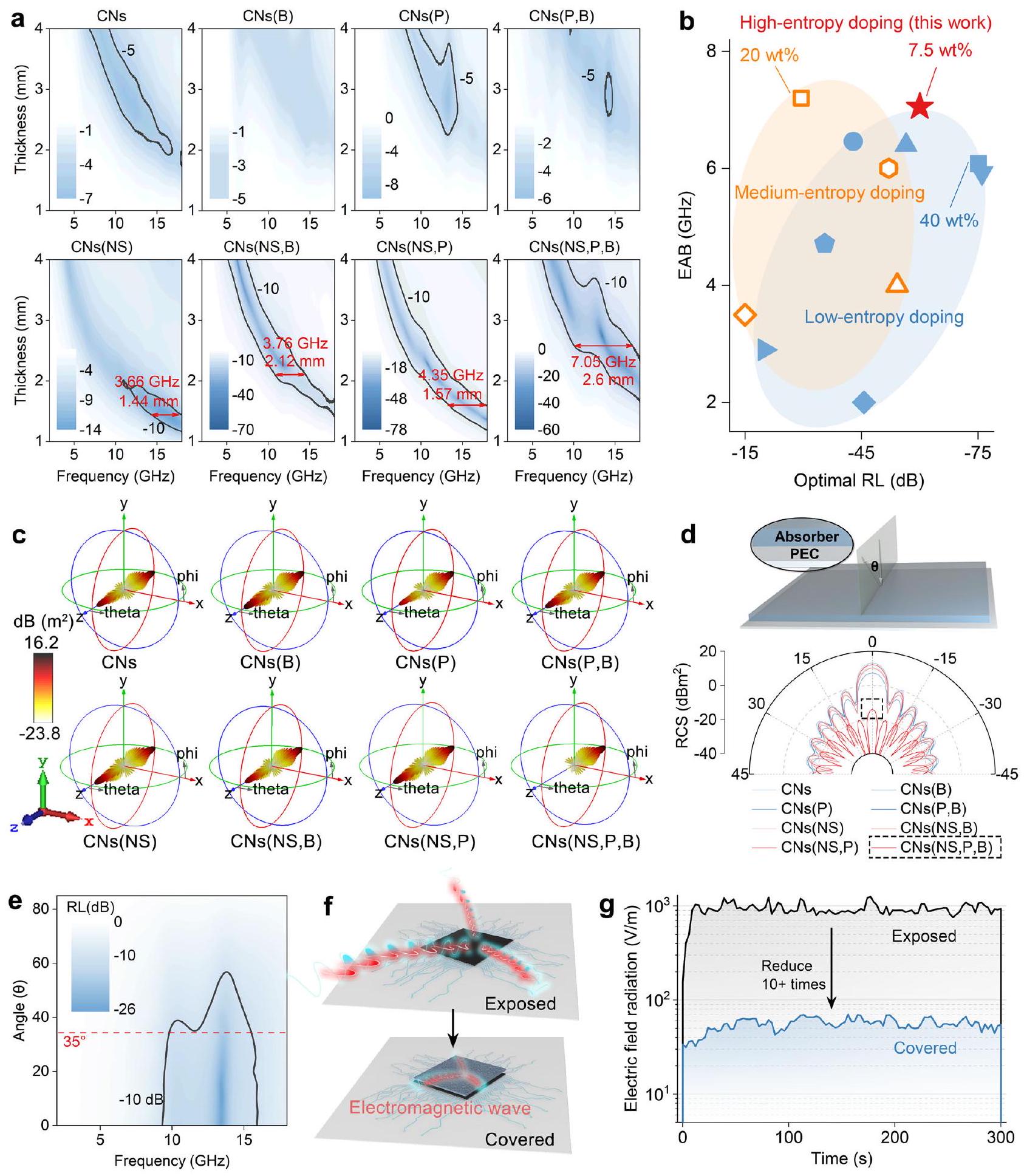
الشكل 5 | أداء EWA وتطبيقاته. أ مخطط أداء ثنائي الأبعاد للعينة. ب مخطط مقارنة الأداء لـمع مواد الكربون المعدلة ذات الانتروبيا المنخفضة والمتوسطة الأخرى. ج مخطط ثلاثي الأبعاد لمقطع عرضي لتشتت الرادار للعينة عند 13.42 جيجاهرتز. د رسم خطي لمقطع عرضي لتشتت الرادار للوحة الخلفية المعدنية نموذج و. هـ أداء EWA لـعند زوايا مختلفة من سقوط الموجات الكهرومغناطيسية. و مخططات تخطيطية لشرائح الأجهزة الإلكترونية قبل وبعد تطبيق مواد EWA. ز قيم إشعاع المجال الكهربائي قبل وبعد تطبيق مواد EWA. (الشكل 4هـ). بالإضافة إلى ذلك، يساعد هندسة HED في تعزيز نسبة فقدان الاستقطاب في فقدان العازل (الشكل 4و). بناءً على ما سبق، نقترح أن هندسة HED تحفز ‘تأثير كوكتيل اتجاهي’ يفضل الاستقطاب وخصائص EWA.
تظهر فوائد هندسة HED السلبية من خلال أداء EWA. في الشكل 5أ،، و تفشل في تحقيق كثافات فقدان الانعكاس أقل من -10 ديسيبل ضمن، ويرجع ذلك أساسًا إلى ضعف موصلية CNs. في المقابل، تحقق العينات المعدلة بالنيتروجين والكبريت امتصاصًا فعالًا. على وجه التحديد،تحقق EAB بمقدار 3.66 جيجاهرتز عندتحقق EAB بمقدار 3.76 جيجاهرتز عندتحقق 4.35 جيجاهرتز عند 1.57 مم، وتحقق EAB بمقدار 7.05 جيجاهرتز عند 2.6 مم.
بينما تتفوق CNs (NS,B) و CNs (NS,P) على CNs (NS)، فإن تعديل البورون أو الفوسفور بمفرده غير كافٍ لتحقيق توازن كامل ضد التعزيز المفرط للخصائص الكهربائية الناتج عن التعديل المشترك للنيتروجين/الكبريت. يحقق التعديل المشترك للنيتروجين/الكبريت/الفوسفور/البورون توازنًا مرضيًا، مما يقلل من عيوب فقدان الموصلية ويعزز مزايا الاستقطاب، وبالتالي يوسع نطاق الامتصاص. تؤكد التغيرات في الحد الأقصى لـ EAB تأثير التسوية لهندسة HED بين المواد المضافة O و N/S و P/B (الشكل S16، المعلومات التكميلية). للتحقق من موثوقية أداء EWA الممتاز، قمنا بإجراء قياسات معلمة S11 على حلقة محورية مزودة بلوحة خلفية معدنية إضافية بسماكة ثابتة (الشكل S17، المعلومات التكميلية). تظهر النتائج توافقًا عاليًا بين القيم المقاسة تجريبيًا وحسابات فقدان الانعكاس المستمدة من نظرية خط النقل. بالمقارنة مع غيرها من الممتصات الكربونية المعدلة ذات الانتروبيا المنخفضة والمتوسطة (الشكل 5ب والجدول S3، المعلومات التكميلية)، يظهر الممتص الكربوني المعدل عالي الانتروبيا في هذا العمل كل من الامتصاص العريض النطاق () والخسارة العالية ()، والتي تم تحقيقها بمعدل تعبئة منخفض للغاية ()، مما يضعه في طليعة البحث حول مواد EWA الكربونية المعدلة بالذرات غير المتجانسة. علاوة على ذلك، يتم تسليط الضوء على فعالية هندسة HED السلبية والأداء الاستثنائي لـ EWA من خلال المقارنات مع مواد EWA المبلغ عنها مؤخرًا من أنظمة أخرى، بما في ذلك المواد القائمة على MXene، والمواد الخزفية، والمواد القائمة على الكبريت، والمواد البوليمرية، والمواد المركبة من الكبريت، والمشتقات المعدنية العضوية/الإطار المعدني ثنائي الهيدروكسيد.
تم التحقق من فعالية هندسة HED السلبية باستخدام محاكاة مقطع عرضي للرادار (RCS). قمنا ببناء نموذج لسطح خلفي معدني مغطى بطبقة EWA وحساب امتصاص وتشتت الموجات الكهرومغناطيسية عند ترددات مختلفة تحت ظروف حقل بعيد غير محدود. كما هو موضح في الشكل 6أ، تم ملاحظة إشارات تشتت لـ CNs (NS) ومشتقاتها في نطاقات X و Ku (مع فاصل تردد 1 جيجاهرتز) (الأشكال S19-23، المعلومات التكميلية). يظهر نموذج الموصل الكهربائي المثالي النقي (PEC) تشتتًا قويًا عند كل نقطة تردد، بينما يظهر النموذج المغطى بـ EWA تفضيلًا تردديًا لمعدل RCS منخفض. تتماشى هذه الترددات ذات RCS المنخفض مع أنماط فقدان الانعكاس المحسوبة من نظرية خط النقل (الشكل S24، المعلومات التكميلية). من الجدير بالذكر أن CNs(NS,P,B) تظهر إشارات تشتت شبه غير قابلة للكشف عند 13.42 جيجاهرتز (الشكل 5ج)، مما يشير إلى امتصاص كامل وتبدد للموجات الكهرومغناطيسية. في الشكل 5د، تم تمثيل قيم RCS منإلىفي مخطط راداري. تمثل قيمة اللوب الرئيسي أقصى إشعاع في الاتجاه الرئيسي لعمل الرادار. من الواضح أن CNs(NS,P,B) تقضي بشكل أكثر فعالية على التداخل الكهرومغناطيسي في هذا الاتجاه. علاوة على ذلك، فإن تقليل RCS بواسطةهوأكبر من ذلك من العينات الأخرى، يعادل الفرق بين طائرة عادية وطائر. بالإضافة إلى ذلك، تظهر CNs (NS، P، B) جوانب جانبية أضيق وقيم RCS أقل على الجوانب الجانبية، مما يشير إلى أن هندسة HED تسهل تخفيض الطاقة الكهرومغناطيسية على مدى زاوي واسع، مما يوفر قدرات أقوى لمكافحة التداخل. لإثبات ذلك، قمنا بحساب أداء EWA لزوايا مختلفة من سقوط الموجات الكهرومغناطيسية. كما هو موضح في الشكل 5e، تظهر CNs (NS، P، B) امتصاصًا بزاوية واسعة، مع الحفاظ على EAB فوق 5.7 جيجاهرتز ضمن نطاق.
أخيرًا، تم إثبات قابلية تطبيق في المجال الإلكتروني المدني. قمنا بدمج مسحوق الكربون المخدر عالي الانتروبيا مع مطاط لإنشاء رقع مرنة وطبقناها لتغطية أسطح الرقائق في أجهزة الاتصال (الشكل 5f). تم إجراء قياسات الإشعاع على الرقائق العارية والرقائق المغطاة بمواد EWA. تظهر النتائج أن الرقاقة العارية تصدر إشعاعًا عاليًا من ، بينما يقلل موادنا الإشعاع بعدة أوامر من الحجم إلى فقط . يبرز هذا التجربة أهمية هندسة HED الأنيونية للمواد EWA الواعدة وتطبيقاتها المحتملة في المجالات المدنية.
باختصار، قمنا بتطوير هندسة HED الأنيونية وعززنا بنجاح الخصائص العازلة وأداء EWA لمواد الكربون. في البداية، تم تخليق CNs ثنائية الأبعاد المخدرة بالأكسجين عبر طريقة تشكيل الملح تليها التحلل الحراري في الموقع. بعد ذلك، استنادًا إلى المساحة السطحية الكبيرة، خضعت هذه CNs لعملية تخدير متسلسلة N/S، وتخدير P، وتخدير B عبر عملية حل حراري من ثلاث خطوات، مما أسفر عن مواد كربونية HE. في عملية التخدير المعقدة خطوة بخطوة، تظهر الذرات الغريبة ذات أوامر التخدير المختلفة تفاعلات متعددة الجسم، ويورث المنتج النهائي خصائصها الكهربائية. مقارنةً بهندسة التخدير ذات الانتروبيا المنخفضة والمتوسطة، تتمتع هندسة HED بمزايا ملحوظة في موازنة الشحنات غير المحلية وتعزيز الشحنات المحلية، مما يظهر كموصلية مخفضة واستقطاب ثنائي القطب معزز. كشفت التحقيقات التجريبية التآزرية وحسابات DFT مجتمعة عن ‘تأثير الكوكتيل الاتجاهي’، مما يسهل تعديل نوع وشدة فقدان العزل. في النهاية، تحقق عينة CNs (NS، P، B) أداء EWA عريض النطاق وفعال تحت ظروف خفيفة الوزن للغاية. علاوة على ذلك، يمكن استخدام هذه المادة لصنع رقع ماصة لتخفيف الإشعاع الشديد في الأجهزة الإلكترونية. نعتقد أن هندسة HED الأنيونية تعالج فجوة حاسمة في أبحاث التخدير وتوسع نموذج التصميم للمواد EWA المتقدمة، مما يسهل التقدم في مجال المواد الوظيفية الكهرومغناطيسية.
طرق
عام
تم تقديم التجربة الأداء الكهرومغناطيسي، تجربة الكشف عن الإشعاع الكهرومغناطيسي، DFT و RCS في الطرق التكميلية.
تحضير رقائق الكربون ثنائية الأبعاد (CNs)
تم توزيع خليط من 5 جرام من الجلوكوز و75 جرام من كلوريد الصوديوم بشكل متجانس في 30 مل من الماء المنزوع الأيونات من خلال التحريك اليدوي لمدة 10 دقائق. بعد ذلك، تم إخضاع هذا المحلول لعملية تجفيف تحت الفراغ داخل فرن maintained at لمدة 48 ساعة، مما أسفر عن عينة مجففة تمامًا. ثم تم طحن المادة المجففة بدقة إلى مسحوق ناعم للغاية. خضعت العينة المسحوقة للتسخين المنضبط بمعدل حتى الوصول إلى ، حيث تم تلدينها لمدة ساعتين في جو من الأرجون. بعد التبريد الطبيعي إلى درجة حرارة الغرفة، تم إخضاع المسحوق الأسود الناتج لعملية غسيل متناوبة مع الماء المنزوع الأيونات والإيثانول، كل منهما لثلاث دورات، لإزالة قوالب الملح الزائدة. أخيرًا، تم تجفيف المسحوق طوال الليل في فرن عند ، مما أسفر عن المنتج النهائي المسمى CNS.
تحضير CNs المخدرة بـ B، المسمى CNs(B)
تم إعادة توزيع CNs في 80 مل من المحلول المائي الذي يحتوي أيضًا على 0.02 مول من حمض البوريك وتمت عملية الصوتنة لمدة 10 دقائق لضمان التوزيع. تم وضع المحلول المختلط في مفاعل سعة 100 مل ثم تم تسخينه إلى بمعدل . بعد الاحتفاظ به عند لمدة 10 ساعات، تم تبريد المحلول بشكل طبيعي إلى درجة حرارة الغرفة. تم تصفية المحلول تحت الفراغ للحصول على مسحوق، والذي تم غسله ثلاث مرات بالتناوب مع الماء والإيثانول. آخر مرة مع الإيثانول ثم تم تجفيفه في فرن عند لمدة 10 دقائق.
تحضير CNs المخدرة بـ P، المسمى CNs(P)
تم إعادة توزيع CNs في 80 مل من حمض الفوسفوريك وتمت عملية الصوتنة لمدة 10 دقائق لضمان التوزيع. كانت الخطوات الأخرى هي نفسها كما في تحضير CNs (B).
تحضير CNs المخدرة بـ P/B، المسمى CNs(P,B)
تم إعادة توزيع CNs (P) في 80 مل من المحلول المائي الذي يحتوي على 0.02 مول من حمض البوريك وتمت عملية الصوتنة لمدة 10 دقائق لضمان التوزيع. كانت إجراءات تسخين المذيب والعمليات اللاحقة هي نفسها كما في تحضير .
تحضير CNs المخدرة بـ N/S، المسمى CNs(NS)
كان المذيب في 80 مل من المحلول المائي الذي يحتوي على 0.02 مول من ثيوأسيتاميد، بالإشارة إلى التجارب السابقة للإجراء.
تحضير CNs المخدرة بـ N/S/P/B، المسمى CNs(NS,P,B)
تم إعادة توزيع CNs (NS) في 80 مل من حمض الفوسفوريك وتمت عملية الصوتنة لمدة 10 دقائق لضمان التوزيع. تم وضع المحلول المختلط في مفاعل سعة 100 مل وتم تسخينه عند لكل دقيقة إلى . بعد 10 ساعات عند ، تم تبريد المحلول بشكل طبيعي إلى درجة حرارة الغرفة. تم تصفية المحلول تحت الفراغ للحصول على مسحوق تم غسله ثلاث مرات بالتناوب مع الماء والإيثانول. آخر مرة تم غسله مع الإيثانول ثم تم تجفيفه في لمدة 10 دقائق للحصول على تم إعادة توزيعه مرة أخرى في 80 مل من المحلول المائي الذي يحتوي على 0.02 مول من حمض البوريك. تم تكرار عمليات تسخين المذيب والغسيل والتجفيف للحصول على .
التوصيف
تم التحقيق في الهياكل السطحية من خلال مسح السطح باستخدام مجهر إلكتروني مسعور (FE-SEM)، وبالتحديد نموذج Zeiss Supra 55 VP، الذي قدم رؤى مورفولوجية مفصلة. تم إجراء استكشاف عالي الدقة للهياكل المحلية، بما في ذلك أنماط حيود الإلكترون في المنطقة المختارة (SAED) وتوزيعات العناصر، باستخدام مجهر إلكتروني ناقل (TEM) مصحح للانحراف الكروي المزدوج من Thermo Fisher Scientific Titan Themis G3 300 kV. تم تحليل ملفات الامتصاص-الامتزاز لـ N2 باستخدام محلل كيميائي Micromeritics ASAP 2020، مما يوفر معلومات حاسمة حول التفاعلات السطحية. تم توضيح تركيبات الطور والترتيبات البلورية من خلال تحليل حيود الأشعة السينية (XRD) على جهاز Bruker D8 ADVANCE، الذي يعمل عند ، مدعومًا بتحليل رامان على إعداد Horiba LabRAM HR Evolution، الذي تم تحفيزه عند . تم إجراء تحديد مجموعات الوظائف باستخدام مطياف الأشعة تحت الحمراء بتحويل فورييه (FT-IR) على منصة Thermo Fisher Scientific Nicolet iS50، بينما تم تحديد حالات التكافؤ للعناصر السطحية عبر مطياف الأشعة السينية (XPS) على نظام Ulvac-Phi PHI 5000 VersaProbe III، باستخدام إشعاع عند 1486.6 eV. تم إجراء قياسات طيف الامتزاز الكهربائي (EIS) على العينات باستخدام محطة العمل الكهربائية CH Instruments CHI660E، مع استخدام لوحة Pt كقطب مضاد، و كقطب مرجعي، و كمحلول إلكتروليتي.
توفر البيانات
جميع البيانات اللازمة لتقييم الاستنتاجات في الورقة موجودة في الورقة و/أو المعلومات التكميلية. يمكن طلب بيانات إضافية تتعلق بهذه الورقة من المؤلفين. يتم توفير بيانات المصدر مع هذه الورقة.
References
Liu, L. et al. Specific electromagnetic radiation in the wireless signal range increases wakefulness in mice. PNAS 118, e2105838118 (2021).
Lv, H. et al. Functional nanoporous graphene superlattice. Nat. Commun. 15, 1295 (2024).
Cai, B. et al. Interface-induced dual-pinning mechanism enhances low-frequency electromagnetic wave loss. Nat. Commun. 15, 3299 (2024).
Tao, J. et al. Multi-field coupled motion induces electromagnetic wave absorbing property regeneration of elastomer in marine environment. Adv. Funct. Mater. 34, 2310640 (2024).
Xu, L. et al. Effect of Fe doping profile on current collapse in GaNbased RF HEMTs. Chem. A Eur. J. 30, e202304100 (2024).
Huang, X. et al. Ultralight magnetic and dielectric aerogels achieved by metal-organic framework initiated gelation of
graphene oxide for enhanced microwave absorption. Nano-Micro Lett. 14, 107 (2022).
Wang, J. & Han, W. A review of heteroatom doped materials for advanced lithium-sulfur batteries. Adv. Funct. Mater. 32, 2107166 (2022).
Tao, J. et al. Catfish effect induced by anion sequential doping for microwave absorption. Adv. Funct. Mater. 33, 2211996 (2023).
Hu, H. et al. High-entropy engineering reinforced surface electronic states and structural defects of hierarchical metal oxides@graphene fibers toward high-performance wearable supercapacitors. Adv. Mater. 36, e2406483 (2024).
Chen, X. et al. Discriminating active B-N sites in coralloidal B, N dualdoped carbon nano-bundles for boosted Zn-Ion storage capability. Adv. Funct. Mater. 33, 2212915 (2023).
Lun, Z. et al. Cation-disordered rocksalt-type high-entropy cathodes for Li-ion batteries. Nat. Mater. 20, 214-221 (2021).
Huang, S. et al. High-entropy transition metal phosphorus trichalcogenides for rapid sodium ion diffusion. Adv. Mater. 36, 2405170 (2024).
Wang, Y. et al. Self-encapsulation of high-entropy alloy nanoparticles inside carbonized wood for highly durable electrocatalysis. Adv. Mater. 36, 2402391 (2024).
Zhang, M. et al. Ultrahigh energy storage in high-entropy ceramic capacitors with polymorphic relaxor phase. (2024).
Qiu, Z. et al. Synergistic enhancement of electromagnetic wave absorption and corrosion resistance properties of high entropy alloy through lattice distortion engineering. Adv. Funct. Mater. 34, 2400220(2024).
Hui, S., Zhou, X., Zhang, L. & Wu, H. Constructing multiphaseinduced interfacial polarization to surpass defect-induced polarization in multielement sulfide absorbers. Adv. Sci. 11, 2307649 (2024).
Zhao, B. et al. High-entropy enhanced microwave attenuation in titanate perovskites. Adv. Mater. 35, 2210243 (2023).
Zhao, B. et al. Structural defects in phase-regulated high-entropy oxides toward superior microwave absorption properties. Adv. Funct. Mater. 33, 2209924 (2022).
Zhang, R. et al. Compositionally complex doping for zero-strain zero-cobalt layered cathodes. Nature 610, 67-73 (2022).
Zeng, Y. et al. High-entropy mechanism to boost ionic conductivity. Science 378, 1320-1324 (2022).
Huang, H. et al. Crystal-phase-engineered high-entropy alloy aerogels for enhanced ethylamine electrosynthesis from acetonitrile. Adv. Mater. 36, 2314142 (2024).
Ying, T. et al. High-entropy van der waals materials formed from mixed metal dichalcogenides, halides, and phosphorus trisulfides. J. Am. Chem. Soc. 143, 7042-7049 (2021).
Ying, T., Yu, T., Qi, Y., Chen, X. & Hosono, H. High entropy van der waals materials. Adv. Sci. 9, 2203219 (2022).
Liu, J., Zhang, L. & Wu, H. Anion-doping-induced vacancy engineering of cobalt sulfoselenide for boosting electromagnetic wave absorption. Adv. Funct. Mater. 32, 2200544 (2022).
Wu, D. et al. Multi-scale structure optimization of boron-doped hard carbon nanospheres boosting the plateau capacity for high performance sodium ion batteries. J. Mater. Chem. A 10, 17225-17236 (2022).
Wu, J. et al. N, P-doped carbon nanorings for high-performance capacitive deionization. Chem. Eng. J. 473, 145421 (2023).
Qu, K. et al. Polydopamine-inspired, dual heteroatom-doped carbon nanotubes for highly efficient overall water splitting. Adv. Energy Mater. 7, 1602068 (2017).
Fang, G. et al. The elaborate design of multi-polarization effect by non-edge defect strategy for ultra-broad microwave absorption. Adv. Funct. Mater. 34, 2404532 (2024).
Liang, H. et al. Exploring the Ni 3d orbital unpaired electrons induced polarization loss based on Ni single-atoms model absorber. Adv. Funct. Mater. 33, 2212604 (2023).
Tan, R. et al. Multi-Scale Dispersion Engineering on BiomassDerived Materials for Ultra-Wideband and Wide-Angle Microwave Absorption. Small Methods 8, 2301772 (2024).
Patel, M. A. et al. P-doped porous carbon as metal free catalysts for selective aerobic oxidation with an unexpected mechanism. ACS Nano 10, 2305-2315 (2016).
Ma, H. et al. Tuning optical properties of carbon dots by Co-doping strategy for versatile applications. ChemistrySelect 9, e202303652 (2024).
Li, Y. et al. Insights into the storage mechanism of phosphorusfunctionalized hard carbon as ultrahigh capacity anodes. Adv. Energy Mater. 8, 1702781 (2018).
Huang, W. et al. Dual-step redox engineering of 2D CoNi-alloy embedded B, N-doped carbon layers toward tunable electromagnetic wave absorption and light-weight infrared stealth heat insulation devices. Adv. Mater. 36, 2403322 (2024).
Qian, Y. et al. In situ revealing the electroactivity of P-O and P-C bonds in hard carbon for high-capacity and long-life Li/K-ion batteries. Adv. Energy Mater. 34, 1901676 (2019).
Tao, J. et al. Multi-shell hollow porous carbon nanoparticles with excellent microwave absorption properties. Carbon 172, 542-555 (2021).
Tao, J. et al. Selective coding dielectric genes based on proton tailoring to improve microwave absorption of MOFs. Adv. Powder Mater. 2, 100091 (2023).
الشكر والتقدير
هذا العمل مدعوم من البرنامج الوطني الرئيسي للبحث والتطوير في الصين (2021YFB3502500 لج. ز.); مؤسسة العلوم الطبيعية الوطنية في الصين (52172091 لز. ي، 52172295 لج. ز، و62104110 لج. و.); برنامج تطوير التكنولوجيا الصناعية الدفاعية (JCKY2O23605COO2 لج. ز.); برنامج البحث الأساسي في جيانغسو (BK20232013 لج. ز.); صندوق مفتوح لمختبر المواد التحضيرية والحماية للبيئات القاسية (جامعة نانجينغ للطيران والفضاء)، وزارة الصناعة وتكنولوجيا المعلومات (56XCA24025 لز. ي); برنامج البحث والابتكار للممارسات العليا في مقاطعة جيانغسو (KYCX23_0371 لج. ت). نشكر مركز المجهر والتحليل في جامعة نانجينغ للطيران والفضاء على إجراء توصيف TEM. نشكر دعم مختبر سوتشو.
مساهمات المؤلفين
ج. ت. صمم وأعد التجارب. ج. ت.، ج. ز.، هـ. هـ.، وز. ي. أشرفوا على المشروع. ج. ت.، ي. ي.، هـ. ز.، و. ز. و ب. ج. قاموا بإجراء التجارب وجمع البيانات. ج. ت.، ر. ت.، ل. إكس.، ب. ج.، إكس. ت.، وي. ي. قاموا بتحليل البيانات ومناقشة الآليات. ج. ت. كتب المسودة. ج. و. أجرى محاكاة نظرية الكثافة الأساسية. ساهم جميع المؤلفين في تفسير البيانات، والمناقشات، وإعداد المسودة.
يجب توجيه المراسلات وطلبات المواد إلى جينتانغ زو، جين وانغ، بينغ تشين، هيكشيا هوانغ، شيوي وي تاو أو زينغجون ياو.
معلومات مراجعة الأقران تشكر مجلة Nature Communications بارتوش جانازيك والمراجعين الآخرين المجهولين على مساهمتهم في مراجعة الأقران لهذا العمل. يتوفر ملف مراجعة الأقران.
ملاحظة الناشر تظل Springer Nature محايدة فيما يتعلق بالمطالبات القضائية في الخرائط المنشورة والانتماءات المؤسسية.
الوصول المفتوح هذه المقالة مرخصة بموجب رخصة المشاع الإبداعي للاستخدام غير التجاري، والتي تسمح بأي استخدام غير تجاري، ومشاركة، وتوزيع، وإعادة إنتاج في أي وسيلة أو صيغة، طالما أنك تعطي الائتمان المناسب للمؤلفين الأصليين والمصدر، وتوفر رابطًا لرخصة المشاع الإبداعي، وتوضح إذا كنت قد قمت بتعديل المادة المرخصة. ليس لديك إذن بموجب هذه الرخصة لمشاركة المواد المعدلة المشتقة من هذه المقالة أو أجزاء منها. الصور أو المواد الأخرى من طرف ثالث في هذه المقالة مشمولة في رخصة المشاع الإبداعي للمقالة، ما لم يُذكر خلاف ذلك في سطر الائتمان للمادة. إذا لم تكن المادة مشمولة في رخصة المشاع الإبداعي للمقالة واستخدامك المقصود غير مسموح به بموجب اللوائح القانونية أو يتجاوز الاستخدام المسموح به، ستحتاج إلى الحصول على إذن مباشرة من صاحب حقوق الطبع والنشر. لعرض نسخة من هذه الرخصة، قم بزيارة http://creativecommons.org/licenses/by-nc-nd/4.0/. (ج) المؤلفون 2025
¹كلية علوم المواد والتكنولوجيا، المختبر الرئيسي لتحضير المواد وحمايتها للبيئات القاسية، جامعة نانجينغ للطيران والفضاء، نانجينغ 211100، الصين.كلية الهندسة الإلكترونية والبصرية وكلية الإلكترونيات المرنة (التكنولوجيا المستقبلية)، جامعة نانجينغ للاتصالات، نانجينغ 210023، الصين.مدرسة العلوم والهندسة الإلكترونية، جامعة نانجينغ، نانجينغ 210093، الصين.كلية الطاقة وهندسة الطاقة، جامعة نانجينغ للطيران والفضاء، نانجينغ 210016، الصين.مدرسة علوم وهندسة المواد، معهد نانجينغ للتكنولوجيا، نانجينغ 211167، الصين. البريد الإلكتروني:imzjt@126.com; jin@njupt.edu.cn; chenping@nju.edu.cn; huanghexia@nuaa.edu.cn; tao_xuewei@126.com; yaozj1921@126.com
Anionic high-entropy doping engineering for electromagnetic wave absorption
Received: 24 September 2024
Accepted: March 2025
Published online: 02 April 2025
Jiaqi Tao , Yi Yan , Jintang Zhou , Jin Wang ® , Ping Chen , Ruiyang , Linling , Hongbao Zhu , Wenhui Zhu , Hexia Huang , Xuewei Tao & Zhengjun Yao
High-entropy doping (HED) engineering surpasses conventional methods for optimizing atomic configurations and electronic structures, opening new paths for developing advanced electromagnetic wave absorbing (EWA) materials. However, the application of anionic HED engineering to tailor EWA mechanisms remains unexplored. Herein, we employ in situ pyrolysis combined with a three-stage solvent thermal doping procedure to systematically induce anion multibody interactions, thereby facilitating the inheritance and accumulation of beneficial EWA properties. The research shows that anions with various electronegativities precisely balance free charges and create a significant localized charge imbalance, triggering the ‘directional cocktail effect’. This effect induces an optimal dielectric loss mechanism and enhances the EWA performance. With only filling, the effective absorption bandwidth and minimum reflection loss are 7.05 GHz and -60 dB , respectively. Overall, we report an anionic HED engineering within thin a graphite framework, which may be conceptually extendable for electromagnetic modulation of other two-dimensional van der Waals EWA materials.
Electromagnetic wave absorbing (EWA) materials are undergoing unprecedented technological innovations to address the billion-fold surge in electromagnetic radiation . Impressively, the heteroatom doping strategy offers microscopic modification capabilities down to the atomic scale, fundamentally reshaping the atomic configuration and EWA properties of materials . Theoretically, countless mapping relationships from microstructures to macrofunctions can be derived by designing the doping sequence and cleverly combining different heteroatoms. However, revealing the interatomic interactions and inheritance rules during complex doping processes, as well as how these factors collectively determine the EWA mechanism and manipulate electromagnetic properties, poses a formidable challenge.
Inspired by the traditional concept of high entropy (HE), doping engineering with five or more types of heteroelements (not limited to near-equimolar ratios) is defined as high-entropy doping (HED). Technically, HED directly belongs to the emerging branch of doping engineering, while conceptually, it has HE advantages . Prior HE studies have outlined preferred modification pathways (e.g., enhancing the defect density, and creating heterogeneous interfaces) and core effects (e.g., lattice distortion, and cocktail effects) that are highly relevant for guiding EWA material design . Upon examination of seminal EWA works from prestigious teams on HE systems spanning metals, oxides, ceramics, and sulfides, a unifying principle emerges: minimizing short-range ordering and maximizing the energy density within the system . Although HED engineering has yet to be
reported in the EWA field, it has already demonstrated comparable or even superior value to conventional HE strategies in energy applications, including conformational entropy maximization, electronic structure optimization, and robustness enhancement . Therefore, HED engineering can provide new degrees of freedom for electromagnetic property regulation and expand the development horizons of EWA materials .
To date, the lack of two categories of pivotal investigations has hindered progress in HED research and the EWA field. The first category is HED research focusing on two-dimensional van der Waals (2DvdW) systems . Compared with 3D materials, the weak interlayer interactions of 2D-vdW materials provide them with a larger atomic modulation space in the vertical direction . Moreover, the fewer interfacial defects and large specific surface area synergistically suppress phase separation, ensuring phase homogeneity and doping uniformity. This research is crucial for elucidating the origins of the EWA mechanism, as it eliminates interfacial interference and facilitates clearer cross-scale correlations between atomic configurations and electromagnetic functionalities. The other missing category is anionic HED studies. Anions have a greater difference in electronegativity than cations, which means that strongly polar dipole pairs can be more easily introduced and that the conductivity can be more easily regulated . Interestingly, codoped systems exhibit more significant spin density redistribution and stronger carrier migration ability than single-doped systems, which is beneficial for energy storage and conversion . Researchers have begun to consciously regulate the doping sequence of up to three elements, and preliminary success has been achieved . Given this, there is potential to further selectively manipulate localized/delocalized electronic states through anionic HED engineering, thus transitioning the cocktail effect in HE materials from unpredictable to programmable.
In this work, we conduct an anionic HED study on a thin graphite framework and demonstrate its effectiveness in the EWA field. Five anions ( ) are sequentially doped into a unified twodimensional thin graphite framework through a synergistic strategy of in-situ pyrolysis and solvothermal treatment. Throughout the HED process, the pivotal anion multibody interactions and underlying inheritance principles encompass the following: 1) N/S codoping greatly increases the electron concentration. 2) A sixfold B-doping efficiency is achieved because of the preexisting N , which results in electronic traps. 3) Both the P and B doping processes introduce many O -containing groups, resulting in electron localization. 4) The heteroatom content increases across successive doping processes, maximizing the configuration entropy and polarity. Notably, perfectly balanced delocalized charges and wide-area imbalanced local charges lead to a ‘directional cocktail effect’ that ensures the dominance of dipole polarization in the dielectric loss. In addition, we apply the product to electronic chips and reduce electromagnetic radiation by more than . In conclusion, this work fills the gap in HED and HE research and provides ideas for designing high-performance EWA materials.
Results and discussion
Motivation and approach for anion doping engineering
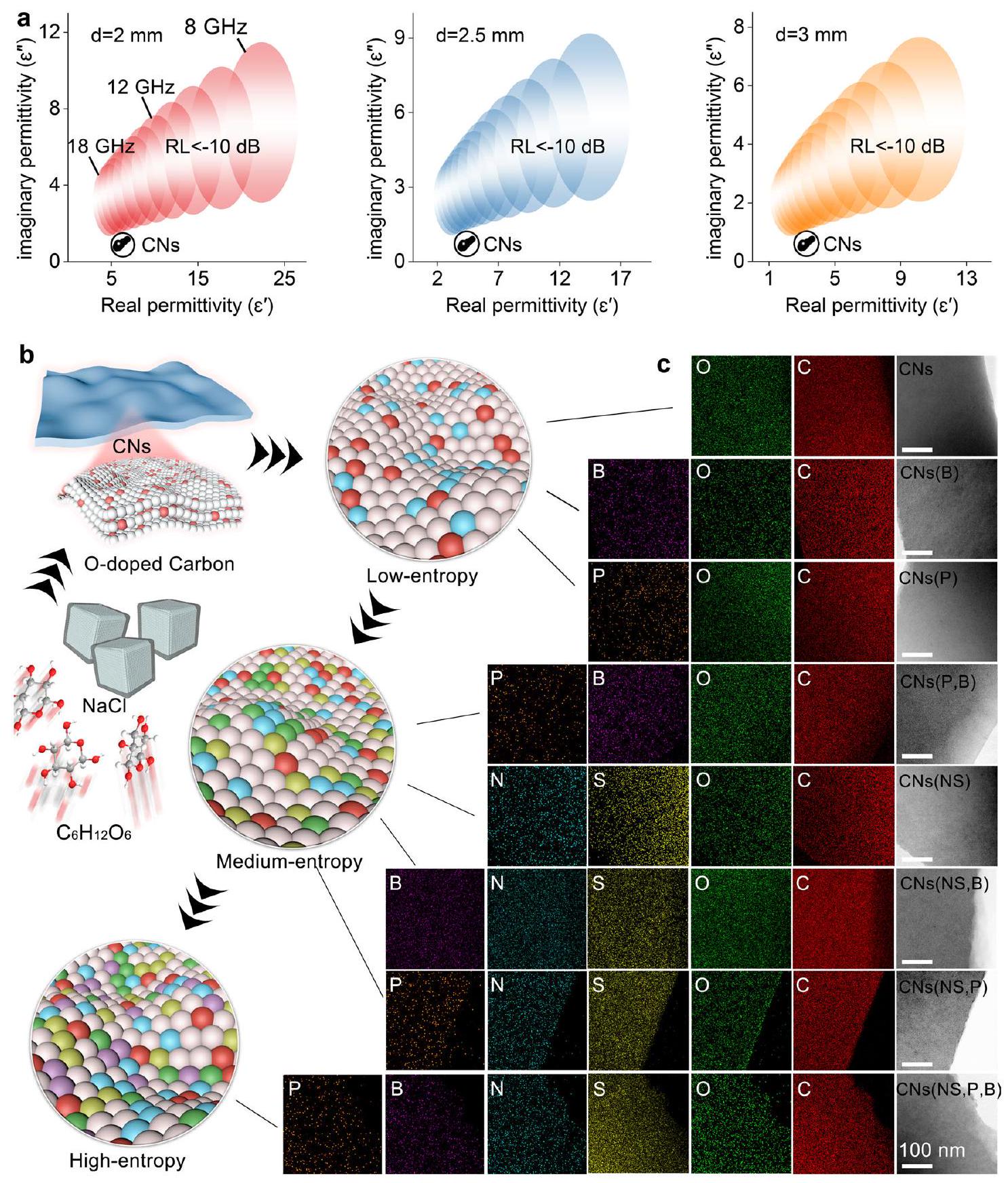
In the design of broadband EWA materials, adherence to the principles of complex variable function theory is essential. For dielectric materials, the complex permittivity, which includes the storage (real part, ) and loss (imaginary part, ) components of electrical energy, is a primary consideration . By utilizing the Kramers-Kronig relations , we derived a formulation that ensures causality and regularity, thereby establishing an integral relationship among various physical parameters, including the material thickness , and 3 mm, frequency range ( ), and absorption intensity ( ). The computational results indicate that the required complex permittivity variation trend is impractical, as such strong dielectric dispersion cannot occur
at low frequencies. (Figure S1, Supporting Information). Although the dielectric requirements for the X-Ku band are less stringent, the initial 2D-vdW system, i.e., carbon nanosheets (CNs), falls short of fulfilling fundamental criteria (Fig. 1a). Consequently, the atomic configuration must be optimized to improve the mixing entropy and surface electronic states until the desired dielectric properties are achieved.
Anions were doped into the material matrix through formatting steps (Fig. 1b). Initially, glucose molecules were adsorbed onto salt templates and subsequently graphitized in situ. The transformation of carbon materials from micrometer particles to nanosheets leads to a two hundredfold increase in the specific surface area, thus providing a broader doping platform (Figs. S2-3, Supporting Information). The pyrolysis parameters were determined via in situ TGA/DSC-MS-IR tests. To obtain a stable carbon network, we fixed the graphitization temperature near the strongest heat-absorbing site, which helped exclude the influence of the ambient temperature on the parent lattice during the subsequent doping process (Figure S4, Supporting Information). Then, the solvothermal method was employed to introduce other heteroelements into the O-doped carbon lattice. Among the selected dopants, boric acid (P-doped), phosphoric acid (B-doped), and thiourea (N, S-doped) are commonly used. Notably, the reaction between boric acid and phosphoric acid yields substantial precipitates of boric phosphates, so B-doping and P-doping need to be separately implemented. All samples except for CNs are labeled or , where A represents the element (not limited to one element) of the previous solvothermal doping and B represents the element of the latter doping. Elemental mapping and X-ray diffraction (XRD) analyzes confirm the uniform distribution of all the elements within the carbon matrix, which is devoid of segregation and solid impurities (Fig. 1c and Figure S5, Supporting Information). This uniformity allows us to focus on the atomic configuration without interference from the morphology, interfaces, or other extrinsic factors. To provide a detailed discussion of doping engineering, the eight sample groups are categorized into low-entropy systems ( ), medium-entropy systems ( ), and HE systems ( ) according to the number of heteroelements.
Inspiration and guidance from low- and mediumentropy doping
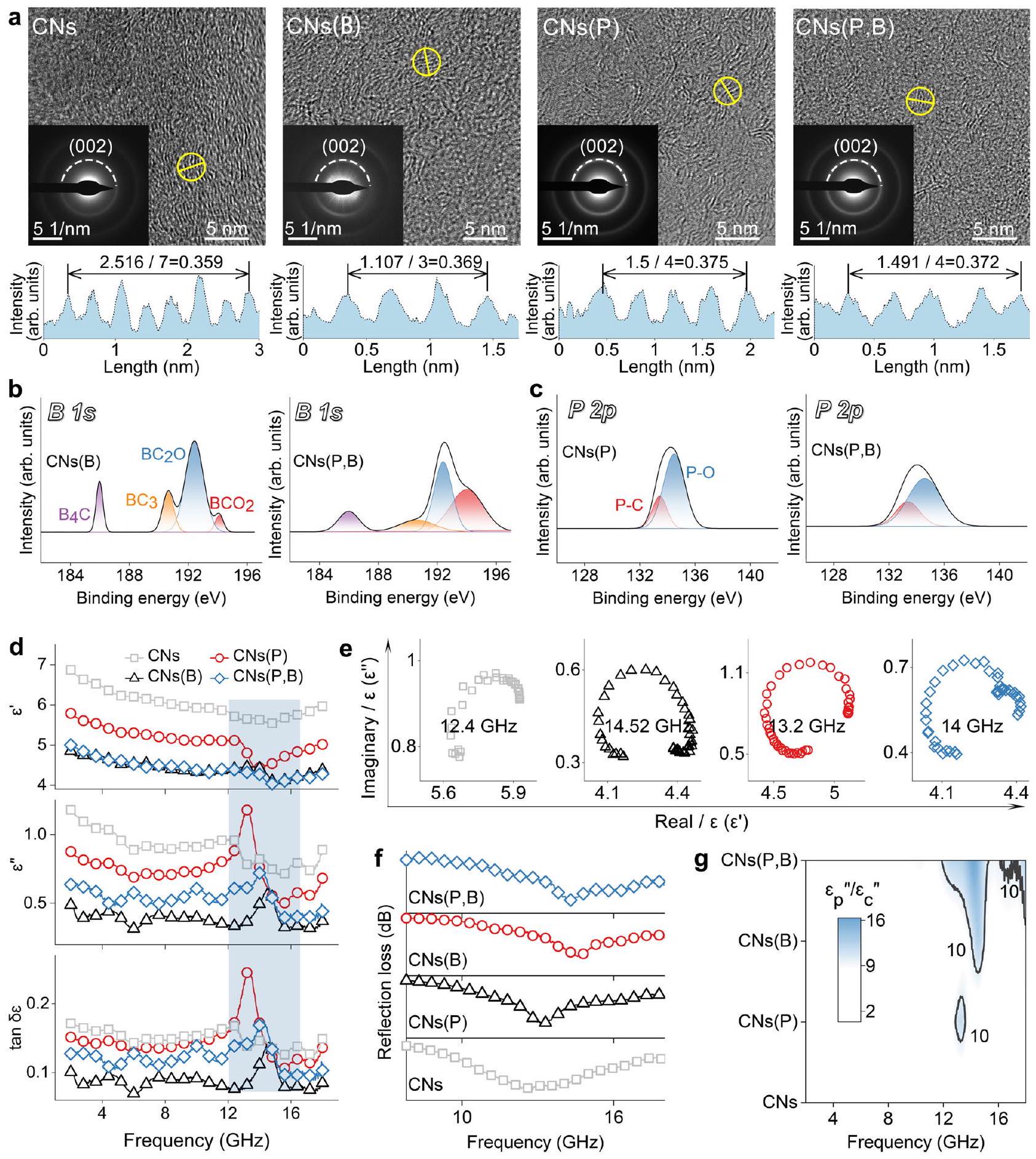
Beginning with low- and medium-entropy doping, we meticulously examined the direct effects implications of individual dopant elements and their simple combinations on the atomic structure. First, we affirmed that and can be individually or jointly incorporated into carbon. On the one hand, a new peak at in the infrared spectrum, which is attributed to P-C/B-C bonds, is discernible from the peak at (Figure S6, Supporting Information) . On the other hand, although the crystallinity of the samples is relatively weak, subtle differences in the lattice spacings are evident in the selected area electron diffraction and high-resolution transmission electron microscopy (TEM) images (Fig. 2a). For example, P doping results in larger lattice spacings compared than B doping, with CNs(P,B) occupying an intermediate position between and . This phenomenon stems from atomic size effects, in which the larger radii of and relative to those of and O in the matrix lead to various degrees of carbon lattice expansion upon doping. Notably, the pronounced size disparity of P atoms leads to distortion of the hexagonal graphite framework plane, necessitating system-wide strain energy adjustments to counteract local structural perturbations. In other words, P atoms may be prone to detachment from the carbon framework. Elemental content measurements (Tables S1-S2, Supporting Information) corroborate this notion, with initial P doping diminishing upon subsequent B-doping, whereas codoping minimally affects the B content. Moreover, the entire doping process influences the O content, notably enhancing it upon codoping, which is attributable to intensified carbon surface
Fig. 1 | Motivation and implementation routes for high-entropy doping engineering. a Dynamic prediction of the complex dielectric constant of EWA realized at different thicknesses. The shades of red, blue and orange are the dielectric constant regions where effective reflection loss ( ) can be achieved at and 3 mm thickness respectively. Frequency coverage is . b Preparation of two-dimensional carbon nanosheets and subsequent multistage
doping process. White atoms are carbon atoms and other colors indicate different heteroatoms such as and B . The richer the color indicates the more the variety of heteroatoms and the greater the entropy of the system. c Elemental mapping and low-resolution TEM results for a series of samples that have undergone low-, medium-, and high-entropy doping.
oxidation arising from oxygen-containing species generated by various acidic dopants.
To further reveal the doping details, X-ray photoelectron spectroscopy (XPS) characterization was conducted. Typically, the B 1s spectrum can be deconvoluted into , , and peaks, whereas the P 2 p spectrum can be deconvoluted into P-C ( 133.4 eV ) and P-O ( 134.6 eV ) peaks . Fig. 2b, c demonstrate that B-containing species undergo more pronounced alterations than those containing P , which is marked by a substantial increase in the amount of (from to ) and a
corresponding decrease in the amount of (from to ). These observations underscore the advantages of medium-entropy doping over low-entropy doping in fostering functional group diversity and increasing heteroatom concentrations, as reflected in the schematic roadmap of atomic configuration changes (Figure S7, Supporting Information).
Additionally, we investigated the impact of low- and mediumentropy doping with , and B on the dielectric properties. In conventional atomic substitution models, B acts as an acceptor impurity, decreasing the electron concentration, whereas O and P
Fig. 2 | Effect of low- and medium-entropy doping. a High-resolution TEM and SAED results for , and , b, c B1s spectra and P 2p spectra obtained from XPS tests. d Complex permittivity and dielectric loss
tangent, (e) Cole-Cole curves corresponding to , (f) reflection loss curves at 2.5 mm thickness, and (g) polarization loss/conductivity loss ratios of CNs, , and .
function as donor impurities, potentially increasing the electron concentration . However, constrained by the dopant species and methods, a substantial portion of O atoms and select B and P atoms integrate into edge polar groups via covalent bonds, thereby augmenting localized electrons and diminishing delocalized electrons . As depicted in Fig. 2d, both the complex permittivity and dielectric tangent decrease with B- and P-doping, which is attributed to the suppressed conductivity. Intriguingly, the dielectric parameters
of do not fall below those of but reside between those of and . We hypothesize that the diverse bonding types and increased heteroelement content give rise to broader charge distribution inhomogeneities, fostering stronger polarization that compensates for the dielectric parameters. Pivotal evidence lies in the marked correlation between the relaxation characteristics and dopant elements, which manifests as distinct resonance peak shifts in the dielectric parameters within . Relaxation sites are
identified in Cole-Cole plots (Fig. 2e), revealing that the polarization positions vary with the dopants, with medium-entropy doping yielding a compromise between multiple low-entropy dopings. This intrinsic dipole polarization, stemming from heteroatom substitution and polar functional groups, largely dictates the frequency response trends for EWA materials (Fig. 2f). To firmly establish the compensatory impact of polarization on the dielectric parameters, we performed dielectric fitting of the values by employing the modified Debye relaxation model, quantifying into the conductivity loss ( ) and polarization loss ( ) components (Fig. 2g and Figure S8, Supplementary Information). The fitting data indicate that the ” of is the lowest among the four groups of samples and is close to that of . Obviously, the contribution of ” to the dielectric loss is not dominant. Rather, the ” curve shows a consistent pattern with the curve, and ” plays a pivotal role in determining the capacity to absorb and dissipate electric field energy. exhibit a greater ” contribution to the dielectric loss than low-entropy doped samples within , especially since ” exceeds 10 , encompassing the typical relaxation range in Cole-Cole plots, corroborating our reasoning.
Under stringent conditions of a low filler loading ( ) and thin thicknesses ( ), fail to achieve the target impedance range, hindering the existence of an effective absorption bandwidth (EAB) (Figure S9, Supplementary Information). Fortunately, medium-entropy doping with P and B provides two key insights for HED strategies: 1) The polarization timescales in medium-entropy doping are jointly influenced by distinct heteroelements, suggesting that the polarization and EWA frequency bands can be tailored by adjusting the heteroelement types. 2) Compared with low-entropy doping, medium-entropy doping introduces abundant doping sites and polar species, leading to extensive charge imbalance and increased dipole polarization loss contributions.
Impact of HED engineering on material electromagnetism
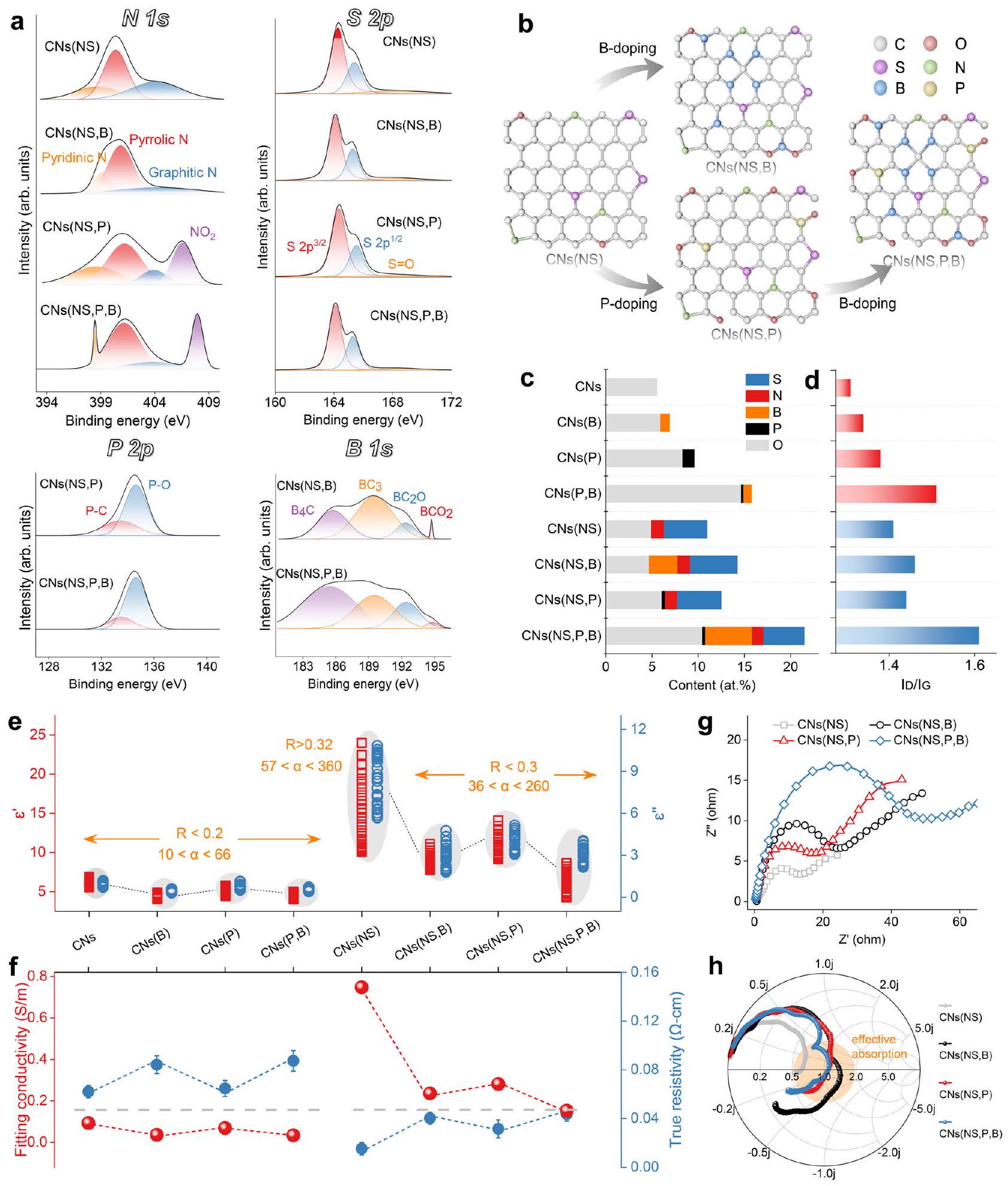
Through anionic HED engineering, a microstructure characterized by high disorder yet coexistence of ordered atoms can be achieved. The CNs underwent an initial N/S codoping process, followed sequentially by P and B doping. As depicted in Figure S10, Supplementary Information, the resulting and their derivatives retain a weakly crystalline nature. Moreover, the lattice stripes still follow the atomic size effect, which is indicative of successful doping with these heteroelements. The intricate anion multibody interactions and inherited configurational features, revealed by XPS (Fig. 3a-b), are summarized as follows:
The preexisting in the carbon matrix minimally interacts with B or P doping, as evidenced by the limited changes in the S atomic content and S 2p spectra.
The preexisting in the carbon matrix more strongly interacts with B or P doping, albeit at different levels. For N and B , the N -containing carbon matrix facilitates enhanced B doping. Specifically, the B atomic contents in CNs(NS,B) and CNs(NS,P,B) reach and , respectively, which are significantly higher than those in and . With respect to N and doping introduces new species into the carbon matrix and reduces graphitic N. Thus, in CNs(NS,P,B), these dual interactions coexist, contributing to increased polarity while reducing the conductivity.
codoping still heavily introduces O , similar to in the previous medium-entropy doping systems. In contrast, N/S codoping has a minimal effect on O .
In short, within the anionic HED system driven by both in-situ Odoping and ex-situ N/S/P/B codoping, the total heteroelement content and the variety and distribution range of polar units are markedly augmented. Furthermore, structural insights into the carbon lattice were obtained via Raman spectroscopy (Figure S11, Supplementary Information), and the ratio of the D-band (dominated by heteroatoms)
to the G-band (dominated by -hybridized carbon atoms, ) was calculated. The trend in the values closely aligns with the heteroatom content (Fig. 3c, d). Undoubtedly, an increase in the amount of dopant elements progressively increases the disorder and mixing entropy of the material system (Figure S12, Supplementary Information).
Typically, the dominance of different types of dielectric loss significantly impacts the EWA characteristics. Polarization-dominated dielectric materials hold potential for broadband absorption . Taking dipolar polarization as an example, electromagnetic energy is utilized primarily to overcome the thermal motion of molecular and atomic dipoles, rather than to drive long-range carrier migration, thereby mitigating skin depth effects. Therefore, stronger dipolar polarization is preferable.
HED engineering offers greater advantages in enhancing the electrical properties and modulating the dielectric loss types, which is manifested in two aspects. First, N and S, as electron donors, increase the electron density and conductivity of the material system by introducing valence electrons. Compared with medium-entropy doping systems with , or B , medium- and high-entropy doping systems incorporating N and S exhibit improved complex permittivity and electromagnetic wave attenuation performance (Fig. 3e). However, an excessively high conductivity can lead to the generation of opposing induced currents, thus increasing the surface reflectivity of electromagnetic waves ( ). While conductive losses convert electromagnetic waves into Joule heat dissipation, they also limit the absorption bandwidth. Therefore, reducing excessive conductivity to an appropriate range is crucial. Here, the second advantage of HED engineering lies in balancing impedance matching through the introduction of electron acceptors. The complex permittivity of , , and , their complex permittivity undergoes a fluctuating decline, similar to the trends observed without NS elements. We subsequently compared the coaxial ring conductivities and powder resistivities. As shown in Fig. 3f, the materials exhibit consistency in their electrical behavior. Specifically, the conductivity order is CNs(NS) > CNs(NS,P) > CNs(NS,B) > CNs(NS,P,B) and CNs > CNs(P) > . The samples containing P and B exhibit the lowest conductivity within their respective series, indicating maximum suppression of . Furthermore, electrochemical impedance spectroscopy data were plotted. As shown in Fig. 3g, CNs(NS,P,B) exhibits a weaker charge transfer rate at high frequencies than the other CNs (NS)-derived samples. A similar phenomenon is observed for (Figure S13, Supplementary Information). In conjunction with the Smith circle diagram of the normalized input impedance expressed in complex form (Fig. 3h), the synergistic coordination of anions such as , and B in carbon helps bring the input impedance of the material close to the air impedance. Importantly, since the enhanced polarization compensates for the dielectric losses, the electromagnetic attenuation capability is not overly suppressed by the already weakened conductive losses. All four groups of samples show the potential for the existence of an EAB, but among them, CNs (NS) have a limited curve length in the inner region of the impedance threshold (orange circle). This means that appropriately reducing and enhancing ” can help increase the chances of electromagnetic waves being incident inside the material and subsequently being dissipated.
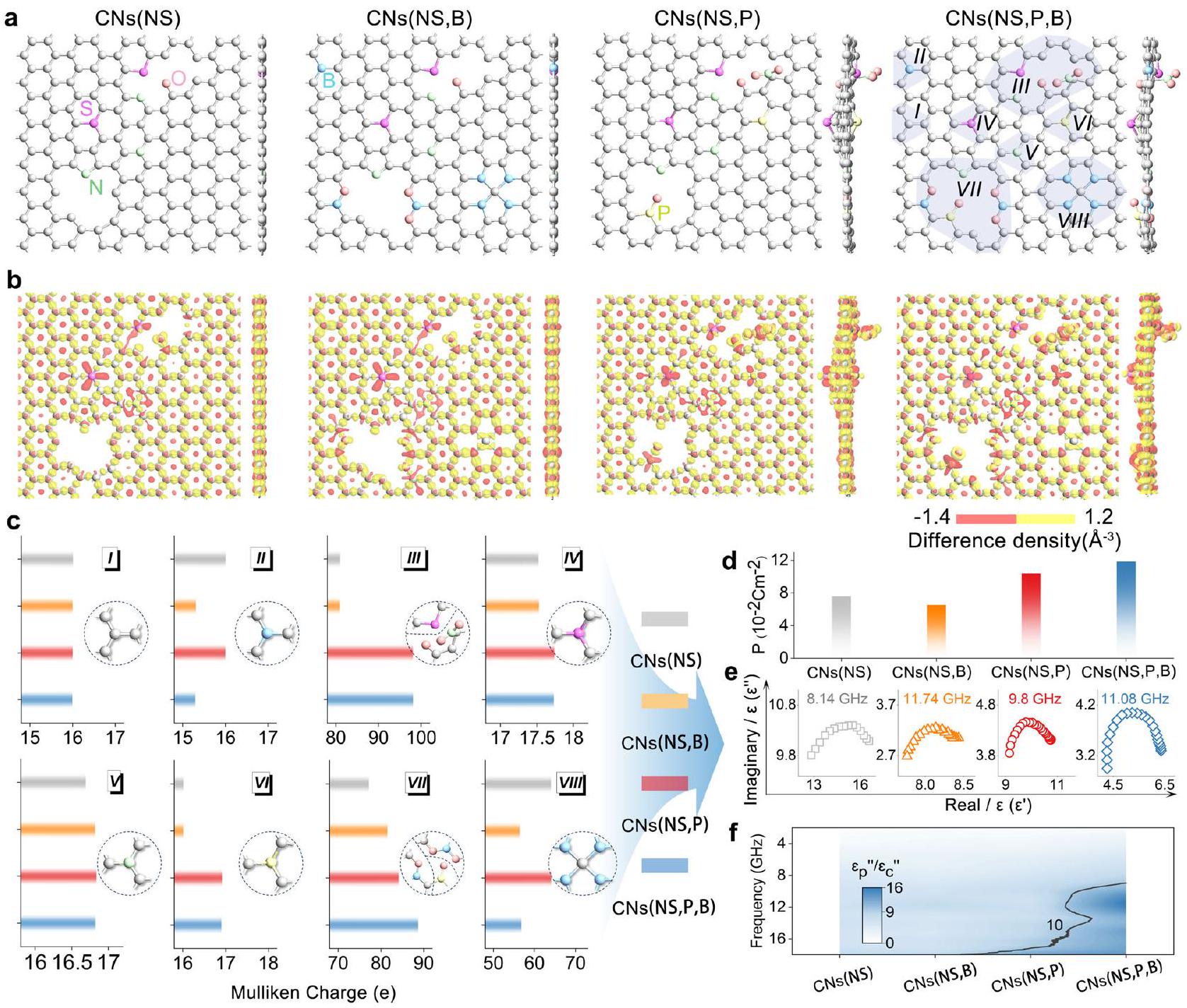
By utilizing density functional theory (DFT), the principle of the modulation effect of HED engineering on the dielectric loss was elucidated. The specific modification of carbon atomic structures by various doping elements and their combinations was considered, leading to the establishment of four corresponding model sets (Fig. 4a). The optimized structures show that the large P atoms cause the graphene lattices to expand out-of-plane, rendering the previously in-plane stable N/S-doped model axially asymmetric. This lattice distortion is inherited in models with additional impurities and may
Fig. 3 | Effect of high-entropy doping on atomic configuration and dielectric properties. a N1s, S2p, B1s and P2p spectra. b Schematic of the atomic structure of after B-doping, P-doping and P/B co-doping as the substrate. In the schematic, white atoms are carbon atoms, red atoms are O atoms, purple atoms are S atoms, green atoms are N atoms, blue atoms are B atoms, and yellow atoms are P
atoms. c Elemental content of the samples. values in the Raman spectra. e Complex permittivity, (f) fitted conductivity of the coaxial ring as well as measured powder resistivity. Powder resistivity data are presented as mean values ( ). Electrochemical impedance spectra. and ( ) Impedance Smith charts of , and .
enhance the polarity of the entire system. Subsequently, charge differential density maps were calculated, in which red and yellow colors signify regions of electron accumulation and depletion, respectively (Fig. 4b). Generally, when carbon atoms at internal or edge sites are substituted, charge redistribution occurs. The and models exhibit a more severe charge imbalance, which is more evident in the side views. Similarly, the electron localization function reflects these changes in the bonding electrons (Figure S14, Supplementary Information). Charge tends to concentrate at doping sites, with increased doping leading to more severe charge asymmetry
Fig. 4 | Density Functional Theory Calculations for Medium- and High-Entropy Doping. a Structurally optimized medium- and high-entropy doped atom models. White atoms are carbon atoms, light red atoms are O atoms, purple atoms are S atoms, green atoms are N atoms, blue atoms are B atoms, and yellow atoms are P
atoms. b Charge density difference plots. c Comparison of Mulliken charges in each region. d Calculated polarizabilities. e Cole-Cole curves of . f Polarization loss/conductivity loss ratios of CNs(NS), CNs(NS,B), CNs(NS,P), and CNs(NS,P,B).
on the bonds. To better compare the influences of the doping type and form on electron gain and loss, the Mulliken charges were calculated (Figure S15, Supplementary Information). Theoretically, the charge on C atoms in the graphite region is . The electron count on the other heteroatoms at the doping sites, except for B, is greater than 4 eV . Taking as an example, the charge magnitude of the heteroatoms is as follows: . The alteration in the valence electrons of the heteroatoms after doping confirms that B atoms strongly attract free electrons from N and S , reducing the overall conductivity. Moreover, the presence of oxygencontaining polar groups strongly affects the spatial distribution of bound electrons. This change is not confined to the heteroatom or adjacent bonds but radiates to the surrounding areas. We compared the total charges in eight marked typical regions across different doping models (Fig. 4c). The results indicate that B-containing functional groups (regions II and VIII), particularly , significantly reduce the local electric field. In edge-doped regions, the number of electrons increases with the addition of oxygen-containing functional groups, generating extra electric dipoles and increasing the polarity (Fig. 4d). Notably, B doping may decrease the polarizability, as it is detrimental
to aggregation of electrons and does not introduce additional lattice distortion. In contrast, P doping increases the polarizability because it both enriches the local charge and increases the axial asymmetry. However, the introduction of B into CNs(NS,P,B) unexpectedly increases the polarizability rather than decreasing it. Based on an analyzing region of VII, P/B codoping leads to concentrated doping or adsorption of oxygen-containing functional groups at edge sites, greatly increasing the electron density in these areas. These electronrich regions and B-containing electron-deficient regions collectively form a discrete, opposing charge distribution pattern. This established charge asymmetry is subsequently further exacerbated by out-ofplane deformation and displacement of the electron clouds due to lattice distortion. That is, the lattice distortion, electron-rich and electron-deficient regions together maximize the polarity of the material. This field effect induced by an abundance of polar groups unprecedentedly promotes the transition of electrons from delocalized to localized states. Interestingly, the fixed order and combination of doping exhibit reproducibility in their influence on polarization relaxation. For example, N, S, P doping increase the relaxation time, whereas B and O doping decrease it. The multielemental interplay governs the relaxation sites, thus yielding a compromise behavior
Fig. 5 | EWA performance and applications. a two-dimensional performance diagram of the sample. b performance comparison diagram of with other low-entropy and medium-entropy doped carbon materials. c threedimensional diagram of the radar scattering cross-section of the sample at 13.42 GHz . d line drawing of radar scattering cross-section of the metal backplate
model and . e EWA performance of at different angles of incidence of electromagnetic waves. f Schematic diagrams of chips of electronic devices before and after applying EWA materials. g E-field radiation values before and after applying EWA materials.
(Fig. 4e). Additionally, HED engineering aids in enhancing the proportion of polarization loss in the dielectric loss (Fig. 4f). Based on the above, we suggest that HED engineering induces a ‘directional cocktail effect’ that favors polarization and EWA properties.
The benefits of anionic HED engineering are demonstrated through the EWA performance. In Fig. 5a, , and fail to achieve reflection loss intensities below -10 dB within , primarily because of the poor conductivity of CNs. In contrast, samples doped with N and S achieve effective absorption. Specifically, achieves an EAB of 3.66 GHz at achieves an EAB of 3.76 GHz at achieves 4.35 GHz at 1.57 mm , and achieves an EAB of 7.05 GHz at 2.6 mm .
While CNs (NS,B) and CNs (NS,P) outperform CNs (NS), B- or P-doping alone is insufficient to fully balance the excessive enhancement of electrical properties by N/S codoping. N/S/P/B codoping achieves a satisfactory balance, minimizing the drawbacks of conductive losses and promoting polarization advantages, thereby broadening the absorption bandwidth. Variations in the maximum EAB further validate the compromise effect of HED engineering among the O, N/S, and P/B dopants (Figure S16, Supplementary Information). To ascertain the reliability of the excellent EWA performance, we performed S11 parameter measurements on a coaxial ring equipped with an additional metal backplate at a constant thickness (Figure S17, Supplementary Information). The findings demonstrate a high consistency between the experimentally measured values and the reflection loss calculations derived from transmission line theory. Compared with other representative low- and medium-entropy doped carbon absorbers (Fig. 5b and Table S3, Supplementary Information), the high-entropy doped carbon absorber in this work exhibits both broadband absorption ( ) and high loss ( ), which are achieved at an ultralow filling rate ( ), positioning it at the cutting edge of research on heteroatom-doped carbon EWA materials. Moreover, effective anionic HED engineering and the accompanying exceptional EWA performance is highlighted through comparisons with recently reported EWA materials of other systems, including MXene-based, ceramic-based, chalcogenide-based, polymer-based, sulfur-com-pound-based, and metal-organic framework/layered bimetallic hydroxide derivatives (Figure S18 and Table S4, Supplementary Information).
The effectiveness of anionic HED engineering was verified using radar cross-section (RCS) simulations. We constructed a model of a metal backplane coated with an EWA layer and calculated the absorption and scattering of electromagnetic waves at different frequencies under infinite far-field conditions. As shown in Figure 6a, scattering signals of CNs (NS) and its derivatives in the X and Ku bands (with a frequency interval of 1 GHz ) are observed (Figures S19-23, Supplementary Information). The pure perfect electric conductor (PEC) model exhibits strong scattering at each frequency point, whereas the EWA-coated model exhibits a frequency preference for a low RCS. These low-RCS frequencies align with the reflection loss patterns calculated by transmission line theory (Figure S24, Supplementary Information). Notably, CNs(NS,P,B) exhibits nearly undetectable scattering signals at 13.42 GHz (Fig. 5c), indicating complete absorption and dissipation of electromagnetic waves. In Fig. 5d, the RCS values from to are represented in a radar chart. The main lobe value represents the maximum radiation in the primary working direction of the radar. Clearly, CNs(NS,P,B) most effectively eliminates electromagnetic interference in this direction. Moreover, the RCS reduction by is greater than that by the other samples, equivalent to the difference between a regular airplane and a bird. Additionally, CNs (NS,P,B) exhibits narrower sidelobes and lower RCS values on the sidelobes, indicating that HED engineering facilitates electromagnetic energy attenuation over a wide angular range, providing stronger anti-interference capabilities. To prove this, we calculated the EWA performance for different electromagnetic wave incidence angles. As shown in Fig. 5e, CNs(NS,P,B) exhibits wideangle absorption, maintaining an EAB above 5.7 GHz within a range.
Finally, the applicability of in the civilian electronic field was demonstrated. We combined high-entropy doped carbon powder with an elastomer to create elastic patches and applied them to cover chip surfaces in communication devices (Fig. 5f). Radiation measurements were conducted on bare chips and chips covered with EWA materials. The results show that the bare chip emits a high radiation of , whereas our material reduces the radiation by several orders of magnitude to only . This experiment underscores the importance of anionic HED engineering for promising EWA materials and their potential applications in civilian fields.
In summary, we developed anionic HED engineering and successfully enhanced the dielectric properties and EWA performance of carbon materials. Initially, O-doped two-dimensional CNs was synthesized via a salt-templating method followed by in situ pyrolysis. Subsequently, leveraging the large specific surface area, these CNs underwent sequential N/S codoping, P doping, and B doping via a three-step solvothermal process, yielding HE carbon materials. In the complex step-by-step doping process, heteroatoms with different doping orders show multibody interactions, and the final product inherits their electrical properties. Compared with low- and mediumentropy doping engineering, HED engineering has remarkable advantages in balancing delocalized charges and enhancing localized charges, manifested as a reduced conductivity and a strengthened dipole polarization. Synergistic experimental investigations and DFT calculations collectively revealed a ‘directional cocktail effect’, facilitating modulation of the type and intensity of the dielectric loss. Ultimately, the CNs(NS,P,B) HE sample achieves broadband and efficient EWA performance under ultralightweight conditions. Moreover, this material can be utilized to fabricate absorbing patches to mitigate intense radiation in electronic devices. We believe that anionic HED engineering addresses a crucial gap in doping research and broadens the design paradigm for advanced EWA materials, thereby facilitating advancements in the field of electromagnetic functional materials.
Methods
General
The electromagnetic performance experimental, electromagnetic radiation detection experiment, DFT and RCS are given in the Supplementary Methods.
Preparation of two-dimensional carbon nanosheets (CNs)
A mixture of 5 g glucose and 75 g sodium chloride was homogenously dispersed in 30 milliliters of deionized water through manual agitation for a duration of 10 min . Subsequently, this solution was subjected to a vacuum drying process within an oven maintained at for a period of 48 h , resulting in a thoroughly dehydrated specimen. The dried material was then meticulously pulverized into an extremely fine powder. The powdered sample underwent controlled heating at a rate of until reaching , where it was annealed for 2 h in an argon atmosphere. Following natural cooling to room temperature, the resultant black powder was subjected to an alternating washing process with deionized water and ethanol, each for three cycles, to remove excess salt templates. Finally, the powder was dried overnight in an oven at , resulting in the final product designated as CNS.
Preparation of B-doped CNs, labeled CNs(B)
The CNs was redispersed in 80 ml of aqueous solution that also had 0.02 mol of boric acid and sonicated for 10 min to ensure dispersion. The mixed solution was placed in a 100 ml reactor and then heated up to at a rate of . After being kept at for 10 h , the solution was cooled naturally to room temperature. The solution was vacuum filtered to obtain a powder, which was washed three times alternately with water and ethanol. The last time with ethanol and then dried in an oven at for 10 min .
Preparation of P-doped CNs, labeled CNs(P)
The CNs was redispersed in 80 ml of phosphoric acid and sonicated for 10 min to ensure dispersion. The other steps were the same as those for the preparation of CNs (B).
Preparation of P/B co-doped CNs, labeled CNs(P,B)
The CNs (P) was redispersed in 80 ml of aqueous solution containing 0.02 mol of boric acid and sonicated for 10 min to ensure dispersion. The solvent heating procedure and subsequent operations were the same as for the preparation of .
Preparation of N/S co-doped CNs, labeled CNs(NS)
The solvent was in 80 ml of aqueous solution containing 0.02 mol of thioacetamide, referring to the above experiments for the procedure.
Preparation of N/S/P/B co-doped CNs, labeled CNs(NS,P,B)
The CNs(NS) was redispersed in 80 ml of phosphoric acid and sonicated for 10 min to ensure dispersion. The mixed solution was placed in a 100 ml reactor and heated at per minute to . After 10 h at , the solution was cooled naturally to room temperature. The solution was vacuum filtered to obtain a powder which was washed three times alternately with water and ethanol. The last time it was washed with ethanol and then dried in for 10 min to get was again dispersed into 80 ml of aqueous solution containing 0.02 mol of boric acid. The solvent heating, washing and drying processes were repeated to obtain .
Characterization
Surface architectures were investigated through surface scanning utilizing a field emission scanning electron microscope (FE-SEM), specifically the Zeiss Supra 55 VP model, which provided detailed morphological insights. High-resolution probing of local structures, including selected area electron diffraction (SAED) patterns and elemental distributions, was accomplished with the Thermo Fisher Scientific Titan Themis G3 300 kV double spherical aberration corrected transmission electron microscope (TEM). Adsorption-desorption profiles of N2 were analyzed employing a Micromeritics ASAP 2020 chemisorption analyzer, yielding crucial information on surface interactions. Phase compositions and crystalline arrangements were elucidated through X-ray diffraction (XRD) analysis on the Bruker D8 ADVANCE instrument, operating at , complemented by Raman spectroscopy on the Horiba LabRAM HR Evolution setup, excited at . Functional group identification was performed using Fourier transform infrared (FT-IR) spectroscopy on the Thermo Fisher Scientific Nicolet iS50 platform, while the valence states of surface elements were determined via X-ray photoelectron spectroscopy (XPS) on the Ulvac-Phi PHI 5000 VersaProbe III system, utilizing radiation at 1486.6 eV . Electrochemical impedance spectroscopy (EIS) measurements were conducted on the samples using the CH Instruments CHI660E electrochemical workstation, with a Pt plate serving as the counter electrode, reference electrode, and as the electrolyte solution.
Data availability
All data needed to evaluate the conclusions in the paper are presented in the paper and/or the Supplementary Information. Additional data related to this paper may be requested from the authors. Source data are provided with this paper.
References
Liu, L. et al. Specific electromagnetic radiation in the wireless signal range increases wakefulness in mice. PNAS 118, e2105838118 (2021).
Lv, H. et al. Functional nanoporous graphene superlattice. Nat. Commun. 15, 1295 (2024).
Cai, B. et al. Interface-induced dual-pinning mechanism enhances low-frequency electromagnetic wave loss. Nat. Commun. 15, 3299 (2024).
Tao, J. et al. Multi-field coupled motion induces electromagnetic wave absorbing property regeneration of elastomer in marine environment. Adv. Funct. Mater. 34, 2310640 (2024).
Xu, L. et al. Effect of Fe doping profile on current collapse in GaNbased RF HEMTs. Chem. A Eur. J. 30, e202304100 (2024).
Huang, X. et al. Ultralight magnetic and dielectric aerogels achieved by metal-organic framework initiated gelation of
graphene oxide for enhanced microwave absorption. Nano-Micro Lett. 14, 107 (2022).
Wang, J. & Han, W. A review of heteroatom doped materials for advanced lithium-sulfur batteries. Adv. Funct. Mater. 32, 2107166 (2022).
Tao, J. et al. Catfish effect induced by anion sequential doping for microwave absorption. Adv. Funct. Mater. 33, 2211996 (2023).
Hu, H. et al. High-entropy engineering reinforced surface electronic states and structural defects of hierarchical metal oxides@graphene fibers toward high-performance wearable supercapacitors. Adv. Mater. 36, e2406483 (2024).
Chen, X. et al. Discriminating active B-N sites in coralloidal B, N dualdoped carbon nano-bundles for boosted Zn-Ion storage capability. Adv. Funct. Mater. 33, 2212915 (2023).
Lun, Z. et al. Cation-disordered rocksalt-type high-entropy cathodes for Li-ion batteries. Nat. Mater. 20, 214-221 (2021).
Huang, S. et al. High-entropy transition metal phosphorus trichalcogenides for rapid sodium ion diffusion. Adv. Mater. 36, 2405170 (2024).
Wang, Y. et al. Self-encapsulation of high-entropy alloy nanoparticles inside carbonized wood for highly durable electrocatalysis. Adv. Mater. 36, 2402391 (2024).
Zhang, M. et al. Ultrahigh energy storage in high-entropy ceramic capacitors with polymorphic relaxor phase. (2024).
Qiu, Z. et al. Synergistic enhancement of electromagnetic wave absorption and corrosion resistance properties of high entropy alloy through lattice distortion engineering. Adv. Funct. Mater. 34, 2400220(2024).
Hui, S., Zhou, X., Zhang, L. & Wu, H. Constructing multiphaseinduced interfacial polarization to surpass defect-induced polarization in multielement sulfide absorbers. Adv. Sci. 11, 2307649 (2024).
Zhao, B. et al. High-entropy enhanced microwave attenuation in titanate perovskites. Adv. Mater. 35, 2210243 (2023).
Zhao, B. et al. Structural defects in phase-regulated high-entropy oxides toward superior microwave absorption properties. Adv. Funct. Mater. 33, 2209924 (2022).
Zhang, R. et al. Compositionally complex doping for zero-strain zero-cobalt layered cathodes. Nature 610, 67-73 (2022).
Zeng, Y. et al. High-entropy mechanism to boost ionic conductivity. Science 378, 1320-1324 (2022).
Huang, H. et al. Crystal-phase-engineered high-entropy alloy aerogels for enhanced ethylamine electrosynthesis from acetonitrile. Adv. Mater. 36, 2314142 (2024).
Ying, T. et al. High-entropy van der waals materials formed from mixed metal dichalcogenides, halides, and phosphorus trisulfides. J. Am. Chem. Soc. 143, 7042-7049 (2021).
Ying, T., Yu, T., Qi, Y., Chen, X. & Hosono, H. High entropy van der waals materials. Adv. Sci. 9, 2203219 (2022).
Liu, J., Zhang, L. & Wu, H. Anion-doping-induced vacancy engineering of cobalt sulfoselenide for boosting electromagnetic wave absorption. Adv. Funct. Mater. 32, 2200544 (2022).
Wu, D. et al. Multi-scale structure optimization of boron-doped hard carbon nanospheres boosting the plateau capacity for high performance sodium ion batteries. J. Mater. Chem. A 10, 17225-17236 (2022).
Wu, J. et al. N, P-doped carbon nanorings for high-performance capacitive deionization. Chem. Eng. J. 473, 145421 (2023).
Qu, K. et al. Polydopamine-inspired, dual heteroatom-doped carbon nanotubes for highly efficient overall water splitting. Adv. Energy Mater. 7, 1602068 (2017).
Fang, G. et al. The elaborate design of multi-polarization effect by non-edge defect strategy for ultra-broad microwave absorption. Adv. Funct. Mater. 34, 2404532 (2024).
Liang, H. et al. Exploring the Ni 3d orbital unpaired electrons induced polarization loss based on Ni single-atoms model absorber. Adv. Funct. Mater. 33, 2212604 (2023).
Tan, R. et al. Multi-Scale Dispersion Engineering on BiomassDerived Materials for Ultra-Wideband and Wide-Angle Microwave Absorption. Small Methods 8, 2301772 (2024).
Patel, M. A. et al. P-doped porous carbon as metal free catalysts for selective aerobic oxidation with an unexpected mechanism. ACS Nano 10, 2305-2315 (2016).
Ma, H. et al. Tuning optical properties of carbon dots by Co-doping strategy for versatile applications. ChemistrySelect 9, e202303652 (2024).
Li, Y. et al. Insights into the storage mechanism of phosphorusfunctionalized hard carbon as ultrahigh capacity anodes. Adv. Energy Mater. 8, 1702781 (2018).
Huang, W. et al. Dual-step redox engineering of 2D CoNi-alloy embedded B, N-doped carbon layers toward tunable electromagnetic wave absorption and light-weight infrared stealth heat insulation devices. Adv. Mater. 36, 2403322 (2024).
Qian, Y. et al. In situ revealing the electroactivity of P-O and P-C bonds in hard carbon for high-capacity and long-life Li/K-ion batteries. Adv. Energy Mater. 34, 1901676 (2019).
Tao, J. et al. Multi-shell hollow porous carbon nanoparticles with excellent microwave absorption properties. Carbon 172, 542-555 (2021).
Tao, J. et al. Selective coding dielectric genes based on proton tailoring to improve microwave absorption of MOFs. Adv. Powder Mater. 2, 100091 (2023).
Acknowledgements
This work is supported by National Key R&D Program of China (2021YFB3502500 to J.Z); National Natural Science Foudation of China (52172091 to Z.Y, 52172295 to J.Z, and 62104110 to J.W); Defense Industrial Technology Development Program (JCKY2O23605COO2 to J.Z); Basic Research Program of Jiangsu (BK20232013 to J.Z); Open Fund of Key Laboratory of Materials Preparation and Protection for Harsh Environment (Nanjing University of Aeronautics and Astronautics), Ministry of Industry and Information Technology (56XCA24025 to Z.Y); Postgraduate Research & Practice Innovation Program of Jiangsu Province (KYCX23_0371 to J.T). We acknowledge the Center for Microscopy and Analysis at Nanjing University of Aeronautics and Astronautics for conducting TEM characterization. We acknowledge the support of Suzhou Laboratory.
Author contributions
J.T. conceived and designed the experiments. J.T., J.Z., H.H., and Z.Y. supervised the project. J. T., Y.Y., H.Z., W.Z. and P.C. performed
experiments and acquired data. J.T., R.T., L.X., P.C., X.T., and Y.Y. analyzed the data and discussed mechanisms. J.T. drafted the manuscript. J.W. performed the first-principles density functional theory simulation. All authors contributed to data interpretation, discussions, and manuscript preparation.
Correspondence and requests for materials should be addressed to Jintang Zhou, Jin Wang, Ping Chen, Hexia Huang, Xuewei Tao or Zhengjun Yao.
Peer review information Nature Communications thanks Bartosz Janaszek and the other, anonymous, reviewer(s) for their contribution to the peer review of this work. A peer review file is available.
Publisher’s note Springer Nature remains neutral with regard to jurisdictional claims in published maps and institutional affiliations.
Open Access This article is licensed under a Creative Commons Attribution-NonCommercial-NoDerivatives 4.0 International License, which permits any non-commercial use, sharing, distribution and reproduction in any medium or format, as long as you give appropriate credit to the original author(s) and the source, provide a link to the Creative Commons licence, and indicate if you modified the licensed material. You do not have permission under this licence to share adapted material derived from this article or parts of it. The images or other third party material in this article are included in the article’s Creative Commons licence, unless indicated otherwise in a credit line to the material. If material is not included in the article’s Creative Commons licence and your intended use is not permitted by statutory regulation or exceeds the permitted use, you will need to obtain permission directly from the copyright holder. To view a copy of this licence, visit http:// creativecommons.org/licenses/by-nc-nd/4.0/.
(c) The Author(s) 2025
¹College of Materials Science and Technology, Key Laboratory of Material Preparation and Protection for Harsh Environment, Nanjing University of Aeronautics and Astronautics, Nanjing 211100 , China. College of Electronic and Optical Engineering & College of Flexible Electronics (Future Technology), Nanjing University of Posts and Telecommunications, Nanjing 210023, China. School of Electronic Science and Engineering, Nanjing University, Nanjing 210093, China. College of Energy and Power Engineering, Nanjing University of Aeronautics and Astronautics, Nanjing 210016, China. School of Materials Science and Engineering, Nanjing Institute of Technology, Nanjing 211167, China. e-mail: imzjt@126.com; jin@njupt.edu.cn; chenping@nju.edu.cn; huanghexia@nuaa.edu.cn; tao_xuewei@126.com; yaozj1921@126.com