هيدروجيل عضوي فوق جزيئي قابل للضغط، مقاوم للإرهاق، قابل للتكيف مع البيئات القاسية، ومتوافق حيوياً، مدعوم بشبكة غير تساهمية مُفعلة بواسطة اللجنوسولفونات Compressible, anti-fatigue, extreme environment adaptable, and biocompatible supramolecular organohydrogel enabled by lignosulfonate triggered noncovalent network
هيدروجيل عضوي فوق جزيئي قابل للضغط، مقاوم للإرهاق، قابل للتكيف مع البيئات القاسية، ومتوافق حيوياً، مدعوم بشبكة غير تساهمية مُفعلة بواسطة اللجنوسولفونات
تاريخ الاستلام: 19 أبريل 2024 تم القبول: 16 ديسمبر 2024 نُشر على الإنترنت: 02 يناير 2025 تحقق من التحديثات
ييهوي غوتشاو شيويليين وانغجينغ لودونغشينغ شيوينجوان وولو تشينيونغكان جين⊕، بو جيانغ وتشاو جي تشين ⊗
تحقيق تآزر بين التوافق الحيوي والتكيف البيئي الشديد مع خصائص ميكانيكية ممتازة لا يزال يمثل تحديًا في تطوير المواد الاصطناعية. هنا، تم اعتماد استراتيجية “من الأسفل إلى الأعلى” لتحفيز التجميع الذاتي من خلال واجهة الحل لتطوير هيدروجيل عضوي قابل للضغط، ومقاوم للإرهاق، وقابل للتكيف مع البيئات القاسية، ومتوافق حيويًا، وقابل لإعادة التدوير، يتكون من الكيتوزان-الليغنوسولفونات-الجيلاتين من خلال بناء شبكة مرتبطة غير تساهمية. تعمل جزيئات الليغنوسولفونات المستحثة بواسطة مذيب الإيثيلين غليكول/الماء كجسر في شبكة الكيتوزان/الجيل، مما يشكل تفاعلات واجهة متعددة يمكن أن تشتت الطاقة بشكل فعال. يظهر الهيدروجيل العضوي قوة ضغط عالية (54 ميجا باسكال) ومتانة.و70 مرة أعلى من تلك الخاصة بهيدروجيل الكيتوزان النقي/ الجيلاتين، في حين أن لديه خصائص ممتازة في الاسترداد الذاتي ومقاومة التعب. حتى عند تعرضه لضغط شديد يصل إلى إجهاد 0.5 لمدة 500,000 دورة، لا يزال الهيدروجيل العضوي يحتفظ بسلامته. كما يظهر هذا الهيدروجيل العضوي توافقًا حيويًا ملحوظًا سواء في الجسم الحي أو في المختبر، وقدرته على التكيف مع البيئة عند درجات حرارة منخفضة، بالإضافة إلى قابليته لإعادة التدوير. يوفر هذا الهيدروجيل العضوي الطبيعي بالكامل مسارًا واعدًا نحو تطوير مواد تحمل عالية الأداء.
تمتلك الأنسجة اللينة الحاملة للوزن (العضلات، الأربطة، الغضاريف) خصائص ميكانيكية مضبوطة بدقة تمكنها من تحمل ضغط الجسم وتحمل دورات متكررة من التمدد والحركة.لتمثيل الخصائص الناعمة والقوية والمقاومة للصدمات للأنسجة الحاملة للأحمال اللينة، تم تطوير الهيدروجيلات المستندة إلى الروابط غير التساهمية (روابط الهيدروجينرابطة أيونيةرابطة الليغاند، إلخ) قد تم على نطاق واسع تم استكشافه. من خلال دمج مجموعة من هذه التفاعلات غير التساهمية في شبكة الهيدروجيل، تظهر الهيدروجيل الناتجة خصائص ميكانيكية محسّنة بما في ذلك قوة الشد العالية وقوة الضغط العالية، بالإضافة إلى معامل يونغ العالي. ومع ذلك، فإن قيدًا شائعًا بين العديد من هذه الهيدروجيل هو غياب آلية للتعافي السريع بعد التشوه. التقليدية جسديًا
تظهر الشبكات المتعددة المترابطة والشبكات الهجينة عادةً دورة استرداد طويلة عند تعرضها للضغط. بينما يمكن لبعض الهلاميات البوليمرية ذات السلاسل الطويلة أن تستعيد شكلها بسرعة، إلا أنها غالبًا ما تعاني من ضعف القوة بسبب تفاعلاتها الداخلية.نتيجة لذلك، فإن تصنيع مواد تحمل الأحمال التي تلبي جميع المتطلبات للتطبيقات الطبية الحيوية لا يزال يمثل تحديًا كبيرًا. تعتبر التوافق الحيوي، القابلية للتحلل البيولوجي، والقدرة على التكيف مع البيئات القاسية متطلبات أساسية لمواد تحمل الأحمال، بينما يجب أن تكون المواد أيضًا قوية بما يكفي لتحمل الضغوط الفيزيائية ودعم الأنشطة البشرية العادية.
من منظور الاستدامة، تعتبر المواد الحيوية الوفيرة وغير السامة مثل الكيتوزانبروتينات الجيلاتينالسليلوزومستخلص الصوديوم ألجيناتلقد ازدهرت في مجال العلوم الطبية الحيوية، بينما غالبًا ما يكون من الصعب تحقيق خصائص ميكانيكية عالية باستخدام مادة واحدة. لذلك، غالبًا ما يعوض الباحثون عن أوجه القصور لديهم من خلال دمج مجموعة متنوعة من المواد الطبيعية ذات الخصائص الميكانيكية التي تتجاوز بكثير تلك التي يتم الحصول عليها من الخلطات البسيطة لمكوناتها.. تعتمد هذه الطريقة على مراحل مفصولة مرتبطة ارتباطًا وثيقًا مع اختلافات كبيرة في معامل المرونة، مما يضمن تشوهًا غير مرن محدود، وجسورًا، وتشتتًا فعالًا للطاقة لتحقيق آلية العمل لـ “تعزيز المرحلة الصلبة وتقوية التآزر بين المرحلة الصلبة واللينة”. يسمح الجمع بين الصلابة، والصلابة، والقوة، ومقاومة التعب في الهيدروجيل بتطبيقات متنوعة، مثل الروبوتات اللينة.الأجهزة القابلة للزرعوغضروف العضلات الاصطناعيةومع ذلك، لا يزال من التحدي تصنيع مواد الهيدروجيل بخصائص ميكانيكية متعددة، حيث إن الصلابة العالية، والصلابة، والقدرة على الاستعادة السريعة غالبًا ما تمثل متطلبات متضاربة.
في السنوات الأخيرة، ظهرت العديد من الطرق لتحسين بنية الهيدروجيل لزيادة قوتها وصلابتها، بما في ذلك بناء الشبكات المتجانسة.مقدمة السندات التضحيةمركبات المواد النانوية، وفصل الميكروفاز المحفزمن بين هذه الأساليب، تتضمن اثنتان من أكثر الطرق فعالية تحسين تجانس الشبكة واستخدام الروابط التضحية. إن بناء شبكة هلامية متجانسة يساعد في تقليل تركيز الإجهاد وتحسين القوة الانضغاطية والصلابة إلى حد ما. ومع ذلك، فإن هذه الطريقة لها فعالية محدودة للمواد التي تحتوي بالفعل على شقوق أو عيوب. من ناحية أخرى، تستخدم الروابط التضحية عدم تجانس شبكة الهلام لتوليد تشتت الطاقة. ومن الأمثلة النموذجية بناء هلاميات ثنائية الشبكة ذات هياكل غير متجانسة وخصائص مكملة، حيث يمكن للهياكل الصلبة المرتبطة بشكل كبير أن تشتت الطاقة بكفاءة من خلال كسر الروابط، بينما يمكن للهياكل المرنة المرتبطة بشكل نادر أن تتحمل مجموعة واسعة من الإجهادات، ولكن الزيادة في الصلابة غالبًا ما تكون على حساب انخفاض في المتانة.عادةً ما يكون تأثير التعزيز والتقوية للهيدروجيل محدودًا لطرق معينة من تحسين الهيكل.
على عكس الشبكات الثنائية التقليدية، قمنا بتصميم شبكة متصلة من الهيدروجيل العضوي مع تفاعلات معززة وآليات تفريغ تآزرية لتحسين التعبير الزمني للتفاعلات غير التساهمية بين البوليمرات المرتبطة بالشبكة. تم تحقيق هذا النهج من خلال دمج الجسيمات النانوية وتحفيز الفصل المجهري من خلال استراتيجية بسيطة لتبادل المذيبات. على وجه التحديد، استخدمنا طريقة “النقع” القابلة للتطبيق في محلول اللجنوسولفونات-الإيثيلين غليكول (SL-EG) لتحويل هيدروجيل مركب الكيتوزان-الجيلاتين (C-G) الضعيف إلى هيدروجيلات مرتبطة قوية من الكيتوزان-اللجنوسولفونات-الجيلاتين (C-SL-G) (الشكل 1أ). يعمل الكيتوزان كمرحلة صلبة لتعزيز القوة الميكانيكية للهيدروجيلات العضوية، وكبح معدل توسع الشقوق أثناء الكسر، والحفاظ على سلامة المادة. من ناحية أخرى، تعمل الجيلاتين كمرحلة لينة قابلة للتشكيل لتحمل معظم الحمل في حالة كسر خيوط الكيتوزان. تم استخدام الاختلافات في حالات توزيع البوليمرات في الماء وEG لتعديل التفاعل السطحي. القوى عبر الشبكة، مما يحفز تشكيل شبكة بوليمر موحدة وقوية. يمكن ضغط هلام الأورغانيك هيدروجيل C-SL-G الناتج حتى 0.9 دون تمزق، والحفاظ على الشكل الأصلي حتى بعد الخضوع لـ 500,000 دورة متكررة عند إجهاد 0.5 (الشكل 1ب، ج). ومن الجدير بالذكر أن هلام الأورغانيك هيدروجيل القوي الناتج يظهر مقاومة ملحوظة للتجمد ويقدم خصائص ترطيب، وذلك بفضل الطبيعة غير المتطايرة للإيثيلين غليكول. علاوة على ذلك، يسهل هلام الأورغانيك هيدروجيل C-SL-G المكون من جميع مكونات طبيعية التوسع من خلال طريقة “النقع” البسيطة والصديقة للبيئة، مما يمكّن المادة والعملية من تحقيق استدامة جيدة، وقابلية لإعادة التدوير، وفعالية من حيث التكلفة للتسويق والتطبيق على نطاق واسع (الشكل 1ج، د والجداول التكميلية 1-5). تفتح التوافق الحيوي القابل للإعجاب وقابلية التحلل الحيوي للكيتوزان، الجيلاتين، واللجنين، إلى جانب القوة الميكانيكية الممتازة، ومقاومة التعب، والتكيف البيئي الشديد، طريقًا لتطوير هلامات حيوية مترابطة قوية. علاوة على ذلك، فإن هذه الاستراتيجية لديها القدرة على التمدد إلى مذيبات أخرى مثل محلول اللجنين-الجليسرول ومحلول أيون المعدن-الإيثيلين غليكول/الجليسرول لإعداد هلامات أورغانيك هيدروجيل متعددة الوظائف resilient مناسبة لمجموعة متنوعة من التطبيقات.
النتائج
البناء، الهيكل، والشكل الخارجي لهلامات C-SL-G العضوية الهيدروجينية المستندة إلى شبكة متصلة
للحصول على الهلام العضوي المتقاطع مع SL و EG، استخدمنا استراتيجية نقع الهلام. في البداية، تم تسخين وتحريك مزيج من الجيلاتين والكيتوزان حتى يذوب للحصول على محلول مختلط، ثم تم تبريده بدرجة حرارة منخفضة للحصول على هلام مركب C-G ناعم وهش. بعد ذلك، تم غمر الهلام في محلول SL-EG للحصول على هلامات عضوية C-SL-G (الشكل التكميلي 1). خلال عملية النقع، تتسلل جزيئات SL لتعمل كنقاط تقاطع وسيطة تشارك في الربط غير التساهمي لشبكة البوليمر.ترافق هذه العملية تغيير ملحوظ في اللون من الأصفر الفاتح إلى البني الداكن، مما يعكس إدخال SL إلى داخل الجل أثناء تبادل المذيب (الشكل التكميلي 2). وبالتالي، يمكن تعديل تركيز الملح في هيدروجيل C-SL-G بسهولة من خلال تعديل ظروف التصنيع، مثل حجم العينة ومدة الغمر. تظهر هذه النتائج الأداء الممتاز للهيدروجيلات المرتبطة بشبكة مزدوجة. تجعل المادة الأساسية الرخيصة وعملية التحضير البسيطة أكثر تنافسية للتسويق والتطبيق على نطاق واسع (الشكل التكميلي 1). كما يظهر الهيدروجيل العضوي المطور قابلية إعادة تدوير ممتازة (الشكل التكميلي 3). من خلال إجراء بسيط يتضمن تبادل المذيب مع الماء تحت ظروف التسخين والتحريك، يمكن الحصول على محلول مختلط بشكل موحد من مكونات الهيدروجيل العضوي. بالإضافة إلى ذلك، وبفضل خصائص الكسر/إعادة البناء للروابط غير التساهمية، يمكن إعادة تكوين الهيدروجيل مرة أخرى من خلال تبخر الماء والتجليد. أخيرًا، يؤدي غمر هذا الهيدروجيل المتجدد في EG لتبادل المذيب الكافي إلى تجديد الهيدروجيل العضوي.
تم إجراء المجهر الإلكتروني الماسح (SEM) لمراقبة الهيكل الشكلي للهلام. أظهرت الهلاميات C-G النقية هيكلًا مساميًا مستمرًا يشبه خلية النحل مع جدران رقيقة (الشكل 2أ). يكشف زيادة درجة الانتفاخ بعد تبادل المذيبات مع EG (الشكل التوضيحي 4) أن جزيئات EG يمكن أن تخترق الهيكل الداخلي للشبكة، مما يؤدي إلى توسع الحجم وتمدد شبكة البوليمر. ومع ذلك، أدت اختراق EG أيضًا إلى شكل خشن (الشكل 2ب والشكل التوضيحي 5أ).عند إدخال اللجنين، أصبحت بنية الهلامات العضوية C-SL-G أكثر كثافة واستقرارًا، كما هو موضح في الشكل 2c و 2d والشكل التكميلي 5b و 5c. يجعل إضافة اللجنين منه يعمل كجزيء جسر لتوفير نقاط تقاطع وفيرة مع سلاسل البوليمر من خلال روابط غير تساهمية قوية، مما يؤدي إلى بنية كثيفة للهلامات العضوية C-SL-G.
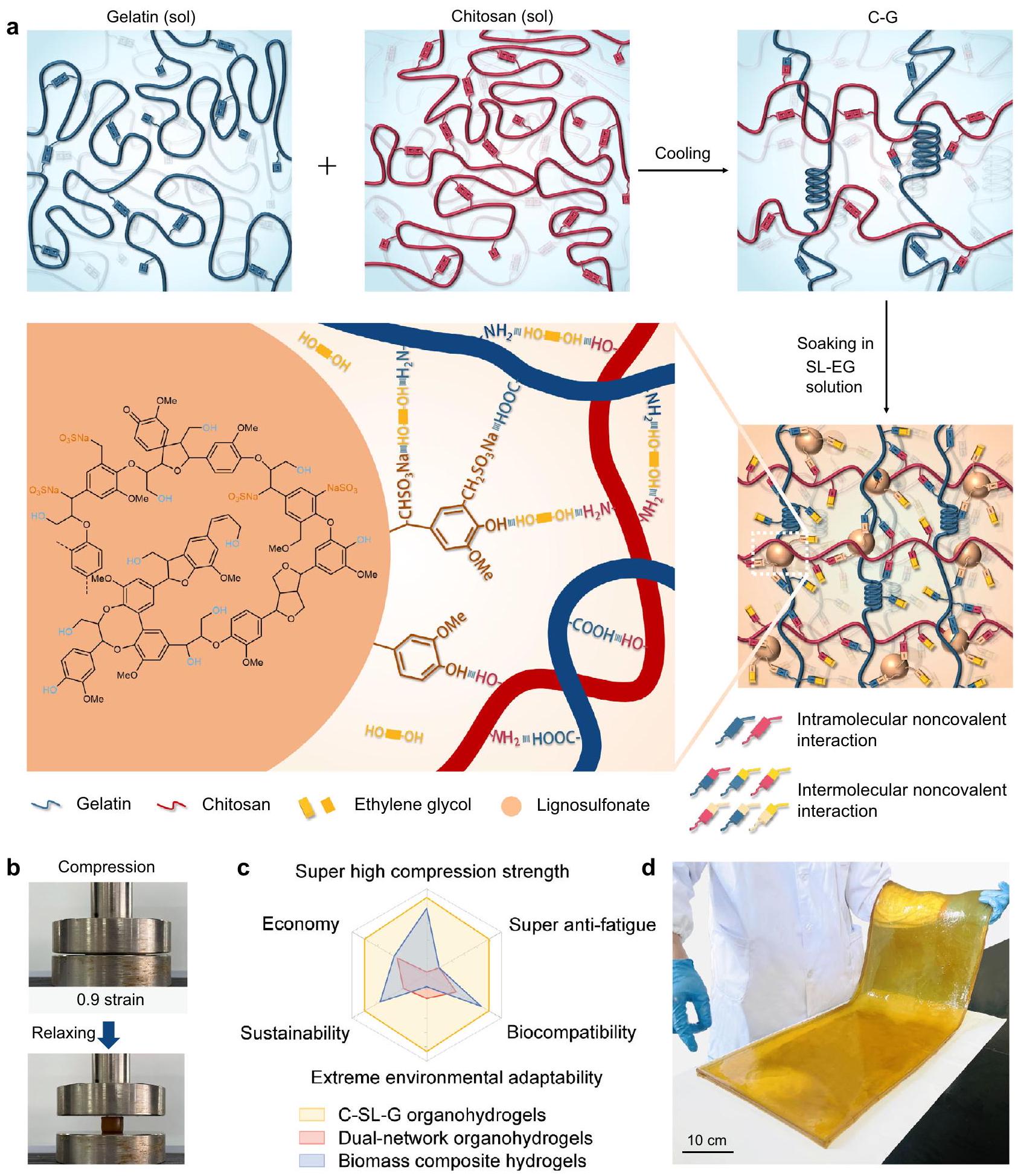
الشكل 1 | استراتيجية البناء والميزات الرئيسية لهلامات C-SL-G العضوية. أ تمثيل تخطيطي لتحضير هلامات C-SL-G العضوية. صور بصرية لجيل الأورغانيك هيدروجيل C-SL-G في حالات الضغط والإفراج. مخطط راداري لفوائد جيل الأورغانيك هيدروجيل C-SL-G المدمجة، الشبكة المزدوجة. الهلامات العضوية المائية، وهلامات المركبات الحيوية (حيث يمثل ‘1’ نوع SL، و’0.01′ يشير إلى التركيز الأولي للمذيب المغمور فيصورة بصرية لـ C-SL-G هيدروجيل عضوي.
تمت دراسة توزيع EG و SL داخل شبكة البوليمر باستخدام تحليل رامان ثنائي الأبعاد (الشكل 2e-h والشكل التكميلي 6). اهتزاز انحناء C-H عند، بالإضافة إلى اهتزاز التمدد واهتزاز التمدد عند، قدمت رؤى حول توزيع هيكل EG. تكشف التحليلات المقارنة عن محتوى EG أعلى في الهيدروجيل العضوي C-GEG مقارنة بالهيدروجيل العضوي C-SL-G، ربما نُسب إلى التأثير المثبط لـكانت كثافة الربط المتقاطع لهلامات C-SL-G العضوية أعلى مقارنة بهلامات C-G-EG بدون SL (الشكل التوضيحي 7). توضح هذه الملاحظة بوضوح أن SL يعمل كعامل تعزيز في التفاعل الدقيق مع شبكة البوليمر، وهو ما تم تأكيده أيضًا بواسطة حيود الأشعة السينية (XRD). الشكل التوضيحي 8 يوضح طيف حيود الأشعة السينية للكيتوزان، الجيلاتين، هلامات C-G-EG و C-SL-G، مما يعرض
الشكل 2 | ميزات الهيكل والشكل لهلامات الأورغانيك الهيدروجينية المتصلة بالشبكة. صور SEM تمثيلية لهلام C-G الأصلي (أ)، C-G-EG (ب) و C-SL-G من الهلامات الأورغانيك الهيدروجينية معغمر SL-EG بالتجفيف الفائق. صور رامان ثنائية الأبعاد (2D) لهلامات C-SL-G العضوية بدون SL (e) ومع SL (f) تم الحصول عليها من اهتزازات الانحناء لروابط C-Hصور رامان ثنائية الأبعاد (2D) لهلامات الكربون-سليكون-هيدروجيل بدون ومع المست obtained from theاهتزاز التمدد واهتزاز التمدد (2900-3400 سم ). طيف FTIR لهلام SL و C-G و C-G-EG و C-SL-G العضوي. j نسبة الكتلة الجزيئات، المتجمعة EG-، و عزل EG في ثلاث مجموعات من الهلام العضوي.تحليل رامان للهلامات العضوية C-G وC-G-EG وC-SL-G. 1 مساحة ونسبة اهتزاز الشد المتماثل لفرقة C-Oفرقة موسيقية رائعة ). حساب طاقة الربط والهندسات المحسّنة للطاقة للروابط غير التساهمية بين OH (EG)، OH (الماء)،الكيتوزان(الجيلاتين) بواسطة DFT. n هندسات محسّنة للطاقة للروابط غير التساهمية بين و (ماء)، الكيتوزان(الجيلاتين)، على التوالي، تم الحصول عليها من حسابات نظرية من دراسات DFT. o حساب طاقة الربط بين (SL) و OH (EG)، OH (ماء)، الكيتوزان(الجيلاتين)، على التوالي بواسطة DFT. قمم مميزة أكثر حدة عند، مما يدل على هيكل أكثر تنظيمًا يسهل من خلال تضمين SL.
تم إجراء تحويل فورييه للأشعة تحت الحمراء (FTIR) ، وطيف الكترونات الأشعة السينية (XPS) ، وطيف رامان للحصول على فهم شامل للتفاعلات بين اللجنين، ثنائي المذيب، الكيتوزان، والجيلاتين (الشكل 2i-l، الأشكال التكميلية 9، 10 والجداول التكميلية 6-8). الانزياح الأحمر لقمة C-O عندبعد تقديم EG، جنبًا إلى جنب مع التحول الطفيف في القمم المميزة لـ N-H عند 1629 ونحو الأطوال الموجية الأقصر بعد إدخال اللجنين، يؤكد توليد الروابط الهيدروجينية. للتحقق من دور EG، قمنا بتناسب C-G-EG،، و تقع في نطاق القمم المميزة من 2500-4000. في هيدروجيل العضوي C-G-EG، يوجد ذروة تقع عند يؤكد وجود روابط هيدروجينية قوية بين EG وجزيئاتمع إدماج SL، يزداد عدد الموجات لاهتزاز تمدد O-H تدريجياً، بينما تنخفض الشدة تدريجياً وتتسع. يشير عدد الموجات الأعلى إلى زيادة طاقة روابط O-H، والتي تعزى إلى تدمير الروابط الهيدروجينية بين EG والماء بواسطة SL المحب للماء. نسبة الاثنينالتشكيلات، المحسوبة من مناطق القمم الملائمة، تكشف عن رؤى في طيف FTIR. بعد إدخال SL، يزداد محتوى O-H المرتبط إلى و ، على التوالي. وهذا يشير إلى أن إضافة اللجنين تؤدي إلى تعزيز الكتلة عملية الروابط الهيدروجينية في النظام. علاوة على ذلك، فإن قوة طاقة الربط لـ -OH والكيتوزان، كما لوحظ في XPS، ينخفض مع إدخال اللجنين، مما يوفر دليلاً قوياً على وجود تفاعلات ربط غير تساهمية قوية بين و -OH و في الكيتوزان والجلاتين.
للمزيد من التحقق من الأدوار الحاسمة لـ EG واللجنين ضمن هذا النظام، تم استخدام الليزر رامان للتحقيق في نظام EG-H2O في الهلامات العضوية (الشكل 2k). أولاً، في نظام الهلام الذي يحتوي على اللجنين، فإن قمم EG المميزة التي تم تخفيفها بشكل واضح تشبه نتائج FTIR. نسبة المساحة لـاهتزاز التمدد المتماثل إلىقمم الاهتزاز المتأرجح كما هو موضح في الشكل 21 تكشف عن تغييرات ملحوظة بعد إدخالإن إدخال SL يعيق تشكيل EG بين الجزيئات.تكوين روابط هيدروجينية ويشكل عددًا كبيرًا من الروابط الهيدروجينية مع جزيئات المذيب وشبكة البوليمر. وبالتالي، يظهر اهتزاز التمدد المتماثل C-O لجزيئات EG زيادة ملحوظة، تُعزى إلى إطلاق مجموعات الهيدروكسيل في الجزيئات وضعف مجموعات الهيدروكسيل في جزيئات الماء. كما هو موضح في الشكل التكميلي 11، فإن إدخال EG وSL في محلول الكيتوزان-الجلاتين المائي يزيد من معامل تخزين الطاقة ( ) ولزوجة معقدة ( ) في منطقة المنصة. الـ و تبلغ قيم عينات الهلام العضوي C-SL-G ذروتها في منطقة المنصة، مما يشير إلى أن الكثافة الأعلى للشبكة المتشابكة جسديًا المستندة إلى الروابط غير التساهمية تتشكل في وجود.
تظهر محاكاة نظرية الكثافة الوظيفية (DFT) أن مجموعات الهيدروكسيل في الإيثيلين غليكول (EG) تظهر طاقات ارتباط أقوى مع الكيتوزان والجيلاتين مقارنة بالتفاعلات بين جزيئات الماء وشبكات البوليمر (الشكل 2م). تعزز هذه التفاعلات القوية الروابط الهيدروجينية بين الإيثيلين غليكول والبوليمرات. في النموذج الهيكلي، تكون طاقات الروابط بين جزيئات الإيثيلين غليكول والجيلاتين/الكيتوزان -0.423 eV و -0.446 eV على التوالي، وهي أكبر من تلك التي لوحظت بين جزيئات الماء والجيلاتين/الكيتوزان، مما يشير إلى أنها أكثر احتمالاً للارتباط وتشكيل هيكل جزيئي أكثر توافقًا مع سلسلة البوليمر.. في الشكل 2n و o، طاقات الربط لـ و (الكيتوزان والجلاتين) في اللجنين هي -1.801 إلكترون فولت و -1.502 إلكترون فولت، على التوالي، وهي أعلى بكثير من تلك الموجودة بين الهياكل الأخرى. أما أطوال الروابط المقابلة فهي و ، على التوالي، أقل من جزيئات EG/الماء. تشير هذه النتائج إلى أن SL قادر على الربط بسرعة وكفاءة مع شبكة البوليمر في استبدال المذيب لتشكيل تفاعلات أقوى، مما يعزز الهيكل العام لشبكة البوليمر. لذلك، تعمل جزيئات اللجنين كنقاط ربط أو حشوات في شبكة البوليمر. توفر هذه النقاط الجديدة للربط أو الحشوات دعمًا ميكانيكيًا إضافيًا، مما يزيد من مقاومة التشوه للهيدروجيل ويحسن استقراره الشكلي.
قد تساهم الشبكة المترابطة التي تتكون بين الكيتوزان، الجيلاتين، SL، وEG في الخصائص الميكانيكية الممتازة لـ C-SL-G. الهلامات العضوية المائية، مما يجعلها مناسبة للاستخدام كمواد تحمل الأحمال. يمكن ضبط قوة الضغط لشبكة الهلام العضوي المتصلة C-SL-G بسهولة عن طريق تعديل تركيز محلول الغمر. كما هو موضح في الشكل 3a، تصل قوة الضغط للهلام إلى أقصى حد لها وهو 54 ميغاباسكال بعد أن تم غمرها في-حل EG، الذي يزيد عن 100 مرة مقارنة بالهيدروجيل الأصلي C-G (0.52 ميغاباسكال). علاوة على ذلك، يتم تحقيق تحسين كبير في الصلابة الانضغاطية، مما يمثل زيادة تقريبية تبلغ 70 مرة (الشكل 3ب). ومن الجدير بالذكر أن الخصائص الميكانيكية لهيدروجيل C-SL-G العضوي تتجاوز تلك الخاصة بالهلامات الحيوية الأخرى والهيدروجيلات العضوية، بل وتتجاوز حتى تلك الخاصة بالغضاريف الطبيعية. بفضل هيكله الفريد المكون من شبكتين، يتم تحقيق مزيج من الصلابة العالية والصلابة العالية (الشكل 3ج والجداول التكميلية 9، 10).
يزداد معامل المرونة للهلامات العضوية C-SL-G مع زيادة محتوى اللجنين. ترتبط صلابة الهلام بشكل إيجابي بمحتوى اللجنين ضمن نطاق معين، متأثرةً بهيكل حلقة البنزين لصلابة اللجنين. يعزز الإيثيلين غليكول الروابط الهيدروجينية بين الشبكات البوليمرية. عند اختيار الجلسرين، الذي يحتوي على ثلاث مجموعات هيدروكسيل، لتبادل المذيبات، تظهر الهلامات الناتجة قوة ضغط أعلى، ومعامل، ومتانة مقارنةً بالهلام العضوي C-G-EG (الشكل التكميلي 12). وهذا يبرز الدور الحاسم للروابط الهيدروجينية داخل النظام. مع إدخال اللجنين في شبكة الهلام، تتطور تفاعلات سطحية قوية. يعمل اللجنين كنقاط ترابط مشتركة تعزز شبكة الهلام وتتداخل مع بعضها البعض، مما يوزع الضغط بفعالية في جميع أنحاء النظام. على العكس، فإن الهلامات التي تحتوي على نسبة أعلى من SL تظهر انخفاضًا في قوة الضغط والمتانة بسبب التجمع الذاتي للجنين، مما يتسبب في توزيع غير متساوٍ للضغط في جميع أنحاء الشبكة ويحد من الخصائص الميكانيكية للهلامات العضوية.. هذا يفسر أيضًا اتجاه زيادة ثم انخفاض خصائص الشد للهلام العضوي المائي (الشكل التكميلي 13). السلوك الريولوجي للهلام العضوي المائي يدعم هذه النتائج بشكل أكبر. ومعامل الفقدان ( تزداد تدريجياً مع إدخال EG و SL، مما يظهر صلابتها أو rigidity أعلى. علاوة على ذلك، تشير الزيادة التدريجية في لزوجة المركب إلى تعزيز تدريجي في التفاعلات بين الجزيئات في الهلامات العضوية. تؤكد هذه النتائج على التحسين الفعال للخصائص الميكانيكية والاستقرار الذي تم تحقيقه من خلال دمج EG و SL (الأشكال التكميلية 14 و 15).
توضح الشكل 3د قابلية التشوه الجيدة والمرونة لهلام C-SL-G العضوي المائي، الذي يمكن لفه بسهولة، وعقده، وطويه، ويستطيع تحمل وزن 500 جرام مع تشوه طفيف (الشكل التوضيحي التكميلي 16). يظهر الشكل 3هـ صور اختبار تشوه الثقب، مما يوضح بوضوح أن هلام C-SL-G العضوي المائي يمكنه تحمل مستويات عالية من الضغط المحلي دون تلف مرئي أو تشوه دائم، مما يبرز خصائصه الميكانيكية الممتازة التي تجمع بين القوة العالية والصلابة. علاوة على ذلك، عندما يتم استخدام أربعة هلامات بنفس الحجمفي الطول والعرض والارتفاع) تُستخدم كقاعدة، حيث يمكن أن يتحمل الجزء العلوي الذي يدعم لوحة مسطحة وزن جسم إنسان يبلغ 70 كجم، وهو ما يعادل 3500 مرة وزن هلام واحد بنفسه (الشكل 3f).
علاوة على ذلك، تم إجراء التحليل الماكروي والميكروي للمادة أثناء الضغط باستخدام تشتت الأشعة السينية بزاوية صغيرة (SAXS) وتشتت الأشعة السينية بزاوية واسعة (WAXS) (الأشكال التكميلية 17 و18). تم حساب منحنيات توزيع الحجم الغاوسي من خلال توزيع شدة SAXS أحادي الأبعاد. تكشف نتائجنا أن إدخال SL يؤدي إلى تكوين مسام أصغر وأكثر كثافة مكانياً، غير متأثرة بعملية الضغط، مما يشير إلى أن العديد من الروابط الهيدروجينية تتكسر وتعيد تنظيمها باستمرار. يشير تحليل WAXS إلى وجود هيكل بلوري عالي. مع زيادة إجهاد الضغط، لا تزال أنماط التشتت تظهر حلقة تشتت غير متبلورة قوية، مما يؤكد أن عملية الضغط لا تحفز تشكيل
الشكل 3 | الخصائص الميكانيكية للهلامات العضوية الهيدروجينية C-SL-G. أ منحنيات الإجهاد والانفعال تحت الضغط (الإطار يظهر رسمًا مكبرًا في منطقة الانفعال المنخفض) و ب معامل الصلابة والصلابة تحت الضغط لـالهيدروجيل بعد النقع فيمحاليل بتركيزات مختلفة. القيم فيتمثل متوسطاتهم ± الانحرافات المعيارية منعينات مستقلة. ج. مخططات المقارنة لعضويات C-SL-G العضوية في هذا العمل مع هيدروجيلات قوية أخرى من حيث القوة مقابل التشوه. د. صور لعضوية C-SL-G العضوية المعرضة لقوى خارجية مختلفة. هـ. صور لعضوية C-SL-G العضوية المثقوبة بمسامير.صورة لـ C-SL-G الهيدروجيل العضوي الذي يدعم وزن جسم الإنسان حيث تظل البنية سليمة بعد التحميل. منحنى القوة-التردد للهيدروجيل العضوي C-SL-G على مدى 500,000 دورة تحميل-تفريغ متتالية بدون فراغ عند إجهاد ثابت.تغير وزن هلام العضوي C-SL-G مع 500,000 دورة تحميل-تفريغ متتالية بدون فاصل تحت إجهاد ثابترسم تخطيطي لآلية الاسترداد الذاتي وقدرة مقاومة التعب: خلال عملية الضغط والاسترداد، تنكسر الروابط غير التساهمية، وتتكون روابط جديدة. هيكل موجه. بالإضافة إلى ذلك، هناك قمة فريدة عندتشير إلى تباعد الشبكة منفي الحالة النقية وفي الحالة المضغوطة، مما يشير إلى أن الضغط الانضغاطي أحادي الاتجاه يؤدي إلى زيادة في تباعد الشبكة.
من المثير للاهتمام، من خلال تقديمبالإضافة إلى اللجنين، يتم الاستفادة من رابطة التنسيق المعدنية القوية، المعروفة بخصائصها الجيدة في تعزيز المتانة. تؤدي هذه الطريقة المزدوجة في التعزيز إلى تحسين الخصائص الميكانيكية للهيدروجيل العضوي بشكل ملحوظ، مع ضغط قوة تصل إلى 60 ميغاباسكال وقوة شد تصل إلى 0.7 ميغاباسكال، كما هو موضح في الشكل التوضيحي 19. وهذا يبرز التأثير الكبير للروابط غير التساهمية في تحسين الخصائص الميكانيكية للهلام..
تحقيق مقاومة ذاتية فائقة ومرونة عالية ضد التعب أمر بالغ الأهمية للجلود للحفاظ على التحميل الدوري اليومي وطول العمر. كمواد تحمل الأحمال، يتطلب هلام C-SL-G العضوي الهيدروجيلي معاملًا كافيًا للحفاظ على الاستقرار الهيكلي.عند إجهادات الضغط 0.5 و 0.6، يحتفظ هلام C-SL-G العضوي المائي باستقرار ممتاز مع تغيير ضئيل في الكتلة حتى بعد 500,000 و 200,000 دورة ضغط عالية التردد، على التوالي (الشكل 3g، h والشكل التوضيحي 20). وقد تم التحقق من ذلك أيضًا في 100,000 دورة شد عالية التردد (الشكل التوضيحي 21). ومن الجدير بالذكر أنه حتى عند إجهاد يصل إلى 0.8، يحتفظ هلام C-SL-G العضوي المائي بتركيب مستقر بعد 3000 دورة ضغط عالية التردد، مما يوضح مقاومته الممتازة للإرهاق. يمكن لهلام C-SL-G العضوي المائي المضغوط أيضًا أن يتعافى بسرعة، مما يثبت خصائصه في الاسترداد الذاتي (الشكل التوضيحي 22). تم التحقيق بدقة في الخصائص الميكانيكية لهلام C-SL-G العضوي المائي من خلال اختبارات تحميل-تفريغ دورية متواصلة تحت ظروف متعددة. حتى عند تعرضها لنسبة ضغط عالية تتجاوز 0.9، تحافظ العينات باستمرار على قدرة تحمل عالية للحمولة ووزن مستقر (الشكل التوضيحي 23). في الوقت نفسه، تظهر خصائص ميكانيكية عالية في اختبار الشق الأحادي ويمكنها مقاومة تمدد الشقوق، مما يثبت مقاومتها الممتازة للتلف والإرهاق تحت تحميل ضغط عالي (الشكل التوضيحي 24).
عند إجهاد الضغط لـ0.6، يظهر الهيدروجيل العضوي الحد الأدنى من حلقات الهسترس ومرونة ممتازة (الشكل التكميلي 25أ، ب). يلخص الشكل التكميلي 25ج ود سلوك الاسترداد لـ-G هيدروجيل عضوي بعد أوقات استرخاء مختلفة. تظل قدرة الاستعادة للهيدروجيل العضوي عند مستوى عالٍ (>88%) لفترات زمنية متتالية خمس، مما يشير إلى أن الروابط الهيدروجينية المكسورة والقوى الكهروستاتيكية يمكن أن تُستعاد أساسًا إلى الحالة الأصلية ضمن إطار زمني معين. علاوة على ذلك، في الدورات المتتالية عند إجهاد ثابت، لوحظت العديد من خطوط الهسترسيس في الدورات المتتالية، حيث أظهرت الدورات اللاحقة انخفاضًا في استهلاك الطاقة ولكن مع وجود مستمر لخطوط الهسترسيس. وهذا يشير إلى أن إعادة تنظيم الروابط غير التساهمية يمكن أن تستعيد المادة جزئيًا (الأشكال التكميلية 25e، f و26-28). تشير هذه النتائج إلى أن المجالات الهيكلية المتقاطعة الكهروستاتيكية المكسورة للأمينو-SL والمجالات الهيكلية المتقاطعة المرتبطة بالهيدروجين للأمينو-EG يمكن أن تُستعاد بشكل معقول إلى مواقعها الأصلية أو إلى مواقع أخرى قابلة للوصول ضمن فترة زمنية قصيرة نسبيًا بعد الضغط (الشكل 3i والشكل التكميلية 29)..
تعزيز آليات هلاميات الكربون-السكريات-الليغنين
تشير الدراسات النظرية إلى أن SL يعمل كمرحلة معززة (قوة ميكانيكية) في مركبات البوليمر. لفهم أعمق لكيفية مساهمة المكونات بشكل تآزري في الخصائص الميكانيكية لهلامات C-SL-G العضوية، قمنا بدراسة التغيرات الشكلية لللجنين المدخل في الهلام باستخدام تحليل حجم الجسيمات والمجهر الإلكتروني الناقل (TEM) (الشكل 4 أ، ب). تكشف النتائج أنه خلال عملية التجميع الذاتي، تخضع جزيئات اللجنين لتحول إلى جسيمات كروية. يُعزى هذا التحول إلى قوى التفاعل بعيدة المدى، وخاصةًالتكديس والروابط الهيدروجينية. تساهم الفروق في القطبية بين المكونات في تشكيل هذه الجسيمات الكروية، مما يؤدي إلى تقليل متوسط حجم الجسيمات من 240 نانومتر إلى. بالإضافة إلى ذلك، تم دراسة التماسك بين الواجهات والاستقرار الهيكلي لمركبات C-SL-G من خلال محاكاة الديناميكا الجزيئية (البيانات التكميلية 1). تم تحليل عدد الروابط الهيدروجينية والارتباطات بين الجزيئات في 20 نانوثانية. تكشف هذه المحاكاة أن التفاعلات بين الجزيئات بين مكوني الجل المختلفين هي C-SL-G.جي-إي جي، كما هو موضح في الشكل التوضيحي 30. وبالمثل، عدد روابط الهيدروجين هي C-SL-G > C-G-EG > C-G، كما هو موضح في الشكل 4c. تم تقديم الطاقات المحددة وعدد روابط الهيدروجين في الجدول التكميلي 11. يتم قمع التفاعلات داخل البوليمر وبين البوليمرات في هذا الإكزول الذي تم إنشاؤه بواسطة استراتيجية تبادل المذيبات في البداية بسبب وجود الإيثيلين غليكول، ولكنها تتعافى في وجود اللجنين، مما يؤدي إلى تحسين وإعادة ربط شبكة البوليمر. يعتمد نجاح هذه الطريقة على وجود مذيبات مناسبة، والتي تساعد على تمديد تكوين البوليمر وتوحيد الشبكة..
تم إجراء قياس الجهد الزتاوي لتقييم تغيير الجهد الكهربائي بعد إدخال اللجنين (الشكل 4d)، مما يوفر دليلاً على التفاعل الكهروستاتيكي بين اللجنين والكيتوزان. يتناقص شحن محلول الكيتوزان تدريجياً مع إضافة SL. وهذا يشير إلى وجود تفاعل كهروستاتيكي قوي بين SL والكيتوزان. لإظهار الدور المهم لمجموعات الحمض السلفوني في تعزيز التصلب، تم استخدام نوعين من جزيئات اللجنين النانوية مع اختلاف في السلفنة.تم إعداد ( ). تم تأكيد نجاح التعديل من خلال التحليل بالأشعة تحت الحمراء (الشكل التكميلي 31)، وتم تحليل هيكل نوعي اللجنين، بالإضافة إلى محتوى مجموعات الهيدروكسيل الفينولية ومجموعات السلفونات، وقياسها بواسطة الرنين المغناطيسي النووي ثنائي الأبعاد (2D-NMR).طيفية الرنين المغناطيسي النووي، والمعايرة الجهدية، على التوالي (الشكل 4e والأشكال التكميلية 32، 33). لا تؤثر السلفنة على محتوى الهيدروكسيل الفينولي لأن مواقع التفاعل حدثت في و مواقع هيكل اللجنين الفينيل بروبان، ومع درجة عالية من السلفنة (تم العثور على أنه أكثر فائدة في اختبار الضغط والشد (الشكل 4f والشكل التكميلي 34). تقدم هذه الاكتشافات دليلًا قويًا على أن مجموعات السلفونات تلعب دورًا محوريًا في تقوية اللجنين، مما يعزز المتانة.
تم استخدام مطيافية الرنين المغناطيسي النووي في الحقل المنخفض للتحقيق في حالة وجود الماء داخل الجل والتفاعل بين الماء والبوليمر (الشكل.يمكن أن يُعزى الانخفاض السريع نسبيًا في التحريض الحر المجاني (FID) لهلام العضوي الهيدروجيلي C-SL-G إلى SL في الشبكة التي تعمل كنقاط ربط، مما يولد عددًا كبيرًا من الروابط غير التساهمية (المكون الصلب)، مما يؤدي إلى إشارة FID تتلاشى بسرعة. تم تطبيق تركيبة خطية من دالة ويبول ووظيفتين أسية لتناسب بيانات FID، مما يسمح بتحديد زمن الاسترخاء الظاهر للدوران. ) القيم ونسبها النسبية ، و تمثل أوقات الاسترخاء للمكونات الصلبة والمتوسطة والمتنقلة، على التوالي، و، و تمثل النسب المقابلة للبروتونات، على التوالي. الـقيم الجل الثلاثة كانت أقل من، مما يشير إلى تفاعل قوي بين البوليمر والمذيب. هو الشكل الرئيسي للماء في هيدروجيل C-G، ويمثل الماء الحر الذي لا يرتبط ارتباطًا وثيقًا بالبوليمر. بعد تبادل المذيب، قد يكون ظهور الفئات الثلاث ناتجًا عن الارتباط الضعيف نسبيًا بين EG والماء (مقارنةً بالتفاعل بين البوليمر والماء). تشير هجرة الماء ذو درجة الحرية الأعلى إلى الماء ذو درجة الحرية الأقل إلى أن الماء في العينة يصبح مرتبطًا بشكل أكثر إحكامًا بالبوليمر. الـ، ينخفض الصلابة مع إدخال EG و SL، و، إنتر من هيدروجيل C-SL-G هو فقطمن ذلك من هيدروجيل C-G-EG. وهذا يشير إلى أن EG يقيّد جزيئات المذيب داخل الهيدروجيل ويشكل رابطة ضعيفة مع البوليمر، بينما يؤدي إدخال SL إلى تقييد حركة المذيب ويعزز التفاعل بين شبكة الهيدروجيل وجزيئات المذيب..
لتقييم التفاعلات بين الجزيئات بشكل كمي بين الكيتوزان وSL، تم إجراء مجهر القوة الذرية (AFM) (الشكل 4j-I)، حيث تم طلاء SL-H2O/EG بسلاسة.، و تمت طرق الأسطح باستخدام مسبار سيليكون مغطى بالشيتوزان، على التوالي. تم تسجيل قوة الالتصاق بين الطرف والأسطح المتلامسة خلال عملية الفصل، مع تكرار كل قياس 500 مرة للحصول على ملامح
الشكل 4 | آليات محسّنة لهلامات C-SL-G العضوية. أ تم محاكاة تغييرات حجم الجسيمات قبل وبعد إدخال SL في الهلام.صور TEM لللجنين وتشكيلات جزيئات اللجنين في مذيبات مختلفة. الأزرق والأحمر والأصفر والأبيض تمثل عناصر الكربون والأكسجين والكبريت والهيدروجين، على التوالي. ج عدد روابط الهيدروجين لهلام C-G وC-G-EG وC-SL-G العضوي. د تغيير جهد زتا عند إدخال SL في محلول الكيتوزان. هـ محتوى مجموعة الهيدروكسيل لللجنين القلوي البدائي ومحتوى مجموعتي السلفونات SL. القيم في هـ تمثل وسائلهم SDs من عينات مستقلة.قوى الضغط والسحب لاثنين من الهلامات العضوية المعتمدة على SL. ج-ي طيف الرنين المغناطيسي النووي في الحقول المنخفضة. إعادة تركيز كاملة NMR FID (g) لهلام C-G، C-G-EG و C-SL-G العضوي. نتائج التوافق للتركيز الكاملFID للرنين المغناطيسي النووي: و من الجل الثلاثة. قوى التفاعل بين الجزيئات بين اللجنين والكيتوزان فيوالصور الجانبية هي خرائط طبوغرافية ممسوحة لجزيئات اللجنين تحت مذيبات مختلفة. توزيع تردد القوة. التفاعل بين تم إذابته في EG وكان الكيتوزان أقوى (57.5 نانو نيوتن) مقارنةً بذلك في المحلول المائي (42.5 نانو نيوتن)، مما يشير إلى أن إدخال EG قد حسّن بشكل كبير التفاعلات السطحية بين شبكات البوليمر. على النقيض، مع درجة سلفنة أقل )، الذي تم حله أيضًا في EG، أظهر تفاعلًا أضعف مع الكيتوزان مقارنةً بـ الذي بدرجة سلفنة عالية (” ). هذا يثبت بشكل أكبر الدور الأساسي لمجموعات السلفونات في تحسين الخصائص الميكانيكية. باختصار، فإن إضافة SL ( ) مع الأكسجين الوفير- احتواء المجموعات الوظيفية في شبكة الهلام يشكل شبكة تقاطع فيزيائية قوية من خلال التفاعلات غير التساهمية. الصور المرفقة في الشكل 4j-1 هي خرائط طبوغرافية ممسوحة لجزيئات اللجنين تحت مذيبات مختلفة، حيث يمكن ملاحظة جزيئات اللجنين النانوية ذات الحجم الصغير. هذه الملاحظة تتماشى مع نتائج TEM (الشكل التكميلي 35)، مما يشير إلى أن جزيئات اللجنين الكبيرة التي يبلغ حجمها مئات النانومترات تتكون من جزيئات لجنين نانوية صغيرة متجمعة بشكل فضفاض. هذا يبرز فعالية تحويل المذيبات في تسهيل التفاعلات غير التساهمية، مما يوفر استراتيجية بسيطة ولكن فعالة لتعزيز تصميم الهلام.
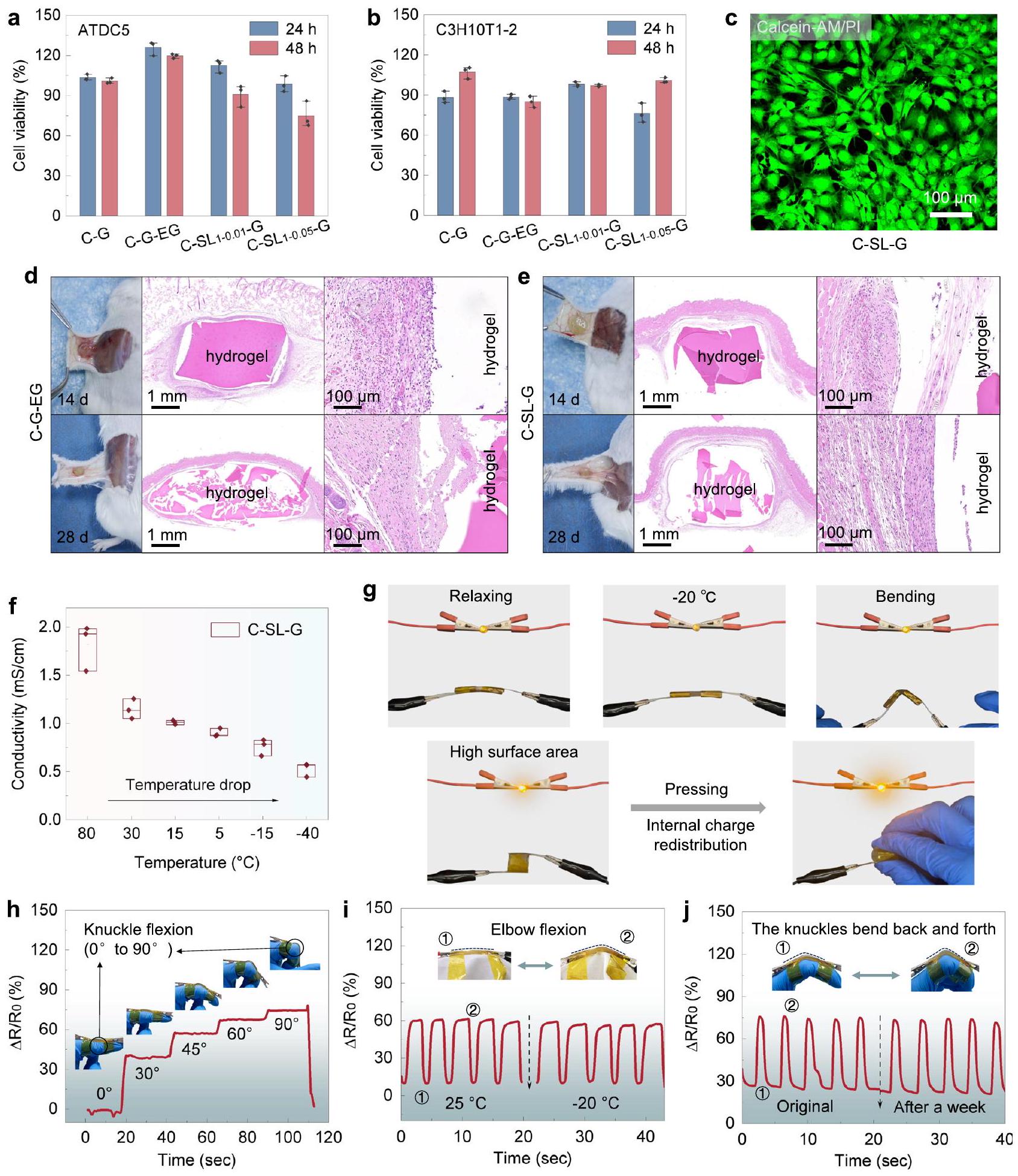
الشكل 5 | تعددية هلامات C-SL-G العضوية. حيوية الخلايا لخلايا ATDC5 (أ) وخلايا C3H1OT1-2 (ب) المزروعة على هلام C-G، C-G-EG، وهلامات C-SL-G العضوية لمدة 24 و48 ساعة. البيانات في و تمثل وسائلهم SDs من عينات مستقلة. صور مجهرية للفلوريسcence التداخلية لخلايا NIH3T3 المزروعة على-G محلول غمر الهيدروجيل العضوي لمدة 48 ساعة. مقياس الرسم،زراعة وصبغ صور C-G-EG (د) و C-SL-G هيدروجيل عضوي (e) تم زراعته تحت الجلد في الفئران لمدة 14 و28 يومًا بعد الزراعة. تم تقييم الاستجابة الالتهابية للزراعة من خلال صبغة HE. f lonic موصلية C-SLالهيدروجيل العضوي عند درجات حرارة مختلفة. الخط المركزيالوسيط؛ حدود الصندوقالرباعيات العليا والسفلى؛ الشعيراتنطاق الربيع الداخليصور C-SLالهيدروجيل العضوي المتصل في حلقات عن طريق الانحناء والضغط، وعندالتغيرات النسبية في المقاومة لـ C-SLالهيدروجيل العضوي تحت تحميل إجهاد متكرر للأصابع تم ثنيها إلى درجات مختلفة (ح) تم ثني مفاصل الكوع للأمام والخلف عند درجات حرارة مختلفة (ط) وتم ثني الأصابع للأمام والخلف عند زاوية معينة بعد تركها لمدة أسبوع (ي). مثل هندسة الأنسجة، تخفيف الاهتزازات، الروبوتات اللينة، والأجهزة القابلة للارتداء الذكية.
طرق
بيان الأخلاقيات
تمت الموافقة على جميع إجراءات الحيوانات من قبل لجنة أخلاقيات تجارب الحيوانات في شركة بحوث اختيار التكنولوجيا الحيوية (هانغتشو) المحدودة (رقم الإذن SYXK (تشجيانغ) 2021-0043). تم الحصول على موافقة مستنيرة من جميع المشاركين أو ممثليهم القانونيين المخولين لهذه الدراسة.
المواد
الكيتوزان (درجة إزالة الأسيتيل)اللزوجةتم شراء ) من شركة شنغهاي علاء الدين للتكنولوجيا الحيوية المحدودة. الجيلاتين (قوة المطاطتم شراء الجيل (g Bloom) من شركة شنغهاي ماكلين للتكنولوجيا الكيميائية المحدودة. تم شراء اللجنين الكرافت (KL) من مصنع جيانغسو للورق. حمض الأسيتيك (HAc، ) ، والفورمالديهايد ( في )، ومحلول بولي (داياليل ثنائي ميثيل الأمونيوم كلوريد) (PDADMAC، في ) تم شراؤها من شركة شنغهاي علاء الدين للتكنولوجيا الحيوية المحدودة. EG ( ) و كبريتات الصوديوم اللامائية والجليسرول ) وكبريتات النحاس (II) اللامائية ( ) وهيدروكسيد الصوديوم ( تم شراء ( ) من شركة شنغهاي سينوفارم للمواد الكيميائية المحدودة. تم شراء خلايا ATDC5 (CL-0856) وخلايا C3H/10T1/2 (CL0325) وخلايا NlH3T3 (CL-0171) من شركة ووهان بريسلا للتكنولوجيا الحيوية المحدودة. تم شراء مادة صبغ الخلايا الحية والميتة، ومادة صبغ الهيماتوكسيلين، ومادة صبغ الإيوزين من شركة شنغهاي بيست بيو للتكنولوجيا الحيوية المحدودة. TGF- الفأريتم شراء مجموعة ELISA من Abcam، والأجسام المضادة لـ TGF-تم تخفيف الأجسام المضادة وحيدة النسيلة بنسبة 1:100 في محلول الفحص. تم الحصول على سلالات الإشريكية القولونية (E. coli، ATCC 25922) والمكورات العنقودية الذهبية (S. aureus، CMCC (B) 26003) من شركة بروميجا. كانت جميع المواد الكيميائية الأخرى من الدرجة التحليلية.
تحضير اللجنوسولفونات
تم سلفنة KL لتحضير اللجنوسولفونات بدرجات مختلفة من السلفنة. باختصار، 0.4 مل منفورمالديهايد، 5.0 جرام من وتم خلط 10 جرام من KL مع 30 مل من الماء المقطر في مفاعل من الفولاذ المقاوم للصدأ سعة 100 مل. تم تسخين المفاعل إلى في حمام زيت واحتفظ به لمدة 3 ساعات للحصول علىمحتوى مجموعة السلفونات فيكان. بالإضافة إلى ذلك، تم وضع 10 جرام من KL في قنينة زجاجية عالية الضغط، 50 مل من محلول NaOHتمت الإضافة والذوبان تحت التحريك المغناطيسي، ثم تمت إضافة 1.5 مل من الفورمالديهايد، وبعد ذلك تم التحريك المغناطيسي عندلـمنتمت الإضافة وتم تسخينها عندلمدة 3 ساعات للحصول علىمحتوى مجموعة السلفونات فيكان.
تحضير هلامات العضوية C-SL-G
تم تحضير هلامات C-SL-G العضوية عن طريق التجلط البسيط وتبادل المذيبات. باختصار، تم قياس الكميات المطلوبة من الكيتوزان. ) وجيلاتين ( تم إذابتها في محلول مائي من حمض الأسيتيك. تم تحريك المحلول فيثم صب في القالب لتشكيل الهيدروجيل المركب C-G الأصلي فيتم غمر الهيدروجيلات المسبقة في تركيزات مختلفة من محاليل SL-EG لمدة تتراوح بين 2-12 ساعة (اعتمادًا على حجم العينة) للحصول على هيدروجيلات عضوية C-SL-G.
توصيفات مختلفة للهيدروجيل والهيدروجيل العضوي
المجهر الإلكتروني الناقل (TEM) والمجهر الإلكتروني الماسح (SEM) لجزيئات اللجنين، هيدروجيل C-G، هيدروجيل C-G-EG العضوي وهيدروجيل C-SL-G (عند 0.01 وتم إجراء دراسات على الهلامات العضوية باستخدام أجهزة JEM-1400 (جيول، اليابان) وQuanta 200 (FEI، الولايات المتحدة الأمريكية) لمراقبة البنية الدقيقة. تم إجراء مطيافية رامان ورسم خرائط رامان المكانية باستخدام مطيافية رامان الفورية المدمجة (LabRAM HR Evolution، هوريبا، فرنسا)، وكانت طول موجة الليزر المستخدم في الإثارة 785 نانومتر، وكان حجم بكسل الصورة هوتم جمع FTIR من العينات باستخدام مطياف FTIR (VERTEX 80 V،
بروكر، ألمانيا) في نطاق الترددات منبإجمالي 32 مسحًا ودقةتم تحديد الخصائص الريولوجية للهلام باستخدام ريو متر مقترن بالأشعة تحت الحمراء الدقيقة (MARS60، ثيرمو فيشر، ألمانيا)، الذي قام بقياس و الهلامات عند قوى القص المختلفة والتردد، وسجلت الـالهلام في نطاق درجة الحرارة منتم اختبار الخصائص الديناميكية الحرارية للهلام باستخدام جهاز DSC 214 Polyma (نتزخ، ألمانيا) بمعدل تدفق نيتروجين. تم إجراء التحليل الإحصائي لإمكانات زيتا وتوزيع حجم الجسيمات بواسطة محلل حجم الجسيمات بالليزر النانوي (Zetasizer Nano ZS، مالفرن باناليتيكال، المملكة المتحدة). تم اختبار درجة سلفنة اللجنين باستخدام جهاز المعايرة التلقائي متعدد الوظائف (CT-1Plus، هوغون، الصين). تم الحصول على طيف XPS بواسطة Thermo Scientific K-Alpha (ثيرمو فيشر، الولايات المتحدة الأمريكية)، والذي استخدم لاستكشاف التركيب الكيميائي وتغيرات طاقة الربط العنصري للهلام. تم إجراء اختبار NMR منخفض المجال باستخدام جهاز NMR VTMR20-010V-T (نيوماغ، الصين)، تم إجراء قياسات الهلام عند تردد رنين بروتون قدره تم اختبار طيف NMR وطيف NMR ثنائي الأبعاد بواسطة مطياف NMR فائق التوصيل رقمي بالكامل بتردد 600 ميغاهيرتز (AVANCE III HD، بروكير بايوسبين، سويسرا). تم إجراء تجارب التعب باستخدام آلة الاختبار LTM 10 (ZwickRoell، ألمانيا)، اختبار تردد عالي عند 10 هرتز واختبار تردد منخفض عند 1 هرتز. تم رسم البيانات باستخدام برنامج OriginPro 2022 SR1 (9.9.0.225).
الإحصائيات وإمكانية التكرار
تم تكرار جميع التجارب بشكل مستقل مع نتائج مشابهة على الأقل ثلاث مرات.
ملخص التقرير
معلومات إضافية حول تصميم البحث متاحة في ملخص تقرير Nature Portfolio المرتبط بهذه المقالة.
توفر البيانات
البيانات التي تدعم نتائج هذه الدراسة متاحة ضمن هذه الورقة و/أو مدرجة في المعلومات التكميلية، ومن المؤلفين المقابلين عند الطلب. يتم توفير بيانات المصدر مع هذه الورقة.
References
Fu, L. L. et al. Cartilage-like protein hydrogels engineered via entanglement. Nature 618, 740-747 (2023).
Feng, Y. H., Wang, Y. F., Chen, C. J., Wang, Z. H. & Liu, J. Bioinspired multiscale regulation for hydrogels with superior mechanics. Innov. Mater. 2, 100105 (2024).
Han, Z. L. et al. A versatile hydrogel network-repairing strategy achieved by the covalent-like hydrogen bond interaction. Sci. Adv. 8, eabl5066 (2022).
Sun, T. L. et al. Physical hydrogels composed of polyampholytes demonstrate high toughness and viscoelasticity. Nat. Mater. 12, 932-937 (2013).
Yu, H. C. et al. Engineering tough metallosupramolecular hydrogel films with kirigami structures for compliant soft electronics. Small 17, e2103836 (2021).
Zhang, Y. S. & Khademhosseini, A. Advances in engineering hydrogels. Science 356, eaaf3627 (2017).
Sun, X. Y. et al. Green regenerative hydrogel wound dressing functionalized by natural drug-food homologous small molecule self-assembled nanospheres. Adv. Funct. Mater. 32, 2106572 (2022).
Jiang, L. B. et al. Salt-assisted toughening of protein hydrogel with controlled degradation for bone regeneration. Adv. Funct. Mater. 29, 1901314 (2019).
Guan, Q. F. et al. Bio-inspired lotus-fiber-like spiral hydrogel bacterial cellulose fibers. Nano Lett. 21, 952-958 (2021).
Freedman, B. R. et al. Enhanced tendon healing by a tough hydrogel with an adhesive side and high drug-loading capacity. Nat. Biomed. Eng. 6, 1167-1179 (2022).
Yu, S. X., Chen, L., Xie, Y. M., Feng, Q. H. & Chen, C. J. Lignin/ polysaccharide composite: A nature-made match toward multifunctional bio-based materials. Prog. Mater. Sci. 148, 101383 (2025).
Zhu, Q. L. et al. Light-steered locomotion of muscle-like hydrogel by self-coordinated shape change and friction modulation. Nat. Commun. 11, 5166 (2020).
Liu, J. J., Qu, S. X., Suo, Z. G. & Yang, W. Functional hydrogel coatings. Natl Sci. Rev. 8, nwaa254 (2021).
Zhang, M. C. et al. Hydrogel muscles powering reconfigurable micro-metastructures with wide-spectrum programmability. Nat. Mater. 22, 1243-1252 (2023).
Li, X., Nakagawa, S., Tsuji, Y., Watanabe, N. & Shibayama, M. Polymer gel with a flexible and highly ordered three-dimensional network synthesized via bond percolation. Sci. Adv. 5, eaax8647 (2019).
Ngai, T., Wu, C. & Chen, Y. Origins of the speckles and slow dynamics of polymer gels. J. Phys. Chem. B 108, 5532-5540 (2004).
Zou, S. B., Therriault, D. & Gosselin, F. P. Spiderweb-inspired, transparent, impact-absorbing composite. Cell Rep. Phys. Sci. 1, 100240 (2020).
Liu, C. et al. Tough hydrogels with rapid self-reinforcement. Science 372, 1078-1081 (2021).
Sun, J. Y. et al. Highly stretchable and tough hydrogels. Nature 489, 133-136 (2012).
Li, Y. X., Yan, J. H., Liu, Y. J. & Xie, X. M. Super tough and intelligent multibond network physical hydrogels facilitated by MXene nanosheets. ACS Nano 16, 1567-1577 (2022).
Meng, X. H. et al. Hysteresis-free nanoparticle-reinforced hydrogels. Adv. Mater. 34, 2108243 (2022).
Lei, W. W. et al. Diffusion-freezing-induced microphase separation for constructing large-area multiscale structures on hydrogel surfaces. Adv. Mater. 31, 1808217 (2019).
Wu, J. Y. et al. Strong and ultra-tough supramolecular hydrogel enabled by strain-induced microphase separation. Adv. Funct. Mater. 33, 2210395 (2023).
Hua, M. T. et al. Strong tough hydrogels via the synergy of freezecasting and salting out. Nature 590, 594-599 (2021).
. et al. Conjoined-network rendered stiff and tough hydrogels from biogenic molecules. Sci. Adv. 5, eaau3442 (2019).
Xu, L. J. et al. A solvent-exchange strategy to regulate noncovalent interactions for strong and antiswelling hydrogels. Adv. Mater. 32, 2004579 (2020).
Dong, X. Y. et al. Strong and tough conductive organo-hydrogels via freeze-casting assisted solution substitution. Adv. Funct. Mater. 32, 2203610 (2022).
Xu, X. W., Jerca, V. V. & Hoogenboom, R. Bioinspired double network hydrogels: from covalent double network hydrogels via hybrid double network hydrogels to physical double network hydrogels. Mater. Horiz. 8, 1173-1188 (2021).
Kamata, H., Akagi, Y., Kayasuga-Kariya, Y., Chung, U. & Sakai, T. Nonswellable” hydrogel without mechanical hysteresis. Science 343, 873-875 (2014).
Wang, S. H. et al. Strong, tough, ionic conductive, and freezingtolerant all-natural hydrogel enabled by cellulose-bentonite coordination interactions. Nat. Commun. 13, 3408 (2022).
Liu, Y. N. et al. Construction of chitosan-based hydrogel incorporated with antimonene nanosheets for rapid capture and elimination of bacteria. Adv. Funct. Mater. 30, 2003196 (2020).
Zhang, Q. et al. Extremely strong and tough chitosan films mediated by unique hydrated chitosan crystal structures. Mater. Today 51, 27-38 (2021).
Scatena, L. F., Brown, M. G. & Richmond, G. L. Water at hydrophobic surfaces: weak hydrogen bonding and strong orientation effects. Science 292, 908-912 (2001).
Li, M. et al. Comprehensive molecules regulation via deep eutectic solvents for ultra-stable zinc metal anode. Angew. Chem. Int. Ed. 62, e202215552 (2023).
Feng, Y. F. et al. Solvent-induced in-situ self-assembly lignin nanoparticles to reinforce conductive nanocomposite organogels as anti-freezing and anti-dehydration flexible strain sensors. J. Chem. Eng. 433, 133202 (2022).
Zhang, X., Liu, W. F., Yang, D. J. & Qiu, X. Q. Biomimetic supertough and strong biodegradable polymeric materials with improved thermal properties and excellent UV-blocking performance. Adv. Funct. Mater. 29, 1806912 (2019).
Wang, Y., Li, F. B., Fang, W. H., Sun, C. L. & Men, Z. W. Study of hydrogen bonding interactions in ethylene glycol-water binary solutions by Raman spectroscopy. Spectrochim. Acta A Mol. Biomol. Spectrosc. 260, 119916 (2021).
Wu, Q. et al. Steady and dynamic rheological behaviors of sodium carboxymethyl cellulose entangled semi-dilute solution with opposite charged surfactant dodecyl-trimethylammonium bromide. J. Colloid Interface Sci. 339, 236-242 (2009).
Jiang, P. et al. 3D Printing of dual-physical cross-linking hydrogel with ultrahigh strength and toughness. Chem. Mater. 32, 9983-9995 (2020).
Afewerki, S. et al. Combined catalysis for engineering bioinspired, lignin-based, long-lasting, adhesive, self-mending, antimicrobial hydrogels. ACS Nano 14, 17004-17017 (2020).
Zhang, L. et al. Cellulose nanofiber-mediated manifold dynamic synergy enabling adhesive and photo-detachable hydrogel for selfpowered E-skin. Nat. Commun. 15, 3859 (2024).
Zhao, Z. G., Fang, R. C., Rong, Q. F. & Liu, M. J. Bioinspired nanocomposite hydrogels with highly ordered structures. Adv. Mater. 29, 1703045 (2017).
Kim, J., Zhang, G. G., Shi, M. X. Z. & Suo, Z. G. Fracture, fatigue, and friction of polymers in which entanglements greatly outnumber cross-links. Science 374, 212-216 (2021).
Sun, W. X. et al. Molecular engineering of metal coordination interactions for strong, tough, and fast-recovery hydrogels. Sci. Adv. 6, eaaz9531 (2020).
Chen, L. H. et al. New insight into lignin aggregation guiding efficient synthesis and functionalization of a lignin nanosphere with excellent performance. Green. Chem. 24, 285-294 (2022).
Wang, J. F., Zhang, D. H. & Chu, F. X. Wood-derived functional polymeric materials. Adv. Mater. 33, 2001135 (2021).
Chen, F. et al. Rational fabrication of anti-freezing, non-drying tough organohydrogels by one-pot solvent displacement. Angew. Chem. Int. Ed. 57, 6568-6571 (2018).
Gao, Y. et al. Critical effect of segmental dynamics in polybutadiene/clay nanocomposites characterized by solid state 1H NMR spectroscopy. J. Phys. Chem. C. 118, 5606-5614 (2014).
Chen, S. J., Wu, G. P., Wang, X. L., Chen, X. X. & Nealey, P. Sub-10 nm feature sizes of disordered polystyrene-block-poly(methyl methacrylate) copolymer films achieved by ionic liquid additives with selectively distributed charge interactions. ACS Appl. Polym. Mater. 2, 427-436 (2020).
Liu, L. L. et al. A Superstrong and reversible ionic crystal-based adhesive inspired by ice adhesion. Angew. Chem. Int. Ed. 60, 8948-8959 (2021).
Di, X., Hou, J. W., Yang, M. M., Wu, G. L. & Sun, P. C. A bio-inspired, ultra-tough, high-sensitivity, and anti-swelling conductive hydrogel strain sensor for motion detection and information transmission. Mater. Horiz. 9, 3057-3069 (2022).
Hu, Y. et al. A “Two-in-One” strategy for flexible aqueous batteries operated at . Adv. Funct. Mater. 32, 2203081 (2022).
Allison, D. P., Hinterdorfer, P. & Han, W. H. Biomolecular force measurements and the atomic force microscope. Curr. Opin. Biotech. 13, 47-51 (2002).
Fisher, T. E., Oberhauser, A. F., Carrion-Vazquez, M., Marszalek, P. E. & Fernandez, J. M. The study of protein mechanics with the atomic force microscope. Trends Biochem. Sci. 24, 379-384 (1999).
Sharmeen, S. et al. Polyethylene glycol functionalized carbon nanotubes/gelatin-chitosan nanocomposite: An approach for significant drug release. Bioact. Mater. 3, 236-244 (2018).
Das, A. K. et al. Lignin – A green material for antibacterial application – A review. Int. J. Biol. Macromol. 261, 129753 (2024).
Ding, Q. L. et al. Environment tolerant, adaptable and stretchable organohydrogels: preparation, optimization, and applications. Mater. Horiz. 9, 1356-1386 (2022).
He, Z. R. & Yuan, W. Z. Adhesive, stretchable, and transparent organohydrogels for antifreezing, antidrying, and sensitive ionic skins. ACS Appl. Mater. 13, 1474-1485 (2021).
Gao, W. J., Inwood, J. P. W. & Fatehi, P. Sulfonation of hydroxymethylated lignin and its application. J. Bioresour. Bioprod. 4, 80-88 (2019).
الشكر والتقدير
نحن ممتنون للدعم المالي من المؤسسة الوطنية للعلوم الطبيعية في الصين (32201500) إلى B.J.، المؤسسة الوطنية للعلوم الطبيعية في الصين (32271797) إلى W.W.، المؤسسة الوطنية للعلوم الطبيعية في الصين (32271811) إلى Y.J.، المؤسسة الوطنية للعلوم الطبيعية في الصين (52273091 و 22461142135) إلى C.C.، مؤسسة العلوم الطبيعية في مقاطعة جيانغسو (BK2O22O431) إلى B.J.، برنامج البحث والتطوير الرئيسي في مقاطعة جيانغسو (BE2O21368) إلى Y.J.، مؤسسة العلوم الطبيعية لمؤسسات التعليم العالي في جيانغسو في الصين (21 KJB 220001) إلى B.J.، مؤسسة العلوم الطبيعية لما بعد الدكتوراه في الصين (2023M731708) إلى B.J.، وصندوق البحث الأساسي للجامعات المركزية من جامعة ووهان (691000003) إلى C.C.
مساهمات المؤلفين
C.C. و B.J. و Y.J. وضعوا المفهوم، ومعالجة التفاصيل الهيكلية وأشرفوا على العمل. قام Y.G. و C.X. بإجراء معظم التجارب وشاركوا في كتابة المخطوطة. قام C.C. و B.J. و Y.J. و Y.G. و C.X. بمراجعة المخطوطة. ساعد Y.W. و J.L. و D.S. في إكمال صور العينات في المخطوطة. ساهم W.W. و L.C. في إعداد العينات
وتحرير المخطوطة. علق جميع المؤلفين على النسخة المقدمة من المخطوطة.
ملاحظة الناشر تظل Springer Nature محايدة فيما يتعلق بالمطالبات القضائية في الخرائط المنشورة والانتماءات المؤسسية.
الوصول المفتوح هذه المقالة مرخصة بموجب رخصة المشاع الإبداعي للاستخدام غير التجاري، والمشاركة، والتوزيع، وإعادة الإنتاج في أي وسيلة أو صيغة، طالما أنك تعطي الائتمان المناسب للمؤلفين الأصليين والمصدر، وتوفر رابطًا لرخصة المشاع الإبداعي، وتوضح إذا قمت بتعديل المادة المرخصة. ليس لديك إذن بموجب هذه الرخصة لمشاركة المواد المعدلة المشتقة من هذه المقالة أو أجزاء منها. الصور أو المواد الأخرى من طرف ثالث في هذه المقالة مشمولة في رخصة المشاع الإبداعي للمقالة، ما لم يُذكر خلاف ذلك في سطر ائتمان للمادة. إذا لم تكن المادة مشمولة في رخصة المشاع الإبداعي للمقالة واستخدامك المقصود غير مسموح به بموجب اللوائح القانونية أو يتجاوز الاستخدام المسموح به، ستحتاج إلى الحصول على إذن مباشرة من صاحب حقوق الطبع والنشر. لعرض نسخة من هذه الرخصة، قم بزيارة http:// creativecommons.org/licenses/by-nc-nd/4.0/.
(ج) المؤلفون 2024
مركز التعاون في جيانغسو للمعالجة الفعالة واستخدام موارد الغابات، كلية صناعة الضوء وهندسة الغذاء، جامعة نانجينغ للغابات، نانجينغ 210037، الصين. مختبر الكيمياء والبيولوجيا البيئية لموارد الكتلة الحيوية في هوبى، مركز أبحاث الهندسة في مقاطعة هوبى لمواد الطلاء الوظيفية الناشئة، مدرسة علوم الموارد والبيئة، جامعة ووهان، ووهان 430079، الصين. ساهم هؤلاء المؤلفون بالتساوي: يي هوي غو، تشاو شيو. البريد الإلكتروني: jinyongcan@njfu.edu.cn; bjiang@njfu.edu.cn; chenchaojili@whu.edu.cn
Compressible, anti-fatigue, extreme environment adaptable, and biocompatible supramolecular organohydrogel enabled by lignosulfonate triggered noncovalent network
Received: 19 April 2024
Accepted: 16 December 2024
Published online: 02 January 2025
Check for updates
Yihui Gu , Chao Xu , Yilin Wang , Jing Luo , Dongsheng Shi , Wenjuan Wu , Lu Chen , Yongcan Jin ⊕, Bo Jiang & Chaoji Chen ⊗
Achieving a synergy of biocompatibility and extreme environmental adaptability with excellent mechanical property remains challenging in the development of synthetic materials. Herein, a “bottom-up” solution-interfaceinduced self-assembly strategy is adopted to develop a compressible, antifatigue, extreme environment adaptable, biocompatible, and recyclable organohydrogel composed of chitosan-lignosulfonate-gelatin by constructing noncovalent bonded conjoined network. The ethylene glycol/water solvent induced lignosulfonate nanoparticles function as bridge in chitosan/gelation network, forming multiple interfacial interactions that can effectively dissipate energy. The organohydrogel exhibits high compressive strength ( 54 MPa ) and toughness and 70 times higher than those of pure chitosan/ gelatin hydrogel, meanwhile, excellent self-recovery and fatigue resistance properties. Even when subjected to severe compression up to a strain of 0.5 for 500,000 cycles, the organohydrogel still remains intact. This organohydrogel also demonstrates notable biocompatibility both in vivo and vitro, environment adaptability at low temperature, as well as recyclability. Such all natural organohydrogel provides a promising route towards the development of highperformance load-bearing materials.
Soft load-bearing tissues (muscles, ligaments, cartilage) possess precisely tuned mechanical properties that enable them to withstand body stress and endure repeated cycles of stretching and movement . To mimic the soft, tough, and impact-resistant properties of soft loadbearing tissues, hydrogels based on noncovalent bonding (hydrogen bonding , ionic bond , ligand bonding , etc.) have been widely
explored. By integrating a range of these noncovalent interactions into the hydrogel network, the resulting hydrogels exhibit enhanced mechanical properties including high tensile and compressive strength, as well as high Young’s modulus. However, a common limitation among many of these hydrogels is the absence of a mechanism for rapid recovery after deformation. Conventional physically
crosslinked multi-networks and hybrid networks typically exhibit a lengthy recovery cycle when stressed. While some long polymer chain hydrogels can recover quickly, they often suffer from reduced strength due to their intrinsic interactions . Consequently, synthesizing load-bearing materials that meet all the requirements for biomedical applications remains a formidable challenge. Biocompatibility, biodegradability, and extreme-environment-adaptability are essential requirements for load-bearing materials, while the materials must also be strong enough to resist physical stresses and support normal human activities.
From a sustainability perspective, abundant and non-toxic biomass materials such as chitosan , gelatin proteins , cellulose , and sodium alginate have flourished in the biomedical field, while it is often difficult to achieve high mechanical properties with a single material. Therefore, researchers often make up for their shortcomings by compositing a variety of natural materials with mechanical properties far exceeding those obtained from simple mixtures of their respective constituent materials . This approach relies on tightly coupled separated phases with significant differences in modulus, which ensure limited inelastic deformation, bridging, and effective energy dissipation to achieve the working mechanism of “hard-phase reinforcement and hard-soft-phase synergistic toughening”. The combination of stiffness, toughness, strength, and fatigue resistance in hydrogels allows for diverse applications, such as soft robots , implantable devices , and artificial muscle cartilage . Nevertheless, synthesizing hydrogel materials with multiple mechanical properties remains challenging as high stiffness, toughness, and fast recovery often present conflicting requirements.
In recent years, numerous methods have emerged for improving the structure of hydrogels to increase their strength and toughness, including the construction of homogeneous networks , the introduction of sacrificial bonds , nanomaterials composites , and induced microphase separation . Among these approaches, two of the most effective methods involve improving network homogeneity and employing sacrificial bonds. Constructing a homogeneous gel network serves to mitigate stress concentration and improve compressive strength and toughness to some extent. However, this approach has limited effectiveness for materials that already contain cracks or imperfections. Sacrificial bonding, on the other hand, utilizes the non-uniformity of the gel network to generate energy dissipation. Typical examples are the construction of bi-network gels with heterogeneous structures and complementary properties, where highly crosslinked rigid frameworks can efficiently dissipate energy by breaking bonds, while sparsely crosslinked ductile frameworks can withstand a wide range of strains, but the increase in rigidity is often at the cost of a decrease in toughness . The reinforcing and toughening effect of hydrogels is usually limited for specific methods of structural improvement.
Unlike conventional bi-networks, we designed a connected network organohydrogel with enhanced interactions and synergistic dissipative mechanisms to tune the time-domain expression of noncovalent interactions between bi-networked polymers. This approach was achieved by incorporating nanoparticles and inducing microphase separation through a straightforward solvent exchange strategy. Specifically, we employed a feasible “soaking” method in lignosulfonate-ethylene glycol (SL-EG) solution to transform weak chitosan-gelatin ( C – G ) composite hydrogels into robust chitosan-lignosulfonate-gelatin (C-SL-G) linked-network organohydrogels (Fig. 1a). Chitosan serves as the hard phase to enhance the mechanical strength of the organohydrogels, inhibit the rate of crack expansion during fracture, and maintain the integrity of the material. Gelatin, on the other hand, functions as the ductile soft phase to take up most of the load in the event of molecular strand breakage of the chitosan chains. The differences in the distribution states of the polymers in water and EG were utilized to modulate the interfacial interaction
forces across the network, inducing the formation of a uniform and robust polymer network . The resulting C-SL-G organohydrogel can be compressed up to 0.9 without rupture, and maintain the original shape even after undergoing repeated 500,000 cycles at strain of 0.5 (Fig. 1b, c). Notably, the resultant tough organohydrogels display noticeable resistance to icing and offer moisturizing properties, attributed to the non-volatile nature of EG. Moreover, the C-SL-G organohydrogel with all natural components facilitates scalability through a straightforward and green “soaking” method, enabling the material and process with good sustainability, recyclability, and cost effectiveness for commercialization and large-scale application (Fig. 1c, d and Supplementary Tables 1-5). The commendable biocompatibility and biodegradability of chitosan, gelatin, and lignin, coupled with the excellent mechanical strength, fatigue resistance, and extreme environmental adaptability, open up an avenue for the advancement of robust interconnected biomedical hydrogels. Furthermore, this strategy has the potential for extension to other solvents such as lignin-glycerol solution and metal ion-EG/glycerol solution to prepare resilient multifunctional organohydrogels suitable for various applications.
Results
Construction, structure, and morphology of C-SL-G organohydrogels based on conjoined network
To obtain organohydrogels crosslinked with SL and EG, we employed a gel soaking strategy. Initially, a combination of gelatin and chitosan was heated and stirred until dissolved to obtain a mixed solution, which was then cooled by low temperature to obtain a soft and brittle C-G composite hydrogel. Subsequently, hydrogels were immersed in SL-EG solution to obtain C-SL-G organohydrogels (Supplementary Fig. 1). During the soaking process, the SL particles infiltrate to act as intermediary crosslinking points involved in the noncovalent crosslinking of the polymer network . The process is accompanied by a noticeable color change from light yellow to dark brown, reflecting the introduction of SL into the gel interior during solvent exchange (Supplementary Fig. 2). Thus, the salt concentration of C-SL-G organohydrogels can be easily adjusted by modifying the fabrication conditions, such as sample size and immersion time. These results demonstrate the excellent performance of dual network linked organohydrogels. The inexpensive substrate and simple preparation process make it more competitive for commercialization and large-scale application (Supplementary Fig. 1). The developed organohydrogel also demonstrates excellent recyclability (Supplementary Fig. 3). Through a simple procedure involving solvent exchange with water under heating and stirring conditions, a uniformly mixed solution of the organohydrogel components can be obtained. In addition, owing to the fracture/reconstruction characteristics of noncovalent bonds, the hydrogel can be further reconstituted through water evaporation and gelatinization. Finally, immersion of this regenerated hydrogel into EG for sufficient solvent exchange leads to the regeneration of organohydrogel.
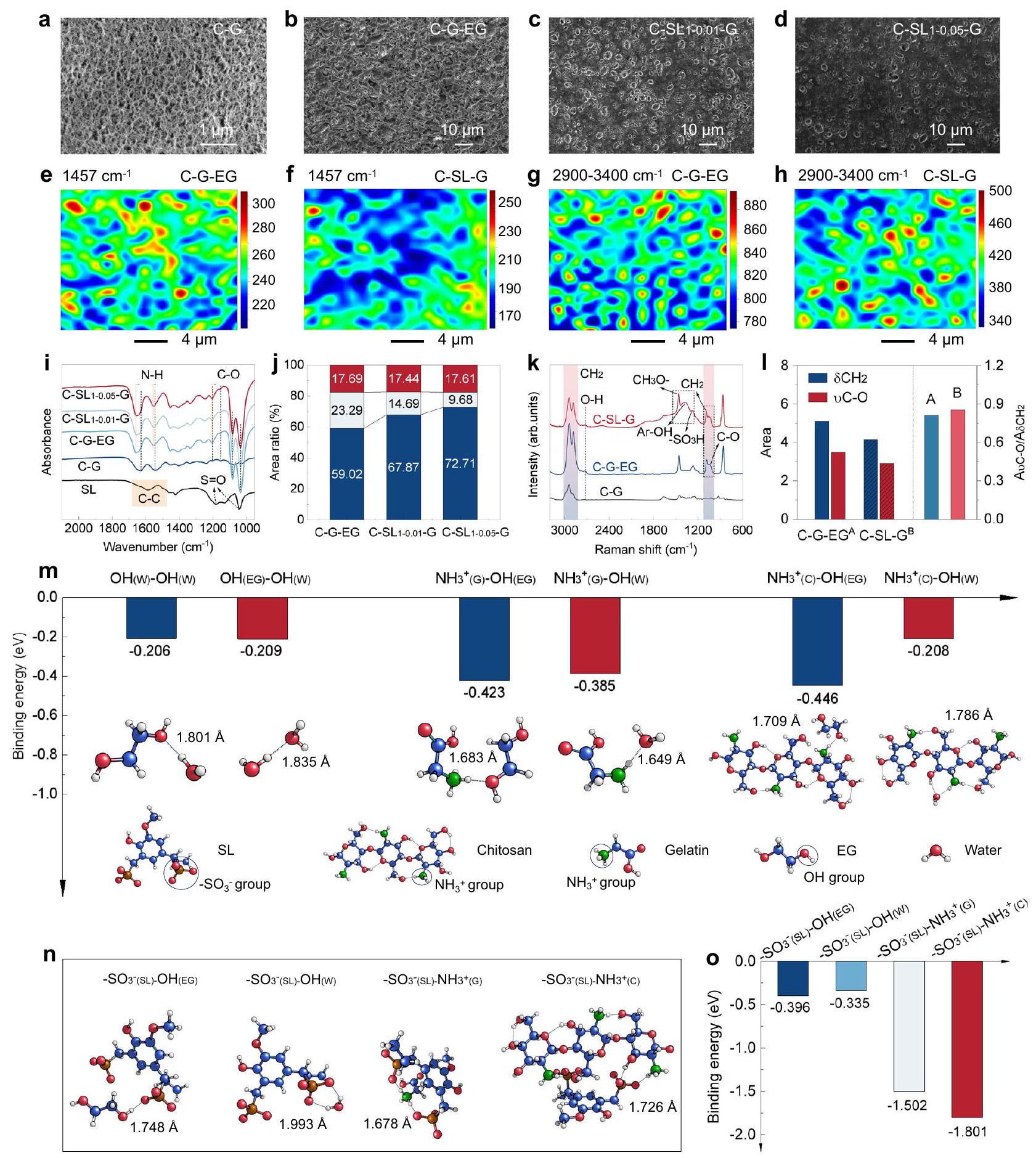
Scanning electron microscopy (SEM) was performed to observe the morphological structure of the gels. The pristine C-G hydrogels showed a continuous honeycomb-like porous structure with thin walls (Fig. 2a). The increased swelling degree after solvent exchanges with EG (Supplementary Fig. 4) reveals EG molecules can penetrate the interior network structure, leading to volume expansion and stretching of the polymer network. However, the EG penetration also resulted in a rough morphology (Fig. 2b and Supplementary Fig. 5a) . Upon the introduction of lignin, the structure of C-SL-G organohydrogels became denser and more stable, as demonstrated in Fig. 2c, d and Supplementary Fig. 5b, c. The addition of lignin makes it act as a bridging molecule to provide abundant crosslinking points with polymer chains through strong noncovalent bonds, thus leading to a dense structure for C-SL-G organohydrogels.
Fig. 1 | Construction strategy and key features of the C-SL-G organohydrogels. a Schematic representation of the preparation of C-SL-G organohydrogels.
b Optical images of the C-SL-G organohydrogel in compressed and released states. c Radar chart of the combined benefits of C-SL-G organohydrogels, dual-network
organohydrogels, and biomass composite hydrogels (where ‘ 1 ‘ represents the type of SL, and ‘ 0.01 ‘ signifies the initial concentration of the immersion solvent in mL ). d Optical image of the C-SL-G organohydrogel.
The distribution of EG and SL within the polymer network was investigated using two-dimensional Raman analysis (Fig. 2e-h and Supplementary Fig. 6). The C-H bending vibration at , as well as the stretching vibration and stretching vibration at , provided insights into the distribution of the EG structure. Comparative analysis reveals a higher EG content in the C-GEG organohydrogel compared to the C-SL-G organohydrogel, possibly
attributed to the inhibitory influence of . The crosslinking density of C-SL-G organohydrogels was higher compared to C-G-EG organohydrogels without SL (Supplementary Fig. 7). This observation clearly demonstrates that SL acts as a reinforcing agent in the subtle interaction with the polymer network, which is further confirmed by X-ray diffraction (XRD). Supplementary Fig. 8 depicts the XRD spectra of chitosan, gelatin, C-G-EG and C-SL-G organohydrogels, showcasing
Fig. 2 | Structure and morphology features of the conjoined-network organohydrogels. Representative SEM images of original C-G hydrogel (a), C-G-EG (b) and C-SL-G organohydrogels with SL-EG immersion by supercritical drying. Two-dimensional (2D) Raman images of C-SL-G organohydrogels without SL (e) and with SL (f) obtained from the bending vibrations of C-H bonds . Two-dimensional (2D) Raman images of C-SL-G organohydrogels without and with obtained from the stretching vibration and stretching vibration (2900-3400 cm ). i FTIR spectra of SL, C-G hydrogel, C-G-EG, and C-SL-G organohydrogels. j Ratio of bulk molecules, clustered EG- , and
isolated EG in three groups of organohydrogels. Raman analysis of C-G, C-G-EG, and C-SL-G organohydrogels. 1 Area and proportion of C-O band symmetric stretching vibration and band rocking ( ). Calculation of binding energy and energy-optimized geometries of noncovalent bonding between OH (EG), OH (water), (chitosan), (gelatin) by DFT. n Energy-optimized geometries of noncovalent bonding between and (water), (chitosan), (gelatin), respectively, obtained by theoretical calculations from DFT studies. o Calculation of binding energy between (SL) and OH (EG), OH (water), (chitosan), (gelatin), respectively by DFT.
sharper characteristic peaks at , indicative of a more organized structure facilitated by SL embedding .
Fourier transform infrared (FTIR), X-ray photoelectron spectroscopy (XPS) and Raman spectroscopy were performed to get a
comprehensive understanding of the interactions between lignin, bisolvent, chitosan, and gelatin (Fig. 2i-l, Supplementary Figs. 9, 10 and Supplementary Tables 6-8). The red shift of the C-O peak at after the introduction of EG, alongside the slight shift of
the characteristic peaks of N-H at 1629 and towards lower wavelengths after the introduction of lignin, confirm the generation of hydrogen bonding. To verify the role of EG, we fitted the C-G-EG, , and located in the range of the characteristic peaks of 2500-4000 . In the C-G-EG organohydrogel, a peak located at confirms the presence of strong hydrogen bonding between EG and molecules . With the incorporation of SL , the wavenumber of the O-H stretching vibration gradually increases, while the intensity gradually decreases and broadens. The higher wavenumber suggests elevated energy of O-H bonds, attributed to the destruction of hydrogen bonds between EG and water by hydrophilic SL. The ratio of the two conformations, calculated from the fitted peak areas, reveals insights into the FTIR spectra. Following the introduction of SL, the associated O-H content increases to and , respectively. This indicates that the addition of lignin leads to the enhancement of bulk hydrogen bonding operation in the system. Furthermore, the binding energy strength of the -OH and of chitosan, as observed in XPS, decreases with the introduction of lignin, which provides compelling evidence of strong noncovalent bonding interactions between and -OH and in chitosan and gelatin .
To further verify the crucial roles of EG and lignin within this system, laser Raman was employed to investigate the EG-H2O system in organohydrogels (Fig. 2k). Firstly, in the gel system containing lignin, the obviously attenuated EG characteristic peaks are similar to the FTIR results. The area ratio of symmetric stretching vibration to rocking vibration peaks as shown in Fig. 21 reveals significant changes after the introduction of . The introduction of SL hinders the formation of intermolecular EG- hydrogen bonding and forms a large number of hydrogen bonds with solvent molecules and the polymer network. Consequently, the C-O symmetric stretching vibration of EG molecules exhibits a notable increase, attributed to the release of the hydroxyl groups in molecules and the weakening of the hydroxyl groups in the water molecules. As shown in Supplementary Fig. 11, the introduction of EG and SL into the aqueous chitosan-gelatin solution increases the energy storage modulus ( ) and complex viscosity ( ) in the platform region. The and values for the C-SL-G organohydrogel samples peak in the platform region, indicating that the densest physically crosslinked network based on noncovalent bonding is formed in the presence of .
The density functional theory (DFT) simulations show that the hydroxyl groups in EG exhibit stronger binding energies with chitosan and gelatin than the interactions between water molecules and polymer networks (Fig. 2m). This strong interaction fosters hydrogen bonding between EG and polymers. In the structural model, the bond energies between EG and gelatin/chitosan molecules are -0.423 eV and -0.446 eV , respectively, greater than those observed between water molecules and gelatin/chitosan, indicating that they are more likely to bond and form a more compatible molecular structure with the polymer chain . In Fig. 2n and o, the binding energies of and (chitosan and gelatin) in lignin are -1.801 eV and -1.502 eV , respectively, much higher than those between other structures. The corresponding bond lengths are and , respectively, lower than EG/water molecules. These findings suggest that the SL is able to crosslink quickly and efficiently with the polymer network in solvent substitution to form stronger interactions, enhancing the overall structure of the polymer network. Therefore, lignin molecules serve as crosslinking points or physical fillers in the polymer network. These new crosslinking points or fillers provide additional mechanical support, thereby increasing the deformation resistance of the hydrogel and improving its morphological stability.
Mechanical properties of the C-SL-G conjoined-network organohydrogels
The interconnected network formed among chitosan, gelatin, SL, and EG might contribute to the excellent mechanical properties of C-SL-G
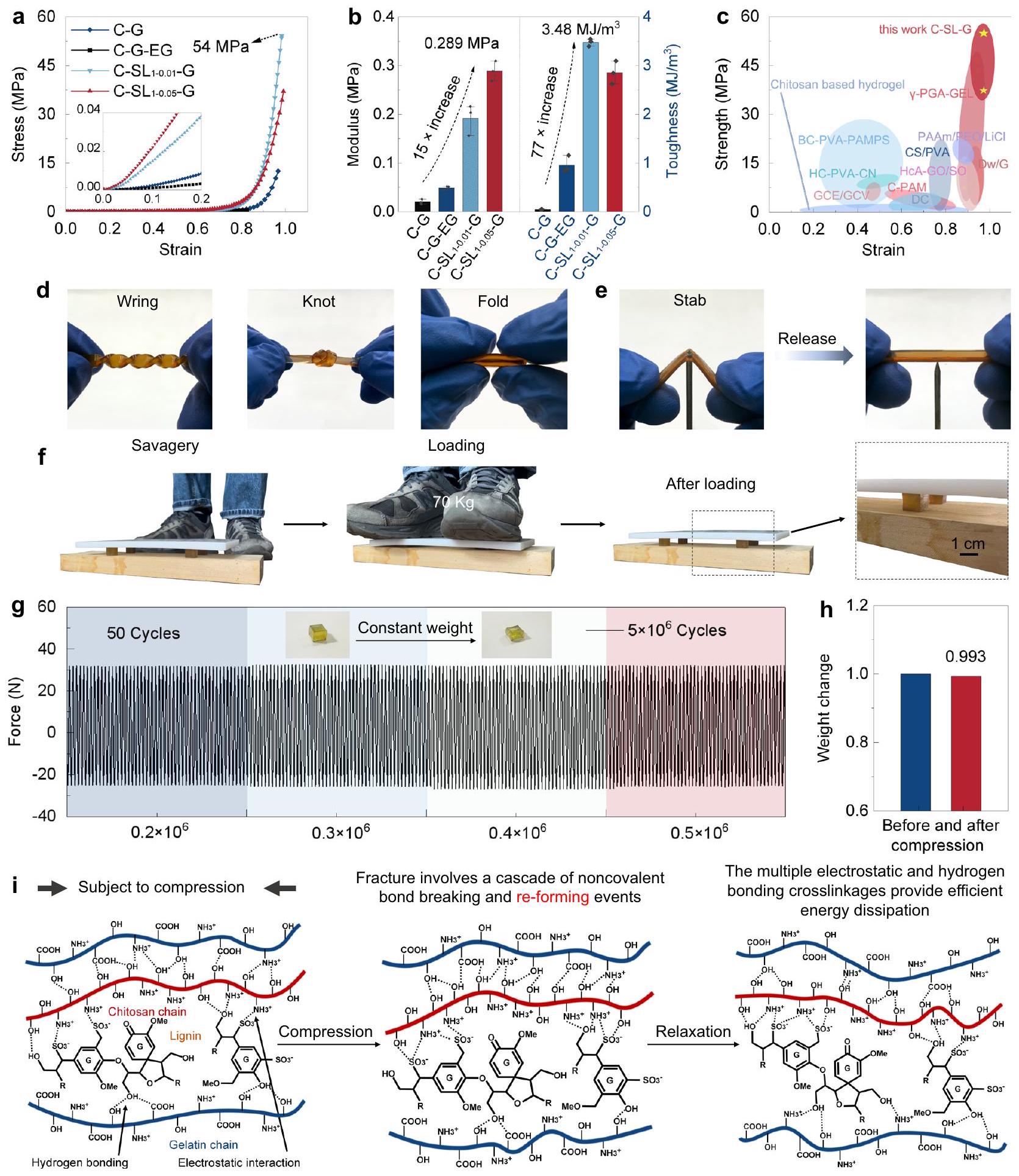
organohydrogels, rendering them well-suited for use as load-bearing materials. The compression strength of the C-SL-G conjoined-network organohydrogel can be readily tuned by adjusting the concentration of the immersion solution. As shown in Fig. 3a, the compressive strength of the hydrogel reaches a maximum of 54 MPa after being immersed in -EG solution, which is about 100 times higher than that of the original C-G hydrogel ( 0.52 MPa ). Furthermore, a substantial enhancement in compressive toughness is attained, representing an approximate increase of 70 times (Fig. 3b). Notably, the mechanical properties of C-SL-G organohydrogel surpass those of other biopolymer gels and organohydrogels, and even exceed those of natural cartilage. Due to its unique dual network structure, a combination of high rigidity and high toughness is achieved (Fig. 3c and Supplementary Tables 9, 10).
The elastic modulus of C-SL-G organohydrogels increases with the rise in lignin content. The gel stiffness is positively correlated with the lignin content within a certain range, influenced by the benzene ring structure of lignin rigidity. EG enhances the hydrogen bonding between polymer networks. When glycerol, which contains three hydroxyl groups, is chosen for solvent exchange, the resulting hydrogels exhibit higher compressive strength, modulus, and toughness compared to the C-G-EG organohydrogel (Supplementary Fig. 12). This highlights the crucial role of hydrogen bonding within the system. With the introduction of lignin in the gel network, strong interfacial interactions are developed. Lignin acts as shared interconnection points that reinforce the gel network and interweave with each other, effectively dispersing the stress throughout system. Conversely, hydrogels with a higher proportion of SL exhibit decreased compressive strength and toughness due to lignin’s self-aggregation, causing uneven stress dispersion throughout the network and limiting the mechanical properties of the organohydrogels . This also explains the trend of increasing and then decreasing tensile properties of organohydrogels (Supplementary Fig. 13). The rheological behavior of the organohydrogels further supports these findings. The and loss modulus ( ) gradually increase with the introduction of EG and SL, exhibiting their higher stiffness or rigidity. Moreover, the gradual increase in the composite viscosity suggests the gradual enhancement of intermolecular interactions in the organohydrogels. These results underscore the effective enhancement of mechanical properties and stability achieved through the incorporation of EG and SL (Supplementary Figs. 14 and 15).
Figure 3d illustrates the good deformability and resilience of the C-SL-G organohydrogel, which can be easily twisted, knotted, folded and easily withstands a weight of 500 g with minimal deformation (Supplementary Fig. 16). Figure 3e shows pictures of the puncture deformation test, clearly demonstrating that the C-SL-G organohydrogel can endure high levels of localized stress without visible damage or permanent deformation, underscoring its excellent mechanical properties combining both high strength and toughness. Moreover, when four gels of the same size in length, width, and height) are used as a stand, the upper portion supporting a flat plate can bear the weight of a 70 kg human body, which is equivalent to 3500 times the weight of a single gel itself (Fig. 3f).
Furthermore, the macro- and microstructural analysis of the material during compression were conducted using small-angle X-ray scattering (SAXS) and wide-angle X-ray scattering (WAXS) (Supplementary Figs. 17 and 18). The size Gaussian distribution curves are calculated by SAXS one-dimensional intensity distribution. Our findings reveal that the introduction of SL results in smaller and more spatially dense pores, unaffected by the compression process, suggesting that numerous hydrogen bonds are continuously broken and reorganized. WAXS analysis indicates the presence of a highly crystalline structure. With the compression strain increasing, the scattering patterns still show a strong amorphous scattering ring, confirming that the compression process does not induce the formation of an
Fig. 3 | Mechanical properties of the C-SL-G organohydrogels. a Compressive stress-strain curves (inset shows magnified plot in the low-strain region) and b modulus and compressive toughness of the hydrogel after soaking in solutions at various concentrations. Values in represent their means ± SDs from independent samples. c Comparison plots of C-SL-G organohydrogels in this work with other tough hydrogels by strength versus strain. d Photographs of the C-SL-G organohydrogel subjected to various external forces. e Photographs of the C-SL-G organohydrogel pierced with nails. Photograph of the C-SL-G
organohydrogel supporting the weight of a human body in which the structure maintains intact after loading. g Force-frequency curve of the C-SL-G organohydrogel over 500,000 consecutive spaceless loading-unloading cycles at constant strain . h Weight change of the C-SL-G organohydrogel with 500,000 successive loading-unloading cycles without interval under a constant strain . i Mechanism diagram of self-recovery and anti-fatigue ability: during compression-recovery, noncovalent bond breaks, and new bonds were formed.
oriented structure. In addition, a unique peak at indicates a lattice spacing of in the pristine state and in the compressed state, suggesting that unidirectional compressive stress leads to a longer lattice spacing.
Interestingly, by introducing in addition to lignin, the robust metal coordination bond is leveraged, known for its good toughening properties. This dual reinforcement approach results in even more notable mechanical properties for organohydrogels, with compressive
strength reaching up to 60 MPa and tensile strength up to 0.7 MPa , as shown in Supplementary Fig. 19. This highlights the significant impact of noncovalent bonds in improving the mechanical properties of the gels .
Achieving ultrahigh self-resilience and fatigue resistance is paramount for gels to maintain daily cyclic loading and longevity. As a loadbearing material, C-SL-G organohydrogel requires sufficient modulus to maintain structural stability . At compression strains of 0.5 and 0.6 , the C-SL-G organohydrogel maintains excellent stability with negligible mass change even after 500,000 and 200,000 highfrequency compression cycles, respectively (Fig. 3g, h and Supplementary Fig. 20). This is also verified in 100,000 high-frequency tensile cycles (Supplementary Fig. 21). Notably, even at strain as high as 0.8, the C-SL-G organohydrogel maintains a stable structure after 3000 high-frequency compression cycles, demonstrating its excellent fatigue resistance. The compressed C-SL-G organohydrogel can also rapidly recover, proving its self-recovery properties (Supplementary Fig. 22). The mechanical properties of C-SL-G organohydrogels were thoroughly investigated by uninterrupted cyclic loading-unloading tests under multiple conditions. Even when subjected to a high compression ratio of above 0.9 , the samples consistently maintain high load-bearing capacity and stable weight (Supplementary Fig. 23). Meanwhile, they exhibit high mechanical properties in the unilateral notch test and can resist crack extension, which verifies their excellent damage and fatigue resistance under high pressure loading (Supplementary Fig. 24).
At compressive strain of , and 0.6 , the organohydrogel shows minimal hysteresis loops and excellent elasticity (Supplementary Fig. 25a, b). Supplementary Fig. 25c and d summarize the recovery behavior of -G organohydrogel after different relaxation times. The recovery ability of the organohydrogel maintains at a high level (>88%) for five consecutive time periods, indicating that the broken hydrogen bonds and electrostatic forces can be basically restored to the original state within a certain timeframe. Moreover, in successive cycles at a constant strain, numerous hysteresis lines were observed in consecutive cycles, with subsequent cycles exhibiting lower energy dissipation but consistent presence of hysteresis lines. This suggests that successive reorganizations of noncovalent bonds can partially restore the material (Supplementary Figs. 25e, f and 26-28). These results imply that the disrupted amino-SL electrostatic crosslinked structural domains and the amino-EG hydrogen-bonded crosslinked structural domains can be reasonably restored to their original or otherwise accessible positions within a relatively short time after compression (Fig. 3i and Supplementary Fig. 29) .
Strengthening mechanisms of the C-SL-G organohydrogels
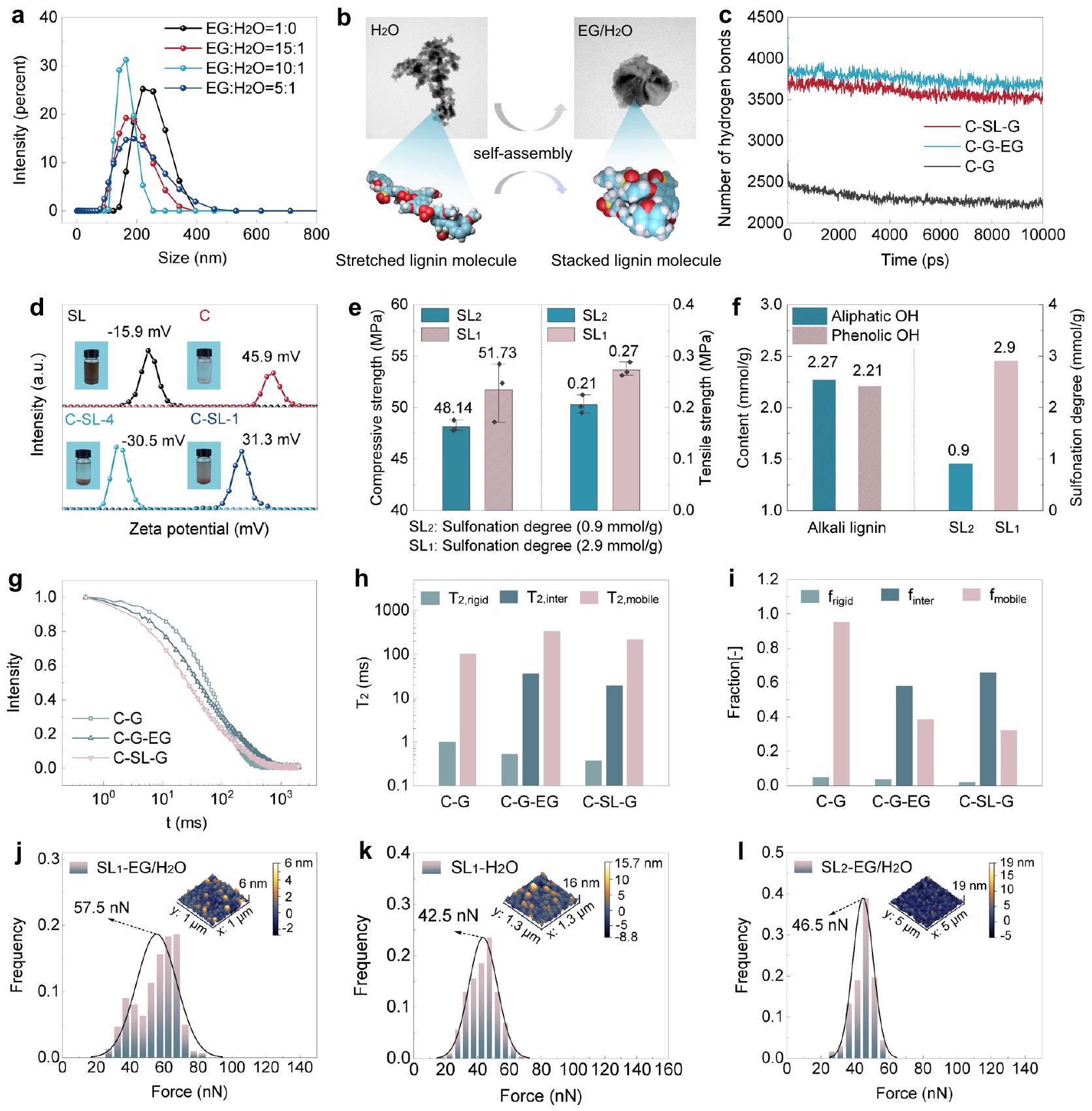
Theoretical studies have suggested that SL acts as a reinforcing phase (mechanical strength) in polymer composites. To gain a deeper understanding of how the components synergistically contribute to the mechanical properties of C-SL-G organohydrogels, we investigated the morphological changes of lignin introduced into the gel using particle size analysis and transmission electron microscopy (TEM) (Fig. 4a, b). The results reveal that during the self-assembly process, lignin molecules undergo a transformation into spherical particles. This transformation is attributed to long-range interaction forces, particularly stacking and hydrogen bonding. The polarity difference between the components contributes to the formation of these spherical particles, leading to a reduction in the average particle size from 240 nm to . In addition, the interfacial cohesion and structural stability of C-SL-G composites were investigated by molecular dynamics simulations (Supplementary Data 1). The number of hydrogen bonds and the intermolecular correlations are analyzed in 20 ns . These simulations reveal that the intermolecular interactions between the two different components of the gel are C-SL-G G-EG, as shown in Supplementary Fig. 30. Likewise, the number of
hydrogen bonds is C-SL-G > C-G-EG > C-G, as shown in Fig. 4c. The specific energies and the number of hydrogen bonds are presented in Supplementary Table 11. The intra-polymer and inter-polymer interactions in this exogel constructed by solvent exchange strategy are initially suppressed due to the presence of EG but recovered in the presence of lignin, leading to optimization and re-crosslinking of the polymer network. The success of this approach relies on a suitable solvent, which helps to stretch the polymer conformation and homogenize the network .
Zeta potential measurement was carried out to evaluate the change of electric potential after lignin introduction (Fig. 4d), which provides evidence of electrostatic interaction between lignin and chitosan. The charge of the chitosan solution gradually decreases with SL addition. This indicates that there is a strong electrostatic interaction between SL and chitosan. To demonstrate the important role of sulfonic acid groups in the enhancement of toughening, two kinds of lignin nanoparticles with different sulfonation ( ) were prepared. The success of the modification was confirmed through infrared analysis (Supplementary Fig. 31), and the structure of the two kinds of lignin, as well as the content of phenolic hydroxyl and sulfonate groups, were analyzed and quantified by two-dimensional nuclear magnetic resonance (2D-NMR), NMR spectrometry, and potentiometric titration, respectively (Fig. 4e and Supplementary Figs. 32, 33). The sulfonation does not change the phenolic hydroxyl content because the reaction sites occurred in the and positions of the lignin phenylpropane structure, and the with a high degree of sulfonation ( ) was found to be more advantageous in compressive and tensile test (Fig. 4f and Supplementary Fig. 34). This discovery offers compelling evidence that sulfonate groups play a pivotal role in strengthening lignin, thereby enhancing toughness.
Low-field NMR spectroscopy was used to investigate the presence state of water within the gel and the interaction between water and polymer (Fig. ). The relatively rapid free induction decay (FID) of the C-SL-G organohydrogel can be attributed to the SL in the network that acts as crosslinking points, generating a large number of noncovalent crosslinks (the rigid component), which results in a rapidly decaying FID signal. A linear combination of the Weibull function and two exponential functions was applied to fit the FID data, allowing for the determination of apparent spin relaxation time ( ) values and their relative fractions , and represent the relaxation times of the rigid, intermediate, and mobile components, respectively, and the , and represent the corresponding proton fractions, respectively. The values of all three gels were lower than , indicating a strong interaction between the polymer and the solvent. is the main form of water in the C-G hydrogel, representing the free water that is not tightly bonded to the polymer. After solvent exchange, the appearance of the three fractions may be caused by the relatively weak binding between EG and water (compared with the interaction between polymer and water). The migration of water with higher degree of freedom to water with lower degree of freedom indicates that the water in the sample becomes more tightly bound to the polymer. The , rigid decreases with the introduction of EG and SL, and the , inter of the C-SL-G organohydrogel is only of that of the C-G-EG organohydrogel. This suggests that the EG restricts the solvent molecules within the hydrogel and forms a weak bond with the polymer, while the SL introduction further causes restricted solvent movement and strengthens the interaction between the gel network and the solvent molecules .
To quantitatively assess the intermolecular interactions between chitosan and SL, atomic force microscopy (AFM) was conducted (Fig. 4j-I), where smooth spin-coated SL-H2O/EG , and ) surfaces were tapped with a chitosan coated silicon probe, respectively. The adhesion force between the tip and the contacting surfaces was recorded during the separation process, with each measurement repeated for 500 times to obtain the contours of the
Fig. 4 | Enhanced mechanisms of the C-SL-G organohydrogels. a The particle size changes before and after the introduction of SL into the gel were simulated. TEM images of lignin and conformations of lignin molecules in different solvents. Blue, red, yellow, and white represent C, O, S, and H elements, respectively. c The number of hydrogen bonds of C-G hydrogel, C-G-EG, and C-SL-G organohydrogels. d Zeta potential change of SL introduction into chitosan solution. e Primitive alkali lignin hydroxyl group content and two SL sulfonate group contents. Values in e represent
their means SDs from independent samples. Compressive and tensile strengths of two SL-based organohydrogels. g-i Low-field NMR spectroscopy. Fully refocused NMR FID (g) of C-G hydrogel, C-G-EG and C-SL-G organohydrogels. Fitting results of the fully refocused NMR FID: and of the three gels. j-I Intermolecular interaction forces between lignin and chitosan in and EG. The insets are scanned topographic maps of lignin particles under different solvents.
force frequency distribution . The interaction between dissolved in EG and chitosan was stronger ( 57.5 nN ) compared to that in the aqueous solution ( 42.5 nN ), suggesting that the introduction of EG significantly improved the interfacial interactions between the polymer networks. In contrast, with a lower sulfonation degree ( ), which was also dissolved in EG, exhibited a weaker interaction with chitosan compared to that with a high sulfonation degree ( ). This further proves the essential role of sulfonate groups in improving mechanical properties. In summary, the addition of SL ( ) with abundant oxygen-
containing functional groups into the gel network forms a strong physical crosslinking network through noncovalent interactions. The insets in Fig. 4j-1 are scanned topographic maps of lignin particles under different solvents, where lignin nanoparticles with small size can be observed. This observation is consistent with TEM results (Supplementary Fig. 35), indicating that the large lignin particles with hundred nanometers are composed of loosely aggregated small lignin nanoparticles. This underscores the effectiveness of solvent transformation in facilitating noncovalent interactions, offering a straightforward yet potent strategy for enhancing the design of gels.
Fig. 5 | Versatility of the C-SL-G organohydrogels. Cell viability of ATDC5 cells (a) and C3H1OT1-2 cells (b) cultured on the C-G hydrogel, C-G-EG, and C-SL-G organohydrogels for 24 and 48 h . Data in and represent their means SDs from independent samples. c Confocal fluorescence microscopy images of NIH3T3 cells cultured on -G organohydrogel immersion solution for 48 h . Scale bar, . Grafting and staining images of C-G-EG (d) and C-SL -G organohydrogel (e) subcutaneously implanted in mice for 14 and 28 days after implantation. Inflammatory response to the implants was assessed by HE staining. f lonic
conductivity of C-SL organohydrogel at different temperatures. Center line median; box limits upper and lower quartiles; whiskers interquartile range ( ). g Photographs of C-SL organohydrogel connected into loops by bending, pressing, and at . Relative resistance changes of C-SL organohydrogel under repetitive strain loading for fingers were flexed to different degrees (h) elbow joints were flexed back and forth at different temperatures (i) and fingers were flexed back and forth at a certain angle after being left for a week (j).
such as tissue engineering, vibration dampening, soft robotics, and smart wearable devices.
Methods
Ethics statement
All animal procedures were approved by the Animal Experimentation Ethics Committee of Research Selection Biotechnology (Hangzhou) Co., LTD (permission number SYXK (Zhejiang) 2021-0043). Informed consent has been obtained from all participants or their legally authorized representatives for this study.
Materials
Chitosan (deacetylation degree , viscosity ) was purchased from Shanghai Aladdin Biochemical Technology Co., Ltd. Gelatin (gum strength g Bloom) was purchased from Shanghai Maclean Biochemical Technology Co., Ltd. Kraft lignin (KL) was purchased from Jiangsu Paper Mill. Acetic acid (HAc, ), and formaldehyde ( in ), and poly (diallyl dimethylammonium chloride) solution (PDADMAC, in ) were purchased from Shanghai Aladdin Biochemical Technology Co., Ltd. EG ( ), and anhydrous sodium sulfite , and glycerol ( ), and copper(II) sulfate anhydrous ( ), and sodium hydroxide ( ) were purchased from Shanghai Sinopharm Chemical Reagent Co., Ltd. ATDC5 cells (CL-0856), and C3H/10T1/2 cells (CL0325), and NlH3T3 cells (CL-0171) were purchased from Wuhan Pricella Biotechnology Co., Ltd. Live-dead staining reagent, and hematoxylin, and eosin staining reagents were purchased from Shanghai Bestbio Biotechnology, Co., Ltd. Mouse TGF- ELISA Kit was purchased from Abcam, and the anti-TGF- monoclonal antibody was diluted at a ratio of 1:100 in Assay Buffer. The strains of Escherichia coli (E. coli, ATCC 25922) and Staphylococcus aureus (S. aureus, CMCC (B) 26003) were obtained from Promega. All other chemicals were of analytical grade.
Preparation of lignosulfonates
KL was sulfonated to prepare lignosulfonates with different degrees of sulfonation. Briefly, 0.4 mL of formaldehyde, 5.0 g of and 10 g of KL were mixed with 30 mL of deionized water in a 100 mL stainless steel reactor. The reactor was heated to in an oil bath and kept for 3 h to obtain . The content of sulfonate group in was . In addition, 10 g of KL was put into a high-pressure glass flask, 50 mL of NaOH solution was added and dissolved under magnetic stirring, then 1.5 mL of formaldehyde was added, and after magnetic stirred at for of was added and heated at for 3 h to obtain . The content of sulfonate group in was .
Preparation of C-SL-G organohydrogels
C-SL-G organohydrogels were prepared by simple gelation and solvent exchange. Briefly, the required amounts of chitosan ( ) and gelatin ( ) were dissolved in acetic acid aqueous solution . The solution was stirred at and then poured into the mold to form the original C-G composite hydrogel at . The preformed hydrogels were further immersed in different concentrations of SL-EG solutions for 2-12 h (depending on sample size) to obtain C-SL-G organohydrogels.
Characterizations of different hydrogels and organohydrogels
TEM and SEM of lignin particles, C-G hydrogel, C-G-EG organohydrogel and C-SL-G (at 0.01 and ) organohydrogels were conducted using JEM-1400 (JEOL, Japan) and Quanta 200 (FEI, USA) instruments to observe the microstructure. Raman spectroscopy and spatial Raman mapping were performed utilizing confocal in situ Raman spectroscopy (LabRAM HR Evolution, Horiba, France), the wavelength of the excitation laser was 785 nm , and the image pixel size was . FTIR of the samples were collected with FTIR spectrometer (VERTEX 80 V ,
Bruker, Germany) in the frequency range of with a total of 32 scans and a resolution of . The rheological characteristics of the gels were determined by a micro-infrared coupled rheometer (MARS60, Thermo Fisher, Germany), which measured the and of the gels at different shear forces and frequency, and recorded the of the gels in the temperature range of . Thermodynamic properties of the gels were tested by using DSC 214 Polyma (Netzsch, Germany) at a nitrogen flow rate of . Statistical analysis of zeta potential and particle size distribution were performed by nano-laser particle size analyzer (Zetasizer Nano ZS, Malvern Panalytical, UK). The lignin sulfonation degree was tested using multifunctional automatic titrator (CT-1Plus, Hogon, China). XPS spectroscopy was obtained by Thermo Scientific K-Alpha (Thermo Fisher, USA), used to explore the chemical composition and the element binding energy changes of gels. Low-field NMR test was conducted using the VTMR20-010V-T NMR instrument (Niumag, China), measurements of the gels were conducted at a proton resonance frequency of NMR spectroscopy and 2D-NMR spectroscopy were tested by 600 MHz fully digital superconducting NMR spectrometer (AVANCE III HD, Bruker BioSpin, Switzerland). Fatigue experiments were carried out using LTM 10 testing machine (ZwickRoell, Germany), high-frequency testing at 10 Hz and lowfrequency testing at 1 Hz . Data were plotted using OriginPro 2022 SR1 (9.9.0.225) software.
Statistics and reproducibility
All experiments were repeated independently with similar results at least three times.
Reporting summary
Further information on research design is available in the Nature Portfolio Reporting Summary linked to this article.
Data availability
The data that support the findings of this study are available within this paper and/or included in the Supplementary Information, and from the corresponding authors upon request. Source data are provided with this paper.
References
Fu, L. L. et al. Cartilage-like protein hydrogels engineered via entanglement. Nature 618, 740-747 (2023).
Feng, Y. H., Wang, Y. F., Chen, C. J., Wang, Z. H. & Liu, J. Bioinspired multiscale regulation for hydrogels with superior mechanics. Innov. Mater. 2, 100105 (2024).
Han, Z. L. et al. A versatile hydrogel network-repairing strategy achieved by the covalent-like hydrogen bond interaction. Sci. Adv. 8, eabl5066 (2022).
Sun, T. L. et al. Physical hydrogels composed of polyampholytes demonstrate high toughness and viscoelasticity. Nat. Mater. 12, 932-937 (2013).
Yu, H. C. et al. Engineering tough metallosupramolecular hydrogel films with kirigami structures for compliant soft electronics. Small 17, e2103836 (2021).
Zhang, Y. S. & Khademhosseini, A. Advances in engineering hydrogels. Science 356, eaaf3627 (2017).
Sun, X. Y. et al. Green regenerative hydrogel wound dressing functionalized by natural drug-food homologous small molecule self-assembled nanospheres. Adv. Funct. Mater. 32, 2106572 (2022).
Jiang, L. B. et al. Salt-assisted toughening of protein hydrogel with controlled degradation for bone regeneration. Adv. Funct. Mater. 29, 1901314 (2019).
Guan, Q. F. et al. Bio-inspired lotus-fiber-like spiral hydrogel bacterial cellulose fibers. Nano Lett. 21, 952-958 (2021).
Freedman, B. R. et al. Enhanced tendon healing by a tough hydrogel with an adhesive side and high drug-loading capacity. Nat. Biomed. Eng. 6, 1167-1179 (2022).
Yu, S. X., Chen, L., Xie, Y. M., Feng, Q. H. & Chen, C. J. Lignin/ polysaccharide composite: A nature-made match toward multifunctional bio-based materials. Prog. Mater. Sci. 148, 101383 (2025).
Zhu, Q. L. et al. Light-steered locomotion of muscle-like hydrogel by self-coordinated shape change and friction modulation. Nat. Commun. 11, 5166 (2020).
Liu, J. J., Qu, S. X., Suo, Z. G. & Yang, W. Functional hydrogel coatings. Natl Sci. Rev. 8, nwaa254 (2021).
Zhang, M. C. et al. Hydrogel muscles powering reconfigurable micro-metastructures with wide-spectrum programmability. Nat. Mater. 22, 1243-1252 (2023).
Li, X., Nakagawa, S., Tsuji, Y., Watanabe, N. & Shibayama, M. Polymer gel with a flexible and highly ordered three-dimensional network synthesized via bond percolation. Sci. Adv. 5, eaax8647 (2019).
Ngai, T., Wu, C. & Chen, Y. Origins of the speckles and slow dynamics of polymer gels. J. Phys. Chem. B 108, 5532-5540 (2004).
Zou, S. B., Therriault, D. & Gosselin, F. P. Spiderweb-inspired, transparent, impact-absorbing composite. Cell Rep. Phys. Sci. 1, 100240 (2020).
Liu, C. et al. Tough hydrogels with rapid self-reinforcement. Science 372, 1078-1081 (2021).
Sun, J. Y. et al. Highly stretchable and tough hydrogels. Nature 489, 133-136 (2012).
Li, Y. X., Yan, J. H., Liu, Y. J. & Xie, X. M. Super tough and intelligent multibond network physical hydrogels facilitated by MXene nanosheets. ACS Nano 16, 1567-1577 (2022).
Meng, X. H. et al. Hysteresis-free nanoparticle-reinforced hydrogels. Adv. Mater. 34, 2108243 (2022).
Lei, W. W. et al. Diffusion-freezing-induced microphase separation for constructing large-area multiscale structures on hydrogel surfaces. Adv. Mater. 31, 1808217 (2019).
Wu, J. Y. et al. Strong and ultra-tough supramolecular hydrogel enabled by strain-induced microphase separation. Adv. Funct. Mater. 33, 2210395 (2023).
Hua, M. T. et al. Strong tough hydrogels via the synergy of freezecasting and salting out. Nature 590, 594-599 (2021).
. et al. Conjoined-network rendered stiff and tough hydrogels from biogenic molecules. Sci. Adv. 5, eaau3442 (2019).
Xu, L. J. et al. A solvent-exchange strategy to regulate noncovalent interactions for strong and antiswelling hydrogels. Adv. Mater. 32, 2004579 (2020).
Dong, X. Y. et al. Strong and tough conductive organo-hydrogels via freeze-casting assisted solution substitution. Adv. Funct. Mater. 32, 2203610 (2022).
Xu, X. W., Jerca, V. V. & Hoogenboom, R. Bioinspired double network hydrogels: from covalent double network hydrogels via hybrid double network hydrogels to physical double network hydrogels. Mater. Horiz. 8, 1173-1188 (2021).
Kamata, H., Akagi, Y., Kayasuga-Kariya, Y., Chung, U. & Sakai, T. Nonswellable” hydrogel without mechanical hysteresis. Science 343, 873-875 (2014).
Wang, S. H. et al. Strong, tough, ionic conductive, and freezingtolerant all-natural hydrogel enabled by cellulose-bentonite coordination interactions. Nat. Commun. 13, 3408 (2022).
Liu, Y. N. et al. Construction of chitosan-based hydrogel incorporated with antimonene nanosheets for rapid capture and elimination of bacteria. Adv. Funct. Mater. 30, 2003196 (2020).
Zhang, Q. et al. Extremely strong and tough chitosan films mediated by unique hydrated chitosan crystal structures. Mater. Today 51, 27-38 (2021).
Scatena, L. F., Brown, M. G. & Richmond, G. L. Water at hydrophobic surfaces: weak hydrogen bonding and strong orientation effects. Science 292, 908-912 (2001).
Li, M. et al. Comprehensive molecules regulation via deep eutectic solvents for ultra-stable zinc metal anode. Angew. Chem. Int. Ed. 62, e202215552 (2023).
Feng, Y. F. et al. Solvent-induced in-situ self-assembly lignin nanoparticles to reinforce conductive nanocomposite organogels as anti-freezing and anti-dehydration flexible strain sensors. J. Chem. Eng. 433, 133202 (2022).
Zhang, X., Liu, W. F., Yang, D. J. & Qiu, X. Q. Biomimetic supertough and strong biodegradable polymeric materials with improved thermal properties and excellent UV-blocking performance. Adv. Funct. Mater. 29, 1806912 (2019).
Wang, Y., Li, F. B., Fang, W. H., Sun, C. L. & Men, Z. W. Study of hydrogen bonding interactions in ethylene glycol-water binary solutions by Raman spectroscopy. Spectrochim. Acta A Mol. Biomol. Spectrosc. 260, 119916 (2021).
Wu, Q. et al. Steady and dynamic rheological behaviors of sodium carboxymethyl cellulose entangled semi-dilute solution with opposite charged surfactant dodecyl-trimethylammonium bromide. J. Colloid Interface Sci. 339, 236-242 (2009).
Jiang, P. et al. 3D Printing of dual-physical cross-linking hydrogel with ultrahigh strength and toughness. Chem. Mater. 32, 9983-9995 (2020).
Afewerki, S. et al. Combined catalysis for engineering bioinspired, lignin-based, long-lasting, adhesive, self-mending, antimicrobial hydrogels. ACS Nano 14, 17004-17017 (2020).
Zhang, L. et al. Cellulose nanofiber-mediated manifold dynamic synergy enabling adhesive and photo-detachable hydrogel for selfpowered E-skin. Nat. Commun. 15, 3859 (2024).
Zhao, Z. G., Fang, R. C., Rong, Q. F. & Liu, M. J. Bioinspired nanocomposite hydrogels with highly ordered structures. Adv. Mater. 29, 1703045 (2017).
Kim, J., Zhang, G. G., Shi, M. X. Z. & Suo, Z. G. Fracture, fatigue, and friction of polymers in which entanglements greatly outnumber cross-links. Science 374, 212-216 (2021).
Sun, W. X. et al. Molecular engineering of metal coordination interactions for strong, tough, and fast-recovery hydrogels. Sci. Adv. 6, eaaz9531 (2020).
Chen, L. H. et al. New insight into lignin aggregation guiding efficient synthesis and functionalization of a lignin nanosphere with excellent performance. Green. Chem. 24, 285-294 (2022).
Wang, J. F., Zhang, D. H. & Chu, F. X. Wood-derived functional polymeric materials. Adv. Mater. 33, 2001135 (2021).
Chen, F. et al. Rational fabrication of anti-freezing, non-drying tough organohydrogels by one-pot solvent displacement. Angew. Chem. Int. Ed. 57, 6568-6571 (2018).
Gao, Y. et al. Critical effect of segmental dynamics in polybutadiene/clay nanocomposites characterized by solid state 1H NMR spectroscopy. J. Phys. Chem. C. 118, 5606-5614 (2014).
Chen, S. J., Wu, G. P., Wang, X. L., Chen, X. X. & Nealey, P. Sub-10 nm feature sizes of disordered polystyrene-block-poly(methyl methacrylate) copolymer films achieved by ionic liquid additives with selectively distributed charge interactions. ACS Appl. Polym. Mater. 2, 427-436 (2020).
Liu, L. L. et al. A Superstrong and reversible ionic crystal-based adhesive inspired by ice adhesion. Angew. Chem. Int. Ed. 60, 8948-8959 (2021).
Di, X., Hou, J. W., Yang, M. M., Wu, G. L. & Sun, P. C. A bio-inspired, ultra-tough, high-sensitivity, and anti-swelling conductive hydrogel strain sensor for motion detection and information transmission. Mater. Horiz. 9, 3057-3069 (2022).
Hu, Y. et al. A “Two-in-One” strategy for flexible aqueous batteries operated at . Adv. Funct. Mater. 32, 2203081 (2022).
Allison, D. P., Hinterdorfer, P. & Han, W. H. Biomolecular force measurements and the atomic force microscope. Curr. Opin. Biotech. 13, 47-51 (2002).
Fisher, T. E., Oberhauser, A. F., Carrion-Vazquez, M., Marszalek, P. E. & Fernandez, J. M. The study of protein mechanics with the atomic force microscope. Trends Biochem. Sci. 24, 379-384 (1999).
Sharmeen, S. et al. Polyethylene glycol functionalized carbon nanotubes/gelatin-chitosan nanocomposite: An approach for significant drug release. Bioact. Mater. 3, 236-244 (2018).
Das, A. K. et al. Lignin – A green material for antibacterial application – A review. Int. J. Biol. Macromol. 261, 129753 (2024).
Ding, Q. L. et al. Environment tolerant, adaptable and stretchable organohydrogels: preparation, optimization, and applications. Mater. Horiz. 9, 1356-1386 (2022).
He, Z. R. & Yuan, W. Z. Adhesive, stretchable, and transparent organohydrogels for antifreezing, antidrying, and sensitive ionic skins. ACS Appl. Mater. 13, 1474-1485 (2021).
Gao, W. J., Inwood, J. P. W. & Fatehi, P. Sulfonation of hydroxymethylated lignin and its application. J. Bioresour. Bioprod. 4, 80-88 (2019).
Acknowledgements
We are grateful for the financial support from the National Natural Science Foundation of China (32201500) to B.J., the National Natural Science Foundation of China (32271797) to W.W., the National Natural Science Foundation of China (32271811) to Y.J., the National Natural Science Foundation of China ( 52273091 and 22461142135 ) to C.C., the Natural Science Foundation of Jiangsu Province (BK2O22O431) to B.J., the Jiangsu Provincial Key Research and Development Program (BE2O21368) to Y.J., the Natural Science Foudation of the Jiangsu Higher Education Institutions of China ( 21 KJB 220001 ) to B.J., the China Postdoctoral Science Foundation (2023M731708) to B.J., and the Fundamental Research Funds for the Central Universities from Wuhan University (691000003) to C.C.
Author contributions
C.C., B.J., and Y.J. conceived the concept, processing, structure details and supervised the work. Y.G. and C.X. carried out most experiments and co-wrote the manuscript. C.C., B.J., Y.J., Y.G. and C.X. revised the manuscript. Y.W., J.L. and D.S. assisted in completing the photographs of samples in the manuscript. W.W. and L.C. contributed to the sample
preparation and manuscript editing. All authors commented on the submitted version of the manuscript.
Correspondence and requests for materials should be addressed to Yongcan Jin, Bo Jiang or Chaoji Chen.
Peer review information Nature Communications thanks Kai Tao and the other, anonymous, reviewers for their contribution to the peer review of this work. A peer review file is available.
Publisher’s note Springer Nature remains neutral with regard to jurisdictional claims in published maps and institutional affiliations.
Open Access This article is licensed under a Creative Commons Attribution-NonCommercial-NoDerivatives 4.0 International License, which permits any non-commercial use, sharing, distribution and reproduction in any medium or format, as long as you give appropriate credit to the original author(s) and the source, provide a link to the Creative Commons licence, and indicate if you modified the licensed material. You do not have permission under this licence to share adapted material derived from this article or parts of it. The images or other third party material in this article are included in the article’s Creative Commons licence, unless indicated otherwise in a credit line to the material. If material is not included in the article’s Creative Commons licence and your intended use is not permitted by statutory regulation or exceeds the permitted use, you will need to obtain permission directly from the copyright holder. To view a copy of this licence, visit http:// creativecommons.org/licenses/by-nc-nd/4.0/.
(c) The Author(s) 2024
Jiangsu Co-Innovation Center of Efficient Processing and Utilization of Forest Resources, College of Light Industry and Food Engineering, Nanjing Forestry University, Nanjing 210037, China. Hubei Biomass-Resource Chemistry and Environmental Biotechnology Key Laboratory, Hubei Provincial Engineering Research Center of Emerging Functional Coating Materials, School of Resource and Environmental Sciences, Wuhan University, Wuhan 430079, China. These authors contributed equally: Yihui Gu, Chao Xu. e-mail: jinyongcan@njfu.edu.cn; bjiang@njfu.edu.cn; chenchaojili@whu.edu.cn