وجهات نظر الطلاب حول استخدام تقنيات الذكاء الاصطناعي التوليدي في التعليم العالي Student perspectives on the use of generative artificial intelligence technologies in higher education

المجلة: International Journal for Educational Integrity، المجلد: 20، العدد: 1
DOI: https://doi.org/10.1007/s40979-024-00149-4
تاريخ النشر: 2024-02-08

وجهات نظر الطلاب حول استخدام تقنيات الذكاء الاصطناعي التوليدي في التعليم العالي

هيذر جونستون ريبيكا ف. ويلز إليزابيث م. شانكس تيموثي بوي وبرايوني ن. بارسونز ©

*المراسلات:
bparsons@liverpool.ac.uk
المكتبات والمتاحف والمعارض، جامعة ليفربول، ليفربول L69 3DA، المملكة المتحدة

الملخص

كان الهدف من هذا المشروع هو فهم وجهات نظر الطلاب حول تقنيات الذكاء الاصطناعي التوليدي (GAI) مثل Chat generative Pre-Trained Transformer (ChatGPT)، من أجل إبلاغ التغييرات على مدونة الممارسات الأكاديمية لجامعة ليفربول. تم إنشاء الاستبيان لهذه الدراسة بواسطة فريق من طلاب المكتبة وتمت مراجعته من خلال مجموعات التركيز. شارك ما مجموعه 2555 طالبًا في الاستبيان. أظهرت النتائج أن 7% فقط من الطلاب الذين استجابوا لم يسمعوا عن أي تقنيات GAI، بينما استخدم أكثر من نصفهم أو فكروا في استخدام هذه التقنيات لأغراض أكاديمية. كان معظم الطلاب (54.1%) داعمين أو داعمين إلى حد ما لاستخدام أدوات مثل Grammarly، لكن 70.4% كانوا غير داعمين أو غير داعمين إلى حد ما تجاه استخدام الطلاب لأدوات مثل ChatGPT لكتابة مقالاتهم بالكامل. كان الطلاب الذين لديهم مستويات أعلى من الثقة في كتابتهم الأكاديمية أقل احتمالًا لاستخدامها أو التفكير في استخدامها لأغراض أكاديمية، وكانوا أيضًا أقل احتمالًا لدعم استخدام الطلاب الآخرين لها. كما اعتقد معظم الطلاب (41.1%) أنه يجب أن تكون هناك سياسة شاملة على مستوى الجامعة بشأن متى تكون هذه التقنيات مناسبة أو غير مناسبة للاستخدام. تشير نتائج هذا البحث إلى أن الطلاب يحتاجون إلى سياسات واضحة بشأن استخدام GAI وأنه يجب عدم حظر هذه التقنيات من الجامعة، ولكن يجب مراعاة ضمان وصول مجموعات مختلفة من الطلاب إلى هذه التقنيات بشكل متساوٍ.

الكلمات الرئيسية: الذكاء الاصطناعي، الذكاء الاصطناعي التوليدي، التكنولوجيا المساعدة، التعليم العالي، المهارات الأكاديمية، شات جي بي تي، النزاهة الأكاديمية

مقدمة

نظرًا للتغيرات في مجال الذكاء الاصطناعي وظهور تقنيات الذكاء الاصطناعي التوليدي الجديدة مثل نموذج المحادثة المدرب مسبقًا (ChatGPT)، لم يعد مدونة السلوك الحالية والدليل الإلكتروني حول النزاهة الأكاديمية في جامعة ليفربول ملائمًا للغرض واحتاجت إلى التحديث.
من أجل اتباع نهج يركز على الطالب في هذه السياسة، تم إطلاق مشروع لجمع آراء الطلاب حول هذه التقنيات. كان الهدف هو فهم كيف يستخدم الطلاب هذه التقنيات حاليًا، وما إذا كانت ثقتهم في الكتابة قد تأثرت.
تأثير ذلك على استخدامهم أو آرائهم حول التقنيات، وكيف يعتقدون أن الجامعة يجب أن تستجيب لها فيما يتعلق بالعمل الأكاديمي.

مراجعة الأدبيات

تُعرَّف النزاهة الأكاديمية بأنها “الصدق في العمل الأكاديمي وتحمل المسؤولية” (East وDonnelly 2012). تم التفكير جيدًا في العديد من جوانب النزاهة الأكاديمية، من الانتحال إلى الغش التعاقدي، والتحديات المرتبطة بها لكل من الطلاب والمعلمين في الأدبيات الموجودة. تم إجراء أبحاث كمية ونوعية في هذا المجال منذ أوائل القرن العشرين (Lancaster 2021)، مع التركيز في الأبحاث الحديثة على النزاهة الأكاديمية في عصر الرقمية.
اقترح إيفرينغ ومورمان (2012، ص. 35) أنه نظرًا لتغير البيئة الرقمية، فإن مفهوم ما يشكل الانتحال أو خرق النزاهة الأكاديمية يحتاج إلى “إعادة فحص”. وقد لاحظت دراسات مختلفة (هاوارد وديفيس 2009؛ ويليامز 2007) أن الاستخدام المتزايد للأدوات الرقمية لاكتشاف المعلومات زاد من احتمال قيام الطلاب بتمثيل الأفكار والمعلومات على أنها تخصهم.
منذ ذلك الحين، اتسع البحث حول النزاهة الأكاديمية، مع ظهور خدمات كتابة المقالات، وخدمات الواجبات المخصصة، ومواقع المشاركة بين الأقران، وأدوات إعادة الصياغة عبر الإنترنت التي توسع النقاش (أودري 2020). يعرف أودري (2020، ص. 231) الطيف الكامل بشكل أوسع على أنه است outsourcing الواجبات – “فعل حصول الطالب على واجبه من طرف آخر”. لقد تسببت هذه الخدمات في مشاكل للجامعات، التي لا يمكنها الاعتماد على برامج الكشف التقليدية عن الانتحال لاكتشاف المساهمات المكتوبة بواسطة هذه التطبيقات، وتكافح لنقل ما يشكل الغش للطلاب. كما يؤكد روجرسون وماكارثي (2017) أن هذه الأدوات تمثل مشكلة جوهرية، حيث أن جوهر النزاهة الأكاديمية، وأيضًا الكتابة الأكاديمية كمهارة، هو قدرة الطلاب على “إعادة صياغة، وإطار، وإعادة بيان أفكار ونوايا المؤلفين الأصليين أنفسهم مع الاعتراف المناسب بالمصادر”. ومع ذلك، اقترحت أبحاث هاريسون وآخرون (2020) أن الطلاب يعتقدون أن هناك فرقًا كبيرًا بين دفع شخص ما لكتابة مقال لهم، واستخدام مواقع “مساعد الدراسة” حيث يستخدمون مواد تم تحميلها من قبل أقرانهم، والتي لا يعتبرونها غير نزيهة ويدركون أنها أقل خطرًا.
بالإضافة إلى التغيير في توفر التقنيات لطلاب الجامعات على مدار العقد الماضي، كان هناك أيضًا تغيير في خصائص الطلاب الذين يلتحقون بالجامعة. عادةً ما يكون طلاب الجيل Z قد استخدموا مجموعة من التقنيات منذ صغرهم، ولديهم أنماط تفكير وطرق عمل مختلفة مقارنةً بالأجيال السابقة. تشير بولاكوفا وكليموفا (2019) إلى أن لديهم فترة انتباه محدودة ويفضلون في المثالي قراءة أقل من نص والحصول على النقاط الرئيسية بأسرع ما يمكن. يتفق شيمكوياك وآخرون (2021) على أن هذه الجيل أكثر نفادًا للصبر ويميل إلى استخدام التقنيات التي توفر لهم الراحة والقدرة على القيام بمهام متعددة. يمكن أن يشجع هذا النقص في الصبر على الغش، حيث يركز الجيل Z بشكل أساسي على النتيجة النهائية، بدلاً من تجربة التعلم. ومع وجود بيئة عبر الإنترنت حيث ينتشر الانتحال، كما يجادل فلوم وآخرون (2021)، أصبح الغش معيارًا اجتماعيًا مقبولًا أكثر.
أميغود (2019) وأميغود ولانكستر (2019، ص. 102) بحثا في الأسباب التي قد تدفع الطلاب إلى الاستعانة بمصادر خارجية لأعمالهم الأكاديمية بشكل ما. وقد وجدا أن “المثابرة كانت السبب الرئيسي للاستعانة بمصادر خارجية”، حيث أن الطلاب
وجد الطلاب أن الواجبات مملة ومتعبة، وأصبحوا محبطين من الجهد المطلوب لإكمالها. تلا ذلك ما يسمى بـ “القدرة الأكاديمية”، حيث كان الطلاب يعانون من مستوى الصعوبة أو المهارات اللازمة لإكمال المهمة. شملت الأسباب الأخرى نقص الانضباط الذاتي والدافع، والمشاكل الشخصية/الطبية، والصعوبة في التوازن مع أولويات أخرى مثل العمل أو الأسرة. بشكل عام، استنتجوا أن الطلاب الذين استخدموا خدمات استئجار الواجبات عادة ما وصلوا إلى نقطة اعتبروا فيها أن “الفوائد المحتملة للغش تفوق التكاليف” (ص. 104). وجد بريمبل (2016، ص. 378) أسبابًا مشابهة، وأشار أيضًا إلى أن السلوك غير النزيه أصبح بشكل متزايد “القاعدة” ويُنظر إليه تقريبًا على أنه ضروري لمواكبة الأقران. وجد بريتاج وآخرون (2018) أن الغش عن طريق العقود كان الأكثر انتشارًا بين الطلاب الأصغر سنًا، والذين لم تكن الإنجليزية لغتهم الأم، والذين كانوا غير راضين عن التعليم والتعلم المقدم في دورتهم.
مؤخراً، أدى ظهور البرمجيات المجانية مثل ChatGPT إلى قلق بين الجامعات، حيث قام أكثر من مليون مستخدم بتحميل البرنامج خلال الأسبوع الأول (Stokel-Walker 2022). يعتبر Cotton وCotton وShipway (2023) من أوائل من استكشفوا التأثير المحتمل لذلك، ورغم أنهم يعترفون بمشكلات توليد المقالات المحتملة، إلا أنهم واضحون أن هناك أيضاً فرص لاستخدام هذه التقنيات في التعليم العالي، مثل تسهيل العمل الجماعي، وإنشاء تقييمات قائمة على الألعاب، وحتى مساعدة الموظفين في مهام مثل التصحيح. كما اعتبر Javaid وآخرون (2023، ص. 11) الفوائد المحتملة وأشاروا إلى أن Chat GPT يمكن أن يعمل كمساعد تدريس افتراضي في مساعدة الطلاب على فهم المفاهيم والأفكار. ناقش Yu (2023) كيف أنه بدلاً من حظر تقنيات الذكاء الاصطناعي، من الضروري تعليم الطلاب كيفية استخدامها بشكل فعال لإعدادهم لسوق العمل.
تواجه الجامعات حالياً تحديات في كيفية دمج تقنيات الذكاء الاصطناعي في مناهجها وسياسات النزاهة الأكاديمية. تشير الأبحاث حول كيفية جعل سياسات النزاهة الأكاديمية أكثر فائدة وسهولة للطلاب إلى ضرورة أخذ صوت الطلاب في الاعتبار عند تطوير هذه السياسات، والعمل بشكل تعاوني مع المتعلمين لتصميم الإرشادات، وتجنب المصطلحات القانونية في الاتصالات. (Pitt وDullaghan وSutherland-Smith، 2020؛ Sefcik وآخرون 2019).
يمكن رؤية من خلال هذه المراجعة الأدبية أن هناك دراسات محدودة حول تقنيات الذكاء الاصطناعي، حيث يتركز الاهتمام بشكل أساسي على المشكلات التي تسببها مصانع المقالات ومواقع المشاركة بين الأقران. كانت هناك أبحاث قليلة حول تصورات الطلاب حول كيفية استجابة الجامعات للتقنيات الجديدة للذكاء الاصطناعي والتقنيات المساعدة فيما يتعلق بسياسات وإجراءات النزاهة الأكاديمية، ومع ظهور تقنيات جديدة باستمرار وتوسع وظائفها، قد يكون من الصعب مواكبة هذه التغييرات. ومع ذلك، من الواضح من الأدبيات الموجودة أنه من الضروري تضمين الطلاب، كأصحاب مصلحة رئيسيين، في عملية تنفيذ التغيير في السياسات والإجراءات. يهدف هذا المشروع البحثي إلى فهم وجهات نظر الطلاب الحالية حول تقنيات الذكاء الاصطناعي، بما في ذلك: معرفتهم واستخدامهم لهذه التقنيات؛ ما إذا كانت الثقة في الكتابة الأكاديمية تؤثر على استخدامهم أو آرائهم حول هذه التقنيات واكتشاف كيف يريد الطلاب من الجامعة معالجة تقنيات الذكاء الاصطناعي في سياساتها، من أجل إنشاء مدونة ممارسة للنزاهة الأكاديمية مستندة إلى آراء الطلاب.

طرق البحث

نظرًا لأن الهدف كان جمع وجهات نظر من مجموعة واسعة من الطلاب عبر الجامعة، تم اختيار استبيان كطريقة رئيسية لجمع البيانات لأنه سمح بالوصول إلى أعداد كبيرة من الطلاب، وكان من السهل توزيعه ولم يكن مستهلكًا للوقت بالنسبة للمشاركين لإكماله. تم إعداد أسئلة الاستبيان في البداية في استبيانات JISC عبر الإنترنت من قبل ثلاثة طلاب يعملون ضمن فريق المهارات الأكاديمية في المكتبة. ثم تم إجراء ثلاث مجموعات تركيز من قبل فريق الطلاب، مع حافز قسيمة Love 2 Shop بقيمة عشرة جنيهات لمن حضروا. كان الهدف من مجموعات التركيز هو اختبار مسودة الاستبيان على مجموعة صغيرة (24 طالبًا) والتأكد من عدم وجود أي أسئلة قد تجعل الطلاب غير راغبين في إكمال الاستبيان، أو إدخال معلومات خاطئة قد تؤثر على النتائج. طُلب من الطلاب التفكير فيما إذا كانت الأسئلة منطقية، وإذا كانت هناك أي أسئلة قد تسبب عدم ارتياح لهم أو لزملائهم، وإذا كانت الصياغة مناسبة، وإذا كان هناك أي معلومات/أسئلة إضافية يمكن تضمينها. كان بإمكان الطلاب تقديم ردودهم شفهياً، والتي تم تسجيلها من قبل باحث مختلف عن الطالب الذي يدير مجموعة التركيز، وكان بإمكانهم أيضًا كتابة ملاحظات تم تسليمها للباحثين في نهاية الجلسة. هذا ضمن أن يكون لكل طالب صوت ويحافظ على سرية هويته. سمح وجود بيئة غير رسمية بين الأقران للطلاب بفرصة التعبير عن أفكارهم أو مخاوفهم بشأن مسودة الاستبيان.
بمجرد تعديل الاستبيان نتيجة للاقتراحات من مجموعات التركيز والتشاور مع مجموعة التقنيات المساعدة في الجامعة (المكونة من محاضرين من مواضيع مختلفة، وموظفين من مركز الابتكار والتعليم وقسم الجودة والمعايير الأكاديمية)، تم تضمين تسعة أسئلة في المجموع. قيدت موافقة الأخلاقيات الأسئلة التي يمكن تضمينها حول الخصائص الشخصية، لذا سأل الاستبيان فقط عن كلية الطالب، ومستوى الدراسة، ومستوى الثقة في الكتابة الأكاديمية، وهدف إلى فهم الأدوات الذكية التي سمعوا عنها، والأغراض التي اعتقدوا أنها مناسبة للاستخدام، وكيف اعتقدوا أن الجامعة يجب أن تستجيب لاستخدام التقنيات الناشئة في مدونة ممارساتها. كانت الغالبية العظمى من الأسئلة متعددة الخيارات للسماح بردود سريعة وسهلة، ولكن مع عناصر مفتوحة اختيارية للسماح للطلاب بالتوسع في إعطاء أسباب لردودهم.
كان لدى كل طالب أكمل الاستبيان خيار متابعة رابط لاستبيان منفصل، حيث يمكنهم إدخال بريدهم الإلكتروني الجامعي للدخول في سحب للفوز بسماعات Bose وKindle. هذه الطريقة ضمنت أن الاستبيان الأصلي كان مجهول الهوية تمامًا وأن الردود الأصلية لم يكن من الممكن ربطها ببياناتهم الشخصية.
كان الاستبيان مفتوحًا لمدة 4 أسابيع في مارس – أبريل 2023. شملت طرق الترويج إعلانات على بيئة التعلم الافتراضية، وشاشات ترويجية في جميع أنحاء الحرم الجامعي، ورسائل بريد إلكتروني من الأكاديميين. تم منح الموافقة الأخلاقية من قبل لجنة الأخلاقيات بجامعة ليفربول، المرجع 5326. تم إجراء تحليل البيانات باستخدام Excel وSPSS الإصدار 28. تم استخدام اختبار Mann-Whitney U لفحص متوسط درجات الثقة التي أبلغ عنها الطلاب في الكتابة الأكاديمية وما إذا كانوا قد استخدموا أو اعتبروا استخدام تقنيات الذكاء الاصطناعي. تم استخدام اختبار Goodman وKruskal’s gamma لمقارنة البيانات الترتيبية مثل درجات الثقة، ومستوى الدراسة، ومستوى الدعم عندما استخدم طلاب آخرون تقنيات للمساعدة في القواعد أو كتابة المقالات (تم اعتبار الفئة “أخرى” كقيم مفقودة).

النتائج

مجموعة التركيز

تكونت ثلاث مجموعات التركيز من 24 طالبًا بشكل عام، مع انحياز نحو الطلاب من العلوم الإنسانية والاجتماعية ( )، على الرغم من تمثيل جميع الكليات. كان نصف الطلاب الذين حضروا طلاب دراسات عليا مدفوعة، بينما كانوا طلاب بكاليوس والباقي طلاب دراسات عليا بحثية.
قدم الطلاب اقتراحات عملية حول أسئلة الاستبيان المقترحة عبر الإنترنت. تساءل العديد من الطلاب عن سبب طلب الاستبيان لمستوى الدراسة، والكلية، وما إذا كانت الإنجليزية هي اللغة الأولى. بعد المناقشة، تقرر أنه يجب تضمين مزيد من المعلومات في الاستبيان حول سبب جمع هذه البيانات، واقترح أحد الطلاب تغيير السؤال من الإنجليزية كلغة أولى إلى الثقة العامة في الكتابة الأكاديمية حيث كان من غير المرجح أن يسبب ذلك إهانة وقد يؤدي إلى نتائج أكثر فائدة. أدت المناقشات مع الطلاب في مجموعات التركيز أيضًا إلى تعديل الأسئلة لتسأل عما إذا كان الطلاب قد استخدموا أو اعتبروا استخدام التقنيات. كان الهدف من ذلك هو طمأنة الطلاب الذين أكملوا الاستبيان بأنه لن تكون هناك عواقب على الاعتراف باستخدام هذه التقنيات.

الاستبيان عبر الإنترنت

أكمل 2555 طالبًا الاستبيان، مما يمثل من إجمالي عدد الطلاب في الجامعة. سأل السؤال الأول الطلاب عن الكلية التي ينتمون إليها. أظهرت النتائج أن التوزيع كان متناسبًا بشكل معقول مع عدد الطلاب في الجامعة.
بعد ذلك، سُئل الطلاب عن مستوى دراستهم، مما أظهر أيضًا أن الاستبيان قد وصل بنجاح إلى مستويات مختلفة عبر الجامعة، مع نسبة أعلى قليلاً من طلاب الدراسات العليا المدفوعة الذين استجابوا (الجدول 1).

الثقة في الكتابة الأكاديمية

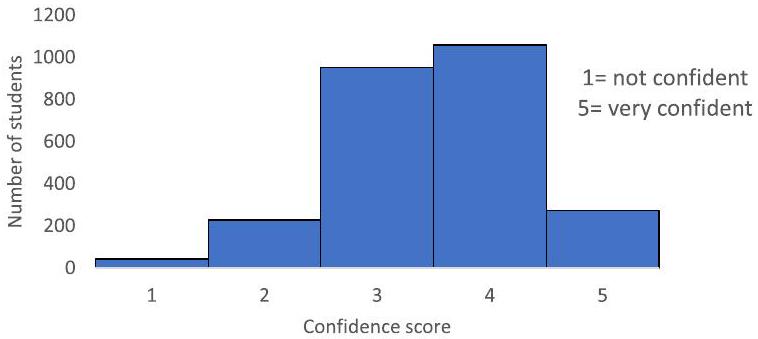
سأل السؤال التالي عن مدى شعور الطلاب بالثقة في الكتابة بطريقة أكاديمية ( غير واثق، واثقون جداً). قام معظم الطلاب بتقييم أنفسهم كـ 3 أو 4 (الشكل 1). أفاد اثنان وخمسون في المئة من الطلاب بمستويات ثقة تتراوح بين 4 أو 5 في الكتابة الأكاديمية.
يمكن ملاحظة أن الذين في العلوم الإنسانية والاجتماعية كانوا يتمتعون بأعلى مستويات الثقة، مع من المستجيبين من تلك الكلية الذين قيموا ثقتهم على أنها 4 أو 5، حيث كان طلاب الصحة وعلوم الحياة الأقل ثقة، مع تقييم ثقتهم كـ 4 أو 5 (الجدول 2).
الجدول 1 مستوى الدراسة للمستجيبين مقارنةً بالسكان الجامعيين بالكامل
مستوى الدراسة % من المستجيبين % من عدد سكان الجامعة
أساس 0.7% 1.2٪
طالب جامعي 69.7% 76.4%
دراسات عليا مُعَلَّمة 22.7% 15.70%
دراسات عليا بحثية 6.5% 6.7%
الشكل 1 أعداد الطلاب الذين أبلغوا عن مستويات ثقتهم في الكتابة الأكاديمية
الجدول 2 الثقة حسب الكلية
العلوم الإنسانية والاجتماعية الصحة وعلوم الحياة العلوم والهندسة
1 1.6% 2.0% 1.6٪
٢ 6.4% 11.3% 9.4%
٣ ٣٥.٨٪ ٤٠٫٠٪ ٣٥.٩٪
٤ ٤٥.٣٪ ٣٨٫٠٪ ٤٠.٢٪
٥ 10.9٪ 8.7% 12.8%
الجدول 3 الثقة حسب مستوى الدراسة
أساس طالب جامعي دراسات عليا موجهة البحث الدراسي العالي
1 ٥.٩٪ 1.8٪ 1.4% 0.6%
٢ ٥.٩٪ 10.3% 5.5% ٦٫٠٪
٣ ٣٥.٣٪ ٣٩.٨٪ 33.4% ٢٤٫٠٪
٤ ٤٧.١٪ ٤٠.١٪ ٤٣.٣٪ 51.5%
٥ ٥.٩٪ ٧.٩٪ 16.4% 18.0%
تشير البيانات إلى أنه مع تقدم الطلاب إلى مستويات أعلى من الدراسة الجامعية، تزداد ثقتهم في الكتابة الأكاديمية، حيث يشعر الباحثون في الدراسات العليا بأعلى مستوى من الثقة. (الجدول 3). يجب الإشارة إلى أن 17 مستجيبًا فقط كانوا طلابًا في مستوى الأساس وأن العلاقة كانت ذات دلالة ولكنها معتدلة.

معرفة الطلاب بتقنيات الذكاء الاصطناعي العام

بدأ الجزء الثاني من الاستطلاع بالتركيز على معرفة الطلاب واستخدامهم وآرائهم حول تقنيات الذكاء الاصطناعي التوليدي. تم سؤالهم عما إذا كانوا قد سمعوا عن أي من التقنيات المدرجة قبل إكمال الاستطلاع. جرامرلي (المعروفة بـ المشاركين) وChatGPT (المعروف بـ ) كانت الأكثر سماعًا (الشكل 2).

استخدام الطلاب أو الاستخدام المعتبر لتقنيات الذكاء الاصطناعي العام

السؤال التالي سأل عما إذا كان الطلاب قد استخدموا أو فكروا في استخدام هذه التقنيات، وما كان الغرض من استخدامها. تم تحديد ثلاث فئات – شخصية (مع أمثلة على الترجمات أو الوصفات)، أكاديمية (التحقق من القواعد النحوية)
الشكل 2 التقنيات التي سمع عنها المستجيبون. ملاحظة. تم اختيار خيار “أخرى” أيضًا من قبل 25 مستجيبًا، الذين أضافوا تقنيات مشابهة لـ ChatGPT (12 من أصل 34 تقنية مقترحة)، بينما كانت ثمانية من أصل 34 تقنية مقترحة تعتمد على الترجمة، وخمسة كانت تطبيقات من Microsoft Office.
الشكل 3 الغرض من استخدام التقنيات
وتنسيق المراجع) واحترافي (إنشاء قوائم المهام أو رسائل البريد الإلكتروني). كانت الاستجابة الأكثر شيوعًا لأغراض أكاديمية، مع اختيار هذا (الشكل 3). من بين المستجيبين، لم يكن قد استخدم أو فكر في استخدام هذه التقنيات، مما يدل على أن الغالبية العظمى من المشاركين قد استخدموا أو فكروا في استخدامها.
تم تقديم 43 ردًا على “أخرى”، والتي يمكن تصنيفها بشكل عام إلى: استخدام التقنيات للمتعة أو بدافع الفضول ( )، في سياق أكاديمي، حيث استخدمه الطلاب للبرمجة (6/43)، وفحص القواعد (6/43)، وتحسين الفهم من خلال طلب تفسيرات بديلة/إعادة صياغة التفسيرات ( قال مستجيبون آخرون إنهم لم يستخدموا التقنيات مطلقًا أو أنهم استخدموها للمهام اليومية العامة.
بعض أمثلة ردود المشاركين أدناه:
لقد استخدمت ChatGPT لتبادل الأفكار وللمساعدة في هيكلة العمل. لن أستخدمه لكتابة أي شيء، لن أثق به في الحصول على معلومات صحيحة.
ومن المعروف أنه يقدم اقتباسات ومراجع غير موجودة. أنا مهتم بتجربته في تدقيق العمل، ويبدو أنه يمكن استخدامه لتلخيص المقالات، وما إلى ذلك. أعتقد أنه يمكن استخدامه بطرق مفيدة كثيرة، ولكن ليس للكتابة الأكاديمية… بعد!
الحصول على معرفة أساسية لمزيد من المعرفة حول ما يجب البحث عنه عند العثور على مراجع للأوراق. أشعر أحيانًا أن المنشورات يمكن أن تكون معقدة بعض الشيء، لذا فإن الحصول على إجابة بسيطة لسؤال ما يكون مفيدًا لفهمي.
لقد أعجبتني فكرة Grammarly خلال مرحلة A levels لأنها ساعدتني في مهارات الكتابة والمفردات. لكنني لم أستخدمها بشكل صحيح لأنها كانت اشتراكًا مدفوعًا.
الاستخدام اليومي، الإجابة على الأسئلة اليومية، وضع خطة التمارين، نصائح صحية، نصائح للصحة النفسية، إلخ…
جرامرلي يساعدني في اكتشاف نسبة الانتحال قبل تقديم عملي
كان هناك ميل لدى طلاب العلوم الصحية والحياتية لاستخدام هذه التقنيات أو التفكير في استخدامها أقل لأغراض شخصية ومهنية مقارنة بكليات أخرى، لكن الاستخدام الأكاديمي كان مشابهًا عبر الكليات الثلاث، ولم يبدو أن طريقة استخدام الطلاب أو تفكيرهم في استخدام التقنيات تأثرت بمستوى الدراسة. أظهر طلاب السنة التأسيسية، الذين يتكون العديد منهم من طلاب ناضجين يعودون إلى التعليم، استخدامًا/تفكيرًا أقل بشكل طفيف، ومع ذلك كان هناك 17 مستجيبًا فقط في هذه الفئة.

الثقة في الكتابة الأكاديمية واستخدام تقنيات الذكاء الاصطناعي العام

الطلاب الذين لم يستخدموا أو يفكروا في استخدام هذه التقنيات لأغراض أكاديمية كان لديهم درجة ثقة متوسطة أعلى في الكتابة الأكاديمية (الدرجة المتوسطة 4، ) مقارنة بالطلاب الذين قالوا إنهم قد استخدموا أو فكروا في استخدام التقنيات (الدرجة المتوسطة ) ، (الجدول 4).

آراء الطلاب حول استخدام طلاب آخرين لتقنيات الذكاء الاصطناعي

السؤال التالي سأل المشاركين كيف سيشعرون إذا استخدم طالب آخر تقنية الذكاء الاصطناعي كوسيلة مساعدة أكاديمية (مثل المساعدة في القواعد) لإكمال قطعة من الأعمال الجامعية. طُلب من المشاركين اختيار البيان الذي يتوافق بشكل أقرب مع وجهة نظرهم. ذكروا أنهم كانوا داعمين أو داعمين إلى حد ما لاستخدام التكنولوجيا بهذه الطريقة (الجدول 5).
الجدول 4 الطلاب الذين يبلّغون عن مستوى ثقتهم في الكتابة الأكاديمية وكيفية استخدام الطلاب لهذه التقنيات
درجة الثقة غير واثق، 5 = واثق جداً الاستخدام الشخصي الاستخدام الأكاديمي استخدام مهني لم يُستخدم أبدًا
% لا % نعم % لا % نعم % لا % نعم % المستخدم/المعتبر % لم يُستخدم أبداً
1 65% ٣٥٪ 60٪ 40٪ 84% 16% 67% ٣٣٪
2 69% 31% ٤٣٪ 57% ٤٣٪ 57% 69% 31%
٣ 72% ٢٨٪ ٤٦٪ 54% ٤٦٪ 54% 67% ٣٣٪
٤ 69% 31٪ 51% ٤٩٪ 51% ٤٩٪ 62% ٣٨٪
٥ 70٪ 30٪ 54% ٤٦٪ 54% ٤٦٪ 63% ٣٧٪
الجدول 5 نسبة الطلاب الذين وافقوا على العبارات المتعلقة باستخدام طالب آخر لهذه التقنيات للمساعدة في القواعد
بيان % من المستجيبين الذين اختاروا هذا
داعم – أعتقد أنه في عام 2023 يجب علينا جميعًا استخدام تقنيات الذكاء الاصطناعي لجعل حياتنا أسهل ٢٧.٢٪
داعم إلى حد ما – أنا موافق على استخدام الطلاب الآخرين للبرامج إذا أشاروا إلى التكنولوجيا في أعمالهم ٢٦.٣٪
محايد – ليس لدي رأي حقيقي في هذا. أعتقد أن الأمر متروك للطالب الفردي ليقرر استخدامه أو عدم استخدامه. ٢٦.٢٪
غير داعم إلى حد ما – أعتقد أن هذه التقنيات لا تزال لديها الكثير من القيود وأشجع الطلاب الآخرين على التحقق من المعلومات التي يجدونها. 11.6%
غير داعم – أعتقد أنه من غير العادل حقًا أن يستخدم الطلاب الآخرون هذه التقنيات. الأشخاص الذين يستخدمون هذه التقنيات يقومون فعليًا بنسخ أعمال الآخرين دون إعطاء الفضل الكامل. ٧.٤٪
آخر 1.3%
من بين 33 مستجيبًا اختاروا “أخرى”، اقترحت 17 من التعليقات أنهم يدعمون طالبًا آخر يستخدم هذه التقنيات لدعم القواعد النحوية ولكن ليس بالضرورة لأي شيء أكاديمي آخر، بينما اقترحت سبع ردود أن ذلك يعتمد على الظروف:
أعتقد أنه يجب اعتبار هذه التقنيات لما هي عليه حقًا، نماذج لغوية. كل ما تفعله هو تقديم بيانات محددة من معلمات مدخلة من المستخدم، يجب أن تكون جميع المعلومات المقدمة من النموذج قد وُجدت سابقًا، أو تم استنتاجها من بيانات موجودة مسبقًا. لذلك، يجب استخدام هذه التقنيات تمامًا كما هو مصمم لها، لتعمل كأداة بحث للمساعدة ولكن دون انتحال. تشير الإشعارات المقدمة داخل البرنامج إلى أنه يمكن تقديم معلومات خاطئة في بعض الأحيان، وأشعر أنه بينما يعد هذا جزئيًا قيدًا للتكنولوجيا، فإنه يعد إهمالًا بالكامل من قبل الطلاب إذا تم استخدام هذه المعلومات.
“إنه مفيد كوسيلة مساعدة لأولئك الذين قد يكون لديهم إعاقات أو احتياجات تعلم إضافية وسأكون داعمًا لذلك، ولكن بالنسبة للطلاب القادرين أشعر أن التطبيقات أو التقنيات المساعدة تعطي ميزة غير عادلة لأي شيء يتجاوز مجرد التحقق من القواعد النحوية، الإملاء، إلخ. “
“يعتمد الأمر، أعتقد أنه من الجيد استخدام التحقق من القواعد النحوية، خاصة للناطقين غير الأصليين. لديهم فكرتهم الخاصة، وهذه الأنواع من الذكاء الاصطناعي مثل بعض القواميس المتقدمة لمساعدتهم في التعبير عن أفكارهم بشكل أفضل. ولكن بالنسبة للتكنولوجيا المساعدة مثل ChatGPT، يجب أن تكون هناك سياسة لتجنب الاستخدام غير السليم. “
“أعتقد أن طلاب الجامعات يجب أن يتعلموا عن أحدث سلسلة من الذكاء الاصطناعي لأنها ستصبح جزءًا كبيرًا من حياتنا بغض النظر عن التخصص وفي غضون 10-15 عامًا أعتقد حتى تصبح جزءًا من جميع مستويات التعليم وإذا لم نتعلم كيفية استخدامها بفعالية فسوف نتخلف عن الأجيال القادمة. يمكن لطلاب الجامعات بالفعل استخدامها لكتابة مقال لهم في دقائق دون التعلم عنها لذلك أعتقد أن الجامعات يجب أن تغير أنواع التقييم وتحتضن التكنولوجيا حيث من المفترض أن تكون الجامعات تعدنا للمستقبل. “
كانت بعض الردود متطرفة في الطيف:
“إنه يؤثر على الاقتصاد المستقبلي عندما ينتهي الأمر بأشخاص لا يستحقون شهادتهم
في مهنة لا يمكنهم فهمها بدون الذكاء الاصطناعي. علاوة على ذلك، يمكن أن يكون هناك شخص أكثر استحقاقًا لتلك الوظيفة، الذكاء الاصطناعي يخفي الذكاء الحقيقي. “
“لا أعتقد أنني سأقلق بشأن أي عمل دراسي لأي شخص سوى عملي! “
السؤال التالي سأل المستجيبين كيف سيشعرون إذا كان طالب آخر قد استخدم تقنية GAI مثل ChatGPT لكتابة مقالهم بالكامل. طُلب من المستجيبين اختيار البيان الذي يتوافق بشكل أقرب مع وجهة نظرهم. معظم الطلاب ( ) ذكروا أنهم غير داعمين واعتقدوا أنه سيكون غير عادل للطلاب استخدام هذه التقنيات وأن أولئك الذين يفعلون ذلك يقومون فعليًا بنسخ عمل الآخرين دون إعطاء الفضل (الجدول 6).
اختار أربعون من المستجيبين “أخرى” مع 11 طالبًا ذكروا أنهم لا يعرفون ما هو ChatGPT، و10 ردود تظهر دعمًا مشروطًا، مع كون الإجابة الأكثر شيوعًا هي أولئك الذين كانوا داعمين له كمساعد، ولكن ليس لكتابة المقال بالكامل:
كمساعد، إنه مفيد، ولكن كتابة مقالهم بالكامل تأخذ من نزاهة وفخر عملهم
“سأدعم ذلك إذا استخدمه شخص ما للتحقق من القواعد النحوية أو الترجمة إذا لم تكن الإنجليزية لغتهم الأولى، ولكن ليس لكتابة مستند كامل. من المحتمل أن يتم إساءة استخدام ذلك من قبل الكثير من الطلاب، مما سيجعل التقييم غير عادل لأولئك الذين لا يفعلون ذلك. “
“أعتقد أن استخدامه للتحقق من المعلومات، والمساعدة في القواعد النحوية والبحث عن الأشياء أمر جيد. ولكن ليس مقالك إذا كتبه الذكاء الاصطناعي لك. أكره كتابة المقالات وأعاني منها، لكن لا يزال يتعين عليك القيام بها”
ذهب ثمانية طلاب إلى مزيد من الشرح حول سبب عدم دعمهم:
بشكل عام غير داعمين، حيث سيفقدون تجربة كتابة مقال والتعلم المكتسب منها. على الرغم من أنني أشعر أن تقييمات الجامعة تحتاج إلى التكيف لأخذ وجود المساعدة من الذكاء الاصطناعي في الاعتبار.
“غير داعم لذلك لأنني أعتقد أنه غير عادل عدم التوصل إلى أفكار بمفردك والاعتماد على الذكاء الاصطناعي لنقل أفكارك. من المهم أن تكون قادرًا على صياغة
الجدول 6 نسبة الطلاب الذين وافقوا على بيانات حول استخدام طالب آخر لهذه التقنيات لكتابة مقال كامل
البيان % من المستجيبين الذين اختاروا هذا
داعم – أعتقد أنه في عام 2023 يجب علينا جميعًا استخدام تقنيات الذكاء الاصطناعي لتسهيل حياتنا 5.6%
داعم إلى حد ما – أنا بخير مع استخدام طلاب آخرين للبرامج إذا أعطوا الفضل للتكنولوجيا في عملهم 8.2%
محايد – ليس لدي رأي حقيقي في هذا. أعتقد أنه يعود للطالب الفردي ليقرر استخدامه/عدم استخدامه 14.2%
غير داعم إلى حد ما – أعتقد أن هذه التقنيات لا تزال لديها الكثير من القيود وسأشجع الطلاب الآخرين على التحقق من المعلومات التي يجدونها 21.9%
غير داعم – أعتقد أنه من غير العادل حقًا للطلاب الآخرين استخدام هذه التقنيات. الأشخاص الذين يستخدمون هذه التقنيات يقومون فعليًا بنسخ عمل الآخرين دون إعطاء الفضل الكامل 48.5%
أخرى 1.6%
والتفكير بوضوح دون التأثيرات الخارجية التي تعكر أو تؤثر على عملية تفكيرك. “
“غير داعم – الذكاء الاصطناعي محدود بالبيانات التي تم تصميمه عليها. لا يمكن اعتبار أي إجابات يقدمها كمعرفة خبير، ولكن فقط كانعكاس للمعلومات التي تم تغذيتها إليه. “
كان خمسة طلاب غير مبالين، إلى حد كبير بسبب اعتقادهم أن أي مقال مكتوب بواسطة تقنية GAI سيكون بجودة رديئة أو سهل التعرف عليه:
“…أعتقد أن الأمر يعتمد على مدى أصالة المدخلات (يميل ChatGPT إلى العمل من مطالبات تعليمية قصيرة جدًا). سواء كان ‘غير عادل’ هو مناقشة مختلفة – تميل هذه المقالات التي تم إنشاؤها بواسطة الذكاء الاصطناعي إلى أن تكون متكررة للغاية وغير متماسكة. القليل منها قريب من أن يكون مقبولًا، وتلك التي تكون كذلك لا تتجاوز أبدًا 50%. إذا بدأنا نرى الكثير من هذه المقالات تُقدم، فإنها سترفع بشكل مصطنع النسبة المئوية التي تم تقييم الطلاب الذين قدموا ‘عملًا حقيقيًا’ فيها، إن كان هناك شيء. “
“أعتقد أنه سيكون من الواضح معرفة ما إذا كان مقال مكتوب بالكامل بواسطة الذكاء الاصطناعي، لذا ربما لن تحصل على علامة جيدة. “
“لا داعم ولا غير داعم. أعتقد أن استخدام مثل هذه التكنولوجيا مثل ChatGPT يختلف عن استخدام الآخرين مثل Grammerly. يقوم ChatGPT بالعمل نيابة عنك. هذا يأخذ من الفرد اكتساب المهارات اللازمة التي يجب عليهم بناؤها وتطويرها شخصيًا خلال دراستهم. أشعر أنه لا يرفع من مستوى الفرد، حيث توفر التقنيات الأخرى مثل هذه الفرص. “
كان بعض الطلاب داعمين في ظل ظروف معينة مثل المساعدة في الإعاقات ولكنهم أرادوا أيضًا توجيهًا واضحًا من الجامعة:
“لا أمانع من استخدام الآخرين لها ولكنني أفضل توجيهًا واضحًا من الجامعة حول ما إذا كان يمكننا استخدامها أم لا حتى يشعر الجميع بالحرية في استخدامها أيضًا. “
“أنا داعم تمامًا، لأنه عندما نصل إلى التفرد في الحوسبة، هل يجب علينا منع استخدام التقنيات لأنها تجعل حياتنا أسهل؟ هل يجب علينا حظر الآلات الحاسبة عندما تكون آلة تقوم فعليًا بكل العمل الرياضي؟ لا أعتقد أنه يجب استخدام ChatGPT بدون تمييز، ولكن لا يوجد سبب يمنع شخصًا ما من طلبه لكتابة مقال طالما أن الطالب يراجع المقال بشكل نقدي لتعديلاته ومدخلاته. “
“أعتقد أنه إذا تم استخدامه بطريقة صادقة، يمكن أن يكون مفيدًا جدًا لفهمه وكوسيلة مساعدة في كتابة المقالات/الأوراق/إلخ. ما لا أوافق عليه هو استخدامه فقط لنسخ المعلومات مباشرة. المعلومات المضللة شائعة والتحقق من الحقائق مهم. لذا، من المهم الاستمرار في تشجيع ذلك عند استخدام هذه البرمجيات. الاعتماد على هذا النوع من البرمجيات سيضر فقط بالفرد وأعتقد أنه مصدر قلق حقيقي مع تحسين هذه الأنواع من البرمجيات. “
“يعتمد الأمر، بعض الطلاب بسبب الإعاقة يحتاجون إلى الذكاء الاصطناعي للمساعدة. إذا كان متاحًا لي ولم أستخدمه، فسيكون ذلك اختياري”

الثقة في الكتابة الأكاديمية وآراء حول استخدام الآخرين لتقنيات GAI

كان هناك ارتباط ضعيف ولكنه مهم بين ثقة الطلاب في الكتابة الأكاديمية وآرائهم حول استخدام تقنيات GAI عندما يستخدمها طلاب آخرون لكل من
القواعد النحوية وكتابة مقال كامل , (الجدولان 7 و8). على سبيل المثال، من بين أولئك الذين لديهم أدنى درجة ثقة، كانوا غير داعمين لاستخدام طالب آخر لهذه التقنيات لكتابة مقال كامل، في حين أن من أولئك الذين لديهم أعلى درجة ثقة كانوا غير داعمين (الجدول 8).

آراء الطلاب حول سياسات الجامعة لتقنيات GAI

ثم سُئل المستجيبون كيف يعتقدون أن الجامعة يجب أن تستجيب لهذه التقنيات. كانت الخيار الأكثر شعبية هو وجود سياسة شاملة للجامعة توضح متى تكون هذه التقنيات مناسبة للاستخدام أو غير مناسبة، مع من المستجيبين الذين اختاروا هذا الخيار (الجدول 9).
من بين 46 مستجيبًا اختاروا ‘أخرى’، اقترح معظم الطلاب أن يتم وضع قيود بدلاً من حظر كامل (18/46):
“تثقيف الناس حول كيفية استخدام أدوات الذكاء الاصطناعي بطرق أخرى غير الغش البسيط، على سبيل المثال لتحسين المراجعة، تسريع عملية الكتابة، أو المساعدة في
الجدول 7 نسبة الطلاب، بناءً على ثقة الكتابة الأكاديمية، الذين يدعمون أو لا يدعمون طلابًا آخرين في استخدام هذه التقنيات لدعم القواعد.
درجة الثقة داعم داعم إلى حد ما محايد غير داعم إلى حد ما غير داعم آخر
1.00 27.9% 27.9% 30.2% 9.3% 2.3% ٢.٣٪
2.00 31.1% 25.9٪ ٢٦.٣٪ 10.1٪ 5.7% 0.9%
٣.٠٠ 27.9% 25.1% ٢٨.٢٪ 10.9٪ 6.8% 1.1%
٤.٠٠ ٢٥.٤٪ ٢٩.١٪ ٢٤.٨٪ 11.7% ٧.٥٪ 1.5%
٥.٠٠ ٢٨.٢٪ 19.4% ٢٤.٢٪ 15.0% 11.7% 1.5%
الجدول 8 نسبة الطلاب، بناءً على ثقة الكتابة الأكاديمية، الذين يدعمون أو لا يدعمون طلابًا آخرين في استخدام هذه التقنيات لكتابة مقال كامل
درجة الثقة داعم داعم إلى حد ما محايد غير داعم إلى حد ما غير داعم آخر
1.00 14% 18.6% 27.9% 9.3% 30.2% 0%
2.00 8.3٪ 9.2% 13.2% 25% ٤١.٧٪ 2.6%
٣.٠٠ ٥.٤٪ ٨.٦٪ 16.5% ٢٣.٢٪ 44.9% 1.5%
٤.٠٠ ٤.٥٪ ٧.٦٪ 12.5% 22% 52.2% 1.1%
٥.٠٠ ٧٪ 6.2% 11.7% 16.5% 55.7% 2.9%
الجدول 9 نسبة الطلاب الذين وافقوا على التصريحات المتعلقة بسياسة الجامعة بشأن هذه التقنيات
استجابة % من المستجيبين الذين اختاروا هذا
حظرهم تمامًا ٤.٥٪
وجود سياسة شاملة على مستوى الجامعة حول متى يكون من المناسب استخدامها أو لا. 41.1%
دع الأقسام / الكليات تقرر السياسة بشأن متى يكون من المناسب استخدامها أو لا. ٢٦٫٠٪
دع المحاضرين يحددون السياسات الفردية للمهام الفردية بشأن متى يكون من المناسب استخدامها أو عدم استخدامها. 16.9%
اسمح لهم أن يُستخدموا كما يشاء الطلاب 9.6%
آخر 1.8%
مهارات البحث. يجب أن يُمنح الطلاب الحرية الكاملة لاستخدام الأدوات المتاحة للجميع، ومع ذلك فإن فرض قيود في حالات الغش الشديدة مقبول.
قال خمسة طلاب إن ذلك يعتمد على البرنامج/على ما يتم استخدامه من أجله:
أعتقد أن هذه التقنيات تحتاج إلى أن تُحتضن في بيئة أكاديمية وأن تُعتمد في أقرب وقت ممكن. يجب أن تكون طريقة تعامل الجامعة مع هذه التقنيات مزيجًا من الخيارات المقدمة في هذا الاستطلاع… على سبيل المثال، قد يكون من المناسب لقسم واحد السماح للذكاء الاصطناعي بالمساعدة في البحث، طالما تم الإشارة إليه؛ بينما قد يُعتبر من غير المناسب استخدامه في أقسام أخرى وبالتالي يُحظر.
لقد وجدت أن التقنيات المساعدة يمكن أن تكون مفيدة حقًا دون أن تتعارض بالضرورة مع نزاهتي الأكاديمية، على سبيل المثال، أستخدمها لاسترجاع صيغة نادرة بسرعة قد يستغرق مني وقتًا للعثور عليها على الإنترنت أثناء حل المسائل. ولكن عندما يصبح واضحًا (باستخدام كاشفات الذكاء الاصطناعي) أن العمل المقدم هو في الغالب عمل الكمبيوتر وليس الطالب، يجب اتخاذ تدابير وعقوبات…
اقترح بعض الطلاب أن تتبنى الجامعة ذلك أو توعي الطلاب بشأنه (7/46)، بينما اقترح آخرون تغيير صيغة التقييم بحيث لا يمكن استخدام تقنية الذكاء الاصطناعي. ):
أعتقد أن الطلاب بحاجة إلى تعلم كيفية دمج هذه التكنولوجيا في حياتهم لأنها ستستخدم من قبل الجميع بغض النظر عما تفعله الجامعات، لذا نحتاج إلى تعلم كيفية استخدامها.
تعليم الناس كيفية استخدامها، ويعود لهم اتخاذ القرار.
لا أعتقد أنه من الممكن حظرها تمامًا، لسببين: (1) سيتم استخدام التكنولوجيا سواء أحببنا ذلك أم لا، وهي ستتحسن فقط؛ (2) ليس من الواضح دائمًا أي التقنيات المساعدة هي ذكاء اصطناعي وأعتقد أن هذا سيصبح بشكل متزايد منطقة رمادية مع تحسن التكنولوجيا وظهور المزيد من هذه المنصات. قد لا يدرك الطلاب حتى أنهم يستخدمون الذكاء الاصطناعي في بعض الحالات. لذا يجب تنظيم استخدام الذكاء الاصطناعي. يجب أن تكون هناك إرشادات واضحة حول ما هو الاستخدام المقبول وما هو غير المقبول ويجب أن يكون استخدام الذكاء الاصطناعي شفافًا… إذا كانت هناك إمكانية لاستخدام الذكاء الاصطناعي متاحة للجميع، فإنها سياسة عادلة للجميع. إذا تم استخدام الذكاء الاصطناعي للمساعدة في كتابة أجزاء من العمل، فيجب أن ينعكس ذلك في علامة الطالب (على سبيل المثال، خصم 5 من 10 علامات).
قم بتعديل التقييمات بطريقة تتطلب تفكيرًا أكثر إبداعًا بحيث يمكن استخدام أدوات الذكاء الاصطناعي بشكل داعم فقط – في رأيي، هذه هي الطريقة الفعالة الوحيدة لإدارة استخدامها من قبل الطلاب.
تعليقات أخرى دعمت المحاضرين أو الأقسام في اتخاذ قرارات بشأن استخدامات التكنولوجيا، لكنها شعرت أنه يجب استشارة الطلاب بشكل أكبر وأن هناك حاجة لمزيد من البحث:
أوافق على أن يكون للمدرسين القرار النهائي، ومع ذلك أعتقد أن هذا الاختيار يجب أن يتضمن الاستماع إلى آراء الطلاب وسؤالهم أولاً.
ابحث أكثر في تأثير الاستخدامات وإذا سمحت بالاستخدام، فاجعلها مجانية ومتاحة للجميع، وإلا ستخلق فجوة في الوصول – وهو ما أتخيل-
قد تكون موجودة بالفعل فيما يتعلق بهذه الأدوات
ربما يكون من الأفضل وجود سياسة عامة للجامعة ثم سياسة أكثر تحديدًا للقسم. من الصعب حظر تقنية الذكاء الاصطناعي لأنها تنتج قطعًا فريدة من العمل في كل مرة، لذا لا أعرف كيف سيتم/يمكن مراقبة استخدام الذكاء الاصطناعي

استخدامات أخرى لتقنيات الذكاء الاصطناعي العام

السؤال الاختياري التالي سأل المستجيبين عما إذا كان بإمكانهم التفكير في أي طرق أخرى يمكن استخدام هذه التقنيات في دراستهم. تم تلقي 1131 ردًا، مع اقتراح العديد من الطلاب أكثر من استخدام واحد. كانت الاستجابة الأكثر شيوعًا هي المساعدة في القواعد/الإملاء/علامات الترقيم، تليها فهم مفهوم، التخطيط، تلخيص النص وأداة البحث (الجدول 10). التعليقات التي تم تجميعها تحت ‘أخرى’ تضمنت عدة آراء حول التقنيات مثل:
يمكن استخدام هذه التقنيات كدعم، لكن لا ينبغي لأحد أن يعتبر هذه التقنيات تعمل نيابة عنه.
أعتقد أنه يمكن استخدامها كأداة تعليمية بدلاً من أن تكون أداة لإنجاز واجباتك بدلاً منك.
الجدول 10 الاستخدامات الأخرى المقترحة لتقنيات الذكاء الاصطناعي العام التي اقترحها الطلاب
استخدامات أخرى لتقنيات الذكاء الاصطناعي التوليدي عدد التعليقات
القواعد/الإملاء/علامات الترقيم 218
آخر ١٧٧
لا تعليق ١٢٦
فهم المفهوم ١١٠
التخطيط ١٠٣
تلخيص النص ١٠١
أداة البحث 94
أداة بحث 77
خلق الأفكار ٥٨
الإشارة 53
الإعاقة/التنوع العصبي 52
فحص الأخطاء ٤٧
دولي/ترجمة ٤٩
البرمجة ٣٩
منظمة ٣٦
مراجعة ٢٥
المهنة/القابلية للتوظيف ٢٢
البريد الإلكتروني 18
الإجابة على الأسئلة ١٣
غير مفيد ١٣
بديل للمحاضر 11
تحليل البيانات 11
امتحان 9
المشاركة/التواصل ٧
تعليق ٦
جمع البيانات ٥
إنشاء المحتوى ٤
“أي شيء باستثناء المحتوى، جيد من حيث القواعد، المراجع، التنسيق (إلى حد ما)، ولكن بمجرد استخدامه لكل المحتوى يكون خاطئًا”
بينما اقترحت عدة تعليقات ‘أخرى’ أن الطلاب سيقدرون التدريب:
أعتقد أنهم غير عادلين لأن بعض الناس لن يعرفوا كيفية استخدامها” “إذا كان مسموحًا باستخدامها في مناطق معينة، سيكون من المهم وجود دروس تعليمية توضح كيفية استخدام التكنولوجيا حتى يحصل جميع الطلاب على نفس الفرصة لتحقيق الدرجات.
مع تطور هذه التقنيات بسرعة أعتقد أن المسؤولية تقع على الجامعة لتتكيف مع ذلك وتجد طرقًا مفيدة لاستخدامه. إذا لم تفعل، فسيتعين على الطلاب اكتشاف ذلك بأنفسهم، وهو ما نراه حاليًا. أعتقد أن هذه التكنولوجيا يمكن أن تكون وسيلة جديدة مذهلة لاستخدام المعلومات، ويجب على الجامعة أن تدرك ذلك وتتصرف بناءً عليه، بدلاً من أن تُترك وراءها في عصر أكاديمي قديم، تمامًا كما حدث مع اختراع الكمبيوتر والإنترنت.

تعليقات عامة

السؤال الأخير سأل عما إذا كان لديهم أي تعليقات إضافية، وتم تقديم 669 ردًا مع 379 إجابة مميزة. كان هناك توافق عام على أنه لا ينبغي مقارنة Grammarly بـ ChatGPT حيث اعتُبرت التقنيتان مختلفتين تمامًا، مع 44 ردًا يدعم استخدام Grammarly، بينما شعر 32 أن تقنيات الذكاء الاصطناعي كانت غير عادلة. على الرغم من ذلك، دعم 32 ردًا تنظيم الذكاء الاصطناعي بدلاً من حظره، ورأى 49 أن الذكاء الاصطناعي يجب أن يُحتضن ويُعلّم للطلاب أو أنه سيكون مفيدًا في المهن المستقبلية.
أعتقد أن الذكاء الاصطناعي هو الواقع القاسي لعالم أكبر وأفضل وأكثر إشراقًا. لن أستخدمه لكتابة مقال. ولكن للعثور على مصادر، وإعطائي أفكار، وما إلى ذلك، فهو رائع. الأشخاص الذين يستخدمونه للقيام بكل عملهم هم فقط يخدعون أنفسهم ومن المحتمل أن يعانوا أكاديميًا.
المكان الحديث للعمل يتكيف والطلاب سيجدون دائمًا وسيلة للتكيف مع هذه التقنيات. بدلاً من حظرها، يجب دمجها وتعليم كيفية عدم دقتها في المعلومات وما إلى ذلك.
إذا تجاهلت الجامعة الذكاء الاصطناعي، فسوف تضر بكل طالب، حيث يحد ذلك من قدرتهم في بيئة عالمية تنافسية. إذا تجاهلت الجامعة الذكاء الاصطناعي، فسوف يؤدي ذلك إلى جعل جميع الشهادات بلا قيمة فعليًا.
أدوات الذكاء الاصطناعي قوية، لكنها مجرد أدوات. أعتقد أن استخدام الذكاء الاصطناعي للإلهام أكثر فعالية بكثير من استخدام جوجل، حيث يقدم إجابة أكثر ت polish. لكن الأداة جيدة فقط بقدر الشخص الذي يستخدمها.
هذه التقنيات مفيدة للغاية، فكوني من عائلة غير أكاديمية يعني أنني لا أستطيع أن أسأل والديّ أسئلة بسيطة مثل كيفية هيكلة مراجعة منهجية. المحاضرون لا يجيبون على السؤال الأساسي لأنهم يفترضون أننا نعرف بالفعل كيفية الاستشهاد، وكيفية الكتابة. حتى إذا كتبت في جوجل هيكل مراجعة منهجية، فإن جميع النتائج هي مقالات علمية ولا تجيب بطريقة يمكنني فهمها. أعتقد أن استخدام تقنية الذكاء الاصطناعي للمساعدة، على سبيل المثال، طلب المساعدة في الهيكل، وطرح أسئلة بسيطة إذا لم تفهم موضوع البحث وتحتاج إلى شرحه، هو أمر مقبول. ومع ذلك، فإن استخدامه لكتابة مقال كامل هو أمر خاطئ.
غير عادل ويصنف على أنه سرقة أدبية.
أبرز سبعة عشر من الردود المزايا للطلاب ذوي الإعاقة، واقترح عشرة أن هذه التقنيات مفيدة بشكل خاص للطلاب الدوليين.
تذكر: حظر الذكاء الاصطناعي بشكل عام يمكن أن يؤذي الطلاب ذوي الإعاقة. أستخدم الذكاء الاصطناعي للتنقل في CANVAS بسبب نقص ميزات الوصول.
…من المحتمل أن يتم استخدام الذكاء الاصطناعي بشكل متزايد، وبشكل أكثر تعاونًا في مكان العمل، مما سيوفر للطلاب إعدادًا أفضل لسوق العمل. يبدو أن إعادة تصور كيفية مشاركة الجامعات ونمو المعرفة أمر ضروري. الآن، أكثر من أي وقت مضى، تبدو المناقشات التعاونية الحقيقية وتحديات المعرفة مهمة. هذه فرصة لنمو وتعزيز نظام التعليم لدينا. العودة إلى الامتحانات المغلقة قد تتحقق مما يمكن للطلاب تذكره، لكنها غير متاحة للأشخاص ذوي الإعاقة ولا تتحدى الناس للتفكير. إنها جيدة فقط لأنها سهلة.
أخيرًا، قدّر بعض الطلاب الفرصة للمشاركة في الاستطلاع وإبداء آرائهم:
شكرًا على الدعوة وطرح هذه الأسئلة.
أنا معجب بأن الجامعة تطلب آراء الطلاب حول هذا وآمل أن يستمر الحوار في المستقبل حول كيفية استخدام هذه التقنيات الجديدة والمثيرة لتحسين كيفية تعلمنا وتطوير أنفسنا في الجامعة.
هذا موضوع رائع ولم أفكر فيه حقًا!
شكرًا لك على السماح لي بالمشاركة في هذا الاستطلاع.
استطلاع قصير لطيف!

نقاش

تشير نتائج الدراسة الحالية إلى أن الغالبية العظمى من الطلاب كانوا على دراية بتقنيات الذكاء الاصطناعي التوليدي وأن نصفهم قد استخدموها أو فكروا في استخدامها لأغراض أكاديمية. دعم معظم الطلاب استخدام زملائهم لتقنيات الذكاء الاصطناعي التوليدي للمساعدة في القواعد، لكن معظمهم لم يدعم استخدام طالب آخر لهذه التقنيات لكتابة مقال كامل. تم تسجيل نتائج مماثلة في استطلاع للطلاب الذين يدرسون في الجامعات الأسترالية (بريتاج وآخرون 2018). من بين الطلاب الأستراليين الذين استجابوا، وافق الغالبية على أن الحصول على واجب دراسي وتقديمه أو الحصول على مساعدة في الامتحانات كان أمرًا خاطئًا، ومع ذلك كانت هذه من بين أكثر سلوكيات “الغش” شيوعًا في الدراسة (بريتاج وآخرون 2018). وبالمثل، أفاد هاريسون وآخرون (2020) أن الطلاب اعتبروا أن هناك فرقًا بين دفع شخص آخر لكتابة مقال كامل واستخدام وسائل المساعدة الدراسية. تدعم الردود النوعية من المشاركين في الدراسة الحالية هذا الاكتشاف، حيث ذكر العديد من الطلاب أنهم استخدموا تقنيات الذكاء الاصطناعي التوليدي كبديل للمحاضرين أو لفهم مفهوم ما. تشير هذه النتائج إلى أن الطلاب يعتبرون المساعدة في التعديلات الطفيفة مثل القواعد وفهم المفاهيم ومساعدة ذوي الإعاقة/التنوع العصبي وحواجز اللغة ممارسة مقبولة لتقنيات الذكاء الاصطناعي التوليدي، ولكن ليس لكتابة واجبات كاملة. كما أشار بريتاج وآخرون (2018) إلى أن الأسباب الثلاثة الأكثر شيوعًا لـ “الغش” كانت عدم الرضا عن بيئة التعلم والتدريس، وفرص الغش، وكونهم متحدثين غير أصليين. نظرًا لأن التقنيات
مثل ChatGPT متاحة بسهولة و كان عدد من المشاركين في هذه الدراسة على دراية بـ ChatGPT، مما يوفر فرصة كبيرة للطلاب إذا كانوا يرغبون في استخدام هذه التقنيات في واجبات الكتابة أو الإجابة على أسئلة الامتحانات. لذلك، يجب أن تكون المسؤولية على عاتق تعليم الطلاب أفضل الممارسات لهذه التقنيات، وغرس شعور بالنزاهة وتصميم تقييمات مناسبة وجذابة.
طُلب من المشاركين تقييم ثقتهم في الكتابة الأكاديمية، وتشير النتائج إلى أن الطلاب في كلية العلوم الإنسانية والاجتماعية، والباحثين في الدراسات العليا، كانوا الأكثر ثقة. أظهرت أبحاث أخرى أيضًا أن طلاب الدراسات العليا أكثر ثقة في جوانب مختلفة من الدراسة الجامعية، مثل الاقتباس وفهم الانتحال (نيوتن 2016). ومن المثير للاهتمام، أن دراسة نيوتن (2016) وجدت أن الطلاب الذين كانوا أكثر ثقة في الاقتباس كانوا أكثر دعمًا لعقوبات صارمة على السلوك الأكاديمي غير السليم. تعكس هذه النتائج ما تم التوصل إليه في الدراسة الحالية حيث كان الطلاب الذين لديهم أعلى مستويات من الثقة في الكتابة الأكاديمية أقل تعاطفًا تجاه الطلاب الآخرين الذين يستخدمون تقنيات الذكاء الاصطناعي من الطلاب الذين كانت مستويات ثقتهم أقل. وجدت أبحاث سابقة أن الطلاب الذين يظهرون تعاطفًا أكبر يظهرون مزيدًا من الإيثار، وأن الطلاب الأكثر صدقًا لديهم مستويات أعلى من السلوك الاجتماعي الإيجابي (ألغايير وآخرون 2015؛ ليتفاك-ميلر وآخرون 1997). ومع ذلك، أظهرت دراسات أخرى أن الطلاب أقل احتمالًا للشعور بالتعاطف إذا اعتقدوا أن طالبًا آخر حاول الحصول على ميزة غير عادلة، (مثل تعديل درجاتهم في الوثائق الرسمية) (بوبوفاك وآخرون 2019؛ ياتشيسون وآخرون 2018)، وهو ما شعر به بعض الطلاب في الدراسة الحالية أن تقنيات الذكاء الاصطناعي تسهل ذلك. هناك نتائج متناقضة من حيث القدرة الأكاديمية والاستعداد للإبلاغ عن زملاء الدراسة بسبب السلوك غير السليم (لاوسون 2004؛ بوبوفاك وآخرون 2019)، ولكن هناك أدلة تشير إلى أن الطلاب الذين يحصلون على درجات أعلى أقل احتمالًا لارتكاب سلوك أكاديمي غير سليم (ماكنابي وتريفينو 1997)، لذا سيكون من المعقول افتراض أنهم سيكونون أقل دعمًا للطلاب الآخرين الذين يرتكبون سلوكًا غير سليم يُنظر إليه من خلال تقنيات الذكاء الاصطناعي. تم ملاحظة اختلافات بين الرجال والنساء في الاستجابة لـ “الغش” (سايمون وآخرون 2004؛ ياتشيسون وآخرون 2018) وأحد قيود البحث الحالي هو أن نسب الجنس غير معروفة للمشاركين، وبالتالي قد يكون لهذا المتغير تأثير على النتائج. تشير النتائج في الدراسة الحالية أيضًا إلى أن الطلاب الذين لديهم ثقة أقل في الكتابة الأكاديمية كانوا أكثر احتمالًا لاستخدام تقنيات الذكاء الاصطناعي. لقد أظهرت برامج مثل Grammarly أنها تزيد من ثقة الطلاب في مجالات مثل كتابة المقالات وتجنب الانتحال غير المقصود (لازيتش وآخرون 2020). حدد أميغود ولانكستر (2019) أن القدرة الأكاديمية كانت مرتبطة باستخدام الطلاب لمطاحن المقالات. تشير هذه النتائج إلى أن الثقة في الكتابة الأكاديمية هي عامل في استخدام الطلاب لتقنيات الذكاء الاصطناعي والتعاطف مع الطلاب الآخرين الذين يستخدمون هذه التقنيات.
ثقة الطلاب هي اعتبار مهم لسياسة الجامعة، حيث إن حظر التقنيات قد يضر ببعض الفئات، مثل أولئك الذين يحتاجون إلى الدعم في الكتابة الأكاديمية، والطلاب ذوي الإعاقة/المتنوعين عصبيًا، والطلاب الذين لا يتحدثون الإنجليزية كلغة أولى (فاتمي وسايتو 2020). قد ترغب الجامعات أيضًا في النظر في توفير تقنياتها الخاصة في المستقبل حيث أشار بعض الطلاب إلى عدم المساواة في الوصول إلى النسخ المدفوعة. ومن الجدير بالذكر أن العديد من التعليقات النصية المجانية سلطت الضوء على قيود التقنيات، وبعضها اقترح حتى أن هذه القيود ستؤدي إلى درجات ضعيفة للطلاب الذين أساءوا استخدام التقنيات. وعلى العكس، لم تكن هناك تعليقات حول المخاوف من أن تقنيات الذكاء الاصطناعي قد تكون غير آمنة،
على سبيل المثال، إعادة استخدام المعلومات التي تم تحميلها عليها للإجابة على أسئلة الآخرين، على الرغم من عدم طرح سؤال استقصائي محدد حول هذا الموضوع (لوند ووانغ 2023). تم إثارة قضايا أمان أخرى تتعلق بالمعلومات الشخصية مع تقنيات مثل ChatGPT (لي وآخرون 2023). يمكن زيادة الوعي بالمزايا والقيود إذا استثمرت الجامعات في تدريب الموظفين والطلاب على كيفية استخدامها. قد يؤدي ذلك إلى تقليل عدد الطلاب الذين يستخدمون التقنيات بشكل غير مناسب، حيث إن سوء الفهم هو أحد الأسباب المحددة التي يمكن أن تؤدي إلى سوء السلوك الأكاديمي غير المقصود (بيري 2010).
تشير تعليقات المشاركين في السؤال الأخير من الاستطلاع (أي تعليقات إضافية) إلى أن الوضوح والعدالة في استخدام هذه التقنيات هو أولوية للطلاب، ويجب على الجامعات النظر في سياسة شاملة على مستوى الجامعة كموضع افتراضي، مع مرونة إذا رغب المحاضرون في السماح باستخدام بديل لـ ChatGPT في الواجبات. شعر الطلاب في هذه الدراسة أن هناك تمييزًا واضحًا بين التحقق من الأخطاء، مثل التحقق من القواعد وإصلاح الأكواد، واستخدام الذكاء الاصطناعي لإنشاء واجب كامل. شعر المستجيبون إلى حد كبير أن حظر التقنيات تمامًا سيكون خطوة إلى الوراء وقد يضر بهم في مسيرتهم المهنية المستقبلية. يجب أن تهدف القرارات في السياسة إلى عكس هذه القضايا.
على الرغم من أن الطلاب قد يكونون غير مرجحين للاقتراح باستخدام الذكاء الاصطناعي لإنشاء واجب كامل في هذا الاستطلاع، إلا أن بعضهم اقترح استخدام التقنية لتوليد تقارير الانتحال قبل التقديم وللمساعدة في الامتحانات عبر الإنترنت. ومع ذلك، كانت هذه الردود أقل من عدد كبير من الاستخدامات الأخرى (الجدول 10)، وبعضها يتطلب الحذر. على سبيل المثال، قد لا يلخص ChatGPT مقالًا بدقة، لكنه قد يكون مفيدًا لتحديد ما إذا كان الطالب يرغب في قراءة المقال بالكامل بنفسه. كما أظهر ChatGPT أنه يرتكب أخطاء في الاقتباس وقد يكون متحيزًا من قبل مجموعات البيانات المستخدمة لتدريبه (بايدو-أنو وأووسو أنساه 2023؛ غرافل وآخرون 2023). أشار أحد عشر تعليقًا نصيًا مجانيًا إلى استخدام الذكاء الاصطناعي كبديل للمحاضرين، وذلك بسبب توفر الوقت للمحاضرين أو الحاجة إلى تفسير بديل. أوصت مراجعة حديثة باستخدام ChatGPT كمدرس افتراضي حيث يمكنه تقديم تفسيرات بديلة (بايدو-أنو وأووسو أنساه 2023)، وهو ما يبدو أنه استخدام مقترح متكرر للذكاء الاصطناعي في هذه الدراسة، حيث كان استخدامه لفهم مفهوم ما هو الثاني بعد دعم القواعد والإملاء للاستخدامات المقترحة (الجدول 10). كما توضح هذه الأبحاث أهمية التعاون في إنشاء السياسات مع الطلاب.

الاستنتاجات

يمكن رؤية من نتائج هذا الاستطلاع أن الذكاء الاصطناعي يُستخدم بالفعل على نطاق واسع بين الطلاب لأغراض أكاديمية وشخصية. وهذا يشير إلى أن محاولات حظر استخدام هذه التقنيات أو تغيير التقييمات لتكون قائمة بالكامل على الامتحانات غير واقعية وغير مفيدة للطلاب، الذين من المحتمل أن يحتاجوا إلى استخدام هذه التقنيات في مسيرتهم المهنية بعد مغادرة الجامعة. بدلاً من ذلك، تحتاج الجامعات إلى مساعدة الطلاب في تطوير مهاراتهم لاستخدام هذه التقنيات بطريقة منتجة وفعالة. يمكن رؤية الطلاب بالفعل على أنهم مبدعون في استخدامهم ومتحمسون لاستكشاف طرق للحصول على أفضل استفادة من هذه التقنيات مع وعي بحدودها، مما يشير إلى أنه يجب النظر في استخدام الطلاب للمشاركة في إنشاء إرشادات للاستخدام الإيجابي.
يمكن أيضًا رؤية الاختلافات في المواقف تجاه أنواع التقنيات المختلفة والاستخدامات المختلفة هنا – مع قبول أكبر بكثير لاستخدامها في التحقق من القواعد مقارنة بكتابة المقالات. الطلاب الذين أبلغوا عن مستويات ثقة أعلى لديهم تعاطف أقل مع أولئك الذين يستخدمون التقنيات، ولكن من خلال حظر استخدامها، نضر الطلاب الذين لديهم ثقة أقل. تحتاج الدراسات المستقبلية إلى التحقيق في كيفية زيادة الثقة المنخفضة لاستخدام التقنيات، حيث تشير الدراسة الحالية إلى أن هذا قد يكون عاملاً (ولا يعني أنهم يستخدمون التقنيات لـ ‘الغش’).
أشار الطلاب أيضًا إلى أن هذه التقنيات يمكن أن تكون ذات فائدة كبيرة لمجموعات مختلفة – على سبيل المثال، الطلاب ذوي الإعاقة، والطلاب الدوليين أو أولئك الذين هم أول من في عائلتهم يلتحق بالجامعة. من المهم أن لا تضر السياسات المتعلقة بالاستخدام هؤلاء الطلاب. التكلفة هي اعتبار آخر – بينما العديد من هذه الأدوات مجانية حاليًا، هل يجب على الجامعات الاشتراك في تقنية ذكاء اصطناعي موصى بها معينة لمنح جميع الطلاب وصولًا متساويًا في المستقبل إلى أفضل الأدوات في السوق؟
كان الطلاب حريصين على الحصول على بعض الإرشادات فيما يتعلق بما هو مسموح به أو غير مسموح به فيما يتعلق باستخدام هذه التقنيات في أعمالهم الأكاديمية، وكما أن الغالبية أرادت سياسة شاملة، فمن الواضح أنهم يريدون أن يكون لديهم نفس الإرشادات التي ستكون قابلة للتطبيق على جميع الأعمال التي ينتجونها طوال فترة دراستهم في الجامعة.

الاختصارات

GAI الذكاء الاصطناعي التوليدي
ChatGPT المحول المدرب مسبقًا للدردشة

الشكر والتقدير

يود المؤلفون أن يشكروا أعضاء هيئة التدريس في مجموعة التقنيات المساعدة في جامعة ليفربول على ملاحظاتهم حول مسودة الاستطلاع قبل التوزيع.

مساهمات المؤلفين

قرأ جميع المؤلفين ووافقوا على المخطوطة النهائية. BP صاغ الدراسة، وأدار المشروع، وشارك في كتابة المقدمة، ومراجعة الأدبيات، والأساليب، والنتائج، والاستنتاج، وأجرى تحليل البيانات. HJ صاغ الدراسة، وأدار المشروع، وشارك في كتابة المقدمة، ومراجعة الأدبيات، والأساليب، والنتائج، والاستنتاج، وأجرى تحليل البيانات. RW جمع البيانات، وأجرى تحليل البيانات النوعية ووافق على المخطوطة النهائية. TB جمع البيانات، وأجرى تحليل البيانات النوعية ووافق على المخطوطة النهائية. ES جمع البيانات، وأجرى تحليل البيانات النوعية، وساهم في مراجعة الأدبيات ووافق على المخطوطة النهائية.

التمويل

لم يتم تلقي أي تمويل لهذه الدراسة. تم تمويل الجوائز لإكمال الاستطلاع من ميزانية المكتبة.

توفر البيانات والمواد

تتوفر مجموعات البيانات التي تم إنشاؤها خلال الدراسة الحالية في كتالوج بيانات جامعة ليفربول،https://doi. org/10.17638/datacat.liverpool.ac.uk/2297.

الإعلانات

المصالح المتنافسة

يعلن المؤلفون أنهم ليس لديهم مصالح متنافسة.
تاريخ الاستلام: 4 أغسطس 2023 تاريخ القبول: 17 يناير 2024
تاريخ النشر عبر الإنترنت: 08 فبراير 2024

References

Allgaier K, Zettler I, Wagner W, Püttmann S, Trautwein U (2015) Honesty-humility in school: exploring main and interaction effects on secondary school students’ antisocial and prosocial behavior. Learn Individual Differences 43:211-217
Amigud A (2019) 246 reasons to cheat: an analysis of students’ reasons for seeking to outsource academic work. Comput Educ 134:98-107. https://doi.org/10.1016/j.compedu.2019.01.017
Amigud A, Lancaster T (2019) I will pay someone to do my assignment: an analysis of market demand for contract cheating services on Twitter. Assess Evaluation High Educ 45(4):541-533. https://doi.org/10.1080/02602938.2019.1670780
Awdry R (2020) Assignment outsourcing: moving beyond contract cheating. Assess Evaluation High Educ 46(2):220-235. https://doi.org/10.1080/02602938.2020.1765311
Baidoo-Anu D, Owusu Ansah L (2023) Education in the era of generative artificial intelligence (AI): Understanding the potential benefits of ChatGPT in promoting teaching and learning. SSRN Electronic Journal. https://doi.org/10.2139/ ssrn.4337484. (Available at SSRN 4337484)
Bretag T, Harper R, Burton M, Ellis C, Newton P, Rozenberg P, Saddiqui S, van Haeringen K (2018) Contract cheating: a survey of Australian university students. Stud High Educ 44(11):1837-1856. https://doi.org/10.1080/03075079.2018. 1462788
Brimble Why students cheat: an exploration of the motivators of student academic dishonesty in Higher Education. In: Bretag, T. (ed.) Handbook of academic integrity (pp. 365-382). https://doi.org/10.1007/978-981-287-098-8_ 58
Clarke R, Lancaster T (2006) Eliminating the successor to plagiarism? Identifying the usage of contract cheating sites. In: Proceedings of 2nd International Plagiarism Conference. Northumbria Learning Press, Newcastle upon Tyne, p. 19-21
Cotton DRE, Cotton PA, Shipway JR (2023) Chatting and cheating: ensuring academic integrity in the era of ChatGPT. Innovations in Education and Teaching International 1-12. 13th March,https://doi.org/10.1080/14703297.2023. 2190148
East J, Donnelly L (2012) Taking responsibility for academic integrity: a collaborative teaching and learning design. J Univ Teach Learn Pract 9(3):6-17. https://doi.org/10.53761/1.9.3.2
Evering LC, Moorman G (2012) Rethinking plagiarism in the digital age. J Adolesc Adult Lit 56(1):35-44. https://doi.org/ 10.1002/JAAL. 00100
Fatemi G, Saito E (2020) Unintentional plagiarism and academic integrity: the challenges and needs of postgraduate international students in Australia. J Furth High Educ 44(10):1305-1319
Flom J, Green K, Wallace S (2021) To cheat or not to cheat? An investigation into the ethical behaviours of generation Z. Act Learn High Educ 24(2):155-168. https://doi.org/10.1177/14697874211016147
Gravel J, D’Amours-Gravel M, Osmanlliu E (2023) Learning to fake it: limited responses and fabricated references provided by ChatGPT for medical questions. Mayo Clinic Proceedings: Digital Health 1(3):226-234
Harrison D, Patch A, McNally D, Harris L (2020) Student and faculty perceptions of study helper websites: a new practice in collaborative cheating. J Acad Ethics 19(4):483-500. https://doi.org/10.1007/s10805-020-09373-2
Howard RM, Davies LJ (2009) Plagiarism in the Internet age. Educational Leadership, 66(6), 64-67. http://www.ascd.org/ publications/educational-leadership/mar09/vol66/num06/Plagiarism-in-the-Internet-Age.aspx. Accessed 12 May 2023
Javaid M, Haleem A, Singh RP, Khan S, Kahn IH (2023) Unlocking the opportunities through ChatGPT Tool towards ameliorating the education system. BenchCouncil transactions on Benchmarks. Stand Evaluations 3(2):1-12. https://doi. org/10.1016/j.tbench.2023.100115
Lancaster T (2019) Profiling the international academic ghost writers who are providing low-cost essays and assignments for the contract cheating industry. J Inform Communication Ethics Soc 17(1):72-86. https://doi.org/10.1108/ JICES-04-2018-0040
Lancaster T (2021) Academic dishonesty or academic integrity? Using Natural Language Processing (NLP) techniques to investigate positive integrity in academic integrity research. J Acad Ethics 19(3):363-383. https://doi.org/10.1007/ s10805-021-09422-4
Lawson RA (2004) BUSINESS STUDENTS’WILLINGNESS TO ENGAGE IN ACADEMIC DISHONESTY AND WHISTLE-BLOWING. In Research on Professional Responsibility and Ethics in Accounting (Vol. 9, pp. 1-19). Emerald Group Publishing Limited. doi https://doi.org/10.1016/S1574-0765(04)09001-6.
Lazic D, Thompson A, Pritchard T, Tsuji S (2020) Student preferences: using Grammarly to help EFL writers with paraphrasing, summarizing, and synthesizing. In: Frederiksen KM, Larsen S, Bradley L, Thouësny S (Eds), CALL for widening participation: short papers from EUROCALL 2020, pp. 183-189. Research-publishing.net, https://doi.org/10.14705/ rpnet.2020.48.1186
Li H, Guo D, Fan W, Xu M, Song Y (2023) Multi-step jailbreaking privacy attacks on chatgpt. https://doi.org/10.48550/arxiv. 2304.05197
Litvack-Miller W, McDougall D, Romney DM (1997) The structure of empathy during middle childhood and its relationship to prosocial behavior. Genet Soc Gen Psychol Monogr 123(3):303-324
Lund BD, Wang T (2023) Chatting about ChatGPT: how may AI and GPT impact academia and libraries? Libr Hi Tech News 40(3):26-29. https://doi.org/10.1108/LHTN-01-2023-0009
McCabe DL, Trevino LK (1997) Individual and contextual influences on academic dishonesty: a multicampus investigation. Res High Educt 38:379-396
Newton P (2016) Academic integrity: a quantitative study of confidence and understanding in students at the start of their higher education. Assess Eval High Educ 41(3):482-497. https://doi.org/10.1080/02602938.2015.1024199
Perry B (2010) Exploring academic misconduct: some insights into student behaviour. Act Learn High Educ 11(2):97-108. https://doi.org/10.1177/1469787410365657
Pitt P, Dullaghan K, Sutherland-Smith W (2020) Mess, stress and trauma’: students’ experiences of formal contract cheating processes. Assess Evaluation High Educ 46(1):659-672. https://doi.org/10.1080/02602938.2020.1787332
Poláková P, Klímová B (2019) Mobile technology and generation Z in the english language classroom-A preliminary study. Educ Sci 9(3):203. https://doi.org/10.3390/educsci9030203
Prentice FM, Kinden CE (2018) Paraphrasing tools, language translation tools and plagiarism: an exploratory study. Int J Educational Integr 14(11):1-16. https://doi.org/10.1007/s40979-018-0036-7
Pupovac V, Popović S, Blažina V (2019) What prevents students from reporting academic misconduct? A survey of croatian students. J Acad Ethics 17(4):389-400. https://doi.org/10.1007/s10805-019-09341-5
Rogerson A, McCarthy G (2017) Using internet based paraphrasing tools: original work, patchwriting or facilitated plagiarism? Int J Educational Integr 13(2):1-5. https://doi.org/10.1007/s40979-016-0013-y
Sefcik L, Striepe M, Yorke J (2019) Mapping the landscape of academic integrity education programs: what approaches are effective? Assess Evaluation High Educ 45(1):30-43. https://doi.org/10.1080/02602938.2019.1604942
Simon CA, Carr JR, Mccullough SM, Morgan SJ, Oleson T, Ressel M (2004) Gender, student perceptions, institutional commitments and academic dishonesty: who reports in academic dishonesty cases? Assess Evaluation High Educ 29(1):75-90. https://doi.org/10.1080/0260293032000158171
Stokel-Walker C (2022) Al bot ChatGPT writes smart essays – should professors worry? Nature, 9th Dec. https://www. nature.com/articles/d41586-022-04397-7. Accessed 12 May 2023.
Szymkowiak A, Melovic B, Dabic M, Jeganathan K, Kundi GS (2021) Information technology and Gen Z: the role of teachers, the internet, and technology in the education of young people. Technol Soc 65:101565. https://doi.org/10. 1016/j.techsoc.2021.101565
Williams BT (2007) Trust, betrayal and authorship: plagiarism and how we perceive students. J Adolesc Adult Lit 51(4):350-354. https://doi.org/10.1598/JAAL.51.4.6
Yachison S, Okoshken J, Talwar V (2018) Students’ reactions to a peer’s cheating behavior. J Educ Psychol 110(6):747-763. https://doi.org/10.1037/edu0000227
Yu H (2023) Reflection on whether Chat GPT should be banned by academia from the perspective of education and teaching. Psychol 14:1181712. https://doi.org/10.3389/fpsyg.2023.1181712

ملاحظة الناشر

تظل Springer Nature محايدة فيما يتعلق بالمطالبات القضائية في الخرائط المنشورة والانتماءات المؤسسية.

Journal: International Journal for Educational Integrity, Volume: 20, Issue: 1
DOI: https://doi.org/10.1007/s40979-024-00149-4
Publication Date: 2024-02-08

Student perspectives on the use of generative artificial intelligence technologies in higher education
Check for updates

Heather Johnston , Rebecca F. Wells , Elizabeth M. Shanks , Timothy Boey and Bryony N. Parsons ©

*Correspondence:
bparsons@liverpool.ac.uk
Libraries, Museums and Galleries, University of Liverpool, Liverpool L69 3DA, United Kingdom

Abstract

The aim of this project was to understand student perspectives on generative artificial intelligence (GAI) technologies such as Chat generative Pre-Trained Transformer (ChatGPT), in order to inform changes to the University of Liverpool Academic Integrity code of practice. The survey for this study was created by a library student team and vetted through focus groups. A total of 2555 students participated in the survey. Results showed that only 7% of students who responded had not heard of any GAI technologies, whilst over half had used or considered using these for academic purposes. The majority of students (54.1%) were supportive or somewhat supportive of using tools such as Grammarly, but 70.4% were unsupportive or somewhat unsupportive towards students using tools such as ChatGPT to write their whole essay. Students who had higher levels of confidence in their academic writing were less likely to use or consider using them for academic purposes, and were also less likely to be supportive of other students using them. Most students (41.1%) also thought there should be a university wide policy on when these technologies are or are not appropriate to use. The results of this research suggest that students require clear policies on the use of GAI and that these technologies should not be banned from university, but consideration must be made to ensure different groups of students have equal access to the technologies.

Keywords: Artificial intelligence, Generative artificial intelligence, Assistive technology, Higher education, Academic skills, ChatGPT, Academic Integrity

Introduction

Due to the changing landscape of artificial intelligence and emergence of new generative artificial intelligence (GAI) technologies such as Chat generative Pre-Trained Transformer (ChatGPT), the current Code of Practice and online tutorial on Academic Integrity at the University of Liverpool was no longer fit for purpose and needed to be updated.
In order to have a student-centred approach to this policy, a project was launched to gather student perspectives on these technologies. The aim was to understand how students are using these technologies currently, whether their confidence in writing has an
impact on their usage or opinions of the technologies, and how they think the university should respond to them in relation to academic work.

Literature review

Academic integrity is defined as “being honest in academic work and taking responsibility” (East and Donnelly 2012). The many facets of academic integrity, from plagiarism to contract cheating, and the associated challenges for both students and educators are well-contemplated within existing literature. Quantitative and qualitive research in this area has been conducted since the early 1900s (Lancaster 2021), with the emphasis of more recent scholarship on academic integrity within the digital age.
Evering and Moorman (2012, p.35) proposed that due to the changing digital environment, the concept of what constituted plagiarism or an academic integrity breach needed “re-examination”. Various studies (Howard and Davies 2009; Williams 2007) noted that the increased use of digital tools for information discovery increased the potential for students to misrepresent ideas and information as their own.
Since then, the research around academic integrity has widened, with the emergence of essay mills, bespoke assignment services, peer to peer sharing sites and online paraphrasing tools expanding the debate (Awdry 2020). Awdry (2020, p.231) defines the whole spectrum more broadly as assignment outsourcing – “the act of a student obtaining their assignment from another party”. These services have caused problems for universities, who cannot rely on traditional plagiarism screening software to detect submissions written by these applications, and struggle to convey to students what constitutes cheating. As Rogerson and McCarthy (2017) assert, these tools are inherently problematic, as at the core of academic integrity, and indeed academic writing as a skill, is the ability of students to, “rephrase, frame and restate the ideas and intentions of original authors themselves with appropriate acknowledgements of sources”. However, research by Harrison et al (2020) suggested that students think there is a considerable difference between paying someone to write an essay for them, and using “study helper” sites where they use materials uploaded by their peers, which they do not consider to be as dishonest and perceive as being lower-risk.
As well as the change in the availability of technologies to university students over the last decade, there has also been a change in the characteristics of the students who are attending university. Generation Z students will typically have been using a range of technologies from a young age, and have different thinking patterns and ways of working compared to generations before them. Poláková and Klímová (2019) state they have a limited attention span and ideally want to read less than of a text and get to the key points as quickly as possible. Szymkowiak et al (2021) agree that this generation are more impatient and lean towards using technologies that provide them with convenience and the ability to multi-task. This lack of patience can encourage cheating, with Generation Z primarily focused on the end result, as opposed to the learning experience. Coupled with an online environment where plagiarism is rife, as Flom et al. (2021) argues, cheating has become a more socially accepted norm.
Amigud (2019) and Amigud and Lancaster (2019, p.102) researched into the reasons why students may seek to outsource their academic work in some capacity. They found that “perseverance was the top reason for outsourcing work”, as students
found assignments boring and tiring, and became frustrated with the effort required to complete them. This was followed by “academic aptitude”, where students were struggling with the level of difficulty or skills needed to complete the task. Other reasons included a lack of self-discipline and motivation, personal/medical issues, and struggling to balance with other priorities such as work or family. Overall, they concluded that students who used assignment outsourcing services typically reached a point where they considered the “potential benefits of cheating to outweigh the costs” (p.104). Brimble (2016, p.378) found similar reasons, and also stated that dishonest behaviour is increasingly becoming “the norm” and almost viewed as essential to be able to keep up with peers. Bretag et al (2018) found contract cheating to be most prevalent amongst younger students, those who did not speak English as their first language, and those who were dissatisfied with the teaching and learning provided on their course.
Recently, the emergence of free software such as ChatGPT has caused concern amongst universities, with over a million users downloading the software within the first week (Stokel-Walker 2022). Cotton, Cotton and Shipway (2023) are one of the first to explore the potential impact of this, and whilst they acknowledge the issues of potential essay generation, they are clear that there are also opportunities for the use of these technologies within higher education, such as facilitating group work, creating more game-based assessment and even helping staff with tasks such as grading. Javaid et al (2023, p. 11) also considered the potential benefits and noted that Chat GPT can act as a “virtual teaching assistant” in helping students to understand concepts and ideas. Yu (2023) discussed how rather than banning GAI technologies it is essential to educate students on using them in an efficient manner to prepare them for the job market.
Universities currently face challenges in how to incorporate GAI technologies into their curriculums and academic integrity policies. Research into how to make academic integrity policies more useful and accessible to students suggest considering the student voice when developing these policies, working collaboratively with learners to design guidance, and avoiding legal terminology in communications. (Pitt, Dullaghan and Sutherland-Smith, 2020; Sefcik et al. 2019).
It can be seen from this literature review that there are limited studies surrounding GAI technologies, as the focus is predominantly on the problems caused by essay mills and peer to peer sharing sites. There has been little research on student perceptions of how universities should respond to new artificial intelligence and assistive technologies in relation to academic integrity policies and procedures, and as new technologies are constantly emerging and their functionalities are expanding, it can be difficult to stay ahead of these changes. It is, however, apparent from the existing literature that it is imperative to include students, as key stakeholders, in the process of implementing change to policies and procedures. This research project aims to understand current student perspectives on GAI technologies, including: their knowledge and use of these technologies; whether confidence in academic writing affects their use or opinions of these technologies and to discover how students want the university to address GAI technologies in its policies, in order to create a student informed Academic Integrity code of practice.

Methods

As the aim was to gather perspectives from a broad range of students across the university, a survey was chosen as the primary method of data collection as it allowed large numbers of students to be reached, was easy to disseminate and not time consuming for participants to complete. The survey questions were initially drafted in JISC online surveys by the three students employed within the academic skills team at the library. Three focus groups were then conducted by the student team, with the incentive of a ten pound Love 2 Shop voucher for those who attended. The aim of the focus groups was to test the draft survey on a small group ( 24 students) and ensure there weren’t any questions included that would make students unlikely to complete the survey, or enter false information which would skew the results. Students were asked to consider whether questions made sense, if there were any questions which could cause discomfort to themselves or fellow students, if the wording was appropriate, and if there was any additional information/questions which could be included. Students were able to give responses verbally, which were recorded by a different researcher to the student running the focus group, and were also able to write down notes which were handed to the researchers at the end of the session. This ensured each student had a voice and maintained anonymity. Having an informal peer to peer environment allowed students the opportunity to express their thoughts or concerns about the draft survey.
Once the survey had been edited as a result of the suggestions from the focus groups and consultation with the University’s Assistive Technologies group (consisting of lecturers from various subjects, staff from the Centre of Innovation and Education and Academic Quality and Standards Division), nine questions were included in total. The ethics approval restricted the questions that could be included about personal characteristics so the survey only asked about the student’s faculty, level of study and confidence level in academic writing, and aimed to understand what GAI tools they had heard of, the purposes for which they thought they were appropriate to use, and how they thought the university should respond to the use of emerging technologies in their code of practice. The majority of the questions were multiple choice to allow for quick and easy responses, but with optional open elements to allow students to expand on and give reasons for their responses.
Every student who completed the survey had the option to follow a link to a separate survey, where they could enter their University email to enter the draw to win Bose headphones and a Kindle. This method ensured the original survey was completely anonymous and the original responses could not be linked back to their personal data.
The survey was open for 4 weeks in March – April 2023. Promotional methods included announcements on the Virtual Learning Environment, promotional screens across campus and emails from academics. Ethical approval was granted by The University of Liverpool Ethics Committee, ref 5326. Data analysis was performed using Excel and SPSS version 28. A Mann-Whitney U test was used to examine median scores of students self-reported confidence in academic writing and whether or not they had ever used or considered using GAI technologies. A Goodman and Kruskal’s gamma test was used for comparing ordinal data such as confidence scores, level of study, and level of supportiveness when other students used technologies to help with grammar or essay writing (category “other” was treated as missing values).

Results

Focus group

The three focus groups consisted of 24 students overall, with a bias towards students from Humanities and Social Sciences ( ), although all faculties were represented. Half the students who attended were Taught Postgraduate students, whereas were undergraduates and the remaining were Research Postgraduates.
Students made practical suggestions about the proposed online survey questions. Several students queried why the survey asked for level of study, faculty and whether English was a first language. After discussion it was decided that more information needed to be included in the survey about why these data were being collected, and a student suggested changing the question from English as a first language to general confidence in academic writing as this was less likely to cause offence and would potentially yield more useful results. Discussions with students in the focus groups also resulted in questions being altered to whether students had ever used or considered using technologies. This was aimed at reassuring students who completed the survey that there would be no consequences for admitting having used these technologies.

Online survey

Two thousand five hundred fifty-five students completed the survey, which represented of the University population. The first question asked the students which faculty they belonged to. Results showed that the spread was reasonably proportionate to the university population.
Next, the students were asked for their level of study, which also showed that the survey had successfully reached different levels across the university, with a slightly higher proportion of taught postgraduates responding (Table 1).

Confidence in academic writing

The following question asked how confident the students felt about writing in an academic manner ( not confident, very confident). The majority of students rated themselves as a 3 or a 4 (Fig. 1). Fifty two per cent of students self-reported confidence levels of 4 or 5 for academic writing.
It can be seen that those in Humanities and Social Sciences had the highest levels of confidence, with of respondents from that faculty rating their confidence as a 4 or a 5, with Health and Life Science students the least confident, with rating their confidence as a 4 or a 5 (Table 2).
Table 1 Level of study of respondents compared to entire university population
Level of study % of respondents % of university population
Foundation 0.7% 1.2%
Undergraduate 69.7% 76.4%
Taught Postgraduate 22.7% 15.70%
Research Postgraduate 6.5% 6.7%
Fig. 1 Numbers of students with self-reporting levels of confidence in academic writing
Table 2 Confidence by faculty
Humanities and Social Sciences Health and Life Sciences Science and Engineering
1 1.6% 2.0% 1.6%
2 6.4% 11.3% 9.4%
3 35.8% 40.0% 35.9%
4 45.3% 38.0% 40.2%
5 10.9% 8.7% 12.8%
Table 3 Confidence by level of study
Foundation Undergraduate Postgraduate Taught Postgraduate Research
1 5.9% 1.8% 1.4% 0.6%
2 5.9% 10.3% 5.5% 6.0%
3 35.3% 39.8% 33.4% 24.0%
4 47.1% 40.1% 43.3% 51.5%
5 5.9% 7.9% 16.4% 18.0%
The data suggest that as students progress to higher levels of university study, their confidence in academic writing increases, with the postgraduate researchers feeling most confident (Table 3). It should be noted that only 17 respondents were foundation level students and the relationship was significant but moderate.

Students knowledge of GAI technologies

The second part of the survey began to focus on the student’s knowledge, use and opinions of GAI technologies. They were asked if prior to completing the survey, if they had heard of any of the listed technologies. Grammarly (known by of participants) and ChatGPT (known by ) were most widely heard of (Fig. 2).

Students usage or considered usage of GAI technologies

The following question asked if the students had used or considered using these technologies, what their purpose was for using them. Three categories were defined – Personal (with examples given of translations or recipes), Academic (checking grammar
Fig. 2 Technologies heard of by respondents. Note. The option of “other” was also selected by 25 respondents, who added technologies similar to ChatGPT (12 out of 34 technologies suggested), while eight out of 34 technologies suggested were translation based, and five were Microsoft Office applications
Fig. 3 Purpose for using technologies
and formatting references) and Professional (creating to-do lists or emails). The most common response was for academic purposes, with selecting this (Fig. 3). Of the respondents, had never used or considered using these technologies, demonstrating that the majority of the participants had used or considered using them.
There were 43 responses given for “Other”, which could be broadly categorised into: using the technologies for fun or out of curiosity ( ), in an academic context, where students used it for coding (6/43), grammar checking (6/43), and bettering understanding by asking for alternate explanations/rewording explanations ( ). Other respondents stated that they had never used the technologies or they used them for general day to day tasks.
Some examples of participant responses are below:
“I have used ChatGPT to throw around ideas and to help with structuring work. I wouldn’t use it to write anything, I wouldn’t trust it to source correct information,
and it’s known to provide citations and references that don’t exist. I am interested in trying to use it to proofread work though, and apparently it can be used to summarise articles, etc. I think it could be used in lots of useful ways, but not for academic writing… yet!”
“Getting a basis knowledge to further know what to search for when finding references for papers. I also sometimes feel publications can be a bit overly complicated so having a simple answer given to a question is helpful for my understanding.”
“I liked the idea of grammarly during A levels as it helped with my writing skills and vocabulary. But I never used it properly as it was a paid subscription.”
“Everyday use, answering every-day questions, making workout-plan, health tips, mental health tips, ect…”
“Grammarly helps me detect plagiarism percentage before submitting my work”
There was a tendency for students from Health and Life Sciences to use or consider using these technologies less for personal and professional use than other faculties, but academic use was similar across the three faculties and the way students used or considered using the technologies did not appear to be affected by level of study. Foundation students, many of whom consist of mature students returning to education, showed marginally lower overall use/considered usage, however only 17 respondents were in this category.

Confidence in academic writing and use of GAI technologies

Students who had not used or considered using these technologies for academic purposes had a higher median confidence score in academic writing (median score 4 , ) compared to students who said they had used or considered using the technologies (median score ), (Table 4).

Student views on other students use of GAI technologies

The following question asked the respondents how they would feel if another student had used a GAI technology as an academic aid (e.g. for grammar help) to complete a piece of university coursework. Respondents were asked to select the statement which closest matched their point of view. stated that they were supportive or somewhat supportive of using technology in this way (Table 5).
Table 4 Students self-reporting confidence level in writing academically and how students use these technologies
Confidence score not confident, 5 = very confident Personal use Academic use Professional use Never used
% No % Yes % No % Yes % No % Yes % Used/ considered % Never used
1 65% 35% 60% 40% 84% 16% 67% 33%
2 69% 31% 43% 57% 43% 57% 69% 31%
3 72% 28% 46% 54% 46% 54% 67% 33%
4 69% 31% 51% 49% 51% 49% 62% 38%
5 70% 30% 54% 46% 54% 46% 63% 37%
Table 5 Percentage of students who agreed with statements about the use of another student using these technologies for grammar help
Statement % of respondents who selected this
Supportive – I think in 2023 we should all be using artificial intelligence technologies to make our life easier 27.2%
Somewhat supportive – I am fine with other students using software if they give credit to the technology in their work 26.3%
Neutral – I don’t really have an opinion on this. I think it’s up to the individual student to decide to use it/not the use it 26.2%
Somewhat unsupportive – I think these technologies still have a lot of limitations and I would encourage other students to check the information they find 11.6%
Unsupportive – I think it is really unfair for other students to use these technologies. People who use these technologies are effectively copying the work of others without giving full credit 7.4%
Other 1.3%
Of the 33 respondents who selected “Other”, 17 of the comments suggested that they supported another student using these technologies for grammar support but not necessarily for anything else academic, while seven responses suggested that it depended upon the circumstances:
“I believe these technologies should be taken for what they really are, language models. All they do is feedback data specified from user inputted parameters, all information given by the model has to have existed previously, or inferred from preexisting data. Therefore, these technologies should be used entirely as what they’re designed for, to act as a search engine to help but not plagiarise. Disclaimers given within the software state that wrongful information can be given at times, and I feel while this is partially a limitation of technology, it is entirely negligence by students if this information is used.”
“It is useful as an aid for those that may have disabilities or have additional learning needs and I would be supportive of this, but for able students I feel that assistive apps or technologies gives an unfair advantage for anything beyond simply checking grammar, spelling, etc.”
“It depends, I think it’s ok to use grammar check, especially for nonnative speakers. They have their own idea, and these kind of AI just like some advanced dictionary to help them express their ideas better. But for assistive technology like ChatGPT, there should be some policy to avoid improper use.”
“think the uni students should be taught about the newest series of AI as its going to bee a huge part of our lives no matter the course and in 10-15 years time think till it become part of all levels of teaching and if we don’t learn how to used it effectively then we will be left behind the future generations. uni students can already get it to write them an essay in minutes without learning about it so think unis should change assessment types and embrace the technology as unis are supposed to be preparing us for the future.”
Some responses were extremes of the spectrum:
“It affects the future economoy when people undeserving of their degree have ended
in a profession that they cannot understand without AI. Furthermore, someone more deserving of that spot could be there, AI masks true intelligence.”
“I don’t think I would worry about anyone’s coursework but mine!”
The following question asked the respondents how they would feel if another student had used a GAI technology such as ChatGPT to write their entire essay for them. Respondents were asked to select the statement which closest matched their point of view. Most students ( ) stated that they were unsupportive and thought it would be unfair for students to use these technologies and that those who do are effectively copying the work of others without giving credit (Table 6).
Forty of the respondents selected “Other” with 11 students stating they didn’t know what ChatGPT was, and 10 responses demonstrating conditional support, with the most common answer being those who were supportive of it as an assist, but not for writing the whole essay:
“As an assistant it’s helpful, but to do their whole essay takes away the integrity and pride from their work”
“I would support it if someone used it to check grammar or translation if English was not their first language, but not to write a full document. This would likely be abused by a lot of students, which would make the assessment unfair for those who don’t.”
“I think using it to check information, help with grammar and research things is fine. But it’s not your essay if AI writes it for you. I hate writing essays and struggle with them, but you still have to do them”
Eight students went into more explanation as to why they would be unsupportive:
“Generally unsupportive, as they would be loosing out on the experience of writing an essay and the learning gained from it. Although feel like university assessments need to adapt to take into account the existence of AI assistance.”
“Unsupportive of it because I think its unfair to not come up with ideas on your own and have to rely on AI to convey your thoughts. Its important to be able to phrase
Table 6 Percentage of students who agreed with statements about the use of another student using these technologies to write an entire essay
Statement % of respondents who selected this
Supportive – I think in 2023 we should all be using artificial intelligence technologies to make our life easier 5.6%
Somewhat supportive – I am fine with other students using software if they give credit to the technology in their work 8.2%
Neutral – I don’t really have an opinion on this. I think it’s up to the individual student to decide to use it/not the use it 14.2%
Somewhat unsupportive – I think these technologies still have a lot of limitations and I would encourage other students to check the information they find 21.9%
Unsupportive – I think it is really unfair for other students to use these technologies. People who use these technologies are effectively copying the work of others without giving full credit 48.5%
Other 1.6%
and think clearly without external influences clouding or swaying your thought process.”
“Unsupportive – the AI is limited by the data on which it is modelled. Whatever answers it provides cannot be taken as expert knowledge, but only as a reflection of the information which fed into it.”
Five students were indifferent, largely due to the fact they thought any essay written by GAI technology would be of poor quality or easy to identify:
“…I suppose it depends how much of the input was original (ChatGPT tends to work from very short instructive prompts). Whether it is ‘unfair’ is probably a different discussion – these AI-generated essays tend to be extremely repetitive and incoherent. Few of them are close to pass-worthy, and those that are never really exceed a 50%. If we started seeing a lot of these essays being submitted, they would artificially raise the percentile in which students who had submitted ‘real work’ were graded, if anything.”
“I think it would be obvious to tell if an essay is written entirely by AI, and so you probably wouldn’t be given a good mark.”
“Neither supportive or unsupported. I think using such technology like ChatGPT is different from using others like Grammerly. ChatGPT does the work for you. This takes away an individual acquiring the necessary skills that they should be building and personally developing during their academics. I feel it doesn’t upskill an individual, where other technologies provide such opportunities.”
Some students were supportive under certain circumstances such as to help with disabilities but also wanted clear guidance from the University:
“I don’t mind others using it but I would prefer clear guidance from the university as to whether we can or cannot use it so then everyone can feel free to use it too.”
“I’m fully in support, because when we reach singularity for computing, should we prevent use of technologies because it makes our lives easier? Should we ban calculators when it’s a machine literally doing all the mathematical work? I don’t think ChatGPT should be used without discretion, but there’s no reason why someone can’t ask it to write an essay as long as the student critically goes over the essay for their own edits and input.”
“I think if used in an honest way it can be very helpful for understanding and as an aid in writing essays/papers/etc. What I don’t agree with is solely using it to directly copy the information. Misinformation is common and fact checking is important. So, it’s important to still encourage this when using these software. To become reliant on this type of software will only harm the individual and I think it’s a real concern with the improvement of these types of software.”
“it depends, some students due to disability need AI to help. If it was available to me and I didn’t use it, that would be my choice”

Confidence in academic writing and views on others using GAI

There was a weak but significant association between students’ confidence in academic writing and views on use of GAI technologies when other students use them for both
grammar and writing an entire essay , (Tables 7 and 8). For example, of those with the lowest confidence score, were unsupportive of another student using these technologies for writing an entire essay, whereas of those with the highest confidence score were unsupportive (Table 8).

Student views on university policies for GAI technologies

Respondents were then asked how they thought the university should respond to these technologies. The most popular option was to have a university wide policy which made it clear when they are or are not appropriate to use, with of respondents selecting this option (Table 9).
Of the 46 respondents who selected ‘Other’ the majority of students suggested that there be limitations put in place rather than an outright ban (18/46):
“Educate people on how the AI tools can be used in ways other than to simply cheat, for example to improve revision, speed up the writing process, or help with
Table 7 Percentage of students, based on academic writing confidence, who do or do not support other students using these technologies for grammar support
Confidence score Supportive Somewhat supportive Neutral Somewhat unsupportive Unsupportive Other
1.00 27.9% 27.9% 30.2% 9.3% 2.3% 2.3%
2.00 31.1% 25.9% 26.3% 10.1% 5.7% 0.9%
3.00 27.9% 25.1% 28.2% 10.9% 6.8% 1.1%
4.00 25.4% 29.1% 24.8% 11.7% 7.5% 1.5%
5.00 28.2% 19.4% 24.2% 15.0% 11.7% 1.5%
Table 8 Percentage of students, based on academic writing confidence, who do or do not support other students using these technologies for writing an entire essay
Confidence score Supportive Somewhat supportive Neutral Somewhat unsupportive Unsupportive Other
1.00 14% 18.6% 27.9% 9.3% 30.2% 0%
2.00 8.3% 9.2% 13.2% 25% 41.7% 2.6%
3.00 5.4% 8.6% 16.5% 23.2% 44.9% 1.5%
4.00 4.5% 7.6% 12.5% 22% 52.2% 1.1%
5.00 7% 6.2% 11.7% 16.5% 55.7% 2.9%
Table 9 Percentage of students who agreed with statements regarding University policy on these technologies
Response % of respondents who selected this
Ban them entirely 4.5%
Have a university wide policy on when they are and or not appropriate to use 41.1%
Let departments/ faculties decide the policy on when they are or are not appropriate to use 26.0%
Let lecturers decide individual policies for individual assignments on when they are or are not appropriate to use 16.9%
Allow them to be used however the students wish 9.6%
Other 1.8%
research skills. Students should be given full freedom to use tools available to everyone, however restrictions on extreme cases of cheating are acceptable.”
Five students said it depended on the program/what it is being used for:
“I believe these technologies need to be embraced in an academic setting and adopted asap. The way the university should handle these technologies should be a mixture of the options provided in this survey… For example it may be appropriate for one department to allow AI to help with research, as long as it’s referenced; for other departments it may be deemed inappropriate for it to be used and thus banned.”
“I have found that assistive technologies can be really helpful without necessarily encroaching upon my academic integrity, for example I use it to quickly recall an obscure formula that would take me a while to find on the internet while doing problems. But when it becomes evident (using AI detectors) that submitted work is predominantly the work of the computer and not the student, measures and sanctions should be taken…”
Some students suggested that the university either embrace it or educate students on it (7/46), while others suggested changing the assessment format so the AI technology can’t be used ( ):
“i think students need to learn how to integrate this technology into their lives as its going to be used by everyone no matter what unis do so we need to learn how to use it.”
“educate people on how to use them and its up to them to make a choice.”
“I don’t think it is an option to ban them entirely, for two reasons: (1) the technolgy will be used whether we like it or not, and it’s only going to improve; (2) it’s not always clear which assistive technologies are AI and I think this will increasingly become a grey area as the technology improves and more of these platforms become available. Students might not even realise that they are using AI in some cases. So use of AI needs to be regulated. There needs to be clear guidelines on what is acceptable use and what is not and the use of AI should be transparent… If the option to use AI is available to all, then it’s a fair for all policy. If AI is used to help write pieces of work though, this should be reflected in the student’s mark (e.g., 5/10 marks deducted).”
“Modify assessments in a way that requires more creative thinking so that AI tools can only be used supportively – in my opinion, it is the only effective way to manage their use by students”
Other comments supported lecturers or departments making decisions about the technologies uses but felt that students should be consulted further and that more research was needed:
“I agree with lecturers having the final decision, however think that this choice should include hearing from and asking students on their opinions first.”
“Research further into impact of uses and if allow the use then allow them to be free and accessible to all otherwise you create an accessibility gap – which I imag-
ine may already be present with respect to these tools”
“Maybe have a general uni policy and then a more specific departmental policy. It’s difficult to ban the ai technology as they create unique pieces of work each time, so don’t know how the use of ai will be/could be monitored”

Other uses for GAI technologies

The next optional question asked respondents if they could think of any other ways these technologies could be used in their studies. There were 1131 responses received, with several students suggesting more than one use. The most common response was for grammar/spelling/punctuation help, followed by understanding a concept, planning, summarising text and search tool (Table 10). Comments grouped as ‘Other’ included several opinions about the technologies such as:
“These technologies may be used as a support but no one should consider these technologies to act on their behalf.”
“I believe they can be used a learning tool rather than a tool to do your assignments for you.”
Table 10 Other suggested uses of GAI technologies suggested by students
Other uses for Generative Artificial Intelligence Technologies Number of comments
Grammar/spelling/punctuation 218
Other 177
No comment 126
Understand concept 110
Planning 103
Summarise text 101
Search tool 94
Research tool 77
Creating ideas 58
Referencing 53
Disability/Neurodiversity 52
Error checking 47
International/translation 49
Coding 39
Organisation 36
Revision 25
Career/employability 22
Emails 18
Answering questions 13
Not useful 13
Alternative to lecturer 11
Analysing data 11
Exam 9
Sharing/communication 7
Feedback 6
Collecting data 5
Content creation 4
“Anything except content, fine for grammar, references, formatting (to an extent), but once it’s used for all content it’s wrong”
Whilst several ‘Other’ comments suggested that students would appreciate training:
“I think they are unfair because some people won’t know how to use them” “If they are allowed to be used in certain areas, it would be important to have tutorials to show how to utilise the technology so all students are given the same opportunity to reach the grades.”
“As these technologies develop at a quick pace believe the onus is on the university to adapt to it and find useful ways to use it. If it doesn’t, then it is left for the students to figure it out for themselves which is what we are currently seeing. I think this technology could be an amazing new way in which we use information and the university needs to realise this and act upon it, instead of being left behind in a bygone era of academia, just as it did with the invention of the computer and the internet.”

General comments

The final question asked if they had any further comments and 669 responses were given with 379 distinct answers. There was a general consensus that Grammarly should not be compared to ChatGPT as the technologies were considered to be quite different, with 44 responses supporting the use of Grammarly, whilst 32 felt the GAI technologies were unfair. Despite this, 32 responses supported regulating rather than banning GAI, and 49 felt that GAI should be embraced and taught to students or that they would be useful in future careers.
“I believe AI is the harsh reality of a bigger, better and brighter world. I wouldn’t use it to write an essay. But to find sources, give me ideas etc it’s great. The people using it to do absolutely all their work for them are only cheating themselves and will more than likely suffer academically.”
“The modern workspace is adapting and students are always going to find a way to adapt with these technologies. Rather than banning them, integrate them and teach about how they can be inaccurate about information ect”
“If the university shuns AI then it will harm each student, as it limits their ability in a competitive world environment. If the university ignores AI then this will cause all degrees to become effectively worthless.”
“AI tools are powerful, but they are just tools. I think using AI for inspiration is much more effective than using Google, giving a more polished answer. But the tool is only as good as the person using it.”
“These technologies are super helpful, coming from a non-academic family means that I can’t ask my parents simple questions like how do I structure a systematic review. Lecturers never answer the basic question because they presume we already know how to reference, how to write. Even if you type into Google structure of a systematic review all of them our journal articles and don’t answer in a way I can understand. I believe using ai technology to assist, for example asking for help with structure, asking simple questions if you don’t understand the research topic and need it to be explained is fine. However, when using it write an entire essay is wrong,
unfair and classed as plagiarism.”
Seventeen of the responses highlighted the advantages for disabled students, and 10 suggested that these technologies are particularly useful for international students.
“Remember: banning AI blankly can hurt disabled students. I use AI to navigate CANVAS because of lack of accessibility features”
“…it’s likely that ai will be being used more and more, and more collaboratively in the workplace and so it would set students up better for the workplace. It seems that a re-imagining of how universities share and grow knowledge is necessary. Now, more than ever, genuine collaborative discussions and challenges of knowledge seems important. This is an opportunity to grow and enhance our education system. Returning to closed book exams may check what students can remember, but it’s inaccessible for disabled people and it doesn’t challenge people to think. They are only good because they’re easy.”
Finally, some students appreciated the opportunity to take part in the survey and have their say:
“Thank you for the invite and asking these questions.”
“I’m impressed that the university is asking for the students opinions on this and hope a dialogue can continue into the future on how we use these new and exciting technologies to ultimately improve how we all learn and develop ourselves at university.”
“This is a great a topic and one I haven’t really thought about!”
“Thank you to let me participate in this survey.”
“Nice short survey!”

Discussion

The results of the present study indicate that the majority of students were aware of GAI technologies and that half of them had used or considered using them for academic purposes. The majority of students supported other students using GAI technologies for grammar help, but most were unsupportive of another student using the technologies to write an entire essay. Similar results have been recorded in a survey of students studying in Australian universities (Bretag et al 2018). Of the Australian students who responded, the majority agreed that obtaining and submitting an assignment or getting exam assistance was wrong, however these were amongst the most common ‘cheating’ behaviours in the study (Bretag et al 2018). Similarly, Harrison et al (2020) reported that students considered there to be a difference between paying another individual to write an entire essay and having study aids. Qualitative responses from the participants in the current study support this finding and several students stated that they used GAI technologies as an alternative to lecturers or to understand a concept. These results indicate that students consider assistance with minor edits such as grammar, understanding concepts, assisting with disabilities/neurodiversity and language barriers to be acceptable practice for GAI, but not to write entire assignments. Bretag et al (2018) also noted that the three most common reasons for ‘cheating’ were dissatisfaction with the learning and teaching environment, opportunities to cheat and being a non-native speaker. Since technologies
such as ChatGPT are easily accessible and of respondents in this study were aware of ChatGPT, it provides substantial opportunity for students if they do wish to use these technologies for writing assignments or answering exam questions. Therefore, the onus must be on educating students on best practice for these technologies, instilling a sense of integrity and designing appropriate and engaging assessments.
Participants were asked to rate their confidence in academic writing and results suggest that students based in the Humanities and Social Sciences faculty, and Postgraduate researchers, were the most confident. Research from others has also demonstrated that postgraduates are more confident in various aspects of university study, such as referencing and understanding plagiarism (Newton 2016). Interestingly, the study by Newton (2016) found that students who were more confident in referencing were more supportive of strong penalties for academic misconduct. These findings reflect the outcome in the present study where students with the highest confidence levels in academic writing were less empathetic towards other students using GAI technologies than students who had lower confidence levels. Previous research has found that students who are more empathetic show more altruism and students who are more honest have higher levels of pro-social behaviour (Allgaier et al 2015; Litvack-Miller et al. 1997). However, other studies have demonstrated that students are less likely to feel empathy if they believe another student has tried to gain an unfair advantage, (such as adjusting their grades on official documents) (Pupovac et al. 2019; Yachison et al. 2018), which some students in the present study felt GAI technologies facilitated. There are contrasting results in terms of academic ability and willingness to report peers for misconduct (Lawson 2004; Pupovac et al. 2019), but there is evidence to suggest that students who score higher marks are less likely to commit academic misconduct (McCabe & Trevino 1997), so it would be reasonable to assume they would be less supportive of other students committing perceived misconduct through GAI. Differences have been observed between men and women in response to ‘cheating’ (Simon et al 2004; Yachison et al. 2018) and one of the limitations of the current research is that gender ratios are not known for the participants, therefore this variable may have an impact on the results. The results in the present study also suggest that students with lower confidence in academic writing were more likely to use GAI technologies. Software such as Grammarly has been shown to increase students’ confidence in areas such as essay writing and avoiding accidental plagiarism (Lazic et al 2020). Amigud and Lancaster (2019) identified that academic ability was related to students usage of essay mills. These results suggest that confidence in academic writing is a factor in students usage of GAI technologies and empathy for other students using the technologies.
Student confidence is an important consideration for university policy since banning the technologies may disadvantage certain groups, such as those who need support with academic writing, disabled/neurodiverse students, and students who do not have English as a first language (Fatemi and Saito 2020). Universities may also wish to consider providing their own GAI technologies in the future as some students highlighted the inequality of access to paid versions. It is worth note that several free text comments highlighted the limitations of the technologies, and some even suggested that the limitations would result in poor marks for students who abused the technologies. Conversely, there were no comments about concerns that GAI technologies may be unsafe,
for example reusing information uploaded to them to answer the questions of others, although no specific survey question was asked on this topic (Lund and Wang 2023). Other safety issues relating to personal information have been raised with technologies such as ChatGPT (Li et al 2023). Awareness of advantages and limitations could be increased if universities invest in training staff and students on how to use them. This may result in fewer students using the technologies inappropriately since misunderstanding is one of the reasons identified that can lead to accidental academic misconduct (Perry 2010).
Participant comments in the final question of the survey (any further comments) suggest that clarity and fairness in the use of these technologies is a priority for students and universities should consider a university-wide policy as a default position, with flexibility if lecturers wish to allow alternative use of ChatGPT for assignments. Students in this study felt that there was a clear distinction between error checking, such as grammar check and code fixing, and using GAI to create an entire assignment. Respondents largely felt that banning the technologies entirely would be a backward step and could disadvantage them in future careers. Decisions in policy should therefore aim to reflect these issues.
Although students may have been unlikely to suggest using GAI to create an entire assignment in this survey, some did suggest using the technology to generate plagiarism reports prior to submission and to assist with online exams. However, these responses were outweighed by a large number of other uses (Table 10), some of which require caution. For example, ChatGPT may not accurately summarise an article, but it could be useful to decide if the student wishes to read the whole the article for themselves. ChatGPT has also been shown to make mistakes in referencing and may be biased by the datasets used to train it (Baidoo-Anu and Owusu Ansah 2023; Gravel et al 2023). Eleven free text comments referred to using GAI as an alternative to lecturers, which was due to time availability of the lecturers or needing an alternative explanation. A recent review recommended the use of ChatGPT as a virtual tutor as it can provide alternative explanations (Baidoo-Anu and Owusu Ansah 2023), which appears to be a frequent suggested use of GAI in this study, since using it to understand a concept was second only to grammar and spelling support for suggested uses (Table 10). This research also demonstrates the importance of co-creating policies with students.

Conclusions

It can be seen from the results of this survey that GAI is already being widely used amongst the student population for academic and personal purposes. This suggests that attempts to ban the use of these technologies or change assessments to be entirely exam-based is unrealistic and not beneficial to students, who will likely need to use these technologies in their careers upon leaving university. Instead, universities need to help students develop their skills to use these technologies in a productive and effective manner. Students can be seen to already be creative with their usage and keen to explore ways to get the best out of these technologies whilst having an awareness of their limitations, suggesting that utilising students to co-create guidance for positive usage should be considered.
The differences in attitudes towards the different types of technologies and the different usages can also be seen here – with much more acceptance towards using them for grammar checking than for essay writing. Students with self-reported higher confidence levels have less empathy for those who use the technologies, but by banning their usage, we disadvantage the students who have less confidence. Future studies need to investigate how lower confidence increases use of technologies, as the present study indicates that this could be a factor (and it doesn’t mean they are using the technologies to ‘cheat’).
Students also pointed out that these technologies can be of great benefit to different groups – for example disabled, international students or those who are first in their family to attend university. It is important that policies around usage do not disadvantage these students. Cost is another consideration – whilst many of these tools are currently free, should universities subscribe to a chosen recommended GAI technology to give all students equal access in the future to the best tools on the market?
Students were keen to have some guidance in terms of what is or is not allowed in relation to using these technologies for their academic work, and as the majority wanted an overall policy, it is clear they want to be able to have the same guidance that would be applicable to all the work they produce throughout university.

Abbreviations

GAI Generative artificial intelligence
ChatGPT Chat Generative Pre-Trained Transformer

Acknowledgements

The authors would like to thank staff members in the Assistive Technologies group at The University of Liverpool for their feedback on the draft survey prior to distribution.

Authors’ contributions

All authors read and approved the final manuscript. BP Conceptualised the study, performed project administration, co-wrote the introduction, literature review, methods, findings, conclusion and performed analysis of the data. HJ Conceptualised the study, performed project administration, co-wrote the introduction, literature review, methods, findings, conclusion and performed analysis of the data. RW collected the data, performed analysis of qualitative data and approved the final manuscript. TB collected the data, performed analysis of qualitative data and approved final manuscript. ES collected the data, performed analysis of qualitative data, contributed towards the literature review and approved final manuscript.

Funding

No funding was received for this study. Prizes for completing the survey were funded from the Library budget.

Availability of data and materials

The datasets generated during the current study are available in the University of Liverpool Data Catalogue, https://doi. org/10.17638/datacat.liverpool.ac.uk/2297.

Declarations

Competing interests

The authors declare that they have no competing interests.
Received: 4 August 2023 Accepted: 17 January 2024
Published online: 08 February 2024

References

Allgaier K, Zettler I, Wagner W, Püttmann S, Trautwein U (2015) Honesty-humility in school: exploring main and interaction effects on secondary school students’ antisocial and prosocial behavior. Learn Individual Differences 43:211-217
Amigud A (2019) 246 reasons to cheat: an analysis of students’ reasons for seeking to outsource academic work. Comput Educ 134:98-107. https://doi.org/10.1016/j.compedu.2019.01.017
Amigud A, Lancaster T (2019) I will pay someone to do my assignment: an analysis of market demand for contract cheating services on Twitter. Assess Evaluation High Educ 45(4):541-533. https://doi.org/10.1080/02602938.2019.1670780
Awdry R (2020) Assignment outsourcing: moving beyond contract cheating. Assess Evaluation High Educ 46(2):220-235. https://doi.org/10.1080/02602938.2020.1765311
Baidoo-Anu D, Owusu Ansah L (2023) Education in the era of generative artificial intelligence (AI): Understanding the potential benefits of ChatGPT in promoting teaching and learning. SSRN Electronic Journal. https://doi.org/10.2139/ ssrn.4337484. (Available at SSRN 4337484)
Bretag T, Harper R, Burton M, Ellis C, Newton P, Rozenberg P, Saddiqui S, van Haeringen K (2018) Contract cheating: a survey of Australian university students. Stud High Educ 44(11):1837-1856. https://doi.org/10.1080/03075079.2018. 1462788
Brimble Why students cheat: an exploration of the motivators of student academic dishonesty in Higher Education. In: Bretag, T. (ed.) Handbook of academic integrity (pp. 365-382). https://doi.org/10.1007/978-981-287-098-8_ 58
Clarke R, Lancaster T (2006) Eliminating the successor to plagiarism? Identifying the usage of contract cheating sites. In: Proceedings of 2nd International Plagiarism Conference. Northumbria Learning Press, Newcastle upon Tyne, p. 19-21
Cotton DRE, Cotton PA, Shipway JR (2023) Chatting and cheating: ensuring academic integrity in the era of ChatGPT. Innovations in Education and Teaching International 1-12. 13th March,https://doi.org/10.1080/14703297.2023. 2190148
East J, Donnelly L (2012) Taking responsibility for academic integrity: a collaborative teaching and learning design. J Univ Teach Learn Pract 9(3):6-17. https://doi.org/10.53761/1.9.3.2
Evering LC, Moorman G (2012) Rethinking plagiarism in the digital age. J Adolesc Adult Lit 56(1):35-44. https://doi.org/ 10.1002/JAAL. 00100
Fatemi G, Saito E (2020) Unintentional plagiarism and academic integrity: the challenges and needs of postgraduate international students in Australia. J Furth High Educ 44(10):1305-1319
Flom J, Green K, Wallace S (2021) To cheat or not to cheat? An investigation into the ethical behaviours of generation Z. Act Learn High Educ 24(2):155-168. https://doi.org/10.1177/14697874211016147
Gravel J, D’Amours-Gravel M, Osmanlliu E (2023) Learning to fake it: limited responses and fabricated references provided by ChatGPT for medical questions. Mayo Clinic Proceedings: Digital Health 1(3):226-234
Harrison D, Patch A, McNally D, Harris L (2020) Student and faculty perceptions of study helper websites: a new practice in collaborative cheating. J Acad Ethics 19(4):483-500. https://doi.org/10.1007/s10805-020-09373-2
Howard RM, Davies LJ (2009) Plagiarism in the Internet age. Educational Leadership, 66(6), 64-67. http://www.ascd.org/ publications/educational-leadership/mar09/vol66/num06/Plagiarism-in-the-Internet-Age.aspx. Accessed 12 May 2023
Javaid M, Haleem A, Singh RP, Khan S, Kahn IH (2023) Unlocking the opportunities through ChatGPT Tool towards ameliorating the education system. BenchCouncil transactions on Benchmarks. Stand Evaluations 3(2):1-12. https://doi. org/10.1016/j.tbench.2023.100115
Lancaster T (2019) Profiling the international academic ghost writers who are providing low-cost essays and assignments for the contract cheating industry. J Inform Communication Ethics Soc 17(1):72-86. https://doi.org/10.1108/ JICES-04-2018-0040
Lancaster T (2021) Academic dishonesty or academic integrity? Using Natural Language Processing (NLP) techniques to investigate positive integrity in academic integrity research. J Acad Ethics 19(3):363-383. https://doi.org/10.1007/ s10805-021-09422-4
Lawson RA (2004) BUSINESS STUDENTS’WILLINGNESS TO ENGAGE IN ACADEMIC DISHONESTY AND WHISTLE-BLOWING. In Research on Professional Responsibility and Ethics in Accounting (Vol. 9, pp. 1-19). Emerald Group Publishing Limited. doi https://doi.org/10.1016/S1574-0765(04)09001-6.
Lazic D, Thompson A, Pritchard T, Tsuji S (2020) Student preferences: using Grammarly to help EFL writers with paraphrasing, summarizing, and synthesizing. In: Frederiksen KM, Larsen S, Bradley L, Thouësny S (Eds), CALL for widening participation: short papers from EUROCALL 2020, pp. 183-189. Research-publishing.net, https://doi.org/10.14705/ rpnet.2020.48.1186
Li H, Guo D, Fan W, Xu M, Song Y (2023) Multi-step jailbreaking privacy attacks on chatgpt. https://doi.org/10.48550/arxiv. 2304.05197
Litvack-Miller W, McDougall D, Romney DM (1997) The structure of empathy during middle childhood and its relationship to prosocial behavior. Genet Soc Gen Psychol Monogr 123(3):303-324
Lund BD, Wang T (2023) Chatting about ChatGPT: how may AI and GPT impact academia and libraries? Libr Hi Tech News 40(3):26-29. https://doi.org/10.1108/LHTN-01-2023-0009
McCabe DL, Trevino LK (1997) Individual and contextual influences on academic dishonesty: a multicampus investigation. Res High Educt 38:379-396
Newton P (2016) Academic integrity: a quantitative study of confidence and understanding in students at the start of their higher education. Assess Eval High Educ 41(3):482-497. https://doi.org/10.1080/02602938.2015.1024199
Perry B (2010) Exploring academic misconduct: some insights into student behaviour. Act Learn High Educ 11(2):97-108. https://doi.org/10.1177/1469787410365657
Pitt P, Dullaghan K, Sutherland-Smith W (2020) Mess, stress and trauma’: students’ experiences of formal contract cheating processes. Assess Evaluation High Educ 46(1):659-672. https://doi.org/10.1080/02602938.2020.1787332
Poláková P, Klímová B (2019) Mobile technology and generation Z in the english language classroom-A preliminary study. Educ Sci 9(3):203. https://doi.org/10.3390/educsci9030203
Prentice FM, Kinden CE (2018) Paraphrasing tools, language translation tools and plagiarism: an exploratory study. Int J Educational Integr 14(11):1-16. https://doi.org/10.1007/s40979-018-0036-7
Pupovac V, Popović S, Blažina V (2019) What prevents students from reporting academic misconduct? A survey of croatian students. J Acad Ethics 17(4):389-400. https://doi.org/10.1007/s10805-019-09341-5
Rogerson A, McCarthy G (2017) Using internet based paraphrasing tools: original work, patchwriting or facilitated plagiarism? Int J Educational Integr 13(2):1-5. https://doi.org/10.1007/s40979-016-0013-y
Sefcik L, Striepe M, Yorke J (2019) Mapping the landscape of academic integrity education programs: what approaches are effective? Assess Evaluation High Educ 45(1):30-43. https://doi.org/10.1080/02602938.2019.1604942
Simon CA, Carr JR, Mccullough SM, Morgan SJ, Oleson T, Ressel M (2004) Gender, student perceptions, institutional commitments and academic dishonesty: who reports in academic dishonesty cases? Assess Evaluation High Educ 29(1):75-90. https://doi.org/10.1080/0260293032000158171
Stokel-Walker C (2022) Al bot ChatGPT writes smart essays – should professors worry? Nature, 9th Dec. https://www. nature.com/articles/d41586-022-04397-7. Accessed 12 May 2023.
Szymkowiak A, Melovic B, Dabic M, Jeganathan K, Kundi GS (2021) Information technology and Gen Z: the role of teachers, the internet, and technology in the education of young people. Technol Soc 65:101565. https://doi.org/10. 1016/j.techsoc.2021.101565
Williams BT (2007) Trust, betrayal and authorship: plagiarism and how we perceive students. J Adolesc Adult Lit 51(4):350-354. https://doi.org/10.1598/JAAL.51.4.6
Yachison S, Okoshken J, Talwar V (2018) Students’ reactions to a peer’s cheating behavior. J Educ Psychol 110(6):747-763. https://doi.org/10.1037/edu0000227
Yu H (2023) Reflection on whether Chat GPT should be banned by academia from the perspective of education and teaching. Psychol 14:1181712. https://doi.org/10.3389/fpsyg.2023.1181712

Publisher’s Note

Springer Nature remains neutral with regard to jurisdictional claims in published maps and institutional affiliations.