100 جينوم قديم يظهر تغييرات متكررة في السكان في الدنمارك النيوثية 100 ancient genomes show repeated population turnovers in Neolithic Denmark

المجلة: Nature، المجلد: 625، العدد: 7994
DOI: https://doi.org/10.1038/s41586-023-06862-3
PMID: https://pubmed.ncbi.nlm.nih.gov/38200294
تاريخ النشر: 2024-01-10

100 جينوم قديم يظهر تغييرات متكررة في السكان في الدنمارك النيوثية

https://doi.org/10.1038/s41586-023-06862-3
تاريخ الاستلام: 6 أبريل 2023
تم القبول: 13 نوفمبر 2023
نُشر على الإنترنت: 10 يناير 2024
الوصول المفتوح
تحقق من التحديثات

الملخص

تمت مضاهاة الأحداث الكبرى للهجرة في العصر الهولوسيني في أوراسيا جينياً على نطاقات إقليمية واسعة. ومع ذلك، فإن الرؤى حول ديناميات السكان في مناطق الاتصال تعيقها نقص البيانات الجينومية القديمة المأخوذة بدقة مكانية وزمنية عالية. . هنا، لمعالجة ذلك، قمنا بتحليل الجينومات التي تم تسلسلها باستخدام تقنية الشوتغن من 100 هيكل عظمي تمتد عبر 7300 سنة من الفترة الميزوليتية، الفترة النيو lithية وعصر البرونز المبكر في الدنمارك ودمجناها مع مؤشرات النظام الغذائي ( و المحتوى)، التنقل ( النسبة) وتغطية النباتات (حبوب اللقاح). نلاحظ أن الأفراد الدنماركيين من العصر الحجري الوسيط من ثقافات ماجلوموس وكونغيموس وإيرتيبولي يشكلون مجموعة جينية متميزة مرتبطة بصيادي الجامعين الغربيين الآخرين. على الرغم من التغيرات في الثقافة المادية، إلا أنهم أظهروا تجانسًا جينيًا من حوالي 10,500 إلى 5,900 سنة قبل الحاضر، عندما وصل المزارعون النيوليثيون ذوو الأنساب المشتقة من الأناضول. على الرغم من أن الانتقال النيوليثي تأخر بأكثر من ألف عام مقارنة بأوروبا الوسطى، إلا أنه كان مفاجئًا جدًا وأدى إلى تغيير سكاني مع مساهمة جينية محدودة من صيادي الجامعين المحليين. استمرت المجموعة السكانية النيوليثية التالية، المرتبطة بثقافة الأكواب القمعية، لمدة تقارب 1,000 عام فقط قبل أن يصل المهاجرون ذوو الأنساب المشتقة من السهوب الشرقية. أدى هذا الاستبدال السكاني الثاني والسريع أيضًا إلى ظهور ثقافة القبر الفردي بملف وراثي أكثر تشابهًا مع الدنماركيين الحاليين. في مجموعة بياناتنا المتعددة المصادر، تتجلى هذه الأحداث الديموغرافية الكبرى كتحولات متوازية في الجينوتيب، والظاهريات، والنظام الغذائي، واستخدام الأراضي.

تتميز الفترات الميزوليتية والنيوليتية في جنوب اسكندنافيا بعدد من التحولات الثقافية الحاسمة والمفصلة جيدًا. . ومع ذلك، لا تزال التأثيرات الجينية والديموغرافية لهذه الأحداث غير موصوفة إلى حد كبير. يُعتقد أن الاستعمار البشري المبكر بعد العصر الجليدي لشبه الجزيرة الاسكندنافية (السويد والنرويج) يتكون من موجتين هجرة متميزتين على الأقل: مصدر مرتبط بالصيادين وجامعي الثمار من غرب أوروبا (WHG) من الجنوب، ومصدر من الصيادين وجامعي الثمار من شرق أوروبا (EHG) إلى أقصى الشمال، قبل التوجه جنوبًا على طول الساحل الأطلسي للنرويج. ومع ذلك، فإن الرؤية حول الهيكل الدقيق وحركة السكان في العصر الحجري الحديث في الدول الاسكندنافية محدودة، بما في ذلك الغياب شبه الكامل للبيانات الجينية من السكان في جنوب الدول الاسكندنافية المرتبطة بثقافات ماجلوموس، كونغيموس وإيرتيبولي في الدنمارك.
تمثل الانتقال النيوليثي حدثًا محوريًا في ما قبل التاريخ الأوروبي، يتميز بانتشار المحاصيل والحيوانات المستأنسة من جنوب غرب آسيا، بدءًا من حوالي 11,000 سنة مضت. على الرغم من أنه تم إثبات الهجرات وتغيرات السكان المرتبطة بهذا الانتقال على نطاقات جغرافية وزمنية واسعة. لقد أعاقت العينات الخشنة والتركيز الأحادي على علم الوراثة الفهم العميق للتفاعل الاجتماعي والعمليات السكانية التفصيلية في مناطق الاتصال بين السكان المحليين والوافدين الجدد. تشغل جنوب اسكندنافيا موقعًا غامضًا في هذا النقاش. تم تأخير الانتقال النيوليتي في هذه المنطقة بمقدار ألف عام مقارنة بأوروبا الوسطى، حيث استمرت مجتمعات الصيادين وجامعي الثمار في الازدهار حتى حوالي 5900 سنة مضبوطة قبل الحاضر (cal. BP)، متأثرة بشكل طفيف فقط بالسكان الزراعيين في الجنوب. يمكن أن تشير التأخيرات الكبيرة إلى أن الانتقال إلى الزراعة في الدنمارك حدث من خلال آلية مختلفة.
يتضمن عنصرًا أقوى من انتشار الثقافة من هجرة الناس (انتشار سكاني) التي لوحظت في بقية أوروبا .
تشير السجلات الأثرية الواسعة إلى أن ثقافة الكوب القمعي (FBC) ازدهرت خلال الألفية الأولى من العصر الحجري الحديث في الدنمارك، قبل أن تشهد تراجعًا واضحًا. تبع ذلك ظهور ثقافة القبر الفردي (SGC). نظرًا لعدم وجود بيانات جينية وغياب كرونولوجيا مطلقة قوية، تم مناقشة العلاقة بين ثقافة القبر الفردي (FBC) وثقافة القبر الفردي (SGC) بشكل موسع. ديناميات السكان المرتبطة بهذا الانتقال الثقافي الثاني في الدنمارك النيوLithية لا تزال غير محسومة، بما في ذلك ارتباطها المحتمل بـ ‘هجرات السهوب’ التي غيرت تجمعات الجينات في أماكن أخرى من أوروبا في نفس الوقت تقريبًا. .
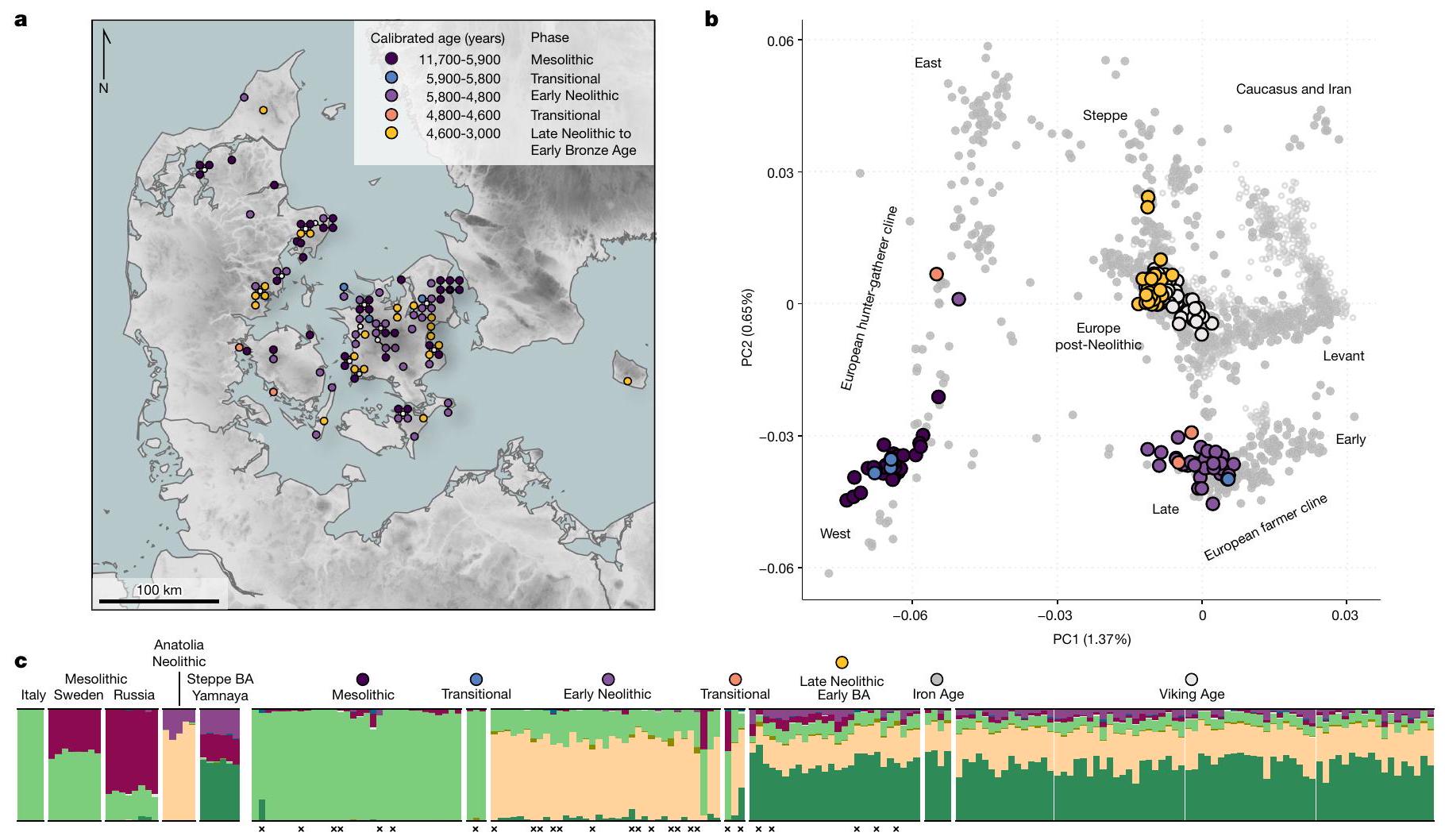
لتحقيق في هذه الأحداث المحددة بدقة زمنية ومكانية عالية، نقوم بتحليل مجموعة بيانات مفصلة ومستمرّة تتكون من 100 جينوم دنماركي قديم تم تسلسلها باستخدام تقنية الشوتغن. إلى التغطية الجسدية يمتد حوالي 7300 سنة من العصر الميزوليتي المبكر (ماجلوموس)، وعصر كونغيموس، وعصر إرتيبول الميزوليتي المتأخر، إلى العصر النيوليثي المبكر والمتوسط (FBC وSGC)، حتى العصر البرونزي (الشكل 1 والبيانات التكميلية 1). تمثل السجلات الأثرية في الدنمارك مجموعة كبيرة جدًا من بقايا الهياكل العظمية البشرية الموثقة جيدًا من فترات ميزوليتية ونيوليثية، من مجموعة واسعة من السياقات الزمنية والطبوغرافية والاجتماعية الثقافية. وهذا نتيجة لبيئة ومناخ كانا ملائمين لأساليب حياة الصيادين وجامعي الثمار في العصر الميزوليتي. وممارسات الزراعة النيوزيلندية المتأخرة، جنبًا إلى جنب مع ظروف الحفظ المواتية من الناحية التافونية لبقايا الهياكل العظمية، وتاريخ طويل وغني من البحث الأثري. استخدمنا نهجًا متعدد الوسائط، يجمع بين الأوتوسومات.
الشكل 1| نظرة عامة على مجموعة البيانات. أ، المواقع الجغرافية والفئات العمرية المتعلقة بـ 100 جينوم تم تسلسلها من الدنمارك. يتم تحديد المجموعات من خلال مزيج من التسلسل الزمني والثقافة والأنساب (انظر الملاحظات التكميلية 1 و 3). ب، تحليل المكونات الرئيسية لـ 179 فردًا دنماركيًا قديمًا (البيانات التكميلية 3) تتراوح من العصر الحجري الوسيط إلى عصر الفايكنج، بما في ذلك الأفراد الذين تم نشرهم سابقًا. في سياق التنوع الجيني الأوسع في غرب أوراسيا أفراد حديثون، دوائر رمادية مفتوحة؛ أفراد قدامى، مليئون بالرمادي
دوائر). الأفراد القدماء من الدنمارك ملونون وفقًا للفترة كما هو محدد في أ و ج. ج، التجميع القائم على النموذج غير المراقب (ADMIXTURE) لـ مكونات النسب في الأفراد الدنماركيين، بالإضافة إلى بيانات سياقية من مجموعات مختارة (يسار) تمثل مكونات النسب ذات الصلة. انظر الشكل 1 في البيانات الموسعة لتسميات الأفراد. تشير العلامات السوداء إلى الجينومات ذات التغطية المنخفضة الممثلة بواسطة الأنماط الجينية شبه الأحادية. BA، العصر البرونزي.
الجينومات المدخلة مع المجموعات الجينية للكروموسوم Y والميتوكندريا، -تأريخ، توقعات النمط الجيني، بالإضافة إلى , و بيانات النظائر كبدائل للحركة والنظام الغذائي. علاوة على ذلك، للتحقيق في رابط مباشر بين العمليات الديموغرافية والبيئية، نقوم بمحاذاة التغيرات الجينية التي لوحظت في السكان الدنماركيين على مر الزمن مع التغيرات في الغطاء النباتي المحلي، استنادًا إلى تحليلات حبوب اللقاح وإعادة بناء الغطاء النباتي الكمي.

فترة الميزوليت

لا يُعرف ما إذا كانت التغيرات في الثقافة المادية في العصر الميزوليتي الجنوبي من اسكندنافيا قد حدثت في إطار استمرارية سكانية أو كانت مدفوعة بمهاجرين قادمين. يرتبط الاستيطان المبكر في العصر الميزوليتي في الدنمارك بثقافة ماغليموس (حوالي )، التي تتميز أثريًا بمشاريع صوانية صغيرة على شكل هندسي. حتى التطور الحديث لعلم الآثار تحت الماء، كانت هذه الثقافة معروفة بشكل رئيسي من المواقع الداخلية على طول البحيرات والأنهار . خلال ثقافة كونغيموس اللاحقة (حوالي 8400 تسيطر رؤوس السهام على شكل المعلاق المصنوعة من الصوان على التجمعات. بالإضافة إلى شفرات طويلة عالية الجودة. تتجمع معظم المستوطنات الكبيرة في مواقع صيد جيدة على طول السواحل. ولكن هناك أيضًا معسكرات صيد متخصصة في الداخل تتميز ثقافة إرتيبول المتأخرة في العصر الميزوليتي (حوالي 7400-5900 سنة قبل الحاضر) بنقاط من الصوان ذات حواف عرضية. تم إدخال الفخار من مجموعات الصيادين وجامعي الثمار الأخرى من الشرق وربما من الجنوب الغربي. وتمثل المحاور ذات الثقوب ‘الغريبة’ تبادلًا مع المجتمعات الزراعية جنوب بحر البلطيق . تمثل مواقع السكن الأكبر، المنتشرة بكثافة على طول السواحل، على الأرجح احتلالًا متعدد العائلات على مدار السنة
وقد قدمت رؤى مهمة حول الأنثروبولوجيا الفيزيائية والثقافة الروحية في تلك الفترة.
من خلال تحليل الجينومات من 38 من الصيادين وجامعي الثمار الدنماركيين واستنتاج أسلافهم، نفحص ما إذا كانت التحولات الثقافية التي لوحظت في السجل الأثري الدنماركي مرتبطة بأي تغييرات جينية في السكان. تُظهر تحليلات التجميع المعتمدة على النماذج (ADMIXTURE) وPCA وتحليلات مشاركة IBD أنه على مدار عصور ماجلوموس ( )، كونغيموس ( ) وعصر إرتيبول ( ) أظهرت المنطقة تجانسًا جينيًا ملحوظًا عبر مقطع عرضي يمتد لأكثر من 4500 عام (الأشكال 1-3 والأشكال الممتدة 1-3)، مما يدعم تفسيرات الاستمرارية السكانية التي يفضلها بعض علماء الآثار . من أقدم هيكل عظمي معروف في الدنمارك، ‘رجل كويلبيرغ’ (NEO254، 10,648 )، إلى أحدث هيكل عظمي من العصر الميزوليتي المدرج هنا، ‘رجل رودهالس’ (NEO645، )، يستمد الأفراد أسلافهم تقريبًا حصريًا من نفس المصدر الجنوبي الأوروبي (إيطاليا_15000BP_9000BP) الذي هيمن على أسلاف WHG في العصر الميزوليتي في غرب أوروبا .
في تحليل المكونات الرئيسية المعتمد على IBD، تتجمع الأفراد الميزوليتيون الدنماركيون معًا بشكل وثيق (الشكل الممتد 4a)، ولكن بخلاف هذه الصلة الجينية المحلية الضيقة، يشاركون أحدث أسلاف مع الأفراد من الصيادين وجامعي الثمار الجغرافيين والزمنيين القريبين من غرب أوروبا (مثل رجل تشيدار، لوشبور وبشون، المعروفين عمومًا باسم WHG؛ مجموعة جينية أوروباW_13500BP_8000BP؛ الشكل 2). من المحتمل أن تعكس التحول الطفيف لأقدم الأفراد الدنماركيين نحو هؤلاء الأفراد الغربيين قربهم الزمني الأقرب الذي تم التقاطه من خلال مشاركة IBD (الشكل الممتد 4a). على الرغم من أن ضغط تصنيع الشفرات في ثقافة ماجلوموس والفخار في ثقافة إرتيبول كلاهما
الشكل 2| أنماط مشاركة الهوية من خلال النسب في الأفراد الدنماركيين القدماء من حوالي 10,500-3000 قبل الميلاد. خريطة حرارية تُظهر معدل مشاركة IBD النسبي لـ 72 فردًا قديمًا مستنتجًا من الدنمارك ( الأفراد المبلغ عنهم في هذه المقالة، الأفراد المنشورين سابقًا ) من العصر الميزوليتي إلى
العصر البرونزي مع مجموعات جينية مختارة. يتم تجميع الأفراد حسب عضويتهم في المجموعة الجينية. انظر البيانات التكميلية 3 لتعريف مجموعة البيانات وفئة النسب.
تم الادعاء بأن لها أصل شرقي ، تُظهر بياناتنا عدم وجود دليل على الاختلاط مع صيادين وجامعي ثمار شرقيين أكثر خلال تلك الأوقات. وهذا يشير إلى الانتشار الثقافي كمصدر لهذه الإدخالات في الدنمارك. عند اختبارها باستخدام إحصائيات D، تشكل جميع الأفراد الميزوليتيين الدنماركيين مجموعة مع الفرد الأقدم (NEO254)، باستثناء صيادين وجامعي ثمار ميزوليتيين سويديين (سويد_10000BP_7500BP؛ الشكل الممتد 2a) على الرغم من القرب الشديد من السويد. ومع ذلك، تم مشاركة إشارة ضعيفة لتدفق الجينات مع EHGs عبر المقطع العرضي الميزوليتي الدنماركي بأكمله (الشكل الممتد 2b)، مما يشير إلى الاتصال مع المجتمعات التي تقع أبعد إلى الشرق قبل توسعها إلى الدنمارك قبل أو خلال أقدم فترة ميزوليتية.
تشير توقعات النمط الجيني (الملاحظة التكميلية 2) إلى احتمال عالٍ لوجود صبغة عيون زرقاء طوال العصر الميزوليتي، متسقة مع النتائج السابقة ، مما يُظهر أن هذه الميزة كانت موجودة بالفعل في أوائل العصر الميزوليتي لكنها لم تكن ثابتة في السكان. جميع صيادي وجامعي الثمار الميزوليتيين من الدنمارك يظهرون احتمالًا عاليًا لوجود شعر بني أو أسود وتوقعات الطول تشير عمومًا إلى قامة أقل قليلاً و/أو أقل تنوعًا من تلك الموجودة في الفترة النيوزيلندية اللاحقة. ومع ذلك، نحذر من أن المسافة الجينية الكبيرة نسبيًا إلى الأفراد المعاصرين المدرجين في دراسات الارتباط على مستوى الجينوم (GWAS) تنتج درجات أقل قابلية للتطبيق على الأفراد الميزوليتيين مقارنة بالمجموعات الأكثر حداثة .
يمكن أن تُفيد قيم النظائر المستقرة في الكولاجين حول نسبة البروتين المشتق من البحر مقابل البروتين المشتق من اليابسة، بينما تعكس القيم المستوى الغذائي لمصادر البروتين . يُظهر الهيكل العظمي الأقدم (NEO254) قيمًا نظيرية غذائية منخفضة (الشكل 3) تمثل نمط حياة صيادين وجامعي ثمار من الداخل في العصر الميزوليتي المبكر. يتم عكس هذه النتيجة في ثاني أقدم هيكل عظمي معروف من الدنمارك (توميروبغاردس
موسى ). من ماجلوموس اللاحقة (حوالي 9500 قبل الميلاد) وطوال عصور كونغيموس وإرتيبول، نلاحظ زيادة تدريجية في و القيم (الشكل الممتد 5 والأشكال التكميلية 4.1 و4.2). وهذا يعني أن الأطعمة البحرية أصبحت تشكل المصدر الرئيسي للبروتينات، كما تم الاقتراح سابقًا بناءً على بيانات من أكثر من 30 إنسانًا و كلبًا ميزوليتيًا، من مواقع ساحلية وداخلية في الدنمارك . خلال هذه الفترة، أدى ارتفاع مستوى سطح البحر العالمي تدريجيًا إلى تحويل الدنمارك الحالية إلى أرخبيل، حيث كان لجميع المجموعات البشرية وصول واسع إلى الموارد الساحلية ضمن أراضيهم السنوية . تكيفت السكان المحليون في العصر الميزوليتي مع نظامهم الغذائي وثقافتهم مع مرور الوقت مع تغير المناظر الطبيعية، وتظهر بياناتنا أن هذا حدث في مجموعة سكانية مستمرة، دون أي تدفق ملحوظ للمهاجرين على مدى فترة 4500 عام. قد تشير انخفاض التباين في نسب النظائر طوال العصر الميزوليتي (الشكل 3 والملاحظة التكميلية 5) إلى محدودية التنقل على المدى الطويل و/أو اشتقاق مصادر غذائية من بيئات أكثر تجانسًا (على سبيل المثال، بحرية) مقارنة بالفترات النيوزيلندية اللاحقة.
من الجدير بالذكر أن بعض الأفراد الميزوليتيين الدنماركيين ثبت أنهم مرتبطون ارتباطًا وثيقًا . يتم إثبات القرابة الوثيقة في حالة فردين (NEO568/NEO569)، الأب والابن، المدفونين بجوار بعضهما البعض في موقع قذائف إرتيبول الكلاسيكي، وفي حالة فردين (NEO732/NEO733)، الأم والابنة، اللتين دفنتا معًا في دراجشولم. كان قبر إرتيبول هو أول هيكل عظمي بشري تم اكتشافه في الدنمارك (تم التنقيب عنه في تسعينيات القرن التاسع عشر) والذي يمثل بلا منازع صيادين وجامعي ثمار. بعد التنقيب عن هذا الموقع، فقدت الأسباب الأكاديمية المستندة إلى السرد الكتابي حول ما قبل التاريخ المبكر في اسكندنافيا زخمها. لا يمكن أن تكشف بيانات التنقيب عما إذا كانوا قد دفنوا في نفس الوقت؛ يمكن التأكد فقط
الشكل 3 | انظر الصفحة التالية للتعليق.
فقط أن الصبي (الرضيع، أقل من عامين من العمر) كان موضوعًا على بعد أقل من متر من والده (رجل إرتيبول). كشفت الحفريات في دراجشولم في عام 1973 عن دفن مزدوج محفوظ جيدًا يحتوي على قبر لامرأتين ميزوليتين بالإضافة إلى قبر ذكر مع
أغراض تدل على تاريخ مبكر من العصر النيوزيلندي . تم اقتراح علاقة قرابة وثيقة للامرأتين من دراجشولم بناءً على ملاحظات أنثروبولوجية فيزيائية . تم اقتراح أنهما كانتا شقيقتين، لكن يمكن الآن تصحيح ذلك إلى دفن مشترك لأم
الشكل 3 | التحولات الجينية، الظاهرية، الغذائية والبيئية في الدنمارك عبر الزمن. دليل على حدوث انقلابين سكانيين في بيانات متعددة المصادر مرتبة زمنيًا من 100 هيكل عظمي دنماركي من العصر الميزوليتي، النيوزيلندي والعصر البرونزي المبكر (البيانات التكميلية 1). تُظهر الشكل التغيرات المتزامنة في (من الأعلى) نسب الاختلاط في بيانات الجينوم غير المستنتجة، والمجموعات الهابلوغرافية الكروموسومية Y والميتوكوندرية، وتوقعات النمط الجيني (استنادًا إلى البيانات المستنتجة) و و و بيانات النظائر ك proxies للتنقل والنظام الغذائي، على التوالي. تمثل قيم الطول المتوقعة الفروق (بالسنتيمتر) عن متوسط طول السكان الدنماركيين الحاليين؛
تظهر احتمالات ألوان الشعر (الأشقر، البني، الأسود والأحمر) وألوان العيون (الزرقاء والبنية)، مع الرمادي يدل على احتمال لون العين المتوسطة (بما في ذلك الرمادي، الأخضر والبني). تُظهر اللوحة السفلية التغيرات الكمية في تغطية الغطاء النباتي، استنادًا إلى تحليلات حبوب اللقاح في بحيرة هويبي في زيلاند. لاحظ أن لوحة الغطاء النباتي تغطي فترة زمنية أقصر من اللوحات الأخرى. تحدد الخطوط الرأسية السوداء أول ظهور لأصل المزارعين النيوزيلنديين الأناضوليين وأصل مرتبط بالسافانا، على التوالي. يتم الإشارة إلى الأفراد ذوي التغطية الجينومية المنخفضة، وعلامات التلوث المحتمل و/أو درجات توقع النمط الجيني المنخفضة (GP) (الطرق).
وابنته. تظهر بياناتنا أيضًا أن الرجل في القبر المجاور (‘رجل دراجشولم’، NEO962) لم يكن مرتبطًا بالامرأتين. تظهر هذه الحالات أن القرابة البيولوجية الوثيقة كانت ذات أهمية اجتماعية لمجموعات العصر الحجري الحديث المتأخر في شمال أوروبا وأثرت على معاملة الموتى من أعضاء مجتمعهم.

الانتقال النيوليتي المبكر

لقد احتل ظهور العصر الحجري الحديث FBC في الدنمارك مكانة مركزية في البحث الأثري والنقاش على مدار الـ 175 عامًا الماضية. . العنصر المحدد للعصر الحجري الحديث، وهو اقتصاد إنتاج الغذاء القائم على الحيوانات والنباتات المستأنسة ذات الأصل من جنوب غرب آسيا، كان موجودًا بلا شك في الدنمارك منذ حوالي شهدت عملية النيوليثية ازدهارًا في أشكال وأنواع جديدة تم تقديمها في الثقافة المادية الدنماركية، بما في ذلك الأكواب على شكل قمع والفؤوس المصقولة من الصوان. اعتبارًا من حوالي 5800 سنة قبل الحاضر، تم إضافة تلال طويلة ضخمة من الخشب والتراب إلى المجموعة، وبعد حوالي 200 عام، تم بناء قبور من التربة، محاطة بالحجارة المرتفعة وتضم غرفًا مبنية من الحجر، كمعالم بارزة في الأراضي الزراعية. . بعد ظهرت قبور تمرية مبنية من الحجر أكبر وأكثر تعقيدًا في تلال ترابية كبيرة. في هذه الأثناء، استمرت المدافن البسيطة غير النُصُب إلى جانب القبور الميغاليثية طوال فترة ثقافة الفخار المبكر. يمكن تفسير رواسب السكن، التي تعود إلى أوائل قرون العصر الحجري الحديث، فوق العديد من أكوام القواقع الساحلية من فترة إرتيبول، على أنها استمرار محلي لجمع الموارد البحرية وصيد الأسماك. بالمقابل، ترتبط المستوطنات الأخرى التي تحتوي على منازل طويلة منتظمة في الأراضي السهلة الزراعة بمخلفات من النباتات والحيوانات المنزلية، مما يشير إلى تمييز واضح عن فترة إرتيبول السابقة. .
بغض النظر عن هذه الفروق الدقيقة، في حوالي 5900 سنة قبل الحاضر، توثق مجموعة البيانات المتعددة المصادر لدينا تحولًا ملحوظًا ومفاجئًا في المعايير الجينية والظاهرة والغذائية والنباتية (الشكل 3). هذه أدلة قوية على الانتشار السكاني، مما يحل نقاشًا طويل الأمد. كما لوحظ في أماكن أخرى في أوروبا كان إدخال الزراعة في الدنمارك مرتبطًا بشكل لا لبس فيه بوصول أشخاص ذوي أصول مرتبطة بالمزارعين الأناضوليين. وقد أدى ذلك إلى استبدال سكاني مع مساهمة جينية محدودة من الصيادين وجامعي الثمار المحليين. يُلاحظ أقدم مثال على هذه الأصول النيوزيلية النموذجية في مجموعة البيانات الدنماركية لدينا في هيكل عظمي لامرأة من Viksø Mose (NEO601) يعود تاريخه إلى 5,896-5,718 سنة قبل الحاضر (95%). في تحليل المكونات الرئيسية، تتجمع جميع الأفراد الدنماركيين من العصر النيوزيلندي المبكر في الطرف ‘المتأخر’ من خط المزارعين النيوزيلنديين الأوروبيين وتظهر باستمرار بعضًا من أكبر كميات من الأصول الجينية للصيادين وجامعي الثمار. ) بين جميع جينومات المزارعين الأوروبيين من العصر الحجري الحديث المدرجة (الأشكال 1 و 3 والأشكال البيانية الموسعة 1 و 5a والبيانات التكميلية 4). في تحليلات تجميع IBD، يشكل الأفراد الدنماركيون جزءًا من مجموعة جينية (Scandinavia_5600BP_4600BP) مع الأفراد المرتبطين بـ FBC من السويد وبولندا، ويظهرون أيضًا تقاربًا وثيقًا مع الأفراد البولنديين من ثقافة الأمفورة الكروية (GAC) (الشكل البياني الموسع 4b). قد يشير هذا إلى أصل قريب من شرق أوروبا للمزارعين الأوائل في الدنمارك. باستخدام نمذجة الأنساب الأقرب، نجد أن الأفراد المرتبطين بـ FBC من العصر الحجري الحديث عبر الدنمارك والسويد وبولندا استمدوا مكون أنسابهم من الصيادين وجامعي الثمار بشكل أساسي من مصدر مرتبط بـ WHG.
(أوروباW_13500BP_8000BP). يتم العثور على سلالة مرتبطة بصيادي وجامعي الثمار من العصر الحجري الوسيط الدنماركي (الدنمارك_10500BP_6000BP) بنسب أصغر (أقل من حوالي ) وفقط في مجموعة فرعية من الأفراد FBC من الدنمارك (الشكل البياني الموسع 6). علاوة على ذلك، يميل هذا إلى الحدوث في الأفراد الأكثر حداثة (المؤرخين إلى حوالي 5400 سنة قبل الحاضر وما بعدها) الذين يظهرون أيضًا أكبر كمية إجمالية من أسلاف الصيادين وجامعي الثمار (على سبيل المثال، NEO945 وNEO886؛ الشكل 3 والأشكال البيانية الموسعة 3 و6a،b). باستخدام DATES وجدنا أن أوقات الاختلاط لجزء كبير من الأفراد الدنماركيين من العصر الحجري الحديث تسبق 5900 سنة قبل الحاضر عندما ظهرت ثقافة الفخار الأوكراني في الدنمارك، وخاصة بالنسبة لأقدم الأفراد (الشكل التمديدي 7). تم ملاحظة أوقات اختلاط أكثر حداثة (بعد وصول ثقافة الفخار الأوكراني إلى الدنمارك) بشكل رئيسي في الأفراد المؤرخين بعد حوالي وكانت مرتبطة بنسب أعلى من الصيادين وجامعي الثمار بشكل عام. كانت هذه الملاحظات في تناقض ملحوظ مع الأفراد المرتبطين بـ FBC من السويد، حيث لم تتغير أوقات الاختلاط وأصول الصيادين وجامعي الثمار بمرور الوقت، ولم يتم الكشف عن أي اختلاط مع الصيادين وجامعي الثمار المحليين في السويد.
تظهر نتائجنا وجود تغيير سكاني في الدنمارك عند بداية النيوثيلي، من قبل القادمين الذين أظهروا مزيجًا من سلالة المزارعين النيوثيليين الأناضوليين وسلالة الصيادين الجامعين غير المحليين. يمكن اكتشاف السلالة المتعلقة بالصيادين الجامعين المحليين في الدنمارك فقط في وقت متأخر من مجموعة الجينات النيوثيلية الدنماركية، مما يشير إلى تدفق الجينات مع مجموعات من الصيادين الجامعين الذين بقوا على قيد الحياة في وقت متأخر، كما تم توثيقه أيضًا في مناطق أوروبية أخرى (بوابات الحديد). أوروبا الوسطى وإسبانيا لا نعرف كيف اختفى سكان فترة الميزوليت في إرتيبول. قد يكون بعضهم قد انزوى في ‘جيوب’ صغيرة من الوجود القصير و/أو تكيفوا مع نمط حياة العصر النيوليثي. أحدث فرد في مجموعة البيانات الدنماركية لدينا الذي يحمل سلالة من الصيادين وجامعي الثمار هو الرجل دراجشولم المذكور (NEO962)، الذي يعود تاريخه إلى 5,947-5,664 سنة قبل الحاضر (فترة ثقة 95%) وتم تعيينه أثريًا إلى ثقافة FBC بناءً على مقتنيات قبره. تؤكد بياناتنا نظامًا غذائيًا نييوليتيكيًا نموذجيًا يتناسب مع الانتماء الثقافي ولكنه يتناقض مع أسلافه من الصيادين وجامعي الثمار. إنه يمثل بوضوح شخصًا محليًا من أصول ميزوليتية عاش في فترة الانتقال القصير من الميزوليت إلى النييوليت وتبنى ثقافة ونظام غذائي المزارعين المهاجرين. تم ملاحظة حالة مشابهة من أصول صيادين وجامعي ثمار متأخرة في الدنمارك عند تحليل الحمض النووي البشري المستخرج من قطعة من القطران المتعفن من موقع سيلثولم في لولاند. “، المؤرخ بين 5,858-5,661 سنة قبل الحاضر (95%). وبالتالي، استمرت الأفراد ذوي الأنساب من الصيادين وجامعي الثمار لعقود وربما لقرون بعد وصول مجموعات الزراعة إلى الدنمارك، على الرغم من أنهم تركوا فقط بصمة جينية طفيفة على سكان القرون اللاحقة. كما توجد أصول ‘بقايا’ من الصيادين وجامعي الثمار في الفرد إيفينسوس (NEO260) من الساحل الغربي للسويد، المؤرخ بين 5913-5731 سنة قبل الحاضر. .
من بداية العصر الحجري الحديث في الدنمارك، تغير النظام الغذائي بشكل مفاجئ نحو هيمنة المصادر الأرضية كما يتضح من قيم حول و قيم حول (الشكل 3 والشكل الإضافي 5). تماشياً مع الأدلة الأثرية، تُظهر هذه البيانات النظيرية أن المحاصيل والحيوانات المستأنسة قدمت المصدر الرئيسي للبروتينات من هذه النقطة فصاعداً. ظلت قيم النظائر مستقرة عند هذه المستويات طوال الفترات التالية، على الرغم من وجود تباين أكبر قليلاً بعد حوالي (الشكل 3). خمسة أفراد من العصر الحجري الحديث والعصر البرونزي المبكر لديهم و قيم تشير إلى تناول كبير من الغذاء البحري عالي السلسلة الغذائية. هذا بشكل خاص
الشكل 4 | الإرث الجيني للأفراد الدنماركيين القدماء. تحليل المكونات الرئيسية لـ 2000 جينوم دنماركي حديث من دراسة iPSYCH في سياق الأفراد الغربيين القدامى في أوراسيا. تشير الرموز الملونة إلى عمر العينة للأفراد الدنماركيين القدامى، بينما تشير الرموز الرمادية إلى 1,145 فردًا قديمًا تم استنتاجهم.
من عبر أوراسيا الغربية يتم الإشارة إلى الأفراد الدنماركيين الحديثين بواسطة دوائر سوداء مملوءة ويظهرون على اليمين. في الزاوية، عرض مكبر للتجمع مع الدنماركيين الحديثين. تمثل مقياس الألوان في الزاوية نطاق العمر للعينات القديمة داخل المنطقة المكبرة فقط.
تم النطق به للفرد NEO898 (سفينينغ فيلاي)، وهو أحد الأفراد الدنماركيين من العصر الحجري الحديث الذين يظهرون أسلافًا مرتبطين بالصيادين الجامعين المتأخرين في السويد (انظر أدناه). هناك تباين أعلى بكثير في الفرد يمكن رؤية القيم مع بداية العصر الحجري الحديث. يستمر هذا في الفترات اللاحقة (ملاحظة إضافية 5) وليس من السهل تفسيره من خلال التحيزات في أخذ العينات حيث تتركز معظم عيناتنا، بغض النظر عن السلالة والفترة الزمنية، في الأجزاء الشرقية من الدنمارك حيث تكون ظروف حفظ العظام جيدة بشكل عام (الشكل 1 والشكل الإضافي 5.3). قد يشير هذا النمط إلى أن المزارعين في العصر الحجري الحديث في الدنمارك احتلوا و/أو استهلكوا الطعام من مناظر طبيعية أكثر تنوعًا، أو كانوا أكثر تنقلًا من الصيادين وجامعي الثمار السابقين. كما أن الانتقال إلى العصر الحجري الحديث يشير أيضًا إلى زيادة كبيرة في تكرار الأليلات ذات التأثير الكبير المرتبطة بصبغة الشعر الفاتح بينما تشير التوقعات خلال الألفية الأولى من العصر الحجري الحديث (عصر FBC) في الغالب إلى قامة أقل من القامة الحالية، مما يردد النتائج السابقة .
نشأت ثقافة الفخار المثقوب (PWC) في شبه الجزيرة الاسكندنافية وجزر البلطيق شرق البر الرئيسي السويدي ولكنها ظهرت حوالي . BP في الجزء الشمالي والشرقي من الدنمارك، حيث تعايشت مع . تتميز بالفخار الخشن الذي غالبًا ما يكون مزينًا بالحفر والاعتماد على مزيج من الأنواع البحرية والمنتجات الزراعية. لم يتم اكتشاف أي دفن مرتبط بـ PWC في الدنمارك. ومن الجدير بالذكر، مع ذلك، أن جينومات فردين ذكور يبلغ عمرهما حوالي 5200 عام (NEO33، NEO898) وجدت في رواسب الأراضي الرطبة الدنماركية أثبتت أنها من سلالة الصيادين وجامعي الثمار المرتبطة بتلك الخاصة بأفراد PWC من Ajvide في جزيرة غوتلاند البلطيقية (السويد) (الأشكال 2، 3 والشكل الإضافي 4a). من بين الفردين، يظهر NEO033 (فيتروب، شمال يولاند) أيضًا توقيع Sr غير المعتاد (الشكل 3)، مما قد يشير إلى أصل غير محلي يتناسب مع سلالته غير العادية. بشكل عام، تظهر نتائجنا اتصالًا مباشرًا عبر البحر بين الدنمارك وشبه الجزيرة الاسكندنافية خلال هذه الفترة، وهو ما يتماشى مع الاكتشافات الأثرية .

العصر الحجري الحديث المتأخر وعصر البرونز

تحولت أوروبا بسبب الهجرات واسعة النطاق من ستيب بونتيك كاسبيان حوالي 5000-4800 سنة قبل الميلاد. وقد أدخل هذا سلالة مرتبطة بالسهوب إلى معظم أجزاء القارة خلال فترة زمنية تبلغ 1000 عام وأدى إلى ظهور ثقافة الفخار المربوط (CWC) المعقدة . في الدنمارك، تزامن هذا مع الانتقال من FBC إلى SGC، وهو التجلي الإقليمي
للمجمع CWC. تم تمييز الانتقال إلى القبور الفردية في التلال الدائرية أثريًا من خلال مرحلتين من التوسع: احتلال أولي وسريع لمركز وغرب وشمال يولاند (غرب الدنمارك) بدءًا من حوالي . BP وتوسع لاحق وأبطأ عبر جزر الدنمارك الشرقية بدءًا من حوالي . في الأجزاء الشرقية من البلاد، تكون سمات SGC أقل وضوحًا، بينما استمرت تقاليد FBC مثل الدفن في غرف القبور الميغاليثية . يمثل هذا التحول الثقافي لغزًا أثريًا كلاسيكيًا آخر، مع تفسيرات تفضل الهجرة مقابل التكيف الثقافي تتنافس على مدى أجيال .
لقد أظهرت رؤى من بعض الجينومات ذات التغطية المنخفضة بالفعل وجود صلة بتوسعات السهوب، ولكن من خلال رسم مكونات السلالة في 100 جينوم قديم، نكشف الآن عن التأثير الكامل لهذا الحدث ونظهر تحولًا سكانيًا شبه كامل في الدنمارك خلال 1000 عام فقط. كان هذا التحول الجيني واضحًا من خلال تحليلات PCA وADMIXTURE، حيث تتجمع الأفراد الدنماركيون الذين يعود تاريخهم إلى SGC والعصر الحجري الحديث المتأخر وعصر البرونز (LNBA) مع أفراد LNBA الأوروبيين الآخرين وتظهر نسب كبيرة من مكونات السلالة المرتبطة بمجموعات يامنايا من السهوب (الأشكال 1 و3 والشكل الإضافي 1). نقدر أن حوالي 60-85% من السلالة مرتبطة بمجموعات السهوب (Steppe_5000BP_4300BP)، مع الباقي من الأفراد ذوي السلالة المرتبطة بالمزارعين المرتبطين بـ GAC في شرق أوروبا (Poland_5000BP_4700BP؛ 10-23%) وإلى حد أقل من المزارعين الاسكندنافيين المحليين من العصر الحجري الحديث (Scandinavia_5600BP_4600BP؛ 3-18%) (الشكل الإضافي 6a،b). على الرغم من أن ظهور SGC أدخل مكون سلالة جديد كبير في مجموعة الجينات الدنماركية، إلا أنه لم يكن مصحوبًا بتحولات واضحة في نسب النظائر الغذائية، أو نسب نظائر Sr (الشكل 3). ومع ذلك، تشير توقعاتنا للسمات المعقدة إلى زيادة في الطول (الشكل 3 وملاحظة إضافية 2)، وهو ما يتماشى مع توقع أن الأفراد القدماء من السهوب كانوا أطول من متوسط الأفراد الأوروبيين من العصر الحجري الحديث قبل هجرات السهوب .
نظرًا لظروف الحفظ السيئة في معظم غرب الدنمارك، لا نملك هياكل عظمية من المرحلة الأولى من SGC (حوالي ) لذا لا يمكننا إثبات بشكل قاطع أن هؤلاء الأشخاص كانوا يحملون سلالة مرتبطة بالسهوب. تم تنفيذ عادات دفن SGC بطرق مختلفة في الأجزاء الجنوبية والشمالية المرتبطة بـ GAC من شبه الجزيرة، على التوالي ومع الأخذ في الاعتبار النتائج الجينية الأخيرة في مناطق أخرى ، من المحتمل أن عمليات ديموغرافية مختلفة قد حدثت داخل الدنمارك. ومع ذلك، نعلم أن السلالة المرتبطة بالسهوب كانت موجودة بعد 200 عام في الهياكل العظمية المرتبطة بـ SGC
من قبر Gjerrild . يتطابق عمر هياكل Gjerrild العظمية (من حوالي ) مع أقدم مثال على السلالة المرتبطة بالسهوب في دراستنا الحالية، المحددة في هيكل عظمي من قبر ميغاليثي في NæS (NEO792). قدرنا أن حوالي 85% من السلالة المرتبطة بالسهوب في هذا الفرد، وهو أعلى مقدار بين جميع الأفراد الدنماركيين من LNBA (الشكل الإضافي 6a). من الجدير بالذكر أن NEO792 يتزامن أيضًا مع أحدث فردين في مجموعة بياناتنا يظهران سلالة مرتبطة بالمزارعين الأناضوليين دون أي سلالة مرتبطة بالسهوب (NEO580، Klokkehøj وNEO943، Stenderup Hage) مما يشهد على فترة قصيرة من التعايش السلالي قبل اختفاء FBC – مشابه لاختفاء شعب Ertebølle من العصر الحجري الوسيط ذوي السلالة الصيادية قبل ألف عام. باستخدام النمذجة البايزية، نقدر أن المدة بين الظهور الأول للسلالة المرتبطة بالمزارعين الأناضوليين والظهور الأول للسلالة المرتبطة بالسهوب في الدنمارك تتراوح بين 876 و1100 عام (فترة الاحتمال 95%، ملاحظة إضافية 3) مما يعني أن النوع الأول من السلالة كان سائدًا لأقل من 50 جيلًا.
لقد تم وصف العصر الحجري الحديث المتأخر ‘عصر الخنجر’ (حوالي 4300-3700 سنة قبل الميلاد) في الدنمارك كوقت لاندماج مجموعات ثقافية وجينية متميزة . أصبح البرونز سائدًا في الإنتاج المحلي للأسلحة بينما كانت الخناجر المصنوعة من الصوان ذات السطح الأنيق لا تزال الهدية المدفونة الرئيسية للذكور. على عكس عصر SGC، يتم تمثيل هذه الفترة بشكل غني من خلال المواد الهيكلية البشرية. على الرغم من أن التوقيعات الجينومية السكانية الواسعة تشير إلى استقرار جيني في LNBA (الأشكال 1 و3)، تشير أنماط المشاركة الزوجية في IBD وتوزيعات مجموعات الكروموسوم Y في مقطع زمني لـ 38 فردًا من LNBA الدنماركيين والجنوب السويدي إلى وجود ثلاث مراحل سلالة متميزة على الأقل خلال هذه الفترة الزمنية التي تبلغ حوالي 1000 عام (الأشكال الإضافية 4c و8).
مرحلة LNBA I: مرحلة مبكرة بين حوالي 4600 و4300 سنة قبل الميلاد، حيث تتجمع الاسكندنافيون مع أفراد CWC الأوائل من شرق أوروبا، الغنية بالسلالة المرتبطة بالسهوب والذكور الذين يحملون نمط R1a من الكروموسوم Y (الشكل الإضافي 8a،b). أثريًا، يرتبط هؤلاء الأفراد بالمراحل اللاحقة من SGC الدنماركية وثقافة الفأس القتالي السويدية.
مرحلة LNBA II: مرحلة متوسطة تتزامن إلى حد كبير مع عصر الخنجر (حوالي )، حيث تتجمع الأفراد الدنماركيون مع الأفراد LNBA من وسط وغرب أوروبا الذين يهيمن عليهم الذكور ذوو السلالات الفرعية المتميزة من R1b-L51 (الشكل الإضافي 8c،d). من بينهم أفراد من Borreby (NEO735، 737) وMadesø (NEO752).
مرحلة LNBA III: مرحلة نهائية من حوالي . منذ BP، حيث يظهر تجمع متميز من الأفراد الإسكندنافيين يهيمن عليه الذكور ذوو المجموعات الجينية II Y (الشكل التمديدي 8e). مجموعة الكروموسوم Y II هي واحدة من المجموعات الجينية السائدة في الإسكندنافيين المعاصرين، وهنا نوثق حدوثها المبكر في فرد يبلغ من العمر حوالي 4000 عام من فالكوبيغ في جنوب السويد (NEO220). يتزامن الزيادة السريعة في تكرار هذه المجموعة الجينية والأنساب على مستوى الجينوم مع زيادة في حركة البشر كما هو موضح في بيانات نظائر السيريوم السويدية، مما يشير إلى تدفق الناس من المناطق الشرقية أو الشمالية الشرقية من الإسكندنافيا، وظهور دفنات الحجر في جنوب السويد والتي تم تقديمها أيضًا في شرق الدنمارك خلال تلك الفترة .
باستخدام الجينومات من المرحلة III من LNBA (Scandinavia_4000BP_3000BP) في نمذجة الأنساب تحت إشراف، نجد أنها تشكل المصدر السائد للأنساب للإسكندنافيين في عصر الحديد وعصر الفايكنج (الشكل التمديدي 6d) ومجموعات أوروبية قديمة أخرى لها ارتباط موثق بالإسكندنافيا أو الجرمانية (على سبيل المثال، الأنغلو-ساكسون والقوط؛ الشكل التمديدي 6e). عند إسقاط 2000 جينوم دنماركي حديث على تحليل المكونات الرئيسية للأوروبيين القدماء، تحتل الأفراد المعاصرين مساحة متوسطة على خط بين أفراد LNBA وأفراد عصر الفايكنج (الشكل 4). تظهر هذه النتيجة أن الأساس لمجموعة الجينات الحالية كان موجودًا بالفعل في مجموعات LNBA قبل 3000 عام، لكن الهيكل الجيني للسكان الدنماركيين كان يتشكل باستمرار خلال الألفيات اللاحقة.

التأثير البيئي

كانت التحولات السكانية الكبرى الموثقة مصحوبة بتغييرات كبيرة في استخدام الأراضي، كما يتضح من مخطط حبوب اللقاح عالي الدقة من بحيرة هويبي في شمال غرب زيلاند (الشكل 3) الذي تم إعادة بنائه باستخدام خوارزمية إعادة بناء المناظر الطبيعية (LRA؛ الملاحظة التكميلية 6). لقد اكتشفنا رابطًا متزامنًا مباشرًا بين التحولات في ملف الأنساب للسكان واستخدام الأراضي. خلال العصر الميزوليتي، كانت المناظر الطبيعية تهيمن عليها أشجار الغابات الأولية (Tilia وUlmus وQuercus وFraxinus وAlnus وما إلى ذلك). عند بداية العصر النيوليتي، تضاءلت الغابة الأولية، وتم تطهيرها بواسطة مزارعي FBC. ظهر نوع جديد من الغابات مع المزيد من الأشجار الثانوية والأشجار المبكرة (Betula ثم Corylus)، بينما ظل النسبة بين الغابة والأراضي المفتوحة تقريبًا دون تغيير. من حوالي . BP، زادت إزالة الغابات، مما أدى إلى منظر طبيعي يهيمن عليه المراعي المفتوحة. كانت هذه المرحلة المفتوحة قصيرة العمر، وامتدت الغابة الثانوية مرة أخرى من حوالي 5500 إلى 5000 cal. BP، حتى حدثت حلقة أخرى من إزالة الغابات خلال الجزء الأخير من عصر FBC. نستنتج أن الممارسة الزراعية خلال FBC كانت تتميز بإزالة متكررة للغابة تليها إعادة النمو. بعد حوالي ، تغيرت هذه الاستراتيجية مع ظهور SGC ووصول الأنساب المرتبطة بالسافانا إلى الدنمارك. في غرب الدنمارك (جوتلاند)، كان وصول SGC يتميز بفتح دائم على نطاق واسع للمناظر الطبيعية لإنشاء أراضي رعي ونلاحظ هنا زيادة مماثلة في المراعي والأراضي الزراعية في ø Sø في شرق الدنمارك حوالي 4600 cal. BP (الشكل 3). من الجدير بالذكر أن هذا كان مصحوبًا بزيادة في تغطية الغابات الأولية، وخاصة Tilia وUlmus، مما يعكس على الأرجح تطور تقسيم أكثر ديمومة للمناظر الطبيعية إلى مناطق رعي مفتوحة وغابات أولية.

دوافع التغيير

لقد أظهرنا أمثلة على كل من الانتشار الثقافي والديموغرافي خلال الفترات الميزوليتية والنيوليتية في الدنمارك. ظهرت التحولات في الثقافة المادية الميزوليتية دون أي مستويات قابلة للاكتشاف من التغيرات في الأنساب، بينما كانت التحولان الثقافيان في الفترة النيوليتية مدفوعين بوضوح من قبل أشخاص جدد قادمين. وفقًا لذلك، فإن تجميع القطع الأثرية والنُصب في ثقافات أثرية لا يمثل دائمًا مجموعات سكانية متميزة جينيًا ويجب فحص الآليات الأساسية المسؤولة عن التحولات الثقافية ما قبل التاريخ على أساس كل حالة على حدة.
لا يزال من الغموض لماذا جاء التوسع الزراعي النيوليتي إلى توقف لمدة 1000 عام قبل دخول جنوب الإسكندنافيا. قد يكون ذلك معقدًا بسبب كثافة سكانية عالية من الصيادين وجامعي الثمار في العصر الميزوليتي بسبب بيئة بحرية وساحلية منتجة جدًا . علاوة على ذلك، قد يكون سكان إرتيبولي الدنماركيين قد كانوا على دراية بالصراع المسلح مما يمكّن الدفاع الإقليمي ضد المتسللين. بدلاً من ذلك، تم الإشارة إلى أن تغير الظروف المناخية حول . BP أصبح دافعًا لأنه زاد من الإمكانية للزراعة شمالًا ، لكن دراسات أخرى لم تؤكد ذلك . أدت التحول السكاني الثاني في أواخر العصر النيوليتي إلى فترة قصيرة من ثلاثة مجمعات ثقافية متنافسة في الدنمارك، وهي FBC وPWC وSGC. وقد قدم الأخير الأنساب المرتبطة بالسافانا التي سادت حتى اليوم. هناك أدلة أثرية على أن هذه كانت فترة عنيفة، سواء في الدنمارك وأماكن أخرى . بالإضافة إلى ذلك، أثبتت أدلة الحمض النووي القديمة أن الطاعون كان منتشرًا خلال هذه الفترة . بالتزامن مع مؤشرات أخرى لانخفاض السكان وإعادة التشجير الواسعة بعد . ، فإنه يقترح أن السكان المحليين في وسط وشمال أوروبا قد تأثروا بشدة قبل وصول القادمين الجدد ذوي الأنساب المرتبطة بالسافانا. قد يفسر هذا التحول السكاني السريع والاختلاط المحدود مع السكان المحليين الذي نلاحظه.
بينما قد تكون التحولات الكبرى في الثقافة المادية الميزوليتية والنيوليتية في الدنمارك قد كانت لها دوافع وأسباب مختلفة، كانت النتائج في النهاية هي نفسها: وصول أشخاص جدد واستيلائهم بسرعة
على الإقليم. مع هذا الوصول، تم تعديل المناظر الطبيعية المحلية لتناسب نمط حياة وثقافة المهاجرين. هذه هي علامة العصر الأنثروبوسي، التي لوحظت هنا بدقة عالية في الدنمارك ما قبل التاريخ.

المحتوى عبر الإنترنت

أي طرق، مراجع إضافية، ملخصات تقارير Nature Portfolio، بيانات المصدر، بيانات موسعة، معلومات تكميلية، شكر وتقدير، معلومات مراجعة الأقران؛ تفاصيل مساهمات المؤلفين والمصالح المتنافسة؛ وبيانات توافر البيانات والرموز متاحة على https://doi.org/10.1038/s41586-023-06862-3.
  1. Allentoft، M. E. وآخرون. علم الجينوم السكاني في العصر البرونزي في أوراسيا. Nature 522، 167-172 (2015).
  2. Haak، W. وآخرون. كانت الهجرة الضخمة من السافانا مصدرًا للغات الهندو-أوروبية في أوروبا. Nature 522، 207-211 (2015).
  3. Allentoft، M. E. وآخرون. علم الجينوم السكاني لأوراسيا الغربية بعد العصر الجليدي. Nature https:// doi.org/10.1038/s41586-023-06865-0 (2024).
  4. Posth، C. وآخرون. علم الجينوم القديم للصيادين وجامعي الثمار من العصر الحجري العلوي إلى النيوليتي. Nature 615، 117-126 (2023).
  5. Johannsen، N. N.، Larson، G.، Meltzer، D. J. & Vander Linden، M. نافذة مركبة في تاريخ البشرية. Science 356، 1118-1120 (2017).
  6. Furholt، M. التنقل والتغيير الاجتماعي: فهم الفترة النيوليتية الأوروبية بعد ثورة علم الجينوم الأثري. J. Archaeol. Res. 29، 481-535 (2021).
  7. Kristiansen، K. علم الآثار والثورة الجينية في ما قبل التاريخ الأوروبي (عناصر في علم آثار أوروبا) (Cambridge Univ. Press، 2022).
  8. Fischer، A. & Kristiansen، K. النيوليتية في الدنمارك. 150 عامًا من النقاش (J. R. Collis، 2002).
  9. Günther، T. وآخرون. علم الجينوم السكاني في الميزوليت الإسكندنافي: التحقيق في طرق الهجرة المبكرة بعد العصر الجليدي والتكيف مع العروض العالية. PLoS Biol. 16، e2003703 (2018).
  10. Kashuba، N. وآخرون. الحمض النووي القديم من الماستيكس يثبت العلاقة بين الثقافة المادية وجينات الصيادين وجامعي الثمار في الميزوليت في الإسكندنافيا. Commun. Biol. 2، 185 (2019).
  11. Fischer، A. في النيوليتية في الدنمارك-150 عامًا من النقاش (محررون Fischer، A. & Kristiansen، K.) 343-393 (J. R. Collis، 2002).
  12. Price، T. D. أول مزارعي أوروبا (Cambridge Univ. Press، 2000).
  13. Lipson، M. وآخرون. تكشف المقاطع الأثرية الموازية عن تاريخ جيني معقد للمزارعين الأوروبيين الأوائل. Nature 551، 368-372 (2017).
  14. Mathieson، I. وآخرون. التاريخ الجيني لجنوب شرق أوروبا. Nature 555، 197-203 (2018).
  15. براس، س. وآخرون. الجينومات القديمة تشير إلى استبدال السكان في بريطانيا في العصر الحجري الحديث المبكر. نات. إيكول. إيفول. 3، 765-771 (2019).
  16. ميدجلي، م. ثقافة TRB: أول مزارعين في السهول الأوروبية الشمالية (دار نشر جامعة إدنبرة، 1992).
  17. إيفرسن، ر. في تتبع الهندو-أوروبيين: أدلة جديدة من علم الآثار واللغويات التاريخية (تحرير أولسن، ب. أ.، أولاندر، ت. وكريستيانسن، ك.) 73-95 (أوكس بو، 2019).
  18. نيلسن، س. ك. وجوهانسن، ن. ن. حواجز الموتى، القبور الفردية، والامتزاج الثقافي: تأسيس ثقافة الأواني الملتفة في شبه جزيرة يوتلاند. المجلة ما قبل التاريخhttps://doi.org/10.1515/pz-2023-2022 (2023).
  19. كريستيانسن، ك. الهجرات ما قبل التاريخ – حالة ثقافات القبر الفردي وثقافات الأواني الملتفة. مجلة الآثار الدنماركية 8، 211-225 (1991).
  20. لويس، ج. ب. وآخرون. وفرة الموارد البحرية دفعت زيادة السكان قبل الزراعة في عصر الحجر في اسكندنافيا. نات. كوميونيك. 11، 2006 (2020).
  21. سوزا دا موتا، ب. وآخرون. استكمال الجينومات البشرية القديمة. نات. كوميونيك. 14، 3660 (2023).
  22. شيلينغ، هـ. في العصر الحجري الأوسط في الحركة (تحرير لارسون، ل. وآخرون) 351-358 (2003).
  23. بيترسن، ب. ف. التغير الزمني والإقليمي في العصر الميزوليتي المتأخر في شرق الدنمارك. مجلة الآثار الدنماركية 3، 7-18 (1984).
  24. فيشر، أ. في جسر الدانمارك ستوربيلت منذ العصر الجليدي (تحرير: بيدرسن، ل.، فيشر، أ. وأابي، ب.) 63-77 (البحر والغابة، 1997).
  25. سورنسن، س. أ. ثقافة كونغيموس (دار نشر جامعة جنوب الدنمارك، 2017).
  26. دولبونوفا، إ. وآخرون. نقل تقنية الفخار بين الصيادين وجامعي الثمار في أوروبا ما قبل التاريخ. سلوك الإنسان الطبيعي 7، 171-183 (2023).
  27. كلاسن، ل. جاد وكوبر: دراسات حول عملية النيوليثية في منطقة بحر البلطيق الغربية مع مراعاة خاصة لتطور الثقافة في أوروبا 5500-3500 قبل الميلاد المجلد 47 (دار نشر جامعة آرهوس، 2004).
  28. برايس، ت. د. البحث عن أول المزارعين في غرب شيلاند، الدنمارك: علم الآثار لانتقال الزراعة في شمال أوروبا (أوكس بوكس، 2022).
  29. هانسن، ج. وآخرون. هيكل مغلموسيان من كويلبيرغ: إعادة النظر في تحديد الجنس والأصل. المجلة الدنماركية للآثار 6، 55-66 (2017).
  30. سورنسن، م. في بيئة الاستيطان المبكر في شمال أوروبا: شروط البقاء والعيش. الاستيطان المبكر في شمال أوروبا المجلد 1 (تحرير: بيرسون، ب.، ريده، ف. وسكار، ب.) 277-301 (إكوينكس، 2018).
  31. بيزونكا، هـ. وآخرون. تسلسل الفخار في العصر الحجري القديم في منطقة الغابات شمال شرق أوروبا: نتائج جديدة من قياسات الكربون المشع وقياسات نظائر الأكسجين على قشور الطعام. راديكاربون 58، 267-289 (2016).
  32. ماثيسون، I. وآخرون. أنماط الانتقاء على مستوى الجينوم في 230 من الأوراسيين القدماء. الطبيعة 528، 499-503 (2015).
  33. إيرفينغ-بيز، إ. ك. وآخرون. مشهد الاختيار والإرث الجيني للإنسان القديم في أوراسيا. الطبيعةhttps://doi.org/10.1038/s41586-023-06705-1 (2024).
  34. فيشر، أ. وآخرون. التنقل بين الساحل والداخل والنظام الغذائي في العصر الميزوليتي والنيولتي في الدنمارك: أدلة من قيم النظائر المستقرة للبشر والكلاب. مجلة علوم الآثار 34، 2125-2150 (2007).
  35. فيشر، أ. وآخرون. تركيبة غذاء العصر الميزوليتي – أدلة من مستوطنة غارقة على بنك أرجوس، الدنمارك. أكتا أرشيو. 78، 163-178 (2007).
  36. برينش بيترسن، إي. القبور في دراجشولم. من الصيادين إلى المزارعين قبل 6000 عام. أعمال المتحف الوطني 1974، 112-120 (1974).
  37. برايس، ت. د. وآخرون. معلومات جديدة عن قبور العصر الحجري في دراجشولم، الدنمارك. أكتا أرشيو. 78، 193-219 (2007).
  38. سورنسن، ل. من صياد إلى مزارع في شمال أوروبا. الهجرة والتكيف خلال العصر الحجري الحديث وعصر البرونز. أكتا أرخيولوجيكا المجلد 85 (وايلي-بلاكويل، 2014).
  39. نيلسن، ب. أ. ونيلسن، ف. أ. س. أول المزارعين في جزيرة بورنهولم (الجمعية الملكية للآثار الشمالية ودار نشر جامعة جنوب الدنمارك، 2020).
  40. سجورن، ك.-ج. وفيشر، أ. تسلسل الدفنات الدنماركية. نتائج من تواريخ على العظام البشرية. ج. نييوليت. آثار. 25،https://doi.org/10.12766/jna.2023.1 (2023).
  41. ديهن، ت. & هانسن، س. آي. لحاء البتولا في قبور الممرات الدنماركية. مجلة الآثار الدنماركية 14، 23-44 (2006).
  42. إيبيسن، ك. قبور بسيطة، تاريخية. كتب سنوية للآثار والتاريخ الإسكندنافي 1992، 47-102 (1994).
  43. جرون، ك. ج. وسورنسن، ل. التفاوض الثقافي والاقتصادي: منظور جديد حول الانتقال النيوليثي في جنوب اسكندنافيا. الأنتيكويتي 92، 958-974 (2018).
  44. شينتالاباتي، م.، باترسون، ن. ومورجاني، ب. الأنماط الزمانية والمكانية للأحداث الكبرى للاختلاط البشري خلال الهولوسين الأوروبي. eLife 11، e77625 (2022).
  45. غونزاليس-فورتس، ج. وآخرون. أدلة بالجينوم القديم على الاختلاط عبر أجيال متعددة بين المزارعين النيوليثيين وجامعي الصيد في حوض الدانوب السفلي. بيولوجيا حالية 27، 1801-1810.e10 (2017).
  46. فيلاالبا-موكو، ف. وآخرون. بقاء سلالة الصيادين وجامعي الثمار من أواخر العصر الجليدي في شبه الجزيرة الإيبيرية. البيولوجيا الحالية 29، 1169-1177.e7 (2019).
  47. جينسن، ت. ز. ت. وآخرون. جينوم بشري عمره 5700 عام وميكروبيوم فموي من قلف البتولا الممضوغ. نات. كوميونيك. 10، 5520 (2019).
  48. أولادي، إ. وآخرون. الأليلات المناعية والأليلات الصبغية السلفية المستمدة في إنسان أوروبي من العصر الميزوليتي عمره 7000 عام. ناتشر 507، 225-228 (2014).
  49. كوك، س. ل.، راف، س. ب.، ماير، ر. م. وماثيسون، آي. المساهمات الجينية في التباين في طول القامة البشرية في أوروبا ما قبل التاريخ. وقائع الأكاديمية الوطنية للعلوم في الولايات المتحدة الأمريكية 116، 21484-21492 (2019).
  50. كلسن، ل. (محرر) ثقافة الفخار المنقوش على جزيرة ديورسلاند: الأهمية فوق الإقليمية والاتصالات في العصر النيوليثي الأوسط في جنوب اسكندنافيا (دار نشر جامعة آرهوس، 2020).
  51. إيفرسن، ر.، فيليبسن، ب. & بيرسون، ب. إعادة النظر في تسلسل زمن الفخار المنقوش. مجلة ما قبل التاريخ 96، 44-88 (2021).
  52. كوتينيو، أ. وآخرون. لم يتأثر جامعو ثقافة الفخار المنقوش من العصر الحجري الحديث ثقافيًا ولكن ليس وراثيًا برعاة ثقافة الفأس القتالي. المجلة الأمريكية لعلم الإنسان الفيزيائي 172، 638-649 (2020).
  53. جلوب، ب. ف. دراسات حول ثقافة القبور الفردية في جوتلاند (غيلدنال، 1945).
  54. مولر، ج. وفاندكيلد، هـ. في تباينات العصر البرونزي الإسكندنافي. مقالات تكريماً لكريستوفر بريسكوت (محررون: أوستفول، ك.إ.، هيم إريكسن، م.، فريدريكسن، ب.د.، ميلهايم، أ.ل.، بروش-دانييلسن، ل.، سكوغستران، ل.) 29-48 (بريبولس، 2020).
  55. إيفرسن، ر. تحول المجتمعات النيوزيلندية. منظور دنماركي شرقي عن الألفية الثالثة قبل الميلاد المجلد 88 (جمعية جوتلاند الأثرية، 2015).
  56. دام، سي. ثقافة القبر الفردي الدنماركية – هجرة عرقية أم بناء اجتماعي؟ مجلة الآثار الدنماركية 10، 199-204 (1991).
  57. إيجفجورد، أ. ف.-هـ. وآخرون. الأنساب الجينية للسهوب في الهياكل العظمية من ثقافة القبر الفردي في العصر الحجري الحديث في الدنمارك. PLoS ONE 16، e0244872 (2021).
  58. غراسغروبر، ب.، سيبيرة، م.، هرازدييرا، إ.، تشاتشيك، ج. وكالينا، ت. العوامل الرئيسية المرتبطة بطول الذكور: دراسة لـ 105 دول. الاقتصاد. البيولوجيا البشرية 21، 172-195 (2016).
  59. باباك، ل. وآخرون. التغيرات الديناميكية في الهياكل الجينومية والاجتماعية في وسط أوروبا في الألفية الثالثة قبل الميلاد. ساينس. أدف. 7، eabi6941 (2021).
  60. بلانك، م. التنقل، وسبل العيش، وممارسات الدفن. دراسة متعددة التخصصات عن السكان الميغاليثيين في العصر الحجري الحديث والعصر البرونزي المبكر في جنوب غرب السويد. أطروحة دكتوراه، جامعة غوتنبرغ (2021).
  61. وينثر يوهانسن، ج. التوسع في العصر النيوليثي المتأخر. مجلة الآثار الدنماركية 12،https://doi.org/10.7146/dja.v12i1.132093 (2023).
  62. بادرسن، سي. بي. وآخرون. عينة الحالة-المنطقة iPSYCH2O12: اتجاهات جديدة لفك شفرة الهياكل الوراثية والبيئية للاضطرابات النفسية الشديدة. علم النفس الجزيئي 23، 6-14 (2017).
  63. أودغارد، ب. ف. تاريخ الغطاء النباتي في الهولوسين في شمال غرب يولاند، الدنمارك. مجلة النباتات الشمالية 14، 546-546 (1994).
  64. هاك، و. وآخرون في اللغز الهندو-أوروبي المعاد زيارته: دمج علم الآثار، وعلم الوراثة، واللغويات (تحرير كريستيانسن، ك.، كرونن، ج. وويليرسليف، إ.) 63-80 (2023).
  65. فيشر، أ.، غوتفريدسن، أ. ب.، ميدوز، ج.، بيدرسن، ل. وستافورد، م. التكيفات البحرية في مكب مطبخ رودهالس في نهاية العالم الميزوليتي. مجلة علوم الآثار 39، 103102 (2021).
  66. بينيك، ب. في جسر الدانمارك ستوربيلت منذ العصر الجليدي (تحرير: بيدرسن، ل.، فيشر، أ. وأابي، ب.) 99-105 (A/S ستوربيلت فيكسد لينك، 1997).
  67. واردن، ل. وآخرون. التغيرات الديموغرافية والثقافية البشرية الناتجة عن المناخ في شمال أوروبا خلال منتصف الهولوسين. تقارير العلوم. 7، 15251 (2017).
  68. كروسّا، ف. ر. وآخرون. التغير المناخي الإقليمي وبداية الزراعة في شمال ألمانيا وجنوب اسكندنافيا. هولوسين 27، 1589-1599 (2017).
  69. إيفرسن، ر. رؤوس السهام كمؤشرات على العنف بين الأفراد وهُوية المجموعة بين صيادي الفخار المنقوش من العصر الحجري الحديث في جنوب غرب اسكندنافيا. مجلة الأنثروبولوجيا والآثار 44، 69-86 (2016).
  70. ليدكي، ج. العنف في ثقافة القبر الفردي في شمال ألمانيا؟ في العصي، الحجارة، والعظام المكسورة: العنف النيوليثي في منظور أوروبي (تحرير شولتنج، ر. ج. وفايبيجر، ل.) 139-150https://doi.org/10.1093/acprof:osobl/9780199573066.003.0008 (أوكسفورد، 2012).
  71. شرويدر، هـ. وآخرون. فك شيفرة النسب، القرابة، والعنف في قبر جماعي من العصر الحجري الحديث المتأخر. وقائع الأكاديمية الوطنية للعلوم في الولايات المتحدة الأمريكية 116، 10705-10710 (2019).
  72. راسموسن، س. وآخرون. سلالات مبكرة متباينة من يرسينيا بيستيس في أوراسيا قبل 5000 عام. خلية 163، 571-582 (2015).
  73. راسكووان، ن. وآخرون. ظهور وانتشار السلالات الأساسية من يرسينيا بيستيس خلال الانحدار النيوليثي. خلية 176، 295-305.e10 (2019).
  74. هينز، م. وآخرون. في تنوعات العصر الحجري الحديث: وجهات نظر من مؤتمر في لوند، السويد 43-51 (جامعة لوند، 2015).
  75. فيزر، إ.، دورفلر، و.، كنيزل، ج.، هينز، م. ودرايبروت، س. التأثير البشري وديناميات السكان في العصر الحجري الحديث وعصر البرونز: أدلة متعددة المصادر من شمال غرب وسط أوروبا. هولوسين 29، 1596-1606 (2019).
  76. مارغاريان، أ. وآخرون. علم الجينوم السكاني لعالم الفايكنج. ناتشر 585، 390-396 (2020).
ملاحظة الناشر: تظل شركة سبرينجر ناتشر محايدة فيما يتعلق بالمطالبات القضائية في الخرائط المنشورة والانتماءات المؤسسية.
الوصول المفتوح هذه المقالة مرخصة بموجب رخصة المشاع الإبداعي النسب 4.0 الدولية، التي تسمح بالاستخدام والمشاركة والتكيف والتوزيع وإعادة الإنتاج بأي وسيلة أو صيغة، طالما أنك تعطي الائتمان المناسب للمؤلفين الأصليين والمصدر، وتوفر رابطًا لرخصة المشاع الإبداعي، وتوضح إذا ما تم إجراء تغييرات. الصور أو المواد الأخرى من طرف ثالث في هذه المقالة مشمولة في رخصة المشاع الإبداعي الخاصة بالمقالة، ما لم يُشار إلى خلاف ذلك في سطر الائتمان للمواد. إذا لم تكن المادة مشمولة في رخصة المشاع الإبداعي الخاصة بالمقالة وكان استخدامك المقصود غير مسموح به بموجب اللوائح القانونية أو يتجاوز الاستخدام المسموح به، فسيتعين عليك الحصول على إذن مباشرة من صاحب حقوق الطبع والنشر. لعرض نسخة من هذه الرخصة، قم بزيارةhttp://creativecommons.org/licenses/by/4.0/.
© المؤلف(ون) 2024
مورتن إي. ألينتوف مارتن سيكورا أندرس فيشر كارل-غوران سيوغرين أندريس إنغاسون رواريذ ماكلويد أندرس روزنغرين بيتينّا شولتز بولسون ماري لويز شيليروب يوركوف ماريا نوفوسولوف يسبر ستيندروب تي. دوغلاس برايس مورتن فيشر مورتنسن آن بيرغيت نيلسن ميكل أولفيلد هيدي لاس سورنسن بول أوتو نيلسن بيتر راسموسن ثيس زتني ترويل ينسن ألبا ريفويو-مارتينيز إيفان ك. إيرفينغ-بيس ويليام باري أليس بييرسون باربرا سوزا دا موتا فابريس ديمتر راسموس أ. هينريكسن ثارسكا فيمالا هيو مكول أندرو فاون لاس فينر جابرييل رينو آرون ستيرن نيلز نوركجار يوهانسون أبيجيل ديزي رامسوي أندرو جوزيف شورتك أنتوني روتير آن بيرغيت غوتفريدسن بيارني هينينغ نيلسن إريك برينش بيترسن إسبن كانيجارد يسبر هانسن كريستوفر باك بيدرسن ليزبيث بيدرسن لوتز كلاسن مورتن ميلدغارد مورتن يوهانسن أوتو كريستيان أولدوم ، بير لوتز بير ليسدال برنيل بانغسغارد بيتر فانغ بيترسن ريكي مارينغ روني آيفرسن سيدسل واهلين سورين أنكر سورنسن سورين إتش. أندرسن توماس يورغنسن نيلز لينيروب دانيال ج. لوسون سيمون راسموسن ثورفين ساند كورنيليوسن كورت إتش. كجار ريتشارد دوربين راسموس نيلسن أوليفييه ديلانو توماس ويرج كريستيان كريستيانسن و إيسكي ويليرسليف
مركز جيوجينتيكس التابع لمؤسسة لوندبيك، معهد جلوب، جامعة كوبنهاغن، كوبنهاغن، الدنمارك. مختبر الحمض النووي البيئي والتتبع (TrEnD)، كلية العلوم الجزيئية والحياتية، جامعة كيرتن، بيرث، أستراليا الغربية، أستراليا. مجموعة التميز ROOTS، جامعة كيل، كيل، ألمانيا. أركيولوجيا سي لاند، كالوندبورغ، الدنمارك. قسم الدراسات التاريخية، جامعة غوتنبرغ، غوتنبرغ، السويد. معهد الطب النفسي البيولوجي، مركز الصحة النفسية سانت هانس، مستشفى جامعة كوبنهاغن، كوبنهاغن، الدنمارك. مجموعة الجينوم الجغرافي، قسم علم الحيوان، جامعة كامبريدج، كامبريدج، المملكة المتحدة. قسم الأبحاث في علم الوراثة والتطور والبيئة، كلية لندن الجامعية، لندن، المملكة المتحدة. مختبر الأنثروبولوجيا البيولوجية، جامعة كوبنهاغن، كوبنهاغن، الدنمارك. مختبر الكيمياء الأثرية، قسم الأنثروبولوجيا، جامعة ويسكونسن-ماديسون، ماديسون، ويسكونسن، الولايات المتحدة الأمريكية. المتحف الوطني في الدنمارك، كوبنهاغن، الدنمارك. قسم الجيولوجيا، جامعة لوند، لوند، السويد. مدرسة تارنبى الثانوية وHF، كاستروب، الدنمارك. معهد غلوب، كلية الصحة والعلوم الطبية، جامعة كوبنهاغن، كوبنهاغن، الدنمارك. قسم الوراثة، جامعة كامبريدج، كامبريدج، المملكة المتحدة. قسم البيولوجيا الحاسوبية، جامعة لوزان، لوزان، سويسرا. المعهد السويسري للمعلوماتية الحيوية، جامعة لوزان، لوزان، سويسرا. الإيكو-أنثروبولوجيا (EA)، قسم ABBA، المتحف الوطني للتاريخ الطبيعي، CNRS، جامعة باريس سيتé، متحف الإنسان، باريس، فرنسا. مركز البيولوجيا الحاسوبية، جامعة كاليفورنيا، بيركلي، الولايات المتحدة الأمريكية. قسم تكنولوجيا الصحة، قسم المعلوماتية الحيوية، الجامعة التقنية في الدنمارك، كونغنس لينغبي، الدنمارك. قسم الآثار ودراسات التراث، جامعة آرهوس، آرهوس، الدنمارك. قسم الجينوم العصبي، معهد أبحاث الجينوم الانتقالي (TGEN)، فينيكس، أريزونا، الولايات المتحدة الأمريكية. متحف فيستهيملاند، آرس، الدنمارك. معهد ساكسو، جامعة كوبنهاغن، كوبنهاغن، الدنمارك. متحف أوستجولاند، راندرز، الدنمارك. متحف سفيندبورغ، سفيندبورغ، الدنمارك. متحف سيدوستدانمارك، فوردينجبورغ، الدنمارك. مطور تاريخي، كالوندبورغ، الدنمارك. قسم الصحة والطبيعة، جامعة غرينلاند، نوك، غرينلاند. متحف سفن الفايكنج، روسكيلد، الدنمارك. متحف نوردسيلاند، هيليرود، الدنمارك. متحف فستشلاند، هولباك، الدنمارك. متحف فندسيزل التاريخي، هيرنينغ، الدنمارك. متحف مويزغارد، هويبييرج، الدنمارك. مختبر الأنثروبولوجيا البيولوجية، قسم الطب الشرعي، جامعة كوبنهاغن، كوبنهاغن، الدنمارك. معهد العلوم الإحصائية، كلية الرياضيات، جامعة بريستول، بريستول، المملكة المتحدة. مركز أبحاث البروتين التابع لمؤسسة نوفو نورديسك، كلية الصحة والعلوم الطبية، جامعة كوبنهاغن، كوبنهاغن ن، الدنمارك. معهد ويلكوم سانجر، حرم ويلكوم ثروست الجينومي، كامبريدج، المملكة المتحدة. قسم البيولوجيا التكامليّة والإحصاءات، جامعة كاليفورنيا في بيركلي، بيركلي، كاليفورنيا، الولايات المتحدة الأمريكية. قسم الطب السريري، جامعة كوبنهاغن، كوبنهاغن، الدنمارك. مركز ماروم لعلوم البيئة البحرية وكلية علوم الأرض، جامعة بريمن، بريمن، ألمانيا. ساهم هؤلاء المؤلفون بالتساوي: مورتن إي. ألينتوف، مارتن سيكورا، أندرس فيشر. هؤلاء المؤلفون أشرفوا بشكل مشترك على هذا العمل: توماس ويرج، كريستيان كريستيانسن، إيسكي ويليرسليف. الراحل: إسبن كانيجارد. البريد الإلكتروني: morten.allentoft@curtin.edu.au; مارتن.سيكورا@sund.ku.dk; ew482@cam.ac.uk

طرق

تحليلات الجينوم القديمة

تساهم الجينومات الدنماركية القديمة الـ 100 التي تم تحليلها هنا في 317 جينوم تم تسلسله باستخدام تقنية الشوتغن في دراسة ألينتوف وآخرون. جميع التفاصيل المتعلقة بأخذ العينات، واستخراج الحمض النووي، وإعداد المكتبات، والتسلسل، والبيوانفورماتيك الأساسية، والمصادقة، وبناء مجموعة البيانات موجودة في المرجع 3 مع جميع أوصاف المواقع وبيانات العينة. تم إصدار قائمة مختصرة من المعلومات الميتا حول 100 فرد دنماركي هنا (البيانات التكميلية 1) مع نص يلخص مواقع الدراسة والهياكل العظمية (الملاحظة التكميلية 1). باختصار، تم إجراء العمل في المختبر في مرافق نظيفة مخصصة للحمض النووي القديم (جامعة كوبنهاغن) باستخدام طرق محسّنة للحمض النووي القديم. تم تسلسل مكتبات مزدوجة الشريط ذات الأطراف المستقيمة (80 قاعدة و100 قاعدة للقراءات الفردية) على منصات إيلومينا هاي سيك 2500 و4000. تم استخدام فحص شوتغن السطحي الأولي لتحديد العينات التي تحتوي على كمية كافية من الحمض النووي للحفاظ على تسلسل الجينوم بشكل أعمق. من بين 100 عينة دنماركية تأهلت لذلك، كانت 65 من مينا الأسنان، و29 من العظام الصلبة، و6 تم الحصول عليها من عظام أخرى (البيانات التكميلية 1). تم رسم قراءات التسلسل بيولوجيًا على الجينوم البشري المرجعي (البناء 37)، وتم تصفيتها ودمجها إلى مستوى العينة، تلاها تقديرات لتغطية الجينوم، وأضرار الحمض النووي بعد الوفاة، والتلوث، وتحديد الجنس الوراثي. ). بالنسبة لهذه الـ 100 عينة، لاحظنا نسب إزالة الأمين من C إلى T تتراوح من إلى ، بمتوسط عبر جميع العينات (البيانات التكميلية 1)، بما يتماشى مع الحمض النووي القديم المتدهور بشدة. لقد حددنا جينياً 67 ذكراً و32 أنثى وواحد غير محدد في مجموعة بياناتنا (البيانات التكميلية 1).
استخدمنا طريقة حسابية جديدة مُحسّنة للبيانات ذات التغطية المنخفضة لإسناد الأنماط الجينية استنادًا إلى احتمالات الأنماط الجينية للأفراد القدماء باستخدام خط أنابيب samtools/bcftools، وباستخدام بيانات 1000 جينوم الممرحلة كمرجع. لإنشاء مجموعة البيانات الرئيسية في تم تطبيق ذلك بشكل مشترك على 1,664 جينوم قديم تم تسلسله باستخدام تقنية البندقية، بما في ذلك 100 جينوم دنماركي قديم لدينا، وأسفر عن مجموعة بيانات تحتوي على 8.5 مليون SNP شائع. تردد الأليل الثانوي ودرجة معلومات الاستبدال ) للجنوم القديم الثنائي الصبغيات المستنتج. بعد إزالة الجينومات ذات التغطية المنخفضة (<0.1X) وجودة الاستنتاج المنخفضة (متوسط احتمال النمط الجيني <0.98) وتقديرات التلوث >5% أو الأقارب المقربين (الدرجة الأولى أو الثانية، تمت إزالة الأقارب ذات التغطية الأقل)، تم الاحتفاظ بـ 67 من الجينومات الدنماركية الـ 100 كجينومات مستنتجة في التحليلات اللاحقة. تم تحليل الجينومات الـ 33 المتبقية كنمط جيني زائف أحادي الصبغيات.
لتحليلات الوراثة السكانية، قمنا بدمج عينات قديمة مع لوحين مرجعيين حديثين مختلفين:
  • مجموعة بيانات ‘1000 G’: بيانات تسلسل الجينوم الكامل لـ 2504 فردًا من 26 مجموعة سكانية حول العالم من مشروع الجينومات الألف، مع الأنماط الجينية في SNPs جسيمية.
  • ‘مجموعة بيانات ‘HO’: بيانات مصفوفة SNP لـ 2,180 فردًا حديثًا من 213 مجموعة سكانية حول العالم، مع أنماط وراثية عند 535,880 SNPs جسمية.
كانت التحليلات مستندة إلى مجموعة بيانات 1000 ج إلا إذا تم الإشارة إلى خلاف ذلك. تم تضمين الأفراد الذين لم يجتازوا حدود جودة الاستبدال المذكورة أعلاه في تحليلات PCA وADMIXTURE كجينات شبه أحادية. أظهر أربعة أفراد دنماركيين علامات محتملة على تلوث الحمض النووي (الشكل 3 والبيانات التكميلية 1) وتم استبعادهم من معظم التحليلات. للاستفادة الكاملة من البيانات المتعددة المصادر الواسعة، تم تضمينهم مع ذلك في الشكل 3. يتم الإبلاغ عن بيانات التعريف الفردية لجميع التحليلات الجينية المتعلقة بالأفراد الدنماركيين القدماء بالإضافة إلى مجموعة مختارة من الأفراد الغربيين الأوراسيين ذوي الصلة، في البيانات التكميلية 3.
لتحليل المكونات الرئيسية الذي يجمع بين سكان غرب أوراسيا القدماء والحديثين (الشكل 1ب)، استخدمنا البيانات والإطار من للتقاط التنوع الجيني في غرب أوراسيا بناءً على الجينومات الحديثة و الجينومات القديمة (مجموعة بيانات HO). تظهر بيانات من إجمالي 179 جينومًا دنماركيًا قديمًا في الشكل 1b، منها 83 تم نشرها سابقًا. (البيانات التكميلية 3) – حيث أن الأخير يأتي بشكل أساسي من العصر البرونزي
فترات العمر والفايكنغ. لأداء إسقاط PCA للأفراد ذوي التغطية المنخفضة، استخدمنا smartpca مع الخيارات ‘Isqproject: YES’ و ‘autoshrink: YES’.
تمثل نتائج ADMIXTURE المقدمة في هذه الدراسة مجموعات فرعية من الأفراد من الجولات الكاملة لـ ADMIXTURE في حيث تم تحليل 1,593 فردًا قديمًا مُعَزَّز زائف أحادي الصيغة الصبغية مستبعدون كأقارب مقربين أو مع تقدير للتلوث ; مجموعة بيانات HO). الشكل 1c يمثل 176 جينومًا دنماركيًا قديمًا بعد استبعاد ثلاثة أقارب مقربين (البيانات التكميلية 1 و 4).
تم الحصول على إحصائيات D باستخدام الأنماط الجينية شبه الأحادية عند SNPs التحويلية في مجموعة بيانات 1000 جينوم، حيث تم تجميع الأفراد غير الدنماركيين في مجموعات سكانية بناءً على عضويتهم في الكتل الجينية المستنتجة من مشاركة IBD (البيانات التكميلية IV). قمنا بحساب إحصائيات D من الأنماط الجينية بتنسيق PLINK باستخدام دالة qpdstat المطبقة في حزمة ADMIXTOOLS 2 R. .
تم إجراء تحليل مشاركة IBD ونماذج الخلط كما هو موضح ، باستخدام نفس مجموعة الكتل الجينية المستنتجة (انظر البيانات التكميلية 4). باختصار، استخدمنا IBDseq لكشف عن مقاطع IBD، تم إجراء تجميع جيني للأفراد باستخدام الكشف الهرمي عن المجتمعات على شبكة من أوجه التشابه في مشاركة IBD. تم إجراء تحليل المكونات الرئيسية المعتمد على IBD في R باستخدام دالة eigen على مصفوفة التباين لمشاركة IBD بين الأفراد القدماء المعنيين. قمنا بتقدير نسبة السلالة في النمذجة الموجهة للأفراد المستهدفين كمزيج من مجموعات مصدر افتراضية مختلفة عبر أقل المربعات غير السلبية على متجهات معدل مشاركة IBD النسبي.
تم إجراء استنتاج وقت الاختلاط للأفراد المرتبطين بـ FBC باستخدام الطريقة المعتمدة على عدم التوازن في الربط DATES. (مجموعة بيانات HO). قمنا بتقدير وقت الاختلاط بشكل منفصل لكل فرد مستهدف من الدنمارك والسويد، باستخدام أفراد من الصيادين وجامعي الثمار ( ) والأفراد المزارعين الأوائل ( ) كمجموعتين مصدر.
بالنسبة لتحليلات المكونات الرئيسية المعروضة في الشكل 4 والتي تشمل عينات دنماركية حديثة، قمنا بتوقع 2000 عينة مُعَوضة. من الأفراد المولودين في الفترة من 1981 إلى 2005 من دراسة الحالة-الكوهوورت iPSYCH2012 إلى فضاء PCA الذي يمتد عبر 1,145 عينة قديمة مستنتجة غير ذات تغطية منخفضة أو مرتبطة بالأوروبيين وغرب آسيا بخلاف ذلك، فإن التحليل مطابق تمامًا لذلك الموصوف أعلاه. تم اختيار الأفراد المعاصرين من مجموعة فرعية من مكون مجموعة السكان العشوائية في iPSYCH2012 الذين وُلِد جميع أجدادهم الأربعة في الدنمارك، وكانوا من أصل دنماركي أو أوروبي كما تم تحديده في تحليل المكونات الرئيسية الموجود مسبقًا لمجموعات الأنساب الرئيسية في العصر الحديث. تم ذلك باستخدام Eigensoft 7.2.1 على تقاطع SNPs المحسوبة من العينات القديمة والحديثة، وتم تصفيتها بواسطة تردد الأليل الثانوي 0.05، وتم تقليمها باستخدام PLINK v1.90b6.21. استنادًا إلى عينات المصدر (المعلمات: -indep-pairwise 100050 0.25) مما يترك 146,895 متغيرًا.
تمت التنبؤات الجينية للون العينين والشعر بناءً على نظام HIrisPlex. استخدمنا تقديرات جرعات الأليل المؤثرة لـ 18 من أصل 24 من المتغيرات الرئيسية في HIrisPlex، المتاحة للعينات القديمة، لاستنتاج احتمالات لون العين البني والأزرق والرمادي/الوسيط ولون الشعر الأشقر والبني والأسود والأحمر، وفقًا لصيغ HIrisPlex (انظر التفاصيل الإضافية في الملاحظة التكميلية 2). توقعنا ‘الارتفاع الجيني’ النسبي باستخدام تقديرات تأثير الأليل من 310 SNPs شائعة في الكروموسومات الذاتية مع تأثيرات أليلية ذات دلالة إحصائية قوية على مستوى الجينوم. ) في دراسة حديثة لرابطة الجينوم الواسعة (GWAS) لطول القامة في بنك البيانات الحيوية البريطاني (UK Biobank) تم حساب درجة تعدد الجينات لارتفاع الطول لكل عينة للأفراد القدماء بالإضافة إلى 3,467 مجندًا من أصل دنماركي من العينة الفرعية العشوائية لدراسة iPSYCH2012 للحالات. عن طريق جمع تأثير الأليلات مضروبًا في جرعة الأليل المتوقعة. عبر 310 موضع. لمزيد من التفاصيل، انظر الملاحظة التكميلية 2. فقط جزء من 100 هيكل عظمي دنماركي كان مناسبًا لتقدير الطول من خلال القياس الفعلي، ولهذا السبب لم يتم الإبلاغ عن هذه القيم هنا.

تواريخ الكربون المشع ونمذجة بايزيان لجدول النسب

بالنسبة لسنوات العينة المئة في هذه الدراسة، نستخدم تقديرات النقاط الوسطى لتوزيع الاحتمالات المصحح والمعدل.
عمر الكربون المشع (البيانات التكميلية 1؛ مزيد من التواريخ، والقياسات النظيرية المرتبطة، والمعايرات وتصحيحات الخزانات متاحة في المرجع 3). بالتركيز على تقدير الفاصل الزمني بين التحولات السكانية الكبرى، قمنا بإنشاء تسلسل زمني دقيق باستخدام 81 تاريخ كربوني مشع من 64 موقعًا دنماركيًا ذات صلة بهذه الفترة المحددة (الملاحظة التكميلية 3). إن استخدام نهج بايزي في التواريخ الكربونية المشعة يوحد نتائج الكربون المشع، ومعلومات النسب، والمنحنى عالي الدقة في عملية معايرة واحدة، مما يحقق دقة أكبر. تم تنفيذ جميع النماذج ومعايرات البيانات باستخدام OxCal v4.4. ومجموعة بيانات المعايرة من رايمر وآخرون. استخدمنا أولوية طور شبه منحرف لحساب فترة الانتقال لتحديد المدة بين الظهور الأول لسلالة المزارعين الأناضوليين والظهور الأول لسلالة السهوب في الدنمارك. قمنا بتصحيح تأثير الخزان على العظام ذات القيم النظيرية المرتفعة بشكل ملحوظ. و ) مباشرة في النماذج باستخدام أعمار الخزانات المحددة مسبقًا كمدخلات وحساب تقديرات إعادة بناء النظام الغذائي للفرد في سنوات بناءً على قيم نظائر الكولاجين (الملاحظة التكميلية 3 والأشكال التكميلية 3.1 و3.2)؛ لطريقة مشابهة انظر المراجع 92، 93. لجمع تواريخ الكربون المشع المتعلقة بنفس الفرد استخدمنا دالة R_Combine().

نظائر مستقرة ك proxies للنظام الغذائي والتنقل

قيم نظائر الكربون للكولاجين بالجملة ( ) و النيتروجين ( تمثل مصادر البروتين المستهلكة على مدى عدة سنوات قبل الوفاة، اعتمادًا على الجزء الهيكلي وعمر الفرد عند الوفاة. . بشكل عام، القيم تُعلم عن نسبة البروتين البحري مقابل البروتين البري، بينما تعكس القيم المستوى الغذائي الذي تم الحصول على البروتينات منه . انظر الملاحظة التكميلية 4 لمزيد من المناقشة. تم قياس قيم النظائر المستقرة في الكولاجين من جميع الهياكل العظمية الـ 100 وتتوفر مجموعة القياسات النظيرية الكاملة في البيانات التكميلية 2، وتمت مناقشتها بشكل أكبر في الملاحظة التكميلية 4. معظم الـ و تم إجراء القياسات في مركز، جامعة بلفاست وفقًا للبروتوكولات القياسية استنادًا إلى طريقة لونجين المعدلة التي تشمل الترشيح الفائق كانت عدم اليقين المقاسة ضمن النطاق المقبول عمومًا (1 س.د.) وكانت جميع العينات ضمن النطاق المقبول للذرات C:N من 2.9-3.6، مما يدل على احتمال منخفض للتغيرات الجيولوجية. .
يمكن أن توفر تحليلات نظائر السترونتيوم مؤشراً على تنقل الأفراد . الـ قد تعكس النسبة في عناصر الهيكل العظمي المحددة التوقيع الجيولوجي المحلي الذي تم الحصول عليه من خلال النظام الغذائي للفرد خلال الطفولة المبكرة، وعادة ما تظل هذه النسبة غير متغيرة طوال الحياة وبعد الوفاة. توجد جدالات مستمرة حول الاستخدام الدقيق للقيم الأساسية المحددة جغرافياً. ، ولهذا السبب نقيد ملاحظاتنا وتفسيراتنا لتغيرات Sr بأنماط تتعلق فقط ببياناتنا الخاصة. قياسات تم إجراء النسب في الأسنان والعظام الصلبة في مختبر الجيوكرونولوجيا وكيمياء النظائر (قسم العلوم الجيولوجية، جامعة نورث كارولينا – تشابل هيل) وتوجد البيانات في البيانات التكميلية 2. لمزيد من التفاصيل، انظر الملاحظة التكميلية 5.

نمذجة الغطاء النباتي

باستخدام مخطط حبوب اللقاح عالي الدقة من بحيرة هوبي، شمال غرب زيلندا نقوم بإعادة بناء التغيرات في غطاء النبات خلال الفترة من 5000 إلى 2400 قبل الميلاد باستخدام خوارزمية إعادة بناء المناظر الطبيعية (LRA). ). على الرغم من أن LRA قد تم تطبيقه سابقًا على نطاق إقليمي بدقة زمنية منخفضة (على سبيل المثال، في المراجع 111، 112.)، وعلى مخططات حبوب اللقاح من العصر الحديدي (وما بعده) حسب علمنا، هذه هي المرة الأولى التي يتم فيها تطبيق هذه الطريقة الكمية على نطاق محلي على سجل حبوب اللقاح الذي يمتد عبر الفترتين الميزوليتية والنيوليتية في الدنمارك. في المجموع، تم جمع 60 عينة من حبوب اللقاح بين 6,900 و تم تضمين BP ومدة الزمن بين العينات حوالي 40 عامًا. تم تقدير الغطاء النباتي الإقليمي باستخدام نموذج REVEALS. استنادًا إلى بيانات حبوب اللقاح من ستة بحيرات أخرى في زيلاند (انظر
الشكل التوضيحي 6.1). من هذا، يتم حساب هطول حبوب اللقاح الإقليمي والنباتات على المقياس المحلي حول بواسطة محسوب باستخدام نموذج الحب متوسط تقديرات إنتاج حبوب اللقاح لأوروبا تم تطبيقه على 25 نوعًا من الأنواع الملقحة بالرياح. ثم تم دمج الغطاء المعاد بناؤه لأنواع النباتات في أربع فئات من الغطاء الأرضي: المحاصيل (الحبوب فقط)، المراعي (جميع الأعشاب الأخرى)، الغابة الثانوية (Betula وCorylus) والغابة الأولية (جميع الأشجار الأخرى). تم إعادة بناء الغطاء النباتي من بواسطة يستخدم لتوضيح تطور الغطاء النباتي في الانتقال من العصر الميزوليتي إلى العصر النيوليتي في شرق الدنمارك. لمزيد من التفاصيل، انظر الملاحظة التكميلية 6.

ملخص التقرير

معلومات إضافية حول تصميم البحث متاحة في ملخص تقارير مجموعة نيتشر المرتبط بهذه المقالة.

توفر البيانات

تم إصدار بيانات التسلسل التي تم تحليلها في هذه الدراسة في الدراسة المرفقة ‘الجينوميات السكانية لغرب أوراسيا بعد العصر الجليدي’ . هذه البيانات متاحة للجمهور في أرشيف النيوكليوتيدات الأوروبي تحت رقم الوصول PRJEB64656، مع ملفات خريطة محاذاة التسلسل، التي تم محاذاتها باستخدام النسخة البشرية GRCh37. مجموعة بيانات التحليل الكاملة، بما في ذلك كل من الأنماط الجينية المحسوبة والأنماط الجينية شبه الأحادية لجميع الأفراد القدماء المستخدمين في هذه الدراسة، متاحة على https://doi.org/10.17894/ucph.d71a6a5a-8107-4fd9-9440-bdafdfe81455تتوفر بيانات مشاركة مرض التهاب الأمعاء المجمعة بالإضافة إلى نسخ عالية الدقة من الأشكال التكميلية على زينودو تحت رقم الوصولhttps://doi.org/10.5281/zenodo.8196989تم إنشاء الخرائط باستخدام بيانات خريطة ناتشورال إيرث المتاحة للجمهور في R.
77. دامغارد، ب. ب. وآخرون. تحسين الوصول إلى الحمض النووي الداخلي في العظام والأسنان القديمة. ساينتيفيك ريبورتس 5، 11184 (2015).
78. مجموعة مشروع الجينوم البشري. مرجع عالمي للتنوع الجيني البشري. ناتشر 526، 68-74 (2015).
79. ماير، ر.، فليغونتوف، ب.، فليغونتوفا، أ.، إيشيلداك، أ.، تشانغماي، ب. ورايش، د. حول حدود ملاءمة نماذج معقدة لتاريخ السكان مع إحصائيات f. إيلف 12، e85492 (2023).
80. براونينغ، ب. ل. وبراونينغ، س. ر. الكشف عن الهوية من خلال النسب وتقدير معدلات خطأ الجينوتيب في بيانات التسلسل. المجلة الأمريكية لعلم الوراثة البشرية 93، 840-851 (2013).
81. أبادرائي، ف. وآخرون. دقة تقدير الهبلايوت ونمذجة الجينوم الكامل تؤثر على تحليلات الصفات المعقدة في البنوك الحيوية المعقدة. اتصالات. بيولوجيا. 6، 101 (2023).
82. بيرسيل، س. وآخرون. PLINK: مجموعة أدوات لتحليل الارتباط على مستوى الجينوم الكامل وتحليل الروابط القائم على السكان. المجلة الأمريكية لعلم الوراثة البشرية 81، 559-575 (2007).
83. والش، س. وآخرون. نظام HIrisPlex للتنبؤ المتزامن بلون الشعر والعين من الحمض النووي. علوم الطب الشرعي. دولي. علم الوراثة 7، 98-115 (2013).
84. بايكروفت، سي. وآخرون. مورد بنك المملكة المتحدة مع تصنيف عميق وبيانات جينومية. ناتشر 562، 203-209 (2018).
85. برونك رامزي، سي. تطوير برنامج المعايرة بالكربون المشع أوكسكال. راديكربون 43، 355-363 (2001).
86. برونك رامزي، سي. نماذج الإيداع للسجلات الزمنية. مراجعة العلوم الكمية 27، 42-60 (2008).
87. برونك رامزي، سي. تحليل بايزي لتواريخ الكربون المشع. راديكربون 51، 337-360 (2009).
88. برونك رامزي، سي. التعامل مع القيم الشاذة والانحرافات. الكربون المشع 51، 1023-1045 (2009).
89. رايمر، ب.، أوستن، و. & بارد، إ. منحنى معايرة عمر الكربون المشع لنصف الكرة الشمالي IntCal20 (0-55 كالف BP). الكربون المشع 62، 725-757 (2020).
90. كارلسبرغ، أ. ج. طرق بايزي المرنة لتأريخ الآثار. رسالة دكتوراه، جامعة شيفيلد (2006).
91. لي، س. ورامسي، ج. تطوير وتطبيق نموذج شبه المنحرف للتسلسلات الزمنية الأثرية. الكربون المشع 54، 107-122 (2012).
92. ميدوز، ج. وآخرون. تأثيرات خزانات المياه العذبة الغذائية وأعمار الكربون المشع لعظام البشر ما قبل التاريخ من زفيجنكي، لاتفيا. مجلة علوم الآثار 6، 678-689 (2016).
93. روز، هـ. أ.، ميدوز، ج. وبييريجارد، م. تأريخ عالي الدقة لقبر جماعي من العصور الوسطى. الكربون المشع 60، 1547-1559 (2018).
94. هيدجز، ر. إ. م.، كليمنت، ج. ج.، ديفيد، ج.، توماس، ل. وأوكونيل، ت. س. دوران الكولاجين في منتصف عظمة الفخذ لدى البالغين: تم نمذجته من قياسات مؤشرات الكربون المشع الناتجة عن الأنشطة البشرية. المجلة الأمريكية للأنثروبولوجيا الفيزيائية 133، 808-816 (2007).
95. يوركوف، م. ل. س.، هاينماير، ج. ولينيروب، ن. عظمة الصدغ – موقع جديد لأخذ العينات لتحديد أنماط النظام الغذائي المبكر في الدراسات المستقرة لل isotopes. المجلة الأمريكية للأنثروبولوجيا الفيزيائية 138، 199-209 (2009).
96. شونيغر، م. ج. ومور، ك. دراسات نظائر العظام المستقرة في علم الآثار. مجلة ما قبل التاريخ العالمي 6، 247-296 (1992).
97. هيدجز، ر. إ. م. & رينارد، ل. م. نظائر النيتروجين ومستوى التغذية للبشر في علم الآثار. مجلة علوم الآثار 34، 1240-1251 (2007).
98. رايمر، ب. وآخرون. بروتوكولات المختبر المستخدمة في تأريخ الكربون المشع بواسطة AMS في مركز 14 كرونو. سلسلة تقارير أبحاث التراث الإنجليزي 5-2015https://historicengland.org.uk/البحث/النتائج/التقارير/6272/بروتوكولات المختبر المستخدمة في تأريخ الكربون المشع في مركز 14CHRONO بجامعة الملكة بلفاست (2015).
99. لونجين، ر. طريقة جديدة لاستخراج الكولاجين لتأريخ الكربون المشع. ناتشر 230، 241-242 (1971).

مقالة

  1. أمبروز، س. هـ. ودي نيرو، م. ج. البيئة النظيرية لثدييات شرق إفريقيا. أوكولوجيا 69، 395-406 (1986).
  2. فان كلينكن، ج. مؤشرات جودة الكولاجين العظمي لقياسات النظام الغذائي القديم والكربون المشع. مجلة علوم الآثار 26، 687-695 (1999).
  3. ألكسندر بينتلي، R. نظائر السترانشيوم من الأرض إلى الهيكل العظمي الأثري: مراجعة. مجلة طرق ونظرية الآثار 13، 135-187 (2006).
  4. فراي، ك. م. و برايس، ت. د. نظائر السترانشيوم والتنقل البشري في الدنمارك ما قبل التاريخ. علوم الآثار والأنثروبولوجيا 4، 103-114 (2012).
  5. هولت، إ.، إيفانز، ج. أ. ومادجويك، ر. سترونتيوم ( المسح: مراجعة نقدية للطرق والأساليب. مراجعات علوم الأرض 216، 103593 (2021).
  6. برايس، ت. د.، بورتون، ج. هـ. وبنتلي، ر. أ. توصيف نسب نظائر السترونتيوم المتاحة بيولوجيًا لدراسة الهجرة ما قبل التاريخ. الأركيومترية 44، 117-135 (2002).
  7. ثومسن، إ.، أندرياسن، ر. وراسموسن، ت. ل. يمكن أن تحتوي المناظر الطبيعية الجليدية المتجانسة على تباين محلي عالٍ في توقيعات نظائر السترونتيوم: تداعيات لدراسات الهجرة ما قبل التاريخ. فرونت. إيكول. إيفول. 8، 588318 (2021).
  8. برايس، ت. د.، كلاسن، ل. و سيوغرين، ك. ج. ثقافة الفخار المثقوب: دليل نظائري على الاتصال بين السويد والدنمارك عبر كاتيغات في العصر النيوليثي الأوسط، حوالي 3000 قبل الميلاد. ج. أنثروبول. أرشيو. 61، 101254 (2021).
  9. هدى، م. يو. التغيرات المناخية والبيئية في الهولوسين المسجلة في رواسب البحيرات عالية الدقة من بحيرة هوجبي، الدنمارك. رسالة دكتوراه، جامعة كوبنهاغن (2008).
  10. سوجيتا، س. نظرية إعادة بناء الغطاء النباتي الكمي I: حبوب اللقاح من المواقع الكبيرة تكشف عن تركيبة الغطاء النباتي الإقليمي. هولوسين 17، 229-241 (2007).
  11. سوجيتا، س. نظرية إعادة بناء الغطاء النباتي الكمي II: كل ما تحتاجه هو الحب. هولوسين 17، 243-257 (2007).
  12. نيلسن، أ. ب. وآخرون. إعادة بناء كمية للتغيرات في الانفتاح الإقليمي في شمال وسط أوروبا تكشف عن رؤى جديدة حول أسئلة قديمة. مراجعة العلوم الكمية 47، 131-147 (2012).
  13. غيذومبي، إ. وآخرون. خرائط قائمة على حبوب اللقاح لتغطية الغطاء النباتي الإقليمي في أوروبا على مدى اثني عشر ألف عام – تقييم وإمكانات. أمام. علم البيئة. التطور.https://doi.org/10.3389/فيڤو.2022.795794 (2022).
  14. نيلسن، أ. ب. وأودغارد، ب. ف. الديناميات الكمية للمناظر الطبيعية في الدنمارك على مدى الألفية الماضية استنادًا إلى نهج خوارزمية إعادة بناء المناظر الطبيعية. تاريخ النباتات وعلم الآثار النباتية 19، 375-387 (2010).
  15. سوي، ن. إ.، أودغارد، ب. ف.، نيلسن، أ. ب.، أولسن، ج. وكريستيانسن، س. م. تطور المناظر الطبيعية في أواخر الهولوسين حول قبر جماعي من عصر الحديد الروماني، ألكن إنجي، الدنمارك. تاريخ النباتات وعلم الآثار النباتية 26، 277-292 (2017).
  16. مازيير، ف. وآخرون. اختبار تأثير اختيار الموقع وإعداد المعلمات على تقديرات نموذج REVEALS لوفرة النباتات باستخدام قاعدة بيانات بالينولوجيا الرباعية التشيكية. مراجعة. باليوبيولوجيا. بالينولوجيا. 187، 38-49 (2012).
الشكر والتقدير يتم دعم مركز جيوجينتيكس التابع لمؤسسة لوندبيك من خلال منح من مؤسسة لوندبيك (R302-2018-2155، R155-2013-16338)، ومؤسسة نوفو نورديسك (NNF18SA0035006)، ومؤسسة ويلكوم (WT214300)، ومؤسسة كارلسبرغ (CF18-0024)، ومؤسسة الأبحاث الوطنية الدنماركية (DNRF94، DNRF174)، وجامعة كوبنهاغن (برنامج KU2016) وشركة فيرينغ للأدوية A/S، إلى E.W. تم إجراء هذا البحث باستخدام موارد بنك المملكة المتحدة الحيوي ومبادرة iPSYCH، الممولة من مؤسسة لوندبيك (R102-A9118 و R155-2014-1724). تم دعم هذا العمل أيضًا من قبل مؤسسة السويد للعلوم الإنسانية والاجتماعية (منحة Riksbankens Jubileumsfond M16-0455:1) إلى K.K. تم دعم M.E.A. من خلال إجراءات ماري سكلودوفسكا-كوري التابعة للاتحاد الأوروبي (رقم المنحة 300554)، ومؤسسة فيلوم (رقم المنحة 10120) وصندوق الأبحاث المستقل في الدنمارك (رقم المنحة 7027-00147B). تم تمويل A.F. من قبل الجمعية الألمانية للبحث (DFG، مؤسسة البحث الألمانية) بموجب استراتيجية التميز في ألمانيا – EXC 2150390870439. تم دعم R. Macleod من خلال منحة دراسات الدكتوراه من SSHRC (G101449: “تاريخ الحياة الفردية في التغيير الثقافي على المدى الطويل”). حصل B.S.P. على تمويل من برنامج الأبحاث والابتكار التابع للاتحاد الأوروبي “أفق 2020” بموجب اتفاقية منحة ERC-StG رقم 94924. يتم تمويل M.N. من خلال زمالة ما بعد الدكتوراه من برنامج العلوم الحدودية البشرية LT000143/2019-L4. تم دعم A.R.-M. من قبل مؤسسة لوندبيك (منحة R302-2018-2155) ومؤسسة نوفو نورديسك (منحة NNF18SA0035006)؛ تم دعم E.K.I.-P. من قبل مؤسسة لوندبيك (منحة R302-2018-2155) ومؤسسة نوفو نورديسك (منحة NNF18SA0035006). يتم دعم W.B. من قبل صندوق هاني وتوركيل ويس-فوج (قسم علم الحيوان، جامعة كامبريدج). يتم تمويل A.P. من خلال منحة ويلكوم.
WT214300. B.S.d.M. و O.D. مدعومان من قبل المؤسسة السويسرية الوطنية للعلوم (SFNS PPOOP3_176977) ومجلس البحث الأوروبي (ERC 679330). G.R. مدعوم من قبل زمالة مؤسسة نوفو نورديسك (gNNF200C0062491). N.N.J. مدعوم من قبل مؤسسة أبحاث جامعة آرهوس. A.J.S. مدعوم من قبل زمالة مؤسسة لوندبيك (R335-2019-2318) والمعهد الوطني للشيخوخة (أرقام منح NIH U19AGO23122، U24AG051129 و UH2AGO64706). تم تمويل R. Maring من قبل مؤسسة أبحاث جامعة آرهوس من خلال منحة مُنحت لـ M. A. Mannino لمشروع بعنوان الأنظمة الغذائية الدنماركية والأوروبية عبر الزمن (AUFF-E-2015-FLS-8-2). تم تمويل S.R. من قبل مؤسسة نوفو نورديسك (NNF14CC0001). T.S.K. مُموّل من منحة كارلسبرغ CF19-0712. R.D. مُموّل من قبل مؤسسة ويلكوم (WT214300). R.N. مُموّل من المعهد الوطني للعلوم الطبية العامة (منحة NIH R01GM138634). T.W. مدعوم من مبادرة لوندبيك iPSYCH (R248-2017-2003). نحن مدينون لـ . نشكر بينيكي على مساهمتها خلال السنوات التأسيسية للمشروع حتى قبل وفاتها بقليل في عام 2017. نحن نقدر موظفي المتحف الوطني، والمختبر الأنثروبولوجي، والمتاحف الإقليمية في الدنمارك، المسؤولين عن جمع وتسجيل وتنظيم بقايا الهياكل العظمية ما قبل التاريخ التي تم دراستها هنا. كانت عملية تحديد واختيار البقايا الأثرية المناسبة للدراسة الحالية تعتمد على العديد من المتخصصين في علم الآثار الدنماركي بما في ذلك الباحثين وموظفي المتاحف والعلماء المواطنين. نشكر الأسماء التالية في هذا الصدد (مرتبة أبجديًا): أ. هـ. أندرسن، س. بيرجر برانت، ك. كريستنسن، ك. م. غريغرسن، ف. غرايمز، إ. يوهانسن، أ. ت. كاستولم، ت. لوتز، إ. لوندبرغ، م. مانينو، ج. أولسن، ك. روزنلوند و هـ. هـ. سورنسن. كما نقدر أولئك الذين ساعدوا في عملية أخذ العينات أو جمع بيانات الأصل عن بقايا البشر ما قبل التاريخ التي لم يتم تحليلها هنا بسبب عدم كفاية حفظ الحمض النووي. ومن بينهم هـ. دال (تيبريند فيغ)، إ. ب. إنغهوف (أوستنكير)، أ. ب. غورليف (فيدباك هافن)، ل. هولتن (ألديرسرو)، أ. لاس (هيسلبيرغ/فيرلي إنجي ونفيا)، ل. ماثيس (كنودسغراوند/كنودشوفد) و ك. راندسبورغ (متوفى) (نفيا). نحن ممتنون للمساهمات من ف. راسيمو، ونعبر عن امتناننا للعديد من الباحثين الذين دعموا العمل في المختبر، والإجراءات التحليلية وتقييم النتائج المقدمة هنا، بما في ذلك م. مانينو، ب. رايمر و م. طومسون. يشكر إ. و. كلية سانت جون، كامبريدج، على توفير بيئة مثيرة للنقاش والتعلم.
“مساهمات المؤلفين: ساهم م.إ.أ، م.س. وأ.ف. بالتساوي في هذا العمل. بدأ إ.و. الدراسة. قاد م.إ.أ، م.س، أ.ف، ت.و، ك.ك وإ.و. الدراسة. قام م.إ.أ، م.س، أ.ف، م.م، ر.ن، ت.و، ك.ك وإ.و. بتصميم الدراسة. أشرف م.إ.أ، م.س، ت.س.ك، ر.د، ر.ن، أ.د، ت.و، ك.ك وإ.و. على البحث. حصل م.إ.أ، ر.د، ر.ن، ت.و، ك.ك وإ.و. على تمويل للبحث. شارك أ.ف، م.إ.أ، ج.س، ك.-ج.س، م.ل.س.ج، ت.ز.ت.ج، م.أ.هـ، ب.هـ.ن، إ.ك، ج.هـ، ك.ب.ب، ل.ب، ل.ك، ب. لوتز، ب. ليسدال، ب.ب، ب.ف.ب، ر. مارينغ، س.و، س.أ.س، س.هـ.أ، ت.ج ون.ل. في جمع العينات. شارك م.إ.أ، م.س، أ.ي، ج.س، أ.ب، ب.س.د.م، ل.ف، أ.س، د.ج.ل، ت.س.ك، ر.د، ر.ن، أ.د، ك.ك وإ.و. في تطوير وتطبيق المنهجية. قاد م.إ.أ، ج.س ول.ف. مكون العمل في مختبر الحمض النووي. قاد ك.-ج.س. تنسيق بيانات البيوأركيولوجيا. قام م.إ.أ، م.س، أ.ر.-م، إ.ك.ي.-ب، و.ب، أ.ي، أ.ب، ب.س.د.م، ب.س.ب، ر.أ.هـ، ت.ف، هـ.م، أ.ف، أ.ب.ن، ب.ر، ج.ر، أ.د.ر، أ.ج.س، أ. روزنغرين، ر. مارينغ، س.ر، ت.س.ك وأ.د. بإجراء التحليلات الرسمية للبيانات. قام م.إ.أ، م.س، أ.ف، ك.-ج.س، أ.ي، ر. ماكلود، أ
المصالح المتنافسة يعلن المؤلفون عدم وجود مصالح متنافسة.

معلومات إضافية

معلومات إضافية النسخة الإلكترونية تحتوي على مواد إضافية متاحة فيhttps://doi.org/10.1038/s41586-023-06862-3.
يجب توجيه المراسلات والطلبات للحصول على المواد إلى مورتن إي. ألينتوف، مارتن سيكورا أو إيسكي ويليرسليف.
تُعرب مجلة Nature عن شكرها لباتريشيا فال، بيرغيت سكار والمراجعين الآخرين المجهولين على مساهمتهم في مراجعة هذا العمل.
معلومات إعادة الطبع والتصاريح متاحة علىhttp://www.nature.com/reprints.
الشكل 1 من البيانات الموسعة | التجميع القائم على النموذج. نتائج التجميع القائم على النموذج غير الخاضع للإشراف (ADMIXTURE) لـ إلى المكونات المفترضة لجميع الأفراد القدامى الذين تم تسلسل جينومهم باستخدام تقنية الشوتغن من الدنمارك – بما في ذلك
الجينومات التسعة والتسعين المقدمة هنا (التلوث وتم استبعاد أزواج الأقارب المقربين). تم استخدام الجينومات المستنتجة حيثما كانت متاحة بالنسبة للأفراد ذوي التغطية المنخفضة (المشار إليهم بالصليب الأسود) تم استخدام الأنماط الجينية الزائفة الأحادية.

مقالة

D(مجموعة خارجية، السويد_10000BP_7500BP؛ X، NEO254)

الشكل 2 من البيانات الموسعة | مشاركة الأليل للأفراد الدنماركيين من العصر الميزوليتي.

أ، اختبار إحصائية D للتحقق مما إذا كان الأفراد الدنماركيون من العصر الحجري الوسيط يشكلون مجموعة مع أقدم فرد دنماركي من العصر الحجري الوسيط في مجموعة البيانات (NEO254، رجل كويلبيرج) باستثناء مجموعة جينية من الأفراد الصيادين الجامعين من السويد (Sweden_10000BP_7500BP). ب، اختبار إحصائية D
D(المجموعة الخارجية، X؛ روسياNW_11000BP_8000BP، أوروباW_13500BP_8000BP) NEO13 / هيديجارد (بيسليف) / 9511 NEO91 / ستروبي غروفتيمارك / 9134 NEO569 / إرتبيلل / 6145
EO932 / تودسي هاج / 7398 –
NEO941 / هافنو / 6374 NEO962 / دراجشولم / 5785.5 NEO751 / بيورنشولم / 6315 NEO568 / إرتبول / 6297 NEO589 / كورسور نور / 7475 – NEO 19040
NEO570 / فانيروب E / 6372 بوغباكن (فيدبيك) / 7072 نيو122 / أورهود سيجلرند / 8156
NEO586 / Koed / 7030 NEO587 / Kongemose / 7398 Bøgebakken (Vedbæk) / 6801 NEO645 / Rodhals / 5836 NEO254 / Koelbjerg / 10465 Ne0855 NEO822/Dragsholm 17521 NEO791 / Korsor Nor / 7033 NEO791 / Korsor Nor 733 NEO600 NEO583 / Ked 600 EO598 / Sølager / 6068 EO930 / Fannerup F / 6892 NEO960 / Ravnsbjerggård II / 5963 syltholm / Syltholm / 5759.5 NEO19 / Ronsten / 8172 NEO733 / Dragsholm / NEO814 / بودال ك / أولم-بوجباكن (فيدباك) 7129 نيو853 / لانغو سكالدينغ 6045 إيكشولم-بوجباكن (فيدباك) / 6728 نيو856 / نيديرست / 6778 نيو732 / دراجشوم 6306 نيو852 / نورسميندي / 6306

سواء كانت الأفراد الدنماركيون من العصر الحجري الأوسط يشكلون مجموعة مع مجموعة جينية من الأفراد الصيادين الجامعين في غرب أوروبا (EuropeW_13500BP_8000BP) باستثناء مجموعة جينية من الأفراد الصيادين الجامعين في شرق أوروبا (RussiaNW_11000BP_8000BP). تشير أشرطة الخطأ إلى ثلاثة أخطاء معيارية.
الشكل البياني الممتد 3 | مشاركة IBD بين الأفراد القدماء من الدنمارك.
خريطة حرارية تظهر الكمية الزوجية من الطول الإجمالي للـ IBD المشترك بين 72 فردًا دنماركيًا قديمًا يعود تاريخهم إلى أكثر من 3000 سنة قبل الحاضر. الألوان في الحدود
تشير النصوص إلى عضوية الكتلة الجينية، وتظهر الشجرات النسبية تسلسل التجميع.
الشكل البياني الممتد 4 | الروابط الجينية للأفراد القدماء من الدنمارك. تعرض اللوحات تحليلات المكونات الرئيسية بناءً على مشاركة IBD الزوجية لـ a، 30 فردًا دنماركيًا من العصر الميزوليتي المحسوب في سياق 105 من الصيادين الجامعين الأوروبيين (تظهر اللوحة اليمنى الأفراد الدنماركيين ملونين حسب العمر)؛ b، 22 فردًا دنماركيًا من العصر النيوليثي المبكر المحسوب في سياق 170 من الأناضول.
بي سي 1
ج
والمزارعون الأوروبيون من العصر الحجري الحديث، حوالي 21 فردًا من LNBA الدنماركيين تم تضمينهم في سياق 127 فردًا من LNBA الأوروبيين. تشير ألوان الرموز وأشكالها إلى المجموعة الجينية للفرد (البيانات التكميلية III). يتم الإشارة إلى مدى مواقع PCA للأفراد من الدنمارك بخط متقطع. تم تعريف فئات مجموعة الأنساب. .
الشكل البياني الموسع 5| التوقيعات النظيرية الغذائية. و قيم في عينات العظام/المينا من 100 فرد دنماركي قديم، ملونة وفقًا لمجموعة أصولهم الجينية الرئيسية. هناك تحول أساسي في النظام الغذائي والجينات هو
تمت ملاحظته عند الانتقال من العصر الميزوليتي إلى العصر النيوليتي حوالي 5900 سنة قبل الحاضر (خط متقطع). تم تسليط الضوء على أربعة أفراد شاذين. البيانات من و البيانات التكميلية الثانية.

مقالة

ب
نسب الأنساب لـ 72 فردًا قديمًا من الدنمارك يعود تاريخهم إلى العصور القديمة
من . تم تقدير BP من نماذج المزيج الخاضعة للإشراف. النتائج لثلاثة
مجموعات مختلفة من مجموعات مصادر الأنساب (عميق، fEur، ما بعد النيوليت، إضافي)
تتميز بيانات IV) في صفوف الوجوه. عضوية التجمع الجيني للدنماركيين
يتم الإشارة إلى الأفراد المستهدفين بواسطة أعمدة الجوانب. ب، التوزيع المكاني لـ
نسب الأنساب المقدرة لثلاثة مصادر مختلفة من الصيادين الجامعين للعصر الحجري الحديث
أفراد المزارعين من الدول الاسكندنافية وبولندا. ج، التوزيع المكاني لـ
نسب الأنساب المقدرة لمصدرين مختلفين من المزارعين لـ LNBA
الأفراد من الدول الاسكندنافية وبولندا. د، نسب الأنساب لـ
أفراد عصر الحديد الإسكندنافي وعصر الفايكنج (مجموعة مرجعية بعد العصر البرونزي).
نسب الأنساب للأفراد الأوروبيين القدماء المختارين مع الأنساب
مرتبط بأفراد LNBA الإسكندنافيين (المصدر Scandinavia_4000BP_3000BP،
مجموعة مرجع postBA، البيانات التكميلية IV).
الشكل البياني الموسع 7 | تباين ديناميات اختلاط الصيادين وجامعي الثمار في الأفراد المزارعين من العصر الحجري الحديث من الدنمارك والسويد. أ، تم تقدير وقت الاختلاط باستخدام DATES كنتيجة لعمر الأفراد من المزارعين النيوليثيين من الدنمارك (يسار) والسويد (يمين). تشير الرسوم البيانية الدائرية إلى تركيبة السلالة (رمادي فاتح – سلالة المزارعين؛ رمادي داكن – سلالة الصيادين وجامعي الثمار غير المحليين؛
اللون – سلالة الصيادين وجامعي الثمار المحليين). ب، إجمالي مقدار نسبة سلالة الصيادين وجامعي الثمار كدالة لوقت الاختلاط للأفراد من المزارعين النيوليثيين من الدنمارك (يسار) والسويد (يمين). تشير أشرطة الخطأ إلى خطأ معياري لتقدير زمن الاختلاط.

مقالة

الشكل التوضيحي الممتد 8 | الهيكل الدقيق في سكان الشمال الأوروبي في العصر النيوليثي المتأخر والعصر البرونزي المبكر (LNBA) حوالي 4500-3000 سنة قبل الحاضر. أ-هـ، المواقع الجغرافية وتحليل المكونات الرئيسية بناءً على مشاركة IBD الزوجية (الوسط) لـ 148 فردًا أوروبيًا من LNBA يعود تاريخهم إلى ما قبل 3000 سنة قبل الحاضر (البيانات التكميلية IV). تُظهر المواقع الجغرافية لـ 65 فردًا ينتمون إلى خمسة تجمعات جينية تم ملاحظتها في 38 شخصًا قديمًا من سكان الشمال الأوروبي (أ، ب، المرحلة I من LNBA؛ ج، د، المرحلة II من LNBA؛ هـ، المرحلة III من LNBA؛ التسلسل الزمني موضح في الخط الزمني في وسط الرسم).
تُظهر الخرائط والجدول الزمني المهام الفردية وتوزيع ترددات مجموعات الهابلوغروب Y الرئيسية. تشير رموز الرسم مع الدوائر السوداء إلى 38 فردًا من الدول الاسكندنافية في لوحات تحليل المكونات الرئيسية. تُظهر النسب السكانية لـ 38 فردًا من الدول الاسكندنافية المقدرة باستخدام مجموعات المصدر القريبة من خارج الدول الاسكندنافية (مجموعة مصادر ما بعد العصر النيوليتي) على اليمين من نتائج الكلاستر المعنية.

محفظة الطبيعة

مورتن ألينتوف، مارتن سيكورا، إيسكي
المؤلف (المؤلفون) المراسلون: ويليرسليف
آخر تحديث من المؤلف(ين): 18 أكتوبر 2023

ملخص التقرير

تسعى Nature Portfolio إلى تحسين إمكانية تكرار العمل الذي ننشره. يوفر هذا النموذج هيكلًا للاتساق والشفافية في التقرير. لمزيد من المعلومات حول سياسات Nature Portfolio، يرجى الاطلاع على سياسات التحرير وقائمة مراجعة سياسة التحرير.

الإحصائيات

لجميع التحليلات الإحصائية، تأكد من أن العناصر التالية موجودة في أسطورة الشكل، أسطورة الجدول، النص الرئيسي، أو قسم الطرق.
مؤكد
حجم العينة بالضبط لكل مجموعة/شرط تجريبي، معطاة كرقم منفصل ووحدة قياس
بيان حول ما إذا كانت القياسات قد أُخذت من عينات متميزة أو ما إذا كانت نفس العينة قد تم قياسها عدة مرات
اختبار(ات) الإحصاء المستخدمة وما إذا كانت أحادية الجانب أو ثنائية الجانب
يجب أن تُوصف الاختبارات الشائعة فقط بالاسم؛ واصفًا التقنيات الأكثر تعقيدًا في قسم الطرق.
وصف لجميع المتغيرات المشتركة التي تم اختبارها
وصف لأي افتراضات أو تصحيحات، مثل اختبارات الطبيعية والتعديل للمقارنات المتعددة
وصف كامل للمعلمات الإحصائية بما في ذلك الاتجاه المركزي (مثل المتوسطات) أو تقديرات أساسية أخرى (مثل معامل الانحدار) و التباين (مثل الانحراف المعياري) أو تقديرات مرتبطة بعدم اليقين (مثل فترات الثقة)
لاختبار الفرضية الصفرية، إحصائية الاختبار (على سبيل المثال، ) مع فترات الثقة، أحجام التأثير، درجات الحرية و تمت ملاحظة القيمة. قدم قيم P كقيم دقيقة كلما كان ذلك مناسبًا.
لتحليل بايزي، معلومات حول اختيار القيم الأولية وإعدادات سلسلة ماركوف مونت كارلو
للتصاميم الهرمية والمعقدة، تحديد المستوى المناسب للاختبارات والتقارير الكاملة عن النتائج
تقديرات أحجام التأثير (مثل حجم تأثير كوهين) بيرسون )، مما يشير إلى كيفية حسابها
تحتوي مجموعتنا على الإنترنت حول الإحصائيات لعلماء الأحياء على مقالات تتناول العديد من النقاط المذكورة أعلاه.

البرمجيات والشيفرة

معلومات السياسة حول توفر كود الكمبيوتر
جمع البيانات
تُدار بيانات التسلسل والبيانات الوصفية المتعلقة بتسلسل الجينومات القديمة على خوادم آمنة في معهد غلوب، جامعة كوبنهاغن، ومن خلال منصة Illumina Inc. BaseSpace. تُدار بيانات مطيافية الكتلة المعجلة والبيانات الوصفية المرتبطة بها في قسم الدراسات التاريخية، جامعة غوتنبرغ.
تحليل البيانات
البرامج النصية المخصصة المستخدمة لتطبيق كروموباينتر من بيانات المرحلة الكبيرة متاحة علىhttps://github.com/will-camb/Nero/tree/master/scripts/cp_panel_scripts. اعتمدت جميع التحليلات الأخرى على البرمجيات المتاحة التي تم الإشارة إليها بالكامل في المخطوطة ومفصلة في الملاحظات التكميلية ذات الصلة. وتشمل هذه:
كاسافا (الإصدار 1.8.2)
إزالة المحول (الإصدار 2.1.3)
بيكارد (الإصدار 1.127)
جاتك (الإصدار 3.3.0)
سام تولز (1.9)
سام تولز كالم د (الإصدار 1.10)
بايسام (https://github.com/pysam-developers/pysam)
أدوات BED (الإصدار 2.23.0)
نظام mapDamage2.0 (الإصدار 2.2.1)
BWA (0.7-17)
شمتزي (الإصدار؟)
كونتام ميكس (الإصدار؟)
ANGSD (0.938)
لمحة (الإصدار 1.0.1)
بيغل (الإصدار 4.1)
BCFtools 1.10
مافت (الإصدار 7.490)
RAxML-ng (الإصدار 1.1.0)
ري_كومبيوت (v0.4)
EPA-ng (0.3.8)
نغس ريلات (الإصدار 2)
الخلط (1.3.0)
سمارت بي سي إيه
جي سي تي إيه
إصدار R 4.0
ADMIXTOOLS2
gstat (2.0-9)
IBDseq (الإصدار r1206)
جينوميك رينجز (3.15)
لايدن ألغ (الإصدار 1.01،https://github.com/kharchenkolab/leidenAlg)
إيجرَاف (0.9.9)
limSolve (1.5.6)
سكيت-ليرن (0.21.2)
كروموبينتر (0.0.4)
البنية الدقيقة (0.0.5)
QCTOOL v2 (https://www.well.ox.ac.uk/~gav/qctool_v2/)
آرك جي آي إس أونلاين (www.arcgis.com)
أوكسكال v4.4
LRA v0.1.0 (https://github.com/petrkunes/LRA)
بالنسبة للمخطوطات التي تستخدم خوارزميات أو برامج مخصصة تكون مركزية في البحث ولكن لم يتم وصفها بعد في الأدبيات المنشورة، يجب أن تكون البرمجيات متاحة للمحررين والمراجعين. نحن نشجع بشدة على إيداع الشيفرة في مستودع مجتمعي (مثل GitHub). راجع إرشادات مجموعة Nature لتقديم الشيفرة والبرمجيات لمزيد من المعلومات.

بيانات

معلومات السياسة حول توفر البيانات
يجب أن تتضمن جميع المخطوطات بيانًا عن توفر البيانات. يجب أن يوفر هذا البيان المعلومات التالية، حيثما ينطبق:
  • رموز الانضمام، معرفات فريدة، أو روابط ويب لمجموعات البيانات المتاحة للجمهور
  • وصف لأي قيود على توفر البيانات
  • بالنسبة لمجموعات البيانات السريرية أو بيانات الطرف الثالث، يرجى التأكد من أن البيان يتماشى مع سياستنا
تم إصدار البيانات في هذه الدراسة في المنشور المرافق ‘الجينوميات السكانية لغرب أوراسيا بعد العصر الجليدي’، حيث ستتوفر بيانات التسلسل الخام والمحاذاة عند النشر السابق أو المتزامن.

مشاركون في الأبحاث البشرية

معلومات السياسة حول الدراسات التي تشمل المشاركين في الأبحاث البشرية والجنس والنوع في البحث.
التقارير عن الجنس والنوع الاجتماعي لم يتأثر أي من المشاركين في البحث من البشر الأحياء أو المتوفين حديثًا بهذه الدراسة.
خصائص السكان وصف الخصائص السكانية ذات الصلة بالمتغيرات للباحثين المشاركين في الدراسة (مثل العمر، المعلومات الجينية، التشخيصات والعلاجات السابقة والحالية). إذا كنت قد قمت بملء أسئلة تصميم الدراسة في العلوم السلوكية والاجتماعية وليس لديك ما تضيفه هنا، اكتب “انظر أعلاه.”
التوظيف وصف كيفية تجنيد المشاركين. تحديد أي انحياز محتمل للاختيار الذاتي أو أي انحيازات أخرى قد تكون موجودة وكيف من المحتمل أن تؤثر هذه على النتائج.
رقابة الأخلاقيات حدد المنظمة (المنظمات) التي وافقت على بروتوكول الدراسة.
يرجى ملاحظة أنه يجب أيضًا تقديم معلومات كاملة حول الموافقة على بروتوكول الدراسة في المخطوطة.

التقارير المتخصصة في المجال

يرجى اختيار الخيار أدناه الذي يناسب بحثك بشكل أفضل. إذا لم تكن متأكدًا، اقرأ الأقسام المناسبة قبل اتخاذ قرارك.
علوم الحياة العلوم السلوكية والاجتماعية
العلوم البيئية والتطورية والبيئية
لنسخة مرجعية من الوثيقة بجميع الأقسام، انظرnature.com/documents/nr-reporting-summary-flat.pdf

تصميم دراسة العلوم البيئية والتطورية والبيئية

يجب على جميع الدراسات الإفصاح عن هذه النقاط حتى عندما يكون الإفصاح سلبياً.
وصف الدراسة أجرت الدراسة تحليل الجينوم السكاني لأفراد قدامى من الدنمارك، استنادًا إلى البيانات من المنشور المرافق ‘الجينوم السكاني لعصر الحجر في أوراسيا’، بالإضافة إلى تحليل بيانات النظائر المستقرة (13C، 15N، 87Sr) وبيانات الكربون المشع.
عينة البحث 100 فرد من البشر (Homo sapiens) من مواقع أثرية في جميع أنحاء الدنمارك، جميعها تزيد عن 1000 عام.
استراتيجية أخذ العينات قمنا بأخذ عينات بشكل أساسي من الأفراد من الفترات الميزوليتية والنيوليتية من المواقع الأثرية الدنماركية؛ كانت العينات مقيدة بتلك التي تتوفر فيها كمية كافية من الحفاظ على الحمض النووي لتحليل على مستوى الجينوم.
جمع البيانات تم جمع بيانات الجينوم القديمة وفقًا لبروتوكولات المختبر المعتمدة، المصممة لتقليل تدمير العينات وتجنب التلوث. يتم تفصيل هذه البروتوكولات بشكل أكثر ملاءمة في المنشور المرافق الذي يصف إنشاء مجموعة البيانات هذه.
توقيت ومقياس مكاني أقدم عينة لها عمر كربوني مصحح يبلغ 10,465 سنة؛ وأحدث عينة لها عمر كربوني مصحح يبلغ 3,297 سنة. جميع العينات تأتي من الدولة الحالية الدنمارك.
استبعاد البيانات تم اختيار بيانات من المنشور المرافق ‘الجينوم السكاني لعصر الحجر في أوراسيا’ لتشمل فقط عينات من الدنمارك.
إمكانية التكرار تعتبر البقايا الأثرية المحفوظة فريدة ونادرة، لذلك لم يتم عادةً إجراء التكرار. تم أخذ جودة البيانات وعدم اليقين (مثل التلوث) في الاعتبار في التحليلات الحسابية لتقييم قوة الاستنتاجات، وجميع الطرق والبيانات متاحة للتكرار في المستقبل.
العشوائية لا تنطبق العشوائية في أخذ عينات البقايا الأثرية في هذه الحالة.
التعمية لم تكن التعمية قابلة للتطبيق على هذه الدراسة.
هل شملت الدراسة العمل الميداني؟ نعم

التقارير عن مواد وأنظمة وطرق محددة

نحتاج إلى معلومات من المؤلفين حول بعض أنواع المواد والأنظمة التجريبية والطرق المستخدمة في العديد من الدراسات. هنا، حدد ما إذا كانت كل مادة أو نظام أو طريقة مدرجة ذات صلة بدراستك. إذا لم تكن متأكدًا مما إذا كان عنصر القائمة ينطبق على بحثك، اقرأ القسم المناسب قبل اختيار رد.
المواد والأنظمة التجريبية الطرق
غير متاح مشارك في الدراسة غير متاح مشارك في الدراسة
تدفق الخلايا
علم الحفريات وعلم الآثار
التصوير العصبي القائم على الرنين المغناطيسي
الحيوانات وغيرها من الكائنات الحية
البحث ذو الاستخدام المزدوج المثير للقلق

علم الحفريات وعلم الآثار

أصل العينة تفاصيل أصل العينة متاحة في المنشور المرافق ‘الجينوم السكاني لعصر الحجر في أوراسيا’، حيث يتم تقديم مجموعة البيانات الكاملة للعينة.
إيداع العينة انظر أعلاه؛ جميع العينات المدروسة متاحة عند الاتصال المباشر/الطلب من علماء الآثار أو القيمين أو المسؤولين عن إدارتها في المؤسسة التي تحتفظ بها.
حدد هذا المربع لتأكيد أن التواريخ الخام والمعدلة متاحة في الورقة أو في المعلومات التكميلية.
الإشراف الأخلاقي
تم أخذ العينات بموافقة أخلاقية من المتاحف والمؤسسات التي تقدم عينات أو مرافق.
لاحظ أنه يجب أيضًا تقديم معلومات كاملة عن موافقة بروتوكول الدراسة في المخطوطة.

Journal: Nature, Volume: 625, Issue: 7994
DOI: https://doi.org/10.1038/s41586-023-06862-3
PMID: https://pubmed.ncbi.nlm.nih.gov/38200294
Publication Date: 2024-01-10

100 ancient genomes show repeated population turnovers in Neolithic Denmark

https://doi.org/10.1038/s41586-023-06862-3
Received: 6 April 2023
Accepted: 13 November 2023
Published online: 10 January 2024
Open access
Check for updates

Abstract

Major migration events in Holocene Eurasia have been characterized genetically at broad regional scales . However, insights into the population dynamics in the contact zones are hampered by a lack of ancient genomic data sampled at high spatiotemporal resolution . Here, to address this, we analysed shotgun-sequenced genomes from 100 skeletons spanning 7,300 years of the Mesolithic period, Neolithic period and Early Bronze Age in Denmark and integrated these with proxies for diet ( and content), mobility ( ratio) and vegetation cover (pollen). We observe that Danish Mesolithic individuals of the Maglemose, Kongemose and Ertebølle cultures form a distinct genetic cluster related to other Western European hunter-gatherers. Despite shifts in material culture they displayed genetic homogeneity from around 10,500 to 5,900 calibrated years before present, when Neolithic farmers with Anatolian-derived ancestry arrived. Although the Neolithic transition was delayed by more than a millennium relative to Central Europe, it was very abrupt and resulted in a population turnover with limited genetic contribution from local hunter-gatherers. The succeeding Neolithic population, associated with the Funnel Beaker culture, persisted for only about 1,000 years before immigrants with eastern Steppe-derived ancestry arrived. This second and equally rapid population replacement gave rise to the Single Grave culture with an ancestry profile more similar to present-day Danes. In our multiproxy dataset, these major demographic events are manifested as parallel shifts in genotype, phenotype, diet and land use.

The Mesolithic and Neolithic periods in southern Scandinavia are marked by a number of pivotal and well-described cultural transitions . However, the genetic and demographic impacts of these events remain largely uncharacterized. The early postglacial human colonization of the Scandinavian peninsula (Sweden and Norway) is believed to comprise at least two distinct migration waves: a source related to western European hunter-gatherers (WHG) from the south, and an eastern European hunter-gatherer (EHG) source into the far north, before venturing south along the Atlantic coast of Norway . However, insight into the fine-scale structure and mobility of Scandinavian Mesolithic populations is limited, including an almost complete absence of genetic data from southern Scandinavian populations associated with the consecutive Maglemose, Kongemose and Ertebølle cultures in Denmark.
The Neolithic transition represents a watershed event in European prehistory, marked by the spread of domesticated crops and livestock from Southwest Asia, starting around 11,000 BP. Although migrations and population turnovers associated with this transition have been demonstrated at broad geographical and chronological scales , coarse sampling and a one-sided focus on genetics have hindered insights on social interaction and detailed demographic processes in the contact zones between locals and newcomers . Southern Scandinavia occupies an enigmatic position in this discussion. The Neolithic transition was delayed here by a millennium compared to Central Europe, during which hunter-gatherer societies continued to flourish until around 5,900 calibrated years BP (cal. BP), only marginally affected by farmer populations to the south . The substantial delay could suggest that the transition to farming in Denmark occurred by a different mechanism
involving a stronger element of cultural diffusion than the migration of people (demic diffusion) observed in the rest of Europe .
An extensive archaeological record has indicated that the Funnel Beaker culture (FBC) thrived for the first millennium of the Neolithic in Denmark, before an apparent decline was followed by the appearance of the Single Grave culture (SGC). Owing to a lack of genetic data and a robust absolute chronology, the relation between the FBC and the SGC has been extensively debated . Population dynamics associated with this second cultural transition in Neolithic Denmark are similarly unresolved, including its possible link to the ‘steppe migrations’ that transformed the gene pools elsewhere in Europe around the same time .
To investigate these defining events at high temporal and spatial resolution, we analyse a detailed and continuous dataset of 100 ancient Danish shotgun-sequenced genomes ( to autosomal coverage ), spanning about 7,300 years from the Early Mesolithic Maglemose, the Kongemose and Late Mesolithic Ertebølle epochs, the Early and Middle Neolithic FBC and the SGC, up until the Bronze Age (Fig. 1 and Supplementary Data 1). The archaeological record in Denmark represents a very large assemblage of well-documented Mesolithic and Neolithic human skeletal remains, from a wide range of chronological, topographical and socio-cultural contexts. This is a result of an environment and climate that was amenable to both Mesolithic fisher-hunter-gatherer lifeways and the later Neolithic farming practices, combined with taphonomically favourable preservation conditions for skeletal remains, and a long, prolific history of archaeological research. We used a multiproxy approach, combining autosomal
Fig. 1| Overview of dataset. a, Geographic locations and age ranges relating to the 100 sequenced genomes from Denmark. Groupings are designated through a combination of chronology, culture, and ancestry (see Supplementary Notes 1 and 3). b, PCA for 179 ancient Danish individuals (Supplementary Data 3) ranging from the Mesolithic to the Viking Age, including previously published ones , in the context of broader West Eurasian genetic diversity ( modern individuals, open grey circles; ancient individuals, filled grey
circles). Ancient individuals from Denmark are coloured according to the period as defined in a and c. c, Unsupervised model-based clustering (ADMIXTURE) for ancestry components in Danish individuals, as well as contextual data from selected groups (left) that represent relevant ancestry components. See Extended Data Fig. 1 for individual labels. Black crosses indicate low-coverage genomes represented by pseudo-haploid genotypes. BA, Bronze Age.
imputed genomes with Y chromosomal and mitochondrial haplogroups, -dating, genetic phenotype predictions, as well as , and isotope data as proxies for mobility and diet. Moreover, to investigate a direct link between demographic and environmental processes, we align the genetic changes observed in the Danish population over time with changes in local vegetation, based on pollen analyses and quantitative vegetation cover reconstruction.

The Mesolithic period

It is not known whether shifts in southern Scandinavian Mesolithic material culture occurred in a population continuum or were facilitated by incoming migrants. The Early Mesolithic settlement in Denmark is associated with the Maglemose culture (around ), characterized archaeologically by small flint projectiles in geometric shapes. Until the recent development of underwater archaeology, this culture was known mainly from inland locations along lakes and rivers . During the succeeding Kongemose culture (around 8,400 . BP), trapeze-shaped flint points dominate the assemblages of arrowheads along with high quality long blades. Most of the larger settlements cluster at good fishing locations along the coasts , but there are also specialized hunting camps in the interior . The Late Mesolithic Ertebølle culture (about 7,400-5,900 cal. BP), is characterized by flint points with transverse edges. Pottery was introduced from other hunter-gatherer groups to the east and perhaps the southwest and ‘exotic’ shaft-hole axes suggest exchange with farming societies south of the Baltic Sea . The larger habitation sites, densely scattered along the coasts, probably represent multi-family, year-round occupation
and they have provided important insights into the physical anthropology and spiritual culture of the period.
By analysing genomes from 38 Danish hunter-gatherers and inferring their ancestry, we examine whether cultural transitions observed in the Danish archaeological record are associated with any genetic changes in the population. Model-based clustering (ADMIXTURE), PCA and IBD-sharing analyses show that throughout the Maglemose ( ), Kongemose ( ) and Ertebølle ( ) epochs the region displayed a remarkable genetic homogeneity across a 4,500-year transect (Figs. 1-3 and Extended Data Figs. 1-3), supporting interpretations of demographic continuity favoured by some archaeologists . From the earliest known skeleton in Denmark, ‘Koelbjerg Man’ (NEO254, 10,648 ), to the most recent Mesolithic skeleton included here, ‘Rødhals Man’ (NEO645, ), the individuals derive their ancestry almost exclusively from the same southern European source (Italy_15000BP_9000BP) that predominated in WHG ancestry in Mesolithic Western Europe .
In the IBD-based principal components analysis (PCA), the Danish Mesolithic individuals cluster closely together (Extended Data Fig. 4a), but beyond this tight local genetic connection they share most recent ancestry with the geographically and temporally proximate hunter-gatherer individuals from Western Europe (such as Cheddar Man, Loschbour and Bichon, commonly referred to as WHG; genetic cluster EuropeW_13500BP_8000BP; Fig. 2). A subtle shift of the earliest Danish individuals towards these western individuals probably reflects their closer temporal proximity captured through IBD sharing (Extended Data Fig. 4a). Although pressure-debitage of blades in the Maglemosian culture and pottery in the Ertebølle culture are both
Fig. 2| Identity-by-descent sharing patterns in ancient Danish individuals from circa 10,500-3000 cal. BP. Heat map showing relative IBD-sharing rate of 72 imputed ancient individuals from Denmark ( individuals reported in this Article, previously published individuals ) from the Mesolithic to
the Bronze Age with selected genetic clusters. Individuals are grouped by their genetic cluster membership. See Supplementary Data 3 for dataset and ancestry category definition.
argued to have an eastern origin , our data show no evidence for admixture with more eastern hunter-gatherers during those times. This points to cultural diffusion as the source of these introductions in Denmark. When tested with D-statistics, all Danish Mesolithic individuals form a clade with the earliest individual (NEO254), to the exclusion of Swedish Mesolithic hunter-gatherers (Sweden_10000BP_7500BP; Extended Data Fig. 2a) despite the close proximity to Sweden. However, a weak signal of gene flow with EHGs was shared across the whole Danish Mesolithic transect (Extended Data Fig. 2b), suggesting contact with communities further to the east prior to their expansion into Denmark before or during the earliest Mesolithic.
Genetic phenotype predictions (Supplementary Note 2) indicate a high probability of blue eye pigmentation throughout the Mesolithic, consistent with previous findings , showing that this feature was present already in the early Mesolithic but was not fixed in the population. The Mesolithic hunter-gatherers from Denmark all display high probability of brown or black hair and height predictions generally suggest slightly lower and/or less variable stature than in the succeeding Neolithic period. We caution, however, that the relatively large genetic distance to modern individuals included in the genome-wide association studies (GWAS) panel produces scores that are less applicable to Mesolithic individuals than to more recent groups .
Stable isotope values in collagen can inform on the proportion of marine versus terrestrially-derived protein, whereas values reflect the trophic level of the protein sources . The earliest skeleton (NEO254) shows depleted dietary isotopic values (Fig. 3) representing a lifestyle of inland hunter-gatherers of the Early Mesolithic. This result is mirrored in the second earliest known skeleton from Denmark (Tømmerupgårds
Mose ). From later Maglemose (around 9,500 cal. BP) and throughout the Kongemose and Ertebølle epochs, we observe gradually increased and values (Extended Data Fig. 5 and Supplementary Figs. 4.1 and 4.2). This implies that marine foods progressed to constitute the major supply of proteins, as suggested previously based on data from more than 30 Mesolithic humans and dogs, from both coastal and inland sites in Denmark . During this period global sea-level rise gradually transformed present-day Denmark into an archipelago, where all human groups had ample access to coastal resources within their annual territories . The local Mesolithic population adapted their diet and culture over time to the changing landscape and our data show that this occurred in a continuous population, without any detectable influx of migrants over a 4,500 -year period. Low variability in isotope ratios throughout the Mesolithic (Fig. 3 and Supplementary Note 5) could indicate limited long-range mobility and/or deriving dietary sources from more homogeneous environments (for example, marine) than in the succeeding Neolithic periods.
Notably, some of the Danish Mesolithic individuals proved to be closely related . Close kinship is demonstrated in the case of two individuals (NEO568/NEO569), father and son, interred next to each other in the locus classicus shell midden site of Ertebølle, and in the case of two individuals (NEO732/NEO733), mother and daughter, that were buried together at Dragsholm. The Ertebølle grave was the first discovered human skeleton in Denmark (excavated in the 1890s) that indisputably represented hunter-gatherers. After the excavation of this site, academic reasoning rooted in Biblical narration about early prehistory in Scandinavia lost momentum. The excavation data cannot reveal whether they were buried simultaneously; it can be ascertained
Fig. 3 | See next page for caption.
only that the boy (infant, less than two years of age) was positioned less than one metre from his father (the ‘Ertebølle Man’). Excavations at Dragsholm in 1973 uncovered a well-preserved double burial containing a grave with two Mesolithic women as well as a male grave with grave
goods suggesting an Early Neolithic date for the latter . A close kin relationship was suggested for the two Dragsholm women on the basis of physical anthropological observations . It was suggested that they were sisters, but this can now be corrected to a co-burial of a mother
Fig. 3 | Genetic, phenotypic, dietary and environmental shifts in Denmark through time. Evidence of two population turnovers in chronologically sorted multiproxy data from 100 Danish Mesolithic, Neolithic and Early Bronze Age skeletons (Supplement Data 1). The figure shows concomitant changes in (from the top) admixture proportions in non-imputed genome-wide data, Y chromosomal and mitochondrial haplogroups, genetic phenotype predictions (based on imputed data) and and and isotope data as proxies for mobility and diet, respectively. Predicted height values represent differences (in cm) from the average height of the present-day Danish population;
probabilities for the hair colours (blond, brown, black and red) and eye colours (blue and brown) are shown, with grey denoting probability of intermediate eye colour (including grey, green and hazel). Lower panel shows the quantitative changes in vegetation cover, based on pollen analyses at Lake Højby in Zealand. Note that the vegetation panel covers a shorter time interval than the other panels. Black vertical lines mark the first presence of Anatolian Neolithic farmer ancestry and Steppe-related ancestry, respectively. Individuals with low genomic coverage, signs of possible contamination and/or low genotype prediction score (GP) are indicated (Methods).
and daughter. Our data also show that the male in the adjacent burial (‘Dragsholm Man’, NEO962) was not related to the two women. These cases show that close biological kinship was socially relevant to Late Mesolithic groups in Northern Europe and affected the mortuary treatment of dead members of their society.

Early Neolithic transition

The emergence of the Neolithic FBC in Denmark has occupied a central position in archaeological research and debate throughout the past 175 years . The defining element of the Neolithic, a food-producing economy based on domesticates of southwest Asian origin, was indisputably present in Denmark from around . The neolithization saw a boom of new shapes and types introduced in Danish material culture, including funnel-shaped beakers and polished flint axes. From about 5,800 cal. BP, monumental long barrows of wood and earth were added to the repertoire, and about 200 years later, burials built of soil, surrounded by raised stones and including stone-built chambers, were erected as dominant landmarks in the farmland . After . BP, larger and more complex stone-constructed passage graves in large earthen tumuli emerged . Meanwhile, simple, non-monumental burials continued along with the megalithic tombs all through the FBC epoch . Habitation deposits, dating to the earliest centuries of the Neolithic, on top of many Mesolithic Ertebølle coastal shell middens may be interpreted as a local continuation of marine gathering and fishing. By contrast, other settlements with regular long houses on easily farmed soils further inland are associated with remains of domestic plants and animals suggesting a very clear distinction from the previous Mesolithic Ertebølle period .
Regardless of these nuances, at around 5,900 cal. BP, our multiproxy dataset documents a marked and abrupt concomitant shift in genetic, phenotypic, dietary and vegetation parameters (Fig. 3). This is robust evidence for demic diffusion, settling a long-standing debate . As observed elsewhere in Europe , the introduction of farming in Denmark was unequivocally associated with the arrival of people with Anatolian farmer-related ancestry. This resulted in a population replacement with limited genetic contribution from the local hunter-gatherers. The earliest example of this typical Neolithic ancestry in our Danish dataset is observed in a bog skeleton of a female from Viksø Mose (NEO601) dated to 5,896-5,718 cal. BP (95%). In the PCA, all Danish Early Neolithic individuals cluster at the ‘late’ end of the European Neolithic farmer cline and consistently show some of the largest amounts of hunter-gatherer ancestry ( ) among all European Neolithic farmer genomes included (Figs. 1 and 3 and Extended Data Figs. 1 and 5a and Supplementary Data 4). In IBD clustering analyses, the Danish individuals form part of a genetic cluster (Scandinavia_5600BP_4600BP) together with FBC-associated individuals from Sweden and Poland, and also show close affinity with Polish individuals from the Globular Amphora culture (GAC) (Extended Data Fig. 4b). This could suggest an eastern European proximate origin of the Early Neolithic farmers in Denmark. Using more proximate ancestry modelling, we find that Neolithic FBC-associated individuals across Denmark, Sweden and Poland derived their hunter-gatherer ancestry component predominantly from a source related to WHG
(EuropeW_13500BP_8000BP). Ancestry related to Danish Mesolithic hunter-gatherers (Denmark_10500BP_6000BP) is found in smaller proportions (less than around ) and only in a subset of the FBC individuals from Denmark (Extended Data Fig. 6). Moreover, this tends to occur in more recent individuals (dated to around 5,400 cal. BP onwards) who are also showing the overall largest amount of total hunter-gatherer ancestry (for example, NEO945 and NEO886; Fig. 3 and Extended Data Figs. 3 and 6a,b). Using DATES , we found that admixture times for a large proportion of Danish Neolithic individuals predates 5,900 cal. BP when FBC emerged in Denmark, particularly for the earliest individuals (Extended Data Fig. 7). More recent admixture times (post dating the arrival of FBC in Denmark) were mainly observed in individuals dated to after about , and were associated with overall higher hunter-gatherer proportions. These observations were in marked contrast to FBC-associated individuals from Sweden, where admixture times and hunter-gatherer ancestry did not change over time, and no admixture with local Swedish hunter-gatherers was detected.
Our results demonstrate a population turnover in Denmark at the onset of the neolithisation by incomers who displayed a mix of Anatolian Neolithic farmer ancestry and non-local hunter-gatherer ancestry. Ancestry related to the local Danish hunter-gatherers could be detected only late in the Danish Neolithic gene pool, suggesting gene flow with groups of late surviving hunter-gatherers, as also documented in other European regions (Iron Gates , Central Europe and Spain ). We do not know how the Mesolithic Ertebølle population disappeared. Some may have been isolated in small ‘pockets’ of brief existence and/or adapted to a Neolithic lifestyle. The most recent individual in our Danish dataset with hunter-gatherer ancestry is the aforementioned Dragsholm Man (NEO962), dated to 5,947-5,664 cal. BP (95% confidence interval) and archaeologically assigned to the FBC based on his grave goods . Our data confirm a typical Neolithic diet matching the cultural affinity but contrasting his hunter-gatherer ancestry. He clearly represents a local person of Mesolithic ancestry who lived in the short Mesolithic-Neolithic transition and adopted the culture and diet of the immigrant farmers. A similar case of late hunter-gatherer ancestry in Denmark was observed when analysing human DNA obtained from a piece of chewed birch pitch from the site of Syltholm on Lolland , dated to 5,858-5,661 cal. BP (95%). Thus, individuals with hunter-gatherer ancestry persisted for decades and perhaps centuries after the arrival of farming groups in Denmark, although they have left only a minor genomic imprint on the population of the subsequent centuries. Similar ‘relic’ hunter-gatherer ancestry is also found in the Evensås individual (NEO260) from west-coast Sweden, dated to 5913-5731 cal. BP .
From the onset of the Neolithic in Denmark, diet shifted abruptly to a dominance of terrestrial sources as evidenced by values around and values around (Fig. 3 and Extended Data Fig. 5). In line with archaeological evidence, these isotopic data show that domesticated crops and animals provided the main supply of proteins from this point onwards. Isotope values remained stable at these levels throughout the following periods, although with somewhat greater variation after about (Fig. 3). Five Neolithic and Early Bronze Age individuals have and values that indicate a substantial intake of high trophic marine food. This is especially
Fig. 4 | Genetic legacy of ancient Danish individuals. PCA of 2,000 modern Danish genomes from the iPSYCH study in the context of ancient western Eurasian individuals. Coloured symbols indicate sample age for ancient Danish individuals, whereas grey symbols indicate 1,145 ancient imputed individuals
from across Western Eurasia . Modern Danish individuals are indicated by black filled circles and are shown on the right. Inset, a magnified view of the cluster with modern Danes. The colour scale in the inset represents the age range of the ancient samples within the magnified region only.
pronounced for the individual NEO898 (Svinninge Vejle), one of two Danish Neolithic individuals displaying ancestry related to Swedish late hunter-gatherers(see below).A considerably higher variability in individual values can be seen with the start of the Neolithic. This continues in the later periods (Supplementary Note 5) and is not easily explained by biases in sampling as most of our samples, regardless of ancestry and time period, are concentrated in the more easterly parts of Denmark where bone preservation conditions are generally good (Fig. 1 and Supplementary Fig. 5.3). This pattern could suggest that the Neolithic farmers in Denmark occupied and/or consumed food from more diverse landscapes, or were more mobile than the preceding hunter-gatherers. The Neolithic transition also marks a considerable rise in frequency of major effect alleles associated with light hair pigmentation , whereas predictions throughout the first millennium of the Neolithic (FBC epoch) mostly indicate a lower stature than present day, echoing previous findings .
Pitted Ware culture (PWC) originated on the Scandinavian peninsula and the Baltic islands east of the Swedish mainland but emerged around . BP in the northern and eastern part of Denmark, where it coexisted with the . It is characterized by coarse pottery that is often decorated with pits and subsistence based on a combination of marine species and agricultural products. No burials associated with the PWC have been discovered in Denmark. Of note, however, the genomes of two approximately 5,200-year-old male individuals (NEO33, NEO898) found in Danish wetland deposits proved to be of hunter-gatherer ancestry related to that of PWC individuals from Ajvide on the Baltic island of Gotland (Sweden) (Figs. 2, 3 and Extended Data Fig. 4a). Of the two individuals, NEO033 (Vittrup, Northern Jutland) also displays an outlier Sr signature (Fig. 3), perhaps suggesting a non-local origin that matches his unusual ancestry. Overall, our results demonstrate direct contact across the sea between Denmark and the Scandinavian peninsula during this period, which is in line with archaeological findings .

Later Neolithic and Bronze Age

Europe was transformed by large-scale migrations from the PonticCaspian Steppe around 5,000-4,800 cal. BP. This introduced stepperelated ancestry to most parts of the continent within a1,000-year span and gave rise to the Corded Ware culture (CWC) complex . In Denmark, this coincided with the transition from the FBC to the SGC, the regional
manifestation of the CWC complex. The transition to single graves in round tumuli has been characterized archaeologically by two expansion phases: a primary and rapid occupation of central, western and northern Jutland (west Denmark) starting around . BP and a later and slower expansion across the Eastern Danish Islands starting around . In the eastern parts of the country, SGC traits are less visible, whereas FBC traditions such as burial in megalithic grave chambers persisted . This cultural shift represents another classical archaeological enigma, with explanations favouring immigration versus cultural acculturation competing for generations .
Insights from a few low-coverage genomes have indeed shown a link to the Steppe expansions, but by mapping out ancestry components in the 100 ancient genomes we now uncover the full impact of this event and demonstrate a second near-complete population turnover in Denmark within just 1,000 years. This genetic shift was evident from PCA and ADMIXTURE analyses, in which Danish individuals dating to the SGC and Late Neolithic and Bronze Age (LNBA) cluster with other European LNBA individuals and show large proportions of ancestry components associated with Yamnaya groups from the Steppe (Figs. 1 and 3 and Extended Data Fig. 1). We estimate around 60-85% of ancestry related to Steppe groups (Steppe_5000BP_4300BP), with the remainder contributed from individuals with farmer-related ancestry associated with Eastern European GAC (Poland_5000BP_4700BP; 10-23%) and to a lesser extent from local Neolithic Scandinavian farmers (Scandinavia_5600BP_4600BP; 3-18%) (Extended Data Fig. 6a,b). Although the emergence of SGC introduced a major new ancestry component in the Danish gene pool, it was not accompanied by apparent shifts in dietary isotopic ratios, or Sr isotope ratios (Fig. 3). Our complex trait predictions, however, indicate an increase in height (Fig. 3 and Supplementary Note 2), which is consistent with ancient Steppe individuals being predicted taller than average European Neolithic individuals before the steppe migrations .
Because of poor preservation conditions in most of western Denmark, we do not have skeletons from the earliest phase of the SGC (around ) so we cannot unequivocally demonstrate that these people carried steppe-related ancestry. SGC burial customs were implemented in different ways in the southern and the GAC-related northern parts of the peninsula, respectively and considering recent genetic results in other regions , it is plausible that differing demographic processes unfolded within Denmark. However, we know that steppe ancestry was present 200 years later in SGC-associated skeletons
from the Gjerrild grave . The age of the Gjerrild skeletons (from around ) matches the earliest example of steppe-related ancestry in our current study, identified in a skeleton from a megalithic tomb at NæS (NEO792). We estimated around 85% of Steppe-related ancestry in this individual, the highest amount among all Danish LNBA individuals (Extended Data Fig. 6a). Notably, NEO792 is also contemporaneous with the two most recent individuals in our dataset showing Anatolian farmer-related ancestry without any steppe-related ancestry (NEO580, Klokkehøj and NEO943, Stenderup Hage) testifying to a short period of ancestry co-existence before the FBC disappeared-similar to the disappearance of the Mesolithic Ertebølle people of hunter-gatherer ancestry a thousand years earlier. Using Bayesian modelling we estimate the duration between the first appearance of Anatolian farmer-related ancestry to the first appearance of Steppe-related ancestry in Denmark to be between 876 and 1,100 years (95% prob. interval, Supplementary Note 3) implying that the former type of ancestry was dominant for less than 50 generations.
The following Late Neolithic ‘Dagger’ epoch (around 4,3003,700 cal. BP) in Denmark has been described as a time of integration of culturally and genetically distinct groups . Bronze became dominant in the local production of weapons while elegantly surface-flaked daggers in flint were still the dominant male burial gift. Unlike the SGC epoch, this period is richly represented by human skeletal material. Although broad population genomic signatures suggest genetic stability in the LNBA (Figs. 1 and 3), patterns of pairwise IBD-sharing and Y chromosome haplogroup distributions in a temporal transect of 38 LNBA Danish and southern Swedish individuals indicate at least three distinct ancestry phases during this approximately 1,000-year time span (Extended Data Figs. 4c and 8).
LNBA phase I: an early stage between around 4,600 and 4,300 cal. BP, in which Scandinavians cluster with early CWC individuals from Eastern Europe, rich in Steppe-related ancestry and males with an R1a Y chromosomal haplotype (Extended Data Fig. 8a,b). Archaeologically, these individuals are associated with the later stages of the Danish SGC and the Swedish Battle Axe Culture.
LNBA phase II: an intermediate stage largely coinciding with the Dagger epoch (around ), in which Danish individuals cluster with central and western European LNBA individuals dominated by males with distinct sub-lineages of R1b-L51 (Extended Data Fig. 8c,d). Among them are individuals from Borreby (NEO735, 737) and Madesø (NEO752).
LNBA phase III: a final stage from around . BP onwards, in which a distinct cluster of Scandinavian individuals dominated by males with II Y-haplogroups appears (Extended Data Fig. 8e). Y chromosome haplogroup II is one of the dominant haplogroups in present-day Scandinavians, and we here document its earliest occurrence in an approximately 4,000-year-old individual from Falköping in southern Sweden (NEO220). The rapid increase in frequency of this haplogroup and associated genome-wide ancestry coincides with increase in human mobility seen in Swedish Sr isotope data, suggesting an influx of people from eastern or northeastern regions of Scandinavia, and the emergence of stone cist burials in Southern Sweden , which were also introduced in eastern Denmark during that period .
Using genomes from LNBA phase III (Scandinavia_4000BP_3000BP) in supervised ancestry modelling, we find that they form the predominant ancestry source for later Iron and Viking Age Scandinavians (Extended Data Fig. 6d) and other ancient European groups with a documented Scandinavian or Germanic association (for example, Anglo-Saxons and Goths; Extended Data Fig. 6e). When projecting 2,000 modern Danish genomes on a PCA of ancient Eurasians, the modern individuals occupy an intermediate space on a cline between the LNBA and Viking Age individuals (Fig. 4). This result shows that the foundation for the present-day gene pool was already in place in LNBA groups 3,000 years ago, but the genetic structure of the Danish population was continually reshaped during succeeding millenia.

Environmental impact

The two documented major population turnovers were accompanied by substantial changes in land use, as apparent from the high-resolution pollen diagram from Lake Højby in Northwest Zealand (Fig. 3) reconstructed using the landscape-reconstruction algorithm (LRA; Supplementary Note 6). We uncovered a direct synchronic link between shifts in a populations’ ancestry profile and land use. During the Mesolithic, the landscape was dominated by primary forest trees (Tilia, Ulmus, Quercus, Fraxinus, Alnus and so on). At the onset of the Neolithic, the primary forest diminished, cleared by FBC farmers. A new type of forest with more secondary and early successional trees (Betula and then Corylus) appeared, whereas the proportion between forest and open land remained almost unaltered. From about . BP deforestation intensified, resulting in an open grassland-dominated landscape. This open phase was short-lived, and the secondary forest expanded again from around 5,500 to 5,000 cal. BP, until another episode of forest clearance occurred during the last part of the FBC epoch. We conclude that the agricultural practice during the FBC was characterized by repeated clearing of the forest followed by regrowth. After about , this strategy changed with the emergence of the SGC and the arrival of Steppe-related ancestry in Denmark. In Western Denmark (Jutland), the arrival of the SGC was characterized by permanent large-scale opening of the landscape to create pastureland and we observe here a similar increase in grassland and cropland at ø Sø in Eastern Denmark around 4,600 cal. BP (Fig. 3). Notably, this was accompanied by an increase in primary forest cover, especially Tilia and Ulmus, probably reflecting a development of a more permanent division of the landscape into open grazing areas and primary forests.

Drivers of change

We have demonstrated examples of both cultural and demic diffusion during the Mesolithic and Neolithic periods in Denmark. Shifts in the Mesolithic material culture appeared without any detectable levels of changes in ancestry, whereas the two cultural shifts in the Neolithic period were clearly driven by new people coming in. Accordingly, groupings of artefacts and monuments into archaeological cultures do not always represent genetically distinct populations and the underlying mechanisms responsible for prehistoric cultural shifts must be examined on a case-by-case basis.
It remains a mystery why the Neolithic farming expansion came to a 1,000-year standstill before entering Southern Scandinavia. It may be that it was complicated by a high Mesolithic hunter-gatherer population density owing to a very productive marine and coastal environment . Further, the Danish Ertebølle population may have been acquainted with armed conflict enabling territorial defence against intruders. Alternatively, it has been argued that changing climatic conditions around . BP became a driver since it enhanced the potential for farming further north , but other studies have not confirmed this . The second population turnover in the late Neolithic resulted in a short period of three competing cultural complexes in Denmark, namely the FBC, the PWC and the SGC. The latter introduced the steppe-related ancestry which has prevailed to this day. There is archaeological evidence that this was a violent time, both in Denmark and elsewhere . Additionally, ancient DNA evidence has demonstrated that plague was widespread during this period . In tandem with other indicators of population declines , and widespread reforestation after . , it suggests that the local populations of Central and Northern Europe may have been severely impacted prior to the arrival of newcomers with Steppe-related ancestry. This could explain the rapid population turnover and limited admixture with locals we observe.
While the two major shifts in Danish Mesolithic and Neolithic material culture may have had different drivers and causes, the outcomes were ultimately the same: new people arrived and rapidly took over
the territory. With this arrival, the local landscape was modified to fit the lifestyle and culture of the immigrants. This is the hallmark of the Anthropocene, observed here in high resolution in prehistoric Denmark.

Online content

Any methods, additional references, Nature Portfolio reporting summaries, source data, extended data, supplementary information, acknowledgements, peer review information; details of author contributions and competing interests; and statements of data and code availability are available at https://doi.org/10.1038/s41586-023-06862-3.
  1. Allentoft, M. E. et al. Population genomics of Bronze Age Eurasia. Nature 522, 167-172 (2015).
  2. Haak, W. et al. Massive migration from the steppe was a source for Indo-European languages in Europe. Nature 522, 207-211 (2015).
  3. Allentoft, M. E. et al. Population genomics of post-glacial western Eurasia. Nature https:// doi.org/10.1038/s41586-023-06865-0 (2024).
  4. Posth, C. et al. Palaeogenomics of Upper Palaeolithic to Neolithic European hunter-gatherers. Nature 615, 117-126 (2023).
  5. Johannsen, N. N., Larson, G., Meltzer, D. J. & Vander Linden, M. A composite window into human history. Science 356, 1118-1120 (2017).
  6. Furholt, M. Mobility and social change: understanding the European Neolithic period after the archaeogenetic revolution. J. Archaeol. Res. 29, 481-535 (2021).
  7. Kristiansen, K. Archaeology and the Genetic Revolution in European Prehistory (Elements in the Archaeology of Europe) (Cambridge Univ. Press, 2022).
  8. Fischer, A. & Kristiansen, K. The Neolithisation of Denmark. 150 Years of Debate (J. R. Collis, 2002).
  9. Günther, T. et al. Population genomics of Mesolithic Scandinavia: investigating early postglacial migration routes and high-latitude adaptation. PLoS Biol. 16, e2003703 (2018).
  10. Kashuba, N. et al. Ancient DNA from mastics solidifies connection between material culture and genetics of mesolithic hunter-gatherers in Scandinavia. Commun. Biol. 2, 185 (2019).
  11. Fischer, A. in The Neolithisation of Denmark-150 years of debate (eds Fischer, A. & Kristiansen, K.) 343-393 (J. R. Collis, 2002).
  12. Price, T. D. Europe’s First Farmers (Cambridge Univ. Press, 2000).
  13. Lipson, M. et al. Parallel palaeogenomic transects reveal complex genetic history of early European farmers. Nature 551, 368-372 (2017).
  14. Mathieson, I. et al. The genomic history of southeastern Europe. Nature 555, 197-203(2018).
  15. Brace, S. et al. Ancient genomes indicate population replacement in Early Neolithic Britain. Nat. Ecol. Evol. 3, 765-771 (2019).
  16. Midgley, M. TRB Culture: The First Farmers of the North European Plain (Edinburgh Univ. Press, 1992).
  17. Iversen, R. in Tracing the Indo-Europeans: New evidence from Archaeology and Historical Linguistics (eds Olsen, B. A., Olander, T. & Kristiansen, K.) 73-95 (Oxbow, 2019).
  18. Nielsen, S. K. & Johannsen, N. N. Mortuary palisades, single graves, and cultural admixture: the establishment of Corded Ware culture on the Jutland Peninsula. Praehistorische Zeitschrift https://doi.org/10.1515/pz-2023-2022 (2023).
  19. Kristiansen, K. Prehistoric migrations-the case of the Single Grave and Corded Ware Cultures. J. Dan. Archaeol. 8, 211-225 (1991).
  20. Lewis, J. P. et al. Marine resource abundance drove pre-agricultural population increase in Stone Age Scandinavia. Nat. Commun. 11, 2006 (2020).
  21. Sousa da Mota, B. et al. Imputation of ancient human genomes. Nat. Commun. 14, 3660 (2023).
  22. Schilling, H. in Mesolithic on the Move (eds Larsson, L. et al.) 351-358 (2003).
  23. Petersen, P. V. Chronological and regional variation in the Late Mesolithic of Eastern Denmark. J. Dan. Archaeol. 3, 7-18 (1984).
  24. Fischer, A. in The Danish Storebælt Since the Ice Age (eds Pedersen, L., Fischer, A. & Aaby, B.) 63-77 (Sea and Forest, 1997).
  25. Sørensen, S. A. The Kongemose Culture (Univ. Press of Southern Denmark, 2017).
  26. Dolbunova, E. et al. The transmission of pottery technology among prehistoric European hunter-gatherers. Nat. Hum. Behav. 7, 171-183 (2023).
  27. Klassen, L. Jade und Kupfer: Untersuchungen zum Neolithisierungsprozess im westlichen Ostseeraum unter besonderer Berücksichtigung der Kulturentwicklung Europas 5500-3500 bc vol. 47 (Aarhus Universitetsforlag, 2004).
  28. Price, T. D. Seeking the First Farmers in Western Sjælland, Denmark: The Archaeology of the Transition to Agriculture in Northern Europe (Oxbow Books, 2022).
  29. Hansen, J. et al. The Maglemosian skeleton from Koelbjerg revisited: Identifying sex and provenance. Dan. J. Archaeol. 6, 55-66 (2017).
  30. Sørensen, M. in Ecology of Early Settlement in Northern Europe: Conditions for Subsistence and Survival. The Early Settlement of Northern Europe Vol. 1 (eds. Persson, P., Riede, F. & Skar, B.) 277-301 (Equinox, 2018).
  31. Piezonka, H. et al. Stone Age pottery chronology in the Northeast European Forest Zone: new AMS and EA-IRMS results on foodcrusts. Radiocarbon 58, 267-289 (2016).
  32. Mathieson, I. et al. Genome-wide patterns of selection in 230 ancient Eurasians. Nature 528, 499-503 (2015).
  33. Irving-Pease, E. K. et al. The selection landscape and genetic legacy of ancient Eurasians. Nature https://doi.org/10.1038/s41586-023-06705-1 (2024).
  34. Fischer, A. et al. Coast-inland mobility and diet in the Danish Mesolithic and Neolithic: evidence from stable isotope values of humans and dogs. J. Archaeol. Sci. 34, 2125-2150 (2007).
  35. Fischer, A. et al. The composition of Mesolithic food-evidence from a submerged settlement on the Argus Bank, Denmark. Acta Archaeol. 78, 163-178 (2007).
  36. Brinch Petersen, E. Gravene ved Dragsholm. Fra jægere til bønder for 6000 år siden. Nationalmuseets Arbejdsmark 1974, 112-120 (1974).
  37. Price, T. D. et al. New information on the Stone Age graves at Dragsholm, Denmark. Acta Archaeol. 78, 193-219 (2007).
  38. Sørensen, L. From Hunter to Farmer in Northern Europe. Migration and adaptation during the Neolithic and Bronze Age. Acta Archaeologica Vol. 85 (Wiley-Blackwell, 2014).
  39. Nielsen, P. O. & Nielsen, F. O. S. First Farmers on the Island of Bornholm (The Royal Society of Northern Antiquaries and Univ. Press of Southern Denmark, 2020).
  40. Sjögren, K.-G. & Fischer, A. The chronology of Danish dolmens. Results from dates on human bones. J. Neolit. Archaeol. 25, https://doi.org/10.12766/jna.2023.1 (2023).
  41. Dehn, T. & Hansen, S. I. Birch bark in Danish passage graves. J. Dan. Archaeol. 14, 23-44 (2006).
  42. Ebbesen, K. Simple, tidligneolitiske grave. Aarbøger for nordisk Oldkyndighed og Historie 1992, 47-102 (1994).
  43. Gron, K. J. & Sørensen, L. Cultural and economic negotiation: a new perspective on the Neolithic Transition of Southern Scandinavia. Antiquity 92, 958-974 (2018).
  44. Chintalapati, M., Patterson, N. & Moorjani, P. The spatiotemporal patterns of major human admixture events during the European Holocene. eLife 11, e77625 (2022).
  45. González-Fortes, G. et al. Paleogenomic evidence for multi-generational mixing between Neolithic farmers and Mesolithic hunter-gatherers in the Lower Danube Basin. Curr. Biol. 27, 1801-1810.e10 (2017).
  46. Villalba-Mouco, V. et al. Survival of Late Pleistocene hunter-gatherer ancestry in the Iberian Peninsula. Curr. Biol. 29, 1169-1177.e7 (2019).
  47. Jensen, T. Z. T. et al. A 5700 year-old human genome and oral microbiome from chewed birch pitch. Nat. Commun. 10, 5520 (2019).
  48. Olalde, I. et al. Derived immune and ancestral pigmentation alleles in a 7,000-year-old Mesolithic European. Nature 507, 225-228 (2014).
  49. Cox, S. L., Ruff, C. B., Maier, R. M. & Mathieson, I. Genetic contributions to variation in human stature in prehistoric Europe. Proc. Natl Acad. Sci. USA 116, 21484-21492 (2019).
  50. Klassen, L. (ed.) The Pitted Ware Culture on Djursland: Supra-regional Significance and Contacts in the Middle Neolithic of Southern Scandinavia (Aarhus Univ. Press, 2020).
  51. Iversen, R., Philippsen, B. & Persson, P. Reconsidering the Pitted Ware chronology. Praehistorische Zeitschrift 96, 44-88 (2021).
  52. Coutinho, A. et al. The Neolithic Pitted Ware culture foragers were culturally but not genetically influenced by the Battle Axe culture herders. Am. J. Phys. Anthropol. 172, 638-649 (2020).
  53. Glob, P. V. Studier over den Jyske Enkeltgravskultur (Gyldendal, 1945).
  54. Müller, J. & Vandkilde, H. in Contrasts of the Nordic Bronze Age. Essays in Honour of Christopher Prescott (eds. Austvoll, K.I., Hem Eriksen, M., Fredriksen, P.D., Melheim, A.L., Prøsch-Danielsen, L., Skogstrand, L.) 29-48 (Brepols, 2020).
  55. Iversen, R. The Transformation of Neolithic Societies. An Eastern Danish Perspective on the 3rd Millennium BC Vol. 88 (Jutland Archaeological Society, 2015).
  56. Damm, C. The Danish Single Grave Culture-ethnic migration or social construction? J. Dan. Archaeol. 10, 199-204 (1991).
  57. Egfjord, A. F.-H. et al. Genomic steppe ancestry in skeletons from the Neolithic Single Grave Culture in Denmark. PLoS ONE 16, e0244872 (2021).
  58. Grasgruber, P., Sebera, M., Hrazdíra, E., Cacek, J. & Kalina, T. Major correlates of male height: a study of 105 countries. Econ. Hum. Biol. 21, 172-195 (2016).
  59. Papac, L. et al. Dynamic changes in genomic and social structures in third millennium BCE central Europe. Sci. Adv. 7, eabi6941 (2021).
  60. Blank, M. Mobility, Subsistence and Mortuary practices. An Interdisciplinary Study of Neolithic and Early Bronze Age Megalithic Populations of Southwestern Sweden. PhD thesis, Univ. of Gothenburg (2021).
  61. Winther Johannsen, J. Late Neolithic expansion. Dan. J. Archaeol. 12, https://doi.org/ 10.7146/dja.v12i1.132093 (2023).
  62. Pedersen, C. B. et al. The iPSYCH2O12 case-cohort sample: new directions for unravelling genetic and environmental architectures of severe mental disorders. Mol. Psychiatry 23, 6-14 (2017).
  63. Odgaard, B. V. The Holocene vegetation history of northern West Jutland, Denmark. Nord. J. Bot. 14, 546-546 (1994).
  64. Haak, W. et al. in The Indo-European Puzzle Revisited: Integrating Archaeology, Genetics, and Linguistics (eds Kristiansen, K., Kroonen, G. & Willerslev, E.) 63-80 (2023).
  65. Fischer, A., Gotfredsen, A. B., Meadows, J., Pedersen, L. & Stafford, M. The Rødhals kitchen midden-marine adaptations at the end of the Mesolithic world. J. Archaeol. Sci. 39, 103102 (2021).
  66. Bennike, P. in The Danish Storebælt Since the Ice Age (eds Pedersen, L., Fischer, A. & Aaby, B.) 99-105 (A/S Storebælt Fixed Link, 1997).
  67. Warden, L. et al. Climate induced human demographic and cultural change in northern Europe during the mid-Holocene. Sci Rep. 7, 15251 (2017).
  68. Krossa, V. R. et al. Regional climate change and the onset of farming in northern Germany and southern Scandinavia. Holocene 27, 1589-1599 (2017).
  69. Iversen, R. Arrowheads as indicators of interpersonal violence and group identity among the Neolithic Pitted Ware hunters of southwestern Scandinavia. J. Anthropol. Archaeol. 44, 69-86 (2016).
  70. Lidke, G. Violence in the Single Grave Culture of northern Germany? in Sticks, Stones, and Broken Bones: Neolithic Violence in a European Perspective (eds Schulting, R. J. & Fibiger, L.) 139-150 https://doi.org/10.1093/acprof:osobl/9780199573066.003.0008 (Oxford, 2012).
  71. Schroeder, H. et al. Unraveling ancestry, kinship, and violence in a Late Neolithic mass grave. Proc. Natl Acad. Sci. USA 116, 10705-10710 (2019).
  72. Rasmussen, S. et al. Early divergent strains of Yersinia pestis in Eurasia 5,000 years ago. Cell 163, 571-582 (2015).
  73. Rascovan, N. et al. Emergence and spread of basal lineages of Yersinia pestis during the Neolithic decline. Cell 176, 295-305.e10 (2019).
  74. Hinz, M. et al. in Neolithic Diversities: Perspectives from a Conference in Lund, Sweden 43-51 (Lund Univ., 2015).
  75. Feeser, I., Dörfler, W., Kneisel, J., Hinz, M. & Dreibrodt, S. Human impact and population dynamics in the Neolithic and Bronze Age: multi-proxy evidence from north-western Central Europe. Holocene 29, 1596-1606 (2019).
  76. Margaryan, A. et al. Population genomics of the Viking world. Nature 585, 390-396 (2020).
Publisher’s note Springer Nature remains neutral with regard to jurisdictional claims in published maps and institutional affiliations.
Open Access This article is licensed under a Creative Commons Attribution 4.0 International License, which permits use, sharing, adaptation, distribution and reproduction in any medium or format, as long as you give appropriate credit to the original author(s) and the source, provide a link to the Creative Commons licence, and indicate if changes were made. The images or other third party material in this article are included in the article’s Creative Commons licence, unless indicated otherwise in a credit line to the material. If material is not included in the article’s Creative Commons licence and your intended use is not permitted by statutory regulation or exceeds the permitted use, you will need to obtain permission directly from the copyright holder. To view a copy of this licence, visit http://creativecommons.org/licenses/by/4.0/.
© The Author(s) 2024
Morten E. Allentoft , Martin Sikora , Anders Fischer , Karl-Göran Sjögren , Andrés Ingason , Ruairidh Macleod , Anders Rosengren , Bettina Schulz Paulsson , Marie Louise Schjellerup Jørkov , Maria Novosolov , Jesper Stenderup , T. Douglas Price , Morten Fischer Mortensen , Anne Birgitte Nielsen , Mikkel Ulfeldt Hede , Lasse Sørensen , Poul Otto Nielsen , Peter Rasmussen , Theis Zetner Trolle Jensen , Alba Refoyo-Martínez , Evan K. Irving-Pease , William Barrie , Alice Pearson , Bárbara Sousa da Mota , Fabrice Demeter , Rasmus A. Henriksen , Tharsika Vimala , Hugh McColl , Andrew Vaughn , Lasse Vinner , Gabriel Renaud , Aaron Stern , Niels Nørkjær Johannsen , Abigail Daisy Ramsøe , Andrew Joseph Schork , Anthony Ruter , Anne Birgitte Gotfredsen , Bjarne Henning Nielsen , Erik Brinch Petersen , Esben Kannegaard , Jesper Hansen , Kristoffer Buck Pedersen , Lisbeth Pedersen , Lutz Klassen , Morten Meldgaard , Morten Johansen , Otto Christian Uldum , Per Lotz , Per Lysdahl , Pernille Bangsgaard , Peter Vang Petersen , Rikke Maring , Rune Iversen , Sidsel Wåhlin , Søren Anker Sørensen , Søren H. Andersen , Thomas Jørgensen , Niels Lynnerup , Daniel J. Lawson , Simon Rasmussen , Thorfinn Sand Korneliussen , Kurt H. Kjær , Richard Durbin , Rasmus Nielsen , Olivier Delaneau , Thomas Werge , Kristian Kristiansen & Eske Willerslev
Lundbeck Foundation GeoGenetics Centre, Globe Institute, University of Copenhagen, Copenhagen, Denmark. Trace and Environmental DNA (TrEnD) Laboratory, School of Molecular and Life Sciences, Curtin University, Perth, Western Australia, Australia. Cluster of Excellence ROOTS, Kiel University, Kiel, Germany. Sealand Archaeology, Kalundborg, Denmark. Department of Historical Studies, Gothenburg University, Göteborg, Sweden. Institute of Biological Psychiatry, Mental Health Center Sct. Hans, Copenhagen University Hospital, Copenhagen, Denmark. GeoGenetics Group, Department of Zoology, University of Cambridge, Cambridge, UK. Research Department of Genetics, Evolution and Environment, University College London, London, UK. Laboratory of Biological Anthropology, University of Copenhagen, Copenhagen, Denmark. Laboratory for Archaeological Chemistry, Department of Anthropology, University of Wisconsin-Madison, Madison, WI, USA. The National Museum of Denmark, Copenhagen, Denmark. Department of Geology, Lund University, Lund, Sweden. Tårnby Gymnasium og HF, Kastrup, Denmark. Globe Institute, Faculty of Health and Medical Sciences, University of Copenhagen, Copenhagen, Denmark. Department of Genetics, University of Cambridge, Cambridge, UK. Department of Computational Biology, University of Lausanne, Lausanne, Switzerland. Swiss Institute of Bioinformatics, University of Lausanne, Lausanne, Switzerland. Eco-anthropologie (EA), Dpt ABBA, Muséum National d’Histoire Naturelle, CNRS, Université Paris Cité, Musée de l’Homme, Paris, France. Center for Computational Biology, University of California, Berkeley, USA. Department of Health Technology, Section of Bioinformatics, Technical University of Denmark, Kongens Lyngby, Denmark. Department of Archaeology and Heritage Studies, Aarhus University, Aarhus, Denmark. Neurogenomics Division, The Translational Genomics Research Institute (TGEN), Phoenix, AZ, USA. Vesthimmerlands Museum, Aars, Denmark. The Saxo Institute, University of Copenhagen, Copenhagen, Denmark. Museum Østjylland, Randers, Denmark. Svendborg Museum, Svendborg, Denmark. Museum Sydøstdanmark, Vordingborg, Denmark. HistorieUdvikler, Kalundborg, Denmark. Department of Health and Nature, University of Greenland, Nuuk, Greenland. The Viking Ship Museum, Roskilde, Denmark. Museum Nordsjælland, Hillerød, Denmark. Museum Vestsjælland, Holbæk, Denmark. Vendsyssel Historiske Museum, Hjørring, Denmark. Moesgaard Museum, Højbjerg, Denmark. Laboratory of Biological Anthropology, Department of Forensic Medicine, University of Copenhagen, Copenhagen, Denmark. Institute of Statistical Sciences, School of Mathematics, University of Bristol, Bristol, UK. Novo Nordisk Foundation Centre for Protein Research, Faculty of Health and Medical Sciences, University of Copenhagen, Copenhagen N, Denmark. Wellcome Sanger Institute, Wellcome Trust Genome Campus, Cambridge, UK. Department of Integrative Biology and Statistics, UC Berkeley, Berkeley, CA, USA. Department of Clinical Medicine, University of Copenhagen, Copenhagen, Denmark. MARUM Center for Marine Environmental Sciences and Faculty of Geosciences, University of Bremen, Bremen, Germany. These authors contributed equally: Morten E. Allentoft, Martin Sikora, Anders Fischer. These authors jointly supervised this work: Thomas Werge, Kristian Kristiansen, Eske Willerslev. Deceased: Esben Kannegaard. e-mail: morten.allentoft@curtin.edu.au; martin.sikora@sund.ku.dk; ew482@cam.ac.uk

Methods

Ancient genomic analyses

The 100 ancient Danish genomes analysed here contribute to the 317 shotgun-sequenced genomes in Allentoft et al. . All details concerning sampling, DNA extraction, library preparation, sequencing, basic bioinformatics, authentication and dataset construction are found in ref. 3 together with all site descriptions and sample metadata. A condensed list of metainformation on the 100 Danish individuals is released here (Supplementary Data 1) together with a text summarizing the study sites and skeletons (Supplementary Note1). In brief, laboratory work was carried out in dedicated ancient DNA cleanlab facilities (University of Copenhagen) using optimized ancient DNA methods . Double-stranded blunt-end libraries were sequenced ( 80 bp and 100 bp single-end reads) on Illumina HiSeq 2500 and 4000 platforms. Initial shallow shotgun screening was used to identify samples with sufficient DNA preservation for deepergenomic sequencing. Of the 100 Danish samples that qualified for this, 65 were from tooth cementum, 29 were petrous bones, and 6 were obtained from other bones (Supplementary Data1).Sequence reads were bioinformatically mapped to the human reference genome (build 37), filtered and merged to sample level followed by estimates of genomic overage, post-mortem DNA damage, contamination, and genetic sex ID ( ). For these 100 samples we observed C-to-T deamination fractions ranging from to , with an average of across all samples (Supplementary Data 1), consistent with highly degraded ancient DNA. We genetically identified 67 males, 32 females and one undetermined in our dataset (Supplementary Data 1).
We utilized a new computational method optimized for low-coverage data , to impute genotypes based on genotype likelihoods of ancient individuals with the samtools/bcftools pipeline, and using the 1000 Genomes phased data as a reference panel. To generate the main dataset in this was jointly applied to 1,664 shotgun-sequenced ancient genomes, including our 100 ancient Danish genomes, and resulted in a dataset of 8.5 million common SNPs ( minor allele frequency and imputation info score ) for imputed diploid ancient genomes. After removing genomes with low coverage (<0.1X), low imputation quality (average genotype probability <0.98), contamination estimates >5%, or close relatives (first or second degree, lowest coverage relative removed), 67 of the 100 Danish genomes were retained as imputed in downstream analyses. The remaining 33 genomes were analysed as pseudo-haploid genotypes.
For population genetic analyses, we combined ancient samples with two different modern reference panels:
  • ‘1000 G’ dataset: whole-genome sequencing data of 2,504 individuals from 26 world-wide populations from the 1000 Genomes project, with genotypes at autosomal SNPs.
  • ‘HO’ dataset: SNP array data of 2,180 modern individuals from 213 world-wide populations, with genotypes at 535,880 autosomal SNPs.
Analyses were based on the 1000 G dataset unless otherwise noted. Individuals not passing imputation quality control cutoffs mentioned above were included in PCA and ADMIXTURE analyses as pseudo-haploid genotypes. Four Danish individuals showed possible signs of DNA contamination (Fig. 3 and Supplementary Data 1) and were excluded from most analyses. To take full advantage of the extensive multiproxy data they were, however, included in Fig. 3. Individual metadata for all genetic analyses related to the ancient Danish individuals as well as selected subset of relevant West Eurasian individuals, are reported in Supplementary Data 3.
For PCA combining ancient and modern Western Eurasians (Fig.1b), we used the data and framework from to capture West Eurasian genetic diversity based on modern genomes and ancient genomes (HO dataset). Data from a total of 179 ancient Danish genomes are shown in Fig. 1b of which 83 are previously published (Supplementary Data 3)-the latter being primarily from the Bronze
Age and Viking periods. To perform PCA projection for low-coverage individuals, we used smartpca with options ‘Isqproject: YES’ and ‘autoshrink: YES’.
The ADMIXTURE results presented in this study represent subsets of individuals from the full ADMIXTURE runs in where 1,593 ancient individuals were analysed ( imputed, pseudo-haploid, excluded as close relatives or with a contamination estimate ; HO dataset). Figure 1c represents 176 ancient Danish genomes after excluding three close relatives (Supplementary Data 1 and 4).
D-statistics were obtained using pseudo-haploid genotypes at transversion SNPs in the 1000 G dataset, grouping the non-Danish individuals into populations using their membership in the genetic clusters inferred from IBD sharing (Supplementary Data IV). We computed D-statistics from genotypes in PLINK format using the qpdstat function implemented in the ADMIXTOOLS 2 R package .
Analysis of IBD sharing and mixture models were carried out as described , using the same set of inferred genetic clusters (see Supplementary Data 4). In brief, we used IBDseq to detect IBD segments, a carried out genetic clustering of the individuals using hierarchical community detection on a network of pairwise IBD-sharing similarities. IBD-based PCA was carried out in Rusing the eigen function on a covariance matrix of pairwise IBD sharing between the respective ancient individuals. We estimated ancestry proportion in supervised modelling of target individuals as mixtures of different sets of putative source groups via non-negative least squares on relative IBD-sharing rate vectors.
Admixture time inference for FBC-associated individuals was carried out using the linkage-disequilibrium-based method DATES (HO dataset). We estimated admixture time separately for each target individual from Denmark and Sweden, using hunter-gatherer individuals ( ) and early farmer individuals ( ) as the two source groups.
For the PCAs presented in Fig. 4 including modern Danish samples we projected 2,000 imputed samples of individuals born in 1981-2005 from the iPSYCH2012 case-cohort study onto the PCA space spanned by the 1,145 non-low coverage or related european and western Asian ancient imputed samples . Otherwise, the analysis is identical to the one described above. The modern individuals were selected from a subset of the random population subcohort component of iPSYCH2012 having all four grandparents born in Denmark, and being of Danish or European ancestry as determined in a separate already existing PCA of main modern-day ancestry groups . This was done using Eigensoft 7.2.1 on the intersect of imputed SNPs from the ancient and modern samples, filtered by minor allele frequency 0.05 , pruned using PLINK v1.90b6.21 based on source samples (parameters: -indep-pairwise 100050 0.25) leaving 146,895 variants.
The genetic predictions of eye and hair colour were done based on the HIrisPlex system . We used imputed effect allele dosages of 18 out of 24 main effect HIrisPlex variants, available for the ancient samples, to derive probabilities for brown, blue and grey/intermediate eye colour and blond, brown, black and red hair colour, following HIrisPlex formulas (see further details in Supplementary Note2). We predicted relative ‘genetic height’ using allelic effect estimates from 310 common autosomal SNPs with robustly genome-wide significant allelic effects ( ) in a recent GWAS of height in the UK Biobank . Per-sample height polygenic score (PGS) was calculated for ancient individuals as well as 3,467 Danish ancestry male conscripts from the random population subcohort of the iPSYCH2012 case-cohort study by summing allelic effect multiplied with the effect allele imputed dosage across the 310 loci. For further details see Supplementary Note 2. Only a fraction of the 100 Danish skeletons were suitable for stature estimation by actual measurement, which is why these values are not reported here.

Radiocarbon dates and Bayesian modelling of ancestry chronology

For the 100 sample ages in this study we use midpoint estimates of the calibrated and reservoir corrected probability distribution of the
radiocarbon age (Supplementary Data 1; further dates, associated isotopic measurements, calibrations and reservoir corrections are accessible in ref. 3). Focusing on estimating the interval between the two major population turnovers, we established a precise chronology using 81 radiocarbon dates from 64 Danish sites relevant to this particular interval (Supplementary Note 3). A Bayesian approach applied to the radiocarbon dates unifies radiocarbon results, ancestry information, and the high precision curve into one calibration process, thereby gaining greater precision. All models and data calibrations were performed using OxCal v4.4 and the calibration dataset from Reimer et al. . We used a trapezoidal phase prior for the calculation of the transitional time interval to determine duration between the first appearance of Anatolian farmer-related ancestry to the first appearance of Steppe-related ancestry in Denmark. We corrected the reservoir effect on bones with significantly increased isotope values ( and ) directly in the models using previously defined reservoir ages as input and calculated the diet reconstruction estimates for the individual in years based on the collagen isotope values (Supplementary Note 3 and Supplementary Figs. 3.1 and 3.2); for a similar method see refs. 92,93. For combining radiocarbon dates related to the same individual we used the R_Combine() function.

Stable isotope proxies for diet and mobility

Bulk collagen isotope values of carbon ( ) and nitrogen ( ) represent protein sources consumed over several years before death, depending on the skeletal part and the age at death of the individual . Generally, values inform on the proportion of marine versus terrestrial protein, whereas values reflect the trophic level from which the proteins were acquired . See Supplementary Note 4 for further discussion. Stable isotope values were measured in collagen from all 100 skeletons and the full assemblage of isotopic measurements is available in Supplementary Data 2, and further discussed in Supplementary Note 4 . Most of the and measurements were conducted at the Centre, University of Belfast according to standard protocols , based on a modified Longin method including ultra-filtration . Measured uncertainty was within the generally accepted range of ( 1 s.d.) and all samples were within the acceptable atomic C:N range of 2.9-3.6, showing low likelihood of diagenesis .
Strontium isotope analyses can provide a proxy for individual mobility . The ratio in specific skeletal elements may reflect the local geological signature obtained through diet by the individual during early childhood and it will usually remain unchanged during life and after death . Ongoing controversies exist over the exact use of geographically-defined baseline values , which is why we restrict our observations and interpretations of Sr variation to patterns that are only relative to our own data. Measurements of ratios in teeth and petrous bones were conducted at the Geochronology and Isotope Geochemistry Laboratory (Department of Geological Sciences, University of North Carolina- Chapel Hill) and data are found in Supplementary Data 2. For further details see Supplementary Note 5.

Vegetation modelling

Using a high-resolution pollen diagram from Lake Højby, Northwest Zealand , we reconstruct the changes in vegetation cover during the period 5,000-2,400 cal. BC using the landscape-reconstruction algorithm (LRA ). Although the LRA has previously been applied at low temporal resolution regional scale (fer example, in refs. 111,112.), and to Iron Age (and later) pollen diagrams , to our knowledge, this is the first time that this quantitative method is applied at local scale to a pollen record spanning the Mesolithic and Neolithic periods in Denmark. In total 60 pollen samples between 6,900 and . BP were included and the temporal resolution between samples is approximately 40 years. Regional vegetation was estimated with the model REVEALS based on pollen data from six other lakes on Zealand (see
Supplementary Fig. 6.1). From this, regional pollen rain is calculated and local scale vegetation around by calculated using the LOVE model . Average pollen productivity estimates for Europe for 25 wind pollinated species were applied. The reconstructed cover for plant species were then combined into four land cover categories, crops (only cereals), grassland (all other herbs), secondary forest (Betula and Corylus) and primary forest (all other trees). The vegetation reconstruction from by is used to illustrate the vegetation development at the Mesolithic/Neolithic transition in eastern Denmark. For more details see Supplementary Note 6.

Reporting summary

Further information on research design is available in the Nature Portfolio Reporting Summary linked to this article.

Data availability

Sequencing data analysed in this study is released in the accompanying study ‘Population genomics of post-glacial western Eurasia’ . These are publicly available on the European Nucleotide Archive under accession PRJEB64656, together with sequence alignment map files, aligned using human build GRCh37. The full analysis dataset including both imputed and pseudo-haploid genotypes for all ancient individuals used in this study is available at https://doi.org/10.17894/ucph.d71a6a5a-8107-4fd9-9440-bdafdfe81455. Aggregated IBD-sharing data as well as hi-resolution versions of supplementary figures are available at Zenodo under accession https://doi.org/10.5281/zenodo.8196989. Maps were created in R using public domain Natural Earth map data.
77. Damgaard, P. B. et al. Improving access to endogenous DNA in ancient bones and teeth. Sci. Rep. 5, 11184 (2015).
78. 1000 Genomes Project Consortium. A global reference for human genetic variation. Nature 526, 68-74 (2015).
79. Maier, R., Flegontov, P., Flegontova, O., Işıldak, U., Changmai, P. & Reich, D. On the limits of fitting complex models of population history to f-statistics. Elife 12, e85492 (2023).
80. Browning, B. L. & Browning, S. R. Detecting identity by descent and estimating genotype error rates in sequence data. Am. J. Hum. Genet. 93, 840-851 (2013).
81. Appadurai, V. et al. Accuracy of haplotype estimation and whole genome imputation affects complex trait analyses in complex biobanks. Commun. Biol. 6, 101 (2023).
82. Purcell, S. et al. PLINK: a tool set for whole-genome association and population-based linkage analyses. Am. J. Hum. Genet. 81, 559-575 (2007).
83. Walsh, S. et al. The HIrisPlex system for simultaneous prediction of hair and eye colour from DNA. Forensic Sci. Int. Genet. 7, 98-115 (2013).
84. Bycroft, C. et al. The UK Biobank resource with deep phenotyping and genomic data. Nature 562, 203-209 (2018).
85. Bronk Ramsey, C. Development of the radiocarbon calibration program OxCal. Radiocarbon 43, 355-363 (2001).
86. Bronk Ramsey, C. Deposition models for chronological records. Q. Sci. Rev. 27, 42-60 (2008).
87. Bronk Ramsey, C. Bayesian analysis of radiocarbon dates. Radiocarbon 51, 337-360 (2009).
88. Bronk Ramsey, C. Dealing with outliers and offsets. Radiocarbon 51, 1023-1045 (2009).
89. Reimer, P., Austin, W. & Bard, E. The IntCal20 Northern Hemisphere radiocarbon age calibration curve (0-55 cal kBP). Radiocarbon 62, 725-757 (2020).
90. Karlsberg, A. J. Flexible Bayesian Methods for Archaeological Dating. PhD thesis, Univ. Sheffield (2006).
91. Lee, S. & Ramsey, C. Development and application of the trapezoidal model for archaeological chronologies. Radiocarbon 54, 107-122 (2012).
92. Meadows, J. et al. Dietary freshwater reservoir effects and the radiocarbon ages of prehistoric human bones from Zvejnieki, Latvia. J. Archaeol. Sci. 6, 678-689 (2016).
93. Rose, H. A., Meadows, J. & Bjerregaard, M. High-resolution dating of a medieval multiple grave. Radiocarbon 60, 1547-1559 (2018).
94. Hedges, R. E. M., Clement, J. G., David, C., Thomas, L. & O’Connell, T. C. Collagen turnover in the adult femoral mid-shaft: modeled from anthropogenic radiocarbon tracer measurements. Am. J. Phys. Anthropol. 133, 808-816 (2007).
95. Jørkov, M. L. S., Heinemeier, J. & Lynnerup, N. The petrous bone-a new sampling site for identifying early dietary patterns in stable isotopic studies. Am. J. Phys. Anthropol. 138, 199-209 (2009).
96. Schoeninger, M. J. & Moore, K. Bone stable isotope studies in archaeology. J. World Prehist. 6, 247-296 (1992).
97. Hedges, R. E. M. & Reynard, L. M. Nitrogen isotopes and the trophic level of humans in archaeology. J. Archaeol. Sci. 34, 1240-1251 (2007).
98. Reimer, P. et al. Laboratory protocols used for AMS radiocarbon dating at the 14 Chrono Centre. English Heritage Research Report Series 5-2015 https://historicengland.org.uk/ research/results/reports/6272/TheQueen%E2%80%99sUniversityBelfast_ LaboratoryprotocolsusedforAMSradiocarbondatingatthe14CHRONOCentre (2015).
99. Longin, R. New method of collagen extraction for radiocarbon dating. Nature 230, 241-242 (1971).

Article

  1. Ambrose, S. H. & DeNiro, M. J. The isotopic ecology of East African mammals. Oecologia 69, 395-406 (1986).
  2. van Klinken, G. J. Bone collagen quality indicators for palaeodietary and radiocarbon measurements. J. Archaeol. Sci. 26, 687-695 (1999).
  3. Alexander Bentley, R. Strontium isotopes from the earth to the archaeological skeleton: A review. J. Archaeol. Method Theory 13, 135-187 (2006).
  4. Frei, K. M. & Price, T. D. Strontium isotopes and human mobility in prehistoric Denmark. Archaeol. Anthropol. Sci. 4, 103-114 (2012).
  5. Holt, E., Evans, J. A. & Madgwick, R. Strontium ( ) mapping: a critical review of methods and approaches. Earth Sci. Rev. 216, 103593 (2021).
  6. Price, T. D., Burton, J. H. & Bentley, R. A. Characterization of biologically available strontium isotope ratios for the study of prehistoric migration. Archaeometry 44, 117-135 (2002).
  7. Thomsen, E., Andreasen, R. & Rasmussen, T. L. Homogeneous glacial landscapes can have high local variability of strontium isotope signatures: implications for prehistoric migration studies. Front. Ecol. Evol. 8, 588318 (2021).
  8. Price, T. D., Klassen, L. & Sjögren, K. G. Pitted ware culture: isotopic evidence for contact between Sweden and Denmark across the Kattegat in the Middle Neolithic, ca. 3000 BC. J. Anthropol. Archaeol. 61, 101254 (2021).
  9. Hede, M. U. Holocene Climate and Environmental Changes Recorded in High-resolution Lake Sediments from Højby Sø, Denmark. PhD thesis, Univ. Copenhagen (2008).
  10. Sugita, S. Theory of quantitative reconstruction of vegetation I: pollen from large sites REVEALS regional vegetation composition. Holocene 17, 229-241 (2007).
  11. Sugita, S. Theory of quantitative reconstruction of vegetation II: all you need is LOVE. Holocene 17, 243-257 (2007).
  12. Nielsen, A. B. et al. Quantitative reconstructions of changes in regional openness in north-central Europe reveal new insights into old questions. Q. Sci. Rev. 47, 131-147 (2012).
  13. Githumbi, E. et al. Pollen-based maps of past regional vegetation cover in Europe over twelve millennia-evaluation and potential. Front. Ecol. Evol. https://doi.org/10.3389/ fevo.2022.795794 (2022).
  14. Nielsen, A. B. & Odgaard, B. V. Quantitative landscape dynamics in Denmark through the last three millennia based on the landscape reconstruction algorithm approach. Veg. Hist. Archaeobot. 19, 375-387 (2010).
  15. Søe, N. E., Odgaard, B. V., Nielsen, A. B., Olsen, J. & Kristiansen, S. M. Late Holocene landscape development around a Roman Iron Age mass grave, Alken Enge, Denmark. Veg. Hist. Archaeobot. 26, 277-292 (2017).
  16. Mazier, F. et al. Testing the effect of site selection and parameter setting on REVEALS-model estimates of plant abundance using the Czech Quaternary Palynological Database. Rev. Palaeobot. Palynol. 187, 38-49 (2012).
Acknowledgements The Lundbeck Foundation GeoGenetics Centre is supported by grants from the Lundbeck Foundation (R302-2018-2155, R155-2013-16338), the Novo Nordisk Foundation (NNF18SA0035006), the Wellcome Trust (WT214300), Carlsberg Foundation (CF18-0024), the Danish National Research Foundation (DNRF94, DNRF174), the University of Copenhagen (KU2016 programme) and Ferring Pharmaceuticals A/S, to E.W. This research has been conducted using the UK Biobank Resource and the iPSYCH Initiative, funded by the Lundbeck Foundation (R102-A9118 and R155-2014-1724). This work was further supported by the Swedish Foundation for Humanities and Social Sciences grant (Riksbankens Jubileumsfond M16-0455:1) to K.K. M.E.A. was supported by Marie Skłodowska-Curie Actions of the EU (grant no. 300554), The Villum Foundation (grant no. 10120) and Independent Research Fund Denmark (grant no. 7027-00147B). A.F. was funded by the Deutsche Forschungsgemeinschaft (DFG, German Research Foundation) under Germany’s Excellence Strategy-EXC 2150390870439. R. Macleod was supported by an SSHRC doctoral studentship grant (G101449: ‘Individual Life Histories in Long-Term Cultural Change’). B.S.P. has received funding from the European Union’s Horizon 2020 research and innovation programme under the ERC-StG grant agreement No 94924. M.N. is funded by the Human Frontier Science Program Postdoctoral Fellowship LT000143/2019-L4. A.R.-M. was supported by the Lundbeck Foundation (grant R302-2018-2155) and the Novo Nordisk Foundation (grant NNF18SA0035006); E.K.I.-P. was supported by the Lundbeck Foundation (grant R302-2018-2155) and the Novo Nordisk Foundation (grant NNF18SA0035006). W.B. is supported by the Hanne and Torkel Weis-Fogh Fund (Department of Zoology, University of Cambridge). A.P. is funded by Wellcome grant
WT214300. B.S.d.M. and O.D. are supported by the Swiss National Science Foundation (SFNS PPOOP3_176977) and European Research Council (ERC 679330). G.R. is supported by a Novo Nordisk Foundation Fellowship (gNNF200C0062491). N.N.J. is supported by Aarhus University Research Foundation. A.J.S. is supported by a Lundbeckfonden Fellowship (R335-2019-2318) and the National Institute on Aging (NIH award numbers U19AGO23122, U24AG051129 and UH2AGO64706). R. Maring was funded by the Aarhus University Research Foundation through a grant awarded to M. A. Mannino for the project titled Danish and European Diets in Time (AUFF-E-2015-FLS-8-2). S.R. was funded by the Novo Nordisk Foundation (NNF14CC0001). T.S.K. is funded by Carlsberg grant CF19-0712. R.D. is funded by the Wellcome Trust (WT214300). R.N. is funded by the National Institute of General Medical Sciences (NIH grant R01GM138634). T.W. is supported by the Lundbeck Foundation iPSYCH initiative (R248-2017-2003). We are indebted to . Bennike for her contribution during the formative years of the project until shortly before her death in 2017. We acknowledge staff at the National Museum, the Anthropological Laboratory, and the regional museums in Denmark, responsible for collecting, recording and curating prehistoric skeletal remains studied herein. The process of identifying and sampling suitable archaeological remains for the current study was dependent on numerous specialists in Danish archaeology including researchers, museum employees and citizen scientists. We thank the following in this regard (alphabetically ordered): A. H. Andersen, S. Bergerbrant, K. Christensen, K. M. Gregersen, V. Grimes, E. Johansen, O. T. Kastholm, T. Lotz, E. Lundberg, M. Mannino, J. Olsen, K. Rosenlund and H. H. Sørensen. We also acknowledge those who have assisted in the sampling process or the gathering of provenance data on prehistoric human remains which were not analysed here owing to insufficient DNA preservation. These include H. Dahl (Tybrind Vig), I. B. Enghoff (Østenkær), A. B. Gurlev (Vedbæk Havn), L. Holten (Aldersro), O. Lass (Hesselbjerg/Ferle Enge and Nivå), L. Matthes (Knudsgrund/Knudshoved) and K. Randsborg (deceased) (Nivå). We are grateful for contributions from F. Racimo, and express our gratitude to the many researchers who have supported laboratory work, analytical procedures and evaluation of results that are presented here, including M. Mannino, P. Reimer and M. Thompson. E.W. thanks St. John’s College, Cambridge, for providing a stimulating environment of discussion and learning.
Author contributions M.E.A., M.S. and A.F. contributed equally to this work. E.W. initiated the study. M.E.A., M.S., A.F., T.W., K.K. and E.W. led the study. M.E.A., M.S., A.F., M.M, R.N., T.W., K.K. and E.W. conceptualized the study. M.E.A., M.S., T.S.K., R.D., R.N., O.D., T.W., K.K. and E.W. supervised the research. M.E.A., R.D., R.N., T.W., K.K. and E.W. acquired funding for research. A.F., M.E.A., J.S., K.-G.S., M.L.S.J., T.Z.T.J., M.U.H., B.H.N, E.K., J.H., K.B.P., L.P., L.K., P. Lotz., P. Lysdahl, P.B., P.V.P., R. Maring, S.W., S.A.S, S.H.A, T.J. and N.L. were involved in sample collection. M.E.A., M.S., A.I., J.S., A.P., B.S.d.M., L.V., A.S., D.J.L., T.S.K., R.D., R.N., O.D., K.K. and E.W. were involved in developing and applying methodology. M.E.A., J.S. and L.V. led the DNA laboratory work research component. K.-G.S. led bioarchaeological data curation. M.E.A., M.S., A.R.-M., E.K.I.-P., W.B., A.I., A.P., B.S.d.M., B.S.P., R.A.H., T.V., H.M., A.V., A.B.N., P.R., G.R., A.D.R., A.J.S., A. Rosengren, R. Maring, S.R., T.S.K. and O.D. undertook formal analyses of data. M.E.A., M.S., A.F., K.-G.S., A.I., R. Macleod, A. Rosengren, B.S.P., M.F.M., A.B.N., M.U.H., N.N.J., L.P., N.L., T.W., K.K. and E.W. drafted the main text (M.E.A., M.S. and A.F. led this). M.E.A., M.S., A.F., K.-G.S., A.I., R. Macleod., A. Rosengren, B.S.P., M.L.S.J., M.N., J.S., T.D.P., M.F.M., A.B.N., M.U.H., L.S., P.O.N., P.R., A.R.-M, E.K.I.-P., W.B., A.P., B.S.d.M., F.D., R.A.H., T.V., H.M., A.V., L.V., A.S., A.J.S., A. Ruter, A.B.G., B.H.N., E.B.P., E.K., J.H., K.B.P., L.P., L.K., M.J., O.C.U., P.L., P.B., P.V.P., R. Maring, R.I., S.W., S.A.S., T.J., N.L., D.J.L., S.R., T.S.K., K.H.K., R.D., R.N., O.D., T.W. and K.K. drafted supplementary notes and materials. All authors read, commented on, and agreed upon the submitted manuscript.
Competing interests The authors declare no competing interests.

Additional information

Supplementary information The online version contains supplementary material available at https://doi.org/10.1038/s41586-023-06862-3.
Correspondence and requests for materials should be addressed to Morten E. Allentoft, Martin Sikora or Eske Willerslev.
Peer review information Nature thanks Patricia Fall, Birgitte Skar and the other, anonymous, reviewer(s) for their contribution to the peer review of this work.
Reprints and permissions information is available at http://www.nature.com/reprints.
Extended Data Fig.1 | Model-based clustering. Unsupervised model-based clustering results (ADMIXTURE) for to assumed components for all published shotgun-sequenced ancient individuals from Denmark-including
the herein presented 93 genomes (contamination and close relative pairs excluded). Imputed genomes were used where available . For low-coverage individuals (indicated with black cross) pseudo-haploid genotypes were used.

Article

D(Outgroup, Sweden_10000BP_7500BP; X, NEO254)

Extended Data Fig. 2 | Allele sharing of Danish Mesolithic individuals.

a, D-statistic testing whether Danish Mesolithic individuals form a clade with the earliest Danish Mesolithic individual in the dataset (NEO254, Koelbjerg Man) to the exclusion of a genetic cluster of Mesolithic hunter-gatherer individuals from Sweden (Sweden_10000BP_7500BP). b, D-statistic testing
D(Outgroup, X; RussiaNW_11000BP_8000BP,EuropeW_13500BP_8000BP) NEO13 / Hedegaard (Bislev) / 9511 NEO91 / Stroby Groftemark / 9134 NEO569 / Ertebனlle / 6145
EO932 / Tudse Hage / 7398 –
NEO941 / Havno / 6374 NEO962 / Dragsholm / 5785.5 NEO751 / Bjørnsholm / 6315 NEO568 / Ertebolle / 6297 NEO589 / Korsør Nor / 7475 – NEO 19040
NEO570 / Fannerup E / 6372 Bøgebakken (Vedbæk) / 7072 NEO122 / Orehoved Sejlrende / 8156
NEO586 / Koed / 7030 NEO587 / Kongemose / 7398 Bøgebakken (Vedbæk) / 6801 NEO645 / Rodhals / 5836 NEO254 / Koelbjerg / 10465 Ne0855 NEO822/Dragsholm 17521 NEO791 / Korsor Nor / 7033 NEO791 / Korsor Nor 733 NEO600 NEO583 / Ked 600 EO598 / Sølager / 6068 EO930 / Fannerup F / 6892 NEO960 / Ravnsbjerggård II / 5963 syltholm / Syltholm / 5759.5 NEO19 / Ronsten / 8172 NEO733 / Dragsholm / NEO814 / Bodal K / olm-Bogebakken (VedbæK) 7129 NEO853 / Langø Skaldynge 6045 iksholm-Bøgebakken (Vedbæk) / 6728 NEO856 / Nederst / 6778 NEO732 / Dragshom 6306 NEO852 / Norsminde / 6306

whether Danish Mesolithic individuals form a clade with a genetic cluster of Western European HG individuals (EuropeW_13500BP_8000BP) to the exclusion of a genetic cluster of Eastern European HG individuals (RussiaNW_11000BP_8000BP). Error bars indicate three standard errors.
Extended Data Fig. 3 | IBD sharing among ancient individuals from Denmark.
Heatmap showing pairwise amount of total length of IBD shared between 72 ancient Danish individuals dated to older than 3,000 cal. BP. Colours in border
and text indicate genetic cluster membership, and dendrograms show clustering hierarchy.
Extended Data Fig. 4 | Genetic affinities of ancient individuals from Denmark. Panels show principal component analyses based on pairwise IBD-sharing of a, 30 imputed Danish Mesolithic individuals in context of 105 European HGs (right panel shows Danish individuals coloured by age); b, 22 imputed Danish early Neolithic individuals within the context of 170 Anatolian
PC1
c
and European Neolithic farmers c, 21 imputed Danish LNBA individuals within the context of 127 European LNBA individuals. Symbol colour and shape indicate the genetic cluster of an individual (Supplementary Data III). The extent of PCA positions of individuals from Denmark are indicated with a dotted line hull. Ancestry cluster categories defined .
Extended Data Fig. 5| Dietary isotopic signatures. and values in bone/dentine samples from 100 ancient Danish individuals, coloured according to their main genetic ancestry group. A fundamental dietary and genetic shift is
observed at the transition from the Mesolithic to the Neolithic c. 5,900 cal. BP (dashed line). Four anomalous individuals are highlighted. Data from and Supplementary Data II.

Article

b
of ancestry proportions for 72 ancient individuals from Denmark dated to older
than . BP estimated from supervised mixture models. Results for three
different sets of ancestry source groups (deep, fEur, postNeol, Supplementary
Data IV) are distinguished in facet rows. Genetic cluster membership for Danish
target individuals is indicated by column facets. b, Spatial distribution of
estimated ancestry proportions of three different HG sources for Neolithic
farmer individuals from Scandinavia and Poland. c, Spatial distribution of
estimated ancestry proportions of two different farmer sources for LNBA
individuals from Scandinavia and Poland. d, Ancestry proportions for
Scandinavian Iron Age and Viking Age individuals (postBA reference set).
e, Ancestry proportions for selected ancient European individuals with ancestry
related to Scandinavian LNBA individuals (source Scandinavia_4000BP_3000BP,
postBA reference set, Supplementary Data IV).
Extended Data Fig. 7 | Contrasting hunter-gatherer admixture dynamics in Neolithic farmer individuals from Denmark and Sweden. a, Admixture time estimated using DATES as a function of age for Neolithic farmer individuals from Denmark (left) and Sweden (right). Pie charts indicate ancestry composition (light grey – farmer ancestry; dark grey – non-local hunter-gatherer ancestry;
colour – local hunter-gatherer ancestry). b, Total amount of hunter-gatherer ancestry proportion as a function of admixture time for Neolithic farmer individuals from Denmark (left) and Sweden (right). Error bars indicate standard error of admixture time estimate.

Article

Extended Data Fig. 8 | Fine-scale structure in late Neolithic and Early Bronze Age (LNBA) Scandinavians c. 4,500-3,000 cal. BP. a-e, Geographic locations and PCA based on pairwise IBD sharing (middle) of 148 European LNBA individuals predating 3,000 cal. BP (Supplementary Data IV). Geographic locations are shown for 65 individuals belonging to the five genetic clusters observed in 38 ancient Scandinavians (a,b, LNBA phase I; c,d, LNBA phase II; e, LNBA phase III; temporal sequence shown in timeline in centre of plot).
Individual assignments and frequency distribution of major Y chromosome haplogroups are indicated in maps and timeline. Plot symbols with black circles indicate the 38Scandinavian individuals in the PCA panels. Ancestry proportions for the 38Scandinavian individuals estimated using proximal source groups from outside Scandinavia (postNeolScand source set) are shown on the right of the respective cluster results.

natureportfolio

Morten Allentoft, Martin Sikora, Eske
Corresponding author(s): Willerslev
Last updated by author(s): Oct 18, 2023

Reporting Summary

Nature Portfolio wishes to improve the reproducibility of the work that we publish. This form provides structure for consistency and transparency in reporting. For further information on Nature Portfolio policies, see our Editorial Policies and the Editorial Policy Checklist.

Statistics

For all statistical analyses, confirm that the following items are present in the figure legend, table legend, main text, or Methods section.
Confirmed
The exact sample size for each experimental group/condition, given as a discrete number and unit of measurement
A statement on whether measurements were taken from distinct samples or whether the same sample was measured repeatedly
The statistical test(s) used AND whether they are one- or two-sided
Only common tests should be described solely by name; describe more complex techniques in the Methods section.
A description of all covariates tested
A description of any assumptions or corrections, such as tests of normality and adjustment for multiple comparisons
A full description of the statistical parameters including central tendency (e.g. means) or other basic estimates (e.g. regression coefficient) AND variation (e.g. standard deviation) or associated estimates of uncertainty (e.g. confidence intervals)
For null hypothesis testing, the test statistic (e.g. ) with confidence intervals, effect sizes, degrees of freedom and value noted Give P values as exact values whenever suitable.
For Bayesian analysis, information on the choice of priors and Markov chain Monte Carlo settings
For hierarchical and complex designs, identification of the appropriate level for tests and full reporting of outcomes
Estimates of effect sizes (e.g. Cohen’s , Pearson’s ), indicating how they were calculated
Our web collection on statistics for biologists contains articles on many of the points above.

Software and code

Policy information about availability of computer code
Data collection
Sequencing data and metadata pertaining to the sequencing of ancient genomes is managed on secure servers at the Globe Institute, University of Copenhagen, and via the Illumina Inc. BaseSpace platform. Accelerator Mass Spectrometry data and associated metadata is managed at the Department of Historical Studies, University of Gothenberg.
Data analysis
Custom scripts used to apply chromopainter from large-scale phased data are available at https://github.com/will-camb/Nero/tree/master/ scripts/cp_panel_scripts. All other analyses relied upon available software which has been fully referenced in the manuscript and detailed in the relevant supplementary notes. These comprise:
CASAVA (v.1.8.2)
AdapterRemoval (v.2.1.3)
Picard (v.1.127)
GATK (v.3.3.0)
Samtools (1.9)
Samtools calmd (v.1.10)
pysam (https://github.com/pysam-developers/pysam)
BEDtools (v.2.23.0)
mapDamage2.0 (v2.2.1)
BWA (0.7-17)
Schmutzi (VERSION?)
ContamMix (VERSION?)
ANGSD (0.938)
GLIMPSE (v1.0.1)
Beagle (v4.1)
BCFtools 1.10
MAFFT (v7.490)
RAxML-ng (v1.1.0)
ry_compute (v0.4)
EPA-ng (0.3.8)
NgsRelate (v2)
ADMIXTURE (1.3.0)
smartpca
GCTA
R version 4.0
ADMIXTOOLS2
gstat (2.0-9)
IBDseq (version r1206)
GenomicRanges (3.15)
leidenAlg (v1.01, https://github.com/kharchenkolab/leidenAlg)
igraph (0.9.9)
limSolve (1.5.6)
Scikit-learn (0.21.2)
Chromopainter (0.0.4)
fineSTRUCTURE (0.0.5)
QCTOOL v2 (https://www.well.ox.ac.uk/~gav/qctool_v2/)
ArcGIS Online (www.arcgis.com)
OxCal v4.4
LRA v0.1.0 (https://github.com/petrkunes/LRA)
For manuscripts utilizing custom algorithms or software that are central to the research but not yet described in published literature, software must be made available to editors and reviewers. We strongly encourage code deposition in a community repository (e.g. GitHub). See the Nature Portfolio guidelines for submitting code & software for further information.

Data

Policy information about availability of data
All manuscripts must include a data availability statement. This statement should provide the following information, where applicable:
  • Accession codes, unique identifiers, or web links for publicly available datasets
  • A description of any restrictions on data availability
  • For clinical datasets or third party data, please ensure that the statement adheres to our policy
Data in this study is released in the accompanyinh publication ‘Population Genomics of Postglacial Western Eurasia’, where raw sequencing data and alignments will be made available on prior or simultaneous publication.

Human research participants

Policy information about studies involving human research participants and Sex and Gender in Research.
Reporting on sex and gender No living or recently deceased human research participants were affected by this study
Population characteristics Describe the covariate-relevant population characteristics of the human research participants (e.g. age, genotypic information, past and current diagnosis and treatment categories). If you filled out the behavioural & social sciences study design questions and have nothing to add here, write “See above.”
Recruitment Describe how participants were recruited. Outline any potential self-selection bias or other biases that may be present and how these are likely to impact results.
Ethics oversight Identify the organization(s) that approved the study protocol.
Note that full information on the approval of the study protocol must also be provided in the manuscript.

Field-specific reporting

Please select the one below that is the best fit for your research. If you are not sure, read the appropriate sections before making your selection.
Life sciences Behavioural & social sciences
Ecological, evolutionary & environmental sciences
For a reference copy of the document with all sections, see nature.com/documents/nr-reporting-summary-flat.pdf

Ecological, evolutionary & environmental sciences study design

All studies must disclose on these points even when the disclosure is negative.
Study description The study undertook population genomics analysis of ancient individuals from Denmark, on data from the accompanying publication ‘Population Genomics of Stone Age Eurasia’, in addition to stable isotope (13C, 15N, 87Sr) and radiocarbon data analysis.
Research sample 100 human (Homo_sapiens) individuals from archaeological sites across Denmark, all >1000 years old.
Sampling strategy We sampled primarily individuals from the Mesolithic and Neolithic periods from Danish archaeological sites; sampling was restricted to samples where sufficient DNA preservation was available for genome-scale analysis.
Data collection Ancient genomic data was collected following established laboratory protocols, designed to minimise sample destruction and avoid contamination. These are more appropriately detailed in the accompanying publication describing the generation of this dataset.
Timing and spatial scale The oldest sample has a corrected radiocarbon age of 10,465years; the most recent has a corrected radiocarbon age of 3297years. All samples originate from the present-day country of Denmark.
Data exclusions Data from the accompanying publication ‘Population Genomics of Stone Age Eurasia’ was subset to only include samples from Denmark.
Reproducibility Preserved archaeological remains are unique and rare, therefore replication was generally not undertaken. Data quality and uncertainty (e.g. contamination) was accounted for in computational analyses to assess robustness of inferences, and all methods and data are made available for future replication.
Randomization Randomization of sampling of archaeological remains is not applicable in this case.
Blinding Blinding was not applicable to this study.
Did the study involve field work? Yes

Reporting for specific materials, systems and methods

We require information from authors about some types of materials, experimental systems and methods used in many studies. Here, indicate whether each material, system or method listed is relevant to your study. If you are not sure if a list item applies to your research, read the appropriate section before selecting a response.
Materials & experimental systems Methods
n/a Involved in the study n/a Involved in the study
Flow cytometry
Palaeontology and archaeology
MRI-based neuroimaging
Animals and other organisms
Dual use research of concern

Palaeontology and Archaeology

Specimen provenance Details of specimen provenance are provided in the accompanying publication ‘Population Genomics of Stone Age Eurasia’, where the full sample dataset is presented.
Specimen deposition See above; all specimens studied are available upon direct contact/request to the archaeologists, curators or officials responsible for their curation at the organisation where they are held.
Tick this box to confirm that the raw and calibrated dates are available in the paper or in Supplementary Information.
Ethics oversight
Sampling was undertaken with the ethical approval of museums and institutions providing samples or facilities.
Note that full information on the approval of the study protocol must also be provided in the manuscript.