MaveDB 2024: قاعدة بيانات مجتمعية مُنسقة تحتوي على أكثر من سبعة ملايين تأثير متغير من اختبارات وظيفية متعددة. MaveDB 2024: a curated community database with over seven million variant effects from multiplexed functional assays

المجلة: Genome biology، المجلد: 26، العدد: 1
DOI: https://doi.org/10.1186/s13059-025-03476-y
PMID: https://pubmed.ncbi.nlm.nih.gov/39838450
تاريخ النشر: 2025-01-21

MaveDB 2024: قاعدة بيانات مجتمعية مُنسقة تحتوي على أكثر من سبعة ملايين تأثير متغير من اختبارات وظيفية متعددة.

ألان ف. روبين جيريمي ستون عائشة هايلي بيانكي بنجامين ج. كابودانو إستيل ي. دا مافالدا دياس دانيال إسبوزيتو جوناثان فريزر يونفان فو سالي ب. غرايندستاف ماثيو ر. هارينغتون إيريس لي أبي إي. مكيوين جوزيف ك. مين نيك مور أوليفيا ج. موسكاتيلي جيسلين أونغ بولينا ف. بولونينا جوشوا إي. رولينز ناثان ج. رولينز أشلي إي. سنايدر أمي تام ماثيو ج. ويكفيلد شيني ساني يي ليا م. ستاريتا فانيسا ل. براينت ديبورا س. ماركس ودوجلاس م. فاولر

*المراسلة: alan.rubin@wehi.edu.au; debbie@hms.harvard.edu; dfowler@uw.edu
قسم المعلوماتية الحيوية، معهد والتر وإليزا هول للبحوث الطبية، باركفيل، أستراليا
معهد بروتمان باتي للطب الدقيق، سياتل، الولايات المتحدة الأمريكية
قسم بيولوجيا النظم، كلية الطب بجامعة هارفارد، بوسطن، الولايات المتحدة الأمريكية
قائمة كاملة بمعلومات المؤلف متاحة في نهاية المقال

الملخص

تعد الاختبارات المتعددة لآثار المتغيرات (MAVEs) أداة حيوية للباحثين والأطباء لفهم المتغيرات الجينية. هنا نصف تحديث 2024 لقاعدة بيانات MaveDB.https://www.mavedb.org/) مع أربعة تحسينات رئيسية لقاعدة بيانات مجتمع MAVE: المزيد من البيانات المتاحة بما في ذلك أكثر من 7 ملايين قياس لتأثير المتغيرات، نموذج بيانات محسّن يدعم الاختبارات مثل تحرير الجينوم بالتشبع، أدوات استكشاف وتصوير مدمجة جديدة، وواجهات برمجة تطبيقات قوية لتجميع البيانات وتبسيط عملية الإرسال والوصول. تدعم هذه التغييرات معًا دور MaveDB كمركز لتحليل ونشر MAVEs الآن وفي المستقبل.

الكلمات الرئيسية: اختبارات متعددة التأثيرات للمتغيرات، MAVEs، المسح الطفري العميق، DMS، تصنيف المتغيرات، الجينوميات الوظيفية

الخلفية

تنتج التباينات داخل الجينومات اختلافات بين الأفراد تؤثر على مجموعة متنوعة من الصفات، بما في ذلك العديد المرتبطة بالأمراض. مع استمرار انخفاض تكلفة تسلسل الحمض النووي وزيادة انتشاره، يتم ملاحظة متغيرات جينية بشرية جديدة بمعدل مذهل. من بين 800,000 فرد في gnomAD v4 [1]، تم تحديد حوالي 786 مليون متغير صغير يتكون من تغييرات في النوكليوتيدات المفردة وحذف/إدخال صغير، من بينها 16 مليون متغير غير صحيح (أي تغييرات في الأحماض الأمينية المفردة). بالمقابل، تم توثيق مليون متغير غير صحيح فقط في ClinVar [2] و هي حاليًا متغيرات ذات دلالة غير مؤكدة لا يمكن استخدامها في اتخاذ القرارات السريرية. فهم كيف أن هذه المتغيرات الملاحظة، كما
كما أن الآخرين الذين سنواجههم مع تسلسل المزيد من الأفراد، فإن تأثير الأنماط الظاهرية الجزيئية والخلوية والعضوية يمثل تحديًا مركزيًا لعلم الجينوم.
في الماضي، كانت المتغيرات الجينية تُختبر من حيث التأثيرات الوظيفية في اختبارات مخصصة بشكل فردي أو بأعداد منخفضة نسبيًا، لكن التقنيات الحديثة قد مكنت من إجراء اختبارات متعددة التأثيرات للمتغيرات (MAVEs) [4، 5]. في MAVE، يتم تحديد التأثيرات الوظيفية لآلاف أو عشرات الآلاف من المتغيرات في منطقة تنظيم الحمض النووي، أو الجين المشفر، أو المنطقة غير المترجمة، أو عنصر وظيفي آخر بشكل تجريبي في وقت واحد. لتحقيق هذا النطاق، يتم إنشاء مكتبة كبيرة من المتغيرات واختبارها بطريقة مجمعة، باستخدام تسلسل الحمض النووي عالي الإنتاجية لقراءة تأثيرات المتغيرات (للحصول على وصف مفصل، انظر [6-8]).
نتيجة MAVE هي خريطة شاملة لتأثير المتغيرات، والتي تحتوي على التأثيرات المقاسة تجريبياً لمعظم أو جميع المتغيرات الفردية للنيوكليوتيدات أو المتغيرات غير المعنية، وقد تشمل إدخالات وحذوفات صغيرة. لقد أثبتت خرائط تأثير المتغيرات أنها مفيدة بشكل استثنائي. على سبيل المثال، في الجينات التي يمكن أن تزيد فيها المتغيرات الجرثومية من خطر الإصابة بالأمراض، يمكن أن تساعد خرائط تأثير المتغيرات في حل نسبة كبيرة من المتغيرات السريرية ذات الأهمية غير المؤكدة. يمكن أيضاً استخدام خرائط تأثير المتغيرات لاستكشاف علاقات تسلسل البروتين/الوظيفة، والمساعدة في تصميم البروتين، وكشف بنية البروتين، وتوضيح الحمض النووي التنظيمي ووظيفة الجين من خلال استجواب التسلسلات غير المشفرة، وتدريب أو تقييم متنبئي تأثير المتغيرات.
تجري الآن جهود لتوسيع نطاق MAVEs لتغطية جزء كبير من الجينوم البشري [33، 34]، ولكن تحقيق إمكاناتها يتطلب تحسين قابلية الاكتشاف. في عام 2019، أنشأنا MaveDB [35]، وهو مستودع عام ومفتوح المصدر لتقديم ومشاركة والوصول إلى بيانات MAVE والبيانات الوصفية المرتبطة بها بتنسيق موحد وقابل للبحث من خلال واجهة ويب سهلة الاستخدام. ومع ذلك، كانت النسخة الأصلية من MaveDB تعاني من أربعة قيود رئيسية. أولاً، كانت تحتوي فقط على جزء صغير من البيانات المتاحة في ذلك الوقت. ثانياً، كانت البيانات من طرق الاختبار المتعددة الجديدة مثل تحرير الجينوم المشبع [19، 36، 37] غير متوافقة مع نموذج بيانات MaveDB الأصلي. ثالثاً، كانت القدرة على استكشاف مجموعات البيانات محدودة، وكان تصور البيانات يتطلب أدوات خارجية. أخيراً، لم يتم تصميم MaveDB مع وضع الفيدرالية عبر موارد البيانات الجينومية في الاعتبار.
لمعالجة تلك القيود، قمنا أولاً بتوسيع محتوى قاعدة البيانات من خلال تنسيق نتائج الاختبارات المتعددة بشكل شامل وتشجيع مساهمات المجتمع، مما شكل زيادة بمقدار ستة أضعاف في العدد الإجمالي لقياسات تأثير المتغيرات في قاعدة البيانات وزيادة تزيد عن 30 ضعفًا في عدد مجموعات البيانات مقارنةً بالنشر الأصلي. اعتبارًا من نوفمبر 2024، كانت MaveDB تحتوي على أكثر من 7 ملايين قياس لتأثير المتغيرات و1884 مجموعة بيانات. كما قمنا بتنفيذ العديد من التقدمات التقنية وتحسينات نموذج البيانات. يشمل ذلك تحسين وتوثيق تمثيل المتغيرات لدينا مع التركيز على الامتثال للمعايير المعمول بها مثل HGVS [38]، مما يسمح لنا بدعم أنواع أكثر تنوعًا من المتغيرات والتصاميم التجريبية المرتبطة، مع تحسين التوافق مع المعايير الناشئة مثل مواصفة تمثيل المتغيرات من GA4GH (VRS) [39] التي ستبسط عملية ربط مجموعات البيانات بالإحداثيات الجينومية المرجعية. لقد قمنا بتحديث نموذج البيانات لدينا من خلال إضافة نوع جديد من السجلات للتقدير أو دمج النتائج عبر اختبارات متعددة. كما استثمرنا في واجهة محسّنة للبحث وتصفية مجموعات البيانات، بالإضافة إلى إضافة تصورات جديدة تم إنشاؤها تلقائيًا. وأخيرًا، قمنا بتحسين تجربة المستخدم.
تجربة من خلال إضافة تحميلات المستخدمين المعتمدة على واجهة برمجة التطبيقات (API) الموجهة للباحثين الذين يقدمون مجموعات بيانات كبيرة أو معقدة، أو الذين يشاركون في إنتاج بيانات MAVE على نطاق واسع.

البناء والمحتوى
MaveDB مصمم لتخزين وتوزيع بيانات الوظائف المتعددة المتغيرة، بما في ذلك الدرجات والبيانات الوصفية المرتبطة. على الأقل، يتكون هذا من مجموعة من درجات تأثير المتغيرات التي تصف العواقب الوظيفية للمتغيرات النوكليوتيدية أو الأحماض الأمينية، بالإضافة إلى معلومات حول التسلسل المستهدف. عادةً ما تتضمن البيانات الوصفية أوصافًا لطرق التجارب وتحليل البيانات ومراجع لمعلومات في قواعد بيانات أخرى، مثل قراءات تسلسل الحمض النووي. معظم مجموعات البيانات في MaveDB تأتي من أوراق منشورة، على الرغم من أن هذا ليس مطلوبًا للإدراج.
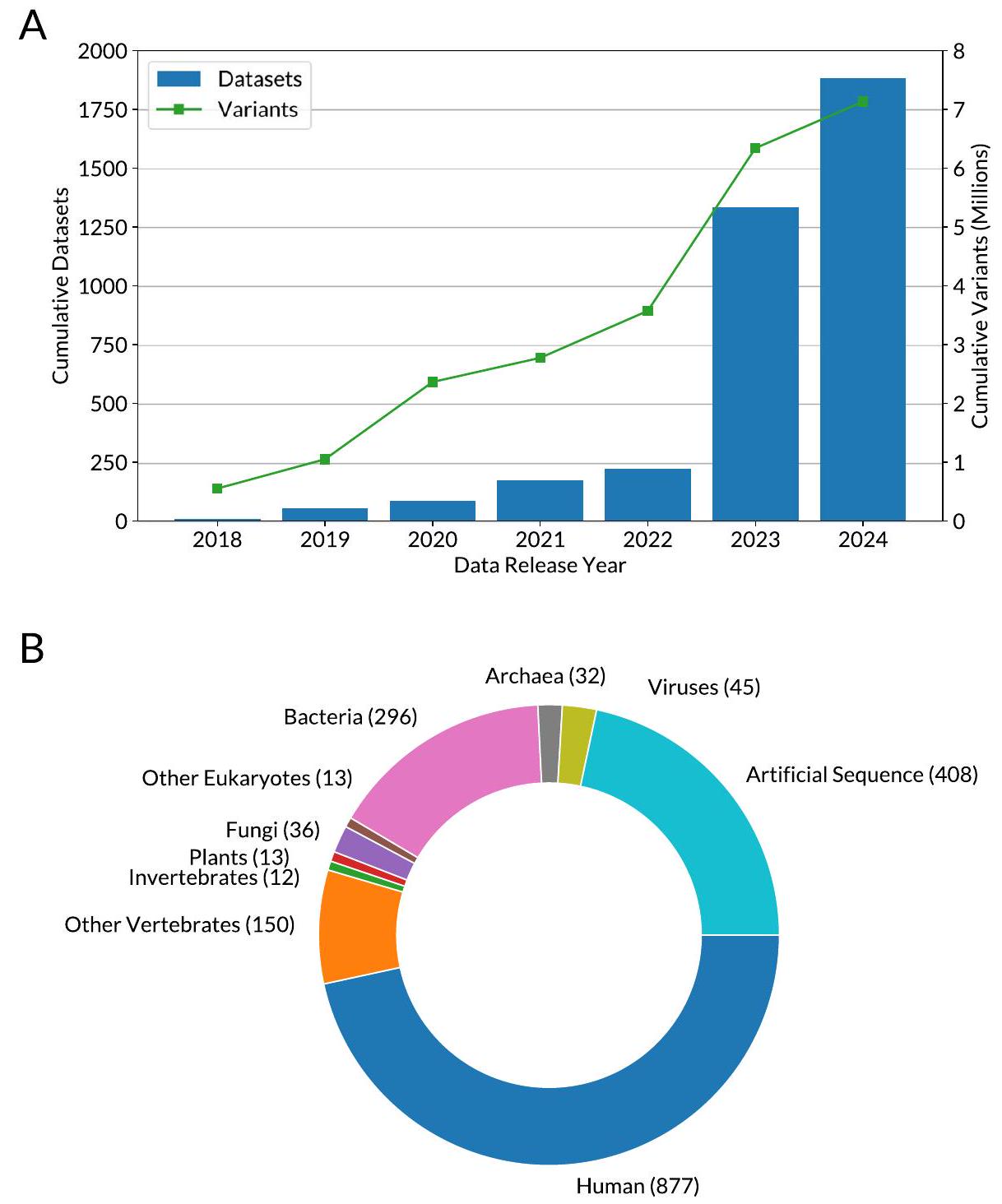
عندما تم نشر المخطوطة الأصلية لـ MaveDB في عام 2019، تم تضمين 54 مجموعة بيانات فقط من MAVEs المنشورة. لذلك، أطلقنا جهدًا منسقًا لإيداع مجموعات البيانات التي لم تكن مدرجة بعد في MaveDB، مضيفين 1228 مجموعة بيانات جديدة تحتوي على إجمالي 3.7 مليون قياس لتأثير المتغيرات. بفضل هذا التنظيم ومساهمات المجتمع، اعتبارًا من نوفمبر 2024، احتوى MaveDB على 1884 مجموعة بيانات تشمل 7 ملايين قياس لتأثير المتغيرات عبر أهداف متنوعة (الشكل 1).
امتد فريق التنسيق لدينا عبر ثلاثة مواقع: WEHI وجامعة ملبورن في ملبورن، أستراليا؛ جامعة واشنطن في سياتل، الولايات المتحدة الأمريكية؛ وجامعة هارفارد في بوسطن، الولايات المتحدة الأمريكية. قمنا بتطوير عملية قوية لتلخيص النتائج التجريبية المتنوعة، بما في ذلك مواد التدريب، والتي تم دمج الكثير منها في وثائق MaveDB المحدثة المتاحة على الموقع. تم استخراج المعلومات الرئيسية من المنشورات وتلخيصها في عنوان، ووصف قصير، وملخص، وطرق كبيانات وصفية لكل سجل. تم تضمين أرقام الوصول لبيانات التسلسل الخام ومعرفات تسلسل الهدف لكل مجموعة بيانات أيضًا. تم مراجعة كل إدخال منسق من قبل عضو آخر على الأقل من الفريق لضمان وجود جميع المعلومات ذات الصلة ودقتها قبل تقديمها إلى قاعدة البيانات. بالإضافة إلى كتابة أقسام النص الحر وتنظيم البيانات الوصفية المرتبطة، قام فريق التنسيق لدينا أيضًا بتنسيق الدرجات والقيم ذات الصلة من البيانات التكميلية المنشورة.
لتسهيل اكتشاف المستخدمين لبيانات MAVE من المنشورات، بالإضافة إلى معرفات PubMed، قمنا بتحديث نموذج البيانات لدينا لدعم ما قبل الطباعة bioRxiv وmedRxiv وDOIs من Crossref. نحن أيضًا نخزن بيانات وصفية منظمة لكل من هذه المراجع، بما في ذلك اسم المجلة أو خادم ما قبل الطباعة وجميع أسماء المؤلفين، ونسمح للمستخدمين بالبحث والتصفية بناءً على هذه المعلومات. كما يميز MaveDB الآن بين المرجع الأساسي، الذي يصف البيانات الموجودة في السجل، والمراجع الثانوية، التي تصف الطرق، والمكونات الرئيسية، أو البرمجيات المستخدمة لتوليد البيانات.
يمتلك MaveDB هيكلًا هرميًا مكونًا من سجلات مجموعة الدرجات، والتجارب، ومجموعات التجارب. تحتوي سجلات مجموعة الدرجات على درجات تأثير المتغيرات وأعمدة البيانات المرتبطة، مثل تقديرات التباين وعدد المتغيرات، وتفاصيل حول تسلسل الهدف التجريبي، ووصف لحسابات الدرجات. الدرجات مطلوبة، ولكن يمكن للمرسل تسمية أي عدد من الأعمدة الرقمية الإضافية. تلخص سجلات التجارب الاختبار الذي تم إجراؤه ويمكن أن تجمع بين مجموعات درجات متعددة، مما يمنع العد المزدوج للاختبارات عند إعادة تحليل البيانات الخام وتحسين اكتشافها للمستخدمين. سجلات مجموعة التجارب لا تحتوي على أي بيانات أو بيانات وصفية بنفسها، ولكنها تجمع بين التجارب ذات الصلة، مثل الاختبارات المتعددة التي تم إجراؤها على هدف واحد.
الشكل 1 محتويات MaveDB اعتبارًا من نوفمبر 2024. أ نمو قاعدة البيانات حسب السنة. تُظهر الأعمدة العدد التراكمي لمجموعات البيانات والخط الأخضر يُظهر العدد التراكمي لقياسات تأثير المتغيرات. ب تنوع تسلسلات الهدف. تم تعيين معرفات تصنيف NCBI وتجميعها وفقًا للفئات الموضحة.
ووصفها في نفس المنشور. لاحظ أنه عند عد “مجموعات البيانات” أعلاه، قمنا بعد سجلات التجارب حيث أن كل منها يصف اختبارًا فريدًا على هدف.
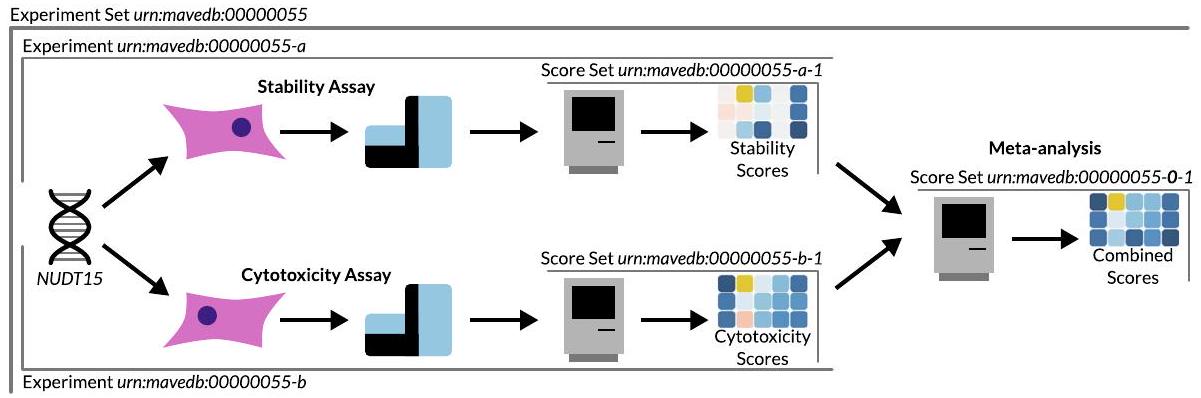
لتمثيل الدرجات بناءً على تحويل أو دمج الدرجات الموجودة، يقوم MaveDB الآن بتنفيذ مجموعات درجات التحليل التلوي. على سبيل المثال، يجب تمثيل مجموعة بيانات تقوم بتقدير قيم الدرجات المفقودة كتحليل تلوي مرتبط بمجموعة درجات ما قبل التقدير، مما يضمن الحفاظ على الدرجات الأصلية وقابليتها للاكتشاف. حالة استخدام أخرى هي تمثيل دمج نتائج اختبارات متعددة على مستوى الدرجات المرتبطة (الشكل 2).
لتحسين التوافق مع تسميات المتغيرات التسلسلية HGVS [38]، ودعم أنواع المتغيرات الإضافية، وتمكين التحقق الأكثر قوة، قمنا بتنفيذ MAVE-HGVS، الذي يحل محل تمثيل المتغيرات السابق في MaveDB بناءً على
الشكل 2 مثال على مجموعة درجات التحليل التلوي. يستخدم الرسم الكاريكاتوري مجموعة بيانات من العالم الحقيقي لتوضيح العلاقة بين مجموعات التجارب، والتجارب، ومجموعات الدرجات، ومجموعات درجات التحليل التلوي. تم دمج النتائج من اختبارين تم إجراؤهما على الجين NUDT15 في “درجة الوظيفة” الناتجة التي تلخص الأداء عبر كلا الاختبارين [40].
تنسيق إخراج Enrich2 [41]. بينما توجد حزم لتحليل HGVS [42، 43]، فإنها مخصصة للاستخدام في علم الوراثة البشرية وتعتمد على إدخالات قاعدة بيانات التسلسل التي قد لا تكون متاحة دائمًا لأهداف الاختبارات المتعددة. يحتوي MAVE-HGVS على تنفيذ مرجعي بلغة بايثون، mavehgvs، يُستخدم للتحقق من المتغيرات التي تم تحميلها إلى قاعدة البيانات من خلال ضمان تنسيق سلاسل المتغيرات بشكل صحيح وتوافقها مع تسلسل هدف مجموعة الدرجات.
لتمثيل التجارب التي تعدل مباشرة الجينوم البشري، مثل تحرير الجينوم بالتشبع، قمنا بتنفيذ طريقة جديدة لتحديد والتحقق من المتغيرات. يمكن للمساهمين الآن تعريف المتغيرات بالنسبة لرقم الوصول إلى النسخة أو مرجع الجينوم البشري، مع التعامل مع التحقق بواسطة SeqRepo [44] لأن الوصول إلى قاعدة بيانات الجينوم والنسخة مطلوب. هذا يتناقض مع معظم سجلات مجموعة الدرجات، التي تحدد تسلسل هدفها الخاص ويتم التحقق منها باستخدام mavehgvs.
لدعم التطورات الحالية والمستقبلية لمنصة MaveDB، وخاصة تحسينات واجهة برمجة التطبيقات، انتقلنا إلى قاعدة شفرة جديدة باستخدام FastAPI وVue.js، مما يحل محل قاعدة الشفرة السابقة التي استخدمت إطار عمل Django 1.11. يعمل MaveDB الآن كمجموعة من حاويات Docker التي يتم تنسيقها باستخدام Docker Compose، مما يبسط النشر لخادم الإنتاج وكذلك لمطوري المصادر المفتوحة الذين يرغبون في المساهمة في المشروع. استجابةً لزيادة الاستخدام والمطالب من أجل موثوقية أكبر وتوسع مستقبلي، قمنا أيضًا بترحيل MaveDB إلى السحابة باستخدام خدمات أمازون ويب.
لتعزيز اتحاد البيانات والاستخدام المفتوح لبيانات MAVE عالميًا، قمنا بإعادة ترخيص تقريبًا جميع مجموعات البيانات في MaveDB إلى ترخيص المجال العام CC0 من Creative Commons [45]، ونوصي به الآن للمرسلين. كان الابتعاد عن الترخيص غير التجاري CC-BY-NC-SA الموصى به سابقًا [46] نتيجة لاستشارة واسعة مع القائمين على مستودعات البيانات البيولوجية الأخرى بالإضافة إلى مجتمع MAVE الأوسع. سمح هذا التغيير في الترخيص، جنبًا إلى جنب مع تحسينات واجهة برمجة التطبيقات، بتوفير تنزيلات بيانات جماعية كما هو موضح أدناه.

الأداة والنقاش

واجهة الويب

يتميز MaveDB بواجهة ويب مصممة خصيصًا للمستخدمين لاستكشاف واكتشاف مجموعات البيانات بالإضافة إلى تحميل مجموعات البيانات الجديدة التي تم إنشاؤها أو تنسيقها. منذ الإطلاق الأول، تم إعادة تنفيذ الواجهة بالكامل باستخدام إطار عمل Vue JavaScript. هذا
يوفر تجربة مستخدم أكثر استجابة وتفاعلية مقارنةً بالإصدار السابق من MaveDB، الذي كان يعتمد على قوالب HTML الخاصة بـ Django.
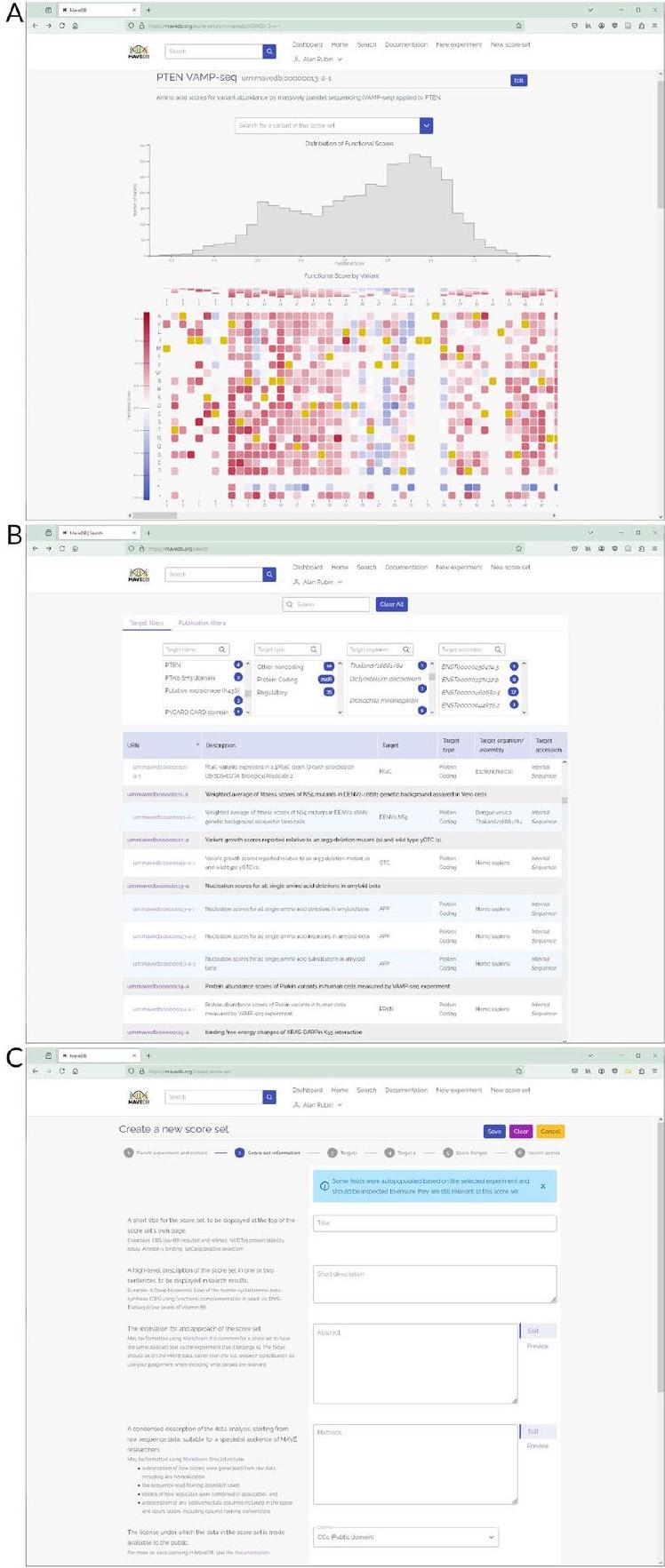
تظهر صفحات مجموعة الدرجات الآن تصورات تفاعلية تم إنشاؤها تلقائيًا للاستكشاف والتفسير، بما في ذلك رسم بياني يوضح توزيع درجات تأثير المتغيرات وخريطة حرارية لتأثير المتغيرات (الشكل 3A). تم تحديث صفحة البحث لإضافة عوامل تصفية فئوية تشجع على استكشاف بيانات MaveDB، بما في ذلك معلومات المنشورات مثل المؤلف أو المجلة (الشكل 3B).
بالنسبة للمستخدمين الذين يرغبون في المساهمة بالبيانات باستخدام واجهة الويب، قمنا بإعادة تصميم واجهة مجموعة الدرجات لاستبدال النموذج المعقد للغاية بنموذج موجه متعدد المراحل (الشكل 3C). هذا يبسط كل خطوة من العملية ويسمح بالتحقق من المعلومات بشكل أكثر إفادة وفحص الأخطاء. تم دمج الإرشادات للمستخدمين الآن في النموذج نفسه، بدلاً من الاعتماد بالكامل على الوثائق المستضافة في مكان آخر على الموقع.

تحسين دعم واجهة برمجة التطبيقات

كان الإصدار السابق من MaveDB يقبل البيانات فقط عبر نموذج ويب، ولكن الخادم يدعم الآن أيضًا إيداع البيانات من خلال واجهة برمجة التطبيقات REST باستخدام نفس المنطق والتحقق مثل واجهة الويب لضمان الاستمرارية وسلامة البيانات. استخدام واجهة برمجة التطبيقات للإيداع برمجيًا يبسط التقديم لبعض التصاميم التجريبية المعقدة، مثل سلسلة من الاختبارات المماثلة التي تقيس تأثيرات المتغيرات مع جزيئات صغيرة مختلفة.
لتسهيل التحقق المحلي من مجموعات البيانات، نحن نحافظ على كود واجهة برمجة تطبيقات MaveDB كحزمة قابلة للتثبيت على PyPI، فهرس حزم بايثون. وهذا يسمح للمستخدمين المتقدمين بتطبيق نفس أدوات التحقق ونماذج البيانات التي تعمل على الخادم عند إعداد مجموعات البيانات للتقديم. نأمل أن يأخذ مؤلفو خطوط تحليل MAVE في الاعتبار اعتماد واجهة برمجة تطبيقات MaveDB كخيار للإخراج.
بالإضافة إلى تقديم ملفات بيانات مجموعة الدرجات المماثلة لتلك القابلة للتنزيل عبر واجهة الويب، توفر واجهة برمجة التطبيقات أيضًا بيانات هيكلية وبيانات وصفية للمتغيرات الفردية. تدعم هذه الميزة حاليًا الوصول باستخدام معرفات المتغيرات الداخلية لـ MaveDB، والتي نحن في طور تحويلها إلى تنسيقات أكثر استخدامًا.

إصدارات البيانات الضخمة

بالنسبة للمستخدمين الذين يرغبون في الوصول إلى MaveDB بالكامل، لدينا الآن أرشيف لجميع البيانات المرخصة بموجب CC0 المتاحة عبر Zenodo (انظر توفر البيانات). يحتوي على ملف واحد بتنسيق JSON مع جميع البيانات الوصفية الهيكلية لكل مجموعة تجريبية وتجربة ومجموعة درجات، بالإضافة إلى دليل لجدول البيانات بتنسيق قيم مفصولة بفواصل (CSV) التي تحتوي على الدرجات والعدادات لكل مجموعة درجات. تزيد لقطات الأرشيف من إمكانية إعادة الإنتاج من خلال السماح للمستخدمين بالاستشهاد بإصدار محدد من محتويات قاعدة البيانات، ونعتزم إضافة أرشيفات كاملة مرتين سنويًا في مايو ونوفمبر.

توصيات لرفع المستخدمين

مع إدخال مجموعات درجات التحليل الشامل، يمكّن نموذج البيانات الهرمي لـ MaveDB من تتبع أصول أكثر شمولاً لقياسات المتغيرات الفردية من اختبار متعدد. نقترح على المستخدمين رفع درجات تم تحويلها بشكل طفيف كمجموعات درجات قياسية إلى MaveDB، وإنشاء مجموعات درجات تحليل شامل تصف خطوات التطبيع أو الاستيفاء حسب الاقتضاء. هذا يدعم الباحثين الآخرين الذين
الشكل 3 لقطات شاشة واجهة ويب MaveDB. أ تصورات مجموعة الدرجات. تحتوي صفحات مجموعة الدرجات الآن على تصورات تم إنشاؤها تلقائيًا، بما في ذلك هيستوغرام الدرجات وخريطة تأثير المتغيرات. بالنسبة للأهداف غير المشفرة، يتم عرض خريطة الحرارة على مستوى النوكليوتيد. ب صفحة البحث. تتضمن الواجهة عوامل تصفية قائمة على تسلسل الهدف في الأعلى، وقوائم لكل تجربة مطابقة ومجموعاتها من الدرجات في الجزء الرئيسي من الصفحة. تدعم MaveDB أيضًا التصفية على معلومات النشر مثل المؤلف عبر علامة التبويب “عوامل تصفية النشر”. ج إنشاء مجموعة الدرجات. يمكن للمستخدمين الذين يساهمون في مجموعات الدرجات عبر نموذج الويب اتباع هذا التدفق خطوة بخطوة مع الوثائق المدمجة
يريدون تقييم أساليبهم الخاصة أو بناء نماذج ستكون حساسة لتطبيع البيانات.
تقبل MaveDB أيضًا بيانات العد الاختيارية لكل متغير بالإضافة إلى الدرجات. نشجع بشدة المقدمين على تقديم هذه المعلومات لأنها تعزز تطوير نماذج إحصائية جديدة لحساب درجات المتغيرات.
يجب على المستخدمين التعرف على الهيكل الهرمي لمجموعة الدرجات (بما في ذلك التحليل الشامل)، والسجلات التجريبية، ومجموعة التجارب الموضحة أعلاه، ومحاولة اتباع قاعدة تجربة واحدة لكل اختبار ومجموعة تجريبية واحدة لكل هدف فريد في دراسة. نوصي بأن يتضمن المستخدمون التفاصيل المحددة في معايير المعلومات الدنيا لـ MAVE عند إعداد بياناتهم الوصفية النصية.

الاستنتاجات

تعتبر MAVEs نهجًا مهمًا لقياس وفهم وتوقع تأثيرات المتغيرات على نطاق الجينوم، ولكن يجب تخزين البيانات بطريقة مستقرة ومعيارية جنبًا إلى جنب مع البيانات الوصفية المطلوبة للاستخدام اللاحق. علاوة على ذلك، يجب أن تكون مجموعات بيانات MAVE متاحة بسهولة وقابلة للاكتشاف، ويجب أن تكون بيانات MAVE قابلة للوصول برمجيًا. مع هذا التحديث لعام 2024 لـ MaveDB، قمنا بالبناء على نجاحات النسخة الأولية من قاعدة البيانات وحققنا خطوات كبيرة نحو تحقيق هذه الأهداف.
قمنا بإجراء العديد من التحسينات الكبيرة على نموذج بياناتنا، مما عزز قدرتنا على تخزين وتوحيد وعرض مجموعات بيانات MAVE المتنوعة. كانت هذه التغييرات ممكنة بفضل الجهود الكبيرة في هندسة البرمجيات التي تم بذلها في إعادة تصميم قاعدة الشيفرة، ونحن الآن في وضع أفضل لمواصلة تطوير ميزات جديدة مثل التصورات التلقائية للبيانات، والاستجابة للابتكارات في تقنيات التجارب MAVE. علاوة على ذلك، يمكننا دعم حالات الاستخدام المحددة لبيانات MAVE بشكل أسهل، بما في ذلك توقع تأثير المتغيرات، واكتشاف الأدوية، والطب الدقيق.
لزيادة كمية المعلومات المتاحة في MaveDB، أطلقنا جهدًا ضخمًا للتنظيم شمل مئات مجموعات البيانات الإضافية، مما أدى في النهاية إلى ملء MaveDB بما يقرب من نصف جميع البيانات المنشورة في الأدبيات. بالإضافة إلى ذلك، شهدنا مستوى مشجعًا من المشاركة من مجتمع MAVE الأوسع، مع مساهمة العشرات من الباحثين الدوليين بنتائجهم من تلقاء أنفسهم. نأمل أن يشجع استثمارنا المستمر في واجهة الويب وكذلك واجهة برمجة التطبيقات المستخدمين المحتملين على تقديم بياناتهم، ونشكر العديد من أعضاء المجتمع الذين قاموا بذلك بالفعل.

الشكر والتقدير

ساهمت مجموعة عمل تنسيق ونشر بيانات تحالف تأثيرات المتغيرات (AVE) بتعليقات قيمة حول تصميم وأهداف MaveDB.

معلومات مراجعة الأقران

كانت وينجينغ شي المحرر الرئيسي لهذه المقالة وأدارت عملية التحرير ومراجعة الأقران بالتعاون مع بقية فريق التحرير. تاريخ مراجعة الأقران متاح في النسخة الإلكترونية من هذه المقالة.

مساهمات المؤلفين

صمم AFR و DMF قاعدة البيانات. كتب AFR و JKM و NJR و BJC و EYD و DE و SBG و MRH و NM و AES و JS و PVP قاعدة البيانات والبرمجيات المرتبطة بها. قام AFR و NJR و AHB و MD و JF و YF و MRH و IL و OM و JO و PVP و JER و MJW و SY و AT و AEM و DSM بتنظيم مجموعات البيانات. أشرف AFR و VLB و DSM و DMF على تنظيم مجموعات البيانات. أشرف AFR و JS و LMS و DSM و DMF على مشاريع البرمجيات. كتب AFR و , و DMF الورقة. قرأ جميع المؤلفين ووافقوا على المخطوطة النهائية.

التمويل

تم دعم هذا العمل من قبل المعاهد الوطنية للصحة (NIH؛ RM1HG010461 إلى DMF، UM1HG011969 إلى LMS و DMF، R01HG013025 إلى LMS، T32GM007454) ومن قبل مبادرة تشان زوكربيرغ (CZI2018-191853 إلى DSM). تم دعم MD و JF من قبل وزارة العلوم والابتكار الإسبانية (PID2022-140793NA-I00). تم دعم YF من خلال منحة بحثية في ملبورن. تم دعم AEM من خلال جائزة المهنة المبكرة من Alex’s Lemonade Stand لسرطان الطفولة
ومؤسسة RUNX1 21-25037، ومنحة التعاون التحفيزية من معهد بروتمان باتي CC28. تم دعم PVP من قبل فريق فرايبورغ غالاكسي الممول من قبل وزارة التعليم والبحث الفيدرالية الألمانية منحة BMBF 031 A538A de.NBI-RBC ووزارة العلوم والبحث والفنون بادن-فورتمبيرغ (MWK) في إطار LIBIS/de.NBI فرايبورغ. استفاد البحث من الدعم من حكومة ولاية فيكتوريا لدعم البنية التحتية التشغيلية ودعم البنية التحتية للمعهد المستقل NHMRC من الحكومة الأسترالية. حصل هذا المشروع على تمويل من الحكومة الأسترالية.

توفر البيانات

كود مصدر MaveDB متاح على GitHub [49،50] و Zenodo [51،52]. النسخة من الجزء الخلفي لـ MaveDB الموصوفة هنا هي v2024.4.2 والنسخة من الجزء الأمامي لـ MaveDB الموصوفة هنا هي v2024.4.3. يتم توزيع MaveDB بموجب ترخيص AGPLv3. كود مصدر mavehgvs متاح على GitHub [53] و Zenodo [54]. النسخة الموصوفة هنا هي v0.6.1. يتم توزيع mavehgvs بموجب ترخيص BSD ثلاثي البنود. دفاتر الملاحظات المستخدمة لإنشاء الألواح في الشكل 1 متاحة على GitHub [55] و Zenodo [56]. النسخة الموصوفة هنا هي v0.1.0. يتم توزيع دفاتر الملاحظات بموجب ترخيص MIT. يتوفر تنزيل بيانات MaveDB الضخمة لشهر نوفمبر 2024 من Zenodo [57]. مجموعة البيانات الموضحة في الشكل 2 متاحة في MaveDB تحت مجموعة التجارب urn:mavedb:00000055.

الإقرارات

لا ينطبق.
لا ينطبق.

المصالح المتنافسة

NJR موظف في Seismic Therapeutics. يشارك DSM في دور استشاري لـ Dyno Therapeutics و Octant Bio و Jura Bio و Tectonic Therapeutic و Seismic Therapeutics.

تفاصيل المؤلف

قسم المعلوماتية الحيوية، معهد والتر وإليزا هول للبحوث الطبية، باركفيل، أستراليا. قسم البيولوجيا الطبية، جامعة ملبورن، باركفيل، أستراليا. معهد بروتمان باتي للطب الدقيق، سياتل، الولايات المتحدة الأمريكية. قسم علوم الجينوم، جامعة واشنطن، سياتل، الولايات المتحدة الأمريكية. مركز تنظيم الجينوم (CRG)، معهد برشلونة للعلوم والتكنولوجيا، برشلونة، إسبانيا. جامعة بومبيدو فابرا، برشلونة، إسبانيا. قسم الطب المخبري وعلم الأمراض، جامعة واشنطن، سياتل، الولايات المتحدة الأمريكية. قسم المناعة، معهد والتر وإليزا هول للبحوث الطبية، باركفيل، أستراليا. قسم الميكروبيولوجيا والمناعة، جامعة ملبورن، باركفيل، أستراليا. مجموعة المعلوماتية الحيوية، قسم علوم الحاسوب، جامعة فرايبورغ، فرايبورغ، ألمانيا. قسم علوم الحاسوب، المركز الدراسي، جامعة مدينة نيويورك، نيويورك، الولايات المتحدة الأمريكية. سيزمك ثيرابيوتيكس، واترتاون، الولايات المتحدة الأمريكية. قسم البيولوجيا النظامية، كلية هارفارد الطبية، بوسطن، الولايات المتحدة الأمريكية. قسم التوليد وأمراض النساء وصحة حديثي الولادة، جامعة ملبورن، باركفيل، أستراليا. قسم المناعة السريرية والحساسية، مستشفى رويال ملبورن، باركفيل، أستراليا. معهد برود في هارفارد ومعهد ماساتشوستس للتكنولوجيا، بوسطن، الولايات المتحدة الأمريكية. قسم الهندسة الحيوية، جامعة واشنطن، سياتل، الولايات المتحدة الأمريكية.
تاريخ الاستلام: 13 يوليو 2024 تاريخ القبول: 10 يناير 2025
تم النشر على الإنترنت: 21 يناير 2025

References

  1. Chen S, Francioli LC, Goodrich JK, Collins RL, Kanai M, Wang Q, et al. A genomic mutational constraint map using variation in 76,156 human genomes. Nature. 2024;625:92-100
  2. Landrum MJ, Lee JM, Benson M, Brown GR, Chao C, Chitipiralla S, et al. ClinVar: improving access to variant interpretations and supporting evidence. Nucleic Acids Res. 2018;46:D1062-7.
  3. Fowler DM, Rehm HL. Will variants of uncertain significance still exist in 2030? Am J Hum Genet. 2024;111:5-10.
  4. Starita LM, Ahituv N, Dunham MJ, Kitzman JO, Roth FP, Seelig G, et al. Variant interpretation: functional assays to the rescue. Am J Hum Genet. 2017;101:315-25.
  5. Tabet D, Parikh V, Mali P, Roth FP, Claussnitzer M. Scalable functional assays for the interpretation of human genetic variation. Annu Rev Genet. 2022;56:441-65.
  6. Fowler DM, Fields S. Deep mutational scanning: a new style of protein science. Nat Methods. 2014;11:801-7.
  7. Kinney JB, McCandlish DM. Massively parallel assays and quantitative sequence-function relationships. Annu Rev Genomics Hum Genet. 2019;20:99-127.
  8. Weile J, Roth FP. Multiplexed assays of variant effects contribute to a growing genotype-phenotype atlas. Hum Genet. 2018;137:665-78.
  9. Fayer S, Horton C, Dines JN, Rubin AF, Richardson ME, McGoldrick K, et al. Closing the gap: systematic integration of multiplexed functional data resolves variants of uncertain significance in BRCA1, TP53, and PTEN. Am J Hum Genet. 2021;108:2248-58.
  10. Scott A, Hernandez F, Chamberlin A, Smith C, Karam R, Kitzman JO. Saturation-scale functional evidence supports clinical variant interpretation in Lynch syndrome. Genome Biol. 2022;23:266.
  11. Fowler DM, Araya CL, Fleishman SJ, Kellogg EH, Stephany JJ, Baker D, et al. High-resolution mapping of protein sequence-function relationships. Nat Methods. 2010;7:741-6.
  12. McLaughlin RN Jr, Poelwijk FJ, Raman A, Gosal WS, Ranganathan R. The spatial architecture of protein function and adaptation. Nature. 2012;491:138-42.
  13. Firnberg E, Labonte JW, Gray JJ, Ostermeier M. A comprehensive, high-resolution map of a gene’s fitness landscape. Mol Biol Evol. 2014;31:1581-92.
  14. Melnikov A, Rogov P, Wang L, Gnirke A, Mikkelsen TS. Comprehensive mutational scanning of a kinase in vivo reveals substrate-dependent fitness landscapes. Nucleic Acids Res. 2014;42:e112-e112.
  15. Mishra P, Flynn JM, Starr TN, Bolon DNA. Systematic mutant analyses elucidate general and client-specific aspects of Hsp90 function. Cell Rep. 2016;15:588-98.
  16. Majithia AR, Tsuda B, Agostini M, Gnanapradeepan K, Rice R, Peloso G, et al. Prospective functional classification of all possible missense variants in PPARG. Nat Genet. 2016;48:1570-5.
  17. Weile J, Sun S, Cote AG, Knapp J, Verby M, Mellor JC, et al. A framework for exhaustively mapping functional missense variants. Mol Syst Biol. 2017;13:957.
  18. Matreyek KA, Starita LM, Stephany JJ, Martin B, Chiasson MA, Gray VE, et al. Multiplex assessment of protein variant abundance by massively parallel sequencing. Nat Genet. 2018;50:874-82.
  19. Findlay GM, Daza RM, Martin B, Zhang MD, Leith AP, Gasperini M, et al. Accurate classification of BRCA1 variants with saturation genome editing. Nature. 2018;562:217-22.
  20. Tsuboyama K, Dauparas J, Chen J, Laine E, Mohseni Behbahani Y, Weinstein JJ, et al. Mega-scale experimental analysis of protein folding stability in biology and design. Nature. 2023;620:434-44.
  21. Beltran A, Jiang X, Shen Y, Lehner B. Site-saturation mutagenesis of 500 human protein domains. Nature. 2025.
  22. Tinberg CE, Khare SD, Dou J, Doyle L, Nelson JW, Schena A, et al. Computational design of ligand-binding proteins with high affinity and selectivity. Nature. 2013;501:212-6.
  23. Rollins NJ, Brock KP, Poelwijk FJ, Stiffler MA, Gauthier NP, Sander C, et al. Inferring protein 3D structure from deep mutation scans. Nat Genet. 2019;51:1170-6.
  24. Schmiedel JM, Lehner B. Determining protein structures using deep mutagenesis. Nat Genet. 2019;51:1177-86.
  25. Ke S, Anquetil V, Zamalloa JR, Maity A, Yang A, Arias MA, et al. Saturation mutagenesis reveals manifold determinants of exon definition. Genome Res. 2018;28:11-24.
  26. Kircher M, Xiong C, Martin B, Schubach M, Inoue F, Bell RJA, et al. Saturation mutagenesis of twenty disease-associated regulatory elements at single base-pair resolution. Nat Commun. 2019;10:3583.
  27. Melnikov A, Murugan A, Zhang X, Tesileanu T, Wang L, Rogov P, et al. Systematic dissection and optimization of inducible enhancers in human cells using a massively parallel reporter assay. Nat Biotechnol. 2012;30:271-7.
  28. Patwardhan RP, Hiatt JB, Witten DM, Kim MJ, Smith RP, May D, et al. Massively parallel functional dissection of mammalian enhancers in vivo. Nat Biotechnol. 2012;30:265-70.
  29. Frazer J, Notin P, Dias M, Gomez A, Min JK, Brock K, et al. Disease variant prediction with deep generative models of evolutionary data. Nature. 2021;599:91-5.
  30. Gray VE, Hause RJ, Luebeck J, Shendure J, Fowler DM. Quantitative missense variant effect prediction using largescale mutagenesis data. Cell Syst. 2018;6:116-24.e3.
  31. Wu Y, Li R, Sun S, Weile J, Roth FP. Improved pathogenicity prediction for rare human missense variants. Am J Hum Genet. 2021;108:1891-906.
  32. Notin P, Dias M, Frazer J, Hurtado JM, Gomez AN, Marks D, et al. Tranception: protein fitness prediction with autoregressive transformers and inference-time retrieval. Proceedings of the 39th International Conference on Machine Learning in Proceedings of Machine Learning Research. 2022;162:16990-7017.
  33. IGVF Consortium. Deciphering the impact of genomic variation on function. Nature. 2024;633:47-57.
  34. Fowler DM, Adams DJ, Gloyn AL, Hahn WC, Marks DS, Muffley LA, et al. An Atlas of Variant Effects to understand the genome at nucleotide resolution. Genome Biol. 2023;24:147.
  35. Esposito D, Weile J, Shendure J, Starita LM, Papenfuss AT, Roth FP, et al. MaveDB: an open-source platform to distribute and interpret data from multiplexed assays of variant effect. Genome Biol. 2019;20:223.
  36. Findlay GM, Boyle EA, Hause RJ, Klein JC, Shendure J. Saturation editing of genomic regions by multiplex homologydirected repair. Nature. 2014;513:120-3.
  37. Radford EJ, Tan H-K, Andersson MHL, Stephenson JD, Gardner EJ, Ironfield H, et al. Saturation genome editing of DDX3X clarifies pathogenicity of germline and somatic variation. Nat Commun. 2023;14:7702.
  38. den Dunnen JT, Dalgleish R, Maglott DR, Hart RK, Greenblatt MS, McGowan-Jordan J, et al. HGVS recommendations for the description of sequence variants: 2016 update. Hum Mutat. 2016;37:564-9.
  39. Wagner AH, Babb L, Alterovitz G, Baudis M, Brush M, Cameron DL, et al. The GA4GH Variation Representation Specification: a computational framework for variation representation and federated identification. Cell Genom. 2021;1: 100027.
  40. Suiter CC, Moriyama T, Matreyek KA, Yang W, Scaletti ER, Nishii R, et al. Massively parallel variant characterization identifies NUDT15 alleles associated with thiopurine toxicity. Proc Natl Acad Sci USA. 2020;117:5394-401.
  41. Rubin AF, Gelman H, Lucas N, Bajjalieh SM, Papenfuss AT, Speed TP, et al. A statistical framework for analyzing deep mutational scanning data. Genome Biol. 2017;18:150.
  42. Hart RK, Rico R, Hare E, Garcia J, Westbrook J, Fusaro VA. A Python package for parsing, validating, mapping and formatting sequence variants using HGVS nomenclature. Bioinformatics. 2015;31:268-70.
  43. Wang M, Callenberg KM, Dalgleish R, Fedtsov A, Fox NK, Freeman PJ, et al. hgvs: a Python package for manipulating sequence variants using HGVS nomenclature: 2018 Update. Hum Mutat. 2018;39:1803-13.
  44. Hart RK, Prlić A. SeqRepo: a system for managing local collections of biological sequences. PLoS ONE. 2020;15:e0239883.
  45. Creative Commons – CC0 1.0 Universal. Available from: https://creativecommons.org/publicdomain/zero/1.0/
  46. Creative Commons – Attribution-NonCommercial-ShareAlike 4.0 International – CC BY-NC-SA 4.0. Available from: https://creativecommons.org/licenses/by-nc-sa/4.0/
  47. Arbesfeld JA, Da EY, Kuzma K, Paul A, Farris T, Riehle K, et al. Mapping MAVE data for use in human genomics applications. bioRxiv. 2023;2023.06.20.545702.
  48. Claussnitzer M, Parikh VN, Wagner AH, Arbesfeld JA, Bult CJ, Firth HV, et al. Minimum information and guidelines for reporting a multiplexed assay of variant effect. Genome Biol. 2024;25:100.
  49. Capodanno BJ, Stone J, Da EY, Grindstaff SB, Harrington MR, Moore N, Syder AE, Rubin AF. mavedb-api. GitHub. https://github.com/VariantEffect/MaveDB-API (2024).
  50. Capodanno BJ, Stone J, Da EY, Grindstaff SB, Harrington MR, Polunina PV, Syder AE, Rubin AF. mavedb-ui. GitHub. https://github.com/VariantEffect/MaveDB-UI (2024).
  51. Capodanno BJ, Stone J, Da EY, Grindstaff SB, Harrington MR, Moore N, Syder AE, Rubin AF. VariantEffect/mavedb-api: v2024.4.2. Zenodo. https://doi.org/10.5281/zenodo. 14201451 (2024).
  52. Capodanno BJ, Stone J, Da EY, Grindstaff SB, Harrington MR, Polunina PV, Syder AE, Rubin AF. VariantEffect/mavedbui: v2024.4.3. Zenodo. https://doi.org/10.5281/zenodo. 14207533 (2024).
  53. Rubin AF. mavehgvs. GitHub. https://github.com/VariantEffect/mavehgvs (2023).
  54. Rubin AF. mavehgvs. Zenodo. https://doi.org/10.5281/zenodo. 8281119 (2023).
  55. Rubin AF. MaveDB Analytics. GitHub. https://github.com/afrubin/mavedb-analytics (2024).
  56. Rubin AF. afrubin/mavedb-analytics: 0.1.0. Zenodo. https://doi.org/10.5281/zenodo. 14172359 (2024).
  57. MaveDB contributors. MaveDB. https://doi.org/10.5281/zenodo. 14172004 (2024).

ملاحظة الناشر

تظل شركة سبرينجر ناتشر محايدة فيما يتعلق بالمطالبات القضائية في الخرائط المنشورة والانتماءات المؤسسية.

Journal: Genome biology, Volume: 26, Issue: 1
DOI: https://doi.org/10.1186/s13059-025-03476-y
PMID: https://pubmed.ncbi.nlm.nih.gov/39838450
Publication Date: 2025-01-21

MaveDB 2024: a curated community database with over seven million variant effects from multiplexed functional assays
Check for updates

Alan F. Rubin , Jeremy Stone , Aisha Haley Bianchi , Benjamin J. Capodanno , Estelle Y. Da , Mafalda Dias , Daniel Esposito , Jonathan Frazer , Yunfan Fu , Sally B. Grindstaff , Matthew R. Harrington , Iris Li , Abbye E. McEwen , Joseph K. Min , Nick Moore , Olivia G. Moscatelli , Jesslyn Ong , Polina V. Polunina , Joshua E. Rollins , Nathan J. Rollins , Ashley E. Snyder , Amy Tam , Matthew J. Wakefield , Shenyi Sunny Ye , Lea M. Starita , Vanessa L. Bryant , Debora S. Marks and Douglas M. Fowler

*Correspondence: alan.rubin@wehi.edu.au; debbie@hms.harvard.edu; dfowler@uw.edu
Bioinformatics Division, Walter and Eliza Hall Institute of Medical Research, Parkville, Australia
Brotman Baty Institute for Precision Medicine, Seattle, USA
Department of Systems Biology, Harvard Medical School, Boston, USA
Full list of author information is available at the end of the article

Abstract

Multiplexed assays of variant effect (MAVEs) are a critical tool for researchers and clinicians to understand genetic variants. Here we describe the 2024 update to MaveDB (https://www.mavedb.org/) with four key improvements to the MAVE community’s database of record: more available data including over 7 million variant effect measurements, an improved data model supporting assays such as saturation genome editing, new built-in exploration and visualization tools, and powerful APIs for data federation and streamlined submission and access. Together these changes support MaveDB’s role as a hub for the analysis and dissemination of MAVEs now and into the future.

Keywords: Multiplexed assays of variant effect, MAVEs, Deep mutational scanning, DMS, Variant classification, Functional genomics

Background

Variation within genomes produces interindividual differences governing a multitude of traits, including many implicated in disease. As DNA sequencing continues to become less expensive and more widely deployed, new human genetic variants are being observed at a staggering pace. Among 800,000 individuals in gnomAD v4 [1], approximately 786 million small variants comprising single nucleotide changes and small deletions/insertions have been identified, of which 16 million are missense variants (i.e., single amino acid changes). In contrast, only 1 million missense variants have been annotated in ClinVar [2] and are currently variants of uncertain significance that cannot be used for clinical decision-making. Understanding how these observed variants, as
well as others we will encounter as more individuals are sequenced, impact molecular, cellular, and organismal phenotypes represents a central challenge for genomics [3].
In the past, genetic variants would be tested for functional effects in bespoke assays singly or in relatively low numbers, but more recent technologies have enabled multiplexed assays of variant effect (MAVEs) [4, 5]. In a MAVE, the functional effects of thousands or tens of thousands of variants of a DNA regulatory region, coding gene, untranslated region, or other functional element are simultaneously experimentally determined. To achieve this scale, a large library of variants is made and tested in a pooled fashion, using high-throughput DNA sequencing to read out variant effects (for a detailed description see [6-8]).
The result of a MAVE is a comprehensive variant effect map, which contains the experimentally measured effects of most or all of the possible single nucleotide or missense variants, and may include small insertions and deletions. Variant effect maps have proven exceptionally useful. For example, in genes where germline variants can increase disease risk, variant effect maps can help resolve a large proportion of clinical variants of uncertain significance [9, 10]. Variant effect maps can also be used to probe protein sequence/function relationships [11-21], assist in protein design [22], reveal protein structure [23, 24], elucidate regulatory DNA and gene function by interrogating noncoding sequences [25-28], and train or evaluate variant effect predictors [29-32].
Efforts are now underway to scale up MAVEs to cover a significant fraction of the human genome [33, 34], but realizing their potential requires improved discoverability. In 2019, we created MaveDB [35], a public, open source repository for submitting, sharing, and accessing MAVE data and associated metadata in a standardized, searchable format through an easy-to-use web interface. However, the original version of MaveDB suffered from four key limitations. First, it contained only a small fraction of the data available at the time. Second, data from new multiplexed assay methods such as saturation genome editing [19, 36, 37] were not compatible with the original MaveDB data model. Third, the ability to explore datasets was limited and visualizing data required external tools. Finally, MaveDB was not designed with federation across genomic data resources in mind.
To address those limitations, firstly we have expanded the database content by extensively curating multiplexed assay results and encouraging community contributions, constituting a six-fold increase in the total number of variant effect measurements in the database and an over 30 -fold increase in the number of datasets compared to the original publication. As of November 2024, MaveDB contained over 7 million variant effect measurements and 1884 datasets. We have also implemented numerous technical advances and data model improvements. This includes refining and formalizing our variant representation with an emphasis on compliance with established standards like HGVS [38], allowing us to support more diverse types of variants and associated experimental designs, while also improving compatibility with emerging standards like the GA4GH Variant Representation Specification (VRS) [39] that will simplify mapping datasets to reference genomic coordinates. We have updated our data model by adding a new type of record for imputation or the combination of results across multiple assays. We also invested in an improved interface for searching and filtering datasets, as well as adding new automatically generated visualizations. Lastly, we further improved the user
experience by adding API-based user uploads aimed at researchers who are submitting large or complex datasets, or engaging in MAVE data production at scale.

Construction and content

MaveDB is designed to store and distribute multiplexed variant functional data, including scores and associated metadata. Minimally, this consists of a collection of variant effect scores that describe the functional consequences of the nucleotide or amino acid variants, as well as information about the target sequence. The metadata typically includes descriptions of the experimental and data analysis methods and references to information in other databases, such as DNA sequencing reads. Most datasets in MaveDB are from published papers, although this is not required for inclusion.
When the original MaveDB manuscript was published in 2019, only 54 datasets from published MAVEs were included. Thus, we launched a concerted effort to deposit datasets that were not yet included in MaveDB, adding 1228 new datasets containing a total of 3.7 million variant effect measurements. Thanks to this curation and contributions from the community, as of November 2024 MaveDB contained 1884 datasets encompassing 7 million variant effect measurements across diverse targets (Fig. 1).
Our curation team spanned three sites: WEHI and the University of Melbourne in Melbourne, Australia; University of Washington in Seattle, USA; and Harvard University in Boston, USA. We developed a robust process for summarizing heterogeneous experimental results, including training materials, much of which has been incorporated into updated MaveDB documentation available on the website. Key information was extracted from publications and synthesized into a title, short description, abstract, and methods as metadata for each record. Accession numbers for raw sequence data and target sequence identifiers for each dataset were also included. Each curated entry was peer reviewed by at least one other team member to ensure all relevant information was present and accurate before submission to the database. In addition to writing the free text sections and organizing associated metadata, our curation team also formatted scores and related values from published supplemental data.
To make it easier for users to discover MAVE data from publications, in addition to PubMed identifiers, we updated our data model to support bioRxiv and medRxiv preprints and Crossref DOIs. We also store structured metadata for each of these references, including journal or preprint server and all author names, and allow users to search and filter based on this information. MaveDB also now distinguishes between a primary reference, which describes the data contained in the record, and secondary references, which describe methods, key reagents, or software used to generate the data.
MaveDB has a hierarchical structure populated by score set, experiment, and experiment set records. Score set records contain the variant effect scores and associated data columns, such as variance estimates and variant counts, details about the experimental target sequence, and a description of the score calculations. Scores are required, but any number of additional numeric columns can be named by the submitter. Experiment records summarize the assay that was performed and can group multiple score sets, preventing double-counting of assays when raw data is reanalyzed and improving discoverability for users. Experiment set records do not have any data or metadata themselves, but group related experiments, such as multiple assays performed on a single target
Fig. 1 MaveDB contents as of November 2024. A Growth of the database by year. The bars show the cumulative number of datasets and the green line shows the cumulative number of variant effect measurements. B Diversity of target sequences. NCBI Taxonomy IDs were assigned and grouped according to the categories shown
and described in the same publication. Note that when counting “datasets” above, we counted experiment records since each describes a unique assay on a target.
To represent scores based on the transformation or combination of existing scores, MaveDB now implements meta-analysis score sets. For example, a dataset that imputes the values of missing scores should be represented as a meta-analysis linked to the pre-imputation score set, ensuring the original scores are preserved and discoverable. Another use case is representing the combination of multiple assay results at the level of the associated scores (Fig. 2).
To improve compatibility with the HGVS Sequence Variant Nomenclature [38], support additional variant types, and enable more robust validation, we implemented MAVE-HGVS, which replaces the previous MaveDB variant representation based on
Fig. 2 Example of a meta-analysis score set. The cartoon uses a real-world dataset to illustrate the relationship between experiment sets, experiments, score sets, and meta-analysis score sets. The results from two assays performed on the gene NUDT15 were combined into a resulting “function score” that summarized performance across both assays [40]
the Enrich2 [41] output format. While packages exist for parsing HGVS [42, 43], they are intended for use in human genetics and rely on sequence database entries that are not always available for multiplexed assay targets. MAVE-HGVS has a reference Python implementation, mavehgvs, used to validate variants uploaded to the database by ensuring variant strings are correctly formatted and consistent with the score set’s target sequence.
To better represent experiments that directly edit the human genome, such as saturation genome editing, we implemented a new way to specify and validate variants. Contributors can now define variants with respect to a transcript accession or a human genome reference, with validation handled by SeqRepo [44] because access to a genome and transcript database is required. This is in contrast to most score set records, which specify their own target sequence and are validated using mavehgvs.
To support current and future developments of the MaveDB platform, particularly API improvements, we have transitioned to a new codebase using FastAPI and Vue.js, replacing the previous codebase that used the Django 1.11 framework. MaveDB now runs as a set of Docker containers orchestrated using Docker Compose, simplifying deployment for the production server as well as for open source developers who wish to contribute to the project. In response to increased usage and demands for greater reliability and future scaling, we have also migrated MaveDB to the cloud using Amazon Web Services.
To promote data federation and the open use of MAVE data globally, we have relicensed nearly all datasets in MaveDB to the Creative Commons CC0 public domain license [45], and now recommend it to submitters. Moving away from the previously recommended but restrictive CC-BY-NC-SA non-commercial license [46] was a result of extensive consultation with maintainers of other biological data repositories as well as the broader MAVE community. This license change combined with the API improvements has allowed us to provide bulk data downloads as described below.

Utility and discussion

Web interface

MaveDB features a purpose-built web interface for users to explore and discover datasets as well as upload newly generated or curated datasets. Since the initial launch, the interface has been completely re-implemented using the Vue JavaScript framework. This
delivers a more responsive and reactive user experience compared to the previous version of MaveDB, which was based on Django’s HTML templates.
The score set pages now display automatically generated interactive visualizations for exploration and interpretation, including a score histogram showing the distribution of variant effect scores and a variant effect heatmap (Fig. 3A). The search page has been updated to add categorical filters that encourage exploration of MaveDB data, including publication information such as author or journal (Fig. 3B).
For users who want to contribute data using the web interface, we have overhauled the score set interface to replace the overly-complex single-page form with a guided multistage process (Fig. 3C). This simplifies each step of the process and allows for more informative validation and error checking. Guidance for users is now integrated into the form itself, rather than relying entirely on documentation hosted elsewhere on the website.

Improved API support

The previous version of MaveDB only accepted data via a web form, but the server now also supports data deposition through the REST API using the same logic and validation as the web interface to ensure continuity and data integrity. Using the API to deposit programmatically simplifies submission for some complex experimental designs, such as a series of similar assays that measure variant effects with different small molecules.
To facilitate local validation of datasets, we maintain the MaveDB API code as an installable package on PyPI, the Python Package Index. This allows power users to apply the same validators and data models that are running on the server when preparing datasets for submission. We hope that authors of MAVE analysis pipelines will consider adopting the MaveDB API as an output option.
In addition to serving score set data files identical to those downloadable via the web interface, the API also provides structured data and metadata for individual variants. This feature currently only supports access using MaveDB’s internal variant identifiers, which we are in the process of mapping to more widely used formats [47].

Bulk data releases

For users who want to access the entirety of MaveDB, we now have an archive of all CC0-licensed data available via Zenodo (see Data availability). It contains a single file in JSON format with all structured metadata for every experiment set, experiment, and score set, as well as a directory of data tables in comma separated value (CSV) format that have the scores and counts for each score set. Archival snapshots increase reproducibility by allowing users to cite a specific version of the database’s contents, and we intend to add complete archives biannually in May and November.

Recommendations for user uploads

With the introduction of meta-analysis score sets, MaveDB’s hierarchical data model enables more comprehensive provenance tracking for individual variant measurements from a multiplexed assay. We suggest that users upload minimally transformed scores as standard score sets to MaveDB, and create meta-analysis score sets that describe normalization or imputation steps as applicable. This supports other researchers who
Fig. 3 MaveDB web interface screenshots. A Score set visualizations. Score set pages now feature automatically generated visualizations, including a score histogram and variant effect heatmap. For non-coding targets, the heatmap is displayed at the nucleotide level. B Search page. The interface includes target sequence-based filters at the top, and listings for each matching experiment and its score sets in the main body of the page. MaveDB also supports filtering on publication information such as author via the “Publication filters” tab. C Score set creation. Users contributing score sets via the web form can follow this step-by-step workflow with embedded documentation
want to evaluate their own methods or build models that would be sensitive to data normalization.
MaveDB also accepts optional count data for each variant in addition to scores. We strongly encourage submitters to provide this information as it promotes the development of new statistical models for calculating variant scores.
Users should familiarize themselves with the MaveDB hierarchical structure of score set (including meta-analysis), experiment, and experiment set records described above, and try to follow the convention of one experiment per assay and one experiment set per unique target in a study. We recommend that users include the details specified in the MAVE minimum information standards [48] when preparing their textual metadata.

Conclusions

MAVEs are an important approach for measuring, understanding, and predicting variant effects on a genome-wide scale, but the data must be stored in a stable, standardized fashion along with the metadata required for downstream use. Moreover, MAVE datasets must be readily available and discoverable, and MAVE data must be accessible programmatically. With this 2024 update to MaveDB, we have built on the successes of the initial version of the database and made major strides towards fulfilling these aims.
We made several major improvements to our data model, bolstering our ability to store, standardize, and present heterogeneous MAVE datasets. These changes were made possible by the substantial software engineering effort that went into overhauling the codebase, and we are now better positioned to continue to develop new features like the automatic data visualizations, and respond to innovations in MAVE experimental technologies. Furthermore, we can more easily support specific use cases for MAVE data, including variant effect prediction, drug discovery, and precision medicine.
To increase the amount of information available in MaveDB, we launched a massive curation effort involving hundreds of additional datasets, ultimately populating MaveDB with nearly half of all data published in the literature. In addition, we have seen an encouraging level of engagement from the broader MAVE community, with dozens of international researchers contributing their results of their own accord. We hope that our continued investment in the web interface as well as the API will further encourage prospective users to submit their data, and we thank the many members of the community who have already done so.

Acknowledgements

The Atlas of Variant Effects (AVE) Alliance Data Coordination and Dissemination workstream contributed valuable feedback on the design and goals of MaveDB.

Peer review information

Wenjing She was the primary editor of this article and managed its editorial process and peer review in collaboration with the rest of the editorial team. The peer-review history is available in the online version of this article.

Authors’ contributions

AFR and DMF designed the database. AFR, JKM, NJR, BJC, EYD, DE, SBG, MRH, NM, AES, JS, and PVP wrote the database and associated software. AFR, NJR, AHB, MD, JF, YF, MRH, IL, OM, JO, PVP, JER, MJW, SY, AT, AEM, and DSM curated datasets. AFR, VLB, DSM, and DMF supervised dataset curation. AFR, JS, LMS, DSM, and DMF supervised the software projects. AFR, , and DMF wrote the paper. All authors read and approved the final manuscript.

Funding

This work was supported by the National Institutes of Health (NIH; RM1HG010461 to DMF, UM1HG011969 to LMS and DMF, R01HG013025 to LMS, T32GM007454) and by Chan Zuckerberg Initiative (CZI2018-191853 to DSM). MD and JF were supported by the Spanish Ministry of Science and Innovation (PID2022-140793NA-I00). YF was supported by a Melbourne Research Scholarship. AEM was supported by Early Career Award Alex’s Lemonade Stand for Childhood
Cancer and RUNX1 foundation 21-25037, and the Brotman Baty Institute Catalytic Collaborations Grant CC28. PVP was supported by the Freiburg Galaxy Team funded by the German Federal Ministry of Education and Research BMBF grant 031 A538A de.NBI-RBC and the Ministry of Science, Research and the Arts Baden-Württemberg (MWK) within the framework of LIBIS/de.NBI Freiburg. The research benefited from support from the Victorian State Government Operational Infrastructure Support and Australian Government NHMRC Independent Research Institute Infrastructure Support. This project received grant funding from the Australian Government.

Data availability

MaveDB source code is available on GitHub [49,50] and Zenodo [ 51,52]. The version of the MaveDB back-end described here is v2024.4.2 and the version of the MaveDB front-end described here is v2024.4.3. MaveDB is distributed under the AGPLv3 license. mavehgvs source code is available on GitHub [ 53 ] and Zenodo [ 54 ]. The version described here is v0.6.1. mavehgvs is distributed under the 3-Clause BSD license. Notebooks used for generating the panels in Fig. 1 are available on GitHub [ 55 ] and Zenodo [ 56 ]. The version described here is v0.1.0. The notebooks are distributed under the MIT license. The November 2024 MaveDB bulk data download is available from Zenodo [ 57 ]. The dataset depicted in Fig. 2 is available in MaveDB under experiment set urn:mavedb:00000055.

Declarations

Not applicable.
Not applicable.

Competing interests

NJR is employed by Seismic Therapeutics. DSM participates in an advisory role for Dyno Therapeutics, Octant Bio, Jura Bio, Tectonic Therapeutic, and Seismic Therapeutics.

Author details

Bioinformatics Division, Walter and Eliza Hall Institute of Medical Research, Parkville, Australia. Department of Medical Biology, University of Melbourne, Parkville, Australia. Brotman Baty Institute for Precision Medicine, Seattle, USA. Department of Genome Sciences, University of Washington, Seattle, USA. Centre for Genomic Regulation (CRG), The Barcelona Institute of Science and Technology, Barcelona, Spain. University Pompeu Fabra, Barcelona, Spain. Department of Laboratory Medicine and Pathology, University of Washington, Seattle, USA. Immunology Division, Walter and Eliza Hall Institute of Medical Research, Parkville, Australia. Department of Microbiology and Immunology, University of Melbourne, Parkville, Australia. Bioinformatics Group, Department of Computer Science, University of Freiburg, Freiburg, Germany. Department of Computer Science, The Graduate Center, The City University of New York, New York, USA. Seismic Therapeutics, Watertown, USA. Department of Systems Biology, Harvard Medical School, Boston, USA. Department of Obstetrics, Gynaecology and Newborn Health, University of Melbourne, Parkville, Australia. Department of Clinical Immunology & Allergy, The Royal Melbourne Hospital, Parkville, Australia. Broad Institute of Harvard and MIT, Boston, USA. Department of Bioengineering, University of Washington, Seattle, USA.
Received: 13 July 2024 Accepted: 10 January 2025
Published online: 21 January 2025

References

  1. Chen S, Francioli LC, Goodrich JK, Collins RL, Kanai M, Wang Q, et al. A genomic mutational constraint map using variation in 76,156 human genomes. Nature. 2024;625:92-100
  2. Landrum MJ, Lee JM, Benson M, Brown GR, Chao C, Chitipiralla S, et al. ClinVar: improving access to variant interpretations and supporting evidence. Nucleic Acids Res. 2018;46:D1062-7.
  3. Fowler DM, Rehm HL. Will variants of uncertain significance still exist in 2030? Am J Hum Genet. 2024;111:5-10.
  4. Starita LM, Ahituv N, Dunham MJ, Kitzman JO, Roth FP, Seelig G, et al. Variant interpretation: functional assays to the rescue. Am J Hum Genet. 2017;101:315-25.
  5. Tabet D, Parikh V, Mali P, Roth FP, Claussnitzer M. Scalable functional assays for the interpretation of human genetic variation. Annu Rev Genet. 2022;56:441-65.
  6. Fowler DM, Fields S. Deep mutational scanning: a new style of protein science. Nat Methods. 2014;11:801-7.
  7. Kinney JB, McCandlish DM. Massively parallel assays and quantitative sequence-function relationships. Annu Rev Genomics Hum Genet. 2019;20:99-127.
  8. Weile J, Roth FP. Multiplexed assays of variant effects contribute to a growing genotype-phenotype atlas. Hum Genet. 2018;137:665-78.
  9. Fayer S, Horton C, Dines JN, Rubin AF, Richardson ME, McGoldrick K, et al. Closing the gap: systematic integration of multiplexed functional data resolves variants of uncertain significance in BRCA1, TP53, and PTEN. Am J Hum Genet. 2021;108:2248-58.
  10. Scott A, Hernandez F, Chamberlin A, Smith C, Karam R, Kitzman JO. Saturation-scale functional evidence supports clinical variant interpretation in Lynch syndrome. Genome Biol. 2022;23:266.
  11. Fowler DM, Araya CL, Fleishman SJ, Kellogg EH, Stephany JJ, Baker D, et al. High-resolution mapping of protein sequence-function relationships. Nat Methods. 2010;7:741-6.
  12. McLaughlin RN Jr, Poelwijk FJ, Raman A, Gosal WS, Ranganathan R. The spatial architecture of protein function and adaptation. Nature. 2012;491:138-42.
  13. Firnberg E, Labonte JW, Gray JJ, Ostermeier M. A comprehensive, high-resolution map of a gene’s fitness landscape. Mol Biol Evol. 2014;31:1581-92.
  14. Melnikov A, Rogov P, Wang L, Gnirke A, Mikkelsen TS. Comprehensive mutational scanning of a kinase in vivo reveals substrate-dependent fitness landscapes. Nucleic Acids Res. 2014;42:e112-e112.
  15. Mishra P, Flynn JM, Starr TN, Bolon DNA. Systematic mutant analyses elucidate general and client-specific aspects of Hsp90 function. Cell Rep. 2016;15:588-98.
  16. Majithia AR, Tsuda B, Agostini M, Gnanapradeepan K, Rice R, Peloso G, et al. Prospective functional classification of all possible missense variants in PPARG. Nat Genet. 2016;48:1570-5.
  17. Weile J, Sun S, Cote AG, Knapp J, Verby M, Mellor JC, et al. A framework for exhaustively mapping functional missense variants. Mol Syst Biol. 2017;13:957.
  18. Matreyek KA, Starita LM, Stephany JJ, Martin B, Chiasson MA, Gray VE, et al. Multiplex assessment of protein variant abundance by massively parallel sequencing. Nat Genet. 2018;50:874-82.
  19. Findlay GM, Daza RM, Martin B, Zhang MD, Leith AP, Gasperini M, et al. Accurate classification of BRCA1 variants with saturation genome editing. Nature. 2018;562:217-22.
  20. Tsuboyama K, Dauparas J, Chen J, Laine E, Mohseni Behbahani Y, Weinstein JJ, et al. Mega-scale experimental analysis of protein folding stability in biology and design. Nature. 2023;620:434-44.
  21. Beltran A, Jiang X, Shen Y, Lehner B. Site-saturation mutagenesis of 500 human protein domains. Nature. 2025.
  22. Tinberg CE, Khare SD, Dou J, Doyle L, Nelson JW, Schena A, et al. Computational design of ligand-binding proteins with high affinity and selectivity. Nature. 2013;501:212-6.
  23. Rollins NJ, Brock KP, Poelwijk FJ, Stiffler MA, Gauthier NP, Sander C, et al. Inferring protein 3D structure from deep mutation scans. Nat Genet. 2019;51:1170-6.
  24. Schmiedel JM, Lehner B. Determining protein structures using deep mutagenesis. Nat Genet. 2019;51:1177-86.
  25. Ke S, Anquetil V, Zamalloa JR, Maity A, Yang A, Arias MA, et al. Saturation mutagenesis reveals manifold determinants of exon definition. Genome Res. 2018;28:11-24.
  26. Kircher M, Xiong C, Martin B, Schubach M, Inoue F, Bell RJA, et al. Saturation mutagenesis of twenty disease-associated regulatory elements at single base-pair resolution. Nat Commun. 2019;10:3583.
  27. Melnikov A, Murugan A, Zhang X, Tesileanu T, Wang L, Rogov P, et al. Systematic dissection and optimization of inducible enhancers in human cells using a massively parallel reporter assay. Nat Biotechnol. 2012;30:271-7.
  28. Patwardhan RP, Hiatt JB, Witten DM, Kim MJ, Smith RP, May D, et al. Massively parallel functional dissection of mammalian enhancers in vivo. Nat Biotechnol. 2012;30:265-70.
  29. Frazer J, Notin P, Dias M, Gomez A, Min JK, Brock K, et al. Disease variant prediction with deep generative models of evolutionary data. Nature. 2021;599:91-5.
  30. Gray VE, Hause RJ, Luebeck J, Shendure J, Fowler DM. Quantitative missense variant effect prediction using largescale mutagenesis data. Cell Syst. 2018;6:116-24.e3.
  31. Wu Y, Li R, Sun S, Weile J, Roth FP. Improved pathogenicity prediction for rare human missense variants. Am J Hum Genet. 2021;108:1891-906.
  32. Notin P, Dias M, Frazer J, Hurtado JM, Gomez AN, Marks D, et al. Tranception: protein fitness prediction with autoregressive transformers and inference-time retrieval. Proceedings of the 39th International Conference on Machine Learning in Proceedings of Machine Learning Research. 2022;162:16990-7017.
  33. IGVF Consortium. Deciphering the impact of genomic variation on function. Nature. 2024;633:47-57.
  34. Fowler DM, Adams DJ, Gloyn AL, Hahn WC, Marks DS, Muffley LA, et al. An Atlas of Variant Effects to understand the genome at nucleotide resolution. Genome Biol. 2023;24:147.
  35. Esposito D, Weile J, Shendure J, Starita LM, Papenfuss AT, Roth FP, et al. MaveDB: an open-source platform to distribute and interpret data from multiplexed assays of variant effect. Genome Biol. 2019;20:223.
  36. Findlay GM, Boyle EA, Hause RJ, Klein JC, Shendure J. Saturation editing of genomic regions by multiplex homologydirected repair. Nature. 2014;513:120-3.
  37. Radford EJ, Tan H-K, Andersson MHL, Stephenson JD, Gardner EJ, Ironfield H, et al. Saturation genome editing of DDX3X clarifies pathogenicity of germline and somatic variation. Nat Commun. 2023;14:7702.
  38. den Dunnen JT, Dalgleish R, Maglott DR, Hart RK, Greenblatt MS, McGowan-Jordan J, et al. HGVS recommendations for the description of sequence variants: 2016 update. Hum Mutat. 2016;37:564-9.
  39. Wagner AH, Babb L, Alterovitz G, Baudis M, Brush M, Cameron DL, et al. The GA4GH Variation Representation Specification: a computational framework for variation representation and federated identification. Cell Genom. 2021;1: 100027.
  40. Suiter CC, Moriyama T, Matreyek KA, Yang W, Scaletti ER, Nishii R, et al. Massively parallel variant characterization identifies NUDT15 alleles associated with thiopurine toxicity. Proc Natl Acad Sci USA. 2020;117:5394-401.
  41. Rubin AF, Gelman H, Lucas N, Bajjalieh SM, Papenfuss AT, Speed TP, et al. A statistical framework for analyzing deep mutational scanning data. Genome Biol. 2017;18:150.
  42. Hart RK, Rico R, Hare E, Garcia J, Westbrook J, Fusaro VA. A Python package for parsing, validating, mapping and formatting sequence variants using HGVS nomenclature. Bioinformatics. 2015;31:268-70.
  43. Wang M, Callenberg KM, Dalgleish R, Fedtsov A, Fox NK, Freeman PJ, et al. hgvs: a Python package for manipulating sequence variants using HGVS nomenclature: 2018 Update. Hum Mutat. 2018;39:1803-13.
  44. Hart RK, Prlić A. SeqRepo: a system for managing local collections of biological sequences. PLoS ONE. 2020;15:e0239883.
  45. Creative Commons – CC0 1.0 Universal. Available from: https://creativecommons.org/publicdomain/zero/1.0/
  46. Creative Commons – Attribution-NonCommercial-ShareAlike 4.0 International – CC BY-NC-SA 4.0. Available from: https://creativecommons.org/licenses/by-nc-sa/4.0/
  47. Arbesfeld JA, Da EY, Kuzma K, Paul A, Farris T, Riehle K, et al. Mapping MAVE data for use in human genomics applications. bioRxiv. 2023;2023.06.20.545702.
  48. Claussnitzer M, Parikh VN, Wagner AH, Arbesfeld JA, Bult CJ, Firth HV, et al. Minimum information and guidelines for reporting a multiplexed assay of variant effect. Genome Biol. 2024;25:100.
  49. Capodanno BJ, Stone J, Da EY, Grindstaff SB, Harrington MR, Moore N, Syder AE, Rubin AF. mavedb-api. GitHub. https://github.com/VariantEffect/MaveDB-API (2024).
  50. Capodanno BJ, Stone J, Da EY, Grindstaff SB, Harrington MR, Polunina PV, Syder AE, Rubin AF. mavedb-ui. GitHub. https://github.com/VariantEffect/MaveDB-UI (2024).
  51. Capodanno BJ, Stone J, Da EY, Grindstaff SB, Harrington MR, Moore N, Syder AE, Rubin AF. VariantEffect/mavedb-api: v2024.4.2. Zenodo. https://doi.org/10.5281/zenodo. 14201451 (2024).
  52. Capodanno BJ, Stone J, Da EY, Grindstaff SB, Harrington MR, Polunina PV, Syder AE, Rubin AF. VariantEffect/mavedbui: v2024.4.3. Zenodo. https://doi.org/10.5281/zenodo. 14207533 (2024).
  53. Rubin AF. mavehgvs. GitHub. https://github.com/VariantEffect/mavehgvs (2023).
  54. Rubin AF. mavehgvs. Zenodo. https://doi.org/10.5281/zenodo. 8281119 (2023).
  55. Rubin AF. MaveDB Analytics. GitHub. https://github.com/afrubin/mavedb-analytics (2024).
  56. Rubin AF. afrubin/mavedb-analytics: 0.1.0. Zenodo. https://doi.org/10.5281/zenodo. 14172359 (2024).
  57. MaveDB contributors. MaveDB. https://doi.org/10.5281/zenodo. 14172004 (2024).

Publisher’s Note

Springer Nature remains neutral with regard to jurisdictional claims in published maps and institutional affiliations.