أطلس التنوع الجيني لسلالات بروسيلة ميلتينسيس من مقاطعة سيتشوان، الصين Genetic diversity atlas of Brucella melitensis strains from Sichuan Province, China

المجلة: BMC Microbiology، المجلد: 25، العدد: 1
DOI: https://doi.org/10.1186/s12866-024-03739-x
PMID: https://pubmed.ncbi.nlm.nih.gov/39810148
تاريخ النشر: 2025-01-14

أطلس التنوع الجيني لسلالات بروسيلة ميلتينسيس من مقاطعة سيتشوان، الصين

وينبو لي لينزي زينغ رونغمي يوان تينغ تشي هونغيو لياو يوهانغشي كاو شو هوانغ تشيغو ليو * وزينجون

الملخص

حمى البروسيلات البشرية هي مرض متجدد في مقاطعة سيتشوان، الصين. في هذه الدراسة، تم تطبيق علم الجراثيم، والتصنيف الحيوي التقليدي، وتحليل تسلسل المواقع المتعددة (MLST)، وتحليل تكرار المواقع المتعددة المتغيرة العدد (MLVA) لتوصيف السلالات بشكل أولي من حيث التنوع الجيني والروابط الوبائية. تم عزل ما مجموعه 101 سلالة من بروسيلة من 16 مدينة (دوائر ذاتية الحكم) من عام 2014 إلى 2021، وتم تحديد جميع السلالات على أنها بروسيلة ميلتينسيس bv. 3، مما يشير إلى أن المراقبة يجب أن تركز على المجترات. حدد تحليل MLST أربعة أنماط (STs)، وهي ST8 ( ), ST39 ( ), ST101 ( )، و ST118 ( ). كانت الأنماط الأخيرة جديدة، مما يدل على أن السلالات أظهرت تنوعًا سكانيًا عاليًا. تم تحديد ستة أنماط MLVA-8، وهي 42 و43 و45 و63 و83 و114، وثمانية أنماط MLVA-11، وهي 111 و115 و116 و125 و180 و291 و298 و342، مما يوضح أن جميع السلالات كانت من سلالة شرق البحر الأبيض المتوسط، وأن هذه السلالات أظهرت تنوعًا عاليًا في الأنماط الجينية. كشفت تحليل MLVA-16 أن هناك نمط انتقال متزامن، حيث كانت الحالات المتفرقة وأحداث التفشي المتعددة لها أصل مشترك. كانت الأنماط السائدة من STs وأنماط MLVA للسلالات وبائية في شمال الصين، وتمت مشاركة 36 نمطًا من MLVA-16 بين السلالات ( من سيتشوان وسلالات من 22 محافظة أخرى. تشير النتائج إلى أن الحيوانات المصابة تم إدخالها من خارج المحافظة. أصبحت المراقبة والسيطرة على المرض تحديات صحية عامة. يجب تعزيز الحجر الصحي للحيوانات لمنع انتشار سلالة ب. ميليتينسيس بين المناطق المجاورة.

الكلمات الرئيسية: بروسيلة ميلتينسيس، تصنيف حيوي، MLST، MLVA، التنوع الجيني
*المراسلة:
تشيغو ليو
liuzhiguo@icdc.cn
زهنجون لي
lizhenjun@icdc.cn
مركز السيطرة على الأمراض والوقاية منها في مقاطعة سيتشوان، تشنغدو 610041، الصين
المختبر الوطني الرئيسي للتتبع الذكي والتنبؤ بالأمراض المعدية، المعهد الوطني لمكافحة الأمراض المعدية والوقاية منها، المركز الصيني لمكافحة الأمراض والوقاية منها، بكين 102206، الصين

مقدمة

البروسيلا، وهي مرض حيواني واسع الانتشار على مستوى العالم، تسببها بكتيريا بروسيلة spp.، وهي مُمْرِض داخلي اختياري. البروسيلا هي مرض تناسلي في الحيوانات الأليفة ومرض مزمن مُنهك في البشر. يمكن أن يصاب البشر، خاصة في البلدان ذات الدخل المنخفض، بالعدوى من خلال الاتصال المباشر مع الحيوانات المصابة أو عن طريق استهلاك المنتجات الحيوانية. يمكن أن يسبب المرض خسائر اقتصادية كبيرة ومشاكل صحية عامة. على الرغم من أنه تم القضاء على بروسيلا ب. أبورتوس أو السيطرة عليها في البلدان المتقدمة، إلا أن المرض لا يزال واحدًا من أكثر الأمراض البكتيرية الحيوانية شيوعًا في العديد من المناطق ذات الدخل المنخفض، بما في ذلك أفريقيا و
آسيا. أعلى معدل لحدوث حمى البروسيلات البشرية هو في الدول الآسيوية [4].
في الصين، تعتبر الحمى المالطية مرضًا متجددًا انتشر من مناطق المراعي الشمالية إلى المناطق المجاورة من المراعي والزراعة، ثم إلى المناطق الساحلية الجنوبية والجنوبية الغربية. في الوقت الحالي، تم الإبلاغ عن حالات الحمى المالطية البشرية من جميع المقاطعات الـ 31 أو المناطق ذاتية الحكم في البر الرئيسي للصين. بكتيريا ب. ميلتينسيس هي البكتيريا المسببة الرئيسية لتفشي الحمى المالطية في الصين. تقع مقاطعة سيتشوان في داخل جنوب غرب الصين، وتحدها مقاطعات قويتشو، تشينغهاي، قانسو، وشانشي، وتعتبر الحمى المالطية متوطنة في المنطقة. كانت مقاطعة سيتشوان منطقة متوطنة للحمى المالطية من الخمسينيات إلى الثمانينيات؛ وتم السيطرة على المرض في التسعينيات وعاد للظهور في عام 2008. منذ عام 2008، زاد عدد الحالات المبلغ عنها تدريجياً. تم الإبلاغ عن 417 حالة جديدة في عام 2023، وكانت موزعة بين عدة مدن. ومع ذلك، يجب توضيح مستوى التنوع الجيني والروابط الوبائية لبكتيريا البروسيلة المعزولة من مناطق مختلفة وفي أوقات مختلفة. لذلك، تم استخدام تصنيف الأنواع لتحديد الأنواع/الأنماط البيولوجية لسلالات البروسيلة المتداولة، وتم تطبيق طرق تحديد النمط الجيني لتحليل تسلسل المواقع المتعددة (MLST) وتحليل تكرار العدد المتغير لمواقع متعددة (MLVA) للتحقيق في التنوع الجيني والروابط الجزيئية بين السلالات. توفر النتائج قيمة للتخطيط لاستراتيجية السيطرة على الحمى المالطية في مقاطعة سيتشوان.

المواد والأساليب

العزل البكتيري والتصنيف الحيوي

تم عزل ما مجموعه 101 سلالة من بكتيريا البروسيلة من عينات دم بشرية تم الحصول عليها خلال الفترة من 2014 إلى 2021 باستخدام طرق بكتريولوجية قياسية [11]. تم استخدام اختبار لوحة روز بنغال واختبار التراص المصلية لفحص وتشخيص داء البروسيلات [12]. كانت إجراءات جمع الدم، وزراعة العينة، والحضانة، والتصنيف الحيوي وفقًا للطرق المبلغ عنها سابقًا [13]. تم استخدام سلالة لقاح B. suis S2 كضوابط في التصنيف الحيوي. من بين 101 سلالة، كان هناك واحدة في عام 2014، وسبع في عام 2015، وثلاث في عام 2016، وخمس في عام 2017، وست في عام 2018، وأربع عشرة في عام 2019، وثمان وعشرون في عام 2020، وسبع وثلاثون في عام 2021.

استخراج الحمض النووي وتحديد النمط الجيني لسلالات البروسيلة

تم إبطال جميع السلالات في لمدة 10 دقائق، وتم إعداد الحمض النووي باستخدام مجموعة استخراج الجينوم البكتيري من كياجين (كياجين، هايدلبرغ، ألمانيا) وفقًا لبروتوكول الشركة المصنعة. تم التحقق من أن السلالات هي . ميلتينسيس من خلال الكشف عن شريط بطول 731 قاعدة محدد لهذه الأنواع بواسطة AMOS-PCR [14]. بعد ذلك، استنادًا إلى بروتوكول الدراسة، تم إخضاع 101 سلالة لـ MLST و MLVA لت quantification
التنوع الجيني. تم اختيار تسعة مواقع جينومية لتحديد النمط الجيني باستخدام تقنية MLST بناءً على دراسة سابقة [9]، وهي: gap، aroA، glk، dnaK، gyrB، trpE، cobQ، omp25، وinthyp. تم إجراء تضخيم PCR للمواقع التسعة كما هو موصوف سابقًا [15]. تم تقييم منتجات PCR الإيجابية بواسطة تم إجراء الرحلان الكهربائي للهلام الأجاروز، وتم تسلسل المنتجات. تم محاذاة التسلسلات المستخرجة من منتجات PCR المنقية باستخدام برنامج MEGA 6.0 وفقًا لتسلسلات MLST الأليل المنشورة.https://pubmlst.org/brucella/). أخيرًا، تم تحديد ملفات التسعة مواقع كأنواع تسلسل محددة (STs) استنادًا إلى قاعدة بيانات MLST على الإنترنت (https://pub mlst.org/data/). تم الإشارة إلى تصنيف MLVA الجيني بطريقة موصوفة سابقًا [15]. بشكل عام، تم استخدام 16 موضعًا لتوصيف السلالات؛ وشملت هذه ثلاثة لوحات: اللوحة 1 (MLVA-8)، MLVA-11، وMLVA-16. باختصار، تم تقييم منتجات PCR بواسطة أو تم إجراء الرحلان الكهربائي للهلام الأجاروز، وتم تسلسل المنتجات بواسطة الرحلان الكهربائي الشعري على جهاز تسلسل الحمض النووي الفلوري الآلي ABI Prism 3130 (Applied Biosystems). تم استخدام Gene Mapper v. 4.0 (Applied Biosystems) لتحويل أحجام القطع لكل موضع إلى أعداد وحدات التكرار. تم إجراء تحليل شجري (الجدول S1) باستخدام طريقة المجموعة غير الموزونة مع المتوسط الحسابي (UPGMA) في برنامج Bionumerics v. 8.0 (Applied Maths، سانت مارتن-لاتيم، بلجيكا). وفقًا لدراسة سابقة [16]، تم تحليل تنوع الموضع وقوة التمييز لكل طريقة بناءً على مؤشر تنوع هانتر-غاستون (HGDI). للتحقيق في مصدر العدوى، تم تقييم العلاقات الجينية لـ 801 عزلة (700 تم الإبلاغ عنها سابقًا و101 من هذه الدراسة) (الجدول S2)، وتم عرض الأنماط الجينية المتطابقة MLVA-16 باستخدام شجرة الحد الأدنى الممتدة (MST) التي تم إنشاؤها بواسطة برنامج PHYLOViZ 2.0 [17]. تم إجراء تحليل ارتباط جيني عالمي لـ 1296 سلالة من B. melitensis (1195 سلالة من B. melitensis من قاعدة بيانات تصنيف الميكروبات الدولية MLVA (http://microbesgenotyping.i2bc.paris-saclay.fr/databases ) و 105 سلالات المتبقية من الدراسة الحالية) (الجدول S3) تم إجراء ذلك باستخدام شجرة الحد الأدنى الممتدة (MST) استنادًا إلى برنامج Bionumerics الإصدار 8.0 لاستكشاف العلاقات الجينية بين السلالات.

النتائج

التوزيع الجغرافي والأنواع/الأنماط الحيوية لسلالات بروسيلة

تم عزل ما مجموعه 101 سلالة من بروسيلة من عينات تم أخذها بين عامي 2014 و2021 (الجدول 1). استنادًا إلى طرق التصنيف الحيوي، تم تحديد جميع السلالات على أنها B. melitensis bv. 3. كانت جميع السلالات تمتلك شريطًا محددًا بطول 731 قاعدة تم تضخيمه بواسطة AMOS-PCR. كانت سلالات B. melitensis هي الأنواع السائدة المتداولة في هذه المنطقة. تم عزل جميع السلالات من دم البشر، وكانت موزعة في 16 مدينة، مع
الجدول 1 توزيع الأنماط الجينية في 101 سلالة من ب. ميليتينسيس
مدن/منطقة ذاتية الحكم عدد السلالات STs MLVA-8 MLVA-11
بازهونغ ٤ ٨ ٤٢، ٤٣، ٤٥ ١١٥، ١١٦، ١٢٥
تشينغدو 10 ٨ 42، 43، 83 ١١٥، ١١٦، ٢٩٨
دازهو 9 8، 39 42,43 ١١٦، ١٢٥
ديانغ 2 ٨ 42,43 ١١٦، ١٢٥
غانزي 1 ٨ 42 116
قوانغيوان ٥ ٨ 42,114 ١١٦، ٢٩١
ميانيانغ ٥ 8، 39 42,43 ١١٦، ١٢٥
ليشان ٢ 8,101 42 ١١٦
ليانغشان ٧ 8، 39 42,43 ١١٦، ١٢٥
لوزهو 19 ٨,١١٨ 42,43 ١١٦، ١٢٥، ١٨٠
ميشان 2 ٨ 42 116
نيجيانغ 17 ٨ ٤٢،٤٣ ١١٦، ١٢٥، ٣٤٢
بانزهيوا ٤ ٨ ٤٢،٤٣ ١١٦، ١٢٥
سوينينغ 2 ٨ 42 116
زيغونغ 11 ٨ ٤٢،٤٣ ١١٦، ١٢٥
زيانغ 1 ٨ 63 111
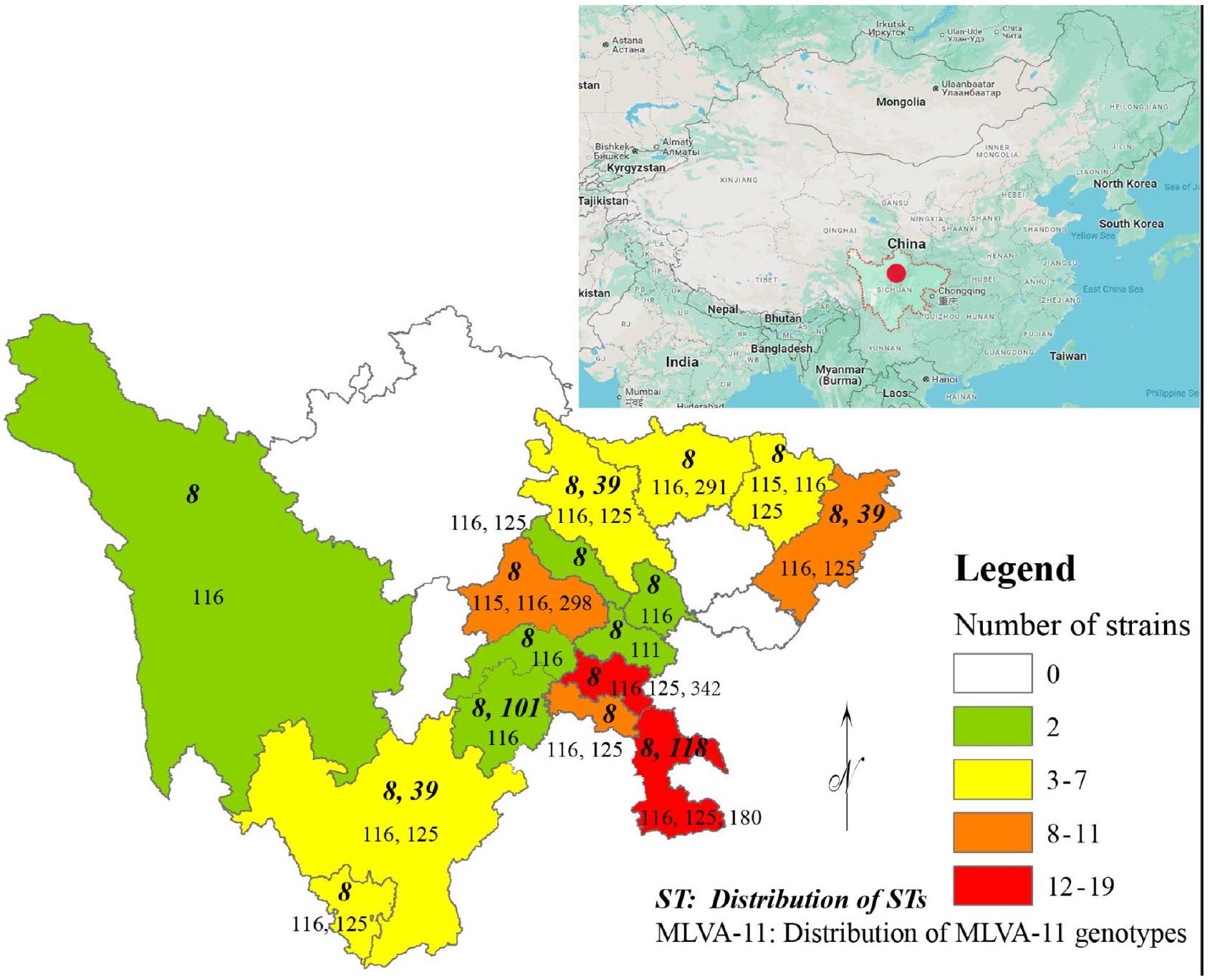
الأغلبية من مدينة لوتشو تبع ذلك 17 من مدينة نيجانغ، و11 من مدينة زيغونغ، و10 من مدينة تشنغدو. تراوحت أعداد السلالات في المناطق الـ 13 الأخرى بين 1 و9 (الجدول 1؛ الشكل 1).

ملفات تنوع VNTR والأليلات

في MLST، كان أعلى عدد من الأليلات مرتبطًا بـ موضع ( )، التي كانت أيضًا الأكثر تنوعًا، تليها مع وجود أليلين، وسبعة مواقع المتبقية مع أليل واحد فقط (الجدول 2). كانت التقسيمة لـ MLVA هي الأعلى لـ Bruce09 مع 10 أنواع من الأليلات. كانت أعداد الأليلات لـ Bruce04 وBruce16 وBruce30 بواسطة MLVA هي 8 و8 و5 على التوالي، وكان نطاق مؤشر سيمبسون من 0 إلى 0.808 لـ Bruce04، تليها 0.741 لـ Bruce16 و0.671 لـ Bruce30. علاوة على ذلك، أظهرت ثلاثة مواقع من اللوحة 1 تنوعًا منخفضًا؛ كانت أعداد الأليلات لـ Bruce12 وBruce42 وBruce43 هي 3 و2 و3 على التوالي (الجدول 2).
خصائص تحديد النمط الجيني MLST لـ 101 سلالة من بكتيريا بروسيلة المالطية استنادًا إلى تسعة مواقع في اختبار MLST، تم تقسيم 101 عينة من بروسيلة إلى أربعة أنواع تسلسل (STs): ST8 ( ، ST39 ( ), ST101 ( )، و ST118 ( )، من بينها ST101 و ST118 ( ) كانت أنماط جديدة معزولة في هذه الدراسة؛ وكان كل منهما ممثلاً بسلالة واحدة (الجدول 2). كانت سلالات ST8 موزعة على نطاق واسع بين 17 مدينة/ولاية؛ بينما كانت سلالة ST39 موزعة في ست مدن/ولايات، في حين حدثت سلالات ST101 و ST118 فقط في ليشان ولوزهو، على التوالي (الشكل 1). اختلفت ST101 عن ST8 في متغير موقع واحد من الجين، بينما كان لدى ST118 سبعة مواقع تختلف عن ST8 (الجدول 3). تشير البيانات إلى أن ST8 كان النوع السائد المتداول من بكتيريا البروسيلا في سيتشوان،
وأن ظهور أنواع جديدة من الفيروسات يوضح الحاجة إلى المراقبة النشطة.

خصائص تحديد النمط الجيني MLVA لـ 101 سلالة من ب. ميلتينسيس

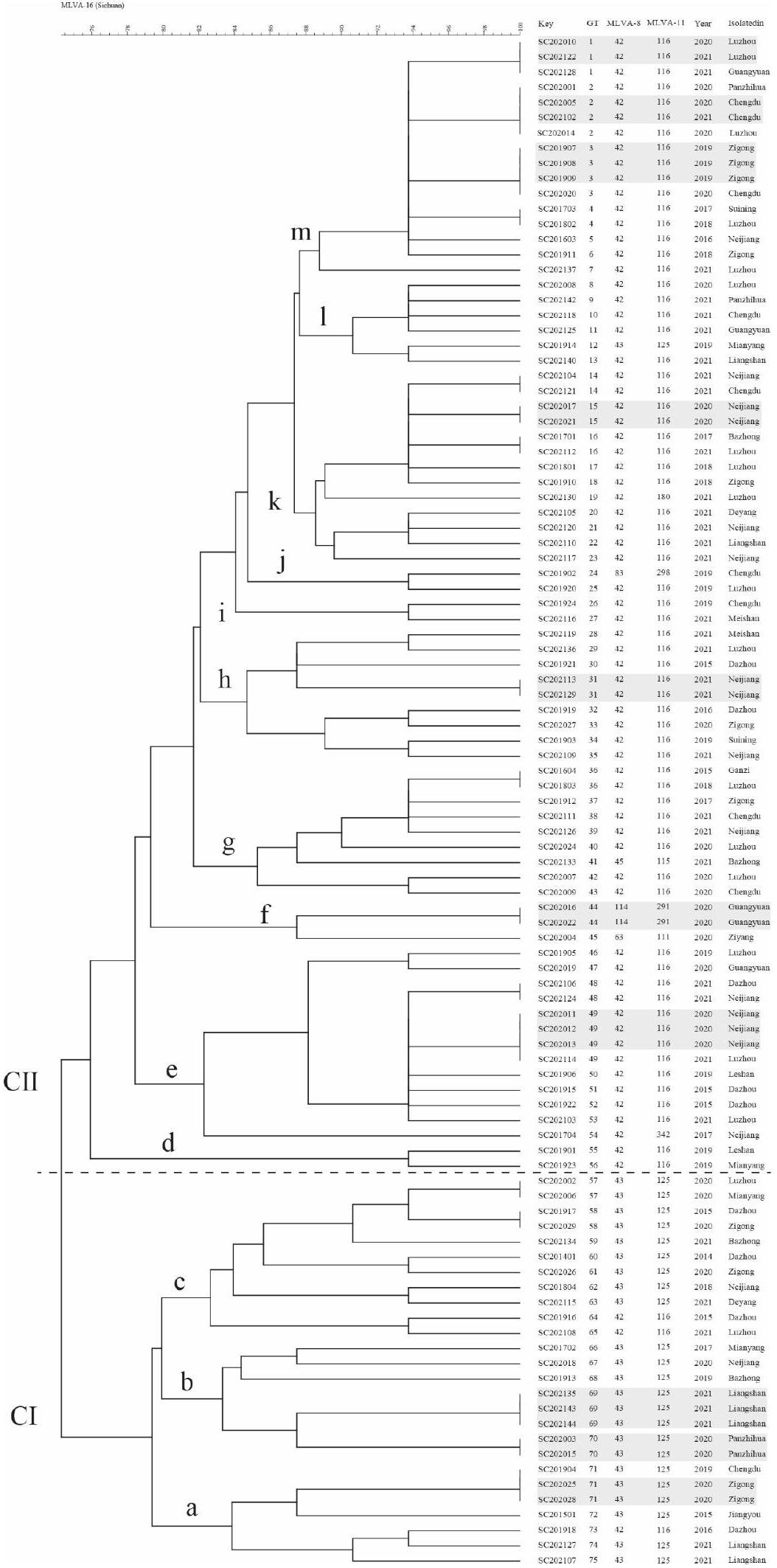
في اللوحة 1 (MLVA-8)، كانت جميع السلالات تتكون من ستة أنماط جينية، وهي، ، ، و تم تحديد سبعة أنماط جينية من MLVA-11: ، و ، و “، حيث كانت 116 هي النمط الجيني السائد المتداول في مجموعة CI و 125 تهيمن على مجموعة CII. تشير النتائج إلى أن جميع السلالات تنتمي إلى سلالة شرق البحر الأبيض المتوسط. استنادًا إلى تقنية MLVA-16، تم تقسيم 101 سلالة إلى مجموعتين (CI و CII) و 13 مجموعة فرعية ( ) التي احتوت على 74 نمطًا جينيًا من MLVA-16 (GTs ) (الشكل 2)، 57 منها كانت ممثلة بسلالات فريدة، و17 المتبقية كانت أنماط جينية MLVA-16، تم تقاسمها بين عزلتين إلى أربع عزل (الشكل 2). كانت الأنماط الجينية الـ 17 المشتركة تتألف من 44 سلالة متجمعة بمعدل تجميع قدره ( ; الشكل 2). أشارت النتائج إلى نمط انتقال متزامن يتميز بحالات متفرقة وحالات مرتبطة وبائيًا بشكل محدود. احتوت عشرة أنماط جينية مشتركة (GT1، 2، 3، 13، 30، 47، 52، 68، 69، و70) (الشكل 2، الظل الأسود) على سلالات من نفس الموقع ووقت العزل، مما يوحي بأن أحداث تفشي متعددة كانت ناتجة عن مصدر مشترك (الشكل 2). تضمنت أنماط GTs المشتركة الأخرى عزلات من مناطق مختلفة. هناك حاجة إلى مزيد من التحقيقات لكشف نمط انتقال سلالات بروسيلة في هذه المحافظة.

المقارنة الجينية لسلالات بروسيلة من الصين وعلى المستوى العالمي
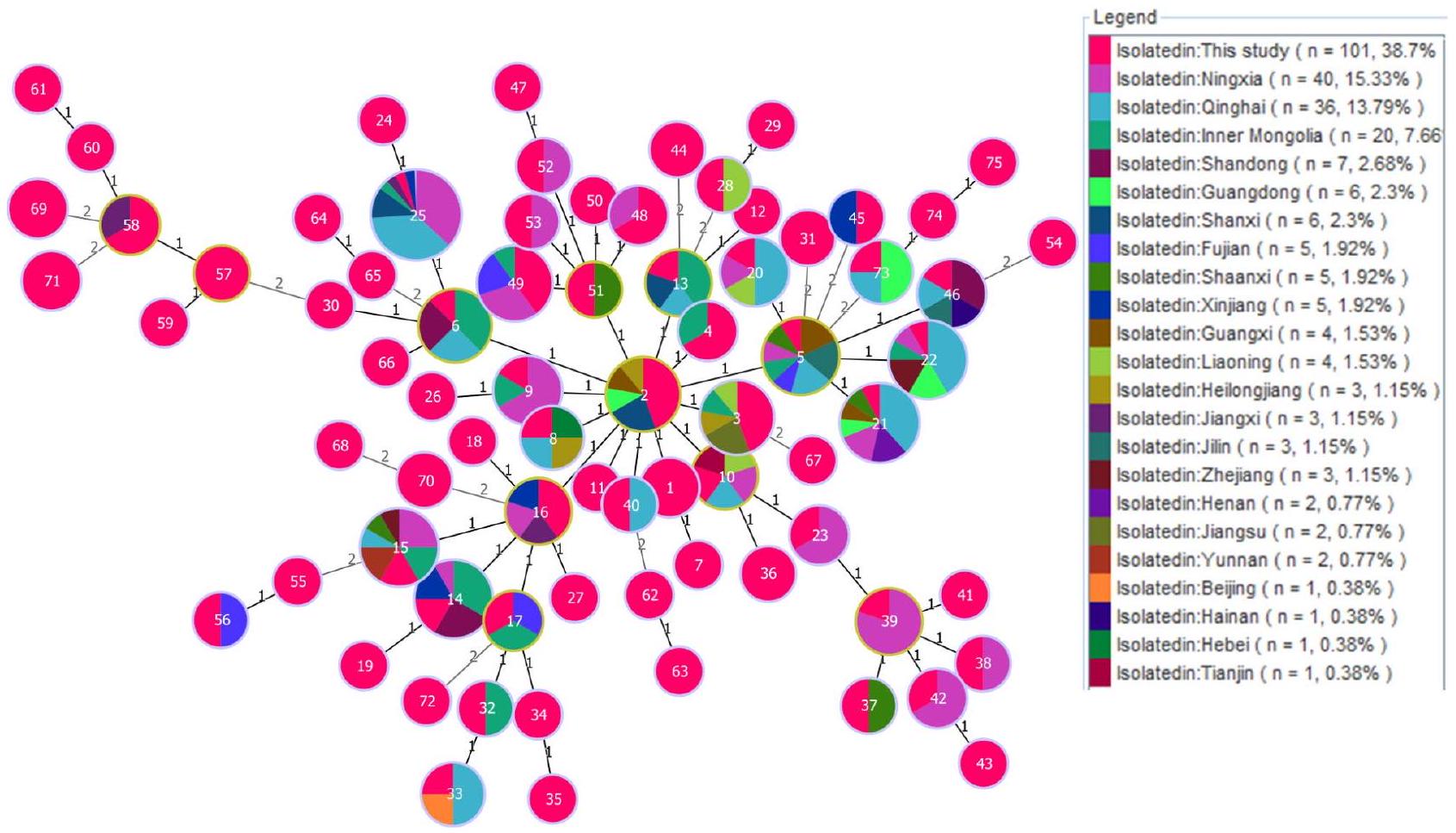
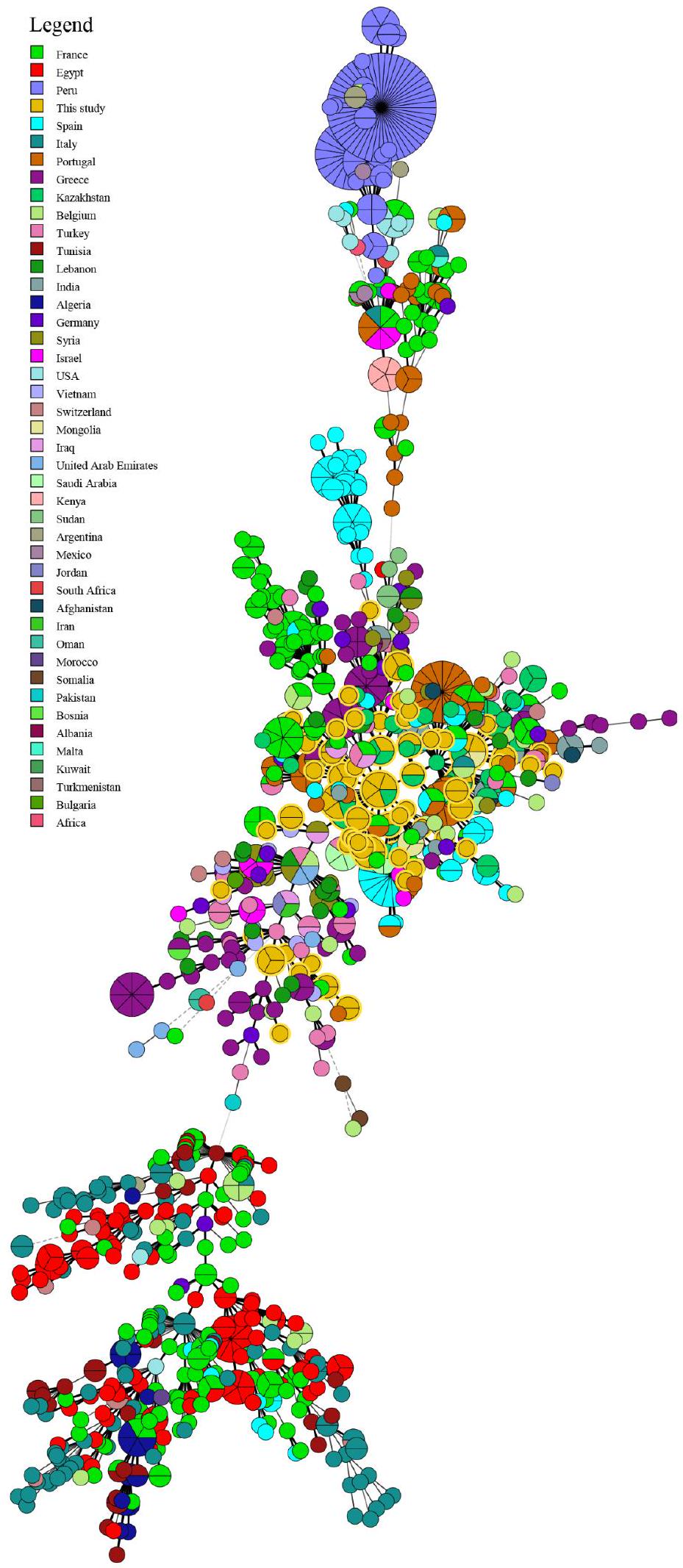
تم إجراء تحليل مقارنة MLVA-16 للتحقيق في العلاقات الوبائية الجزيئية بين السلالات على المستوى الوطني. حددت مقارنة MLVA لـ 801 سلالة من ب. ميلتينسيس 36 نمطًا جينيًا مشتركًا من MLVA-16 (1-36) (الجدول S4) بين السلالات من سيتشوان و22 مقاطعة أخرى (الشكل 3). بلغ إجمالي عدد السلالات 51 سلالة ( ) من الدراسة الحالية شاركت أنماط MLVA-16 الجينية مع سلالات من مقاطعات (مدن) أخرى. كانت المقاطعات التي شاركت سلالات مع أنماط MLVA-16 تشمل نينغشيا ( ، تشينغهاي ( ) ومنغوليا الداخلية ( ) (الشكل 3)، تليها شاندونغ ( شانشي شاندونغ وشينجيانغ . كانت هذه المقاطعات مناطق تاريخية متوطنة لحمى البروسيلات البشرية، وأجزاء من كل منها متصلة بمقاطعة سيتشوان. على المستوى العالمي، تم مشاركة عدة أنماط جينية MLVA-16 من قبل سلالات من الدراسة الحالية، وسلالات من الهند. منغوليا وكازاخستان (الشكل 4). أظهرت السلالات من الدراسة الحالية تشابهًا جينيًا عاليًا مع سلالات من العديد من البلدان
الشكل 1 ملفات توزيع السلالات، وأنماط ST، وأنماط MLVA-11
ملاحظة: النقطة الحمراء (في الزاوية العليا اليمنى) تشير إلى موقع سيتشوان في الصين
في آسيا، بما في ذلك المملكة العربية السعودية، تركيا، الكويت، أفغانستان، لبنان، العراق، سوريا، وإسرائيل (الشكل S5).

نقاش

في هذه الدراسة، تم تطبيق علم البكتيريا، والتصنيف الحيوي، ونهجين من تحليل الجينات لتمييز 101 سلالة من بكتيريا البروسيلا المعزولة من مقاطعة سيتشوان. في الوقت الحالي، تعتبر سلالة B. meltenesis bv. 3 هي النوع السائد المتداول في مقاطعة سيتشوان، وقد انتشرت هذه السلالة إلى 16 من أصل 21 مدينة. أظهرت الدراسات السابقة أن . لقد انتشرت المليتنس باستمرار من الشمال إلى الجنوب، مما يشكل تهديدًا للصحة العامة [6]. الحيوانات المجترة هي الخزانات المفضلة، مما يعني أن الأغنام والماعز المصابة المستوردة هي المصدر الرئيسي لحمى مالطية في المنطقة. لذلك، هناك حاجة ماسة إلى تدابير للسيطرة على الحمى المالطية للحد من انتشار العامل المسبب. هذه النتيجة تتماشى مع الوضع الوبائي في مقاطعة سيتشوان، حيث تعتبر الحمى المالطية البشرية
مرض يتجدد ظهوره. لقد حدثت حالات متفرقة منذ عام 2014، مع زيادة عدد الحالات المبلغ عنها من 25 في عام 2014 إلى 417 في عام 2023. بالإضافة إلى ذلك، فإن مقاطعة سيتشوان تحدها العديد من المقاطعات من الغرب، بما في ذلك مقاطعات شانشي، تشينغهاي، قانسو، ويوننان، حيث إن داء البروسيلات البشري له انتشار مرتفع [18]. أيضًا، فإن أعداد تربية الأغنام والماعز مرتفعة في سيتشوان بسبب تطوير تربية الحيوانات لزيادة دخل المزارعين والرعاة المحليين.
زاد عدد الأغنام من 1689.19 (عشرات الآلاف) في عام 2013 إلى 1761.13 (عشرات الآلاف) في عام 2016، ثم انخفض إلى 1529.9 (عشرات الآلاف) في عام 2022. زادت إنتاجية لحم الضأن والأغنام من 22.45 (عشرة آلاف طن) في عام 2013 إلى 27.10 (عشرة آلاف طن) في عام 2023 (بيانات من مكتب الإحصاء، الصين). بسبب تطوير صناعة التربية، شهدت السكان المحليون تواصلًا غير مباشر ومباشر مع
الجدول 2 ملفات تنوع المواقع ودقة طرق تحديد النمط الجيني
تحليل موضع معرف سيمبسون أقسام ماكس (باي) فترة الثقة (95%)
MLST أروأ 0 1 1 (0.000-0.000)
cobQ 0 1 1 (0.000-0.000)
دي إن إيه كيه 0 1 1 (0.000-0.000)
فجوة 0 1 1 (0.000-0.000)
جلک 0.131 ٣ 0.931 (0.043-0.220)
جير ب 0 1 1 (0.000-0.000)
int_hyp 0 1 1 (0.000-0.000)
omp25 0 1 1 (0.000-0.000)
trpE 0.02 2 0.990 (1.000-0.058)
MLVA بروس06 0 1 1 (0.000-0.000)
بروس08 0 1 1 (0.000-0.000)
بروس11 0 1 1 (0.000-0.000)
بروس12 0.039 ٣ 0.980 (1.000-0.093)
بروس42 0.366 ٢ 0.762 (0.277-0.455)
بروس43 0.059 ٣ 0.970 (1.000-0.123)
بروس45 0 1 1 (0.000-0.000)
بروس55 0 1 1 (0.000-0.000)
بروس18 0.02 2 0.990 (1.000-0.058)
بروس19 0.02 2 0.990 (1.000-0.058)
بروس21 0 1 1 (0.000-0.000)
بروس04 0.808 ٨ 0.307 (0.774-0.843)
بروس07 0.039 2 0.980 (1.000-0.092)
بروس09 0.545 10 0.653 (0.438-0.652)
بروس16 0.741 ٨ 0.426 (0.682-0.800)
بروس30 0.671 ٥ 0.495 (0.607-0.736)
ملاحظة: يشير الحرف العلوي أ إلى نسبة النوع الأعلى تكرارًا
الحيوانات المجترة المصابة، وقد أدى ذلك إلى إعادة ظهور داء البروسيلات وظهور وباءات محلية.
توزعت السلالات التي تنتمي إلى ST8 في شمال وشمال شرق الصين، بما في ذلك منغوليا الداخلية، شينجيانغ، قانسو، تشينغهاي، شنشي، ومقاطعة هيلونغجيانغ [19]. تظهر التقارير الأخيرة أن ب. ميلتينسيس ST39 تم عزلها لأول مرة في مدينة زون يي، مقاطعة قويتشو في عام 2013، وقد تم عزل العديد من السلالات التي تنتمي إلى مجموعة ST في هذه المقاطعة [20]. تشير السلالات المعزولة من ب. ميلتينسيس ST8 و ST39 في سيتشوان إلى أن مصدر العدوى كان من خارج المقاطعة؛ ومع ذلك، تحتاج التفاصيل المتعلقة بالروابط الوبائية بين هذه السلالات إلى مزيد من التمييز بواسطة WGS-SNP [21]. علاوة على ذلك، تم اكتشاف نوعين جديدين من ST في هذه الدراسة، وكل منهما يمثل سلالة واحدة فقط. أظهر مقارنة التسلسل بين ST8 و ST101 أنهما يختلفان في الموقع، بينما اختلف ST118 في موضع.
يتطلب مصدر وحالة الوباء لنوعين التسلسل الجديدين مزيدًا من التحقيق.
إن هيمنة الأنماط الجينية 116 و125 من MLVA-11 لبكتيريا البروسيلا في مقاطعة سيتشوان كانت متوافقة مع النمط في معظم مقاطعات الصين. النمط الجيني 116 هو النمط السائد لبكتيريا B. melitensis الذي يستمر في التوسع من شمال إلى جنوب الصين. كشفت تحليل مجموعة MLVA-16 عن نمط انتقال متزامن يهيمن عليه حالات متفرقة وأحداث تفشي متعددة ناجمة عن مصدر مشترك. كانت هذه النتيجة متوافقة مع الحالة الوبائية لحمى البروسيلا البشرية في هذه المقاطعة، حيث كانت نسبة الحدوث في عام 2023. على النقيض من ذلك، أكدت تصنيف الجينات باستخدام MLVA أن نمط الوباء كان مهيمنًا بواسطة تفشي متعدد النقاط في أولانqab، منغوليا الداخلية [22]. تشير هذه النتيجة إلى أن داء البروسيلات البشري في المراحل الوبائية المبكرة في هذه المنطقة، وبالتالي هناك حاجة إلى تدابير تحكم مستهدفة وفي الوقت المناسب. ومع ذلك، كشفت تحليل المقارنة الوطنية باستخدام MLVA أن 51 سلالة في هذه الدراسة شملت 36 نمطًا جينيًا مشتركًا من MLVA-16 مع سلالات من 22 محافظة أخرى. تشير هذه البيانات إلى أن الأنماط الجينية السائدة من B. melitensis قد انتشرت بين مختلف المحافظات وأن النمط الجيني المشترك من MLVA-16 لـ B. melitensis في محافظة سيتشوان وأماكن أخرى في الصين يؤكد استنتاج الاستيراد من خارج المحافظة، مما يدل على انتقال إقليمي. . سلالات ميلتينسيس من نفس السلالات التي قد تكون مرتبطة بتجارة الماشية [23]. وهذا يشير إلى أن الزراعة على نطاق واسع قد تزيد من خطر انتقال داء البروسيلات، وأن معظم المزارعين المحليين قد لا يكونون على دراية بأن إدخال المجترات المصابة سيساهم في انتشار المرض. علاوة على ذلك، أظهر مطابقة الجينات المحلية مع الجينات العالمية أن بعض العزلات المحلية كانت ذات أصل شرق متوسطي، وأن السلالات في هذه الدراسة أظهرت مستوى عالٍ من التجانس الجيني مع سلالات من دول أخرى في آسيا. السلالة شرق المتوسطي من . المليتنسيس هو السائد في آسيا [24]. تمثل تجمعات ب. المليتنسيس تحديًا للصحة العامة في البلدان الواقعة على طول طريق الحرير [23]. وأيضًا، المتغير البيولوجي 3 من ميليتينس هو الأكثر انتشارًا في دول الشرق الأوسط وآسيا، والذي تسبب في معظم الحالات البشرية [25].
أبرزت العديد من الدراسات ضرورة تسلسل الجينوم الكامل (WGS) لجمع مزيد من المعلومات لتحسين التحقيقات الوبائية [26، 27]. تعدد أشكال النوكليوتيدات المفردة في الجينوم الأساسي (cgSNP)
الجدول 3 الأليلات، العدد، وملفات توزيع الأنماط المدروسة في هذه الدراسة
STs أروأ cobQ دي إن إيه كيه فجوة جل ك جير ب int_hyp omp25 trpE عدد السلالات توزيع المدن
٨ ٢ ٣ 2 ٣ ٣ 1 2 ٨ ٥ 93 17
٣٩ 2 ٣ 2 ٣ ٢٤ 1 2 ٨ ٥ ٦ ٦
١٠١ 2 ٣ ٢ ٣ ٤٩ 1 2 ٨ ٥ 1 1
١١٨ 2 ٣ 2 ٣ ٣ 1 2 ٨ 31 1 1
الشكل 2: شجرة النسب لـ MLVA-16 لـ 101 سلالة من بكتيريا بروسيلا ميلتينسيس في مقاطعة سيتشوان. المفتاح: رمز السلالات؛ GT: الأنماط الجينية لـ MLVA-16؛ MLVA-8: الأنماط الجينية لـ MLVA-8؛ MLVA-11: الأنماط الجينية لـ MLVA-11؛ السنة: تواريخ عزل السلالات؛ المعزولة في: مواقع السلالات المعزولة
الشكل 3 شجرة امتداد الحد الأدنى للعلاقات الجينية لسلالات B. melitensis من مسح وطني تم إنشاؤه باستخدام برنامج PHYLOVIZ 2.0. ملاحظة: شكلت 51 سلالة من B. melitensis في هذه الدراسة 36 نمطًا جينيًا متطابقًا من MLVA-16 مع سلالات من 22 مقاطعة مختلفة في الصين. الأرقام في الدوائر تشير إلى أنماط MLVA-16 الجينية، والأرقام في الخطوط تشير إلى الفروق في المواقع بين نمطين جينيين متجاورين من MLVA-16. تم تمييز السلالات من مقاطعات (مدن) مختلفة بألوان. السلالات من الدراسة الحالية تم تمييزها باللون الأحمر، مع اللون الوردي الفاتح لنينغشيا، والأزرق لشنغهاي، والأخضر الفاتح لمنغوليا الداخلية، والبنفسجي لشاندونغ، والأزرق لشانشي، والأخضر الداكن لشنشيان، والأزرق الداكن لشنغهاي.
أظهرت التحليلات وجود ارتباط محتمل بين العزلات التركية من ب. ميلتينسيس وتلك الموجودة في السويد وإسرائيل وسوريا والنمسا والهند [28]. كانت العزلات المنغولية من ب. ميلتينسيس تتمتع بتشابه جيني عالٍ مع السلالات الصينية، على الأرجح بسبب القرب الجغرافي [29]. لوحظت تشابهات واسعة في النمط الجيني بين السلالات من منغوليا الداخلية وكازاخستان ومنغوليا وتركيا. تعتبر الحمى المالطية عدوى حيوانية المنشأ هامة في المجترات في باكستان. في مسح، تشير النتائج إلى تهديد حيواني مستمر في الماشية في المنطقة وإمكانية انتقال العدوى عند الاتصال الوثيق مع أنواع حيوانية أخرى [30]. كانت هذه الدول أعضاء رئيسيين في طريق الحرير العشبي، وقد يكون للتجارة طويلة الأمد في المجترات الصغيرة (الأغنام) في هذه الدول دور في تعزيز انتشار بروسيلة spp. في هذه المناطق [31]. وهذا يفسر الروابط الجينية بين سلالات بروسيلة من المناطق/الدول المجاورة والعزلات من مقاطعة سيتشوان، الصين. لذلك، يجب تعزيز الحجر الصحي للحيوانات لمنع انتشار بروسيلة إلى الدول والمناطق المجاورة [32]. الحمى المالطية في دول حوض نهر النيل (مصر والسودان وإثيوبيا وتنزانيا) منتشرة بشكل كبير ومتوطنة. هناك عدة عوامل وراء فشل القضاء على بروسيلة في هذه الدول، بما في ذلك نقص التعاون بين صانعي السياسات والمسؤولين الصحيين والبيطريين.
القطاعات، والمزارعين؛ والتخلص غير المناسب من المواد المجهضة، وتعويض الحكومة غير الكافي للحيوانات المصابة، وتردد الجمهور في التطعيم، والحدود المفتوحة وحركة الحيوانات غير المنضبطة، ونقص التشخيص المناسب وطرق وأدوات التصنيف البيولوجي. لذلك، من الضروري تنفيذ سياسة صارمة للاختبار والذبح للقضاء على المجترات المصابة وتقليل حدوث داء البروسيلات لدى البشر. بالإضافة إلى ذلك، يجب التحكم في حركة الحيوانات المصابة، حيث يجب أن تساعد الاستثمارات المالية والمادية من قبل الإدارات الحكومية في مشاركة المزارعين في برامج السيطرة.

الخاتمة
على الرغم من أن عزلات بروسيلة في مقاطعة سيتشوان كانت جميعها من النوع B. melitensis bv. 3، إلا أن أنواع التسلسل وأنماط MLVA-16 أظهرت تنوعًا جينيًا عاليًا، وتسيطر الحالات المتفرقة على الوباء الحالي لحمى البروسيلات البشرية. إن السيطرة على المرض تمثل تحديًا بسبب التنوع الواسع لنمط MLVA-16 الذي يتضمن سلالات من سيتشوان و22 مقاطعة أخرى. كانت معظم السلالات المشتركة من المنطقة الشمالية، حيث تحدث حمى البروسيلات بانتشار مرتفع. سيوفر تحليل قائم على WGS-SNP للتحقيق في السلالات على نطاق إقليمي ووطني بيانات لفهم أفضل لـ
الشكل 4 الشجرة الأدنى الممتدة لارتباطات الجينات لسلالات ب. ميلتينسيس على نطاق عالمي. ملاحظة: تم بناء الشجرة الأدنى الممتدة استنادًا إلى بيانات MLVA-16 من 1296 سلالة من ب. ميلتينسيس باستخدام برنامج Bionumerics 8.0. السلالات من الدراسة الحالية محددة باللون الأصفر ومميزة بدوائر صفراء. السلالات من دول أخرى مشفرة بألوان مختلفة مثل الأصفر الفاتح لمنغوليا، والأخضر الفاتح لكازاخستان، والنيلي للهند.
عودة ظهور حمى البروسيلات البشرية في سيتشوان ومناطق أخرى. يتطلب السيطرة على حمى البروسيلات البشرية في مقاطعة سيتشوان تعاونًا صارمًا ومتعدد القطاعات للحد من تفشي حمى البروسيلات في الحيوانات المحلية.

الاختصارات

حمض نووي ريبوزي منقوص الأكسجين حمض الديوكسي ريبونوكلييك
تفاعل البوليميراز المتسلسل تفاعل البوليميراز المتسلسل
AMOS-PCR تفاعل البوليميراز المتسلسل لفيروس الإجهاض – المليتنس – الأوي – السويس
HGDI مؤشر تنوع هانتر-غاستون
UPGMA طريقة المجموعة غير الموزونة مع المتوسط الحسابي
MLST تحديد تسلسل متعدد المواقع
MLVA تحليل تكرار عدد المواقع المتغيرة المتعددة
MST شجرة التمدد الدنيا

معلومات إضافية

تحتوي النسخة الإلكترونية على مواد إضافية متاحة على https://doi.or g/10.1186/s12866-024-03739-x.
المادة الإضافية 1: الجدول S1. المفتاح، أنماط MLVA وموقع العزل لـ 101 سلالة في هذه الدراسة
المادة الإضافية 2: الجدول S2. تم استخدام 801 سلالة من بروسيلة المليتنس للتحليل الجيني على نطاق وطني شمل اللوحة 1، MLVA-11، المضيف، الموقع، وسنة السلالات المعزولة المستخدمة في الدراسة
المادة الإضافية 3: الجدول S3. تم استخدام 1296 سلالة من ب. المليتنس من هذه الدراسة و43 دولة لمقارنة الارتباط الجيني العالمي. تضمن الجدول مفتاح السلالات، خصائص MLVA، أنماط اللوحة 1، أنماط MLVA-11، وموقع السلالات المعزولة
المادة الإضافية 4: الجدول S4. تظهر سلالات ب. المليتنس من هذه الدراسة أنماط MLVA-16 متطابقة مع سلالات من مقاطعات (مدن) أخرى في الصين. تضمن الجدول مفتاح السلالات، خصائص MLVA، أنماط اللوحة 1، أنماط MLVA-11، وموقع السلالات المعزولة
المادة الإضافية 5: الشكل S5

الشكر والتقدير

غير قابل للتطبيق.

مساهمات المؤلفين

قام LWB وZLZ وYMR وQT وLHY بزراعة السلالات، وتحديدها، وCYHX وHS قاموا بإعداد الحمض النووي للسلالات؛ قام LZG وLWB بإجراء تحديد الأنماط ورسم الأشكال، وصياغة المخطوطة؛ شارك LZG وLZJ في تصميم الدراسة؛ قام LZG وLWB وZLZ وLZJ بمراجعة المخطوطة بشكل نقدي.

التمويل

تم دعم هذه الدراسة من قبل برنامج العلوم والتكنولوجيا في سيتشوان (رقم 2022ZDZX0017). لم يلعب الممولون أي دور في تصميم الدراسة، جمع البيانات وتحليلها، اتخاذ قرار النشر، أو إعداد المخطوطة.

توفر البيانات

البيانات التي تدعم نتائج هذه الدراسة متاحة في المواد الإضافية.

الإعلانات

تم إجراء هذه الدراسة وفقًا لمبادئ إعلان هلسنكي. تم مراجعة بروتوكول البحث والموافقة عليه من قبل لجنة الأخلاقيات في مركز سيتشوان الإقليمي لمكافحة الأمراض والوقاية منها (رقم SCCDCIRB2023-001). تم إجراء الدراسة وفقًا للتشريعات المحلية والمتطلبات المؤسسية. تم تقديم موافقة خطية مستنيرة للمشاركة في هذه الدراسة من قبل الأوصياء القانونيين/الأقارب للمتطوعين.
غير قابل للتطبيق.

المصالح المتنافسة

يعلن المؤلفون عدم وجود مصالح متنافسة.
تاريخ الاستلام: 8 أكتوبر 2024 / تاريخ القبول: 30 ديسمبر 2024
تم النشر عبر الإنترنت: 14 يناير 2025

References

  1. Byndloss MX, Tsolis RM. Brucella spp. Virulence factors and immunity. Annu Rev Anim Biosci. 2016;4:111-27. https://doi.org/10.1146/annurev-animal-021 815-111326.
  2. Ahmed W, Zheng K, Liu ZF. Establishment of chronic infection: Brucella’s Stealth Strategy. Front Cell Infect Microbiol. 2016;6:30. https://doi.org/10.3389 /fcimb.2016.00030.
  3. Godfroid J, Cloeckaert A, Liautard JP, Kohler S, Fretin D, Walravens K, et al. From the discovery of the Malta fever’s agent to the discovery of a marine mammal reservoir, brucellosis has continuously been a re-emerging zoonosis. Vet Res. 2005;36(3):313-26. https://doi.org/10.1051/vetres:2005003.
  4. Liu Z, Gao L, Wang M, Yuan M, Li Z. Long ignored but making a comeback: a worldwide epidemiological evolution of human brucellosis. Emerg Microbes Infect. 2024;13(1):2290839. https://doi.org/10.1080/22221751.2023.2290839.
  5. Lai S, Zhou H, Xiong W, Gilbert M, Huang Z, Yu J, et al. Changing epidemiology of human brucellosis, China, 1955-2014. Emerg Infect Dis. 2017;23(2):184-94. https://doi.org/10.3201/eid2302.151710.
  6. Zhu X, Zhao Z, Ma S, Guo Z, Wang M, Li Z, et al. Brucella melitensis, a latent travel bacterium, continual spread and expansion from Northern to Southern China and its relationship to worldwide lineages. Emerg Microbes Infect. 2020;9(1):1618-27. https://doi.org/10.1080/22221751.2020.1788995.
  7. Wang Y, Wang Y, Zhang L, Wang A, Yan Y, Chen Y, et al. An epidemiological study of brucellosis on mainland China during 2004-2018. Transbound Emerg Dis. 2021;68(4):2353-63. https://doi.org/10.1111/tbed.13896.
  8. Deqiu S, Donglou X, Jiming Y. Epidemiology and control of brucellosis in China. Vet Microbiol. 2002;90(1-4):165-82. https://doi.org/10.1016/s0378-113 5(02)00252-3.
  9. Whatmore AM, Perrett LL, MacMillan AP. Characterisation of the genetic diversity of Brucella by multilocus sequencing. BMC Microbiol. 2007;7:34. https://doi.org/10.1186/1471-2180-7-34.
  10. Al Dahouk S, Flèche PL, Nöckler K, Jacques I, Grayon M, Scholz HC, et al. Evaluation of Brucella MLVA typing for human brucellosis. J Microbiol Methods. 2007;69(1):137-45. https://doi.org/10.1016/j.mimet.2006.12.015.
  11. Yagupsky P, Morata P, Colmenero JD. Laboratory diagnosis of human brucellosis. Clin Microbiol Rev. 2019;33(1). https://doi.org/10.1128/cmr.00073-19.
  12. Al Dahouk S, Tomaso H, Nöckler K, Neubauer H, Frangoulidis D. Laboratorybased diagnosis of brucellosis-a review of the literature. Part II: serological tests for brucellosis. Clin Lab. 2003;49(11-12):577-89.
  13. Liu G, Ma X, Zhang R, Lü J, Zhou P, Liu B, et al. Epidemiological changes and molecular characteristics of Brucella strains in Ningxia, China. Front Microbiol. 2024;15:1320845. https://doi.org/10.3389/fmicb.2024.1320845.
  14. Bricker BJ, Halling SM. Differentiation of Brucella abortus Bv. 1, 2, and 4, Brucella melitensis, Brucella ovis, and Brucella suis Bv. 1 by PCR. J Clin Microbiol. 1994;32(11):2660-6. https://doi.org/10.1128/jcm.32.11.2660-2666.1994.
  15. Liu ZG, Wang M, Zhao HY, Piao DR, Jiang H, Li ZJ. Investigation of the molecular characteristics of Brucella isolates from Guangxi Province, China. BMC Microbiol. 2019;19(1):292. https://doi.org/10.1186/s12866-019-1665-6.
  16. Hunter PR, Gaston MA. Numerical index of the discriminatory ability of typing systems: an application of Simpson’s index of diversity. J Clin Microbiol. 1988;26(11):2465-6. https://doi.org/10.1128/jcm.26.11.2465-2466.1988.
  17. Nascimento M, Sousa A, Ramirez M, Francisco AP, Carriço JA, Vaz C. PHYLOViZ 2.0: providing scalable data integration and visualization for multiple phylogenetic inference methods. Bioinformatics. 2017;33(1):128-9. https://doi.org/ 10.1093/bioinformatics/btw582.
  18. Yang H, Chen Q, Li Y, Mu D, Zhang Y, Yin W, Epidemic Characteristics. High-risk areas and space-time clusters of human brucellosis – China, 2020-2021. China CDC Wkly. 2023;5(1):17-22. https://doi.org/10.46234/ccdcw2023.004.
  19. An CH, Liu ZG, Nie SM, Sun YX, Fan SP, Luo BY, et al. Changes in the epidemiological characteristics of human brucellosis in Shaanxi Province from 2008 to 2020. Sci Rep. 2021;11(1):17367. https://doi.org/10.1038/s41598-021-96774-x.
  20. Tan Q, Wang Y, Liu Y, Tao Z, Yu C, Huang Y, et al. Molecular epidemiological characteristics of Brucella in Guizhou Province, China, from 2009 to 2021. Front Microbiol. 2023;14:1188469. https://doi.org/10.3389/fmicb.2023.118846 9.
  21. Xue H, Zhao Z, Wang J, Ma L, Li J, Yang X, et al. Native circulating Brucella melitensis lineages causing a brucellosis epidemic in Qinghai, China. Front Microbiol. 2023;14:1233686. https://doi.org/10.3389/fmicb.2023.1233686.
  22. Liu ZG, Di DD, Wang M, Liu RH, Zhao HY, Piao DR, et al. MLVA Genotyping Characteristics of Human Brucella melitensis isolated from Ulanqab of Inner Mongolia, China. Front Microbiol. 2017;8:6. https://doi.org/10.3389/fmicb. 201 7.00006.
  23. Liu Z, Wang C, Wei K, Zhao Z, Wang M, Li D, et al. Investigation of genetic relatedness of Brucella Strains in Countries along the Silk Road. Front Vet Sci. 2020;7:539444. https://doi.org/10.3389/fvets.2020.539444.
  24. Ali S, Mushtaq A, Hassan L, Syed MA, Foster JT, Dadar M. Molecular epidemiology of brucellosis in Asia: insights from genotyping analyses. Vet Res Commun. 2024;48(6):3533-50. https://doi.org/10.1007/s11259-024-10519-5.
  25. Refai M. Incidence and control of brucellosis in the Near East region. Vet Microbiol. 2002;90(1-4):81-110. https://doi.org/10.1016/s0378-1135(02)0024 8-1.
  26. Ötkün S, Erdenliğ Gürbi Lek S. Whole-genome sequencing-based analysis of Brucella species isolated from ruminants in various regions of Türkiye. BMC Infect Dis. 2024;24(1):1220. https://doi.org/10.1186/s12879-024-09921-w.
  27. Kydyshov K, Usenbaev N, Berdiev S, Dzhaparova A, Abidova A, Kebekbaeva N, et al. First record of the human infection of Brucella melitensis in Kyrgyzstan: evidence from whole-genome sequencing-based analysis. Infect Dis Poverty. 2022;11(1):120. https://doi.org/10.1186/s40249-022-01044-1.
  28. Akar K, Holzer K, Hoelzle LE, YIldız Öz G, Abdelmegid S, Baklan EA, et al. An evaluation of the lineage of Brucella isolates in Turkey by a whole-genome
    single-nucleotide polymorphism analysis. Vet Sci. 2024;11(7). https://doi.org/ 10.3390/vetsci11070316.
  29. Kang SI, Her M, Erdenebaataar J, Vanaabaatar B, Cho H, Sung SR, et al. Molecular epidemiological investigation of Brucella melitensis circulating in Mongolia by MLVA16. Comp Immunol Microbiol Infect Dis. 2017;50:16-22. https://doi.org/10.1016/j.cimid.2016.11.003.
  30. Sami Ullah TJ, Muhammad, Asif. Waqas Ahmad and Heinrich Neubauer. Brucellosis remains a neglected disease in District Muzaffargarh of Pakistani Punjab: a call for multidisciplinary collaboration. German J Veterinary Res. 2022;2(1):36-9. https://doi.org/10.51585/gjvr.2022.1.0039.
  31. Liu ZG, Wang M, Ta N, Fang MG, Mi JC, Yu RP, et al. Seroprevalence of human brucellosis and molecular characteristics of Brucella strains in Inner Mongolia Autonomous region of China, from 2012 to 2016. Emerg Microbes Infect. 2020;9(1):263-74. https://doi.org/10.1080/22221751.2020.1720528.
  32. Leylabadlo HE, Bialvaei AZ, Samadi Kafil H. Brucellosis in Iran: why not eradicated? Clin Infect Dis. 2015;61(10):1629-30. https://doi.org/10.1093/cid/civ64 6.
  33. Ahmed F. Hikal GWaAK. Brucellosis: why is it eradicated from domestic livestock in the United States but not in the Nile River Basin countries? German J Microbiol. 2023;3(2):19-25.
  34. Zamri-Saad M, Kamarudin MI. Control of animal brucellosis: the Malaysian experience. Asian Pac J Trop Med. 2016;9(12):1136-40. https://doi.org/10.101 6/j.apjtm.2016.11.007.

ملاحظة الناشر

تظل Springer Nature محايدة فيما يتعلق بالمطالبات القضائية في الخرائط المنشورة والانتماءات المؤسسية.

Journal: BMC Microbiology, Volume: 25, Issue: 1
DOI: https://doi.org/10.1186/s12866-024-03739-x
PMID: https://pubmed.ncbi.nlm.nih.gov/39810148
Publication Date: 2025-01-14

Genetic diversity atlas of Brucella melitensis strains from Sichuan Province, China

Wenbo Li , Linzi Zeng , Rongmei Yuan , Teng Qi , Hongyu Liao , Yuhangxi Cao , Shu Huang , Zhiguo Liu * and Zhenjun

Abstract

Human brucellosis is a re-emerging disease in Sichuan Province, China. In this study, bacteriology, conventional bio-typing, multi-locus sequence typing (MLST), and multiple locus variable-number tandem repeat analysis (MLVA) were applied to preliminarily characterize the strains in terms of genetic diversity and epidemiological links. A total of 101 Brucella strains were isolated from 16 cities (autonomous prefectures) from 2014 to 2021, and all of the strains were identified as Brucella melitensis bv. 3, suggesting that surveillance should focus on ruminants. MLST analysis identified four STs, namely, ST8 ( ), ST39 ( ), ST101 ( ), and ST118 ( ). The latter were new STs, indicating that strains displayed high population diversity. Six MLVA-8, namely, 42, 43, 45, 63, 83, and 114, and eight MLVA-11, namely, 111, 115, 116, 125, 180, 291, 298, and 342, genotypes were identified, demonstrating that all of the strains were from the Eastern Mediterranean lineage, and these strains exhibited a high genotype diversity. MLVA-16 analysis revealed that there was a co-existing transmission pattern, where sporadic cases and multiple outbreak events had a common origin. The dominant STs and MLVA genotypes of strains were epidemic in Northern, China, and 36 MLVA-16 genotypes were shared among strains ( ) from Sichuan and strains from 22 other provinces. The findings imply that infected animals were introduced from outside the province. The surveillance and control of the disease have become public health challenges. Animal quarantines should be strengthened to prevent the spread of B. melitensis species among adjacent regions.

Keywords Brucella melitensis, Bio-typing, MLST, MLVA, Genetic diversity
*Correspondence:
Zhiguo Liu
liuzhiguo@icdc.cn
Zhenjun Li
lizhenjun@icdc.cn
Sichuan Provincial Center for Disease Control and Prevention, Chengdu 610041, China
National Key Laboratory of Intelligent Tracking and Forecasting for Infectious Diseases, National Institute for Communicable Disease Control and Prevention, Chinese Center for Disease Control and Prevention, Beijing 102206, China

Introduction

Brucellosis, a globally widespread zoonosis, is caused by Brucella spp., a facultative intracellular pathogen. Brucellosis is a reproductive disease in domestic animals and a chronic debilitating disease in humans [1]. Humans, especially in low-income countries, can acquire infection by direct contact with infected animals or by the consumption of animal products. The disease can cause severe economic losses and public health problems [2]. Although B. abortus brucellosis has been eliminated or brought under control in developed countries [3], the disease remains one of the most common bacterial zoonoses in many low-income areas, including Africa and
Asia. The highest incidence of human brucellosis is in countries in Asia [4].
In China, brucellosis is a re-emerging disease that expanded from northern pastureland provinces to the adjacent grassland and agricultural areas, then to the southern coastal and southwestern regions [5]. At present, human brucellosis has been reported from all 31 provinces or autonomous regions in mainland China. B. melitensis is the main pathogenic bacteria causing brucellosis epidemics in China [6]. Sichuan Province is located in the interior of Southwest China, bordering on Guizhou, Qinghai, Gansu, and Shaanxi provinces, and brucellosis is endemic in the region [7]. Sichuan Province was an endemic area of brucellosis from the 1950s to 1980s; the disease was brought under control in the 1990s and re-emerged in 2008 [8]. Since 2008, the reported number of cases has gradually increased. A total of 417 new cases were reported in 2023, and these were distributed among multiple cities. However, the level of genetic diversity and the epidemiological links of Brucella isolated from different regions and at different times need to be clarified. Therefore, bio-typing was used to determine the species/biovars of circulating Brucella strains, and the genotyping methods of multi-locus sequence typing analysis (MLST) [9] and multi-locus variable number tandem repeat analysis (MLVA) [10] were applied to investigate the genetic diversity and molecular links among the strains. The results provide valuable for the planning of a control strategy for brucellosis in Sichuan Province.

Materials and methods

Bacteriological isolation and bio-typing

A total of 101 Brucella strains were isolated from human blood samples obtained during the period from 2014 to 2021 using standard bacteriological methods [11]. The Rose Bengal plate test and serum agglutination test were used for brucellosis screening and diagnosis [12]. The procedures of blood collection, culture, incubation, and bio-typing were according to previously reported methods [13]. B. suis S2 vaccine strain was used as controls in the bio-typing. Among the 101 strains, there was one in 2014, seven in 2015, three in 2016, five in 2017, six in 2018, 14 in 2019, 28 in 2020, and 37 in 2021.

DNA extraction and genotyping of Brucella strains

All of the strains were inactivated at for 10 min , and DNA was prepared using a Qiagen bacterial genome extraction kit (Qiagen, Heidelberg, Germany) according to the manufacturer’s protocol. The strains were verified to be . melitensis through the detection of a 731 bp band specific to this species by AMOS-PCR [14]. Subsequently, based on the protocol of the study, the 101 strains were subjected to MLST and MLVA to quantify
genetic diversity. Nine genomic loci were selected for MLST genotyping based on a previous study [9], namely, gap, aroA, glk, dnaK, gyrB, trpE, cobQ, omp25, and inthyp. PCR amplification of the nine loci was performed as described previously [15]. Positive PCR products were evaluated by agarose gel electrophoresis, and the products were sequenced. The sequences obtained from the purified PCR products were aligned using MEGA 6.0 software according to published allele MLST sequences (https://pubmlst.org/brucella/). Finally, the profiles of the nine loci were identified as specific sequence types (STs) based on the MLST online database (https://pub mlst.org/data/). MLVA genotyping referred to a previously described method [15]. In all, 16 loci were used to characterize the strains; these comprised three panels: panel 1 (MLVA-8), MLVA-11, and MLVA-16. Briefly, the PCR products were evaluated by or agarose gel electrophoresis, and the products were sequenced by capillary electrophoresis on an ABI Prism 3130 automated fluorescent capillary DNA sequencer (Applied Biosystems). Gene Mapper v. 4.0 (Applied Biosystems) was used to convert the fragment sizes of each locus to repeat unit numbers. A phylogenetic analysis (Table S1) was performed using the unweighted pair group method with arithmetic mean (UPGMA) in Bionumerics software v. 8.0 (Applied Maths, St-Martens-Latem, Belgium). According to a previous study [16], the locus diversity and discriminatory power of each method were analyzed based on the Hunter-Gaston diversity index (HGDI). To investigate the source of infections, the genetic relationships of 801 isolates ( 700 previously reported and 101 from this study) (Table S2) were evaluated, and the identical MLVA-16 genotypes were displayed using a minimum spanning tree (MST) constructed by PHYLOViZ 2.0 software [17]. A global genetic correlation analysis of 1296 B. melitensis strains (1195 B. melitensis strains from the international microbes genotyping MLVA database ( http://microbesgenotyping.i2bc.paris-saclay.fr/databases ) and the remaining 105 strains from the present study) (Table S3) was conducted using the minimum spanning tree (MST) based on Bionumerics software v. 8.0 to explore the genetic correlations among strains.

Results

Geographic and species/biovars distribution of Brucella strains

A total of 101 Brucella strains were isolated from samples taken between 2014 and 2021 (Table 1). Based on bio-typing approaches, all of the strains were identified as B. melitensis bv. 3. All of the strains possessed a specific 731 bp band amplified by AMOS-PCR. The B. melitensis strains were the predominant circulating species in this region. All of the strains were isolated from the blood of humans, were distributed in 16 cities, with the
Table 1 The distribution of genotypes in 101 B. melitensis strains
Cities/Autonomous prefecture Number of strains STs MLVA-8 MLVA-11
Bazhong 4 8 42,43,45 115, 116, 125
Chengdu 10 8 42, 43, 83 115, 116, 298
Dazhou 9 8, 39 42,43 116, 125
Deyang 2 8 42,43 116, 125
Ganzi 1 8 42 116
Guangyuan 5 8 42,114 116, 291
Mianyang 5 8, 39 42,43 116, 125
Leshan 2 8,101 42 116
Liangshan 7 8, 39 42,43 116, 125
Luzhou 19 8,118 42,43 116, 125, 180
Meishan 2 8 42 116
Neijiang 17 8 42,43 116, 125, 342
Panzhihua 4 8 42,43 116, 125
Suining 2 8 42 116
Zigong 11 8 42,43 116, 125
Ziyang 1 8 63 111
majority originating from Luzhou City ( ), followed by 17 from Neijiang City, 11 from Zigong City, and 10 from Chengdu City. The number of strains in the other 13 areas ranged from 1 to 9 (Table 1; Fig. 1).

VNTR and allele diversity profiles

In MLST, the highest number of alleles was associated with the locus ( ), which also had the highest diversity, followed by with two alleles, and the remaining seven loci with one allele ach (Table 2). The partition for MLVA was the highest for Bruce09 with 10 allele types. The allele numbers for Bruce04, Bruce16, and Bruce30 by MLVA were 8, 8, and 5, respectively, and the range of Simpson’s ID was from 0 to 0.808 for Bruce04, followed by 0.741 for Bruce16 and 0.671 for Bruce30. Moreover, three loci from panel 1 displayed low diversity; the allele numbers for Bruce12, Bruce42, and Bruce43 were 3, 2, and 3, respectively (Table 2).
MLST genotyping characteristics of 101 B. melitensis strains Based on nine loci in the MLST assay, the 101 Brucella isolates were divided into four sequence types (STs): ST8 ( , ST39 ( ), ST101 ( ), and ST118 ( ), of which ST101 and ST118 ( ) were newly isolated STs in this study; both were represented by one strain (Table 2). The ST8 strains were widely distributed among the 17 cities/states; the ST39 strain was distributed in six cities/states, while ST101 and ST118 only occurred in Leshan and Luzhou, respectively (Fig. 1). ST101 differed from ST8 in a single locus variant of the gene, while ST118 had seven loci that differed from ST8 (Table 3). The data indicated that ST8 was the dominant circulating Brucella species in Sichuan,
and that the rise of new STs illustrates the need for active surveillance.

MLVA genotyping characteristics of 101 B. melitensis strains

In panel 1 (MLVA-8), all of the strains comprised six genotypes, namely, , , and . Seven MLVA-11 genotypes were identified: , and , and , with 116 being the dominant circulating genotype in the CI cluster and 125 dominating the CII cluster. The results suggest that all of the strains belonged to the East Mediterranean lineage. Based on MLVA-16 technology, the 101 strains were grouped into two clusters (CI and CII) and 13 sub-clusters ( ) that harbored 74 MLVA-16 genotypes (GTs ) (Fig. 2), 57 of which were represented by unique strains, and the remaining 17 were MLVA-16 genotypes, being shared between two and four isolates (Fig. 2). The 17 shared genotypes comprised 44 clustered strains for a clustering rate of ( ; Fig. 2). The results indicated a co-existing transmission pattern featuring sporadic cases and limited epidemiologically related cases. Ten shared genotypes (GT1, 2, 3, 13, 30, 47, 52, 68, 69, and 70) (Fig. 2, black shadow) contained strains from the same location and isolation time, implying that multiple outbreak events were caused by a common source (Fig. 2). Other shared GTs consisted of isolates from different regions. Further investigations are needed to reveal the pattern of transmission of Brucella strains in this province.

Genetic comparison of Brucella strains from China and the global scale

An MLVA-16 comparison analysis was conducted to investigate the molecular epidemiological relationships among strains at the national scale. The MLVA comparison of 801 B. melitensis identified 36 shared MLVA-16 genotypes (1-36) (Table S4) between strains from Sichuan and 22 other provinces (Fig. 3). A total of 51 strains ( ) from the present study shared MLVA-16 genotypes with strains from other provinces (cities). The provinces that shared strains with MLVA-16 genotypes included Ningxia ( ), Qinghai ( ), and Inner Mongolia ( ) (Fig. 3), followed by Shandong ( ), Shanxi , Shaanxi , and Xinjiang . These provinces were historic endemic areas of human brucellosis, and parts of each are contiguous with Sichuan Province. On a global scale, multiple MLVA-16 genotypes were shared by strains from the present study, and strains from India , Mongolia , and Kazakhstan ( ) (Fig. 4). Strains from the present study exhibited high genetic similarity with strains from many countries
Fig. 1 The distribution profiles of strains, STs, and MLVA-11 genotypes
Note: The red dot (upper right figure) indicates the location of Sichuan in China
in Asia, including Saudi Arabia, Turkey, Kuwait, Afghanistan, Lebanon, Iraq, Syria, and Israel (Fig. S5).

Discussion

In this study, bacteriology, bio-typing, and two genotyping approaches were applied to discriminate 101 Brucella strains isolated from Sichuan Province. At present, B. meltenesis bv. 3 is the dominant circulating species in Sichuan Province, and this strain has spread to 16 out of 21 cities. Previous studies demonstrated that . melitenis has continuously spread from north to south, posing a threat to public health [6]. Ruminants are the preferred reservoirs, implying that imported infected sheep and goats are the main source of human brucellosis in the region. Therefore, control measures for brucellosis are urgently needed to contain the spread of the pathogen. This conclusion is consistent with the epidemic situation in Sichuan Province, where human brucellosis is a
re-emerging disease. Sporadic cases have occurred since 2014, with reported cases increasing from 25 in 2014 to 417 in 2023. In addition, Sichuan Province borders many provinces from the west, including Shaanxi, Qinghai, Gansu, and Yunnan provinces, where human brucellosis has a high prevalence [18]. Also, the breeding numbers of sheep and goats are high in Sichuan owing to the development of animal husbandry to increase the incomes of local farmers and herdsmen.
The sheep stock increased from 1689.19 (tens of thousands) in 2013 to 1761.13 (tens of thousands) in 2016, and then declined to 1529.9 (tens of thousands) in 2022. Mutton and lamb production increased from 22.45 (ten thousand tons) in 2013 to 27.10 (ten thousand tons) in 2023 (data from the Bureau of Statistics, China). Due to the development of the breeding industry, the local population experienced indirect and direct contact with
Table 2 Locus diversity profiles and resolution of genotyping methods
Assay Locus Simpson’s ID Partitions Max (pi) CI (95%)
MLST aroA 0 1 1 (0.000-0.000)
cobQ 0 1 1 (0.000-0.000)
dnaK 0 1 1 (0.000-0.000)
gap 0 1 1 (0.000-0.000)
glk 0.131 3 0.931 (0.043-0.220)
gyrB 0 1 1 (0.000-0.000)
int_hyp 0 1 1 (0.000-0.000)
omp25 0 1 1 (0.000-0.000)
trpE 0.02 2 0.990 (1.000-0.058)
MLVA Bruce06 0 1 1 (0.000-0.000)
Bruce08 0 1 1 (0.000-0.000)
Bruce11 0 1 1 (0.000-0.000)
Bruce12 0.039 3 0.980 (1.000-0.093)
Bruce42 0.366 2 0.762 (0.277-0.455)
Bruce43 0.059 3 0.970 (1.000-0.123)
Bruce45 0 1 1 (0.000-0.000)
Bruce55 0 1 1 (0.000-0.000)
Bruce18 0.02 2 0.990 (1.000-0.058)
Bruce19 0.02 2 0.990 (1.000-0.058)
Bruce21 0 1 1 (0.000-0.000)
Bruce04 0.808 8 0.307 (0.774-0.843)
Bruce07 0.039 2 0.980 (1.000-0.092)
Bruce09 0.545 10 0.653 (0.438-0.652)
Bruce16 0.741 8 0.426 (0.682-0.800)
Bruce30 0.671 5 0.495 (0.607-0.736)
Note: The superscript a refers to the proportion of the highest frequency type
infected ruminants, and this has driven the re-emergence of brucellosis and local epidemics.
Strains belonging to ST8 are distributed in northern and northeast China, including Inner Mongolia, Xinjiang, Gansu, Qinghai, Shaanxi, and Heilongjiang provinces [19]. The latest reports show that B. melitensis ST39 was first isolated in Zunyi City, Guizhou Province in 2013, and many strains belonging to the ST group have been isolated in this province [20]. The isolated B. melitensis ST8 and ST39 in Sichuan imply that the source of infection was from outside the province; however, the details concerning the epidemiological links among these strains need further discrimination by WGS-SNP [21]. Moreover, two new STs were detected in this study, and each represented only one strain. Sequence comparison between ST8 and ST101 showed that they differed at the locus, while ST118 differed at the locus.
The source and epidemic status of the two new sequence types require further investigation.
The predominance of the 116 and 125 of MLVA-11 genotypes of Brucella in Sichuan Province was consistent with the pattern in most provinces of China. Genotype 116 is the predominant genotype of B. melitensis that continues to expand from northern to southern China [6]. MLVA-16 cluster analysis revealed a co-existing transmission pattern dominated by sporadic cases and multiple outbreak events caused by a common source. This result was consistent with the epidemic status of human brucellosis in this province, where the incidence rate was in 2023. In contrast, MLVA genotyping confirmed that the epidemic pattern was dominated by a multipoint outbreak in Ulanqab, Inner Mongolia [22]. This result implied that human brucellosis is in the early epidemic stages in this region, and thus timely and targeted control measures are needed. However, the nationwide MLVA comparison analysis revealed that 51 strains in this study involved 36 shared MLVA-16 genotypes with strains from 22 other provinces. These data imply that the dominant MLVA genotypes of B. melitensis have circulated among various provinces and that the shared genotype of MLVA-16 of B. melitensis in Sichuan province and other places in China confirmed the inference of extra-provincial importation, indicating regional transmission of . melitensis strains from the same lineages that is possibly associated with the livestock trade [23]. This indicates that massivescale farming may be increasing the risk of transmission of brucellosis, and that most local farmers may not be aware that introducing infected ruminants will spread the disease. Furthermore, matching of local genotypes with global genotypes revealed that some local isolates had an East Mediterranean origin, and strains in this study displayed a level of high genetic homogeneity with strains from other countries in Asia. The East Mediterranean lineage of . melitensis is predominant in Asia [24]. B. melitensis populations represent a public health challenge in countries along with Silk Road [23]. And also, . melitensis biovar 3 is the most prevalent biovar in Middle Eastern and Asian countries, which caused the most human cases [25].
Many studied underscored that necessity of whole genome sequencing (WGS) to gather more information for improved epidemiological investigations [26, 27]. A core-genome single-nucleotide polymorphism (cgSNP)
Table 3 Alleles, number, and distribution profiles of STs considered in this study
STs aroA cobQ dnaK gap glk gyrB int_hyp omp25 trpE Number of strains Distribution of cities
8 2 3 2 3 3 1 2 8 5 93 17
39 2 3 2 3 24 1 2 8 5 6 6
101 2 3 2 3 49 1 2 8 5 1 1
118 2 3 2 3 3 1 2 8 31 1 1
Fig. 2 The dendrogram of the MLVA-16 of 101 Brucella melitensis strains in Sichuan Province. Key: strains code; GT: MLVA-16 genotypes; MLVA-8: MLVA-8 genotypes; MLVA-11: MLVA-11 genotypes; Year: the isolation dates of strains; isolated in: the locations of isolated strains
Fig. 3 A minimum spanning tree of the genetic relationships of B. melitensis strains from a national survey constructed using the PHYLOVIZ 2.0 software. Note: The 51 B. melitensis strains in this study formed 36 identical MLVA-16 genotypes with strains from 22 different provinces in China. The numbers in circles refer to the MLVA-16 genotypes, and the numbers in lines indicate the differences in loci between two adjacent MLVA-16 genotypes. Strains from different provinces (cities) are marked with colors. The strains from the present study are marked with red, with light pink for Ningxia, blue for Qinghai, light green for Inner Mongolia, purple for Shandong, blue for Shanxi, dark green for Shaanxi, and deep blue for Xinjiang
analysis revealed a potential connection between the Turkish isolates of B. melitensis and those from Sweden, Israel, Syria, Austria, and India [28]. Mongolian B. melitensis isolates had high genetic similarity to Chinese strains, likely due to the geographical proximity [29]. Extensive genotype similarities were observed between strains from Inner Mongolia, Kazakhstan, Mongolia, and Turkey. Brucellosis is a significant zoonotic infection in ruminants in Pakistan. In a survey, the results point toward a persistent zoonotic threat in cattle in the district and the potential spillover infection when close contact with other animal species [30]. These countries were key members of the grassland silk road, and long-term trade in small ruminants (sheep) in these countries has possibly promoted the spread of Brucella spp. in these regions [31]. This explains the genetic links between Brucella strains from neighboring regions/countries and the isolates from Sichuan Province, China. Therefore, animal quarantines should be strengthened to prevent the spread of Brucella to adjacent countries and regions [32]. Brucellosis in the Nile River Basin countries (Egypt, Sudan, Ethiopia, and Tanzania) is highly prevalent and endemic. There are several factors behind the failure of eradication of Brucella in these countries, including the lack of cooperation between policymakers, health officials, veterinary
sectors, and farmers; and inappropriate disposal of aborted materials, insufficient government compensation for infected animals, and public vaccination reluctance, open borders and uncontrolled animal movements, lack of proper diagnostics and bio-typing methods and tools [33]. Therefore, implementing a strict testing and slaughter policy is needed to eliminate the infected ruminants and reduce the incidence of human brucellosis [34]. In addition, the movement of infected animals should be controlled, where financial and material investment by government departments should aid farmers’ participation in control programs.

Conclusion

Although the Brucella isolates in Sichuan Province were all B. melitensis bv. 3, the sequence types and MLVA-16 genotypes indicated high genetic diversity, and the present epidemic of human brucellosis is dominated by sporadic cases. The control of the disease is challenging due to the extensive MLVA-16 genotype comprising strains from Sichuan and 22 other provinces. Most of the shared strains were from the northern region, where brucellosis occurs at a high prevalence. A WGS-SNP-based analysis employed to investigate strains at a regional and national scale will provide data for a better understanding of the
Fig. 4 Minimum spanning tree of genetic correlations of B. melitensis strains at a global scale. Note: The MST was constructed based on the MLVA-16 data from 1296 B. melitensis strains using the Bionumerics software 8.0. The strains from the present study are marked with yellow and highlighted with yellow circles. The strains from other countries coded with different colors such as light yellow for Mongolia, light green for Kazakhstan, and indigo for India
re-emergence of human brucellosis in Sichuan and other regions. The control of human brucellosis in Sichuan Province requires strict, multi-sectoral cooperation to limit outbreaks of brucellosis in domestic animals.

Abbreviations

DNA Deoxyribonucleic acid
PCR Polymerase chain reaction
AMOS-PCR Abortus-melitensis-ovis-suis PCR
HGDI Hunter-Gaston diversity index
UPGMA Unweighted pair group method with arithmetic mean
MLST Multi-locus sequence typing
MLVA Multiple locus variable-number tandem repeat analysis
MST Minimum spanning tree

Supplementary Information

The online version contains supplementary material available at https://doi.or g/10.1186/s12866-024-03739-x.
Supplementary material 1: Table S1. The key, MLVA genotypes and isolated location of 101 strains in this study
Supplementary material 2: Table S2. The 801 Brucella melitensis strains were used for genetic analysis of national scale that included the Panel 1, MLVA-11, Host, location, and Year of isolated strains used in the study
Supplementary material 3: Table S3. 1296 B. melitensis strains from this study and 43 countries were used for a global genetic correlation comparison. The table included the key of strains, MLVA characters, panel 1 genotypes, MLVA-11 genotypes, and location of strains isolated
Supplementary material 4: Table S4. B. melitensis strains from this study exhibits identical MLVA-16 genotypes with strains from other provinces (cities) in China. The table included the key of strains, MLVA characters, panel 1 genotypes, MLVA-11 genotypes, and location of strains isolated
Supplementary material 5: Figure S5

Acknowledgements

Not applicable.

Author contributions

LWB, ZLZ, YMR, QT and LHY performed the strains culture, identified and CYHX and HS charged the DNA prepare of strains; LZG and LWB performed genotyping and plotting of figures, and drafted the manuscript; LZG and LZJ participated in the design of the study; LZG, LWB, ZLZ, and LZJ critically reviewed the manuscript.

Funding

This study was supported by Sichuan Science and Technology Program (No. 2022ZDZX0017). The funders played no role in the study design, data collection and analysis, decision to publish, or preparation of the manuscript.

Data availability

The data that supports the findings of this study are available in the supplementary material.

Declarations

This study was conducted according to the principles of the Declaration of Helsinki. The research protocol was reviewed and approved by the Ethics Committee of the Sichuan Provincial Center for Disease Control and Prevention (No. SCCDCIRB2023-001). The study was conducted in accordance with the local legislation and institutional requirements. Written informed consent for participation in this study was provided by the participants’ legal guardians/next of kin.
Not applicable.

Competing interests

The authors declare no competing interests.
Received: 8 October 2024 / Accepted: 30 December 2024
Published online: 14 January 2025

References

  1. Byndloss MX, Tsolis RM. Brucella spp. Virulence factors and immunity. Annu Rev Anim Biosci. 2016;4:111-27. https://doi.org/10.1146/annurev-animal-021 815-111326.
  2. Ahmed W, Zheng K, Liu ZF. Establishment of chronic infection: Brucella’s Stealth Strategy. Front Cell Infect Microbiol. 2016;6:30. https://doi.org/10.3389 /fcimb.2016.00030.
  3. Godfroid J, Cloeckaert A, Liautard JP, Kohler S, Fretin D, Walravens K, et al. From the discovery of the Malta fever’s agent to the discovery of a marine mammal reservoir, brucellosis has continuously been a re-emerging zoonosis. Vet Res. 2005;36(3):313-26. https://doi.org/10.1051/vetres:2005003.
  4. Liu Z, Gao L, Wang M, Yuan M, Li Z. Long ignored but making a comeback: a worldwide epidemiological evolution of human brucellosis. Emerg Microbes Infect. 2024;13(1):2290839. https://doi.org/10.1080/22221751.2023.2290839.
  5. Lai S, Zhou H, Xiong W, Gilbert M, Huang Z, Yu J, et al. Changing epidemiology of human brucellosis, China, 1955-2014. Emerg Infect Dis. 2017;23(2):184-94. https://doi.org/10.3201/eid2302.151710.
  6. Zhu X, Zhao Z, Ma S, Guo Z, Wang M, Li Z, et al. Brucella melitensis, a latent travel bacterium, continual spread and expansion from Northern to Southern China and its relationship to worldwide lineages. Emerg Microbes Infect. 2020;9(1):1618-27. https://doi.org/10.1080/22221751.2020.1788995.
  7. Wang Y, Wang Y, Zhang L, Wang A, Yan Y, Chen Y, et al. An epidemiological study of brucellosis on mainland China during 2004-2018. Transbound Emerg Dis. 2021;68(4):2353-63. https://doi.org/10.1111/tbed.13896.
  8. Deqiu S, Donglou X, Jiming Y. Epidemiology and control of brucellosis in China. Vet Microbiol. 2002;90(1-4):165-82. https://doi.org/10.1016/s0378-113 5(02)00252-3.
  9. Whatmore AM, Perrett LL, MacMillan AP. Characterisation of the genetic diversity of Brucella by multilocus sequencing. BMC Microbiol. 2007;7:34. https://doi.org/10.1186/1471-2180-7-34.
  10. Al Dahouk S, Flèche PL, Nöckler K, Jacques I, Grayon M, Scholz HC, et al. Evaluation of Brucella MLVA typing for human brucellosis. J Microbiol Methods. 2007;69(1):137-45. https://doi.org/10.1016/j.mimet.2006.12.015.
  11. Yagupsky P, Morata P, Colmenero JD. Laboratory diagnosis of human brucellosis. Clin Microbiol Rev. 2019;33(1). https://doi.org/10.1128/cmr.00073-19.
  12. Al Dahouk S, Tomaso H, Nöckler K, Neubauer H, Frangoulidis D. Laboratorybased diagnosis of brucellosis-a review of the literature. Part II: serological tests for brucellosis. Clin Lab. 2003;49(11-12):577-89.
  13. Liu G, Ma X, Zhang R, Lü J, Zhou P, Liu B, et al. Epidemiological changes and molecular characteristics of Brucella strains in Ningxia, China. Front Microbiol. 2024;15:1320845. https://doi.org/10.3389/fmicb.2024.1320845.
  14. Bricker BJ, Halling SM. Differentiation of Brucella abortus Bv. 1, 2, and 4, Brucella melitensis, Brucella ovis, and Brucella suis Bv. 1 by PCR. J Clin Microbiol. 1994;32(11):2660-6. https://doi.org/10.1128/jcm.32.11.2660-2666.1994.
  15. Liu ZG, Wang M, Zhao HY, Piao DR, Jiang H, Li ZJ. Investigation of the molecular characteristics of Brucella isolates from Guangxi Province, China. BMC Microbiol. 2019;19(1):292. https://doi.org/10.1186/s12866-019-1665-6.
  16. Hunter PR, Gaston MA. Numerical index of the discriminatory ability of typing systems: an application of Simpson’s index of diversity. J Clin Microbiol. 1988;26(11):2465-6. https://doi.org/10.1128/jcm.26.11.2465-2466.1988.
  17. Nascimento M, Sousa A, Ramirez M, Francisco AP, Carriço JA, Vaz C. PHYLOViZ 2.0: providing scalable data integration and visualization for multiple phylogenetic inference methods. Bioinformatics. 2017;33(1):128-9. https://doi.org/ 10.1093/bioinformatics/btw582.
  18. Yang H, Chen Q, Li Y, Mu D, Zhang Y, Yin W, Epidemic Characteristics. High-risk areas and space-time clusters of human brucellosis – China, 2020-2021. China CDC Wkly. 2023;5(1):17-22. https://doi.org/10.46234/ccdcw2023.004.
  19. An CH, Liu ZG, Nie SM, Sun YX, Fan SP, Luo BY, et al. Changes in the epidemiological characteristics of human brucellosis in Shaanxi Province from 2008 to 2020. Sci Rep. 2021;11(1):17367. https://doi.org/10.1038/s41598-021-96774-x.
  20. Tan Q, Wang Y, Liu Y, Tao Z, Yu C, Huang Y, et al. Molecular epidemiological characteristics of Brucella in Guizhou Province, China, from 2009 to 2021. Front Microbiol. 2023;14:1188469. https://doi.org/10.3389/fmicb.2023.118846 9.
  21. Xue H, Zhao Z, Wang J, Ma L, Li J, Yang X, et al. Native circulating Brucella melitensis lineages causing a brucellosis epidemic in Qinghai, China. Front Microbiol. 2023;14:1233686. https://doi.org/10.3389/fmicb.2023.1233686.
  22. Liu ZG, Di DD, Wang M, Liu RH, Zhao HY, Piao DR, et al. MLVA Genotyping Characteristics of Human Brucella melitensis isolated from Ulanqab of Inner Mongolia, China. Front Microbiol. 2017;8:6. https://doi.org/10.3389/fmicb. 201 7.00006.
  23. Liu Z, Wang C, Wei K, Zhao Z, Wang M, Li D, et al. Investigation of genetic relatedness of Brucella Strains in Countries along the Silk Road. Front Vet Sci. 2020;7:539444. https://doi.org/10.3389/fvets.2020.539444.
  24. Ali S, Mushtaq A, Hassan L, Syed MA, Foster JT, Dadar M. Molecular epidemiology of brucellosis in Asia: insights from genotyping analyses. Vet Res Commun. 2024;48(6):3533-50. https://doi.org/10.1007/s11259-024-10519-5.
  25. Refai M. Incidence and control of brucellosis in the Near East region. Vet Microbiol. 2002;90(1-4):81-110. https://doi.org/10.1016/s0378-1135(02)0024 8-1.
  26. Ötkün S, Erdenliğ Gürbi Lek S. Whole-genome sequencing-based analysis of Brucella species isolated from ruminants in various regions of Türkiye. BMC Infect Dis. 2024;24(1):1220. https://doi.org/10.1186/s12879-024-09921-w.
  27. Kydyshov K, Usenbaev N, Berdiev S, Dzhaparova A, Abidova A, Kebekbaeva N, et al. First record of the human infection of Brucella melitensis in Kyrgyzstan: evidence from whole-genome sequencing-based analysis. Infect Dis Poverty. 2022;11(1):120. https://doi.org/10.1186/s40249-022-01044-1.
  28. Akar K, Holzer K, Hoelzle LE, YIldız Öz G, Abdelmegid S, Baklan EA, et al. An evaluation of the lineage of Brucella isolates in Turkey by a whole-genome
    single-nucleotide polymorphism analysis. Vet Sci. 2024;11(7). https://doi.org/ 10.3390/vetsci11070316.
  29. Kang SI, Her M, Erdenebaataar J, Vanaabaatar B, Cho H, Sung SR, et al. Molecular epidemiological investigation of Brucella melitensis circulating in Mongolia by MLVA16. Comp Immunol Microbiol Infect Dis. 2017;50:16-22. https://doi.org/10.1016/j.cimid.2016.11.003.
  30. Sami Ullah TJ, Muhammad, Asif. Waqas Ahmad and Heinrich Neubauer. Brucellosis remains a neglected disease in District Muzaffargarh of Pakistani Punjab: a call for multidisciplinary collaboration. German J Veterinary Res. 2022;2(1):36-9. https://doi.org/10.51585/gjvr.2022.1.0039.
  31. Liu ZG, Wang M, Ta N, Fang MG, Mi JC, Yu RP, et al. Seroprevalence of human brucellosis and molecular characteristics of Brucella strains in Inner Mongolia Autonomous region of China, from 2012 to 2016. Emerg Microbes Infect. 2020;9(1):263-74. https://doi.org/10.1080/22221751.2020.1720528.
  32. Leylabadlo HE, Bialvaei AZ, Samadi Kafil H. Brucellosis in Iran: why not eradicated? Clin Infect Dis. 2015;61(10):1629-30. https://doi.org/10.1093/cid/civ64 6.
  33. Ahmed F. Hikal GWaAK. Brucellosis: why is it eradicated from domestic livestock in the United States but not in the Nile River Basin countries? German J Microbiol. 2023;3(2):19-25.
  34. Zamri-Saad M, Kamarudin MI. Control of animal brucellosis: the Malaysian experience. Asian Pac J Trop Med. 2016;9(12):1136-40. https://doi.org/10.101 6/j.apjtm.2016.11.007.

Publisher’s note

Springer Nature remains neutral with regard to jurisdictional claims in published maps and institutional affiliations.