إجماع الخبراء على الوقاية وعلاج إزالة المعادن من المينا في علاج تقويم الأسنان Expert consensus on the prevention and treatment of enamel demineralization in orthodontic treatment

المجلة: International Journal of Oral Science، المجلد: 17، العدد: 1
DOI: https://doi.org/10.1038/s41368-024-00335-7
PMID: https://pubmed.ncbi.nlm.nih.gov/40021614
تاريخ النشر: 2025-02-28

إجماع الخبراء على الوقاية وعلاج إزالة المعادن من المينا في علاج تقويم الأسنان

لونغو شيا , تشينتشين زو , بينغ مي , زويلين جين , هونغ هي , لين وانغ , يويشينغ باي , ليلي تشين iD , وييران لي , جون وانغ , مين هو , جينلين سونغ , يانغ كاو , يويهوا ليو (D) , بنشيانغ هو , شي وي (D , لينا نيو (D , هايشيا لو , وينشينغ ما , بيجون وانغ , قيرونغ تشانغ , جي غوانغ , زهيهوا , هايان لو , لي لينغ رين , لينيو شو , شيوبينغ وو , يانكين لو , جيانغتيان , لين يوي , شو تشانغ و بينغ فانغ

الملخص

إزالة المعادن من المينا، وتكوين آفات البقع البيضاء، هي مشكلة شائعة في علاج تقويم الأسنان السريري. ظهور آفات البقع البيضاء لا يؤثر فقط على نسيج وصحة الأنسجة الصلبة للأسنان، بل يؤثر أيضًا على صحة وجمالية الأسنان بعد علاج تقويم الأسنان. تتضمن الوقاية والتشخيص والعلاج من آفات البقع البيضاء التي تحدث خلال عملية علاج تقويم الأسنان عدة تخصصات سنية. ستركز هذه الإجماع الخبراء على تقديم آراء توجيهية حول إدارة والوقاية من آفات البقع البيضاء خلال علاج تقويم الأسنان، داعية إلى الوقاية الاستباقية، والكشف المبكر، والعلاج في الوقت المناسب، والمتابعة العلمية، والإدارة متعددة التخصصات لآفات البقع البيضاء طوال عملية تقويم الأسنان، وبالتالي الحفاظ على صحة الأسنان للمرضى خلال علاج تقويم الأسنان.

المجلة الدولية لعلوم الفم (2025)17:13 ;https://doi.org/10.1038/s41368-024-00335-7

المقدمة

تستمر فترة العلاج لتصحيح تشوهات الأسنان والفكين عادة من 2 إلى 3 سنوات. إذا بدأ العلاج بعد فترة الأسنان اللبنية، فقد يمتد لفترة أطول، قد تصل إلى 7 إلى 10 سنوات. خلال هذه الفترة، يمكن أن يؤدي سوء الحفاظ على نظافة الفم ونقص التعليم والإدارة الصحية إلى عدم توازن إزالة المعادن وإعادة المعادن في الأنسجة الصلبة للأسنان حول أجهزة تقويم الأسنان وحواف اللثة. يؤدي فقدان المعادن تحت سطح المينا السليم نسبيًا إلى زيادة المسامية السطحية، مما يؤدي إلى انخفاض الشفافية وفقدان اللمعان، مما يؤدي إلى ظهور آفات البقع البيضاء (WSL) على سطح المينا. WSL أكثر ليونة في الملمس من المينا الصحي المجاور، وتظهر بلون أبيض طباشيري عندما تكون جافة. قد يشعر بعض المرضى بانخفاض الرضا بسبب التأثير الجمالي للبقع البيضاء على سطح المينا بعد إزالة أجهزة تقويم الأسنان. مع تقدم WSL، ينهار المينا السطحي وتتكون التسوس. في الحالات الشديدة، قد تت invade الأنسجة اللبية، مما يسبب التهاب اللب، والذي يتطلب علاج قناة الجذر أو حتى استخراج السن المتأثر. لذلك، فإن الوقاية والتشخيص المبكر والعلاج من WSL خلال علاج تقويم الأسنان أمر بالغ الأهمية للحفاظ على صحة الفم وتعزيز الجمالية ورضا المرضى بعد علاج تقويم الأسنان.
تتراوح نسبة انتشار WSL من إلى ، اعتمادًا على طرق الكشف وأغراض البحث. المرضى الذين يرتدون أجهزة تقويم شفافة لديهم معدل حدوث WSL أقل من أولئك الذين يتلقون العلاج بأجهزة ثابتة. كانت شدة WSL في الذكور أكبر من تلك في الإناث، على الرغم من أن معدل حدوث WSL لم يكن مختلفًا بشكل كبير حسب الجنس. في حالات تقويم الأسنان، تؤثر WSL على من الأسنان الأمامية، مع معدل حدوث أكبر للأسنان الأمامية العلوية مقارنة بالأسنان الأمامية السفلية. بالإضافة إلى ذلك، تظهر WSL في المرضى الذين يرتدون أجهزة تقويم شفافة أكبر ولكن أعمق، بينما تميل تلك في المرضى الذين يستخدمون أجهزة ثابتة إلى أن تكون أصغر ولكن أعمق. تشمل عوامل الخطر لـ WSL فلوروس الأسنان، وعلاج تقويم الأسنان لأكثر من 36 شهرًا، وسوء نظافة الفم قبل العلاج، وتدهور نظافة الفم خلال علاج تقويم الأسنان، ووجود WSL موجود مسبقًا. العامل الأكثر أهمية هو وجود WSL موجود مسبقًا، يليه تدهور نظافة الفم خلال العلاج وسوء نظافة الفم قبل العلاج. أظهرت الدراسات أن أجهزة تقويم الأسنان الثابتة يصعب تنظيفها في تجويف الفم، مما يؤدي إلى زيادة تراكم اللويحات، مما يقلل من الرقم الهيدروجيني حولها ويزيد من خطر التسوس. كما تفيد الدراسات بأن تركيبة الميكروفلورا لللويحات السنية تتغير بعد ارتداء أجهزة تقويم الأسنان، مع ارتفاع مستويات البكتيريا المنتجة للأحماض، بما في ذلك المكورات العقدية المواتية. هذه البكتيريا، عندما تتوفر لها كميات كافية من الكربوهيدرات، تنتج نواتج ثانوية حمضية، مما يؤدي إلى خفض الرقم الهيدروجيني لللويحات تحت عتبة إعادة المعادن ويعطل توازن إزالة المعادن وإعادة المعادن، مما يؤدي إلى إزالة المعادن من الأنسجة الصلبة للأسنان وفي النهاية تسبب WSL مع مرور الوقت.
تشمل الطرق السريرية الرئيسية لعلاج WSL تقليل إزالة المعادن من المينا، وتعزيز إعادة المعادن، واستعادة المينا المزالة المعادن بشكل جمالي. الفلورايد هو عامل وقائي شائع الاستخدام لـ WSL. يشكل الفلورايد فلووروباتيتي وفلووروهيدروكسيباتيت من خلال الارتباط بالكالسيوم والفوسفات في المينا. كما هو موضح في الجدول 1، فإن هذه المواد لديها منتجات ذوبان أعلى من هيدروكسيباتيت، مما يجعلها أكثر مقاومة للذوبان الحمضي، وبالتالي تعزيز مقاومة الأسنان للأحماض لتقليل إزالة المعادن من المينا. ومع ذلك، يجب أن يكون تطبيق الفلورايد ضمن حدود الجرعة الآمنة التي تنظمها الدولة، حيث يمكن أن يؤدي الاستخدام المفرط إلى الفلوروس. تعمل عوامل إعادة المعادن مثل فوسفات الكازين فوسفات الكالسيوم غير المتبلور (CPP-ACP) من خلال تعزيز إصلاح الميكروآفات على سطح المينا، مما يسمح لأيونات الكالسيوم والفوسفات بإعادة ترسيبها على المينا، واستعادة هيكلها، ومنع تقدم WSL. ومع ذلك، فإن فعاليتها في الحالات الشديدة محدودة. تعتبر الاستعادة الجمالية للأسنان المتأثرة بـ WSL، والتي تتضمن إزالة كمية معينة من المينا السطحية، هي
الجدول 1. المركبات الشائعة للفوسفات الكالسيوم ومنتجات الذوبان المقابلة
أنظمة فوسفات الكالسيوم اختصار الهيكل الكيميائي Ksp
فوسفات الكالسيوم الهيدروجيني DCPD 6.6
-فوسفات ثلاثي الكالسيوم -TCP 29.5
فوسفات الكالسيوم الثماني OCP 98.6
هيدروكسيباتيت HA 117.2
فلووروباتيتي FA 120.3
فوسفات الكالسيوم غير المتبلور ACP 24.8
تعتبر أفضل طريقة لاستعادة تكوين الأسنان. توجد قيود مختلفة في علاج مرضى WSL الشديدة، مما يبرز أهمية الكشف في الوقت المناسب عن WSL خلال علاج تقويم الأسنان والتدخل بأساليب العلاج المناسبة. تقدم هذه المقالة إرشادات حول إدارة وعلاج WSL في حالات تقويم الأسنان.
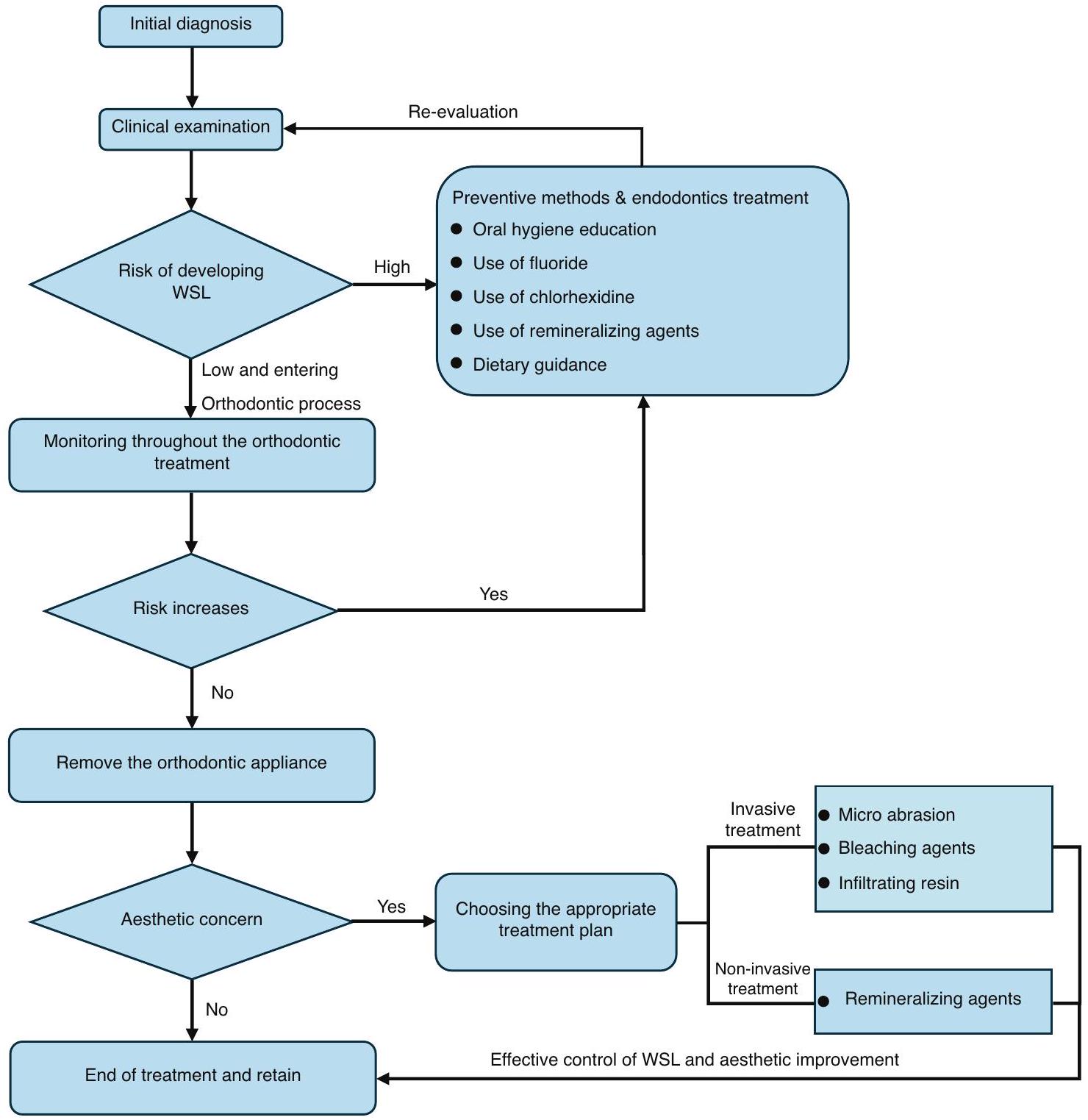
الإجراء السريري الموصى به موضح في الشكل 1. في الزيارة الأولية، يجب تقييم خطر إزالة المعادن من الأسنان لدى المريض من خلال الفحص السريري واستفسار التاريخ الطبي. إذا تم تقييمه على أنه خطر مرتفع، يجب تنفيذ طرق وقائية، ويوصى بالإحالة إلى علاج الجذور. يجب أن يبدأ علاج تقويم الأسنان فقط إذا تم تقييم المريض على أنه منخفض المخاطر. خلال علاج تقويم الأسنان، يجب تقييم خطر إزالة المعادن من الأسنان في كل زيارة متابعة، مع تنفيذ طرق وقائية في الوقت المناسب والإحالات إلى علاج الجذور حسب الحاجة حتى يتم تقليل الخطر. بعد إزالة أجهزة تقويم الأسنان، يجب اختيار تدابير علاجية مناسبة جراحية أو غير جراحية للأسنان التي تعاني من مخاوف جمالية لتحقيق نتائج مرضية للمريض. ستفصل الأقسام التالية النقاط الرئيسية لكل مرحلة.

تشخيص إزالة المعادن من المينا

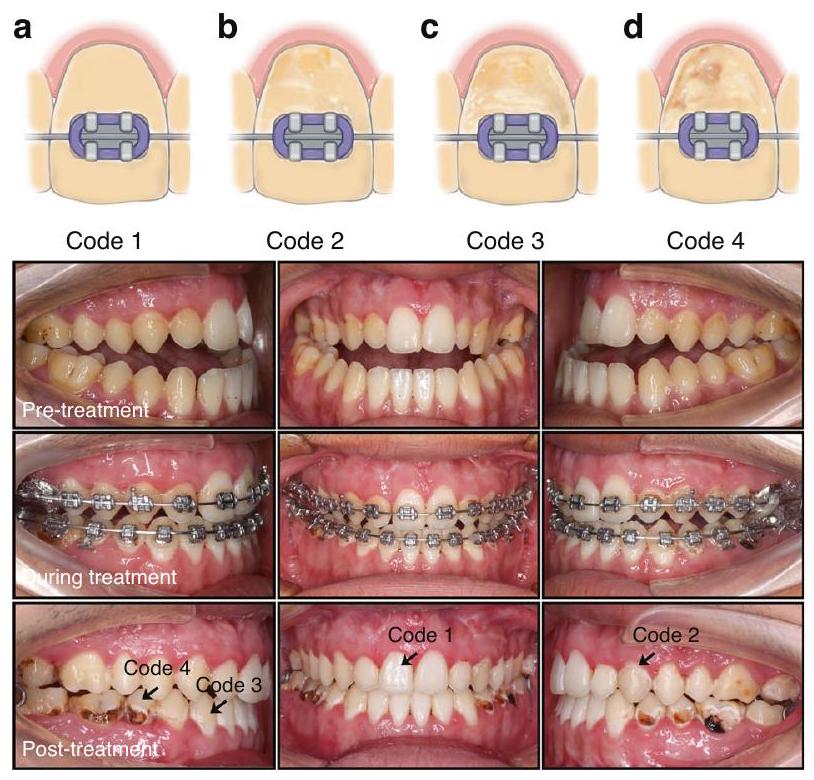
اقترح غورليك وآخرون نظام تسجيل يعتمد على شدة WSL، ويظهر الشكل 2 معايير التسجيل وصور الفم الداخلية لمظهر WSLs في تقدم علاج تقويم الأسنان.
هناك أنواع مختلفة من طرق الفحص السريري لـ WSL. تشمل أكثر الطرق استخدامًا الفحص البصري وتقييم الصور الرقمية. في السنوات الأخيرة، تم تطبيق تقنيات مثل الفلورية، واختبار المقاومة الكهربائية، والتصوير الضوئي بالألياف الضوئية، والتصوير الضوئي بالأشعة تحت الحمراء القريبة تدريجيًا في التشخيص السريري لـ WSL.

فحص الفم

أكثر الطرق استخدامًا لتشخيص WSL هي الفحص البصري. من خلال الجمع بين الفحص البصري والاستكشاف، يمكن تحديد ما إذا كانت منطقة التبييض السطحي في فترة مستقرة. تشير السطح الخشن والطباشيري للمينا إلى وجود إزالة معدنية نشطة، بينما يشير السطح الأملس واللامع للمينا إلى توازن بين إزالة المعادن وإعادة المعادن، دون أي تطور إضافي. مؤشر الانكسار للمينا الصحي للضوء هو 1.62، مما يدل على شبه الشفافية. ومع ذلك، فإن مؤشر الانكسار للمينا المنزوع المعادن يزداد بسبب زيادة المسامية، مما يؤدي إلى مظهر طباشيري. عندما يكون سطح المينا المنزوع المعادن رطبًا، يمتلئ الماء الفجوات الصغيرة. نظرًا لأن مؤشر انكسار الماء قريب من ذلك للمينا الصحي (1.33)، فإن المظهر الطباشيري للمينا المنزوع المعادن يكون من الصعب ملاحظته. بينما يظهر المينا المنزوع المعادن الجاف، المملوء بالهواء مع مؤشر انكسار 1.0 في فجواته الصغيرة، مظهرًا طباشيريًا ملحوظًا. لذا، من أجل فحص بصري دقيق،
الشكل 1 مخطط الإجراء السريري الموصى به لعلاج منطقة التبييض السطحي
يجب تنظيف سطح السن، وتجفيفه لمدة لا تقل عن 5 ثوانٍ، وفحصه بمساعدة مرآة فموية وضوء ساطع. يتمتع الفحص البصري بمزايا البساطة وفعالية التكلفة، دون الحاجة إلى معدات إضافية. ومع ذلك، فإن هذه الطريقة لها عيوب مثل الذاتية في الفحص، وانخفاض القابلية للتكرار، وصعوبة تشخيص الآفات المتقدمة بدقة.

تقييم الصور الرقمية

لا يمكن أن يوفر الفحص البصري البسيط سجلات للمرضى. يمكن أن تخزن الصور الفموية الملتقطة بكاميرا رقمية بيانات حول الآفات السنية للتشاور بين أطباء تقويم الأسنان، وأطباء التعويضات، وأطباء الأسنان الداخلية، وأقسام طب الأسنان الوقائي، مما يسهل المناقشات عن بُعد حول نتائج الفحص المشتركة. قبل التقاط الصور، من الضروري تنظيف سطح السن بعناية لإزالة اللويحات، وتجفيف سطح السن والحفاظ على مسافة مناسبة بين الكاميرا والسن المستهدف. يُوصى باستخدام فلاش مزدوج أفقي أو فلاش حلقي وكاميرا مع عدسات ماكرو قابلة للتبديل. بعد الحصول على صور عالية الدقة، تم حساب قيمة منطقة التبييض السطحي للسن من خلال تحديد مناطق الاهتمام (ROIs) على سطح السن وتحليل
قيم التدرج الرمادي. يمكن أن تخزن الصور الرقمية بيانات المرضى لفترة طويلة مع قابلية تكرار أكبر، ولكن لها عيوب مثل الحساسية التقنية وارتفاع تكلفة المعدات.

تكنولوجيا الفلورية

عندما تتعرض الأسنان لضوء بأطوال موجية محددة، يتم إنتاج الفلورية. تختلف شدة الفلورية بين المينا والعاج والسمنت. نظرًا لأن العاج يحتوي على مزيد من المواد العضوية، فإن شدة الفلورية الذاتية له أكبر من تلك الخاصة بالمينا. بعد إزالة المعادن، تنخفض الفلورية الذاتية للمينا، وهذه التغيرات البصرية مرتبطة مباشرة بمحتوى المعادن في المينا. لذلك، فإن استخدام خصائص الفلورية التلقائية للأسنان لتشخيص إزالة المعادن له عدة تطبيقات. الفلورية الكمية المستحثة بالضوء (QLF) هي تقنية تستخدم هذا المبدأ الفلوري. تم إشعاع سطح السن بضوء قريب من الأشعة فوق البنفسجية، وتم تحليل صورة الفلورية الناتجة باستخدام برنامج محدد لعرض حجم وكثافة آفات المينا المنزوع المعادن. بعض أجهزة الليزر تصدر ضوءًا أحمر بأطوال موجية تتراوح بين 638-655 نانومتر لتشخيص إزالة المعادن في أنسجة الأسنان عن طريق تحفيز الفلورية تحت الحمراء بعد الإشعاع.
الشكل 2 تصوير تخطيطي للطريقة المستخدمة لتسجيل الآفات والصور الفموية الداخلية لمظهر مناطق التبييض السطحي في تقدم علاج تقويم الأسنان. أ (رمز 1): مينا بسطح سن أملس؛ (رمز 2): سطح مينا مع آفات خطية؛ (رمز 3): سطح مينا مع آفات مخططة و (رمز 4): سطح مينا مع تجويف.
تزداد شدة الفلورية مع شدة إزالة المعادن، لكن دقتها غير كافية لقياس التغيرات الطفيفة في محتوى المعادن. لزيادة حساسية التشخيص، تم تطوير تقنية الفلورية بالليزر المعززة بالأصباغ (DELF). تتضمن صبغ الأنسجة المنزوعة المعادن بصبغة فلورية تتغلغل وتعزز الفلورية الناتجة عن الليزر من خلال الجمع مع طيف صبغة فلورية قريب من طول موجة ليزر DIAGNOdent. ومع ذلك، فإن تكنولوجيا الفلورية لها أيضًا عيوب كبيرة. يمكن أن تؤثر عوامل مثل تلون الأسنان، والتعويضات، ومواد الترميم الأخرى على إشارة الفلورية، مما يؤدي إلى نتائج إيجابية خاطئة أو سلبية خاطئة. أظهرت الأبحاث أن فعالية جهاز الكشف عن الفلورية DIAGNOdent Pen تعادل فعالية الفحص البصري التقليدي. في السنوات الأخيرة، تم تطوير أجهزة مختلفة تعتمد على تكنولوجيا الفلورية، مثل DIAGNOdent (KaVo، ألمانيا)، MidWest (DENTSPLY، الولايات المتحدة الأمريكية)، VistaProof (Durr Dental، ألمانيا) وغيرها. على الرغم من استخدام طرق الفلورية المختلفة لأجهزة الكشف عن التسوس حاليًا في الممارسة السريرية كأدوات تشخيصية مساعدة للكشف عن التسوس، إلا أنه لا يمكن اعتبارها حتى الآن المعيار الذهبي للكشف عن تسوس الأسنان.

التحليل الضوئي عبر الألياف الضوئية – التصوير الرقمي التحليل الضوئي عبر الألياف الضوئية (FOTI-DIFOTI)

يختلف معامل نقل الضوء في أنسجة الأسنان المنزوعة المعادن عن ذلك في أنسجة الأسنان الصحية. تؤدي إزالة المعادن إلى تعطيل الهيدروكسيباتيت الكثيف في أنسجة الأسنان، مما يتسبب في تشتت الضوء أثناء مروره عبر الأنسجة المنزوعة المعادن ذات المسامية العالية، مما يؤدي إلى تشويه بصري. نظرًا لأن معامل نقل الضوء في المينا السليم أكبر من ذلك في الآفات التسوسية، يمكن رؤية الظلال عند فحص أنسجة الأسنان المنزوعة المعادن باستخدام جهاز الألياف الضوئية. من خلال تقييم شدة الظل الناتجة عن ضوء الجهاز، يمكن تمييز أنسجة الأسنان المنزوعة المعادن. يستخدم التحليل الضوئي القريب من الأشعة تحت الحمراء (NILT) أطوال موجية أطول من الضوء القريب من الأشعة تحت الحمراء غير المرئي لتقليل تشتت الضوء داخل أنسجة الأسنان، مما يسمح بتمرير أفضل لأنسجة الأسنان. نتيجة لذلك، يمكن أن توفر هذه الطريقة تباينًا عاليًا بين الأنسجة الصحية وأنسجة الآفات المنزوعة المعادن. أ
أظهرت دراسة حديثة أن هذه الطريقة التشخيصية يمكن أن تكشف بدقة أكبر عن إزالة المعادن المبكرة في مينا الأسنان والعاج المخفي في أنسجة الأسنان مقارنة بالطرق الأخرى. مبدأ نقل الضوء عبر الألياف الضوئية هو تشتت وامتصاص الضوء على سطح المينا والعاج، والبقع، والأصباغ، وما إلى ذلك، على سطح الأسنان، مما قد يسبب نتائج إيجابية خاطئة. يمكن أن تتسبب الحشوات، والتعويضات، وما إلى ذلك، أيضًا في عدم اكتشاف المناطق المقابلة. في السنوات الأخيرة، تم استخدام تكنولوجيا التحليل الضوئي عبر الألياف الضوئية على نطاق واسع سريريًا للكشف عن تسوس السطح الأملس، والتسوس القريب، والتسوس الثانوي، والتسمم بالفلور، والكسور غير المكتملة، وما إلى ذلك.

قياسات المقاومة الكهربائية

تستخدم أجهزة قياس المقاومة الكهربائية للأنسجة الصلبة للأسنان ترددًا ثابتًا لقياس مقاومتها. تعتمد شدة المقاومة على مسامية منطقة السن المقاسة، وكمية السائل في المناطق المسامية، ودرجة الحرارة، وتدفق السائل، وتركيز الأيونات في المناطق المسامية. وقد تم الإبلاغ عن أن دقة قياسات المقاومة في أنسجة الأسنان المنزوعة المعادن على الأسطح السليمة أكبر من تلك على الأسطح الماضغة. في المراحل المبكرة من الآفات، تكون حساسية قياس المقاومة الكهربائية متفوقة على تلك الخاصة بالتحليل الضوئي عبر الألياف الضوئية، ولكن قابليتها للتكرار ضعيفة، مع بعض القيود السريرية وتطبيقات سريرية أقل.

التصوير المقطعي البصري

بالإضافة إلى الطرق المذكورة أعلاه، تم استخدام التصوير المقطعي البصري بمصدر مسح (SS-OCT) بشكل متزايد في طب الأسنان في السنوات الأخيرة. يعمل SS-OCT عن طريق توجيه ضوء ضعيف ومتسق على سطح السن. مع حدوث إزالة المعادن من المينا، تزداد المكونات العضوية، مما يؤدي إلى انخفاض في معامل تشتت الضوء مقارنةً بالأنسجة الصحية المحيطة. هذا يقلل من شدة الضوء، مما يظهر كصورة ذات تدرج رمادي عالٍ مقارنةً بالمنطقة الصحية المحيطة، مما يمكّن من اكتشاف وتحليل تسوس المينا المبكر. أفادت الدراسات أن SS-OCT يمكن أن يقيم بفعالية عمق WSL وقد تم تطبيقه في الممارسة السريرية.

الذكاء الاصطناعي (AI)

مع تقدم تكنولوجيا الذكاء الاصطناعي، حقق التعلم العميق تقدمًا كبيرًا في طب الأسنان. تم استخدام الشبكات العصبية التلافيفية (CNNs) المستندة إلى التعلم العميق على نطاق واسع في تصنيف نضج الفقرات العنقية، وتحديد المعالم تلقائيًا في الصور الجانبية، وتشخيص التسوس نظرًا لمزاياها في معالجة الصور الكبيرة. أظهرت الأبحاث أن استخدام CNNs لتقسيم صور سطح الأسنان الرقمية وصور الإضاءة البصرية الرقمية يمكن أن يحقق دقة اكتشاف تسوس تلقائية تصل إلى
أظهرت نماذج الذكاء الاصطناعي أداءً تشخيصيًا ممتازًا في اكتشاف التسوس وقد تصبح أداة مساعدة مهمة في الممارسة السريرية. تحتاج الأبحاث المستقبلية إلى الاعتماد على مجموعات بيانات قابلة للمقارنة وكبيرة وذات دلالة سريرية.

طرق أخرى

في السنوات الأخيرة، تم استكشاف الموجات فوق الصوتية عالية التردد (HFUS) لقياس إزالة المعادن من المينا وتقنية التصوير الضوئي الحراري (PTR) للكشف السريري عن إزالة المعادن من المينا. ومع ذلك، هناك حاجة إلى مزيد من البحث لتطوير هذه الطرق الكشفية.
خلص ورشة العمل التوافقية لنظام الكشف والتقييم الدولي للتسوس (ICDAS) 2004 إلى أن الفحص البصري والتنقيب لا يزالان المعايير لتشخيص التسوس. حاليًا، هناك مجموعة متنوعة من الطرق المستخدمة للكشف عن إزالة المعادن، تعمل كأدوات مساعدة لاتخاذ القرارات السريرية، وتعزز دقة التشخيص، وتراقب تقدم المرض.
التوصيات السريرية لتشخيص إزالة المعادن من المينا
  • الطريقة المفضلة لفحص إزالة المعادن من أسطح الأسنان هي من خلال الجمع بين الفحص البصري والتنقيب، والذي يمكن أن يتم دعمه باستخدام كاميرا رقمية وعدسة ماكرو لتسجيل أسطح الأسنان المزالة المعادن. من المهم ضمان وجود ضوء كافٍ ولكن تجنب التعرض المفرط عند التقاط الصور بكاميرا رقمية لتجنب النتائج السلبية الكاذبة.
  • أثناء فحص أسطح الأسنان، من المهم تنظيف الأسطح وتجفيفها بدقة وملاحظتها تحت ضوء ساطع لاكتشاف أي تغييرات في مظهر البياض الجبني.
  • تم استخدام مسبار لفحص خشونة أسطح الأسنان عند إجراء الفحص وتقييم ما إذا كانت إزالة المعادن في مرحلة نشطة.
  • لتحليل كمي للتغيرات الجبنية البيضاء على أسطح الأسنان، يجب استخدام طرق إضافية مثل تقنية الفلورية، والإضاءة البصرية، واختبار المقاومة. إن استخدام الذكاء الاصطناعي في تفسير إزالة المعادن من الأسنان له تطبيق واعد في مساعدة الفحوصات السريرية.

تقييم مخاطر إزالة المعادن من المينا قبل العلاج التقويمي

قد تزيد الأجهزة التقويمية المستخدمة أثناء العلاج من منطقة التصاق اللويحات، مما يجعل من الصعب تنظيف الجهاز والأسطح المحيطة بالأسنان. قد تحد الأسطح غير المنتظمة للدعائم والأسلاك القوسية والأشرطة من حركة العضلات الفموية والعمل الذاتي الطبيعي لتنظيف الغدد اللعابية، مما يسهل تكوين اللويحات. تعتبر WSL علامات مبكرة لتسوس الأسنان، مع عوامل مساهمة تشمل المضيف، والبكتيريا، والطعام، والوقت. إن تقليل تكوين اللويحات وتقليل استهلاك الأطعمة المسببة للتسوس هي استراتيجيات أساسية لتقليل تطور WSL. تعتبر WSL عاملًا مهمًا يهدد صحة الفم والجماليات طوال فترة العلاج التقويمي. لذلك، يلعب تقييم المخاطر وتعليم صحة الفم قبل العلاج التقويمي دورًا حيويًا في تقليل حدوث WSL.
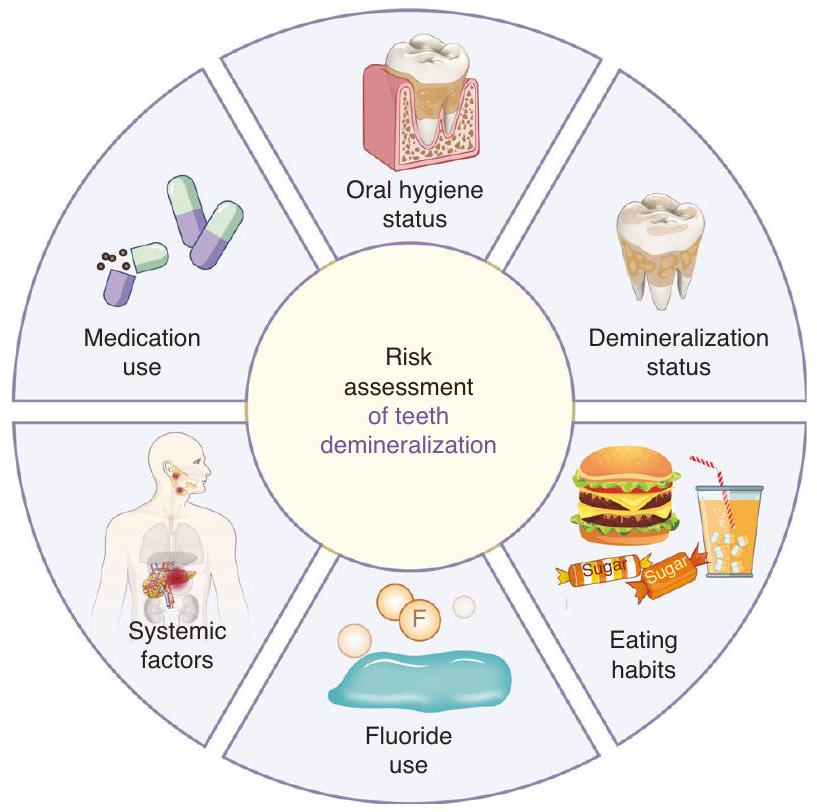
يتضمن تقييم المخاطر لـ WSL قبل العلاج التقويمي الجوانب التالية. بالإضافة إلى ذلك، توضح الشكل 3 باختصار المخاطر الرئيسية المرتبطة بإزالة المعادن من الأسنان.

حالة نظافة الفم

يزيد استخدام الأجهزة التقويمية الثابتة أثناء العلاج التقويمي من عدم انتظام أسطح الأسنان، مما يوفر ظروفًا لتعلق اللويحات والاحتفاظ بها، وبالتالي يزيد من صعوبة التنظيف الفموي. يمكن أن تؤدي عادات نظافة الفم السيئة وعدم كفاية تنظيف الأسنان إلى تراكم اللويحات على سطح الأسنان، مما قد يتسبب في إزالة المعادن من المينا، مما يؤدي إلى WSL.

حالة إزالة المعادن

لتحديد مستوى خطر إزالة المعادن لدى المريض، يجب أخذ تاريخ طبي شامل، بما في ذلك سلسلة من الأسئلة المتعلقة بعوامل الخطر المعروفة لزيادة القابلية للتسوس أو عوامل الحماية. يتضمن ذلك تقييم التاريخ الطبي للمريض والتاريخ الاجتماعي ذي الصلة (مثل مكان الميلاد والتربية، مكان الإقامة الحالي، المستوى التعليمي، والمهنة). كل هذه المعلومات ضرورية لتقييم خطر إزالة المعادن على مستوى فردي. من خلال تقييم تجربة التسوس السابقة للمريض، يمكن للمرء أن يعكس قابليته لإزالة المعادن من الأسنان.
الشكل 3 مخطط ملخص لتقييم خطر إزالة المعادن

عادات الأكل

تم تقييم الهيكل الغذائي، خاصةً تكرار وكمية تناول الكربوهيدرات القابلة للتخمر، وتأثير النظام الغذائي على درجة حموضة الفم.

استخدام الفلورايد

تم تقييم استخدام معجون الأسنان المحتوي على الفلورايد، وغسول الفم، والجل، وما إذا كان المريض قد تلقى علاجًا بطلاء الفلورايد المهني أو مواد أخرى تطلق الفلورايد. الفلورايد هو عامل فعال لمكافحة التسوس يعزز إعادة تمعدن مينا الأسنان، ويثبط استقلاب اللويحات، ويزيد من مقاومة المينا للأحماض. يمكن أن يقلل الاستخدام المنتظم لمعجون الأسنان المحتوي على الفلورايد، أو غسول الفم، أو الجل، أو استخدام طلاء الفلورايد المهني أو مواد أخرى تطلق الفلورايد أثناء العلاج التقويمي من حدوث WSL.

العوامل النظامية

تم تقييم وجود الأمراض النظامية، واستخدام الأدوية على المدى الطويل، أو عوامل أخرى تؤثر على إفراز اللعاب وتوازن الميكروبات الفموية. قد تؤثر بعض الأمراض النظامية، أو الأدوية، أو عوامل أخرى أيضًا على خطر WSL أثناء العلاج التقويمي، مثل انخفاض إفراز اللعاب، وضعف المناعة، والسكري، ومتلازمة سجوجرن.

طرق وقائية لإزالة المعادن من المينا في العلاج التقويمي

لتقليل حدوث WSL قبل العلاج التقويمي، يجب أن يكون تعليم صحة الفم جزءًا من خطة العلاج، بما في ذلك الجوانب التالية:
تعليم نظافة الفم وتعليم الصحة
يساعد الفحص المهني المنتظم لطب الأسنان في الكشف عن البقع الجبنية البيضاء المبكرة أو التسوس على سطح الأسنان ورؤية الأخصائي في الوقت المناسب. يجب إجراء العلاج المهني الدوري لطب الأسنان لإزالة اللويحات والجير، ومنع انخفاض درجة الحموضة على سطح الأسنان، ومنع تلف المينا. بالنسبة للمرضى التقويمي الذين يعانون من أمراض لثوية، يجب أيضًا إجراء فحص وعلاج دوري لطب الأسنان للسيطرة على الالتهاب اللثوي وتكوين الأغشية الحيوية.
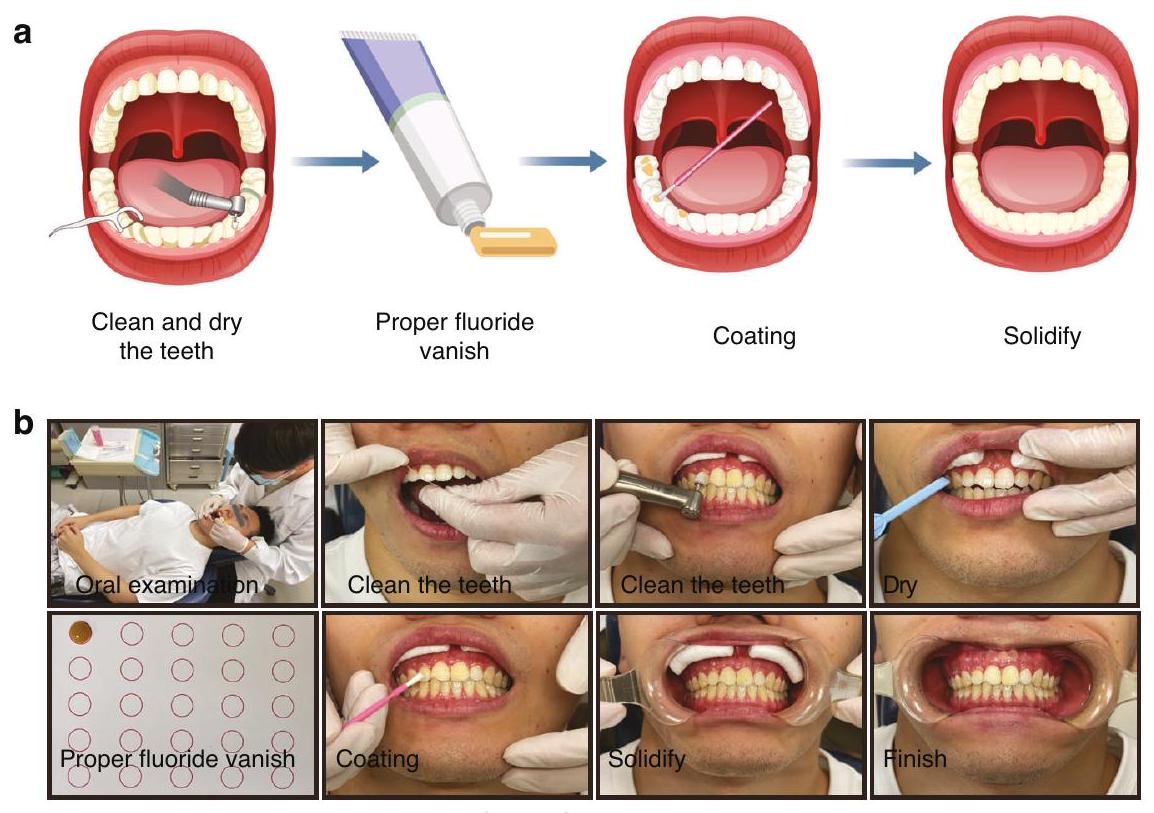
الشكل 4 إجراء تطبيق الفلورايد. أ: مخطط توضيحي لعملية تطبيق طلاء الفلورايد على أسطح الأسنان. ب: صور داخل الفم لعملية تطبيق الفلورايد

رعاية صحة الفم

يجب تنظيف الأسنان بسرعة بعد كل وجبة، على الأقل 3 مرات في اليوم، مع كل سن يستغرق 3 دقائق على الأقل. يمكن استخدام خيط الأسنان التقويمي الخاص لتنظيف الفجوات بين الدعائم والأسلاك القوسية. إذا كان من الضروري تنظيف الفجوات بين الأسنان، يجب أن يتم ذلك تحت تعليمات الطبيب. تم تنظيف بقايا الطعام على سطح الأسنان وحول أجهزة تقويم الأسنان بحركة فرشاة لطيفة لأعلى ولأسفل لتقليل تراكم اللويحات. بالإضافة إلى ذلك، يمكن استخدام عوامل الكشف بعد الفرشاة لإظهار المناطق التي لا تزال بحاجة إلى تنظيف بشكل أوضح، مما يزيد من اهتمام المرضى، وخاصة الأطفال، بفرشاة الأسنان، ويعزز من فعالية تنظيف الأسنان.

استخدام الفلورايد

يقلل الفلورايد من إزالة المعادن من الأنسجة السنية عبر ثلاثة آليات مختلفة. الآلية الأولى هي أن وجود الفلورايد يزيد من تكوين وتراكم الفلورابايت. يتم تشكيل الفلورابايت من خلال دمج أيونات الكالسيوم وأيونات الفوسفات في اللعاب ولها قابلية ذوبان أقل من الهيدروكسيباتيت، مما يزيد من مقاومة الحمض للمينا. الآلية الثانية هي تعزيز إعادة التمعدن المباشر لبلورات الفلورابايت على سطح الأنسجة السنية التي تتعرض لإزالة المعادن. تعتمد الآلية الثالثة على النشاط المضاد للبكتيريا لأيونات الفلورايد، ويمكن أن تمنع التركيزات المنخفضة من الفلورايد إنتاج الجلوكوزيل ترانسفيراز. الدور الرئيسي للجلوكوزيل ترانسفيراز هو زيادة التصاق البكتيريا وتوفير الجلوكوز لتكوين البوليمرات السكرية خارج الخلية. إن تطبيق الفلورايد محليًا بتركيزات عالية (12000 جزء في المليون) له تأثير سام مباشر على الميكروبات الفموية، بما في ذلك ستربتوكوكوس موتانس.
يمكن تصنيف الفلورايد على أنه نظامي أو موضعي. التطبيق النظامي فعال للأفراد المعرضين لخطر كبير من تسوس الأسنان أو في المناطق ذات الفلورايد المنخفض. وفقًا لتقرير منظمة الصحة العالمية، فإن تناول 1 ملغ من الفلورايد يوميًا مفيد للصحة. تشمل طرق تطبيق الفلورايد النظامية إضافة الفلورايد إلى مياه الشرب والملح والحليب، بالإضافة إلى إضافة أقراص أو قطرات تحتوي على الفلورايد إلى النظام الغذائي. يمكن أن تمتد التطبيقات الموضعية، مثل طلاء الفلورايد، من وقت الاتصال بالأسنان وتحرر الفلورايد ببطء لمنع فقدان الفلورايد السريع بعد الاستخدام. . توصي الأكاديمية الأمريكية لطب أسنان الأطفال باستخدام طلاء الفلورايد على الأقل على الأسنان الأولية مرتين في السنة و2-4 مرات في السنة على الأسنان الدائمة. كما هو موضح في الشكل 4، فإن عملية تطبيق الفلورايد الموضعي هي
بسيطة نسبيًا. باختصار، يتم أولاً تنظيف سطح السن وتجفيفه. ثم، يتم تطبيق كمية مناسبة من الفلورايد على سطح السن. من المهم ملاحظة أنه يجب عدم تناول الطعام خلال 2 إلى 4 ساعات بعد تطبيق الفلورايد، ويجب تجنب الفرشاة في تلك الليلة لضمان فعالية التطبيق.

إرشادات غذائية

تشمل أشكال العادات الغذائية الجيدة تجنب أو تقليل استهلاك الأطعمة اللزجة، الصلبة، الحمضية، والغنية بالسكر، مثل الحلوى والمشروبات الغازية، لمنع تآكل الأسنان. إذا كان الفرد يتناول وجبات خفيفة بين الوجبات أو يشرب مشروبات غازية أو شاي بالحليب، فمن المستحسن أن يقوم بفرشاة أسنانه أو شطف فمه على الفور. تم تنظيف تجويف الفم بشكل كامل قبل النوم ليلاً، مما يضمن عدم بقاء أي بقايا طعام أو شراب لمنع تكوين اللويحات السنية التي يمكن أن تؤدي إلى تآكل الأسنان. تحسين نظافة الفم وتقليل تناول الأطعمة المسببة للتسوس هي تدابير أساسية للمرضى لتقليل التصاق الأغشية الحيوية وتقليل بكتيريا إنتاج الحمض (مثل ستربتوكوكوس موتانس) ، مما يمنع بشكل فعال تكوين WSL. تثقيف المرضى حول أنماط الحياة الصحية هو أفضل وسيلة لمنع مشاكل صحة الفم.

استخدام الكلورهيكسيدين

يمكن أن يثبط الكلورهيكسيدين (CHX) بشكل كبير نمو ستربتوكوكوس موتانس، مما يسرع من إعادة تمعدنه. يتوفر CHX في الطلاءات، الهلام، والمحاليل المائية. أظهرت الدراسات أن الطلاء الواقي سيرفيتيك F الذي يحتوي على CHX يمكن أن يحقق تثبيطًا مستمرًا لستربتوكوكوس موتانس مقارنة بالهلام وغسولات الفم، بينما يقلل أيضًا من حدوث WSL. على الرغم من تأكيد سلامة CHX، إلا أنه يمكن أن يؤدي إلى آثار جانبية مثل اضطراب الذوق، تلون الغشاء المخاطي الفموي، والتهاب الجلد التماسي. بالنسبة لعلاجات تقويم الأسنان التي تستمر لفترات أطول، فإن التطبيق الموضعي لطلاء CHX على سطح الأسنان هو أكثر أمانًا.
نقاط رئيسية لمنع إزالة المعادن باستخدام أجهزة تقويم الأسنان المختلفة
تشمل علاجات تقويم الأسنان عادةً أجهزة ثابتة مثل الأقواس على الجانب الشفهي أو اللساني أو المحاذيات الشفافة. نظرًا للاختلافات في الهيكل ومكان هذه الأجهزة في تجويف الفم للمريض، تختلف طرق منع إزالة المعادن من المينا
. بالنسبة للأجهزة الثابتة الملتصقة بسطح الأسنان، مثل الأقواس، فإن وجود الأقواس والأسلاك القوسية يعيق التنظيف الذاتي لتجويف الفم والنظافة اليومية، مما يتطلب فرشاة وتنظيف بقايا الطعام حول الأقواس بعد كل وجبة لتقليل تراكم اللويحات. بالمقارنة مع الأجهزة الثابتة، فإن المحاذيات الشفافة هي أجهزة تقويم الأسنان الشفافة، القابلة للإزالة، والحرارية التي تغطي مساحة أكبر من سطح الأسنان. على الرغم من أنه يمكن إزالة المحاذيات الشفافة بسهولة للتنظيف، إلا أنه يجب ارتداؤها لمدة 20 إلى 22 ساعة يوميًا. إن الفشل في الحفاظ على نظافة الفم الجيدة أثناء ارتدائها قد يؤدي إلى إزالة المعادن الشديدة من المينا، مما يظهر كمساحات كبيرة وضحلة من إزالة المعادن على الأسنان. لذلك، قبل ارتداء المحاذيات الشفافة، من المهم تنظيف سطح الأسنان. بعد شرب المشروبات السكرية أثناء ارتدائها، من الضروري شطف الفم على الفور لمنع الحموضة التي قد تؤدي إلى إزالة المعادن من أنسجة الأسنان.
التوصيات السريرية لمنع إزالة المعادن من المينا في علاج تقويم الأسنان
  • الحفاظ على نظافة الفم الجيدة هو الطريقة الأساسية لمنع إزالة المعادن من المينا في علاج تقويم الأسنان. تعتبر تعليمات نظافة الفم والتثقيف الصحي أمرًا حيويًا.
  • يجب التركيز على الطريقة الصحيحة والفعالة لفرشاة الأسنان، مع ضمان كل من مدة وتكرار الفرشاة وتقليل تناول الأطعمة المسببة للتسوس.
  • يجب تشجيع استخدام معجون الأسنان بالفلورايد للعناية اليومية بالأسنان لتعزيز مقاومة الحمض للمينا وتقليل إزالة المعادن.
  • بعد ارتداء أجهزة تقويم الأسنان، من الضروري تنظيف تجويف الفم والمنطقة المحيطة بالأجهزة من بقايا الطعام بعد كل وجبة لمنع تكوين بيئة حمضية تؤدي إلى إزالة المعادن من المينا.

إدارة إزالة المعادن من المينا أثناء علاج تقويم الأسنان

تعتبر WSL على سطح الأسنان من المضاعفات الشائعة لدى مرضى تقويم الأسنان الذين يعانون من نظافة فموية سيئة. يمكن أن تسهم عوامل مثل التسرب المجهري عند واجهة القوس-اللاصق-القوس، وحمض الإيذاء المطول أثناء الربط، ومدة علاج تقويم الأسنان الممتدة، ونقص الوعي بصحة الفم لدى المرضى في تراكم اللويحات، وإنتاج الحمض بواسطة البكتيريا، وانخفاض pH المينا، وبالتالي إزالة المعادن من المينا. إن الكشف المبكر عن آفات البقع البيضاء أثناء علاج تقويم الأسنان وتنفيذ استراتيجيات الإدارة المناسبة في الوقت المناسب أمران حاسمان لحماية صحة الأسنان.

تقييم خطر إزالة المعادن طوال عملية علاج تقويم الأسنان

أثناء علاج تقويم الأسنان، من الضروري تقييم ما إذا كان خطر إزالة المعادن لدى المريض قد زاد خلال زيارات المتابعة. يتضمن هذا التقييم تقييم حالة نظافة الفم، مثل تراكم اللويحات، ترسب الجير، وانحشار الطعام. إذا وُجد أن خطر إزالة المعادن مرتفع، يجب استخدام طرق وقائية وعلاج جذري على الفور لمنع حدوث إزالة المعادن من الأسنان. يشمل ذلك استخدام معجون الأسنان بالفلورايد، وطلاء الفلورايد، وغسولات الفم التي تحتوي على الفلورايد حول أجهزة تقويم الأسنان.

إعادة التمعدن والعلاج المشترك لمكافحة الأغشية الحيوية

يستقر عامل إعادة التمعدن كازين فوسفوبيبتيد-فوسفات الكالسيوم غير المتبلور (CPP-ACP) عن طريق دمج السيرين الفوسفوري من الكازين، مما يحافظ على حالة التشبع الفائض مع و على سطح الأسنان ويعزز إعادة تمعدن الأنسجة السنية الصلبة. يعتبر CPP-ACP خيارًا
gيدًا لإعادة تمعدن WSL، وعند دمجه مع الفلورايد، فإنه يعزز من تأثيرات إعادة التمعدن لـ WSL. على الرغم من أن تطبيق الفلورايد وCPP-ACP وغيرها له تأثير إيجابي على منع تقدم WSL، إلا أن هذه الطرق لا تزال تفتقر إلى التحسين الجمالي، وما زالت هناك حاجة إلى مزيد من الأدلة السريرية لإثبات فعالية CPP-ACP في تعزيز إعادة تمعدن WSL. لذلك، فإن المواد القادرة على استقرار وتوصيل ACP مباشرة إلى سطح الأسنان، بخلاف الفلورايد، هي بالفعل من بين أفضل الخيارات لإعادة تمعدن الأنسجة السنية الصلبة. مع الأبحاث الجارية وترجمة مواد إعادة التمعدن البيوميميتية الجديدة، فإن استخدام عوامل إعادة التمعدن هو بالتأكيد وسيلة قوية للوقاية من WSL وعلاجها.
استنادًا إلى مفهوم وتكنولوجيا إيقاف تسوس الأسنان (IDC)، ظهرت في السنوات الأخيرة مواد حيوية تستهدف الأغشية الحيوية وإعادة التمعدن بشكل مستمر. توفر مواد النانو المركبة من بولي(حمض الكربوكسيل) سكسينيل كيتوزان أكريلاميد (PCBAA)/ACP أيونات وتمنع أيضًا التجمع السريع والتحول التلقائي للأيونات على سطح الآفة، مما يسمح لأيونات الكالسيوم والفوسفات بالتغلغل في الفجوات بشكل أكثر فعالية، مما يسرع من نمو البلورات الداخلية، ويعزز تكوين طبقات إعادة تمعدن كثيفة. يعتبر ألبومين مصل البقر-أوكتوبامين (PTB-OCT) طلاءً عالميًا مضادًا للتسوس لا يحفز فقط التمعدن على سطح الأنسجة السنية الصلبة والراتنجات، بل يظهر أيضًا مقاومة للأحماض وخصائص مضادة للميكروبات، مما يقلل من التسوس الأولي وتسرب الميكروبات بعد الحشو. تثبط نانوإنزيمات مركب L-cysteine/graphiticyne/silver (GDY/L-cys/Ag, GLA) اللويحات السنية من خلال إنتاج أنواع الأكسجين التفاعلية، وتعمل GLA كنقطة نواة، متقاطعة مع اللعاب الغني بـ , مما يجذب ، مما يعزز تكوين هيدروكسيباتيت على المينا، ويسهل إعادة التمعدن السريع[83]. الطبيعة البوليمرية لمواد المحاذاة غير المرئية، قد تتضمن الأبحاث الأساسية المستقبلية والترجمة السريرية تطوير مواد بوليمرية ذات قدرات إطلاق بطيء لأيونات الفلورايد، وخصائص مضادة للميكروبات، أو تعديلات سطحية لمقاومة تكوين الأغشية الحيوية.

العلاج بالليزر

تعتبر ليزر ثاني أكسيد الكربون ذات الأطوال الموجية من ، و ، الأنواع الرئيسية من الليزر لمنع إزالة المعادن من الأنسجة السنية، حيث تقع نطاقات الامتصاص للفوسفات والكربونات ومجموعات الهيدروكسيل في هياكل المينا والعاج ضمن نطاق . يؤدي امتصاص الليزر من قبل المينا إلى تغييرات فيزيائية وكيميائية، بما في ذلك تحلل المصفوفة العضوية، وتقليل المركبات الكربونية، واندماج وإعادة بلورة بلورات هيدروكسيباتيت، مما يؤدي إلى زيادة مقاومة الأحماض. علاوة على ذلك، تظهر الأبحاث أن الليزر منخفض الطاقة يمكن أن يقلل من إزالة المعادن من المينا بنسبة : يتم امتصاص ليزر YAG بطول موجي من بواسطة الماء وهيدروكسيباتيت والكولاجين. تؤدي الطاقة تحت الإزالة لليزر Er: YAG إلى تغييرات كيميائية في الأنسجة السنية دون التسبب في أضرار شكلية. تشير الدراسات إلى أن الاستخدام المشترك لليزر والفلورايد يمكن أن يعزز بشكل تآزري القدرة على مقاومة إزالة المعادن من الأنسجة السنية، لكن الأدلة السريرية لا تزال مفقودة، حيث تبقى الأبحاث في المراحل ما قبل السريرية.

استخدام الأوزون

الأوزون هو عامل مؤكسد قوي يدمر مختلف مسببات الأمراض، ويظهر أنشطة قاتلة للجراثيم، ومضادة للفيروسات، ومضادة للفطريات من خلال تعزيز التمثيل الغذائي للأنسجة من خلال الأكسدة. أظهرت الدراسات أن استخدام الأوزون يمكن أن يقلل من عدد العقديات والكانديدا في اللعاب. نطاق التركيز الآمن للأوزون هو ، وعادة ما يتم تطبيق الأوزون في شكل غاز أو جل أو محاليل مائية في تجويف الفم وله توافق حيوي جيد. OzonyTron-OZ (Mymed، ألمانيا) هو جهاز تعقيم غاز الأوزون داخل الفم يقتل مسببات الأمراض داخل الأسنان المنزوعة المعادن عن طريق ضبط صينية السيليكون لتلتصق بسطح السن وتدفق غاز الأوزون، مما يمنع المزيد من
إزالة المعادن من الأسنان. ومع ذلك، لا يزال تطبيق الأوزون سريريًا لإعادة التمعدن يتطلب مزيدًا من الأدلة والبحث المناسب.
التحبب الدقيق للأنسجة السنية الصلبة
المؤشر الرئيسي للتحبب الدقيق للأنسجة السنية الصلبة هو تغير اللون الداخلي أو تغيرات في الملمس الناتجة عن عيوب تكوين المينا أو فلوروس الأسنان. تستخدم هذه التقنية أدوات أسنان بطيئة السرعة مع جل يحتوي على أحماض ومواد كاشطة لإزالة المينا الملونة والبقع من سطح الأسنان. التحبب الدقيق هو علاج طفيف التوغل يتضمن إزالة كمية معينة من الأنسجة السنية. عند إزالة WSL من الأنسجة السنية، يجب الانتباه إلى سمك المينا في المنطقة العنقية. أظهرت الأبحاث أن التحبب الدقيق يحسن من جمالية الأسنان ذات الآفات البيضاء ويظهر متانة لمدة لا تقل عن 12 شهرًا. ومع ذلك، مقارنةً بالتحبب الدقيق، فإن تسرب الراتنج له تأثيرات أفضل في تحسين الجمالية بعد 12 شهرًا.
استخدام عوامل التبييض
أظهرت الدراسات في المختبر أن التبييض يمكن أن يحسن من جمالية الأسنان ذات WSL. ومع ذلك، فإن عملية التبييض تعزز فقط المظهر، مما يخفي الآفات البيضاء بدلاً من علاجها. على الرغم من أن تبييض WSL في المختبر يمكن أن يقلل من الفروق في اللون بين المناطق المتسوسة وغير المتأثرة، إلا أنه لا توجد أدلة واضحة على تطبيقه السريري.
علاج تسرب الراتنج
خلال تطور WSL، يحدث زيادة في المسامية الدقيقة في المينا. يتسرب راتنج التصلب الضوئي منخفض اللزوجة إلى منطقة المينا المسامية الدقيقة لـ WSL من خلال العمل الشعري، مما يغلق المسام ويزيد من قوة المينا، مما يوفر دعمًا ميكانيكيًا لمنع تقدم WSL. خلال علاج WSL، يؤدي تسرب الراتنج إلى نتائج جمالية أفضل من التعديلات الطفيفة. القدرة على تمويه WSL ترجع أساسًا إلى أن معامل الانكسار للراتنج المتسرب قريب من ذلك لبلورات هيدروكسيباتيت.
في الختام، يمكن اختيار خيارات العلاج المختلفة بناءً على شدة WSL التي تحدث خلال العلاج التقويمي. بالنسبة لـ WSL ذات درجة Gorelick 3 أو أقل، قد يؤدي الاستخدام الموضعي للفلورايد مع عوامل إعادة التمعدن إلى تعزيز إعادة تمعدن المينا. WSL ذات درجة 3 أو أعلى ستتطلب علاجًا طفيف التوغل.

الإدارة السريرية وعلاج WSL بعد التقويم

بعد الانتهاء من العلاج التقويمي وإزالة الجهاز التقويمي، يجب إعادة تقييم صحة الأنسجة السنية الصلبة والأنسجة اللثوية. عند الضرورة، قد تكون الاستشارة والعلاج من تخصصات مثل علاج لب الأسنان، وطب الأسنان الاصطناعي، وطب الأسنان اللثوي، وطب الأسنان الوقائي ضرورية.

اعتبارات أخرى في تقويم الأسنان: إدارة إزالة المعادن من المينا في العلاج التقويمي المبكر للأطفال والمراهقين

نظرًا لصغر سن الأطفال والمراهقين وطول مدة العلاج التقويمي، غالبًا ما تفتقر الوعي للحفاظ على نظافة الفم الجيدة. نظرًا لأن تمعدن المينا في الأطفال والمراهقين غير مكتمل، فإن خطر تطوير WSL أثناء العلاج التقويمي أكبر. يمكن أن يؤدي التقدم غير المنضبط لـ WSL إلى تسوس الأسنان وحتى أمراض اللب، مما يؤثر على نمو الأسنان. توجيه نظافة الفم للأطفال وتعليم الآباء ضروريان قبل العلاج التقويمي للأطفال والمراهقين. إذا لزم الأمر، يجب استخدام معجون أسنان مفلور للتفريش، جنبًا إلى جنب مع عوامل الكشف للحفاظ على
نظافة الفم الجيدة. يجب تطبيق مواد السد المبكر للثنايا والشقوق للأضراس. خلال كل زيارة متابعة، يجب مراقبة حالة نظافة الفم، مثل اللويحات، والجير، وصحة اللثة، لمنع العوامل المسببة لـ WSL. إذا كانت WSL قد تطورت بالفعل أثناء العلاج التقويمي، يمكن اعتبار تطبيق الفلورايد الموضعي، أو استخدام عوامل إعادة التمعدن، أو تسرب الراتنج كخيارات للعلاج. التعليم الإضافي لنظافة الفم للأطفال والآباء أمر ضروري. إذا استمر تقدم WSL، قد يكون من الضروري استبدال جهاز تقويم الأسنان بآخر يسهل تنظيفه أو إزالة الجهاز مؤقتًا حتى يتم تحقيق السيطرة الفعالة على WSL قبل متابعة علاج تقويم الأسنان.
يجب أن تبدأ إدارة WSL في الزيارة الأولى قبل علاج تقويم الأسنان وأن تصبح جزءًا من خطة العلاج. يجب أن تهدف التثقيف الصحي طوال عملية تقويم الأسنان إلى تحسين نمط حياة المرضى من أجل صحة فموية أفضل، مع التأكيد على الوقاية بدلاً من العلاج. يجب أن يتضمن العلاج في البداية طرقًا محافظة وغير جراحية وقابلة للعكس. إذا لم تحل هذه الطرق WSL بشكل فعال، قد يكون من الضروري اتخاذ نهج أكثر استباقية (الشكل 1).
  • قبل علاج تقويم الأسنان، من الضروري تقييم عوامل الخطر لتسوس الأسنان بشكل كامل. فقط عندما تكون عوامل الخطر تحت السيطرة، يمكن أن يتقدم علاج تقويم الأسنان اللاحق.
  • خلال علاج تقويم الأسنان، من الضروري مراقبة حدوث WSL في كل زيارة متابعة والتدخل بسرعة. يجب أن يكون التركيز الأساسي على تعزيز التعليم حول نظافة الفم، والحفاظ على صحة الفم الجيدة، واستخدام الفلورايد ومواد إعادة التمعدن محليًا لتعزيز إعادة تمعدن WSL.
  • إذا كانت تقدم WSL على سطح السن خلال علاج تقويم الأسنان غير قابل للتحكم، استبدل جهاز تقويم الأسنان بجهاز يسهل تنظيفه أو أوقف علاج تقويم الأسنان مؤقتًا حتى يتم السيطرة على WSL بشكل فعال.
  • بعد علاج تقويم الأسنان، يجب اتخاذ نهج متعدد التخصصات بناءً على شدة إزالة المعادن من الأسنان بعد إزالة الجهاز.
  • بالنسبة لعلاج تقويم الأسنان للأطفال والمراهقين، من الضروري تثقيف الوالدين حول نظافة الفم لضمان التزام المرضى بالعلاج وتقليل حدوث WSL.

آفاق البحث في علاج WSL

بصفتهم المسؤولين عن علاج تقويم الأسنان، يتحمل أطباء الأسنان الذين يقدمون علاج تقويم الأسنان مسؤولية إجراء أبحاث متعمقة حول آلية WSL بحيث تكمل الوسائل التكنولوجية في العيادة والأبحاث الأساسية في المختبر بعضها البعض، باستخدام مجموعة من التدابير لزيادة الوقاية والعلاج من WSL إلى آفاق جديدة. في مجال الأبحاث الأساسية، من الممكن دراسة طرق إعادة التمعدن البيوميمتيكي لاستعادة الأنسجة الصلبة الطبيعية/الاصطناعية بسرعة وكفاءة ودمجها مع تقنيات مضادة للبيوفيلم لمنع WSL في المراحل المبكرة قبل أن تتطور إلى تسوس شديد. في المستقبل، يمكن لأطباء تقويم الأسنان التعاون بشكل وثيق مع أطباء الوقاية الفموية، وأطباء لب الأسنان، وباحثي المواد الفموية لتطوير مادة لا تقاوم البيوفيلم فحسب، بل تصلح بسرعة وفعالية المينا المنزوع المعادن بشكل قريب من الشكل الطبيعي لتقليل خطر WSL خلال إجراءات تقويم الأسنان، مع السعي في النهاية لتحسين فعالية علاج تقويم الأسنان.
يتضمن WSL ليس فقط فقدانًا مستمرًا للمعادن في الأسنان ولكن أيضًا عملية ديناميكية من إزالة المعادن وإعادة التمعدن. إنه تجلي مبكر للتسوس. يعتمد تقدم المرض على التوازن بين العوامل المرضية لإزالة المعادن (البكتيريا المسببة للتسوس، الكربوهيدرات، وتقليل إفراز اللعاب) والعوامل الوقائية (المضادات الميكروبية، اللعاب الكافي، وأيونات إعادة التمعدن). يجب أن تركز إدارة WSL التي تحدث خلال علاج تقويم الأسنان على الوقاية، وتقليل العوامل المرضية لإزالة المعادن، وزيادة العوامل الوقائية، ورفع وعي المرضى بالحفاظ على الأنسجة الصلبة للأسنان طوال عملية علاج تقويم الأسنان بالكامل من خلال التثقيف الصحي الفموي لتقليل حدوث WSL. بالنسبة لـ WSL الذي يحدث قبل أو خلال علاج تقويم الأسنان، تشمل طرق العلاج بشكل رئيسي تعزيز إعادة تمعدن الأنسجة الصلبة للأسنان، وتقليل إزالة المعادن من الأنسجة الصلبة للأسنان، واستعادة الجماليات بعد إزالة المعادن من أسطح الأسنان.
يعزز علاج إعادة تمعدن WSL ترسيب أيونات الكالسيوم والفوسفات الخارجية في الفراغات البلورية المنزوعة المعادن لزيادة محتوى المعادن. وفقًا لمبدأ إعادة التمعدن البيوميمتيكي، تُستخدم تعديلات الأغشية البوليمرية لتحفيز ترسيب هيدروكسيباتيت مباشرة على أسطح المينا أو العاج المنزوع المعادن أو من خلال استخدام إضافات بوليمرية مثل ببتيد فوسفات الكازين (CPP)، كيتوزان كربوكسي ميثيل، بروتينات شبيهة بالأميلوجينين، حمض بولي أسبارتيك (PASP)، وإسترات بولي أكريليك (PAA)، لمحاكاة البروتينات غير الكولاجينية (NCPs) أو البروتينات غير المينا في عملية التمعدن البيولوجي من خلال استقرار مراحل السلف وتعزيز تسرب أيونات السلف، مما يتوسط عملية تحويل فوسفات الكالسيوم غير المتبلور (ACP) إلى المرحلة المعدنية البلورية لهيدروكسيباتيت.
بالنسبة لـ WSL الذي يحمل درجة Gorelick 3 أو أعلى، من الصعب على علاج إعادة التمعدن استعادة عيوب المينا على سطح السن. تشمل خيارات العلاج الحالية بشكل رئيسي اختيار ترميمات جمالية طفيفة التوغل بناءً على حجم العيب أو ترميمات القشرة لمعالجة المخاوف الجمالية. تشمل الترميمات الجمالية طفيفة التوغل كشط الآفات البيضاء الجيرية على سطح السن بمعجون دقيق واستعادة شكل السن باستخدام راتنج متسرب. تتضمن القشور إزالة موحدة للأنسجة السنية الملونة المنزوعة المعادن وتغطية سطح السن بقشور مصنوعة من مواد خزفية مشابهة في اللون للأنسجة السنية الصحية باستخدام تقنيات الربط لتحقيق تأثيرات الترميم. على الرغم من أن الترميمات الجمالية يمكن أن تستعيد شكل سطح السن إلى أقصى حد، إلا أن ضررًا لا يمكن عكسه يحدث أيضًا للهيكل السني نفسه أثناء إزالة الأنسجة المريضة. تركز إدارة التسوس الحديثة على الوقاية الأولية، وتحقيق والحفاظ على صحة الأسنان من خلال تحسين القرارات السريرية، وإيقاف تقدم الآفات الأولية، والحفاظ على هيكل الأسنان، واللجوء إلى علاج الحشو فقط عند الضرورة.
توفر طريقة إعادة التمعدن البيوميمتيكي التي تحاكي عمليات التمعدن الطبيعية استراتيجية واعدة لعلاج WSL. وقد استخدم يوشينغ باي وآخرون راتنجًا مهيكلًا نانويًا يحتوي على جزيئات فوسفات الكالسيوم لعلاج WSL من المينا وحققوا نتائج مرضية. ومع ذلك، من الصعب تشكيل هياكل المينا والعاج الطبيعية، والمناطق المعاد تمعدنها على أسطح المينا والعاج المنزوعة المعادن، والتي تكون عمومًا أقل من سميكة، رقيقة جدًا لتحمل قوى الإطباق والاحتكاك الميكانيكي لعملية مضغ الطعام. لا يزال البحث في علاج نقص تنسج الأسنان في مراحله المبكرة. لقد أصبحت حدوث وتطور WSL قضايا صحة فموية لا يمكن تجاهلها في عمليات تقويم الأسنان. يحمل تطوير مواد الترميم التي تعزز إعادة التمعدن البيوميمتيكي لـ WSL وتتمتع بخصائص ميكانيكية ممتازة آفاق تطبيق واسعة لعلاج WSL.
مع الوصول الشامل لعصر الذكاء الاصطناعي، تتطور تقويم الأسنان ومجال الذكاء الاصطناعي باستمرار، مما يدفع تطوير وابتكار
تقويم الأسنان. في المستقبل، سيكون من الممكن استخدام طرق تكنولوجية قائمة على الذكاء الاصطناعي، بالتزامن مع طرق الفحص الحالية لتشخيص WSL، لتخصيص مراقبة الأسنان خلال عمليات تقويم الأسنان. يمكن أن يتنبأ هذا بتطور وتوقع WSL في مرحلة مبكرة، وينبه المرضى إلى خطر حدوث WSL، ويقلل من تأثير WSL على عمليات تقويم الأسنان. في الوقت نفسه، يحتاج أطباء تقويم الأسنان إلى إدراك أن الذكاء الاصطناعي يلعب فقط دورًا تكميليًا في عمليات تقويم الأسنان. لا يمكن للتقنيات الناشئة المختلفة أن تحل محل دور أطباء تقويم الأسنان بالكامل في الوقاية من WSL وتشخيصه. لا يزال يتعين على أطباء تقويم الأسنان تعزيز فهمهم لـ WSL، وتحديد العلامات المبكرة للإصابات الجيرية بسرعة، والتدخل عند الضرورة.

الشكر والتقدير

تم تمويل هذا العمل من خلال البرنامج الوطني الرئيسي للبحث والتطوير في الصين (2022YFC2405904)؛ مؤسسة العلوم الطبيعية الوطنية في الصين (11932012 و32171348).

مساهمات المؤلفين

التصور والتحقيق: ب.ف، ش.ز ول.ي؛ الإشراف: ب.ف، ش.ز ول.ي؛ المسودة الأصلية: ل.ش، ج.ز و ب.م؛ المراجعة والتحرير: ز.ج، ح.ح، ل.و، ي.ب، ل.ج، و.ل، ج.و، م.ح، ج.س، ي.س، ي.ل، ب.ح، ش.و، ل.ن، ح.ل، و.م، ب.و، ج.ز، ج.غ، ز.ل، ح.ل، ل.ر، ل.ش، ش.و، ي.ل وج.ح.

معلومات إضافية

المصالح المتنافسة: يعلن المؤلفون عدم وجود مصالح متنافسة.

REFERENCES

  1. Skidmore, K. J., Brook, K. J., Thomson, W. M. & Harding, W. J. Factors influencing treatment time in orthodontic patients. Am. J. Orthod. Dentofac. 129, 230-238 (2006).
  2. B, F., ZL, J., YX, B., L, W. & ZH, Z. Experts consensus on diagnostic and therapeutic strategies for malocclusions at early developing stage. Shanghai Kou Qiang Yi Xue 30, 449-455 (2021).
  3. XJ, G. Dental and endodontic basic knowledges related in orthodontic treatment. Chin. J. Orthod. 23, 167-170 (2016).
  4. Selwitz, R. H., Ismail, A. I. & Pitts, N. B. Dental caries. Lancet 369, 51-59 (2007).
  5. Marinelli, G. et al. White spot lesions in orthodontics: prevention and treatment. A descriptive review. J. Biol. Reg. Homeos Ag. 35, 227-240 (2021).
  6. Maxfield, B. J. et al. Development of white spot lesions during orthodontic treatment: Perceptions of patients, parents, orthodontists, and general dentists. Am. J. Orthod. Dentofac. 141, 337-344 (2012).
  7. Øgaard, B., Rølla, G. & Arends, J. Orthodontic appliances and enamel demineralization: Part 1. Lesion development. Am. J. Orthod. Dentofac. 94, 68-73 (1988).
  8. YX, B. Risk perception and management in orthodontic treatment. Chinese J. Stomatology. 12, 793-797 (2019).
  9. Julien, K. C., Buschang, P. H. & Campbell, P. M. Prevalence of white spot lesion formation during orthodontic treatment. Angle Orthod. 83, 641-647 (2013).
  10. Buschang, P. H., Chastain, D., Keylor, C. L., Crosby, D. & Julien, K. C. Incidence of white spot lesions among patients treated with clear aligners and traditional braces. Angle Orthod. 89, 359-364 (2019).
  11. Albhaisi, Z., Al-Khateeb, S. N. & Abu Alhaija, E. S. Enamel demineralization during clear aligner orthodontic treatment compared with fixed appliance therapy, evaluated with quantitative light-induced fluorescence: A randomized clinical trial. Am. J. Orthod. Dentofac. Orthop. 157, 594-601 (2020).
  12. Gorelick, L., Geiger, A. M. & Gwinnett, A. J. Incidence of white spot formation after bonding and banding. Am. J. Orthod. 81, 93-98 (1982).
  13. Lucchese, A. & Gherlone, E. Prevalence of white-spot lesions before and during orthodontic treatment with fixed appliances. Eur. J. Orthod. 35, 664-668 (2013).
  14. Heymann, G. C. & Grauer, D. A contemporary review of white spot lesions in orthodontics. J. Esthet. Restor. Dent. 25, 85-95 (2013).
  15. Chatterjee, R. & Kleinberg, I. Effect of orthodontic band placement on the chemical composition of human incisor tooth plaque. Arch. Oral. Biol. 24, 97-100 (1979).
  16. Mattingly, J., Sauer, G., Yancey, J. & Arnold, R. Enhancement of Streptococcus mutans colonization by direct bonded orthodontic appliances. J. Dent. Res. 62, 1209-1211 (1983).
  17. Rosenbloom, R. G. & Tinanoff, N. Salivary Streptococcus mutans levels in patients before, during, and after orthodontic treatment. Am. J. Orthod. Dentofac. 100, 35-37 (1991).
  18. Pitts, N. B. et al. Dental caries. Nat. Rev. Dis. Prim. 3, 1-16 (2017).
  19. Lopes, P. C. et al. White spot lesions: diagnosis and treatment-a systematic review. BMC Oral. Health 24, 1-18 (2024).
  20. Zou, J. et al. Expert consensus on early childhood caries management. Int J. Oral. Sci. 14, 35 (2022).
  21. NouhzadehMalekshah, S., Fekrazad, R., Bargrizan, M. & Kalhori, K. A. Evaluation of laser fluorescence in combination with photosensitizers for detection of demineralized lesions. Photodiagn. Photodyn. Ther. 26, 300-305 (2019).
  22. Foros, P., Oikonomou, E., Koletsi, D. & Rahiotis, C. Detection methods for early caries diagnosis: A systematic review and meta-analysis. Caries Res. 55, 247-259 (2021).
  23. Pitts, N. B. & Stamm, J. W. International Consensus Workshop on Caries Clinical Trials (ICW-CCT)-Final Consensus Statements: Agreeing Where the Evidence Leads. J. Dent. Res. 83, 125-128 (2004).
  24. Zandoná, A. F. & Zero, D. T. Diagnostic tools for early caries detection. J. Am. Dent. Assoc. 137, 1675-1684 (2006).
  25. Kidd, E. & Fejerskov, O. What constitutes dental caries? Histopathology of carious enamel and dentin related to the action of cariogenic biofilms. J. Dent. Res. 83, 35-38 (2004).
  26. Sadıkoğlu, İ. S. White spot lesions: recent detection and treatment methods. Cyprus J. Med. Sci. 5, 260-266 (2020).
  27. Askar, H. et al. Detecting white spot lesions on dental photography using deep learning: A pilot study. J. Dent. 107, 103615 (2021).
  28. Estai, M. et al. Comparison of a smartphone-based photographic method with face-to-face caries assessment: a mobile teledentistry model. Telemed. J. E-health 23, 435-440 (2017).
  29. Lee, H.-S., Lee, Y.-D., Kim, S.-K., Choi, J.-H. & Kim, B.-I. Assessment of tooth wear based on autofluorescence properties measured using the QLF technology in vitro. Photodiagn. Photodyn. 25, 265-270 (2019).
  30. Knaup, I. et al. Correlation of quantitative light-induced fluorescence and qualitative visual rating in infiltrated post-orthodontic white spot lesions. Eur. J. Orthod. 45, 133-141 (2023).
  31. Kim, H.-E. Red Fluorescence Intensity as a Criterion for Assessing Remineralization Efficacy in Early Carious Lesions. Photodiagn. Photodyn. 103963 (2024).
  32. Chandra, S. & Garg, N. Textbook of operative dentistry. (Jaypee Brothers Publishers, 2008).
  33. Park, S.-W. et al. Lesion activity assessment of early caries using dye-enhanced quantitative light-induced fluorescence. Sci. Rep. 12, 11848 (2022).
  34. Warkhankar, A., Tanpure, V. R. & Wajekar, N. A. Using light fluorescence technique as an emerging approach in treating dental caries. Int. J. Prevent. Clin. Dent. Res. 10, 69-72 (2023).
  35. Macey, R. et al. Fluorescence devices for the detection of dental caries. Cochrane Db. Syst. Rev. 12, CD013811 (2020).
  36. Sürme, K., Kara, N. B. & Yilmaz, Y. In Vitro Evaluation of Occlusal Caries Detection Methods in Primary and Permanent Teeth: A Comparison of CarieScan PRO, DIAGNOdent Pen, and DIAGNOcam Methods. Photobiomodul. Photomed. Laser Surg. 38, 105-111 (2020).
  37. Hogan, R., Pretty, I. A. & Ellwood, R. P. in Detection and Assessment of Dental Caries: A Clinical Guide (eds Andrea Ferreira Zandona & Christopher Longbottom) 139-150 (Springer International Publishing, 2019).
  38. Schwendicke, F., Elhennawy, K., Paris, S., Friebertshäuser, P. & Krois, J. Deep learning for caries lesion detection in near-infrared light transillumination images: A pilot study. J. Dent. 92, 103260 (2020).
  39. Fried, D., Glena, R. E., Featherstone, J. D. & Seka, W. Nature of light scattering in dental enamel and dentin at visible and near-infrared wavelengths. Appl. Opt. 34, 1278-1285 (1995).
  40. Stratigaki, E. et al. Clinical validation of near-infrared light transillumination for early proximal caries detection using a composite reference standard. J. Dent. 103, 100025 (2020).
  41. Abogazalah, N. & Ando, M. Alternative methods to visual and radiographic examinations for approximal caries detection. J. Oral. Sci. 59, 315-322 (2017).
  42. Y, Y., JQ, X. & JJ, S. Application progress of fiber optic transillumination in caries diagnosis. Beijing J. Stomatology 28, 118-120 (2020).
  43. Longbottom, C. & Huysmans, M.-C. Electrical measurements for use in caries clinical trials. J. Dent. Res. 83, 76-79 (2004).
  44. Wolinsky, L. E. et al. An in vitro assessment and a pilot clinical study of electrical resistance of demineralized enamel. Int. J. Clin. Dent. 10, 40-43 (1999).
  45. Wang, J., Someya, Y., Inaba, D., Longbottom, C. & Miyazaki, H. Relationship between electrical resistance measurements and microradiographic variables during remineralization of softened enamel lesions. Caries Res. 39, 60-64 (2005).
  46. Sannino, I., Angelini, E., Parvis, M., Arpaia, P. & Grassini, S. in 2022 IEEE International Instrumentation and Measurement Technology Conference (I2MTC). 1-5 (IEEE).
  47. Shimada, Y., Yoshiyama, M., Tagami, J. & Sumi, Y. Evaluation of dental caries, tooth crack, and age-related changes in tooth structure using optical coherence tomography. Jpn. Dent. Sci. Rev. 56, 109-118 (2020).
  48. Ibusuki, T. et al. Observation of white spot lesions using swept source optical coherence tomography (SS-OCT): in vitro and in vivo study. Dent. Mater. J. 34, 545-552 (2015).
  49. Kühnisch, J., Meyer, O., Hesenius, M., Hickel, R. & Gruhn, V. Caries detection on intraoral images using artificial intelligence. J. Dent. Res. 101, 158-165 (2022).
  50. Kim, J., Shin, T. J., Kong, H. J., Hwang, J. Y. & Hyun, H. K. High-Frequency Ultrasound Imaging for Examination of Early Dental Caries. J. Dent. Res. 98, 363-367 (2019).
  51. Xing, H., Eckert, G. J. & Ando, M. Impact of angle on photothermal radiometry and modulated luminescence (PTR/LUM) value. J. Dent. 132, 104500 (2023).
  52. Liang, J. P. Research and application of new techniques for early diagnosis of caries. Chin. J. Stomatol. 56, 33-38 (2021).
  53. Kwon, T. H., Salem, D. M. & Levin, L. in Semin Orthod. (Elsevier).
  54. Bishara, S. E. & Ostby, A. W. White Spot Lesions: Formation, Prevention, and Treatment. SEMIN ORTHOD 14, 174-182 (2008).
  55. Ogaard, B. Enamel effects during bonding-debonding and treatment with fixed appliances. Risk Management in Orthodontics: Experts’ Guide to Malpractice Ch. 3 (Quintessence Publishing Co., 2004).
  56. Disney, J. A. et al. The University of North Carolina Caries Risk Assessment study: further developments in caries risk prediction. Community Dent. oral. Epidemiol. 20, 64-75 (1992).
  57. S, L. & M, H. A Review of Enamel Demineralization in Orthodontic Treatment with Fixed Appliances. J. Oral. Sci. Res. 37, 685-688 (2021).
  58. Marinho, V. Cochrane reviews of randomized trials of fluoride therapies for preventing dental caries. Eur. J. Paediatr. Dent. 10, 183-191 (2009).
  59. Weyland, M. I., Jost-Brinkmann, P.-G. & Bartzela, T. Management of white spot lesions induced during orthodontic treatment with multibracket appliance: a national-based survey. Clin. Oral. Invest 26, 4871-4883 (2022).
  60. Sardana, D. et al. Effectiveness of professional fluorides against enamel white spot lesions during fixed orthodontic treatment: a systematic review and metaanalysis. J. Dent. 82, 1-10 (2019).
  61. Simmer, J. P., Hardy, N. C., Chinoy, A. F., Bartlett, J. D. & Hu, J. C. How fluoride protects dental enamel from demineralization. J. Int Soc. Prev. Commun. 10, 134 (2020).
  62. Song, H., Cai, M., Fu, Z. & Zou, Z. Mineralization Pathways of Amorphous Calcium Phosphate in the Presence of Fluoride. Cryst. Growth Des. 23, 7150-7158 (2023).
  63. Zhang, Q. et al. Application of fluoride disturbs plaque microecology and promotes remineralization of enamel initial caries. J. Oral. Microbiol. 14, 2105022 (2022).
  64. Øgaard, B. in Semin Orthod. 183-193 (Elsevier).
  65. Øgaard, B., Larsson, E., Henriksson, T., Birkhed, D. & Bishara, S. E. Effects of combined application of antimicrobial and fluoride varnishes in orthodontic patients. Am. J. Orthod. Dentofac. 120, 28-35 (2001).
  66. American Academy of Pediatric Dentistry. Fluoride Therapy [J]. Pediatr Dent, 39, 242-245 (2017).
  67. Alexander, S. A. & Ripa, L. W. Effects of self-applied topical fluoride preparations in orthodontic patients. Angle Orthod. 70, 424-430 (2000).
  68. Hancock, S., Zinn, C. & Schofield, G. The consumption of processed sugar-and starch-containing foods, and dental caries: a systematic review. Eur. J. Oral. Sci. 128, 467-475 (2020).
  69. Schaeken, M. J. & De Haan, P. Effects of sustained-release chlorhexidine acetate on the human dental plaque flora. J. Dent. Res. 68, 119-123 (1989).
  70. Sajadi, F. S., Moradi, M., Pardakhty, A., Yazdizadeh, R. & Madani, F. Effect of fluoride, chlorhexidine and fluoride-chlorhexidine mouthwashes on salivary Streptococcus mutans count and the prevalence of oral side effects. J. Dent. Res., Dent. Clin., Dent. prospects 9, 49 (2015).
  71. Kamarudin, Y., Skeats, M. K., Ireland, A. J. & Barbour, M. E. Chlorhexidine hexametaphosphate as a coating for elastomeric ligatures with sustained antimicrobial properties: A laboratory study. Am. J. Orthod. Dentofac. 158, e73-e82 (2020).
  72. Jones, C. G. Chlorhexidine: is it still the gold standard? Periodontol 2000 15, 55-62 (1997).
  73. Fardai, O. & Turnbull, R. S. A review of the literature on use of chlorhexidine in dentistry. Assoc. J. Am. Dent. Assoc. 112, 863-869 (1986).
  74. Baumer, C. et al. Orthodontists’ instructions for oral hygiene in patients with removable and fixed orthodontic appliances. Int. J. Dent. Hyg. (2023).
  75. Raghavan, S., Abu Alhaija, E. S., Duggal, M. S., Narasimhan, S. & Al-Maweri, S. A. White spot lesions, plaque accumulation and salivary caries-associated bacteria in clear aligners compared to fixed orthodontic treatment. A systematic review and meta-analysis. BMC Oral. Health 23, 599 (2023).
  76. Sardana, D., Schwendicke, F., Kosan, E. & Tüfekçi, E. White spot lesions in orthodontics: consensus statements for prevention and management. Angle Orthod. 93, 621-628 (2023).
  77. Ten Cate, J., Buijs, M., Miller, C. C. & Exterkate, R. Elevated fluoride products enhance remineralization of advanced enamel lesions. J. Dent. Res. 87, 943-947 (2008).
  78. Reynolds, E. Casein phosphopeptide-amorphous calcium phosphate: the scientific evidence. Adv. Dent. Res. 21, 25-29 (2009).
  79. Karabekiroğlu, S. et al. Treatment of post-orthodontic white spot lesions with CPP-ACP paste: A three year follow up study. Dent. Mater. J. 36, 791-797 (2017).
  80. de Oliveira, P. R. A., Barreto, L. S. D. C. & Tostes, M. A. Effectiveness of CPP-ACP and fluoride products in tooth remineralization. Int J. Dent. Hyg. 20, 635-642 (2022).
  81. Bourouni, S., Dritsas, K., Kloukos, D. & Wierichs, R. J. Efficacy of resin infiltration to mask post-orthodontic or non-post-orthodontic white spot lesions or fluorosis -a systematic review and meta-analysis. Clin. Oral. Invest 25, 4711-4719 (2021).
  82. Xiaotong, W., Nanquan, R., Jing, X., Yuming, Z. & Lihong, G. Remineralization effect of casein phosphopeptide-amorphous calcium phosphate for enamel demineralization: a system review. Hua Xi Kou Qiang Yi Xue Za Zhi 35, 629-635 (2017).
  83. He, J. et al. Polyzwitterion Manipulates Remineralization and Antibiofilm Functions against Dental Demineralization. ACS Nano 16, 3119-3134 (2022).
  84. Liao, J. et al. Stimuli-responsive graphdiyne-silver nanozymes for catalytic ion therapy of dental caries through targeted biofilms removal and remineralization. Nano Today 55, 102204 (2024).
  85. Tagomori, S. & Morioka, T. Combined effects of laser and fluoride on acid resistance of human dental enamel. Caries Res. 23, 225-231 (1989).
  86. Kuroda, S. & Fowler, B. Compositional, structural, and phase changes in in vitro laser-irradiated human tooth enamel. Calcif. Tissue Int. 36, 361-369 (1984).
  87. Rafiei, E., Fadaei Tehrani, P., Yassaei, S. & Haerian, A. Effect of CO 2 laser and Remin Pro on microhardness of enamel white spot lesions. Laser Med. Sci. 35, 1193-1203 (2020).
  88. Bevilácqua, F. M., Zezell, D. M., Magnani, R., da Ana, P. A. & Eduardo Cde, P. Fluoride uptake and acid resistance of enamel irradiated with Er:YAG laser. Lasers Med. Sci. 23, 141-147 (2008).
  89. Liu, Y., Hsu, C. Y., Teo, C. M. & Teoh, S. H. Potential mechanism for the laserfluoride effect on enamel demineralization. J. Dent. Res. 92, 71-75 (2013).
  90. Doneria, D. et al. Erbium lasers in paediatric dentistry. Int J. Healthc. Sci. 3, 604-610 (2015).
  91. Delbem, A. C. B., Cury, J., Nakassima, C., Gouveia, V. & Theodoro, L. H. Effect of Er: YAG laser on CaF2 formation and its anti-cariogenic action on human enamel: an in vitro study. J. clin. laser med. surg. 21, 197-201 (2003).
  92. Morioka, T., Tagomori, S. & Oho, T. Acid resistance of lased human enamel with Erbium: YAG laser. J. clin. laser med. surg. 9, 215-217 (1991).
  93. Mathew, A. et al. Acquired acid resistance of human enamel treated with laser (Er:YAG laser and Co2 laser) and acidulated phosphate fluoride treatment: An in vitro atomic emission spectrometry analysis. Contemp. Clin. Dent. 4, 170-175 (2013).
  94. Assarzadeh, H., Karrabi, M., Fekrazad, R. & Tabarraei, Y. Effect of Er: YAG laser irradiation and acidulated phosphate fluoride therapy on re-mineralization of white spot lesions. J. Dent. 22, 153 (2021).
  95. Ramezani, K. et al. Combined Effect of Fluoride Mouthwash and Sub-ablative Er: YAG Laser for Prevention of White Spot Lesions around Orthodontic Brackets. Open Dent. J. 16, (2022).
  96. Pinelli, C., Campos Serra, M. & de Castro Monteiro Loffredo, L. Validity and reproducibility of a laser fluorescence system for detecting the activity of whitespot lesions on free smooth surfaces in vivo. Caries Res. 36, 19-24 (2002).
  97. Grootveld, M., Silwood, C. J. & Lynch, E. High Resolution^ 1H NMR investigations of the oxidative consumption of salivary biomolecules by ozone: Relevance to the therapeutic applications of this agent in clinical dentistry. Biofactors 27, 5-18 (2006).
  98. Grocholewicz, K., Mikłasz, P., Zawiślak, A., Sobolewska, E. & Janiszewska-Olszowska, J. Fluoride varnish, ozone and octenidine reduce the incidence of white spot lesions and caries during orthodontic treatment: randomized controlled trial. Sci. Rep. 12, 13985 (2022).
  99. Baysan, A., Whiley, R. & Lynch, E. Antimicrobial effect of a novel ozone-generating device on micro-organisms associated with primary root carious lesions in vitro. Caries Res. 34, 498-501 (2000).
  100. Sen, S. & Sen, S. Ozone therapy a new vista in dentistry: integrated review. Med. gas. Res. 10, 189 (2020).
  101. Liaqat, S. et al. Therapeutic effects and uses of ozone in dentistry: A systematic review. Ozone.: Sci. Eng. 45, 387-397 (2023).
  102. Rickard, G. D., Richardson, R. J., Johnson, T. M., McColl, D. C. & Hooper, L. Ozone therapy for the treatment of dental caries. Cochrane Db. Syst. Rev. (2004).
  103. Sundfeld, R. H., Croll, T. P., Briso, A. & De Alexandre, R. S. Considerations about enamel microabrasion after 18 years. Am. J. Dent. 20, 67-72 (2007).
  104. Shan, D. et al. A comparison of resin infiltration and microabrasion for postorthodontic white spot lesion. Am. J. Orthod. Dentofac. 160, 516-522 (2021).
  105. Croll, T. P. Enamel microabrasion: the technique. Quintessence Int. 20, 359-400 (1989).
  106. Pini, N. I. et al. Enamel microabrasion: An overview of clinical and scientific considerations. World J. Clin. Cases 3, 34-41 (2015).
  107. Gu, X. et al. Esthetic improvements of postorthodontic white-spot lesions treated with resin infiltration and microabrasion: A split-mouth, randomized clinical trial. Angle Orthod. 89, 372-377 (2019).
  108. Paris, S., Meyer-Lueckel, H., Cölfen, H. & Kielbassa, A. M. Penetration coefficients of commercially available and experimental composites intended to infiltrate enamel carious lesions. Dent. Mater. 23, 742-748 (2007).
  109. Kim, Y., Son, H. H., Yi, K., Ahn, J. S. & Chang, J. Bleaching Effects on Color, Chemical, and Mechanical Properties of White Spot Lesions. Oper. Dent. 41, 318-326 (2016).
  110. Gizani, S., Kloukos, D., Papadimitriou, A., Roumani, T. & Twetman, S. Is bleaching effective in managing post-orthodontic white-spot lesions? A systematic review. Oral. Health Prev. Dent. 18, 1-10 (2020).
  111. Sawaf, H., Kassem, H. E. & Enany, N. M. TOOTH COLOR UNIFORMITY FOLLOWING WHITE SPOT LESION TREATMENT WITH RESIN INFILTRATION OR BLEACHING IN VITRO STUDY. Egypt. Orthodontic J. 56, 51-60 (2019).
  112. Meyer-Lueckel, H. & Paris, S. Improved resin infiltration of natural caries lesions. J. Dent. Res. 87, 1112-1116 (2008).
  113. Chatzimarkou, S., Koletsi, D. & Kavvadia, K. The effect of resin infiltration on proximal caries lesions in primary and permanent teeth. A systematic review and meta-analysis of clinical trials. J. Dent. 77, 8-17 (2018).
  114. Roberson, T., Heymann, H. & Swift, E. (Elsevier, 2006).
  115. Meyer-Lueckel, H., Chatzidakis, A., Naumann, M., Dörfer, C. E. & Paris, S. Influence of application time on penetration of an infiltrant into natural enamel caries. J. Dent. 39, 465-469 (2011).
  116. Perdigão, J. Resin infiltration of enamel white spot lesions: An ultramorphological analysis. J. Esthet. Restor. Dent. 32, 317-324 (2020).
  117. Kim, S., Kim, E. Y., Jeong, T. S. & Kim, J. W. The evaluation of resin infiltration for masking labial enamel white spot lesions. Int J. Paediatr. Dent. 21, 241-248 (2011).
  118. Rocha Gomes Torres, C., Borges, A. B., Torres, L. M., Gomes, I. S. & de Oliveira, R. S. Effect of caries infiltration technique and fluoride therapy on the colour masking of white spot lesions. J. Dent. 39, 202-207 (2011).
  119. Zhou, C. et al. Expert consensus on pediatric orthodontic therapies of malocclusions in children. Int J. Oral. Sci. 16, 32 (2024).
  120. Ozgur, B., Unverdi, G. E., Ertan, A. & Cehreli, Z. Effectiveness and color stability of resin infiltration on demineralized and hypomineralized (MIH) enamel in children: six-month results of a prospective trial. Oper. Dent. 48, 258-267 (2023).
  121. Abdullah, Z. & John, J. Minimally Invasive Treatment of White Spot Lesions-A Systematic Review. Oral Health Prev. Dent. 14, (2016).
  122. Paula, A. B. P. et al. Therapies for white spot lesions-A systematic review. J. Evid.-Based Dent. Pr. 17, 23-38 (2017).
  123. Lopatiene, K., Borisovaite, M. & Lapenaite, E. Prevention and treatment of white spot lesions during and after treatment with fixed orthodontic appliances: a systematic literature review. Int. J. Oral Max. Surg. 7, (2016).
  124. Akin, M. & Basciftci, F. A. Can white spot lesions be treated effectively? Angle Orthod. 82, 770-775 (2012).
  125. Philip, N. State of the Art Enamel Remineralization Systems: The Next Frontier in Caries Management. Caries Res. 53, 284-295 (2018).
  126. Cochrane, N., Cai, F., Huq, N., Burrow, M. & Reynolds, E. New approaches to enhanced remineralization of tooth enamel. J. Dent. Res. 89, 1187-1197 (2010).
  127. Fredrick, C., Krithikadatta, J., Abarajithan, M. & Kandaswamy, D. Remineralisation of Occlusal White Spot Lesions with a Combination of 10% CPP-ACP and 0.2% Sodium Fluoride Evaluated Using Diagnodent: A Pilot Study. Oral HIth. Prev. Dent. 11, (2013).
  128. Ismail, A. I. et al. Caries management pathways preserve dental tissues and promote oral health. Community Dent. Oral. 41, e12-e40 (2013).
  129. Dai, Z. et al. Novel nanostructured resin infiltrant containing calcium phosphate nanoparticles to prevent enamel white spot lesions. J. Mech. Behav. Biomed. Mater. 126, 104990 (2022).
Open Access This article is licensed under a Creative Commons Attribution 4.0 International License, which permits use, sharing, adaptation, distribution and reproduction in any medium or format, as long as you give appropriate credit to the original author(s) and the source, provide a link to the Creative Commons licence, and indicate if changes were made. The images or other third party material in this article are included in the article’s Creative Commons licence, unless indicated otherwise in a credit line to the material. If material is not included in the article’s Creative Commons licence and your intended use is not permitted by statutory regulation or exceeds the permitted use, you will need to obtain permission directly from the copyright holder. To view a copy of this licence, visit http:// creativecommons.org/licenses/by/4.0/.
© The Author(s) 2025

  1. Department of Orthodontics, Shanghai Ninth People’s Hospital, Shanghai Jiao Tong University School of Medicine, College of Stomatology, Shanghai Jiao Tong University, National Center for Stomatology, National Clinical Research Center for Oral Diseases, Shanghai Key Laboratory of Stomatology, Shanghai Research Institute of Stomatology, Shanghai, China; State Key Laboratory of Oral Diseases & National Clinical Research Center for Oral Diseases & Department of Pediatric Dentistry, West China Hospital of Stomatology, Sichuan University, Chengdu, China; State Key Laboratory of Military Stomatology, National Clinical Research Center for Oral Diseases, Shaanxi Clinical Research Center for Oral Diseases, Department of Orthodontics, School of Stomatology, Air Force Medical University, Xi’an, China; Department of Orthodontics, Hubei-MOST KLOS and KLOBM, School & Hospital of Stomatology, Wuhan University, Wuhan, China; Department of Orthodontics, Affiliated Stomatological Hospital of Nanjing Medical University, Jiangsu Province Key Laboratory of Oral Diseases, Nanjing, China; Department of Orthodontics, Capital Medical University School of Stomatology, Beijing, China; Department of Stomatology, Union Hospital, Tongji Medical College, Huazhong University of Science and Technology, School of Stomatology, Tongji Medical College, Huazhong University of Science and Technology, Hubei Province Key Laboratory of Oral and Maxillofacial Development and Regeneration, Wuhan, China; Department of Orthodontics, Peking University School and Hospital of Stomatology, National Center of Stomatology, National Clinical Research Center for Oral Diseases, National Engineering Research Center of Oral Biomaterials and Digital Medical Devices, Beijing Key Laboratory of Digital Stomatology, Beijing, China; State Key Laboratory of Oral Diseases & National Clinical Research Center for Oral Diseases & Department of Orthodontics, West China Hospital of Stomatology, Sichuan University, Chengdu, China; Department of Orthodontics, Hospital of Stomatology, Jilin University, Changchun, China; Department of Orthodontics, Stomatological Hospital of Chongqing Medical University, Chongqing Key Laboratory of Oral Diseases and Biomedical Sciences, Chongqing Municipal Key Laboratory of Oral Biomedical Engineering of Higher Education, Chongqing, China; Department of Orthodontics, Hospital of Stomatology, Guanghua School of Stomatology, Sun Yat-sen University, Guangdong Provincial Key Laboratory of Stomatology, Guangzhou, China; Department of Orthodontics, Shanghai Stomatological Hospital, Shanghai Key Laboratory of Craniomaxillofacial Development and Diseases, Fudan University, Shanghai, China; Center for Microscope Enhanced Dentistry, Capital Medical University School of Stomatology, Beijing, China; Department of Operative Dentistry and Endodontics, Hospital of Stomatology, Guanghua School of Stomatology, Sun Yat-sen University, Guangdong Provincial Key Laboratory of Stomatology, Guangzhou, China; Department of Prosthodontics, School of Stomatology, Air Force Medical University, State Key Laboratory of Oral & Maxillofacial Reconstruction and Regeneration, National Clinical Research Center for Oral Diseases, Shaanxi Key Laboratory of Stomatology, Xi’an, China; Department of Preventive Dentistry, Shanghai Ninth People’s Hospital, Shanghai Jiao Tong University School of Medicine, College of Stomatology, Shanghai Jiao Tong University, National Center of Stomatology, National Clinical Research Center for Oral Diseases, Shanghai Key Laboratory of Stomatology, Shanghai Research Institute of Stomatology, Shanghai, China; Tianjin Stomatological Hospital, School of Medicine, Nankai University, Tianjin Key Laboratory of Oral and Maxillofacial Function Reconstruction, Tianjin, China; Department of Orthodontics, School of Stomatology, Harbin Medical University, the Second Affiliated Hospital of Harbin Medical University, Harbin, China; Department of Orthodontics, Shenyang Stomatological Hospital, Shenyang, China; Department of Orthodontics, School and Hospital of Stomatology, Shandong University, Jinan, China; Department of Orthodontics, Affiliated Stomatological Hospital of Nanchang University, Jiangxi Provincial Key Laboratory of Oral Biomedicine, Nanchang, China; Department of Orthodontics, School and Hospital of Stomatology, Hebei Medical University, Hebei Provincial Key Laboratory of Stomatology, Hebei Provincial Clinical Research Center for Oral Diseases, Shijiazhuang, China; School of Stomatology, Lanzhou University, Lanzhou, China; Department of Orthodontics, Fujian Key Laboratory of Oral Diseases, Stomatological Key Lab of Fujian College and University, School and Hospital of Stomatology, Fujian Medical University, Fuzhou, China; Department of Orthodontics, School and Hospital of Stomatology, Shanxi Medical University, Shanxi Province Key Laboratory of Oral Diseases Prevention and New Materials, Taiyuan, China; Department of Orthodontics, Xiangya Stomatology Hospital, Central South University, Changsha, China; Department of Orthodontics, Affiliated Stomatological Hospital of Kunming Medical University, Kunming, China; Department of Cariology and Endodontology, Peking University School and Hospital of Stomatology, National Center for Stomatology, National Clinical Research Center for Oral Diseases, National Engineering Research Center of Oral Biomaterials and Digital Medical Devices, Beijing Key Laboratory of Digital Stomatology, Beijing, China and School and Hospital of Stomatology, Institute of Stomatology, Tianjin Medical University, Tianjin Key Laboratory of Oral Soft and Hard Tissues Restoration and Regeneration, Tianjin, China
    Correspondence: Lin Yue (kqlinyue@bjmu.edu.cn) or Xu Zhang (zhangxu@tmu.edu.cn) or Bing Fang (fangbing@sjtu.edu.cn)
    These authors contributed equally: Lunguo Xia, Chenchen Zhou, Peng Mei.

Journal: International Journal of Oral Science, Volume: 17, Issue: 1
DOI: https://doi.org/10.1038/s41368-024-00335-7
PMID: https://pubmed.ncbi.nlm.nih.gov/40021614
Publication Date: 2025-02-28

Expert consensus on the prevention and treatment of enamel demineralization in orthodontic treatment

Lunguo Xia , Chenchen Zhou , Peng Mei , Zuolin Jin , Hong He , Lin Wang , Yuxing Bai , Lili Chen iD , Weiran Li , Jun Wang , Min Hu , Jinlin Song , Yang Cao , Yuehua Liu (D) , Benxiang Hou , Xi Wei (D , Lina Niu (D , Haixia Lu , Wensheng Ma , Peijun Wang , Guirong Zhang , Jie Guo , Zhihua , Haiyan Lu , Liling Ren , Linyu Xu , Xiuping Wu , Yanqin Lu , Jiangtian , Lin Yue , Xu Zhang and Bing Fang

Abstract

Enamel demineralization, the formation of white spot lesions, is a common issue in clinical orthodontic treatment. The appearance of white spot lesions not only affects the texture and health of dental hard tissues but also impacts the health and aesthetics of teeth after orthodontic treatment. The prevention, diagnosis, and treatment of white spot lesions that occur throughout the orthodontic treatment process involve multiple dental specialties. This expert consensus will focus on providing guiding opinions on the management and prevention of white spot lesions during orthodontic treatment, advocating for proactive prevention, early detection, timely treatment, scientific follow-up, and multidisciplinary management of white spot lesions throughout the orthodontic process, thereby maintaining the dental health of patients during orthodontic treatment.

International Journal of Oral Science (2025)17:13 ; https://doi.org/10.1038/s41368-024-00335-7

INTRODUCTION

The treatment course for correcting dental and maxillofacial deformities usually lasts 2 to 3 years. If treatment is started after the deciduous dentition period, it may extend even longer, possibly up to 7 to 10 years. During this period, poor maintenance of oral hygiene and a lack of health education and management can lead to a demineralization-remineralization imbalance of the hard dental tissues around orthodontic appliances and gingival margins. Mineral loss beneath the relatively intact enamel surface causes an increase in surface porosity, resulting in decreased translucency and loss of gloss, resulting in white spot lesions (WSL) on the enamel surface. WSL is softer in texture than adjacent healthy enamel, appearing chalky white when dry. Some patients may experience decreased satisfaction due to the aesthetic effect of white spots on the enamel surface after orthodontic appliances removal. As WSL progresses, surface enamel collapses and caries form. In severe cases, pulp tissue may invade, causing pulpitis, which requires root canal treatment or even extraction of the affected tooth. Therefore, the prevention, early diagnosis, and treatment of WSL during orthodontic treatment are highly important for maintaining oral health and enhancing aesthetics and patient satisfaction after orthodontic treatment.
The prevalence of WSL ranges from to , depending on the detection methods and research purposes. Patients wearing clear aligners have a lower incidence of WSL than those receiving treatment with fixed appliances. The severity of WSL in males was greater than that in females, although the incidence of WSL was not significantly different according to sex. In orthodontic cases, WSL affects of anterior teeth, with a greater incidence of maxillary anterior teeth than mandibular anterior teeth. Additionally, the WSL in patients wearing clear aligners appear larger but shallower, while those in fixed appliance patients tend to be smaller but deeper. Risk factors for WSL include dental fluorosis, orthodontic treatment for more than 36 months, poor oral hygiene before treatment, deterioration of oral hygiene during orthodontic treatment, and preexisting WSL. The most significant risk factor is the presence of preexisting WSL, followed by deterioration of oral hygiene during treatment and poor oral hygiene before treatment. Studies have shown that fixed orthodontic appliances are difficult to clean in the oral cavity, leading to increased plaque accumulation, which lowers the pH around them and increases the risk of caries. Studies also report that the composition of the dental plaque biofilm microflora changes after wearing orthodontic appliances, with significantly elevated levels of acidogenic bacteria, including mutans streptococci. These bacteria, when provided with sufficient carbohydrates, produce acidic byproducts, further lowering the plaque pH below the remineralization threshold and disrupting the mineralization-remineralization balance, leading to demineralization of dental hard tissues and ultimately causing WSL over time.
The main clinical treatment methods for WSL involve reducing enamel demineralization, promoting remineralization, and aesthetically restoring demineralized enamel. Fluoride is a commonly used preventive agent for WSL. It forms fluoroapatite and fluorohydroxyapatite by binding with calcium and phosphate in the enamel. As shown in Table 1, these substances have higher solubility products than hydroxyapatite, making them more resistant to acid dissolution, thus enhancing the acid resistance of teeth to reduce enamel demineralization. However, fluoride application must be within the nationally regulated safe dosage limits, as excessive use can cause fluorosis. Remineralizing agents such as casein phosphopeptideamorphous calcium phosphate (CPP-ACP) work by promoting the repair of microlesions on the enamel surface, allowing calcium and phosphate ions to redeposit on the enamel, restoring its structure, and inhibiting WSL progression. However, their efficacy in severe cases is limited. Aesthetic restoration of teeth affected by WSL, which involves removing a certain amount of superficial enamel, is
Table 1. Common calcium phosphate compounds and corresponding solubility products
Calcium Phosphate Systems Abbreviation Chemical structure Ksp
Calcium Hydrogen Phosphate DCPD 6.6
-Tricalcium phosphate -TCP 29.5
Octacalcium phosphate OCP 98.6
Hydroxyapatite HA 117.2
Fluorapatite FA 120.3
Amorphous calcium phosphate ACP 24.8
considered the best approach for restoring dental configuration. Various limitations exist in the treatment of severe WSL patients, emphasizing the importance of timely detection of WSL during orthodontic treatment and intervention with appropriate treatment methods. This article provides guidance on the management and treatment of WSL in orthodontic cases.
The recommended clinical procedure is shown in Fig. 1. At the initial visit, the patient’s risk of dental demineralization should be assessed through clinical examination and medical history inquiry. If evaluated as high risk, preventive methods should be implemented, and a referral to endodontics is recommended. Orthodontic treatment should only commence if the patient is assessed as lowrisk. During orthodontic treatment, the risk of dental demineralization should be evaluated at each follow-up visit, with timely preventive methods and referrals to endodontics as needed until the risk is reduced. After the removal of orthodontic appliances, appropriate invasive or non-invasive treatment measures should be selected for teeth with aesthetic concerns to achieve satisfactory outcomes for the patient. The following sections will detail the key points of each stage.

DIAGNOSIS OF ENAMEL DEMINERALIZATION

Gorelick et al. proposed a scoring system based on the severity of WSL, and Fig. 2 shows the scoring criteria and the intraoral photographs of the appearance of WSLs in the progress of orthodontic treatment.
There are various kinds of clinical examination methods for WSL. The most used methods include visual examination and digital photo evaluation. In recent years, technologies such as fluorescence, electrical resistance testing, light-conducting fiber transillumination, and near-infrared transillumination have gradually been applied in the clinical diagnosis of WSL.

Oral examination

The most commonly used method for diagnosing WSL is visual examination. By combining visual examination with probing, it can be determined whether the WSL is in a stable period. A rough and chalky enamel surface indicates active demineralization, while a smooth and glossy enamel surface indicates a balance between demineralization and remineralization, with no further development. The refractive index of healthy enamel for light is 1.62 , indicating semitransparency. However, the refractive index of demineralized enamel increases due to increased porosity, resulting in a chalky appearance. When the surface of demineralized enamel is moist, water fills the tiny gaps. As the refractive index of water is close to that of healthy enamel (1.33), the chalky appearance of demineralized enamel is difficult to observe. Dry demineralized enamel, on the other hand, filled with air with a refractive index of 1.0 in its tiny gaps, exhibits a noticeable chalky appearance. Therefore, for accurate visual examination, the
Fig. 1 Recommended clinical procedure flowchart for WSL treatment
tooth surface needs to be cleaned, dried for at least 5 seconds, and examined with the assistance of a mouth mirror and bright light. Visual examination has the advantages of simplicity and cost-effectiveness, without the need for additional equipment. However, this method has disadvantages such as subjectivity in examination, low repeatability, and difficulty in accurately diagnosing advanced lesions.

Digital photo evaluation

A simple visual examination cannot provide patient records. Oral photographs taken with a digital camera can store data on dental lesions for consultation among orthodontists, prosthodontists, endodontists, and preventive dentistry departments, facilitating remote discussions on shared examination results. Before taking photographs, it is necessary to carefully clean the tooth surface to remove plaque, dry the tooth surface and maintain an appropriate distance between the camera and the target tooth. It is recommended to use horizontal dual flash or ring flash and a camera with interchangeable macro lenses. After obtaining highdefinition images, the tooth WSL value was calculated by defining regions of interest (ROIs) on the tooth surface and analyzing the
grayscale values. Digital photos can store patient data for a long time with greater repeatability, but they have drawbacks such as technical sensitivity and a high cost of equipment.

Fluorescence technology

When teeth are exposed to light of specific wavelengths, fluorescence is produced. The fluorescence intensity varies among enamel, dentin, and cementum. Because dentin contains more organic material, its intrinsic fluorescence intensity is greater than that of enamel. After demineralization, the intrinsic fluorescence of the enamel decreases, and these optical changes are directly related to the mineral content of the enamel. Therefore, utilizing the spontaneous fluorescence characteristics of teeth for diagnosing demineralization has several applications. Quantitative lightinduced fluorescence (QLF) is a technique that utilizes this fluorescence principle. The tooth surface was irradiated with near-ultraviolet light, and the generated fluorescence image was analyzed using specific software to display the size and density of demineralized enamel lesions. Some laser devices emit red light at wavelengths of 638-655 nm to diagnose demineralization of tooth tissue by inducing infrared fluorescence after irradiation.
Fig. 2 Diagrammatic depiction of the method used for lesion scoring and the intraoral photographs of the appearance of WSLs in the progress of orthodontic treatment. a (code 1): enamel with smooth tooth surface; (code 2): enamel surface with linear lesions; (code 3): enamel surface with striped lesions and (code 4): enamel surface with cavitation
The fluorescence intensity increases with the severity of demineralization, but its precision is insufficient to measure tiny variations in mineral content. To enhance diagnostic sensitivity, a dyeenhanced laser fluorescence (DELF) technique has been developed. It involves staining demineralized tissues with a fluorescence dye that penetrates and enhances the fluorescence generated by the laser by combining with a fluorescence dye spectrum close to the wavelength of the DIAGNOdent laser. However, fluorescence technology also has significant drawbacks. Factors such as tooth staining, prosthesis, and other restorative materials can affect the fluorescence signal, leading to falsepositive or false-negative results. Research has shown that the effectiveness of the fluorescence detection device DIAGNOdent Pen is comparable to that of conventional visual inspection. In recent years, various devices based on fluorescence technology have been developed, such as DIAGNOdent (KaVo, Germany), MidWest (DENTSPLY, USA), VistaProof (Durr Dental, Germany) and others. Although various fluorescence methods for caries detection devices are currently used in clinical practice as auxiliary diagnostic tools for caries detection, they cannot yet be considered the gold standard for detecting dental caries.

Fiber-optic transillumination-digital imaging fiber-optic transillumination (FOTI-DIFOTI)

The light transmission coefficient of demineralized dental tissue differs from that of healthy dental tissue. Demineralization disrupts the dense hydroxyapatite in dental tissue, causing light to scatter as it passes through the highly porous demineralized tissue, resulting in optical distortion. Since the light transmission coefficient of intact enamel is greater than that of carious lesions, shadows can be seen when examining demineralized dental tissue with a fiber optic device. By evaluating the shadow intensity formed by the device’s light, demineralized dental tissue can be distinguished. Near-infrared light transillumination (NILT) uses longer wavelengths of invisible near-infrared light to reduce light scattering within dental tissue, allowing better penetration of dental tissue. As a result, this method can provide high contrast between healthy tissue and demineralized lesion tissue. A
recent study showed that this diagnostic method can more accurately detect early demineralization of dental enamel and dentin hidden in dental tissue than other methods. The principle of light transmission through optical fibers is the scattering and absorption of light on the surface of enamel and dentin, stains, pigments, etc., on the surface of teeth, which may cause false positives. Fillings, prostheses, etc., can also cause the corresponding areas to be undetectable. In recent years, fiber optic transillumination technology has been widely used clinically to detect smooth surface caries, proximal caries, secondary caries, dental fluorosis, incomplete fracture, etc.

Electrical resistance measurements

Electrical resistance measurement devices for dental hard tissues use fixed-frequency to measure their resistance. The magnitude of the resistance depends on the porosity of the measured tooth area, the amount of liquid in the porous areas, the temperature, the flow of liquid, and the ion concentration in the porous areas. It has been reported that the accuracy of resistance measurements in demineralized dental tissues on sound surfaces is greater than that on occlusal surfaces. In the early stages of lesions, the sensitivity of electrical resistance measurement is superior to that of fiber optic transillumination, but its repeatability is poor, with some clinical limitations and less clinical application.

Optical coherence tomography

In addition to the methods mentioned above, in recent years, swept-source optical coherence tomography (SS-OCT) has been increasingly utilized in dentistry. SS-OCT works by directing weak, coherent light onto the tooth surface. As demineralization of enamel occurs, organic components increase, leading to a decrease in the light scattering coefficient compared to surrounding healthy tissue. This reduces light intensity, presenting as a high-gray image compared to the surrounding healthy area, enabling the detection and analysis of early enamel caries. Studies have reported that SS-OCT can effectively assess the depth of WSL and has been applied in clinical practice.

Artificial intelligence (AI)

With the advancement of artificial intelligence technology, deep learning has made significant progress in dentistry. Convolutional neural networks (CNNs) based on deep learning have been widely used in cervical vertebral maturation staging, automatic landmarking of lateral cephalograms, and caries diagnosis due to their advantages in processing large images. Research has shown that using CNNs for segmenting digital dental surface photos and digital fiberoptic transillumination images can achieve an automatic caries detection accuracy of up to
Al models have shown excellent diagnostic performance in caries detection and may become an important auxiliary tool in clinical practice. Future research needs to rely on comparable, large, and clinically significant datasets.

Other methods

In recent years, high-frequency ultrasound (HFUS) for measuring enamel demineralization and photothermal radiometry (PTR) have also been explored for the clinical detection of enamel demineralization. However, further research is needed to develop these detection methods.
The International Caries Detection and Assessment System (ICDAS) 2004 consensus workshop concluded that visual examination and probing remain the standards for caries diagnosis. Currently, there are a variety of methods used for demineralization detection, serving as auxiliary tools for clinical decision-making, enhancing diagnostic accuracy, and monitoring disease progression.
Clinical recommendations for the diagnosis of enamel demineralization
  • The preferred method for examining the demineralization of tooth surfaces is through a combination of visual and probing examination, which can be supplemented by using a digital camera and a macro lens to record the demineralized tooth surfaces. It is important to ensure sufficient light but avoid overexposure when taking photos with a digital camera to prevent false-negatives.
  • During the examination of tooth surfaces, it is important to thoroughly clean and dry the surfaces and observe them under bright light to detect any changes in the appearance of white chalkiness.
  • A probe was used to examine the roughness of the tooth surfaces when conducting the examination and to assess whether demineralization was in an active stage.
  • For quantitative analysis of white chalky changes on tooth surfaces, supplementary methods such as fluorescence technology, fiber optic transillumination, and resistance testing should be used. The use of artificial intelligence for interpreting tooth demineralization has a promising application in assisting chair-side examinations.

RISK ASSESSMENT OF ENAMEL DEMINERALIZATION BEFORE ORTHODONTIC TREATMENT

The orthodontic appliances used during treatment may increase the area of plaque attachment, making it difficult to clean the appliance and the surrounding tooth surfaces. The irregular surfaces of brackets, archwires, and bands may limit the movement of oral muscles and the natural self-cleaning action of salivary glands, which makes plaque formation easier. WSL are early signs of dental caries, with contributing factors including the host, bacteria, food, and time. Reducing plaque formation and decreasing the consumption of cariogenic foods are primary strategies for minimizing WSL development. WSL is a significant factor that compromises oral health and aesthetics throughout orthodontic treatment. Therefore, risk assessment and oral health education before orthodontic treatment play a vital role in reducing the occurrence of WSL.
Risk assessment for WSL before orthodontic treatment includes the following aspects. Additionally, Fig. 3 briefly illustrates the primary risks associated with dental demineralization.

Oral hygiene status

The use of fixed orthodontic appliances during orthodontic treatment increases irregularities on the tooth surface, providing conditions for plaque attachment and retention, thus increasing the difficulty of oral cleaning. Poor oral hygiene habits and inadequate tooth brushing can lead to plaque accumulation on the tooth surface, potentially causing enamel demineralization, resulting in WSL.

Demineralization status

To determine a patient’s level of demineralization risk, a comprehensive medical history should be taken, including a series of questions related to known risk factors for increased caries susceptibility or protective factors. This involves assessing the patient’s medical history and relevant social history (e.g., place of birth and upbringing, current residence, educational level, and occupation). All this information is crucial for evaluating demineralization risk at an individual level. By assessing the patient’s past caries experience, one can reflect their susceptibility to dental demineralization.
Fig. 3 Summary diagram of demineralization risk assessment

Eating habits

The dietary structure, especially the frequency and quantity of fermentable carbohydrate intake, and the impact of diet on oral pH were evaluated.

Fluoride use

The use of fluoride-containing toothpaste, mouthwash, gels, etc., and whether the patient received professional fluoride varnish or other fluoride-releasing material treatments were also assessed. Fluoride is an effective anticaries agent that promotes the remineralization of dental enamel, inhibits plaque metabolism, and increases enamel acid resistance. The regular use of fluoridecontaining toothpaste, mouthwash, or gels or the use of professional fluoride varnish or other fluoride-releasing materials during orthodontic treatment can reduce the occurrence of WSL.

Systemic factors

The presence of systemic diseases, long-term medication use, or other factors that affect saliva secretion and oral microbiota balance were assessed. Some systemic diseases, medications, or other factors may also affect the risk of WSL during orthodontic treatment, such as decreased saliva secretion, weakened immunity, diabetes, and Sjogren’s syndrome.

PREVENTIVE METHODS FOR ENAMEL DEMINERALIZATION IN ORTHODONTIC TREATMENT

To reduce the occurrence of WSL before orthodontic treatment, oral health education needs to be part of the treatment plan, including the following aspects:
Oral hygiene instruction and health education
Regular professional endodontic examination helps to detect early white chalky spots or caries on the tooth surface and to see the specialist in time. Regular professional periodontal therapy should be carried out to remove plaque and calculus, prevent decreased pH on the tooth surface, and prevent damage to the enamel. For orthodontic patients with periodontal disease, regular periodontal examination and treatment should also be conducted to control periodontal inflammation and biofilm formation.
Fig. 4 Fluoride application procedure. a: Schematic diagram of the fluoride varnish application process on tooth surfaces. b: Intraoral photographs of the fluoride application process

Oral health care

The teeth were brushed promptly after each meal, at least 3 times a day, with each tooth lasting no less than 3 min . Special orthodontic dental floss can be used to clean gaps through brackets and archwires. If it is necessary to clean the interproximal gaps between teeth, it must be performed under the the doctor’s teaching. The food residue on the tooth surface and around the orthodontic appliances was cleaned with a gentle up-and-down brushing motion to reduce plaque accumulation. In addition, disclosing agents can be used after brushing to more clearly show areas that still need cleaning, increasing the interest in brushing teeth of patients, especially children, and further improving the effect of brushing teeth.

Use of fluoride

Fluoride reduces demineralization of dental tissues via three different mechanisms. The first mechanism is that the presence of fluoride increases the formation and accumulation of fluorapatite. Fluorapatite is formed by the combination of calcium ions and phosphate ions in saliva and has lower solubility than hydroxyapatite, increasing the acid resistance of enamel. The second mechanism is promoting the direct remineralization of fluorapatite crystals on the surface of dental tissues undergoing demineralization. The third mechanism relies on the antibacterial activity of fluoride ions, and low concentrations of fluoride can inhibit the production of glucosyltransferases. The main role of glucosyltransferases is to increase bacterial adhesion and provide glucose for extracellular polysaccharide formation. Local fluoride application at high concentrations ( 12000 ppm ) has a direct toxic effect on oral microbiota, including Streptococcus mutans.
Fluoride can be classified as systemic or topical. Systemic application is effective for individuals at high risk of caries or in lowfluoride areas. According to the World Health Organization’s report, a daily intake of 1 mg of fluoride is beneficial to health. Systemic fluoride application methods include adding fluoride to drinking water, salt, and milk, as well as adding fluoride-containing tablets or drops to the diet. Topical applications, such as fluoride varnish, can extend the contact time with teeth and slowly release fluoride to prevent the rapid loss of fluoride after use . The American Academy of Pediatric Dentistry recommends using fluoride varnish at least on primary teeth twice a year and 2-4 times a year on permanent teeth. As shown in Fig. 4, the process of applying topical fluoride is
relatively simple. Briefly, the tooth surface is first cleaned and dried. Then, an appropriate amount of fluoride is applied to the tooth surface. It is important to note that no eating should occur within 2 to 4 h after the fluoride application, and brushing should be avoided that evening to ensure the effectiveness of the application.

Dietary guidance

Forms of good eating habits include avoiding or reducing the consumption of sticky, hard, acidic, and high-sugar foods, such as candies and carbonated drinks, to prevent tooth erosion. If the individual has snacks between meals or drinks carbonated drinks or milk tea, it is advisable to brush their teeth or rinse their mouths promptly. The oral cavity was cleaned thoroughly before sleeping at night, ensuring that no food or drink residue remained to prevent the formation of dental plaque that can corrode teeth. Improving oral hygiene and reducing the intake of cariogenic foods are essential measures for patients to reduce biofilm attachment and decrease acid-producing bacteria (such as Streptococcus mutans) metabolism, effectively preventing the formation of WSL. Educating patients on healthy lifestyles is the best way to prevent oral health problems.

Use of chlorhexidine

Chlorhexidine (CHX) can significantly inhibit the growth of Streptococcus mutans, accelerating its remineralization. CHX is available in varnishes, gels, and aqueous solutions. Studies have shown that protective varnish Cervitec F containing CHX can achieve persistent inhibition of Streptococcus mutans compared to gels and mouth rinses while also reducing the incidence of WSL. Although the safety of CHX has been confirmed, it can lead to side effects such as taste disturbance, oral mucosal staining, and contact dermatitis. For orthodontic treatments with longer durations, the localized application of CHX varnish on the tooth surface is safer.
Key points for preventing demineralization with various orthodontic appliances
Orthodontic treatments typically involve fixed appliances such as brackets on the labial or lingual side or clear aligners. Due to differences in the structure and placement of these appliances in the patient’s oral cavity, methods to prevent enamel demineralization
vary. For fixed appliances bonded to the tooth surface, such as brackets, the presence of brackets and archwires hinders self-cleaning of the oral cavity and daily hygiene, requiring brushing and cleaning of food debris around the brackets after every meal to reduce plaque accumulation. Compared to fixed appliances, clear aligners are transparent, removable, thermoplastic orthodontic devices that cover a larger area of the tooth surface. Although clear aligners can be easily removed for cleaning, they need to be worn for 20 to 22 h daily. Failing to maintain good oral hygiene during wear could lead to severe enamel demineralization, presenting as large and shallow areas of demineralization on the teeth. Therefore, before wearing clear aligners, it is important to clean the tooth surface. After drinking sugary drinks while wearing them, rinsing the mouth promptly is necessary to prevent acidification that could lead to demineralization of tooth tissues.
Clinical recommendations for preventing enamel demineralization in orthodontic treatment
  • Maintaining good oral hygiene is the primary method for preventing enamel demineralization in orthodontic treatment. Oral hygiene instructions and health education are crucial.
  • Emphasis should be placed on the correct and effective toothbrushing method, ensuring both the duration and frequency of brushing and reducing the intake of cariogenic foods.
  • The use of fluoride toothpaste for daily dental care should be encouraged to enhance the acid resistance of enamel and reduce demineralization.
  • After wearing orthodontic appliances, it is essential to clean the oral cavity and the area around the appliances for food residue after each meal to prevent the formation of an acidic environment leading to enamel demineralization.

MANAGEMENT OF ENAMEL DEMINERALIZATION DURING ORTHODONTIC TREATMENT

WSL on the tooth surface is a common complication in orthodontic patients with poor oral hygiene. Factors such as microleakage at the bracket-adhesive-bracket interface, prolonged acid etching during bonding, extended orthodontic treatment duration, and lack of oral health awareness in patients can all contribute to plaque accumulation, acid production by bacteria, decreased enamel pH, and subsequent enamel demineralization. Early detection of white spot lesions during orthodontic treatment and timely implementation of appropriate management strategies are crucial for safeguarding dental health.

Assess demineralization risk throughout the process of orthodontic treatment

During orthodontic treatment, it is crucial to assess whether the patient’s risk of demineralization has increased during follow-up visits. This assessment includes evaluating oral hygiene status, such as plaque accumulation, calculus deposition, and food impaction. If the risk of demineralization is found to be elevated, preventive methods and endodontic treatment should be promptly employed to prevent the occurrence of dental demineralization. This includes the use of fluoride toothpaste, fluoride varnish, and mouth rinses containing fluoride around orthodontic appliances.

Remineralization and antibiofilm combined therapy

The remineralization agent casein phosphopeptide-amorphous calcium phosphate (CPP-ACP) stabilizes ACP by incorporating phosphorylated serine from casein, thus maintaining a state of supersaturation with and on the tooth surface and promoting the remineralization of hard dental tissues. CPP-ACP is a
good choice for WSL remineralization, and when combined with fluoride, it enhances the remineralizing effects of WSL. Although the application of fluoride, CPP-ACP, and others has a positive effect on preventing WSL progression, these methods still lack aesthetic improvement, and further clinical evidence is needed to prove the effectiveness of CPP-ACP in promoting WSL remineralization. Therefore, materials capable of stabilizing and delivering ACP directly to the tooth surface, apart from fluoride, are indeed among the best choices for remineralizing hard dental tissues. With the ongoing research and translation of new biomimetic remineralization materials, the use of remineralizing agents is certainly a robust means for the prevention and treatment of WSL.
Based on the concept and technology of interrupting dental caries (IDC), in recent years, biomaterials targeting biofilms and remineralization have been continuously emerging. Poly(carboxylic acid) succinyl chitosan acrylamide (PCBAA)/ACP nanocomposite materials not only provide ions but also prevent rapid aggregation and spontaneous transformation of ions on the lesion surface, allowing calcium and phosphate ions to penetrate the gaps more effectively, accelerating internal crystal growth, and promoting the formation of dense remineralization layers. Phase transition bovine serum albumin-octopamine (PTB-OCT) is a universal anticaries coating that not only induces mineralization on the surface of hard dental tissues and resins but also exhibits acid resistance and antimicrobial properties, reducing primary caries and postfill microleakage. L-cysteine/graphiticyne/silver composite nanozymes (GDY/L-cys/Ag, GLA) inhibit dental plaque by producing reactive oxygen species, and GLA serves as a nucleation point, cross-linking with saliva rich in , attracting , promoting the formation of hydroxyapatite on enamel, and facilitating rapid remineralization[83]. the polymeric nature of invisible aligner materials, future basic research and clinical translation may involve developing polymeric materials with fluoride ion slow-release capabilities, antimicrobial properties, or surface modifications to resist biofilm formation.

Laser therapy

Carbon dioxide lasers with wavelengths of , and are considered the main types of lasers for inhibiting demineralization of dental tissues, as the absorption bands of phosphates, carbonates, and hydroxyl groups in enamel and dentin structures fall within the range of . Laser absorption by enamel leads to physical and chemical changes, including organic matrix decomposition, reduced carbonate compounds, and fusion and recrystallization of hydroxyapatite crystals, resulting in increased acid resistance. Furthermore, research shows that low-energy lasers can reduce enamel demineralization by : YAG laser with a wavelength of is absorbed by water, hydroxyapatite, and collagen. The subablative energy of the Er: YAG laser induces chemical changes in dental tissues without causing morphological damage. Studies suggest that the combined use of lasers and fluoride can synergistically enhance the anti-demineralization ability of dental tissues, but clinical evidence is still lacking, with research remaining in the preclinical stages.

Ozone use

Ozone is a potent oxidizing agent that is destructive to various pathogens, displaying germicidal, antiviral, and antifungal activities by enhancing tissue metabolism through oxidation. Studies have shown that the use of ozone can reduce the counts of streptococci and candida in saliva. The safe concentration range for ozone is , and ozone is generally applied in the form of gas, gels, or aqueous solutions in the oral cavity and has good biocompatibility. OzonyTron-OZ (Mymed, Germany) is an intraoral ozone gas disinfection device that kills pathogens within demineralized teeth by adjusting the silicone tray to adhere to the tooth surface and ozone gas flow, preventing further
demineralization of the teeth. However, the clinical application of ozone for remineralization still requires more evidence and appropriate research.
Microabrasion of dental hard tissues
The main indication for microabrasion of dental hard tissues is intrinsic discoloration or texture changes caused byamelogenesis imperfecta or dental fluorosis. This technique uses slow-speed dental handpieces with gels containing acid and abrasives to remove discoloured enamel and stains the tooth surface. Microabrasion is a minimally invasive treatment that involves removing a certain amount of dental tissue. When removing the WSL from dental tissue, attention should be given to the thickness of the enamel in the cervical area. Research has shown that microabrasion improves the aesthetics of teeth with white spot lesions and demonstrates durability for at least 12 months. However, compared to microabrasion, resin infiltration has better aesthetic improvement effects after 12 months.
Use of bleaching agents
In vitro studies have shown that bleaching can improve the aesthetics of teeth with WSL. However, the bleaching process only enhances the appearance, disguising white spot lesions instead of treating them. Although bleaching WSL in vitro can reduce the differences in color between carious and unaffected areas, there is still no clear evidence for its clinical application.
Resin infiltration treatment
During WSL development, there is an increase in microporosity in the enamel. Low-viscosity light-curing resin infiltrates the microporous enamel area of WSL through capillary action, sealing the micropores and increasing the strength of the enamel, providing mechanical support to inhibit the progression of WSL. During WSL treatment, resin infiltration results in better aesthetic results than minor adjustments. The ability to camouflage WSL is mainly due to the refractive index of the infiltrated resin being close to that of hydroxyapatite crystals.
In conclusion, different treatment options can be chosen based on the severity of the WSL that occurs during orthodontic treatment. For WSL with a Gorelick score of 3 or below, the localized use of fluoride combined with remineralizing agents may promote enamel remineralization.WSL with a score of 3 or above would require minimally invasive treatment.

CLINICAL MANAGEMENT AND TREATMENT OF POSTORTHODONTIC WSL

After orthodontic treatment is completed and the orthodontic appliance is removed, the health of the dental hard tissues and periodontal tissues needs to be reassessed. When necessary, consultation and treatment from disciplines such as dental pulp therapy, prosthodontics, periodontics, and preventive dentistry may be needed.

OTHER CONSIDERATIONS IN ORTHODONTICS: MANAGEMENT OF ENAMEL DEMINERALIZATION IN EARLY ORTHODONTIC TREATMENT FOR CHILDREN AND ADOLESCENTS

Due to the young age and long duration of orthodontic treatment in children and adolescents, awareness of maintaining good oral hygiene is often lacking. Since enamel mineralization in children and adolescents is incomplete, the risk of developing WSL during orthodontic treatment is greater. Uncontrolled progression of WSL can lead to dental caries and even pulp disease, affecting tooth development. Oral hygiene guidance for children and education for parents are necessary prior to orthodontic treatment for children and adolescents. If needed, fluoridated toothpaste should be used for brushing, along with disclosing agents to maintain
good oral hygiene. Early pit and fissure sealants for molars should be applied. During each follow-up visit, monitoring of oral hygiene status, such as plaque, calculus, and gum health, should be conducted to prevent the causative factors of WSL. If WSL has already developed during orthodontic treatment, localized fluoride application, the use of remineralizing agents, or resin infiltration can be considered for treatment. Further oral hygiene education for children and parents is essential. If the WSL continues to progress, it may be necessary to replace the orthodontic appliance with one that is easier to clean or to temporarily remove the appliance until effective control of the WSL is achieved before continuing orthodontic treatment.
The management of WSL should start at the first visit before orthodontic treatment and become part of the treatment plan. Health education throughout the orthodontic process should aim to improve patients’ lifestyle for better oral health, emphasizing prevention over treatment. Treatment should initially involve conservative, noninvasive, and reversible methods. If these methods do not effectively resolve WSL, a more proactive approach may be necessary (Fig. 1).
  • Before orthodontic treatment, it is necessary to fully evaluate the risk factors for dental caries. Only when the risk factors are under control, the subsequent orthodontic treatment could proceed.
  • During orthodontic treatment, it is essential to monitor the occurrence of WSL at each follow-up visit and intervene promptly. The primary focus should be on enhancing oral hygiene education, maintaining good oral health, and using fluoride and remineralizing agents locally to promote WSL remineralization.
  • If the progression of WSL on the tooth surface during orthodontic treatment is uncontrollable, replace the orthodontic appliance with an easier-to-clean appliance or temporarily suspend orthodontic treatment until the WSL is effectively controlled.
  • After orthodontic treatment, a multidisciplinary approach should be taken based on the severity of tooth demineralization after appliance removal.
  • For orthodontic treatment in children and adolescents, oral hygiene education is necessary for guardians to ensure patient compliance with treatment and reduce the occurrence of WSL.

THE RESEARCH PROSPECTS OF WSL TREATMENT

As the person in charge of orthodontic treatment, dentists providing orthodontic treatment have a responsibility to conduct in-depth research on the mechanism of WSL so that the technological means in the clinic and basic research in the laboratory complement each other, using a combination of measures to increase the prevention and treatment of WSL to new heights. In the field of basic research, it is possible to study biomimetic remineralization methods for rapid and efficient restoration of natural/synthetic enamel hard tissues and combine them with antibiofilm technologies to block WSL in the early stages before it develops into severe caries. In the future, orthodontists can closely collaborate and cooperate with oral prevention physicians, dental pulp physicians, and oral material researchers to develop a material that not only resists biofilms but also rapidly and effectively repairs demineralized enamel in a form closest to natural occurrence to reduce the risk of WSL during orthodontic procedures, ultimately aiming to improve the effectiveness of orthodontic treatment.
WSL involves not only a continuous loss of minerals in teeth but also a dynamic process of demineralization and remineralization. It is an early manifestation of caries. The progression of the disease depends on the balance between the pathological factors of demineralization (cariogenic bacteria, carbohydrates, and reduced saliva secretion) and protective factors (antimicrobials, adequate saliva, and remineralizing ions). The management of WSL occurring during orthodontic treatment should focus on prevention, reducing pathological factors of demineralization, increasing protective factors, and elevating patients’ awareness of maintaining dental hard tissues throughout the entire orthodontic treatment process through oral health education to reduce the occurrence of WSL. For WSL that occurs before or during orthodontic treatment, treatment methods mainly include promoting the remineralization of dental hard tissues, reducing demineralization of dental hard tissues, and restoring aesthetics after demineralization of tooth surfaces.
WSL remineralization treatment promotes the deposition of exogenous calcium and phosphate ions into demineralized crystal voids to increase the mineral content. According to the principle of biomimetic remineralization, polymer membrane modifications are used to induce hydroxyapatite deposition directly on demineralized enamel or dentin surfaces or by utilizing polymer additives such as casein phosphopeptide (CPP), carboxymethyl chitosan, amelogeninlike proteins, polyaspartic acid (PASP), and polyacrylic esters (PAA), simulating noncollagen proteins (NCPs) or nonenamel proteins in the biological mineralization process by stabilizing precursor phases and promoting precursor ion infiltration, mediating the process of transforming amorphous calcium phosphate (ACP) to the crystalline hydroxyapatite mineral phase.
For WSL with a Gorelick score of 3 or higher, it is difficult for remineralization treatment to restore enamel defects on the tooth surface. The current treatment options mainly involve selecting minimally invasive aesthetic restorations based on the size of the defect or veneer restorations to address aesthetic concerns. Minimally invasive aesthetic restorations involve abrasing white chalky lesions on the tooth surface with microabrasive paste and restoring tooth morphology with infiltrating resin. Veneers entail uniformly removing surface demineralized discoloured tooth tissue and covering the tooth surface with veneers made of ceramic materials similar in color to healthy tooth tissue using bonding techniques to achieve restoration effects. Although aesthetic restorations can maximally restore tooth surface morphology, irreversible damage is also caused to the tooth structure itself during the removal of diseased tissue. Modern caries management focuses on primary prevention, achieving and maintaining tooth health by optimizing clinical decisions, stopping the progression of initial lesions, preserving tooth structure, and resorting to filling therapy only when necessary.
The biomimetic remineralization method simulating natural mineralization processes provides a promising strategy for the treatment of WSL. And Yuxing Bai et al. used nanostructured resin infiltrant containing calcium phosphate nanoparticles to treat WSL of enamel and achieved satisfactory results. However, normal enamel and dentin structures are difficult to form, and the remineralized areas on the surfaces of demineralized enamel and dentin, which are generally less than thick, are too thin to resist occlusal forces and the mechanical friction of food mastication. Research on the treatment of dental hypoplasia is still in its early stages. The occurrence and development of WSL have become oral health issues that cannot be ignored in orthodontic processes. The development of restoration materials that promote the biomimetic remineralization of WSL and possess excellent mechanical properties holds broad application prospects for WSL treatment.
With the comprehensive arrival of the artificial intelligence era, orthodontics and the field of artificial intelligence are continuously emerging, driving the development and innovation of
orthodontics. In the future, it will be possible to utilize Al-based technological methods, in conjunction with existing examination methods for WSL, to personalize the monitoring of teeth during orthodontic processes. This can predict the development and prognosis of WSL at an early stage, alert patients to the risk of WSL occurrence, and further reduce the impact of WSL on orthodontic processes. At the same time, orthodontists need to realize that artificial intelligence only plays a supplementary role in orthodontic processes. Various emerging technologies cannot fully replace the role of orthodontists in preventing and diagnosing WSL. Orthodontists still need to enhance their understanding of WSL, identify early signs of chalky lesions promptly, and intervene when necessary.

ACKNOWLEDGEMENTS

This work has been funded with National Key R&D Program of China (2022YFC2405904); National Natural Science Foundation of China (11932012, and 32171348).

AUTHOR CONTRIBUTIONS

Conceptualization and investigation: B.F., X.Z. and L.Y.; Supervision: B.F., X.Z. and L.Y.; Original draft: L.X., C.Z. and P.M.; Review and editing: Z.J., H.H., L.W., Y.B., L.C., W.L., J.W., M.H., J.S., Y.C., Y.L., B.H., X.W., L.N., H.L., W.M., P.W., G.Z., J.G., Z.L., H.L., L.R., L.X., X.W., Y.L. and J.H.

ADDITIONAL INFORMATION

Competing interests: The authors declare no competing interests.

REFERENCES

  1. Skidmore, K. J., Brook, K. J., Thomson, W. M. & Harding, W. J. Factors influencing treatment time in orthodontic patients. Am. J. Orthod. Dentofac. 129, 230-238 (2006).
  2. B, F., ZL, J., YX, B., L, W. & ZH, Z. Experts consensus on diagnostic and therapeutic strategies for malocclusions at early developing stage. Shanghai Kou Qiang Yi Xue 30, 449-455 (2021).
  3. XJ, G. Dental and endodontic basic knowledges related in orthodontic treatment. Chin. J. Orthod. 23, 167-170 (2016).
  4. Selwitz, R. H., Ismail, A. I. & Pitts, N. B. Dental caries. Lancet 369, 51-59 (2007).
  5. Marinelli, G. et al. White spot lesions in orthodontics: prevention and treatment. A descriptive review. J. Biol. Reg. Homeos Ag. 35, 227-240 (2021).
  6. Maxfield, B. J. et al. Development of white spot lesions during orthodontic treatment: Perceptions of patients, parents, orthodontists, and general dentists. Am. J. Orthod. Dentofac. 141, 337-344 (2012).
  7. Øgaard, B., Rølla, G. & Arends, J. Orthodontic appliances and enamel demineralization: Part 1. Lesion development. Am. J. Orthod. Dentofac. 94, 68-73 (1988).
  8. YX, B. Risk perception and management in orthodontic treatment. Chinese J. Stomatology. 12, 793-797 (2019).
  9. Julien, K. C., Buschang, P. H. & Campbell, P. M. Prevalence of white spot lesion formation during orthodontic treatment. Angle Orthod. 83, 641-647 (2013).
  10. Buschang, P. H., Chastain, D., Keylor, C. L., Crosby, D. & Julien, K. C. Incidence of white spot lesions among patients treated with clear aligners and traditional braces. Angle Orthod. 89, 359-364 (2019).
  11. Albhaisi, Z., Al-Khateeb, S. N. & Abu Alhaija, E. S. Enamel demineralization during clear aligner orthodontic treatment compared with fixed appliance therapy, evaluated with quantitative light-induced fluorescence: A randomized clinical trial. Am. J. Orthod. Dentofac. Orthop. 157, 594-601 (2020).
  12. Gorelick, L., Geiger, A. M. & Gwinnett, A. J. Incidence of white spot formation after bonding and banding. Am. J. Orthod. 81, 93-98 (1982).
  13. Lucchese, A. & Gherlone, E. Prevalence of white-spot lesions before and during orthodontic treatment with fixed appliances. Eur. J. Orthod. 35, 664-668 (2013).
  14. Heymann, G. C. & Grauer, D. A contemporary review of white spot lesions in orthodontics. J. Esthet. Restor. Dent. 25, 85-95 (2013).
  15. Chatterjee, R. & Kleinberg, I. Effect of orthodontic band placement on the chemical composition of human incisor tooth plaque. Arch. Oral. Biol. 24, 97-100 (1979).
  16. Mattingly, J., Sauer, G., Yancey, J. & Arnold, R. Enhancement of Streptococcus mutans colonization by direct bonded orthodontic appliances. J. Dent. Res. 62, 1209-1211 (1983).
  17. Rosenbloom, R. G. & Tinanoff, N. Salivary Streptococcus mutans levels in patients before, during, and after orthodontic treatment. Am. J. Orthod. Dentofac. 100, 35-37 (1991).
  18. Pitts, N. B. et al. Dental caries. Nat. Rev. Dis. Prim. 3, 1-16 (2017).
  19. Lopes, P. C. et al. White spot lesions: diagnosis and treatment-a systematic review. BMC Oral. Health 24, 1-18 (2024).
  20. Zou, J. et al. Expert consensus on early childhood caries management. Int J. Oral. Sci. 14, 35 (2022).
  21. NouhzadehMalekshah, S., Fekrazad, R., Bargrizan, M. & Kalhori, K. A. Evaluation of laser fluorescence in combination with photosensitizers for detection of demineralized lesions. Photodiagn. Photodyn. Ther. 26, 300-305 (2019).
  22. Foros, P., Oikonomou, E., Koletsi, D. & Rahiotis, C. Detection methods for early caries diagnosis: A systematic review and meta-analysis. Caries Res. 55, 247-259 (2021).
  23. Pitts, N. B. & Stamm, J. W. International Consensus Workshop on Caries Clinical Trials (ICW-CCT)-Final Consensus Statements: Agreeing Where the Evidence Leads. J. Dent. Res. 83, 125-128 (2004).
  24. Zandoná, A. F. & Zero, D. T. Diagnostic tools for early caries detection. J. Am. Dent. Assoc. 137, 1675-1684 (2006).
  25. Kidd, E. & Fejerskov, O. What constitutes dental caries? Histopathology of carious enamel and dentin related to the action of cariogenic biofilms. J. Dent. Res. 83, 35-38 (2004).
  26. Sadıkoğlu, İ. S. White spot lesions: recent detection and treatment methods. Cyprus J. Med. Sci. 5, 260-266 (2020).
  27. Askar, H. et al. Detecting white spot lesions on dental photography using deep learning: A pilot study. J. Dent. 107, 103615 (2021).
  28. Estai, M. et al. Comparison of a smartphone-based photographic method with face-to-face caries assessment: a mobile teledentistry model. Telemed. J. E-health 23, 435-440 (2017).
  29. Lee, H.-S., Lee, Y.-D., Kim, S.-K., Choi, J.-H. & Kim, B.-I. Assessment of tooth wear based on autofluorescence properties measured using the QLF technology in vitro. Photodiagn. Photodyn. 25, 265-270 (2019).
  30. Knaup, I. et al. Correlation of quantitative light-induced fluorescence and qualitative visual rating in infiltrated post-orthodontic white spot lesions. Eur. J. Orthod. 45, 133-141 (2023).
  31. Kim, H.-E. Red Fluorescence Intensity as a Criterion for Assessing Remineralization Efficacy in Early Carious Lesions. Photodiagn. Photodyn. 103963 (2024).
  32. Chandra, S. & Garg, N. Textbook of operative dentistry. (Jaypee Brothers Publishers, 2008).
  33. Park, S.-W. et al. Lesion activity assessment of early caries using dye-enhanced quantitative light-induced fluorescence. Sci. Rep. 12, 11848 (2022).
  34. Warkhankar, A., Tanpure, V. R. & Wajekar, N. A. Using light fluorescence technique as an emerging approach in treating dental caries. Int. J. Prevent. Clin. Dent. Res. 10, 69-72 (2023).
  35. Macey, R. et al. Fluorescence devices for the detection of dental caries. Cochrane Db. Syst. Rev. 12, CD013811 (2020).
  36. Sürme, K., Kara, N. B. & Yilmaz, Y. In Vitro Evaluation of Occlusal Caries Detection Methods in Primary and Permanent Teeth: A Comparison of CarieScan PRO, DIAGNOdent Pen, and DIAGNOcam Methods. Photobiomodul. Photomed. Laser Surg. 38, 105-111 (2020).
  37. Hogan, R., Pretty, I. A. & Ellwood, R. P. in Detection and Assessment of Dental Caries: A Clinical Guide (eds Andrea Ferreira Zandona & Christopher Longbottom) 139-150 (Springer International Publishing, 2019).
  38. Schwendicke, F., Elhennawy, K., Paris, S., Friebertshäuser, P. & Krois, J. Deep learning for caries lesion detection in near-infrared light transillumination images: A pilot study. J. Dent. 92, 103260 (2020).
  39. Fried, D., Glena, R. E., Featherstone, J. D. & Seka, W. Nature of light scattering in dental enamel and dentin at visible and near-infrared wavelengths. Appl. Opt. 34, 1278-1285 (1995).
  40. Stratigaki, E. et al. Clinical validation of near-infrared light transillumination for early proximal caries detection using a composite reference standard. J. Dent. 103, 100025 (2020).
  41. Abogazalah, N. & Ando, M. Alternative methods to visual and radiographic examinations for approximal caries detection. J. Oral. Sci. 59, 315-322 (2017).
  42. Y, Y., JQ, X. & JJ, S. Application progress of fiber optic transillumination in caries diagnosis. Beijing J. Stomatology 28, 118-120 (2020).
  43. Longbottom, C. & Huysmans, M.-C. Electrical measurements for use in caries clinical trials. J. Dent. Res. 83, 76-79 (2004).
  44. Wolinsky, L. E. et al. An in vitro assessment and a pilot clinical study of electrical resistance of demineralized enamel. Int. J. Clin. Dent. 10, 40-43 (1999).
  45. Wang, J., Someya, Y., Inaba, D., Longbottom, C. & Miyazaki, H. Relationship between electrical resistance measurements and microradiographic variables during remineralization of softened enamel lesions. Caries Res. 39, 60-64 (2005).
  46. Sannino, I., Angelini, E., Parvis, M., Arpaia, P. & Grassini, S. in 2022 IEEE International Instrumentation and Measurement Technology Conference (I2MTC). 1-5 (IEEE).
  47. Shimada, Y., Yoshiyama, M., Tagami, J. & Sumi, Y. Evaluation of dental caries, tooth crack, and age-related changes in tooth structure using optical coherence tomography. Jpn. Dent. Sci. Rev. 56, 109-118 (2020).
  48. Ibusuki, T. et al. Observation of white spot lesions using swept source optical coherence tomography (SS-OCT): in vitro and in vivo study. Dent. Mater. J. 34, 545-552 (2015).
  49. Kühnisch, J., Meyer, O., Hesenius, M., Hickel, R. & Gruhn, V. Caries detection on intraoral images using artificial intelligence. J. Dent. Res. 101, 158-165 (2022).
  50. Kim, J., Shin, T. J., Kong, H. J., Hwang, J. Y. & Hyun, H. K. High-Frequency Ultrasound Imaging for Examination of Early Dental Caries. J. Dent. Res. 98, 363-367 (2019).
  51. Xing, H., Eckert, G. J. & Ando, M. Impact of angle on photothermal radiometry and modulated luminescence (PTR/LUM) value. J. Dent. 132, 104500 (2023).
  52. Liang, J. P. Research and application of new techniques for early diagnosis of caries. Chin. J. Stomatol. 56, 33-38 (2021).
  53. Kwon, T. H., Salem, D. M. & Levin, L. in Semin Orthod. (Elsevier).
  54. Bishara, S. E. & Ostby, A. W. White Spot Lesions: Formation, Prevention, and Treatment. SEMIN ORTHOD 14, 174-182 (2008).
  55. Ogaard, B. Enamel effects during bonding-debonding and treatment with fixed appliances. Risk Management in Orthodontics: Experts’ Guide to Malpractice Ch. 3 (Quintessence Publishing Co., 2004).
  56. Disney, J. A. et al. The University of North Carolina Caries Risk Assessment study: further developments in caries risk prediction. Community Dent. oral. Epidemiol. 20, 64-75 (1992).
  57. S, L. & M, H. A Review of Enamel Demineralization in Orthodontic Treatment with Fixed Appliances. J. Oral. Sci. Res. 37, 685-688 (2021).
  58. Marinho, V. Cochrane reviews of randomized trials of fluoride therapies for preventing dental caries. Eur. J. Paediatr. Dent. 10, 183-191 (2009).
  59. Weyland, M. I., Jost-Brinkmann, P.-G. & Bartzela, T. Management of white spot lesions induced during orthodontic treatment with multibracket appliance: a national-based survey. Clin. Oral. Invest 26, 4871-4883 (2022).
  60. Sardana, D. et al. Effectiveness of professional fluorides against enamel white spot lesions during fixed orthodontic treatment: a systematic review and metaanalysis. J. Dent. 82, 1-10 (2019).
  61. Simmer, J. P., Hardy, N. C., Chinoy, A. F., Bartlett, J. D. & Hu, J. C. How fluoride protects dental enamel from demineralization. J. Int Soc. Prev. Commun. 10, 134 (2020).
  62. Song, H., Cai, M., Fu, Z. & Zou, Z. Mineralization Pathways of Amorphous Calcium Phosphate in the Presence of Fluoride. Cryst. Growth Des. 23, 7150-7158 (2023).
  63. Zhang, Q. et al. Application of fluoride disturbs plaque microecology and promotes remineralization of enamel initial caries. J. Oral. Microbiol. 14, 2105022 (2022).
  64. Øgaard, B. in Semin Orthod. 183-193 (Elsevier).
  65. Øgaard, B., Larsson, E., Henriksson, T., Birkhed, D. & Bishara, S. E. Effects of combined application of antimicrobial and fluoride varnishes in orthodontic patients. Am. J. Orthod. Dentofac. 120, 28-35 (2001).
  66. American Academy of Pediatric Dentistry. Fluoride Therapy [J]. Pediatr Dent, 39, 242-245 (2017).
  67. Alexander, S. A. & Ripa, L. W. Effects of self-applied topical fluoride preparations in orthodontic patients. Angle Orthod. 70, 424-430 (2000).
  68. Hancock, S., Zinn, C. & Schofield, G. The consumption of processed sugar-and starch-containing foods, and dental caries: a systematic review. Eur. J. Oral. Sci. 128, 467-475 (2020).
  69. Schaeken, M. J. & De Haan, P. Effects of sustained-release chlorhexidine acetate on the human dental plaque flora. J. Dent. Res. 68, 119-123 (1989).
  70. Sajadi, F. S., Moradi, M., Pardakhty, A., Yazdizadeh, R. & Madani, F. Effect of fluoride, chlorhexidine and fluoride-chlorhexidine mouthwashes on salivary Streptococcus mutans count and the prevalence of oral side effects. J. Dent. Res., Dent. Clin., Dent. prospects 9, 49 (2015).
  71. Kamarudin, Y., Skeats, M. K., Ireland, A. J. & Barbour, M. E. Chlorhexidine hexametaphosphate as a coating for elastomeric ligatures with sustained antimicrobial properties: A laboratory study. Am. J. Orthod. Dentofac. 158, e73-e82 (2020).
  72. Jones, C. G. Chlorhexidine: is it still the gold standard? Periodontol 2000 15, 55-62 (1997).
  73. Fardai, O. & Turnbull, R. S. A review of the literature on use of chlorhexidine in dentistry. Assoc. J. Am. Dent. Assoc. 112, 863-869 (1986).
  74. Baumer, C. et al. Orthodontists’ instructions for oral hygiene in patients with removable and fixed orthodontic appliances. Int. J. Dent. Hyg. (2023).
  75. Raghavan, S., Abu Alhaija, E. S., Duggal, M. S., Narasimhan, S. & Al-Maweri, S. A. White spot lesions, plaque accumulation and salivary caries-associated bacteria in clear aligners compared to fixed orthodontic treatment. A systematic review and meta-analysis. BMC Oral. Health 23, 599 (2023).
  76. Sardana, D., Schwendicke, F., Kosan, E. & Tüfekçi, E. White spot lesions in orthodontics: consensus statements for prevention and management. Angle Orthod. 93, 621-628 (2023).
  77. Ten Cate, J., Buijs, M., Miller, C. C. & Exterkate, R. Elevated fluoride products enhance remineralization of advanced enamel lesions. J. Dent. Res. 87, 943-947 (2008).
  78. Reynolds, E. Casein phosphopeptide-amorphous calcium phosphate: the scientific evidence. Adv. Dent. Res. 21, 25-29 (2009).
  79. Karabekiroğlu, S. et al. Treatment of post-orthodontic white spot lesions with CPP-ACP paste: A three year follow up study. Dent. Mater. J. 36, 791-797 (2017).
  80. de Oliveira, P. R. A., Barreto, L. S. D. C. & Tostes, M. A. Effectiveness of CPP-ACP and fluoride products in tooth remineralization. Int J. Dent. Hyg. 20, 635-642 (2022).
  81. Bourouni, S., Dritsas, K., Kloukos, D. & Wierichs, R. J. Efficacy of resin infiltration to mask post-orthodontic or non-post-orthodontic white spot lesions or fluorosis -a systematic review and meta-analysis. Clin. Oral. Invest 25, 4711-4719 (2021).
  82. Xiaotong, W., Nanquan, R., Jing, X., Yuming, Z. & Lihong, G. Remineralization effect of casein phosphopeptide-amorphous calcium phosphate for enamel demineralization: a system review. Hua Xi Kou Qiang Yi Xue Za Zhi 35, 629-635 (2017).
  83. He, J. et al. Polyzwitterion Manipulates Remineralization and Antibiofilm Functions against Dental Demineralization. ACS Nano 16, 3119-3134 (2022).
  84. Liao, J. et al. Stimuli-responsive graphdiyne-silver nanozymes for catalytic ion therapy of dental caries through targeted biofilms removal and remineralization. Nano Today 55, 102204 (2024).
  85. Tagomori, S. & Morioka, T. Combined effects of laser and fluoride on acid resistance of human dental enamel. Caries Res. 23, 225-231 (1989).
  86. Kuroda, S. & Fowler, B. Compositional, structural, and phase changes in in vitro laser-irradiated human tooth enamel. Calcif. Tissue Int. 36, 361-369 (1984).
  87. Rafiei, E., Fadaei Tehrani, P., Yassaei, S. & Haerian, A. Effect of CO 2 laser and Remin Pro on microhardness of enamel white spot lesions. Laser Med. Sci. 35, 1193-1203 (2020).
  88. Bevilácqua, F. M., Zezell, D. M., Magnani, R., da Ana, P. A. & Eduardo Cde, P. Fluoride uptake and acid resistance of enamel irradiated with Er:YAG laser. Lasers Med. Sci. 23, 141-147 (2008).
  89. Liu, Y., Hsu, C. Y., Teo, C. M. & Teoh, S. H. Potential mechanism for the laserfluoride effect on enamel demineralization. J. Dent. Res. 92, 71-75 (2013).
  90. Doneria, D. et al. Erbium lasers in paediatric dentistry. Int J. Healthc. Sci. 3, 604-610 (2015).
  91. Delbem, A. C. B., Cury, J., Nakassima, C., Gouveia, V. & Theodoro, L. H. Effect of Er: YAG laser on CaF2 formation and its anti-cariogenic action on human enamel: an in vitro study. J. clin. laser med. surg. 21, 197-201 (2003).
  92. Morioka, T., Tagomori, S. & Oho, T. Acid resistance of lased human enamel with Erbium: YAG laser. J. clin. laser med. surg. 9, 215-217 (1991).
  93. Mathew, A. et al. Acquired acid resistance of human enamel treated with laser (Er:YAG laser and Co2 laser) and acidulated phosphate fluoride treatment: An in vitro atomic emission spectrometry analysis. Contemp. Clin. Dent. 4, 170-175 (2013).
  94. Assarzadeh, H., Karrabi, M., Fekrazad, R. & Tabarraei, Y. Effect of Er: YAG laser irradiation and acidulated phosphate fluoride therapy on re-mineralization of white spot lesions. J. Dent. 22, 153 (2021).
  95. Ramezani, K. et al. Combined Effect of Fluoride Mouthwash and Sub-ablative Er: YAG Laser for Prevention of White Spot Lesions around Orthodontic Brackets. Open Dent. J. 16, (2022).
  96. Pinelli, C., Campos Serra, M. & de Castro Monteiro Loffredo, L. Validity and reproducibility of a laser fluorescence system for detecting the activity of whitespot lesions on free smooth surfaces in vivo. Caries Res. 36, 19-24 (2002).
  97. Grootveld, M., Silwood, C. J. & Lynch, E. High Resolution^ 1H NMR investigations of the oxidative consumption of salivary biomolecules by ozone: Relevance to the therapeutic applications of this agent in clinical dentistry. Biofactors 27, 5-18 (2006).
  98. Grocholewicz, K., Mikłasz, P., Zawiślak, A., Sobolewska, E. & Janiszewska-Olszowska, J. Fluoride varnish, ozone and octenidine reduce the incidence of white spot lesions and caries during orthodontic treatment: randomized controlled trial. Sci. Rep. 12, 13985 (2022).
  99. Baysan, A., Whiley, R. & Lynch, E. Antimicrobial effect of a novel ozone-generating device on micro-organisms associated with primary root carious lesions in vitro. Caries Res. 34, 498-501 (2000).
  100. Sen, S. & Sen, S. Ozone therapy a new vista in dentistry: integrated review. Med. gas. Res. 10, 189 (2020).
  101. Liaqat, S. et al. Therapeutic effects and uses of ozone in dentistry: A systematic review. Ozone.: Sci. Eng. 45, 387-397 (2023).
  102. Rickard, G. D., Richardson, R. J., Johnson, T. M., McColl, D. C. & Hooper, L. Ozone therapy for the treatment of dental caries. Cochrane Db. Syst. Rev. (2004).
  103. Sundfeld, R. H., Croll, T. P., Briso, A. & De Alexandre, R. S. Considerations about enamel microabrasion after 18 years. Am. J. Dent. 20, 67-72 (2007).
  104. Shan, D. et al. A comparison of resin infiltration and microabrasion for postorthodontic white spot lesion. Am. J. Orthod. Dentofac. 160, 516-522 (2021).
  105. Croll, T. P. Enamel microabrasion: the technique. Quintessence Int. 20, 359-400 (1989).
  106. Pini, N. I. et al. Enamel microabrasion: An overview of clinical and scientific considerations. World J. Clin. Cases 3, 34-41 (2015).
  107. Gu, X. et al. Esthetic improvements of postorthodontic white-spot lesions treated with resin infiltration and microabrasion: A split-mouth, randomized clinical trial. Angle Orthod. 89, 372-377 (2019).
  108. Paris, S., Meyer-Lueckel, H., Cölfen, H. & Kielbassa, A. M. Penetration coefficients of commercially available and experimental composites intended to infiltrate enamel carious lesions. Dent. Mater. 23, 742-748 (2007).
  109. Kim, Y., Son, H. H., Yi, K., Ahn, J. S. & Chang, J. Bleaching Effects on Color, Chemical, and Mechanical Properties of White Spot Lesions. Oper. Dent. 41, 318-326 (2016).
  110. Gizani, S., Kloukos, D., Papadimitriou, A., Roumani, T. & Twetman, S. Is bleaching effective in managing post-orthodontic white-spot lesions? A systematic review. Oral. Health Prev. Dent. 18, 1-10 (2020).
  111. Sawaf, H., Kassem, H. E. & Enany, N. M. TOOTH COLOR UNIFORMITY FOLLOWING WHITE SPOT LESION TREATMENT WITH RESIN INFILTRATION OR BLEACHING IN VITRO STUDY. Egypt. Orthodontic J. 56, 51-60 (2019).
  112. Meyer-Lueckel, H. & Paris, S. Improved resin infiltration of natural caries lesions. J. Dent. Res. 87, 1112-1116 (2008).
  113. Chatzimarkou, S., Koletsi, D. & Kavvadia, K. The effect of resin infiltration on proximal caries lesions in primary and permanent teeth. A systematic review and meta-analysis of clinical trials. J. Dent. 77, 8-17 (2018).
  114. Roberson, T., Heymann, H. & Swift, E. (Elsevier, 2006).
  115. Meyer-Lueckel, H., Chatzidakis, A., Naumann, M., Dörfer, C. E. & Paris, S. Influence of application time on penetration of an infiltrant into natural enamel caries. J. Dent. 39, 465-469 (2011).
  116. Perdigão, J. Resin infiltration of enamel white spot lesions: An ultramorphological analysis. J. Esthet. Restor. Dent. 32, 317-324 (2020).
  117. Kim, S., Kim, E. Y., Jeong, T. S. & Kim, J. W. The evaluation of resin infiltration for masking labial enamel white spot lesions. Int J. Paediatr. Dent. 21, 241-248 (2011).
  118. Rocha Gomes Torres, C., Borges, A. B., Torres, L. M., Gomes, I. S. & de Oliveira, R. S. Effect of caries infiltration technique and fluoride therapy on the colour masking of white spot lesions. J. Dent. 39, 202-207 (2011).
  119. Zhou, C. et al. Expert consensus on pediatric orthodontic therapies of malocclusions in children. Int J. Oral. Sci. 16, 32 (2024).
  120. Ozgur, B., Unverdi, G. E., Ertan, A. & Cehreli, Z. Effectiveness and color stability of resin infiltration on demineralized and hypomineralized (MIH) enamel in children: six-month results of a prospective trial. Oper. Dent. 48, 258-267 (2023).
  121. Abdullah, Z. & John, J. Minimally Invasive Treatment of White Spot Lesions-A Systematic Review. Oral Health Prev. Dent. 14, (2016).
  122. Paula, A. B. P. et al. Therapies for white spot lesions-A systematic review. J. Evid.-Based Dent. Pr. 17, 23-38 (2017).
  123. Lopatiene, K., Borisovaite, M. & Lapenaite, E. Prevention and treatment of white spot lesions during and after treatment with fixed orthodontic appliances: a systematic literature review. Int. J. Oral Max. Surg. 7, (2016).
  124. Akin, M. & Basciftci, F. A. Can white spot lesions be treated effectively? Angle Orthod. 82, 770-775 (2012).
  125. Philip, N. State of the Art Enamel Remineralization Systems: The Next Frontier in Caries Management. Caries Res. 53, 284-295 (2018).
  126. Cochrane, N., Cai, F., Huq, N., Burrow, M. & Reynolds, E. New approaches to enhanced remineralization of tooth enamel. J. Dent. Res. 89, 1187-1197 (2010).
  127. Fredrick, C., Krithikadatta, J., Abarajithan, M. & Kandaswamy, D. Remineralisation of Occlusal White Spot Lesions with a Combination of 10% CPP-ACP and 0.2% Sodium Fluoride Evaluated Using Diagnodent: A Pilot Study. Oral HIth. Prev. Dent. 11, (2013).
  128. Ismail, A. I. et al. Caries management pathways preserve dental tissues and promote oral health. Community Dent. Oral. 41, e12-e40 (2013).
  129. Dai, Z. et al. Novel nanostructured resin infiltrant containing calcium phosphate nanoparticles to prevent enamel white spot lesions. J. Mech. Behav. Biomed. Mater. 126, 104990 (2022).
Open Access This article is licensed under a Creative Commons Attribution 4.0 International License, which permits use, sharing, adaptation, distribution and reproduction in any medium or format, as long as you give appropriate credit to the original author(s) and the source, provide a link to the Creative Commons licence, and indicate if changes were made. The images or other third party material in this article are included in the article’s Creative Commons licence, unless indicated otherwise in a credit line to the material. If material is not included in the article’s Creative Commons licence and your intended use is not permitted by statutory regulation or exceeds the permitted use, you will need to obtain permission directly from the copyright holder. To view a copy of this licence, visit http:// creativecommons.org/licenses/by/4.0/.
© The Author(s) 2025

  1. Department of Orthodontics, Shanghai Ninth People’s Hospital, Shanghai Jiao Tong University School of Medicine, College of Stomatology, Shanghai Jiao Tong University, National Center for Stomatology, National Clinical Research Center for Oral Diseases, Shanghai Key Laboratory of Stomatology, Shanghai Research Institute of Stomatology, Shanghai, China; State Key Laboratory of Oral Diseases & National Clinical Research Center for Oral Diseases & Department of Pediatric Dentistry, West China Hospital of Stomatology, Sichuan University, Chengdu, China; State Key Laboratory of Military Stomatology, National Clinical Research Center for Oral Diseases, Shaanxi Clinical Research Center for Oral Diseases, Department of Orthodontics, School of Stomatology, Air Force Medical University, Xi’an, China; Department of Orthodontics, Hubei-MOST KLOS and KLOBM, School & Hospital of Stomatology, Wuhan University, Wuhan, China; Department of Orthodontics, Affiliated Stomatological Hospital of Nanjing Medical University, Jiangsu Province Key Laboratory of Oral Diseases, Nanjing, China; Department of Orthodontics, Capital Medical University School of Stomatology, Beijing, China; Department of Stomatology, Union Hospital, Tongji Medical College, Huazhong University of Science and Technology, School of Stomatology, Tongji Medical College, Huazhong University of Science and Technology, Hubei Province Key Laboratory of Oral and Maxillofacial Development and Regeneration, Wuhan, China; Department of Orthodontics, Peking University School and Hospital of Stomatology, National Center of Stomatology, National Clinical Research Center for Oral Diseases, National Engineering Research Center of Oral Biomaterials and Digital Medical Devices, Beijing Key Laboratory of Digital Stomatology, Beijing, China; State Key Laboratory of Oral Diseases & National Clinical Research Center for Oral Diseases & Department of Orthodontics, West China Hospital of Stomatology, Sichuan University, Chengdu, China; Department of Orthodontics, Hospital of Stomatology, Jilin University, Changchun, China; Department of Orthodontics, Stomatological Hospital of Chongqing Medical University, Chongqing Key Laboratory of Oral Diseases and Biomedical Sciences, Chongqing Municipal Key Laboratory of Oral Biomedical Engineering of Higher Education, Chongqing, China; Department of Orthodontics, Hospital of Stomatology, Guanghua School of Stomatology, Sun Yat-sen University, Guangdong Provincial Key Laboratory of Stomatology, Guangzhou, China; Department of Orthodontics, Shanghai Stomatological Hospital, Shanghai Key Laboratory of Craniomaxillofacial Development and Diseases, Fudan University, Shanghai, China; Center for Microscope Enhanced Dentistry, Capital Medical University School of Stomatology, Beijing, China; Department of Operative Dentistry and Endodontics, Hospital of Stomatology, Guanghua School of Stomatology, Sun Yat-sen University, Guangdong Provincial Key Laboratory of Stomatology, Guangzhou, China; Department of Prosthodontics, School of Stomatology, Air Force Medical University, State Key Laboratory of Oral & Maxillofacial Reconstruction and Regeneration, National Clinical Research Center for Oral Diseases, Shaanxi Key Laboratory of Stomatology, Xi’an, China; Department of Preventive Dentistry, Shanghai Ninth People’s Hospital, Shanghai Jiao Tong University School of Medicine, College of Stomatology, Shanghai Jiao Tong University, National Center of Stomatology, National Clinical Research Center for Oral Diseases, Shanghai Key Laboratory of Stomatology, Shanghai Research Institute of Stomatology, Shanghai, China; Tianjin Stomatological Hospital, School of Medicine, Nankai University, Tianjin Key Laboratory of Oral and Maxillofacial Function Reconstruction, Tianjin, China; Department of Orthodontics, School of Stomatology, Harbin Medical University, the Second Affiliated Hospital of Harbin Medical University, Harbin, China; Department of Orthodontics, Shenyang Stomatological Hospital, Shenyang, China; Department of Orthodontics, School and Hospital of Stomatology, Shandong University, Jinan, China; Department of Orthodontics, Affiliated Stomatological Hospital of Nanchang University, Jiangxi Provincial Key Laboratory of Oral Biomedicine, Nanchang, China; Department of Orthodontics, School and Hospital of Stomatology, Hebei Medical University, Hebei Provincial Key Laboratory of Stomatology, Hebei Provincial Clinical Research Center for Oral Diseases, Shijiazhuang, China; School of Stomatology, Lanzhou University, Lanzhou, China; Department of Orthodontics, Fujian Key Laboratory of Oral Diseases, Stomatological Key Lab of Fujian College and University, School and Hospital of Stomatology, Fujian Medical University, Fuzhou, China; Department of Orthodontics, School and Hospital of Stomatology, Shanxi Medical University, Shanxi Province Key Laboratory of Oral Diseases Prevention and New Materials, Taiyuan, China; Department of Orthodontics, Xiangya Stomatology Hospital, Central South University, Changsha, China; Department of Orthodontics, Affiliated Stomatological Hospital of Kunming Medical University, Kunming, China; Department of Cariology and Endodontology, Peking University School and Hospital of Stomatology, National Center for Stomatology, National Clinical Research Center for Oral Diseases, National Engineering Research Center of Oral Biomaterials and Digital Medical Devices, Beijing Key Laboratory of Digital Stomatology, Beijing, China and School and Hospital of Stomatology, Institute of Stomatology, Tianjin Medical University, Tianjin Key Laboratory of Oral Soft and Hard Tissues Restoration and Regeneration, Tianjin, China
    Correspondence: Lin Yue (kqlinyue@bjmu.edu.cn) or Xu Zhang (zhangxu@tmu.edu.cn) or Bing Fang (fangbing@sjtu.edu.cn)
    These authors contributed equally: Lunguo Xia, Chenchen Zhou, Peng Mei.