
المجلة: Humanities and Social Sciences Communications، المجلد: 12، العدد: 1
DOI: https://doi.org/10.1057/s41599-025-04948-z
تاريخ النشر: 2025-05-10
DOI: https://doi.org/10.1057/s41599-025-04948-z
تاريخ النشر: 2025-05-10
استكشاف استمتاع طلاب الجامعات الصينية باللغات الأجنبية، وانخراطهم، ورغبتهم في التواصل في دروس المحادثة باللغة الإنجليزية كلغة أجنبية
لقد ركزت الأبحاث المتزايدة على دراسة دور العواطف في اكتساب اللغة الثانية (SLA)، مع التركيز بشكل خاص على العواطف الإيجابية وانخراط الطلاب كعوامل مهمة في تعزيز جوانب مختلفة من السلوك البشري والإدراك. على الرغم من أهمية الرغبة في التواصل (WTC) في فهم سلوكيات المتعلمين التواصلية في لغة أجنبية، لا تزال هناك فجوات في فهم كيفية ارتباط العواطف الإيجابية مثل استمتاع اللغة الأجنبية (FLE) والانخراط السلوكي بـ WTC. تبحث هذه الدراسة في العلاقات بين FLE والانخراط السلوكي وWTC في سياق اللغة الإنجليزية كلغة أجنبية (EFL) في الصين، مستندة إلى نظرية التوسع والبناء. لذلك، قامت الدراسة بفحص كيفية إدراك 690 طالبًا صينيًا في الجامعات لـ FLE والانخراط السلوكي المتعلق بـ WTC باستخدام طريقة كمية. كشفت النتائج عن علاقات إيجابية كبيرة بين FLE والانخراط السلوكي مع WTC، حيث أظهر FLE ارتباطًا أقوى من الانخراط السلوكي. علاوة على ذلك، يمكن أن يتنبأ FLE وWTC بشكل كبير وقوي بـ WTC. تقدم هذه النتائج رؤى قيمة للممارسات التعليمية وتطوير السياسات، مما يشير إلى الفوائد المحتملة لدمج استراتيجيات تركز على الاستمتاع في تعلم اللغة. بالإضافة إلى ذلك، تساهم هذه الأبحاث في فهمنا لكيفية عمل العواطف الإيجابية، وخاصة الاستمتاع، جنبًا إلى جنب مع عوامل أخرى لتعزيز كفاءة الطلاب التواصلية وتجربتهم العامة في تعلم اللغة.
مقدمة
تلعب العواطف دورًا أساسيًا في تعليم اللغة. تشمل هذه المتغيرات العاطفية العواطف الإيجابية والسلبية، وتعتبر مركزية في عملية التعلم (دراخشان وآخرون، 2022؛ هوانغ وآخرون، 2024؛ لين ووانغ، 2024). بينما تم تجاهل العواطف تاريخيًا بسبب النظرة المعرفية السائدة لتعلم اللغة، ألهم إدخال فرضية الفلتر العاطفي لكراشين (1985) في اكتساب اللغة الثانية (SLA) العلماء للاعتراف بالدور المحوري للعواطف في تعلم اللغة الثانية (L2)، خاصة فيما يتعلق بالعواطف السلبية مثل القلق، مما زاد من التعرف على العوامل العاطفية، وخاصة القلق (ماكنتاير وآخرون، 2019). وفقًا لماكنتاير وغريغرسن (2012)، فإن دمج علم النفس الإيجابي في أبحاث SLA قد سلط الضوء على الدور الحاسم للعواطف الإيجابية في تعزيز نتائج تعلم اللغة ورفاهية المتعلمين. يعكس هذا التحول من التركيز فقط على العواطف السلبية إلى تضمين العواطف الإيجابية التطورات الأوسع في علم النفس التي تعترف بالمساهمات الفريدة للتجارب العاطفية الإيجابية في التعلم والتطور.
لقد حفز انتشار علم النفس الإيجابي ونظرياته الأساسية العديد من العلماء على دمج العواطف الإيجابية، وخاصة الاستمتاع، في أبحاث SLA. خاصة، توفر نظرية التوسع والبناء لفريدريكسون (2001) إطارًا شاملاً لفهم كيفية عمل العواطف الإيجابية في تعلم اللغة. في سياق تعلم اللغة، عندما يشعر الطلاب بالاستمتاع، يكونون أكثر ميلًا لاستكشاف والتفاعل مع اللغة المستهدفة، مما يخلق ظروفًا مثالية للمعالجة المعرفية، والتحفيز، والتفاعل الاجتماعي (ماكنتاير وغريغرسن، 2012). لقد امتد هذا الإطار النظري إلى ما هو أبعد من الأساليب التقليدية التي تركز على القلق ويبرز منظورًا أكثر شمولية حول العواطف الإيجابية في تعلم اللغة. وبالتالي، تركزت الأبحاث الحديثة في L2 بشكل متزايد على دراسة العواطف الإيجابية في سياقات تعلم اللغة (لي، 2021).
بعيدًا عن فهم مفهوم ودور العواطف الإيجابية، قامت العديد من الأبحاث بفحص التفاعل بين العواطف الإيجابية، وخاصة الاستمتاع، وغيرها من المتغيرات الرئيسية في تعلم اللغة (يو، 2022). كما اقترح ماكنتاير وتشاروس (1996)، فإن الهدف الرئيسي من تعليم اللغة هو تحقيق القدرة على استخدام اللغة للتواصل، بغض النظر عن غرض تعلم اللغة. يؤكد ديويل وديويل (2018) أن تعلم اللغة يمكن أن يتم تسهيله من خلال التأثيرات الإيجابية للعواطف على رغبة المتعلمين في التواصل (WTC)، خاصة عندما يحفز المعلمون بشكل فعال الاستجابات العاطفية الإيجابية (ديويل، 2015). علاوة على ذلك، تم التحقق تجريبيًا من هذه العلاقة بين العواطف الإيجابية، وخاصة الاستمتاع كأكثر العواطف الإيجابية انتشارًا (ديويل وماكنتاير، 2019)، وWTC عبر دراسات متعددة (بن سالم، 2022؛ ديويل وبافيلسكو، 2021؛ كون وآخرون، 2020). بالإضافة إلى ذلك، يعمل الانخراط كوسيط حاسم بين عمليات التعليم والتعلم (هايفر وآخرون، 2021). تشير الأبحاث الحديثة إلى أن العواطف تتنبأ بشكل كبير بمستويات الانخراط (دراخشان وفاتي، 2023؛ بيكرون، 2006)، حيث تسهل العواطف الإيجابية استكشاف الموارد والقدرات التكيفية، بينما قد تعيق العواطف السلبية التعلم من خلال تقليل التركيز المعرفي (دينغ ووانغ، 2024؛ فريدريكسون، 2001؛ ريشلي وآخرون، 2008). نظرًا للدور الأساسي للاستمتاع على نتائج التعلم والرفاهية النفسية (سيليغمان، 2018)، فإن دراسة هذه العوامل أمر ضروري للحصول على رؤى أساسية في أبحاث SLA.
ومع ذلك، لا تزال الأبحاث في SLA غير كافية لفهم كيفية ارتباط استمتاع الطلاب باللغة الأجنبية (FLE) والانخراط بالنتائج التعليمية اللاحقة مثل WTC. على الرغم من أن الأدبيات الحالية قد بحثت في الروابط بين العواطف والانخراط (ديويل ولي، 2021؛
فينغ وهونغ، 2022؛ قوه، 2021؛ خاجافي، 2021) وبين الاستمتاع وWTC (لي وآخرون، 2022؛ خاجافي وآخرون، 2018؛ بينغ ووانغ، 2024)، فقد تم توجيه اهتمام تجريبي محدود نحو العلاقات المتبادلة بين هذه المتغيرات. هذه الفجوة البحثية ذات صلة خاصة في سياقات اللغة الإنجليزية كلغة أجنبية (EFL) في الصين، حيث لم يتم التحقيق بعد في التفاعل بين FLE والانخراط السلوكي وWTC.
لذلك، استنادًا إلى نظرية التوسع والبناء لفريدريكسون (2001)، تسعى هذه الأبحاث إلى توسيع الإطار النظري للاستمتاع من خلال دراسة علاقته بالمتغيرات الخاصة بـ L2، وخاصة الانخراط السلوكي وWTC. تركزت هذه الدراسة بشكل خاص على الانخراط السلوكي، حيث يؤثر بشكل واضح على ديناميات التفاعل في الفصل الدراسي والبيئة التعليمية الأوسع. استخدمت الأبحاث نهجًا منهجيًا كميًا لفحص العلاقات المتبادلة بين الانخراط السلوكي، والاستمتاع، وWTC بين الطلاب الجامعيين الصينيين في الفصول الدراسية الناطقة باللغة الإنجليزية. تم اختبار النموذج المفترض الذي يدمج المتغيرات الثلاثة باستخدام نمذجة المعادلات الهيكلية (SEM). لذلك، فإن أسئلة البحث هي كما يلي:
RQ1: هل هناك أي علاقات متبادلة كبيرة بين FLE والانخراط السلوكي وWTC بين متعلمي اللغة الإنجليزية كلغة أجنبية في الصين؟
RQ2: هل يتنبأ FLE والانخراط السلوكي بشكل كبير برغبة الطلاب الصينيين في التواصل (WTC)؟
مراجعة الأدبيات
علم النفس الإيجابي في اكتساب اللغة الثانية ونظرية التوسع والبناء. لقد ظهر علم النفس الإيجابي كإطار أساسي لفهم عمليات تعلم اللغة، مما يمثل تحولًا كبيرًا عن الأساليب التقليدية التي كانت تركز بشكل أساسي على المشاعر السلبية في اكتساب اللغة الثانية. هذا التحول، الذي بدأ بعمل سيلجمان وتشكسينتمهالي (2000) الرائد، أعاد توجيه الانتباه نحو نقاط القوة البشرية والأداء الأمثل بدلاً من الضعف (بولي وآخرون، 2009). في سياق اكتساب اللغة الثانية، فإن هذا التوجه الجديد له أهمية خاصة لأن المشاعر، على الرغم من كونها حاسمة في تعلم اللغة (ديويل، 2015)، كانت تاريخيًا تُعتبر عناصر غير معقولة (جو وآخرون، 2017). منذ تقديمه في أبحاث اكتساب اللغة الثانية، حول هذا الفهم لكيفية تأثير المشاعر الإيجابية على نجاح تعلم اللغة ورفاهية الطلاب (لي، 2018).
تستند الدراسة نظريًا إلى نظرية التوسع والبناء لفريدريكسون (2001)، التي نشأت من حركة علم النفس الإيجابي في تعلم اللغة الثانية. تتماشى النظرية مع هدف علم النفس الإيجابي في تعزيز العوامل التي تسهم في ازدهار الإنسان، موضحة كيف يمكن أن تبني المشاعر الإيجابية في تعلم اللغة موارد شخصية دائمة وتعزز نتائج التعلم (ماكنتاير وغريغرسن، 2012). لقد أدى دمج مبادئ علم النفس الإيجابي ونظرية التوسع والبناء في أبحاث تعلم اللغة الثانية إلى خلق “موجة عاطفية” (ماكنتاير وآخرون، 2016)، مما يبرز الحاجة إلى مراعاة كل من المشاعر الإيجابية والسلبية في فهم عمليات تعلم اللغة وتفاعلاتها المعقدة في عملية التعلم (لي وآخرون، 2018).
نظرية التوسع والبناء تقدم منظورًا مميزًا حول كيفية تسهيل المشاعر الإيجابية لتعلم اللغة من خلال اقتراح أن المشاعر الإيجابية تؤدي وظيفتين متكاملتين: فهي ‘توسع’ نطاق تفكير المتعلمين و’تبني’ مواردهم الشخصية الدائمة (فريدريكسون وآخرون، 2008). تميز النظرية بين وظائف المشاعر الإيجابية والسلبية في تعلم اللغة. بينما تضيق المشاعر السلبية الانتباه وتعزز ميول سلوكية محددة، تخلق المشاعر الإيجابية ميولًا نحو الاستكشاف واللعب، وتوسع الانتباه، وتبني موارد للعمل المستقبلي (فريدريكسون، 2001). هذه الموارد
يمكن أن تشمل الدعم الاجتماعي، مهارات التكيف، والكفاءة الذاتية، التي تعزز مرونة المتعلمين في تعلم اللغة (فريدريكسون، 2001). على وجه التحديد، تقترح النظرية أن المشاعر الإيجابية مثل الفرح في تعلم اللغة يمكن أن تسهل تعلم اللغة من خلال خلق ظروف مثالية للمعالجة المعرفية، التحفيز، والتفاعل الاجتماعي (ماكنتاير وغريغرسن، 2012). والأهم من ذلك، أن نظرية التوسع والبناء قد قدمت رؤى حاسمة لفهم الديناميات العاطفية في فصول اللغة في أبحاث اكتساب اللغة الثانية (ديويلي وماكنتاير، 2014) وكيف تتفاعل التجارب العاطفية مع متغيرات أخرى حاسمة في تعلم اللغة، مثل الانخراط ورغبة التواصل، مما يؤثر في النهاية على نتائج التعلم والسلوك التواصلي. هذه الإطار النظري ذو صلة خاصة بدراستنا لأنه يساعد في تفسير كيف يمكن أن يعزز الفرح في تعلم اللغة كل من الانخراط ورغبة التواصل في فصول اللغة الإنجليزية كلغة أجنبية في الصين.
يمكن أن تشمل الدعم الاجتماعي، مهارات التكيف، والكفاءة الذاتية، التي تعزز مرونة المتعلمين في تعلم اللغة (فريدريكسون، 2001). على وجه التحديد، تقترح النظرية أن المشاعر الإيجابية مثل الفرح في تعلم اللغة يمكن أن تسهل تعلم اللغة من خلال خلق ظروف مثالية للمعالجة المعرفية، التحفيز، والتفاعل الاجتماعي (ماكنتاير وغريغرسن، 2012). والأهم من ذلك، أن نظرية التوسع والبناء قد قدمت رؤى حاسمة لفهم الديناميات العاطفية في فصول اللغة في أبحاث اكتساب اللغة الثانية (ديويلي وماكنتاير، 2014) وكيف تتفاعل التجارب العاطفية مع متغيرات أخرى حاسمة في تعلم اللغة، مثل الانخراط ورغبة التواصل، مما يؤثر في النهاية على نتائج التعلم والسلوك التواصلي. هذه الإطار النظري ذو صلة خاصة بدراستنا لأنه يساعد في تفسير كيف يمكن أن يعزز الفرح في تعلم اللغة كل من الانخراط ورغبة التواصل في فصول اللغة الإنجليزية كلغة أجنبية في الصين.
استمتاع اللغة الأجنبية. تلعب المشاعر الإيجابية دورًا أساسيًا في اكتساب اللغة الثانية، لا سيما في توسيع العمليات المعرفية للمتعلمين وبناء كفاءاتهم اللغوية (فريدريكسون، 2001). وقد درس العلماء الوظائف المختلفة وتأثيرات المشاعر الإيجابية في دراساتهم (ديويلي وماكينتاير، 2014؛ لي، 2020؛ وانغ وآخرون، 2021، 2022).
من بين هذه المشاعر الإيجابية، برزت FLE كعنصر مهم بشكل خاص في أبحاث تعلم اللغة الثانية. حدد ديويل وماكنتاير (2019) الاستمتاع كأكثر المشاعر الإيجابية التي تم ملاحظتها في فصول اللغة، خاصة كتعويض عن القلق التقليدي المرتبط بتعلم اللغات الأجنبية. تم تعريف FLE من قبل لي وآخرين (2018) كمشاعر إيجابية تتأثر بـ “الأقران، والمعلمين، والبيئة، وإحساس بالإنجاز” (ص. 193). لقد حظي هذا المفهوم باهتمام متزايد ضمن حركة علم النفس الإيجابي في تعلم اللغة الثانية على مدى السنوات العشر الماضية (ديويل وآخرون، 2017).
تدعم الأدلة التجريبية بقوة التأثير الإيجابي للفرح في التعلم على نتائج التعلم المختلفة ضمن إطار علم النفس الإيجابي. أظهرت الأبحاث الرائدة التي أجراها ديويل وماكنتاير (2014) أن المشاعر الإيجابية والسلبية تؤدي وظائف متميزة في تعلم اللغة بدلاً من أن تكون أقطابًا متعارضة على نفس المحور. على وجه التحديد، أظهرت العديد من الأبحاث التأثير الإيجابي للمشاعر الإيجابية على الدافع، والانخراط، والإنجاز الأكاديمي (لي، 2020). تكمن الأسس النظرية لهذه التأثيرات في قدرة المتعة على توسيع مجموعة أفكار المتعلمين، مما يعزز قدرتهم على تطوير موارد اللغة وتسهيل التعلم (ماكنتاير وغريغرسن، 2012). علاوة على ذلك، فإن تطوير وتأكيد مقياس الفرح في التعلم الصيني المعدل ثقافيًا من قبل لي وآخرين (2018) يقدم إطارًا ثلاثي الأبعاد يشمل الجوانب الخاصة، والمعلم، والجو، مما يساهم في تصورات محددة للسياق للفرح في التعلم.
لذلك، يكشف أنه على الرغم من التقدم الكبير الذي تم إحرازه في فهم الفرح في تعلم اللغة، لا تزال هناك فجوات كبيرة في الأبحاث الحالية. بينما تدعم الأدلة الكبيرة تأثيره الإيجابي على نتائج تعلم اللغة، لا يزال الشبكة النمائية للمتعة غير مستكشفة بالكامل. على وجه الخصوص، تحتاج العلاقات المعقدة بين الفرح في تعلم اللغة والمتغيرات الأخرى في سياقات اللغة الثانية إلى مزيد من التحقيق، مما يشير إلى اتجاه واعد للبحوث المستقبلية في هذا المجال. بعبارة أخرى، بينما ظهر الفرح في تعلم اللغة كعنصر حاسم في أبحاث اكتساب اللغة الثانية، هناك حاجة إلى مزيد من الدراسات لفهم تفاعلاته المعقدة بالكامل ضمن مجال اكتساب اللغة الثانية.
الانخراط. كما تم الإشارة سابقًا، يُعتبر الانخراط عنصرًا رئيسيًا في علم النفس الإيجابي (سيلجمان، 2011؛ وانغ وانغ، 2024). في البداية، كان يُعتبر مفهومًا جديدًا نسبيًا مقارنةً بمفاهيم مثل الدافع (ريشلي وكريستنسون، 2012)، وقد حظي الانخراط باهتمام متزايد من الباحثين و
لقد أصبح أكثر بروزًا في أبحاث التعليم (بان وآخرون، 2023؛ بيكرون ولينينبرينك-غارسيا، 2012؛ وانغ وآخرون، 2024؛ وو وآخرون، 2024). يُعرف الانخراط بأنه مفهوم “مدى انخراط الطالب بنشاط في مهمة تعليمية ومدى توجيه تلك الأنشطة الجسدية والعقلية نحو أهداف محددة وذات مغزى” (هايفر وآخرون، 2021، ص. 3). تؤكد هذه التعريف على أهمية كل من المشاركة الجسدية والاستثمار المعرفي، مما يشير إلى الحاجة إلى أهداف واضحة ومعنى شخصي في الأنشطة التعليمية (غاو وآخرون، 2025؛ قوه وانغ، 2024؛ وانغ وآخرون، 2025؛ وانغ وريينولدز، 2024). لقد تطور مفهوم انخراط الطلاب في تعلم اللغة الثانية من بعدين – سلوكي وعاطفي (فان أودن وآخرون، 2013) إلى ثلاثة، مع إضافة الجوانب المعرفية (فريدريكس وآخرون، 2004). مؤخرًا، تم تضمين نموذج رباعي الأبعاد يشمل الانخراط الفاعل (ريف، 2013). أظهر هذا التحول أن تعلم اللغة الثانية يمثل تفاعلًا معقدًا بين المتغيرات المعرفية والعاطفية والاجتماعية (ساتو، 2017). والأهم من ذلك، أن الانخراط السلوكي هو الأكثر ارتباطًا بالأداء الأكاديمي (لي، 2014) وإنجاز المتعلم (وانغ وآخرون، 2024). يتميز هذا البعد عمومًا بالاستمرارية الملحوظة والجهد الذي يستثمره المتعلمون في الأنشطة التعليمية (هيوز وآخرون، 2008).
لقد أصبح أكثر بروزًا في أبحاث التعليم (بان وآخرون، 2023؛ بيكرون ولينينبرينك-غارسيا، 2012؛ وانغ وآخرون، 2024؛ وو وآخرون، 2024). يُعرف الانخراط بأنه مفهوم “مدى انخراط الطالب بنشاط في مهمة تعليمية ومدى توجيه تلك الأنشطة الجسدية والعقلية نحو أهداف محددة وذات مغزى” (هايفر وآخرون، 2021، ص. 3). تؤكد هذه التعريف على أهمية كل من المشاركة الجسدية والاستثمار المعرفي، مما يشير إلى الحاجة إلى أهداف واضحة ومعنى شخصي في الأنشطة التعليمية (غاو وآخرون، 2025؛ قوه وانغ، 2024؛ وانغ وآخرون، 2025؛ وانغ وريينولدز، 2024). لقد تطور مفهوم انخراط الطلاب في تعلم اللغة الثانية من بعدين – سلوكي وعاطفي (فان أودن وآخرون، 2013) إلى ثلاثة، مع إضافة الجوانب المعرفية (فريدريكس وآخرون، 2004). مؤخرًا، تم تضمين نموذج رباعي الأبعاد يشمل الانخراط الفاعل (ريف، 2013). أظهر هذا التحول أن تعلم اللغة الثانية يمثل تفاعلًا معقدًا بين المتغيرات المعرفية والعاطفية والاجتماعية (ساتو، 2017). والأهم من ذلك، أن الانخراط السلوكي هو الأكثر ارتباطًا بالأداء الأكاديمي (لي، 2014) وإنجاز المتعلم (وانغ وآخرون، 2024). يتميز هذا البعد عمومًا بالاستمرارية الملحوظة والجهد الذي يستثمره المتعلمون في الأنشطة التعليمية (هيوز وآخرون، 2008).
من الجدير بالذكر أن الانخراط يعمل كجسر حاسم بين التعليم والتعلم، مما يسهل تجارب التعلم ذات المعنى (Hiver et al., 2021). لقد درس العديد من الباحثين علاقته الإيجابية مع نتائج التعلم المتعددة عبر المجالات الأكاديمية والاجتماعية والعاطفية (Reeve, 2012). على وجه التحديد، تم ربط الانخراط بالتحصيل والدافع والكفاءة الذاتية (Mystkowska-Wiertelak, 2021). بمعنى آخر، يُعتبر الانخراط غالبًا وسيطًا نفسيًا يؤثر على أداء الطلاب من خلال العديد من العوامل السياقية (Reyes et al., 2012; Benner et al., 2008).
الأهم من ذلك، تعتبر العواطف والانخراط مكونات حاسمة في أبحاث اكتساب اللغة الثانية، تؤثر بشكل كبير على كل من التعلم والرفاه النفسي (فينغ وهونغ، 2022). يبرز بويكيرتس (2016) أن كل من العواطف الإيجابية والسلبية تؤثر بشكل كبير على الانخراط. ومن الجدير بالذكر أن الانخراط مرتبط بشكل إيجابي بالمتعة في تعلم اللغة (فينغ وهونغ، 2022؛ خاجافي، 2021؛ لينينبرينك-غارسيا وآخرون، 2011). عند دراسة الانخراط، يحتاج الباحثون إلى استكشاف كيف يمكن أن تؤثر العواطف الإيجابية على انخراط الطلاب (بويكيرتس، 2016). على سبيل المثال، وجد خاجافي (2021) أن المتعة تنبأت بشكل إيجابي بالانخراط بين متعلمي اللغة الثانية الإيرانيين. في سياق اللغة الإنجليزية كلغة أجنبية في الصين، أظهر فينج وهونغ (2022) هذه العلاقة مع الإشارة إلى أن الطلاب الصينيين عمومًا أبلغوا عن مستويات استمتاع أقل مقارنة بنظرائهم الغربيين. علاوة على ذلك، تدعم هذه العلاقة نظرية توسيع وبناء فريدريكسون (2001)، التي تجادل بأن العواطف الإيجابية من الاستمتاع يمكن أن تعزز الانخراط. بخلاف ذلك، فإن الأبحاث التي تفحص العلاقة بين الانخراط والاستعداد للتحدث (WTC) ضرورية لفهم ديناميات التفاعل في الفصل الدراسي. وجدت دراسة ميستكوفسكا-ويرتيلاك (2021) لطلاب اللغة الإنجليزية الرئيسيين ارتباطات كبيرة بين الانخراط وأبعاد الاستعداد للتحدث ووجدت أن هذه المفاهيم تأثرت أيضًا بشكل كبير بالعوامل الاجتماعية. على الرغم من أن الأبحاث السابقة استكشفت بشكل أساسي العلاقات الثنائية بين الاستمتاع والانخراط (دو وشالرت، 2004) أو العلاقات بين الانخراط والاستعداد للتحدث، لا تزال هناك دراسات تجريبية قليلة تحقق في الآليات الكامنة وراء هذه العلاقات. لذلك، من الضروري التحقيق في الآليات المعقدة التي تكمن وراء هذه المفاهيم.
باختصار، ركزت الدراسات السابقة في SLA بشكل أساسي على الجوانب اللغوية للانخراط، مثل الميزات النحوية والمعجمية. ومع ذلك، فإن التعريف الأوسع للانخراط في التعليم يشمل الأبعاد النفسية، التي تم تجاهلها غالبًا. في هذه الدراسة، نركز بشكل أساسي على
الانخراط السلوكي، الذي يُعرف بأنه “وقت المشاركة، والمثابرة في الأنشطة التعليمية، وجهود المشاركة” (تينغ ووانغ، 2021، ص. 3). ويشمل المشاركة في التفاعلات مع زملاء الدراسة والمعلمين، وجودة هذه التفاعلات الاجتماعية. الانخراط السلوكي ذو صلة خاصة لأنه يؤثر بشكل مباشر على ديناميات التفاعل في الفصل الدراسي والبيئة التعليمية بشكل عام. تكمن المبررات للتركيز على الانخراط السلوكي في هذه الدراسة في أنه أكثر قابلية للملاحظة والقياس من الأبعاد الأخرى، ويمكن أن يسهل التقييم والتحليل المنهجي ضمن سياق تعليمي (فريدريكس وآخرون، 2004). علاوة على ذلك، وُجد أن الانخراط السلوكي مرتبط بشكل جوهري بالنجاح الأكاديمي (هيوز وآخرون، 2008)، حيث إن الطلاب الذين يشاركون بشكل سلوكي أكبر قد يظهرون مثابرة وجهودًا ومشاركة نشطة أكبر، وكلها أمور حاسمة للتعلم الفعال (ريف، 2012). نظرًا لأن الانخراط أمر حاسم للنجاح الأكاديمي، فإنه من الضروري دراسة أبعاده النفسية ضمن تعلم اللغة الثانية للحصول على رؤى أعمق في هذا المجال.
الانخراط السلوكي، الذي يُعرف بأنه “وقت المشاركة، والمثابرة في الأنشطة التعليمية، وجهود المشاركة” (تينغ ووانغ، 2021، ص. 3). ويشمل المشاركة في التفاعلات مع زملاء الدراسة والمعلمين، وجودة هذه التفاعلات الاجتماعية. الانخراط السلوكي ذو صلة خاصة لأنه يؤثر بشكل مباشر على ديناميات التفاعل في الفصل الدراسي والبيئة التعليمية بشكل عام. تكمن المبررات للتركيز على الانخراط السلوكي في هذه الدراسة في أنه أكثر قابلية للملاحظة والقياس من الأبعاد الأخرى، ويمكن أن يسهل التقييم والتحليل المنهجي ضمن سياق تعليمي (فريدريكس وآخرون، 2004). علاوة على ذلك، وُجد أن الانخراط السلوكي مرتبط بشكل جوهري بالنجاح الأكاديمي (هيوز وآخرون، 2008)، حيث إن الطلاب الذين يشاركون بشكل سلوكي أكبر قد يظهرون مثابرة وجهودًا ومشاركة نشطة أكبر، وكلها أمور حاسمة للتعلم الفعال (ريف، 2012). نظرًا لأن الانخراط أمر حاسم للنجاح الأكاديمي، فإنه من الضروري دراسة أبعاده النفسية ضمن تعلم اللغة الثانية للحصول على رؤى أعمق في هذا المجال.
الاستعداد للتواصل (WTC). يمثل WTC في تعلم اللغة الثانية مفهومًا معقدًا وديناميكيًا يؤثر بشكل كبير على نتائج تدريس وتعلم اللغات الأجنبية. تم تصوره في البداية من قبل مكروسكي وريتشمان (1987) كصفة مستقرة في سياقات اللغة الأم، وقد تطور WTC ليشمل “استعدادًا للدخول في حوار في وقت معين مع شخص أو أشخاص محددين، باستخدام لغة ثانية” في سياقات اللغة الثانية (ماكنتاير وآخرون، 1998، ص. 547). تعكس هذه التطورات الاعتراف بأن WTC في اللغة الثانية يختلف بشكل كبير بين المتعلمين بسبب تنوع كفاءاتهم اللغوية وفرصهم التواصلية (خاجافي وآخرون، 2018).
لقد شهد الإطار النظري لرغبة التواصل بلغة ثانية (L2 WTC) تطورًا كبيرًا على مدار العشرين عامًا الماضية، حيث تحول من رؤيته كمتغير سياقي وسمتي (MacIntyre et al., 1998) إلى تضمين وجهات نظر عملية، بيئية، وديناميكية (Cao and Philp, 2006; Cao, 2009; MacIntyre and Legatto, 2011). يؤكد هذا النموذج على أن التواصل الفعال بلغة ثانية يتطلب ليس فقط الكفاءة اللغوية ولكن أيضًا الاستعداد النفسي (Khajavy et al., 2018). علاوة على ذلك، يقترح نموذج الهرم أن تباينات الرغبة في التواصل تنشأ من التفاعلات بين العوامل اللغوية، والتواصلية، والسياقية (Khajavy et al., 2018). وقد تم التحقق من ذلك عبر سياقات متنوعة، بما في ذلك السياق الكوري (Joe et al., 2017)، والسياق الصيني (Peng and Woodrow, 2010)، والسياق الياباني (Yashima, 2002) والسياق الإيراني (Khajavy et al., 2016).
لقد حددت الأبحاث التجريبية العديد من العوامل التي تؤثر على الرغبة في التواصل بلغة ثانية (L2 WTC)، بما في ذلك العمليات طويلة الأمد والمتغيرات السياقية الفورية (خاجافي وآخرون، 2018). في سياقات اللغة الإنجليزية كلغة أجنبية في الصين، أظهر بينغ وودرو (2010) الدور التنبؤي لبيئة الفصل الدراسي في تطوير الرغبة في التواصل، بينما أظهر وانغ (2019) الطبيعة الديناميكية للرغبة في التواصل من خلال التقلبات اللحظية. ومع ذلك، لا يزال هناك فجوة بحثية كبيرة في فهم العلاقة بين العوامل النفسية السياقية، وخاصة المتعة، والرغبة في التواصل بلغة ثانية. بينما اقترح ديوالي وماكنتاير (2016) أن المعلمين يمكنهم التأثير بشكل أكثر فعالية على متعة الطلاب في اللغة مقارنة بالقلق، لا تزال التفاعلات المعقدة بين المشاعر الإيجابية والرغبة في التواصل غير مستكشفة بشكل كافٍ. هذه القيود ملحوظة بشكل خاص نظرًا للعدد الكبير من المتنبئين المحتملين للرغبة في التواصل. لذلك، من الضروري استكشاف الروابط بين المتعة والرغبة في التواصل عبر سياقات التعلم المتنوعة، مما قد يعزز فهمنا لبيئات التواصل الفعالة بلغة ثانية. تلعب المشاعر والانخراط أدوارًا حاسمة في التعلم والرفاه النفسي (فينغ وهونغ، 2022)، ومع ذلك، توجد فجوة بحثية كبيرة في فهم الشبكة النمائية للمتعة في
SLA (بوتس وآخرون، 2020). بينما كانت الدراسات السابقة غالبًا ما تفحص العلاقات الثنائية البسيطة بين هذه المتغيرات، تشير الأبحاث الحديثة إلى وجود ترابطات أكثر تعقيدًا بين الانخراط العاطفي والسلوكي، والاستعداد للتواصل في سياقات تعلم اللغة.
لقد تم دعم العلاقة الإيجابية بين FLE والانخراط باستمرار عبر دراسات متعددة (Feng و Hong، 2022؛ Khajavy، 2021؛ Nalipay وآخرون، 2021). هذا التوافق مع نظرية توسيع وبناء فريدريكسون (2001) يظهر أن المشاعر الإيجابية تعزز الانخراط من خلال زيادة المشاركة في أنشطة التعلم. وبالمثل، أظهرت الأبحاث باستمرار وجود علاقات إيجابية بين FLE و WTC في فصول اللغة (Bensalem، 2022؛ Dewaele و Pavelescu، 2021؛ Peng و Wang، 2024)، حيث تم تحديد المتعة كأكثر المشاعر الإيجابية انتشارًا التي تسهل الرغبة في التواصل (Dewaele و MacIntyre، 2019). ومع ذلك، تظهر عدة تناقضات في الأدبيات. أولاً، بينما يظهر FLE عمومًا آثارًا إيجابية عبر السياقات، تكشف الدراسات عن اختلافات ثقافية كبيرة. وجد Feng و Hong (2022) أن الطلاب الصينيين يبلغون عن قلق أعلى ومتعة أقل مقارنةً بالعينات الغربية، مما يشير إلى أن العلاقة بين المشاعر والانخراط قد تكون متوسطة ثقافيًا. ثانيًا، توجد نتائج متناقضة بشأن استقرار هذه العلاقات. بينما تقدم بعض الدراسات هذه العلاقات على أنها مستقرة نسبيًا (Khajavy وآخرون، 2018)، تكشف أبحاث Dewaele و Pavelescu (2021) الطولية أن المشاعر وارتباطها بـ WTC ديناميكية للغاية وتتقلب مع مرور الوقت. ثالثًا، بينما وجد Kun وآخرون (2020) علاقات إيجابية قوية بين FLE و WTC بين الطلاب الصينيين في التعليم العالي الذين لديهم مستويات عالية من FLE، تختلف العلاقة بشكل كبير بين الطلاب بمستويات كفاءة مختلفة وفي سياقات تعلم مختلفة.
لا تزال هناك عدة فجوات بحثية. أولاً، بينما تم إثبات الطبيعة الديناميكية للمشاعر فيما يتعلق بـ WTC، لا تزال الآليات المحددة التي تحرك هذه التقلبات غير واضحة، خاصة في سياق EFL الصيني. ثانيًا، تفحص معظم الدراسات هذه المتغيرات في أزواج بدلاً من التحقيق في تفاعلاتها المتزامنة في فصول المحادثة. لذلك، فإن هذا التفاعل المعقد بين المشاعر والانخراط و WTC، جنبًا إلى جنب مع النتائج المتناقضة في سياقات مختلفة، يتطلب نهجًا أكثر شمولية لفهم كيفية عمل هذه المتغيرات معًا في تعلم اللغة. من الضروري تطوير ممارسات تدريس أكثر فعالية تأخذ في الاعتبار النطاق الكامل للديناميات العاطفية والسلوكية في بيئات تعلم اللغة.
الإطار المفاهيمي. اختيار FLE والانخراط السلوكي و WTC كأبعاد رئيسية في هذه الدراسة مستند نظريًا إلى نظرية توسيع وبناء فريدريكسون (2001) ومبرر بشكل خاص من خلال أدوارها الحاسمة في سياقات المحادثة في EFL. تشكل هذه الأبعاد الثلاثة إطارًا مترابطًا يلتقط كل من الأبعاد العاطفية والسلوكية لتعلم اللغة. تم اختيار FLE لأنه يمثل أكثر المشاعر الإيجابية انتشارًا في فصول اللغة (Dewaele و MacIntyre، 2019) ويتماشى مع وظيفة التوسيع. في سياق EFL الصيني، حيث يعمل القلق من التحدث غالبًا كحاجز (Jiang و Dewaele، 2019)، فإن قدرة FLE على مواجهة المشاعر السلبية تجعلها ذات صلة خاصة. الانخراط السلوكي، الذي يُعرف بمشاركة الطلاب النشطة في أنشطة تعلم اللغة، هو أكثر قابلية للرصد والقياس من الأبعاد الأخرى للانخراط. هذا الجانب السلوكي مهم بشكل خاص في فصول EFL الصينية، حيث قد تحد الطرق التعليمية التقليدية من فرص المشاركة النشطة. تم اختيار WTC كمتغير ناتج لأنه يجسد جانب ‘البناء’ من النظرية ويمثل الهدف النهائي من التعليم اللغوي: استعداد الطلاب للانخراط.
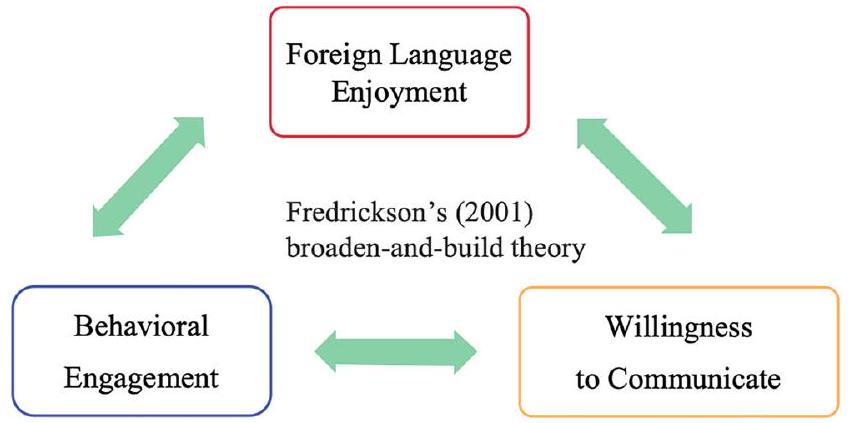
الشكل 1 الإطار المفاهيمي للدراسة. يوضح هذا الشكل العلاقات المفترضة بين الأبعاد الرئيسية التي تم فحصها في هذه البحث.
| الجدول 1 الخصائص الديموغرافية للمشاركين (
|
|||
| المتغيرات | المستوى | التكرار | النسبة المئوية |
| الجنس | ذكر | 231 | 33.5% |
| أنثى | 459 | 66.5% | |
| العمر | الحد الأقصى. | الحد الأدنى. | المتوسط. |
| 26 | 17 | 19.97 | |
| السنة الدراسية | السنة الأولى | 335 | 48.6% |
| السنة الثانية | 186 | 27.0% | |
| السنة الثالثة | 69 | 10.0% | |
| السنة الرابعة | 100 | 14.5% | |
| درجة CET-4 | أقل من 425 | 187 | 27.1% |
| 425-550 | 415 | 60.1% | |
| أعلى من 550 | 88 | 12.8% | |
| درجة CET-6 | أقل من 425 | 300 | 43.5% |
| 425-550 | 313 | 45.4% | |
| أعلى من 550 | 77 | 11.2% | |
في التواصل بلغة L2، وهو أمر مهم بشكل خاص في سياق EFL الصيني حيث يظهر الطلاب غالبًا كفاءة لغوية عالية ولكن رغبة أقل في التواصل (MacIntyre وآخرون، 2019). لذلك، في سياق هذه الدراسة، من المحتمل أن يسهل FLE زيادة الانخراط السلوكي في أنشطة الفصل الدراسي، مما يؤدي بدوره إلى تطوير رغبة الطلاب في التواصل في تعلم اللغة.
يوضح الشكل 1 الإطار المفاهيمي للدراسة. يقسم الإطار الحالي WTC إلى بعدين وفقًا لنموذج Peng و Woodrow (2010): الأنشطة التي تركز على الشكل، والتي تركز على ميزات اللغة المحددة والأنشطة التي تركز على المعنى، والتي تركز على تبادل الرسائل. يتكون المتغير FLE من ثلاثة أبعاد، تم تحديدها من مقياس FLE الصيني في دراسة Li وآخرون (2018). يتم تعريف هذه الأبعاد على النحو التالي: FLE-خاص، وهو المتعة الشخصية من التقدم والأداء؛ FLE-معلم، وهو المتعة من دعم معلم EFL؛ FLE-جو، وهو الاستمتاع من جو الفصل الإيجابي. تم تعديل المتغير الانخراط السلوكي من مقياس Khajavy (2021)، بما في ذلك أربعة عناصر تقيس الانخراط في الجوانب السلوكية.
المنهجية
المشاركون. شملت الدراسة 690 طالبًا جامعيًا صينيًا في EFL (أنثى
طلابًا جامعيين في مستويات أكاديمية مختلفة، تتراوح من السنة الأولى إلى السنة الرابعة، ضمن سياق EFL. تم اختيار المشاركين بناءً على اعتبارين. أولاً، ركزنا على طلاب الجامعات الصينية في EFL حيث يمثلون شريحة كبيرة في تعليم اللغة الإنجليزية، مما يسمح لنا بفحص تجربة تعلم اللغة للمتعلمين الصينيين في سياق تعلم حقيقي. ثانيًا، من خلال تضمين طلاب من مؤسسات متعددة عبر مناطق مختلفة من الصين، هدفنا إلى التقاط عينة متنوعة تعكس السياقات المؤسسية والإقليمية المتنوعة، ويمكن أن تعزز من تعميم نتائجنا ضمن سياق EFL الصيني. تم أخذ عينة من 919 طالبًا جامعيًا يدرسون دورات المحادثة باللغة الإنجليزية من سبع جامعات عبر ست مقاطعات (هوبى، قوانغدونغ، خنان، خبي، تشجيانغ، وشانشي). بعد استبعاد 229 طالبًا
طلابًا جامعيين في مستويات أكاديمية مختلفة، تتراوح من السنة الأولى إلى السنة الرابعة، ضمن سياق EFL. تم اختيار المشاركين بناءً على اعتبارين. أولاً، ركزنا على طلاب الجامعات الصينية في EFL حيث يمثلون شريحة كبيرة في تعليم اللغة الإنجليزية، مما يسمح لنا بفحص تجربة تعلم اللغة للمتعلمين الصينيين في سياق تعلم حقيقي. ثانيًا، من خلال تضمين طلاب من مؤسسات متعددة عبر مناطق مختلفة من الصين، هدفنا إلى التقاط عينة متنوعة تعكس السياقات المؤسسية والإقليمية المتنوعة، ويمكن أن تعزز من تعميم نتائجنا ضمن سياق EFL الصيني. تم أخذ عينة من 919 طالبًا جامعيًا يدرسون دورات المحادثة باللغة الإنجليزية من سبع جامعات عبر ست مقاطعات (هوبى، قوانغدونغ، خنان، خبي، تشجيانغ، وشانشي). بعد استبعاد 229 طالبًا
تكونت العينة النهائية من 690 طالبًا جامعيًا (انظر الجدول 1 للحصول على خصائص ديموغرافية مفصلة). عكست العينة التوزيع الجنسى النموذجي في برامج اللغات الأجنبية الصينية، حيث شكلت الطالبات حوالي ثلثي المشاركين. كان متوسط العمر
الأدوات. استخدمت الدراسة الحالية ثلاثة استبيانات معدلة ومصادق عليها لجمع البيانات، جميعها مقدمة باللغة الصينية، لضمان الفهم الدقيق. تألف الاستبيان من جزئين، بما في ذلك المعلومات الديموغرافية والثلاثة مقاييس: FLE، WTC، والانخراط السلوكي. تم تصميم نموذج المعلومات الديموغرافية من قبل الباحثين لجمع البيانات حول جنس المشاركين، وعمرهم، وسنتهم الدراسية، ودرجة CET-4، ودرجة CET-6. تم قياس جميع العناصر على مقياس ليكرت من خمس نقاط (من
لأغراض هذه الدراسة، تم استخدام ثلاثة استبيانات معدلة ومصادق عليها لجمع البيانات، بما في ذلك ثلاثة أبعاد: FLE، والانخراط، وWTC، بما في ذلك 23 عنصرًا.
مقياس الاستمتاع باللغة الأجنبية. تم تعديل المقياس لتقييم FLE من مقياس FLE الصيني في دراسة لي وآخرون (2018). يتضمن المقياس 11 عنصرًا من ثلاثة أبعاد: خاص، معلم، وجو. أحد أمثلة التعديلات على المقاييس كان تغيير “لقد تعلمت أشياء مثيرة” إلى “لقد تعلمت معلومات مثيرة في الدروس”) لتعزيز الوضوح والدقة في سياق الفصل الدراسي للغة الإنجليزية كلغة أجنبية. ومن الجدير بالذكر أن موثوقية مقياس FLE المعدل في هذه الدراسة تم حسابها على أنها 0.91 للخاص، 0.93 للمعلم، و0.83 للجو، مما يشير إلى موثوقية عالية للعناصر.
مقياس WTC. تم تصميم المقياس لتقييم استعداد الطلاب للتحدث باللغة الإنجليزية في دروس المحادثة، وتم تعديله من مقياس بينغ وودرو (2010). يتضمن المقياس 10 عناصر تقيس WTC من بعدين: الأنشطة الموجهة نحو المعنى والأنشطة الموجهة نحو الشكل. كما خضع مقياس WTC للترجمة والترجمة العكسية من قبل خبيرين ثنائيي اللغة. إنه
الجدول 2 موثوقية الاستبيانات.
| البناءات | البعد | العناصر | معامل كرونباخ |
| FLE | خاص | Q1 | 0.91 |
| Q2 | |||
| Q3 | |||
| Q6 | |||
| معلم | Q7 | 0.93 | |
| Q8 | |||
| Q9 | |||
| جو | Q4 | 0.83 | |
| Q5 | |||
| Q10 | |||
| Q11 | |||
| سلوكي | Q12 | 0.88 | |
| Q13 | |||
| Q14 | |||
| WTC | موجه نحو المعنى | Q16 | 0.91 |
| Q17 | |||
| Q18 | |||
| Q19 | |||
| موجه نحو الشكل | Q20 | 0.96 | |
| Q21 | |||
| Q22 | |||
| Q23 |
من الجدير بالذكر أن دراسة سابقة أفادت بمعاملات موثوقية لمقياس WTC كانت 0.91 للأنشطة الموجهة نحو المعنى، و0.96 للأنشطة الموجهة نحو الشكل، مما يشير إلى موثوقية عالية.
مقياس الانخراط السلوكي. تم تعديل مقياس الانخراط السلوكي من خاجافي (2021). يتضمن المقياس 4 عناصر، تقيس الانخراط السلوكي داخل فصل المحادثة بلغة L2 (على سبيل المثال، ‘أبذل جهدًا في تعلم الإنجليزية’). في هذه الدراسة، كانت موثوقية المقياس المعدل 0.88 للعناصر في الانخراط السلوكي، مما يشير إلى أن العناصر تظهر موثوقية عالية.
يوضح الجدول 2 موثوقية مقاييس FLE وWTC والانخراط السلوكي. يعرض هذا الجدول قيم ألفا كرونباخ لثلاثة مقاييس مصادق عليها، مما يدل على اتساق داخلي موثوق.
جمع البيانات. تم إجراء الدراسة عبر الإنترنت باستخدام منصة الاستبيان وينجوانشين (www.wjx.cn). تم تجنيد المشاركين من خلال أخذ عينات ملائمة من دورات اللغة الإنجليزية الجامعية من مؤسسات تعليمية متعددة في مناطق مختلفة من الصين، لاختيار المشاركين بناءً على سهولة الوصول والقرب (إتيكان وآخرون، 2016). تضمنت استراتيجية أخذ العينات التعاون مع معلمي EFL الذين وافقوا على مشاركة رابط الاستبيان مع طلابهم عبر مختلف الأقسام الأكاديمية. تم جمع البيانات من الطلاب الذين كانوا متاحين بسهولة واختاروا المشاركة طواعية في الدراسة. قبل جمع البيانات، تم الحصول على موافقة أخلاقية من لجنة أخلاقيات البحث في جامعة شمال الصين لموارد المياه والطاقة الكهربائية، وقدم جميع المشاركين موافقة مستنيرة. تم إجراء دراسة تجريبية أولية مع ثلاثة طلاب لاكتشاف أي مشاكل محتملة مع الأدوات قبل البحث الرئيسي. تم إبلاغ المشاركين بأهداف الدراسة وقدموا موافقتهم المستنيرة قبل توزيع الاستبيان. تم جمع الملاحظات من طلاب المجموعة التجريبية بشأن أي أسئلة غير واضحة أو مضللة. تم إجراء مراجعات على جميع الأدوات بناءً على نتائج الدراسة التجريبية وملاحظات المشاركين. تم تقديم المقاييس النهائية لجميع المشاركين في الدراسة الفعلية. تم الحفاظ على سرية وهوية
الجدول 3 علاقات FLE والانخراط السلوكي وWTC.
| المتغير | FLE | BE | WTC |
| FLE | 1 | ||
| BE |
|
1 | |
| WTC |
|
|
1 |
|
|
تظل المعلومات الشخصية للمشاركين محفوظة بشكل صارم، مما يضمن المبادئ الأخلاقية المتكاملة للدراسة.
تحليل البيانات. استخدمت الدراسة تصميم بحث بأسلوب كمي لفهم العلاقة بين FLE والانخراط السلوكي وWTC بين طلاب EFL الصينيين. تم إجراء تحليل البيانات باستخدام حزم البرمجيات SPSS 27 وAMOS 27. أولاً، تمت إزالة الاستجابات غير الصالحة، وتم تحديد القيم الشاذة لاختبار التوزيع الطبيعي لضمان جودة البيانات (كولير، 2020). أظهرت البيانات توزيعًا طبيعيًا، مما يلبي متطلبات التحليل اللاحق (هو وبنتلر، 1999). ثم تم استخدام التحليل الوصفي لتقييم تكرار العناصر في المتغيرات الثلاثة. بعد ذلك، تم قياس الموثوقية والصلاحية باستخدام ألفا كرونباخ (
النتائج
العلاقات المتبادلة بين FLE والانخراط السلوكي وWTC. في البداية، تم تطبيق تقنيات مراجعة البيانات لتحديد أي معلومات مفقودة أو قيم شاذة ولتقييم التوزيع الطبيعي لمجموعة البيانات. كانت هذه العملية الشاملة مصممة لضمان نزاهة وموثوقية مجموعة البيانات، مما يسهل التحليلات اللاحقة (كلين، 2015). أظهر تحليلنا الأولي أن قيم الانحراف والتفرطح كانت جميعها ضمن النطاقات المقبولة (الانحراف
وفقًا للجدول 3، هناك علاقات قوية بين FLE والانخراط السلوكي وWTC. أولاً، توجد علاقة إيجابية كبيرة بين FLE والانخراط السلوكي (0.656**). لوحظت علاقة إيجابية مماثلة بين FLE وWTC (0.656**). علاوة على ذلك، تم العثور أيضًا على علاقة إيجابية قوية بين الانخراط السلوكي وWTC (
التأثير التنبؤي لـ FLE والانخراط السلوكي على WTC. بالنسبة لـ CFA وSEM اللاحقين، تم تأكيد ملاءمة العينة من خلال اختبار كايزر-ماير-أولكين
تم بناء نموذج القياس بعد ذلك بواسطة AMOS. يشير النموذج الأولي إلى توافق جيد مع البيانات، كما هو موضح في الشكل 2. تم الإشارة إلى جودة التوافق من خلال عدة عناصر رئيسية، كما هو موضح
في الجدول 4. نسبة CMIN/df، التي تمثل إحصائية كاي-تربيع مقسومة على درجات الحرية، هي 4.87، مما يلبي متطلبات أن تكون أقل من أو تساوي 5.0 (مارش وهوكيفار، 1985). وهذا يشير إلى أن الفجوة بين مصفوفات التغاير المرصودة والمتوقعة يمكن قبولها. RMSEA هو 0.075، ضمن النطاق المقبول الذي يقل عن 0.080، مما يشير إلى خطأ تقريبي معقول. CFI، الذي يأخذ في الاعتبار حجم العينة، هو 0.942، متجاوزًا الحد الأدنى المطلوب وهو 0.9، مما يشير إلى أن النموذج يتناسب مع البيانات بشكل جيد مقارنةً بنموذج مستقل. PNFI، الذي يعدل مؤشر الملاءمة المعياري لتعقيد النموذج، هو 0.814، وهو أعلى بكثير من المتطلب الذي يزيد عن 0.5، مما يوحي بأن
في الجدول 4. نسبة CMIN/df، التي تمثل إحصائية كاي-تربيع مقسومة على درجات الحرية، هي 4.87، مما يلبي متطلبات أن تكون أقل من أو تساوي 5.0 (مارش وهوكيفار، 1985). وهذا يشير إلى أن الفجوة بين مصفوفات التغاير المرصودة والمتوقعة يمكن قبولها. RMSEA هو 0.075، ضمن النطاق المقبول الذي يقل عن 0.080، مما يشير إلى خطأ تقريبي معقول. CFI، الذي يأخذ في الاعتبار حجم العينة، هو 0.942، متجاوزًا الحد الأدنى المطلوب وهو 0.9، مما يشير إلى أن النموذج يتناسب مع البيانات بشكل جيد مقارنةً بنموذج مستقل. PNFI، الذي يعدل مؤشر الملاءمة المعياري لتعقيد النموذج، هو 0.814، وهو أعلى بكثير من المتطلب الذي يزيد عن 0.5، مما يوحي بأن
عتبة
الجدول 4 تقييم ملاءمة نموذج CFA.
| معايير | رهيب | مقبول | ممتاز | تقييم | |
| سيمن | ١٠٨١.١٧١ | ||||
| df | 222 | ||||
| CMIN/df | ٤.٨٧ | >5 | >3 | <1 | مقبول |
| RMSEA | 0.075 | >0.08 | <0.08 | <0.06 | مقبول |
| جي إف آي | 0.883 | <0.9 | >0.9 | >0.95 | ممتاز |
| CFI | 0.942 | <0.9 | >0.9 | >0.95 | ممتاز |
| PNFI | 0.814 | <0.5 | >0.5 | مقبول | |
| TLI | 0.934 | <0.9 | >0.9 | >0.95 | ممتاز |
النموذج متسق مع البيانات بشكل جيد على الرغم من تعقيده. أخيرًا، مؤشر TLI، وهو مؤشر ملاءمة مقارن يعاقب على تعقيد النموذج، هو 0.934، متجاوزًا العتبة المطلوبة البالغة 0.9، مما يشير إلى ملاءمة جيدة جدًا. بشكل عام، كل مقياس لملاءمة النموذج يتماشى مع المعايير المحددة أو يتجاوزها، مما يدل على أن النموذج يلبي جميع المعايير بشكل مرضٍ. على الرغم من أن قيمة GFI هي 0.88، وهي أقل بقليل من 0.9، إلا أن جميع مؤشرات ملاءمة النموذج الأخرى تقع ضمن النطاقات المقبولة، ومن الجدير بالذكر أن GFI حساس لحجم العينة وغالبًا ما يعتبر مؤشرًا أقل موثوقية لملاءمة النموذج (تومس وآخرون، 2006). نظرًا لأن هذا نموذج من الدرجة الثانية مع زيادة التعقيد، يمكن اعتبار قيمة GFI المحصل عليها مقبولة، حيث تم اعتبار القيم التي تزيد عن 0.80 مناسبة للنماذج المعقدة (بيرن، 2013).
تم استخدام CFA لتقييم موثوقية التركيب (CR) ومتوسط التباين المستخرج (AVE) لكل عامل، وفقًا لإرشادات الإجراءات التي وضعها كولير (2020). تقدم الجدول 5 تقييمًا للصلاحية التمييزية وCR لكل بناء. أظهرت النتائج أن جميع البنى تلبي عتبات CR.
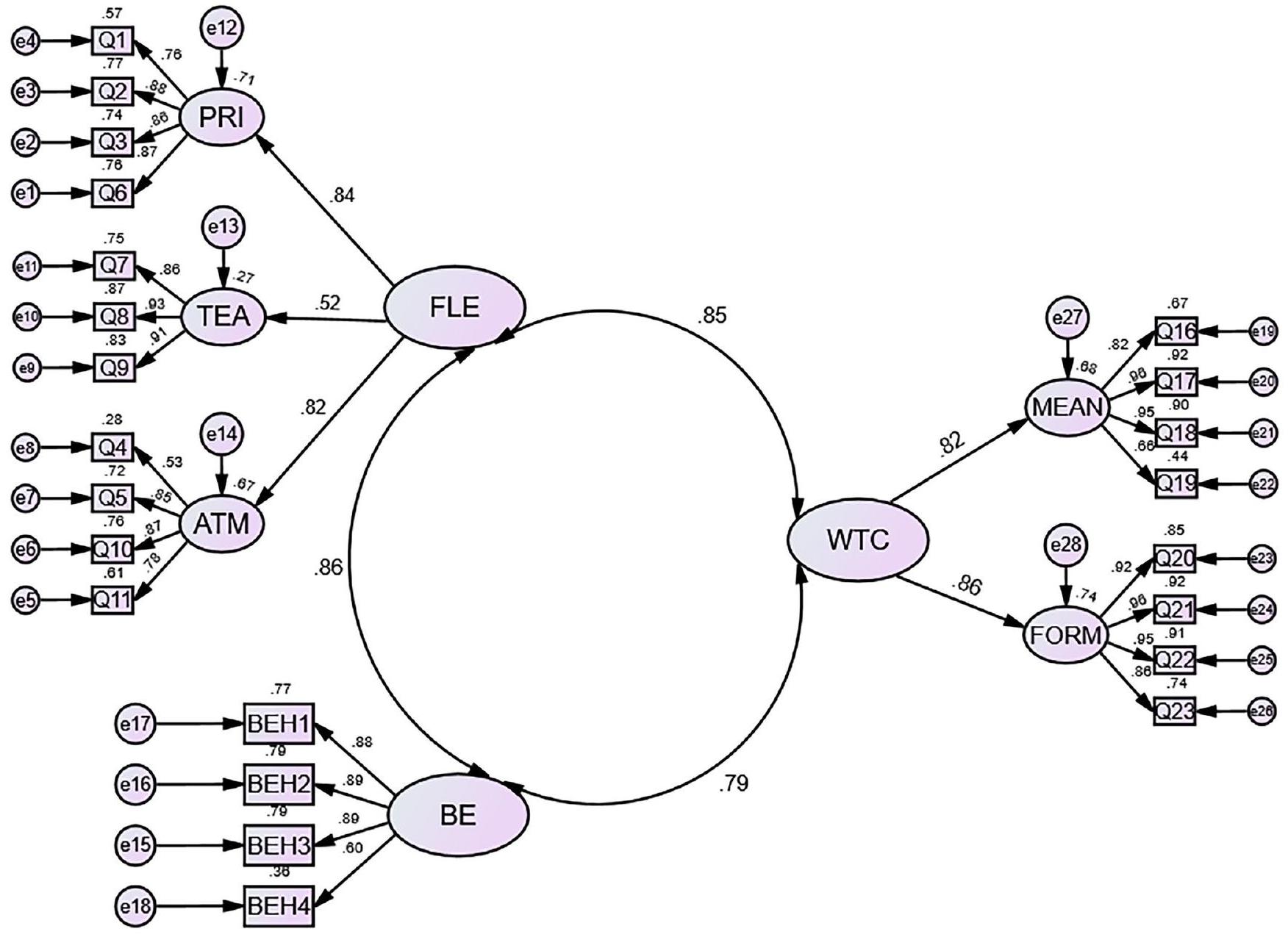
الشكل 2 نموذج CFA النهائي المعدل مع التقديرات المعيارية. يعرض هذا الشكل نموذج تحليل العوامل التأكيدي بعد التعديلات، موضحًا العلاقات بين المتغيرات الكامنة ومؤشراتها.
| الجدول 5 موثوقية مركبة وصلاحية تمييز المتغيرات. | |||||
| متغير | الموثوقية المركبة | صلاحية التمييز | |||
| سي آر | AVE | كن | FLE | برج التجارة العالمي | |
| FLE | 0.779 | 0.550 | 0.742 | ||
| كن | 0.891 | 0.677 | 0.703*** | 0.822 | |
| برج التجارة العالمي | 0.829 | 0.708 | 0.656*** | 0.685*** | 0.841 |
| ***
|
|||||
| الجدول 6 تقييم جودة ملاءمة نموذج SEM. | |||||
| عتبة | |||||
| معايير | رهيب | مقبول | ممتاز | تقييم | |
| سيمن | ١٠٨١.٥٤ | ||||
| df | 222 | ||||
| CMIN/df | ٤.٨٧ | >5 | >3 | <1 | مقبول |
| RMSEA | 0.075 | >0.08 | <0.08 | <0.06 | مقبول |
| جي إف آي | 0.883 | <0.9 | >0.9 | >0.95 | ممتاز |
| CFI | 0.942 | <0.9 | >0.9 | >0.95 | ممتاز |
| PNFI | 0.814 | <0.5 | >0.5 | مقبول | |
| TLI | 0.934 | <0.9 | >0.9 | >0.95 | ممتاز |
ثم تم بناؤه بواسطة AMOS. يشير نموذج القياس إلى توافق جيد مع البيانات، كما هو موضح في الشكل 2.
كما ذُكر سابقًا، قبل تحليل البيانات في النموذج الهيكلي، تم تأكيد افتراضات SEM. تم عرض نتائج تقييم ملاءمة SEM في الجدول 6.
بعد ذلك، تم بناء النموذج الهيكلي بواسطة AMOS. أظهر نموذج القياس خصائص ملائمة مرضية بشكل عام، كما هو موضح في الشكل 3 والجدول 6. نسبة كاي-تربيع (CMIN/df
يظهر SEM لهذا التحليل في الشكل 3. تكشف الجدول 7 أن العلاقة بين FLE و WTC ذات دلالة إحصائية.
نقاش
تدرس هذه الدراسة دور FLE والانخراط السلوكي في WTC من خلال استخدام نهج كمي بين متعلمي اللغة الإنجليزية كلغة أجنبية في الصين.
تعلم الطلاب في الكلية. على وجه التحديد، استكشفت الدراسة العلاقات المهمة بين الفرح في التعلم، والانخراط، والاستعداد للتواصل بين طلاب اللغة الإنجليزية كلغة أجنبية الصينيين في الفصول الدراسية الناطقة باللغة الإنجليزية. أظهرت النتائج وجود علاقات إيجابية كبيرة بين كل من الفرح في التعلم والانخراط السلوكي مع الاستعداد للتواصل، حيث أظهر الفرح في التعلم ارتباطًا أقوى من الانخراط السلوكي. والأهم من ذلك، أنه يظهر تأثير الفرح في التعلم والانخراط السلوكي على الاستعداد للتواصل. هذه الدراسة مهمة بشكل خاص لأنها تضع الفرح في التعلم في إطار نظري نظرية التوسع والبناء لفريدريكسون (2001) في سياق تعلم اللغة الإنجليزية كلغة أجنبية في الصين. وفقًا لهذه النظرية، فإن المشاعر الإيجابية مثل الاستمتاع تؤدي وظيفتين حاسمتين: فهي توسع من نطاق تفكير الطلاب وإجراءاتهم اللحظية وتبني مواردهم الشخصية المستدامة. في سياق دراستنا، عندما يستمتع الطلاب بعملية التعلم، فإن هذه المشاعر الإيجابية توسع من منظورهم حول تعلم اللغة، مما يجعلهم أكثر احتمالًا لرؤية التواصل كفرصة بدلاً من تهديد. ثم يبني هذا التأثير التوسعي موارد تعليمية دائمة، بما في ذلك زيادة الثقة والاستعداد للتواصل. تساعد هذه النظرية في تفسير سبب كون الاستمتاع يمكن أن يلعب دورًا حاسمًا في كسر الحواجز التواصلية، خاصة في البيئات الجامعية الصينية حيث قد يكون الطلاب تقليديًا مترددين في التحدث. يبرز هذا المنظور النظري الدور المحوري للاستمتاع في إثراء تجربة الفصل الدراسي وتعزيز انخراط الطلاب السلوكي واستعدادهم للتواصل.
تعلم الطلاب في الكلية. على وجه التحديد، استكشفت الدراسة العلاقات المهمة بين الفرح في التعلم، والانخراط، والاستعداد للتواصل بين طلاب اللغة الإنجليزية كلغة أجنبية الصينيين في الفصول الدراسية الناطقة باللغة الإنجليزية. أظهرت النتائج وجود علاقات إيجابية كبيرة بين كل من الفرح في التعلم والانخراط السلوكي مع الاستعداد للتواصل، حيث أظهر الفرح في التعلم ارتباطًا أقوى من الانخراط السلوكي. والأهم من ذلك، أنه يظهر تأثير الفرح في التعلم والانخراط السلوكي على الاستعداد للتواصل. هذه الدراسة مهمة بشكل خاص لأنها تضع الفرح في التعلم في إطار نظري نظرية التوسع والبناء لفريدريكسون (2001) في سياق تعلم اللغة الإنجليزية كلغة أجنبية في الصين. وفقًا لهذه النظرية، فإن المشاعر الإيجابية مثل الاستمتاع تؤدي وظيفتين حاسمتين: فهي توسع من نطاق تفكير الطلاب وإجراءاتهم اللحظية وتبني مواردهم الشخصية المستدامة. في سياق دراستنا، عندما يستمتع الطلاب بعملية التعلم، فإن هذه المشاعر الإيجابية توسع من منظورهم حول تعلم اللغة، مما يجعلهم أكثر احتمالًا لرؤية التواصل كفرصة بدلاً من تهديد. ثم يبني هذا التأثير التوسعي موارد تعليمية دائمة، بما في ذلك زيادة الثقة والاستعداد للتواصل. تساعد هذه النظرية في تفسير سبب كون الاستمتاع يمكن أن يلعب دورًا حاسمًا في كسر الحواجز التواصلية، خاصة في البيئات الجامعية الصينية حيث قد يكون الطلاب تقليديًا مترددين في التحدث. يبرز هذا المنظور النظري الدور المحوري للاستمتاع في إثراء تجربة الفصل الدراسي وتعزيز انخراط الطلاب السلوكي واستعدادهم للتواصل.
أولاً، أشارت النتائج إلى وجود ارتباط إيجابي ذو دلالة إحصائية، معتدل الأهمية، بين الفرح في التعلم والاستعداد للتواصل. وقد أشار الارتباط الإيجابي إلى أن مستويات أعلى من الفرح في التعلم تتوافق مع زيادة مستويات الاستعداد للتواصل بين طلاب اللغة الإنجليزية كلغة أجنبية. يتماشى هذا الاكتشاف مع توقعات نظرية التوسع والبناء، مما يشير إلى أن المتعة المستمدة من عملية التعلم تؤثر بشكل كبير على استعداد الطلاب للمشاركة في الأنشطة التواصلية، خاصة في السياق التعليمي الصيني حيث تعتبر المحافظة على الوجه وتجنب الأخطاء اعتبارات ثقافية مهمة. من الملحوظ أن المشاعر الإيجابية (أي المتعة) الناتجة عن المتعة الشخصية المستمدة من التقدم والأداء، وبيئات التعلم الممتعة، وعلاقات المعلم والطالب الداعمة تلعب دورًا محوريًا في هذه الديناميكية. بالإضافة إلى ذلك، تشير الأبحاث السابقة إلى أن المتعلمين الذين يبلغون عن مستويات أعلى من المتعة قد يكونون أكثر ميلاً للتواصل برغبة في دروس لغتهم (ديوايلي، 2019). يمكن تفسير ذلك من خلال حقيقة أن المشاعر الإيجابية تقلل من القلق وتزيد من الثقة، مما يسهل المشاعر الإيجابية، مما يجعل الطلاب يشعرون بمزيد من الراحة والدافع للتواصل (فريدريكسون، 2001). علاوة على ذلك، يؤكد هذا الاكتشاف التأثير التنبؤي الحاسم للفرح في التعلم على الاستعداد للتواصل بلغة ثانية، كما تم الإبلاغ عنه في عدة دراسات (بن سالم، 2022؛ ديوايلي، 2019؛ ديوايلي وبافيلسكو، 2021؛ كون وآخرون، 2020؛ بينغ ووانغ، 2024). وفقًا لبينغ (2012)، فإن بيئة الفصل الدراسي التي تعطي الأولوية للمتعة من خلال الأنشطة التفاعلية والمثيرة تعزز شعور المجتمع وتخفض الفلتر العاطفي، مما يزيد من الاستعداد للتواصل. تشجع هذه البيئة الداعمة الطلاب على اتخاذ مخاطر لغوية ورؤية التواصل كفرصة للنمو بدلاً من تحدٍ (ديوايلي، 2015). والأهم من ذلك، أن هذه العلاقة الإيجابية بين الفرح في التعلم والاستعداد للتواصل مدعومة بنظرية فريدريكسون (2001) للتوسع والبناء. يمكن تفسير هذا التأثير الإيجابي للمتعة على الاستعداد للتواصل من خلال نظرية فريدريكسون (2001)، التي تبرز التأثير الكبير للمشاعر الإيجابية على نتائج التعلم. يبرز التفاعل بين الفرح في التعلم والاستعداد للتواصل الدور الحاسم للرفاهية العاطفية في اكتساب اللغة، كما تؤكده أطر علم النفس الإيجابي (ماكنتاير وغريغرسن، 2012). لذلك، من الضروري عدم التركيز فقط على كفاءة اللغة ولكن أيضًا على تنمية تجربة تعلم مبهجة.
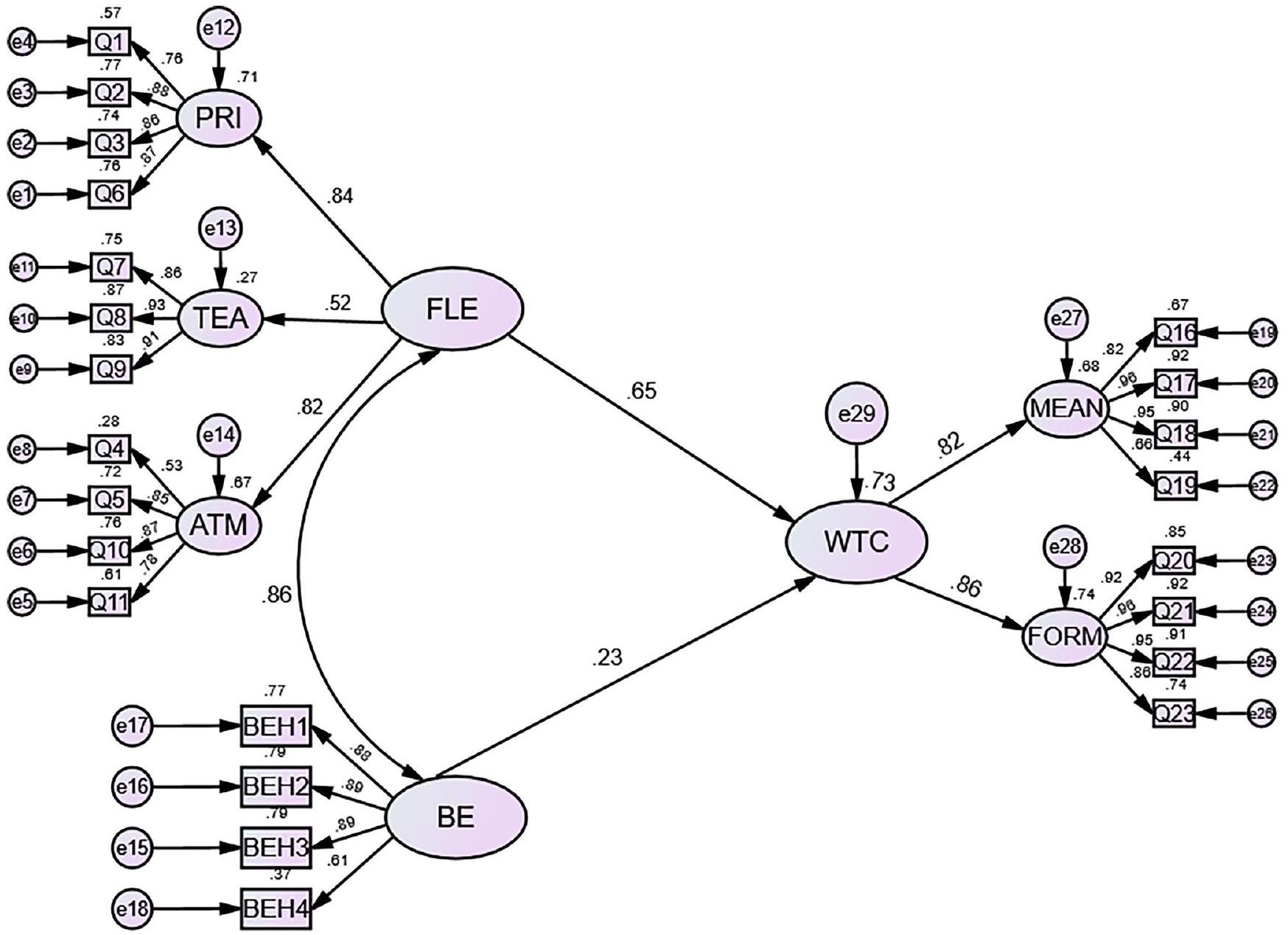
الشكل 3 نموذج القياس النهائي مع التقديرات الموحدة. يعرض هذا الشكل نموذج القياس المعتمد مع معاملات المسار الموحدة.
الجدول 7 نتائج SEM.
|
|
|
|
|
|
|||
| الاستعداد للتواصل |
|
الفرح في التعلم | 0.713 | 0.650 | 0.113 | 0.000 | 6.282 |
| الاستعداد للتواصل |
|
BE | 0.190 | 0.228 | 0.077 | 0.014 | 2.457 |
بالإضافة إلى ذلك، كان هناك ارتباط إيجابي بين المشاركة السلوكية والاستعداد للتواصل في هذه الدراسة، متماشيًا مع الأبحاث السابقة في السياق البولندي (ميستكوفسكا-ويرتيلاك وبيلاك، 2023). يبدو أن المشاركة السلوكية، التي تشمل المشاركة النشطة، والجهد المستمر، والمثابرة في أنشطة تعلم اللغة، مرتبطة ارتباطًا وثيقًا بمختلف جوانب الاستعداد للتواصل. كشفت البيانات أن الطلاب الذين أظهروا هذه السلوكيات المشاركة في دروس اللغة الإنجليزية في الجامعة كانوا أكثر احتمالًا لإظهار الاستعداد للتواصل، على الرغم من التحديات التي غالبًا ما تكون موجودة في سياقات اللغة الإنجليزية كلغة أجنبية في الصين مثل أحجام الفصول الكبيرة والفرص المحدودة للتحدث. أحد التفسيرات للاختلاف الإيجابي بين المشاركة السلوكية والاستعداد للتواصل هو أن الطلاب الذين يظهرون مستويات أعلى من المشاركة يختبرون مشاعر إيجابية أكثر خلال عملية التعلم، مما يوسع بدوره من مجموعة أفكارهم وأفعالهم ويبني موارد شخصية دائمة. بعبارة أخرى، الطلاب الذين يشاركون سلوكيًا في الفصول الدراسية يختبرون المزيد من الفرص للتجارب العاطفية الإيجابية، مما يؤدي بهم إلى تطوير مواقف أكثر إيجابية تجاه كل من عمليات التعلم والتفاعلات التواصلية. الانتقال إلى
تحليل أعمق، أحد الأسباب الثقافية في سياق اللغة الإنجليزية كلغة أجنبية في الصين هو أن الطلاب تقليديًا يحافظون على أدوار سلبية في الفصول الدراسية (ليو وجاكسون، 2011)، ومع ذلك، فإن أولئك الذين يظهرون مستويات أعلى من المشاركة يبدأون في التغلب على أنماط التعلم التقليدية. يميلون إلى رؤية أنشطة الفصل الدراسي كأمور ذات صلة وقيمة، مما يعزز شعور الاستثمار والحماس (فريدريكس وآخرون، 2004). هذا مهم بشكل خاص في سياق يتم فيه تعلم اللغة الإنجليزية بشكل أساسي كلغة أجنبية مع تعرض محدود خارج الفصل الدراسي (وين وكلمنت، 2003). في جوهره، يتغلب الطلاب الصينيون الذين يشاركون سلوكيًا في الفصول الدراسية تدريجيًا على التردد الثقافي ويصبحون أكثر استعدادًا لتولي المهام التواصلية (لي وجيا، 2006)، بدءًا من رؤية المشاركة النشطة كجزء لا يتجزأ من تعلمهم. والأهم من ذلك، أن هذا يتماشى مع نظرية فريدريكسون (2001)، حيث أن المشاعر الإيجابية الناتجة عن تجارب المشاركة الناجحة تخلق حلقة تصاعدية: عندما يشارك الطلاب سلوكيًا، يختبرون المزيد من الفرص للتجارب العاطفية الإيجابية في الفصل الدراسي. ثم توسع هذه المشاعر الإيجابية من مجموعة أفكارهم وأفعالهم، مما يجعلهم أكثر انفتاحًا على الفرص التواصلية ويبني مواردهم الشخصية الدائمة مثل الثقة والكفاءة اللغوية. هذا يخلق دورة تعزز الذات حيث تؤدي المشاركة إلى مشاعر إيجابية، مما يسهل بدوره زيادة الاستعداد للتواصل. مع استمرار هذه الدورة، تمتد الفوائد إلى ما هو أبعد من المشاركة الفورية في الفصل الدراسي. تعمل هذه المشاركة المعززة على تحسين كل من النتائج اللغوية، مثل الكفاءة والكفاءة التواصلية، والنتائج غير اللغوية،
بما في ذلك الرفاهية النفسية والمعرفة الثقافية الاجتماعية. بعد ذلك، تعزز هذه النتائج المجمعة التفاعل الأكبر مع مجتمع اللغة المستهدفة وتزيد من استعداد المتعلمين للتواصل. لذلك، تسلط العلاقة بين المشاركة السلوكية والاستعداد للتواصل الضوء على أن بيئة الفصل الدراسي الجذابة التي تعزز تفاعل الطلاب والتجارب العاطفية الإيجابية ضرورية لاكتساب اللغة بشكل فعال (بينغ، 2012). بعبارة أخرى، يصبح الطلاب أكثر تمكينًا للتواصل والتعاون في بيئة تعلم تفاعلية وجذابة، حيث تبني هذه التجارب الإيجابية ثقتهم وتوسع من مجموعة تواصلهم. بينما تعتبر هذه النتائج ذات صلة خاصة بسياقات الجامعات الصينية والسياقات المماثلة، إلا أنها قد تحمل تداعيات أوسع على بيئات اللغة الإنجليزية كلغة أجنبية الأخرى حيث تؤثر العوامل الثقافية والمؤسسية على استعداد الطلاب للتواصل. يمكن أن تستكشف الأبحاث المستقبلية كيف تتجلى هذه العلاقات في سياقات ثقافية ومؤسسية مختلفة، خاصة في بيئات تعليمية آسيوية أخرى ذات قيم ثقافية مماثلة.
تحليل أعمق، أحد الأسباب الثقافية في سياق اللغة الإنجليزية كلغة أجنبية في الصين هو أن الطلاب تقليديًا يحافظون على أدوار سلبية في الفصول الدراسية (ليو وجاكسون، 2011)، ومع ذلك، فإن أولئك الذين يظهرون مستويات أعلى من المشاركة يبدأون في التغلب على أنماط التعلم التقليدية. يميلون إلى رؤية أنشطة الفصل الدراسي كأمور ذات صلة وقيمة، مما يعزز شعور الاستثمار والحماس (فريدريكس وآخرون، 2004). هذا مهم بشكل خاص في سياق يتم فيه تعلم اللغة الإنجليزية بشكل أساسي كلغة أجنبية مع تعرض محدود خارج الفصل الدراسي (وين وكلمنت، 2003). في جوهره، يتغلب الطلاب الصينيون الذين يشاركون سلوكيًا في الفصول الدراسية تدريجيًا على التردد الثقافي ويصبحون أكثر استعدادًا لتولي المهام التواصلية (لي وجيا، 2006)، بدءًا من رؤية المشاركة النشطة كجزء لا يتجزأ من تعلمهم. والأهم من ذلك، أن هذا يتماشى مع نظرية فريدريكسون (2001)، حيث أن المشاعر الإيجابية الناتجة عن تجارب المشاركة الناجحة تخلق حلقة تصاعدية: عندما يشارك الطلاب سلوكيًا، يختبرون المزيد من الفرص للتجارب العاطفية الإيجابية في الفصل الدراسي. ثم توسع هذه المشاعر الإيجابية من مجموعة أفكارهم وأفعالهم، مما يجعلهم أكثر انفتاحًا على الفرص التواصلية ويبني مواردهم الشخصية الدائمة مثل الثقة والكفاءة اللغوية. هذا يخلق دورة تعزز الذات حيث تؤدي المشاركة إلى مشاعر إيجابية، مما يسهل بدوره زيادة الاستعداد للتواصل. مع استمرار هذه الدورة، تمتد الفوائد إلى ما هو أبعد من المشاركة الفورية في الفصل الدراسي. تعمل هذه المشاركة المعززة على تحسين كل من النتائج اللغوية، مثل الكفاءة والكفاءة التواصلية، والنتائج غير اللغوية،
بما في ذلك الرفاهية النفسية والمعرفة الثقافية الاجتماعية. بعد ذلك، تعزز هذه النتائج المجمعة التفاعل الأكبر مع مجتمع اللغة المستهدفة وتزيد من استعداد المتعلمين للتواصل. لذلك، تسلط العلاقة بين المشاركة السلوكية والاستعداد للتواصل الضوء على أن بيئة الفصل الدراسي الجذابة التي تعزز تفاعل الطلاب والتجارب العاطفية الإيجابية ضرورية لاكتساب اللغة بشكل فعال (بينغ، 2012). بعبارة أخرى، يصبح الطلاب أكثر تمكينًا للتواصل والتعاون في بيئة تعلم تفاعلية وجذابة، حيث تبني هذه التجارب الإيجابية ثقتهم وتوسع من مجموعة تواصلهم. بينما تعتبر هذه النتائج ذات صلة خاصة بسياقات الجامعات الصينية والسياقات المماثلة، إلا أنها قد تحمل تداعيات أوسع على بيئات اللغة الإنجليزية كلغة أجنبية الأخرى حيث تؤثر العوامل الثقافية والمؤسسية على استعداد الطلاب للتواصل. يمكن أن تستكشف الأبحاث المستقبلية كيف تتجلى هذه العلاقات في سياقات ثقافية ومؤسسية مختلفة، خاصة في بيئات تعليمية آسيوية أخرى ذات قيم ثقافية مماثلة.
الخاتمة
تقدم هذه الدراسة رؤى قيمة حول العلاقات بين الفرح في التعلم (FLE) والانخراط السلوكي (behavioral engagement) والرغبة في التواصل (WTC) بين طلاب اللغة الإنجليزية كلغة أجنبية (EFL) في الصين، بالإضافة إلى العوامل التي تشكل الرغبة في التواصل. أظهرت النتائج أن تعزيز المشاعر الإيجابية ورعاية الانخراط السلوكي يمكن أن يؤثر بشكل كبير وإيجابي على رغبة الطلاب في التواصل. تسلط هذه النتائج الضوء على التفاعل بين الفرح في التعلم والانخراط السلوكي في تشكيل الرغبة في التواصل، مما يبرز الحاجة إلى مراعاة كل من المنظورات العاطفية والسلوكية في أبحاث الرغبة في التواصل. تسهم هذه الدراسة في الأدبيات الموجودة من خلال التأكيد على التأثير الكبير للفرح في التعلم والانخراط السلوكي كعوامل رئيسية تؤثر على الرغبة في التواصل. نظرًا لأن المشاعر غالبًا ما تكون مؤقتة وقصيرة الأمد في تعليم اللغة، فإن الفرح في التعلم، كونه تجربة عاطفية إيجابية نسبياً، يمكن أن يؤثر بشكل كبير على سلوكيات التواصل لدى متعلمي اللغة الإنجليزية كلغة أجنبية في الصين. عادةً ما يظهر المتعلمون الذين يتمتعون بمستويات عالية من الفرح في التعلم حماسًا وثقة أكبر في استخدام اللغة المستهدفة. تجعل هذه الحالة العاطفية منهم أقل عرضة للتأثيرات السلبية للقلق والمشاعر السلبية الأخرى، مما يحمي رغبتهم في التواصل في عملية تعلم اللغة. علاوة على ذلك، لا يمكن المبالغة في أهمية الانخراط السلوكي في تشكيل الرغبة في التواصل. تشجع المشاركة النشطة في الأنشطة الصفية المتعلمين على ممارسة وتطوير مهاراتهم اللغوية، مما يزيد من ثقتهم ورغبتهم في التواصل. يعزز بيئة التعلم التي تتميز بتجارب عاطفية إيجابية والانخراط النشط من استعداد الفرد للمشاركة، وثقته بنفسه، وكفاءته التواصلية العامة. علاوة على ذلك، فإن المستويات المرتفعة من الفرح في التعلم والانخراط السلوكي داخل الفصل لا تسهم فقط في تحسين الأداء الأكاديمي والتطور المعرفي، بل تعزز أيضًا الرفاهية العاطفية للمتعلمين. وهذا بدوره يشجع على المشاركة النشطة والتعاون بين الطلاب، مما يعزز مهاراتهم الاجتماعية وذكائهم العاطفي، مما يؤدي في النهاية إلى بيئة تعليمية أكثر تماسكًا وفعالية.
تتمتع هذه الدراسة بعدة تداعيات على المستويين النظري والعملي. من الناحية النظرية، تساهم في الأدبيات الموجودة حول علم النفس الإيجابي في تعليم اللغة من خلال تسليط الضوء على أهمية الفرح في التعلم والمشاركة السلوكية في تعزيز الرغبة في التواصل بين متعلمي اللغة الإنجليزية كلغة أجنبية. تسلط النتائج الضوء على الدور الحاسم الذي تلعبه مفاهيم علم النفس الإيجابي في السياق الصيني لتعليم اللغة الإنجليزية كلغة أجنبية، مما يوفر رؤى قيمة حول كيفية تعزيز هذه المفاهيم لتحسين تعليم اللغة. عمليًا، تقدم هذه البحث تداعيات هامة لتعزيز الرغبة في التواصل في السياقات الصينية لتعليم اللغة الإنجليزية كلغة أجنبية. أولاً، تشير هذه الدراسة إلى أن تعزيز الفرح في التعلم داخل الفصل يمكن أن يزيد بشكل كبير من رغبة الطلاب في التواصل. النتائج
يتوافق مع نظرية فريدريكسون (2001) للتوسع والبناء، التي تقترح أن تعزيز تجربة التعلم الإيجابية يمكن أن يساعد الطلاب في بناء موارد دائمة مثل الكفاءة اللغوية، والروابط الاجتماعية، والثقة. يمكن للمعلمين تحقيق ذلك من خلال دمج أنشطة جذابة وممتعة في دروسهم، مثل الألعاب التفاعلية، والمشاريع التعاونية، والمحتوى الثقافي الغني. علاوة على ذلك، فإن التعرف على إنجازات الطلاب والاحتفال بها، مهما كانت صغيرة، يمكن أن يعزز المشاعر الإيجابية ويعزز جوًا أكثر تواصلًا. ثانيًا، فإن الانخراط السلوكي أمر حاسم لتعزيز الرغبة في التواصل. المشاركة النشطة في الأنشطة الصفية تحسن من الكفاءة اللغوية وتزيد من رغبة الطلاب في التواصل. يمكن أن تعزز استراتيجيات مثل المناقشات الجماعية، وتمثيل الأدوار، ومهام حل المشكلات الانخراط النشط وتوفر فرصًا للطلاب لممارسة التواصل في بيئة داعمة. لتنفيذ هذه الاستراتيجيات بفعالية، يجب أن تتضمن برامج تدريب المعلمين وحدات شاملة حول نظرية فريدريكسون (2001) للتوسع والبناء وتطبيقاتها في تدريس اللغة. يجب أن يكون المعلمون مستعدين بفهم نظري وموارد مفيدة لإنشاء بيئة صفية تعزز الانخراط السلوكي وتجربة التعلم الإيجابية وبالتالي تعزز الرغبة في التواصل.
يتوافق مع نظرية فريدريكسون (2001) للتوسع والبناء، التي تقترح أن تعزيز تجربة التعلم الإيجابية يمكن أن يساعد الطلاب في بناء موارد دائمة مثل الكفاءة اللغوية، والروابط الاجتماعية، والثقة. يمكن للمعلمين تحقيق ذلك من خلال دمج أنشطة جذابة وممتعة في دروسهم، مثل الألعاب التفاعلية، والمشاريع التعاونية، والمحتوى الثقافي الغني. علاوة على ذلك، فإن التعرف على إنجازات الطلاب والاحتفال بها، مهما كانت صغيرة، يمكن أن يعزز المشاعر الإيجابية ويعزز جوًا أكثر تواصلًا. ثانيًا، فإن الانخراط السلوكي أمر حاسم لتعزيز الرغبة في التواصل. المشاركة النشطة في الأنشطة الصفية تحسن من الكفاءة اللغوية وتزيد من رغبة الطلاب في التواصل. يمكن أن تعزز استراتيجيات مثل المناقشات الجماعية، وتمثيل الأدوار، ومهام حل المشكلات الانخراط النشط وتوفر فرصًا للطلاب لممارسة التواصل في بيئة داعمة. لتنفيذ هذه الاستراتيجيات بفعالية، يجب أن تتضمن برامج تدريب المعلمين وحدات شاملة حول نظرية فريدريكسون (2001) للتوسع والبناء وتطبيقاتها في تدريس اللغة. يجب أن يكون المعلمون مستعدين بفهم نظري وموارد مفيدة لإنشاء بيئة صفية تعزز الانخراط السلوكي وتجربة التعلم الإيجابية وبالتالي تعزز الرغبة في التواصل.
ومع ذلك، فإن الدراسة لها عدة قيود. أولاً، على الرغم من أن النموذج أظهر مؤشرات ملائمة عامة مرضية، فإن قيمة GFI المنخفضة نسبياً تشير إلى فرص محتملة لتحسين تحديد النموذج في الدراسات التجريبية المستقبلية. ثانياً، فإن استخدام مقاييس ذاتية التقرير كطريقة رئيسية لجمع البيانات يقدم قيوداً منهجية، خاصة فيما يتعلق بتحيز الرغبة الاجتماعية وموثوقية القياس. قد تفكر الدراسات اللاحقة في استخدام مؤشرات موضوعية لهذه المتغيرات، مثل الملاحظات السلوكية المباشرة والتقييمات المعتمدة على الأداء. ثالثاً، على الرغم من أن هذه الدراسة هي تحقيق كمي واسع النطاق يشمل عدة مشاركين، فإن اعتمادها على جمع وتحليل البيانات الرقمية يقدم بعض القيود. قد لا تتمكن المنهجيات التقليدية الثابتة من التقاط التعقيدات الديناميكية والسياقية وال constructs المتأصلة في عمليات تعلم اللغة بشكل كافٍ. يجب أن تدمج الأبحاث المستقبلية أساليب مختلطة وتقنيات جمع البيانات في الوقت الحقيقي لتوفير فهم أكثر شمولاً. علاوة على ذلك، بينما تفسر نظرية التوسع والبناء نتائجنا بشكل فعال، يمكن أن تستفيد الأبحاث المستقبلية من دمج أطر نظرية إضافية، مثل نظرية تحديد الذات (SDT)، لدراسة كيفية تأثير الاحتياجات النفسية الأساسية على علاقة الانخراط-الاستعداد للتواصل، أو نموذج PERMA لسليغمان (2011) لفهم كيفية عمل المشاعر الإيجابية والانخراط ضمن السياق الأوسع لرفاهية تعلم اللغة الثانية. علاوة على ذلك، نظراً لتركيزها المحدد على سياقات تعليم اللغة الإنجليزية كلغة أجنبية في الصين، قد تكون قابلية تطبيق النتائج في هذه الدراسة على سياقات اجتماعية ثقافية ولغوية أخرى محدودة. يجب أن تحقق الأبحاث المستقبلية في تأثيرات الفرح في التعلم والانخراط السلوكي في تشكيل الاستعداد للتواصل في سياقات متنوعة.
توفر البيانات
تتوفر مجموعات البيانات التي تم إنشاؤها و/أو تحليلها خلال الدراسة الحالية من المؤلف المراسل عند الطلب المعقول.
تاريخ الاستلام: 20 نوفمبر 2024؛ تاريخ القبول: 25 أبريل 2025؛ تاريخ النشر على الإنترنت: 10 مايو 2025
References
Benner AD, Graham S, Mistry RS (2008) Discerning direct and mediated effects of ecological structures and processes on adolescents’ educational outcomes. Dev. Psychol 44:840-854. https://doi.org/10.1037/0012-1649.44.3. 840
Bensalem E (2022) The impact of enjoyment and anxiety on English-language learners’ willingness to communicate. Vivat Acad (155), 6. https://doi.org/10. 15178/va.2022.155.e1310
Best JW, Kahn JV (2006) Research in education, 10th edn. Pearson Education, Inc, Boston
Boekaerts M (2016) Engagement as an inherent aspect of the learning process. Learn Instr 43:76-83. https://doi.org/10.1016/j.learninstruc.2016.02.001
Botes E, Dewaele J-M, Greiff S (2020) The Power to Improve: Effects of Multilingualism and Perceived Proficiency on Enjoyment and Anxiety in Foreign Language Learning. Eur J Educ 8(2):279-306. https://doi.org/10.1515/eujal-2020-0003
Byrne BM (2013) Structural equation modeling with LISREL, PRELIS, and SIMPLIS: basic concepts, applications, and programming. Psychology Press
Cao Y, Philp J (2006) Interactional context and willingness to communicate: a comparison of behavior in whole class, group and dyadic interaction. System 34(4):480-493. https://doi.org/10.1016/j.system.2006.05.002
Cao Y (2009) An ecological view of situational willingness to communicate in a second language classroom. Making a difference: challenges for applied linguistics. 199-218. https://doi.org/10.1016/j.system.2006.05.002
Collier JE (2020) Applied structural equation modeling using AMOS: basic to advanced techniques. Routledge. https://doi.org/10.4324/9781003018414
Derakhshan A, Dewaele JM, Noughabi MA (2022) Modeling the contribution of resilience, well-being, and L2 grit to foreign language teaching enjoyment among Iranian English language teachers. System 109:102890. https://doi.org/ 10.1016/j.system.2022.102890
Best JW, Kahn JV (2006) Research in education, 10th edn. Pearson Education, Inc, Boston
Boekaerts M (2016) Engagement as an inherent aspect of the learning process. Learn Instr 43:76-83. https://doi.org/10.1016/j.learninstruc.2016.02.001
Botes E, Dewaele J-M, Greiff S (2020) The Power to Improve: Effects of Multilingualism and Perceived Proficiency on Enjoyment and Anxiety in Foreign Language Learning. Eur J Educ 8(2):279-306. https://doi.org/10.1515/eujal-2020-0003
Byrne BM (2013) Structural equation modeling with LISREL, PRELIS, and SIMPLIS: basic concepts, applications, and programming. Psychology Press
Cao Y, Philp J (2006) Interactional context and willingness to communicate: a comparison of behavior in whole class, group and dyadic interaction. System 34(4):480-493. https://doi.org/10.1016/j.system.2006.05.002
Cao Y (2009) An ecological view of situational willingness to communicate in a second language classroom. Making a difference: challenges for applied linguistics. 199-218. https://doi.org/10.1016/j.system.2006.05.002
Collier JE (2020) Applied structural equation modeling using AMOS: basic to advanced techniques. Routledge. https://doi.org/10.4324/9781003018414
Derakhshan A, Dewaele JM, Noughabi MA (2022) Modeling the contribution of resilience, well-being, and L2 grit to foreign language teaching enjoyment among Iranian English language teachers. System 109:102890. https://doi.org/ 10.1016/j.system.2022.102890
Derakhshan A, Fathi J (2023) Grit and foreign language enjoyment as predictors of EFL learners’ online engagement: the mediating role of online learning selfefficacy. Asia Pacific Edu Res 1-11. https://doi.org/10.1007/s40299-023-00745-x
Dewaele JM (2019) The effect of classroom emotions, attitudes toward English, and teacher behavior on willingness to communicate among English foreign language learners. J Lang Soc Psychol 38(4):523-535. https://doi.org/10.1177/ 0261927×19864996
Dewaele JM, Li C (2021) Teacher enthusiasm and students’ social-behavioral learning engagement: the mediating role of student enjoyment and boredom in Chinese EFL classes. Lang Teach Res 25(6):922-945. https://doi.org/10. 1177/13621688211014538
Dewaele J-M (2015) On emotions in foreign language learning and use. Lang Teach 39(3):13-15. https://jalt-publications.org/tlt/issues/2015-05_39.3
Dewaele J-M, MacIntyre PD (2014) The two faces of Janus? Anxiety and enjoyment in the foreign language classroom. Stud Second Lang Learn Teach 4(2):237-274. https://doi.org/10.14746/ssllt.2014.4.2.5
Dewaele J-M, Dewaele L (2018) Learner-internal and learner external predictors of willingness to communicate in the FL classroom. J Eur Second Lang Assoc 2:1-14. https://doi.org/10.22599/jesla. 37
Dewaele J-M, Pavelescu LM (2021) The relationship between incommensurable emotions and willingness to communicate in English as a foreign language: a multiple case study. Innov Lang Learn Teach 15(1):66-80. https://doi.org/10. 1080/17501229.2019.1675667
Dewaele J-M, Witney J, Saito K, Dewaele L (2017) Foreign language enjoyment and anxiety: the effect of teacher and learner variables. Lang Teach Res 22(6):676-697. https://doi.org/10.1177/1362168817692161
Dewaele JM, MacIntyre PD (2016) Foreign language enjoyment and foreign language classroom anxiety: the right and left feet of the language learner. Positive psychology in SLA, vol 215(236), https://doi.org/10.21832/ 9781783095360-010
Dewaele JM, MacIntyre PD (2019) The predictive power of multicultural personality traits, learner and teacher variables on foreign language enjoyment and anxiety. In Evidence-based second language pedagogy. Routledge, pp 263-286. https://doi.org/10.4324/9781351190558-12
Ding L, Wang Y (2024) Unveiling Chinese EFL students’ academic burnout and its prediction by anxiety, boredom, and hopelessness: a latent growth curve modeling. Innov Lang Learn Teach 1-17. https://doi.org/10.1080/17501229. 2024.2407811
Dewaele JM (2019) The effect of classroom emotions, attitudes toward English, and teacher behavior on willingness to communicate among English foreign language learners. J Lang Soc Psychol 38(4):523-535. https://doi.org/10.1177/ 0261927×19864996
Dewaele JM, Li C (2021) Teacher enthusiasm and students’ social-behavioral learning engagement: the mediating role of student enjoyment and boredom in Chinese EFL classes. Lang Teach Res 25(6):922-945. https://doi.org/10. 1177/13621688211014538
Dewaele J-M (2015) On emotions in foreign language learning and use. Lang Teach 39(3):13-15. https://jalt-publications.org/tlt/issues/2015-05_39.3
Dewaele J-M, MacIntyre PD (2014) The two faces of Janus? Anxiety and enjoyment in the foreign language classroom. Stud Second Lang Learn Teach 4(2):237-274. https://doi.org/10.14746/ssllt.2014.4.2.5
Dewaele J-M, Dewaele L (2018) Learner-internal and learner external predictors of willingness to communicate in the FL classroom. J Eur Second Lang Assoc 2:1-14. https://doi.org/10.22599/jesla. 37
Dewaele J-M, Pavelescu LM (2021) The relationship between incommensurable emotions and willingness to communicate in English as a foreign language: a multiple case study. Innov Lang Learn Teach 15(1):66-80. https://doi.org/10. 1080/17501229.2019.1675667
Dewaele J-M, Witney J, Saito K, Dewaele L (2017) Foreign language enjoyment and anxiety: the effect of teacher and learner variables. Lang Teach Res 22(6):676-697. https://doi.org/10.1177/1362168817692161
Dewaele JM, MacIntyre PD (2016) Foreign language enjoyment and foreign language classroom anxiety: the right and left feet of the language learner. Positive psychology in SLA, vol 215(236), https://doi.org/10.21832/ 9781783095360-010
Dewaele JM, MacIntyre PD (2019) The predictive power of multicultural personality traits, learner and teacher variables on foreign language enjoyment and anxiety. In Evidence-based second language pedagogy. Routledge, pp 263-286. https://doi.org/10.4324/9781351190558-12
Ding L, Wang Y (2024) Unveiling Chinese EFL students’ academic burnout and its prediction by anxiety, boredom, and hopelessness: a latent growth curve modeling. Innov Lang Learn Teach 1-17. https://doi.org/10.1080/17501229. 2024.2407811
Do S, Schallert D (2004) Emotions and classroom talk: toward a model of the role of affect in students’ experiences of classroom discussions. J Educ Psychol 96(4):619-634. https://doi.org/10.1037/0022-0663.96.4.619
Etikan I, Musa SA, Alkassim RS (2016) Comparison of convenience sampling and purposive sampling. Am J Theor Appl Stat 5(1):1-4
Feng E, Hong G (2022) Engagement mediates the relationship between emotion and achievement of Chinese EFL learners. Front Psychol 13:895594. https:// doi.org/10.3389/fpsyg.2022.895594
Fornell C, Larcker DF (1981) Evaluating structural equation models with unobservable variables and measurement error. J Mark Res 18(1):39-50. https:// doi.org/10.2307/3151312
Fredricks JA, Blumenfeld PC, Paris AH (2004) School engagement: potential of the concept, state of the evidence. Rev Educ Res 74(1):59-109. https://doi.org/10. 3102/00346543074001059
Etikan I, Musa SA, Alkassim RS (2016) Comparison of convenience sampling and purposive sampling. Am J Theor Appl Stat 5(1):1-4
Feng E, Hong G (2022) Engagement mediates the relationship between emotion and achievement of Chinese EFL learners. Front Psychol 13:895594. https:// doi.org/10.3389/fpsyg.2022.895594
Fornell C, Larcker DF (1981) Evaluating structural equation models with unobservable variables and measurement error. J Mark Res 18(1):39-50. https:// doi.org/10.2307/3151312
Fredricks JA, Blumenfeld PC, Paris AH (2004) School engagement: potential of the concept, state of the evidence. Rev Educ Res 74(1):59-109. https://doi.org/10. 3102/00346543074001059
Fredrickson BL (2001) The role of positive emotions in positive psychology: the broaden-and-build theory of positive emotions. Am Psychol. 56(3):218-226. 10.1037//0003-066x.56.3.218
Fredrickson BL, Cohn MA, Coffey KA, Pek J, Finkel SM (2008) Open hearts build lives: positive emotions, induced through loving-kindness meditation, build consequential personal resources. J Personal Soc Psychol 95(5):1045. https:// doi.org/10.1037/a0013262
Gao Y, Wang X, Reynolds BL (2025) The mediating roles of resilience and flow in linking basic psychological needs to tertiary EFL learners’ engagement in the informal digital learning of English: a mixed-methods study. Behav Sci 15(1):85. https://doi.org/10.3390/bs15010085
Guo Y (2021) Exploring the dynamic interplay between foreign language enjoyment and learner engagement with regard to EFL achievement and absenteeism: a sequential mixed methods study. Front Psychol 12:766058. https:// doi.org/10.3389/fpsyg.2021.766058
Guo Y, Wang Y (2024) Exploring the effects of artificial intelligence application on EFL students’ academic engagement and emotional experiences: a mixed-methods study. Eur J Educ 60(1):e12812. https://doi.org/10.1111/ ejed. 12812
Hiver P, Al-Hoorie AH, Vitta JP, Wu J (2021) Engagement in language learning: a systematic review of 20 years of research methods and definitions. Lang Teach Res 136216882110012. https://doi.org/10.1177/13621688211001289
Hu LT, Bentler PM (1999) Cutoff criteria for fit indexes in covariance structure analysis: conventional criteria versus new alternatives. Struct Equ Model 6(1):1-55. https://doi.org/10.1080/10705519909540118
Huang F, Wang Y, Zhang H (2024) Modeling generative AI acceptance, perceived teachers’ enthusiasm, and self-efficacy to English as foreign language learners’ well-being in the digital era. Eur J Edu. https://doi.org/10.1111/ejed. 12770
Hughes JN, Luo W, Kwok OM, Loyd LK (2008) Teacher-student support, effortful engagement, and achievement: a 3-year longitudinal study. J Educ Psychol 100(1):1. https://doi.org/10.1037/0022-0663.100.1.1
Jiang Y, Dewaele J-M (2019) How unique is the foreign language classroom enjoyment and anxiety of Chinese EFL learners? System 82:13-25. https://doi. org/10.1016/j.system.2019.02.017
Joe H-K, Hiver P, Al-Hoorie AH (2017) Classroom social climate, self-determined motivation, willingness to communicate, and achievement: A study of structural relationships in instructed second language settings. Learn Individ Differ 53:133-144. https://doi.org/10.1016/j.lindif.2016.11.005
Kaiser HF (1974) An index of factorial simplicity. Psychometrika 39(1):31-36. https://doi.org/10.1007/bf02291575
Khajavy GH, MacIntyre PD, Barabadi E (2018) Role of the emotions and classroom environment in willingness to communicate: applying doubly latent multilevel analysis in second language acquisition research. Stud Second Lang Acquis 40(3):605-624. https://doi.org/10.1017/S0272263117000304
Khajavy GH, Ghonsooly B, Hosseini Fatemi A, Choi CW (2016) Willingness to communicate in English: a microsystem model in the Iranian EFL classroom context. Tesol Q 50(1):154-180. https://doi.org/10.1002/ tesq. 204
Khajavy GH (2021) Modeling the relations between foreign language engagement, emotions, grit and reading achievement. Student engagement in the language classroom, pp 241-259. https://doi.org/10.21832/9781788923613-016
Kline RB (2015) Principles and practice of structural equation modeling. Guilford Publications. https://doi.org/10.1080/10705511.2012.687667
Krashen SD (1985) The input hypothesis: issues and implications. TESOL Q 20(1):116. https://doi.org/10.2307/3586393
Kun Y, Senom F, Peng CF (2020) Relationship between willingness to communicate in english and foreign language enjoyment. Univers J Educ Res 10. https://doi.org/10.13189/ujer.2020.081057
Lee JS (2014) The relationship between student engagement and academic performance: is it a myth or reality? J Educ Res 107(3):177-185. https://doi-org. ezproxy.eduhk.hk/10.1080/00220671.2013.807491
Li C (2018) A positive psychology perspective on Chinese students’ emotional intelligence, classroom Emotions, and EFL learning achievement. Unpublished PhD dissertation. Xiamen University, Xiamen
Li C (2020) A Positive Psychology perspective on Chinese EFL students’ trait emotional intelligence, foreign language enjoyment and EFL learning achievement. J Multiling Multicult Dev 41(3):246-263. https://doi.org/10. 1080/01434632.2019.1614187
Li C (2021) A Control-Value Theory approach to boredom in English classes among university students in China. Mod Lang J 105(1):317-334. https://doi. org/10.1111/modl. 12693
Li C, Jiang G, Dewaele J-M (2018) Understanding Chinese high school students’ Foreign Language Enjoyment: Validation of the Chinese version of the Foreign Language Enjoyment scale. System 76:183-196. https://doi.org/10. 1016/j.system.2018.06.004
Li X, Jia X (2006) Why don’t you speak up?: East Asian students’ participation patterns in American and Chinese ESL classrooms. Intercult Commun Stud 15(1):192
Gao Y, Wang X, Reynolds BL (2025) The mediating roles of resilience and flow in linking basic psychological needs to tertiary EFL learners’ engagement in the informal digital learning of English: a mixed-methods study. Behav Sci 15(1):85. https://doi.org/10.3390/bs15010085
Guo Y (2021) Exploring the dynamic interplay between foreign language enjoyment and learner engagement with regard to EFL achievement and absenteeism: a sequential mixed methods study. Front Psychol 12:766058. https:// doi.org/10.3389/fpsyg.2021.766058
Guo Y, Wang Y (2024) Exploring the effects of artificial intelligence application on EFL students’ academic engagement and emotional experiences: a mixed-methods study. Eur J Educ 60(1):e12812. https://doi.org/10.1111/ ejed. 12812
Hiver P, Al-Hoorie AH, Vitta JP, Wu J (2021) Engagement in language learning: a systematic review of 20 years of research methods and definitions. Lang Teach Res 136216882110012. https://doi.org/10.1177/13621688211001289
Hu LT, Bentler PM (1999) Cutoff criteria for fit indexes in covariance structure analysis: conventional criteria versus new alternatives. Struct Equ Model 6(1):1-55. https://doi.org/10.1080/10705519909540118
Huang F, Wang Y, Zhang H (2024) Modeling generative AI acceptance, perceived teachers’ enthusiasm, and self-efficacy to English as foreign language learners’ well-being in the digital era. Eur J Edu. https://doi.org/10.1111/ejed. 12770
Hughes JN, Luo W, Kwok OM, Loyd LK (2008) Teacher-student support, effortful engagement, and achievement: a 3-year longitudinal study. J Educ Psychol 100(1):1. https://doi.org/10.1037/0022-0663.100.1.1
Jiang Y, Dewaele J-M (2019) How unique is the foreign language classroom enjoyment and anxiety of Chinese EFL learners? System 82:13-25. https://doi. org/10.1016/j.system.2019.02.017
Joe H-K, Hiver P, Al-Hoorie AH (2017) Classroom social climate, self-determined motivation, willingness to communicate, and achievement: A study of structural relationships in instructed second language settings. Learn Individ Differ 53:133-144. https://doi.org/10.1016/j.lindif.2016.11.005
Kaiser HF (1974) An index of factorial simplicity. Psychometrika 39(1):31-36. https://doi.org/10.1007/bf02291575
Khajavy GH, MacIntyre PD, Barabadi E (2018) Role of the emotions and classroom environment in willingness to communicate: applying doubly latent multilevel analysis in second language acquisition research. Stud Second Lang Acquis 40(3):605-624. https://doi.org/10.1017/S0272263117000304
Khajavy GH, Ghonsooly B, Hosseini Fatemi A, Choi CW (2016) Willingness to communicate in English: a microsystem model in the Iranian EFL classroom context. Tesol Q 50(1):154-180. https://doi.org/10.1002/ tesq. 204
Khajavy GH (2021) Modeling the relations between foreign language engagement, emotions, grit and reading achievement. Student engagement in the language classroom, pp 241-259. https://doi.org/10.21832/9781788923613-016
Kline RB (2015) Principles and practice of structural equation modeling. Guilford Publications. https://doi.org/10.1080/10705511.2012.687667
Krashen SD (1985) The input hypothesis: issues and implications. TESOL Q 20(1):116. https://doi.org/10.2307/3586393
Kun Y, Senom F, Peng CF (2020) Relationship between willingness to communicate in english and foreign language enjoyment. Univers J Educ Res 10. https://doi.org/10.13189/ujer.2020.081057
Lee JS (2014) The relationship between student engagement and academic performance: is it a myth or reality? J Educ Res 107(3):177-185. https://doi-org. ezproxy.eduhk.hk/10.1080/00220671.2013.807491
Li C (2018) A positive psychology perspective on Chinese students’ emotional intelligence, classroom Emotions, and EFL learning achievement. Unpublished PhD dissertation. Xiamen University, Xiamen
Li C (2020) A Positive Psychology perspective on Chinese EFL students’ trait emotional intelligence, foreign language enjoyment and EFL learning achievement. J Multiling Multicult Dev 41(3):246-263. https://doi.org/10. 1080/01434632.2019.1614187
Li C (2021) A Control-Value Theory approach to boredom in English classes among university students in China. Mod Lang J 105(1):317-334. https://doi. org/10.1111/modl. 12693
Li C, Jiang G, Dewaele J-M (2018) Understanding Chinese high school students’ Foreign Language Enjoyment: Validation of the Chinese version of the Foreign Language Enjoyment scale. System 76:183-196. https://doi.org/10. 1016/j.system.2018.06.004
Li X, Jia X (2006) Why don’t you speak up?: East Asian students’ participation patterns in American and Chinese ESL classrooms. Intercult Commun Stud 15(1):192
Li C, Dewaele J-M, Pawlak M, Kruk M (2022) Classroom environment and willingness to communicate in English: the mediating role of emotions experienced by university students in China. Lang Teach Res 136216882211116. https://doi.org/10.1177/13621688221111623
Lin J, Wang YL (2024) Unpacking the mediating role of classroom interaction between student satisfaction and perceived online learning among Chinese EFL tertiary learners in the normal of post-COVID-19. Acta Psychol 245:104233. https://doi.org/10.1016/j.actpsy.2024.104233. 1-10
Linnenbrink-Garcia L, Rogat TK, Koskey KLK (2011) Affect and engagement during small group instruction. Contemp Educ Psychol 36(1):13-24. https:// doi.org/10.1016/j.cedpsych.2010.09.001
Liu M, Jackson J (2011) Reticence and anxiety in oral English lessons: a case study in China. Researching Chinese learners: skills, perceptions and intercultural adaptations. pp 119-137. https://doi.org/10.1057/9780230299481_6
Macintyre PD, Gregersen T, Mercer S (2019) Setting an agenda for positive psychology in SLA: theory, practice, and research. Mod Lang J 103(1):262-274. https://doi.org/10.1111/modl. 12544
MacIntyre P, Gregersen T (2012) Emotions that facilitate language learning: the positive-broadening power of the imagination. Stud Second Lang Learn Teach 2(2):193-213. https://doi.org/10.14746/ssllt.2012.2.2.4
MacIntyre PD, Charos C (1996) Personality, attitudes, and affect as predictors of second language communication. J Lang Soc Psychol 15(1):3-26. https://doi. org/10.1177/0261927×960151001
MacIntyre PD, Legatto JJ (2011) A dynamic system approach to willingness to communicate: developing an idiodynamic method to capture rapidly changing affect. Appl Linguist 32(2):149-171. https://doi.org/10.1093/ applin/amq037
MacIntyre PD, Dörnyei Z, Clément R, Noels KA (1998) Conceptualizing willingness to communicate in a L2: a situational model of L2 confidence and affiliation. Mod Lang J 82(4):545-562. https://doi.org/10.2307/330224
MacIntyre PD, Dewaele JM, Macmillan N, Li C (2019) The emotional underpinnings of Gardner’s attitudes and motivation test battery. Contemp Lang Motiv Theory 60:57-79. https://doi.org/10.21832/9781788925211-008
MacIntyre PD, Gregersen T, Mercer S (2016) Positive psychology in SLA. Multilingual Matters, Bristol, UK. https://doi.org/10.21832/9781783095360
Marsh HW, Hocevar D (1985) Application of confirmatory factor analysis to the study of self-concept: first-and higher order factor models and their invariance across groups. Psychol Bull 97(3):562. 10.1037//00332909.97.3.562
Lin J, Wang YL (2024) Unpacking the mediating role of classroom interaction between student satisfaction and perceived online learning among Chinese EFL tertiary learners in the normal of post-COVID-19. Acta Psychol 245:104233. https://doi.org/10.1016/j.actpsy.2024.104233. 1-10
Linnenbrink-Garcia L, Rogat TK, Koskey KLK (2011) Affect and engagement during small group instruction. Contemp Educ Psychol 36(1):13-24. https:// doi.org/10.1016/j.cedpsych.2010.09.001
Liu M, Jackson J (2011) Reticence and anxiety in oral English lessons: a case study in China. Researching Chinese learners: skills, perceptions and intercultural adaptations. pp 119-137. https://doi.org/10.1057/9780230299481_6
Macintyre PD, Gregersen T, Mercer S (2019) Setting an agenda for positive psychology in SLA: theory, practice, and research. Mod Lang J 103(1):262-274. https://doi.org/10.1111/modl. 12544
MacIntyre P, Gregersen T (2012) Emotions that facilitate language learning: the positive-broadening power of the imagination. Stud Second Lang Learn Teach 2(2):193-213. https://doi.org/10.14746/ssllt.2012.2.2.4
MacIntyre PD, Charos C (1996) Personality, attitudes, and affect as predictors of second language communication. J Lang Soc Psychol 15(1):3-26. https://doi. org/10.1177/0261927×960151001
MacIntyre PD, Legatto JJ (2011) A dynamic system approach to willingness to communicate: developing an idiodynamic method to capture rapidly changing affect. Appl Linguist 32(2):149-171. https://doi.org/10.1093/ applin/amq037
MacIntyre PD, Dörnyei Z, Clément R, Noels KA (1998) Conceptualizing willingness to communicate in a L2: a situational model of L2 confidence and affiliation. Mod Lang J 82(4):545-562. https://doi.org/10.2307/330224
MacIntyre PD, Dewaele JM, Macmillan N, Li C (2019) The emotional underpinnings of Gardner’s attitudes and motivation test battery. Contemp Lang Motiv Theory 60:57-79. https://doi.org/10.21832/9781788925211-008
MacIntyre PD, Gregersen T, Mercer S (2016) Positive psychology in SLA. Multilingual Matters, Bristol, UK. https://doi.org/10.21832/9781783095360
Marsh HW, Hocevar D (1985) Application of confirmatory factor analysis to the study of self-concept: first-and higher order factor models and their invariance across groups. Psychol Bull 97(3):562. 10.1037//00332909.97.3.562
McCroskey JC, Richmond VP (1987) Willingness to communicate. In: McCroskey JC, Daly JA (eds) Personality and interpersonal communication. Sage, Newbury Park, CA, pp 129-156
Mystkowska-Wiertelak A (2021) The link between different facets of willingness to communicate, engagement and communicative behavior in task performance. Positive psychology in second and foreign language education, pp 95-113. https://doi.org/10.1007/978-3-030-64444-4_6
Mystkowska-Wiertelak A, Bielak J (2023) Investigating the link between L2 WtC, learner engagement and selected aspects of the classroom context. In: Contemporary issues in foreign language education: festschrift in honour of Anna Michońska-Stadnik. Springer International Publishing, Cham, pp 163-189. https://doi.org/10.1007/978-3-031-28655-1_10
Nalipay MJN, King RB, Haw JY, Mordeno IG, Rosa EDD (2021) Teachers who believe that emotions are changeable are more positive and engaged: The role of emotion mindset among in-and preservice teachers. Learn Individ Differ 92:102050. https://doi.org/10.1016/j.lindif.2021.102050
Pan Z, Wang Y, Derakhshan A (2023) Unpacking Chinese EFL students’ academic engagement and psychological well-being: the roles of language teachers’ affective scaffolding. J Psycholinguist Res 52(5):1799-1819. https://doi.org/10. 1007/s10936-023-09974-z
Pekrun R (2006) The control-value theory of achievement emotions: assumptions, corollaries, and implications for educational research and practice. Educ Psychol Rev 18:315-341. https://doi.org/10.1007/s10648-006-9029-9
Pekrun R, Linnenbrink-Garcia L (2012) Academic emotions and student engagement. In Handbook of research on student engagement. Springer US, Boston, MA, pp 259-282. https://doi.org/10.1007/978-1-4614-2018-7_12
Peng JE (2012) Towards an ecological understanding of willingness to communicate in EFL classrooms in China. System 40(2):203-213. https://doi.org/10. 1016/j.system.2012.02.002
Peng JE, Woodrow LJ (2010) Willingness to communicate in English: a model in the Chinese EFL classroom context. Lang Learn 60:834-876. https://doi.org/ 10.1111/j.1467-9922.2010.00576.x
Mystkowska-Wiertelak A (2021) The link between different facets of willingness to communicate, engagement and communicative behavior in task performance. Positive psychology in second and foreign language education, pp 95-113. https://doi.org/10.1007/978-3-030-64444-4_6
Mystkowska-Wiertelak A, Bielak J (2023) Investigating the link between L2 WtC, learner engagement and selected aspects of the classroom context. In: Contemporary issues in foreign language education: festschrift in honour of Anna Michońska-Stadnik. Springer International Publishing, Cham, pp 163-189. https://doi.org/10.1007/978-3-031-28655-1_10
Nalipay MJN, King RB, Haw JY, Mordeno IG, Rosa EDD (2021) Teachers who believe that emotions are changeable are more positive and engaged: The role of emotion mindset among in-and preservice teachers. Learn Individ Differ 92:102050. https://doi.org/10.1016/j.lindif.2021.102050
Pan Z, Wang Y, Derakhshan A (2023) Unpacking Chinese EFL students’ academic engagement and psychological well-being: the roles of language teachers’ affective scaffolding. J Psycholinguist Res 52(5):1799-1819. https://doi.org/10. 1007/s10936-023-09974-z
Pekrun R (2006) The control-value theory of achievement emotions: assumptions, corollaries, and implications for educational research and practice. Educ Psychol Rev 18:315-341. https://doi.org/10.1007/s10648-006-9029-9
Pekrun R, Linnenbrink-Garcia L (2012) Academic emotions and student engagement. In Handbook of research on student engagement. Springer US, Boston, MA, pp 259-282. https://doi.org/10.1007/978-1-4614-2018-7_12
Peng JE (2012) Towards an ecological understanding of willingness to communicate in EFL classrooms in China. System 40(2):203-213. https://doi.org/10. 1016/j.system.2012.02.002
Peng JE, Woodrow LJ (2010) Willingness to communicate in English: a model in the Chinese EFL classroom context. Lang Learn 60:834-876. https://doi.org/ 10.1111/j.1467-9922.2010.00576.x
Peng JE, Wang Z (2024) The predictive roles of enjoyment, anxiety, willingness to communicate on students’ performance in English public speaking classes. Int Rev Appl Linguist Lang Teach 62(2):485-508. https://doi.org/10.1515/ iral-2022-0162
Polly S, McQuaid M, Jewell L, Dauman B (2009) Reaching for Cultural Change. Master of Applied Positive Psychology (MAPP) Service Learning Projects. 3
Polly S, McQuaid M, Jewell L, Dauman B (2009) Reaching for Cultural Change. Master of Applied Positive Psychology (MAPP) Service Learning Projects. 3
Preston CC, Colman AM (2000) Optimal number of response categories in rating scales: reliability, validity, discriminating power, and respondent preferences. Acta Psychol 104(1):1-15. https://doi.org/10.1016/s0001-6918(99)00050-5
Reeve J (2013) How students create motivationally supportive learning environments for themselves: the concept of agentic engagement. J Educ Psychol 105:579-595. https://doi.org/10.1037/a0032690
Reeve J (2012) A self-determination theory perspective on student engagement. In: Christenson SL, Reschly AL, Wylie C (eds) Handbook of research on student engagement. Springer, New York, NY, pp 149-172. https://doi.org/10.1007/ 978-1-4614-2018-7_7
Reschly AL, Huebner ES, Appleton JJ, Antaramian S (2008) Engagement as flourishing: the contribution of positive emotions and coping to adolescents’ engagement at school and with learning. Psychol Sch 45(5):419-431. https:// doi.org/10.1002/pits. 20306
Reschly AL, Christenson SL (2012) Jingle, jangle, and conceptual haziness: evolution and future directions of the engagement construct. In: Christenson SL, Reschly AL, Wylie C (eds) Handbook of research on student engagement. Springer US, pp 3-19. https://doi.org/10.1007/978-1-4614-2018-7_1
Reyes MR, Brackett MA, Rivers SE, White M, Salovey P (2012) Classroom emotional climate, student engagement, and academic achievement. J Educ Psychol 104:700-712. https://doi.org/10.1037/a0027268
Sato M (2017) Interaction mindsets, interactional behaviors, and L2 development: an affectivesocial-cognitive model. Lang Learn 67:249-283. https://doi.org/10. 1111/lang. 12214
Seligman M (2018) PERMA and the building blocks of well-being. J Posit Psychol 13(4):333-335. https://doi.org/10.1080/17439760.2018.1437466
Seligman MEP, Csikszentmihalyi M (2000) Positive psychology: an introduction. Am Psychol. 55:5-14. 10.1037//0003-066x.55.1.5
Seligman MEP (2011) Flourish: a visionary new understanding of happiness and well-being. Atria, New York. https://doi.org/10.5860/choice.48-7217
Teng Y, Wang X (2021) The effect of two educational technology tools on student engagement in Chinese EFL courses. Int J Educ Technol High Educ 18(1):27. https://doi.org/10.1186/s41239-021-00263-0
Tomas MHG, Ketchen DJ, Shaojie Cui A, Prud’homme AM, Seggie SH, Stanko MA, … & Tamer Cavusgil S (2006). An assessment of the use of structural equation modeling in international business research. In Research methodology in strategy and management. Emerald Group Publishing Limited, pp 385-415. https://doi.org/10.1016/s1479-8387(06)03012-8
Van Uden JM, Ritzen H, Pieters JM (2013) I think I can engage my students. Teachers’ perceptions of student engagement and their beliefs about being a teacher. Teach Teach Educ 32:43-54. https://doi.org/10.1016/j.tate.2013.01. 004
Wang X, Wang S (2024) Exploring Chinese EFL learners’ engagement with large language models: a self-determination theory perspective. Learn Motiv 87:102014. https://doi.org/10.1016/j.lmot.2024.102014
Wang X, Reynolds BL (2024) Beyond the books: exploring factors shaping Chinese English learners’ engagement with large language models for vocabulary learning. Educ Sci 14(5):496. https://doi.org/10.3390/educsci14050496
Wang X, Gao Y, Wang Q, Zhang P (2025) Fostering engagement in AI-assisted Chinese EFL classrooms: the role of classroom climate, AI literacy, and resilience. Eur J Educ 60(1):e12874. https://doi.org/10.1111/ejed. 12874
Wang Y, Derakhshan A, Zhang LJ (2021) Researching and practicing positive psychology in second/foreign language learning and teaching: the past, current status and future directions. Front Psychol 12:731721. https://doi.org/10. 3389/fpsyg.2021.731721
Wang Y, Derakhshan A, Pan Z (2022) Positioning an agenda on a loving pedagogy in second language acquisition: conceptualization, practice, and research. Front Psychol 13:894190. https://doi.org/10.3389/fpsyg.2022.894190
Wang
Wang Y, Wu H, Wang Y (2024) Engagement and willingness to communicate in the L2 classroom: identifying the latent profiles and their relationships with achievement emotions. J Multiling Multicult Dev 1-17. https://doi.org/10. 1080/01434632.2024.2379534
Wen WP, Clément R (2003) A Chinese conceptualization of willingness to communicate in ESL. Lang Cult Curric 16(1):18-38. https://doi.org/10.1080/ 07908310308666654
Wong ZY, Liem GAD, Chan M, Datu JAD (2024) Student engagement and its association with academic achievement and subjective well-being: a systematic review and meta-analysis. J Educ Psychol. https://doi.org/10.1037/ edu0000833
Wu H, Wang Y, Wang Y (2024) How burnout, resilience, and engagement interplay among EFL learners? A mixed-methods investigation in the Chinese senior high school context. Porta Linguarum: revista internacional de didáctica de las lenguas extranjeras, 1. https://doi.org/10.30827/portalin.viIX. 29878
Reeve J (2013) How students create motivationally supportive learning environments for themselves: the concept of agentic engagement. J Educ Psychol 105:579-595. https://doi.org/10.1037/a0032690
Reeve J (2012) A self-determination theory perspective on student engagement. In: Christenson SL, Reschly AL, Wylie C (eds) Handbook of research on student engagement. Springer, New York, NY, pp 149-172. https://doi.org/10.1007/ 978-1-4614-2018-7_7
Reschly AL, Huebner ES, Appleton JJ, Antaramian S (2008) Engagement as flourishing: the contribution of positive emotions and coping to adolescents’ engagement at school and with learning. Psychol Sch 45(5):419-431. https:// doi.org/10.1002/pits. 20306
Reschly AL, Christenson SL (2012) Jingle, jangle, and conceptual haziness: evolution and future directions of the engagement construct. In: Christenson SL, Reschly AL, Wylie C (eds) Handbook of research on student engagement. Springer US, pp 3-19. https://doi.org/10.1007/978-1-4614-2018-7_1
Reyes MR, Brackett MA, Rivers SE, White M, Salovey P (2012) Classroom emotional climate, student engagement, and academic achievement. J Educ Psychol 104:700-712. https://doi.org/10.1037/a0027268
Sato M (2017) Interaction mindsets, interactional behaviors, and L2 development: an affectivesocial-cognitive model. Lang Learn 67:249-283. https://doi.org/10. 1111/lang. 12214
Seligman M (2018) PERMA and the building blocks of well-being. J Posit Psychol 13(4):333-335. https://doi.org/10.1080/17439760.2018.1437466
Seligman MEP, Csikszentmihalyi M (2000) Positive psychology: an introduction. Am Psychol. 55:5-14. 10.1037//0003-066x.55.1.5
Seligman MEP (2011) Flourish: a visionary new understanding of happiness and well-being. Atria, New York. https://doi.org/10.5860/choice.48-7217
Teng Y, Wang X (2021) The effect of two educational technology tools on student engagement in Chinese EFL courses. Int J Educ Technol High Educ 18(1):27. https://doi.org/10.1186/s41239-021-00263-0
Tomas MHG, Ketchen DJ, Shaojie Cui A, Prud’homme AM, Seggie SH, Stanko MA, … & Tamer Cavusgil S (2006). An assessment of the use of structural equation modeling in international business research. In Research methodology in strategy and management. Emerald Group Publishing Limited, pp 385-415. https://doi.org/10.1016/s1479-8387(06)03012-8
Van Uden JM, Ritzen H, Pieters JM (2013) I think I can engage my students. Teachers’ perceptions of student engagement and their beliefs about being a teacher. Teach Teach Educ 32:43-54. https://doi.org/10.1016/j.tate.2013.01. 004
Wang X, Wang S (2024) Exploring Chinese EFL learners’ engagement with large language models: a self-determination theory perspective. Learn Motiv 87:102014. https://doi.org/10.1016/j.lmot.2024.102014
Wang X, Reynolds BL (2024) Beyond the books: exploring factors shaping Chinese English learners’ engagement with large language models for vocabulary learning. Educ Sci 14(5):496. https://doi.org/10.3390/educsci14050496
Wang X, Gao Y, Wang Q, Zhang P (2025) Fostering engagement in AI-assisted Chinese EFL classrooms: the role of classroom climate, AI literacy, and resilience. Eur J Educ 60(1):e12874. https://doi.org/10.1111/ejed. 12874
Wang Y, Derakhshan A, Zhang LJ (2021) Researching and practicing positive psychology in second/foreign language learning and teaching: the past, current status and future directions. Front Psychol 12:731721. https://doi.org/10. 3389/fpsyg.2021.731721
Wang Y, Derakhshan A, Pan Z (2022) Positioning an agenda on a loving pedagogy in second language acquisition: conceptualization, practice, and research. Front Psychol 13:894190. https://doi.org/10.3389/fpsyg.2022.894190
Wang
Wang Y, Wu H, Wang Y (2024) Engagement and willingness to communicate in the L2 classroom: identifying the latent profiles and their relationships with achievement emotions. J Multiling Multicult Dev 1-17. https://doi.org/10. 1080/01434632.2024.2379534
Wen WP, Clément R (2003) A Chinese conceptualization of willingness to communicate in ESL. Lang Cult Curric 16(1):18-38. https://doi.org/10.1080/ 07908310308666654
Wong ZY, Liem GAD, Chan M, Datu JAD (2024) Student engagement and its association with academic achievement and subjective well-being: a systematic review and meta-analysis. J Educ Psychol. https://doi.org/10.1037/ edu0000833
Wu H, Wang Y, Wang Y (2024) How burnout, resilience, and engagement interplay among EFL learners? A mixed-methods investigation in the Chinese senior high school context. Porta Linguarum: revista internacional de didáctica de las lenguas extranjeras, 1. https://doi.org/10.30827/portalin.viIX. 29878
Yashima T (2002) Willingness to communicate in a second language: the Japanese EFL context. Mod Lang J 86(1):54-66. https://doi.org/10.1111/1540-4781. 00136
Yu Q (2022) A review of foreign language learners’ emotions. Front Psychol 12:827104-827104. https://doi.org/10.3389/fpsyg.2021.827104
Yu Q (2022) A review of foreign language learners’ emotions. Front Psychol 12:827104-827104. https://doi.org/10.3389/fpsyg.2021.827104
شكر وتقدير
تم دعم هذا العمل من قبل جامعة التعليم في هونغ كونغ وجامعة شمال الصين لموارد المياه والطاقة الكهربائية. الجامعة ليس لها دور في تصميم وتنفيذ هذه الدراسة. كما يعرب المؤلفون عن امتنانهم للمشاركين في الدراسة.
مساهمات المؤلفين
كتب جي لين ويونغليانغ وانغ النص الرئيسي للمخطوطة. قام جميع المؤلفين بمراجعة المخطوطة.
المصالح المتنافسة
يعلن المؤلفون عدم وجود مصالح متنافسة.
موافقة على النشر
تم الحصول على موافقة مستنيرة للنشر من جميع المشاركين الأفراد المشاركين في الدراسة (التاريخ: 03/05/2024).
الموافقة المستنيرة
تم الحصول على موافقة خطية مستنيرة من جميع المشاركين بين 5 و 10 مايو 2024، قبل جمع البيانات. الموافقة الأخلاقية
تم إجراء هذه الدراسة وفقًا للمبادئ الأخلاقية لإعلان هلسنكي، وحصلت على موافقة من جامعة شمال الصين لموارد المياه و
تم إجراء هذه الدراسة وفقًا للمبادئ الأخلاقية لإعلان هلسنكي، وحصلت على موافقة من جامعة شمال الصين لموارد المياه و
لجنة أخلاقيات الطاقة الكهربائية (التاريخ: 01/05/2024)، وتم الحصول على موافقة مستنيرة من جميع المشاركين (رقم موافقة الأخلاقيات: NCWUSFS20240501).
معلومات إضافية
يجب توجيه المراسلات والطلبات للحصول على المواد إلى يونغليانغ وانغ.
معلومات إعادة الطباعة والإذن متاحة علىhttp://www.nature.com/reprints
ملاحظة الناشر: تظل شركة سبرينجر ناتشر محايدة فيما يتعلق بالمطالبات القضائية في الخرائط المنشورة والانتماءات المؤسسية.
معلومات إعادة الطباعة والإذن متاحة علىhttp://www.nature.com/reprints
ملاحظة الناشر: تظل شركة سبرينجر ناتشر محايدة فيما يتعلق بالمطالبات القضائية في الخرائط المنشورة والانتماءات المؤسسية.
الوصول المفتوح. هذه المقالة مرخصة بموجب رخصة المشاع الإبداعي النسب-غير التجاري-عدم الاشتقاق 4.0 الدولية، التي تسمح بأي استخدام غير تجاري، ومشاركة، وتوزيع، وإعادة إنتاج في أي وسيلة أو صيغة، طالما أنك تعطي الائتمان المناسب للمؤلفين الأصليين والمصدر، وتوفر رابطًا لرخصة المشاع الإبداعي، وتوضح إذا قمت بتعديل المادة المرخصة. ليس لديك إذن بموجب هذه الرخصة لمشاركة المواد المعدلة المشتقة من هذه المقالة أو أجزاء منها. الصور أو المواد الأخرى من طرف ثالث في هذه المقالة مشمولة في رخصة المشاع الإبداعي الخاصة بالمقالة، ما لم يُشار إلى خلاف ذلك في سطر الائتمان للمادة. إذا لم تكن المادة مشمولة في رخصة المشاع الإبداعي الخاصة بالمقالة وكان استخدامك المقصود غير مسموح به بموجب اللوائح القانونية أو يتجاوز الاستخدام المسموح به، ستحتاج إلى الحصول على إذن مباشرة من صاحب حقوق الطبع والنشر. لعرض نسخة من هذه الرخصة، قم بزيارة http://creativecommons.org/licenses/by-nc-nd/4.0/.
© المؤلفون 2025
© المؤلفون 2025
جامعة التعليم في هونغ كونغ، تاي بو، الصين. جامعة شمال الصين لموارد المياه والطاقة الكهربائية، تشنغتشو، الصين.
البريد الإلكتروني: wangyongliang@ncwu.edu.cn
Journal: Humanities and Social Sciences Communications, Volume: 12, Issue: 1
DOI: https://doi.org/10.1057/s41599-025-04948-z
Publication Date: 2025-05-10
DOI: https://doi.org/10.1057/s41599-025-04948-z
Publication Date: 2025-05-10
Exploring Chinese university students’ foreign language enjoyment, engagement and willingness to communicate in EFL speaking classes
Growing research attention has focused on examining the role of emotions in Second Language Acquisition (SLA), with particular emphasis on positive emotions and student engagement as significant factors in promoting various aspects of human behavior and cognition. Despite the significance of Willingness to Communicate (WTC) in understanding learners’ communicative behaviors in a foreign language, there still exist gaps in understanding how positive emotions like Foreign Language Enjoyment (FLE) and behavioral engagement relate to WTC. This study investigates the relationships among FLE, behavioral engagement, and WTC within the Chinese English as a Foreign Language (EFL) context, drawing upon the Broaden-and-Build theory. Therefore, the study examined how 690 Chinese EFL college students perceive FLE and behavioral engagement related to their WTC by using a quantitative method. The findings revealed significant positive relationships between FLE and behavioral engagement with WTC, with FLE showing a stronger association than behavioral engagement. Moreover, FLE and WTC could significantly and strongly predict WTC. These findings offer valuable insights for educational practices and policy development, suggesting the potential benefits of incorporating enjoyment-focused strategies in language learning. Additionally, this research contributes to our understanding of how positive emotions, particularly enjoyment, may work alongside other factors to enhance students’ communicative competence and overall experience in language learning.
Introduction
Emotions play a fundamental role in language education. These emotional variables encompass positive and negative emotions, and they are considered to be central to the learning process (Derakhshan et al., 2022; Huang et al., 2024; Lin and Wang, 2024). While emotions were historically overlooked due to the prevalent cognitive perspective of language learning, the introduction of Krashen’s (1985) Affective Filter Hypothesis into Second Language Acquisition (SLA) inspired scholars to recognize the pivotal role of emotions in second language (L2) learning, especially in regard to the negative emotions of anxiety increased recognition of emotional factors, particularly anxiety (MacIntyre et al., 2019). According to MacIntyre and Gregersen (2012), the integration of positive psychology into SLA research has highlighted the crucial role of positive emotions in enhancing both language learning outcomes and learner well-being. This shift from focusing solely on negative emotions to including positive emotions reflects broader developments in psychology that recognize the unique contributions of positive emotional experiences to learning and development.
The prevalence of positive psychology and its fundamental theories have motivated many scholars to incorporate positive emotions, especially enjoyment, in SLA research. Especially, Fredrickson’s (2001) Broaden-and-Build theory provides a comprehensive framework for understanding how positive emotions function in language learning. In the language learning context, when students experience enjoyment, they are more likely to explore and engage with the target language, creating optimal conditions for cognitive processing, motivation, and social interaction (MacIntyre and Gregersen, 2012). This theoretical framework has extended beyond traditional anxiety-centric approaches and highlights a more holistic perspective on positive emotions in language learning. Consequently, recent L2 research has increasingly centered on investigating positive emotions in language learning contexts (Li, 2021).
Apart from understanding the concept and role of positive emotions, much research has examined the interplay between positive emotions, especially enjoyment, and other key variables in language learning (Yu, 2022). As suggested by MacIntyre and Charos (1996), the principal objective of language education is to attain the ability to use language to communicate, regardless of the purpose of language learning. Dewaele and Dewaele (2018) assert that language learning can be facilitated through the positive impacts of emotions on learners’ Willingness to Communicate (WTC), particularly when instructors effectively stimulate positive emotional responses (Dewaele, 2015). Moreover, this relationship between positive emotions, specifically enjoyment as the most prevalent positive emotion (Dewaele and MacIntyre, 2019), and WTC has been empirically validated across multiple studies (Bensalem, 2022; Dewaele and Pavelescu, 2021; Kun et al., 2020). Additionally, engagement serves as a crucial mediator between the teaching and learning processes (Hiver et al., 2021). Recent research indicates that emotions significantly predict engagement levels (Derakhshan and Fathi, 2023; Pekrun, 2006), with positive emotions facilitating resource exploration and adaptive abilities, while negative emotions potentially impair learning through reduced cognitive focus (Ding and Wang, 2024; Fredrickson, 2001; Reschly et al., 2008). Considering the fundamental role of enjoyment on learning outcomes and psychological well-being (Seligman, 2018), investigating these factors is essential to gaining fundamental insights into SLA research.
However, research in SLA remains insufficient in understanding how students’ Foreign Language Enjoyment (FLE) and engagement relate to subsequent learning outcomes such as WTC. Although existing literature has investigated the associations between emotions and engagement (Dewaele and Li, 2021;
Feng and Hong, 2022; Guo, 2021; Khajavy, 2021) and between enjoyment and WTC (Li et al., 2022; Khajavy et al., 2018; Peng and Wang, 2024), limited empirical attention has been directed towards the interrelationships amongst these variables. This research gap is especially relevant within Chinese English as a Foreign Language (EFL) contexts, where the interplay between FLE, behavioral engagement, and WTC has yet to be investigated.
Therefore, drawing upon Fredrickson’s (2001) Broaden-andBuild theory, the research seeks to expand the theoretical framework of enjoyment by investigating its relationship with L2specific variables, specifically behavioral engagement and WTC. This study specifically concentrated on behavioral engagement, as it demonstrably influences both classroom interaction dynamics and the broader learning environment. The research employed a quantitative methodological approach to examine the interrelationships between behavioral engagement, enjoyment, and WTC among Chinese undergraduate students in Englishspeaking classrooms. The hypothesized model integrating the three variables was tested using structural equation modeling (SEM). Therefore, the research questions are as follows:
RQ1: Are there any significant interrelationships between FLE, behavioral engagement, and WTC among Chinese EFL learners?
RQ2: Do FLE and behavioral engagement significantly predict Chinese EFL students’ WTC?
Literature review
Positive psychology in SLA and broaden-and-build theory. Positive psychology has emerged as a foundational framework for understanding language learning processes, marking a significant shift from traditional approaches that primarily focused on negative emotions in SLA. This shift, initiated by Seligman and Csikszentmihalyi’s (2000) seminal work, redirected attention toward human strengths and optimal functioning rather than weaknesses (Polly et al., 2009). In the context of SLA, this reorientation has particular significance because emotions, though crucial to language learning (Dewaele, 2015), were historically disregarded as unreasonable elements (Joe et al., 2017). Since its introduction to SLA research, it has transformed the understanding of how positive emotions influence language learning success and student well-being (Li, 2018).
The study is theoretically grounded in Fredrickson’s (2001) Broaden-and-Build theory, which emerged from the positive psychology movement in SLA. The theory aligns with positive psychology’s aim to promote factors that contribute to human flourishing, showing how positive emotions in language learning can build enduring personal resources and enhance learning outcomes (MacIntyre and Gregersen, 2012). The integration of positive psychology principles and the Broaden-and-Build theory in SLA research has created an “emotional wave” (MacIntyre et al., 2016), emphasizing the need to consider both positive and negative emotions in understanding language learning processes and their complex interactions in the learning process (Li et al., 2018).
The Broaden-and-Build theory presents a distinctive perspective on how positive emotions facilitate language learning by proposing that positive emotions serve two complementary functions: they ‘broaden’ learners’ momentary thought-action repertoires and ‘build’ their enduring personal resources (Fredrickson et al., 2008). The theory distinguishes between the functions of positive and negative emotions in language learning. While negative emotions narrow attention and promote specific behavioral tendencies, positive emotions create inclinations toward exploration and play, broaden attention, and build resources for future action (Fredrickson, 2001). These resources
can include social support, coping skills, and self-efficacy, which enhance learners’ resilience in language learning (Fredrickson, 2001). Specifically, the theory suggests that positive emotions like FLE can facilitate language learning by creating optimal conditions for cognitive processing, motivation, and social interaction (MacIntyre and Gregersen, 2012). More importantly, the Broaden-and-Build theory has provided crucial insights into understanding emotional dynamics in language classrooms in SLA research (Dewaele and MacIntyre, 2014) and how emotional experiences interact with other crucial variables in language learning, such as engagement and WTC, ultimately influencing learning outcomes and communicative behavior. This theoretical framework is particularly relevant to our study as it helps explain how FLE might enhance both engagement and WTC in Chinese EFL classrooms.
can include social support, coping skills, and self-efficacy, which enhance learners’ resilience in language learning (Fredrickson, 2001). Specifically, the theory suggests that positive emotions like FLE can facilitate language learning by creating optimal conditions for cognitive processing, motivation, and social interaction (MacIntyre and Gregersen, 2012). More importantly, the Broaden-and-Build theory has provided crucial insights into understanding emotional dynamics in language classrooms in SLA research (Dewaele and MacIntyre, 2014) and how emotional experiences interact with other crucial variables in language learning, such as engagement and WTC, ultimately influencing learning outcomes and communicative behavior. This theoretical framework is particularly relevant to our study as it helps explain how FLE might enhance both engagement and WTC in Chinese EFL classrooms.
Foreign language enjoyment. Positive emotions play a fundamental role in SLA, particularly in broadening learners’ cognitive processes and building their linguistic competencies (Fredrickson, 2001). Scholars have examined the various functions and impacts of positive emotions in their studies (Dewaele and MacIntyre, 2014; Li, 2020; Wang et al., 2021, 2022).
Among these positive emotions, FLE has emerged as a particularly significant construct in SLA research. Dewaele and MacIntyre (2019) identified enjoyment as the most frequently observed positive emotion in language classrooms, especially as a counterbalance to the traditionally studied foreign language anxiety. FLE was defined by Li et al. (2018) as a positive emotion influenced by “peers, teachers, the environment, and a sense of accomplishment” (p. 193). This concept has gained increasing attention within the positive psychology movement in SLA over the last 10 years (Dewaele et al., 2017).
Empirical evidence strongly supports the positive influence of FLE on various learning outcomes within the positive psychology framework. The pioneering research by Dewaele and MacIntyre (2014) demonstrated that positive and negative emotions serve distinct functions in language learning rather than existing as opposite poles on the same axis. Specifically, much research has demonstrated the positive effect of positive emotions on motivation, engagement, and academic achievement (Li, 2020). The theoretical foundation for these impacts lies in enjoyment’s capacity to expand learners’ thought-action repertoire, thereby enhancing their ability to develop language resources and facilitate learning (MacIntyre and Gregersen, 2012). Furthermore, the development and validation of a culturally adapted Chinese FLE Scale by Li et al. (2018) offers a three-dimensional framework encompassing private, teacher, and atmosphere, contributing to context-specific conceptualizations of FLE.
Therefore, it reveals that while significant progress has been made in understanding FLE, there remain substantial gaps in existing research. While substantial evidence supports its positive impact on language learning outcomes, the nomological network of enjoyment remains incompletely explored. Particularly, the complex interrelationships between FLE and other variables in L2 contexts need further investigation, suggesting a promising direction for future research in this field. In other words, while FLE has emerged as a crucial construct in SLA research, further studies are needed to fully comprehend its complex interactions within the field of SLA.
Engagement. As previously noted, engagement is a key element of positive psychology (Seligman, 2011; Wang and Wang, 2024). Initially considered a relatively novel concept compared to constructs like motivation (Reschly and Christenson, 2012), engagement has gained increasing attention from researchers and
has become more prominent in educational research (Pan et al., 2023; Pekrun and Linnenbrink-Garcia, 2012; Wang et al., 2024; Wu et al., 2024). Engagement is defined as the concept of “how actively involved a student is in a learning task and the extent to which that physical and mental activity is goal-directed and purpose-driven” (Hiver et al., 2021, p.3). This definition emphasizes the importance of both physical participation and cognitive investment, suggesting the need for clear objectives and personal meaning in educational activities (Gao et al., 2025; Guo and Wang, 2024; Wang et al., 2025; Wang and Reynolds, 2024). The concept of student engagement in SLA has evolved from two dimensions-behavioral and emotional (Van Uden et al., 2013)to three, with the addition of cognitive aspects (Fredricks et al., 2004). Recently, a four-dimensional model has included agentic engagement (Reeve, 2013). This shift showed that L2 learning represents a complex interplay of cognitive, affective, and social variables (Sato, 2017). More importantly, among these dimensions, behavioral engagement is most closely associated with academic performance (Lee, 2014) and learner achievement (Wong et al., 2024). This dimension is generally characterized by the observable persistence and effort that learners invest in educational activities (Hughes et al., 2008).
has become more prominent in educational research (Pan et al., 2023; Pekrun and Linnenbrink-Garcia, 2012; Wang et al., 2024; Wu et al., 2024). Engagement is defined as the concept of “how actively involved a student is in a learning task and the extent to which that physical and mental activity is goal-directed and purpose-driven” (Hiver et al., 2021, p.3). This definition emphasizes the importance of both physical participation and cognitive investment, suggesting the need for clear objectives and personal meaning in educational activities (Gao et al., 2025; Guo and Wang, 2024; Wang et al., 2025; Wang and Reynolds, 2024). The concept of student engagement in SLA has evolved from two dimensions-behavioral and emotional (Van Uden et al., 2013)to three, with the addition of cognitive aspects (Fredricks et al., 2004). Recently, a four-dimensional model has included agentic engagement (Reeve, 2013). This shift showed that L2 learning represents a complex interplay of cognitive, affective, and social variables (Sato, 2017). More importantly, among these dimensions, behavioral engagement is most closely associated with academic performance (Lee, 2014) and learner achievement (Wong et al., 2024). This dimension is generally characterized by the observable persistence and effort that learners invest in educational activities (Hughes et al., 2008).
Notably, engagement serves as a crucial bridge between teaching and learning, facilitating meaningful learning experiences (Hiver et al., 2021). Many researchers have examined its positive relationship with multiple learning outcomes across academic, social, and affective domains (Reeve, 2012). Specifically, engagement has been linked to achievement, motivation, and self-efficacy (Mystkowska-Wiertelak, 2021). That is to say, engagement is often considered a psychological mediator that influences student performance through many contextual factors (Reyes et al., 2012; Benner et al., 2008).
More importantly, emotions and engagement are crucial components in SLA research, significantly impacting both learning and psychological well-being (Feng and Hong, 2022). Boekaerts (2016) highlights that both positive and negative emotions significantly influence engagement. Notably, engagement has been positively linked to FLE in language learning (Feng and Hong, 2022; Khajavy, 2021; Linnenbrink-Garcia et al., 2011). When studying engagement, researchers need to explore how positive emotions can influence students’ engagement (Boekaerts, 2016). For example, Khajavy (2021) found that FLE positively predicted engagement among Iranian L2 learners. In the Chinese EFL context specifically, Feng and Hong (2022) demonstrated this relationship while noting that Chinese students generally reported lower enjoyment levels compared to the Western counterparts. Furthermore, this relationship is supported by Fredrickson’s (2001) Broaden-and-Build theory, which argues that positive emotions of enjoyment can enhance engagement. Apart from that, research examining the relationship between engagement and WTC is crucial for understanding classroom interaction dynamics. Mystkowska-Wiertelak’s (2021) study of English majors found significant correlations between engagement and WTC dimensions and found that these constructs were also heavily influenced by social factors. Although earlier research predominantly explored the bivariate relationships between enjoyment and engagement (Do and Schallert, 2004) or the relationships between engagement and WTC, there remain few empirical studies investigating the mechanisms underlying these relationships. Therefore, it is crucial to investigate the intricate mechanisms underlying these concepts.
In summary, previous SLA studies have primarily concentrated on linguistic perspectives of engagement, such as grammatical and lexical features. However, the broader definition of engagement in education includes psychological dimensions, which have often been neglected. In this study, we primarily focus on
behavioral engagement, which is defined as “the involvement time, persistence to learning activities and efforts of participation” (Teng and Wang, 2021, p.3). It includes participation in interactions with classmates and teachers, and the quality of these social interactions. Behavioral engagement is particularly relevant because it directly influences the dynamics of classroom interaction and the overall learning environment. The rationale for focusing on behavioral engagement in this study lies in that it is more observable and measurable than other dimensions, and it can facilitate systematic assessment and analysis within an educational context (Fredricks et al., 2004). Furthermore, behavioral engagement was found to be intrinsically linked to academic success (Hughes et al., 2008), as students who are more behaviorally engaged may demonstrate greater persistence, effort, and active participation, all of which are crucial for effective learning (Reeve, 2012). Given that engagement is crucial for academic success, it is essential to investigate its psychological dimensions within SLA to gain deeper insights into this field.
behavioral engagement, which is defined as “the involvement time, persistence to learning activities and efforts of participation” (Teng and Wang, 2021, p.3). It includes participation in interactions with classmates and teachers, and the quality of these social interactions. Behavioral engagement is particularly relevant because it directly influences the dynamics of classroom interaction and the overall learning environment. The rationale for focusing on behavioral engagement in this study lies in that it is more observable and measurable than other dimensions, and it can facilitate systematic assessment and analysis within an educational context (Fredricks et al., 2004). Furthermore, behavioral engagement was found to be intrinsically linked to academic success (Hughes et al., 2008), as students who are more behaviorally engaged may demonstrate greater persistence, effort, and active participation, all of which are crucial for effective learning (Reeve, 2012). Given that engagement is crucial for academic success, it is essential to investigate its psychological dimensions within SLA to gain deeper insights into this field.
Willingness to communicate (WTC). WTC in SLA represents a complex and dynamic construct that significantly influences foreign language teaching and learning outcomes. Initially conceptualized by McCroskey and Richmond (1987) as a stable trait in L1 contexts, WTC has evolved to encompass “a readiness to enter into discourse at a particular time with a specific person or persons, using an L2” in L2 contexts (MacIntyre et al., 1998, p. 547). The evolution reflects the recognition that L2 WTC varies considerably among learners due to their diverse linguistic competencies and communicative opportunities (Khajavy et al., 2018).
The theoretical framework of L2 WTC has undergone significant development over the past 20 years, transforming from viewing it as both a situational and trait variable (MacIntyre et al., 1998) to encompassing process-oriented, ecological, and dynamic perspectives (Cao and Philp, 2006; Cao, 2009; MacIntyre and Legatto, 2011). This model emphasizes that effective L2 communication requires not only linguistic competence but also psychological readiness (Khajavy et al., 2018). Furthermore, the pyramid model suggests that WTC variations emerge from interactions between linguistic, communicative and contextual factors (Khajavy et al., 2018). This is validated across diverse contexts, including the Korean context (Joe et al., 2017), the Chinese context (Peng and Woodrow, 2010), the Japanese context (Yashima, 2002) and the Iranian context (Khajavy et al., 2016).
Empirical research has identified numerous factors influencing L2 WTC, including both long-term processes and immediate situational variables (Khajavy et al., 2018). In Chinese EFL contexts, Peng and Woodrow (2010) established the classroom environment’s predictive role in WTC development, while Wang (2019) demonstrated WTC’s dynamic nature through moment-to-moment fluctuations. However, there still exists a significant research gap in understanding the relationship between contextual psychological factors, particularly enjoyment, and L2 WTC. While Dewaele and MacIntyre (2016) suggested that teachers can more effectively influence students’ language enjoyment compared to anxiety, the complex interplay between positive emotions and WTC remains underexplored. This limitation is particularly noteworthy given the multitude of potential WTC predictors. Therefore, it is necessary to further explore the associations between FLE and WTC across diverse learning contexts, potentially enhancing our understanding of effective L2 communication environments. Emotions and engagement play critical roles in learning and psychological well-being (Feng and Hong, 2022), yet a significant research gap exists in understanding the nomological network of enjoyment in
SLA (Botes et al., 2020). While previous studies often examined simple bivariate relationships between these variables, recent research suggests more complex interconnections between FLE, behavioral engagement, and WTC in language learning contexts.
The positive relationship between FLE and engagement has been consistently supported across multiple studies (Feng and Hong, 2022; Khajavy, 2021; Nalipay et al., 2021). This alignment with Fredrickson’s (2001) Broaden-and-Build theory demonstrates that positive emotions enhance engagement by increasing involvement in learning activities. Similarly, research has consistently shown positive correlations between FLE and WTC in language classrooms (Bensalem, 2022; Dewaele and Pavelescu, 2021; Peng and Wang, 2024), with enjoyment being identified as the most prevalent positive emotion facilitating communication willingness (Dewaele and MacIntyre, 2019). However, several contradictions emerge in the literature. First, while FLE generally shows positive effects across contexts, studies reveal significant cultural differences. Feng and Hong (2022) found that Chinese students report higher anxiety and lower enjoyment compared to Western samples, suggesting that the relationship between emotions and engagement may be culturally mediated. Second, contradictory findings exist regarding the stability of these relationships. While some studies present these relationships as relatively stable (Khajavy et al., 2018), Dewaele and Pavelescu’s (2021) longitudinal research reveals that emotions and their connection to WTC are highly dynamic and fluctuate over time. Third, while Kun et al., (2020) found strong positive correlations between FLE and WTC among Chinese tertiary students with high FLE levels, the relationship varies significantly among students with different proficiency levels and in different learning contexts.
Several research gaps still exist. First, while the dynamic nature of emotions in relation to WTC has been established, the specific mechanisms driving these fluctuations remain unclear, particularly in the Chinese EFL context. Second, most studies examine these variables in pairs rather than investigating their simultaneous interactions in speaking classes. Therefore, this complex interplay between emotions, engagement, and WTC, along with the contradictory findings in different contexts, necessitates a more comprehensive approach to understanding how these variables function together in language learning. It is crucial for developing more effective teaching practices that account for the full range of emotional and behavioral dynamics in language learning environments.
The conceptual framework. The selection of FLE, behavioral engagement, and WTC as key constructs in this study is theoretically grounded in Fredrickson’s (2001) Broaden-and-Build theory and specifically justified by their crucial roles in EFL speaking contexts. These three constructs form an interconnected framework that captures both the emotional and behavioral dimensions of language learning. FLE was selected as it represents the most prevalent positive emotion in language classrooms (Dewaele and MacIntyre, 2019) and aligns with the broadening function. In the Chinese EFL context, where speaking anxiety often acts as a barrier (Jiang and Dewaele, 2019), the potential of FLE to counteract negative emotions makes it particularly relevant. Behavioral engagement, defined as students’ active participation in language learning activities, is more observable and measurable than other dimensions of engagement. This behavioral aspect is especially critical in Chinese EFL classrooms, where traditional teaching methods may limit active participation opportunities. WTC was chosen as the outcome variable as it embodies the ‘building’ aspect of the theory and represents the ultimate goal of language education: students’ readiness to engage
Fig. 1 The conceptual framework of the study. This figure illustrates the hypothesized relationships between the key constructs examined in this research.
| Table 1 Participants’ demographic characteristics (
|
|||
| Variables | Level | Frequency | Percent |
| Gender | Male | 231 | 33.5% |
| Female | 459 | 66.5% | |
| Age | Max. | Min. | Average |
| 26 | 17 | 19.97 | |
| Grade | First-year | 335 | 48.6% |
| Sophomore | 186 | 27.0% | |
| Junior | 69 | 10.0% | |
| Senior | 100 | 14.5% | |
| CET-4 Score | Below 425 | 187 | 27.1% |
| 425-550 | 415 | 60.1% | |
| Above 550 | 88 | 12.8% | |
| CET-6 Score | Below 425 | 300 | 43.5% |
| 425-550 | 313 | 45.4% | |
| Above 550 | 77 | 11.2% | |
in L2 communication, which is particularly significant in the Chinese EFL context where students often demonstrate high linguistic competence but lower communication willingness (MacIntyre et al., 2019). Therefore, in the context of this study, it is plausible that FLE facilitates increased behavioral engagement in classroom activities, which in turn develops students’ WTC in language learning.
Figure 1 shows the conceptual framework of the study. The present framework divides WTC into two dimensions according to Peng and Woodrow’s model (2010): form-focused activities, which emphasize specific language features and meaning-focused activities, which emphasize message exchange. The variable FLE is composed of three dimensions, which were established from the Chinese FLE Scale in Li et al.’s (2018) study. These dimensions are defined as follows: FLE-Private, which is personal pleasure from progress and performance; FLE-Teacher, which is the pleasure from EFL teacher support; FLE-Atmosphere, which is the enjoyment from positive classroom atmosphere. The variable behavioral engagement is adapted from Khajavy’s (2021) scale, including four items measuring engagement in behavioral aspects.
Methodology
Participants. The study included 690 Chinese EFL college students (Female
university students at different academic levels, ranging from freshmen to seniors, within an EFL context. The participants were selected based on several two considerations. First, we focused on Chinese EFL college students as they represent a significant population in English language education, allowing us to examine the language learning experience of Chinese learners in an authentic learning context. Second, by including students from multiple institutions across different regions of China, we aimed to capture a diverse sample that reflects varying institutional and regional contexts, and it can enhance the generalizability of our findings within the Chinese EFL context. A total of 919 college students taking English speaking courses were sampled from seven universities across six provinces (Hubei, Guangdong, Henan, Hebei, Zhejiang, and Shanxi). After excluding 229 students
university students at different academic levels, ranging from freshmen to seniors, within an EFL context. The participants were selected based on several two considerations. First, we focused on Chinese EFL college students as they represent a significant population in English language education, allowing us to examine the language learning experience of Chinese learners in an authentic learning context. Second, by including students from multiple institutions across different regions of China, we aimed to capture a diverse sample that reflects varying institutional and regional contexts, and it can enhance the generalizability of our findings within the Chinese EFL context. A total of 919 college students taking English speaking courses were sampled from seven universities across six provinces (Hubei, Guangdong, Henan, Hebei, Zhejiang, and Shanxi). After excluding 229 students
The final sample consisted of 690 undergraduate students (see Table 1 for detailed demographic characteristics). The sample reflected the typical gender distribution in Chinese foreign language programs, with female students comprising approximately two-thirds of participants. The average age was
Instruments. The present study utilized three modified and validated questionnaires to collect data, all presented in Chinese, to ensure accurate comprehension. The survey consisted of two parts, including the demographic information and the three scales: FLE, WTC, and behavioral engagement. Designed by the researchers, the demographic information form was used to collect data on participants’ gender, age, grade, CET-4 score, and CET-6 score. All items were measured on a five-point Likert scale (
For the purpose of this study, three modified and validated questionnaires were used to collect data, including three dimensions: FLE, engagement, and WTC, including 23 items.
Foreign Language Enjoyment Scale. The scale for assessing FLE was adapted from the Chinese FLE Scale in Li et al.’s (2018) study. The scale includes 11 items from three dimensions: Private, Teacher, and Atmosphere. One example of the modifications of the scales included changing “I’ve learnt interesting things” to “I’ve learnt interesting information in classes”) to enhance clarity and specificity in the EFL classroom context. Notably, the reliability of the adapted FLE scale in this study was calculated as 0.91 for Private, 0.93 for Teacher, and 0.83 for Atmosphere, indicating high reliability for the items.
WTC scale. The scale was designed to assess students’ willingness to speak English in speaking classes, adapted from Peng and Woodrow’s (2010) scale. The scale includes 10 items measuring WTC from two dimensions: meaning-focused activities and form-focused activities. The WTC scale also underwent translation and back-translation by two bilingual experts. It is
Table 2 The Reliability of the Questionnaires.
| Constructs | Dimension | Items | Cronbach’s coefficient |
| FLE | Private | Q1 | 0.91 |
| Q2 | |||
| Q3 | |||
| Q6 | |||
| Teacher | Q7 | 0.93 | |
| Q8 | |||
| Q9 | |||
| Atmosphere | Q4 | 0.83 | |
| Q5 | |||
| Q10 | |||
| Q11 | |||
| Behavioral | Q12 | 0.88 | |
| Q13 | |||
| Q14 | |||
| WTC | Meaningfocused | Q16 | 0.91 |
| Q17 | |||
| Q18 | |||
| Q19 | |||
| Form-focused | Q20 | 0.96 | |
| Q21 | |||
| Q22 | |||
| Q23 |
noteworthy that a prior study reported reliability coefficients for the WTC scale as 0.91 for meaning-focused activities, and 0.96 for form-focused activities, indicating high reliability.
Behavioral engagement scale. The behavioral engagement scale was adapted from Khajavy (2021). The scale includes 4 items, measuring the behavioral engagement within the L2 speaking class (e.g., ‘I put effort into learning English’). In this study, the reliability for the adapted scale was 0.88 for the items in behavioral engagement, indicating that the items exhibit high reliability.
Table 2 shows the reliability of the FLE, WTC, and behavioral engagement scales. This table displays Cronbach’s Alpha values for three validated scales, demonstrating dependable internal consistency.
Data collection. The study was conducted online using the survey platform Wenjuanxing (www.wjx.cn). Participants were recruited through convenience sampling from undergraduate English courses from multiple educational institutions in different areas of China, to select participants based on their accessibility and proximity (Etikan et al., 2016). The sampling strategy involved collaborating with EFL instructors who agreed to share the survey link with their students across various academic departments. Data was gathered from students who were conveniently accessible and chose to participate voluntarily in the study. Prior to data collection, ethical approval was obtained from the Research Ethics Committee of North China University of Water Resources and Electric Power, and all participants provided informed consent. A preliminary pilot study was conducted with three students to find out any potential issues with the instruments before the main research. Participants were informed of the study’s aims and gave their informed consent before the survey was distributed. Feedback was gathered from the piloting group students regarding any unclear or misleading questions. Revisions were made to all instruments based on pilot study results and participants’ feedback. The finalized scales were presented to all participants in the actual study. The confidentiality and anonymity of
Table 3 Relationships of FLE, behavioral engagement, and WTC.
| Variable | FLE | BE | WTC |
| FLE | 1 | ||
| BE |
|
1 | |
| WTC |
|
|
1 |
|
|
the participants’ personal information are strictly maintained, thereby ensuring the ethical principles integral to the study.
Data analysis. The study employed a quantitative-method research design to understand the relationship among FLE, behavioral engagement, and WTC among Chinese EFL students. Data analysis was performed utilizing SPSS 27 and AMOS 27 software packages. First, invalid responses were removed, and outliers were identified to test the normality to ensure data quality (Collier, 2020). The data showed a normal distribution, satisfying requirements for further analysis (Hu and Bentler, 1999). Then, the descriptive analysis was used to evaluate the frequency of the items in the three variables. After that, the reliability and validity were measured using Cronbach’s alpha (
Results
Interrelationships of FLE, behavioral engagement, and WTC. Initially, data review techniques were applied to identify any missing information or outliers and to evaluate the normality of the dataset. This thorough screening process was designed to ensure the integrity and reliability of the dataset, facilitating subsequent analyses (Kline, 2015). Our preliminary analysis showed that the values of skewness and kurtosis were all within acceptable ranges (skewness
According to Table 3, there are strong correlations among FLE, behavioral engagement, and WTC. Firstly, a significant positive correlation exists between FLE and behavioral engagement (0.656**). A similar positive association was observed between FLE and WTC (0.656**). Moreover, a strong positive correlation between behavioral engagement and WTC (
Predictive effect of FLE and behavioral engagement on WTC. For the subsequent CFA and SEM, sampling adequacy was confirmed by the Kaiser-Meyer-Olkin test
The measurement model was then constructed by AMOS. The initial model indicates a good fit with the data, as shown in Fig. 2. Goodness-of-fit was indicated by several key elements, as shown
in Table 4. The CMIN/df ratio, representing the chi-square statistic divided by the degrees of freedom, is 4.87 , which satisfies the requirement of being less than or equal to 5.0 (Marsh and Hocevar, 1985). This indicates that the discrepancy between the observed and expected covariance matrices can be accepted. The RMSEA is 0.075 , within the acceptable range of less than 0.080 , suggesting a reasonable approximation error. The CFI, which accounts for sample size, is 0.942 , surpassing the minimum requirement of 0.9 , suggesting that the model fits the data well compared to an independent model. The PNFI, which adjusts the normed fit index for model complexity, is 0.814 , comfortably above the requirement of greater than 0.5 , implying that the
in Table 4. The CMIN/df ratio, representing the chi-square statistic divided by the degrees of freedom, is 4.87 , which satisfies the requirement of being less than or equal to 5.0 (Marsh and Hocevar, 1985). This indicates that the discrepancy between the observed and expected covariance matrices can be accepted. The RMSEA is 0.075 , within the acceptable range of less than 0.080 , suggesting a reasonable approximation error. The CFI, which accounts for sample size, is 0.942 , surpassing the minimum requirement of 0.9 , suggesting that the model fits the data well compared to an independent model. The PNFI, which adjusts the normed fit index for model complexity, is 0.814 , comfortably above the requirement of greater than 0.5 , implying that the
Threshold
Table 4 Evaluation of the CFA Goodness of Fit.
| Criteria | Terrible | Acceptable | Excellent | Evaluation | |
| CMIN | 1081.171 | ||||
| df | 222 | ||||
| CMIN/df | 4.87 | >5 | >3 | <1 | Acceptable |
| RMSEA | 0.075 | >0.08 | <0.08 | <0.06 | Acceptable |
| GFI | 0.883 | <0.9 | >0.9 | >0.95 | Excellent |
| CFI | 0.942 | <0.9 | >0.9 | >0.95 | Excellent |
| PNFI | 0.814 | <0.5 | >0.5 | Acceptable | |
| TLI | 0.934 | <0.9 | >0.9 | >0.95 | Excellent |
model is both parsimonious and fits the data well despite its complexity. Lastly, the TLI, another comparative fit index that penalizes the model complexity, is 0.934 , exceeding the required threshold of 0.9 , indicating a very good fit. Overall, every measure of model fit aligns with or surpasses the established standards, indicating that the model meets all criteria satisfactorily. Although the GFI value is 0.88 , which is slightly below 0.9 , all other model fit indices are within acceptable ranges, and notably, GFI is sensitive to sample size and is often considered a less reliable indicator of model fit (Tomas et al., 2006). Given that this is a second-order model with increased complexity, the obtained GFI value can be considered acceptable, as values above 0.80 have been deemed appropriate for complex models (Byrne, 2013).
The CFA was employed to assess composite reliability (CR) and average variance extracted (AVE) for each factor, following Collier’s (2020) procedural guidelines. Table 5 provides an evaluation of the discriminant validity and CR of each construct. The results showed that all constructs meet the thresholds of CR
Fig. 2 The Final Modified CFA Model with Standardized Estimates. This figure presents the confirmatory factor analysis model after modifications, showing relationships between latent variables and their indicators.
| Table 5 Composite reliability and discriminant validity of the variables. | |||||
| Variable | Composite Reliability | Discriminant Validity | |||
| CR | AVE | BE | FLE | WTC | |
| FLE | 0.779 | 0.550 | 0.742 | ||
| BE | 0.891 | 0.677 | 0.703*** | 0.822 | |
| WTC | 0.829 | 0.708 | 0.656*** | 0.685*** | 0.841 |
| ***
|
|||||
| Table 6 Evaluation of the SEM Goodness of Fit. | |||||
| Threshold | |||||
| Criteria | Terrible | Acceptable | Excellent | Evaluation | |
| CMIN | 1081.54 | ||||
| df | 222 | ||||
| CMIN/df | 4.87 | >5 | >3 | <1 | Acceptable |
| RMSEA | 0.075 | >0.08 | <0.08 | <0.06 | Acceptable |
| GFI | 0.883 | <0.9 | >0.9 | >0.95 | Excellent |
| CFI | 0.942 | <0.9 | >0.9 | >0.95 | Excellent |
| PNFI | 0.814 | <0.5 | >0.5 | Acceptable | |
| TLI | 0.934 | <0.9 | >0.9 | >0.95 | Excellent |
then constructed by AMOS. The measurement model indicates a good fit with the data, as shown in Fig. 2.
As mentioned earlier, before analyzing the data in the structural model, the SEM assumptions were confirmed. The results of the evaluation of the SEM goodness fit were shown in Table 6.
After that, the structural model was constructed by AMOS. The measurement model exhibited overall satisfactory fit characteristics, as depicted in Fig. 3 and Table 6. The chi-square ratio (CMIN/df
The SEM of this analysis is shown in Fig. 3. Table 7 reveals that the relationship between FLE and WTC is statistically significant (
Discussion
This study examined the role of FLE and behavioral engagement on WTC by using a quantitative approach among Chinese EFL
college learners. Specifically, the study explored significant interrelationships between FLE, engagement, and WTC among Chinese EFL college students in English-speaking classes. The results indicated significant positive relationships between both FLE and behavioral engagement with WTC, with FLE showing a stronger association than behavioral engagement. More importantly, it shows the predicting effect of FLE and behavioral engagement on WTC. This study is particularly significant as it contextualizes FLE within the theoretical framework of Fredrickson’s (2001) Broaden-and-Build theory in the Chinese EFL context. According to this theory, positive emotions like enjoyment serve two crucial functions: they broaden students’ momentary thought-action repertoires and build their enduring personal resources. In our study context, when students enjoy the learning process, this positive emotion broadens their perspective on language learning, making them more likely to view communication as an opportunity rather than a threat. This broadening effect then builds lasting educational resources, including increased confidence and WTC. The theory helps explain why, particularly in Chinese university settings where students might be traditionally hesitant to speak up, enjoyment can play such a crucial role in breaking down communication barriers. This theoretical perspective highlights the pivotal role of enjoyment in not only enriching the classroom experience but also in strengthening students’ behavioral engagement and their WTC.
college learners. Specifically, the study explored significant interrelationships between FLE, engagement, and WTC among Chinese EFL college students in English-speaking classes. The results indicated significant positive relationships between both FLE and behavioral engagement with WTC, with FLE showing a stronger association than behavioral engagement. More importantly, it shows the predicting effect of FLE and behavioral engagement on WTC. This study is particularly significant as it contextualizes FLE within the theoretical framework of Fredrickson’s (2001) Broaden-and-Build theory in the Chinese EFL context. According to this theory, positive emotions like enjoyment serve two crucial functions: they broaden students’ momentary thought-action repertoires and build their enduring personal resources. In our study context, when students enjoy the learning process, this positive emotion broadens their perspective on language learning, making them more likely to view communication as an opportunity rather than a threat. This broadening effect then builds lasting educational resources, including increased confidence and WTC. The theory helps explain why, particularly in Chinese university settings where students might be traditionally hesitant to speak up, enjoyment can play such a crucial role in breaking down communication barriers. This theoretical perspective highlights the pivotal role of enjoyment in not only enriching the classroom experience but also in strengthening students’ behavioral engagement and their WTC.
Firstly, the results indicated a statistically significant, moderately significant positive association between FLE and WTC. The positive correlation indicated that higher levels of FLE correspond to increased levels of WTC among EFL students. Consistent with the predictions of the Broaden-and-Build theory, this finding suggests that enjoyment derived from the learning process significantly impacts students’ willingness to engage in communicative activities, particularly within the Chinese educational context where maintaining face and avoiding errors are important cultural considerations. It is noticeable that positive emotions (i.e., enjoyment) generated from personal pleasure derived from progress and performance, enjoyable learning environments, and supportive teacherstudent relationships play a pivotal role in this dynamic. In addition, previous research indicates that learners who report higher levels of enjoyment may be more inclined to communicate willingly in their language classes (Dewaele, 2019). This can be explained by the fact that positive emotions reduce anxiety and increase confidence, which are facilitated by positive emotions, making students feel more comfortable and motivated to communicate (Fredrickson, 2001). Moreover, this finding confirms the critical predicting effect of FLE on L2 WTC, as reported in several studies (Bensalem, 2022; Dewaele, 2019; Dewaele and Pavelescu, 2021; Kun et al., 2020; Peng and Wang, 2024). According to Peng (2012), a classroom environment that prioritizes enjoyment through interactive and stimulating activities fosters a sense of community and lowers the affective filter, thereby increasing WTC. This supportive environment encourages students to take linguistic risks and view communication as an opportunity for growth rather than a challenge (Dewaele, 2015). More importantly, this positive relationship between FLE and WTC is supported by Fredrickson’s (2001) Broaden-and-Build theory. This positive effect of enjoyment on WTC can be explained by Fredrickson’s (2001) Broaden-and-Build theory, which highlights the significant impact of positive emotions on learning outcomes. The interplay between FLE and WTC highlights the critical role of emotional well-being in language acquisition, as corroborated by Positive Psychology frameworks (MacIntyre and Gregersen, 2012). Hence, it is crucial to not only focus on language proficiency but also to cultivate a joyful learning experience.
Fig. 3 The Final Measurement Model with Standardized Estimates. This figure displays the validated measurement model with standardized path coefficients.
Table 7 Results of SEM.
|
|
|
|
|
|
|||
| WTC |
|
FLE | 0.713 | 0.650 | 0.113 | 0.000 | 6.282 |
| WTC |
|
BE | 0.190 | 0.228 | 0.077 | 0.014 | 2.457 |
In addition, there was a positive association between behavioral engagement and WTC in this study, aligned with previous research in the Polish context (Mystkowska-Wiertelak and Bielak, 2023). Behavioral engagement, which includes active participation, consistent effort, and persistence in language learning activities, seems closely tied to various facets of WTC. The data revealed that students who displayed these engagement behaviors in their university English classes were more likely to demonstrate WTC, despite the challenges often present in Chinese EFL contexts such as large class sizes and limited speaking opportunities. One explanation for the positive association between behavioral engagement and WTC is that students who demonstrate higher levels of engagement experience more positive emotions during the learning process, which in turn broadens their thought-action repertoires and builds enduring personal resources. In other words, students who are behaviorally engaged in classes experience more opportunities for positive emotional experiences, leading them to develop more favorable attitudes towards both learning processes and communicative interactions. Moving to a
deeper analysis, one cultural reason in the Chinese EFL setting is that students traditionally maintain passive roles in classrooms (Liu and Jackson, 2011), yet those who demonstrate higher levels of engagement begin to overcome the conventional learning patterns. They tend to view classroom activities as relevant and worthwhile, which fosters a sense of investment and enthusiasm (Fredricks et al., 2004). This is particularly significant in a context where English is primarily learned as a foreign language with limited exposure outside the classroom (Wen and Clément, 2003). In essence, Chinese students who are behaviorally engaged in classes gradually overcome cultural reticence and become more willing to take on communicative tasks (Li and Jia, 2006), beginning to view active participation as an integral part of their learning. More importantly, this aligns with Fredrickson’s (2001) theory, as the positive emotions generated through successful engagement experiences create an upward spiral: when students are behaviorally engaged, they experience more opportunities for positive emotional experiences in the classroom. These positive emotions then broaden their thought-action repertoires, making them more open to communicative opportunities and building their enduring personal resources such as confidence and linguistic competence. This creates a self-reinforcing cycle where engagement leads to positive emotions, which in turn facilitates greater WTC. As this cycle continues, the benefits extend beyond immediate classroom participation. This heightened engagement improves both linguistic outcomes, such as proficiency and communicative competence, and non-linguistic outcomes,
including psychological well-being and sociocultural knowledge. Subsequently, these combined outcomes promote greater interaction with the target language community and increase learners’ WTC. Therefore, the relationship between behavioral engagement and WTC highlights that an engaging classroom environment that promotes student interaction and positive emotional experiences is essential for effective language acquisition (Peng, 2012). In other words, students become more empowered to communicate and collaborate in an interactive and engaging learning environment, as these positive experiences build their confidence and broaden their communicative repertoire. While these findings are particularly relevant to Chinese university contexts and similar contexts, they may have broader implications for other EFL environments where cultural and institutional factors influence students’ WTC. Future research could explore how these relationships manifest in different cultural and institutional contexts, particularly in other Asian educational settings with similar cultural values.
deeper analysis, one cultural reason in the Chinese EFL setting is that students traditionally maintain passive roles in classrooms (Liu and Jackson, 2011), yet those who demonstrate higher levels of engagement begin to overcome the conventional learning patterns. They tend to view classroom activities as relevant and worthwhile, which fosters a sense of investment and enthusiasm (Fredricks et al., 2004). This is particularly significant in a context where English is primarily learned as a foreign language with limited exposure outside the classroom (Wen and Clément, 2003). In essence, Chinese students who are behaviorally engaged in classes gradually overcome cultural reticence and become more willing to take on communicative tasks (Li and Jia, 2006), beginning to view active participation as an integral part of their learning. More importantly, this aligns with Fredrickson’s (2001) theory, as the positive emotions generated through successful engagement experiences create an upward spiral: when students are behaviorally engaged, they experience more opportunities for positive emotional experiences in the classroom. These positive emotions then broaden their thought-action repertoires, making them more open to communicative opportunities and building their enduring personal resources such as confidence and linguistic competence. This creates a self-reinforcing cycle where engagement leads to positive emotions, which in turn facilitates greater WTC. As this cycle continues, the benefits extend beyond immediate classroom participation. This heightened engagement improves both linguistic outcomes, such as proficiency and communicative competence, and non-linguistic outcomes,
including psychological well-being and sociocultural knowledge. Subsequently, these combined outcomes promote greater interaction with the target language community and increase learners’ WTC. Therefore, the relationship between behavioral engagement and WTC highlights that an engaging classroom environment that promotes student interaction and positive emotional experiences is essential for effective language acquisition (Peng, 2012). In other words, students become more empowered to communicate and collaborate in an interactive and engaging learning environment, as these positive experiences build their confidence and broaden their communicative repertoire. While these findings are particularly relevant to Chinese university contexts and similar contexts, they may have broader implications for other EFL environments where cultural and institutional factors influence students’ WTC. Future research could explore how these relationships manifest in different cultural and institutional contexts, particularly in other Asian educational settings with similar cultural values.
Conclusion
This study offers valuable insights into the relationships among FLE, behavioral engagement, and WTC among Chinese EFL college students, as well as the factors that shape WTC. The results and the findings showed that fostering positive emotions and nurturing behavioral engagement can significantly and positively impact students’ WTC. These results highlight the interplay between FLE and behavioral engagement in shaping WTC, emphasizing the need to consider both emotional and behavioral perspectives in WTC research. This research contributes to the existing literature by emphasizing the significant impact of FLE and behavioral engagement as key factors influencing WTC. Since emotions are often temporary and short-lived in language education, FLE, being a relatively consistent positive emotional experience, could significantly influence the communication behaviors of Chinese EFL learners. Learners with high levels of FLE typically exhibit greater enthusiasm and confidence in using the target language. This emotional condition makes them less vulnerable to the negative effects of anxiety and other adverse emotions, thereby protecting their WTC in the process of language learning. Furthermore, the importance of behavioral engagement in shaping WTC cannot be overstated. Active participation in classroom activities encourages learners to practice and refine their language skills, thereby increasing their confidence and WTC. A learning environment characterized by positive emotional experiences and active engagement enhances an individual’s willingness to participate, self-confidence, and overall communicative proficiency. Moreover, heightened levels of FLE and behavioral engagement within the classroom not only contribute to improved academic performance and cognitive development but also promote the emotional well-being of learners. This, in turn, encourages active participation and collaboration among students, thereby enhancing their social skills and emotional intelligence, ultimately leading to a more cohesive and effective educational environment.
This study has several implications on both a theoretical and practical level. Theoretically, it contributes to the existing literature on positive psychology in language education by highlighting the significance of FLE and behavioral engagement in enhancing WTC among EFL learners. The findings highlight the crucial role that positive psychology constructs play in the Chinese EFL context, offering valuable insights into how these constructs can be enhanced to improve language education. Practically, this research offers significant implications for enhancing WTC in Chinese EFL contexts. First, this study indicates that fostering FLE within the classroom can substantially increase students’ WTC. The findings
correspond to Fredrickson’s (2001) Broaden-and-Build theory, which suggests that promoting FLE can help students build enduring resources such as linguistic competence, social connections, and confidence. Teachers can achieve this by incorporating engaging and enjoyable activities into their lessons, such as interactive games, collaborative projects, and culturally enriching content. Furthermore, recognizing and celebrating students’ achievements, no matter how small, can reinforce positive emotions and foster a more communicative atmosphere. Second, behavioral engagement is crucial for enhancing WTC. Active participation in classroom activities improves language proficiency and increases students’ WTC. Strategies like group discussions, role-plays, and problem-solving tasks can promote active engagement and provide opportunities for students to practice communication in a supportive setting. To effectively implement these strategies, teacher training programs should include comprehensive modules on Fredrickson’s (2001) Broaden-and-Build theory and its applications in language teaching. Teachers should be prepared with both theoretical understanding and useful resources to establish a classroom setting that optimizes behavioral engagement and FLE and, therefore, enhances WTC.
correspond to Fredrickson’s (2001) Broaden-and-Build theory, which suggests that promoting FLE can help students build enduring resources such as linguistic competence, social connections, and confidence. Teachers can achieve this by incorporating engaging and enjoyable activities into their lessons, such as interactive games, collaborative projects, and culturally enriching content. Furthermore, recognizing and celebrating students’ achievements, no matter how small, can reinforce positive emotions and foster a more communicative atmosphere. Second, behavioral engagement is crucial for enhancing WTC. Active participation in classroom activities improves language proficiency and increases students’ WTC. Strategies like group discussions, role-plays, and problem-solving tasks can promote active engagement and provide opportunities for students to practice communication in a supportive setting. To effectively implement these strategies, teacher training programs should include comprehensive modules on Fredrickson’s (2001) Broaden-and-Build theory and its applications in language teaching. Teachers should be prepared with both theoretical understanding and useful resources to establish a classroom setting that optimizes behavioral engagement and FLE and, therefore, enhances WTC.
However, the study also has several limitations. First, although the model showed satisfactory overall fit indices, the relatively low GFI value suggests potential opportunities for enhanced model specification in future empirical studies. Second, the use of selfreported scales as the primary data collection method presents methodological limitations, particularly regarding social desirability bias and measurement reliability. Subsequent studies might consider utilizing objective indicators of these variables, such as direct behavioral observations and performance-based assessments. Third, although this study is a large-scale quantitative investigation involving multiple participants, its reliance on the collection and analysis of numerical data presents certain limitations. Traditional static methodologies may inadequately capture the dynamic and contextual complexities and constructs inherent in the language learning processes. Future research should integrate mixed-methods approaches and real-time data collection techniques to provide a more comprehensive understanding. Moreover, While Broaden-and-Build theory effectively explained our findings, future research could benefit from incorporating additional theoretical frameworks, such as SelfDetermination Theory (SDT), to examine how basic psychological needs influence the engagement-WTC relationship or Seligman’s (2011) PERMA model to understand how positive emotions and engagement function within the broader context of L2 learning well-being. Furthermore, given its specific focus on Chinese EFL contexts, the applicability of the findings in this study to other sociocultural and linguistic settings may be limited. Future research should investigate the effects of FLE and behavioral engagement in shaping WTC in diverse contexts.
Data availability
The datasets generated during and/or analyzed during the current study are available from the corresponding author on reasonable request.
Received: 20 November 2024; Accepted: 25 April 2025; Published online: 10 May 2025
References
Benner AD, Graham S, Mistry RS (2008) Discerning direct and mediated effects of ecological structures and processes on adolescents’ educational outcomes. Dev. Psychol 44:840-854. https://doi.org/10.1037/0012-1649.44.3. 840
Bensalem E (2022) The impact of enjoyment and anxiety on English-language learners’ willingness to communicate. Vivat Acad (155), 6. https://doi.org/10. 15178/va.2022.155.e1310
Best JW, Kahn JV (2006) Research in education, 10th edn. Pearson Education, Inc, Boston
Boekaerts M (2016) Engagement as an inherent aspect of the learning process. Learn Instr 43:76-83. https://doi.org/10.1016/j.learninstruc.2016.02.001
Botes E, Dewaele J-M, Greiff S (2020) The Power to Improve: Effects of Multilingualism and Perceived Proficiency on Enjoyment and Anxiety in Foreign Language Learning. Eur J Educ 8(2):279-306. https://doi.org/10.1515/eujal-2020-0003
Byrne BM (2013) Structural equation modeling with LISREL, PRELIS, and SIMPLIS: basic concepts, applications, and programming. Psychology Press
Cao Y, Philp J (2006) Interactional context and willingness to communicate: a comparison of behavior in whole class, group and dyadic interaction. System 34(4):480-493. https://doi.org/10.1016/j.system.2006.05.002
Cao Y (2009) An ecological view of situational willingness to communicate in a second language classroom. Making a difference: challenges for applied linguistics. 199-218. https://doi.org/10.1016/j.system.2006.05.002
Collier JE (2020) Applied structural equation modeling using AMOS: basic to advanced techniques. Routledge. https://doi.org/10.4324/9781003018414
Derakhshan A, Dewaele JM, Noughabi MA (2022) Modeling the contribution of resilience, well-being, and L2 grit to foreign language teaching enjoyment among Iranian English language teachers. System 109:102890. https://doi.org/ 10.1016/j.system.2022.102890
Best JW, Kahn JV (2006) Research in education, 10th edn. Pearson Education, Inc, Boston
Boekaerts M (2016) Engagement as an inherent aspect of the learning process. Learn Instr 43:76-83. https://doi.org/10.1016/j.learninstruc.2016.02.001
Botes E, Dewaele J-M, Greiff S (2020) The Power to Improve: Effects of Multilingualism and Perceived Proficiency on Enjoyment and Anxiety in Foreign Language Learning. Eur J Educ 8(2):279-306. https://doi.org/10.1515/eujal-2020-0003
Byrne BM (2013) Structural equation modeling with LISREL, PRELIS, and SIMPLIS: basic concepts, applications, and programming. Psychology Press
Cao Y, Philp J (2006) Interactional context and willingness to communicate: a comparison of behavior in whole class, group and dyadic interaction. System 34(4):480-493. https://doi.org/10.1016/j.system.2006.05.002
Cao Y (2009) An ecological view of situational willingness to communicate in a second language classroom. Making a difference: challenges for applied linguistics. 199-218. https://doi.org/10.1016/j.system.2006.05.002
Collier JE (2020) Applied structural equation modeling using AMOS: basic to advanced techniques. Routledge. https://doi.org/10.4324/9781003018414
Derakhshan A, Dewaele JM, Noughabi MA (2022) Modeling the contribution of resilience, well-being, and L2 grit to foreign language teaching enjoyment among Iranian English language teachers. System 109:102890. https://doi.org/ 10.1016/j.system.2022.102890
Derakhshan A, Fathi J (2023) Grit and foreign language enjoyment as predictors of EFL learners’ online engagement: the mediating role of online learning selfefficacy. Asia Pacific Edu Res 1-11. https://doi.org/10.1007/s40299-023-00745-x
Dewaele JM (2019) The effect of classroom emotions, attitudes toward English, and teacher behavior on willingness to communicate among English foreign language learners. J Lang Soc Psychol 38(4):523-535. https://doi.org/10.1177/ 0261927×19864996
Dewaele JM, Li C (2021) Teacher enthusiasm and students’ social-behavioral learning engagement: the mediating role of student enjoyment and boredom in Chinese EFL classes. Lang Teach Res 25(6):922-945. https://doi.org/10. 1177/13621688211014538
Dewaele J-M (2015) On emotions in foreign language learning and use. Lang Teach 39(3):13-15. https://jalt-publications.org/tlt/issues/2015-05_39.3
Dewaele J-M, MacIntyre PD (2014) The two faces of Janus? Anxiety and enjoyment in the foreign language classroom. Stud Second Lang Learn Teach 4(2):237-274. https://doi.org/10.14746/ssllt.2014.4.2.5
Dewaele J-M, Dewaele L (2018) Learner-internal and learner external predictors of willingness to communicate in the FL classroom. J Eur Second Lang Assoc 2:1-14. https://doi.org/10.22599/jesla. 37
Dewaele J-M, Pavelescu LM (2021) The relationship between incommensurable emotions and willingness to communicate in English as a foreign language: a multiple case study. Innov Lang Learn Teach 15(1):66-80. https://doi.org/10. 1080/17501229.2019.1675667
Dewaele J-M, Witney J, Saito K, Dewaele L (2017) Foreign language enjoyment and anxiety: the effect of teacher and learner variables. Lang Teach Res 22(6):676-697. https://doi.org/10.1177/1362168817692161
Dewaele JM, MacIntyre PD (2016) Foreign language enjoyment and foreign language classroom anxiety: the right and left feet of the language learner. Positive psychology in SLA, vol 215(236), https://doi.org/10.21832/ 9781783095360-010
Dewaele JM, MacIntyre PD (2019) The predictive power of multicultural personality traits, learner and teacher variables on foreign language enjoyment and anxiety. In Evidence-based second language pedagogy. Routledge, pp 263-286. https://doi.org/10.4324/9781351190558-12
Ding L, Wang Y (2024) Unveiling Chinese EFL students’ academic burnout and its prediction by anxiety, boredom, and hopelessness: a latent growth curve modeling. Innov Lang Learn Teach 1-17. https://doi.org/10.1080/17501229. 2024.2407811
Dewaele JM (2019) The effect of classroom emotions, attitudes toward English, and teacher behavior on willingness to communicate among English foreign language learners. J Lang Soc Psychol 38(4):523-535. https://doi.org/10.1177/ 0261927×19864996
Dewaele JM, Li C (2021) Teacher enthusiasm and students’ social-behavioral learning engagement: the mediating role of student enjoyment and boredom in Chinese EFL classes. Lang Teach Res 25(6):922-945. https://doi.org/10. 1177/13621688211014538
Dewaele J-M (2015) On emotions in foreign language learning and use. Lang Teach 39(3):13-15. https://jalt-publications.org/tlt/issues/2015-05_39.3
Dewaele J-M, MacIntyre PD (2014) The two faces of Janus? Anxiety and enjoyment in the foreign language classroom. Stud Second Lang Learn Teach 4(2):237-274. https://doi.org/10.14746/ssllt.2014.4.2.5
Dewaele J-M, Dewaele L (2018) Learner-internal and learner external predictors of willingness to communicate in the FL classroom. J Eur Second Lang Assoc 2:1-14. https://doi.org/10.22599/jesla. 37
Dewaele J-M, Pavelescu LM (2021) The relationship between incommensurable emotions and willingness to communicate in English as a foreign language: a multiple case study. Innov Lang Learn Teach 15(1):66-80. https://doi.org/10. 1080/17501229.2019.1675667
Dewaele J-M, Witney J, Saito K, Dewaele L (2017) Foreign language enjoyment and anxiety: the effect of teacher and learner variables. Lang Teach Res 22(6):676-697. https://doi.org/10.1177/1362168817692161
Dewaele JM, MacIntyre PD (2016) Foreign language enjoyment and foreign language classroom anxiety: the right and left feet of the language learner. Positive psychology in SLA, vol 215(236), https://doi.org/10.21832/ 9781783095360-010
Dewaele JM, MacIntyre PD (2019) The predictive power of multicultural personality traits, learner and teacher variables on foreign language enjoyment and anxiety. In Evidence-based second language pedagogy. Routledge, pp 263-286. https://doi.org/10.4324/9781351190558-12
Ding L, Wang Y (2024) Unveiling Chinese EFL students’ academic burnout and its prediction by anxiety, boredom, and hopelessness: a latent growth curve modeling. Innov Lang Learn Teach 1-17. https://doi.org/10.1080/17501229. 2024.2407811
Do S, Schallert D (2004) Emotions and classroom talk: toward a model of the role of affect in students’ experiences of classroom discussions. J Educ Psychol 96(4):619-634. https://doi.org/10.1037/0022-0663.96.4.619
Etikan I, Musa SA, Alkassim RS (2016) Comparison of convenience sampling and purposive sampling. Am J Theor Appl Stat 5(1):1-4
Feng E, Hong G (2022) Engagement mediates the relationship between emotion and achievement of Chinese EFL learners. Front Psychol 13:895594. https:// doi.org/10.3389/fpsyg.2022.895594
Fornell C, Larcker DF (1981) Evaluating structural equation models with unobservable variables and measurement error. J Mark Res 18(1):39-50. https:// doi.org/10.2307/3151312
Fredricks JA, Blumenfeld PC, Paris AH (2004) School engagement: potential of the concept, state of the evidence. Rev Educ Res 74(1):59-109. https://doi.org/10. 3102/00346543074001059
Etikan I, Musa SA, Alkassim RS (2016) Comparison of convenience sampling and purposive sampling. Am J Theor Appl Stat 5(1):1-4
Feng E, Hong G (2022) Engagement mediates the relationship between emotion and achievement of Chinese EFL learners. Front Psychol 13:895594. https:// doi.org/10.3389/fpsyg.2022.895594
Fornell C, Larcker DF (1981) Evaluating structural equation models with unobservable variables and measurement error. J Mark Res 18(1):39-50. https:// doi.org/10.2307/3151312
Fredricks JA, Blumenfeld PC, Paris AH (2004) School engagement: potential of the concept, state of the evidence. Rev Educ Res 74(1):59-109. https://doi.org/10. 3102/00346543074001059
Fredrickson BL (2001) The role of positive emotions in positive psychology: the broaden-and-build theory of positive emotions. Am Psychol. 56(3):218-226. 10.1037//0003-066x.56.3.218
Fredrickson BL, Cohn MA, Coffey KA, Pek J, Finkel SM (2008) Open hearts build lives: positive emotions, induced through loving-kindness meditation, build consequential personal resources. J Personal Soc Psychol 95(5):1045. https:// doi.org/10.1037/a0013262
Gao Y, Wang X, Reynolds BL (2025) The mediating roles of resilience and flow in linking basic psychological needs to tertiary EFL learners’ engagement in the informal digital learning of English: a mixed-methods study. Behav Sci 15(1):85. https://doi.org/10.3390/bs15010085
Guo Y (2021) Exploring the dynamic interplay between foreign language enjoyment and learner engagement with regard to EFL achievement and absenteeism: a sequential mixed methods study. Front Psychol 12:766058. https:// doi.org/10.3389/fpsyg.2021.766058
Guo Y, Wang Y (2024) Exploring the effects of artificial intelligence application on EFL students’ academic engagement and emotional experiences: a mixed-methods study. Eur J Educ 60(1):e12812. https://doi.org/10.1111/ ejed. 12812
Hiver P, Al-Hoorie AH, Vitta JP, Wu J (2021) Engagement in language learning: a systematic review of 20 years of research methods and definitions. Lang Teach Res 136216882110012. https://doi.org/10.1177/13621688211001289
Hu LT, Bentler PM (1999) Cutoff criteria for fit indexes in covariance structure analysis: conventional criteria versus new alternatives. Struct Equ Model 6(1):1-55. https://doi.org/10.1080/10705519909540118
Huang F, Wang Y, Zhang H (2024) Modeling generative AI acceptance, perceived teachers’ enthusiasm, and self-efficacy to English as foreign language learners’ well-being in the digital era. Eur J Edu. https://doi.org/10.1111/ejed. 12770
Hughes JN, Luo W, Kwok OM, Loyd LK (2008) Teacher-student support, effortful engagement, and achievement: a 3-year longitudinal study. J Educ Psychol 100(1):1. https://doi.org/10.1037/0022-0663.100.1.1
Jiang Y, Dewaele J-M (2019) How unique is the foreign language classroom enjoyment and anxiety of Chinese EFL learners? System 82:13-25. https://doi. org/10.1016/j.system.2019.02.017
Joe H-K, Hiver P, Al-Hoorie AH (2017) Classroom social climate, self-determined motivation, willingness to communicate, and achievement: A study of structural relationships in instructed second language settings. Learn Individ Differ 53:133-144. https://doi.org/10.1016/j.lindif.2016.11.005
Kaiser HF (1974) An index of factorial simplicity. Psychometrika 39(1):31-36. https://doi.org/10.1007/bf02291575
Khajavy GH, MacIntyre PD, Barabadi E (2018) Role of the emotions and classroom environment in willingness to communicate: applying doubly latent multilevel analysis in second language acquisition research. Stud Second Lang Acquis 40(3):605-624. https://doi.org/10.1017/S0272263117000304
Khajavy GH, Ghonsooly B, Hosseini Fatemi A, Choi CW (2016) Willingness to communicate in English: a microsystem model in the Iranian EFL classroom context. Tesol Q 50(1):154-180. https://doi.org/10.1002/ tesq. 204
Khajavy GH (2021) Modeling the relations between foreign language engagement, emotions, grit and reading achievement. Student engagement in the language classroom, pp 241-259. https://doi.org/10.21832/9781788923613-016
Kline RB (2015) Principles and practice of structural equation modeling. Guilford Publications. https://doi.org/10.1080/10705511.2012.687667
Krashen SD (1985) The input hypothesis: issues and implications. TESOL Q 20(1):116. https://doi.org/10.2307/3586393
Kun Y, Senom F, Peng CF (2020) Relationship between willingness to communicate in english and foreign language enjoyment. Univers J Educ Res 10. https://doi.org/10.13189/ujer.2020.081057
Lee JS (2014) The relationship between student engagement and academic performance: is it a myth or reality? J Educ Res 107(3):177-185. https://doi-org. ezproxy.eduhk.hk/10.1080/00220671.2013.807491
Li C (2018) A positive psychology perspective on Chinese students’ emotional intelligence, classroom Emotions, and EFL learning achievement. Unpublished PhD dissertation. Xiamen University, Xiamen
Li C (2020) A Positive Psychology perspective on Chinese EFL students’ trait emotional intelligence, foreign language enjoyment and EFL learning achievement. J Multiling Multicult Dev 41(3):246-263. https://doi.org/10. 1080/01434632.2019.1614187
Li C (2021) A Control-Value Theory approach to boredom in English classes among university students in China. Mod Lang J 105(1):317-334. https://doi. org/10.1111/modl. 12693
Li C, Jiang G, Dewaele J-M (2018) Understanding Chinese high school students’ Foreign Language Enjoyment: Validation of the Chinese version of the Foreign Language Enjoyment scale. System 76:183-196. https://doi.org/10. 1016/j.system.2018.06.004
Li X, Jia X (2006) Why don’t you speak up?: East Asian students’ participation patterns in American and Chinese ESL classrooms. Intercult Commun Stud 15(1):192
Gao Y, Wang X, Reynolds BL (2025) The mediating roles of resilience and flow in linking basic psychological needs to tertiary EFL learners’ engagement in the informal digital learning of English: a mixed-methods study. Behav Sci 15(1):85. https://doi.org/10.3390/bs15010085
Guo Y (2021) Exploring the dynamic interplay between foreign language enjoyment and learner engagement with regard to EFL achievement and absenteeism: a sequential mixed methods study. Front Psychol 12:766058. https:// doi.org/10.3389/fpsyg.2021.766058
Guo Y, Wang Y (2024) Exploring the effects of artificial intelligence application on EFL students’ academic engagement and emotional experiences: a mixed-methods study. Eur J Educ 60(1):e12812. https://doi.org/10.1111/ ejed. 12812
Hiver P, Al-Hoorie AH, Vitta JP, Wu J (2021) Engagement in language learning: a systematic review of 20 years of research methods and definitions. Lang Teach Res 136216882110012. https://doi.org/10.1177/13621688211001289
Hu LT, Bentler PM (1999) Cutoff criteria for fit indexes in covariance structure analysis: conventional criteria versus new alternatives. Struct Equ Model 6(1):1-55. https://doi.org/10.1080/10705519909540118
Huang F, Wang Y, Zhang H (2024) Modeling generative AI acceptance, perceived teachers’ enthusiasm, and self-efficacy to English as foreign language learners’ well-being in the digital era. Eur J Edu. https://doi.org/10.1111/ejed. 12770
Hughes JN, Luo W, Kwok OM, Loyd LK (2008) Teacher-student support, effortful engagement, and achievement: a 3-year longitudinal study. J Educ Psychol 100(1):1. https://doi.org/10.1037/0022-0663.100.1.1
Jiang Y, Dewaele J-M (2019) How unique is the foreign language classroom enjoyment and anxiety of Chinese EFL learners? System 82:13-25. https://doi. org/10.1016/j.system.2019.02.017
Joe H-K, Hiver P, Al-Hoorie AH (2017) Classroom social climate, self-determined motivation, willingness to communicate, and achievement: A study of structural relationships in instructed second language settings. Learn Individ Differ 53:133-144. https://doi.org/10.1016/j.lindif.2016.11.005
Kaiser HF (1974) An index of factorial simplicity. Psychometrika 39(1):31-36. https://doi.org/10.1007/bf02291575
Khajavy GH, MacIntyre PD, Barabadi E (2018) Role of the emotions and classroom environment in willingness to communicate: applying doubly latent multilevel analysis in second language acquisition research. Stud Second Lang Acquis 40(3):605-624. https://doi.org/10.1017/S0272263117000304
Khajavy GH, Ghonsooly B, Hosseini Fatemi A, Choi CW (2016) Willingness to communicate in English: a microsystem model in the Iranian EFL classroom context. Tesol Q 50(1):154-180. https://doi.org/10.1002/ tesq. 204
Khajavy GH (2021) Modeling the relations between foreign language engagement, emotions, grit and reading achievement. Student engagement in the language classroom, pp 241-259. https://doi.org/10.21832/9781788923613-016
Kline RB (2015) Principles and practice of structural equation modeling. Guilford Publications. https://doi.org/10.1080/10705511.2012.687667
Krashen SD (1985) The input hypothesis: issues and implications. TESOL Q 20(1):116. https://doi.org/10.2307/3586393
Kun Y, Senom F, Peng CF (2020) Relationship between willingness to communicate in english and foreign language enjoyment. Univers J Educ Res 10. https://doi.org/10.13189/ujer.2020.081057
Lee JS (2014) The relationship between student engagement and academic performance: is it a myth or reality? J Educ Res 107(3):177-185. https://doi-org. ezproxy.eduhk.hk/10.1080/00220671.2013.807491
Li C (2018) A positive psychology perspective on Chinese students’ emotional intelligence, classroom Emotions, and EFL learning achievement. Unpublished PhD dissertation. Xiamen University, Xiamen
Li C (2020) A Positive Psychology perspective on Chinese EFL students’ trait emotional intelligence, foreign language enjoyment and EFL learning achievement. J Multiling Multicult Dev 41(3):246-263. https://doi.org/10. 1080/01434632.2019.1614187
Li C (2021) A Control-Value Theory approach to boredom in English classes among university students in China. Mod Lang J 105(1):317-334. https://doi. org/10.1111/modl. 12693
Li C, Jiang G, Dewaele J-M (2018) Understanding Chinese high school students’ Foreign Language Enjoyment: Validation of the Chinese version of the Foreign Language Enjoyment scale. System 76:183-196. https://doi.org/10. 1016/j.system.2018.06.004
Li X, Jia X (2006) Why don’t you speak up?: East Asian students’ participation patterns in American and Chinese ESL classrooms. Intercult Commun Stud 15(1):192
Li C, Dewaele J-M, Pawlak M, Kruk M (2022) Classroom environment and willingness to communicate in English: the mediating role of emotions experienced by university students in China. Lang Teach Res 136216882211116. https://doi.org/10.1177/13621688221111623
Lin J, Wang YL (2024) Unpacking the mediating role of classroom interaction between student satisfaction and perceived online learning among Chinese EFL tertiary learners in the normal of post-COVID-19. Acta Psychol 245:104233. https://doi.org/10.1016/j.actpsy.2024.104233. 1-10
Linnenbrink-Garcia L, Rogat TK, Koskey KLK (2011) Affect and engagement during small group instruction. Contemp Educ Psychol 36(1):13-24. https:// doi.org/10.1016/j.cedpsych.2010.09.001
Liu M, Jackson J (2011) Reticence and anxiety in oral English lessons: a case study in China. Researching Chinese learners: skills, perceptions and intercultural adaptations. pp 119-137. https://doi.org/10.1057/9780230299481_6
Macintyre PD, Gregersen T, Mercer S (2019) Setting an agenda for positive psychology in SLA: theory, practice, and research. Mod Lang J 103(1):262-274. https://doi.org/10.1111/modl. 12544
MacIntyre P, Gregersen T (2012) Emotions that facilitate language learning: the positive-broadening power of the imagination. Stud Second Lang Learn Teach 2(2):193-213. https://doi.org/10.14746/ssllt.2012.2.2.4
MacIntyre PD, Charos C (1996) Personality, attitudes, and affect as predictors of second language communication. J Lang Soc Psychol 15(1):3-26. https://doi. org/10.1177/0261927×960151001
MacIntyre PD, Legatto JJ (2011) A dynamic system approach to willingness to communicate: developing an idiodynamic method to capture rapidly changing affect. Appl Linguist 32(2):149-171. https://doi.org/10.1093/ applin/amq037
MacIntyre PD, Dörnyei Z, Clément R, Noels KA (1998) Conceptualizing willingness to communicate in a L2: a situational model of L2 confidence and affiliation. Mod Lang J 82(4):545-562. https://doi.org/10.2307/330224
MacIntyre PD, Dewaele JM, Macmillan N, Li C (2019) The emotional underpinnings of Gardner’s attitudes and motivation test battery. Contemp Lang Motiv Theory 60:57-79. https://doi.org/10.21832/9781788925211-008
MacIntyre PD, Gregersen T, Mercer S (2016) Positive psychology in SLA. Multilingual Matters, Bristol, UK. https://doi.org/10.21832/9781783095360
Marsh HW, Hocevar D (1985) Application of confirmatory factor analysis to the study of self-concept: first-and higher order factor models and their invariance across groups. Psychol Bull 97(3):562. 10.1037//00332909.97.3.562
Lin J, Wang YL (2024) Unpacking the mediating role of classroom interaction between student satisfaction and perceived online learning among Chinese EFL tertiary learners in the normal of post-COVID-19. Acta Psychol 245:104233. https://doi.org/10.1016/j.actpsy.2024.104233. 1-10
Linnenbrink-Garcia L, Rogat TK, Koskey KLK (2011) Affect and engagement during small group instruction. Contemp Educ Psychol 36(1):13-24. https:// doi.org/10.1016/j.cedpsych.2010.09.001
Liu M, Jackson J (2011) Reticence and anxiety in oral English lessons: a case study in China. Researching Chinese learners: skills, perceptions and intercultural adaptations. pp 119-137. https://doi.org/10.1057/9780230299481_6
Macintyre PD, Gregersen T, Mercer S (2019) Setting an agenda for positive psychology in SLA: theory, practice, and research. Mod Lang J 103(1):262-274. https://doi.org/10.1111/modl. 12544
MacIntyre P, Gregersen T (2012) Emotions that facilitate language learning: the positive-broadening power of the imagination. Stud Second Lang Learn Teach 2(2):193-213. https://doi.org/10.14746/ssllt.2012.2.2.4
MacIntyre PD, Charos C (1996) Personality, attitudes, and affect as predictors of second language communication. J Lang Soc Psychol 15(1):3-26. https://doi. org/10.1177/0261927×960151001
MacIntyre PD, Legatto JJ (2011) A dynamic system approach to willingness to communicate: developing an idiodynamic method to capture rapidly changing affect. Appl Linguist 32(2):149-171. https://doi.org/10.1093/ applin/amq037
MacIntyre PD, Dörnyei Z, Clément R, Noels KA (1998) Conceptualizing willingness to communicate in a L2: a situational model of L2 confidence and affiliation. Mod Lang J 82(4):545-562. https://doi.org/10.2307/330224
MacIntyre PD, Dewaele JM, Macmillan N, Li C (2019) The emotional underpinnings of Gardner’s attitudes and motivation test battery. Contemp Lang Motiv Theory 60:57-79. https://doi.org/10.21832/9781788925211-008
MacIntyre PD, Gregersen T, Mercer S (2016) Positive psychology in SLA. Multilingual Matters, Bristol, UK. https://doi.org/10.21832/9781783095360
Marsh HW, Hocevar D (1985) Application of confirmatory factor analysis to the study of self-concept: first-and higher order factor models and their invariance across groups. Psychol Bull 97(3):562. 10.1037//00332909.97.3.562
McCroskey JC, Richmond VP (1987) Willingness to communicate. In: McCroskey JC, Daly JA (eds) Personality and interpersonal communication. Sage, Newbury Park, CA, pp 129-156
Mystkowska-Wiertelak A (2021) The link between different facets of willingness to communicate, engagement and communicative behavior in task performance. Positive psychology in second and foreign language education, pp 95-113. https://doi.org/10.1007/978-3-030-64444-4_6
Mystkowska-Wiertelak A, Bielak J (2023) Investigating the link between L2 WtC, learner engagement and selected aspects of the classroom context. In: Contemporary issues in foreign language education: festschrift in honour of Anna Michońska-Stadnik. Springer International Publishing, Cham, pp 163-189. https://doi.org/10.1007/978-3-031-28655-1_10
Nalipay MJN, King RB, Haw JY, Mordeno IG, Rosa EDD (2021) Teachers who believe that emotions are changeable are more positive and engaged: The role of emotion mindset among in-and preservice teachers. Learn Individ Differ 92:102050. https://doi.org/10.1016/j.lindif.2021.102050
Pan Z, Wang Y, Derakhshan A (2023) Unpacking Chinese EFL students’ academic engagement and psychological well-being: the roles of language teachers’ affective scaffolding. J Psycholinguist Res 52(5):1799-1819. https://doi.org/10. 1007/s10936-023-09974-z
Pekrun R (2006) The control-value theory of achievement emotions: assumptions, corollaries, and implications for educational research and practice. Educ Psychol Rev 18:315-341. https://doi.org/10.1007/s10648-006-9029-9
Pekrun R, Linnenbrink-Garcia L (2012) Academic emotions and student engagement. In Handbook of research on student engagement. Springer US, Boston, MA, pp 259-282. https://doi.org/10.1007/978-1-4614-2018-7_12
Peng JE (2012) Towards an ecological understanding of willingness to communicate in EFL classrooms in China. System 40(2):203-213. https://doi.org/10. 1016/j.system.2012.02.002
Peng JE, Woodrow LJ (2010) Willingness to communicate in English: a model in the Chinese EFL classroom context. Lang Learn 60:834-876. https://doi.org/ 10.1111/j.1467-9922.2010.00576.x
Mystkowska-Wiertelak A (2021) The link between different facets of willingness to communicate, engagement and communicative behavior in task performance. Positive psychology in second and foreign language education, pp 95-113. https://doi.org/10.1007/978-3-030-64444-4_6
Mystkowska-Wiertelak A, Bielak J (2023) Investigating the link between L2 WtC, learner engagement and selected aspects of the classroom context. In: Contemporary issues in foreign language education: festschrift in honour of Anna Michońska-Stadnik. Springer International Publishing, Cham, pp 163-189. https://doi.org/10.1007/978-3-031-28655-1_10
Nalipay MJN, King RB, Haw JY, Mordeno IG, Rosa EDD (2021) Teachers who believe that emotions are changeable are more positive and engaged: The role of emotion mindset among in-and preservice teachers. Learn Individ Differ 92:102050. https://doi.org/10.1016/j.lindif.2021.102050
Pan Z, Wang Y, Derakhshan A (2023) Unpacking Chinese EFL students’ academic engagement and psychological well-being: the roles of language teachers’ affective scaffolding. J Psycholinguist Res 52(5):1799-1819. https://doi.org/10. 1007/s10936-023-09974-z
Pekrun R (2006) The control-value theory of achievement emotions: assumptions, corollaries, and implications for educational research and practice. Educ Psychol Rev 18:315-341. https://doi.org/10.1007/s10648-006-9029-9
Pekrun R, Linnenbrink-Garcia L (2012) Academic emotions and student engagement. In Handbook of research on student engagement. Springer US, Boston, MA, pp 259-282. https://doi.org/10.1007/978-1-4614-2018-7_12
Peng JE (2012) Towards an ecological understanding of willingness to communicate in EFL classrooms in China. System 40(2):203-213. https://doi.org/10. 1016/j.system.2012.02.002
Peng JE, Woodrow LJ (2010) Willingness to communicate in English: a model in the Chinese EFL classroom context. Lang Learn 60:834-876. https://doi.org/ 10.1111/j.1467-9922.2010.00576.x
Peng JE, Wang Z (2024) The predictive roles of enjoyment, anxiety, willingness to communicate on students’ performance in English public speaking classes. Int Rev Appl Linguist Lang Teach 62(2):485-508. https://doi.org/10.1515/ iral-2022-0162
Polly S, McQuaid M, Jewell L, Dauman B (2009) Reaching for Cultural Change. Master of Applied Positive Psychology (MAPP) Service Learning Projects. 3
Polly S, McQuaid M, Jewell L, Dauman B (2009) Reaching for Cultural Change. Master of Applied Positive Psychology (MAPP) Service Learning Projects. 3
Preston CC, Colman AM (2000) Optimal number of response categories in rating scales: reliability, validity, discriminating power, and respondent preferences. Acta Psychol 104(1):1-15. https://doi.org/10.1016/s0001-6918(99)00050-5
Reeve J (2013) How students create motivationally supportive learning environments for themselves: the concept of agentic engagement. J Educ Psychol 105:579-595. https://doi.org/10.1037/a0032690
Reeve J (2012) A self-determination theory perspective on student engagement. In: Christenson SL, Reschly AL, Wylie C (eds) Handbook of research on student engagement. Springer, New York, NY, pp 149-172. https://doi.org/10.1007/ 978-1-4614-2018-7_7
Reschly AL, Huebner ES, Appleton JJ, Antaramian S (2008) Engagement as flourishing: the contribution of positive emotions and coping to adolescents’ engagement at school and with learning. Psychol Sch 45(5):419-431. https:// doi.org/10.1002/pits. 20306
Reschly AL, Christenson SL (2012) Jingle, jangle, and conceptual haziness: evolution and future directions of the engagement construct. In: Christenson SL, Reschly AL, Wylie C (eds) Handbook of research on student engagement. Springer US, pp 3-19. https://doi.org/10.1007/978-1-4614-2018-7_1
Reyes MR, Brackett MA, Rivers SE, White M, Salovey P (2012) Classroom emotional climate, student engagement, and academic achievement. J Educ Psychol 104:700-712. https://doi.org/10.1037/a0027268
Sato M (2017) Interaction mindsets, interactional behaviors, and L2 development: an affectivesocial-cognitive model. Lang Learn 67:249-283. https://doi.org/10. 1111/lang. 12214
Seligman M (2018) PERMA and the building blocks of well-being. J Posit Psychol 13(4):333-335. https://doi.org/10.1080/17439760.2018.1437466
Seligman MEP, Csikszentmihalyi M (2000) Positive psychology: an introduction. Am Psychol. 55:5-14. 10.1037//0003-066x.55.1.5
Seligman MEP (2011) Flourish: a visionary new understanding of happiness and well-being. Atria, New York. https://doi.org/10.5860/choice.48-7217
Teng Y, Wang X (2021) The effect of two educational technology tools on student engagement in Chinese EFL courses. Int J Educ Technol High Educ 18(1):27. https://doi.org/10.1186/s41239-021-00263-0
Tomas MHG, Ketchen DJ, Shaojie Cui A, Prud’homme AM, Seggie SH, Stanko MA, … & Tamer Cavusgil S (2006). An assessment of the use of structural equation modeling in international business research. In Research methodology in strategy and management. Emerald Group Publishing Limited, pp 385-415. https://doi.org/10.1016/s1479-8387(06)03012-8
Van Uden JM, Ritzen H, Pieters JM (2013) I think I can engage my students. Teachers’ perceptions of student engagement and their beliefs about being a teacher. Teach Teach Educ 32:43-54. https://doi.org/10.1016/j.tate.2013.01. 004
Wang X, Wang S (2024) Exploring Chinese EFL learners’ engagement with large language models: a self-determination theory perspective. Learn Motiv 87:102014. https://doi.org/10.1016/j.lmot.2024.102014
Wang X, Reynolds BL (2024) Beyond the books: exploring factors shaping Chinese English learners’ engagement with large language models for vocabulary learning. Educ Sci 14(5):496. https://doi.org/10.3390/educsci14050496
Wang X, Gao Y, Wang Q, Zhang P (2025) Fostering engagement in AI-assisted Chinese EFL classrooms: the role of classroom climate, AI literacy, and resilience. Eur J Educ 60(1):e12874. https://doi.org/10.1111/ejed. 12874
Wang Y, Derakhshan A, Zhang LJ (2021) Researching and practicing positive psychology in second/foreign language learning and teaching: the past, current status and future directions. Front Psychol 12:731721. https://doi.org/10. 3389/fpsyg.2021.731721
Wang Y, Derakhshan A, Pan Z (2022) Positioning an agenda on a loving pedagogy in second language acquisition: conceptualization, practice, and research. Front Psychol 13:894190. https://doi.org/10.3389/fpsyg.2022.894190
Wang
Wang Y, Wu H, Wang Y (2024) Engagement and willingness to communicate in the L2 classroom: identifying the latent profiles and their relationships with achievement emotions. J Multiling Multicult Dev 1-17. https://doi.org/10. 1080/01434632.2024.2379534
Wen WP, Clément R (2003) A Chinese conceptualization of willingness to communicate in ESL. Lang Cult Curric 16(1):18-38. https://doi.org/10.1080/ 07908310308666654
Wong ZY, Liem GAD, Chan M, Datu JAD (2024) Student engagement and its association with academic achievement and subjective well-being: a systematic review and meta-analysis. J Educ Psychol. https://doi.org/10.1037/ edu0000833
Wu H, Wang Y, Wang Y (2024) How burnout, resilience, and engagement interplay among EFL learners? A mixed-methods investigation in the Chinese senior high school context. Porta Linguarum: revista internacional de didáctica de las lenguas extranjeras, 1. https://doi.org/10.30827/portalin.viIX. 29878
Reeve J (2013) How students create motivationally supportive learning environments for themselves: the concept of agentic engagement. J Educ Psychol 105:579-595. https://doi.org/10.1037/a0032690
Reeve J (2012) A self-determination theory perspective on student engagement. In: Christenson SL, Reschly AL, Wylie C (eds) Handbook of research on student engagement. Springer, New York, NY, pp 149-172. https://doi.org/10.1007/ 978-1-4614-2018-7_7
Reschly AL, Huebner ES, Appleton JJ, Antaramian S (2008) Engagement as flourishing: the contribution of positive emotions and coping to adolescents’ engagement at school and with learning. Psychol Sch 45(5):419-431. https:// doi.org/10.1002/pits. 20306
Reschly AL, Christenson SL (2012) Jingle, jangle, and conceptual haziness: evolution and future directions of the engagement construct. In: Christenson SL, Reschly AL, Wylie C (eds) Handbook of research on student engagement. Springer US, pp 3-19. https://doi.org/10.1007/978-1-4614-2018-7_1
Reyes MR, Brackett MA, Rivers SE, White M, Salovey P (2012) Classroom emotional climate, student engagement, and academic achievement. J Educ Psychol 104:700-712. https://doi.org/10.1037/a0027268
Sato M (2017) Interaction mindsets, interactional behaviors, and L2 development: an affectivesocial-cognitive model. Lang Learn 67:249-283. https://doi.org/10. 1111/lang. 12214
Seligman M (2018) PERMA and the building blocks of well-being. J Posit Psychol 13(4):333-335. https://doi.org/10.1080/17439760.2018.1437466
Seligman MEP, Csikszentmihalyi M (2000) Positive psychology: an introduction. Am Psychol. 55:5-14. 10.1037//0003-066x.55.1.5
Seligman MEP (2011) Flourish: a visionary new understanding of happiness and well-being. Atria, New York. https://doi.org/10.5860/choice.48-7217
Teng Y, Wang X (2021) The effect of two educational technology tools on student engagement in Chinese EFL courses. Int J Educ Technol High Educ 18(1):27. https://doi.org/10.1186/s41239-021-00263-0
Tomas MHG, Ketchen DJ, Shaojie Cui A, Prud’homme AM, Seggie SH, Stanko MA, … & Tamer Cavusgil S (2006). An assessment of the use of structural equation modeling in international business research. In Research methodology in strategy and management. Emerald Group Publishing Limited, pp 385-415. https://doi.org/10.1016/s1479-8387(06)03012-8
Van Uden JM, Ritzen H, Pieters JM (2013) I think I can engage my students. Teachers’ perceptions of student engagement and their beliefs about being a teacher. Teach Teach Educ 32:43-54. https://doi.org/10.1016/j.tate.2013.01. 004
Wang X, Wang S (2024) Exploring Chinese EFL learners’ engagement with large language models: a self-determination theory perspective. Learn Motiv 87:102014. https://doi.org/10.1016/j.lmot.2024.102014
Wang X, Reynolds BL (2024) Beyond the books: exploring factors shaping Chinese English learners’ engagement with large language models for vocabulary learning. Educ Sci 14(5):496. https://doi.org/10.3390/educsci14050496
Wang X, Gao Y, Wang Q, Zhang P (2025) Fostering engagement in AI-assisted Chinese EFL classrooms: the role of classroom climate, AI literacy, and resilience. Eur J Educ 60(1):e12874. https://doi.org/10.1111/ejed. 12874
Wang Y, Derakhshan A, Zhang LJ (2021) Researching and practicing positive psychology in second/foreign language learning and teaching: the past, current status and future directions. Front Psychol 12:731721. https://doi.org/10. 3389/fpsyg.2021.731721
Wang Y, Derakhshan A, Pan Z (2022) Positioning an agenda on a loving pedagogy in second language acquisition: conceptualization, practice, and research. Front Psychol 13:894190. https://doi.org/10.3389/fpsyg.2022.894190
Wang
Wang Y, Wu H, Wang Y (2024) Engagement and willingness to communicate in the L2 classroom: identifying the latent profiles and their relationships with achievement emotions. J Multiling Multicult Dev 1-17. https://doi.org/10. 1080/01434632.2024.2379534
Wen WP, Clément R (2003) A Chinese conceptualization of willingness to communicate in ESL. Lang Cult Curric 16(1):18-38. https://doi.org/10.1080/ 07908310308666654
Wong ZY, Liem GAD, Chan M, Datu JAD (2024) Student engagement and its association with academic achievement and subjective well-being: a systematic review and meta-analysis. J Educ Psychol. https://doi.org/10.1037/ edu0000833
Wu H, Wang Y, Wang Y (2024) How burnout, resilience, and engagement interplay among EFL learners? A mixed-methods investigation in the Chinese senior high school context. Porta Linguarum: revista internacional de didáctica de las lenguas extranjeras, 1. https://doi.org/10.30827/portalin.viIX. 29878
Yashima T (2002) Willingness to communicate in a second language: the Japanese EFL context. Mod Lang J 86(1):54-66. https://doi.org/10.1111/1540-4781. 00136
Yu Q (2022) A review of foreign language learners’ emotions. Front Psychol 12:827104-827104. https://doi.org/10.3389/fpsyg.2021.827104
Yu Q (2022) A review of foreign language learners’ emotions. Front Psychol 12:827104-827104. https://doi.org/10.3389/fpsyg.2021.827104
Acknowledgements
This work was supported by The Education University of Hong Kong and North China University of Water Resources and Electric Power. The university has no role in the design and implementation of this study. The authors are also grateful to those participants in the study.
Author contributions
Jie Lin and Yongliang Wang wrote the main manuscript text. All authors reviewed the manuscript.
Competing interests
The authors declare no competing interests.
Consent for publication
Informed consent for publication was obtained from all individual participants included in the study (Date: 03/05/2024).
Informed consent
Written Informed consent was obtained from all participants between May 05 and 10, 2024, prior to data collection.Ethical approval
This study was conducted in accordance with the ethical principles of the Declaration of Helsinki, received approval from the North China University of Water Resources and
This study was conducted in accordance with the ethical principles of the Declaration of Helsinki, received approval from the North China University of Water Resources and
Electric Power Ethics Committee (Date: 01/05/2024), and obtained informed consent from all participants (Ethics approval number: NCWUSFS20240501).
Additional information
Correspondence and requests for materials should be addressed to Yongliang Wang.
Reprints and permission information is available at http://www.nature.com/reprints
Publisher’s note Springer Nature remains neutral with regard to jurisdictional claims in published maps and institutional affiliations.
Reprints and permission information is available at http://www.nature.com/reprints
Publisher’s note Springer Nature remains neutral with regard to jurisdictional claims in published maps and institutional affiliations.
Open Access This article is licensed under a Creative Commons Attribution-NonCommercial-NoDerivatives 4.0 International License, which permits any non-commercial use, sharing, distribution and reproduction in any medium or format, as long as you give appropriate credit to the original author(s) and the source, provide a link to the Creative Commons licence, and indicate if you modified the licensed material. You do not have permission under this licence to share adapted material derived from this article or parts of it. The images or other third party material in this article are included in the article’s Creative Commons licence, unless indicated otherwise in a credit line to the material. If material is not included in the article’s Creative Commons licence and your intended use is not permitted by statutory regulation or exceeds the permitted use, you will need to obtain permission directly from the copyright holder. To view a copy of this licence, visit http://creativecommons.org/ licenses/by-nc-nd/4.0/.
© The Author(s) 2025
© The Author(s) 2025
Education University of Hong Kong, Tai Po, China. North China University of Water Resources and Electric Power, Zhengzhou, China.
email: wangyongliang@ncwu.edu.cn