
المجلة: Scientific Reports، المجلد: 15، العدد: 1
DOI: https://doi.org/10.1038/s41598-025-86344-w
PMID: https://pubmed.ncbi.nlm.nih.gov/39814997
تاريخ النشر: 2025-01-14
DOI: https://doi.org/10.1038/s41598-025-86344-w
PMID: https://pubmed.ncbi.nlm.nih.gov/39814997
تاريخ النشر: 2025-01-14
افتح
استكشاف تأثير التوجه الريادي والتوجه السوقي على الأداء الريادي في سياق عدم اليقين البيئي
في البيئة الاقتصادية المعقدة الحالية، تعتبر المؤسسات الريادية، كقوة حاسمة في التحول الاقتصادي في الصين، أن لديها استراتيجيات حيوية للبقاء والتطور. تستند هذه الدراسة إلى نظرية الموارد، مع دمج إدارة الاستراتيجيات ونظريات الطوارئ. وتؤسس نموذجًا نظريًا يعتمد على مسار التأثير لـ “التوجه الريادي – التوجه السوقي – الأداء الريادي”، مع دمج عدم اليقين البيئي كمتغير معتدل. تركز البحث على المؤسسات الريادية في القطاعات الصناعية والزراعية والخدمية، وتحديدًا تلك التي تم تأسيسها خلال السنوات الثماني الماضية. من خلال التحليل التجريبي لـ 303 عينة من مقاطعة هوبي، الصين، وُجد أن التوجه الريادي يعزز بنشاط التوجه السوقي ويؤثر إيجابيًا على الأداء الريادي من خلال التوجه السوقي. يلعب عدم اليقين البيئي دورًا مزدوجًا في هذه العملية من خلال تعزيز التأثيرات الإيجابية للتوجه الريادي على التوجه السوقي والأداء الريادي، بينما يضعف التأثير المباشر للتوجه السوقي على الأداء الريادي. وهذا يشير إلى أنه في البيئات غير المؤكدة، تحتاج المؤسسات الريادية إلى تعزيز التوجه الريادي للتكيف بمرونة مع التغيرات السوقية، مع مراعاة عوامل استراتيجية متنوعة لتعزيز الأداء. توفر هذه الدراسة دعمًا نظريًا وإرشادات عملية للمؤسسات الريادية في الأسواق المضطربة في اتخاذ القرارات الاستراتيجية.
الكلمات الرئيسية: التوجه الريادي، التوجه السوقي، عدم اليقين البيئي، الأداء الريادي
تساهم الشركات الريادية، ككيانات تطور وتستفيد من الفرص، بشكل كبير في الابتكار التكنولوجي، وخلق الوظائف، والتنمية الاقتصادية من خلال ابتكاراتها الفريدة ومرونتها. لقد أصبحت محركات حيوية للنمو الاقتصادي والاستقرار الاجتماعي في الصين المعاصرة، مرتبطة ارتباطًا وثيقًا بالأهداف التنموية الرئيسية مثل تعزيز الترقية الصناعية، وتعميق الإصلاحات الهيكلية من جانب العرض، وبناء أمة مبتكرة. في سياق عصر التحول الاقتصادي في الصين، تثير حالة عدم اليقين العالية في بيئة الأعمال تساؤلات حول كيفية تأثير التوجه الاستراتيجي للمؤسسات على الخيارات الاستراتيجية وأداء الشركات، مما يجذب انتباه العلماء والمديرين. أتوهن-جيما وآخرون.
الأساس الذي يمكّن الشركات من تخصيص الموارد الداخلية بمرونة استنادًا إلى التغيرات البيئية الخارجية، مما يوجه الشركات للاستجابة لظروف السوق بطرق متنوعة، ويعزز ممارسات ريادة الأعمال المتنوعة.
تفترض نظرية الموارد أن الأسباب الرئيسية للاختلافات في الأداء بين الشركات تكمن في امتلاكها لموارد غير متجانسة تكون قيمة ونادرة وصعبة التقليد وغير قابلة للاستبدال. من ناحية أخرى، تؤكد نظرية الإدارة الاستراتيجية على أن التوجه الاستراتيجي، كشكل من أشكال الموارد الإدارية، هو عامل حاسم في تحقيق أداء متفوق. لقد استكشف العلماء في هذا المجال ضرورة التخطيط الاستراتيجي وصنفوا الاستراتيجيات المؤسسية، موضحين تأثير الخيارات الاستراتيجية غير المتجانسة على الأداء التنظيمي.
علاوة على ذلك، تشير الأبحاث إلى أن استراتيجيات أخرى قد تتوسط العلاقة بين التوجه الريادي والأداء الريادي، مع تركيز قوي بشكل خاص على التوجه السوقي.
تشير الأدبيات التي تمت مراجعتها إلى أن الآليات التي تؤثر من خلالها التوجه الريادي، والتوجه السوقي، وعدم اليقين البيئي على الأداء الريادي لا تزال غير مفهومة تمامًا
بالإضافة إلى ذلك، بينما تشير بعض الدراسات إلى أن عدم اليقين البيئي قد يعدل العلاقة بين التوجه الريادي والأداء الريادي، هناك حاجة إلى مزيد من التحقق من العلاقة بين هذين العاملين في بيئات مختلفة، مما يتطلب استكشافًا إضافيًا للمسارات التي يؤثر من خلالها عدم اليقين البيئي على الأداء الريادي في ظل ظروف متغيرة. أخيرًا، تميل الأبحاث الحالية حول العلاقة بين التوجه الريادي، والتوجه السوقي، وعدم اليقين البيئي، والأداء الريادي إلى التركيز ضمن منظور نظري واحد، مثل نظرية الموارد أو نظرية إدارة الموارد. ومع ذلك، فإن نقص تكامل الأطر النظرية المختلفة لبناء نموذج نظري أكثر اكتمالاً وشمولاً بشكل منهجي يقيّد فهمًا أعمق لهذا المجال.
استنادًا إلى الخلفية النظرية المذكورة أعلاه، تهدف هذه الدراسة إلى استكشاف الأداء الريادي للشركات الناشئة، من خلال فحص الآليات التي يؤثر من خلالها التوجه الريادي على أداء الشركة. بشكل محدد، ستركز على المسارات غير المباشرة التي يؤثر من خلالها التوجه الريادي على الأداء، بالإضافة إلى الظروف السياقية التي تنطبق عليها هذه المسارات. باختصار، تشمل الأسئلة البحثية التي تسعى هذه الدراسة إلى معالجتها: أولاً، كيف يؤثر التوجه الريادي داخليًا على الأداء الريادي للمشاريع الجديدة. تقترح نظرية عملية ريادة الأعمال أن الأداء الريادي ينتج عن المطابقة المشتركة لعدة عوامل داخلية وخارجية. لذلك، تؤدي مراحل التطوير المختلفة، والصناعات، والبيئات إلى خيارات استراتيجية مختلفة. غالبًا ما تكافح المشاريع الجديدة مع الطلبات السوقية غير الدقيقة. من خلال التحقيق في التأثير الوسيط للتوجه السوقي في عملية تأثير التوجه الريادي على الأداء الريادي للمشاريع الجديدة، تسعى هذه الدراسة إلى استكشاف الآليات التشغيلية الداخلية التي يعزز من خلالها التوجه الريادي الأداء الريادي في المشاريع الجديدة. ثانيًا، كيف يعدل عدم اليقين البيئي تأثير التوجه الريادي على الأداء الريادي للمشاريع الجديدة. تقترح نظرية الطوارئ أن الاستراتيجيات التي تعتمدها الشركات يجب أن تتماشى مع البيئة لتحسين الأداء. يعكس عدم اليقين البيئي الحالة غير القابلة للتنبؤ للبيئة بالنسبة للشركات. من خلال إدخال عدم اليقين البيئي كمتغير تعديلي في الآليات التشغيلية الداخلية لتأثير التوجه الريادي على الأداء الريادي للمشاريع الجديدة، تفحص هذه الدراسة تأثير الطوارئ على علاقتهم. يهدف هذا الاستكشاف إلى توجيه الشركات حول كيفية الاستفادة من التغيرات البيئية لتحقيق التنمية بشكل فعال في الممارسة العملية.
حتى الآن، لم تصل الأبحاث الحالية إلى إطار نظري منهجي بشأن العلاقة بين التوجه السوقي، التوجه الريادي، عدم اليقين البيئي، وأداء ريادة الأعمال. الدراسات الحالية التي تفحص التفاعل بين هذين التوجهين الاستراتيجيين والمتغيرات البيئية، وخاصة فيما يتعلق بنتائج الأداء المختلط، لا تزال غير كافية. إن نقص إطار نظري منهجي يشكل خطرًا في هذا المجال: قد يستثمر الباحثون جهدًا كبيرًا من وجهات نظرهم الفردية ومع ذلك يصلون إلى مجموعة من الاستنتاجات التجريبية المتضاربة، دون وجود طريقة متماسكة لدمج هذه النتائج. ونتيجة لذلك، غالبًا ما تترك الاقتراحات والرؤى ذات الصلة الممارسين في حيرة من أمرهم في ممارساتهم الابتكارية. للتخفيف من هذا الخطر، قبل إجراء المزيد من التحقيقات في التوجه الاستراتيجي، وعدم اليقين المتغير، وأداء ريادة الأعمال، يصبح من الضروري والمعنى بناء إطار تحليل نظري علمي ومنهجي يوضح التفاعلات بين التوجه السوقي، التوجه الريادي، عدم اليقين البيئي، وأداء الابتكار، يتبعه التحقق التجريبي. لتوضيح هذه الآلية المعقدة بشكل منهجي، تركز هذه الدراسة على نظرية الموارد، مدمجةً نظرية الإدارة الاستراتيجية، نظرية الطوارئ، وطباعة التنظيم لتطوير نموذج نظري شامل – تحديدًا، نموذج وساطة يتضمن تأثيرات معتدلة (انظر الشكل 1). ضمن هذا النموذج، يتم تحديد فعالية تنفيذ التوجه الريادي كعامل رئيسي في تباين الأداء بين الشركات الناشئة. أولاً، مستندةً إلى نظرية الموارد، تستمد هذه الدراسة مساهمات تنفيذ التوجه الريادي في أداء الشركة، مما يبرز أهميته في مساعدة الشركات على التنقل في بيئات عالية عدم اليقين وتجنب التقادم في السوق. من خلال دمج الرؤى من نظرية الإدارة الاستراتيجية وطباعة التنظيم، تستكشف الدراسة المزيد من المسارات المحددة التي يتم من خلالها تنفيذ التوجه الريادي ضمن العمليات التنظيمية، محددةً أي المسارات الوسيطة هي الأكثر فعالية في تحويل التوجه الريادي إلى تحسين أداء الشركة. ثانيًا، تتبع المنطق الأساسي للنموذج نظرية طباعة التنظيم.
فرضيات الأدب
التوجه الريادي والأداء الريادي
استنادًا إلى نظرية الموارد، تصوّر نظرية الإدارة الاستراتيجية التوجه السوقي كموارد إدارية غير متجانسة يمكن أن تؤدي إلى اختلافات في الأداء الريادي بين المشاريع الجديدة. في مجال أبحاث ريادة الأعمال، يُعتبر التوجه الريادي على نطاق واسع محركًا رئيسيًا للشركات لتحديد الفرص الجديدة بنشاط والسعي وراءها، بهدف تعزيز منتجات وأسواق ونماذج أعمال جديدة مبتكرة. ويكلوند وآخرون.
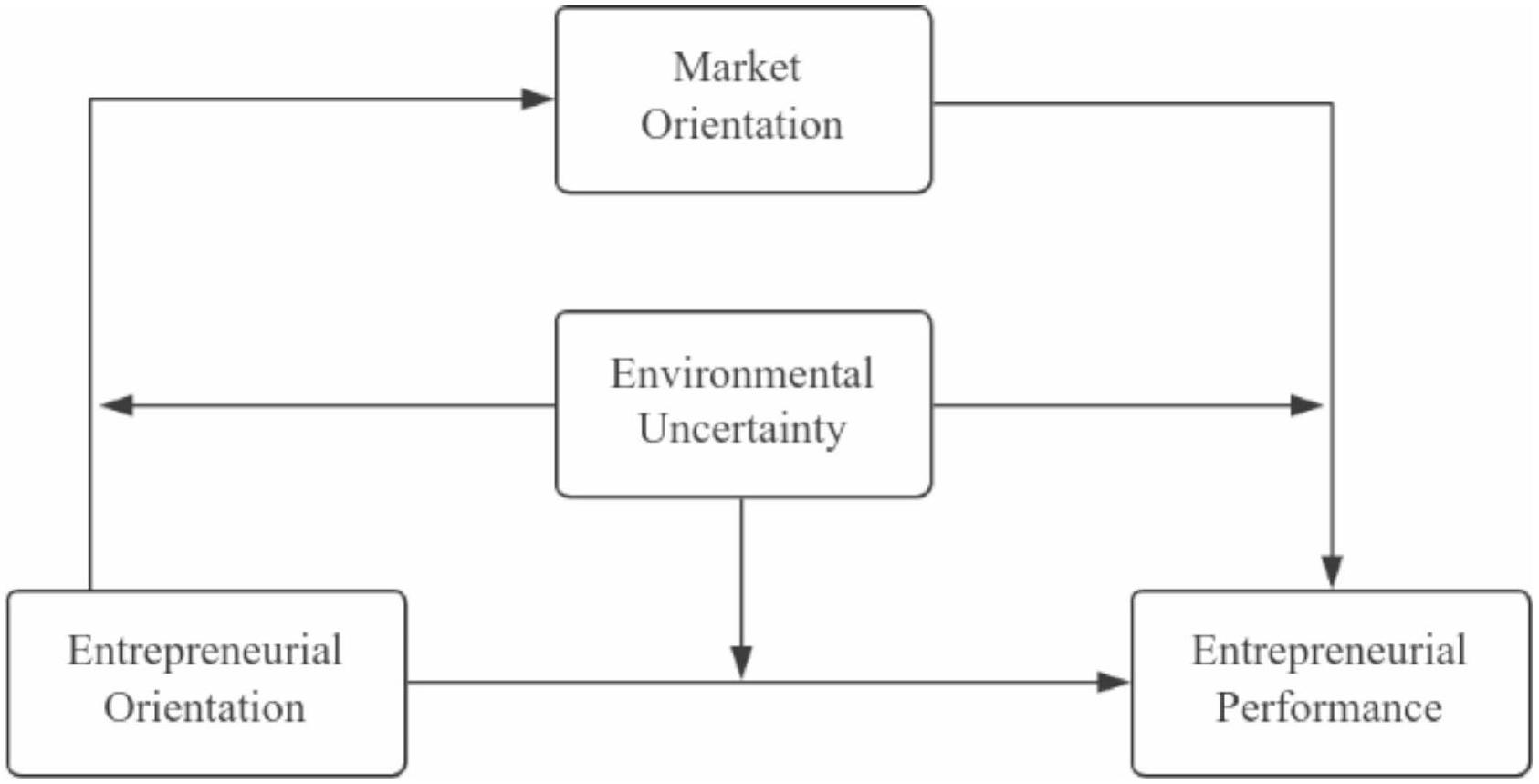
الشكل 1. دراسة النموذج.
ميزة المتقدم الأول، وتعزيز موقعهم في السوق باستمرار مع مرور الوقت. ويرجع ذلك إلى قدرتهم على استهداف الأسواق المتخصصة عالية الجودة بدقة أكبر مقارنة بالمنافسين، ووضع استراتيجيات تسعير أكثر تنافسية، وترجمة الفرص الجديدة بشكل فعال إلى عوائد ملموسة.
H1 التوجه الريادي مرتبط إيجابياً بالأداء الريادي.
التوجه الريادي، التوجه السوقي، والأداء الريادي
تنظر نظرية الموارد إلى أن الموارد المتنوعة للشركة هي مصادر ميزتها التنافسية وأدائها المتفوق. تعتبر نظرية الإدارة الاستراتيجية أن الاستراتيجية المؤسسية هي شكل من أشكال الموارد الإدارية المتنوعة، حيث تلعب التوجه الريادي – الذي يتميز بالابتكار، وتحمل المخاطر، والنظرة المستقبلية – دورًا حاسمًا في التأثير على التباينات في أداء الشركة؛ فكلما زاد مستوى التنفيذ، زاد أداء الشركة. بالإضافة إلى ذلك، يشمل التوجه السوقي، كنهج استراتيجي آخر، التوجه نحو العملاء، والتوجه نحو المنافسين، والتنسيق الداخلي. ويعمل كموارد ثقافية حيوية توجه الشركات في خلق قيمة للعملاء، وتلبية احتياجات العملاء بفعالية، ودفع الأداء المتفوق المستدام.
توجه السوق يركز على جوهر العملاء، مع التأكيد على تعديل استراتيجيات المنتجات والخدمات بناءً على رؤى عميقة حول احتياجات السوق والديناميات التنافسية لتلبية متطلبات قيمة السوق بدقة. إنه لا يوفر فقط موارد وفيرة للتعلم التنظيمي، بل يسرع أيضًا من دمج المعرفة والمعلومات الداخلية والخارجية داخل الشركة. هذه العملية تعزز تطوير
معرفة جديدة، تقنيات، ومنتجات، مما يدفع النمو المستمر لأداء الشركة
معرفة جديدة، تقنيات، ومنتجات، مما يدفع النمو المستمر لأداء الشركة
H2 التوجه الريادي مرتبط إيجابيًا بالتوجه السوقي.
لقد كان التأثير العميق للتوجه السوقي على الأداء الريادي نقطة محورية منذ فترة طويلة في الأكاديميا. تشير الأبحاث إلى أن التنفيذ الفعال لاستراتيجيات موجهة نحو السوق من قبل المؤسسات يعزز بشكل كبير تطوير المزايا التنافسية والنجاح على المدى الطويل
لقد كان التأثير العميق للتوجه السوقي على الأداء الريادي نقطة محورية منذ فترة طويلة في الأكاديميا. تشير الأبحاث إلى أن التنفيذ الفعال لاستراتيجيات موجهة نحو السوق من قبل المؤسسات يعزز بشكل كبير تطوير المزايا التنافسية والنجاح على المدى الطويل
H3 التوجه السوقي مرتبط إيجابيًا بالأداء الريادي.
يلعب التوجه السوقي والتوجه الريادي أدوارًا تكاملية في إدارة المؤسسات. يركز التوجه السوقي على العميل، ويسعى باستمرار لتلبية الاحتياجات الحالية والمحتملة. في المقابل، يمثل التوجه الريادي عقلية مستقبلية، تتميز بالاستعداد للاستكشاف والابتكار استجابة لمطالب العملاء. توفر نظرية الموارد أساسًا نظريًا لدمج هذين التوجهين، مما يبرز التوافق بين فلسفة التوجه السوقي المتمحورة حول العميل وخصائص الابتكار للتوجه الريادي. يوفر التوجه السوقي، من خلال مراقبة اتجاهات السوق والمنافسة باستمرار، معلومات قيمة لصنع القرار الريادي، مما يساعد رواد الأعمال على اغتنام الفرص. في الوقت نفسه، يعزز التوجه السوقي ولاء العملاء ويعزز مناخًا مبتكرًا، مما يضخ زخم نمو مستقر على المدى الطويل في الأداء الريادي. تشير الأبحاث إلى أن التوجه السوقي يُعتبر سلوكًا مدفوعًا بالسوق، بينما يعمل التوجه الريادي كقوة دافعة للسوق
يلعب التوجه السوقي والتوجه الريادي أدوارًا تكاملية في إدارة المؤسسات. يركز التوجه السوقي على العميل، ويسعى باستمرار لتلبية الاحتياجات الحالية والمحتملة. في المقابل، يمثل التوجه الريادي عقلية مستقبلية، تتميز بالاستعداد للاستكشاف والابتكار استجابة لمطالب العملاء. توفر نظرية الموارد أساسًا نظريًا لدمج هذين التوجهين، مما يبرز التوافق بين فلسفة التوجه السوقي المتمحورة حول العميل وخصائص الابتكار للتوجه الريادي. يوفر التوجه السوقي، من خلال مراقبة اتجاهات السوق والمنافسة باستمرار، معلومات قيمة لصنع القرار الريادي، مما يساعد رواد الأعمال على اغتنام الفرص. في الوقت نفسه، يعزز التوجه السوقي ولاء العملاء ويعزز مناخًا مبتكرًا، مما يضخ زخم نمو مستقر على المدى الطويل في الأداء الريادي. تشير الأبحاث إلى أن التوجه السوقي يُعتبر سلوكًا مدفوعًا بالسوق، بينما يعمل التوجه الريادي كقوة دافعة للسوق
H4 التوجه السوقي يتوسط إيجابيًا العلاقة بين التوجه الريادي والأداء الريادي.
التوجه الريادي، التوجه السوقي، عدم اليقين البيئي والأداء الريادي
استنادًا إلى نظرية الطوارئ، يُعتبر عدم اليقين البيئي عاملاً حاسمًا يؤثر على الخيارات الاستراتيجية والأداء المؤسسي. عند دراسة العلاقات بين التوجه الريادي، التوجه السوقي، والأداء الريادي، يلعب عدم اليقين البيئي دورًا معتدلاً ومؤثرًا كبيرًا. في البيئات ذات عدم اليقين العالي، يمكّن التوجه الريادي الشركات من الابتكار بشكل استباقي والبحث عن فرص جديدة، مما يعزز من القدرة على التكيف. في الوقت نفسه، يسمح التوجه السوقي للشركات بفهم احتياجات العملاء وديناميات المنافسة بشكل دقيق، مما يحسن من تخصيص الموارد. في هذا السياق، يمكن أن تعزز المقاربة المرنة لكل من التوجه الريادي والتوجه السوقي بشكل فعال
الأداء المؤسسي. لذلك، يجب على الشركات تعديل استراتيجياتها استجابةً للتغيرات البيئية لتحقيق الأداء الريادي الأمثل.
الأداء المؤسسي. لذلك، يجب على الشركات تعديل استراتيجياتها استجابةً للتغيرات البيئية لتحقيق الأداء الريادي الأمثل.
مع تعمق العولمة الاقتصادية وزيادة المنافسة في السوق، فإن البيئة الخارجية التي تعمل فيها المؤسسات تشهد تغييرات ديناميكية غير مسبوقة، حيث تواجه الصناعات مستويات عالية من عدم اليقين البيئي. في هذا السياق، يشير فريل إلى أنه من أجل تعزيز مواقعها في السوق، تميل المؤسسات غالبًا إلى اعتماد استراتيجيات تنافسية استباقية، حيث يُعتبر التوجه الريادي أحد أكثر الوسائل فعالية المستخدمة
H5 عدم اليقين البيئي يعزز العلاقة بين التوجه الريادي والتوجه السوقي بشكل إيجابي.
في الإجماع الأكاديمي الحالي، وسط تصاعد عدم اليقين البيئي، أصبحت المبادرات الاستباقية للمؤسسات الريادية ذات أهمية خاصة.
H6 عدم اليقين البيئي يعزز العلاقة بين التوجه الريادي والأداء الريادي بشكل إيجابي.
عندما تواجه الشركات تغييرات بيئية ناتجة عن تقلبات في معلومات السوق وتحولات في طلبات العملاء، يجب عليها تعديل استراتيجيات نشرها الاستراتيجي وتخصيص مواردها بسرعة لمواجهة التحديات التي تثيرها عدم اليقين البيئي، مما يضمن استقرار واستمرارية ميزتها التنافسية. في هذه العملية، يسرع عدم اليقين البيئي فعليًا من فطنة السوق وسرعة الاستجابة للمؤسسات الموجهة نحو السوق، مما يدفعها إلى فهم ديناميكيات السوق وطلبات العملاء والمنافسة بدقة، وبالتالي إعادة تخصيص الموارد بمرونة لتعظيم قيمة العملاء.
لرواد الأعمال. فقط من خلال فهم عميق والتكيف النشط مع التغيرات البيئية يمكن للشركات تطوير استراتيجيات سوق دقيقة وفعالة، وتسهيل عملية ريادة الأعمال، وفي النهاية تعزيز الأداء الريادي.
لرواد الأعمال. فقط من خلال فهم عميق والتكيف النشط مع التغيرات البيئية يمكن للشركات تطوير استراتيجيات سوق دقيقة وفعالة، وتسهيل عملية ريادة الأعمال، وفي النهاية تعزيز الأداء الريادي.
H7 عدم اليقين البيئي يعزز بشكل إيجابي العلاقة بين التوجه السوقي والأداء الريادي.
توجه السوق وتوجه ريادة الأعمال، كاستراتيجيات تكاملية، يظهر كل منهما تركيزات مختلفة في بناء المزايا التنظيمية. تؤثر المتغيرات البيئية، كعوامل معتدلة، بشكل عميق على مساهمات هاتين الاستراتيجيتين في الأداء التنظيمي. في بيئات السوق المضطربة، تواجه الشركات حاجة ملحة لتنفيذ استراتيجيات تجمع بين توجهات ريادة الأعمال والسوق للتكيف مع الظروف السوقية المتغيرة بسرعة. في ظل المنافسة الشديدة والتهديدات لمزاياها التنافسية بسبب اضطراب السوق، يجب أن تتمتع الشركات بدرجة عالية من المرونة والقدرة على التكيف، وامتصاص المعرفة والمعلومات والموارد الجديدة بنشاط، وضبط أو حتى إعادة تشكيل مواردها وقدراتها التنظيمية بسرعة، لمواجهة التحديات واغتنام مزايا تنافسية فريدة في البيئات الديناميكية.
H8 عدم اليقين البيئي يعزز بشكل إيجابي الدور الوسيط للتوجه الريادي الذي يؤثر على الأداء الريادي من خلال التوجه السوقي.
منهجية البحث
جمع العينات
تتناول هذه الدراسة الشركات الريادية التي تم تأسيسها منذ 8 سنوات كحد أقصى، مع عينة مأخوذة من فرق ريادية في هوباي، الصين، عبر صناعات متنوعة، بما في ذلك السيارات، والتموين، والتعليم، والخدمات. نظرًا للطبيعة متعددة الأبعاد للبحث، تم اختيار المشاركين في الاستطلاع من المؤسسين الذين يمتلكون رؤى حول المؤسسات الريادية، باستخدام مزيج من الاستطلاعات المعتمدة على الاستبيانات والمقابلات الشخصية. لضمان الصرامة العلمية لنتائج البحث، تم استخدام نهج العينة العشوائية الطبقية. تضمن هذه الطريقة أن كل وحدة في المجتمع لديها احتمال غير صفري للاختيار، مما يحافظ على مبدأ العشوائية ويقضي على التحيز الذاتي. تم اشتقاق العينة الكلية من قائمة خريجي ريادة الأعمال المقدمة من جمعيات الخريجين من 25 جامعة في مقاطعة هوباي. شملت عملية أخذ العينات ضوابط صارمة في منطقتين: اختيار الجامعات لتوزيع الاستبيانات واختيار المشاركين في المقابلات. تم تصنيف الجامعات في البداية إلى 25 طبقة متميزة، مع تخصيص رمز لكل شركة ريادية في كل مدرسة. ثم تم استخدام مولد أرقام عشوائية لاختيار نقطة انطلاق، وتم اختيار الشركات على فترات منتظمة. سمح لنا هذا الإجراء باختيار أربع شركات ريادية من كل جامعة، مما أسفر عن عينة إجمالية مكونة من 100 شركة مستهدفة لتوزيع الاستبيانات. لتعزيز موثوقية القياسات وكفاءة الاستطلاع، ركزنا على الفرق الريادية التي تتكون من خمسة أعضاء أو أكثر. بعد اتباع هذا الإجراء، استبعدنا 28 شركة ريادية، مما أسفر عن 72 شركة متبقية في العينة. ثم تم ترميز مؤسس كل شركة، وتم اختيار خمسة أفراد عشوائيًا من كل شركة كمشاركين في الاستطلاع، مما زاد من مصداقية الاستنتاجات. قبل إجراء استطلاع الاستبيان، قمنا بإجراء مقابلات شبه منظمة مع المؤسسين لضمان قدرتهم على إنجاز مهام الاستطلاع. بعد تقديم تدريب مركز، شاركوا في الاستطلاع. علاوة على ذلك، بعد الاستطلاع، أجرينا مقابلات مفتوحة مع المؤسسين للتحقق من صحة نتائج الاستبيان.
تم إجراء الاستطلاع من سبتمبر 2022 إلى فبراير 2023، حيث قمنا بتوزيع ما مجموعه 360 استبيانًا على 72 شركة ريادية. من بين هؤلاء، قدم 321 مستجيبًا ردودًا قابلة للاستخدام. لضمان موثوقية البيانات، استبعدنا أي شركة لديها أقل من استبيانين صالحين. وقد أدى هذا الإجراء إلى تقليل حجم العينة إلى 66 شركة ريادية، مما أسفر عن إجمالي 303 ردود للتحليل النهائي. من بين هذه الشركات، كان هناك 137 شركة تحت سن 3 سنوات، و101 شركة تتراوح أعمارها بين 3 و5 سنوات، و65 شركة تتراوح أعمارها بين 5 و8 سنوات. بالإضافة إلى ذلك، كان هناك 123 شركة لديها أقل من 50 موظفًا، و74 شركة لديها 50-100 موظف، و47 شركة لديها 100-200 موظف، و59 شركة لديها أكثر من 200 موظف. من حيث الإيرادات، كان هناك 122 شركة بإيرادات أقل من 10 ملايين يوان، و117 شركة بإيرادات تتراوح بين 10 و20 مليون يوان، و64 شركة بإيرادات تتجاوز 20 مليون يوان. علاوة على ذلك، كانت هناك 83 شركة في القطاع الزراعي، و87 في القطاع الصناعي، و133 في قطاع الخدمات.
قياس المتغير
ما لم يُذكر خلاف ذلك، تم إجراء جميع قياسات المتغيرات باستخدام مقياس ليكرت المكون من 5 نقاط والذي يتراوح من 1 (أوافق بشدة) إلى 5 (أوافق بشدة). لضمان تساوي المعنى، اتبعنا الإجراء الذي وضعه بريسلين لترجمة جميع عناصر قياس المتغيرات إلى الصينية، باستثناء تلك التي كانت أصلًا باللغة الصينية.
المتغير التابع
أداء ريادة الأعمال أداء ريادة الأعمال هو مقياس شامل يقيم النتائج وكفاءة الأنشطة الريادية، مما يعكس حالة إنشاء المؤسسات الجديدة، والنمو، واكتساب الميزة التنافسية. استند قياس أداء ريادة الأعمال إلى مقاييس تم تطويرها بواسطة تشاندلر وآخرين.
المتغيرات المستقلة
الاتجاه الريادي يشير الاتجاه الريادي إلى ميل استراتيجي للمؤسسات التي تسعى بنشاط إلى الابتكار، وتتحمل المخاطر، وتسعى بشكل استباقي إلى فرص النمو لدفع تطوير الأعمال. تم قياس الاتجاه الريادي باستخدام مقياس مكون من 9 عناصر تم تطويره بواسطة كوفين وآخرون.
التوجه السوقي التوجه السوقي هو فلسفة تجارية تركز على احتياجات العملاء، حيث يتم تعديل الاستراتيجيات التشغيلية بمرونة من خلال فهم عميق لاتجاهات السوق وتفضيلات العملاء لتلبية متطلبات السوق. تم قياس التوجه السوقي باستخدام مقياس مكون من 8 عناصر تم تطويره بواسطة نارفر وآخرين.
عدم اليقين البيئي يشير إلى تعقيد وتنوع البيئات الخارجية التي يصعب التنبؤ بها وفهمها. تم استخدام مقياس مكون من 7 عناصر لقياس عدم اليقين البيئي تم تطويره بواسطة يانسن وآخرين.
متغيرات التحكم
استخدمت هذه الدراسة متغيرات التحكم لضمان دقة النتائج. بشكل عام، يتأثر الأداء الريادي بالخصائص الأساسية للمؤسسات. لذلك، اعتبرت هذه الدراسة عمر المؤسسة، وحجم الشركة، وحجم المبيعات، والصناعة كمتغيرات تحكم لإزالة تأثيراتها المحتملة على نتائج البحث. تتيح هذه الطريقة تقييمًا أكثر دقة لتأثير العوامل الرئيسية الأخرى على الأداء الريادي.
| متغير كامن | عدد العناصر | M | SD | أحمال العوامل | سي آر | AVE | صلاحية التمييز | |||
| 1 | 2 | ٣ | ٤ | |||||||
| التوجه الريادي (1) | 9 | 3.53 | 0.803 | 0.850-0.905 | 0.969 | 0.774 | 0.880 | |||
| توجه السوق (2) | ٨ | ٣.٣٠ | 0.804 | 0.857-0.918 | 0.967 | 0.787 | 0.855** | 0.887 | ||
| الشكوك البيئية (3) | ٧ | 3.63 | 0.906 | 0.863-0.923 | 0.969 | 0.816 | 0.712** | 0.823** | 0.903 | |
| أداء ريادة الأعمال (4) | ٨ | 3.52 | 1.007 | 0.936-0.957 | 0.986 | 0.897 | 0.714** | 0.735** | 0.770** | 0.947 |
الجدول 1. نتائج اختبارات الموثوقية والصلاحية.
| نموذج |
|
df |
|
SRMR | RMSEA | CFI | TLI |
| نموذج العوامل الأربعة | 775.73 | ٤٥٨ | 1.694 | 0.026 | 0.048 | 0.977 | 0.975 |
| نموذج العوامل الثلاثة
|
١٣٢٩.٠٩٢ | ٤٦١ | 2.883 | 0.040 | 0.079 | 0.937 | 0.933 |
| نموذج العاملين
|
٢٦٤٠.٨٩٩ | 463 | ٥.٧٠٤ | 0.083 | 0.125 | 0.843 | 0.831 |
| نموذج أحادي الاتجاه
|
٤٤٤٢.٢٩٩ | 464 | 9.574 | 0.082 | 0.168 | 0.713 | 0.693 |
الجدول 2. نتائج تحليل العوامل التأكيدية.
النتائج
اختبار الموثوقية والصلاحية
تم اختبار موثوقية جميع المتغيرات من خلال تحليل العوامل التأكيدي، وهو نهج منهجي يضمن صلاحية واستقرار متغيرات القياس من خلال التحقق من البنى، وتقييم تحميلات العوامل، وفحص الصلاحية التلازمية، وتقديم مؤشرات ملاءمة النموذج. تقدم الجدول 1 نتائج تحليل العوامل التأكيدي. تتراوح تحميلات العوامل لكل عنصر بين 0.850 و 0.957، مع موثوقيات مركبة (CR) تتجاوز 0.9، مما يشير إلى موثوقية عالية لمقياس القياس في هذه الدراسة. متوسط التباين المستخرج (AVE) يزيد عن 0.6 لجميع المتغيرات، مما يدل على صلاحية تلازمية عالية. الجذر التربيعي لـ AVE لكل متغير أكبر من معاملات الارتباط بيرسون مع المتغيرات الكامنة الأخرى، مما يشير إلى صلاحية تمييز جيدة لمقياس القياس في هذه الدراسة. تشير هذه النتائج إلى أن صلاحية البناء وموثوقية المتغيرات الكامنة في نموذج القياس لهذه الدراسة تلبي معايير التقييم المقترحة من قبل فورنيل ولارك، مما يجعل بيانات العينة مناسبة كأساس بحثي تجريبي لهذه الدراسة. بالإضافة إلى ذلك، يقدم الجدول 2 أيضًا المتوسطات (M) والانحرافات المعيارية (SD) للمتغيرات. الانحرافات المعيارية للتوجه الريادي، والتوجه السوقي، وعدم اليقين البيئي، والأداء الريادي صغيرة نسبيًا، مع قيم متوسطة من
استخدمت هذه الدراسة برنامج أموس 24.0 لإجراء تحليل عامل تأكيدي لاختبار الصلاحية التمييزية للمتغيرات، مع عرض النتائج في الجدول 2. من الواضح من التحليل أن نموذج العوامل الأربعة يظهر أفضل مؤشرات الملاءمة.
اختبار التأثيرات المباشرة
تستخدم هذه الدراسة نهج تحليل الانحدار الخطي المتعدد لفحص التأثيرات المباشرة وغير المباشرة وتأثيرات الوساطة بشكل دقيق. على وجه التحديد، تستخدم برنامج Process الذي طوره هايز.
| المتغيرات | النموذج 1 (EP كمتغير تابع) | النموذج 2 (MO كمتغير تابع) | موديل 3 (EP كـ DV) | |||||||||
|
|
SE | LLCI | ULCI |
|
SE | LLCI | ULCI |
|
SE | LLCI | ULCI | |
| ثابت | 0.077 | 0.265 | -0.445 | 0.598 | 0.480 | 0.156 | 0.172 | 0.788 | -0.209 | 0.253 | -0.706 | 0.288 |
| EA | 0.088 | 0.052 | -0.015 | 0.190 | -0.009 | 0.031 | -0.069 | 0.052 | 0.093 | 0.049 | -0.003 | 0.189 |
| إس | 0.031 | 0.036 | -0.039 | 0.102 | -0.027 | 0.021 | -0.068 | 0.015 | 0.047 | 0.034 | -0.019 | 0.114 |
| SS | -0.012 | 0.054 | -0.118 | 0.093 | -0.070 | 0.032 | -0.132 | -0.008 | 0.030 | 0.051 | -0.070 | 0.129 |
| في | 0.051 | 0.050 | -0.046 | 0.149 | -0.006 | 0.029 | -0.063 | 0.052 | 0.055 | 0.047 | -0.037 | 0.147 |
| EO | 0.889 | 0.051 | 0.789 | 0.989 | 0.860 | 0.030 | 0.801 | 0.919 | 0.377 | 0.093 | 0.195 | 0.559 |
| مو | 0.595 | 0.092 | 0.414 | 0.777 | ||||||||
| ف | 63.684 | ١٦٦.١٣٧ | 67.280 | |||||||||
| ر
|
0.517 | 0.737 | 0.577 | |||||||||
الجدول 3. اختبار التأثيرات المباشرة.
| علاقة الوساطة | تأثير المسار |
|
إقلاع SE(SE) | LLCI (شركة ذات مسؤولية محدودة Boot) | يو إل سي آي (بوت يو إل سي آي) |
|
|
التأثير الكلي | 0.889 | 0.051 | 0.789 | 0.989 |
| الأثر المباشر | 0.377 | 0.093 | 0.195 | 0.559 | |
| أثر غير مباشر | 0.512 | 0.079 | 0.362 | 0.667 |
الجدول 4. تحليل البوتستراب لتأثيرات الوساطة.
للتوجيه تأثير إيجابي كبير على التوجه السوقي
اختبار تأثيرات الوساطة
وفقًا لنتائج النموذج 1 والنموذج 3، من الواضح أنه حتى بعد تضمين التوجه السوقي، لا يزال التوجه الريادي يؤثر بشكل إيجابي على الأداء الريادي.
اختبار تأثيرات الاعتدال
في إجراء اختبار تأثيرات التعديل، تم استخدام برنامج Process الذي طوره أندرو ف. هايز. تم استخدام برنامج Process 3 داخل برنامج SPSS 26.0 لتحليل تأثير التعديل بعد دمج التوجه السوقي من خلال 5000 عينة bootstrap. بعد التحكم في عمر الشركة، وحجم الشركة، وحجم المبيعات، والصناعة، تم تقديم نتائج اختبار تأثيرات التعديل في الجدولين 5 و6، مع عرض التأثيرات الوسيطة المعدلة في الجدول 7. من النتائج في النموذج 4 كما هو موضح في الجدول 5، من الواضح أن مصطلح التفاعل بين التوجه الريادي وعدم اليقين البيئي له تأثير إيجابي كبير على التوجه السوقي.
| المتغيرات | النموذج 4 (MO كمتغير تابع) | النموذج 5 (EP كـ DV) | ||||||
|
|
SE | LLCI | ULCI |
|
SE | LLCI | ULCI | |
| ثابت | 0.250 | 0.097 | 0.059 | 0.441 | 3.354 | 0.179 | ٣.٠٠٢ | ٣.٧٠٧ |
| EA | -0.015 | 0.024 | -0.062 | 0.032 | 0.079 | 0.044 | -0.007 | 0.166 |
| إس | -0.025 | 0.017 | -0.057 | 0.008 | 0.036 | 0.030 | -0.024 | 0.095 |
| SS | -0.070 | 0.025 | -0.118 | -0.021 | -0.019 | 0.046 | -0.109 | 0.071 |
| في | -0.044 | 0.023 | -0.089 | 0.002 | 0.019 | 0.043 | -0.066 | 0.١٠٣ |
| EO | 0.553 | 0.033 | 0.487 | 0.619 | 0.311 | 0.087 | 0.140 | 0.481 |
| مو | 0.200 | 0.113 | -0.021 | 0.422 | ||||
| الاتحاد الأوروبي | 0.419 | 0.030 | 0.359 | 0.479 | 0.509 | 0.072 | 0.366 | 0.651 |
|
|
0.096 | 0.024 | 0.048 | 0.143 | 0.236 | 0.١٠٣ | 0.032 | 0.٤٣٩ |
|
|
-0.299 | 0.108 | -0.510 | -0.087 | ||||
| ف | ٢٢١.٨٣٨ | ٦٤٫٠٩٨ | ||||||
|
|
0.840 | 0.663 | ||||||
الجدول 5. اختبار تأثيرات التعديل.
| علاقة الاعتدال | فهرس |
|
SE | LLCI | ULCI |
|
|
التأثير 1 (الاتحاد الأوروبي = م – 1 انحراف معياري) | 0.466 | 0.039 | 0.390 | 0.543 |
| التأثير 2 (
|
0.553 | 0.033 | 0.487 | 0.619 | |
| أثر3 (الاتحاد الأوروبي
|
0.640 | 0.041 | 0.559 | 0.721 | |
|
|
التأثير 1 (
|
0.097 | 0.134 | -0.168 | 0.361 |
| التأثير2 (
|
0.311 | 0.087 | 0.140 | 0.481 | |
| التأثير 3 (الاتحاد الأوروبي = م + 1 انحراف معياري) | 0.524 | 0.121 | 0.287 | 0.762 | |
|
|
التأثير 1 (
|
0.471 | 0.172 | 0.133 | 0.809 |
| التأثير2 (
|
0.200 | 0.113 | -0.021 | 0.422 | |
| التأثير 3 (الاتحاد الأوروبي = م + 1 انحراف معياري) | -0.070 | 0.122 | -0.311 | 0.170 |
الجدول 6. تحليل تأثيرات التعديل.
| نتيجة | فهرس |
|
بوت SE | بوت LLCI | بوت ULCI |
| التأثيرات غير المباشرة الشرطية | التأثير 1 (الاتحاد الأوروبي = م – 1 انحراف معياري) | 0.220 | 0.090 | 0.045 | 0.402 |
| التأثير2 (
|
0.111 | 0.064 | -0.011 | 0.243 | |
| التأثير 3 (الاتحاد الأوروبي = م + 1 انحراف معياري) | -0.045 | 0.066 | -0.175 | 0.084 | |
| التباينات الزوجية بين التأثيرات غير المباشرة الشرطية | التأثير2-التأثير1 | -0.109 | 0.042 | -0.192 | -0.025 |
| التأثير3-التأثير1 | -0.265 | 0.105 | -0.474 | -0.061 | |
| التأثير3-التأثير2 | -0.156 | 0.063 | -0.284 | -0.037 |
الجدول 7. اختبار البوتستراب لتأثيرات الوساطة المعتدلة.
الأداء (
أجرت هذه الدراسة تحليل انحدار بسيط لتأثيرات التعديل باستخدام المتوسط (M) لعدم اليقين البيئي وانحراف معياري واحد (SD) فوقه وتحتها كنقاط مرجعية. تم تقديم النتائج في الجدول 6. عندما يكون عدم اليقين البيئي
عدم تأثير عدم اليقين البيئي والتوجه الريادي بشكل كبير على الأداء الريادي
عدم تأثير عدم اليقين البيئي والتوجه الريادي بشكل كبير على الأداء الريادي
لتوضيح تأثير عدم اليقين البيئي بشكل واضح، استنادًا إلى التحليل في الجدول 7، قامت هذه الدراسة برسم رسوم بيانية لتأثير التعديل باستخدام انحراف معياري واحد فوق وتحت متوسط الموقف الريادي كمعايير. النتائج، كما هو موضح في الأشكال 2 و3 و4، تتماشى مع الاستنتاجات المستخلصة من التحليل أعلاه.
فحص تأثيرات الوساطة المعدلة
تقدم هذه الدراسة لتحليل تأثيرات الوساطة المعدلة، حيث تم إجراء اختبارات عند المتوسط (M) لعدم اليقين البيئي وانحراف معياري واحد (SD) فوق وتحت هذا المتوسط، كما هو موضح في الجدول 7.
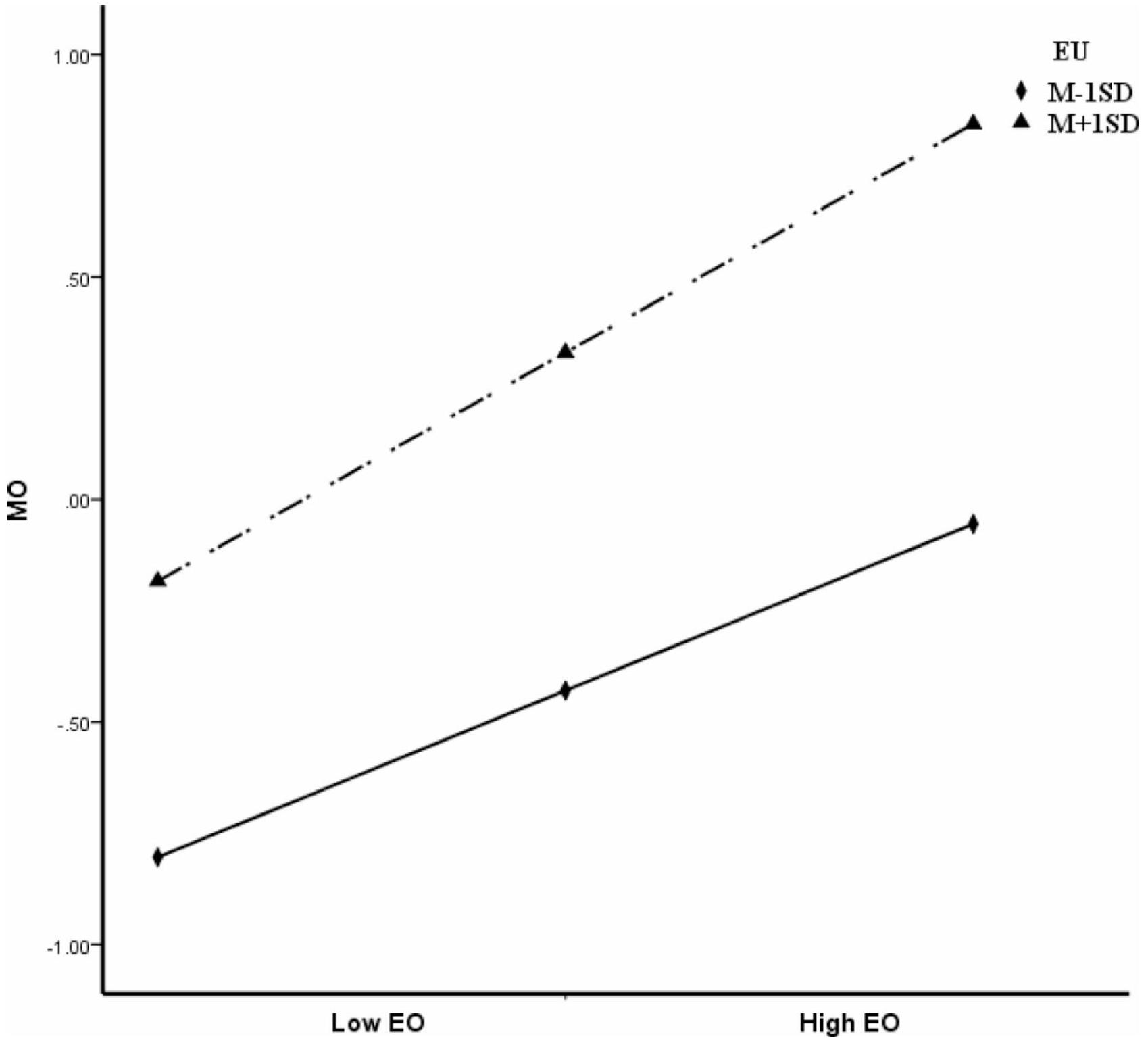
الشكل 2. تأثيرات التعديل لعدم اليقين البيئي على التوجه الريادي والتوجه السوقي.
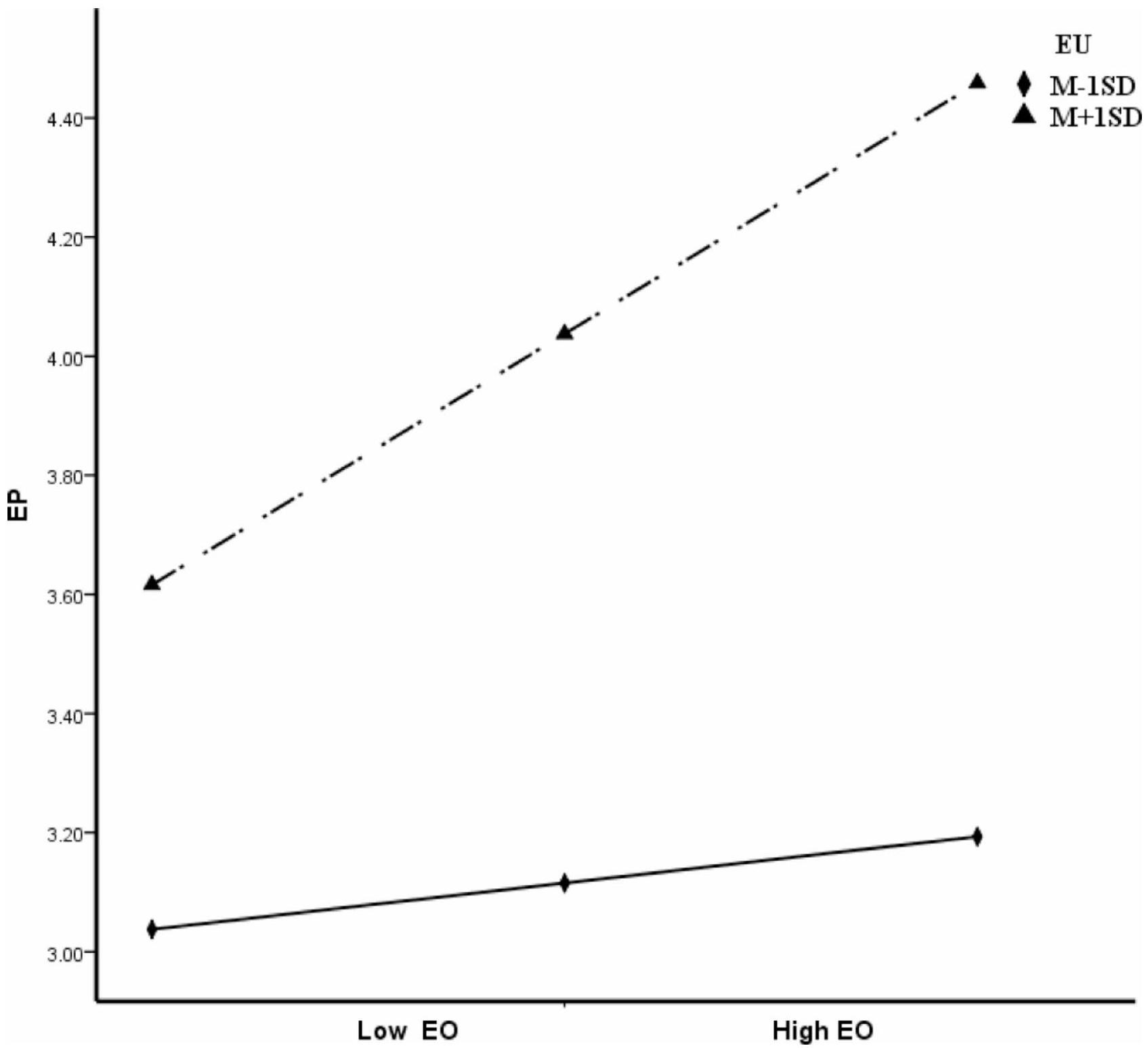
الشكل 3. تأثيرات التعديل لعدم اليقين البيئي على التوجه الريادي والأداء الريادي.
أظهرت النتائج أنه عندما يساوي الاتحاد الأوروبي متوسطه، فإن تأثير عدم اليقين البيئي على الوساطة بين التوجه الريادي والأداء الريادي من خلال التوجه السوقي غير ذي دلالة.
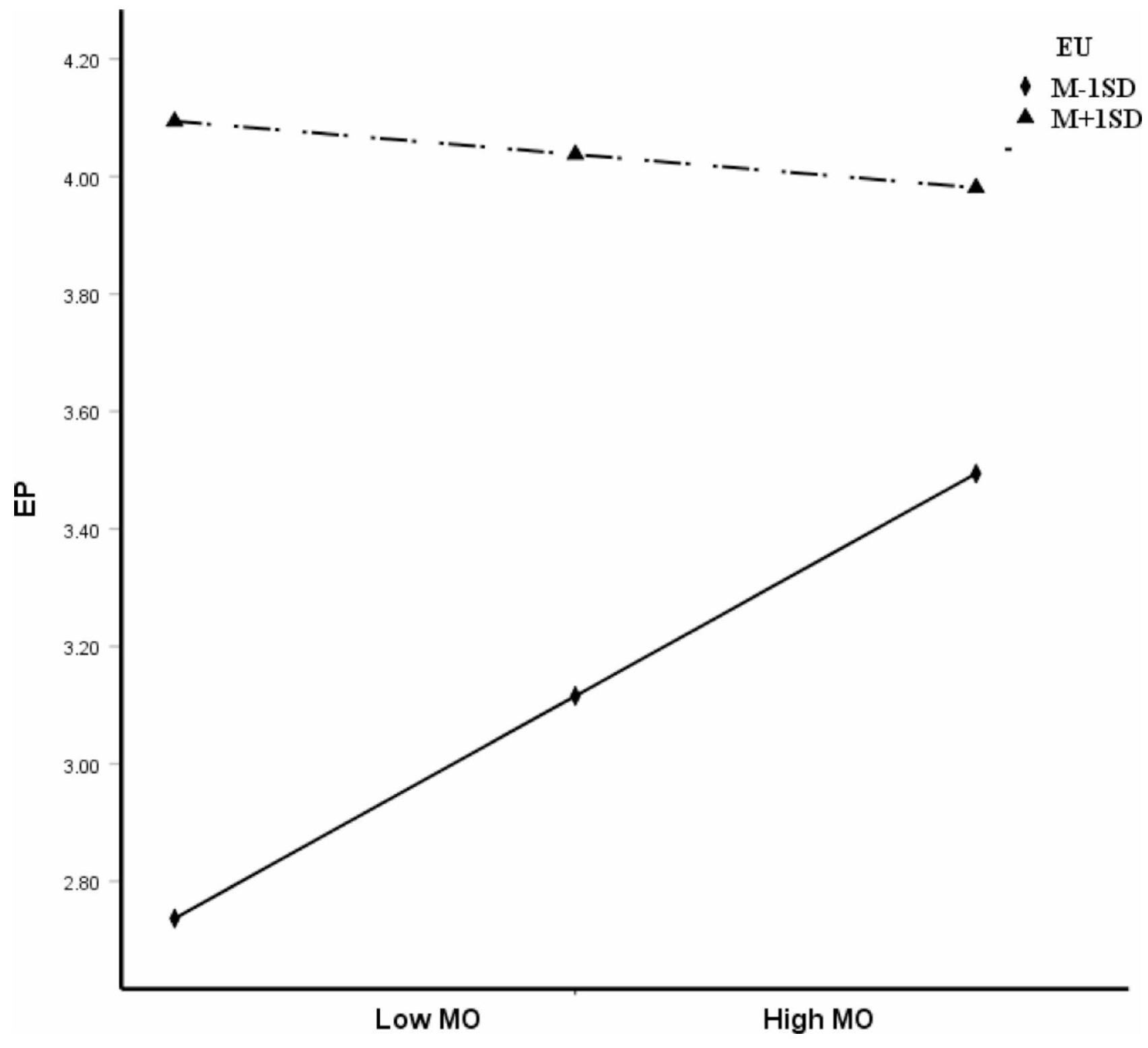
الشكل 4. تأثيرات التعديل لعدم اليقين البيئي على التوجه السوقي والأداء الريادي.
تعقيد معلومات السوق يجعل من الصعب التمييز بين المعلومات الحقيقية والمزيفة، مما يعيق قدرة الشركة على الحصول على رؤى قيمة من السوق. في مثل هذه الظروف، يصبح دور التوجه نحو السوق ضعيفًا بشكل ملحوظ، مما يؤثر بشكل ضئيل على تعزيز الأداء الريادي.
اختبار المتانة
في هذه الدراسة، تم إجراء اختبار للمتانة على النموذج المُنشأ للتحقق من صحة نتائجنا الأساسية. نظرًا لأن بكين وشنغهاي تعتبران المركزين السياسيين والاقتصاديين في الصين، فإن الشركات المسجلة في هاتين المنطقتين لا تمثل السكان العامين. لذلك، تم استبعاد العينات المسجلة في هاتين المنطقتين، مما ترك 239 عينة لتحليل المتانة، مما يمثل حوالي
نتائج اختبار الفرضيات
تؤسس هذه الدراسة نموذج وساطة معتدلة فريد من نوعه من خلال ربط التوجه الريادي، والتوجه السوقي، والأداء الريادي من خلال تعديل عدم اليقين البيئي. تكشف النتائج أن الفرضيات H1 إلى H6 مدعومة، بينما الفرضيات H7 وH8 ليست كذلك. على وجه التحديد، يمارس التوجه الريادي تأثيرًا إيجابيًا كبيرًا على الأداء الريادي والتوجه السوقي، مما يدعم الفرضيتين H1 وH2. للتوجه السوقي تأثير إيجابي كبير على الريادة.
| المتغيرات | النموذج 6 (EP كـ DV) | النموذج 7 (MO كمتغير تابع) | النموذج 8 (EP كـ DV) | |||||||||
|
|
SE | LLCI | ULCI |
|
SE | LLCI | ULCI |
|
SE | LLCI | ULCI | |
| ثابت | 0.311 | 0.317 | -0.314 | 0.935 | 0.370 | 0.191 | -0.006 | 0.747 | 0.096 | 0.300 | -0.495 | 0.687 |
| EA | 0.078 | 0.059 | -0.038 | 0.193 | -0.006 | 0.035 | -0.076 | 0.063 | 0.081 | 0.055 | -0.028 | 0.190 |
| إس | 0.026 | 0.041 | -0.055 | 0.107 | -0.013 | 0.025 | -0.062 | 0.036 | 0.033 | 0.039 | -0.043 | 0.109 |
| SS | -0.032 | 0.060 | -0.150 | 0.086 | -0.080 | 0.036 | -0.151 | -0.009 | 0.014 | 0.057 | -0.098 | 0.126 |
| في | 0.024 | 0.058 | -0.090 | 0.137 | 0.017 | 0.035 | -0.052 | 0.085 | 0.014 | 0.054 | -0.093 | 0.120 |
| EO | 0.852 | 0.058 | 0.738 | 0.966 | 0.869 | 0.035 | 0.801 | 0.938 | 0.348 | 0.104 | 0.143 | 0.553 |
| مو | 0.580 | 0.102 | 0.379 | 0.781 | ||||||||
| ف | ٤٥.٠٥٠ | 127.302 | ٤٧.٩٥٣ | |||||||||
| ر
|
0.492 | 0.732 | 0.554 | |||||||||
الجدول 8. اختبار متانة تأثيرات مباشرة.
| علاقة الوساطة | تأثير المسار |
|
بوت إس إي (SE) | LLCI (شركة ذات مسؤولية محدودة Boot) | يو إل سي آي (بوت يو إل سي آي) |
|
|
التأثير الكلي | 0.852 | 0.058 | 0.738 | 0.966 |
| الأثر المباشر | 0.348 | 0.104 | 0.143 | 0.553 | |
| أثر غير مباشر | 0.504 | 0.089 | 0.339 | 0.683 |
الجدول 9. اختبار قوة التحمل باستخدام طريقة البوتستراب لتحليل الوساطة.
| المتغيرات | النموذج 9 (MO كـ DV) | النموذج 10 (EP كـ DV) | ||||||
|
|
SE | LLCI | ULCI |
|
SE | LLCI | ULCI | |
| ثابت | 0.199 | 0.117 | -0.032 | 0.430 | ٣٫٥٠٠ | 0.211 | ٣.٠٨٥ | ٣.٩١٥ |
| EA | -0.011 | 0.028 | -0.066 | 0.043 | 0.069 | 0.050 | -0.029 | 0.166 |
| إس | -0.012 | 0.020 | -0.050 | 0.027 | 0.029 | 0.035 | -0.040 | 0.098 |
| SS | -0.079 | 0.028 | -0.135 | -0.023 | -0.037 | 0.052 | -0.139 | 0.064 |
| في | -0.030 | 0.028 | -0.084 | 0.024 | -0.022 | 0.049 | -0.119 | 0.076 |
| EO | 0.547 | 0.040 | 0.469 | 0.625 | 0.248 | 0.098 | 0.055 | 0.442 |
| مو | 0.230 | 0.126 | -0.018 | 0.478 | ||||
| الاتحاد الأوروبي | 0.427 | 0.035 | 0.358 | 0.497 | 0.492 | 0.082 | 0.330 | 0.654 |
|
|
0.102 | 0.027 | 0.049 | 0.154 | 0.284 | 0.113 | 0.060 | 0.507 |
|
|
-0.333 | 0.118 | -0.566 | -0.100 | ||||
| ف | 168.586 | ٤٦.١٨٨ | ||||||
|
|
0.836 | 0.645 | ||||||
الجدول 10. اختبار قوة التأثيرات المعتدلة.
| نتيجة | فهرس |
|
بوت SE | بوت LLCI | بوت ULCI |
| التأثيرات غير المباشرة الشرطية | التأثير 1 (الاتحاد الأوروبي = م – 1 انحراف معياري) | 0.244 | 0.098 | 0.062 | 0.445 |
| التأثير2 (
|
0.126 | 0.072 | -0.008 | 0.276 | |
| التأثير 3 (الاتحاد الأوروبي = م + 1 انحراف معياري) | -0.050 | 0.071 | -0.196 | 0.091 |
الجدول 11. فحص المتانة لتحليل الوساطة المعتدلة.
الأداء، مما يثبت الفرضية H3. علاوة على ذلك، فإن التأثير الوسيط بين التوجه الريادي والأداء الريادي ذو دلالة إيجابية، مما يدعم الفرضية H4. كما أن عدم اليقين البيئي يعدل بشكل كبير تأثير التوجه الريادي على التوجه السوقي والأداء الريادي بشكل إيجابي، مما يؤكد الفرضيتين H5 و H6. ومع ذلك، فإن التأثير السلبي للتعديل الناتج عن عدم اليقين البيئي على العلاقة بين التوجه السوقي والأداء الريادي (H7) والتأثير غير الدال للتعديل على تأثير التوجه الريادي على الأداء الريادي من خلال التوجه السوقي (H8) غير مدعومين. من بين الفرضيات الثماني المقترحة في هذه الدراسة، تم التحقق من ستة بينما لم يتم التحقق من اثنتين، حيث تركزت الفرضيات غير المصدقة بشكل أساسي على الدور المعدل لعدم اليقين البيئي على التوجه السوقي والأداء الريادي. تم تقديم ملخص للاستنتاجات المستخلصة من تحليل البيانات وحالة التحقق من الفرضيات في الجدول 12.
| رقم افتراضي | فرضية البحث | نتيجة |
| H1 | هناك علاقة إيجابية بين التوجه الريادي والأداء الريادي | مدعوم |
| H2 | هناك علاقة إيجابية بين التوجه الريادي والتوجه السوقي | مدعوم |
| H3 | هناك علاقة إيجابية بين التوجه السوقي والأداء الريادي | مدعوم |
| H4 | توجه السوق يتوسط بشكل إيجابي العلاقة بين التوجه الريادي والأداء الريادي | مدعوم |
| H5 | عدم اليقين البيئي يعزز بشكل إيجابي العلاقة بين التوجه الريادي والتوجه السوقي | مدعوم |
| H6 | عدم اليقين البيئي يعزز بشكل إيجابي العلاقة بين التوجه الريادي والأداء الريادي | مدعوم |
| H7 | عدم اليقين البيئي يعزز العلاقة بين التوجه السوقي والأداء الريادي بشكل إيجابي | غير مدعوم |
| H8 | العلاقة بين عدم اليقين البيئي التي تعزز الاتجاه الريادي من خلال الاتجاه السوقي الذي يعزز الأداء الريادي. | غير مدعوم |
الجدول 12. ملخص نتائج البحث.
نقاش
تشير دراسة الفرضيات H1 وH2 وH3 وH4 إلى أن التوجه الريادي لا يؤثر فقط بشكل كبير وإيجابي على التوجه السوقي وأداء ريادة الأعمال، بل يمارس أيضًا تأثيرًا إيجابيًا غير مباشر على أداء ريادة الأعمال من خلال التوجه السوقي. علاوة على ذلك، فإن التوجه السوقي نفسه له تأثير إيجابي ملحوظ على أداء ريادة الأعمال. تؤكد هذه النتيجة بشكل قاطع على أن التوجه الريادي هو مصدر محوري للأداء المتفوق في المؤسسات، حيث يؤثر إيجابيًا على أداء ريادة الأعمال بطريقتين متميزتين. أولاً، من منظور نظرية الموارد، فإن التأثير المباشر للتوجه الريادي كبير، ويتماشى مع نتائج ياو وآخرين.
تشير نتائج الفحص للفرضيتين H5 و H6 إلى أن عدم اليقين البيئي يعزز بشكل إيجابي تأثير التوجه الريادي على كل من التوجه السوقي والأداء الريادي. تدعم هذه النتيجة الاستنتاجات التي توصل إليها غوان وآخرون.
تشير نتائج امتحان الفرضية H7 إلى أن عدم اليقين البيئي يؤثر سلبًا على تأثير التوجه السوقي على الأداء الريادي. تتناقض هذه النتيجة مع النتائج السابقة لجوروسكي وآخرين.
كنموذج متغير سابق في النموذج، تصميم تحويلي يمكّن من فهم أكثر شمولية لكيفية تأثير عدم اليقين البيئي سلبًا على تأثير التوجه السوقي على الأداء الريادي. هذه الاكتشافات المهمة تعمق فهمنا للآليات الأساسية التي تلعب دورًا بين التوجه السوقي والأداء الريادي، موضحة كيف يؤثر التوجه السوقي بشكل مختلف على أداء الشركات تحت ظروف بيئية متغيرة. من منظور نظرية الطوارئ، يمارس عدم اليقين البيئي تأثيرات مختلفة بشكل ملحوظ على التوجه السوقي اعتمادًا على درجته. في بيئة ذات عدم يقين منخفض، حيث تعمل الشركات ضمن سياق مستقر نسبيًا، يلتقط التوجه السوقي بفعالية احتياجات العملاء، مما يعزز الأداء. على العكس، في بيئة ذات عدم يقين مرتفع تتميز بتغيرات مضطربة في الأسواق والتقنيات، قد تؤدي الموارد التي تستثمرها الشركات في السعي نحو التوجه السوقي بشكل غير مقصود إلى صلابة استراتيجية. في مثل هذه السيناريوهات، تعيق غياب المرونة الاستراتيجية قدرة الشركات على التكيف بسرعة مع التحولات البيئية، مما يؤدي حتمًا إلى تراجع الأداء. لا توفر هذه الاكتشافات دعمًا تجريبيًا جديدًا للعلاقة بين التوجه السوقي والأداء الريادي فحسب، بل توسع أيضًا نطاق تطبيق نظرية الطوارئ. إنها تبرز أهمية أن تقوم الشركات بتعديل استراتيجيات التوجه السوقي بمرونة استجابةً للظروف الخارجية المتغيرة، مما يحمي أدائها من التأثيرات السلبية. وبالتالي، تقدم هذه الدراسة منظورًا جديدًا لكل من النظرية والممارسة، مما يمكّن الشركات من إدارة التوجه السوقي بفعالية وسط عدم اليقين البيئي ورفع أدائها الريادي.
كنموذج متغير سابق في النموذج، تصميم تحويلي يمكّن من فهم أكثر شمولية لكيفية تأثير عدم اليقين البيئي سلبًا على تأثير التوجه السوقي على الأداء الريادي. هذه الاكتشافات المهمة تعمق فهمنا للآليات الأساسية التي تلعب دورًا بين التوجه السوقي والأداء الريادي، موضحة كيف يؤثر التوجه السوقي بشكل مختلف على أداء الشركات تحت ظروف بيئية متغيرة. من منظور نظرية الطوارئ، يمارس عدم اليقين البيئي تأثيرات مختلفة بشكل ملحوظ على التوجه السوقي اعتمادًا على درجته. في بيئة ذات عدم يقين منخفض، حيث تعمل الشركات ضمن سياق مستقر نسبيًا، يلتقط التوجه السوقي بفعالية احتياجات العملاء، مما يعزز الأداء. على العكس، في بيئة ذات عدم يقين مرتفع تتميز بتغيرات مضطربة في الأسواق والتقنيات، قد تؤدي الموارد التي تستثمرها الشركات في السعي نحو التوجه السوقي بشكل غير مقصود إلى صلابة استراتيجية. في مثل هذه السيناريوهات، تعيق غياب المرونة الاستراتيجية قدرة الشركات على التكيف بسرعة مع التحولات البيئية، مما يؤدي حتمًا إلى تراجع الأداء. لا توفر هذه الاكتشافات دعمًا تجريبيًا جديدًا للعلاقة بين التوجه السوقي والأداء الريادي فحسب، بل توسع أيضًا نطاق تطبيق نظرية الطوارئ. إنها تبرز أهمية أن تقوم الشركات بتعديل استراتيجيات التوجه السوقي بمرونة استجابةً للظروف الخارجية المتغيرة، مما يحمي أدائها من التأثيرات السلبية. وبالتالي، تقدم هذه الدراسة منظورًا جديدًا لكل من النظرية والممارسة، مما يمكّن الشركات من إدارة التوجه السوقي بفعالية وسط عدم اليقين البيئي ورفع أدائها الريادي.
تشير نتائج امتحان الفرضية H8 إلى أن عدم اليقين البيئي لا يعدل بشكل كبير التأثير الوسيط للتوجه الريادي على الأداء الريادي من خلال التوجه السوقي. ضمن إطار نظرية الطوارئ، يُعترف بعدم اليقين البيئي كعامل محوري يؤثر على الخيارات الاستراتيجية للشركات، مما يتطلب استراتيجيات مرنة للتكيف مع التغيرات الخارجية عبر ظروف متغيرة. وبالتالي، قد لا يكون دور عدم اليقين البيئي في تعديل تأثير التوجه الريادي على الأداء الريادي عبر التوجه السوقي بارزًا كما كان يُفترض تقليديًا. أولاً، تؤكد نظرية الطوارئ على أهمية مراعاة التحولات البيئية الخارجية عند صياغة استراتيجيات الشركات. بينما يهدف التوجه السوقي إلى تسهيل فهم وتلبية احتياجات العملاء، فإن زيادة عدم اليقين البيئي تعرض الشركات لإشارات سوقية معقدة وغامضة. وهذا يعني أنه، على الرغم من أن التوجه السوقي يمكن أن يعزز الأداء الريادي، فإن البيئة الخارجية المتطورة بسرعة قد تعيق الشركات عن التقاط احتياجات العملاء بدقة، مما يقلل من فعالية تحسين الأداء.
تداعيات النظرية
تقدم هذه الدراسة مساهمات نظرية بالطرق التالية: أولاً، استكشفت الأدبيات السابقة بشكل موسع العلاقات بين التوجه الريادي، التوجه السوقي، الأداء الريادي، وعدم اليقين البيئي بشكل فردي. ومع ذلك، فإن الدراسات التي تدمج هذه العوامل الأربعة في إطار بحث واحد نادرة نسبيًا. من خلال توضيح العلاقات بين التوجه الريادي، التوجه السوقي، الأداء الريادي، وعدم اليقين البيئي، تُثري هذه الدراسة النتائج في مجال ريادة الأعمال. من منظور نظرية الإدارة الاستراتيجية، يساعد دمج هذه المتغيرات في تحديد الأساس الذي يمكن أن تختار عليه الشركات استراتيجيات مناسبة تحت ظروف بيئية متغيرة، مما يعزز قدرتها التنافسية.
تداعيات الممارسة
تساهم هذه الدراسة في الممارسة بالطرق التالية: أولاً، التوجه الريادي للشركات الناشئة. يجب على المشاريع الريادية أن تدرك أهمية التوجه الريادي. بسبب عوامل مثل الحجم الأصغر والموارد المحدودة، تمتلك الشركات الناشئة مرونة أكبر بشكل فطري. تتيح لهم هذه المرونة التصرف قبل المنافسين. بالنسبة للمشاريع الجديدة، فإن النمو السريع والاستحواذ على حصص سوقية أكبر
ضروريان للتنمية المستدامة.
ضروريان للتنمية المستدامة.
القيود والاتجاهات المستقبلية
تساهم هذه الدراسة، بينما تساهم في النقاش حول التوجه الريادي، والتوجه السوقي، وعدم اليقين البيئي، إلا أنها لا تخلو من قيودها. أولاً، نعترف بأن التحليل التجريبي يعتمد فقط على عينة من الشركات الريادية داخل مقاطعة هوبي، مما يقيّد إمكانية تعميم نتائجنا. يثير النطاق الجغرافي الضيق للعينة مخاوف بشأن تمثيل بياناتنا، مما يشير إلى الحاجة إلى أبحاث مستقبلية لتوسيع حدود العينة لتغطية منطقة أو مستوى وطني أوسع، مع الأخذ في الاعتبار التباين الإقليمي في الموارد الريادية التي قد تؤثر على العلاقات التي استكشفناها. ثانياً، فإن قابلية تطبيق الرؤى المستخلصة من هذه الدراسة خارج مقاطعة هوبي وحتى على المستوى الوطني غير مؤكدة. قد لا تكون النتائج متسقة عبر بيئات اقتصادية مختلفة، وأطر تنظيمية، وسياقات ثقافية. لمعالجة هذه القيود، يجب على الدراسات المستقبلية تكرار التحليل في مناطق أو دول أوسع للتحقق من نتائجنا وتعزيز إمكانية تعميم استنتاجاتنا. أخيراً، تركز الدراسة الحالية فقط على الدور الوسيط لعدم اليقين البيئي كمتغير خارجي في العلاقة بين التوجه الريادي، والتوجه السوقي، والأداء الريادي. ومع ذلك، لم يتم استكشاف تأثير المتغيرات الداخلية داخل المنظمة، مثل الثقافة المؤسسية والهيكل التنظيمي، على هذه العلاقة. يمكن أن تمتد الأبحاث المستقبلية الإطار من خلال دمج هذه العوامل الداخلية لتوفير فهم أكثر شمولية للتفاعل الديناميكي بين العوامل التنظيمية الداخلية والتأثيرات البيئية الخارجية. سيساهم معالجة هذه القيود في الأبحاث المستقبلية في تعزيز قوة وموثوقية نتائجنا، كما سيساهم في تقديم منظور أكثر دقة وشمولية حول العوامل التي تؤثر على نجاح ريادة الأعمال في سياقات متنوعة.
الخاتمة
تؤكد هذه الدراسة ثمانية فرضيات وتقدم الاستنتاجات الرئيسية التالية: أولاً، يلعب التوجه السوقي دوراً وسيطاً بين التوجه الريادي والأداء الريادي. بشكل محدد، يمكن أن يؤثر التوجه الريادي بشكل إيجابي مباشر على الأداء الريادي ويمكن أيضاً أن يؤثر أولاً بشكل إيجابي على التوجه السوقي، الذي يؤثر بدوره إيجابياً على الأداء الريادي، مما يؤثر بشكل غير مباشر على الأداء الريادي. ثانياً، يقوم عدم اليقين البيئي بتعديل العلاقات بين التوجه الريادي، والتوجه السوقي، والأداء الريادي بشكل متزامن. يقوم عدم اليقين البيئي بتعديل العلاقة بين التوجه الريادي والتوجه السوقي بشكل إيجابي، ويقوم بتعديل العلاقة بين التوجه الريادي والأداء الريادي بشكل إيجابي. أخيراً، يقوم عدم اليقين البيئي بتعديل العلاقة بين التوجه السوقي والأداء الريادي بشكل سلبي. ومع ذلك، لا يقوم عدم اليقين البيئي بتعديل تأثير التوجه الريادي على الأداء الريادي من خلال التوجه السوقي.
تشير النتائج التجريبية إلى أن الشركات التي تركز بشكل خالص على ريادة الأعمال أو التوجه السوقي نادرة في الواقع؛ وغالباً ما تتواجد هاتان الاستراتيجيتان معاً داخل نفس الشركة. يحتاج رواد الأعمال إلى الدعوة لتعزيز الروح الريادية وتنفيذ استراتيجيات موجهة نحو ريادة الأعمال، مع التأكيد أيضاً على تطوير استراتيجيات موجهة نحو السوق لتعزيز فعالية استراتيجيات موجهة نحو ريادة الأعمال في تعزيز الأنشطة الريادية. من خلال دمج سلوكيات الفريق الريادي وتشكيل رؤية مشتركة، يمكن لرواد الأعمال تحقيق توازن بين استراتيجيات ريادة الأعمال والتوجه السوقي. كما تسلط النتائج التجريبية الضوء على أن البيئة الريادية غير المستقرة للغاية تطرح تحديات وفرصاً. يجب على رواد الأعمال أن يدركوا بشكل صحيح عدم اليقين البيئي. في عملية ريادة الأعمال، فإن عدم اليقين في البيئة أمر لا مفر منه. لقد أثرت التحديات الأخيرة مثل الأوبئة، والتقدم التكنولوجي، والعولمة الاقتصادية، والصراعات الإقليمية، وما إلى ذلك، بشكل كبير على الأنشطة الريادية، لكنها أيضاً خلقت العديد من الفرص السوقية. يحتاج رواد الأعمال إلى القدرة ليس فقط على تحديد الفرص السوقية ولكن أيضاً على استغلالها. في مواجهة درجة عالية من عدم اليقين في البيئة الخارجية، يجب على رواد الأعمال تحديد العوامل غير المؤكدة في البيئة، وتوسيع ودمج موارد جديدة، وتعزيز التوجه الريادي، وتعزيز بقاء وتطوير المشاريع الجديدة. بالإضافة إلى ذلك، توفر النتائج التجريبية أساساً لصنع القرار الحكومي بشأن الأنشطة الريادية. يجب على الحكومات صياغة سياسات لتعزيز التوجهات الريادية والسوقية لمساعدة رواد الأعمال، مثل الدعم المالي، والخدمات الاستشارية، أو برامج التدريب، مع خلق بيئة ريادية مواتية، وزيادة الحرية الريادية بشكل واعٍ، ودعم رواد الأعمال من خلال سلسلة من التدابير لتسهيل أنشطتهم الريادية. أخيراً، بسبب عدم وجود توافق في الأبحاث السابقة، التي غالباً ما قامت بتكييف النظريات ذات الصلة لتلبية الاحتياجات الفردية، لا تزال الآليات الأساسية التي تفسر العلاقة بين التوجه الاستراتيجي والأداء الريادي غير موضحة بشكل كافٍ.
العلاقات التفاعلية بين التوجهين الاستراتيجيين والأداء الريادي، مما يوفر أساساً مهماً للأبحاث الأكاديمية المستقبلية ويقدم أساساً نظرياً آخر لتطوير ممارسات الإدارة الموجهة استراتيجياً.
العلاقات التفاعلية بين التوجهين الاستراتيجيين والأداء الريادي، مما يوفر أساساً مهماً للأبحاث الأكاديمية المستقبلية ويقدم أساساً نظرياً آخر لتطوير ممارسات الإدارة الموجهة استراتيجياً.
توفر البيانات
تتوفر مجموعات البيانات في الدراسة من المؤلف المراسل عند الطلب المعقول.
تاريخ الاستلام: 22 يونيو 2024؛ تاريخ القبول: 9 يناير 2025
تاريخ النشر على الإنترنت: 14 يناير 2025
تاريخ الاستلام: 22 يونيو 2024؛ تاريخ القبول: 9 يناير 2025
تاريخ النشر على الإنترنت: 14 يناير 2025
References
- Atuahene-Gima, K. & Ko, A. An empirical investigation of the effect of market orientation and entrepreneurship orientation alignment on product innovation. Organ. Sci. 12, 54-74 (2001).
- Kumar, V., Jones, E., Venkatesan, R. & Leone, R. P. Is market orientation a source of sustainable competitive advantage or simply the cost of competing?. J. Mark. https://doi.org/10.1509/jm.75.1.16 (2011).
- Lekmat, L., Selvarajah, C. & Hewege, C. Relationship between market orientation, entrepreneurial orientation, and firm performance in Thai SMEs: The mediating role of marketing capabilities. Int. J. Bus. Econ. 17, 213-237 (2018).
- Ahmadi, H. & O’Cass, A. The role of entrepreneurial marketing in new technology ventures first product commercialisation. J. Strateg. Mark. 24, 47-60 (2016).
- Cen, R. Research on the Reshaping of Enterprise Isolation Mechanism under “Internet+” Cross-Border Competition (Guangxi University, 2019).
- Peng, X., Cai, L., Chen, J. & Yu, H. From opportunity discovery to opportunity creation: Strategic choices of entrepreneurial firms. Chin. J. Manag. 13, 1312-1320 (2016).
- Miller, D. & Friesen, P. H. Strategy-making and environment: The third link. Strateg. Manag. J. 4, 221-235 (1983).
- Zheng, S. Government relationship networks, entrepreneurial orientation, and firm innovation performance: Evidence from small and medium-sized private enterprises in the Pearl River Delta. East China Econ. Manag. 29, 54-62 (2015).
- Yin, M., Bi, X. & Wang, Y. The impact of entrepreneurial orientation and opportunity orientation on new venture performance: An empirical analysis based on the Chinese context. J. Manag. Sci. Eng. 18, 47-58 (2015).
- Zhang, X., Teng, X. & Li, Y. The impact of dual green strategic orientations on agricultural firm performance: A moderated mediation model. Sci. Sci. Manag. S&T 44, 148-163 (2023).
- Makhloufi, L., Laghouag, A. A. & Ali Sahli, A. Mediating effect of absorptive capacity on the relationship between knowledge sharing and entrepreneurial orientation and the moderating role of opportunity recognition. J. Res. Mark. Entrep. 26, 415-439 (2024).
- Fang, H., Liu, H., Zhang, J. & Huang, M. Research on the inverted U-shaped relationship between green entrepreneurial orientation and firm performance in agricultural enterprises. J. Innov. Entrep. Educ. 13, 43-52 (2022).
- Cai, L. & Shan, B. Entrepreneurship research in the Chinese context: A review and prospect. Manag. World 29, 160-169. https:// doi.org/10.19744/j.cnki.11-1235/f.2013.12.014 (2013).
- Tian, L. Research on the organizational imprinting mechanism of new ventures based on initial conditions. Chin. J. Manag. 9, 1800-1809 (2012).
- Mathias, B. D., Williams, D. W. & Smith, A. R. Entrepreneurial inception: The role of imprinting in entrepreneurial action. J. Bus. Ventur. 30, 11-28 (2015).
- Yu, M., Li, Y., Zhu, F. & Jiang, M. Strategic internal entrepreneurship and institutional logic changes in large firms under the background of transitional economy: A co-evolutionary model. Manag. World 40, 161-180 (2024).
- Chen, Y. & Hao, S. The impact of entrepreneurial orientation and network orientation on the growth of new ventures in a digital context. J. Syst. Manag. 31, 709-721 (2022).
- Su, D. & Du, Q. Research on the relationship between entrepreneurial orientation, improvisation capability, and international entrepreneurial performance. J. Nanjing Audit Univ. 19, 43-52 (2022).
- Makhloufi, L., Djermani, F. & Meirun, T. Mediation-moderation model of green absorptive capacity and green entrepreneurship orientation for corporate environmental performance. Manag. Environ. Qual. Int. J. 35, 139-157 (2023).
- Wiklund, J. The sustainability of the entrepreneurial orientation-Performance relationship. Entrep. Theory Pract. 24, 37-48 (1999).
- Chen, W. & Qu, Y. The impact of female executives on the financial performance of family firms under an entrepreneurial orientation: Dual effects of gender and family attributes. South China J. Econ. 4, 90-107. https://doi.org/10.19592/j.cnki.scje. 391 397 (2022).
- Makhloufi, L., Laghouag, A. A., Ali Sahli, A. & Belaid, F. Impact of entrepreneurial orientation on innovation capability: The mediating role of absorptive capability and organizational learning capabilities. Sustainability 13, 5399 (2021).
- Xie, F., Zhang, S., Hao, B. & Wu, Y. Technology entrepreneurship or business model entrepreneurship? Entrepreneurial strategic choice and access to high-status venture capital. Forum Sci. Technol. China 109-118. https://doi.org/10.13580/j.cnki.fstc.2023.08. 015 (2023).
- Li, Y., Zhao, W. H. & Yang, T. Research on the relationship between entrepreneurs’ prior experience, strategic orientation, and business model innovation in start-ups. Chin. J. Manag. 18, 1022-1031 (2021).
- Ling, Q. & Zhong, Y. H. Influencing factors and improvement strategies of entrepreneurial capabilities among graduate students: An empirical analysis based on 11 universities in Hunan Province. J. Shandong Norm. Univ. (Philos. Soc. Sci. Ed.) 66, 85-94 (2021).
- Xia, H. The relationship between green entrepreneurial orientation, proactive market orientation, and innovation performance of technology-based start-ups. Sci. Technol. Manag. Res. 39, 264-274 (2019).
- Wang, C. L. Entrepreneurial orientation, learning orientation, and firm performance. Entrep. Theory Pract. 32, 635-657 (2008).
- Wu, X. Y. & Zhang, X. Y. Enterprise capabilities, technological innovation, and value network cooperation innovation and their impact on firm performance. J. Manag. Sci. 28, 12-26 (2015).
- Makhloufi, L. Predicting the impact of big data analytics capability and green absorptive capacity on green entrepreneurship orientation and eco-innovation. J. Enterp. Communities People Places Glob. Econ. 18, 746-770 (2023).
- Yao, M. F., Luan, F. M. & Cao, Q. Entrepreneurial orientation and new venture performance: A dual mediation and moderating effect model. South China J. Econ. 37, 83-102. https://doi.org/10.19592/j.cnki.scje.361011 (2018).
- Selmi, N. & Chaney, D. A measure of revenue management orientation and its mediating role in the relationship between market orientation and performance. J. Bus. Res. 89, 99-109 (2018).
- Hughes, P., Hodgkinson, I. R., Hughes, M. & Arshad, D. Explaining the entrepreneurial orientation-performance relationship in emerging economies: The intermediate roles of absorptive capacity and improvisation. Asia Pac. J. Manag. 35, 1025-1053 (2018).
- Alegre, J. & Chiva, R. Linking entrepreneurial orientation and firm performance: The role of organizational learning capability and innovation performance. J. Small Bus. Manag. 51, 491-507 (2013).
- Real, J. C., Roldán, J. L. & Leal, A. From entrepreneurial orientation and learning orientation to business performance: Analysing the mediating role of organizational learning and the moderating effects of organizational size. Br. J. Manag. 25, 186-208 (2014).
- Rauser, A. Digital Strategy: A Guide to Digital Business Transformation (CreateSpace Independent Publishing Platform, 2016).
- Wales, W. J. Entrepreneurial orientation: A review and synthesis of promising research directions. Int. Small Bus. J. 34, 3-15 (2016).
- Li, Q. Research on the Driving Mechanism of Green Entrepreneurial Orientation and Its Impact on Green Competitive Advantage (Jilin University, 2022). https://doi.org/10.27162/d.cnki.gjlin.2021.000446.
- Taan, H., Alam, H. V., Rukayah, S., Ismail, Y. L. & Arsyad, N. F. The impact of entrepreneurial orientation and company innovation on the business performance of manufacturing SMEs. Int. J. Manag. Sustain. 11(12), 419-434 (2023).
- Saleh, A. M. & Athari, S. A. Examining the impact of entrepreneurial orientation on new venture performance in the emerging economy of Lebanon: A moderated mediation analysis. Sustainability 15, 11982 (2023).
- Makhloufi, L. Do knowledge sharing and big data analytics capabilities matter for green absorptive capacity and green entrepreneurship orientation? Implications for green innovation. Ind. Manag. Data Syst. 124, 978-1004 (2023).
- Yi, Z. H., Duan, H. X. & Ren, S. G. Entrepreneurial self-efficacy, entrepreneurial orientation, and performance of technologybased small and micro-enterprises. Sci. Res. Manag. 39, 99-109 (2018).
- Liu, X. L., Xiang, G. P. & Dou, S. L. Makerspace empowerment, entrepreneurial orientation, and performance of new ventures. East China Econ. Manag. 35, 51-58 (2021).
- Brown, J. S. & Duguid, P. Organizational learning and communities-of-practice: Toward a unified view of working, learning, and innovation. Organ. Sci. 2, 40-57 (1991).
- Covin, J. G. & Slevin, D. P. Strategic management of small firms in hostile and benign environments. Strateg. Manag. J. 10, 75-87 (1989).
- Covin, J. G. & Slevin, D. P. A conceptual model of entrepreneurship as firm behavior. Enterp. Theory Pract. 16, 7-26 (1991).
- Morse, E. A., Fowler, S. W. & Lawrence, T. B. The impact of virtual embeddedness on new venture survival: Overcoming the liabilities of newness. Entrep. Theory Pract. 31, 139-159 (2007).
- Mansouri, H., Sadeghi Boroujerdi, S., Polonsky, M., Husin, M. M. & Seydi, M. Investigating the mediating role of market orientation between internal marketing and the development of entrepreneurial orientation within private sports clubs. N. Engl. J. Entrep. 25, 103-120 (2021).
- Mudjijah, S., Surachman, S., Wijayanti, R. & Andarwati, A. The effect of entrepreneurial orientation and talent management on business performance of the creative industries in Indonesia. J. Asian Finance Econ. Bus. 9, 105-119 (2022).
- Karimi, A., Daryani, M. A. & Rahmani, S. The influence of entrepreneurial orientation on firm growth among Iranian agricultural SMEs: The mediation role of entrepreneurial leadership and market orientation. J. Glob. Entrep. Res. 11, 519-531 (2021).
- Solano Acosta, A., Herrero Crespo, Á. & Collado Agudo, J. Effect of market orientation, network capability and entrepreneurial orientation on international performance of small and medium enterprises (SMEs). Int. Bus. Rev. 27, 1128-1140 (2018).
- Wijayanti, A. W., Wahyono, B. & Rozaq, M. K. A. The linkages between entrepreneurial orientation, market orientation toward MSMEs performances. Glob. Bus. Finance Rev. 21, 100-108 (2016).
- Kohli, A. K. & Jaworski, B. J. Market orientation: The construct, research propositions, and managerial implications. J. Mark. 54, 1-18 (1990).
- Jaworski, B. J. & Kohli, A. K. Market orientation: Antecedents and consequences. J. Mark. 57, 53-70 (1993).
- Deshpandé, R. & Farley, J. U. Corporate culture and market orientation: Comparing Indian and Japanese firms. J. Int. Mark. 7, 111-127 (1999).
- Narver, J. C. & Slater, S. F. The effect of a market orientation on business profitability. J. Mark. 54, 20-35 (1990).
- Lumpkin, G. T. & Dess, G. G. Clarifying the entrepreneurial orientation construct and linking it to performance. AMR 21, 135-172 (1996).
- Xue, X. F., Meng, Q., Yao, C. X., Lv, X. Y. & Guo, H. The relationship between conscientiousness and entrepreneurial performance: The mediating role of entrepreneurial orientation. Chin. J. Appl. Psychol. 26, 282-288 (2020).
- Ma, H. J., Sun, Q. & Wu, J. Network market orientation, entrepreneurial capabilities, and new venture performance: An interaction effect model. J. Soc. Sci. Jilin Univ. 62, 138-151, 237-238 (2022).
- Fang, M. & Gao, X. F. Knowledge management, strategic orientation, and firm performance: An empirical study based on small and medium-sized cross-border e-commerce enterprises. J. Anhui Univ. Sci. Technol. (Soc. Sci.) 22, 26-31 (2020).
- Zhang, X. & Hu, L. N. Research frontiers and future prospects of the mixed performance effects of market orientation and entrepreneurial orientation. Foreign Econ. Manag. 34, 49-56 (2012).
- Matsuno, K., Mentzer, J. T. & Özsomer, A. The effects of entrepreneurial proclivity and market orientation on business performance. J. Mark. 66, 18-32 (2002).
- Nangpiire, C. & Bangniyel, P. Entrepreneurial leadership, market orientation, and firm performance. Management 7, 202-213 (2019).
- Liu, X. F. Research on the Relationship Between Market Orientation, Entrepreneurial Orientation, and Innovation Performance of Start-Ups (China Three Gorges University, 2022). https://doi.org/10.27270/d.cnki.gsxau.2018.000469.
- Barrett, H. & Weinstein, A. The effect of market orientation and organizational flexibility on corporate entrepreneurship. Entrep. Theory Pract. 23, 57-70 (1998).
- Freel, M. S. Patterns of innovation and skills in small firms. Technovation 25, 123-134 (2005).
- Wiersema, M. F. & Bantel, K. A. Top management team turnover as an adaptation mechanism: The role of the environment. Strateg. Manag. J. 14, 485-504 (1993).
- Tan, J. & Tan, D. Environment-strategy co-evolution and co-alignment: A staged model of Chinese SOEs under transition. Strateg. Manag. J. 26, 141-157 (2005).
- Khedhaouria, A., Montani, F. & Thurik, R. Time pressure and team member creativity within R&D projects: The role of learning orientation and knowledge sourcing. Int. J. Proj. Manag. 35, 942-954 (2017).
- Zhu, T. Y. Research on the Relationship between Entrepreneurial Orientation, Market Orientation, and Organizational Performance: Based on the Perspective of Organizational Learning (Soochow University, 2013).
- Zhang, X. H. Research on the Mechanism of Green Entrepreneurial Orientation’s Impact on the Performance of New Manufacturing Ventures: Based on the Perspective of Environmental Uncertainty (Jilin University, 2023). https://doi.org/10.27162/d.cnki.gjlin. 202 2.000678.
- Chesbrough, H. Business model innovation: Opportunities and barriers. Long Range Plan. 43, 354-363 (2010).
- Zahra, S. A. & Covin, J. G. Contextual influences on the corporate entrepreneurship-performance relationship: A longitudinal analysis. J. Bus. Ventur. 10, 43-58 (1995).
- Hamel, G. Leading the Revolution (Harvard Business School Press Books, 2002).
- Thompson, J. D. Organizations in Action: Social Science Bases of Administrative Theory (Routledge, 2017). https://doi.org/10.4324 /9781315125930.
- Yoo, J. & Kim, J. The effects of entrepreneurial orientation and environmental uncertainty on Korean technology firms’ R&D investment. J. Open Innov. Technol. Market Complex. 5, 29 (2019).
- Utomo, H. S. & Susanta, S. Environmental uncertainty as a moderator of entrepreneurship orientation and innovation capability during the pandemic: A case of written Batik SMEs in Yogyakarta. F1000Research https://doi.org/10.12688/f1000research.53433.2 (2022).
- Njeru, D. W. & Kibera, F. The perceived effects of the three components of market orientation on the performance of tour firms in Kenya. Eur. Sci. J. 10, 266-285 (2014).
- Hult, G. T. M., Ketchen, D. J. Jr. & Slater, S. F. Market orientation and performance: An integration of disparate approaches. Strateg. Manag. J. 26, 1173-1181 (2005).
- Kang, B. Effects of firms’ market orientation dimensions on shop managers’ attitudes. J. Appl. Sci. 15, 248-255 (2014).
- Webster, R. L., Hammond, K. L. & Rothwell, J. C. Market orientation effects on business school performance: Views from inside and outside the business school. AJBE 7, 9-20 (2013).
- Barney, J. B. Is the resource-based “view” a useful perspective for strategic management research? Yes?. AMR 26, 41-56 (2001).
- Li, J. Y., Zhou, D. D. & Yan, J. B. The matching model and impact effects of strategic human resource management: The moderating role of environmental uncertainty. Nankai Bus. Rev. 21, 171-184 (2018).
- Zhang, X., Yang, Z. & Xu, B. The mixed effects of technology orientation and market orientation on organizational performance: The moderating role of environmental uncertainty. Jiangsu Soc. Sci. 16, 84-91. https://doi.org/10.13858/j.cnki.cn32-1312/c.2013. 04.036 (2013).
- Fu, B. H., Xie, F. J. & Han, Y. Q. Innovation chain resource integration, ambidextrous innovation, and innovation performance: An empirical study based on new ventures in the Yangtze River Delta. China Soft Sci. 12, 176-186 (2015).
- Wang, L., Mao, N. & Long, J. Managers’ decision-making preferences, environmental uncertainty, and innovation intensity: An empirical study based on Chinese enterprises. Stud. Sci. Sci. 30, 1101-1109 (2012).
- Ireland, R. D., Covin, J. G. & Kuratko, D. F. Conceptualizing corporate entrepreneurship strategy. Entrep. Theory Pract. 33, 19-46 (2009).
- Zhang, J. & Duan, Y. L. An empirical study on the impact of market orientation and innovation orientation on new product performance in Chinese manufacturing enterprises. Nankai Bus. Rev. 13, 81-89 (2010).
- Du, Y. P. & Wang, H. H. The impact of dual opportunity capability on the performance of new ventures under entrepreneurial orientation: A case study of private new ventures in Shaanxi Province. Sci. Technol. Prog. Policy 35, 76-83 (2018).
- Wang, T. & Chen, J. L. The role of market orientation in value creation under environmental uncertainty. Nankai Bus. Rev. 14, 57-66 (2011).
- Oke, A., Walumbwa, F. O. & Myers, A. Innovation strategy, human resource policy, and firms’ revenue growth: the roles of environmental uncertainty and innovation performance. Decis. Sci. 43, 273-302 (2012).
- Feng, J. Z. Research on the driving factors of radical innovation and disruptive innovation in enterprises: From the perspective of environmental dynamism and hostility. Stud. Sci. Sci. 31, 1421-1432 (2013).
- Narver, J. C., Slater, S. F. & MacLachlan, D. L. Responsive and proactive market orientation and new-product success. J. Prod. Innov. Manag. 21, 334-347 (2004).
- Chandler, G. N. & Hanks, S. H. Measuring the performance of emerging businesses: A validation study. J. Bus. Ventur. 8, 391-408 (1993).
- Jiang, C. Y. & Zhao, S. M. The relationship between social capital, corporate entrepreneurship, and performance: the mediating role of organizational learning-An empirical study of emerging enterprises in Jiangsu and Guangdong. Manag. World 90-99, 171-172. https://doi.org/10.19744/j.cnki.11-1235/f.2006.10.011 (2006).
- Jansen, J. J. P., Van Den Bosch, F. A. J. & Volberda, H. W. Exploratory innovation, exploitative innovation, and performance: Effects of organizational antecedents and environmental moderators. Manag. Sci. 52, 1661-1674 (2006).
- Hayes, A. F. Introduction to Mediation, Moderation, and Conditional Process Analysis: A Regression-Based Approach Vol. 3, 507 (Guilford Press, 2013).
- Rauch, A., Wiklund, J., Lumpkin, G. T. & Frese, M. Entrepreneurial orientation and business performance: An assessment of past research and suggestions for the future. Entrep. Theory Pract. 33, 761-787 (2009).
- Kirca, A. H., Jayachandran, S. & Bearden, W. O. Market orientation: A meta-analytic review and assessment of its antecedents and impact on performance. J. Mark. https://doi.org/10.1509/jmkg.69.2.24.60761 (2005).
- Morgan, N. A. & Vorhies, D. W. The business performance outcomes of market orientation culture and behaviors. Innov. Strateg. 15, 255-282 (2018).
- Beal, R. M. Competing effectively: Environmental scanning, competitive strategy, and organizational performance in small manufacturing firms. J. Small Bus. Manag. 38, 27-47 (2000).
- Jancenelle, V. E., Javalgi, R. G. & Cavusgil, E. The role of economic and normative signals in international prosocial crowdfunding: An illustration using market orientation and psychological capital. Int. Bus. Rev. 27, 208-217 (2018).
- Wu, X. B., Chen, X. L. & Li, J. Y. Research on the impact mechanism of strategic orientation and innovation mode on enterprise performance. Stud. Sci. Sci. 33, 118-127 (2015).
- Calantone, R. J., Cavusgil, S. T. & Zhao, Y. Learning orientation, firm innovation capability, and firm performance. Ind. Mark. Manag. 31, 515-524 (2002).
- Wiklund, J. & Shepherd, D. Entrepreneurial orientation and small business performance: A configurational approach. J. Bus. Ventur. 20, 71-91 (2005).
- Chou, C. & Yang, K.-P. The interaction effect of strategic orientations on new product performance in the high-tech industry: A nonlinear model. Technol. Forecast. Soc. Change 78, 63-74 (2011).
- Ozkaya, H. E., Droge, C., Hult, G. T. M., Calantone, R. & Ozkaya, E. Market orientation, knowledge competence, and innovation. Int. J. Res. Mark. 32, 309-318 (2015).
- Rakthin, S., Calantone, R. J. & Wang, J. F. Managing market intelligence: The comparative role of absorptive capacity and market orientation. J. Bus. Res. 69, 5569-5577 (2016).
- Guo, Y. & Wang, L. Environmental entrepreneurial orientation and firm performance: The role of environmental innovation and stakeholder pressure. Sage Open 12, 21582440211061350 (2022).
- Slater, S. F. & Narver, J. C. Does competitive environment moderate the market orientation-performance relationship?. J. Mark. 58, 46-55 (1994).
- Qu, R. & Ennew, C. T. An examination of the consequences of market orientation in China. J. Strateg. Mark. 11, 201-214 (2003).
- Yu, L. W. Research on the Impact of Government Regulation and Environmental Literacy on Farmers’ Green Entrepreneurship: Taking Planting Industry as an Example (Northwest A&F University, 2024). https://doi.org/10.27409/d.cnki.gxbnu.2023.000040.
- Hunt, S. D. & Lambe, C. J. Marketing’s contribution to business strategy: Market orientation, relationship marketing and resourceadvantage theory. Int. J. Manag. Rev. 2, 17-43 (2000).
الشكر والتقدير
تم دعم هذا البحث من قبل مشروع البحث لعام 2024 من جمعية التعليم المهني الصينية في مقاطعة هوبي (رقم.HBZJ2024208)، المشروع الرئيسي لعام 2024 من جمعية إحصاءات الأعمال الصينية (رقم.2024STZD16)، ومشروع البحث والتطوير التعليمي لعام 2024 من جامعة هوبي لتكنولوجيا السيارات (رقم.SCJY202415). تم إكمال هذا البحث تحت قيادة جامعة هوبي لتكنولوجيا السيارات، وهي المؤسسة الأولى المرتبطة.
مساهمات المؤلفين
بينغ تشينغ وشاولينغ وو: التصور، تنظيم البيانات، التحليل الرسمي، الحصول على التمويل، التحقيق، المنهجية، البرمجيات، التحقق، التصور، الكتابة – المسودة الأصلية، الكتابة – المراجعة والتحرير؛ جونتاو شياو: إدارة المشروع، الموارد، الإشراف. قرأ جميع المؤلفين ووافقوا على النسخة المنشورة من المخطوطة.
الإعلانات
المصالح المتنافسة
يعلن المؤلفون عدم وجود مصالح متنافسة.
معلومات إضافية
يجب توجيه المراسلات والطلبات للحصول على المواد إلى S.W.
معلومات إعادة الطبع والتصاريح متاحة علىwww.nature.com/reprints.
ملاحظة الناشر تظل Springer Nature محايدة فيما يتعلق بالمطالبات القضائية في الخرائط المنشورة والانتماءات المؤسسية.
معلومات إعادة الطبع والتصاريح متاحة علىwww.nature.com/reprints.
ملاحظة الناشر تظل Springer Nature محايدة فيما يتعلق بالمطالبات القضائية في الخرائط المنشورة والانتماءات المؤسسية.
الوصول المفتوح. هذه المقالة مرخصة بموجب رخصة المشاع الإبداعي النسب-غير التجارية-عدم الاشتقاق 4.0 الدولية، التي تسمح بأي استخدام غير تجاري، ومشاركة، وتوزيع، وإعادة إنتاج في أي وسيلة أو صيغة، طالما أنك تعطي الائتمان المناسب للمؤلفين الأصليين والمصدر، وتوفر رابطًا لرخصة المشاع الإبداعي، وتوضح إذا قمت بتعديل المادة المرخصة. ليس لديك إذن بموجب هذه الرخصة لمشاركة المواد المعدلة المشتقة من هذه المقالة أو أجزاء منها. الصور أو المواد الأخرى من طرف ثالث في هذه المقالة مشمولة في رخصة المشاع الإبداعي الخاصة بالمقالة، ما لم يُشار إلى خلاف ذلك في سطر الائتمان للمادة. إذا لم تكن المادة مشمولة في رخصة المشاع الإبداعي الخاصة بالمقالة وكان استخدامك المقصود غير مسموح به بموجب اللوائح القانونية أو يتجاوز الاستخدام المسموح به، ستحتاج إلى الحصول على إذن مباشرة من صاحب حقوق الطبع والنشر. لعرض نسخة من هذه الرخصة، قم بزيارة http://creativecommo ns.org/licenses/by-nc-nd/4.0/.
© المؤلفون 2025
© المؤلفون 2025
كلية الأعمال للسيارات، جامعة هوباي لتكنولوجيا السيارات، شيان 442000، هوباي، الصين. قسم التسويق، شركة دونغفنغ للمركبات التجارية، المحدودة، شيان 442000، هوباي، الصين. بنغ تشينغ وشاولينغ وو ساهموا بالتساوي في هذا العمل ويجب اعتبارهم مؤلفين مشاركين. البريد الإلكتروني: 20030023@huat.edu.cn
Journal: Scientific Reports, Volume: 15, Issue: 1
DOI: https://doi.org/10.1038/s41598-025-86344-w
PMID: https://pubmed.ncbi.nlm.nih.gov/39814997
Publication Date: 2025-01-14
DOI: https://doi.org/10.1038/s41598-025-86344-w
PMID: https://pubmed.ncbi.nlm.nih.gov/39814997
Publication Date: 2025-01-14
OPEN
Exploring the impact of entrepreneurial orientation and market orientation on entrepreneurial performance in the context of environmental uncertainty
In the current complex economic environment, entrepreneurial enterprises, as a crucial force in China’s economic transformation, have vital survival and development strategies. This study is grounded in resource-based theory, integrating strategic management and contingency theories. It establishes a theoretical model based on the influence pathway of “entrepreneurial orientationmarket orientation-entrepreneurial performance”, incorporating environmental uncertainty as a moderating variable. The research focuses on entrepreneurial enterprises in the industrial, agricultural, and service sectors, specifically those established within the last 8 years. Through empirical analysis of 303 samples from Hubei Province, China, it is found that entrepreneurial orientation actively promotes market orientation and positively impacts entrepreneurial performance through market orientation. Environmental uncertainty plays a dual role in this process by enhancing the positive effects of entrepreneurial orientation on market orientation and entrepreneurial performance, while weakening the direct effect of market orientation on entrepreneurial performance. This suggests that in uncertain environments, entrepreneurial enterprises need to strengthen entrepreneurial orientation to adapt flexibly to market changes, while considering various strategic factors to enhance performance. This study provides theoretical support and practical guidance for entrepreneurial enterprises in turbulent markets in strategic decision-making.
Keywords Entrepreneurial orientation, Market orientation, Environmental uncertainty, Entrepreneurial performance
Entrepreneurial firms, as entities that develop and capitalize on opportunities, contribute significantly to technological innovation, job creation, and economic development through their unique innovation and flexibility. They have become vital drivers of economic growth and social stability in contemporary China, closely linked to major developmental goals such as advancing industrial upgrading, deepening supply-side structural reforms, and building an innovative nation. In the Context of China’s Economic Transformation Era, the High Uncertainty in Business Environment Raises Questions on How Strategic Orientation of Enterprises Influences Strategic Choices and Firm Performance, Garnering Attention from Scholars and Managers. Atuahene-Gima et al.
the foundation for enterprises to flexibly allocate internal resources based on external environmental changes, guiding companies to respond to market conditions in diverse ways, fostering varied entrepreneurial practices
Resource-based theory posits that the primary reasons for performance disparities among firms lie in their possession of heterogeneous resources that are valuable, rare, difficult to imitate, and non-substitutable. Strategic management theory, on the other hand, emphasizes that strategic orientation, as a form of managerial resource, is a crucial factor in achieving superior performance. Scholars in this field have explored the necessity of strategic planning and classified corporate strategies, clarifying the impact of heterogeneous strategic choices on organizational performance
Moreover, research indicates that other strategies may mediate the relationship between entrepreneurial orientation and entrepreneurial performance, with a particularly strong emphasis on market orientation
The literature reviewed indicates that the mechanisms through which entrepreneurial orientation, market orientation, and environmental uncertainty affect entrepreneurial performance are still not fully understood
Additionally, while some studies suggest that environmental uncertainty may moderate the relationship between entrepreneurial orientation and entrepreneurial performance, further validation is needed for the relationship between these two factors in different environments, requiring additional exploration of the pathways through which environmental uncertainty affects entrepreneurial performance under varying conditions. Lastly, current research on the relationship between entrepreneurial orientation, market orientation, environmental uncertainty, and entrepreneurial performance tends to concentrate within a single theoretical perspective, such as resource-based theory or resource management theory. However, the lack of integration of different theoretical frameworks to systematically construct a more complete and comprehensive theoretical model restricts a deeper understanding of this field.
Based on the aforementioned theoretical background, this study aims to explore the entrepreneurial performance of startups, examining the mechanisms by which entrepreneurial orientation influences firm performance. Specifically, it will focus on the indirect pathways through which entrepreneurial orientation affects performance, as well as the contextual conditions under which these pathways apply. In summary, the research questions this study seeks to address include: Firstly, how entrepreneurial orientation internally affects the entrepreneurial performance of new ventures. Entrepreneurship process theory suggests that entrepreneurial performance results from the combined matching of multiple internal and external factors. Therefore, different stages of development, industries, and environments lead to different strategic choices. New ventures often struggle with imprecise market demands. By investigating the mediating effect of market orientation in the impact process of entrepreneurial orientation on the entrepreneurial performance of new ventures, this study seeks to explore the internal operational mechanisms through which entrepreneurial orientation enhances entrepreneurial performance in new ventures. Secondly, how environmental uncertainty moderates the impact of entrepreneurial orientation on the entrepreneurial performance of new ventures. The contingency theory suggests that strategies adopted by businesses should align with the environment to improve performance. Environmental uncertainty reflects the unpredictable state of the environment for businesses. By introducing environmental uncertainty as a moderating variable in the internal operational mechanisms of the impact of entrepreneurial orientation on the entrepreneurial performance of new ventures, this study examines the influence of contingencies on their relationship. This exploration aims to guide businesses on how to leverage environmental changes to seek development effectively in practice.
To date, existing research has not reached a systematic theoretical framework regarding the relationship among market orientation, entrepreneurial orientation, environmental uncertainty, and entrepreneurial performance. Current studies examining the interplay between these two strategic orientations and environmental variables, particularly in relation to mixed performance outcomes, remain insufficient. The lack of a systematic theoretical framework poses a risk in this field: scholars may invest considerable effort from their individual perspectives yet arrive at a multitude of conflicting empirical conclusions, with no cohesive method to integrate these findings. Consequently, relevant suggestions and insights often leave practitioners bewildered in their innovation practices. To mitigate this risk, prior to further investigations into strategic orientation, variable uncertainty, and entrepreneurial performance, it becomes crucial and meaningful to construct a scientific and systematic theoretical analysis framework that elucidates the interactions among market orientation, entrepreneurial orientation, environmental uncertainty, and innovation performance, followed by empirical validation. To systematically articulate this complex mechanism, this study centers on resource-based theory, integrating strategic management theory, contingency theory, and organizational imprinting to develop a comprehensive theoretical model-specifically, a mediation model that includes moderating effects (see Fig. 1). Within this model, the effectiveness of implementing entrepreneurial orientation is identified as a key determinant of performance variance among startups. Firstly, grounded in resource-based theory, this research derives the contributions of entrepreneurial orientation implementation to firm performance, underscoring its significance in helping firms navigate high-uncertainty environments and avoid market obsolescence. By incorporating insights from strategic management theory and organizational imprinting, the study further explores the specific pathways through which entrepreneurial orientation is implemented within organizational operations, identifying which mediating pathways are most effective in translating entrepreneurial orientation into improved firm performance. Secondly, the foundational logic of the model adheres to organizational imprinting theory
Literature hypotheses
Entrepreneurial orientation and entrepreneurial performance
Building on resource-based theory, strategic management theory conceptualizes market orientation as a managerial heterogeneous resource that can lead to variations in entrepreneurial performance among new ventures. In the realm of entrepreneurship research, entrepreneurial orientation is widely regarded as a key driver for companies to keenly identify and actively pursue new opportunities, aiming to foster new products, markets, and innovative business models. Wiklund et al.
Fig. 1. Study the model.
a first-mover advantage, and continually strengthen their market position over time. This is due to their ability to more precisely target high-quality niche markets compared to competitors, set more competitive pricing strategies, and effectively translate new opportunities into tangible returns
H1 Entrepreneurial orientation is positively related to entrepreneurial performance.
Entrepreneurial orientation, market orientation, and entrepreneurial performance
Resource-based theory posits that a firm’s heterogeneous resources are the sources of its competitive advantage and superior performance. Strategic management theory views corporate strategy as a form of managerial heterogeneous resource, where entrepreneurial orientation-characterized by innovation, risk-taking, and a forward-looking approach-plays a crucial role in influencing variations in firm performance; the greater the level of implementation, the better the firm’s performance. Additionally, market orientation, as another strategic approach, encompasses customer orientation, competitor orientation, and internal coordination. It serves as a vital cultural resource that guides firms in creating customer value, effectively fulfilling customer needs and driving sustained superior performance.
Market orientation focuses on the core of customers, emphasizing the adjustment of product and service strategies based on in-depth insights into market needs and competitive dynamics to precisely meet market value demands. It not only provides abundant resources for organizational learning, but also accelerates the integration of internal and external knowledge and information within the firm. This process fosters the development of
new knowledge, technologies, and products, thereby driving the continuous growth of the firm’s performance
new knowledge, technologies, and products, thereby driving the continuous growth of the firm’s performance
H2 Entrepreneurial orientation is positively related to market orientation.
The profound impact of market orientation on entrepreneurial performance has long been a focal point in academia. Research indicates that efficient implementation of market-oriented strategies by enterprises significantly promotes the development of competitive advantages and long-term success
The profound impact of market orientation on entrepreneurial performance has long been a focal point in academia. Research indicates that efficient implementation of market-oriented strategies by enterprises significantly promotes the development of competitive advantages and long-term success
H3 Market orientation is positively related to entrepreneurial performance.
Market orientation and entrepreneurial orientation play complementary roles in enterprise management. Market orientation focuses on the customer, continuously striving to meet both current and potential needs. In contrast, entrepreneurial orientation represents a forward-thinking mindset, characterized by a willingness to explore and innovate in response to customer demands. Resource-based theory provides a theoretical foundation for the integration of these two orientations, highlighting the alignment between market orientation’s customer-centric philosophy and the innovation characteristics of entrepreneurial orientation Market orientation, by continuously monitoring market trends and competitive landscapes, provides valuable information for entrepreneurial decision-making, helping entrepreneurs seize opportunities. Simultaneously, market orientation strengthens customer loyalty and fosters an innovative atmosphere, injecting long-term stable growth momentum into entrepreneurial performance. Research indicates that market orientation is regarded as a market-driven behavior, while entrepreneurial orientation serves as a driving force for the market
Market orientation and entrepreneurial orientation play complementary roles in enterprise management. Market orientation focuses on the customer, continuously striving to meet both current and potential needs. In contrast, entrepreneurial orientation represents a forward-thinking mindset, characterized by a willingness to explore and innovate in response to customer demands. Resource-based theory provides a theoretical foundation for the integration of these two orientations, highlighting the alignment between market orientation’s customer-centric philosophy and the innovation characteristics of entrepreneurial orientation Market orientation, by continuously monitoring market trends and competitive landscapes, provides valuable information for entrepreneurial decision-making, helping entrepreneurs seize opportunities. Simultaneously, market orientation strengthens customer loyalty and fosters an innovative atmosphere, injecting long-term stable growth momentum into entrepreneurial performance. Research indicates that market orientation is regarded as a market-driven behavior, while entrepreneurial orientation serves as a driving force for the market
H4 Market orientation positively mediates the relationship between entrepreneurial orientation and entrepreneurial performance.
Entrepreneurial orientation, market orientation, environmental uncertainty and entrepreneurial performance
Based on contingency theory, environmental uncertainty is considered a critical factor impacting corporate strategic choices and performance. In examining the relationships among entrepreneurial orientation, market orientation, and entrepreneurial performance, environmental uncertainty plays a significant moderating and influencing role. In highly uncertain environments, entrepreneurial orientation enables firms to innovate proactively and seek new opportunities, thereby enhancing adaptability. Meanwhile, market orientation allows companies to keenly understand customer needs and competitive dynamics, optimizing resource allocation. In this context, a flexible approach to both entrepreneurial and market orientation can effectively enhance
corporate performance. Therefore, businesses should adjust their strategies in response to environmental changes to achieve optimal entrepreneurial performance.
corporate performance. Therefore, businesses should adjust their strategies in response to environmental changes to achieve optimal entrepreneurial performance.
With the deepening of economic globalization and the increasing market competition, the external environment in which enterprises operate is undergoing unprecedented dynamic changes, with industries facing high levels of environmental uncertainty. In this context, Freel points out that in order to solidify their market positions, enterprises often tend to adopt proactive competitive strategies, with entrepreneurial orientation being one of the most commonly used effective means
H5 Environmental uncertainty positively moderates the relationship between entrepreneurial orientation and market orientation.
In the current academic consensus, amidst the escalating environmental uncertainty, the proactive initiatives of entrepreneurial enterprises have become particularly crucial
H6 Environmental uncertainty positively moderates the relationship between entrepreneurial orientation and entrepreneurial performance.
When companies face environmental changes triggered by fluctuations in market information and shifts in customer demands, they must swiftly adjust their strategic deployment and resource allocation strategies to effectively counter the challenges brought about by environmental uncertainty, ensuring the stability and continuity of their competitive advantage. In this process, environmental uncertainty actually accelerates the market acumen and response speed of market-oriented enterprises, prompting them to precisely grasp market dynamics, customer demands, and competitive situations, thereby flexibly reallocating resources to maximize customer value
for startups. Only by deeply understanding and actively adapting to environmental changes can companies develop precise and effective market strategies, smoothly advance the entrepreneurial process, and ultimately enhance entrepreneurial performance
for startups. Only by deeply understanding and actively adapting to environmental changes can companies develop precise and effective market strategies, smoothly advance the entrepreneurial process, and ultimately enhance entrepreneurial performance
H7 Environmental uncertainty positively moderates the relationship between market orientation and entrepreneurial performance.
Market orientation and entrepreneurial orientation, as two complementary strategic orientations, each exhibit different emphases in constructing organizational advantages. Environmental variables, as moderators, profoundly influence the contributions of these two strategic orientations to organizational performance. In turbulent market environments, companies face an urgent need to implement strategies that combine entrepreneurial and market orientations to adapt to rapidly changing market conditions. Faced with intense competition and threats to their competitive advantages due to market turbulence, companies must have a high degree of flexibility and adaptability, actively absorb new knowledge, information, and resources, swiftly adjust or even reshape their organizational resources and capabilities, to address challenges and seize unique competitive advantages in dynamic environments
H8 Environmental Uncertainty positively moderates the mediating role of entrepreneurial orientation acting on entrepreneurial performance through market orientation.
Research methodology
Sample collection
This study focuses on entrepreneurial firms established for no more than 8 years, with a sample drawn from entrepreneurial teams in Hubei, China, across various industries, including automotive, catering, education, and services. Given the multifaceted nature of the research, the survey participants were selected from founders who possess insights into the entrepreneurial enterprises, using a combination of questionnaire-based surveys and face-to-face interviews. To ensure the scientific rigor of the research findings, a stratified random sampling approach was employed. This method guarantees that every unit in the population has a non-zero probability of being selected, thereby upholding the principle of randomness and eliminating subjective bias. The total sample was derived from a list of entrepreneurial alumni provided by alumni associations from 25 universities in Hubei Province. The sampling process involved strict controls in two areas: the selection of universities for distributing the questionnaires and the selection of interviewees. The universities were initially stratified into 25 distinct layers, with each school’s entrepreneurial firms being assigned a code. A random number generator was then used to select a starting point, and firms were chosen at regular intervals. This procedure allowed us to select four entrepreneurial firms from each university, resulting in a total sample of 100 firms targeted for the questionnaire distribution. To enhance the reliability of the measurements and the efficiency of the survey, we focused on entrepreneurial teams comprising five or more members. Following this procedure, we excluded 28 entrepreneurial firms, resulting in 72 remaining sampled firms. Each firm’s founder was then coded, with five individuals randomly selected from each firm as survey participants, thereby maximizing the credibility of the conclusions. Prior to the questionnaire survey, we conducted semi-structured interviews with the founders to ensure their ability to accomplish the survey tasks. After providing focused training, they participated in the survey. Furthermore, post-survey, we conducted open-ended interviews with the founders to verify the authenticity of the questionnaire results.
The survey was conducted from September 2022 to February 2023, during which we distributed a total of 360 questionnaires to 72 entrepreneurial firms. Of these, 321 respondents provided usable responses. To further ensure the reliability of the data, we excluded any firm that had fewer than two valid questionnaires. This procedure reduced the sample size to 66 entrepreneurial firms, yielding a total of 303 responses for final analysis. Among these, there were 137 enterprises under 3 years old, 101 enterprises aged between 3 and 5 years, and 65 enterprises aged between 5 and 8 years. Additionally, there were 123 enterprises with fewer than 50 employees, 74 enterprises with 50-100 employees, 47 enterprises with 100-200 employees, and 59 enterprises with over 200 employees. In terms of revenue, there were 122 enterprises with revenue below 10 million RMB, 117 enterprises with revenue between 10 and 20 million RMB, and 64 enterprises with revenue exceeding 20 million RMB. Furthermore, 83 enterprises were in the agricultural sector, 87 in the industrial sector, and 133 in the service sector.
Variable measurement
Unless otherwise specified, all variable measurements were conducted using a 5-point Likert scale ranging from 1 (strongly disagree) to 5 (strongly agree). To ensure the equivalence of meaning, we followed the procedure outlined by Brislin to translate all measurement items of the variables into Chinese, excluding those originally in Chinese
Dependent variable
Entrepreneurial performance Entrepreneurial performance is a comprehensive metric that assesses the outcomes and efficiency of entrepreneurial activities, reflecting the situation of new enterprise creation, growth, and competitive advantage acquisition. The measurement of entrepreneurial performance drew on scales developed by Chandler et al.
Independent variables
Entrepreneurial orientation Entrepreneurial orientation refers to a strategic tendency of enterprises actively pursuing innovation, taking risks, and proactively seeking growth opportunities to drive business development. The measurement of entrepreneurial orientation utilized a 9-item scale developed by Covin et al.
Market orientation Market orientation is a business philosophy centered around customer needs, adjusting operational strategies flexibly by deeply understanding market trends and customer preferences to meet market demands. The measurement of market orientation employed an 8-item scale developed by Narver et al.
Environmental uncertainty Environmental uncertainty refers to the complexity and variability of external environments that are difficult to predict and grasp. The measurement of environmental uncertainty utilized a 7-item scale developed by Jansen et al.
Control variables
This study employed control variables to ensure result accuracy. Generally, entrepreneurial performance is influenced by fundamental characteristics of enterprises. Therefore, this study considered enterprise age, company size, sales volume, and industry as control variables to eliminate their potential influences on the research outcomes. This approach enables a more precise evaluation of the impact of other key factors on entrepreneurial performance
| Latent variable | Number of items | M | SD | Factor loadings | CR | AVE | Discriminant validity | |||
| 1 | 2 | 3 | 4 | |||||||
| Entrepreneurial orientation (1) | 9 | 3.53 | 0.803 | 0.850-0.905 | 0.969 | 0.774 | 0.880 | |||
| Market orientation (2) | 8 | 3.30 | 0.804 | 0.857-0.918 | 0.967 | 0.787 | 0.855** | 0.887 | ||
| Environmental uncertainties (3) | 7 | 3.63 | 0.906 | 0.863-0.923 | 0.969 | 0.816 | 0.712** | 0.823** | 0.903 | |
| Entrepreneurial performance (4) | 8 | 3.52 | 1.007 | 0.936-0.957 | 0.986 | 0.897 | 0.714** | 0.735** | 0.770** | 0.947 |
Table 1. Reliability and validity test results.
| Model |
|
df |
|
SRMR | RMSEA | CFI | TLI |
| Four-factor model | 775.73 | 458 | 1.694 | 0.026 | 0.048 | 0.977 | 0.975 |
| Three-factor model
|
1329.092 | 461 | 2.883 | 0.040 | 0.079 | 0.937 | 0.933 |
| Two-factor model
|
2640.899 | 463 | 5.704 | 0.083 | 0.125 | 0.843 | 0.831 |
| One-way model
|
4442.299 | 464 | 9.574 | 0.082 | 0.168 | 0.713 | 0.693 |
Table 2. Results of confirmatory factor analysis.
Results
Reliability and validity testing
The reliability of all variables was tested through confirmatory factor analysis, a systematic approach that ensures the validity and stability of measurement variables by verifying constructs, evaluating factor loadings, examining convergent validity, and providing model fit indices. Table 1 presents the results of the confirmatory factor analysis. The factor loadings for each item range between 0.850 and 0.957 , with composite reliabilities (CR) exceeding 0.9 , indicating high reliability of the measurement scale in this study. The average variance extracted (AVE) is above 0.6 for all variables, demonstrating high convergent validity. The square root of the AVE for each variable is greater than its Pearson correlation coefficients with other latent variables, indicating good discriminant validity of the measurement scale in this study. These results suggest that the construct validity and reliability of latent variables in the measurement model of this study meet the evaluation standards proposed by Fornell and Larcker, making the sample data suitable as the empirical research foundation for this study. Additionally, Table 2 also provides the means (M) and standard deviations (SD) of the variables. The standard deviations for entrepreneurial orientation, market orientation, environmental uncertainty, and entrepreneurial performance are relatively small, with mean values of
This study employed Amos 24.0 to conduct a confirmatory factor analysis to test the discriminant validity of the variables, with the results presented in Table 2. It is evident from the analysis that the four-factor model exhibits the best fit indices
Direct effects testing
This study employs a multiple linear regression analysis approach to rigorously examine the direct, indirect, and mediation effects. Specifically, it utilizes the Process program developed by Hayes
| Variables | Model 1 (EP as DV) | Model2 (MO as DV) | Model3 (EP as DV) | |||||||||
|
|
SE | LLCI | ULCI |
|
SE | LLCI | ULCI |
|
SE | LLCI | ULCI | |
| Constant | 0.077 | 0.265 | -0.445 | 0.598 | 0.480 | 0.156 | 0.172 | 0.788 | -0.209 | 0.253 | -0.706 | 0.288 |
| EA | 0.088 | 0.052 | -0.015 | 0.190 | -0.009 | 0.031 | -0.069 | 0.052 | 0.093 | 0.049 | -0.003 | 0.189 |
| ES | 0.031 | 0.036 | -0.039 | 0.102 | -0.027 | 0.021 | -0.068 | 0.015 | 0.047 | 0.034 | -0.019 | 0.114 |
| SS | -0.012 | 0.054 | -0.118 | 0.093 | -0.070 | 0.032 | -0.132 | -0.008 | 0.030 | 0.051 | -0.070 | 0.129 |
| IN | 0.051 | 0.050 | -0.046 | 0.149 | -0.006 | 0.029 | -0.063 | 0.052 | 0.055 | 0.047 | -0.037 | 0.147 |
| EO | 0.889 | 0.051 | 0.789 | 0.989 | 0.860 | 0.030 | 0.801 | 0.919 | 0.377 | 0.093 | 0.195 | 0.559 |
| MO | 0.595 | 0.092 | 0.414 | 0.777 | ||||||||
| F | 63.684 | 166.137 | 67.280 | |||||||||
| R
|
0.517 | 0.737 | 0.577 | |||||||||
Table 3. Direct effects testing.
| Mediation relationship | Path effect |
|
Boot SE(SE) | LLCI (Boot LLCI) | ULCI (Boot ULCI) |
|
|
Total effect | 0.889 | 0.051 | 0.789 | 0.989 |
| Direct effect | 0.377 | 0.093 | 0.195 | 0.559 | |
| Indirect effect | 0.512 | 0.079 | 0.362 | 0.667 |
Table 4. Bootstrap analysis of mediation effects.
Orientation has a significant positive impact on Market Orientation (
Mediation effects testing
According to the results of Model 1 and Model 3, it is evident that even after the inclusion of Market Orientation, Entrepreneurial Orientation still exerts a positive impact on Entrepreneurial Performance (
Moderation effects testing
In conducting the moderation effects test, the Process program developed by Andrew F. Hayes was utilized. The Process 3 program within SPSS 26.0 software was employed to analyze the moderating effect after incorporating Market Orientation through 5000 bootstrap samples. After controlling for firm age, company size, sales volume, and industry, the moderation effects testing results are presented in Tables 5 and 6, with moderated mediating effects shown in Table 7. From the results in Model 4 as shown in Table 5, it is evident that the interaction term between Entrepreneurial Orientation and environmental uncertainty has a significant positive impact on Market Orientation
| Variables | Model 4 (MO as DV) | Model 5 (EP as DV) | ||||||
|
|
SE | LLCI | ULCI |
|
SE | LLCI | ULCI | |
| Constant | 0.250 | 0.097 | 0.059 | 0.441 | 3.354 | 0.179 | 3.002 | 3.707 |
| EA | -0.015 | 0.024 | -0.062 | 0.032 | 0.079 | 0.044 | -0.007 | 0.166 |
| ES | -0.025 | 0.017 | -0.057 | 0.008 | 0.036 | 0.030 | -0.024 | 0.095 |
| SS | -0.070 | 0.025 | -0.118 | -0.021 | -0.019 | 0.046 | -0.109 | 0.071 |
| IN | -0.044 | 0.023 | -0.089 | 0.002 | 0.019 | 0.043 | -0.066 | 0.103 |
| EO | 0.553 | 0.033 | 0.487 | 0.619 | 0.311 | 0.087 | 0.140 | 0.481 |
| MO | 0.200 | 0.113 | -0.021 | 0.422 | ||||
| EU | 0.419 | 0.030 | 0.359 | 0.479 | 0.509 | 0.072 | 0.366 | 0.651 |
|
|
0.096 | 0.024 | 0.048 | 0.143 | 0.236 | 0.103 | 0.032 | 0.439 |
|
|
-0.299 | 0.108 | -0.510 | -0.087 | ||||
| F | 221.838 | 64.098 | ||||||
|
|
0.840 | 0.663 | ||||||
Table 5. Moderation effects testing.
| Moderation relationship | Index |
|
SE | LLCI | ULCI |
|
|
Effect1 (EU = M – 1SD) | 0.466 | 0.039 | 0.390 | 0.543 |
| Effect2 (
|
0.553 | 0.033 | 0.487 | 0.619 | |
| Effect3 (EU
|
0.640 | 0.041 | 0.559 | 0.721 | |
|
|
Effect1 (
|
0.097 | 0.134 | -0.168 | 0.361 |
| Effect2 (
|
0.311 | 0.087 | 0.140 | 0.481 | |
| Effect3 (EU = M + 1SD) | 0.524 | 0.121 | 0.287 | 0.762 | |
|
|
Effect 1 (
|
0.471 | 0.172 | 0.133 | 0.809 |
| Effect2 (
|
0.200 | 0.113 | -0.021 | 0.422 | |
| Effect3 (EU = M + 1SD) | -0.070 | 0.122 | -0.311 | 0.170 |
Table 6. Moderation effects analysis.
| Outcome | Index |
|
Boot SE | Boot LLCI | Boot ULCI |
| Conditional indirect effects | Effect1 (EU = M – 1SD) | 0.220 | 0.090 | 0.045 | 0.402 |
| Effect2 (
|
0.111 | 0.064 | -0.011 | 0.243 | |
| Effect3 (EU = M + 1SD) | -0.045 | 0.066 | -0.175 | 0.084 | |
| Pairwise contrasts between conditional indirect effects | Effect2-Effect1 | -0.109 | 0.042 | -0.192 | -0.025 |
| Effect3-Effect1 | -0.265 | 0.105 | -0.474 | -0.061 | |
| Effect3-Effect2 | -0.156 | 0.063 | -0.284 | -0.037 |
Table 7. Bootstrap test of moderated mediation effects.
Performance (
This study conducted a simple slope analysis for moderation effects using the mean (M) of environmental uncertainty and one standard (SD) deviation above and below it as benchmarks. The results are presented in Table 6. When EU
environmental uncertainty and Entrepreneurial Orientation does not significantly affect Entrepreneurial Performance
environmental uncertainty and Entrepreneurial Orientation does not significantly affect Entrepreneurial Performance
To clearly illustrate the moderating effect of environmental uncertainty, based on the analysis in Table 7, this study plotted moderation effect graphs using one standard deviation above and below the mean of Entrepreneurial Attitude as benchmarks. The results, as shown in Figs. 2, 3 and 4, align with the conclusions drawn from the above analysis.
Examination of moderated mediation effects
This study proceeded to analyze the moderated mediation effects, conducting tests at the mean (M) of environmental uncertainty and one standard (SD) deviation above and below this mean, as shown in Table 7.
Fig. 2. Moderating effects of environmental uncertainty on entrepreneurial orientation and market orientation.
Fig. 3. Moderating effects of environmental uncertainty on entrepreneurial orientation and entrepreneurial performance.
The findings revealed that when EU equals its mean, the moderating effect of environmental uncertainty on the mediation between entrepreneurial orientation and entrepreneurial performance through market orientation is insignificant
Fig. 4. Moderating effects of environmental uncertainty on market orientation and entrepreneurial performance.
the complexity of market information makes it difficult to distinguish real from false information, hindering the firm’s ability to capture valuable insights from the market. In such circumstances, the role of market orientation becomes significantly weakened, having a negligible effect on enhancing entrepreneurial performance.
Robustness test
In this study, a robustness check was conducted on the constructed model to further validate our primary findings. Since Beijing and Shanghai serve as China’s political and economic centers, companies registered in these two regions do not represent the general population. Therefore, samples registered in these regions were excluded, leaving 239 samples for the robustness analysis, accounting for approximately
Hypothesis testing results
This study establishes a unique moderated mediation model by linking entrepreneurial orientation, market orientation, and entrepreneurial performance through the moderation of environmental uncertainty. The findings reveal that hypotheses H1 to H6 are supported, while hypotheses H7 and H8 are not. Specifically, entrepreneurial orientation exerts a significant positive influence on entrepreneurial performance and market orientation, supporting hypotheses H 1 and H 2 . Market orientation has a significant positive impact on entrepreneurial
| Variables | Model 6 (EP as DV) | Model 7 (MO as DV) | Model 8 (EP as DV) | |||||||||
|
|
SE | LLCI | ULCI |
|
SE | LLCI | ULCI |
|
SE | LLCI | ULCI | |
| Constant | 0.311 | 0.317 | -0.314 | 0.935 | 0.370 | 0.191 | -0.006 | 0.747 | 0.096 | 0.300 | -0.495 | 0.687 |
| EA | 0.078 | 0.059 | -0.038 | 0.193 | -0.006 | 0.035 | -0.076 | 0.063 | 0.081 | 0.055 | -0.028 | 0.190 |
| ES | 0.026 | 0.041 | -0.055 | 0.107 | -0.013 | 0.025 | -0.062 | 0.036 | 0.033 | 0.039 | -0.043 | 0.109 |
| SS | -0.032 | 0.060 | -0.150 | 0.086 | -0.080 | 0.036 | -0.151 | -0.009 | 0.014 | 0.057 | -0.098 | 0.126 |
| IN | 0.024 | 0.058 | -0.090 | 0.137 | 0.017 | 0.035 | -0.052 | 0.085 | 0.014 | 0.054 | -0.093 | 0.120 |
| EO | 0.852 | 0.058 | 0.738 | 0.966 | 0.869 | 0.035 | 0.801 | 0.938 | 0.348 | 0.104 | 0.143 | 0.553 |
| MO | 0.580 | 0.102 | 0.379 | 0.781 | ||||||||
| F | 45.050 | 127.302 | 47.953 | |||||||||
| R
|
0.492 | 0.732 | 0.554 | |||||||||
Table 8. Robustness check for direct effects testing.
| Mediation relationship | Path effect |
|
BootSE (SE) | LLCI (Boot LLCI) | ULCI (Boot ULCI) |
|
|
Total effect | 0.852 | 0.058 | 0.738 | 0.966 |
| Direct effect | 0.348 | 0.104 | 0.143 | 0.553 | |
| Indirect effect | 0.504 | 0.089 | 0.339 | 0.683 |
Table 9. Bootstrap robustness check for mediation analysis.
| Variables | Model 9 (MO as DV) | Model 10 (EP as DV) | ||||||
|
|
SE | LLCI | ULCI |
|
SE | LLCI | ULCI | |
| Constant | 0.199 | 0.117 | -0.032 | 0.430 | 3.500 | 0.211 | 3.085 | 3.915 |
| EA | -0.011 | 0.028 | -0.066 | 0.043 | 0.069 | 0.050 | -0.029 | 0.166 |
| ES | -0.012 | 0.020 | -0.050 | 0.027 | 0.029 | 0.035 | -0.040 | 0.098 |
| SS | -0.079 | 0.028 | -0.135 | -0.023 | -0.037 | 0.052 | -0.139 | 0.064 |
| IN | -0.030 | 0.028 | -0.084 | 0.024 | -0.022 | 0.049 | -0.119 | 0.076 |
| EO | 0.547 | 0.040 | 0.469 | 0.625 | 0.248 | 0.098 | 0.055 | 0.442 |
| MO | 0.230 | 0.126 | -0.018 | 0.478 | ||||
| EU | 0.427 | 0.035 | 0.358 | 0.497 | 0.492 | 0.082 | 0.330 | 0.654 |
|
|
0.102 | 0.027 | 0.049 | 0.154 | 0.284 | 0.113 | 0.060 | 0.507 |
|
|
-0.333 | 0.118 | -0.566 | -0.100 | ||||
| F | 168.586 | 46.188 | ||||||
|
|
0.836 | 0.645 | ||||||
Table 10. Robustness check for moderation effects testing.
| Outcome | Index |
|
Boot SE | Boot LLCI | Boot ULCI |
| Conditional indirect effects | Effect1 (EU = M – 1SD) | 0.244 | 0.098 | 0.062 | 0.445 |
| Effect2 (
|
0.126 | 0.072 | -0.008 | 0.276 | |
| Effect3 (EU = M + 1SD) | -0.050 | 0.071 | -0.196 | 0.091 |
Table 11. Robustness check for moderated mediation analysis.
performance, validating hypothesis H 3 . Furthermore, the mediating effect between entrepreneurial orientation and entrepreneurial performance is positively significant, supporting hypothesis H4. Environmental uncertainty significantly moderates the impact of entrepreneurial orientation on market orientation and entrepreneurial performance positively, confirming hypotheses H5 and H6. However, the negative moderation effect of environmental uncertainty on the relationship between market orientation and entrepreneurial performance (H7) and the non-significant moderation effect on the impact of entrepreneurial orientation on entrepreneurial performance through market orientation (H8) are not supported. Out of the eight hypotheses proposed in this study, six are validated while two are not, with the unverified hypotheses primarily focused on the moderating role of environmental uncertainty on market orientation and entrepreneurial performance. A summary of the conclusions derived from the data analysis and the status of hypothesis validation is presented in Table 12.
| Hypothetical number | Research hypothesis | Outcome |
| H1 | There is a positive correlation between entrepreneurial orientation and entrepreneurial performance | Supported |
| H2 | There is a positive correlation between entrepreneurial orientation and market orientation | Supported |
| H3 | There is a positive correlation between market orientation and entrepreneurial performance | Supported |
| H4 | Market orientation positively mediates the relationship between entrepreneurial orientation and entrepreneurial performance | Supported |
| H5 | Environmental uncertainty positively moderates the relationship between entrepreneurial orientation and market orientation | Supported |
| H6 | Environmental uncertainty positively moderates the relationship between entrepreneurial orientation and entrepreneurial performance | Supported |
| H7 | Environmental uncertainty positively moderates the relationship between market orientation and entrepreneurial performance | Not supported |
| H8 | The relationship between environmental uncertainty positively moderating entrepreneurial orientation through market orientation positively moderating entrepreneurial performance | Not supported |
Table 12. Summary of research findings.
Discussion
The examination of hypotheses H1, H2, H3, and H4 indicate that entrepreneurial orientation not only significantly and positively influences market orientation and entrepreneurial performance but also exerts an indirect positive effect on entrepreneurial performance through market orientation. Furthermore, market orientation itself has a notable positive impact on entrepreneurial performance. This conclusion unequivocally underscores entrepreneurial orientation as a pivotal source of superior performance in enterprises, positively influencing entrepreneurial performance in two distinct ways. Firstly, from the perspective of the resource-based theory, the direct effect of entrepreneurial orientation is substantial, aligning with the findings of Yao et al.
The examination results of Hypotheses H5 and H6 indicate that environmental uncertainty positively moderates the influence of entrepreneurial orientation on both market orientation and entrepreneurial performance. This finding corroborates the conclusions drawn by Guo et al.
The examination results of Hypothesis H7 indicate that environmental uncertainty negatively moderates the impact of market orientation on entrepreneurial performance. This conclusion contrasts with previous findings by Jaworski et al.
as an antecedent variable into the model, a transformative design that enables a more holistic understanding of how environmental uncertainty negatively moderates the impact of market orientation on entrepreneurial performance. This significant discovery deepens our comprehension of the underlying mechanisms at play between market orientation and entrepreneurial performance, elucidating how market orientation differentially impacts firm performance under varying environmental conditions. From a contingency theory perspective, environmental uncertainty exerts markedly different influences on market orientation depending on its degree. In a low-uncertainty environment, where firms operate within a relatively stable context, market orientation effectively captures customer needs, thereby enhancing performance. Conversely, in a high-uncertainty environment characterized by tumultuous changes in markets and technologies, the resources invested by firms in pursuing market orientation may inadvertently lead to strategic rigidity. In such scenarios, the absence of strategic flexibility hampers firms’ ability to adapt swiftly to environmental shifts, inevitably leading to a decline in performance. This revelation not only provides fresh empirical support for the relationship between market orientation and entrepreneurial performance but also broadens the application scope of contingency theory. It underscores the importance for firms to agilely adjust their market orientation strategies in response to shifting external conditions, thereby safeguarding their performance from adverse impacts. Thus, this study presents a novel perspective for both theory and practice, empowering firms to effectively manage market orientation amidst environmental uncertainty and elevate their entrepreneurial performance.
as an antecedent variable into the model, a transformative design that enables a more holistic understanding of how environmental uncertainty negatively moderates the impact of market orientation on entrepreneurial performance. This significant discovery deepens our comprehension of the underlying mechanisms at play between market orientation and entrepreneurial performance, elucidating how market orientation differentially impacts firm performance under varying environmental conditions. From a contingency theory perspective, environmental uncertainty exerts markedly different influences on market orientation depending on its degree. In a low-uncertainty environment, where firms operate within a relatively stable context, market orientation effectively captures customer needs, thereby enhancing performance. Conversely, in a high-uncertainty environment characterized by tumultuous changes in markets and technologies, the resources invested by firms in pursuing market orientation may inadvertently lead to strategic rigidity. In such scenarios, the absence of strategic flexibility hampers firms’ ability to adapt swiftly to environmental shifts, inevitably leading to a decline in performance. This revelation not only provides fresh empirical support for the relationship between market orientation and entrepreneurial performance but also broadens the application scope of contingency theory. It underscores the importance for firms to agilely adjust their market orientation strategies in response to shifting external conditions, thereby safeguarding their performance from adverse impacts. Thus, this study presents a novel perspective for both theory and practice, empowering firms to effectively manage market orientation amidst environmental uncertainty and elevate their entrepreneurial performance.
The examination results of Hypothesis H8 indicate that environmental uncertainty does not significantly moderate the mediating effect of entrepreneurial orientation on entrepreneurial performance through market orientation. Within the contingency theory framework, environmental uncertainty is recognized as a pivotal factor influencing firms’ strategic choices, necessitating agile strategies to adapt to external changes across varying conditions. Consequently, the role of environmental uncertainty in modulating the impact of entrepreneurial orientation on entrepreneurial performance via market orientation may not be as pronounced as traditionally assumed. Firstly, contingency theory underscores the importance of considering external environmental shifts when formulating corporate strategies. While market orientation aims to facilitate the understanding and fulfillment of customer needs, heightened environmental uncertainty exposes firms to complex and ambiguous market signals. This implies that, even though market orientation can enhance entrepreneurial performance, the rapidly evolving external environment may hinder firms from accurately capturing customer demands, thereby diminishing the effectiveness of performance enhancement
Implications for theory
This study makes theoretical contributions in the following ways: First, Previous literature has extensively explored the relationships among entrepreneurial orientation, market orientation, entrepreneurial performance, and environmental uncertainty individually. However, studies that integrate these four factors into a single research framework are relatively scarce. By explicitly outlining the relationships among entrepreneurial orientation, market orientation, entrepreneurial performance, and environmental uncertainty, this research enriches the findings in the field of entrepreneurship. From a strategic management theory perspective, integrating these variables aids in identifying the basis upon which enterprises can select appropriate strategies under varying environmental conditions, thereby enhancing their competitiveness
Implications for practice
This study contributes to practice in the following ways: First, Entrepreneurial Orientation for Startups. Entrepreneurial ventures should recognize the significance of entrepreneurial orientation. Due to factors such as smaller scale and limited resource endowment, startups inherently possess greater flexibility. This flexibility enables them to act ahead of competitors. For new ventures, rapid growth and capturing larger market shares
are essential for sustained development
are essential for sustained development
Limitations and future directions
This study, while contributing to the discourse on entrepreneurial orientation, market orientation, and environmental uncertainty, does not come without its limitations. First, we acknowledge that the empirical analysis is based solely on a sample of entrepreneurial firms within Hubei province, which restricts the generalizability of our findings. The narrow geographical scope of the sample raises concerns regarding the representativeness of our data, suggesting a need for future research to expand the sampling boundary to cover a wider regional or national area, taking into account the regional heterogeneity of entrepreneurial resources that may influence the relationships we have explored. Second, the applicability of the insights gained from this study beyond Hubei province and even at the national level is uncertain. The findings may not uniformly hold across different economic environments, regulatory frameworks, and cultural contexts. To address this limitation, future studies should replicate the analysis in broader regions or countries to validate our results and enhance the generalizability of our conclusions. Lastly, the current study focuses solely on the moderating role of environmental uncertainty as an exogenous variable in the relationship between entrepreneurial orientation, market orientation, and entrepreneurial performance. However, the influence of endogenous variables within the organization, such as corporate culture and organizational structure, on this relationship has not been explored. Future research could extend the framework by incorporating these internal moderators to provide a more comprehensive understanding of the dynamic interplay between internal organizational factors and external environmental influences. Addressing these limitations in future research will not only enhance the robustness and reliability of our findings but also contribute to a more nuanced and holistic perspective on the factors that influence entrepreneurial success in varying contexts.
Conclusion
This study validates eight hypotheses and presents the following main conclusions: First, Market orientation plays an intermediary role between entrepreneurial orientation and entrepreneurial performance. Specifically, entrepreneurial orientation can directly positively affect entrepreneurial performance and can also first positively impact market orientation, which then positively influences entrepreneurial performance, thereby indirectly affecting entrepreneurial performance. Second, Environmental uncertainty concurrently moderates the relationships between entrepreneurial orientation, market orientation, and entrepreneurial performance. Environmental uncertainty positively moderates the relationship between entrepreneurial orientation and market orientation, and positively moderates the relationship between entrepreneurial orientation and entrepreneurial performance. Lastly, Environmental uncertainty negatively moderates the relationship between market orientation and entrepreneurial performance. However, environmental uncertainty does not moderate the impact of entrepreneurial orientation on entrepreneurial performance through market orientation.
The empirical findings suggest that pure entrepreneurial or market-oriented companies are rare in reality; these two strategic orientations often coexist within the same company. Entrepreneurs need to advocate for fostering entrepreneurial spirit and implementing entrepreneurial-oriented strategies while also emphasizing the development of market-oriented strategies to enhance the efficacy of entrepreneurial-oriented strategies in promoting entrepreneurial activities. By integrating the behaviors of the entrepreneurial team and shaping a shared vision, entrepreneurs can balance entrepreneurial and market-oriented strategies. The empirical results also highlight that the highly uncertain entrepreneurial environment poses both challenges and opportunities. Entrepreneurs must correctly perceive environmental uncertainty. In the entrepreneurial process, uncertainties in the environment are inevitable. Recent challenges such as pandemics, technological advancements, economic globalization, regional conflicts, etc., have greatly impacted entrepreneurial activities, but have also created numerous market opportunities. Entrepreneurs need not only the ability to identify market opportunities but also to exploit them. Faced with a high degree of uncertainty in the external environment, entrepreneurs should identify uncertain factors in the environment, expand and integrate new resources, strengthen entrepreneurial orientation, and promote the survival and development of new ventures. Additionally, the empirical results provide a basis for governmental decision-making regarding entrepreneurial activities. Governments should formulate policies to promote entrepreneurial and market orientations to assist entrepreneurs, such as financial support, advisory services, or training programs, while also creating a favorable entrepreneurial environment, consciously increasing entrepreneurial freedom, and supporting entrepreneurs through a series of measures to facilitate their entrepreneurial activities. Finally, due to the lack of consensus in past research, which often selectively tailored relevant theories to meet individual needs, the underlying mechanisms explaining the connection between strategic orientation and entrepreneurial performance remain inadequately explained
reveals the interactive relationships between the two strategic orientations and entrepreneurial performance, providing an important foundation for future academic research and offering another theoretical basis for the development of strategic-oriented management practices.
reveals the interactive relationships between the two strategic orientations and entrepreneurial performance, providing an important foundation for future academic research and offering another theoretical basis for the development of strategic-oriented management practices.
Data availability
The datasets in the study are available from corresponding author on reasonable request.
Received: 22 June 2024; Accepted: 9 January 2025
Published online: 14 January 2025
Received: 22 June 2024; Accepted: 9 January 2025
Published online: 14 January 2025
References
- Atuahene-Gima, K. & Ko, A. An empirical investigation of the effect of market orientation and entrepreneurship orientation alignment on product innovation. Organ. Sci. 12, 54-74 (2001).
- Kumar, V., Jones, E., Venkatesan, R. & Leone, R. P. Is market orientation a source of sustainable competitive advantage or simply the cost of competing?. J. Mark. https://doi.org/10.1509/jm.75.1.16 (2011).
- Lekmat, L., Selvarajah, C. & Hewege, C. Relationship between market orientation, entrepreneurial orientation, and firm performance in Thai SMEs: The mediating role of marketing capabilities. Int. J. Bus. Econ. 17, 213-237 (2018).
- Ahmadi, H. & O’Cass, A. The role of entrepreneurial marketing in new technology ventures first product commercialisation. J. Strateg. Mark. 24, 47-60 (2016).
- Cen, R. Research on the Reshaping of Enterprise Isolation Mechanism under “Internet+” Cross-Border Competition (Guangxi University, 2019).
- Peng, X., Cai, L., Chen, J. & Yu, H. From opportunity discovery to opportunity creation: Strategic choices of entrepreneurial firms. Chin. J. Manag. 13, 1312-1320 (2016).
- Miller, D. & Friesen, P. H. Strategy-making and environment: The third link. Strateg. Manag. J. 4, 221-235 (1983).
- Zheng, S. Government relationship networks, entrepreneurial orientation, and firm innovation performance: Evidence from small and medium-sized private enterprises in the Pearl River Delta. East China Econ. Manag. 29, 54-62 (2015).
- Yin, M., Bi, X. & Wang, Y. The impact of entrepreneurial orientation and opportunity orientation on new venture performance: An empirical analysis based on the Chinese context. J. Manag. Sci. Eng. 18, 47-58 (2015).
- Zhang, X., Teng, X. & Li, Y. The impact of dual green strategic orientations on agricultural firm performance: A moderated mediation model. Sci. Sci. Manag. S&T 44, 148-163 (2023).
- Makhloufi, L., Laghouag, A. A. & Ali Sahli, A. Mediating effect of absorptive capacity on the relationship between knowledge sharing and entrepreneurial orientation and the moderating role of opportunity recognition. J. Res. Mark. Entrep. 26, 415-439 (2024).
- Fang, H., Liu, H., Zhang, J. & Huang, M. Research on the inverted U-shaped relationship between green entrepreneurial orientation and firm performance in agricultural enterprises. J. Innov. Entrep. Educ. 13, 43-52 (2022).
- Cai, L. & Shan, B. Entrepreneurship research in the Chinese context: A review and prospect. Manag. World 29, 160-169. https:// doi.org/10.19744/j.cnki.11-1235/f.2013.12.014 (2013).
- Tian, L. Research on the organizational imprinting mechanism of new ventures based on initial conditions. Chin. J. Manag. 9, 1800-1809 (2012).
- Mathias, B. D., Williams, D. W. & Smith, A. R. Entrepreneurial inception: The role of imprinting in entrepreneurial action. J. Bus. Ventur. 30, 11-28 (2015).
- Yu, M., Li, Y., Zhu, F. & Jiang, M. Strategic internal entrepreneurship and institutional logic changes in large firms under the background of transitional economy: A co-evolutionary model. Manag. World 40, 161-180 (2024).
- Chen, Y. & Hao, S. The impact of entrepreneurial orientation and network orientation on the growth of new ventures in a digital context. J. Syst. Manag. 31, 709-721 (2022).
- Su, D. & Du, Q. Research on the relationship between entrepreneurial orientation, improvisation capability, and international entrepreneurial performance. J. Nanjing Audit Univ. 19, 43-52 (2022).
- Makhloufi, L., Djermani, F. & Meirun, T. Mediation-moderation model of green absorptive capacity and green entrepreneurship orientation for corporate environmental performance. Manag. Environ. Qual. Int. J. 35, 139-157 (2023).
- Wiklund, J. The sustainability of the entrepreneurial orientation-Performance relationship. Entrep. Theory Pract. 24, 37-48 (1999).
- Chen, W. & Qu, Y. The impact of female executives on the financial performance of family firms under an entrepreneurial orientation: Dual effects of gender and family attributes. South China J. Econ. 4, 90-107. https://doi.org/10.19592/j.cnki.scje. 391 397 (2022).
- Makhloufi, L., Laghouag, A. A., Ali Sahli, A. & Belaid, F. Impact of entrepreneurial orientation on innovation capability: The mediating role of absorptive capability and organizational learning capabilities. Sustainability 13, 5399 (2021).
- Xie, F., Zhang, S., Hao, B. & Wu, Y. Technology entrepreneurship or business model entrepreneurship? Entrepreneurial strategic choice and access to high-status venture capital. Forum Sci. Technol. China 109-118. https://doi.org/10.13580/j.cnki.fstc.2023.08. 015 (2023).
- Li, Y., Zhao, W. H. & Yang, T. Research on the relationship between entrepreneurs’ prior experience, strategic orientation, and business model innovation in start-ups. Chin. J. Manag. 18, 1022-1031 (2021).
- Ling, Q. & Zhong, Y. H. Influencing factors and improvement strategies of entrepreneurial capabilities among graduate students: An empirical analysis based on 11 universities in Hunan Province. J. Shandong Norm. Univ. (Philos. Soc. Sci. Ed.) 66, 85-94 (2021).
- Xia, H. The relationship between green entrepreneurial orientation, proactive market orientation, and innovation performance of technology-based start-ups. Sci. Technol. Manag. Res. 39, 264-274 (2019).
- Wang, C. L. Entrepreneurial orientation, learning orientation, and firm performance. Entrep. Theory Pract. 32, 635-657 (2008).
- Wu, X. Y. & Zhang, X. Y. Enterprise capabilities, technological innovation, and value network cooperation innovation and their impact on firm performance. J. Manag. Sci. 28, 12-26 (2015).
- Makhloufi, L. Predicting the impact of big data analytics capability and green absorptive capacity on green entrepreneurship orientation and eco-innovation. J. Enterp. Communities People Places Glob. Econ. 18, 746-770 (2023).
- Yao, M. F., Luan, F. M. & Cao, Q. Entrepreneurial orientation and new venture performance: A dual mediation and moderating effect model. South China J. Econ. 37, 83-102. https://doi.org/10.19592/j.cnki.scje.361011 (2018).
- Selmi, N. & Chaney, D. A measure of revenue management orientation and its mediating role in the relationship between market orientation and performance. J. Bus. Res. 89, 99-109 (2018).
- Hughes, P., Hodgkinson, I. R., Hughes, M. & Arshad, D. Explaining the entrepreneurial orientation-performance relationship in emerging economies: The intermediate roles of absorptive capacity and improvisation. Asia Pac. J. Manag. 35, 1025-1053 (2018).
- Alegre, J. & Chiva, R. Linking entrepreneurial orientation and firm performance: The role of organizational learning capability and innovation performance. J. Small Bus. Manag. 51, 491-507 (2013).
- Real, J. C., Roldán, J. L. & Leal, A. From entrepreneurial orientation and learning orientation to business performance: Analysing the mediating role of organizational learning and the moderating effects of organizational size. Br. J. Manag. 25, 186-208 (2014).
- Rauser, A. Digital Strategy: A Guide to Digital Business Transformation (CreateSpace Independent Publishing Platform, 2016).
- Wales, W. J. Entrepreneurial orientation: A review and synthesis of promising research directions. Int. Small Bus. J. 34, 3-15 (2016).
- Li, Q. Research on the Driving Mechanism of Green Entrepreneurial Orientation and Its Impact on Green Competitive Advantage (Jilin University, 2022). https://doi.org/10.27162/d.cnki.gjlin.2021.000446.
- Taan, H., Alam, H. V., Rukayah, S., Ismail, Y. L. & Arsyad, N. F. The impact of entrepreneurial orientation and company innovation on the business performance of manufacturing SMEs. Int. J. Manag. Sustain. 11(12), 419-434 (2023).
- Saleh, A. M. & Athari, S. A. Examining the impact of entrepreneurial orientation on new venture performance in the emerging economy of Lebanon: A moderated mediation analysis. Sustainability 15, 11982 (2023).
- Makhloufi, L. Do knowledge sharing and big data analytics capabilities matter for green absorptive capacity and green entrepreneurship orientation? Implications for green innovation. Ind. Manag. Data Syst. 124, 978-1004 (2023).
- Yi, Z. H., Duan, H. X. & Ren, S. G. Entrepreneurial self-efficacy, entrepreneurial orientation, and performance of technologybased small and micro-enterprises. Sci. Res. Manag. 39, 99-109 (2018).
- Liu, X. L., Xiang, G. P. & Dou, S. L. Makerspace empowerment, entrepreneurial orientation, and performance of new ventures. East China Econ. Manag. 35, 51-58 (2021).
- Brown, J. S. & Duguid, P. Organizational learning and communities-of-practice: Toward a unified view of working, learning, and innovation. Organ. Sci. 2, 40-57 (1991).
- Covin, J. G. & Slevin, D. P. Strategic management of small firms in hostile and benign environments. Strateg. Manag. J. 10, 75-87 (1989).
- Covin, J. G. & Slevin, D. P. A conceptual model of entrepreneurship as firm behavior. Enterp. Theory Pract. 16, 7-26 (1991).
- Morse, E. A., Fowler, S. W. & Lawrence, T. B. The impact of virtual embeddedness on new venture survival: Overcoming the liabilities of newness. Entrep. Theory Pract. 31, 139-159 (2007).
- Mansouri, H., Sadeghi Boroujerdi, S., Polonsky, M., Husin, M. M. & Seydi, M. Investigating the mediating role of market orientation between internal marketing and the development of entrepreneurial orientation within private sports clubs. N. Engl. J. Entrep. 25, 103-120 (2021).
- Mudjijah, S., Surachman, S., Wijayanti, R. & Andarwati, A. The effect of entrepreneurial orientation and talent management on business performance of the creative industries in Indonesia. J. Asian Finance Econ. Bus. 9, 105-119 (2022).
- Karimi, A., Daryani, M. A. & Rahmani, S. The influence of entrepreneurial orientation on firm growth among Iranian agricultural SMEs: The mediation role of entrepreneurial leadership and market orientation. J. Glob. Entrep. Res. 11, 519-531 (2021).
- Solano Acosta, A., Herrero Crespo, Á. & Collado Agudo, J. Effect of market orientation, network capability and entrepreneurial orientation on international performance of small and medium enterprises (SMEs). Int. Bus. Rev. 27, 1128-1140 (2018).
- Wijayanti, A. W., Wahyono, B. & Rozaq, M. K. A. The linkages between entrepreneurial orientation, market orientation toward MSMEs performances. Glob. Bus. Finance Rev. 21, 100-108 (2016).
- Kohli, A. K. & Jaworski, B. J. Market orientation: The construct, research propositions, and managerial implications. J. Mark. 54, 1-18 (1990).
- Jaworski, B. J. & Kohli, A. K. Market orientation: Antecedents and consequences. J. Mark. 57, 53-70 (1993).
- Deshpandé, R. & Farley, J. U. Corporate culture and market orientation: Comparing Indian and Japanese firms. J. Int. Mark. 7, 111-127 (1999).
- Narver, J. C. & Slater, S. F. The effect of a market orientation on business profitability. J. Mark. 54, 20-35 (1990).
- Lumpkin, G. T. & Dess, G. G. Clarifying the entrepreneurial orientation construct and linking it to performance. AMR 21, 135-172 (1996).
- Xue, X. F., Meng, Q., Yao, C. X., Lv, X. Y. & Guo, H. The relationship between conscientiousness and entrepreneurial performance: The mediating role of entrepreneurial orientation. Chin. J. Appl. Psychol. 26, 282-288 (2020).
- Ma, H. J., Sun, Q. & Wu, J. Network market orientation, entrepreneurial capabilities, and new venture performance: An interaction effect model. J. Soc. Sci. Jilin Univ. 62, 138-151, 237-238 (2022).
- Fang, M. & Gao, X. F. Knowledge management, strategic orientation, and firm performance: An empirical study based on small and medium-sized cross-border e-commerce enterprises. J. Anhui Univ. Sci. Technol. (Soc. Sci.) 22, 26-31 (2020).
- Zhang, X. & Hu, L. N. Research frontiers and future prospects of the mixed performance effects of market orientation and entrepreneurial orientation. Foreign Econ. Manag. 34, 49-56 (2012).
- Matsuno, K., Mentzer, J. T. & Özsomer, A. The effects of entrepreneurial proclivity and market orientation on business performance. J. Mark. 66, 18-32 (2002).
- Nangpiire, C. & Bangniyel, P. Entrepreneurial leadership, market orientation, and firm performance. Management 7, 202-213 (2019).
- Liu, X. F. Research on the Relationship Between Market Orientation, Entrepreneurial Orientation, and Innovation Performance of Start-Ups (China Three Gorges University, 2022). https://doi.org/10.27270/d.cnki.gsxau.2018.000469.
- Barrett, H. & Weinstein, A. The effect of market orientation and organizational flexibility on corporate entrepreneurship. Entrep. Theory Pract. 23, 57-70 (1998).
- Freel, M. S. Patterns of innovation and skills in small firms. Technovation 25, 123-134 (2005).
- Wiersema, M. F. & Bantel, K. A. Top management team turnover as an adaptation mechanism: The role of the environment. Strateg. Manag. J. 14, 485-504 (1993).
- Tan, J. & Tan, D. Environment-strategy co-evolution and co-alignment: A staged model of Chinese SOEs under transition. Strateg. Manag. J. 26, 141-157 (2005).
- Khedhaouria, A., Montani, F. & Thurik, R. Time pressure and team member creativity within R&D projects: The role of learning orientation and knowledge sourcing. Int. J. Proj. Manag. 35, 942-954 (2017).
- Zhu, T. Y. Research on the Relationship between Entrepreneurial Orientation, Market Orientation, and Organizational Performance: Based on the Perspective of Organizational Learning (Soochow University, 2013).
- Zhang, X. H. Research on the Mechanism of Green Entrepreneurial Orientation’s Impact on the Performance of New Manufacturing Ventures: Based on the Perspective of Environmental Uncertainty (Jilin University, 2023). https://doi.org/10.27162/d.cnki.gjlin. 202 2.000678.
- Chesbrough, H. Business model innovation: Opportunities and barriers. Long Range Plan. 43, 354-363 (2010).
- Zahra, S. A. & Covin, J. G. Contextual influences on the corporate entrepreneurship-performance relationship: A longitudinal analysis. J. Bus. Ventur. 10, 43-58 (1995).
- Hamel, G. Leading the Revolution (Harvard Business School Press Books, 2002).
- Thompson, J. D. Organizations in Action: Social Science Bases of Administrative Theory (Routledge, 2017). https://doi.org/10.4324 /9781315125930.
- Yoo, J. & Kim, J. The effects of entrepreneurial orientation and environmental uncertainty on Korean technology firms’ R&D investment. J. Open Innov. Technol. Market Complex. 5, 29 (2019).
- Utomo, H. S. & Susanta, S. Environmental uncertainty as a moderator of entrepreneurship orientation and innovation capability during the pandemic: A case of written Batik SMEs in Yogyakarta. F1000Research https://doi.org/10.12688/f1000research.53433.2 (2022).
- Njeru, D. W. & Kibera, F. The perceived effects of the three components of market orientation on the performance of tour firms in Kenya. Eur. Sci. J. 10, 266-285 (2014).
- Hult, G. T. M., Ketchen, D. J. Jr. & Slater, S. F. Market orientation and performance: An integration of disparate approaches. Strateg. Manag. J. 26, 1173-1181 (2005).
- Kang, B. Effects of firms’ market orientation dimensions on shop managers’ attitudes. J. Appl. Sci. 15, 248-255 (2014).
- Webster, R. L., Hammond, K. L. & Rothwell, J. C. Market orientation effects on business school performance: Views from inside and outside the business school. AJBE 7, 9-20 (2013).
- Barney, J. B. Is the resource-based “view” a useful perspective for strategic management research? Yes?. AMR 26, 41-56 (2001).
- Li, J. Y., Zhou, D. D. & Yan, J. B. The matching model and impact effects of strategic human resource management: The moderating role of environmental uncertainty. Nankai Bus. Rev. 21, 171-184 (2018).
- Zhang, X., Yang, Z. & Xu, B. The mixed effects of technology orientation and market orientation on organizational performance: The moderating role of environmental uncertainty. Jiangsu Soc. Sci. 16, 84-91. https://doi.org/10.13858/j.cnki.cn32-1312/c.2013. 04.036 (2013).
- Fu, B. H., Xie, F. J. & Han, Y. Q. Innovation chain resource integration, ambidextrous innovation, and innovation performance: An empirical study based on new ventures in the Yangtze River Delta. China Soft Sci. 12, 176-186 (2015).
- Wang, L., Mao, N. & Long, J. Managers’ decision-making preferences, environmental uncertainty, and innovation intensity: An empirical study based on Chinese enterprises. Stud. Sci. Sci. 30, 1101-1109 (2012).
- Ireland, R. D., Covin, J. G. & Kuratko, D. F. Conceptualizing corporate entrepreneurship strategy. Entrep. Theory Pract. 33, 19-46 (2009).
- Zhang, J. & Duan, Y. L. An empirical study on the impact of market orientation and innovation orientation on new product performance in Chinese manufacturing enterprises. Nankai Bus. Rev. 13, 81-89 (2010).
- Du, Y. P. & Wang, H. H. The impact of dual opportunity capability on the performance of new ventures under entrepreneurial orientation: A case study of private new ventures in Shaanxi Province. Sci. Technol. Prog. Policy 35, 76-83 (2018).
- Wang, T. & Chen, J. L. The role of market orientation in value creation under environmental uncertainty. Nankai Bus. Rev. 14, 57-66 (2011).
- Oke, A., Walumbwa, F. O. & Myers, A. Innovation strategy, human resource policy, and firms’ revenue growth: the roles of environmental uncertainty and innovation performance. Decis. Sci. 43, 273-302 (2012).
- Feng, J. Z. Research on the driving factors of radical innovation and disruptive innovation in enterprises: From the perspective of environmental dynamism and hostility. Stud. Sci. Sci. 31, 1421-1432 (2013).
- Narver, J. C., Slater, S. F. & MacLachlan, D. L. Responsive and proactive market orientation and new-product success. J. Prod. Innov. Manag. 21, 334-347 (2004).
- Chandler, G. N. & Hanks, S. H. Measuring the performance of emerging businesses: A validation study. J. Bus. Ventur. 8, 391-408 (1993).
- Jiang, C. Y. & Zhao, S. M. The relationship between social capital, corporate entrepreneurship, and performance: the mediating role of organizational learning-An empirical study of emerging enterprises in Jiangsu and Guangdong. Manag. World 90-99, 171-172. https://doi.org/10.19744/j.cnki.11-1235/f.2006.10.011 (2006).
- Jansen, J. J. P., Van Den Bosch, F. A. J. & Volberda, H. W. Exploratory innovation, exploitative innovation, and performance: Effects of organizational antecedents and environmental moderators. Manag. Sci. 52, 1661-1674 (2006).
- Hayes, A. F. Introduction to Mediation, Moderation, and Conditional Process Analysis: A Regression-Based Approach Vol. 3, 507 (Guilford Press, 2013).
- Rauch, A., Wiklund, J., Lumpkin, G. T. & Frese, M. Entrepreneurial orientation and business performance: An assessment of past research and suggestions for the future. Entrep. Theory Pract. 33, 761-787 (2009).
- Kirca, A. H., Jayachandran, S. & Bearden, W. O. Market orientation: A meta-analytic review and assessment of its antecedents and impact on performance. J. Mark. https://doi.org/10.1509/jmkg.69.2.24.60761 (2005).
- Morgan, N. A. & Vorhies, D. W. The business performance outcomes of market orientation culture and behaviors. Innov. Strateg. 15, 255-282 (2018).
- Beal, R. M. Competing effectively: Environmental scanning, competitive strategy, and organizational performance in small manufacturing firms. J. Small Bus. Manag. 38, 27-47 (2000).
- Jancenelle, V. E., Javalgi, R. G. & Cavusgil, E. The role of economic and normative signals in international prosocial crowdfunding: An illustration using market orientation and psychological capital. Int. Bus. Rev. 27, 208-217 (2018).
- Wu, X. B., Chen, X. L. & Li, J. Y. Research on the impact mechanism of strategic orientation and innovation mode on enterprise performance. Stud. Sci. Sci. 33, 118-127 (2015).
- Calantone, R. J., Cavusgil, S. T. & Zhao, Y. Learning orientation, firm innovation capability, and firm performance. Ind. Mark. Manag. 31, 515-524 (2002).
- Wiklund, J. & Shepherd, D. Entrepreneurial orientation and small business performance: A configurational approach. J. Bus. Ventur. 20, 71-91 (2005).
- Chou, C. & Yang, K.-P. The interaction effect of strategic orientations on new product performance in the high-tech industry: A nonlinear model. Technol. Forecast. Soc. Change 78, 63-74 (2011).
- Ozkaya, H. E., Droge, C., Hult, G. T. M., Calantone, R. & Ozkaya, E. Market orientation, knowledge competence, and innovation. Int. J. Res. Mark. 32, 309-318 (2015).
- Rakthin, S., Calantone, R. J. & Wang, J. F. Managing market intelligence: The comparative role of absorptive capacity and market orientation. J. Bus. Res. 69, 5569-5577 (2016).
- Guo, Y. & Wang, L. Environmental entrepreneurial orientation and firm performance: The role of environmental innovation and stakeholder pressure. Sage Open 12, 21582440211061350 (2022).
- Slater, S. F. & Narver, J. C. Does competitive environment moderate the market orientation-performance relationship?. J. Mark. 58, 46-55 (1994).
- Qu, R. & Ennew, C. T. An examination of the consequences of market orientation in China. J. Strateg. Mark. 11, 201-214 (2003).
- Yu, L. W. Research on the Impact of Government Regulation and Environmental Literacy on Farmers’ Green Entrepreneurship: Taking Planting Industry as an Example (Northwest A&F University, 2024). https://doi.org/10.27409/d.cnki.gxbnu.2023.000040.
- Hunt, S. D. & Lambe, C. J. Marketing’s contribution to business strategy: Market orientation, relationship marketing and resourceadvantage theory. Int. J. Manag. Rev. 2, 17-43 (2000).
Acknowledgements
This research was supported by The Research Project of the 2024 of The Chinese Vocational Education Society of Hubei Province (No.HBZJ2024208), The Key Project of the 2024 of China Business Statistics Association (No.2024STZD16), and The Teaching Research and Reform Project of the 2024 of Hubei University of Automotive Technology (No.SCJY202415). This research was completed under the leadership of Hubei University of Automotive Technology, Hubei University of Automotive Technology is the first affiliated institution.
Author contributions
Peng Cheng and Shaoling Wu: Conceptualization, Data curation, Formal analysis, Funding acquisition, Investigation, Methodology, Software, Validation, Visualization, Writing -original draft, Writing-review & editing; Juntao Xiao: Project administration, Resources, Supervision. All authors have read and agreed to the published versionof the manuscript.
Declarations
Competing interests
The authors declare no competing interests.
Additional information
Correspondence and requests for materials should be addressed to S.W.
Reprints and permissions information is available at www.nature.com/reprints.
Publisher’s note Springer Nature remains neutral with regard to jurisdictional claims in published maps and institutional affiliations.
Reprints and permissions information is available at www.nature.com/reprints.
Publisher’s note Springer Nature remains neutral with regard to jurisdictional claims in published maps and institutional affiliations.
Open Access This article is licensed under a Creative Commons Attribution-NonCommercial-NoDerivatives 4.0 International License, which permits any non-commercial use, sharing, distribution and reproduction in any medium or format, as long as you give appropriate credit to the original author(s) and the source, provide a link to the Creative Commons licence, and indicate if you modified the licensed material. You do not have permission under this licence to share adapted material derived from this article or parts of it. The images or other third party material in this article are included in the article’s Creative Commons licence, unless indicated otherwise in a credit line to the material. If material is not included in the article’s Creative Commons licence and your intended use is not permitted by statutory regulation or exceeds the permitted use, you will need to obtain permission directly from the copyright holder. To view a copy of this licence, visit http://creativecommo ns.org/licenses/by-nc-nd/4.0/.
© The Author(s) 2025
© The Author(s) 2025
Automotive Business School, Hubei University of Automotive Technology, Shiyan 442000, Hubei, China. Marketing Division, Dongfeng Commercial Vehicle Co., Ltd, Shiyan 442000, Hubei, China. Peng Cheng and Shaoling Wu contributed equally to this work and should be regarded as co-first authors email: 20030023@huat.edu.cn