الإدراك البصري في نماذج اللغة الكبيرة متعددة الوسائط Visual cognition in multimodal large language models

المجلة: Nature Machine Intelligence، المجلد: 7، العدد: 1
DOI: https://doi.org/10.1038/s42256-024-00963-y
تاريخ النشر: 2025-01-15

الإدراك البصري في نماذج اللغة الكبيرة متعددة الوسائط

تاريخ الاستلام: 29 نوفمبر 2023
تاريخ القبول: 25 نوفمبر 2024
تاريخ النشر على الإنترنت: 15 يناير 2025
تحقق من التحديثات

لوكا م. شولتز بوشوف , إليف أكاتا , ماتياس بيثغ و إريك شولتز

الملخص

هدف رئيسي من الذكاء الاصطناعي هو بناء آلات تفكر مثل البشر. ومع ذلك، تم الإشارة إلى أن هياكل الشبكات العصبية العميقة تفشل في تحقيق ذلك. وقد أكد الباحثون على قيود هذه النماذج في مجالات التفكير السببي، والفيزياء الحدسية، وعلم النفس الحدسي. ومع ذلك، فإن التقدمات الأخيرة، ولا سيما ظهور نماذج اللغة الكبيرة، وخاصة تلك المصممة للمعالجة البصرية، قد أعادت إشعال الاهتمام في الإمكانية لتقليد القدرات الإدراكية البشرية. تقيم هذه الورقة الحالة الحالية لنماذج اللغة الكبيرة المعتمدة على الرؤية في مجالات الفيزياء الحدسية، والتفكير السببي، وعلم النفس الحدسي. من خلال سلسلة من التجارب المنضبطة، نحقق في مدى فهم هذه النماذج الحديثة للتفاعلات الفيزيائية المعقدة، والعلاقات السببية، والفهم الحدسي لتفضيلات الآخرين. تكشف نتائجنا أنه، بينما تظهر بعض هذه النماذج كفاءة ملحوظة في معالجة وتفسير البيانات البصرية، إلا أنها لا تزال تقصر عن القدرات البشرية في هذه المجالات. تؤكد نتائجنا على الحاجة إلى دمج آليات أكثر قوة لفهم السببية، والديناميات الفيزيائية، والإدراك الاجتماعي في نماذج اللغة المعتمدة على الرؤية الحديثة، وتشير إلى أهمية المعايير المستوحاة من الإدراك.
يميل الناس بسرعة إلى إضفاء الطابع الإنساني، منسوبين خصائص بشرية إلى وكلاء غير بشريين . لقد زادت الميل إلى إضفاء الطابع الإنساني فقط مع ظهور نماذج اللغة الكبيرة (LLMs) . تستخدم نماذج LLMs تقنيات التعلم العميق لتوليد النصوص , متعلمة من مجموعات بيانات ضخمة لإنتاج استجابات يمكن أن تكون مذهلة بشكل يشبه البشر . من المدهش أن هذه النماذج لا تستطيع فقط توليد النصوص. عندما يتم توسيعها إلى بيانات تدريب أكبر وهياكل أكبر، تظهر قدرات أخرى، تُسمى ‘القدرات الناشئة’ . يمكن للنماذج الحالية، على سبيل المثال، اجتياز امتحان المحاماة , كتابة قصائد , تأليف الموسيقى والمساعدة في مهام البرمجة وتحليل البيانات . نتيجة لذلك، تتلاشى الحدود بين قدرات البشر والآلات بشكل متزايد . لا يتفاعل الناس مع هذه الأنظمة كما لو كانت بشرًا فحسب , بل يبدأون أيضًا في الاعتماد عليها في اتخاذ قرارات معقدة , والإبداع الفني والتفاعلات الشخصية . لذلك، من الطبيعي أن نسأل: هل بنينا آلات تفكر مثل البشر؟
تقييم ما إذا كانت الوكلاء الاصطناعيون يمكنهم تقليد الفكر البشري هو جوهر علم الإدراك . هناك، ناقش الباحثون منذ فترة طويلة قدرات الوكلاء الذكيين اصطناعيًا . في ورقة أساسية، اقترح ليك وزملاؤه مجالات أساسية يجب أخذها في الاعتبار عند اتخاذ مثل هذه الأحكام. نُشرت خلال ذروة ثورة التعلم العميق , ركز المؤلفون على المجالات التي كانت سهلة للبشر ولكن صعبة لنماذج التعلم العميق: الفيزياء الحدسية، والتفكير السببي، وعلم النفس الحدسي.
دراسة الفيزياء الحدسية قد بحثت كيف يدرك الناس ويفسرون الظواهر الفيزيائية . وقد أكدت الأعمال السابقة في هذا الموضوع أن البشر يمتلكون قدرة فطرية على التنبؤ وفهم الخصائص الفيزيائية للأشياء وتفاعلاتها , حتى من سن مبكرة , وهو مفهوم يُلخص أحيانًا كـ ‘محرك فيزيائي’ في عقول الناس . يشمل هذا الفهم مفاهيم مثل الجاذبية , والقصور الذاتي والزخم . بعض المهام الأكثر تقليدية
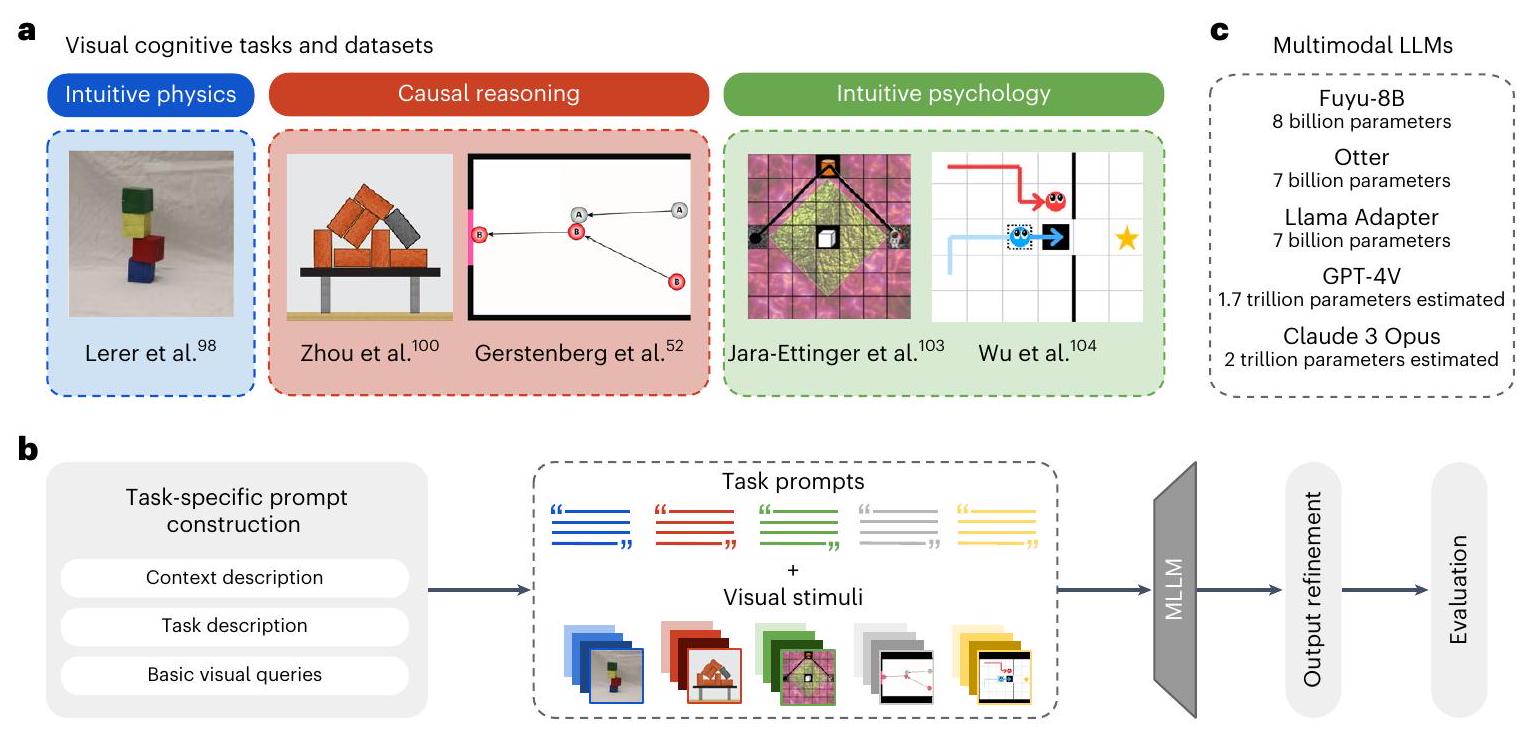
الشكل 1| نظرة عامة على المجالات، والمهام، والنهج، والنماذج. أ، صور مثال للعديد من التجارب. تم أخذ كل تجربة من واحدة من ثلاث مجالات معرفية: الفيزياء الحدسية، والتفكير السببي، وعلم النفس الحدسي. ب، عام
النهج. لكل استفسار، تم تقديم صورة إلى النموذج، وتم طرح أسئلة مختلفة حول الصورة، أي أننا قمنا بإجراء إجابة على سؤال بصري. ج، استخدمت نماذج LLM متعددة الوسائط وحجمها. MLLM، LLM متعددة الوسائط.
في هذا المجال تتضمن اختبار أحكام الناس حول استقرار أبراج الكتل . لقد دخلت هذه المهام إلى معايير التعلم الآلي , حيث تُستخدم لاختبار الفهم الفيزيائي الحدسي للشبكات العصبية (انظر المرجع 37 للحصول على نظرة عامة على الأعمال السابقة في بناء نماذج ذات معرفة فيزيائية تشبه البشر).
دراسة التفكير السببي قد بحثت كيف يستنتج الأفراد ويفكرون في العلاقات السبب-النتيجة . وقد اقترحت الأعمال السابقة في هذا الموضوع أن البشر يمتلكون قدرة حدسية على الاستنتاج، وفهم، وتوقع العلاقات السببية في بيئتهم , وغالبًا ما يتم وصفها باستخدام نماذج بايزيان للتعلم السببي . تشمل هذه القدرة الإدراكية التعرف على الأنماط , واستنتاج الأسباب من التدخلات , وتوقع الأحداث المستقبلية بناءً على أحداث افتراضية . غالبًا ما تتضمن المهام التقليدية في هذا المجال تقييم قدرة الأفراد على استنتاج العلاقات السببية، على سبيل المثال، عند الحكم على مسؤولية جسم واحد في حركة أجسام أخرى . يبقى التفكير السببي تحديًا، حتى بالنسبة لأساليب التعلم الآلي الحالية .
دراسة علم النفس الحدسي قد استكشفت كيف يستنتج الأفراد، ويفهمون، ويفسرون الظواهر الاجتماعية والحالات العقلية لوكلاء آخرين . وقد أكدت الأعمال السابقة في هذا الموضوع على مفهوم أن البشر يمتلكون قدرة فطرية على الاستنتاج والتفكير حول الحالات العقلية , والنوايا، والعواطف للآخرين، وغالبًا ما يُشار إليها باسم ‘نظرية العقل’ . تم نمذجة هذه القدرة كمشكلة استنتاج بايزي . غالبًا ما تتضمن المهام التقليدية في هذا المجال تقييم قدرة الأفراد على توقع الأفعال بناءً على فهم وجهات نظر أو نوايا الآخرين، مثل تحديد دوال المنفعة للوكلاء بناءً على أفعالهم في بيئة معينة . إنه موضوع نقاش مستمر حول ما إذا كانت الخوارزميات الحديثة تظهر أي شكل من أشكال علم النفس الحدسي .
جادل ليك وزملاؤه بأن بعض هذه القدرات تعمل كـ ‘برامج بدء التشغيل’، لأنها تشكل قدرات إدراكية موجودة في وقت مبكر من التطور. علاوة على ذلك، اقترحوا أن هذه ما يسمى ‘النظريات الحدسية’ تحتاج إلى أن تُعبر عنها بشكل صريح باستخدام حساب الاستنتاج البايزي , بدلاً من أن تُتعلم من الصفر، على سبيل المثال، عبر الانحدار التدرجي. ومع ذلك، مع زيادة قدرات الشبكات العصبية الحالية، وخاصة نماذج LLMs، تساءلنا: هل يمكن لنماذج LLMs، وخاصة نماذج LLMs البصرية، حل المشكلات من هذه المجالات الأساسية بشكل كافٍ؟
للإجابة على هذا السؤال، أخذنا مهام تقليدية من مجالات الفيزياء الحدسية، والتفكير السببي، وعلم النفس الحدسي التي يمكن دراستها من خلال تقديم صور وأسئلة قائمة على اللغة.
قمنا بتقديمها إلى بعض من أكثر نماذج LLMs تقدمًا حاليًا. لتقييم ما إذا كانت نماذج LLMs تظهر أداءً يشبه البشر في هذه المجالات، نتبع النهج الموضح في المرجع 73: نتعامل مع النماذج كمشاركين في التجارب النفسية. وهذا يسمح لنا بإجراء مقارنات مباشرة مع سلوك البشر في هذه المهام. نظرًا لأن المهام مصممة لاختبار القدرات في مجالات معرفية محددة، فإن هذه المقارنة تسمح لنا بالتحقيق في المجالات التي تؤدي فيها نماذج LLMs متعددة الوسائط بشكل مشابه للبشر، وفي أي منها لا تفعل ذلك. أظهرت نتائجنا أن هذه النماذج يمكنها، على الأقل جزئيًا، حل هذه المهام. على وجه الخصوص، تمكن اثنان من أكبر النماذج المتاحة حاليًا، نموذج OpenAI’s Generative Pre-trained Transformer (GPT-4) وAnthropic’s Claude-3 Opus، من الأداء بشكل قوي فوق الصدفة في اثنين من المجالات الثلاثة. ومع ذلك، ظهرت اختلافات حاسمة. أولاً، لم تتطابق أي من النماذج مع أداء مستوى البشر في أي من المجالات. ثانيًا، لم تلتقط أي من النماذج سلوك البشر بالكامل، مما يترك مجالًا لنماذج الإدراك الخاصة بالمجالات مثل النماذج البايزية التي اقترحت في الأصل للمهام.
كان هناك عدد كبير من الدراسات حول قدرات التفكير في نماذج LLMs . ركزت الدراسات السابقة، من بين أمور أخرى، على اختبار قدرات LLMs الإدراكية في التخطيط القائم على النموذج , واختبارات التفكير التناظري , ومهام الاستكشاف , واختبارات التفكير المنهجي دراسات إكمال علم النفس اللغوي ومشاكل فهم القدرة على الاستخدام في هذا السياق، يمكن اعتبار مساهمتنا جزءًا من حركة أكبر حيث يستخدم الباحثون أساليب من العلوم السلوكية لفهم نماذج التعلم الآلي غير الشفافة. . ومع ذلك، لم تحقق معظم الدراسات السابقة في نماذج اللغة متعددة الوسائط، بل ظلت في مجال اللغة البحتة. على الرغم من وجود محاولات حديثة للتحقيق في الميزات المعرفية لنماذج اللغة البصرية، بما في ذلك ردود أفعالها تجاه الأوهام البصرية. بالإضافة إلى كيفية حلهم لمهام الذكاء البسيطة نحن نحقق في المكونات الأساسية المقترحة للإدراك في هذه النماذج.
لقد نظرت الأعمال السابقة أيضًا في كيفية حل نماذج اللغة الكبيرة (LLMs) للمهام المعرفية المأخوذة من نفس المجالات التي نظرنا فيها. في الفيزياء الحدسية، زيتشيفيتش وزملاؤه وجد أن نماذج اللغة الكبيرة (LLMs) أدت أداءً ضعيفًا في مهمة تستخدم أوصاف لغوية لسيناريوهات مادية. زانغ وزملاؤه استخرجت برامج من النص الذي أنتجته نماذج اللغة الكبيرة لتحسين قدراتها على التفكير المنطقي. أخيرًا، قام جاسم وزملاؤه اقترح معيارًا جديدًا لتقييم فهم نماذج اللغة متعددة الوسائط للفيزياء المكانية. في التفكير السببي، بينز
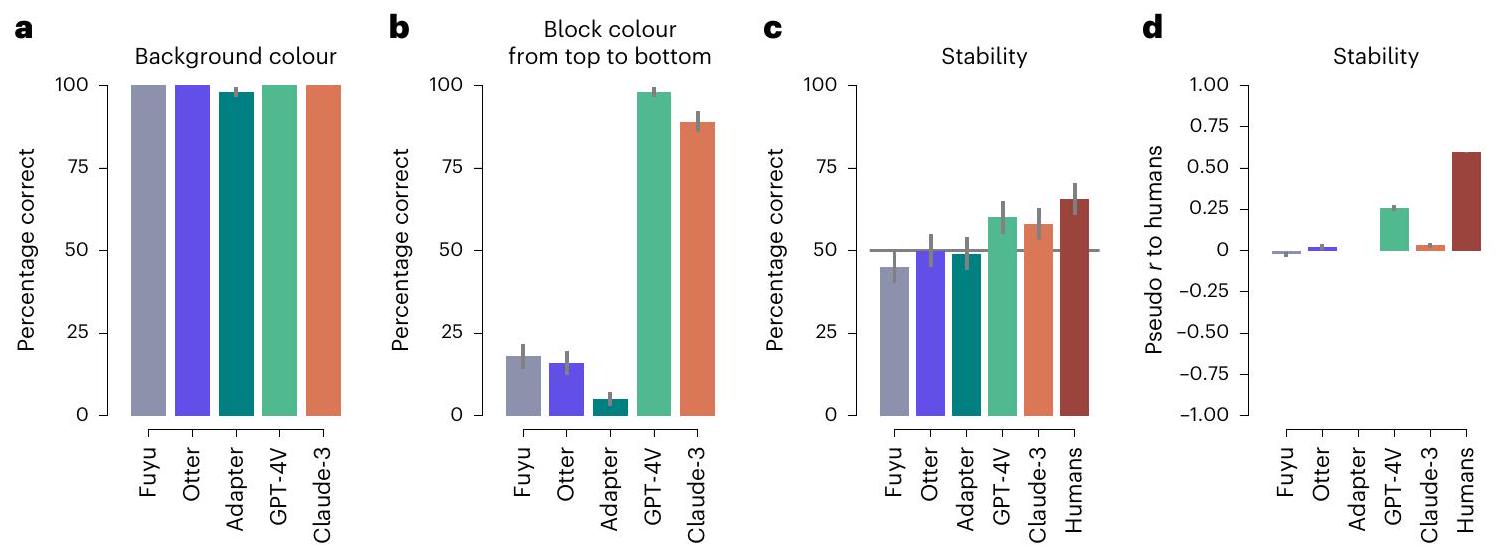
الشكل 2 | نتائج لخمس نماذج لغة بصرية لمهام ذات تعقيد متزايد بناءً على صور لأبراج كتل حقيقية. أ-ج، نبدأ أولاً بالسؤال عن لون الخلفية في الصورة (أ) (تم أخذ الصور من المرجع 98)، ثم لون الكتل من الأعلى إلى الأسفل (ب) وأخيرًا تقييم استقرار ثنائي لأبراج الكتل (ج). د، يظهر الرسم البياني الأخير الجذر التربيعي لـ قيمة الانحدار اللوجستي المختلط بايزي بين النماذج والمشاركين البشريين. تظهر الأعمدة في الرسوم البيانية أ-ج
نسبة الإجابات الصحيحة مع أشرطة الخطأ المعطاة بواسطة الانحراف المعياري لتوزيع ثنائي الحدين ). القضبان في الرسم أظهر الجذر التربيعي لـ قيم الانحدارات اللوجستية المختلطة بايزيان مع أشرطة الخطأ المعطاة بواسطة الجذر التربيعي لـ النسب المئوية لهذا قيمة ( عدد الصور مضروبًا في عدد المشاركين البشريين.
وشولز أظهر أن GPT-3 فشل في تجارب الاستدلال السببي البسيطة، بينما قام كوسوي وزملاؤه أظهر أن نماذج اللغة الكبيرة لا يمكنها تعلم الفرضيات السببية الشبيهة بالبشر. في الأبحاث حول علم النفس الحدسي، جادل كوسينسكي بأن نظرية العقل قد تكون قد ظهرت في نماذج اللغة الكبيرة. الذي تم انتقاده من قبل باحثين آخرين أظهر أكاتا وزملاؤه أن GTP-4 يلعب الألعاب المتكررة بشكل أناني للغاية ولم يتمكن من التقاط التقاليد البسيطة مثل التناوب بين الخيارات. . أخيرًا، غاندي وزملاؤه اقترح إطارًا لتوليد تقييمات نظرية العقل بشكل إجرائي ووجد أن قدرات GPT-4 تعكس أنماط الاستدلال البشرية، على الرغم من أنها أقل موثوقية، بينما واجهت جميع نماذج اللغة الكبيرة الأخرى صعوبات.
لقد وقعت العديد من الدراسات السابقة حول نماذج اللغة الكبيرة في خطر الظهور في مجموعات تدريب النماذج الجديدة. وقد اعترفت الأعمال الأخيرة بهذه المشكلة، وبالتالي قامت بتقييم نماذج اللغة على العديد من تنويعات المشكلات لتقليل تأثيرات مجموعة التدريب. يختلف عملنا عن هذه الأساليب حيث أن النماذج الحالية لا يمكن أن تكون قد حفظت فقط الحلول للمشكلات المعطاة لأن هذه المشكلات تتطلب تفكيرًا على مستوى أعلى. علاوة على ذلك، يتم تخزين البيانات البشرية والحقائق الأساسية عادةً في ملفات بيانات إضافية، والتي يجب استخراجها أولاً ومطابقتها مع الصور المعنية لاستخدامها في تدريب النموذج. نظرًا لأن هذا يتطلب معالجة بيانات لا يمكن أتمتتها بسهولة وعدد المحفزات التي يجب الحصول عليها صغير جدًا، فمن غير المحتمل للغاية أن تكون هذه المحفزات مع الحقائق الأساسية قد تم إدخالها في مجموعة التدريب لأي من النماذج التي تم التحقيق فيها.

النتائج

قمنا باختبار خمسة نماذج مختلفة على ثلاثة مكونات أساسية للذكاء الشبيه بالبشر كما هو موضح في المرجع 22 (الشكل 1أ). النماذج التي استخدمناها هي نماذج LLMs للرؤية، وهي نماذج متعددة الوسائط تدمج قدرات معالجة الصور في LLMs. (الشكل 1ج). تتيح هذه النماذج للمستخدمين إجراء إجابة على الأسئلة البصرية يمكن للمستخدمين تحميل صورة وطرح أسئلة عنها، والتي يقوم النموذج بتفسيرها والرد عليها وفقًا لذلك.
لاختبار المكونات الأساسية الثلاثة، استخدمنا مهامًا من أدبيات العلوم المعرفية التي يمكن دراستها في نماذج اللغة الكبيرة البصرية من خلال الإجابة على الأسئلة البصرية. لكل مهمة، استفسرنا عن قدرات الاستدلال البصري لنماذج اللغة الكبيرة من خلال مهام ذات تعقيد متزايد. أولاً، سألنا عن ميزات بسيطة من الصور المعروضة مثل لون الخلفية أو عدد الأشياء المعروضة. بعد ذلك، قدمنا أسئلة مأخوذة من تجارب العلوم المعرفية. نحن نقدم النتائج بناءً على المقارنات مع الحقيقة الأساسية بالإضافة إلى تطابق النماذج المختلفة مع بيانات البشر.

فيزياء بديهية مع أبراج الكتل

لاختبار قدرات الفيزياء الحدسية للنماذج اللغوية المختلفة، استخدمنا صورًا تظهر أبراج من الكتل الخشبية من المرجع 98 (انظر الشكل التوضيحي 1 كمثال). طلبنا أولاً من النماذج تحديد لون خلفية الصورة. حققت النماذج الأربعة دقة شبه مثالية (الشكل 2أ). ثم طلبنا من النماذج ذكر لون الكتل من الأعلى إلى الأسفل. هنا، تدهورت أداء معظم النماذج باستثناء GPT-4V وClaude-3 (الشكل 2ب). يرجى ملاحظة أن المهمتين الأوليين تعتبران تافهتين إلى حد ما بالنسبة للبشر ونتوقع أن يكون أداء البشر عند (لون الخلفية دائمًا أبيض والصور تحتوي على اثنين أو ثلاثة أو أربعة كتل بألوان أساسية).
لاختبار قدرات النماذج على التفكير الفيزيائي، طلبنا منها إعطاء حكم استقرار ثنائي للأبراج المرسومة. هنا، فقط GPT-4V وClaude-3 أديا بشكل طفيف فوق مستوى الصدفة (الشكل 2c؛ بالنسبة لـ GPT-4V، أظهر اختبار فيشر الدقيق نسبة احتمالات تبلغ 2.597 مع جانب واحد قيمة 0.028). لم تؤدِ أي من النماذج الأخرى بشكل ملحوظ فوق الصدفة (كان أفضل نموذج بعده، كلود-3، لديه نسبة احتمالات 2.016، مع جانب واحد قيمة 0.078). لم يكن المشاركون البشريون مثاليين أيضًا، لكنهم أظهروا دقة متوسطة تبلغ 65.608%.
أخيرًا، حددنا العلاقة بين أحكام الاستقرار للنماذج والبشر باستخدام تحليل الانحدار اللوجستي المختلط بايزي. نحن نحسب بايزي لكل نموذج انحدار يعتمد على العينات من التباينات المتبقية المودلة . ثم نأخذ الجذر التربيعي لهذا البايزي ” واضربه في إشارة معامل الانحدار الرئيسي للوصول إلى ” زائف القيمة. حول هذا الزيف القيمة التي نرسم جذرها التربيعي النسب المئوية لـ القيمة (الشكل 2د). وجدنا أن GPT-4V هو النموذج الوحيد الذي أظهر علاقة مع أحكام البشر، مع معامل انحدار قدره 1.15 ( فترة موثوقة ) و قيمة 0.066. ومع ذلك، كان معامل الانحدار بين الأفراد من البشر والمتوسط بين البشر لا يزال أكبر، مع معامل و قيمة 0.354.

الاستدلال السببي مع جينغا

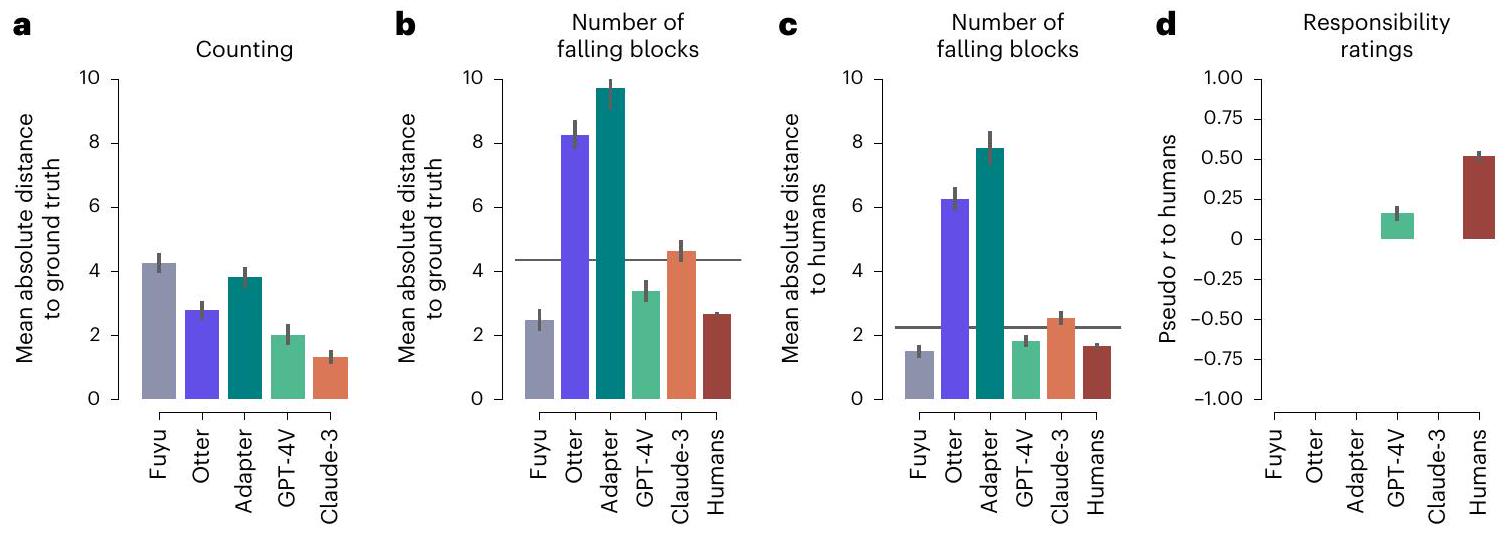
لاختبار قدرات النماذج على الاستدلال السببي، استخدمنا صورًا صناعية من المراجع 100 و101، التي صورت أبراجًا من الكتل كانت مستقرة ولكن قد تنهار إذا تمت إزالة واحدة من الكتل (انظر الشكل التوضيحي 2 كمثال). بدأنا بطلب من النماذج عد الكتل في الصورة. كانت الصور في هذه المهمة تعرض عددًا أكبر من الكتل (يتراوح من 6 إلى 19)، مما جعل مهمة العد الأساسية أكثر تحديًا بشكل ملحوظ مقارنةً بالقسم السابق. ردود النماذج
الشكل 3 | نتائج تجربة الاستدلال السببي لجينغا. أ-د، نبدأ أولاً بالسؤال عن عدد الكتل في الصورة (أ)، ثم نسأل عن عدد الكتل التي ستسقط إذا تمت إزالة كتلة معينة ونحسب المسافة المطلقة إلى الحقيقة الأرضية (ب) بالإضافة إلى المسافة المطلقة إلى أحكام البشر (ج) وأخيرًا تقييم بين 0 و 100 لمدى مسؤولية كتلة معينة عن استقرار البرج (د). تم أخذ تجربة الاستدلال السببي من المرجع 100. بالنسبة لتقييمات المسؤولية، جميع نماذج اللغة الكبيرة باستثناء GPT-4V تعطي قيمًا ثابتة.
التقييمات: Fuyu و Claude-3 دائمًا ما يردان بـ 100، بينما Otter و LLaMAAdapter V2 دائمًا ما يردان بـ 50. الأعمدة في الرسوم البيانية و عرض المسافة المطلقة إلى الحقيقة الأرضية مع أشرطة الخطأ المعطاة بواسطة الخطأ المعياري للمتوسط ). القضبان في الرسم عرض المسافة إلى الإجابات البشرية مع أشرطة الخطأ مرة أخرى المعطاة بواسطة الخطأ المعياري للمتوسط . القضبان في الرسم أظهر الجذر التربيعي لـ قيم الانحدارات اللوجستية المختلطة بايزيان مع أشرطة الخطأ المعطاة بواسطة الجذر التربيعي لـ النسب المئوية لهذا قيمة ( ).
قارب الحقيقة الأرضية، وإن كان نادراً ما يتطابق معها تماماً. لذلك، نبلغ عن متوسط المسافة المطلقة إلى الحقيقة الأرضية بدلاً من نسبة الإجابات الصحيحة (الشكل 3أ). أظهرت أداء النماذج الطبيعة التحديّة لهذه المهمة، حيث كانت أفضل نموذج (كلود-3) لا يزال في المتوسط أكثر من كتلة واحدة بعيداً.
واصلنا من خلال استفسار النماذج عن عدد الكتل التي ستسقط إذا تمت إزالة كتلة معينة من المشهد (الشكل 3ب، ج). أنشأنا أداءً أساسيًا تمثله خط أفقي في الشكل 3ب، ج، والذي يتوافق مع وكيل عشوائي أعطى المتوسط بين 0 وعدد الكتل في كل صورة كتوقع له، مما يتصرف بشكل أساسي مثل توزيع موحد على عدد الكتل الممكنة التي يمكن أن تسقط. من الجدير بالذكر أن كل من GPT-4V و Fuyu-8B تجاوزا الأساس العشوائي، حيث كانت مستويات أدائهما قريبة من النتائج البشرية المبلغ عنها في المرجع 100، والذي يتم تصويره بواسطة العمود الأيمن في الرسم. ومع ذلك، لا يزال GPT-4V ينحرف بشكل كبير عن المتوسط بين المشاركين البشريين. .
أخيرًا، طلبنا من النماذج تقييم مسؤولية كتلة معينة عن استقرار الكتل الأخرى (الشكل 3d). من الجدير بالذكر أن جميع النماذج باستثناء GPT-4V أعطت تقييمات ثابتة لهذه المهمة (فيو وكلود-3 كانا دائمًا يردان بـ 100، بينما أوتر وLLaMA-Adapter V2 كانا دائمًا يردان بـ 50). معامل الانحدار لـ GPT-4V مع القيم البشرية هو مع قيمة 0.027. يحتوي الانحدار بين البشر على معامل قدره 0.54 ( ، 0.63 ) و قيمة 0.268.

الاستدلال السببي مع ميشوت

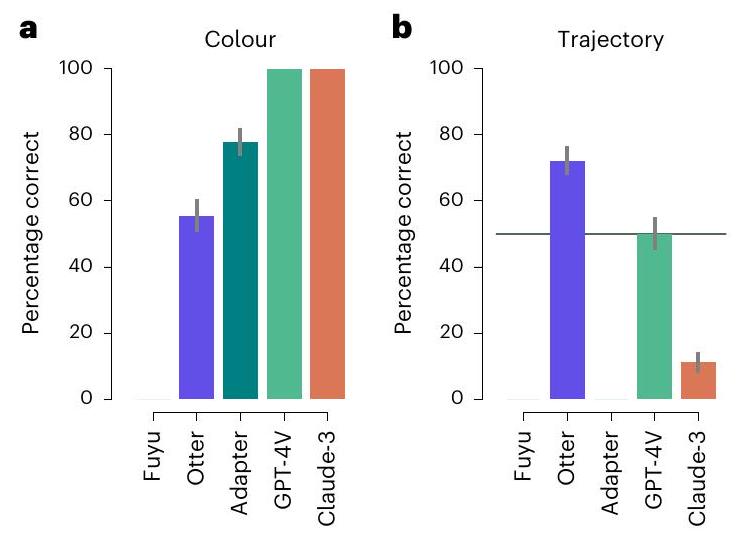
للاختبار الثاني لقدرات الاستدلال السببي، أجرينا تجربة من المرجع 52 تستند إلى نموذج الإطلاق الكلاسيكي لمشوت. . يستخدم تمثيلات بسيطة تركيبية ثنائية الأبعاد (2D) لكراتتين موسومتين بـ ‘A’ و ‘B’ مع أسهم تظهر مساراتها أمام خلفية بيضاء (انظر الشكل التكميلي 3 كمثال). بدأنا بسؤال النماذج لتحديد لون خلفية الصورة (الشكل 4a). تؤدي معظم النماذج بشكل جيد باستثناء Fuyu، التي تجيب دائمًا ‘وردي’ (ربما لأن اللون الوردي مذكور كلون للبوابة في التعليمات). ثم، طلبنا من النماذج استنتاج مسار حركة الكرة. وقد ثبت أن هذا يمثل تحديًا لمعظم النماذج (الشكل 4b)، وهو أمر مفاجئ نظرًا لأن التعليمات تذكر بوضوح أن الأسهم في المحفزات تمثل مسار الكرات وأن الكرات تتحرك دائمًا من اليمين إلى اليسار.
ثم استفسرنا عن توافق النماذج على مقياس من 0 إلى 100 مع الأسئلة التالية: إما ‘الكرة ب مرت من خلال
‘منتصف البوابة’ (إذا دخلت الكرة B البوابة) أو ‘الكرة B فاتتها البوابة تمامًا’ (إذا فاتت الكرة B البوابة) (الشكل 4c). لا يوجد نموذج يحقق نتائج قريبة من النتائج البشرية المبلغ عنها في المرجع 52. أفضل نموذج أداء هو Fuyu مع معامل انحدار قدره 0.26 ( ) و قيمة 0.067. من المثير للاهتمام أن Claude-3 يظهر علاقة سلبية مع الأحكام البشرية، مع معامل انحدار و قيمة 0.076. معامل الانحدار بين البشر هو مع قيمة 0.556.
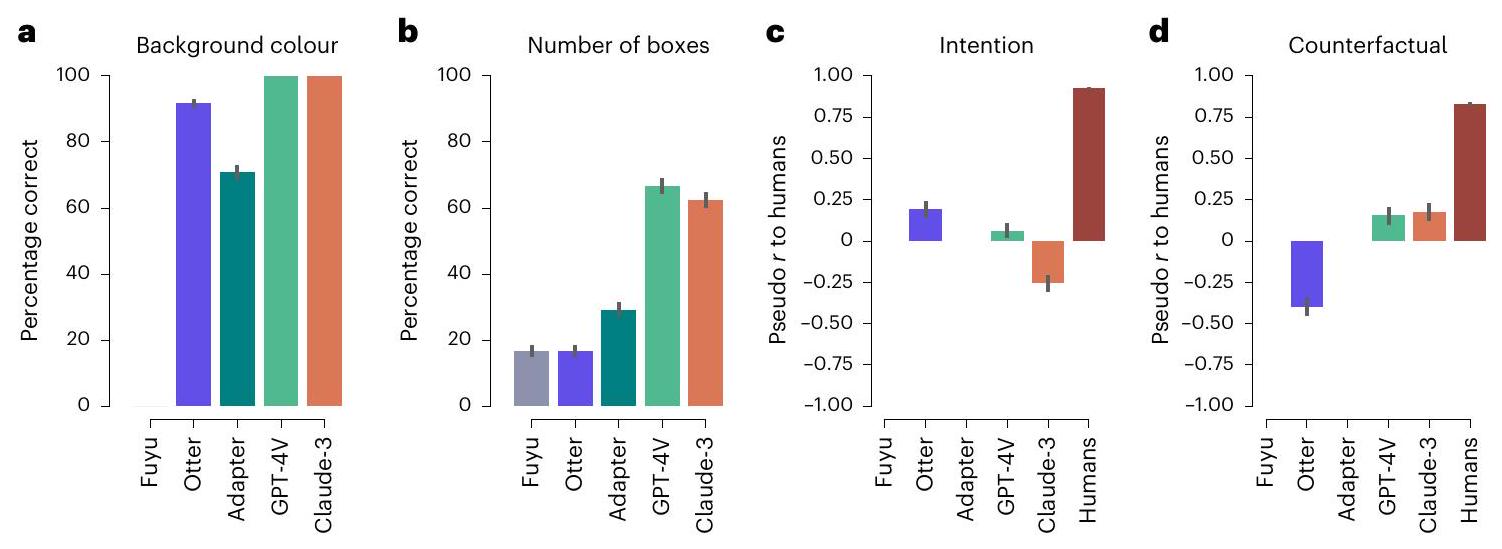
أخيرًا، طلبنا من النماذج تقييمها على مقياس من 0 إلى 100 مع السؤال المضاد للواقع حول ما إذا كانت ‘الكرة ب كانت ستدخل البوابة لو لم تكن الكرة أ موجودة في المشهد’ (الشكل 4d). من الجدير بالذكر أن النماذج المغلقة المصدر تؤدي بشكل أسوأ من بعض النماذج المفتوحة المصدر في كلا المهمتين. هنا، تعتبر Fuyu مرة أخرى أفضل نموذج أداءً مع معامل انحدار و قيمة 0.185. زائف القيم لـ LLaMA-Adapter V2 و GPT-4V مفقودة، حيث أن الأول قدم فقط إجابات غير صالحة والثاني كان يرد دائمًا بـ 100. معامل الانحدار بين البشر هو مع قيمة 0.698.

علم النفس الحدسي مع مهمة رائد الفضاء

كاختبار أول لفهم علم النفس الحدسي للنماذج اللغوية الكبيرة المختلفة، استخدمنا صورًا صناعية تصور رائد فضاء على خلفية ملونة من المرجع 103 (انظر الأشكال التكميلية 4 و5 كمثال). كانت الصور تحتوي على تضاريس مختلفة وحزم رعاية. اعتمادًا على التضاريس التي عبرها رائد الفضاء أو حزمة الرعاية التي اختار التقاطها، كان من الممكن استنتاج التكاليف المرتبطة بالتضاريس والمكافآت المرتبطة بحزم الرعاية.
مرة أخرى، كلفنا النماذج أولاً بتحديد لون الخلفية للصور. هنا، كانت أداء النماذج أسوأ مقارنة بمجموعة بيانات الفيزياء الحدسية (الشكل 5أ)، وقد يكون ذلك بسبب أن لون الخلفية هنا لم يكن موحدًا (الشكل التوضيحي 5). ثم طلبنا من النماذج عد عدد حزم الرعاية في المشهد. واجهت معظم النماذج، باستثناء GPT-4V، صعوبة هنا (الشكل 5ب).
بعد ذلك، طلبنا منهم استنتاج التكاليف المرتبطة بالتضاريس المختلفة (الشكل 5c) والمكافآت المرتبطة بحزم الرعاية المختلفة (الشكل 5d). أظهرت جميع النماذج علاقات ضعيفة فقط مع المتوسط بين المشاركين البشريين في أحكامهم حول التكاليف والمكافآت المرتبطة بالبيئة. الانحدار
الشكل 4 | نتائج تجربة الاستدلال السببي لميشوت. أ-د، نبدأ أولاً بالسؤال عن لون الخلفية في الصورة (أ)، ثم اتجاه حركة الكرة (ب)، حكم بين 0 و 100 حول ما إذا كانت الكرة ‘ ‘ يمر عبر البوابة (ج) وأخيرًا حكم مضاد للواقع بين 0 و 100 حول ما إذا كانت الكرة ‘ ب ‘ ستدخل البوابة، لو لم تكن الكرة ‘ أ ‘ موجودة في المشهد (د).
تم أخذ تجربة الاستدلال السببي من المرجع 52. الأعمدة في الرسوم البيانية و عرض نسبة الإجابات الصحيحة مع أشرطة الخطأ المعطاة بواسطة الانحراف المعياري لتوزيع ثنائي الحدين ). القضبان في الرسوم البيانية و أظهر الجذر التربيعي لـ قيم الانحدارات اللوجستية المختلطة بايزيان مع أشرطة الخطأ المعطاة بواسطة الجذر التربيعي لـ النسب المئوية لهذا قيمة ( و 234 ، على التوالي).
الشكل 5 | النتائج على مهمة رائد الفضاء لعلم النفس الحدسي. أ، ب، مرة أخرى، نبدأ بالسؤال عن لون الخلفية (أ) وعدد الصناديق في المشهد (ب). ج، د، ثم يُطلب من النماذج إجراء استنتاجات حول التكاليف (ج) والمكافآت (د) في بيئة تعتمد على المسار الذي اتخذه الوكيل. تم أخذ المهام لعلم النفس الحدسي من المرجع 103. معاملات الانحدار لفيوي وLLaMA-Adapter V2 مفقودة لأنها كانت تستجيب دائمًا بثبات.
تقييمات لأسئلة التكلفة أو المكافأة. الأعمدة في الرسوم البيانية و عرض نسبة الإجابات الصحيحة مع أشرطة الخطأ المعطاة بواسطة الانحراف المعياري لتوزيع ثنائي الحدين ). القضبان في الرسوم البيانية و أظهر الجذر التربيعي لـ قيم الانحدارات اللوجستية المختلطة بايزيان مع أشرطة الخطأ المعطاة بواسطة الجذر التربيعي لـ النسب المئوية لهذا قيمة ( و70، على التوالي).
معاملات النماذج مع المتوسط المقيس على المشاركين البشريين تراوح بين -0.24 و 0.16 مع قيم تتراوح بين 0.025 إلى 0.04 لأسئلة التكلفة، ومن -0.02 إلى 0.39 (كلود-3، ) مع قيم تتراوح بين 0.015 و 0.110 لأسئلة المكافأة.

علم النفس الحدسي مع مهمة المساعدة أو العائق
مجموعة البيانات الجديدة لعلم النفس البديهي التي أضفناها مأخوذة من المرجع 104. تُظهر هذه المهمة تمثيلاً بسيطاً ثنائي الأبعاد لوكيلين في بيئة شبكية (انظر الشكل التوضيحي 6 كمثال). في كل خطوة زمنية، يمكن للوكلاء التحرك لأعلى أو لأسفل أو لليسار أو لليمين، أو البقاء في مكانهم، لكن لا يمكنهم التحرك عبر الجدران أو الصناديق. الهدف من الوكيل الأحمر هو الوصول إلى نجمة في عشر خطوات زمنية. إذا نفد الوقت من الوكيل، فإنه يفشل. الهدف من الوكيل الأزرق هو إما مساعدة أو عرقلة الوكيل الأحمر من خلال دفع أو سحب الصناديق.
طلبنا أولاً من النماذج تحديد لون الخلفية في المشهد وتحديد عدد الصناديق في المشهد (الشكل 6أ، ب). النماذج المغلقة المصدر قادرة على تحديد لون الخلفية بدقة (دائمًا أبيض) لكنها تواجه صعوبة في تحديد عدد الصناديق في المشهد (دائمًا 1، 2 أو 3). تراوحت إجابات النماذج في مهمة العد من 1 إلى 4، مع تقديم LLaMA-Adapter V2 فقط استجابات ثابتة تبلغ 2.
ثم سألنا النماذج عما إذا كان الوكيل الأزرق حاول مساعدة أو عرقلة الوكيل الأحمر (الشكل 6c). هنا، يظهر نموذج أوتر أعلى معامل انحدار مع إجابات البشر مع و قيمة 0.038. يظهر Claude-3 علاقة سلبية مع الإجابات البشرية بمعامل و قيمة 0.066. لم يظهر أي نموذج معاملات قريبة حتى من معامل الإنسان إلى الإنسان مع قيمة 0.858.
أخيرًا، سألنا النموذج عما إذا كان العميل الأحمر سينجح في الوصول إلى النجم، لو لم يكن العميل الأزرق موجودًا. نحن نعرض الجذر التربيعي لـ لنموذج الانحدار الخطي المختلط بايزي مع النسب المئوية 95% في الشكل 6d. من المثير للاهتمام أن النتائج هنا تتغير، حيث يظهر القضاعة الآن علاقة سلبية أقوى مع معامل و قيمة 0.161 (هذا منطقي، حيث أن هذه المهمة هي في الأساس سؤال محاكاة مضادة للواقع مشابه للشكل 4d، حيث أظهر Otter بالفعل علاقة سلبية مع الأحكام البشرية). يظهر كل من GPT-4V و Claude-3 معاملات انحدار إيجابية صغيرة مع إجابات البشر: 0.15 ( ) مع قيمة 0.025، و مع قيمة 0.032، على التوالي. مرة أخرى، لا يوجد معامل نموذج قريب من معامل الإنسان إلى الإنسان مع قيمة 0.688.
الشكل 6 | النتائج على مهمة المساعدة أو الإعاقة في علم النفس الحدسي. أ-د، نبدأ أولاً بالسؤال عن لون الخلفية في الصورة (أ)، ثم عدد الصناديق في المشهد (ب)، حكم بين 0 و100 حول ما إذا كان أحد الوكلاء في المشهد قد حاول إعاقة الوكيل الآخر (ج) وأخيرًا حكم مضاد للواقع بين 0 و100 حول ما إذا كان أحد الوكلاء في المشهد كان سيتوصل بنجاح إلى الهدف، لو لم يكن الوكيل الآخر موجودًا (د). كانت مجموعة بيانات علم النفس الحدسي
من المأخوذ من المرجع 104. الأعمدة في الرسوم البيانية و عرض نسبة الإجابات الصحيحة مع أشرطة الخطأ المعطاة بواسطة الانحراف المعياري لتوزيع ثنائي الحدين ). القضبان في الرسوم البيانية و أظهر الجذر التربيعي لـ قيم الانحدارات اللوجستية المختلطة بايزيان مع أشرطة الخطأ المعطاة بواسطة الجذر التربيعي لـ النسب المئوية لهذا قيمة ( ).

نقاش

بدأنا بسؤال ما إذا كان، مع ظهور نماذج اللغة الكبيرة الحديثة، قد أنشأ الباحثون آلات تفكر مثل البشر إلى حد ما. لمعالجة هذا السؤال، أخذنا أربعة نماذج لغة متعددة الوسائط حديثة واستكشفنا قدراتها في ثلاثة مجالات معرفية أساسية: الفيزياء الحدسية، والتفكير السببي، وعلم النفس الحدسي.
في الفيزياء الحدسية والتفكير السببي، تمكنت النماذج من حل بعض المهام المعطاة وأظهرت GPT-4V تطابقًا طفيفًا مع بيانات البشر. ومع ذلك، بينما أدت بشكل جيد في بعض المهام، لم تظهر النماذج تطابقًا حاسمًا مع بيانات البشر في تجارب التفكير السببي. أخيرًا، في مهام علم النفس الحدسي، لم تظهر أي من النماذج تطابقًا قويًا مع بيانات البشر. وبالتالي، فإن الإجابة المناسبة على السؤال الذي يحفز عملنا ستكون ‘لا’، أو – ربما بشكل أكثر تفاؤلاً – ‘ليس تمامًا’.
على الرغم من أننا بذلنا قصارى جهدنا لمنح جميع النماذج فرصة عادلة وإعداد التجارب بطريقة نظيفة وقابلة للتكرار، إلا أن هناك بعض النواقص التي يجب معالجتها في الأعمال المستقبلية. أولاً وقبل كل شيء، لقد اختبرنا فقط عددًا قليلاً من النماذج متعددة الوسائط على ثلاثة مجالات معرفية فقط. بينما نعتقد أن النماذج والمهام المستخدمة توفر رؤى جيدة حول حالة العلم في قدرات النماذج اللغوية الكبيرة، يجب أن تنظر الدراسات المستقبلية في المزيد من المجالات ونماذج مختلفة لفهم متى ولماذا يمكن للنماذج اللغوية الكبيرة تقليد التفكير البشري. على سبيل المثال، سيكون من المثير للاهتمام معرفة ما إذا كانت الحجم هي السمة المهمة الوحيدة التي تؤثر على أداء النموذج. حالياً، تشير أدلتنا إلى أن النماذج الأصغر، على سبيل المثال، Fuyu، التي تحتوي على 8 مليارات معلمة، يمكن أن تؤدي أحياناً بنفس جودة GPT-4V في بعض المهام. بالإضافة إلى ذلك، قمنا بتطبيق جميع النماذج كما هي دون أي تعديل إضافي. يمكن أن تحاول الدراسات المستقبلية ضبط النماذج اللغوية متعددة الوسائط بشكل أفضل لتتوافق مع البيانات المعرفية. وتقييم ما إذا كان هذا يحسن قدراتهم على التفكير بشكل عام. مشابه لأعمال أخرى حديثة وجدنا أن العديد من النماذج كانت مقيدة بالفعل في معالجتها البصرية الأساسية. بينما كانت النماذج المغلقة المصدر الأكثر قوة تؤدي بشكل أكثر قوة في مهام فهم المشهد البسيطة، وجدنا أنها لا تزال تفشل في الإجابة على أسئلة بسيطة ستكون تافهة بالنسبة للمراقبين البشر. وبالتالي، نعتقد أن الأداء الضعيف للنماذج في بعض المجالات يمكن تفسيره جزئيًا من خلال قدراتها الضعيفة في المعالجة البصرية الأساسية.
نقطة ضعف أخرى في العمل الحالي هي بساطة المحفزات المستخدمة. بينما كانت أبراج الكتل المستخدمة في دراستنا الأولى مصممة عمدًا لتكون أكثر واقعية. أكثر من المحفزات النفسية المستخدمة عادة ، لم يكن هذا صحيحًا بالنسبة للتجارب في المجالين الآخرين. بالنسبة لتجارب علم النفس الحدسي، على وجه الخصوص، نحن
كنت أتوقع أن تؤدي النماذج بشكل أفضل إذا كانت المحفزات تحتوي على صور أكثر واقعية للأشخاص، وهو ما أظهرته الدراسات السابقة أنه يعمل بشكل أفضل. من المثير للاهتمام أن استخدام محفزات أكثر واقعية يمكن أن يغير أيضًا أحكام الناس السببية. مدى واقعية المحفزات المستخدمة في التجارب المعرفية لا يزال سؤالاً مفتوحاً. .
في نقطة ذات صلة، استخدمنا فقط الصور الثابتة في تجاربنا الحالية، مما يحد بشدة من نطاق ومستوى التفاصيل للأسئلة التي يمكننا طرحها. على سبيل المثال، تتضمن بعض المهام الأكثر تقليدية التي تحقق في قدرات التفكير السببي لدى الناس مقاطع فيديو لكرات البلياردو المتصادمة. . من المحتمل أن تكون نماذج اللغة الكبيرة المستقبلية قادرة على الإجابة عن الأسئلة المتعلقة بالفيديوهات تمثل هذه المهام الحدود التالية للمعايير المستوحاة من الإدراك.
بالنسبة للمقارنات مع بيانات البشر، استخدمنا بيانات المشاركين التي تم جمعها في الدراسات الأصلية لجميع التجارب، باستثناء مهمة الفيزياء الحدسية، وقمنا بتقييم التوافق بين النماذج وهذه البيانات من خلال تحليل الانحدار المختلط بايزي. القيم. يمكن أن يتوسع العمل المستقبلي في هذا النهج من خلال جمع بيانات جديدة من المشاركين البشر الذين يختارون أي من أحكام النموذج يفضلون. قد يؤدي ذلك إلى مقارنة أكثر تفصيلاً، مشابهة لما تم اقتراحه للتمييز بين نماذج التعلم العميق للرؤية البشرية. واللغة .
ضعف حاسم في معظم الدراسات التي تستخدم نماذج اللغة الكبيرة هو أنها قد تكون حساسة لمطالب معينة. بينما حاولنا استخدام مطالبات أثارت سلوكًا جيدًا، مما منح نماذج اللغة الكبيرة فرصة للأداء الجيد، يمكن أن تحاول الأعمال المستقبلية تحسين هذه المطالبات بشكل أكبر باستخدام الطرق المتاحة. بينما نقوم أيضًا بتقييم كيفية استجابة النماذج للإصدارات المعاد صياغتها من نفس المهام. نقدم تحليلًا استكشافيًا لتأثيرات قيود الاستجابة وتعقيد السياق على سلوك الإنسان في مهمة علم النفس الحدسي لرائد الفضاء في الشكل التوضيحي 7. بينما تؤثر قيود الاستجابة وتعقيد السياق على مخرجات النموذج، نجد أيضًا أن التغييرات الصغيرة في العبارات على مستوى الشخصية يمكن أن تؤثر على سلوك النموذج، ربما بسبب عملية تقسيم الرموز. مجتمعة، يظهر هذا أن تقييمات نماذج اللغة البصرية ليست فقط معتمدة على النماذج والتجارب المحددة المستخدمة، ولكن أيضًا على العبارات وربما حتى على كيفية تقسيم هذه العبارات إلى رموز. بينما قد يكون من الممكن تحسين العبارات المستخدمة، نعتقد أن نهجنا الحالي كان كافيًا لإظهار قدرات هذه النماذج.
لقد أظهرت أعمالنا أن نماذج اللغة متعددة الوسائط قد قطعت شوطًا طويلاً، حيث تظهر بعض التوافق مع السلوك البشري وغالبًا ما تؤدي بشكل أفضل من الصدفة. علاوة على ذلك، قدم باحثو تعلم الآلة أفكارًا متنوعة حول كيفية سد الفجوة المتبقية.
بين البشر والآلات بما في ذلك التعلم الذاتي الإشراف , الترجمة من اللغات الطبيعية إلى اللغات الاحتمالية أو تأصيل نماذج اللغة الكبيرة في بيئات واقعية . إن هذا التطور المستمر في قدرات النماذج يتطلب إعادة تقييم الاستعارات والأدوات التي نستخدمها لفهمها. نحن نعتقد أن علم الإدراك يمكن أن يقدم أدوات ونظريات ومعايير لتقييم مدى قربنا من ‘بناء آلات تتعلم وتفكر مثل البشر’.

طرق

كود

تم تثبيت النماذج مفتوحة المصدر وفقًا للتعليمات الموجودة في مستودعات GitHub أو Huggingface ذات الصلة وتم تقييمها على مجموعة قائمة على Slurm مع A100 واحدة. بالنسبة للنتائج المبلغ عنها كـ GPT-4V، استخدمنا واجهة ChatGPT العامة وواجهة برمجة التطبيقات (API) الخاصة بـ OpenAI، وتحديدًا إصدار نوفمبر 2023 من نموذج gpt4-vision-preview المتاح عبر نقطة نهاية الإكمال. بالنسبة لـ Claude-3، استخدمنا واجهة برمجة التطبيقات الخاصة بـ Anthropic. الكود لتكرار نتائجنا متاح على GitHub (github.com/Isbuschoff/ متعددة الوسائط). تم تقييم جميع النماذج في Python باستخدام PyTorch . تم إجراء تحليلات إضافية باستخدام NumPy , Pandas و SciPy . تم استخدام Matplotlib و Seaborn للرسم. تم حساب نماذج التأثيرات المختلطة بايزي باستخدام brms في .

نماذج

مفتوحة المصدر. Fuyu هو محول فقط لفك تشفير النصوص والصور يحتوي على 8 مليارات معلمة. استخدمنا تنفيذ Huggingface مع الإعدادات القياسية ودون مزيد من التخصيص (متاح على https://huggingface.co/adept/fuyu-8b). تم تعيين الحد الأقصى لعدد الرموز المولدة إلى 8 وتم تحليل الردود يدويًا. Otter هو نموذج لغة متعددة الوسائط يدعم ضبط التعليمات في السياق ويستند إلى نموذج OpenFlamingo. استخدمنا تنفيذ Huggingface لـ OTTER-Image-MPT7B (متاح على https://hugging-face.co/luodian/OTTER-Image-MPT7B), مرة أخرى مع الإعدادات القياسية ودون تخصيص. تم ترك الحد الأقصى لعدد الرموز المولدة عند 512 وتم تحليل الردود يدويًا. بالنسبة لـ LLaMA-Adapter V2، الذي يضيف محولات إلى محول LLaMA لتحويله إلى نموذج يتبع التعليمات، استخدمنا تنفيذ GitHub لـ llama-adapter-v2-multimodal7b مع الإعدادات القياسية ومرة أخرى دون مزيد من التخصيص (متاح على https://github.com/OpenGVLab/ LLaMA-Adapter/tree/main/Ilama_adapter_v2_multimodal7b). تم ترك الحد الأقصى لعدد الرموز المولدة عند 512 وتم تحليل الردود يدويًا.
مغلقة المصدر. استفسرنا في البداية عن GPT-4V من خلال واجهة ChatGPT، حيث لم تكن واجهة برمجة التطبيقات الخاصة بـ OpenAI متاحة للجمهور في بداية هذا المشروع. تم جمع ردود المهام النفسية البديهية باستخدام نموذج gpt4-vision-preview بعد إصداره في نوفمبر 2023 في واجهة برمجة التطبيقات. قمنا بتعيين الحد الأقصى لعدد الرموز المولدة لمطالبة معينة إلى 1 للحصول على ردود عددية فردية. تم تعيين جميع المعلمات الأخرى إلى قيمها الافتراضية. لاحظ أن هذا النموذج لا يحتوي حاليًا على خيار لتعيين درجة الحرارة يدويًا، ولا تحدد الوثائق المقدمة ما هي درجة الحرارة الافتراضية. نستفسر عن Claude-3 باستخدام واجهة برمجة التطبيقات الخاصة بـ Anthropic. نستخدم إصدار النموذج claude-3-opus-20240229 مع درجة حرارة صفر والحد الأقصى لعدد الرموز الجديدة بين 3 و 6 حسب المهمة.

مجموعات البيانات

فيزياء بديهية مع أبراج الكتل. اختبرنا الفهم الفيزيائي البديهي للنماذج باستخدام صور من المرجع 98. تُظهر الصور برجًا من الكتل يتكون من كتل خشبية ملونة أمام قماش أبيض (انظر الشكل التوضيحي 1 كمثال). حجم الصور هو . في مجموعة البيانات، هناك إجمالي 516 صورة لأبراج الكتل. اختبرنا النماذج على 100 صورة تم سحبها عشوائيًا. اختبرنا أولاً النماذج على فهمها البصري العالي المستوى لـ
المشاهد: كلفناهم بتحديد لون الخلفية وعدد الكتل في الصورة. لاختبار فهمهم الفيزيائي، اختبرناهم على نفس المهمة كما في الدراسة الأصلية: طلبنا منهم إعطاء تقييم ثنائي حول استقرار أبراج الكتل المرسومة. بالنسبة للمهمتين الأوليين، حسبنا نسبة الإجابات الصحيحة لكل من النماذج. بالنسبة للمهمة الثالثة، حسبنا انحدار بايزي الخطي المختلط بين إجابات البشر والنماذج.
نظرًا لحجم العينة المحدود من التجربة البشرية الأصلية، أعدنا إجراء التجربة البشرية من المرجع 98 على Prolific مع 107 مشاركًا (55 أنثى و52 ذكرًا من الناطقين الأصليين باللغة الإنجليزية بمتوسط عمر 27.73 (الانحراف المعياري = 4.21)). وافق جميع المشاركين على المشاركة في الدراسة وتم إبلاغهم بالهدف العام للتجربة. تم إجراء التجارب وفقًا للإرشادات واللوائح ذات الصلة المعتمدة من لجنة الأخلاقيات في جامعة توبنغن. رأى المشاركون أولاً تجربة نموذجية، تلتها 100 صورة اختبار. في نموذج اختيار قسري بديلين، طُلب من المشاركين تحديد ما إذا كان برج الكتل في صورة معينة مستقرًا أم لا. تم دفع والوقت الوسيط الذي استغرقوه لإكمال التجربة كان 08:08 دقيقة، مما يجعل متوسط المكافأة الأساسية في الساعة. بالإضافة إلى ذلك، تلقوا دفعة إضافية تصل إلى اعتمادًا على أدائهم (1 بنس لكل إجابة صحيحة).
الاستدلال السببي مع Jenga. بالنسبة للتجربة الأولى للاستدلال السببي، استخدمنا صورًا من المرجع 100. تُظهر الصور كتلًا صناعية مكدسة من كتل حمراء ورمادية على طاولة سوداء (انظر الشكل التوضيحي 2 كمثال). تتكون مجموعة البيانات من 42 صورة اختبرنا عليها جميع النماذج. مرة أخرى، اختبرنا النماذج أولاً على فهمها البصري العالي المستوى للمشهد وكلفناهم بتحديد عدد الكتل في المشهد. كان العدد الحقيقي للكتل في المشاهد يتراوح بين 6 و 19. نظرًا لأن هذه المهمة صعبة نسبيًا بسبب العدد المتزايد من الكتل، فإننا لا نبلغ عن النسبة الصحيحة كما في مجموعة بيانات الفيزياء البديهية، ولكن المتوسط على المسافة المطلقة بين توقعات النموذج والحقائق لكل صورة (الشكل 3a).
لاختبار الاستدلال السببي للنماذج، اعتمدنا المهام التي تم تنفيذها في الدراسة الأصلية . طلبنا من النماذج استنتاج عدد الكتل الحمراء التي ستسقط إذا تمت إزالة الكتلة الرمادية. بالنسبة لهذه الحالة، جمع زو وزملاؤه بيانات من 42 مشاركًا. مرة أخرى، نبلغ عن المسافة المطلقة بين توقعات النموذج والحقائق لكل صورة (الشكل 3b). نحسب خط أساس عشوائي يستخدم المتوسط بين 0 وعدد الكتل لكل صورة معينة كتوقع. كما نسأل النماذج عن تقييم بين 0 و 100 حول مدى مسؤولية الكتلة الرمادية عن استقرار البرج. هنا، كانت البيانات لـ 41 مشاركًا بشريًا متاحة للجمهور. بالنسبة لكل من عدد الكتل التي ستسقط إذا تمت إزالة الكتلة الرمادية، ومسؤوليتها عن استقرار البرج، نحسب متوسط ارتباط بيرسون مع المشاركين البشر من الدراسة الأصلية (الشكل 3c).
الاستدلال السببي مع Michotte. بالنسبة للاختبار الثاني لقدرات الاستدلال السببي، استخدمنا مهمة من المرجع 52. تحتوي على 18 صورة تُظهر عرضًا ثنائي الأبعاد لكراتتين ومساراتهما على سطح مستوٍ (انظر الشكل التوضيحي 3 كمثال). هذه التجربة هي تباين لنموذج إطلاق Michotte الكلاسيكي ، المستخدم لاختبار الإدراك السببي البصري. مرة أخرى، اختبرنا النماذج أولاً على فهمها البصري العالي المستوى للمشهد: طلبنا منهم أولاً تحديد لون الخلفية (الشكل 4a) ثم اتجاه حركة الكرة (الشكل 4b) من الخيارين ‘من اليسار إلى اليمين’ أو ‘من اليمين إلى اليسار’ (كانت الكرات تتحرك دائمًا من اليمين إلى اليسار).
لاختبار الاستدلال السببي للنماذج، اعتمدنا المهام التي تم تنفيذها في الدراسة الأصلية. سألنا النماذج عن النتيجة الفعلية للمشهد: ‘هل دخلت الكرة A البوابة؟’ كما في التجارب الأصلية، كان على النماذج أن تشير إلى موافقتها على هذا البيان على مقياس من 0 (ليس على الإطلاق) إلى 100 (تمامًا). ثم سألنا أيضًا السؤال المضاد للواقع: ‘هل كانت الكرة A ستدخل البوابة لو لم
تصطدم بالكرة ؟’ المؤلفون الأصليون جمعنا ردود 14 مشاركًا في حالة ‘النتيجة’ و13 مشاركًا في حالة ‘البديل’. هنا نبلغ عن الانحدار بين ردود النموذج والردود البشرية (الشكل 4c,d).
علم النفس الحدسي مع مهمة صور رواد الفضاء. لاختبار علم النفس الحدسي للنماذج المختلفة، استخدمنا المحفزات من المرجع 103. تتكون هذه الجزء من ثلاثة تجارب مختلفة، كل منها يتكون من 16 و17 و14 صورة تظهر تمثيلًا ثنائي الأبعاد لرائد فضاء وحزم رعاية في تضاريس مختلفة (انظر الأشكال التكميلية 4 و5 كمثال). للتحقق من فهمهم العالي المستوى للصور، طلبنا مرة أخرى من النماذج تحديد لون الخلفية للصور. نظرًا لأن لون الخلفية ليس موحدًا، اعتبرنا كل من ‘الوردي’ و’الأرجواني’ كإجابات صحيحة. نبلغ عن نسبة الإجابات الصحيحة للون الخلفية في الشكل 5a.
وفقًا للدراسة الأصلية، تم تقسيم التحليلات للقدرات النفسية الحدسية للنماذج إلى أسئلة تكلفة (المرور عبر تضاريس معينة مرتبط بتكلفة للوكيل) وأسئلة مكافأة (جمع حزمة رعاية يمنح نوعًا من المكافأة للوكيل). قمنا بتجميع أسئلة التكلفة والمكافأة عبر جميع التجارب الثلاثة وأبلغنا عن متوسط ارتباط بيرسون مع بيانات 90 مشاركًا بشريًا تم جمعها في المرجع 103 (الشكل 5b,c). تحسب هذه القاعدة التكاليف والمكافآت المرتبطة بالبيئة من مقدار الوقت الذي يقضيه الوكيل في كل تضاريس وأي حزمة رعاية يجمعها الوكيل.
علم النفس الحدسي مع مهمة المساعدة أو العرقلة. التجربة الثانية في علم النفس الحدسي مأخوذة من المرجع 104. تتكون من 24 صورة تظهر تمثيلًا ثنائي الأبعاد لوكيلين في عالم شبكي (انظر الشكل التكميلية 6 كمثال). للتحقق من الفهم الأساسي للنماذج للصور، طلبنا مرة أخرى من النماذج تحديد لون الخلفية للصور وعدد الصناديق في المشهد. نبلغ عن نسبة الإجابات الصحيحة لكلا المهمتين في الشكل 6a,b.
ثم طلبنا من النماذج ما إذا كان الوكيل الأزرق حاول المساعدة أو العرقلة للوكيل الأحمر على مقياس من ‘بالتأكيد عرقل الأحمر’ (0) إلى ‘بالتأكيد ساعد الأحمر’ (100)، مع نقطة المنتصف ‘غير متأكد’ (50). نعرض الانحدار إلى أحكام البشر في الشكل 6c. أخيرًا، سألنا النموذج السؤال البديل عما إذا كان الوكيل الأحمر كان سينجح في الوصول إلى النجمة لو لم يكن الوكيل الأزرق موجودًا على مقياس من ‘ليس على الإطلاق’ (0) إلى ‘كثيرًا جدًا’ (100)؟ جمع المؤلفون الأصليون ردود 50 مشاركًا لكل من الحالتين (‘النية’ و’البديل’). نعرض معاملات الانحدار الخطي المختلط بين إجابات النموذج وإجابات البشر لجميع النماذج مع فترات موثوقية بنسبة 95% في الشكل 6d.

ملخص التقرير

معلومات إضافية حول تصميم البحث متاحة في ملخص تقرير Nature Portfolio المرتبط بهذه المقالة.

توفر البيانات

جميع البيانات المستخدمة في تجاربنا متاحة على GitHub (github.com/ lsbuschoff/multimodal). لقد استخدمنا مجموعات فرعية من مجموعات البيانات المتاحة علنًا من Lerer et al. (https://github.com/facebookarchive/UETorch/ issues/25#issuecomment-235688223) , Gerstenberg et al. (https:// github.com/tobiasgerstenberg/eye_tracking_causality) , Zhou et al. (https://github.com/cicl-stanford/mental_jenga) , Wu et al. (https:// github.com/cicl-stanford/counterfactual_agents) و Jara-Ettinger et al. (https://osf.io/uzs8r/) .

توفر الكود

جميع الأكواد اللازمة لإعادة إنتاج نتائجنا متاحة على GitHub (github. com/Isbuschoff/multimodal; وعبر مستودع Zenodo على https:// doi.org/10.5281/zenodo.14050104 (المرجع 133)). نستخدم تنفيذات متاحة علنًا لجميع النماذج اللغوية الكبيرة باستثناء GPT-4V وClaude-3. يتضمن الكود تعليمات حول كيفية تثبيت وتقييم هذه النماذج اللغوية الكبيرة. جميع المطالبات مدرجة في المعلومات التكميلية.

References

  1. Mitchell, M. Artificial Intelligence: A Guide for Thinking Humans (Penguin, 2019).
  2. Devlin, J., Chang, M.-W., Lee, K. & Toutanova, K. BERT: pre-training of deep bidirectional transformers for language understanding. In Proc. 2019 Conference of the North American Chapter of the Association for Computational Linguistics: Human Language Technologies, Volume 1 (Long and Short Papers) (eds Burstein, J. et al.) 4171-4186 (Association for Computational Linguistics, 2019).
  3. Vaswani, A. et al. Attention is all you need. In Proc. Advances in Neural Information Processing Systems 30 (NIPS 2017) (eds Guyon, I. et al.) 5998-6008 (2017).
  4. Brown, T. et al. Language models are few-shot learners. In Proc. Advances in Neural Information Processing Systems 33 (NeurIPS 2020) (eds Larochelle, H. et al.) 1877-1901 (Curran Associates, 2020).
  5. Bubeck, S. et al. Sparks of artificial general intelligence: early experiments with GPT-4. Preprint at https://arxiv.org/ abs/2303.12712 (2023).
  6. Wei, J. et al. Emergent abilities of large language models. Trans. Mach. Learn. Res. https://openreview.net/forum?id=yzkSU5zdwD (2022).
  7. Katz, D. M., Bommarito, M. J., Gao, S. & Arredondo, P. GPT-4 passes the bar exam. Phil. Trans. R. Soc. A 382, 2270 (2024).
  8. Sawicki, P. et al. On the power of special-purpose gpt models to create and evaluate new poetry in old styles. In Proc. 14th International Conference on Computational Creativity (ICCC’23) (eds Pease, A. et al.) 10-19 (Association for Computational Creativity, 2023).
  9. Borsos, Z. et al. Audiolm: a language modeling approach to audio generation. IEEE/ACM Trans. Audio Speech Lang. Process 31, 2523-2533 (2023).
  10. Poldrack, R. A., Lu, T. & Beguš, G. Ai-assisted coding: experiments with GPT-4. Preprint at https://arxiv.org/abs/2304.13187 (2023).
  11. Kasneci, E. et al. ChatGPT for good? On opportunities and challenges of large language models for education. Learn. Individ. Differ. 103, 102274 (2023).
  12. Bommasani, R. et al. On the opportunities and risks of foundation models. Preprint at https://arxiv.org/abs/2108.07258 (2021).
  13. Elkins, K. & Chun, J. Can GPT-3 pass a writer’s Turing test? J. Cult. Anal. 5, 2 (2020).
  14. Dell’Acqua, F. et al. Navigating the Jagged Technological Frontier: Field Experimental Evidence of the Effects of AI on Knowledge Worker Productivity and Quality. Harvard Business School Technology & Operations Mgt. Unit Working Paper (Harvard Business School, 2023).
  15. Bašić, Ž., Banovac, A., Kružić, I. & Jerković, I. Better by you, better than me? ChatGPT-3.5 as writing assistance in students’ essays. Humanit. Soc. Sci. Commun. 10, 750 (2023).
  16. Akata, E. et al. Playing repeated games with large language models. Preprint at https://arxiv.org/abs/2305.16867 (2023).
  17. Simon, H. A. Cognitive science: the newest science of the artificial. Cogn. Sci. 4, 33-46 (1980).
  18. Rumelhart, D. E. et al. Parallel Distributed Processing, Vol.1 (MIT Press, 1987).
  19. Wichmann, F. A. & Geirhos, R. Are deep neural networks adequate behavioral models of human visual perception? Annu. Rev. Vis. Sci. 9, 501-524 (2023).
  20. Bowers, J. S. et al. On the importance of severely testing deep learning models of cognition. Cogn. Syst. Res. 82, 101158 (2023).
  21. Marcus, G. Deep learning: a critical appraisal. Preprint at https://arxiv.org/abs/1801.00631 (2018).
  22. Lake, B. M., Ullman, T. D., Tenenbaum, J. B. & Gershman, S. J. Building machines that learn and think like people. Behav. Brain Sci. 40, e253 (2017).
  23. Sejnowski, T. J. The Deep Learning Revolution (MIT, 2018).
  24. Smith, K. A., Battaglia, P. W. & Vul, E. Different physical intuitions exist between tasks, not domains. Comput. Brain Behav. 1, 101-118 (2018).
  25. Bates, C. J., Yildirim, I., Tenenbaum, J. B. & Battaglia, P. Modeling human intuitions about liquid flow with particle-based simulation. PLoS Comput. Biol. 15, e1007210 (2019).
  26. Battaglia, P. et al. Computational models of intuitive physics. Proc. Annu. Meet. Cogn. Sci. Soc. 34, 32-33 (2012).
  27. Bramley, N. R., Gerstenberg, T., Tenenbaum, J. B. & Gureckis, T. M. Intuitive experimentation in the physical world. Cogn. Psychol. 105, 9-38 (2018).
  28. Ullman, T. D. & Tenenbaum, J. B. Bayesian models of conceptual development: learning as building models of the world. Annu. Rev. Dev. Psychol. 2, 533-558 (2020).
  29. Ullman, T. D., Spelke, E., Battaglia, P. & Tenenbaum, J. B. Mind games: game engines as an architecture for intuitive physics. Trends Cogn. Sci. 21, 649-665 (2017).
  30. Hamrick, J., Battaglia, P. & Tenenbaum, J. B. Probabilistic internal physics models guide judgments about object dynamics. Proc. Annu. Meet. Cogn. Sci. Soc. 33, 1545-1550 (2011).
  31. Mildenhall, P. & Williams, J. Instability in students’ use of intuitive and Newtonian models to predict motion: the critical effect of the parameters involved. Int. J. Sci. Educ. 23, 643-660 (2001).
  32. Todd, J. T. & Warren, W. H. Jr Visual perception of relative mass in dynamic events. Perception 11, 325-335 (1982).
  33. Battaglia, P. W., Hamrick, J. B. & Tenenbaum, J. B. Simulation as an engine of physical scene understanding. Proc. Natl Acad. Sci. USA 110, 18327-18332 (2013).
  34. Hamrick, J. B., Battaglia, P. W., Griffiths, T. L. & Tenenbaum, J. B. Inferring mass in complex scenes by mental simulation. Cognition 157, 61-76 (2016).
  35. Bakhtin, A., van der Maaten, L., Johnson, J., Gustafson, L. & Girshick, R. PHYRE: a new benchmark for physical reasoning. In Proc. Advances in Neural Information Processing Systems 32 (NeurIPS 2019) (eds Wallach, H. et al.) 5082-5093 (Curran Associates, 2019).
  36. Riochet, R. et al. Intphys: a framework and benchmark for visual intuitive physics reasoning. Preprint at https://arxiv.org/ abs/1803.07616 (2018).
  37. Schulze Buschoff, L. M., Schulz, E. & Binz, M. The acquisition of physical knowledge in generative neural networks. In Proc. 40th International Conference on Machine Learning (eds Krause, A. et al.) 202, 30321-30341 (JMLR, 2023).
  38. Waldmann, M. The Oxford Handbook of Causal Reasoning (Oxford Univ. Press, 2017).
  39. Cheng, P. W. From covariation to causation: a causal power theory. Psychol. Rev. 104, 367 (1997).
  40. Holyoak, K. J. & Cheng, P. W. Causal learning and inference as a rational process: the new synthesis. Annu. Rev. Psychol. 62, 135-163 (2011).
  41. Pearl, J. Causality (Cambridge Univ. Press, 2009).
  42. Griffiths, T. L. & Tenenbaum, J. B. Theory-based causal induction. Psychol. Rev. 116, 661 (2009).
  43. Lagnado, D. A., Waldmann, M. R., Hagmayer, Y. & Sloman, S. A. in Causal Learning: Psychology, Philosophy, and Computation (eds Gopnik, A. and Schulz, L.) 154-172 (Oxford Univ. Press, 2007).
  44. Carey, S. On the Origin of Causal Understanding (Clarendon Press/ Oxford Univ. Press, 1995).
  45. Gopnik, A. et al. A theory of causal learning in children: causal maps and Bayes nets. Psychol. Rev. 111, 3 (2004).
  46. Lucas, C. G. & Griffiths, T. L. Learning the form of causal relationships using hierarchical bayesian models. Cogn. Sci. 34, 113-147 (2010).
  47. Bramley, N. R., Gerstenberg, T., Mayrhofer, R. & Lagnado, D. A. Time in causal structure learning. J. Exp. Psychol. Learn. Mem. Cogn. 44, 1880 (2018).
  48. Griffiths, T. L. & Tenenbaum, J. B. Structure and strength in causal induction. Cogn. Psychol. 51, 334-384 (2005).
  49. Schulz, L., Kushnir, T. & Gopnik, A. in Causal Learning: Psychology, Philosophy, and Computation (eds Gopnik, A. and Schulz, L.) 67-85 (Oxford Univ. Press, 2007).
  50. Bramley, N. R., Dayan, P., Griffiths, T. L. & Lagnado, D. A. Formalizing Neurath’s ship: approximate algorithms for online causal learning. Psychol. Rev. 124, 301 (2017).
  51. Gerstenberg, T. What would have happened? Counterfactuals, hypotheticals and causal judgements. Philos. Trans. R. Soc. B 377, 20210339 (2022).
  52. Gerstenberg, T., Peterson, M. F., Goodman, N. D., Lagnado, D. A. & Tenenbaum, J. B. Eye-tracking causality. Psychol. Sci. 28, 1731-1744 (2017).
  53. Gerstenberg, T., Goodman, N. D., Lagnado, D. A. & Tenenbaum, J. B. A counterfactual simulation model of causal judgments for physical events. Psychol. Rev. 128, 936 (2021).
  54. Jin, Z. et al. CLadder: Assessing causal reasoning in language models. In Proc. Advances in Neural Information Processing Systems 36 (NeurIPS 2023) (eds Oh, A. et al.) 31038-31065 (Curran Associates, 2023).
  55. Dasgupta, I. et al. Causal reasoning from meta-reinforcement learning. Preprint at https://arxiv.org/abs/1901.08162 (2019).
  56. Baker, C. L. & Tenenbaum, J. B. in Plan, Activity, and Intent Recognition: Theory and Practice (eds Sukthankar, G. et al.) 177-204 (Morgan Kaufmann, 2014).
  57. Jern, A. & Kemp, C. A decision network account of reasoning about other people’s choices. Cognition 142, 12-38 (2015).
  58. Vélez, N. & Gweon, H. Learning from other minds: an optimistic critique of reinforcement learning models of social learning. Curr. Opin. Behav. Sci. 38, 110-115 (2021).
  59. Spelke, E. S., Bernier, E. P. & Skerry, A. Core Social Cognition (Oxford Univ. Press, 2013).
  60. Baker, C., Saxe, R. & Tenenbaum, J. Bayesian theory of mind: modeling joint belief-desire attribution. Proc. Annu. Meet. Cogn. Sci. Soc. 33, 2469-2474 (2011).
  61. Frith, C. & Frith, U. Theory of mind. Curr. Biol. 15, R644-R645 (2005).
  62. Saxe, R. & Houlihan, S. D. Formalizing emotion concepts within a Bayesian model of theory of mind. Curr. Opin. Psychol. 17, 15-21 (2017).
  63. Baker, C. L. et al. Intuitive theories of mind: a rational approach to false belief. Proc. Annu. Meet. Cogn. Sci. Soc. 28, 69k8c7v6 (2006).
  64. Shum, M., Kleiman-Weiner, M., Littman, M. L. & Tenenbaum, J. B. Theory of minds: understanding behavior in groups through inverse planning. In Proc. 33rd AAAI Conference on Artificial Intelligence 6163-6170 (Curran Associates, 2019).
  65. Baker, C. L., Jara-Ettinger, J., Saxe, R. & Tenenbaum, J. B. Rational quantitative attribution of beliefs, desires and percepts in human mentalizing. Nat. Hum. Behav. 1, 0064 (2017).
  66. Zhi-Xuan, T. et al. Solving the baby intuitions benchmark with a hierarchically Bayesian theory of mind. Preprint at https://arxiv. org/abs/2208.02914 (2022).
  67. Rabinowitz, N. et al. Machine theory of mind. In Proc. 35th International Conference on Machine Learning (eds Dy, J. & Krause, A.) 80, 4218-4227 (JMLR, 2018).
  68. Kosinski, M. Theory of mind may have spontaneously emerged in large language models. Preprint at https://arxiv.org/abs/ 2302.02083 (2023).
  69. Ullman, T. Large language models fail on trivial alterations to theory-of-mind tasks. Preprint at https://arxiv.org/abs/2302.08399 (2023).
  70. Schulz, L. The origins of inquiry: inductive inference and exploration in early childhood. Trends Cogn. Sci. 16, 382-389 (2012).
  71. Ullman, T. D. On the Nature and Origin of Intuitive Theories: Learning, Physics and Psychology. PhD thesis, Massachusetts Institute of Technology (2015).
  72. Tenenbaum, J. B., Kemp, C., Griffiths, T. L. & Goodman, N. D. How to grow a mind: statistics, structure, and abstraction. Science 331, 1279-1285 (2011).
  73. Binz, M. & Schulz, E. Using cognitive psychology to understand GPT-3. Proc. Natl Acad. Sci. USA 120, e2218523120 (2023).
  74. Huang, J. & Chang, K. C.-C. Towards reasoning in large language models: a survey. In Findings of the Association for Computational Linguistics: ACL 2023 (eds Rogers, A. et al.) 1049-1065 (Association for Computational Linguistics, 2023).
  75. Sawada, T. et al. ARB: Advanced reasoning benchmark for large language models. Preprint at https://arxiv.org/abs/2307.13692 (2023).
  76. Wei, J. et al. Chain-of-thought prompting elicits reasoning in large language models. In Proc. Advances in Neural Information Processing Systems 35 (NeurIPS 2022) (eds Koyejo, S. et al.) 24824-24837 (Curran Associates, 2022).
  77. Webb, T., Holyoak, K. J. & Lu, H. Emergent analogical reasoning in large language models. Nat. Hum. Behav. 7, 1526-1541 (2023).
  78. Coda-Forno, J. et al. Inducing anxiety in large language models increases exploration and bias. Preprint at https://arxiv.org/ abs/2304.11111 (2023).
  79. Eisape, T. et al. A systematic comparison of syllogistic reasoning in humans and language models. In Proc. 2024 Conference of the North American Chapter of the Association for Computational Linguistics: Human Language Technologies (Volume 1: Long Papers) (eds Duh, K. et al.) 8425-8444 (Association for Computational Linguistics, 2024).
  80. Hagendorff, T., Fabi, S. & Kosinski, M. Human-like intuitive behavior and reasoning biases emerged in large language models but disappeared in ChatGPT. Nat. Comput. Sci. 3, 833-838 (2023).
  81. Ettinger, A. What BERT is not: Lessons from a new suite of psycholinguistic diagnostics for language models. Trans. Assoc. Comput. Linguist. 8, 34-48 (2020).
  82. Jones, C. R. et al. Distrubutional semantics still can’t account for affordances. Proc. Annu. Meet. Cogn. Sci. Soc. 44, 482-489 (2022).
  83. Rahwan, I. et al. Machine behaviour. Nature 568, 477-486 (2019).
  84. Schulz, E. & Dayan, P. Computational psychiatry for computers. iScience 23, 12 (2020).
  85. Rich, A. S. & Gureckis, T. M. Lessons for artificial intelligence from the study of natural stupidity. Nat. Mach. Intell. 1, 174-180 (2019).
  86. Zhang, Y., Pan, J., Zhou, Y., Pan, R. & Chai, J. Grounding visual illusions in language: do vision-language models perceive illusions like humans? In Proc. 2023 Conference on Empirical Methods in Natural Language (eds Bouamor, H. et al.) 5718-5728 (Association for Computational Linguistics, 2023).
  87. Mitchell, M., Palmarini, A. B. & Moskvichev, A. Comparing humans, GPT-4, and GPT-4v on abstraction and reasoning tasks. Preprint at https://arxiv.org/abs/2311.09247 (2023).
  88. Zečević, M., Willig, M., Dhami, D. S. & Kersting, K. Causal parrots: large language models may talk causality but are not causal. Trans. Mach. Learn. Res. https://openreview.net/ pdf?id=tv46tCzs83 (2023).
  89. Zhang, C., Wong, L., Grand, G. & Tenenbaum, J. Grounded physical language understanding with probabilistic programs and simulated worlds. Proc. Annu. Meet. Cogn. Sci. Soc. 45, 3476-3483 (2023).
  90. Jassim, S. et al. GRASP: a novel benchmark for evaluating language grounding and situated physics understanding in multimodal language models. Preprint at https://arxiv.org/ abs/2311.09048 (2023).
  91. Kosoy, E. et al. Towards understanding how machines can learn causal overhypotheses. Proc. Annu. Meet. Cogn. Sci. Soc. 45, 363-374 (2023).
  92. Gandhi, K., Fränken, J.-P., Gerstenberg, T. & Goodman, N. D. Understanding social reasoning in language models with language models. In Proc. 37th International Conference on Neural Information Processing Systems (NIPS ’23) (eds Oh, A. et al.) 13518-13529 (Curran Associates, 2024).
  93. Srivastava, A. et al. Beyond the imitation game: quantifying and extrapolating the capabilities of language models. Preprint at https://arxiv.org/abs/2206.04615 (2022).
  94. Baltrušaitis, T., Ahuja, C. & Morency, L.-P. Multimodal machine learning: a survey and taxonomy. IEEE Trans. Pattern Anal. Mach. Intell. 41, 423-443 (2018).
  95. Reed, S. et al. Generative adversarial text to image synthesis. In Proc. 33rd International Conference on Machine Learning (eds Balcan, M. F. & Weinberger, K. Q.) 48, 1060-1069 (JMLR, 2016).
  96. Wu, Q. et al. Visual question answering: a survey of methods and datasets. Comput. Vis. Image Underst. 163, 21-40 (2017).
  97. Manmadhan, S. & Kovoor, B. C. Visual question answering: a state-of-the-art review. Artif. Intell. Rev. 53, 5705-5745 (2020).
  98. Lerer, A., Gross, S. & Fergus, R. Learning physical intuition of block towers by example. In Proc. 33rd International Conference on Machine Learning (eds Balcan, M. F. & Weinberger, K. Q.) 48, 430-438 (JMLR, 2016).
  99. Gelman, A., Goodrich, B., Gabry, J. & Vehtari, A. R-squared for Bayesian regression models. Am. Stat. 73, 307-309 (2019).
  100. Zhou, L., Smith, K. A., Tenenbaum, J. B. & Gerstenberg, T. Mental Jenga: a counterfactual simulation model of causal judgments about physical support. J. Exp. Psychol. Gen. 152, 2237 (2023).
  101. Gerstenberg, T., Zhou, L., Smith, K. A. & Tenenbaum, J. B. Faulty towers: A hypothetical simulation model of physical support. Proc. Annu. Meet. Cogn. Sci. Soc. 39, 409-414 (2017).
  102. Michotte, A. The Perception of Causality (Basic Books, 1963).
  103. Jara-Ettinger, J., Schulz, L. E. & Tenenbaum, J. B. The naïve utility calculus as a unified, quantitative framework for action understanding. Cogn. Psychol. 123, 101334 (2020).
  104. Wu, S. A., Sridhar, S. & Gerstenberg, T. A computational model of responsibility judgments from counterfactual simulations and intention inferences. Proc. Annu. Meet. Cogn. Sci. Soc. 45, 3375-3382 (2023).
  105. Sutton, R. The bitter lesson. Incomplete Ideas http://www. incompleteideas.net/Incldeas/BitterLesson.html (2019).
  106. Kaplan, J. et al. Scaling laws for neural language models. Preprint at https://arxiv.org/abs/2001.08361 (2020).
  107. Binz, M. & Schulz, E. Turning large language models into cognitive models. In Proc. 12th International Conference on Learning Representations (ICLR) https://openreview.net/ forum?id=eiC4BKypf1 (OpenReview, 2024).
  108. Rahmanzadehgervi, P., Bolton, L., Taesiri, M. R. & Nguyen, A. T. Vision language models are blind. In Proc. Asian Conference on Computer Vision (ACCV) 18-34 (Computer Vision Foundation, 2024).
  109. Ju, C., Han, T., Zheng, K., Zhang, Y. & Xie, W. Prompting visual-language models for efficient video understanding. In Proc. Computer Vision – ECCV 2022: 17th European Conference (eds Avidan, S. et al.) 105-124 (Springer, 2022).
  110. Meding, K., Bruijns, S. A., Schölkopf, B., Berens, P. & Wichmann, F. A. Phenomenal causality and sensory realism. Iperception 11, 2041669520927038 (2020).
  111. Allen, K. R. et al. Using games to understand the mind. Nat. Hum. Behav. 8, 1035-1043 (2024).
  112. Maaz, M., Rasheed, H., Khan, S. & Khan, F. Video-ChatGPT: Towards detailed video understanding via large vision and language models. In Proc. 62nd Annual Meeting of the Association for Computational Linguistics (Volume 1: Long Papers) (eds Ku, L.-W. et al.) 12585-12602 (Association for Computational Linguistics, 2024).
  113. Golan, T., Raju, P. C. & Kriegeskorte, N. Controversial stimuli: pitting neural networks against each other as models of human cognition. Proc. Natl Acad. Sci. USA 117, 29330-29337 (2020).
  114. Golan, T., Siegelman, M., Kriegeskorte, N. & Baldassano, C. Testing the limits of natural language models for predicting human language judgements. Nat. Mach. Intell. 5, 952-964 (2023).
  115. Reynolds, L. & McDonell, K. Prompt programming for large language models: beyond the few-shot paradigm. In Extended Abstracts of the 2021 CHI Conference on Human Factors in Computing Systems (eds Kitamura, Y. et al.) 314 (Association for Computing Machinery, 2021).
  116. Strobelt, H. et al. Interactive and visual prompt engineering for ad-hoc task adaptation with large language models. IEEE Trans. Vis. Comput. Graph. 29, 1146-1156 (2022).
  117. Webson, A. & Pavlick, E. Do prompt-based models really understand the meaning of their prompts? In Proc. 2022 Conference of the North American Chapter of the Association for Computational Linguistics: Human Language Technologies (eds Carpuat, M. et al.) 2300-2344 (Association for Computational Linguistics, 2022).
  118. Liu, P. et al. Pre-train, prompt, and predict: a systematic survey of prompting methods in natural language processing. ACM Comput. Surv. 55, 195 (2023).
  119. Gu, J. et al. A systematic survey of prompt engineering on vision-language foundation models. Preprint at https://arxiv.org/ abs/2307.12980 (2023).
  120. Coda-Forno, J. et al. Meta-in-context learning in large language models. In Proc. Advances in Neural Information Processing Systems 36 (NeurIPS 2023) (eds Oh, A. et al.) 65189-65201 (Curran Associates, 2023).
  121. Geirhos, R. et al. Partial success in closing the gap between human and machine vision. In Proc. Advances in Neural Information Processing Systems 34 (NeurIPS 2021) (eds Ranzato, M. et al.) 23885-23899 (Curran Associates, 2021).
  122. Balestriero, R. et al. A cookbook of self-supervised learning. Preprint at https://arxiv.org/abs/2304.12210 (2023).
  123. Wong, L. et al. From word models to world models: translating from natural language to the probabilistic language of thought. Preprint at https://arxiv.org/abs/2306.12672 (2023).
  124. Carta, T. et al. Grounding large language models in interactive environments with online reinforcement learning. In Proc. 40th International Conference on Machine Learning (eds Krause, A. et al.) 202, 3676-3713 (JMLR, 2023).
  125. Paszke, A. et al. Pytorch: An imperative style, high-performance deep learning library. In Proc. Advances in Neural Information Processing Systems 32 (NeurIPS 2019) (eds Wallach, H. et al.) 8026-8037 (Curran Associates, 2019).
  126. Harris, C. R. et al. Array programming with NumPy. Nature 585, 357-362 (2020).
  127. Pandas Development Team. pandas-dev/pandas: Pandas. Zenodo https://doi.org/10.5281/zenodo. 3509134 (2020).
  128. Virtanen, P. et al. SciPy 1.0: fundamental algorithms for scientific computing in Python. Nat. Methods 17, 261-272 (2020).
  129. Hunter, J. D. Matplotlib: a 2D graphics environment. Comput. Sci. Eng. 9, 90-95 (2007).
  130. Waskom, M. L. seaborn: statistical data visualization. J. Open Source Softw 6, 3021 (2021).
  131. Bürkner, P.-C. brms: an R package for Bayesian multilevel models using Stan. J. Stat. Softw. https://doi.org/10.18637/jss.v080.i01 (2017).
  132. R Core Team. R: a language and environment for statistical computing (R Foundation for Statistical Computing, 2021).
  133. Schulze Buschoff, L. M. et al. lsbuschoff/multimodal: First release. Zenodo https://doi.org/10.5281/zenodo. 14050104 (2024).

الشكر والتقدير

نشكر M. Thalmann وC. Demircan على المناقشات المفيدة حول التحليل الإحصائي. تم دعم هذا العمل من قبل جمعية ماكس بلانك (L.M.S.B. وE.S.)، ومؤسسة فولكس فاجن (L.M.S.B. وE.S.)، ووزارة التعليم والبحث الفيدرالية الألمانية (BMBF): مركز الذكاء الاصطناعي في توبنغن، FKZ: رقم المنحة 01IS18039A (E.A. وM.B.)، وDeutsche Forschungsgemeinschaft (DFG، مؤسسة البحث الألمانية) بموجب استراتيجية التميز في ألمانيا – EXC 2064/1 – رقم المنحة 390727645 (E.A. وM.B.).

مساهمات المؤلفين

L.M.S.B. وE.S. وضعوا تصور الدراسة. L.M.S.B. وE.A. أجريا تجارب VLM. E.A. أجرت التجربة البشرية. L.M.S.B. حلل النتائج بمشاركة من E.S. كتب L.M.S.B. وE.A. وE.S. المخطوطة بمشاركة من M.B.

التمويل

تم توفير تمويل الوصول المفتوح من قبل Helmholtz Zentrum München Deutsches Forschungszentrum für Gesundheit und Umwelt (GmbH).

المصالح المتنافسة

يعلن المؤلفون عدم وجود مصالح متنافسة.

معلومات إضافية

المعلومات التكميلية النسخة الإلكترونية تحتوي على مواد تكميلية متاحة على https://doi.org/10.1038/s42256-024-00963-y.
يجب توجيه المراسلات وطلبات المواد إلى لوكا م. شولتز بوشوف.
معلومات مراجعة الأقران Nature Machine Intelligence تشكر تايلور ويب ومايكل فرانك على مساهمتهما في مراجعة الأقران لهذا العمل.
معلومات إعادة الطبع والتصاريح متاحة على www.nature.com/reprints.
ملاحظة الناشر تظل Springer Nature محايدة فيما يتعلق بالمطالبات القضائية في الخرائط المنشورة والانتماءات المؤسسية.
الوصول المفتوح هذه المقالة مرخصة بموجب رخصة المشاع الإبداعي 4.0 الدولية، التي تسمح بالاستخدام والمشاركة والتكيف والتوزيع وإعادة الإنتاج في أي وسيلة أو تنسيق، طالما أنك تعطي الائتمان المناسب للمؤلفين الأصليين والمصدر، وتوفر رابطًا لرخصة المشاع الإبداعي، وتوضح ما إذا كانت هناك تغييرات قد تم إجراؤها. الصور أو المواد الأخرى من طرف ثالث في هذه المقالة مشمولة في رخصة المشاع الإبداعي للمقالة، ما لم يُشار إلى خلاف ذلك في سطر ائتمان للمادة. إذا لم تكن المادة مشمولة في رخصة المشاع الإبداعي للمقالة واستخدامك المقصود غير مسموح به بموجب اللوائح القانونية أو يتجاوز الاستخدام المسموح به، ستحتاج إلى الحصول على إذن مباشرة من صاحب حقوق الطبع والنشر. لعرض نسخة من هذه الرخصة، قم بزيارة http://creativecommons. org/licenses/by/4.0/.
© المؤلفون 2025

natureportfolio

المؤلفون المراسلون: لوكا م. شولتز بوشوف
آخر تحديث من المؤلفين: 7 نوفمبر 2024

ملخص التقرير

تسعى Nature Portfolio لتحسين إمكانية إعادة إنتاج العمل الذي ننشره. يوفر هذا النموذج هيكلًا للاتساق والشفافية في التقرير. لمزيد من المعلومات حول سياسات Nature Portfolio، انظر سياسات التحرير وقائمة مراجعة سياسة التحرير.

الإحصائيات

لجميع التحليلات الإحصائية، تأكد من أن العناصر التالية موجودة في أسطورة الشكل، أسطورة الجدول، النص الرئيسي، أو قسم الطرق.
□ X


□ X


تم التأكيد
حجم العينة الدقيقة لكل مجموعة/حالة تجريبية، معطاة كرقم منفصل ووحدة قياس
بيان حول ما إذا كانت القياسات قد أُخذت من عينات متميزة أو ما إذا كانت نفس العينة قد تم قياسها عدة مرات
اختبار(ات) الإحصائية المستخدمة وما إذا كانت أحادية الجانب أو ثنائية الجانب
يجب وصف الاختبارات الشائعة فقط بالاسم؛ وصف تقنيات أكثر تعقيدًا في قسم الطرق.
وصف جميع المتغيرات المرافقة التي تم اختبارها
وصف أي افتراضات أو تصحيحات، مثل اختبارات الطبيعية والتعديل للمقارنات المتعددة
وصف كامل للمعلمات الإحصائية بما في ذلك الاتجاه المركزي (مثل المتوسطات) أو تقديرات أساسية أخرى (مثل معامل الانحدار) و التباين (مثل الانحراف المعياري) أو تقديرات مرتبطة بعدم اليقين (مثل فترات الثقة)
لإجراء اختبار الفرضية الصفرية، إحصائية الاختبار (مثل ) مع فترات الثقة، أحجام التأثير، درجات الحرية و القيمة المذكورة أعطِ القيم كقيم دقيقة كلما كان ذلك مناسبًا.
لتحليل بايزي، معلومات حول اختيار الأوليات وإعدادات سلسلة ماركوف مونت كارلو
للتصاميم الهرمية والمعقدة، تحديد المستوى المناسب للاختبارات والتقارير الكاملة للنتائج
تقديرات أحجام التأثير (مثل حجم تأثير كوهين ، حجم تأثير بيرسون )، مما يشير إلى كيفية حسابها
تحتوي مجموعة الويب الخاصة بنا حول الإحصائيات لعلماء الأحياء على مقالات حول العديد من النقاط المذكورة أعلاه.

البرمجيات والشيفرات

معلومات السياسة حول توفر الشيفرة الحاسوبية
جمع البيانات
جمع البيانات
تم تثبيت النماذج مفتوحة المصدر (lama_adapter_v2_multimodal7b، Fuyu-8b، OTTER-Image-MPT7B) وفقًا للتعليمات الموجودة في مستودعات Github أو Huggingface ذات الصلة وتم تقييمها على مجموعة قائمة على Slurm مع A100 واحدة. بالنسبة للنتائج المبلغ عنها كـ GPT-4V، استخدمنا واجهة ChatGPT العامة وواجهة برمجة التطبيقات OpenAI، وتحديدًا إصدار نوفمبر 2023 من نموذج gpt4-vision-preview الذي لم يعد متاحًا عبر نقطة النهاية الخاصة بالاكتمالات. بالنسبة لـ CLAUDE-3، استخدمنا claude-3-opus-20240229 مع واجهة برمجة التطبيقات Anthropic. الشيفرة لتكرار نتائجنا متاحة على GitHub (github.com/Isbuschoff/multimodal).
تحليل البيانات
تم تقييم جميع النماذج في Python باستخدام PyTorch (2.3.1 و py3.12_cuda12.1_cudnn8.9.2_0). تم إجراء تحليلات إضافية باستخدام NumPy (1.26.4) وPandas (2.2.2) وSciPy (1.13.1). تم استخدام Matplotlib (3.8.4) وSeaborn (0.12.2) للرسم البياني. تم حساب نماذج التأثيرات المختلطة بايزي باستخدام brms (2.21.0) في R.
بالنسبة للمخطوطات التي تستخدم خوارزميات أو برمجيات مخصصة تكون مركزية للبحث ولكن لم يتم وصفها بعد في الأدبيات المنشورة، يجب أن تكون البرمجيات متاحة للمحررين والمراجعين. نشجع بشدة على إيداع الشيفرة في مستودع مجتمعي (مثل GitHub). راجع إرشادات Nature Portfolio لتقديم الشيفرة والبرمجيات لمزيد من المعلومات.
nature portfolio | ملخص التقرير مارس 202

البيانات

معلومات السياسة حول توفر البيانات

يجب أن تتضمن جميع المخطوطات بيانًا حول توفر البيانات. يجب أن يوفر هذا البيان المعلومات التالية، حيثما ينطبق:
  • رموز الوصول، معرفات فريدة، أو روابط ويب لمجموعات البيانات المتاحة للجمهور
  • وصف لأي قيود على توفر البيانات
  • بالنسبة لمجموعات البيانات السريرية أو بيانات الطرف الثالث، يرجى التأكد من أن البيان يتماشى مع سياستنا
جميع البيانات المستخدمة في تجاربنا متاحة على GitHub (github.com/Isbuschoff/multimodal). لقد استخدمنا مجموعات فرعية من مجموعات البيانات المتاحة علنًا من Lerer et al. (https://github.com/facebookarchive/UETorch/issues/25#issuecomment-235688223), Gerstenberg et al. (https://github.com/tobiasgerstenberg/ eye_tracking_causality)، Zhou et al. (https://github.com/ciclstanford/mental_jenga), Wu et al. (https://github.com/cicl-stanford/counterfactual_agents), وJaraEttinger et al. (https://osf.io/uzs8r/).

المشاركون في البحث البشري

معلومات السياسة حول الدراسات التي تشمل المشاركين في البحث البشري والجنس والنوع في البحث.
التقرير عن الجنس والنوع
107 موضوعًا (55 أنثى و52 ذكرًا)، لم يتم إجراء أي تحليلات قائمة على الجنس أو النوع
خصائص السكان
متحدثون أصليون باللغة الإنجليزية بمتوسط عمر 27.73 ( )
التوظيف
تم تجنيد المشاركين من Prolific مع شرط الحاجة إلى متحدثين أصليين باللغة الإنجليزية
الإشراف الأخلاقي
لجنة الأخلاقيات في كلية الطب، جامعة إبرهارد كارل توبنغن
يرجى ملاحظة أنه يجب أيضًا تقديم معلومات كاملة حول الموافقة على بروتوكول الدراسة في المخطوطة.

التقرير الخاص بالمجال

يرجى اختيار الخيار أدناه الذي يناسب بحثك بشكل أفضل. إذا لم تكن متأكدًا، اقرأ الأقسام المناسبة قبل اتخاذ قرارك.
□ العلوم الحياتية
العلوم السلوكية والاجتماعية □ العلوم البيئية والتطورية والبيئية
لنسخة مرجعية من الوثيقة مع جميع الأقسام، انظر nature.com/documents/nr-reporting-summary-flat.pdf

تصميم دراسة العلوم السلوكية والاجتماعية

يجب على جميع الدراسات الإفصاح عن هذه النقاط حتى عندما يكون الإفصاح سلبيًا.
وصف الدراسة دراسة كمية: تقييم نماذج اللغة البصرية على المجالات المعرفية ومقارنتها بالبيانات البشرية
عينة البحث خمسة نماذج لغوية متعددة الوسائط متطورة. تم اختيار هذه العينة من النماذج بحيث تمثل بشكل كافٍ النماذج الحالية SOTA (كبيرة وصغيرة، مفتوحة المصدر ومغلقة المصدر).
استراتيجية العينة لم يتم إجراء حساب لحجم العينة. تم تحديد العينات من خلال مجموعات البيانات المتاحة في المجالات المعنية.
جمع البيانات
تم تقييم النماذج مفتوحة المصدر على مجموعة قائمة على Slurm مع A100 واحدة. بالنسبة لـ GPT-4V، استخدمنا واجهة ChatGPT العامة وواجهة برمجة التطبيقات OpenAI، وتحديدًا إصدار نوفمبر 2023 من نموذج gpt4-vision-preview. بالنسبة لـ CLAUDE-3، استخدمنا claude-3-opus-20240229 مع واجهة برمجة التطبيقات Anthropic. الشيفرة لجمع البيانات متاحة على GitHub (github.com/Isbuschoff/multimodal).
تم جمع بيانات بشرية إضافية على Prolific لتقييم واحد. رأى المشاركون أولاً تجربة نموذجية، تلتها 100 صورة اختبار. في نموذج 2AFC، طُلب من المشاركين تحديد ما إذا كانت البرج في الصورة المعطاة مستقرة أم غير مستقرة. تم دفع والوقت الوسيط الذي استغرقوه لإكمال التجربة كان 08:08 دقائق، مما يجعل متوسط المكافأة الأساسية في الساعة. بالإضافة إلى ذلك، تلقوا دفعة إضافية تصل إلى اعتمادًا على أدائهم (1 سنت لكل إجابة صحيحة).
لم يكن الباحث معزولًا عن الحالة التجريبية أو فرضية الدراسة.
التوقيت تم جمع البيانات بشكل رئيسي في أكتوبر ونوفمبر 2023 ومرة أخرى في مايو ويونيو 2024.
استبعاد البيانات تم تحليل الإجابات الخام من النماذج اللغوية الكبيرة وتم تسجيل الإجابات غير المفهومة كـ N/A. تم استبعاد المشاركين البشريين إذا لم يكملوا التجربة.
عدم المشاركة بالنسبة للتجربة البشرية، بدأ 11 مشاركًا التجربة ولكن لم يكملوها.
nature portfolio | ملخص التقرير

التقرير عن مواد وأنظمة وطرق محددة

نطلب معلومات من المؤلفين حول بعض أنواع المواد والأنظمة التجريبية والطرق المستخدمة في العديد من الدراسات. هنا، حدد ما إذا كانت كل مادة أو نظام أو طريقة مدرجة ذات صلة بدراستك. إذا لم تكن متأكدًا مما إذا كان عنصر القائمة ينطبق على بحثك، اقرأ القسم المناسب قبل اختيار رد.
المواد والأنظمة التجريبية طرق
غير متاح مشارك في الدراسة غير متاح مشارك في الدراسة
X
X
X
X
X
X

  1. ¹معهد ماكس بلانك لعلم السيبرنتيك الحيوية، توبنغن، ألمانيا. معهد الذكاء الاصطناعي الموجه نحو الإنسان، هيلمهولتز ميونيخ، أوبيرشلايسهايم، ألمانيا. جامعة توبنغن، توبنغن، ألمانيا. ساهم هؤلاء المؤلفون بالتساوي: لوكا م. شولتز بوشوف، إليف أكاتا.
    □ البريد الإلكتروني: lucaschulzebuschoff@gmail.com

Journal: Nature Machine Intelligence, Volume: 7, Issue: 1
DOI: https://doi.org/10.1038/s42256-024-00963-y
Publication Date: 2025-01-15

Visual cognition in multimodal large language models

Received: 29 November 2023
Accepted: 25 November 2024
Published online: 15 January 2025
Check for updates

Luca M. Schulze Buschoff , Elif Akata , Matthias Bethge & Eric Schulz

Abstract

A chief goal of artificial intelligence is to build machines that think like people. Yet it has been argued that deep neural network architectures fail to accomplish this. Researchers have asserted these models’ limitations in the domains of causal reasoning, intuitive physics and intuitive psychology. Yet recent advancements, namely the rise of large language models, particularly those designed for visual processing, have rekindled interest in the potential to emulate human-like cognitive abilities. This paper evaluates the current state of vision-based large language models in the domains of intuitive physics, causal reasoning and intuitive psychology. Through a series of controlled experiments, we investigate the extent to which these modern models grasp complex physical interactions, causal relationships and intuitive understanding of others’ preferences. Our findings reveal that, while some of these models demonstrate a notable proficiency in processing and interpreting visual data, they still fall short of human capabilities in these areas. Our results emphasize the need for integrating more robust mechanisms for understanding causality, physical dynamics and social cognition into modern-day, vision-based language models, and point out the importance of cognitively inspired benchmarks.

People are quick to anthropomorphize, attributing human characteristics to non-human agents . The tendency to anthropomorphize has only intensified with the advent of large language models (LLMs) . LLMs apply deep learning techniques to generate text , learning from vast datasets to produce responses that can be startlingly human-like . Astonishingly, these models cannot only generate text. When scaled up to bigger training data and architectures, other, so-called ’emergent abilities’ appear . The current models can, for example, pass the bar exam , write poems , compose music and assist in programming and data analysis tasks . As a result, the line between human and machine capabilities is increasingly blurred . People not only interact with these systems as if they were humans , but they also start to rely on them for complex decision-making , artistic creation and personal interactions . It is, therefore, natural to ask: Have we built machines that think like people?
Judging whether or not artificial agents can mimic human thought is at the core of cognitive science . Therein, researchers have long debated the capabilities of artificially intelligent agents .In a seminal paper, Lake and colleagues proposed core domains to consider when making such judgements. Published during the height of the deep learning revolution , the authors focused on domains that were easy for people but difficult for deep learning models: intuitive physics, causal reasoning and intuitive psychology.
Research on intuitive physics has studied how people perceive and interpret physical phenomena . Past work on this topic has emphasized that humans possess an innate ability to predict and understand the physical properties of objects and their interactions , even from a young age , a notion sometimes summarized as a ‘physics engine’ in people’s heads . This understanding includes concepts such as gravity , inertia and momentum . Some of the most canonical tasks
Fig. 1| Overview of domains, tasks, approach and models. a, Example images for the different experiments. Each experiment was taken from one of three cognitive domains: intuitive physics, causal reasoning and intuitive psychology.b, General
approach. For every query, an image was submitted to the model, and different questions were asked about the image, that is, we performed visual question answering.c, Used multimodal LLMs and their size. MLLM, multimodal LLM.
in this domain involve testing people’s judgements about the stability of block towers . These tasks have made their way into machine learning benchmarks , where they are used to test the intuitive physical understanding of neural networks (see ref. 37 for an overview of previous work on building models with human-like physical knowledge).
Research on causal reasoning has studied how individuals infer and think about cause-effect relationships . Past work on this topic has proposed that humans possess an intuitive capacity to infer, understand and predict causal relationships in their environment , oftentimes described using Bayesian models of causal learning . This cognitive ability encompasses recognizing patterns , inferring causes from interventions , and predicting future events based on hypothetical events . Canonical tasks in this domain often involve assessing individual’s ability to infer causal relationships, for example, when judging the responsibility of one object causing other objects’ movement . Causal reasoning remains a challenge, even for current machine learning approaches .
Research on intuitive psychology has explored how individuals infer, understand and interpret social phenomena and mental states of other agents . Past work on this topic has emphasized the concept that humans possess an inherent ability to infer and reason about the mental states , intentions and emotions of others, often referred to as a ‘theory of mind . This ability has been modelled as a Bayesian inference problem . Canonical tasks in this domain often involve assessing individual’s capacity to predict actions based on understanding others’ perspectives or intentions, such as determining agents’ utility functions based on their actions in a given environment . It is the subject of ongoing debates whether modern algorithms show any form of intuitive psychology .
Lake and colleagues argued that some of these abilities act as ‘start-up software’, because they constitute cognitive capabilities present early in development. Moreover, they proposed that these so-called ‘intuitive theories’ need to be expressed explicitly using the calculus of Bayesian inference , as opposed to being learned from scratch, for example, via gradient descent. However, with the increase in abilities of current neural networks, in particular LLMs, we pondered: Can LLMs, in particular vision LLMs, sufficiently solve problems from these core domains?
To address this question, we took canonical tasks from the domains of intuitive physics, causal reasoning and intuitive psychology that could be studied by providing images and language-based
questions. We submitted them to some of the currently most advanced LLMs. To evaluate whether the LLMs show human-like performance in these domains, we follow the approach outlined in ref.73: we treat the models as participants in psychological experiments. This allows us to draw direct comparisons with human behaviour on these tasks. Since the tasks are designed to test abilities in specific cognitive domains, this comparison allows us to investigate in which domains multimodal LLMs perform similar to humans, and in which they don’t. Our results showed that these models can, at least partially, solve these tasks. In particular, two of the largest currently available models, OpenAl’s Generative Pre-trained Transformer (GPT-4) and Anthropic’s Claude-3 Opus, managed to perform robustly above chance in two of the three domains. Yet crucial differences emerged. First, none of the models matched human-level performance in any of the domains. Second, none of the models fully captured human behaviour, leaving room for domain-specific models of cognition such as the Bayesian models originally proposed for the tasks.
There have been a large number of studies on reasoning abilities in LLMs . Previous studies have focused, among others, on testing LLMs’ cognitive abilities in model-based planning , analogical reasoning tests , exploration tasks , systematic reasoning tests , psycholinguistic completion studies and affordance understanding problems . In this sense, our contribution can be seen as a part of a larger movement in which researchers use methods from the behavioural sciences to understand black box machine learning models . However, most of the previous studies did not investigate multimodal LLMs but rather remained in the pure language domain. Although there have been recent attempts to investigate vision LLMs’ cognitive features, including their reaction to visual illusions as well as how they solve simple intelligence tasks , we investigate the proposed core components of cognition in these models.
Previous work has also looked at how LLMs solve cognitive tasks taken from the same domains that we have looked at. In intuitive physics, Zečević and colleagues found that LLMs performed poorly in a task using language descriptions of physical scenarios. Zhang and colleagues extracted programs from text produced by LLMs to improve their physical reasoning abilities. Finally, Jassim and colleagues proposed a new benchmark for evaluating multimodal LLMs’ understanding of situated physics. In causal reasoning, Binz
Fig. 2 | Results for five vision LLMs for tasks of increasing complexity given images of real block towers. a-c, We first ask for the background colour in the image (a) (images were taken from ref. 98), then the colour of blocks from top to bottom (b) and finally a binary stability rating for the block towers (c). d, The last plot shows the square root of the value for the Bayesian logistic mixed effects regression between models and human participants. Bars in plots a-c show
percentage of correct answers with error bars given by the standard deviation of a binomial distribution ( ). Bars in plot show the square root of the values for Bayesian logistic mixed effects regressions with error bars given by the square root of the percentiles for this value ( , number of images times number of human participants).
and Schulz showed that GPT-3 failed at simple causal reasoning experiments, while Kosoy and colleagues showed that LLMs cannot learn human-like causal over-hypotheses. In research on intuitive psychology, Kosinski argued that theory of mind might have emerged in LLMs which has been criticized other researchers . Akata and colleagues showed that GTP-4 plays repeated games very selfishly and could not pick up on simple conventions such as alternating between options . Finally, Gandhi and colleagues proposed a framework for procedurally generating theory of mind evaluations and found that GPT-4’s abilities mirror human inference patterns, although less reliable, while all other LLMs struggled.
Many of the past studies on LLMs have fallen risk to appearing in new models’ training sets. Recent work has recognized this issue and, in turn, evaluated language models on many problem variations to minimize training set effects . Our work differs from these approaches as current models could not have just memorized solutions to the given problems because these problems require higher level reasoning. Furthermore, the human data and ground truth are most commonly stored in additional data files, which first have to be extracted and matched to the respective images to be used for model training. Since this requires data wrangling that cannot easily be automated and the number of stimuli to gain is so small, it is extremely unlikely that these stimuli together with the ground truth were entered into the training set of any of the investigated models.

Results

We tested five different models on three core components for human-like intelligence as outlined in ref. 22 (Fig. 1a). The models we used are vision LLMs, which are multimodal models that integrate image processing capabilities into LLMs (Fig. 1c). These models allow users to perform visual question answering : users can upload an image and ask questions about it, which the model interprets and responds to accordingly.
To test the three core components, we used tasks from the cognitive science literature that could be studied in vision LLMs via visual question answering. For every task, we queried the visual reasoning abilities of the LLMs with tasks of increasing complexity. First, we asked about simple features of the shown images such as the background colour or the number of objects shown. Afterwards, we submitted questions taken from the cognitive science experiments. We report results based on comparisons with the ground truth as well as the different models’ matches to human data.

Intuitive physics with block towers

To test the intuitive physics capabilities of the different LLMs, we used photographs depicting wooden block towers from ref. 98 (see Supplementary Fig. 1 for an example). We first asked models to determine the background colour of the image. All four models achieved almost perfect accuracy (Fig. 2a). We then asked models to state the colour of blocks from top to bottom. Here, the performance of most models except for GPT-4V and Claude-3 deteriorated (Fig. 2b). Please note that the first two tasks are fairly trivial for humans and we would expect human performance to be at (the background colour is always white and images featured two, three or four blocks in primary colours).
To test the models’ physical reasoning abilities, we asked them to give a binary stability judgement of the depicted block towers. Here, only GPT-4V and Claude-3 performed slightly above chance (Fig. 2c; for GPT-4V, Fisher’s exact test yielded an odds ratio of 2.597 with a one-sided value of 0.028 ). None of the other models performed significantly above chance (the second best performing model, Claude-3, had an odds ratio of 2.016 , with a one-sided value of 0.078 ). Human participants were also not perfect but showed an average accuracy of 65.608%.
Finally, we determined the relationship between models’ and humans’ stability judgements using a Bayesian logistic mixed effects regression. We compute a Bayesian for each regression model based on draws from the modelled residual variances . We then take the square root of this Bayesian and multiply it with the sign of the main regression coefficient to arrive at a pseudo value. Around this pseudo value we plot the square root of the percentiles for the value (Fig. 2d). We found that GPT-4V was the only model that showed a relation to human judgements, with a regression coefficient of 1.15 ( credible interval ) and an value of 0.066 . However, the regression coefficient between individual humans and the mean over humans was still larger, with a coefficient of and an value of 0.354.

Causal reasoning with Jenga

To test the models’ causal reasoning capabilities, we used synthetic images from refs.100,101, which depicted block towers that were stable but might collapse if one of the blocks was removed (see Supplementary Fig. 2 for an example). We started by asking the models to count the blocks in the image. The images in this task displayed a larger number of blocks (ranging from 6 to 19), which made the basic counting task significantly more challenging than in the previous section. Models’ responses
Fig. 3 | Results for Jenga causal reasoning experiment. a-d, We first ask for the number of blocks in the image (a), then we ask for the number of blocks that would fall if a specific block is removed and compute the absolute distance to the ground truth (b) as well as the absolute distance to human judgements (c) and finally a rating between 0 and 100 for how responsible a specific block is for the stability of the tower (d). The causal reasoning experiment was taken from ref. 100 . For the responsibility ratings, all LLMs except for GPT-4V give constant
ratings: Fuyu and Claude-3 always respond with 100 , while Otter and LLaMAAdapter V2 always respond with 50 . Bars in plots and show absolute distance to ground truth with error bars given by the standard error of the mean ( ). Bars in plot show the distance to human answers with errors bars again given by the standard error of the mean . Bars in plot show the square root of the values for Bayesian logistic mixed effects regressions with error bars given by the square root of the percentiles for this value ( ).
approximated the ground truth, albeit rarely matching it exactly. Therefore, we report the mean absolute distance to the ground truth instead of the percentage of correct answers (Fig. 3a). The models’ performance highlighted the challenging nature of this task, with the best performing model (Claude-3) still being on average more than one block off.
We continued by querying the models for the number of blocks that would fall if a specific block was removed from the scene (Fig. 3b,c). We established a baseline performance represented by a horizontal line in Fig. 3b,c, which corresponds to a random agent that gave the mean between 0 and the number of blocks in each image as its’ prediction, essentially behaving like a uniform distribution over the possible number of blocks that could fall. Notably, both GPT-4V and Fuyu-8B surpassed the random baseline, their performance levels being close to the human results reported in ref. 100, which is depicted by the rightmost bar in the plot. However, GPT-4V still diverges significantly from the average over human participants .
Finally, we asked the models to rate the responsibility of a specific block for the stability of the other blocks (Fig. 3d). Notably, all models except for GPT-4V gave constant ratings for this task (Fuyu and Claude-3 always responded with100, while Otter and LLaMA-Adapter V2 always responded with 50). The regression coefficient for GPT-4V with human values is with an value of 0.027 . The human-to-human regression has a coefficient of 0.54 ( , 0.63 ) and an value of 0.268 .

Causal reasoning with Michotte

For the second test for causal reasoning abilities, we ran an experiment from ref. 52 that is based on the classic Michotte launching paradigm . It uses simple synthetic two-dimensional (2D) depictions of two balls labelled ‘ A ‘ and ‘ B ‘ with arrows showing their trajectories in front of a white background (see Supplementary Fig. 3 for an example). We started by asking the models to determine the background colour of the image (Fig. 4a). Most models perform fine with the exception of Fuyu, which always answers ‘pink’ (probably since pink is mentioned as the colour of the gate in the prompt). Then, we asked models to infer the trajectory of ball movement. This proved challenging for most models (Fig. 4b), which is surprising given that the prompt explicitly mentions that the arrows in the stimuli depict the trajectory of the balls and the balls always move from right to left.
We then queried the models for their agreement on a scale from 0 to 100 with the following questions: either ‘Ball B went through the
middle of the gate’ (if ball B entered the gate) or ‘Ball B completely missed the gate’ (if ball B missed the gate) (Fig. 4c). No model performs close to the human results reported in ref. 52. The best performing model is Fuyu with a regression coefficient of 0.26 ( ) and an value of 0.067 . Interestingly, Claude-3 shows a negative relationship with human judgements, with a regression coefficient of and an value of 0.076 . The human-to-human regression coefficient is with an value of 0.556 .
Finally, we asked the models for their agreement on a scale from 0 to 100 with the counterfactual question of whether ‘Ball B would have gone through the gate had Ball A not been present in the scene’ (Fig.4d). Notably, the closed-source models perform worse than some open-source models for both tasks. Here, Fuyu is again the best performing model with a regression coefficient of and an value of 0.185 . Pseudo values for LLaMA-Adapter V2 and GPT-4V are missing, since the former gave only non-valid answers and latter always responded with 100 . The human-to-human regression coefficient is with an value of 0.698 .

Intuitive psychology with the astronaut task

As a first test for the intuitive psychology understanding of the different LLMs, we used synthetic images depicting an astronaut on a coloured background from ref. 103 (see Supplementary Figs. 4 and 5 for an example). The images featured different terrains and care packages. Depending on which terrain the astronaut crossed or which care package they chose to pick up, it was possible to infer the costs associated with the terrains and rewards associated with the care packages.
Again, we first tasked models with determining the background colour of the images. Here, the performance of the models was worse compared with the intuitive physics dataset (Fig. 5a), which might be due to the fact that the background colour here was not uniform (Supplementary Fig. 5). We then asked models to count the number of care packages in the scene. Most models except for GPT-4V struggled here (Fig. 5b).
Afterwards, we asked them to infer the costs associated with the different terrains (Fig. 5c) and the rewards associated with different care packages (Fig. 5d). All models only showed weak relations with the average over human participants in their judgements about the costs and rewards associated with the environment. The regression
Fig. 4 | Results for Michotte causal reasoning experiment. a-d, We first ask for the background colour in the image (a), then the direction of ball movement (b), a judgement between 0 and 100 on whether ball ‘ ‘ goes through the gate (c) and finally a counterfactual judgement between 0 and 100 on whether ball ‘ B ‘ would have gone through the gate, had ball ‘A’ not been present in the scene (d).
The causal reasoning experiment was taken from ref. 52 . Bars in plots and show percentage of correct answers with error bars given by the standard deviation of a binomial distribution ( ). Bars in plots and show the square root of the values for Bayesian logistic mixed effects regressions with error bars given by the square root of the percentiles for this value ( and 234 , respectively).
Fig. 5 | Results on astronaut task for intuitive psychology. a,b, Again, we first ask for the background colour (a) and the number of boxes in the scene (b). c,d, Models are then asked to make inferences about the costs (c) and rewards (d) in an environment depending on the path an agent has taken. The tasks for intuitive psychology were taken from ref.103. Regression coefficients for Fuyu and LLaMA-Adapter V2 are missing as they always responded with constant
ratings for either cost or reward questions. Bars in plots and show percentage of correct answers with error bars given by the standard deviation of a binomial distribution ( ). Bars in plots and show the square root of the values for Bayesian logistic mixed effects regressions with error bars given by the square root of the percentiles for this value ( and 70 , respectively).
coefficients of the models with the -scaled mean over human participants ranged from -0.24 to 0.16 with values between 0.025 to 0.04 for cost questions, and from -0.02 to 0.39 (Claude-3, ) with values between 0.015 and 0.110 for reward questions.

Intuitive psychology with the help or hinder task

The new intuitive psychology dataset we added is taken from ref. 104. This task shows a simple 2D depiction of two agents in a grid environment (see Supplementary Fig. 6 for an example). On each time step, the agents can move up, down, left or right, or stay in place, but cannot move through walls or boxes. The red agent has the objective of reaching a star in ten time steps. If the agent runs out of time they fail. The blue agent has the objective of either helping or hindering the red agent by pushing or pulling boxes around.
We first asked models to determine the background colour in the scene and to determine the number of boxes in the scene (Fig. 6a,b). The closed-source models are able to perfectly determine the background colour (always white) but they nonetheless struggle with determining the number of boxes in the scene (always 1,2 or 3 ). Model answers for the counting task ranged from 1 to 4, with only LLaMA-Adapter V2 giving constant responses of 2 .
We then asked the models whether the blue agent tried to help or hinder the red agent (Fig. 6c). Here, Otter shows the highest regression coefficient with human answers with and an value of 0.038 . Claude-3 shows a negative relationship with human answers with a coefficient of and an value of 0.066 . No model showed coefficients even close to the human-to-human coefficient of with an value of 0.858 .
Finally, we asked the model whether the red agent would have succeeded in reaching the star, had the blue agent not been there. We show the square root of the for the Bayesian linear mixed effects regression with 95% percentiles in Fig. 6d. Interestingly, the results here flip, with Otter now showing a stronger negative relationship with a coefficient of and an value of 0.161 (this makes sense, since this task is essentially a counterfactual simulation question similar to Fig. 4d, where Otter already showed a negative relation to human judgements). GPT-4V and Claude-3 both show small positive regression coefficients with humans answers: 0.15 ( ) with an value of 0.025 , and with an value of 0.032 , respectively. Again, no model coefficient is close to the human-to-human coefficient of with an value of 0.688 .
Fig. 6 | Results on help or hinder task for intuitive psychology. a-d, We first ask for the background colour in the image (a), then the number of boxes in the scene (b), a judgement between 0 and 100 on whether an agent in the scene tried to hinder the other agent (c) and finally a counterfactual judgement between 0 and 100 on whether an agent in the scene would have successfully reached the goal, had the other agent not been present (d). The intuitive psychology dataset was
from taken from ref. 104. Bars in plots and show percentage of correct answers with error bars given by the standard deviation of a binomial distribution ( ). Bars in plots and show the square root of the values for Bayesian logistic mixed effects regressions with error bars given by the square root of the percentiles for this value ( ).

Discussion

We started by asking whether, with the rise of modern LLMs, researchers have created machines that-at least to some degree-think like people. To address this question, we took four recent multimodal LLMs and probed their abilities in three core cognitive domains: intuitive physics, causal reasoning and intuitive psychology.
In intuitive physics and causal reasoning, the models managed to solve some of the given tasks and GPT-4V showed a slight match with human data. However, while they performed well in some tasks, the models did not show a conclusive match with human data for the causal reasoning experiments. Finally, in the intuitive psychology tasks, none of the models showed a strong match with human data. Thus, an appropriate answer to the question motivating our work would be ‘No’, or-perhaps more optimistically-‘Not quite’.
Although we have tried our best to give all models a fair chance and set up the experiments in a clean and replicable fashion, some shortcomings remain that should be addressed in future work. First of all, we have tested only a handful of multimodal models on just three cognitive domains. While we believe that the used models and tasks provide good insights into the state-of-the-science of LLMs’ cognitive abilities, future studies should look at more domains and different models to further tease apart when and why LLMs can mimic human reasoning. For example, it would be interesting to see whether scale is the only important feature influencing model performance . Currently, our evidence suggests that even smaller models, for example, Fuyu, with its 8 billion parameters, can sometimes perform as well as GPT-4V in some tasks. Additionally, we applied all models out of the box and without further fine-tuning. Future studies could attempt to fine-tune multimodal LLMs to better align with cognitive data and assess whether this improves their reasoning abilities more generally. Similar to other recent work , we found that many models were already constrained in their basic visual processing. While the more powerful closed-source models performed more robustly on simple scene understanding tasks, we found that they still failed simple questions that would be trivial for human observers. Thus, we think that the models’ weak performance in some domains can partially be explained by their poor basic visual processing capabilities.
Another shortcoming of the current work is the simplicity of the used stimuli. While the block towers used in our first study were deliberately designed to be more realistic than commonly used psychological stimuli , this was not true for the experiments in the other two domains. For the intuitive psychology experiments, in particular, we
would expect the models to perform better if the stimuli contained more realistic images of people, which has been shown to work better in previous studies . Interestingly, using more realistic stimuli can also change people’s causal judgements ; how realistic the stimuli used in cognitive experiments should be remains an open question .
On a related point, we used only static images in our current experiments, which severely limits the breadth and level of detail of the questions we could ask. For example, some of the most canonical tasks investigating people’s causal reasoning abilities involve videos of colliding billiard balls . As future LLMs will probably be able to answer questions about videos , these tasks represent the next frontier of cognitively inspired benchmarks.
For the comparisons with human data, we used the participant data collected in the original studies for all experiments, except for the intuitive physics task, and assessed the correspondence between models and these data via a Bayesian mixed effects regression and values. Future work could expand on this approach by collecting new data from human participants choosing which of the model’s judgements they prefer. This could lead to a more detailed comparison, similar to what has been proposed to discriminate among deep learning models for human vision and language .
A crucial weakness of most studies using LLMs is that they can be sensitive to specific prompts . While we have attempted to use prompts that elicited good behaviour, thereby giving LLMs a chance to perform well, future work could try to further optimize these prompts using available methods , while also assessing how the models respond to paraphrased versions of the same tasks. We present an exploratory analysis of the effects of response constraints and context complexity on human behaviour in the intuitive psychology astronaut task in Supplementary Fig. 7. While response constraints and context complexity both influence model outputs, we also find that small variations to prompts on a character level can impact model behaviour, probably due to tokenization. Taken together, this shows that evaluations of visual LLMs are not only dependent on the specific models and experiments used, but also on the prompts and probably even how these prompts are tokenized. While it could be possible to further engineer the used prompts, we believe that our current approach was sufficient to showcase these models’ abilities.
Our work has shown that multimodal LLMs have come a long way, showing some correspondence to human behaviour and often performing above chance. Moreover, machine learning researchers have put forward various ideas about how to close the remaining gap
between humans and machines , including self-supervised learning , translating from natural into probabilistic languages or grounding LLMs in realistic environments . This continuous evolution in models’ capabilities necessitates a re-evaluation of the metaphors and tools we use to understand them. We believe that cognitive science can offer tools, theories and benchmarks to evaluate how close we have come to ‘building machines that learn and think like people’.

Methods

Code

The open-source models were installed per the instructions on their related GitHub or Huggingface repositories and evaluated on a Slurm-based cluster with a single A100. For the results reported as GPT-4V, we used the public ChatGPT interface and the OpenAI application programming interface (API), specifically the November 2023 release of gpt4-vision-preview model which is available via the completions endpoint. For Claude-3, we used the Anthropic API. Code for replicating our results is available on GitHub (github.com/Isbuschoff/ multimodal). All models were evaluated in Python using PyTorch . Additional analyses were carried out using NumPy , Pandas and SciPy . Matplotlib and Seaborn were used for plotting. Bayesian mixed effects models were computed using brms in .

Models

Open-source. Fuyu is an 8 billion parameter multimodal text and image decoder-only transformer. We used the Huggingface implementation with standard settings and without further fine-tuning (available at https://huggingface.co/adept/fuyu-8b). The maximum number of generated tokens was set to 8 and responses were parsed by hand. Otter is a multimodal LLM that supports in-context instruction tuning and is based on the OpenFlamingo model. We used the Huggingface implementation of OTTER-Image-MPT7B (available at https://hugging-face.co/luodian/OTTER-Image-MPT7B), again with standard settings and without fine-tuning. The maximum number of generated tokens was left at 512 and responses were parsed by hand. For LLaMA-Adapter V2, which adds adapters into LLaMA’s transformer to turn it into an instruction-following model, we used the GitHub implementation of llama-adapter-v2-multimodal7b with standard settings and again without further fine-tuning (available at https://github.com/OpenGVLab/ LLaMA-Adapter/tree/main/Ilama_adapter_v2_multimodal7b). The maximum number of generated tokens was left at 512 and responses were parsed by hand.
Closed-source. We initially queried GPT-4V through the ChatGPT interface, since the OpenAI API was not publicly available at the outset of this project. The intuitive psychology task responses were collected using the gpt4-vision-preview model variant after its November 2023 release in the API. We set the maximum number of generated tokens for a given prompt to 1 to get single numerical responses. All other parameters were set to their default values. Note that this model does not currently feature an option for manually setting the temperature, and the provided documentation does not specify what the default temperature is. We query Claude- 3 using the Anthropic API. We use the model version claude-3-opus-20240229 with a temperature of zero and the maximum number of new tokens between 3 and 6 depending on the task.

Datasets

Intuitive physics with block towers. We tested the intuitive physical understanding of the models using images from ref. 98. The photos depict a block tower consisting of coloured wooden blocks in front of a white fabric (see Supplementary Fig. 1 for an example). The images are of size . In the dataset, there are a total of 516 images of block towers. We tested the models on 100 randomly drawn images. We first tested the models on their high-level visual understanding of the
scenes: we tasked them with determining the background colour and the number of blocks in the image. To test their physical understanding, we tested them on the same task as the original study: we asked them to give a binary rating on the stability of the depicted block towers. For the first two tasks, we calculated the percentage of correct answers for each of the models. For the third task, we calculated a Bayesian linear mixed effects regression between human and model answers.
Due to the limited sample size of the original human experiment, we reran the human experiment from ref. 98 on Prolific with 107 participants ( 55 female and 52 male native English speakers with a mean age of 27.73 (s.d. = 4.21)). All participants agreed to take part in the study and were informed about the general purpose of the experiment. Experiments were performed in accordance with the relevant guidelines and regulations approved by the ethics committee of the University of Tübingen. Participants first saw an example trial, followed by 100 test images. In a two-alternative forced choice paradigm, participants were asked whether the block tower in a given image was stable or not stable. They were paid and the median time they took to complete the experiment was 08:08 min, making the average base reward per hour. Additionally, they received a bonus payment of up to depending on their performance ( 1 penny for each correct answer).
Causal reasoning with Jenga. For the first causal reasoning experiment, we used images from ref. 100 . The images show artificial block stacks of red and grey blocks on a black table (see Supplementary Fig. 2 for an example). The dataset consists of 42 images on which we tested all models. We again first tested the models on their high-level visual understanding of the scene and therefore tasked them with determining the number of blocks in the scene. The ground truth number of blocks in the scenes ranged from 6 to 19 . Since this task is rather challenging due to the increased number of blocks, we do not report the percentage correct as for the intuitive physics dataset, but the mean over the absolute distance between model predictions and the ground truth for each image (Fig. 3a).
To test the causal reasoning of the models, we adopted the tasks performed in the original study . We asked models to infer how many red blocks would fall if the grey block was removed. For this condition, Zhou and colleagues collected data from 42 participants. We again report the absolute distance between model predictions and the ground truth for each image (Fig. 3b). We calculate a random baseline which uses the mean between 0 and the number of blocks for each specific image as the prediction. We also ask the models for a rating between 0 and 100 for how responsible the grey block is for the stability of the tower. Here, data for 41 human participants were publicly available. For both the number of blocks that would fall if the grey block was removed, and its responsibility for the stability of the tower, we calculate the mean Pearson correlation to human participants from the original study (Fig. 3c).
Causal reasoning with Michotte. For the second test for causal reasoning abilities, we used a task from ref. 52 . It features 18 images which show a 2D view of two balls and their trajectories on a flat surface (see Supplementary Fig. 3 for an example). This experiment is a variation of the classic Michotte launching paradigm , used to test visual causal perception. We again first tested the models on their high-level visual understanding of the scene: we first asked them to determine the background colour (Fig. 4a) and then the direction of ball movement (Fig. 4b) from the two options ‘left to right’ or ‘right to left’ (the balls always moved from right to left).
To test the causal reasoning of the models, we adopted the tasks performed in the original study. We asked models about the actual outcome of the scene: ‘Did ball A enter the gate?’ As in the original experiments, models had to indicate their agreement with this statement on a scale from 0 (not at all) to 100 (completely). We then also asked the counterfactual question: ‘Would ball A have entered the gate had it not
collided with ball ?’ The original authors collected the responses of 14 participants in the ‘outcome’ condition and 13 participants in the ‘counterfactual’ condition. We here report the regression between model and human responses (Fig. 4c,d).
Intuitive psychology with astronaut images task. To test the intuitive psychology of the different LLMs, we used stimuli from ref. 103. This part consisted of three different experiments, each consisting of 16, 17 and 14 images showing a 2D depiction of an astronaut and care packages in different terrains (see Supplementary Figs. 4 and 5 for an example). To check their high-level understanding of the images, we again asked the models to determine the background colour of the images. Since this background colour is not uniform, we counted both ‘Pink’ and ‘Purple’ as correct answers. We report the percentage of correct answers for the background colour in Fig. 5a.
In accordance with the original study, analyses for the intuitive psychological capabilities of the models are split into cost questions (passing through a terrain is associated with a cost for the agent) and reward questions (collecting a care package yields some sort of reward for the agent). We pooled cost and reward questions over all three experiments and reported the mean Pearson correlation with the data of 90 human participants collected in ref. 103 (Fig. 5b,c). This heuristic calculates the costs and rewards associated with the environment from the amount of time an agent spends in each terrain and which care package the agent collects.
Intuitive psychology with the help or hinder task. The second intuitive psychology experiment is taken from ref. 104. It consists of 24 images showing a 2D depiction of two agents in a grid world (see Supplementary Fig. 6 for an example). To check the models’ basic understanding of the images, we again asked the models to determine the background colour of the images and the number of boxes in the scene. We report the percentage of correct answers for both tasks in Fig. 6a,b.
We then asked the models whet her the blue agent tried to help or hinder the red agent on a scale from ‘definitely hinder RED'(0) to ‘definitely help RED'(100), with the midpoint ‘unsure’ (50). We show the regression to human judgements in Fig. 6c. Finally, we asked the model the counterfactual question if the red agent would have succeeded in reaching the star had the blue agent not been there on a scale from ‘not at all’ (0) to ‘very much’ (100)? The original authors collected the responses of 50 participants for each of the two conditions (‘intention’ and ‘counterfactual’). We show the mixed linear regression coefficients between model and human answers for all models with 95% credible intervals in Fig. 6d.

Reporting summary

Further information on research design is available in the Nature Portfolio Reporting Summary linked to this article.

Data availability

All data used in our experiments are available on GitHub (github.com/ lsbuschoff/multimodal). We have used subsets of openly available datasets from Lerer et al. (https://github.com/facebookarchive/UETorch/ issues/25#issuecomment-235688223) , Gerstenberg et al. (https:// github.com/tobiasgerstenberg/eye_tracking_causality) , Zhou et al. (https://github.com/cicl-stanford/mental_jenga) , Wu et al. (https:// github.com/cicl-stanford/counterfactual_agents) and Jara-Ettinger et al. (https://osf.io/uzs8r/) .

Code availability

All code needed to reproduce our results is available on GitHub (github. com/Isbuschoff/multimodal; and via the Zenodo repository at https:// doi.org/10.5281/zenodo.14050104 (ref.133)). We use openly available implementations of all LLMs except for GPT-4V and Claude-3. The code includes instructions on how to install and evaluate these LLMs. All prompts are listed in the Supplementary Information.

References

  1. Mitchell, M. Artificial Intelligence: A Guide for Thinking Humans (Penguin, 2019).
  2. Devlin, J., Chang, M.-W., Lee, K. & Toutanova, K. BERT: pre-training of deep bidirectional transformers for language understanding. In Proc. 2019 Conference of the North American Chapter of the Association for Computational Linguistics: Human Language Technologies, Volume 1 (Long and Short Papers) (eds Burstein, J. et al.) 4171-4186 (Association for Computational Linguistics, 2019).
  3. Vaswani, A. et al. Attention is all you need. In Proc. Advances in Neural Information Processing Systems 30 (NIPS 2017) (eds Guyon, I. et al.) 5998-6008 (2017).
  4. Brown, T. et al. Language models are few-shot learners. In Proc. Advances in Neural Information Processing Systems 33 (NeurIPS 2020) (eds Larochelle, H. et al.) 1877-1901 (Curran Associates, 2020).
  5. Bubeck, S. et al. Sparks of artificial general intelligence: early experiments with GPT-4. Preprint at https://arxiv.org/ abs/2303.12712 (2023).
  6. Wei, J. et al. Emergent abilities of large language models. Trans. Mach. Learn. Res. https://openreview.net/forum?id=yzkSU5zdwD (2022).
  7. Katz, D. M., Bommarito, M. J., Gao, S. & Arredondo, P. GPT-4 passes the bar exam. Phil. Trans. R. Soc. A 382, 2270 (2024).
  8. Sawicki, P. et al. On the power of special-purpose gpt models to create and evaluate new poetry in old styles. In Proc. 14th International Conference on Computational Creativity (ICCC’23) (eds Pease, A. et al.) 10-19 (Association for Computational Creativity, 2023).
  9. Borsos, Z. et al. Audiolm: a language modeling approach to audio generation. IEEE/ACM Trans. Audio Speech Lang. Process 31, 2523-2533 (2023).
  10. Poldrack, R. A., Lu, T. & Beguš, G. Ai-assisted coding: experiments with GPT-4. Preprint at https://arxiv.org/abs/2304.13187 (2023).
  11. Kasneci, E. et al. ChatGPT for good? On opportunities and challenges of large language models for education. Learn. Individ. Differ. 103, 102274 (2023).
  12. Bommasani, R. et al. On the opportunities and risks of foundation models. Preprint at https://arxiv.org/abs/2108.07258 (2021).
  13. Elkins, K. & Chun, J. Can GPT-3 pass a writer’s Turing test? J. Cult. Anal. 5, 2 (2020).
  14. Dell’Acqua, F. et al. Navigating the Jagged Technological Frontier: Field Experimental Evidence of the Effects of AI on Knowledge Worker Productivity and Quality. Harvard Business School Technology & Operations Mgt. Unit Working Paper (Harvard Business School, 2023).
  15. Bašić, Ž., Banovac, A., Kružić, I. & Jerković, I. Better by you, better than me? ChatGPT-3.5 as writing assistance in students’ essays. Humanit. Soc. Sci. Commun. 10, 750 (2023).
  16. Akata, E. et al. Playing repeated games with large language models. Preprint at https://arxiv.org/abs/2305.16867 (2023).
  17. Simon, H. A. Cognitive science: the newest science of the artificial. Cogn. Sci. 4, 33-46 (1980).
  18. Rumelhart, D. E. et al. Parallel Distributed Processing, Vol.1 (MIT Press, 1987).
  19. Wichmann, F. A. & Geirhos, R. Are deep neural networks adequate behavioral models of human visual perception? Annu. Rev. Vis. Sci. 9, 501-524 (2023).
  20. Bowers, J. S. et al. On the importance of severely testing deep learning models of cognition. Cogn. Syst. Res. 82, 101158 (2023).
  21. Marcus, G. Deep learning: a critical appraisal. Preprint at https://arxiv.org/abs/1801.00631 (2018).
  22. Lake, B. M., Ullman, T. D., Tenenbaum, J. B. & Gershman, S. J. Building machines that learn and think like people. Behav. Brain Sci. 40, e253 (2017).
  23. Sejnowski, T. J. The Deep Learning Revolution (MIT, 2018).
  24. Smith, K. A., Battaglia, P. W. & Vul, E. Different physical intuitions exist between tasks, not domains. Comput. Brain Behav. 1, 101-118 (2018).
  25. Bates, C. J., Yildirim, I., Tenenbaum, J. B. & Battaglia, P. Modeling human intuitions about liquid flow with particle-based simulation. PLoS Comput. Biol. 15, e1007210 (2019).
  26. Battaglia, P. et al. Computational models of intuitive physics. Proc. Annu. Meet. Cogn. Sci. Soc. 34, 32-33 (2012).
  27. Bramley, N. R., Gerstenberg, T., Tenenbaum, J. B. & Gureckis, T. M. Intuitive experimentation in the physical world. Cogn. Psychol. 105, 9-38 (2018).
  28. Ullman, T. D. & Tenenbaum, J. B. Bayesian models of conceptual development: learning as building models of the world. Annu. Rev. Dev. Psychol. 2, 533-558 (2020).
  29. Ullman, T. D., Spelke, E., Battaglia, P. & Tenenbaum, J. B. Mind games: game engines as an architecture for intuitive physics. Trends Cogn. Sci. 21, 649-665 (2017).
  30. Hamrick, J., Battaglia, P. & Tenenbaum, J. B. Probabilistic internal physics models guide judgments about object dynamics. Proc. Annu. Meet. Cogn. Sci. Soc. 33, 1545-1550 (2011).
  31. Mildenhall, P. & Williams, J. Instability in students’ use of intuitive and Newtonian models to predict motion: the critical effect of the parameters involved. Int. J. Sci. Educ. 23, 643-660 (2001).
  32. Todd, J. T. & Warren, W. H. Jr Visual perception of relative mass in dynamic events. Perception 11, 325-335 (1982).
  33. Battaglia, P. W., Hamrick, J. B. & Tenenbaum, J. B. Simulation as an engine of physical scene understanding. Proc. Natl Acad. Sci. USA 110, 18327-18332 (2013).
  34. Hamrick, J. B., Battaglia, P. W., Griffiths, T. L. & Tenenbaum, J. B. Inferring mass in complex scenes by mental simulation. Cognition 157, 61-76 (2016).
  35. Bakhtin, A., van der Maaten, L., Johnson, J., Gustafson, L. & Girshick, R. PHYRE: a new benchmark for physical reasoning. In Proc. Advances in Neural Information Processing Systems 32 (NeurIPS 2019) (eds Wallach, H. et al.) 5082-5093 (Curran Associates, 2019).
  36. Riochet, R. et al. Intphys: a framework and benchmark for visual intuitive physics reasoning. Preprint at https://arxiv.org/ abs/1803.07616 (2018).
  37. Schulze Buschoff, L. M., Schulz, E. & Binz, M. The acquisition of physical knowledge in generative neural networks. In Proc. 40th International Conference on Machine Learning (eds Krause, A. et al.) 202, 30321-30341 (JMLR, 2023).
  38. Waldmann, M. The Oxford Handbook of Causal Reasoning (Oxford Univ. Press, 2017).
  39. Cheng, P. W. From covariation to causation: a causal power theory. Psychol. Rev. 104, 367 (1997).
  40. Holyoak, K. J. & Cheng, P. W. Causal learning and inference as a rational process: the new synthesis. Annu. Rev. Psychol. 62, 135-163 (2011).
  41. Pearl, J. Causality (Cambridge Univ. Press, 2009).
  42. Griffiths, T. L. & Tenenbaum, J. B. Theory-based causal induction. Psychol. Rev. 116, 661 (2009).
  43. Lagnado, D. A., Waldmann, M. R., Hagmayer, Y. & Sloman, S. A. in Causal Learning: Psychology, Philosophy, and Computation (eds Gopnik, A. and Schulz, L.) 154-172 (Oxford Univ. Press, 2007).
  44. Carey, S. On the Origin of Causal Understanding (Clarendon Press/ Oxford Univ. Press, 1995).
  45. Gopnik, A. et al. A theory of causal learning in children: causal maps and Bayes nets. Psychol. Rev. 111, 3 (2004).
  46. Lucas, C. G. & Griffiths, T. L. Learning the form of causal relationships using hierarchical bayesian models. Cogn. Sci. 34, 113-147 (2010).
  47. Bramley, N. R., Gerstenberg, T., Mayrhofer, R. & Lagnado, D. A. Time in causal structure learning. J. Exp. Psychol. Learn. Mem. Cogn. 44, 1880 (2018).
  48. Griffiths, T. L. & Tenenbaum, J. B. Structure and strength in causal induction. Cogn. Psychol. 51, 334-384 (2005).
  49. Schulz, L., Kushnir, T. & Gopnik, A. in Causal Learning: Psychology, Philosophy, and Computation (eds Gopnik, A. and Schulz, L.) 67-85 (Oxford Univ. Press, 2007).
  50. Bramley, N. R., Dayan, P., Griffiths, T. L. & Lagnado, D. A. Formalizing Neurath’s ship: approximate algorithms for online causal learning. Psychol. Rev. 124, 301 (2017).
  51. Gerstenberg, T. What would have happened? Counterfactuals, hypotheticals and causal judgements. Philos. Trans. R. Soc. B 377, 20210339 (2022).
  52. Gerstenberg, T., Peterson, M. F., Goodman, N. D., Lagnado, D. A. & Tenenbaum, J. B. Eye-tracking causality. Psychol. Sci. 28, 1731-1744 (2017).
  53. Gerstenberg, T., Goodman, N. D., Lagnado, D. A. & Tenenbaum, J. B. A counterfactual simulation model of causal judgments for physical events. Psychol. Rev. 128, 936 (2021).
  54. Jin, Z. et al. CLadder: Assessing causal reasoning in language models. In Proc. Advances in Neural Information Processing Systems 36 (NeurIPS 2023) (eds Oh, A. et al.) 31038-31065 (Curran Associates, 2023).
  55. Dasgupta, I. et al. Causal reasoning from meta-reinforcement learning. Preprint at https://arxiv.org/abs/1901.08162 (2019).
  56. Baker, C. L. & Tenenbaum, J. B. in Plan, Activity, and Intent Recognition: Theory and Practice (eds Sukthankar, G. et al.) 177-204 (Morgan Kaufmann, 2014).
  57. Jern, A. & Kemp, C. A decision network account of reasoning about other people’s choices. Cognition 142, 12-38 (2015).
  58. Vélez, N. & Gweon, H. Learning from other minds: an optimistic critique of reinforcement learning models of social learning. Curr. Opin. Behav. Sci. 38, 110-115 (2021).
  59. Spelke, E. S., Bernier, E. P. & Skerry, A. Core Social Cognition (Oxford Univ. Press, 2013).
  60. Baker, C., Saxe, R. & Tenenbaum, J. Bayesian theory of mind: modeling joint belief-desire attribution. Proc. Annu. Meet. Cogn. Sci. Soc. 33, 2469-2474 (2011).
  61. Frith, C. & Frith, U. Theory of mind. Curr. Biol. 15, R644-R645 (2005).
  62. Saxe, R. & Houlihan, S. D. Formalizing emotion concepts within a Bayesian model of theory of mind. Curr. Opin. Psychol. 17, 15-21 (2017).
  63. Baker, C. L. et al. Intuitive theories of mind: a rational approach to false belief. Proc. Annu. Meet. Cogn. Sci. Soc. 28, 69k8c7v6 (2006).
  64. Shum, M., Kleiman-Weiner, M., Littman, M. L. & Tenenbaum, J. B. Theory of minds: understanding behavior in groups through inverse planning. In Proc. 33rd AAAI Conference on Artificial Intelligence 6163-6170 (Curran Associates, 2019).
  65. Baker, C. L., Jara-Ettinger, J., Saxe, R. & Tenenbaum, J. B. Rational quantitative attribution of beliefs, desires and percepts in human mentalizing. Nat. Hum. Behav. 1, 0064 (2017).
  66. Zhi-Xuan, T. et al. Solving the baby intuitions benchmark with a hierarchically Bayesian theory of mind. Preprint at https://arxiv. org/abs/2208.02914 (2022).
  67. Rabinowitz, N. et al. Machine theory of mind. In Proc. 35th International Conference on Machine Learning (eds Dy, J. & Krause, A.) 80, 4218-4227 (JMLR, 2018).
  68. Kosinski, M. Theory of mind may have spontaneously emerged in large language models. Preprint at https://arxiv.org/abs/ 2302.02083 (2023).
  69. Ullman, T. Large language models fail on trivial alterations to theory-of-mind tasks. Preprint at https://arxiv.org/abs/2302.08399 (2023).
  70. Schulz, L. The origins of inquiry: inductive inference and exploration in early childhood. Trends Cogn. Sci. 16, 382-389 (2012).
  71. Ullman, T. D. On the Nature and Origin of Intuitive Theories: Learning, Physics and Psychology. PhD thesis, Massachusetts Institute of Technology (2015).
  72. Tenenbaum, J. B., Kemp, C., Griffiths, T. L. & Goodman, N. D. How to grow a mind: statistics, structure, and abstraction. Science 331, 1279-1285 (2011).
  73. Binz, M. & Schulz, E. Using cognitive psychology to understand GPT-3. Proc. Natl Acad. Sci. USA 120, e2218523120 (2023).
  74. Huang, J. & Chang, K. C.-C. Towards reasoning in large language models: a survey. In Findings of the Association for Computational Linguistics: ACL 2023 (eds Rogers, A. et al.) 1049-1065 (Association for Computational Linguistics, 2023).
  75. Sawada, T. et al. ARB: Advanced reasoning benchmark for large language models. Preprint at https://arxiv.org/abs/2307.13692 (2023).
  76. Wei, J. et al. Chain-of-thought prompting elicits reasoning in large language models. In Proc. Advances in Neural Information Processing Systems 35 (NeurIPS 2022) (eds Koyejo, S. et al.) 24824-24837 (Curran Associates, 2022).
  77. Webb, T., Holyoak, K. J. & Lu, H. Emergent analogical reasoning in large language models. Nat. Hum. Behav. 7, 1526-1541 (2023).
  78. Coda-Forno, J. et al. Inducing anxiety in large language models increases exploration and bias. Preprint at https://arxiv.org/ abs/2304.11111 (2023).
  79. Eisape, T. et al. A systematic comparison of syllogistic reasoning in humans and language models. In Proc. 2024 Conference of the North American Chapter of the Association for Computational Linguistics: Human Language Technologies (Volume 1: Long Papers) (eds Duh, K. et al.) 8425-8444 (Association for Computational Linguistics, 2024).
  80. Hagendorff, T., Fabi, S. & Kosinski, M. Human-like intuitive behavior and reasoning biases emerged in large language models but disappeared in ChatGPT. Nat. Comput. Sci. 3, 833-838 (2023).
  81. Ettinger, A. What BERT is not: Lessons from a new suite of psycholinguistic diagnostics for language models. Trans. Assoc. Comput. Linguist. 8, 34-48 (2020).
  82. Jones, C. R. et al. Distrubutional semantics still can’t account for affordances. Proc. Annu. Meet. Cogn. Sci. Soc. 44, 482-489 (2022).
  83. Rahwan, I. et al. Machine behaviour. Nature 568, 477-486 (2019).
  84. Schulz, E. & Dayan, P. Computational psychiatry for computers. iScience 23, 12 (2020).
  85. Rich, A. S. & Gureckis, T. M. Lessons for artificial intelligence from the study of natural stupidity. Nat. Mach. Intell. 1, 174-180 (2019).
  86. Zhang, Y., Pan, J., Zhou, Y., Pan, R. & Chai, J. Grounding visual illusions in language: do vision-language models perceive illusions like humans? In Proc. 2023 Conference on Empirical Methods in Natural Language (eds Bouamor, H. et al.) 5718-5728 (Association for Computational Linguistics, 2023).
  87. Mitchell, M., Palmarini, A. B. & Moskvichev, A. Comparing humans, GPT-4, and GPT-4v on abstraction and reasoning tasks. Preprint at https://arxiv.org/abs/2311.09247 (2023).
  88. Zečević, M., Willig, M., Dhami, D. S. & Kersting, K. Causal parrots: large language models may talk causality but are not causal. Trans. Mach. Learn. Res. https://openreview.net/ pdf?id=tv46tCzs83 (2023).
  89. Zhang, C., Wong, L., Grand, G. & Tenenbaum, J. Grounded physical language understanding with probabilistic programs and simulated worlds. Proc. Annu. Meet. Cogn. Sci. Soc. 45, 3476-3483 (2023).
  90. Jassim, S. et al. GRASP: a novel benchmark for evaluating language grounding and situated physics understanding in multimodal language models. Preprint at https://arxiv.org/ abs/2311.09048 (2023).
  91. Kosoy, E. et al. Towards understanding how machines can learn causal overhypotheses. Proc. Annu. Meet. Cogn. Sci. Soc. 45, 363-374 (2023).
  92. Gandhi, K., Fränken, J.-P., Gerstenberg, T. & Goodman, N. D. Understanding social reasoning in language models with language models. In Proc. 37th International Conference on Neural Information Processing Systems (NIPS ’23) (eds Oh, A. et al.) 13518-13529 (Curran Associates, 2024).
  93. Srivastava, A. et al. Beyond the imitation game: quantifying and extrapolating the capabilities of language models. Preprint at https://arxiv.org/abs/2206.04615 (2022).
  94. Baltrušaitis, T., Ahuja, C. & Morency, L.-P. Multimodal machine learning: a survey and taxonomy. IEEE Trans. Pattern Anal. Mach. Intell. 41, 423-443 (2018).
  95. Reed, S. et al. Generative adversarial text to image synthesis. In Proc. 33rd International Conference on Machine Learning (eds Balcan, M. F. & Weinberger, K. Q.) 48, 1060-1069 (JMLR, 2016).
  96. Wu, Q. et al. Visual question answering: a survey of methods and datasets. Comput. Vis. Image Underst. 163, 21-40 (2017).
  97. Manmadhan, S. & Kovoor, B. C. Visual question answering: a state-of-the-art review. Artif. Intell. Rev. 53, 5705-5745 (2020).
  98. Lerer, A., Gross, S. & Fergus, R. Learning physical intuition of block towers by example. In Proc. 33rd International Conference on Machine Learning (eds Balcan, M. F. & Weinberger, K. Q.) 48, 430-438 (JMLR, 2016).
  99. Gelman, A., Goodrich, B., Gabry, J. & Vehtari, A. R-squared for Bayesian regression models. Am. Stat. 73, 307-309 (2019).
  100. Zhou, L., Smith, K. A., Tenenbaum, J. B. & Gerstenberg, T. Mental Jenga: a counterfactual simulation model of causal judgments about physical support. J. Exp. Psychol. Gen. 152, 2237 (2023).
  101. Gerstenberg, T., Zhou, L., Smith, K. A. & Tenenbaum, J. B. Faulty towers: A hypothetical simulation model of physical support. Proc. Annu. Meet. Cogn. Sci. Soc. 39, 409-414 (2017).
  102. Michotte, A. The Perception of Causality (Basic Books, 1963).
  103. Jara-Ettinger, J., Schulz, L. E. & Tenenbaum, J. B. The naïve utility calculus as a unified, quantitative framework for action understanding. Cogn. Psychol. 123, 101334 (2020).
  104. Wu, S. A., Sridhar, S. & Gerstenberg, T. A computational model of responsibility judgments from counterfactual simulations and intention inferences. Proc. Annu. Meet. Cogn. Sci. Soc. 45, 3375-3382 (2023).
  105. Sutton, R. The bitter lesson. Incomplete Ideas http://www. incompleteideas.net/Incldeas/BitterLesson.html (2019).
  106. Kaplan, J. et al. Scaling laws for neural language models. Preprint at https://arxiv.org/abs/2001.08361 (2020).
  107. Binz, M. & Schulz, E. Turning large language models into cognitive models. In Proc. 12th International Conference on Learning Representations (ICLR) https://openreview.net/ forum?id=eiC4BKypf1 (OpenReview, 2024).
  108. Rahmanzadehgervi, P., Bolton, L., Taesiri, M. R. & Nguyen, A. T. Vision language models are blind. In Proc. Asian Conference on Computer Vision (ACCV) 18-34 (Computer Vision Foundation, 2024).
  109. Ju, C., Han, T., Zheng, K., Zhang, Y. & Xie, W. Prompting visual-language models for efficient video understanding. In Proc. Computer Vision – ECCV 2022: 17th European Conference (eds Avidan, S. et al.) 105-124 (Springer, 2022).
  110. Meding, K., Bruijns, S. A., Schölkopf, B., Berens, P. & Wichmann, F. A. Phenomenal causality and sensory realism. Iperception 11, 2041669520927038 (2020).
  111. Allen, K. R. et al. Using games to understand the mind. Nat. Hum. Behav. 8, 1035-1043 (2024).
  112. Maaz, M., Rasheed, H., Khan, S. & Khan, F. Video-ChatGPT: Towards detailed video understanding via large vision and language models. In Proc. 62nd Annual Meeting of the Association for Computational Linguistics (Volume 1: Long Papers) (eds Ku, L.-W. et al.) 12585-12602 (Association for Computational Linguistics, 2024).
  113. Golan, T., Raju, P. C. & Kriegeskorte, N. Controversial stimuli: pitting neural networks against each other as models of human cognition. Proc. Natl Acad. Sci. USA 117, 29330-29337 (2020).
  114. Golan, T., Siegelman, M., Kriegeskorte, N. & Baldassano, C. Testing the limits of natural language models for predicting human language judgements. Nat. Mach. Intell. 5, 952-964 (2023).
  115. Reynolds, L. & McDonell, K. Prompt programming for large language models: beyond the few-shot paradigm. In Extended Abstracts of the 2021 CHI Conference on Human Factors in Computing Systems (eds Kitamura, Y. et al.) 314 (Association for Computing Machinery, 2021).
  116. Strobelt, H. et al. Interactive and visual prompt engineering for ad-hoc task adaptation with large language models. IEEE Trans. Vis. Comput. Graph. 29, 1146-1156 (2022).
  117. Webson, A. & Pavlick, E. Do prompt-based models really understand the meaning of their prompts? In Proc. 2022 Conference of the North American Chapter of the Association for Computational Linguistics: Human Language Technologies (eds Carpuat, M. et al.) 2300-2344 (Association for Computational Linguistics, 2022).
  118. Liu, P. et al. Pre-train, prompt, and predict: a systematic survey of prompting methods in natural language processing. ACM Comput. Surv. 55, 195 (2023).
  119. Gu, J. et al. A systematic survey of prompt engineering on vision-language foundation models. Preprint at https://arxiv.org/ abs/2307.12980 (2023).
  120. Coda-Forno, J. et al. Meta-in-context learning in large language models. In Proc. Advances in Neural Information Processing Systems 36 (NeurIPS 2023) (eds Oh, A. et al.) 65189-65201 (Curran Associates, 2023).
  121. Geirhos, R. et al. Partial success in closing the gap between human and machine vision. In Proc. Advances in Neural Information Processing Systems 34 (NeurIPS 2021) (eds Ranzato, M. et al.) 23885-23899 (Curran Associates, 2021).
  122. Balestriero, R. et al. A cookbook of self-supervised learning. Preprint at https://arxiv.org/abs/2304.12210 (2023).
  123. Wong, L. et al. From word models to world models: translating from natural language to the probabilistic language of thought. Preprint at https://arxiv.org/abs/2306.12672 (2023).
  124. Carta, T. et al. Grounding large language models in interactive environments with online reinforcement learning. In Proc. 40th International Conference on Machine Learning (eds Krause, A. et al.) 202, 3676-3713 (JMLR, 2023).
  125. Paszke, A. et al. Pytorch: An imperative style, high-performance deep learning library. In Proc. Advances in Neural Information Processing Systems 32 (NeurIPS 2019) (eds Wallach, H. et al.) 8026-8037 (Curran Associates, 2019).
  126. Harris, C. R. et al. Array programming with NumPy. Nature 585, 357-362 (2020).
  127. Pandas Development Team. pandas-dev/pandas: Pandas. Zenodo https://doi.org/10.5281/zenodo. 3509134 (2020).
  128. Virtanen, P. et al. SciPy 1.0: fundamental algorithms for scientific computing in Python. Nat. Methods 17, 261-272 (2020).
  129. Hunter, J. D. Matplotlib: a 2D graphics environment. Comput. Sci. Eng. 9, 90-95 (2007).
  130. Waskom, M. L. seaborn: statistical data visualization. J. Open Source Softw 6, 3021 (2021).
  131. Bürkner, P.-C. brms: an R package for Bayesian multilevel models using Stan. J. Stat. Softw. https://doi.org/10.18637/jss.v080.i01 (2017).
  132. R Core Team. R: a language and environment for statistical computing (R Foundation for Statistical Computing, 2021).
  133. Schulze Buschoff, L. M. et al. lsbuschoff/multimodal: First release. Zenodo https://doi.org/10.5281/zenodo. 14050104 (2024).

Acknowledgements

We thank M. Thalmann and C. Demircan for helpful discussions on the statistical analysis. This work was supported by the Max Planck Society (L.M.S.B. and E.S.), the Volkswagen Foundation (L.M.S.B. and E.S.), the German Federal Ministry of Education and Research (BMBF): Tübingen AI Center, FKZ: grant no. 01IS18039A (E.A. and M.B.), and the Deutsche Forschungsgemeinschaft (DFG, German Research Foundation) under Germany’s Excellence Strategy-EXC 2064/1—grant no. 390727645 (E.A. and M.B.).

Author contributions

L.M.S.B. and E.S. conceived the study. L.M.S.B. and E.A. conducted the VLM experiments. E.A. conducted the human experiment. L.M.S.B. analysed the results with input from E.S. L.M.S.B., E.A. and E.S. wrote the manuscript with input from M.B.

Funding

Open access funding provided by Helmholtz Zentrum München Deutsches Forschungszentrum für Gesundheit und Umwelt (GmbH).

Competing interests

The authors declare no competing interests.

Additional information

Supplementary information The online version contains supplementary material available at https://doi.org/10.1038/s42256-024-00963-y.
Correspondence and requests for materials should be addressed to Luca M. Schulze Buschoff.
Peer review information Nature Machine Intelligence thanks Taylor Webb and Michael Frank for their contribution to the peer review of this work.
Reprints and permissions information is available at www.nature.com/reprints.
Publisher’s note Springer Nature remains neutral with regard to jurisdictional claims in published maps and institutional affiliations.
Open Access This article is licensed under a Creative Commons Attribution 4.0 International License, which permits use, sharing, adaptation, distribution and reproduction in any medium or format, as long as you give appropriate credit to the original author(s) and the source, provide a link to the Creative Commons licence, and indicate if changes were made. The images or other third party material in this article are included in the article’s Creative Commons licence, unless indicated otherwise in a credit line to the material. If material is not included in the article’s Creative Commons licence and your intended use is not permitted by statutory regulation or exceeds the permitted use, you will need to obtain permission directly from the copyright holder. To view a copy of this licence, visit http://creativecommons. org/licenses/by/4.0/.
© The Author(s) 2025

natureportfolio

Corresponding author(s): Luca M. Schulze Buschoff
Last updated by author(s): Nov 7, 2024

Reporting Summary

Nature Portfolio wishes to improve the reproducibility of the work that we publish. This form provides structure for consistency and transparency in reporting. For further information on Nature Portfolio policies, see our Editorial Policies and the Editorial Policy Checklist.

Statistics

For all statistical analyses, confirm that the following items are present in the figure legend, table legend, main text, or Methods section.
□ X


□ X


Confirmed
The exact sample size for each experimental group/condition, given as a discrete number and unit of measurement
A statement on whether measurements were taken from distinct samples or whether the same sample was measured repeatedly
The statistical test(s) used AND whether they are one- or two-sided
Only common tests should be described solely by name; describe more complex techniques in the Methods section.
A description of all covariates tested
A description of any assumptions or corrections, such as tests of normality and adjustment for multiple comparisons
A full description of the statistical parameters including central tendency (e.g. means) or other basic estimates (e.g. regression coefficient) AND variation (e.g. standard deviation) or associated estimates of uncertainty (e.g. confidence intervals)
For null hypothesis testing, the test statistic (e.g. ) with confidence intervals, effect sizes, degrees of freedom and value noted Give values as exact values whenever suitable.
For Bayesian analysis, information on the choice of priors and Markov chain Monte Carlo settings
For hierarchical and complex designs, identification of the appropriate level for tests and full reporting of outcomes
Estimates of effect sizes (e.g. Cohen’s , Pearson’s ), indicating how they were calculated
Our web collection on statistics for biologists contains articles on many of the points above.

Software and code

Policy information about availability of computer code
Data collection
Data collection
The open-source models (lama_adapter_v2_multimodal7b, Fuyu-8b, OTTER-Image-MPT7B) were installed per the instructions on their related Github or Huggingface repositories and evaluated on a Slurm-based cluster with a single A100. For the results reported as GPT-4V, we used the public ChatGPT interface and the OpenAI API, specifically the November 2023 release of gpt4-vision-preview model which is not available anymore via the completions endpoint. For CLAUDE-3 we used claude-3-opus-20240229 with the Anthropic API. Code for replicating our results is available on GitHub (github.com/Isbuschoff/multimodal).
Data analysis
All models were evaluated in Python using PyTorch (2.3.1 and py3.12_cuda12.1_cudnn8.9.2_0). Additional analyses were carried out using NumPy (1.26.4), Pandas (2.2.2), and SciPy (1.13.1). Matplotlib (3.8.4) and Seaborn (0.12.2) were used for plotting. Bayesian mixed effects models were computed using brms (2.21.0) in R.
For manuscripts utilizing custom algorithms or software that are central to the research but not yet described in published literature, software must be made available to editors and reviewers. We strongly encourage code deposition in a community repository (e.g. GitHub). See the Nature Portfolio guidelines for submitting code & software for further information.
nature portfolio | reporting summary March 202

Data

Policy information about availability of data

All manuscripts must include a data availability statement. This statement should provide the following information, where applicable:
  • Accession codes, unique identifiers, or web links for publicly available datasets
  • A description of any restrictions on data availability
  • For clinical datasets or third party data, please ensure that the statement adheres to our policy
All data used in our experiments is available on GitHub (github.com/Isbuschoff/multimodal). We have used subsets of openly available data sets from Lerer et al. (https://github.com/facebookarchive/UETorch/issues/25#issuecomment-235688223), Gerstenberg et al. (https://github.com/tobiasgerstenberg/ eye_tracking_causality), Zhou et al. (https://github.com/ciclstanford/mental_jenga), Wu et al. (https://github.com/cicl-stanford/counterfactual_agents), and JaraEttinger et al. (https://osf.io/uzs8r/).

Human research participants

Policy information about studies involving human research participants and Sex and Gender in Research.
Reporting on sex and gender
107 subjects (55 female and 52 male), no sex or gender based analyses were performed
Population characteristics
native English speakers with a mean age of 27.73 ( )
Recruitment
Participants were recruited from Prolific with the constraint of requiring native English speakers
Ethics oversight
Ethics commission at the faculty of medicine, Eberhard Karls University Tübingen
Note that full information on the approval of the study protocol must also be provided in the manuscript.

Field-specific reporting

Please select the one below that is the best fit for your research. If you are not sure, read the appropriate sections before making your selection.
□ Life sciences
Behavioural & social sciences □ Ecological, evolutionary & environmental sciences
For a reference copy of the document with all sections, see nature.com/documents/nr-reporting-summary-flat.pdf

Behavioural & social sciences study design

All studies must disclose on these points even when the disclosure is negative.
Study description Quantitative study: evaluation of vision language models on cognitive domains and comparison to human data
Research sample Five state of the art multimodal large language models. This sample of models were chosen so that they adequately represent current SOTA models (large and small, open source and closed source).
Sampling strategy No sample size calculation was performed. Samples were determined by the available data sets in the respective domains.
Data collection
The open-source models were evaluated on a Slurm-based cluster with a single A100. For GPT-4V, we used the public ChatGPT interface and the OpenAI API, specifically the November 2023 release of gpt4-vision-preview model. For CLAUDE-3 we used claude-3-opus-20240229 with the Anthropic API. Data collection code is available on GitHub (github.com/Isbuschoff/multimodal).
Additional human data was collected on Prolific for one evaluation. Human subjects first saw an example trial, followed by 100 test images. In a 2AFC paradigm, subjects were asked if the block tower in a given image was stable or not stable. They were paid and the median time they took to complete the experiment was 08:08 minutes, making the average base reward per hour. Additionally, they received a bonus payment of up to depending on their performance ( 1 cent for each correct answer).
The researcher was not blinded to experimental condition or the study hypothesis.
Timing Data collection mainly took place in October and November of 2023 and again in May and June of 2024.
Data exclusions The raw answers from the large language models were parsed and non-intelligible answers were registered as N/A. Human subjects were excluded if they did not complete the experiment.
Non-participation For the human experiment, 11 participants started the experiment but did not complete it.
nature portfolio | reporting summary

Reporting for specific materials, systems and methods

We require information from authors about some types of materials, experimental systems and methods used in many studies. Here, indicate whether each material, system or method listed is relevant to your study. If you are not sure if a list item applies to your research, read the appropriate section before selecting a response.
Materials & experimental systems Methods
n/a Involved in the study n/a Involved in the study
X
X
X
X
X
X

  1. ¹Max Planck Institute for Biological Cybernetics, Tübingen, Germany. Institute for Human-Centered AI, Helmholtz Munich, Oberschleißheim, Germany. University of Tübingen, Tübingen, Germany. These authors contributed equally: Luca M. Schulze Buschoff, Elif Akata.
    □ e-mail: lucaschulzebuschoff@gmail.com