التصنيع الإضافي للسيراميك السني في طب الأسنان التعويضي: الوضع الراهن والمستقبل Additive manufacturing of dental ceramics in prosthodontics: The status quo and the future

المجلة: Journal of Prosthodontic Research، المجلد: 68، العدد: 3
DOI: https://doi.org/10.2186/jpr.jpr_d_23_00119
PMID: https://pubmed.ncbi.nlm.nih.gov/38346729
تاريخ النشر: 2024-01-01

التصنيع الإضافي للسيراميك السني في طب الأسنان التعويضي: الوضع الراهن والمستقبل

هان زو جيمين جيانغ يوجي وانغ سيجي وانغ يونغ هي غاضبًا هو قسم أمراض اللثة، مستشفى طب الفم، كلية طب الفم، جامعة تشجيانغ للطب، مركز الأبحاث السريرية للأمراض الفموية في مقاطعة تشجيانغ، المختبر الرئيسي للبحوث البيولوجية الفموية في مقاطعة تشجيانغ، مركز السرطان بجامعة تشجيانغ، مركز الأبحاث الهندسية للمواد والأجهزة البيولوجية الفموية في مقاطعة تشجيانغ، هانغتشو، جمهورية الصين الشعبية. المختبر الوطني الرئيسي لتقنية الطاقة السائلة والأنظمة الميكاترونية، كلية الهندسة الميكانيكية، جامعة تشجيانغ، هانغتشو، جمهورية الصين الشعبية

الملخص

الغرض: تهدف هذه المراجعة إلى تلخيص التقنيات المتاحة، فئات المواد، وتطبيقات التعويضات السنية في تصنيع المواد المضافة (AM) من السيراميك السني، وتقييم الدقة القابلة للتحقيق والخصائص الميكانيكية مقارنةً بأساليب التصنيع التقليدية الحالية المعتمدة على التصميم المدعوم بالحاسوب/التصنيع المدعوم بالحاسوب (CAD/CAM) وطرق التصنيع الناقصة (SM)، ومناقشة الآفاق والاتجاهات المستقبلية. اختيار الدراسة: تستند هذه الورقة إلى أحدث المراجعات، الأبحاث المتطورة، والمعايير الدولية الحالية حول تقنيات AM وتطبيقات التعويضات السنية من السيراميك. كانت PubMed وWeb of Science وScienceDirect من بين المصادر التي تم البحث فيها عن المراجعات السردية. النتائج: تتوفر تقنيات AM بشكل نسبي محدود وتقتصر تطبيقاتها على التيجان والأطقم الجزئية الثابتة. على الرغم من أن دقة وقوة السيراميك السني من AM قابلة للمقارنة مع تلك الخاصة بـ SM، إلا أن لديها قيودًا تتمثل في دقة سطح منحني أقل نسبيًا وموثوقية قوة منخفضة. علاوة على ذلك، فإن التصنيع الإضافي ذو التدرج الوظيفي (FGAM)، وهو اتجاه محتمل لـ AM، يمكّن من تحقيق هياكل تحاكي الطبيعة، مثل الأسنان الطبيعية؛ ومع ذلك، تفتقر الدراسات المحددة حاليًا. الاستنتاجات: لم يتم تطوير السيراميك السني من AM بشكل كافٍ للتطبيقات السريرية على نطاق واسع. ومع ذلك، مع المزيد من الأبحاث، قد يكون من الممكن أن يحل AM محل SM كتقنية التصنيع الرئيسية لترميمات السيراميك.

الكلمات المفتاحية: التصنيع الإضافي، السيراميك السني، التعويضات السنية؛ الدقة، الخصائص الميكانيكية
استلم في 20 أبريل 2023، قبل في 18 يناير 2024، متاح على الإنترنت في 13 فبراير 2024

1. المقدمة

لقد تم استخدام السيراميك السني على نطاق واسع في طب الأسنان التعويضي بسبب جماليته المتميزة وخصائصه الميكانيكية وتوافقه الحيوي. لقد حققت الترميمات السيراميكية مثل التيجان والأطقم الجزئية الثابتة (FPDs) والقشور والتعويضات نجاحًا في الدقة والقوة باستخدام التصميم المدعوم بالحاسوب/التصنيع المدعوم بالحاسوب (CAD/CAM) والتصنيع القائم على الإزالة (SM)، والذي يعد حاليًا المعيار الذهبي في تصنيع السيراميك السني. ومع ذلك، فإن SM له بعض القيود: 1. هدر المواد الخام؛ 2. تآكل عالي لأدوات الطحن؛ 3. صعوبة في تشكيل الأشكال الدقيقة بسبب حدود حجم أدوات الطحن؛ و 4. الآثار السلبية المحتملة الناتجة عن الطحن المجهري[1-3]. لذلك، تتطلب طرق تصنيع السيراميك السني مزيدًا من التحسين.
حقوق الطبع والنشر: © 2024 جمعية جراحة الفم اليابانية. جميع الحقوق محفوظة.
تصنيع الإضافات (AM) يعوض عن أوجه القصور في التصنيع التقليدي (SM) ويستخدم على نطاق واسع في تصنيع الأسنان، خاصة للمواد المعدنية والبوليمرية. تم اقتراح AM، المعروف أيضًا بالطباعة ثلاثية الأبعاد، والنمذجة السريعة، أو التشكيل الحر الصلب، لأول مرة من قبل هول في عام 1986. وفقًا لمعيار ISO/ASTM 52900:2021، فإن عملية AM هي “عملية ربط المواد لصنع أشياء من بيانات نموذج ثلاثي الأبعاد، عادةً طبقة تلو الأخرى، على عكس التصنيع الناقص.

ماذا يُعرف بالفعل عن الموضوع؟

تتمتع التصنيع الإضافي (AM) بإمكانات هائلة في تصنيع ترميمات السيراميك؛ ومع ذلك، لا يزال استخدام السيراميك في AM محدودًا في التطبيقات السريرية في الوقت الحالي. على الرغم من أن الدراسات السابقة قد أفادت بأن السيراميك في AM يمتلك دقة وقوة ميكانيكية قابلة للمقارنة مع تلك الناتجة عن التصنيع الطرحي، إلا أن النتائج كانت غير متسقة وتفتقر إلى التحليل الكافي.

ماذا تضيف هذه الدراسة؟

في هذه الدراسة، نقدم المعايير المهمة لتقنيات التصنيع الإضافي المتاحة التي تؤثر على جودة الطباعة ونحدد المشكلات المحتملة للترميمات الخزفية الحالية. والأهم من ذلك، نقدم فكرة المواد المتدرجة وظيفيًا في التصنيع الإضافي، والتي تتيح تصنيع ترميمات خزفية بيونية.
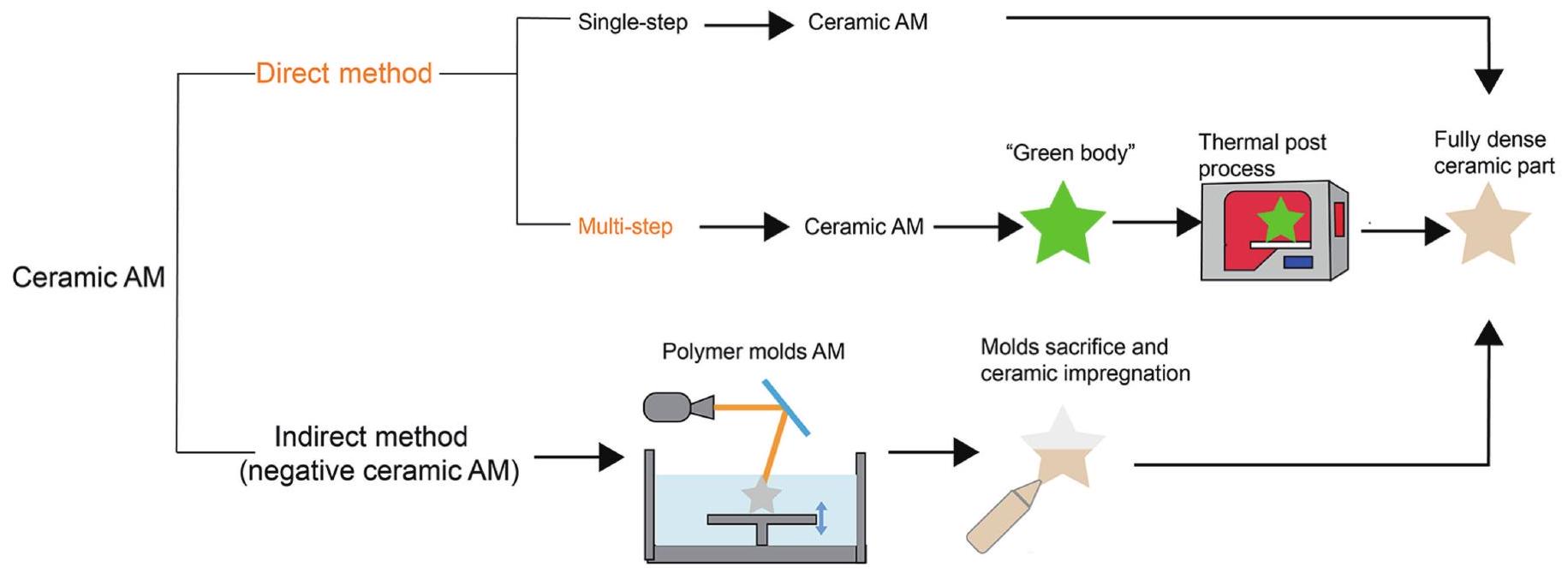
الشكل 1. ثلاث طرق تصنيع مختلفة للسيراميك في التصنيع الإضافي (AM)، حيث تعتبر الطريقة متعددة الخطوات هي الطريقة السائدة حالياً. تعني “الجسم الأخضر” الأجزاء السيراميكية المبنية التي تحتوي على جزء من المادة العضوية.
“طرق التصنيع.” يعتمد على نماذج ثلاثية الأبعاد رقمية في شكل تنسيق ملف AM (AMF) تم الحصول عليه بواسطة طرق مختلفة، حيث يتم تقسيم النماذج الافتراضية إلى عدد لا يحصى من الطبقات ثنائية الأبعاد من خلال برنامج برمجي يسمى slicer، واستيراد البيانات إلى جهاز AM لتنفيذ التصنيع. يقوم جهاز AM بعد ذلك بتصنيع المادة الخام إلى طبقة صلبة رقيقة على طول المحور xy، ثم يتحرك بمسافة معينة على طول المحور z لتصنيع طبقة جديدة، مع الحفاظ على دورة البناء حتى اكتمال التصنيع.
تحد المتطلبات الصارمة للسيراميك السني استخدام بعض تقنيات التصنيع الإضافي. تتمتع السيراميك بنقاط انصهار أعلى، وتكون أكثر حساسية للصدمات الحرارية، وتظهر مرونة أقل مقارنة بالمعادن والبوليمرات، مما يجعل من الصعب الحصول على سيراميك خالي من العيوب وذو تشطيب سطحي عالي من خلال الانصهار المباشر لمواد السيراميك المماثلة (أي، في عملية خطوة واحدة). قام بعض الباحثين بتشريب المواد السيراميكية في قوالب بوليمرية مصنعة إضافيًا وإزالة البوليمر الأصلي للحصول على أجزاء سيراميكية، وهي تقنية تُسمى “السيراميك السلبي”. على الرغم من أنه يمكن الحصول على سيراميك أسنان عالي الجودة باستخدام هذه الطريقة، إلا أنها لا تندرج تحت فئة تصنيع السيراميك الحقيقي بتقنية التصنيع الإضافي، والخطوات أكثر تعقيدًا، مما يزيد من الوقت والعبء العملي. التقنية السائدة الحالية لتصنيع السيراميك بتقنية التصنيع الإضافي هي “العملية متعددة الخطوات” حيث يتم تصنيع “الجسم الأخضر” السيراميكي الذي يحتوي على عدد كبير من المواد اللاصقة العضوية أولاً، تليها معالجة حرارية “لإزالة الروابط والتلبيد” للتخلص من المكونات العضوية وتحقيق الكثافة. باستخدام التصميم بمساعدة الكمبيوتر، تمتلك تقنية التصنيع الإضافي إمكانيات كبيرة لتصنيع المواد ذات التدرج الوظيفي، والتي تتميز بتنوع مكاني في التركيب عبر الحجم؛ ومع ذلك، لم يتم توضيح هذه الإمكانية في سيراميك الأسنان. وبالتالي، فإن هدف هذه المراجعة هو تقديم تقنيات التصنيع الإضافي لسيراميك الأسنان بشكل موضوعي ووصف سلسلة العمليات الكاملة، وآخر التطبيقات في طب الأسنان التعويضي، والفرص المحتملة لتعزيز الأساس النظري لتوسيع التطبيقات السريرية المستقبلية.

2. تقنيات التصنيع المضافة المستخدمة في السيراميك السني

وفقًا لتصنيف ISO/ASTM، يمكن تقسيم تقنيات التصنيع الإضافي إلى سبع فئات، وهي بالتحديد بلمرة الفوتون في الحاويات-
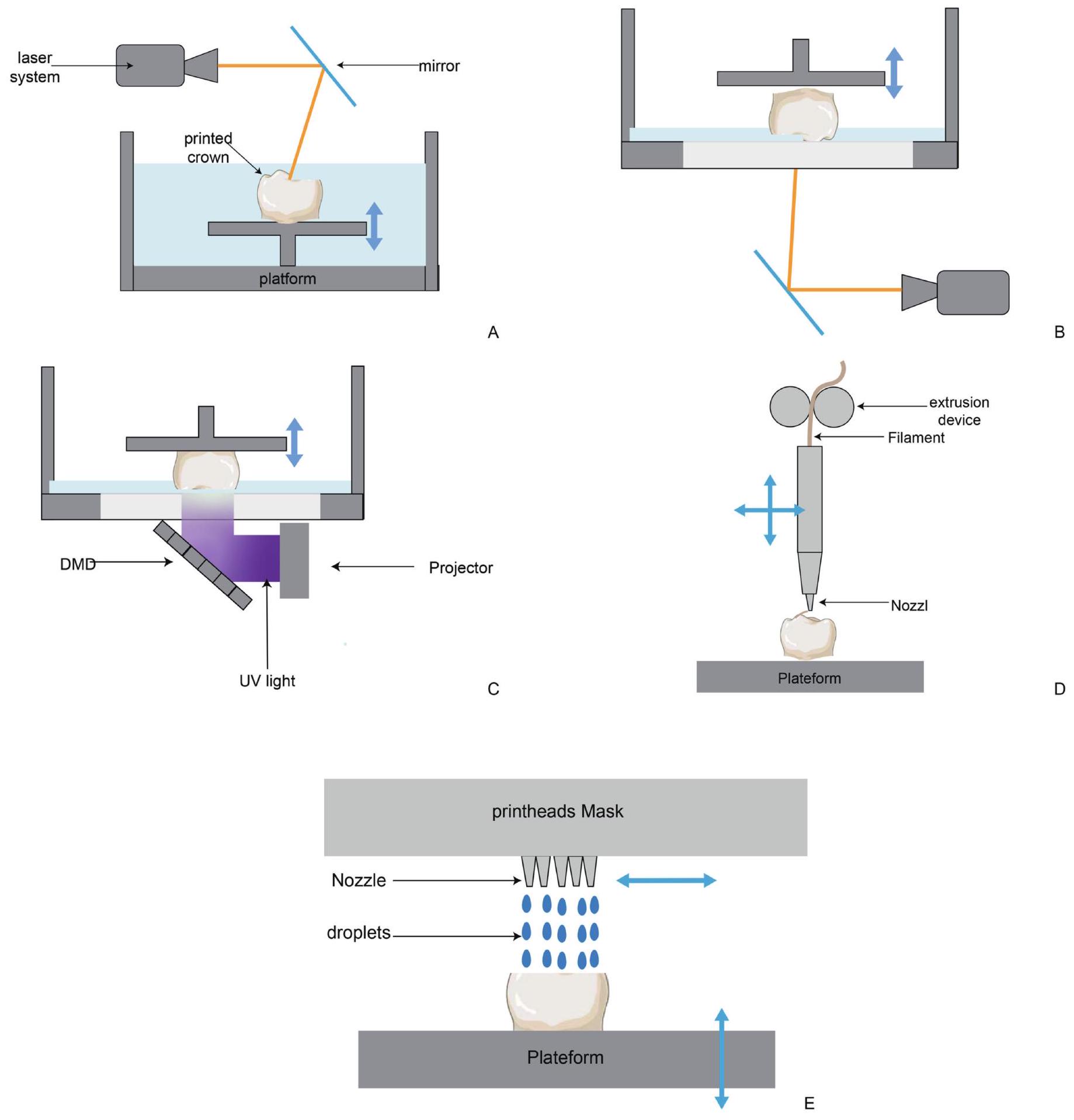
التقنيات مثل الطباعة ثلاثية الأبعاد (VPP)، واستخراج المواد (MEX)، ورش المواد (MJT)، ورش المواد الرابطة (BJT)، ودمج المسحوق (PBF)، وإيداع الطاقة الموجهة (DED)، وت laminating الورق (SHL). ومع ذلك، نظرًا للمتطلبات الصارمة للسيراميك السني، فإن عددًا قليلاً فقط من تقنيات التصنيع الإضافي للسيراميك تلبي المعايير السريرية لطب الأسنان الاصطناعي، بما في ذلك الاستريوليثوغرافي (SLA)، ومعالجة الضوء الرقمي (DLP) في VPP، والطباعة المباشرة بالحبر النفاث (DIP) في MJT، والطباعة الهلامية ثلاثية الأبعاد (3DGP) في MEX. المبادئ الأساسية لهذه التقنيات موضحة في الشكل 2 وسيتم توضيحها بعد ذلك. تعتمد تقنيات التصنيع الإضافي الأخرى، مثل PBF وDED، على دمج المسحوق باستخدام الطاقة الحرارية (مثل الليزر). تستخدم BJT مادة رابطة سائلة لإيداع المواد الخام، وSHL تقطع وتربط المواد الورقية لتشكيل الأجزاء. ومع ذلك، نظرًا لأن هذه التقنيات لا يمكن استخدامها حاليًا لتصنيع سيراميك أسنان عالي الجودة، فهي خارج نطاق هذه المراجعة.

2.1. VPP

تستخدم VPP بشكل أساسي SLA وDLP. تعتمد هاتان التقنيتان على نفس المبدأ ولكن يتم تمييزهما باستخدام مصادر ضوء مختلفة.

2.1.1. اتفاقية مستوى الخدمة

قدمت هول أنظمة تصنيع SLA لأول مرة في الثمانينيات. كانت هذه الأنظمة هي الأنظمة الأصلية للتصنيع الإضافي في السوق، وتتكون بشكل أساسي من نظام ليزر، ومنصة بناء، وحاوية تصنيع مزودة بتعليق سيراميكي (يتكون أساسًا من جزيئات سيراميكية وراتنج حساس للضوء سائل). كانت عملية التصنيع تتألف من ثلاث خطوات: معالجة بالليزر، حركة المنصة، وإعادة تعبئة التعليق. خلال هذه العملية، يتم غمر المنصة في تعليق سيراميكي ويقوم شعاع ليزر يتحكم فيه الكمبيوتر بإشعاع سطح المعلق بشكل انتقائي، مما يؤدي إلى تفاعل بلمرة ويصلب طبقة رقيقة من المعلق. بعد الانتهاء من معالجة طبقة واحدة، تتحرك المنصة مسافة معينة تعادل سمك الطبقة المحدد؛ وبالتالي، يمكن للتعليق السيراميكي تغطية السطح المصنع لتصنيع الطبقة التالية، ويمكن تصنيع الجسم ثلاثي الأبعاد بالكامل من خلال تكرار دورة البناء.
يمكن تقسيم SLA إلى طريقتين وفقًا للموقع
الشكل 2. توضيح تخطيطي لتقنيات تصنيع الإضافات الخزفية الرئيسية: أ. الطباعة الحجرية من الأعلى إلى الأسفل. ب. الطباعة الحجرية من الأسفل إلى الأعلى. ج. معالجة الضوء الرقمي. د. استخراج المواد. هـ. الطباعة المباشرة بالحقن. DMD: جهاز المرايا الرقمية.
لمصدر الضوء بالنسبة للحاوية، تحديدًا “من الأسفل إلى الأعلى” و”من الأعلى إلى الأسفل” (الأشكال 2A وB). كلاهما له مزايا وعيوب. في طريقة من الأسفل إلى الأعلى، تحدث عملية التصنيع في قاع التعليق، مما يقلل من تأثير الأكسجين على تفاعل البلمرة، وبالتالي الحصول على وقت تعرض أقصر. علاوة على ذلك، يساهم الاتصال بقاع الحاوية في تنعيم سطح الطبقات المصنعة، وهذان العاملان مفيدان-
لتحسين الدقة. ومع ذلك، يجب فصل الطبقات عن قاع الحاوية بعد معالجة كل طبقة، مما يزيد من الوقت الإجمالي للتصنيع. والأسوأ من ذلك، أنه يمكن أن يؤدي إلى تشوهات غير مرغوب فيها وإجهاد أو حتى التسبب في انفصال جزء، مما يؤثر على الخصائص الميكانيكية والحفاظ على الشكل المطلوب أثناء التصنيع. مقارنةً بالطريقة من الأسفل إلى الأعلى، يمكن لطريقة SLA من الأعلى إلى الأسفل تحقيق وقت أقصر.
وقت التصنيع وقوة ميكانيكية أعلى، ولكن سمك سطح طبقة التصنيع عمومًا يصعب التحكم فيه بسبب الخصائص الريولوجية لمعلق السيراميك، مما يؤدي إلى دقة نسبية أقل.
بشكل عام، توفر تقنية SLA دقة أعلى وتشطيب سطح أفضل من تقنيات التصنيع الإضافي الأخرى، وبالتالي فهي واحدة من أكثر تقنيات التصنيع الإضافي استخدامًا في تصنيع السيراميك.

2.1.2.

تم إطلاق DLP في عام 1996. مبدأ DLP هو في الأساس نفس مبدأ SLA – الاختلاف يكمن في اختيار مصدر الضوء. تستخدم SLA نظام ليزر، بينما تعكس DLP مصدر ضوء مُسقط (ضوء UV) من خلال مرايا ميكروية مرتبة بشكل مستطيل، تُسمى “جهاز المرايا الرقمية” (DMD). يمكن لـ DMD تحويل مصدر الضوء إلى صورة رقمية كاملة من التعليق عن طريق ضبط زاوية المرايا، حيث تمثل كل مرآة بكسل واحد أو أكثر في الصورة المُسقطة. لذلك، يتناسب عدد المرايا مع دقة الصورة المُسقطة. بالمقارنة مع طريقة المعالجة بالليزر في SLA، والتي تُسمى “نقطة وخط، خط وسطح”، تحقق DLP سرعة تصنيع أعلى من خلال معالجة طبقة كاملة في شكل مصدر ضوء ثابت مرة واحدة، ويمكنها أيضًا تحسين جودة التصنيع بحرية عن طريق ضبط معلمات مصدر الضوء. ومع ذلك، وبسبب محدودية عدد المرايا الميكروية، يمكن لـ DLP تصنيع نماذج صغيرة فقط، وتقل دقة التصنيع مع زيادة حجم النموذج. على سبيل المثال، تكون دقة FPD ذات منطقة تعرض كبيرة نسبيًا أقل من دقة تاج واحد تحت نفس معلمات العملية.
تمتلك VPP إمكانيات كبيرة لتطبيقات التعويضات السنية الفموية بفضل دقتها الممتازة وخصائصها الميكانيكية وجودة سطحها. مؤخرًا، أنشأ هو وآخرون [14] نظام تصنيع متعدد السيراميك يعتمد على معالجة الضوء الرقمي، مما أتاح إمكانية تصنيع متعدد السيراميك من خلال تصميم حوض تصنيع متعدد.

2.1.3. المعلمات المؤثرة على VPP

تعتبر صيغة التعليق ومعلمات التعرض العاملين الرئيسيين اللذين يؤثران على دقة وخصائص المواد الميكانيكية للـ VPP الخزفي. أولاً، يجب أن تحتفظ صيغة التعليق، التي تتكون أساسًا من مساحيق خزفية، ومونومرات راتنجية، ومحفزات ضوئية، وإضافات (مثل مواد التشتت، والمخففات، إلخ)، بلزوجة منخفضة وأن تكون نسبة الخزف إلى المواد الصلبة مرتفعة قدر الإمكان. تفقد معلقات الخزف ذات اللزوجة العالية جدًا قدرتها على الانتشار، مما يؤدي إلى فشل في التصنيع. ومع ذلك، تؤدي اللزوجة العالية جدًا إلى المزيد من العيوب الفيزيائية في الأجزاء المصنعة مقارنة باللزوجة المنخفضة، وهو ما يُعزى إلى التوزيع غير المتساوي للمعلقات ذات اللزوجة العالية. يجب أن تكون اللزوجة المحدودة لمعلق الخزف أقل من 3 باسكال.ثانية لضمان جودة تصنيع مرضية. يمكن أن يساعد النوع الصحيح من مواد التشتت وتركيز مواد التشتت المناسبة في تقليل اللزوجة بشكل فعال. علاوة على ذلك، مع مساعدة طرق إعادة الطلاء بالشفرة أو التحريك، يمكن أن يؤدي معدل القص العالي إلى تقليل اللزوجة بشكل كبير، على الرغم من وجود خاصية تمييع القص الأولية للمعلق. وقد أفاد بعض الباحثين أيضًا أن تعديل سطح جزيئات الخزف باستخدام عامل اقتران سيليكوني يمكن أن يحسن من استقرار التشتت ويقلل من اللزوجة. .
بالإضافة إلى ذلك، تم الإبلاغ عن أن مذيبا غير تفاعلي يقلل من اللزوجة، والأهم من ذلك، يحسن من قوة السيراميك من خلال-
الإشارة إلى حدوث عيوب خلال عملية إزالة الربط. أفاد هان وآخرون أن قوة الانحناء لعينات الزركونيا زادت من 302 إلى 1150 ميغاباسكال مع إضافة بولي إيثيلين جلايكول، الذي أظهر إمكانيته الكبيرة لتحسين قوة سيراميك VPP. علاوة على ذلك، أفاد كانغ وآخرون مؤخرًا أن استخدام ماص للأشعة فوق البنفسجية في معلق الزركونيا يمكن أن يقلل من النمو الهندسي الزائد ويحسن دقة التصنيع. لذلك، من المهم تحديد أفضل نوع ونسبة وتأثير مشترك لهذه الإضافات لصناعة ترميمات السيراميك عالية الجودة في المستقبل.
لقد تم اقتراح أن لا تقل نسبة المواد الصلبة عن وإلا، فلن يمكن الحفاظ على الشكل الأصلي للنماذج المصنعة خلال المعالجة الحرارية اللاحقة. إن نسبة السيراميك إلى المادة الصلبة العالية لها تأثير سلبي على لزوجة المعلق ولكن لها تأثير إيجابي على الخصائص الميكانيكية وتؤدي إلى انكماش منخفض أثناء التلبيد، مما يؤدي إلى تناقض بين النسبة العالية للمادة الصلبة واللزوجة المنخفضة لمعلق السيراميك. مقيدة باللزوجة، تمتلك المعلقات السيراميكية باستمرار نطاق نسبة صلبة مثالية للحصول على أفضل الخصائص الميكانيكية. على الرغم من أن العثور على هذا النطاق واستخدامه يمكن أن يساعد في زيادة قوة السيراميك، إلا أنه من المهم على المدى الطويل تحسين التركيبة وتحقيق نسبة صلبة أعلى مع الحفاظ على لزوجة منخفضة.
تتعلق معايير المعالجة بدقة التصنيع والقوة، التي تتأثر بعمق المعالجة وعرضها. يجب أن يكون الأول أكبر بكثير من سمك الطبقة المحدد لضمان بوليمرة موثوقة بين الطبقات[42،43]، ويجب أن يكون الثاني صغيرًا قدر الإمكان لضمان دقة تصنيع عالية[40،43]. ومع ذلك، فإن ظاهرة تشتت الحواف الناتجة عن اختلاف مؤشرات الانكسار البصري بين جزيئات السيراميك والراتنج تسهم في تقليل عمق المعالجة مع زيادة عرض المعالجة[32]. يتم توضيح ذلك بشكل أكثر وضوحًا من خلال نظرية بير-لامبرت[44]:
حيث يمثل Cd عمق المعالجة؛ ويمثل Dp عمق النقل، مما يعكس حساسية التعليق الخزفي لمصدر الضوء فوق البنفسجي؛ وE هو التعرض (الطاقة الإشعاعية لكل وحدة مساحة)؛ وEc يدل على شدة التعرض الحرجة، والتي تمثل الحد الأدنى لشدة الضوء لمعالجة التعليق؛ وDp وEc مرتبطان بمعلق الزركونيا، حيث أن نسبة المواد الصلبة الكبيرة والمساحيق الصغيرة تقلل من عمق المعالجة. لذلك، يؤثر E على عمق المعالجة. بالنسبة لـ SLA،
حيث يمثل قوة الليزر (تتأثر بشدة مصدر الضوء)، يمثل نصف قطر الشعاع، و يمثل سرعة المسح (وقت التعرض)، مما يشير إلى أن عمق المعالجة مرتبط بشدة الضوء ووقت التعرض. على الرغم من أنه يمكن زيادة عمق المعالجة عن طريق زيادة شدة الضوء، إلا أن ذلك يؤدي إلى زيادة عرض المعالجة بسبب تعزيز تشتت الضوء، مما يؤدي إلى زيادة هندسية أسوأ[25]. بالإضافة إلى ذلك، مع زيادة وقت التعرض، سيصل عمق المعالجة إلى عتبة دون أي تغيير إضافي، بينما يستمر عرض المعالجة في الزيادة[24]. يمكن أن تؤثر منطقة التعرض أيضًا على عرض المعالجة، وتصبح الزيادة أكثر حدة مع زيادة منطقة التعرض[43]. تؤدي شدة الضوء ووقت التعرض المفرطين إلى تدهور دقة التصنيع؛ لذلك، تعتبر معلمات المعالجة المثلى لها قيمة دنيا يمكن أن تحصل على قوة لاصقة موثوقة للطبقات المصنعة[21،22،45،46].

2.2. MJT

MJT هو عملية AM حيث يتم إيداع قطرات من المادة الخام بشكل انتقائي على سطح مبني. يُطلق على هذا عادةً DIP لطباعة السيراميك AM. يمكن تقسيم هذه العملية إلى أربع خطوات: 1. تقوم الفوهة بإخراج القطرات؛ 2. تتلامس القطرات مع منصة البناء أو سطح البناء السابق وتتفاعل مع بعضها البعض؛ 3. تتصلب القطرات وتشكل طبقة معالجة؛ و4. يتم الحفاظ على دورة البناء حتى الاكتمال. تشمل DIP المستخدمة في طباعة السيراميك الطباعة المستمرة بالحقن (CIJ)، والطباعة بالحقن عند الطلب (DOD)، والطباعة بالحقن الكهروستاتيكية (EIP). CIJ هي نهج طباعة مستمر مع نفث قطرات غير منقطع، وDOD هو نهج غير مستمر ينتج قطرات فردية عند الحاجة، وEIP يستخدم الطرد الكهروستاتيكي لإخراج القطرات. من بينها، يتم استخدام DOD بشكل رئيسي في AM بسبب دقته الأفضل وتكلفته المنخفضة[47]. في هذه الطريقة، يتم رش قطرات التعليق التي تحتوي على جزيئات خزفية بشكل انتقائي على منصة البناء باستخدام الكهرباء الكهروضغطية أو التسخين[47]. تتفاعل القطرات مع بعضها البعض وتصلب لاحقًا عن طريق التسخين أو التبخر أو المعالجة الضوئية بعد التلامس مع الركيزة (الشكل 2E). مقارنةً بالمعالجة بالأشعة فوق البنفسجية أو التسخين، فإن التصلب عن طريق التبخر يمكّن المعلق من احتواء عدد أقل من المواد العضوية لوقت معالجة لاحق أقصر وخصائص أفضل[48،49]. كعملية متعددة الخطوات، يحتاج “الجسم الأخضر” المبني إلى مزيد من المعالجة الحرارية اللاحقة.
تتمتع DIP بمزايا الدقة العالية والتشطيب السطحي الممتاز، والتي يمكن أن تُعزى إلى إيداع قطرات صغيرة الحجم. بالإضافة إلى ذلك، يمكّن تصميم الفوهات المتعددة من طباعة مواد مختلفة معًا لتغيير تنظيم المواد تدريجيًا داخل مكون (FGMs)[13]. لقد نجح بعض العلماء في طباعة خزفيات وظيفية كثيفة وخالية من العيوب باستخدام DIP[12،50،51]، مما يظهر الإمكانات الكبيرة للطباعة المضافة ذات التدرج الوظيفي (FGAM). ومع ذلك، فإن DIP لها عيوب سرعة البناء البطيئة وسهولة انسداد الفوهة، مما يؤثر على جودة الطباعة[52]. في السنوات الأخيرة، قدمت شركة XJet تقنية نفث الجسيمات النانوية (NPJ) المعتمدة على DIP، والتي لديها سمك طبقة أدنى و دقة المحور XY[53]. وقد تم الإبلاغ عن أن هذه الطريقة تحقق أداءً ممتازًا في تصنيع ترميمات الزركونيا في دراسات قائمة على المختبر[54-56].

2.2.1. المعلمات المؤثرة على DIP

تتطلب DIP ما يلي: 1. يجب أن تقوم الفوهة بإخراج قطرات منتظمة ومستقرة؛ 2. يجب تشكيل خط طباعة مستقر بعد وصول القطرات إلى الركيزة أو الطبقات السابقة؛ 3. يجب أن يكون تصلب القطرات متجانسًا. يمكن تمثيل سلوك السوائل أثناء الطباعة بالحقن بعدد ويبر (We) وعدد رينولدز (Re) وعدد أونيسورغ (Oh).
,
حيث و تشير على التوالي إلى الكثافة، اللزوجة الديناميكية، والتوتر السطحي للسائل، وv تشير إلى سرعة القطرات بعد إخراجها من الفوهة، وa تمثل قطر الفوهة.
يجب أن يقوم طابعة DIP ثلاثية الأبعاد بإخراج قطرات مستقرة، وهو ما يتعلق
بخصائص السلوك الريولوجي للتعليقات، كما يعبر عنه بعدد أونيسورغ (Oh). أفاد برساد وآخرون[57] أنه يمكن تشكيل قطرات مستقرة عندما . أي أنه إذا كان أقل من 1، سيكون المعلق كثيفًا جدًا لإخراج القطرات من الفوهة، بينما إذا كان أكبر من 10، فلن يتم إخراج القطرات بالكامل ولكن سترافقها قطرات فضائية غير مرغوب فيها، مما سيؤثر سلبًا على دقة الأجسام المطبوعة[47]. بالإضافة إلى ذلك، فإن سرعة حقن القطرات لها قيم دنيا وعليا للتغلب على التوتر السطحي عند الفوهة المعرضة ومنع القطرات من التشتت، على التوالي. يتم التعبير عن الحد الأدنى للسرعة كأدنى عدد ويبر (We): بينما يتم تحديد الحد الأقصى للسرعة بواسطة كما يلي:
حيث هي دالة من خشونة السطح، والتي تعطي قيمة تقارب 50 للأسطح المسطحة والناعمة.
باختصار، تلعب مكونات المعلق ومعلمات الطباعة، بما في ذلك سرعة القطرات، وقطر الفوهة، وتردد النفث، دورًا مهمًا في DIP. يُوصى بأن تكون نسبة المواد الصلبة للخزف أكبر من لتلبية متطلبات تكثيف الخزف، مع اعتبار نطاقًا مرضيًا[58،59]. يجب أن تكون نسبة قطر الفوهة إلى حجم جزيئات الخزف أكبر من 50 لتجنب انسداد الفوهة[60]، مع نطاق قطر الفوهة النموذجي المستخدم في DIP يتراوح من 10 إلى . أي أن حجم جزيئات الخزف مطلوب عمومًا أن يكون على مقياس النانومتر أو تحت المقياس المجهري. علاوة على ذلك، تلعب اللزوجة والتوتر السطحي للحبر دورًا مهمًا في شكل وسرعة القطرات المنفوخة وكذلك قابلية انتشارها على سطح البناء، والتي يُوصى بأن تكون في نطاق إلى و إلى على التوالي[61].

2.3. MEX

يتم تعريف MEX الخزفي على أنه إيداع خيوط أو معاجين محملة بالخزف على منصة باستخدام فوهة ضغط (الشكل 2D). وفقًا لتكوين المعلق، يمكن تقسيم MEX إلى عمليات ضغط قائمة على الشمع والماء. يحتوي المعلق في عمليات الضغط القائمة على الشمع على عدد كبير من البوليمرات مع تشتت من المساحيق الخزفية. أثناء الضغط، يتم تسخين المعلق إلى حالة الانصهار ويتم ضغطه بواسطة الفوهة، ويتم الحصول على الجسم الأخضر المبني عن طريق التصلب بالتبريد أو التصلب الناتج عن الضوء. تشمل تقنيات الضغط الشائعة القائمة على الشمع نمذجة الإيداع المنصهر (FDM)[62]، والتي تتميز بتسخين خيط المادة الخام إلى حالة منصهرة أو لينة وضغطه عبر فوهة للإيداع طبقة تلو الأخرى. توفر هذه العملية فوائد التكلفة المنخفضة وسهولة التشغيل. ومع ذلك، تعاني من عيوب وجود مرحلة عضوية عالية وإجهاد حراري من درجة حرارة الانصهار العالية لـ FDM مما يؤدي إلى ضعف القوة والدقة في تصنيع الخزف.
بالمقارنة مع المعلق القائم على الشمع، يحتوي المعلق القائم على الماء على مذيب قائم على الماء بدلاً من البوليمر، مما يسمح بنسبة خزف إلى مادة صلبة أعلى ومحتوى لاصق أقل. الكتابة بالحبر المباشر (DIW) هي واحدة من الطرق للأخيرة؛ نظرًا لسلوكها الزائف اللزج، يمكن ضغط المعلق في درجة حرارة الغرفة بمعدل قص عالي ويمكن أن يستعيد الشكل الأصلي في الوقت المناسب لخصائص لزجة عالية. يتم تحفيز التصلب عن طريق تبخر المذيب. يمكن استخدام DIW لبناء أقسام مهددة دون دعم نظرًا لارتفاع لزوجتها الثابتة[63،64]. بالإضافة إلى ذلك، لمنع تبخر الماء غير المرغوب فيه، يتم استخدام الخزف عند الطلب
تم تطوير البثق (CODE). على عكس DIW، يقوم CODE ببثق السيراميك داخل خزان يحتوي على زيت. يمنع الزيت الجفاف غير المرغوب فيه من جوانب الطبقات المبثوقة، ويتم استخدام الإشعاع تحت الأحمر لتجفيف هذه الطبقات[65]. تساهم نسبة المواد الصلبة العالية ودرجة حرارة البثق المنخفضة في البثق القائم على الماء في زيادة الكثافة مع تقليل الانكماش وتجنب تأثير الإجهاد الحراري المتبقي على الأجزاء. ومع ذلك، بسبب قيود قطر الفوهة الكبير وتأثير الدرجات، لا تزال دقة التصنيع وتشطيب السطح لـ DIW و CODE أقل من تلك الخاصة بـ VPP أو DIP، مما يجعل من الصعب تصنيع ترميمات سيراميكية عالية الجودة لا تزال مناسبة لدعامات الأنسجة العظمية[66].
تعتبر 3DGP التقنية الوحيدة للبثق السيراميكي المستخدمة في طب الأسنان. استخدم شاو وآخرون[67] 2-هيدروكسي إيثيل ميثاكريلات (HEMA) كعامل مساعد للتجليد وبيرسلفات الأمونيوم كمبادر لتصنيع الزركونيا باستخدام آلة بثق لولبية. مقارنةً بتقنيات MEX الأخرى، يمكن لـ 3DGP الحصول على سطح أكثر سلاسة بشكل ملحوظ بفضل تجليد المعلق[67]، مما يجعلها أكثر ملاءمة للتطبيقات التعويضية. أضافت الدراسات اللاحقة خطوة طحن السطح الداخلي للأجسام الخضراء (مجموعة من AM و SM) لتقليل العيوب وتحسين جودة السطح. يمكن لهذه التقنية المحسنة لـ 3DGP الحصول على دقة مرضية، وقوة ميكانيكية، وأداء جمالي، وقد تم تطبيقها في تصنيع الترميمات في السنوات الأخيرة[68-70].

2.3.1. المعلمات المؤثرة على MEX

يؤثر قطر الفوهة بشكل مباشر على سمك الطبقة ودقة التصنيع؛ يمكن أن يحسن القطر الأصغر الدقة وخشونة السطح ولكنه يزيد أيضًا من وقت البثق وإمكانية انسداد الفوهة. نظرًا لأن MEX يحتوي على محتوى سيراميكي أعلى من DIP، يجب أن يكون حجم الفوهة المستخدمة أكبر من كحد أدنى، مع حجم موصى به قدره [63]. يجب أن يظهر المعجون السيراميكي سلوكًا قابلًا للعكس من حيث التخفيف القصي والسلوك اللزج عند معدل قص منخفض، بحيث يمكن طرد الحبر ذو نسبة المواد الصلبة العالية بسلاسة من الفوهة والحفاظ على قوة معينة وقدرة على الدعم الذاتي بعد البثق. يتعلق الأمر بمعاملين ديناميين: معامل التخزين ( ) ومعامل الفقد ( )، اللذان يمثلان المرونة واللزوجة، على التوالي. عندما يتجاوز الإجهاد القصي الناتج عن ضغط الفوهة إجهاد الخضوع للمعلق ( )، يمر المعلق عمومًا بعملية تسييل وتشوه لزج. عندما يتم بثق المعلق، يعود بسرعة إلى مرونته ولزوجته الأصلية بسبب انخفاض الإجهاد القصي ( ). يمكن وصف إجهاد الخضوع باستخدام نموذج هيرشل-بولكلي:
حيث يمثل الإجهاد القصي، ويمثل إجهاد الخضوع، ويمثل ( ) التناسق، ويمثل معدل القص، و n هو مؤشر التدفق ( يمثل ظاهرة التخفيف القصي). لذلك، تشمل المعلمات ذات الصلة المحتوى السيراميكي ( موصى به)، حجم الجسيمات ( موصى به)، نوع وتركيز الإضافات، سرعة البثق (عادة بين ) ونمط الشبكة، وكلها تتضافر لتؤثر على جودة التصنيع .

3. المواد السيراميكية السنية للتصنيع الإضافي
تستخدم سيراميك الأسنان المختلفة في التعويضات السنية، بما في ذلك السيراميك الزجاجي (بورسلين الفلسبار، بورسلين الفلسبار المعزز باللوكيت، وثنائي سيليكات الليثيوم)، والسيراميك متعدد البلورات (الألومينا والزركونيا)، والسيراميك المختلط. ومع ذلك، فإن التصنيع الإضافي للسيراميك الحالي
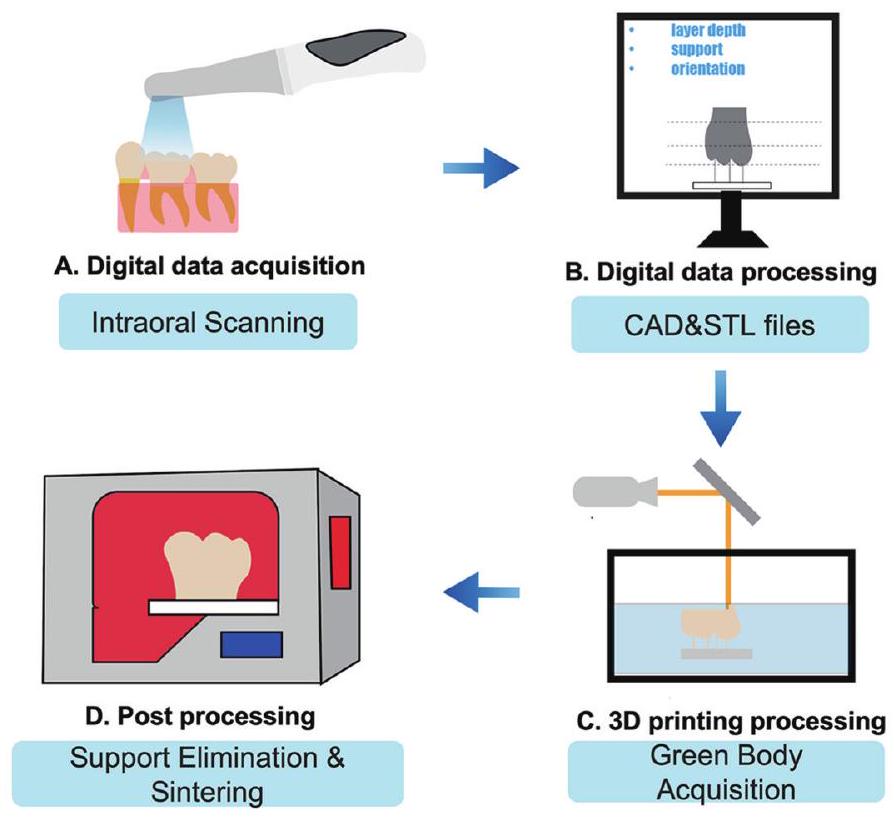
الشكل 3. سلسلة العملية الكاملة لترميمات السيراميك في التصنيع الإضافي.
يستخدم بشكل أساسي الزركونيا المدعمة جزئيًا باليترية (Y-TZP)، والألومينا، وثنائي سيليكات الليثيوم (LD).

4. معلمات سلسلة العملية التي تؤثر على خصائص السيراميك في التصنيع الإضافي

تشمل سلسلة العملية الكاملة للتصنيع الإضافي للسيراميك جمع البيانات (مسح ثلاثي الأبعاد)، معالجة البيانات، التصنيع الإضافي، والمعالجة اللاحقة (الشكل 3). من بين هذه، تؤثر العمليات الثلاث الأخيرة على خصائص السيراميك في التصنيع الإضافي وسنناقشها بمزيد من التفصيل.

4.1. معالجة البيانات

على عكس SM، يجب تقسيم نماذج 3D في التصنيع الإضافي إلى العديد من الطبقات ثنائية الأبعاد ودعمها باستخدام برنامج برمجي قبل التصنيع[73]. ترتبط الإعدادات المحددة للطبقات ثنائية الأبعاد باتجاه البناء وسمك الطبقة، ويتم وصف تصميم وإزالة الدعم في القسم 4.3.

4.1.1. اتجاه البناء

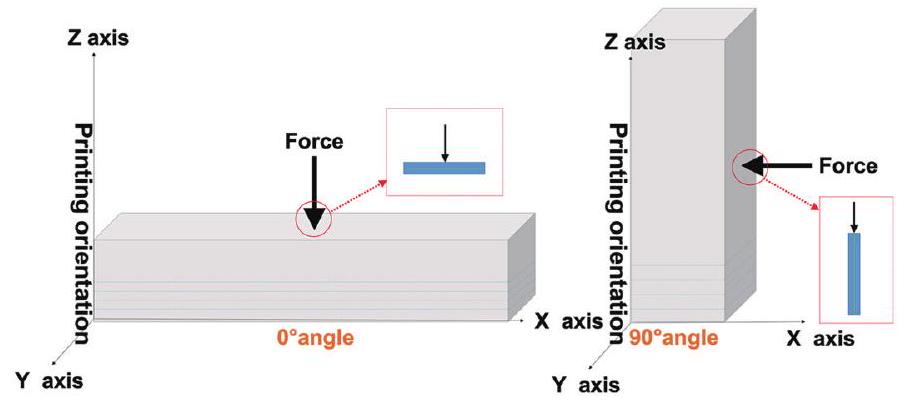
اتجاه البناء هو الزاوية التي تتشكل بين الجزء ومنصة البناء، والتي تؤثر بشكل كبير على وقت التصنيع والدقة، بالإضافة إلى قوة الأجسام المصنعة. تؤدي إعدادات الاتجاه المختلفة إلى مناطق طبقة مختلفة وارتفاعات تصنيع مختلفة؛ تمثل منطقة الطبقة الأصغر فترة راحة أقصر للمعلق بين الطبقات، بينما يشير ارتفاع التصنيع الأعلى إلى المزيد من الطبقات للبناء. لذلك، يجب أن يأخذ وقت التصنيع المحدد في الاعتبار كل من منطقة الطبقة والارتفاع[74]. فيما يتعلق بالخصائص الميكانيكية، نظرًا لأن الترابط داخل الطبقة أقوى بكثير من الترابط بين الطبقات في التصنيع الإضافي، يمكن الحصول على قوة أفضل عندما تكون الطبقات المصنعة عمودية على اتجاه القوة[75-78]. بالنسبة للعوارض أو الأقراص، يكون اتجاه قوة الاختبار عموديًا على مستوى الطول والعرض، مما يساهم في أعلى قوة انحناء مع اتجاه بناء قدره ، بينما تعتبر قوة الانحناء قدرها غير مرضية لأن
الشكل 4. اتجاهان مختلفان للتصنيع ( و ). بالنسبة لعينة ، يتم تطبيق قوة الاختبار على مستوى الطبقة المصنعة الكثيفة، مما يساهم في قوة أقوى. بالنسبة لعينة ، يتم تطبيق القوة على الاتصال الضعيف بين الطبقات، مما يؤدي إلى قوة أقل.
لأن القوة تُطبق مباشرة على الاتصال الضعيف بين الطبقات المجاورة (الشكل 4). اقترح دونغ وآخرون[75] أن منطقة الطبقة الأصغر يمكن أن تضمن تكثيفًا أكبر مع عدد أقل من العيوب الداخلية، مما يفسر لماذا يكون اتجاه البناء مع منطقة طبقة أكبر له معامل ويبول أقل في معظم الدراسات على العينات السيراميكية.
يرتبط اتجاه البناء أيضًا بالدقة. أفاد لي وآخرون[79] بوجود اتجاهين مختلفين لتصنيع التيجان: من الحافة إلى المنصة ومن السطح الماضغ إلى المنصة. أظهر الأخير تحسنًا كبيرًا في الدقة وجودة الحواف. علاوة على ذلك، فإن معدل الانكماش في المحور z عادة ما يكون أكبر من ذلك في المحور xy بسبب المواد العضوية الغنية بين الطبقات. وهذا يعني أن إعداد ارتفاع التصنيع المنخفض يمكن أن يحصل على دقة أعلى، وهو مفيد لاختيارات اتجاه البناء المختارة لوحدات FPD متعددة أو أطقم الأسنان الكاملة.

4.1.2. سمك الطبقة

كما ذُكر سابقًا، يمكن أن تشكل الحواف العمودية لكل طبقة تأثير الدرجات، مما يؤثر على دقة التصنيع وجودة السطح في التصنيع الإضافي[80]. يحدد سمك الطبقة عدد النقاط المنفصلة عند الحواف. مع طبقة أرق، يتم توليد المزيد من النقاط المنفصلة عند حواف الطبقات، وبالتالي يمكن إنتاج سطح أكثر سلاسة وتفصيلاً. لذلك، يمكن أن تعالج الطبقة الأرق تأثير الدرجات وتوفر تحسينًا في الدقة وجودة السطح[81]. يرتبط سمك الطبقة أيضًا بمعلمات التعرض في VPP. يجب أن تكون عمق المعالجة المستخدم في VPP أكبر بكثير من سمك الطبقة لتجنب التأثير على البلمرة بين الطبقات. بالنسبة للمعلقات السيراميكية، يؤدي سمك الطبقة الكبير إلى معدل تشتت ضوء كبير وعرض معالجة موسع[82]، بينما يمكن أن تقلل الطبقة الرقيقة من النمو الهندسي الزائد مع ضمان بلمرة شاملة بين الطبقات مع شدة تعرض منخفضة، مما يمنع الانفصال أو التشوه[83].
ومع ذلك، تتطلب الطبقات الرقيقة تصنيع عدد كبير من الطبقات. هذا يستغرق وقتًا أطول، ولكنه لا مفر منه للتصنيع عالي الدقة لأن الطبقات الرقيقة ضرورية لتحقيق متطلبات الدقة العالية للأطراف الاصطناعية الفموية. في الوقت الحالي، يكون الحد الأدنى لسمك الطبقة في التصنيع الإضافي للسيراميك عادةً ؛ يجب تقليل ذلك أكثر في المستقبل للحصول على دقة تفوق أنظمة الطحن التقليدية.

4.2.

يتم استيراد ملف STL المعالج إلى جهاز AM للتصنيع، والذي يتكون من مكونين، التصنيع المباشر وغير المباشر. يتم تقسيم الأول إلى طرق خطوة واحدة وطرق متعددة الأجزاء (الشكل 2)[10]. يمكن لعملية الخطوة الواحدة تصنيع السيراميك عالي الكثافة مباشرة، مثل PBF، والتي يمكن أن تحصل نظريًا على خصائص ميكانيكية مفضلة دون معالجة لاحقة. ومع ذلك، فإن جودة السطح التي يتم الحصول عليها من خلال هذه العملية رديئة للغاية بحيث لا يمكن أن تلبي متطلبات الأطراف الاصطناعية الفموية[84]. تعتبر العمليات متعددة الخطوات مثل SLA وDLP وDIP وMEX حاليًا تقنيات تصنيع السيراميك السائدة. يتم تقديم العديد من تقنيات AM السيراميكية متعددة الأجزاء التجارية في الجدول 1.

4.3. المعالجة اللاحقة

تشمل المعالجة اللاحقة لسيراميك AM بشكل أساسي إزالة الدعم والمعالجة الحرارية (إزالة الربط والتلبيد).

4.3.1. إزالة الدعم

نظرًا لأن المواد السائلة لا يمكن أن توفر أي دعم، فإن الدعم الإضافي مطلوب لدعم الأقسام المعلقة. يتطلب ذلك قوة دعم كافية للنموذج المصنع والتصاق مناسب بمنصة البناء[80]. يمكن أن تنشأ مشكلة عند إزالة الدعم يدويًا بعد التصنيع، حيث يمكن أن يؤثر ذلك على الدقة وجودة السطح للجسم الأخضر بسبب الإزالة غير المتساوية[80،85]. لقد ثبت أن تصميمات هياكل الدعم المرضية تقلل من أضرار الإزالة؛ تشمل الأمثلة “هيكل دعم ثلاثي الأجزاء”[85]، “دعم الطحن”[86]، “قاعدة دعم كاملة”[87]، و”دعم غير ملامس متوافق”[30]. مبدأ هذه التصميمات هو اختيار منطقة غير مهمة نسبيًا (مثل السطح اللساني للأسنان الخلفية) لتصميم الدعم وتقليل الأضرار اليدوية من خلال التصميم الهندسي.
بالمقارنة مع VPP، تقدم تقنيات MJT وMEX ميزة تصنيع النماذج والدعائم بشكل منفصل من مواد مختلفة، مما يبسط عملية إزالة الدعم. استخدم Li et al.[88] CODE لتصنيع السيراميك بدعم عضوي، حيث يمكن فصل الجزء العضوي بسهولة عن النماذج عبر المعالجة الحرارية. تستخدم تقنية NPJ المذكورة سابقًا “دعم قابل للذوبان في الماء” باستخدام كمواد خام، والتي يمكن إزالتها دون إتلاف الجزء السيراميكي عن طريق الشطف بالماء[53]. يمكن أن يؤدي استخدام مواد دعم مختلفة لتصنيع الأجزاء والدعائم إلى تبسيط خطوات المعالجة اللاحقة بشكل كبير وتقليل الأضرار السطحية المحتملة.

4.3.2. إزالة الربط والتلبيد

إزالة الربط والتلبيد هما عمليتا إزالة المكونات العضوية وكثافة البلورات، على التوالي، وهما ضروريتان بسبب المحتوى العضوي العالي وضعف التصاق الطبقات المصنعة في الأجسام الخضراء. يمكن أن تؤدي الفواصل السريعة بين الماء والمواد العضوية أثناء التجفيف وإزالة الربط بسهولة إلى انفصال الطبقات، والتشقق، والفراغات[89]. خلال خطوة التصنيع النهائية، يمكن أن يؤثر التلبيد على مرحلة البلورات السيراميكية، وحجم الحبيبات، والتمعدن، وخصائص أخرى. ترتبط درجة حرارة التلبيد، ومدة الوقت، وظروف التلبيد ارتباطًا وثيقًا بالخصائص الميكانيكية، والشفافية، ومقاومة الشيخوخة للسيراميك[89،90]. لذلك، من الضروري تحسين عمليات إزالة الربط والتلبيد.
الجدول 1. ملخص لتقنيات التصنيع الإضافي للسيراميك التجارية (AM)
الشركة المصنعة جهاز AM التقنيات الدقة / م سمك الطبقة الدنيا / المواد
Xjet Xjet Carmel 1400 NPJ، بناءً على DIP 16 10.5 3Y-TZPAlumina
Lithoz
CeraFab System S65
CeraFab Lab L30
CeraFab Multi 2M30
LCM، بناءً على DLP 40 10 3Y-TZPAlumina
3DCeram
C900 Flex
C1000 Flexmatic
C3600 UltimateCeramaker900
C101
SLA 35um (قطر بقعة الليزر) 20
3Y-TZP
Alumina
ATZ
Porimy CSL100/150/200 SLA 40 25 3Y-TZP
Admaflex Admaflex130/300 DLP 35 10 3Y-TZPAlumina
Octave Light Octave Light R1 DLP 30 25 3Y-TZPAlumina
Exone
InnoventX
X25Pro
X160Pro
طباعة ربط 30 30 3Y-TZP
Prodways Promaker 10 تقنية الضوء المتحرك، بناءً على DLP 42 10 3Y-TZP
AON
INNI
ZIPRO
DLP 40 25 3Y-TZPAlumina
NPJ: طباعة نفاثة للجزيئات النانوية، DIP: طباعة نفاثة مباشرة، LCM: تصنيع السيراميك القائم على الطباعة الحجرية، DLP: معالجة الضوء الرقمي، SLA: الاستريوليثوغرافي، ATZ: زركونيا مقواة بالألومينا، 3Y-TZP: زركونيا رباعية الأبعاد المدعمة باليتريا
يمكن أن توجه سلوك التحلل الحراري لجسم أخضر إنشاء إجراء إزالة الربط المناسب، والذي يمكن تحليله وتصميمه باستخدام التحليل الحراري الوزني (TGA) والتحليل الحراري التفاضلي (DSC)[32]. يجب تجفيف الجسم الأخضر أولاً لإزالة الماء المتبقي قبل إزالة الربط. استخدم Zhou et al.[91] وSang et al.[35] طرق التجفيف السائل وطرق التجفيف بالفراغ، على التوالي، للحصول على تجفيف متجانس. أظهرت الدراسات أن البيئات اللاهوائية (الفراغ أو Ar) ومعدلات تسخين إزالة الربط المنخفضة يمكن أن تقلل من حدوث العيوب[45،89]. بالإضافة إلى ذلك، تم الإبلاغ عن إزالة الربط متعددة المراحل[90،91] وتغييرات في وقت الانتظار[92] لتحسين الجودة النهائية لسيراميك AM.
تعتبر درجة حرارة التلبيد والوقت من المعلمات الهامة التي تؤثر على الخصائص الميكانيكية للإنشاءات. مع زيادة درجة حرارة التلبيد والوقت، يستمر حجم حبيبات السيراميك في النمو والكثافة، مما يؤدي إلى إنشاء كثيف عالي الكثافة بخصائص ميكانيكية متفوقة. ومع ذلك، فإن درجات حرارة التلبيد القصوى أو الوقت المفرط تشوش حدود الحبيبات وتسبب انهيارها، مما يؤثر سلبًا على قوة السيراميك[93،94]. بالإضافة إلى ذلك، تتيح البيئات الخاصة بالتلبيد، مثل تلبيد الضغط الساخن أو تلبيد البلازما الشرارية، الحصول على حبيبات بحجم نانو وكثافة عند درجات حرارة تلبيد منخفضة، مما يحسن من شفافية السيراميك ومقاومة الشيخوخة[95،96].

5. تطبيق سيراميك AM في طب الأسنان الاصطناعية

حتى الآن، ركزت أبحاث السيراميك الأسنان AM بشكل أساسي على التيجان الفردية وFPDs متعددة الوحدات. على الرغم من اعتبار الأطراف الاصطناعية الأخرى (بما في ذلك التراكب، والتضمين، والطلاء، وطلاء الإطباق) ترميمات طفيفة التوغل، أقل توغلاً من التيجان، إلا أنها لا تزال تفتقر إلى أبحاث كافية بشأن إمكانيات تطبيق AM.
تعتبر الدقة والخصائص الميكانيكية عاملين مهمين يؤثران على طول عمر وصحة الفم المرتبطة بالترميمات، والأداء الجمالي هو عامل إضافي مهم للترميمات الأمامية. لقد أجرت العديد من الدراسات تحقيقات حول دقة وخصائص السيراميك AM؛ ومع ذلك،
تقييمات الجمالية نادرة نسبيًا.
يشمل تقييم الدقة في المختبر بشكل أساسي تقييم الدقة والضبط[97]، بينما في طب الأسنان، يتم تمثيل الأخير عادةً من خلال ملاءمة التاج (التكيف الداخلي والملاءمة الهامشية). يتم تحديد الدقة من خلال تحليل الانحراف ثلاثي الأبعاد بين النماذج المقاسة ونموذج CAD الأصلي، وتشير قيمة الدقة المنخفضة إلى دقة متفوقة. تعتبر ملاءمة التاج في الأساس سمك الأسمنت بين الأسنان الداعمة والترميمات ولها أهمية سريرية مباشرة. تلعب الملاءمة الهامشية دورًا مهمًا في التأثير الترميمي، حيث أن الملاءمة الهامشية السيئة تسبب انحلال الأسمنت، وتسوس ثانوي، والتهاب لب الأسنان، والتهاب اللثة، والتهاب دواعم الأسنان، وتغير لون الحواف، مما يؤثر بشدة على صحة الفم والمظهر الجمالي[98-102]. من المتعارف عليه عالميًا أن الملاءمة الهامشية المقبولة سريريًا يجب أن تكون . يرتبط التكيف الداخلي بقوة وملاءمة الترميمات. يقلل الأسمنت السميك بشكل مفرط من الخصائص الميكانيكية للترميمات من خلال زيادة الإجهاد الشد[105]، بينما يؤدي الأسمنت الضيق بشكل مفرط إلى اتصال مبكر بين السطح المحوري الداخلي للتاج والسن الداعم، مما يزيد من الفجوة الأسمنتية بين الحافة والسطح الداخلي للإطباق[106]. اقترح بعض العلماء أن أفضل نطاق لملاءمة السطح الداخلي هو ، وأن النطاق الأقصى المقبول سريريًا هو .
وفقًا لمعيار ISO 6872:2015[111]، يتم تقييم الخصائص الميكانيكية للترميمات السيراميكية الثابتة باستخدام قوة الانحناء، ويوصى بصلابة الكسر كمعلمة مهمة للتنبؤ بقوة السيراميك. تتراوح قوة الانحناء لـ SM الزركونيا بين ، وتلك لـ SM الليثيوم المقطر هي ميغاباسكال[112]. على الرغم من أن الاختبار القياسي يُعترف به كمعيار ذهبي لتقييم الخصائص الميكانيكية للسيراميك السني، فقد اقترح بعض العلماء أن القوة الميكانيكية الحقيقية لسيراميك التصنيع الإضافي قد يتم توضيحها بشكل أفضل من خلال حمل الكسر للترميمات لأن التصنيع الإضافي هو طريقة تصنيع مختلفة تمامًا عن التصنيع التقليدي[89،91]. لم يجد الغزاوي وآخرون[113] علاقة واضحة بين حمل الكسر وقوة الانحناء لتاج الزركونيا، ولكن بخلاف ذلك هناك دراسات قليلة حول حمل الكسر لترميمات السيراميك المصنوعة بالطباعة الإضافية. مقاومة الشيخوخة والإجهاد هي
الجدول 2. دقة تيجان السيراميك المصنعة بإضافة
المؤلف/ السنوات تكنولوجيا (شركة) جهاز AM مادة الصدق / الجذر التربيعي لمتوسط المربعات )
وانغ/2019[117] SLA (3DCeram) CERAMAKER900 3Y-TZP
الهامش:
سطح النقش العميق:
انسداد النقش:
السطح الخارجي:
باومغارتنر/2020[122] DLP (ليثوز) نظام سيرا فاب S65 ثنائي سيليكات الليثيوم <50
ليرنر/2020[120] DLP (ليثوز) نظام سيرا فاب S65 3Y-TZP
الهامش:
السطح الخارجي:
سطح الإطباق:
لي/2020[115] SLA (بوريماي) CSL100 3Y-TZP
سطح النقش: 22.7
السطح الخارجي: 19.2
لي/2020[124] 3DGP (ERRAN) زركونيا ذاتية التزجيج 3Y-TZP
الهامش:
سطح النقش العميق:
سطح الانسداد:
السطح المحوري:
وانغ/2021[106] DLP (ليثوز) سيرا فاب 7500 الألومينا
SLA (بوريماي) CSL150 3Y-TZP
لي/2022[30] SLA (ZRapid) AMC150 3Y-TZP
الهامش:
نقش محوري:
انسداد النقش: 43.7
السطح الخارجي:
كيم/2022[123] SLA (3DCeram)
C100 سهل
فاب
3Y-TZP
الهامش: 54.2
سطح النقش: 32.6
سطح الإغلاق:
السطح المحوري:
DLP (أوكتاف)
ضوء
أوكتاف لايت R1 3Y-TZP
الهامش:
سطح النقش العميق:
سطح الانسداد: 27.1
السطح المحوري:
القمر/2022[121] DLP (AON) إنّي-اثنان 3Y-TZP
الهامش:
سطح النقش العميق:
مينغ/2022[25] DLP (NP) NP 3Y-TZP
لي/2022[87] SLA (بوريماي) سي إس إل 100 3Y-TZP
سطح النقش العميق:
السطح الخارجي:
أبو السعود/2022[119] SLA (3DCeram) ماسح مختبر الأسنان 3Shape E3 3Y-TZP
الهامش:
سطح النقش العميق:
سطح الانسداد: 8.77
السطح المحوري:
كامارغو/2022[56] NPJ (Xjet) كارمل 1400 3Y-TZP
الهامش:
نقش محوري:
التحجيم العميق
Lv/2023[55] NPJ (Xjet) كارمل 1400 3Y-TZP
كل التاج:
الهامش:
سطح النقش: 23.9
السطح الخارجي:
DLP (جونجينج) ج2 د140ل سيراميك 3Y-TZP
كل التاج:
الهامش:
سطح النقش: 36.1
السطح الخارجي:
RMS: الجذر التربيعي لمتوسط المربعات، SLA: الطباعة الحجرية المجسمة، DLP: معالجة الضوء الرقمي، 3DGP: طباعة الجل ثلاثية الأبعاد، NPJ: نفث الجسيمات النانوية، 3Y-TZP: زركونيا متعددة البلورات المدعمة باليتريا
معلمات مهمة تؤثر على الأداء طويل الأمد لترميمات السيراميك المصنوعة بإضافة المواد، ولكن الدراسات المتعلقة بهذا الموضوع محدودة أيضًا.

5.1. التيجان

تشكل التيجان الخزفية المصنوعة بإضافة المواد (AM) في الدراسات السابقة الغالبية العظمى من التيجان المصنوعة من الزركونيا، على الرغم من أن بعض الدراسات قد بحثت في التيجان المصنوعة من الألومينا والتيجان المصنوعة من ديسليكات الليثيوم. وقد قارن بعض الباحثين دقة التيجان المصنوعة بإضافة المواد (AM) مع دقة التيجان المصنوعة بالطريقة التقليدية (SM)؛ ومع ذلك، تم الحصول على نتائج غير متسقة. يتم تقديم ملخص لدقة التيجان الخزفية الفردية المصنوعة بإضافة المواد في الجدولين 2 و 3.

5.1.1. دقة تيجان SLA

SLA هي واحدة من أكثر تقنيات التصنيع الإضافي استخدامًا لصنع التيجان الخزفية. قام لي وآخرون [115] بتقييم الملاءمة الداخلية والهامشية لتيجان الزركونيا المصنوعة بواسطة SLA (CSL150، بوريمي، كونشان، الصين) باستخدام تقنية تحليل ثلاثي الأبعاد، حيث تم استخدام فيلم بولي فينيل سيليوكسان (PVS) الذي تم تشكيله عن طريق تضمين التاج في الأسنان الداعمة لتقييم ملاءمة التاج. وجدوا أن الملاءمة الهامشية لتيجان SLA ( ) كان أكبر بكثير من القيمة المحددة وبالتالي لم يكن قادرًا على تلبية متطلبات النطاق المقبول سريريًا. في دراسة لاحقة[116]، تم استخدام نفس الجهاز لصنع تيجان الزركونيا مع ثلاثة
الجدول 3. ملاءمة التيجان الخزفية المصنعة بتقنية التصنيع الإضافي (AM)
المؤلف/السنوات تكنولوجيا/ شركة طريقة التقييم مادة تناسب التاج )
لي/2019[115] SLA (بوريماي) تقنية التحليل الطوبوغرافي ثلاثي الأبعاد (ماسح داخل الفم + هلام السيليكا) 3Y-TZP
الهامش:
انسداد النقش:
6.54
نقش محوري:
10.55
Revilla-León/2020 [116] SLA (3DCeram)
نسخة سيليكون
تقنية
3Y-TZP
الهامش:
نقش غائر:
وانغ/2021[106] DLP (ليثوز) تقنية النسخ السيليكوني الألومينا
الهامش:
انسداد النقش: 210
نقش محوري:
زاوية النقش العميق:
SLA (بوريماي) 3Y-TZP
الهامش:
انسداد النقش:
نقش محوري:
زاوية النقش العميق:
مينغ/2022[25] DLP (NP) فيلم مطاط السيليكون ميكرو CT+ 3Y-TZP
الهامش:
نقش غائر:
لي/2022[87] SLA (بوريماي) طريقة المسح الثلاثي 3Y-TZP
الهامش:
انسداد النقش: 21
نقش محوري:
الأحد/2022[125] 3DGP (ERRAN) تقنية العرض المباشر + تقنية النسخة السيليكونية 3Y-TZP
الهامش: 56.1~64.1
نقش عميق: 60.9~75.9
أبو السعود/2022[119] SLA (3DCeram) تقنية التحليل الطردي ثلاثي الأبعاد 3Y-TZP
الهامش:
انسداد النقش:
نقش محوري:
بشكل عام:
كامارغو/2022[56] NPJ (XJet) الميكرو-سي تي 3Y-TZP
التاج الكامل: 113 (64.9%)
الهامش: 94 (88.9%)
نقش محوري: 106
(72.8%)
انسداد النقش: 135
(٣٦.٣٪)
Lv/2023[55] NPJ (XJet) تقنية التحليل الطردي ثلاثي الأبعاد 3Y-TZP
الهامش:
انسداد النقش:
نقش محوري:
DLP (جونجينج)
الهامش:
انسداد النقش: 239.0
نقش محوري:
SLA: الطباعة الحجرية الضوئية، DLP: معالجة الضوء الرقمي، 3DGP: طباعة الجل ثلاثية الأبعاد، NPJ: نفث الجسيمات النانوية، 3Y-TZP: زيركونيا رباعية الأبعاد المدعمة بـ 3% يوتريا
تمت مقارنة خطوط النهاية المختلفة (حافة مائلة، كتف دائري، وحافة حادة) مع دقة تيجان الزركونيا SM بنفس التصميم. أظهرت النتائج أن دقة التيجان تأثرت بشكل أساسي بتصميم الحافة بدلاً من طريقة التصنيع. من بين التصاميم الثلاثة للحواف، حصلت الحافة الحادة على أكبر الفروقات، ولم تتمكن كل من SLA وSM من الحصول على حافة حادة عالية الجودة. بعد ذلك، صمم لي وآخرون قاعدة داعمة بالكامل وصنعوا تيجان زركونيا SLA باستخدام نفس جهاز التصنيع الإضافي. وأفادوا أن تيجان SLA بتصميم هذه القاعدة الداعمة بالكامل كانت لها دقة سطح خارجي مشابهة وتناسب تاج مماثل لتلك الخاصة بتاج الزركونيا SM.
قام وانغ وآخرون [117] بتقييم دقة تيجان الزركونيا المصنوعة باستخدام تقنية SLA (Ceramaker900، 3D Ceram، ليموج، فرنسا) وSM. وجد المؤلفون أنه من حيث دقة التكيف الداخلي والملاءمة الهامشية، كانت تيجان SLA أفضل من تيجان SM. ومع ذلك، أظهرت المجموعتان دقة متقاربة من حيث السطح الخارجي. وهذا يشير إلى أن تيجان الزركونيا بتقنية SLA يمكن أن تحقق ملاءمة أفضل من تيجان SM. ومع ذلك، أفاد ريفيلا وآخرون [118] بأن…
نتائج إيجابية. استخدموا تقنيات تكرار هلام السيليكا لتقييم ملاءمة التاج لتيجان الزركونيا المصنوعة بنفس الجهاز (Ceramaker900، 3DCeram)، ووجدوا الملاءمة الهامشية ( ) وتكيف النقش ( تم اعتبار تيجان SLA أدنى من تيجان SM مع وجود فرق ذو دلالة إحصائية. علاوة على ذلك، تم العثور على العديد من العيوب في حواف تيجان SLA، مما يفسر التباين العالي في الحواف. كما استخدم أبو السعود وآخرون [119] جهاز Ceramaker900 لصنع تيجان الزركونيا وقارنوا دقتها وملاءمتها مع تلك الخاصة بتيجان الزركونيا SM. أظهرت النتائج أن تيجان SLA حققت ملاءمة حواف مشابهة وتكيف داخلي مع تيجان SM وأظهرت دقة إحصائية أفضل في المناطق الإطباقية والمحورية. لقد تم إثبات إمكانيات تيجان الزركونيا SLA؛ ومع ذلك، هناك حاجة إلى مزيد من الدراسات في المختبر وفي الجسم لإثبات قابليتها للاستخدام.

5.1.2. دقة تيجان DLP

أظهرت تيجان DLP نتائج قابلة للمقارنة مع تيجان SLA. قام ليرنر وآخرون [120] بمقارنة دقة التيجان المستندة إلى الطباعة الحجرية.
تصنيع السيراميك (LCM، تقنية DLP السيراميكية الحاصلة على براءة اختراع) تيجان الزركونيا (نظام CeraFab S65، Lithoz، فيينا، النمسا) مع تيجان SM. أظهرت النتائج أن دقة LCM كانت أقل من مجموعة التحكم SM، على الرغم من أنها احتفظت بقيمة منخفضة نسبياً (السطح الخارجي: السطح الإطباقي: ، ومنطقة هامشية: ” ). حققت المجموعتان إطباقًا جيدًا وتلامسًا قريبًا في التقييم في المختبر دون وجود فرق ذو دلالة إحصائية. قارن مون وآخرون [121] دقة تيجان الزركونيا المصنوعة باستخدام DLP (INNI-II، AON، سيول، كوريا) مع ثلاثة أنظمة SM مختلفة (P52 UP3D Co.، K5 Impression VHF Camfacture AG، و5X-500L Arum Co.). كانت دقة المنطقة الهامشية ( ) وسطح النقش ( كانت تيجان DLP مشابهة لـ P52 في SM ولكنها كانت أسوأ إحصائيًا من تلك الخاصة بالمجموعتين الأخريين في SM. بالإضافة إلى تصنيع تيجان الزركونيا، يمكن أيضًا استخدام DLP لصنع تيجان الليثيوم ديسليكات (LD). استخدم باومغارتنر وآخرون [122] LCM لصنع تيجان LD وحصلوا على انحراف دقة جيد أقل من . في دراسة موازية، قام شونهر وآخرون [86] بتصنيع تيجان LD بتصميم دعم “قاطع” وحققوا انحراف الدقة في معظم مناطق التاج.
علاوة على ذلك، قام بعض العلماء بمقارنة دقة تقنيات SLA وDLP. قام وانغ وآخرون بتقييم دقة وملاءمة تيجان الزركونيا المصنعة بواسطة LCM (CeraFab7500، Lithoz) وSLA (CSL150، Porimy) وأضيفت مجموعة تحكم SM. على الرغم من أن دقة مجموعة LCM ( كان أفضل بشكل ملحوظ من مجموعة SLA ) ومجموعة SM ( نتائج التكيف الداخلي والملاءمة الهامشية كانت معكوسة، وكانت ملاءمة التاج لمجموعة SM أفضل من المجموعتين AM. يمكن أن يُعزى ذلك إلى رقة الأسمنت المحوري المفرطة في مجموعتي DLP وSLA بعد عدم الملاءمة الكافية، مما زاد من الفجوات الإطباقية والهامشية. على الرغم من أن DLP أظهرت دقة أفضل من SLA، إلا أنه لم يكن بالإمكان الوصول إلى استنتاج نهائي لأن المجموعتين AM استخدمتا مواد مختلفة (الألومينا لـ LCM والزينكون لـ SLA). قام كيم وآخرون [123] بالتحقيق في الفرق في الدقة بين SLA (C100 easy FAB، 3D CERAM) وDLP (Octave Light R1، Octave Light Limited، شاتين، N.T.، هونغ كونغ)، وأضيفت مجموعتان تحكم SM. أظهرت النتائج عدم وجود فروق ذات دلالة إحصائية في الدقة الداخلية والمحورية بين SLA وDLP، على الرغم من أن DLP أظهرت دقة هامشية وإطباقية أفضل بشكل ملحوظ من SLA. من الجدير بالذكر أن كلا المجموعتين AM أظهرتا دقة هامشية أسوأ بشكل ملحوظ من المجموعتين SM، مما قد يُظهر قيود AM في تصنيع الهوامش.

5.1.3. دقة تيجان 3DGP

قارن لي وآخرون [124] دقة تيجان الزركونيا المصنعة بواسطة الطباعة ثلاثية الأبعاد (زركونيا ذاتية التزجيج، شركة إيرران تكنولوجي المحدودة، هانغتشو، الصين) وSM، وأظهرت تيجان 3DGP دقة مشابهة في الإطباق والمحور ولكن دقة هامشية وداخلية أقل من تيجان SM. قارن صن وآخرون [125] ملاءمة التيجان الزركونية 3DGP، وتيجان الزركونيا SM، وتيجان SM LD. أظهرت نتائجهم أن تيجان 3DGP كانت لها ملاءمة هامشية وتكيف داخلي مشابه للمجموعتين الأخريين من SM. على الرغم من أن الدراسات السابقة قد أظهرت دقة مرضية لتيجان الزركونيا ذاتية التزجيج، إلا أن هذا ينطوي في الواقع على نظام تصنيع هجين، فإن النتائج لا تمثل دقة 3DGP ككل، بل فقط دقة التصنيع الهجين.

5.1.4. دقة تيجان DIP

كامارغو وآخرون [56] استخدموا المسح الضوئي بالضوء المرئي و لمقارنة دقة وملاءمة تيجان الزركونيا NPJ (كارمل 1400،
Xjet، رحوفوت، إسرائيل) مع تلك الخاصة بتاجين آخرين من زركونيا SM (طحن في المختبر [LM] وطحن بجانب الكرسي [CM]). أظهرت النتائج أن تيجان NPJ كانت لديها دقة هامشية أسوأ من مجموعة LM ولكن دقة مشابهة إحصائيًا لأسطح الانغماس والأسطح الخارجية للتاجين الآخرين من SM. أظهرت تيجان NPJ أقل من سمك الأسمنت في من الحالات، التي كانت أقل من LM ( ) ولكن متفوق على CM ( تظهر هذه البيانات أن NPJ لديه دقة مناسبة بين LM و CM. قام ليو وآخرون [55] بمقارنة دقة وملاءمة التاج لتيجان الزركونيا NPJ مع تيجان الزركونيا DLP (J2 D140L CERAMICS، جونجينغ، فوشان، الصين) وتيجان الزركونيا SM ووجدوا أن تيجان NPJ أظهرت دقة خارجية وداخلية متفوقة بالإضافة إلى ملاءمة هامشية مقارنة مع تيجان SM، في حين كانت تيجان DLP ذات دقة وملاءمة تاج أقل إحصائيًا بشكل مقارن.

5.2. وحدة متعددة من FPD

صعوبة تصنيع جهاز FPD متعدد الوحدات أعلى من جهاز التاج الواحد بسبب هياكله الأكثر تعقيدًا. دقة مختلف أجهزة FPD السيراميكية المضافة مدرجة في الجدول 4، حيث يمكن ملاحظة دقة متفوقة لأجهزة FPD من نوع SZ وNPJ.
قام أوزكول وآخرون[126] بتصنيع جسر ثابت من الزركونيا مكون من ثلاث وحدات باستخدام تقنية الطباعة المباشرة (HP Deskjet 930c، هيوليت باكارد، بالو ألتو، الولايات المتحدة الأمريكية). أظهرت النتائج أن الجسر الثابت بتقنية الطباعة المباشرة كان له سطح أملس دون تأثير الدرجات أو تشققات التلبيد. ومع ذلك، تم العثور على عيب على سطح الجسر الثابت، والذي تم نسبه إلى تلوث الجسيمات أو ترسب الفقاعات أثناء التصنيع. لم يقم المؤلفون بتقييم دقة الجسر الثابت بتقنية الطباعة المباشرة بشكل أكبر.
استخدم ليان وآخرون [46] جهاز SLA (SPS405B، شركة شينشيانغ هينغتونغ للآلات الذكية المحدودة، شينشيانغ، الصين) لتصنيع جسور زيركونيا مكونة من ثلاث وحدات بسرعات مسح ليزرية مختلفة (800، 1000، و1200). ). من بين هذه، الـ السرعة حققت أفضل دقة أبعاد. ومع ذلك، لم يتم ذكر قيمة الدقة في البحث، وأظهرت معظم مناطق FPD أقل من الانحراف وفقًا لخريطة الألوان. قام ليان وآخرون [85] لاحقًا بتصنيع جسر زيركونيوم مكون من ثلاث وحدات بتصميم دعم مكون من ثلاثة أجزاء باستخدام DLP، لكن الجسم الأخضر أظهر خطأ متوسطًا عاليًا في الدقة ( ) وفجوة هامشية غير مرضية بين اثنين من دعامات الأسنان ( 0.71 مم و 0.44 مم )، وبالتالي لم تستوفِ متطلبات الدقة السريرية.
استخدم جيانغ وآخرون [127] تقنية الإضاءة الغاطسة لصنع جسر زيركونيا مكون من ثلاث وحدات. حصلت دعامتا الأسنان في الجسر المكون من ثلاث وحدات على فجوة في الحافة قدرها و 107 ، على التوالي، والتي تفي بالمعيار السريري ولكنها أظهرت دقة ضعيفة. استخدم لي وآخرون [124] SZ لصنع جسور زيركونيا ثابتة بأربعة وحدات مع إعداد 0.3 مم حافة مصغرة، وأخاديد عميقة وأخاديد. قاموا بمقارنة دقة جسور زيركونيا SM بنفس التصميم، وأظهرت النتائج أن جسور SZ كانت لها دقة داخلية وهامشية مشابهة ولكنها كانت تتمتع بدقة إطباق ومحور أفضل مقارنة بجسور SM. علاوة على ذلك، أظهرت جسور SZ جودة أفضل بشكل ملحوظ في الحواف الرقيقة.
استخدم لوختنبورغ وآخرون أربع تقنيات تصنيع مضافة (أ) SLA (Ceramaker900، 3D Ceram)، (ب) NPJ (XJET)، (ج) aDLP1 (طابعة DLP النموذجية، جامعة برمنغهام، المملكة المتحدة)، و(د) aDLP2 (نظام CeraFab الطبي، Lithoz))، واثنتين من تقنيات التصنيع التقليدي (s1 (قرص زركونيا ST، GC، هاسرود، بلجيكا) وs2 (قرص زركونيا متعدد Pritidenta “شفاف” Pritidenta، لينفيلدن-إيشتردينغن، ألمانيا)) لتصنيع جسور زركونيا مكونة من أربع وحدات وتقييم دقتها. أظهرت النتائج أن
الجدول 4. ملخص دقة الأطراف الاصطناعية الثابتة المصنعة بالطباعة ثلاثية الأبعاد
المؤلف/السنة تقنية/شركة مادة النتيجة الرئيسية
ليان/2019[85] DLP/NP 3Y-TZP خطأ الأبعاد المتوسط: (جسم أخضر)
لي/2020[124] 3DGP/إيران 3Y-TZP
الصدق:
عضلي
محوري:
داخلي:
الهامش:
جيانغ/2021[127] DLP/NP 3Y-TZP الملاءمة الهامشية:
لوختنبورغ/2022[54] SLA/3DCeram 3Y-TZP
الصدق:
الهامش:
القشرة الداخلية:
القشرة الخارجية:
NPJ/Xjet 3Y-TZP
الهامش:
القشرة الداخلية:
القشرة الخارجية:
LCM/ليثوز 3Y-TZP
الهامش:
القشرة الداخلية:
الغلاف الخارجي:
دي إل بي / جامعة برمنغهام 3Y-TZP
الهامش:
القشرة الداخلية:
الغلاف الخارجي:
DLP: معالجة الضوء الرقمي، 3DGP: طباعة الجل ثلاثية الأبعاد، SLA: الاستريوليثوغرافيا، NPJ: نفث الجسيمات النانوية، LCM: تصنيع السيراميك القائم على الطباعة الحجرية، DLP: معالجة الضوء الرقمي، 3Y-TZP: زركونيا متعددة البلورات المدعمة باليتريا
أظهر نظام SM دقة تصنيع متفوقة في الجسور الفموية الرباعية من الزركونيا مقارنةً بتقنيات التصنيع الثلاثة. حققت تقنيتا NPJ وSLA دقة عالية مماثلة للجسور الفموية مقارنةً بنظام SM من النوع s2. ومع ذلك، وبسبب محدودية عدد DMDs، حققت نظاما DLP دقة نسبية ضعيفة للجسور الفموية الرباعية مقارنةً بالمجموعات الأخرى.
دقة تركيبات السيراميك المصنوعة بإضافة المواد (AM) أقل نسبياً من تلك المصنوعة بالطريقة التقليدية (SM)، خاصة في تقنية الطباعة ثلاثية الأبعاد (DLP)، كما أن هناك نقص في التقييم المنهجي لملاءمة الحواف والتكيف الداخلي لتركيبات السيراميك المصنوعة بإضافة المواد. بالإضافة إلى ذلك، فإن زيركونيا رباعية الأبعاد المدعومة باليترية بنسبة 3 مول% (3Y-TZP) هو المادة الوحيدة التي تم استخدامها لصنع تركيبة ثابتة؛ يجب أيضاً النظر في مواد أخرى، خاصة لصنع التركيبات الثابتة الأمامية ذات المتطلبات الجمالية العالية، مثل زركونيا مدعمة باليترية جزئيًا (4Y-PSZ) الزركونيا المدعمة جزئيًا باليترية (5Y-PSZ) وLD.

5.3. حشوة، قشرة، وقشرة إطباقية

تعتبر الحشوات والقشور طرقًا ترميمية أقل تدخلاً من التيجان الفردية. تحتاج هذه الترميمات إلى تحقيق قوة ارتباط أعلى لتجنب الانفصال عن منطقة الاتصال المحدودة بين الترميمات والأسنان الداعمة، وتتطلب أداءً جماليًا ممتازًا للقشرة الأمامية والحشوة في الضواحك. لذلك، تعتبر السيراميك المعتمد على الزجاج بما في ذلك البورسلين الفلدي، والبورسلين الفلدي المعزز، وLD، من المواد الأساسية المستخدمة في تصنيع الحشوات والقشور. تُستخدم حشوة LD على نطاق واسع بسبب خصائصها الميكانيكية الممتازة وتأثيراتها البصرية. مؤخرًا، تم اعتبار خيارات الزركونيا عالية الشفافية مثل 4 Y-PSZ و5 Y-PSZ كمواد بديلة للقشور والحشوات نظرًا لخصائصها البصرية الممتازة وقوتها.
تمتلك تقنية التصنيع الإضافي (AM) إمكانيات عالية في تصنيع الحشوات الخزفية والأغشية الرقيقة ذات الهياكل الدقيقة، على الرغم من أن الدراسات ذات الصلة في هذا المجال قليلة. أفاد آلينيزي وآخرون [130] أن التوافق الهامشي للحشوات الزيركونية المصنوعة باستخدام تقنية SLA (FORM 2، Formlabs، بوسطن، الولايات المتحدة الأمريكية) وطابعة DLP (Asiga MAX UV، Asiga، سيدني، أستراليا) كان قابلاً للمقارنة مع حشوات الزيركون SM. أونكوفيسكي وآخرون [131]
قشور LD المصنعة (LCM) المستندة إلى بيانات المسح لستة أسنان أمامية سفلية من مريض سريري، وتم تقييم الملاءمة الهامشية والتكيف الداخلي باستخدام طرق التجربة داخل الفم والمسح الثلاثي. أظهرت النتائج أن هناك ملاءمة هامشية وتكيف داخلي مناسب، حيث كانت الغالبية تقع تحت وحد أقصى من يمكن تحقيقه، وأظهر التجربة السريرية أيضًا ختمًا هامشيًا مناسبًا.
يمكن أيضًا استخدام السيراميك المضاف (AM) في الفينيرز الإطباقية، وهي ترميمات طفيفة التوغل تغطي جميع أطراف السن الخلفي من خلال الالتصاق. المواد الخام الرئيسية للفينيرز الإطباقية هي عادةً LD وزركونيا، بسبب القوة العالية للعض على الأسنان الخلفية. أفاد إيوانيديس وآخرون أن الفينيرز الإطباقية من زركونيا LCM (CeraFab 7500، Lithoz) كانت أقل دقة وملاءمة داخلية مقارنةً بالفينيرز الإطباقية من زركونيا SM، لكنها كانت تلبي المتطلبات السريرية لملاءمة التاج (ملاءمة هامشية: الملاءمة الداخلية: 201 ).
أظهرت عدد محدود من الدراسات أن تقنية LCM تمكّن من تصنيع الفينيرز الخزفية وفينيرز الإطباق بدقة مرضية، بينما لا تزال الدراسات التي تتعلق بتقنيات التصنيع الإضافي الأخرى والمواد الخزفية مفقودة. بالإضافة إلى ذلك، يجب إجراء مزيد من الأبحاث حول الأداء الجمالي، وقوة الالتصاق، وقابلية إعادة الإنتاج للهياكل الأكثر تعقيدًا (مثل الحشوات MOD) من الحشوات والفينيرز الخزفية المصنعة بتقنية التصنيع الإضافي في المستقبل.

5.4. الخصائص الميكانيكية للسيراميك السني المُصنّع بإضافة

يمكن تصنيف الخصائص الميكانيكية للسيراميك السني المُصنع بإضافة (AM) إلى نوعين: الخصائص الميكانيكية للترميمات وتلك الخاصة بالنماذج القياسية (شريط، قرص). ومع ذلك، تفتقر الدراسات حول النوع الأول. في دراسة أجراها كيم وآخرون [123]، أظهرت تيجان 3Y-TZP باستخدام جهاز بتنسيق DLP (Octave Light R1، Octave Light) قدرة كسر أفضل بشكل ملحوظ قبل وبعد اختبارات الشيخوخة والإجهاد مقارنةً بتيجان 3Y-TZP باستخدام جهاز بتنسيق SLA (C100 EASY FAB، 3D Ceram)، وتيجان SM 4Y-PSZ، وSM 5Y-PSZ. ومع ذلك، تم الاعتراف بأن 4Y-PSZ و5Y-PSZ لهما قوة أقل من 3Y-TZP بسبب محتواهما المنخفض من الزركونيا الرباعية.
لم يتم إثبات أن تيجان الزركونيا DLP لديها قدرة كسر أفضل من تيجان الزركونيا SM. بالإضافة إلى ذلك، أفاد زاندينجاد وآخرون أن تيجان الزركونيا المدعومة بالزرع المصنعة باستخدام SLA (CeraMaker 900، 3D Cream) كانت لديها قدرة كسر قابلة للمقارنة مع تلك الخاصة بتاج الزركونيا SM وتاج الليثيوم ديسليكات SM. وجد زاندينجاد وآخرون ورابل وآخرون أن الجسور الثابتة ثلاثية الأبعاد (3DGP FPDs) حققت قدرات كسر تفوق تلك الخاصة بجسور الزركونيا SM. قام إيوانيديس وآخرون بتصنيع قشور الزركونيا LCM وقارنوا قدرات كسرها مع تلك الخاصة بالزركونيا SM وLD المعالجة بالحرارة. أظهرت نتائجهم أن مجموعة LCM العلوية كانت لديها قدرة كسر أعلى بشكل ملحوظ من مجموعتي الزركونيا SM وLD المعالجة بالحرارة. أظهرت الدراسات المذكورة أعلاه القوة الموثوقة والقيمة التطبيقية المحتملة لترميمات السيراميك AM؛ ومع ذلك، هناك حاجة إلى مزيد من الدراسات لتأكيد هذه النتائج.
ركزت عدة دراسات على الخصائص الميكانيكية للعينات المعيارية وفقًا لـ ISO 6782:2015. ومع ذلك، تظهر السيراميك المُصنّعة بإضافة خصائص ميكانيكية أقل من السيراميك التقليدية في معظم الدراسات المقارنة، خاصة من حيث معامل ويبول، مما يشير إلى عدم استقرار الخصائص الميكانيكية للسيراميك المُصنّعة بإضافة. يتم تقديم ملخص شامل للخصائص الميكانيكية لعينات السيراميك المُصنّعة بإضافة التي تم مراجعتها في الجدول 5.

5.4.1. الخصائص الميكانيكية للسيراميك SLA

تمت دراسة الخصائص الميكانيكية للسيراميك SLA من قبل العديد من العلماء (الجدول 5) [30،46،74،77،115،139،140،143-145]، حيث أبلغ شينغ وآخرون [143] (Ceramaker300، 3D Ceram) وناكاي وآخرون [77] (3D Mix zirconia، 3D Ceram) عن أعلى قوة انحناء. ميغاباسكال) ومعامل ويبول (16.3) لعينات الزركونيا، على التوالي. كانت قوتها الانحنائية قابلة للمقارنة مع تلك الخاصة بعينات زركونيا SM [77]. ومع ذلك، على الرغم من أن ريفيلا وآخرون [140] استخدموا نفس المادة الخام وAM كما فعل ناكاي وآخرون، إلا أنهم أبلغوا فقط عن مقاومة الانحناء بالميغاباسكال قبل الشيخوخة و بعد الشيخوخة، كانت النتائج أقل بكثير من مجموعة التحكم SM. قد يُعزى الفرق الكبير بين المجموعتين إلى اختلافات في اتجاه البناء واختيار المعالجة اللاحقة، على الرغم من أن الدراستين لم تتضمنا التفاصيل ذات الصلة. بالإضافة إلى ذلك، أفاد وانغ وآخرون.[144] مقاومة الانحناء لـ 5Y-PSZ (C100 EASY، 3DCeram)، والتي كانت تتجاوز تلك المبلغ عنها لـ SM 5Y-PSZ .

5.4.2. الخصائص الميكانيكية للسيراميك DLP

لقد قام العديد من الباحثين بدراسة الخصائص الميكانيكية للسيراميك المعتمد على الطباعة الضوئية بسبب سرعتها العالية في التصنيع (الجدول 5) [40،76،85،122،137-139،142،146-151]. أفاد ريفيلا-ليون وآخرون [146] بأعلى قوة انحناء لزركونيا الطباعة المضافة على أنها (نظام CeraFab S65 الطبي، Lithoz)، والذي كان أعلى بشكل ملحوظ من مجموعة التحكم SM. درس بيرجلر وآخرون[147] تأثير أربع سنوات من الشيخوخة والإجهاد على زيركون LCM (سيراميك LithaCon 3Y 230، Lithoz)، وأظهرت النتائج عدم وجود فرق ملحوظ في كل من قوة الانحناء قبل وبعد الشيخوخة، أو في اختبار الإجهاد. درس زهاي وآخرون[139] تأثير وقت الشيخوخة الأطول على قوة الزيركون وقارنوا زيركون LCM (Cerafab 7500، Lithoz) مع زيركون SLA (CSL150، Porimy) وزيركون SM بعد 5 و10 و15 ساعة من الشيخوخة (ساعة واحدة تمثل 3-4 سنوات من الشيخوخة في الجسم الحي). أظهرت النتائج أن مجموعتي AM كانتا أقل في قوة الانحناء مقارنة بمجموعة SM قبل وبعد الشيخوخة، وأظهرت مجموعة DLP مقاومة أفضل للشيخوخة مقارنة بمجموعة SLA. علاوة على ذلك، أفاد يانغ وآخرون[148] ويونغ وآخرون[149] بـ 911
و 5Y-PSZ قوة انحناء عالية، على التوالي، عند استخدام جهاز DLP. أظهر باومغارتنر وآخرون أن LCM ديسليكات الليثيوم كان قوة الانحناء، التي تعادل تلك الخاصة بأنظمة SM.

5.4.3. الخصائص الميكانيكية للسيراميك DIP و 3DGP

استخدم إبرت وآخرون[52] وأوزكول[126] وآخرون جهاز نفث الحبر الحراري المعدل (HP DeskJet 930c، هيوليت باكارد) لصنع عينات من الزركونيا بقوة مميزة تبلغ 763 ميجا باسكال و843 ميجا باسكال على التوالي، لكنهم حصلوا على قيم منخفضة من معامل ويبل (3.5-3.6) بسبب التجفيف وانسداد الفوهة. أبلغت ثلاث دراسات[49،50،141] عن الخصائص الميكانيكية للزركونيا NPJ، حيث أشار بايسال وآخرون[141] إلى أعلى قوة انحناء عند ، الذي كان لا يزال أدنى من مجموعة التحكم SM ( ). علاوة على ذلك، ادعى شين وآخرون [152] أن الزركونيا ثلاثية الأبعاد كانت قوة الانحناء بمقدار ميغاباسكال مع معامل ويبول قدره 18، مما يبرز موثوقيتها السريرية العالية.
تعتمد الخصائص الميكانيكية للسيراميك المُصنّع بإضافة المواد (AM) بشكل أساسي على اتجاه البناء، وعدد العيوب، وحجم الحبيبات. كما ذُكر سابقًا، فإن تصنيع الطبقات عموديًا على اتجاه القوة يوفر أفضل قوة انحناء، ويعتمد عدد العيوب على عملية التصنيع. اقترح هارر وآخرون خمسة مصادر للكسر في السيراميك المُصنّع بإضافة المواد: المسام، والتكتلات، وعيوب التنظيف، وأضرار الحواف، وأضرار المعالجة. وقد اقترحوا أن عيوب التنظيف وأضرار الحواف ناتجة عن الإزالة اليدوية والتنظيف بعد العمليات، في حين أن المسام والتكتلات كانت مرتبطة بفجوات الهواء وبقايا معالجة المسحوق، على التوالي. بالإضافة إلى ذلك، وجد شينغ وآخرون أن المواد العضوية المتبقية يمكن أن تسبب أيضًا التكتل. تم تحديد حجم الحبيبات من حجم الجسيمات الأصلي ومعلمات التلبيد. عمومًا، يمكن أن يوفر حجم حبيبات أصغر قوة ميكانيكية أفضل ومقاومة للتقدم في العمر، ولكن مع كثافة أولية عالية، في حين أن الحبيبات المتضخمة تؤثر سلبًا على القوة. تتطلب السيراميك المُصنّع بإضافة المواد عملية تصنيع أكثر تعقيدًا من السيراميك المُصنّع بالطريقة التقليدية (SM)، مما يؤدي إلى احتمال أكبر لإدخال العيوب أثناء المعالجة. لذلك، يمكن تحسين القوة والثبات للسيراميك المُصنّع بإضافة المواد من خلال تحسين تركيبة المعلق، ومعلمات العملية، وخطوات المعالجة اللاحقة.

5.5. أداء الجمالية لمواد السيراميك السنية المضافة

قليل من الدراسات قد أبلغت عن الأداء الجمالي لمواد السيراميك السنية المصنوعة بإضافة المواد. قام كيم وزملاؤه بتصنيع عينات 4Y-PSZ باستخدام جهاز DLP محلي الصنع وحصلوا على نفاذية مثالية. قام يانغ وآخرون [148] بتصنيع عينات 4Y-PSZ باستخدام جهاز DLP مخصص (Veltz3D، إنتشون، كوريا). أظهرت العينات معامل شفافية (TP) ونسبة تباين (CR) أقل نسبيًا من SM 4Y-PSZ المتاحة تجاريًا. بعد ذلك، قام جونغ وآخرون [149] بتصنيع عينات 5Y-PSZ باستخدام نفس جهاز DLP، لكنهم حصلوا فقط على النفاذية، التي كانت أيضًا أقل من SM 5Y-PSZ التجاري. استخدم باومغارتنر وآخرون [122] LCM لصنع ديسليكات الليثيوم وحصلوا على عتامة (59.9%) مشابهة لتلك الخاصة بـ LD التجاري (IPS E-max Press؛ 62%). يمكن أن يُعزى الأداء البصري غير المرضي لزيركون DLP إلى عدم اكتمال كثافة حبيبات الزيركون مع وجود مسام وعيوب متبقية، مما قلل من النفاذية. SZ هو السيراميك AM الوحيد الذي له تطبيق سريري معاصر على نطاق واسع. استعاد صن وآخرون [153] سنين متغيرتين بشدة باستخدام تيجان SZ وحققوا نتائج جمالية مرضية. أجرى كوي وآخرون [68] تجربة سريرية ذات تحكم ذاتي لمقارنة تيجان SZ وتيجان زيركون SM.
الجدول 5. الخصائص الميكانيكية للسيراميك السني الناتج عن التصنيع الإضافي (AM)
تكنولوجيا المؤلف/السنة جهاز AM / شركة مادة مقاومة الانحناء (ميغاباسكال) صلابة الكسر (ميغاباسكال) ) معامل ويبول
اتفاقية مستوى الخدمة زينغ/2017 [143] سيرامايكر300/3DCeram 3Y-TZP
ليان/2018 [46] SPS450B/هينغتونغ 3Y-TZP ٢٠٠.١٤
لي/2019 [115] CSL 150/بوريماي 3Y-TZP 7.44
ناكاي/2021 [77] سيرامايكر900/3دي سيرام 3Y-TZP 1071.1* 16.3
لي/2022 [30] AMC150/ZRapid 3Y-TZP
زهاي/2021 [139] CSL 150/بوري مي 3Y-TZP
Revilla/2021[140] سيرامايكر900/3دي سيرام 3Y-TZP 8.7
وانغ/ 2023 [144] C100 EASY/3DCeram 5Y-PSZ 11.4
ماريون/2017[145] كريو سيرام / كريو بيريل الألومينا 5-15
ماريون/2020[74] كريو سيرام/كريو بيريل الألومينا 13.7
DLP هارر/2017[150] سيرا فاب 7500/ليثوز 3Y-TZP 878* 11.1
عثمان/2018[74] أدما فليكس 2.0 / أدما تك 3Y-TPZ ٧.٠
جانغ/2019 [40] R1/ضوء الأوكتاف 3Y-TZP
ليان/2019 [85] NP 3Y-TZP 3.68
لو/2020 [137] NP/عروض سريعة 3Y-TZP 9.3
بيرغلر/2021[147] سيرافاب7500/ليثوز 3Y-TZP
الأحد/2021 [138] منزلية 3Y-TZP 16.4
زهاي/2021 [139] سيرافاب7500/ليثوز 3Y-TZP
زينثوفر/2022[142] سيرافاب7500/ليثوز 3Y-TZP 5.12
RevillaLeón/2022 [146] سيرا فاب S65/ليثوز 3Y-TZP 6.95
كيم/2020 [151] منزلية 4Y-TZP 8.3
يانغ/2022 [148] فيلتس 3D/إنشيون 4Y-TZP
يونغ/2022 [149] فيلتس 3D/إنشيون 5Y-TZP 7.9
باومغارتنر/2020[122] NP/ليثوز LD 7.2
غمس إيبرت/2009 [52] ديكست جيت 930/إتش بي 3Y-TZP 763* ٣.٥
أوزكول/2012[126] ديك جيت 930/HP 3Y-TZP 843* 3.6
ويلمز/2021[49] كارمل 1400/XJet 3Y-TZP 10.5
تشونغ/2022[50] كارمل 1400/XJet 3Y-TZP
بايسال/2022[141] كارمل 1400/XJet 3Y-TZP
3DGP شين/2017 [152] 3GDP/ERRAN 3Y-TZP 18
*:القوى المميزة. SLA: الطباعة الحجرية الضوئية، DLP: معالجة الضوء الرقمي، DIP: الطباعة المباشرة بالحبر النفاث، 3DGP: الطباعة بالهلام ثلاثي الأبعاد، 3Y-TZP: زيركونيا رباعية الأبعاد المدعمة باليترية بنسبة 3 مول%.
وكشفت النتائج أن تيجان SZ كانت تتمتع بتطابق لوني ومظهر جمالي أفضل من تيجان SM. كما هو الحال مع قوتها الميكانيكية، تعتمد الأداء البصري لتيجان الأسنان AM على حجم الحبيبات ودرجة الكثافة. لذلك، من الضروري تحسين هذه المعايير لتحسين الخصائص البصرية لتيجان الأسنان AM. علاوة على ذلك، يجب إجراء تجارب محكمة قوية باستخدام SM لإظهار الأداء السريري المحتمل لتيجان الأسنان AM.

6. الإمكانيات وآفاق المستقبل

مع تحسين آلات التصنيع المضافة (AM) وتحسين هياكل الدعم، حققت السيراميك السنية المصنعة بتقنية AM دقة وقوة مرضية مع تعويض القيود المتعلقة بالهياكل الدقيقة مثل الحواف الحادة أو الأخاديد العميقة والفجوات في التصنيع التقليدي (SM). ومع ذلك، لا تزال تقنية AM أكثر عرضة للأخطاء على الأسطح المنحنية مقارنة بالأسطح العمودية بسبب ظاهرة تدرج السطح. ونظرًا لأن الأسطح المنحنية تشكل معظم مناطق الترميمات الفموية، فإن هذه مشكلة مهمة يجب معالجتها لتحسين دقة AM بشكل أكبر. سمك الطبقة هو معلمة حيوية؛ كما هو معروف.
المعروف من قبل المؤلفين، الحد الأدنى لسمك الطبقة في الطباعة ثلاثية الأبعاد السيراميكية الحالية هو ، وتقليل هذه السماكة أكثر يمكن أن يساعد في استعادة الأسطح المنحنية بشكل أفضل. من حيث القوة الميكانيكية، تظهر السيراميك المصنعة بإضافة (AM) معاملات ويبول منخفضة نسبياً مقارنة بالسيراميك المصنعة بالطرق التقليدية (SM). وقد تم الإبلاغ عن أن معامل منخفض (1-10) يمثل توزيعاً واسعاً، وانتشاراً كبيراً، وموثوقية منخفضة[154]. وقد أبلغت تقارير سابقة قليلة فقط عن معامل ويبول يزيد عن مما يبرز الحاجة إلى مزيد من التحسين في السيراميك المضاف. يجب على الباحثين في هذا المجال أن يولوا أهمية أكبر للكسور لأن ذلك يمكن أن يساعد في تحديد مصدر الشقوق وبالتالي تعزيز المعايير النسبية بشكل أكبر.
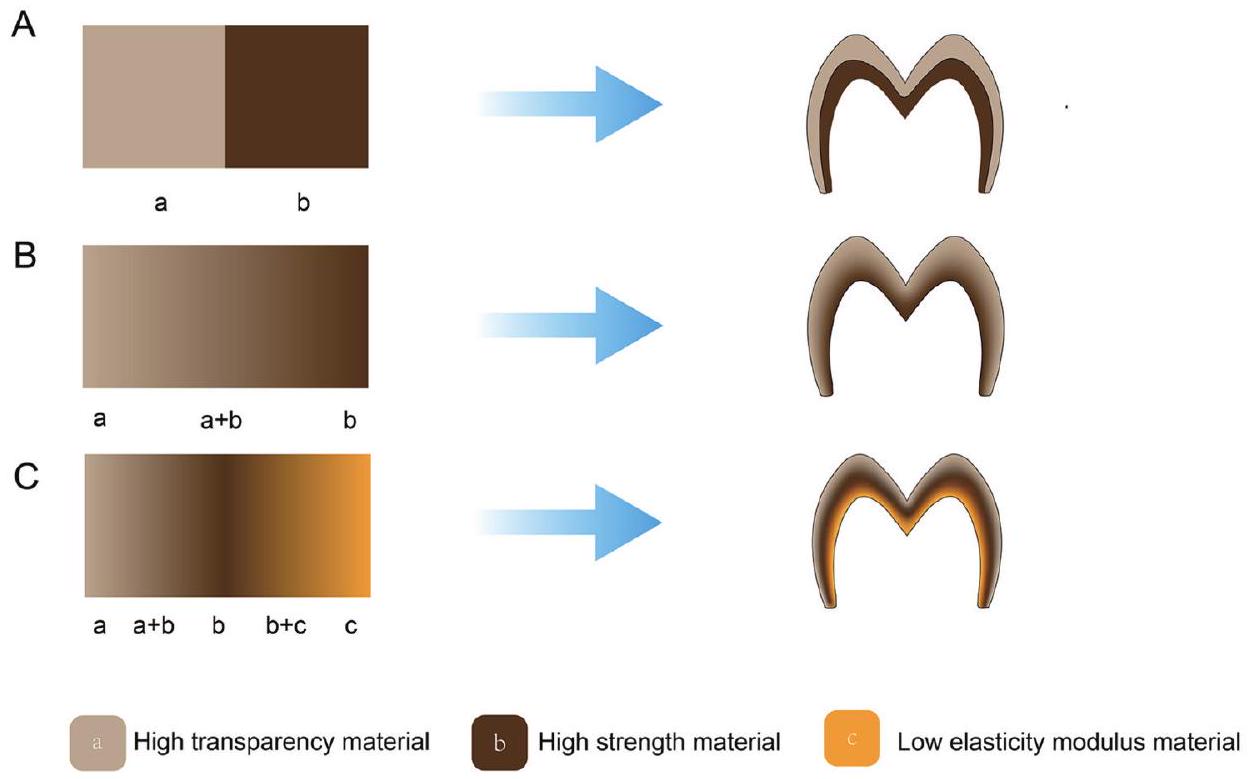
تتميز تيجان الزركونيا SM بحدود إضافية: 1. 3Y-TZP قوي جداً ولكنه ذو شفافية منخفضة؛ لذلك، يجب إضافة بورسلين الفينير لتحسين الأداء الجمالي عند استخدامه في المناطق الجمالية. ونتيجة لذلك، فإن الضغط الحراري المتبقي الناتج عن عدم التوافق في معاملات التمدد الحراري بين البورسلين و3YTZP هو عامل مهم في قابلية البورسلين الضعيف نسبيًا للتشقق. على الرغم من أنه يمكن استخدام الزركونيا عالية الشفافية، مثل 4Y-PSZ أو 5Y-PSZ، في المناطق الجمالية دون بورسلين،
الشكل 5. أ. تصور لمادتين مختلفتين تم تصنيعهما بشكل منفصل لدمج الجمالية مع الخصائص الميكانيكية دون تغييرات تدرجية. ب، ج. تيجان متعددة التدرج مصنوعة بواسطة التصنيع الإضافي المتدرج وظيفيًا لمحاكاة الهيكل الهرمي الوظيفي لمينا الأسنان الطبيعية. على وجه التحديد، تُظهر المادة-أ أداءً جماليًا مرضيًا (على سبيل المثال، الزركونيا المدعمة باليترية جزئيًا)، في حين أن المادة-B تظهر خصائص ميكانيكية ممتازة (مثل، زركونيا متعددة البلورات المدعمة باليتريا (yttria-stabilized tetragonal zirconia polycrystal). يتميز المادة-C بصلابة ومرونة أقل من المادة-B (مثل، ديسليكات الليثيوم). جميع المواد مصنوعة بتغيرات تدريجية في الوقت نفسه من أجل تعظيم المزايا الوظيفية والجمالية لتقنية التصنيع الإضافي من منظور الجماليات.
قوة هذه المواد أقل بكثير من قوة 3Y-TZP. 2. الفرق في معامل المرونة والصلابة بين الزركونيا والأسنان الطبيعية يزيد من خطر كسر الأسنان الداعمة والتاج[156-158]. من المتوقع أن تحل تقنية التصنيع الإضافي هذه المشاكل. استنادًا إلى الملاحظات المجهرية، وُجد أن مينا الأسنان الطبيعية والعاج لهما هيكل هرمي وظيفي، مما يعني أن التغيرات في البنية المجهرية والتركيب تحت سماكات مختلفة ستغير من الصلابة، ومعامل المرونة، والشفافية لهذين المادتين. يمكن أن تؤدي هذه التغيرات المتدرجة إلى توزيع أفضل للإجهادات مع خصائص بصرية متميزة[159،160]. لذلك، يمكن محاكاة هيكل المينا الطبيعي من خلال تصنيع المواد المتدرجة (FGMs) (الشكل 5). في المرحلة الأولية، يمكن للباحثين محاولة تصنيع هياكل ذات طبقتين باستخدام تقنية التصنيع الإضافي مرة واحدة. يمكن أن تستخدم الطبقة الخارجية سيراميك عالي الشفافية مثل 5Y-PSZ، بينما يمكن أن تستخدم الطبقة الداخلية سيراميك عالي القوة مثل 3Y-TZP للحفاظ على الشفافية العالية والقوة دون استخدام بورسلين الفينير (الشكل 5A). يمكن بعد ذلك تصميم الهياكل المتدرجة لهذين المادتين بناءً على معلمات العملية لتحقيق انتقال سلس بينهما مع خصائص أفضل (الشكل 5B). مع تطور تقنية التصنيع الإضافي ثلاثي الأبعاد، يمكن أيضًا إضافة مواد سيراميكية إلى التصنيع الإضافي. على سبيل المثال، يمكن إضافة سيراميك ذو معامل مرونة منخفض، مثل LD، إلى الطبقة الداخلية للتاج مع تغييرات متدرجة لتقليل الصلابة ومعامل المرونة تدريجيًا، كما هو الحال في الأسنان الطبيعية (الشكل 5C)، وقد يتم تصنيع تاج سيراميكي حيوي مع جمالية أفضل ومعدل بقاء أعلى باستخدام البروتوكولات المذكورة أعلاه. في الدراسات السابقة، اعتُبرت المواد السيراميكية المتدرجة (FGMs) لتقليل الإجهاد الحراري المتبقي لبورسلين الفينير وتحسين توزيع الإجهاد[161،162]. تمتلك تقنية التصنيع الإضافي إمكانيات كبيرة لتصنيع المواد المتدرجة. تم الإبلاغ عن عدة تقنيات للتصنيع الإضافي تمتلك القدرة على إنتاج المواد المتدرجة، بما في ذلك DLP[14]، DIP[12،51].
ومن المتوقع أن يتم تصنيع التيجان متعددة التدرجات في المستقبل بناءً على مزيد من الأبحاث.
ومع ذلك، لا تزال تطبيقات السيراميك السني المطبوع بتقنية الإضافة في طب الأسنان التعويضي تواجه قيودًا كبيرة. أولاً، هناك قيود على نوع السيراميك القابل للتصنيع، مثل البورسلين الفلدي والمواد السيراميكية المختلطة (الألومينا المقواة بالزركونيا أو الزركونيا المقواة بالألومينا)، والتي كانت موضوعًا لعدد قليل جدًا من التقارير ذات الصلة؛ وبالتالي، تحتاج أنواع السيراميك القابل للتصنيع إلى مزيد من البحث في المستقبل. ثانيًا، ركزت معظم الدراسات السابقة على السيراميك المطبوع بتقنية الإضافة على التيجان أو الجسور الثابتة، في حين تم تجاهل الهياكل الأخرى مثل الحشوات، والوجهات، والدعائم العلوية للزرع. بشكل عام، فإن التطبيقات الحالية لتقنية الإضافة هي مجرد قمة الجليد؛ ومن المتوقع أن يؤدي المزيد من البحث إلى تغيير البروتوكولات الحالية في صناعة الأسنان.

الشكر والتقدير

تمت الموافقة على هذه المراجعة الأدبية من قبل قسم التعويضات السنية، مستشفى طب الفم، كلية طب الفم، جامعة تشجيانغ للطب. لم تتلقَ هذه العمل أي مساعدة من أي مصدر تمويل.

تضارب المصالح

يعلن المؤلفون أنه لا يوجد تضارب في المصالح.

References

[1] Jang JG, Kang JH, Joe KB, Sakthiabirami K, Jang KJ, Jun MJ, et al. Evaluation of physical properties of zirconia suspension with added silane coupling agent for additive manufacturing processes. Materials (Basel). 2022;15:1337. https://doi.org/10.3390/ma15041337, PMID:35207878
[2] Deckers J, Vleugels J, Kruthl JP. Additive manufacturing of ceramics: a review. J Ceram Sci Technol. 2014;5:245-60.
[3] Stansbury JW, Idacavage MJ. 3D printing with polymers: challenges among expanding options and opportunities. Dent Mater. 2016;32:54-64. https:// doi.org/10.1016/j.dental.2015.09.018, PMID:26494268
[4] Alageel O, Abdallah MN, Alsheghri A, Song J, Caron E, Tamimi F. Removable partial denture alloys processed by laser-sintering technique. J Biomed Mater Res B Appl Biomater. 2018;106:1174-85. https://doi.org/10.1002/ jbm.b.33929, PMID:28561993
[5] Ozan O, Turkyilmaz I, Ersoy AE, McGlumphy EA, Rosenstiel SF. Clinical accuracy of 3 different types of computed tomography-derived stereolithographic surgical guides in implant placement. J Oral Maxillofac Surg. 2009;67:394-401. https://doi.org/10.1016/j.joms.2008.09.033, PMID:19138616
[6] Kabir SMF, Kavita Mathur, Abdel-Fattah M. A critical review on 3D printed continuous fiber-reinforced composites: history, mechanism, materials and properties. Compos Struct. 2020;232:0263-8223.
[7] Additive manufacturing – General principles – Fundamentals and vocabulary; ISO/ASTM 52900:2021.
[8] Oberoi G, Nitsch S, Edelmayer M, Janjić K, Müller AS, Agis H. 3D printingencompassing the facets of dentistry. Front Bioeng Biotechnol. 2018;6:172. https://doi.org/10.3389/fbioe.2018.00172, PMID:30525032
[9] Juste E, Petit F, Lardot V, Cambier F. Shaping of ceramic parts by selective laser melting of powder bed. J Mater Res. 2014;29:2086-94. https://doi. org/10.1557/jmr.2014.127
[10] Lakhdar Y, Tuck C, Binner J, Terry A, Goodridge R. Additive manufacturing of advanced ceramic materials. Prog Mater Sci. 2021;116:100736. https://doi. org/10.1016/j.pmatsci.2020.100736
[11] Homsy FR, Özcan M, Khoury M, Majzoub ZAK. Marginal and internal fit of pressed lithium disilicate inlays fabricated with milling, 3D printing, and conventional technologies. J Prosthet Dent. 2018;119:783-90. https://doi. org/10.1016/j.prosdent.2017.07.025, PMID:28969918
[12] Gingter P, Wätjen AM, Kramer M, Telle R. Functionally graded ceramic structures by direct thermal inkjet printing. J Ceram Sci Technol. 2015;6:119-24.
[13] Weingarten S, Scheithauer U, Johne R, Abel J, Schwarzer E, Moritz T, et al. Multi-material ceramic-based components – additive manufacturing of black-and-white zirconia components by thermoplastic 3D-printing (CerAM – T3DP). J Vis Exp. 2019;7:143. PMID:30663650
[14] Hu K, Zhao P, Li J, Lu Z. High-resolution multiceramic additive manufacturing based on digital light processing. Addit Manuf. 2022;54:102732. https:// doi.org/10.1016/j.addma.2022.102732
[15] Loh GH, Pei E, Harrison D, Monzón MD. An overview of functionally graded additive manufacturing. Addit Manuf. 2018;23:34-44. https://doi. org/10.1016/j.addma.2018.06.023
[16] Wu H, Cheng Y, Liu W, He R, Zhou M, Wu S, et al. Effect of the particle size and the debinding process on the density of alumina ceramics fabricated by 3D printing based on stereolithography. Ceram Int. 2016;42:17290-4. https:// doi.org/10.1016/j.ceramint.2016.08.024
[17] Sakly A, Kenzari S, Bonina D, Corbel S, Fournée V. A novel quasicrystalresin composite for stereolithography. Materials & Design (1980-2015). 2014;56:280-5.
[18] Santoliquido O, Colombo P, Ortona A. Additive Manufacturing of ceramic components by Digital Light Processing: A comparison between the “bot-tom-up” and the “top-down” approaches. J Eur Ceram Soc. 2019;39:2140-8. https://doi.org/10.1016/j.jeurceramsoc.2019.01.044
[19] Lian Q, Yang F, Xin H, Li D. Oxygen-controlled bottom-up mask-projection stereolithography for ceramic 3D printing. Ceram Int. 2017;43:14956-61. https://doi.org/10.1016/j.ceramint.2017.08.014
[20] Della Bona A, Cantelli V, Britto VT, Collares KF, Stansbury JW. 3D printing restorative materials using a stereolithographic technique: a systematic review. Dent Mater. 2021;37:336-50. https://doi.org/10.1016/j.dental.2020.11.030, PMID:33353734
[21] Florence JM, Yoder LA. Display system architectures for digital micromirror device (DMD)-based projectors. In Projection displays II 1996 Mar 29 (Vol. 2650, pp. 193-208). SPIE.
[22] Lu Y, Mapili G, Suhali G, Chen S, Roy K. A digital micro-mirror device-based system for the microfabrication of complex, spatially patterned tissue engineering scaffolds. J Biomed Mater Res A. 2006;77A:396-405. https://doi. org/10.1002/jbm.a.30601, PMID:16444679
[23] Melchels FPW, Feijen J, Grijpma DW. A review on stereolithography and its applications in biomedical engineering. Biomaterials. 2010;31:6121-30. https://doi.org/10.1016/j.biomaterials.2010.04.050, PMID:20478613
[24] Chen F, Zhu H, Wu JM, Chen S, Cheng LJ, Shi YS, et al. Preparation and biological evaluation of all-ceramic teeth by DLP technology. Ceram Int. 2020;46:11268-74. https://doi.org/10.1016/j.ceramint.2020.01.152
[25] Meng J, Lian Q, Xi S, Yi Y, Lu Y, Wu G. Crown fit and dimensional accuracy of zirconia fixed crowns based on the digital light processing technology. Ceram Int. 2022;48:17852-63. https://doi.org/10.1016/j.ceramint.2022.03.057
[26] Zhang K, Xie C, Wang G, He R, Ding G, Wang M, et al. High solid loading, low viscosity photosensitive slurry for stereolithography based additive manufacturing. Ceram Int. 2019;45:203-8. https://doi.org/10.1016/j. ceramint.2018.09.152
[27] Hinczewski C, Corbel S, Chartier T. Stereolithography for the fabrication of ceramic three- dimensional parts. Rapid Prototyping J. 1998;4:104-11. https://doi.org/10.1108/13552549810222867
[28] Xu X, Zhou S, Wu J, Zhang C, Liu X. Inter-particle interactions of alumina powders in UV-curable suspensions for DLP stereolithography and its effect on rheology, solid loading, and self-leveling behavior. J Eur Ceram Soc. 2021;41:2763-74. https://doi.org/10.1016/j.jeurceramsoc.2020.12.004
[29] Zhang K, He R, Xie C, Wang G, Ding G, Wang M, et al. Photosensitive ZrO2 suspensions for stereolithography. Ceram Int. 2019;45:12189-95. https:// doi.org/10.1016/j.ceramint.2019.03.123
[30] Li W, Liu M, Liu W, Zhou H, Li M, Chen Y, et al. High-performance integrated manufacturing of a 3Y-TZP ceramic crown through viscoelastic pastebased vat photopolymerization with a conformal contactless support. Addit Manuf. 2022;59:103143. https://doi.org/10.1016/j.addma.2022.103143
[31] Song S, Park M, Lee J, Yun J. A Study on the rheological and mechanical properties of photo-curable ceramic/polymer composites with different silane coupling agents for SLA 3D Printing Technology. Nanomaterials (Basel). 2018;8:93. https://doi.org/10.3390/nano8020093, PMID:29414912
[32] Kim J, Gal CW, Choi YJ, Park H, Yoon SY, Yun H. Effect of non-reactive diluent on defect-free debinding process of 3D printed ceramics. Addit Manuf. 2023;67:103475. https://doi.org/10.1016/j.addma.2023.103475
[33] Nie J, Li M, Liu W, Li W, Xing Z. The role of plasticizer in optimizing the rheological behavior of ceramic pastes intended for stereolithography-based additive manufacturing. J Eur Ceram Soc. 2021;41:646-54. https://doi. org/10.1016/j.jeurceramsoc.2020.08.013
[34] Han Z, Liu S, Qiu K, Liu J, Zou R, Wang Y, et al. The enhanced ZrO2 produced by DLP via a reliable plasticizer and its dental application. J Mech Behav Biomed Mater. 2023;141:105751. https://doi.org/10.1016/j. jmbbm.2023.105751, PMID:36921555
[35] Ji SH, Kim DS, Park MS, Yun JS. Sintering process optimization for 3YSZ ceramic 3D-printed objects manufactured by stereolithography. Nanomaterials (Basel). 2021;11:192. https://doi.org/10.3390/nano11010192, PMID:33466603
[36] Kang JH, Sakthiabirami K, Kim HA, Hosseini Toopghara SA, Jun MJ, Lim HP, et al. Effects of UV absorber on zirconia fabricated with digital light processing additive manufacturing. Materials (Basel). 2022;15:8726. https://doi. org/10.3390/ma15248726, PMID:36556530
[37] Li K, Zhao Z. The effect of the surfactants on the formulation of UVcurable SLA alumina suspension. Ceram Int. 2017;43:4761-7. https://doi. org/10.1016/j.ceramint.2016.11.143
[38] Gentry SP, Halloran JW. Light scattering in absorbing ceramic suspensions: effect on the width and depth of photopolymerized features. J Eur Ceram Soc. 2015;35:1895-904. https://doi.org/10.1016/j.jeurceramsoc.2014.12.006
[39] Chartier T, Badev A, Abouliatim Y, Lebaudy P, Lecamp L. Stereolithography process: influence of the rheology of silica suspensions and of the medium on polymerization kinetics – Cured depth and width. J Eur Ceram Soc. 2012;32:1625-34. https://doi.org/10.1016/j.jeurceramsoc.2012.01.010
[40] Jang KJ, Kang JH, Fisher JG, Park SW. Effect of the volume fraction of zirconia suspensions on the microstructure and physical properties of products produced by additive manufacturing. Dent Mater. 2019;35:e97-106. https:// doi.org/10.1016/j.dental.2019.02.001, PMID:30833011
[41] Zhang K, Meng Q, Zhang X, Qu Z, Jing S, He R. Roles of solid loading in stereolithography additive manufacturing of ZrO2 ceramic. Int J Refract Hard Met. 2021;99:105604. https://doi.org/10.1016/j.jrmhm.2021.105604
[42] Borlaf M, Serra-Capdevila A, Colominas C, Graule T. Development of UV-curable ZrO2 slurries for additive manufacturing (LCM-DLP) technology. J Eur Ceram Soc. 2019;39:3797-803. https://doi.org/10.1016/j.jeurceramsoc.2019.05.023
[43] Mitteramskogler G, Gmeiner R, Felzmann R, Gruber S, Hofstetter C, Stampfl J, et al. Light curing strategies for lithography-based additive manufacturing of customized ceramics. Addit Manuf. 2014;1-4:110-8. https://doi. org/10.1016/j.addma.2014.08.003
[44] Chartier T, Chaput C, Doreau F, Loiseau M. Stereolithography of structural complex ceramic parts. J Mater Sci. 2002;37:3141-7. https://doi. org/10.1023/A:1016102210277
[45] Sun J, Binner J, Bai J. 3D printing of zirconia via digital light processing: optimization of slurry and debinding process. J Eur Ceram Soc. 2020;40:583744. https://doi.org/10.1016/j.jeurceramsoc.2020.05.079
[46] Lian Q, Sui W, Wu X, Yang F, Yang S. Additive manufacturing of ZrO ceramic dental bridges by stereolithography. Rapid Prototyping J. 2018;24:114-9. https://doi.org/10.1108/RPJ-09-2016-0144
[47] Derby B. Inkjet printing ceramics: from drops to solid. J Eur Ceram Soc. 2011;31:2543-50. https://doi.org/10.1016/j.jeurceramsoc.2011.01.016
[48] Graf D, Jung J, Hanemann T. Formulation of a ceramic ink for 3D inkjet printing. Micromachines (Basel). 2021;12:1136. https://doi.org/10.3390/ mi12091136, PMID:34577779
[49] Willems E, Turon-Vinas M, Camargo dos Santos B, Van Hooreweder B, Zhang F, Van Meerbeek B, et al. Additive manufacturing of zirconia ceramics by material jetting. J Eur Ceram Soc. 2021;41:5292-306. https://doi. org/10.1016/j.jeurceramsoc.2021.04.018
[50] Wätjen AM, Gingter P, Kramer M, Telle R. Novel prospects and possibilities in additive manufacturing of ceramics by means of direct inkjet printing. Adv Mech Eng. 2014;6:141346. https://doi.org/10.1155/2014/141346
[51] Lee JH, Kim JH, Hwang KT, Hwang HJ, Han KS. Digital inkjet printing in three dimensions with multiple ceramic compositions. J Eur Ceram Soc. 2021;41:1490-7. https://doi.org/10.1016/j.jeurceramsoc.2020.09.044
[52] Ebert J, Özkol E, Zeichner A, Uibel K, Weiss Ö, Koops U, et al. Direct inkjet printing of dental prostheses made of zirconia. J Dent Res. 2009;88:673-6. https://doi.org/10.1177/0022034509339988, PMID:19641157
[53] Zhong S, Shi Q, Deng Y, Sun Y, Politis C, Yang S. High-performance zirconia ceramic additively manufactured via NanoParticle Jetting. Ceram Int. 2022;48:33485-98. https://doi.org/10.1016/j.ceramint.2022.07.294
[54] Lüchtenborg J, Willems E, Zhang F, Wesemann C, Weiss F, Nold J, et al. Accuracy of additively manufactured zirconia four-unit fixed dental prostheses fabricated by stereolithography, digital light processing and material jetting compared with subtractive manufacturing. Dent Mater. 2022;38:1459-69. https://doi.org/10.1016/j.dental.2022.06.026, PMID:35798578
[55] Lyu J, Yang X, Li Y. Dimensional accuracy and clinical adaptation of monolithic zirconia crowns fabricated with the nanoparticle jetting technique. J Prosthet Dent. 2023;S0022-3913(23)00260-3. https://doi.org/10.1016/j. prosdent.2023.04.008 ,
[56] Camargo B, Willems E, Jacobs W, Van Landuyt K, Peumans M, Zhang F, et al. 3D printing and milling accuracy influence full-contour zirconia crown adaptation. Dent Mater. 2022;38:1963-76. https://doi.org/10.1016/j.dental.2022.11.002, PMID:36411148
[57] Prasad PSRK, Reddy AV, Rajesh PK, Ponnambalam P, Prakasan K. Studies on rheology of ceramic inks and spread of ink droplets for direct ceramic ink jet printing. J Mater Process Technol. 2006;176:222-9. https://doi.org/10.1016/j. jmatprotec.2006.04.001
[58] Özkol E, Ebert J, Telle R. An experimental analysis of the influence of the ink properties on the drop formation for direct thermal inkjet printing of high solid content aqueous 3Y-TZP suspensions. J Eur Ceram Soc. 2010;30:166978. https://doi.org/10.1016/j.jeurceramsoc.2010.01.004
[59] Seerden KAM, Reis N, Derby B, Grant PS, Halloran JW, Evans JRG. Direct inkjet deposition of ceramic green bodies: I-Formulation of build materials. Proc MRS. 1998;542:141-6. https://doi.org/10.1557/PROC-542-141 OPL
[60] Lejeune M, Chartier T, Dossou-Yovo C, Noguera R. Ink-jet printing of ceramic micro-pillar arrays. J Eur Ceram Soc. 2009;29:905-11. https://doi. org/10.1016/j.jeurceramsoc.2008.07.040
[61] Magdassi S, ed. The chemistry of inkjet inks. World scientific; 2009 Jul 31.
[62] He Q, Jiang J, Yang X, Zhang L, Zhou Z, Zhong Y, et al. Additive manufacturing of dense zirconia ceramics by fused deposition modeling via screw extrusion. J Eur Ceram Soc. 2021;41:1033-40. https://doi.org/10.1016/j. jeurceramsoc.2020.09.018
[63] Shahzad A, Lazoglu I. Direct ink writing (DIW) of structural and functional ceramics: recent achievements and future challenges. Compos, Part B Eng. 2021;225:109249. https://doi.org/10.1016/j.compositesb.2021.109249
[64] Feilden E, Blanca EGT, Giuliani F, Saiz E, Vandeperre L. Robocasting of structural ceramic parts with hydrogel inks. J Eur Ceram Soc. 2016;36:2525-33. https://doi.org/10.1016/j.jeurceramsoc.2016.03.001
[65] Ghazanfari A, Li W, Leu MC, Watts JL, Hilmas GE. Additive manufacturing and mechanical characterization of high density fully stabilized zirconia. Ceram Int. 2017;43:6082-8. https://doi.org/10.1016/j.ceramint.2017.01.154
[66] Montero J, Becerro A, Dib A, Quispe-López N, Borrajo J, Benito Garzón L. Preliminary results of customized bone graft made by robocasting hydroxyapatite and tricalcium phosphates for oral surgery. Oral Surg Oral Med Oral Pathol Oral Radiol. 2023;135:192-203. https://doi.org/10.1016/j. oooo.2022.06.002, PMID:36089487
[67] Shao H, Zhao D, Lin T, He J, Wu J. 3D gel-printing of zirconia ceramic parts. Ceram Int. 2017;43:13938-42. https://doi.org/10.1016/j.ceramint.2017.07.124
[68] Cui X, Shen Z, Wang X. Esthetic appearances of anatomic contour zirconia crowns made by additive wet deposition and subtractive dry milling: A self-controlled clinical trial. J Prosthet Dent. 2020;123:442-8. https://doi. org/10.1016/j.prosdent.2019.02.016, PMID:31307809
[69] Tidehag P, Shen Z. Digital dentistry calls the change of ceramics and ceramic processes. Adv Appl Ceramics. 2019;118:83-90. https://doi.org/10.10 80/17436753.2018.1511337
[70] Rabel K, Nold J, Pehlke D, Shen J, Abram A, Kocjan A, et al. Zirconia fixed dental prostheses fabricated by 3D gel deposition show higher fracture strength than conventionally milled counterparts. J Mech Behav Biomed Mater. 2022;135:105456. https://doi.org/10.1016/j.jmbbm.2022.105456, PMID:36150323
[71] Rueschhoff L, Costakis W, Michie M, Youngblood J, Trice R. Additive manufacturing of dense ceramic parts via direct ink writing of aqueous alumina suspensions. Int J Appl Ceram Technol. 2016;13:821-30. https://doi. org/10.1111/ijac. 12557
[72] Liao J,Chen H,Luo H,Wang X, Zhou K, Zhang D. Direct ink writing of zirconia three-dimensional structures. J Mater Chem C Mater Opt Electron Devices. 2017;5:5867-71. https://doi.org/10.1039/C7TC01545C
[73] Bose S, Ke D, Sahasrabudhe H, Bandyopadhyay A. Additive manufacturing of biomaterials. Prog Mater Sci. 2018;93:45-111. https://doi.org/10.1016/j. pmatsci.2017.08.003, PMID:31406390
[74] Dehurtevent M, Robberecht L, Thuault A, Deveaux E, Leriche A, Petit F, et al. Effect of build orientation on the manufacturing process and the properties of stereolithographic dental ceramics for crown frameworks. J Prosthet Dent. 2021;125:453-61. https://doi.org/10.1016/j.prosdent.2020.01.024, PMID:32265125
[75] Xiang D, Xu Y, Bai W, Lin H. Dental zirconia fabricated by stereolithography: Accuracy, translucency and mechanical properties in different build orientations. Ceram Int. 2021;47:28837-47. https://doi.org/10.1016/j.ceramint.2021.07.044
[76] Osman RB, van der Veen AJ, Huiberts D, Wismeijer D, Alharbi N. 3D-printing zirconia implants; a dream or a reality? An in-vitro study evaluating the dimensional accuracy, surface topography and mechanical properties of printed zirconia implant and discs.J Mech Behav Biomed Mater.2017;75:5218. https://doi.org/10.1016/j.jmbbm.2017.08.018, PMID:28846981
[77] Nakai H, Inokoshi M, Nozaki K, Komatsu K, Kamijo S, Liu H, et al. Additively manufactured zirconia for dental applications. Materials (Basel). 2021;14:3694. https://doi.org/10.3390/ma14133694, PMID:34279264
[78] Miura S, Shinya A, Ishida Y, Fujisawa M. Mechanical and surface properties of additive manufactured zirconia under the different building directions. J Prosthodont Res. 2022;67:410-7. https://doi.org/10.2186/jpr. JPR_D_22_00166,
[79] Lee HB, Bea EJ, Lee WS, Kim JH. Trueness of stereolithography ZrO<sub>2</ sub> crowns with different build directions. Dent Mater J. 2023;42:42-8. https://doi.org/10.4012/dmj.2022-041, PMID:36288942
[80] Li H, Song L, Sun J, Ma J, Shen Z. Stereolithography-fabricated zirconia dental prostheses: concerns based on clinical requirements. Adv Appl Ceramics. 2020;119:236-43. https://doi.org/10.1080/17436753.2019.1709687
[81] Zhang Z, Li P, Chu F, Shen G. Influence of the three-dimensional printing technique and printing layer thickness on model accuracy. J Orofac Orthop. 2019;80:194-204. https://doi.org/10.1007/s00056-019-00180-y, PMID:31172199
[82] Alazzawi MK, Beyoglu B, Haber RA. A study in a tape casting based stereolithography apparatus: role of layer thickness and casting shear rate. J Manuf Process. 2021;64:1196-203. https://doi.org/10.1016/j.jmapro.2021.02.040
[83] Su CY, Wang JC, Chen DS, Chuang CC, Lin CK. Additive manufacturing of dental prosthesis using pristine and recycled zirconia solvent-based slurry stereolithography. Ceram Int. 2020;46:28701-9. https://doi.org/10.1016/j. ceramint.2020.08.030
[84] Wilkes J, Hagedorn YC, Meiners W, Wissenbach K. Additive manufacturing of ceramic components by selective laser melting. Rapid Prototyping J. 2013;19:51-7. https://doi.org/10.1108/13552541311292736
[85] Lian Q, Wu X, Li D, He X, Meng J, Liu X, et al. Accurate printing of a zirconia molar crown bridge using three-part auxiliary supports and ceramic mask projection stereolithography. Ceram Int. 2019;45:18814-22. https://doi. org/10.1016/j.ceramint.2019.06.111
[86] Schönherr JA, Baumgartner S, Hartmann M, Stampfl J. Stereolithographic additive manufacturing of high precision glass ceramic parts. Materials (Basel). 2020;13:1492. https://doi.org/10.3390/ma13071492, PMID:32218270
[87] Li R, Xu T, Wang Y, Sun Y. Accuracy of zirconia crowns manufactured by stereolithography with an occlusal full-supporting structure: an in vitro study. J Prosthet Dent. 2023;130:902-7. https://doi.org/10.1016/j.prosdent.2022.01.015,
[88] Li W, Armani A, McMillen D, Leu M, Hilmas G, Watts J. Additive manufacturing of zirconia parts with organic sacrificial supports. Int J Appl Ceram Technol. 2020;17:1544-53. https://doi.org/10.1111/ijac. 13520
[89] Zhang L, Huang J, Xiao Z, He Y, Liu K, He B, et al. Effects of debinding condition on microstructure and densification of alumina ceramics shaped with photopolymerization-based additive manufacturing technology. Ceram Int. 2022;48:14026-38. https://doi.org/10.1016/j.ceramint.2022.01.288
[90] Wang K, Qiu M, Jiao C, Gu J, Xie D, Wang C, et al. Study on defect-free debinding green body of ceramic formed by DLP technology. Ceram Int. 2020;46:2438-46. https://doi.org/10.1016/j.ceramint.2019.09.237
[91] Zhou M, Liu W, Wu H, Song X, Chen Y, Cheng L, et al. Preparation of a defectfree alumina cutting tool via additive manufacturing based on stereolithography – Optimization of the drying and debinding processes. Ceram Int. 2016;42:11598-602. https://doi.org/10.1016/j.ceramint.2016.04.050
[92] Li H, Liu Y, Liu Y, Zeng Q, Hu K, Lu Z, et al. Influence of debinding holding time on mechanical properties of 3D-printed alumina ceramic cores. Ceram Int. 2021;47:4884-94. https://doi.org/10.1016/j.ceramint.2020.10.061
[93] Zhang L, Liu H, Yao H, Zeng Y, Chen J. 3D printing of hollow lattice structures of ZrO2(3Y)/Al2O3 ceramics by vat photopolymerization: process optimization, microstructure evolution and mechanical properties. J Manuf Process. 2022;83:756-67. https://doi.org/10.1016/j.jmapro.2022.09.047
[94] Stawarczyk B, Özcan M, Hallmann L, Ender A, Mehl A, Hämmerlet CHF. The effect of zirconia sintering temperature on flexural strength, grain size, and contrast ratio. Clin Oral Investig. 2013;17:269-74. https://doi.org/10.1007/ s00784-012-0692-6, PMID:22358379
[95] Wang SF, Zhang J, Luo DW, Gu F, Tang DY, Dong ZL, et al. Transparent ceramics: Processing, materials and applications. Prog Solid State Chem. 2013;41:20-54. https://doi.org/10.1016/j.progsolidstchem.2012.12.002
[96] Yoshida M, Hada M, Sakurada O, Morita K. Transparent tetragonal zirconia prepared by sinter forging at . J Eur Ceram Soc. 2023;43:2051-6. https://doi.org/10.1016/j.jeurceramsoc.2022.12.031
[97] International organization for standardization. ISO 5725-4:2020 Accuracy (trueness and precision) of measurement methods and results – Part 4: Basic methods for the determination of the trueness of a standard measurement method
[98] Jacobs MS, Windeler AS. An investigation of dental luting cement solubility as a function of the marginal gap. J Prosthet Dent. 1991;65:436-42. https:// doi.org/10.1016/0022-3913(91)90239-S, PMID:2056466
[99] Valderhaug J, Heløe LA. Oral hygiene in a group of supervised patients with fixed prostheses. J Periodontol. 1977;48:221-4. https://doi.org/10.1902/ jop.1977.48.4.221, PMID:265390
[100] Felton DA, Kanoy BE, Bayne SC, Wirthman GP. Effect of in vivo crown margin discrepancies on periodontal health. J Prosthet Dent. 1991;65:357-64. https://doi.org/10.1016/0022-3913(91)90225-L, PMID:2056454
[101] Lang NP, Kiel RA, Anderhalden K. Clinical and microbiological effects of subgingival restorations with overhanging or clinically perfect margins. J Clin Periodontol. 1983;10:563-78. https://doi.org/10.1111/j.1600-051X.1983. tb01295.x, PMID:6581173
[102] BergenholtzG,CoxCF,LoescheWJ,SyedSA.Bacterial leakage around dental restorations: its effect on the dental pulp. J Oral Pathol Med. 1982;11:439-50. https://doi.org/10.1111/j.1600-0714.1982.tb00188.x, PMID:6819352
[103] Beuer F, Naumann M, Gernet W, Sorensen JA. Precision of fit: zirconia threeunit fixed dental prostheses. Clin Oral Investig. 2009;13:343-9. https://doi. org/10.1007/s00784-008-0224-6, PMID:18769946
[104] McLean JW, von F. The estimation of cement film thickness by an in vivo technique. Br Dent J. 1971;131:107-11. https://doi.org/10.1038/ sj.bdj.4802708, PMID:5283545
[105] Tuntiprawon M, Wilson PR. The effect of cement thickness on the fracture strength of all-ceramic crowns. Aust Dent J. 1995;40:17-21. https://doi. org/10.1111/j.1834-7819.1995.tb05607.x, PMID:7710410
[106] Wang W, Sun J. Dimensional accuracy and clinical adaptation of ceramic crowns fabricated with the stereolithography technique. J Prosthet Dent. 2021;125:657-63. https://doi.org/10.1016/j.prosdent.2020.02.032, PMID:32418664
[107] Daou EE, Ounsi H, Özcan M, Al-Haj Husain N, Salameh Z. Marginal and internal fit of pre-sintered and zirconia 3-unit fixed dental prostheses as measured using microcomputed tomography. J Prosthet Dent. 2018;120:409-14. https://doi.org/10.1016/j.prosdent.2018.01.006, PMID:29724558
[108] Mously HA, Finkelman M, Zandparsa R, Hirayama H. Marginal and internal adaptation of ceramic crown restorations fabricated with CAD/CAM technology and the heat-press technique. J Prosthet Dent. 2014;112:249-56. https://doi.org/10.1016/j.prosdent.2014.03.017, PMID:24795263
[109] Sorensen JA, Munksgaard EC. Interfacial gaps of resin cemented ceramic inlays. Eur J Oral Sci. 1995;103:116-20. https://doi.org/10.1111/j.1600-0722.1995. tb00128.x, PMID:7767706
[110] Souza ROA, Özcan M, Pavanelli CA, Buso L, Lombardo GHL, Michida SMA, et al. Marginal and internal discrepancies related to margin design of ceramic crowns fabricated by a CAD/CAM system. J Prosthodont. 2012;21:94-100. https://doi.org/10.1111/j.1532-849X.2011.00793.x, PMID:22050205
[111] ISO 6872: 2015 Dentistry – Ceramic materials. ISO; 2015. p. 28.
[112] Shi HY, Pang R, Yang J,Fan D, Cai H, Jiang HB, et al. Overview of several typical ceramic materials for restorative dentistry. BioMed Res Int. 2022;2022:1-18. https://doi.org/10.1155/2022/8451445, PMID:35898679
[113] Alghazzawi TF, Janowski GM, Eberhardt AW. An experimental study of flexural strength and hardness of zirconia and their relation to crown failure loads. J Prosthet Dent; Online ahead of print. 2022. https://doi.org/10.1016/j. prosdent.2022.04.005,
[114] Tan X, Zhao Y, Lu Y, Yu P, Mei Z, Yu H. Physical and biological implications of accelerated aging on stereolithographic additive-manufactured zirconia for dental implant abutment. J Prosthodont Res. 2021;66:600-9. https://doi. org/10.2186/jpr.JPR_D_21_00240, PMID:34924492
[115] Li R, Wang Y, Hu M, Wang Y, Xv Y, Liu Y, et al. Strength and adaptation of stereolithography-fabricated zirconia dental crowns: an in vitro study. Int J Prosthodont. 2019;32:439-43. https://doi.org/10.11607/ijp.6262, PMID:31486816
[116] Li R, Chen H, Wang Y, Sun Y. Performance of stereolithography and milling in fabricating monolithic zirconia crowns with different finish line designs. J Mech Behav Biomed Mater. 2021;115:104255. https://doi.org/10.1016/j. jmbbm.2020.104255, PMID:33340775
[117] Wang W, Yu H, Liu Y, Jiang X, Gao B. Trueness analysis of zirconia crowns fabricated with 3-dimensional printing. J Prosthet Dent. 2019;121:285-91. https://doi.org/10.1016/j.prosdent.2018.04.012, PMID:30017167
[118] Revilla-León M, Methani MM, Morton D, Zandinejad A. Internal and marginal discrepancies associated with stereolithography (SLA) additively manufactured zirconia crowns. J Prosthet Dent. 2020;124:730-7. https://doi. org/10.1016/j.prosdent.2019.09.018, PMID:31980204
[119] Abualsaud R, Alalawi H. Fit, precision, and trueness of 3D-printed zirconia crowns compared to milled counterparts. Dent J. 2022;10:215. https://doi. org/10.3390/dj10110215, PMID:36421402
[120] Lerner H, Nagy K, Pranno N, Zarone F, Admakin O, Mangano F. Trueness and precision of 3D-printed versus milled monolithic zirconia crowns: an in vitro study. J Dent. 2021;113:103792. https://doi.org/10.1016/j.jdent.2021.103792, PMID:34481929
[121] Moon JM, Jeong CS, Lee HJ, Bae JM, Choi EJ, Kim ST, et al. A comparative study of additive and subtractive manufacturing techniques for a zirconia dental product: an analysis of the manufacturing accuracy and the bond strength of porcelain to zirconia. Materials (Basel). 2022;15:5398. https://doi. org/10.3390/ma15155398, PMID:35955331
[122] Baumgartner S, Gmeiner R, Schönherr JA, Stampfl J. Stereolithographybased additive manufacturing of lithium disilicate glass ceramic for dental applications. Mater Sci Eng C. 2020;116:111180. https://doi.org/10.1016/j. msec.2020.111180, PMID:32806296
[123] Kim YK, Han JS, Yoon HI. Evaluation of intaglio surface trueness, wear, and fracture resistance of zirconia crown under simulated mastication: a comparative analysis between subtractive and additive manufacturing. J Adv Prosthodont. 2022;14:122-32. https://doi.org/10.4047/jap.2022.14.2.122, PMID:35601347
[124] Li R, Chen H, Wang Y, Zhou Y, Shen Z, Sun Y. Three-dimensional trueness and margin quality of monolithic zirconia restorations fabricated by additive 3D gel deposition. J Prosthodont Res. 2020;64:478-84. https://doi. org/10.1016/j.jpor.2020.01.002, PMID:32063530
[125] Sun Z, Shen Z, Zhao J, Zheng Y. Adaptation and uniformity of monolithic zirconia crowns fabricated by additive 3-dimensional gel deposition. J Prosthet Dent. 2023;130:859-65. https://doi.org/10.1016/j.prosdent.2021.11.023,
[126] Özkol E, Zhang W, Ebert J, Telle R. Potentials of the “Direct inkjet printing” method for manufacturing 3Y-TZP based dental restorations. J Eur Ceram Soc.2012;32:2193-201. https://doi.org/10.1016/j.jeurceramsoc.2012.03.006
[127] Jiang CP, Hentihu MFR, Cheng YC, Lei TY, Lin R, Chen Z. Development of 3D slurry printing technology with submersion-light apparatus in dental application. Materials (Basel). 2021;14:7873. https://doi.org/10.3390/ma14247873, PMID:34947467
[128] Goujat A, Abouelleil H, Colon P, Jeannin C, Pradelle N, Seux D, et al. Marginal and internal fit of CAD-CAM inlay/onlay restorations: A systematic review of in vitro studies. J Prosthet Dent. 2019;121:590-597.e3. https://doi. org/10.1016/j.prosdent.2018.06.006, PMID:30509548
[129] Ban S. Development and characterization of ultra-high translucent zirconia using new manufacturing technology. Dent Mater J. 2023;42:1-10. https:// doi.org/10.4012/dmj.2022-243, PMID:36631076
[130] Alenezi A, Yehya M. Evaluating the accuracy of dental restorations manufactured by two CAD/CAM milling systems and their prototypes fabricated by 3D printing methods: an in vitro study. Int J Prosthodont. 2023;36:293-300. https://doi.org/10.11607/ijp.7633, PMID:34919097
[131] Unkovskiy A, Beuer F, Metin DS, Bomze D, Hey J, Schmidt F. Additive manufacturing of lithium disilicate with the LCM process for classic and non-prep veneers: preliminary technical and clinical case experience. Materials (Basel). 2022;15:6034. https://doi.org/10.3390/ma15176034, PMID:36079415
[132] Sasse M, Krummel A, Klosa K, Kern M. Influence of restoration thickness and dental bonding surface on the fracture resistance of full-coverage occlusal veneers made from lithium disilicate ceramic. Dent Mater. 2015;31:907-15. https://doi.org/10.1016/j.dental.2015.04.017, PMID:26051232
[133] Zamzam H, Olivares A, Fok A. Load capacity of occlusal veneers of different restorative CAD/CAM materials under lateral static loading. J Mech Behav Biomed Mater. 2021;115:104290. https://doi.org/10.1016/j. jmbbm.2020.104290, PMID:33440327
[134] loannidis A,Park JM, Hüsler J,Bomze D, Mühlemann S, Özcan M. An in vitro comparison of the marginal and internal adaptation of ultrathin occlusal veneers made of 3D-printed zirconia, milled zirconia, and heat-pressed lithium disilicate. J Prosthet Dent. 2022;128:709-15. https://doi.org/10.1016/j. prosdent.2020.09.053, PMID:33741143
[135] Zandinejad A, Methani MM, Schneiderman ED, Revilla-León M, Bds DM. Fracture resistance of additively manufactured zirconia crowns when cemented to implant supported zirconia abutments: an in vitro study. J Prosthodont. 2019;28:893-7. https://doi.org/10.1111/jopr.13103, PMID:31430001
[136] loannidis A, Bomze D, Hämmerle CHF, Hüsler J, Birrer O, Mühlemann S. Load-bearing capacity of CAD/CAM 3D-printed zirconia, CAD/CAM milled zirconia, and heat-pressed lithium disilicate ultra-thin occlusal veneers on molars. Dent Mater. 2020;36:e109-16. https://doi.org/10.1016/j.dental.2020.01.016, PMID:31992483
[137] Lu Y, Mei Z, Zhang J, Gao S, Yang X, Dong B, et al. Flexural strength and Weibull analysis of Y-TZP fabricated by stereolithographic additive manufacturing and subtractive manufacturing. J Eur Ceram Soc. 2020;40:826-34. https://doi.org/10.1016/j.jeurceramsoc.2019.10.058
[138] Sun J, Chen X, Wade-Zhu J, Binner J, Bai J. A comprehensive study of dense zirconia components fabricated by additive manufacturing. Addit Manuf. 2021;43:101994. https://doi.org/10.1016/j.addma.2021.101994
[139] Zhai Z, Sun J. Research on the low-temperature degradation of dental zirconia ceramics fabricated by stereolithography. J Prosthet Dent. 2023;130:629-38. https://doi.org/10.1016/j.prosdent.2021.11.012, PMID:34933748
[140] Revilla-León M, Al-Haj Husain N, Ceballos L, Özcan M. Flexural strength and Weibull characteristics of stereolithography additive manufactured versus milled zirconia. J Prosthet Dent. 2021;125:685-90. https://doi.org/10.1016/j. prosdent.2020.01.019, PMID:32434662
[141] Baysal N, Tuğba Kalyoncuoğlu Ü, Ayyıldız S. Mechanical properties and bond strength of additively manufactured and milled dental zirconia: A pilot study. J Prosthodont. 2022;31:629-34. https://doi.org/10.1111/jopr.13472, PMID:34940979
[142] Zenthöfer A, Schwindling FS, Schmitt C, Ilani A, Zehender N, Rammelsberg P, et al. Strength and reliability of zirconia fabricated by additive manufacturing technology. Dent Mater. 2022;38:1565-74. https://doi.org/10.1016/j. dental.2022.07.004, PMID:35933222
[143] Xing H, Zou B, Li S, Fu X. Study on surface quality, precision and mechanical properties of 3D printed ZrO2 ceramic components by laser scanning stereolithography. Ceram Int. 2017;43:16340-7. https://doi.org/10.1016/j. ceramint.2017.09.007
[144] Wang L, Yu H, Hao Z, Tang W, Dou R. Fabrication of highly translucent yttria-stabilized zirconia ceramics using stereolithography-based additive manufacturing. Ceram Int. 2023;49:17174-84. https://doi.org/10.1016/j. ceramint.2023.02.081
[145] Dehurtevent M, Robberecht L, Hornez JC, Thuault A, Deveaux E, Béhin P. Stereolithography: A new method for processing dental ceramics by additive computer-aided manufacturing. Dent Mater. 2017;33:477-85. https:// doi.org/10.1016/j.dental.2017.01.018, PMID:28318544
[146] Revilla-León M, Al-Haj Husain N, Barmak AB, Pérez-López J, Raigrodski AJ, Özcan M. Chemical composition and flexural strength discrepancies between milled and lithography-based additively manufactured zirconia. J Prosthodont. 2022;31:778-83. https://doi.org/10.1111/jopr.13482, PMID:35068002
[147] Bergler M, Korostoff J, Torrecillas-Martinez L, Mante F. Ceramic printingcomparative study of the flexural strength of 3D-printed and milled zirconia. Int J Prosthodont. 2022;35:777-83. https://doi.org/10.11607/ijp.6749, PMID:33616569
[148] Yang SY, Koh YH, Kim HE. Digital light processing of zirconia suspensions containing photocurable monomer/camphor vehicle for dental applications. Materials (Basel). 2023;16:402. https://doi.org/10.3390/ma16010402, PMID:36614741
[149] Jung JM, Kim GN, Koh YH, Kim HE. Manufacturing and characterization of dental crowns made of yttria stabilized zirconia by digital light processing. Materials (Basel). 2023;16:1447. https://doi.org/10.3390/ ma16041447, PMID:36837076
[150] Harrer W, Schwentenwein M, Lube T, Danzer R. Fractography of zirconiaspecimens made using additive manufacturing (LCM) technology. J Eur Ceram Soc.2017;37:4331-8.https://doi.org/10.1016/j.jeurceramsoc.2017.03.018
[151] Kim JH, Maeng WY, Koh YH, Kim HE. Digital light processing of zirconia prostheses with high strength and translucency for dental applications. Ceram Int. 2020;46:28211-8. https://doi.org/10.1016/j.ceramint.2020.07.321
[152] Shen Z, Liu L, Xu X, Zhao J, Eriksson M, Zhong Y, et al. Fractography of selfglazed zirconia with improved reliability. J Eur Ceram Soc. 2017;37:4339-45. https://doi.org/10.1016/j.jeurceramsoc.2017.03.008
[153] Sun Z, Wu L, Zhao J, Zheng Y. Aesthetic restoration of anterior teeth with different coloured substrates using digital monolithic zirconia crowns: two case reports. Adv Appl Ceramics. 2021;120:169-74. https://doi.org/10.1080/1 7436753.2021.1915086
[154] Scherrer SS, Cattani-Lorente M, Yoon S, Karvonen L, Pokrant S, Rothbrust F, et al. Post-hot isostatic pressing: A healing treatment for process related defects and laboratory grinding damage of dental zirconia? Dent Mater. 2013;29:e180-90. https://doi.org/10.1016/j.dental.2013.04.014, PMID:23726128
[155] Zhang Y, Lawn BR. Novel zirconia materials in dentistry. J Dent Res. 2018;97:140-7. https://doi.org/10.1177/0022034517737483, PMID:29035694
[156] Wang L,Liu Y,Si W,Feng H,Tao Y,Ma Z. Friction and wear behaviors of dental ceramics against natural tooth enamel. J Eur Ceram Soc. 2012;32:2599-606. https://doi.org/10.1016/j.jeurceramsoc.2012.03.021
[157] Lohbauer U, Scherrer SS, Della Bona A, Tholey M, van Noort R, Vichi A, et al. ADM guidance-Ceramics: all-ceramic multilayer interfaces in dentistry. Dent Mater. 2017;33:585-98. https://doi.org/10.1016/j.dental.2017.03.005, PMID:28431686
[158] Rueda AO, Anglada M, Jimenez-Pique E. Contact fatigue of veneer feldspathic porcelain on dental zirconia. Dent Mater. 2015;31:217-24. https:// doi.org/10.1016/j.dental.2014.12.006, PMID:25557277
[159] He LH, Yin ZH, Jansen van Vuuren L, Carter EA, Liang XW. A natural functionally graded biocomposite coating – Human enamel. Acta Biomater. 2013;9:6330-7. https://doi.org/10.1016/j.actbio.2012.12.029, PMID:23291490
[160] Cui C, Sun J. Optimizing the design of bio-inspired functionally graded material (FGM) layer in all-ceramic dental restorations. Dent Mater J. 2014;33:173-8. https://doi.org/10.4012/dmj.2013-264, PMID:24583648
[161] Fabris D, Souza JCM, Silva FS, Fredel M, Mesquita-Guimarães J, Zhang Y, et al. The bending stress distribution in bilayered and graded zirconia-based dental ceramics. Ceram Int. 2016;42:11025-31. https://doi.org/10.1016/j. ceramint.2016.03.245, PMID:28104926
[162] Fabris D, Souza JCM, Silva FS, Fredel M, Mesquita-Guimarães J, Zhang Y, et al. Thermal residual stresses in bilayered, trilayered and graded dental ceramics. Ceram Int. 2017;43:3670-8. https://doi.org/10.1016/j.ceramint.2016.11.209, PMID:28163345
[163] Scheithauer U, Weingarten S, Johne R, Schwarzer E, Abel J, Richter HJ, et al. Ceramic-based 4D components: additive manufacturing (AM) of ceramicbased functionally graded materials (FGM) by thermoplastic 3D printing (T3DP). Materials (Basel). 2017;10:1368. https://doi.org/10.3390/ma10121368, PMID:29182541
[164] Li W, Armani A, Martin A, Kroehler B, Henderson A, Huang T, et al. Extrusionbased additive manufacturing of functionally graded ceramics. J Eur Ceram Soc. 2021;41:2049-57. https://doi.org/10.1016/j.jeurceramsoc.2020.10.029

  1. DOI: https://doi.org/10.2186/jpr.JPR_D_23_00119
    These authors contributed equally to this work
    *Corresponding author: Fuming He, No.166, QiuTao Rd(N), Shangcheng District, Hangzhou, Zhejiang Province 310020, P.R. China.
    E-mail address: hfm@zju.edu.cn
    *Corresponding author: Yong He, No.166, QiuTao Rd(N), Shangcheng District, Hangzhou, Zhejiang Province 310020, P.R. China.
    E-mail address: yongqin@zju.edu.cn

Journal: Journal of Prosthodontic Research, Volume: 68, Issue: 3
DOI: https://doi.org/10.2186/jpr.jpr_d_23_00119
PMID: https://pubmed.ncbi.nlm.nih.gov/38346729
Publication Date: 2024-01-01

Additive manufacturing of dental ceramics in prosthodontics: The status quo and the future

Han Zhu , Jimin Jiang , Yujie Wang , Sijie Wang , Yong He , Fuming He Department of Periodontics, Stomatology Hospital, School of Stomatology, Zhejiang University School of Medicine, Zhejiang Provincial Clinical Research Center for Oral Diseases, Key Laboratory of Oral Biomedical Research of Zhejiang Province, Cancer Center of Zhejiang University, Engineering Research Center of Oral Biomaterials and Devices of Zhejiang Province, Hangzhou, PR China, State Key Laboratory of Fluid Power and Mechatronic Systems, School of Mechanical Engineering, Zhejiang University, Hangzhou, PR China

Abstract

Purpose: This review aims to summarize the available technologies, material categories, and prosthodontic applications of additive manufacturing (AM) dental ceramics, evaluate the achievable accuracy and mechanical properties in comparison with current mainstream computer-aided design/computer-aided manufacturing (CAD/CAM) subtractive manufacturing (SM) methods, and discuss future prospects and directions. Study selection: This paper is based on the latest reviews, state-of-the-art research, and existing ISO standards on AM technologies and prosthodontic applications of dental ceramics. PubMed, Web of Science, and ScienceDirect were amongst the sources searched for narrative reviews. Results: Relatively few AM technologies are available and their applications are limited to crowns and fixed partial dentures. Although the accuracy and strength of AM dental ceramics are comparable to those of SM, they have the limitations of relatively inferior curved surface accuracy and low strength reliability. Furthermore, functionally graded additive manufacturing (FGAM), a potential direction for AM, enables the realization of biomimetic structures, such as natural teeth; however, specific studies are currently lacking. Conclusions: AM dental ceramics are not sufficiently developed for large-scale clinical applications. However, with additional research, it may be possible for AM to replace SM as the mainstream manufacturing technology for ceramic restorations.

Keywords: Additive manufacturing, Dental ceramics, Prosthodontics; Accuracy, Mechanical properties
Received 20 April 2023, Accepted 18 January 2024, Available online 13 February 2024

1. Introduction

Dental ceramics have been widely used in prosthodontics because of their outstanding aesthetics, mechanical properties, and biocompatibility. Ceramic restorations such as crowns, fixed partial dentures (FPDs), veneers, and inlays have already achieved satisfactory accuracy and strength using computer-aided design/computeraided manufacturing (CAD/CAM) and subtractive manufacturing (SM), which is currently the gold standard in dental ceramic manufacturing. However, SM has some limitations:1. waste of raw materials; 2. high wear of milling tools; 3 . difficulty in fine shape formation owing to milling tool size limits; and 4. possible adverse effects introduced by milling microcracks[1-3]. Therefore, manufacturing methods for dental ceramics require further improvement.
Copyright: © 2024 Japan Prosthodontic Society. All rights reserved.
Additive manufacturing (AM) compensates for the shortcomings of SM and is widely used in dental manufacturing, especially for metal and polymer materials[4,5]. AM, which is also known as 3D printing, rapid prototyping, or solid free-forming, was first proposed by Hull in 1986[6]. According to ISO/ASTM 52900:2021[7], an AM process is “the process of joining materials to make objects from 3D model data, usually layer by layer, as opposed to subtractive

WHAT IS ALREADY KNOWN ABOUT THE TOPIC?

» Additive manufacturing (AM) has huge potential in ceramic restoration manufacturing; however, the use of AM ceramics is still limited in clinical applications at present. Although previous studies have reported the AM ceramics possess comparable accuracy and mechanical strength with that of subtractive manufacturing, the results were inconsistent and lacked sufficient analysis.

WHAT THIS STUDY ADDS?

» In this study, we introduce the important parameters of available AM technologies that influence printing quality and identify the potential problems of present AM ceramic restorations. Most importantly, we introduce the idea of functionally graded materials of AM, which enables bionic ceramic restoration manufacturing.
Fig. 1. Three different manufacturing methods of additive manufacturing (AM) ceramics, of which the multi-step method is the currently mainstream method. The “green body” means as-built ceramic parts containing a portion of organic matter.
manufacturing methods.” It is based on digital 3D models in the form of an AM file format (AMF) obtained by various methods, dividing virtual models into countless 2D-plane layers through a slicer software program, and importing data to the AM apparatus to execute manufacturing[8]. The AM apparatus then fabricates the feedstock into a thin solid layer along the xy-axis and subsequently moves by a certain space along the z-axis to fabricate a new layer, maintaining the build cycle until manufacturing completion[8].
The strict requirements for dental ceramics limit the use of certain AM technologies. Ceramics have higher melting points, are more sensitive to thermal shock, and exhibit lower ductility than metals and polymers, making it challenging to obtain defect-free and high-surface-finish ceramics by the direct fusion of similar ceramic materials (i.e., in a single-step process)[9]. Some scholars have impregnated ceramic materials into AM polymer molds and eliminated the original polymer to obtain ceramic parts, a technique called “negative ceramic . Although high-quality dental ceramics can be obtained using this method, it doesn’t fall into the category of true ceramic AM manufacturing, and the steps are more complicated, which increases the time and labor burden[10]. The current mainstream AM technology for ceramics is the “multi-step process” in which the ceramic “green body” containing a large number of organic adhesives is fabricated first, followed by “debinding and sintering” thermal treatment to eliminate organic components and achieve densification (Fig. 1). Using CAD, AM has great potential for manufacturing functionally graded materials (FGMs)[12-14], characterized by a spatial variation in composition across the volume[15]; however, this potential has not been elaborated in dental ceramics. Thus, the aim of this review is to objectively introduce AM technologies for dental ceramics and describe the complete process chain, the latest applications in prosthodontics, and potential opportunities to enhance the theoretical foundation for expanding future clinical applications.

2. AM technologies used for dental ceramics

According to the ISO/ASTM classification, AM technologies can be divided into seven categories, specifically vat photopolymeriza-
tion (VPP), material extrusion (MEX), material jetting (MJT), binder jetting (BJT), powder bed fusion (PBF), directed energy deposition (DED), and sheet lamination (SHL). However, owing to the stringent requirements for dental ceramics, only a few ceramic AM technologies meet the clinical standards of prosthodontics, including stereolithography (SLA), digital light processing (DLP) in VPP, direct inkjet printing (DIP) in MJT, and 3D gel printing (3DGP) in MEX. The basic principles of these techniques are shown in Figure 2 and will be elaborated on thereafter. Other AM technologies, such as PBF and DED, are based on powder fusion using thermal energy (such as lasers). BJT uses a liquid bonding agent to deposit power feedstocks, and SHL cuts and bonds sheet materials to form parts. However, as such technologies cannot be used to fabricate high-quality dental ceramics at present, they are beyond the scope of this review.

2.1. VPP

VPP mainly uses SLA and DLP. These two technologies are based on the same principle but are distinguished by the use of different light sources.

2.1.1. SLA

Hull first introduced SLA manufacturing systems in the 1980s[6]. They were the original AM systems in the market, primarily composed of a laser system, build platform, and fabrication container equipped with a ceramic suspension (essentially containing ceramic particles and liquid photosensitive resin)[16]. The fabrication process comprised three steps: laser curing, platform movement, and suspension refilling[17]. During this process, the platform is immersed in a ceramic suspension and a computer-controlled laser beam selectively irradiates the slurry surface, which triggers a polymerization reaction and solidifies a thin layer of slurry. After the curing of one layer is complete, the platform moves a certain distance that equals the set layer thickness; thus, the ceramic suspension can cover the fabricated surface for fabricating the next layer, and the 3D object can be fabricated completely by repeating the build cycle[17].
SLA can be divided into two methods according to the position
Fig. 2. Schematic illustration of mainstream cermaic additive manufacturing technologies: A. “Top-down” stereolithography. B. “Bottom-up” stereolithography. C. Digital light processing. D. Material extrusion. E. Direct inkjet printing. DMD: digital micromirror device.
of the light source relative to the container, specifically “bottom-up” and “top-down” (Figs. 2A and B). Both have pros and cons. In the bottom-up method, the fabrication process occurs at the bottom of the suspension, which reduces the influence of oxygen on the polymerization reaction, thus obtaining a shorter exposure time. Moreover, contact with the bottom of the container smooths the surface of the fabricated layers, and these two factors are benefi-
cial for accuracy enhancement[18,19]. However, the layers must be separated from the bottom of the container after curing each layer, which increases the total fabrication time. Worse still, it can introduce unwanted deformation and stress or even cause the possible detachment of a part, thus affecting the mechanical properties and maintenance of the desired shape during fabrication[18]. Compared with the bottom-up method, top-down SLA can achieve a shorter
fabrication time and higher mechanical strength, but the thickness of the fabricating layer surface is generally difficult to control due to the rheological properties of ceramic slurry, leading to relatively inferior accuracy.
On the whole, SLA provides increased accuracy and a better surface finish than other AM technologies, and is thus one of the most commonly used AM technologies for ceramic manufacturing[20].

2.1.2.

DLP was launched in 1996[21]. The principle of DLP is basically the same as that of SLA – the difference lies in the choice of the light source. SLA uses a laser system, while DLP reflects a projected light source (UV light) through micromirrors with a rectangular arrangement (Fig. 2C), called a “digital micromirror device” (DMD)[21]. The DMD can convert a light source into a complete digital image of the suspension by adjusting the angle of the mirrors, with each mirror representing one or more pixels in the projected image. Therefore, the number of mirrors corresponds to the projected image resolution. Compared with the laser curing method in SLA, which is called “point and line, line and surface”, DLP obtains higher fabrication speed by curing a complete layer in the form of a fixed-surface light source once[22,23], and can also freely improve the fabrication quality by adjusting the parameters of the light source[24,25]. However, limited by the number of micromirrors, DLP can only fabricate small models, and fabrication accuracy decreases with increase in model size. For example, the accuracy of an FPD with a relatively large exposure area is inferior to that of a single crown under the same process parameters[24,25].
VPP has great potential for oral prosthodontic applications owing to its outstanding accuracy, mechanical properties, and surface quality. Recently, Hu et al.[14] created a multi-ceramic fabrication system based on digital light processing, which realized the possibility of multi-ceramic fabrication through the design of a multifabricating pool.

2.1.3. Parameters affecting VPP

The suspension formula and exposure parameters are the two key factors affecting the accuracy and mechanical properties of ceramic VPP. First, the suspension formula, which is mainly composed of ceramic powders, resin monomers, photoinitiators, and additives (dispersants, diluents, etc.)[25], should retain a low viscosity and have as high a ceramic-to-solid ratio as possible. A ceramic slurry with an excessively high viscosity loses its spreading ability, leading to fabrication failure. However, an excessively high viscosity leads to more physical defects in the fabricated parts compared with low viscosity, which is ascribed to the uneven distribution of high-viscosity suspensions[24,26]. The limited viscosity of ceramic slurry should be below to 3 Pa.s to ensure satisfactory fabrication quality[27]. The correct type of dispersant and suitable dispersant concentration can help effectively reduce viscosity[28,29]. Moreover, with the aid of blade recoating or stirring methods, a high shear rate can significantly reduce viscosity, albeit with an initial slurry shear thinning characteristic[30]. Some researchers have also reported that the surface modification of ceramic particles with a silane coupling agent can improve dispersion stability and reduce viscosity .
In addition, a non-reactive diluent has been reported to reduce viscosity and, most importantly, improve ceramic strength by inhib-
iting the occurrence of flaws during the debinding process[32-35]. Han et al.[34] reported that the flexural strength of zirconia specimens increased from 302 to 1150 MPa with the addition of polyethylene glycol, which demonstrated its huge potential to further improve the strength of VPP ceramics. Furthermore, Kang et al.[36] recently reported that the use of a UV absorber in zirconia slurry could decrease the geometric overgrowth and improve the fabrication accuracy. Therefore, it is important to determine the best type, proportion, and combined effect of these additives for manufacturing high-quality AM ceramic restorations in the future.
It has been suggested that the solid ratio should not be lower than , otherwise, the original shape of the fabricated specimens cannot be maintained during the post-thermal treatment[37]. A high ceramic-to-solid ratio has a negative effect on the slurry viscosity but a positive effect on the mechanical properties and yields low sintering shrinkage[38,39], leading to a contradiction between the high solid ratio and low viscosity of the ceramic slurry. Limited by viscosity, ceramic slurries consistently have an optimal appropriate solid ratio interval to obtain the best mechanical properties[40,41]. Although finding and using this interval can help to maximize the ceramic strength, for long-term development, it is important to improve the formula and achieve a higher solid ratio while maintaining a low viscosity.
The curing parameters are related to fabrication accuracy and strength, which are influenced by the curing depth and width. The former should be much greater than the set layer thickness to ensure reliable polymerization between the layers[42,43], and the latter should be as small as possible to guarantee high fabrication accuracy[40,43]. However, the edge-scattering phenomenon caused by different optical refractive indices between ceramic particles and resin contributes to a smaller curing depth with a larger curing width[32]. This is explained more clearly by the Beer-Lambert theorem[44]:
where Cd represents the curing depth; Dp represents the transmission depth, reflecting the sensitivity of the ceramic suspension to the UV light source; E is the exposure (radiant energy per unit area); Ec denotes the critical exposure intensity, representing the minimum light intensity of suspension curing; and Dp and Ec are related to the zirconia slurry, where a large solid ratio and small powders reduce the curing depth. Therefore, E affects the curing depth. For SLA,
where denotes the laser power (influenced by the light source intensity), denotes the beam radius, and represents the scanning speed (exposure time), which indicates that the curing depth is related to the light intensity and exposure time. Although the curing depth can be increased by increasing the light intensity, this results in a larger curing width owing to light scattering enhancement, leading to worse geometrical overgrowth[25]. In addition, as the exposure time increases, the curing depth will reach a threshold without any further change, whereas the curing width continues to increase[24]. The exposure area can also affect the curing width, and overgrowth becomes more severe as the exposure area increases[43]. Excessive light intensity and exposure time both deteriorate the fabrication accuracy; therefore, the optimal curing parameters are considered to have a minimum value that can obtain a reliable adhesive force of the fabricated layers[21,22,45,46].

2.2. MJT

MJT is an AM process in which droplets of feedstock are selectively deposited onto a built surface. This is typically called DIP for ceramic AM. This process can be divided into four steps:1. the nozzle ejects droplets; 2. the droplets contact the build platform or previous build surface and interact with each other; 3 . the droplets solidify and form a curing layer; and 4. the build cycle is maintained until completion. DIP used in ceramic printing includes continuous inkjet printing (CIJ), drop-on-demand inkjet printing (DOD), and electrostatic inkjet printing (EIP). CIJ is a continuous printing approach with uninterrupted droplet jetting, DOD is a non-continuous approach that generates individual droplets when required, and EIP uses electrostatic repulsion to eject droplets. Among them, DOD is mainly used for AM because of its better accuracy and lower cost[47]. In this method, suspension droplets containing ceramic particles are selectively sprayed onto the build platform using piezoelectricity or heating[47]. The droplets interact with each other and are subsequently solidified by heating, evaporation, or photocuring after contact with the substrate (Fig. 2E). Compared with UV curing or heating, solidification by evaporation enables the slurry to contain fewer organics for a shorter post-processing time and better properties[48,49]. As a multi-step process, the as-built “green body” needs further thermal post-processing.
DIP has the advantages of high resolution and excellent surface finish, which can be ascribed to the deposition of small-volume droplets. Additionally, the multinozzle design enables different materials to be printed together to vary the material organization gradationally within a component (FGMs)[13]. Some scholars have successfully printed dense and defect-free functional gradient ceramics using DIP[12,50,51], demonstrating the great potential of functionally graded AM (FGAM). However, DIP has the shortcomings of slow construction speed and easy nozzle clogging, with the latter impacting the printing quality[52]. In recent years, XJet Co introduced DIP-based NanoParticle Jetting (NPJ) technology, which has minimum layer thickness and resolution of the xy-axis[53]. This approach has been reported to achieve outstanding performance in manufacturing zirconia restorations in laboratorybased studies[54-56].

2.2.1. Parameters affecting DIP

DIP has the following three requirements:1. the nozzle should eject regular and stable droplets; 2. a stable printing line should be formed after the droplets reach the substrate or the previous layers; 3. the solidification of droplets should be homogeneous. The behavior of fluids during inkjet printing can be represented by the Weber number (We), Reynolds number (Re), and Ohnesorge number (Oh).
,
where , and respectively denote the density, dynamic viscosity, and surface tension of the fluid, v denotes the speed of the droplet after ejection from the nozzle, and a represents the diameter of the nozzle.
The DIP 3D printer must eject stable droplets, which is related
to the rheological properties of the suspensions, as expressed by the Ohnesorge number (Oh). Prasad et al.[57] reported that stable droplets can be formed when . That is, if is less than 1 , the slurry will be too thick to eject droplets from the nozzle, whereas if is greater than 10, the droplets will not be ejected completely but will be accompanied by unwanted satellite drops, which will negatively affect the resolution of the printed objects[47]. In addition, the velocity of droplet injection has minimum and maximum values to overcome the surface tension at the exposed nozzle and prevent the droplets from splashing, respectively. The minimum velocity is expressed as the minimum Weber number (We): , whereas the maximum velocity is determined by as follows:
where is a function of surface roughness, which yields a value of approximately 50 for flat and smooth surfaces.
In summary, the slurry ingredients and printing parameters, including the droplet velocity, nozzle diameter, and jetting frequency, play an important role in DIP. The solid ratio of ceramics is recommended to be greater than to meet the requirements of ceramic densification, with considered a satisfactory range[58,59]. The ratio of nozzle diameter to ceramic particle size should be larger than 50 to avoid the blocking of the nozzle[60], with the typical nozzle diameter used in DIP ranging from 10 to . That is, the ceramic particle size is generally required to be at the nanometer or submicron scale. Moreover, the viscosity and surface tension of inks play an important role in the shape and speed of the jetted droplets as well as the spreadability on the build surface, which are recommended to be in the range of to and to , respectively[61].

2.3. MEX

Ceramic MEX is defined as the deposition of ceramic-loaded filaments or pastes onto a platform using an extrusion nozzle (Fig. 2D). According to the slurry composition, MEX can be divided into wax- and water-based extrusion processes. The slurry of the waxbased extrusion processes contains a large number of polymers with a dispersion of ceramic powders. During extrusion, the slurry is heated to the melting state and extruded by the nozzle, and the as-built green body is obtained by cooling solidification or photoinduced solidification. Common wax-based extrusion technologies include fused deposition modeling (FDM)[62], which is characterized by heating the feedstock filament into a melted or softened state and extruding it through a nozzle for layer-by-layer deposition. This process offers the benefits of low cost and ease of operation. However, it suffers from the disadvantages of a high organic phase and thermal stress from the high melting temperature of FDM which lead to poor strength and accuracy in ceramic manufacturing.
By contrast with the wax-based slurry, the water-based slurry contains a water-based solvent rather than a polymer, which allows for a higher ceramic-to-solid ratio and lower binder content. Direct ink writing (DIW) is one of the methods for the latter; owing to its pseudoplastic behavior, the slurry can be extruded at ambient temperature with a high shear rate and can recover the original shape in time for high viscoelastic properties. Solidification is induced by solvent evaporation. DIW can be used to construct impending sections without support owing to its high static viscosity[63,64]. In addition, to prevent undesirable water evaporation, ceramic on-demand
extrusion (CODE) has been developed. In contrast to DIW, CODE extrudes ceramics inside a tank with oil. The oil prevents undesirable dehydration from the sides of the extruded layers, and infrared radiation is employed to dry these layers[65]. The high solid ratio and low extrusion temperature of water-based extrusion contribute to a higher density with lower shrinkage and avoid the influence of thermal residual stress on the parts. However, owing to the limitations of a large nozzle diameter and the staircase effect, the fabrication accuracy and surface finish of DIW and CODE are still inferior to those of VPP or DIP, making it difficult to manufacture high-quality ceramic restorations that are still suitable for bone-tissue scaffolding[66].
3DGP is the only ceramic MEX technique used in dentistry. Shao et al.[67] used 2-hydroxyethyl methacrylate (HEMA) as a catalyst for gelation and ammonium persulfate as an initiator to manufacture zirconia using a screw extruder. Compared with other MEX technologies, 3DGP can obtain a significantly smoother surface owing to slurry gelation[67], which makes it more suitable for prosthetic applications. Subsequent studies added the step of inner-surface milling of green bodies (a combination of AM and SM) to reduce defects and improve surface quality. This improved 3DGP technology can obtain satisfactory accuracy, mechanical strength, and aesthetic performance, and has been applied in restoration manufacturing in recent years[68-70].

2.3.1. Parameters affecting MEX

The nozzle diameter directly affects the layer thickness and fabrication resolution; a smaller diameter can improve the accuracy and surface roughness but also increases the extrusion time and the possibility of nozzle blockage. As MEX has a higher ceramic content than DIP, the nozzle size used should be larger than at a minimum, with a recommended size of [63]. The ceramic paste must exhibit reversible shear thinning and viscoelastic behavior at a low shear rate, so that the high-solid-ratio ink can be smoothly ejected from the nozzle and maintain a certain strength and self-supporting ability after extrusion. It is related to two dynamic moduli: the stored modulus ( ) and loss modulus ( ), which represent the elasticity and viscosity, respectively. When the shear stress exerted by the nozzle pressure overcomes the yield stress of the slurry ( ), the slurry generally goes through liquefaction and viscous deformation. When the slurry has been extruded, it quickly returns to its original elasticity and viscosity due to the diminished shear stress ( ). The yield stress can be described using the Herschel-Bulkley model:
where represents the shear stress, represents the yield stress, ) represents the consistency, represents the shear rate, and n is the flow index ( represents the shear thinning phenomenon). Therefore, the relevant parameters include ceramic content ( recommended), particle size ( recommended), type and concentration of additives, extrusive speed (typically between ), and raster pattern, all of which combine to influence the fabrication quality .

3. Dental ceramic materials for AM

Various dental ceramics are used in prosthodontics, including glassy ceramics (feldspar porcelain, leucite-reinforced feldspar porcelain, and lithium disilicate), polycrystalline ceramics (alumina and zirconia), and mixed ceramics. However, current ceramic AM
Fig. 3. The complete process chain of ceramic restorations additive manufacturing.
primarily employs yttria-partially stabilized four-directional zirconia (Y-TZP), alumina, and lithium disilicate (LD).

4. Parameters of the process chain influencing the properties of AM ceramics

The complete process chain of ceramic AM includes data acquisition (3D scanning), data processing, AM, and post-processing (Fig. 3). Among these, the latter three processes influence the properties of AM ceramics and will be discussed further.

4.1. Data processing

In contrast to SM, AM 3D models must be sliced into many 2D layers and supported using a software program prior to manufacturing[73]. The specific setting of the 2D layers is related to the build orientation and layer thickness, and the design and removal of the support are described in Section 4.3.

4.1.1. Build orientation

Build orientation is the angle formed between the part and build platform, which significantly influences the fabrication time and accuracy, as well as the strength of the fabricated objects. Different orientation settings result in different layer areas and fabrication heights; a smaller layer area represents a shorter slurry resting period between layers, whereas a higher fabricating height indicates more layers to build. Therefore, the specific fabrication time should consider both the layer area and height[74]. Regarding mechanical properties, as intra-layer bonding is much stronger than between-layer bonding in AM, better strength can be obtained when the fabricated layers are perpendicular to the force direction[75-78]. For bars or disks, the testing force direction is perpendicular to the length-width plane, contributing to the highest flexural strength with a build orientation, whereas a flexural strength of is unsatisfactory be-
Fig. 4. Two different fabricating orientations ( and ). For the specimen, the testing force is applied to the dense fabricated layer plane, contributing to stronger strength. For the specimen, the force applies to the weak between-layers’ connection, resulting in lower strength.
cause the force is directly applied to the weak connection between adjacent layers (Fig. 4). Dong et al.[75] proposed that a smaller layer area could ensure greater densification with fewer internal defects, which explains why a build orientation with a larger layer area has a lower Weibull modulus in most studies of ceramic specimens.
Build orientation is also related to accuracy. Lee et al.[79] reported two different orientations of crown manufacturing: margin-to-platform and occlusal-to-platform. The latter exhibited significantly improved trueness and marginal quality. Furthermore, the shrinkage rate of the z -axis is usually greater than that of the xy axis because of the rich organics between layers. This means that a lower fabrication-height setting can obtain higher accuracy, which is helpful for building orientations chosen for multi-unit FPDs or complete denture prostheses.

4.1.2. Layer thickness

As previously mentioned, the vertical edges of each layer can form a ladder effect, affecting the fabricating accuracy and surface quality of AM[80]. The layer thickness determines the number of discrete points at the edges. With a thinner layer, more discrete points are generated at the edges of the layers, thus a smoother and more detailed surface can be produced. Therefore, a thinner layer can address the ladder effect and provide accuracy and surface quality enhancement[81]. Layer thickness is also related to the exposure parameters in VPP. The curing depth used in VPP should be much greater than the layer thickness to avoid affecting the polymerization between the layers. For ceramic slurries, a thick layer leads to a significant light-scattering rate and enlarged curing width[82], whereas a thin layer can reduce geometric overgrowth while ensuring thorough polymerization between layers with low exposure intensity, thereby preventing delamination or deformation[83].
However, thinner layers necessitate fabricating a large number of layers. This is more time consuming, but unavoidable for highaccuracy manufacturing because thinner layers are necessary to achieve the high-accuracy requirement of oral prostheses. At present, the minimum layer thickness of ceramic AM is usually ; this should be further reduced in the future to obtain accuracy superior to conventional milling systems.

4.2.

The processed STL file is imported into an AM apparatus for fabrication, which comprises two components, direct and indirect fabrication. The former is further divided into one-step and multipart methods (Fig. 2)[10]. The one-step process can directly fabricate high-density ceramics, such as PBF, which can theoretically obtain preferable mechanical properties without post-treatment. However, the surface quality obtained through this process is so poor that it cannot meet the requirements for oral prostheses[84]. Multistep processes such as SLA, DLP, DIP, and MEX are currently considered mainstream ceramic fabrication technologies. Several commercial multipart ceramic AM technologies are presented in Table 1.

4.3. Post-processing

The postprocessing of AM ceramics primarily includes support removal and thermal treatment (debinding and sintering).

4.3.1. Support removal

Because liquid feedstocks cannot provide any support, additional support is required to sustain the impending sections. This requires a sufficient support force for the fabricated model and proper adhesion to the building platform[80]. A problem can arise when the support is manually removed after fabrication, as this can affect the accuracy and surface quality of the green body due to uneven removal[80,85]. Satisfactory support structure designs have been proven to minimize removal damage; examples include a “three-part support structure”[85], “milling support”[86], “full-supporting base” support[87], and “conformal contactless support”[30]. The principle of these designs is to choose a relatively unimportant area (such as the lingual surface of the posterior teeth) for design support and minimize manual damage through geometric design.
Compared with VPP, MJT and MEX technologies offer the advantage of fabricating the models and supports separately from different materials, which simplifies the process of support removal. Li et al.[88] used CODE to fabricate ceramics with an organic support, wherein the organic part could be easily separated from the models via heat treatment. The previously mentioned NPJ technology designs “water-soluble” support using as feedstock, which can be removed without damaging the ceramic part by rinsing with water[53]. The use of different support materials for fabricating parts and supports can significantly simplify the post-processing steps and reduce potential surface damage.

4.3.2. Debinding and sintering

Debinding and sintering are the processes of organic component removal and crystal densification, respectively, which are necessary because of the high organic content and weakly manufactured layer adhesion in green bodies. The rapid separation of water and organic materials during drying and debinding can easily lead to layer separation, cracking, and pores[89]. During the final manufacturing step, sintering can influence the ceramic crystal phase, grain size, porosity, and other characteristics. The sintering temperature, lasting time, and sintering circumstances are closely related to the mechanical properties, transparency, and aging resistance of ceramics[89,90]. Therefore, it is vital to optimize the debinding and sintering processes.
Table 1. Summary of commercial ceramic additive manufacturing (AM) technologies
Manufacturer AM apparatus Technologies Resolution / m Minimum layer thickness / Materials
Xjet Xjet Carmel 1400 NPJ, based on DIP 16 10.5 3Y-TZPAlumina
Lithoz
CeraFab System S65
CeraFab Lab L30
CeraFab Multi 2M30
LCM, based on DLP 40 10 3Y-TZPAlumina
3DCeram
C900 Flex
C1000 Flexmatic
C3600 UltimateCeramaker900
C101
SLA 35um (aser spot diameter) 20
3Y-TZP
Alumina
ATZ
Porimy CSL100/150/200 SLA 40 25 3Y-TZP
Admaflex Admaflex130/300 DLP 35 10 3Y-TZPAlumina
Octave Light Octave Light R1 DLP 30 25 3Y-TZPAlumina
Exone
InnoventX
X25Pro
X160Pro
Binder jetting 30 30 3Y-TZP
Prodways Promaker 10 Moving Light technology, based on DLP 42 10 3Y-TZP
AON
INNI
ZIPRO
DLP 40 25 3Y-TZPAlumina
NPJ: nano particle jetting, DIP: direct inkjet printing, LCM: lithographic-based ceramic manufacturing, DLP: digital light processing, SLA: stereolithography, ATZ: alumina toughened zirconia, 3Y-TZP: yttria-stabilized tetragonal zirconia polycrystal
The thermal decomposition behavior of a green body can guide the establishment of an appropriate debinding procedure, which can be analyzed and designed using thermal gravimetric analysis (TGA) and differential scanning calorimetry (DSC)[32]. The green body should be dried first to remove residual water before debinding. Zhou et al.[91] and Sang et al.[35] used liquid desiccant and vacuum-drying methods, respectively, to obtain homogeneous drying. Studies have shown that anaerobic environments (vacuum or Ar) and low debinding heating rates can reduce the occurrence of defects[45,89]. In addition, multistage debinding[90,91] and changes in the holding time[92] have been reported to improve the final quality of AM ceramics.
Sintering temperature and time are two important parameters that affect the mechanical properties of the constructs. As the sintering temperature and time increase, the ceramic grain size continues to grow and densify, resulting in a high-density construct with superior mechanical properties. However, extreme sintering temperatures or excessive time blur the grain boundaries and cause them to collapse, which has a negative impact on the ceramic strength[93,94]. In addition, special sintering environments, such as hot pressure sintering or spark plasma sintering, enable the acquisition of nanosized grains and densification at low sintering temperatures, thereby improving ceramic transparency and aging resistance[95,96].

5. Application of AM ceramics in prosthodontics

Thus far, AM dental ceramic research has focused primarily on single crowns and multiunit FPDs. Although other prostheses (including onlay, inlay, veneer, and occlusal veneer) are considered minimally invasive restorations, less invasive than crowns, they still lack sufficient research regarding the application potential of AM.
Accuracy and mechanical properties are two important factors affecting the longevity and oral health associated with restorations, and aesthetic performance is an additional important factor for anterior restorations. Several studies have investigated the accuracy and mechanical properties of AM ceramic restorations; however,
aesthetic evaluations are relatively scarce.
In vitro accuracy assessment mainly includes the evaluation of trueness and precision[97], whereas in dentistry, the latter is usually represented by crown fit (internal adaptation and marginal fit). Trueness is established by a 3D deviation analysis between the measured models and the original CAD model, and a lower trueness value indicates superior accuracy. Crown fit is essentially the cement thickness between the abutment teeth and restorations and is of direct clinical significance. Marginal fit plays an important role in the restorative effect, as poor marginal fit causes cement dissolution, secondary caries, pulpitis, gingivitis, periodontitis, and margin discoloration, severely affecting oral health and aesthetic appearance[98-102]. It is universally acknowledged that the clinical acceptable marginal fit should be . Internal adaptation is related to the strength and fit of the restorations. Excessively thick cement reduces the mechanical properties of restorations through tensile stress growth[105], while excessively narrow cement leads to premature contact between the crown intaglio axial surface and the abutment tooth, thereby increasing the cement gap between the margin and the intaglio occlusal surface[106]. Some scholars have suggested the best range for intaglio fit as , and the clinical maximum acceptable range as .
According to ISO 6872:2015[111], the mechanical properties of fixed ceramic restorations are evaluated using flexural strength, and fracture toughness is recommended as an important parameter for predicting ceramic strength. The flexural strength of SM zirconia is in the range of , and that of SM lithium distillate is MPa[112]. Although a standardized test is acknowledged as the gold standard for evaluating the mechanical properties of dental ceramics, some scholars have suggested that the true mechanical strength of AM ceramics might be better demonstrated by the fracture load of restorations because AM is a completely different manufacturing method from SM[89,91]. Alghazzawi et al.[113] found no obvious relationship between the fracture load and flexural strength of zirconia crowns, but aside from this there are few studies on the fracture load of AM ceramic restorations. Aging- and fatigue-resistance are
Table 2. Trueness of additive manufacturing (AM) ceramic crowns
Author/ years Technology (company) AM apparatus Material Trueness/ RMS ( )
Wang/2019[117] SLA (3DCeram) CERAMAKER900 3Y-TZP
Margin:
Intaglio surface:
Intaglio occlusion:
External surface:
Baumgartner/2020[122] DLP (Lithoz) CeraFab System S65 Lithium disilicate <50
Lerner/2020[120] DLP (Lithoz) CeraFab System S65 3Y-TZP
Margin:
External surface:
Occlusal surface:
Li/2020[115] SLA (Porimy) CSL100 3Y-TZP
Intaglio surface:22.7
External surface:19.2
Li/2020[124] 3DGP (ERRAN) Self-glazed Zirconia 3Y-TZP
Margin:
Intaglio surface:
Occlusion surface:
Axial surface:
Wang/2021[106] DLP (Lithoz) CeraFab7500 Alumina
SLA (Porimy) CSL150 3Y-TZP
Li/2022[30] SLA (ZRapid) AMC150 3Y-TZP
Margin:
Intaglio axial:
Intaglio occlusion: 43.7
External surface:
Kim/2022[123] SLA (3DCeram)
C100 EASY
FAB
3Y-TZP
Margin:54.2
Intaglio surface:32.6
Occlusion surface:
Axial surface:
DLP (Octave
Light)
Octave Light R1 3Y-TZP
Margin:
Intaglio surface:
Occlusion surface:27.1
Axial surface:
Moon/2022[121] DLP (AON) INNI-II 3Y-TZP
Margin:
Intaglio surface:
Meng/2022[25] DLP (NP) NP 3Y-TZP
Li/2022[87] SLA (Porimy) CSL 100 3Y-TZP
Intaglio surface:
External surface:
Abualsaud/2022[119] SLA (3DCeram) 3Shape E3 Dental Lab Scanner 3Y-TZP
Margin:
Intaglio surface:
Occlusion surface:8.77
Axial surface:
Camargo/2022[56] NPJ (Xjet) Carmel 1400 3Y-TZP
Margin:
Intaglio axial:
Intaglio occlusal:
Lv/2023[55] NPJ (Xjet) Carmel 1400 3Y-TZP
All crown:
Margin:
Intaglio surface:23.9
External surface:
DLP (Junjing) J2 D140L CERAMICS 3Y-TZP
All crown:
Margin:
Intaglio surface:36.1
External surface:
RMS: root mean square, SLA: stereolithography, DLP: digital light processing, 3DGP: 3D gel printing, NPJ: nano particle jetting, 3Y-TZP: yttria-stabilized tetragonal zirconia polycrystal
important parameters influencing the long-term performance of AM ceramic restorations, but related studies on this topic are also limited[114].

5.1. Crowns

The vast majority of AM ceramic crowns in previous studies have been zirconia crowns, although some studies have investigated alumina and lithium disilicate crowns. Some scholars have compared the accuracy of AM crowns with that of SM crowns; however, inconsistent results have been obtained. A summary of the accuracy of AM ceramic single crowns is presented in Tables 2 and 3.

5.1.1. Accuracy of SLA crowns

SLA is one of the most commonly used AM technologies for fabricating ceramic crowns. Li et al.[115] evaluated the internal and marginal fit of zirconia crowns fabricated by SLA (CSL150, Porimy, Kunshan, China) using a 3D subtractive analysis technique in which a polyvinylsiloxane (PVS) film formed by crown embedding in abutment teeth was used to evaluate the crown fit. They found that the marginal fit of SLA crowns ( ) was significantly larger than the setting value and therefore could not meet the clinical acceptable range requirement. In a subsequent study[116], the same apparatus was used to fabricate zirconia crowns with three
Table 3. Crown fit of additive manufacturing (AM) ceramic crowns
Author/years Technology/ company Evaluation method Material Crown fit ( )
Li/2019[115] SLA (Porimy) 3D subtractive analysis technique (intraoral scanner+ silica gel) 3Y-TZP
Margin:
Intaglio occlusion:
6.54
Intaglio axial:
10.55
Revilla-León/2020 [116] SLA (3DCeram)
Silicone replica
Technique
3Y-TZP
Margin:
Intaglio:
Wang/2021[106] DLP (Lithoz) Silicone replica technique Alumina
Margin:
Intaglio occlusion: 210
Intaglio axial:
Intaglio corner:
SLA (Porimy) 3Y-TZP
Margin:
Intaglio occlusion:
Intaglio axial:
Intaglio corner:
Meng/2022[25] DLP (NP) Micro CT+ silicone rubber film 3Y-TZP
Margin:
Intaglio:
Li/2022[87] SLA (Porimy) Triple-scan method 3Y-TZP
Margin:
Intaglio occlusion: 21
Intaglio axial:
Sun/2022[125] 3DGP (ERRAN) Direct-view technique+ silicone replica technique 3Y-TZP
Margin: 56.1~64.1
Intaglio: 60.9~75.9
Abualsaud/2022[119] SLA (3DCeram) 3D subtractive analysis technique 3Y-TZP
Margin:
Intaglio occlusion:
Intaglio axial:
Overall:
Camargo/2022[56] NPJ (XJet) Micro-CT 3Y-TZP
Whole crown: 113 (64.9%)
Margin: 94 (88.9%)
Intaglio axial: 106
(72.8%)
Intaglio occlusion: 135
(36.3%)
Lv/2023[55] NPJ (XJet) 3D subtractive analysis technique 3Y-TZP
Margin:
Intaglio occlusion:
Intaglio axial:
DLP (Junjing)
Margin:
Intaglio occlusion: 239.0
Intaglio axial:
SLA: stereolithography, DLP: digital light processing, 3DGP: 3D gel printing, NPJ: nano particle jetting, 3Y-TZP: 3 mol% yttria-stabilized tetragonal zirconia polycrystal
different finish lines (chamfer, rounded shoulder, and knife-edge), and their trueness was compared with SM zirconia crowns with the same design. The results demonstrated that crown trueness was affected primarily by the margin design rather than the manufacturing method. Among the three marginal designs, knife-edge acquired the maximum discrepancies, and neither SLA nor SM could obtain a high-quality knife-edge. Subsequently, Li et al.[87] designed a fully supporting base and fabricated SLA zirconia crowns using the same additive manufacture apparatus. They reported that SLA crowns with this fully supporting base design had similar external surface trueness and crown fit as SM zirconia crowns.
Wang et al.[117] evaluated the trueness of zirconia crowns fabricated using SLA (Ceramaker900, 3D Ceram, Limoges, France) and SM. The authors found that in terms of the trueness of internal adaption and marginal fit, SLA crowns outperformed SM crowns. However, both groups exhibited comparable trueness in terms of the external surface. This suggests that SLA zirconia crowns can achieve a better crown fit than SM crowns. However, Revilla et al.[118] reported op-
posite results. They used silica gel replication techniques to evaluate the crown fit of zirconia crowns fabricated with the same apparatus (Ceramaker900, 3DCeram), and found the marginal fit ( ) and intaglio adaption ( ) of SLA crowns to be inferior to SM crowns with a statistically significant difference. Moreover, many defects were found in the SLA crown margins, which explains the high marginal discrepancy. Abualsaud et al.[119] also used Ceramaker900 to fabricate zirconia crowns and compared their trueness and fit with those of SM zirconia crowns. The results showed that SLA crowns achieved a similar marginal fit and internal adaptation to SM crowns and showed statistically better trueness of the occlusal and axial areas. The potential of SLA zirconia crowns has been demonstrated; however, further in vitro and in vivo investigations are required to prove their applicability.

5.1.2. Accuracy of DLP crowns

DLP crowns showed results comparable to those of SLA crowns. Lerner et al.[120] compared the trueness of lithographic-based
ceramic manufacturing (LCM, a patented ceramic DLP technology) zirconia crowns (CeraFab System S65, Lithoz, Vienna, Austria) with SM crowns. The results showed that the trueness of LCM was inferior to the SM control group, though it retained a relatively low value (external surface: , occlusal surface: , and marginal area: ). Both groups achieved good occlusion and proximal contact in the in vitro evaluation without a statistically significant difference. Moon et al.[121] compared the trueness of zirconia crowns fabricated using DLP (INNI-II, AON, Seoul, Korea) with three different SM systems (P52 UP3D Co., K5 Impression VHF Camfacture AG, and 5X-500L Arum Co.). The trueness of the marginal area ( ) and intaglio surface ( ) of DLP crowns were similar to P52 in SM but statistically worse than those of the other two SM groups. In addition to zirconia crown manufacturing, DLP can also be used to fabricate lithium disilicate (LD) crowns. Baumgartner et al.[122] used LCM to fabricate LD crowns and obtained good trueness deviation of less than . In a parallel study, Schönherr et al.[86] further fabricated LD crowns with a “cutting” support design and achieved trueness deviation in most areas of the crown.
Furthermore, some scholars have compared the accuracies of SLA and DLP. Wang et al.[106] assessed the trueness and fit of zirconia crowns manufactured by LCM (CeraFab7500, Lithoz) and SLA (CSL150, Porimy) and added an SM control group. Although the trueness of the LCM group ( ) was significantly better than the SLA group ( ) and SM group ( ), the results of internal adaption and marginal fit were reversed, and the crown fit of the SM group was superior to the two AM groups. This could be attributed to the excessively thin axial cement in the DLP and SLA groups following inadequate fit, thus increasing the occlusal and marginal gaps. Although DLP showed better trueness than SLA, a definitive conclusion could not be reached because the two AM groups used different materials (alumina for LCM and zirconia for SLA). Kim et al.[123] investigated the trueness difference between SLA (C100 easy FAB, 3D CERAM) and DLP (Octave Light R1, Octave Light Limited, Shatin, N.T., Hong Kong), and added two SM control groups. The results showed no significant differences in intaglio and axial trueness between SLA and DLP, although DLP showed significantly better marginal and occlusal trueness than SLA. Notably, both AM groups showed significantly worse marginal trueness than the two SM groups, which may demonstrate the limitations of AM in margin manufacturing.

5.1.3. Accuracy of 3DGP crowns

Li et al.[124] compared the trueness of zirconia crowns manufactured by 3DGP (Self-glazed zirconia, Erran Tech Ltd Co., Hangzhou, China) and SM, and the 3DGP crowns showed similar occlusal and axial trueness but inferior marginal and internal trueness than SM crowns. Sun et al.[125] compared the crown fit of 3DGP zirconia crowns, SM zirconia crowns, and SM LD crowns. Their results showed that 3DGP crowns had a similar marginal fit and internal adaptation to the other two SM groups. Although previous studies have demonstrated satisfactory accuracy of self-gazed zirconia crowns, as this actually involves a hybrid manufacturing system, the results do not represent the accuracy of 3DGP as a whole, but only that of hybrid manufacturing.

5.1.4. Accuracy of DIP crowns

Camargo et al.[56] used visible light scanning and to compare the trueness and crown fit of NPJ zirconia crowns (Carmel 1400,
Xjet, Rehovot, Israel) with those of two other SM zirconia crowns (laboratory milling [LM] and chairside milling [CM]). The results showed that NPJ crowns had worse marginal trueness than the LM group but statistically similar trueness of the intaglio and external surfaces to the other two SM crowns. NPJ crowns exhibited less than cement thickness in of cases, which was inferior to LM ( ) but superior to CM ( ). These data demonstrate that NPJ has appropriate accuracy between LM and CM. Lyu et al.[55] compared the trueness and crown fit of NPJ zirconia crowns with DLP zirconia crowns (J2 D140L CERAMICS, Junjing, Foshan, China) and SM zirconia crowns and found that NPJ crowns showed superior external and internal trueness as well as marginal fit compared with SM crowns, whereas DLP crowns had comparably statistically inferior trueness and crown fit.

5.2. Multiple-unit FPD

The fabrication difficulty of a multiunit FPD is higher than that of a single crown owing to its more complex structures. The accuracies of various AM ceramic FPDs is listed in Table 4, where superior accuracy of SZ and NPJ FPDs can be observed.
Ozkol et al.[126] fabricated a three-unit zirconia FPD using DIP (HP Deskjet 930c, Hewlett Packard, Palo Alto, USA). The results showed that the DIP FPD had a smooth surface without a staircase effect or sintering cracks. However, a defect was found on the FPD surface, which was ascribed to particle pollution or bubble deposition during fabrication. The authors did not further evaluate the accuracy of the DIP FPD.
Lian et al.[46] used an SLA (SPS405B, Shaanxi Hengtong Intelligent Machine Co. Ltd, Shaanxi, China) to fabricate three-unit zirconia FPDs at three different laser scanning speeds (800, 1000, and 1200 ). Of these, the speed obtained the best dimensional accuracy. However, the trueness value was not mentioned in the research, and most areas of the FPD showed less than deviation according to the color map. Lian et al.[85] subsequently manufactured a three-unit zirconia FPD with a three-part support design using DLP, but the green body exhibited a high average trueness error ( ) and an unsatisfactory marginal gap of two abutment teeth retainers ( 0.71 mm and 0.44 mm ), thus did not meet the clinical accuracy requirements.
Jiang et al.[127] used submersion-light technology to fabricate a three-unit zirconia FPD. Two abutment teeth retainers of the fabricated three-unit FPD obtained a margin gap of and 107 , respectively, which met the clinical standard but showed poor precision. Li et al.[124] used SZ to manufacture four-unit fixed zirconia FPDs with a setting of 0.3 mm mini-chamfer, and deep grooves and fossae. They compared the trueness of SM zirconia FPDs with the same design, and the results showed that SZ FPDs had similar internal and marginal trueness but superior occlusion and axis trueness compared with SM FPDs. Moreover, the SZ FPDs exhibited significantly better quality thin edges.
Lüchtenborg et al.[54] used four AM technologies (a) SLA (Ceramaker900, 3D Ceram), b) NPJ (XJET), c) aDLP1 (Prototype DLP-Printer, University of Birmingham, UK), and d) aDLP2 (CeraFab System Medical, Lithoz)), and two SM technologies (s1 (Zirconia Disk ST, GC, Haasrode, Belgium) and s2 (priti multidisc ZrO2 “translucent” Pritidenta, Leinfelden-Echterdingen, Germany)) to manufacture four-unit zirconia FPDs and evaluate their trueness. The results showed that the
Table 4. Summary of accuracy of additive manufacturing fixed partial dentures
Author/year Technique/company Material Main finding
Lian/2019[85] DLP/NP 3Y-TZP Average dimensional error: (green body)
Li/2020[124] 3DGP/Erran 3Y-TZP
Trueness:
Occlusal:
Axial:
Internal:
Margin:
Jiang/2021[127] DLP/NP 3Y-TZP Marginal fit:
Lüchtenborg/2022[54] SLA/3DCeram 3Y-TZP
Trueness:
Margin:
Inner shell:
Outer shell:
NPJ/Xjet 3Y-TZP
Margin:
Inner shell:
Outer shell:
LCM/Lithoz 3Y-TZP
Margin:
Inner shell:
Outer shell:
DLP/University of Birmingham 3Y-TZP
Margin:
Inner shell:
Outer shell:
DLP: digital light processing, 3DGP: 3D gel printing, SLA: stereolithography, NPJ: nano particle jetting, LCM: lithographic-based ceramic manufacturing, DLP: digital light processing, 3Y-TZP: yttria-stabilized tetragonal zirconia polycrystal
SM system exhibited superior manufacturing accuracy in four-unit zirconia FPDs compared with the three AM technologies. NPJ and SLA achieved similarly high FPD trueness compared with the s2 SM system. However, limited by the number of DMDs, the two DLP systems achieved relatively poor accuracy for four-unit FPDs compared with the other groups.
The trueness of AM ceramic FPDs is relatively inferior to that of SM, especially in DLP, and a systematic evaluation of the marginal fit and internal adaption of AM ceramic FPDs is lacking. In addition, 3 mol% yttria-stabilized tetragonal zirconia polycrystal (3Y-TZP) is the only material that has been used to fabricate an FPD; other materials should also be considered, particularly for the fabrication of anterior FPDs with high aesthetic demands, such as yttria-partially stabilized zirconia (4Y-PSZ), yttria-partially stabilized zirconia (5Y-PSZ), and LD.

5.3. Inlay, veneer, and occlusal veneer

Inlays and veneers are more minimally invasive restorative methods than single crowns. These restorations need to achieve higher bonding strength to avoid debonding from the limited contact area between the restorations and abutment teeth, and require outstanding aesthetic performance for the anterior veneer and premolar inlay. Therefore, glass-based ceramics including feldspar porcelain, reinforced feldspar porcelain, and LD, are mainstream feedstocks for inlay and veneer manufacturing. LD inlay is widely used because of its excellent mechanical properties and optical effects[128]. Recently, high-transparency zirconia options such as 4 Y-PSZ and 5 Y-PSZ have been considered as alternative feedstocks for veneers and inlays owing to their excellent optical properties and robustness[129].
AM has high potential for manufacturing ceramic inlays and veneers with fine structures, although few relevant studies have been conducted in this field. Alenezi et al.[130] reported that the marginal fit of zirconia onlays fabricated using SLA (FORM 2, Formlabs, Boston, USA) and DLP (Asiga MAX UV printer, Asiga, Sydney, Australia) was comparable with that of SM zirconia onlays. Unkovskiy et al.[131]
fabricated LD veneers (LCM) based on the scan data of six lower anterior teeth from a clinical patient, and the marginal fit and internal adaptation were evaluated using the intraoral try-in and triple-scan methods. The results revealed that an appropriate marginal fit and internal adaption, with the majority falling below and a maximum of , could be achieved, and the clinical try-in also demonstrated an adequate marginal seal.
AM ceramics can also be used for occlusal veneers, which are minimally invasive restorations that cover all the tips of a posterior tooth through adhesion. The main feedstocks of occlusal veneers are generally LD and zirconia, because of the high bite force on the posterior teeth[132,133]. Ioannidis et al.[134] reported that LCM zirconia occlusal veneers (CeraFab 7500, Lithoz) had inferior trueness and internal fit compared with SM zirconia occlusal veneers, but they met the clinical requirements for crown fit (marginal fit: , internal fit:201 ).
A limited number of studies have shown that LCM technology enables the manufacture of ceramic and occlusal veneers with satisfactory accuracy, whereas studies involving other AM technologies and ceramic materials are still lacking. In addition, further research into the aesthetic performance, bonding strength, and reproducibility of more complex structures (such as MOD inlays) of AM ceramic inlays and veneers should be carried out in the future.

5.4. Mechanical properties of AM dental ceramics

The mechanical properties of AM dental ceramics can be classified into two types: mechanical properties of restorations and those of standardized specimens (bar, disc). However, studies on the former are lacking. In a study by Kim et al.[123], 3Y-TZP crowns with DLP format apparatus (Octave Light R1, Octave Light) showed significantly better fracture load before and after aging and fatigue tests than 3Y-TZP crowns with SLA-format apparatus (C100 EASY FAB, 3D Ceram), SM 4Y-PSZ, and SM 5Y-PSZ crowns. However, it has been acknowledged that 4Y-PSZ and 5Y-PSZ have lower strength than 3YTZP owing to their lower content of tetragonal zirconia. Therefore, it
could not be proven that DLP zirconia crowns have a better fracture load than SM zirconia crowns. In addition, Zandinejad et al.[135] reported that implant-supported zirconia crowns manufactured using SLA (CeraMaker 900, 3D Cream) had a fracture load comparable to that of SM zirconia crowns and SM lithium disilicate crowns. Zandinejad et al.[135] and Rabel et al.[70] found that 3DGP FPDs achieved fracture loads superior to SM zirconia-FPDs. Ioannidis et al.[136] manufactured LCM zirconia occlusal veneers and compared their fracture loads with those of SM zirconia and heat-press LD. Their results showed that the occlusal LCM group had a significantly higher fracture load than the SM zirconia and heat-press LD groups. The above studies demonstrated the reliable strength and possible application value of AM ceramic restorations; however, more studies are needed to confirm these findings.
Several studies have focused on the mechanical properties of specimens standardized according to ISO 6782:2015[111]. However, AM ceramics show mechanical properties inferior to SM ceramics in most comparative studies, especially in terms of the Weibull modulus[137-142], which indicates the current instability of the mechanical properties of AM ceramics. A comprehensive summary of the mechanical properties of the AM ceramic specimens reviewed is given in Table 5.

5.4.1. Mechanical properties of SLA ceramics

The mechanical properties of SLA ceramics have been studied by many scholars (Table 5)[30,46,74,77,115,139,140,143-145], of which Xing et al.[143] (Ceramaker300, 3D Ceram) and Nakai et al.[77] (3D Mix zirconia, 3D Ceram) reported the highest flexural strength MPa) and Weibull modulus (16.3) of zirconia specimens, respectively. Their flexural strength was comparable to that of SM zirconia specimens[77]. However, although Revilla et al.[140] used the same raw material and AM as Nakai et al., they only reported MPa flexural strength before aging and after aging, results significantly inferior to the SM control group. The large difference between the two groups may be ascribed to differences in build orientation and post-processing choice, although the two studies did not include the relevant details. In addition, Wang et al.[144] reported flexural strength of 5Y-PSZ (C100 EASY, 3DCeram), which was beyond that reported for SM 5Y-PSZ .

5.4.2. Mechanical properties of DLP ceramics

Many researchers have investigated the mechanical properties of DLP ceramics owing to their high fabrication speed (Table 5) [40,76,85,122,137-139,142,146-151]. Revilla-Leon et al.[146] reported the highest flexural strength of AM zirconia as (CeraFab System S65 Medical, Lithoz), which was significantly higher than that of the SM control group. Bergler et al.[147] studied the influence of four years of aging and fatigue on LCM zirconia (LithaCon 3Y 230 ceramic, Lithoz), and the results showed no significant difference in either the flexural strength before and after aging, or in the fatigue test. Zhai et al.[139] further studied the influence of longer aging time on zirconia strength and compared LCM zirconia (Cerafab 7500, Lithoz) with SLA zirconia (CSL150, Porimy) and SM zirconia after 5,10 , and 15 h of aging (one hour represented 3-4 years of in vivo aging). The results showed that the two AM groups had inferior flexural strength compared with the SM group before and after aging, and the DLP group exhibited better aging resistance than the SLA group. Furthermore, Yang et al.[148] and Jung et al.[149] reported 911
and 5Y-PSZ high flexural strength, respectively, when using DLP apparatus. Baumgartner et al.[122] showed that LCM lithium disilicate had flexural strength, which is comparable to that of the SM systems.

5.4.3. Mechanical properties of DIP and 3DGP ceramics

Ebert et al.[52] and Ozkol[126] et al. used a modified thermal inkjet apparatus (HP DeskJet 930c, Hewlett Packard) to fabricate zirconia specimens with 763 MPa and 843 MPa characteristic strength, respectively, but obtained low Weibull modulus values (3.5-3.6) due to drying and blockage of the nozzle. Three studies[49,50,141] reported on the mechanical properties of NPJ zirconia, of which Baysal et al.[141] indicated the highest flexural strength at , which was still inferior to the SM control group ( ). Moreover, Shen et al.[152] claimed that 3DGP zirconia had MPa flexural strength with a Weibull Modulus of 18 , showcasing its high clinical reliability.
The mechanical properties of AM ceramics depend primarily on their build orientation, number of defects, and grain size. As mentioned previously, fabricating layers perpendicular to the force direction provides the best flexural strength, and the number of defects depends on the manufacturing process. Harrer et al.[150] proposed five fracture origins for AM ceramics: pores, agglomerates, cleaning defects, edge damage, and machining damage. They proposed that cleaning defects and edge damage were caused by manual removal and cleaning postprocesses, whereas pores and agglomerates were associated with air bubbles and remnants of powder processing, respectively. In addition, Xing et al.[143] found that residual organic matter could also cause agglomeration. The grain size was determined from the original particle size and the sintering parameters. Generally, a smaller grain size can provide better mechanical strength and aging resistance, but with high initial densification[68], whereas overgrown grains adversely affect strength[95]. AM ceramics require a more complex manufacturing process than SM ceramics, resulting in a higher possibility of introducing defects during processing. Therefore, the strength and stability of AM ceramics can be improved by further optimizing the slurry formula, process parameters, and post-processing steps.

5.5. Aesthetics performance of AM dental ceramics

Few studies have reported the aesthetic performance of AM dental ceramics. Kim et al.[151] fabricated 4Y-PSZ specimens using a homemade DLP apparatus and obtained ideal transmittance . Yang et al.[148] fabricated 4Y-PSZ specimens using a cus-tom-built DLP apparatus (Veltz3D, Incheon, Korea). The specimens showed a relatively lower translucency parameter (TP) and contrast ratio (CR) than commercially available SM 4Y-PSZ. Subsequently, Jung et al.[149] fabricated 5Y-PSZ specimens with the same DLP apparatus, but only obtained transmittance, which was also inferior to commercial SM 5Y-PSZ. Baumgartner et al.[122] used LCM to fabricate lithium disilicate and obtained an opacity (59.9%) similar to that of commercial LD (IPS E-max Press; 62%). The unsatisfactory optical performance of DLP zirconia can be ascribed to the incomplete densification of zirconia grains with residual pores and defects, which reduced the transmissivity. SZ is the only AM ceramic with large-scale contemporary clinical application. Sun et al.[153] restored two severely discolored teeth with SZ crowns and achieved satisfactory aesthetic outcomes. Cui et al.[68] conducted a selfcontrolled clinical trial comparing SZ crowns and SM zirconia crowns,
Table 5. Mechanical properties of additive manufacturing (AM) dental ceramics
Technology Author/year AM Apparatus/ company Material Flexural strength (MPa) Fracture toughness (MPa ) Weibull modulu
SLA Xing/2017 [143] Ceramaker300/3DCeram 3Y-TZP
Lian/2018 [46] SPS450B/Hengtong 3Y-TZP 200.14
Li/2019 [115] CSL 150/Porimy 3Y-TZP 7.44
Nakai/2021 [77] Ceramaker900/3DCeram 3Y-TZP 1071.1* 16.3
Li/2022 [30] AMC150/ZRapid 3Y-TZP
Zhai/2021 [139] CSL 150/Porimy 3Y-TZP
Revilla/2021[140] Ceramaker900/3DCeram 3Y-TZP 8.7
Wang/ 2023 [144] C100 EASY/3DCeram 5Y-PSZ 11.4
Marion/2017[145] CryoCeram/CryoBeryl Alumina 5-15
Marion/2020[74] CryoCeram/CryoBeryl Alumina 13.7
DLP Harrer/2017[150] CeraFab 7500/Lithoz 3Y-TZP 878* 11.1
Osman/2018[74] Admaflex2.0/Admatec 3Y-TPZ 7.0
Jang/2019 [40] R1/Octave Light 3Y-TZP
Lian/2019 [85] NP 3Y-TZP 3.68
Lu/2020 [137] NP/QuickDemos 3Y-TZP 9.3
Bergler/2021[147] Cerafab7500/Lithoz 3Y-TZP
Sun/2021 [138] Homemade 3Y-TZP 16.4
Zhai/2021 [139] Cerafab7500/Lithoz 3Y-TZP
Zenthöfer/2022[142] Cerafab7500/Lithoz 3Y-TZP 5.12
RevillaLeón/2022 [146] CeraFab S65/Lithoz 3Y-TZP 6.95
Kim/2020 [151] Homemade 4Y-TZP 8.3
Yang/2022 [148] Veltz3D/Incheon 4Y-TZP
Jung/2022 [149] Veltz3D/Incheon 5Y-TZP 7.9
Baumgartner/2020[122] NP/Lithoz LD 7.2
DIP Ebert/2009 [52] DeskJet 930/HP 3Y-TZP 763* 3.5
Özkol/2012[126] DeskJet 930/HP 3Y-TZP 843* 3.6
Willems/2021[49] Carmel 1400/XJet 3Y-TZP 10.5
Zhong/2022[50] Carmel 1400/XJet 3Y-TZP
Baysal/2022[141] Carmel 1400/XJet 3Y-TZP
3DGP Shen/2017 [152] 3GDP/ERRAN 3Y-TZP 18
*:Characteristic strengths. SLA: stereolithography, DLP: digital light processing, DIP: direct inkjet printing, 3DGP: 3D gel printing, 3Y-TZP: 3 mol% yttriastabilized tetragonal zirconia polycrystal.
and the results revealed that SZ crowns had superior color matching and aesthetic appearance than SM crowns. As with their mechanical strengths, the optical performance of AM dental ceramics depends on their grain size and degree of densification. Thus, it is necessary to optimize these parameters to further improve the optical properties of AM dental ceramics. Furthermore, robust controlled trials using SM should be conducted to demonstrate the possible clinical performance of AM dental ceramics.

6. Potential and future outlook

With the improvement of AM machines and the optimization of support structures, AM dental ceramics have achieved satisfactory accuracy and strength while compensating for the limitations of reduced fine structures such as knife-edges or deep grooves and fossae in SM. However, AM is still more error-prone on curved surfaces than on vertical surfaces because of the surface-stepping phenomenon. As curved surfaces comprise most of the areas of oral restorations, this is an important problem to address to further improve AM accuracy. Layer thickness is a vital parameter; as is well
known by the authors, the minimum layer thickness of the current ceramic AM is , and further decreasing this thickness can help to better restore curved surfaces. In terms of mechanical strength, AM ceramics exhibit relatively low Weibull moduli compared with SM ceramics. It has been reported that a low modulus (1-10) represents a wide distribution, large spread, and low reliability[154]. Only a few previous reports have reported a Weibull modulus of over , highlighting the need for further improvement in AM ceramics. Researchers in this field should attribute more importance to fractography because it can help determine the origin of cracks and thus further enhance the relative parameters.
SM zirconia crowns have additional limitations: 1. 3Y-TZP is very strong but has low translucency; therefore, veneer porcelain must be added to improve the aesthetic performance when used in aesthetic areas. As a result, the thermal residual stress caused by the mismatch in coefficients of thermal expansion between the porcelain and 3YTZP is a significant factor in the susceptibility of the relatively weak porcelain to cracking. Although high-translucency zirconia, such as 4Y-PSZ or 5Y-PSZ, can be used in aesthetic areas without porcelain,
Fig. 5. A. Conception of two different materials fabricated separately to combine aesthetics with mechanical properties without gradient changes. B, C. Multi-gradient crowns manufactured by functionally graded additive manufacturing simulating the functional hierarchical structure of natural tooth enamel. Specifically, material-A exhibits satisfactory aesthetic performance (e.g., yttria-partially stabilized zirconia), whereas material-B exhibits excellent mechanical properties (e.g., yttria-stabilized tetragonal zirconia polycrystal). Material-C exhibits lower hardness and elasticity modulus than material-B (e.g., lithium disilicate). All the materials are manufactured with gradient changes simultaneously in order to maximize the functional and aesthetic advantages of additive manufacturing technology from the perspective of aesthetics.
the strength of these materials is far lower than that of 3Y-TZP. 2. The difference in elastic modulus and hardness between zirconia and natural teeth increases the fracture risk of abutment teeth and crowns[156-158]. AM is expected to solve these problems. Based on microstructural observations, it was found that natural tooth enamel and dentin have a functionally hierarchical structure, which means that changes in the microstructure and composition under different thicknesses will alter the hardness, elastic modulus, and translucency of these two materials. These gradient changes can result in better stress distributions with outstanding optical properties[159,160]. Therefore, the natural enamel structure can be simulated by fabricating FGMs (Fig. 5). In the initial stage, researchers can attempt to manufacture two-layer structures with one-time AM. The outside layer can use high-translucency ceramics such as 5Y-PSZ, whereas the inside layer can implement high-strength ceramics such as 3Y-TZP to maintain high translucency and strength without using veneer porcelain (Fig. 5A). The gradient structures of these two materials can then be designed based on the process parameters to achieve a smooth transition between them with better properties (Fig. 5B). With the development of 3D AM, ceramic materials can also be added to AM. For example, ceramics with a low elasticity modulus, such as LD, can be added to the innermost layer of the crown with gradient changes to gradually reduce the hardness and elastic modulus, as in natural teeth (Fig. 5C), and a bionic ceramic crown with better aesthetics and survival rate may be manufactured using the above protocols. In previous studies, ceramic FGMs were considered to reduce the thermal residual stress of the veneer porcelain and optimize the stress distribution[161,162]. AM has great potential for manufacturing FGMs. Several AM technologies have been reported to possess the ability to produce FGMs, including DLP[14], DIP[12,51],
and MEX[163,164]. It is expected that the manufacture of multigradient crowns will be realized in the future based on further research.
However, the application of AM dental ceramics in prosthodontics still faces significant limitations. First, there are restrictions on the type of fabricable ceramics, such as feldspar porcelain or mixed ceramics (zirconia-toughened alumina (ZTA) or alumina-toughened zirconia (ATZ)), which have been the subject of very few relevant reports; hence, types of fabricable ceramics need further investigation in the future. Second, most previous studies on AM ceramics have focused on the crown or FPD, whereas inlay, veneer, and implant upper brackets, among other structures, have been overlooked. Overall, the current applications of AM are just the tip of the iceberg; further investigation is expected to overturn existing dental industry protocols.

Acknowledgments

This literature review was approved by the Department of Prosthodontics, Stomatology Hospital, School of Stomatology, Zhejiang University School of Medicine. This work received no assistance from any funding source.

Conflict of interest

The authors declare that there is no conflict of interest.

References

[1] Jang JG, Kang JH, Joe KB, Sakthiabirami K, Jang KJ, Jun MJ, et al. Evaluation of physical properties of zirconia suspension with added silane coupling agent for additive manufacturing processes. Materials (Basel). 2022;15:1337. https://doi.org/10.3390/ma15041337, PMID:35207878
[2] Deckers J, Vleugels J, Kruthl JP. Additive manufacturing of ceramics: a review. J Ceram Sci Technol. 2014;5:245-60.
[3] Stansbury JW, Idacavage MJ. 3D printing with polymers: challenges among expanding options and opportunities. Dent Mater. 2016;32:54-64. https:// doi.org/10.1016/j.dental.2015.09.018, PMID:26494268
[4] Alageel O, Abdallah MN, Alsheghri A, Song J, Caron E, Tamimi F. Removable partial denture alloys processed by laser-sintering technique. J Biomed Mater Res B Appl Biomater. 2018;106:1174-85. https://doi.org/10.1002/ jbm.b.33929, PMID:28561993
[5] Ozan O, Turkyilmaz I, Ersoy AE, McGlumphy EA, Rosenstiel SF. Clinical accuracy of 3 different types of computed tomography-derived stereolithographic surgical guides in implant placement. J Oral Maxillofac Surg. 2009;67:394-401. https://doi.org/10.1016/j.joms.2008.09.033, PMID:19138616
[6] Kabir SMF, Kavita Mathur, Abdel-Fattah M. A critical review on 3D printed continuous fiber-reinforced composites: history, mechanism, materials and properties. Compos Struct. 2020;232:0263-8223.
[7] Additive manufacturing – General principles – Fundamentals and vocabulary; ISO/ASTM 52900:2021.
[8] Oberoi G, Nitsch S, Edelmayer M, Janjić K, Müller AS, Agis H. 3D printingencompassing the facets of dentistry. Front Bioeng Biotechnol. 2018;6:172. https://doi.org/10.3389/fbioe.2018.00172, PMID:30525032
[9] Juste E, Petit F, Lardot V, Cambier F. Shaping of ceramic parts by selective laser melting of powder bed. J Mater Res. 2014;29:2086-94. https://doi. org/10.1557/jmr.2014.127
[10] Lakhdar Y, Tuck C, Binner J, Terry A, Goodridge R. Additive manufacturing of advanced ceramic materials. Prog Mater Sci. 2021;116:100736. https://doi. org/10.1016/j.pmatsci.2020.100736
[11] Homsy FR, Özcan M, Khoury M, Majzoub ZAK. Marginal and internal fit of pressed lithium disilicate inlays fabricated with milling, 3D printing, and conventional technologies. J Prosthet Dent. 2018;119:783-90. https://doi. org/10.1016/j.prosdent.2017.07.025, PMID:28969918
[12] Gingter P, Wätjen AM, Kramer M, Telle R. Functionally graded ceramic structures by direct thermal inkjet printing. J Ceram Sci Technol. 2015;6:119-24.
[13] Weingarten S, Scheithauer U, Johne R, Abel J, Schwarzer E, Moritz T, et al. Multi-material ceramic-based components – additive manufacturing of black-and-white zirconia components by thermoplastic 3D-printing (CerAM – T3DP). J Vis Exp. 2019;7:143. PMID:30663650
[14] Hu K, Zhao P, Li J, Lu Z. High-resolution multiceramic additive manufacturing based on digital light processing. Addit Manuf. 2022;54:102732. https:// doi.org/10.1016/j.addma.2022.102732
[15] Loh GH, Pei E, Harrison D, Monzón MD. An overview of functionally graded additive manufacturing. Addit Manuf. 2018;23:34-44. https://doi. org/10.1016/j.addma.2018.06.023
[16] Wu H, Cheng Y, Liu W, He R, Zhou M, Wu S, et al. Effect of the particle size and the debinding process on the density of alumina ceramics fabricated by 3D printing based on stereolithography. Ceram Int. 2016;42:17290-4. https:// doi.org/10.1016/j.ceramint.2016.08.024
[17] Sakly A, Kenzari S, Bonina D, Corbel S, Fournée V. A novel quasicrystalresin composite for stereolithography. Materials & Design (1980-2015). 2014;56:280-5.
[18] Santoliquido O, Colombo P, Ortona A. Additive Manufacturing of ceramic components by Digital Light Processing: A comparison between the “bot-tom-up” and the “top-down” approaches. J Eur Ceram Soc. 2019;39:2140-8. https://doi.org/10.1016/j.jeurceramsoc.2019.01.044
[19] Lian Q, Yang F, Xin H, Li D. Oxygen-controlled bottom-up mask-projection stereolithography for ceramic 3D printing. Ceram Int. 2017;43:14956-61. https://doi.org/10.1016/j.ceramint.2017.08.014
[20] Della Bona A, Cantelli V, Britto VT, Collares KF, Stansbury JW. 3D printing restorative materials using a stereolithographic technique: a systematic review. Dent Mater. 2021;37:336-50. https://doi.org/10.1016/j.dental.2020.11.030, PMID:33353734
[21] Florence JM, Yoder LA. Display system architectures for digital micromirror device (DMD)-based projectors. In Projection displays II 1996 Mar 29 (Vol. 2650, pp. 193-208). SPIE.
[22] Lu Y, Mapili G, Suhali G, Chen S, Roy K. A digital micro-mirror device-based system for the microfabrication of complex, spatially patterned tissue engineering scaffolds. J Biomed Mater Res A. 2006;77A:396-405. https://doi. org/10.1002/jbm.a.30601, PMID:16444679
[23] Melchels FPW, Feijen J, Grijpma DW. A review on stereolithography and its applications in biomedical engineering. Biomaterials. 2010;31:6121-30. https://doi.org/10.1016/j.biomaterials.2010.04.050, PMID:20478613
[24] Chen F, Zhu H, Wu JM, Chen S, Cheng LJ, Shi YS, et al. Preparation and biological evaluation of all-ceramic teeth by DLP technology. Ceram Int. 2020;46:11268-74. https://doi.org/10.1016/j.ceramint.2020.01.152
[25] Meng J, Lian Q, Xi S, Yi Y, Lu Y, Wu G. Crown fit and dimensional accuracy of zirconia fixed crowns based on the digital light processing technology. Ceram Int. 2022;48:17852-63. https://doi.org/10.1016/j.ceramint.2022.03.057
[26] Zhang K, Xie C, Wang G, He R, Ding G, Wang M, et al. High solid loading, low viscosity photosensitive slurry for stereolithography based additive manufacturing. Ceram Int. 2019;45:203-8. https://doi.org/10.1016/j. ceramint.2018.09.152
[27] Hinczewski C, Corbel S, Chartier T. Stereolithography for the fabrication of ceramic three- dimensional parts. Rapid Prototyping J. 1998;4:104-11. https://doi.org/10.1108/13552549810222867
[28] Xu X, Zhou S, Wu J, Zhang C, Liu X. Inter-particle interactions of alumina powders in UV-curable suspensions for DLP stereolithography and its effect on rheology, solid loading, and self-leveling behavior. J Eur Ceram Soc. 2021;41:2763-74. https://doi.org/10.1016/j.jeurceramsoc.2020.12.004
[29] Zhang K, He R, Xie C, Wang G, Ding G, Wang M, et al. Photosensitive ZrO2 suspensions for stereolithography. Ceram Int. 2019;45:12189-95. https:// doi.org/10.1016/j.ceramint.2019.03.123
[30] Li W, Liu M, Liu W, Zhou H, Li M, Chen Y, et al. High-performance integrated manufacturing of a 3Y-TZP ceramic crown through viscoelastic pastebased vat photopolymerization with a conformal contactless support. Addit Manuf. 2022;59:103143. https://doi.org/10.1016/j.addma.2022.103143
[31] Song S, Park M, Lee J, Yun J. A Study on the rheological and mechanical properties of photo-curable ceramic/polymer composites with different silane coupling agents for SLA 3D Printing Technology. Nanomaterials (Basel). 2018;8:93. https://doi.org/10.3390/nano8020093, PMID:29414912
[32] Kim J, Gal CW, Choi YJ, Park H, Yoon SY, Yun H. Effect of non-reactive diluent on defect-free debinding process of 3D printed ceramics. Addit Manuf. 2023;67:103475. https://doi.org/10.1016/j.addma.2023.103475
[33] Nie J, Li M, Liu W, Li W, Xing Z. The role of plasticizer in optimizing the rheological behavior of ceramic pastes intended for stereolithography-based additive manufacturing. J Eur Ceram Soc. 2021;41:646-54. https://doi. org/10.1016/j.jeurceramsoc.2020.08.013
[34] Han Z, Liu S, Qiu K, Liu J, Zou R, Wang Y, et al. The enhanced ZrO2 produced by DLP via a reliable plasticizer and its dental application. J Mech Behav Biomed Mater. 2023;141:105751. https://doi.org/10.1016/j. jmbbm.2023.105751, PMID:36921555
[35] Ji SH, Kim DS, Park MS, Yun JS. Sintering process optimization for 3YSZ ceramic 3D-printed objects manufactured by stereolithography. Nanomaterials (Basel). 2021;11:192. https://doi.org/10.3390/nano11010192, PMID:33466603
[36] Kang JH, Sakthiabirami K, Kim HA, Hosseini Toopghara SA, Jun MJ, Lim HP, et al. Effects of UV absorber on zirconia fabricated with digital light processing additive manufacturing. Materials (Basel). 2022;15:8726. https://doi. org/10.3390/ma15248726, PMID:36556530
[37] Li K, Zhao Z. The effect of the surfactants on the formulation of UVcurable SLA alumina suspension. Ceram Int. 2017;43:4761-7. https://doi. org/10.1016/j.ceramint.2016.11.143
[38] Gentry SP, Halloran JW. Light scattering in absorbing ceramic suspensions: effect on the width and depth of photopolymerized features. J Eur Ceram Soc. 2015;35:1895-904. https://doi.org/10.1016/j.jeurceramsoc.2014.12.006
[39] Chartier T, Badev A, Abouliatim Y, Lebaudy P, Lecamp L. Stereolithography process: influence of the rheology of silica suspensions and of the medium on polymerization kinetics – Cured depth and width. J Eur Ceram Soc. 2012;32:1625-34. https://doi.org/10.1016/j.jeurceramsoc.2012.01.010
[40] Jang KJ, Kang JH, Fisher JG, Park SW. Effect of the volume fraction of zirconia suspensions on the microstructure and physical properties of products produced by additive manufacturing. Dent Mater. 2019;35:e97-106. https:// doi.org/10.1016/j.dental.2019.02.001, PMID:30833011
[41] Zhang K, Meng Q, Zhang X, Qu Z, Jing S, He R. Roles of solid loading in stereolithography additive manufacturing of ZrO2 ceramic. Int J Refract Hard Met. 2021;99:105604. https://doi.org/10.1016/j.jrmhm.2021.105604
[42] Borlaf M, Serra-Capdevila A, Colominas C, Graule T. Development of UV-curable ZrO2 slurries for additive manufacturing (LCM-DLP) technology. J Eur Ceram Soc. 2019;39:3797-803. https://doi.org/10.1016/j.jeurceramsoc.2019.05.023
[43] Mitteramskogler G, Gmeiner R, Felzmann R, Gruber S, Hofstetter C, Stampfl J, et al. Light curing strategies for lithography-based additive manufacturing of customized ceramics. Addit Manuf. 2014;1-4:110-8. https://doi. org/10.1016/j.addma.2014.08.003
[44] Chartier T, Chaput C, Doreau F, Loiseau M. Stereolithography of structural complex ceramic parts. J Mater Sci. 2002;37:3141-7. https://doi. org/10.1023/A:1016102210277
[45] Sun J, Binner J, Bai J. 3D printing of zirconia via digital light processing: optimization of slurry and debinding process. J Eur Ceram Soc. 2020;40:583744. https://doi.org/10.1016/j.jeurceramsoc.2020.05.079
[46] Lian Q, Sui W, Wu X, Yang F, Yang S. Additive manufacturing of ZrO ceramic dental bridges by stereolithography. Rapid Prototyping J. 2018;24:114-9. https://doi.org/10.1108/RPJ-09-2016-0144
[47] Derby B. Inkjet printing ceramics: from drops to solid. J Eur Ceram Soc. 2011;31:2543-50. https://doi.org/10.1016/j.jeurceramsoc.2011.01.016
[48] Graf D, Jung J, Hanemann T. Formulation of a ceramic ink for 3D inkjet printing. Micromachines (Basel). 2021;12:1136. https://doi.org/10.3390/ mi12091136, PMID:34577779
[49] Willems E, Turon-Vinas M, Camargo dos Santos B, Van Hooreweder B, Zhang F, Van Meerbeek B, et al. Additive manufacturing of zirconia ceramics by material jetting. J Eur Ceram Soc. 2021;41:5292-306. https://doi. org/10.1016/j.jeurceramsoc.2021.04.018
[50] Wätjen AM, Gingter P, Kramer M, Telle R. Novel prospects and possibilities in additive manufacturing of ceramics by means of direct inkjet printing. Adv Mech Eng. 2014;6:141346. https://doi.org/10.1155/2014/141346
[51] Lee JH, Kim JH, Hwang KT, Hwang HJ, Han KS. Digital inkjet printing in three dimensions with multiple ceramic compositions. J Eur Ceram Soc. 2021;41:1490-7. https://doi.org/10.1016/j.jeurceramsoc.2020.09.044
[52] Ebert J, Özkol E, Zeichner A, Uibel K, Weiss Ö, Koops U, et al. Direct inkjet printing of dental prostheses made of zirconia. J Dent Res. 2009;88:673-6. https://doi.org/10.1177/0022034509339988, PMID:19641157
[53] Zhong S, Shi Q, Deng Y, Sun Y, Politis C, Yang S. High-performance zirconia ceramic additively manufactured via NanoParticle Jetting. Ceram Int. 2022;48:33485-98. https://doi.org/10.1016/j.ceramint.2022.07.294
[54] Lüchtenborg J, Willems E, Zhang F, Wesemann C, Weiss F, Nold J, et al. Accuracy of additively manufactured zirconia four-unit fixed dental prostheses fabricated by stereolithography, digital light processing and material jetting compared with subtractive manufacturing. Dent Mater. 2022;38:1459-69. https://doi.org/10.1016/j.dental.2022.06.026, PMID:35798578
[55] Lyu J, Yang X, Li Y. Dimensional accuracy and clinical adaptation of monolithic zirconia crowns fabricated with the nanoparticle jetting technique. J Prosthet Dent. 2023;S0022-3913(23)00260-3. https://doi.org/10.1016/j. prosdent.2023.04.008 ,
[56] Camargo B, Willems E, Jacobs W, Van Landuyt K, Peumans M, Zhang F, et al. 3D printing and milling accuracy influence full-contour zirconia crown adaptation. Dent Mater. 2022;38:1963-76. https://doi.org/10.1016/j.dental.2022.11.002, PMID:36411148
[57] Prasad PSRK, Reddy AV, Rajesh PK, Ponnambalam P, Prakasan K. Studies on rheology of ceramic inks and spread of ink droplets for direct ceramic ink jet printing. J Mater Process Technol. 2006;176:222-9. https://doi.org/10.1016/j. jmatprotec.2006.04.001
[58] Özkol E, Ebert J, Telle R. An experimental analysis of the influence of the ink properties on the drop formation for direct thermal inkjet printing of high solid content aqueous 3Y-TZP suspensions. J Eur Ceram Soc. 2010;30:166978. https://doi.org/10.1016/j.jeurceramsoc.2010.01.004
[59] Seerden KAM, Reis N, Derby B, Grant PS, Halloran JW, Evans JRG. Direct inkjet deposition of ceramic green bodies: I-Formulation of build materials. Proc MRS. 1998;542:141-6. https://doi.org/10.1557/PROC-542-141 OPL
[60] Lejeune M, Chartier T, Dossou-Yovo C, Noguera R. Ink-jet printing of ceramic micro-pillar arrays. J Eur Ceram Soc. 2009;29:905-11. https://doi. org/10.1016/j.jeurceramsoc.2008.07.040
[61] Magdassi S, ed. The chemistry of inkjet inks. World scientific; 2009 Jul 31.
[62] He Q, Jiang J, Yang X, Zhang L, Zhou Z, Zhong Y, et al. Additive manufacturing of dense zirconia ceramics by fused deposition modeling via screw extrusion. J Eur Ceram Soc. 2021;41:1033-40. https://doi.org/10.1016/j. jeurceramsoc.2020.09.018
[63] Shahzad A, Lazoglu I. Direct ink writing (DIW) of structural and functional ceramics: recent achievements and future challenges. Compos, Part B Eng. 2021;225:109249. https://doi.org/10.1016/j.compositesb.2021.109249
[64] Feilden E, Blanca EGT, Giuliani F, Saiz E, Vandeperre L. Robocasting of structural ceramic parts with hydrogel inks. J Eur Ceram Soc. 2016;36:2525-33. https://doi.org/10.1016/j.jeurceramsoc.2016.03.001
[65] Ghazanfari A, Li W, Leu MC, Watts JL, Hilmas GE. Additive manufacturing and mechanical characterization of high density fully stabilized zirconia. Ceram Int. 2017;43:6082-8. https://doi.org/10.1016/j.ceramint.2017.01.154
[66] Montero J, Becerro A, Dib A, Quispe-López N, Borrajo J, Benito Garzón L. Preliminary results of customized bone graft made by robocasting hydroxyapatite and tricalcium phosphates for oral surgery. Oral Surg Oral Med Oral Pathol Oral Radiol. 2023;135:192-203. https://doi.org/10.1016/j. oooo.2022.06.002, PMID:36089487
[67] Shao H, Zhao D, Lin T, He J, Wu J. 3D gel-printing of zirconia ceramic parts. Ceram Int. 2017;43:13938-42. https://doi.org/10.1016/j.ceramint.2017.07.124
[68] Cui X, Shen Z, Wang X. Esthetic appearances of anatomic contour zirconia crowns made by additive wet deposition and subtractive dry milling: A self-controlled clinical trial. J Prosthet Dent. 2020;123:442-8. https://doi. org/10.1016/j.prosdent.2019.02.016, PMID:31307809
[69] Tidehag P, Shen Z. Digital dentistry calls the change of ceramics and ceramic processes. Adv Appl Ceramics. 2019;118:83-90. https://doi.org/10.10 80/17436753.2018.1511337
[70] Rabel K, Nold J, Pehlke D, Shen J, Abram A, Kocjan A, et al. Zirconia fixed dental prostheses fabricated by 3D gel deposition show higher fracture strength than conventionally milled counterparts. J Mech Behav Biomed Mater. 2022;135:105456. https://doi.org/10.1016/j.jmbbm.2022.105456, PMID:36150323
[71] Rueschhoff L, Costakis W, Michie M, Youngblood J, Trice R. Additive manufacturing of dense ceramic parts via direct ink writing of aqueous alumina suspensions. Int J Appl Ceram Technol. 2016;13:821-30. https://doi. org/10.1111/ijac. 12557
[72] Liao J,Chen H,Luo H,Wang X, Zhou K, Zhang D. Direct ink writing of zirconia three-dimensional structures. J Mater Chem C Mater Opt Electron Devices. 2017;5:5867-71. https://doi.org/10.1039/C7TC01545C
[73] Bose S, Ke D, Sahasrabudhe H, Bandyopadhyay A. Additive manufacturing of biomaterials. Prog Mater Sci. 2018;93:45-111. https://doi.org/10.1016/j. pmatsci.2017.08.003, PMID:31406390
[74] Dehurtevent M, Robberecht L, Thuault A, Deveaux E, Leriche A, Petit F, et al. Effect of build orientation on the manufacturing process and the properties of stereolithographic dental ceramics for crown frameworks. J Prosthet Dent. 2021;125:453-61. https://doi.org/10.1016/j.prosdent.2020.01.024, PMID:32265125
[75] Xiang D, Xu Y, Bai W, Lin H. Dental zirconia fabricated by stereolithography: Accuracy, translucency and mechanical properties in different build orientations. Ceram Int. 2021;47:28837-47. https://doi.org/10.1016/j.ceramint.2021.07.044
[76] Osman RB, van der Veen AJ, Huiberts D, Wismeijer D, Alharbi N. 3D-printing zirconia implants; a dream or a reality? An in-vitro study evaluating the dimensional accuracy, surface topography and mechanical properties of printed zirconia implant and discs.J Mech Behav Biomed Mater.2017;75:5218. https://doi.org/10.1016/j.jmbbm.2017.08.018, PMID:28846981
[77] Nakai H, Inokoshi M, Nozaki K, Komatsu K, Kamijo S, Liu H, et al. Additively manufactured zirconia for dental applications. Materials (Basel). 2021;14:3694. https://doi.org/10.3390/ma14133694, PMID:34279264
[78] Miura S, Shinya A, Ishida Y, Fujisawa M. Mechanical and surface properties of additive manufactured zirconia under the different building directions. J Prosthodont Res. 2022;67:410-7. https://doi.org/10.2186/jpr. JPR_D_22_00166,
[79] Lee HB, Bea EJ, Lee WS, Kim JH. Trueness of stereolithography ZrO<sub>2</ sub> crowns with different build directions. Dent Mater J. 2023;42:42-8. https://doi.org/10.4012/dmj.2022-041, PMID:36288942
[80] Li H, Song L, Sun J, Ma J, Shen Z. Stereolithography-fabricated zirconia dental prostheses: concerns based on clinical requirements. Adv Appl Ceramics. 2020;119:236-43. https://doi.org/10.1080/17436753.2019.1709687
[81] Zhang Z, Li P, Chu F, Shen G. Influence of the three-dimensional printing technique and printing layer thickness on model accuracy. J Orofac Orthop. 2019;80:194-204. https://doi.org/10.1007/s00056-019-00180-y, PMID:31172199
[82] Alazzawi MK, Beyoglu B, Haber RA. A study in a tape casting based stereolithography apparatus: role of layer thickness and casting shear rate. J Manuf Process. 2021;64:1196-203. https://doi.org/10.1016/j.jmapro.2021.02.040
[83] Su CY, Wang JC, Chen DS, Chuang CC, Lin CK. Additive manufacturing of dental prosthesis using pristine and recycled zirconia solvent-based slurry stereolithography. Ceram Int. 2020;46:28701-9. https://doi.org/10.1016/j. ceramint.2020.08.030
[84] Wilkes J, Hagedorn YC, Meiners W, Wissenbach K. Additive manufacturing of ceramic components by selective laser melting. Rapid Prototyping J. 2013;19:51-7. https://doi.org/10.1108/13552541311292736
[85] Lian Q, Wu X, Li D, He X, Meng J, Liu X, et al. Accurate printing of a zirconia molar crown bridge using three-part auxiliary supports and ceramic mask projection stereolithography. Ceram Int. 2019;45:18814-22. https://doi. org/10.1016/j.ceramint.2019.06.111
[86] Schönherr JA, Baumgartner S, Hartmann M, Stampfl J. Stereolithographic additive manufacturing of high precision glass ceramic parts. Materials (Basel). 2020;13:1492. https://doi.org/10.3390/ma13071492, PMID:32218270
[87] Li R, Xu T, Wang Y, Sun Y. Accuracy of zirconia crowns manufactured by stereolithography with an occlusal full-supporting structure: an in vitro study. J Prosthet Dent. 2023;130:902-7. https://doi.org/10.1016/j.prosdent.2022.01.015,
[88] Li W, Armani A, McMillen D, Leu M, Hilmas G, Watts J. Additive manufacturing of zirconia parts with organic sacrificial supports. Int J Appl Ceram Technol. 2020;17:1544-53. https://doi.org/10.1111/ijac. 13520
[89] Zhang L, Huang J, Xiao Z, He Y, Liu K, He B, et al. Effects of debinding condition on microstructure and densification of alumina ceramics shaped with photopolymerization-based additive manufacturing technology. Ceram Int. 2022;48:14026-38. https://doi.org/10.1016/j.ceramint.2022.01.288
[90] Wang K, Qiu M, Jiao C, Gu J, Xie D, Wang C, et al. Study on defect-free debinding green body of ceramic formed by DLP technology. Ceram Int. 2020;46:2438-46. https://doi.org/10.1016/j.ceramint.2019.09.237
[91] Zhou M, Liu W, Wu H, Song X, Chen Y, Cheng L, et al. Preparation of a defectfree alumina cutting tool via additive manufacturing based on stereolithography – Optimization of the drying and debinding processes. Ceram Int. 2016;42:11598-602. https://doi.org/10.1016/j.ceramint.2016.04.050
[92] Li H, Liu Y, Liu Y, Zeng Q, Hu K, Lu Z, et al. Influence of debinding holding time on mechanical properties of 3D-printed alumina ceramic cores. Ceram Int. 2021;47:4884-94. https://doi.org/10.1016/j.ceramint.2020.10.061
[93] Zhang L, Liu H, Yao H, Zeng Y, Chen J. 3D printing of hollow lattice structures of ZrO2(3Y)/Al2O3 ceramics by vat photopolymerization: process optimization, microstructure evolution and mechanical properties. J Manuf Process. 2022;83:756-67. https://doi.org/10.1016/j.jmapro.2022.09.047
[94] Stawarczyk B, Özcan M, Hallmann L, Ender A, Mehl A, Hämmerlet CHF. The effect of zirconia sintering temperature on flexural strength, grain size, and contrast ratio. Clin Oral Investig. 2013;17:269-74. https://doi.org/10.1007/ s00784-012-0692-6, PMID:22358379
[95] Wang SF, Zhang J, Luo DW, Gu F, Tang DY, Dong ZL, et al. Transparent ceramics: Processing, materials and applications. Prog Solid State Chem. 2013;41:20-54. https://doi.org/10.1016/j.progsolidstchem.2012.12.002
[96] Yoshida M, Hada M, Sakurada O, Morita K. Transparent tetragonal zirconia prepared by sinter forging at . J Eur Ceram Soc. 2023;43:2051-6. https://doi.org/10.1016/j.jeurceramsoc.2022.12.031
[97] International organization for standardization. ISO 5725-4:2020 Accuracy (trueness and precision) of measurement methods and results – Part 4: Basic methods for the determination of the trueness of a standard measurement method
[98] Jacobs MS, Windeler AS. An investigation of dental luting cement solubility as a function of the marginal gap. J Prosthet Dent. 1991;65:436-42. https:// doi.org/10.1016/0022-3913(91)90239-S, PMID:2056466
[99] Valderhaug J, Heløe LA. Oral hygiene in a group of supervised patients with fixed prostheses. J Periodontol. 1977;48:221-4. https://doi.org/10.1902/ jop.1977.48.4.221, PMID:265390
[100] Felton DA, Kanoy BE, Bayne SC, Wirthman GP. Effect of in vivo crown margin discrepancies on periodontal health. J Prosthet Dent. 1991;65:357-64. https://doi.org/10.1016/0022-3913(91)90225-L, PMID:2056454
[101] Lang NP, Kiel RA, Anderhalden K. Clinical and microbiological effects of subgingival restorations with overhanging or clinically perfect margins. J Clin Periodontol. 1983;10:563-78. https://doi.org/10.1111/j.1600-051X.1983. tb01295.x, PMID:6581173
[102] BergenholtzG,CoxCF,LoescheWJ,SyedSA.Bacterial leakage around dental restorations: its effect on the dental pulp. J Oral Pathol Med. 1982;11:439-50. https://doi.org/10.1111/j.1600-0714.1982.tb00188.x, PMID:6819352
[103] Beuer F, Naumann M, Gernet W, Sorensen JA. Precision of fit: zirconia threeunit fixed dental prostheses. Clin Oral Investig. 2009;13:343-9. https://doi. org/10.1007/s00784-008-0224-6, PMID:18769946
[104] McLean JW, von F. The estimation of cement film thickness by an in vivo technique. Br Dent J. 1971;131:107-11. https://doi.org/10.1038/ sj.bdj.4802708, PMID:5283545
[105] Tuntiprawon M, Wilson PR. The effect of cement thickness on the fracture strength of all-ceramic crowns. Aust Dent J. 1995;40:17-21. https://doi. org/10.1111/j.1834-7819.1995.tb05607.x, PMID:7710410
[106] Wang W, Sun J. Dimensional accuracy and clinical adaptation of ceramic crowns fabricated with the stereolithography technique. J Prosthet Dent. 2021;125:657-63. https://doi.org/10.1016/j.prosdent.2020.02.032, PMID:32418664
[107] Daou EE, Ounsi H, Özcan M, Al-Haj Husain N, Salameh Z. Marginal and internal fit of pre-sintered and zirconia 3-unit fixed dental prostheses as measured using microcomputed tomography. J Prosthet Dent. 2018;120:409-14. https://doi.org/10.1016/j.prosdent.2018.01.006, PMID:29724558
[108] Mously HA, Finkelman M, Zandparsa R, Hirayama H. Marginal and internal adaptation of ceramic crown restorations fabricated with CAD/CAM technology and the heat-press technique. J Prosthet Dent. 2014;112:249-56. https://doi.org/10.1016/j.prosdent.2014.03.017, PMID:24795263
[109] Sorensen JA, Munksgaard EC. Interfacial gaps of resin cemented ceramic inlays. Eur J Oral Sci. 1995;103:116-20. https://doi.org/10.1111/j.1600-0722.1995. tb00128.x, PMID:7767706
[110] Souza ROA, Özcan M, Pavanelli CA, Buso L, Lombardo GHL, Michida SMA, et al. Marginal and internal discrepancies related to margin design of ceramic crowns fabricated by a CAD/CAM system. J Prosthodont. 2012;21:94-100. https://doi.org/10.1111/j.1532-849X.2011.00793.x, PMID:22050205
[111] ISO 6872: 2015 Dentistry – Ceramic materials. ISO; 2015. p. 28.
[112] Shi HY, Pang R, Yang J,Fan D, Cai H, Jiang HB, et al. Overview of several typical ceramic materials for restorative dentistry. BioMed Res Int. 2022;2022:1-18. https://doi.org/10.1155/2022/8451445, PMID:35898679
[113] Alghazzawi TF, Janowski GM, Eberhardt AW. An experimental study of flexural strength and hardness of zirconia and their relation to crown failure loads. J Prosthet Dent; Online ahead of print. 2022. https://doi.org/10.1016/j. prosdent.2022.04.005,
[114] Tan X, Zhao Y, Lu Y, Yu P, Mei Z, Yu H. Physical and biological implications of accelerated aging on stereolithographic additive-manufactured zirconia for dental implant abutment. J Prosthodont Res. 2021;66:600-9. https://doi. org/10.2186/jpr.JPR_D_21_00240, PMID:34924492
[115] Li R, Wang Y, Hu M, Wang Y, Xv Y, Liu Y, et al. Strength and adaptation of stereolithography-fabricated zirconia dental crowns: an in vitro study. Int J Prosthodont. 2019;32:439-43. https://doi.org/10.11607/ijp.6262, PMID:31486816
[116] Li R, Chen H, Wang Y, Sun Y. Performance of stereolithography and milling in fabricating monolithic zirconia crowns with different finish line designs. J Mech Behav Biomed Mater. 2021;115:104255. https://doi.org/10.1016/j. jmbbm.2020.104255, PMID:33340775
[117] Wang W, Yu H, Liu Y, Jiang X, Gao B. Trueness analysis of zirconia crowns fabricated with 3-dimensional printing. J Prosthet Dent. 2019;121:285-91. https://doi.org/10.1016/j.prosdent.2018.04.012, PMID:30017167
[118] Revilla-León M, Methani MM, Morton D, Zandinejad A. Internal and marginal discrepancies associated with stereolithography (SLA) additively manufactured zirconia crowns. J Prosthet Dent. 2020;124:730-7. https://doi. org/10.1016/j.prosdent.2019.09.018, PMID:31980204
[119] Abualsaud R, Alalawi H. Fit, precision, and trueness of 3D-printed zirconia crowns compared to milled counterparts. Dent J. 2022;10:215. https://doi. org/10.3390/dj10110215, PMID:36421402
[120] Lerner H, Nagy K, Pranno N, Zarone F, Admakin O, Mangano F. Trueness and precision of 3D-printed versus milled monolithic zirconia crowns: an in vitro study. J Dent. 2021;113:103792. https://doi.org/10.1016/j.jdent.2021.103792, PMID:34481929
[121] Moon JM, Jeong CS, Lee HJ, Bae JM, Choi EJ, Kim ST, et al. A comparative study of additive and subtractive manufacturing techniques for a zirconia dental product: an analysis of the manufacturing accuracy and the bond strength of porcelain to zirconia. Materials (Basel). 2022;15:5398. https://doi. org/10.3390/ma15155398, PMID:35955331
[122] Baumgartner S, Gmeiner R, Schönherr JA, Stampfl J. Stereolithographybased additive manufacturing of lithium disilicate glass ceramic for dental applications. Mater Sci Eng C. 2020;116:111180. https://doi.org/10.1016/j. msec.2020.111180, PMID:32806296
[123] Kim YK, Han JS, Yoon HI. Evaluation of intaglio surface trueness, wear, and fracture resistance of zirconia crown under simulated mastication: a comparative analysis between subtractive and additive manufacturing. J Adv Prosthodont. 2022;14:122-32. https://doi.org/10.4047/jap.2022.14.2.122, PMID:35601347
[124] Li R, Chen H, Wang Y, Zhou Y, Shen Z, Sun Y. Three-dimensional trueness and margin quality of monolithic zirconia restorations fabricated by additive 3D gel deposition. J Prosthodont Res. 2020;64:478-84. https://doi. org/10.1016/j.jpor.2020.01.002, PMID:32063530
[125] Sun Z, Shen Z, Zhao J, Zheng Y. Adaptation and uniformity of monolithic zirconia crowns fabricated by additive 3-dimensional gel deposition. J Prosthet Dent. 2023;130:859-65. https://doi.org/10.1016/j.prosdent.2021.11.023,
[126] Özkol E, Zhang W, Ebert J, Telle R. Potentials of the “Direct inkjet printing” method for manufacturing 3Y-TZP based dental restorations. J Eur Ceram Soc.2012;32:2193-201. https://doi.org/10.1016/j.jeurceramsoc.2012.03.006
[127] Jiang CP, Hentihu MFR, Cheng YC, Lei TY, Lin R, Chen Z. Development of 3D slurry printing technology with submersion-light apparatus in dental application. Materials (Basel). 2021;14:7873. https://doi.org/10.3390/ma14247873, PMID:34947467
[128] Goujat A, Abouelleil H, Colon P, Jeannin C, Pradelle N, Seux D, et al. Marginal and internal fit of CAD-CAM inlay/onlay restorations: A systematic review of in vitro studies. J Prosthet Dent. 2019;121:590-597.e3. https://doi. org/10.1016/j.prosdent.2018.06.006, PMID:30509548
[129] Ban S. Development and characterization of ultra-high translucent zirconia using new manufacturing technology. Dent Mater J. 2023;42:1-10. https:// doi.org/10.4012/dmj.2022-243, PMID:36631076
[130] Alenezi A, Yehya M. Evaluating the accuracy of dental restorations manufactured by two CAD/CAM milling systems and their prototypes fabricated by 3D printing methods: an in vitro study. Int J Prosthodont. 2023;36:293-300. https://doi.org/10.11607/ijp.7633, PMID:34919097
[131] Unkovskiy A, Beuer F, Metin DS, Bomze D, Hey J, Schmidt F. Additive manufacturing of lithium disilicate with the LCM process for classic and non-prep veneers: preliminary technical and clinical case experience. Materials (Basel). 2022;15:6034. https://doi.org/10.3390/ma15176034, PMID:36079415
[132] Sasse M, Krummel A, Klosa K, Kern M. Influence of restoration thickness and dental bonding surface on the fracture resistance of full-coverage occlusal veneers made from lithium disilicate ceramic. Dent Mater. 2015;31:907-15. https://doi.org/10.1016/j.dental.2015.04.017, PMID:26051232
[133] Zamzam H, Olivares A, Fok A. Load capacity of occlusal veneers of different restorative CAD/CAM materials under lateral static loading. J Mech Behav Biomed Mater. 2021;115:104290. https://doi.org/10.1016/j. jmbbm.2020.104290, PMID:33440327
[134] loannidis A,Park JM, Hüsler J,Bomze D, Mühlemann S, Özcan M. An in vitro comparison of the marginal and internal adaptation of ultrathin occlusal veneers made of 3D-printed zirconia, milled zirconia, and heat-pressed lithium disilicate. J Prosthet Dent. 2022;128:709-15. https://doi.org/10.1016/j. prosdent.2020.09.053, PMID:33741143
[135] Zandinejad A, Methani MM, Schneiderman ED, Revilla-León M, Bds DM. Fracture resistance of additively manufactured zirconia crowns when cemented to implant supported zirconia abutments: an in vitro study. J Prosthodont. 2019;28:893-7. https://doi.org/10.1111/jopr.13103, PMID:31430001
[136] loannidis A, Bomze D, Hämmerle CHF, Hüsler J, Birrer O, Mühlemann S. Load-bearing capacity of CAD/CAM 3D-printed zirconia, CAD/CAM milled zirconia, and heat-pressed lithium disilicate ultra-thin occlusal veneers on molars. Dent Mater. 2020;36:e109-16. https://doi.org/10.1016/j.dental.2020.01.016, PMID:31992483
[137] Lu Y, Mei Z, Zhang J, Gao S, Yang X, Dong B, et al. Flexural strength and Weibull analysis of Y-TZP fabricated by stereolithographic additive manufacturing and subtractive manufacturing. J Eur Ceram Soc. 2020;40:826-34. https://doi.org/10.1016/j.jeurceramsoc.2019.10.058
[138] Sun J, Chen X, Wade-Zhu J, Binner J, Bai J. A comprehensive study of dense zirconia components fabricated by additive manufacturing. Addit Manuf. 2021;43:101994. https://doi.org/10.1016/j.addma.2021.101994
[139] Zhai Z, Sun J. Research on the low-temperature degradation of dental zirconia ceramics fabricated by stereolithography. J Prosthet Dent. 2023;130:629-38. https://doi.org/10.1016/j.prosdent.2021.11.012, PMID:34933748
[140] Revilla-León M, Al-Haj Husain N, Ceballos L, Özcan M. Flexural strength and Weibull characteristics of stereolithography additive manufactured versus milled zirconia. J Prosthet Dent. 2021;125:685-90. https://doi.org/10.1016/j. prosdent.2020.01.019, PMID:32434662
[141] Baysal N, Tuğba Kalyoncuoğlu Ü, Ayyıldız S. Mechanical properties and bond strength of additively manufactured and milled dental zirconia: A pilot study. J Prosthodont. 2022;31:629-34. https://doi.org/10.1111/jopr.13472, PMID:34940979
[142] Zenthöfer A, Schwindling FS, Schmitt C, Ilani A, Zehender N, Rammelsberg P, et al. Strength and reliability of zirconia fabricated by additive manufacturing technology. Dent Mater. 2022;38:1565-74. https://doi.org/10.1016/j. dental.2022.07.004, PMID:35933222
[143] Xing H, Zou B, Li S, Fu X. Study on surface quality, precision and mechanical properties of 3D printed ZrO2 ceramic components by laser scanning stereolithography. Ceram Int. 2017;43:16340-7. https://doi.org/10.1016/j. ceramint.2017.09.007
[144] Wang L, Yu H, Hao Z, Tang W, Dou R. Fabrication of highly translucent yttria-stabilized zirconia ceramics using stereolithography-based additive manufacturing. Ceram Int. 2023;49:17174-84. https://doi.org/10.1016/j. ceramint.2023.02.081
[145] Dehurtevent M, Robberecht L, Hornez JC, Thuault A, Deveaux E, Béhin P. Stereolithography: A new method for processing dental ceramics by additive computer-aided manufacturing. Dent Mater. 2017;33:477-85. https:// doi.org/10.1016/j.dental.2017.01.018, PMID:28318544
[146] Revilla-León M, Al-Haj Husain N, Barmak AB, Pérez-López J, Raigrodski AJ, Özcan M. Chemical composition and flexural strength discrepancies between milled and lithography-based additively manufactured zirconia. J Prosthodont. 2022;31:778-83. https://doi.org/10.1111/jopr.13482, PMID:35068002
[147] Bergler M, Korostoff J, Torrecillas-Martinez L, Mante F. Ceramic printingcomparative study of the flexural strength of 3D-printed and milled zirconia. Int J Prosthodont. 2022;35:777-83. https://doi.org/10.11607/ijp.6749, PMID:33616569
[148] Yang SY, Koh YH, Kim HE. Digital light processing of zirconia suspensions containing photocurable monomer/camphor vehicle for dental applications. Materials (Basel). 2023;16:402. https://doi.org/10.3390/ma16010402, PMID:36614741
[149] Jung JM, Kim GN, Koh YH, Kim HE. Manufacturing and characterization of dental crowns made of yttria stabilized zirconia by digital light processing. Materials (Basel). 2023;16:1447. https://doi.org/10.3390/ ma16041447, PMID:36837076
[150] Harrer W, Schwentenwein M, Lube T, Danzer R. Fractography of zirconiaspecimens made using additive manufacturing (LCM) technology. J Eur Ceram Soc.2017;37:4331-8.https://doi.org/10.1016/j.jeurceramsoc.2017.03.018
[151] Kim JH, Maeng WY, Koh YH, Kim HE. Digital light processing of zirconia prostheses with high strength and translucency for dental applications. Ceram Int. 2020;46:28211-8. https://doi.org/10.1016/j.ceramint.2020.07.321
[152] Shen Z, Liu L, Xu X, Zhao J, Eriksson M, Zhong Y, et al. Fractography of selfglazed zirconia with improved reliability. J Eur Ceram Soc. 2017;37:4339-45. https://doi.org/10.1016/j.jeurceramsoc.2017.03.008
[153] Sun Z, Wu L, Zhao J, Zheng Y. Aesthetic restoration of anterior teeth with different coloured substrates using digital monolithic zirconia crowns: two case reports. Adv Appl Ceramics. 2021;120:169-74. https://doi.org/10.1080/1 7436753.2021.1915086
[154] Scherrer SS, Cattani-Lorente M, Yoon S, Karvonen L, Pokrant S, Rothbrust F, et al. Post-hot isostatic pressing: A healing treatment for process related defects and laboratory grinding damage of dental zirconia? Dent Mater. 2013;29:e180-90. https://doi.org/10.1016/j.dental.2013.04.014, PMID:23726128
[155] Zhang Y, Lawn BR. Novel zirconia materials in dentistry. J Dent Res. 2018;97:140-7. https://doi.org/10.1177/0022034517737483, PMID:29035694
[156] Wang L,Liu Y,Si W,Feng H,Tao Y,Ma Z. Friction and wear behaviors of dental ceramics against natural tooth enamel. J Eur Ceram Soc. 2012;32:2599-606. https://doi.org/10.1016/j.jeurceramsoc.2012.03.021
[157] Lohbauer U, Scherrer SS, Della Bona A, Tholey M, van Noort R, Vichi A, et al. ADM guidance-Ceramics: all-ceramic multilayer interfaces in dentistry. Dent Mater. 2017;33:585-98. https://doi.org/10.1016/j.dental.2017.03.005, PMID:28431686
[158] Rueda AO, Anglada M, Jimenez-Pique E. Contact fatigue of veneer feldspathic porcelain on dental zirconia. Dent Mater. 2015;31:217-24. https:// doi.org/10.1016/j.dental.2014.12.006, PMID:25557277
[159] He LH, Yin ZH, Jansen van Vuuren L, Carter EA, Liang XW. A natural functionally graded biocomposite coating – Human enamel. Acta Biomater. 2013;9:6330-7. https://doi.org/10.1016/j.actbio.2012.12.029, PMID:23291490
[160] Cui C, Sun J. Optimizing the design of bio-inspired functionally graded material (FGM) layer in all-ceramic dental restorations. Dent Mater J. 2014;33:173-8. https://doi.org/10.4012/dmj.2013-264, PMID:24583648
[161] Fabris D, Souza JCM, Silva FS, Fredel M, Mesquita-Guimarães J, Zhang Y, et al. The bending stress distribution in bilayered and graded zirconia-based dental ceramics. Ceram Int. 2016;42:11025-31. https://doi.org/10.1016/j. ceramint.2016.03.245, PMID:28104926
[162] Fabris D, Souza JCM, Silva FS, Fredel M, Mesquita-Guimarães J, Zhang Y, et al. Thermal residual stresses in bilayered, trilayered and graded dental ceramics. Ceram Int. 2017;43:3670-8. https://doi.org/10.1016/j.ceramint.2016.11.209, PMID:28163345
[163] Scheithauer U, Weingarten S, Johne R, Schwarzer E, Abel J, Richter HJ, et al. Ceramic-based 4D components: additive manufacturing (AM) of ceramicbased functionally graded materials (FGM) by thermoplastic 3D printing (T3DP). Materials (Basel). 2017;10:1368. https://doi.org/10.3390/ma10121368, PMID:29182541
[164] Li W, Armani A, Martin A, Kroehler B, Henderson A, Huang T, et al. Extrusionbased additive manufacturing of functionally graded ceramics. J Eur Ceram Soc. 2021;41:2049-57. https://doi.org/10.1016/j.jeurceramsoc.2020.10.029

  1. DOI: https://doi.org/10.2186/jpr.JPR_D_23_00119
    These authors contributed equally to this work
    *Corresponding author: Fuming He, No.166, QiuTao Rd(N), Shangcheng District, Hangzhou, Zhejiang Province 310020, P.R. China.
    E-mail address: hfm@zju.edu.cn
    *Corresponding author: Yong He, No.166, QiuTao Rd(N), Shangcheng District, Hangzhou, Zhejiang Province 310020, P.R. China.
    E-mail address: yongqin@zju.edu.cn