التقدمات الحديثة في أجهزة الاستشعار الكهروكيميائية المعتمدة على البوليمرات المطبوعة جزيئيًا Recent advances in molecularly imprinted polymer-based electrochemical sensors
التقدمات الحديثة في أجهزة الاستشعار الكهروكيميائية المعتمدة على البوليمرات المطبوعة جزيئيًا
يكسوان لي, ليوشيونغ لو, ينغكي كونغ, يوجيا لي, كوانشينغ وانغ, مينغتشينغ وانغ, ينغ لي, أندرو دافنبورت, بينغ معهد اكتشاف المواد، كلية لندن الجامعية، لندن، WC1E 7JE، المملكة المتحدة كلية علوم المواد والهندسة، جامعة جنوب الوسطى، تشانغشا، 410083، الصين أكاديمية هيلونغجيانغ للطب الصيني التقليدي، هاربين، 150036، الصين قسم إصلاح الدماغ وإعادة التأهيل، معهد الأعصاب، كلية لندن الجامعية، WC1N 3BG، المملكة المتحدة قسم الطب الكلوي، كلية لندن الجامعية، لندن، NW3 2PF، المملكة المتحدة
معلومات المقال
الكلمات المفتاحية:
الطباعة الجزيئية
المستقبل الاصطناعي
جهاز استشعار كهروكيميائي
كشف العلامات الحيوية
الترجمة السريرية
الملخص
تعتبر البوليمرات المطبوعة جزيئيًا (MIPs) معادلاً للأجسام المضادة الطبيعية وقد تم استخدامها على نطاق واسع كمستقبلات اصطناعية للكشف عن علامات الأمراض الحيوية. بفضل استقرارها الكيميائي والفيزيائي الممتاز، وتكلفتها المنخفضة، وسهولة إنتاجها النسبية، وإمكانية إعادة استخدامها، وارتفاع انتقائيتها، جذبت أجهزة الاستشعار الكهروكيميائية المعتمدة على MIP اهتمامًا كبيرًا في تشخيص الأمراض وأظهرت تفوقًا على تقنيات الاستشعار الحيوي الأخرى. هنا نقارن بين أنواع مختلفة من أجهزة الاستشعار الكهروكيميائية المعتمدة على MIP مع مبادئ عمل مختلفة. ثم نقيم الإنجازات الحديثة لأجهزة الاستشعار الكهروكيميائية المعتمدة على MIP للكشف عن علامات حيوية مختلفة، بما في ذلك الأحماض النووية، والبروتينات، والسكريات، والدهون، وجزيئات صغيرة أخرى. يتم توضيح القيود التي تمنع ترجمتها الناجحة إلى إعدادات سريرية عملية، مع تقديم الحلول المحتملة. في النهاية، نشارك رؤيتنا حول تطور أجهزة الاستشعار الكهروكيميائية المعتمدة على MIP مع نظرة مستقبلية على مستقبل هذه التقنية الواعدة في الاستشعار الحيوي.
1. المقدمة
1.1. تحدي أجهزة الاستشعار الحيوية الكهروكيميائية
أجهزة الاستشعار الحيوية هي أجهزة متكاملة من المستقبلات والمحولات، والتي يمكنها تقديم معلومات تحليلية كمية أو شبه كمية انتقائية باستخدام عنصر التعرف البيولوجي (ثيفينوت وآخرون، 2001). من بين الأنواع المختلفة من أجهزة الاستشعار الحيوية، أصبحت أجهزة الاستشعار الحيوية الكهروكيميائية أكثر المرشحين وعدًا لتطبيقات الاستشعار الحيوي بسبب مزاياها، بما في ذلك الحساسية العالية، والاستجابة السريعة، والفعالية من حيث التكلفة، والمتانة، وسهولة التصغير، بالإضافة إلى حد كشف ممتاز (LoD)، ومتطلبات عينة أصغر (لي وآخرون، 2016). لقد تم استخدامها على نطاق واسع في الكشف عن علامات حيوية مختلفة، مثل البروتينات، والأحماض النووية، والدهون، إلخ (أني رودهان وديبا، 2018؛ لي وآخرون، 2019؛ لي، تان وآخرون، 2020؛ شينغ وآخرون، 2022). ومع ذلك، لا تزال تواجه صعوبات عند ترجمة التكنولوجيا إلى الممارسة السريرية. على سبيل المثال، يعتبر جهاز استشعار الجلوكوز في الدم المعتمد على الإنزيم هو الجهاز الأكثر نجاحًا تجاريًا الذي يقيس تغير التيار الكهروكيميائي لتحديد
تركيز الجلوكوز في الدم (نيو مان وتيرنر، 2005). ومع ذلك، بسبب الاستقرار الحراري والكيميائي المحدود لإنزيم الجلوكوز، يمكن أن تتأثر نتائج الكشف وإعادة الإنتاج بشكل كبير من خلال بيئة التخزين والاستشعار (وانغ وآخرون، 2013). تم إحراز تقدم في تعزيز حساسية أجهزة الاستشعار الحيوية الكهروكيميائية باستخدام جزيئات نانوية معدنية وظيفية (NPs)، بما في ذلك AuNPs، AgNPs، FeNPs (غو وآخرون، 2022؛ ليو وآخرون، 2022؛ وو وآخرون، 2022) لتحسين تحديد المواد التحليلية، بينما لا تزال انتقائية هذه التقنية محدودة، مما يعيق قدرتها على الكشف عن عينات بيولوجية معقدة، مثل سوائل الجسم البشرية. أما بالنسبة لأجهزة الاستشعار المناعية الكهروكيميائية، التي تستخدم التفاعل بين الأجسام المضادة والمستضدات المثبتة على سطح المستشعر للكشف، فإنها تظهر انتقائية وحساسية عالية للغاية، مما يجعلها جذابة للكشف في سوائل الجسم البشرية (إيسا وزوروب، 2020). ومع ذلك، بالنظر إلى خصائصها القابلة للاستخدام مرة واحدة، وتعقيد البناء مع التكلفة العالية، وحقيقة أن الظروف البيئية (مثل درجة الحرارة، والرطوبة، إلخ) يمكن أن تؤثر بسهولة على أداء الأجسام المضادة، لا تزال تطبيقاتها العملية تمثل عقبة. لذلك، من المهم تطوير جهاز استشعار كهروكيميائي قابل لإعادة الاستخدام، ورخيص، وسهل البناء، ومستقر، وذو انتقائية عالية
لكشف عملي عن العلامات الحيوية في العينات السريرية.
1.2. البوليمر المطبوعة جزيئيًا
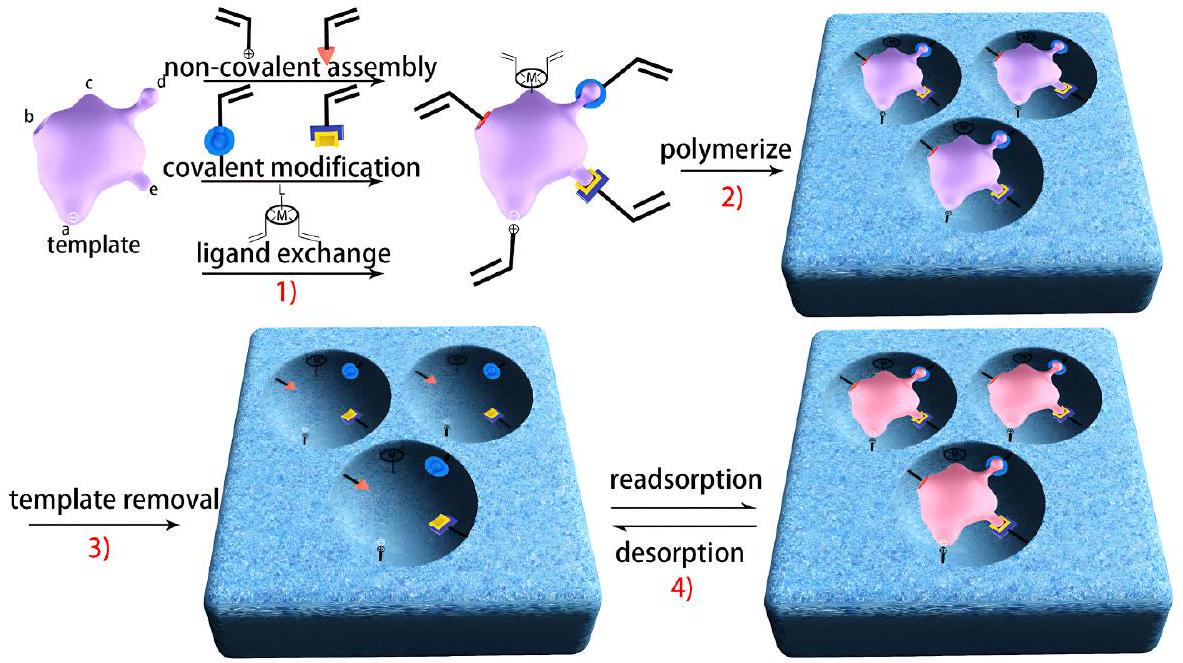
تم الإبلاغ عن MIP، باعتباره “مادة تحاكي البيولوجيا”، لأول مرة في الثمانينيات (أندرسون وآخرون، 1984)، عندما تم تقديم مفهوم استخدام جزيئات القالب لإنشاء بوليمرات مسامية للتعرف الكيميائي. منذ ذلك الحين، جذبت MIPs اهتمامًا كبيرًا في كل من المجتمع العلمي والصناعي لتطوير الجيل التالي من تقنيات الاستشعار الحيوي (بيليتسكي وتيرنر، 2002)، بسبب مزاياها على عناصر الاستشعار التقليدية، بما في ذلك الانتقائية العالية، والحساسية، وانخفاض LoD، والأهم من ذلك، الاستقرار العالي، وانخفاض تكاليف الإنتاج، وإمكانية إعادة الاستخدام. يتم وصف MIP عمومًا كمستقبل اصطناعي لاستبدال عناصر التعرف البيولوجية. إذا تم تصنيفها حسب نوع المستقبل، يمكن تقسيم أجهزة الاستشعار الحيوية إلى أجهزة استشعار حيوية تحفيزية وأجهزة استشعار حيوية قائمة على الانتقائية. تعتمد أجهزة الاستشعار الحيوية التحفيزية على طبقة المحفز الحيوي المثبتة على المستشعر (مثل الإنزيمات، والخلايا الكاملة، إلخ)، مما يتيح الاستهلاك المستمر للركيزة. على العكس، تعتمد أجهزة الاستشعار الحيوية القائمة على الانتقائية على تفاعل المواد التحليلية مع الجزيئات الكبيرة أو التجمعات الجزيئية المنظمة، مثل تفاعلات الأجسام المضادة والمستضدات، والمستقبلات/المضادات/المحفزات، إلخ. لذلك، بمجرد الوصول إلى توازن الربط، لن يكون هناك استهلاك صافي إضافي للمواد التحليلية بسبب المركب المثبت. يمكن أن يُرى أن مستشعر MIP، الذي يحتوي عادةً على مصفوفة بوليمرية مع تجاويف، ينتمي إلى أجهزة الاستشعار الحيوية القائمة على الانتقائية، محاكيًا التفاعل بين تفاعل الأجسام المضادة والمستضدات للربط مع الأهداف المحددة (تشين وآخرون، 2016). بلغة بسيطة، إنها تقنية لتخصيص “أقفال اصطناعية” بقدرة على التعرف على “المفاتيح”. عادةً ما تشمل عملية تحضير MIPs ثلاث مراحل، كما هو موضح في الشكل 1: 1) التفاعلات التساهمية القابلة للعكس، أو غير التساهمية، أو تبادل الروابط بين جزيئات القالب والمونومرات الوظيفية، مما يؤدي إلى تشكيل معقدات المونومر-القالب؛ 2) يتم بوليمرة معقدات المونومر-القالب وربطها لتشكيل مصفوفة ثلاثية الأبعاد؛ 3) يتم بعد ذلك إزالة أو استخراج جزيئات القالب من مصفوفة البوليمر، تاركة تجاويف ربط فارغة. عمومًا، تعتبر الطباعة التساهمية وغير التساهمية الاستراتيجيتين الرئيسيتين لتخليق MIPs. التفاعلات التساهمية أكثر استقرارًا كيميائيًا ولديها نسبة ستوكيومترية أكثر ملاءمة من التفاعلات غير التساهمية، مما يمكن أن يؤدي إلى انتقائية أعلى وأقل من مواقع الربط غير المحددة. ومع ذلك، تعاني الروابط التساهمية من مشكلة بطء ربط القالب وإطلاقه، حيث تتضمن تشكيل وتدمير الروابط التساهمية. حاليًا، لا تزال الطباعة غير التساهمية هي الاستراتيجية الاصطناعية الأكثر شعبية ومرونة لتحضير MIPs بسبب سهولة تشغيلها وسرعة ربط القالب وإزالته، على الرغم من عدم استقرار معقدات المونومر-القالب ونسبتها الستوكيمترية الضعيفة (ليانغ وآخرون، 2009). مع معلمات الإنتاج المثلى، يمكن أن تتذكر هذه التجاويف بشكل فعال الحجم، والشكل، والوظائف، وغيرها من الخصائص الفيزيائية والكيميائية للجزيئات القالب. وهذا يمكّن التجاويف من العمل كعناصر استشعار لإعادة الربط بشكل انتقائي مع الجزيئات الحيوية المماثلة لجزيئات القالب، وهو المبدأ وراء أجهزة الاستشعار المعتمدة على MIP (بلبرونو، 2018).
يتم تحديد نجاح عملية الطباعة بشكل رئيسي من خلال معلمين، وهما عامل الطباعة (IF) والانتقائية، واللذان يتم تحديدهما من خلال مقارنة كمية المادة المستهدفة أو النظير الهيكلي المرتبط بـ MIP و NIP (وهو عنصر تحكم تم تصنيعه جنبًا إلى جنب مع MIP في غياب القالب). لتحديد هذه المعلمات، يتم عادةً إجراء اختبارات إعادة الربط الجماعية، حيث يتم تعليق كل من مواد MIP و NIP في محلول يحتوي على المادة المستهدفة ويتم حضنها حتى يتم الوصول إلى حالة التوازن. ثم يتم فصل المواد عن المحلول ويتم تحديد كمية المادة المستهدفة في السائل الفائق (المادة غير المرتبطة) باستخدام إما UV-Vis أو HPLC. ثم يمكن حساب سعة الربط عند التوازن (Q) ومعامل التوزيع () وفقًا للمعادلات (1) و (2).
( هو التركيز الابتدائي للمادة المستهدفة، هو التركيز عند التوازن للمادة المستهدفة في المحلول، هو كتلة البوليمر، و هو حجم المحلول.)
يمكن تعريف IF بالتالي من خلال المعادلات أعلاه (3) و (4)، والتي تستخدم لتحديد حجم الطباعة ويجب أن تكون أكبر من واحد لأي طباعة ناجحة. في حالة الانتقائية، يتم حضن المادة المستهدفة مع النظائر الهيكلية، فيما يسمى اختبارات إعادة الربط الجماعية التنافسية، معًا. وبالمثل، يتم تعريف الانتقائية بواسطة عامل الانتقائية ()، معامل الانتقائية (k)، أو معامل الانتقائية النسبي () المعطاة بواسطة المعادلات (5)-(8).
تشير القيم الأكبر من واحد للانتقائية إلى أن البوليمر المطبوعة قادر على تمييز المركبات وبالتالي حدث تأثير الطباعة مما يجعله انتقائيًا تجاه المادة المستهدفة. تشير الانتقائية النسبية إلى حجم انتقائية MIP بالنسبة لـ NIP، حيث تشير القيم الأكبر من واحد إلى أن MIP أكثر انتقائية تجاه المادة المستهدفة (Ndunda، 2020).
بالإضافة إلى الطريقة أعلاه، يمكن أيضًا حساب IF مباشرة من خلال الكشف الفولتميتر كالنسبة بين حساسية MIP و NIP، أو النسبة بين القيمة القصوى () المسجلة عند MIP و NIP تحت ظروف التشبع (، الفرق بين التيار القمة المسجل في غياب () ووجود (I) المادة المستهدفة). بالمثل، من خلال تكييف معادلة الامتصاص لانغموير مع البيانات الكهروكيميائية، يمكن أيضًا الحصول على ثابت الارتباط/الانفصال ( و ) بين المواد المستهدفة ومواقع الربط في MIP مع المعادلات التالية (9) و (10)، مما يوضح المزيد من الألفة لـ MIP تجاه الأهداف (Campagnol et al.، 2022).
بالإضافة إلى الانتقائية العالية، توفر طبيعة هذه المصفوفة البوليمرية الاصطناعية أجهزة استشعار قائمة على MIP بحساسية ممتازة، واستقرار، ومتانة، وإمكانية إعادة الاستخدام لتطوير الجيل التالي من أجهزة الاستشعار، والتي يمكن أن تتغلب على المشكلات المرتبطة بعناصر المجس الحيوية كالمستقبلات للكشف البيولوجي. ومع ذلك، على الرغم من العديد من مزايا MIPs، لا تزال لديها قيود وحدود، مثل انخفاض نقل الكتلة، والاحتجاز الدائم في المصفوفة البوليمرية، وضعف سلامة البوليمر الهيكلية، وطرق التصنيع المحدودة (خاصة فيما يتعلق بخيارات المذيبات)، وعدم تجانس تجاويف الربط (Crapnell et al.، 2020).
تجعل هذه الأمور من الصعب استخدام MIPs التقليدية للكشف عن الجزيئات الكبيرة، والتي تظهر أداءً غير كافٍ في التعرف بسبب التعقيد وعدم الاستقرار التكويني لـ MIPs التقليدية (Kryscio و Peppas، 2012). بالإضافة إلى ذلك، لم يظهر أي من MIPs الحالية إمكانية استبدال التقنيات الحالية في الإعدادات السريرية الروتينية وأسواق الكشف البيولوجي، بسبب صعوبة تكرار التصنيع الضخم، وضعف القابلية للتكرار. تشير هذه العيوب إلى أن أجهزة الاستشعار القائمة على MIP تحتاج إلى تحسين كبير لتطبيقات عملية سريرية.
1.3. تقنية الكشف الكهروكيميائي القائمة على MIP
يمكن تقسيم MIPs المدمجة مع أجهزة الاستشعار الكهروكيميائية إلى MIP موصلة وغير موصلة بناءً على الخصائص الكهربائية. MIP غير الموصل هو خيار شائع يتم دمجه مع جهاز الاستشعار الكهروكيميائي، على سبيل المثال، فيلم MIP غير الموصل من بولي 2-أمينوفينول للكشف عن جالكتين-3 (Cerqueira et al.، 2021)، طبقة MIP من بوليفينول العازلة لتحليل الميوغلوبين (Ribeiro et al.، 2017)، إلخ. من الجدير بالذكر أن سمك طبقة MIP غير الموصل يجب أن يتم التحكم فيه، وإلا سيتم حظر نقل الإلكترون تمامًا بين القطب الكهربائي والتجويف، سواء في غياب أو وجود المادة المستهدفة. تُستخدم MIPs الموصل أيضًا بشكل متكرر مع أجهزة الاستشعار الكهروكيميائية، مثل MIP من بوليبرول للكشف عن إنترلوكين-6 (Gonçalves et al.، 2021)، القطب المعدل بـ MIP من بولي أنيلين للكشف عن الجلوكوز (Chen و Wright et al.، 2020)، إلخ. تمتلك أجهزة الاستشعار الكهروكيميائية القائمة على MIPs الموصل حساسية محسنة إلى حد ما، لكنها في نفس الوقت تصبح أكثر عرضة للتعرف غير المحدد.
أما بالنسبة لعملية تجميع MIPs، فهناك عدة طرق شائعة لتعديل سطح القطب الكهربائي بفيلم MIP الاصطناعي (Gui et al.، 2018).
البوليمرة الكهروكيميائية مباشرة في محلول يحتوي على قوالب ومونومرات وظيفية نشطة كهربائيًا (Goncalves، 2021).
إسقاط البوليمرات المعدة مسبقًا من المحلول (Li et al.، 2022).
تغطية الدوران لمركب يحتوي على مونومرات وظيفية وقوالب تم بوليمرتها كيميائيًا في الموقع في المحلول (Arshad et al.، 2020).
تخليق الأفلام عن طريق تطعيم مجموعات قابلة للبلمرة و/أو المحفزات على سطح الدعم (Marques et al.، 2021).
التجميع الذاتي طبقة تلو الأخرى على سطح المحول (Panapimonlawat et al.، 2021).
تمتلك جميع هذه الاستراتيجيات مزايا وعيوب معينة. على سبيل المثال، تعتبر طريقة الإسقاط الأكثر ملاءمة مع كفاءة عالية ولكنها تعتمد على خاصية الالتصاق للمادة المصنعة. أصبحت استراتيجية البوليمرة الكهروكيميائية مستخدمة على نطاق واسع بسبب ميزتها المحددة التي يمكن أن تحصل على سمك فيلم أكثر قابلية للتحكم. ومع ذلك، لا تزال لديها عيوب، على سبيل المثال، اختيار محدود للمونومرات القابلة للبلمرة كهربائيًا مقارنةً بالتصنيع الكيميائي. لذلك، من الضروري اختيار الطريقة الأكثر ملاءمة عند تعديل القطب الكهربائي بـ MIP.
بالإضافة إلى ذلك، يجب اختيار وضع الكشف الأمثل وفقًا للنظام المحدد. عندما تكون المادة المستهدفة نفسها نشطة كهربائيًا، يمكن قياس تيارها الفارادي عند الجهود المحددة مباشرة، بناءً على نقل الإلكترون بين الهدف في موقع التعرف والقطب الكهربائي الأساسي. عندما تكون المادة المستهدفة مادة غير نشطة كهربائيًا، فإنه عادةً ما يكون من الضروري إضافة مجسات أكسدة-اختزال قابلة للعكس، مثل الزوج، إلى الإلكتروليت. في هذه الحالة، ستتأثر نفاذية انتشار مجسات الأكسدة-الاختزال بتركيب المادة المستهدفة والتجاويف في MIP، والتي يمكن بعد ذلك اكتشافها بشكل غير مباشر. تمتلك الاستراتيجية الأولى دقة أعلى، لكنها مناسبة فقط للكشف عن المواد المستهدفة ذات النشاط الأكسدي-الاختزالي. الطريقة الأخيرة قابلة للتطبيق لمعظم قياسات المواد المستهدفة، على الرغم من أن الإشارة الكلية الناتجة في هذه العملية تكون أكثر عرضة للتفاعلات غير المحددة.
استنادًا إلى آليات الاستشعار، يمكن تصنيف أجهزة الاستشعار الكهروكيميائية MIP إلى أجهزة استشعار فولتامترية/أمبيرومترية (لوبيز-تيليز وآخرون، 2022)، وبوتنشيومترية (دينغ وكوين، 2020)، وإيميديمترية (باسان ويلماز، 2020)، وأجهزة استشعار ترانزستور تأثير الحقل (FET) (نيشيتاني وآخرون، 2016). على مدى العقود الماضية، تم الإبلاغ عنها على نطاق واسع للكشف عن علامات حيوية مختلفة، بما في ذلك الأحماض النووية (يو وآخرون، 2016)، والبروتينات (كاريميان وآخرون، 2013؛ سيلفا وآخرون، 2016)، والسكريات (تشو وآخرون، 2018)، والدهون (أنيشودان وديبا، 2018)، وجزيئات صغيرة أخرى (كاو وآخرون، 2020). تم إحراز تقدم كبير في تطوير MIPs الجديدة لتحسين الحساسية (علام وآخرون، 2022)، وحدود الكشف (لي وآخرون، 2022)، وتوافرها للتطبيق العملي (وانغ وآخرون، 2022أ). بالتوازي، تم إحراز تقدم في إنشاء MIPs تستهدف علامات حيوية غير شائعة، والتي يصعب الكشف عنها بالوسائل التقليدية. على سبيل المثال، S. epidermidis (غولابي وآخرون، 2017؛ مازوتا وآخرون، 2022)، أميليود مصل A (ياسمين وآخرون، 2022)، السمية الخلوية الفارغة A (ساكينا وآخرون، 2023)، كليبسيلا الرئوية (بينتافيروج وآخرون، 2022). بالمقارنة مع أنواع أخرى من أجهزة استشعار MIP، مثل البصرية والبيزوالكتريك، تتمتع أجهزة الاستشعار الكهروكيميائية بالعديد من المزايا، بما في ذلك البساطة، وانخفاض التكلفة، وسهولة
الشكل 1. مخطط لإنتاج MIP. 1) معقد القالب-المونومر يتكون من خلال تفاعلات تساهمية، غير تساهمية أو تبادل الروابط. 2) يتم احتجاز القوالب داخل مصفوفة البوليمر أثناء البلمرة. 3) بعد إزالة القالب من مصفوفة البوليمر، يتم إعادة تنشيط تجاويف الربط لربط جزيئات مشابهة للهدف. 4) يتم التقاط جزيئات الهدف بواسطة التجاويف.
التقليص الآلي، وانخفاض حد الكشف، ونطاق الكشف الواسع، وإعادة الاستخدام الجيدة (رونكاينن وآخرون، 2010؛ أحمد وآخرون، 2019)، كما هو موضح في الجدول 1. ومع ذلك، على الرغم من تطورها السريع كنقطة بحث ساخنة، إلا أن قابليتها الضعيفة للتكرار والحساسية غير الكافية تحتاج إلى تحسينات إضافية للتطبيقات السريرية (بيليتسكي وتورنر، 2002).
تم نشر مراجعات حول الجوانب المختلفة لمستشعرات MIP في السنوات القليلة الماضية. ناقش سيلفوليني ومارازا إمكانيات مستشعرات MIP كأدوات جديدة واعدة لتحديد علامات السرطان الحيوية (سيلفوليني ومارازا، 2017)، وركز أوزون وتورنر على أكثر التقدمات الواعدة في مستشعرات MIP لتوضيح مدى قربها من السوق (أوزون وتورنر، 2016)، واستعرض رمانافيسيوس تصميم MIPs في مستشعرات الارتباط (رمانافيسيوس ورمانافيسيوس، 2022)، وملخص لودون MIPs للتطبيقات التجارية في المستشعرات والاختبارات منخفضة التكلفة (لودون وآخرون، 2020)، وحقق مازوتا ودي جولييو وماليتستا في تطوير الاستشعار الكهروكيميائي للجزيئات الكبيرة بناءً على MIP (مازوتا ودي جولييو وماليتستا، 2022)، واستعرض كراپنيل مستشعرات MIP الكهروكيميائية (كراپنيل وآخرون، 2020)، وناقش أكغونللي التطوير العقلاني لمستشعرات MIPs للكشف عن البروتينات (باسان ويليماز، 2020)، وملخص شيلر مستشعرات MIP الكهروكيميائية للبوليمرات الحيوية (شيلر وآخرون، 2019). ومع ذلك، ركزت بعض هذه المراجعات على أنواع محددة من العلامات الحيوية، مع تحليل نقدي ضئيل في أوجه القصور الحالية لمستشعرات MIP الكهروكيميائية وكيفية معالجة هذه العقبات لتعزيز الترجمة السريرية والتطبيقات التجارية. بالإضافة إلى ذلك، فإن مستشعر MIP الكهروكيميائي يتطور بسرعة، مما يحتاج إلى مراجعة في الوقت المناسب. لذلك، تهدف هذه المراجعة إلى تقديم نظرة عامة على تقدم الحالة الفنية في السنوات السبع الماضية في أربعة أنواع من مستشعرات MIP الكهروكيميائية، ومناقشة التحديات التقنية، وتقديم التطبيقات المحتملة للكشف عن علامات حيوية مختلفة، وتلخيص الاستراتيجيات الحاسمة لتعزيز الترجمة السريرية، وتقديم رؤى حول التطور المستقبلي لتشخيص الأمراض.
2. أجهزة الاستشعار الكهروكيميائية المعتمدة على MIP
ورثت أجهزة الاستشعار الكهروكيميائية المعتمدة على البوليمرات المتناهية الصغر مزايا أجهزة الاستشعار الكهروكيميائية التقليدية، من حيث سهولة الاستخدام والسرعة.
الجدول 1 مقارنة بين أنظمة استشعار البيوس باستخدام MIP المختلفة.
نوع
المزايا
العيوب
بصري
– كميات أقل من المواد الكيميائية وحجم أصغر من العينة
– سرعة استجابة سريعة تحقق كفاءة كبيرة
– مقاوم للتداخل الكهرومغناطيسي
– ضخم وصعب الدمج مع أدوات/ تطبيقات أخرى
– انخفاض الخصوصية، من الصعب تحقيق قياس دقيق
– حساسية غير كافية، حد الكشف، عدم استقرار
– صعب للرصد في الوقت الحقيقي في السوائل ذات اللزوجة العالية، مثل اللعاب
الكهرباء الضغطية
– مراقبة مباشرة بدون علامات وفي الوقت الحقيقي
– انتقائية عالية تتجنب تأثيرات المداخلات
– مناسب للكشف عن المحللات ذات الوزن الجزيئي العالي
– تأثرت بالرطوبة، مما أدى إلى ضرورة قياس وتخزين بيئة صارمة
– صعب التطبيق في العينات السريرية بسبب تأثير المصفوفة
كيمياء كهربائية
– نطاق كشف واسع
– حساسية ممتازة وحد أدنى منخفض للكشف
– عرضة للإعلانات غير المحددة أثناء الكشف، مما يؤدي إلى عدم كفاية التخصص خاصة في التعرف على الجزيئات الكبيرة
– سهولة التصغير والأتمتة (يمكن تحويله لاحقًا إلى جهاز إثبات المفهوم)
– ضعف القابلية للتكرار عند تصنيع الأقطاب الكهربائية المعدلة، مما يجعل من الصعب الإنتاج بكميات كبيرة
حساسة، منخفضة التكلفة، ومثالية لتكييفها بشكل أكبر لتطبيقات المراقبة السريرية المختلفة. استنادًا إلى آليات تحويل الإشارة الخاصة بها، تم تلخيص أجهزة الاستشعار الكهروكيميائية المعتمدة على MIP في الجدول S1.
2.1. مستشعر فولتامترية/أمبيرومترية
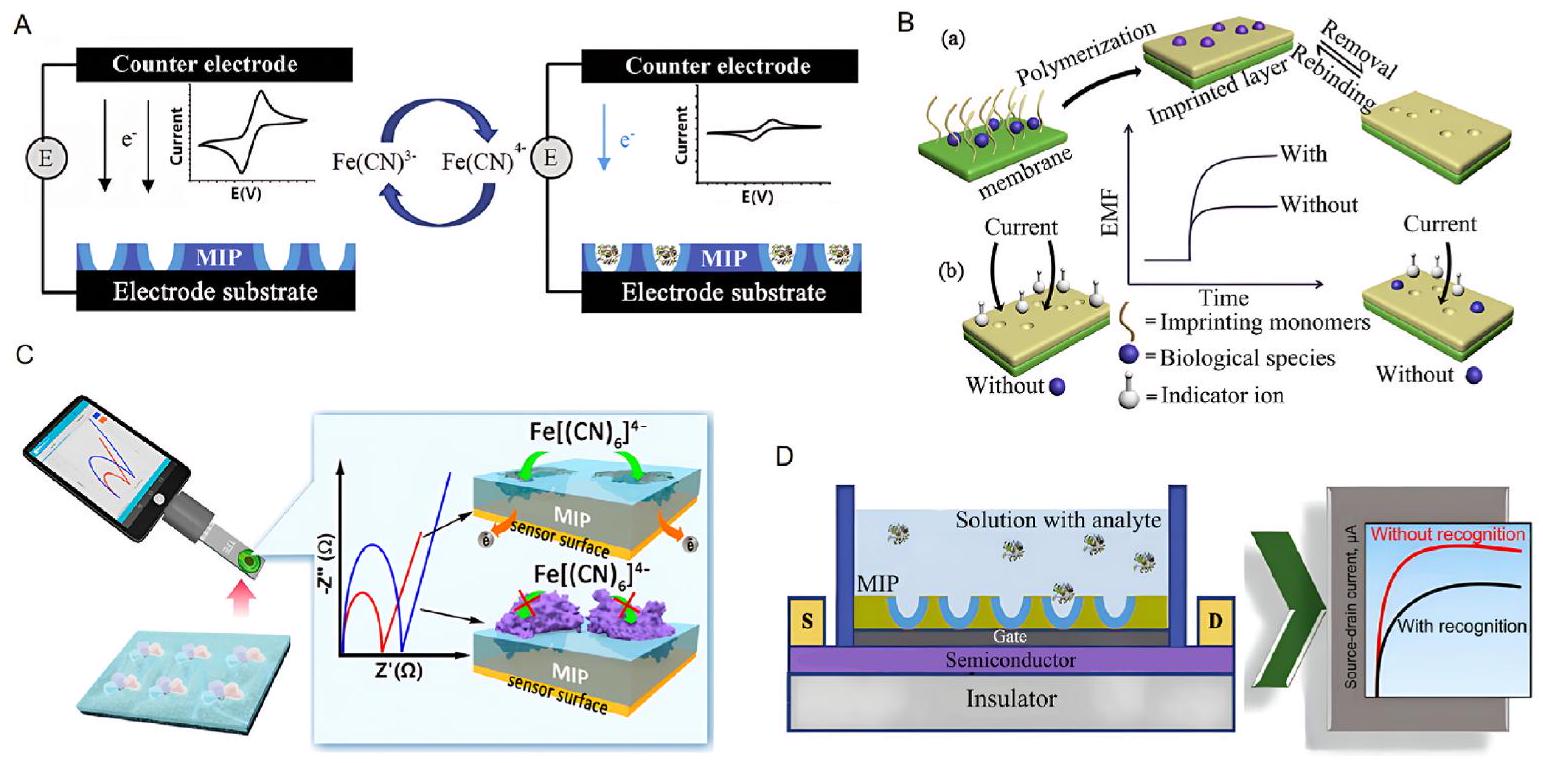
تقوم أجهزة الاستشعار الفولتمترية/الأمبيرومترية بمسح نطاق جهد محدد على القطب العامل (WE) بالنسبة للقطب المرجعي (RE) وتقيس التيار الكهربائي بين WE والقطب المضاد (CE)، والذي يظهر عادةً كذروة أو هضبة تتناسب مع تركيز المادة المستهدفة (Ronkainen et al., 2010). يمكن إنتاج جهاز استشعار كهربائي فولتمتري/أمبيرومتري قائم على MIP عن طريق طلاء سطح WE بمواد MIP. في هذه الحالة، عندما يتم التقاط جزيئات المادة المستهدفة بواسطة التجاويف المحددة في طبقة MIP، ستتغير النشاط الكهربائي لـ WE. سيؤدي ذلك إما إلى منع أو تعزيز نقل الإلكترون بين WE والكهارل، مما يؤدي إلى تغيير في قيمة الذروة للتيار الأكسدي الاختزالي، كما هو موضح في الشكل 2(A).
نظرًا لبساطتها وحساسيتها العالية، تم استخدام حساسات الفولتمترية/الأمبيرومترية المعتمدة على البوليمرات المطبوعة بشكل واسع للكشف الفائق الحساسية عن علامات الأمراض، بما في ذلك الكشف عن التوتر (غويال وساكاتا، 2022)، السرطان (باتشكو وآخرون، 2018)، احتشاء عضلة القلب الحاد (كرامي وآخرون، 2019)، أمراض الكلى (لي وآخرون، 2022)، الأمراض العصبية (مورييرا وآخرون، 2018؛ ستيت وفان ستادن، 2022؛ حاسين وآخرون، 2023)، السكري (سيد وآخرون، 2022)، وكوفيد-19 (راتاوتايت وآخرون، 2022). ومع ذلك، فإن هاتين الطريقتين لهما أيضًا بعض العيوب. إذا لم يكن من الممكن أكسدة أو اختزال المحلل المستهدف كهربائيًا، فإنه يمكن أن يتسبب فقط في تغيير التيار من خلال الارتباط مع تجاويف الطباعة، مما يعيق بعد ذلك مجسات الأكسدة والاختزال في الإلكتروليت من الوصول إلى سطح القطب. لذلك، بالنسبة للبوليمرات المطبوعة التقليدية، التي تتكون فقط من البوليمرات، فإن توصيلها الكهربائي ضعيف وتغيرات إشارة التيار المكتشفة محدودة، مما يؤدي إلى انخفاض حساسية المستشعر. يمكن تحسين توصيل مادة البوليمرات المطبوعة، من خلال إضافة مواد موصلة أخرى، مثل جزيئات المعادن النانوية والأسلاك النانوية المعدنية (هوا وآخرون، 2023)؛ أو إنتاج طبقة البوليمرات المطبوعة مباشرة على سطح المادة الموصلة مثل الجرافين، أو أنابيب الكربون النانوية، إلخ، كطبقة طباعة. يمكن أن تحسن هذه الطرق بشكل فعال حساسية حساسات الفولتمترية/الأمبيرومترية المعتمدة على البوليمرات المطبوعة.
2.2. مستشعر بوتنشيومتري
بشكل عام، تعتمد أجهزة الاستشعار البوتنيو مترية على أقطاب حساسة للأيونات (ISE) لقياس التغير في الجهد الناتج عن عملية تبادل أو نقل الأيونات. تتكون من قطب مؤشّر وقطب مرجعي. نظرًا لأن جهد القطب المرجعي ثابت، فإن الجهد المتولد عند القطب المؤشر يحتوي على معلومات حول كمية المادة التحليلية في العينة دون تدفق للتيار أثناء القياس (وانغ وآخرون، 2020). يمكن دمج الأنظمة البوتنيو مترية مع منصات استشعار MIP لإنشاء أدوات حساسة للكشف السريع عن العلامات الحيوية والعديد من المواد الكيميائية المهمة في سوائل الجسم (كريمي-ماله وآخرون، 2021). كما هو موضح في الشكل 2(B)، تتكون منصة الاستشعار المغلفة بـ MIP عادةً من طبقتين: طبقة التعرف على MIP السطحية للتعرف على الهدف، والتي تُغطى فوق طبقة تحويل الجهد (ليانغ وآخرون، 2009). عندما يتم التقاط الجزيئات المستهدفة بواسطة طبقة MIP، سيتم إما تثبيط أو حتى حجب نقل الأيونات بين الغشاء الحساس والمحلول، مما يؤدي إلى تغيير في الجهد الكهربائي.
تم استخدام حساسات البوتنشيومترية المعتمدة على البوليمرات المتخصصة بنجاح للكشف عن مواد متنوعة، بما في ذلك الأدوية (حسن وآخرون، 2023)، الأيونات غير العضوية (مجدي وآخرون، 2022)، البروتينات (ريبييرو وآخرون، 2022)، والأحماض النووية (فارديني وآخرون، 2022). يتم مراجعة الاستخدام الواسع لحساسات البوتنشيومترية المعتمدة على البوليمرات المتخصصة بسبب الخصائص الواعدة التي تظهرها، بما في ذلك التكلفة المنخفضة، والاستقرار، والخصوصية، وسهولة التصنيع، وإمكانية التصغير. ومع ذلك، هناك عدة عيوب في استخدامها العملي. على سبيل المثال، فإن البوليمر المتخصص التقليدي مع السماكة المفرطة، يؤدي ذلك إلى صعوبة مرور أيونات المؤشر عبر طبقة البوليمر، مما يجعل من الصعب الوصول إلى طبقة الحساسية الأيونية وإحداث تغييرات في الجهد. لمعالجة هذه المشكلة، يمكن أن يتم طباعة طبقة التعرف على المادة المستهدفة مباشرة على طبقة تحويل الجهد بسماكة قابلة للتحكم، مما يحسن من حساسية المستشعر البوتنشيومتري.
بالإضافة إلى ذلك، تُظهر هذه التكنولوجيا انتقائية غير مرضية للكشف عن العديد من الأيونات غير العضوية، مثل أيونات الإلكتروليت وأيونات المعادن الثقيلة، التي تكون أحجامها صغيرة جدًا بحيث لا يمكن تشكيل بصمة فعالة لها. لا يمكن لمونومرات MIP الوظيفية الشائعة، مثل حمض البنزويك وحمض الميثاكريليك، أن تشكل تنسيقًا قويًا مع أيونات المعادن الثقيلة. للتغلب على هذه العقبة، يجب النظر في تطوير ربيطات قادرة على التنسيق الانتقائي مع أيونات المعادن الثقيلة (فارديني وآخرون، 2022). بهذه الطريقة، سيتم بالتأكيد الحصول على مستشعر بوتنشيومتري قائم على MIP ذو استقرار عالٍ للكشف عن الأيونات غير العضوية من خلال المزيد من الاستكشاف في المستقبل.
2.3. مستشعر impedimetric
تقوم أجهزة الاستشعار المعتمدة على القياس المعاوقة الكهربائية بقياس طيف المعاوقة الكهروكيميائية (EIS) للمواد، عندما يتعرض النظام لإشارة تحفيز ترددية صغيرة السعة على مدى واسع من الترددات. سيتم بعد ذلك تحديد استجابات التيار المتزامن وغير المتزامن للحصول على المكونات المقاومة والسعوية للمعاوقة، على التوالي (أديسينا وآخرون، 2023). يُستخدم هذا عادةً بالاشتراك مع تقنية MIP، كما هو موضح في الشكل 2 (C). يتم تعديل سطح القطب الكهربائي بطبقة MIP للكشف عن أحداث التعرف الحيوي من خلال قياس التغيرات في إشارة المعاوقة، التي يتم توليدها بواسطة الشحنة الحرة الناتجة عن التفاعل بين التجاويف في MIPs والجزيئات المستهدفة. ومع ذلك، قد تتأثر أيضًا بالعوائق الاستيركية أو النفور الكهروستاتيكي، مما يسبب تغيير المواد النشطة كهربائيًا في المحلول الكهربائي (إلشافاي وآخرون، 2013). يتم اشتقاق النتائج المستخلصة من خلال ملاءمة نموذج الدائرة المعادلة المُنشأة ويمكن حساب تركيز المحلل.
بالمقارنة مع أجهزة الاستشعار الفولتمترية/الأمبيرومترية، التي تطبق جهدًا أعلى لبدء تفاعلات الأكسدة والاختزال على سطح القطب للكشف، تقيس أجهزة الاستشعار المعتمدة على البوليمرات المطبوعة (MIP) عادةً مقاومة المادة في حالة “شبه مستقرة”، مع إشارة تحفيز ترددية صغيرة تحت جهد الدائرة المفتوحة، مما يتجنب بشكل فعال التيار الفارادائي الناتج عن المواد المتداخلة النشطة كيميائيًا (مثل اليورات والأسكوربات) في مصفوفة العينة، والتي يمكن أن تؤثر على القياس. لذلك، تم استخدام هذه التقنية على نطاق واسع للكشف في سوائل الجسم البشرية المختلفة، بما في ذلك البول (Li et al., 2022)، المصل (Shi-Peng et al., 2023)، العرق (Zhang et al., 2020)، واللعاب (Sharif et al., 2022). ومع ذلك، فإن دقة هذه الطريقة أقل إرضاءً للكشف عن الجزيئات الكبيرة، لأن المواد المتداخلة الشبيهة بالهدف في سوائل الجسم ترتبط بشكل غير محدد مع التجاويف المطبوعة. قد يتم تفسير التغيرات الناتجة في المقاومة بشكل خاطئ على أنها تفاعلات محددة، مما يؤثر على دقة التشخيص. ترتبط عدم دقة التعرف على الجزيئات الكبيرة بالنسبة المنخفضة بشكل طبيعي للإشارة إلى الضوضاء في الكشف عن EIS، والتي تتداخل بشكل رئيسي مع النتائج المختبرة في التركيزات المنخفضة، ولكنها موجودة في كل جهاز استشعار كهربائي كيميائي يعتمد على MIP تقريبًا. لذلك، لتجنب تأثير الارتباط غير المحدد على اختبار EIS المعتمد على MIP، من المهم ضمان تداخل جزيئات المونومر والقالب بإحكام عند بناء الطبقة المطبوعة. على سبيل المثال، يمكن تحقيق التعرف الدقيق للغاية على المادة التحليلية من خلال إضافة المونومرات بأشكال مختلفة لتحسين خصوصية التجاويف المطبوعة. علاوة على ذلك، يمكن أن تتأثر نتائج EIS بعملية تحليل البيانات. تتطلب معالجة نتائج EIS بناء دائرة مكافئة لتناسب وتحديد التغيرات في النشاط الكهربائي. ومع ذلك، فإن التناقضات في هذه العملية النمذجة تجعل الكشف من مصنّعين مختلفين يختلف ويؤدي إلى نتائج تقدير مختلفة. قد يساعد إزالة الغموض من نماذج الدوائر المكافئة في تعزيز أجهزة الاستشعار المعتمدة على MIP كطريقة كشف مفضلة في الممارسة السريرية.
2.4. مستشعر FET
تستند حساسات FET إلى مبدأ عمل ترانزستورات تأثير المجال من نوع أشباه الموصلات المعدنية-أكسيد (MOSFETs). يتم استبدال أكسيد البوابة في هيكل MOSFET بغشاء حساس للأيونات أو تعديله بواسطة عناصر بيولوجية (مثل الأجسام المضادة). عندما تشكل الجزيئات الحيوية المشحونة معقدات على الغشاء الحساس للأيونات، أو تنتج التفاعلات الكيميائية الحيوية عليها أيونات (على سبيل المثال), ستتغير كثافة الشحنة السطحية. سيؤدي ذلك إلى تغيير في الجهد، وهو ما يعادل ضبط جهد البوابة للتحكم في تيار القناة بين المصدر والمصرف (Iskierko et al., 2018). يبدو أن ترانزستورات تأثير المجال (FETs) مناسبة لترجمة إشارات التعرف الجزيئي بشكل فعال إلى إشارات تحليل كهربائي باستخدام مستقبلات طبيعية أو صناعية، مثل البوليمرات المطبوعة (MIPs). في هذا التكوين، يتم تثبيت طبقة MIP على سطح منطقة البوابة النشطة لتتفاعل مع المحلل، كما هو موضح في الشكل 2 (D). وبالتالي، يعتمد الكشف على التغيرات في درجة ارتباط المحلل بالفراغات، والتي تتناسب مع تركيز الهدف في المحلول. إن دمج الأغشية المطبوعة مع ترانزستورات تأثير المجال يجعل نظام الاستشعار انتقائيًا للغاية للمحللات المحددة.
ومع ذلك، فإن قضية مهمة لمستشعرات FET المعتمدة على MIP هي تأثير درع الأيونات لطول ديباي، وهو مقياس للطبقة الكهربائية المزدوجة. على سبيل المثال، فإن طول درع ديباي في 1.0 M NaCl هو 0.3 نانومتر، بينما تكون تلك القيمة في الماء النقي في نطاق الميكرومتر (Luo وDavis، 2013). لا يمكن لمستشعرات MIP-FET التعرف على أحداث الربط التي تتجاوز هذا الطول، لذلك، خلال عملية تصنيع طبقة MIP، من الضروري اختيار الطريقة المثلى التي يمكن أن تتحكم في سمك الطبقة، مثل تقنية الطباعة السطحية، لتقليل هذا التأثير. علاوة على ذلك، يتطلب التطبيق الناجح لمستشعرات FET المعتمدة على MIP، كأدوات تشخيصية سريرية تجارية، تكرارًا عاليًا لأداء الجهاز. لذلك، يجب استكشاف طرق جديدة للإنتاج على نطاق واسع وبشكل موثوق وبسيط، حيث تظل الطرق الحالية لطبقة MIP ذات السمك القابل للتحكم تحديًا تقنيًا.
من بين الأنواع الأربعة من أجهزة الاستشعار الكهروكيميائية المعتمدة على MIP المذكورة أعلاه، لا يزال جهاز الاستشعار الفولتمتري/الأمبيرومتري هو الأكثر استخدامًا للكشف عن المحللات بسبب خصائصه الممتازة. على سبيل المثال، تعتبر الموصلية المنخفضة لجهاز الاستشعار البوتنشيومتري المعتمد على MIP مشكلة رئيسية للكشف الحساس في سوائل الجسم الفعلية. بالمقابل، من خلال إضافة مجسات الأكسدة والاختزال إلى الإلكتروليت للإشارة بشكل غير مباشر إلى التغيرات في تركيز المحلل، يمكن لجهاز الاستشعار الفولتمتري/الأمبيرومتري المعتمد على MIP الآن تحقيق كشف حساس لمعظم الأهداف، حتى المواد غير الموصلية كهربائيًا. أما بالنسبة للكشف باستخدام جهاز الاستشعار المعتمد على MIP القائم على القياس المعاكس، فإن تفاعل الربط على السطح يكون أحيانًا غير كافٍ لإنتاج تغيير كبير في الإشارة، مما يجعل من الصعب تحديد كميات المحللات في التركيزات المنخفضة. على العكس، يمتلك جهاز الاستشعار الفولتمتري/الأمبيرومتري المعتمد على MIP القدرة على تحليل الأهداف ذات المحتوى المنخفض بسبب آلية الاستشعار المختلفة. أيضًا، يختلف عن عملية الطباعة الحجرية المعقدة لجهاز استشعار FET، فهو سهل التصنيع والتشغيل. مع إمكانية تصغير أدوات التحكم المطلوبة وإنتاجها بكميات كبيرة بتكلفة منخفضة نسبيًا من خلال الميكروتشغيل، أصبح جهاز الاستشعار الفولتمتري/الأمبيرومتري المعتمد على MIP واعدًا ليكون جهاز استشعار حيوي محمول في الموقع في المستقبل.
3. حساسات كهربائية كيميائية قائمة على MIP لاكتشاف مؤشرات حيوية مختلفة
في السنوات الأخيرة، تم تطوير حساسات كهربائية تعتمد على البوليمرات المتقاربة (MIP) للكشف عن مؤشرات حيوية مختلفة، والتي يمكن تصنيفها على أنها أحماض نووية، بروتينات، سكريات، دهون، وجزيئات صغيرة أخرى. لذلك، نستعرض في هذا القسم تقدمها المتطور في السنوات السبع الماضية.
3.1. كشف الأحماض النووية
الأحماض النووية هي المصطلح العام لحمض الديوكسي ريبونوكلييك (DNA)
الشكل 2. مبادئ العمل لمستشعرات تعتمد على MIP (A) مستشعر فولتامترية، (B) مستشعر جهدية (Wang et al., 2020)، (C) مستشعر مقاومة (Raziq et al., 2021, Wang et al., 2022b)، و (D) مستشعر FET.
وحمض الريبي النووي (RNA)، حيث يمكن استخدام التسلسل المتحور أو المحدد كعلامات حيوية للكشف عن مجموعة واسعة من الأمراض والأعراض السريرية (كيم وآخرون، 2010؛ ثاكور وآخرون، 2014؛ غالانوبولوس وآخرون، 2017؛ محمد خير، عبد الرزاق وآخرون، 2021). لذلك، يمكن أن يساهم جهاز استشعار عالي الحساسية وفعال من حيث التكلفة وانتقائي لمراقبة هذه العلامات الحيوية للحمض النووي بشكل كبير في مجالات مثل التشخيص السريري، وعلم الأمراض، والسيطرة على الأمراض الوراثية (نواز وآخرون، 2021؛ زانغ وآخرون، 2022). لتلبية هذه الاحتياجات، تم تطوير أجهزة استشعار كهربائية كيميائية قائمة على MIP للكشف الكمي عن العلامات الحيوية للحمض النووي، مع أحدث الأمثلة في الجدول S2.
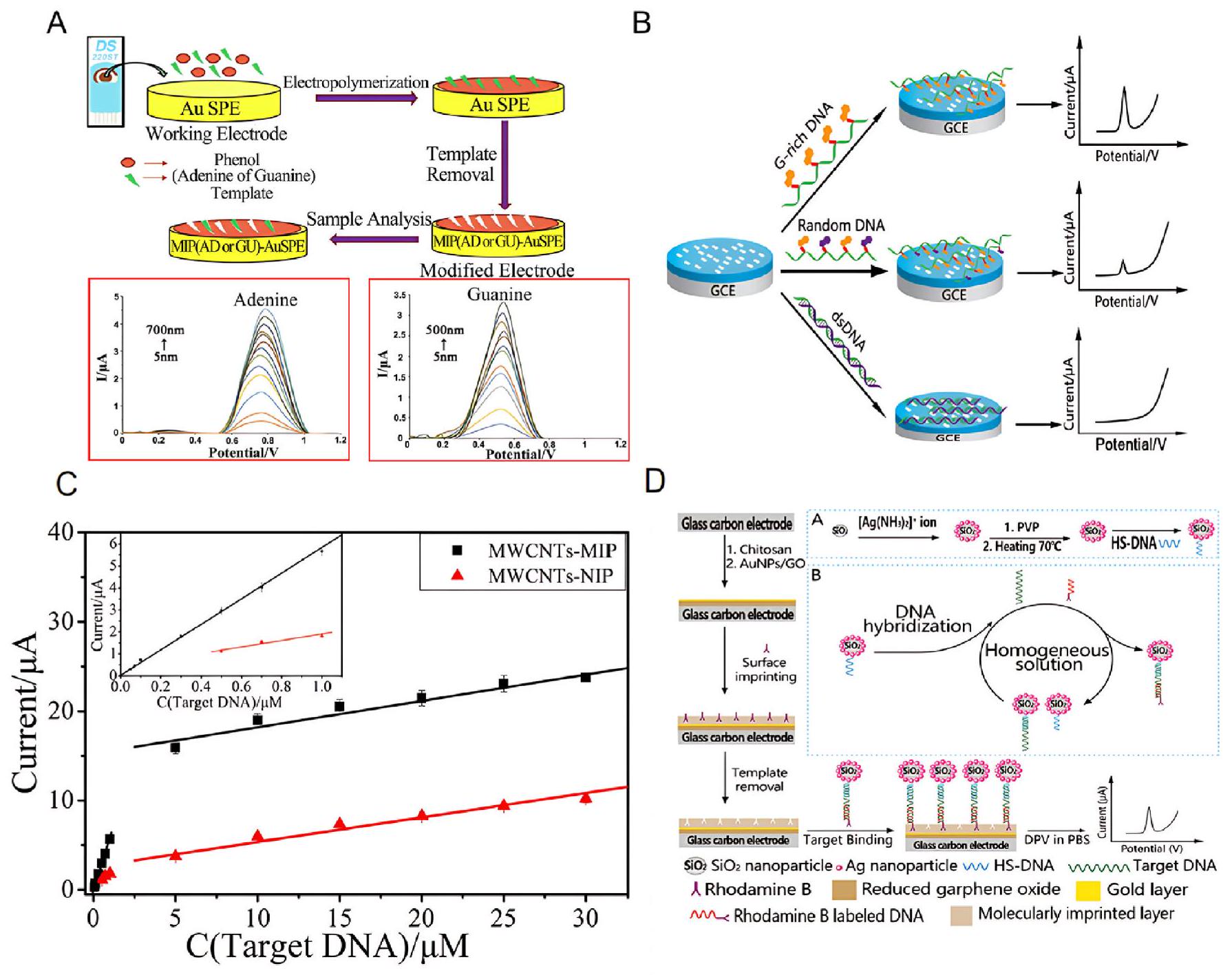
كانت إحدى مجالات البحث تركز على الكشف عن المونومرات النوكليوتيدية المحددة. على سبيل المثال، تم الإبلاغ عن استراتيجية جديدة للكشف عن تعدد الأشكال النوكليوتيدية الفردية (SNP) بدون علامات باستخدام مستشعرات كيميائية قوية، وذلك باستخدام مجسات مصنعة من نظائر الحمض النووي ثنائي الثين-5-يل سداسية القاعدة (بارتولد وآخرون، 2017). وقد مكنت هذه المنصة للكشف التي تم تصميمها هنا من إنشاء مكتبة من المجسات السداسية لتصنيف غالبية مجسات SNP ودراسة الآلية الجزيئية للنسخ المعقد. علاوة على ذلك، أبلغ أسل مؤخرًا عن مستشعر جديد يستخدم أقطاب معدلة بمادة MIP متعددة الفينول لتحديد الجوانين (GU) والأدينين (AD) في مصل الإنسان، كما هو موضح في الشكل 3(A) (أسل وآخرون، 2023). في هذا التصميم، تم بوليمرة طبقة MIP متعددة الفينول كهربائيًا على سطح أقطاب مطبوعة بالشاشة من الذهب (AuSPE). خلال إجراء الكشف، يتم أولاً التقاط GU وAD المستهدفين بواسطة التجاويف داخل طبقة MIP، ثم يتم أكسدة كهربائيًا عند إمكاناتهم المحددة وتحليلها. ومع ذلك، نظرًا لأن الكشف يعتمد على التيار الأكسدي المختزل للنوكليوتيد، يمكن أن ينخفض نسبة الإشارة إلى الضوضاء في العينات السريرية، حيث يمكن أن تتواجد مواد كيميائية مختزلة متعددة وتسلسلات تحتوي على GU/AD في نفس الوقت. بالإضافة إلى ذلك، يمكن أن تكون التطبيقات السريرية مقيدة أيضًا من خلال الكشف عن النوكليوتيد الفردي، حيث أنه من الصعب استخدام النوكليوتيدات الفردية كعلامات حيوية تمييزية.
في الوقت نفسه، تم أيضًا إثبات الكشف عن تسلسلات الحمض النووي الغنية بالنيوكليوتيدات المحددة. على سبيل المثال، تم الإبلاغ عن جهاز استشعار كيميائي لتحديد الغوانين والسيتوزين (GC) الغنيين وراثيًا 5′-GCGGCGGC-3′ أوليغونيوكليوتيد (بارتولد وآخرون، 2018). تم تصنيع مسبار هجين من الحمض النووي محدد التسلسل من أوكتاكيس (2،2′-بيثين-5-يل) في نفس الوقت وتثبيته على القطب باستخدام كل من “استراتيجية الطباعة الجزيئية في البوليمر” وقالب الحمض النووي الببتيدي القابل للبرمجة بالتسلسل (PNA). أظهر الكشف عن أوليغونيوكليوتيد أعلاه حد كشف يبلغ 200 بيكومول مع أداء ممتاز. الانتقائية عند التدخل بواسطة كل من الأوليغونوكليوتيدات غير المتطابقة وعينة وسط ديلبيكو المعدل. لقد استخدمت أنابيب الكربون النانوية متعددة الجدران كمادة داعمة مع استراتيجية جديدة تعتمد على بوليمر ميثاكريليك الحمض (PMAA)-MIP لتصميم مستشعر كهربائي متعدد المواقع خالٍ من العلامات للكشف عن الحمض النووي الغني بـ GU، كما هو موضح في الشكل 3(B) (يو وآخرون، 2016). في هذه الدراسة، تم تحضير مركبات PMAA-MIP من خلال تفاعل بوليمر انتقائي لحمض الميثاكريليك، ثنائي ميثاكريلات الإيثيلين غليكول، وGU على سطح أنابيب الكربون النانوية متعددة الجدران المفعلة بالفينيل. سمح هذا التصميم بالمراقبة المباشرة لتيار أكسدة GU، حيث تم تجنب التعديل المعقد للوسائط الحمراء وعملية التثبيت المسبق غير الفعالة لحمض نووي الاستشعار. كما هو موضح في الشكل 3(C)، أظهر هذا المستشعر انتقائية عالية للحمض النووي الغني بـ GU، مع نطاق ديناميكي خطي من و ، وحدود الكشف 7.52 نانومتر. من الجدير بالذكر أن هذا المستشعر أظهر أداءً ممتازًا في عينات مصل الدم البشري والبول، مما يجعله واعدًا للتطبيقات السريرية. ومع ذلك، تتطلب هذه الطريقة دمج القواعد النيتروجينية المعرضة بواسطة ssDNA مع التجاويف في MIP، مما يعيق تطبيقها السريري، حيث أن معظم تسلسلات الحمض النووي مزدوجة الشريطة في سوائل الجسم البشرية.
لتطبيق هذه التكنولوجيا الواعدة في الكشف عن تسلسلات الجينات العامة، قمت بالإبلاغ عن جزيئات الذهب النانوية (AuNP) المعدلة بأكسيد الجرافين المخفض (rGO) مع صبغة رودامين.حمض (MAA) MIP لاكتشاف جين قابلية الإصابة بسرطان الثدي (BRCA-1) (يو وآخرون، 2018). كما هو موضح في الشكل 3(D)، تم تخليق طبقة MIP على GCE المعدل بـ AuNPs-GO باستخدام RhB كقالب مع MAA كأحادي. من خلال التهجين المتجانس لمتتبع تعزيز الإشارةمع الحمض النووي المعلم بـ RhB، تم الحصول علىيمكن التعرف على جزيء الهدف NA/RhB بشكل محدد من خلال تجاويف RhB، مما يحقق الكشف عن تسلسلات الحمض النووي بدلاً من وحدات النوكليوتيدات الفردية. ومع ذلك، مقارنةً بأنواع أخرى من العلامات الحيوية التي يمكن اكتشافها باستخدام أجهزة الاستشعار الكهروكيميائية المعتمدة على MIP، فإن عدد المنشورات حول اكتشاف الأحماض النووية باستخدام MIP قليل. قد يكون ذلك لأن النظائر الاصطناعية لمسبارات الحمض النووي، مثل الأحماض النووية الببتيدية أو الأحماض النووية المقفلة، تتمتع بالفعل بخصوصية عالية، واستقرار، وسهولة في الإنتاج، وهو ما كان ينبغي توقعه من مستقبلات MIP. تمثل هذه الاختبارات الهجينة بديلاً يصعب المنافسة عليه وتعيق تطوير تقنية MIP لاكتشاف الحمض النووي (Scheller et al., 2019).
الشكل 3. أجهزة الاستشعار الكهروكيميائية المعتمدة على MIP لاكتشاف الأحماض النووية. (أ) جهاز استشعار بوليفينول-AuSPE لاكتشاف GU وAD (Asl et al., 2023). (ب) مبدأ التعرف على MWCNTs-PMAA@MIP/GCE لاكتشاف الحمض النووي الغني بـ GU. (ج) منحنيات المعايرة لـ MWCNTs-MIP/GCE وMWCNTs-NIP/GCE لاكتشاف الحمض النووي الغني بـ GU (You et al., 2016). (د) توضيح استشعار الحمض النووي المعتمد على MIPs. يظهر الشكل الجانبي إعداد وتهجين الحمض النووي (You et al., 2018).
3.2. اكتشاف البروتين
تستخدم العلامات الحيوية البروتينية غالبًا كمؤشر للأمراض وتقدمها، بما في ذلك الأمراض المعدية (Baker et al., 2022)، وأمراض القلب والأوعية الدموية (Vasan, 2006)، والسرطانات (Wu and Qu, 2015)، وأمراض أخرى تقدمية (Remuzzi and Bertani, 1998). لذلك، ستتيح تقنية الكشف عن العلامات الحيوية البروتينية الدقيقة والموثوقة التعرف على الأفراد المعرضين للخطر في مرحلة مبكرة وبالتالي تلقي العلاج المناسب في الوقت المناسب. لهذا الغرض، تم التركيز على العديد من تقنيات الاستشعار الحيوي المتطورة على هذا النوع من العلامات الحيوية. على سبيل المثال، تم استخدام اختبارات المناعية المرتبطة بالإنزيم (ELISA)، التي تقدم حساسية تصل إلى بيكوجرامات لكل مليلتر لاكتشاف العلامات الحيوية البروتينية، على نطاق واسع لتشخيص الأمراض (Villafañe et al., 2022; Zhong et al., 2022). أصبح اختبار الجزيء الفردي (Simoa)، الذي تم الإبلاغ عنه في عام 2010، واحدًا من أكثر التقنيات تقدمًا في قياس عدة علامات حيوية بروتينية في وقت واحد من بيكوجرامات فرعية إلى فيمتوغرامات لكل مليلتر (Rissin et al., 2010). تم أيضًا تطوير أجهزة استشعار كهروكيميائية معتمدة على MIP لاكتشاف العلامات الحيوية البروتينية. في هذا القسم، نستعرض بعض الدراسات التمثيلية الحديثة حول أجهزة الاستشعار الكهروكيميائية المعتمدة على MIP لاكتشاف العلامات الحيوية البروتينية، كما هو موضح في الجدول S3.
فيروس كورونا المتسبب في متلازمة التنفس الحادة الوخيمة-2 (SARS-CoV-2)
الذي تسبب في جائحة COVID-19 التي بدأت في عام 2019 قد أحدث تغييرات جذرية في العالم. لذلك، هناك حاجة إلى طريقة تحليلية سريعة مناسبة لتشخيص COVID-19 و/أو اكتشاف الفيروس أو أجزائه لهزيمة هذا العدوى والاستعداد للمستقبل. تم تصميم جهاز استشعار كهروكيميائي باستخدام بوليبرول (Ppy) المعتمد على الطباعة الجزيئية مع بروتين السنبلة SARS-CoV-2-S كقالب (MIP-Ppy)، والذي تم ترسيبه كهروكيميائيًا على سطح القطب بواسطة نبضات جهد (Ratautaite et al., 2023). تظهر النتائج أن أجهزة الاستشعار المعتمدة على MIP-Ppy يمكن تطبيقها لاكتشاف بروتينات فيروس SARS-CoV-2. إنزيم بوتيريل كولينستراز (BuChE) هو -بروتين يتم تصنيعه في الكبد. نظرًا لأن مستوى مصله ينخفض في العديد من الحالات السريرية، مثل تلف الكبد الحاد والمزمن، والالتهابات، والعدوى، غالبًا ما يستخدم كمؤشر تنبؤي لالتهاب الكبد الفيروسي. تم إنتاج جهاز استشعار كهروكيميائي معتمد على MIP لاكتشاف BuChE باستخدام بلمرة ديناميكية أكسيدية من o-فينيلينديامين على GCE (Ozcelikay et al., 2019). تم الكشف عن إزالة القالب وإعادة الربط باستخدام فيريسيانيد ككاشف أكسدة، مع نطاق كشف خطي بين 50 pM و2 nM وحد كشف قدره 14.7 pM.
تم أيضًا تطوير أجهزة استشعار كهروكيميائية معتمدة على MIP لتشخيص أمراض القلب والأوعية الدموية، والتي يمكن أن تسببها فرط شحميات الدم، وضغط الدم، ولزوجة الدم غير الطبيعية، وتصلب الشرايين.
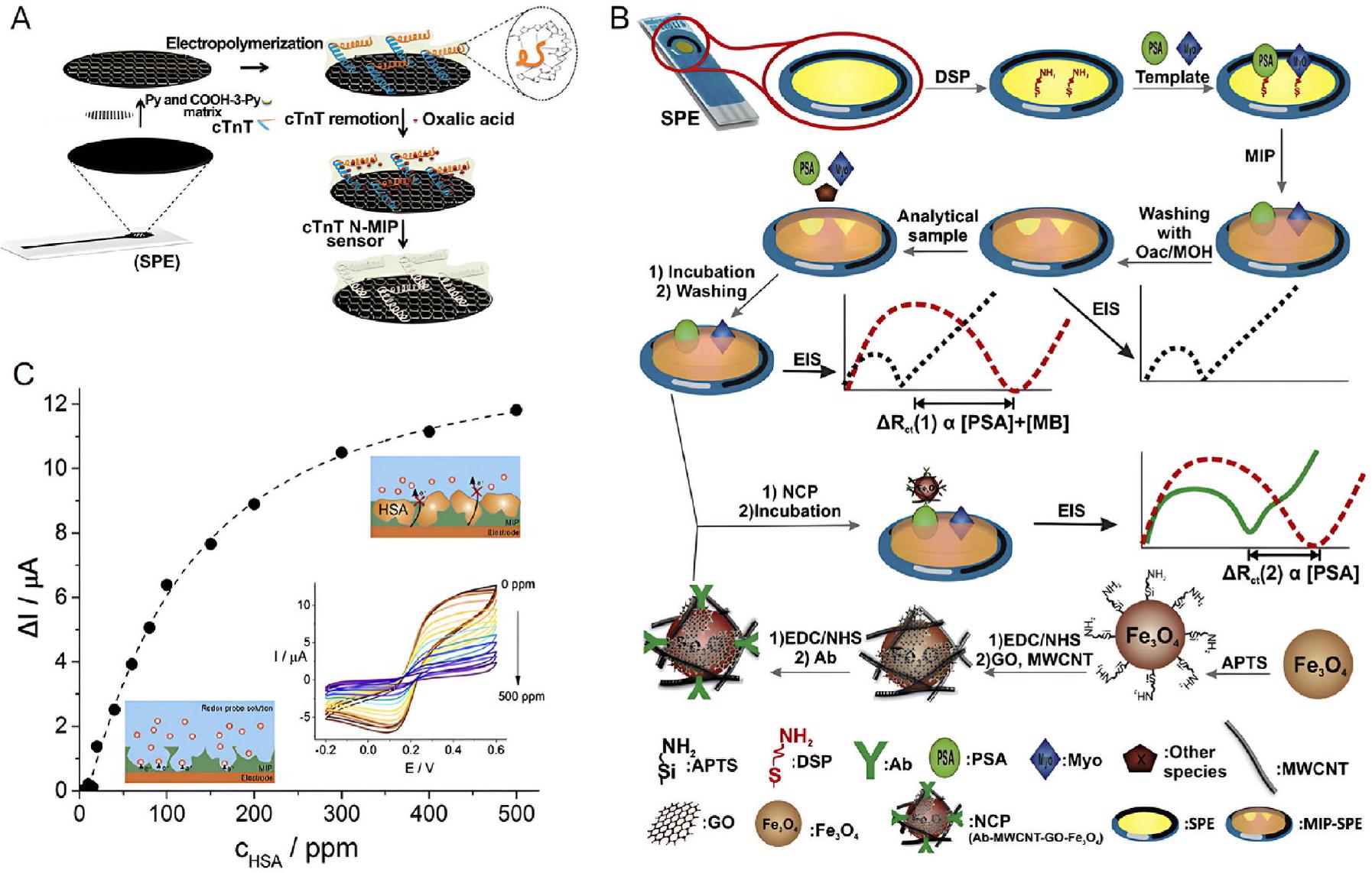
تؤدي هذه العوامل المسببة إلى أعراض إقفارية أو نزفية في القلب والدماغ والأنسجة الجهازية، مما يهدد بشكل خطير الأشخاص في منتصف العمر وكبار السن (Nabel, 2003). تشمل التروبونينات القلبية، كمنظم لانقباضات العضلات الهيكلية والقلبية، التروبونين C (TnC)، والتروبونين I (TnI)، والتروبونين T (TnT). من بينها، يعتبر التروبونين القلبي I (cTnI) الأكثر تمييزًا لإصابة الأنسجة القلبية. نظرًا لأنه يتم إنتاجه فقط بواسطة خلايا عضلة القلب، يمكن أن يشير إلى تلف شديد في عضلة القلب إذا ارتفع محتواه في المصل بشكل حاد. تم تطوير جهاز استشعار كهروكيميائي غير مناعي لاكتشاف cTnI باستخدام نهج مزدوج للتعرف (Mokhtari et al., 2020). تم تثبيت ببتيدات cTnI على سطح NPs المعدلة GCE، وتم تطبيقها لالتقاط cTnI للتعرف على الطباعة. ثم تم بلمرة مونومرات الميثيلين الأزرق حول مجمعات cTnI-aptamer. بعد إزالة cTnI، تم إنشاء تجاويف وتحويلها إلى مستقبل هجين جديد من aptamer وMIP. يظهر هذا المستشعر نطاقًا خطيًا من 0.50 إلى مع حد كشف قدره 1.04 pM. كانت نسبة استردادها في وجود البروتينات المداخلة حوالي بالنسبة لـ cTnI وحده. بالإضافة إلى ذلك، يعتبر التروبونين القلبي T (cTnT) أيضًا علامة حيوية شائعة لأمراض القلب والأوعية الدموية. يقع في خلايا العضلات القلبية بدلاً من الدم المحيطي في الظروف العادية ولكنه سيتم إطلاقه في الدم المحيطي عندما تتضرر خلايا عضلة القلب (Kilickap et al., 2005). طور سيلفا N-MIP المجمعة على SPE لاكتشاف cTnT، كما هو موضح في الشكل 4(A) (Silva et al., 2016). في تصميمهم، تم الحصول على سطح محاكي حيوي عن طريق تجميع مصفوفة بوليمرية على سطح أقطاب rGO. تم تحقيق التجويف النشط لـ cTnT بخطوة واحدة من البلمرة الكهربية مع cTnT، والبرول، والبرول الكربوكسيلي، مما حقق حد كشف عند .
تطبيق آخر لأجهزة الاستشعار الكهروكيميائية المعتمدة على MIP التي جذبت اهتمامًا كبيرًا هو تشخيص السرطان، الذي لا يظهر أعراضًا أو يظهر أعراضًا خفيفة في المرحلة المبكرة ولكنه يمكن أن يكون مهددًا للحياة في المراحل المتقدمة. على سبيل المثال، السيتوكروم (Cyt ) هو علامة حيوية مهمة لمرحلة الموت الخلوي المبكر، والتي تلعب دورًا في التشخيص المبكر للسرطان وتطوير العلاج للسرطان. تم الإبلاغ عن جهاز استشعار كهروكيميائي معتمد على MIP للكشف الفائق الحساسية عن Cyt (Campagnol et al., 2022)، والذي تم إعداده عن طريق بلمرة الكهربية لـ o-فينيلينديامين في وجود Cyt كقوالب واستخراج المذيب لتشكيل مواقع التعرف على Cyt . أظهرت قياسات DPV تحقيق حساسية عالية للغاية وحد كشف منخفض في نطاق الفيمتومول، مع امتصاص غير محدد ضئيل. تم تحقيق معدلات استرداد مرضية في وجود البروتينات المداخلة وفي مصل الإنسان المخفف، مما أكد انتقائيته وكذلك إمكانيته لتحليل العينات الحقيقية. سرطان البروستاتا هو ورم خبيث، قد يكون بدون أعراض في مرحلته المبكرة، ولكن مع أعراض مثل عسر التبول، والتبول الليلي، والدم في البول، وآلام الظهر، وآلام الحوض في المراحل المتقدمة (Litwin and Tan, 2017). لذلك، فإن التشخيص في المرحلة المبكرة أمر ضروري. يعتبر مستضد البروستاتا المحدد (PSA) والميوغلوبين (Myo) علامتين حيويتين شائعتين لسرطان البروستاتا. كما هو موضح في الشكل 4(B)، تم تطوير جهاز استشعار مناعي مزدوج النمط يعتمد على MIP وطبقة نانوية للكشف المتزامن عن PSA وMyo في عينات مصل الإنسان والبول (Karami et al., 2019). تم تصنيع البوليمر المختلط المطبوع، المعروف باسم MIP (PSA، Myo)، على سطح SPE باستخدام الأكريلاميد كالمونومر، -ميثيلين بيس أكريلاميد كعامل ربط، وPSA وMyo كقوالب تم بوليمرتها في البوليمر المطبوع. وبالتالي تم الحصول على MIP مع تجاويف التعرف على PSA وMyo بعد إزالة القوالب باستخدام الإيلاشن المحدد. يمكن الكشف عن إشارة التركيب باستخدام EIS بعد إعادة امتصاص الأهداف إلى MIP (PSA، Myo). ثم، سيتم تعريض MIP للنانومركب المُركب الذي يحتوي على جسم مضاد لـ PSA لتفاعل مناعي، مما يؤدي إلى قيمة Rct القابلة للقياس للمجمع المناعي المتكون. الإشارة في الخطوة الأولى تتناسب مع تركيز PSA وMyo، بينما الإشارة في الخطوة الثانية تتناسب مع تركيز PSA. الفرق في Rct بين الخطوتين كان متناسبًا مع كمية ارتباط Myo. تشير هذه النتائج أيضًا إلى أن أجهزة الاستشعار التي تحتوي على كشف مزدوج للمواد أو حتى كشف متعدد المواد أصبحت الاتجاه الشائع لـ تطوير الجيل القادم من المستشعرات، الذي لديه القدرة على الفحص السريري لمؤشرات السرطان المختلفة. ومع ذلك، فإن عيب هذه الاستراتيجية هو أن التداخل المتبادل من المحتمل أن يحدث، عندما يكون هناك اثنان أو أكثر من المواد التحليلية موجودة في سوائل الجسم البشرية في نفس الوقت. قد يؤدي ذلك إلى تقلب النتائج، مما يمثل عقبة رئيسية أمام تطوير التطبيقات العملية.
تشخيص الأمراض في مراحلها المبكرة ومراقبة تقدم المرض أمران حاسمان أيضًا لمجموعة واسعة من الأمراض التقدمية. على سبيل المثال، مرض الكلى المزمن هو أحد أكثر الأمراض التقدمية شيوعًا، والذي يحدث بسبب فقدان تدريجي لوظيفة الكلى. في مراحله المبكرة، يمكن ملاحظة القليل من العلامات أو عدم وجود أعراض (إل ناحاس وبيلا، 2005)؛ بينما في مرحلته المتقدمة، يمكن أن تتراكم مستويات خطيرة من السوائل والإلكتروليتات والفضلات في الجسم، مما قد يشكل تهديدًا للحياة. لذلك، فإن التشخيص في مراحله المبكرة من خلال الكشف عن العلامات الحيوية له، مثل الليزوزيم (Lyz) والألبومين البشري في المصل (HSA) وغيرها، في البول، أمر مهم سريريًا، حيث تعكس هذه العلامات الحيوية بشكل timely شدة إصابات الكلى (فانالي وآخرون، 2012). لتلبية هذه الحاجة الملحة، تم الإبلاغ عن البوليمرية الكهربائية لمادة MIP المستندة إلى السكوبوليتين للكشف عن Lyz. يمكن أن تكون الزيادة في تركيز Lyz في سوائل الجسم مؤشرًا على تلف الأنابيب (دي جولييو، مازوتا وآخرون، 2020). في هذا العمل، تم استغلال بروتوكول متعدد الخطوات مع تفعيل أولي لقطب الذهب مع مجموعات أمينية، عبر 4-أمينوثيوفينول، تلاه تفاعل مع الجلوتارالدهيد، لتوفير رابط مناسب لـ Lyz. يظهر المستشعر انتقائية جيدة وLoD قدره 141 نانومتر، مع اختبار في اللعاب الصناعي يثبت إمكانيته في المصفوفة الحقيقية لأغراض سريرية. طور ستويانوفيتش غشاء نانوي MIP قائم على البوليسكوبولامين لتحديد الألبومين البشري المرتفع في البول، كما هو موضح في الشكل 4(C) (ستويانوفيتش وآخرون، 2017). في هذا التصميم، يتم بوليمرة أحادية السكوبولامين على القطب بسمك قابل للتعديل ليتناسب مع الأبعاد المميزة للبروتينات. عندما ترتبط البروتينات بالفراغات في غشاء MIP النانوي، فإنها تعيق نفاذية مجس الأكسدة والاختزال، مما يؤدي إلى انخفاض تيار الأكسدة. ومع ذلك، كان هذا المستشعر أقل انتقائية للأفيدين والليزوزيم. قد يكون ذلك لأن ما يقرب من نصف تسلسلاتها تتكون من لفات عشوائية مرنة، مما يؤدي إلى توافق جزئي للجزيئات مع الفراغات التعرف. هذه التعرف غير المحدد هو أيضًا واحدة من المشاكل الرئيسية في الكشف عن البروتينات باستخدام مستشعرات MIP. يستحق الأمر مزيدًا من الاستكشاف للتطبيق العملي.
3.3. الكشف عن السكريات
يمكن تصنيف السكريات إلى سكريات أحادية وسكريات ثنائية وسكريات متعددة، والتي تلعب أدوارًا رئيسية في الاستجابة المناعية، والوقاية من الأمراض، وتخثر الدم، ونمو الأطفال (ميلز، 2013). كما هو موضح في الجدول S4، تم استخدام حساسات كهربائية قائمة على MIP على نطاق واسع في الكشف عن العلامات الحيوية للسكريات.
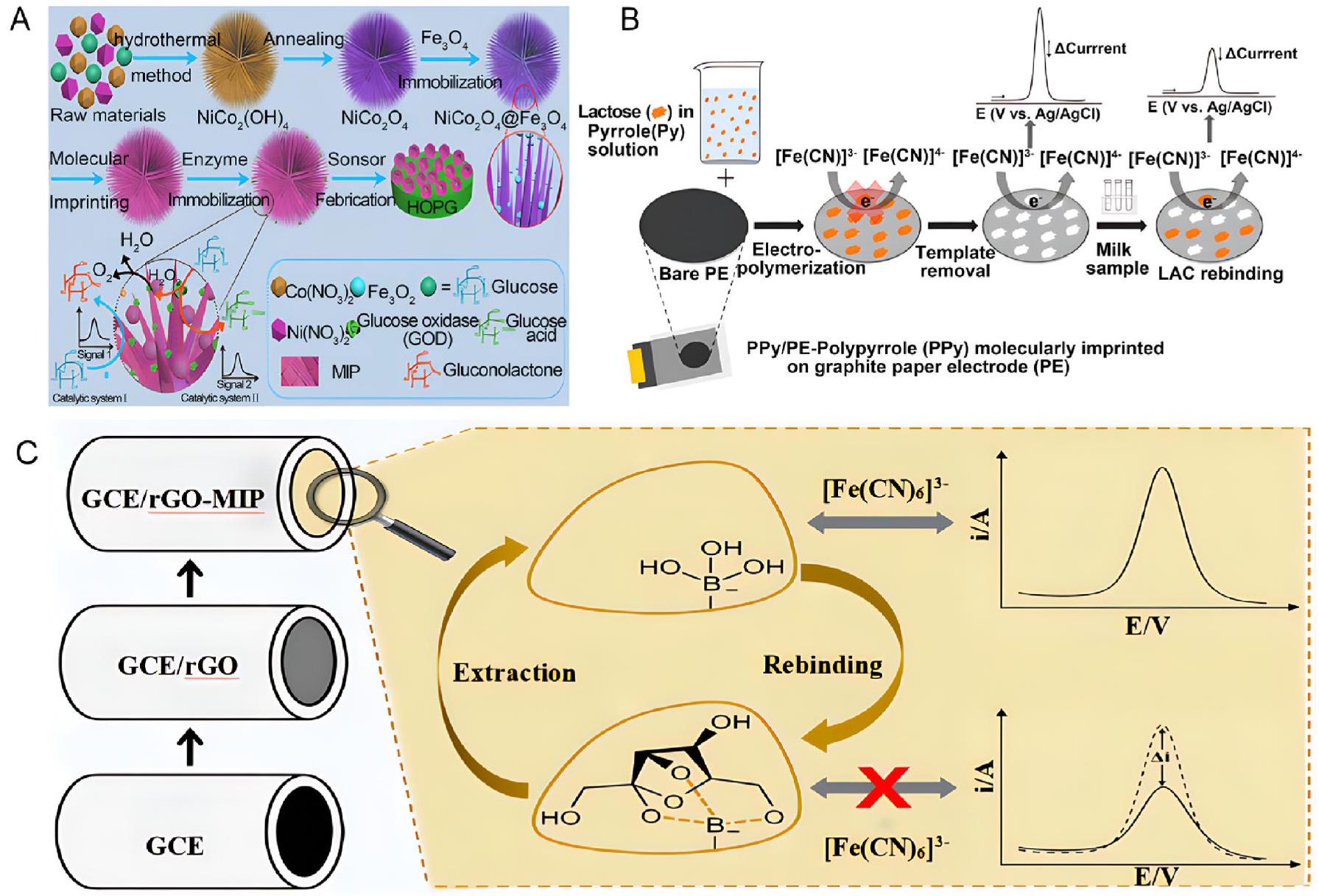
يشير السكريات الأحادية إلى تلك الجزيئات التي لا يمكن تحللها بشكل أكبر إلى سكريات أصغر، وتشمل بشكل رئيسي الجلوكوز والفركتوز والجالاكتوز. من بينها، يُعتبر الجلوكوز العلامة الحيوية الأكثر أهمية في التحكم في مرض السكري والتشخيص. كما هو موضح في الشكل 5(A)، قام تشين بإنشاء منصة استشعار ثنائية القناة تعتمد على نظام تحفيز مزدوج من خلال دمج الإنزيم البيولوجي (GOD) والإنزيم المحاكي حيوياً. ) (تشن، وي وآخرون، 2020). تم تثبيت الجسيمات النانوية ذات الحجم الموحد على شكل قنفذ البحر الاصطناعيجزيئات للحصول على كريات نانوية إنزيمية تحاكي الطبيعة. تم إعداد طبقة السطح من بولي ديفينيل بنزين – MIP باستخدام الجلوكوز كقالب. مع و GOD تعمل كأجهزة استشعار ثنائية القناة لتحفيز الجلوكوز بشكل مشترك إلى و NPs التي تحلل الناتج، هذا النظام المكون من ثلاثة إنزيمات (NiC-MIPs-GOD) تعزز حساسية واستقرار المستشعر. الفركتوز هو متساوي ضوئي للجلوكوز، ووجوده بكميات زائدة يمكن أن يؤدي إلى ارتفاع مستويات حمض اليوريك، وزيادة خطر الإصابة بالنقرس، والسكري، وحتى سرطان البنكرياس. كما هو موضح في الشكل 5(C)، أبلغ مورييرا عن مستشعر جديد للكشف الانتقائي عن الفركتوز (مورييرا وآخرون، 2021). لقد قاموا بتخليق فيلم من بوليمر حمض الفينيل بورونيك (PBA)-MIP على rGO.
الشكل 4. أجهزة استشعار كهربائية كيميائية قائمة على MIP لاكتشاف العلامات الحيوية للبروتين. (أ) تصنيع جهاز استشعار N-MIP لاكتشاف cTnT (سيلفا وآخرون، 2016). (ب) تجميع جهاز استشعار مناعي ثنائي الوضع يعتمد على MIP وطبقة نانوية لاكتشاف PSA وMyo في وقت واحد (كرامي وآخرون، 2019). (ج) اعتماد استجابة الجهاز على التركيز لاكتشاف HSA (ستويانوفيتش وآخرون، 2017).
القطب الكهربائي وتم الكشف عن التغير في تيار المجس من خلال DPV لحساب تركيز الفركتوز في عصير البرتقال والتفاح والعنب. بالإضافة إلى السكريات الأحادية الشائعة المذكورة أعلاه، يمكن أن تعمل سكريات أحادية أخرى كعلامات حيوية حاسمة للأمراض. على سبيل المثال، الد-زايليوز هو سكر أحادي يحتوي على خمسة كربونات ويستخدم سريرياً لتقييم قدرة الامتصاص المعوي، حيث يعتمد امتصاصه على سلامة الأمعاء. تم إعداد جهاز استشعار من خلال تعديل GCE مع rGO وفيلم بوليمر مطبوع جزيئيًا (phenol) للكشف عن الد-زايليوز (مورييرا وآخرون، 2020). تراوحت متوسط استعاداته في اختبارات بقايا قصب السكر من 95.4 إلى، مما يدل على دقة جيدة للتحديد العملي للد-زاي لوز. على الرغم من أن أجهزة الاستشعار الكهروكيميائية المعتمدة على MIP قد تم استخدامها على نطاق واسع للكشف عن السكريات الأحادية، إلا أنه بسبب الدقة العالية، وإمكانية التكرار، وانخفاض تكلفة أجهزة الاستشعار الحيوية الإنزيمية، فإنه من الصعب حاليًا على MIPs أن تحل محلها كأدوات تشخيصية رئيسية.
تتكون جزيئات ثنائي السكاريد من جزيئين من السكريات الأحادية، المرتبطة بروابط جليكوسيدية (بوكزيفنيتشكا وكونكي، 2018). على سبيل المثال، يتكون اللاكتوز من الجلوكوز والجالاكتوز، اللذين لا يقدمان الطاقة فحسب، بل يشاركان أيضًا في تطوير الدماغ خلال نمو وتطور الرضع والأطفال الصغار. إن اكتشاف اللاكتوز أمر حاسم خاصة لأولئك الذين يعانون من عدم تحمل اللاكتوز. كما هو موضح في الشكل 5(B)، أفاد سيلفا بتطوير جهاز استشعار مبتكر لللاكتوز يعتمد على الفولتمترية الطباعية، والذي تم بناؤه من خلال التخليق الكهربائي لـ PPy-MIP على أقطاب الجرافيت في وجود جزيئات اللاكتوز (دا سيلفا وآخرون، 2021). عندما تتجمع جزيئات اللاكتوز مع الفراغات في طبقة MIP، ستتعطل عملية نقل الإلكترون لمسبارات الأكسدة والاختزال، مما يؤدي إلى انخفاض في التيار الناتج عن الأكسدة والاختزال. أظهر هذا المستشعر نطاقين ديناميكيين لتركيزات خطية (1.0-10 نانومتر ونقطة حد الكشف 0.88 نانومول، وإعادة إنتاجية ممتازة، وهو ما يعد واعدًا للتحليل العملي للاكتوز في العينات السريرية. زيلوبيوز (يمكن أن يعزز امتصاص الكالسيوم وقد يمنع السرطان. مستشعر كيميائي كهربائي يعتمد على فيلم بولي-ل-أرجينين المطبوعة جزيئيًا ورغوة أكسيد النحاس المسامية ثلاثية الأبعاد (3DnpCu) للكشف الفائق الحساسية عنيتم الإبلاغ عن ذلك (دا سيلفا وآخرون، 2023). يتم تحضير هذا MIP/3DnpCu-GCE بواسطة طريقة قالب فقاعات الهيدروجين الديناميكية، تليها البلمرة الكهربائية للـ L-أرجينين في وجود. أظهر MIP/3DnpCu-GCE حد كشف منخفض يصل إلى ، مع المقارنة بين البيانات التي تم الحصول عليها باستخدام هذه الطريقة وبيانات HPLC التي تؤكد دقة المستشعر.
تتكون البوليسكاريدات من سلاسل طويلة من الكربوهيدرات تحتوي على عدة مونو سكريات مختلفة. إن اكتشاف هذه الكربوهيدرات المعقدة له أهمية سريرية للعديد من الأمراض، مثل اضطرابات الجهاز الهضمي والعدوى البكتيرية. لتحقيق طباعة فعالة للبوليسكاريدات، تم تطوير مجموعة متنوعة من التقنيات، بما في ذلك الطباعة السطحية، والكرات الهلامية المطبوعة جزيئيًا، وطباعة “الإبيتوبي”. على سبيل المثال، أبلغ زانغ عن طباعة جزيئية مغناطيسية جديدة باستخدامتم إعداد حمض البورونيك-MIP القابل للامتصاص بواسطة الدكستران كركيزة، باستخدام تقنية الطباعة السطحية (Zhang et al., 2023a). بالإضافة إلى ذلك، أبلغ زانغ عن ميكروسفير بوليدوبامين مطبوع جزيئيًا يحتوي على تجاويف مرتبطة بالليبوبوليسكاريد، والتي حققت وظيفة ضوئية حرارية ممتازة وكفاءة طباعة (Zhang et al., 2023b). للأسف، لم تسفر هذه الدراسات إلا عن MIPs لأغراض الاستخراج. لا يوجد مستشعر كهربائي يعتمد على MIP متاح للكشف عن البوليسكاريدات. العقبة الرئيسية هي أن الهيكل الجزيئي الكبير للبوليسكاريدات يجعل من الصعب منع التعرف غير المحدد أثناء عملية الكشف.
الدهون هي فئة من الإستر و مشتقاتها التي تتكون من تكثيف إزالة الماء للأحماض الدهنية والكحوليات. تشمل الأنواع الأكثر شيوعًا من الدهون في سوائل الجسم الكوليسترول، والدهون الستيرول، والفيتامينات القابلة للذوبان في الدهون. تشمل وظائفها الفسيولوجية الرئيسية تخزين الطاقة، وتعمل كهيكل لغشاء الخلية، ومساعدة إشارات الخلايا” (لي، شيندي وآخرون، 2020). بعض من العلامات الحيوية الدهنية الشائعة التي تم الكشف عنها بواسطة أجهزة الاستشعار الكهروكيميائية المعتمدة على MIP موضحة في الجدول S5.
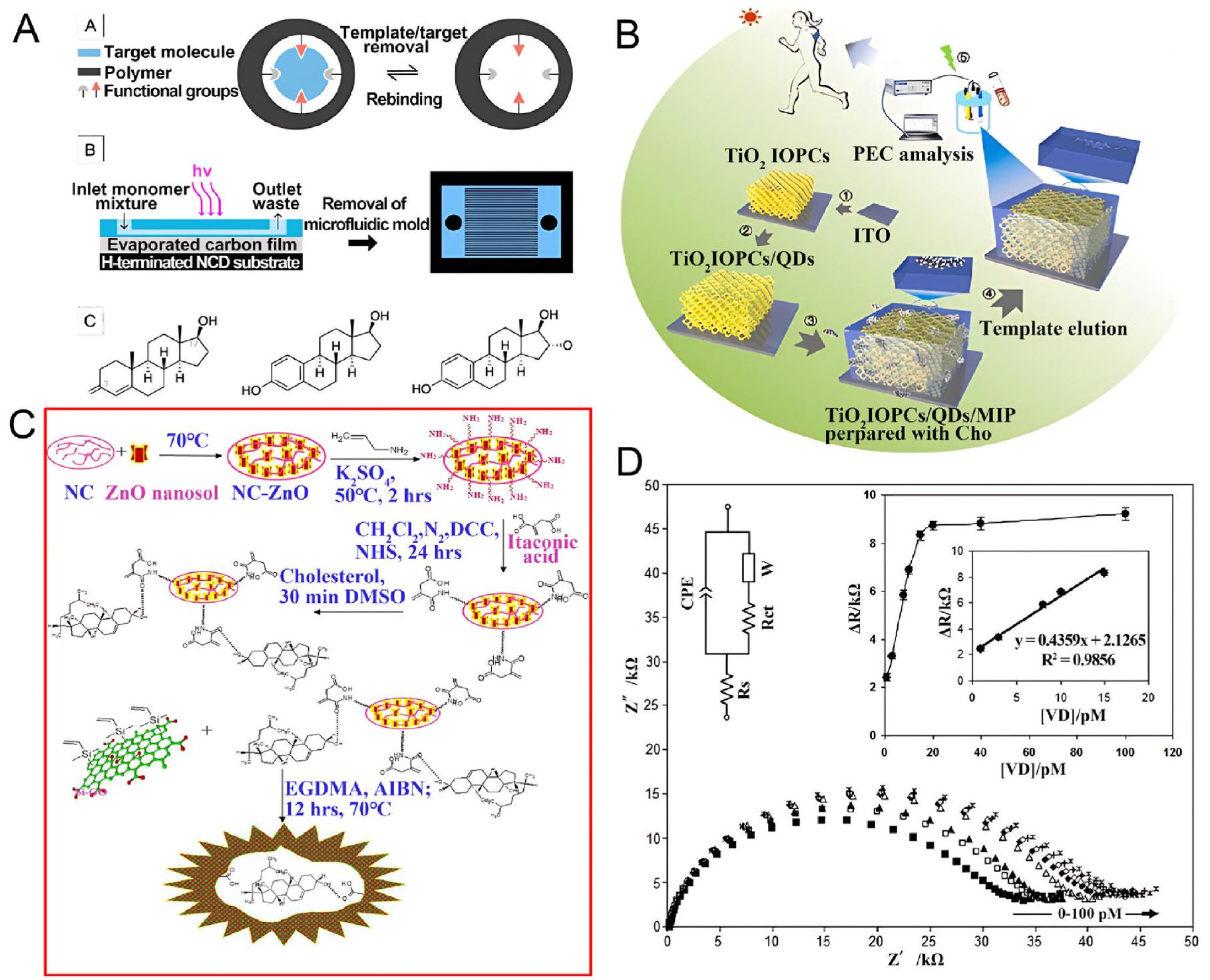
الكوليسترول هو مقدمة أساسية لمجموعة متنوعة من المواد الذاتية، ولكنه أيضًا عامل خطر لأمراض القلب والأوعية الدموية، مما يجعل القياس الدقيق للكوليسترول أمرًا مهمًا. كما هو موضح في الشكل 6 (ب)، أبلغ فنغ عن بيروفسكايت جديد يحتوي على هاليد الرصاص العضوي المعدني.مستشعر الكوليسترول الكهروضوئي الكيميائي (PEC) (Feng et al., 2022). على الرغم منيمتلك خصائص بصرية إلكترونية ممتازة، لكنه حساس للغاية للرطوبة، مما حد من استخدامه في التطبيقات البيولوجية. لذلك، تركزت التطورات على تحسين مقاومته للماء، مع ضمان أدائه الكهروضوئي. إن أوبال التيتانيوم ثنائي الأكسيد (تم دمج مصفوفة IOPCs وتغليف البوليمر المطبوع بالكوليسترول معًا، مما أتاح الاستشعار في العينات المائية مع حساسية وانتقائية ممتازة. وبالمثل، أعد أنيرودهان أكسيد الجرافين المعالج كيميائيًا والمغلف بالنانو سليلوز (Si-GO-g-CMNC) للكشف الانتقائي عن كميات ضئيلة من الكوليسترول، كما هو موضح في الشكل 6(C) (أنيرودهان وديبا، 2018). تم تصميم دمج ZnO في CMNC لتعزيز الموصلية الكهربائية. وُجد أن هذه الغشاء الاستشعاري مع تجاويف مدمجة فعّال في قياس الكوليسترول في عينات دم الإنسان. ومع ذلك، فإن هذا لا تزال التكنولوجيا بحاجة إلى تحسين من حيث الدقة، حيث يمكن أن تتسبب المواد المتداخلة بما في ذلك الأسيتامينوفين وحمض اليوريك في سوائل الجسم في تداخل كبير مع نتائج الاختبارات، مما يمثل تحديًا للتطبيقات السريرية.
يمكن تقسيم الستيرويدات إلى ستيرويدات أنابولية أندروجينية وستيرويدات قشرية (ماكين وغاور، 2010). التستوستيرون هو ستيرويد أنابولي أندروجيني نموذجي، وقد ارتبط بمختلف الأمراض، مثل سرطان البروستاتا، ومتلازمة المبيض المتعدد الكيسات، والعقم لدى الرجال (ثييم وهيمرسباخ، 2009). كما هو موضح في الشكل 6(A)، اقترح كيليز بروتوكولًا يجمع بين نظام ميكروفلويديك والتبلمر الضوئي في الموقع على ركيزة ماسية مفعلة (كيليز وآخرون، 2018). يتم تعريف هندسته بواسطة ختم ميكروفلويديك يتم تثبيته بشكل موثوق على سطح القطب الماسي لقياسات المقاومة تحت ظروف تدفق ديناميكية. هذه الاستراتيجية الجديدة بسيطة وفعالة ومنخفضة التكلفة وأقل استهلاكًا للوقت مقارنة بأساليب الكشف التقليدية عن التستوستيرون. أظهر الهيكل المنقوش من PDMS-MIP تمييزًا ممتازًا وانتقائيًا لتركيزات فسيولوجية من مثبط الهرمونات التستوستيرون في محلول العازلة، والبول، واللعاب. الكورتيزول هو ستيرويد قشري، يلعب دورًا مهمًا في استجابة الجسم للتوتر وله تأثير مهم على ضغط الدم، ومستويات السكر في الدم، وتعديل المناعة (كاتسو وباكر، 2021). أعد دوآن أنابيب الكربون النانوية الشبيهة بالبامبو المدعمة بالنيتروجين والتي تم تحميلها بتجمعات نانوية من النيكل (دوآن وآخرون، 2022). باستخدام هذه المادة كركيزة، والأورثو-فينيلينديامين كمونومر وظيفي، والكورتيزول كجزيئات قالب، قاموا بتصنيع فيلم MIP سطحي باستخدام طريقة كهربائية بسيطة وقابلة للتحكم. بعد سلسلة من التحسينات، أظهر مستشعرهم حد كشف منخفض للغاية عند، ينطبق أيضًا على كشف الكورتيزول في عينات اللعاب بنتائج مرضية، والتي أظهرت أداءً تنافسياً مقارنةً بأساليب الكشف التقليدية باستخدام الإنزيم.
يمكن امتصاص الفيتامينات القابلة للذوبان في الدهون في الجسم مع الدهون وتخزينها في الأنسجة لتلعب أدوارًا مهمة (ستيفنز، 2021). على سبيل المثال، يعمل فيتامين د (VD) كهرمون سابق ينظم امتصاص الأمعاء للكالسيوم والمغنيسيوم وتعديل المناعة. تم تصميم مستشعر جديد لفيتامين د MIP (علي زاده وأخوندين، 2022)، حيث يتفاعل كلوريد الأكريلويل مع VD لتوليد مونومرات مشتقة، والتي تتفاعل بعد ذلك مع ديفينيل بنزين في وجود VD لتشكيل طبقة MIP. تعتمد آلية الاستشعار على مبدأ البوابة، والذي يشير إلى توسع جزيئات MIP. عندما تتداخل جزيئات VD في التجاويف الانتقائية لجزيئات MIP النانوية، سيتم منع الأنواع الاستكشافية الكهربائية من الاتصال بسطح القطب لتوليد استجابة مقاومة، كما هو موضح في الشكل 6 (D)، الذي تم التحقق منه في عينات البلازما.
3.5. الكشف عن جزيئات صغيرة أخرى
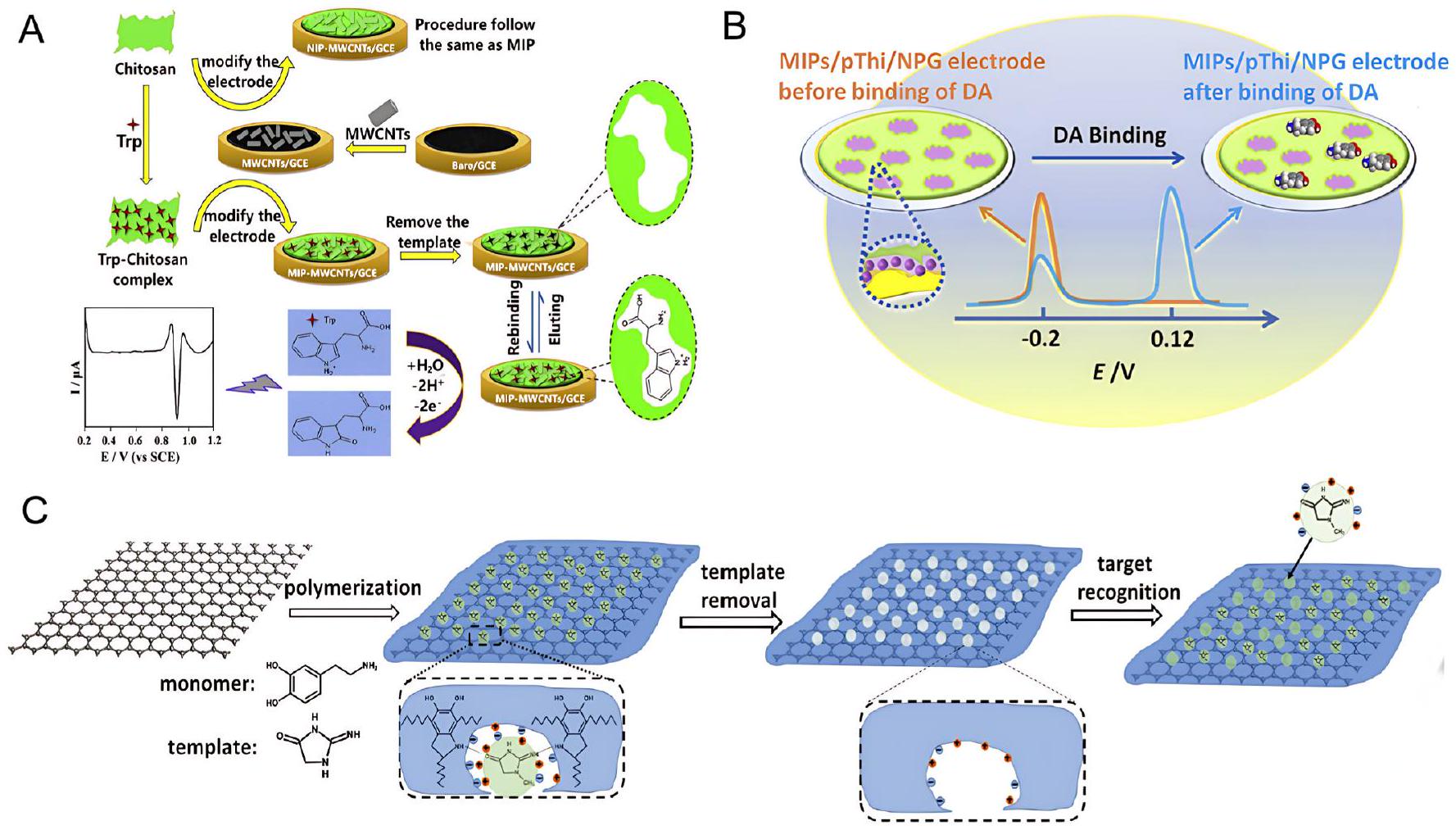
بالإضافة إلى المؤشرات الحيوية المذكورة أعلاه، تُستخدم أيضًا أجهزة الاستشعار الكهروكيميائية المعتمدة على MIP بشكل شائع للكشف عن مواد صغيرة أخرى. مؤشرات الجزيئات الحيوية، كما هو ملخص في الجدول S6. تمت caracterization لعامل نمو الأوعية الدموية (VEGF) كعامل نمو أنجيوجيني يرتبط بالهيبارين. يمكن استخدام تركيزه في الدم كمؤشر مرتبط بتشخيص وتوقع أنواع مختلفة من أمراض السرطان. وبالتالي، تم تطوير مستشعر impedimetric حساس يعتمد على MIP بدون علامات مرتبط بـ SPE لاكتشاف VEGF (Bozal-Palabiyik، Lettieri وآخرون، 2019). تم إجراء التحليل الكهربائي للـ o-phenylenediamine في وجود جزيء VEGF على SPE الجرافيتي من خلال CV. حقق هذا المستشعر القائم على MIP للاستخدام مرة واحدة حساسية جيدة وقابلية تكرار في مصل الدم البشري لتلبية الاحتياجات السريرية. التربتوفان (Trp) هو حمض أميني أساسي للبشر، حيث أن نقصه يسبب مرض هارتنوب في الأطفال ويمكن أن يؤدي إلى العدوانية في البالغين. كما هو موضح في الشكل 7(A)، قام وو بتصنيع مستشعر كهربائي كيميائي لـ Trp عن طريق طلاء فيلم الكيتوزان المنقوش على سطح GCE المعدل بـ MWCNT (MIP-MWCNTs/GCE) (Wu وآخرون، 2020). أظهر المستشعر المصنع حد الكشف عند 1.0 نانومتر، مما يدل على قابلية تكرار واستقرار جيدين، وتم تطبيقه بنجاح في عينات مصل الدم البشري.
الكرياتينين، الذي يعد علامة حيوية رئيسية لمرض الكلى المزمن، هو ناتج تحلل الكرياتين العضلي ويخرج بشكل رئيسي عن طريق الكلى.
الشكل 6. أجهزة استشعار كهربائية كيميائية تعتمد على MIP للكشف عن الدهون. (أ) مخطط لـ MIPs للكشف عن التستوستيرون (كيلينس وآخرون، 2018). (ب) تحضير قطب PEC وتحليل PEC للكشف عن الكوليسترول (فينغ وآخرون، 2022). (ج) تخليق Si-GO-g-CMNC للكشف عن الكوليسترول (أني رودهان وديبا، 2018). (د) مخططات نايكويست عند تركيزات VD مختلفة (علي زاده وأخانديان، 2022).
تم إفرازه. كما هو موضح في الشكل 7(ج)، أبلغ لي عن جهاز استشعار جديد يعتمد على جزيئات جرافين نانوية (GNP)/بوليدوبامين (PDA)-بوليمر مطبوع جزيئيًا (MIP) للكشف عن الكرياتينين في نطاق من سوائل الجسم (لي وآخرون، 2022). تم بلمرة مونومرات هيدروكلوريد الدوبامين (DA) باستخدام طريقة بسيطة من وعاء واحد لتشكيل طبقة رقيقة من PDA-MIP على سطح GNP بكثافة عالية من تجاويف التعرف على الكرياتينين. أدت هذه الاستراتيجية الجديدة للـ MIP السطحي إلى تحقيق أدنى حد للكشف.على مدى نطاق كشف ديناميكي واسع بين.DA هو ناقل عصبي مهم يرتبط بمرض باركنسون، ومتلازمة الساقين غير المستقرة، واضطرابات المزاج. صمم يانغ جهاز استشعار كهربائي كيميائي DA نسبي كما هو موضح في الشكل 7(ب) (يانغ وآخرون، 2019). تم ترسيب الذهب النانوي المسامي (NPG) على قطب ذهبي، مما سهل تضخيم إشارة الخرج وأيضًا وفر سطحًا أكبر لتثبيت بوليثيونين (pThi) وPPy-MIPs. ثم تم استخدام DA المؤكسد وpThi كإشارة استجابة وإشارة مرجعية داخلية. مع زيادة تركيز DA، زادت ذروة تيار الأكسدة، بينما في الوقت نفسه انخفض تيار ذروة pThi. بسبب خصوصية MIP وتصحيح pThi المدمج، أظهر هذا المستشعر انتقائية ممتازة وقابلية تكرار، مع أداء رائع في السوائل الدماغية الاصطناعية. لذلك، من المتوقع أن يوفر هذا العمل مسارًا بديلًا لبناء أجهزة استشعار كهربائية كيميائية نسبية وتوفير تحديد موثوق للجزيئات الصغيرة مع انتقائية عالية واستقرار.
لقد حققت أجهزة استشعار كهربائية كيميائية تعتمد على MIP تقدمًا كبيرًا في الكشف عن الجزيئات الصغيرة. كانت العقبة الرئيسية أمام التصنيع التجاري هي عشوائية الإنتاج مما يجعل من الصعب تصعيده إلى الإنتاج الضخم. وبالتالي، قد تحتوي الأجهزة من دفعات مختلفة على قدرات مختلفة بسبب تعديلات طفيفة في التحضير. لذلك، إذا أردنا تحقيق الكشف العملي عن الجزيئات الصغيرة بناءً على تقنيات MIP، نحتاج إلى اقتراح بروتوكول تحضير أكثر تكرارًا وموثوقية.
4. قيود أجهزة الاستشعار الكهربائية الكيميائية الحالية المعتمدة على MIP
على مدى العقود الماضية، ركزت الأبحاث بشكل أساسي على تطوير أجهزة استشعار كهربائية كيميائية تعتمد على MIP باستخدام مواد مختلفة للكشف عن مجموعة متنوعة من العلامات الحيوية المهمة (بالسيوناس وآخرون، 2022). ومع ذلك، فإن قيودها واضحة. هنا نناقش بإيجاز قيود أجهزة الاستشعار الكهربائية الكيميائية المعتمدة على MIP ونقترح حلولًا محتملة قد تساعد في تحسين هذه التكنولوجيا.
4.1. التعرف على الجزيئات الكبيرة
يعد التعرف على الجزيئات الكبيرة، مثل البروتينات، أحد التحديات الرئيسية لأجهزة الاستشعار المعتمدة على MIP. هناك العديد من القضايا الحرجة التي يجب حلها في استراتيجية الطباعة التقليدية للجزيئات الكبيرة. أولاً، تميل مونومرات البوليمر التقليدية إلى أن تكون كثيفة، مما يجعل من الصعب على قوالب الجزيئات الكبيرة الوصول إلى (أو مغادرة) أي تجاويف تم إنشاؤها. تؤدي هذه النقل الجزيئي الضعيف والاحتجاز الدائم إلى تقليل أداء التعرف. الثاني هو أن ظروف البلمرة يمكن أن تكون مشكلة، عندما يتم تطبيق إجراءات التلطيخ التقليدية على الجزيئات الكبيرة العضوية. غالبًا ما تؤدي الظروف غير الفسيولوجية إلى تغيير شكل الجزيئات الكبيرة أو تجمعها أو تغيير تكوينها. قد يؤثر ذلك بعد ذلك على انتقائية أجهزة الاستشعار، حيث قد تتغير القوالب في التكوين لاستيعاب الطباعة التي تم تشكيلها لقوالب بديلة. هذا مهم بشكل خاص للبروتينات التي تم تعديلها بشكل انتقائي، على سبيل المثال عن طريق الطفرات الموجهة. عقبة أخرى قائمة هي الاختيار المحدود للمذيبات. تحدث معظم عمليات تصنيع MIP في مذيبات عضوية غير قطبية لتعظيم التفاعلات الكهروستاتيكية. ومع ذلك، فإن الاستقرار الضعيف وقابلية ذوبان الجزيئات الكبيرة العضوية في المذيبات غير القطبية يحد من اختيار المونومرات المتاحة. أخيرًا، فإن التعرف المحدد على الجزيئات الكبيرة يمثل تحديًا، والذي ينجم عن وجود جزيئات متداخلة بأشكال مشابهة للجزيء المستهدف أو بمرونة يمكن أن تناسب جزئيًا في مواقع الطباعة. يمكن أن تتحد بشكل غير.
الشكل 7. أجهزة استشعار كهربائية كيميائية تعتمد على MIP للكشف عن الجزيئات الصغيرة. (أ) تصنيع MIP-MWCNTs/GCE للكشف عن Trp (وو وآخرون، 2020). (ب) مبدأ جهاز استشعار NPG/Au DA (يانغ وآخرون، 2019). (ج) تصنيع جهاز استشعار الكرياتينين GNP/PDA-MIP (لي وآخرون، 2022).
تتحد بشكل غير محدد مع التجاويف، مما يؤدي إلى تفسير الكشف بشكل خاطئ على أنه تفاعلات محددة.
في مثل هذه الظروف، من المهم تطوير تقنية تصنيع MIP بسيطة وقابلة للتحكم للتعرف على الجزيئات الكبيرة. تعتبر تقنية الطباعة السطحية استراتيجية جيدة، والتي تشير إلى طباعة البوليمر على سطح الركيزة، والمعروفة أيضًا باسم MIP السطحي (الشكل 8). يمكن أن تمنع هذه الطريقة الفيلم من أن يكون سميكًا للغاية لضمان أن جميع الجزيئات قريبة من السطح أو عليه، مما يسمح بنطاق كشف أكبر للمستشعر (دونغ وآخرون، 2021). يمكن أن يزيد ذلك بشكل كبير من مواقع الطباعة المتاحة ويحسن كفاءة نقل الكتلة، مما يمكن أن يعزز حساسية المستشعرات الناتجة. بالإضافة إلى ذلك، يمكن أن يكون اختيار البوليمرات المطبوعة أكبر بكثير من ذلك في MIPs التقليدية. يمكن الآن تحقيق بعض الخصائص المطلوبة سابقًا للمونومر من خلال اختيار ركيزة مناسبة، مثل الموصلية الكهربائية. نظرًا لنطاق أوسع من اختيار المونومر، يمكن بلمرة العديد من هذه في بيئة مائية معتدلة مشابهة لسوائل الجسم البشرية، مما يضمن فعالية الكشف عن الجزيئات الكبيرة العضوية. علاوة على ذلك، يمكن تحسين التعرف الدقيق على المحلل من خلال زيادة أنواع المونومرات المطبوعة. وبالتالي، يمكن تعزيز التعرف المحدد بين المونومر وجزيئات القالب بشكل أكبر عند بناء الطبقة المطبوعة لمنع الارتباط غير المحدد.
4.2. دقة وسعة الكشف
تتمثل إحدى المشكلات في أن الحصول على إخراج إشارة فردية دقيقة غالبًا ما يكون صعبًا في الإعدادات العملية. بالنسبة للكشف عن المراحل المبكرة من الأمراض، فإن وفرة العلامات الحيوية في سوائل الجسم البشرية منخفضة مقارنة بالجزيئات الحيوية غير المرتبطة، مما يتطلب كل من الحساسية العالية وسعة التمييز العالية للتحليل الدقيق (داي وليو، 2019). ومع ذلك، فإن الحصول على شدة كافية لإشارة استشعار العلامة الحيوية الفردية غالبًا ما يكون غير ممكن. لذلك، من المهم تطوير طريقة يمكن أن تحسن بشكل فعال دقة الكشف عن أجهزة الاستشعار الكهربائية الكيميائية المعتمدة على MIP. نسبة الإشارات المتعددة (إشارات متعددة نسبية) مستقلة عن تركيز المستشعر والمواد الكيميائية، مما يوفر تصحيحًا مدمجًا داخليًا للتغلب على التأثيرات المحتملة لنظام الاستشعار وإشارات الخلفية. على سبيل المثال، من خلال تصميم MIPs جديدة مع تجميع طبقة تلو الأخرى أو هياكل نواة/قشرة، يمكن تحميل نوعين أو أكثر من جزيئات البروب الكهربائية في طبقات مختلفة أو هياكل نواة/قشرة، على التوالي. يمثل هذا جهاز استشعار كهربائي كيميائي يعتمد على MIPs جديدًا وفعالًا للكشف عن الإشارات المتعددة النسبية للجزيئات الحيوية المستهدفة (أمجادي وجليلي، 2017).
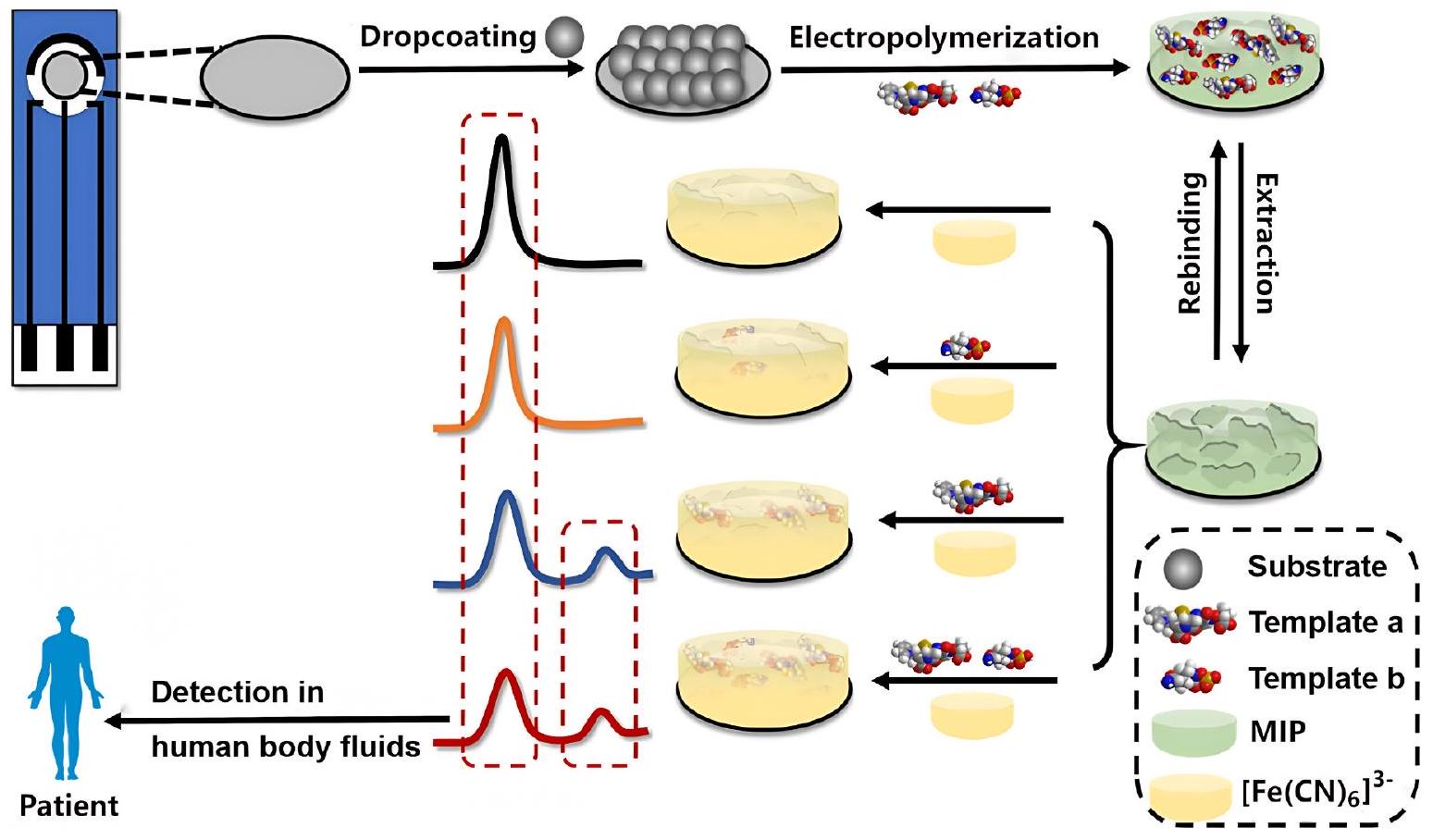
عائق آخر هو أن اكتشاف علامة حيوية واحدة ليس بالضرورة كافيًا لتأسيس تشخيص سريري أو تتبع تقدم المرض. لذلك، فإن الكشف المتعدد هو استراتيجية واعدة للجيل القادم من اكتشاف العلامات الحيوية. تتيح هذه الاستراتيجية الكشف المتزامن عن مجموعة من العلامات الحيوية التمييزية، مما يمكن أن يحسن دقة الكشف إحصائيًا. بالإضافة إلى ذلك، تتطلب العلامات الحيوية الفردية أوقات تحليل متوسطة أقصر من الاختبار بشكل فردي (روزا وآخرون، 2022). يمكن تحقيق ذلك من خلال طباعة جزيئات قالب مختلفة لإنتاج مجموعة متنوعة من MIPs ثم دمجها مع محطة العمل متعددة القنوات لتحقيق الكشف المتزامن عن عدة علامات حيوية. بالإضافة إلى ذلك، كما هو موضح في الشكل 9، فإن فكرة الاستفادة من الخصائص المختلفة لمختلف المؤشرات الحيوية لتحقيق الكشف عن عدة مواد تحليلية على مادة MIP واحدة مثالية أيضًا للكشف المتعدد. وبالتالي يمكن تعزيز دقة التشخيص وكفاءة الكشف في المستشعر بشكل كبير.
4.3. التسويق لمراقبة نقطة الرعاية
تظل عملية تطوير وتسويق حساسات MIP في نقطة الرعاية (POC) تحديًا كبيرًا. الاعتبار الأول في تصنيع حساسات كهربائية تعتمد على MIP هو استخدام علامات أكسدة مختزلة قابلة للذوبان للتحديد الكهربائي في المحلول، وهو ما يعد غير عملي للمراقبة المستمرة. لمعالجة هذه المشكلة، فإن الاتجاه العملي هو إنتاج مواد MIP ذات نشاط كهربائي يمكن أن تتفاعل مباشرة عندما يتفاعل المحلل المستهدف مع تجاويف الطباعة (أحمد وآخرون، 2019).
عامل آخر مهم يؤثر على اكتشاف POC باستخدام أجهزة الاستشعار الكهروكيميائية المعتمدة على MIP هو عدم استقرار التكرارية. بسبب عشوائية مبدأ التحضير في MIP التقليدي، تختلف قابلية إعادة إنتاج المستشعرات المنتجة في دفعات مختلفة، وهو عيب رئيسي في تسويق المستشعرات. لذلك، لحل هذه المشكلة، يحتاج أسلوب التحضير إلى التوحيد، مثل استخدام استراتيجية النقش السطحي أو حلول أخرى ذات تكرارية عالية. علاوة على ذلك، هناك مشاكل إضافية لتحقيق اكتشاف POC تتمثل في ارتفاع تكاليف التشغيل وسوء قابلية النقل. بينما تعتبر MIPs نفسها غير مكلفة، فإن محطات العمل الكهروكيميائية المستخدمة للكشف ليست كذلك. حاليًا، تتطلب هذه الأجهزة أدوات مختبرية معقدة، مما يحد من التطبيق عند النظر في سيناريوهات اختبار POC (Liu et al., 2020). يجب أن يكون جهاز POC المثالي نظام “مدخل-مخرج” محمول، مما سيكون له آثار مهمة على تشخيص الرعاية الصحية، خاصة في البلدان النامية، وفي البيئات ذات الموارد المحدودة (Drain et al., 2014). لذلك، من أجل تلبية الطلب المتزايد على اختبار POC، يحتاج الباحثون إلى النظر في تعدد المعدات وتصغير الحجم. يمكن دمج MIPs متعددة الاستشعار المحضرة مع محطة عمل كهروكيميائية محمولة أو منصة مختبر على شريحة، مستفيدين من التطورات في التكامل والأتمتة والتعددية لتمكين تطبيقات اختبار POC في المستقبل.
قد تشير قلة أجهزة استشعار MIP التجارية إلى وجود مشاكل في دمج هذه العناصر الاصطناعية مع المستشعرات. لا يزال مستوى النشاط التجاري والتسويق المتعلق بمستشعرات MIP منخفضًا. إن التصنيع على نطاق واسع للأجهزة الكهروكيميائية يعد واعدًا بسبب بساطته، وتوافر المكونات الإلكترونية، وسهولة الإنتاج الضخم. ومع ذلك، فإن عددًا قليلاً من مستشعرات MIP تلبي حاليًا متطلبات التصنيع للإنتاج الصناعي العملي. على سبيل المثال، تبدو مستشعرات MIP الناتجة عن تفاعلات متعددة الخطوات غير تنافسية تمامًا مع تلك المصنعة باستخدام تقنيات صناعية مثل الإيداع المباشر، والطباعة، أو الطباعة اللينة. نحتاج إلى تطوير طرق جديدة تسمح بتصنيع MIPs بشكل آلي وعلى نطاق واسع لزيادة كفاءة تخليقها بشكل كبير (Parnianchi et al., 2022). قد يكون دمج المواد النانوية وتقنيات الطباعة استراتيجية مفيدة لتحقيق الإنتاج الضخم لمستشعرات كهروكيميائية قائمة على MIP.
5. الاستنتاجات والآفاق
الاستفادة من استقرارها الكيميائي والفيزيائي الممتاز، منخفضة-
الشكل 8. تخليق MIPs عبر تقنية الطباعة السطحية (هي وآخرون، 2021).
تكلفة، سهولة الإنتاج النسبية، القابلية لإعادة الاستخدام، والانتقائية العالية، جذبت أجهزة الاستشعار الكهروكيميائية المعتمدة على البوليمرات المتناهية الصغر اهتمامًا كبيرًا في الكشف عن علامات الأمراض. تشير الخصائص الممتازة لأجهزة الاستشعار الكهروكيميائية المعتمدة على البوليمرات المتناهية الصغر إلى آفاق كبيرة لتطبيقات الاستشعار في التشخيص الطبي، مقارنةً بتقنيات الأجهزة التقليدية وأنواع أخرى من الطرق التحليلية.
تقدم هذه المراجعة أساسيات البوليمرات المعتمدة على الطبولوجيا (MIP) وأجهزة الاستشعار الكهروكيميائية المعتمدة على MIP، وتصف بشكل شامل أربعة أنواع من أجهزة الاستشعار الكهروكيميائية المعتمدة على MIP، بما في ذلك أجهزة الاستشعار الفولتمترية/الأمبيرومترية، وأجهزة الاستشعار الجهدية، وأجهزة الاستشعار المعتمدة على المقاومة، وأجهزة الاستشعار الميدانية (FET)، مع مقارنة المبادئ والمزايا والحدود في الاستخدام بالتفصيل. كما تم تلخيص التقدم الأخير في تطبيقاتها في الكشف عن مؤشرات حيوية مختلفة، مثل الأحماض النووية، والبروتينات، والسكريات، والدهون، وجزيئات صغيرة أخرى. يمكن ملاحظة أن أجهزة الاستشعار الكهروكيميائية المعتمدة على MIP ذات الأداء المتفوق قد تم تطبيقها عمليًا في الكشف عن مؤشرات حيوية متنوعة في التشخيص الطبي. ومع ذلك، توجد بعض القضايا التي يجب معالجتها.
يمثل التعرف الدقيق على الجزيئات الكبيرة، مثل البروتينات، تحديًا لمستشعرات القائمة على البوليمرات المطبوعة. يجب أولاً النظر في كيفية تقليل تجمع البروتينات وتقليل تأثير التفاعلات غير النوعية. يمكن تطبيق بعض استراتيجيات تصنيع البوليمرات المطبوعة الجديدة، مثل تقنيات الطباعة السطحية، لتحقيق عملية تحضير أكثر قابلية للتحكم والحصول على تجاويف ربط أكثر تجانسًا في البوليمرات المطبوعة. أيضًا، قد يؤدي زيادة أنواع المونومرات المطبوعة إلى تعزيز خصوصية البوليمرات المطبوعة حول جزيئات القالب، مما يمنع بشكل أكبر تأثير التفاعلات غير النوعية.
إن اكتشاف علامة حيوية واحدة أو إخراج إشارة واحدة ليس كافيًا لتأسيس تشخيص سريري أو تتبع تقدم المرض. لذلك، فإن تطوير استشعار كهربائي متعدد الإشارات بنسبية لاستهداف واحد أو استشعار متعدد للمواد التحليلية هي استراتيجيات واعدة للجيل القادم من اكتشاف العلامات الحيوية.
نقل المعرفة من المختبر إلى السوق صعب. لا تزال أجهزة الاستشعار الكهروكيميائية المعتمدة على MIP تجاريًا نادرة الإبلاغ عنها. يجب استكشاف قابلية النقل والتقليص والأتمتة لأجهزة الاستشعار ذات الجودة المختبرية بشكل كامل. أيضًا، يجب توضيح عمليات التصنيع التفصيلية ومراقبة الجودة من دفعة إلى أخرى. يجب أن يتم تطويره للإنتاج على نطاق واسع في الخطوط الصناعية.
بيان مساهمة مؤلفي CRediT
يكسوان لي: الكتابة – المسودة الأصلية، التصور، المنهجية، التحقيق، التحليل الرسمي، التصور. ليوشيونغ لو: الكتابة – المراجعة والتحرير، التصور. ينغكي كونغ: الكتابة – المراجعة والتحرير. يوجيا لي: الكتابة – المراجعة والتحرير. كوانشينغ وانغ: الكتابة – المراجعة والتحرير. مينغتشينغ وانغ: الكتابة – المراجعة والتحرير. ينغ لي: الكتابة – المراجعة والتحرير، الإشراف. أندرو دافنبورت: الكتابة – المراجعة والتحرير. بينغ لي: الكتابة – المراجعة والتحرير، الكتابة – المسودة الأصلية، الإشراف، إدارة المشروع، المنهجية، الحصول على التمويل، التصور.
إعلان عن تضارب المصالح
زعم المؤلفون أنهم ليس لديهم أي مصالح مالية متنافسة معروفة أو علاقات شخصية قد تؤثر على العمل المبلغ عنه في هذه الورقة.
توفر البيانات
لم يتم استخدام أي بيانات في البحث الموصوف في المقال.
شكر وتقدير
تمت رعاية يي شوان لي من قبل مجلس المنح الدراسية الصيني وجامعة كوليدج لندن. تم تمويل هذا العمل من قبل أبحاث الزهايمر في المملكة المتحدة (ARUK-PPG2021B-001) ومجلس أبحاث الهندسة والعلوم الفيزيائية في المملكة المتحدة (EPSRC، EP/X525649/1) ومجلس البحث الطبي (MRC، MR/X502984/1) وصناديق المشاركة العالمية في جامعة كوليدج لندن لبينغ لي.
الملحق أ. البيانات التكميلية
يمكن العثور على البيانات التكميلية لهذه المقالة عبر الإنترنت على https://doi. org/10.1016/j.bios.2024.116018.
Recent advances in molecularly imprinted polymer-based electrochemical sensors
Yixuan Li , Liuxiong Luo , Yingqi Kong , Yujia Li , Quansheng Wang , Mingqing Wang , Ying Li , Andrew Davenport , Bing Institute for Materials Discovery, University College London, London, WC1E 7JE, UK School of Materials Science and Engineering, Central South University, Changsha, 410083, China Heilongjiang Academy of Traditional Chinese Medicine, Harbin, 150036, China Department of Brain Repair and Rehabilitation, Institute of Neurology, University College London, WC1N 3BG, UK Department of Renal Medicine, University College London, London, NW3 2PF, UK
Molecularly imprinted polymers (MIPs) are the equivalent of natural antibodies and have been widely used as synthetic receptors for the detection of disease biomarkers. Benefiting from their excellent chemical and physical stability, low-cost, relative ease of production, reusability, and high selectivity, MIP-based electrochemical sensors have attracted great interest in disease diagnosis and demonstrated superiority over other biosensing techniques. Here we compare various types of MIP-based electrochemical sensors with different working principles. We then evaluate the state-of-the-art achievements of the MIP-based electrochemical sensors for the detection of different biomarkers, including nucleic acids, proteins, saccharides, lipids, and other small molecules. The limitations, which prevent its successful translation into practical clinical settings, are outlined together with the potential solutions. At the end, we share our vision of the evolution of MIP-based electrochemical sensors with an outlook on the future of this promising biosensing technology.
1. Introduction
1.1. Challenge of electrochemical biosensors
Biosensors are integrated receptor-transducer devices, which are able to provide selective quantitative or semi-quantitative analytical information using a biological recognition element (Thévenot et al., 2001). Among the different types of biosensors, electrochemical biosensors have become the most promising candidate for biosensing applications due to their advantages, including high sensitivity, fast response, cost-effectiveness, robustness, ease of miniaturization, coupled with an excellent limit-of-detection (LoD), and smaller sample requirements (Li et al., 2016). They have been widely used in the detection of various biomarkers, such as proteins, nucleic acids, lipids, etc. (Anirudhan and Deepa, 2018; Li et al., 2019; Li, Tan et al., 2020; Xing et al., 2022). However, difficulties are still encountered when translating the technology into clinical practice. For example, the enzyme-based blood glucose sensor is the most commercially successful device which measures the electrochemical current change to determine
the blood glucose concentration (Newman and Turner, 2005). However, due to the limited thermal and chemical stability of glucose enzyme, the detection results and reproducibility can be significantly affected by the storage and sensing environment (Wang et al., 2013). Advances have been made in enhancing the sensitivity of electrochemical biosensors with functionalized metal nanoparticles (NPs), including AuNPs, AgNPs, FeNPs (Guo et al., 2022; Liu et al., 2022; Wu et al., 2022) to improve the identification of analytes, while the selectivity of this technique is still limited, which impairs its ability for the detection of complex biological samples, such as human body fluids. As for electrochemical immunosensors, which utilize the interaction between antibodies and antigens immobilized on the sensor surface for detection, demonstrate extremely high selectivity and sensitivity, making them attractive for detection in human body fluids (Eissa and Zourob, 2020). However, considering its disposable characteristics, complexity of construction with high cost, and the fact that environmental conditions (such as temperature, humidity, etc.) can easily affect the performance of antibodies, its practical application still remains an obstacle. Therefore, it is important to develop a reusable, cheap, easy to construct, stable, and highly selective
electrochemical sensor for the practical detection of biomarkers in clinical samples.
1.2. Molecularly imprinted polymer
MIP, as a “biomimetic material”, was first reported in 1980s (Andersson et al., 1984), when the concept of using template molecules to create porous polymers for chemical identification was introduced. Since then, MIPs have attracted great interest in both the scientific and industrial communities for the development of the next generation of biosensing technologies (Piletsky and Turner, 2002), due to their advantages over conventional probe elements, including high selectivity, sensitivity, low LoD, and more importantly, high stability, low production costs, and reusability. MIP is generally described as synthetic receptor for the substitution of biological recognition elements. If classified by the type of receptor, biosensors can be divided into catalytic biosensors and affinity biosensors. Catalytic biosensors rely on the immobilized biocatalyst layer on sensor (e.g. enzymes, whole cells, etc.), enabling the continuous consumption of the substrate. Differently, the affinity biosensors are based on the interaction of analytes with macromolecules or organized molecular assemblies, such as antibody-antigen interactions, receptors/antagonists/agonists, etc. Therefore, once the binding equilibrium is reached, there will be no further net consumption of analyte caused by the immobilized complex. It could be seen that MIP-sensor, which has polymeric matrix with cavities typically, belongs to affinity biosensor, simulating the interaction between the antibody-antigen reaction to bind with the specific targets (Chen et al., 2016). In layman’s terms, it is a technology of customizing “artificial locks” with the ability to identify “keys”. The preparation process of MIPs usually includes three stages, as depicted in Fig. 1: 1) The reversible covalent, non-covalent, or ligand exchange interactions between the template molecules and the function monomers, resulting in the formation of monomer-template complexes; 2) The monomer-template complexes are polymerized and cross linked to form a three-dimensional matrix; 3) The template molecules are then removed or extracted from the polymer matrix, leaving vacant binding cavities. Generally, covalent and non-covalent imprinting are the two main strategies for the synthesis of MIPs. Covalent interactions are more chemically stable and have more adequate stoichiometry than the noncovalent interactions, which can lead to higher selectivity and fewer non-specific binding sites. However, the covalent binding suffers from the problem of slow template binding and release, since it involves the formation and destruction of covalent bonds. Currently, noncovalent imprinting remains the most popular and versatile synthetic strategy for preparing MIPs due to its simple operation and rapid template binding and removal, despite the instability of its monomer-template complexes and its loose stoichiometry (Liang et al., 2009). With the optimal production parameters, these cavities can effectively remember the size, shape, functionality, and other physico-chemical properties of the templates. This enables the cavities to act as the probe elements to selectively rebind with the biomolecules similar to the template molecules, which is the principle behind MIP-based sensors (BelBruno, 2018).
The success of the imprinting process is mainly defined by two parameters, that is, the imprinting factor (IF) and selectivity, which are determined by comparing the amount of target analyte or structural analogue bound by MIP and NIP (a control synthesized alongside the MIP in the absence of template). To determine these, batch rebinding assays are usually carried out, where both MIP and NIP materials are suspended in a solution containing the analyte and incubated until an equilibrium is reached. The materials are then separated from the solution and the amount of analyte in the supernatant (unbound analyte) is determined using either UV-Vis or HPLC. Then the determination of equilibrium binding capacity ( Q ) and distribution coefficient ( ) could be calculated as per equations (1) and (2).
( is the initial concentration of the analyte, is the equilibrium concentration of the analyte in solution, is the mass of the polymer, and is the volume of the solution.)
IF could thus be defined by the above equations (3) and (4), which are used to determine the magnitude of imprinting and should be greater than one for any successful imprinting. In case of selectivity, the analyte together with structural analogues, in what is called competitive batch rebinding assays, are incubated together. Likewise, selectivity is defined by selectivity factor ( ), selectivity coefficient ( k ), or relative selectivity coefficient ( ) given by equations (5)-(8).
Values greater than one for selectivity, indicate that the imprinted polymer is able to differentiate compounds and therefore an imprinting effect has occurred making it selective to the analyte. Relative selectivity indicates the magnitude of selectivity of the MIP in relation to the NIP, where values greater than one imply that the MIP is more selective to the analyte (Ndunda, 2020).
In addition to the method above, IF could also be directly calculated through voltammetric detection as the ratio between the MIP and NIP sensitivities, or the ratio between the maximum value recorded at MIP and NIP both under saturation conditions ( , the difference between the peak current recorded in the absence ( ) and presence ( I ) of the analyte). Similarly, by adapting the Langmuir adsorption isotherm to electrochemical data, the association/dissociation constant ( and ) between analytes and the binding sites in the MIP could also be obtained with following equations (9) and (10), further demonstrating the affinity of the MIP to targets (Campagnol et al., 2022).
In addition to the high selectivity, the nature of this synthetic polymer matrix provides MIP-based sensors with excellent sensitivity, stability, robustness, and reusability for the development of the next generation of sensors, which could potentially overcome the problems associated with biological probe elements as the receptors for biosensing. However, despite the many advantages of MIPs, they still inevitably have limitations and restrictions, such as reduced mass transfer, permanent entrapment in polymer matrix, poor structural polymer integrity, limited synthetic routes (especially for solvent choices), and heterogeneity of binding cavities (Crapnell et al., 2020).
These make it challenging to use conventional MIPs for macromolecular detection, which shows insufficient recognition performance due to the complexity and conformational instability of traditional MIPs (Kryscio and Peppas, 2012). In addition, none of the current MIPs has demonstrated the feasibility of replacing current technologies in routine clinical settings and biosensing markets, due to the difficulty in replicating mass fabrication, and poor reproducibility. These shortcomings indicate that MIP-based sensors need to be significantly improved for clinically practical applications.
1.3. MIP-based electrochemical sensing technology
MIPs combined with electrochemical sensors could be divided into conductive and non-conductive MIP based on electrical property. Nonconductive MIP is a common choice incorporated with electrochemical sensor, for instance, non-conducting poly 2-aminophenol MIP film for galectin-3 detection (Cerqueira et al., 2021), insulating polyphenol-MIP layer for myoglobin analysis (Ribeiro et al., 2017), etc. It is worth noting that the thickness of nonconducting MIP layer should be controlled, otherwise the electron transfer will be completely blocked between the electrode and the cavity, both in the absence and presence of the analyte. Conductive MIPs are also frequently used combined with electrochemical sensors, such as polypyrrole MIP for determination of interleukin-6 (Gonçalves et al., 2021), polyaniline-MIP modified electrode for glucose detection (Chen, Wright et al., 2020), etc. The electrochemical sensors based on conductive MIPs possess improved sensitivity to a certain extent, but at the same time become more susceptible to non-specific recognition.
As for the assembly process of MIPs, there are several common methods to modify the electrode surface with the synthetic MIP film (Gui et al., 2018).
Electrochemical polymerization directly in solution containing templates and electroactive functional monomers (Goncalves, 2021).
Drop casting of pre-prepared polymers from solution (Li et al., 2022).
Spin coating of complex containing functional monomers and templates chemically polymerized in situ in solution (Arshad et al., 2020).
Synthesis of films by grafting polymerizable groups and/or initiators onto the support surface (Marques et al., 2021).
Layer-by-layer self-assembly on the transducer surface (Panapimonlawat et al., 2021).
All these strategies have certain advantages and disadvantages. For example, the drop casting method is most convenient with high efficiency but relies on the adhesion property of the fabricated material. The electropolymerization strategy has become widely used due to its specific merit that it could obtain more controllable film thickness. However, it still has shortcomings, for instance, restricted selection for electropolymerizable monomers compared to chemical synthesis. Therefore, it is necessary to choose the most suitable method when modifying the electrode with MIP.
Additionally, the optimal detection mode needs to be selected accordingly for the specific system. When the analyte itself is electrochemically active, its faradaic current at the specific potentials could be directly measured, based on the electron transfer between the target in recognition site and the underlying electrode. When the analyte is an electrically inert substance, it is usually necessary to add reversible redox probes, such as pair, to the electrolyte. In this case, the diffusion permeability of the redox probes would be affected by the combination of the analyte and the cavities in MIP, which could then be indirectly detected. The former strategy possesses a higher accuracy, but only suitable for the detection of analytes with redox activity. The latter method is feasible for most of the analyte measurement, although the overall signal produced in this process is more susceptible to nonspecific interactions.
Based on the sensing mechanisms, MIP electrochemical sensors can be categorized into voltammetric/amperometric (Lopez-Tellez et al., 2022), potentiometric (Ding and Qin, 2020), impedimetric (Basan and Yılmaz, 2020), and field-effect transistor (FET) sensors (Nishitani et al., 2016). Over the past decades, they have been widely reported for the detection of different biomarkers, including nucleic acids (You et al., 2016), proteins (Karimian et al., 2013; Silva et al., 2016), saccharides (Cho et al., 2018), lipids (Anirudhan and Deepa, 2018), and other small molecules (Cao et al., 2020). Significant progress has been made in developing the new MIPs for improving sensitivity (Alam et al., 2022), LoD (Li et al., 2022), and availability for practical application (Wang et al., 2022a). In parallel, progress has been made in creating MIPs targeting uncommon biomarkers, which are difficult to be detected by conventional means. For instance, S. epidermidis (Golabi et al., 2017; Mazzotta et al., 2022), serum amyloid A (Yeasmin et al., 2022), vacuolating cytotoxin A (Saxena et al., 2023), Klebsiella pneumoniae (Pintavirooj et al., 2022). Compared with other types of MIP sensors, e.g. optical and piezoelectric ones, electrochemical sensor possesses numerous advantages, including simplicity, low-cost, ease of
Fig. 1. Schematic of MIP production. 1) Template-monomer complex formed through covalent, non-covalent or ligand exchange interactions. 2) Templates trapped within the polymer matrix during polymerization. 3) After the template removal from the polymer matrix, binding cavities are re-activated to bind target-like molecules. 4) Target molecules are captured by cavities.
miniaturization and automation, low LoD, wide detection range, and good reusability (Ronkainen et al., 2010; Ahmad et al., 2019), as shown in Table 1. However, despite its rapid development as a research hotspot, its poor reproducibility and insufficient sensitivity need to be further improved for clinical applications (Piletsky and Turner, 2002).
Reviews on the different aspects of MIP sensors have been published in the past few years. Selvolini and Marrazza discussed the potential of MIP-based sensors for being the promising new tools for cancer biomarker determination (Selvolini and Marrazza, 2017), Uzun and Turner focused on the most promising advances in MIP-based sensors to illustrate how close to market they really are (Uzun and Turner, 2016), Ramanavicius reviewed the design of MIPs in affinity sensors (Ramanavicius and Ramanavicius, 2022), Lowdon summarized MIPs for commercial application in low-cost sensors and assays (Lowdon et al., 2020), Mazzota, Di Giulio and Malitesta investigated the development of electrochemical sensing of macromolecules based on MIP (Mazzota, Di Giulio and Malitesta, 2022), Crapnell reviewed MIP electrochemical sensors (Crapnell et al., 2020), Akgönüllü discussed the rational development of MIPs-based sensors for protein detection (Basan and Yılmaz, 2020), and Scheller summarized MIP electrochemical sensors for biopolymers (Scheller et al., 2019). However, some of these reviews focused on specific types of biomarkers, with little critical analysis in the shortcomings of current MIP-based electrochemical sensors and how to address these obstacles to promote clinical translation and commercial applications. Additionally, the MIP-based electrochemical sensor has been fast-developing, which needs to be timely reviewed. Therefore, this review aims to provide an overview of the state-of-the-art progression in last seven years in four types of MIP-based electrochemical sensors, discuss the technical challenges, introduce the potential applications for the detection of different biomarkers, summarize the critical strategies to further promote the clinical translation, and offer insights into the future development for disease diagnosis.
2. MIP-based electrochemical sensors
MIP-based electrochemical sensors inherited the advantages of conventional electrochemical sensors, in terms of being easy to use, fast,
Table 1
Comparison of different MIP biosensing systems.
Type
Advantages
Disadvantages
Optical
– Less reagents and smaller volume of sample
– Fast response time realizing great efficiency
– Resistive to electromagnetic interference
– Bulk and difficult to integrate with other tools/ application
– Low specificity, hard to achieve accurate measurement
– Insufficient sensitivity, LoD, instability
– Difficult for real-time monitoring in high viscosity fluids, e.g. saliva
Piezoelectric
– Direct label-free and realtime monitoring
– High selectivity avoiding the effects of interferents
– Suitable for detecting high molecular weight analytes
– Affected by humidity, leading to strict measurement and storage environment
– Hard to apply in clinical samples with matrix effect
Electrochemical
– Wide detection range
– Excellent sensitivity and low LoD
– Susceptible to non-specific adsorption during detection, leading to insufficient specificity especially for macromolecules recognition
– Easy miniaturization and automation (can be further turned into POC device)
– Poor reproducibility when fabricating modified electrodes, hard for mass production
sensitive, low-cost, and ideal to be further tailored for various clinical monitoring applications. Based on their signal conversion mechanisms, MIP-based electrochemical sensors have been summarized in Table S1.
2.1. Voltammetric/amperometric sensor
Voltammetric/amperometric sensors scan through a specific potential range on the working electrode (WE) relative to the reference electrode (RE) and measure the electrical current between WE and the counter electrode (CE), which is typically shown as a peak or plateau proportional to the analyte concentration (Ronkainen et al., 2010). A MIP-based electrochemical voltammetric/amperometric sensor can be produced by coating the WE surface with MIP materials. In this case, when the analyte molecules are captured by the specific cavities in the MIP layer, the electrochemical activity of WE will change. This will either prevent or promote the electron transport between WE and electrolyte, resulting in a change in the peak value of the redox current, as demonstrated in Fig. 2(A).
Due to their simplicity and high sensitivity, MIP-based voltammetric/amperometric sensors have been widely used for the ultrasensitive detection of disease biomarkers, including stress detection (Goyal and Sakata, 2022), cancer (Pacheco et al., 2018), acute myocardial infarction (Karami et al., 2019), kidney diseases (Li et al., 2022), neurological diseases (Moreira et al., 2018; State and van Staden, 2022; Hassine et al., 2023), diabetes (Sayed et al., 2022), and covid-19 (Ratautaite et al., 2022). However, these two methods also have certain drawbacks. If the target analyte cannot be electrochemically oxidized or reduced, it can only cause the current change by combining with imprinting cavities and then further hindering the redox probes in the electrolyte from reaching the electrode surface. So for traditional MIPs, which only consists of polymers, its electrical conductivity is poor and the detected current signal changes is limited, resulting in lower sensitivity of the sensor. The conductivity of the MIP material can be improved, by adding other conductive materials, such as metal nanoparticles and metal nanowires (Hua et al., 2023); Or directly producing MIP layer on the surface of the conductive material like graphene, carbon nanotube, etc., as the imprinting layer. These methods could effectively improve the sensitivity of the MIP-based voltammetric/amperometric sensors.
2.2. Potentiometric sensor
Generally, potentiometric sensors are based on ion sensitive electrode (ISE) to measure the potential change generated by the ion exchange or transport process. It consists of indicator electrode and reference electrode. Since the potential of the reference electrode is constant, the potential developed at the indicator electrode contains information about the amount of analyte in the sample with no current flows during measurement (Wang et al., 2020). Potentiometric systems can be combined with MIP sensing platforms to create sensitive tools for the rapid detection of biomarkers and many important chemical substances in body fluids (Karimi-Maleh et al., 2021). As shown in Fig. 2(B), the MIP-coated sensing platform typically consists of two layers: the surface MIP recognition layer for the target recognition, which is coated upon the potential transduction layer (Liang et al., 2009). When the target molecules are captured by the MIP layer, the ion transport between the sensing membrane and solution will be either inhibited or even blocked, resulting in a change of electrical potential.
MIP-based potentiometric sensors have been successfully used to detect various substances, including drugs (Hassan et al., 2023), inorganic ions (Majdi et al., 2022), proteins (Ribeiro et al., 2022), and nucleic acids (Vardini et al., 2022). The widespread use of MIP-based potentiometric sensors is reviewed because of the promising properties displayed, including low cost, stability, specificity, ease of fabrication, and potential of miniaturization. However, there are several shortcomings in their practical use. For example, the traditional MIP
with excessive thickness results in the difficulty for the indicator ions to pass through the polymer layer, making it hard to reach the ion sensitive layer and produce potential changes. To address this problem, the recognition layer for the target analyte could be directly surface imprinted on the potential transduction layer with the controllable thickness, thus improving the sensitivity of potentiometric sensor.
In addition, this technology demonstrates unsatisfactory selectivity for the detection of many inorganic ions, such as electrolyte ions and heavy metal ions, which sizes are too small to be effectively imprinted. Common MIP functional monomers, for example benzoic acid and methacrylic acid cannot form strong coordination with heavy metal ions. To overcome this obstacle, the development of ligands, which are capable of selectively coordinating with heavy metal ions, should be considered (Vardini et al., 2022). In this way, a MIP-based potentiometric sensor with high stability for the detection of inorganic ions will surely be obtained through further exploration in the future.
2.3. Impedimetric sensor
Impedimetric sensors measure the electrochemical impedance spectroscopy (EIS) of materials, when the system is perturbed by a small amplitude sinusoidal AC excitation signal over a wide frequency range. The in-phase and out-of-phase current responses will then be determined to obtain the resistive and capacitive components of the impedance, respectively (Adesina et al., 2023). This is commonly used in combination with MIP technology, as shown in Fig. 2(C). The electrode surface is modified with the MIP layer to detect biorecognition events by measuring changes in impedance signal, which is generated by the free charge produced by the interaction between cavities in MIPs and target molecules. However, it may also be affected by the steric hindrance or the electrostatic repulsion, which causes the change of electroactive substances in the electrolyte (Elshafey et al., 2013). The obtained results are derived by fitting the constructed equivalent circuit model and the analyte concentration could be calculated.
Compared with the voltammetric/amperometric sensors, which apply higher potential to initiate the redox reactions on the electrode surface for detection, MIP-based impedimetric sensors usually measure material impedance under “quasi-steady state”, with a small AC excitation signal under open circuit potential, effectively avoiding the faradaic current generated by the redox-active interferents (e.g. urate and ascorbate) in sample matrix, which could affect the measurement. Therefore, this technique has been widely used for the detection in various human body fluids, including urine (Li et al., 2022), serum (Shi-Peng et al., 2023), sweat (Zhang et al., 2020), and saliva (Sharif et al., 2022). However, the accuracy of this method is less satisfactory for the detection of macromolecules, because the target-like interfering substances in body fluids non-specifically combine with the imprinted cavities. The resulting impedance changes may be misinterpreted as specific interactions, thereby affecting the diagnostic accuracy. The imprecision of macromolecule recognition is related to the inherently low signal-to-noise ratio of EIS detection which mainly interfere with the results tested in low concentration, but presents in almost every MIP-based electrochemical sensor. Therefore, to avoid the interference of non-specific binding on the MIP-based EIS test, it is important to ensure the monomer and template molecules tightly cross-linked when the imprinted layer is constructed. For example, the high precise recognition of analyte can be achieved by adding monomers in various forms to improve the specificity of imprinting cavities. Furthermore, EIS results can be affected by data analysis process. The processing of EIS results requires constructing an equivalent circuit to fit and determine changes in electrical activity. However, inconsistencies in this modeling process make the detection from different manufacturers vary and lead to different quantification results. Removing ambiguity from equivalent circuit models may help advance MIP-based impedimetric sensors as a detection method of choice in clinical practice.
2.4. FET sensor
FET sensors are based on the working principle of metal-oxide-semiconductor-field effect transistors (MOSFETs). The gate dioxide in MOSFET structure is replaced by the ion-sensitive membrane or modified by biological elements (e.g. antibodies). When the charged biomolecules form complexes on the ion-sensitive membrane, or biochemical reactions on it produce ions (for example ), the surface charge density will change. This will lead to a potential change, which is equivalent to adjusting the gate voltage to control the channel current between the source and the drain (Iskierko et al., 2018). FETs appear to be suitable for the effective translation of molecular recognition signals into electroanalytical signals using natural or synthetic receptors, such as MIPs. In this configuration, MIP layer is immobilized on the surface of the active gate region to combine with the analyte, as depicted in Fig. 2 (D). Detection is, therefore, based on the changes in the degree of analyte binding to the cavities, which is proportional to the target concentration in the solution. The integration of imprinted membranes with FETs makes the sensing system highly selective for specific analytes.
However, an important issue for MIP-based FET sensors is the ion shielding effect of Debye length, which is the measure of the electric double layer. For example, the Debye screening length in 1.0 M NaCl is 0.3 nm , while that value in pure water is in micrometre range (Luo and Davis, 2013). MIP-FET sensors cannot recognize the binding events beyond this length, therefore, during the fabrication process of the MIP layer, it is necessary to choose the optimum method that can control layer thickness, such as the surface imprinting technique, to reduce this effect. Furthermore, the successful application of MIP-based FET sensors, as commercial clinical diagnostic tools, requires high reproducibility of device performance. Therefore, the new methods for the large-scale, reliable, and simple production need to be explored, as the current methods for MIP layer with controllable thickness remains a technical challenge.
Among the four types of MIP-based electrochemical sensors mentioned above, the voltammetric/amperometric sensor is still most widely used for analyte detection due to its excellent characteristics. For instance, the low conductivity of MIP-based potentiometric sensor is a major problem for its sensitive detection in actual body fluids. In contrast, through adding redox probes to the electrolyte to indirectly indicate changes in the concentration of the analyte, MIP-based voltammetric/amperometric sensor can now achieve sensitive detection of most targets, even electrically inert substances. As for the detection with MIP-based impedimetric sensor, the binding reaction at the surface is sometimes insufficient to produce a large signal change, leading it hard for the quantification of analytes in low concentration. On the contrary, MIP-based voltammetric/amperometric sensor possesses the ability for low-content target analysis due to the different sensing mechanism. Also different from complicated lithographical process of FET sensor, it is easy of fabrication and operation. With the required control instruments being easily miniaturized and mass-production at a relatively low cost through micromachining, MIP-based voltammetric/amperometric sensor has become promising for being on-site portable biosensing device in the future.
3. MIP-based electrochemical sensors for different biomarker detection
In recent years, MIP-based electrochemical sensors have been developing for the detection of different biomarkers, which can be classified as nucleic acids, proteins, saccharides, lipids, and other small molecules. Therefore, we mainly review their state-of-the-art progression in last seven years in this section.
3.1. Detection of nucleic acids
Nucleic acids are the general term for deoxyribonucleic acid (DNA)
Fig. 2. Working principles for MIP-based (A) voltammetric sensor, (B) potentiometric sensor (Wang et al., 2020), (C) impedimetric sensor (Raziq et al., 2021, Wang et al., 2022b), and (D) FET sensor.
and ribonucleic acid (RNA), in which the mutated or specific sequence could be used as biomarkers for the detection of a wide range of diseases and clinical symptoms (Kim et al., 2010; Thakur et al., 2014; Galanopoulos et al., 2017; Mohd Khair, Abd Radzak et al., 2021). Therefore, a highly sensitive, cost-effective, and selective sensor for monitoring these nucleic acid biomarkers could significantly contribute to disciplines such as clinical diagnosis, pathology, and genetic disease control (Nawaz et al., 2021; Zhang et al., 2022). To meet such needs, MIP-based electrochemical sensors for the quantitative detection of nucleic acid biomarkers have been developed, with the most recent examples in Table S2.
One stream of research was focused on the detection of specific nucleotide monomers. For example, a new strategy of label-free single-nucleotide-polymorphism (SNP) detection using robust chemosensors is reported using synthesized probes of hexameric 2,2′-bithien-5-yl DNA analogues (Bartold et al., 2017). This herein-devised detection platform enabled the generation of a library of hexamer probes for typing the majority of SNP probes and studying the molecular mechanism of the complex transcription. What’s more, Asl recently reported a novel sensor using polyphenolic MIP-modified electrodes for the determination of guanine (GU) and adenine (AD) in human serum, as shown in Fig. 3(A) (Asl et al., 2023). In this design, the polyphenolic MIP layer was electrochemically polymerized on the surface of gold screen-printed electrodes (AuSPE). During the detection procedure, the target GU and AD are firstly captured by the cavities within the MIP layer, then electrochemically oxidized at their specific potentials and analyzed. However, as the detection depends on the redox current of nucleotide, the signal-to-noise ratio can be reduced in clinical samples, where multiple redox chemicals and GU/AD containing sequences can co-exist simultaneously. In addition, the clinical application can also be restricted by the single nucleotide detection, as it is challenging to use single nucleotides as discriminative biomarkers.
In parallel, the detection of specific nucleotide-rich DNA sequences has also been demonstrated. For instance, a chemosensor for determination of genetically relevant guanine and cytosine (GC)-rich 5′-GCGGCGGC-3′ oligonucleotide was reported (Bartold et al., 2018). A sequence-defined octakis (2,2′-bithien-5-yl) DNA hybridizing probe was simultaneously electrosynthesized and immobilized on the electrode using both a “macromolecular imprinting in polymer strategy” and a sequence-programmable peptide nucleic acid (PNA) template. The detection of above oligonucleotide showed a LoD of 200 pM with great
selectivity when interfered by both mismatched oligonucleotides and Dulbecco’s modified Eagle’s medium sample. You used MWCNTs as the supporting material with a novel surface poly (methacrylic acid) (PMAA)-MIP strategy to design a label-free multi-site electrochemical sensor for the detection of GU rich-DNA, as reported in Fig. 3(B) (You et al., 2016). In this study, PMAA-MIP composites were prepared by a selective copolymerization of methacrylic acid, ethylene glycol dimethacrylate, and GU on the surface of vinyl-functionalized MWCNTs. This design allowed the direct monitoring of GU oxidation current, where the complex modification of redox mediators and the ineffective pre-fixation process of probe DNA were avoided. As shown in Fig. 3(C), this sensor exhibited a high selectivity for GU-rich DNA, with a linear dynamic range of and , and the LoD of 7.52 nM . It is worth noting that this sensor exhibited excellent performance in both human serum and urine samples, which makes it promising for clinical applications. However, this method requires the combination of nitrogenous bases exposed by ssDNA with the cavities in MIP, which hinders its clinical application, as most DNA sequences are double-stranded in human body fluids.
To apply this promising technology for the detection of general gene sequences, You reported a AuNP-reduced graphene oxide (rGO)-modified rhodamine acid (MAA) MIP for the detection of a breast cancer susceptibility gene (BRCA-1) (You et al., 2018). As shown in Fig. 3(D), the MIP layer was synthesized on AuNPs-GO modified GCE using RhB as the template with MAA as the monomer. By homogeneously hybridizing the signal amplification tracer with RhB-labeled DNA, the obtained NA/RhB as target molecule can be specifically recognized by the RhB cavities, achieving the detection of DNA sequences rather than single nucleotide monomers. However, compared to other types of biomarkers that can be detected using MIP-based electrochemical sensors, the number of publications on MIP nucleic acids detection is small. This may be because the synthetic analogues of DNA probes, such as peptide nucleic acids or locked nucleic acids, already present high specificity, stability, and ease of production, which should have been expected from MIP receptors. These hybridization assays represent a hard-to-compete alternative and hinder the development of the MIP technique for DNA detection (Scheller et al., 2019).
Fig. 3. MIP-based electrochemical sensors for nucleic acids detection. (A) Polyphenol-AuSPE sensor for GU and AD detection (Asl et al., 2023). (B) Recognition principle of MWCNTs-PMAA@MIP/GCE for GU-rich DNA. (C) Calibration curves of MWCNTs-MIP/GCE and MWCNTs-NIP/GCE for GU-rich DNA detection (You et al., 2016). (D) Illustration of MIPs-based DNA sensing. Inset displays the preparation of and DNA hybridization (You et al., 2018).
3.2. Detection of protein
Protein biomarkers are often used as the indicator of diseases and their progression, including infectious diseases (Baker et al., 2022), cardiovascular diseases (Vasan, 2006), cancers (Wu and Qu, 2015), and other progressive diseases (Remuzzi and Bertani, 1998). Therefore, an accurate and reliable protein biomarker detection technology would enable at-risk individuals to be identified at an earlier stage and so receive appropriate treatment in time. To this end, many state-of-the-art biosensing techniques have been focused on this type of biomarker. For example, enzyme-linked immunosorbent assays (ELISA), which offer sensitivity down to picograms per millilitre for the detection of protein biomarkers, have been widely used for disease diagnosis (Villafañe et al., 2022; Zhong et al., 2022). Single molecule assay (Simoa), which was reported in 2010, has become one of the most advanced technologies in simultaneously quantifying multiple protein biomarkers from sub-picograms to femtograms per millilitre (Rissin et al., 2010). MIP-based electrochemical sensors have also been developed for the detection of protein biomarkers. In this section, we review some recent representative studies on the MIP-based electrochemical sensors for protein biomarkers detection, as shown in Table S3.
The severe acute respiratory syndrome coronavirus-2 (SARS-CoV-2)
induced COVID-19 pandemic that began in 2019 has caused drastic changes in the world. Therefore, a rapid analytical method that is suitable for the diagnosis of COVID-19 and/or detection of virus or their parts are demanded to defeat this infection and prepare for the future. An electrochemical sensor was designed using molecular imprinting polypyrrole (Ppy) with SARS-CoV-2-S spike glycoprotein as template (MIP-Ppy), which was electrochemically deposited onto the electrode surface by potential pulses (Ratautaite et al., 2023). The results show that MIP-Ppy-based sensors can be applied for the detection of SARS-CoV-2 virus proteins. Butyrylcholinesterase (BuChE) is an -glycoprotein synthesized in the liver. As its serum level decreases in many clinical conditions, such as acute and chronic liver damage, inflammation, and infections, it is often used as a prognostic biomarker of viral hepatitis. A MIP-based electrochemical sensor for the detection of BuChE was produced using oxidative potentiodynamic polymerization of o-phenylenediamine on GCE (Ozcelikay et al., 2019). The removal of the template and rebinding were detected using ferricyanide as the redox probe, with a linear detection range between 50 pM and 2 nM and a LoD of 14.7 pM .
MIP electrochemical sensors have also been developed for the diagnosis of cardiovascular diseases, which can be caused by hyperlipidemia, blood pressure, abnormal blood viscosity, and atherosclerosis.
These risk factors lead to ischemic or hemorrhagic symptoms in the heart, brain, and systemic tissues, which seriously threaten the middleaged and elderly people (Nabel, 2003). Cardiac troponins, as the regulator of skeletal and cardiac muscle contractions, inlcude troponin C (TnC), troponin I (TnI), and troponin T (TnT). Among them, cardiac troponin I (cTnI) is most discriminative to myocardial tissue injury. Since it is only produced by heart muscle cells, it could indicate severe myocardial damage if its content in serum rises sharply. A novel non-immune electrochemical sensor was developed to detect cTnI using a double recognition approach (Mokhtari et al., 2020). Amine terminus cTnI aptamers were immobilized on the surface of NPs modified GCE, applied to capture cTnI for imprinting recognition. Then, methylene blue monomers were electropolymerized around the cTnI-aptamer complexes. Following the removal of cTnI, cavities were constructed and converted to a new aptamer and MIP hybrid receptor. This sensor shows a linear range from 0.50 to with a LoD of 1.04 pM . Its recovery rate in presence of the interference proteins was about with respect to cTnI alone. Besides, cardiac troponin T (cTnT) is also a common biomarker of cardiovascular disease. It locates in cardiac myofibrillar cells rather than peripheral blood under normal circumstances but will be released into peripheral blood when cardiomyocytes are damaged (Kilickap et al., 2005). Silva developed the N-MIP assembled on the SPE for cTnT detection, as shown in Fig. 4(A) (Silva et al., 2016). In their design, a biomimetic surface was obtained by assembling a copolymer matrix on the surface of rGO electrodes. The cTnT active cavity was achieved with a single step of electropolymerization with cTnT, pyrrole and carboxylated pyrrole, achieving LoD at .
Another application of the MIP electrochemical sensors that has attracted major interest is for cancer diagnosis, which shows no or mild symptoms at the early stage but can be life-threatening at advanced stages. For example, cytochrome (Cyt ) is an important biomarker for the early stage apoptosis, which plays a role in the early stage diagnosis of cancer and therapy development of cancer. An electrochemical sensor based on MIP for the ultrasensitive detection of Cyt is reported (Campagnol et al., 2022), which is prepared by electropolymerization of o-phenylenediamine in the presence of Cyt as templates and solvent extraction for the formation of Cyt recognition sites. DPV measurements showed the achievement of an extremely high sensitivity and a low detection limit in the femtomolar range, with negligible non-specific adsorption. Satisfactory recovery rates are achieved in the presence of interfering proteins and in diluted human serum, which confirmed its selectivity as well as its potential for real samples analysis. Prostate cancer is a malignant tumor, which may be asymptomatic in its early stage, but with symptoms such as dysuria, nocturia, blood in the urine, back pain, and pelvic pain at advanced stages (Litwin and Tan, 2017). Therefore, the early-stage diagnosis is imperative. Prostate-specific antigen (PSA) and myoglobin (Myo) are two common biomarkers of prostate cancer. As shown in Fig. 4(B), a novel dual-modal immunosensor based on MIP and nanostructured layer was developed for the simultaneous detection of PSA and Myo in human serum and urine samples (Karami et al., 2019). The imprinted cocktail polymer, known as MIP (PSA, Myo), was synthesized on the SPE surface using acrylamide as the monomer, -methylenebisacrylamide as crosslinker, and PSA and Myo as the templates both polymerized in the imprinted polymer. The MIP with PSA and Myo recognition cavities were thus obtained after the templates were removed with specific elution. The combination signal could be detected using EIS after the targets readsorpted to MIP (PSA, Myo). Then, the MIP would be exposed to the synthesized nanocomposite which contained PSA antibody for immune reaction, leading for measurable Rct value of formed immunocomplex. The signal in the first step is proportional to the PSA and Myo concentration, while the signal in the second step is proportional to the PSA concentration. The difference in Rct of two-step was proportional to the amount of Myo binding. These results also suggest that sensors with dual-analyte or even multiple-analyte detection have become the popular trend for the
development of next generation of sensors, which has the potential for clinical screening of various cancer biomarkers. However, the disadvantage of this strategy is that cross-interference is likely to occur, when two or more analytes simultaneously present in human body fluids. This might lead to fluctuation of results, representing a major obstacle to developing practical applications.
Early-stage diagnosis and disease progression monitoring are also critical to a wide range of progressive diseases. For example, chronic kidney disease is one of the most common progressive diseases, which is caused by a gradual loss of kidney function. In its early stages, few signs or no symptoms can be observed (El Nahas and Bello, 2005); While at its advanced stage, dangerous levels of fluid, electrolytes, and waste products can accumulate in the body, which would be life-threatening. Therefore, the early-stage diagnosis through the detection of its biomarkers, such as lysozyme (Lyz), human serum albumin (HSA), etc., in urine, is clinically important, as these biomarkers timely reflect the severity of kidney lesions (Fanali et al., 2012). To meet this urgent need, the electropolymerization of a scopoletin-based MIP for the detection of Lyz was reported. The increased concentration of Lyz in body fluids could be the indicator of tubular damage (Di Giulio, Mazzotta et al., 2020). In this work, a multi-step protocol has been exploited with a preliminary functionalization of gold electrode with amino groups, via 4-aminothiophenol, followed by a reaction with glutaraldehyde, to provide a suitable linker for Lyz. The sensor shows good selectivity and a LoD of 141 nM , with test in synthetic saliva proving its potential in real matrix for clinical purposes. Stojanovic developed a polyscopolamine-based MIP nanomembrane for the electrochemical determination of elevated HSA in urine, as shown in Fig. 4(C) (Stojanovic et al., 2017). In this design, scopolamine monomers are electropolymerized onto the electrode with a tuneable thickness to match the characteristic dimensions of proteins. When proteins bind to the cavities in the MIP nanomembrane, they hinder the permeability of the redox probe, leading to a decreased oxidation current. However, this sensor was less selective for avidin and lysozyme. This may because nearly half of their sequences consist of flexible random coils, resulting in the molecules partially conforming to the recognition cavities. This non-specific recognition is also one of the main problems for proteins detection with MIP-sensors. It is worthy of further exploration for practical application.
3.3. Detection of saccharides
Saccharides could be categorized as monosaccharides, disaccharides, and polysaccharides, which play key roles in immune response, disease prevention, blood coagulation and child growth (Mills, 2013). As shown in Table S4, MIP-based electrochemical sensors have been widely used in the detection of saccharide biomarkers.
Monosaccharide refers to those molecules that cannot be further hydrolyzed into smaller saccharides, mainly including glucose, fructose, and galactose. Among them, glucose is the most important biomarker of diabetic control and diagnosis. As shown in Fig. 5(A), Chen constructed a dual-channel sensing platform based on a dual-catalysis system through the combination of biological enzyme (GOD) and biomimetic enzyme ( ) (Chen, Wei et al., 2020). NPs with uniform size were immobilized on synthetic sea urchin-like particles to obtain biomimetic enzyme nanospheres. The polydivinylbenzene-MIP surface layer was then prepared by using glucose as the template. With and GOD acting as dual-channel sensing probes to jointly catalyze the glucose into and NPs hydrolyzing the resulting , this three-enzyme system (NiC-MIPs-GOD) further improve the sensitivity and stability of the sensor. Fructose is an isomer of glucose, excessive of which could lead to elevated uric acid levels, increased risk of gout, diabetes, and even pancreatic cancer. As shown in Fig. 5(C), Moreira reported a novel sensor for the selective detection of fructose (Moreira et al., 2021). They electropolymerized phenylboronic acid (PBA)-MIP film onto rGO
Fig. 4. MIP-based electrochemical sensors for protein biomarkers detection. (A) Fabrication of N-MIP sensor for cTnT detection (Silva et al., 2016). (B) Assembly of dual-modal immunosensor based on MIP and nanostructured layer for the simultaneous detection of PSA and Myo (Karami et al., 2019). (C) Concentration dependence of sensor response for HSA detection (Stojanovic et al., 2017).
electrode and detected the change in probe current through DPV to calculate fructose concentration in orange, apple and grape juice. In addition to the common monosaccharides mentioned above, other monosaccharides can also serve as the crucial disease biomarkers. For example, d-xylose is a five-carbon monosaccharide which is clinically used to evaluate intestinal absorption capacity, since the absorption of it depends on the integrity of the intestine. A sensor was prepared through the modification of GCE with rGO and molecularly imprinted poly (phenol) film for d-xylose detection (Moreira et al., 2020). Its mean recoveries in sugarcane bagasse tests ranged from 95.4 to , indicating a good accuracy for the practical determination of d-xylose. Although MIP-based electrochemical sensors have been widely used to detect monosaccharides, due to the high accuracy, reproducibility, and low cost of enzymatic biosensors, it is currently difficult for MIPs to displace them as the mainstream diagnostic tools.
Disaccharide molecules consist of two monosaccharides, which are linked by glycosidic bonds (Pokrzywnicka and Koncki, 2018). For example, lactose is composed of glucose and galactose, which not only provide energy but also participate in the development of the brain during the growth and development of infants and young children. The detection of lactose is crucial especially for those who suffer from lactose intolerance. As shown in Fig. 5(B), Silva reported the development of an innovative imprint voltammetric lactose sensor, which was constructed by electrosynthesis of PPy-MIP on graphite electrodes in the presence of lactose molecules (da Silva et al., 2021). When lactose molecules combine with the cavities in the MIP layer, electron transfer of the redox probes will be disrupted, so resulting in a decrease in the redox current. This sensor exhibited two dynamic linear concentration ranges (1.0-10 nM and ), a LoD of 0.88 nM , and excellent reproducibility,
which is promising for practical analysis of lactose in clinical samples. Xylobiose ( ) could enhance the calcium absorption and potentially prevent cancer. An electrochemical sensor based on molecularly imprinted poly-L-arginine film and 3D porous copper oxide foam (3DnpCu) for the ultrasensitive detection of is reported (da Silva et al., 2023). This MIP/3DnpCu-GCE is prepared by dynamic hydrogen bubble template method, followed by electropolymerization of L-arginine in the presence of . MIP/3DnpCu-GCE showed a LoD as low as , with the comparison between the data obtained using this method and by HPLC confirming the accuracy of the sensor.
Polysaccharides are composed of long chains of carbohydrates with several different monosaccharides. The detection of these complex carbohydrates has clinical significance for many diseases, such as digestive system disorders and bacterial infections. To achieve efficient polysaccharide imprinting, a variety of techniques have been developed, including surface imprinting, molecularly imprinted cryogels, and “epitope” imprinting. For example, Zhang reported a novel magnetic MIP using composite as the substrate, prepared a dextranadsorbable boronic acid-MIP by a surface imprinting technique (Zhang et al., 2023a). In addition, Zhang reported a molecularly imprinted polydopamine microsphere with lipopolysaccharide-binding cavities, which achieved excellent photothermal function and imprinting efficiency (Zhang et al., 2023b). Unfortunately, these studies have only yielded MIPs for extraction purposes. There is no MIP-based electrochemical sensor available for the detection of polysaccharides. The main obstacle is that the macromolecular structure of polysaccharides makes it difficult to prevent non-specific recognition during the detection process.
Fig. 5. MIP-based electrochemical sensors for saccharides detection. (A) Stepwise preparation of -MIPs for glucose detection (Chen, Wei et al., 2020). (B) Fabrication of PPy/PE for lactose detection (da Silva et al., 2021). (C) Mechanism of GCE/rGO-MIP sensor for fructose detection (Moreira et al., 2021).
3.4. Detection of lipids
Lipids are a class of esters and their derivatives formed by the dehydration condenzation of fatty acids and alcohols. The most common types of lipids in body fluids include cholesterol, sterol lipids, and fatsoluble vitamins. Their main physiological functions include energy storage, served as cell membrane structure, and helping cell signaling’ (Li, Shinde et al., 2020). Some of the common lipid biomarkers detected by MIP-based electrochemical sensors are depicted in Table S5.
Cholesterol is an essential precursor of various endogenous substances, but also a risk factor for cardiovascular disease, which makes the accurate measurement of cholesterol important. As shown in Fig. 6 (B), Feng reported a novel organometallic lead halide perovskite photoelectrochemical (PEC) cholesterol sensor (Feng et al., 2022). Although possesses excellent optoelectronic properties, it is extremely sensitive to moisture, which has limited its use in biological applications. Therefore, developments have focused on improving its water resistivity, whilst ensure its photoelectric performance. The titanium dioxide inverse opal ( IOPCs) matrix and cholesterol imprinted polymer encapsulation were thus combined together, realizing sensing in aqueous samples with the excellent sensitivity and selectivity. Similarly, Anirudhan prepared a silanized graphene oxide grafted chemically modified nanocellulose (Si-GO-g-CMNC) for the selective detection of trace cholesterol, as shown in Fig. 6(C) (Anirudhan and Deepa, 2018). The incorporation of ZnO into CMNC was designed to enhance electrical conductivity. This sensing membrane with embedded cavities was found to be effective for measuring cholesterol in human blood samples. However, this
technology still needs to be improved in terms of specificity, as interfering substances including acetaminophen and uric acid in body fluids can cause significant interference with the test results, so representing a challenge for clinical applications.
Steroids can be divided into anabolic androgenic steroids and corticosteroids (Makin and Gower, 2010). Testosterone is a typical anabolic androgenic steroid, which has been associated with various diseases, such as prostate cancer, polycystic ovary syndrome, and infertility in men (Thieme and Hemmersbach, 2009). As shown in Fig. 6(A), Kellens proposed a protocol combining a microfluidic system with the in-situ photopolymerization on a functionalized diamond substrate (Kellens et al., 2018). Its geometry is defined by a microfluidic stamp which is reliably attached to the surface of the diamond electrode for impedance measurements under dynamic flow conditions. This novel strategy is simple, efficient, low-cost, and less time-consuming compared with the traditional detection methods for testosterone. The resulting patterned PDMS-MIP structure demonstrated an excellent and selective recognition of physiological concentrations of the hormone disruptor testosterone in buffer solution, urine, and saliva. Cortisol is a corticosteroid, which plays an important role in the stress response and has an important effect on blood pressure, blood sugar levels, and immunomodulation (Katsu and Baker, 2021). Duan prepared nitrogen-doped bamboo-like CNTs which were loaded with nickel nanoclusters (Duan et al., 2022). Using this material as a substrate, o-phenylenediamine as the functional monomer, and cortisol as template molecules, they fabricated a surface-MIP film using a simple and controllable electropolymerization method. After a series of optimizations, their sensor exhibited an extremely low LoD at , also applied to
detect cortisol in saliva samples with satisfactory results, which showed competitive performance to the traditional enzyme detection methods.
Fat-soluble vitamins can be absorbed into the body with lipids and stored in tissues to play important roles (Stevens, 2021). For example, Vitamin D (VD) acts as a hormone precursor regulating the intestinal absorption of calcium and magnesium and immunomodulation. A novel VD MIP sensor was designed (Alizadeh and Akhoundian, 2022), with acryloyl chloride reacting with VD to generate derivative monomers, which then copolymerize with divinylbenzene in the presence of VD to form an MIP layer. The sensing mechanism is based on the gating principle, which refers to the expansion of MIP particles. When the VD molecules intercalate into the selective cavities of the MIP nanoparticles, the electroactive probe species will be prevented from contacting the electrode surface to generate an impedance response, as shown in Fig. 6 (D), which has been validated in plasma samples.
3.5. Detection of other small molecules
In addition to the above biomarkers, MIP-based electrochemical sensors are also commonly used for the detection of other small
molecule biomarkers, as summarized in Table S6.
Vascular endothelial growth factor (VEGF) was characterized as a heparin binding angiogenic growth factor. Its concentration in blood can be used as an indicator associated with diagnosis and prognosis of different types of cancer diseases. Thus, a sensitive label-free MIP-based impedimetric sensor coupled with SPE for the detection of VEGF was developed (Bozal-Palabiyik, Lettieri et al., 2019). Electropolymerization of o-phenylenediamine in the presence of VEGF molecule was performed on graphite SPE through CV. This single-use MIP-based sensor achieved good sensitivity and reproducibility in human serum to meet the clinical needs. Tryptophan (Trp) is an essential amino acid for humans, as its deficiency causes Hartnup disease in children and can lead to aggression in adults. As shown in Fig. 7(A), Wu fabricated a Trp MIP electrochemical sensor by drop-coating imprinted chitosan film on the surface of MWCNT-modified GCE (MIP-MWCNTs/GCE) (Wu et al., 2020). The fabricated sensor showed LoD at 1.0 nM , demonstrating good reproducibility and stability, successfully applied in the human serum samples.
Creatinine, which serves as a key biomarker for chronic kidney disease, is the product of muscle creatine breakdown and mainly renally
Fig. 6. MIP-based electrochemical sensors for lipids detection. (A) Scheme of MIPs for testosterone detection (Kellens et al., 2018). (B) Preparation of PEC electrode and PEC analysis for cholesterol detection (Feng et al., 2022). (C) Synthesis of Si-GO-g-CMNC for cholesterol detection (Anirudhan and Deepa, 2018). (D) Nyquist plots at various VD concentrations (Alizadeh and Akhoundian, 2022).
excreted. As shown in Fig. 7(C), Li reported a novel graphene nanoplatelet (GNP)/polydopamine (PDA)-molecularly imprinted polymer (MIP) sensor for the ultra-trace detection of creatinine in a range of body fluids (Li et al., 2022). Dopamine hydrochloride (DA) monomers were polymerized using a simple one-pot method to form a thin PDA-MIP layer on the surface of GNP with a high density of creatinine recognition cavities. This novel surface-MIP strategy resulted in a record low LoD of over a wide dynamic detection range between . DA is an important neurotransmitter associates with Parkinson’s disease, restless legs syndrome, and mood disorders. Yang designed a ratiometric electrochemical DA sensor as shown in Fig. 7(B) (Yang et al., 2019). Nanoporous gold (NPG) was electrodeposited on a gold electrode, which not only facilitated output signal amplification but also provided a larger surface for the immobilization of polythionine (pThi) and PPy-MIPs. Oxidized DA and pThi were then used as the response signal and internal reference signal. As the DA concentration increased, its oxidation peak current increased, whilst simultaneously the pThi peak current decreased. Due to the specificity of MIP and the built-in correction of pThi, this sensor exhibited excellent selectivity and reproducibility, with great performance applied in artificial cerebrospinal fluid. Therefore, this work is expected to provide an alternative route to construct ratiometric electrochemical sensors and provide reliable determination of small molecules with high selectivity and stability.
There have been major advances in the development of MIP-based electrochemical sensors in the detection of small molecules. The main obstruction for commercialization has been the randomness of production which makes it difficult to be stepped up to mass production. Thus, devices from different batches may have different capabilities due to slight modifications in preparation. Therefore, if we want to realize the practical detection of small molecules based on the MIP techniques, we need to propose a more repeatable and reliable preparation protocol.
4. Limitation of current MIP-based electrochemical sensors
Over the past decades, research has mainly focused on the development of MIP-based electrochemical sensors using different materials for the detection of various important biomarkers (Balciunas et al., 2022). However, their limitations are obvious. We here briefly discuss the limitations of MIP-based electrochemical sensors and propose potential solutions that may help to improve this technology.
4.1. Recognition of macromolecules
The recognition of macromolecules, such as proteins, is one of the major challenges for MIP-based sensors. There are several critical issues to be solved in the traditional macromolecule imprinting strategy. First is that traditional polymer monomers tend to be dense, making it difficult for macromolecular templates to reach (or leave) any established cavities. This poor molecular transmission and permanent entrapment results in reduced recognition performance. The second is that polymerization conditions can be problematic, when traditional blotting procedures are applied to organic macromolecules. The nonphysiological conditions often denature or aggregate the macromolecules or change their conformation. This may then affect the selectivity of the sensors, as templates may change conformation to accommodate imprints formed for alternative templates. This is especially important for proteins that have been selectively modified, for example by sitedirected mutagenesis. Another existing obstacle is the limited choice of solvents. Most MIP fabrication process occurs in nonpolar organic solvents to maximize electrostatic interactions. However, the poor stability and solubility of organic macromolecules in nonpolar solvents limits the choice of available monomers. Finally, the specific recognition of macromolecules is challenging, which is caused by the presence of interfering molecules with similar shapes to the target molecule or with flexibility that can partially fit in the imprinting sites. They can non-
Fig. 7. MIP-based electrochemical sensors for small molecules detection. (A) Fabrication of MIP-MWCNTs/GCE for Trp detection (Wu et al., 2020). (B) Principle of NPG/Au DA sensor (Yang et al., 2019). (C) Fabrication of GNP/PDA-MIP creatinine sensor (Li et al., 2022).
specifically combine with the cavities, with the resulting detection being misinterpreted as specific interactions.
Under such circumstances, it is important to develop a simple and controllable MIP fabrication technology for macromolecule recognition. The surface imprinting technique is a good strategy, which refers to imprinting the polymer on the substrate surface, which is also known as surface-MIP (Fig. 8). This method can prevent the film from being overly thick to ensure that all the molecules are near or on the surface, so allowing for a larger detection range of the sensor (Dong et al., 2021). This can greatly increase the available imprinting sites and improve the mass transfer efficiency, which can therefore enhance the sensitivity of the obtained sensors. In addition, the choice of imprinting polymers can be much greater than that in traditional MIPs. Some properties previously required for the monomer can now be achieved by choosing a suitable substrate, such as electrical conductivity. Due to the wider range of monomer selection, many of these can be polymerized in a mild aqueous environment similar to human body fluids, which ensures the effectiveness of organic macromolecule detection. Furthermore, the precise recognition of analyte can be improved by increasing the types of imprinted monomers. The specific recognition between monomer and template molecules could thus be further enhanced when constructing the imprinted layer to prevent non-specific binding.
4.2. Accuracy and capacity of detection
One of the problems is that the accurate single-signal output is often difficult to achieve in practical settings. For the detection of early stages of diseases, the abundance of biomarkers in human body fluids is low compared to unrelated biomolecules, thus requiring both high sensitivity and high differentiation capacity for accurate analysis (Dai and Liu, 2019). However, obtaining the adequate intensity of individual biomarker sensing signal is often unattainable. Therefore, it is important to develop a method that can effectively improve the detection accuracy of MIP-based electrochemical sensors. The ratio of multiple signals (ratiometric multiplex signals) is independent of sensor and reagent concentration, providing inherent built-in correction to overcome the potential effects of sensing system and background signals. For example, by designing novel MIPs with layer-by-layer assembly or core/shell structures, two or more types of electroactive probe molecules can be loaded into different layers or core/shell structures, respectively. This represents a novel and efficient MIPs-based electrochemical sensor for the ratiometric multiple-signal electrochemical sensing of target biomolecules (Amjadi and Jalili, 2017).
Another hurdle is that the detection of a single biomarker is not necessarily informative enough to establish a clinical diagnosis or track disease progression. Therefore, multiplex sensing is a promising strategy for the next generation of biomarker detection. This strategy enables the simultaneous detection of a panel of discriminative biomarkers, which can statistically improve detection accuracy. In addition, individual biomarkers require shorter average analysis times than testing individually (Rosa et al., 2022). This can be achieved through imprinting different template molecules to produce a variety of MIPs and then combine them with the multi-channel workstation to achieve the simultaneous detection of multiple biomarkers. Besides, as shown in Fig. 9, the idea of utilizing the different characteristics of different
biomarkers to realize multiple analyte detection on a single MIP material is also ideal for multiplexed detection. The diagnostic accuracy and detection efficiency of the sensor can thus be greatly enhanced.
4.3. Commercialization for point-of-care monitoring
The development and commercialization of the point-of-care (POC) MIP sensors remain a great challenge. The first consideration in the fabrication of MIP-based electrochemical sensors is the use of soluble redox labels for electrochemical determination in solution, which is impractical for continuous monitoring. To address this issue, the practical trend is to produce MIP materials with electroactivity which can directly react when the target analyte combines with the imprinting cavities (Ahmad et al., 2019).
Another important factor affecting POC detection using MIP-based electrochemical sensors is its unstable repeatability. Due to the randomness of the preparation principle of traditional MIP, the reproducibility of sensors produced in different batches varies, which is a major flaw in the commercialization of sensors. Therefore, to solve this problem, the preparation technique needs to be unified, such as using a surface embossing strategy or other highly repeatable solutions. Furthermore, additional problems for the realization of POC detection are high operating costs and poor portability. While MIPs themselves are inexpensive, the electrochemical workstations used for detection are not. Currently these require complex laboratory instruments, which limits the application when considering scenarios of POC testing (Liu et al., 2020). The ideal POC device should be a portable “input-output” system, which would have important implications for healthcare diagnostics particularly in developing countries, and in resource-limited settings (Drain et al., 2014). Therefore, in order to meet the growing demand for POC testing, researchers need to consider equipment multiplexing and miniaturization. The prepared multi-sensing MIPs can be combined with a portable electrochemical workstation or the lab-on-a-chip platform, taking advantage of developments in integration, automation and multiplexing to enable POC test applications in the future.
The lack of commercial MIP sensing devices may indicate problems in integrating these artificial identification elements with sensors. The current level of commercial activity and marketing related to MIP sensors remains low. Large-scale fabrication of electrochemical devices is promising due to their simplicity, accessibility of electronic components, and ease of mass production. However, few MIP sensors currently meet the fabrication requirements for practical industrial production. For example, MIP sensors resulting from multi-step reactions appear to be completely uncompetitive with those fabricated using industrial techniques such as direct deposition, printing, or soft lithography. We need to develop newer methods that allow automated and large-scale fabrication of MIPs to significantly increase their synthesis efficiency (Parnianchi et al., 2022). Combining nanomaterials and printing techniques may be a useful strategy to achieve large-scale production of MIP-based electrochemical sensors.
5. Conclusions and prospects
Benefiting from their excellent chemical and physical stability, low-
Fig. 8. MIPs synthesis via surface imprinting technique (He et al., 2021).
Fig. 9. Schematic diagram for preparation of a multiplex MIP sensor (Wang et al., 2022c).
cost, relative ease of production, reusability, and high selectivity, MIPbased electrochemical sensors have attracted great interest in detection of disease biomarkers. The excellent characteristics of MIP-based electrochemical sensors indicate a great prospect for the sensing applications in medical diagnosis, over traditional instrument techniques and other types of analytical methods.
This review introduces the fundamentals MIP and MIP-based electrochemical sensors, comprehensively describes four types of MIP-based electrochemical sensors, including voltammetric/amperometric sensors, potentiometric sensors, impedimetric sensors, and FET sensors, with principles, advantages, and limits of use compared in detail. The recent progress of their applications in the detection of different biomarkers are also summarized, such as nucleic acids, proteins, saccharides, lipids, and other small molecules. It could be seen that MIP-based electrochemical sensors with superior performance have been practically applied to the detection of various biomarkers in medical diagnostics. However, below issues exist to be addressed.
The precise recognition of macromolecules, such as proteins, represents a challenge for MIP-based sensors. How to minimize protein aggregation and reduce the effect of non-specific interaction should first be considered. Some novel MIP fabrication strategies, such as surface imprinting techniques, could be applied to achieve a more controllable preparation process and obtain more homogeneous binding cavities in MIP. Also, increasing the types of imprinted monomers might enhance the specificity of MIP around template molecules, further preventing the effect of non-specific interaction.
The detection of single biomarker or output of single signal is not informative enough to establish a clinical diagnosis or track disease progression. Therefore, developing ratiometric multi-signal electrochemical sensing of single target or multiplexed sensing of analytes are promising strategies for the next generation of biomarker detection.
The transfer of knowledge from laboratory to market is difficult. Commercial MIP-based electrochemical sensors are still rarely reported. The portability, miniaturization, and automation of laboratory-grade sensing devices should be fully explored. Also, detailed manufacturing processes and batch-to-batch quality control
should be developed for the large-scale production on industrial lines.
The authors have claimed that they have no known competing financial interests or personal relationships that could influence the work reported in this paper.
Data availability
No data was used for the research described in the article.
Acknowledgements
Yixuan Li was sponsored by China Scholarship Council and University College London. This work was funded by Alzheimer’s Research UK (ARUK-PPG2021B-001), UK Engineering and Physical Sciences Research Council (EPSRC, EP/X525649/1) and Medical Research Council (MRC, MR/X502984/1), and UCL Global Engagement Funds to Bing Li.
Appendix A. Supplementary data
Supplementary data to this article can be found online at https://doi. org/10.1016/j.bios.2024.116018.