الجنس يعدل التأثير الوسيط لرأس المال النفسي بين النشاط البدني وأعراض الاكتئاب لدى المراهقين Gender moderates the mediating effect of psychological capital between physical activity and depressive symptoms among adolescents

المجلة: Scientific Reports، المجلد: 15، العدد: 1
DOI: https://doi.org/10.1038/s41598-025-95186-5
PMID: https://pubmed.ncbi.nlm.nih.gov/40158032
تاريخ النشر: 2025-03-29

افتح

الجنس يعدل التأثير الوسيط لرأس المال النفسي بين النشاط البدني وأعراض الاكتئاب لدى المراهقين

شيانغيو لو , هانكي ليو , زهاويانغ سون , تشين وي , جيانهوا تشانغ □ , تيانشينغ تشانغ & يانغ ليو

الملخص

يتطور المراهقون بسرعة، وهم حساسون للضغط البيئي الخارجي، وعرضة لأعراض الاكتئاب. تم تحديد النشاط البدني كعامل وقائي لأعراض الاكتئاب. يرتبط رأس المال النفسي ارتباطًا وثيقًا بأعراض الاكتئاب، وقد تم تحديد الجنس كعامل وقائي محتمل. بالنسبة للمراهقين في سن المراهقة المبكرة، تحتاج العلاقة المعقدة بين هذه العوامل إلى مزيد من الدراسة. كان الهدف من هذه الدراسة هو استكشاف الدور الوسيط لرأس المال النفسي بين أعراض الاكتئاب والنشاط البدني لدى المراهقين، والدور المعدل للجنس بين الاثنين. تم قياس النشاط البدني، وأعراض الاكتئاب ورأس المال النفسي بواسطة مقياس تقييم النشاط البدني (par-3)، ومقياس الاكتئاب المركزي (CES-D) ومقياس رأس المال النفسي (PCQAS) في 1146 مراهقًا. تم اختبار العلاقات المقترحة باستخدام النماذج 4 و 14 من نموذج المعادلة الهيكلية، على التوالي، لتأثيرات الوساطة والتنظيم. كان النشاط البدني مرتبطًا سلبًا بأعراض الاكتئاب ومرتبطًا إيجابيًا برأس المال النفسي. كان رأس المال النفسي مرتبطًا سلبًا بأعراض الاكتئاب ووسيطًا للعلاقة بين النشاط البدني وأعراض الاكتئاب. يؤثر الجنس بشكل فعال على النصف الثاني من مسار النموذج الوسيط. في المراهقين، وخاصة الفتيات، يمكن تخفيف أعراض الاكتئاب والوقاية منها من خلال زيادة النشاط البدني اليومي واحتياطي رأس المال النفسي الإيجابي.

الكلمات الرئيسية: النشاط البدني، أعراض الاكتئاب، رأس المال النفسي، الجنس

مقدمة

على مستوى العالم، الاكتئاب هو أحد أكثر مشاكل الصحة النفسية شيوعًا وسبب رئيسي للسلوكيات الضارة مثل الإعاقة والانتحار. وفقًا للكتاب الأزرق لأعراض الاكتئاب الوطنية 2022، فإن عدد حالات الاكتئاب بين المراهقين دون سن 18 يمثل من معدل الانتشار العام . كفترة خاصة من التطور الفردي، يجب على المراهقين مواجهة سلسلة من التغيرات في التطور البدني والعقلي، ولكنهم أيضًا يتحملون ضغطًا أكاديميًا أكبر ويكونون أكثر عرضة لمشاكل الصحة النفسية مثل الاكتئاب . بالإضافة إلى ذلك، فإن ظهور الأمراض في مرحلة المراهقة سيحمل خطرًا عاليًا من التكرار وتهديدًا لخلل الوظائف طوال دورة الحياة المستقبلية . تشير أعراض الاكتئاب إلى المشاعر والحالات غير الطبيعية التي تظهرها الجسم بسبب الاكتئاب، بما في ذلك المزاج المنخفض، وفقدان الاهتمام، وفقدان المتعة، وتدهور الذاكرة، وتباطؤ التفكير، ويصاحبها اضطرابات النوم والأكل ، والتي تنتمي إلى الحالة تحت السريرية للاكتئاب ولها إخفاء قوي، مما قد يؤدي إلى اكتئاب الفرد على المدى الطويل. قد تستمر أعراض مثل عدم القدرة على العيش والدراسة بشكل طبيعي وزيادة السلوك العدواني إلى مرحلة البلوغ . تظهر الدراسة أنه بحلول عام 2021، ستصل نسبة اكتشاف أعراض الاكتئاب لدى المراهقين الصينيين إلى ، بينما تكون نسبة اكتشاف أعراض الاكتئاب في المناطق الريفية ، أعلى من تلك في المناطق الحضرية
المناطق ، والاتجاه في ارتفاع عامًا بعد عام، مما يسبب تأثيرًا سلبيًا خطيرًا على الأفراد والعائلات والمجتمع . لذلك، من المهم جدًا الانتباه إلى الاكتئاب لدى المراهقين في المناطق الريفية.
يتطلب منع حدوث أعراض الاكتئاب وتغيير عوامل الخطر المحددة، وبالتالي منع التطور الإضافي لأعراض الاكتئاب، تدخلات فعالة. أفادت دراسة مستقبلية واحدة أن الأشخاص الذين لديهم مستويات عالية من النشاط البدني كانوا أقل عرضة لتطوير الاكتئاب مقارنة بالأشخاص الذين لديهم مستويات منخفضة من النشاط البدني . يشير النشاط البدني إلى أي عمل جسدي يستهلك الطاقة الناتجة عن انقباض العضلات الهيكلية . يمكن أن يخفف النشاط البدني الكافي من القلق ، والاكتئاب، والضغط ، والتوتر ومشاكل نفسية سلبية أخرى، وهو عامل وقائي مهم لأعراض الاكتئاب لدى الأفراد الذين لديهم قابلية وراثية عالية للاكتئاب . آلية النشاط البدني في تثبيط حدوث أعراض الاكتئاب معقدة، لكن معظم الدراسات تعتقد أنها مرتبطة بالعوامل النفسية الاجتماعية، التي تعتقد أن الانخراط في النشاط البدني يمكن أن يساعد في تحسين شبكة الدعم الاجتماعي، وتوفير الفرص للأفراد للمشاركة في التفاعل الاجتماعي والتواصل ، وتخفيف أعراض الاكتئاب . في علم نفس الرياضة، قدم العلماء المعنيون العديد من الفرضيات حول فوائد النشاط البدني للصحة النفسية، واحدة منها هي فرضية التفاعل الاجتماعي . وفقًا لفرضية التفاعل الاجتماعي، فإن الأنشطة البدنية التي يشارك فيها الأفراد هي في الغالب أنشطة اجتماعية، مما يساعد على زيادة التواصل بين الأفراد، وتنظيم سلوكياتهم وعواطفهم ، وتحسين مستوى الدعم الاجتماعي لدى الناس باستمرار . مع تحسين مستوى الدعم الاجتماعي، يمكن تخفيف المشاعر السلبية لدى الأفراد ويمكن تعزيز وظائفهم العقلية . المشاركة في النشاط البدني هي استراتيجية فعالة مثبتة لمنع مشاكل الصحة النفسية . تظهر المزيد والمزيد من الأدلة أن النشاط البدني مرتبط سلبًا بالاكتئاب، مما يشير إلى أن المراهقين الذين يشاركون في نشاط بدني معتدل إلى قوي يميلون إلى أن يكون لديهم أعراض اكتئاب أقل . تزيد المشاركة في النشاط البدني باستمرار من إفراز الإندورفين. وبالتالي تحسين المزاج ، لتحقيق هدف تحسين الصحة النفسية . أظهرت التحليلات التلوية أيضًا أن زيادة النشاط البدني يمكن أن تستخدم كعلاج وقائي لمنع وتخفيف الاكتئاب لدى المراهقين . مقارنة بالأشخاص الذين لم يشاركوا في النشاط البدني، كان أولئك الذين مارسوا ما يعادل 2.5 ساعة من المشي السريع في الأسبوع أقل عرضة لتطوير الاكتئاب، وكانت 1.25 ساعة من التمارين في الأسبوع مرتبطة بـ خطر أقل . بغض النظر عن العمر والجنس، كلما زاد نشاط الأشخاص بدنيًا، انخفض خطر الاكتئاب . على الرغم من أن النشاط البدني مفيد للصحة ، أظهرت الدراسات السابقة أن ثلث المراهقين في الصين فقط قد وصلوا إلى وقت ساعة واحدة من النشاط البدني يوميًا ، وأن معدل حدوث الاكتئاب في ارتفاع عامًا بعد عام ، وأن معدل اكتشاف أعراض الاكتئاب أعلى بكثير من اليابان، فرنسا ومناطق أخرى .
من منظور علم النفس الإيجابي، يمكن أن تمنع الخصائص النفسية الإيجابية للأفراد، إلى حد ما، التأثير السلبي للبيئة الخارجية الضارة على الأفراد وتختبر ضغطًا نفسيًا أقل. الأفراد الذين لديهم موارد نفسية إيجابية أكثر سيكون لديهم شعور أعلى بالسعادة وحالة جيدة من السعادة . كموارد نفسية داخلية مهمة، يعد رأس المال النفسي موردًا نفسيًا إيجابيًا في عملية نمو الأفراد وتطورهم، ويشمل بشكل رئيسي أربعة أجزاء: الكفاءة الذاتية، والمرونة، والأمل والتفاؤل . يمكن أن يساعد رأس المال النفسي الأفراد في استدعاء احتياطي الموارد النفسية الإيجابية لتخفيف أو حتى القضاء على المتاعب والآلام الناتجة عن البيئة الخارجية الضارة . تظهر نتائج البحث أن النشاط البدني هو أحد العوامل المؤثرة المهمة في تحسين رأس المال النفسي. يمكن أن تؤثر المشاركة في النشاط البدني على احترام الذات الفردي، والكفاءة الذاتية والعواطف الإيجابية وتحسين مستوى رأس المال النفسي. وفقًا لنظرية الصراع الاجتماعي، يلعب النشاط البدني دور صمام الأمان ومخفف الضغط. يمكن أن يقضي التمرين على انسداد المشاعر لدى الأفراد، ويحرر الغريزة العدوانية للأفراد، ويزرع العواطف الإيجابية لدى الأفراد، ويحسن احتياطي رأس المال النفسي الإيجابي . من بين العوامل المختلفة التي تؤثر على الصحة النفسية الفردية، تم إيلاء المزيد من الاهتمام للتأثيرات الإيجابية للنشاط البدني. في عملية الانخراط في الأنشطة البدنية، يمكن للأفراد تطوير صفات نفسية إيجابية مثل الكفاءة الذاتية، والثقة بالنفس، والمرونة ، ويزداد احتياطي رأس المال النفسي الإيجابي مع زيادة الأنشطة البدنية، ويمكن أن يحافظ على حالة نسبية مستقرة من السعادة لدى الأفراد . يرتبط رأس المال النفسي العالي ارتباطًا وثيقًا بالعواطف الإيجابية . يميل الأفراد الذين يمتلكون رأس مال نفسي عالي إلى أن يكون لديهم مرونة نفسية قوية . عند مواجهة التغيرات والمحفزات من البيئة الخارجية، سيظهرون ميولًا عاطفية أكثر إيجابية، مما يساعد على بناء موارد شخصية إيجابية دائمة، وتخفيف المشاعر السلبية، ومواجهة الصعوبات والتحديات الخارجية بشكل صحيح. فوائد تكيفية طويلة الأمد للأفراد . في الوقت نفسه، لرأس المال النفسي العالي تأثير تعويضي على تكيف المراهقين، مما يمكن أن يعوض تأثير المخاطر التراكمية مثل ضغط الاقتصاد الأسري ورفض الأقران على الاكتئاب إلى حد ما . أظهرت الدراسات أن المراهقين لا يضطرون فقط لاستهلاك الموارد النفسية الإيجابية للتعامل مع الضغط الناتج عن التطور البدني والعقلي، ولكن أيضًا للتعامل مع أحداث الضغط المتراكمة من الأسرة والمجتمع والمدرسة. الضغط الزائد يجعلهم غير قادرين على تجربة معنى الحياة بشكل أفضل. أداء طلاب المراهقين في الأبعاد الأربعة لرأس المال النفسي (الكفاءة الذاتية، المرونة، الأمل والتفاؤل) ضعيف ، مما يظهر ارتباطًا سلبيًا كبيرًا مع الاكتئاب، أي كلما انخفض مستوى رأس المال النفسي الفردي، زاد شعور المراهق بالاكتئاب .
الجنس هو عامل ديموغرافي مهم يؤثر على النشاط البدني وأعراض الاكتئاب لدى المراهقين، وقد يختلف الارتباط بين النشاط البدني وأعراض الاكتئاب بين الأولاد والبنات. بعد دخول المدرسة المتوسطة، مع زيادة متطلبات التعلم ، وضغط الدراسة ووقت التعلم الثابت للفرد، يظهر الوقت وتكرار المشاركة في الأنشطة الرياضية اتجاهًا تنازليًا. في الوقت نفسه، أظهرت الدراسات ذات الصلة أن النشاط البدني للأطفال والمراهقين مرتبط ارتباطًا وثيقًا بالجنس، وأن مستوى النشاط البدني للأولاد أعلى بكثير من مستوى البنات ، وأن مستوى النشاط البدني للبنات يظهر اتجاهًا تنازليًا ملحوظًا من مرحلة المراهقة . يشير نموذج عملية الأسرة المبنية على الجنس إلى أن التربية المتميزة حسب الجنس تلعب دورًا مهمًا في تنمية سلوك المراهقين، وأن الآباء
يتبنون استراتيجيات تربية مختلفة للأولاد والبنات، مما يؤدي إلى اختلاف في تطوير الأولاد والبنات . تأثرت البنات بمفهوم التعليم الأسري، مما يجعلهن أكثر عرضة للإشارات من البيئة الخارجية ، مما يؤدي إلى مستويات نشاط بدني أقل من الأولاد. أظهرت الدراسات أن المراهقين الذين يشاركون في نشاط بدني قليل جدًا لديهم معدل اكتشاف أعلى لأعراض الاكتئاب مقارنة بالمراهقين الذين يشاركون في النشاط البدني بانتظام، ومعدل الاكتشاف هو أعلى لدى البنات مقارنة بالأولاد. قد يكون هذا مرتبطًا بحقيقة أن البنات، بدءًا من مرحلة المراهقة المبكرة، لديهن مستويات ضغط أعلى من الأولاد، ولديهن مستويات أعلى من إدراك العواطف السلبية مقارنة بالأولاد، وهن عرضة للعواطف السلبية ، مما يؤدي إلى تفاقم المزاج المكتئب وأعراض الاكتئاب . في الوقت نفسه، مقارنةً بالبنات، فإن قدرة الأولاد على التكيف الاجتماعي أقوى، وثقتهم بالنفس أقوى، ودرجة رأس المال النفسي لديهم أعلى بكثير من البنات . وجدت الدراسة أن درجة المشاركة في النشاط البدني كانت مرتبطة إيجابيًا برأس المال النفسي ، وأشارت إلى أن النشاط البدني له تأثير تنبؤي مهم على رأس المال النفسي . أظهرت الدراسات الطولية أيضًا أن ممارسة الرياضة بانتظام يمكن أن تعزز مستويات أعلى من تقدير الذات وعلم النفس الإيجابي، وتحقق مزيدًا من الميزة التنافسية في رأس المال النفسي . وهذا يشير إلى أن الجنس قد يلعب دورًا مهمًا بين النشاط البدني، وأعراض الاكتئاب، ورأس المال النفسي، مما يحتاج إلى معالجة في البحث والممارسة.
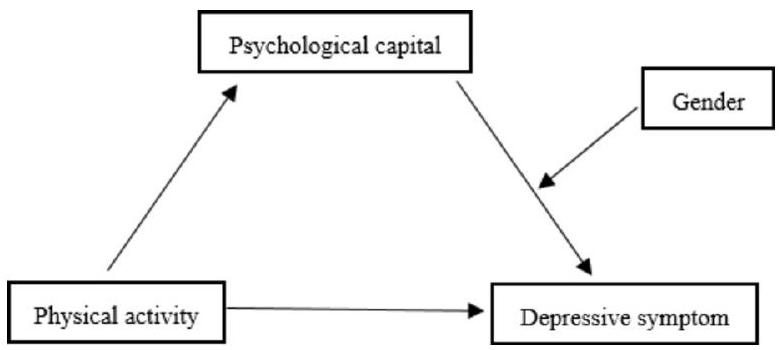
في الختام، أصبحت أعراض الاكتئاب عامل خطر مهم لصحة المراهقين النفسية. يرتبط النشاط البدني ورأس المال النفسي بأعراض الاكتئاب، لكن العلاقة الداخلية بين هذه المتغيرات والدور الوسيط للجنس لم يتم دراستها بالكامل. بالإضافة إلى ذلك، باعتباره موردًا داخليًا إيجابيًا يمكن للأفراد زراعته وتشكيله، كان رأس المال النفسي يفتقر نسبيًا في الدراسات السابقة التي تركز على هذا المتغير وارتباطه. لذلك، أخذت هذه الدراسة المراهقين كموضوع بحث لاستكشاف العلاقة بين النشاط البدني ورأس المال النفسي وأعراض الاكتئاب، بالإضافة إلى الدور التنظيمي للجنس بين رأس المال النفسي وأعراض الاكتئاب، لتوفير مرجع لتخفيف والوقاية من أعراض الاكتئاب لدى الطلاب من مختلف الجنسين. لذلك، قمنا بتطوير نموذج وساطة معتدل (انظر الشكل 1) واقترحنا ثلاث فرضيات: (1) النشاط البدني يتنبأ سلبًا بأعراض الاكتئاب لدى المراهقين؛ (2) يلعب رأس المال النفسي دورًا وساطيًا في العلاقة بين النشاط البدني وأعراض الاكتئاب لدى المراهقين؛ (3) ينظم الجنس النصف الثاني من نموذج الوساطة بين النشاط البدني وأعراض الاكتئاب لدى المراهقين.

طرق

السكان المدروسون

قبل المشاركة، شرح الباحثون هدف الدراسة لجميع المشاركين وأكدوا لهم سرية الاستبيان. قدم جميع المشاركين موافقة مستنيرة قبل المشاركة في الاستطلاع. تم توزيع الاستبيانات وجمعها بشكل مجهول بمساعدة معلم الفصل. تم اعتماد طريقة عينة عشوائية طبقية لتحديد ثلاثة مدارس متوسطة من المدارس العامة في غرب هونان، ثم تم اختيار ثلاث فصول عشوائيًا من الصفوف 7 إلى 9 من المدارس المتوسطة الثلاث، واختيار جميع طلاب المدارس المتوسطة من 27 فصلًا كأهداف بحث. تم حساب حجم العينة على أنه فترة الثقة) و ، لذا كان الخطأ المقبول هو (وفقًا للاستطلاعات السابقة حول أعراض الاكتئاب لدى المراهقين، تراوحت نسبة حدوث أعراض الاكتئاب لدى المراهقين من 14.92 إلى )، لذا كان حجم العينة لكل مجموعة هو . اعتبر أن السكان يأتون من 3 مدارس متوسطة مختلفة، كل مدرسة متوسطة مقسمة حسب الصف والجنس، شخص. بالإضافة إلى ذلك، بسبب عدم اليقين في حجم الفصل وأسباب أخرى (مثل الإجازات، إلخ)، أكمل 1176 طالبًا الاستبيان، منهم أولاد و بنات أكملوا الاستبيان. تم استبعاد ثلاثين طالبًا من التحليل لأنهم أكملوا الاستطلاع في غضون 120 ثانية، أو كانت بياناتهم غير مكتملة أو كانت ردودهم مشابهة لجميع العناصر. تم تضمين بيانات 1146 طالبًا المتبقية في التحليل، وكانت نسبة الاستجابة الفعالة هي . تمت الموافقة على هذه الدراسة من قبل لجنة الأخلاقيات في جامعة جيشوه.

القياس

النشاط البدني

تم قياس النشاط البدني (PA) باستخدام PARS-3 المعدل الذي طوره ليانغ ديكينغ وآخرون. . يقيم هذا المقياس تمارين الموضوعات بناءً على الشدة، والتكرار، والمدة، مع مقياس مقسم إلى 5 مستويات، تتراوح الدرجات من 1 إلى 5. يتم حساب درجة التمرين الكلية على أنها شدة التمرين (المدة -1) التكرار، مع نطاق من 0 إلى 100 نقطة. في هذه الدراسة، كانت قيمة معامل كرونباخ لهذا المقياس 0.721.
الشكل 1. نموذج فرضية المتغير.

أعراض الاكتئاب

تم استخدام مقياس الاكتئاب (CES-D) من قبل مركز الوبائيات لتقييم مستويات الاكتئاب لدى الأفراد على مدار الأسبوع الماضي . تتكون المقياس من 20 عنصرًا تغطي الاكتئاب، المزاج الإيجابي، الأعراض الجسدية، تأخر النشاط، والعلاقات الشخصية، ويتم تسجيلها من 0 (نادراً أو لا شيء) إلى 3 (معظم الوقت)، مع العناصر ، و16 سجلت بشكل عكسي. تتراوح الدرجة الإجمالية من 0 إلى 60، مع الإشارة إلى أن الدرجات الأعلى تدل على أعراض اكتئاب أكبر. في هذه الدراسة، كانت قيمة معامل ألفا كرونباخ لهذه المقياس 0.859.

رأس المال النفسي

استبيان رأس المال النفسي للمراهقين (PCQAS) الذي جمعه فانغ بيجي تم استخدامه للتحقيق في رأس المال النفسي بين طلاب المدارس المتوسطة. تحتوي المقياس على 22 بندًا مقسمة إلى الأمل، والتفاؤل، والثقة، والمرونة، يتم تسجيلها من 1 (أوافق بشدة) إلى 6 (أوافق بشدة)، مع العناصر وسجل 15 عكسياً. تتراوح الدرجات الإجمالية من 22 إلى 132، حيث تشير الدرجات الأعلى إلى زيادة في رأس المال النفسي. في هذه الدراسة، كانت قيمة معامل ألفا كرونباخ لهذه المقياس 0.916.

المتغيرات المشتركة

تم جمع الخصائص السكانية مثل العمر والجنس كمتغيرات مصاحبة.

التحليل الإحصائي

تم إجراء التحليل الإحصائي باستخدام SPSS 27.0، مع تحديد الدلالة عند (ذو طرفين). تم تقييم التوزيع الطبيعي باستخدام اختبارات التوزيع الطبيعي؛ وفقًا لتوصيات كيم، تُعتبر البيانات التي تحتوي على انحراف مطلق أقل من 2 وكورتوز أقل من 7 موزعة تقريبًا بشكل طبيعي. ثم تم إجراء اختبار هارمان ذو العامل الواحد لتقييم انحياز الطريقة الشائعة، مع عتبة أقل من مؤشرًا على عدم وجود انحياز طريقة مشترك كبير تم استخدام تحليل الارتباط بيرسون لاستكشاف العلاقات بين النشاط البدني وأعراض الاكتئاب والجنس. تم إجراء تحليل الوساطة المعتدلة باستخدام SPSS PROCESS (النموذج لفحص العلاقة بين النشاط البدني وأعراض الاكتئاب بين طلاب المدارس المتوسطة في المناطق الريفية، مع التحقيق في الدور الوسيط لرأس المال النفسي والدور المعدل للجنس. أخيرًا، تم استخدام 5000 تكرار لإعادة أخذ العينات باستخدام طريقة البوتستراب لتقييم ملاءمة النموذج وتقدير الـ فترة الثقة )، مما يضمن استقرار تحليل البيانات مع التحكم في العمر والجنس كمتغيرات مصاحبة.

النتائج

المعلومات العامة عن المشاركين

إجمالي 1146 طالبًا أكملوا الاستبيان وتم تضمينهم في التحليل. من بينهم، كان 541 من الأولاد. و605 كن فتيات ; 386 كانوا في الصف 374 في الصف ، و386 في الصف ; 241 كانوا من الهان ( )، 458 كانوا مياو ( ” )، 438 كانوا توجيا ( )، و9 كانوا من مجموعات عرقية أخرى .

اختبار انحياز الطريقة الشائعة

لتجنب التحيز المنهجي الشائع، تم استخدام اختبار العامل الواحد لهارمان. أظهرت النتائج أن 7 عوامل كانت لها قيم ذاتية أكبر من 1، حيث كان العامل الأول يمثل من التباين، بعيدًا عن القيمة الحرجة. لذلك، تم استبعاد تأثير التحيز الناتج عن الطريقة الشائعة على نتائج الدراسة.

تحليل الارتباط بين النشاط البدني ورأس المال النفسي وأعراض الاكتئاب لدى طلاب المدارس المتوسطة في المناطق الريفية

أظهر تحليل الارتباط ما يلي (انظر الجدول 1): كانت النشاط البدني مرتبطًا سلبًا بشكل كبير مع أعراض الاكتئاب ومرتبطًا إيجابيًا مع رأس المال النفسي. كانت أعراض الاكتئاب مرتبطة سلبًا بشكل كبير مع رأس المال النفسي. وهذا يشير إلى أن المشاركة الأكبر في النشاط البدني مرتبطة بزيادة رأس المال النفسي وقلة أعراض الاكتئاب. على وجه التحديد، كان هناك ارتباط سلبي بين النشاط البدني وأعراض الاكتئاب. ) مع دلالة إحصائية؛ كان هناك ارتباط إيجابي بين التمارين البدنية ورأس المال النفسي ( ) مع دلالة إحصائية؛ وكانت أعراض الاكتئاب ورأس المال النفسي لهما علاقة سلبية ( مع دلالة إحصائية. تدعم هذه النتائج الخطوة التالية لاختبار نموذج الوساطة.
1 2 ٣ ٤ ٥ ٦ ٧ ٨
1 الجنس
2 إقامة -0.031
3 سنجلتون 0.058 0.037
4 المتروكين -0.065* 0.056 -0.006
5 هيكل الأسرة 0.060* -0.037 -0.055 -0.367**
6 سنوات -0.033 -0.044 -0.011 -0.029 -0.056
7 النشاط البدني -0.206*** 0.073* -0.004 -0.004 -0.011 -0.050
8 أعراض اكتئابية -0.049 -0.035 -0.050 0.008 0.082**
9 رأس المال النفسي -0.045 0.050 0.039 0.061* -0.015 -0.059*
الجدول 1. الإحصائيات الوصفية والارتباطات لمتغيرات الدراسة الرئيسية. ملاحظة: ، “ نفس الشيء أدناه.
متغير النتيجة متغير تنبؤي SE ت ف
رأس المال النفسي النشاط البدني 0.279(0.201~0.358) 0.040 6.999*** 0.053 9.136
جنس -0.081(-2.497 ~ 2.335) 1.231 -0.066
إقامة 1.170(-1.193~3.352) 1.204 0.971
سنجلتون 2.921(-1.275 ~ 7.117) ٢.١٣٩ 1.366
المتروكون 2.707(0.116~5.299) 1.321 0.041*
هيكل الأسرة 0.266(-1.112 ~ 1.645) 0.703 0.379
عمر -0.969(-2.202 ~ 1.645) 0.628 -1.543
عرض اكتئابي النشاط البدني -0.042(-0.078~-0.006) 0.018 -2.292* 0.056 9.707
جنس 3.555(2.452~4.658) 0.562 6.323***
إقامة -0.602(-1.680~0.477) 0.550 -1.095
سنجلتون -1.530(-3.446~0.386) 0.976 -1.567
المتروكون -0.790(-1.973 ~ 0.393) 0.603 -1.310
هيكل الأسرة -0.188(-0.817 ~ 0.442) 0.321 -0.585
عمر 0.797(0.235 ~ 1.360) 0.287 2.780**
عرض اكتئابي النشاط البدني -0.024(-0.008 ~ 0.055) 0.016 1.484 0.305 62.392
رأس المال النفسي -0.234(-0.257~-0.212) 0.012 -20.173***
جنس 3.536(2.589~4.483) 0.483 7.326***
إقامة -0.328(-1.254~0.599) 0.472 0.694
سنجلتون -0.845(-2.491~0.801) 0.839 -1.008
المتروكون -0.156(-1.173 ~862) 0.519 -0.300
هيكل الأسرة -0.125(-0.666 ~ 0.415) 0.275 -0.455
عمر 0.570(0.086~1.053) 0.246 2.313*
الجدول 2. تحليل الدور الوسيط لرأس المال النفسي في العلاقة بين النشاط البدني وأعراض الاكتئاب.
مسار أثر خطأ في بدء التشغيل 95% فترة الثقة للخطأ
التأثير الكلي النشاط البدني → أعراض الاكتئاب -0.042 0.018 -0.076~-0.006
الأثر المباشر النشاط البدني → أعراض الاكتئاب 0.024 0.016 -0.008~0.055
أثر غير مباشر النشاط البدني → رأس المال النفسي → أعراض الاكتئاب -0.066 0.010 -0.086~-0.046
الجدول 3. التأثير الوسيط لرأس المال النفسي على النشاط البدني وأعراض الاكتئاب لدى المراهقين.

تحليل الوساطة

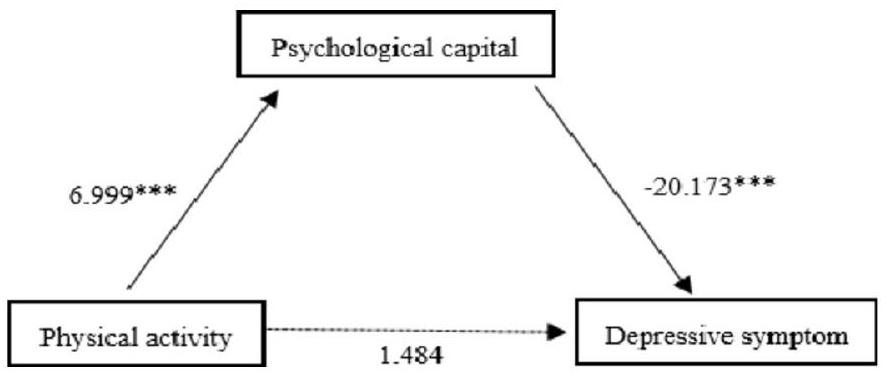
في هذه الدراسة، تم استخدام النشاط البدني كمتغير مستقل، وأعراض الاكتئاب كمتغير تابع، ورأس المال النفسي كمتغير وسيط، والعمر، والسكن، والطفل الوحيد، والترك، وبنية الأسرة، والجنس كمتغيرات تحكمية، استكشفت هذه الدراسة العلاقة بين النشاط البدني وأعراض الاكتئاب لدى طلاب المدارس المتوسطة في المناطق الريفية. تظهر النتائج في الجدول 2. توقع النشاط البدني بشكل إيجابي رأس المال النفسي لطلاب المدارس المتوسطة في المناطق الريفية. )، وتنبأت سلبًا بأعراض الاكتئاب ( عندما تم استخدام رأس المال النفسي كمتغير وسيط، توقع رأس المال النفسي بشكل كبير سلبياً أعراض الاكتئاب. )، بينما لم يكن للنشاط البدني تأثير مباشر كبير على أعراض الاكتئاب اختبار Bootstrap مع التحيز المعدل يظهر أن رأس المال النفسي له تأثير وسيط كبير، مع تأثير غير مباشر قدره -0.066 و فترة الثقة لـ التأثير المباشر للتمارين البدنية ليس كبيرًا، قيمة التأثير المباشر هي 0.024، و فترة الثقة هي تشير هذه النتائج إلى أن رأس المال النفسي يلعب دورًا وسيطًا كاملاً في العلاقة بين النشاط البدني وأعراض الاكتئاب لدى طلاب المدارس المتوسطة في المناطق الريفية (انظر الجدول 3). يوضح الشكل 2 مسار النموذج الوسيط لرأس المال النفسي في العلاقة بين النشاط البدني وأعراض الاكتئاب.

تحليل الاعتدال للجنس في تأثير الوساطة

للمزيد من التحقيق في ما إذا كانت دور الوساطة لرأس المال النفسي بين النشاط البدني وأعراض الاكتئاب يتأثر بالجنس، قمنا بإدخال متغير معتدل. أظهرت النتائج أن رأس المال النفسي تنبأ بشكل كبير بأعراض الاكتئاب عندما كان الجنس هو العامل المعتدل. بالإضافة إلى ذلك، كان للجنس تأثير كبير على أعراض الاكتئاب لدى المراهقين. . كان لمصطلح التفاعل بين رأس المال النفسي والجنس تأثير سلبي كبير على أعراض الاكتئاب ( ، )، مع قيمة مؤشر تبلغ -0.028 و فترة الثقة لـ باستثناء الصفر (انظر الجدول 4).
الشكل 2. مسار النشاط البدني، أعراض الاكتئاب ونموذج الوساطة لرأس المال النفسي.
SE ت ف
رأس المال النفسي النشاط البدني 0.280(0.203 ~ 0.356) 0.039 7.170*** 0.053 10.667
إقامة 1.171(-1.190~3.532) 1.203 0.973
سنجلتون 2.913(-1.274 ~ 7.100) ٢.١٣٤ 1.365
المتروكون 2.712(0.124 ~ 5.300) 1.319 2.056*
هيكل الأسرة 0.264(-1.112 ~ 1.641) 0.702 0.377
عمر -0.968(-2.198 ~ 0.263) 0.627 -1.542
عرض اكتئابي النشاط البدني 0.019(-0.012 ~ 0.051) 0.016 1.219 0.317 ٥٨.٥٢٥
رأس المال النفسي -0.086(-0.155~-0.016) 0.036 -2.400*
جنس 11.579(7.882 ~ 15.277) 1.884 6.145***
رأس المال النفسي × الجنس -0.100(-0.144~-0.055) 0.023 -4.413***
إقامة -0.230(-1.149~-0.690) 0.469 -0.490
سنجلتون -0.754(-2.388~-0.879) 0.832 -0.906
المتروكون -0.190(-1.199~-0.820) 0.515 -0.369
هيكل الأسرة -0.144(-0.680~-0.392) 0.273 -0.527
عمر 0.505(0.024~0.985) 0.250 2.060*
الجدول 4. اختبارات نموذج الوساطة المعتدلة.
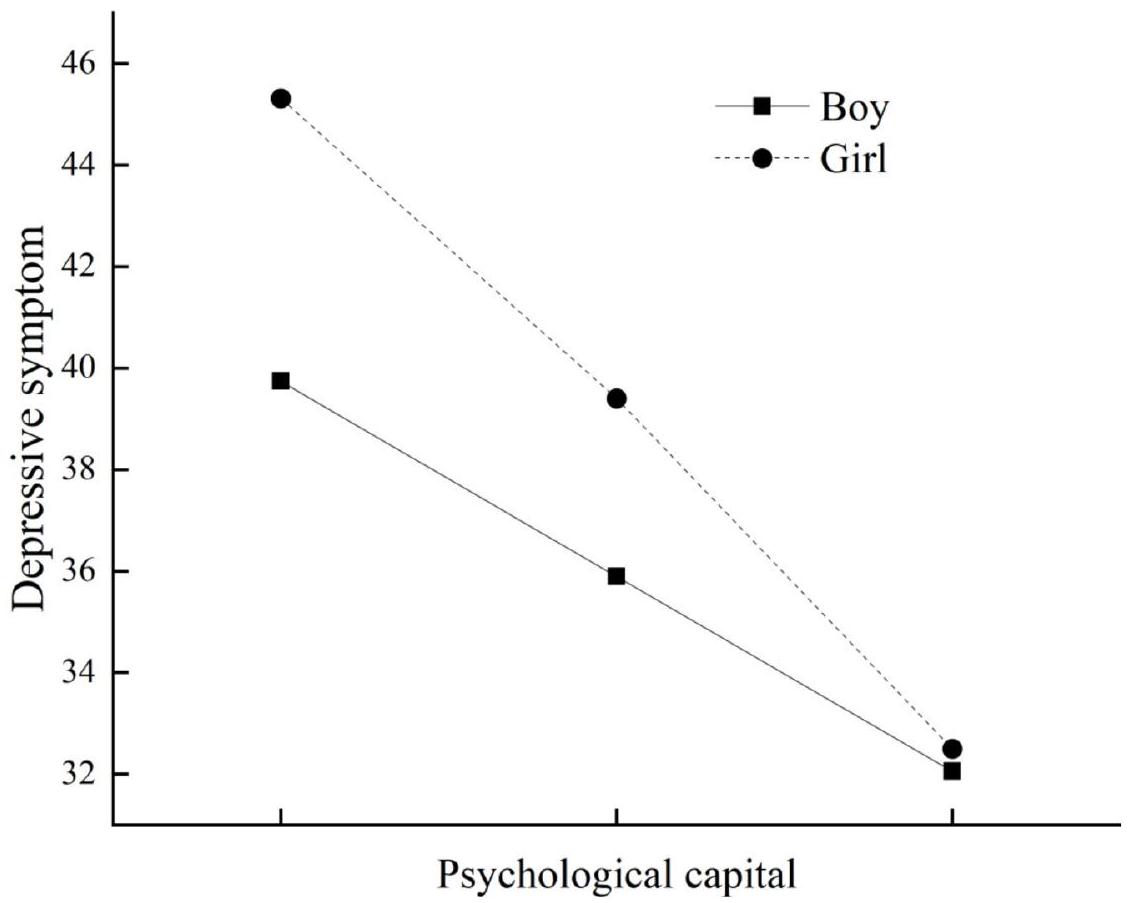
لاستكشاف تأثير التفاعل الجوهري لرأس المال النفسي والجنس، تم إجراء تحليل الميل البسيط. تم تصنيف رأس المال النفسي إلى مجموعات عالية ومنخفضة بناءً على انحراف معياري واحد فوق وتحت المتوسط. تم إنشاء مخططات تأثير التفاعل لأجناس مختلفة (انظر الشكل 3). تشير النتائج إلى أنه في مجموعة المراهقين الذكور، يتنبأ رأس المال النفسي بشكل سلبي كبير بأعراض الاكتئاب (ميل بسيط ). وبالمثل، في مجموعة الفتيات المراهقات، يتنبأ رأس المال النفسي أيضًا بشكل سلبي كبير بأعراض الاكتئاب (منحدر بسيط تشير هذه النتائج إلى أن ارتفاع رأس المال النفسي مرتبط بمستويات أقل من أعراض الاكتئاب.

نقاش

تتناول هذه الدراسة العلاقة بين النشاط البدني وأعراض الاكتئاب لدى المراهقين، وتحاول الكشف عن الآليات الوسيطة والتنظيمية المحتملة بين النشاط البدني وأعراض الاكتئاب. تظهر النتائج أن النشاط البدني مرتبط سلبًا بأعراض الاكتئاب لدى المراهقين. إن رأس المال النفسي يتوسط تمامًا العلاقة بين النشاط البدني وأعراض الاكتئاب. بالإضافة إلى ذلك، لعب الجنس دورًا تنظيميًا في العلاقة بين رأس المال النفسي وأعراض الاكتئاب. مقارنة بالفتيات، كان المراهقون الذكور أقل تأثرًا برأس المال النفسي وأظهروا مستوى أقل من أعراض الاكتئاب. كانت الفتيات المراهقات أكثر تأثرًا برأس المال النفسي وأظهرن مستوى أعلى من أعراض الاكتئاب. تظهر النتائج أنه من أجل الوقاية من الاكتئاب وأعراض الاكتئاب لدى المراهقين، يجب علينا عدم التركيز فقط على أهمية المشاركة في الأنشطة البدنية في الحياة اليومية، بل أيضًا تنمية موقف إيجابي تجاه الحياة وتحسين مستوى رأس المال النفسي باستمرار.
أولاً، كانت مستويات النشاط البدني مرتبطة سلبًا وتنبأت سلبًا بأعراض الاكتئاب لدى المراهقين. هذه النتيجة تتماشى مع الفرضية 1 ونتائج الأبحاث السابقة. مع زيادة النشاط البدني، يكون المراهقون أقل عرضة لتطوير أعراض الاكتئاب، مما يشير إلى أن المشاركة النشطة في النشاط البدني والتمارين الرياضية يمكن أن تقلل من خطر تطوير أعراض الاكتئاب. . روثون وآخرون وجدت علاقة بين النشاط البدني وأعراض الاكتئاب لدى المراهقين، حيث يرتبط كل ساعة إضافية من النشاط البدني بـ تقليل خطر أعراض الاكتئاب. أظهرت الدراسات أن الإثارة يمكن أن تنتقل من الدماغ إلى العضلات، وأن العضلات يمكن أن تنقل الإثارة إلى العضلات أيضًا، مما يزيد من درجة الإثارة في الدماغ وترتفع مشاعر الناس. تفترض فرضية التشتت أن المشاركة النشطة في الأنشطة البدنية يمكن أن توفر للمراهقين
الشكل 3. تأثير الجنس المعتدل على أعراض الاكتئاب تحت قيمة رأس المال النفسي.
فرصة لتحويل المشاعر السلبية والتطهير النفسي التي تساعد على تحسين العلاقات الشخصية، وتعزيز الثقة بالنفس، وزيادة إحساسهم بمعنى الحياة وقيمتهم الذاتية. لذلك، تُعرف النشاطات البدنية بأنها “العلاج الأخضر” للمزاج السيء. ويلعب دورًا مهمًا في علاج وتخفيف الاكتئاب لدى المراهقين.
استنادًا إلى التحقق من العلاقة بين النشاط البدني وأعراض الاكتئاب، ناقشنا أيضًا الدور الوسيط لرأس المال النفسي. تتماشى البيانات مع الفرضية 2، حيث تظهر أن رأس المال النفسي هو وسيط كامل بين النشاط البدني وأعراض الاكتئاب لدى المراهقين. المراهقون الذين يمارسون النشاط البدني والتمارين الرياضية بانتظام هم أكثر عرضة للحصول على رأس مال نفسي أعلى. يمتلكون احتياطيات نفسية إيجابية أكبر في مواجهة الضغوط الخارجية، ومن غير المرجح أن يظهروا أعراض الاكتئاب. . تؤكد النتائج مرة أخرى تأثير رأس المال النفسي على النشاط البدني وأعراض الاكتئاب، مما يثري الأبحاث الحالية. وفقًا لنظرية الحفاظ على الموارد، يلعب رأس المال النفسي، كموارد نفسية داخلية للفرد، دورًا وسيطًا في الصحة النفسية. وسيستمر الأفراد الذين يعانون من نقص الموارد على المدى الطويل في زيادة ضغطهم النفسي، مما يؤدي إلى سلسلة من المشاكل النفسية مثل الاكتئاب والقلق. يمكن أن تعزز الأنشطة البدنية جودة الإرادة القوية لدى المراهقين، وتحسن الصحة النفسية الفردية، وتعزز من الكفاءة الذاتية. ، وتحسين مستوى رأس المال النفسي في الوقت نفسه، فإن المشاركة في الأنشطة البدنية تساعد على تحسين الجودة النفسية الإيجابية للتفاؤل. ومع ذلك، فإن الأفراد المتفائلين بشكل كبير يميلون أكثر إلى الحفاظ على موقف إيجابي في مواجهة الضغوط والتحديات في الحياة والدراسة. الأفراد الذين لديهم آمال عالية لديهم معتقدات راسخة وقدرة قوية على مواجهة وحل المشكلات. في الوقت نفسه، فإن الأفراد الذين يتمتعون بكفاءة ذاتية عالية ومرونة عادة ما يمتلكون قدرة معينة على ضبط النفس. ويمكنهم تعديل مشاعرهم بنشاط للتكيف بشكل أفضل مع البيئة عندما يكون لدى المراهقين موقف متفائل وواثق تجاه الحياة، وأمل إيجابي في الحياة ومرونة نفسية قوية، فإنهم سيتعاملون مع النكسات في الحياة بطريقة أكثر إيجابية. يخفف أو يضعف تأثير العوامل الخارجية على المشكلات النفسية وابتعد عن الاكتئاب والمشاعر السلبية الأخرى في الوقت نفسه، يواجه المراهقون غالبًا تدخل عوامل خطر خارجية مثل الضغط الأكاديمي، والتواصل بين الأفراد، وعلاقة الوالدين بالطفل، وصداقة الأقران. التي تؤثر على تطورهم النفسي وتجعلهم أكثر عرضة لعلم النفس السلبي مثل الشعور بالنقص، والحساسية، واليأس، والتشاؤم بشأن المستقبل تشير نظرية استنفاد الأنا إلى أن الموارد النفسية الإيجابية محدودة، وأن المشاعر السلبية على المدى الطويل، وبيئة الأسرة، وعوامل الخطر في البيئة الاجتماعية ستؤدي إلى استنفاد احتياطيات الأفراد من رأس المال النفسي الإيجابي بشكل خطير، مما يؤدي إلى تراجع رأس المال النفسي. لذلك، من المهم للغاية زيادة كمية النشاط البدني والتمارين الرياضية للمراهقين وزيادة احتياطي رأس المال النفسي. وفقًا لخصائص نمو رأس المال النفسي في أبعاد مختلفة ونمو وتطور المراهقين، يجب اعتماد طرق ووسائل تمارين مستهدفة لتقليل المشاعر السلبية لدى المراهقين والتأثير السلبي للبيئة الأسرية والبيئة الاجتماعية، وزيادة احتياطي رأس المال النفسي، والحفاظ على التطور الصحي للصحة البدنية والعقلية.
تؤكد النتائج أيضًا الفرضية 3 التي تفيد بأن الجنس يؤثر على النصف الثاني من عملية الوساطة للنشاط البدني → رأس المال النفسي → أعراض الاكتئاب. على العكس من ذلك، كان لمستويات رأس المال النفسي لدى الفتيات تأثير أكبر على أعراض الاكتئاب لديهن. تشير نظرية الدور الاجتماعي للجنس إلى أن الفرد
تُعزى الفروق بين الرجال والنساء إلى اختلافات في الأدوار الجندرية، لذا يتمتع الأولاد بسمات أكثر عدوانية واستقلالية، بينما تتمتع الفتيات بسمات أكثر حساسية وحنانًا، مما سيؤثر بشكل أكبر على نفسية وسلوك الأولاد والبنات. . في الوقت نفسه، بسبب تأثير المستوى الاقتصادي والتعليمي، تعاني الفتيات من انخفاض في تقدير الذات والثقة بالنفس وغيرها من الصفات النفسية. علاوة على ذلك، تحت تأثير توقعات الأدوار التقليدية، يوجه المزيد من الآباء الفتيات للتطور في اتجاه “الهدوء والطاعة” . لذلك، فإن الفتيات في مرحلة المراهقة أكثر عرضة لمطالبة أنفسهن بتوقعات الأدوار النسائية تحت تأثير البيئة الخارجية، مما يقلل من حماسهن للمشاركة في الأنشطة البدنية ويخفض مستوى نشاطهن البدني مقارنة بالأولاد . تحت تأثير عوامل متعددة مثل دور الجنس ومفهوم الأسرة، من المرجح أن تعاني الفتيات من مشاعر سلبية مثل الاكتئاب والقلق مما يؤدي إلى سلسلة من المشاكل النفسية. أظهرت الدراسات أن رأس المال النفسي له تأثير وقائي ووسيط أقوى على الفتيات، وعندما يكون مستوى رأس المال النفسي منخفضًا، يكون مستوى أعراض الاكتئاب أعلى من ذلك لدى الأولاد. لذلك، عندما تقوم الأسر والمدارس والمجتمع بإجراء تدخل نفسي على الأفراد، يجب اتخاذ تدابير مختلفة وفقًا لاختلافات الأفراد، وخاصة الفتيات ذوات المستوى المنخفض من رأس المال النفسي. مقارنة بالأولاد في نفس العمر، سيكونون أكثر حساسية وخطورة في هذه الحالة. عندما يكونون في مستوى منخفض من رأس المال النفسي لفترة طويلة، سيزيدون من خطر الاكتئاب.
قوة هذه الدراسة هي استخدام عينة فريدة من المراهقين، مع عينة من المراهقين في المناطق الريفية ذات الوضع الاقتصادي المتدني، لاستكشاف العلاقة بين رأس المال النفسي والجنس والنشاط البدني للمراهقين وأعراض الاكتئاب بعمق. ثانيًا، وجدت دراستنا أن رأس المال النفسي يمكن أن يخفف أيضًا ويحسن أعراض الاكتئاب لدى المراهقين، مما يكمل بشكل فعال الوقاية والعلاج من أعراض الاكتئاب لدى المراهقين. أخيرًا، وجدت هذه الدراسة أن الجنس له تأثير معتدل على رأس المال النفسي وأعراض الاكتئاب لدى المراهقين، مما أغنى البحث السكاني حول الوقاية والعلاج من أعراض الاكتئاب.
بينما تعزز هذه الدراسة فهمنا للعلاقة بين النشاط البدني وأعراض الاكتئاب، لا تزال هناك بعض القيود التي يجب أخذها في الاعتبار. أولاً، الاستطلاع على المراهقين في ثلاث مدارس متوسطة ريفية في غرب هونان لا يمثل الوضع العام للمراهقين في غرب هونان، وقد تكون نتائج البحث متحيزة. ثانيًا، تم التحقيق في النشاط البدني للمراهقين، وأعراض الاكتئاب، ومؤشرات رأس المال النفسي جميعها من خلال مقياس، وقد يكون هناك تحيز في الذاكرة بين موضوعات الاستطلاع. أخيرًا، بيانات الاستطلاع المقطعية المستخدمة في هذه الدراسة ليست جيدة في كشف السببية، وهناك حاجة إلى المزيد من الدراسات الطولية في المستقبل للتعمق أكثر في العلاقة بين النشاط البدني وأعراض الاكتئاب لدى المراهقين.

الخاتمة

في الختام، يتنبأ النشاط البدني سلبًا بأعراض الاكتئاب لدى المراهقين، ورأس المال النفسي، كمورد داخلي إيجابي، يلعب دورًا وسيطًا بين النشاط البدني وأعراض الاكتئاب. يلعب الجنس دورًا معتدلاً كبيرًا في هذه العلاقة. يمكن أن يساعد زيادة النشاط البدني اليومي وتعزيز رأس المال النفسي في الوقاية من أعراض الاكتئاب وتقليلها، خاصة لدى الفتيات.
لذلك، من أجل تخفيف ومنع أعراض الاكتئاب لدى المراهقين بشكل فعال، فإن الجهود المشتركة من المجتمع والأسرة والمدرسة ضرورية. يجب على المجتمع تحسين وإكمال نظام المساعدة النفسية للمراهقين باستمرار، وتقديم استشارات نفسية فعالة وفي الوقت المناسب للمراهقين؛ يجب على المدارس تشجيع الشباب على المشاركة بنشاط في الأنشطة الرياضية، خاصة للفتيات، للحصول على المزيد من الدعم والصداقة من الأقران في الرياضة، من أجل تعزيز احتياطيات رأس المال النفسي الإيجابي باستمرار؛ في الأسرة، يجب على الآباء تقديم الدعم المادي، ولكن أيضًا فهم وتلبية الاحتياجات النفسية للمراهقين. في الوقت نفسه، يجب أن نتعلم تشجيعهم ومدحهم، ومساعدة المراهقين على تطوير وتحسين جودة النفس من الثقة بالنفس والتفاؤل. فقط عندما يعمل المجتمع والمدرسة والأسرة معًا، يمكن تحسين المستوى العام للصحة النفسية للمراهقين بشكل أفضل، لمنع حدوث مشاكل نفسية.

توفر البيانات

البيانات التي تم إنشاؤها و/أو تحليلها خلال الدراسة الحالية غير متاحة للجمهور بسبب [سياسة فريقنا التجريبي] ولكنها متاحة من المؤلف المراسل عند الطلب المعقول.
تاريخ الاستلام: 11 أغسطس 2024؛ تاريخ القبول: 19 مارس 2025
تم النشر عبر الإنترنت: 29 مارس 2025

References

  1. Weersing, V. R., Jeffreys, M., Do, M. T., Schwartz, K. T. & Bolano, C. Evidence base update of psychosocial treatments for child and adolescent depression. J. Clin. Child. Adolesc. Psychol. 46 (1), 11-43 (2017).
  2. Xiaohan, J. I. A. N. G. & Zhi, Z. Analysis of the change trend of the burden of depression in children and adolescents in China . Chin. J. Prev. Med. 25(03), 379-384 (2019).
  3. Ye, S. et al. Correlation between video and sleep duration and depressive symptoms in middle school students. Chin. Sch. Health 43(07), 1015-1018 (2022).
  4. Tao, X. et al. Meta-analysis of risk factors of depressive symptoms in Chinese middle school students. Modern Prev. Med. , 814-818+844 (2022).
  5. Chao, W. et al. Related factors of depressive symptoms in middle school students in Shandong Province. Chin. J. Ment. Health 37(04), 318-325 (2023).
  6. Weiwei, Y. et al. Association of physical fitness, mobile phone dependence and depressive symptoms among freshmen in a medical college in Jiangsu Province. Chin. Sch. Health 45(05), 644-648 (2024).
  7. Furong, L. et al. Meta-analysis of depressive symptoms in middle school students. Chin. J. Mental Health 34(02), 123-128 (2019).
  8. Wang, J. et al. Experiential avoidance, depression, and difficulty identifying emotions in social network site addiction among Chinese university students: a moderated mediation model. Behav. Inf. Technol. https://doi.org/10.1080/0144929X.2025.2455406 (2025).
  9. Wang, J. et al. Social network site addiction, sleep quality, depression and adolescent difficulty describing feelings: a moderated mediation model. BMC Psychol. 13(1), 57 (2025).
  10. Pearce, M. et al. Association Between Physical Activity and Risk of Depression: A Systematic Review and Meta-analysis. JAMA Psychiatry 79(6), 550-559 (2022).
  11. Haitan, W. et al. Correlation between physical activity and depressive symptoms in adolescents. Chin. Sch. Health 44(05), 672676+681 (2023).
  12. Liu, Y. et al. The relationship between physical activity and internet addiction among adolescents in western China: a chain mediating model of anxiety and inhibitory control. Psychol. Health Med. 29(9), 1602-1618 (2024).
  13. Yang, L. et al. Anxiety inhibitory control physical activity and internet addiction in Chinese adolescents: a moderated mediation model. BMC Pediatrics 24(1), 663. https://doi.org/10.1186/s12887-024-05139-6 (2024).
  14. Xiao, T. et al. The relationship between physical activity and sleep disorders in adolescents: a chain-mediated model of anxiety and mobile phone dependence. BMC Psychol 12(1), 751. https://doi.org/10.1186/s40359-024-02237-z (2024).
  15. Peng, J. et al. Physical and emotional abuse with internet addiction and anxiety as a mediator and physical activity as a moderator. Sci. Rep. 15(1), 2305 (2025).
  16. Yang, L. et al. The Chain Mediating Effect of Anxiety and Inhibitory Control and the Moderating Effect of Physical Activity Between Bullying Victimization and Internet Addiction in Chinese Adolescents. J. Genetic Psychol. https://doi.org/10.1080/0022 1325.2025.2462595 (2025).
  17. Shen, Q. et al. The chain mediating effect of psychological inflexibility and stress between physical exercise and adolescent insomnia. Sci Rep. 14(1), 24348. https://doi.org/10.1038/s41598-024-75919-8 (2024).
  18. Xu, H., Luo, X., Shen, Y. & Jin, X. Emotional abuse and depressive symptoms among the adolescents: the mediation effect of social anxiety and the moderation effect of physical activity. Front. Public. Health 11, 1138813 (2023).
  19. Liu, Y. et al. Relationship between bullying behaviors and physical activity in children and adolescents: a systematic review and meta-analysis. Aggress. Violent Behav. 78, 101976 (2024).
  20. Kandola, A., Ashdown-Franks, G., Hendrikse, J., Sabiston, C. M. & Stubbs, B. Physical activity and depression: towards Understanding the antidepressant mechanisms of physical activity. Neurosci. Biobehav Rev. 107, 525-539 (2019).
  21. Ji Liu, W., Xiaozan, C. A. I. & Li Physical Exercise and Mental Health M216-218 (East China Normal University, 2006).
  22. MEYER G W. Social information processing and social networks:a test of social influence MechanismsJ. Hum. Relat. 47 (9), 1013-1047 (1994).
  23. Mengjie, Z., Yuanfu, D., Chen, W., Difa, X. & Changhao, J. Study on the effect of aerobic activity on depression in school-age children: an analysis of multiple mediating effects based on 5 dimensions of psychosocial function. Theory Practice Chin. Rehabil. 29(1), 12-19 (2023).
  24. Liu, Y. et al. The mediating role of inhibitory control and the moderating role of family support between anxiety and Internet addiction in Chinese adolescents. Arch. Psychiatr. Nurs. 53, 165-170 (2024).
  25. Xu, W. Physical exercise and depression in college students: the multiple mediating roles of mindfulness and social support. Social Scientist. 2, 148-155 (2021).
  26. Liu, Y. et al. Anxiety mediated the relationship between bullying victimization and internet addiction in adolescents, and family support moderated the relationship. BMC Pediatr. 25(1), 8. https://doi.org/10.1186/s12887-024-05348-z (2025).
  27. Benaich, S. et al. Weight status, dietary habits, physical activity, screen time and sleep duration among university students. Nutr. Health 27, 69-78 (2021).
  28. Liu, Y. et al. The mediating effect of internet addiction and the moderating effect of physical activity on the relationship between alexithymia and depression. Abstract. Sci Rep. 14(1), 9781. https://doi.org/10.1038/s41598-024-60326-w (2024).
  29. Liu, Y. et al. Physical activity moderated the mediating effect of self-control between bullying victimization and mobile phone addiction among college students. Sci. Rep. 14(1), 20855. https://doi.org/10.1038/s41598-024-71797-2 (2024).
  30. Zahl, T., Steinsbekk, S. & Wichstrøm, L. Physical activity, sedentary behavior, and symptoms of major depression in middle childhood. Pediatrics 139, e20161711 (2017).
  31. Sampasa-Kanyinga, H. et al. Combinations of physical activity, sedentary time, and sleep duration and their associations with depressive symptoms and other mental health problems in children and adolescents: a systematic review. Int. J. Behav. Nutr. Phys. Act. 17(1), 72 (2020).
  32. Herbert, C., Meixner, F., Wiebking, C. & Gilg, V. Regular physical activity, short-term exercise, mental health, and well-being among university students: the results of an online and a laboratory study. Front. Psychol. 11, 509 (2020).
  33. Babaeer, L., Stylianou, M., Leveritt, M. & Gomersall, S. Physical activity, sedentary behavior and educational outcomes in university students: a systematic review. J. Am. Coll. Health. 70, 2184-2209 (2020).
  34. Recchia, F. et al. Physical activity interventions to alleviate depressive symptoms in children and adolescents: A systematic review and Meta-analysis. JAMA Pediatr. 177 (2), 132-140 (2023).
  35. Hou, J. et al. Physical activity and risk of depression in adolescents: A systematic review and meta-analysis of prospective observational studies. J. Affect. Disord. 371, 279-288 (2025).
  36. Schuch, F. B. et al. Physical activity and incident depression: A Meta-Analysis of prospective cohort studies. Am. J. Psychiatry. 175, 631-648 (2018).
  37. Pearce, M. et al. Association between physical activity and risk of depression: a systematic review and meta-analysis. JAMA Psychiat. 79, 550-559 (2022).
  38. Schuch, F. B. et al. Physical activity and incident depression: a meta-analysis of prospective cohort studies. Am. J. Psychiatry. 175 (7), 631-648 (2018).
  39. Li, G., Xia, H., Teng, G. & Chen, A. The neural correlates of physical exercise-induced general cognitive gains: A systematic review and meta-analysis of functional magnetic resonance imaging studies. Neurosci. Biobehav. Rev. 169, 106008. https://doi.org/10.10 16/j.neubiorev.2025.106008 (2025).
  40. Shen, L., Gu, X., Zhang, T. & Lee, J. Adolescents’ physical activity and depressive symptoms: A psychosocial mechanism. Int. J. Environ. Res. Public. Health 19(3), 1276 (2022).
  41. Li, J. Y. et al. Depressive symptoms among children and adolescents in China: A systematic review and Meta-Analysis. Med. Sci. Monit. 25, 7459-7470 (2019).
  42. Yongjin, X. et al. College students’ level of physical activity and depressive symptoms associated cohort study. J. Sch. Health China. 03, 406-410 (2024).
  43. Li, Z. et al. The relationship between cyberbullying and depression in college students: the moderating role of psychological capital and peer support. J. Psychol. Sci. 47 (04), 981-989 (2024).
  44. Changlong, S. et al. College students’ subthreshold depression and double attribution: the relationship between psychological capital intermediary function. Chin. J. Health psychol. 31(8), 1212-1216 (2023).
  45. Luthans, F., Avolio, B. J., Avey, J. B. & Norman, S. M. Positive psychological capital:measurement and relationship with performance and. Satisfaction Personnel Psychol. 60 (3), 541-572 (2007).
  46. Fan XingHua, Y. et al. The relationship between life stress, loneliness and happiness of left-behind children: the mediating and moderating role of psychological capital J. Psychol. Sci. 40 (2), 388-394 (2017).
  47. Yuanhua, L., Xianghai, H. & Hui, C. Relationship between Physical exercise and psychological capital of Zhuang left-behind primary and middle School students in poor areas of Guangxi. Modern Prev. Med. 47(21), 3915-3918 (2020).
  48. Yaqi, D. et al. The effect of physical exercise on school bullying in junior high school students: the chain mediating effect of psychological capital and self-control. Chin. J. Health Psychol. 31(5), 733-739 (2023).
  49. Menglong, L. et al. The effect of physical activity on social anxiety of rural left-behind children: the mediating role of psychological capital. Chin. J. Clin. Psychol. 28(6), 1297-1300+ 1296 (2020).
  50. Chen, H. et al. The relationship between physical activity and college students’ mobile phone addiction: the Chain-Based mediating role of psychological capital and social adaptation. Int. J. Environ. Res. Public. Health. 19 (15), 9286 (2022).
  51. Avey, J. B., Luthans, F., Smith, R. M. & Palmer, N. F. Impact of positive psychological capital on employee well-being over time. J. Occup. Health Psychol. 15 (1), 17-28 (2010).
  52. He, S. et al. The Influence of Social support on career decision making of young football players: the chain mediation effect of core self-evaluation and psychological capital. Chin. J. Health Psychol. 31(8), 1234-1238 (2023).
  53. Fredrickson, B. L. The role of positive emotions in positive psychology.the broaden-and-build theory of positive emotions. Am. Psychol. 56 (3), 218-226 (2001).
  54. Wenyan, M. et al. The Relationship between family cumulative risk factors and sense of life Meaning of rural students: the mediating role of psychological capital. Chin. J. Health Psychol. 30(03), 431-436 (2022).
  55. Hongli, M. et al. The influence of psychological capital of adolescent depression. Guangdong Med. 4(01), 27-29 (2015).
  56. Jiajia, H. et al. Association between physical activity and physical fitness index in Chinese children and adolescents. Chin. Sch. Health. 42(12), 1879-1882+1887 (2021).
  57. Zhang, Y. et al. Analysis of physical exercise behavior and related factors of high school students in Taizhou [J]. Chin. J. School Health. 45 (07), 965-968 (2019).
  58. Zook, K. R., Saksvig, B. I., Wu, T. T. & Young, D. R. Physical activity trajectories and multilevel factors among adolescent girls. J. Adolesc. Health. 54 (1), 74-80 (2014).
  59. Huang Yilin, M. et al. Effect of health education and exercise intervention on BMI of middle school students in urban areas J. Chin. Public. Health. 34 (1), 33-37 (2018).
  60. Gao, T. et al. Parental psychological aggression and phubbing in adolescents: A moderated mediation model. Psychiatry Investig. 19 (12), 1012-1020 (2022).
  61. Guo Jiacheng, D. O. N. G. & Rochun, X. The relationship between social presence and internet hyperactivity in college students: the parallel mediation of dual self-awareness and the moderating role of gender [J]. Psychol. Dev. Educ. 40 (02), 176-186 (2019).
  62. Yuan, Y., Zhou-Jian, L. I. A. N. G. & Li, Z. H. A. N. G. Structural school climate and depression in middle school students: the mediating role of social support and the moderating role of gender [J]. Psychol. Dev. Educ. 39 (06), 869-876 (2019).
  63. Dong, H. et al. China child and adolescent cardiovascular health (CCACH) collaboration members. Reference centiles for evaluating total body fat development and fat distribution by dual-energy x-ray absorptiometry among children and adolescents aged 3-18 years. Clin. Nutr. 40 (3), 1289-1295 (2021).
  64. Hai, Z. et al. Current situation of depression and anxiety among middle school students in Beijing and its relationship with bullying and violence. Chin. Sch. Health 45(07), 1017-1020+1025 (2024).
  65. Salk, R. H., Hyde, J. S. & Abramson, L. Y. Gender differences in depression in representative National samples: Meta-analyses of diagnoses and symptoms. Psychol. Bull. 143 (8), 783-822 (2017).
  66. Hongli, M. A. et al. Li Jie, Li Hongzheng. The influence of psychological capital on adolescent depression. J. Guangdong Med. 36 (01), 27-29 (2015).
  67. Menglong, L. et al. The effect of physical activity on social anxiety of rural left-behind children: the mediating role of psychological capital. Chin. J. Clin. Psychol. 28(6), 1297-1300+ 1296 (2020).
  68. Finch, J. et al. Searching for the hero in Youth:Does Psychological Capital (PsyCap) Predict Mental Health Symptoms and Subjective Wellbeing in Australian school-aged Children and adolescents?511025-1036 (Child Psychiatry & Human Development, 2020). 6.
  69. Jianbo, Q. & Aihua, Y. Intervention effect of moderate intensity physical exercise on inferiority and psychological capital of college students. Chin. Sch. Health 40(05), 756-758 (2019).
  70. Liang, D. Q. Stress level of college students and its relationship with physical exercise. Chin. Ment. Health J. 8, 2(1994).
  71. Zhiyan, C., Xiaodong, Y. & Xinying, L. The study of depression scale in Chinese adolescents. Chin. J. Clin. Psychol. 17(04), 443-445+448 (2009).
  72. Fang Biji. A Study on the structure, characteristics, Related Factors and Group Intervention of College students’ Psychological capital D. Fuzhou: College of Education, Fujian Normal University. :50-63. (2012).
  73. Kim, H. Y. Statistical notes for clinical researchers: assessing normal distribution (2) using skewness and kurtosis. Restor. Dentist Endodont. 38 (1), 52-54 (2013).
  74. Podsakoff, P. M., MacKenzie, S. B., Lee, J. Y. & Podsakoff, N. P. Common method biases in behavioral research: a critical review of the literature and recommended remedies journal Article; review. J. Appl. Psychol. 88 (5), 879-903 (2003).
  75. Hayes, A. F. Introduction To Mediation,moderation,and Conditional Process analysis:A regression-based Approach (The Guilford Press, 2013).
  76. Velazquez, B. et al. Physical activity and depressive symptoms among adolescents in a school-based sample. Braz J. Psychiatry. 44 (3), 313-316 (2022).
  77. Ma, L., Hagquist, C. & Kleppang, A. L. Leisure time physical activity and depressive symptoms among adolescents in Sweden. BMC Public. Health. 20 (1), 997 (2020).
  78. Zhao, J. L. et al. Exercise, brain plasticity, and depression. CNS Neurosci. Ther. 26 (9), 885-895 (2020).
  79. Rothon, C. et al. Physical activity and depressive symptoms in adolescents: a prospective study. BMC Med. 8, 32 (2010).
  80. Camero, M, Hobbs, C, Stringer, M, Branscum, P, & Taylor, E L. A review of physical activity interventions on determinants of mental health in children and adolescents. International Journal of Mental Health Promotion. 14(4), 196-206(2012).
  81. Hong Xin, Liang Yaqiong, Wang Zhiyong, et al. Physical activity and its correlation with depressive symptoms in Nanjing middle school students .J. Chinese School Health.28(12):1059-1061(2007) .
  82. Wang Lin, J. & Longjun, H. International hotspot and evolution of sports intervention in promoting adolescent health. J. Chin. School Health. 40 (5), 669-675 (2019).
  83. Chongyong, S. & Zhongjun, Y. The relationship between physical exercise and psychological capital of middle school students J. Chin. School Health. 36 (11), 1672-1675 (2015).
  84. Bakker, D. J., Lyons, S. T. & Conlon, P. D. An exploration of the relationship between psychological capital and depression among first-year doct or of veterinary medicine students. J. Vet. Med. Educ. 44, 50-62 (2017).
  85. Fu Liang. A Study on the Relationship between Attribution Style, Psychological Capital and Mental Health of Middle School Students who Have Been Impoverished D (Kashgar University, 2022).
  86. Sheng Jianguo, G., Shouqing, T. & Guangxu The effect of physical exercise on the mental health of middle school students: the mediating role of self-efficacy J. Chin. Sports Sci. Technol. 52 (5), 98-103 (2016).
  87. Wang, Y. Effect of secondary physical exercise on physical self-esteem and psychological capital of college students J. Chin. School Health. 37 (11), 1661-1663 (2016).
  88. Gao, Y., Lu, C., Zhang, X., Han, B. & Hu, H. Physical activity and non-suicidal self-injurious behavior in Chinese adolescents: the chain mediating role of psychological capital and relative deprivation. Front. Psychiatry. 15, 1509967 (2024).
  89. Chang, E. C. et al. Hope as a process in Understanding positive mood and suicide protection. Crisis 43, 90-97 (2022).
  90. Wang, A. et al. The chain mediating effect of self-respect and self-control on the relationship between parent-child relationship and mobile phone dependence among middle school students. Sci. Rep. 14, 30224. https://doi.org/10.1038/s41598-024-80866-5 (2024).
  91. Yaqi, D. et al. The effect of physical exercise on school bullying in junior high school students: the chain mediating effect of psychological capital and self-control. Chin. J. Health Psychol. 31(5), 733-739 (2023).
  92. Ho, H. C. Y., Chui, O. S. & Chan, Y. C. When Pandemic Interferes with Work: Psychological Capital and Mental Health of Social Workers during COVID-19. Soc. Work. 67(4), 311-320 (2022).
  93. Qian, L. & Guohua, Z. The dual mechanism of psychological capital on the relationship between family cumulative risk and mental health of college students. Chin. J. Health Psychol. 30(9), 1365-1370 (2022).
  94. Sun, L. et al. Relationship between psychological capital and depression in Chinese physicians: The mediating role of organizational commitment and coping style. Front. Psychol. 13, 904447 (2022).
  95. Xinqiang, W. et al. Comparison of mental health, abuse experience and relationship between left-behind and non-left-behind children in rural areas: Analysis and suggestions based on two-dimensional four-image mental health structure. Chin. Special Edu. 01, 58-64 (2018).
  96. Li, H., Jiwei, Y. & Qinqin, Z. Effects of life events on mental health of rural left-behind children: the mediating role of peer attachment, psychological resilience and the moderating role of security. Chin. Special Edu. 07, 55-62(2019).
  97. Chen, Z. et al. The relationship between early adolescent bullying victimization and suicidal ideation: the longitudinal mediating role of self-efficacy. BMC Public Health 25(1), 1000 (2025).
  98. Yang, L. et al. Child psychological maltreatment, depression, psychological inflexibility and difficulty in identifying feelings, a moderated mediation model. Sci. Rep. 15(1), 8478 (2025).
  99. Liu, Y. et al. The relationship between childhood psychological abuse and depression in college students: internet addiction as mediator, different dimensions of alexithymia as moderator. BMC Public Health 24, 2744. https://doi.org/10.1186/s12889-024-20 232-2 (2024).
  100. Liu, Y. et al. The relationship between childhood psychological abuse and depression in college students: a moderated mediation model. Abstract. BMC Psychiatry 24, 410. https://doi.org/10.1186/s12888-024-05809-w (2024).
  101. Yang, L. et al. The chain mediating effect of anxiety and inhibitory control between bullying victimization and internet addiction in adolescents Sci. Rep. 14(1), 23350. https://doi.org/10.1038/s41598-024-74132-x (2024).
  102. Ngo, H. Y. et al. Linking gender role orientation to subjective career success: the mediating role of psychological capital. J. Career Assess. 22(2), 290-303 (2014).
  103. Dazhen, X., Riyi, Z. & Yu, K. A cross-cultural study of implicit and explicit gender effects in gender stereotypes. Psychol. Sci. 31(5), 1226-1229 (2008).
  104. Molina, A. J. et al. Unhealthy habits and practice of physical activity in Spanish college students: the role of gender, academic profile and living situation. Adicciones. 24(4), 319-327 (2012).
  105. Ajmal, M. et al. Exploration of anxiety factors among students of Distance Learning: a case study of Allama Iqbal Open University. B. Educ. Res. 41(2), 67-78 (2019).
  106. Mirza, A. A. Depression and anxiety among medical students: a brief overview. Adv. Med. Educ. Pract. 12, 393-398 (2021).

الشكر والتقدير

نحن ممتنون لطاقم المدرسة على دعمهم القيم. نود أيضًا أن نعبر عن شكرنا العميق لجميع الطلاب الذين شاركوا في هذا المشروع.

مساهمات المؤلف

شيانغيو ليو123456، هانكي ليو135، زهاويانغ سون135، تشين وي125، جيانهوا تشانغ256، تيانشينغ تشانغ256، يانغ ليو1256. 1 التصور؛ 2 المنهجية؛ 3 تنسيق البيانات؛ 4 الكتابة – المسودة الأصلية؛ 5 الكتابة – المراجعة والتحرير؛ 6 الحصول على التمويل.

التمويل

مشروع بحثي على مستوى الدراسات العليا بجامعة جيشو (Jdy23144).

الإعلانات

تمت الموافقة على الدراسة من قبل لجنة الأخلاقيات الطبية بجامعة جيشو قبل بدء المشروع (رقم المنحة: JSDX-2024-0086). تم الحصول على موافقة مستنيرة من المشاركين وأوصياءهم قبل بدء البرنامج. نؤكد أن جميع التجارب تتماشى مع الإرشادات واللوائح ذات الصلة مثل إعلان هلسنكي.

المصالح المتنافسة

يعلن المؤلفون عدم وجود مصالح متنافسة.

معلومات إضافية

يجب توجيه المراسلات والطلبات للحصول على المواد إلى J.Z. أو Y.L.
معلومات إعادة الطبع والتصاريح متاحة على www.nature.com/reprints.
ملاحظة الناشر تظل Springer Nature محايدة فيما يتعلق بالمطالبات القضائية في الخرائط المنشورة والانتماءات المؤسسية.
الوصول المفتوح هذه المقالة مرخصة بموجب رخصة المشاع الإبداعي للاستخدام غير التجاري، والتي تسمح بأي استخدام غير تجاري، ومشاركة، وتوزيع وإعادة إنتاج في أي وسيلة أو شكل، طالما أنك تعطي الائتمان المناسب للمؤلفين الأصليين والمصدر، وتوفر رابطًا لرخصة المشاع الإبداعي، وتوضح إذا قمت بتعديل المادة المرخصة. ليس لديك إذن بموجب هذه الرخصة لمشاركة المواد المعدلة المشتقة من هذه المقالة أو أجزاء منها. الصور أو المواد الأخرى من طرف ثالث في هذه المقالة مشمولة في رخصة المشاع الإبداعي للمقالة، ما لم يُذكر خلاف ذلك في سطر ائتمان للمادة. إذا لم تكن المادة مشمولة في رخصة المشاع الإبداعي للمقالة واستخدامك المقصود غير مسموح به بموجب اللوائح القانونية أو يتجاوز الاستخدام المسموح به، ستحتاج إلى الحصول على إذن مباشرة من صاحب حقوق الطبع والنشر. لعرض نسخة من هذه الرخصة، قم بزيارة http://creativecommo ns.org/licenses/by-nc-nd/4.0/.
© المؤلفون 2025، نشر مصحح 2025

  1. كلية علوم الرياضة، جامعة جيشو، جيشو، الصين. كلية التربية البدنية والفنون، جامعة هونان الطبية، هوايهو، الصين. ساهم جيانهوا تشانغ ويانغ ليو بالتساوي في هذا العمل. البريد الإلكتروني: zjh828288@163.com; Idyedu@foxmail.com

Journal: Scientific Reports, Volume: 15, Issue: 1
DOI: https://doi.org/10.1038/s41598-025-95186-5
PMID: https://pubmed.ncbi.nlm.nih.gov/40158032
Publication Date: 2025-03-29

OPEN

Gender moderates the mediating effect of psychological capital between physical activity and depressive symptoms among adolescents

Xiangyu Luo , Hanqi Liu , Zhaoyang Sun , Qin Wei , Jianhua Zhang □ , Tiancheng Zhang & Yang Liu

Abstract

Adolescents develop rapidly, are sensitive to external environmental pressure, and are prone to depression symptoms. Physical activity has been identified as a protective factor for depressive symptoms. Psychological capital is strongly associated with depressive symptoms, and gender has been identified as a potential protective factor. For adolescents in early adolescence, the complex relationship between these factors needs further study. The aim of this study was to explore the mediating role of psychological capital between depressive symptoms and physical activity in adolescents, and the moderating role of gender between the two. Physical activity, depressive symptoms and psychological capital were measured by Physical Activity Rating Scale (par-3), Central Depression Scale (CES-D) and Psychological Capital Scale (PCQAS) in 1146 adolescents. The proposed relationships were tested using models 4 and 14 of the structural equation model, respectively, for mediating and regulating effects. Physical activity was negatively correlated with depressive symptoms and positively correlated with psychological capital. Psychological capital was negatively correlated with depressive symptoms and mediated the relationship between physical activity and depressive symptoms. Gender effectively moderates the latter half of the mediated model pathway. In adolescents, especially girls, depression symptoms can be alleviated and prevented by increasing daily physical activity and positive psychological capital reserve.

Keywords Physical activity, Depressive symptoms, Psychological capital, Gender

Introduce

Worldwide, depression is one of the most common mental health problems and a major cause of harmful behaviors such as disability and suicide. According to the Blue Book of National Depression Symptoms 2022, the number of depression cases among adolescents under the age of 18 accounts for of the overall prevalence rate . As a special period of individual development, adolescents not only have to face a series of changes in physical and mental development, but also bear greater academic pressure and are more prone to mental health problems such as depression .In addition, the onset of adolescent disease will carry a high risk of recurrence and the threat of functional dysplasia throughout the future life cycle . Depressive symptoms refer to the abnormal feelings and states shown by the body due to depression, including low mood, loss of interest, loss of pleasure, memory decline, retarded thinking, and accompanied by sleep and eating disorders , which belong to the subclinical state of depression and have strong concealment, which may lead to individual depression in the long run. Symptoms such as inability to live and study normally and increased aggressive behavior may persist into adulthood . The study shows that by 2021, the detection rate of depressive symptoms in Chinese adolescents will reach , while the detection rate of depressive symptoms in rural areas is , higher than that in urban
areas , and the trend is rising year by year, causing serious negative impact on individuals, families and society . Therefore, it is of great significance to pay attention to depression in rural adolescents.
Preventing the occurrence of depressive symptoms and altering the identified risk factors, thereby preventing the further development of depressive symptoms, requires effective interventions. One prospective study reported that people with high levels of physical activity were less likely to develop depression compared to people with low levels of physical activity . Physical activity refers to any physical action that consumes energy generated by skeletal muscle contraction . Adequate physical activity can relieve anxiety , depression, stress , tension and other adverse psychological problems, and is an important protective factor for depressive symptoms in individuals with high genetic susceptibility to depression . The mechanism of physical activity inhibiting the occurrence of depressive symptoms is complicated, but most studies believe that it is related to psychosocial factors, which believe that engaging in physical activity can help improve the social support network, provide opportunities for individuals to participate in social interaction and socializing , and buffer depressive symptoms . In exercise psychology, relevant scholars have put forward many hypotheses on the benefits of physical activity to mental health, one of which is the social interaction hypothesis . According to the social interaction hypothesis, physical activities that individuals participate in are mostly social activities, which are conducive to increasing interpersonal communication, regulating their behaviors and emotions , and continuously improving people’s social support . With the improvement of social support level, individuals’ negative emotion can be alleviated and their mental function can be promoted . Participation in physical activity is a proven effective strategy to prevent mental health problems . More and more evidence shows that physical activity is negatively correlated with depression, indicating that adolescents who engage in higher moderate to vigorous physical activity tend to have fewer depressive symptoms . Participation in physical activity continuously increases the release of endorphins. Thus improving mood , to achieve the purpose of improving mental health . Meta-analysis has also shown that increasing physical activity can be used as a therapeutic intervention to prevent and alleviate depression in adolescents . Compared with people who did not engage in physical activity, those who exercised the equivalent of 2.5 h of brisk walking per week were less likely to develop depression, and 1.25 h of exercise per week was associated with an lower risk . Regardless of age and sex, the more physically active people were, the lower the risk of depression . Although physical activity is beneficial to health , previous studies have shown that only one third of adolescents in China have reached the time of one hour of physical activity per day , and the incidence of depression is on the rise year by year , and the detection rate of depressive symptoms is much higher than that of Japan, France and other regions .
From the perspective of positive psychology, the positive psychological characteristics of individuals can, to a certain extent, prevent the negative impact of adverse external environment on individuals and experience less psychological pressure. Individuals with more positive psychological resources will have a higher sense of happiness and a good state of happiness . As an important internal psychological resource, psychological capital is a positive psychological resource in the process of individual growth and development, mainly including four parts: self-efficacy, resilience, hope and optimism . Psychological capital can help individuals invoke positive psychological resource reserves to effectively alleviate or even eliminate the troubles and pains caused by the adverse external environment . The research results show that physical activity is one of the important influencing factors for the improvement of psychological capital. Participation in physical activity can affect individual self-esteem, self-efficacy and positive emotions and improve the level of psychological capital. According to the social conflict theory, physical activity plays the role of a safety valve and a pressure reducer. Exercise can eliminate the emotional blockage of individuals, release the aggressive instinct of individuals, cultivate individual positive emotions, and improve the reserve of positive psychological capital . Among the various factors that affect individual mental health, more and more attention has been paid to the positive effects of physical activity. In the process of engaging in physical activities, individuals can develop positive psychological qualities such as self-efficacy, self-confidence and resilience , and the reserve of positive psychological capital increases with the increase of physical activities, and can maintain a relatively stable state of happiness of individuals . High psychological capital is closely related to positive emotions . Individuals with high psychological capital tend to have strong psychological resilience . When faced with changes and stimuli of the external environment, they will show more positive emotional tendencies, which helps to build lasting positive personal resources, relieve bad emotions, and correctly face external difficulties and challenges. Longterm adaptive benefits to individuals . At the same time, high psychological capital has a compensatory effect on adolescents’ adaptation, which can offset the influence of cumulative risks such as family economic pressure and peer rejection on depression to a certain extent . Studies have found that adolescents not only have to consume positive psychological resources to deal with the pressure brought by physical and mental development, but also have to deal with the accumulated pressure events from family, society and school. Too much pressure makes them unable to better experience the meaning of life. The performance of adolescent students in the four dimensions of psychological capital (self-efficacy, resilience, hope and optimism) is poor , showing a significant negative correlation with depression, that is, the lower the level of individual psychological capital, the more depressed the adolescent will feel .
Gender is an important demographic factor affecting physical activity and depressive symptoms in adolescents, and the association between physical activity and depressive symptoms may differ between boys and girls. After entering middle school, with the increase of learning demand , academic pressure and individual static learning time, the time and frequency of participating in sports activities show a downward trend. At the same time, relevant studies have shown that the physical activity of children and adolescents is closely related to gender, and the physical activity level of boys is significantly higher than that of girls , and the physical activity level of girls shows a significant downward trend from adolescence . The gendered family process model points out that gender-differentiated parenting plays an important role in the cultivation of adolescent behavior, and parents
adopt different parenting strategies for boys and girls, which leads to the difference in the development of boys and girls . Influenced by the concept of family education, girls are more susceptible to cues from the external environment , resulting in lower levels of physical activity than boys. Studies have shown that adolescents who participate in too little physical activity have a higher detection rate of depressive symptoms than adolescents who participate in physical activity regularly, and the detection rate is higher in girls than in boys. This may be related to the fact that girls, starting from early adolescence, have higher stress levels than boys, have higher levels of negative emotion perception than boys, and are susceptible to negative emotions , which leads to the aggravation of depressed mood and depressive symptoms . At the same time, compared with girls, boys’ social adaptability is stronger, self-confidence is stronger, psychological capital score is much higher than girls . The study found that the degree of physical activity participation was positively correlated with psychological capital , and pointed out that physical activity had an important predictive effect on psychological capital . Longitudinal studies have also shown that regular physical exercise can promote higher levels of self-esteem and positive psychology, and gain more competitive advantage in psychological capital . This suggests that gender may play an important role between physical activity, depressive symptoms, and psychological capital, which needs to be addressed in research and practice.
In conclusion, depressive symptoms have become an important risk factor for adolescents’ mental health. Physical activity and psychological capital are associated with depressive symptoms, but the intrinsic relationship between these variables and the moderating role of gender have not been fully studied. In addition, as a positive internal resource that individuals can cultivate and shape, psychological capital has been relatively lacking in previous studies focusing on this variable and its correlation. Therefore, this study took adolescents as the research object to explore the relationship between physical activity, psychological capital and depressive symptoms, as well as the regulatory role of gender between psychological capital and depressive symptoms, so as to provide reference for the alleviation and prevention of depressive symptoms in students of different genders. Therefore, we developed a moderated mediation model (see Fig. 1) and proposed three hypotheses: (1) Physical activity negatively predicts adolescent depressive symptoms; (2) Psychological capital plays a mediating role in the relationship between physical activity and depressive symptoms in adolescents; (3) Gender moderates the second half of the mediation model between physical activity and adolescent depressive symptoms.

Methods

Study population

Before participating, the researchers explained the purpose of the study to all participants and assured them of the confidentiality of the questionnaire. All participants provided informed consent prior to participating in the survey. The questionnaires were distributed and collected anonymously with the assistance of the class teacher. A cluster stratified random sampling method was adopted to randomly select three middle schools from public schools in western Hunan, and then randomly select three classes from grades 7 to 9 from the three middle schools, and select all middle school students from 27 classes as the research objects. The sample size is calculated as confidence interval) and , so the tolerable error was (According to previous surveys on depressive symptoms in adolescents, the incidence of depressive symptoms in adolescents ranged from 14.92 to ), so the sample size for each group was . Consider that the population comes from 3 different junior high schools, each junior high school grouped by grade and gender, people. In addition, due to the uncertainty of class size and other reasons (such as leave, etc.), a total of 1176 students completed the questionnaire, of which boys and girls completed the questionnaire. Thirty students were excluded from the analysis because they completed the survey within 120 s , had incomplete data or had similar responses to all items. The data of the remaining 1146 students were included in the analysis, and the effective response rate was . This study has been approved by the Ethics Committee of Jishou University.

Measurement

Physical activity

Physical activity (PA) was measured using the revised PARS-3 developed by Liang Deqing et al. . It assesses the subjects’ exercise based on intensity, frequency, and duration, with a scale divided into 5 levels, scoring from 1 to 5 . The total exercise score is calculated as exercise intensity (duration -1 ) frequency, with a range of 0 to 100 points. In this study, the Cronbach’s a coefficient for this scale was 0.721 .
Fig. 1. Variable hypothesis model.

Depression symptoms

The Depression Scale (CES-D) was used by the epidemiology center to assess individual’s depression levels over the past week . The scale consists of 20 items covering depression, positive mood, somatic symptoms and activity retardation, and interpersonal relations, scored from 0 (rarely or none) to 3 (most of the time), with items , and 16 scored reversely. The total score ranges from 0 to 60 , with higher scores indicating greater depression symptoms. In this study, the Cronbach’s a coefficient for this scale was 0.859 .

Psychological capital

The “Psychological Capital Questionnaire for Adolescents (PCQAS)” compiled by Fang Bijie was used to investigate psychological capital among middle school students. The scale has 22 items divided into hope, optimism, confidence, and resilience, scored from 1 (strongly disagree) to 6 (strongly agree), with items , and 15 scored reversely. The total score ranges from 22 to 132, with higher scores indicating greater psychological capital. In this study, the Cronbach’s a coefficient for this scale was 0.916 .

Covariates

Demographic characteristics such as age and gender were collected as covariates.

Statistical Analysis

Statistical analysis was performed using SPSS 27.0, with significance set at (two-tailed). Normality was assessed using normality tests; according to Kim’s recommendations, data with absolute skewness less than 2 and absolute kurtosis less than 7 are considered approximately normally distributed . Harman’s single-factor test was then conducted to evaluate common method bias, with a threshold below indicating no significant common method bias . Pearson correlation analysis was used to explore correlations among physical activity, depression symptoms, and gender. Moderated mediation analysis was conducted using SPSS PROCESS (Model to examine the relationship between physical activity and depression symptoms among rural middle school students, investigating the mediating role of psychological capital and the moderating role of gender. Finally, 5000 bootstrap resampling iterations were used to assess model fit and estimate the confidence interval ( ), ensuring stability in data analysis while controlling for age and gender as covariates.

Results

General information of participants

A total of 1146 students completed the questionnaire and were included in the analysis. Among them, 541 were boys and 605 were girls ; 386 were in grade , 374 in grade , and 386 in grade ; 241 were Han ( ), 458 were Miao ( ), 438 were Tujia ( ), and 9 were from other ethnic groups .

Common method bias test

To avoid common methodological bias, Harman’s single-factor test was used. The results indicated that 7 factors had eigenvalues greater than 1 , with the first factor accounting for of the variance, far below the critical value. Therefore, common method bias was ruled out as influencing the study results.

Correlation analysis of physical activity, psychological capital, and depression symptoms in rural middle school students

The correlation analysis revealed the following (see Table 1): Physical activity was significantly negatively correlated with depression symptoms and positively correlated with psychological capital. Depression symptoms were significantly negatively correlated with psychological capital. This indicates that greater participation in physical activity is associated with higher psychological capital and fewer depression symptoms. Specifically, physical activity and depression symptoms had a negative correlation ( ) with statistical significance; physical exercise and psychological capital had a positive correlation ( ) with statistical significance; and depression symptoms and psychological capital had a negative correlation ( with statistical significance. These findings support the next step of mediating model testing.
1 2 3 4 5 6 7 8
1 Gender
2 Accommodation -0.031
3 Singleton 0.058 0.037
4 Left-behind -0.065* 0.056 -0.006
5 Family structure 0.060* -0.037 -0.055 -0.367**
6 Age -0.033 -0.044 -0.011 -0.029 -0.056
7 Physical activity -0.206*** 0.073* -0.004 -0.004 -0.011 -0.050
8 Depressive symptom -0.049 -0.035 -0.050 0.008 0.082**
9 Psychological capital -0.045 0.050 0.039 0.061* -0.015 -0.059*
Table 1. Descriptive statistics and correlations of the main study variables. Note: , , same below.
Outcome variable Predictive variable SE t F
Psychological capital Physical activity 0.279(0.201~0.358) 0.040 6.999*** 0.053 9.136
Gender -0.081(-2.497 ~ 2.335) 1.231 -0.066
Accommodation 1.170(-1.193~3.352) 1.204 0.971
Singleton 2.921(-1.275 ~ 7.117) 2.139 1.366
Left-behind 2.707(0.116~5.299) 1.321 0.041*
Family structure 0.266(-1.112 ~ 1.645) 0.703 0.379
Age -0.969(-2.202 ~ 1.645) 0.628 -1.543
Depressive symptom Physical activity -0.042(-0.078~-0.006) 0.018 -2.292* 0.056 9.707
Gender 3.555(2.452~4.658) 0.562 6.323***
Accommodation -0.602(-1.680~0.477) 0.550 -1.095
Singleton -1.530(-3.446~0.386) 0.976 -1.567
Left-behind -0.790(-1.973 ~ 0.393) 0.603 -1.310
Family structure -0.188(-0.817 ~ 0.442) 0.321 -0.585
Age 0.797(0.235 ~ 1.360) 0.287 2.780**
Depressive symptom Physical activity -0.024(-0.008 ~ 0.055) 0.016 1.484 0.305 62.392
Psychological capital -0.234(-0.257~-0.212) 0.012 -20.173***
Gender 3.536(2.589~4.483) 0.483 7.326***
Accommodation -0.328(-1.254~0.599) 0.472 0.694
Singleton -0.845(-2.491~0.801) 0.839 -1.008
Left-behind -0.156(-1.173 ~862) 0.519 -0.300
Family structure -0.125(-0.666 ~ 0.415) 0.275 -0.455
Age 0.570(0.086~1.053) 0.246 2.313*
Table 2. Analysis of the mediating role of psychological capital in the relationship between physical activity and depressive symptoms.
Path Effect Boot standard error 95%BootCI
Total effect Physical activity →Depressive symptom -0.042 0.018 -0.076~-0.006
Direct effect Physical activity →Depressive symptom 0.024 0.016 -0.008~0.055
Indirect effect Physical activity → Psychological capital → Depressive symptom -0.066 0.010 -0.086~-0.046
Table 3. The mediating effect of psychological capital on physical activity and depressive symptoms in adolescents.

Mediation analysis

In this study, physical activity was used as the independent variable, depressive symptoms as the dependent variable, psychological capital as the mediating variable and age, accommodation, only child, left-behind, family structure and gender as the controlling variables, this study explored the relationship between physical activity and depressive symptoms of rural middle school students. The results are shown in Table 2. Physical activity positively predicted psychological capital of rural middle school students ( ), and negatively predicted depressive symptoms ( ). When psychological capital was used as the mediating variable, psychological capital significantly negatively predicted depressive symptoms ( ), while physical activity had no significant direct effect on depressive symptoms . The Bootstrap test with modified bias shows that psychological capital has a significant intermediary effect, with an indirect effect of -0.066 and a confidence interval of . The direct effect of physical exercise is not significant, the direct effect value is 0.024 , and the confidence interval is . These results suggest that psychological capital plays a complete mediating role in the relationship between physical activity and depressive symptoms in rural middle school students (see Table 3). Figure 2 shows the mediating model pathway of psychological capital in the relationship between physical activity and depressive symptoms.

Moderation analysis of gender in the mediation effect

To further investigate whether the mediating role of psychological capital between physical activity and depressive symptoms is moderated by gender, we introduced a moderating variable. The results showed that psychological capital significantly predicted depressive symptoms when gender was the moderating factor ( ). In addition, gender significantly predicted depressive symptoms in adolescents . The interaction term of psychological capital and gender also had a significant negative effect on depressive symptoms ( , ), with an index value of -0.028 and a confidence interval of , excluding zero (see Table 4).
Fig. 2. Pathway of physical activity, depressive symptoms and psychological capital mediating model.
SE t F
Psychological capital Physical activity 0.280(0.203 ~ 0.356) 0.039 7.170*** 0.053 10.667
Accommodation 1.171(-1.190~3.532) 1.203 0.973
Singleton 2.913(-1.274 ~ 7.100) 2.134 1.365
Left-behind 2.712(0.124 ~ 5.300) 1.319 2.056*
Family structure 0.264(-1.112 ~ 1.641) 0.702 0.377
Age -0.968(-2.198 ~ 0.263) 0.627 -1.542
Depressive symptom Physical activity 0.019(-0.012 ~ 0.051) 0.016 1.219 0.317 58.525
Psychological capital -0.086(-0.155~-0.016) 0.036 -2.400*
Gender 11.579(7.882 ~ 15.277) 1.884 6.145***
Psychological capital × gender -0.100(-0.144~-0.055) 0.023 -4.413***
Accommodation -0.230(-1.149~-0.690) 0.469 -0.490
Singleton -0.754(-2.388~-0.879) 0.832 -0.906
Left-behind -0.190(-1.199~-0.820) 0.515 -0.369
Family structure -0.144(-0.680~-0.392) 0.273 -0.527
Age 0.505(0.024~0.985) 0.250 2.060*
Table 4. Moderated mediation model tests.
To explore the substantive interaction effect of psychological capital and gender, a simple slope analysis was performed. Psychological capital was categorized into high and low groups based on one standard deviation above and below the mean. Interaction effect plots were generated for different genders (see Fig. 3). The results indicate that, in the boy adolescent group, psychological capital significantly negatively predicts depressive symptoms (simple slope ). Similarly, in the girl adolescent group, psychological capital also significantly negatively predicts depressive symptoms (simple slope ). These findings suggest that higher psychological capital is associated with lower levels of depressive symptoms.

Discussion

This study focuses on the relationship between physical activity and depressive symptoms in adolescents, and attempts to reveal the possible mediating and regulating mechanisms between physical activity and depressive symptoms. The results show that physical activity is negatively correlated with depressive symptoms in adolescents. Psychological capital completely mediates the association between physical activity and depressive symptoms. In addition, gender played a regulating role in the relationship between psychological capital and depressive symptoms. Compared with girls, boy adolescents were less affected by psychological capital and showed a lower level of depressive symptoms. The adolescent girls were more affected by psychological capital and showed a higher level of depressive symptoms. The results show that in order to prevent depression and depressive symptoms in adolescents, we should not only emphasize the importance of participating in physical activities in daily life, but also cultivate a positive attitude towards life and constantly improve the level of psychological capital.
First, physical activity levels were negatively associated with and negatively predicted depressive symptoms in adolescents. This result is consistent with hypothesis 1 and previous research results .With the increase of physical activity, adolescents are less likely to develop depressive symptoms, indicating that active participation in physical activity and physical exercise can reduce the risk of developing depressive symptoms . Rothon et al. found an association between physical activity and depressive symptoms in adolescents, with each additional hour of physical activity associated with an reduction in the risk of depressive symptoms. Studies have shown that excitement can be transmitted from the brain to the muscles, and the muscles can also transmit excitement to the muscles, so that the degree of excitement in the brain is increased and people’s emotions are high . The dispersion hypothesis holds that active participation in physical activities can provide adolescents with
Fig. 3. The moderating effect of gender on depressive symptoms under psychological capital value.
an opportunity to transfer bad emotions and psychological catharsis , which helps to improve interpersonal relationships, enhance self-confidence, and enhance their sense of life meaning and self-worth. Therefore, physical activity is known as the “green therapy” of bad mood and plays an important role in the treatment and relief of adolescent depression.
On the basis of verifying the relationship between physical activity and depressive symptoms, we also discussed the mediating role of psychological capital. Consistent with hypothesis 2, the data show that psychological capital is a complete mediator between physical activity and depressive symptoms in adolescents. Adolescents who regularly engage in physical activity and physical exercise are more likely to obtain higher psychological capital , have more positive psychological reserves in the face of external pressure, and are less likely to produce depressive symptoms . The findings once again confirm the effect of psychological capital on physical activity and depressive symptoms, further enriching existing research. According to the resource preservation theory, psychological capital, as an individual’s internal psychological resource, plays an intermediary role in mental health , and individuals with long-term resource impairment will continue to increase their psychological pressure, inducing a series of psychological problems such as depression and anxiety . Physical activity can hone adolescents’ strong will quality, improve individual mental health, enhance self-efficacy , and improve psychological capital level . At the same time, in the process of participating in physical activities, it is beneficial to improve the positive psychological quality of optimism. However, highly optimistic individuals are more inclined to maintain a positive coping attitude in the face of pressure and challenges in life and study . Individuals with high hopes have firm beliefs and strong ability to face and solve problems . At the same time, individuals with high self-efficacy and resilience usually possess certain self-control ability , and can actively adjust their emotions to better adapt to the environment . When adolescents have optimistic and confident life attitude, positive life hope and strong psychological resilience, they will deal with setbacks in life in a more positive way , buffer or weaken the impact of external risk factors on psychological problems , and stay away from depression and other negative emotions . At the same time, adolescents often face the interference of external risk factors such as academic pressure, interpersonal communication, parent-child relationship and peer friendship , which affect their psychological development and make them more prone to negative psychology such as inferiority, sensitivity, despair and pessimism about the future . The ego depletion theory points out that positive psychological resources are limited, and long-term negative emotions, family environment and social environment risk factors will seriously depleting individuals’ positive psychological capital reserves, leading to a decline in psychological capital . Therefore, it is extremely important to increase the amount of physical activity and exercise of adolescents and the reserve of psychological capital. According to the characteristics of the growth of psychological capital in various dimensions and the growth and development of adolescents, targeted exercise methods and means should be adopted to reduce the negative emotions of adolescents and the negative impact of family environment and social environment, increase the reserve of psychological capital, and maintain the healthy development of physical and mental health.
The results also confirm hypothesis 3 that gender moderates the latter half of the mediating process of physical activity → psychological capital → depressive symptoms. In contrast, girls’ psychological capital levels had a greater impact on their depressive symptoms. Social gender role theory points out that individual
differences between men and women are caused by differences in gender roles, so boys have more aggressive and independent traits, while girls have more sensitive and warm-hearted traits, which will further affect the psychology and behavior of boys and girls . At the same time, due to the influence of economic and educational level, girls have low self-esteem, self-confidence and other psychological qualities. Moreover, under the influence of traditional role expectations, more parents guide girls to develop in the direction of “quiet and obedient” . Therefore, girls in adolescence are more likely to demand themselves in the role expectations of women under the influence of external environment, thus decreasing their enthusiasm to participate in physical activities and lower their physical activity level than boys . Under the influence of multiple factors such as gender role and family concept, girls are more likely to have negative emotions such as depression and anxiety , which lead to a series of psychological problems. Studies have shown that psychological capital has a stronger protective and buffering effect on girls, and when the level of psychological capital is low, the level of depressive symptoms is higher than that of boys. Therefore, when families, schools and society conduct psychological intervention on individuals, different measures should be taken according to the differences of individuals, especially girls with a low level of psychological capital. Compared with boys of the same age, they will be more sensitive and dangerous in this state. When they are at a low level of psychological capital for a long time, they will increase the risk of depression.
The strength of this study is the use of a unique sample of adolescents, with a sample of adolescents in economically disadvantaged rural areas, to explore in depth the relationship between psychological capital and gender and adolescent physical activity and depressive symptoms. Second, our study found that psychological capital can also alleviate and improve the symptoms of adolescent depression, effectively supplementing the prevention and treatment of adolescent depressive symptoms. Finally, this study found that gender has a moderating effect on psychological capital and depressive symptoms in adolescents, which has enriched the population research on the prevention and treatment of depressive symptoms.
While this study advances our understanding of the relationship between physical activity and depressive symptoms, there are still some limitations to consider. First of all, the survey on the teenagers in the three rural junior middle schools in western Hunan does not represent the overall situation of the teenagers in western Hunan, and the research results may be biased. Secondly, adolescent physical activity, depressive symptoms and psychological capital related indicators were all investigated by scale, and there may be recall bias among survey subjects. Finally, the cross-sectional survey data used in this study are not good at revealing causality, and more longitudinal studies are needed in the future to delve deeper into the relationship between physical activity and depressive symptoms in adolescents.

Conclusion

In conclusion, physical activity negatively predicts depressive symptoms in adolescents, and psychological capital, as a positive internal resource, plays a mediating role between physical activity and depressive symptoms. Gender plays a significant moderating role in this relationship. Increasing daily physical activity and enhancing psychological capital can help prevent and reduce depressive symptoms, especially in girls.
Therefore, in order to effectively alleviate and prevent adolescent depression symptoms, the joint efforts of society, family and school are essential. The society should constantly improve and perfect the psychological aid system for adolescents, and provide timely and effective psychological counseling for adolescents; Schools should encourage young people to actively participate in sports activities, especially for girls, to gain more peer support and friendship in sports, so as to continuously strengthen the positive psychological capital reserves; In the family, parents should not only provide material support, but also understand and meet the psychological needs of teenagers. At the same time, we should learn to encourage and praise them, and help teenagers develop and deteriorate the psychological quality of self-confidence and optimism. Only the society, the school and the family work together, can better improve the overall level of adolescent mental health, to prevent the occurrence of psychological problems.

Data availability

The datasets generated and/or analysed during the current study are not publicly available due [our experimental team’s policy] but are available from the corresponding author on reasonable request.
Received: 11 August 2024; Accepted: 19 March 2025
Published online: 29 March 2025

References

  1. Weersing, V. R., Jeffreys, M., Do, M. T., Schwartz, K. T. & Bolano, C. Evidence base update of psychosocial treatments for child and adolescent depression. J. Clin. Child. Adolesc. Psychol. 46 (1), 11-43 (2017).
  2. Xiaohan, J. I. A. N. G. & Zhi, Z. Analysis of the change trend of the burden of depression in children and adolescents in China . Chin. J. Prev. Med. 25(03), 379-384 (2019).
  3. Ye, S. et al. Correlation between video and sleep duration and depressive symptoms in middle school students. Chin. Sch. Health 43(07), 1015-1018 (2022).
  4. Tao, X. et al. Meta-analysis of risk factors of depressive symptoms in Chinese middle school students. Modern Prev. Med. , 814-818+844 (2022).
  5. Chao, W. et al. Related factors of depressive symptoms in middle school students in Shandong Province. Chin. J. Ment. Health 37(04), 318-325 (2023).
  6. Weiwei, Y. et al. Association of physical fitness, mobile phone dependence and depressive symptoms among freshmen in a medical college in Jiangsu Province. Chin. Sch. Health 45(05), 644-648 (2024).
  7. Furong, L. et al. Meta-analysis of depressive symptoms in middle school students. Chin. J. Mental Health 34(02), 123-128 (2019).
  8. Wang, J. et al. Experiential avoidance, depression, and difficulty identifying emotions in social network site addiction among Chinese university students: a moderated mediation model. Behav. Inf. Technol. https://doi.org/10.1080/0144929X.2025.2455406 (2025).
  9. Wang, J. et al. Social network site addiction, sleep quality, depression and adolescent difficulty describing feelings: a moderated mediation model. BMC Psychol. 13(1), 57 (2025).
  10. Pearce, M. et al. Association Between Physical Activity and Risk of Depression: A Systematic Review and Meta-analysis. JAMA Psychiatry 79(6), 550-559 (2022).
  11. Haitan, W. et al. Correlation between physical activity and depressive symptoms in adolescents. Chin. Sch. Health 44(05), 672676+681 (2023).
  12. Liu, Y. et al. The relationship between physical activity and internet addiction among adolescents in western China: a chain mediating model of anxiety and inhibitory control. Psychol. Health Med. 29(9), 1602-1618 (2024).
  13. Yang, L. et al. Anxiety inhibitory control physical activity and internet addiction in Chinese adolescents: a moderated mediation model. BMC Pediatrics 24(1), 663. https://doi.org/10.1186/s12887-024-05139-6 (2024).
  14. Xiao, T. et al. The relationship between physical activity and sleep disorders in adolescents: a chain-mediated model of anxiety and mobile phone dependence. BMC Psychol 12(1), 751. https://doi.org/10.1186/s40359-024-02237-z (2024).
  15. Peng, J. et al. Physical and emotional abuse with internet addiction and anxiety as a mediator and physical activity as a moderator. Sci. Rep. 15(1), 2305 (2025).
  16. Yang, L. et al. The Chain Mediating Effect of Anxiety and Inhibitory Control and the Moderating Effect of Physical Activity Between Bullying Victimization and Internet Addiction in Chinese Adolescents. J. Genetic Psychol. https://doi.org/10.1080/0022 1325.2025.2462595 (2025).
  17. Shen, Q. et al. The chain mediating effect of psychological inflexibility and stress between physical exercise and adolescent insomnia. Sci Rep. 14(1), 24348. https://doi.org/10.1038/s41598-024-75919-8 (2024).
  18. Xu, H., Luo, X., Shen, Y. & Jin, X. Emotional abuse and depressive symptoms among the adolescents: the mediation effect of social anxiety and the moderation effect of physical activity. Front. Public. Health 11, 1138813 (2023).
  19. Liu, Y. et al. Relationship between bullying behaviors and physical activity in children and adolescents: a systematic review and meta-analysis. Aggress. Violent Behav. 78, 101976 (2024).
  20. Kandola, A., Ashdown-Franks, G., Hendrikse, J., Sabiston, C. M. & Stubbs, B. Physical activity and depression: towards Understanding the antidepressant mechanisms of physical activity. Neurosci. Biobehav Rev. 107, 525-539 (2019).
  21. Ji Liu, W., Xiaozan, C. A. I. & Li Physical Exercise and Mental Health M216-218 (East China Normal University, 2006).
  22. MEYER G W. Social information processing and social networks:a test of social influence MechanismsJ. Hum. Relat. 47 (9), 1013-1047 (1994).
  23. Mengjie, Z., Yuanfu, D., Chen, W., Difa, X. & Changhao, J. Study on the effect of aerobic activity on depression in school-age children: an analysis of multiple mediating effects based on 5 dimensions of psychosocial function. Theory Practice Chin. Rehabil. 29(1), 12-19 (2023).
  24. Liu, Y. et al. The mediating role of inhibitory control and the moderating role of family support between anxiety and Internet addiction in Chinese adolescents. Arch. Psychiatr. Nurs. 53, 165-170 (2024).
  25. Xu, W. Physical exercise and depression in college students: the multiple mediating roles of mindfulness and social support. Social Scientist. 2, 148-155 (2021).
  26. Liu, Y. et al. Anxiety mediated the relationship between bullying victimization and internet addiction in adolescents, and family support moderated the relationship. BMC Pediatr. 25(1), 8. https://doi.org/10.1186/s12887-024-05348-z (2025).
  27. Benaich, S. et al. Weight status, dietary habits, physical activity, screen time and sleep duration among university students. Nutr. Health 27, 69-78 (2021).
  28. Liu, Y. et al. The mediating effect of internet addiction and the moderating effect of physical activity on the relationship between alexithymia and depression. Abstract. Sci Rep. 14(1), 9781. https://doi.org/10.1038/s41598-024-60326-w (2024).
  29. Liu, Y. et al. Physical activity moderated the mediating effect of self-control between bullying victimization and mobile phone addiction among college students. Sci. Rep. 14(1), 20855. https://doi.org/10.1038/s41598-024-71797-2 (2024).
  30. Zahl, T., Steinsbekk, S. & Wichstrøm, L. Physical activity, sedentary behavior, and symptoms of major depression in middle childhood. Pediatrics 139, e20161711 (2017).
  31. Sampasa-Kanyinga, H. et al. Combinations of physical activity, sedentary time, and sleep duration and their associations with depressive symptoms and other mental health problems in children and adolescents: a systematic review. Int. J. Behav. Nutr. Phys. Act. 17(1), 72 (2020).
  32. Herbert, C., Meixner, F., Wiebking, C. & Gilg, V. Regular physical activity, short-term exercise, mental health, and well-being among university students: the results of an online and a laboratory study. Front. Psychol. 11, 509 (2020).
  33. Babaeer, L., Stylianou, M., Leveritt, M. & Gomersall, S. Physical activity, sedentary behavior and educational outcomes in university students: a systematic review. J. Am. Coll. Health. 70, 2184-2209 (2020).
  34. Recchia, F. et al. Physical activity interventions to alleviate depressive symptoms in children and adolescents: A systematic review and Meta-analysis. JAMA Pediatr. 177 (2), 132-140 (2023).
  35. Hou, J. et al. Physical activity and risk of depression in adolescents: A systematic review and meta-analysis of prospective observational studies. J. Affect. Disord. 371, 279-288 (2025).
  36. Schuch, F. B. et al. Physical activity and incident depression: A Meta-Analysis of prospective cohort studies. Am. J. Psychiatry. 175, 631-648 (2018).
  37. Pearce, M. et al. Association between physical activity and risk of depression: a systematic review and meta-analysis. JAMA Psychiat. 79, 550-559 (2022).
  38. Schuch, F. B. et al. Physical activity and incident depression: a meta-analysis of prospective cohort studies. Am. J. Psychiatry. 175 (7), 631-648 (2018).
  39. Li, G., Xia, H., Teng, G. & Chen, A. The neural correlates of physical exercise-induced general cognitive gains: A systematic review and meta-analysis of functional magnetic resonance imaging studies. Neurosci. Biobehav. Rev. 169, 106008. https://doi.org/10.10 16/j.neubiorev.2025.106008 (2025).
  40. Shen, L., Gu, X., Zhang, T. & Lee, J. Adolescents’ physical activity and depressive symptoms: A psychosocial mechanism. Int. J. Environ. Res. Public. Health 19(3), 1276 (2022).
  41. Li, J. Y. et al. Depressive symptoms among children and adolescents in China: A systematic review and Meta-Analysis. Med. Sci. Monit. 25, 7459-7470 (2019).
  42. Yongjin, X. et al. College students’ level of physical activity and depressive symptoms associated cohort study. J. Sch. Health China. 03, 406-410 (2024).
  43. Li, Z. et al. The relationship between cyberbullying and depression in college students: the moderating role of psychological capital and peer support. J. Psychol. Sci. 47 (04), 981-989 (2024).
  44. Changlong, S. et al. College students’ subthreshold depression and double attribution: the relationship between psychological capital intermediary function. Chin. J. Health psychol. 31(8), 1212-1216 (2023).
  45. Luthans, F., Avolio, B. J., Avey, J. B. & Norman, S. M. Positive psychological capital:measurement and relationship with performance and. Satisfaction Personnel Psychol. 60 (3), 541-572 (2007).
  46. Fan XingHua, Y. et al. The relationship between life stress, loneliness and happiness of left-behind children: the mediating and moderating role of psychological capital J. Psychol. Sci. 40 (2), 388-394 (2017).
  47. Yuanhua, L., Xianghai, H. & Hui, C. Relationship between Physical exercise and psychological capital of Zhuang left-behind primary and middle School students in poor areas of Guangxi. Modern Prev. Med. 47(21), 3915-3918 (2020).
  48. Yaqi, D. et al. The effect of physical exercise on school bullying in junior high school students: the chain mediating effect of psychological capital and self-control. Chin. J. Health Psychol. 31(5), 733-739 (2023).
  49. Menglong, L. et al. The effect of physical activity on social anxiety of rural left-behind children: the mediating role of psychological capital. Chin. J. Clin. Psychol. 28(6), 1297-1300+ 1296 (2020).
  50. Chen, H. et al. The relationship between physical activity and college students’ mobile phone addiction: the Chain-Based mediating role of psychological capital and social adaptation. Int. J. Environ. Res. Public. Health. 19 (15), 9286 (2022).
  51. Avey, J. B., Luthans, F., Smith, R. M. & Palmer, N. F. Impact of positive psychological capital on employee well-being over time. J. Occup. Health Psychol. 15 (1), 17-28 (2010).
  52. He, S. et al. The Influence of Social support on career decision making of young football players: the chain mediation effect of core self-evaluation and psychological capital. Chin. J. Health Psychol. 31(8), 1234-1238 (2023).
  53. Fredrickson, B. L. The role of positive emotions in positive psychology.the broaden-and-build theory of positive emotions. Am. Psychol. 56 (3), 218-226 (2001).
  54. Wenyan, M. et al. The Relationship between family cumulative risk factors and sense of life Meaning of rural students: the mediating role of psychological capital. Chin. J. Health Psychol. 30(03), 431-436 (2022).
  55. Hongli, M. et al. The influence of psychological capital of adolescent depression. Guangdong Med. 4(01), 27-29 (2015).
  56. Jiajia, H. et al. Association between physical activity and physical fitness index in Chinese children and adolescents. Chin. Sch. Health. 42(12), 1879-1882+1887 (2021).
  57. Zhang, Y. et al. Analysis of physical exercise behavior and related factors of high school students in Taizhou [J]. Chin. J. School Health. 45 (07), 965-968 (2019).
  58. Zook, K. R., Saksvig, B. I., Wu, T. T. & Young, D. R. Physical activity trajectories and multilevel factors among adolescent girls. J. Adolesc. Health. 54 (1), 74-80 (2014).
  59. Huang Yilin, M. et al. Effect of health education and exercise intervention on BMI of middle school students in urban areas J. Chin. Public. Health. 34 (1), 33-37 (2018).
  60. Gao, T. et al. Parental psychological aggression and phubbing in adolescents: A moderated mediation model. Psychiatry Investig. 19 (12), 1012-1020 (2022).
  61. Guo Jiacheng, D. O. N. G. & Rochun, X. The relationship between social presence and internet hyperactivity in college students: the parallel mediation of dual self-awareness and the moderating role of gender [J]. Psychol. Dev. Educ. 40 (02), 176-186 (2019).
  62. Yuan, Y., Zhou-Jian, L. I. A. N. G. & Li, Z. H. A. N. G. Structural school climate and depression in middle school students: the mediating role of social support and the moderating role of gender [J]. Psychol. Dev. Educ. 39 (06), 869-876 (2019).
  63. Dong, H. et al. China child and adolescent cardiovascular health (CCACH) collaboration members. Reference centiles for evaluating total body fat development and fat distribution by dual-energy x-ray absorptiometry among children and adolescents aged 3-18 years. Clin. Nutr. 40 (3), 1289-1295 (2021).
  64. Hai, Z. et al. Current situation of depression and anxiety among middle school students in Beijing and its relationship with bullying and violence. Chin. Sch. Health 45(07), 1017-1020+1025 (2024).
  65. Salk, R. H., Hyde, J. S. & Abramson, L. Y. Gender differences in depression in representative National samples: Meta-analyses of diagnoses and symptoms. Psychol. Bull. 143 (8), 783-822 (2017).
  66. Hongli, M. A. et al. Li Jie, Li Hongzheng. The influence of psychological capital on adolescent depression. J. Guangdong Med. 36 (01), 27-29 (2015).
  67. Menglong, L. et al. The effect of physical activity on social anxiety of rural left-behind children: the mediating role of psychological capital. Chin. J. Clin. Psychol. 28(6), 1297-1300+ 1296 (2020).
  68. Finch, J. et al. Searching for the hero in Youth:Does Psychological Capital (PsyCap) Predict Mental Health Symptoms and Subjective Wellbeing in Australian school-aged Children and adolescents?511025-1036 (Child Psychiatry & Human Development, 2020). 6.
  69. Jianbo, Q. & Aihua, Y. Intervention effect of moderate intensity physical exercise on inferiority and psychological capital of college students. Chin. Sch. Health 40(05), 756-758 (2019).
  70. Liang, D. Q. Stress level of college students and its relationship with physical exercise. Chin. Ment. Health J. 8, 2(1994).
  71. Zhiyan, C., Xiaodong, Y. & Xinying, L. The study of depression scale in Chinese adolescents. Chin. J. Clin. Psychol. 17(04), 443-445+448 (2009).
  72. Fang Biji. A Study on the structure, characteristics, Related Factors and Group Intervention of College students’ Psychological capital D. Fuzhou: College of Education, Fujian Normal University. :50-63. (2012).
  73. Kim, H. Y. Statistical notes for clinical researchers: assessing normal distribution (2) using skewness and kurtosis. Restor. Dentist Endodont. 38 (1), 52-54 (2013).
  74. Podsakoff, P. M., MacKenzie, S. B., Lee, J. Y. & Podsakoff, N. P. Common method biases in behavioral research: a critical review of the literature and recommended remedies journal Article; review. J. Appl. Psychol. 88 (5), 879-903 (2003).
  75. Hayes, A. F. Introduction To Mediation,moderation,and Conditional Process analysis:A regression-based Approach (The Guilford Press, 2013).
  76. Velazquez, B. et al. Physical activity and depressive symptoms among adolescents in a school-based sample. Braz J. Psychiatry. 44 (3), 313-316 (2022).
  77. Ma, L., Hagquist, C. & Kleppang, A. L. Leisure time physical activity and depressive symptoms among adolescents in Sweden. BMC Public. Health. 20 (1), 997 (2020).
  78. Zhao, J. L. et al. Exercise, brain plasticity, and depression. CNS Neurosci. Ther. 26 (9), 885-895 (2020).
  79. Rothon, C. et al. Physical activity and depressive symptoms in adolescents: a prospective study. BMC Med. 8, 32 (2010).
  80. Camero, M, Hobbs, C, Stringer, M, Branscum, P, & Taylor, E L. A review of physical activity interventions on determinants of mental health in children and adolescents. International Journal of Mental Health Promotion. 14(4), 196-206(2012).
  81. Hong Xin, Liang Yaqiong, Wang Zhiyong, et al. Physical activity and its correlation with depressive symptoms in Nanjing middle school students .J. Chinese School Health.28(12):1059-1061(2007) .
  82. Wang Lin, J. & Longjun, H. International hotspot and evolution of sports intervention in promoting adolescent health. J. Chin. School Health. 40 (5), 669-675 (2019).
  83. Chongyong, S. & Zhongjun, Y. The relationship between physical exercise and psychological capital of middle school students J. Chin. School Health. 36 (11), 1672-1675 (2015).
  84. Bakker, D. J., Lyons, S. T. & Conlon, P. D. An exploration of the relationship between psychological capital and depression among first-year doct or of veterinary medicine students. J. Vet. Med. Educ. 44, 50-62 (2017).
  85. Fu Liang. A Study on the Relationship between Attribution Style, Psychological Capital and Mental Health of Middle School Students who Have Been Impoverished D (Kashgar University, 2022).
  86. Sheng Jianguo, G., Shouqing, T. & Guangxu The effect of physical exercise on the mental health of middle school students: the mediating role of self-efficacy J. Chin. Sports Sci. Technol. 52 (5), 98-103 (2016).
  87. Wang, Y. Effect of secondary physical exercise on physical self-esteem and psychological capital of college students J. Chin. School Health. 37 (11), 1661-1663 (2016).
  88. Gao, Y., Lu, C., Zhang, X., Han, B. & Hu, H. Physical activity and non-suicidal self-injurious behavior in Chinese adolescents: the chain mediating role of psychological capital and relative deprivation. Front. Psychiatry. 15, 1509967 (2024).
  89. Chang, E. C. et al. Hope as a process in Understanding positive mood and suicide protection. Crisis 43, 90-97 (2022).
  90. Wang, A. et al. The chain mediating effect of self-respect and self-control on the relationship between parent-child relationship and mobile phone dependence among middle school students. Sci. Rep. 14, 30224. https://doi.org/10.1038/s41598-024-80866-5 (2024).
  91. Yaqi, D. et al. The effect of physical exercise on school bullying in junior high school students: the chain mediating effect of psychological capital and self-control. Chin. J. Health Psychol. 31(5), 733-739 (2023).
  92. Ho, H. C. Y., Chui, O. S. & Chan, Y. C. When Pandemic Interferes with Work: Psychological Capital and Mental Health of Social Workers during COVID-19. Soc. Work. 67(4), 311-320 (2022).
  93. Qian, L. & Guohua, Z. The dual mechanism of psychological capital on the relationship between family cumulative risk and mental health of college students. Chin. J. Health Psychol. 30(9), 1365-1370 (2022).
  94. Sun, L. et al. Relationship between psychological capital and depression in Chinese physicians: The mediating role of organizational commitment and coping style. Front. Psychol. 13, 904447 (2022).
  95. Xinqiang, W. et al. Comparison of mental health, abuse experience and relationship between left-behind and non-left-behind children in rural areas: Analysis and suggestions based on two-dimensional four-image mental health structure. Chin. Special Edu. 01, 58-64 (2018).
  96. Li, H., Jiwei, Y. & Qinqin, Z. Effects of life events on mental health of rural left-behind children: the mediating role of peer attachment, psychological resilience and the moderating role of security. Chin. Special Edu. 07, 55-62(2019).
  97. Chen, Z. et al. The relationship between early adolescent bullying victimization and suicidal ideation: the longitudinal mediating role of self-efficacy. BMC Public Health 25(1), 1000 (2025).
  98. Yang, L. et al. Child psychological maltreatment, depression, psychological inflexibility and difficulty in identifying feelings, a moderated mediation model. Sci. Rep. 15(1), 8478 (2025).
  99. Liu, Y. et al. The relationship between childhood psychological abuse and depression in college students: internet addiction as mediator, different dimensions of alexithymia as moderator. BMC Public Health 24, 2744. https://doi.org/10.1186/s12889-024-20 232-2 (2024).
  100. Liu, Y. et al. The relationship between childhood psychological abuse and depression in college students: a moderated mediation model. Abstract. BMC Psychiatry 24, 410. https://doi.org/10.1186/s12888-024-05809-w (2024).
  101. Yang, L. et al. The chain mediating effect of anxiety and inhibitory control between bullying victimization and internet addiction in adolescents Sci. Rep. 14(1), 23350. https://doi.org/10.1038/s41598-024-74132-x (2024).
  102. Ngo, H. Y. et al. Linking gender role orientation to subjective career success: the mediating role of psychological capital. J. Career Assess. 22(2), 290-303 (2014).
  103. Dazhen, X., Riyi, Z. & Yu, K. A cross-cultural study of implicit and explicit gender effects in gender stereotypes. Psychol. Sci. 31(5), 1226-1229 (2008).
  104. Molina, A. J. et al. Unhealthy habits and practice of physical activity in Spanish college students: the role of gender, academic profile and living situation. Adicciones. 24(4), 319-327 (2012).
  105. Ajmal, M. et al. Exploration of anxiety factors among students of Distance Learning: a case study of Allama Iqbal Open University. B. Educ. Res. 41(2), 67-78 (2019).
  106. Mirza, A. A. Depression and anxiety among medical students: a brief overview. Adv. Med. Educ. Pract. 12, 393-398 (2021).

Acknowledgements

We are grateful to the school staff for their valuable support. We would also like to express our heartfelt thanks to all the students who participated in this project.

Author contributions

Xiangyu Luo123456, Hanqi Liu135, Zhaoyang Sun135, Qin Wei125, Jianhua Zhang256, Tiancheng Zhang256, Yang Liu1256.1 Conceptualization; 2 Methodology; 3 Data curation; 4 Writing – Original Draft; 5 Writing – Review & Editing; 6 Funding acquisition.

Funding

Jishou University graduate level research project (Jdy23144).

Declarations

The study was approved by the Biomedicine Ethics Committee of Jishou University before the initiation of the project (Grant number: JSDX-2024-0086). Informed consent was obtained from the participants and their guardians before the start of the program. We confirm that all the experiment is in accordance with the relevant guidelines and regulations such as the declaration of Helsinki.

Competing interests

The authors declare no competing interests.

Additional information

Correspondence and requests for materials should be addressed to J.Z. or Y.L.
Reprints and permissions information is available at www.nature.com/reprints.
Publisher’s note Springer Nature remains neutral with regard to jurisdictional claims in published maps and institutional affiliations.
Open Access This article is licensed under a Creative Commons Attribution-NonCommercial-NoDerivatives 4.0 International License, which permits any non-commercial use, sharing, distribution and reproduction in any medium or format, as long as you give appropriate credit to the original author(s) and the source, provide a link to the Creative Commons licence, and indicate if you modified the licensed material. You do not have permission under this licence to share adapted material derived from this article or parts of it. The images or other third party material in this article are included in the article’s Creative Commons licence, unless indicated otherwise in a credit line to the material. If material is not included in the article’s Creative Commons licence and your intended use is not permitted by statutory regulation or exceeds the permitted use, you will need to obtain permission directly from the copyright holder. To view a copy of this licence, visit http://creativecommo ns.org/licenses/by-nc-nd/4.0/.
© The Author(s) 2025, corrected publication 2025

  1. School of Sports Science, Jishou University, Jishou, China. School of Physical Education and Art, Hunan Medical University, Huaihua, China. Jianhua Zhang and Yang Liu contributed equally to this work. email: zjh828288@163.com; Idyedu@foxmail.com