العلاج الجيني الثنائي في الأطفال المصابين بالصمم المتنحي الجسدي 9: نتائج تجربة ذات ذراع واحدة Bilateral gene therapy in children with autosomal recessive deafness 9: single-arm trial results

المجلة: Nature Medicine، المجلد: 30، العدد: 7
DOI: https://doi.org/10.1038/s41591-024-03023-5
PMID: https://pubmed.ncbi.nlm.nih.gov/38839897
تاريخ النشر: 2024-06-05

العلاج الجيني الثنائي في الأطفال المصابين بالصمم المتنحي الجسدي 9: نتائج تجربة ذات ذراع واحدة

تاريخ الاستلام: 15 ديسمبر 2023
تم القبول: 29 أبريل 2024
نُشر على الإنترنت: 5 يونيو 2024
(د) التحقق من التحديثات

الملخص

تظهر قائمة المؤلفين وانتماءاتهم في نهاية الورقة. تعتبر العلاج الجيني نهجًا واعدًا للصمم الوراثي. لقد أظهرنا مؤخرًا أن العلاج الجيني أحادي الجانب باستخدام فيروس AAV1-hOTOF مع نوع فيروس مرتبط بالعدوى (AAV) من النوع 1 الذي يحمل جين OTOF البشري آمن ويرتبط بتحسينات وظيفية لدى المرضى الذين يعانون من الصمم المتنحي الجسدي 9 (DFNB9). تم تعديل البروتوكول بعد ذلك والموافقة عليه للسماح بإدارة العلاج الجيني الثنائي. هنا نبلغ عن تحليل مؤقت للتجربة ذات الذراع الواحدة التي تحقق في سلامة وفعالية العلاج الثنائي في خمسة مرضى أطفال يعانون من DFNB9. كانت النقطة النهائية الأساسية هي سمية الجرعة المحدودة بعد 6 أسابيع، وكانت النقطة النهائية الثانوية تشمل السلامة (الأحداث السلبية) والفعالية (وظيفة السمع وإدراك الكلام). لم تحدث أي سمية جرعة محدودة أو حدث سلبي خطير. حدث ما مجموعه 36 حدثًا سلبيًا. كانت أكثر الأحداث السلبية شيوعًا هي زيادة عدد اللمفاويات (6 من 36) وزيادة مستويات الكوليسترول (6 من 36). استعاد جميع المرضى السمع الثنائي. كان متوسط عتبة استجابة جذع الدماغ السمعي في الأذن اليمنى (اليسرى) هو في جميع المرضى في البداية، وتم استعادة متوسط عتبة استجابة جذع الدماغ السمعي في الأذن اليمنى (اليسرى) إلى في المريض في المريض في المريض 3 عند 26 أسبوعًا، و في المريض 4 و في المريض 5 عند 13 أسبوعًا. تم استعادة إدراك الكلام وقدرة تحديد مصدر الصوت في جميع المرضى الخمسة. توفر هذه النتائج رؤى أولية حول سلامة وفعالية العلاج الجيني ثنائي الأذنين باستخدام AAV لفقدان السمع الوراثي. لا يزال التجربة جارية مع متابعة أطول لتأكيد نتائج السلامة والفعالية. تسجيل التجربة السريرية الصينية: ChiCTR2200063181.

وفقًا لمنظمة الصحة العالمية، يعاني أكثر من 5% من السكان العالميين، أو 430 مليون شخص، من فقدان السمع المعوق، بما في ذلك 34 مليون طفل. يوجد حوالي 26 مليون شخص يعانون من فقدان السمع الخلقي، من بينهم يُنسب إلى العوامل الوراثية تؤدي الطفرات المسببة للأمراض في جين OTOF إلى بروتين الأوتوفيرلين غير الكافي أو غير الوظيفي، مما يؤدي إلى الصمم التلقائي المتنحي 9 (DFNB9). DFNB9 يتميز بفقدان السمع الثنائي الشديد إلى الكامل الخلقي أو ما قبل اللغوي ويشكل 2-8% من الصمم الوراثي. .
تم إثبات أن فيروس الأدينو المرتبط (AAV) النمط 1 الذي يحمل جين نقل OTOF البشري (AAV1-hOTOF) الذي يشفر بروتين الأوتوفيرلين البشري الوظيفي المدفوع بواسطة محفز محدد لخلايا الشعر فعال وآمن في Otof. الفئران والرئيسيات غير البشرية أظهرت تجربة جارية من مجموعتنا سلامة وفعالية العلاج الجيني أحادي الجانب لدى الأطفال المصابين بـ DFNB9 (المرجع 11). ومع ذلك، مقارنةً باستعادة السمع أحادي الجانب، من المحتمل أن يؤدي استعادة السمع ثنائي الجانب إلى تحقيق فوائد أكبر للمرضى، بما في ذلك تحسين إدراك الكلام في
بيئة الضوضاء والقدرة على تحديد مصدر الصوت لذا، من الضروري استعادة السمع في كلتا الأذنين للمرضى الذين يعانون من الصمم الثنائي لتحقيق أقصى استفادة من استعادة السمع.
تتمثل إحدى التحديات الرئيسية للعلاج الجيني المعتمد على الفيروسات الغدية المرتبطة (AAV) في وجود الأجسام المضادة المحايدة ضد AAV الموجودة مسبقًا بعد الإصابة الأولية بـ AAV، والتي قد تمنع الفيروسات الغدية المرتبطة اللاحقة من إصابة الأنسجة والخلايا المستهدفة، وتسبب سمية مناعية، وتقييد إعادة إعطاء الفيروس الغدي المرتبط بسبب إزالة المناعة، مما يقلل بشكل كبير من فعالية العلاج. يمكن أن يؤدي الحقن الثنائي لفيروس AAV في جراحة واحدة إلى تحسين المخاطر المحتملة المرتبطة بالأجسام المضادة المعادلة لـ AAV. لقد قمنا بإجراء علاج جيني لـ OTOF في مرضى DFNB9 مع استعادة السمع من خلال حقن الأذن الأحادي. نقدم هنا النتائج لإظهار السلامة والفعالية مع الفائدة الإضافية لتحديد مصدر الصوت من خلال الإدارة الثنائية لعلاج الجينات AAV1-hOTOF في المرضى الذين يعانون من DFNB9.

النتائج

المرضى

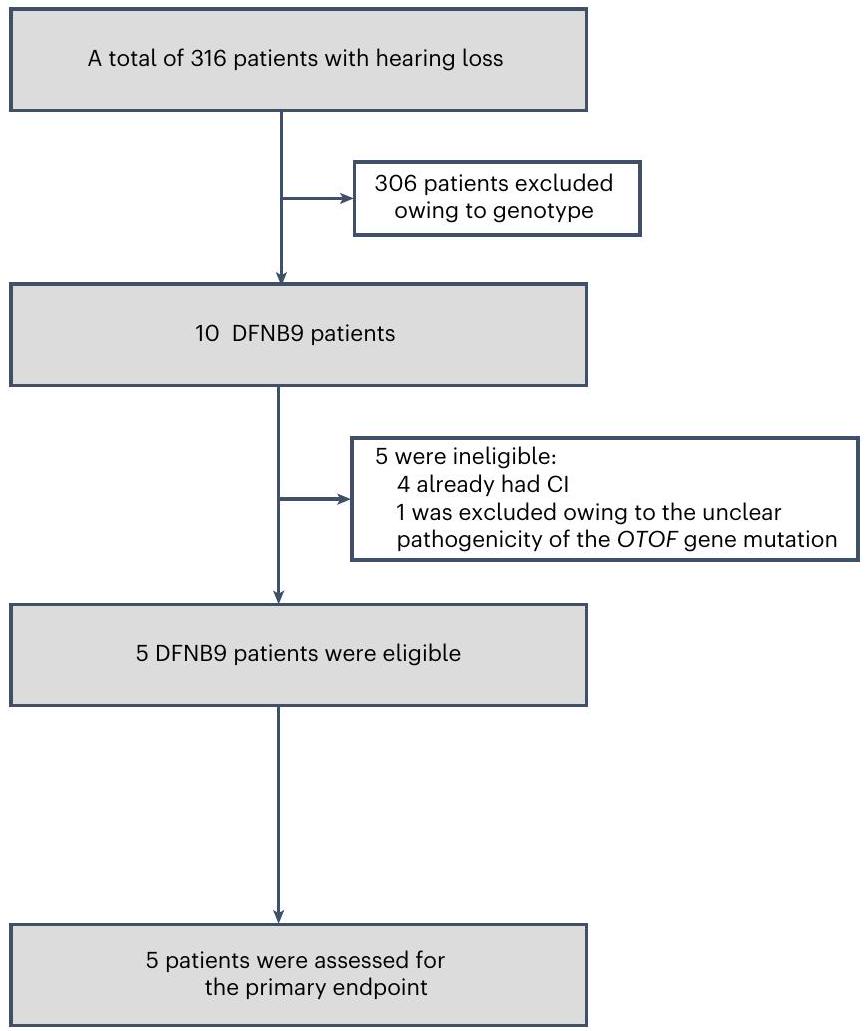
قمنا بفحص 316 مشاركًا لتحديد الأهلية (الشكل 1). تم تسجيل خمسة مرضى أطفال (فتاتان وثلاثة أولاد) يعانون من فقدان السمع الخلقي الثنائي الجانب الناتج عن طفرات ثنائية الأليل في جين OTOF من 14 يوليو 2023 إلى 15 نوفمبر 2023 (الشكل 1 والجدول 1). تفاصيل نتائج تسلسل سانجر و تفسير المتغيرات في المرضى موفر في الشكل 1 من البيانات الموسعة والجدول 1 من البيانات الموسعة. كان متوسط عتبة استجابة جذع الدماغ السمعي (ABR) هو في جميع المرضى في البداية (الجدول 1). لم يتلق أي من المرضى زراعة قوقعة قبل التجربة. جرعة من الجينومات المتجهة (vg) AAV1-hOTOF لكل أذن، تم اختيارها بناءً على الدراسة الأحادية السابقة تم حقنها بعد ذلك في القوقعتين الثنائيتين للمريض من خلال النافذة الدائرية خلال عملية واحدة. لقد أكملنا تقييمًا لمدة 26 أسبوعًا في المرضى 1 و2 و3، وتقييمًا لمدة 13 أسبوعًا في المرضى 4 و5. الدراسة مستمرة.

النتيجة الرئيسية

كان الهدف الأساسي هو السمية المحددة بالجرعة، والتي تم تعريفها على أنها السمية الدموية الدرجة الرابعة، سمية غير دموية الدرجة الثالثة أو السمية السمعية الدرجة 2 خلال 6 أسابيع. تم تقييم الدرجة وفقًا لمعايير المصطلحات الشائعة للأحداث السلبية النسخة 5.0 (CTCAE V5.0). جرعة تم اختيار AAV1-hOTOF للعلاج الثنائي بناءً على نتائج الدراسة الأحادية التي اختبرت جرعات مختلفة. لم تحدث أي سمية محدودة للجرعة في خمسة مرضى يتلقون العلاج الجيني ثنائي الأذن بجرعة من AAV1-hOTOF لكل أذن.

فعالية

تشمل نتائج الفعالية وظيفة السمع وإدراك الكلام. تم استخدام استجابة جذع الدماغ السمعية (ABR) واستجابة الحالة الثابتة السمعية (ASSR) وانبعاثات الصوت الناتجة عن التشوه (DPOAE) والاستبيانات والاختبارات ذات الصلة لتقييم وظيفة السمع وإدراك الكلام وتحديد مصدر الصوت لدى المرضى.
في البداية، كان متوسط عتبة ABR في الأذن اليمنى (اليسرى) هو ( ) في جميع المرضى الخمسة. في المريض 1، تم استعادة متوسط عتبة ABR في الأذن اليمنى (اليسرى) إلى في 4 أسابيع، في الأسبوع السادس، في 13 أسبوعًا و عند 26 أسبوعًا؛ كان متوسط عتبة ASSR في الأذن اليمنى (اليسرى) هو في الأساس، وتم استعادته إلى في 4 أسابيع، في الأسبوع السادس، عند 13 أسبوعًا و53 ديسيبل (58 ديسيبل) عند 26 أسبوعًا (الشكل 2أ). في المريض 2، كان متوسط عتبة ABR في الأذن اليمنى (اليسرى) هو في 4 أسابيع، في الأسبوع السادس، في 13 أسبوعًا و عند 26 أسبوعًا؛ كان متوسط عتبة ASSR في الأذن اليمنى (اليسرى) هو في 4 أسابيع، في الأسبوع السادس، في 13 أسبوعًا و عند 26 أسبوعًا، مقارنةً بـ في البداية (الشكل 2ب). في المريض 3، المتوسط تم استعادة العتبة في الأذن اليمنى (اليسرى) إلى في 4 أسابيع، في الأسبوع السادس، في 13 أسبوعًا و عند 26 أسبوعًا؛ المتوسط
الشكل 1|تسجيل المرضى. تم تسجيل خمسة مرضى لتلقي العلاج الجيني ثنائي الأذن وتم تقييمهم للهدف الأساسي. CI، زراعة القوقعة.
تم استعادة عتبة ASSR في الأذن اليمنى (اليسرى) إلى في 4 أسابيع، في الأسبوع السادس، في 13 أسبوعًا و عند 26 أسبوعًا، مقارنةً بـ في الخط الأساسي (الشكل 2ج). في المريض 4، كان متوسط عتبة ABR في الأذن اليمنى (اليسرى) هو في 4 أسابيع، عند 6 أسابيع و75 ديسيبل (78 ديسيبل) عند 13 أسبوعًا؛ تم استعادة متوسط عتبة ASSR في الأذن اليمنى (اليسرى) إلى في 4 أسابيع، عند 6 أسابيع و عند 13 أسبوعًا، مقارنةً بـ في الخط الأساسي (الشكل 2d). في المريض 5، تم استعادة متوسط عتبة ABR في الأذن اليمنى (اليسرى) إلى في 4 أسابيع، في الأسبوع السادس و عند 13 أسبوعًا؛ تم استعادة متوسط عتبة ASSR في الأذن اليمنى (اليسرى) إلى في 4 أسابيع، عند 6 أسابيع و عند 13 أسبوعًا، مقارنةً بـ في الأساس (الشكل 2e).
في كلتا الأذنين للمرضى 1-3، انخفضت نسبة الإشارة إلى الضوضاء (SNR) في DPOAE عند معظم الترددات بعد 4 أسابيع واستعادت تدريجياً عافيتها في المتابعة اللاحقة (الشكل البياني الممتد 2a-c). في المريض 4، كانت نسبة الإشارة إلى الضوضاء مستقرة عند بعض الترددات بعد 4 أسابيع، وانخفضت إلى حد ما في المتابعة اللاحقة ولم تتعافى عند 13 أسبوعاً (الشكل البياني الممتد 2d). في المريض 5، انخفضت نسبة الإشارة إلى الضوضاء عند بعض الترددات بعد 6 أسابيع واستعادت بعض العافية عند 13 أسبوعاً (الشكل البياني الممتد 2e).
في المريض 1، كانت درجات مقياس الدمج السمعي المعنوي (MAIS) وفئات الأداء السمعي (CAP) 1 و0 على التوالي في البداية، و28 و4 على التوالي بعد 26 أسبوعًا؛ وكانت درجات تقييم وضوح الكلام (SIR) ومقياس الاستخدام المعنوي للكلام (MUSS) 1 و0 على التوالي في البداية، و1 و7 على التوالي بعد 26 أسبوعًا. كانت درجات مقياس الكلام، والسمع المكاني، والخصائص الأخرى للسمع للآباء (SSQ-P)، والسمع المكاني من SSQ-P وخصائص SSQ-P الأخرى هي و 0، على التوالي، في البداية، وتم تحسينها إلى و 5.0، على التوالي، عند 26 أسبوعًا (الجدول 2). في بيئة هادئة، إدراك
الجدول 1 | الخصائص الأساسية للمرضى
المريض 1 المريض 2 المريض 3 المريض 4 المريض 5
جنس أنثى ذكر ذكر أنثى ذكر
العمر (بالسنوات) 11.0 1.2 2.6 3.1 2.8
طفرات في OTOF
الطفرة 1 c.3723G>A (p.Trp1241*) c.1498C>T (p.Arg500*) c.2405_2565del (p.Leu802Glnfs*37) c.5000C>A (p.Ala1667Asp) ج. (p.Glu1733Lys)
الطفرة 2 c.2215-1G>C c.5989del (p.Ala1997Hisfs*68) c.5566C>T (p.Arg1856Trp) c.4030C>T (p.Arg1344*) c.2610_2615dupGCTCTT (p.Leu870_Leu871dup)
عتبة ABR (ديسيبل)
الأذن اليسرى >95 >95 >95 >95 >95
الأذن اليمنى >95 >95 >95 >95 >95
عتبة ASSR (ديسيبل)
الأذن اليسرى ١٠٣ 81 100 ١٠٦ ٨٨
الأذن اليمنى ١٠٣ 79 100 ١٠٦ 85
أقصى مستوى لشدة الصوت.
مفرد المقاطع، ثنائي المقاطع والجملة كانت كلها في الأساس و ، و على التوالي، بعد 26 أسبوعًا من العلاج؛ كان الصوت المحيط، والنغمة، والبدء والنهاية كلها في الأساس، و و 20.8%، على التوالي، عند 26 أسبوعًا (الجدول البياني الموسع 2). بالنسبة لاختبارات تحديد مصدر الصوت، كانت نسبة الخطأ الجذري التربيعي الثنائي (RMSE) في الأساس و عند 26 أسبوعًا؛ عندما تم تغطية أذن واحدة، كانت RMSE الأحادية الجانب ( ) عند 26 أسبوعًا كان أسوأ (الجدول البياني الإضافي 2). في الفيديو التوضيحي 1، لم يكن بإمكان المريض 1 السمع في البداية وتمكن من التعرف على الصوت بعد 4 أسابيع و6 أسابيع من الحقن. في 13 أسبوعًا، كانت قادرة على نطق مقاطع مثل ‘ ‘, ‘ ‘ (أب)، ‘i’، ‘u’، ‘s’ و ‘ma’ (أم). كانت قادرة على إكمال اختبار تحديد الموقع الصوتي بشكل جيد في الأسبوع الثالث عشر.
في المريض 2، كانت درجات مقياس MAIS للأطفال الرضع والأطفال الصغار (IT-MAIS) وCAP هي 0 و0 على التوالي عند خط الأساس، و35 و5 على التوالي عند 26 أسبوعًا؛ وكانت درجات SIR وMUSS هي 1 و0 على التوالي عند خط الأساس، و2 و9 على التوالي عند 26 أسبوعًا؛ وكانت درجات الكلام في SSQ-P، والفضاء في SSQ-P، والخصائص الأخرى في SSQ-P جميعها 0 عند خط الأساس و و 8.5، على التوالي، عند 26 أسبوعًا (الجدول 2). في الفيديو التكميلي 2، لم يتمكن المريض 2 من الاستجابة للصوت والموسيقى في البداية، لكنه كان قادرًا على التوجه نحو مصدر الصوت عندما تم مناداته باسمه من الجانبين الأيسر والأيمن من خلفه بعد 6 أسابيع من الحقن. كان بإمكانه الرقص على أنغام الموسيقى وإتمام بعض التعليمات البسيطة عند 15 أسبوعًا، وكان بإمكانه قول بعض الكلمات البسيطة، مثل ‘أي’ (عمة) و ‘باي’ (وداعًا)، والتواصل مع الآخرين عند 26 أسبوعًا.
في المريض 3، كانت درجات IT-MAIS أو MAIS و CAP جميعها 0 في البداية، و 35 و 5 على التوالي، في 26 أسبوعًا؛ كانت درجات SIR و MUSS 1 و 0 على التوالي، في البداية، و 2 و 15 على التوالي، في 26 أسبوعًا؛ كانت درجات الكلام في SSQ-P، والفضاء في SSQ-P، والخصائص الأخرى في SSQ-P جميعها 0 في البداية، و 7.3 و 8.0 و 8.5 على التوالي، في 26 أسبوعًا (الجدول 2). في الفيديو التكميلي 3، لم يكن لدى المريض 3 استجابة للصوت والموسيقى في البداية، لكنه استطاع أن يستدير عندما تم مناداته باسمه بعد 3 أسابيع من الحقن. في 13 أسبوعًا، كان قادرًا على تحريك جسده والرقص عندما سمع الموسيقى. كان قادرًا على قول بعض الكلمات البسيطة في 26 أسبوعًا، مثل ‘بابا’ (الأب)، ‘نينا’ (الجدة) و ‘ييه’ (الجد).
في المريض 4، كانت درجات MAIS و CAP هي 2 و 0، على التوالي، في البداية، و 16 و 4، على التوالي، بعد 13 أسبوعًا؛ كانت درجات SIR و MUSS هي 1 و 2، على التوالي، في البداية، و 1 و 7، على التوالي، بعد 13 أسبوعًا؛ كانت درجات الكلام في SSQ-P، والفضاء في SSQ-P، والخصائص الأخرى في SSQ-P هي و 0، على التوالي، في الأساس، و و 4.5، على التوالي، عند 13 أسبوعًا (الجدول 2). في
الفيديو التكميلية 4، المريض 4 لم يكن لديه استجابة للصوت في البداية، لكنه استطاع أن يستدير عندما تم مناداته باسمه بعد 4 أسابيع من الحقن. استطاعت إتمام بعض التعليمات بعد 13 أسبوعًا، وتمكنت من قول كلمات بسيطة بعد 20 أسبوعًا، مثل ‘بابا’ (الأب)، ‘ماما’ (الأم) و’ناينا’ (الجدة).
في المريض 5، كانت درجات IT-MAIS أو MAIS، وCAP، 2 و0 على التوالي، عند خط الأساس، و29 و4 على التوالي، عند 13 أسبوعًا؛ كانت درجات SIR وMUSS 1 و0 على التوالي، عند خط الأساس، و2 و7 على التوالي، عند 13 أسبوعًا؛ كانت درجات الكلام في SSQ-P، والفضاء في SSQ-P، والخصائص الأخرى في SSQ-P و 0، على التوالي، في الأساس، و و 6.6، على التوالي، في 13 أسبوعًا (الجدول 2).

السلامة

لتقليل الاستجابة الالتهابية المحتملة، تم استخدام الديكساميثازون عن طريق الوريد لمدة 8 أيام بدءًا من 3 أيام قبل حقن AAV1-hOTOF الثنائي. لم تحدث أي أحداث سلبية خطيرة. حدثت 36 حدثًا سلبيًا إجماليًا (الجدول 3)، بما في ذلك القيء (المريض 1)، الحمى (المريض 2)، زيادة عدد اللمفاويات (المرضى 1-4)، انخفاض عدد اللمفاويات (المريض 3)، انخفاض عدد العدلات (المريض 2)، انخفاض مستويات الهيموغلوبين (المرضى 2 و3)، زيادة مستويات الدهون الثلاثية (المريض 2)، زيادة مستويات الكوليسترول (المرضى 2-5)، انخفاض مؤقت في مستويات الفيبرينوجين (المريض 3)، زيادة مستويات كرياتين فوسفو كيناز (المريض 2)، انخفاض مستويات هابتوغلوبين (المرضى 1 و5)، زيادة مستويات لاكتات ديهيدروجيناز (المرضى 2-5)، ارتفاع سكر الدم (المريض 5)، بروتينوريا (المريض 1) ووجود دم في البول (المرضى 1 و4). كانت جميع الأحداث السلبية الـ 36 من الدرجة 1 أو 2. كانت أكثر الأحداث السلبية شيوعًا هي زيادة عدد اللمفاويات (6 من 36) وزيادة مستويات الكوليسترول (6 من 36)، تليها زيادة مستويات لاكتات ديهيدروجيناز (5 من 36). في المريض 1، حدث القيء بعد ساعتين من الحقن وتم حله بالعلاج العرضي خلال يوم واحد. في المريض 2، الحمى (أعلى درجة حرارة، حدثت ( ) بعد 18 يومًا و29 يومًا من الحقن، مع سعال خفيف وزيادة في عدد اللمفاويات، ولكن لا توجد أدلة على الالتهاب الرئوي أو أعراض مصاحبة أخرى.
بالإضافة إلى ذلك، تم ملاحظة هيكل الأذنين بواسطة التصوير المقطعي المحوسب والتصوير بالرنين المغناطيسي، مما يظهر طبيعة هيكل الأذن بعد الحقن (البيانات الموسعة الأشكال 3 و 4).
تم زيادة الأجسام المضادة المحايدة ضد AAV1 في جميع المرضى بعد 6 أسابيع من العلاج (البيانات الموسعة الجدول 3). لم يكن من الممكن الكشف عن الحمض النووي للناقل في الدم في أي مريض بعد 7 أيام من العلاج (البيانات الموسعة الجدول 3). إنترفيرون غاما (IFN- استجابات اختبار النقاط المناعية المرتبطة بالإنزيم (ELISpot) لببتيد غلاف AAV1

مريض 1

الشكل 2 | اختبار السمع. أ-هـ، عتبات ABR و ASSR للمرضى 1(أ)، 2(ب)، 3(ج)، 4(د) و 5(هـ). تشير الأسهم إلى عدم وجود استجابة حتى عند أقصى مستوى من شدة الصوت. الأسهم التي تشير إلى اليسار والأسفل، للأذن اليمنى؛ الأسهم التي تشير إلى اليمين والأسفل، للأذن اليسرى.
الجدول 2 | درجات السمع، إدراك الكلام وتحديد الموقع الصوتي
مايس أو آي تي-مايس قبعة سيدي موس SSQ-P
خطاب مكاني صفات أخرى
المريض 1 خط الأساس 1 0 1 0 0.3 0 0
6 أسابيع ٨ 1 1 0 ٥.٠ 0 0
13 أسبوعًا 17 1 1 2 7.8 1.7 2.5
26 أسبوعًا ٢٨ ٤ 1 ٧ 7.8 2.8 5.0
المريض 2 خط الأساس 0 0 1 0 0 0 0
6 أسابيع 12 2 1 2 ٣.٣ 3.3 0.6
13 أسبوعًا 30 ٤ 1 ٤ 3.3 3.3 3.8
26 أسبوعًا ٣٥ ٥ 2 9 ٦.٧ 5.3 8.5
المريض 3 خط الأساس 0 0 1 0 0 0 0
6 أسابيع 21 1 1 2 3.9 1.7 2.5
13 أسبوعًا 32 2 1 ٤ ٥.٠ ٤.٢ ٥.٦
26 أسبوعًا ٣٥ ٥ 2 15 7.3 ٨.٠ 8.5
المريض 4 خط الأساس 2 0 1 2 0.3 0 0
6 أسابيع 9 2 1 ٤ 1.9 0.8 3.6
13 أسبوعًا 16 ٤ 1 ٧ 3.6 5.8 ٤.٥
المريض 5 خط الأساس 2 0 1 0 0.2 0 0
6 أسابيع 31 ٣ 2 ٧ 7.4 7.0 ٥.٦
13 أسبوعًا ٢٩ ٤ ٢ ٧ ٧.٦ 7.2 6.6
تم استخدام استبيانات MAIS وIT-MAIS وCAP وSIR وMUSS لتقييم الوظيفة السمعية وإدراك الكلام. تم استخدام SSQ-P، بما في ذلك الكلام والفضاء والخصائص الأخرى، لتقييم تحديد موقع مصدر الصوت. المرضى الذين تتراوح أعمارهم تم تقييم المرضى الذين تتراوح أعمارهم بين 3 سنوات باستخدام مقياس MAIS؛ بينما تم تقييم المرضى الذين تقل أعمارهم عن 3 سنوات باستخدام مقياس IT-MAIS. تم تقييم المريضين 1 و 4 باستخدام مقياس MAIS، وتم تقييم المريض 2 باستخدام مقياس IT-MAIS. تم تقييم المريض 3 باستخدام مقياس IT-MAIS (في البداية، بعد 6 أسابيع و 13 أسبوعًا) ومقياس MAIS (بعد 26 أسبوعًا). تم تقييم المريض 5 باستخدام مقياس IT-MAIS (في البداية وبعد 6 أسابيع) ومقياس MAIS (بعد 13 أسبوعًا).
كانت المسابح التي تحتوي على خلايا الدم المحيطية الوحيدة النواة (PBMCs) المأخوذة من كل مريض بعد 6 أسابيع من العلاج الجيني ثنائي الأذن AAV1-hOTOF سلبية (الشكل البياني الموسع 5)

نقاش

هنا نبلغ عن نتائج تجربة سريرية على البشر تحقق في العلاج الجيني ثنائي الأذن لفقدان السمع. من حيث السلامة، لم تحدث أي سمية محددة للجرعة أو آثار جانبية خطيرة خلال فترة المتابعة، وكانت جميع الآثار الجانبية الـ 36 من الدرجة 1 أو 2. من حيث الفعالية، أعاد العلاج الجيني OTOF ثنائي الجانب السمع الثنائي في جميع المرضى الخمسة؛ وأظهر جميع المرضى تحسنًا في الوظائف السمعية والكلام، واستعادة تحديد مصدر الصوت.
للعلاج الجيني الثنائي الأذنين، تم حقن AAV1-hOTOF في الأذن الداخلية، مقارنةً بحقن أحادي الجانب لـ (ref.11). تم تمديد الوقت التشغيلي وتضاعفه خلال الحقن الثنائي، مقارنةً بالحقن الأحادي. أيضًا، كان المرضى الذين يتلقون العلاج الجيني الثنائي الأذن أصغر سنًا نسبيًا (بمتوسط عمر 2.8 سنوات) من المرضى الذين يتلقون العلاج الجيني الأحادي (بمتوسط عمر 4.1 سنوات). تشير هذه العوامل إلى أن المرضى الذين يتلقون العلاج الجيني الثنائي الأذن يواجهون مخاطر محتملة أكبر. لتقليل الاستجابة الالتهابية ومخاطر العدوى المحتملة، تم إعطاء الديكساميثازون والسيفترياكسون عن طريق الوريد. خلال الجراحة، تم تنفيذ إجراءات التشغيل القياسية، وبعد الحقن، تم تقديم رعاية تمريضية مهنية. خلال المتابعة، لم يتم ملاحظة أي سمية محدودة بالجرعة، أو عدوى في الأذن أو عدوى جهازية، أو آثار جانبية خطيرة. كانت جميع الآثار الجانبية 36 من الدرجة 1 أو 2 (الجدول 3). مشابهًا للعلاج الجيني الأحادي، الـ IFN- كانت استجابات ELISpot لمجموعات ببتيد غلاف AAV1 وDNA الناقل في الدم سلبية خلال المتابعة الثنائية (الشكل 5 من البيانات الموسعة والجدول 3 من البيانات الموسعة). كان تركيز الأجسام المضادة المحايدة في 5 مرضى خضعوا للعلاج الجيني الثنائي عند 6 أسابيع هو 1:1,215، بينما كان التركيز في 5 مشاركين يتلقون جرعة من لحقن أحادي الجانب كان 1:135-1:3,645 (3 مرضى مع
الجدول 3 | الآثار الجانبية
عدد الفعاليات درجة عدد المرضى
أي AE ٣٦ ٥
زيادة في عدد اللمفاويات ٦ 2 ٤
انخفاض عدد اللمفاويات 1 1 1
انخفاض عدد العدلات 1 2 1
انخفاض مستويات الهيموغلوبين 2 1 2
زيادة مستويات اللاكتات ديهيدروجيناز ٥ 1 ٤
ارتفاع مستويات الدهون الثلاثية 2 2 1
زيادة مستويات الكوليسترول ٥ 1 ٤
زيادة مستويات الكوليسترول 1 ٢ 1
انخفاض مستويات الفيبرينوجين 1 1 1
زيادة مستويات الكرياتين فوسفو كيناز 1 1 1
انخفاض مستويات الهبتوجلوبين 2 1 2
بروتينوريا 2 1 1
بيلة دموية ٣ 1 2
حمى 2 1 1
قيء 1 1 1
فرط سكر الدم 1 1 1
1:135-1:405 الأجسام المضادة المحايدة) بعد 6 أسابيع. تشير النتيجة إلى أن الأجسام المضادة المحايدة كانت أعلى نسبيًا في مجموعة الحقن الثنائية مقارنة بمجموعة الحقن الأحادية، وهو ما كان متوقعًا.
نظرًا لزيادة الحمل الفيروسي. كانت السبب الدقيق للحمى في المريض 2 غير معروف. قد يكون ناتجًا عن الإنفلونزا، حيث لم تُلاحظ أي أعراض أو شذوذات مصاحبة أخرى، باستثناء السعال الخفيف وارتفاع عدد اللمفاويات. تشير هذه النتائج إلى أن العلاج الجيني الثنائي الأذنين باستخدام AAV1-hOTOF كان آمنًا نسبيًا في مرضى DFNB9 من خلال جراحة لمرة واحدة.
أظهر تحليل الفعالية تحسن السمع ثنائي الأذن في جميع المرضى الخمسة. مقارنةً بـ في البداية، كان متوسط عتبة ABR في الأذن اليمنى (اليسرى) قد تحسن إلى في المريض 1 و 55 ديسيبل (50 ديسيبل) في المريض 3 بعد 26 أسبوعًا من الحقن (الشكل 2أ، ج)؛ كان متوسط عتبة ABR في الأذن اليمنى (اليسرى) هو في المريض 4 و63 ديسيبل في المريض 5 عند 13 أسبوعًا (الشكل 2د، هـ). تشير النتائج إلى أن تحسين السمع متشابه في كلا الأذنين لدى المرضى. وعند 26 أسبوعًا، في المريض 2، أظهر الأذن اليمنى (اليسرى) تحسنًا بأكثر من من متوسط عتبة ABR (الشكل 2ب). قد يكون تسرب محتوى AAV1-hOTOF من النافذة الدائرية أثناء أو بعد الحقن هو السبب وراء التحسن المتواضع في السمع لدى المريض 2. سبب آخر للاختلاف في الاستجابة للعلاج الجيني بين المرضى قد يكون مرتبطًا بالاختلافات الفردية. بعد العلاج، استجاب المريض 2 للصوت، بما في ذلك الرقص على الموسيقى، كما هو موضح في الفيديو التكميلي 2. قد يساهم التحسن الأفضل في عتبة ABR عند 0.25 كيلوهرتز جزئيًا في استجابته الحساسة للصوت في الحياة اليومية.
كان المتوسط الحسابي لعتبات ABR المتوسطة للأذنين العشر في 5 مرضى يتلقون العلاج الثنائي 69 ديسيبل بعد 13 أسبوعًا من الحقن، بينما كان المتوسط الحسابي لعُتبات ABR المتوسطة للأذنين الخمس في 5 مرضى يتلقون جرعة من للعلاج الأحادي كان عند 13 أسبوعًا (مرجع 11). كان المتوسط الحسابي لعتبات ASSR المتوسطة عند 13 أسبوعًا 60 ديسيبل للمرضى الذين تلقوا العلاج الجيني الثنائي الجانب و67 ديسيبل للمرضى الذين تم إعطاؤهم العلاج أحادي الجانب. AAV1-hOTOF .
قامت الدراسة أيضًا بتقييم الفوائد الإضافية لعلاج الأذنين الثنائي للمرضى المصابين بـ DFNB9 في بيئة صاخبة وتحديد مصدر الصوت. من المعروف أن السمع الثنائي يحسن من إدراك الكلام في بيئة صاخبة ويعتبر ضروريًا لتحسين إدراك الموسيقى، وتحديد مصدر الصوت، وزيادة الرضا عن الحياة. لتقييم قدرة المريض على الإدراك السمعي والكلام، استخدمنا استبيانات مناسبة ولاحظنا أن درجات MAIS أو IT-MAIS، CAP أو MUSS قد تحسنت في خمسة مرضى (الجدول 2)، مما يشير إلى تحسن الوظيفة السمعية وإدراك الكلام. كما أظهرت الاختبارات ومقاطع الفيديو تحسن إدراك الكلام لدى المرضى (الجدول الإضافي 2 ومقاطع الفيديو التكميلية 1-4). كانت هذه النتائج مرتبطة بانخفاض عتبات ABR وASSR (الشكل 2). معلومات الموسيقى هي إشارة صوتية معقدة. في هذه الدراسة، أظهر المرضى 2 و3 القدرة على تقدير الموسيقى بعد 13-15 أسبوعًا من العلاج الجيني AAV1-hOTOF، كما يتضح من حركات رقصهم عند الاستماع إلى الموسيقى (مقاطع الفيديو التكميلية 2 و3). نظرًا لصغر سنهم وقصر فترة المتابعة، هناك حاجة إلى تقييم أكثر تفصيلاً خلال الزيارات اللاحقة.
القدرة على تحديد مصدر الصوت، وتحديد موقع مصدر الصوت في ثلاثة أبعاد، مهمة للتواصل الكلامي والسلامة اليومية مثل القيادة. كان لدى المرضى فقدان سمع خلقي دون القدرة على تحديد مصدر الصوت قبل العلاج. بعد العلاج الجيني، تم استعادة القدرة على تحديد مصدر الصوت في جميع المرضى، كما أشار إلى ذلك استبيانات SSQ-P، والفيديوهات، والاختبارات (الجدول 2، الفيديوهات التكميلية 1 و2، والجدول الممتد 2). في المريض 2، كان تحسين متوسط عتبة ABR هو في الأذن اليسرى و في الأذن اليمنى عند 26 أسبوعًا؛ أظهر متوسط عتبة ASSR تحسنًا من في الأذن اليمنى (اليسرى) عند 26 أسبوعًا (الشكل 2ب). من المثير للاهتمام أن المريض 2 استعاد القدرة على تحديد مصدر الصوت، مما يشير إلى أن حتى التحسن الطفيف في الوظيفة السمعية كان كافيًا لإعادة تكوين القدرة على تحديد مصدر الصوت.
تم ربط استعادة السمع الثنائي بالأداء الأفضل في إدراك الكلام في بيئة ضوضائية، وقدرة تحديد موقع مصدر الصوت، وزيادة الرضا عن الحياة وجودتها لدى المرضى. .
تظهر نتائجنا أن العلاج الجيني ثنائي الأذن AAV1-hOTOF للمرضى الذين يعانون من DFNB9 قابل للتطبيق وآمن وفعال. توسع الدراسة نطاق علاج DFNB9، مما قد يحسن التدخل السريري للصمم الوراثي ويعزز التحول السريري للعلاج الجيني للصمم الوراثي الناجم عن جينات صمم أخرى. بالنسبة للأطفال الذين يعانون من فقدان السمع الخلقي، نوصي بتنفيذ فحص جيني شامل حتى يمكن إجراء التدخل المبكر. في المستقبل، يجب استكشاف العلاج الجيني وزرع القوقعة في تجربة عشوائية أكبر.
تقتصر هذه التجربة على عدد قليل من المرضى وفترة المتابعة القصيرة نسبيًا. التجربة مستمرة؛ هناك حاجة لزيارة متابعة طويلة الأمد ومزيد من المرضى لمزيد من التحقيق.
في الختام، لم يتسبب العلاج الجيني ثنائي الأذن AAV1-hOTOF في سمية محدودة بالجرعة أو آثار جانبية خطيرة في خمسة مرضى تم علاجهم. أدى العلاج الجيني ثنائي الأذن AAV1-hOTOF إلى استعادة السمع الثنائي، وتحسين الوظيفة السمعية والكلام، واستعادة القدرة على تحديد مصدر الصوت في جميع المرضى المعالجين.

المحتوى عبر الإنترنت

أي طرق، مراجع إضافية، ملخصات تقارير Nature Portfolio، بيانات المصدر، بيانات موسعة، معلومات إضافية، شكر وتقدير، معلومات مراجعة الأقران؛ تفاصيل مساهمات المؤلفين والمصالح المتنافسة؛ وبيانات توفر البيانات والرموز متاحة على https://doi.org/10.1038/s41591-024-03023-5.

References

  1. WHO. Deafness and hearing loss. https://www.who.int/ news-room/fact-sheets/detail/deafness-and-hearing-loss (WHO, 2O24).
  2. Morton, C. C. & Nance, W. E. Newborn hearing screening-a silent revolution. N. Engl. J. Med. 354, 2151-2164 (2006).
  3. GBD 2017 Disease and Injury Incidence and Prevalence Collaborators. Global, regional, and national incidence, prevalence, and years lived with disability for 354 diseases and injuries for 195 countries and territories, 1990-2017: a systematic analysis for the Global Burden of Disease Study 2017. Lancet 392, 1789-1858 (2018).
  4. Roux, I. et al. Otoferlin, defective in a human deafness form, is essential for exocytosis at the auditory ribbon synapse. Cell 127, 277-289 (2006).
  5. Yasunaga, S. et al. A mutation in OTOF, encoding otoferlin, a FER-1-like protein, causes DFNB9, a nonsyndromic form of deafness. Nat. Genet. 21, 363-369 (1999).
  6. Sloan-Heggen, C. M. et al. Comprehensive genetic testing in the clinical evaluation of 1119 patients with hearing loss. Hum. Genet. 135, 441-450 (2016).
  7. Rodríguez-Ballesteros, M. et al. A multicenter study on the prevalence and spectrum of mutations in the otoferlin gene (OTOF) in subjects with nonsyndromic hearing impairment and auditory neuropathy. Hum. Mutat. 29, 823-831 (2008).
  8. Iwasa, Y. I. et al. OTOF mutation analysis with massively parallel DNA sequencing in 2,265 Japanese sensorineural hearing loss patients. PLoS ONE 14, e0215932 (2019).
  9. Choi, B. Y. et al. Identities and frequencies of mutations of the otoferlin gene (OTOF) causing DFNB9 deafness in Pakistan. Clin. Genet. 75, 237-243 (2009).
  10. Zhang, L. et al. Preclinical evaluation of the efficacy and safety of AAV1-hOTOF in mice and nonhuman primates. Mol. Ther. Methods Clin. Dev. 31, 101154 (2023).
  11. Lv, J. et al. AAV1-hOTOF gene therapy for autosomal recessive deafness 9: a single-arm trial. Lancet https://doi.org/10.1016/ S0140-6736(23)02874-X (2024).
  12. Ma, N., Morris, S. & Kitterick, P. T. Benefits to speech perception in noise from the binaural integration of electric and acoustic signals in simulated unilateral deafness. Ear Hear. 37, 248-259 (2016).
  13. Dunn, C. C., Tyler, R. S., Oakley, S., Gantz, B. J. & Noble, W. Comparison of speech recognition and localization performance in bilateral and unilateral cochlear implant users matched on duration of deafness and age at implantation. Ear Hear. 29, 352-359 (2008).
  14. Calcedo, R., Vandenberghe, L. H., Gao, G., Lin, J. & Wilson, J. M. Worldwide epidemiology of neutralizing antibodies to adeno-associated viruses. J. Infect. Dis. 199, 381-390 (2009).
  15. Verdera, H. C., Kuranda, K. & Mingozzi, F. AAV vector immunogenicity in humans: a long journey to successful gene transfer. Mol. Ther. 28, 723-746 (2020).
  16. George, L. A. et al. Hemophilia B gene therapy with a high-specific-activity factor IX variant. N. Engl. J. Med. 377, 2215-2227 (2017).
  17. Manno, C. S. et al. Successful transduction of liver in hemophilia by AAV-Factor IX and limitations imposed by the host immune response. Nat. Med. 12, 342-347 (2006).
  18. Halbert, C. L. et al. Transduction by adeno-associated virus vectors in the rabbit airway: efficiency, persistence, and readministration. J. Virol. 71, 5932-5941 (1997).
  19. Greenberg, B. et al. Prevalence of AAV1 neutralizing antibodies and consequences for a clinical trial of gene transfer for advanced heart failure. Gene Ther. 23, 313-319 (2016).
  20. Sheffield, S. W., Wheeler, H. J., Brungart, D. S. & Bernstein, J. G. W. The effect of sound localization on auditory-only and audiovisual speech recognition in a simulated multitalker environment. Trends Hear. https://doi.org/10.1177/23312165231186040 (2023).
Publisher’s note Springer Nature remains neutral with regard to jurisdictional claims in published maps and institutional affiliations.
Open Access This article is licensed under a Creative Commons Attribution 4.0 International License, which permits use, sharing, adaptation, distribution and reproduction in any medium or format, as long as you give appropriate credit to the original author(s) and the source, provide a link to the Creative Commons licence, and indicate if changes were made. The images or other third party material in this article are included in the article’s Creative Commons licence, unless indicated otherwise in a credit line to the material. If material is not included in the article’s Creative Commons licence and your intended use is not permitted by statutory regulation or exceeds the permitted use, you will need to obtain permission directly from the copyright holder. To view a copy of this licence, visit http://creativecommons. org/licenses/by/4.0/.
(c) The Author(s) 2024

Hui Wang , Yuxin Chen , Jun Lu , Xiaoting Cheng , Qi Cao , Daqi Wang , Longlong Zhang , Biyun Zhu , Min Shen , Chunxin Xu , Mengzhao Xun , Zijing Wang , Honghai Tang , Shaowei Hu , Chong Cuil , Luoying Jiang , Yanbo Yin , Luo Guo , Yi Zhou , Lei Han , Ziwen Gao , Jiajia Zhang , Sha Yu , Kaiyu Gao , Jinghan Wang , Bing Chen , Wuqing Wang , Zheng-Yi Chen , Huawei Li & Yilai Shu

طرق

تصميم الدراسة والمرضى

تم إجراء هذه التجربة ذات الذراع الواحد والمركز الواحد في مستشفى العيون والأنف والأذن في جامعة فودان (شنغهاي، الصين). كان المرضى (من 1 إلى 18 عامًا) الذين لديهم تشخيص جيني مؤكد لطفرات جينية ثنائية الأليل في جين OTOF ومتوسط عتبات ABR في كلا الأذنين مؤهلين. تضمنت معايير الاستبعاد وجود نسبة من عيار الأجسام المضادة المحايدة ضد AAV1 > 1:2,000. يتم سرد معايير الإدراج والاستبعاد بالتفصيل أدناه.

معايير إدراج المرضى.

(1) يمكن للمشاركين أو الأوصياء القانونيين عليهم فهم وتوقيع نموذج الموافقة المستنيرة لهذه الدراسة طواعية ومستعدين للتعاون مع زيارات المتابعة في النقاط الزمنية المحددة في التجربة.
(2) يمكن للمشاركين التواصل بشكل جيد مع الباحثين والامتثال للمتطلبات بمساعدة الأوصياء. يمكن للأطفال الصغار الذين لا يمتلكون مهارات لغوية ناضجة التعاون والامتثال للمتطلبات بمساعدة الأوصياء.
(3) فهم صحيح للتجربة وتوقع مناسب للفوائد.
(4) سنوات؛ الجنس غير محدود.
(5) تم تحديد تشخيص DFNB9 للصمم الخلقي بناءً على الأعراض السريرية وتحليل طفرات الجينات لوجود طفرات OTOF متماثلة الزيجوت أو ثنائية الأليل في OTOF.
(6) معيار الإدراج السمعي: فقدان سمع شديد إلى كامل ( ).
(7) يفي المشاركون بمتطلبات الجراحة الأذنية. يتم استبعاد المشاركين الذين يعانون من تشوهات الأذن الوسطى والداخلية، أو اضطرابات تطور العصب الدهليزي القوقعي، أو التهاب الأذن وما إلى ذلك، والتي تم تحديدها من خلال التصوير المقطعي المحوسب (CT) و/أو التصوير بالرنين المغناطيسي (MRI) خلال 3 أشهر أو أثناء الفحص.

معايير استبعاد المرضى.

(1) لا تشير تحليلات الجينات إلى أي طفرة في OTOF أو تشير تحليلات الجينات إلى طفرات جينية مصاحبة أخرى تسبب فقدان السمع.
(2) أنواع أخرى من الصمم التي لا تناسب الجراحة الأذنية، مثل الصمم التوصيلي، الصمم المختلط، متلازمة التشوهات الناتجة عن خلل أو تشوه الأذن الوسطى والداخلية، وعيوب العصب الدهليزي أو العصب القوقعي التي تم تحديدها من خلال التصوير المقطعي أو التصوير بالرنين المغناطيسي خلال 3 أشهر.
(3) أمراض أذنية موجودة مسبقًا قد تتداخل مع تفسير نقاط نهاية الدراسة، مثل التهاب الأذن الوسطى الحاد المزمن، مرض منيير، ورم العصب السمعي أو فقدان السمع المفاجئ غير المتعافي.
(4) تاريخ من تعاطي المخدرات، أي علاج دوائي سمي للأذن (مثل الأمينوغليكوزيدات، سيسبلاتين أو مدرات البول الحلقي) خلال 6 أشهر، علاج مضاد للفيروسات أو علاج مناعي خلال 3 أشهر، أو تطعيم خلال شهر واحد.
(5) تاريخ من نقص المناعة المعقد أو زراعة الأعضاء.
(6) المرضى الذين يعانون من أمراض جهازية شديدة أو عدوى بكتيرية أو فيروسية نشطة، مثل السل الرئوي، عدوى التهاب الكبد B أو C النشطة، عدوى الهربس النطاقي النشطة، التهاب البنكرياس، فشل الكلى أو قرحات الجهاز الهضمي.
(7) المرضى الذين لديهم موانع للجراحة أو التخدير معتمدة من الجراح أو طبيب التخدير أو المفوض، مثل الحساسية تجاه دواء الدراسة وحادث وعائي قلبي أو دماغي حدث خلال الأشهر الستة الماضية، بما في ذلك احتشاء عضلة القلب، فشل القلب، الذبحة الصدرية، حادث وعائي دماغي أو نوبة إقفارية عابرة.
(8) المشاركة حاليًا في أو التخطيط للمشاركة في تجربة سريرية أخرى تتعلق بدواء أو جهاز خلال عام واحد، أو خلال 5 نصف أعمار بعد آخر جرعة في تجربة سريرية أخرى.
(9) زراعة أذنين ثنائية (على سبيل المثال، زراعة القوقعة).
(10) مع >1:2,000 من الأجسام المضادة المحايدة ضد غلاف AAV1.
(11) أمراض خلقية شديدة أخرى.
(12) تاريخ واضح من الاضطرابات العصبية أو النفسية، بما في ذلك الصرع أو الخرف.
(13) المرضى الذين يحتاجون إلى مضادات التخثر طويلة الأمد ولا يمكن إيقافها على المدى القصير.
(14) تاريخ من العلاج الإشعاعي والعلاج الكيميائي.
(15) حالات أخرى يعتبرها الباحثون غير مناسبة للمشاركة في الدراسة السريرية الحالية.
لتعزيز السلامة، تم تسجيل الأطفال الأكبر سنًا (الذين تتراوح أعمارهم بين سنوات) أولاً، تليها الأطفال الأصغر. تم تسجيل المرضى بشكل متسلسل بعد تقييم سمية الجرعة المحدودة. أولاً، أجرينا علاجًا جينيًا أحادي الجانب AAV1-hOTOF بما في ذلك مريض واحد يتلقى جرعة من و5 مرضى يتلقون جرعة من . أظهرت النتائج أن العلاج الجيني أحادي الجانب AAV1-hOTOF آمن وفعال وقد تم نشره مؤخرًا . بعد ذلك، قمنا بتوسيع الدراسة إلى العلاج الجيني الثنائي لتوفير فوائد إضافية للمرضى، بما في ذلك تحسين إدراك الكلام في بيئة ضوضاء، والقدرة على تحديد مصدر الصوت وارتفاع رضا الحياة. أجرينا الدراسة بعد تعديل البروتوكول الذي تمت الموافقة عليه من قبل لجنة الأخلاقيات. بناءً على السلامة والفعالية للجرعة في عدة مرضى في دراسة العلاج الجيني أحادي الجانب، اخترنا جرعة من لكل أذن للعلاج الجيني الثنائي. بالنسبة للعلاج الجيني الثنائي، كان أول مريض يبلغ من العمر 11.0 عامًا؛ بعد ذلك، تم تسجيل الأطفال الأصغر.
تمت الموافقة على التجربة من قبل لجنة الأخلاقيات في مستشفى العيون والأنف والأذن في جامعة فودان وتم تنفيذها وفقًا لمبادئ إعلان هلسنكي. تم الحصول على موافقة مستنيرة مكتوبة من الآباء أو الأوصياء القانونيين للأطفال قبل التسجيل. قبل مشاركة مقاطع الفيديو للمرضى، تم الحصول على الموافقة مرة أخرى. كانت هناك لجنة لمراقبة السلامة مشاركة في الدراسة.

تعديل البروتوكول

بالنسبة للعلاج الجيني أحادي الجانب، تمت الموافقة على البروتوكول من قبل لجنة الأخلاقيات في مستشفى العيون والأنف والأذن في جامعة فودان في 24 يونيو 2022. تم تسجيل التجربة بشكل استباقي في سبتمبر 2022. خلال التجربة، تم تعديل البروتوكول لجعله أكثر منطقية وقابلية للتنفيذ، مع الأخذ في الاعتبار المخاطر والفوائد السريرية للموضوعات المشاركة. قدمنا تعديلات البروتوكول بالتفصيل هنا وفي المعلومات الإضافية.

تعديلات البروتوكول.

(1) تم توسيع عمر المشاركين (من 3-10 سنوات إلى 1-18 عامًا).
(2) تم توسيع عدد المرضى المسجلين (من 2-3 حالات إلى حالات)، ويمكن تسجيل المزيد من المرضى في مجموعة بعد التأكد من حدوث سمية الجرعة المحدودة في من المرضى في هذه المجموعة.
(3) إضافة مجموعة جرعة استكشافية بديلة ( ).
(4) إضافة خيار الحقن المزدوج (بما في ذلك الحقن الثنائي).
(5) لتقييم الكلام، إزالة طريقة صن شيبين وإضافة مقياس تقييم الأداء السمعي (CAP) وSIR.
(6) إضافة مؤشرات إضافية (أي، تصوير الوظائف الضوئية بالأشعة تحت الحمراء القريبة، تخطيط الدماغ الكهربائي، اختبار الموسيقى، ومقاييس النمو والتطور).
(7) ضبط نقاط المتابعة لعملية التنظير الأذني ووظيفة التوازن.
(8) أضف نقاط زمنية للمتابعة لجمع الدم.
ستوفر العلاج الجيني الثنائي لجين OTOF فوائد مهمة لمرضى DFNB9. بعد تأكيد سلامة وفعالية العلاج الجيني الأحادي في مرضى DFNB9 قمنا بتوسيع التجربة لتشمل الإدارة الثنائية. تم اعتماد البروتوكول المنقح من قبل لجنة الأخلاقيات في مستشفى العيون والأنف والأذن والحنجرة بجامعة فودان في 6 يوليو 2023. بالنسبة للعلاج الجيني الثنائي، تم تسجيل أول مريض في 14 يوليو 2023، وآخر مريض في 15 نوفمبر 2023.

نقاط النهاية

كانت السمية المحددة للجرعة بعد 6 أسابيع هي النقطة النهائية الأساسية، والتي تم تعريفها على أنها السمية الدموية. الصف الرابع، سمية غير دموية الدرجة 3 أو السمية السمعية الدرجة 2 خلال 6 أسابيع. تم تقييم الدرجة وفقًا لمعايير CTCAE V5.0. شملت النقطة الثانوية السلامة والفعالية. تم قياس السلامة باستخدام الأحداث الضائرة بعد العلاج. تم تقييم اختبارات الدم الروتينية، الكيمياء الحيوية للدم، وظيفة التخثر واختبارات البول الروتينية عند خط الأساس، 3 أيام، 7 أيام، 2 أسابيع، 4 أسابيع، 6 أسابيع، 13 أسبوعًا و26 أسبوعًا بعد العلاج الجيني. تم تقييم الأشعة المقطعية والرنين المغناطيسي عند خط الأساس و6 أسابيع. تم قياس الأجسام المضادة المحايدة وIFN- تم قياس اختبارات ELISpot في البداية وبعد 6 أسابيع. تم قياس الحمض النووي الناقل في البداية وبعد 7 أيام. شملت نتائج الفعالية وظيفة السمع وإدراك الكلام. تم استخدام ABR وASSR لتقييم وظيفة السمع لدى المرضى. تم تعريف متوسط عتبة ABR أو ASSR على أنه المتوسط الحسابي عند و 4 كيلوهرتز (مرجع 21). تم أيضًا الكشف عن نسبة الإشارة إلى الضوضاء في DPOAE. لتقييم الوظيفة السمعية وإدراك الكلام، تم استخدام استبيانات، بما في ذلك MAIS. IT-MAIS و MUSS تم استخدام برنامج تقييم الكلام أيضًا لتقييم إدراك الكلام، بما في ذلك إدراك الكلام باللغة الماندرين (الإصدار 5.04.01) واختبار الملائكة (الإصدار 5.01.01) لتقييم قدرة تحديد موقع مصدر الصوت، استبيانات SSQ-P تم استخدامه واختبار تحديد مصدر الصوت تم إجراء. تم إجراء ABR و ASSR و DPOAE في البداية، 4 أسابيع، 6 أسابيع، 13 أسبوعًا و 26 أسبوعًا بعد الحقن الثنائي. تم تقييم إدراك الكلام وتحديد مصدر الصوت في البداية، 6 أسابيع، 13 أسبوعًا و 26 أسبوعًا.

علاج الدراسة السريرية

تم إجراء تحليل الجينات باستخدام تسلسل الإكسوم الكامل وتم التحقق منه بواسطة ثلاثة علماء وراثة مستقلين. بدءًا من 3 أيام قبل حقن AAV1-hOTOF، تلقى المرضى ديكساميثازون عن طريق الوريد يوميًا. حتى 5 أيام بعد حقن AAV1-hOTOF. تحت التخدير العام، تلقى المرضى AAV1-hOTOF بشكل ثنائي من خلال غشاء النافذة الدائرية مع فتحات في السمع عند جرعة من لكل أذن في حجم تم إجراء الحقن باستخدام منظار داخلي من خلال القناة السمعية الخارجية لتقليل الصدمة. يتم وصف الإجراء الجراحي التفصيلي في المعلومات التكميلية. بدءًا من يوم حقن AAV1-hOTOF، تلقى المرضى سيفترياكسون عن طريق الوريد يوميًا. ) لمدة 5 أيام متتالية، بجرعة قصوى من .

إنتاج وتسليم AAV1-hOTOF

تم إنتاج AAV1-hOTOF، الذي يحتوي على تسلسل ترميز OTOF البشري الوظيفي والمعبأ بواسطة ناقلات AAV المزدوجة، بواسطة PackGene Biotechnology وتم تخزينه في تم وصف التركيب والتكوين التفصيلي لـ AAV1-hOTOF (رقم طلب البراءة 202311051611.4) في ورقتنا السابقة. باختصار، تم تقسيم تسلسل الترميز الكامل لجين OTOF البشري (NM_001287489.2) إلى الطرف N و أجزاء الطرف C بين مواقع تقاطع الإكسون 21 والإكسون 22. شملت AAV1-hOTOF AAV1-hOTOF NT (الجزء الطرفي 5 ‘ من تسلسل ترميز OTOF البشري) و AAV1-hOTOF CT (الجزء الطرفي 3 ‘ من تسلسل ترميز OTOF البشري). تم استخدام محفز محدد لخلايا الشعر، محفز Myo15 (رقم البراءة US 2021/0388045 A1)، لدفع تعبير تسلسل ترميز OTOF البشري. حملت AAV1-hOTOF NT محفز Myo15، الجزء الطرفي 5’ من تسلسل ترميز OTOF، تسلسل مانح التقطيع وتسلسل إعادة التركيب (AK) المشتق من فيروس F1. كانت AAV1-hOTOF CT
حمل تسلسل AK، تسلسل مستقبل الربط، الـ -الجزء النهائي من الـ تسلسل الترميز، عنصر تنظيم ما بعد النسخ لفيروس التهاب الكبد لدى القنادس، وتسلسل بولي أدينيل للتستوستيرون البقري. يتم توفير التسلسل الكامل في المعلومات التكميلية. تم حقن AAV1-hOTOF في الأذن الداخلية عبر غشاء النافذة الدائرية تحت المنظار (7220AA، كارل ستورز) من خلال قناة السمع الطبلي الخارجية. كان حجم الحقن لكل أذن، وكانت سرعة الحقن .

كشف الأجسام المضادة المعادلة ضد AAV1

تم جمع عينات الدم من المرضى. تم تحديد مستوى الأجسام المضادة المعادلة لـ AAV1 في البداية وبعد الجراحة. تم زراعتها في وسط كامل يحتوي على DMEM (جيبكو، 11995-065)، 10% مصل بقري جنيني (جيبكو، A5669701) و1% بنسلين-ستربتوميسين (جيبكو، 15140122)، تم زراعة خلايا HEK-293FT لكل بئر في لوحة 96 بئر وتم زراعتها لمدة 24 ساعة عند في حاضنة زراعة الخلايا. بعد التخفيف التدريجي، مصل المريض ( تم خلطه مع محلول AAV1-Luc (باكجين للتكنولوجيا الحيوية) وتم حضنه لمدة ساعة واحدة عند . ثم، عينة الدم المرباة ( ) تم حضنه مع الخلايا لمدة 24 ساعة عند . بعد ذلك، تم إزالة السائل من لوحة الـ 96 بئرًا، وتم إضافة كاشف اكتشاف اللوكيفيراز إلى الآبار، وتم اهتزاز اللوحة بسرعة 400 دورة في الدقيقة لـ في درجة حرارة الغرفة. بعد ذلك، تم قياس وحدة الضوء النسبية (RLU) باستخدام قارئ الميكرو بلايت (MD، Spectra Max i3x). تم تعريف عيار الأجسام المضادة المحايدة ضد AAV1 على أنه مقلوب التخفيف الأقصى، عند الذي يتجاوز تم الحصول على تثبيط RLU بالنسبة للتحكم السلبي. تم حساب نسبة التثبيط باستخدام المعادلة التالية: التثبيط (%) = (100 – ((RLU العينة – RLU التحكم الخلوي) / (RLU التحكم السلبي – RLU التحكم الخلوي)) الخلايا الضابطة هي خلايا HEK-293FT بدون معالجة بمحلول AAV1-Luc. الضابط السلبي هو المصل السلبي بدون جسم مضاد محايد ضد AAV1.

إنترفيرون- إيلي سبوت

لكشف استجابات خلايا T الدائرة تجاه غلاف AAV1 في الدم، IFN- تم إجراء اختبار ELISpot، وفقًا لتقريرنا السابق . في البداية وبعد حقن AAV1-hOTOF، تم جمع عينة جديدة من الدم الكامل. ثم تم عزل خلايا PBMC باستخدام محلول عزل PBMC (TBD Science، HY2015 (LTS10770125))، وغسلت مرتين في PBS وتم الطرد المركزي لمدة 10 دقائق عند . بعد ذلك، تم إعادة تعليق PBMCs في وسط تجميد خالٍ من المصل (NCM Biotech، C40100) وتم تخزينها في قبل التحليل.
تم إجراء اختبار ELISpot باستخدام جهاز ELISpot PRO: إنترفيرون بشري – (ALP) مجموعة (MABTECH، الرمز: 3420-2AST-10). تم غسل صفائح شرائط ELISpot المطلية مسبقًا (MABTECH، الرمز: 3420-3SPT) في PBS أربع مرات. ثم، تم سد الآبار بـ وسائط PBMC الكاملة (بما في ذلك وسط RPMI، 10% مصل جنين البقر و1% بنسلين-ستربتوميسين) لمدة 30 دقيقة في درجة حرارة الغرفة وغسلت في PBS. التالي، تم إضافة إعادة تعليق PBMC إلى البئر وتم حضنه مع محلول مجموعة الببتيدات المختلطة AAV1 (GL Biochem) لمدة 24 ساعة عند . بعد الغسيل، إنترفيرون- الأجسام المضادة (MABTECH، الرمز: تم إضافة 9A) إلى كل بئر، وتم تحضين اللوحة في درجة حرارة الغرفة لمدة ساعتين في الظلام. بعد ذلك، تم غسل الآبار في خمسة مرات تم إضافة ركيزة BCIP/NBT-plus (MABTECH، الرمز: 3650-10) إلى كل بئر، وتم تحضين التفاعل في درجة حرارة الغرفة لمدة 30 دقيقة في الظلام. تم الكشف عن بقع داكنة تشير إلى الخلايا التائية المنشطة، وتم إنهاء التفاعلات عن طريق غسل اللوحة بـ PBS. تم حساب عدد وحدات تشكيل البقع (SFUs) عبر جهاز قراءة ELISpot (AID iSpot). سيتم الإبلاغ عن نتيجة إيجابية عندما يكون عدد SFUs في العينة أكثر من عشرة أضعاف عدد SFUs في التحكم السلبي. كان التحكم السلبي يتضمن PBMCs بالإضافة إلى الوسط فقط. كان التحكم الإيجابي يحتوي على وسط اختبار CTL بما في ذلك أجسام مضادة مضادة للبشر CD3 (MABTECH، الرمز: 3605-1S)، والتي يمكن أن تنشط جميع خلايا T بطريقة غير محددة.

كشف الحمض النووي الناقل

لكشف كمية الحمض النووي المتجه في الدم، تم إجراء تفاعل البوليميراز المتسلسل الكمي (qPCR). تم جمع عينة دم كاملة في البداية وبعد الحقن، ثم تم حضن عينة الدم مع من خليط يتضمن محلول التحلل وبروتياز K (روش، 03115828001) عند لمدة 10 دقائق. تم عزل الحمض النووي الجيني باستخدام مجموعة DNeasy Blood & Tissue Kit (QIAGEN، 69506) وفقًا لتعليمات الشركة المصنعة. تم إعداد qPCR باستخدام AceQ qPCR Probe Master Mix (Vazyme، Q112-02) وأُجريت في جهاز LightCycler 480 Instrument II (Roche). كانت تسلسل البرايمر العكسي هو GCAAAATCCCAGAAACGCAAGAG؛ وكان تسلسل البرايمر الأمامي هو CTGAGGCTGTGCCAGAACT؛ وكان تسلسل البروبي هو 5′-FAM-TCCTGGCGGACGAGGTAAGTATCAAGG-BHQ1-3′.

إيه بي آر

تم تخدير المرضى. في غرفة مزدوجة الجدران ومعزولة صوتيًا، تم تقييم عتبات ABR عند و 4 كيلوهرتز باستخدام نظام الجهد الكهربائي السمعي المستحث (Bio-logic). تم وضع ثلاثة أقطاب كهربائية (قطب غير عاكس، وقطب عاكس، وقطب تأريض) على الجبهة العليا، وعملية الماستويد الجانبية، وعملية الماستويد المقابلة، على التوالي. كانت الموجة V المرئية تشير إلى وجود شكل موجة استجابة جذع الدماغ السمعي.

ASSR

تم إجراء ASSR في غرفة عازلة للصوت ذات جدارين وتم قياسه باستخدام نظام الجهد الكهربائي السمعي (Bio-logic)، كما تم وصفه سابقًا. تم تقييم عتبات السمع عند خمس ترددات و 4 كيلو هرتز) باستخدام تحفيز توصيل الهواء. تم استدعاء المحاكاة عند intensities مختلفة عن طريق تغيير مستوى التحفيز في خطوات بين 20 ديسيبل و 120 ديسيبل. تم تثبيت أقراص الأقطاب الكهربائية باستخدام معجون إلكتروليتي في Fz (إيجابي)، والماستود الأيمن (سلبي) و Fpz (أرضي). Fpz هو النقطة بين العينين (جسر الأنف). Fz هو منتصف الجبهة. كانت المقاومة لا تزيد عن 5 كيلو أوم في جميع الأقطاب. كان تضخيم المكبر 100,000 مع ترددات قطع تبلغ 10 هرتز و 300 هرتز؛ كانت فترة العينة رقمية بمعدل 1.37 مللي ثانية. تم تسجيل كل فترة إشارة لمدة حوالي 3 دقائق، وحوالي تم حساب متوسط ​​العصور. تم الكشف عن قيم ASSR إلى هامش الخطأ (بشكل تلقائي مع خوارزمية الكشف).

DPOAE

تم استخدام نظام AudX Plus OAE (Madsen) لتسجيل DPOAE في غرفة عازلة للصوت ذات جدران مزدوجة. لاستثارة DPOAEs، تم استخدام نغمتين نقيتين، بما في ذلك و الألوان الأساسية ) تم استحضارها في نفس الوقت، مع النغمة الأساسية ذات التردد المنخفض عند 65 ديسيبل والنغمة الأساسية ذات التردد العالي عند 55 ديسيبل. خمس ترددات، بما في ذلك وتم اختبار 8 كيلوهرتز. كانت مستويات تم تسجيل DPOAE. تم الإبلاغ عن نسبة الإشارة إلى الضوضاء (SNR) عند كل تردد تم اختباره. نسبة الإشارة إلى الضوضاء (SNR) تم تعريفه على أنه ‘موجود وطبيعي’.

الإدراك السمعي والكلامي

تم استخدام أنواع مختلفة من الاستبيانات لتقييم الإدراك السمعي والكلامي، وفقًا للمستوى السمعي والتطور المعرفي لدى المرضى. شملت الاستبيانات MAIS IT-MAIS ، و MUSS برنامج تقييم الكلام بما في ذلك إدراك الكلام باللغة الماندرين (الإصدار 5.04.01) واختبار الملائكة (الإصدار 5.01.01) تم استخدامه. شملت اختبارات إدراك الكلام أحادي المقطع، ثنائي المقطع، التعرف على الجمل، اختبار الأصوات البيئية، اختبار التعرف النهائي، اختبار التعرف الأولي واختبار النغمة المعجمية في بيئة هادئة.

تحديد موقع مصدر الصوت

تم استخدام الاستبيانات لتقييم قدرة تحديد موقع مصدر الصوت لدى المرضى، بما في ذلك SSQ-P . تم استخدام SSQ-P لتقييم قدرة الأطفال على إدراك الكلام والسمع المكاني. الصوت
تم قياس تحديد المصدر أيضًا باستخدام برنامج I-CAST (الإصدار 5.05.03) في مجال الصوت. تم استخدام RMSE كمؤشر تقييم لدقة تحديد موقع مصدر الصوت.

التحليل الإحصائي

كان حجم العينة في الدراسة مستندًا إلى إمكانية التسجيل. تعريف استعادة السمع هو تقليل بمقدار 10 ديسيبل في متوسط عتبة استجابة جذع الدماغ السمعية، وفقًا للإرشادات الخاصة بفقدان السمع الحسي العصبي المفاجئ. . فيما يتعلق بخطة التحليل الإحصائي، شملت الإحصائيات الوصفية عدد المشاركين، المتوسط، الوسيط والانحراف المعياري؛ وتم تلخيص جميع التحليلات، بما في ذلك توزيع المرضى، النتيجة الأساسية، الوظيفة السمعية، إدراك الكلام، تحديد مصدر الصوت والسلامة، بشكل وصفي. وتم إجراء التحليلات على جميع المرضى المسجلين. تم إعداد الأشكال السمعية وأشكال ELISpot باستخدام Graphpad Prism 8.

ملخص التقرير

معلومات إضافية حول تصميم البحث متاحة في ملخص تقارير مجموعة ناتشر المرتبط بهذه المقالة.

توفر البيانات

تتوفر بيانات المشاركين الفردية غير المحددة الهوية في النص والجداول والأشكال في المقالة. البروتوكول التفصيلي للتجربة بما في ذلك خطة التحليل الإحصائي متاح في المعلومات التكميلية. يجب توجيه الطلبات للحصول على مزيد من المعلومات حول التجربة إلى المؤلف المراسل Y.S. وسيتم الرد عليها خلال 120 يومًا. يتم توفير بيانات المصدر مع هذه الورقة.

References

  1. World Health Organization. World report on hearing. https://iris. who.int/handle/10665/339913 (WHO, 2021).
  2. Robbins, A. M., Renshaw, J. J. & Berry, S. W. Evaluating meaningful auditory integration in profoundly hearing-impaired children. Am. J. Otol. 12, 144-150 (1991).
  3. Archbold, S., Lutman, M. E. & Nikolopoulos, T. Categories of auditory performance: inter-user reliability. Br. J. Audiol. 32, 7-12 (1998).
  4. McDaniel, D. M. & Cox, R. M. Evaluation of the speech intelligibility rating (SIR) test for hearing aid comparisons. J. Speech Hear. Res. 35, 686-693 (1992).
  5. Robbins, A. M. & Osberger, M. J. Meaningful Use of Speech Scale (MUSS) (Indiana Univ. School of Medicine, 1990).
  6. Fu, Q. J., Zhu, M. & Wang, X. Development and validation of the Mandarin speech perception test. J. Acoust. Soc. Am. 129, EL267-73 (2011).
  7. Tao, D. et al. Melodic pitch perception and lexical tone perception in Mandarin-speaking cochlear implant users. Ear Hear. 36, 102-10 (2015).
  8. Pennini, P. T. M. & Almeida, K. Speech, Spatial and Qualities of Hearing Scale in assessing the benefit in hearing aid users. CoDAS 33, e20190196 (2021).
  9. Galvin, K. L. & Noble, W. Adaptation of the speech, spatial, and qualities of hearing scale for use with children, parents, and teachers. Cochlear Implants Int. 14, 135-141 (2013).
  10. Chan, J. C. et al. Evaluation of binaural functions in bilateral cochlear implant users. Int. J. Audio. 47, 296-310 (2008).
  11. Liu, Y. W. et al. Effect of tinnitus and duration of deafness on sound localization and speech recognition in noise in patients with single-sided deafness. Trends Hear. 22, https://doi. org/10.1177/2331216518813802 (2018).
  12. Chandrasekhar, S. S. et al. Clinical practice guideline: sudden hearing loss (update). Otolaryngol. Head. Neck Surg. 161, S1-S45 (2019).

شكر وتقدير

نشكر المرضى وعائلاتهم على مشاركتهم ودعمهم للدراسة. نشكر الأطباء والموظفين في قسم العيون و
مستشفى الأنف والأذن والحنجرة بجامعة فودان للاختبارات المخبرية، والفحص السمعي، والتنظير الأذني، وكذلك لرعايتهم المهنية للمرضى خلال فترة الاستشفاء. تم دعم الدراسة من قبل المؤسسة الوطنية للعلوم الطبيعية في الصين (المنح 82225014 و 82171148 لـ Y.S.، والمنحة 82192864 لـ H.L. والمنحة 82201306 لـ Y.C.)، البرنامج الوطني الرئيسي للبحث والتطوير في الصين (المنحة 2020YFA0908201 لـ Y.S.، والمنحة 2021YFA1101302 لـ H.L.، والمنحة 2023YFA0915004 لـ H.T. و B.Z.، والمنحة 2023YFC2508405 لـ Y.C.)، لجنة العلوم والتكنولوجيا لبلدية شنغهاي (المنح 21S11905100 و 23J31900100 و 21JC1401000 لـ Y.S.)، لجنة الصحة لبلدية شنغهاي (المنحة 20224 ZOOO3 لـ Y.S.)، لجنة التعليم لبلدية شنغهاي (المنحة 2023ZKZD12 لـ Y.S.)، مركز الأبحاث الطبية السريرية لمرضى الأنف والأذن والحنجرة في شنغهاي (المنحة 20MC1920200 لـ H.L.)، جامعة فودان (المنحة yg2022-23 لـ Y.S.)، وبرنامج الابتكار العلمي والتكنولوجي لمقاطعة هونان (المنحة 2023 RC4005 لـ Y.S.). تم دعم Z.-Y.C. من قبل صندوق إينيس وفريدريك ياتس. كما تم تمويل الدراسة من قبل شركة شنغهاي ريفريش جين ثيرابيوتيكس المحدودة؛ شاركت شركة شنغهاي ريفريش جين ثيرابيوتيكس المحدودة في تصميم التجربة، وتعديل البروتوكول، وتحليل وتفسير البيانات. لم يكن للممولين الآخرين أي دور في تصميم الدراسة، وجمع البيانات وتحليلها، واتخاذ قرار النشر أو إعداد الورقة. نشكر Y. Yu على التحليل الإحصائي. نشكر K. Zhang من Ivy Medical Editing (شنغهاي، الصين) على المساعدة في الكتابة والتحرير.

مساهمات المؤلفين

قام ي.س. بتصميم التجربة. أشرف ي.س. و هـ.ل. و ز.-ي.ج. على التجربة. صمم ي.س. و ز.-ي.ج. و هـ.و. و ي.ج. و ج.ل. و إكس.ج. و د.و. و ك.ج. الدراسة. كتب هـ.و. و ي.ج. و ج.ل. و ي.س. و إكس.ج. الورقة. ساهم هـ.و. و ي.ج. و ج.ل. و إكس.ج. و ق.ج. و ي.س. و ز.-ي.ج. في تحليل وتفسير البيانات السريرية.
ساهم Y.S. و W.W. و B.C. و H.W. و J.L. و L.Z. و J.W. في الجراحة. ساهم X.C. و M.S. و C.X. في إدراك الكلام. أعد X.C. و Q.C. الفيديوهات. ساهم L.G. و S.Y. و D.W. و H.T. في تحديد جينات المرضى. ساهم Y.Y. في الاختبارات السمعية. عالج M.X. و Z.W. و Y.Z. و L.H. عينات الدم. قدم Y.S. و Z.-Y.C. و H.W. و Y.C. و J.L. و X.C. و D.W. و B.Z. و S.H. و Z.G. مراجعة نقدية للورقة. قدم C.C. و L.J. و J.Z. الدعم الفني.

المصالح المتنافسة

ك.ج. هو عضو في طاقم عمل شركة شنجهاي ريفريش جين ثيرابيوتيكس المحدودة. ز.-ي.ج. هو أحد مؤسسي شركة سالوبريتياس ثيرابيوتيكس. يعلن المؤلفون الآخرون عدم وجود مصالح متنافسة.

معلومات إضافية

البيانات الموسعة متاحة لهذا البحث فيhttps://doi.org/10.1038/s41591-024-03023-5.
معلومات إضافية النسخة الإلكترونية تحتوي على مواد إضافية متاحة فيhttps://doi.org/10.1038/s41591-024-03023-5.
يجب توجيه المراسلات والطلبات للحصول على المواد إلى وو تشينغ وانغ، تشنغ-يي تشين، هواوي لي أو ييلاي شو.
معلومات مراجعة الأقران تشكر مجلة ناتشر ميديسين تيرينس فلوتي، شينجي هيو، مصطفى تكين، وهيديكاني يوشيمورا على مساهمتهم في مراجعة هذا العمل. المحرر الرئيسي: آنا ماريا رانزوني، بالتعاون مع فريق ناتشر ميديسين.
معلومات إعادة الطباعة والتصاريح متاحة علىwww.nature.com/reprints.


الشكل البياني الممتد 1 | نتائج تسلسل سانجر في المرضى وأفراد الأسرة. الطفرة 1 تشير إلى الطفرة في الأليل 1 من OTOF. الطفرة 2 تشير إلى الطفرة في الأليل 2 من OTOF. المريض يشير إلى الحالة. هيت، هتيروزيجوس؛ النوع البري. نتائج تسلسل سانجر في آباء المرضى


، و5 متاحة. تم تقديم نتيجة تسلسل سانجر في والد المريض 2. تم تقديم نتيجة تسلسل سانجر في جد المريض 2، لأن والدة المريض 2 توفيت.

مريض 1

المريض 3
الأذن اليمنى

المريض 5

الأذن اليمنى
الأذن اليسرى
الأذن اليسرى
الشكل البياني الممتد 2 | نسبة الإشارة إلى الضوضاء في DPOAE لدى المرضى في الزيارة الأساسية وزيارات المتابعة. أ-ج، في المرضى 1 و2 و3، انخفضت نسبة الإشارة إلى الضوضاء في DPOAE في معظم الترددات بعد 4 أسابيع وأظهرت ميلاً للتعافي إلى المستوى الأساسي في النقاط الزمنية التالية. د، كانت نسبة الإشارة إلى الضوضاء في DPOAE في كلتا الأذنين للمريض 4 مستقرة عند بعض الترددات بعد 4 أسابيع و6 أسابيع، لكنها انخفضت.

المريض 2


المريض 4
الأذن اليمنى

في معظم الترددات عند 13 أسبوعًا. كانت نسبة الإشارة إلى الضوضاء (SNR) في DPOAE لدى المريض 5 مستقرة عند بعض الترددات في 4 أسابيع، لكنها انخفضت عند بعض الترددات في 6 أسابيع وأظهرت تعافيًا إلى حد ما عند 13 أسبوعًا. SNR: نسبة الإشارة إلى الضوضاء. DPOAE: انبعاث الصوت الناتج عن المنتج المشوه.
أ
المريض 1
الخط الأساسي
6 أسابيع


المريض 2

6 أسابيع

المريض 3
المريض 4


المريض الإلكتروني 5
الشكل البياني الممتد 3 | التصوير المقطعي المحوسب في آذان المرضى. أظهرت الصور من التصوير المقطعي المحوسب أنه لم يتم ملاحظة أي بنية غير طبيعية في كلتا أذني المرضى 1 (أ)، 2 (ب)، 3 (ج)، 4 (د) أو 5 (هـ) في البداية وبعد 6 أسابيع من العلاج الجيني.
أ
المريض 1
الخط الأساسي
6 أسابيع
المريض 2
الخط الأساسي
6 أسابيع

المريض 3
المريض 4


المريض الإلكتروني 5
الشكل 4 من البيانات الموسعة | التصوير بالرنين المغناطيسي في آذان المرضى. أ-هـ. أظهرت الصور من التصوير بالرنين المغناطيسي أنه لم يتم ملاحظة أي بنية غير طبيعية في آذان المرضى في البداية وبعد 6 أسابيع من العلاج الجيني.
أ
D
المريض 1
D
ب
E
المريض 3
الشكل البياني الموسع | استجابات ELISpot لإنترفيرون غاما تجاه مجموعات ببتيد غلاف AAV1 في المرضى. تم الكشف عن إنترفيرون غاما بواسطة اختبار ELISpot في المرضى 1 (أ)، 2 (ب)، 3 (ج)، 4 (د)، و5 (هـ). كانت استجابات خلايا T تجاه غلاف AAV1 سلبية في 5 مرضى عند الخط الأساسي و6 أسابيع بعد علاج الجين AAV1-hOTOF. SFU، وحدة تشكيل البقع. NC: التحكم السلبي؛ PC: التحكم الإيجابي.

البيانات الموسعة الجدول 1 | تفسير متغير OTOF في المرضى

مريض تغيير الحمض النووي تغيير الأحماض الأمينية معايير ACMG تصنيف ACMG
المريض 1 ج. p.Trp1241* PVS1+PM2_دعم+PM3+P
P4
c.2215-1G>C PVS1+PM2_دعم+PM3+P
P4
المريض 2 c.1498C>T ب.Arg500* PVS1+PM2_دعم+PM3+P P
P4
c.5989del p.Ala1997Hisfs*68 PM2_دعم+PM3+PVS1_معتدل+PP4 LP
المريض 3 حذف c.2405_2565 p.Leu802Glnfs*37 PVS1+PM2_دعم+PP4
c.5566C>T ب.Arg1856Trp LP
PM2_دعم+PM3_قوي+P P3+PM5_دعم+PP4
المريض 4 5000 درجة مئوية ب.ألا1667أسب PM2_دعم+PM3_قوي+P
c.4030C ت ب.Arg1344* PVS1+PM2_دعم+PP1+PP
٤
المريض 5 ج. p.Glu1733Lys PM2_دعم+PM3_قوي+P P1_قوي+PP3_متوسط+PP4
c.2610_2615du pGCTCTT p.Leu870_Leu871dup PM2_دعم+PM3+PM4+PP
٤

البيانات الموسعة الجدول 2 | إدراك الكلام وتحديد مصدر الصوت في المريض 1

مقطع صوتي واحد (%) ثنائي المقاطع (%) الجملة (%) صوت البيئة (%) نغمة (%) النسبة المئوية الأولية النهائي (%) جذر متوسط مربع الخطأ الثنائي SD) RMSE أحادي الجانب (المتوسط SD)
المريض 1
خط الأساس 0 0 0 0 0 0 0 ND
6 أسابيع 0 0 0 31.3 ٢٥.٠ ٢٥.٠ ٢٥.٠ ND
13 أسبوعًا 0 0 0 ٢٨.٢ 12.6 31.3 12.5
26 أسبوعًا 2.0 1.4 0 31.3 31.3 20.8 20.8
RMSE: جذر متوسط مربع الخطأ. ND: لم يتم. المرضى و 5 لم يتمكنوا من إكمال الاختبارات المذكورة أعلاه بسبب قيود العمر.

البيانات الموسعة الجدول 3 | الاستجابات المناعية وإفراز الناقل

المريض 1 المريض 2 المريض 3 المريض 4 المريض 5
تحييد
أجسام مضادة
خط الأساس <1:5 <1:5 <1:5 <1:5 <1:5
6 أسابيع 1:1215 1:1215 1:1215 1:1215 1:1215
دي إن إيه المتجه
خط الأساس سلبي § سلبي سلبي سلبي سلبي
7 أيام سلبي سلبي سلبي سلبي سلبي
§ السلبية تشير إلى أن كمية الحمض النووي المتجه أقل من الحد الأدنى للكشف.

محفظة الطبيعة

المؤلف(المؤلفون) المراسلون:
آخر تحديث من المؤلف(ين): 10 مايو 2024

ملخص التقرير

تسعى Nature Portfolio إلى تحسين إمكانية تكرار العمل الذي ننشره. يوفر هذا النموذج هيكلًا للاتساق والشفافية في التقرير. لمزيد من المعلومات حول سياسات Nature Portfolio، يرجى الاطلاع على سياسات التحرير وقائمة مراجعة سياسة التحرير.

الإحصائيات

لجميع التحليلات الإحصائية، تأكد من أن العناصر التالية موجودة في أسطورة الشكل، أسطورة الجدول، النص الرئيسي، أو قسم الطرق.
مؤكد
حجم العينة بالضبط لكل مجموعة/شرط تجريبي، معطاة كرقم منفصل ووحدة قياس
بيان حول ما إذا كانت القياسات قد أُخذت من عينات متميزة أو ما إذا كانت نفس العينة قد تم قياسها عدة مرات
اختبار(ات) الإحصاء المستخدمة وما إذا كانت أحادية الجانب أو ثنائية الجانب
يجب أن تُوصف الاختبارات الشائعة فقط بالاسم؛ واصفًا التقنيات الأكثر تعقيدًا في قسم الطرق.
وصف لجميع المتغيرات المشتركة التي تم اختبارها
وصف لأي افتراضات أو تصحيحات، مثل اختبارات الطبيعية والتعديل للمقارنات المتعددة
إكس
وصف كامل للمعلمات الإحصائية بما في ذلك الاتجاه المركزي (مثل المتوسطات) أو تقديرات أساسية أخرى (مثل معامل الانحدار) والتباين (مثل الانحراف المعياري) أو تقديرات عدم اليقين المرتبطة (مثل فترات الثقة)
لاختبار الفرضية الصفرية، إحصائية الاختبار (على سبيل المثال، ) مع فترات الثقة، أحجام التأثير، درجات الحرية و قيمة ملحوظة أعطِ القيم كقيم دقيقة كلما كان ذلك مناسبًا.
لتحليل بايزي، معلومات حول اختيار القيم الأولية وإعدادات سلسلة ماركوف مونت كارلو
للتصاميم الهرمية والمعقدة، تحديد المستوى المناسب للاختبارات والتقارير الكاملة عن النتائج
تقديرات أحجام التأثير (مثل حجم تأثير كوهين) بيرسون )، مما يشير إلى كيفية حسابها
تحتوي مجموعتنا على الإنترنت حول الإحصائيات لعلماء الأحياء على مقالات تتناول العديد من النقاط المذكورة أعلاه.

البرمجيات والشيفرة

معلومات السياسة حول توفر كود الكمبيوتر
جمع البيانات
تحليل البيانات
تم تقييم إدراك الكلام أيضًا بواسطة اختبار إدراك الكلام باللغة الماندرين (الإصدار 5.04.01) واختبار أنجل (الإصدار 5.01.01). تم قياس تحديد مصدر الصوت بواسطة برنامج I – CAST (الإصدار 5.05.03).
تم إعداد الأشكال باستخدام برنامج Graphpad Prism 8.
بالنسبة للمخطوطات التي تستخدم خوارزميات أو برامج مخصصة تكون مركزية في البحث ولكن لم يتم وصفها بعد في الأدبيات المنشورة، يجب أن تكون البرمجيات متاحة للمحررين و

بيانات

معلومات السياسة حول توفر البيانات
يجب أن تتضمن جميع المخطوطات بيانًا عن توفر البيانات. يجب أن يوفر هذا البيان المعلومات التالية، حيثما ينطبق:
  • رموز الانضمام، معرفات فريدة، أو روابط ويب لمجموعات البيانات المتاحة للجمهور
  • وصف لأي قيود على توفر البيانات
  • بالنسبة لمجموعات البيانات السريرية أو بيانات الطرف الثالث، يرجى التأكد من أن البيان يتماشى مع سياستنا.
بيانات المشاركين الفردية المجهولة الهوية متاحة في النص والجداول والأشكال في المقالة. بروتوكول التجربة التفصيلي بما في ذلك خطة التحليل الإحصائي متاحة في المعلومات التكميلية. يجب توجيه الطلبات للحصول على مزيد من المعلومات حول التجربة إلى المؤلف المراسل Y.S. وسيتم الرد عليها خلال 120 يومًا. يتم توفير بيانات المصدر مع هذه الورقة.

البحث الذي يتضمن مشاركين بشريين، بياناتهم، أو مواد بيولوجية

معلومات السياسة حول الدراسات التي تشمل مشاركين بشريين أو بيانات بشرية. انظر أيضًا معلومات السياسة حول الجنس، الهوية/التقديم الجنسي، والتوجه الجنسي والعرق، والاثنية والعنصرية.
التقارير عن الجنس والنوع الاجتماعي
التقارير عن العرق أو الإثنية أو غيرها من المجموعات الاجتماعية ذات الصلة
خصائص السكان
التوظيف
رقابة الأخلاقيات
استخدمنا الذكور والإناث للإبلاغ عن الجنس. تنطبق النتائج على كل من الذكور والإناث. تم تسجيل ثلاثة ذكور وامرأتين في هذه التجربة، وتم الحصول على الموافقات. لم يتم إجراء تحليل قائم على الجنس بسبب حجم العينة الصغيرة.
كان جميع المشاركين من آسيا من الصين. لم يتم الإبلاغ عن عرق المرضى بشكل محدد في الدراسة.
عمر المشاركين: 1-18 سنة. النمط الجيني: طفرات ثنائية الأليل في جين OTOF. العلاج: علاج جيني ثنائي الجانب باستخدام AAV1-hOTOF.
يمكن للمرضى الوصول إلى معلومات التسجيل من خلال الإعلانات المنشورة في المستشفى، والاستفسارات خلال الاستشارة، ومنصات الوسائط المتعددة. تم فحص المرضى وتسجيلهم بناءً على الأنماط الجينية، واختبارات السمع والمعايير ذات الصلة للإدراج/الاستبعاد في البداية. تم الحصول على موافقات خطية مستنيرة من الآباء أو الأوصياء القانونيين للأطفال قبل التسجيل. تم تسجيل خمسة مرضى من DFNB9 مع طفرات ثنائية الأليل في جين OTOF في موقع الدراسة. تم تقديم معايير الإدراج/الاستبعاد الكاملة في المخطوطة وبروتوكول التجربة. لا يوجد انحياز للاختيار الذاتي أو انحيازات أخرى.
تمت الموافقة على بروتوكول الدراسة من قبل لجنة الأخلاقيات في مستشفى العيون والأنف والأذن بجامعة فودان.
يرجى ملاحظة أنه يجب أيضًا تقديم معلومات كاملة حول الموافقة على بروتوكول الدراسة في المخطوطة.

التقارير المتخصصة في المجال

يرجى اختيار الخيار أدناه الذي يناسب بحثك بشكل أفضل. إذا لم تكن متأكدًا، اقرأ الأقسام المناسبة قبل اتخاذ قرارك.
علوم الحياة العلوم السلوكية والاجتماعية العلوم البيئية والتطورية والبيئية
لنسخة مرجعية من الوثيقة بجميع الأقسام، انظرnature.com/documents/nr-reporting-summary-flat.pdf

تصميم دراسة العلوم الحياتية

يجب على جميع الدراسات الإفصاح عن هذه النقاط حتى عندما يكون الإفصاح سلبياً.
حجم العينة نظرًا لأن DFNB9 هو مرض نادر، فإن عدد مرضى DFNB9 محدود. بعد العلاج الجيني الثنائي، لم تحدث أي سمية محدودة بالجرعة أو أحداث سلبية خطيرة. خضع المرضى، الذين وُلِدوا صمًا تمامًا، لاستعادة السمع الثنائي، مع تحسين في إدراك الكلام وتحديد مصدر الصوت. كانت الفعالية قوية. كان حجم العينة في الدراسة مستندًا إلى إمكانية التسجيل، وليس استنادًا إلى اعتبارات إحصائية.
استبعاد البيانات لم يتم استبعاد أي بيانات من التحليلات.
التكرار قمنا بتكرار التجارب ذات الصلة على إجمالي 5 مرضى. تم حقن AAV1-hOTOF في 5 مرضى. تم تقييم الأهداف الأولية والثانوية من خلال التحليلات البيوكيميائية، واختبارات السمع، والاستبيانات والاختبارات ذات الصلة في 5 مرضى. كانت كل عينة تم تحليلها عينة فريدة. تم تكرار النتائج التجريبية. تم إجراء اختبارات لإدراك الكلام وتحديد مصدر الصوت في مريض واحد.
التوزيع العشوائي التجربة غير عشوائية. تم إجراء تحليل البيانات بين ما قبل وما بعد العلاج الجيني.
مُعَمي كانت هذه التجربة تجربة ذات ذراع واحدة. لا ينطبق التعمية على هذه الدراسة.

تصميم دراسة العلوم السلوكية والاجتماعية

يجب على جميع الدراسات الإفصاح عن هذه النقاط حتى عندما يكون الإفصاح سلبياً.
وصف الدراسة وصف بإيجاز نوع الدراسة بما في ذلك ما إذا كانت البيانات كمية أو نوعية أو مختلطة (مثل: دراسة نوعية مقطعية، دراسة تجريبية كمية، دراسة حالة مختلطة).
عينة البحث حدد عينة البحث (مثل: طلاب الجامعات في هارفارد، القرويين في الهند الريفية) وقدم معلومات ديموغرافية ذات صلة (مثل: العمر، الجنس) وأشر إلى ما إذا كانت العينة تمثل المجتمع. قدم مبررات لعينة الدراسة المختارة. بالنسبة للدراسات التي تتضمن مجموعات بيانات موجودة، يرجى وصف مجموعة البيانات والمصدر.
استراتيجية أخذ العينات وصف إجراء أخذ العينات (مثل: عشوائي، كرة الثلج، طبقي، ملائم). وصف الأساليب الإحصائية التي تم استخدامها لتحديد حجم العينة مسبقًا أو إذا لم يتم إجراء حساب لحجم العينة، وصف كيف تم اختيار أحجام العينات وقدم مبررًا لسبب كفاية هذه الأحجام. بالنسبة للبيانات النوعية، يرجى الإشارة إلى ما إذا تم النظر في تشبع البيانات، وما هي المعايير المستخدمة لتحديد أنه لم يكن هناك حاجة لمزيد من أخذ العينات.
جمع البيانات قدم تفاصيل حول إجراء جمع البيانات، بما في ذلك الأدوات أو الأجهزة المستخدمة لتسجيل البيانات (مثل القلم والورق، الكمبيوتر، جهاز تتبع العين، معدات الفيديو أو الصوت) وما إذا كان هناك أي شخص حاضر بخلاف المشاركين والباحث، وما إذا كان الباحث غير مدرك للحالة التجريبية و/أو فرضية الدراسة أثناء جمع البيانات.
توقيت حدد تواريخ بدء وانتهاء جمع البيانات. إذا كان هناك فجوة بين فترات الجمع، اذكر التواريخ لكل مجموعة عينة.
استثناءات البيانات إذا لم يتم استبعاد أي بيانات من التحليلات، يرجى ذكر ذلك. إذا تم استبعاد البيانات، يرجى تقديم العدد الدقيق للاستبعادات والأسباب وراءها، مع الإشارة إلى ما إذا كانت معايير الاستبعاد قد تم تحديدها مسبقًا.
عدم المشاركة حدد عدد المشاركين الذين انسحبوا/رفضوا المشاركة والأسباب المقدمة أو قدم معدل الاستجابة أو اذكر أنه لم ينسحب أي مشارك/يرفض المشاركة.
التوزيع العشوائي إذا لم يتم تخصيص المشاركين في مجموعات تجريبية، يرجى ذكر ذلك أو وصف كيفية تخصيص المشاركين في المجموعات، وإذا لم يكن التخصيص عشوائيًا، يرجى وصف كيفية التحكم في المتغيرات المشتركة.

تصميم دراسة العلوم البيئية والتطورية والبيئية

يجب على جميع الدراسات الإفصاح عن هذه النقاط حتى عندما يكون الإفصاح سلبياً.
وصف الدراسة
عينة البحث
وصف الدراسة بإيجاز. بالنسبة للبيانات الكمية، تشمل عوامل العلاج والتفاعلات، هيكل التصميم (مثل: تصميم عاملي، متداخل، هرمي)، طبيعة وعدد الوحدات التجريبية والتكرارات.
وصف عينة البحث (مثل مجموعة من طيور الدوري المنزلي المعلّمة، جميع نباتات ستينوسيريوس ثوربيري داخل نصب أنبوب الصبار الوطني)، وقدم مبررًا لاختيار العينة. عند الاقتضاء، وصف تصنيفات الكائنات، المصدر، الجنس، نطاق العمر وأي تعديلات. اذكر أي مجموعة سكانية من المفترض أن تمثلها العينة عند الاقتضاء. بالنسبة للدراسات التي تتضمن مجموعات بيانات موجودة، وصف البيانات ومصدرها.
استراتيجية أخذ العينات يرجى ملاحظة إجراء أخذ العينات. وصف الطرق الإحصائية التي تم استخدامها لتحديد حجم العينة مسبقًا أو إذا لم يتم إجراء حساب لحجم العينة، وصف كيف تم اختيار أحجام العينات وتقديم مبرر لسبب كفاية هذه الأحجام.
جمع البيانات وصف إجراء جمع البيانات، بما في ذلك من قام بتسجيل البيانات وكيف.
التوقيت والمقياس المكاني حدد تواريخ بدء وانتهاء جمع البيانات، مع الإشارة إلى تكرار ومدة أخذ العينات وتقديم مبرر لهذه الخيارات. إذا كان هناك فجوة بين فترات الجمع، اذكر التواريخ لكل مجموعة عينة. حدد النطاق المكاني الذي تم أخذ البيانات منه.
استبعاد البيانات إذا لم يتم استبعاد أي بيانات من التحليلات، يرجى ذكر ذلك أو إذا تم استبعاد بيانات، يرجى وصف الاستبعادات والمبررات وراءها، مع الإشارة إلى ما إذا كانت معايير الاستبعاد قد تم تحديدها مسبقًا.
إعادة الإنتاج وصف التدابير المتخذة للتحقق من قابلية تكرار النتائج التجريبية. لكل تجربة، اذكر ما إذا كانت هناك أي محاولات لتكرار التجربة قد فشلت أو اذكر أن جميع المحاولات لتكرار التجربة كانت ناجحة.
العشوائية وصف كيفية تخصيص العينات/الكائنات/المشاركين إلى مجموعات. إذا لم يكن التخصيص عشوائيًا، فاشرح كيف تم التحكم في المتغيرات المشتركة. إذا لم يكن هذا ذا صلة بدراستك، فاشرح لماذا.
مُعَمي وصف مدى استخدام التعمية أثناء جمع البيانات وتحليلها. إذا لم يكن من الممكن استخدام التعمية، يرجى وصف السبب أو شرح لماذا لم تكن التعمية ذات صلة بدراستك.
العمل الميداني، الجمع والنقل
ظروف الميدان وصف ظروف الدراسة للعمل الميداني، مع تقديم المعايير ذات الصلة (مثل: درجة الحرارة، هطول الأمطار).
الموقع حدد موقع العينة أو التجربة، مع تقديم المعلمات ذات الصلة (مثل: خط العرض وخط الطول، الارتفاع، عمق الماء).
الوصول والاستيراد/التصدير وصف الجهود التي بذلتها للوصول إلى المواطن وجمع واستيراد/تصدير عيناتك بطريقة مسؤولة وامتثالًا للقوانين المحلية والوطنية والدولية، مع الإشارة إلى أي تصاريح تم الحصول عليها (اذكر اسم الجهة المصدرة، تاريخ الإصدار، وأي معلومات تعريفية).
الاضطراب وصف أي اضطراب ناتج عن الدراسة وكيف تم تقليله.
التقارير عن مواد وأنظمة وأساليب محددة
نحتاج إلى معلومات من المؤلفين حول بعض أنواع المواد والأنظمة التجريبية والأساليب المستخدمة في العديد من الدراسات. هنا، حدد ما إذا كانت كل مادة أو نظام أو طريقة مدرجة ذات صلة بدراستك. إذا لم تكن متأكدًا مما إذا كان عنصر القائمة ينطبق على بحثك، اقرأ القسم المناسب قبل اختيار رد.
المواد والأنظمة التجريبية الأساليب
غير متاح مشارك في الدراسة غير متاح مشارك في الدراسة
خطوط خلايا حقيقية النواة
علم الحفريات وعلم الآثار

الأجسام المضادة

الأجسام المضادة المستخدمة الأجسام المضادة المضادة للبشر CD3 mAb (CD3-2) (MABTECH، الرمز: 3605-1S)؛ الأجسام المضادة المضادة للبشر IFN- mAb (7-B6-1)، ALP (MABTECH، الرمز: 3420-9A).
التحقق ELISpot Pro: IFN- البشري (ALP) (MABTECH، الرمز: 3420-2AST-10) تم شراؤه من بائع تجاري وتم التحقق منه من قبل بائع تجاري (https://www.mabtech.com/products/elispot-pro-human-ifn-g-alp-3420-2ast-0). تم تضمين الأجسام المضادة في مجموعة ELISpot Pro.

خطوط خلايا حقيقية النواة

معلومات السياسة حول خطوط الخلايا والجنس والنوع في البحث
مصدر خط الخلايا خلايا HEK293FT (NANJING COBIOER BIOSCIENCES CO., LTD.)
التحقق تم التحقق من صحة خط خلايا HEK293FT من خلال تحليل STR (NANJING COBIOER BIOSCIENCES CO., LTD.).
تلوث الميكوبلازما تم تأكيد سلبية الخلايا لتلوث الميكوبلازما.
خطوط تم التعرف عليها بشكل خاطئ بشكل شائع (انظر سجل ICLAC) لم يتم استخدام أي خطوط تم التعرف عليها بشكل خاطئ بشكل شائع في هذه الدراسة.

علم الحفريات وعلم الآثار

أصل العينة قدم معلومات عن أصل العينات ووصف التصاريح التي تم الحصول عليها للعمل (بما في ذلك اسم الجهة المصدرة، تاريخ الإصدار، وأي معلومات تعريفية). يجب أن تشمل التصاريح الجمع، وعند الاقتضاء، التصدير.
إيداع العينة حدد أين تم إيداع العينات للسماح بالوصول الحر من قبل باحثين آخرين.
طرق التأريخ إذا تم تقديم تواريخ جديدة، وصف كيف تم الحصول عليها (مثل الجمع، التخزين، معالجة العينة والقياس)، أين تم الحصول عليها (أي اسم المختبر)، برنامج المعايرة وبروتوكول ضمان الجودة أو اذكر أنه لم يتم تقديم تواريخ جديدة.
حدد هذا المربع لتأكيد أن التواريخ الخام والمعايرة متاحة في الورقة أو في المعلومات التكميلية.
الإشراف الأخلاقي
حدد المنظمة (المنظمات) التي وافقت أو قدمت إرشادات حول بروتوكول الدراسة، أو اذكر أنه لم يكن هناك حاجة لموافقة أخلاقية أو إرشادات واشرح لماذا.
لاحظ أنه يجب أيضًا تقديم معلومات كاملة عن موافقة بروتوكول الدراسة في المخطوطة.

الحيوانات وغيرها من الكائنات البحثية

معلومات السياسة حول الدراسات التي تشمل الحيوانات؛ توجيهات ARRIVE الموصى بها للإبلاغ عن أبحاث الحيوانات، والجنس والنوع في البحث
الحيوانات المخبرية بالنسبة للحيوانات المخبرية، أبلغ عن النوع والسلالة والعمر أو اذكر أن الدراسة لم تشمل حيوانات مخبرية.
الحيوانات البرية قدم تفاصيل عن الحيوانات التي تم ملاحظتها في أو تم اصطيادها في الميدان؛ أبلغ عن النوع والعمر حيثما كان ذلك ممكنًا. وصف كيف تم اصطياد الحيوانات ونقلها وماذا حدث للحيوانات المحتجزة بعد الدراسة (إذا تم قتلها، اشرح لماذا ووصف الطريقة؛ إذا تم إطلاق سراحها، اذكر أين ومتى) أو اذكر أن الدراسة لم تشمل حيوانات برية.
الإبلاغ عن الجنس حدد ما إذا كانت النتائج تنطبق على جنس واحد فقط؛ وصف ما إذا كان الجنس قد تم أخذه في الاعتبار في تصميم الدراسة، والأساليب المستخدمة لتحديد الجنس.

الإبلاغ عن الجنس

قدم بيانات مفصلة حسب الجنس حيثما تم جمع هذه المعلومات في البيانات المصدر كما هو مناسب؛ قدم الأرقام الإجمالية في ملخص التقرير هذا. يرجى الإشارة إذا لم يتم جمع هذه المعلومات. أبلغ عن التحليلات المعتمدة على الجنس حيثما تم تنفيذها، وقدم مبررات لعدم وجود تحليل معتمد على الجنس.

عينات تم جمعها من الميدان

بالنسبة للعمل المخبرية مع عينات تم جمعها من الميدان، وصف جميع المعلمات ذات الصلة مثل السكن، والصيانة، ودرجة الحرارة، وفترة الإضاءة وبروتوكول نهاية التجربة أو اذكر أن الدراسة لم تشمل عينات تم جمعها من الميدان.

الإشراف الأخلاقي

حدد المنظمة (المنظمات) التي وافقت أو قدمت إرشادات حول بروتوكول الدراسة، أو اذكر أنه لم يكن هناك حاجة لموافقة أخلاقية أو إرشادات واشرح لماذا.
لاحظ أنه يجب أيضًا تقديم معلومات كاملة عن موافقة بروتوكول الدراسة في المخطوطة.

البيانات السريرية

معلومات السياسة حول الدراسات السريرية

يجب أن تمتثل جميع المخطوطات لإرشادات ICMJE لنشر الأبحاث السريرية ويجب تضمين قائمة مراجعة CONSORT المكتملة مع جميع التقديمات.
تسجيل التجارب السريرية
بروتوكول الدراسة
جمع البيانات
النتائج
سجل التجارب السريرية الصينية، ChiCTR2200063181.
تم تقديم بروتوكول التجربة الكامل في المعلومات التكميلية.
تم إجراء العلاج وزيارة المتابعة في مستشفى العيون والأنف والأذن بجامعة فودان. تم تسجيل المرضى بين يوليو 2023 ونوفمبر 2023.
كانت النقطة النهائية الأساسية هي سمية محدودة للجرعة، والتي تم تعريفها على أنها سمية دموية الدرجة 4 ، سمية غير دموية الدرجة 3 ، أو سمية سمعية الدرجة 2 خلال 6 أسابيع. تم تقييم الدرجة وفقًا لـ CTCAE V5.0. كانت النتائج الثانوية هي السلامة والفعالية، بما في ذلك الأحداث السلبية، والوظيفة السمعية وإدراك الكلام. تم تعريف الأحداث السلبية على أنها أي علامة غير مواتية وغير مقصودة (بما في ذلك نتيجة مختبر غير طبيعية)، أو عرض، أو مرض مرتبط زمنيًا باستخدام علاج طبي أو إجراء قد يعتبر أو لا يعتبر مرتبطًا بالعلاج الطبي أو الإجراء. تعريف استعادة السمع هو تقليل بمقدار 10 ديسيبل في متوسط عتبة ABR، وفقًا للإرشادات الخاصة بفقدان السمع المفاجئ. تم قياس النتائج الأساسية والثانوية من خلال التحليلات الكيميائية الحيوية، والاختبارات السمعية، والاستبيانات والاختبارات ذات الصلة.

البحث المثير للقلق

معلومات السياسة حول البحث المثير للقلق

المخاطر

هل يمكن أن يشكل الاستخدام العرضي أو المتعمد أو المتهور للمواد أو التقنيات الناتجة عن العمل، أو تطبيق المعلومات المقدمة في المخطوطة، تهديدًا لـ:
لا
نعم

الصحة العامة

الأمن الوطني

المحاصيل و/أو الماشية

النظم البيئية

أي مجال مهم آخر

التجارب المثيرة للقلق

هل تتضمن العمل أي من هذه التجارب المثيرة للقلق:
لا

إظهار كيفية جعل اللقاح غير فعال

منح المقاومة للمضادات الحيوية أو العوامل المضادة للفيروسات المفيدة للعلاج

تعزيز ضراوة مسببات الأمراض أو جعل غير الممرض ضارًا

زيادة قابلية انتقال مسببات الأمراض

تغيير نطاق المضيف لمسبب المرض

تمكين التهرب من أساليب التشخيص/الكشف

تمكين تسليح عامل بيولوجي أو سم

أي مجموعة أخرى من التجارب والمواد المحتملة الضارة

النباتات

مخزونات البذور لم يتم استخدام أي نبات في هذه التجربة.
أنماط نباتية جديدة لم يتم استخدام أي نبات في هذه التجربة.
التحقق لم يتم استخدام أي نبات في هذه التجربة.
ChIP-seq
إيداع البيانات
تأكيد أن كل من البيانات الخام والبيانات النهائية المعالجة قد تم إيداعها في قاعدة بيانات عامة مثل GEO.
تأكيد أنك قد أودعت أو قدمت الوصول إلى ملفات الرسوم البيانية (مثل ملفات BED) للقمم المستدعاة.
روابط الوصول إلى البيانات
قد تبقى خاصة قبل النشر.
الملفات في تقديم قاعدة البيانات
جلسة متصفح الجينوم (مثل UCSC)
بالنسبة لوثائق “التقديم الأولي” أو “الإصدار المنقح”، قدم روابط وصول للمراجعين. بالنسبة لوثيقة “التقديم النهائي” الخاصة بك، قدم رابطًا للبيانات المودعة.
قدم قائمة بجميع الملفات المتاحة في تقديم قاعدة البيانات.
قدم رابطًا لجلسة متصفح الجينوم مجهولة الهوية لوثائق “التقديم الأولي” و”الإصدار المنقح” فقط، لتمكين المراجعة من قبل الأقران. اكتب “لم يعد ينطبق” لوثائق “التقديم النهائي”.
المنهجية
التكرارات
عمق التسلسل
وصف التكرارات التجريبية، مع تحديد العدد والنوع واتفاق التكرار.
وصف عمق التسلسل لكل تجربة، مع تقديم العدد الإجمالي للقراءات، والقراءات المخصصة بشكل فريد، وطول القراءات وما إذا كانت مزدوجة أو مفردة.
الأجسام المضادة وصف الأجسام المضادة المستخدمة في تجارب ChIP-seq؛ إذا كان ذلك مناسبًا، قدم اسم المورد، ورقم الكتالوج، واسم النسخة، ورقم الدفعة.
معلمات استدعاء القمة
جودة البيانات
البرمجيات
حدد برنامج سطر الأوامر والمعلمات المستخدمة في رسم الخرائط للقراءات واستدعاء القمة، بما في ذلك ملفات ChIP، والتحكم، والفهرس المستخدمة.
وصف الطرق المستخدمة لضمان جودة البيانات بالتفصيل الكامل، بما في ذلك عدد القمم عند FDR 5% وما فوق 5 أضعاف من الغنى.
وصف البرمجيات المستخدمة لجمع وتحليل بيانات ChIP-seq. بالنسبة للكود المخصص الذي تم إيداعه في مستودع مجتمعي، قدم تفاصيل الوصول.
الرسوم البيانية
أكد على أن: توضح تسميات المحاور العلامة والفلوركروم المستخدم (مثل CD4-FITC). تكون مقاييس المحاور مرئية بوضوح. تشمل الأرقام على المحاور فقط للرسم البياني السفلي الأيسر للمجموعة (المجموعة هي تحليل للعلامات المتطابقة). جميع الرسوم البيانية هي رسوم بيانية كونتور مع القيم الشاذة أو رسوم بيانية مزيفة الألوان. تم تقديم قيمة عددية لعدد الخلايا أو النسبة المئوية (مع الإحصائيات).
المنهجية
تحضير العينة وصف تحضير العينة، مع توضيح المصدر البيولوجي للخلايا وأي خطوات معالجة الأنسجة المستخدمة.
الأداة حدد الأداة المستخدمة لجمع البيانات، مع تحديد العلامة التجارية ورقم الطراز.
البرمجيات وصف البرمجيات المستخدمة لجمع وتحليل بيانات تدفق السيتومتر. بالنسبة للكود المخصص الذي تم إيداعه في مستودع مجتمعي، قدم تفاصيل الوصول.

وفرة تجمع الخلايا

استراتيجية التصفية

وصف وفرة تجمعات الخلايا ذات الصلة داخل الفئات بعد الفرز، مع تقديم تفاصيل حول نقاء العينات وكيف تم تحديده.
وصف استراتيجية التصفية المستخدمة لجميع التجارب ذات الصلة، مع تحديد بوابات FSC/SSC الأولية لتجمع الخلايا الابتدائية، مع الإشارة إلى مكان تعريف الحدود بين تجمعات الخلايا “الإيجابية” و”السلبية”.
حدد هذا المربع لتأكيد أن الشكل الذي يوضح استراتيجية التصفية متوفر في المعلومات التكميلية.

تصوير الرنين المغناطيسي

تصميم التجربة

نوع التصميم حدد المهمة أو حالة الراحة؛ تصميم متعلق بالحدث أو تصميم كتلة.
مواصفات التصميم حدد عدد الكتل، والتجارب أو الوحدات التجريبية لكل جلسة و/أو موضوع، وحدد طول كل تجربة أو كتلة (إذا كانت التجارب محجوزة) والفترة بين التجارب.
مقاييس الأداء السلوكي حدد عدد و/أو نوع المتغيرات المسجلة (مثل الضغط على الزر الصحيح، ووقت الاستجابة) وما هي الإحصائيات المستخدمة لتحديد أن الموضوعات كانت تؤدي المهمة كما هو متوقع (مثل المتوسط، النطاق، و/أو الانحراف المعياري عبر الموضوعات).

الاكتساب

نوع التصوير

قوة المجال

معلمات التسلسل والتصوير

منطقة الاكتساب

تصوير الرنين المغناطيسي الانتشاري استخدمت
حدد: وظيفي، هيكلي، انتشاري، تدفق.
حدد بالتسلا
حدد نوع تسلسل النبض (صدى التدرج، صدى الدوران، إلخ)، نوع التصوير (EPI، حلزوني، إلخ)، مجال الرؤية، حجم المصفوفة، سمك الشريحة، الاتجاه وزاوية TE/TR/الانعكاس.
حدد ما إذا تم استخدام مسح كامل للدماغ أو حدد منطقة الاكتساب، مع وصف كيفية تحديد المنطقة.
لم يتم استخدامه

المعالجة المسبقة

برمجيات المعالجة المسبقة قدم تفاصيل حول إصدار البرمجيات ورقم المراجعة والمعلمات المحددة (النموذج/الوظائف، استخراج الدماغ، التقسيم، حجم نواة التنعيم، إلخ).
التطبيع إذا تم تطبيع/توحيد البيانات، وصف النهج (النهج): حدد خطيًا أو غير خطي وحدد أنواع الصور المستخدمة للتحويل أو أشر إلى أن البيانات لم يتم تطبيعها واشرح السبب وراء عدم التطبيع.
قالب التطبيع وصف القالب المستخدم للتطبيع/التحويل، مع تحديد مساحة الموضوع أو مساحة المجموعة الموحدة (مثل Talairach الأصلية، MNI305، ICBM152) أو أشر إلى أن البيانات لم يتم تطبيعها.
إزالة الضوضاء والفن وصف إجراءاتك لإزالة الفن والضوضاء الهيكلية، مع تحديد معلمات الحركة، وإشارات الأنسجة والإشارات الفسيولوجية (معدل ضربات القلب، التنفس).
تصفية الحجم حدد برمجياتك و/أو طريقتك ومعايير تصفية الحجم، واذكر مدى هذه التصفية.

النمذجة الإحصائية والاستدلال

نوع النموذج والإعدادات حدد النوع (متغير أحادي الكتلة، متعدد المتغيرات، RSA، تنبؤي، إلخ) ووصف التفاصيل الأساسية للنموذج على المستويين الأول والثاني (مثل الثابت، العشوائي أو التأثيرات المختلطة؛ الانجراف أو الارتباط الذاتي).
التأثيرات المختبرة حدد التأثير الدقيق من حيث شروط المهمة أو المحفز بدلاً من المفاهيم النفسية وأشر إلى ما إذا تم استخدام ANOVA أو التصاميم العاملية.
حدد نوع التحليل:
نوع الإحصاء للاستدلال
(انظر Eklund et al. 2016)
حدد على مستوى الفوكسل أو مستوى العنقود وقدم جميع المعلمات ذات الصلة لطرق مستوى العنقود.
تصحيح وصف نوع التصحيح وكيف يتم الحصول عليه للمقارنات المتعددة (مثل FWE، FDR، التبديل أو مونت كارلو).

النماذج والتحليل

n/a متورط في الدراسة


الاتصال الوظيفي و/أو الفعال


تحليل الرسم البياني


النمذجة متعددة المتغيرات أو التحليل التنبؤي

الاتصال الوظيفي و/أو الفعال
قدم مقاييس الاعتماد المستخدمة وتفاصيل النموذج (مثل الارتباط بيرسون، الارتباط الجزئي، المعلومات المتبادلة).
تحليل الرسم البياني
قدم المتغير التابع ومقياس الاتصال، مع تحديد الرسم البياني الموزون أو الرسم البياني الثنائي، على مستوى الموضوع أو المجموعة، والملخصات العالمية و/أو العقد المستخدمة (مثل معامل التجميع، الكفاءة، إلخ).
النمذجة متعددة المتغيرات والتحليل التنبؤي
حدد المتغيرات المستقلة، واستخراج الميزات وتقليل الأبعاد، والنموذج، وقياسات التدريب والتقييم.

  1. معهد ENT وقسم الأنف والأذن والحنجرة بمستشفى العيون والأنف والأذن، جامعة فودان، شنغهاي، الصين. مختبر NHC الرئيسي لطب السمع، جامعة فودان، شنغهاي، الصين. معاهد العلوم الطبية الحيوية، جامعة فودان، شنغهاي، الصين. المختبر الرئيسي للدولة لعلم الأعصاب الطبي ومركز MOE للعلوم العصبية، جامعة فودان، شنغهاي، الصين. قسم الأنف والأذن والحنجرة، المستشفى الثاني التابع، كلية الطب هينغيانغ، جامعة جنوب الصين، هينغيانغ، هونان، الصين. معهد شنغهاي لإعادة تأهيل الأطفال الاستثنائيين، شنغهاي، الصين. شركة شنغهاي Refreshgene Therapeutics المحدودة، شنغهاي، الصين. قسم الأنف والأذن والحنجرة—جراحة الرأس والعنق، برنامج الدراسات العليا في علوم وتكنولوجيا الكلام والسمع وبرنامج العلوم العصبية، كلية الطب بجامعة هارفارد، بوسطن، MA، الولايات المتحدة الأمريكية. مختبر إيتون-بيبودي، Massachusetts Eye and Ear، بوسطن، MA، الولايات المتحدة الأمريكية. ساهم هؤلاء المؤلفون بالتساوي: هوي وانغ، يوشين تشين، جون لو، شياوتينغ تشينغ، تشي كاو.
  2. معرف النسخة: NM_001287489.2. ACMG، الكلية الأمريكية للوراثة الطبية وعلم الجينوم؛ , مسبب؛ , محتمل أن يكون مسببًا.

Journal: Nature Medicine, Volume: 30, Issue: 7
DOI: https://doi.org/10.1038/s41591-024-03023-5
PMID: https://pubmed.ncbi.nlm.nih.gov/38839897
Publication Date: 2024-06-05

Bilateral gene therapy in children with autosomal recessive deafness 9:single-arm trial results

Received: 15 December 2023
Accepted: 29 April 2024
Published online: 5 June 2024
(D) Check for updates

Abstract

A list of authors and their affiliations appears at the end of the paper Gene therapy is a promising approach for hereditary deafness. We recently showed that unilateral AAV1-hOTOF gene therapy with dual adeno-associated virus (AAV) serotype 1 carrying human OTOF transgene is safe and associated with functional improvements in patients with autosomal recessive deafness 9 (DFNB9). The protocol was subsequently amended and approved to allow bilateral gene therapy administration. Here we report an interim analysis of the single-arm trial investigating the safety and efficacy of binaural therapy in five pediatric patients with DFNB9. The primary endpoint was dose-limiting toxicity at 6 weeks, and the secondary endpoint included safety (adverse events) and efficacy (auditory function and speech perception). No dose-limiting toxicity or serious adverse event occurred. A total of 36 adverse events occurred. The most common adverse events were increased lymphocyte counts (6 out of 36) and increased cholesterol levels (6 out of 36). All patients had bilateral hearing restoration. The average auditory brainstem response threshold in the right (left) ear was in all patients at baseline, and the average auditory brainstem response threshold in the right (left) ear was restored to in patient in patient in patient 3 at 26 weeks, and in patient 4 and in patient 5 at 13 weeks. The speech perception and the capability of sound source localization were restored in all five patients. These results provide preliminary insights on the safety and efficacy of binaural AAV gene therapy for hereditary deafness. The trial is ongoing with longer follow-up to confirm the safety and efficacy findings. Chinese Clinical Trial Registry registration: ChiCTR2200063181.

According to the World Health Organization, over 5% of the global population, or 430 million people, suffer from disabling hearing loss, including 34 million children . There are about 26 million people with congenital hearing loss, of which is attributed to genetic factors . The deficient or dysfunctional otoferlin protein results from pathogenic mutations in the OTOF gene and leads to autosomal recessive deafness 9 (DFNB9) . DFNB9 is characterized by congenital or prelingual, severe-to-complete bilateral hearing loss and accounts for 2-8% of hereditary deafness .
Adeno-associated virus (AAV) serotype 1 carrying human OTOF transgene (AAV1-hOTOF) coding the human functional otoferlin protein driven by a hair cell-specific promoter has been shown to be effective and safe in Otof mice and nonhuman primates . An ongoing trial from our group has shown the safety and efficacy of unilateral gene therapy in children with DFNB9 (ref. 11). However, compared with unilateral hearing, restoration of hearing bilaterally will probably bring greater benefits to patients including better speech perception in
the noise environment and the ability to localize the sound source . Hence, it is imperative to restore the hearing in both ears of patients with bilateral deafness to maximize the benefits of hearing recovery.
A major challenge of AAV-mediated gene therapy is preexisting anti-AAV neutralizing antibodies after the initial AAV infection, which may prevent subsequent AAV vectors from infecting target tissues and cells, cause immunotoxicology and restrict repeat administration of the AAV vector owing to immune clearance, thus greatly reducing the treatment efficacy . The bilateral injection of AAV vector in a one-time surgery could ameliorate the potential risks associated with anti-AAV neutralizing antibodies. We have conducted OTOF gene therapy in DFNB9 patients with hearing recovery by unilateral ear injection . We present here the results to show safety and efficacy with the additional benefit of sound source localization through bilateral administration of AAV1-hOTOF gene therapy in patients with DFNB9.

Results

Patients

We screened 316 participants for eligibility (Fig. 1). Five pediatric patients (two girls and three boys) with bilateral congenital hearing loss caused by biallelic OTOF mutations were enrolled from 14 July 2023 to 15 November 2023 (Fig. 1 and Table 1). Details of Sanger sequencing results and variant interpretation in patients are provided in Extended Data Fig. 1 and Extended Data Table 1. The average auditory brainstem response (ABR) threshold was in all patients at baseline (Table 1). None of the patients received cochlear implants before the trial. A dose of vector genomes ( vg ) AAV1-hOTOF per ear, selected on the basis of the previous unilateral study , was subsequently injected into the bilateral cochleae of the patient through the round window during a one-time operation. We have completed a 26-week assessment in patients 1, 2 and 3, and a 13-week assessment in patients 4 and 5. The study is ongoing.

Primary outcome

The primary endpoint was dose-limiting toxicity, defined as hematologic toxicity grade 4 , nonhematologic toxicity grade 3 or aural toxicity grade 2 within 6 weeks. The grade was assessed according to Common Terminology Criteria for Adverse Events Version 5.0 (CTCAE V5.0). The dose of AAV1-hOTOF was selected for bilateral treatment based on the results of the unilateral study that tested different doses . No dose-limiting toxicity happened in five patients receiving binaural gene therapy with a dose of AAV1-hOTOF per ear.

Efficacy

Efficacy outcomes include auditory function and speech perception. ABR, auditory steady-state response (ASSR), distortion product otoacoustic emission (DPOAE), and related questionnaires and tests were used to evaluate the auditory function, speech perception and sound source localization in patients.
At baseline, the average ABR threshold in the right (left) ear was ( ) in all five patients. In patient 1, the average ABR threshold in the right (left) ear was restored to at 4 weeks, at 6 weeks, at 13 weeks and at 26 weeks; the average ASSR threshold in the right (left) ear was at baseline, and was restored to at 4 weeks, at 6 weeks, at 13 weeks and 53 dB ( 58 dB ) at 26 weeks (Fig. 2a). In patient 2, the average ABR threshold in the right (left) ear was at 4 weeks, at 6 weeks, at 13 weeks and at 26 weeks; the average ASSR threshold in the right (left) ear was at 4 weeks, at 6 weeks, at 13 weeks and at 26 weeks, compared with at baseline (Fig. 2b). In patient 3, the average threshold in the right (left) ear was restored to at 4 weeks, at 6 weeks, at 13 weeks and at 26 weeks; the average
Fig. 1|Patient enrollment. Five patients were enrolled to receive binaural gene therapy and were evaluated for the primary endpoint. CI, cochlear implant.
ASSR threshold in the right (left) ear was restored to at 4 weeks, at 6 weeks, at 13 weeks and at 26 weeks, compared with at baseline (Fig. 2c). In patient 4, the average ABR threshold in the right (left) ear was at 4 weeks, at 6 weeks and 75 dB ( 78 dB ) at 13 weeks; the average ASSR threshold in the right (left) ear was restored to at 4 weeks, at 6 weeks and at 13 weeks, compared with at baseline (Fig. 2d). In patient 5, the average ABR threshold in the right (left) ear was restored to at 4 weeks, at 6 weeks and at 13 weeks; the average ASSR threshold in the right (left) ear was restored to at 4 weeks, at 6 weeks and at 13 weeks, compared with at baseline (Fig. 2e).
In both ears of patients 1-3, the signal-to-noise ratio (SNR) of DPOAE decreased at most frequencies at 4 weeks and gradually recovered at the later follow-up (Extended Data Fig. 2a-c). In patient 4, the SNR was stable at some frequencies at 4 weeks, decreased to some extent at later follow-up and has not recovered at 13 weeks (Extended Data Fig. 2d). In patient 5, the SNR decreased at some frequencies at 6 weeks and recovered to some degree at 13 weeks (Extended Data Fig. 2e).
In patient 1, the Meaningful Auditory Integration Scale (MAIS) and Categories of Auditory Performance (CAP) scores were 1 and 0 , respectively, at baseline, and 28 and 4 , respectively, at 26 weeks; the Speech Intelligibility Rating (SIR) and Meaningful Use of Speech Scale (MUSS) scores were 1 and 0 , respectively, at baseline, and 1 and 7, respectively, at 26 weeks. The Speech of the Speech, Spatial, and Other Qualities of Hearing Scale for Parents (SSQ-P), the Spatial of the SSQ-P and the Other Qualities of the SSQ-P scores were and 0 , respectively, at baseline, and were improved to and 5.0 , respectively, at 26 weeks (Table 2). In a quiet environment, the perception of
Table 1 | Baseline characteristics of the patients
Patient 1 Patient 2 Patient 3 Patient 4 Patient 5
Sex Female Male Male Female Male
Age (years) 11.0 1.2 2.6 3.1 2.8
Mutations in OTOF
Mutation 1 c.3723G>A (p.Trp1241*) c.1498C>T (p.Arg500*) c.2405_2565del (p.Leu802Glnfs*37) c.5000C>A (p.Ala1667Asp) c. (p.Glu1733Lys)
Mutation 2 c.2215-1G>C c.5989del (p.Ala1997Hisfs*68) c.5566C>T (p.Arg1856Trp) c.4030C>T (p.Arg1344*) c.2610_2615dupGCTCTT (p.Leu870_Leu871dup)
ABR threshold (dB)
Left ear >95 >95 >95 >95 >95
Right ear >95 >95 >95 >95 >95
ASSR threshold (dB)
Left ear 103 81 100 106 88
Right ear 103 79 100 106 85
maximum sound intensity level.
monosyllable, disyllable and sentence was all at baseline and , and , respectively, at 26 weeks after treatment; ambient sound, tone, initial and final was all at baseline, and and 20.8%, respectively, at 26 weeks (Extended Data Table 2). For sound source localization tests, the bilateral root mean square error (RMSE) was at baseline and at 26 weeks; when one ear was covered, the unilateral RMSE ( ) at 26 weeks was worse (Extended Data Table 2). In Supplementary Video 1, patient 1 could not hear at baseline and could recognize sound 4 weeks and 6 weeks after injection. At 13 weeks, she could speak syllables such as ‘ ‘, ‘ ‘ (father), ‘i’, ‘u’, ‘s’ and ‘ma’ (mother). She was able to complete the sound localization test well at 13 weeks.
In patient 2, the Infant-Toddler MAIS (IT-MAIS) and CAP scores were 0 and 0 , respectively, at baseline, and 35 and 5, respectively, at 26 weeks; the SIR and MUSS scores were 1 and 0 , respectively, at baseline, and 2 and 9 , respectively, at 26 weeks; the Speech of the SSQ-P, the Spatial of the SSQ-P and the Other Qualities of the SSQ-P scores were all 0 at baseline and and 8.5 , respectively, at 26 weeks (Table 2). In Supplementary Video 2, patient 2 could not respond to sound and music at baseline, but he was able to turn to the sound source when his name was called from the left and right of his backward side 6 weeks after injection. He could dance to the music and complete some simple instructions at 15 weeks, and he could say some simple words, for example, ‘ayi’ (aunt) and ‘bai’ (bye), and communicate with others at 26 weeks.
In patient 3, the IT-MAIS or MAIS, and CAP, scores were all 0 at baseline, and 35 and 5, respectively, at 26 weeks; the SIR and MUSS scores were 1 and 0 , respectively, at baseline, and 2 and 15, respectively, at 26 weeks; the Speech of the SSQ-P, the Spatial of the SSQ-P and the Other Qualities of the SSQ-P scores were all 0 at baseline, and 7.3, 8.0 and 8.5 , respectively, at 26 weeks (Table 2). In Supplementary Video 3, patient 3 had no response to sound and music at baseline, but he could turn back when his name was called 3 weeks after injection. At 13 weeks, he was able to move his body and dance when he heard the music. He was able to say some simple words at 26 weeks, such as ‘baba’ (father), ‘nainai’ (grandmother) and ‘yeye’ (grandfather).
In patient 4 , the MAIS and CAP scores were 2 and 0 , respectively, at baseline, and 16 and 4, respectively, at 13 weeks; the SIR and MUSS scores were 1 and 2 , respectively, at baseline, and 1 and 7 , respectively, at 13 weeks; the Speech of the SSQ-P, the Spatial of the SSQ-P and the Other Qualities of the SSQ-P scores were and 0 , respectively, at baseline, and and 4.5 , respectively, at 13 weeks (Table 2). In
Supplementary Video 4, patient 4 had no response to sound at baseline, but she could turn back when her name was called 4 weeks after injection. She could complete some instructions at 13 weeks, and she could say simple words at 20 weeks, for example, ‘baba’ (father), ‘mama’ (mother) and ‘nainai’ (grandmother).
In patient 5, the IT-MAIS or MAIS, and CAP, scores were 2 and 0 , respectively, at baseline, and 29 and 4 , respectively, at 13 weeks; the SIR and MUSS scores were 1 and 0 , respectively, at baseline, and 2 and 7, respectively, at 13 weeks; the Speech of the SSQ-P, the Spatial of the SSQ-P and the Other Qualities of the SSQ-P scores were and 0 , respectively, at baseline, and and 6.6 , respectively, at 13 weeks (Table 2).

Safety

To minimize the potential inflammatory response, dexamethasone was used intravenously for 8 days starting from 3 days before AAV1-hOTOF bilateral injection. No serious adverse event (AE) occurred. A total of 36 AEs occurred (Table 3), including emesis (patient 1), fever (patient 2), increased lymphocyte counts (patients 1-4), decreased lymphocyte counts (patient 3), decreased neutrophil counts (patient 2), decreased hemoglobin levels (patients 2 and 3), increased triglyceride levels (patient 2), increased cholesterol levels (patients 2-5), transient reduction in fibrinogen levels (patient 3 ), increased creatine phosphokinase levels (patient 2), decreased haptoglobin levels (patients 1 and 5), increased lactate dehydrogenase levels (patients 2-5), hyperglycemia (patient 5), proteinuria (patient 1) and hematuresis (patients 1 and 4). All 36 AEs were grade 1 or 2. The most common AEs were increased lymphocyte counts (6 out of 36) and increased cholesterol levels (6 out of 36), followed by increased lactate dehydrogenase levels (5 out of 36). In patient 1, emesis occurred at 2 h after injection and was resolved with symptomatic treatment within 1 day. In patient 2, fever (highest temperature, ) occurred at 18 days and 29 days after injection, with mild cough and increased lymphocyte counts, but no evidence of pneumonia or other concomitant symptoms.
In addition, the structure of the ears was observed by computed tomography and magnetic resonance imaging, showing the normality of the ear structure after injection (Extended Data Figs. 3 and 4).
Neutralizing antibodies against AAV1 were increased in all patients at 6 weeks after treatment (Extended Data Table 3). Vector DNA in the blood was not detectable in any patient at 7 days after treatment (Extended Data Table 3). Interferon gamma (IFN- ) enzyme-linked immunosorbent spot (ELISpot) responses to AAV1 capsid peptide

a Patient 1

Fig. 2 | Audiometric test. a-e, The ABR and ASSR thresholds of patients 1(a), 2(b), 3(c), 4(d) and 5(e). The arrows indicate no response even at the maximum sound intensity level. Arrows pointing left and downward, right ear; arrows pointing right and downward, left ear.
Table 2 | Scores of auditory, speech perception and sound location
MAIS or IT-MAIS CAP SIR MUSS SSQ-P
Speech Spatial Other qualities
Patient 1 Baseline 1 0 1 0 0.3 0 0
6 weeks 8 1 1 0 5.0 0 0
13 weeks 17 1 1 2 7.8 1.7 2.5
26 weeks 28 4 1 7 7.8 2.8 5.0
Patient 2 Baseline 0 0 1 0 0 0 0
6 weeks 12 2 1 2 3.3 3.3 0.6
13 weeks 30 4 1 4 3.3 3.3 3.8
26 weeks 35 5 2 9 6.7 5.3 8.5
Patient 3 Baseline 0 0 1 0 0 0 0
6 weeks 21 1 1 2 3.9 1.7 2.5
13 weeks 32 2 1 4 5.0 4.2 5.6
26 weeks 35 5 2 15 7.3 8.0 8.5
Patient 4 Baseline 2 0 1 2 0.3 0 0
6 weeks 9 2 1 4 1.9 0.8 3.6
13 weeks 16 4 1 7 3.6 5.8 4.5
Patient 5 Baseline 2 0 1 0 0.2 0 0
6 weeks 31 3 2 7 7.4 7.0 5.6
13 weeks 29 4 2 7 7.6 7.2 6.6
MAIS, IT-MAIS, CAP, SIR and MUSS questionnaires were used for assessment of auditory function and speech perception. SSQ-P, including Speech, Spatial and Other Qualities, was used for evaluation of sound source localization. Patients aged years were assessed using MAIS; patients aged less than 3 years were assessed using IT-MAIS. Patients 1 and 4 were evaluated using MAIS, and patient 2 was evaluated using IT-MAIS. Patient 3 was evaluated using IT-MAIS (at baseline, 6 weeks and 13 weeks) and MAIS (at 26 weeks). Patient 5 was evaluated using IT-MAIS (at baseline and 6 weeks) and MAIS (at 13 weeks).
pools with peripheral blood mononuclear cells (PBMCs) drawn from each patient at 6 weeks after AAV1-hOTOF binaural gene therapy were negative (Extended Data Fig. 5)

Discussion

Here we report the results of an in-human clinical trial investigating bilateral-ear gene therapy for hearing loss. For safety, no dose-limiting toxicity or serious AEs occurred during the period of follow-up, and all 36 AEs were grade 1 or 2 . For efficacy, bilateral OTOF gene therapy restored the bilateral hearing in all five patients; all patients showed the amelioration of auditory and speech function, and the restoration of sound source localization.
For binaural gene therapy, AAV1-hOTOF was injected into the inner ear, compared with the unilateral injection of (ref.11). The operative time was extended and doubled during bilateral injection, compared with the unilateral injection. Also, the patients receiving binaural gene therapy were relatively younger (a median age of 2.8 years) than the patients receiving unilateral gene therapy (a median age of 4.1 years). These factors suggest that the patients receiving binaural gene therapy face potentially more risks. To reduce inflammatory response and potential infection risk, dexamethasone and ceftriaxone were administered intravenously. During the surgery, standard operational procedure was conducted, and after injection, professional nursing was provided. During the follow-up, no dose-limiting toxicity, ear or systemic infection, or serious AEs were observed. All36 AEs were grade1 or 2(Table3). Similar to the unilateral gene therapy, the IFN- ELISpot responses to the AAV1 capsid peptide pools and vector DNA in the blood were negative during the bilateral follow-up (Extended Data Fig. 5 and Extended Data Table 3). The titer of neutralizing antibodies in 5 patients with bilateral gene therapy at 6 weeks was 1:1,215, while the titer in 5 participants receiving a dose of for unilateral injection was 1:135-1:3,645 ( 3 patients with
Table 3 | AEs
Number of events Grade Number of patients
Any AE 36 5
Increased lymphocyte counts 6 2 4
Decreased lymphocyte counts 1 1 1
Decreased neutrophil counts 1 2 1
Decreased hemoglobin levels 2 1 2
Increased lactate dehydrogenase levels 5 1 4
Increased triglyceride levels 2 2 1
Increased cholesterol levels 5 1 4
Increased cholesterol levels 1 2 1
Decreased fibrinogen levels 1 1 1
Increased creatine phosphokinase levels 1 1 1
Decreased haptoglobin levels 2 1 2
Proteinuria 2 1 1
Hematuresis 3 1 2
Fever 2 1 1
Emesis 1 1 1
Hyperglycemia 1 1 1
1:135-1:405 neutralizing antibodies) at 6 weeks. The result suggests that the neutralizing antibodies were relatively higher in the bilateral injection group than in the unilateral injection group, which was expected
owing to an increase in the viral load. The exact cause of fever in patient 2 was unknown. It might have been caused by influenza, as no other concomitant symptoms or abnormalities were observed, except mild cough and elevated lymphocyte counts. These results indicate that binaural gene therapy of AAV1-hOTOF was relatively safe in DFNB9 patients via one-time surgery.
Efficacy analysis showed binaural hearing amelioration in all five patients. Compared with at baseline, the average ABR threshold in the right (left) ear was improved to in patient 1 and 55 dB ( 50 dB ) in patient 326 weeks after injection (Fig. 2a,c); the average ABR threshold in the right (left) ear was in patient 4 and 63 dB in patient 5 at 13 weeks (Fig. 2d,e). The results indicate that the hearing improvement is comparable in both ears in patients and 5. At 26 weeks, in patient 2 , the right (left) ear showed an improvement of more than of the average ABR threshold (Fig. 2b). A possible leakage of the AAV1-hOTOF solution from the round window during or after injection may account for the modest hearing recovery in patient 2 . Another reason for different responses to gene therapy among patients may be related to individual differences. After treatment, patient 2 responded to the sound, including dancing to the music, as shown in Supplementary Video 2. A better recovery of the ABR threshold at 0.25 kHz may partly contribute to his sensitive response to the sound in daily life.
The arithmetic mean for the average ABR thresholds of the 10 ears in 5 patients with binaural treatment was 69 dB at 13 weeks after injection, while the arithmetic mean for the average ABR thresholds of the 5 ears in 5 patients receiving a dose of for unilateral treatment was at 13 weeks (ref. 11). The arithmetic mean for the average ASSR thresholds at 13 weeks was 60 dB for the patients receiving bilateral gene therapy and 67 dB for the unilateral patients administered with AAV1-hOTOF .
The study further evaluated the additional benefits of bilateral ear treatment for DFNB9 patients in a noisy environment and sound source localization. It is known that bilateral hearing improves speech recognition in a noisy environment and is required for better music perception, sound source localization and higher life satisfaction . To evaluate the patient’s ability of auditory and speech perception, we used appropriate questionnaires and observed that the MAIS or IT-MAIS, CAP or MUSS scores were improved in five patients (Table 2), suggesting the amelioration of auditory function and speech perception. The improvement of speech perception was also shown by tests and videos in patients (Extended Data Table 2 and Supplementary Videos 1-4). These results correlated with the reduction of ABR and ASSR thresholds (Fig. 2). Music information is a complex acoustic signal. In this study, patients 2 and 3 showed the ability to appreciate music at 13-15 weeks after AAV1-hOTOF gene therapy, suggested by their dance movements when listening to music (Supplementary Videos 2 and 3). Due to the young age and short follow-up, more detailed evaluation is needed during subsequent follow-up visits.
The ability to localize sound source, determining the position of a sound source in three dimensions, is important for speech communication and daily safety such as driving . Patients had congenital hearing loss without the capability of sound source localization before treatment. After gene therapy, the ability of sound source localization was restored in all patients, indicated by the SSQ-P questionnaires, videos and tests (Table 2, Supplementary Videos 1 and 2, and Extended Data Table 2). In patient 2, the improvement of the average ABR threshold was in the left ear and in the right ear at 26 weeks; the average ASSR threshold showed an improvement of in the right (left) ear at 26 weeks (Fig. 2b). Interestingly, patient 2 regained the capability of sound source localization, suggesting that even a modest hearing improvement in auditory function was sufficient to reconstitute the ability of sound source localization.
Binaural hearing recovery has been associated with better speech perception in the noise environment, the capability of sound source localization and higher life satisfaction and quality in patients .
Our results show that AAV1-hOTOF binaural gene therapy for patients with DFNB9 is feasible, safe and efficacious. The study expands the scope of DFNB9 treatment, potentially improving clinical intervention for hereditary deafness and promoting clinical transformation of gene therapy for hereditary deafness caused by other deafness genes. For children with congenital hearing loss, we recommend implementing universal genetic screening so that early intervention can be performed. In the future, investigation of gene therapy and cochlear implant in a larger randomized trial needs to be explored.
This trial is limited by the small patient numbers and the relatively short follow-up period. The trial is ongoing; long-term follow-up visit and more patients are needed for further investigation.
In conclusion, binaural AAV1-hOTOF gene therapy did not cause dose-limiting toxicity or serious AEs in five treated patients. Binaural AAV1-hOTOF gene therapy resulted in bilateral hearing restoration, the improvement of auditory and speech function, and the restoration of the ability of sound source localization in all treated patients.

Online content

Any methods, additional references, Nature Portfolio reporting summaries, source data, extended data, supplementary information, acknowledgements, peer review information; details of author contributions and competing interests; and statements of data and code availability are available at https://doi.org/10.1038/s41591-024-03023-5.

References

  1. WHO. Deafness and hearing loss. https://www.who.int/ news-room/fact-sheets/detail/deafness-and-hearing-loss (WHO, 2O24).
  2. Morton, C. C. & Nance, W. E. Newborn hearing screening-a silent revolution. N. Engl. J. Med. 354, 2151-2164 (2006).
  3. GBD 2017 Disease and Injury Incidence and Prevalence Collaborators. Global, regional, and national incidence, prevalence, and years lived with disability for 354 diseases and injuries for 195 countries and territories, 1990-2017: a systematic analysis for the Global Burden of Disease Study 2017. Lancet 392, 1789-1858 (2018).
  4. Roux, I. et al. Otoferlin, defective in a human deafness form, is essential for exocytosis at the auditory ribbon synapse. Cell 127, 277-289 (2006).
  5. Yasunaga, S. et al. A mutation in OTOF, encoding otoferlin, a FER-1-like protein, causes DFNB9, a nonsyndromic form of deafness. Nat. Genet. 21, 363-369 (1999).
  6. Sloan-Heggen, C. M. et al. Comprehensive genetic testing in the clinical evaluation of 1119 patients with hearing loss. Hum. Genet. 135, 441-450 (2016).
  7. Rodríguez-Ballesteros, M. et al. A multicenter study on the prevalence and spectrum of mutations in the otoferlin gene (OTOF) in subjects with nonsyndromic hearing impairment and auditory neuropathy. Hum. Mutat. 29, 823-831 (2008).
  8. Iwasa, Y. I. et al. OTOF mutation analysis with massively parallel DNA sequencing in 2,265 Japanese sensorineural hearing loss patients. PLoS ONE 14, e0215932 (2019).
  9. Choi, B. Y. et al. Identities and frequencies of mutations of the otoferlin gene (OTOF) causing DFNB9 deafness in Pakistan. Clin. Genet. 75, 237-243 (2009).
  10. Zhang, L. et al. Preclinical evaluation of the efficacy and safety of AAV1-hOTOF in mice and nonhuman primates. Mol. Ther. Methods Clin. Dev. 31, 101154 (2023).
  11. Lv, J. et al. AAV1-hOTOF gene therapy for autosomal recessive deafness 9: a single-arm trial. Lancet https://doi.org/10.1016/ S0140-6736(23)02874-X (2024).
  12. Ma, N., Morris, S. & Kitterick, P. T. Benefits to speech perception in noise from the binaural integration of electric and acoustic signals in simulated unilateral deafness. Ear Hear. 37, 248-259 (2016).
  13. Dunn, C. C., Tyler, R. S., Oakley, S., Gantz, B. J. & Noble, W. Comparison of speech recognition and localization performance in bilateral and unilateral cochlear implant users matched on duration of deafness and age at implantation. Ear Hear. 29, 352-359 (2008).
  14. Calcedo, R., Vandenberghe, L. H., Gao, G., Lin, J. & Wilson, J. M. Worldwide epidemiology of neutralizing antibodies to adeno-associated viruses. J. Infect. Dis. 199, 381-390 (2009).
  15. Verdera, H. C., Kuranda, K. & Mingozzi, F. AAV vector immunogenicity in humans: a long journey to successful gene transfer. Mol. Ther. 28, 723-746 (2020).
  16. George, L. A. et al. Hemophilia B gene therapy with a high-specific-activity factor IX variant. N. Engl. J. Med. 377, 2215-2227 (2017).
  17. Manno, C. S. et al. Successful transduction of liver in hemophilia by AAV-Factor IX and limitations imposed by the host immune response. Nat. Med. 12, 342-347 (2006).
  18. Halbert, C. L. et al. Transduction by adeno-associated virus vectors in the rabbit airway: efficiency, persistence, and readministration. J. Virol. 71, 5932-5941 (1997).
  19. Greenberg, B. et al. Prevalence of AAV1 neutralizing antibodies and consequences for a clinical trial of gene transfer for advanced heart failure. Gene Ther. 23, 313-319 (2016).
  20. Sheffield, S. W., Wheeler, H. J., Brungart, D. S. & Bernstein, J. G. W. The effect of sound localization on auditory-only and audiovisual speech recognition in a simulated multitalker environment. Trends Hear. https://doi.org/10.1177/23312165231186040 (2023).
Publisher’s note Springer Nature remains neutral with regard to jurisdictional claims in published maps and institutional affiliations.
Open Access This article is licensed under a Creative Commons Attribution 4.0 International License, which permits use, sharing, adaptation, distribution and reproduction in any medium or format, as long as you give appropriate credit to the original author(s) and the source, provide a link to the Creative Commons licence, and indicate if changes were made. The images or other third party material in this article are included in the article’s Creative Commons licence, unless indicated otherwise in a credit line to the material. If material is not included in the article’s Creative Commons licence and your intended use is not permitted by statutory regulation or exceeds the permitted use, you will need to obtain permission directly from the copyright holder. To view a copy of this licence, visit http://creativecommons. org/licenses/by/4.0/.
(c) The Author(s) 2024

Hui Wang , Yuxin Chen , Jun Lu , Xiaoting Cheng , Qi Cao , Daqi Wang , Longlong Zhang , Biyun Zhu , Min Shen , Chunxin Xu , Mengzhao Xun , Zijing Wang , Honghai Tang , Shaowei Hu , Chong Cuil , Luoying Jiang , Yanbo Yin , Luo Guo , Yi Zhou , Lei Han , Ziwen Gao , Jiajia Zhang , Sha Yu , Kaiyu Gao , Jinghan Wang , Bing Chen , Wuqing Wang , Zheng-Yi Chen , Huawei Li & Yilai Shu

Methods

Study design and patients

This single-arm, single-center trial was conducted at the Eye & ENT Hospital of Fudan University (Shanghai, China). Patients (1-18 years of age) with a confirmed genetic diagnosis of biallelic OTOF gene mutations and the average ABR thresholds in both ears were eligible. Exclusion criteria included having a ratio of the titer of neutralizing antibodies to AAV1 > 1:2,000. Detailed inclusion and exclusion criteria are listed below.

Patient inclusion criteria.

(1) Participants or their legal guardians can fully understand and voluntarily sign the informed consent form of this study and are willing to cooperate with follow-up visits at the specified timepoints in the trial.
(2) Participants are able to communicate well with the researchers and comply with the requirements with the help of guardians. Young children without mature language skills could cooperate and comply with the requirements with the help of guardians.
(3) A proper understanding of the trial and an appropriate expectation of the benefits.
(4) years old; gender is not limited.
(5) A diagnosis of DFNB9 congenital deafness was determined based on the clinical symptoms and gene mutation analysis for the presence of either OTOF homozygous or biallelic mutations in OTOF.
(6) Audiological inclusion criterion: severe-to-complete hearing loss ( ).
(7) Participants satisfy the requirements for otologic surgery. Participants with middle-inner ear deformity, vestibular-cochlear nerve development abnormality, ear inflammation and so on, determined through computed tomography (CT) and/or magnetic resonance imaging (MRI) within 3 months or during screening, are excluded.

Patient exclusion criteria.

(1) Gene analysis does not suggest any OTOF mutation or gene analysis suggests other concomitant gene mutations causing hearing loss.
(2) Other types of deafness that are not suitable for otologic surgery, such as conductive deafness, mixed deafness, malformation syndrome caused by middle-inner ear dysplasia or malformation, and abnormalities of the vestibular nerve or cochlear nerve determined through CT or MRI scan within 3 months.
(3) Preexisting otologic diseases that may interfere with the interpretation of study endpoints, such as acute-chronic otitis media, Meniere’s disease, acoustic neuroma or unrecovered sudden deafness.
(4) A history of substance abuse, any ototoxic drug treatment (such as aminoglycosides, cisplatin or loop diuretics) within 6 months, antiviral therapy or immunotherapy within 3 months, or vaccination within 1 month.
(5) A history of complex immunodeficiency or organ transplantation.
(6) Patients with severe systemic disease or active bacterial or viral infection, such as pulmonary tuberculosis, active hepatitis B or C infection, active herpes zoster infection, pancreatitis, renal failure or gastrointestinal ulcers.
(7) Patients with contraindications to surgery or anesthesia certified by the surgeon, anesthesiologist or designee, such as an allergy to the study medication and a cardiovascular or cerebrovascular accident that occurred within the past 6 months, including myocardial infarction, heart failure, angina pectoris, cerebrovascular accident or transient ischemic attack.
(8) Currently participating in or planning to participate in another clinical trial involving a drug or device within 1 year, or within 5 half-lives after the last dosing in another clinical trial.
(9) Bilateral ear implants (for example, cochlear implants).
(10) With >1:2,000 neutralizing antibodies against the AAV1 capsid.
(11) Other severe congenital diseases.
(12) A clear history of neurological or psychiatric disorders, including epilepsy or dementia.
(13) Patients who require long-term anticoagulants and cannot be interrupted in the short term.
(14) A history of radiotherapy and chemotherapy.
(15) Other conditions that investigators do not consider appropriate for participating in the present clinical study.
To promote safety, older children (aged years) were enrolled first, followed by younger children. The patients were sequentially enrolled after evaluation of dose-limiting toxicity. Firstly, we conducted AAV1-hOTOF unilateral gene therapy including 1 patient receiving a dose of and 5 patients receiving a dose of . The results showed that AAV1-hOTOF unilateral gene therapy is safe and efficacious and has recently been published . Subsequently, we expanded the study to bilateral gene therapy to provide additional benefits to patients, including better speech perception in the noise environment, the ability to localize the sound source and higher life satisfaction. We carried out the study after we amended the protocol that was approved by the ethics committee. Based on the safety and efficacy of the dosage in multiple patients in the study of unilateral gene therapy, we selected a dose of per ear for bilateral gene therapy. For the binaural gene therapy, the first patient was 11.0 years old; subsequently, the younger children were enrolled.
The trial was approved by the Ethics Committee of Eye & ENT Hospital of Fudan University and conducted in accordance with the principles of the Declaration of Helsinki. Written informed consent was obtained from parents or legal guardians of the children before enrollment. Before sharing videos of patients, consent was obtained again. A safety monitoring board was involved with the study.

Protocol amendment

For unilateral gene therapy, the protocol was approved by the Ethics Committee of Eye & ENT Hospital of Fudan University on 24 June 2022. The trial was prospectively registered in September 2022. During the trial, the protocol was amended to make it more reasonable and operationally feasible, considering the clinical risks and benefits for participating subjects. We provided detailed protocol amendments here and in Supplementary Information.

Protocol amendments.

(1) The age of participants was expanded (from 3-10 years to 1-18 years).
(2) The number of enrolled patients was expanded (from 2-3 cases to cases), and more patients could be recruited into the group after confirming that dose-limiting toxicity occurred in of the patients in this group.
(3) Add an alternative exploratory dose group ( ).
(4) Add the option of double injection (including bilateral injection).
(5) For evaluation of speech, remove Sun Xibin’s method and add the Auditory Performance Rating Scale (CAP) and SIR.
(6) Add additional indicators (that is, near-infrared light functional imaging, electroencephalogram, music test, and growth and development scales).
(7) Adjust follow-up timepoints for otoscopy and vestibular function.
(8) Add follow-up timepoints for blood collection.
Bilateral OTOF gene therapy would provide important benefits for DFNB9 patients. After confirming the safety and efficacy of unilateral gene therapy in DFNB9 patients , we expanded the trial to bilateral administration. The revised protocol was approved by the Ethics Committee of Eye & ENT Hospital of Fudan University on 6 July 2023. For binaural gene therapy, the first patient was enrolled on 14 July 2023, and the last patient was enrolled on 15 November 2023.

Endpoints

The dose-limiting toxicity at 6 weeks was the primary endpoint, defined as hematologic toxicity grade 4 , nonhematologic toxicity grade 3 or aural toxicity grade 2 within 6 weeks. The grade was assessed according to the CTCAE V5.0. The secondary endpoint included safety and efficacy. Safety was measured using AEs after treatment. Routine blood tests, blood biochemistry, coagulation function and routine urine tests were evaluated at baseline, 3 days, 7 days, 2 weeks, 4 weeks, 6 weeks, 13 weeks and 26 weeks after gene therapy. CT and MRI were assessed at baseline and 6 weeks. Neutralizing antibodies and IFN- ELISpot assays were measured at baseline and 6 weeks. Vector DNA was measured at baseline and 7 days. Efficacy outcomes included auditory function and speech perception. ABR and ASSR were used to evaluate the auditory function in the patients. The average threshold of ABR or ASSR was defined as the arithmetic mean at and 4 kHz (ref. 21). The SNR of DPOAE was also detected. To evaluate auditory function and speech perception, questionnaires were used, including MAIS , IT-MAIS and MUSS . Speech assessment software was also used to assess the speech perception, including Mandarin Speech Perception (version 5.04.01) and Angel Test (version 5.01.01) . To assess the ability of sound source localization, SSQ-P questionnaires were used and a sound source localization test was performed. ABR, ASSR and DPOAE were performed at baseline, 4 weeks, 6 weeks, 13 weeks and 26 weeks after bilateral injection. Speech perception and sound source localization were assessed at baseline, 6 weeks, 13 weeks and 26 weeks.

Clinical study treatment

Genotyping was conducted using whole exome sequencing and verified by three independent geneticists. Starting from 3 days before AAV1-hOTOF injection, patients received daily intravenous dexamethasone ( ) until 5 days after AAV1-hOTOF injection. Under general anesthesia, patients received AAV1-hOTOF bilaterally through the round window membrane with stapes fenestration at a dose of per ear in a volume of . The injection was performed using an endoscope through the external auditory canal to minimize the trauma. The detailed surgical procedure is described in Supplementary Information. Starting on the day of AAV1-hOTOF injection, patients received daily intravenous ceftriaxone ( ) for 5 consecutive days, at a maximum dose of .

Production and delivery of AAV1-hOTOF

The AAV1-hOTOF, containing the functional human OTOF coding sequence packaged by dual-AAV vectors, was produced by PackGene Biotechnology and stored at . The detailed composition and structure of AAV1-hOTOF (patent application number 202311051611.4) have been described in our previous paper . Briefly, the full-length human OTOF coding sequence (NM_001287489.2) was split into N-terminal and C-terminal segments between the exon 21 and exon 22 junction sites. AAV1-hOTOF included AAV1-hOTOF NT ( 5 ‘ terminal segment of human OTOF coding sequence) and AAV1-hOTOF CT ( 3 ‘ terminal segment of human OTOF coding sequence). Hair cell-specific promoter, Myo15 promoter (patent number US 2021/0388045 A1), was used to drive the expression of the human OTOF coding sequence. The AAV1-hOTOF NT carried the Myo15 promoter, the 5’ N-terminal segment of OTOF coding sequence, a splicing donor sequence and a recombinogenic sequence (AK) derived from F1 phage. The AAV1-hOTOF CT
carried an AK sequence, a splicing acceptor sequence, the -terminal segment of the coding sequence, a woodchuck hepatitis virus posttranscriptional regulatory element and a bovine growth hormone polyadenylation sequence. The full sequence is provided in Supplementary Information. The AAV1-hOTOF was injected into the inner ear via the round window membrane under an endoscope (7220AA, Karl Storz) through the external tympanic auditory canal route. The injection volume was per ear, and the injection speed was .

Detection of anti-AAV1 neutralizing antibody

Blood samples were collected from the patients. At baseline and after surgery, the titer of anti-AAV1 neutralizing antibodies was determined. Cultured in complete medium containing DMEM (Gibco, 11995-065), 10% fetal bovine serum (Gibco, A5669701) and 1% penicillin-streptomycin (Gibco, 15140122), HEK-293FT cells per well were seeded into a 96-well plate and cultured for 24 h at in a cell culture incubator. After gradient dilution, the patient’s serum ( ) was mixed with AAV1-Luc Solution (Packgene Biotechnology) and incubated for 1 h at . Then, the incubated blood sample ( ) was co-incubated with cells for 24 h at . Next, the liquid was removed from the 96 -well plate, luciferase detection reagent was added to the wells, and the plate was shaken at 400 rpm for at room temperature. Subsequently, the relative light unit (RLU) was measured using a microplate reader (MD, Spectra Max i3x). The titer of anti-AAV1 neutralizing antibodies was defined as the reciprocal of maximal dilution, at which over inhibition of RLU was yielded relative to the negative control. Percentage inhibition was calculated using the following equation: inhibition (%) = (100 – ((sample RLU – cell control RLU)/(negative control RLU – cell control RLU)) )%. Cell control is the HEK-293FT cells without treatment of AAV1-Luc Solution. Negative control is the negative serum without anti-AAV1 neutralizing antibody.

IFN- ELISpot

To detect circulating T cell responses to the AAV1 capsid in blood, IFN- ELISpot assay was performed, according to our previous report . At baseline and after injection of AAV1-hOTOF, a fresh whole blood sample was collected. Then, PBMCs were isolated using PBMC isolation buffer (TBD Science, HY2015 (LTS10770125)), washed twice in PBS and centrifuged for 10 min at . Subsequently, PBMCs were resuspended in serum-free cryopreservation medium (NCM Biotech, C40100) and stored at before analysis.
ELISpot assay was performed using an ELISpot PRO: Human IFN- (ALP) Kit (MABTECH, code: 3420-2AST-10). Precoated ELISpot strip plates (MABTECH, code: 3420 -3SPT) were washed in PBS four times. Then, the wells were blocked with PBMC complete media (including RPMI medium, 10% fetal bovine serum and 1% penicillinstreptomycin) for 30 min at room temperature and washed in PBS. Next, PBMC resuspension was added to the well and incubated with AAV1 mixed peptide pool solution (GL Biochem) for 24 h at . After washing, IFN- antibody (MABTECH, code: 9A) was added to each well, and the plate was incubated at room temperature for 2 h in the dark. After the wells were washed in five times, BCIP/NBT-plus substrate (MABTECH, code: 3650-10) was added to each well, and the reaction was incubated at room temperature for 30 min in the dark. Dark spots signaling the activated T cells were detected, and the reactions were terminated by washing the plate with PBS. The number of spots forming units (SFUs) was calculated via an ELISpot Reader (AID iSpot). A positive result would be reported when the number of SFUs of the sample was over ten times the number of SFUs of the negative control. The negative control included PBMCs plus the medium alone. The positive control contained of CTL-Test medium including anti-human CD3 antibody (MABTECH, code:3605-1S), which could activate all T cells in a nonspecific manner.

Detection of vector DNA

To detect the amount of vector DNA in blood, quantitative polymerase chain reaction (qPCR) was performed. At baseline and after injection, a whole blood sample was collected, and then of blood sample was incubated with of mixture including lysis buffer and protease K (Roche, 03115828001 ) at for 10 min . The genomic DNA was isolated using a DNeasy Blood & Tissue Kit (QIAGEN, 69506) according to the manufacturer’s instructions. qPCRs were prepared with AceQ qPCR Probe Master Mix (Vazyme, Q112-02) and performed in LightCycler 480 Instrument II (Roche). The sequence for the reverse primer was GCAAAATCCCAGAAACGCAAGAG; the sequence for the forward primer was CTGAGGCTGTGCCAGAACT; the sequence for the probe was 5′-FAM-TCCTGGCGGACGAGGTAAGTATCAAGG-BHQ1-3′.

ABR

The patients were anesthetized. In a double-walled soundproof room, the ABR thresholds were assessed at and 4 kHz using the auditory evoked potential system (Bio-logic). Three electrodes (non-inverting, inverting and grounding electrodes) were placed at the high forehead, ipsilateral mastoid process and contralateral mastoid, respectively. The visually detectable wave V marked the presence of the auditory brainstem response waveform.

ASSR

ASSR was performed in a double-walled soundproof room and measured using the auditory evoked potential system (Bio-logic), as previously described . The hearing thresholds were assessed at five frequencies ( and 4 kHz ) using air conduction stimulation. The simulation was evoked at different intensities by changing the stimulus level in steps between 20 dB and 120 dB . Electrode disks were fixed with electrolytic paste at Fz (positive), ipsilateral mastoid (negative) and Fpz (ground). Fpz is the nasion (bridge of the nose). Fz is the middle of the forehead. Impedance was no more than 5 kOhm in all electrodes. Amplifier gain was 100,000 with cutoff frequencies of 10 Hz and 300 Hz ; the sample period was digitized with 1.37 ms . Each signal epoch was recorded for about 3 min , and approximately epochs were averaged. ASSR values were detected to a error margin (automatically with the detection algorithm).

DPOAE

An AudX Plus OAE system (Madsen) was used to record DPOAE in a double-walled soundproof room. To elicit the DPOAEs, two pure tones, including and primary tones ( ), were evoked simultaneously, with the lower-frequency primary tone at 65 dB and the higher-frequency primary tone at 55 dB . Five frequencies, including and 8 kHz , were tested. The levels of DPOAE were recorded. The SNR was reported at each tested frequency. An SNR was defined as ‘present and normal’.

Auditory and speech perception

Various types of questionnaires were used to assess auditory and speech perception, according to the auditory level and cognitive development in patients. Questionnaires included MAIS , IT-MAIS , and MUSS . Speech assessment software including Mandarin Speech Perception (version 5.04.01) and Angel Test (version 5.01.01) was used. Speech perception tests included monosyllable, disyllable, sentence recognition, environmental sound test, final recognition test, initial recognition test and lexical tone test in a quiet environment.

Sound source localization

Questionnaires were used to evaluate the ability of sound source localization in patients, including the SSQ-P . SSQ-P was used to evaluate children’s ability of speech perception and spatial hearing. Sound
source localization was also measured using I-CAST software (version 5.05.03) in the sound field. RMSE was used as the evaluation index of sound source localization accuracy.

Statistical analysis

The sample size of the study was based on enrollment feasibility. The definition of hearing restoration is a 10 dB reduction in the average ABR threshold, according to the guidelines for sudden sensorineural hearing loss . Regarding the statistical analysis plan, descriptive statistics included number of subjects, mean, median and s.d.; all analyses, including patient disposition, primary outcome, auditory function, speech perception, sound source localization and safety, were descriptively summarized. And analyses are performed on all enrolled patients. Audiometric and ELISpot figures were made using Graphpad Prism 8.

Reporting summary

Further information on research design is available in the Nature Portfolio Reporting Summary linked to this article.

Data availability

Individual de-identified participant data are available in the text, tables and figures of the Article. The detailed trial protocol including the statistical analysis plan is available in Supplementary Information. Requests for more information on the trial should be directed to corresponding author Y.S. and will be responded to within 120 days. Source data are provided with this paper.

References

  1. World Health Organization. World report on hearing. https://iris. who.int/handle/10665/339913 (WHO, 2021).
  2. Robbins, A. M., Renshaw, J. J. & Berry, S. W. Evaluating meaningful auditory integration in profoundly hearing-impaired children. Am. J. Otol. 12, 144-150 (1991).
  3. Archbold, S., Lutman, M. E. & Nikolopoulos, T. Categories of auditory performance: inter-user reliability. Br. J. Audiol. 32, 7-12 (1998).
  4. McDaniel, D. M. & Cox, R. M. Evaluation of the speech intelligibility rating (SIR) test for hearing aid comparisons. J. Speech Hear. Res. 35, 686-693 (1992).
  5. Robbins, A. M. & Osberger, M. J. Meaningful Use of Speech Scale (MUSS) (Indiana Univ. School of Medicine, 1990).
  6. Fu, Q. J., Zhu, M. & Wang, X. Development and validation of the Mandarin speech perception test. J. Acoust. Soc. Am. 129, EL267-73 (2011).
  7. Tao, D. et al. Melodic pitch perception and lexical tone perception in Mandarin-speaking cochlear implant users. Ear Hear. 36, 102-10 (2015).
  8. Pennini, P. T. M. & Almeida, K. Speech, Spatial and Qualities of Hearing Scale in assessing the benefit in hearing aid users. CoDAS 33, e20190196 (2021).
  9. Galvin, K. L. & Noble, W. Adaptation of the speech, spatial, and qualities of hearing scale for use with children, parents, and teachers. Cochlear Implants Int. 14, 135-141 (2013).
  10. Chan, J. C. et al. Evaluation of binaural functions in bilateral cochlear implant users. Int. J. Audio. 47, 296-310 (2008).
  11. Liu, Y. W. et al. Effect of tinnitus and duration of deafness on sound localization and speech recognition in noise in patients with single-sided deafness. Trends Hear. 22, https://doi. org/10.1177/2331216518813802 (2018).
  12. Chandrasekhar, S. S. et al. Clinical practice guideline: sudden hearing loss (update). Otolaryngol. Head. Neck Surg. 161, S1-S45 (2019).

Acknowledgements

We thank the patients and their families for their participation and support of the study. We thank physicians and staff at the Eye &
ENT Hospital of Fudan University for laboratory testing, audiometric examination and aural endoscopy, and also for their professional care of the patients during hospitalization. The study was supported by the National Natural Science Foundation of China (grants 82225014 and 82171148 to Y.S., grant 82192864 to H.L. and grant 82201306 to Y.C.), the National Key R&D Program of China (grant 2020YFA0908201 to Y.S., grant 2021YFA1101302 to H.L., grant 2023YFA0915004 to H.T. and B.Z., and grant 2023YFC2508405 to Y.C.), Science and Technology Commission of Shanghai Municipality (grants 21S11905100, 23J31900100 and 21JC1401000 to Y.S.), Shanghai Municipal Health Commission (grant 20224 ZOOO3 to Y.S.), Shanghai Municipal Education Commission (grant 2023ZKZD12 to Y.S.), Shanghai Clinical Medical Research Center for Otolaryngology Diseases (grant 20MC1920200 to H.L.), Fudan University (grant yg2022-23 to Y.S.), and the science and technology innovation Program of Hunan Province (grant 2023 RC4005 to Y.S.). Z.-Y.C. was supported by the Ines and Fredrick Yeatts Fund. The study was also funded by Shanghai Refreshgene Therapeutics Co., Ltd.; Shanghai Refreshgene Therapeutics Co., Ltd., participated in the trial design, protocol amendment, and analysis and interpretation of data. The other funders had no role in the study design, data collection and analysis, decision to publish or preparation of the paper. We thank Y. Yu for statistical analysis. We thank K. Zhang from Ivy Medical Editing (Shanghai, China) for writing and editorial assistance.

Author contributions

Y.S. conceived the trial. Y.S., H.L. and Z.-Y.C. supervised the trial. Y.S., Z.-Y.C., H.W., Y.C., J.L., X.C., D.W. and K.G. designed the study. H.W., Y.C., J.L., Y.S. and X.C. wrote the paper. H.W., Y.C., J.L., X.C., Q.C., Y.S. and Z.-Y.C. contributed to the analysis and interpretation of the clinical
data. Y.S., W.W., B.C., H.W., J.L., L.Z. and J.W. contributed to surgery. X.C., M.S. and C.X. contributed to speech perception. X.C. and Q.C. prepared the videos. L.G., S.Y., D.W. and H.T. contributed to patients’ genotyping. Y.Y. contributed to audiometric tests. M.X., Z.W., Y.Z. and L.H. processed the blood samples. Y.S., Z.-Y.C., H.W., Y.C., J.L., X.C., D.W., B.Z., S.H. and Z.G. provided critical revision of the paper. C.C., L.J. and J.Z. provided technical support.

Competing interests

K.G. is a staff member of Shanghai Refreshgene Therapeutics Co., Ltd. Z.-Y.C. is a cofounder of Salubritas Therapeutics. The other authors declare no competing interests.

Additional information

Extended data is available for this paper at https://doi.org/10.1038/s41591-024-03023-5.
Supplementary information The online version contains supplementary material available at https://doi.org/10.1038/s41591-024-03023-5.
Correspondence and requests for materials should be addressed to Wuqing Wang, Zheng-Yi Chen, Huawei Li or Yilai Shu.
Peer review information Nature Medicine thanks Terence Flotte, Xinjie Hu, Mustafa Tekin and Hidekane Yoshimura for their contribution to the peer review of this work. Primary Handling Editor: Anna Maria Ranzoni, in collaboration with the Nature Medicine team.
Reprints and permissions information is available at www.nature.com/reprints.


Extended Data Fig. 1 | Sanger sequencing results in patients and family members. Mutation 1 indicates the mutation in OTOF allele 1. Mutation 2 indicates the mutation in OTOF allele 2. Proband indicates the patient. Het, heterozygous; , wildtype. The sanger sequencing results in parents of patients


, and 5 are provided. The sanger sequencing result in father of patient 2 is provided. The sanger sequencing result in grandfather of patient 2 is provided, because the mother of patient 2 passed away.

A Patient 1

C Patient 3
Right ear

E Patient 5

Right ear
Left ear
Left ear
Extended Data Fig. 2 | The signal-to-noise ratio of the DPOAE in patients at baseline and follow-up visits. a-c, In patients 1, 2 and 3, the SNR of DPOAE decreased at most of frequencies at 4 weeks and showed the tendency to recover to the baseline at following timepoints. d, The SNR of DPOAE in both ears of patient 4 was stable at some frequencies at 4 weeks and 6 weeks, but it decreased

B Patient 2


D Patient 4
Right ear

at most frequencies at 13 weeks. e, The SNR of DPOAE in patient 5 was stable at some frequencies at 4 weeks, but it decreased at some frequencies at 6 weeks and showed recovery to some extent at 13 weeks. SNR: signal-to-noise ratio. DPOAE: distortion product otoacoustic emission.
A
Patient 1
Baseline
6 weeks


B Patient 2

6 weeks

C Patient 3
D Patient 4


E Patient 5
Extended Data Fig. 3 | Computed tomography in patients’ ears. The images from computed tomography showed that no abnormal structure was observed in both ears of patients 1 (a), 2(b), 3(c), 4 (d) or 5 (e) at baseline and 6 weeks after gene therapy.
A
Patient 1
Baseline
6 weeks
B Patient 2
Baseline
6 weeks

C Patient 3
D Patient 4


E Patient 5
Extended Data Fig. 4 | Magnetic resonance imaging in patients’ ears. a-e. The images from magnetic resonance imaging showed that no abnormal structure was observed in patients’ ears at baseline and 6 weeks after gene therapy.
A
D
Patient 1
D
B
E
C Patient 3
Extended Data Fig. | Interferon-gamma ELISpot responses to the AAV1 capsid peptide pools in patients. Interferon-gamma was detected by ELISpot assay in patients 1 (a), 2 (b), 3 (c), 4 (d), and 5 (e). T cell responses to the AAV1 capsid were negative in 5 patients at baseline and 6 weeks after AAV1-hOTOF gene therapy. SFU, spot-forming unit. NC: negative control; PC: positive control.

Extended Data Table 1 | OTOF variant interpretation in patients

Patient DNA change Amino acid change ACMG criteria ACMG Classification
Patient 1 c. p.Trp1241* PVS1+PM2_Supporting+PM3+P
P4
c.2215-1G>C PVS1+PM2_Supporting+PM3+P
P4
Patient 2 c.1498C>T p.Arg500* PVS1+PM2_Supporting+PM3+P P
P4
c.5989del p.Ala1997Hisfs*68 PM2_Supporting+PM3+PVS1_M oderate+PP4 LP
Patient 3 c.2405_2565del p.Leu802Glnfs*37 PVS1+PM2_Supporting+PP4
c.5566C>T p.Arg1856Trp LP
PM2_Supporting+PM3_Strong+P P3+PM5_Supporting+PP4
Patient 4 c.5000C p.Ala1667Asp PM2_Supporting+PM3_Strong+P
c.4030C T p.Arg1344* PVS1+PM2_Supporting+PP1+PP
4
Patient 5 c. p.Glu1733Lys PM2_Supporting+PM3_Strong+P P1_Strong+PP3_Moderate+PP4
c.2610_2615du pGCTCTT p.Leu870_Leu871dup PM2_Supporting+PM3+PM4+PP
4

Extended Data Table 2 | Speech perception and sound source localization in patient 1

Monosyllable (%) Disyllable (%) Sentence (%) Ambient sound (%) Tone (%) Initial (%) Final (%) Bilateral RMSE (mean SD) Unilateral RMSE (mean SD)
Patient 1
Baseline 0 0 0 0 0 0 0 ND
6 weeks 0 0 0 31.3 25.0 25.0 25.0 ND
13 weeks 0 0 0 28.2 12.6 31.3 12.5
26 weeks 2.0 1.4 0 31.3 31.3 20.8 20.8
RMSE: root mean square error. ND: not done. Patients and 5 were unable to complete the above tests due to age limitation.

Extended Data Table 3 | Immune responses and vector shedding

Patient 1 Patient 2 Patient 3 Patient 4 Patient 5
Neutralizing
antibodies
Baseline <1:5 <1:5 <1:5 <1:5 <1:5
6 weeks 1:1215 1:1215 1:1215 1:1215 1:1215
Vector DNA
Baseline Negative § Negative Negative Negative Negative
7 days Negative Negative Negative Negative Negative
§ Negative indicates the amount of vector DNA is below the lower limit of detection.

natureportfolio

Corresponding author(s):
Last updated by author(s): May 10, 2024

Reporting Summary

Nature Portfolio wishes to improve the reproducibility of the work that we publish. This form provides structure for consistency and transparency in reporting. For further information on Nature Portfolio policies, see our Editorial Policies and the Editorial Policy Checklist.

Statistics

For all statistical analyses, confirm that the following items are present in the figure legend, table legend, main text, or Methods section.
Confirmed
The exact sample size for each experimental group/condition, given as a discrete number and unit of measurement
A statement on whether measurements were taken from distinct samples or whether the same sample was measured repeatedly
The statistical test(s) used AND whether they are one- or two-sided
Only common tests should be described solely by name; describe more complex techniques in the Methods section.
A description of all covariates tested
A description of any assumptions or corrections, such as tests of normality and adjustment for multiple comparisons
X
A full description of the statistical parameters including central tendency (e.g. means) or other basic estimates (e.g. regression coefficient) AND variation (e.g. standard deviation) or associated estimates of uncertainty (e.g. confidence intervals)
For null hypothesis testing, the test statistic (e.g. ) with confidence intervals, effect sizes, degrees of freedom and value noted Give values as exact values whenever suitable.
For Bayesian analysis, information on the choice of priors and Markov chain Monte Carlo settings
For hierarchical and complex designs, identification of the appropriate level for tests and full reporting of outcomes
Estimates of effect sizes (e.g. Cohen’s , Pearson’s ), indicating how they were calculated
Our web collection on statistics for biologists contains articles on many of the points above.

Software and code

Policy information about availability of computer code
Data collection
Data analysis
Speech perception was also evaluated by Mandarin Speech Perception (version 5.04.01) and Angel Test (version 5.01.01). Sound source localization was measured by I – CAST software (version 5.05.03).
Figures were made using Graphpad Prism 8.
For manuscripts utilizing custom algorithms or software that are central to the research but not yet described in published literature, software must be made available to editors and

Data

Policy information about availability of data
All manuscripts must include a data availability statement. This statement should provide the following information, where applicable:
  • Accession codes, unique identifiers, or web links for publicly available datasets
  • A description of any restrictions on data availability
  • For clinical datasets or third party data, please ensure that the statement adheres to our policy
Individual de-identified participant data are available in the text, tables and figures of the Article. The detailed trial protocol including the statistical analysis plan is available in Supplementary Information. Requests for more information on the trial should be directed to corresponding author Y.S. and will be responded to within 120 days. Source data are provided with this paper.

Research involving human participants, their data, or biological material

Policy information about studies with human participants or human data. See also policy information about sex, gender (identity/presentation), and sexual orientation and race, ethnicity and racism.
Reporting on sex and gender
Reporting on race, ethnicity, or other socially relevant groupings
Population characteristics
Recruitment
Ethics oversight
We used male and female to report sex.The findings apply to both male and female. Three males and two females were enrolled in this trial, and the consents have been obtained. No sex-based analysis was performed due to the small sample size.
The participants were all Asia from China. Patient ethnicity is not specifically reported in the study.
The age of subjects: 1-18 years. Genotype: biallelic OTOF gene mutations. Treatment: bilateral AAV1-hOTOF gene therapy.
Patients could access the enrollment information through advertisements posted in the hospital, inquiries during the consultation, and multimedia platforms. Patients were screened and enrolled based on the genotypes, audiometric tests and related inclusion/exclusion criteria at baseline. Written informed consents were obtained from parents or legal guardians of the children before enrollment. Five DFNB9 subjects with biallelic OTOF gene mutations were enrolled at the study site. Full inclusion/exclusion criteria were provided in the manuscript and trial protocol. No self-selection bias and other biases.
The study protocol was approved by Ethics Committee of Eye & ENT Hospital of Fudan University.
Note that full information on the approval of the study protocol must also be provided in the manuscript.

Field-specific reporting

Please select the one below that is the best fit for your research. If you are not sure, read the appropriate sections before making your selection.
Life sciences Behavioural & social sciences Ecological, evolutionary & environmental sciences
For a reference copy of the document with all sections, see nature.com/documents/nr-reporting-summary-flat.pdf

Life sciences study design

All studies must disclose on these points even when the disclosure is negative.
Sample size Because DFNB9 is a rare disease, the number of DFNB9 patients is limited. After binaural gene therapy, no dose-limiting toxicity and serious adverse event occurred. The patients, who were born entirely deaf, underwent bilateral hearing recovery, with the improvement of speech perception and sound source localization. The efficacy was robust. The sample size of the study was based on enrollment feasibility, and not based on statistical considerations.
Data exclusions No data were excluded from analyses.
Replication We replicated related experiments on a total of 5 patients. AAV1-hOTOF were injected into 5 patients. The primary and secondary endpoints were evaluated by biochemical analyses, audiometric testing, and related questionnaires and tests in 5 patients. Each sample analyzed was a unique sample. The experimental findings were replicated. Tests for speech perception and sound source localization were performed in one patient.
Randomization The trial is non-randomized. Data analysis was performed between before and after gene therapy.
Blinding This trial was a single-arm trial. Blinding is not applicable for this study.

Behavioural & social sciences study design

All studies must disclose on these points even when the disclosure is negative.
Study description Briefly describe the study type including whether data are quantitative, qualitative, or mixed-methods (e.g. qualitative cross-sectional, quantitative experimental, mixed-methods case study).
Research sample State the research sample (e.g. Harvard university undergraduates, villagers in rural India) and provide relevant demographic information (e.g. age, sex) and indicate whether the sample is representative. Provide a rationale for the study sample chosen. For studies involving existing datasets, please describe the dataset and source.
Sampling strategy Describe the sampling procedure (e.g. random, snowball, stratified, convenience). Describe the statistical methods that were used to predetermine sample size OR if no sample-size calculation was performed, describe how sample sizes were chosen and provide a rationale for why these sample sizes are sufficient. For qualitative data, please indicate whether data saturation was considered, and what criteria were used to decide that no further sampling was needed.
Data collection Provide details about the data collection procedure, including the instruments or devices used to record the data (e.g. pen and paper, computer, eye tracker, video or audio equipment) whether anyone was present besides the participant(s) and the researcher, and whether the researcher was blind to experimental condition and/or the study hypothesis during data collection.
Timing Indicate the start and stop dates of data collection. If there is a gap between collection periods, state the dates for each sample cohort.
Data exclusions If no data were excluded from the analyses, state so if data were excluded, provide the exact number of exclusions and the rationale behind them, indicating whether exclusion criteria were pre-established.
Non-participation State how many participants dropped out/declined participation and the reason(s) given OR provide response rate OR state that no participants dropped out/declined participation.
Randomization If participants were not allocated into experimental groups, state so OR describe how participants were allocated to groups, and if allocation was not random, describe how covariates were controlled.

Ecological, evolutionary & environmental sciences study design

All studies must disclose on these points even when the disclosure is negative.
Study description
Research sample
Briefly describe the study. For quantitative data include treatment factors and interactions, design structure (e.g. factorial, nested, hierarchical), nature and number of experimental units and replicates.
Describe the research sample (e.g. a group of tagged Passer domesticus, all Stenocereus thurberi within Organ Pipe Cactus National Monument), and provide a rationale for the sample choice. When relevant, describe the organism taxa, source, sex, age range and any manipulations. State what population the sample is meant to represent when applicable. For studies involving existing datasets, describe the data and its source.
Sampling strategy Note the sampling procedure. Describe the statistical methods that were used to predetermine sample size OR if no sample-size calculation was performed, describe how sample sizes were chosen and provide a rationale for why these sample sizes are sufficient.
Data collection Describe the data collection procedure, including who recorded the data and how.
Timing and spatial scale Indicate the start and stop dates of data collection, noting the frequency and periodicity of sampling and providing a rationale for these choices. If there is a gap between collection periods, state the dates for each sample cohort. Specify the spatial scale from which the data are taken
Data exclusions If no data were excluded from the analyses, state so OR if data were excluded, describe the exclusions and the rationale behind them, indicating whether exclusion criteria were pre-established.
Reproducibility Describe the measures taken to verify the reproducibility of experimental findings. For each experiment, note whether any attempts to repeat the experiment failed OR state that all attempts to repeat the experiment were successful.
Randomization Describe how samples/organisms/participants were allocated into groups. If allocation was not random, describe how covariates were controlled. If this is not relevant to your study, explain why.
Blinding Describe the extent of blinding used during data acquisition and analysis. If blinding was not possible, describe why OR explain why blinding was not relevant to your study.
Field work, collection and transport
Field conditions Describe the study conditions for field work, providing relevant parameters (e.g. temperature, rainfall).
Location State the location of the sampling or experiment, providing relevant parameters (e.g. latitude and longitude, elevation, water depth).
Access & import/export Describe the efforts you have made to access habitats and to collect and import/export your samples in a responsible manner and in compliance with local, national and international laws, noting any permits that were obtained (give the name of the issuing authority, the date of issue, and any identifying information).
Disturbance Describe any disturbance caused by the study and how it was minimized.
Reporting for specific materials, systems and methods
We require information from authors about some types of materials, experimental systems and methods used in many studies. Here, indicate whether each material, system or method listed is relevant to your study. If you are not sure if a list item applies to your research, read the appropriate section before selecting a response.
Materials & experimental systems Methods
n/a Involved in the study n/a Involved in the study
Eukaryotic cell lines
Palaeontology and archaeology

Antibodies

Antibodies used Anti-human CD3 mAb (CD3-2) (MABTECH, Code: 3605-1S); Anti-human IFN- mAb (7-B6-1), ALP (MABTECH, Code: 3420-9A).
Validation ELISpot Pro: Human IFN- (ALP) (MABTECH, Code: 3420-2AST-10) was purchased from commercial vendor and validated by commercial vendor (https://www.mabtech.com/products/elispot-pro-human-ifn-g-alp-3420-2ast-0). The antibodies were included in the ELISpot Pro kit.

Eukaryotic cell lines

Policy information about cell lines and Sex and Gender in Research
Cell line source(s) HEK293FT cells (NANJING COBIOER BIOSCIENCES CO., LTD.)
Authentication Authentication for HEK293FT cell line was validated by STR profiling (NANJING COBIOER BIOSCIENCES CO., LTD.).
Mycoplasma contamination Cells were confirmed negative for mycoplasma.
Commonly misidentified lines (See ICLAC register) No commonly misidentified lines were used in this study.

Palaeontology and Archaeology

Specimen provenance Provide provenance information for specimens and describe permits that were obtained for the work (including the name of the issuing authority, the date of issue, and any identifying information). Permits should encompass collection and, where applicable, export.
Specimen deposition Indicate where the specimens have been deposited to permit free access by other researchers.
Dating methods If new dates are provided, describe how they were obtained (e.g. collection, storage, sample pretreatment and measurement), where they were obtained (i.e. lab name), the calibration program and the protocol for quality assurance OR state that no new dates are provided.
Tick this box to confirm that the raw and calibrated dates are available in the paper or in Supplementary Information.
Ethics oversight
Identify the organization(s) that approved or provided guidance on the study protocol, OR state that no ethical approval or guidance was required and explain why not.
Note that full information on the approval of the study protocol must also be provided in the manuscript.

Animals and other research organisms

Policy information about studies involving animals; ARRIVE guidelines recommended for reporting animal research, and Sex and Gender in Research
Laboratory animals For laboratory animals, report species, strain and age OR state that the study did not involve laboratory animals.
Wild animals Provide details on animals observed in or captured in the field; report species and age where possible. Describe how animals were caught and transported and what happened to captive animals after the study (if killed, explain why and describe method; if released, say where and when) OR state that the study did not involve wild animals.
Reporting on sex Indicate if findings apply to only one sex; describe whether sex was considered in study design, methods used for assigning sex.

Reporting on sex

Provide data disaggregated for sex where this information has been collected in the source data as appropriate; provide overall numbers in this Reporting Summary. Please state if this information has not been collected. Report sex-based analyses where performed, justify reasons for lack of sex-based analysis.

Field-collected samples

For laboratory work with field-collected samples, describe all relevant parameters such as housing, maintenance, temperature, photoperiod and end-of-experiment protocol OR state that the study did not involve samples collected from the field.

Ethics oversight

Identify the organization(s) that approved or provided guidance on the study protocol, OR state that no ethical approval or guidance was required and explain why not.
Note that full information on the approval of the study protocol must also be provided in the manuscript.

Clinical data

Policy information about clinical studies

All manuscripts should comply with the ICMJE guidelines for publication of clinical research and a completed CONSORT checklist must be included with all submissions.
Clinical trial registration
Study protocol
Data collection
Outcomes
Chinese Clinical Trial Registry, ChiCTR2200063181.
The full trial protocol was provided in the Supplementary information.
The treatment and follow-up visit were performed at Eye & ENT Hospital of Fudan University. The patients were enrolled between July, 2023 and November, 2023.
The primary endpoint was dose-limiting toxicity, defined as hematologic toxicity grade 4 , nonhematologic toxicity grade 3 , or aural toxicity grade 2 within 6 weeks. The grade was assessed according to CTCAE V5.0. Secondary outcomes were safety and efficacy, including adverse events, auditory function and speech perception. Adverse events, were defined as any unfavourable and unintended sign (including an abnormal laboratory finding), symptom, or disease temporally associated with the use of a medical treatment or procedure that might or might not be considered related to the medical treatment or procedure. The definition of hearing restoration is a 10 dB reduction in the average ABR threshold, according to the guidelines for sudden sensorineural hearing loss. The primary and secondary outcomes were measured by biochemical analyses, audiometric testing, and related questionnaires and tests.

Dual use research of concern

Policy information about dual use research of concern

Hazards

Could the accidental, deliberate or reckless misuse of agents or technologies generated in the work, or the application of information presented in the manuscript, pose a threat to:
No
Yes

Public health

National security

Crops and/or livestock

Ecosystems

Any other significant area

Experiments of concern

Does the work involve any of these experiments of concern:
No

Demonstrate how to render a vaccine ineffective

Confer resistance to therapeutically useful antibiotics or antiviral agents

Enhance the virulence of a pathogen or render a nonpathogen virulent

Increase transmissibility of a pathogen

Alter the host range of a pathogen

Enable evasion of diagnostic/detection modalities

Enable the weaponization of a biological agent or toxin

Any other potentially harmful combination of experiments and agents

Plants

Seed stocks No plant was used in this trial.
Novel plant genotypes No plant was used in this trial.
Authentication No plant was used in this trial.
ChIP-seq
Data deposition
Confirm that both raw and final processed data have been deposited in a public database such as GEO.
Confirm that you have deposited or provided access to graph files (e.g. BED files) for the called peaks.
Data access links
May remain private before publication.
Files in database submission
Genome browser session (e.g. UCSC)
For “Initial submission” or “Revised version” documents, provide reviewer access links. For your “Final submission” document, provide a link to the deposited data.
Provide a list of all files available in the database submission.
Provide a link to an anonymized genome browser session for “Initial submission” and “Revised version” documents only, to enable peer review. Write “no longer applicable” for “Final submission” documents.
Methodology
Replicates
Sequencing depth
Describe the experimental replicates, specifying number, type and replicate agreement.
Describe the sequencing depth for each experiment, providing the total number of reads, uniquely mapped reads, length of reads and whether they were paired- or single-end.
Antibodies Describe the antibodies used for the ChIP-seq experiments; as applicable, provide supplier name, catalog number, clone name, and lot number.
Peak calling parameters
Data quality
Software
Specify the command line program and parameters used for read mapping and peak calling, including the ChIP, control and index files used.
Describe the methods used to ensure data quality in full detail, including how many peaks are at FDR 5% and above 5-fold enrichment.
Describe the software used to collect and analyze the ChIP-seq data. For custom code that has been deposited into a community repository, provide accession details.
Plots
Confirm that: The axis labels state the marker and fluorochrome used (e.g. CD4-FITC). The axis scales are clearly visible. Include numbers along axes only for bottom left plot of group (a ‘group’ is an analysis of identical markers). All plots are contour plots with outliers or pseudocolor plots. A numerical value for number of cells or percentage (with statistics) is provided.
Methodology
Sample preparation Describe the sample preparation, detailing the biological source of the cells and any tissue processing steps used.
Instrument Identify the instrument used for data collection, specifying make and model number.
Software Describe the software used to collect and analyze the flow cytometry data. For custom code that has been deposited into a community repository, provide accession details.

Cell population abundance

Gating strategy

Describe the abundance of the relevant cell populations within post-sort fractions, providing details on the purity of the samples and how it was determined.
Describe the gating strategy used for all relevant experiments, specifying the preliminary FSC/SSC gates of the starting cell population, indicating where boundaries between “positive” and “negative” staining cell populations are defined.
Tick this box to confirm that a figure exemplifying the gating strategy is provided in the Supplementary Information.

Magnetic resonance imaging

Experimental design

Design type Indicate task or resting state; event-related or block design.
Design specifications Specify the number of blocks, trials or experimental units per session and/or subject, and specify the length of each trial or block (if trials are blocked) and interval between trials.
Behavioral performance measures State number and/or type of variables recorded (e.g. correct button press, response time) and what statistics were used to establish that the subjects were performing the task as expected (e.g. mean, range, and/or standard deviation across subjects).

Acquisition

Imaging type(s)

Field strength

Sequence & imaging parameters

Area of acquisition

Diffusion MRI Used
Specify: functional, structural, diffusion, perfusion.
Specify in Tesla
Specify the pulse sequence type (gradient echo, spin echo, etc.), imaging type (EPI, spiral, etc.), field of view, matrix size, slice thickness, orientation and TE/TR/flip angle.
State whether a whole brain scan was used OR define the area of acquisition, describing how the region was determined.
Not used

Preprocessing

Preprocessing software Provide detail on software version and revision number and on specific parameters (model/functions, brain extraction, segmentation, smoothing kernel size, etc.).
Normalization If data were normalized/standardized, describe the approach(es): specify linear or non-linear and define image types used for transformation OR indicate that data were not normalized and explain rationale for lack of normalization.
Normalization template Describe the template used for normalization/transformation, specifying subject space or group standardized space (e.g. original Talairach, MNI305, ICBM152) OR indicate that the data were not normalized.
Noise and artifact removal Describe your procedure(s) for artifact and structured noise removal, specifying motion parameters, tissue signals and physiological signals (heart rate, respiration).
Volume censoring Define your software and/or method and criteria for volume censoring, and state the extent of such censoring.

Statistical modeling & inference

Model type and settings Specify type (mass univariate, multivariate, RSA, predictive, etc.) and describe essential details of the model at the first and second levels (e.g. fixed, random or mixed effects; drift or auto-correlation).
Effect(s) tested Define precise effect in terms of the task or stimulus conditions instead of psychological concepts and indicate whether ANOVA or factorial designs were used.
Specify type of analysis:
Statistic type for inference
(See Eklund et al. 2016)
Specify voxel-wise or cluster-wise and report all relevant parameters for cluster-wise methods.
Correction Describe the type of correction and how it is obtained for multiple comparisons (e.g. FWE, FDR, permutation or Monte Carlo).

Models & analysis

n/a Involved in the study


Functional and/or effective connectivity


Graph analysis


Multivariate modeling or predictive analysis

Functional and/or effective connectivity
Report the measures of dependence used and the model details (e.g. Pearson correlation, partial correlation, mutual information).
Graph analysis
Report the dependent variable and connectivity measure, specifying weighted graph or binarized graph, subject- or group-level, and the global and/or node summaries used (e.g. clustering coefficient, efficiency, etc.).
Multivariate modeling and predictive analysis
Specify independent variables, features extraction and dimension reduction, model, training and evaluation metrics.

  1. ENT Institute and Otorhinolaryngology Department of Eye & ENT Hospital, Fudan University, Shanghai, China. NHC Key Laboratory of Hearing Medicine, Fudan University, Shanghai, China. Institutes of Biomedical Sciences, Fudan University, Shanghai, China. State Key Laboratory of Medical Neurobiology and MOE Frontiers Center for Brain Science, Fudan University, Shanghai, China. Department of Otorhinolaryngology, the Second Affiliated Hospital, Hengyang Medical School, University of South China, Hengyang, Hunan, China. Shanghai Rehabilitation Institute for the Exceptional Children, Shanghai, China. Shanghai Refreshgene Therapeutics Co. Ltd., Shanghai, China. Department of Otolaryngology—Head and Neck Surgery, Graduate Program in Speech and Hearing Bioscience and Technology and Program in Neuroscience, Harvard Medical School, Boston, MA, USA. Eaton-Peabody Laboratory, Massachusetts Eye and Ear, Boston, MA, USA. These authors contributed equally: Hui Wang, Yuxin Chen, Jun Lv, Xiaoting Cheng, Qi Cao.
  2. Transcript ID: NM_001287489.2. ACMG, the American College of Medical Genetics and Genomics; , pathogenic; , likely pathogenic.