الماغنون غير التقليدي في المغناطيسات المتوازية التي تحددها مجموعات الفضاء الدورانية Unconventional magnons in collinear magnets dictated by spin space groups
توفر الأنظمة المغنونية ملعبًا خصبًا للطوبولوجيا البوزونيةعلى سبيل المثال، ديراكوويلالماغنونات، مما يؤدي إلى مجموعة متنوعة من الظواهر الغريبة مثل أوضاع الحدود المحمية طوبولوجيًا الخالية من الشحنأثر هول الحراري للماغنون وتأثير نيرنست لسبين الماجنون . ومع ذلك، تم عرقلة فهمهم بسبب غياب أوصاف التناظر الأساسية للهندسات المغناطيسية وهاميلتونيونات الدوران التي تحكمها بشكل أساسي تفاعلات هايزنبرغ المتساوية. تتيح تشتت الماجنون الناتج وجود عقدة نطاق الماجنون بدون فجوة التي تتجاوز سيناريو نظرية التمثيل لمجموعات الفضاء المغناطيسي.، وبالتالي يُشار إليها باسم المغونات غير التقليدية. هنا قمنا بتطوير مجموعة الفضاء الدورانينظرية لتوضيح التكوينات المغناطيسية المتوازية، وتصنيف 1,421 مجموعة من مجموعات الفضاء المغناطيسي المتوازي إلى 4 أنواع، وبناء تمثيلات النطاقات الخاصة بها وتقديم جدول شامل للماجنات غير التقليدية، مثل النقاط الاثني عشرية، وخطوط العقد الثمانية، والنقاط الثمانية ذات الشحنة 4. استنادًا إلى قاعدة بيانات MAGNDATA.، حددنا 498 مغناطيسًا متوازيًا مع مغنونات غير تقليدية، من بينها تم الحصول على أكثر من 200 هيكل نطاق مغنون باستخدام حسابات من المبادئ الأولى ونظرية موجة الدوران الخطية. بالإضافة إلى ذلك، قمنا بتقييم تأثير التفاعل التبادلي الناتج عن اقتران الدوران-المدار في هذه المغناطيسات ووجدنا أن أكثر من 80 في المئة منها تخضع بشكل أساسي لتفاعلات هايزنبرغ، مما يشير إلى أن مجموعة الفضاء الدوراني تعمل كإطار مثالي لوصف عقد نطاق المغنون في معظمونصف ممتلئالمغناطيسات المتعامدة.
البحث عن مغناطيسات غير تقليدية تحتوي على مغنونات طوبولوجية هو مجال ذو اهتمام عالٍ وطلب كبير، مع تطبيقات محتملة في أجهزة السبينترونيك فائقة السرعة من الجيل التالي والحوسبة الكمومية. ومع ذلك، فإن توسيع نجاح نظرية النطاق الطوبولوجي وتشخيص المواد من الإلكترونات إلى المغنونات يواجه تحديًا كبيرًا في الوصف الأساسي للتناظر في المواد المغناطيسية. الإطار التقليدي لوصف تناظر المواد المغناطيسية وتصميم عقد نطاق المغنون يعتمد على مجموعات الفضاء المغناطيسي (MSGs).“. هذه المجموعات تقفل تمامًا العمليات الدورانية في فضاء الدوران والفضاء الحقيقي. ومع ذلك، فإن تشتت المغونات، خاصة في المغناطيسيات المتعامدة مع تأثيرات صغيرة من اقتران الدوران-المدار (SOC) (على سبيل المثال، تفاعل دزيالوشينسكي-موريا) )، تعتمد بشكل أساسي على تفاعل تبادل هايزنبرغ المتساوي. ونتيجة لذلك، على الرغم من أن المواد المرشحة للقياسات التجريبية نادرة، إلا أن طيف الماجنون الذي تم ملاحظته تجريبيًا لا يمكن تفسيره بالكامل بواسطة MSGs. تشمل الأمثلة النقاط ديراك والنقاط السداسية الملاحظة في المغناطيس المضاد المتوازي (AFM) (المراجع 3، 4) والطائرة العقدية الثنائية في المغناطيس الحديدي المتوازي (FM) الجادولينيوم.
مجموعات الفضاء الدوراني (SSGs)، التي تم اقتراحها لأول مرة في الستينيات (لكن تم تجاهلها حتى التطور الأخير في إلكترونيات الدوران باستخدام المجهر النفقي الماسح) )، يوفر إطارًا يسمح بفصل الفضاء والدوران العمليات، وفحص التناظرات المرتبطة بتشتت الماجنونفي هذا العمل، نطور نظرية SSG التي تصف التكوينات المغناطيسية المتوازية، والتي عادة ما تحددها تفاعلات تبادل هايزنبرغ، ونطبقها على بحث شامل عن المغونات غير التقليدية في المواد الحقيقية. نقوم بتصنيف 1,421 من SSGs المتوازية إلى أربعة أنواع، تتوافق مع جميع أنواع MSG من النوع الأول والثالث والرابع ولكن مع مزيد من تناظرات الدوران الحرة في الفضاء وبالتالي تمثيلات نطاق مختلفة. من خلال استخدام نظرية التمثيل، لا نقوم فقط بالتقاط ازدواجيات النطاقات لتسوية نتائج التجارب السابقة، بل نقوم أيضًا بإدراج جميع المغونات غير التقليدية الممكنة، مثل النقطة العقدية الاثني عشرية (12-طية)، النقطة العقدية الرباعية الشحنة (8-طية)، الخط العقدي الثماني، المستوى العقدي الرباعي والمغونات الحلزونية ذات الانقسام البديل. نقوم أيضًا بإجراء حسابات عالية الإنتاجية من أوليات على تشتت نطاقات المغونات وتمثيلاتها لـ 348 مغناطيس متوازي قابل للحساب ضمن قاعدة بيانات MAGNDATA، التي تعتمد على الهياكل المغناطيسية المؤكدة تجريبيًا. بناءً على تشخيص فعال ومنهجي، نحدد أكثر من 200 مادة مغونية غير تقليدية من خلال معاملات تبادل مغناطيسية ثنائية الخطية محسوبة وتشتت المغونات. من خلال مقارنة النتائج مع وبدون SOC، نقيم حجم التفاعلات غير المتجانسة وبالتالي صحة المغونات غير التقليدية ضمن سيناريو SSG. أخيرًا، نحن
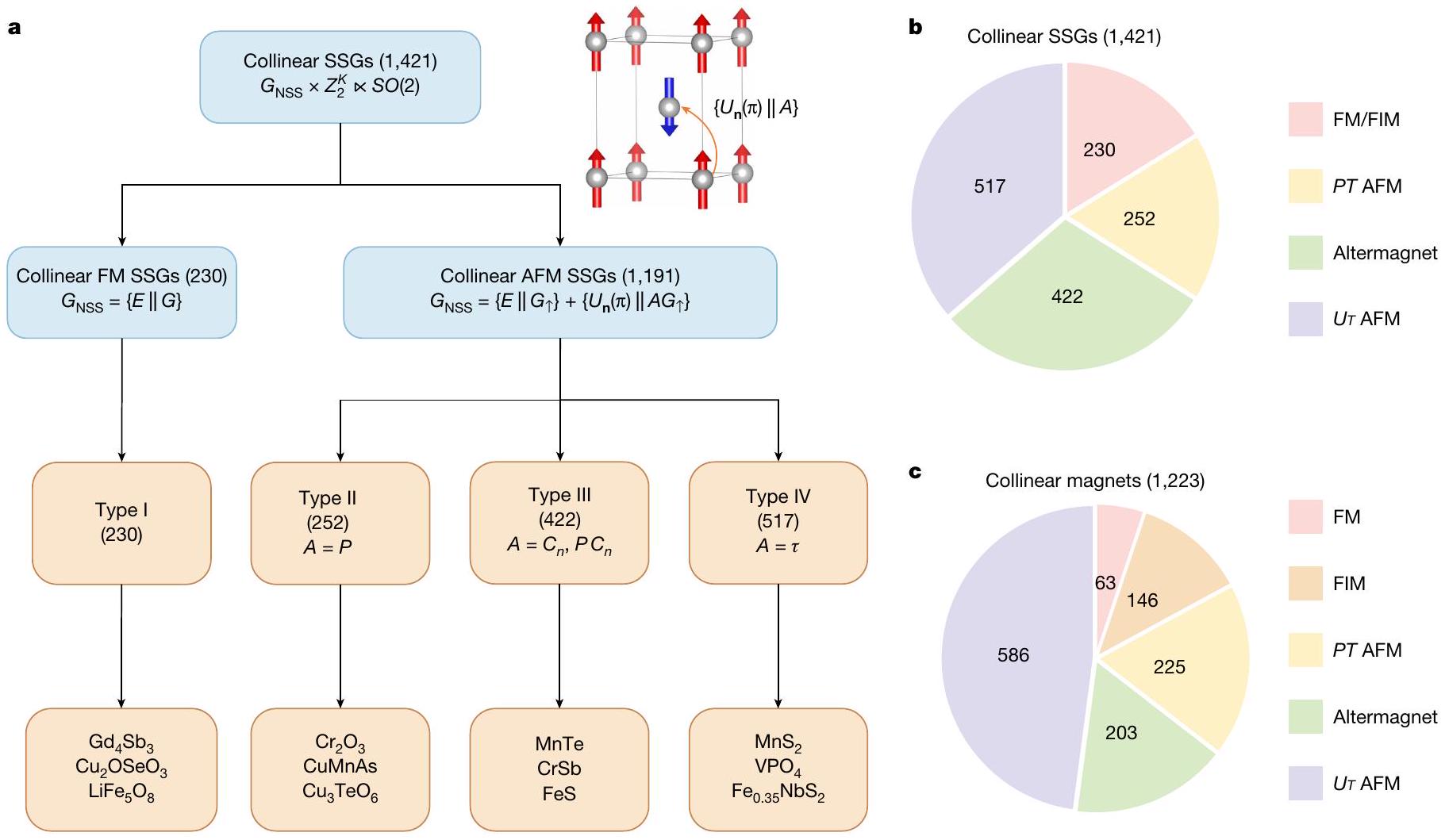
الشكل 1 | تصنيف 1,421 SSGs للمغناطيسات المتوازية. أ، بالنسبة لمغناطيس FM المتوازي، فإن SSGيمكن أن يتم بناؤه من مجموعة الفضاءلـ AFM متوازي، مجموعة الفضاء تحت الشبكةمجموعة الفضاءخلية المغناطيس وعمليات الفضاء (انظر الشكل الداخلي للهيكل المغناطيسي) التي تربط بين مختلف الشبكات المغناطيسية الفرعية ضرورية لبناء يمكن تصنيف AFMSSGs المتوازية بشكل أكبر إلى ثلاث فئات بناءً على عملية الفضاء. الرقم في الأقواس يمثل عدد SSGs المقابلة. الصف الأخير يسرد المرشحين للمواد لكل فئة.ترجمة الشبكة الكسرية؛الانعكاس المكاني؛، التدويرات المكانية. ب، إحصائيات SSGs المتوازية التي تميز أربعة أنواع من المغناطيس المتوازي. ج، إحصائيات الأنواع الخمسة من المغناطيس المتوازي في قاعدة بيانات MAGNDATA. قدم مجموعة البيانات الكاملة لنظرية SSG المتوازية، بما في ذلك المواقع العامة، مواقع وايكوف للدوران، مناطق بريلوان للدوران، المجموعات الفرعية الصغيرة من متجهات الموجة، تمثيلات النطاقات وتشتت الماجنونات للمغناطيسات المحسوبة في برنامجنا وقاعدة بياناتنا المنزلية FINDSPINGROUP.https://findspingroup.com/).
SSGs متوازية
بدءًا من 90 مجموعة من نقاط الدوران تصف الترتيبات المغناطيسية المتوازيةيمكن بناء SSGs للمغناطيسات المتوازية عن طريق تمديد المجموعةتُكتب عملية SSG النموذجية كـ، حيث و تشير إلى العملية في فضاء الدوران والفضاء الحقيقي، على التوالي. بشكل عام، يمكن التعبير عن SSGs كـ، حيث يمثل مجموعة الدوران فقط التي تحتوي على عمليات الدوران فقط ( هو عملية الهوية)، و يمثل SSG غير التافه الذي لا يحتوي على عمليات دوران نقية. للهياكل المغناطيسية المتعامدة، ، حيث تحتوي على دورات دوران كاملةمع زاوية الدورانعلى طول محور الدوران، و يحتوي على ناتج عكس الزمنودوران مزدوج حول أي محورعمودي علىمحور.
بالنسبة لمواد FM المتوازية التي تحتوي على نوع واحد فقط من الشبكة المغناطيسية الفرعية، يتم إعطاء SSG غير التافه بواسطة، حيث هو مجموعة الفضاء (230 في المجموع). هذه المجموعات الفرعية المتناظرة كافية أيضًا لوصف تناظر الفيريمغناطيس المتوازي (FIM) الذي يحتوي على عدة شبكات فرعية للدوران ولكن دون أي تناظر يربط بينها. من ناحية أخرى، فإن تعريف AFM المستخدم هنا، الذي تبعه لويس نيل، يشير إلى حالة مرتبة مغناطيسيًا ذات لحظة مغناطيسية صافية تساوي صفرًا حيث أن الشبكات المغناطيسية الفرعية ذات الدوران المعاكس متكافئة بلورياًلـ AFM متوازي مع شبكتين فرعيتين تحملان دورانًا متعاكسًا،يتم الحصول عليه من خلال تمديد المجموعة، حيث مجموعة الفضاء للشبكة الفرعيةتحتوي على جميع التناظرات المكانية التي لا تتبادل الذرات من شبكات فرعية مختلفة؛هو عملية التماثل التي تجمع بين تبادل الشبكتين الفرعيتينوعكس الدوران ( ).
بالاستناد إلى بناء أنواع MSG من النوع الأول والثالث والرابع، تم بناء 1,421 SSG متوازي، بما في ذلك 230 نوع ISSG تصف FM وFIM متوازيين، و1,191 SSG تصف AFM متوازي. بالمقارنة مع 674 MSG من النوع الثالث، نقوم بمزيد من تصنيف SSG المتوازي باستخدام، بما في ذلك 252 نوعًا من SSGs من النوع الثاني مع ( يمثل الانعكاس المكاني)، و422 نوع من SSGs من النوع الثالث ( ) ( يمثلالتدويرات الفضاء المتماثلة أو غير المتماثلة والانعكاسات الدورانية، على التوالي). تؤدي هذه التصنيفات بشكل طبيعي إلى فصل -المغناطيسات المضادة المتماثلة مع نطاقات مزدوجة الدوران (نوع II SSGs) والمغناطيسات البديلة التي ظهرت مؤخرًامع انقسام الدوران الناتج عن AFM (النوع الثالث من SSGs). بالإضافة إلى ذلك، هناك 517 نوعًا رابعًا من SSGs تصف AFMs بـ ( يمثل الترجمة الشبكية الكسرية). جميع مجموعات SSG المتوازية تم جدولتها في قسم المعلومات التكميلية 2 وتم تلخيصها في الشكل 1a. على الرغم من أن 1,421 مجموعة SSG المتوازية تظهر تطابقًا واحدًا لواحد مع 1,421 مجموعة MSG، إلا أنها تظهر المزيد من تناظرات الدوران، بما في ذلك الدوران و والتي تعتبر حاسمة لزيادة تدهور النطاقات خارج نطاق MSGs (انظر مقارنة مفصلة في قسم المعلومات التكميلية 1). نحن ندرج SSGs لجميع المغناطيسات المتوازية في MAGNDATA في قاعدة بياناتنا على الإنترنت FINDSPINGROUP.
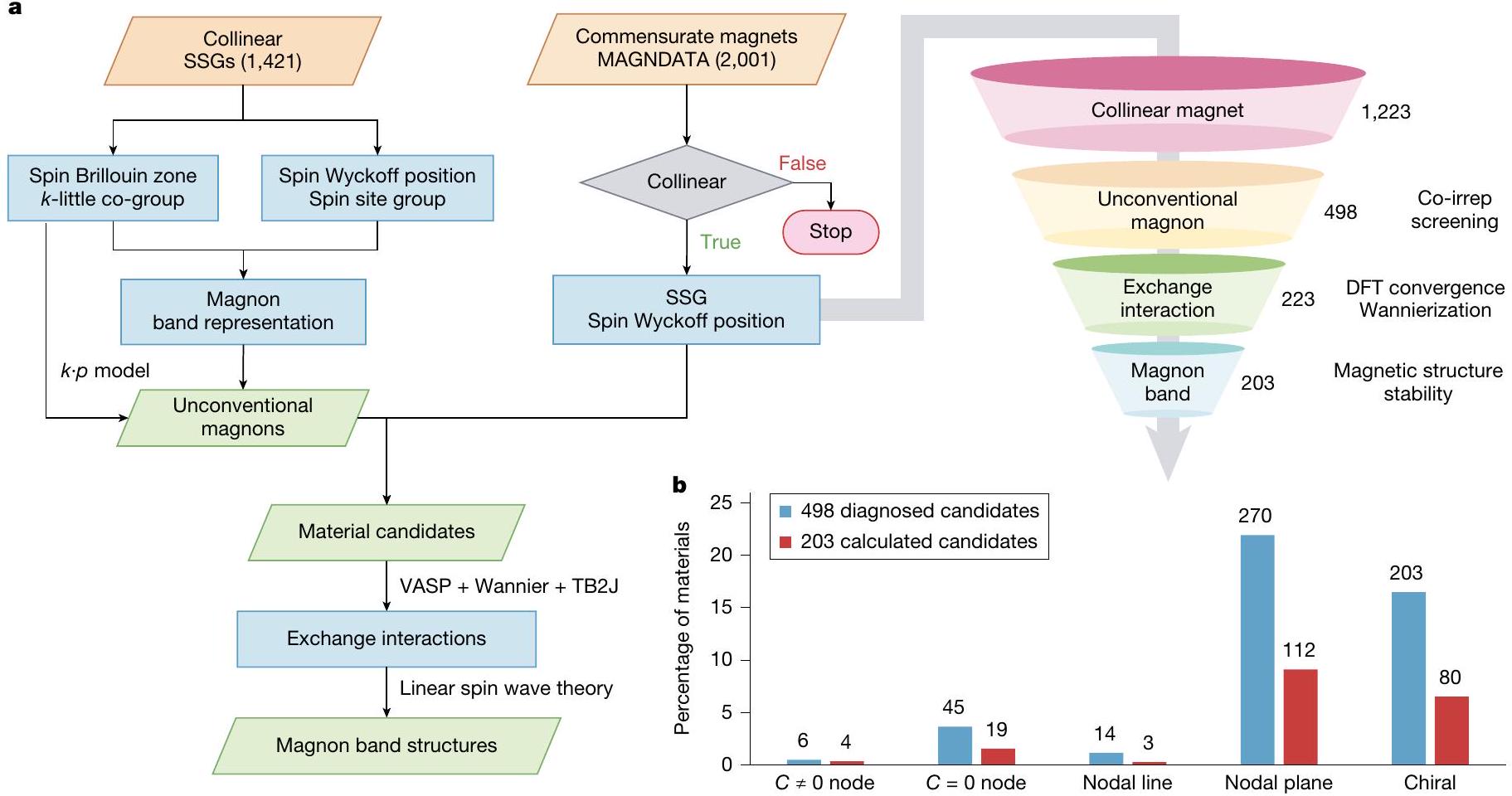
الشكل 2 | سير العمل لبناء قاعدة بيانات المغنطيسات غير التقليدية. أ، أولاً، تم تحديد 1,223 مغناطيس متوازي من قاعدة بيانات MAGNDATA. ثانياً، بعد تحديد SSG، تم إجراء فحوصات التماثل المشترك للحصول على مرشحات المواد التي تستضيف المغنطيسات غير التقليدية. ثالثاً، تم إجراء حسابات عالية الإنتاجية للحصول على جميع تفاعلات التبادل الثنائي. أخيراً، تم بناء قاعدة بيانات المغنطيسات غير التقليدية مع 203 هيكل نطاق مغنطيسي وتم تحديد تمثيلات النطاق. إحصائيات خمسة أنواع من الماجنون غير التقليدي في المغناطيسات الخطية من قاعدة بيانات MAGNDATA، بما في ذلك: (1) الكواريز الجزيئية الحلزونية )، بما في ذلك C-4 ثماني، C-4 سداسي، C-8 ديراك و C-2 ثلاثي ماغنون؛ (2) شحنة طوبولوجية محايدة ( ) الكوارتزات، بما في ذلك الدوديكوبل، الأوكتوبل، السكسوبل والتريبل ماغنون؛ (3) ماغنونات خط العقدة الأوكتوبل؛ (4) ماغنونات مستوى العقدة الرباعية؛ و (5) ماغنونات شيرال الانقسام المغناطيسي البديل.
سير العمل
نناقش بإيجاز الإجراء للحصول على جميع أنواع الماجنون غير التقليدية وتجسيدها في المغناطيس المتعامد الموثق في MAGNDATA (الشكل 2أ). بالنسبة لـ 1,421 من SSGs المتعامدة، نقوم بإنشاء قاعدة بيانات للمواقع العامة، ومواقع ويكوف للدوران، ومجموعات مواقع الدوران، ومناطق بريلوان للدوران، ومجموعات صغيرة من متجهات الموجة. وتمثيلات نطاق الماجنون (الطرق). لتحقيق المواد، نعتمد على قاعدة بيانات MAGNDATA، التي تحتوي على أكثر من 2000 هيكل مغناطيسي متناسب تم تحديده من خلال قياسات تشتت النيوترونات. من خلال تحديد تناظر مجموعة الدوران، نقوم بتصفية 1223 مغناطيسًا متوازيًا (الشكل 1ب) مع SSGs ومواقع وايكوف المغناطيسية للأيونات المغناطيسية. وفقًا لتمثيلات النطاق المقابلة، نحدد 498 مادة تحتوي على ماجنون غير تقليدي، بما في ذلك 5 مغناطيسات متوازية، 17 مغناطيسًا معكوسًا و476 مغناطيسًا مضادًا، والتي يمكن تصنيفها بشكل أكبر إلى AFMs، 203 المغناطيسات البديلة و.
بعد استبعاد الهياكل المغناطيسية ذات الشغل الجزئي أو التي تحتوي على أكثر من 80 ذرة في خلية الدوران الأولية، نقوم بإجراء حسابات نظرية الكثافة الوظيفية وحسابات إسقاط وانير على 348 مادة. بعد تصفية الحالات التي تفشل في التقارب والتطبيق، نحصل على معاملات التبادل المغناطيسي الثنائية الخطية لـ 223 مغناطيس متوازي باستخدام كود TB2J. يتم حساب هياكل نطاق المغون لميكانيكا سبين هايزنبرغ بواسطة نظرية الموجة الخطية للسبين. على وجه التحديد، تحويل هولشتاين-بريماكوف.يربط إنشاء الماجنونالانقراض ) المشغل مع تدمير الإلكترون (خلق) مشغل أخيرًا، نحصل على المغنون غير التقليديين والتمثيلات المشتركة غير القابلة للاختزال المقابلة في 203 مغناطيس متوازية، بينما تكون هاملتونيان المغنون للأنظمة الأخرى الـ 20 سلبية التعريف، مما يؤدي إلى عدم الاستقرار المغناطيسي. يمكن العثور على مزيد من التفاصيل الحسابية في الطرق.
كتالوج المغونات غير التقليدية
للمغناطيسات المتوازية، مجموعة الدوران فقطيؤدي إلى ثلاثة أنواع رئيسية من التناظر مما ينتج عنه تدهورات إضافية في نطاقات الماجنون. (1) تناظر فضاء الدوران الأحادي (USS): مجموعة منمع الوحدةالتناظر يزوج بين تمثيلين غير قابلين للاختزال من البعد الواحد المترافقين (irreps) لـإلى تمثيل ثنائي الأبعاد في فضاء الدوران. (2) تناظر فضاء الدوران غير الوحدوي (ASS): مجموعة منمع مضاد الوحدةيُزاوج بين تمثيلين خطيين مترافقين من البعد الواحد لـإلى تمثيل ثنائي الأبعاد في فضاء الدوران. (3) تناظر الفضاء الحقيقي غير الوحدوي (ARS): غير وحدويالتناظر يربط بين زوجين من التمثيلات غير القابلة للتغيير للعمليات في الفضاء الحقيقي (الطرق).
نلاحظ بعد ذلك عدة ميزات من تدهور نطاق الماجنون بناءً على التمثيلات المشتركة للـ SSG المتوازي. (1) على الرغم من غيابتتمتع أنواع ISSGs بنفس تدهور النطاق والتوبولوجيا كما هو الحال في مجموعة الفضاء المقابلةدمجبسببالتناظر. هذا ينطبق أيضًا على البحث عن مضاعفات المدارات الإلكترونية في حالة التوازي.. (2) بالنسبة لـ SSGs المتوازية التي تصف AFM، فإن هياكل نطاق الماجنون تكون مزدوجة الانحلال في جميع أنحاء منطقة بريل لجميع أنواع SSGs من النوع الثاني والنوع الرابع، بسبب ASSو USSفي نقطة عشوائيةالنقطة، على التوالي. (3) الشحنات الطوبولوجية عند النقاط العقدية التي تتكون من فرعين متعاكسين في الدوران تكون متعاكسة بالنسبة لنوع II من SSGs، ولكنها متطابقة بالنسبة لنوع IV من SSGs. (4) تظهر هياكل نطاق المغون مع نوع III من SSGs انقسامًا في اللولبية الناتجة عن المغناطيسية المضادة، وهو النظير المغوني لانقسام الدوران في الألترماغنتات.لذلك، يمكن تصنيف المغونات غير التقليدية إلى خمس فئات (الشكل 2ب). يتم تقديم العلاقة بين التمثيلات المتزامنة والمغونات غير التقليدية في جميع أنظمة SSG الخطية في قسم المعلومات التكميلية 3.
الشكل 2ب يلخص إحصائيات المرشحين للمواد التي تستضيف الفئات الخمس من المغنون غير التقليديين. ومن الجدير بالذكر أن حواليللمغناطيسات المتوازية على الأقل نوع واحد من الماجنون غير التقليدي.
الجدول 1|ملخص للماجنات غير التقليدية المحددة في مواد مرشحة نموذجية
SSG
نقطة ك
تمثيل الفرقة في
نوع
مادة
220.220.1.1 ( )
H (1, 1, 1)
SP
(إف إم)
تي بي
227.227.1.1 ( )
غ(0, 0, 0)
تي بي
(إف إم)
212.212.1.1 ( )
Γ(0, 0, 0)
C-2 TP
(FIM)
218.222.1.1 ( )
ر (1/2، 1/2، 1/2)
DCP
(PT AFM)
199.206.1.1 ( )
غ(0, 0, 0)
(PT AFM)
H (1, 1, 1)
159.190.1.1 ( )
أ (0، 0، 1/2)
OP
FeS (المغناطيس البديل)
62.63.2.1 ( )
ق (1/2، 1/2، و)
أونل
(Uτ AFM)
W (u, v, 1/2)
QNPL
19.18.2.1 ( )
ر (1/2، 1/2، 1/2)
C-4 OP
(Uτ AFM)
صافي QNPL
N (u، 1/2، w)
W (u, v, 1/2)
195.197.2.1 ( )
Γ(0,0,0)
C-8 DP
(Uτ AFM)
「 (0,0,0)
C-4 SP
ر (1/2, 1/2, 1/2)
C-4 SP
تمت ملاحظة الميزة العقدية تجريبيًا.تم تصنيع المادة في التجربة، لكن الهيكل المغناطيسي مفروض بشكل مصطنع.يعني أن الشحنة الطوبولوجية هو يعني أن شحنة القطب الأحادي هو . الحروف في العمود الثاني تمثل الإحداثيات في فضاء الزخم. DCP، نقطة ديوذكل؛ ONL، خط العقد الثماني؛ OP، نقطة ثمانية؛ SP، نقطة سداسية؛ QNPL، مستوى العقد الرباعي؛ DP، نقطة ديراك؛ TP، نقطة ثلاثية.
النوعان الرئيسيان هما مغنون الطائرة العقدية الرباعية (22.08%) ومغنون الكيرال الألترمغناطيسي. هذا يتماشى مع أن نسبة الألترماجنات ويكون كبيرًا نسبيًا في المغناطيس المتعامد مع المغونات غير التقليدية في الشكل 1c. في الجدول 1، ندرج بعض المواد التمثيلية مع SSGs الخاصة بها، و co-irreps، وتوبولوجيا عقد المغون، ونتائج التشخيص لجميع المواد الـ 498 ذات المغونات غير التقليدية موفرة في قسم المعلومات التكميلية 4.
المواد التمثيلية
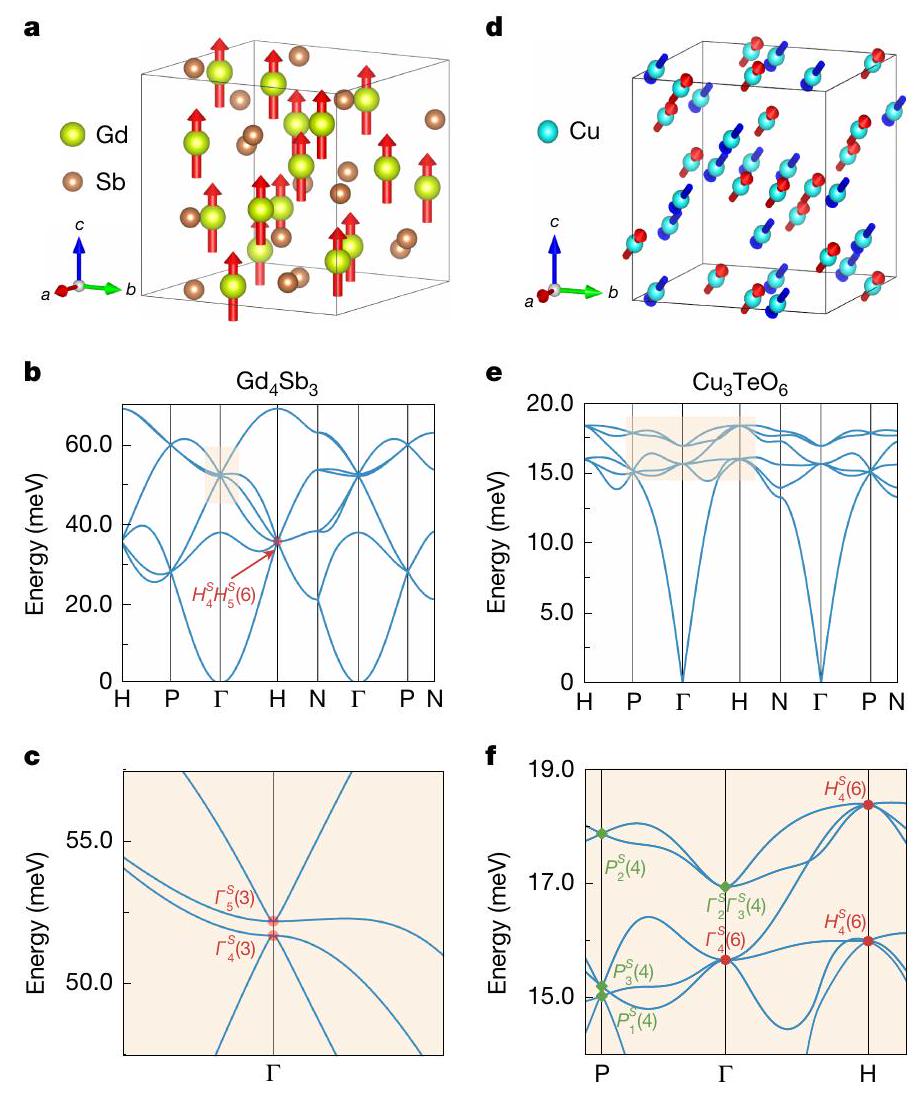
نقدم مواد محسوبة تظهر مغنطيسات غير تقليدية مختلفة في كل نوع من أنواع SSG، بما في ذلك تفرعها وطوبولوجيا العقد. تم توفير هياكل نطاق المغنطيسات المحسوبة لجميع المرشحين البالغ عددهم 203 في قسم المعلومات التكميلية 5. نبدأ بالنقاط السداسية والثلاثية في نوع I من SSG المتوازي.في FM (الشكل 3أ-ج). نظرًا لأن المغناطيسات المتوازية لا يمكن أن تحتوي على مجموعات تناظر مكعبة، فإن أي مغنطونات ثلاثية أو سداسية غائبة بالتالي ضمن نطاق مجموعة التناظر المكعبة. ومع ذلك، نجد مغنطونات ثلاثية عند نقطة، تشير إلى أن SSG تحافظ على الطبيعة المكعبة للشبكة. بالإضافة إلى ذلك، بسبب يتجمع اثنان من المغنون الثلاثي لتشكيل مغنون سداسي عند حدود منطقة بريلوان (نقطة H). هذه حالة نموذجية حيث توفر الدورانات المنفصلة للإسبين والفضاء في نوع ISSGs منصة أكثر خصوبة للكيانات شبه الجسيمية مقارنةً بـ MSGs. نلاحظ أن ARS مشابهة وُجدت لحماية الطائرة العقدية الثنائية في غادولينيوم المغناطيسي المتوازي..
بالمقارنة مع FM المتوازي، يمكن أن يؤدي الفضاء الدوراني إلى ازدواجية إضافية بواسطة USS و/أو ASS في AFM المتوازي. تم تقديم مثال هو (الشكل 3د-و)، حيث تم قياس انتشار الماجنون بواسطة تجارب تشتت النيوترونات غير المرنةعلى وجه التحديد، فإن نطاقات الماجنون مزدوجة الانحلال في جميع أنحاء منطقة بريل، مع تحديد عدة ماجنونات سداسية وديراك. ونقاط H. هذه الميزات جميعها تتجاوز نظام MSG، حيث MSG المقابل يتنبأ بوجود نطاق غير متدهور عند مستوى عشوائينقاط تقاطع النطاقات ذات النقطة الواحدة وبتكرار مزدوج في أقصى حد عند أي نقاط تناظر عالية (قسم المعلومات التكميلية 7.3.2). وعلى النقيض من ذلك، يتم وصف هذه الانحلالات النطاقية بشكل مثالي باستخدام التمثيلات المشتركة من النوع II في نظام التناظر المكعب.. بشكل خاص، المجموعة الصغيرةيسمح بمغنطيسيات سداسية عند ونقاط H مع شحنة أحادية القطب (طرق) وبالتالي تأثير هول الحراري المغنون المخفي (الجدول 1). نلاحظ أيضًا أن أعلى أبعاد نطاقات المغنون المحمية بالتماثل في نوع IISSGs هو 12. مثال تمثيلي هو نقطة R في المواد التي تم تصنيعها تجريبيًا.حيث يتم تنفيذ ترتيب AFM المتعامد (قسم المعلومات التكميلية 7.3.5). حالة مثيرة أخرى هي المغنون الثماني، الذي يوجد عند نقطة A في نوع III SSGفي FeS (الشكل 3g-i). مثل هذا الماجنون الثماني هو أيضًا التأثير التآزري لـ ASS و ARS . علاوة على ذلك، فإن النطاقات خارج نقطة التماثل العالي غير متدهورة، مما يؤدي إلى انقسام تشيلي المغون الناتج عن المغناطيسية المضادة على طول، على سبيل المثال، و نتوقع أن يؤدي انقسام الكيرالية للماغنون في المواد المغناطيسية المضادة للتوازي إلى ظهور انحناء بيري غير الصفري، وزخم الزاوية المداري للماغنون، وتأثير هول الحراري غير الخطي للماغنون في غياب تفاعل العزم الدوراني، مما سيوسع نطاق المجال ذي الصلة بالإلكترونيات المغناطيسية.نقوم بإدراج جميع الـ 203 مغناطيسًا بديلًا تم تشخيصها وموقع زخم انقسام شيرالية الماجنون (وأيضًا انقسام الدوران الإلكتروني) من MAGNDATA في قسم المعلومات التكميلية 4.6 وقاعدة البيانات الخاصة بنا FINDSPINGROUP.
تحمل الكوانتات المغنونية شحنات طوبولوجية متنوعة، بعضها غائب في جميع الموسوعات.لكن محمي بواسطة تناظر SSG. إحدى الحالات البارزة هي الشحنة-4 ( ) مغنطيسيات ثمانية ( الشكل 3j-l) في ترتيب خطي مع نوع IV. بسبب الـ و من المجموعة الصغيرة منفي المستوى، تتشكل نطاقات الماجنون رباعيةطائرة العقدة R-T وكواريز الجسيمات الثمانية عند نقطة R. تختلف عن SSGs من النوع الثاني، فإن إشارة انحناء بيري من الزوجين من الأشرطة الأربعة المتجانسة المرتبطة بـمتطابقة بالنسبة لنوع IV SSGs، مما يؤدي إلىثمانية مغونات كتركيب فوقي لاثنين-2 نقاط ديراك عند R. علاوة على ذلك، ثلاثة متعامدةطائراتالتقاطع عند نقطة R يشكل شبكة من أربع عقد في الطائرة (قسم المعلومات التكميلية 7.3.4). نتوقع حالات من طوبولوجيا نطاق الماجنون مثل-4 سداسي-8 ديراك ماغنون كما هو ملخص في قسم المعلومات التكميلية 4.
آثار SOC
لتقييم قابلية تطبيق SSGs المتوازية في تشخيص المغونات غير التقليدية، نأخذ في الاعتبار بالكامل تأثيرات SOC من خلال حساب التفاعلات المغناطيسية الثنائية، بما في ذلك تفاعل دزيالوشينسكي-موريا غير المتناظر. )، تبادل الأنيسوتروبي ( ) واللاتناظر المتماثل غير القطري ( )، وقارنها مع تفاعل تبادل هايزنبرغ المتساوي (J) في 223 مادة مرشحة. ومن الجدير بالذكر أن التباين الأحادي الأيون مستبعد في تحليلنا لأنه في المغناطيسات الخطية لا يؤثر على تناظر هاملتونيان الماجنون، أو تمثيلات النطاق، أو الطوبولوجيا العقدية (قسم المعلومات التكميلية 7).
تظهر الجدول 2 أن فيمن المغناطيسيات المتوازية المحسوبة، فإن تفاعل دزيالوشينسكي-موريا، والأنيسوتروبي التبادلي (على سبيل المثال، تفاعل كيتاف) والأنيسوتروبي المتماثل غير القائم على القطر هي على الأقل بأمر من حيث الحجم أصغر من تفاعل هايزنبرغ، مما يشير إلى صحة SSG لهذه الأنظمة. على وجه التحديد، من و تسيطر تفاعلات هايزنبرغ على المغناطيسات، في حين أن
الشكل 3 | مرشحات المواد التي تستضيف المغنون غير التقليديين. أ-ج، الهيكل المغناطيسي (أ)، هيكل نطاق المغنون (ب) مع عرض مكبر (ج) للترتيب المتوازيالتي تحتوي على تقاطعات نطاقات بستة وأربعة وثلاثة أضعاف.نفس الشيء كمالكن بالنسبة للتوازيمع تقاطع حزام مكون من 6 طيات عند و نقاط.نفس الشيء كما، ولكن بالنسبة للألترمغناطيس FeS، الذي لديه انحلال ثماني عند نقطة A وانقسام في لولبية المغون على طول
تتمتع البقية بتفاعلات دزيالوشينسكي-موريا قوية، مثل المغناطيس البديل المبلغ عنهمع بولارون ماغنون ناتج عن تفاعل دزيالوشينسكي-موريا. بالإضافة إلى ذلك، فإن النصف المملوءالمغناطيسات متوافقة أيضًا إلى حد كبير مع إطار عمل SSGs، مثلفي و GdAgSn. ومع ذلك، قد يكون إطار MSG أكثر ملاءمة لـ و المغناطيسات بسبب تفاعل دزيالوشينسكي-موريا القوي أو الأنيسوتروبية التبادلية. تشير هذه النتائج إلى أن SSG تعمل كإطار مثالي لوصف
الجدول 2 | إحصائيات تفاعلات التبادل ثنائية الخط مع تأثير الدوران الذاتي
أيونات مغناطيسية
المواد
<10% |J|
جيم سيطر
194
١٧٥
182
189
169
٧
٥
٥
٦
٥
12
11
10
11
9
٦
1
0
٣
0
٤
1
0
٣
0
إجمالي
٢٢٣
193
١٩٧
٢١٢
183
العمود الثاني يعرض عدد المغناطيسات المتوازية المصنفة حسب القشرة الخارجية لأيونات المغناطيس في العمود الأول. الأعمدة من الثالث إلى الخامس تقيم عدد المواد التي تتعلق بقوة تفاعل دزيالوشينسكي-موريا (D) والأنيسوتروبية التبادلية ( ) و متناظر غير متجانس ( لا تتجاوز نسبة الشروط 10% من نسبة شرط هايزنبرغ )، على التوالي. العمود الأخير يعطي عدد -المغناطيسات المهيمنة، التي لا يوجد فيها أي من و يتجاوز 10%يمكن العثور على طرق إحصائية مفصلة ومعلمات التبادل في القسم 6 من المعلومات التكميلية.
خط A-K. تمثل الخطوط الحمراء والصفراء نطاقات انقسام الشيرالية للماغنون مع الماغنون و “، على التوالي، وتمثل الخطوط الزرقاء نطاقات متساوية الدوران. j-1، نفس الشيء كمالكن بالنسبة للتوازيمعالمغنونات الثمانية عند نقطة R. تشير الخطوط الحمراء إلى مستوى العقدة الرباعية Z-U-R-T. يمكن العثور على مخطط منطقة بريل لكل مرشح في قسم المعلومات التكميلية 7. عقدة نطاق الماجنون في معظم و المغناطيسات المتوازية. تتوفر معلومات مفصلة حول التفاعلات التبادلية المحسوبة لـ 223 مرشحًا في قسم المعلومات التكميلية 6. يمكن العثور على مزيد من المناقشات حول طوبولوجيا النطاقات، والماغنات غير الخطية وتأثيرات SOC الخاصة بها في الأساليب.
النتيجة الرئيسية من هذا العمل مزدوجة. أولاً، نقدم نظرية تمثيل شاملة لـ 1,421 مجموعة تناظرية متوازية، والتي تشمل مواقع ويكوف الدورانية، ومناطق بريلوان الدورانية، وتمثيلات النطاق المرتبطة بكل متجه موجي. يسمح هذا الإطار بالتبويب الكامل للكيانات الكوانتية غير التقليدية التي تتجاوز مجموعات التناظر. ثانياً، نقدم قاموساً يضم أكثر من 200 مادة مرشحة تستضيف مغونات غير تقليدية، تم تحديدها من خلال حسابات عالية الإنتاجية. تسهل دمج مجموعات التناظر والمغناطيسيات المتوازية المدرجة في قاعدة بيانات MAGNDATA التوصيف الفعال والمنهجي للمغونات التي تظهر طوبولوجيا عقدية غير تافهة. بفضل ذلك، تمتلك المغونات غير التقليدية القدرة على استضافة حالات سطح محمية طوبولوجياً وغير مشحونة، مما يترك بصمات مثمرة في النقل وتشتت النيوترونات للتجارب.
المحتوى عبر الإنترنت
أي طرق، مراجع إضافية، ملخصات تقارير Nature Portfolio، بيانات المصدر، بيانات موسعة، معلومات تكميلية، شكر وتقدير، معلومات مراجعة الأقران؛ تفاصيل مساهمات المؤلفين والمصالح المتنافسة؛ وبيانات توفر البيانات والرموز متاحة علىhttps://doi.org/10.1038/s41586-025-08715-7.
مقالة
ماكلارتي، ب. أ. المغونات الطوبولوجية: مراجعة. مراجعة سنوية في فيزياء المادة المكثفة 13، 171-190 (2022).
لي، ك. وآخرون. ديراك وماغنات الخطوط العقدية في المغناطيسات المضادة الثلاثية الأبعاد. فيزيكال ريفيو ليترز 119، 247202 (2017).
موك، أ.، هينك، ج. وميرتيغ، إ. نقاط وييل المغنطيس القابلة للتعديل في البايروكلاور المغناطيسي. فيزيكال ريفيو ليترز 117، 157204 (2016).
هوانغ، ك.، تريفيدي، ن. وراندريا، م. المغونات الطوبولوجية ذات خطوط العقد ودرجات الحرية الثلاثية: الآثار المترتبة على تأثير هول الحراري في إيريديات البايروكلاور. فيز. ريف. ليتر. 125، 047203 (2020).
تشنغ، ر.، أوكاموتو، س. و شياو، د. تأثير نيرنست الدوراني للماغنون في المغناطيسات المضادة المتوازية. فيز. ريف. ليتر. 117، 217202 (2016).
كاراكي، م. ج. وآخرون. بحث فعال عن المواد للماجنات الطوبولوجية في درجة حرارة الغرفة. ساينس أدفانس 9، eade7731 (2023).
كورتيشيللي، أ.، مويزنر، ر. ومكلارتي، ب. أ. تحديد وبناء طوبولوجيا نطاق الماجنون المعقدة. فيز. ريف. ليتر. 130، 206702 (2023).
برينكمان، و. ف. وإيليوت، ر. ج. نظرية مجموعات الفضاء الدوراني. وقائع الجمعية الملكية أ 294، 343-358 (1966).
ليو، ب. وآخرون. تناظر مجموعة الدوران في المواد المغناطيسية ذات الاقتران بين الدوران والمدار القابل للتجاهل. فيز. ريف. إكس 12، 021016 (2022).
تشين، إكس. وآخرون. العد ونظرية التمثيل لمجموعات الفضاء الدوراني. فيز. ريف. إكس 14، 031038 (2024).
شياو، ز. وآخرون. مجموعات الفضاء الدوراني: التصنيف الكامل والتطبيقات. فيز. ريف. إكس 14، 031037 (2024).
جيانغ، ي. وآخرون. عدّ مجموعات الفضاء الدوراني: نحو وصف كامل لتماثلات الترتيبات المغناطيسية. فيز. ريف. إكس 14، 031039 (2024).
غالليغو، س. ف. وآخرون. MAGNDATA: نحو قاعدة بيانات للهياكل المغناطيسية. I. الحالة المتوافقة. مجلة البلورات التطبيقية 49، 1750-1776 (2016).
ديزالوشينسكي، إ. نظرية الديناميكا الحرارية لـ “المغناطيسية الضعيفة” للمواد المضادة للمغناطيسية. مجلة الفيزياء والكيمياء للمواد الصلبة 4، 241-255 (1958).
شي، أ. وآخرون. مغونات ديراك، خطوط العقد، ومستوى العقد في عنصر الجادولينيوم. فيز. ريف. ليت. 128، 097201 (2022).
زيلينسكي، ج.، زانغ، ي.، فيلزر، س. ويان، ب. تيار مستقطب الدوران في المواد المضادة للمغناطيس غير المتوازنة. فيزيكال ريفيو ليترز 119، 187204 (2017).
هايامي، س.، ياناغي، ي. وكوسونو، هـ. انقسام الدوران المعتمد على الزخم بواسطة ترتيب مضاد مغناطيسي متوازي. مجلة الجمعية الفيزيائية اليابانية 88، 123702 (2019).
يوان، ل.-د. وآخرون. انقسام الدوران الضخم المعتمد على الزخم في المغناطيسات المضادة المركزية ذات العدد الذري المنخفض. فيزي. ريف. ب 102، 014422 (2020).
ما، هـ.-ي. وآخرون. مواد مضادة للمغناطيسية متعددة الوظائف مع مغناطيسية بيزوكهربائية عملاقة وتيار دوران غير متوازي. نات. كوميونيك. 12، 2846 (2021).
ليو، ب.، تشانغ، أ.، هان، ج. وليو، ق. فيرميون شيرالي شبيه بديراك في أشباه المعادن المضادة للمغناطيسية الخالية من تأثير الدوران. الابتكار 3، 100343 (2022).
Šmejkal، ل.، سينوفا، ج. وجونغويرث، ت. ما وراء المغناطيسية الفيرومغناطيسية والمضادة: مرحلة ذات دوران غير نسبي للدوران وسمات بلورية. فيز. ريف. إكس 12، 031042 (2022).
Guo، ب. ج. وآخرون. فيرمونات متدهورة ثمانية الأبعاد في بعدين. فيزيكال ريفيو ليترز 127، 176401 (2021).
باي، هـ. وآخرون. ملاحظة لعزم انقسام الدوران في مضاد مغناطيس متوازي.. مجلة الفيزياء: رسائل 128، 197202 (2022).
بوز، أ. وآخرون. تيار الدوران المائل الناتج عن المغناطيس المضاد المتوازي أكسيد الروثينيوم. نات. إلكترون. 5، 267-274 (2022).
فينغ، ز. وآخرون. تأثير هول الشاذ في ثنائي أكسيد الروثينيوم الألترمغناطيسي. نات. إلكترون. 5، 735-743 (2022).
شاو، د. ف. وآخرون. تيارات دوران نيل في المغناطيسات المضادة. فيزيكال ريفيو ليترز 130، 216702 (2023).
تشو، ي.-ب. وآخرون. ملاحظة انقسام الدوران على شكل مربعات في مضاد مغناطيس غير متخطي. الطبيعة 626، 523-528 (2024).
كريمباسكي، ج. وآخرون. الرفع المغناطيسي البديل ل degeneracy دوران كرامرز. ناتشر 626، 517-522 (2024).
غوراشي، س. أ. أ.، هيوز، ت. ل. وكانو، ج. طرق ألتيرمغناطيسية إلى أوضاع مايورانا في عدم وجود مغنطة صافية. فيز. ريف. ليت. 133، 106601 (2024).
يانغ، ج.، ليو، ز.-إكس. وفانغ، س. الثوابت التناظرية وفئات الكوارتزات في الأنظمة المرتبة مغناطيسياً والتي تحتوي على اقتران ضعيف بين الدوران والمدار. نات. كوميونيك. 15، 10203 (2024).
يو، ز. م. وآخرون. موسوعة الجسيمات الناشئة في البلورات ثلاثية الأبعاد. مجلة العلوم. 67، 375-380 (2022).
ليو، ج.-ب. وآخرون. تحقيق منهجي للجسيمات الناشئة في المجموعات المغناطيسية من النوع الثالث. فيز. ريف. ب 105، 085117 (2022).
تشانغ، ز. وآخرون. موسوعة الجسيمات الناشئة في مجموعات الفضاء المغناطيسي من النوع الرابع. فيز. ريف. ب 105، 104426 (2022).
باو، س. وآخرون. الملاحظة المباشرة للبولارونات المغنطيسية الطوبولوجية في مادة متعددة ferroic. نات. كوم. 14، 6093 (2023).
ملاحظة الناشر: تظل شركة سبرينجر ناتشر محايدة فيما يتعلق بالمطالبات القضائية في الخرائط المنشورة والانتماءات المؤسسية.
الوصول المفتوح هذه المقالة مرخصة بموجب رخصة المشاع الإبداعي النسبية-غير التجارية-بدون اشتقاقات 4.0 الدولية، التي تسمح بأي استخدام غير تجاري، ومشاركة، وتوزيع، وإعادة إنتاج في أي وسيلة أو صيغة، طالما أنك تعطي الائتمان المناسب للمؤلفين الأصليين والمصدر، وتوفر رابطًا لرخصة المشاع الإبداعي، وتوضح إذا قمت بتعديل المادة المرخصة. ليس لديك إذن بموجب هذه الرخصة لمشاركة المواد المعدلة المشتقة من هذه المقالة أو أجزاء منها. الصور أو المواد الأخرى من طرف ثالث في هذه المقالة مشمولة في رخصة المشاع الإبداعي الخاصة بالمقالة، ما لم يُشار إلى خلاف ذلك في سطر الائتمان للمادة. إذا لم تكن المادة مشمولة في رخصة المشاع الإبداعي الخاصة بالمقالة وكان استخدامك المقصود غير مسموح به بموجب اللوائح القانونية أو يتجاوز الاستخدام المسموح به، فستحتاج إلى الحصول على إذن مباشرة من صاحب حقوق الطبع والنشر. لعرض نسخة من هذه الرخصة، قم بزيارة http:// creativecommons.org/licenses/by-nc-nd/4.0/. (ج) المؤلف(ون) 2025
طرق
نظرية تمثيل الفرقة للـ SSGs
تم بناء تمثيلات النطاق من الحد الذري كما قدمه زاكاستنادًا إلى نظرية زاك، تم استخدام نظرية الكيمياء الكمومية الطوبولوجية ومؤشرات التناظر في التشخيص الطوبولوجي الإلكتروني، حيث تم التعرف بنجاح على آلاف المواد ذات النطاقات الإلكترونية الطوبولوجية.. هنا نمدها إلى SSG. أولاً، نقوم ببناء مجموعة مواقع الدورانمن SSGجدول الشخصيات المقابل و تمثيلات الفضاء المداري، حيث هو أي نقطة في وحدة الخلية لشبكة مغناطيسية. من بين هذه المجموعات من مواقع الدوران، يمكن فقط لـ 32 مجموعة من نقاط الدوران المغناطيسية أن تدعم لحظات مغناطيسية غير صفرية وتحمل الماجنون. ثانيًا، لتحفيز تمثيلات النطاق الكاملنحن نسعى إلى تحليل مجموعة من المجموعاتجميع المدارات لموقع ويكوفمع التعدديةموقع وايكوف مشتق. عنصر SSG، جنبًا إلى جنب مع الترجمةتوليد تحليل لـ فيما يتعلق بـ :
تمثيل الفرقة بالكامليتم استنتاجه من التمثيل المداريثم نقيدها بتمثيلات النطاق-مجموعات صغيرةمع المكونات:
أين. في هذه الخطوة، جدول الشخصيات للجزء الوحدوي من تم بناؤه أيضًا. أخيرًا، نقوم بتنفيذ قواعد الجمعلأخذ في الاعتبار إدخال العمليات غير الوحدوية وتمثيل النطاقفي منطقة بريلوان للدوران يتم تحديدها. قواعد نطاقات الماجنونتتحول كتمثيلات غير القابلة للاختزال لمجموعات مواقع الدوران للأيونات المغناطيسية. بالنسبة للمغناطيسات المتوازية، فإن مجموعة مواقع الدوران دائمًا تحتوي علىتناظر دوران اللفلذا تحول إلىتمثيلات غير قابلة للتقليل لـفي فضاء الدوران (يمثل الزخم الزاوي للدوران)، بينما الجزء المتعلق بالفضاء الحقيقي يوفر فقط تمثيل الهوية لـ.
آليتان من ازدواجية إضافية بمقدار الضعف توفرها فضاء الدوران
لـ AFM متعامد له شكل . هنا نعرض باختصار كيف أن الجمع بين تناظر الدوران مع أو سوف يدمج تمثيلين خطيين أحاديي البعد في تمثيل ثنائي الأبعاد لـفي فضاء الدوران.
على الرغم من دورات الفضاء النقية ( ) ودورات الدوران النقية من التناظر في المجموعة الصغيرةتساهم ثلاث عمليات تناظر في الازدواجية الثنائية في فضاء الدوران، بما في ذلك، و . هنا نوضح كيف تعمل هذه العمليات مع فيأساس
تمت كتابة تمثيلات المصفوفات لدورات الدوران الزمنية وعكس الزمن على النحو التالي:
أين هو مشغل المرافق المعقد، ونستخدم . لـ :
أينيوفر تمثيلات ثنائية الأبعاد لـ.
لـ :
حيث يربط عكس الزمن بين تمثيلين خطيين مترافقين في فضاء الدوران في تمثيل ثنائي الأبعاد.
لـ
لا يمكن أن تساهم في الانحطاط الجديد. لذلك، يمكننا أن نستنتج أن كلا من و يمكن أن يؤدي إلى ظهور تمثيلات غير متجانسة ثنائية الأبعاد في فضاء الدوران. مزيد من التفاصيل حول تمثيلات النطاق للأنظمة المغناطيسية المتوازية وبناء تمثيل النطاق المغنوني للأنظمة المغناطيسية المتوازية. ( يمكن العثور على (الحالة) في قسم المعلومات التكميلية 1.6.
قاعدة بيانات لتماثل SSG المتوازي
بدءًا من 1,421 مجموعة SSG متوازية، نقوم بإنشاء وصف في فضاء الموضع لمجموعات SSG المتوازية، حيث يمكن تعريف وتوصيف مجموعات مواقع الدوران لجميع مواقع ويكوف الدورانية بواسطة 90 مجموعة نقاط دوران متوازية. من بين هذه المجموعات، تدعم 32 مجموعة نقاط دوران FM فقط لحظات مغناطيسية غير صفرية، مما يؤدي إلى تقليل العدد الإجمالي لمواقع ويكوف الدورانية من 12,481 إلى 6,368. في الوقت نفسه، نقدم وصفًا في فضاء الزخم لمجموعات SSG المتوازية، مستنفدين مناطق بريلوان للدوران والتناسق العالي.نقاط باستخدام 24 مجموعة من المجموعات الفراغية المتماثلة المركزية. بعد ذلك، من خلال استخدام نظرية تمثيل النطاق للمجموعات الفرعية المتماثلة كما ذُكر سابقًا، نستخرج التمثيلات الصغيرة غير القابلة للاختزال للماغنون في المجموعات الفرعية المتماثلة الخطية ونعد جميع تمثيلات النطاق التي تستضيف ماغنون غير تقليديين. أخيرًا، نقوم ببناءنماذج فعالة حول النقاط المتدهورة وتقييم طوبولوجيا العقد المميزة بشحنة شيرالية أو شحنة أحادية القطب، مع تحديد جميع المغونات غير التقليدية التي تتجاوز نطاق MSGs. المواقع العامة، مواقع وايكوف للدوران، مجموعات مواقع الدوران، مناطق بريلوان للدوران،تمتلك قاعدة بياناتنا على الإنترنت FINDSPINGROUP تمثيلات لمجموعات صغيرة من المجموعات المغنطيسية وتمثيلات نطاق المغنون لجميع المجموعات المغنطيسية المتوازية.
حسابات نظرية الكثافة
تم إجراء جميع حسابات نظرية الكثافة (DFT) هنا باستخدام طريقة الموجة المعززة بالمشاريع، المطبقة في حزمة المحاكاة الأولية في فيينا (VASP).تقريب التدرج العام لإمكانات التبادل والتفاعل من نوع بيردو-بورك-إرنزرهوفتم اعتماده. بالنسبة لجميع المواد المرشحة، استخدمنا طاقة قطع تبلغ 500 إلكترون فولت، مما يؤدي عادةً إلى التقارب العددي. استخدمناشبكات مونكهورست-باك المركزية، مع كون المعيار لكل اتجاه هو ناتج عدد الـنقاط وطول شبكة أكبر منÅ. من أجل – و -ذرات مغناطيسية إلكترونية، تم تعيين العزوم المغناطيسية الأولية إلى و على التوالي. لتضمين تأثير ارتباط الإلكترونات، يتم استخدام نهج DFT + U ضمن الصيغة الثابتة الدورانية.تم تنفيذها معقيم مستندة إلى القيمة المبلغ عنها من الأدبيات، والتي تم تقديمها في قسم المعلومات التكميلية 5 لكل مادة. للحصول على تحديد دقيق لتفاعلات التبادل، يجب تحقيق تقارب ذاتي الاتساق ضمنتم تحقيق ذلك في حساباتنا. تم بناء نماذج الربط الضيق من نطاقات DFT باستخدام حزمة WANNIER90.، ثم كود TB2J تم استخدامه لاستخراج معلمات التبادل المغناطيسي. تم تعيين مسافة قطع تبادل الدوران لتقطع عندما تكون القيمة المطلقة لمعاملات تبادل هايزنبرغ المتبقية J واحدة من الألف من أكبر قيمة J أو أقل عددياً من 0.001 ميلي إلكترون فولت. المعلمات التفصيلية لـ
يمكن العثور على تفاعلات تبادل هايزنبرغ لحساب بنية نطاق الماجنون في قسم المعلومات التكميلية 6.
حسابات هيكل نطاق الماجنون
تم حساب هياكل نطاق الماجنون جميعها باستخدام نظرية الموجات المغزلية الخطية وهاميلتونيان سبين هايزنبرغ. يمكن تحويل هاميلتونيان سبين الحالة الأساسية إلى هاميلتونيان تربيعي من خلال إجراء تحويل هولشتاين-بريماكوف وتحويل فورييه:
أين
أين هو دلتا كرونكر، و و تمثل متجه ترجمة الشبكة وموقع الأيونات المغناطيسية في قاعدة الشبكة، على التوالي. عندماموازي لـ و ; عندما مضاد للتوازي مع و .
استنادًا إلى ما سبق، يمكن حساب القيم الذاتية والمتجهات الذاتية لهاميلتونيون الماجنون عن طريق التحليل القطري.، حيث ، و هو مصفوفة الهوية الاتجاهية، حيثيمثل عدد الأيونات المغناطيسية في خلية بدائية تحت SSG.
الشحنات الطوبولوجية
نحدد طوبولوجيا النقطة المتدهورة من خلال حساب الشحنة الطوبولوجية. بالنسبة للنقطة العقدية، نحسب حلقات ويلسون على كرة تحيط بالنقطة العقدية. :
أين هو الزاوية القطبية للكرة، و هو اتصال بيري.
الآن نعرض العمليات المختلفة للتناظر على :
نتيجة لذلك، فإن الشحنة الطوبولوجية تساوي صفر عندمتناظرنقاط كـ، حيث يكون حلقة ويلسون متناظرة حول طائرة. يمكن تعميم هذا الاستنتاج علىثابتنقطة، حيثهو أي دوران صحيح في الفضاء. ومع ذلك، فإن عكس الزمنودوران الدورانلا يفرض أي قيود على الشحنة الطوبولوجية.
بالنسبة للـ FMs المتوازية، عندما-تكون المجموعة الصغيرة غير متماثلة، ويمكن أن تستضيف شحنة طوبولوجية غير صفرية. بالنسبة للمواد المغناطيسية المضادة للتوازي المتوازية، يمكن فصل هاملتونيان المغنون إلى قناتين للدوران مع الزخم الزاوي للدورانيجب أن تكون قنوات الدوران المتدهورة مرتبطة بـ أو . إذا كان -مجموعة الشبكة الفرعية الصغيرةهو كيرالي، يمكنه استضافة شحنة طوبولوجية غير صفريةفي قناة الدوران. يمكن أن تحتوي قناتا الدوران على شحنات طوبولوجية متطابقة أو معاكسة عندما تكون الشبكتان الفرعيتان متصلتين بطريقة صحيحة أو غير صحيحة.. في الحالة الأولى، ستتضاعف الشحنة الطوبولوجية كـبينمافي الأخير. بالنسبة للشحنة المعوضة غير الصحيحةيمكننا تعريف شحنة أحادية القطب.
لذلك، فإن النقاط العقدية لفرعين متدهورين تحمل شحنات طوبولوجية متعاكسة (متطابقة) لأنواع SSGs II (IV) بسبب
تناظر PT (Ur) في منطقة بريلوان الكاملة. بالنسبة لنوع III من SSGs، إذا هو كيرالي و -مجموعة صغيرة تحتوي على TA و العملية، ستتدهور فرعي الماجنون مع شحنة طوبولوجية مضاعفة أو معوضة عندما هو صحيح أو غير صحيح. ومع ذلك، عندما -مجموعة صغيرة لا تحتوي على و في العمليات، ستنفصل فرعي الماجنون الاثنين وعلامة الشحنة الطوبولوجية في القناتين غير ذات صلة.
تُقدم معلومات مفصلة عن الشحنات الطوبولوجية غير الصفرية للتمثيلات المغنونية في الأنظمة المغناطيسية المتوازية عند حالات التماثل المحمية في برنامجنا عبر الإنترنت FINDSPINGROUP.
طوبولوجيا النطاقات والماغنات غير الخطية
بالنسبة للمغناطيسات المتوازية، يوجد تناظر فعال لعكس الزمنالذي يتربيع ليصبح واحدًا. وبالتالي، فإن المغنون في المغناطيسات المتوازية تقع في فئة التناظر AI من تصنيف ألتلاند-زيرنبور العشري للعوازل الطوبولوجية والمشابهات الفائقة، والتي لا تدعم مرحلة عازلة طوبولوجية قوية في الأبعاد الثلاثة.أظهرت الدراسات الحديثة أن العوازل الطوبوغرافية الضعيفة الخالية من SOC يمكن أن توجد في الألترمغناطيسيات.. على النقيض من ذلك، فإن إدخال تفاعل الماجنون-ماجنون في نظرية موجات الدوران غير الخطية لا يكسر التناظر في المغناطيسات المتوازية. وبالتالي، فإنه لا يغير من تكرار النطاق، على الرغم من أنه قد يسبب إعادة تقييم النطاق.. ومع ذلك، فإن إضافة مصطلح SOC إلى هاملتونيان الدوران المتوازي عادة ما يفتح فجوة صغيرة، مما يجعل ظهور فئة التماثل AII أحيانًا مرحلة طوبولوجية ذات فجوة. على سبيل المثال، يمكن أن يؤدي إدخال تفاعل دزيالوشينسكي-موريا في الفيرومغناطيسيات من نوع بايروكلاور، والشبكة السداسية، وكاجومي إلى تحويل الماغنونات ديراك إلى نطاقات ماغنون طوبولوجية.. في هذه الحالة، لا تزال وصفات SSGs مفيدة لأنها يمكن أن تُستخدم للبحث عن الفجوة الصغيرة الناتجة عن SOC، والتي غالبًا ما تكون شرطًا مسبقًا للمواد الطوبولوجية المغنونية، مثل العوازل تشيرن والعوازل الأكسونية. علاوة على ذلك، يمكن أن يؤدي دمج تفاعل دزيالوشينسكي-موريا وتفاعلات المغنون-مغنون إلى حدوث انتقالات طوبولوجية متعددة.بشكل عام، سيكون فهم التطور من طوبولوجيا العقدة إلى طوبولوجيا النطاق مع إدخال تأثير SOC وتأثيره على نقل الماجنون ذا قيمة لتطوير أجهزة السبينترونيك المعتمدة على الماجنون، ويترك ذلك للدراسات المستقبلية.
مقارنة بين الإلكترونات والماغنونات في الأنظمة المغناطيسية الخطية
من المهم أن نؤكد أنه على الرغم من تركيزنا على أنظمة الماجنون، يمكن تطبيق النتائج الرئيسية للجسيمات الكوانتية غير التقليدية الناتجة عن ازدواجية النطاق بسهولة على الأنظمة الإلكترونية. في إطار مجموعة الفضاء (المغناطيسية)، يتمثل التمثيل ذو القيمتين للدوران-تتطلب الفيرميونات ما يُعرف بالمجموعة المزدوجة لوصف طور إضافي قدره -1الدوران. على النقيض الحاد، فإن خصوصية SSGs المتوازية تجعل بعد تمثيلات النطاق لكل من الفيرميونات والبوزونات يبقى ثابتًا ضمنالدوران. وذلك بسبب مجموعة الدوران اللانهائية فقطلديها مجموعة التغطية المزدوجة لنفسها، وبالتالي يمكن اعتبارها إما مجموعة واحدة أو مجموعة مزدوجة. لذلك،يوفر دائمًا تمثيلات أحادية البعد موسومة بزخم الدوران الزاويللإلكترونات وللماغنون. الاختلاف الوحيد بين الفيرميونات والبوزونات في الأنظمة المغناطيسية المتوازية يحدث فقط داخل الطور في مصفوفات التمثيل غير القابل للتغيير. تتوفر معلومات مفصلة حول المقارنة بين تمثيلات النطاق للإلكترونات والماغنون في الأنظمة المغناطيسية المتوازية في قسم المعلومات التكميلية 1.6.4.
توفر البيانات
جميع البيانات متاحة في المعلومات التكميلية ومن خلال موقعنا الإلكتروني العام، البرنامج عبر الإنترنت لتحديد تناظر SSG وقاعدة بيانات تناظر SSG المتعامد (https://findspingroup. com/).
توفر الشيفرة
جميع الأكواد متاحة من خلال موقعنا العام، البرنامج عبر الإنترنت لتحديد تناظر SSG وقاعدة بيانات تناظر SSG المتعامد (https://findspingroup.com/). 52. زاك، ج. تمثيلات الفرقة للمجموعات الفضائية. فيز. ريف. ب 26، 3010-3023 (1982). 53. برادلين، ب. وآخرون. كيمياء الكم الطوبولوجية. ناتشر 547، 298-305 (2017). 54. كروثوف، ج. وآخرون. التصنيف الطوبولوجي للعوازل البلورية من خلال تركيبات هيكل النطاق. فيزي. ريف. إكس 7، 041069 (2017). 55. تانغ، ف.، بو، هـ. ج.، فيشواناث، أ. ووان، إكس. بحث شامل عن المواد الطوبولوجية باستخدام مؤشرات التناظر. ناتشر 566، 486-489 (2019). 56. زانغ، ت. وآخرون. كتالوج المواد الإلكترونية الطوبولوجية. ناتشر 566، 475-479 (2019). 57. فيرغنوري، م. ج. وآخرون. كتالوج كامل للمواد الطوبولوجية عالية الجودة. ناتشر 566، 480-485 (2019). 58.. وآخرون. حسابات عالية الإنتاجية للمواد الطوبوغرافية المغناطيسية. ناتشر 586، 702-707 (2020). 59. إلكورو، ل. وآخرون. الكيمياء الكمومية الطوبولوجية المغناطيسية. نات. كوم. 12، 5965 (2021). 60. ديموك، ج. أ. و ويلر، ر. ج. خصائص التماثل لدوال الموجة في البلورات المغناطيسية. مراجعة الفيزياء 127، 391-404 (1962). 61. كريسي، ج. وفورثمولر، ج. مخططات تكرارية فعالة لحسابات الطاقة الكلية من أول مرة باستخدام مجموعة أساس الموجة المستوية. فيز. ريف. ب 54، 11169-11186 (1996). 62. كريسي، ج. وجوبيرت، د. من البوتentials فوق الناعمة إلى طريقة الموجة المعززة بالمشاريع. فيز. ريف. ب 59، 1758-1775 (1999). 63. بيردو، ج. ب.، بورك، ك. وإرنزرهوف، م. تقريب التدرج العام بشكل بسيط. فيز. ريف. ليتر. 77، 3865-3868 (1996). 64. مونكهورست، هـ. ج. وباك، ج. د. نقاط خاصة لتكاملات منطقة بريلوان. فيز. ريف. ب 13، 5188-5192 (1976). 65. أنيسيموف، ف. إ.، زانين، ج. وأندرسن، أ. ك. نظرية النطاق والعوازل موت: هوباردبدلاً من Stoner I. Phys. Rev. B 44، 943-954 (1991). 66. موستوفي، أ. أ. وآخرون. وانير90: أداة للحصول على دوال وانير المحلية بشكل أقصى. اتصالات الفيزياء الحاسوبية 178، 685-699 (2008). 67. مارزاري، ن. وآخرون. دوال وانيير المحلية بشكل أقصى: النظرية والتطبيقات. مراجعة الفيزياء الحديثة 84، 1419-1475 (2012). 68. هو، إكس، هيلبيغ، ن، فيرسترات، م. ج. وبوسكيه، إ. TB2J: حزمة بايثون لحساب معلمات التفاعل المغناطيسي. اتصالات الفيزياء الحاسوبية 264، 107938 (2021). 69. بيري، م. ف. عوامل الطور الكمي المصاحبة للتغيرات الأديباتية. وقائع الجمعية الملكية A 392، 45-57 (1997). 70. يو، ر. وآخرون. التعبير المعادل لـمتحول طوبولوجي للعوازل النطاقية باستخدام اتصال بيري غير الأبلي. فيز. ريف. ب 84، 075119 (2011). 71. ألتلاند، أ. وزيرنبauer، م. ر. فئات التناظر غير القياسية في الهياكل الهجينة الفائقة التوصيل العادية الميسوسكوبية. فيز. ريف. ب 55، 1142-1161 (1997). 72. شو، ق.-ر. وآخرون. تربيع الفيرميون: الطريق الثلاثي ومصير الأنماط الصفرية. فيزي. ريف. ب 102، 125127 (2020). 73. زانغ، م.-هـ.، شياو، ل. وياؤ، د.-إكس. المغونات الطوبولوجية في المغناطيس البديل المتوازي. مسودة مسبقة فيhttps://arxiv.org/abs/2407.18379 (2024). 74. بيرشوجوبا، س. س. وآخرون. ديراك ماغنون في المغناطيسات الفيرومغناطيسية ذات الشكل السداسي. فيزيكس ريفيو إكس 8، 011010 (2018). 75. تشانغ، ل.، رين، ج.، وانغ، ج.-س. ولي، ب. عازل مغنطيسي طوبولوجي في المغناطيس الحديدي العازل. فيزيكس ريفيو ب 87، 144101 (2013). 76. موك، أ.، هينك، ج. وميرتيغ، إ. حالات الحافة في العوازل المغنطيسية الطوبولوجية. فيز. ريف. ب 90، 024412 (2014). 77. أويري، س. أول تحقيق نظري لموصل مغنون علوية على شكل خلية نحل. مجلة الفيزياء: المادة المكثفة 28، 386001 (2016). 78. موك، أ.، بليخانوف، ك.، كلينوفايا، ج. ولوس، د. عازل مغنطيسي طوبولوجي مستقر بالتفاعل في المغناطيسات الحديدية. فيز. ريف. إكس 11، 021061 (2021). 79. لو، ي.-س.، لي، ج.-ل. وو، س.-ت. الانتقالات الطوبولوجية لمرحلات ديراك في المغناطيسات الفيرومغناطيسية ذات الشكل السداسي. فيزيكال ريفيو ليترز 127، 217202 (2021).
الشكر والتقدير تم دعم هذا العمل من قبل البرنامج الوطني الرئيسي للبحث والتطوير في الصين تحت رقم المنحة 2020YFA0308900، ومؤسسة العلوم الطبيعية الوطنية في الصين تحت رقم المنحة 12274194، ومختبر قوانغدونغ الإقليمي الرئيسي لعلوم الحوسبة وتصميم المواد تحت رقم المنحة 2019B030301001، ومبادرة العلوم الكمومية الاستراتيجية في مقاطعة قوانغدونغ (أرقام المنح GDZX2401002 وGDZX2201001)، وبرنامج العلوم والتكنولوجيا في شنتشن (أرقام المنح RCJC20221008092722009 و20231117091158001)، وفريق الابتكار في مؤسسات التعليم العالي العامة في مقاطعة قوانغدونغ (رقم 2020KCXTD001)، ولجنة العلوم والتكنولوجيا والابتكار في بلدية شنتشن (رقم ZDSYS20190902092905285)، والصندوق المفتوح للمختبر الوطني الرئيسي لأجهزة وتقنيات السبينترونيك (رقم المنحة SPL-2407) ومركز العلوم والهندسة الحاسوبية في جامعة جنوب الصين للتكنولوجيا.
مساهمات المؤلفين: ق.ل. تصور العمل. ش.س.، ج.ر. و ج.ل. بنوا هياكل المجموعة ونظرية تمثيل النطاق. ش.س. و ي.ي. أنشأوا قاعدة البيانات. ي.ي. بنى الموقع الإلكتروني. ش.س.، ي.ل.، ب.ل. و أ.ز. قاموا بإجراء حسابات DFT عالية الإنتاجية وحسابات وانير. ش.س. أجرى حسابات نطاق الماجنون. ش.س. و ق.ل. حللا النتائج وكتبا الورقة.
المصالح المتنافسة: يعلن المؤلفون عدم وجود مصالح متنافسة.
معلومات إضافية
معلومات تكميلية: النسخة الإلكترونية تحتوي على مواد تكميلية متاحة على https://doi.org/10.1038/s41586-025-08715-7.
يجب توجيه المراسلات وطلبات المواد إلى قيهانغ ليو.
معلومات مراجعة الأقران: تشكر مجلة نيتشر المراجعين المجهولين على مساهمتهم في مراجعة الأقران لهذا العمل. تقارير مراجعي الأقران متاحة.
معلومات إعادة الطبع والتصاريح متاحة على http://www.nature.com/reprints.
قسم الفيزياء ومركز غوانغدونغ للبحث الأساسي للتميز في العلوم الكمومية، الجامعة الجنوبية للعلوم والتكنولوجيا، شنتشن، الصين. مركز العلوم الكمومية لمنطقة خليج غوانغدونغ-هونغ كونغ-ماكاو الكبرى (غوانغدونغ)، شنتشن، الصين. المختبر الرئيسي لمقاطعة غوانغدونغ للعلوم الحاسوبية وتصميم المواد، الجامعة الجنوبية للعلوم والتكنولوجيا، شنتشن، الصين. البريد الإلكتروني: liuqh@sustech.edu.cn
Xiaobing Chen , Yuntian Liu , Pengfei Liu , Yutong Yu , Jun Ren , Jiayu Li , Ao Zhang & Qihang Liu
Abstract
Magnonic systems provide a fertile playground for bosonic topology , for example, Dirac and Weyl, magnons, leading to a variety of exotic phenomena such as chargefree topologically protected boundary modes , the magnon thermal Hall effect and the magnon spin Nernst effect . However, their understanding has been hindered by the absence of fundamental symmetry descriptions of magnetic geometries and spin Hamiltonians primarily governed by isotropic Heisenberg interactions. The ensuing magnon dispersions enable gapless magnon band nodes that go beyond the scenario of representation theory of the magnetic space groups , thus referred to as unconventional magnons. Here we developed spin space group theory to elucidate collinear magnetic configurations, classifying the 1,421 collinear spin space groups into 4 types, constructing their band representations and providing a comprehensive tabulation of unconventional magnons, such as duodecuple points, octuple nodal lines and charge-4 octuple points. On the basis of the MAGNDATA database , we identified 498 collinear magnets with unconventional magnons, among which more than 200 magnon band structures were obtained by using first-principles calculations and linear spin wave theory. In addition, we evaluated the influence of the spin-orbit-coupling-induced exchange interaction in these magnets and found that more than 80 per cent are predominantly governed by the Heisenberg interactions, indicating that the spin space group serves as an ideal framework for describing magnon band nodes in most and half-filled collinear magnets.
Finding unconventional magnets that contain topological magnons is an area of high interest and demand, with potential applications in next-generation ultrafast spintronic devices and quantum computing. However, extending the success of topological band theory and material diagnosis from electrons to magnons faces a significant challenge in the fundamental symmetry description of magnetic materials. The conventional framework for describing the symmetry of magnetic materials and designing magnon band nodes is based on magnetic space groups (MSGs) . These groups completely lock the rotational operations in spin space and real space. Nevertheless, the magnon dispersions, especially in collinear magnets with small spin-orbit coupling (SOC) effects (for example, the Dzyaloshinskii-Moriya interaction ), predominantly depend on the isotropic Heisenberg exchange interaction. As a result, even though the material candidates for experimental measurements are rare, the existing experimentally observed magnon spectra still cannot be entirely explained by MSGs. Examples include the observed Dirac and sextuple points in collinear antiferromagnet (AFM) (refs. 3,4) and the two-fold nodal plane in collinear ferromagnet (FM) gadolinium .
Spin space groups (SSGs), which were first proposed in the 1960s (yet overlooked until the recent development of AFM spintronics ), provide a framework that allows for decoupling of spatial and spin
operations, and an examination of the symmetries associated with magnon dispersions . In this work, we develop the SSG theory describing collinear magnetic configurations, which are typically dictated by the Heisenberg exchange interaction, and apply it to a comprehensive search of unconventional magnons in real materials. We categorize the 1,421 collinear SSGs into four types, corresponding to all the type I, III and IV MSGs but with more spatial-free spin symmetries and thus different band representations. By employing the representation theory, we not only capture the band degeneracies to reconcile the results of previous experiments but also tabulate all possible unconventional magnons, such as duodecuple(12-fold) nodal point, charge-4 octuple (8-fold) point, octuple nodal line, quadruple nodal plane and altermagnetic-splitting chiral magnons. We further conduct high-throughput ab initio calculations on the magnon band dispersions and representations for 348 computable collinear magnets within the MAGNDATA database, which adopts experimentally confirmed magnetic structures. On the basis of an efficient and systematic diagnosis, we identify more than 200 unconventional magnonic materials by the calculated bilinear magnetic exchange coefficients and magnon dispersions. By comparing the results with and without SOC, we evaluate the magnitude of anisotropic interactions and thus the validity of unconventional magnons within the SSG scenario. Finally, we
Fig. 1 | Classification of 1,421 SSGs for collinear magnets. a, For a collinear FM, the SSG can be constructed from the space group . For a collinear AFM, the sublattice space group , the space group of the magnetic cell and the space operation (see inset of magnetic structure) that connects different magnetic sublattices are necessary for constructing . Collinear AFMSSGs can be further classified into three categories based on
the space operation . The number in the parentheses represents the number of the corresponding SSGs. The last row lists the material candidates for each category. , fractional lattice translation; , spatial inversion; , spatial rotations. b, Statistics of the collinear SSGs characterizing four types of collinear magnet. c, Statistics of the five types of collinear magnet in the MAGNDATA database.
provide the full array of data of collinear SSG theory, including general positions, spin Wyckoff positions, spin Brillouin zones, little co-groups of wavevectors, band representations and the magnon dispersions of calculated magnets in our homemade online program and database FINDSPINGROUP (https://findspingroup.com/).
Collinear SSGs
Beginning with 90 spin point groups describing collinear magnetic orders SSGs for collinear magnets can be constructed by group extension . A typical SSG operation is written as , where and denote the operation in spin space and real space, respectively. In general, SSGs can be expressed as , where stands for the spin-only group that contains only spin operations ( is the identity operation), and stands for the non-trivial SSG that contains no pure spin operations . For collinear magnetic structures, , where contains full spin rotations with the rotation angle along the spin axis , and contains the product of the time reversal and a two-fold spin rotation about any axis perpendicular to the axis .
For collinear FM materials with only one type of magnetic sublattice, the non-trivial SSG is given by , where is the space group (230 in total). These SSGs are also sufficient to describe the symmetry of a collinear ferrimagnet (FIM) that contains multiple spin sublattices but without any symmetry connecting them. On the other hand, the definition of AFM used here, followed by Louis Néel, refers to a magnetic-ordered state with zero net magnetic moment where the
magnetic sublattices with opposite spins are crystallographic equivalent . For a collinear AFM with two sublattices carrying opposite spins, is obtained by group extension , where the sublattice space group contains all spatial symmetries that do not exchange atoms from different sublattices; is the symmetry operation that combines the exchange of the two sublattices and spin reversal ( ).
In analogy with the construction of type I, III and IV MSGs, 1,421 collinear SSGs are constructed, including 230 type ISSGs describing collinear FMs and FIMs, and 1,191 SSGs describing collinear AFMs. Compared with 674 type III MSGs, we further categorize collinear SSGs using , including 252 type II SSGs with ( represents the space inversion), and 422 type III SSGs with ( ) ( stand for -fold symmorphic or non-symmorphic space rotations and rotoinversions, respectively). Such classification naturally leads to the separation of conventional -symmetric AFMs with two-fold spin-degenerate bands (type II SSGs) and the recently emerged altermagnets with AFM-induced spin splitting (type III SSGs). Besides, there are 517 type IV SSGs describing AFMs with ( represents the fractional lattice translation). All collinear SSGs are tabulated in Supplementary Information section 2 and are summarized in Fig. 1a. Although the 1,421 collinear SSGs show one-to-one correspondence with the 1,421 MSGs, they manifest more spin symmetries, including spin and , which are crucial for more band degeneracies beyond the regime of MSGs (see a detailed comparison in Supplementary Information section 1). We list the SSGs of all collinear magnets in MAGNDATA in our online database FINDSPINGROUP.
Fig. 2 | Workflow for the construction of the unconventional magnon database.a, First, 1,223 collinear magnets were identified from the MAGNDATA database. Second, after the identification of the SSG, co-irrep screenings were performed to obtain the material candidates hosting unconventional magnons. Third, high-throughput calculations were performed to obtain all bilinear exchange interactions. Finally, an unconventional-magnon database with 203 magnon band structures and identified band representations was constructed.
b, Statistics of five types of unconventional magnon in the collinear magnets from the MAGNDATA database, including: (1) chiral quasiparticles ( ), including C-4 octuple, C-4 sextuple, C-8 Dirac and C-2 triple magnons; (2) topological charge-neutral ( ) quasiparticles, including duodecuple, octuple, sextuple and triple magnons; (3) octuple nodal line magnons; (4) quadruple nodal plane magnons; and (5) altermagnetic-splitting chiral magnons.
Workflow
We briefly discuss the procedure to obtain all types of unconventional magnon and their realization in collinear magnets documented in MAGNDATA (Fig. 2a). For 1,421 collinear SSGs, we establish the database for general positions, spin Wyckoff positions, spin site groups, spin Brillouin zones, little co-groups of wavevectors and magnon band representations (Methods). For material realization, we adopt the MAGNDATA database, which contains more than 2,000 commensurate magnetic structures determined by neutron scattering measurements. By spin group symmetry identification, we filter out 1,223 collinear magnets (Fig. 1b) with their SSGs and spin Wyckoff positions of magnetic ions. According to the corresponding band representations, we identify 498 materials hosting unconventional magnons, including 5 FMs, 17 FIMs and 476 AFMs, which can be further classified into AFMs, 203 altermagnets and .
After excluding magnetic structures with fractional occupancy or more than 80 atoms in the spin primitive cell, we perform density functional theory and Wannier projection calculations on 348 materials. After filtering out the cases that fail to converge and Wannierize, we obtain the bilinear magnetic exchange coefficients of 223 collinear magnets by using the TB2J code. The magnon band structures of the Heisenberg spin Hamiltonians are calculated by the linear spin wave theory. Specifically, Holstein-Primakoff transformation connects the magnon creation (annihilation ) operator with the electron annihilation (creation ) operator . Finally, we obtain the unconventional magnons and corresponding irreducible co-representations (co-irreps) in 203 collinear magnets, whereas the magnon Hamiltonians of the other 20 systems are negative-definite, leading to the magnetic instability. More computational details can be found in Methods.
Catalogue of unconventional magnons
For collinear magnets, the spin-only group leads to three main types of symmetry resulting in extra degeneracies of magnon bands. (1) Unitary spin space symmetry (USS): the combination of with unitary symmetry pairs two conjugated one-dimensional irreducible representations (irreps) for into a two-dimensional irrep in spin space. (2) Antiunitary spin space symmetry (ASS): combination of with antiunitary pairs two conjugated one-dimensional irreps for into a two-dimensional co-irrep in spin space. (3) Antiunitary real-space symmetry (ARS): antiunitary symmetry pairs two conjugated irreps of real-space operations (Methods).
We next note several features of the magnon band degeneracies based on the co-irreps of collinear SSG. (1) Despite the absence of , type ISSGs have the same band degeneracy and topology as the corresponding space group combining owing to symmetry. This is also applicable in searching electron orbital multiplets of a collinear . (2) For collinear SSGs describing an AFM, magnon band structures are doubly degenerate throughout the Brillouin zone for all type II and type IV SSGs, because of ASS and USS at an arbitrary point, respectively. (3) The topological charges at nodal points formed by two opposite-spin branches are opposite for type II SSGs, but identical for type IV SSGs. (4) Magnon band structures with type III SSGs show AFM-induced chirality splitting, the magnonic analogue of spin splitting in altermagnets . Therefore, the unconventional magnons can be classified into five categories (Fig. 2b). The correspondence between co-irreps and unconventional magnons in all collinear SSGs is provided in Supplementary Information section 3.
Figure 2b summarizes the statistics of material candidates hosting the five categories of unconventional magnons. Notably, about of the collinear magnets have at least one type of unconventional magnon.
Table 1|Summary of unconventional magnons identified in prototypical candidate materials
SSG
k point
Band representation at
Type
Material
220.220.1.1 ( )
H (1, 1, 1)
SP
(FM)
TP
227.227.1.1 ( )
Г(0, 0, 0)
TP
(FM)
212.212.1.1 ( )
Γ(0, 0, 0)
C-2 TP
(FIM)
218.222.1.1 ( )
R (1/2, 1/2, 1/2)
DCP
(PT AFM)
199.206.1.1 ( )
Г(0, 0, 0)
(PT AFM)
H (1, 1, 1)
159.190.1.1 ( )
A (0, 0, 1/2)
OP
FeS (altermagnet)
62.63.2.1 ( )
Q (1/2, 1/2, w)
ONL
(Uτ AFM)
W (u, v, 1/2)
QNPL
19.18.2.1 ( )
R (1/2, 1/2, 1/2)
C-4 OP
(Uτ AFM)
QNPL net
N (u, 1/2, w)
W (u, v, 1/2)
195.197.2.1 ( )
Γ(0,0,0)
C-8 DP
(Uτ AFM)
「 (0,0,0)
C-4 SP
R (1/2,1/2,1/2)
C-4 SP
The nodal feature has been experimentally observed. The material is synthesized in experiment, but the magnetic structure is artificially imposed. means that the topological charge is means that the monopole charge is . The letters in the second column stand for the coordinates in momentum space. DCP, duodecuple point; ONL, octuple nodal line; OP, octuple point; SP, sextuple point; QNPL, quadruple nodal plane; DP, Dirac point; TP, triple point.
The two major types are quadruple nodal plane magnon (22.08%) and altermagnetic chiral magnon . This is consistent with that the proportion of altermagnets and is relatively large in collinear magnets with unconventional magnons in Fig. 1c. In Table 1, we list some representative materials with their SSGs, co-irreps and magnon node topology, and the diagnosis results of all 498 materials with unconventional magnon are provided in Supplementary Information section 4.
Representative materials
We present calculated materials manifesting various unconventional magnons in each type of SSG, including their degeneracy and node topology. The calculated magnon band structures of all the 203 candidates are provided in Supplementary Information section 5 . We begin with sextuple and triple points in type I collinear SSG in FM (Fig. 3a-c). Since collinear magnets cannot have cubic MSGs, any triple or sextuple magnons are thus absent within the regime of MSG. However, we find triple magnons at the point, indicating that the SSG maintains the cubic nature of the lattice. In addition, owing to the , two triple magnons stick together forming a sextuple magnon at the boundary of the Brillouin zone (H point). This is a typical case where the decoupled spin and space rotations in type ISSGs provide a more fertile platform for quasiparticles than MSGs. We note that similar ARS was found to protect the two-fold nodal plane in collinear FM gadolinium .
Compared with the collinear FM, spin space can lead to additional degeneracy by USS and/or ASS in a collinear AFM. The presented
example is (Fig. 3d-f), whose magnon dispersion were measured by inelastic neutron scattering experiments .Specifically, the magnon bands are doubly degenerate throughout the whole Brillouin zone, with several sextuple and Dirac magnons identified at the and H points. These features are all beyond the regime of MSG, where the corresponding MSG predicts a non-degenerate band at an arbitrary point and at most two-fold band crossings at any highsymmetry points (Supplementary Information section 7.3.2). In sharp contrast, these band degeneracies are perfectly described using co-irreps of the type II cubic SSG . In particular, the little group allows sextuple magnons at the and H points with a monopole charge (Methods) and thus the hidden magnon thermal Hall effect (Table 1). We further note that the highest dimension of the symmetry-protected magnon bands in type IISSGs is 12. A representative example is the R point in experimentally synthesized , where a collinear AFM order is implemented (Supplementary Information section 7.3.5).
Another interesting case is the octuple magnon, which is found at the A point in type III SSG in FeS (Fig. 3g-i). Such an octuple magnon is also the synergistic effect of the ASS and ARS . Moreover, the bands off the high-symmetry point are non-degenerate, leading to AFM-induced magnon chirality splitting along, for example, the and directions. We expect that magnon chirality splitting in collinear AFM can lead to the appearance of nonzero Berry curvature, magnon orbital angular momentum and the magnon nonlinear thermal Hall effect in the absence of SOC, which will further expand the scope of the relevant field of spintronics . We list all the 203 diagnosed altermagnets and the momentum position of magnon chirality splitting (also electronic spin splitting) from MAGNDATA in Supplementary Information section 4.6 and our online database FINDSPINGROUP.
The magnon quasiparticles carry various topological charges, some of which are absent in all encyclopaedias of but protected by SSG symmetries. One striking case is the charge-4 ( ) octuple magnons (Fig. 3j-l) in collinear with a type IV . Owing to the and of the little group of plane, the magnon bands form quadruple R-T nodal plane and octuple quasiparticle at the R point. Different from type II SSGs, the sign of Berry curvature from the two pairs of four-fold degenerate bands connected by are identical for type IV SSGs, resulting in octuple magnons as the superposition of two -2 Dirac points at R. Furthermore, three perpendicular planes intersecting at the R point form a quadruple nodal plane network (Supplementary Information section 7.3.4). We predict cases of magnon band topology such as -4 sextuple and -8 Dirac magnons as summarized in Supplementary Information section 4.
SOC effects
To evaluate the applicability of collinear SSGs in diagnosing unconventional magnons, we fully consider SOC effects by calculating the bilinear magnetic exchange interactions, including antisymmetric Dzyaloshinskii-Moriya interaction ( ), exchange anisotropy ( ) and off-diagonal symmetric anisotropy ( ), and compare them with the isotropic Heisenberg exchange interaction (J) in 223 candidate materials. Notably, single-ion anisotropy is excluded in our analysis because in collinear magnets it does not affect the symmetry of the magnon Hamiltonian, the band representations or the nodal topology (Supplementary Information section 7).
Table 2 shows that in of the calculated collinear magnets, the Dzyaloshinskii-Moriya interaction, exchange anisotropy (for example, Kitaev interaction) and off-diagonal symmetric anisotropy are at least an order of magnitude smaller than the Heisenberg interaction, indicating the validity of SSG for these systems. Specifically, of the and magnets are dominated by Heisenberg interactions, whereas the
Fig. 3 | Material candidates hosting unconventional magnons. a-c, The magnetic structure (a), magnon band structure (b) with a zoomed-in view (c) of collinear , which has six-, four- and three-fold band crossings. , The same as , but for collinear with 6 -fold band crossing at the and points. , The same as , but for altermagnet FeS, which has octuple degeneracy at the A point and magnon chirality splitting along the
remaining ones have strong Dzyaloshinskii-Moriya interactions, such as the reported altermagnet with a Dzyaloshinskii-Moriya-interaction-induced magnon polaron . In addition, the half-filled magnets are also largely compatible with the framework of SSGs, such as in and GdAgSn . However, the MSG framework could be more applicable for the and magnets owing to their strong Dzyaloshinskii-Moriya interaction or exchange anisotropy. These results indicate that SSG serves as an ideal framework for describing
Table 2 | Statistics of bilinear exchange interactions with SOC
Magnetic ions
Materials
<10% |J|
J dominated
194
175
182
189
169
7
5
5
6
5
12
11
10
11
9
6
1
0
3
0
4
1
0
3
0
Total
223
193
197
212
183
The second column presents the number of collinear magnets classified by the outermost shell of magnetic ions in the first column. The third to fifth columns evaluate the number of materials in which the magnitude of the Dzyaloshinskii-Moriya interaction (D), exchange anisotropy ( ) and anisotropic symmetric ( ) terms does not exceed 10% of that of the Heisenberg term ( ), respectively. The last column gives the number of -dominated magnets, in which none of and exceeds 10% . Detailed statistical methods and exchange parameters can be found in Supplementary Information section 6.
A-K line. The red and yellow lines represent the magnon chirality splitting bands with magnon and , respectively, and the blue lines represent spin-degenerate bands.j-1, The same as , but for collinear with octuple magnons at the R point. The red lines indicate the quadruple Z-U-R-T nodal plane. A schematic of the Brillouin zone for each candidate can be found in Supplementary Information section 7.
magnon band nodes in most and collinear magnets. Detailed information regarding the calculated exchange interactions for 223 candidates is available in Supplementary Information section 6. More discussions on band topology, nonlinear magnons and their SOC effects can be found in Methods.
The main outcome of this work is twofold. First, we present a comprehensive representation theory of 1,421 collinear SSGs, which includes the spin Wyckoff positions, spin Brillouin zones and band representations associated with each wavevector. Such a framework allows for the full tabulation of unconventional quasiparticles beyond the MSGs. Second, we provide a dictionary of more than 200 candidate materials that host unconventional magnons, identified through high-throughput calculations. The integration of SSGs and the collinear magnets listed in the MAGNDATA database facilitates efficient and systematic characterization of magnons showing non-trivial nodal topology. By virtue of this, the unconventional magnons have the potential to host topologically protected, uncharged surface states, leaving fruitful transport and neutron scattering signatures for experiments.
Online content
Any methods, additional references, Nature Portfolio reporting summaries, source data, extended data, supplementary information, acknowledgements, peer review information; details of author contributions and competing interests; and statements of data and code availability are available at https://doi.org/10.1038/s41586-025-08715-7.
Article
McClarty, P. A. Topological magnons: a review. Annu. Rev. Condens. Matter Phys. 13, 171-190 (2022).
Li, K. et al. Dirac and nodal line magnons in three-dimensional antiferromagnets. Phys. Rev. Lett. 119, 247202 (2017).
Yao, W. et al. Topological spin excitations in a three-dimensional antiferromagnet. Nat. Phys. 14, 1011-1015 (2018).
Bao, S. et al. Discovery of coexisting Dirac and triply degenerate magnons in a three-dimensional antiferromagnet. Nat. Commun. 9, 2591 (2018).
Chen, L. et al. Topological spin excitations in honeycomb ferromagnet . Phys. Rev. , 041028 (2018).
Yuan, B. et al. Dirac magnons in a honeycomb lattice quantum magnet . Phys. Rev. X 10, 011062 (2020).
Li, F.-Y. et al. Weyl magnons in breathing pyrochlore antiferromagnets. Nat. Commun. 7, 12691 (2016).
Mook, A., Henk, J. & Mertig, I. Tunable magnon Weyl points in ferromagnetic pyrochlores. Phys. Rev. Lett. 117, 157204 (2016).
Hwang, K., Trivedi, N. & Randeria, M. Topological magnons with nodal-line and triple-point degeneracies: implications for thermal Hall effect in pyrochlore iridates. Phys. Rev. Lett. 125, 047203 (2020).
Cheng, R., Okamoto, S. & Xiao, D. Spin Nernst effect of magnons in collinear antiferromagnets. Phys. Rev. Lett. 117, 217202 (2016).
Karaki, M. J. et al. An efficient material search for room-temperature topological magnons. Sci. Adv. 9, eade7731 (2023).
Corticelli, A., Moessner, R. & McClarty, P. A. Identifying and constructing complex magnon band topology. Phys. Rev. Lett. 130, 206702 (2023).
Brinkman, W. F. & Elliott, R. J. Theory of spin-space groups. Proc. R. Soc. A 294, 343-358 (1966).
Liu, P. et al. Spin-group symmetry in magnetic materials with negligible spin-orbit coupling. Phys. Rev. X12, 021016 (2022).
Chen, X. et al. Enumeration and representation theory of spin space groups. Phys. Rev. X 14, 031038 (2024).
Xiao, Z. et al. Spin space groups: full classification and applications. Phys. Rev. X 14, 031037 (2024).
Jiang, Y. et al. Enumeration of spin-space groups: toward a complete description of symmetries of magnetic orders. Phys. Rev. X 14, 031039 (2024).
Gallego, S. V. et al. MAGNDATA: towards a database of magnetic structures. I. The commensurate case. J. Appl. Crystallogr. 49, 1750-1776 (2016).
Dzyaloshinsky, I. A thermodynamic theory of “weak” ferromagnetism of antiferromagnetics. J. Phys. Chem. Solids 4, 241-255 (1958).
Moriya, T. Anisotropic superexchange interaction and weak ferromagnetism. Phys. Rev. 120, 91-98 (1960).
Scheie, A. et al. Dirac magnons, nodal lines, and nodal plane in elemental gadolinium. Phys. Rev. Lett. 128, 097201 (2022).
Zelezny, J., Zhang, Y., Felser, C. & Yan, B. Spin-polarized current in noncollinear antiferromagnets. Phys. Rev. Lett. 119, 187204 (2017).
Hayami, S., Yanagi, Y. & Kusunose, H. Momentum-dependent spin splitting by collinear antiferromagnetic ordering. J. Phys. Soc. Jpn 88, 123702 (2019).
Yuan, L.-D. et al. Giant momentum-dependent spin splitting in centrosymmetric low-Z antiferromagnets. Phys. Rev. B 102, 014422 (2020).
Ma, H.-Y. et al. Multifunctional antiferromagnetic materials with giant piezomagnetism and noncollinear spin current. Nat. Commun. 12, 2846 (2021).
Liu, P., Zhang, A., Han, J. & Liu, Q. Chiral Dirac-like fermion in spin-orbit-free antiferromagnetic semimetals. The Innovation 3, 100343 (2022).
Šmejkal, L., Sinova, J. & Jungwirth, T. Beyond conventional ferromagnetism and antiferromagnetism: a phase with nonrelativistic spin and crystal rotation symmetry. Phys. Rev. X 12, 031042 (2022).
Guo, P. J. et al. Eightfold degenerate fermions in two dimensions. Phys. Rev. Lett. 127, 176401 (2021).
Shao, D. F. et al. Spin-neutral currents for spintronics. Nat. Commun. 12, 7061 (2021).
Bai, H. et al. Observation of spin splitting torque in a collinear antiferromagnet . Phys. Rev. Lett. 128, 197202 (2022).
Bose, A. et al. Tilted spin current generated by the collinear antiferromagnet ruthenium dioxide. Nat. Electron. 5, 267-274 (2022).
Feng, Z. et al. An anomalous Hall effect in altermagnetic ruthenium dioxide. Nat. Electron. 5, 735-743 (2022).
Shao, D. F. et al. Neel spin currents in antiferromagnets. Phys. Rev. Lett. 130, 216702 (2023).
Zhu, Y.-P. et al. Observation of plaid-like spin splitting in a noncoplanar antiferromagnet. Nature 626, 523-528 (2024).
Krempaský, J. et al. Altermagnetic lifting of Kramers spin degeneracy. Nature 626, 517-522 (2024).
Ghorashi, S. A. A., Hughes, T. L. & Cano, J. Altermagnetic routes to Majorana modes in zero net magnetization. Phys. Rev. Lett. 133, 106601 (2024).
Yang, J., Liu, Z.-X. & Fang, C. Symmetry invariants and classes of quasiparticles in magnetically ordered systems having weak spin-orbit coupling. Nat. Commun. 15, 10203 (2024).
Šmejkal, L. et al. Chiral magnons in altermagnetic RuO2. Phys. Rev. Lett. 131, 256703 (2023).
Brinkman, W. Magnetic symmetry and spin waves. J. Appl. Phys. 38, 939-943 (1967).
Corticelli, A., Moessner, R. & McClarty, P. A. Spin-space groups and magnon band topology. Phys. Rev. B 105, 064430 (2022).
Litvin, D. B. Spin point groups. Acta Crystallogr. A 33, 279-287 (1977).
Néel, L. Propriétés magnétiques des ferrites; ferrimagnétisme et antiferromagnétisme. Ann. Phys. 12, 137-198 (1948).
Holstein, T. & Primakoff, H. Field dependence of the intrinsic domain magnetization of a ferromagnet. Phys. Rev. 58, 1098-1113 (1940).
Li, J. et al. Designing light-element materials with large effective spin-orbit coupling. Nat. Commun. 13, 919 (2022).
Neumann, R. R., Mook, A., Henk, J. & Mertig, I. Orbital magnetic moment of magnons. Phys. Rev. Lett. 125, 117209 (2020).
Liu, Y. et al. Switching magnon chirality in artificial ferrimagnet. Nat. Commun. 13, 1264 (2022).
Fishman, R. S., Gardner, J. S. & Okamoto, S. Orbital angular momentum of magnons in collinear magnets. Phys. Rev. Lett. 129, 167202 (2022).
Yu, Z. M. et al. Encyclopedia of emergent particles in three-dimensional crystals. Sci. Bull. 67, 375-380 (2022).
Liu, G.-B. et al. Systematic investigation of emergent particles in type-III magnetic space groups. Phys. Rev. B 105, 085117 (2022).
Zhang, Z. et al. Encyclopedia of emergent particles in type-IV magnetic space groups. Phys. Rev. B 105, 104426 (2022).
Bao, S. et al. Direct observation of topological magnon polarons in a multiferroic material. Nat. Commun. 14, 6093 (2023).
Publisher’s note Springer Nature remains neutral with regard to jurisdictional claims in published maps and institutional affiliations.
Open Access This article is licensed under a Creative Commons Attribution-NonCommercial-NoDerivatives 4.0 International License, which permits any non-commercial use, sharing, distribution and reproduction in any medium or format, as long as you give appropriate credit to the original author(s) and the source, provide a link to the Creative Commons licence, and indicate if you modified the licensed material. You do not have permission under this licence to share adapted material derived from this article or parts of it. The images or other third party material in this article are included in the article’s Creative Commons licence, unless indicated otherwise in a credit line to the material. If material is not included in the article’s Creative Commons licence and your intended use is not permitted by statutory regulation or exceeds the permitted use, you will need to obtain permission directly from the copyright holder. To view a copy of this licence, visit http:// creativecommons.org/licenses/by-nc-nd/4.0/.
(c) The Author(s) 2025
Methods
Band representation theory for SSGs
Band representations are constructed from the atomic limit as introduced by Zak . Building on Zak’s theory, the theory of topological quantum chemistry and symmetry indicators were used in electronic topological diagnosis, where thousands of materials with topological electronic bands have been successfully identified . Here we extend it to the SSG. First, we construct the spin site group of the SSG , the corresponding character table and the irreps of orbit basis , where is any point in the unit cell of magnetic lattice. Among these spin site groups, only 32 FM spin point groups can support non-zero magnetic moments and carry magnon. Second, to induce full band representations , we seek a coset decomposition of . All orbits of the Wyckoff position with multiplicity of the Wyckoff position are derived. The SSG element , combined with the translation , generate the decomposition of with respect to the :
The full band representation is induced from orbital representation then we restrict it to band representations of -little groups with ingredients:
where . In this step, the character table of the unitary part of is also constructed. At last, we perform sum rules to account for the introduction of antiunitary operations and the band representation in spin Brillouin zone is determined. The bases of magnon bands transform as the irreps of the spin site groups of the magnetic ions. For collinear magnets, the spin site group always has spin rotation symmetry, thus transform as irreps of in spin space ( represents the spin angular momentum), whereas the real-space part only provides the identity irrep for .
Two mechanisms of extra two-fold degeneracy provided by spin space
For a collinear AFM, has the form of . Here we briefly show how the combination of spin symmetry with or will pair two one-dimensional irreps into a two-dimensional irrep for in spin space.
Despite the pure space rotations ( ) and pure spin rotations from symmetry in the little group , three symmetry operations account for the two-fold degeneracy in spin space, including , and . Here we show how these operations act with the in the basis.
The matrix representations of spin rotations and the time reversal are written as:
where is the complex conjugation operator, and we use .
For :
where provides two-dimensional irreps for .
For :
where the time reversal binds two conjugated one-dimensional irreps in spin space into a two-dimensional co-irrep.
For
cannot contribute to the new degeneracy.
Therefore, we can conclude that both and can lead to the emergence of two-dimensional irreps in spin space. More details on band representations of collinear SSGs and the construction of magnonic band representation for SSG ( case) can be found in Supplementary Information section 1.6.
Database for collinear SSG symmetry
Starting from 1,421 collinear SSGs, we establish the position-space description of collinear SSGs, where the spin site groups for all spin Wyckoff positions can be defined and characterized by 90 collinear spin point groups. Among these groups, only 32 FM spin point groups support non-zero magnetic moments, resulting in a reduction of the total number of spin Wyckoff positions from 12,481 to 6,368. Meanwhile, we introduce a momentum-space description for collinear SSGs, exhausting the spin Brillouin zones and high-symmetry points using 24 mapped centrosymmetric symmorphic space groups. Subsequently, by employing band representation theory for SSGs as stated earlier, we derive the irreducible little co-representations of magnons in collinear SSGs and enumerate all band representations hosting unconventional magnons. Finally, we construct effective models around the degenerate points and evaluate the node topology characterized by chiral charge or monopole charge, identifying all unconventional magnons beyond the scope of MSGs. The general positions, spin Wyckoff positions, spin site groups, spin Brillouin zones, -little co-groups and magnon band representations for all collinear SSGs are available in our online database FINDSPINGROUP.
Density functional theory calculations
All density functional theory (DFT) calculations herein were performed using the projector augmented wave method, implemented in the Vienna Ab initio Simulation Package (VASP) . The generalized gradient approximation of the Perdew-Burke-Ernzerhof-type exchange-correlation potential was adopted. For all candidate materials, we used a cut-off energy of 500 eV , which typically leads to numerical convergence. We used -centred Monkhorst-Pack meshes , with the standard for each direction being the product of the number of points and a lattice length greater than Å. For the – and -electron magnetic atoms, the initial magnetic moments were set to and , respectively. To include the effect of electron correlation, the DFT + U approach within the rotationally invariant formalism was performed with the values based on the reported value from literature, which are provided in Supplementary Information section 5 for each material. To get an accurate determination of the exchange interactions, a self-consistency convergence within was achieved in our calculations. Tight-binding models were constructed from DFT bands using the WANNIER90 package , and then the TB2J code was used to extract the magnetic exchange parameters. The spin-exchange cut-off distance was set to truncate when the absolute value of the remaining Heisenberg exchange coefficients J is one-thousandth of the largest J value or numerically less than 0.001 meV . Detailed parameters of
Heisenberg exchange interactions for calculating the magnon band structure can be found in Supplementary Information section 6.
Magnon band structure calculations
The magnon band structures were all calculated using the linear spin wave theory and the Heisenberg spin Hamiltonian. The ground-state spin Hamiltonian can be changed into quadratic Hamiltonian by performing the Holstein-Primakoff transformation and Fourier transformation:
where
where is the Kronecker delta, and and represent the lattice translation vector and the position of magnetic ions in the lattice basis, respectively. When is parallel to and ; when is antiparallel to and .
On the basis of the above, the eigenvalues and eigenvectors of magnon Hamiltonian can be calculated by diagonalizing , where , and is the -directional identity matrix, where represents the number of magnetic ions in a primitive cell under SSG.
Topological charges
We characterize the topology of the degenerate point by calculating the topological charge. For the nodal point, we calculate the Wilson loops on a sphere enclosing the nodal point :
where is the polar angle of the sphere, and is the Berry connection.
Now we show the different symmetry operations on :
As a result, the topological charge is zero at -symmetric points as , where Wilson loop is symmetric about the plane. This conclusion can be generalized to -invariant point, where is any proper space rotation. However, the time reversal and spin rotation does not give any constrains on the topological charge.
For collinear FMs, when the -little group is chiral, it can host a non-zero topological charge. For collinear AFMs, the magnon Hamiltonian can be separated into two spin channels with spin angular momentum , the two degenerate spin channels should be connected by or . If the -little sublattice group is chiral, it can host a non-zero topological charge in the spin-up channel. The two spin channels can have identical or opposite topological charges when the two sublattices are connected by proper or improper . In the former, the topological charge will be doubled as , whereas in the latter. For the compensated charge with improper , we can define a monopole charge .
Therefore, the nodal points of two degenerate branches have opposite (identical) topological charges for type II (IV) SSGs owing to the
PT (Ur) symmetry in the whole-spin Brillouin zone. For type III SSGs, if is chiral and the -little group contain TA and operation, the two magnon branches will degenerate with doubled or compensated topological charge when is proper or improper. However, when the -little group does not contain and operations, the two magnon branches will split and the sign of topological charge in two channels is irrelevant.
Detailed information about the non-zero topological charges of magnonic irreps in collinear SSGs at symmetry-protected degeneracies is provided on our online program FINDSPINGROUP.
Band topology and nonlinear magnons
For collinear magnets, there exists an effective time-reversal symmetry that squares to one. Consequently, magnons in collinear magnets fall into the symmetry class AI of the Altland-Zirnbauer tenfold classification for topological insulators and superconductors, which does not support strong topological insulating phase in three dimensions . Recent studies have shown that SOC-free weak topological insulators could exist in altermagnets . In contrast, under nonlinear spin wave theory, the introduction of magnon-magnon interaction does not break the symmetry in collinear magnets. Thus, it does not change the band degeneracy, although it may cause band renormalization . However, adding a SOC term to the collinear spin Hamiltonian typically opens a small gap, sometimes rendering the emergence of symmetry class AII and gapped topological phase. For example, the introduction of a Dzyaloshinskii-Moriya interaction in pyrochlore, honeycomb and kagome FMs can transform Dirac magnons into topological magnon bands . In this case, the description of SSGs is still useful in that it can be used to search the SOC-induced small gap, which is often the perquisite of magnon topological materials, such as Chern insulators and axion insulators. Furthermore, the incorporation of the Dzyaloshinskii-Moriya interaction and magnon-magnon interactions can cause multiple topological phase transitions . Overall, understanding the evolution from node topology to band topology with the introduction of the SOC effect and its impact on magnon transport will be valuable for the development of magnon-based spintronic devices, and is left for future studies.
Comparison between electrons and magnons in collinear SSGs
Importantly, we emphasize that although our focus is on magnon systems, the main results of unconventional quasiparticles originating from band degeneracies can be straightforwardly applied to electronic systems. In the framework of the (magnetic) space group, the double-valued representation of spin- fermions requires the so-called double group to describe an additional -1 phase of rotation. In sharp contrast, the particularity of collinear SSGs renders that the dimension of the band representations for both fermions and bosons remains invariant within rotation. This is because the infinite spin-only group has the double-covering group of itself, and can thus be regarded as either a single group or a double group. Therefore, always provides one-dimensional irreps labelled by spin angular momentum for electrons and for magnons. The only difference between fermions and bosons in collinear SSGs occurs solely within the phase in irrep matrices. Detailed information on the comparison between band representations for electrons and magnons in collinear SSGs is provided in Supplementary Information section 1.6.4.
Data availability
All data are available in the Supplementary Information and through our public website, the online program for identifying SSG symmetry and the collinear SSG-symmetry database (https://findspingroup. com/).
Code availability
All codes are available through our public website, the online program for identifying SSG symmetry and the collinear SSG-symmetry database (https://findspingroup.com/).
52. Zak, J. Band representations of space groups. Phys. Rev. B 26, 3010-3023 (1982).
53. Bradlyn, B. et al. Topological quantum chemistry. Nature 547, 298-305 (2017).
54. Kruthoff, J. et al. Topological classification of crystalline insulators through band structure combinatorics. Phys. Rev. X7, 041069 (2017).
55. Tang, F., Po, H. C., Vishwanath, A. & Wan, X. Comprehensive search for topological materials using symmetry indicators. Nature 566, 486-489 (2019).
56. Zhang, T. et al. Catalogue of topological electronic materials. Nature 566, 475-479 (2019).
57. Vergniory, M. G. et al. A complete catalogue of high-quality topological materials. Nature 566, 480-485 (2019).
58. . et al. High-throughput calculations of magnetic topological materials. Nature 586, 702-707 (2020).
59. Elcoro, L. et al. Magnetic topological quantum chemistry. Nat. Commun. 12, 5965 (2021).
60. Dimmock, J. O. & Wheeler, R. G. Symmetry properties of wave functions in magnetic crystals. Phys. Rev. 127, 391-404 (1962).
61. Kresse, G. & Furthmüller, J. Efficient iterative schemes for ab initio total-energy calculations using a plane-wave basis set. Phys. Rev. B 54, 11169-11186 (1996).
62. Kresse, G. & Joubert, D. From ultrasoft pseudopotentials to the projector augmented-wave method. Phys. Rev. B 59, 1758-1775 (1999).
63. Perdew, J. P., Burke, K. & Ernzerhof, M. Generalized gradient approximation made simple. Phys. Rev. Lett. 77, 3865-3868 (1996).
64. Monkhorst, H. J. & Pack, J. D. Special points for Brillouin-zone integrations. Phys. Rev. B 13, 5188-5192 (1976).
65. Anisimov, V. I., Zaanen, J. & Andersen, O. K. Band theory and Mott insulators: Hubbard instead of Stoner I. Phys. Rev. B 44, 943-954 (1991).
66. Mostofi, A. A. et al. wannier90: a tool for obtaining maximally-localised Wannier functions. Comput. Phys. Commun. 178, 685-699 (2008).
67. Marzari, N. et al. Maximally localized Wannier functions: theory and applications. Rev. Mod. Phys. 84, 1419-1475 (2012).
68. He, X., Helbig, N., Verstraete, M. J. & Bousquet, E. TB2J: a Python package for computing magnetic interaction parameters. Comput. Phys. Commun. 264, 107938 (2021).
69. Berry, M. V. Quantal phase factors accompanying adiabatic changes. Proc. R. Soc. A 392, 45-57 (1997).
70. Yu, R. et al. Equivalent expression of topological invariant for band insulators using the non-Abelian Berry connection. Phys. Rev. B 84, 075119 (2011).
71. Altland, A. & Zirnbauer, M. R. Nonstandard symmetry classes in mesoscopic normalsuperconducting hybrid structures. Phys. Rev. B 55, 1142-1161 (1997).
72. Xu, Q.-R. et al. Squaring the fermion: the threefold way and the fate of zero modes. Phys. Rev. B 102, 125127 (2020).
73. Zhang, M.-H., Xiao, L. & Yao, D.-X. Topological magnons in a collinear altermagnet. Preprint at https://arxiv.org/abs/2407.18379 (2024).
74. Pershoguba, S. S. et al. Dirac magnons in honeycomb ferromagnets. Phys. Rev. X 8, 011010 (2018).
75. Zhang, L., Ren, J., Wang, J.-S. & Li, B. Topological magnon insulator in insulating ferromagnet. Phys. Rev. B 87, 144101 (2013).
76. Mook, A., Henk, J. & Mertig, I. Edge states in topological magnon insulators. Phys. Rev. B 90, 024412 (2014).
77. Owerre, S. A first theoretical realization of honeycomb topological magnon insulator. J. Phys. Condens. Matter 28, 386001 (2016).
78. Mook, A., Plekhanov, K., Klinovaja, J. & Loss, D. Interaction-stabilized topological magnon insulator in ferromagnets. Phys. Rev. X 11, 021061 (2021).
79. Lu, Y.-S., Li, J.-L. & Wu, C.-T. Topological phase transitions of Dirac magnons in honeycomb ferromagnets. Phys. Rev. Lett. 127, 217202 (2021).
Acknowledgements This work was supported by the National Key R&D Program of China under grant number 2020YFA0308900, the National Natural Science Foudation of China under grant number 12274194, Guangdong Provincial Key Laboratory for Computational Science and Material Design under grant number 2019B030301001, Guangdong Provincial Quantum Science Strategic Initiative (grant numbers GDZX2401002 and GDZX2201001), Shenzhen Science and Technology Program (grant numbers RCJC20221008092722009 and 20231117091158001), Innovative Team of General Higher Educational Institutes in Guangdong Province (number 2020KCXTD001), the Science, Technology and Innovation Commission of Shenzhen Municipality (number ZDSYS20190902092905285), the Open Fund of the State Key Laboratory of Spintronics Devices and Technologies (grant number SPL-2407) and Center for Computational Science and Engineering of Southern University of Science and Technology.
Author contributions Q.L. conceived the work. X.C., J.R. and J.L. constructed the group structures and the band representation theory. X.C. and Y.Y. established the database. Y.Y. built the website. X.C., Y.L., P.L. and A.Z. performed the high-throughput DFT and Wannier calculations. X.C. performed the magnon band calculations. X.C. and Q.L. analysed the results and wrote the paper.
Competing interests The authors declare no competing interests.
Additional information
Supplementary information The online version contains supplementary material available at https://doi.org/10.1038/s41586-025-08715-7.
Correspondence and requests for materials should be addressed to Qihang Liu.
Peer review information Nature thanks the anonymous reviewers for their contribution to the peer review of this work. Peer reviewer reports are available.
Reprints and permissions information is available at http://www.nature.com/reprints.
Department of Physics and Guangdong Basic Research Center of Excellence for Quantum Science, Southern University of Science and Technology, Shenzhen, China. Quantum Science Center of Guangdong-Hong Kong-Macao Greater Bay Area (Guangdong), Shenzhen, China. Guangdong Provincial Key Laboratory of Computational Science and Material Design, Southern University of Science and Technology, Shenzhen, China. e-mail: liuqh@sustech.edu.cn