
المجلة: Scientific Reports، المجلد: 14، العدد: 1
DOI: https://doi.org/10.1038/s41598-024-51369-0
PMID: https://pubmed.ncbi.nlm.nih.gov/38216610
تاريخ النشر: 2024-01-12
DOI: https://doi.org/10.1038/s41598-024-51369-0
PMID: https://pubmed.ncbi.nlm.nih.gov/38216610
تاريخ النشر: 2024-01-12
الميلاتونين الخارجي يعزز تحمل الإجهاد الناتج عن الملح والجفاف في الأرز من خلال تعزيز نمو النبات ونظام الدفاع
نظرًا للتغير المناخي العالمي، تواجه المحاصيل بالتأكيد العديد من عوامل الضغط غير الحيوية والحيوية خلال نموها، مما يشكل تهديدًا خطيرًا لتطورها وإنتاجيتها العامة. من بين الضغوط غير الحيوية المختلفة، تعتبر الملح والجفاف من أكثر العوامل المدمرة التي تؤثر بشكل خطير على استقرار محصول المحاصيل. هنا، تهدف الدراسة الحالية إلى توضيح كيفية عمل الميلاتونين في تنظيم الكتلة الحيوية للنبات، والضغط التأكسدي، ونظام الدفاع المضاد للأكسدة، بالإضافة إلى التعبير عن الجينات المتعلقة بضغط الملح والجفاف في نباتات الأرز. خضعت ثماني مجموعات من نباتات الأرز (3 تكرارات، 5 نباتات لكل منها) لعلاجات متنوعة: التحكم، الميلاتونين، الملح، الجفاف، الملح + الجفاف، الملح + الميلاتونين، الجفاف + الميلاتونين، والملح + الجفاف + الميلاتونين. الميلاتونين (100
الأرز (Oryza sativa) هو أحد الأغذية الأساسية الرئيسية ويُزرع على نطاق واسع في جميع أنحاء العالم، ويعتمد حوالي نصف سكان العالم على الأرز.
العواقب الرئيسية لتغير المناخ هي الجفاف، الذي يشكل تهديدًا مأساويًا لمصادر المياه والمحاصيل الزراعية وإنتاج الغذاء، ويتسبب في الاضطرابات البيئية والمجاعة في العالم.
يأتي إجمالي إنتاج الأرز من المناطق المروية تقليديًا، التي تواجه مشكلة الجفاف ونقص المياه.
في الوقت نفسه، تعتبر الملوحة عاملاً بيئيًا آخر يزداد بشكل متزايد في مناطق زراعة الأرز، بسبب التأثيرات المشتركة لارتفاع درجات الحرارة، والجفاف، وارتفاع مستوى سطح البحر، والممارسات الزراعية الضعيفة.
الميلاتونين (N-أسيتيل-5-ميثوكسي تريبتامين) هو هرمون بيولوجي شائع يلعب دورًا مهمًا في الوظائف البيولوجية.
توجد معلومات محدودة جدًا بشأن التأثيرات المشتركة للملوحة وإجهاد الجفاف على نباتات الأرز، ومع ذلك تم دراسة إجهاد الملوحة وإجهاد الجفاف وتأثيراتهما على الأرز بشكل فردي. تظهر دراسة حديثة على القطن (Gossypium hirsutum) أن إجهاد الملوحة والجفاف المشترك يسببان انخفاضًا كبيرًا في نمو النبات ومحتوى الكلوروفيل وعملية التمثيل الضوئي في القطن.
افترضت دراستنا أن تحفيز الميلاتونين يعزز تحمل نبات الأرز للضغط الناتج عن الجفاف والملوحة بشكل فردي وكذلك عند دمجهما. الهدف من دراستنا هو تقييم دور الميلاتونين في نباتات الأرز استجابةً للضغط الناتج عن الجفاف والملوحة بشكل فردي وعند دمجهما. ركزنا على تأثيرات الميلاتونين على المعايير الشكلية، ومضادات الأكسدة، والتنظيم النسخي للجينات المستجيبة للملوحة والجفاف استجابةً للضغط الناتج عن الجفاف والملوحة المدمجة.
المواد والأساليب
المواد النباتية وظروف النمو
تم استخدام بذور صنف الأرز إيلمي (Oryza sativa L.) في هذه التجربة، المقدمة من مختبر تربية النباتات الجزيئية، جامعة كيونغبوك الوطنية، كوريا.
تصميم تجريبي
في هذه التجربة، شاركت مجموعة إجمالية من ثمانية مجموعات من نباتات الأرز. كان لكل من هذه المجموعات ثلاث تكرارات، وداخل كل تكرار، كان هناك خمسة نباتات. كانت المجموعات التجريبية تشمل نباتات التحكم (C)، نباتات معالجة بالميلاتونين (M)، نباتات معالجة بالملح (S)، نباتات معالجة بالجفاف (D)، نباتات معالجة بالملح + الجفاف (S + D)، نباتات معالجة بالملح + الميلاتونين.
تحليل المعلمات الشكلية والكتلة الحيوية
بعد 35 يومًا من نمو النبات، تم قياس طول الساق، طول الجذر، ارتفاع الساق، والوزن الطازج (FW) لنباتات الأرز. لتحديد الوزن الجاف (DW) للشتلات، تم تجفيف الجذور والسوق في فرن عند
محتويات الكلوروفيل
تم قياس محتويات الكلوروفيل بعد أسبوع من التعرض للإجهاد باستخدام مقياس الكلوروفيل المحمول (SPAD 502، كونكا مينولتا، اليابان). تم اختيار الورقة الثانية الأخيرة الناضجة تمامًا لقياس الكلوروفيل وتم أخذ القراءة من قاعدة الورقة، ومن المنتصف، وقريبًا من طرف الورقة. تم قياس خمس أوراق من كل مجموعة معالجة لمحتويات الكلوروفيل وتم أخذ القيمة المتوسطة كقيمة SPAD كما ذُكر سابقًا.
تسرب الإلكتروليت
لتحديد تسرب الإلكتروليت، تم قطع عينات من الأوراق الطازجة إلى 5 مم ووضعها في أنابيب اختبار تحتوي على 10 مل من الماء منزوع الأيونات. تم تغطية الأنابيب بأغطية بلاستيكية ووضعها في حمام مائي maintained at the constant temperature of
تحديد
تحديد الأنشطة المضادة للأكسدة
تم تحديد نشاط الكاتالاز بواسطة طريقة المرجع.
عزل RNA و qRT-PCR
لتحديد مستوى التعبير عن
| جين | البرايمرات الأمامية | البرايمرات العكسية | رقم الانضمام |
| أوسأكتين | CTGCGGGTATCCATGAGACT | GGAGCAAGGCAGTGATCTTC | X16280.1 |
| OsHSF | GCGAGAGAAGCTCAGCTAGG | CCCAGACGTAGAATCCGGTG | AK101182 |
| OsDREB | AGGAGGGAGAAATCTGGCAC | CGCACTGAAAAGTGTGGACA | AK062422 |
| OsNHX | GCGGTGCATTTTGCTCTCAA | CCTGCTTCAGATCAGGGTGG | AK104336 |
| أوسوس | TCGCAGACAGGGTGTTTGAT | CGCTTTTGGGTGGAACACAC | AK101368 |
الجدول 1. البرايمرات وأرقام الوصول للجينات المختارة التي صممتها NCBI لاختبار qRT-PCR.
التحليل الإحصائي
تم إجراء جميع التجارب ثلاث مرات. تم تحليل البيانات باستخدام تحليل التباين الثنائي مع اختبارات بونفيروني بعد الاختبار (*يظهر
النتائج
نمو النبات تحت ضغط الملح/الجفاف وتأثيرات الميلاتونين
في هذه التجربة، قمنا بتقييم معايير نمو مختلفة لنباتات الأرز استجابةً للملوحة والجفاف معًا وكذلك الضغط الفردي كما هو موضح في (الشكل 2A). لقد أدى كل من ضغط الملوحة والجفاف إلى تقليل طول الساق للنبات بشكل كبير بـ
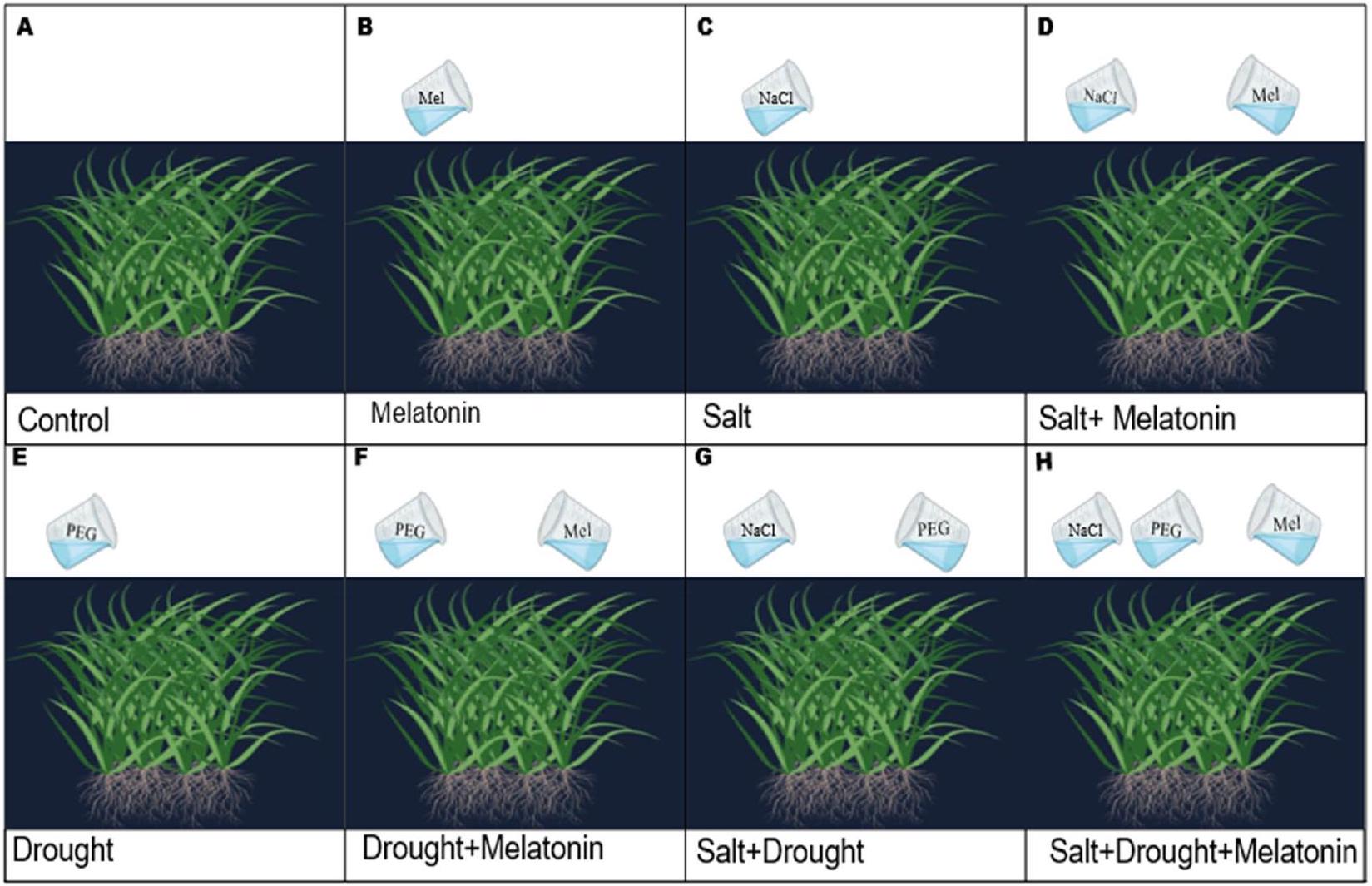
الشكل 1. تصميم التجربة، موضحًا الصناديق التجريبية الثمانية وتطبيق الإجهاد الناتج عن الجفاف والملوحة. الصندوق (A) يظهر النباتات الضابطة. الصندوق (B) يظهر النباتات المعالجة بالميلاتونين فقط. الصندوق (C) يظهر النباتات المعرضة لإجهاد الملوحة. الصندوق (D) يظهر النباتات المعالجة بالميلاتونين والمعرضة لإجهاد الملوحة. الصندوق (E) يظهر النباتات المعرضة لإجهاد الجفاف. الصندوق (F) يظهر النباتات المعالجة بالميلاتونين والمعرضة لإجهاد الجفاف. الصندوق (G) يظهر النباتات المعرضة لإجهاد الملوحة والجفاف معًا. الصندوق (H) يظهر النباتات المعالجة بالميلاتونين والمعرضة لإجهاد الملوحة والجفاف معًا.

الشكل 2. تقييم معايير النمو في نباتات الأرز تحت ضغط الملح والجفاف. تظهر الأشكال أن الميلاتونين زاد من طول الجذور والسوق وكتلة النبات تحت ضغط الملح والجفاف بشكل فردي وكذلك بشكل مشترك. (أ) يظهر ضرر ضغط الملح والجفاف. (ب) طول الساق، (ج) طول الجذر، (د) الوزن الطازج والوزن الجاف. تم تحليل البيانات في ثلاث نسخ بيولوجية مستقلة.
وزن الجذر شهد زيادات من
آثار الميلاتونين الخارجي على محتويات الكلوروفيل
أدى الإجهاد الناتج عن الملح والجفاف إلى انخفاض كبير في محتويات الكلوروفيل بـ
آثار الميلاتونين الخارجي على تسرب الإلكتروليتات
نفاذية الغشاء، كما يتضح من تسرب الإلكتروليت، تتأثر بشكل ملحوظ بكل من إجهاد الملح وإجهاد الجفاف بواسطة
آثار الميلاتونين الخارجي على محتويات الماء النسبية
كنسبة لمستوى المياه في النبات، فإن محتوى المياه النسبي (RWC) لا يوفر فقط رؤى حول مستوى ترطيب النبات، بل يعمل أيضًا كمرآة لنشاطه الأيضي.

الشكل 3. تطبيق الميلاتونين يقلل من تأثيرات الإجهاد الناتج عن الملح والجفاف على محتويات الكلوروفيل. (A) يظهر قيم محتويات الكلوروفيل SPAD. (B) تسرب الإلكتروليت و (C) محتويات الماء النسبية التي يتم تنظيمها بواسطة العلاج الخارجي بالميلاتونين. تم تحليل البيانات في ثلاث تكرارات بيولوجية مستقلة.
إجهاد الملح والجفاف المدمج
آثار الميلاتونين الخارجي على
يعمل بيروكسيد الهيدروجين كمؤشر على قدرة النباتات على التخلص من أنواع الأكسجين التفاعلية (ROS) تحت ضغوط مختلفة، ويتم إنتاجه كناتج ثانوي لعملية الأيض الخلوي. تظهر النتائج أن
أظهرت الضغوط الناتجة عن الملح والجفاف تأثيرًا ملحوظًا على محتويات المالونديالديهايد (MDA)، مما رفع المستويات بـ

الشكل 4. تطبيق الميلاتونين يخفف من إجهاد الملح والجفاف من خلال التخلص من تراكم الجذور الحرة. (A،B) يظهر
الميلاتونين يقلل من الإجهاد التأكسدي من خلال تنظيم GR و CAT
يوفر الميلاتونين الحماية للنباتات من الضرر التأكسدي من خلال تنشيط مضادات الأكسدة. في هذه الدراسة، تم التحقيق في تأثيرات الإجهاد الناتج عن الملح والجفاف على أنشطة مضادات الأكسدة للجلوتاثيون (GSH) والكاتالاز (CAT) في نباتات الأرز، مع علاج الميلاتونين وبدونه. كشفت النتائج عن انخفاض كبير في الجلوتاثيون (GSH) بواسطة
أظهر نشاط الكاتالاز (CAT) زيادة تدريجية بسبب الإجهاد الناتج عن الملح والجفاف؛ ومع ذلك، فإن معالجة الميلاتونين سرعت من نشاطه. زاد نشاط الكاتالاز (CAT) بنسبة
الميلاتونين ينظم الجينات المستجيبة للإجهاد الناتج عن الملح والجفاف
تؤثر التأثيرات المشتركة للملوحة وإجهاد الجفاف بشكل كبير على تعبير الجينات المرتبطة بهذه الضغوط. تم ملاحظة تعبير OsSOS على أنه
وبالمثل، فإن معالجة الميلاتونين الخارجي أدت أيضًا إلى تحفيز التعبير عن جينات الاستجابة للجفاف OsHSF و OsDREB. أظهر OsHSF زيادة ملحوظة في

الشكل 5. الميلاتونين يقلل من إجهاد الملح والجفاف من خلال تنظيم الجينات المستجيبة لإجهاد الجفاف والملح.
نقاش
في هذه الدراسة، أدى كل من الإجهاد الناتج عن الملح والجفاف، سواء بشكل مستقل أو معًا، إلى انخفاض كبير في نمو الأرز (الشكل 2). إن تثبيط نمو الأوراق الجديدة وتطور نظام الجذور بسبب الإجهاد الناتج عن الجفاف والملح هي عوامل معترف بها على نطاق واسع تسهم في تقليل تراكم الكتلة الحيوية.
تشير نتائج هذه الدراسة إلى أن مستويات الملح المرتفعة وإجهاد الجفاف أدت إلى انخفاض في محتوى الماء النسبي في الأوراق (RLWC). قد يكون هذا الانخفاض في RLWC قد ساهم في تقليل عوامل نمو النبات المختلفة.
كلا من الإجهاد الناتج عن الملح والجفاف في نباتات الأرز يؤديان إلى إنتاج مفرط لجذور الأكسجين التفاعلية (ROS)، مما يؤدي بعد ذلك إلى تلف في مختلف الجزيئات الحيوية. هذه الاضطرابات في التوازن بين إنتاج وإزالة ROS تضيف إلى الإجهاد التأكسدي العام داخل نظام النبات.
علاوة على ذلك، أفاد لي وآخرون
في الظروف العادية، تقوم النباتات بتحييد أنواع الأكسجين التفاعلية (ROS) بفعالية من خلال كل من مضادات الأكسدة غير الإنزيمية والإنزيمية. ومع ذلك، تحت ظروف الملح والجفاف، يتجاوز إنتاج ROS قدرة أنظمة الدفاع المضادة للأكسدة، مما يؤدي إلى إجهاد أكسدي داخل النبات
آليات للحفاظ على التوازن الخلوي وتحمل الإجهاد غير الحيوي
آليات للحفاظ على التوازن الخلوي وتحمل الإجهاد غير الحيوي
علاوة على ذلك، درسنا مستوى التعبير عن OsSOS وNHX وHSF وDREB تحت الإجهاد الناتج عن الملح والجفاف مع نقاط زمنية مختلفة استجابةً للميلا تونين. تم دراسة هذه الجينات بشكل موسع وتعتبر منظمين لاستجابة الإجهاد الناتج عن الجفاف والملح في نباتات الأرز. تؤثر تركيزات الملح المختلفة على التعبير الجيني في الأرز، مثل SOS2 وNHX التي تم التعبير عنها بشكل مفرط ونشطت مباشرة تعبير
تظهر الدراسات أن عوامل النسخ المختلفة تم تحديدها والتي تلعب دورًا مهمًا في تنظيم استجابة النباتات لمختلف الضغوط
الخاتمة
أظهرت دراستنا أن كل من الإجهاد الناتج عن الملوحة والجفاف تسبب في تلف أكسيدي من خلال توليد ROS وتلف الغشاء بسبب أكسدة الدهون، مما يؤدي إلى تقليل نمو وتطور نبات الأرز. يقلل تطبيق الميلاتونين الخارجي من الإجهاد الناتج عن الملوحة والجفاف بشكل فردي وكذلك في التركيب. زاد الميلاتونين من الوزن الطازج والوزن الجاف للأرز تحت الإجهاد الناتج عن الملوحة والجفاف. وبالمثل، قلل علاج الميلاتونين بشكل كبير من تراكم ROS وزاد من النشاط المضاد للأكسدة. علاوة على ذلك، زاد الميلاتونين من تعبير الجينات المسؤولة عن توازن الأيونات.
تتضمن الآفاق المستقبلية فك آليات الميلاتونين الدقيقة، وتحسين استراتيجيات تطبيقه، والتحقق من فعاليته في التجارب الميدانية لتحقيق مرونة المحاصيل المستدامة تحت ضغوط الملوحة والجفاف.
تتضمن الآفاق المستقبلية فك آليات الميلاتونين الدقيقة، وتحسين استراتيجيات تطبيقه، والتحقق من فعاليته في التجارب الميدانية لتحقيق مرونة المحاصيل المستدامة تحت ضغوط الملوحة والجفاف.
بيان الالتزام بدراسة إرشادات IUCN
تتوافق الدراسة الحالية مع الإرشادات ذات الصلة لبيان سياسة IUCN بشأن البحث المتعلق بالأنواع المعرضة لخطر الانقراض واتفاقية التجارة في الأنواع المهددة بالانقراض من الحيوانات والنباتات البرية.
توفر البيانات
البيانات المقدمة في هذه الدراسة متاحة عند الطلب من المؤلف المراسل.
تاريخ الاستلام: 17 أكتوبر 2023؛ تاريخ القبول: 4 يناير 2024
نُشر على الإنترنت: 12 يناير 2024
تاريخ الاستلام: 17 أكتوبر 2023؛ تاريخ القبول: 4 يناير 2024
نُشر على الإنترنت: 12 يناير 2024
References
- Sen, S., Chakraborty, R. & Kalita, P. Rice-not just a staple food: A comprehensive review on its phytochemicals and therapeutic potential. Trends Food Sci. Technol. 97, 265-285 (2020).
- Fan, X. et al. Effects of high temperature on the fine structure of starch during the grain-filling stages in rice: Mathematical modeling and integrated enzymatic analysis. J. Sci. Food Agric. 99, 2865-2873 (2019).
- Fitzgerald, M. A., McCouch, S. R. & Hall, R. D. Not just a grain of rice: The quest for quality. Trends Plant Sci. 14, 133-139 (2009).
- Battisti, D. S. & Naylor, R. L. Historical warnings of future food insecurity with unprecedented seasonal heat. Science 323, 240-244 (2009).
- Nam, W.-H., Hayes, M. J., Svoboda, M. D., Tadesse, T. & Wilhite, D. A. Drought hazard assessment in the context of climate change for South Korea. Agric. Water Manag. 160, 106-117 (2015).
- Cook, B. I., Mankin, J. S. & Anchukaitis, K. Climate change and drought: From past to future. Curr. Clim. Change Rep. 4, 164-179 (2018).
- Sheffield, J. & Wood, E. F. Drought: Past Problems and Future Scenarios (Routledge, 2012).
- Allen, R. G. Crop evapotranspiration-Guideline for computing crop water requirements. Irrig. Drain 56, 300 (1998).
- Mostajeran, A. & Rahimi-Eichi, V. Effects of drought stress on growth and yield of rice (Oryza sativa L.) cultivars and accumulation of proline and soluble sugars in sheath and blades of their different ages leaves. Agric. Environ. Sci. 5, 264-272 (2009).
- Pandey, S., Bhandari, H. S. & Hardy, B. Economic Costs of Drought and Rice Farmers’ Coping Mechanisms: A Cross-Country Comparative Analysis (International Rice Research Institute, 2007).
- Thitisaksakul, M. et al. Effects of timing and severity of salinity stress on rice (Oryza sativa L.) yield, grain composition, and starch functionality. J. Agric. Food Chem. 68, 2296-2304 (2015).
- Hussain, S. et al. Effects of salt stress on rice growth, development characteristics, and the regulating ways: A review. J. Integr. Agric. 16, 2357-2374 (2017).
- Hussain, S. et al. Effects of 1-methylcyclopropene on rice growth characteristics and superior and inferior spikelet development under salt stress. J. Plant Growth Regul. 37, 1368-1384 (2018).
- Tarakcioglu, C. & Inal, A. Changes induced by salinity, demarcating specific ion ratio (
) and osmolality in ion and proline accumulation, nitrate reductase activity, and growth performance of lettuce. J. Plant Nutr. 25, 27-41 (2002). - Gunes, A. et al. Salicylic acid induced changes on some physiological parameters symptomatic for oxidative stress and mineral nutrition in maize (Zea mays L.) grown under salinity. J. Plant Physiol. 164, 728-736 (2007).
- Munns, R. Comparative physiology of salt and water stress. Plant Cell Environ. 25, 239-250 (2002).
- Shereen, A., Mumtaz, S., Raza, S., Khan, M. & Solangi, S. Salinity effects on seedling growth and yield components of different inbred rice lines. Pak. J. Bot. 37, 131-139 (2005).
- Reiter, R. J., Tan, D. X. & Galano, A. Melatonin: Exceeding expectations. Physiology 29, 325 (2014).
- Hardeland, R., Madrid, J. A., Tan, D. X. & Reiter, R. J. Melatonin, the circadian multioscillator system and health: The need for detailed analyses of peripheral melatonin signaling. J. Pineal Res. 52, 139-166 (2012).
- Calvo, J. R., Gonzalez-Yanes, C. & Maldonado, M. The role of melatonin in the cells of the innate immunity: A review. J. Pineal Res. 55, 103-120 (2013).
- Hardeland, R., Reiter, R., Poeggeler, B. & Tan, D.-X. The significance of the metabolism of the neurohormone melatonin: Antioxidative protection and formation of bioactive substances. Neurosci. Biobehav. Rev. 17, 347-357 (1993).
- Dubbels, R. et al. Melatonin in edible plants identified by radioimmunoassay and by high performance liquid chromatographymass spectrometry. J. Pineal Res. 18, 28-31 (1995).
- Zhang, N. et al. Melatonin promotes water-stress tolerance, lateral root formation, and seed germination in cucumber (Cucumis sativus L.). J. Pineal Res. 54, 15-23 (2013).
- Bajwa, V. S., Shukla, M. R., Sherif, S. M., Murch, S. J. & Saxena, P. K. Role of melatonin in alleviating cold stress in Arabidopsis thaliana. J. Pineal Res. 56, 238-245 (2014).
- Sharma, A. & Zheng, B. Melatonin mediated regulation of drought stress: Physiological and molecular aspects. Plants 8, 190 (2019).
- Tiwari, R. K. et al. Mechanistic insights on melatonin-mediated drought stress mitigation in plants. Physiol. Plant. 172, 1212-1226 (2021).
- Arnao, M. B. & Hernández-Ruiz, J. Melatonin: Plant growth regulator and/or biostimulator during stress? Trends Plant Sci. 19, 789-797 (2014).
- Yan, F. et al. Melatonin regulates antioxidant strategy in response to continuous salt stress in rice seedlings. Plant Physiol. 165, 239-250 (2021).
- Alharby, H. F. & Fahad, S. Melatonin application enhances biochar efficiency for drought tolerance in maize varieties: Modifications in physio-biochemical machinery. Agron. J. 112, 2826-2847 (2020).
- Ibrahim, W. et al. Comparative physiological analysis in the tolerance to salinity and drought individual and combination in two cotton genotypes with contrasting salt tolerance. Physiol. Plant. 165, 155-168 (2019).
- Anwar, K., Joshi, R., Dhankher, O. P., Singla-Pareek, S. L. & Pareek, A. Elucidating the response of crop plants towards individual, combined and sequentially occurring abiotic stresses. Int. J. Mol. Sci. 22, 6119 (2021).
- Kumar, G., Basu, S., Singla-Pareek, S. L. & Pareek, A. Unraveling the contribution of OsSOS2 in conferring salinity and drought tolerance in a high-yielding rice. Physiol. Plant. 174, e13638 (2022).
- Fukuda, A. et al. Function, intracellular localization and the importance in salt tolerance of a vacuolar
antiporter from rice. Plant Cell Physiol. 45, 146-159 (2004). - Lü, S. Y. et al. Antiporter gene from Hordum brevisubulatum (Trin.) link and its overexpression in transgenic tobaccos. J. Integr. Plant Biol. 47, 343-349 (2005).
- Singh, D. & Laxmi, A. Transcriptional regulation of drought response: A tortuous network of transcriptional factors. Front. Plant Sci. 6, 895 (2015).
- Joshi, R. et al. Transcription factors and plants response to drought stress: Current understanding and future directions. Front. Plant Sci. 7, 1029 (2016).
- Mao, X. et al. TaNAC2, a NAC-type wheat transcription factor conferring enhanced multiple abiotic stress tolerances in Arabidopsis. J. Exp. Bot. 63, 2933-2946 (2012).
- Scharf, K.-D., Berberich, T., Ebersberger, I. & Nover, L. The plant heat stress transcription factor (Hsf) family: Structure, function and evolution. Biochim. Biophys. Acta Gene Regul. Mech. 1819, 104-119 (2012).
- Jan, R., Khan, M. A., Asaf, S., Lee, I.-J. & Kim, K.-M. Overexpression of OsF 3 H modulates WBPH stress by alteration of phenylpropanoid pathway at a transcriptomic and metabolomic level in Oryza sativa. Sci. Rep. 10, 14685 (2020).
- Ahmad, S. et al. Exogenous melatonin confers drought stress by promoting plant growth, photosynthetic capacity and antioxidant defense system of maize seedlings. PeerJ 7, e7793 (2019).
- Schmidt, R. et al. SALT-RESPONSIVE ERF1 regulates reactive oxygen species-dependent signaling during the initial response to salt stress in rice. Plant Cell 25, 2115-2131 (2013).
- Jan, R. et al. Drought and UV radiation stress tolerance in rice is improved by overaccumulation of non-enzymatic antioxidant flavonoids. Antioxidants 11, 917 (2022).
- Bastam, N., Baninasab, B. & Ghobadi, C. Improving salt tolerance by exogenous application of salicylic acid in seedlings of pistachio. Plant Growth Regul. 69, 275-284 (2013).
- Khan, M. A. et al. Halotolerant rhizobacterial strains mitigate the adverse effects of NaCl stress in soybean seedlings. BioMed Res. Int. 2019, 1 (2019).
- Velikova, V., Yordanov, I. & Edreva, A. Oxidative stress and some antioxidant systems in acid rain-treated bean plants: Protective role of exogenous polyamines. Plant Sci. 151, 59-66 (2000).
- Khan, M. A. et al. Halo-tolerant rhizospheric Arthrobacter woluwensis AK1 mitigates salt stress and induces physio-hormonal changes and expression of GmST1 and GmLAX3 in soybean. Symbiosis 77, 9-21 (2019).
- Johansson, L. H. & Borg, L. H. A spectrophotometric method for determination of catalase activity in small tissue samples. Arch. Biochem. 174, 331-336 (1988).
- Ellman, G. L. Tissue sulfhydryl groups. Arch. Biochem. 82, 70-77 (1959).
- Huang, C. et al. Alteration in chlorophyll fluorescence, lipid peroxidation and antioxidant enzymes activities in hybrid ramie (Boehmeria nivea L.) Under drought stress. Austral. J. Crop Sci. 7, 594-599 (2013).
- Yang, S. & Deng, X. Effects of drought stress on antioxidant enzymes in seedlings of different wheat genotypes. Pak. J. Bot. 47, 49-56 (2015).
- Xiaoqin, Y., Jianzhou, C. & Guangyin, W. Effects of drought stress and selenium supply on growth and physiological characteristics of wheat seedlings. Acta Physiol. Plant. 31, 1031-1036 (2009).
- Khan, M. A., Gemenet, D. C. & Villordon, A. Root system architecture and abiotic stress tolerance: Current knowledge in root and tuber crops. Front. Plant Sci. 7, 1584 (2016).
- Luo, C. et al. Melatonin enhances drought tolerance in rice seedlings by modulating antioxidant systems, osmoregulation, and corresponding gene expression. Int. J. Mol. Sci. 23, 12075 (2022).
- Talubaghi, M. J., Daliri, M. S., Mazloum, P., Rameeh, V. & Mousavi, A. Effect of salt stress on growth, physiological and biochemical parameters and activities of antioxidative enzymes of rice cultivars. Cereal Res. Commun. 51, 403-411 (2023).
- Shahid, M. A. et al. Insights into the physiological and biochemical impacts of salt stress on plant growth and development. Agron. J. 10, 938 (2020).
- Mushtaq, Z. et al. Changes in growth, photosynthetic pigments, cell viability, lipid peroxidation and antioxidant defense system in two varieties of chickpea (Cicer arietinum L.) subjected to salinity stress. Phyton 91, 149 (2022).
- Imran, M. et al. Exogenous melatonin induces drought stress tolerance by promoting plant growth and antioxidant defence system of soybean plants. AoB Plants 13, 026 (2021).
- Arnao, M. & Hernández-Ruiz, J. Protective effect of melatonin against chlorophyll degradation during the senescence of barley leaves. J. Pineal Res. 46, 58-63 (2009).
- Ghanbari, F. & Sayyari, M. Controlled drought stress affects the chilling-hardening capacity of tomato seedlings as indicated by changes in phenol metabolisms, antioxidant enzymes activity, osmolytes concentration and abscisic acid accumulation. Sci. Hortic. 229, 167-174 (2018).
- Turk, H. et al. The regulatory effect of melatonin on physiological, biochemical and molecular parameters in cold-stressed wheat seedlings. Plant Growth Regul. 74, 139-152 (2014).
- Xu, X. D., Sun, Y., Sun, B., Zhang, J. & Guo, X. Q. Effects of exogenous melatonin on active oxygen metabolism of cucumber seedlings under high temperature stress. J. Appl. Ecol. 21, 1295-1300 (2010).
- Jungklang, J., Saengnil, K. & Uthaibutra, J. Effects of water-deficit stress and paclobutrazol on growth, relative water content, electrolyte leakage, proline content and some antioxidant changes in Curcuma alismatifolia Gagnep. cv. Chiang Mai Pink. Saudi J. Biol. Sci. 24, 1505-1512 (2017).
- Cui, G. et al. Beneficial effects of melatonin in overcoming drought stress in wheat seedlings. Plant Physiol. Biochem. 118, 138-149 (2017).
- Altaf, M. et al. Exogenous melatonin enhances salt stress tolerance in tomato seedlings. Biol. Plant. 64, 604-615 (2020).
- Das, K. & Roychoudhury, A. Reactive oxygen species (ROS) and response of antioxidants as ROS-scavengers during environmental stress in plants. Front. Environ. Sci. 2, 53 (2014).
- Tan, D. et al. Chemical and physical properties and potential mechanisms: Melatonin as a broad spectrum antioxidant and free radical scavenger. Curr. Top. Med. Chem. 2, 181-197 (2002).
- Li, H. et al. Exogenous melatonin confers salt stress tolerance to watermelon by improving photosynthesis and redox homeostasis. Front. Plant Sci. 8, 295 (2017).
- Zhao, H. et al. Melatonin increases the chilling tolerance of chloroplast in cucumber seedlings by regulating photosynthetic electron flux and the ascorbate-glutathione cycle. Front. Plant Sci. 7, 1814 (2016).
- Li, J. et al. Alleviation of cold damage by exogenous application of melatonin in vegetatively propagated tea plant (Camellia sinensis (L.) O. Kuntze). Sci. Hortic. 238, 356-362 (2018).
- Tomás-Zapico, C. & Coto-Montes, A. A proposed mechanism to explain the stimulatory effect of melatonin on antioxidative enzymes. J. Pineal Res. 39, 99-104 (2005).
- Reiter, R. J. et al. Melatonin as an antioxidant: Biochemical mechanisms and pathophysiological implications in humans. Acta Biochim. Polon. 50, 1129-1146 (2003).
- Wu, S. et al. Drought stress tolerance mediated by zinc-induced antioxidative defense and osmotic adjustment in cotton (Gossypium hirsutum). Acta Physiol. Plant. 37, 1-9 (2015).
- Zhang, N. et al. Melatonin improved anthocyanin accumulation by regulating gene expressions and resulted in high reactive oxygen species scavenging capacity in cabbage. Front. Plant Sci. 7, 197 (2016).
- Morales, F., Abadía, A. & Abadba, J. Photoprotection, Photoinhibition, Gene Regulation, and Environment 65-85 (Springer, 2008).
- Ball, L. et al. Evidence for a direct link between glutathione biosynthesis and stress defense gene expression in Arabidopsis. Plant Cell 16, 2448-2462 (2004).
- Pan, Y., Wu, L. J. & Yu, Z. L. Effect of salt and drought stress on antioxidant enzymes activities and SOD isoenzymes of liquorice (Glycyrrhiza uralensis Fisch). Plant Growth Regul. 49, 157-165 (2006).
- Yildiztugay, E., Ozfidan-Konakci, C., Kucukoduk, M., Tekis, S. A. & Science, S. The impact of selenium application on enzymatic and non-enzymatic antioxidant systems in Zea mays roots treated with combined osmotic and heat stress. Arch. Agron. 63, 261-275 (2017).
- Schafer, F. Q. & Buettner, G. R. Redox environment of the cell as viewed through the redox state of the glutathione disulfide/ glutathione couple. Free Radic. Biol. Med. 30, 1191-1212 (2001).
- Zhang, W., Tian, Z., Pan, X., Zhao, X. & Wang, F. Oxidative stress and non-enzymatic antioxidants in leaves of three edible canna cultivars under drought stress. Hortic. Environ. Biotechnol. 54, 1-8 (2013).
- Tepe, M. & Harms, H. Influence of abiotic stress on the GSH/GSSG system of plant cell cultures. Mol. Biol. Plants 158, 75-78 (1995).
- Dash, S. & Mohanty, N. Response of seedlings to heat-stress in cultivars of wheat: Growth temperature-dependent differential modulation of photosystem 1 and 2 activity, and foliar antioxidant defense capacity. J. Plant Physiol. 159, 49-59 (2002).
- De Vos, C. R., Vonk, M. J., Vooijs, R. & Schat, H. Glutathione depletion due to copper-induced phytochelatin synthesis causes oxidative stress in Silene cucubalus. Plant Physiol. 98, 853-858 (1992).
- Liu, T., Sun, L., Zhang, Y., Wang, Y. & Zheng, J. Imbalanced GSH/ROS and sequential cell death. J. Biochem. Mol. Toxicol. 36, e22942 (2022).
- Chen, Y. E. et al. Exogenous melatonin enhances salt stress tolerance in maize seedlings by improving antioxidant and photosynthetic capacity. Physiol. Plant. 164, 349-363 (2018).
- Liang, D. et al. Melatonin improves heat tolerance in kiwifruit seedlings through promoting antioxidant enzymatic activity and glutathione S-transferase transcription. Molecules 23, 584 (2018).
- Huang, B. et al. Exogenous melatonin alleviates oxidative damages and protects photosystem II in maize seedlings under drought stress. Front. Plant Sci. 10, 677 (2019).
- Foyer, C. H. & Noctor, G. Ascorbate and glutathione: The heart of the redox hub. Plant Physiol. 155, 2-18 (2011).
- Wei, J. et al. Phytomelatonin receptor PMTR 1-mediated signaling regulates stomatal closure in Arabidopsis thaliana. J. Pineal Res. 65, e12500 (2018).
- Liu, C. et al. OsbZIP71, a bZIP transcription factor, confers salinity and drought tolerance in rice. Plant Mol. Biol. 84, 19-36 (2014).
- Wang, H. et al. Effects of salt stress on ion balance and nitrogen metabolism of old and young leaves in rice (Oryza sativa L.). BMC Plant Biol. 12, 1-11 (2012).
- Fukuda, A., Nakamura, A., Hara, N., Toki, S. & Tanaka, Y. Molecular and functional analyses of rice NHX-type Na+/H+ antiporter genes. Plant Physiol. 233, 175-188 (2011).
- Theerawitaya, C., Tisarum, R., Samphumphuang, T., Takabe, T. & Cha-Um, S. Expression levels of the Na+/K+ transporter OsHKT2; 1 and vacuolar
exchanger OsNHX1, Na enrichment, maintaining the photosynthetic abilities and growth performances of Indica rice seedlings under salt stress. Physiol. Mol. Biol. Plants 26, 513-523 (2020). - Li, C. et al. Melatonin mediates the regulation of ABA metabolism, free-radical scavenging, and stomatal behaviour in two Malus species under drought stress. J. Exp. Bot. 66, 669-680 (2015).
- Chen, G. et al. Melatonin in Chinese medicinal herbs. Life Sci. 73, 19-26 (2003).
- Yan, F. et al. Melatonin enhances
homeostasis in rice seedlings under salt stress through increasing the root pump activity and transporters sensitivity to ROS/RNS. Environ. Exp. Bot. 182, 104328 (2021). - Singh, K. B., Foley, R. C. & Oñate-Sánchez, L. Transcription factors in plant defense and stress responses. Curr. Opin. Plant Biol. 5, 430-436 (2002).
- Dubouzet, J. G. et al. OsDREB genes in rice, Oryza sativa L., encode transcription activators that function in drought-, high-salt-and cold-responsive gene expression. Plant J. 33, 751-763 (2003).
- Kasuga, M., Liu, Q., Miura, S., Yamaguchi-Shinozaki, K. & Shinozaki, K. Improving plant drought, salt, and freezing tolerance by gene transfer of a single stress-inducible transcription factor. Nat. Biotechnol. 17, 287-291 (1999).
- Liu, J.-G. et al. OsHSF7 gene in rice, Oryza sativa L., encodes a transcription factor that functions as a high temperature receptive and responsive factor. BMB Rep. 42, 16-21 (2009).
- Charng, Y.-Y. et al. A heat-inducible transcription factor, HsfA2, is required for extension of acquired thermotolerance in Arabidopsis. Plant Physiol. 143, 251-262 (2007).
- Han, G. et al. C2H2 zinc finger proteins: Master regulators of abiotic stress responses in plants. Front. Plant Sci. 11, 115 (2020).
- Shi, H., Chen, K., Wei, Y. & He, C. Fundamental issues of melatonin-mediated stress signaling in plants. Front. Plant Sci. 7, 1124 (2016).
- Zhang, L. et al. A cotton group C MAP kinase gene, GhMPK2, positively regulates salt and drought tolerance in tobacco. Plant Mol. Biol. 77, 17-31 (2011).
مساهمات المؤلفين
Z.K. و R.J. و K.-M.K.؛ صمموا الدراسة؛ Z.K. و R.J. و S.A. و M.-F.؛ أجروا التجارب؛ E.-G.K. و Y.H.J. و N.K.؛ ساهموا في التحليل الإحصائي؛ Z.K. و R.J. و K.-M.K.؛ كتبوا المخطوطة. قرأ جميع المؤلفين ووافقوا على النسخة المنشورة من المخطوطة.
التمويل
تم إجراء هذا العمل بدعم من “برنامج البحث التعاوني لتطوير علوم وتكنولوجيا الزراعة (رقم المشروع RS-2022-RD010034)” إدارة التنمية الريفية، جمهورية كوريا. كما تم توفير التمويل من قبل برنامج البحث التعاوني لتطوير علوم وتكنولوجيا الزراعة إدارة التنمية الريفية، جمهورية كوريا، رقم المشروع RS-2023-00217583.
المصالح المتنافسة
يعلن المؤلفون عدم وجود مصالح متنافسة.
معلومات إضافية
يجب توجيه المراسلات والطلبات للحصول على المواد إلى R.J. أو K.-M.K.
معلومات إعادة الطبع والتصاريح متاحة علىwww.nature.com/reprints.
معلومات إعادة الطبع والتصاريح متاحة علىwww.nature.com/reprints.
ملاحظة الناشر تظل Springer Nature محايدة فيما يتعلق بالمطالبات القضائية في الخرائط المنشورة والانتماءات المؤسسية.
الوصول المفتوح هذه المقالة مرخصة بموجب رخصة المشاع الإبداعي للاستخدام والمشاركة والتكيف والتوزيع وإعادة الإنتاج في أي وسيلة أو تنسيق، طالما أنك تعطي الائتمان المناسب للمؤلفين الأصليين والمصدر، وتوفر رابطًا لرخصة المشاع الإبداعي، وتوضح ما إذا كانت هناك تغييرات قد أُجريت. الصور أو المواد الأخرى من طرف ثالث في هذه المقالة مشمولة في رخصة المشاع الإبداعي للمقالة، ما لم يُذكر خلاف ذلك في سطر ائتمان للمادة. إذا لم تكن المادة مشمولة في رخصة المشاع الإبداعي للمقالة وكان استخدامك المقصود غير مسموح به بموجب اللوائح القانونية أو يتجاوز الاستخدام المسموح به، ستحتاج إلى الحصول على إذن مباشرة من صاحب حقوق الطبع والنشر. لعرض نسخة من هذه الرخصة، قم بزيارةhttp://creativecommons.org/licenses/by/4.0/.
© المؤلفون 2024
© المؤلفون 2024
قسم علوم الأحياء التطبيقية، كلية الدراسات العليا، جامعة كيونغبوك الوطنية، دايجو 41566، كوريا الجنوبية. معهد أبحاث الزراعة الساحلية، جامعة كيونغبوك الوطنية، دايجو 41566، كوريا الجنوبية. البريد الإلكتروني:rehmatbot@yahoo.com; kkm@knu.ac.kr
Journal: Scientific Reports, Volume: 14, Issue: 1
DOI: https://doi.org/10.1038/s41598-024-51369-0
PMID: https://pubmed.ncbi.nlm.nih.gov/38216610
Publication Date: 2024-01-12
DOI: https://doi.org/10.1038/s41598-024-51369-0
PMID: https://pubmed.ncbi.nlm.nih.gov/38216610
Publication Date: 2024-01-12
Exogenous melatonin induces salt and drought stress tolerance in rice by promoting plant growth and defense system
Due to global climate change, crops are certainly confronted with a lot of abiotic and biotic stress factors during their growth that cause a serious threat to their development and overall productivity. Among different abiotic stresses, salt and drought are considered the most devastating stressors with serious impact on crop’s yield stability. Here, the current study aimed to elucidate how melatonin works in regulating plant biomass, oxidative stress, antioxidant defense system, as well as the expression of genes related to salt and drought stress in rice plants. Eight groups of rice plants ( 3 replicates, 5 plants each) underwent varied treatments: control, melatonin, salt, drought, salt + drought, salt + melatonin, drought + melatonin, and salt + drought + melatonin. Melatonin (100
Rice (Oryza sativa) is one of the major staple food and widely cultivated throughout the world, and about half of the world population is depends upon rice
The major consequences of climate change are droughts which are tragic threat to water supplies, agriculture crops, food production and causing ecological disturbance and famine in the World
the total rice production comes from traditionally irrigated areas, which is facing the problem of droughts and water scarcity
At the same time salinity is an another environmental factor increasing in magnitude in the rice growing areas, due to the combine effects of high temperature, drought, sea level rising, and inferior agriculture practices
Melatonin ( N -acetyl-5-methoxytryptamine) is common biological hormone that plays an important role in biological functions
There is very limited information regarding the combined effects of salt and drought stress on rice plants, however salt and drought stress and its effects on rice were studied individually. A recent study on cotton (Gossypium hirsutum) shows that salt and drought combine stress cause significant reduction in plant growth, chlorophyll content and photosynthesis in cotton
Our study hypothesized that induction of melatonin enhances tolerance to individual as well as combined drought and salt stress in the rice plant. The aim of our study is to evaluate the role of melatonin in rice plants in response to drought and salt stress individually and when they are combined. We focused on the effects of melatonin on morphological parameters, antioxidants and transcriptional regulation of salt and drought responsive genes in response to salt and drought combined stress.
Materials and methods
Plant material and growth conditions
Ilmi rice cultivar (Oryza sativa L.) seeds were used in this experiment, provided by Plant Molecular Breeding Laboratory, Kyungpook National University, Korea
Experimental design
In this experiment, a total of eight groups of rice plants were involved. Each of these groups had three replicates, and within each replicate, there were five plants. The experimental groups were control plants (C), melatonin treated plants (M), salt treated plants (S), drought treated plants (D), salt + drought treated (S + D), salt + melatonin treated plants (
Analysis of morphological parameters and biomass
After 35 days of plant growth, shoot length, root length, height of shoot, and fresh weight (FW) of the rice plants were measured. For the determination of the dry weight (DW) of seedlings, the roots and shoots were dried by oven at
Chlorophyll contents
Chlorophyll contents were measured after 1 week of stress exposure by using portable chlorophyll meter (SPAD 502, Konica Minolta, Japan). The second last fully mature leaf was selected for chlorophyll measurement and the reading was taken from leaf base, middle and near the leaf tip. Five leaves were measured from each treatment group for chlorophyll contents and the average value was taken as SPAD value as mentioned previously
Electrolyte leakage
For determination of electrolyte leakage, fresh leaves samples were cut into 5 mm and placed in test tubes containing 10 mL deionized water. The tubes were covered with plastic caps and placed in a water bath maintained at the constant temperature of
Determination of
Determination of antioxidative activities
Catalase activity was find out by the method of Ref.
RNA isolation and qRT-PCR
To determine expression level of
| Gene | Forward primers | Reverse primers | Accession no |
| OsActin | CTGCGGGTATCCATGAGACT | GGAGCAAGGCAGTGATCTTC | X16280.1 |
| OsHSF | GCGAGAGAAGCTCAGCTAGG | CCCAGACGTAGAATCCGGTG | AK101182 |
| OsDREB | AGGAGGGAGAAATCTGGCAC | CGCACTGAAAAGTGTGGACA | AK062422 |
| OsNHX | GCGGTGCATTTTGCTCTCAA | CCTGCTTCAGATCAGGGTGG | AK104336 |
| OsSOS | TCGCAGACAGGGTGTTTGAT | CGCTTTTGGGTGGAACACAC | AK101368 |
Table 1. Primers and accession numbers of selected genes designed by NCBI for qRT-PCR.
Statistical analysis
All experiments were performed three time. Data were analyzed using two-way ANOVA with Bonferroni post hoc tests (*shows
Results
Plant growth under salt/drought stress and effects of melatonin
In this experiment, we evaluated various growth parameters of rice plants in response to salt and drought combined and individual stress as shown in (Fig. 2A). Both salt and drought stress significantly reduced plant shoot length by
Figure 1. Experimental design of the experiment, indicating the eight experimental boxes and application of drought and salt stress. Box (A) shows control plants. Box (B) shows plants treated with melatonin only. Box (C) shows the plants exposed to salt stress. Box (D) shows melatonin treated plants exposed to salt stress. Box (E) shows plants exposed to drought stress. Box (F) shows melatonin treated plants exposed to drought stress. Box (G) shows plants exposed to salt and drought combined stress. Box (H) melatonin treated plants exposed to salt and drought combined stress.
Figure 2. Evaluation of growth parameters in rice plants under salt and drought stress. Figures show that melatonin increased the root shoot length and plant biomass in salt and drought stress individually as well as in combined. (A) Shows the salt and drought stress damage. (B) Shoot length, (C) root length, (D) fresh and dry weight. Data were analyzed in three independent biological replicates (
weight of the root experienced increments of
Effects of exogenous melatonin on chlorophyll contents
Salt and drought stress resulted in a significant decrease in chlorophyll contents by
Effects of exogenous melatonin on electrolyte leakage
Membrane permeability, as indicated by electrolyte leakage, is notably influenced by both salt and drought stress by
Effects of exogenous melatonin on relative water contents
As a measure of plant water status, Relative Water Content (RWC) not only provides insights into the hydration level of a plant but also serves as a reflection of its metabolic activity
Figure 3. Melatonin application reduces salt and drought stress effects on chlorophyll contents. (A) Shows chlorophyll contents SPAD values. (B) Electrolyte leakage and (C) relative water contents which are regulated by exogenous treatment of melatonin. Data were analyzed in three independent biological replicates (
combined salt and drought stress (
Effects of exogenous melatonin on
Hydrogen peroxide serves as an indicator of the reactive oxygen species (ROS) scavenging capacity in plants under various stresses, and it is generated as a byproduct of cellular metabolism. The results show that
Salt and drought stress demonstrated a notable impact on Malondialdehyde (MDA) contents, elevating the levels by
Figure 4. Melatonin application alleviates salt and drought stress by scavenging ROS accumulation. (A,B) Shows
Melatonin reduce oxidative stress via regulation of GR and CAT
Melatonin provides protection to plants from oxidative damage through the activation of antioxidants. In this study, the effects of salt and drought stress on the antioxidant activities of glutathione (GSH) and catalase (CAT) in rice plants were investigated, with and without melatonin treatment. The results revealed a significant reduction in glutathione (GSH) by
The catalase (CAT) activity showed a gradual increase due to salt and drought stress; however, melatonin treatment accelerated its activity. The catalase (CAT) activity increased by
Melatonin regulates the salt and drought stress responsive genes
The combined effects of salt and drought stress exert a considerable influence on the expression of genes associated with these stressors. The expression of OsSOS was observed as
Similarly, the treatment of exogenous melatonin also induced the expression of drought responsive genes OsHSF and OsDREB. OsHSF exhibited a significant increment of
Figure 5. Melatonin reduces salt and drougth stress via regulation of drought and salt stress responsive genes.
Discussion
In this study, both salt and drought stress, either independently or in combination, resulted in a substantial depletion in rice growth (Fig. 2). The inhibition of new leaf growth and the development of the root system due to drought and salt stress are widely acknowledged factors contributing to the reduction in biomass accumulation
The findings from this study indicate that elevated salt and drought stress levels led to a decrease in RLWC (Relative Leaf Water Content). This decline in RLWC may have contributed to a reduction in various plant growth factors
Both salt and drought stress in rice plants trigger the excessive production of reactive oxygen species (ROS), which then leads to damage within various biomolecules. This disruption in the equilibrium between ROS generation and elimination adds to the overall oxidative stress within the plant’s system
Moreover, Li et al.
During normal conditions, plants effectively neutralize reactive oxygen species (ROS) through both non-enzymatic and enzymatic antioxidants. However, under salt and drought conditions, the ROS production surpasses the capacity of the antioxidant defense systems, resulting in oxidative stress within the plant
mechanisms to maintain cellular equilibrium and withstand abiotic stress
mechanisms to maintain cellular equilibrium and withstand abiotic stress
Further we studied OsSOS, NHX, HSF and DREB’s expression level under salt and drought stress with different time points in response to melatonin. These genes are extensively studied and regarded as controllers of drought and salt stress response in rice plants. Different concentration of salt influence gene expression in rice, such as SOS2, and NHX were over expressed and directly activated the expression of
Studies show that different transcription factors were identified which play an important role in the regulation of plants responses to different stresses
Conclusion
Our study showed that both the salt and drought stresses induced oxidative damage by generation of ROS and membrane damage due to lipid peroxidation, which leads to reduction in rice plant growth and development. Exogenous melatonin application reduces salt, drought stress individually as well as in combine. Melatonin increased fresh and dry weight of rice under salt and drought stress. Similarly, melatonin treatment significantly reduced the accumulation of ROS and increased the antioxidant activity. Moreover, melatonin up-regulated the
genes expression that are responsible for ion homeostasis. Future perspectives entail unraveling melatonin’s precise mechanisms, optimizing its application strategies, and validating its effectiveness in field trials for sustainable crop resilience under salt and drought stresses.
genes expression that are responsible for ion homeostasis. Future perspectives entail unraveling melatonin’s precise mechanisms, optimizing its application strategies, and validating its effectiveness in field trials for sustainable crop resilience under salt and drought stresses.
Statement of adherence of the study to IUCN guidelines
The current study complies with relevant guidelines of IUCN Policy Statement on Research Involving Species at Risk of Extinction and Convention on the Trade in Endangered Species of Wild Fauna and Flora.
Data availability
The data presented in this study are available on request from the corresponding author.
Received: 17 October 2023; Accepted: 4 January 2024
Published online: 12 January 2024
Received: 17 October 2023; Accepted: 4 January 2024
Published online: 12 January 2024
References
- Sen, S., Chakraborty, R. & Kalita, P. Rice-not just a staple food: A comprehensive review on its phytochemicals and therapeutic potential. Trends Food Sci. Technol. 97, 265-285 (2020).
- Fan, X. et al. Effects of high temperature on the fine structure of starch during the grain-filling stages in rice: Mathematical modeling and integrated enzymatic analysis. J. Sci. Food Agric. 99, 2865-2873 (2019).
- Fitzgerald, M. A., McCouch, S. R. & Hall, R. D. Not just a grain of rice: The quest for quality. Trends Plant Sci. 14, 133-139 (2009).
- Battisti, D. S. & Naylor, R. L. Historical warnings of future food insecurity with unprecedented seasonal heat. Science 323, 240-244 (2009).
- Nam, W.-H., Hayes, M. J., Svoboda, M. D., Tadesse, T. & Wilhite, D. A. Drought hazard assessment in the context of climate change for South Korea. Agric. Water Manag. 160, 106-117 (2015).
- Cook, B. I., Mankin, J. S. & Anchukaitis, K. Climate change and drought: From past to future. Curr. Clim. Change Rep. 4, 164-179 (2018).
- Sheffield, J. & Wood, E. F. Drought: Past Problems and Future Scenarios (Routledge, 2012).
- Allen, R. G. Crop evapotranspiration-Guideline for computing crop water requirements. Irrig. Drain 56, 300 (1998).
- Mostajeran, A. & Rahimi-Eichi, V. Effects of drought stress on growth and yield of rice (Oryza sativa L.) cultivars and accumulation of proline and soluble sugars in sheath and blades of their different ages leaves. Agric. Environ. Sci. 5, 264-272 (2009).
- Pandey, S., Bhandari, H. S. & Hardy, B. Economic Costs of Drought and Rice Farmers’ Coping Mechanisms: A Cross-Country Comparative Analysis (International Rice Research Institute, 2007).
- Thitisaksakul, M. et al. Effects of timing and severity of salinity stress on rice (Oryza sativa L.) yield, grain composition, and starch functionality. J. Agric. Food Chem. 68, 2296-2304 (2015).
- Hussain, S. et al. Effects of salt stress on rice growth, development characteristics, and the regulating ways: A review. J. Integr. Agric. 16, 2357-2374 (2017).
- Hussain, S. et al. Effects of 1-methylcyclopropene on rice growth characteristics and superior and inferior spikelet development under salt stress. J. Plant Growth Regul. 37, 1368-1384 (2018).
- Tarakcioglu, C. & Inal, A. Changes induced by salinity, demarcating specific ion ratio (
) and osmolality in ion and proline accumulation, nitrate reductase activity, and growth performance of lettuce. J. Plant Nutr. 25, 27-41 (2002). - Gunes, A. et al. Salicylic acid induced changes on some physiological parameters symptomatic for oxidative stress and mineral nutrition in maize (Zea mays L.) grown under salinity. J. Plant Physiol. 164, 728-736 (2007).
- Munns, R. Comparative physiology of salt and water stress. Plant Cell Environ. 25, 239-250 (2002).
- Shereen, A., Mumtaz, S., Raza, S., Khan, M. & Solangi, S. Salinity effects on seedling growth and yield components of different inbred rice lines. Pak. J. Bot. 37, 131-139 (2005).
- Reiter, R. J., Tan, D. X. & Galano, A. Melatonin: Exceeding expectations. Physiology 29, 325 (2014).
- Hardeland, R., Madrid, J. A., Tan, D. X. & Reiter, R. J. Melatonin, the circadian multioscillator system and health: The need for detailed analyses of peripheral melatonin signaling. J. Pineal Res. 52, 139-166 (2012).
- Calvo, J. R., Gonzalez-Yanes, C. & Maldonado, M. The role of melatonin in the cells of the innate immunity: A review. J. Pineal Res. 55, 103-120 (2013).
- Hardeland, R., Reiter, R., Poeggeler, B. & Tan, D.-X. The significance of the metabolism of the neurohormone melatonin: Antioxidative protection and formation of bioactive substances. Neurosci. Biobehav. Rev. 17, 347-357 (1993).
- Dubbels, R. et al. Melatonin in edible plants identified by radioimmunoassay and by high performance liquid chromatographymass spectrometry. J. Pineal Res. 18, 28-31 (1995).
- Zhang, N. et al. Melatonin promotes water-stress tolerance, lateral root formation, and seed germination in cucumber (Cucumis sativus L.). J. Pineal Res. 54, 15-23 (2013).
- Bajwa, V. S., Shukla, M. R., Sherif, S. M., Murch, S. J. & Saxena, P. K. Role of melatonin in alleviating cold stress in Arabidopsis thaliana. J. Pineal Res. 56, 238-245 (2014).
- Sharma, A. & Zheng, B. Melatonin mediated regulation of drought stress: Physiological and molecular aspects. Plants 8, 190 (2019).
- Tiwari, R. K. et al. Mechanistic insights on melatonin-mediated drought stress mitigation in plants. Physiol. Plant. 172, 1212-1226 (2021).
- Arnao, M. B. & Hernández-Ruiz, J. Melatonin: Plant growth regulator and/or biostimulator during stress? Trends Plant Sci. 19, 789-797 (2014).
- Yan, F. et al. Melatonin regulates antioxidant strategy in response to continuous salt stress in rice seedlings. Plant Physiol. 165, 239-250 (2021).
- Alharby, H. F. & Fahad, S. Melatonin application enhances biochar efficiency for drought tolerance in maize varieties: Modifications in physio-biochemical machinery. Agron. J. 112, 2826-2847 (2020).
- Ibrahim, W. et al. Comparative physiological analysis in the tolerance to salinity and drought individual and combination in two cotton genotypes with contrasting salt tolerance. Physiol. Plant. 165, 155-168 (2019).
- Anwar, K., Joshi, R., Dhankher, O. P., Singla-Pareek, S. L. & Pareek, A. Elucidating the response of crop plants towards individual, combined and sequentially occurring abiotic stresses. Int. J. Mol. Sci. 22, 6119 (2021).
- Kumar, G., Basu, S., Singla-Pareek, S. L. & Pareek, A. Unraveling the contribution of OsSOS2 in conferring salinity and drought tolerance in a high-yielding rice. Physiol. Plant. 174, e13638 (2022).
- Fukuda, A. et al. Function, intracellular localization and the importance in salt tolerance of a vacuolar
antiporter from rice. Plant Cell Physiol. 45, 146-159 (2004). - Lü, S. Y. et al. Antiporter gene from Hordum brevisubulatum (Trin.) link and its overexpression in transgenic tobaccos. J. Integr. Plant Biol. 47, 343-349 (2005).
- Singh, D. & Laxmi, A. Transcriptional regulation of drought response: A tortuous network of transcriptional factors. Front. Plant Sci. 6, 895 (2015).
- Joshi, R. et al. Transcription factors and plants response to drought stress: Current understanding and future directions. Front. Plant Sci. 7, 1029 (2016).
- Mao, X. et al. TaNAC2, a NAC-type wheat transcription factor conferring enhanced multiple abiotic stress tolerances in Arabidopsis. J. Exp. Bot. 63, 2933-2946 (2012).
- Scharf, K.-D., Berberich, T., Ebersberger, I. & Nover, L. The plant heat stress transcription factor (Hsf) family: Structure, function and evolution. Biochim. Biophys. Acta Gene Regul. Mech. 1819, 104-119 (2012).
- Jan, R., Khan, M. A., Asaf, S., Lee, I.-J. & Kim, K.-M. Overexpression of OsF 3 H modulates WBPH stress by alteration of phenylpropanoid pathway at a transcriptomic and metabolomic level in Oryza sativa. Sci. Rep. 10, 14685 (2020).
- Ahmad, S. et al. Exogenous melatonin confers drought stress by promoting plant growth, photosynthetic capacity and antioxidant defense system of maize seedlings. PeerJ 7, e7793 (2019).
- Schmidt, R. et al. SALT-RESPONSIVE ERF1 regulates reactive oxygen species-dependent signaling during the initial response to salt stress in rice. Plant Cell 25, 2115-2131 (2013).
- Jan, R. et al. Drought and UV radiation stress tolerance in rice is improved by overaccumulation of non-enzymatic antioxidant flavonoids. Antioxidants 11, 917 (2022).
- Bastam, N., Baninasab, B. & Ghobadi, C. Improving salt tolerance by exogenous application of salicylic acid in seedlings of pistachio. Plant Growth Regul. 69, 275-284 (2013).
- Khan, M. A. et al. Halotolerant rhizobacterial strains mitigate the adverse effects of NaCl stress in soybean seedlings. BioMed Res. Int. 2019, 1 (2019).
- Velikova, V., Yordanov, I. & Edreva, A. Oxidative stress and some antioxidant systems in acid rain-treated bean plants: Protective role of exogenous polyamines. Plant Sci. 151, 59-66 (2000).
- Khan, M. A. et al. Halo-tolerant rhizospheric Arthrobacter woluwensis AK1 mitigates salt stress and induces physio-hormonal changes and expression of GmST1 and GmLAX3 in soybean. Symbiosis 77, 9-21 (2019).
- Johansson, L. H. & Borg, L. H. A spectrophotometric method for determination of catalase activity in small tissue samples. Arch. Biochem. 174, 331-336 (1988).
- Ellman, G. L. Tissue sulfhydryl groups. Arch. Biochem. 82, 70-77 (1959).
- Huang, C. et al. Alteration in chlorophyll fluorescence, lipid peroxidation and antioxidant enzymes activities in hybrid ramie (Boehmeria nivea L.) Under drought stress. Austral. J. Crop Sci. 7, 594-599 (2013).
- Yang, S. & Deng, X. Effects of drought stress on antioxidant enzymes in seedlings of different wheat genotypes. Pak. J. Bot. 47, 49-56 (2015).
- Xiaoqin, Y., Jianzhou, C. & Guangyin, W. Effects of drought stress and selenium supply on growth and physiological characteristics of wheat seedlings. Acta Physiol. Plant. 31, 1031-1036 (2009).
- Khan, M. A., Gemenet, D. C. & Villordon, A. Root system architecture and abiotic stress tolerance: Current knowledge in root and tuber crops. Front. Plant Sci. 7, 1584 (2016).
- Luo, C. et al. Melatonin enhances drought tolerance in rice seedlings by modulating antioxidant systems, osmoregulation, and corresponding gene expression. Int. J. Mol. Sci. 23, 12075 (2022).
- Talubaghi, M. J., Daliri, M. S., Mazloum, P., Rameeh, V. & Mousavi, A. Effect of salt stress on growth, physiological and biochemical parameters and activities of antioxidative enzymes of rice cultivars. Cereal Res. Commun. 51, 403-411 (2023).
- Shahid, M. A. et al. Insights into the physiological and biochemical impacts of salt stress on plant growth and development. Agron. J. 10, 938 (2020).
- Mushtaq, Z. et al. Changes in growth, photosynthetic pigments, cell viability, lipid peroxidation and antioxidant defense system in two varieties of chickpea (Cicer arietinum L.) subjected to salinity stress. Phyton 91, 149 (2022).
- Imran, M. et al. Exogenous melatonin induces drought stress tolerance by promoting plant growth and antioxidant defence system of soybean plants. AoB Plants 13, 026 (2021).
- Arnao, M. & Hernández-Ruiz, J. Protective effect of melatonin against chlorophyll degradation during the senescence of barley leaves. J. Pineal Res. 46, 58-63 (2009).
- Ghanbari, F. & Sayyari, M. Controlled drought stress affects the chilling-hardening capacity of tomato seedlings as indicated by changes in phenol metabolisms, antioxidant enzymes activity, osmolytes concentration and abscisic acid accumulation. Sci. Hortic. 229, 167-174 (2018).
- Turk, H. et al. The regulatory effect of melatonin on physiological, biochemical and molecular parameters in cold-stressed wheat seedlings. Plant Growth Regul. 74, 139-152 (2014).
- Xu, X. D., Sun, Y., Sun, B., Zhang, J. & Guo, X. Q. Effects of exogenous melatonin on active oxygen metabolism of cucumber seedlings under high temperature stress. J. Appl. Ecol. 21, 1295-1300 (2010).
- Jungklang, J., Saengnil, K. & Uthaibutra, J. Effects of water-deficit stress and paclobutrazol on growth, relative water content, electrolyte leakage, proline content and some antioxidant changes in Curcuma alismatifolia Gagnep. cv. Chiang Mai Pink. Saudi J. Biol. Sci. 24, 1505-1512 (2017).
- Cui, G. et al. Beneficial effects of melatonin in overcoming drought stress in wheat seedlings. Plant Physiol. Biochem. 118, 138-149 (2017).
- Altaf, M. et al. Exogenous melatonin enhances salt stress tolerance in tomato seedlings. Biol. Plant. 64, 604-615 (2020).
- Das, K. & Roychoudhury, A. Reactive oxygen species (ROS) and response of antioxidants as ROS-scavengers during environmental stress in plants. Front. Environ. Sci. 2, 53 (2014).
- Tan, D. et al. Chemical and physical properties and potential mechanisms: Melatonin as a broad spectrum antioxidant and free radical scavenger. Curr. Top. Med. Chem. 2, 181-197 (2002).
- Li, H. et al. Exogenous melatonin confers salt stress tolerance to watermelon by improving photosynthesis and redox homeostasis. Front. Plant Sci. 8, 295 (2017).
- Zhao, H. et al. Melatonin increases the chilling tolerance of chloroplast in cucumber seedlings by regulating photosynthetic electron flux and the ascorbate-glutathione cycle. Front. Plant Sci. 7, 1814 (2016).
- Li, J. et al. Alleviation of cold damage by exogenous application of melatonin in vegetatively propagated tea plant (Camellia sinensis (L.) O. Kuntze). Sci. Hortic. 238, 356-362 (2018).
- Tomás-Zapico, C. & Coto-Montes, A. A proposed mechanism to explain the stimulatory effect of melatonin on antioxidative enzymes. J. Pineal Res. 39, 99-104 (2005).
- Reiter, R. J. et al. Melatonin as an antioxidant: Biochemical mechanisms and pathophysiological implications in humans. Acta Biochim. Polon. 50, 1129-1146 (2003).
- Wu, S. et al. Drought stress tolerance mediated by zinc-induced antioxidative defense and osmotic adjustment in cotton (Gossypium hirsutum). Acta Physiol. Plant. 37, 1-9 (2015).
- Zhang, N. et al. Melatonin improved anthocyanin accumulation by regulating gene expressions and resulted in high reactive oxygen species scavenging capacity in cabbage. Front. Plant Sci. 7, 197 (2016).
- Morales, F., Abadía, A. & Abadba, J. Photoprotection, Photoinhibition, Gene Regulation, and Environment 65-85 (Springer, 2008).
- Ball, L. et al. Evidence for a direct link between glutathione biosynthesis and stress defense gene expression in Arabidopsis. Plant Cell 16, 2448-2462 (2004).
- Pan, Y., Wu, L. J. & Yu, Z. L. Effect of salt and drought stress on antioxidant enzymes activities and SOD isoenzymes of liquorice (Glycyrrhiza uralensis Fisch). Plant Growth Regul. 49, 157-165 (2006).
- Yildiztugay, E., Ozfidan-Konakci, C., Kucukoduk, M., Tekis, S. A. & Science, S. The impact of selenium application on enzymatic and non-enzymatic antioxidant systems in Zea mays roots treated with combined osmotic and heat stress. Arch. Agron. 63, 261-275 (2017).
- Schafer, F. Q. & Buettner, G. R. Redox environment of the cell as viewed through the redox state of the glutathione disulfide/ glutathione couple. Free Radic. Biol. Med. 30, 1191-1212 (2001).
- Zhang, W., Tian, Z., Pan, X., Zhao, X. & Wang, F. Oxidative stress and non-enzymatic antioxidants in leaves of three edible canna cultivars under drought stress. Hortic. Environ. Biotechnol. 54, 1-8 (2013).
- Tepe, M. & Harms, H. Influence of abiotic stress on the GSH/GSSG system of plant cell cultures. Mol. Biol. Plants 158, 75-78 (1995).
- Dash, S. & Mohanty, N. Response of seedlings to heat-stress in cultivars of wheat: Growth temperature-dependent differential modulation of photosystem 1 and 2 activity, and foliar antioxidant defense capacity. J. Plant Physiol. 159, 49-59 (2002).
- De Vos, C. R., Vonk, M. J., Vooijs, R. & Schat, H. Glutathione depletion due to copper-induced phytochelatin synthesis causes oxidative stress in Silene cucubalus. Plant Physiol. 98, 853-858 (1992).
- Liu, T., Sun, L., Zhang, Y., Wang, Y. & Zheng, J. Imbalanced GSH/ROS and sequential cell death. J. Biochem. Mol. Toxicol. 36, e22942 (2022).
- Chen, Y. E. et al. Exogenous melatonin enhances salt stress tolerance in maize seedlings by improving antioxidant and photosynthetic capacity. Physiol. Plant. 164, 349-363 (2018).
- Liang, D. et al. Melatonin improves heat tolerance in kiwifruit seedlings through promoting antioxidant enzymatic activity and glutathione S-transferase transcription. Molecules 23, 584 (2018).
- Huang, B. et al. Exogenous melatonin alleviates oxidative damages and protects photosystem II in maize seedlings under drought stress. Front. Plant Sci. 10, 677 (2019).
- Foyer, C. H. & Noctor, G. Ascorbate and glutathione: The heart of the redox hub. Plant Physiol. 155, 2-18 (2011).
- Wei, J. et al. Phytomelatonin receptor PMTR 1-mediated signaling regulates stomatal closure in Arabidopsis thaliana. J. Pineal Res. 65, e12500 (2018).
- Liu, C. et al. OsbZIP71, a bZIP transcription factor, confers salinity and drought tolerance in rice. Plant Mol. Biol. 84, 19-36 (2014).
- Wang, H. et al. Effects of salt stress on ion balance and nitrogen metabolism of old and young leaves in rice (Oryza sativa L.). BMC Plant Biol. 12, 1-11 (2012).
- Fukuda, A., Nakamura, A., Hara, N., Toki, S. & Tanaka, Y. Molecular and functional analyses of rice NHX-type Na+/H+ antiporter genes. Plant Physiol. 233, 175-188 (2011).
- Theerawitaya, C., Tisarum, R., Samphumphuang, T., Takabe, T. & Cha-Um, S. Expression levels of the Na+/K+ transporter OsHKT2; 1 and vacuolar
exchanger OsNHX1, Na enrichment, maintaining the photosynthetic abilities and growth performances of Indica rice seedlings under salt stress. Physiol. Mol. Biol. Plants 26, 513-523 (2020). - Li, C. et al. Melatonin mediates the regulation of ABA metabolism, free-radical scavenging, and stomatal behaviour in two Malus species under drought stress. J. Exp. Bot. 66, 669-680 (2015).
- Chen, G. et al. Melatonin in Chinese medicinal herbs. Life Sci. 73, 19-26 (2003).
- Yan, F. et al. Melatonin enhances
homeostasis in rice seedlings under salt stress through increasing the root pump activity and transporters sensitivity to ROS/RNS. Environ. Exp. Bot. 182, 104328 (2021). - Singh, K. B., Foley, R. C. & Oñate-Sánchez, L. Transcription factors in plant defense and stress responses. Curr. Opin. Plant Biol. 5, 430-436 (2002).
- Dubouzet, J. G. et al. OsDREB genes in rice, Oryza sativa L., encode transcription activators that function in drought-, high-salt-and cold-responsive gene expression. Plant J. 33, 751-763 (2003).
- Kasuga, M., Liu, Q., Miura, S., Yamaguchi-Shinozaki, K. & Shinozaki, K. Improving plant drought, salt, and freezing tolerance by gene transfer of a single stress-inducible transcription factor. Nat. Biotechnol. 17, 287-291 (1999).
- Liu, J.-G. et al. OsHSF7 gene in rice, Oryza sativa L., encodes a transcription factor that functions as a high temperature receptive and responsive factor. BMB Rep. 42, 16-21 (2009).
- Charng, Y.-Y. et al. A heat-inducible transcription factor, HsfA2, is required for extension of acquired thermotolerance in Arabidopsis. Plant Physiol. 143, 251-262 (2007).
- Han, G. et al. C2H2 zinc finger proteins: Master regulators of abiotic stress responses in plants. Front. Plant Sci. 11, 115 (2020).
- Shi, H., Chen, K., Wei, Y. & He, C. Fundamental issues of melatonin-mediated stress signaling in plants. Front. Plant Sci. 7, 1124 (2016).
- Zhang, L. et al. A cotton group C MAP kinase gene, GhMPK2, positively regulates salt and drought tolerance in tobacco. Plant Mol. Biol. 77, 17-31 (2011).
Author contributions
Z.K., R.J., and K.-M.K.; designed the study; Z.K., R.J., S.A., and M.-F., performed the experiments; E.-G.K., Y.H.J., and N.K., contributed to statistical analysis; Z.K., R.J., and K.-M.K.; wrote the manuscript. All authors have read and agreed to the published version of the manuscript.
Funding
This work was conducted with the support of “Cooperative Research Program for Agriculture Science and Technology Development (Project No. RS-2022-RD010034)” Rural Development Administration, Republic of Korea. The funding was also provided by Cooperative Research Program for Agriculture Science and Technology Rural Development Administration, Republic of Korea Development, Project No. RS-2023-00217583.
Competing interests
The authors declare no competing interests.
Additional information
Correspondence and requests for materials should be addressed to R.J. or K.-M.K.
Reprints and permissions information is available at www.nature.com/reprints.
Reprints and permissions information is available at www.nature.com/reprints.
Publisher’s note Springer Nature remains neutral with regard to jurisdictional claims in published maps and institutional affiliations.
Open Access This article is licensed under a Creative Commons Attribution 4.0 International License, which permits use, sharing, adaptation, distribution and reproduction in any medium or format, as long as you give appropriate credit to the original author(s) and the source, provide a link to the Creative Commons licence, and indicate if changes were made. The images or other third party material in this article are included in the article’s Creative Commons licence, unless indicated otherwise in a credit line to the material. If material is not included in the article’s Creative Commons licence and your intended use is not permitted by statutory regulation or exceeds the permitted use, you will need to obtain permission directly from the copyright holder. To view a copy of this licence, visit http://creativecommons.org/licenses/by/4.0/.
© The Author(s) 2024
© The Author(s) 2024
Department of Applied Biosciences, Graduate School, Kyungpook National University, Daegu 41566, South Korea. Coastal Agriculture Research Institute, Kyungpook National University, Daegu 41566, South Korea. email: rehmatbot@yahoo.com; kkm@knu.ac.kr