معهد الدراسات الفضائية في كاتالونيا (IEEC)، شارع إستيف تيراداس 1، مبنى RDIT، حرم PMT-UPC، 08860 كاستيلديفيلس، إسبانيا معهد علوم الفضاء، ICE-CSIC، حرم UAB، شارع كان ماغرانس08913 بيلاتيرا، برشلونة، إسبانيا جامعة ولاية أوهايو، كولومبوس، 43210 أوهايو، الولايات المتحدة الأمريكية معهد علم الكون الحاسوبي، قسم الفيزياء، جامعة دورهام، طريق الجنوب، دورهام DH1 3LE، المملكة المتحدة قسم الفيزياء وعلم الفلك، جامعة يوتا، 115 جنوب 1400 شرق، مدينة سولت ليك، يوتا 84112، الولايات المتحدة الأمريكية معهد الفيزياء، الجامعة الوطنية المستقلة في المكسيك، دائرة البحث العلمي، المدينة الجامعية، مدينة المكسيك، الرمز البريدي 04510، المكسيك سيامات، Avenida Complutense 40، E-28040 مدريد، إسبانيا مختبر NSF NOIRLab، 950 شارع تشيري الشمالي، توكسون، أريزونا 85719، الولايات المتحدة الأمريكية قسم علم الفلك والفيزياء الفلكية، جامعة تورونتو، تورونتو، أونتاريو M5S 3H4، كندا قسم الفيزياء وعلم الفلك ومركز فيلادلفيا لفيزياء الجسيمات وعلم الفلك وعلم الكون (PITT PACC)، جامعة بيتسبرغ، 3941 شارع أوهارا، بيتسبرغ، PA 15260، الولايات المتحدة الأمريكية جامعة الأكاديمية الصينية للعلوم، نانجينغ 211135، جمهورية الصين الشعبية. جامعة كاليفورنيا، بيركلي، 110 قاعة سبراول #5800 بيركلي، كاليفورنيا 94720، الولايات المتحدة الأمريكية قسم الفيزياء، جامعة الأنديز، كرا. 1 رقم 18A-10، مبنى إيب، الرمز البريدي 111711، بوغوتا، كولومبيا المرصد الفلكي، جامعة الأنديز، كرا. 1 رقم 18A-10، مبنى H، الرمز البريدي 111711 بوغوتا، كولومبيا مركز علم الفلك الحاسوبي، معهد فلاتايرون،أفينيو، نيويورك، نيويورك 10010، الولايات المتحدة الأمريكية النواة الحاسوبية العلمية، معهد فلاتاير،أفينيو، نيويورك، نيويورك 10010، الولايات المتحدة الأمريكية قسم الفيزياء الكمية وعلم الفلك، جامعة برشلونة، مارتي وفرانكيس 1، E08028 برشلونة، إسبانيا معهد علوم الكون (ICCUB)، جامعة برشلونة (UB)، شارع مارتى وفرانكيس، 1، 08028 برشلونة، إسبانيا. مرصد ستيوارد، جامعة أريزونا، 933 شارع الكرز الشمالي، توكسون، أريزونا 85721، الولايات المتحدة الأمريكية معهد astrophysique في باريس. 98 بيس بوليفارد أراجو. 75014 باريس، فرنسا مركز علم الكون وفيزياء الجسيمات الفلكية، جامعة ولاية أوهايو الجامعة، 191 شارع وودروف الغربي، كولومبوس، أوهايو 43210، الولايات المتحدة الأمريكية قسم الفيزياء، جامعة ولاية أوهايو، 191 شارع وودروف الغربي، كولومبوس، أوهايو 43210، الولايات المتحدة الأمريكية مدرسة الرياضيات والفيزياء، جامعة كوينزلاند، بريسبان، كوينزلاند 4072، أستراليا قسم الفيزياء، جامعة ميثوديست الجنوبية، 3215 شارع دانيال، دالاس، تكساس 75275، الولايات المتحدة الأمريكية قسم الفيزياء وعلم الفلك، جامعة كاليفورنيا، إيرفين، 92697، الولايات المتحدة الأمريكية جامعة السوربون، CNRS/IN2P3، مختبر الفيزياء النووية والطاقة العالية (LPNHE)، باريس 75005، فرنسا قسم علم الفلك والفيزياء الفلكية، مرصد يوكو/ليك جامعة كاليفورنيا، 1156 شارع هاي، سانتا كروز، كاليفورنيا 95064، الولايات المتحدة الأمريكية قسم علم الفلك والفيزياء الفلكية، جامعة كاليفورنيا سانتا كروز، 1156 شارع هاي، سانتا كروز، كاليفورنيا 95065، الولايات المتحدة الأمريكية قسم الفيزياء، سيررا هونتر، جامعة برشلونة المستقلة، 08193 بيلا تيرا (برشلونة)، إسبانيا قسم الفلك، جامعة ولاية أوهايو، 4055 مختبر مكفيرسون، 140 ويست 18th أفينيو، كولومبوس، أوهايو 43210، الولايات المتحدة الأمريكية مختبر الفيزياء دون الذرية وعلم الكون، 53 شارع الشهداء، 38000 غرونوبل، فرنسا المؤسسة الكتالونية للبحث والدراسات المتقدمة، باسيج دي لويس كومبانيز، 23، 08010 برشلونة، إسبانيا قسم الفيزياء وعلم الفلك، كلية سيينا، 515 طريق لودون، لودونفيل، نيويورك 12211، الولايات المتحدة الأمريكية جامعة إكس مارسيليا، المركز الوطني للبحث العلمي، المركز الوطني لدراسات الفضاء، مختبر علم الفلك، مارسيليا، فرنسا قسم الفيزياء وعلم الفلك، جامعة وايومنغ، 1000 شرق الجامعة، قسم 3905، لaramie، وايومنغ 82071، الولايات المتحدة الأمريكية قسم الفيزياء وعلم الفلك، جامعة واترلو، 200 شارع جامعة غرب، واترلو، أونتاريو N2L 3G1، كندا معهد المحيطات للفيزياء النظرية، 31 شارع كارولين شمال، واترلو، أونتاريو N2L 2Y5، كندا مركز واترلو لعلم الفلك، جامعة واترلو، 200 شارع جامعة غرب، واترلو، أونتاريو N2L 3G1، كندا مختبر علوم الفضاء، جامعة كاليفورنيا، بيركلي، 7 طريق غاوس، بيركلي، كاليفورنيا 94720، الولايات المتحدة الأمريكية معهد علم الفلك في الأندلس (CSIC)، ساحة علم الفلك، بدون رقم، E-18008 غرناطة، إسبانيا معهد ماكس بلانك لفيزياء الفضاء الخارجي، شارع غيسنباخ 1، 85748 غارشينغ، ألمانيا قسم الفيزياء، EEBE، جامعة بوليتكنيك كاتالونيا، شارع إدوارد مارستاني 10، 08930 برشلونة، إسبانيا جامعة كليرمونت أوفيرن، CNRS، LPCA، 63000 كليرمونت-فيراند، فرنسا قسم الفيزياء وعلم الفلك، جامعة سيجونغ، 209 نيونغدونغ-رو، غوانغجين-غو، سيول 05006، جمهورية كوريا مرصد أباستوماني الفلكي، تبليسي، GE-0179، جورجيا قسم الفيزياء، جامعة ولاية كانساس، 116 قاعة كاردويل، مانهاتن، KS 66506، الولايات المتحدة الأمريكية كلية العلوم الطبيعية والطب، جامعة إيليا الحكومية، 0194 تبليسي، جورجيا قسم الفيزياء وعلم الفلك، جامعة أوهايو، 139 تيراس الجامعة، أثينا، أوهايو 45701، الولايات المتحدة الأمريكية مجموعة التميز ORIGINS، شارع بولتزمان 2، D-85748 غارشينغ، ألمانيا مرصد الجامعة، كلية الفيزياء، جامعة لودفيغ ماكسيميليان، شينرشتراسه 1، 81677 ميونيخ، ألمانيا
الملخص
نجري تحليلًا موسعًا لقيود الطاقة المظلمة، دعمًا للنتائج الواردة في الورقة الرئيسية لعلم الكونيات من DESI DR2، بما في ذلك بيانات DESI، وملاحظات CMB من بلانك، وثلاث تجميعات مختلفة للسوبرنوفا. باستخدام مجموعة واسعة من الطرق البارامترية وغير البارامترية، نستكشف ظواهر الطاقة المظلمة ونجد اتجاهات متسقة عبر جميع الأساليب، بما يتماشى معنتائج الورقة الرئيسية لـ CDM. حتى مع المرونة الإضافية التي قدمتها الأساليب غير المعلمية، مثل التجميع والعمليات الغاوسية، نجد أن توسيعCDM لتضمين معاملينيكفي لالتقاط الاتجاهات الموجودة في البيانات. أخيرًا، نقوم بدراسة ثلاث فئات من الطاقة المظلمة ذات الديناميات المميزة، بما في ذلك سيناريوهات الكوانتس التي تلبي، لاستكشاف ما يمكن أن تفسره الفيزياء الأساسية من مثل هذه الانحرافات. تشير البيانات الحالية إلى تفضيل واضح للنماذج التي تتميز بعبور شبح؛ على الرغم من أن البدائل التي تفتقر إلى هذه الميزة غير مفضلة، إلا أنه لا يمكن استبعادها بعد. تؤكد تحليلاتنا أن الأدلة على الطاقة المظلمة الديناميكية، خاصة عند الانزياح الأحمر المنخفض ( ) ، قوي ومستقر تحت خيارات النمذجة المختلفة.
المحتويات
مقدمة ….. 3 II. مجموعات البيانات والمنهجية ….. 4 III. نظرة عامة علىنتائج CDM ….. 7 الرابع. تحديد الطاقة المظلمة ….. 8 أ. بديلمعاملات ….. 8 ب. إحصائيات العبور ….. 9 V. الطرق غير المعلمية ….. 10 أ. التجميع ….. 10 ب. الانحدار باستخدام العمليات الغاوسية ….. 12 VI. الآثار المترتبة على الطاقة المظلمة ….. 12 أ. طاقة مظلمة ذائبة ….. 12 ب. الطاقة المظلمة الناشئة ….. 15 ج. طاقة المرايا المظلمة ….. 15 د. مقارنة النماذج ….. 16 هل هناك دليل على عبور الشبح؟ ….. 17 VII. الاستنتاجات ….. 17 ثامناً. توفر البيانات ….. 18 شكر وتقدير ….. 18 المراجع ….. 19 أ. مقارنة النماذج البايزية ….. 23 ب. تفاصيل تحليل المكونات الرئيسية بالتجزئة ….. 24 ج. تفاصيل حول الانحدار باستخدام العمليات الغاوسية ….. 25 د. الجوهر ….. 25 هـ. التحقق على النماذج ….. 26 F. المقارنة مع DESI DR1 ….. 27
المقدمة
الالمادة المظلمة الباردة ) النموذج قد صمد أمام اختبار الزمن كإطار قياسي لعلم الكونيات الحديث، ويقدم أساسًا قويًا لفهم الكون. يصف كونًا مسطحًا مكانيًا متجانسًا ومتساويًا على نطاقات واسعة، تحكمه نظرية النسبية العامة لأينشتاين [1. يتضمن النموذج عنصرين رئيسيين: حوالي هو في الطاقة المظلمة التي توصف بمساهمة طاقة الفراغ (المقابلة للثابت الكونيفي المعادلات)، بينما آخرهو في مادة خالية من الضغط تتكون من مزيج من المادة المظلمة الباردة (CDM) والباريونات. على الرغم من بساطته الأنيقة،لقد نجح نموذج المادة المظلمة في تفسير مجموعة واسعة من الملاحظات الكونية.بشكل عام، أكدت القياسات التي أجريت على مدى العقود القليلة الماضية إلى حد كبير هذا النموذج، وخاصةً رسخت الطاقة المظلمة [15-17] كعنصر أساسي في نموذج التوافق لشرح التوسع المتسارع الملحوظ للكون [2، 3].
بينما كانت الثابت الكوني حجر الزاوية في النموذج القياسي لعلم الكون، تم اقتراح نماذج مختلفة من الطاقة المظلمة مع معادلة حالة متطورة كبدائل.. على وجه التحديد، نحن مدفوعون لدراسة هذه البدائل المتغيرة مع الزمن من خلال النتائج الكونية الأخيرة من أداة الطيف الضوئي للطاقة المظلمة (DESI) [27، 28]. يتمكن DESI من قياس طيف متعدد في وقت واحد بفضل أليافه البالغ عددها 5,000 [29] وتجميع الطائرات الروبوتية [30] عبر مجال الرؤية الخاص به.قطر المصحح البؤري الرئيسي 31. يتم تكملته بواسطة خط معالجة بيانات طيفية عالية الأداء [32] وخطة عمليات مبسطة [33]. تم تصميم DESI للمساعدة في فهم طبيعة الطاقة المظلمة بشكل أفضل [34] وأظهر التحقق الناجح من المسح 35 استنادًا إلى البيانات المبكرة [36] أنه يلبي المتطلبات المتوقعة لمسح المرحلة الرابعة. على وجه الخصوص، قدم الإصدار الأول من البيانات (DR1 [37]) بالفعل رؤى جديدة حول سلوك الطاقة المظلمة. قاس DESI DR1 توقيع التذبذبات الصوتية الباريونية (BAO) في تجمع المجرات والكوازارات [38]، بالإضافة إلى ليمان-الغابة [39]. القيود المجمعة من بيانات DESI DR1 BAO والبيانات الخارجية [40، تلتها تحليل مشابه الذي يجمع بين BAO ومعلومات التجميع الكاملة من مجرات DESI وغيرها من المؤشرات [41، 42، بالإضافة إلى الأوراق الداعمة لـ DESI DR1 التي اعتبرت أوصافًا بديلة لقطاع الطاقة المظلمة [43، 44، جميعها أظهرت تلميحات مثيرة للاهتمام عن الانحرافات عن نموذج الطاقة المظلمة الثابتة الكونية. التلميحات الكونية في قطاع الطاقة المظلمة هي حاليًا مصدر للجدل، ومن الأولويات العالية استكشافها بمزيد من البيانات. في هذا العمل، نستخدم قياسات BAO من الإصدار الثاني للبيانات (DR2 [45-47]) من DESI لاستكشاف إمكانية وجود طاقة مظلمة ديناميكية ومتطورة، وتقييم ما إذا كانت الملاحظات الحالية تدعم مثل هذا التحول في النموذج. هذه الورقة هي جزء من مجموعة من الأوراق الداعمة التي تهدف إلى توسيع التحليل الكوني المقدم في [47] (انظر [48] للورقة الداعمة التي تركز على قيود النيوترينو).
مكون أساسي، في دراسة تواجه نماذج الطاقة المظلمة مع البيانات، هو الوصف الفيزيائي للطاقة المظلمة (DE). في نموذج التوافق القياسي،يتم وصفه من خلال مساهمته في موتر الإجهاد والطاقة،أو، بشكل مكافئ، من خلال كثافتها الطاقية بالنسبة للحرجة،تُتيح الطاقة المظلمة الديناميكية من خلال السماح بمعادلة الحالة،، لتختلف عن قيمة -1. هناك العديد من الطرق الممكنة لتحقيق ذلك، وقد تم تقديم واختبار عدد كبير منها في الأدبيات 4962. يمكننا تصنيفها إلى طرق معلمية وغير معلمية. تعتمد الطرق المعلمية على أشكال وظيفية محددة مسبقًا لكميات مثل (حيث هو الانزياح الأحمر)، بينما تسعى الطرق غير المعلمية إلى إعادة بناء هذه الكميات مباشرة من البيانات دون افتراض أشكال وظيفية محددة مسبقًا أو نماذج كونية معينة. كلا الطريقتين لهما مزايا وعيوب. من ناحية، فإن النماذج المعلمية بسيطة رياضيًا وسهلة التفسير، ولكنها قد تؤدي إلى استنتاجات متحيزة إذا انحرف الشكل المعلمي المفترض بشكل كبير عن الواقع. من ناحية أخرى، توفر الطرق غير المعلمية مرونة أكبر وتكون أقل عرضة للتحيزات المعتمدة على النموذج. ومع ذلك، فإنها أصعب في التنفيذ وتتطلب تحققًا دقيقًا من خلال المحاكاة. لهذا السبب، نقوم بإجراء اختبارات أولية باستخدام مجموعات بيانات محاكاة (مزيفة). بينما لا يوجد بديل للتحقق الشامل، فإن هذه الاختبارات تتحقق من تنفيذ المنهجية وتخفف من التحيزات المحتملة التي قد تؤثر على النتائج. نذكر القراء أن جميع التحليلات في هذه الورقة تعتمد على افتراض أن البيانات المستخدمة موثوقة وخالية من الأنظمة المجهولة.
الورقة منظمة على النحو التالي. في القسم الثاني، نقدم مجموعات البيانات والمنهجية العامة المستخدمة في التحليلات، تليها القسم الثالث، حيث نقوم بتلخيص الحالة الحالية لنتائج DESI منتوصيف 47. يتم استكشاف مجموعة متنوعة من توصيفات الطاقة المظلمة البديلة في القسم الرابع، قبل تنفيذ الطرق غير المعلمية في القسم الخامس. يقدم القسم السادس تفسيرًا للآليات الفيزيائية المحتملة وراء الانحرافات عنCDM. أخيرًا، في القسم السابع، نقدم استنتاجاتنا.
II. مجموعات البيانات والمنهجية
في هذا القسم، نقدم خلفية كونية موجزة حول قياسات المسافات ذات الصلة بـ DESI، مع التركيز على الطاقة المظلمة. نبدأ بتقديم الدوال الكونية ذات الصلة، قبل أن ننتقل لوصف مجموعات البيانات المستخدمة والأدوات الإحصائية المعتمدة في تحليلنا.
كما هو موضح في [40، فإن الأدلة على الانحناء المكاني في الكون ليست كبيرة. لذلك، نفترض كونًا مسطحًا لجميع النتائج المقدمة في تحليلاتنا. يتم تمكين الاعتماد الزمني لكثافة الطاقة المظلمة من خلال معادلة الحالة.; معدل التوسع يقرأ
أين هو معامل هابل اليوم، و و هي معلمات كثافة الطاقة في الوقت الحاضر في الباريونات، والمادة المظلمة الباردة، والإشعاع، والنيوترينوات الضخمة، والطاقة المظلمة، على التوالي. تساهم أنواع النيوترينوات في محتوى المادة في الكون في الوقت الحاضر، حيث تتصرف كمادة غير نسبية بمجرد أن تمر عبر تحول في الانزياح الأحمر خلال عصر هيمنة المادة (على سبيل المثال، الانتقال حول انزياح أحمرلحالة ذات كتلة نيوترينو بكتلة 0.06 إلكترون فولت) 63، 64. ستكون هذه التفاصيل مهمة عند تحديد مخطط ضغط الخلفية الكونية الميكروية (CMB) لدينا، حيث أن النيوترينوات النسبية لا تساهم بشكل كبير في كثافة المادة في وقت إعادة التركيب. نحن نعرفللدلالة على محتوى المادة الذي يتناسبعندما تكون النيوترينوات غير نسبية.
لجزء الطاقة المظلمة مع معامل حالة المعادلةكثافة الطاقةيتطور المعدل الطبيعي إلى قيمته الحالية كالتالي
لقيمة ثابتة منتكون كثافة الطاقة المظلمة متناسبة معبينما لنموذج يعتمد على ثابت كوني )، الجانب الأيمن من المعادلة (2) هو واحد. التقليدي معاملات للزمن المتغير هو [50، 51]
مع كثافة الطاقة التي تتبع التعبير:
الجدول I. المعلمات والافتراضات المستخدمة في التحليل. بالإضافة إلى الافتراضات الثابتة على و المذكور في الجدول، نفرض أيضًا المتطلبمن أجل فرض فترة من هيمنة المادة ذات الانزياح الأحمر العالي.
معاملات
معامل
افتراضي
سابق
خط الأساس
–
[0.001, 0.99]
–
–
–
–
–
[0.01، 0.8]
في غياب
–
البارامترية البديلة
-1
0
عبور
1
0
التصنيف
-1
1
العمليات الغاوسية
–
المعادلة (C3)
-1
فئات الطاقة المظلمة
تذويب العيار
–
ذوبان جبري
–
–
ناشئ
–
سراب
–
تقيس BAO المسافة المتزامنة عند الانزياح الأحمر الفعال لعينة معينة من المجرات، بوحدات أفق الصوت ( ) في عصر السحب، المسمى بـ . تتوافق حقبة السحب مع إطلاق الباريونات من سحب فوتونات الخلفية الكونية، والتي تحدث عند انزياح أحمرالمقياسوبالتالي، فإن المسافة التي تمكنت فيها موجات الصوت في سائل الفوتون-باريون من السفر منذ الانفجار العظيم، بعد فترة وجيزة من زمن إعادة التركيب، إلى عصر السحب، تُعطى بـ
أين هي سرعة موجات الصوت في السائل، و هو الانزياح الأحمر الذي تنفصل عنده الفوتونات والباريونات [7]. قياسات BAO حساسة للمسافة في الاتجاه العرضي لخط الرؤية، والتي تتوافق مع مسافة القطر الزاوي المتحرك.
تقيس BAO أيضًا المسافة المتحركة على طول خط الرؤية، والتي ترتبط ارتباطًا مباشرًا بمعدل التوسع. ناس
ومع ذلك، كما هو موضح في [47]، فإن بعض قياسات DESI BAO متساوية الاتجاه، كما هو الحال في حالة متتبع BGS. ومن ثم، نستخدم أيضًا المسافة المتوسطة كروياً.الذي يحدد متوسط المسافات المقاسة على طول، وعرض، خط الرؤية إلى المراقب 65، ويعطى بواسطة
نظرًا لأن هذه القياسات تتعلق بأفق الصوتالتي تحدد مقياس BAO، فإن الكميات المقيدة مباشرة هي النسب، و مع هذا، يمكننا الآن تحديد مجموعة البيانات الأساسية المستخدمة في بحثنا عن الطاقة المظلمة الديناميكية، استنادًا إلى أحدث بيانات DESI:
تذبذبات الصوت الباريونيةنستخدم قياسات المسافة BAO من DESI DR2، كما هو موضح في الجدول III في [47]. على وجه الخصوص، بالنسبة لمتتبع BGS، نستخدم قياساتتوفير معلومات مضغوطة ذات انزياح أحمر منخفض من النطاقبالنسبة لبقية متتبعي DESI، نستخدم قياسات مسافات BAO لـ و بشكل صريح، نستخدم مجموعتين من LRG في النطاقات و قياس مشترك للمتتبع لـ LRG+ELG في النطاق، قياس يمتدلأداة تتبع ELG و QSO في النطاقتُعرض الاختبارات النظامية المرتبطة بقياسات BAO من تجمعات المجرات والكوازارات في [66]. كما ندرج قياسات ليا فيالذي يوفر أعلى نقطة بيانات لدينا من الانزياح الأحمر. يتم وصف هذه القياسات بالتفصيل في 46 (انظر أيضًا 67) لاختبارات التحقق و[68] لتفاصيل الكتالوج المحددة). نشير إلى هذه المجموعة الكاملة من البيانات، التي تشمل معلومات من الانزياح الأحمر 0.1 إلى 4.2، مقسمة إلى سبع عينات رئيسية، باسم “DESI”.
نحن الآن نبدأ بتعريف مجموعات البيانات الكونية التي نستخدمها، بالتعاون مع DESI، للحصول على قيود على المعلمات الكونية. الأدوات الكونية ومجموعات البيانات الخارجية المحددة المستخدمة في تحليلنا هي:
السوبرنوفا من النوع Ia (SNe Ia): نحن نجمع بيانات DESI مع أي من مجموعات بيانات SNe Ia الثلاث التالية، وهي PantheonPlus وUnion3 وDESY5. تتكون مجموعة بيانات PantheonPlus 69 من 1550 سوبرنوفا من النوع Ia تم تأكيدها طيفياً في نطاق الانزياح الأحمرتحتوي مجموعة Union3 [70] على 2087 من المستعرات الأعظمية من النوع Ia في نطاق الانزياح الأحمرالتي تتشارك فيها PantheonPlus، على الرغم من أن منهجيات التحليل هي مختلفة بشكل كبير. أخيرًا، مجموعة بيانات DESY5 هي عينة من 1635 سوبرنوفا من النوع Ia مصنفة فوتومتركياً مع انزياحات حمراء في النطاق، مكملة بـ 194 من المستعرات الأعظمية Ia ذات الانزياح الأحمر المنخفض التاريخي (والتي تتواجد أيضًا في عينة بانثيون بلس) التي تمتد.
خلفية الميكروويف الكونية (CMB): نحن ندرج قياسات درجة الحرارة والاستقطاب لخلفية الميكروويف الكونية من قمر صناعي بلانك [72]. على وجه الخصوص، نستخدم القياسات العالية-احتمالية TTTEEE (planck_NPIPE_highl_CamSpec.TTTEEE)، جنبًا إلى جنب مع منخفض-تي تي (planck_2018_lowl.TT) ومنخفضEE (planck_2018_lowl.EE) 73، 74، كما تم تنفيذه في Cobaya 75. بالإضافة إلى ذلك، نقوم بدمج تباينات درجة الحرارة والاستقطاب مع قياسات عدسات CMB من مجموعة NPIPE PR4 من Planck [76، 77] وتلسكوب أتاكاما لعلم الكونيات (ACT) DR6 [78، 79].
الـ CMB المضغوط: نستخدم الأوليات المرتبطة Gaussian على و كما هو محدد في [47. هنا، المقياس الصوتي الزاوييضيف معلومات هندسية إضافية من الخلفية الكونية الميكروية، بينما و تعمل على تحديد أفق الصوت ومعايرة قياسات BAO لدينا. هذه الكميات المستندة إلى CMB تلتقط معظم المعلومات ذات الصلة من CMB المبكر من خلال تهميش المساهمات من التأثيرات المتأخرة، مثل تأثير ساكس-وولف المتكامل (ISW) وتكبير CMB، مما يؤدي إلى ضغط قوي لـ CMB لاختبار الفيزياء المتأخرة 80. على وجه الخصوص، نستخدم هذه القياسات المضغوطة كبديل محافظ لتقييد الطاقة المظلمة على مستوى الخلفية، مما يسمح بالقيم السلبية ، كما في الأقسام IV B و V A. للاختصار، نشير إلى هذه باسم .
في تحليلنا، نستخدم أخذ عينات سلسلة ماركوف مونت كارلو (MCMC) لاستكشاف فضاء المعلمات باستخدام خوارزمية ميتروبوليس-هاستينغز كما تم تنفيذها في كوبايا. بالنسبة للمعلمات البديلة، والطرق غير المعلمية، وفئات DE، نتبنى أولويات مشابهة لـ [40، مع تقديم المواصفات الدقيقة في الجدول 1، وقد قمنا بتعديل محلل بولتزمان camb، مضيفين معادلة حالة عامة للطاقة المظلمة للتنبؤ النظري بالملاحظات. نستخدم إطار العمل المعلم بعد فريدمان (PPF) لحساب الاضطرابات الكونية لمعادلة الحالة المعتمدة على الزمن.، حيث هو عامل المقياس، الذي يسمح بالانتقالات عبر الفجوة الوهمية عند . بالإضافة إلى ذلك، نستخدم كود نظرية مخصص في كوبايا لتحليل إحصائيات التجميع والتقاطع. من أجل الجوهر
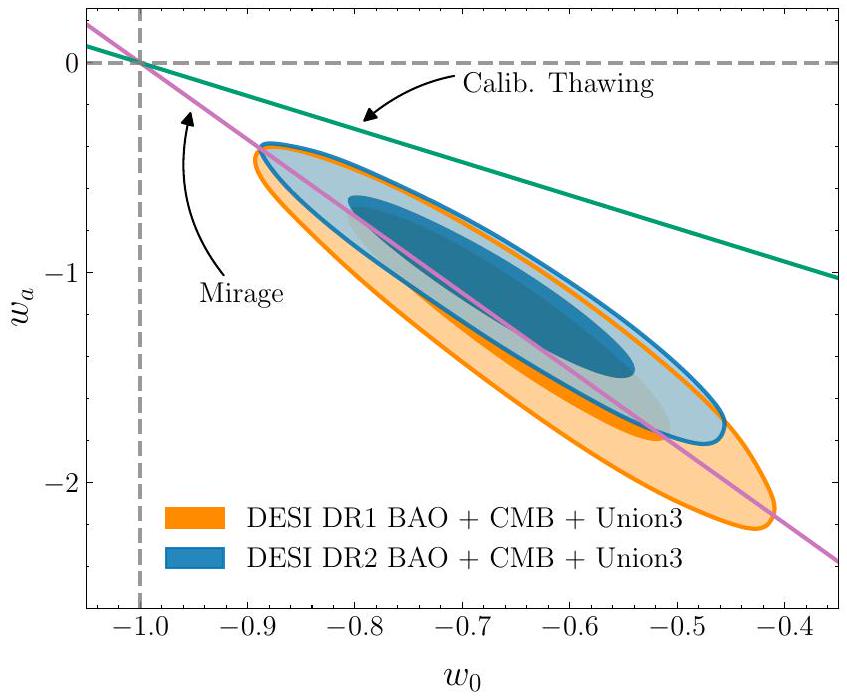
الشكل 1. القيود على المعلماتمن DESI BAO DR2 و CMB و Union3 موضحة باللون الأزرق، بينما يتم عرض التركيبة المقابلة مع DESI BAO DR1 باللون البرتقالي. تشير الخط الأخضر إلى اتجاه التداخل المرتبط بالذوبان المعاير (انظر القسم VI A)، بينما يشير الخط الأرجواني إلى اتجاه “السراب” (المناقش في القسم VIC) الذي يتبع عن كثب اتجاه التداخل.الخطوط الخارجية.
نماذج، لدينا نسخة معدلة من الفئة 89،90 مدمجة في خط أنابيب الاستدلال لدينا. لقد انتقلنا إلى خيار Recfast لإعادة التركيب لأنه لا يفترض أي شيء عن معادلة الحالة. نفترض وجود نوع واحد من النيوترينوات الضخمة ونوعين من النيوترينوات عديمة الكتلة. و . بالنسبة لاحتمالات SNe Ia (PantheonPlus وUnion3 وDESY5)، نقوم بتهميش التحليل على السطوع المطلقلوضوح العرض، نستخدم Union3 في الأشكال كنتيجة محافظة، حيث أن لديها عدم يقين أكبر مقارنة بمجموعات بيانات PantheonPlus و DESY5. ومع ذلك، سنناقش أيضًا القيود المستمدة من مجموعات بيانات السوبرنوفا الأخرى حيثما كانت ذات صلة بتحليلنا. أخيرًا،يتم تعريفه بالنسبة إلىأفضل ملاءمة. لحساب نقاط الملاءمة الأفضل نفسها، نبدأ بنقاط الحد الأقصى لل posteriori (MAP) من السلاسل الأربع التي تم إنتاجها خلال أخذ عينات MCMC، ونستخدم المُصغّر iminuit 91. وبالتالي، فإن الكمية المستخدمة في مقارنات النماذج هي بشكل أكثر دقة، وهو الفرق في قيم اللوغاريتم الخلفي عند النقاط القصوى المحسوبة، مقاسًا بـ -2. نظرًا لأن الخلفية تعتمد على حاصل ضرب الاحتمالية والاحتمالات السابقة، فإننا نأخذ أيضًا في الاعتبار نسب الاحتمالات السابقة لنماذج مختلفة لضمان عدم وجود عقوبة إضافية في من مقارنة نموذجين.
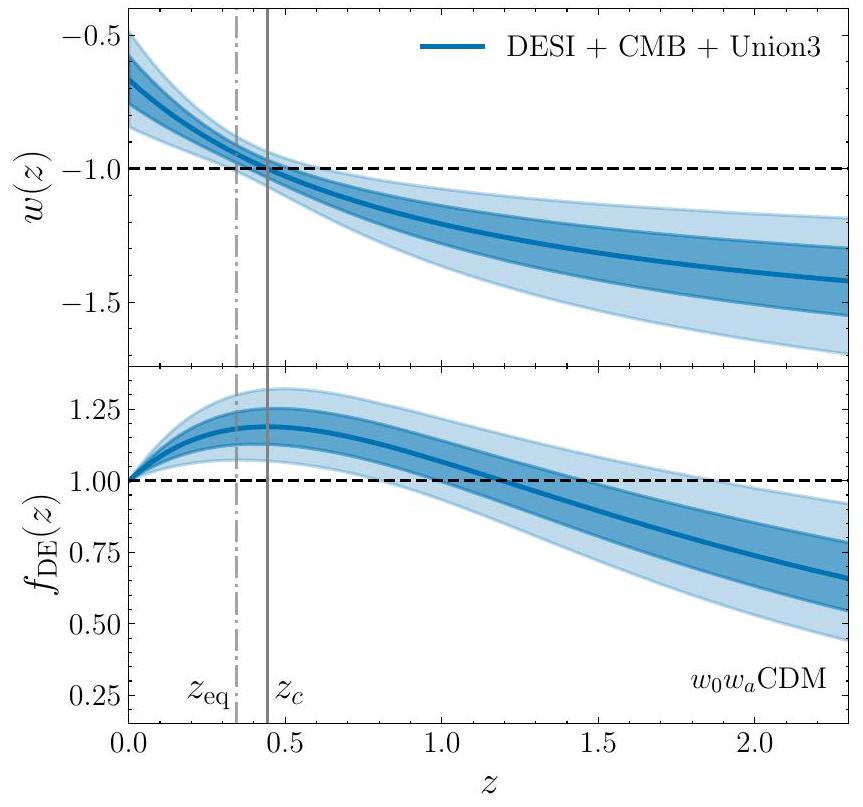
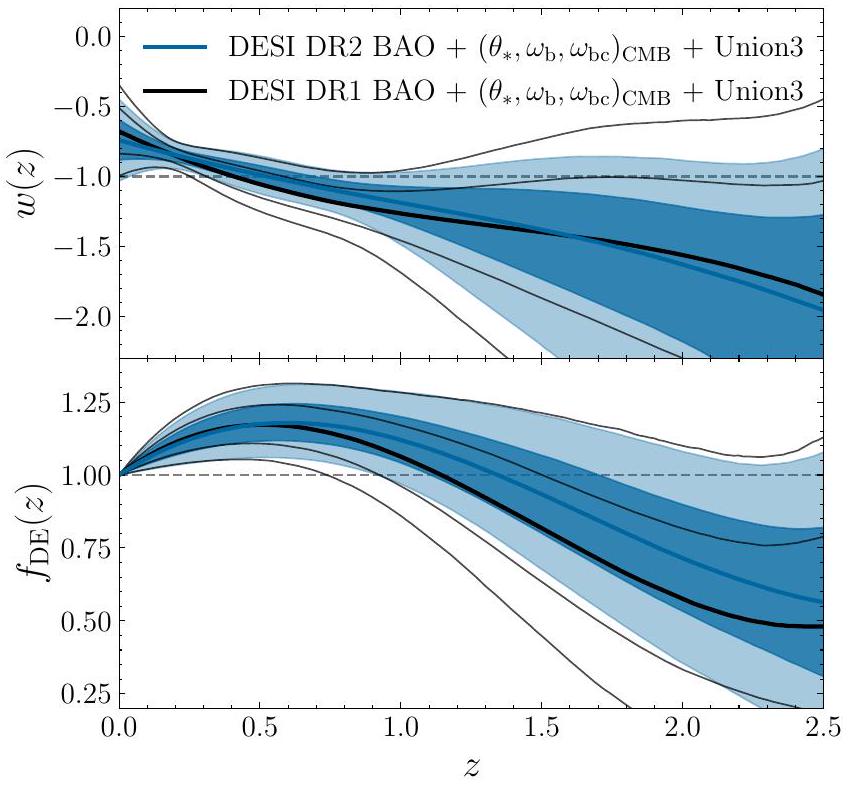
الشكل 2. معلمة معادلة الحالة،وكثافة الطاقة المظلمة المعنوية المقابلة،، كدالة من الانزياح الأحمر باستخدام التعريف. تشير الخطوط الرأسية الصلبة والمخططة المنقطة إلى عبور الشبح ( ) وتساوي الطاقة المظلمة والمادة ( ) الانزياحات الحمراء، على التوالي. الخط الأفقي المتقطع يمثل .
III. نظرة عامة علىنتائج CDM
نبدأ بتلخيص النتائج الرئيسية للطاقة المظلمة من ورقة البحث الرئيسية BAO في DESI DR2 [47، مع افتراض أنالتمثيل المعطى في المعادلة (3). كمثال، القيود المهمشة في الـتظهر الطائرات في الشكل 1 لمجموعة بيانات DESI+CMB+Union3، مع القيود من بيانات DESI DR1 BAO مقارنة بتلك التي تم الحصول عليها من بيانات DESI DR2 BAO، والتي تت correspond إلى سنة واحدة وثلاث سنوات من البيانات، على التوالي. تفضل البيانات المجمعة المنطقة و بعيدًا عن الثابت الكوني، مما يعني أن معادلة الحالة كانت شبيهة بالخيالفي الماضي البعيد ومنذ ذلك الحين تطور إلىفي الوقت الحاضر، كما هو موضح في اللوحة العلوية من الشكل 2. تم ملاحظة هذا التفضيل في تحليلات DESI السابقة [40-44] ويستمر حتى عند السماح بتغيرات في الانحناء المكاني. [40، الجاذبية المعدلة 92، أو التعديلات على فيزياء ما قبل إعادة التركيب 93.
تظهر بيانات DESI DR2 BAO أن التوزيعات الخلفية المتوسطة قد تحولت قليلاً نحوالقيم المتوقعة لـ CDM، بينما زادت الشكوك المنخفضة بشكل طفيف من الأهمية الإحصائية للاختلافات منCDM إلى (مع تحسينات في الملاءمة تتراوح من )، مقارنة بـ من DR1 [40، 47]. تتبع استنتاجات مماثلة عند استخدام المتوسط المرجح لل posterior للاحتمالية اللوغاريتمية، النظير البايزي لـ. من أجل مقارنة النماذج البايزية المفصلة، انظر الملحق أ. من المثير للاهتمام، مع زيادة الدقة، أن بيانات DESI + CMB المجمعة تشير بالفعل إلىانحراف عنمستقل عن أي تجميع لـ SNe Ia، مع استنتاجات مماثلة مستخلصة من DESI+DESY3تركيبة، على الرغم من أنها تظهر توتراً أقل؛ انظر الشكل 14 في [47].
جسدياً، معادلة حالة وهميةيترجم إلى كثافة طاقة تزداد مع التوسع ( )، قبل أن تصل إلى أقصى حدها (عند في حالتنا)، عندما يتجاوز معادلة الحالة الخط الشبح، و يبدأ بالتخفيف مرة أخرى مع توسع الكون. متوسط الانزياح الأحمر الذي يحدث عنده هذا الانتقال فيتشير المعلمة إلى خط عمودي صلب في الشكل 2. يجب أن نلاحظ في هذه المرحلة أن الانزياح الأحمر الدقيق الذي يحدث عنده هذا التقاطع يعتمد على مجموعة البيانات المعنية.
قد توحي هذه النتائج بسذاجة بوجود “عبور شبح” عند الانزياحات الحمراء العالية. من منظور نظري، فإن هذا ما يسمى بعبور الشبح يمثل تحديًا للتوافق مع نماذج الحقل القياسي للطاقة المظلمة التي ترتبط بشكل ضئيل بالجاذبية، حيث إنها مقيدة بالامتثال لـ. على وجه الخصوص، ضمن نظرية النسبية العامة، مكون طاقة مظلمة وحيدة الحقل معسوف ينتهك بالضرورة شرط الطاقة الصفري (NEC)، المعطى بـ 95. إذا تم التأكيد، فإن عبور الشبح سيكون له تداعيات عميقة على الفيزياء الأساسية، حيث سيشير إلى قطاع مظلم أكثر تعقيدًا بكثير مما كان يُفترض تقليديًا. ومع ذلك، من المهم التأكيد في هذه المرحلة أن التوصيف فعال بشكل خاص في التقاط تأثير نماذج الطاقة المظلمة المختلفة، والتي قد تكون أكثر أساسية، على الملاحظات مثل المسافات وتاريخ التوسع ضمندقة 54 وقد تفشل في تقدير السلوك الحقيقي بدقةنفسه، مما قد يؤدي إلى إشارة زائفة لعبور وهمي. وبالتالي، فإن تقييد تحليلاتنا إلى النماذج التي تلبيقد يسبب تحيزًا مصطنعًا في استنتاجنا. لمزيد من المناقشة حول العبور الوهمي، انظر القسم VIE.
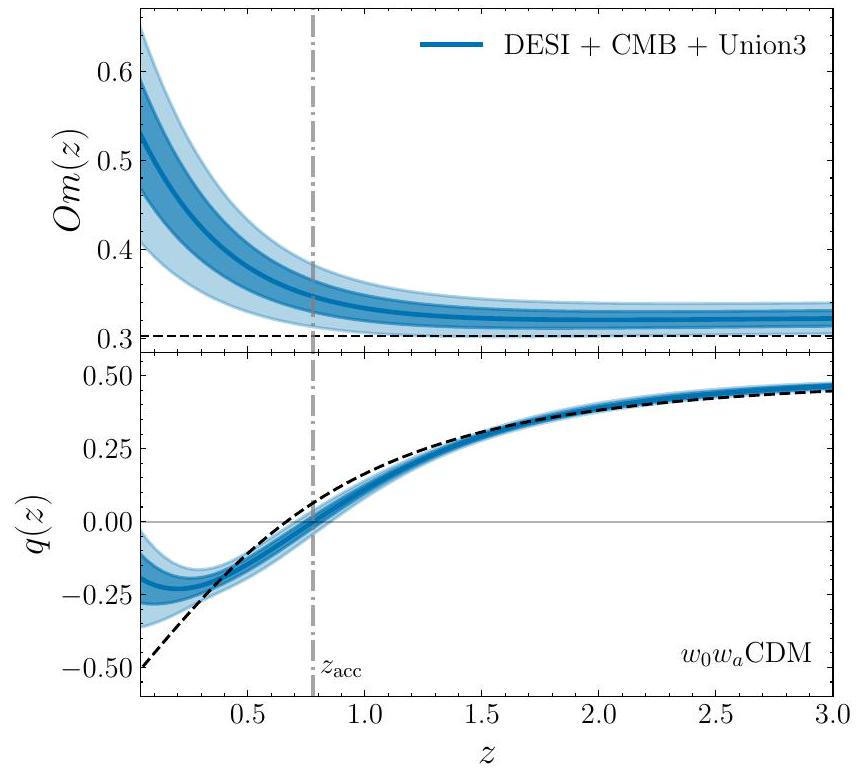
قبل توسيع تحليلنا إلى ما هو أبعد مننقدم هنا كميتين رئيسيتين ستكونان مفيدتين طوال هذا العمل. الشكل 3 يعرض التشخيص [96] ومعامل التباطؤلـنموذج، حيث
معامل التباطؤ يُعطى بواسطة
تشكل هاتان الوظيفتان مجسًا حساسًا للفيزياء الجديدة، حيث إنهما حسّاسيتان فقط لـ ‘شكل’ تاريخ التوسع (المعياري).. وبالتالي، فإنها غير متأثرة بالانحلالات التي قد توجد بين كثافات الطاقة المظلمة والمادة عند
الشكل 3. تطور الـمعامل التشخيص والتباطؤ، كدالة من الانزياح الأحمر في النموذج. الخطوط الزرقاء الصلبة تتوافق مع الوسيط،، و مستويات الثقة المستمدة من مجموعة DESI + CMB + Union3. الخط المنقط الأسود يمثل أفضل ملاءمة لنفس مجموعة البيانات. الخط العمودي الرمادي يظهر الانزياح الأحمر ( ) الذي يتوافق مع بداية التسارع الكوني ( ).
مستوى الخلفية 97,99. في الواقع، يمكن للمرء أن يرى بسهولة من المعادلة (9) أن الكميةثابت تمامًا ومساوي لكثافة المادة الحاليةإذا كانت الطاقة المظلمة في شكل ثابت كوني. وبالتالي،يعمل كاختبار فارغ لـ، وأي انحراف كبير عن قيمة ثابتة سيشير إلى ديناميات في كثافة الطاقة المظلمة. تم إعادة بناء في الشكل 3 يظهر بوضوح ( انحراف عن الثبات في النطاقحيث تمثل الخطوط المنقطة السوداء أفضل ملاءمةقيمة CDMمن ناحية أخرى،يتتبع المشتق اللوغاريتمي لـ، بدلاً من شكله، يقترب من قيمة 0.5 خلال هيمنة المادة. تم إعادة بناء يشير إلى تسارع الكون (بدأت في وقت سابق في التاريخ الكوني ) مما تم التنبؤ به ( ) مع تباطؤ في التسارع الكوني في الأوقات الأخيرة. هذه الاتجاهات في و تمت ملاحظتها سابقًا باستخدام بيانات DESI DR1 وتستمر مع دلالة إحصائية أكبر قليلاً في DESI DR2.
رابعاً. تحديد طاقة الظلام
للاستكشاف بشكل أعمق للطبيعة الديناميكية المحتملة للطاقة المظلمة، نتوجه الآن إلى تمثيلات إما معادلة الحالةأو كثافة الطاقة. نظرًا لأن التوصيفات المختلفة يمكن أن تؤدي إلى اختلافات
الشكل 4. معادلة حالة الطاقة المظلمةللاختيار البديلتُظهر التمثيلات – BA و EXP و JBP و LOG – بجانب الشكل القياسي CPL (الموضح باللون الأزرق). تدمج القيود بيانات من DESI و Union3 SNe وملاحظات CMB، مع مناطق مظللة تمثلأشرطة عدم اليقين. جميع المعلمات باستثناء JBP تظهر تقاطعًا وهميًا متسقًا بالقرب منوتوفير ملاءمة جيدة مماثلة للبيانات.
في التطور المستنتج للطاقة المظلمة، من الضروري استكشاف أشكال متعددة لتقييم قوة أي انحراف تم اكتشافه عن الثابت الكوني. نحن نفحص أشكالًا وظيفية متعددة ذات معلمين كبدائل لـCDM. بالإضافة إلى ذلك، نزيد من درجات الحرية المتاحة لـللاستقصاء عن الاتجاهات الموجودة في البيانات. بينما لا ترتبط المعلمات التي تم التحقيق فيها هنا بنموذج فيزيائي محدد، إلا أنها تغطي مساحات وظيفية متميزة، مما يساعد على ضمان أن النتائج ليست مدفوعة باختيار المعلمة.
أ. بديلمعلمات
في هذا القسم، نستعرض أربعة تمثيلات بديلة من الأدبيات (انظر 100، 101 لنتائج DR1 المعادلة) التي، مثل، قدم معلمتين إضافيتين: معادلة الحالة الحالية ومعامل التطور لكن بأشكال وظيفية مختلفة.
تقدم الشكل 4 قيودًا على هذه النماذج البديلة كما هو محدد في الجدول II، أي: باربوزا-ألكانيز (BA) 102، 103، الأسية (EXP ) 104، 105، اللوغاريتمي (LOG) 103 وJassal-Bagla-Padmanabhan (JBP) 106، جنبًا إلى جنب مع Chevallier-Polarski-Linder (CPL) باللون الأزرق للمقارنة. الأشرطة المظللة، التي تمثل الشكوك، مشتقة من مزيج من DESI وCMB وUnion3. باستثناء JBP، جميع
الجدول II.القيم بالنسبة إلىلخيار بديلتوصيف باستخدام DESI + CMB + Union3.
بارام.
الشكل الوظيفي
با
-17.3
EXP
-17.5
سجل
-17.6
JBP
-13.6
CPL
-17.4
تظهر النماذج سلوكًا مشابهًا عند الانزياح الأحمر المنخفض، بما في ذلك عبور وهمي بالقرب منفي الجدول الثاني، نقدم الأشكال الوظيفية البديلة لـ و القيم بالنسبة إلىCDM، مما يظهر أن BA وCPL وLOG وEXP توفر ملاءمات إحصائية قابلة للمقارنة مع البيانات. الشكل الوظيفي لبارامتر JBP، الذي يجبره على افتراض سلوك متطابق في الأوقات المبكرة والمتأخرة، يؤدي إلى ملاءمة أقل قليلاً. تؤكد هذه النتائج أن القيود من CPL تمثل بشكل عام البديل.النماذج التي تم النظر فيها، دون ملاحظة أي تحسين ملحوظ لأي شكل بديل. وهذا يشير إلى أن البيانات الحالية تفتقر إلى الحساسية لتمييز بين هذه المعلمات عنداستنتاج يبقى دون تغيير عبر مجموعات بيانات SNe Ia المختلفة.
ب. إحصائيات العبور
بدلاً من استكشاف تطورات الانزياح الأحمر المختلفة لـيمكن بدلاً من ذلك قياس تأثير إدخال درجات حرية إضافية في خصائص الطاقة المظلمة. وفقًا للمنهجية المفصلة في [43]، نقوم بتوسيع معادلة حالة الطاقة المظلمةمن حيث متعددات حدود تشيبيشيف (انظر أيضًا [107-110])،
أينهي معاملات حرة، وهي كثيرات الحدود تشيبيشيف من النوع الأول، تشكل قاعدة كاملة للدوال المستمرة في الكبيرة-حد، على الرغم من3 عادة ما تكون كافية لالتقاط الدوال السلسة. نلاحظ أنيتم استرداده لـ و . بدلاً من ذلك، قد يرغب المرء في العمل مع كثافة الطاقة المظلمة العاديةبدلاً من ذلك
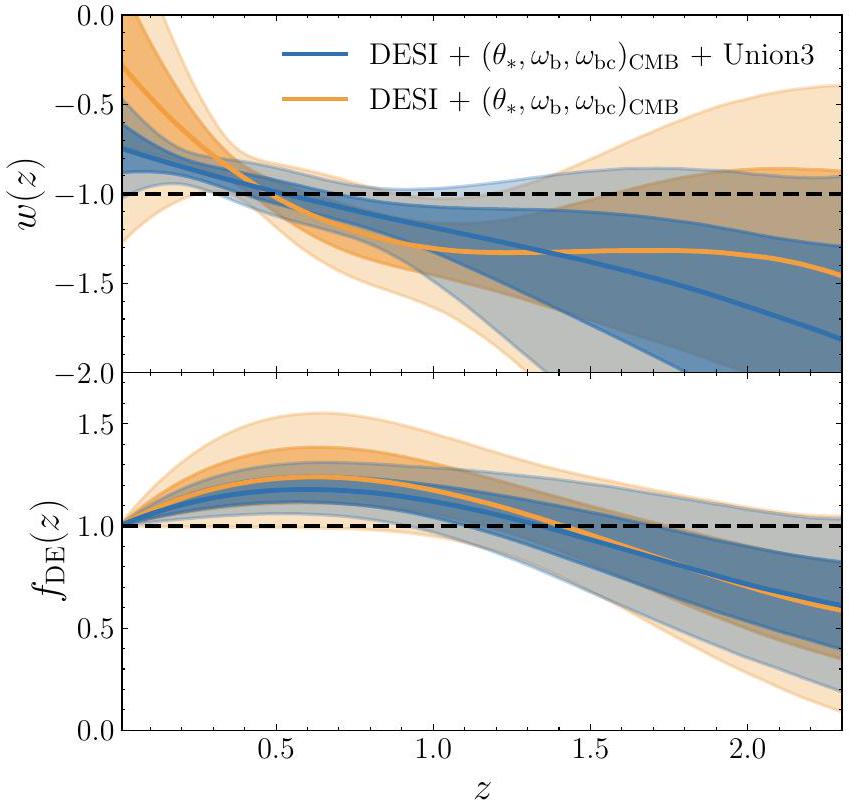
الشكل 5. إعادة بناء و باستخدام المعادلتين (11) و (12) معلـ DESIدمج البيانات، مع وبدون تضمين Union3. الخطوط الصلبة تتوافق مع الوسيط،، و مستويات الثقة حول ذلك. السلوك المعاد بناؤه الرئيسي لـ DE يتوافق بشكل ممتاز مع الأساليب المختلفة غير المعتمدة على نموذج التي تم استكشافها في هذه الورقة. هذا يؤكد أن الاتجاه ليس مدفوعًا باختيار المعلمات، ويضيف إلى قوةنتائج CDM المقدمة في الورقة الرئيسية [47]. الخط الأفقي المتقطع يمثل.
التوسع فييوفر ميزة السماح بكثافة الطاقة (الفعالة)لتغيير الإشارة، مما يشمل فئة أوسع من النماذج 111-114، بما في ذلك سيناريوهات الجاذبية المعدلة [115-118] وتفاعلات القطاع المظلم المعقدة التي يصعب التقاطها باستخدام نموذج معلم.. نلاحظ أن التوسع في المعادلة (12) لديه درجة حرية واحدة أقل مقارنةً بتلك الموجودة في المعادلة (11)، حيث يجب أن تلبي جميع العينات .
تظهر اللوحة العلوية من الشكل 5 الصورة المعاد بناؤهالـ DESIالتوليفة، مع بيانات SNe Ia (باللون الأزرق) وبدونها (باللون البرتقالي) من تجميع Union3. تظهر اللوحات السفلية البيانات المعاد بناؤهامن الجدير بالذكر أن التوسعات في و تنتج سلوكيات مماثلة بشكل مستقل عن بيانات SNe Ia، لكنها تتفق أيضًا مع النتائج الرئيسية التي تم الحصول عليها باستخدامتوصيف CDM [47، كما هو موضح في الشكل 2. هذه الاتساق يعزز بشكل أكبر قوة النتائج.
بينما تتماشى هذه النتائج تمامًا معالنتائج، التوسعات في المعادلتين (11) و (12) تقدم مرونة أكبر، مما يمكنها من التقاط الميزات في تطور الطاقة المظلمة بما يتجاوز المعايرة الخطية المعطاة في المعادلة (3). على الرغم من هذه المرونة الإضافية – والتي تم تأكيدها أيضًا من خلال تحليلاتنا المستقلة – فإن البيانات المجمعة تفضل تطورًا سلسًا، يتم وصفه بشكل جيد بواسطة
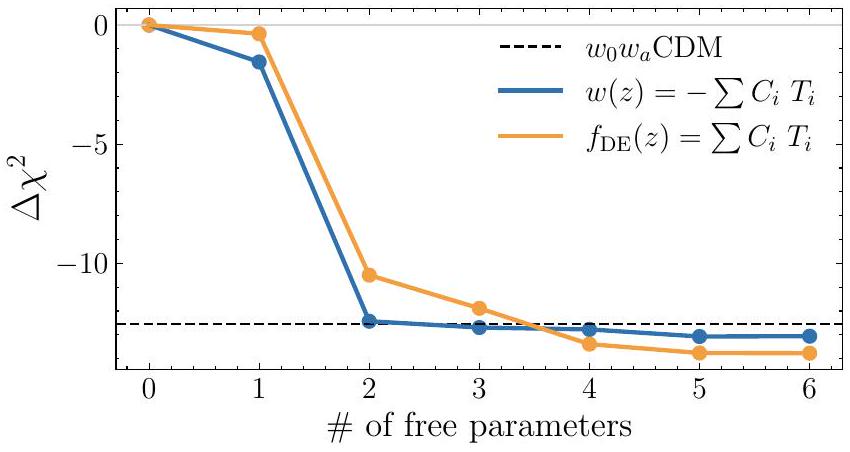
الشكل 6. تحسين في الملاءمة بالنسبة لـ، كما تم قياسه بواسطة، كدالة لعدد المعلمات الحرة المدخلة في التوسع، لـ DESI +تركيبة الاتحاد 3.
CDM ضمن النطاق المنخفض الانزياح الأحمر الذي تم استكشافه. التحسن في الملاءمة، الذي تم قياسه بواسطةيظهر كدالة لعدد المعلمات الحرة في الشكل 6. توسيع ذو معلمتين فييستعرض الاتجاهات الرئيسية في البيانات، كما تم الإشارة إليه بالفعل في 119. إن إدخال درجات حرية إضافية لا يحسن بشكل كبير من توافق البيانات المجمعة، وسيكون غير مفضل من منظور مقارنة النماذج، حيث إن التعقيد المضاف لا يبرره البيانات. نلاحظ أنه بسبب التعقيدات التي يمكن أن تنشأ في معالجة الاضطرابات عند السماح بـ“، هذه الجزء من التحليل مقيد بمعلومات “CMB” “المضغوطة”، المشار إليها بـبدلاً من احتمال بلانك الكامل. لقد تحققنا من أنكما هو موضح في القسم الثاني، ينتج قيودًا متطابقة تقريبًا مثل تلك التي تستخدم التباينات الأولية في إشعاع الخلفية الكونية.
بينما تشير جميع النماذج البارامترية التي اختبرناها أعلاه إلى وجود تقاطع وهمي، فإن الانزياح الأحمر الدقيق الذي يحدث عنده يعتمد على المعايرة المختارة، كما يتضح من الشكل 5 الذي يقترح قيمة أعلى قليلاً لـمنهذه التغيرات – على الرغم من عدم كونها ذات دلالة إحصائية – متوقعة بسبب القيود الجوهرية للتناسب البارامتري، حيث أن كل شكل وظيفي له درجة محدودة من المرونة.
V. الطرق غير المعلمية
على عكس التقنيات التي تم استكشافها في القسم الرابع، تركز التقنيات غير المعلمية على تحديد الدالة الحقيقية لكميات مثل، و من البيانات الملاحظة، بدلاً من مجرد تقدير معلمات شكل محدد مسبقًا لـنحن غير مهتمين بمقارنة النماذج هنا بحد ذاتها، بل نركز على قوة الاتجاهات الملحوظة في البيانات تحت تقنيات إعادة البناء غير المعلمية المختلفة.
نستكشف تقنيتين: التجميع والانحدار باستخدام عملية غاوسي. لقد اختبرنا أيضًا التوسع الكوزموغرافي حتىأينهو وقت الرجوع وتشير إلى الحقبة الحالية 120، 121. ومع ذلك، لا نقدم تلك النتائج هنا لأنها لم تجتز اختبارات التحقق مع بيانات DESI الكاملة وتتطلب قطعًا في الانزياح الأحمر لإجراء استنتاج غير متحيز.
أ. التجميع
التجميع هو تقنية مستخدمة على نطاق واسع في علم الكونيات تسمح بمقارنة فترات الانزياح الأحمر المختلفة، دون افتراض شكل وظيفي محدد؛ انظر 49، 54، 122، 131 لبعض الأمثلة. هنا نركز على تجميع معادلة حالة الطاقة المظلمة،وكثافة الطاقة المظلمة،، مما يسمح بإجراء تحليلات محلية للسلوك المدفوع بالبيانات. تجعل درجات الحرية الإضافية المقدمة من الممكن استكشاف التغيرات أو الاتجاهات المحتملة فيعبر انزياحات الطيف الأحمر، والتي قد تساعد في تحديد الانحرافات عن المعيارنموذج.
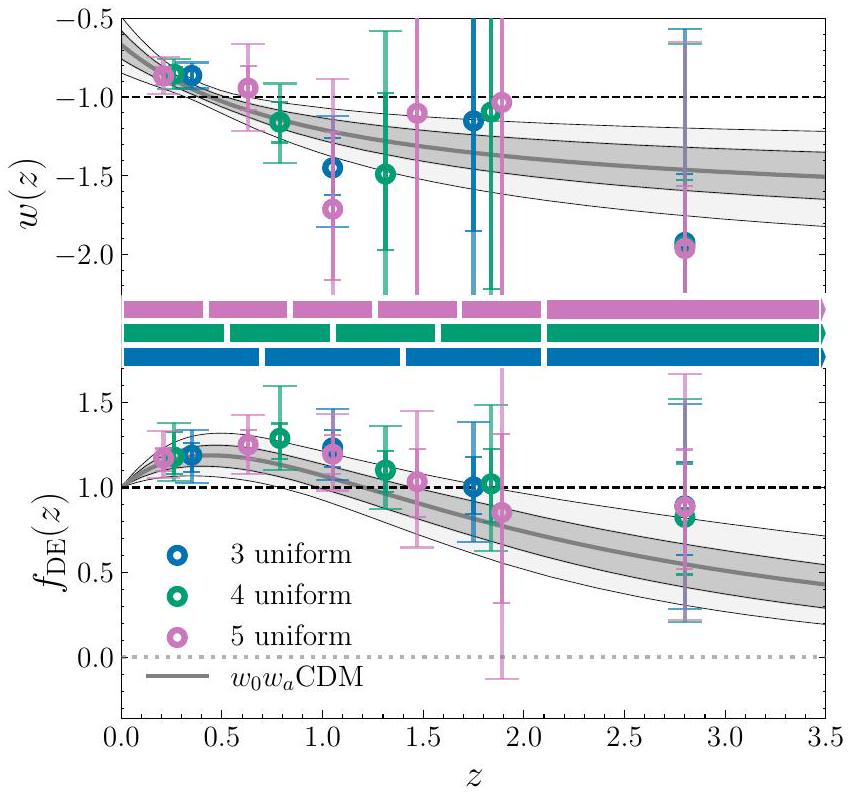
في هذا القسم، نكمل نظام ثلاثي من صناديق الانزياح الأحمر الموحد لمعلمة حالة الطاقة المظلمة من [47] (انظر الشكل 12 هناك) من أجل تقييم تأثير الخيارات المختلفة للتنفيذ. تأخذ الدالة المجمعة الشكل العام
أينهي معلمات سعة الصندوق،عدد الحاويات والوشاح الملسالذي يتحكم في حدة الانتقالات حول الحوافبين الحاويات. نفترض عدم وجود ارتباط سابق بين الحاويات.
عدة مخططات إضافية مختلفة لـتم اختبارها، بما في ذلك تقسيم اللوغاريتم، وتقسيم متوافق مع الانزياحات الحمراء لأنواع المتتبعين، ومجموعة متنوعة من أساليب التقسيم غير المتساوي عبر فترة الانزياح الأحمر المقيدة. ومع ذلك، من أجل الوضوح، نقدم النتائج فقط للأنظمة التي تحتوي على صناديق انزياح أحمر موحدة بين و ، حيث لا تتغير النتائج نوعياً عبر مخططات التجميع المختلفة. نحن نعتبر مجموعة DESI وUnion3 SNe Ia وCMB. في حالة يتم استخدام CMB المضغوط لتجنب التعقيد الحسابي المرتبط بتعديل سلوك الطاقة المظلمة بشكل صحيح في محلل بولتزمان لأخذ في الاعتبارمع تقييد المعلمات حصريًا بمعلومات CMB المبكرة.
الشكل 7 (اللوحة العلوية) يوضح القيم الوسيطة لـمع و أشرطة الخطأ، موضوعة في مركز فترات الانزياح الأحمر الخاصة بها. تُظهر هذه الفترات بنفس الألوان بين اللوحات. تمتد أعلى فترة انزياح أحمر فعليًا إلى انزياحات حمراء عالية، مع وضع السعة المقابلة في
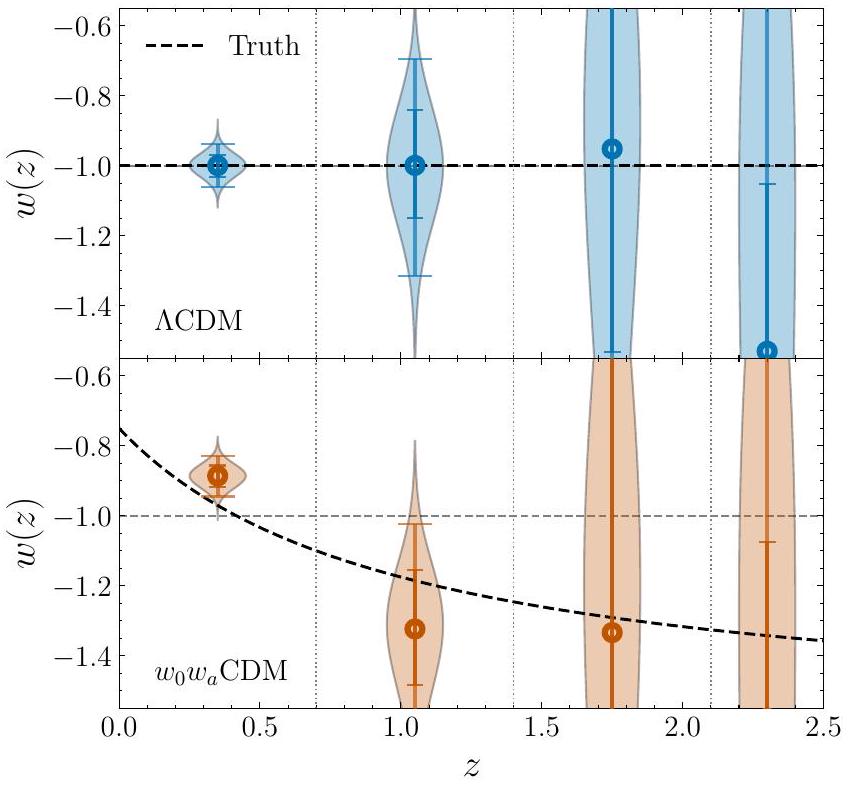
فقط من أجل الراحة. إن السعات المقيدة للحاويات المتداخلة بين المخططات المختلفة جميعها ضمنبعضهم البعض. التراكب مع الوسيط (الخط الرمادي المتقطع) ومستويات الثقة المقابلةنتيجة CDM، نرى أن السلوك الذي تم استعادته بواسطة كل مخطط مختلف يتفق بشكل عام جيد، مع نقاط وسطي على جانبي الخط.توفر البيانات أقوى القيود في أدنى نطاق انزياح أحمر، حيث تفضل أكثر منبعيد عنقيمة -1، في حين أن سعات حاويات الانزياح الأحمر الأعلى تبقى، في أقصى حد، ضمنمنCDM. مسألة العبور الفعلي أكثر تعقيدًا، حيث يجب أن يحدث عند الحافة بين صندوقين متجاورين، مما يعني أنه سيعتمد بشكل غير تافه على عدد الصناديق ومراكزها المختارة، ولن يكون قياسًا قويًا جدًا.
للسماح بالاستكشاف الصريح لمنطقة فضاء المعلمات ذات القيم السلبيةالذي يتم استبعاده عند التجميع مع سعةنحن أيضًا نختبر مخططات تجميع إضافية حيث ترتبط متغيرات التجميع بدلاً من ذلك بسعةتظهر الشكل 7 (اللوحة السفلية) نفس السلوك الفعال بين أنظمة التجميع الفردية، مع توافق جيد معالمنحنيات، تشير إلى تحول ما في منطقة و حواليلأغلب الصناديق. تزداد الشكوك مع الانزياح الأحمر، وتصبح بشكل متزايد أقل Gaussian، مع ذيول أطول تمتد نحو المزيد من السلبية.القيم. أخيرًا، نلاحظ أن السعات في الصناديق المجاورة تظهر ارتباطات خفيفة، تضعف مع زيادة الانزياح الأحمر.
لإزالة الترابط بين الحاويات والحصول على رؤى إضافية حول المساهمات من فترات الانزياح الأحمر المختلفة، نقوم أيضًا بإجراء تحليل المكونات الرئيسية. تحليل المكونات الرئيسية (PCA) هو في الأساس تحويل يوفر أساسًا جديدًا حيث تكون المعاملات الجديدة، التي تتوافق مع معلمات سعة الصندوق، غير مرتبطة. بشكل عام، هناك عدد لا نهائي من هذه الأسس غير المرتبطة، ولكن هناك واحدة فقط تكون متعامدة. يمكننا الحصول عليها ببساطة من خلال إيجاد قاعدة القيم الذاتية التي تقوم بتقطيع مصفوفة التغاير العكسية لمعاملات سعة الصندوق، تم حسابه بواسطة أخذ عينات MCMC [52. انظر الملحق ب للحصول على تفاصيل إضافية.
نقسم معادلة حالة المعامل إلى 10 صناديق متساوية ذات سعة ثابتة بين و مع وجود معلمين إضافيين مجانيين، واحد لكل جانب من السعة. مصفوفة التغاير للمعلمات الناتجة عن الصناديقيتم استخدام DESI + CMB + Union3 لتحديد قاعدة المتجهات الذاتية. يتم تقديم دوال القاعدة، أو المكونات الرئيسية، المقابلة لأكبر 4 قيم ذاتية في الشكل 8، جنبًا إلى جنب مع الأخطاء المقابلة (المستخرجة كجذور مربعة للقيم الذاتية المعكوسة).
المكون الرئيسي الأكبر موضعي بشكل جيد في، تصل إلى النطاقبينما المكون الثاني الأكبر يكون في الغالب إيجابي ويصل إلى ذروته في الفترةتظهر المكونات المتبقية سلوكًا تذبذبيًا أكثر وضوحًا بشكل متزايد، مع
الشكل 7. سعات صناديق الوسيط مع و أشرطة الخطأ لـ (اللوحة العلوية)، باستخدام DESI+CMB+Union3، و (اللوحة السفلية)، باستخدام DESIالاتحاد 3. تظهر النتائج لثلاثة مخططات، مع زيادة عدد الصناديق المتجانسة في النطاق. يتم عرض فترات الانزياح الأحمر للصناديق في هذه المخططات المختلفة في الأشرطة الملونة المقابلة بين اللوحتين. للمقارنة، الوسيط، ، و ملامح الـتم رسم المعلمات على نفس المحاور، جنبًا إلى جنب معالتوقعات بخطوط متقطعة. الـيتم رسم الخط كخط منقط.
الشكل 8. المكونات الأربعة الرئيسية ذات القيم الذاتية الأكبر، من مخطط يتكون من 10 صناديق متساوية. و ، مقيد باستخدام DESI+CMB+Union3. يحتوي المكون الأول على عدم يقين (قيمة ذاتية عكسية)،على الأقلأصغر من أي من الآخرين، ويبدو أن العنصرين الأولين موضعيان بشكل جيد نسبيًا عند الانزياح الأحمر المنخفض.
على الأقلعدم اليقين في السلة الأولى،. بشكل عام، نتائج التجميع من مخططات مختلفة تتفق بشكل جيد. عبور خط الفاصل الوهمي بواسطة، والدوران فيتليها اتجاه تنازلي نحو انزياحات حمراء أعلى، كما وُجد في التحليلات الأخرى تتماشى مع هذه النتائج. ومع ذلك، فإن النهج له حدوده. بينما هو مناسب تمامًا لاختبار الانحراف عن دالة ثابتة، فإن التقاط سلوكيات أكثر تعقيدًا يتطلب درجات حرية إضافية، مما يزيد من مستوى عدم اليقين [52، 54، 124، 125، 128]. على وجه الخصوص، على الرغم من أن البيانات تبدو متوافقة مع عبور وهمي، فإنه من الصعب استخلاص استنتاجات قوية حول الانزياح الأحمر المحدد حيث يحدث عبور وهمي لـ، أو دوران فيقد تحدث. تجعل القيود الموجودة في هذا النهج من المهم فهم نوع التحيزات التي قد يتم إدخالها من خلال التنفيذ. في الملحق E، نقوم بإجراء بعض الاختبارات على بيانات محاكاة في محاولة لمعالجة ذلك.
ب. الانحدار باستخدام العمليات الغاوسية
في هذا القسم، نناقش العمليات الغاوسية، التي يمكن اعتبارها تعميماً للتقسيم حيث يتم أخذ عينات من السعات عند كل انزياح أحمر ولكنها تخضع لبعض القيود (افتراضات مسبقة) على شكل الدوال الناتجة. وهذا يسمح بإجراء تحليل تكميلي مع إمكانية تحسين التوازن بين المرونة وقوة التقييد.
الانحدار باستخدام العمليات الغاوسية (GP) هو أداة إحصائية قوية وغير معلمية تُستخدم على نطاق واسع في مجالات مختلفة، بما في ذلك علم الكون [136-138، لإعادة بناء دوال سلسة من بيانات ضوضائية دون افتراض شكل وظيفي محدد (انظر على سبيل المثال، 62، 139-148 لقائمة غير شاملة). لغرض هذا العمل، يمكن اعتبار GP كطريقة لأخذ عينات من فضاء الدوال المستمرة بطريقة غير معلمية. وهذا يسمح بإعادة بناء مدفوعة بالبيانات للكميات ذات الاهتمام بالنسبة للطاقة المظلمة، وهي أو مع افتراضات قليلة 62، 136، 149، 150. بشكل أكثر تحديدًا، في كل نقطة في فضاء المعلمات، نقوم بسحب عينة (تحقيق) منمن توزيع غاوسي متعدد المتغيرات، على سبيل المثال،أين هو دالة التغاير المعطاة – المعروفة بالنواة – التي تشفر افتراضاتنا السابقة حول نعومة الدالة المعاد بناؤها. نحن نفرض أيضًا لاستعادة معيار ( تاريخ التوسع الشبيه بـ CDM في الأوقات المبكرة. لقد اخترنابعد التحقق من أن هذا الاختيار لا يغير استنتاجاتنا بشكل كبير. يتم تنفيذ ذلك في نسخة معدلة من محلل بولتزمان camb، مع مزيد من التفاصيل حول GP المقدمة في الملحق C.
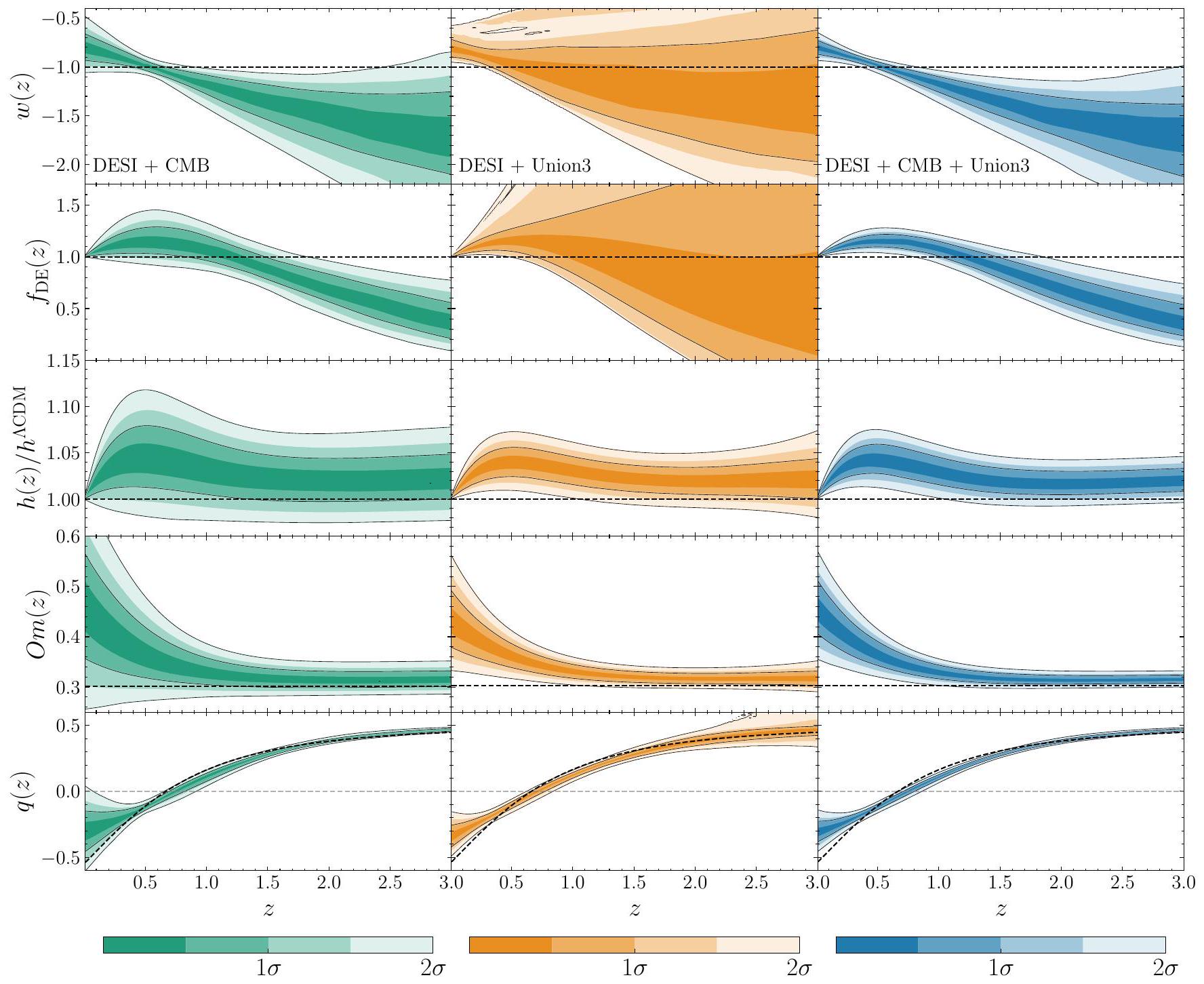
توضح الشكل 9 خصائص الطاقة المظلمة المعاد بناؤها باستخدام GP مع مجموعات بيانات مختلفة: DESI + CMB (يسار)، DESI + Union3 (وسط)، و DESI + Union3 + CMB (يمين). الصف العلوي يقدم المعاد بناءه، مما يشير إلى الانحرافات عن CDM عند الانزياح الأحمر المنخفض وإشارات إلىالعبور إلى النظام الوهمي حولإن تضمين بيانات CMB (اللوحات اليسرى واليمنى) يؤدي إلى قيود أكثر صرامة على، مما يعزز أهمية الانحرافات عنبينما يسمح الجمع بين DESI + Union3 بقيم أقل منومجموعة أوسع من التvariations. الصف الثاني يظهر زيادة ملحوظة في تطور كثافة الطاقة المظلمة، بينما القيود المستمدة بدون إشعاع الخلفية الكونية الميكروي تسمح بتنوع أوسع منيعرض الصف الثالث معامل هابل المنظمالصف الرابع يقدمتشخيصي، يظهر بوضوح التطور كدالة لـ، مما يدل على انحراف عن . أخيرًا، الصف الأخير يصور معامل التباطؤ المعاد بناؤهالتي تتجاوز قليلاً التوقعات لـنموذج CDM، يشير إلى تباطؤ في معدل التسارع.
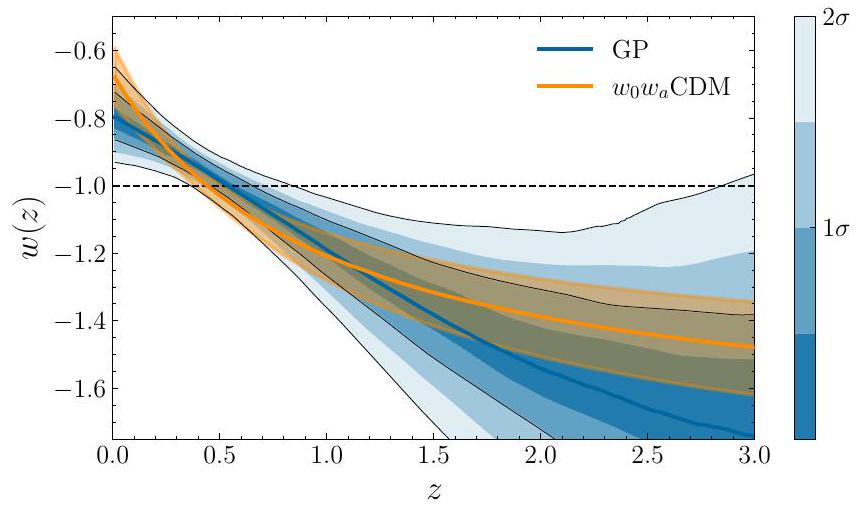
في الشكل 10، نقدم مقارنة للنتائج التي تم الحصول عليها من إعادة بناء GP باستخدامالتمثيل المعتمد على بيانات DESI وCMB وUnion3. يتماشى إعادة بناء GP، الموضحة باللون الأزرق، بشكل جيد جداً معالتنبؤات اللاحقة لـنموذج. نود أن نذكر القراء أن نهج GP يفرض توزيعًا أوليًا غاوسيًا على، مركزًا عند دالة المتوسط التي نختارها صراحة لتكون، كما تمثله الخط المنقط الأسود. هذا يضع فعليًا وزنًا أكبر على السابق وأي انحرافات ملحوظة عنمدفوعة إلى حد كبير بالبيانات. أخيرًا، نود أن نؤكد أنه على الرغم من أن انحدار GP يقدم مزايا على الطرق المعلمية، فمن المهم تفسير المعادلة المعاد بناؤها.بحذر. على الرغم من مرونته، قد لا تلتقط الطريقة بعض السلوكيات بشكل كاملكما هو موضح في الملحق E باستخدام بيانات محاكاة. ومع ذلك، تظل GP أداة قيمة لتقييم الطبيعة الديناميكية للطاقة المظلمة بطريقة غير معلمية.
VI. الآثار المترتبة على الطاقة المظلمة
توفر الطرق المختلفة المستكشفة في الأقسام الرابعة والخامسة وسيلة مرنة لاختبار الانحرافات عنCDM وضمان نتائج قوية دون الالتزام بنموذج طاقة مظلمة محدد. ومع ذلك، فإن تفسير الانحرافات عن الثابت الكوني وفهم تداعياته على الفيزياء الأساسية يتطلب استكشافًا أعمق لنماذج الطاقة المظلمة المدفوعة بالفيزياء. بدلاً من تقييد نماذج محددة، نركز على فئات مختلفة، تتميز بديناميكياتها [151-153] والمستوحاة من اعتبارات نظرية.
أ. طاقة مظلمة ذائبة
الفئة الأولى من النماذج التي نعتبرها تُعرف بالطاقة المظلمة الذائبة. هذه الفئة تصف نماذج الكوانتسنس، حيث يبقى حقل قياسي مرتبط بشكل ضئيل مجمدًا في الأوقات المبكرة بسبب احتكاك هابل، مما يجعله يتصرف بشكل فعال مثل كون-.
الشكل 9. إعادة بناء GP لـلتركيبات DESI + CMB (الأخضر)، DESI + Union3 (البرتقالي)، وDESI + CMB + Union3 (الأزرق). تمثل الصفوف تطور الانزياح الأحمر للكميات الكونية: معادلة الحالةكثافة الطاقة المظلمة العاديةمعامل التشخيص، ومعامل التباطؤ. توضح الأشرطة المظللة التي تم الحصول عليها باستخدام fgivenx 134 فترات الثقة عند مستويات مختلفة. تمثل الخطوط المنقطة السوداء التوقعات من نموذج CDM.
ستانت معفقط عندما تصبح كتلة المجال القياسي قابلة للمقارنة مع معدل هابل،هل يبدأ المجال في التطور ديناميكيًا، مما يتسبب في ‘ذوبان’ معادلته الحالة بعيدًا عنإلى نظام الجوهر الخالص،“. لاحظ أن هناك فئة ثانية من ديناميات الطاقة المظلمة، تُعرف بفئة ‘التجميد’، حيث يتطور الحقل نحو حالة دي سيتير ( ) في المستقبل التقاربي. تتميز هذه الديناميات بـ ولم تُفضلها الملاحظات. لمراجعة نماذج الكوانتس، انظر على سبيل المثال، [158، 159]
هذا السلوك نموذجي لنماذج الكوانتس (PNGB) الزائفة ونماذج الجهد البسيطة مثل و كلاهما شائع في فيزياء الطاقة العالية 24. ومن المثير للاهتمام،
المراجع [54] أظهرت أن ديناميات فضاء الطور لهذه النماذج يمكن تقريبه بشكل جيد باستخدامالتعريف. العديد من إمكانيات الذوبان تتطابق مع منطقة ضيقة فيطائرة، تتبع تقريبًا العلاقة
تقدم هذه العلاقة ‘الذوبان المعاير’ شكلاً يعمل كتقريب جيد لديناميات الذوبان. ومع ذلك، فإنها تسمح أيضًا لمعادلة الحالة بعبور خط الشبح. )، وهو غير فيزيائي لنماذج الكوانتس [94، 161، 162. يحدث هذا لأن المعادلة (14) مصممة لتقريب معدل التوسع و medidas المسافةأقل من واحد بالمئة
الشكل 10. مقارنة إعادة بناء GP لحالة معادلة الطاقة المظلمةمعالتوصيف، باستخدام بيانات من DESI وCMB وUnion3. يتم عرض إعادة بناء GP باللون الأزرق، مصحوبة بظل و فترات الثقة. يتم مقارنة ذلك مع التوقعات اللاحقة لـنموذج، موضح باللون البرتقالي مععدم اليقين. الخط المنقط الأسود يمثل المعيارتنبؤ.
الدقة – الكميات التي تم استكشافها من خلال الملاحظات الكونية بدقة – لكنها لا تقارب بالضرورة نفسها 54 .
ومع ذلك، من الممكن وصف ديناميات الذوبان مع ضمان أنفي جميع الأوقات. وفقًا لـ 163، 164 (انظر أيضًا [165])، يمكن تمثيل تطور معادلة الحالة للذوبان بواسطة التعبير الجبري
أين و هي معلمات حرة، و164. من الجدير بالذكر أن هذه الصياغة، التي تُعرف باسم ‘ذوبان جبري’، هي أكثر عمومية، حيث أن الحالةوتم العثور على أن المعادلة (14) تعطي قيودًا متطابقة تقريبًا في الوقت المتأخر كما هو موضح في الملحق أ من 44.
التوزيع الخلفي المعاد بناؤه لـلفئة الذوبان موضحة في اللوحة العلوية من الشكل 11 لمجموعة بيانات DESI+CMB+Union3. هذا يفترض الشكل الجبري، الذي يفرض، وأين قمنا بتهميش المعلمة. ومع ذلك، فإن الانحرافات الطفيفة معاترك المؤخرات لـغير مقيدة إلى حد كبير. على وجه الخصوص، يُلاحظ أن القيم الكبيرة لـيسمح بها البيانات، مما يؤدي إلى وصول posterior لدينا إلى الحد السابقكما هو موضح في اللوحة السفلية من الشكل 11. ومع ذلك، لا نقوم بتمديد تحليلنا إلى قيم أكبر من، حيث يمكن أن تنشأ تعقيدات عددية عند التعامل مع نماذج المعادلات التفاضلية التي تتغير بسرعة كبيرة، لا سيما في معالجة الاضطرابات وتعديل عدسات الخلفية الكونية.
العلاقة المعايرة للذوبان المعادلة (14) لا تحقق أي تحسين ملحوظ في الملاءمة، كما يتضح منالقيم في الجدول III ومن التوزيعات الخلفية في الشكل 13 تتماشى معباستثناء DESY5. يمكن أن تحسن المعادلة (15) الخاصة بالمعاملات الجبرية للذوبان
الشكل 11. القيود على الشكل الجبري لوظيفة الذوبان، كما هو موضح في المعادلة (15)، التي تقيدتظهر اللوحة العلوية التطور المعاد بناؤه لـمع المناطق المظللة التي تمثل خطوط الثقة عند و ، مما يدل على الانحراف عنCDM عند الانزياحات الحمراء المنخفضة. توضح اللوحة السفلية التوزيعات الخلفية لـ و لتركيبات مختلفة من SNe.
الملاءمة بالنسبة للنموذج القياسي ( )، تحقيق لتركيبة بيانات DESI + CMB + Union3. استبدال بيانات PantheonPlus بـ Union3 أو DESY5 يؤدي إلىو -13.2 على التوالي. ومع ذلك، فإن هذا التحسن في الملاءمة يأتي على حساب تضمين درجتين إضافيتين من الحرية.
لتوضيح أن المعادلة (15) تلتقط بشكل صحيح ظاهرة الحقول الذائبة، ولتحديد كيفية تحويل القيود إلى قيود على المعلمات الفيزيائية للنظرية بشكل أفضل، نعتبر إمكانيات مشابهة للآكسيون مدفوعة بدوافع فيزيائية [160، 166، 167].
أين يدل على كتلة جسيمات البوزون المرتبطة بالحقل السكالاري، و يعتبر طاقة فعالة. اعتمادًا على الظروف الأولية، يظهر جهد الكوزين للأكسيون سلوكين متميزين: النظام التربيعي القياسي، حيث تكون الكتلة الفعالة إيجابية ( )، ويمكن تقريب الجهد بشكل رباعي بالقرب من الحد الأدنى له، حيث يتم تعريف الكتلة الفعالة على أنها بينما يتميز نظام قمة التل 168 بكتلة فعالة سلبية
الشكل 12. القيود الهامشية على معلمة حالة المعادلة،لإمكانات شبيهة بالأكسيون المعطاة بالمعادلة (16)
(عندما يبدأ المجال تطوره بالقرب من الحد الأقصى للإمكانات (أي، عند ) ويتدحرج نحو الحد الأدنى عند نُشير إلى القارئ إلى الملحق د للحصول على مزيد من التفاصيل حول النموذج وتنفيذه في الصف.
في الشكل 12، نعرض التوزيع الخلفي المهمش لبارامتر معادلة الحالة المرتبط بإمكانات الحقل القياسي في المعادلة (16)، الذي تم الحصول عليه باستخدام DESI وCMB وثلاث تجميعات من SNe، ونحصل على القيود التالية للكتلة الفيزيائية: (بانثيون بلس)، (الاتحاد3) و (DESY5) ومقياس الطاقة الفعّالة: (بانثيون بلس)، (الاتحاد3) و (DESY5). تشير القيود إلى أن المجال يبدأ في نظام قمة التل، مع ظروف ابتدائية من ، ينحدر إلى الأسفل، ويصل إلى القيمة الحالية لـ، يقطع حوالي.
ب. الطاقة المظلمة الناشئة
العائلة الثانية من نماذج الطاقة المظلمة التي نعتبرها هي الفئة الناشئة، حيث كانت الطاقة المظلمة لها وجود متلاشي خلال معظم تاريخ الكون، و’تظهر’ فقط في الأوقات الحديثة. بناءً على 169، 170، نقوم بتمثيل معادلة الحالة كـ
المعلمةيحدد انحدار الانتقال فيومعلمة انزياح الانتقال الأحمريتم تحديده بواسطة المعادلةالظواهر التي نحاول التقاطها هي تلك المتعلقة بالتغيرات المفاجئة في معادلة الحالة،مدفوعة بالآليات الفيزيائية، مثل الانتقالات الطورية من الدرجة الثانية 171-173.
على الرغم من التلميحات حول الظهور الحاد للطاقة المظلمة في الآونة الأخيرة من إعادة البناء غير المعلمية، فإن DESIقيود علىكما هو موضح في اللوحة الوسطى من الشكل 13، تشير إلى أن مثل هذا السلوك الناشئ ليس مفضلًا إحصائيًا على، بالنظر إلى الافتراضلاحظ أنه بينما يمكن للمعادلة (17) أن تحاكي ظهور الطاقة المظلمة، إلا أنها محدودة بعدم قدرتها على عبورأو، بشكل مكافئ، إدخال نتوء في؛ ميزة يبدو أن البيانات تفضلها. من حيث المبدأ، يمكن صياغة نموذج للطاقة المظلمة الناشئة يتميز بمعادلة حالة فعالة يمكن أن تتجاوزيمكن تحقيق مثل هذا السلوك من خلال اقتران الطاقة المظلمة الناشئة مع قطاع المادة المظلمة..
ج. طاقة المرايا المظلمة
الفئة الأخيرة والأكثر ظواهرية من النماذج التي نعتبرها هي تلك الخاصة بالطاقة المظلمة الوهمية 177. وهذا يشير إلى النماذج في طائرة (انظر الشكل 1) تعيش تقريبًا على طول الخط
تم تصميم فئة المرايا لوصف مجموعة فرعية من نماذج الطاقة المظلمة الديناميكية التي تحافظ على المسافة إلى سطح آخر تشتت كما هو متوقع بواسطة، وهو معلم مقيد بشدة بواسطة إشعاع الخلفية الكونية الميكروي. stems from the fact that these models would mimic، مما يؤدي إلى عند تركيب ثابتللملاحظات، كما يمكن رؤيته في الجدول V [47] في DR2 والجدول III في 40 لمقارنة DR1. اتجاه السراب يلتقط تمامًا ظاهرة DE المقترحة من قبل البيانات، مع درجة حرية واحدة فقط.الذي يقيس قوة السراب، معيتوافق معحيث السراب حقيقي. من المتوقع أيضًا أن يستمر تأثير هذا السراب في نمو الهياكل الكونية، شريطة أن تظل النسبية العامة غير معدلة. كما تم الإشارة في [44، من خلال تقليل كثافة الطاقة المظلمة في الزمن المتأخر (أي، زيادةيمكن للمرء أن يصنعأقل سلبية – وبالمثل أكثر سلبية – يعزز تأثير السراب. للمقارنة، يفضل DESI + CMB + Union3 فيCDM الذي يزيد إلىفيالذي يقع أساسًا على طول اتجاه السراب. من وجهة نظر البيانات، يمكن رؤية خط السراب في الشكل 1 على أنه ‘المكون الرئيسي’، أو ‘المحور’ فيالطائرة التي تحمل المعلومات الأكثر معنى، أي المتجه الخاص مع أعلى قيمة خاصة. على الرغم من تقليل الأبعاد بشكل فعال لظاهرة الطاقة المظلمة، إلا أن الآلية الفيزيائية الدقيقة لظهور الطاقة المظلمة بهذه السرعة ) لا يزال غير واضح (انظر 180 لمزيد من المناقشة).
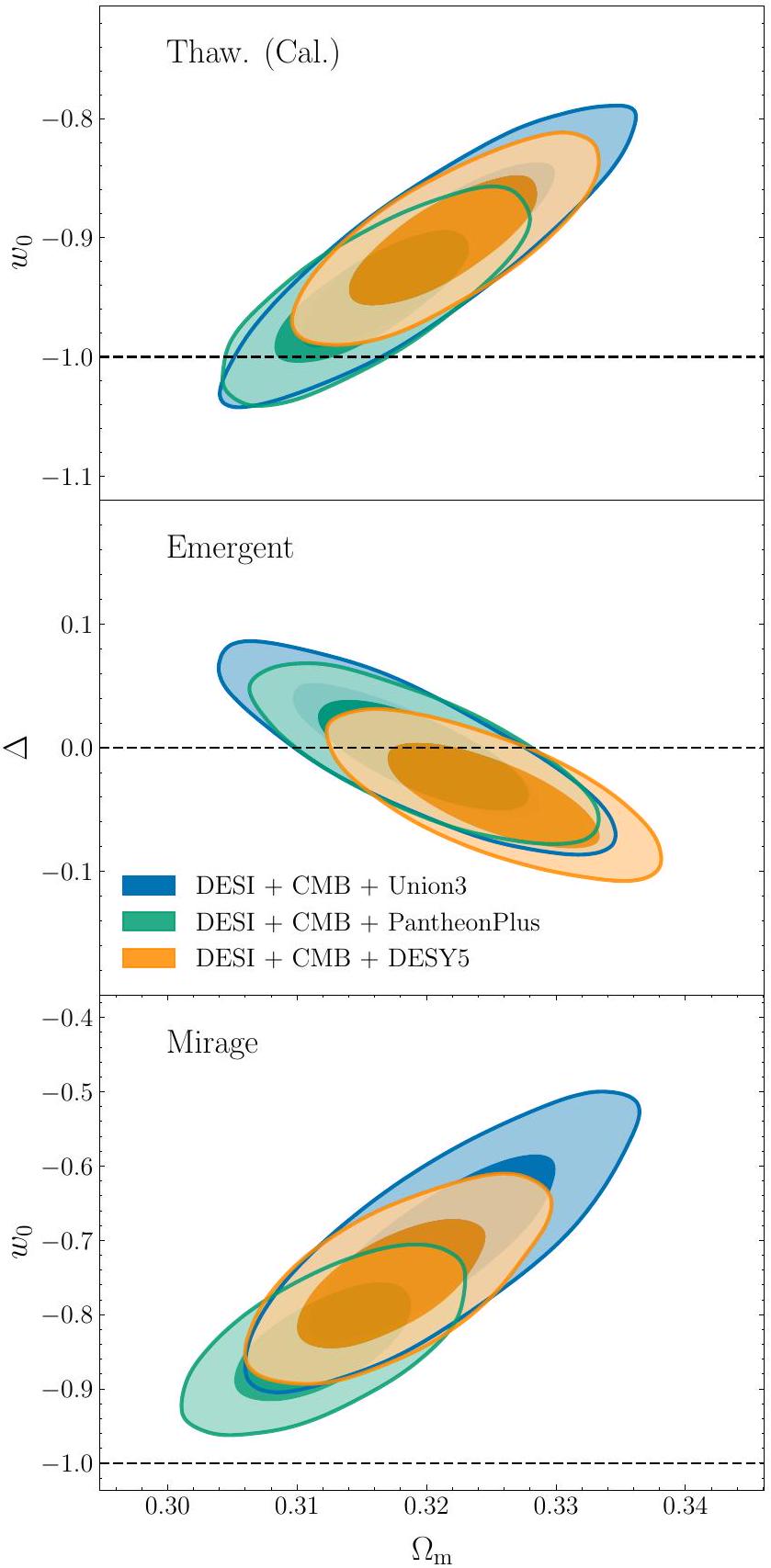
الشكل 13. القيود على ثلاث فئات من نماذج الطاقة المظلمة: التذويب المعاير، الناشئ، والسراب، كل منها مع درجة حرية إضافية واحدة مقارنة بـتُمثل الخطوط الخارجية و مناطق الثقة لمجموعات مختلفة من SNe: بانثيون بلس (أزرق)، يونيون 3 (برتقالي)، وDESY5 (أخضر).
د. مقارنة النماذج
في الشكل 13، نعرض القيود على المعلمات الإضافية الفردية لثلاث فئات من الطاقة المظلمة. في حالة التذويب المعاير (اللوحة العلوية)، لوحظ انحراف طفيف مع مجموعة بيانات DESY5، ولكن الفئتين الأخريين
تشير مجموعات بيانات SNe Ia إلى اتساق عام معCDM. يظهر النمط الناشئ (اللوحة الوسطى) اتجاهًا مشابهًا، مع قيود علىلا تعكس أي انحرافات كبيرة عن الإطار الكوني القياسي ). على النقيض، تُظهر فئة السراب (اللوحة السفلية) انحرافات عن قيمة عبر جميع مجموعات بيانات SNe Ia الثلاث.
نقوم أيضًا بإجراء مقارنة كمية، حيث نفحص معيار معلومات الانحراف (DIC) 181، 182، كما هو محدد أدناه، جنبًا إلى جنب مع. يكمل الأول من خلال أخذ تعقيد النموذج في الاعتبار، والذي لا يأخذ في الحسبان عدد درجات الحرية الإضافية في نموذج معين ويمكن أن يصبح منخفضًا بشكل تعسفي إذا تم إضافة عدد كافٍ من المعلمات. يتم تعريف DIC على أنه
أين هو مصطلح عقوبة، و هو ‘الانحراف’ من الاحتمالية، مع الثابتيختفي في. في الممارسة العملية، نستخدم
و يصبح فعليًا معادلًا لعدد المعلمات الإضافية في حد المعلمات التي يتم تقييدها بشكل جيد بالنسبة إلى سابقتها. نحن نعتبر فئات DE في هذا القسم ومعاملات، لدمج البيانات DESI يتم إجراء المقارنات بين كل فئة نموذج و النموذج، والمقياس الرئيسي لكل مقارنة هو DIC. الـ (و تُبلغ القيم في الجدول الثالث، مع تفضيل للنموذج الأكثر تعقيدًا كما تشير القيم السلبية، وللنموذج الأبسط، في هذه الحالةCDM، من خلال القيم الإيجابية. بالنسبة للنماذج المتداخلة، فإن الانخفاض (مطلوب على الأقل 2 لتحقيق تحسين ‘غير ضئيل’، ويصل إلى 5 ليشكل ‘تفضيلًا إيجابيًا’ علىيعتبر الانخفاض الذي يصل إلى 10 تفضيلاً ‘قويًا’، وما يتجاوز ذلك يكون التفضيل ‘حاسمًا’. ومع ذلك، بالنسبة للفئات التي ليست متداخلة مع بعضها البعض، لا توجد مقياس مطلق للمقارنة ويمكن مقارنتها كميًا فقط ضدسي دي إم.
التحقيق المعايرة 21.0 و ديك، مما يشير إلى أنه مفضل بشدة أو بشكل حاسم على المعيار CDM. بالمقارنة، فإن الذوبان المعاير يؤدي بشكل ضعيف. فئة الذوبان الجبري تحسن الملاءمة قليلاً أكثر، ومنذ أنهو أكبر باستمرار من الذوبان المعاير، التحسن فييجب أن يكون كافيًا للتوفيق بين درجة الحرية الإضافية الثانية للأول. لا تظهر فئة الطاقة المظلمة الناشئة أي تحسين كبير في الملاءمة، حيث تسير بشكل أسوأ من فئة الذوبان. تصل الفئة النهائية من السراب إلىقابل للمقارنة معالتعريف المعلمي، بالإضافة إلىديك. هذا ربما ليس مفاجئًا، نظرًا لمدى قرب اتجاه السراب من المحاذاةالقيود.
ميزة الفئات الذائبة والناشئة هي ارتباطها بتفسير مادي، وهو
الجدول الثالث. و ديكقيم لمجموعات بيانات مختلفة، بما في ذلك DESI وCMB مع كل نوع مختلف من SNe Ia وفئات DE، وهي: التذويب (المعاير والجبري: ‘تذويب. (م.)’ و’تذويب. (ج.)’، على التوالي)، الناشئ والسراب. الحد الأدنىتم الحصول على القيم باستخدام المينويت [91 المقلل.
ديزي + سي إم بي:
+بانثيون بلس
+اتحاد3
+DESY5
فصول DE
ديك )
ذوبان. (كاليفورنيا)
+0.4 (-1.6)
-0.6 (-2.5)
-5.8 (-7.1)
ذوبان. (الخوارزمية)
-1.0 (-2.9)
-4.6 (-6.9)
-10.1 (-13.2)
ناشئ
+2.1 (-0.05)
+1.8 (-0.1)
+0.2 (-1.5)
سراب
-9.1 (-10.5)
-13.8 (-16.2)
-18.7 (-20.7)
-6.8 (-10.7)
-13.5 (-17.4)
-17.2 (-21.0)
بسيط إلى حد ما، بينما بالنسبة لفئة السراب أقل من ذلك. من المهم أيضًا ملاحظة أن مقاييس مقارنة النماذج المستخدمة في هذا القسم تخدم كل من قياس تفضيل البيانات لكل نموذج – مما يوفر مقياسًا مطلقًا في حالة النماذج المتداخلة – وتسهيل ترتيب نسبي بين النماذج غير المتداخلة، مثل الذوبان الجبري ومعاملات.
هل هناك دليل على عبور الشبح؟
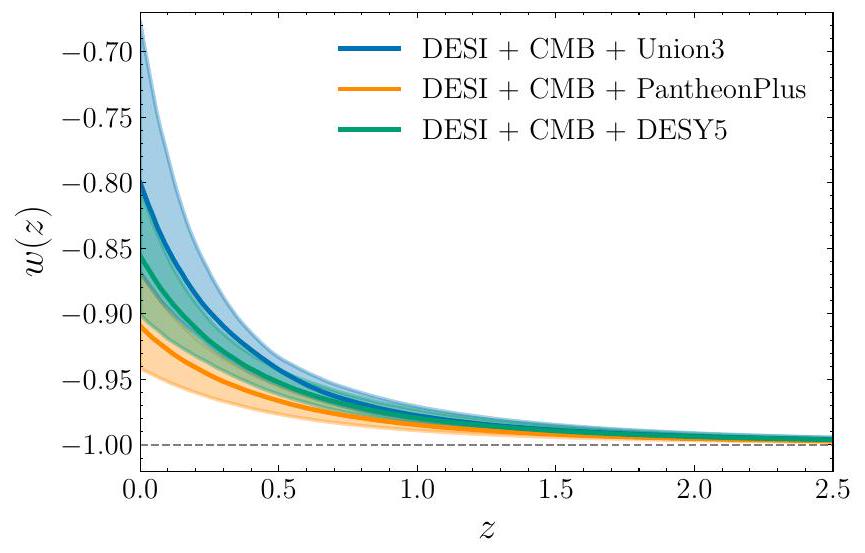
تشير كل من الطرق البارامترية وغير البارامترية التي تم مناقشتها في القسم الرابع والقسم الخامس إلى احتمال عبور خط الفانتوم؛ ومع ذلك، كما هو موضح في الشكل 16، فإن هذا لا يضمن أن العبور حقيقي. على وجه التحديد، فإن العبور الظاهر في قد تكون المعايرة زائفة لتتناسب مع الملاحظات، مما يثير التساؤل عما إذا كانيتجاوز حقًا -1 أو إذا كان السلوك مجرد أثر من التهيئة.
لمعالجة ذلك، نقوم بتحليل سلوك الكوانتس المتجمد باستخدام النموذج الجبري الموصوف بالمعادلة (15)، التي تفرض. على الرغم من أن نموذج الذوبان الجبري، مقيد بواسطة سابقنايحقق توافقًا أفضل مع البيانات منCDM بواسطة و ديك، إنه أقل تفضيلاً بكثير من نموذج. هذا التفضيل العام لـومع ذلك، لا يمكن تحويل نموذج CDM على نموذج الذوبان الجبري بشكل مباشر إلى قيم p أو مستويات n-sigma لأن الذوبان الجبري ونماذج CDM ليست متداخلة.
لتحقيقمقارنة بـستتطلب نماذج الذوبان إمكانيات مضبوطة بدقة استثنائية184، إعدادات الحقل الأولية الدقيقة 185، أو الخيارات السابقة ‘المعتمدة على البيانات’ 186، مما يؤدي إلى-1 يتبعه زيادة سريعة إلى. وهذا يشير إلى أن الزيادة الحادة تليها انخفاض في كثافة الطاقة المظلمة قد تكون ميزة ضرورية، حيث أن النماذج التي لا تعبر عن حدود الشبح تميل إلى تحت الأداء مقارنةً بتلك التي تفعل. السلوك المحدد لـمقترح من البيانات – عبور وهمي منإلى – لا يتنبأ به أي من أبسط وأشهر التوسعات لـCDM (انظر أيضًا المناقشة الأخيرة في (180).
بينما يمكن اعتبار عبور الشبح تحديًا نظريًا بسبب قضايا الاستقرار، على سبيل المثال، ضمن إطار الحقول الاسكالرية ذات الاقتران الأدنى، فإن الحصول على مثل هذا السلوك ليس صعبًا في الأطر النظرية الموسعة. على سبيل المثال، يمكن أن يظهر عبور الشبح في نماذج حيث تمتلك الطاقة المظلمة درجات حرية داخلية متعددة، مثل سيناريوهات الحقول المتعددة 187، 192، نماذج الفراغ غير القياسية 171، 172، الأطر التي تتفاعل فيها الطاقة المظلمة مع المادة المظلمة [193-198]، ونظريات الجاذبية المعدلة [199-209]. بسبب درجات الحرية الداخلية المتعددة المذكورة أعلاه في هذه النماذج، فإن المعادلة الفعالة، القابلة للرصد، لحالة المادةيمكن أن يتجاوز الحد الفانتومي على الرغم من عدم انتهاك شرط الطاقة الصفرية. ما إذا كان يمكن بناء آلية نظرية مقنعة – لا تتطلب العديد من درجات الحرية الإضافية أو افتراضات غريبة – لتجاوز الحد الفانتومي بالطريقة التي اقترحتها البيانات لا يزال سؤالاً مفتوحاً، على الرغم من أنه تم تقديم بعض النماذج مؤخرًا كقابلة للتطبيق في هذا الصدد [206، 207].
VII. الاستنتاجات
تقدم هذه الدراسة قيودًا على الطاقة المظلمة من بيانات DR2 BAO، بالاشتراك مع بيانات الخلفية الكونية الميكروية وبيانات المستعرات الأعظمية من النوع Ia. بدأنا دراستنا بتلخيص وتوسيع حولتم تقديم تحليل CDM في 47. بناءً على فرضية تطور خطيتشير أحدث نتائج DESI + CMB إلىانحراف عن“. تظهر البيانات تفضيلًا واضحًا لـ (ربع، وبشكل خاص، مما يوحي بمعادلة حالة شبحية من الماضي تنتقل إلى اليوم. المعاد بناءه ومعامل التباطؤ تظهر أيضًا انحرافات واضحة عنمما يعزز الحجة لتطور الطاقة المظلمة.
لتقييم قوة نتائجنا، قمنا بإجراء سلسلة من التحليلات: i) تغيير اعتماد الانزياح الأحمر لـمن خلال النظر في معلمات مختلفة (القسم الرابع أ)، و ii) دراسة التحسين في الملاءمة مع إعطاء مزيد من الحرية لخصائص الطاقة المظلمة (القسم الرابع ب). كما هو الحال في DR1، فإن النتائج مستقرة إلى حد ما تحت التغييرات في الشكل المفترض لـ، ولا يبدو أن البيانات تتطلب المزيد من درجات الحرية فيما وراءكما هو موضح في الشكل 6 (انظر أيضًا [43]).
بعد ذلك، قمنا بتنفيذ تقنيتين لإعادة البناء غير المعلمتين وطبقناهما على معادلة الحالة المعتمدة على الانزياح الأحمر.وكثافة الطاقة المظلمة، من أجل السماح بمزيد من المرونة مقارنةً بتلك المتاحة في الطرق المعلمية. بشكل عام، فإن ال- تدعم القيود التطور المشار إليه بواسطةتحديد المعلمات، مما يوفر أقوى القيود عند الانزياحات الحمراء المنخفضة، حيث يظهرون تفضيلًا لانحراف مع، بينما يقترح الانتقال إلى نظام الشبح عند الانزياح الأحمر الأعلى. من الواضح أن الانحراف عند الانزياح الأحمر المنخفض مستقل عن متغير التجميع المختار، على الرغم من أن القيود تظل ضمنمن عند الانزياحات الحمراء الأعلى. يعد الانحدار باستخدام العمليات الغاوسية أفضل في تحديد الانزياح الأحمر الذي يجب أن يحدث عنده التقاطع، حوالي .
من أجل تقديم تفسيرات محتملة للأصل الفيزيائي للانحراف الملحوظ، تم النظر في ثلاث فئات نموذجية، كل منها مزودة بسلوك ديناميكي مختلف ومحفز بدرجات متفاوتة من النظرية الفيزيائية. تعتبر فئات الذوبان والظهور الأقل دعمًا، مما يشير إلى أن البيانات قد لا تفضل تطور الطاقة المظلمة الذي ينشأ، على التوالي، من نماذج الحقول القياسية ذات الاقتران الأدنى أو السلوك الناشئ في كثافة الطاقة. بالمقابل، فإن فئة السراب تؤدي بشكل ملحوظ، حيث تلتقط ظواهر الطاقة المظلمة بدرجة حرية إضافية واحدة فقط، مما يستدعي التحقيق فيما إذا كانت هناك أي فيزياء أساسية أو تأثيرات منهجية يمكن أن تفسر هذا السراب.
باختصار، بغض النظر عن الطرق المعلمية/غير المعلمية المستخدمة، فإن الأدلة على الانحراف عنمهمة. تشير نتائجنا إلى أنتوصيفًا فعالًا يلتقط جوهر تطور الطاقة المظلمة في دراستنا. ستتطلب الاختبارات الحاسمة للطاقة المظلمة والانحرافات المحتملة عنسيتطلب النموذج مزيجًا من الاستقصاءات التكميلية. ستقدم إصدارات بيانات DESI القادمة، بما في ذلك القيود من تشوهات الفضاء الزمني والسرعات الغريبة، رؤى حاسمة حول طبيعة الطاقة المظلمة والجاذبية. ستقوم قياسات SNe القادمة من مسح ZTF [210، 211، مرصد فيرا سي. روبن [212، 213] وتلسكوب نانسي غريس رومان الفضائي 214 بتمديد مخطط هابل الذي تم استكشافه بواسطة DESI إلى انزياحات حمراء منخفضة جدًا، مما يحسن القيود على. في هذه الأثناء، ستعمل بيانات من Euclid 215 وRubin كتحقق مهم من نتائج DESI، مما يساعد على تقييم تأثير النظاميات المحتملة. أخيرًا، ستعمل تجارب CMB من الجيل التالي على تشديد القيود على معلمات الكون المبكر، وكسر التداخلات مع الملاحظات في الأوقات المتأخرة. مع هذه التقدمات، يعد العقد القادم بتحديد ما إذا كنا ندخل عصرًا جديدًا في علم الكونيات الحديث يتطلب تحولًا في النموذج.
VIII. توفر البيانات
ستكون البيانات المستخدمة في هذا التحليل متاحة للجمهور مع إصدار البيانات 2 (التفاصيل فيhttps://data. desi.lbl.gov/doc/releases/). ستكون نقاط البيانات التي تتوافق مع الأشكال من هذه الورقة متاحة في مستودع Zenodo.
الشكر والتقدير
يشكر المؤلفون إريك ليندر على مناقشاته القيمة وروبرت كريتيندن وكازويا كوياما على تعليقاتهم التفصيلية. يتم تمويل R.C. من قبل وزارة التعليم والشباب والرياضة التشيكية (MEYS) وصناديق الاستثمار والبنية التحتية الأوروبية (ESIF) تحت رقم المشروع CZ.02.01.01/00/22_008/0004632. يود A.S. أن يعرب عن تقديره للدعم من مؤسسة البحث الوطنية في كوريا 2021M3F7A1082056. MI يعترف بأن هذا العمل يعتمد جزئيًا على العمل المدعوم من قبل وزارة الطاقة، مكتب العلوم، تحت رقم الجائزة DE-SC0022184، وأيضًا جزئيًا من قبل مؤسسة العلوم الوطنية الأمريكية تحت منحة AST2327245. CGQ يعترف بالدعم المقدم من ناسا من خلال منحة زمالة هابل HST-HF2-51554.001-A الممنوحة من معهد علوم التلسكوب الفضائي، الذي تديره جمعية الجامعات للبحث في علم الفلك، Inc.، لصالح ناسا، بموجب عقد NAS5-26555.
هذا العمل يعتمد على العمل المدعوم من قبل وزارة الطاقة الأمريكية (DOE)، مكتب العلوم، مكتب فيزياء الطاقة العالية، بموجب العقد رقم DE-AC02-05CH11231، ومن قبل مركز الحوسبة العلمية للبحث في الطاقة الوطنية، وهو مرفق مستخدم لمكتب العلوم التابع لوزارة الطاقة بموجب نفس العقد. تم تقديم دعم إضافي لـ DESI من قبل مؤسسة العلوم الوطنية الأمريكية (NSF)، قسم العلوم الفلكية بموجب العقد رقم AST-0950945 لمختبر NSF الوطني للبحث في علم الفلك البصري-الأشعة تحت الحمراء؛ مجلس مرافق العلوم والتكنولوجيا في المملكة المتحدة؛ مؤسسة غوردون وبيتي مور؛ مؤسسة هايسينغ-سيمونز؛ اللجنة الفرنسية للطاقة البديلة والطاقة الذرية (CEA)؛ المجلس الوطني للعلوم الإنسانية والعلوم والتكنولوجيا في المكسيك (CONAHCYT)؛ وزارة العلوم والابتكار في إسبانيا (MICINN)، ومن قبل مؤسسات DESI الأعضاء:https://www.desi.lbl. gov/collaborating-institutions.
تتكون مسوحات تصوير إرث DESI من ثلاثة مشاريع فردية وتكميلية: مسح كاميرا الطاقة المظلمة (DECaLS)، مسح بكين-أريزونا للسماء (BASS)، ومسح إرث نطاق z من مايوال (MzLS). تشمل DECaLS وBASS وMzLS معًا البيانات التي تم الحصول عليها، على التوالي، في تلسكوب بلانكو، مرصد سيرو تولولو بين الأمريكتين، NSF NOIRLab؛ تلسكوب بوك، مرصد ستيوارد، جامعة أريزونا؛ وتلسكوب مايوال، مرصد كيت بيك الوطني، NOIRLab. يتم تشغيل NOIRLab بواسطة جمعية الجامعات للبحث في علم الفلك (AURA) بموجب اتفاق تعاوني مع مؤسسة العلوم الوطنية. تم دعم معالجة البيانات وتحليلها بواسطة NOIRLab ومختبر لورانس بيركلي الوطني. تستخدم مسوحات الإرث أيضًا منتجات البيانات من مستكشف مسح الأشعة تحت الحمراء واسع المجال للأجسام القريبة من الأرض (NEOWISE)، وهو مشروع تابع لمختبر الدفع النفاث/معهد كاليفورنيا للتكنولوجيا، الممول من قبل الإدارة الوطنية للملاحة الجوية والفضاء.
تم دعم مسوحات الإرث من قبل: المدير، مكتب العلوم، مكتب فيزياء الطاقة العالية من وزارة الطاقة الأمريكية؛ مركز الحوسبة العلمية للبحث في الطاقة الوطنية، وهو مرفق مستخدم لمكتب العلوم؛ مؤسسة العلوم الوطنية الأمريكية، قسم العلوم الفلكية؛ المراصد الفلكية الوطنية في الصين، الأكاديمية الصينية للعلوم ومؤسسة العلوم الطبيعية الوطنية الصينية. يتم إدارة LBNL بواسطة مجلس إدارة جامعة كاليفورنيا بموجب عقد مع وزارة الطاقة الأمريكية. يمكن العثور على الشكر الكامل فيhttps://www.legacysurvey.org/
أي آراء أو نتائج أو استنتاجات أو توصيات معبر عنها في هذا العمل هي آراء المؤلفين ولا تعكس بالضرورة وجهات نظر مؤسسة العلوم الوطنية الأمريكية، وزارة الطاقة الأمريكية، أو أي من وكالات التمويل المذكورة.
يشرف المؤلفون أن يُسمح لهم بإجراء أبحاث علمية على Iolkam Du’ag (Kitt Peak)، وهو جبل له أهمية خاصة لأمة توهونو أودام.
[1] أ. أينشتاين، Sitzungsber. Preuss. Akad. Wiss. برلين (رياضيات. فيزياء) 1917، 142 (1917).
[2] أ. ج. ريس وآخرون (فريق بحث السوبرنوفا)، Astron. J. 116، 1009 (1998)، arXiv:astro-ph/9805201.
[3] س. بيرلموتر وآخرون (مشروع علم الكون السوبرنوفا)، Astrophys. J. 517، 565 (1999) arXiv:astroph/9812133
[4] و. ج. بيرسيفال، و. ساذرلاند، ج. أ. بيكوك، س. م. باو، وآخرون، MNRAS 337، 1068 (2002). arXiv:astro-ph/0206256 [astro-ph]
[5] د. ج. آيزنشتاين، New A Rev. 49، 360 (2005)
[6] س. كول، و. ج. بيرسيفال، ج. أ. بيكوك، ب. نوربرغ، وآخرون، MNRAS 362، 505 (2005) arXiv:astroph/0501174 [astro-ph]
[7] تعاون بلانك، ن. أغانيم، ي. أكرامي، م. أشداون، وآخرون، A&A 641، A6 (2020). arXiv:1807.06209 [astro-ph.CO].
[8] س. علم، م. أوبير، س. أفيلا، س. بالاند، وآخرون، Physical Review D 103، 10.1103/physrevd.103.083533 (2021).
[9] ج. تشاو، أ. فاري، م. هي، د. فوريرو-سانشيز، وآخرون، إشعارات شهرية للجمعية الملكية الفلكية 511، 5492-5524 (2022)
[10] ت. م. ج. أبوت وآخرون (DES)، Phys. Rev. D 98، 043526 (2018)، arXiv:1708.01530 [astro-ph.CO]
[11] م. أ. تروكسل وآخرون (DES)، Phys. Rev. D 98، 043528 (2018)، arXiv:1708.01538 [astro-ph.CO]
[12] س. علم وآخرون (eBOSS)، Phys. Rev. D 103، 083533 (2021)، arXiv:2007.08991 [astro-ph.CO]
[13] ج. هيمنز وآخرون، Astron. Astrophys. 646، A140 (2021)، arXiv:2007.15632 [astro-ph.CO]
[14] ت. م. ج. أبوت وآخرون (DES)، Phys. Rev. D 105، 023520 (2022)، arXiv:2105.13549 [astro-ph.CO]
[15] ج. إيفستاثيو، و. ج. ساذرلاند، و. س. مادوكس، Nature 348، 705 (1990).
[16] ج. فريمان، م. تيرنر، ود. هوتير، Ann. Rev. Astron. Astrophys. 46، 385 (2008)، arXiv:0803.0982 [astroph]
[17] د. ه. وينبرغ، م. ج. مورتونستون، د. ج. آيزنشتاين، س. هيراتا، وآخرون، Phys. Rept. 530، 87 (2013). arXiv:1201.2434 [astro-ph.CO]. [18] ج. ب. أوسترايكر و ب. ج. شتاينهاردت، ناتشر 377، 600 (1995) [19] س. وينبرغ، ريف. مود. فيز. 61، 1 (1989). [20] ب. راترا و ب. ج. إ. بيبلز، فيزيكس ريفيو د 37، 3406 (1988) [21] ب. ج. إي. بيبلز و ب. راترا، أستروفيس. ج. ليتر. 325،
ل17 (1988). [22] V. Sahni و A. A. Starobinsky، Int. J. Mod. Phys. D 9، 373 (2000)، arXiv:astro-ph/9904398 [23] ب. ج. إي. بيبلز و ب. راترا، مراجعة الفيزياء الحديثة 75، 559 (2003)، arXiv:astro-ph/0207347 [24] إ. ج. كوبلاند، م. سامي، و س. تسوجيكاوا، المجلة الدولية للفيزياء الحديثة D 15، 1753 (2006)، arXiv:hep-th/0603057. [25] ب. بول وآخرون، فيز. الظلام الكون 12، 56 (2016)، arXiv:1512.05356 [أسترو-ف.ك.أو] [26] ل. بريفولاروبولوس و ف. سكارا، مراجعة جديدة في علم الفلك 95، 101659 (2022)، arXiv:2105.05208 [أسترو-ف.ك.أو] [27] م. ليفي، ج. بيبيك، ت. بيرز، ر. بلوم، وآخرون، مطبوعات arXiv، arXiv:1308.0847 (2013)، arXiv:1308.0847 [أسترو-ف.ك.أو]. [28] تعاون DESI، أ. أغموسا، ج. أغيلار، س. أهلي، وآخرون، مطبوعات arXiv، arXiv:1611.00037 (2016)، arXiv:1611.00037 [أسترو-ف.إم] [29] سي. بوبت، إل. تاياس، ج. أغيلار، سي. بيبيك، وآخرون، AJ 168، 245 (2024). [30] ج. هـ. سيلبر، ب. فاجريليوس، ك. فانيغ، م. شوبنيل، وآخرون، AJ 165، 9 (2023) arXiv:2205.09014 [أستروف.آي إم]. [31] ت. ن. ميلر، ب. دويل، ج. غوتيريز، ر. بيسونر، وآخرون، AJ 168، 95 (2024)، arXiv:2306.06310 [أسترو-ف.إم]. [32] ج. جاي، س. بيلي، أ. كريمن، س. علم، وآخرون، AJ 165، 144 (2023)، arXiv:2209.14482 [أسترو-ف.إم] [33] إ. ف. شلافلي، د. كيركبي، د. ج. شليجل، أ. د. مايرز، وآخرون، AJ 166، 259 (2023) arXiv:2306.06309 [أسترو-ف.ك.أو]. [34] تعاون DESI، أ. أغموسا، ج. أغيلار، س. أهلي، وآخرون، مطبوعات arXiv، arXiv:1611.00036 (2016)، arXiv:1611.00036 [أسترو-ف.إم]. [35] تعاون DESI، ب. أبارشي، ج. أغيلار، س. أهلي، وآخرون، AJ 164، 207 (2022)، arXiv:2205.10939 [أسترو-ف.إم] [36] تعاون DESI، أ. ج. أدام، ج. أغيلار، س. أهلي، وآخرون، AJ 168، 58 (2024)، arXiv:2306.06308 [أستروف.كو]. [37] تعاون DESI، م. أ. كريم، أ. ج. أدام، د. أجادو، وآخرون، مطبوعات arXiv، arXiv:2503.14745 (2025)، arXiv:2503.14745 [أستروف.كو] [38] تعاون DESI، أ. ج. أدام، ج. أغيلار، س. أهلم، وآخرون، مطبوعات arXiv، arXiv:2404.03000 (2024)، arXiv:2404.03000 [أسترو-ف.ك.أو] [39] تعاون DESI، أ. ج. أدام، ج. أغيلار، س. أهلي، وآخرون، ج. علم الكونيات وفيزياء الجسيمات 2025، 124 (2025)، arXiv:2404.03001 [أسترو-ف.ك.أو] [40] تعاون DESI، أ. ج. أدام، ج. أغيلار، س. أهلي، وآخرون، مجلة علم الكونيات وفيزياء الجسيمات 2025، 021 (2025)، arXiv:2404.03002 [أسترو-ف.ك.أو] [41] تعاون DESI، أ. ج. أدام، ج. أغيلار، س. أهلي، وآخرون، مطبوعات arXiv، arXiv:2411.12022 (2024) arXiv:2411.12022 [أسترو-ف.ك.أو]. [42] تعاون DESI، أ. ج. أدام، ج. أغيلار، س. أهلي، وآخرون، مطبوعات arXiv، arXiv:2411.12021 (2024) arXiv:2411.12021 [أسترو-ف.ك.أو]. [43] ر. كالديرون وآخرون (DESI)، JCAP 10، 048. arXiv:2405.04216 [أسترو-ف.ك.أو]. [44] ك. لودها وآخرون (DESI)، فيزي. ريف. د 111، 023532 (2025)، arXiv:2405.13588 [أسترو-ف.ك.أو] [45] تعاون DESI، قيد الإعداد (2026). [46] تعاون DESI، م. أ. كريم، ج. أغيلار، س. أهلي، وآخرون، منشورات arXiv، arXiv:2503.14739 (2025). arXiv:2503.14739 [أسترو-ف.ك.أو]. [47] تعاون DESI، م. أ. كريم، ج. أغيلار، س. أهلم، وآخرون، مطبوعات arXiv، arXiv:2503.14738 (2025) arXiv:2503.14738 [أسترو-ف.ك.أو]. [48] و. إلبيرس، أ. أفيليس، هـ. إ. نورiega، د. شابات، وآخرون، منشورات arXiv، arXiv:2503.14744 (2025). arXiv:2503.14744 [أسترو-ف.ك.أو]. [49] د. هوتيرر و م. س. تيرنر، فيزيكس ريفيو د 64، 123527 (2001)، arXiv:astro-ph/0012510 [50] م. شيفالييه و د. بولارسكي، المجلة الدولية للفيزياء الحديثة D 10، 213-223 (2001). [51] إ. ف. ليندر، فيزيكال ريفيو ليترز 90، 091301 (2003). arXiv:astro-ph/0208512 [astro-ph] [52] د. هوتيرر وج. ستاركم، رسائل المراجعة الفيزيائية 90، 10.1103/physrevlett.90.031301 (2003). [53] أ. شافيليو، أ. علم، ف. ساهني، وأ. أ. ستاروبينسكي، ملاحظات شهرية من الجمعية الملكية لعلم الفلك 366، 1081 (2006). arXiv:astro-ph/0505329. [54] ر. دي بوتير وإ. ف. ليندر، مجلة علم الكونيات وفيزياء الجسيمات 2008، 042 (2008)، arXiv:0808.0189 [astro-ph] [55] ر. ج. كريتيندن، ل. بوجوسيان، و ج.-ب. تشاو، مجلة علم الكونيات وفيزياء الجسيمات 2009، 025 (2009) arXiv:astroph/0510293 [astro-ph] [56] سي. بوغدانو وس. نيسيريس، JCAP 05، 006. arXiv:0903.2805 [أسترو-ف.ك.أو]. [57] ت. هولسكلو، أ. علم، ب. سانسو، هـ. لي، وآخرون، فيزيكال ريفيو ليترز 105، 241302 (2010). [58] ت. هولسكلو، أ. علم، ب. سانسو، هـ. لي، وآخرون، مراجعة الفيزياء D 84، 10.1103/physrevd.84.083501 (2011). [59] ج. ب. تشاو، ر. ج. كريتيندن، ل. بوجوسيان، و إكس. زانغ، فيزيكال ريفيو ليترز 109، 171301 (2012). arXiv:1207.3804 [أسترو-ف.ك.أو]. [60] س. نيسيريس و ج. غارسيا-بيليدو، مجلة علم الكون وفيزياء الجسيمات 2012 (11)، 033-033 [61] ب. لويلير وأ. شافيليو، JCAP 01، 015. arXiv:1606.06832 [أسترو-ف.ك.أو]. [62] ر. كالديرون، ب. لوهيلييه، د. بولارسكي، أ. شافيليو، وآخرون، فيزيكال ريفيو دي 106، 083513 (2022). arXiv:2206.13820 [أسترو-ف.ك.أو]. [63] ر. ل. ووركمان، ف. د. بوركرت، ف. كريد، إ. كليمت، وآخرون، تقدم الفيزياء النظرية والتجريبية 2022، 083C01 (2022) [64] ج. ليسغورغيس و س. باستور، فيزيكال ريبورت 429، 307 (2006) arXiv:astro-ph/0603494 [astro-ph] [65] د. ج. آيزنشتاين، I. زهافي، د. و. هوج، ر. سكوكيمارّو، وآخرون، ApJ 633، 560 (2005) arXiv:astro- ph/0501171 [أسترو-ف]. [66] U. أندرادي، E. بايلاس، J. مينا-فرنانديز، Q. لي، وآخرون، أرشيف e-prints، arXiv:2503.14742 (2025)، arXiv:2503.14742 [أسترو-ف.ك.أو] [67] ل. كاساس، هـ. ك. هيريرا-ألكانتار، ج. تشافيس-مونتيرو، أ. كوتشيو، وآخرون، منشورات arXiv، arXiv:2503.14741 (2025)، arXiv:2503.14741 [أسترو-ف.إم] [68] أ. برودزيلر، م. وولفسون، د. م. سانتوس، م. هو، وآخرون، مطبوعات arXiv، arXiv:2503.14740 (2025)، arXiv:2503.14740 [أسترو-ف.ك.أو] [69] د. بروت، د. سكولنيك، ب. بوبوفيتش، أ. ج. ريس، وآخرون، ApJ 938، 110 (2022) arXiv:2202.04077 [أستروف.كو] [70] د. روبين، ج. ألدرينغ، م. بيتول، أ. فرتشر، وآخرون، مطبوعات arXiv، arXiv:2311.12098 (2023)، arXiv:2311.12098 [أسترو-ف.ك.أو] [71] ت. م. ك. أبوت وآخرون (DES)، ApJ (مقبول، 2024)، arXiv:2401.02929 [أسترو-ف.ك.أو] [72] تعاون بلانك، ن. أغانيم، ي. أكرامي، ف. أروجا، وآخرون، A&A 641، A1 (2020). arXiv:1807.06205 [أسترو-ف.ك.أو] [73] ن. أغانيم وآخرون (بلانك)، أسترو. أستروفيس. 641، A5 (2020)، arXiv:1907.12875 [أسترو-ف.ك.أو] [74] ج. إيفستاثيو وس. غراتون، المجلة المفتوحة لعلم الفلك 4، 8 (2021) [75] ج. تورادو وأ. لويس، ج. علم الكونيات وفيزياء الجسيمات 2021، 057 (2021)، arXiv:2005.05290 [أسترو-ف.إم] [76] ج. كارون، م. ميرميلشتاين، وأ. لويس، JCAP 09، 039 arXiv:2206.07773 [أسترو-ف.ك.أو] [77] إ. روزنبرغ، س. غراتون، و ج. إيفستاثيو، MNRAS 517، 4620 (2022)، arXiv:2205.10869 [أسترو-ف.ك.أو] [78] م. س. مدهفاشيريل، ف. ج. كيو، ب. د. شيروين، ن. ماككران وآخرون، ApJ 962، 113 (2024). arXiv:2304.05203 [أسترو-ف.ك.أو] [79] ج. س. فارين وآخرون (ACT)، مجلة الفيزياء الفلكية 966، 157 (2024)، arXiv:2309.05659 [أسترو-ف.ك.أو]. [80] ب. ليموس وأ. لويس، فيزيكال ريفيو د 107، 103505 (2023)، arXiv:2302.12911 [أسترو-ف.ك.أو] [81] أ. لويس و س. بريدل، فيزيكال ريفيو د 66، 103511 (2002)، arXiv:astro-ph/0205436 [astro-ph] [82] أ. لويس، مراجعة الفيزياء د 87، 103529 (2013)، arXiv:1304.4473 [أسترو-ف.ك.أو] [83] ج. تورادو وأ. لويس، ج. علم الكونيات وفيزياء الجسيمات 05، 057 (2021)، arXiv:2005.05290 [أسترو-ف.إم] [84] ر. م. نيل، أرشيف الرياضيات الإلكترونية، الرياضيات/0502099 (2005)، أرشيف: الرياضيات/0502099 [الرياضيات.نظرية]. [85] أ. لويس، أ. تشالينور، وأ. لاسنبي، ApJ 538، 473 (2000)، arXiv:astro-ph/9911177 [astro-ph]. [86] سي. هاوليت، أ. لويس، أ. هول، وأ. تشالينور، مجلة علم الكونيات وفيزياء الجسيمات 2012، 027 (2012). arXiv:1201.3654 [أسترو-ف.ك.أو] [87] و. هو وإي. ساويكي، فيزيكال ريفيو د 76، 104043 (2007)، arXiv:0708.1190 [أسترو-فيزيكس] [88] و. فنج، و. هو، وأ. لويس، / فيز. ريف. د 78، 087303 (2008)، arXiv:0808.3125 [أسترو-في]. [89] ج. ليسغورغيس، نظام حل التباين الكوني الخطي (CLASS) I: نظرة عامة (2011)، arXiv:1104.2932 [أسترو-ف.إم] [90] د. بلاز، ج. ليسغورغ، وت. ترام، مجلة علم الكونيات وفيزياء الجسيمات 1107، 034 (2011)، arXiv:1104.2933 [أستروف.كو] [91] هـ. ديمبينسكي و ب. أ. وآخرون، سكايكت-هيب/إيمينويت (2020). [92] م. إيشاك، ج. بان، ر. كالديرون، ك. لودها، وآخرون، مطبوعات arXiv، arXiv:2411.12026 (2024). arXiv:2411.12026 [أسترو-ف.ك.أو]. [93] ف. بولين، ت. ل. سميث، ر. كالديرون، وت. سيمون، arXiv:2407.18292 [أسترو-ف.ك.أو ] (2024). [94] ر. ر. كالدويل، رسالة فيزيائية ب 545، 23 (2002)، arXiv:astro-ph/9908168. [95] س. و. هوكينغ و ج. ف. ر. إليس، الهيكل الكبير للزمان والمكان، مؤلفات كامبريدج في الفيزياء الرياضية (مطبعة جامعة كامبريدج، 2023). [96] في. ساهني، أ. شافيليو، وأ. أ. ستاروبينسكي، فيزي. ريف. د 78، 103502 (2008)، arXiv:0807.3548 [أسترو-في]. [97] I. واسرمان، مراجعة الفيزياء D 66، 123511 (2002). arXiv:astro-ph/0203137. [98] م. كونز، فيزيكال ريفيو د 80، 123001 (2009). [99] أ. شافيليو وإي. في. ليندر، فيزيكال ريفيو دي 84، 063519 (2011) [100] و. جياري، م. نجفي، س. بان، إ. دي فالنتينو، وآخرون، JCAP 10، 035 arXiv:2407.16689 [أسترو-ف.ك.أو]. [101] و. ج. وولف، سي. غارسيا-غارسيا، و ب. ج. فيريرا، arXiv:2502.04929 [أسترو-ف.ك.أو ] (2025). [102] إ. م. باربوزا و ج. س. ألكانيز، رسائل الفيزياء ب 666، 415 (2008)، arXiv:0805.1713 [astro-ph] [103] ج. إيفستاثيو، MNRAS 310، 842 (1999) arXiv:astroph/9904356 [astro-ph] [104] ن. ديمكيس، أ. كاراجيورغوس، أ. زامبيلي، أ. بالياثاناسيس، وآخرون، فيز. ريف. د 93، 123518 (2016). arXiv:1604.05168 [gr-qc] [105] س. بان، و. يانغ، و أ. بالياثاناسيس، المجلة الأوروبية للفيزياء C 80، 274 (2020)، arXiv:1902.07108 [أستروف.كو] [106] هـ. ك. جَسّال، ج. س. باجلا، و ت. بادمانابان، فيزيكس ريفيو د 72، 103503 (2005) arXiv:astroph/0506748 [astro-ph] [107] أ. شافيليو، ت. كليفتون، و ب. فيريرا، مجلة علم الكون وفيزياء الجسيمات 2011 (08)، 017. [108] أ. شافيليو، مجلة علم الكون وفيزياء الجسيمات 2012 (08)، 002-002 [109] أ. شافيليو، مجلة علم الكون وفيزياء الجسيمات 2012 (05)، 024-024 [110] س. هاود، س. صالحی، س. فيدال، م. ماتوري، وآخرون، arXiv:1912.04560 [أسترو-ف.ك.أو] (2019). [111] ج. غراندي، ج. سولا بيراكولا، و هـ. ستيفانسيك، JCAP 08، 011، arXiv:gr-qc/0604057. [112] ج. أ. فاسكيز، س. هي، م. ب. هوبسون، أ. ن. لاسنبي، وآخرون، JCAP 07، 062، arXiv:1208.2542 [أستروف.كو] [113] ل. فيزينيللي، س. فاجنوزي، وU. دانييلسون، تماثل 11، 1035 (2019)، arXiv:1907.07953 [أسترو-ف.ك.أو] [114] ر. كالديرون، ر. غانوجي، ب. لوهيليير، و د. بولارسكي، فيزيكال ريفيو دي 103، 10.1103/physrevd.103.023526 (2021). [115] ت. تشيبا، ت. أوكابي، و م. ياماغوتشي، فيزيكال ريفيو د 62، 023511 (2000)، arXiv:astro-ph/9912463 [116] في. ساهني وي. شتانوفسكي، مجلة علم الكون وفيزياء الجسيمات 2003 (11)، 014 [117] ف. باور، ج. سولّا، و هـ. ستيفانيتش، مجلة علم الكون وفيزياء الجسيمات 2010 (12)، 029 [118] ب. بواسيه، هـ. جياكوميني، د. بولارسكي، و أ. أ. ستاروبينسكي، JCAP 07، 002، arXiv:1504.07927 [gr-qc]. [119] إ. ف. ليندر و د. هوتيرر، فيزيكال ريفيو د 72، 043509 (2005)، arXiv:astro-ph/0505330 [120] د. موثوكريشنا ود. باركنسون، JCAP 11، 052. arXiv:1607.01884 [أسترو-ف.ك.أو]. [121] ر. كاميليري وآخرون (DES)، ملاحظات شهرية للجمعية الملكية للفلك.
اجتماع. 533، 2615 (2024)، arXiv:2406.05048 [أسترو-ف.ك.أو] [122] م. تيغمارك، مراجعة الفيزياء د 55، 5895-5907 (1997). [123] د. هوتيرر وأ. كوراى، مراجعة الفيزياء D 71، 10.1103/physrevd.71.023506 (2005). [124] ر. ج. كريتيندن، ل. بوجوسيان، و ج.-ب. تشاو، JCAP 12، 025، arXiv:astro-ph/0510293. [125] ف. سيمبسون و س. بريدل، فيزيكال ريفيو د 73، 083001 (2006)، arXiv:astro-ph/0602213 [126] سي. غارسيا-كوينتيرو، م. إيشاك، وأو. نينغ، JCAP 12، 018، arXiv:2010.12519 [أسترو-ف.ك.أو] [127] ب. أ. ر. أدي وآخرون (بلانك)، أسترو. أستروفيس. 594، A14 (2016)، arXiv:1502.01590 [أسترو-ف.ك.أو] [128] ج. ب. تشاو وآخرون، ناتشر أسترو. 1، 627 (2017)، arXiv:1701.08165 [أسترو-ف.ك.أو] [129] م. رافيري، ل. بوجوسيان، ك. كوياما، م. مارتينيلي، وآخرون، إعادة بناء مشتركة للطاقة المظلمة وتطور النمو المعدل (2021)، arXiv:2107.12990 [أسترو-ف.ك.أو]. [130] ل. بوجوسيان، م. رافيري، ك. كوياما، م. مارتينيلي، وآخرون، ناتشر أستران. 6، 1484 (2022). arXiv:2107.12992 [أسترو-ف.ك.أو] [131] ب. بانسال و د. هوتيرر، arXiv:2502.07185 [أستروف.كو ] (2025). [132] ج. أ. ريبوساس، د. هـ. ف. دي سوزا، ك. تشونغ، ف. ميراندا، وآخرون، JCAP 02، 024، arXiv:2408.14628 [أسترو-ف.ك.أو]. [133] ي.-هـ. بانغ، إكس. تشانغ، و كيو.-ج. هوانغ، arXiv:2408.14787 [أسترو-ف.ك.أو ] (2024). [134] و. هاندلي، مجلة البرمجيات مفتوحة المصدر 3، 10.21105/joss.00849 (2018). [135] سي. راسموسن وسي. ويليامز، العمليات الغاوسية لتعلم الآلة، سلسلة الحوسبة التكيفية وتعلم الآلة (مجموعة جامعة الصحافة المحدودة، 2006). [136] ت. هولسكلو، أ. علم، ب. سانسو، هـ. لي، وآخرون، مراجعة الفيزياء D 82، 10.1103/physrevd.82.103502 (2010). [137] ت. هولسكلو، أ. علم، ب. سانسو، هـ. لي، وآخرون، فيزيكال ريفيو ليترز 105، 241302 (2010) [138] أ. شافيليو، أ. ج. كيم، وإي. في. ليندر، فيزيكال ريفيو دي 85، 123530 (2012) arXiv:1204.2272 [أسترو-ف.ك.أو] [139] م. سيكل، س. كلاركسون، و م. سميث، مجلة علم الكون وفيزياء الجسيمات 2012 (06)، 036-036. [140] أ. شافيليو، أ. ج. كيم، وإي. في. ليندر، فيزيكال ريفيو دي 87، 023520 (2013)، arXiv:1211.6128 [أسترو-ف.ك.أو]. [141] ر. إ. كيلي، س. جوداكي، م. كابلينغهات، و د. كيركبي، JCAP 12، 035، arXiv:1905.10198 [أسترو-ف.ك.أو] [142] إ. بلقاسم، س. فوفا، م. ماجوري، و ت. يانغ، فيزيكال ريفيو دي 101، 063505 (2020)، arXiv:1911.11497أستروف.كو] [143] ر. إ. كيلي، أ. شافيليو، ب. لوهيليير، وإ. ف. ليندر، ملاحظات شهرية من الجمعية الملكية للفلك 491، 3983 (2020)، arXiv:1905.10216 [أسترو-ف.ك.أو] [144] ف. جيراردي، م. مارتينيلي، وأ. سيلفستري، JCAP 07، 042 arXiv:1902.09423 [أسترو-ف.ك.أو] [145] ب. موكيرجي وأ. موكيرجي، ملاحظات شهرية. الجمعية الملكية للفلك 504، 3938 (2021)، arXiv:2104.06066 [أسترو-ف.ك.أو]. [146] ر. كالديرون، ب. لوهيلييه، د. بولارسكي، أ. شافيليو، وآخرون، فيزيكال ريفيو دي 108، 023504 (2023)، arXiv:2301.00640 [أسترو-ف.ك.أو] [147] ب. ر. ديندا و ر. مارتنز، JCAP 01، 120. arXiv:2407.17252 [أسترو-ف.ك.أو] [148] ب. موكيرجي وأ. أ. سين، فيزيكال ريفيو د 110، 123502 (2024)، arXiv:2405.19178 [أسترو-ف.ك.أو]. [149] س. جوداكي، م. كابلينغهات، ر. كيلي، و د. كيركبي، فيزيكال ريفيو د 97، 123501 (2018) arXiv:1710.04236 [أسترو-ف.ك.أو] [150] س.-ج. هوانغ، ب. لوهيلييه، ر. إي. كيلي، م. ج. جي، وآخرون، JCAP 02، 014، arXiv:2206.15081 [أستروف.كو] [151] ر. ر. كالدويل وإي. في. ليندر، فيزيكال ريفيو ليترز 95، 141301 (2005)، arXiv:astro-ph/0505494. [152] إ. ف. ليندر، مراجعة الفيزياء د 73، 063010 (2006). arXiv:astro-ph/0601052 [153] ر. ن. كان، ر. دي بوتير، وإي. في. ليندر، JCAP 11، 015، arXiv:0807.1346 [astro-ph]. [154] ب. راترا و ب. ج. إ. بيبلز، فيزيكس ريفيو د 37، 3406 (1988) [155] C. Wetterich، فيزياء نووية B 302، 668 (1988). arXiv:1711.03844 [hep-th] [156] ب. ج. فيريرا و م. جويس، فيزيكال ريفيو د 58، 023503 (1998)، arXiv:astro-ph/9711102 [157] ر. ج. شيرر و أ. أ. سين، فيزيكال ريفيو دي 77، 083515 (2008)، arXiv:0712.3450 [أسترو-فيزيكس] [158] س. تسوجيكاوا، كلاس. كوانت. جراف. 30، 214003 (2013). arXiv:1304.1961 [gr-qc] [159] ج. مارتن، رسالة فيزياء حديثة A 23، 1252 (2008). arXiv:0803.4076 [أسترو-فيزياء] [160] ج. أ. فريمان، س. ت. هيل، أ. ستببينز، وإ. واغا، فيزيكال ريفيو ليترز 75، 2077 (1995)، arXiv:astroph/9505060 [161] ج. م. كلاين، س. جيون، و ج. د. مور، فيزيكال ريفيو د 70، 043543 (2004)، arXiv:hep-ph/0311312. [162] أ. فيكمان، مراجعة الفيزياء د 71، 023515 (2005). arXiv:astro-ph/0407107. [163] إ. ف. ليندر، الجاذبية العامة والنسبية. 40، 329 (2008). arXiv:0704.2064 [أسترو-فيزيكس] [164] إ. ف. ليندر، مراجعة الفيزياء د 91، 063006 (2015). arXiv:1501.01634 [أسترو-ف.ك.أو]. [165] ر. كريتيندن، إ. ماجيروتو، و ف. بيازا، فيزيكال ريفيو ليترز 98، 251301 (2007)، arXiv:astro-ph/0702003. [166] ن. كاليببر و ل. سوربو، JCAP 04، 007، arXiv:astroph/0511543 [167] د. ج. إ. مارش، تقرير فيزيائي 643، 1 (2016). arXiv:1510.07633 [أسترو-ف.ك.أو]. [168] س. دوتا و ر. ج. شيرر، فيزيكال ريفيو د 78، 123525 (2008)، arXiv:0809.4441 [أسترو-فيزيكس] [169] إكس. لي وأ. شافيليو، مجلة الفيزياء الفلكية. 883، L3 (2019)، arXiv:1906.08275 [أسترو-ف.ك.أو] [170] إكس. لي وأ. شافيليو، مجلة الفيزياء الفلكية 902، 58 (2020). arXiv:2001.05103 [أسترو-ف.ك.أو]. [171] ل. باركر و أ. رافال، فيزيكال ريفيو D 62، 083503 (2000)، [تصحيح: فيزيكال ريفيو D 67، 029903 (2003)]، arXiv:grqc/0003103 [172] ر. ر. كالدويل، و. كومب، و. باركر، و د. أ. ت. فانتزيلا، فيزيكال ريفيو د 73، 023513 (2006) arXiv:astroph/0507622 [173] أ. بنيهاشمي، ن. خسروي، وأ. شافيليو، JCAP 06، 003، arXiv:2012.01407 [أسترو-ف.ك.أو]. [174] م. س. تيرنر، فيزيكال ريفيو د 31، 1212 (1985). [175] ل. بارنز، م. ج. فرانسيس، ج. ف. لويس، وإ. ف. ليندر، نشر. جمعية الفلك الأسترالية 22، 315 (2005)، arXiv:astroph/0510791 [176] و. زيمدال، المجلة الدولية للفيزياء الحديثة D 14، 2319 (2005). arXiv:gr-qc/0505056 [177] إ. ف. ليندر، arXiv:0708.0024 [astro-ph] (2007). [178] إ. ف. ليندر و م. ج. وايت،|فيزي. ريف. د 72، 061304 (2005)، arXiv:astro-ph/0508401 [179] م. ج. فرانسيس، ج. ف. لويس، و إ. ف. ليندر، ملاحظات الجمعية الملكية الفلكية 380، 1079 (2007) arXiv:0704.0312 [astro-ph] [180] إ. ف. ليندر، (2024)، arXiv:2410.10981 [أسترو-ف.ك.أو]. [181] د. ج. سبايجل هالتير، ن. ج. بيست، ب. ب. كارلين، وأ. فان دير ليندي، مجلة الجمعية الملكية الإحصائية: السلسلة ب (المنهجية الإحصائية) 64، 583 (2002). [182] أ. ر. ليدل، إشعارات شهرية للجمعية الملكية الفلكية: رسائل 377، L74 (2007). [183] س. غراندي، د. رابيتي، أ. سارو، ج. ج. موهر، وآخرون، ملاحظات شهرية للجمعية الملكية للفلك 463، 1416 (2016)، arXiv:1604.06463 [أسترو-ف.ك.أو] [184] و. ج. وولف، س. غارسيا-غارسيا، د. ج. بارتليت، و ب. ج. فيريرا، فيزيكال ريفيو دي 110، 083528 (2024)، arXiv:2408.17318 [أسترو-ف.ك.أو] [185] د. شليفكو و ب. شتاينهارت، (2024)، arXiv:2405.03933 [أسترو-ف.ك.أو]. [186] ج. بايور، إ. مكدونا، ور. براندنبرغر، arXiv:2411.13637 [أسترو-ف.ك.أو ] (2024). [187] و. هو، مراجعة الفيزياء د 71، 047301 (2005)، arXiv:astroph/0410680 [188] ز.-ك. قوه، ي.-س. بياو، ش.-م. تشانغ، وي.-ز. تشانغ، فيز. ليت. ب 608، 177 (2005)، arXiv:astro-ph/0410654. [189] هـ. وي، ر.-ج. كاي، و د.-ف. زينغ، كلاس. كوانت. جراف. 22، 3189 (2005)، arXiv:hep-th/0501160 [190] ر. ر. كالدويل و م. دوران، فيزيكال ريفيو د 72، 043527 (2005)، arXiv:astro-ph/0501104 [191] ي.-ف. كاي، ت. كيو، ر. براندنبرغر، ي.-س. بياو، وآخرون، JCAP 03، 013، arXiv:0711.2187 [hep-th]. [192] ي.-ف. كاي، ت. كيو، ي.-س. بياو، م. لي، وآخرون، JHEP 10، 071 arXiv:0704.1090 [gr-qc]. [193] ل. أماندولا، فيزيكال ريفيو د 62، 043511 (2000)، arXiv:astro-ph/9908023 [194] أ. ب. بيليارد وأ. أ. كولي، فيزيكال ريفيو د 61، 083503 (2000)، arXiv:astro-ph/9908224 [195] ل. أماندولا، فيزيكال ريفيو د 69، 103524 (2004)، arXiv:astro-ph/0311175 [196] س. نوجيري، س. د. أودينتسوف، وس. تسوجيكوا، فيزيكس ريفيو د 71، 063004 (2005) arXiv:hep-th/0501025 [197] ت. كليمسون، ك. كوياما، ج.-ب. تشاو، ر. مارتنز، وآخرون، فيزيكال ريفيو د 85، 043007 (2012)، arXiv:1109.6234 [أسترو-ف.ك.أو] [198] أ. شافيليو، د. ك. هازرا، ف. ساهني، وأ. أ. ستاروبينسكي، إشعارات شهرية للجمعية الملكية الفلكية 473، 2760-2770 (2017) [199] ف. س. كارفالو وأ. س. سا، فيزيكال ريفيو د 70، 087302 (2004)، arXiv:astro-ph/0408013 [200] و. هو وإ. ساويكي، فيزيكال ريفيو د 76، 064004 (2007)، arXiv:0705.1158 [أسترو-فيزيكس] [201] ج. مارتن، س. شيميد، وج. ب. أوزان، فيزيكال ريفيو ليترز 96، 061303 (2006). [202] أ. أنيسيموف، إ. بابيتشيف، وأ. فيكمان، JCAP 06، 006 arXiv:astro-ph/0504560. [203] س. نيسيريس و ل. بريفولاروبولوس، فيزي. ريف. د 73، 103511 (2006)، arXiv:astro-ph/0602053 [204] سي. ديفايه، أو. بوجولاس، آي. ساويكي، وآي. فيكمان، JCAP 10، 026، arXiv:1008.0048 [hep-th] [205] أ. بوجولاس، إ. ساويكي، وأ. فيكمان، JHEP 11، 156. arXiv:1103.5360 [hep-th]. [206] ج. يي، م. مارتينيلي، ب. هو، وأ. سيلفستري، arXiv:2407.15832 [أسترو-ف.ك.أو ] (2024). [207] و. ج. وولف، ب. ج. فيريرا، و. س. غارسيا-غارسيا، فيزيكال ريفيو د 111، L041303 (2025)، arXiv:2409.17019 [أستروف.كو] [208] ي. يانغ، إكس. رين، ق. وانغ، ز. لو، وآخرون، مجلة العلوم. 69، 2698 (2024)، arXiv:2404.19437 [أسترو-ف.ك.أو] [209] أ. كريستيانسن، ف. هاساني، ود. ف. موتا، JCAP 01، 043، arXiv:2405.00668 [أسترو-ف.ك.أو] [210] م. ريجو، م. سميث، أ. جوبار، ك. ماغواير، وآخرون، مطبوعات arXiv، arXiv:2409.04346 (2024). arXiv:2409.04346 [أسترو-ف.ك.أو]. [211] إ. سي. بيلم، س. ر. كولكارني، م. ج. غراهام، ر. ديكاني، وآخرون، PASP 131، 018002 (2019)، arXiv:1902.01932 [أسترو-ف.إم] [212] م. لوخنر، د. سكولنيك، هـ. الموباييد، ت. أنغويتا، وآخرون، ApJS 259، 58 (2022) arXiv:2104.05676 [أسترو-ف.ك.أو] [213] ب. غريس، ن. ريجنو، هـ. أوان، إ. هوك، وآخرون، ApJS 264، 22 (2023)، arXiv:2205.07651 [أسترو-ف.ك.أو]. [214] د. سبيرجل، ن. جيرلز، ج. بالتاي، د. بينيت، وآخرون، تلسكوب المسح بالأشعة تحت الحمراء واسع المجال – أصول التلسكوب المركّز على الفيزياء الفلكية WFIRST-AFTA تقرير 2015 (2015)، arXiv:1503.03757 [أسترو-ف.إم]. [215] ر. لوريجس، ج. أميكس، س. أردوني، ج. ل. أوجير، وآخرون، مطبوعات arXiv، arXiv:1110.3193 (2011). arXiv:1110.3193 [أسترو-ف.ك.أو]. [216] و. ج. هاندلي، م. ب. هوبسون، و أ. ن. لاسنبي، ملاحظات الجمعية الملكية للفلك 450، L61 (2015). arXiv:1502.01856 [أسترو-ف.ك.أو]. [217] و. هاندلي، ج. البرمجيات مفتوحة المصدر. 4، 1414 (2019). arXiv:1905.04768 [أسترو-ف.إم]. [218] ل. ت. هيرغت، و. ج. هاندلي، م. ب. هوبسون، و أ. ن. لاسنبي، فيزيكال ريفيو د 103، 123511 (2021)، arXiv:2102.11511 [أسترو-ف.ك.أو]. [219] هـ. جيفريز، نظرية الاحتمالات، نصوص أكسفورد الكلاسيكية في العلوم الفيزيائية (1939). [220] ر. تروتا، ملاحظات الجمعية الملكية للفلك 378، 72 (2007)، arXiv:astro-ph/0504022. [221] ل. أماندولا وس. تسوجيكاوا، الطاقة المظلمة: النظرية والملاحظات (مطبعة جامعة كامبريدج، 2015). [222] أ. ج. شاجيب وج. أ. فريمان، arXiv:2502.06929 [أستروف.كو ] (2025). [223] في. سمير-باريتو وأ. ر. ليدل، مجلة علم الكون وفيزياء الجسيمات 2017 (01)، 023-023 [224] أ. أبراهامسي، أ. ألبريخت، م. بارنارد، و ب. بوزيك، فيزيكال ريفيو د 77، 103503 (2008)، arXiv:0712.2879 [أستروف] [225] م. كاواساكي، ت. موروئي، وت. تاكاهاشي، فيزي. ريف. د 64، 083009 (2001)، arXiv:astro-ph/0105161 [226] س. س. سي. نغ و د. ل. ويلتشر، فيزيكال ريفيو د 63، 023503 (2001) arXiv:astro-ph/0004138. [227] ك. كوبل، س. دودلسون، وج. أ. فريمان، فيزيكال ريفيو د 55، 1851 (1997)، arXiv:astro-ph/9608122 [228] ج. أ. فريمان و I. واغا، فيزيكال ريفيو D 57، 4642 (1998)، arXiv:astro-ph/9709063 [229] ب. ت. ب. فيانا و أ. ر. ليدل، فيزي. ريف. د 57، 674 (1998)، arXiv:astro-ph/9708247 [230] ف. إكس. إل. سيدينو، أ. إكس. غونزاليس-موراليس، و ل. أ. أورينا لوبيز، فيزيكال ريفيو د 96، 061301 (2017). arXiv:1703.10180 [gr-qc] [231] ف. إكس. ليناريس سيدينو، أ. إكس. غونزاليس-موراليس، و ل. أ. أورينا لوبيز، JCAP 01، 051، arXiv:2006.05037 [أسترو-ف.ك.أو].
الملحق أ: مقارنة النماذج البايزية
هنا نناقش مقارنة النماذج البايزية ونحسب عامل بايز بين و النماذج، التي يتم تحديدها من خلال النسبة المقابلة للأدلة الخاصة بهاتحت مجموعة بيانات معينة:. في الممارسة العملية، نقوم بحساب عوامل بايز باستخدام العينة المتداخلة بوليشورد 216، مع استخدام نفس الأولويةومحلل بولتزمان (CAMB) كما هو موضح في التحليل اللاحق الذي تم مناقشته في النص الرئيسي. ثم يتم تقدير الدليل باستخدام حزمة التخدير [217.
لوغاريتم الدليل (يمكن التعبير عن ذلك كمساهمة من مصطلحين على الشكل [218]
أين، هو الاحتمال، هو الخلفي،يمثل التوزيع السابق وهو المتوسط المرجح الخلفي. المتوسط الخلفي للاحتمالية اللوغاريتميةيزيل عقوبة أوكام المعتمدة على السابقين،، مساهمة من دليل اللوغاريتم لتوفير تقييم كمي لمدى ملاءمة النموذج للبيانات ويمكن اعتباره المعادل البايزي لـ.
في الجدول الرابع، نبلغ عن الفروقات بين و نماذج، لقيم (= ، و لكل مجموعة بيانات. تشير نسبة الأدلة البايزية إلى أن الدعم لـيزداد النموذج مع الإصدار الأخير من DR2. على مقياس جيفري 219، 220، تشير مجموعة DESY5 إلى تفضيل قوي تقريبًا ( ) من أجل الـ نموذج CDM عند دمجه مع DR2 مقارنة بتفضيل معتدل ) مع مجموعة بيانات DR1، بينما يظهر Union3 تفضيلًا معتدلًا لـ مقارنة بالتفضيل الضعيف الملحوظ عند دمجه مع مجموعة بيانات DR1. على النقيض من ذلك، يوفر PantheonPlus أدلة غير حاسمة، حيث يظهر تفضيلًا لـ على الرغم من أن هذا التفضيل يتناقص في الانتقال من DR1 إلى DR2. في جميع الحالات الثلاث، نلاحظ أن الاتجاهات فيابق متسقًا مع التكراريةالنتائج المعروضة في الجدول III، مع تحسين واضح في احتمال الملاءمة عند الانتقال من مجموعة بيانات DR1 إلى مجموعة بيانات DR2. نلاحظ أنه نظرًا لأن قيمة دليل باي تشمل مساهمات الاحتمالية عبر مجموعة من القيم المحتملة للمعلمات، فإنها أقل عرضة للتقلبات العشوائية في البيانات مما يؤدي إلى ملاءمة أفضل في نقطة معينة في فضاء المعلمات عن طريق الصدفة. لذلك، أو يجب أن تكون المقارنات أقل ضوضاء وأكثر قوة من .
عادةً ما يُتوقع أن تكون عقوبة أوكام أكبر (أي، ضغط أكبر من السابق إلى اللاحق) مع بيانات أكثر معلوماتية. ومع ذلك، فإن هذا ليس هو الحال بالنسبة لمجموعة بيانات DESY5، على الرغم من أنها تناسب البيانات بشكل أفضل. ومع ذلك، فإن جميع عوامل عقوبة أوكام لـ DESI +
الجدول الرابع. دليل بايزيالمتوسط اللاحق لـ-احتماليةوعقوبة أوكام لمجموعات بيانات السوبرنوفا المختلفة (بانثيون بلس، يونيون 3، ودي إي إس واي 5) بالاشتراك مع قياسات CMB وDESI BAO. نحن نقدم نتائج لـ DESI DR2 BAO + CMB وDESI DR1 BAO + CMB مع عدم اليقين المرتبط للمقارنة. جميع القيم المبلغ عنها تتعلق بالفرق بين و الـ .
+بانثيون بلس
+اتحاد3
+DESY5
ديزي دي آر 2 باو + سي إم بي
ديزي دي آر 1 باو + سي إم بي
تتوافق بيانات Ia تقريبًا مع بعضها البعض، نظرًا للخطأ المقدر على هذه القيم.
يرجى ملاحظة أنه في الـ 40 تم استخدام فئة محلل بولتزمان مع مجموعة مختلفة من الافتراضات و احتمالية CMB. من أجل مقارنة أفضل، قمنا بإعادة حساب الأدلة لـ DESI DR1 BAO باستخدام افتراضات ومنهجية متسقة كما هو موضح في القسم الثاني.
نذكر القراء أن مقارنة النماذج البايزية تعتمد على المسبق، وهذا مهم بشكل خاص في حالة اختبار النماذج الظاهرة مثل، حيث إن الاختيار السابق للمعلمات الإضافية مبرر فقط ظاهريًا. يمكن تعديل عقوبة أوكام من خلال اختيار أولويات مختلفة. عمومًا، تميل الأولويات الأوسع إلى تفضيل النموذج الأبسط، وفي هذه الحالة هوCDM. ومع ذلك، فإن الافتراضات المختارة في الجدول I واسعة بما يكفي لـ، وأن التوزيع البعدي لهذه المعلمات مقيد جيدًا داخل هذا التوزيع السابق عندما يتم دمج مجموعات البيانات. قد تؤدي اختيار مختلف للتوزيع السابق على هذه المعلمات إلى تغيير الترتيب، بحيثسيتم تفضيله علىلكل تركيبات البيانات، ولكن للقيام بذلك في أقصى الحالات (DESI DR2 BAO + CMB + DESY5) سيكون من الضروري توسيع نطاق الأولويات بمعدل يزيد عن 10 مرات لكلاهماالمعلمات، مما يؤدي إلى زيادة تزيد عن 100 مرة في الحجم السابق. مثل هذا الافتراض لن يُعتبر بلا شك غير فيزيائي وغير معقول من قبل معظم الناس.
الملحق ب: تفاصيل تجميع تحليل المكونات الرئيسية
تحليل المكونات الرئيسية (PCA) هو استراتيجية شائعة الاستخدام تستفيد من عدد الصناديق، أو المعلمات الحرة الإضافية، مقابل الشكوك في السعات المقيدة، في محاولة لتحليل كيفية تقسيم البيانات بأكثر كفاءة.
128، على الرغم من أن التفسير ليس بالضرورة بسيطًا، إلا أنه لا يزال خاضعًا لمجموعة من التحذيرات [54].
في هذا الملحق، نقدم التعبيرات الرياضية الكاملة لتحليل المكونات الرئيسية (PCA) الذي تم إجراؤه على نتائج التجميع. نبدأ بكتابة معادلة الحالة من حيث معلمات سعة التجميع و قاعدة أولية.
أينهي معلمات سعة الصندوق، المعرفة كما سبق، وهو ببساطة دالة القبعة العلوية الملساء باستخدام دالة التانجنت المفرط
الذي له قيمة واحدة في الفترةوصفر في أماكن أخرى، مما يسمح لنا باستعادة التعبير في المعادلة (13).
إذا قمنا بقطر مصفوفة التباين لهذه المعاملات للحصول على
ثم المصفوفة العمودية يحتوي على القيم الذاتية لـ ومصفوفة القطرية يحتوي على القيم الذاتية المقابلة [52، 54]. من أجل الراحة، نقوم بتطبيع لديها محدد يساوي واحد.
للحصول على المعاملات الجديدة، نستخدم صفوفكأوزان على النسخ الأصلية
منذعمودي، أيستتحول المعاملات والأساس بنفس الطريقة. وبالتالي، يمكن الحصول على دوال الأساس الجديدة (انظر الشكل 8) بطريقة مشابهة باستخدام [52، 54].
عدم اليقين في المعلمات الجديدة يُعطى بمعكوس القيم الذاتية [52]
بينما تعتبر تحليل المكونات الرئيسية (PCA) نهجًا مفيدًا بلا شك، يجب ملاحظة أنه، بشكل عام، لا تكون المتجهات الذاتية محددة بشكل جيد رسميًا لمصفوفة التغاير العكسية، وأن مجموعة المتجهات الذاتية التي تم العثور عليها ستعتمد على تهيئة التجميع والمتغير. أخيرًا، لا توجد تفسير واضح مسبق لحجمدون إجراء افتراضات إضافية حول شكل معادلة الحالة 54.
الملحق ج: تفاصيل حول الانحدار باستخدام العمليات الغاوسية
في هذا الملحق، نناقش تفاصيل المنهجية وتنفيذ نتائج انحدار العملية الغاوسية المقدمة في القسم VB. نتبنى نهجًا مرنًا وغير معلمي لنمذجة معادلة حالة الطاقة المظلمة.استخدام عملية غاوسية مع نواة أسية مربعة معطاة بواسطة
أين تشير إلى الانحرافات النموذجية لـ من دالة المتوسط، التي نعتبرها قيمة. المعامل يحدد طول الارتباط للعينات. نقوم بسحب عينات من توزيع غاوسي مشترك عبر شبكة كثيفة موحدة تتراوح منإلىالتي تعود بسلاسة إلى عند الانزياحات الحمراء العالية للحفاظ على الاستقرار العددي. نحن نثبت لتلبية مجموعة واسعة من سلوكيات الطاقة المظلمة وفرض أولوية غاوسية معكوسة عامة على :
أينيمثل دالة بيسل المعدلة من النوع الثاني. نحن نختار و لمعاقبة المنخفضالقيم، مما يمنع الحرية المفرطة في، بينما يقيّد أيضًا العاليقيم لتجنب الإفراط في أخذ عينات من الدوال الخطية تقريبًا. لتحسين كفاءة إجراء أخذ العينات لدينا، نقدم متغيرًا كامنًا يقوم بأخذ عينات مباشرةفينحن نصلح ) من توزيع غاوسي سابق بعرض . يتم استخدام هذه القيم المأخوذة لاحقًا لتوليد عينات منمن توزيع شرطي، مما يسهل التقارب بشكل أسرع بكثير. لقد قمنا بتقييم تأثير التغير في (فوق النطاق ) وتهميش مع احتمال موحد، ووجدنا أن نتائجنا واستنتاجاتنا قوية بشكل معقول.
الملحق د: الجوهر
نناقش القيود المفروضة على نموذج الكوانتس مع حقل عدديمرتبط بشكل ضئيل بالجاذبية، مع فعل معطى بواسطة (على سبيل المثال [221])
أينهو محدد المتريةلأغراضنا، يعتمد جهد المجال القياسي على المجال بشكل دوريفي الشكل,
أين يدل على كتلة جسيمات البوزون المرتبطة بالحقل السكالاري، و يعتبر مقياس الطاقة الفعّال للنظرية. هذا النموذج، الذي يُشار إليه أيضًا باسم PNGB في 160، أصبح منذ ذلك الحين سمة متكررة في التحليلات الكونية [54، 222-229]. معادلة كلاين-غوردون المشتقة من الفعل في المعادلة (D1)، في إطار كوني قياسي، هي
معكونه معامل هابل. ثم نقوم بإجراء التحويل القطبي التالي على متغيرات الحقل (انظر 230، 231 والمراجع هناك)
هنا،هو الكتلة المخفضة لبلانك، هو معامل الكثافة للحقل القياسي، و هو متغير زاوي مرتبط مباشرة بمعادلة حالة المجال القياسي،
المعادلة (D5) تظهر مباشرة أنه بالنسبة لنماذج الكوانتس، فإن معادلة الحالة تتغير فقط في النطاق.
نتيجة لذلك، يمكن إعادة كتابة معادلة الحركة كلاين-غوردون كنظام ديناميكي في المتغيرات الجديدة، وهي:
حيث يشير الرمز الأول إلى المشتق بالنسبة لـ، و هو المعادلة الكلية لحالة ميزانية المادة في الكون. كتلة البوزونيظهر ضمنيًا في تعريف المتغير الديناميكي الجديد، الذي يقيس مباشرة نسبة كتلة البوزون إلى معامل هابل. وبالمثل، فإن مقياس الطاقة الفعّال يظهر ضمنيًا في المعامل الجديدواتبع ما سبق و لأخذ عينة من الكتلة والمقياس الفعال.
لحل النظام الديناميكي المعادلة (D6)، نتبع الوصفة في 231. القيمة الابتدائية لـيتم تحديده من خلال اختيار قيمة لكتلة البوزونأي، بينما يتم إعطاء المتغير الزاوي الأولي بواسطة، وهو حل جذاب في الأوقات المبكرة. كما سنفترض أنالقيمة الأولية لمعادلة الحالة هي، مما يعني أن الحقليبدأ تطوره بالقرب من نظام التباطؤ البطيء. أخيرًا، بمجرد أن تصل القيمة إلىيتم اختيار، القيمة الأوليةيتم ضبطه باستخدام رقمية
الشكل 14. التحقق منتم تقسيمها إلى 3 صناديق متساوية، لبيانات المحاكاة الاثنين. تظهر النقاط الدائرية القيم الوسيطة لإعادة البناء، مع و أشرطة الخطأ العمودية، بالإضافة إلى التوزيعات الخلفية لمعاملات سعة الصندوق. في كلا الحالتين، التطور الحقيقي لـ، الموضح بخط متقطع أسود، تم استعادته بشكل جيد.
روتين التصوير داخل فصل محلل بولتزمان حتى القيمة المرغوبة منفي الوقت الحاضر يتم الحصول عليه. باستخدام التحويلات القطبية (D4b)، يتم الحصول على المعلمات الفيزيائية ( )، والقيم الأولية ( يمكن للمرء حساب القيم الأولية لمتغيرات الحقل الأصليةالمطابقة لحل الجاذب في الأوقات المبكرة.
الملحق E: التحقق من النماذج
تقدم الأساليب غير المعلمية مزايا كبيرة من خلال تقليل الافتراضات حول الخصائص الفيزيائية الأساسية للطاقة المظلمة، مما يسمح بإعادة بناء أكثر مرونة وحيادية لتوسع الكون ونمو البنية. ومع ذلك، تأتي قوتها مع تحدي ضمان المتانة، حيث يمكن أن يؤدي نقص نموذج صريح إلى إدخال تداخلات وعيوب في إعادة البناء. إن التحقق الدقيق باستخدام مجموعات بيانات وهمية أمر ضروري لتقييم موثوقية هذه التقنيات وتحديد التحيزات المحتملة التي قد تنشأ بسبب المنهجية نفسها، مما يضمن أن القيود المستنتجة مدفوعة بإشارات كونية حقيقية وليس بتأثيرات منهجية.
في هذا الملحق، نقيم قوة المنهجيات غير المعلمية المستخدمة في النص الرئيسي مع مجموعة من مجموعتين بيانات وهميتين، تم إنشاؤهما من نموذجين مختلفين للطاقة المظلمة ويتضمنان مزيجًا من بيانات DESI المحاكاة، وبيانات SNe Ia من PantheonPlus، وبيانات CMB. تفترض مجموعة البيانات الاصطناعية الأولى كوزمول- CDM
الشكل 15. التحقق منتم إعادة بنائه باستخدام GP، لبيانات وهمية اثنين. في كلا النموذجين، الحقيقةالدالة، المستخدمة لتوليدها والمُظهَرة بخط متقطع أسود، تم استعادتها بشكل جيد ضمنخط
الشكل 16. إعادة بناء لـباستخدام التجميع وGP، لحالة ذوبان متطرفة مختارة. في كلا الإعادات، لا يمكن استعادة السلوك المحدد المستخدم لتوليد النموذج (الموضح بخط منقط أسود) بشكل جيد، نظرًا للتنفيذ المستخدم.
أوغي ( )، مع تعيين المعلمات الكونية إلى أفضل قيمها وفقًا لبيانات بلانك. الثانية هي تحقيق، مع و . نشير إلى هذه باسم سخرية ونموذج CDM، على التوالي. وعلى الرغم من أنه ليس عينة شاملة من نماذج الطاقة المظلمة المحتملة،
الشكل 17. مقارنة القيود التي تم الحصول عليها باستخدام بيانات DESI DR1 مقابل DR2، بالاشتراك مع وقياسات Union3. تُظهر اللوحة العلوية توسيع تشيبيشيف لـ كما في المعادلة (11)، بينما يوضح اللوح السفلي توسعاً فيكما في المعادلة (12) مع.
تغطي هذه النماذج المختلفة مجموعة من السلوكيات الفيزيائية التي تتيح لنا قياس الشكوك الإحصائية والانحيازات المحتملة التي قد تُدخلها الأساليب نفسها.
الشكل 14 يُظهر البيانات المجمعةإعادة البناء في حالة 3 صناديق متجانسة بين و القيم المتوسطة مع و تم عرض CL لمجموعتي البيانات الوهمية. الحقيقةلكلا النموذجين، المرسومين بخط متقطع أسود، يقع في الغالب ضمنالخطوط، أحيانًا تنحرف إلىالنطاق بالقرب من حواف كل حاوية حيث، كما هو متوقع، فإن نظام الحاويات الثلاثة المتساوية ليس بالضرورة مرنًا بما يكفي لالتقاط السلوك الدقيق. الانحراف عن يتم الكشف عن CDM (الموضح بخط متقطع رمادي) بشكل صحيح بأكثر من في أدنى فئتين من الانزياح الأحمر في حالةمحاكاة CDM. الشكل 15 يظهر أن إعادة بناء العمليات الغاوسية (GP) لـللمجموعتين الوهميتين. تتضمن الشكل القيم الوسيطة بالإضافة إلى و CL لكلا مجموعتي البيانات التجريبية. الوظيفة المتوقعة الحقيقية تقع داخل الخطوط الخارجية في كل حالة.
من باب الاكتمال، نقوم أيضًا باختبار حالة متطرفة، تقع ضمن فئة النماذج الذائبة، من خلال تحضير نموذج ثالث وفقًا للمعادلة (15) مع و كما هو موضح في الشكل 16، فإن هذا يُظهر إمكانية وجود قيود في التنفيذ غير المعلمي المستخدم هنا لالتقاط بعض السلوكيات المتطرفة. نلاحظ ببساطة أن تنفيذنا لديه بعض القيود، وأن التحسينات الإضافية، مثل دراسة تأثير القيم السابقة على المعلمات الفائقة واختيار النواة، تُترك للأعمال المستقبلية.
بصرف النظر عن الحالة القصوى، يُلاحظ أن الطريقتين اللتين تم التحقيق فيهما هنا تستعيدان البيانات المحاكية بشكل جيد، دون أي انحياز كبير تم اكتشافه في النماذج المختبرة. على الرغم من أنه لم يتم عرض ذلك هنا، إلا أنه تم إجراء نفس الاختبارات للبيانات المباشرة.إعادة البناء، مع نتائج مماثلة قابلة للمقارنة. ثم يتم تطبيق هذه التنفيذات غير المعلمية دون تعديل على البيانات الحقيقية للتحليل الفعلي.
الملحق F: المقارنة مع DESI DR1
الشكل 17 يقارن نتائج توسيع تشيبيشيف لـ و استخدام بيانات DR1 BAO مقابل بيانات DR2 BAO، بالاشتراك معوقياسات Union3. الشكل 18 يقدم مقارنة مماثلة لإعادة بناء GP لـاستخدام DESI بالاشتراك مع CMB وUnion3. يتضح أنه بينما تظل الاتجاهات الرئيسية في DE دون تغيير بين إصدارين البيانات، فقد انخفضت الشكوك في إعادة البناء بشكل كبير مع DR2.
الشكل 18. مقارنة لإعادة بناء GP التي تم الحصول عليها باستخدام بيانات DESI DR1 مقابل DR2، بالاشتراك مع قياسات CMB وUnion3.
Institut d’Estudis Espacials de Catalunya (IEEC), c/ Esteve Terradas 1, Edifici RDIT, Campus PMT-UPC, 08860 Castelldefels, Spain Institute of Space Sciences, ICE-CSIC, Campus UAB, Carrer de Can Magrans , 08913 Bellaterra, Barcelona, Spain The Ohio State University, Columbus, 43210 OH, USA Institute for Computational Cosmology, Department of Physics, Durham University, South Road, Durham DH1 3LE, UK Department of Physics and Astronomy, The University of Utah, 115 South 1400 East, Salt Lake City, UT 84112, USA Instituto de Física, Universidad Nacional Autónoma de México, Circuito de la Investigación Científica, Ciudad Universitaria, Cd. de México C. P. 04510, México CIEMAT, Avenida Complutense 40, E-28040 Madrid, Spain NSF NOIRLab, 950 N. Cherry Ave., Tucson, AZ 85719, USA Department of Astronomy & Astrophysics, University of Toronto, Toronto, ON M5S 3H4, Canada Department of Physics & Astronomy and Pittsburgh Particle Physics, Astrophysics, and Cosmology Center (PITT PACC), University of Pittsburgh, 3941 O’Hara Street, Pittsburgh, PA 15260, USA University of Chinese Academy of Sciences, Nanjing 211135, People’s Republic of China. University of California, Berkeley, 110 Sproul Hall #5800 Berkeley, CA 94720, USA Departamento de Física, Universidad de los Andes, Cra. 1 No. 18A-10, Edificio Ip, CP 111711, Bogotá, Colombia Observatorio Astronómico, Universidad de los Andes, Cra. 1 No. 18A-10, Edificio H, CP 111711 Bogotá, Colombia Center for Computational Astrophysics, Flatiron Institute, Avenue, New York, NY 10010, USA Scientific Computing Core, Flatiron Institute, Avenue, New York, NY 10010, USA Departament de Física Quàntica i Astrofísica, Universitat de Barcelona, Martí i Franquès 1, E08028 Barcelona, Spain Institut de Ciències del Cosmos (ICCUB), Universitat de Barcelona (UB), c. Martí i Franquès, 1, 08028 Barcelona, Spain. Steward Observatory, University of Arizona, 933 N. Cherry Avenue, Tucson, AZ 85721, USA Institut d’Astrophysique de Paris. 98 bis boulevard Arago. 75014 Paris, France Center for Cosmology and AstroParticle Physics, The Ohio State
University, 191 West Woodruff Avenue, Columbus, OH 43210, USA Department of Physics, The Ohio State University, 191 West Woodruff Avenue, Columbus, OH 43210, USA School of Mathematics and Physics, University of Queensland, Brisbane, QLD 4072, Australia Department of Physics, Southern Methodist University, 3215 Daniel Avenue, Dallas, TX 75275, USA Department of Physics and Astronomy, University of California, Irvine, 92697, USA Sorbonne Université, CNRS/IN2P3, Laboratoire de Physique
Nucléaire et de Hautes Energies (LPNHE), FR-75005 Paris, France Department of Astronomy and Astrophysics, UCO/Lick Observatory,
University of California, 1156 High Street, Santa Cruz, CA 95064, USA Department of Astronomy and Astrophysics, University of California,
Santa Cruz, 1156 High Street, Santa Cruz, CA 95065, USA Departament de Física, Serra Húnter, Universitat Autònoma de Barcelona, 08193 Bellaterra (Barcelona), Spain Department of Astronomy, The Ohio State University, 4055
McPherson Laboratory, 140 W 18th Avenue, Columbus, OH 43210, USA Laboratoire de Physique Subatomique et de Cosmologie, 53 Avenue des Martyrs, 38000 Grenoble, France Institució Catalana de Recerca i Estudis Avançats, Passeig de Lluís Companys, 23, 08010 Barcelona, Spain Department of Physics and Astronomy, Siena College, 515 Loudon Road, Loudonville, NY 12211, USA Aix Marseille Univ, CNRS, CNES, LAM, Marseille, France Department of Physics & Astronomy, University of Wyoming, 1000 E. University, Dept. 3905, Laramie, WY 82071, USA Department of Physics and Astronomy, University of Waterloo, 200 University Ave W, Waterloo, ON N2L 3G1, Canada Perimeter Institute for Theoretical Physics, 31 Caroline St. North, Waterloo, ON N2L 2Y5, Canada Waterloo Centre for Astrophysics, University of Waterloo, 200 University Ave W, Waterloo, ON N2L 3G1, Canada Space Sciences Laboratory, University of California, Berkeley, 7 Gauss Way, Berkeley, CA 94720, USA Instituto de Astrofísica de Andalucía (CSIC), Glorieta de la Astronomía, s/n, E-18008 Granada, Spain Max Planck Institute for Extraterrestrial Physics, Gießenbachstraße 1, 85748 Garching, Germany Departament de Física, EEBE, Universitat Politècnica de Catalunya, c/Eduard Maristany 10, 08930 Barcelona, Spain Université Clermont-Auvergne, CNRS, LPCA, 63000 Clermont-Ferrand, France Department of Physics and Astronomy, Sejong University, 209 Neungdong-ro, Gwangjin-gu, Seoul 05006, Republic of Korea Abastumani Astrophysical Observatory, Tbilisi, GE-0179, Georgia Department of Physics, Kansas State University, 116 Cardwell Hall, Manhattan, KS 66506, USA Faculty of Natural Sciences and Medicine, Ilia State University, 0194 Tbilisi, Georgia Department of Physics & Astronomy, Ohio University, 139 University Terrace, Athens, OH 45701, USA Excellence Cluster ORIGINS, Boltzmannstrasse 2, D-85748 Garching, Germany University Observatory, Faculty of Physics, Ludwig-Maximilians-Universität, Scheinerstr. 1, 81677 München, Germany
Abstract
We conduct an extended analysis of dark energy constraints, in support of the findings of the DESI DR2 cosmology key paper, including DESI data, Planck CMB observations, and three different supernova compilations. Using a broad range of parametric and non-parametric methods, we explore the dark energy phenomenology and find consistent trends across all approaches, in good agreement with the CDM key paper results. Even with the additional flexibility introduced by nonparametric approaches, such as binning and Gaussian Processes, we find that extending CDM to include a two parameter is sufficient to capture the trends present in the data. Finally, we examine three dark energy classes with distinct dynamics, including quintessence scenarios satisfying , to explore what underlying physics can explain such deviations. The current data indicate a clear preference for models that feature a phantom crossing; although alternatives lacking this feature are disfavored, they cannot yet be ruled out. Our analysis confirms that the evidence for dynamical dark energy, particularly at low redshift ( ), is robust and stable under different modeling choices.
CONTENTS
I. Introduction ….. 3
II. Datasets and Methodology ….. 4
III. Overview of the CDM results ….. 7
IV. Parameterizing Dark Energy ….. 8
A. Alternative parameterizations ….. 8
B. Crossing Statistics ….. 9
V. Non-Parametric Methods ….. 10
A. Binning ….. 10
B. Gaussian Process Regression ….. 12
VI. Implications for Dark Energy ….. 12
A. Thawing dark energy ….. 12
B. Emergent dark energy ….. 15
C. Mirage dark energy ….. 15
D. Model Comparison ….. 16
E. Is there evidence for phantom crossing?. ….. 17
VII. Conclusions ….. 17
VIII. Data Availability ….. 18
Acknowledgments ….. 18
References ….. 19
A. Bayesian Model Comparison ….. 23
B. Details of Binning PCA ….. 24
C. Details on Gaussian Process Regression ….. 25
D. Quintessence ….. 25
E. Validation on Mocks ….. 26
F. Comparison with DESI DR1 ….. 27
I. INTRODUCTION
The Cold Dark Matter ( ) model has withstood the test of time as the standard framework of modern cosmology, and it provides a robust foundation for understanding the Universe. It describes a spatially flat universe that is homogeneous and isotropic on large scales, governed by Einstein’s general relativity [1. The model incorporates two key components: about is in dark energy that is described by the vacuum-energy contribution (corresponding to the cosmological constant in the equations), while another is in pressureless matter that is made up of a combination of cold dark matter (CDM) and baryons. Despite its elegant simplicity, CDM has successfully explained a broad range of cosmological observations . On the whole, measurements made over the past several decades have largely confirmed this paradigm and, in particular, cemented dark energy [15-17] as the essential component of concordance model to explain the observed accelerated expansion of the Universe [2, 3.
While the cosmological constant has been a cornerstone of the standard model of cosmology, various dark energy models with an evolving equation of state have been proposed as alternatives . Specifically, we are motivated to study these time-evolving alternatives by the recent cosmological results from the Dark Energy Spectroscopic Instrument (DESI) [27, 28. DESI is able to measure multiple spectra simultaneously by means of its 5,000 fibers 29 and a robotic plane assembly 30 across the field of view given its diameter prime focus corrector 31. This is complemented by a highperformance spectroscopic data processing pipeline [32] and a streamlined operations plan [33. DESI is designed to help better understand the nature of dark energy [34] and its successful survey validation 35 based on early data [36] showed that it meets the expected requirements of a Stage-IV survey. In particular, its Data Release 1 (DR1 [37]) has already provided new insights into the behavior of dark energy. DESI DR1 measured the baryon acoustic oscillations (BAO) signature in the clustering of galaxies and quasars [38], as well as the Lyman- forest [39]. The combined constraints from DESI DR1 BAO and external data [40, followed up with a similar analysis
that combines the BAO with the full clustering information from DESI galaxies and other tracers [41, 42, as well as the supporting DESI DR1 papers that considered alternative descriptions of the dark energy sector [43, 44, all showed tantalizing hints of the departures from the cosmological constant dark energy model. Cosmological hints in the dark energy sector are currently a source of debate, and it is of high priority to explore them with more data. In this work, we make use of the BAO measurements from the second data release (DR2 [45-47]) from DESI to explore the possibility of an evolving, dynamical dark energy, and evaluate whether existing observations support such a paradigm shift. This paper is part of a set of supporting papers that aim to extend the cosmological analysis presented in [47] (see [48] for the supporting paper focusing on neutrino constraints).
An essential ingredient, in a study confronting darkenergy models with data, is the physical description of dark energy (DE). In the standard concordance model, , it is described by its contribution to the stressenergy tensor, or, equivalently, by its energy density relative to critical, . A dynamical dark energy is enabled by allowing the equation of state, , to differ from its value of -1 . There are many possible ways to achieve this, a large number of which have been introduced and tested in the literature 4962 . We can classify them as parametric and non-parametric approaches. Parametric approaches rely on predefined functional forms for quantities like (where is redshift), while non-parametric methods seek to reconstruct these quantities directly from data without assuming predefined functional forms or specific cosmological models. Both methods have advantages and disadvantages. On the one hand, parametric models are mathematically simple and easy to interpret, but may lead to biased inferences if the assumed parametric form deviates substantially from reality. On the other hand, non-parametric methods offer greater flexibility and are less subject to model-dependent biases. However, these are harder to implement and require careful validation with simulations. For this reason, we perform initial tests using simulated (mock) datasets. While there is no substitute for comprehensive validation, these tests check the methodology’s implementation and mitigate potential biases that could affect the results. We remind readers that all the analyses in this paper rely on the assumption that the data used are reliable and free from unknown systematics.
The paper is structured as follows. In Section II, we introduce the datasets and general methodology used in the analyses, followed by Section III, where we summarize the current status of the DESI results from the parametrization 47. Various alternative dark energy parametrizations are explored in Section IV, before the implementation of non-parametric methods in Section V. Section VI provides an interpretation of the possible physical mechanisms behind deviations from CDM. Finally, in Section VII, we present our conclusions.
II. DATASETS AND METHODOLOGY
In this section, we provide a brief cosmological background on distance measurements relevant to DESI, with an emphasis on dark energy. We start by introducing the relevant cosmological functions, before proceeding to describe the datasets used and the statistical tools employed in our analysis.
As shown in [40, the evidence for spatial curvature in the Universe is not significant. Therefore, we assume a flat universe for all the results presented in our analyses. The time-dependence of the dark energy density is enabled via the equation of state ; the expansion rate reads
where is the Hubble parameter today, and and are the present-time energy density parameters in baryons, cold dark matter, radiation, massive neutrinos and dark energy, respectively. The neutrino species contribute to the matter content of the Universe at the present day, since they behave as non-relativistic matter once they have passed through a transition redshift during the matter domination era (e.g., transitioning around a redshift for a neutrino mass eigenstate with a mass of 0.06 eV ) 63, 64. This detail will be important when defining our cosmic microwave background (CMB) compression scheme, since relativistic neutrinos do not contribute significantly to matter density at the time of recombination. We define to denote the matter content that scales when neutrinos are non-relativistic.
For a dark energy component with an equation-of-state parameter , the energy density normalized to its present value evolves as
For a constant value of , the dark energy density becomes proportional to , while for a model based a cosmological constant ( ), the righthand side of Eq. (2) is unity. The conventional parametrization for time-varying is [50, 51]
with energy density following the expression:
TABLE I. Parameters and priors used in the analysis. In addition to the flat priors on and listed in the table, we also impose the requirement in order to enforce a period of high-redshift matter domination.
parametrization
parameter
default
prior
Baseline
–
[0.001, 0.99]
–
–
–
–
–
[0.01, 0.8]
in absence of
–
Alt. Parametrization
-1
0
Crossing
1
0
Binning
-1
1
Gaussian Processes
–
Eq. (C3)
-1
Dark Energy Classes
Calib. Thawing
–
Algebraic Thawing
–
–
Emergent
–
Mirage
–
BAO measure the comoving distance at the effective redshift of a given galaxy sample, in units of the sound horizon ( ) at the drag epoch, labeled as . The drag epoch corresponds to the release of baryons from the drag of CMB photons, occurring at a redshift . The scale is thus the distance that sound waves in the photon-baryon fluid were able to travel all the way from the big bang, slightly after the time of recombination, to the drag epoch, given by
where is the speed of sound waves in the fluid, and is the redshift at which photons and baryons decouple [7]. The BAO measurements are sensitive to the distance in the direction transverse to the line-of-sight, corresponding to the comoving angular diameter distance
BAO also measure the comoving distance along the line-of-sight, which is directly related to the expansion rate
as
However, as described in [47, some DESI BAO measurements are isotropic, as in the case of the BGS tracer. Hence, we also make use of the spherically-averaged distance that quantifies the average of the distances measured along, and perpendicular to, the line-of-sight to the observer 65, and is given by
Since these measurements are relative to the sound horizon , which sets the BAO scale, the directly constrained quantities are the ratios , and . With this, we can now define the primary dataset used for our searches of dynamical dark energy, based on the latest DESI data:
Baryon acoustic oscillations ( ): We use the BAO distance measurements from DESI DR2, as detailed in Table III in [47]. In particular, for the BGS tracer, we use measurements of providing compressed low redshift information from the range . For the rest of DESI tracers, we use the BAO distance measurements of and . Explicitly, we use two LRG bins in the ranges and , a combined tracer measurement for LRG+ELG in the range , a measurement spanning for the ELG tracer and the QSO in the range . The systematics tests associated with the BAO measurements from galaxy and quasar clustering are presented in [66]. We also include the Lya measurements in , which provides our highest redshift data-point. This measurement is described in detail in 46 (see also 67) for validation tests and [68] for specific catalog details). We refer to this whole dataset, encompassing information from redshift 0.1 to 4.2 , split into seven main samples, as “DESI”.
We now proceed to define the cosmological datasets that we use, in combination with DESI, to obtain constraints on cosmological parameters. The cosmological probes and specific external datasets used in our analysis are:
Supernovae Ia (SNe Ia): We combine DESI data with either of the following three SNe Ia datasets, namely PantheonPlus, Union3, and DESY5. The PantheonPlus 69 dataset comprises 1550 spectroscopically-confirmed SNe Ia in the redshift range . The Union3 compilation [70] has 2087 SNe Ia in the redshift range of which are common to PantheonPlus, though the analysis methodologies are
substantially different. Finally, the DESY5 dataset 71 is a sample of 1635 photometrically-classified SNe Ia with redshifts in the range , complemented by 194 historical low-redshift SNe Ia (which are also present in the PantheonPlus sample) spanning .
Cosmic microwave background (CMB): We include temperature and polarization measurements of the CMB from the Planck satellite [72]. In particular, we use the high- TTTEEE likelihood (planck_NPIPE_highl_CamSpec.TTTEEE), together with low- TT (planck_2018_lowl.TT) and low EE (planck_2018_lowl.EE) 73, 74, as implemented in Cobaya 75. Additionally, we combine temperature and polarization anisotropies with CMB lensing measurements from the combination of NPIPE PR4 from Planck [76, 77 and the Atacama Cosmology Telescope (ACT) DR6 [78, 79].
Compressed CMB: We use the Gaussian correlated prior over and as defined in [47. Here, the angular acoustic scale adds extra geometrical information from the CMB, while and serve to set the sound horizon and calibrate our BAO measurements. These CMB-based quantities capture most of the relevant information from the early CMB by marginalizing over contributions from late-time effects, such as the integrated Sachs-Wolfe (ISW) effect and CMB lensing, resulting in a robust CMB compression for testing late-time physics 80. In particular, we use these compressed measurements as a conservative alternative for constraining dark energy at the background level, thereby allowing for negative , as in Sections IV B and V A. For brevity, we refer to these as .
In our analysis, we utilize Markov Chain Monte Carlo (MCMC) sampling to explore the parameter space using the Metropolis-Hastings algorithm 81, 82 as implemented in Cobaya 83, 84. For the alternate parametrizations, non-parametric methods, and DE classes, we adopt priors similar to [40, with exact specifications presented in Table 1, and have modified the Boltzmann solver camb 85, 86, incorporating a generalized equation of state for dark energy for the theoretical prediction of observables. We employ the parametrized post-Friedmann (PPF) framework [87, 88] to compute cosmological perturbations for the time-dependent equation of state , where is the scale factor, which permits transitions across the phantom divide at . Additionally, we use custom theory code in Cobaya for the analysis of binning and crossing statistics. For quintessence
FIG. 1. Constraints on the parameters from DESI BAO DR2, CMB, and Union3 are illustrated in blue, while the corresponding combination with DESI BAO DR1 is shown in orange. The green line indicates the degeneracy direction associated with calibrated thawing (see Section VI A, while the purple line denotes the “mirage” direction (discussed in Section VIC) which closely follows the degeneracy direction of the contours.
models, we have a modified version of the class 89,90 integrated into our inference pipeline. We switched to the Recfast option for recombination as it does not assume anything about the equation of state. We assume one massive and two massless neutrino species a with and . For the SNe Ia likelihoods (PantheonPlus, Union3, and DESY5), we analytically marginalize over the absolute magnitude . For clarity of presentation, we utilize Union3 in the figures as a conservative result, as it has larger uncertainties compared to the PantheonPlus and DESY5 datasets. Nevertheless, we will also discuss constraints derived from other supernova datasets wherever they are relevant to our analysis. Finally, is defined with respect to the best fit. For the calculation of the best fit points themselves, we start with the maximum a posteriori (MAP) points from the four chains produced during the MCMC sampling, and make use of the iminuit 91 minimizer. Thus, the quantity used in model comparisons is more precisely , which is the difference in the log posterior values at the calculated maximum posterior points, scaled by -2 . Since the posterior depends on the product of the likelihood and priors, we also take into account the ratios of different model priors to ensure that there is no additional penalty in the from comparing two models.
FIG. 2. Equation of state parameter, , and corresponding normalized dark energy density, , as a function of redshift using the parametrization. The solid and dashed-dotted vertical lines indicate the phantom-crossing ( ) and dark energy-matter equality ( ) redshifts, respectively. The horizontal dashed line represents .
III. OVERVIEW OF THE CDM RESULTS
We begin by summarizing the dark energy main findings of the DESI DR2 BAO key paper [47, assuming the parametrization given in Eq. (3). As an example, the marginalized constraints in the plane are shown in Figure 1 for the DESI+CMB+Union3 data combination, together with the constraints from DESI DR1 BAO with those obtained with DESI DR2 BAO, corresponding to one and three-years worth of data, respectively. The combined data favor the region and , away from a cosmological constant, implying that the equation of state was phantom-like in the distant past and has since evolved to at present, as shown in the top panel of Figure 2. This preference was observed in previous DESI analyses [40-44] and persists even when allowing for variations in the spatial curvature [40, modified gravity 92, or modifications to the pre-recombination physics 93 .
DESI DR2 BAO data show that the mean posterior distributions have shifted slightly toward the CDMexpected values, while the reduced uncertainties have marginally increased the statistical significance of the deviations from CDM to (with improvements in fit ranging from ), compared to from DR1 [40, 47]. Similar conclusions follow when using the weighted posterior average of loglikelihood, the Bayesian counterpart of . For a de-
tailed Bayesian model comparison, see Appendix A. Interestingly, with the increased precision, the combined DESI + CMB data already suggest a deviation from , independent of any SNe Ia compilation, with similar conclusions drawn from the DESI+DESY3 combination, though exhibiting a lower tension; see Fig. 14 in [47.
Physically, a phantom equation-of-state translates into an energy density that increases with the expansion ( ), before reaching its maximum (at , in our case), when the equation of state crosses the phantom line , and starts diluting again as the universe expands. The mean redshift at which this transition occurs in the parameterization is indicated by a solid vertical line in Figure 2. We should note at this stage that the exact redshift at which this crossing happens depends on the dataset combination under consideration.
These results may naively suggest a “phantom crossing” 94 at high redshifts. From a theoretical perspective, this so-called phantom crossing is challenging to accommodate within standard scalar-field models of dark energy that are minimally coupled to gravity, as these are constrained to satisfy . In particular, within general relativity, a single-field dark energy component with would necessarily violate the null energy condition (NEC), given by 95. If confirmed, the phantom crossing would have profound implications for fundamental physics, as it would indicate a significantly more complex dark sector than traditionally assumed. However, it is important to emphasize at this stage that the parametrization is particularly effective at capturing the impact of various, possibly more fundamental, dark energy models on observables such as distances and the expansion history within accuracy 54 and may fail to accurately approximate the true behavior of itself, potentially leading to a spurious indication of phantom crossing. Thus, restricting our analyses to models satisfying might artificially bias our inference. For more discussion on phantom crossing, see Section VIE.
Before extending our analysis beyond , we introduce two key quantities that will be useful throughout this work. Figure 3 presents the diagnostic [96] and the deceleration parameter for the model, where
and the deceleration parameter is given by
These two functions constitute a sensitive probe of new physics, as they are only sensitive to the ‘shape’ of the (normalized) expansion history . Thus, they are unaffected by the degeneracies that may exist between the dark energy and matter densities at the
FIG. 3. Evolution of the diagnostic and deceleration parameter, , as a function of redshift in the model. The solid blue lines correspond to the median, , and confidence levels obtained from the DESI + CMB + Union3 combination. The black dashed line depicts the best-fit for the same data combination. The gray vertical line shows the redshift ( ) corresponding to the onset of cosmic acceleration ( ).
background level 97,99. Indeed, one can readily see from Eq. (9) that the quantity is strictly constant and equal to present matter density if dark energy is in the form of a cosmological constant. Thus, serves as a null-test of , and any significant deviation from a constant value would indicate dynamics in the dark energy density. The reconstructed in Figure 3 shows a clear ( ) deviation from constancy in the range , where the black dashed line represents the best-fit CDM value of . On the other hand, tracks the logarithmic derivative of , rather than its shape, approaching a value of 0.5 during matter domination. The reconstructed suggests that the Universe’s acceleration ( ) began earlier in cosmic history ( ) than predicted by ( ) with a slowing down of cosmic acceleration at recent times. These trends in and were previously observed with DESI DR1 data and persist with slightly more statistical significance in DESI DR2.
IV. PARAMETERIZING DARK ENERGY
To more closely explore the possible dynamical nature of dark energy, we now turn to parameterizations of either the equation of state , or energy density . Since different parameterizations can lead to differences
FIG. 4. The dark energy equation of state for alternative parameterizations – BA, EXP, JBP, and LOG -is illustrated alongside the standard CPL form (shown in blue). The constraints integrate data from DESI, Union3 SNe, and CMB observations, with shaded regions representing uncertainty bands. All parameterizations except JBP exhibit consistent phantom crossing near and provide a similarly good fit to the data.
in the inferred evolution of dark energy, it is crucial to explore multiple forms to assess the robustness of any detected deviation from a cosmological constant. We examine various two-parameter functional forms as alternatives to CDM. In addition, we increase the degrees of freedom available to , to probe the trends present in the data. While the parameterizations investigated here are not necessarily tied to a specific physical model, they cover distinct functional spaces, helping to ensure the results are not driven by the choice of parametrization.
A. Alternative parameterizations
In this section, we explore four alternative parameterizations from the literature (see 100, 101 for the equivalent DR1 results) that, like , introduce two additional parameters: the present-day equation of state and an evolution parameter , but with different functional forms.
Figure 4 presents constraints on these alternative models as defined in Table II, i.e.: Barboza-Alcaniz (BA) 102, 103, exponential (EXP ) 104, 105, logarithmic (LOG) 103 and Jassal-Bagla-Padmanabhan (JBP) 106, alongside the Chevallier-Polarski-Linder (CPL) in blue for comparison. The shaded bands, representing uncertainties, are derived from a combination of DESI, CMB, and Union3. With the exception of JBP, all
TABLE II. values relative to for alternative parametrization using DESI + CMB + Union3.
Param.
Functional Form
BA
-17.3
EXP
-17.5
LOG
-17.6
JBP
-13.6
CPL
-17.4
models exhibit similar low-redshift behavior, including a phantom crossing near . In Table II, we present the alternative functional forms of and values relative to CDM, showing that BA, CPL, LOG, and EXP provide statistically comparable fits to the data. The functional form of the JBP parametrization, which forces it to assume identical early- and late-time behavior, results in a slightly poorer fit. These findings confirm that constraints from CPL are broadly representative of the alternative models considered, with no significant improvement observed for any alternative form. This suggests that current data lacks the sensitivity to distinguish between these parameterizations at , a conclusion that remains unchanged across different SNe Ia datasets.
B. Crossing Statistics
Rather than exploring different redshift evolutions for , one can instead gauge the impact of introducing additional degrees of freedom in the DE characteristics. Following the methodology detailed in [43, we expand the equation of state of dark energy in terms of Chebyshev polynomials (see also [107-110]),
where are free coefficients, and are Chebyshev polynomials of the first kind, forming a complete basis for continuous functions in the large- limit, although 3 is generally sufficient to capture smooth functions. We note that is recovered for and . Alternatively, one may want to work with the normalized dark energy density instead
FIG. 5. Reconstructions of and using Eqs. (11) and (12) with for the DESI data combination, with and without the inclusion of Union3. The solid lines correspond to the median, , and confidence levels around it. The main reconstructed behavior of DE is in excellent agreement with the different model-agnostic approaches explored in this paper. This confirms that the trend is not driven by the choice of parametrization, and adds to the robustness of the CDM results presented in the main key paper [47]. The horizontal dashed line represents .
Expanding in offers the advantage of allowing the (effective) energy density to change sign, thereby encompassing a broader class of models 111-114, including modified gravity scenarios [115-118] and complex dark sector interactions that are difficult to capture with a parametrized . We note that the expansion in Eq. (12) has one less degree of freedom relative to that of Eq. (11), as all samples must satisfy .
The top panel of Figure 5 shows the reconstructed for the DESI combination, with (blue) and without (orange) SNe Ia data from the Union3 compilation. The bottom panels show the reconstructed . It is noteworthy that not only do the expansions in and yield similar behaviors independently of SNe Ia data, but they also agree with the main results obtained using the CDM parametrization [47, as shown in Figure 2. This consistency further strengthens the robustness of the results.
While these results perfectly align with the results, the expansions in Eqs. (11) and (12) offer greater flexibility, enabling it to capture features in the evolution of dark energy beyond the linear parametrization given by Eq. (3). Despite this additional flexibility—and also confirmed by our independent analyses-the combined data favor a smooth evolution, well described by
FIG. 6. Improvement in fit with respect to , as quantified by , as a function of the number of free parameters introduced in the expansion, for the DESI + Union3 combination.
CDM within the probed low-redshift range. The improvement in fit, quantified by , is shown as a function of the number of free parameters in Figure 6. A two-parameter expansion in captures the main trends in the data, as already noted in 119 . Introducing additional degrees of freedom does not significantly improve the fit to the combined data and would be disfavored from a model comparison perspective, as the added complexity is not justified by the data. We note that due to the complications that can arise in the treatment of perturbations when allowing for , this part of the analysis is restricted to the “compressed” CMB information, denoted as , rather than the full Planck likelihood. We have verified that , as described in Section II, yields almost identical constraints as those using the primary CMB anisotropies.
While all the parametric models we tested above suggest a phantom crossing, the exact redshift at which this happens depends on the chosen parametrization, as seen from Figure 5 which suggests a slightly higher value for than . This variation-although not statistically significant-is expected due to the inherent limitations of parametric fitting, as each functional form has a restricted degree of flexibility.
V. NON-PARAMETRIC METHODS
In contrast to the techniques explored in Section IV, non-parametric techniques focus on determining the true function of quantities such as , and from observational data, rather than merely estimating the parameters of a pre-specified form for . We are not interested in model comparison here per se, but rather the robustness of the observed trends in the data under different non-parametric reconstruction techniques.
We explore two techniques: binning and Gaussian process regression. We have also tested the cosmographic expansion up to where is the lookback time,
and denotes the current epoch 120, 121. However, we do not present those results here since they did not pass validation tests with the full DESI data and require a redshift cut-off to make unbiased inference.
A. Binning
Binning is a technique widely used in cosmology that allows for comparison of different redshift intervals, without the assumption of a specific functional form; see 49, 54, 122, 131 for some examples. Here we focus on binning the equation of state of dark energy, and the dark energy density, , permitting localized analyses of the behavior motivated by the data. The additional degrees of freedom introduced make it possible to probe for potential variations or trends in across redshifts, which may help to identify deviations from the standard model.
In this section, we supplement the 3 uniform redshift bin scheme for the dark energy equation of state parameter from [47] (see Figure 12 there) in order to assess the impact of different choices for the implementation. The binned function takes the general form
where are the bin amplitude parameters, the number of bins and the smoothing scalf , which controls the sharpness of the transitions around the edges between bins. We assume no prior correlation between bins.
Several different additional schemes for were tested, including logarithmic binning, binning aligned with the redshifts of the tracer types, and various uneven binning approaches across the constrained redshift interval. However, for clarity, we present results only for schemes with uniform redshift bins between and , as results do not change qualitatively across the different binning schemes. We consider the combination of DESI, Union3 SNe Ia, and CMB. In the case of , the compressed CMB is used to avoid the computational complexity associated with correctly modifying the behavior of dark energy in a Boltzmann solver to account for , while also constraining the parameters exclusively with early CMB information.
Figure 7 (upper panel) shows the median values of , with and error bars, positioned at the center of their respective bins’ redshift intervals. These intervals are shown in the same colors in between the panels. The highest redshift interval effectively extends to high redshifts, with the corresponding amplitude positioned at
merely for convenience. The constrained amplitudes for overlapping bins between different schemes are all within of one another. Superimposing with the median (dashed grey line) and confidence levels of the corresponding CDM result, we see that the behavior recovered by each different scheme is in good general agreement, with median points on either side of the line . The data provide the tightest constraints in the lowest redshift bin, where they prefer a that is more than away from value of -1 , whereas the higher redshift bin amplitudes remain, at most, within of CDM. The question of an actual crossing is more subtle, since it would have to occur at the edge between two adjacent bins, meaning that it would depend non-trivially on the number of bins and their chosen centers, and not make for a very robust ‘measurement’.
To allow explicit exploration of the region of parameter space with negative , which is excluded when binning with the amplitude of , we also test additional binning schemes where the bin variables are instead associated with the amplitude of . Figure 7 (lower panel) shows the same effective behavior between individual binning schemes, with good agreement to the curves, indicating a turn-over somewhere in the region of and at around for most of the bins. The uncertainties increase with redshift, becoming progressively less Gaussian, with longer tails extending towards more negative values. Lastly, we note that the amplitudes in adjacent bins exhibit mild correlations, weakening with increasing redshift.
To decorrelate the bins and get additional insights into the contributions from different redshift intervals, we also perform a principal component analysis. Principal component analysis (PCA) is effectively a transformation that provides a new basis in which the new coefficients , corresponding to the bin amplitude parameters, are decorrelated. There are, in general, infinitely many such decorrelated bases, but only one that is orthogonal. We may obtain it simply by finding the eigenvector basis that diagonalizes , the inverse covariance matrix of the bin amplitude parameters , calculated by MCMC sampling [52. See Appendix B for additional details.
We divide the equation of state parameter into 10 uniform bins of fixed amplitude between and , with two additional free parameters, one each for the amplitude on either side. The covariance matrix of the resulting bin parameters with DESI + CMB + Union3 is used to determine the eigenvector basis. The basis functions, or principal components, corresponding to the 4 largest eigenvalues are presented in Figure 8, along with the corresponding errors (obtained as square roots of inverse eigenvalues)
The largest principal component is well localized in , peaking in the range , while the secondlargest component is mostly positive and peaks in the interval . The remaining components show increasingly more pronounced oscillatory behavior, with
FIG. 7. Median bin amplitudes with and error bars for (upper panel), using DESI+CMB+Union3, and (lower panel), using DESI Union3. Results are shown for 3 schemes, with an increasing number of uniform bins in the range . The redshift intervals of the bins in these different schemes are shown in the corresponding colored bars between the two panels. For comparison, the median, , and contours of the parametrization are plotted on the same axes, along with expectation in dashed lines. The line is plotted as a dotted line.
FIG. 8. The four principal components with the largest eigenvalues, from a scheme comprising 10 uniform bins between and , constrained using DESI+CMB+Union3. The first component has an uncertainty (inverse eigenvalue), , at least smaller than any of the others, and the first two components are seen to be relatively well localized at low redshift.
at least the uncertainty of the first bin, .
Overall, the binning results from different schemes are in good general agreement. The crossing of phantom divide line by , and turn-over in followed by a decreasing trend towards higher redshifts, found in the other analyses are consistent with these results. Even so, the approach has its limitations. While it is well-suited to testing deviation from a constant function, capturing more complicated behaviors requires additional degrees of freedom, which increases the level of uncertainty [52, 54, 124, 125, 128]. In particular, though the data seem to be consistent with a phantom crossing, it is difficult to draw strong conclusions about the specific redshift where a phantom crossing of , or turn-over in , might occur. The limitations present in this approach make it important to understand what kind of biases may be introduced by the implementation. In Appendix E, we perform some tests on simulated data in an attempt to address this.
B. Gaussian Process Regression
In this section, we discuss Gaussian processes, which can be thought of as a generalization of binning where the amplitudes at every redshift are sampled but are subject to some constraints (prior assumptions) on the form of the resulting functions. This allows for a complementary analysis with the possibility of improving the trade-off between flexibility and constraining power.
Gaussian Process (GP) regression 135 is a powerful, non-parametric statistical tool widely used in various fields, including cosmology [136-138, to reconstruct smooth functions from noisy data without assuming a specific functional form (see e.g., 62, 139-148 for a nonexhaustive list). For the purpose of this work, GP can be thought of as a way of sampling the space of continuous functions in a non-parametric manner. This allows data-driven reconstructions of the quantities of interest for dark energy, namely or with minimal assumptions 62, 136, 149, 150. More specifically, at each point in parameter space, we draw a sample (realization) of from a multivariate Gaussian distribution, e.g., where is a given covariance function – known as kernel – encoding our prior assumptions about the smoothness of the reconstructed function. We further impose to recover a standard ( CDM-like) expansion history at early times. We have chosen , after checking that this choice does not significantly alter our conclusions. This is implemented in a modified version of the Boltzmann solver camb, with more details on GP given in Appendix C.
Figure 9 illustrates the reconstructed dark energy properties using GP with various datasets: DESI + CMB (left), DESI + Union3 (middle), and DESI + Union3 + CMB (right). The top row presents the reconstructed , indicating deviations from CDM at low redshift
and hints of crossing into the phantom regime around . The inclusion of CMB data (left and right panels) results in tighter constraints on , which strengthen the significance of deviations from , whereas the DESI + Union3 combination allows for lower values of and a broader range of variations . The second row demonstrates a notable bump in the evolution of the dark energy density, while constraints derived without CMB allow for a wider variety of . The third row displays the normalized Hubble parameter . The fourth row presents the diagnostic, clearly showing the evolution as a function of , indicating a deviation from . Lastly, the final row depicts the reconstructed deceleration parameter , which slightly exceeds the expectations of the CDM model, suggesting a slowdown in the acceleration rate.
In Figure 10, we present a comparison of results obtained from GP reconstruction utilizing the parametrization derived from DESI, CMB, and Union3 data. The GP reconstruction, illustrated in blue, aligns very well with the posterior predictions of the model. We would like to remind readers that the GP approach imposes a Gaussian prior distribution on , centered at the mean function which we explicitly choose to be , as represented by the black dotted line. This effectively places more prior weight on and any observed deviations from are largely driven by data. Finally, we would like to emphasize that although GP regression offers advantages over parametric methods, it is important to interpret the reconstructed with caution. While flexible, the method may not fully capture certain behaviors of , as illustrated in Appendix E using simulated data. Nevertheless, GP remains a valuable tool for assessing the dynamical nature of dark energy in a non-parametric manner.
VI. IMPLICATIONS FOR DARK ENERGY
The various methods explored in Sections IV and V provide a flexible way to test deviations from CDM and ensure robust results without committing to a specific dark energy model. However, interpreting the deviations from a cosmological constant and understanding its implications for fundamental physics necessitates a deeper exploration of physically-motivated dark energy models. Rather than constraining specific models, we focus on different classes, characterized by their dynamics [151-153] and inspired by theoretical considerations.
A. Thawing dark energy
The first class of models we consider is known as thawing dark energy [151. This class characterizes quintessence models 154-157, in which a minimally coupled scalar field remains frozen at early times due to Hubble friction, effectively behaving like a cosmological con-
FIG. 9. GP reconstructions of for the DESI + CMB (green), DESI + Union3 (orange), and DESI + CMB + Union3 (blue) combinations. The rows depict the redshift evolution of cosmological quantities: equation of state , normalized dark energy density diagnostic, and deceleration parameter . The shaded bands obtained using fgivenx 134 illustrate confidence intervals at various levels. The black dashed lines represent predictions from the CDM model.
stant with . Only when the scalar field’s mass becomes comparable to the Hubble rate, , does the field begin to evolve dynamically, causing its equation of state to ‘thaw’ away from into the quintessence regime, . Note that there exists a second class of DE dynamics, referred to as the ‘freezing’ class, where the field evolves towards a de Sitter state ( ) in the asymptotic future. Such dynamics are characterized by and are not favored by observations. For a review on quintessence models, see e.g., [158, 159
This behavior is typical of pseudo-Nambu-GoldstoneBoson (PNGB) quintessence models 160 and simple potentials such as and , both of which are ubiquitous in high-energy physics 24. Interestingly,
Ref. [54] demonstrated that the phase-space dynamics of these models can be well-approximated using the parametrization. Many thawing potentials map onto a narrow region in the plane, approximately following the relation
This ‘calibrated thawing’ relation provides a form that acts as a good approximation for the thawing dynamics. However, it also allows the equation of state to cross the phantom line ( ), which is unphysical for quintessence models [94, 161, 162. This occurs because Eq. (14) is designed to approximate the expansion rate and distance measures at sub-percent
FIG. 10. Comparison of GP reconstruction of dark energy equation of state with the parametrization, utilizing data from DESI, CMB, and Union3. The GP reconstruction is shown in blue, accompanied by shaded and confidence intervals. This is contrasted with the posterior predictions for the model, depicted in orange along with uncertainty. The black dashed line represents the standard prediction.
precision – precisely the quantities probed by cosmological observations – but does not necessarily approximate itself 54 .
Nevertheless, it is possible to describe thawing dynamics while ensuring that at all times. Following 163, 164 (see also [165]), the evolution of the thawing equation of state can be parameterized by the algebraic expression
where and are free parameters, and 164. Notably, this formulation, referred to as ‘algebraic thawing’ is more general, where the case and Eq. (14) were found to yield nearly identical late-time constraints as shown in Appendix A of 44.
The reconstructed posterior distribution of for the thawing class is shown in the top panel of Figure 11 for the DESI+CMB+Union3 data combination. This assumes the algebraic form, which enforces , and where we have marginalized over the parameter . However, mild degeneracies with leave the posteriors for largely unconstrained. In particular, it is seen that large values of are allowed by the data, resulting in our posterior hitting the prior bound , as shown in the bottom panel of Figure 11. However, we do not extend our analysis to larger values of , as numerical complications can arise when dealing with DE models with very rapidly varying , particularly in the treatment of perturbations and CMB lensing.
The calibrated thawing relation Eq. (14) yields no significant improvement in fit, as seen from the values in Table III and from the posteriors in Figure 13 being consistent with , except for DESY5. The algebraic thawing parametrization in Eq. (15) can improve
FIG. 11. Constraints on the algebraic thawing functional form, as described in Eq. (15), that restricts . The top panel shows the reconstructed evolution of with shaded regions representing the confidence contours at and , demonstrating the deviation from CDM at low redshifts. The bottom panel illustrates the posterior distributions of and for different SNe combinations.
the fit with respect to the standard model ( ), achieving a for the DESI + CMB + Union3 data combination. Substituting the PantheonPlus data with Union3 or DESY5 yields a and -13.2 , respectively. However, this improvement in fit comes at the cost of including two additional degrees of freedom.
To illustrate that Eq. (15) correctly captures the phenomenology of thawing fields, and better quantify how the constraints would translate into constraints on the physical parameters of the theory, we consider one physically motivated, axion-like potential [160, 166, 167]
where denotes the mass of the boson particles related to the scalar field, and is regarded as the effective energy. Depending on the initial conditions, the axion cosine potential exhibits two distinct behaviors: the standard quadratic regime, the effective mass is positive ( ), and the potential can be approximated by a quadratic form near its minimum, where the effective mass is defined as . Whereas, the hilltop regime 168 is, characterized by a negative effective mass
FIG. 12. Marginalized constraints on the equation of state parameter, , for the axion-like potential given by Eq. (16)
( ), when the field begins its evolution near the maximum of the potential (i.e., at ) and rolls down toward the minimum at . We refer the reader to Appendix D for more details on the model and its implementation in class.
In Figure 12, we report the marginalized posterior distribution for the equation of state parameter associated with the scalar field potential in Eq. (16), obtained using DESI, CMB, and three SNe compilations and obtain the following constraints for the physical mass: (PantheonPlus), (Union3) and (DESY5) and effective energy scale: (PantheonPlus), (Union3) and (DESY5). The constraints indicate that the field starts in the hilltop regime, with initial conditions of , rolls down the potential, and reaches the present value of , traversing approximately .
B. Emergent dark energy
The second family of DE models that we consider is the emergent class, where dark energy had a vanishing presence during most of cosmic history, and only ’emerges’ in recent times. Following 169, 170, we parametrize the equation of state as
The parameter determines the steepness of the transition in and the transtion redshift parameter is determined by the equality . The phenomenology we are trying to capture is that of abrupt changes in the equation of state, , driven by physical mechanisms, such as second-order phase transitions 171-173.
Despite hints of the sharp emergence of dark energy in recent times from non-parametric reconstructions, the DESI constraints on , as shown in the middle panel of Figure 13, indicate that such an emergent behavior is not statistically favored over , given the assumed . Note that while Eq. (17) can mimic the emergence of dark energy, it is limited by its inability to cross or, equivalently, introduce a bump in ; a feature that seems to be favored by the data. In principle, one can formulate an emergent dark energy model characterized by an effective equation of state that can cross . Such behavior may be realized through the coupling of emergent dark energy with the dark matter sector .
C. Mirage dark energy
The last and more phenomenological class of models which we consider is that of mirage dark energy 177. This refers to models in the plane (see Figure 1) approximately living along the line
The mirage class is designed to describe a subset of dynamical dark energy models that preserve the distance to the surface of the last scattering as predicted by , a parameter tightly constrained by the CMB [177. The name ‘mirage’ stems from the fact that these models would mimic , yielding when fitting a constant to observations, as it could be seen in Table V [47] in DR2 and Table III in 40 for DR1 comparison. The mirage direction fully captures the DE phenomenology suggested by the data, with merely one degree of freedom that quantifies the strength of the mirage, with corresponds to where the mirage is real. This mirage effect is also expected to persist in the growth of cosmic structures, provided that general relativity remains unmodified [177-179. As noted in [44, by reducing the late-time dark energy density (i.e., increasing ), one can make even less negative – and correspondingly more negative – enhancing the mirage effect. For comparison, DESI + CMB + Union3 prefers in CDM which increases to in which essentially lies along the mirage direction. From the data viewpoint, the mirage line in Figure 1 can be seen as the ‘principal component’, or ‘axis’ in the plane carrying the most meaningful information, i.e., the eigenvector with the highest eigenvalue. Despite effectively reducing the dimensionality of the DE phenomenology, the exact physical mechanism for such rapid emergence of dark energy ( ) remains unclear (see 180 for more discussion).
FIG. 13. Constraints on three dark energy model classes: calibrated thawing, emergent, and mirage, each with one additional degree of freedom compared to . The contours represent and confidence regions for different SNe combinations: PantheonPlus (blue), Union3 (orange), and DESY5 (green).
D. Model Comparison
In Figure 13, we show the constraints on the single additional parameters of the three DE classes. In the calibrated thawing (top panel), there is a mild deviation observed with the DESY5 dataset, but the other two
SNe Ia datasets indicate overall consistency with CDM. The emergent (middle panel) exhibits a similar trend, with constraints on reflecting no significant departures from the standard cosmological framework ( ). In contrast, the mirage class (bottom panel) demonstrates deviations from the value of across all three SNe Ia datasets.
We also make a quantitative comparison, examining the deviance information criterion (DIC) 181, 182, as defined below, along with the . The former complements the by accounting for model complexity, which does not take into account the number of additional degrees of freedom in a particular model and could be made arbitrarily low if sufficient parameters were added. The DIC is defined as
where is a penalty term, and is the ‘deviance’ of the likelihood, with constant vanishing in . In practice, we use
and becomes effectively equivalent to the number of extra parameters in the limit of parameters that are wellconstrained with respect to their prior. We consider the DE classes in this section and the parametrization, for the data combinations DESI Ia. The comparisons are made between each model class and the model, and the key metric for each comparison being the DIC. The (and ) values are reported in Table III, with a preference for the more complex model indicated by negative values, and for the simpler model, in this case CDM, by positive values. For nested models, a decrease ( ) of at least 2 is required for a not ‘insignificant’ improvement, and up to 5 constitutes a ‘positive’ preference over . A decrease of up to 10 is considered a ‘strong’ preference, and beyond this, the preference is ‘decisive’ [183. However, for classes that are not nested within each other, there is no absolute scale for comparison and can only be quantitatively compared against CDM.
The parametrization achieves 21.0 and DIC , indicating that it is strongly to decisively preferred over the standard CDM. Comparatively, the calibrated thawing performs poorly. The algebraic thawing class improves the fit slightly more, and since the is consistently larger than for calibrated thawing, the improvement in must be sufficient to reconcile the former’s second additional degree of freedom. The emergent dark energy class shows no significant improvement in fit, faring even worse than the thawing class. The final mirage class attains , comparable to the parametrization, as well as DIC . This is perhaps unsurprising, given how closely the mirage direction aligns the constraints.
The advantage of the thawing and emergent classes is their connection to a physical interpretation, which is
TABLE III. and DIC values for various data combinations, including DESI, CMB with each different SNe Ia, and DE classes, namely: Thawing (Calibrated and Algebraic: ‘Thaw. (Cal.)’ and ‘Thaw. (Alg.)’, respectively), Emergent and Mirage. The minimum values were obtained using the iminuit [91 minimizer.
DESI+CMB:
+PantheonPlus
+Union3
+DESY5
DE classes
DIC ( )
Thaw. (Cal.)
+0.4 (-1.6)
-0.6 (-2.5)
-5.8 (-7.1)
Thaw. (Alg.)
-1.0 (-2.9)
-4.6 (-6.9)
-10.1 (-13.2)
Emergent
+2.1 (-0.05)
+1.8 (-0.1)
+0.2 (-1.5)
Mirage
-9.1 (-10.5)
-13.8 (-16.2)
-18.7 (-20.7)
-6.8 (-10.7)
-13.5 (-17.4)
-17.2 (-21.0)
fairly straightforward, while for the mirage class less so. It is also important to note that the model comparison metrics used in this section serve both to quantify the data’s preference for each model-providing an absolute scale in the case of nested models – and to facilitate a relative ranking among non-nested models, such as the algebraic thawing and parameterizations.
E. Is there evidence for phantom crossing?
Both the parametric and non-parametric methods discussed in Section IV and Section V indicate a possible crossing of the phantom divide line; however, as illustrated in Figure 16, this does not guarantee that the crossing is genuine. Specifically, the apparent crossing in the parameterization may be spurious to match observables, raising the question of whether truly crosses -1 or if the behavior is simply an artifact of the parameterization.
To address this, we analyze the behavior of thawing quintessence using the algebraic model described by Eq. (15), which enforces . Although the algebraic thawing model, restricted by our prior , yields a better fit to the data than CDM by and DIC , it is considerably less favored than the model. This overall preference for CDM over algebraic-thawing model, however, cannot be straightforwardly converted into p-values or n -sigma levels because algebraic thawing and CDM models are not nested.
To achieve comparable to with thawing models would require an exceptionally fine-tuned potential 184, precise initial field settings 185, or ‘datainformed’ prior choices 186, resulting in -1 followed by a rapid increase to . This suggests that a sharp increase followed by a decrease in dark energy density may be a necessary feature, since models that do not cross the phantom divide tend to
underperform compared to those that do. The specific behavior of suggested by the data – a phantom crossing from to – is not predicted by any of the simplest and most studied extensions of CDM (see also the recent discussion in (180).
While the phantom crossing can be seen as theoretically challenging due to stability issues, for example, within the framework of minimally-coupled scalar fields, obtaining such behavior is not difficult in extended theoretical frameworks. For example, phantom crossing can arise in models where dark energy possesses multiple internal degrees of freedom, such as multi-field scenarios 187, 192, non-standard vacuum models 171, 172, frameworks where dark energy interacts with dark matter [193-198], and modified theories of gravity [199209 . Because of the aforementioned multiple internal degrees of freedom in these models, the effective, observable equation of state can cross the phantom divide even though the null-energy condition is not violated. Whether a compelling theoretical mechanism – one that does not require many extra degrees of freedom or exotic assumptions – can be constructed to cross the phantom divide in the way suggested by data remains an open question, although some models have recently been put forward as viable in this regard [206, 207].
VII. CONCLUSIONS
This work presents constraints on dark energy from DR2 BAO, in combination with cosmic microwave background, and type Ia supernova data. We began our study by summarizing and expanding upon the CDM analysis presented in 47. Under the assumption of a linearly evolving , the latest DESI + CMB results indicate a deviation from . The data shows a clear preference for the ( quadrant, and in particular , implying a past phantom-like equation of state transitioning to today. The reconstructed and deceleration parameter also show clear deviations from , reinforcing the case for evolving dark energy.
To assess the robustness of our findings, we conducted a series of analyses: i) varying the redshift dependence of , by considering various parametrizations Section IV A), and ii) studying the improvement in fit as more freedom is given to the dark energy characteristics (Section IV B). As in DR1, the results are rather stable under changes in the assumed form for , and the data does not seem to require more degrees of freedom in , beyond , as shown in Figure 6 (see also [43]).
Next, we implemented two non-parametric reconstruction techniques and applied them to the redshiftdependent equation of state and dark energy density , in order to allow more flexibility than that available in the parametric methods. Overall, the con-
straints support the evolution indicated by the parametrization, giving the tightest constraints at low redshifts, where they display a preference for a deviation with , while suggesting a crossover to the phantom regime at higher redshift. The low redshift deviation is evidently independent of the chosen binning variable, although the constraints remain within of at higher redshifts. Gaussian process regression is better able to localize the redshift where the crossing should occur, around .
In order to provide possible interpretations for the physical origin of the observed deviation, three model classes were considered, each endowed with a different dynamical behavior and motivated to various degrees by physical theory. The thawing and emergent classes are the least well-supported, indicating that the data might not favor dark energy evolution that arises from, respectively, either minimally-coupled scalar field models or emergent behavior in energy density. In contrast, the mirage class performs remarkably well, capturing DE phenomenology with just one additional degree of freedom, which warrants an inquiry into whether any underlying physics or systematic effects could explain this mirage.
In summary, irrespective of the parametric/nonparametric methods used, the evidence of deviation from is significant. Our findings suggest that the canonical parametrization effectively captures the essence of dark energy evolution in our study. Decisive tests of dark energy and its possible deviations from the model will require a combination of complementary probes. The forthcoming DESI data releases, including constraints from redshift space distortions and peculiar velocities, will offer crucial insights into the nature of dark energy and gravity. The upcoming SNe measurements from the ZTF survey [210, 211, the Vera C. Rubin Observatory [212, 213] and Nancy Grace Roman Space Telescope 214 will extend the Hubble diagram probed by DESI to very low redshifts, improving constraints on . Meanwhile, data from Euclid 215 and Rubin will serve as an important cross-check of DESI’s findings, helping to assess the impact of potential systematics. Finally, next-generation CMB experiments will further tighten constraints on early-universe parameters, breaking degeneracies with late-time observables. With these advancements, the next decade promises to determine if we are entering a new era in modern cosmology that necessitates a paradigm shift.
VIII. DATA AVAILABILITY
The data used in this analysis will be made public along the Data Release 2 (details in https://data. desi.lbl.gov/doc/releases/). The data points corresponding to the figures from this paper will be available in a Zenodo repository.
ACKNOWLEDGMENTS
The authors thank Eric Linder for his valuable discussions and Robert Crittenden and Kazuya Koyama for their detailed comments. R.C. is funded by the Czech Ministry of Education, Youth and Sports (MEYS) and European Structural and Investment Funds (ESIF) under project number CZ.02.01.01/00/22_008/0004632. A.S. would like to acknowledge the support by National Research Foundation of Korea 2021M3F7A1082056. MI acknowledges that this material is based upon work supported in part by the Department of Energy, Office of Science, under Award Number DE-SC0022184, and also in part by the U.S. National Science Foundation under grant AST2327245. CGQ acknowledges support provided by NASA through the NASA Hubble Fellowship grant HST-HF2-51554.001-A awarded by the Space Telescope Science Institute, which is operated by the Association of Universities for Research in Astronomy, Inc., for NASA, under contract NAS5-26555.
This material is based upon work supported by the U.S. Department of Energy (DOE), Office of Science, Office of High-Energy Physics, under Contract No. DE-AC02-05CH11231, and by the National Energy Research Scientific Computing Center, a DOE Office of Science User Facility under the same contract. Additional support for DESI was provided by the U.S. National Science Foundation (NSF), Division of Astronomical Sciences under Contract No. AST-0950945 to the NSF National Optical-Infrared Astronomy Research Laboratory; the Science and Technology Facilities Council of the United Kingdom; the Gordon and Betty Moore Foundation; the Heising-Simons Foundation; the French Alternative Energies and Atomic Energy Commission (CEA); the National Council of Humanities, Science and Technology of Mexico (CONAHCYT); the Ministry of Science and Innovation of Spain (MICINN), and by the DESI Member Institutions: https://www.desi.lbl. gov/collaborating-institutions.
The DESI Legacy Imaging Surveys consist of three individual and complementary projects: the Dark Energy Camera Legacy Survey (DECaLS), the Beijing-Arizona Sky Survey (BASS), and the Mayall z-band Legacy Survey (MzLS). DECaLS, BASS and MzLS together include data obtained, respectively, at the Blanco telescope, Cerro Tololo Inter-American Observatory, NSF NOIRLab; the Bok telescope, Steward Observatory, University of Arizona; and the Mayall telescope, Kitt Peak National Observatory, NOIRLab. NOIRLab is operated by the Association of Universities for Research in Astronomy (AURA) under a cooperative agreement with the National Science Foundation. Pipeline processing and analyses of the data were supported by NOIRLab and the Lawrence Berkeley National Laboratory. Legacy Surveys also uses data products from the Near-Earth Object Wide-field Infrared Survey Explorer (NEOWISE), a project of the Jet Propulsion Laboratory/California Institute of Technology, funded by the National Aero-
nautics and Space Administration. Legacy Surveys was supported by: the Director, Office of Science, Office of High Energy Physics of the U.S. Department of Energy; the National Energy Research Scientific Computing Center, a DOE Office of Science User Facility; the U.S. National Science Foundation, Division of Astronomical Sciences; the National Astronomical Observatories of China, the Chinese Academy of Sciences and the Chinese National Natural Science Foundation. LBNL is managed by the Regents of the University of California under contract to the U.S. Department of En-
ergy. The complete acknowledgments can be found at https://www.legacysurvey.org/
Any opinions, findings, and conclusions or recommendations expressed in this material are those of the author(s) and do not necessarily reflect the views of the U.S. National Science Foundation, the U.S. Department of Energy, or any of the listed funding agencies.
The authors are honored to be permitted to conduct scientific research on Iolkam Du’ag (Kitt Peak), a mountain with particular significance to the Tohono O’odham Nation.
[1] A. Einstein, Sitzungsber. Preuss. Akad. Wiss. Berlin (Math. Phys. ) 1917, 142 (1917).
[2] A. G. Riess and others (Supernova Search Team), Astron. J. 116, 1009 (1998), arXiv:astro-ph/9805201.
[3] S. Perlmutter and others (Supernova Cosmology Project), Astrophys. J. 517, 565 (1999) arXiv:astroph/9812133
[4] W. J. Percival, W. Sutherland, J. A. Peacock, C. M. Baugh, and others, MNRAS 337, 1068 (2002). arXiv:astro-ph/0206256 [astro-ph]
[5] D. J. Eisenstein, New A Rev. 49, 360 (2005)
[6] S. Cole, W. J. Percival, J. A. Peacock, P. Norberg, and others, MNRAS 362, 505 (2005) arXiv:astroph/0501174 [astro-ph]
[7] Planck Collaboration, N. Aghanim, Y. Akrami, M. Ashdown, and others, A&A 641, A6 (2020). arXiv:1807.06209 [astro-ph.CO].
[8] S. Alam, M. Aubert, S. Avila, C. Balland, and others, Physical Review D 103, 10.1103/physrevd.103.083533 (2021).
[9] C. Zhao, A. Variu, M. He, D. Forero-Sánchez, and others, Monthly Notices of the Royal Astronomical Society 511, 5492-5524 (2022)
[10] T. M. C. Abbott and others (DES), Phys. Rev. D 98, 043526 (2018), arXiv:1708.01530 [astro-ph.CO]
[11] M. A. Troxel and others (DES), Phys. Rev. D 98, 043528 (2018), arXiv:1708.01538 [astro-ph.CO]
[12] S. Alam and others (eBOSS),Phys. Rev. D 103, 083533 (2021), arXiv:2007.08991 [astro-ph.CO]
[13] C. Heymans and others, Astron. Astrophys. 646, A140 (2021), arXiv:2007.15632 [astro-ph.CO]
[14] T. M. C. Abbott and others (DES), Phys. Rev. D 105, 023520 (2022), arXiv:2105.13549 [astro-ph.CO]
[15] G. Efstathiou, W. J. Sutherland, and S. J. Maddox, Nature 348, 705 (1990).
[16] J. Frieman, M. Turner, and D. Huterer, Ann. Rev. Astron. Astrophys. 46, 385 (2008), arXiv:0803.0982 [astroph]
[17] D. H. Weinberg, M. J. Mortonson, D. J. Eisenstein, C. Hirata, and others, Phys. Rept. 530, 87 (2013). arXiv:1201.2434 [astro-ph.CO].
[18] J. P. Ostriker and P. J. Steinhardt, Nature 377, 600 (1995)
[19] S. Weinberg, Rev. Mod. Phys. 61, 1 (1989).
[20] B. Ratra and P. J. E. Peebles, Phys. Rev. D 37, 3406 (1988)
[21] P. J. E. Peebles and B. Ratra, Astrophys. J. Lett. 325,
L17 (1988).
[22] V. Sahni and A. A. Starobinsky, Int. J. Mod. Phys. D 9, 373 (2000), arXiv:astro-ph/9904398
[23] P. J. E. Peebles and B. Ratra, Rev. Mod. Phys. 75, 559 (2003), arXiv:astro-ph/0207347
[24] E. J. Copeland, M. Sami, and S. Tsujikawa, Int. J. Mod. Phys. D 15, 1753 (2006), arXiv:hep-th/0603057.
[25] P. Bull and others, Phys. Dark Univ. 12, 56 (2016), arXiv:1512.05356 [astro-ph.CO]
[26] L. Perivolaropoulos and F. Skara, New Astron. Rev. 95, 101659 (2022), arXiv:2105.05208 [astro-ph.CO]
[27] M. Levi, C. Bebek, T. Beers, R. Blum, and others, arXiv e-prints , arXiv:1308.0847 (2013), arXiv:1308.0847 [astro-ph.CO].
[28] DESI Collaboration, A. Aghamousa, J. Aguilar, S. Ahlen, and others, arXiv e-prints, arXiv:1611.00037 (2016), arXiv:1611.00037 [astro-ph.IM]
[29] C. Poppett, L. Tyas, J. Aguilar, C. Bebek, and others, AJ 168, 245 (2024).
[30] J. H. Silber, P. Fagrelius, K. Fanning, M. Schubnell, and others, AJ 165, 9 (2023) arXiv:2205.09014 [astroph.IM].
[31] T. N. Miller, P. Doel, G. Gutierrez, R. Besuner, and others, AJ 168, 95 (2024), arXiv:2306.06310 [astro-ph.IM].
[32] J. Guy, S. Bailey, A. Kremin, S. Alam, and others, AJ 165, 144 (2023), arXiv:2209.14482 [astro-ph.IM]
[33] E. F. Schlafly, D. Kirkby, D. J. Schlegel, A. D. Myers, and others, AJ 166, 259 (2023) arXiv:2306.06309 [astro-ph.CO].
[34] DESI Collaboration, A. Aghamousa, J. Aguilar, S. Ahlen, and others, arXiv e-prints, arXiv:1611.00036 (2016), arXiv:1611.00036 [astro-ph.IM].
[35] DESI Collaboration, B. Abareshi, J. Aguilar, S. Ahlen, and others, AJ 164, 207 (2022), arXiv:2205.10939 [astro-ph.IM]
[36] DESI Collaboration, A. G. Adame, J. Aguilar, S. Ahlen, and others, AJ 168, 58 (2024), arXiv:2306.06308 [astroph.CO].
[37] DESI Collaboration, M. A. Karim, A. G. Adame, D. Aguado, and others, arXiv e-prints , arXiv:2503.14745 (2025), arXiv:2503.14745 [astroph.CO]
[38] DESI Collaboration, A. G. Adame, J. Aguilar, S. Ahlen, and others, arXiv e-prints, arXiv:2404.03000 (2024), arXiv:2404.03000 [astro-ph.CO]
[39] DESI Collaboration, A. G. Adame, J. Aguilar, S. Ahlen, and others, J. Cosmology Astropart. Phys. 2025, 124
(2025), arXiv:2404.03001 [astro-ph.CO]
[40] DESI Collaboration, A. G. Adame, J. Aguilar, S. Ahlen, and others, J. Cosmology Astropart. Phys. 2025, 021 (2025), arXiv:2404.03002 [astro-ph.CO]
[41] DESI Collaboration, A. G. Adame, J. Aguilar, S. Ahlen, and others, arXiv e-prints, arXiv:2411.12022 (2024) arXiv:2411.12022 [astro-ph.CO].
[42] DESI Collaboration, A. G. Adame, J. Aguilar, S. Ahlen, and others, arXiv e-prints, arXiv:2411.12021 (2024) arXiv:2411.12021 [astro-ph.CO].
[43] R. Calderon and others (DESI), JCAP 10, 048. arXiv:2405.04216 [astro-ph.CO].
[44] K. Lodha and others (DESI),Phys. Rev. D 111, 023532 (2025), arXiv:2405.13588 [astro-ph.CO]
[45] DESI Collaboration, in preparation (2026).
[46] DESI Collaboration, M. A. Karim, J. Aguilar, S. Ahlen, and others, arXiv e-prints , arXiv:2503.14739 (2025). arXiv:2503.14739 [astro-ph.CO].
[47] DESI Collaboration, M. A. Karim, J. Aguilar, S. Ahlen, and others, arXiv e-prints , arXiv:2503.14738 (2025) arXiv:2503.14738 [astro-ph.CO].
[48] W. Elbers, A. Aviles, H. E. Noriega, D. Chebat, and others, arXiv e-prints, arXiv:2503.14744 (2025). arXiv:2503.14744 [astro-ph.CO].
[49] D. Huterer and M. S. Turner, Phys. Rev. D 64, 123527 (2001), arXiv:astro-ph/0012510
[50] M. Chevallier and D. Polarski, International Journal of Modern Physics D 10, 213-223 (2001).
[51] E. V. Linder, Phys. Rev. Lett. 90, 091301 (2003). arXiv:astro-ph/0208512 [astro-ph]
[52] D. Huterer and G. Starkman, Physical Review Letters 90, 10.1103/physrevlett.90.031301 (2003).
[53] A. Shafieloo, U. Alam, V. Sahni, and A. A. Starobinsky, Mon. Not. Roy. Astron. Soc. 366, 1081 (2006). arXiv:astro-ph/0505329.
[54] R. de Putter and E. V. Linder, J. Cosmology Astropart. Phys. 2008, 042 (2008), arXiv:0808.0189 [astro-ph]
[55] R. G. Crittenden, L. Pogosian, and G.-B. Zhao, J. Cosmology Astropart. Phys. 2009, 025 (2009) arXiv:astroph/0510293 [astro-ph]
[56] C. Bogdanos and S. Nesseris, JCAP 05, 006. arXiv:0903.2805 [astro-ph.CO].
[57] T. Holsclaw, U. Alam, B. Sansó, H. Lee, and others, Phys. Rev. Lett. 105, 241302 (2010).
[58] T. Holsclaw, U. Alam, B. Sansó, H. Lee, and others, Physical Review D 84, 10.1103/physrevd.84.083501 (2011).
[59] G.-B. Zhao, R. G. Crittenden, L. Pogosian, and X. Zhang, Phys. Rev. Lett. 109, 171301 (2012). arXiv:1207.3804 [astro-ph.CO].
[60] S. Nesseris and J. García-Bellido, Journal of Cosmology and Astroparticle Physics 2012 (11), 033-033
[61] B. L’Huillier and A. Shafieloo, JCAP 01, 015. arXiv:1606.06832 [astro-ph.CO].
[62] R. Calderón, B. L’Huillier, D. Polarski, A. Shafieloo, and others, Phys. Rev. D 106, 083513 (2022). arXiv:2206.13820 [astro-ph.CO].
[63] R. L. Workman, V. D. Burkert, V. Crede, E. Klempt, and others, Progress of Theoretical and Experimental Physics 2022, 083C01 (2022)
[64] J. Lesgourgues and S. Pastor, Phys. Rep. 429, 307 (2006) arXiv:astro-ph/0603494 [astro-ph]
[65] D. J. Eisenstein, I. Zehavi, D. W. Hogg, R. Scoccimarro, and others, ApJ 633, 560 (2005) arXiv:astro-
ph/0501171 [astro-ph].
[66] U. Andrade, E. Paillas, J. Mena-Fernández, Q. Li, and others, arXiv e-prints, arXiv:2503.14742 (2025), arXiv:2503.14742 [astro-ph.CO]
[67] L. Casas, H. K. Herrera-Alcantar, J. Chaves-Montero, A. Cuceu, and others, arXiv e-prints, arXiv:2503.14741 (2025), arXiv:2503.14741 [astro-ph.IM]
[68] A. Brodzeller, M. Wolfson, D. M. Santos, M. Ho, and others, arXiv e-prints, arXiv:2503.14740 (2025), arXiv:2503.14740 [astro-ph.CO]
[69] D. Brout, D. Scolnic, B. Popovic, A. G. Riess, and others, ApJ 938, 110 (2022) arXiv:2202.04077 [astroph.CO]
[70] D. Rubin, G. Aldering, M. Betoule, A. Fruchter, and others, arXiv e-prints, arXiv:2311.12098 (2023), arXiv:2311.12098 [astro-ph.CO]
[71] T. M. C. Abbott and others (DES), ApJ (accepted, 2024), arXiv:2401.02929 [astro-ph.CO]
[72] Planck Collaboration, N. Aghanim, Y. Akrami, F. Arroja, and others, A&A 641, A1 (2020). arXiv:1807.06205 [astro-ph.CO]
[73] N. Aghanim and others (Planck), Astron. Astrophys. 641, A5 (2020), arXiv:1907.12875 [astro-ph.CO]
[74] G. Efstathiou and S. Gratton, The Open Journal of Astrophysics 4, 8 (2021)
[75] J. Torrado and A. Lewis, J. Cosmology Astropart. Phys. 2021, 057 (2021), arXiv:2005.05290 [astro-ph.IM]
[76] J. Carron, M. Mirmelstein, and A. Lewis, JCAP 09, 039 arXiv:2206.07773 [astro-ph.CO]
[77] E. Rosenberg, S. Gratton, and G. Efstathiou, MNRAS 517, 4620 (2022), arXiv:2205.10869 [astro-ph.CO]
[78] M. S. Madhavacheril, F. J. Qu, B. D. Sherwin, N. MacCrann, and others, ApJ 962, 113 (2024). arXiv:2304.05203 [astro-ph.CO]
[79] G. S. Farren and others (ACT), Astrophys. J. 966, 157 (2024), arXiv:2309.05659 [astro-ph.CO].
[80] P. Lemos and A. Lewis, Phys. Rev. D 107, 103505 (2023), arXiv:2302.12911 [astro-ph.CO]
[81] A. Lewis and S. Bridle, Phys. Rev. D 66, 103511 (2002), arXiv:astro-ph/0205436 [astro-ph]
[82] A. Lewis, Phys. Rev. D 87, 103529 (2013), arXiv:1304.4473 [astro-ph.CO]
[83] J. Torrado and A. Lewis, J. Cosmology Astropart. Phys. 05, 057 (2021), arXiv:2005.05290 [astro-ph.IM]
[84] R. M. Neal, arXiv Mathematics e-prints , math/0502099 (2005), arXiv:math/0502099 [math.ST].
[85] A. Lewis, A. Challinor, and A. Lasenby, ApJ 538, 473 (2000), arXiv:astro-ph/9911177 [astro-ph].
[86] C. Howlett, A. Lewis, A. Hall, and A. Challinor, J. Cosmology Astropart. Phys. 2012, 027 (2012). arXiv:1201.3654 [astro-ph.CO]
[87] W. Hu and I. Sawicki, Phys. Rev. D 76, 104043 (2007), arXiv:0708.1190 [astro-ph]
[88] W. Fang, W. Hu, and A. Lewis,/Phys. Rev. D 78, 087303 (2008), arXiv:0808.3125 [astro-ph].
[89] J. Lesgourgues, The Cosmic Linear Anisotropy Solving System (CLASS) I: Overview (2011), arXiv:1104.2932 [astro-ph.IM]
[90] D. Blas, J. Lesgourgues, and T. Tram, J. Cosmology Astropart. Phys. 1107, 034 (2011), arXiv:1104.2933 [astroph.CO]
[91] H. Dembinski and P. O. et al., scikit-hep/iminuit (2020).
[92] M. Ishak, J. Pan, R. Calderon, K. Lodha, and others, arXiv e-prints , arXiv:2411.12026 (2024).
arXiv:2411.12026 [astro-ph.CO].
[93] V. Poulin, T. L. Smith, R. Calderón, and T. Simon, arXiv:2407.18292 [astro-ph.CO] (2024).
[94] R. R. Caldwell, Phys. Lett. B 545, 23 (2002), arXiv:astro-ph/9908168.
[95] S. W. Hawking and G. F. R. Ellis, The Large Scale Structure of Space-Time Cambridge Monographs on Mathematical Physics (Cambridge University Press, 2023).
[96] V. Sahni, A. Shafieloo, and A. A. Starobinsky, Phys. Rev. D 78, 103502 (2008), arXiv:0807.3548 [astro-ph].
[97] I. Wasserman, Phys. Rev. D 66, 123511 (2002). arXiv:astro-ph/0203137.
[98] M. Kunz, Phys. Rev. D 80, 123001 (2009).
[99] A. Shafieloo and E. V. Linder, Phys. Rev. D 84, 063519 (2011)
[100] W. Giarè, M. Najafi, S. Pan, E. Di Valentino, and others, JCAP 10, 035 arXiv:2407.16689 [astro-ph.CO].
[101] W. J. Wolf, C. García-García, and P. G. Ferreira, arXiv:2502.04929 [astro-ph.CO] (2025).
[102] E. M. Barboza and J. S. Alcaniz, Physics Letters B 666, 415 (2008), arXiv:0805.1713 [astro-ph]
[103] G. Efstathiou, MNRAS 310, 842 (1999) arXiv:astroph/9904356 [astro-ph]
[104] N. Dimakis, A. Karagiorgos, A. Zampeli, A. Paliathanasis, and others, Phys. Rev. D 93, 123518 (2016). arXiv:1604.05168 [gr-qc]
[105] S. Pan, W. Yang, and A. Paliathanasis, European Physical Journal C 80, 274 (2020), arXiv:1902.07108 [astroph.CO]
[106] H. K. Jassal, J. S. Bagla, and T. Padmanabhan, Phys. Rev. D 72, 103503 (2005) arXiv:astroph/0506748 [astro-ph]
[107] A. Shafieloo, T. Clifton, and P. Ferreira, Journal of Cosmology and Astroparticle Physics 2011 (08), 017.
[108] A. Shafieloo, Journal of Cosmology and Astroparticle Physics 2012 (08), 002-002
[109] A. Shafieloo, Journal of Cosmology and Astroparticle Physics 2012 (05), 024-024
[110] S. Haude, S. Salehi, S. Vidal, M. Maturi, and others, arXiv:1912.04560 [astro-ph.CO] (2019).
[111] J. Grande, J. Solà Peracaula, and H. Stefancic, JCAP 08, 011, arXiv:gr-qc/0604057.
[112] J. A. Vazquez, S. Hee, M. P. Hobson, A. N. Lasenby, and others, JCAP 07, 062, arXiv:1208.2542 [astroph.CO]
[113] L. Visinelli, S. Vagnozzi, and U. Danielsson, Symmetry 11, 1035 (2019), arXiv:1907.07953 [astro-ph.CO]
[114] R. Calderón, R. Gannouji, B. L’Huillier, and D. Polarski, Phys. Rev. D 103, 10.1103/physrevd.103.023526 (2021).
[115] T. Chiba, T. Okabe, and M. Yamaguchi, Phys. Rev. D 62, 023511 (2000), arXiv:astro-ph/9912463
[116] V. Sahni and Y. Shtanov, Journal of Cosmology and Astroparticle Physics 2003 (11), 014
[117] F. Bauer, J. Solà , and H. Stefancić, Journal of Cosmology and Astroparticle Physics 2010 (12), 029
[118] B. Boisseau, H. Giacomini, D. Polarski, and A. A. Starobinsky, JCAP 07, 002, arXiv:1504.07927 [gr-qc].
[119] E. V. Linder and D. Huterer, Phys. Rev. D 72, 043509 (2005), arXiv:astro-ph/0505330
[120] D. Muthukrishna and D. Parkinson, JCAP 11, 052. arXiv:1607.01884 [astro-ph.CO].
[121] R. Camilleri and others (DES), Mon. Not. Roy. Astron.
Soc. 533, 2615 (2024), arXiv:2406.05048 [astro-ph.CO]
[122] M. Tegmark, Physical Review D 55, 5895-5907 (1997).
[123] D. Huterer and A. Cooray, Physical Review D 71, 10.1103/physrevd.71.023506 (2005).
[124] R. G. Crittenden, L. Pogosian, and G.-B. Zhao, JCAP 12, 025, arXiv:astro-ph/0510293.
[125] F. Simpson and S. Bridle, Phys. Rev. D 73, 083001 (2006), arXiv:astro-ph/0602213
[126] C. Garcia-Quintero, M. Ishak, and O. Ning, JCAP 12, 018, arXiv:2010.12519 [astro-ph.CO]
[127] P. A. R. Ade and others (Planck), Astron. Astrophys. 594, A14 (2016), arXiv:1502.01590 [astro-ph.CO]
[128] G.-B. Zhao and others, Nature Astron. 1, 627 (2017), arXiv:1701.08165 [astro-ph.CO]
[129] M. Raveri, L. Pogosian, K. Koyama, M. Martinelli, and others, A joint reconstruction of dark energy and modified growth evolution (2021), arXiv:2107.12990 [astro-ph.CO].
[130] L. Pogosian, M. Raveri, K. Koyama, M. Martinelli, and others, Nature Astron. 6, 1484 (2022). arXiv:2107.12992 [astro-ph.CO]
[131] P. Bansal and D. Huterer, arXiv:2502.07185 [astroph.CO] (2025).
[132] J. a. Rebouças, D. H. F. de Souza, K. Zhong, V. Miranda, and others, JCAP 02, 024, arXiv:2408.14628 [astro-ph.CO].
[133] Y.-H. Pang, X. Zhang, and Q.-G. Huang, arXiv:2408.14787 [astro-ph.CO] (2024).
[134] W. Handley, The Journal of Open Source Software 3, 10.21105/joss. 00849 (2018).
[135] C. Rasmussen and C. Williams, Gaussian Processes for Machine Learning, Adaptative computation and machine learning series (University Press Group Limited, 2006).
[136] T. Holsclaw, U. Alam, B. Sansó, H. Lee, and others, Physical Review D 82, 10.1103/physrevd.82.103502 (2010).
[137] T. Holsclaw, U. Alam, B. Sansó, H. Lee, and others, Phys. Rev. Lett. 105, 241302 (2010)
[138] A. Shafieloo, A. G. Kim, and E. V. Linder, Phys. Rev. D 85, 123530 (2012) arXiv:1204.2272 [astro-ph.CO]
[139] M. Seikel, C. Clarkson, and M. Smith, Journal of Cosmology and Astroparticle Physics 2012 (06), 036-036.
[140] A. Shafieloo, A. G. Kim, and E. V. Linder, Phys. Rev. D 87, 023520 (2013), arXiv:1211.6128 [astro-ph.CO].
[141] R. E. Keeley, S. Joudaki, M. Kaplinghat, and D. Kirkby, JCAP 12, 035, arXiv:1905.10198 [astro-ph.CO]
[142] E. Belgacem, S. Foffa, M. Maggiore, and T. Yang, Phys. Rev. D 101, 063505 (2020), arXiv:1911.11497 astroph.CO]
[143] R. E. Keeley, A. Shafieloo, B. L’Huillier, and E. V. Linder, Mon. Not. Roy. Astron. Soc. 491, 3983 (2020), arXiv:1905.10216 [astro-ph.CO]
[144] F. Gerardi, M. Martinelli, and A. Silvestri, JCAP 07, 042 arXiv:1902.09423 [astro-ph.CO]
[145] P. Mukherjee and A. Mukherjee, Mon. Not. Roy. Astron. Soc. 504, 3938 (2021), arXiv:2104.06066 [astro-ph.CO].
[146] R. Calderón, B. L’Huillier, D. Polarski, A. Shafieloo, and others, Phys. Rev. D 108, 023504 (2023), arXiv:2301.00640 [astro-ph.CO]
[147] B. R. Dinda and R. Maartens, JCAP 01, 120. arXiv:2407.17252 [astro-ph.CO]
[148] P. Mukherjee and A. A. Sen, Phys. Rev. D 110, 123502 (2024), arXiv:2405.19178 [astro-ph.CO].
[149] S. Joudaki, M. Kaplinghat, R. Keeley, and D. Kirkby, Phys. Rev. D 97, 123501 (2018) arXiv:1710.04236 [astro-ph.CO]
[150] S.-g. Hwang, B. L’Huillier, R. E. Keeley, M. J. Jee, and others, JCAP 02, 014, arXiv:2206.15081 [astroph.CO]
[151] R. R. Caldwell and E. V. Linder, Phys. Rev. Lett. 95, 141301 (2005), arXiv:astro-ph/0505494.
[152] E. V. Linder, Phys. Rev. D 73, 063010 (2006). arXiv:astro-ph/0601052
[153] R. N. Cahn, R. de Putter, and E. V. Linder, JCAP 11, 015, arXiv:0807.1346 [astro-ph].
[154] B. Ratra and P. J. E. Peebles, Phys. Rev. D 37, 3406 (1988)
[155] C. Wetterich, Nucl. Phys. B 302, 668 (1988). arXiv:1711.03844 [hep-th]
[156] P. G. Ferreira and M. Joyce, Phys. Rev. D 58, 023503 (1998), arXiv:astro-ph/9711102
[157] R. J. Scherrer and A. A. Sen, Phys. Rev. D 77, 083515 (2008), arXiv:0712.3450 [astro-ph]
[158] S. Tsujikawa, Class. Quant. Grav. 30, 214003 (2013). arXiv:1304.1961 [gr-qc]
[159] J. Martin, Mod. Phys. Lett. A 23, 1252 (2008). arXiv:0803.4076 [astro-ph]
[160] J. A. Frieman, C. T. Hill, A. Stebbins, and I. Waga, Phys. Rev. Lett. 75, 2077 (1995), arXiv:astroph/9505060
[161] J. M. Cline, S. Jeon, and G. D. Moore, Phys. Rev. D 70, 043543 (2004), arXiv:hep-ph/0311312.
[162] A. Vikman, Phys. Rev. D 71, 023515 (2005). arXiv:astro-ph/0407107.
[163] E. V. Linder, Gen. Rel. Grav. 40, 329 (2008). arXiv:0704.2064 [astro-ph]
[164] E. V. Linder, Phys. Rev. D 91, 063006 (2015). arXiv:1501.01634 [astro-ph.CO].
[165] R. Crittenden, E. Majerotto, and F. Piazza, Phys. Rev. Lett. 98, 251301 (2007), arXiv:astro-ph/0702003.
[166] N. Kaloper and L. Sorbo, JCAP 04, 007, arXiv:astroph/0511543
[167] D. J. E. Marsh, Phys. Rept. 643, 1 (2016). arXiv:1510.07633 [astro-ph.CO].
[168] S. Dutta and R. J. Scherrer, Phys. Rev. D 78, 123525 (2008), arXiv:0809.4441 [astro-ph]
[169] X. Li and A. Shafieloo, Astrophys. J. Lett. 883, L3 (2019), arXiv:1906.08275 [astro-ph.CO]
[170] X. Li and A. Shafieloo, Astrophys. J. 902, 58 (2020). arXiv:2001.05103 [astro-ph.CO].
[171] L. Parker and A. Raval, Phys. Rev. D 62, 083503 (2000), [Erratum: Phys.Rev.D 67, 029903 (2003)], arXiv:grqc/0003103
[172] R. R. Caldwell, W. Komp, L. Parker, and D. A. T. Vanzella, Phys. Rev. D 73, 023513 (2006) arXiv:astroph/0507622
[173] A. Banihashemi, N. Khosravi, and A. Shafieloo, JCAP 06, 003, arXiv:2012.01407 [astro-ph.CO].
[174] M. S. Turner, Phys. Rev. D 31, 1212 (1985).
[175] L. Barnes, M. J. Francis, G. F. Lewis, and E. V. Linder, Publ. Astron. Soc. Austral. 22, 315 (2005), arXiv:astroph/0510791
[176] W. Zimdahl, Int. J. Mod. Phys. D 14, 2319 (2005). arXiv:gr-qc/0505056
[177] E. V. Linder, arXiv:0708.0024 [astro-ph] (2007).
[178] E. V. Linder and M. J. White,|Phys. Rev. D 72, 061304 (2005), arXiv:astro-ph/0508401
[179] M. J. Francis, G. F. Lewis, and E. V. Linder, Mon. Not. Roy. Astron. Soc. 380, 1079 (2007) arXiv:0704.0312 [astro-ph]
[180] E. V. Linder, (2024), arXiv:2410.10981 [astro-ph.CO].
[181] D. J. Spiegelhalter, N. G. Best, B. P. Carlin, and A. Van Der Linde, Journal of the royal statistical society: Series b (statistical methodology) 64, 583 (2002).
[182] A. R. Liddle, Monthly Notices of the Royal Astronomical Society: Letters 377, L74 (2007).
[183] S. Grandis, D. Rapetti, A. Saro, J. J. Mohr, and others, Mon. Not. Roy. Astron. Soc. 463, 1416 (2016), arXiv:1604.06463 [astro-ph.CO]
[184] W. J. Wolf, C. García-García, D. J. Bartlett, and P. G. Ferreira, Phys. Rev. D 110, 083528 (2024), arXiv:2408.17318 [astro-ph.CO]
[185] D. Shlivko and P. Steinhardt, (2024), arXiv:2405.03933 [astro-ph.CO].
[186] G. Payeur, E. McDonough, and R. Brandenberger, arXiv:2411.13637 [astro-ph.CO] (2024).
[187] W. Hu, Phys. Rev. D 71, 047301 (2005), arXiv:astroph/0410680
[188] Z.-K. Guo, Y.-S. Piao, X.-M. Zhang, and Y.-Z. Zhang, Phys. Lett. B 608, 177 (2005), arXiv:astro-ph/0410654.
[189] H. Wei, R.-G. Cai, and D.-F. Zeng, Class. Quant. Grav. 22, 3189 (2005), arXiv:hep-th/0501160
[190] R. R. Caldwell and M. Doran, Phys. Rev. D 72, 043527 (2005), arXiv:astro-ph/0501104
[191] Y.-F. Cai, T. Qiu, R. Brandenberger, Y.-S. Piao, and others, JCAP 03, 013, arXiv:0711.2187 [hep-th].
[192] Y.-F. Cai, T. Qiu, Y.-S. Piao, M. Li, and others, JHEP 10, 071 arXiv:0704.1090 [gr-qc].
[193] L. Amendola, Phys. Rev. D 62, 043511 (2000), arXiv:astro-ph/9908023
[194] A. P. Billyard and A. A. Coley, Phys. Rev. D 61, 083503 (2000), arXiv:astro-ph/9908224
[195] L. Amendola, Phys. Rev. D 69, 103524 (2004), arXiv:astro-ph/0311175
[196] S. Nojiri, S. D. Odintsov, and S. Tsujikawa, Phys. Rev. D 71, 063004 (2005) arXiv:hep-th/0501025
[197] T. Clemson, K. Koyama, G.-B. Zhao, R. Maartens, and others, Phys. Rev. D 85, 043007 (2012), arXiv:1109.6234 [astro-ph.CO]
[198] A. Shafieloo, D. K. Hazra, V. Sahni, and A. A. Starobinsky, Monthly Notices of the Royal Astronomical Society 473, 2760-2770 (2017)
[199] F. C. Carvalho and A. Saa, Phys. Rev. D 70, 087302 (2004), arXiv:astro-ph/0408013
[200] W. Hu and I. Sawicki, Phys. Rev. D 76, 064004 (2007), arXiv:0705.1158 [astro-ph]
[201] J. Martin, C. Schimd, and J.-P. Uzan, Phys. Rev. Lett. 96, 061303 (2006).
[202] A. Anisimov, E. Babichev, and A. Vikman, JCAP 06, 006 arXiv:astro-ph/0504560.
[203] S. Nesseris and L. Perivolaropoulos, Phys. Rev. D 73, 103511 (2006), arXiv:astro-ph/0602053
[204] C. Deffayet, O. Pujolas, I. Sawicki, and A. Vikman, JCAP 10, 026, arXiv:1008.0048 [hep-th]
[205] O. Pujolas, I. Sawicki, and A. Vikman, JHEP 11, 156. arXiv:1103.5360 [hep-th].
[206] G. Ye, M. Martinelli, B. Hu, and A. Silvestri, arXiv:2407.15832 [astro-ph.CO] (2024).
[207] W. J. Wolf, P. G. Ferreira, and C. García-García, Phys. Rev. D 111, L041303 (2025), arXiv:2409.17019 [astroph.CO]
[208] Y. Yang, X. Ren, Q. Wang, Z. Lu, and others, Sci. Bull. 69, 2698 (2024), arXiv:2404.19437 [astro-ph.CO]
[209] O. Christiansen, F. Hassani, and D. F. Mota, JCAP 01, 043, arXiv:2405.00668 [astro-ph.CO]
[210] M. Rigault, M. Smith, A. Goobar, K. Maguire, and others, arXiv e-prints, arXiv:2409.04346 (2024). arXiv:2409.04346 [astro-ph.CO].
[211] E. C. Bellm, S. R. Kulkarni, M. J. Graham, R. Dekany, and others, PASP 131, 018002 (2019), arXiv:1902.01932 [astro-ph.IM]
[212] M. Lochner, D. Scolnic, H. Almoubayyed, T. Anguita, and others, ApJS 259, 58 (2022) arXiv:2104.05676 [astro-ph.CO]
[213] P. Gris, N. Regnault, H. Awan, I. Hook, and others, ApJS 264, 22 (2023), arXiv:2205.07651 [astro-ph.CO].
[214] D. Spergel, N. Gehrels, C. Baltay, D. Bennett, and others, Wide-field infrarred survey telescope-astrophysics focused telescope assets wfirst-afta 2015 report (2015), arXiv:1503.03757 [astro-ph.IM].
[215] R. Laureijs, J. Amiaux, S. Arduini, J. L. Auguères, and others, arXiv e-prints , arXiv:1110.3193 (2011). arXiv:1110.3193 [astro-ph.CO].
[216] W. J. Handley, M. P. Hobson, and A. N. Lasenby, Mon. Not. Roy. Astron. Soc. 450, L61 (2015). arXiv:1502.01856 [astro-ph.CO].
[217] W. Handley, J. Open Source Softw. 4, 1414 (2019). arXiv:1905.04768 [astro-ph.IM].
[218] L. T. Hergt, W. J. Handley, M. P. Hobson, and A. N. Lasenby, Phys. Rev. D 103, 123511 (2021), arXiv:2102.11511 [astro-ph.CO].
[219] H. Jeffreys, The Theory of Probability, Oxford Classic Texts in the Physical Sciences (1939).
[220] R. Trotta, Mon. Not. Roy. Astron. Soc. 378, 72 (2007), arXiv:astro-ph/0504022.
[221] L. Amendola and S. Tsujikawa, Dark Energy: Theory and Observations (Cambridge University Press, 2015).
[222] A. J. Shajib and J. A. Frieman, arXiv:2502.06929 [astroph.CO] (2025).
[223] V. Smer-Barreto and A. R. Liddle, Journal of Cosmology and Astroparticle Physics 2017 (01), 023-023
[224] A. Abrahamse, A. Albrecht, M. Barnard, and B. Bozek, Phys. Rev. D 77, 103503 (2008), arXiv:0712.2879 [astroph]
[225] M. Kawasaki, T. Moroi, and T. Takahashi, Phys. Rev. D 64, 083009 (2001), arXiv:astro-ph/0105161
[226] S. C. C. Ng and D. L. Wiltshire, Phys. Rev. D 63, 023503 (2001) arXiv:astro-ph/0004138.
[227] K. Coble, S. Dodelson, and J. A. Frieman, Phys. Rev. D 55, 1851 (1997), arXiv:astro-ph/9608122
[228] J. A. Frieman and I. Waga, Phys. Rev. D 57, 4642 (1998), arXiv:astro-ph/9709063
[229] P. T. P. Viana and A. R. Liddle, Phys. Rev. D 57, 674 (1998), arXiv:astro-ph/9708247
[230] F. X. L. Cedeño, A. X. González-Morales, and L. A. Ureña López, Phys. Rev. D 96, 061301 (2017). arXiv:1703.10180 [gr-qc]
[231] F. X. Linares Cedeño, A. X. González-Morales, and L. A. Ureña López, JCAP 01, 051, arXiv:2006.05037 [astro-ph.CO].
Appendix A: Bayesian Model Comparison
Here we discuss the Bayesian model comparison and compute Bayes factor between the and models, which is given by the corresponding ratio of their evidence under a given data set: . In practice, we compute Bayes factors using the nested sampler polychord 216, employing the same prior and the Boltzmann solver (CAMB) as in the posterior analysis discussed in the main text. The evidence is then estimated using the anesthetic package [217.
The logarithm of the evidence ( ) can be expressed as the contribution from two terms in the form [218]
where, is the likelihood, is the posterior, represents the prior distribution and is the posterior weighted average. The posterior average of the log-likelihood , removes the prior-dependent Occam’s penalty, , contribution from the log-evidence to provide a quantitative assessment of how well the model fits the data and can be considered the Bayesian equivalent of .
In Table IV, we report the differences between the and models, for values of (= , and for each data combination. The Bayesian evidence ratio indicates that the support for the model increases with the latest DR2 release. On Jeffreys’ scale 219, 220, the DESY5 combination indicates almost a strong preference ( ) for the CDM model when combined with DR2 compared to a moderate preference ( ) with the DR1 dataset, while Union3 shows a moderate preference for compared to the weak preference observed when combined with the DR1 dataset. In contrast, PantheonPlus provides inconclusive evidence, showing a preference for , though this preference diminishes in the change from DR1 to DR2. In all three cases, we observe that the trends in remain consistent with the frequentist results presented in Table III, with a clear improvement in the likelihood of the fit when switching from the DR1 to the DR2 dataset. We note that since the Bayesian evidence value includes likelihood contributions across a range of possible parameter values, it is less susceptible to random fluctuations in the data leading to a better fit at a specific point in parameter space by chance. Therefore, or comparisons should be less noisy and more robust than .
A larger Occam’s penalty (i.e., a greater compression from prior to posterior) is typically expected with more informative data. However, this is not the case for the DESY5 dataset, although it is a better fit for the data. Even so, all of the Occam penalty factors for DESI +
TABLE IV. Bayesian evidence , posterior average of -likelihood , and Occam’s penalty for different supernova datasets (PantheonPlus, Union3, and DESY5) in combination with CMB and DESI BAO measurements. We report results for DESI DR2 BAO + CMB and DESI DR1 BAO + CMB with associated uncertainties for comparison. All reported values correspond to the difference between the and the .
+PantheonPlus
+Union3
+DESY5
DESI DR2 BAO + CMB
DESI DR1 BAO + CMB
Ia data are roughly consistent with each other, given the estimated error on these values.
Please note that in the 40 used the Boltzmann solver class with a different set of priors and CMB likelihood. For a better comparison, we recomputed evidence for DESI DR1 BAO using consistent priors and methodology as described in the Section II.
We remind readers that Bayesian model comparison relies on the prior, this is especially important in the case of testing phenomenological models like , as the prior chosen for the extra parameters is only phenomenologically justified. Occam’s penalty can be adjusted by choosing different priors. Generally, a wider prior tends to favor the simpler model, in this case is the CDM. However, the priors chosen in Tab. I are broad enough for , and the posterior of these parameters is well constrained inside this prior when the datasets are combined. A different choice of prior on these parameters could change the ranking, such that would be favored over for all data combinations, but to do this in the most extreme case (DESI DR2 BAO + CMB + DESY5) the prior range would need to be expanded by a factor of more than 10 times for both parameters, leading to a greater than 100 times expansion in prior volume. Such a prior would not doubt be considered unphysical and unreasonable by most.
Appendix B: Details of Binning PCA
Principal component analysis (PCA) is a commonlyused strategy that leverages the number of bins, or additional free parameters, against the uncertainties in the constrained amplitudes, in an attempt to analyse how most efficiently to segment the data [52, 54, 123, 124,
128, though the interpretation is not necessarily straightforward, and it remains subject to various caveats [54].
In this appendix, we lay out the full mathematical expressions for the PCA performed on the binning results. We start by writing the equation of state in terms of the binning amplitude parameters and an initial basis
where are the bin amplitude parameters, defined as previously, and is simply the tanh smoothed top-hat function
which has value one in the interval and zero elsewhere, allowing us to recover the expression in Eq. (13).
If we diagonalize the covariance matrix of these coefficients to obtain
then the orthogonal matrix contains the eigenvectors of and the diagonal matrix contains the corresponding eigenvalues [52, 54]. For convenience, we normalize to have a determinant of one.
To obtain the new coefficients, we use the rows of as weights on the originals
Since is orthogonal, i.e. , the coefficients and basis will transform in the same way. As such, the new basis functions (see Figure 8) may be obtained in a similar fashion using [52, 54]
The uncertainty in the new parameters is given by the inverse of the eigenvalues [52]
While the PCA is no doubt a useful approach, it must be noted that, in general, eigenvectors are formally not well-defined for the inverse covariance matrix, and that the set of eigenvectors found will themselves depend on the binning parametrization and variable. Finally, there is no clear a priori interpretation of the size of without making further assumptions about the form of the equation of state 54 .
Appendix C: Details on Gaussian Process Regression
In this appendix, we discuss the details of the methodology and implementation of the Gaussian process regression results presented in Section VB. We adopt a flexible and non-parametric approach to model the dark energy equation of state utilizing a Gaussian Process with a squared exponential kernel given by
where denotes the typical deviations of from the mean function, which we consider to be the value . The parameter controls the correlation length of samples. We draw samples from a joint Gaussian distribution across a dense uniform grid ranging from to that smoothly go back to at high redshifts to maintain numerical stability. We fix for accommodating a broad spectrum of dark energy behaviors and impose a generalized inverse Gaussian prior on :
where denotes the modified Bessel function of the second kind. We select and to penalize low values, thus preventing excessive freedom in , while also constraining high values to avoid oversampling nearly linear functions. To improve the efficiency of our sampling procedure, we introduce a latent variable that directly samples at (we fix ) from a Gaussian prior with width . These sampled values are subsequently employed to generate samples of from a conditional distribution, facilitating significantly quicker convergence. We have assessed the impact of varying (over the range ) and marginalizing with a uniform prior , finding our results and conclusions to be reasonably robust.
Appendix D: Quintessence
We discuss the constraints on a quintessence model with a scalar field minimally-coupled to gravity, with action given by (e.g. [221])
where is the determinant of the metric . For our purposes, the scalar field potential has a periodic dependence on the field in the form,
where denotes the mass of the boson particles related to the scalar field, and is regarded as the effective energy scale of the theory. This model, also referred to as PNGB in 160, has since been a recurrent feature in cosmological analyses [54, 222-229. The Klein-Gordon equation derived from the action in Eq. (D1), in a standard cosmological setting, is
with being the Hubble parameter. We then perform the following polar transformation on the field variables (see 230, 231 and references therein),
Here, is the reduced Planck mass, is the density parameter of the scalar field, and is an angular variable directly related to the scalar field equation of state ,
Equation (D5) directly shows that, for quintessence models, the equation of state only varies in the range .
As a result, the Klein-Gordon equation of motion can be rewritten as a dynamical system in the new variables, namely,
where a prime denotes a derivative with respect to , and is the total equation of state of the matter budget of the universe. The boson mass appears implicitly in the definition of the new dynamical variable , which directly measures the ratio of the boson mass to the Hubble parameter. Likewise, the effective energy scale appears implicitly in the new parameter and adopt following prior and to sample mass and effective scale.
To solve the dynamical system Eq. (D6), we follow the prescription in 231. The initial value of is determined by choosing a value of the boson mass , that is, , while the initial angular variable is given by , which is an attractor solution at early times. As we will assume that , the initial value of the equation of state is , which means that the field starts its evolution close to a slow-roll regime. Finally, once a value of is chosen, the initial value is adjusted using a numerical
FIG. 14. Validation of binned in 3 uniform bins, for the two mock datasets. The circular data points show the median values of the reconstruction, with and vertical error bars, as well as posterior distributions of the bin amplitude parameters. In both cases, the true evolution of , shown in a black dashed line, is well recovered.
shooting routine inside the Boltzmann solver class until the desired value of at the present time is obtained. Using the polar transformations (D4b), the physical parameters ( ), and the initial values ( ), one can calculate the initial values of the original field variables corresponding to the attractor solution at early times.
Appendix E: Validation on Mocks
Non-parametric approaches offer significant advantages by minimizing assumptions about the underlying physical properties of dark energy, allowing for a more flexible and unbiased reconstruction of cosmic expansion and structure growth. However, their power comes with the challenge of ensuring robustness, as the lack of an explicit model can introduce degeneracies and reconstruction artifacts. Careful validation using mock datasets is essential to assess the reliability of these techniques and identify potential biases that may arise due to the methodology itself, ensuring that the inferred constraints are driven by true cosmological signals and not systematic effects.
In this appendix, we assess the robustness of the nonparametric methodologies used in the main text with a set of two mock datasets, each generated from a distinct dark energy model and comprising a combination of simulated DESI, PantheonPlus SNe Ia, and CMB data. The first synthetic dataset assumes a CDM cosmol-
FIG. 15. Validation of reconstructed using GP, for two mock datasets. In both of the mocks, the true function, used to generate them and shown in a black dashed line, is recovered well within the contour.
FIG. 16. Reconstructions of using binning and GP, for a selected extreme thawing case. In both reconstructions, the particular behavior used to generate the mock (shown in black dashed line) cannot be recovered well, given the implementation used.
ogy ( ), with the cosmological parameters set to their bestfit Planck values. The second one is a realization, with and . We refer to these as the mock and the CDM mock, respectively. While admittedly not an exhaustive sample of possible dark energy models,
FIG. 17. Comparison of the constraints obtained using DESI DR1 vs DR2 data, in combination with and Union3 measurements. The top panel shows a Chebyshev expansion of as in Eq. (11), while the bottom panel shows an expansion of as in Eq. (12) with .
these different mocks span a range of physical behaviors that allow us to quantify the statistical uncertainties and possible biases introduced by the methods themselves.
Figure 14shows the binned reconstruction in the case of 3 uniform bins between and . The median values with and CL for the two mock datasets are shown. The true for both mocks, plotted with a black dashed line, lies mostly within the contours, sometimes straying into the range near the edges of each bin where, as expected, the three uniform bin scheme is not necessarily flexible enough to capture the precise behavior. The deviation from CDM (shown in gray dashed line) is correctly detected at more than in the two lowest redshift bins in the case of the CDM Mock. Figure 15shows that Gaussian process (GP) reconstructions of for the two mock datasets. The figure includes the median values as well as and CL for both of the mock datasets. The true expected function lies well within the contours in each case.
In the interest of completeness, we also test an extreme case, falling in the thawing class of models, by
preparing a third mock following Eq. (15) with and . As shown in Figure 16, this demonstrates the possibility of limitations in the non-parametric implementation used here to pick up some extreme behaviors. We simply note that our implementation does have some limitations, and further improvements, such as investigating the impact of priors on hyperparameters and the choice of kernel, are left to future work.
Aside from the extreme case, the two approaches investigated here are seen to recover the simulated mock data well, without any significant bias detected in the mocks tested. Though not shown here, the same tests are performed for direct reconstruction, with comparable analogous results. These non-parametric implementations are then applied without modification to the real data for the actual analysis.
Appendix F: Comparison with DESI DR1
Figure 17 compares the results of a Chebyshev expansion of and using DR1 BAO vs DR2 BAO data, in combination with and Union3 measurements. Figure 18 presents a similar comparison for the GP reconstruction of using DESI in combination with CMB and Union3. It is seen that while the main trends in the DE remain unchanged between the two data releases, the uncertainties in the reconstructions have significantly decreased with DR2.
FIG. 18. Comparison of GP reconstruction obtained using DESI DR1 vs DR2 data, in combination with CMB and Union3 measurements.
Note that, as pointed out in our discussion about neutrinos, they do not contribute to the matter content of the Universe during recombination, and therefore we use explicitly instead of .
In the text is used in place of , for convenience.
In the numerical implementation we truncate at order in Taylor expansion.
Note that the redshift interval relevant for observations is mapped to , where the Chebyshev polynomials are defined.
For this analysis is chosen, corresponding to less than variation in the bin amplitude over the range on either side of the redshift bin edge.
We substitute with to avoid numerical issues arising from the shooting method.