ترجمة حدود نظام الأرض للمدن والشركات Translating Earth system boundaries for cities and businesses

المجلة: Nature Sustainability، المجلد: 7، العدد: 2
DOI: https://doi.org/10.1038/s41893-023-01255-w
تاريخ النشر: 2024-01-04

مكتبة DTU

ترجمة حدود نظام الأرض للمدن والشركات

باي، شومي؛ حسن، سيزلين؛ أندرسن، لورين سيابي؛ بيورن، أندرس؛ كيلكيش، شير؛ أوسبينا، دانيال؛ ليو، جيانغو؛ كورنيل، سارة إي؛ ساباغ مونيوز، أوسكار؛ دي بريموند، أريان
إجمالي عدد المؤلفين:
24
نُشر في:
استدامة الطبيعة
رابط المقال، معرف الوثيقة الرقمي (DOI):
10.1038/s41893-023-01255-w
تاريخ النشر:
٢٠٢٤
إصدار المستند
نسخة محكمة
رابط العودة إلى DTU Orbit
الاقتباس (APA):
باي، إكس.، حسن، س.، أندرسن، إل. إس.، بيورن، أ.، كيلكيش، ش.، أوسبينا، د.، ليو، ج.، كورنيل، س. إ.، ساباغ مونوز، أ.، دي بريموند، أ.، كرونا، ب.، ديكليرك، ف.، جوبتا، ج.، هوف، هـ.، ناكيسينوفيتش، ن.، أوبورا، د.، وايتمان، ج.، برودغيت، و.، ليد، س. ج.، … زيم، س. (2024). ترجمة حدود نظام الأرض للمدن والشركات. نيتشر سستينابيليتي، 7، 108-119.https://doi.org/10.1038/s41893-023-01255-w

ترجمة حدود نظام الأرض للمدن والشركات

شومي باي ، سيزلين حسن لورين سيبي أندرسن ، أندرس بيورن ، شعر كيلكيش ، دانيال أوسبينا ، جيانغو ليو ، سارة إي. كورنيل ، أوسكار ساباغ مونيوز ، أريان دي بريموند ، بياتريس كرونا ، فابريس ديكليرك ، جوييتا جوبتا ، هولجر هوف ، نيبويشا ناكيسينوفيتش ، ديفيد أوبورا ، جيل وايت مان ، ويندي برودغيت ، ستيفن ج. ليد ، خوان روشا ، يوهان روكستروم ، بن ستيوارت-كوستر ، ديتليف فان فورين ، كارولين زيم * المؤلف المراسل: xuemei.bai@anu.edu.au1. كلية فنر للبيئة والمجتمع، الجامعة الوطنية الأسترالية، كانبيرا، أستراليا.2. معهد الأنهار الأسترالي، جامعة جريفيث، بريسبان، أستراليا.3. معهد بوتسدام لأبحاث تأثير المناخ، عضو في جمعية لايبنيز، بوتسدام، ألمانيا.4. مركز الاستدامة المطلقة، الجامعة التقنية في الدنمارك، كونغينز لينغبي، الدنمارك وقسم التقييم الكمي للاستدامة، قسم الهندسة البيئية وموارد البيئة، الجامعة التقنية في الدنمارك، كونغينز لينغبي، الدنمارك.٥. قسم الإدارة، كلية جون مولسون للأعمال، جامعة كونكورديا، مونتريال، كيبيك، كندا.6. المجلس العلمي والتكنولوجي للبحوث في تركيا، أنقرة، تركيا.7. أمانة الأرض المستقبلية، ستوكهولم، السويد.8. جامعة ولاية ميشيغان، إيست لانسينغ، الولايات المتحدة.9. مركز ستوكهولم للمرونة، جامعة ستوكهولم، السويد.10. شبكة الأهداف المستندة إلى العلم، نيويورك، الولايات المتحدة.11. البرنامج العالمي للأراضي، قسم العلوم الجغرافية، جامعة ميريلاند، كوليج بارك، ماريلاند، الولايات المتحدة.12. مركز البيئة والتنمية، جامعة برن، برن، سويسرا.13. الديناميات الاقتصادية العالمية والبيوسفير، الأكاديمية الملكية السويدية للعلوم، السويد.14. إيت، أوسلو، النرويج15. تحالف التنوع البيولوجي الدولي ومركز الأبحاث الزراعية الدولية CIAT التابع لمجموعة CGIAR، مونبلييه، فرنسا.16. معهد IHE دلفت لتعليم المياه، دلفت، هولندا.17. معهد أمستردام لأبحاث العلوم الاجتماعية، جامعة أمستردام، أمستردام، هولندا.18. المعهد الدولي لتحليل النظم التطبيقية، لاكسنبورغ، النمسا.19. كورديو شرق أفريقيا، مومباسا، كينيا.20. كلية إدارة الأعمال بجامعة إكستر، إكستر، المملكة المتحدة.21. معهد علوم البيئة والجغرافيا، جامعة بوتسدام، بوتسدام، ألمانيا.22. معهد كوبرنيكوس للتنمية المستدامة، جامعة أوتريخت، أوتريخت، هولندا.23. وكالة تقييم البيئة بهولندا، لاهاي، هولندا.

الملخص

يتطلب العمل ضمن حدود نظام الأرض الآمنة والعادلة تعبئة الجهات الفاعلة الرئيسية عبر المستويات لتحديد الأهداف واتخاذ الإجراءات وفقًا لذلك. تُعد طرق الترجمة عبر المستويات القوية والشفافة والعادلة ضرورية للمساعدة في التنقل عبر الخطوات المتعددة للأحكام العلمية والمعيارية في الترجمة، مع وعي واضح بالافتراضات والتحيزات والشكوك المرتبطة بها. هنا، من خلال مراجعة الأدبيات واستطلاع خبراء، نحدد الأساليب الشائعة الاستخدام للمشاركة، ونوضح عشرة مبادئ للترجمة، ونقدم بروتوكولًا يتضمن اللبنات الأساسية والخطوات الرقابية في الترجمة. نولي اهتمامًا خاصًا للأعمال التجارية والمدن، وهما جهتان فاعلتان مهمتان ولكن غير مدروستين بشكل كافٍ للانضمام إلى العملية.

الرئيسي

تحدد حدود نظام الأرض (ESBs) حواجز أمان عادلة وآمنة للمناخ، والغلاف الحيوي الأرضي، والمياه العذبة، والمغذيات، وتلوث الهواء، للحفاظ على نظام أرضي يعمل دون التسبب في أضرار كبيرة للبشر. . تحدد حدود الخدمات البيئية البيئية القصوى في الضغوط البيئية المجمعة الناجمة عن الأنشطة البشرية ، بما في ذلك تلك التي تسعى لتحقيق أهداف طموحة مثل أهداف التنمية المستدامة للأمم المتحدة. يتطلب احترام الخدمات البيئية جهودًا منسقة من جهات فاعلة متنوعة ، على سبيل المثال الدول، المدن، الشركات، بناءً على فهم واضح ومشترك لحصتهم العادلة من الموارد والمسؤوليات هذا يعني أن خدمات الحافلات المؤسسية (ESBs) تحتاج إلى الترجمة للممثلين، والتي يمكن أن توجه بعد ذلك تحديد أهداف الممثلين بطرق تأخذ في الاعتبار القدرة والمسؤولية والعدالة وتشمل التصميم المشترك بين العلم وأصحاب المصلحة الآخرين. المدن والشركات هي ممثلون مهمون بشكل خاص، بسبب اتصالهم العالمي، وحجم تأثيرهم، وإمكانات وكالتهم. .
يقوم فاعلون متنوعون بتطوير أهداف مستندة إلى العلم وطرق للقيام بذلك لاحترام المعايير البيئية الاجتماعية ومع ذلك، تظل هناك أسئلة حاسمة: ما مقدار الإجراءات التي يجب أن تتخذها المدن والشركات لتحقيق الأهداف العالمية؟ ما هو الحصّة العادلة من الجهود التي يجب أن تبذلها المدن والشركات الفردية لاحترام حدود الأنظمة البيئية الاجتماعية، مع الأخذ في الاعتبار مسؤوليتها الحالية والتاريخية، والسياق الاجتماعي والبيئي، والقدرة؟ ؟
الترجمة عبر المقاييس هي عملية معقدة بطبيعتها تتضمن عدة خطوات، وأحكام معيارية، وحالات عدم يقين. الناتجة عن الحاجة إلى الأخذ في الاعتبار الأبعاد البيوفيزيائية والاجتماعية والاقتصادية والأخلاقية والثقافية هناك أدبيات غنية حول الترجمة عبر المقاييس لحدود الكواكب وأهداف المناخ إلى الدول، لكن هناك عمل أقل بكثير على الترجمات إلى المدن والشركات على الرغم من إمكاناتها في تقليل الضغوط الكبيرة على المناخ والتنوع البيولوجي والموارد الطبيعية. . علاوة على ذلك، يتجنب الكثير من الترجمة عبر المقاييس استكشاف العواقب الأخلاقية والتشغيلية لطرق التخصيص المعتمدة. في حين أن العديد من المدن والشركات قد اعتمدت بالفعل أهدافًا مستندة إلى العلم أو أشكالًا أخرى من الأهداف المناخية ، غالبًا ما تعيق هذه التحديات الانتشار الأوسع لتحديد الأهداف خارج نطاق تغير المناخ. هناك حاجة إلى ترجمة عبر المقاييس تكون علمية متينة وعادلة اجتماعيًا، وهي عملية لتخصيص الموارد والمنافع والمخاطر والمسؤوليات المجمعة على الصعيدين العالمي والإقليمي لمختلف الجهات الفاعلة.
هنا، نهدف إلى توضيح الخطوات والخيارات المتضمنة في ترجمة علمية دقيقة لخدمات النظم البيئية إلى الأعمال التجارية والمدن. نستعرض الأدبيات المتعلقة بالترجمة عبر المقاييس (المعلومات التكميلية 1) لتحديد الأساليب الناشئة للمشاركة ورؤية كيفية تطبيقها في الترجمة عبر المجالات والجهات الفاعلة. يستند استعراضنا متعدد التخصصات إلى ترجمة الأطر العالمية، بما في ذلك حدود الكوكب. ، ميزانيات الكربون وبصمات التنوع البيولوجي العالمية ، وبالمثل، تنطبق نتائجنا على هذه الأُطُر وغيرها من الأُطُر التي تتجاوز حافلات الخدمات المؤسسية (ESBs). من خلال هذا الاستعراض، وعبر مناقشة خبراء منظمة (المعلومات التكميلية 2)، نحدد عشرة مبادئ عامة تُشكّل أساس عملية الترجمة. ثم نطرح اللبنات الأساسية الرئيسية للترجمة عبر المقاييس وبروتوكولًا مفصلاً للترجمة عبر المقاييس لكل حافلة خدمات مؤسسية (ESB). نختم بمناقشة القيود المتبقية والطرق الممكنة لتجاوزها.

مشاركة الأساليب في الترجمة عبر المقاييس

نشر إطار حدود الكواكب في عام 2009 حفزت الجهود لتخصيص حصص من ‘مساحة تشغيل آمنة’ عالمية للجهات الفاعلة التي تعمل على مستويات مختلفة . هذه العملية هي ما نسميه الترجمة عبر المقاييس، ويمكن أن تتبع نهجًا من الأعلى إلى الأسفل ، من الأسفل إلى الأعلى أو الأساليب المدمجة التخصيص من الأعلى إلى الأسفل، ويُسمى أيضًا نهج ‘الحصص العادلة’ ، ينطوي على تخصيص الميزانيات العالمية للمستويات الوطنية، دون الوطنية، القطاعية ومستويات الأعمال الفردية. المناخ هو مجال نظام الأرض الذي يحتوي على أكبر عدد من تطبيقات الترجمة مثل 31، والتي تقدم طرقًا عديدة لمشاركة ميزانية الكربون العالمية مع مراعاة اعتبارات مختلفة للعدالة والإنصاف. هناك أيضًا جهود لتكييف أُطُر الحدود الكوكبية على المستوى الوطني أو الإقليمي باستخدام نهج من القاع إلى القمة. يتضمن نهج من القاع إلى القمة تحديد ‘مساحة تشغيل آمنة’ فرعية على المستوى دون العالمي أو المحلي، ويعتمد عادةً على متغيرات وقيم حدودية ذات صلة وطنياً أو محلياً. مثل تحديد متطلبات تدفق المياه البيئية على نطاق الحوض مثال واحد هو تقييم الحدود لجنوب أفريقيا بناءً على 20 مؤشرًا بيئيًا واجتماعيًا ذا صلة وطنية . قامت دراسات أخرى بتجميع الضغوط البيئية على مستوى أدنى (الصناعات) لإنتاج ضغوط بيئية على مستوى أعلى (دون وطني أو وطني) . في النهاية، من الضروري إجراء تدقيق متقاطع لتحديد ما إذا كانت الأهداف المحلية المستمدة من الأسفل إلى الأعلى طموحة بما يكفي لتحقيق الأهداف العالمية. يستخدم النهج المشترك كل من النهج من الأعلى إلى الأسفل ومن الأسفل إلى الأعلى ويقترح طرقًا لتسوية الاختلافات في القيم المحصلة .
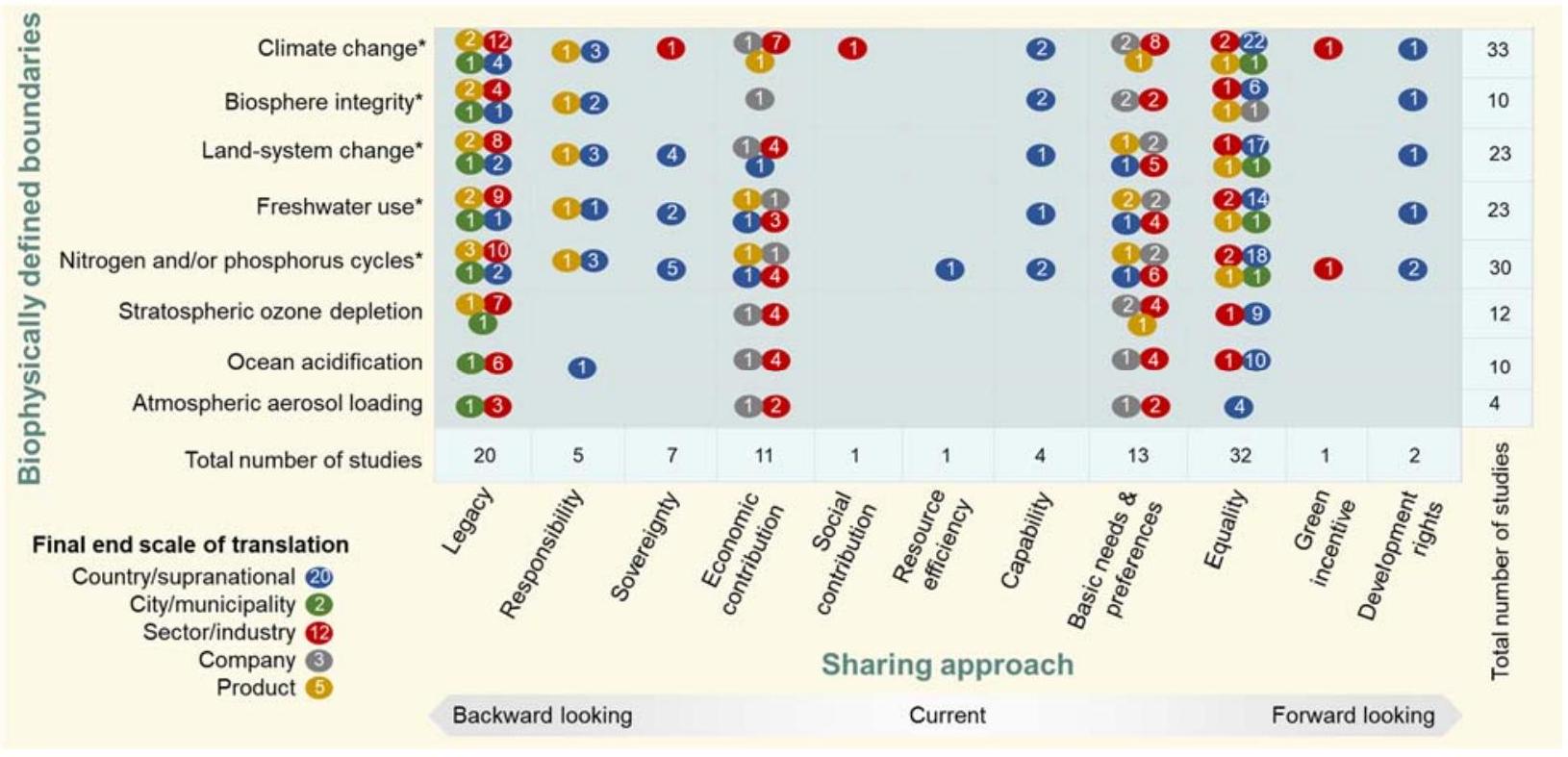
يركز استعراض الأدبيات لدينا على الأدبيات الناشئة حول أساليب المشاركة المستخدمة ضمن التخصيص من الأعلى إلى الأسفل، والتي تمثل غالبية الأعمال المتعلقة بالترجمات عبر المقاييس. . قمنا بمراجعة النطاق والحجم وأساليب المشاركة المستخدمة في 40 دراسة من هذا النوع (الشكل 1، المعلومات التكميلية 1، دراسات الترجمة في المعلومات التكميلية). معظمها تترجم إلى ما فوق الوطني ، وطني ، قطاع و المنتج المستويات. ركزت دراسة على مستوى المدينة على بصمات الاستهلاك لأكثر 62 مدينة اكتظاظًا بالسكان في الشرق الأوسط وشمال أفريقيا . قام الآخر بترجمات عبر المستويات للمسؤوليات المتعلقة بإدارة القضايا البيئية الإقليمية والعالمية إلى البلديات في إسبانيا تشمل الدراسات الثلاث للترجمة إلى الشركات محفظة غذائية لشركة تجزئة في فرنسا. ، شركة مرافق في الدنمارك وست شركات في إسبانيا . من حيث النطاق، تركز معظم الدراسات على المناخ ، تليها المياه العذبة ، مغذٍ
دورات ونظام الأرض ، في حين أن عددًا أقل من الدراسات يركز على التنوع البيولوجي ، المحيطات والجو (ما وراء المناخ) تركز بعض هذه الدراسات على حد واحد فقط بينما آخرون على حدود متعددة .
الشكل 1 النطاق، الحجم وأساليب المشاركة في الترجمة عبر المقاييس. المحور الأفقي يعرض أساليب المشاركة كما تم تطبيقها في 40 دراسة ترجمة مقطعة عرضياً مقابل الحدود المعرفة بيولوجياً وفيزيائياً على المحور العمودي. * يشير إلى الحدود التي تم تجاوزها على المستوى العالمي. . الحدود المتعلقة بسلامة الغلاف الحيوي، وتغير نظام الأرض، واستخدام المياه العذبة، ودورات النيتروجين والفوسفور، وتحميل الهباء الجوي الجوي هي دون المستوى العالمي. الأرقام في كل دائرة ملونة تشير إلى عدد الدراسات التي طبقت النهج المناسب للمشاركة (كطريقة مستقلة أو كجزء من حزمة) للحدود المعينة والمصنفة حسب مقياس الترجمة المناسب (المتوسط أو النهائي) لتلك الخطوة. يوضح الدليل مقياس الترجمة النهائي وعدد الدراسات المقابل له. مبادئ المشاركة موضوعة على مقياس انزلاقي للمنظورات الزمنية الكامنة. إجمالي عدد الدراسات لكل حد أو لكل نهج مشاركة يتجاوز 40 لأن العديد من الدراسات تترجم لحدود متعددة باستخدام حزم من نهج المشاركة (معلومات تكميلية دراسات الترجمة).
لقد حددنا أحد عشر نهجًا للمشاركة تُستخدم في الترجمة عبر المقاييس: الإرث ، المسؤولية ، السيادة ، المساهمة الاقتصادية ، المساهمة الاجتماعية ، كفاءة الموارد ، القدرة ، الاحتياجات الأساسية والتفضيلات ، المساواة ، الحافز الأخضر وحقوق التطوير (الجدول 1). تمثل بعض هذه المناهج وجهات نظر زمنية قوية. على سبيل المثال، يمكن أن تمثل الإرث والمسؤولية وجهة نظر تتطلع إلى الوراء، بينما تركز القدرة على الوضع الحالي، في حين يمكن تفسير المساواة والاحتياجات الأساسية على أنها تتطلع إلى المستقبل (الشكل 1). أكثر مناهج المشاركة تطبيقًا هي العدالة، الإرث، الاحتياجات الأساسية والتفضيلات، والمساهمات الاقتصادية.
الشكل 2 يوضح أربع طرق يتم بها تطبيق هذه الأساليب المشاركة:
(أ) نهج مشاركة واحد يُطبق على مقياس واحد: يخصص هذا النهج مباشرة إلى مقياس نقطة النهاية للترجمة. هناك العديد من الأمثلة حيث تكون المشاركة مستقلة
يُستخدم هذا النهج لتخصيص الحصص الوطنية، مستفيدًا على سبيل المثال من المساواة ، الإرث مثل 44، الاحتياجات الأساسية والتفضيلات ، القدرة والمسؤولية مشاركة الأساليب.
(ب) نهج مشاركة واحد يُطبق عبر مقاييس متعددة: يخصص هذا النهج في البداية للمقاييس الوسيطة، قبل التخصيص النهائي لمقياس النقطة النهائية. استخدمت إحدى الدراسات النهج القديم (التوريث) (الذي يُنفذ باستخدام تأثيرات المناخ عبر انبعاثات) لتخصيص ميزانية كربون عالمية عبر عدة مستويات، إلى قطاعات الأغذية الزراعية على الصعيد العالمي ثم على المستوى الوطني (نيوزيلندا) وصولاً إلى صناعات الأغذية الزراعية داخل البلاد .
(ج) تطبيق عدة أساليب للمشاركة بشكل مشترك على مقياس واحد: تتضمن هذه الطريقة استخدام ما لا يقل عن أسلوبين للمشاركة معًا لتخصيص من مقياس إلى آخر. على سبيل المثال، تم تطبيق المساهمة الاجتماعية من خلال مؤشر التوظيف والمساهمة الاقتصادية من خلال مؤشر الناتج المحلي الإجمالي بشكل مشترك لتخصيص ميزانية الكربون من المستوى الوطني إلى مستوى الصناعة. .
(د) تطبيق أساليب مشاركة متعددة عبر مقاييس متعددة: يستخدم هذا الأسلوب طريقة مشاركة فريدة لكل تخصيص عبر المقاييس، وبالتالي يمر عبر مقياس أو عدة مقاييس وسيطة على سبيل المثال، طبّق أحد الدراسات مبدأ المساواة في الترجمة من المستوى العالمي إلى المستوى الوطني، تلاه استخدام نهج تقاسم المساهمة الاقتصادية الذي تم تنفيذه عبر القيمة المضافة الإجمالية في الترجمة من المستوى الوطني إلى مستوى الصناعة. .
الشكل 2 تصنيف لترجمة عبر المقاييس، كما يتضح من تراكيب طرق المشاركة المطبقة على مقياس واحد أو عبر مقاييس متعددة. طريقة مشاركة مستقلة، x، مطبقة على مقياس واحد، (اللوحة أ) أو عبر مقاييس متعددة، و (اللوحة ب). مزيج من أساليب المشاركة، x و y، مطبقة معًا على مقياس واحد، (اللوحة ج) أو بالتتابع عبر مقاييس متعددة، و (اللوحة د). و تمثل مقياسي البداية والنهاية، على التوالي، و و تشير إلى المقاييس المتوسطة.
لاحظ أن تكرار التطبيق ليس دليلاً على “ملاءمة” الترجمة، حيث قد يتأثر الاختيار بين أساليب المشاركة بعوامل عديدة، بما في ذلك توفر البيانات، والعملية، وتصوّرات العدالة لدى من يقومون بالتحليل. على سبيل المثال، نظرًا لأن تطبيق أساليب المشاركة يعتمد على توفر البيانات بالمقياس المطلوب، هناك خطر أن يقوم العلماء والممارسون بإعطاء الأولوية لأساليب المشاركة التي تتوفر لها بيانات أو ببساطة استخدام الأساليب التي تُستخدم على نطاق واسع بالفعل (معظم مؤلفي الدراسات الأربعين من الشمال العالمي)، بدلاً من أساليب المشاركة التي قد تؤدي إلى ترجمات أكثر ملاءمة أو عدالة. على الرغم من أن هذه قرارات عملية لمجال بحثي ناشئ على المدى القصير، إلا أنه لا ينبغي استمرارها في الممارسة دون فهم واضح للفرضيات والقيود. هناك حاجة لوضع مبادئ واضحة، وإرشادات، وشفافية مدمجة حول الفرضيات. ومع وضع هذا الهدف في الاعتبار، قمنا بتطوير مبادئ أساسية وبروتوكول للمساعدة في دعم الخيارات لترجمة عبر المقاييس.
الجدول 1: الأساليب الإحدى عشر للمشاركة في الترجمة عبر المقاييس ومقاييس تنفيذها. تُعبّر أساليب المشاركة ويتم تنفيذها وفقًا لمجموعات بيانات المقاييس، التي تم توحيدها على المقاييس المناسبة لضمان الاتساق (مثل الدول، المستويات دون الوطنية، المدن، القطاعات الصناعية والشركات). في حين تم تفسير بعض أساليب المشاركة على أنها مرتبطة ببعضها البعض. نقوم بإدراجها بشكل منفصل هنا لتوضيح معناها والاستخدام المقصود لها في الترجمة عبر المقاييس.
مشاركة الأساليب الوصف مثال على تنفيذ المقاييس
الإرث الحصص تتناسب مع الاستحقاقات الحالية أو التاريخية، أو التأثيرات البيئية أو البصمات البيئية التي تولدها الكيان (ويشار إليها أيضًا بالتوريث). بصمات الاستهلاك، بصمات الإنتاج، بصمات المنتج
المسؤولية يتم تخصيص الحصص من خلال احتساب التأثيرات التراكمية والانبعاثات أو البصمات البيئية على مر الزمن (أي الدين التاريخي للأفراد، الدول، المدن، القطاعات، الشركات). تصريفات التلوث التاريخية، الانبعاثات أو إزالة الأراضي؛ تركيب الطاقة المتجددة
السيادة الحصص تتناسب مع الأسهم الحالية وتدفقات رأس المال الطبيعي المحتفظ به ضمن الحدود الإقليمية. الأراضي الزراعية والمزارع؛ مخزونات الموارد المتجددة وغير المتجددة؛ القدرة البيولوجية للنظام البيئي
المساهمة الاقتصادية تُخصص الأسهم بنسبة تتناسب مع المساهمة الاقتصادية الحالية للدولة أو القطاع أو الصناعة أو الشركة، على سبيل المثال، مقاسة بالمساهمة في الناتج المحلي الإجمالي. القيمة المضافة الإجمالية أو الناتج المحلي الإجمالي؛ حجم الإنتاج للشركة أو القطاع؛ إيرادات التشغيل للشركة
المساهمة الاجتماعية تُخصص الحصص بما يتناسب مع المساهمة الحالية للقطاع أو الصناعة أو الشركة في المجتمعات والمجتمع الأوسع، على سبيل المثال، يُقاس ذلك بعدد الأشخاص العاملين. عدد الموظفين بدوام كامل المكافئ؛ الإنفاق على الأجور والرواتب؛ المساهمة المالية في برامج المجتمع؛ الضرائب المدفوعة
كفاءة الموارد يتم تحديد الحصص للدول (أو المناطق دون الوطنية) بناءً على كفاءة استخدام الموارد الحالية لديها مقارنة بالمستوى العالمي المتوسط، مما يفيد أولئك الذين لديهم كفاءة أعلى؛ أو حيث يمكن توقع أكبر مكاسب في الكفاءة. استخدام الموارد لكل وحدة من الأرض أو المنتج أو الخدمة أو الناتج الاقتصادي
القدرة يتم تخصيص الحصص من خلال احتساب قدرة الفاعل على اتخاذ الإجراءات بناءً على القدرات النسبية كأساس، على سبيل المثال، من خلال الوسائل المالية. الثروة؛ فعالية الحوكمة؛ قدرة نمو الطاقة المتجددة؛ قدرة الزراعة التجديدية
الاحتياجات والتفضيلات الأساسية يتم تخصيص الحصص بحيث يتم تلبية الاحتياجات الأساسية للإنسان أولاً، قبل توزيع بقية الموارد على الاحتياجات غير الأساسية الأخرى. المغذيات والمياه المطلوبة لزراعة الغذاء الأساسي المناسب إقليمياً؛ المحتوى الحراري للطعام؛ كفاية المغذيات في الغذاء
المساواة الحصص تتناسب مع حجم سكان البلد أو المنطقة أو المدينة. السكان (لكل فرد)؛ الناتج الكلي (لكل دولار من الناتج)؛ الدخل المتاح (لكل دولار من الدخل)
الحافز الأخضر (الاستحقاق) يتم تخصيص الأسهم بطريقة تحفز أو تكافئ الشركات ذات كثافة انبعاثات منخفضة أو الحصص الأعلى من استخدام الطاقة المتجددة. شدة الانبعاثات؛ حصة الطاقة المتجددة في مزيج مدخلات الطاقة؛ الأنشطة أو البرامج الطوعية للاستدامة البيئية
حقوق التطوير يتم تخصيص الأسهم من خلال مراعاة السياق الاجتماعي والاقتصادي للبلد، وبشكل خاص الموارد المطلوبة لرفع الناس من الفقر في المستقبل. معدل الفقر؛ مستوى التنمية؛ مؤشرات اجتماعية واقتصادية أخرى

عشرة مبادئ للترجمة

نقدم عشرة مبادئ للترجمة تم تحديدها من خلال مناقشة خبراء منظمة (الشكل 3). تتعلق هذه المبادئ بالعملية (1-4)، والنتيجة مثل الحصص المستهدفة والمترجمة (7-10)، أو كلاهما (5 و6)، في الترجمة عبر المقاييس.
الشكل 3 عشرة مبادئ للترجمة
عملية الترجمة
P2 شفاف P5 آمن بما فيه الكفاية تمكين P7 P8 تحفيز
يوضح النهج/التطبيق بوضوح وبشكل كافٍ مبررات التخصيصات، مع توضيح صريح للفرضيات الأساسية والاعتبارات المعيارية. بالإضافة إلى ذلك، فإن البيانات المستخدمة متاحة للأطراف المهتمة الأخرى. يشمل النهج/التطبيق والنتائج بعض الفواصل في الحصص أو المسؤوليات المخصصة، كطبقة إضافية من الصرامة. الأهداف هي: (1) شاملة بما يكفي لتحقيق التوافق، ومع ذلك تسمح باتخاذ القرارات المحلية، (2) عملية للتنفيذ (قابلة للقياس والتحكم)، و(3) بسيطة بما يكفي لتسهيل التواصل والفهم من قبل مختلف أصحاب المصلحة. يتم عرض الأهداف بطريقة تحفز الفاعلين على اتخاذ الإجراءات في ظل ظروف مختلفة. على وجه التحديد، يتم تشجيع الفاعلين الذين يُعتبرون “روادًا” على وضع أهداف أكثر طموحًا، في حين أن “المتأخرين” لديهم مسارات مناسبة للحاق بالركب.
P3 فقط P4 النظامي P6 حساس للسياق P9 ديناميكي ومحدد بالزمن P10 التآزري
يتضمن النهج/التطبيق عناصر من العدالة بين الأجيال وداخل الجيل يتم تنفيذها كتعديلات على الحصص المخصصة في البداية، ويأخذ في الاعتبار الآثار السلبية المحتملة للأهداف المترجمة على الأهداف المجتمعية الرئيسية (مثل أهداف التنمية المستدامة). يأخذ النهج/التطبيق في الاعتبار العواقب المحتملة على أجزاء أخرى من نظام الأرض الناشئة عن تحديد أهداف محددة تركز بشكل خاص على جزء واحد. كما يأخذ في الاعتبار الاتصالات البعيدة / الترابطات البعيدة التي قد تؤدي إلى عواقب سلبية غير مقصودة على الأهداف المجتمعية الرئيسية (مثل أهداف التنمية المستدامة). يأخذ النهج/التطبيق والنتائج في الاعتبار السياق البيئي والاجتماعي الاقتصادي. بينما الهدف هو تعزيز التوافق العالمي، فإنه يسمح بوضع استراتيجيات/إجراءات محلية (أي أنه ليس مفرطًا في التحديد). الأهداف محددة بزمن، ولكنها أيضًا قادرة على عكس الطبيعة الديناميكية لـ ‘مساحة التشغيل الآمنة والعادلة’ وسياقها. ويشمل ذلك إمكانية تحديث/تعديل الأهداف استجابة لتطور علم أنظمة الأرض الأساسي. يتم تحديد الأهداف بحيث يتم التعرف على الفوائد المشتركة المحتملة في مجالات مفوضية الأرض الأخرى، وكذلك الأهداف المجتمعية (مثل أهداف التنمية المستدامة) وتعزيزها. وعلى العكس من ذلك، يتم تحديد الأهداف بحيث يتم تجنب الآثار السلبية المحتملة وعدم التوازن الظالم في القوى.
الأسهم والأهداف المترجمة
تشير المبدأان 1 و2 إلى الحاجة إلى مناهج متسقة وقابلة للتكرار تتمتع بالصرامة العلمية، ويفضل أن تستند إلى أدبيات راسخة ومراجعة من قبل النظراء تعكس أيضًا وجهات نظر من الجنوب العالمي. كما يجب أن توفر الترجمة تبريرات شفافة للقرارات التشغيلية المهمة وتشرح مصادر عدم اليقين. توفر هذان المبدأان الأسس اللازمة لمنح الشرعية العلمية لعملية الترجمة، خاصة فيما يتعلق بالقرارات التي لا بد أن تكون ذاتية. والأهم من ذلك، يدعو مبدأ الشفافية إلى اعتبار صريح جدًا للمواقف المعيارية (مثل، مبرر التخصيص والتعديلات، من يقترحها ولماذا)، بالإضافة إلى الشفافية في إجراءات التخصيص. وبالمثل، يؤكد المبدأ 3 على ضرورة النظر في كيفية أن القرارات المعيارية المتعلقة بالتخصيص والتعديلات لها تداعيات على العدالة. وينص على أنه يجب النظر في المقايضات في توزيع الموارد والمخاطر، عبر المواقع الجغرافية أو بين الأجيال الحالية والمستقبلية. المبدأ الرابع يدعو إلى التفكير النظامي في عملية الترجمة وكذلك في نتائج التخصيص. يجب مراعاة التفاعلات بين مجالات نظام الأرض لأن عدة نقاط ضغط يمكن أن تتحد لإنتاج تأثيرات أكبر، والإجراءات التي تحدث في موقع واحد يمكن أن يكون لها عواقب على مقاييس مختلفة. على سبيل المثال، يجب أن يأخذ قرار تطهير بعض الغابات في حوض الأمازون في الاعتبار تأثيره على التنوع البيولوجي المحلي بسبب تجزئة الموائل (المحيط الحيوي – منطقة النظام البيئي الطبيعي ESB) وأنماط هطول الأمطار في البرازيل وما بعدها. من بين السمات الهامة للنظام هي الترابطات الفوقية ، مع استفادة المدن والشركات من النظم البيئية وخدماتها وتأثيرها عليها محليًا وعالميًا .
تنص المبدأ الخامس على أن عملية الترجمة ونتائج التخصيص يجب أن تميل إلى الصرامة بما يتماشى مع مبدأ الحيطة العامة. وهذا يعني تضمين هامش أمان مناسب في الميزانية الابتدائية، أو نطاقات التعديل، أو الحصص أو المسؤوليات المخصصة. المبدأ السادس، المتعلق بحساسية السياق، يقترح أن تُستخدم الظروف المحلية كمدخلات لخطوة (أو خطوات) التخصيص والتعديل. تختلف الظروف في المدن والشركات المختلفة بشكل كبير في الأبعاد البيئية والديموغرافية والاجتماعية والاقتصادية والسياسية، وغالبًا ما تكون هذه الاختلافات ذات صلة كبيرة في تحديد تخصيص عادل لحصص الموارد والمسؤوليات.
قد يتطلب الوفاء بالمبدأين 3 و6 إدخال خطوة تعديل إضافية في إجراء التخصيص، حيث يتم إعادة توزيع الحصص المخصصة في البداية بناءً على أساليب مشاركة إضافية. على سبيل المثال، يركز نهج ‘القدرة’ على تخصيص الحصص لتقليل التأثيرات البيئية الحالية والمستقبلية بناءً على القدرة على اتخاذ الإجراءات، في حين يأخذ نهج ‘المسؤولية’ في الاعتبار التأثيرات البيئية التاريخية التي تولدها الكيانات المختلفة.
المبدأ السابع يتعلق بالتواصل والتنفيذ، وينص على أن نتائج الترجمة يجب أن تكون بسيطة بما يكفي للسماح بالفهم، وعالمية بما يكفي للسماح بالتوافق واتخاذ القرار في سياقات محلية مختلفة. المبدأ الثامن يقترح أن نتائج الترجمة والأهداف اللاحقة تُحدد بطريقة تحفز الجهات الفاعلة على رفع مستوى طموحها من أجل الاستدامة. وبما أن البقاء ضمن حدود الأنظمة البيئية المستدامة هو عملية طويلة الأمد، هناك حاجة إلى حوافز لإلهام الجهات الفاعلة لبذل جهود مستمرة طوال الوقت، ليصبحوا “روادًا” ويساعدوا “المتأخرين” على اللحاق بالركب. المبدأ التاسع يبرز أهمية الترجمة وتحديد الأهداف المرتبطة بالزمن، وتحديد مسبق لكيفية تحديث الحصص والأهداف المخصصة بطريقة دقيقة لتعكس التقدم في الفهم العلمي والتطور المستمر.
السياق الاجتماعي والاقتصادي والبيئي. وأخيرًا، يؤكد المبدأ العاشر على ضرورة تعظيم التآزر بين الأهداف وتقليل المقايضات مثل الآثار السلبية الخارجية، وضمان تجنب الديناميات القوية المدمرة والاستغلالية. على سبيل المثال، عادةً ما تحدد المدن والشركات أهدافها بشكل منفصل، ولكن هناك حاجة إلى التنسيق نظرًا لأن التآزر والمقايضات شائعة جدًا، فإن النهج المتصلة التي تربط بين الأهداف المختلفة، والعوامل المؤثرة المرتبطة بها، وهياكل الحوكمة الفعالة تُعد واعدة بشكل خاص للمساعدة في تفعيل هذا المبدأ. ، وضمان محاسبة الجهات الفاعلة على الآثار السلبية الخارجية حتى وإن كانت غير مقصودة.

العناصر الأساسية التي تربط حافلات الخدمات المؤسسية (ESBs) بالممثلين

البناء على العمل السابق ، تعرض الشكل 4 اللبنات الأساسية لترجمة عبر المقاييس وتحديد الأهداف اللاحقة.

نسخ

تعتمد مؤشرات حالة الأرض على حالة وظائف نظام الأرض، المتعلقة بالاحتباس الحراري (المناخ)، وعمق الامتصاص البصري للهباء الجوي (الغلاف الجوي)، وتغير تدفق المياه الهيدرولوجية (المياه السطحية)، ومعدل تجديد الموارد (المياه الجوفية)، ومساحة النظم البيئية الطبيعية وشبه الطبيعية (الغلاف الحيوي الأرضي)، وتركيزات المغذيات أو الفائض منها (دورات المغذيات). لتفعيل حواجز الخدمات البيئية، يجب ربط هذه الحواجز بالضغوط البشرية بشكل عام، يتم ذلك عن طريق التعبير عن أقصى كميات من الملوثات واستخدام الموارد (على سبيل المثال، بالكيلوغرام/السنة) التي يمكن بعد ذلك تقسيمها وتوزيعها وإدارتها من قبل المدن والشركات. تُعرف هذه العملية التي يتم من خلالها نسب الروابط بين كميات الحدود ومؤشرات الضغط بعملية النسخ. الضغوط البشرية المنسوخة التي نشير إليها تُسمى ميزانيات نظام الأرض (ES). .

التخصيص

تخصيص ميزانيات ES المنسوخة للممثلين يتضمن عملية من خطوتين: التدرج والتعديل، كل منهما يتضمن أساليب مشاركة مناسبة. التدرج يوزع ميزانية ES عبر المقاييس ذات الصلة بالممثل، وقد يشمل التوزيع المتسلسل من مقياس واحد (مثل العالمي) إلى مقاييس وسيطة (مثل الدولة، الصناعة) وصولاً إلى مقياس النهاية (مثل المدن أو الشركات). بالنسبة لمعظم ميزانيات ES، ستكون خطوة تدرج الميزانية شكلاً من أشكال التدرج النزولي، ولكن بالنسبة لميزانيات ES التي تم إنشاؤها على مقياس أدق، مثل الحدود القائمة على الشبكة (Biosphere: السلامة الوظيفية)، يمكن أن تكون العملية شكلاً من أشكال التدرج التصاعدي. من المهم النظر في النطاق الجغرافي الذي يجب أن تتم فيه هذه العملية من التدرج والتعديل اللاحق (الصندوق 1).
تقوم خطوة التعديل بإعادة توزيع الحصص الأولية الناتجة عن التوسيع بين الفاعلين ضمن نفس المستوى، لأخذ اعتبارات العدالة في الحسبان (المبدأ 3)، والاختلافات في سياقاتهم الاجتماعية والبيئية والاقتصادية (المبدأ 6). على سبيل المثال، إحدى الطرق الممكنة لتعديل تخصيص الموارد بين مجموعة من المدن هي تطوير تصنيف يعتمد على سياقها الاجتماعي والاقتصادي والبيئي واستخدام هذا التصنيف لإنتاج عوامل تعديل خاصة بكل مدينة يمكن تطبيقها بعد ذلك على الميزانية المخصصة لها في البداية.

الصندوق 1: منظور المواطن البيوريجيوني مقابل المواطن العالمي

يمكن ترجمة حدود نظام الأرض مع الضغوط والحالات المعرفة إقليمياً ضمن حدين مختلفين للنظام – المشاركة داخل المنطقة أو اتخاذ منظور المواطن العالمي. على سبيل المثال، يحتوي حد نظام الأرض لموارد المياه السطحية على حد عالمي (إجمالي كمية المياه السطحية القابلة للسحب على مستوى العالم) بالإضافة إلى حدود إقليمية أو محلية (إجمالي كمية المياه القابلة للسحب في حوض لا تتجاوز) من التدفق المتوسط) نظرًا للخصائص الإقليمية القوية لموارد المياه، يبدو أن النهج البيوريجيوني، أي مشاركة الحدود المحلية بين الناس والأنشطة الاقتصادية داخل الحوض، سيكون معقولًا، مما يمكن أيضًا من ضمان تحقيق الحدود العالمية. .
ومع ذلك، فإن النهج البيوريجيوني وحده غير كافٍ ويحتاج إلى أن يُكمل بمنظور المواطن العالمي، أي مشاركة الميزانية الإجمالية العالمية للاستهلاك البشري عبر سكان العالم بالتساوي، واستخدامها كنقطة مرجعية للمقارنة أو التعديل الإضافي بناءً على السياق أو القدرة. النهج البيوريجيوني نحو تقاسم الموارد يكافئ أولئك الذين لديهم موارد طبيعية، أي دولة أو مدينة تقع في منطقة غنية بالموارد مع عدد سكان صغير نسبيًا، بينما يعاقب أولئك الذين يقيمون في مناطق تعاني من ندرة المياه و/أو الذين لديهم كثافة سكانية عالية. قد ينتج عن هذا النهج أيضًا ثغرة غير مقصودة حيث أن نظام الإنتاج والاستهلاك المتصل عالميًا يعني أن المنطقة يمكنها نقل عبئها البيئي إلى مكان آخر، أي تعويض استهلاكها العالي من المياه من خلال المياه المجسدة دون انتهاك حدودها المحلية. .
وبالمثل، فإن النهج البيوريجيوني غير مناسب عندما يتعلق الأمر بتقاسم المسؤوليات. على سبيل المثال، المناطق الغنية بالتنوع البيولوجي غالبًا ما تكون مركزة في الجنوب العالمي وغالبًا ما تشمل أراضي مملوكة/مدارة من قبل المجتمعات الأصلية. قد يضع النهج البيوريجيوني في تحقيق هدف مساحة النظام البيئي الطبيعي العبء كله على المجتمعات المحلية وأصحاب المصلحة. ، بينما يتم تقاسم الفائدة على مستوى العالم. في مثل هذه الحالة، تكون المسؤولية مشتركة على مستوى العالم، مع الأخذ في الاعتبار عوامل مثل الاحتياجات والحقوق الحالية ، المسؤوليات التاريخية وتأثيرات النظام المتصل عن بُعد ، سيكون أكثر ملاءمة بكثير. يجب على المستفيدين من خدمات النظام البيئي أن يساهموا ماليًا في الاستثمارات الخاصة بحماية النظام البيئي واستعادته من خلال آليات مثل المدفوعات مقابل خدمات النظام البيئي، والضرائب المتعلقة بالتنوع البيولوجي، والرسوم والاشتراكات. لذلك، يجب أن يكون الترجمة من خلال نهج الأقاليم البيولوجية مصحوبة، أو مقاسة، أو معدلة بواسطة نهج المواطن العالمي لإبلاغ تحديد الأهداف وتطوير السياسات. يجب على الجهات الفاعلة السعي لاعتماد الهدف الأكثر صرامة.
يمكن أن تحدث خطوات التوسيع والتعديل عدة مرات ويمكن أن تستخدم مجموعات من أساليب المشاركة بما يتماشى مع الأدبيات التي تمت مراجعتها. على سبيل المثال، يمكن حساب تخصيص أولي للوحدة الأدنى (مثل الفرد، وحدة الأرض، وحدة الناتج الاقتصادي) المناسبة لنظام الميزانية البيئية، ثم تجميع هذا الميزانية لكل وحدة حتى تصل إلى المقياس الوسيط أو النهائي. يمكن إجراء التعديلات عند كل مقياس . يمكن تطبيق تركيبات مختلفة من أساليب المشاركة في هذه الخطوات، مما يعكس قيمًا مختلفة لما يُعتبر عادلاً ومنصفًا. نتيجة
التخصيص هو مجموعة من الحصص المترجمة من ميزانيات خدمات النظام البيئي إلى الجهات الفاعلة، مدعومة بعملية علمية قوية (المبدأ 1)، شفافة (المبدأ 2)، عادلة (المبدأ 3) وحساسة للسياق (المبدأ 6).

تحديد الأهداف، المقارنة المرجعية، وفحص التوافق

يمكن استخدام الحصص المترجمة لإبلاغ تحديد الأهداف من قبل الجهات المختلفة، وكذلك للمقارنة مع التأثيرات الحالية أو المستقبلية لكل جهة على حدة. يجب على جميع الجهات التي تولد تأثيرات بيئية أن تحدد أهدافًا مناسبة قائمة على العلم لتقليل التأثيرات. بالنسبة للجهات التي لديها أهداف محددة بالفعل، يمكن أن يُفيد القياس المرجعي في معرفة ما إذا كانت أهدافهم طموحة بما يكفي للبقاء ضمن حصتهم من حدود الانبعاثات البيئية (ESBs). فحص التوافق هو الإجراء لضمان التزام الأهداف الفردية وتوافقها مع حصتها المترجمة، أو أن الأهداف مجتمعة تلتزم وتتوافق مع حدود الانبعاثات البيئية. على الرغم من أن هذه الخطوات تقع خارج النطاق المباشر لترجمة المقاييس المتعددة، إلا أنها ضرورية لتفعيل حدود الانبعاثات البيئية وضمان المساءلة (الشكل 4).
العمل الفني لحدود نظام الأرض: فيليكس فاراند-ديشين، غلوبايا من أجل لجنة الأرض
الشكل 4. اللبنات الأساسية الرئيسية في ربط أنظمة الحافلات الخدمية (ESBs) بالجهات الفاعلة (اللوحة العلوية)، والمبادئ العشرة المطبقة للترجمة (اللوحة السفلية). الترجمة عبر المقاييس تشمل عمليات متسلسلة من النسخ والتخصيص لاشتقاق حصص مترجمة للجهات الفاعلة الفردية. تقوم عملية النسخ بتحويل أنظمة الحافلات الخدمية إلى مؤشرات للضغوط البشرية بوحدات يستخدمها الفاعلون لقياس تأثيراتهم. ثم يتم تخصيص أنظمة الحافلات الخدمية المنسوخة إلى الجهات الفاعلة، من خلال تطبيق نهج المشاركة المختلفة (الجدول 1) حسب الاقتضاء. يمكن استخدام الحصص المترجمة لتحديد الأهداف، مستنيرة بتأثيرات الفاعل وقدرته على العمل، أو للمقارنة المرجعية مقابل التأثيرات أو للتحقق من التوافق.

بروتوكول للترجمة

في سبيل تحقيق توافق أقوى، وشفافية، وقابلية للمقارنة من حيث كيفية إجراء الترجمة عبر المقاييس، نقدم هنا بروتوكول ترجمة يتضمن عدة نقاط قرار رئيسية تستند إلى ثلاث خصائص فيزيائية للحدود وهي على وجه التحديد البنية المكانية، الحالة الحالية، والطبيعة التجديدية؛ المنظور الزمني وملاءمة أساليب المشاركة؛ وتفعيل المقاييس والبيانات.

البنية المكانية للحدود

البنية المكانية للحدود هي نقطة القرار الرئيسية الأولى، التي تحدد كيفية المضي قدمًا في التخصيص بعد النسخ. يمكن تقليل الميزانيات المنسوخة للحدود المبنية على المستوى العالمي (مثل تغير المناخ) إلى الجهات الفاعلة دون العالمية أو المقاييس الوسيطة من خلال التخصيص عبر المقاييس؛ أما الحدود المبنية على المستوى (البيو)إقليمي، بما في ذلك تلك المعرفة على المستوى المحلي (مثل دورات المغذيات)، ومستوى الحوض (مثل المياه السطحية والمياه الجوفية)، ومستوى النظام البيئي (مثل الغطاء الغابي) ومستوى المنطقة البيئية (مثل مساحة النظام البيئي الطبيعي)، فيتم تكبيرها أو تصغيرها حسب الحاجة؛ والحدود القائمة على الشبكة (مثل سلامة الوظائف الحيوية للغلاف الحيوي) يتم تجميعها إلى مقاييس الجهات الفاعلة.

حالة الحدود

حالة ESB هو نقطة القرار التالية حيث يحدد ما إذا كان هناك ميزانية ES للمشاركة أو مسؤولية عجز ES للتخصيص. بالنسبة لـ ESBs التي لم يتم تجاوزها بعد، يمكن تخصيص الضغوط المجمعة المسموح بها. بالنسبة لـ ESBs التي تم تجاوزها بالفعل، يجب تخصيص المسؤوليات المرتبطة بالتخفيف والتقليل.
  • بالنسبة للحدود المناخية (المبنية عالميًا)، فمن الثابت جيدًا أننا على طريق لتجاوز مستوى الاحترار العالمي خلال السنوات العشر القادمة، دون تخفيضات جذرية في انبعاثات غازات الدفيئة . بينما ال لم يتم تجاوز الحد بعد، إلا أن الانبعاثات الحالية تتجاوز بكثير ميزانية الكربون السنوية المنقولة إلى الحد. وبناءً عليه، سيكون التركيز على تقاسم الأعباء (توزيع مسؤوليات التخفيض)، بدلاً من توزيع ميزانيات الموارد المتناقصة.
  • بالنسبة للحدود (البيولوجية) الإقليمية، يتم تقييم التعدي على مقياس كل بناء حدودي، مع إمكانية تأثير الجهات الفاعلة من داخل المنطقة وخارجها. عندما يتم تعريف الحدود على أنها منفصلة مكانياً، فإن الاستعادة في منطقة واحدة لا تعوض التدهور في أخرى، بغض النظر عن التشابه في خدمات النظام البيئي. على سبيل المثال، حدود الغلاف الحيوي القائمة على المناطق البيئية الفريدة، وحدود دورة المغذيات القائمة على معايير جودة المياه المرتبطة بتدفقات المغذيات من الأراضي الزراعية، وحدود المياه العذبة القائمة على معدلات إعادة تغذية المياه الجوفية السنوية، ومعايير التدفق البيئي، أو بدلات تعديل التدفق الشهرية. يتم تقييم حالة التعدي لكل منطقة، لكن يمكن تقييم التأثيرات (والإجراءات) على مقاييس أصغر أو أكبر. مع تقييم حدود المياه السطحية شهرياً، قد يحدث التعدي في كل شهور السنة أو في بعض الشهور فقط.
  • بالنسبة للحدود التي يتم فيها تقييم التعدي على أساس كل شبكة على حدة، قد توجد شبكات متعدية وأخرى غير متعدية داخل الحدود الإقليمية للدول.
    أو المدن، أو ضمن النطاق المكاني للتأثيرات من الأعمال التجارية، سواء كانت تقع داخل أو خارج الشبكة المحددة.
تُعلم حالة تجاوز حدود الأرض البيئية (ESB) أيضًا الخيارات المتعلقة بالزمن. تُعتبر الأساليب التشاركية التي تنظر إلى الوراء مناسبة لتخصيص مساحة التخفيض للحدود التي تم تجاوزها، لأنها تأخذ في الاعتبار تأثيرات الفاعلين الماضية ودرجة مسؤوليتهم عن الحالة الحالية للتجاوز. كما أن العودة إلى المساحة الآمنة تتطلب أيضًا مشاركة الموارد في ظل الحاجة الجماعية لتقليل التأثيرات. ولهذا السبب، تُعتبر الأساليب التشاركية التي تنظر إلى المستقبل مناسبة أيضًا، لأنها تأخذ في الاعتبار حقوق التنمية المختلفة أو احتياجات الفاعلين تجاه المورد، بالإضافة إلى قدرات الفاعلين على اتخاذ إجراءات في التقليل، والاستعادة، والتجديد. من ناحية أخرى، عندما لا تكون حدود الأرض البيئية قد تم تجاوزها (بعد)، يكون الاهتمام الرئيسي هو التوزيع العادل للموارد المحدودة باستخدام الأساليب التي تنظر إلى المستقبل.

الطبيعة المتجددة لحالة نطاق ES

معدل التجدد التقريبي لحالة نطاق ES هو عامل رئيسي آخر يحدد الأساليب المناسبة للمشاركة. نصنف القدرة على التجدد إلى صفر أو معدومة، بطيئة أو سريعة.
  • بالنسبة لمجالات خدمات النظام البيئي التي لا تمتلك قدرة تجديد (غير قابلة للتجديد و/أو لها تأثيرات لا رجعة فيها)، فإن تقليل أو حتى وقف التأثيرات لا يغير حالة الحدود. على سبيل المثال، الانبعاثات تراكمية بطبيعتها مع عدم وجود قدرة تجديدية تقريبًا. تقليل الانبعاثات لن يؤدي إلى تبريد إلى درجات حرارة ما قبل الصناعة في الأطر الزمنية ذات الصلة بالسياسات.
  • المجالات البيئية ذات القدرة التجديدية البطيئة قادرة على التجديد والاستعادة على مدى زمني يقارب العقود. يمكن اعتبار معدل تجديد تركيزات النيتروجين والفوسفور في المسطحات المائية بطيئًا، على مقياس زمني لدورة المغذيات عبر التربة. وبالمثل، فإن معدل تجديد المياه الجوفية يتماشى مع مقاييس زمنية لإعادة تغذية المكامن المائية. كما يمكن اعتبار معدل تجديد الغلاف الحيوي بطيئًا أيضًا، على مقياس زمني لنمو الغطاء النباتي وتعافي النظام البيئي.
  • تجدد أو تتكرر مجالات خدمات النظام البيئي ذات القدرة التجديدية السريعة تقريبًا على فترات زمنية موسمية أو سنوية. يُعتبر مستوى الخلفية من الهباء الجوي يتجدد بسرعة، حيث تنخفض تركيزاته في الهواء إلى مستويات الخلفية في غضون أشهر أو أقل بعد توقف افتراضي للانبعاثات. يُعتبر ميزان المياه السطحية المتاح بفعل الأنشطة البشرية يتجدد بسرعة، حيث يعاد تجديده سنويًا وفقًا لموسمية الهطول.

المنظور الزمني وملاءمة أساليب المشاركة

المنظور الزمني هو نقطة القرار النهائية قبل الاتصال بمجموعة الأساليب المناسبة للمشاركة. نصنف المنظور الزمني إلى نظرة مستقبلية، ونظرة حالية، ونظرة إلى الماضي.
بالنسبة للمجالات التي لا تمتلك قدرة تجدد أو تمتلك قدرة تجدد بطيئة ضمن الأطر الزمنية ذات الصلة بالسياسات، حتى إذا تحول جميع الفاعلين إلى ممارسات مستدامة، فإن الاستعادة/التجديد إما غير ممكن أو بطيء جدًا وغير مؤكد.
لذلك، فإن أساليب المشاركة التي تنظر إلى الوراء مناسبة لأن الأفعال الماضية تنعكس في الحالة الحالية للحدود. بالنسبة للمجالات التي تتجدد بسرعة، فإن أساليب المشاركة التي تنظر إلى الوراء أقل صلة، حيث أن الأفعال الماضية لها تأثير ضئيل على الموارد المتاحة في المستقبل. بالنسبة لجميع المجالات، بغض النظر عن معدلات التجدد، فإن أساليب المشاركة التي تنظر إلى الأمام مناسبة، حيث يجب تخصيص الموارد التي تم تجاوزها بالفعل أو المحدودة، ويجب أن تأخذ الإجراءات المستقبلية المتعلقة بالتقليل في الاعتبار قدرات الفاعلين. عند تطبيقها على مجالات محددة، فهذا يعني:
  • بالنسبة للمناخ: تعتبر الأساليب القائمة على النظر إلى الوراء مناسبة لتوزيع مسؤوليات خفض الانبعاثات، وتعتبر الأساليب القائمة على النظر إلى الأمام مناسبة لتوزيع الميزانيات العالمية المحدودة المتبقية وكذلك مسؤوليات الخفض للحفاظ على المسارات التي تعتبر ضرورية للأنظمة البيئية الحيوية.
  • بالنسبة للغلاف الحيوي، المغذيات، والمياه الجوفية: فإن الأساليب التشاركية التي تنظر إلى الوراء مناسبة لتخصيص مسؤوليات التخفيض والاستعادة، حيث تؤثر التأثيرات السابقة على الموارد والتركيزات الحالية. أما الأساليب التشاركية التي تنظر إلى الأمام فهي ضرورية لتخصيص استخدام الأراضي بناءً على الاحتياجات والحقوق التنموية، ولتخصيص الإجراءات الاستعادية بناءً على القدرة، ولتخصيص تدفقات المغذيات والمياه الجوفية التي تتجاوز الحدود الإقليمية أو تكون محدودة بناءً على الاحتياجات، ولتخصيص إمكانيات التخفيض بناءً على القدرة.
  • بالنسبة للهباء الجوي والمياه السطحية: فإن الإجراءات السابقة أقل صلة بالحالة الحالية للمورد، وتجاوز الحدود في العام الماضي لا يعني تجاوزها هذا العام. يجب أن يكون التركيز بدلاً من ذلك على تخصيص المورد المحدود بشكل عادل بناءً على الاحتياجات والحقوق في التنمية، واتخاذ إجراءات الحفظ بناءً على القدرة، باستخدام مناهج المشاركة المستقبلية.
الخيارات التي تلي جميع نقاط القرار المذكورة أعلاه تؤدي إلى مجموعات مختلفة من أساليب المشاركة المناسبة (الشكل 5)، كل منها يعكس وجهات نظر زمنية مختلفة. يعكس الاختيار النهائي لأساليب المشاركة تصورات مختلفة وأحكام قيمة حول ما هو عادل (المبدأ 3) وقد يتغير مع تغير السياق وتطوره. كل تخصيص وفقًا لأسلوب مشاركة معين سيأتي حتمًا مع مقايضاته الخاصة وانحيازاته المدمجة، حيث أن التوجه نحو العدالة في جانب معين قد يؤدي إلى الابتعاد عن تحقيق العدالة في جانب آخر، وحيث قد تفضل أو تضر خيارات أساليب المشاركة أنواعًا معينة من الفاعلين على حساب أخرى. لذلك، غالبًا ما يلزم دمج أساليب مشاركة متعددة في أساليب الترجمة لتحقيق تقارب أفضل مع عدالة نظام الأرض.
الشكل 5: نقاط القرار الرئيسية في الترجمة عبر المقاييس لنظام الأرض المتعلقة بمجال نظام الأرض، البنية المكانية للحدود، الحالة الحالية للحدود، الطبيعة المتجددة للحدود على أطر زمنية ذات صلة بالسياسات والمنظور الزمني القابل للتطبيق للمشاركة. يمكن أن توجه هذه الجوانب نحو مجموعة من أساليب المشاركة (موضحة بدرجات مختلفة من اللون الأخضر) التي يمكن للممثل الاختيار منها، تليها اعتبارات العدالة والسياقات الخاصة بالممثل، بالإضافة إلى اختيار مقاييس التنفيذ المستندة إلى البيانات المتاحة، قبل الوصول إلى الاختيار النهائي لأساليب المشاركة. تطبيق المجموعة النهائية من أساليب المشاركة سينتج حصصًا مخصصة لمجالات نظام الأرض المعنية.

تنفيذ المقاييس وتوفر البيانات

بمجرد تحديد أساليب المشاركة، يجب تحديد مقاييس التنفيذ المناسبة، والتي تُعرف كمؤشرات مناسبة لتمثيل الجوانب البيئية والاجتماعية والاقتصادية، مثل معدلات استخدام الموارد والتأثيرات، وموارد الطبيعة المتاحة، ومستويات التنمية الاجتماعية والاقتصادية أو الحالة الحالية لمجال خدمات النظام البيئي (الجدول 1) لتنفيذ التخصيص. على سبيل المثال، تم تفسير نهج مشاركة القدرة من حيث مقياس التنفيذ لفعالية الحوكمة. ، الثروة والقيمة الاقتصادية وطاقة الطاقة المتجددة في الأدبيات. لمشاركة عبء تقليل الضغوط الإجمالية، تعتبر مقاييس البصمة البيئية ذات صلة لتفعيل نهج المشاركة القائمة على المسؤولية. لمشاركة ميزانية نظام الأرض المتاحة، تعتبر مقاييس رفاهية الإنسان ذات صلة لتفعيل نهج المشاركة القائمة على الاحتياجات، والمقاييس الاقتصادية ذات صلة لتفعيل نهج المشاركة القائمة على القدرات، ومقاييس السكان، الحالية أو المتوقعة، ذات صلة بالجهات الفاعلة الحكومية لتفعيل مبدأ المساواة. .
لكل مقياس تنفيذ، هناك حاجة إلى مجموعات بيانات بمقياس الترجمة الوسيطة أو النهائية؛ ومع ذلك، فإن هذه البيانات ليست متوفرة دائمًا أو لا يمكن تطبيقها بسهولة على أنواع مختلفة من الجهات الفاعلة. ومن ثم، في الممارسة العملية، يكون اختيار أساليب المشاركة مقيدًا بشدة بتوفر البيانات، على سبيل المثال 51. بينما تتوفر مجموعات بيانات متسقة عالميًا وطولية تغطي معظم الأساليب الإحدى عشرة المحددة للمشاركة على مستوى الدول من خلال بوابات البيانات مثل البنك الدولي، وبرنامج الأمم المتحدة الإنمائي، ومنظمة الأغذية والزراعة، فإن البيانات المتسقة على مستوى المدن والأعمال محدودة. وعندما تتوفر البيانات على المقياس المطلوب، فإنها غالبًا ما تغطي فقط العاصمة وأكبر مدينة في كل دولة. والقطاعات الصناعية المحددة . علاوة على ذلك، فإن البيانات على مستوى الشركة عادةً ما تكون مُبلغًا عنها ذاتيًا (إن تم الإبلاغ عنها على الإطلاق) ويتم تجميعها من قبل المنظمات على أساس طوعي، مثل تلك التي يجمعها CDP، وغالبًا ما تتطلب معالجة إضافية لضمان الاتساق والقابلية للمقارنة . الاتساق وقابلية مقارنة البيانات عبر نفس المقياس أمران مهمان بشكل خاص لخطوة التعديل. جمع البيانات وتوحيدها، لا سيما على المستويات دون الوطنية، والمدن، والقطاعات، والمنظمات، أمر حاسم لتمكين تنفيذ أنسب وأعدل أساليب المشاركة.
يضع بروتوكولنا المقترح نهجًا خطوة بخطوة في الترجمة عبر المقاييس. في بعض الحالات، يمكن تحقيق نفس النتائج من خلال دمج عدة خطوات في خطوة واحدة عند بناء نموذج كمي لتنفيذ الترجمة. على سبيل المثال، نهج موزون يأخذ في الاعتبار التأثير والمساواة والقدرة لاشتقاق تركيبة موزونة في تخصيص أهداف تخفيف الكربون. يمكن تحقيق نفس النتيجة رياضيًا من خلال اتباع ثلاث خطوات مميزة لتخصيص عبر المقاييس وخطوتين للتعديل. كلا النهجين قويان من الناحية التقنية ويمكن جعلهما شفافين. اخترنا نهجًا خطوة بخطوة في بروتوكولنا لأنه قد يكون أسهل للممارسين لتبنيه والبناء عليه، مع جعل النتائج الوسيطة مرئية لتسليط الضوء على تأثيرات اختيار نهج المشاركة المختلفة. على سبيل المثال، استخدام نهج المشاركة المتساوية لكل فرد كخطوة أولى في تخصيص عبر المقاييس يعطي حصة المواطن المتوسط العالمي، وهي نتيجة مهمة بحد ذاتها.

الفجوات المتبقية والخطوات التالية

الهدف النهائي من الترجمة عبر المقاييس هو ربط الحدود المعرفة بيولوجيًا وفيزيائيًا لأنظمة الأرض بالجهات الفاعلة، مما يوجه تحديد الأهداف، وصنع السياسات، والتنفيذ، والمقارنة المرجعية. من خلال تجميع الأساليب القائمة، وبناء مبادئ وبروتوكولات مشتركة، يهدف هذا البحث إلى ضمان أن تكون الترجمة قوية، وشفافة، وعادلة، وقابلة للمقارنة عبر المجالات والجغرافيات. هناك عدة قضايا مهمة يجب مراعاتها عند تطبيق البروتوكول وتأصيل القرارات على الحصص المترجمة.
أولاً وقبل كل شيء، لضمان الشفافية والقابلية للمقارنة، من الضروري للغاية لأي محاولات ترجمة، سواء من قبل المدن الفردية أو الشركات أو الباحثين الذين يساعدون هؤلاء الفاعلين، أن تقدم الحصص المترجمة مع القرارات المتدرجة المتخذة، على سبيل المثال، وفقًا للبروتوكول المعروض في الشكل 5. وأي اعتبارات وافتراضات إضافية قد تؤثر على النتيجة، مثل نوع المدن أو الأعمال التجارية ، يجب أيضًا الإشارة إليه بوضوح.
ثانيًا، لجعل حصص وأهداف مستوى الفاعلين قابلة للمقارنة ومتوافقة مع بعضها البعض ولضمان أن يكون المجموع متوافقًا مع الإجمالي العالمي، من المرغوب فيه أن تعتمد مجموعة من المدن والشركات (مثل شبكة مدن دولية، مدن في بلد ما، وشركات ضمن سلسلة قيمة و/أو قطاع صناعي) نفس الأساليب وتخصص/تعدل بشكل جماعي بدلاً من تشجيع الفاعلين الفرديين على اختيار الأساليب بشكل منفرد. يمكن لمنظمات مثل شبكة الأهداف المبنية على العلم (SBTN) ومبادرة الأهداف المبنية على العلم (SBTi)، وشبكات المدن العالمية مثل C40، ICLEI، والمجالس العالمية للأعمال من أجل التنمية المستدامة أن تلعب أدوارًا مهمة في تجربة هذه العملية. ومع ذلك، يجب تحسين شفافية أهداف الشركات المعتمدة من قبل SBTi. للامتثال للمبادئ العشرة المطورة هنا، مشيرًا إلى الحاجة إلى معيار عالمي مشابه لـ ISO14064.
ثالثًا، نظرًا لتعدد طرق الترجمة، وخاصة العديد من الأساليب المشتركة، هناك خطر من اختيار الجهات الفاعلة بشكل انتقائي لطرق الترجمة وتحديد الأهداف اللاحقة. في حين أن اعتماد أي طريقة من طرق الترجمة تقريبًا سيؤدي إلى هدف مناسب من حيث الاتجاه للمدن أو الشركات الفردية. ، مما يضمن الاستدامة المطلقة على مستوى كوكبي يتطلب أن تظل الحصص الفردية المجمعة ضمن حدود نظام الأرض. طالما تم استخدام نفس الطريقة للترجمة عبر جميع المدن والشركات في العالم، يمكن ضمان الاستدامة المطلقة. ومع ذلك، في الممارسة العملية، هذا ليس دائمًا واقعيًا أو ممكنًا. لتقليل خطر تجاوز الهدف المجمع لحدود نظام الأرض، عندما تحاول مدينة أو شركة إجراء الترجمة بشكل فردي بدلاً من ضمن شبكة من الفاعلين، يجب تشجيع هؤلاء الفاعلين على استخدام عدة طرق مختلفة للمشاركة/التعديلات، وأن يكونوا شفافين بشأن الطرق المعتمدة، ومقارنة النتائج، واستخدام الطرق الأكثر صرامة لتوجيه تحديد أهدافهم الخاصة واتخاذ القرارات الأخرى. يجب أن تتحمل هذه الخيارات الفردية أيضًا مراجعات خارجية مستقلة لضمان المتانة والمساءلة.
ترجمة وتفعيل حدود نظام الأرض للجهات الوطنية ودون الوطنية لوضع أهداف قائمة على العلم لا يزال في مراحله المبكرة. هناك العديد من التحديات والفجوات المعرفية. على سبيل المثال، عدم اليقين المرتبط بالتفاعلات غير الخطية بين الحدود المختلفة. ، عواقب الاختيارات المختلفة لمبادئ وإجراءات المشاركة، الطبيعة الديناميكية لبعض الحدود والسياقات الاجتماعية والاقتصادية، وعدم وضوح الحوكمة و
آليات المساءلة بعض التحديات متأصلة في تعقيد الترجمة عبر المقاييس (مثل الروابط السببية غير المكتملة بين الحالة والضغط)، وبعضها خاص بالمجال، وأخرى تتعلق بالمستخدمين النهائيين وتفاعلاتهم مع بعضهم البعض (مثل التوفيق بين النهج المختلفة للمدن والشركات).
المبادئ والبروتوكول المقترح هنا هي الخطوة الأولى نحو تطوير إجراء مترابط وشفاف بالكامل للترجمة، والذي يحتاج إلى التوسع والاختبار باستخدام نماذج كمية تحت كل مبدأ من مبادئ المشاركة وفي بيئات العالم الحقيقي. في المستقبل، هناك عدة مهام وأسئلة مهمة يجب معالجتها في ربط حدود نظام الأرض بالمدن والشركات. وتشمل هذه الحاجة إلى: 1) إكمال الروابط بين الحالة والضغط لجميع حدود نظام الأرض، لتسهيل خطوة النسخ؛ 2) دمج المدن والشركات في نفس إطار الترجمة لتجنب التسرب أو العد المزدوج بين المدن والشركات؛ 3) تطوير طرق يمكنها دمج أو التعامل مع الترابط عبر جميع مجالات حدود نظام الأرض؛ 4) تعزيز توفر بيانات شاملة وقابلة للمقارنة؛ 5) تطوير إرشادات ومعايير ملموسة لمساعدة المدن والشركات في الترجمة وتحديد الأهداف القائمة على العلم؛ و6) تطوير آليات فعالة للحوكمة والمساءلة لتقييم الامتثال وضمان عدم تجاوز حدود نظام الأرض.

References

  1. Rockström, J. et al. Safe and just Earth system boundaries. Nature 619, 102-111 (2023). This paper proposes eight safe and just Earth system boundaries on climate, the biosphere, freshwater, nutrients and air pollution at global and subglobal scales, and finds seven have been transgressed.
  2. Rockström, J., Mazzucato, M., Andersen, L. S., Fahrländer, S. F. & Gerten, D. Why we need a new economics of water as a common good. Nature 615, 794-797 (2023).
  3. Meyer, K. & Newman, P. The Planetary Accounting Framework: a novel, quota-based approach to understanding the impacts of any scale of human activity in the context of the Planetary Boundaries. Sustainable Earth 1, 4 (2018).
  4. Meyer, K. & Newman, P. Planetary Accounting: Quantifying how to live within planetary limits at different scales of human activity. (Springer Singapore, 2020). doi:https://doi.org/10.1007/978-981-15-1443-2.
  5. Wang-Erlandsson, L. et al. A planetary boundary for green water. Nat Rev Earth Environ 3, 380-392 (2022).
  6. Chen, X., Li, C., Li, M. & Fang, K. Revisiting the application and methodological extensions of the planetary boundaries for sustainability assessment. Science of The Total Environment 788, 147886 (2021).
  7. Ryberg, M. W., Andersen, M. M., Owsianiak, M. & Hauschild, M. Z. Downscaling the planetary boundaries in absolute environmental sustainability assessments – A review. J Clean Prod 276, 123287 (2020).
  8. Stewart-Koster, B. et al. How can we live within the safe and just Earth system boundaries for blue water? Nature Sustainability (Forthcoming).
  9. Bai, X. et al. How to stop cities and companies causing planetary harm. Nature 609, 463466 (2022).
    This paper highlights the importance of linking planetary level boundaries to cities and businesses as key actors and elaborate on seven knowledge gaps in crossscale translation.
  10. Whiteman, G., Walker, B. & Perego, P. Planetary Boundaries: Ecological Foundations for Corporate Sustainability. Journal of Management Studies 50, 307-336 (2013).
  11. Science Based Target Network (SBTN). Science-based targets for nature: Initial guidance for business. https://sciencebasedtargetsnetwork.org/wp-content/uploads/2020/11/Science-Based-Targets-for-Nature-Initial-Guidance-forBusiness.pdf (2020).
  12. SBTi. Companies taking action. Target dashboard (Beta version). https://sciencebasedtargets.org/companies-taking-action (2023).
  13. Bjørn, A., Tilsted, J. P., Addas, A. & Lloyd, S. M. Can Science-Based Targets Make the Private Sector Paris-Aligned? A Review of the Emerging Evidence. Curr Clim Change Rep 8, 53-69 (2022).
  14. Lucas, P. L., Wilting, H. C., Hof, A. F. & van Vuuren, D. P. Allocating planetary boundaries to large economies: Distributional consequences of alternative perspectives on distributive fairness. Global Environmental Change 60, 102017 (2020).
    This paper applies grandfathering, ‘equal per capita’ share and ‘ability to pay’ to allocate and compare planetary boundary (PB)-based global budgets for CO2 emissions (climate change), intentional nitrogen fixation and phosphorus fertiliser use (biogeochemical flows), cropland use (land-use change) and mean species abundance loss (biodiversity loss) for the EU, US, China and India.
  15. Häyhä, T., Lucas, P. L., van Vuuren, D. P., Cornell, S. E. & Hoff, H. From Planetary Boundaries to national fair shares of the global safe operating space – How can the scales be bridged? Global Environmental Change 40, 60-72 (2016).
    This paper proposes a conceptual framework for translating planetary boundaries to national or regional implementation, taking into account the biophysical, socioeconomic and ethical dimensions for scaling planetary boundaries to the scales needed for implementation.
  16. Clift, R. et al. The Challenges of Applying Planetary Boundaries as a Basis for Strategic Decision-Making in Companies with Global Supply Chains. Sustainability vol. 9 Preprint at https://doi.org/10.3390/su9020279 (2017).
  17. Nilsson, M. & Persson, Å. Can Earth system interactions be governed? Governance functions for linking climate change mitigation with land use, freshwater and biodiversity protection. Ecological Economics 75, 61-71 (2012).
  18. Busch, T., Cho, C. H., Hoepner, A. G. F., Michelon, G. & Rogelj, J. Corporate Greenhouse Gas Emissions’ Data and the Urgent Need for a Science-Led Just Transition: Introduction to a Thematic Symposium. Journal of Business Ethics 182, 897901 (2023).
  19. Rockström, J. et al. A safe operating space for humanity. Nature 2009 461:7263 461, 472-475 (2009).
  20. Steffen, W. et al. Planetary boundaries: Guiding human development on a changing planet. Science (1979) 347, 1259855 (2015).
  21. Chandrakumar, C. et al. Setting Better-Informed Climate Targets for New Zealand: The Influence of Value and Modeling Choices. Environ Sci Technol 54, 4515-4527 (2020).
  22. Raupach, M. R. et al. Sharing a quota on cumulative carbon emissions. Nat Clim Chang 4, 873-879 (2014).
  23. van den Berg, N. J. et al. Implications of various effort-sharing approaches for national carbon budgets and emission pathways. Clim Change 162, 1805-1822 (2020).
  24. Höhne, N., den Elzen, M. & Escalante, D. Regional GHG reduction targets based on effort sharing: a comparison of studies. Climate Policy 14, 122-147 (2014).
    Through a comparison of more than 40 studies on national or regional allocations of future GHG emissions allowances or reduction targets using different effortsharing approaches, this paper finds that the range in allowances within specific categories of effort-sharing can be substantial, the outcome of effort sharing approaches is largely driven by how the equity principle is implemented, and the distributional impacts differed significantly depending on the effort sharing criteria used.
  25. Steininger, K. W., Williges, K., Meyer, L. H., Maczek, F. & Riahi, K. Sharing the effort of the European Green Deal among countries. Nat Commun 13, 3673 (2022).
    This paper presents an effort sharing approach that systematically combines different interpretations of justice or equity expressed through capability, equality and responsibility principles to allocate emissions reduction burden amongst European Union member states.
  26. Sun, Z., Behrens, P., Tukker, A., Bruckner, M. & Scherer, L. Shared and environmentally just responsibility for global biodiversity loss. Ecological Economics 194, 107339 (2022).
  27. Perdomo Echenique, E. A., Ryberg, M., Vea, E. B., Schwarzbauer, P. & Hesser, F. Analyzing the Consequences of Sharing Principles on Different Economies: A Case Study of Short Rotation Coppice Poplar Wood Panel Production Value Chain. Forests 2022, Vol. 13, Page 461 13, 461 (2022).
  28. Cole, M. J., Bailey, R. M. & New, M. G. Tracking sustainable development with a national barometer for South Africa using a downscaled ‘safe and just space’ framework. Proc Natl Acad Sci U S A 111, E4399-E4408 (2014).
  29. Zhang, Q. et al. Bridging planetary boundaries and spatial heterogeneity in a hybrid approach: A focus on Chinese provinces and industries. Science of The Total Environment 804, 150179 (2022).
  30. Zipper, S. C. et al. Integrating the Water Planetary Boundary With Water Management From Local to Global Scales. Earths Future 8, e2019EF001377 (2020).
  31. Zhou, P. & Wang, M. Carbon dioxide emissions allocation: A review. Ecological Economics 125, 47-59 (2016).
  32. Bjørn, A. et al. Life cycle assessment applying planetary and regional boundaries to the process level: a model case study. Int J Life Cycle Assess 25, 2241-2254 (2020).
  33. Bjorn, A. et al. Review of life-cycle based methods for absolute environmental sustainability assessment and their applications. Environmental Research Letters 15, 083001 (2020).
  34. Li, M., Wiedmann, T., Fang, K. & Hadjikakou, M. The role of planetary boundaries in assessing absolute environmental sustainability across scales. Environ Int 152, 106475 (2021).
  35. European Environment Agency & Federal Office for the Environment (EEA/FOEN). Is Europe living within the limits of our planet? An assessment of Europe’s environmental footprints in relation to planetary boundaries. https://www.eea.europa.eu/publications/is-europe-living-within-the-planets-limits (2020).
  36. Hoff, H., Nykvist, B. & Carson, M. ‘Living well, within the limits of our planet’? Measuring Europe’s growing external footprint. https://mediamanager.sei.org/documents/Publications/SEI-WP-2014-05-Hoff-EU-Planetary-boundaries.pdf (2014).
  37. Nykvist, B. et al. National environmental performance on planetary boundaries. https://www.sei.org/publications/national-environmental-performance-on-planetaryboundaries/ (2013).
  38. Hoff, H., Häyhä, T., Cornell, S. & Lucas, P. Bringing EU policy into line with the Planetary Boundaries. https://www.sei.org/publications/eu-policy-into-line-planetary-boundaries/ (2017).
  39. Andersen, L. S. et al. A safe operating space for New Zealand/Aotearoa. Translating the planetary boundaries framework. https://www.stockholmresilience.org/download/18.66e0efc517643c2b810218e/16123411 72295/Updated PBNZ-Report-Design-v6.0.pdf (2020).
  40. Dao, H., Peduzzi, P. & Friot, D. National environmental limits and footprints based on the Planetary Boundaries framework: The case of Switzerland. Global Environmental Change 52, 49-57 (2018).
  41. Häyhä, T., Cornell, S. E., Hoff, H., Lucas, P. & van Vuuren, D. Operationalizing the concept of a safe operating space at the EU level – first steps and explorations. https://www.stockholmresilience.org/publications/publications/2018-07-03-operationalizing-the-concept-of-a-safe-operating-space-at-the-eu-level—first-steps-andexplorations.html (2018).
  42. Sandin, G., Peters, G. M. & Svanström, M. Using the planetary boundaries framework for setting impact-reduction targets in LCA contexts. Int J Life Cycle Assess 20, 1684-1700 (2015).
  43. Roos, S., Zamani, B., Sandin, G., Peters, G. M. & Svanström, M. A life cycle assessment (LCA)-based approach to guiding an industry sector towards sustainability: the case of the Swedish apparel sector. J Clean Prod 133, 691-700 (2016).
  44. Ryberg, M. W. et al. How to bring absolute sustainability into decision-making: An industry case study using a Planetary Boundary-based methodology. Science of The Total Environment 634, 1406-1416 (2018).
  45. Algunaibet, I. M. et al. Powering sustainable development within planetary boundaries. Energy Environ Sci 12, 1890-1900 (2019).
  46. Lucas, E., Guo, M. & Guillén-Gosálbez, G. Optimising diets to reach absolute planetary environmental sustainability through consumers. Sustain Prod Consum 28, 877-892 (2021).
  47. Ehrenstein, M., Galán-Martín, Á., Tulus, V. & Guillén-Gosálbez, G. Optimising fuel supply chains within planetary boundaries: A case study of hydrogen for road transport in the UK. Appl Energy 276, 115486 (2020).
  48. Hjalsted, A. W. et al. Sharing the safe operating space: Exploring ethical allocation principles to operationalize the planetary boundaries and assess absolute sustainability at individual and industrial sector levels. J Ind Ecol 25, 6-19 (2021).
    This paper develops and tests a framework for sharing the planetary boundaryderived safe operating space amongst social actors based on a two-step process of downscaling to individual level followed by upscaling from an individual share to a higher-level unit or entity such as company, organisation, product, service, sector, household or nation; different ethical principles were explored in the downscaling and upscaling processes.
  49. Hannouf, M., Assefa, G. & Gates, I. Carbon intensity threshold for Canadian oil sands industry using planetary boundaries: Is a sustainable carbon-negative industry possible? Renewable and Sustainable Energy Reviews 151, 111529 (2021).
  50. Wheeler, J., Galán-Martín, Á., Mele, F. D. & Guillén-Gosálbez, G. Designing biomass supply chains within planetary boundaries. AIChE Journal 67, e17131 (2021).
  51. Suárez-Eiroa, B. et al. A framework to allocate responsibilities of the global environmental concerns: A case study in Spain involving regions, municipalities, productive sectors, industrial parks, and companies. Ecological Economics 192, 107258 (2022). Using Spain as a case study, this paper presents the responsible operating space framework to allocate responsibilities for managing territorial and global environmental concerns to entities and social actors operating at different scales using a footprint perspective.
  52. Brejnrod, K. N., Kalbar, P., Petersen, S. & Birkved, M. The absolute environmental performance of buildings. Build Environ 119, 87-98 (2017).
  53. Chandrakumar, C., McLaren, S. J., Jayamaha, N. P. & Ramilan, T. Absolute Sustainability-Based Life Cycle Assessment (ASLCA): A Benchmarking Approach to Operate Agri-food Systems within the Global Carbon Budget. J Ind Ecol 23, 906-917 (2019).
  54. Desing, H., Braun, G. & Hischier, R. Ecological resource availability: a method to estimate resource budgets for a sustainable economy. Global Sustainability 3, e31 (2020).
  55. Bjørn, A. et al. A comprehensive planetary boundary-based method for the nitrogen cycle in life cycle assessment: Development and application to a tomato production case study. Science of The Total Environment 715, 136813 (2020).
  56. Bjørn, A. et al. A planetary boundary-based method for freshwater use in life cycle assessment: Development and application to a tomato production case study. Ecol Indic 110, 105865 (2020).
  57. Hachaichi, M. & Baouni, T. Downscaling the planetary boundaries (Pbs) framework to city scale-level: De-risking MENA region’s environment future. Environmental and Sustainability Indicators 5, 100023 (2020).
  58. Wolff, A., Gondran, N. & Brodhag, C. Detecting unsustainable pressures exerted on biodiversity by a company. Application to the food portfolio of a retailer. J Clean Prod 166, 784-797 (2017).
  59. Ryberg, M. W., Bjerre, T. K., Nielsen, P. H. & Hauschild, M. Absolute environmental sustainability assessment of a Danish utility company relative to the Planetary Boundaries. J Ind Ecol 25, 765-777 (2021).
  60. Fanning, A. L. & O’Neill, D. W. Tracking resource use relative to planetary boundaries in a steady-state framework: A case study of Canada and Spain. Ecol Indic 69, 836-849 (2016).
  61. Fang, K., Heijungs, R., Duan, Z. & De Snoo, G. R. The Environmental Sustainability of Nations: Benchmarking the Carbon, Water and Land Footprints against Allocated Planetary Boundaries. Sustainability vol. 7 Preprint at https://doi.org/10.3390/su70811285 (2015).
  62. O’Neill, D. W., Fanning, A. L., Lamb, W. F. & Steinberger, J. K. A good life for all within planetary boundaries. Nat Sustain 1, 88-95 (2018).
  63. Huang, L. H., Hu, A. H. & Kuo, C.-H. Planetary boundary downscaling for absolute environmental sustainability assessment – Case study of Taiwan. Ecol Indic 114, 106339 (2020).
  64. Sala, S., Crenna, E., Secchi, M. & Sanyé-Mengual, E. Environmental sustainability of European production and consumption assessed against planetary boundaries. J Environ Manage 269, 110686 (2020).
  65. Dao, Q.-H., Peduzzi, P., Chatenoux, B., De Bono, A. & Schwarzer, S. Environmental limits and Swiss footprints based on Planetary Boundaries. (2015).
  66. Lucas, P. & Wilting, H. Using planetary boundaries to support national implementation of environment-related sustainable development goals. (2018).
  67. Kahiluoto, H., Kuisma, M., Kuokkanen, A., Mikkilä, M. & Linnanen, L. Local and social facets of planetary boundaries: right to nutrients. Environmental Research Letters 10, 104013 (2015).
  68. Li, M., Wiedmann, T. & Hadjikakou, M. Towards meaningful consumption-based planetary boundary indicators: The phosphorus exceedance footprint. Global Environmental Change 54, 227-238 (2019).
  69. Shaikh, M. A., Hadjikakou, M. & Bryan, B. A. National-level consumption-based and production-based utilisation of the land-system change planetary boundary: patterns and trends. Ecol Indic 121, 106981 (2021).
  70. Gupta, J. et al. Earth system justice needed to identify and live within Earth system boundaries. Nat Sustain (2023) doi:10.1038/s41893-023-01064-1.
  71. Armstrong McKay, D. I. et al. Exceeding global warming could trigger multiple climate tipping points. Science (1979) 377, eabn7950 (2023).
  72. Liu, J. Integration across a metacoupled world. Ecology and Society 22, (2017).
  73. Bai, X. Eight energy and material flow characteristics of urban ecosystems. Ambio 45, 819-830 (2016).
  74. Liu, J. et al. Nexus approaches to global sustainable development. Nat Sustain 1, 466476 (2018).
  75. Fang, K., Heijungs, R. & De Snoo, G. R. Understanding the complementary linkages between environmental footprints and planetary boundaries in a footprint-boundary environmental sustainability assessment framework. Ecological Economics 114, 218-226 (2015).
  76. Kulionis, V. & Pfister, S. A planetary boundary-based method to assess freshwater use at the global and local scales. Environmental Research Letters 17, 094031 (2022).
  77. Obura, D. O. et al. Achieving a nature- and people-positive future. One Earth 6, 105-117 (2023).
  78. Dooley, K. et al. Ethical choices behind quantifications of fair contributions under the Paris Agreement. Nat Clim Chang 11, 300-305 (2021).
  79. Hickel, J. Quantifying national responsibility for climate breakdown : an equality-based attribution approach for carbon dioxide emissions in excess of the planetary boundary. Lancet Planet Health 4, e399-e404 (2020).
  80. Hickel, J., Neill, D. W. O., Fanning, A. L. & Zoomkawala, H. National responsibility for ecological breakdown : a fair-shares assessment of resource use , 1970 – 2017. Lancet Planet Health 6, e342-e349 (2022).
  81. Liu, J. et al. Systems integration for global sustainability. Science (1979) 347, 1258832 (2015).
  82. Xu, H. et al. Ensuring effective implementation of the post-2020 global biodiversity targets. Nat Ecol Evol 5, 411-418 (2021).
  83. IPCC. Climate change 2022: Mitigation of climate change. Contribution of Working Group III to the Sixth Assessment Report of the Intergovernmental Panel of Climate Change [P.R. Shukla, J. Skea, R. Slade, A. Al Khourdajie, R. van Diemen, D. McCollum, M. Pathak, . (2022) doi:doi: 10.1017/9781009157926.
  84. Hoornweg, D., Hosseini, M., Kennedy, C. & Behdadi, A. An urban approach to planetary boundaries. Ambio 45, 567-580 (2016).
  85. UN DESA. United Nations Department of Economic and Social Affairs. https://www.un.org/en/desa/products/un-desa-databases.
  86. UNIDO. United Nations Industrial Development Organization. https://www.unido.org/.
  87. CDP. CDP Cities, States and Regions Open Data Portal. https://data.cdp.net/.
  88. Freiberg, D., Park, D. G., Serafim, G. & Zochowski, R. Corporate environmental impact: measurement, data and information. https://ssrn.com/abstract=3565533 (2021) doi:https://dx.doi.org/10.2139/ssrn.3565533.
  89. WBCSD & WRI. The Greenhouse Gas Protocol. A Corporate Accounting and Reporting Standard (Revised Edition). https://ghgprotocol.org/sites/default/files/standards/ghg-protocol-revised.pdf (2004).
  90. Bjørn, A. et al. Increased transparency is needed for corporate science-based targets to be effective. Nat Clim Chang 13, 756-759 (2023).
  91. Bjorn, A., Lloyd, S. & Matthews, D. From the Paris Agreement to corporate climate commitments: evaluation of seven methods for setting ‘science-based’ emission targets. Environmental Research Letters 16, 054019 (2021).
  92. Lade, S. J. et al. Human impacts on planetary boundaries amplified by Earth system interactions. Nat Sustain 3, 119-128 (2020).

الشكر والتقدير

هذا العمل هو جزء من لجنة الأرض التي تستضيفها مؤسسة المستقبل الأرضي، وهي المكون العلمي لتحالف الموارد المشتركة العالمية. تحالف الموارد المشتركة العالمية هو مشروع برعاية مستشاري رعاية روكفلر، بدعم من مؤسسة أوك، مافا، بورتكوس، مؤسسة جوردون وبيتي مور، مؤسسة تينا وأنتي هيرلين، مؤسسة ويليام وفلورا هيويلت، والمرفق البيئي العالمي. كما تحظى لجنة الأرض بدعم من مؤسسة التحديات العالمية. نود أن نشكر ستيفان برينغيزو على مساهماته القيمة وفارشا فيجاي على تعليقاتها على نسخة سابقة من هذه الورقة. يتحمل المؤلفون المسؤولية الكاملة عن المحتوى وأي أخطاء متبقية.

مساهمات المؤلفين

ساهم جميع المؤلفين في تصور العمل، والمناقشة، وتنفيذه. قاد XB العمل وعملية الكتابة. قاد SH مراجعة الأدبيات حول أساليب المشاركة. قام XB وSH وLSA وDO وAB وSK وJL وOSM بصياغة المخطوطة. أنتج SH وXB وLSA الرسوم التوضيحية وأنهوها. قدم جميع المؤلفين الآخرين مراجعات نقدية وتعليقات موسعة وتحرير المخطوطة في جميع المراحل.

المصالح المتنافسة

يعلن المؤلفون عدم وجود مصالح متضاربة.
يجب توجيه المراسلات إلى شومي باي.

  1. الحقوق العامة
    حقوق الطبع والنشر والحقوق المعنوية للمنشورات المتاحة في البوابة العامة محفوظة للمؤلفين و/أو أصحاب حقوق الطبع والنشر الآخرين، ومن شروط الوصول إلى المنشورات أن يعترف المستخدمون بهذه الحقوق ويلتزموا بالمتطلبات القانونية المرتبطة بها.
    • يجوز للمستخدمين تنزيل وطباعة نسخة واحدة من أي منشور من البوابة العامة لغرض الدراسة أو البحث الخاص.
    • لا يجوز لك توزيع المادة بشكل إضافي أو استخدامها لأي نشاط يهدف إلى تحقيق الربح أو مكاسب تجارية
    • يمكنك توزيع عنوان URL الذي يحدد المنشور في البوابة العامة بحرية
    إذا كنت تعتقد أن هذا المستند ينتهك حقوق الطبع والنشر، يرجى الاتصال بنا مع تقديم التفاصيل، وسنقوم بإزالة الوصول إلى العمل فورًا والتحقيق في مطالبتك.

Journal: Nature Sustainability, Volume: 7, Issue: 2
DOI: https://doi.org/10.1038/s41893-023-01255-w
Publication Date: 2024-01-04

DTU Library

Translating Earth system boundaries for cities and businesses

Bai, Xuemei; Hasan, Syezlin; Andersen, Lauren Seaby; Bjørn, Anders; Kilkiş, Şiir; Ospina, Daniel; Liu, Jianguo; Cornell, Sarah E.; Sabag Muñoz, Oscar; de Bremond, Ariane
Total number of authors:
24
Published in:
Nature Sustainability
Link to article, DOI:
10.1038/s41893-023-01255-w
Publication date:
2024
Document Version
Peer reviewed version
Link back to DTU Orbit
Citation (APA):
Bai, X., Hasan, S., Andersen, L. S., Bjørn, A., Kilkiş, Ş., Ospina, D., Liu, J., Cornell, S. E., Sabag Muñoz, O., de Bremond, A., Crona, B., DeClerck, F., Gupta, J., Hoff, H., Nakicenovic, N., Obura, D., Whiteman, G., Broadgate, W., Lade, S. J., … Zimm, C. (2024). Translating Earth system boundaries for cities and businesses. Nature Sustainability, 7, 108-119. https://doi.org/10.1038/s41893-023-01255-w

TRANSLATING EARTH SYSTEM BOUNDARIES FOR CITIES AND BUSINESSES

Xuemei Bai , Syezlin Hasan , Lauren Seaby Andersen , Anders Bjørn , Şiir Kilkiş , Daniel Ospina , Jianguo Liu , Sarah E. Cornell , Oscar Sabag Muñoz , Ariane de Bremond , Beatrice Crona , Fabrice DeClerck , Joyeeta Gupta , Holger Hoff , Nebojsa Nakicenovic , David Obura , Gail Whiteman , Wendy Broadgate , Steven J. Lade , Juan Rocha , Johan Rockström , Ben Stewart-Koster , Detlef van Vuuren , Caroline Zimm * Corresponding Author: xuemei.bai@anu.edu.au1. Fenner School of Environment & Society, Australian National University, Canberra, Australia.2. Australian Rivers Institute, Griffith University, Brisbane, Australia.3. Potsdam Institute for Climate Impact Research, Member of the Leibniz Association, Potsdam, Germany.4. Center for Absolute Sustainability, Technical University of Denmark, Kongens Lyngby, Denmark & Section for Quantitative Sustainability Assessment, Department of Environmental and Resource Engineering, Technical University of Denmark, Kongens Lyngby, Denmark.5. Department of Management, John Molson School of Business, Concordia University, Montréal, Quebec, Canada.6. The Scientific and Technological Research Council of Turkey, Ankara, Turkey.7. Future Earth Secretariat, Stockholm, Sweden.8. Michigan State University, East Lansing, United States.9. Stockholm Resilience Centre, Stockholm University, Sweden.10. Science Based Targets Network, New York, United States.11. Global Land Programme, Department of Geographical Sciences, University of Maryland, College Park, MD, United States.12. Centre for Environment and Development, University of Bern, Bern, Switzerland.13. Global Economic Dynamics and the Biosphere, Royal Swedish Academy of Sciences, Sweden.14. EAT, Oslo, Norway15. Alliance of Biodiversity International and CIAT of the CGIAR, Montpellier, France.16. IHE Delft Institute for Water Education, Delft, The Netherlands.17. Amsterdam Institute for Social Science Research, University of Amsterdam, Amsterdam, The Netherlands.18. International Institute for Applied Systems Analysis, Laxenburg, Austria.19. CORDIO East Africa, Mombasa, Kenya.20. University of Exeter Business School, Exeter, United Kingdom.21. Institute of Environmental Science and Geography, University of Potsdam, Potsdam, Germany.22. Copernicus Institute of Sustainable Development, Utrecht University, Utrecht, The Netherlands.23. PBL Netherlands Environmental Assessment Agency, The Hague, The Netherlands.

Abstract

Operating within safe and just Earth system boundaries requires mobilizing key actors across scale to set targets and take actions accordingly. Robust, transparent, and fair cross-scale translation methods are essential to help navigate through the multiple steps of scientific and normative judgements in translation, with clear awareness of associated assumptions, bias, and uncertainties. Here, through literature review and expert elicitation, we identify commonly used sharing approaches, illustrate ten principles of translation, and present a protocol involving key building blocks and control steps in translation. We pay particular attention to businesses and cities, two understudied but critical actors to bring on board.

Main

Earth system boundaries (ESBs) define safe and just guardrails for climate, the terrestrial biosphere, freshwater, nutrients and air pollution, to maintain a functioning Earth system without incurring significant harm to people . ESBs demarcate the upper limits in the aggregated environmental pressures arising from anthropogenic activities , including those in the pursuit for aspirational goals such as the UN Sustainable Development Goals. Respecting ESBs requires concerted actions from diverse actors , e.g. states, cities, businesses, based on a clear and shared understanding of their fair share of resources and responsibilities . This means that ESBs need to be translated for actors, which can then inform actors’ target setting in ways that consider capacity, responsibility, and equity and that involve co-design between science and other stakeholders. Cities and businesses are particularly important actors, due to their global connectivity, the magnitude of their impact and the potential of their agency .
Diverse actors are developing SBTs and methods to do so to respect ESBs . Yet, critical questions remain: How much action by cities and businesses is required to achieve global goals? What is the fair share of efforts that should be expended by individual cities and businesses to respect the ESBs, with due considerations of their current and historical responsibility, socioecological context, and capacity ?
Cross-scale translation is inherently a complex process involving multiple steps, normative judgements, and uncertainties arising from the need to account for biophysical, socioeconomic, ethical and cultural dimensions . There is a rich literature on cross scale translation of planetary boundaries and climate targets to nations, but there is much less work on translations to cities and companies despite their potential to reduce significant pressures on climate, biodiversity and natural resources . Furthermore, much cross-scale translation shy away from exploring the ethical and operational consequences of adopted allocation methods. While many cities and businesses have already adopted science-based targets or other forms of targets for climate , more widespread uptake of target-setting beyond climate change is often hampered by these challenges. Scientifically robust and socially equitable cross-scale translation, a process for allocating globally and regionally aggregated resources, benefits, risks and responsibilities to different actors is needed.
Here, we aim to provide clarity on the steps and choices involved in a scientifically rigorous translation of ESBs to businesses and cities. We review literature on cross-scale translation (Supplementary Information 1) to identify emerging sharing approaches and see how they are applied in translation across domains and actors. Our transdisciplinary review draws on translation of global frameworks, including the planetary boundaries , carbon budgets and global biodiversity footprints , likewise our results are applicable to these and other frameworks beyond ESBs. From this review, and via a structured expert deliberation (Supplementary Information 2), we identify ten general principles underpinning the translation process. We then put forward key building blocks of cross-scale translation and a detailed protocol for cross-scale translation of each ESB. We end by discussing the remaining constraints and possible ways of overcoming them.

Sharing Approaches in Cross Scale Translation

The 2009 publication of planetary boundaries framework stimulated efforts to allocate shares of a global ‘safe operating space’ to actors operating at different scales . This process is what we term cross-scale translation, and it can follow top-down , bottom-up or combined approaches . Top-down allocation, also called the ‘fair shares’ approach , involves apportioning global budgets to national, sub-national, sectoral and individual business scales. Climate is the Earth system domain with the most translation applications e.g.31, which present myriad ways of sharing the global carbon budget accounting for different equity and fairness considerations . There are also efforts to adapt the planetary boundary frameworks to national or regional scale using a bottom-up approach. A bottom-up approach involves determination of a sub-global or local ‘safe operating space’, and is typically based on nationally or locally relevant variables and boundary values such as determining basin-scale basin scale environmental water-flow requirements . One example is the assessment of boundaries for South Africa based on 20 nationally-relevant environmental and social indicators . Other studies have aggregated environmental pressures at a lower-scale (industries) to produce environmental pressures at a higher scale (sub-national or national) . Ultimately a crosscheck is necessary to determine if bottom-up derived local goals are ambitious enough to meet global goals. The combined approach utilises both top-down and bottom-up approaches and suggests ways to reconcile differences in the values obtained .
Our literature review focuses on emerging literature on sharing approaches used within a topdown allocation, which represents majority of work on cross-scale translations . We reviewed the scope, scale and sharing approaches used in 40 such studies (Figure 1, Supplementary Information 1, Supplementary Information Translation Studies). Most translate to supra-national , nationa , sectora and product levels. One city scale study focused on consumption footprints of the most populous 62 cities in the Middle East and North Africa . The other made cross-scale translations of responsibilities for managing territorial and global environmental concerns to municipalities in Spain . The three studies of translation to companies comprise a food portfolio of a retail company in France , a utility company in Denmark and six companies in Spain . In terms of scope, most studies focus on climate , followed by freshwater , nutrient
cycles and the land system , while fewer studies focus on biodiversity , oceans and the atmosphere (beyond climate) . Some of these studies focus on only one boundary while others on multiple boundaries .
Figure 1 The scope, scale and sharing approaches in cross-scale translation. The horizontal axis shows sharing approaches as applied in 40 translation studies cross tabulated against biophysically defined boundaries on the vertical axis. * indicates transgressed boundaries at the global level . Boundaries for biosphere integrity, land-system change, freshwater use, nitrogen and phosphorus cycles, and atmospheric aerosol loading are sub-global. The numbers in each coloured circle indicate the number of studies that applied the relevant sharing approach (as a standalone or as part of a bundle) for the particular boundary and categorised by the relevant scale of translation (intermediate or end scale) for that step. The legend shows the endpoint scale of translation and its respective number of studies. The sharing principles are positioned on a sliding scale of inherent temporal perspectives. The total number of studies per boundary or per sharing approach exceeds 40 because many studies translate for multiple boundaries utilising bundles of sharing approaches (Supplementary Information Translation Studies).
We have identified eleven sharing approaches used in cross-scale translation: legacy , responsibility , sovereignty , economic contribution , social contribution , resource efficiency , capability , basic needs and preferences , equality , green incentive and development rights (Table 1). Some of these approaches represent strong temporal perspectives. For example, legacy and responsibility could represent backward looking perspective, capability is focused on the current situation while equality and basic needs can be interpreted as forward looking (Figure 1). The most commonly applied sharing approaches are equity, legacy, basic needs and preferences, and economic contributions.
Figure 2 shows four ways these sharing approaches are applied:
(a) A single sharing approach applied to a single scale: This approach allocates directly to the endpoint scale of translation. There are numerous examples where a stand-alone sharing
approach is used to allocate national shares, utilising for example the equality , legacye.g.44, basic needs and preferences , capability and responsibility sharing approaches.
(b) A single sharing approach applied across multiple scales: This approach allocates initially to intermediate scales, before final allocation to the endpoint scale. One study used legacy (grandfathering) (enacted using climate impacts via emissions) to allocate a global carbon budget across multiple scales, to agri-food sectors globally and then at national (New Zealand) scale through to agri-food industries within the country .
(c) Multiple sharing approaches applied jointly at a single scale: This approach involves utilisation of at least two sharing approaches in combination to allocate from one scale to another. For instance, social contribution through an employment indicator and economic contribution through the GDP indicator have been jointly applied to allocate a carbon budget from national to industry scale .
(d) Multiple sharing approaches applied across multiple scales: This approach uses a unique sharing approach for each cross-scale allocation, thus going through one or several intermediate scales . For example, one study applied equality in translating from global to national scale, followed by the use of economic contribution sharing approach enacted via gross value added in the translation from national to industry scale .
Figure 2 A typology of cross-scale translation, as revealed from combinations of sharing approaches applied at a single scale or across multiple scales. A stand-alone sharing approach, x , applied to a single scale, (panel a) or across multiple scales, and (panel b). A mix of sharing approaches, x and y , applied jointly at a single scale, (panel c ) or sequentially across multiple scales, and (panel d ). and represent start and end scales, respectively, and and indicate intermediate scales.
Note that the frequency of application is not an indication of the “appropriateness” of a translation, as the choice among sharing approaches may be affected by many factors, including data availability, practicality, and the perceptions of fairness of those conducting the analysis . For example, as the application of sharing approaches depends on data availability at the requisite scale, there is a risk that scholars and practitioners may prioritise sharing approaches for which data exist or simply use approaches that are already widely used (the authors of the 40 studies are overwhelmingly from the Global North), over sharing approaches that could lead to more suitable or equitable translations. Although these are pragmatic decisions of a young research field in the short term, they should not be perpetuated into practice without clear understanding of the assumptions and limitations. There is a need to establish clear principles, guidelines, and inbuilt transparency on assumptions. With this goal in mind, we have developed basic principles and a protocol to help support choices for cross-scale translation.
Table 1: The eleven sharing approaches in cross-scale translation and their enacting metrics. Sharing approaches are expressed by and enacted according to metric datasets, harmonised at the appropriate scales to ensure consistency (e.g., countries, sub-national, cities, industrial sectors and businesses). While some sharing approaches have been interpreted as being related to one another we list them separately here to clarify their meaning and intended usage in cross-scale translation.
Sharing approaches Description Example of enacting metrics
Legacy Shares are in proportion to current or historical entitlements, ecological impacts or environmental footprints generated by the entity (also referred to as grandfathering). Consumption footprints, production footprints, product footprints
Responsibility Shares are allocated by accounting for cumulative impacts and emissions or environmental footprints over time (i.e., historical debt of individuals, nations, cities, sectors, businesses). Historical pollution discharges, emissions or land clearing; renewable energy installation
Sovereignty Shares are in proportion to the current stocks and flows of natural capital in possession within territorial boundaries. Cropping land and plantations; renewable and non-renewable resource stocks; ecosystem biocapacity
Economic contribution Shares are allocated in proportion to the current economic contribution of the country, sector, industry or company, e.g., measured in contribution to GDP. Gross Value Added or Gross Domestic Product; company or sectoral production volume; company operating revenues
Social contribution Shares are allocated in proportion to the current contribution of the sector, industry or company to communities and wider society, e.g., measured in numbers of people employed. Number of full-time equivalent employees; expenditure on wages and salaries; financial contribution to community programs; taxes paid
Resource efficiency Shares are determined for countries (or sub-national regions) based on their current resource use efficiency relative to the global average level, benefiting those with higher efficiency; or where the largest efficiency gains can be expected. Resource use per area of land, product, service or economic output
Capability Shares are allocated by accounting for the ability of an actor to take actions based on relative capabilities as a basis, e.g., through financial means. Wealth; governance effectiveness; renewable energy growth capacity; regenerative agriculture capacity
Basic needs & preferences Shares are allocated such that fulfilment of human basic needs comes first, before distributing the rest of the resources to other non-basic needs. Nutrient and water required to grow regionally suitable staple food; calorific content of food; food nutrient adequacy
Equality Shares are in proportion to population size of the country, region or city. Population (per capita); total output (per dollar of output); disposable income (per dollar of income)
Green incentive (merit) Shares are allocated in a manner that incentivises or rewards companies with low emission intensity or higher shares of renewable energy use. Emission intensity; share of renewable energy in energy input mix; voluntary environmental sustainability activities or programs
Development rights Shares are allocated by accounting for the socio-economic context of the country, in particular, the resources required to lift people out of poverty in the future. Poverty rate; development level; other socio-economic indicators

Ten Principles of Translation

We present ten principles for translation identified through a structured expert deliberation (Figure 3 ). These principles relate to the process (1-4), the outcome as translated shares and targets (710 ), or both ( 5 and 6 ), of cross scale translation.
Figure 3 Ten principles of translation
Translation process
P2 Transparent P5 Sufficiently safe P7 Enabling P8 Incentivising
The approach/application clearly and sufficiently explains the rationale for allocations, being explicit about underlying assumptions and normative considerations. Additionally, the data used is accessible to other interested parties. The approach/application and the outcomes include some buffers in the allocated shares or responsibilities, as an additional level of stringency. Targets are: (i) Universal enough for alignment, yet allow local decision making, (ii) Pragmatic for implementation (feasible measurement and controllability), and (iii) Simple enough to facilitate communication and understanding by different stakeholders. Targets are presented in a manner that incentivise action by actors under different circumstances. Specifically, those actors who are ‘pioneers’ are emboldened to set more ambitious targets, while ‘laggards’ have suitable pathways to catch up.
P3 Just P4 Systemic P6 Context sensitive P9 Dynamic & time bound P10 Synergetic
The approach/application incorporates elements of intergenerational and intragenerational equity implemented as adjustment(s) to initially allocated shares, and considers the potential negative implications of translated targets on key societal goals (e.g. SDGs). The approach/application considers potential consequences on other parts of the Earth System arising from setting specific targets specifically focused on one part. It also considers teleconnections / telecouplings that have potential for unintended negative consequences on key societal goals (e.g. SDGs) The approach/application and the outcomes take into account environmental and socio-economic context. While the aims is to foster global alignment, it allows for locally-devised strategies/actions (i.e. it is not overly prescriptive). Targets are time bound, but also able to reflect the dynamic nature of ‘safe and just’ operating space and its context. This includes the possibility of updating/adjusting targets in response to the development of the underlying Earth systems science. Targets are set so that potential co-benefits in other Earth Commission domains, as well as societal goals (e.g. SDGs) are recognised and amplified. Conversely, targets are set so that potential negative externalities and unjust power imbalances are avoided.
Translated shares and targets
Principles 1 and 2 point to the need for consistent and reproducible approaches with scientific rigour, ideally based on well-established, peer-reviewed literature that also reflects perspectives from the Global South. Translation also needs to transparently provide justifications for important operational decisions and explain sources of uncertainty. These two principles provide foundations needed for granting scientific legitimacy to the translation process, especially regarding decisions which are necessarily subjective. Crucially, the principle of transparency calls for a very explicit consideration of the normative positions (e.g., the rationale for allocation and adjustments, who is proposing it and why), as well as transparency in the procedure of allocation. Relatedly, Principle 3 emphasises the need to consider how normative decisions regarding allocation and adjustments have justice implications. It stipulates that trade-offs in distribution of resources and risks, across geographical locations or between current and future generations, need to be considered . Principle 4 calls for systems thinking in the translation process as well as the allocation outcomes. Interactions between Earth system domains need to be considered because several pressure points can combine to produce larger effects and actions that take place in one location can have consequences at different scales . For example, a decision to clear some forests in the Amazon basin should take into account its impact on local biodiversity due to habitat fragmentation (Biosphere – natural ecosystem area ESB) and rainfall patterns in Brazil and beyond . Among the important system attributes are metacouplings , with cities and companies benefiting from and influencing ecosystems and their services locally and globally .
Principle 5 states that the translation process and allocation outcomes should err on the side of stringency in line with the general precautionary principle. This would imply factoring in an appropriate buffer in the starting budget, adjustment ranges, or the allocated shares or responsibilities . Principle 6, related to context sensitivity, suggests that local conditions should be used as inputs for the allocation and adjustment step(s). Conditions for different cities and companies vary drastically in environmental, demographic, social, economic, and political dimensions, and these differences are often very relevant for determining an equitable allocation of shares of resources and responsibilities.
Fulfilling Principles 3 and 6 may require the introduction of an additional adjustment step to the allocation procedure, where initially allocated shares are redistributed based on additional sharing approaches. For instance, a ‘capability’ approach would focus on allocating shares to reduce current and future environmental impacts based on the capacity to take action, while ‘responsibility’ would account for historical environmental impacts generated by different entities.
Principle 7 is about communication and implementation, stipulating that the outcomes of translation should be simple enough to allow understanding, and universal enough to allow for alignment and decision making under different local contexts. Principle 8 suggests that the outcomes of translation and subsequent targets are set in such a way that incentivises actors to raise their level of ambition for sustainability. As staying within ESBs is a long-term process, incentives are needed to inspire actors to make persistent efforts throughout, to become ‘pioneers’ and to help ‘laggards’ to catch up. Principle 9 highlights the importance of time bound translation and target setting, and specifying a priori how the allocated shares and targets can be updated in a rigorous manner to reflect progress in scientific understanding and the evolving
socioeconomic and environmental context. Finally, Principle 10 stresses the need to maximise synergies among targets and minimise trade-offs such as negative externalities and to ensure that disruptive and exploitative power dynamics are avoided. For example, cities and companies typically set targets separately, but alignment is needed . As synergies and trade-offs are very common, nexus approaches that connect various targets, associated influencing factors, and effective governance structures are particularly promising to help operationalize this principle , and ensure actors are held accountable for negative externalities even if unintended.

Key Building Blocks Linking ESBs to Actors

Building on previous work , Figure 4 presents key building blocks of cross-scale translation and subsequent target setting.

Transcription

ESBs are based on the state of Earth system functions, related to global warming (climate), aerosol optical depth (atmosphere), hydrological flow alteration (surface water) and the rate of resource renewal (groundwater), area of natural and semi-natural ecosystems (terrestrial biosphere), and nutrient concentrations or surplus (nutrient cycles) . To operationalise ESBs, these boundaries need to be linked to anthropogenic pressures . Generally, this is done by expressing maximum quantities of pollutants and resource uses (e.g., in kg/year) that can then be partitioned and distributed to, and managed by, cities and businesses. This process of attributing the links of the boundary quantities to the pressure indicators is what we call transcription. The transcribed anthropogenic pressures we refer to as Earth system (ES) budgets .

Allocation

Allocating transcribed ES budgets to actors involves a two-step process: scaling and adjustment, each involving appropriate sharing approaches. Scaling distributes the ES budget across scales relevant to the actor, and it may involve sequential distribution from one scale (e.g. global) to intermediate scale(s) (e.g. country, industry) through to the endpoint scale (e.g. cities or businesses). For most ESBs, the budget-scaling step will be a form of downscaling, but for ESBs constructed at a finer scale e.g., grid-based boundaries (Biosphere: functional integrity), the process can be a form of upscaling. It is important to consider within what geographical extent such scaling and subsequent adjustment should take place (Box 1).
The adjustment step re-distributes the initial shares resulting from scaling amongst actors within the same scale, to account for equity considerations (Principle 3), differences in their social, ecological, economic contexts (Principle 6). For example, one possible way of adjusting resource allocation among a group of cities is to develop a typology based on their socio-economic and ecological context and use the typology to produce city-specific adjustment factors that can then be applied to their initially allocated budget.

Box 1: Bioregional vs. global citizen’s perspective

Translating Earth system boundaries with regionally defined pressures and/or states can be done within two different system boundaries – sharing within the region or taking a global citizen’s perspective. For example, the ESB for surface water resources has a global boundary (the global total withdrawable amount of surface water) as well as regional or local boundaries (a basin total withdrawable amount that doesn’t exceed of average flow) . Given the strong regional characteristics of water resources, a bioregional approach, i.e., sharing local boundaries among the people and economic activities within the basin, would seem reasonable, which can also ensure that the global boundary is met .
However, a bioregional approach alone is insufficient and needs to be complemented by a global citizen’s perspective, i.e., sharing the global total budget for anthropogenic consumption across the world population equally, and using it as a reference point for benchmarking or further adjustment based on context or capacity. A bioregional approach towards resource sharing rewards those with natural endowment, i.e., a country or city located in a resource abundant region with a comparatively small population, while penalising those located in water stressed regions and/or those with high population. This approach may also produce an unintended loophole as the globally connected production and consumption system means a region can shift its environmental burden elsewhere, i.e., compensate for its high water consumption through embodied water without breaching its local boundary .
Similarly, a bioregional approach is inappropriate when it comes to sharing responsibilities. For example, regions that are rich in biodiversity are often concentrated in the Global South and often include territories owned/managed by indigenous communities. A bioregional approach in meeting the natural ecosystem area goal may place the entire burden on local communities and stakeholders , while the benefit is shared globally. In such a case, a globally shared responsibility, taking into account factors such as current needs and rights , historical responsibilities and telecoupled system impacts , would be much more appropriate. Beneficiaries of ecosystem services should financially contribute towards investments in ecosystem protection and restoration via mechanisms such as payments for ecosystem services, biodiversity-related taxes, fees and charges . Therefore, translating through a bioregional approach needs to be accompanied, benchmarked, or adjusted by a global citizen’s approach to inform target setting and policy development. Actors should strive to adopt the more stringent target.
Both the scaling and adjustment steps can occur multiple times and can utilise bundles of sharing approaches in line with the reviewed literature. For example, an initial allocation can be calculated to the minimal unit (e.g individual person, land unit, economic output unit) appropriate for the ESB, then aggregating this per unit budget up to the intermediate or endpoint scale . Adjustments can be made at each scale . Different combinations of sharing approaches can be applied in these steps, reflecting different values of what is considered equitable and fair. The result of
allocation is a set of translated shares of the ES budgets to actors, underpinned by a scientifically robust (Principle 1), transparent (Principle 2), just (Principle 3) and context sensitive (Principle 6) process.

Target setting, benchmarking and alignment checking

The translated shares can be used to inform target settings by different actors, as well as benchmarking against individual actor’s current or future impacts. All actors generating environmental impacts should set appropriate science-based targets for impact reduction . For actors who already have targets in place, benchmarking can inform if their targets are ambitious enough to remain within their share of the ESBs. Alignment checking is the procedure to ensure individual targets adhere and align with their translated share, or that in aggregate, targets adhere and align with the ESBs. Although outside of the direct scope of cross scale translation, these steps are crucial for operationalizing ESBs, and ensuring accountabilities (Figure 4).
Artwork for Earth System Boundaries: Félix Pharand-Deschênes, Globaia for the Earth Commission
Figure 4. Key building blocks in connecting ESBs to actors (upper panel), and the applicable ten principles of translation (lower panel). Cross-scale translation comprises sequential processes of transcription and allocation to derive translated shares for individual actors. Transcription converts ESBs into indicators of anthropogenic pressures in units that are used by actors to measure their impacts. The transcribed ESBs are then allocated to actors, via the application of different sharing approaches (Table 1) as appropriate. Translated shares can be used for target setting, informed by the actor’s impacts and capacity for action, or benchmarking against impacts or for alignment checking .

A Protocol for Translation

In pursuit of stronger consensus, transparency, and comparability in terms of how cross scale translation is conducted, here we present a protocol of translation that incorporates several key decision points based on three physical properties of the boundaries namely spatial construct, current state, and regenerative nature; temporal perspective and suitability of sharing approaches; and enacting metrics and data.

Spatial construct of the boundary

The spatial construct of the boundary is the first key decision point, determining how allocation proceeds following transcription. The transcribed budgets for globally constructed boundaries (e.g. climate change) can be downscaled to sub-global actors or intermediate scales through cross-scale allocation; (bio)regionally constructed boundaries, including those defined at the local scale (e.g., nutrient cycles), basin scale (e.g., surface water, groundwater), biome scale (e.g. forest cover) and ecoregion scale (e.g. natural ecosystem area), are either upscaled or downscaled as required; and grid based boundaries (e.g. biosphere functional integrity) are aggregated to actor scales.

State of the boundary

The status of the ESB is the next decision point as it determines if there is ES budget to share or ES deficit responsibility to allocate. For ESBs which have not yet been transgressed, allowable aggregated pressures can be allocated. For ESBs which have already been transgressed, associated mitigation and abatement responsibilities need to be allocated.
  • For the climate boundary (globally constructed), it is well established that we are on a pathway to transgressing a level of global warming within the next 10 years, without drastic reductions in GHG emissions . While the boundary has not yet been exceeded, current emissions far exceed the annual carbon budget transcribed to the boundary. Accordingly, the focus would be on burden sharing (allocation of reductions responsibilities), rather than distributing diminishing resource budgets.
  • For (bio)regional boundaries, transgression is assessed at the scale of each boundary construct, with actors’ impacts possible from both within and outside of the region. When the boundary is defined as spatially discrete, restoration in one region does not offset degradation in another, regardless of the similarities in ecosystem services. For example, biosphere boundaries based on unique ecoregions, nutrient cycle boundaries based on water quality criteria connected to nutrient flows from agricultural lands, and freshwater boundaries based on annual groundwater recharge rates, environmental flow criteria, or monthly flow alteration allowances. Transgression status is assessed per region but impacts (and actions) can be assessed at smaller or larger scales. With the surface water boundary assessed monthly, transgression might occur in every or only some months of the year.
  • For boundaries where transgression is assessed on a grid-by-grid basis, there could be both transgressed and non-transgressed grids within the territorial boundaries of nations
    or cities, or within the spatial range of impacts from businesses, either located within or outside of the given grid.
ESB transgression status also informs the choices regarding temporal. Backward looking sharing approaches are appropriate for allocating the reduction space of transgressed boundaries, as they account for actors’ past impacts and degree of responsibility for the current state of transgression. Returning to the safe space also entails sharing resources in the face of a collective need to reduce impacts. For this reason, forward looking sharing approaches are also appropriate, as they account for the different development rights or needs of actors to the resource, as well as the capabilities of actors to take action in reduction, restoration, and regeneration. On the other hand, when ESBs are not (yet) transgressed, the main concern is the just allocation of limited resources utilising the forward-looking approaches.

Regenerative nature of the state of the ES domain

The approximate rate at which the state of the ES domain regenerates is another key factor determining suitable sharing approaches. We categorise the regenerative capacity as zero or none, slow or rapid.
  • For ES domains with no regenerative capacity (non-renewable and/or have irreversible impacts), reducing or even halting impacts does not alter the state of the boundary. For example, emissions are cumulative in nature with almost no regenerative capacity. Reducing the emission will not result in cooling to pre-industrial temperatures on policyrelevant timescales.
  • ES domains with slow regenerative capacity are able to renew and restore at approximately decadal time scales. The regenerative rate of nitrogen and phosphorus concentrations in water bodies can be considered slow, at the time scale of nutrient cycling through soil. Similarly, the regenerative rate of groundwater is along the time scales of aquifer recharge. The regenerative rate of the biosphere can also be considered slow, along the time scale of vegetation growth and ecosystem recovery.
  • ES domains with rapid regenerative capacity renew or recur at approximately seasonal or annual time scales. Background-levels of aerosols are considered to renew rapidly, as their concentrations in the air would drop to background-levels in a matter of months or less after a hypothetical cessation of emissions. Anthropogenically available surface water budget is considered to regenerate rapidly, as it replenishes annually following the seasonality of precipitation.

Temporal perspective and suitability of sharing approaches

The temporal perspective is the final decision point before connecting to the pool of suitable sharing approaches. We categorise the temporal perspective as forward looking, current and backward looking.
For domains with no or slow regenerative capacity on policy-relevant timescales, even if all actors shift to sustainable practices, restoration/renewal is either not possible or very slow and uncertain.
Therefore, backward looking sharing approaches are appropriate since past actions are reflected in the current status of the boundary. For rapidly regenerative domains, backward looking sharing approaches are less relevant, as past actions have little impact on the available resources going forward. For all domains, regardless of regenerative rates, forward looking sharing approaches are suitable as either already exceeded or limited resources must be allocated, and future actions on reductions should consider actor capabilities. When applied to specific domains, this means:
  • For Climate: backward looking sharing approaches are appropriate for allocating emission reduction responsibilities, and forward-looking sharing approaches are appropriate for allocating limited remaining global budgets as well as reduction responsibilities for upholding trajectories that are essential for ESBs.
  • For biosphere, nutrients, groundwater: backward looking sharing approaches are suitable for allocating reduction and restorative responsibilities, as past impacts affect current resources and concentrations. Forward looking sharing approaches are needed to allocate land use based on needs and developmental rights, to allocate restorative actions based on capability, to allocate regionally exceeded or limited nutrient flows and groundwater based on needs, and reduction possibilities based on capability.
  • For aerosols and surface water: past actions are less relevant to the current state of the resource, and transgression last year does not mean transgression this year. Focus should rather be on allocating the limited resource equitably based on needs and rights to development, and conservation actions based on capability, using the forward-looking sharing approaches.
The choices following all above decision points lead to different pools of suitable sharing approaches (Figure 5), each reflecting different temporal perspectives. The final choice of sharing approaches reflects different perceptions and value judgements on what is fair (Principle 3) and may change with varying and evolving context. Each allocation according to a sharing approach will inevitably come with its own trade-offs and inbuilt biases, where moving towards equity in one aspect can move away from attaining equity in another, and where choices in the sharing approaches might favour or disfavour certain actor types over others. Thus, multiple sharing approaches often need to be incorporated into translation approaches to better approximate to Earth system justice.
Figure 5: Key decision points in ESB cross scale translation pertaining to the Earth system domain, spatial construct of the boundary, the current status of the boundary, the regenerative nature of the boundary on policy-relevant timescales and applicable temporal perspective for sharing. These aspects can guide towards a pool of sharing approaches (shown in different green shades) from which an actor can choose from followed by considerations of equity and actor’s specific contexts, as well as choice of enacting metrics informed by available data, before arriving at the final choice of sharing approaches. Applying the final set of sharing approaches would produce allocated shares for the respective Earth system domains.

Enacting metrics and data availability

Once sharing approaches are determined, appropriate enacting metrics, defined as suitable indicators to represent the the environmental and socioeconomic aspects, e.g., rates of resource utilisation and impacts, natural resource endowment, levels of socio-economic development or current status of the ES domain (Table 1) need to be identified to implement allocation. For example, the capability sharing approach has been interpreted in terms of the enacting metric of governance effectiveness , wealth and economic value and renewable energy capacity in the literature. For sharing the burden of reducing aggregate pressures, environmental footprint metrics are relevant for enacting responsibility-based sharing approaches. For sharing an available Earth system budget, human wellbeing metrics are relevant for enacting needs-based sharing approaches, economic metrics are relevant to enact capability-based sharing approaches, and population metrics, current or projected, are relevant to state actors to enact the equality principle .
For each enacting metric, datasets are required at the scale of the translation intermediate or end scales; however, this data is not always available or cannot be readily applied to different kinds of actors. Hence, in practice, the choice of sharing approaches is heavily constrained by data availability e.g.51. While globally consistent and longitudinal datasets that cover most of the eleven identified sharing approaches are available at country scale from data portals such as The World Bank, United Nations Development Program, and Food and Agricultural Organization, consistent data at city and business scales are limited. Where data are available at the desired scale, they often only cover the capital city and largest city in each country and specific industrial sectors . Furthermore, data at company scale are typically self-reported (if reported at all) and compiled by organisations on a voluntary basis, such as those compiled by CDP, often requiring further process to ensure consistency and comparability . Consistency and comparability of data across the same scale is particularly important for the adjustment step. Data collection and harmonisation, particularly at sub-national, cities, sectoral and organisational scales, is critical to enable the implementation of most suitable and equitable sharing approaches.
Our proposed protocol lays out a step-by-step approach in cross-scale translation. In some cases, the same results can be achieved by integrating multiple steps into one when building quantitative model to implement the translation. For example, a weighted approach that considers impact, equality, and capacity to derive a weighted combination in allocating carbon mitigation targets can achieve the same result mathematically as following three distinctive steps of cross-scale allocation and two adjustments. Both approaches are technically robust and can be made transparent. We chose a step-by-step approach in our protocol as it might be easier for practitioners to adopt and build upon, with intermediate results being made visible to highlight the impacts of choosing different sharing approaches. For example, using an equal per capita sharing approach as the first step of cross scale allocation gives a global average citizen’s share, which is an important result in its own right.

Remaining Gaps and Next Steps

The ultimate goal of the cross-scale translation is to link biophysically defined boundaries of Earth systems to actors, informing their target setting, policy making, implementation, and benchmarking. By synthesizing existing approaches, building common principles and protocols, this paper aims to ensure the translation is robust, transparent, fair and comparable across domains and geographies. Several important issues need to be kept in mind in applying the protocol and grounding decisions on the translated shares.
First of all, to ensure transparency and comparability, it is vitally important for any translation attempts, by individual cities, companies, or researchers assisting these actors, to present the translated shares together with step-wise decisions made e.g. along the protocol presented in Figure 5. Any additional considerations and assumptions that may influence the outcome, e.g. type of cities or businesses , should also be clearly noted.
Secondly, to make the actor-level shares and goals comparable and compatible with each other and to ensure the sum aligns with the global total, it is desirable to have a group of cities and companies (e.g. an international city network, cities in a country, and companies within a value chain and/or industry sector) adopt the same methods and allocate/adjust collectively rather than encouraging individual actors to pick and choose methods. Organisations such as Science-Based Targets Network (SBTN) and Science-Based Target initiative (SBTi), global city networks such as C40, ICLEI and World Business Councils for Sustainable Development can play important roles in piloting the process. Note, however, that the transparency of company targets approved by SBTi must be improved to comply with the ten principles developed here, pointing to the need for a global standard similar to ISO14064.
Third, given the plurality in translation methods, in particular the many sharing approaches, there is a risk of individual actors cherry-picking methods in translation and subsequent target setting. While adopting almost any method of translation will deliver a directionally appropriate target for individual cities or companies , ensuring absolute sustainability at a planetary level requires the aggregated individual shares to remain within the Earth system boundaries. As long as the same method is used to translate across all cities and companies in the world, absolute sustainability can be ensured. However, in practice, this is not always realistic or feasible. To reduce the risk of the aggregated target breaching the Earth system boundaries, when a city or company attempts to conduct the translation individually instead of within a network of actors, these actors should be encouraged to employ several different methods of sharing/adjustments, be transparent about the methods adopted, compare the results, use the more stringent ones to inform their own target setting and other decision making . Such individual choices should also withstand independent external reviews for robustness and accountability.
Translating and operationalizing Earth system boundaries for national and subnational actors to set science-based targets is still at its early stage. There are many challenges and knowledge gaps. For example, the uncertainties involved with non-linear interactions among different boundaries , the consequences of different choices of sharing principles and procedures, the dynamic nature of some boundaries and socioeconomic contexts, and unclear governance and
accountability mechanisms . Some of the challenges are inherent to the complexity of cross-scale translation (e.g. incomplete state-pressure causal links), some are domain specific, and others are related to the end users and their interactions with each other (e.g. reconciling different approaches for cities and companies).
The principles and protocol proposed here are the first step towards developing a fully coherent and transparent procedure to translation, which need to be extended and tested with quantitative models under each sharing principle and in real world settings. Going forward, several important tasks and questions need to be tackled in linking Earth System Boundaries to cities and businesses. These include the need to: i) complete the state-pressure links for all ESBs, to facilitate the transcription step; ii) integrate cities and businesses into the same translation framework to avoid leakage or double counting between cities and businesses; iii) develop methods that can incorporate or handle the interconnectedness across all ESB domains; iv) enhance comprehensive and comparable data availability; v) develop concrete guidance and standards to assist cities and companies in their translation and science-based target setting; and vi) develop effective governance and accountability mechanisms to assess compliance and ensure ESBs are not transgressed.

References

  1. Rockström, J. et al. Safe and just Earth system boundaries. Nature 619, 102-111 (2023). This paper proposes eight safe and just Earth system boundaries on climate, the biosphere, freshwater, nutrients and air pollution at global and subglobal scales, and finds seven have been transgressed.
  2. Rockström, J., Mazzucato, M., Andersen, L. S., Fahrländer, S. F. & Gerten, D. Why we need a new economics of water as a common good. Nature 615, 794-797 (2023).
  3. Meyer, K. & Newman, P. The Planetary Accounting Framework: a novel, quota-based approach to understanding the impacts of any scale of human activity in the context of the Planetary Boundaries. Sustainable Earth 1, 4 (2018).
  4. Meyer, K. & Newman, P. Planetary Accounting: Quantifying how to live within planetary limits at different scales of human activity. (Springer Singapore, 2020). doi:https://doi.org/10.1007/978-981-15-1443-2.
  5. Wang-Erlandsson, L. et al. A planetary boundary for green water. Nat Rev Earth Environ 3, 380-392 (2022).
  6. Chen, X., Li, C., Li, M. & Fang, K. Revisiting the application and methodological extensions of the planetary boundaries for sustainability assessment. Science of The Total Environment 788, 147886 (2021).
  7. Ryberg, M. W., Andersen, M. M., Owsianiak, M. & Hauschild, M. Z. Downscaling the planetary boundaries in absolute environmental sustainability assessments – A review. J Clean Prod 276, 123287 (2020).
  8. Stewart-Koster, B. et al. How can we live within the safe and just Earth system boundaries for blue water? Nature Sustainability (Forthcoming).
  9. Bai, X. et al. How to stop cities and companies causing planetary harm. Nature 609, 463466 (2022).
    This paper highlights the importance of linking planetary level boundaries to cities and businesses as key actors and elaborate on seven knowledge gaps in crossscale translation.
  10. Whiteman, G., Walker, B. & Perego, P. Planetary Boundaries: Ecological Foundations for Corporate Sustainability. Journal of Management Studies 50, 307-336 (2013).
  11. Science Based Target Network (SBTN). Science-based targets for nature: Initial guidance for business. https://sciencebasedtargetsnetwork.org/wp-content/uploads/2020/11/Science-Based-Targets-for-Nature-Initial-Guidance-forBusiness.pdf (2020).
  12. SBTi. Companies taking action. Target dashboard (Beta version). https://sciencebasedtargets.org/companies-taking-action (2023).
  13. Bjørn, A., Tilsted, J. P., Addas, A. & Lloyd, S. M. Can Science-Based Targets Make the Private Sector Paris-Aligned? A Review of the Emerging Evidence. Curr Clim Change Rep 8, 53-69 (2022).
  14. Lucas, P. L., Wilting, H. C., Hof, A. F. & van Vuuren, D. P. Allocating planetary boundaries to large economies: Distributional consequences of alternative perspectives on distributive fairness. Global Environmental Change 60, 102017 (2020).
    This paper applies grandfathering, ‘equal per capita’ share and ‘ability to pay’ to allocate and compare planetary boundary (PB)-based global budgets for CO2 emissions (climate change), intentional nitrogen fixation and phosphorus fertiliser use (biogeochemical flows), cropland use (land-use change) and mean species abundance loss (biodiversity loss) for the EU, US, China and India.
  15. Häyhä, T., Lucas, P. L., van Vuuren, D. P., Cornell, S. E. & Hoff, H. From Planetary Boundaries to national fair shares of the global safe operating space – How can the scales be bridged? Global Environmental Change 40, 60-72 (2016).
    This paper proposes a conceptual framework for translating planetary boundaries to national or regional implementation, taking into account the biophysical, socioeconomic and ethical dimensions for scaling planetary boundaries to the scales needed for implementation.
  16. Clift, R. et al. The Challenges of Applying Planetary Boundaries as a Basis for Strategic Decision-Making in Companies with Global Supply Chains. Sustainability vol. 9 Preprint at https://doi.org/10.3390/su9020279 (2017).
  17. Nilsson, M. & Persson, Å. Can Earth system interactions be governed? Governance functions for linking climate change mitigation with land use, freshwater and biodiversity protection. Ecological Economics 75, 61-71 (2012).
  18. Busch, T., Cho, C. H., Hoepner, A. G. F., Michelon, G. & Rogelj, J. Corporate Greenhouse Gas Emissions’ Data and the Urgent Need for a Science-Led Just Transition: Introduction to a Thematic Symposium. Journal of Business Ethics 182, 897901 (2023).
  19. Rockström, J. et al. A safe operating space for humanity. Nature 2009 461:7263 461, 472-475 (2009).
  20. Steffen, W. et al. Planetary boundaries: Guiding human development on a changing planet. Science (1979) 347, 1259855 (2015).
  21. Chandrakumar, C. et al. Setting Better-Informed Climate Targets for New Zealand: The Influence of Value and Modeling Choices. Environ Sci Technol 54, 4515-4527 (2020).
  22. Raupach, M. R. et al. Sharing a quota on cumulative carbon emissions. Nat Clim Chang 4, 873-879 (2014).
  23. van den Berg, N. J. et al. Implications of various effort-sharing approaches for national carbon budgets and emission pathways. Clim Change 162, 1805-1822 (2020).
  24. Höhne, N., den Elzen, M. & Escalante, D. Regional GHG reduction targets based on effort sharing: a comparison of studies. Climate Policy 14, 122-147 (2014).
    Through a comparison of more than 40 studies on national or regional allocations of future GHG emissions allowances or reduction targets using different effortsharing approaches, this paper finds that the range in allowances within specific categories of effort-sharing can be substantial, the outcome of effort sharing approaches is largely driven by how the equity principle is implemented, and the distributional impacts differed significantly depending on the effort sharing criteria used.
  25. Steininger, K. W., Williges, K., Meyer, L. H., Maczek, F. & Riahi, K. Sharing the effort of the European Green Deal among countries. Nat Commun 13, 3673 (2022).
    This paper presents an effort sharing approach that systematically combines different interpretations of justice or equity expressed through capability, equality and responsibility principles to allocate emissions reduction burden amongst European Union member states.
  26. Sun, Z., Behrens, P., Tukker, A., Bruckner, M. & Scherer, L. Shared and environmentally just responsibility for global biodiversity loss. Ecological Economics 194, 107339 (2022).
  27. Perdomo Echenique, E. A., Ryberg, M., Vea, E. B., Schwarzbauer, P. & Hesser, F. Analyzing the Consequences of Sharing Principles on Different Economies: A Case Study of Short Rotation Coppice Poplar Wood Panel Production Value Chain. Forests 2022, Vol. 13, Page 461 13, 461 (2022).
  28. Cole, M. J., Bailey, R. M. & New, M. G. Tracking sustainable development with a national barometer for South Africa using a downscaled ‘safe and just space’ framework. Proc Natl Acad Sci U S A 111, E4399-E4408 (2014).
  29. Zhang, Q. et al. Bridging planetary boundaries and spatial heterogeneity in a hybrid approach: A focus on Chinese provinces and industries. Science of The Total Environment 804, 150179 (2022).
  30. Zipper, S. C. et al. Integrating the Water Planetary Boundary With Water Management From Local to Global Scales. Earths Future 8, e2019EF001377 (2020).
  31. Zhou, P. & Wang, M. Carbon dioxide emissions allocation: A review. Ecological Economics 125, 47-59 (2016).
  32. Bjørn, A. et al. Life cycle assessment applying planetary and regional boundaries to the process level: a model case study. Int J Life Cycle Assess 25, 2241-2254 (2020).
  33. Bjorn, A. et al. Review of life-cycle based methods for absolute environmental sustainability assessment and their applications. Environmental Research Letters 15, 083001 (2020).
  34. Li, M., Wiedmann, T., Fang, K. & Hadjikakou, M. The role of planetary boundaries in assessing absolute environmental sustainability across scales. Environ Int 152, 106475 (2021).
  35. European Environment Agency & Federal Office for the Environment (EEA/FOEN). Is Europe living within the limits of our planet? An assessment of Europe’s environmental footprints in relation to planetary boundaries. https://www.eea.europa.eu/publications/is-europe-living-within-the-planets-limits (2020).
  36. Hoff, H., Nykvist, B. & Carson, M. ‘Living well, within the limits of our planet’? Measuring Europe’s growing external footprint. https://mediamanager.sei.org/documents/Publications/SEI-WP-2014-05-Hoff-EU-Planetary-boundaries.pdf (2014).
  37. Nykvist, B. et al. National environmental performance on planetary boundaries. https://www.sei.org/publications/national-environmental-performance-on-planetaryboundaries/ (2013).
  38. Hoff, H., Häyhä, T., Cornell, S. & Lucas, P. Bringing EU policy into line with the Planetary Boundaries. https://www.sei.org/publications/eu-policy-into-line-planetary-boundaries/ (2017).
  39. Andersen, L. S. et al. A safe operating space for New Zealand/Aotearoa. Translating the planetary boundaries framework. https://www.stockholmresilience.org/download/18.66e0efc517643c2b810218e/16123411 72295/Updated PBNZ-Report-Design-v6.0.pdf (2020).
  40. Dao, H., Peduzzi, P. & Friot, D. National environmental limits and footprints based on the Planetary Boundaries framework: The case of Switzerland. Global Environmental Change 52, 49-57 (2018).
  41. Häyhä, T., Cornell, S. E., Hoff, H., Lucas, P. & van Vuuren, D. Operationalizing the concept of a safe operating space at the EU level – first steps and explorations. https://www.stockholmresilience.org/publications/publications/2018-07-03-operationalizing-the-concept-of-a-safe-operating-space-at-the-eu-level—first-steps-andexplorations.html (2018).
  42. Sandin, G., Peters, G. M. & Svanström, M. Using the planetary boundaries framework for setting impact-reduction targets in LCA contexts. Int J Life Cycle Assess 20, 1684-1700 (2015).
  43. Roos, S., Zamani, B., Sandin, G., Peters, G. M. & Svanström, M. A life cycle assessment (LCA)-based approach to guiding an industry sector towards sustainability: the case of the Swedish apparel sector. J Clean Prod 133, 691-700 (2016).
  44. Ryberg, M. W. et al. How to bring absolute sustainability into decision-making: An industry case study using a Planetary Boundary-based methodology. Science of The Total Environment 634, 1406-1416 (2018).
  45. Algunaibet, I. M. et al. Powering sustainable development within planetary boundaries. Energy Environ Sci 12, 1890-1900 (2019).
  46. Lucas, E., Guo, M. & Guillén-Gosálbez, G. Optimising diets to reach absolute planetary environmental sustainability through consumers. Sustain Prod Consum 28, 877-892 (2021).
  47. Ehrenstein, M., Galán-Martín, Á., Tulus, V. & Guillén-Gosálbez, G. Optimising fuel supply chains within planetary boundaries: A case study of hydrogen for road transport in the UK. Appl Energy 276, 115486 (2020).
  48. Hjalsted, A. W. et al. Sharing the safe operating space: Exploring ethical allocation principles to operationalize the planetary boundaries and assess absolute sustainability at individual and industrial sector levels. J Ind Ecol 25, 6-19 (2021).
    This paper develops and tests a framework for sharing the planetary boundaryderived safe operating space amongst social actors based on a two-step process of downscaling to individual level followed by upscaling from an individual share to a higher-level unit or entity such as company, organisation, product, service, sector, household or nation; different ethical principles were explored in the downscaling and upscaling processes.
  49. Hannouf, M., Assefa, G. & Gates, I. Carbon intensity threshold for Canadian oil sands industry using planetary boundaries: Is a sustainable carbon-negative industry possible? Renewable and Sustainable Energy Reviews 151, 111529 (2021).
  50. Wheeler, J., Galán-Martín, Á., Mele, F. D. & Guillén-Gosálbez, G. Designing biomass supply chains within planetary boundaries. AIChE Journal 67, e17131 (2021).
  51. Suárez-Eiroa, B. et al. A framework to allocate responsibilities of the global environmental concerns: A case study in Spain involving regions, municipalities, productive sectors, industrial parks, and companies. Ecological Economics 192, 107258 (2022). Using Spain as a case study, this paper presents the responsible operating space framework to allocate responsibilities for managing territorial and global environmental concerns to entities and social actors operating at different scales using a footprint perspective.
  52. Brejnrod, K. N., Kalbar, P., Petersen, S. & Birkved, M. The absolute environmental performance of buildings. Build Environ 119, 87-98 (2017).
  53. Chandrakumar, C., McLaren, S. J., Jayamaha, N. P. & Ramilan, T. Absolute Sustainability-Based Life Cycle Assessment (ASLCA): A Benchmarking Approach to Operate Agri-food Systems within the Global Carbon Budget. J Ind Ecol 23, 906-917 (2019).
  54. Desing, H., Braun, G. & Hischier, R. Ecological resource availability: a method to estimate resource budgets for a sustainable economy. Global Sustainability 3, e31 (2020).
  55. Bjørn, A. et al. A comprehensive planetary boundary-based method for the nitrogen cycle in life cycle assessment: Development and application to a tomato production case study. Science of The Total Environment 715, 136813 (2020).
  56. Bjørn, A. et al. A planetary boundary-based method for freshwater use in life cycle assessment: Development and application to a tomato production case study. Ecol Indic 110, 105865 (2020).
  57. Hachaichi, M. & Baouni, T. Downscaling the planetary boundaries (Pbs) framework to city scale-level: De-risking MENA region’s environment future. Environmental and Sustainability Indicators 5, 100023 (2020).
  58. Wolff, A., Gondran, N. & Brodhag, C. Detecting unsustainable pressures exerted on biodiversity by a company. Application to the food portfolio of a retailer. J Clean Prod 166, 784-797 (2017).
  59. Ryberg, M. W., Bjerre, T. K., Nielsen, P. H. & Hauschild, M. Absolute environmental sustainability assessment of a Danish utility company relative to the Planetary Boundaries. J Ind Ecol 25, 765-777 (2021).
  60. Fanning, A. L. & O’Neill, D. W. Tracking resource use relative to planetary boundaries in a steady-state framework: A case study of Canada and Spain. Ecol Indic 69, 836-849 (2016).
  61. Fang, K., Heijungs, R., Duan, Z. & De Snoo, G. R. The Environmental Sustainability of Nations: Benchmarking the Carbon, Water and Land Footprints against Allocated Planetary Boundaries. Sustainability vol. 7 Preprint at https://doi.org/10.3390/su70811285 (2015).
  62. O’Neill, D. W., Fanning, A. L., Lamb, W. F. & Steinberger, J. K. A good life for all within planetary boundaries. Nat Sustain 1, 88-95 (2018).
  63. Huang, L. H., Hu, A. H. & Kuo, C.-H. Planetary boundary downscaling for absolute environmental sustainability assessment – Case study of Taiwan. Ecol Indic 114, 106339 (2020).
  64. Sala, S., Crenna, E., Secchi, M. & Sanyé-Mengual, E. Environmental sustainability of European production and consumption assessed against planetary boundaries. J Environ Manage 269, 110686 (2020).
  65. Dao, Q.-H., Peduzzi, P., Chatenoux, B., De Bono, A. & Schwarzer, S. Environmental limits and Swiss footprints based on Planetary Boundaries. (2015).
  66. Lucas, P. & Wilting, H. Using planetary boundaries to support national implementation of environment-related sustainable development goals. (2018).
  67. Kahiluoto, H., Kuisma, M., Kuokkanen, A., Mikkilä, M. & Linnanen, L. Local and social facets of planetary boundaries: right to nutrients. Environmental Research Letters 10, 104013 (2015).
  68. Li, M., Wiedmann, T. & Hadjikakou, M. Towards meaningful consumption-based planetary boundary indicators: The phosphorus exceedance footprint. Global Environmental Change 54, 227-238 (2019).
  69. Shaikh, M. A., Hadjikakou, M. & Bryan, B. A. National-level consumption-based and production-based utilisation of the land-system change planetary boundary: patterns and trends. Ecol Indic 121, 106981 (2021).
  70. Gupta, J. et al. Earth system justice needed to identify and live within Earth system boundaries. Nat Sustain (2023) doi:10.1038/s41893-023-01064-1.
  71. Armstrong McKay, D. I. et al. Exceeding global warming could trigger multiple climate tipping points. Science (1979) 377, eabn7950 (2023).
  72. Liu, J. Integration across a metacoupled world. Ecology and Society 22, (2017).
  73. Bai, X. Eight energy and material flow characteristics of urban ecosystems. Ambio 45, 819-830 (2016).
  74. Liu, J. et al. Nexus approaches to global sustainable development. Nat Sustain 1, 466476 (2018).
  75. Fang, K., Heijungs, R. & De Snoo, G. R. Understanding the complementary linkages between environmental footprints and planetary boundaries in a footprint-boundary environmental sustainability assessment framework. Ecological Economics 114, 218-226 (2015).
  76. Kulionis, V. & Pfister, S. A planetary boundary-based method to assess freshwater use at the global and local scales. Environmental Research Letters 17, 094031 (2022).
  77. Obura, D. O. et al. Achieving a nature- and people-positive future. One Earth 6, 105-117 (2023).
  78. Dooley, K. et al. Ethical choices behind quantifications of fair contributions under the Paris Agreement. Nat Clim Chang 11, 300-305 (2021).
  79. Hickel, J. Quantifying national responsibility for climate breakdown : an equality-based attribution approach for carbon dioxide emissions in excess of the planetary boundary. Lancet Planet Health 4, e399-e404 (2020).
  80. Hickel, J., Neill, D. W. O., Fanning, A. L. & Zoomkawala, H. National responsibility for ecological breakdown : a fair-shares assessment of resource use , 1970 – 2017. Lancet Planet Health 6, e342-e349 (2022).
  81. Liu, J. et al. Systems integration for global sustainability. Science (1979) 347, 1258832 (2015).
  82. Xu, H. et al. Ensuring effective implementation of the post-2020 global biodiversity targets. Nat Ecol Evol 5, 411-418 (2021).
  83. IPCC. Climate change 2022: Mitigation of climate change. Contribution of Working Group III to the Sixth Assessment Report of the Intergovernmental Panel of Climate Change [P.R. Shukla, J. Skea, R. Slade, A. Al Khourdajie, R. van Diemen, D. McCollum, M. Pathak, . (2022) doi:doi: 10.1017/9781009157926.
  84. Hoornweg, D., Hosseini, M., Kennedy, C. & Behdadi, A. An urban approach to planetary boundaries. Ambio 45, 567-580 (2016).
  85. UN DESA. United Nations Department of Economic and Social Affairs. https://www.un.org/en/desa/products/un-desa-databases.
  86. UNIDO. United Nations Industrial Development Organization. https://www.unido.org/.
  87. CDP. CDP Cities, States and Regions Open Data Portal. https://data.cdp.net/.
  88. Freiberg, D., Park, D. G., Serafim, G. & Zochowski, R. Corporate environmental impact: measurement, data and information. https://ssrn.com/abstract=3565533 (2021) doi:https://dx.doi.org/10.2139/ssrn.3565533.
  89. WBCSD & WRI. The Greenhouse Gas Protocol. A Corporate Accounting and Reporting Standard (Revised Edition). https://ghgprotocol.org/sites/default/files/standards/ghg-protocol-revised.pdf (2004).
  90. Bjørn, A. et al. Increased transparency is needed for corporate science-based targets to be effective. Nat Clim Chang 13, 756-759 (2023).
  91. Bjorn, A., Lloyd, S. & Matthews, D. From the Paris Agreement to corporate climate commitments: evaluation of seven methods for setting ‘science-based’ emission targets. Environmental Research Letters 16, 054019 (2021).
  92. Lade, S. J. et al. Human impacts on planetary boundaries amplified by Earth system interactions. Nat Sustain 3, 119-128 (2020).

Acknowledgements

This work is part of the Earth Commission which is hosted by Future Earth and is the science component of the Global Commons Alliance. The Global Commons Alliance is a sponsored project of Rockefeller Philanthropy Advisors, with support from Oak Foundation, MAVA, Porticus, Gordon and Betty Moore Foundation, Tiina and Antti Herlin Foundation, William and Flora Hewlett Foundation, and the Global Environment Facility. The Earth Commission is also supported by the Global Challenges Foundation. We would like to thank Stefan Bringezu for his valuable inputs and Varsha Vijay for her comments on an earlier version of this paper. The authors take full responsibility for the contents and any remaining errors.

Author contributions

All authors contributed to the conceptualization, deliberation, and implementation of the work. XB led the work and the writing process. SH led the literature review of sharing approaches. XB, SH, LSA, DO, AB, SK, JL, and OSM drafted the manuscript. SH, XB, LSA produced and finalised the figures. All other authors provided critical reviews, extensive comments, and editing of the manuscript at all stages.

Competing interests

The authors declare no competing interests.
Correspondence should be addressed to Xuemei Bai.

  1. General rights
    Copyright and moral rights for the publications made accessible in the public portal are retained by the authors and/or other copyright owners and it is a condition of accessing publications that users recognise and abide by the legal requirements associated with these rights.
    • Users may download and print one copy of any publication from the public portal for the purpose of private study or research.
    • You may not further distribute the material or use it for any profit-making activity or commercial gain
    • You may freely distribute the URL identifying the publication in the public portal
    If you believe that this document breaches copyright please contact us providing details, and we will remove access to the work immediately and investigate your claim.