تعديلات نمو القمح بواسطة جزيئات السيلينيوم النانوية تحت ضغط الملوحة Modulations of wheat growth by selenium nanoparticles under salinity stress

المجلة: BMC Plant Biology، المجلد: 24، العدد: 1
DOI: https://doi.org/10.1186/s12870-024-04720-6
PMID: https://pubmed.ncbi.nlm.nih.gov/38185637
تاريخ النشر: 2024-01-08

تعديلات نمو القمح بواسطة جزيئات السيلينيوم النانوية تحت ضغط الملوحة

سارة ظفار , زهير حسنين , سبحان دانش , مارتن ليوناردو باتاغليا , شاه فهد , محمد جاويد أنصاري و سليمان علي الحربي

الملخص

يعد ضغط الملوحة عاملاً بيئيًا بارزًا يواجه عقبات في نمو وتطور النباتات. عندما يحتوي التربة على تركيزات عالية من الملح، تواجه الجذور صعوبات في امتصاص الماء، مما يؤدي إلى نقص المياه داخل أنسجة النبات. ونتيجة لذلك، قد تعاني النباتات من نمو مثبط، وتراجع في التطور، وانخفاض في تراكم الكتلة الحيوية. أصبح استخدام الجزيئات النانوية تعديلًا شائعًا في الآونة الأخيرة لتخفيف ضغط الملوحة. درست الدراسة النهج البيولوجي لتحضير جزيئات السيلينيوم النانوية (NP) وتأثيرها على نمو نباتات القمح في ظل ظروف ملوحة. تم استخدام مستخلص أوراق الليمون (Citrus limon L.) للتخليق الأخضر لجزيئات السيلينيوم النانوية (Se-NPs). تم توصيف الجزيئات النانوية التي تم تخليقها بواسطة حيود الأشعة السينية (XRD) وطيف الأشعة تحت الحمراء بتحويل فورييه (FTIR) وتم تطبيقها ورقيًا في نطاق و على نباتات القمح. أظهرت النتائج أن SeNP وحده أظهر عائدًا أعلى بشكل ملحوظ لكل نبات، وكتلة حيوية لكل نبات، ووزن 1000 حبة، والكلوروفيل أ، والكلوروفيل والكلوروفيل الكلي مقارنةً بالتحكم في ضغط الملوحة (SS). كما أكد الانخفاض الملحوظ في MDA و فعالية 0.1% SeNP مقارنةً بالتحكم في ضغط الملوحة.

الكلمات المفتاحية: جزيئات السيلينيوم النانوية، التخليق البيولوجي، مضادات الأكسدة، النمو، نباتات القمح
*المراسلة:
زهير حسنين
zuhair@uaar.edu.pk
سبحان دانش
sd96850@gmail.com
¹قسم علم النبات، جامعة الحكومة، فيصل آباد، باكستان
جامعة PMAS للزراعة الجافة، راولبندي، باكستان
قسم علوم التربة، كلية العلوم الزراعية والتكنولوجيا، جامعة باهاء الدين زكريا، ملتان، بنجاب، باكستان
منظمة الحفاظ على الطبيعة، أرلنجتون، VA 22203، الولايات المتحدة الأمريكية
قسم الزراعة، جامعة عبد الوالي خان ماردان، ماردان، خيبر باختونخوا 23200، باكستان
قسم العلوم الطبيعية، الجامعة الأمريكية اللبنانية، جبيل، لبنان
قسم علم النبات، كلية الهندوس، مراد آباد (جامعة MJP روهلكاند باريلي)، مراد آباد 244001، الهند
قسم علم النبات وعلم الأحياء الدقيقة، كلية العلوم، جامعة الملك سعود، صندوق بريد-2455، الرياض 11451، المملكة العربية السعودية

المقدمة

يعد ضغط الملوحة عاملاً بيئيًا مهمًا يطرح تحديات لنمو وتطور النباتات [1-3]. عندما تتعرض النباتات لمستويات عالية من الملوحة في التربة المحيطة بها أو مياه الري، فإن ذلك يعطل عملياتها الفسيولوجية الطبيعية، مما يؤدي إلى آثار ضارة متنوعة [4، 5]. أحد التأثيرات الرئيسية لضغط الملوحة على النباتات هو النمو المثبط [6، 7]. تعيق تركيزات الملح العالية في التربة امتصاص الماء بواسطة الجذور، مما يؤدي إلى نقص المياه داخل أنسجة النبات [8]. هذا النقص في المياه، مقترنًا بالضغط الأسموزي الناتج عن الأملاح الزائدة، يقلل من توسع الخلايا ونمو النبات بشكل عام [9، 10]. ونتيجة لذلك، قد تظهر النباتات نموًا متقزمًا، وتراجعًا في تطوير الساق والجذر، وانخفاضًا في تراكم الكتلة الحيوية [11-15]. كما يؤدي ضغط الملوحة إلى تحفيز الضغط التأكسدي في النباتات. إن وجود مستويات عالية من الملح يولد أنواع الأكسجين التفاعلية
(ROS) داخل خلايا النبات. تسبب ROS، بما في ذلك بيروكسيد الهيدروجين ( ) والجذور الفائقة (O2-)، أضرارًا تأكسدية للمكونات الخلوية مثل الدهون والبروتينات والحمض النووي. يعطل هذا الضغط التأكسدي الوظائف الخلوية الطبيعية ويمكن أن يؤدي إلى موت الخلايا [16، 17]. كما تتداخل تركيزات الملح العالية مع تخليق الكلوروفيل وتعيق استقراره. ونتيجة لذلك، غالبًا ما تظهر النباتات التي تعاني من ضغط الملوحة انخفاضًا في محتوى الكلوروفيل، مما يؤدي إلى تقليل الكفاءة الضوئية [2، 18].
لمكافحة الآثار الضارة لضغط الملوحة، أصبح استخدام الجزيئات النانوية محور اهتمام [19]. تمتلك الجزيئات النانوية خصائص فيزيائية وكيميائية فريدة تجعلها مرشحة واعدة لتعزيز تحمل النباتات لضغط الملوحة. تتضمن إحدى الطرق تطبيق الجزيئات النانوية لتوصيل العناصر الغذائية الأساسية والمواد المحفزة للنمو إلى النباتات [20]. غالبًا ما يعطل ضغط الملوحة عمليات امتصاص ونقل العناصر الغذائية في النباتات، مما يؤدي إلى نقص العناصر الغذائية. من خلال احتواء العناصر الغذائية داخل الجزيئات النانوية، يمكن التحكم في إطلاقها، مما يضمن توصيلًا فعالًا إلى جذور النباتات. يساعد هذا التوصيل المستهدف للعناصر الغذائية في تخفيف اختلال التوازن الغذائي الناجم عن ضغط الملوحة ويعزز نمو وتطور النباتات بشكل مثالي [21]. بالإضافة إلى ذلك، يمكن أن تعمل كحاملات لمركبات مفيدة مثل مضادات الأكسدة ومنظمات نمو النباتات. يمكن أن تحمي هذه الجزيئات النانوية الجزيئات الحيوية النشطة المحتواة من التحلل وتوصيلها مباشرة إلى أنسجة النبات [22].
على الرغم من أن العديد من العلماء قد وثقوا تأثير الجزيئات النانوية، فإن الحاجة لدراسة استخدام جزيئات السيلينيوم النانوية (SeNPs) في سياق ضغط الملوحة تنشأ من معدل تطبيقها المحدد للحبوب، وخاصة القمح. من خلال استكشاف تطبيق SeNPs، تهدف هذه الدراسة إلى المساهمة في تطوير نهج مبتكرة لتعزيز تحمل نباتات القمح لضغط الملوحة. تكمن حداثة عملنا في اختيار أفضل معدل تطبيق لـ SeNPs كحل محتمل للتخفيف من الآثار الضارة لضغط الملوحة على النباتات. يُفترض أن SeNPs ستعزز نمو النبات، وتخفف من الضغط التأكسدي، وتحسن محتوى الكلوروفيل، وتنظم توازن الأيونات في النباتات المعرضة لضغط الملوحة.

المواد والأساليب

تم شطف أوراق Citrus limon L. جيدًا بالماء المقطر في ثلاث مناسبات منفصلة. بعد التجفيف، تم تقطيع 10 جرامات من الأوراق المتجانسة إلى قطع صغيرة وغمرها في 90 مل من الماء المقطر. ثم تم غلي المزيج عند لمدة 20 دقيقة ثم تم تصفيته وطرده مركزيًا عند 1500-2000 دورة في الدقيقة لمدة عشر دقائق. تم جمع السائل الناتج وتخزينه عند للاستخدام لاحقًا في تخليق جزيئات السيلينيوم النانوية.

النهج الأخضر لتخليق SeNPs

تم تخليق جزيئات السيلينيوم النانوية (SeNPs) من خلال إجراء بسيط ولكنه فعال. في البداية، تم خلط 20 مل من السائل المصفى، الذي تم الحصول عليه من أوراق C. limon L. المغلية والمطردة مركزيًا، مع 80 مل من محلول . ثم تم تعريض هذا المحلول للموجات فوق الصوتية عند درجة حرارة تقارب لمدة ساعة واحدة [23].

توصيف الجزيئات النانوية

تم حساب قطر جزيئات السيلينيوم النانوية (SeNPs) باستخدام حيود الأشعة السينية.

إنبات البذور

في هذه الدراسة، تم الحصول على بذور القمح من نوع غازي من معهد أيوبي للبحوث الزراعية، فيصل آباد. لضمان التعقيم، تم معالجة البذور بمحلول هيبوكلوريت الصوديوم لمدة 15 دقيقة ثم تم غسلها جيدًا بالماء المقطر. بعد ذلك، تم زراعة عشرة بذور معقمة في أصص بلاستيكية فردية، كل منها يحتوي على 8 كجم من التربة ذات الخصائص المحددة كما هو موضح في الجدول 1. تم الزرع في محطة التجارب التابعة لجامعة الحكومة في فيصل آباد، باكستان. كان الهدف هو فرض ضغط الملوحة على نباتات القمح، وتم تحقيق ذلك من خلال إدخال محلول NaCl (1%) المحضر في الماء المقطر إلى التربة بعد أسبوعين من الزراعة. تم استخدام مقياس الموصلية الكهربائية لتقييم الموصلية الكهربائية. تم تحديد مستوى الملوحة المستهدف عند ، تم تطويره مع الأخذ في الاعتبار ملوحة التحكم ( ).
بعد 45 يومًا من النمو، تم إجراء تطبيق ورقي خارجي لجزيئات SeNPs على نباتات القمح. تم تطبيق تركيزات مختلفة من SeNPs، و ، على النباتات التي تبلغ من العمر 45 يومًا. لتقييم تأثير تطبيق SeNPs على نباتات القمح، تم حصاد ثلاث نباتات من كل قطعة بعد 15 يومًا من تطبيق الجزيئات النانوية. تم فحص معايير مختلفة، بما في ذلك نمو النبات، ومستويات مضادات الأكسدة، ومحتوى المالونديالديهايد (MDA). تم تعريض النباتات المحصودة للتجفيف في الفرن لمدة 72 ساعة لتحديد وزنها الجاف.
تم استخدام الطريقة التالية من أرنون [24] لحساب محتويات الكلوروفيل (Chl). تم استخراج محتويات الكلوروفيل والكاروتينويد من الأوراق المقطعة حديثًا (0.5 جرام) باستخدام 10 مل من الأسيتون. ) في بين عشية وضحاها. ثم تم طرد الخليط مركزيًا لمدة 5 دقائق عند وكثافة الضوء الناتجة
الجدول 1 الخصائص الفيزيائية والكيميائية للتربة
ملمس التربة طين رملي طيني (مليمول/لتر) صفر
ECe 0.60 ٢.٤٥
درجة الحموضة ٧.٦ 1.90
المادة العضوية 0.49 متاح 7.3
تشبع ٣٦ متاح 40
تم قياس السائل العلوي عند ثلاثة أطوال موجية مختلفة ، و663 نانومتر – باستخدام مطياف الامتصاص (U-2800، هيتاشي، اليابان).
أين أكار الكثافة الضوئية حجم استخراج العينة و وزن العينة.

تحليل نشاط إنزيمات مضادات الأكسدة

لحساب محتويات إنزيمات مضادات الأكسدة، تم هرس 0.5 جرام من الأوراق في 50 مل من محلول فوسفات بفر pH 7.8 وتم الطرد المركزي عند لمدة 20 دقيقة عند تم نقل السائل العلوي بعناية إلى أنبوب جديد واستخدم لتحديد نشاط الإنزيم.

نشاط سوبر أكسيد ديسموتاز (SOD)

تم تحليل نشاط SOD من خلال اتباع طريقة جيانوبوليتيس وريز [25]، استنادًا إلى تثبيط الاختزال الضوئي للنيتروبلو ترازوليوم (NBT) عند . تبدأ التفاعل بإضافة مستخلص إنزيمي إلى خليط يحتوي على NBT، الميثيونين، و50 ملليمول من محلول الفوسفات عند درجة حموضة 7.8. ثم تم وضع خليط التفاعل في حجرة تحت مصدر ضوء فلوري 30 واط. تم تحديد نشاط SOD بناءً على قدرته على تثبيط اختزال NBT الذي يحفزه أكسيد الزانثين. حيث يقوم إنزيم SOD بتحويل الجذور الحرة السوبر أكسيد إلى بيروكسيد الهيدروجين والأكسجين الجزيئي، فإنه يثبط اختزال NBT. تم قياس امتصاص خليط التفاعل باستخدام مطياف الأشعة فوق البنفسجية والمرئية عند 560 نانومتر. تعريف وحدة واحدة من SOD في هذه التجربة هو كمية الإنزيم المطلوبة للتسبب في معدل تثبيط تقليل NBT.

نشاط الكاتالاز (CAT)

تبدأ التفاعل بإضافة 50 مللي مول من محلول الفوسفات ، و 0.1 مل من مستخلص الإنزيم. بعد كل 20 ثانية، تم تسجيل الامتصاص عند 240 نانومتر. كل وحدة نشاط هي تغيير في الامتصاص بمقدار 0.01 وحدة [26].

نشاط البيروكسيداز (POD)

في هذه الدراسة، تم تقييم نشاط البيروكسيداز في نباتات القمح المعالجة بجزيئات السيلينيوم النانوية (SeNPs) من خلال مراقبة تأكسد الجوايacol و تكون خليط التفاعل المستخدم في هذا الاختبار من
محلول عازل فوسفات بتركيز 50 مللي مولار جوايكول (100 ، و0.1 مل من مستخلص الإنزيم من نباتات القمح. شمل التجربة قياس الامتصاص عند 470 نانومتر على فترات منتظمة كل 20 ثانية [26].

محتويات المالونديالديهايد (MDA)

لقياس محتوى MDA، تم استخراج 0.5 جرام من نسيج الأوراق المفرومة باستخدام حمض ثلاثي كلورو الأسيتيك (TCA) ثم تم الطرد المركزي عند لمدة 10 دقائق. بعد ذلك، تم دمج 1 مل من السائل الطافي الناتج مع 4 مل من محلول حمض الثيوباربيتيك (TBA)، الذي تم تحضيره بتركيز في 20% TCA. ثم تم تسخين المزيج عند في حمام مائي لمدة 30 دقيقة. بعد الحضانة، تم طرد العينة مركزيًا لمدة 10 دقائق إضافية. تم قياس امتصاص العينات باستخدام مطياف الضوء عند طولين موجيين محددين: 532 و600 نانومتر [27].
تم تحديد قيم MDA باستخدام معامل انقراض .

إجمالي الأحماض الأمينية الحرة (TFA)

تم تقطيع حوالي 0.5 جرام من المادة النباتية في محلول عازل بتركيز 0.2 م وبدرجة حموضة 7.0. في أنبوب اختبار، تم إضافة 1 مل من المستخلص مع 1 مل من النينهدين. ) و 1 مل من البيريدين ( بعد التسخين لمدة 30 دقيقة، تم تبريد خليط التفاعل عند درجة حرارة عادية. تم تحديد الامتصاص عند 570 نانومتر باستخدام مطياف الضوء.

بيروكسيد الهيدروجين ( )

تم تقطيع حوالي 0.5 جرام من الأوراق الطازجة مع 5 مل من TCA )، وتم الطرد المركزي لمدة 15 دقيقة عند تم إضافة 1 مل من يوديد البوتاسيوم و0.5 مل من محلول الفوسفات (pH 7.0) إلى حوالي 0.5 مل من السائل العلوي. بعد الخلط باستخدام جهاز الفورتكس، تم حساب الامتصاص عند 390 نانومتر باستخدام مطياف الأشعة فوق البنفسجية والمرئية [28].

خصائص العائد

تم حساب ارتفاع النبات، ووزن الألف حبة، وكتلة النبات، وإنتاجية النبات عند نضج المحصول.

التحليل الإحصائي

تم إجراء تحليل البيانات إحصائيًا باستخدام OriginPro 2021 [29]. كما تم استخدامه لإنشاء رسوم بيانية للمقارنات المزدوجة مع قيم الاحتمالية. تم استخدام اختبار الفرق الأقل دلالة (LSD) مع تم استخدام مستوى الاحتمالية لملاحظة الفرق في المتوسطات. كما تم إنشاء مخططات التجمع مع الغلاف المحدب ومخططات التجمع الهرمي باستخدام OriginPro 2021.

النتائج

توصيف

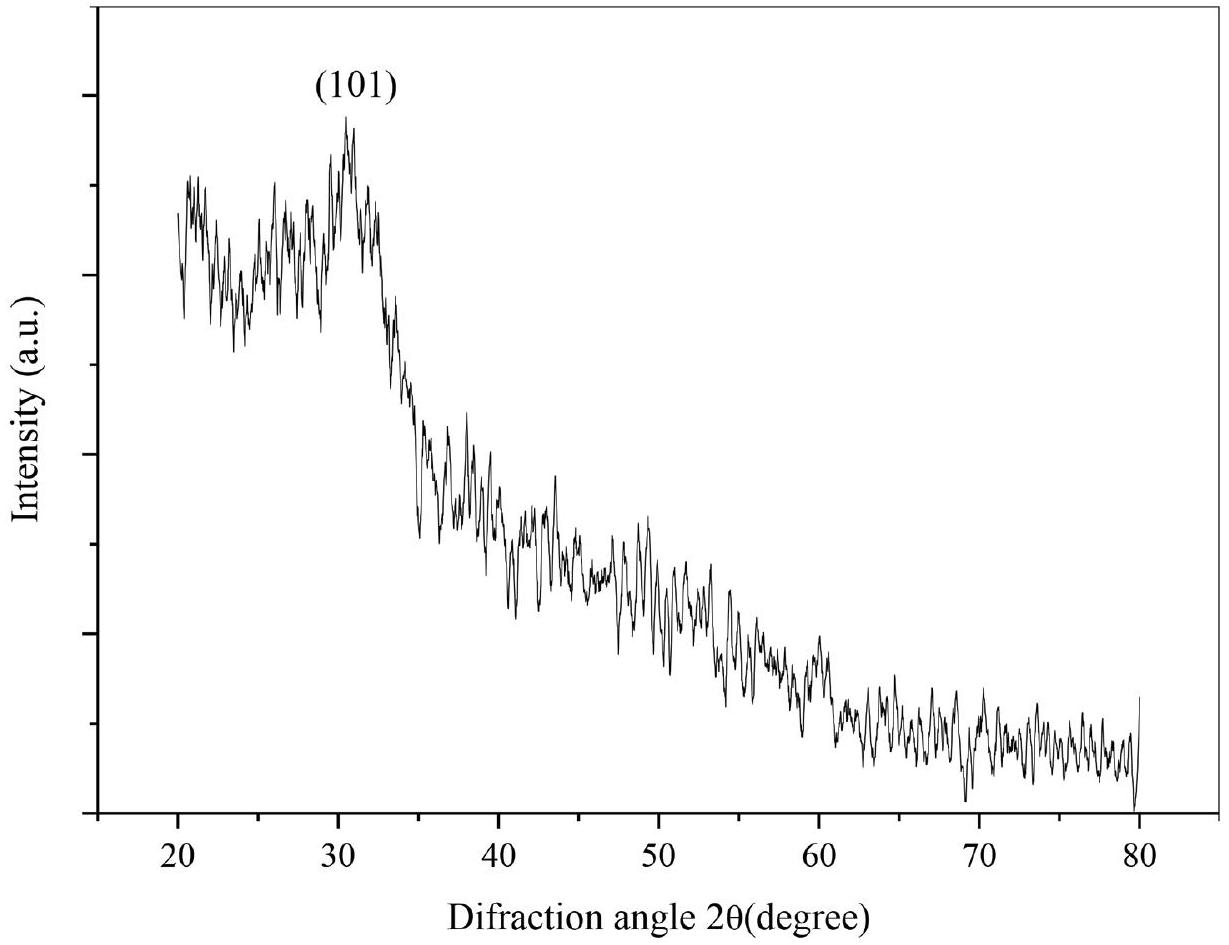
غطت مسح XRD نطاق زاوية الانكسار من 20 إلى 80 درجة (الشكل 1). قدم الرسم البياني الناتج عن XRD دليلاً قاطعاً على أن المادة أظهرت هيكلًا بلوريًا. ومن الجدير بالذكر أنه تم ملاحظة قمة مميزة وشديدة عند زاوية انكسار ، الذي يتوافق مع اتجاه مستوى (101). لتحديد حجم البلورات الصغيرة لـ SeNPs المحضرة، يتم استخدام معادلة شيرر ( ) تم استخدامه. في هذه الصيغة، يمثل حجم البلورة، تشير إلى الطول الموجي للأشعة السينية المستخدمة ( Å ) ، (بالراديان) يمثل زاوية براج، و يمثل العرض الكامل عند نصف الحد الأقصى (FWHM، بالراديان) للقمة المشتتة. استنادًا إلى الحسابات، تم العثور على حجم البلورات للنانو جزيئات السيلينيوم المصنعة ليكون حوالي 37 نانومتر [23].
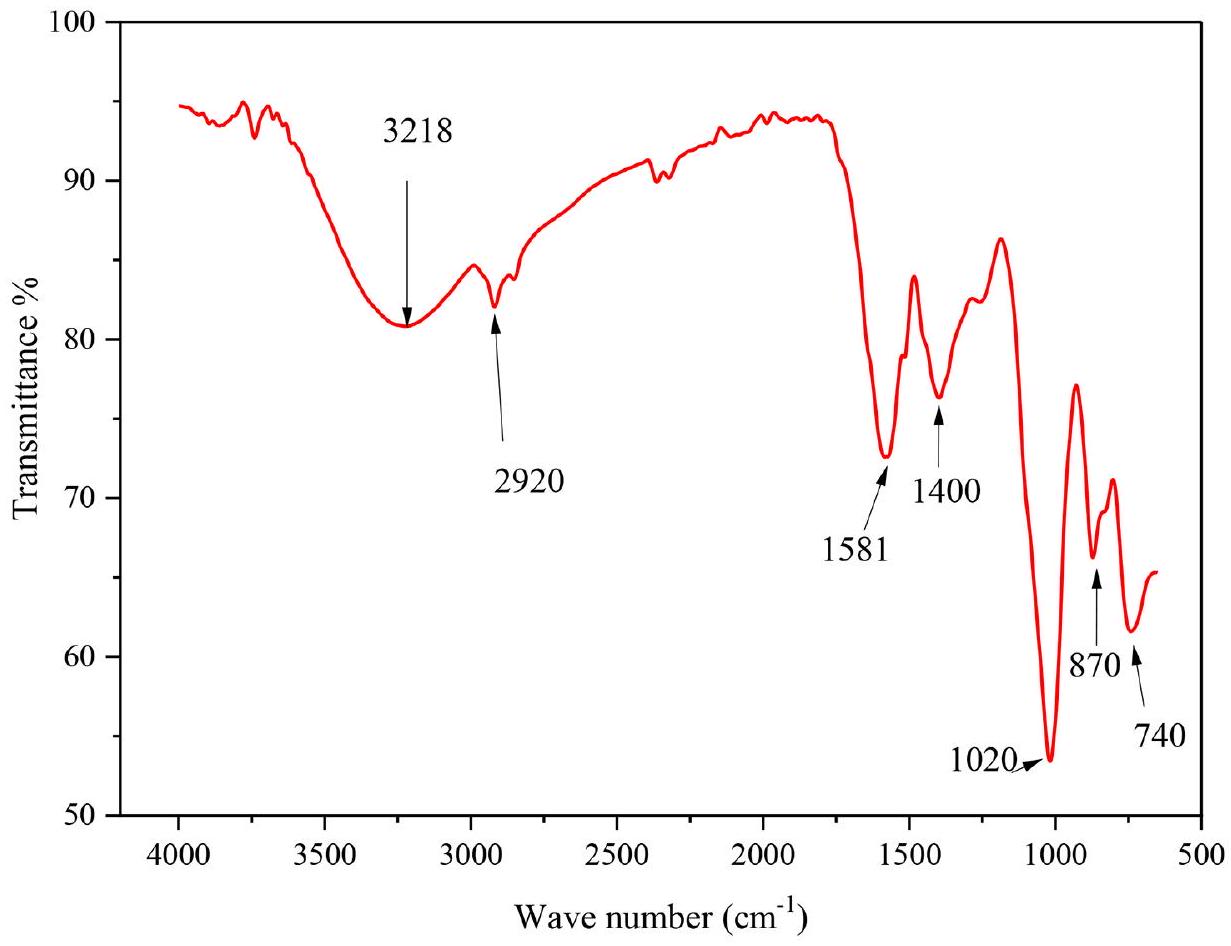
من خلال استخدام FTIR، يمكن للباحثين تحديد المجموعات الوظيفية المحتملة الموجودة على سطح SeNPs، والتي تلعب دورًا حاسمًا في تقليل السيلينات خلال عملية تشكيل SeNPs التي تم تصنيعها بيولوجيًا. في هذه الدراسة، تم استخدام كمية صغيرة من SeNPs المحضرة كعينة للتحليل باستخدام FTIR. تم جمع طيف FTIR في نطاق الأطوال الموجية من 650 إلى بدقة أظهرت نتائج FTIR المستخلصة وجود سبعة قمم مميزة، كل منها يمثل وظائف تمدد واهتزاز محددة. وقعت القمم المرصودة في FTIR عند أطوال موجية تبلغ 733.54، 867.19، 1018.42، 1394، 1584.68،
2914.82، و (الشكل 2). تتوافق هذه القمم مع المجموعات الوظيفية التالية: عطرية انحناء انحناء تمدد تمدد تمدد غير متماثل، هيدروكسيل حر تمدد، و تمتد. إن تحديد هذه المجموعات الوظيفية يوفر رؤى حاسمة حول كيمياء السطح والأدوار التي تلعبها المركبات المختلفة التي تعمل كعوامل تغليف على جزيئات السيلينيوم النانوية.

ارتفاع النبات

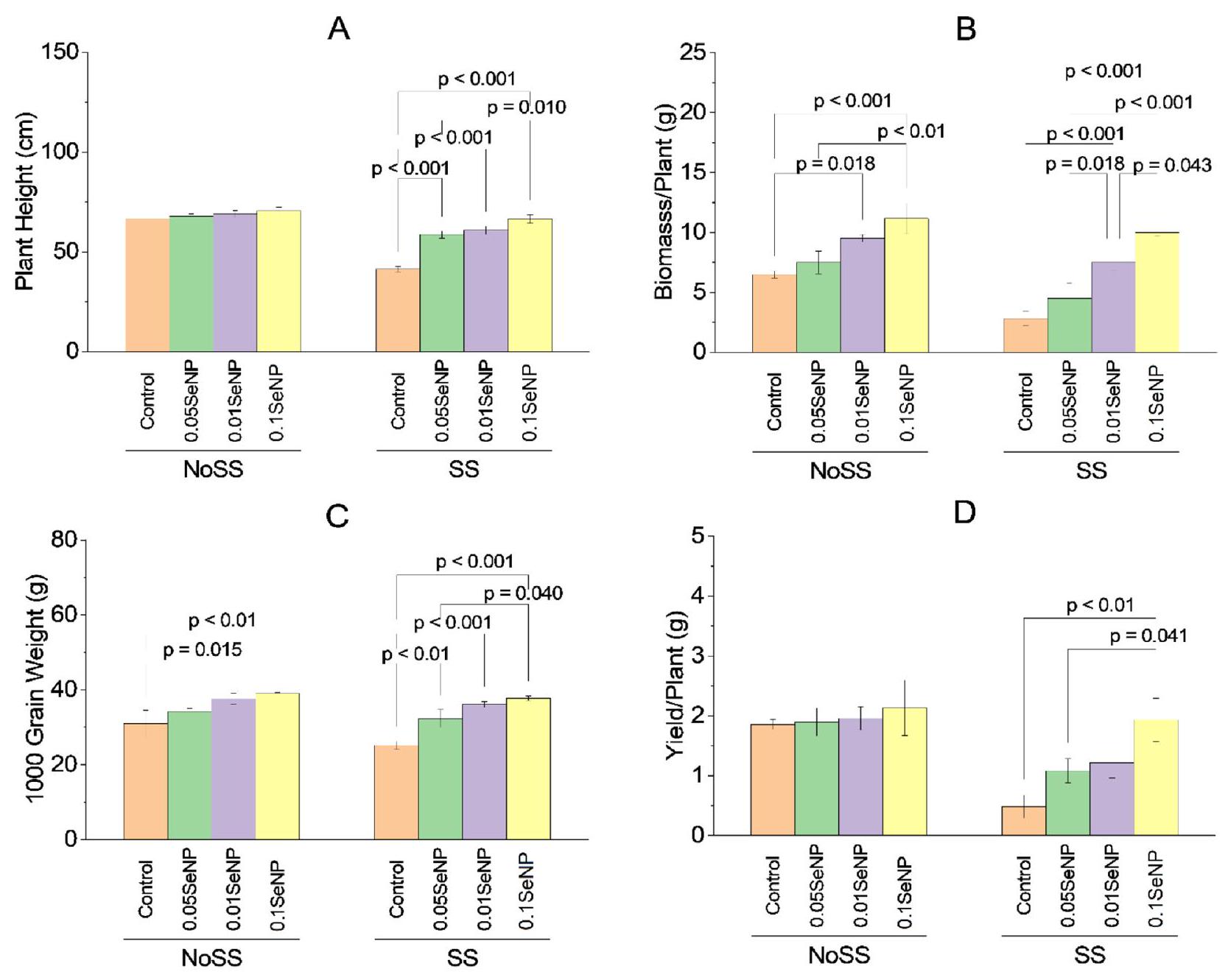
في حالة عدم وجود إجهاد ملوحة (NoSS)، لم تكن هناك فروق ذات دلالة إحصائية في ارتفاع النبات بين المجموعة الضابطة و SeNP، SeNP، أو مجموعة من SeNP و SeNP (لا تغيير ذو دلالة). وبالمثل، في حالة إجهاد الملوحة (SS)، لم تكن هناك تغييرات ذات دلالة في ارتفاع النبات بين المجموعة الضابطة و SeNP أو مجموعة من SeNP و0.05% SeNP (لا توجد اختلافات ذات دلالة إحصائية). ومع ذلك، ظهرت نتائج ملحوظة في حالة SS. في مجموعة التحكم SS، تم تطبيق أدى SeNP إلى تحسين كبير في ارتفاع النبات مقارنةً بالتحكم، مع -قيمة أقل من 0.001. وبالمثل، في حالة SS، تم تطبيق أدى SeNP إلى زيادة ملحوظة في ارتفاع النبات مقارنةً بالتحكم، أيضًا مع -قيمة أقل من 0.001. من المثير للاهتمام، عند مقارنة تأثيرات تركيزات مختلفة من SeNP في حالة SS، لم تكن هناك اختلافات كبيرة في ارتفاع النبات بين 0.01% SeNP و 0.05% SeNP (غير ذات دلالة).
الشكل 1 نمط حيود الأشعة السينية لجزيئات السيلينيوم النانوية
الشكل 2 طيف FTIR لجزيئات السيلينيوم النانوية
تم العثور على (تباين). ومع ذلك، في حالة SS، تم تطبيق SeNP و أدى SeNP إلى تحسين كبير في ارتفاع النبات مقارنةً بالتحكم SS، مع -القيمة 0.010. بشكل عام، تشير هذه النتائج إلى أن تطبيق جزيئات السيلينيوم النانوية، لا سيما عند تركيزات من SeNP و يمكن أن يؤثر SeNP بشكل إيجابي على ارتفاع النبات تحت ظروف إجهاد الملوحة. ومع ذلك، SeNP و أظهر SeNP التأثير الأكثر وضوحًا في تعزيز ارتفاع النبات في ظل وجود إجهاد الملوحة (الشكل 3A).

الكتلة الحيوية/النبات

تحت شرط NoSS، لم تُلاحظ أي تغييرات كبيرة في الكتلة الحيوية/النبات بين مجموعة التحكم NoSS، SeNP، 0.01% SeNP، و0.1% SeNP. ومع ذلك، فإن مجموعة التجربة NoSS المعالجة بـ أظهر SeNP زيادة ذات دلالة إحصائية في الكتلة الحيوية/نمو النبات مقارنةً بالتحكم NoSS، مع -القيمة 0.018. وبالمثل، في SS.
في الحالة، لم يتم العثور على اختلافات كبيرة في الكتلة الحيوية/نمو النبات بين مجموعة التحكم SS ومجموعات SS التجريبية المعالجة بـ SeNP أو مجموعة من SeNP و SeNP (لا تغيير ذو دلالة). بالمقابل، المجموعات التجريبية SS المعالجة بـ أظهر SeNP نموًا أكبر بشكل ملحوظ في الكتلة الحيوية/نمو النبات مقارنةً بمجموعة التحكم SS. -القيمة كانت أقل من 0.001 لمجموعة SS التجريبية المعالجة بـ SeNP وحده وأقل من 0.01 لمجموعة SS التجريبية المعالجة بالمزيج
من SeNP و SeNP. فيما يتعلق بتأثيرات تركيزات SeNP ضمن حالة SS، لم تُلاحظ أي تغييرات ملحوظة في الكتلة الحيوية/نمو النبات بين مجموعات SS التجريبية المعالجة بـ 0.05% SeNP والمجموعة الضابطة (لا توجد تغييرات ملحوظة). على النقيض من ذلك، أظهرت مجموعة SS التجريبية المعالجة بـ 0.01% SeNP زيادة ملحوظة في الكتلة الحيوية/نمو النبات مقارنةً بالمجموعة الضابطة SS، مع -قيمة 0.018. علاوة على ذلك، فإن الجمع بين SeNP و أدى SeNP إلى زيادة كبيرة في الكتلة الحيوية/نمو النبات مقارنةً بالتحكم SS، مع -قيمة أقل من 0.001. وبالمثل، تم معالجة مجموعة التجربة SS بالتركيبة من SeNP و أظهر SeNP زيادة ملحوظة في الكتلة الحيوية/ نمو النبات مقارنةً بالتحكم SS، مع -قيمة 0.043. تشير هذه النتائج إلى أن تطبيق جزيئات السيلينيوم النانوية، لا سيما عند تركيزات من SeNP و يمكن أن يؤثر SeNP بشكل إيجابي على الكتلة الحيوية / نمو النبات تحت ظروف NoSS و SS. علاوة على ذلك، فإن الجمع بين SeNP و أظهر SeNP تأثيرات ملحوظة في تعزيز الكتلة الحيوية/نمو النبات في ظل ضغط الملوحة (الشكل 3B).

وزن 1000 حبة

في سياق شرط NoSS، لم تُلاحظ أي تغييرات ملحوظة في وزن 1000 حبة بين مجموعة التحكم NoSS و SeNP أو مجموعة من SeNP و SeNP ( ). ومع ذلك، تم علاج مجموعة NoSS التجريبية بـ أظهر SeNP زيادة ذات دلالة إحصائية في 1000 حبة
الشكل 3 تأثير معدلات تطبيق متغيرة من نانو جزيئات السيلينيوم على ارتفاع النبات (A)، الكتلة الحيوية/نبات (B)، وزن 1000 حبة (C) والعائد/نبات (D). الأعمدة تمثل متوسطات 3 تكرارات. القيم المختلفة على الأعمدة هي قيم احتمالية تظهر تغييرات ذات دلالة إحصائية عند . SS = إجهاد الملوحة؛ NoSS = بدون إجهاد ملوحة؛ SeNP = نانو جزيئات السيلينيوم
الوزن فوق التحكم NoSS ( ). وبالمثل، في حالة SS، أظهر التحكم في SS وزن حبة 1000 أقل بشكل ملحوظ مقارنة بالمجموعة التجريبية المعالجة بـ SeNP ( ). بالإضافة إلى ذلك، تم علاج مجموعة SS التجريبية بـ أظهر SeNP وزن 1000 حبة أعلى بشكل ملحوظ مقارنةً بالتحكم SS. ). ومع ذلك، لم تُلاحظ أي تغييرات ملحوظة في وزن 1000 حبة بين مجموعة التحكم SS والمجموعة التجريبية المعالجة بالتركيبة من SeNP و SeNP ( فيما يتعلق بتأثيرات تركيزات نانو الجسيمات السيلينيوم في حالة SS، لم يتم العثور على اختلافات كبيرة في وزن 1000 حبة بين SeNP أو مجموعة من SeNP و SeNP، و التحكم SS ( ). ومع ذلك، فإن مجموعات التجارب SS المعالجة بـ SeNP بمفرده أو بالاشتراك مع أظهر SeNP أوزان حبوب أعلى بكثير تبلغ 1000 حبة مقارنة بمجموعة التحكم SS. -القيمة كانت أقل من 0.001 لـ
مجموعة التجارب SS المعالجة بـ SeNP وحده و0.040 لمجموعة SS التجريبية المعالجة بالتركيبة من SeNP و SeNP. تشير هذه النتائج إلى أن تطبيق SeNPs، لا سيما بتركيز يؤثر SeNP بشكل إيجابي على وزن 1000 حبة من النباتات تحت كل من ظروف NoSS و SS. علاوة على ذلك، فإن تأثيرات SeNP و تختلف SeNP اعتمادًا على وجود أو غياب إجهاد الملوحة (الشكل 3C).

العائد/نبات

لم تُلاحظ أي تغييرات كبيرة في العائد لكل نبات بين مجموعة التحكم NoSS و SeNP، SeNP، أو مجموعة من SeNP و SeNP تحت شرط NoSS ). وبالمثل، في حالة SS، لم تكن هناك اختلافات كبيرة في العائد لكل نبات بين مجموعة التحكم ومجموعات SS التجريبية المعالجة بـ SeNP SeNP، أو الـ
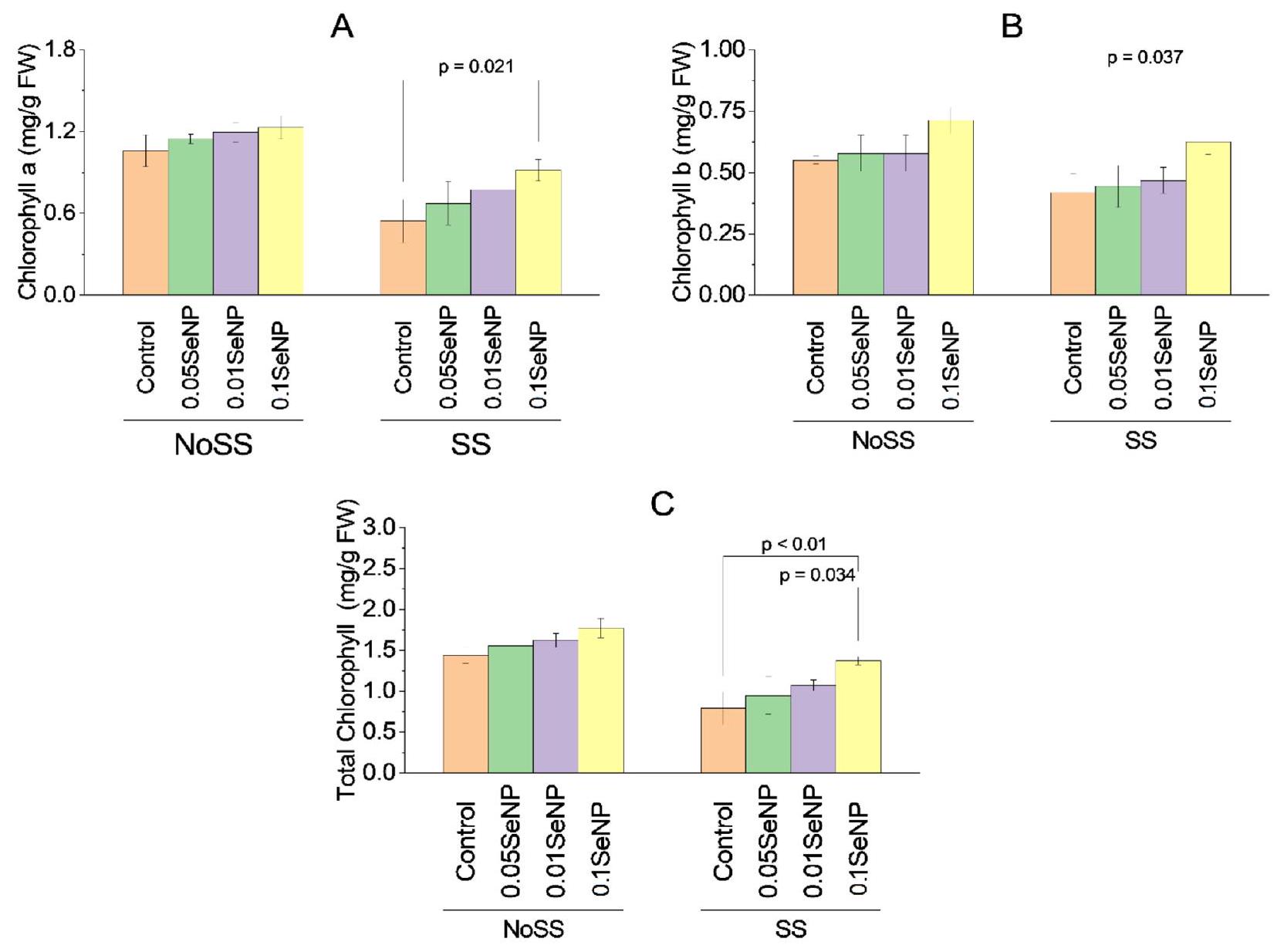
الشكل 4 تأثير معدلات تطبيق متغيرة من نانو جزيئات السيلينيوم على الكلوروفيل أ (A) والكلوروفيل ب (B) والكلوروفيل الكلي (C). الأعمدة تمثل متوسط 3 تكرارات. القيم المختلفة على الأعمدة هي قيم احتمالية تظهر تغييرات ذات دلالة. . SS = إجهاد الملوحة؛ NoSS = عدم وجود إجهاد ملوحة؛ SeNP = نانو جزيئات السيلينيوم
تركيبة من SeNP و SeNP ( ). ومع ذلك، ضمن شرط SS، تم معالجة مجموعة التجربة SS بـ أظهر SeNP بمفرده عائدًا أعلى بشكل ملحوظ لكل نبات مقارنةً بالتحكم SS. ). علاوة على ذلك، تم علاج مجموعة التجربة SS باستخدام تركيبة من SeNP و أظهر SeNP تباينًا ذا دلالة إحصائية في العائد لكل نبات مقارنةً بالتحكم SS ( ). تشير هذه النتائج إلى أن تطبيق جزيئات نانو السيلينيوم، لا سيما بالاشتراك مع يمكن أن تؤثر جزيئات السيلينيوم النانوية بشكل إيجابي على العائد لكل نبات في ظل ظروف الإجهاد الناتج عن الملوحة. ومع ذلك، لم يكن هناك تأثير ملحوظ على العائد لكل نبات عندما تم تطبيق جزيئات السيلينيوم النانوية في ظل حالة عدم وجود ملوحة (الشكل 3D).

كلوروفيللا

في حالة SS، لم تكن هناك اختلافات كبيرة في محتوى الكلوروفيل أ بين مجموعة التحكم SS ومجموعات التجربة SS المعالجة بـ 0.05% SeNP، 0.01% SeNP، أو التركيبة. SeNP و SeNP ( ). ومع ذلك، ضمن شرط SS،
مجموعة التجربة SS المعالجة بـ أظهر SeNP وحده تباينًا كبيرًا في محتوى الكلوروفيل أ مقارنةً بالتحكم SS ( ). بالنسبة للمجموعات التجريبية المتبقية ضمن حالة SS، لم تُلاحظ أي تغييرات ملحوظة في محتوى الكلوروفيل أ ( ). تشير هذه النتائج إلى أن تطبيق جزيئات السيلينيوم النانوية لم يكن له تأثير كبير على محتوى الكلوروفيل أ تحت كل من ظروف NoSS و SS، باستثناء مجموعة التجربة SS المعالجة بـ SeNP وحده، الذي أظهر تباينًا كبيرًا (الشكل 4A).

كلوروفيل ب

تحليل الكلوروفيل المحتوى لم يكشف عن أي اختلافات كبيرة بين مجموعة التحكم NoSS ومجموعات NoSS التجريبية المعالجة بـ SeNP، SeNP، أو مجموعة من SeNP و SeNP تحت شرط NoSS ). وبالمثل، لم تكن هناك اختلافات كبيرة في محتوى الكلوروفيل ب بين مجموعة التحكم SS ومجموعات SS التجريبية المعالجة بـ SeNP، SeNP، أو التركيبة
من SeNP و SeNP تحت شرط SS . ومع ذلك، في حالة SS، تم معالجة مجموعة SS التجريبية بـ أظهر SeNP بمفرده تباينًا ذا دلالة إحصائية في محتوى الكلوروفيل ب مقارنةً بالتحكم SS. ). وعلى العكس، لم تُلاحظ أي تغييرات ملحوظة في محتوى الكلوروفيل ب بين المجموعات التجريبية الأخرى من SS ( ). تشير هذه النتائج إلى أن تطبيق جزيئات نانو السيلينيوم لم يؤثر بشكل كبير على محتوى الكلوروفيل ب تحت كل من ظروف عدم الإجهاد و ظروف الإجهاد، باستثناء مجموعة التجربة تحت ظروف الإجهاد المعالجة بـ SeNP وحده، الذي أظهر تباينًا كبيرًا (الشكل 4B).

إجمالي الكلوروفيل

لم تُلاحظ أي تغييرات ملحوظة في محتوى الكلوروفيل الكلي بين مجموعة التحكم NoSS ومجموعات NoSS التجريبية المعالجة بتركيزات مختلفة من جزيئات السيلينيوم النانوية (SeNPs) تحت ظروف NoSS. ). وبالمثل، لم تُلاحظ أي تغييرات ملحوظة في محتوى الكلوروفيل الكلي بين مجموعة التحكم SS ومجموعات SS التجريبية التي خضعت لعلاجات مختلفة من SeNP ( ). ومع ذلك، ضمن حالة SS، تم معالجة مجموعة التجربة SS بـ أظهر SeNP بمفرده زيادة كبيرة في محتوى الكلوروفيل الكلي مقارنةً بالتحكم SS، مع -قيمة أقل من 0.01. علاوة على ذلك، تم معالجة مجموعة التجربة SS باستخدام تركيبة من SeNP و أظهر SeNP تباينًا ذا دلالة إحصائية في محتوى الكلوروفيل الكلي مقارنةً بالتحكم SS، مع -القيمة 0.034. تشير هذه النتائج إلى أن تطبيق جزيئات السيلينيوم النانوية لم يؤثر بشكل كبير على محتوى الكلوروفيل الكلي تحت كل من ظروف عدم الإجهاد المائي وظروف الإجهاد المائي، باستثناء مجموعة التجربة المعالجة تحت ظروف الإجهاد المائي. SeNP وحده وتركيبة SeNP و SeNP، الذي أظهر تباينات ملحوظة (الشكل 4C).

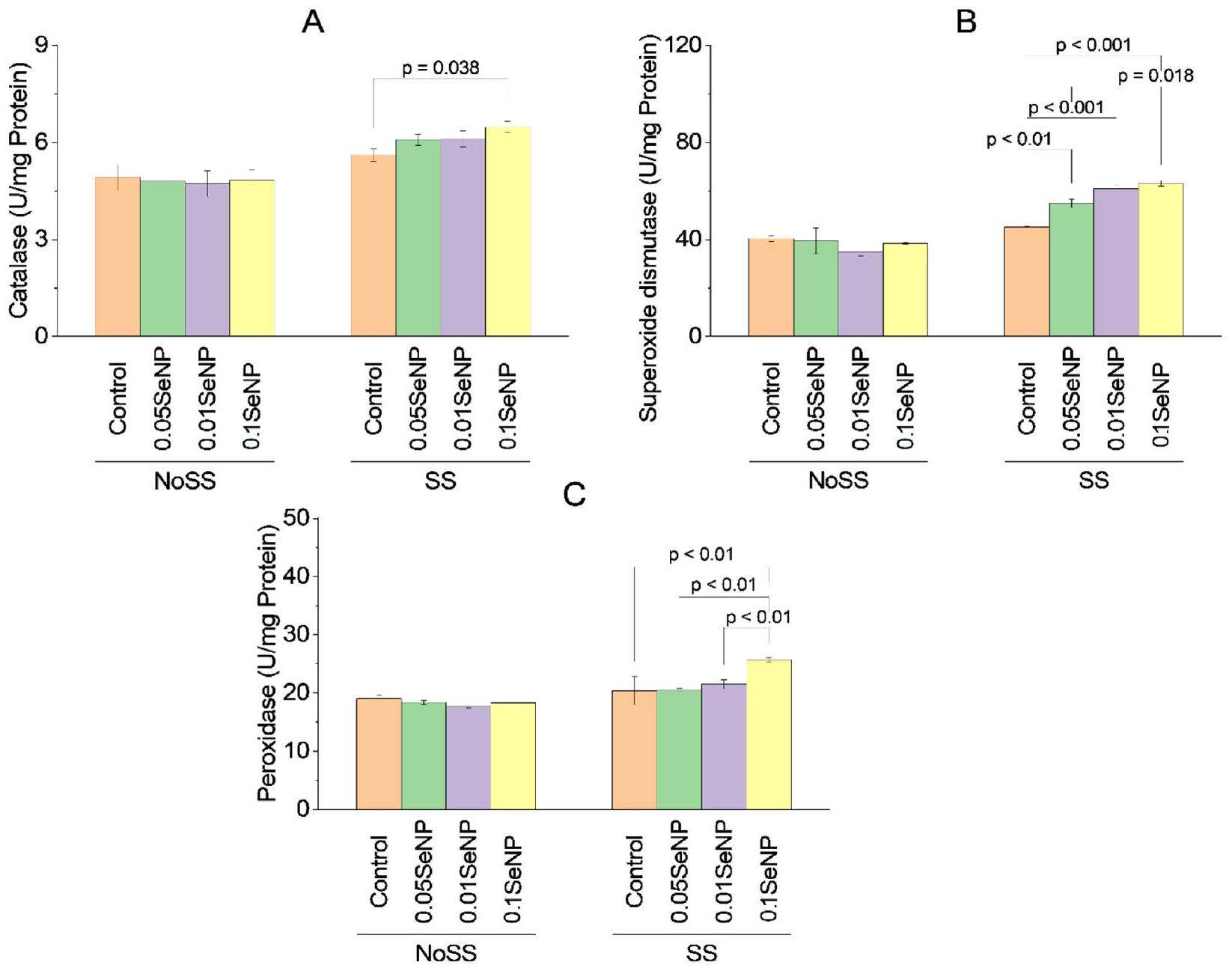
كاتالاز

لم تُلاحظ أي تغييرات ملحوظة في نشاط الكاتالاز بين مجموعة التحكم NoSS ومجموعات NoSS التجريبية المعالجة بـ SeNP، SeNP، أو مجموعة من SeNP و SeNP تحت شرط NoSS ). وبالمثل، لم يتم العثور على اختلافات كبيرة في نشاط الكاتالاز بين مجموعة التحكم SS ومجموعات SS التجريبية المعالجة بـ SeNP، SeNP، أو مجموعة من SeNP و SeNP ( ). ومع ذلك، ضمن شرط SS، تم معالجة مجموعة التجربة SS بـ أظهر SeNP بمفرده تباينًا ذا دلالة إحصائية في نشاط الكاتالاز مقارنةً بالتحكم SS، مع -القيمة 0.038. بالنسبة للمجموعات التجريبية المتبقية ضمن حالة SS، لم تُلاحظ أي تغييرات ملحوظة في نشاط الكاتالاز. تشير هذه النتائج إلى أن تطبيق جزيئات نانو السيلينيوم لم يؤثر بشكل كبير على نشاط الكاتالاز تحت كل من ظروف NoSS و SS، باستثناء
مجموعة التجارب SS المعالجة بـ SeNP وحده، الذي أظهر تباينًا كبيرًا (الشكل 5A).

سوبر أكسيد ديسموتاز

لم تكن هناك اختلافات كبيرة في نشاط سوبر أكسيد ديسموتاز (SOD) بين مجموعة التحكم NoSS ومجموعات NoSS التجريبية المعالجة بـ SeNP، SeNP، أو مجموعة من SeNP و SeNP تحت شرط NoSS ). وبالمثل، لم تختلف نشاط SOD بشكل كبير بين مجموعة التحكم SS ومجموعات SS التجريبية المعالجة بـ SeNP، SeNP، أو مجموعة من SeNP و SeNP تحت شرط SS ). ومع ذلك، في حالة SS، لوحظت تغييرات ملحوظة في نشاط SOD. تم معالجة مجموعة SS التجريبية بـ أظهر SeNP نشاط SOD أعلى بشكل ملحوظ مقارنةً بالتحكم SS ). وبالمثل، تم معالجة مجموعة SS التجريبية بـ أظهر SeNP نشاطًا أعلى بكثير من SOD مقارنةً بالتحكم SS لم يُلاحظ أي فرق كبير في نشاط SOD بين مجموعة SS التجريبية المعالجة بالتركيبة من SeNP و SeNP و التحكم SS ). علاوة على ذلك، تم معالجة مجموعة التجربة SS بـ أظهر SeNP بمفرده نشاط SOD أعلى بشكل ملحوظ مقارنةً بالتحكم SS ( ). وبالمثل، تم معالجة مجموعة SS التجريبية باستخدام تركيبة من SeNP و أظهر SeNP تباينًا ذا دلالة إحصائية في نشاط SOD مقارنةً بالتحكم SS ) (الشكل 5B).

بيروكسيداز

لم تكن هناك تغييرات ملحوظة في نشاط البيروكسيداز بين مجموعة التحكم NoSS ومجموعات NoSS التجريبية المعالجة بـ SeNP، SeNP، أو مجموعة من SeNP و SeNP تحت شرط NoSS ). وبالمثل، لم تُلاحظ أي تغييرات ملحوظة في نشاط البيروكسيداز بين مجموعة التحكم SS ومجموعات SS التجريبية المعالجة بـ SeNP، SeNP، أو مجموعة من SeNP و SeNP تحت شرط SS ). ومع ذلك، داخل حالة SS، لوحظت اختلافات كبيرة في نشاط البيروكسيداز. تم معالجة مجموعة SS التجريبية بـ أظهر SeNP بمفرده نشاطًا أعلى بشكل ملحوظ في إنزيم البيروكسيداز مقارنةً بالتحكم SS ( ). وبالمثل، تم معالجة مجموعة SS التجريبية باستخدام تركيبة من SeNP و أظهر SeNP نشاطًا أعلى بشكل ملحوظ في البيروكسيداز مقارنةً بالتحكم SS ( ). بالإضافة إلى ذلك، تم علاج مجموعة SS التجريبية بـ SeNP و أظهر SeNP أيضًا نشاطًا أعلى بشكل ملحوظ من إنزيم البيروكسيداز مقارنةً بالتحكم SS ( ) (الشكل 5C).
الشكل 5 تأثير معدلات تطبيق متغيرة من نانو جزيئات السيلينيوم على الكاتالاز (A) ، سوبر أكسيد ديسموتاز (B) وبيروكسيداز (C). الأعمدة تمثل متوسط 3 تكرارات. القيم المختلفة على الأعمدة هي قيم احتمالية تظهر تغييرات ذات دلالة. . SS = إجهاد الملوحة؛ NoSS = عدم وجود إجهاد ملوحة؛ SeNP = جزيئات السيلينيوم النانوية

إجمالي الأحماض الأمينية الحرة

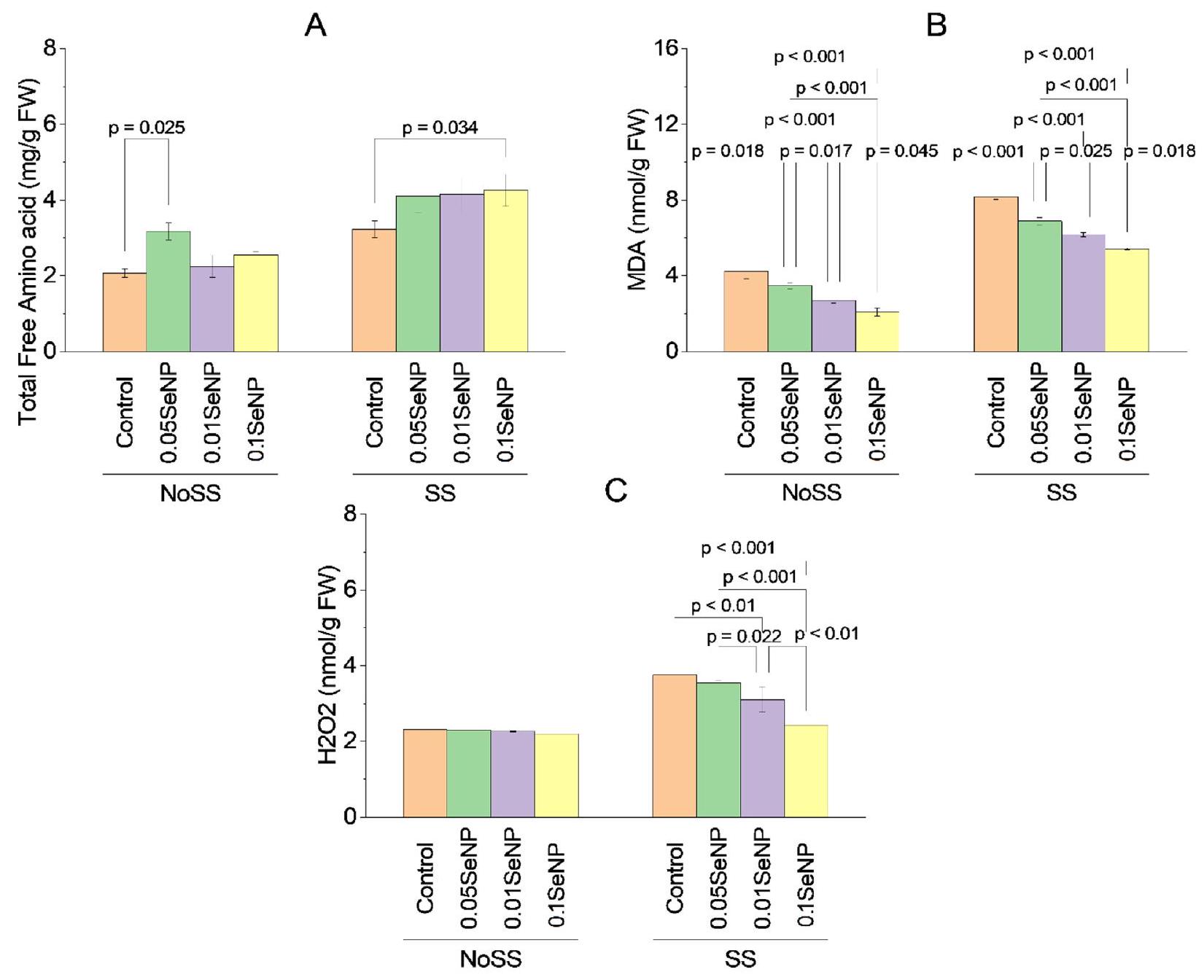
مجموعة نوس التجريبية المعالجة بـ أظهر SeNP تباينًا كبيرًا في محتوى الأحماض الأمينية الحرة الكلي مقارنةً بالتحكم NoSS، مع -القيمة 0.025. وبالمثل، لم يتم العثور على اختلافات كبيرة في محتوى الأحماض الأمينية الحرة الكلي بين مجموعة التحكم SS ومجموعات SS التجريبية المعالجة بـ 0.05% SeNP، 0.01% SeNP، أو مجموعة الجمع بينهما. SeNP و SeNP تحت شرط SS ). ومع ذلك، تم معالجة مجموعة SS التجريبية بـ أظهر SeNP وحده تباينًا كبيرًا في محتوى الأحماض الأمينية الحرة الكلي مقارنةً بالتحكم SS، مع -القيمة 0.034. تشير هذه النتائج إلى أن تطبيق SeNP في حالة NoSS و كان لـ SeNP في حالة SS تأثير كبير على محتوى الأحماض الأمينية الحرة الكلي (الشكل 6A).

MDA

بالنسبة لحالة NoSS، أظهرت مجموعة NoSS التجريبية المعالجة بـ 0.05% SeNP تباينًا كبيرًا
في محتوى MDA فوق التحكم NoSS، مع -قيمة 0.018. وبالمثل، مجموعة التجربة NoSS المعالجة بـ أظهر SeNP تباينًا كبيرًا في محتوى MDA مقارنةً بالتحكم NoSS، مع -قيمة أقل من 0.001. بالإضافة إلى ذلك، تم علاج مجموعة NoSS التجريبية باستخدام تركيبة من SeNP و أظهر SeNP تباينًا كبيرًا في محتوى MDA، مع -قيمة 0.017. وبالمثل، مجموعة التجربة NoSS المعالجة بـ SeNP وحده و SeNP بالاشتراك مع أظهر SeNP كلاهما تباينات ملحوظة في محتوى MDA مقارنةً بالتحكم NoSS، مع -قيم أقل من 0.001 وأقل من 0.001، على التوالي. ومع ذلك، لم يُلاحظ أي تباين كبير في محتوى MDA بين مجموعة التحكم NoSS ومجموعة NoSS التجريبية المعالجة بـ SeNP و SeNP ( ). تحت شرط SS، تم معالجة مجموعة SS التجريبية بـ ، ، ومزيج من SeNP و أظهرت جميع عينات SeNP تباينات ملحوظة في محتوى MDA على مدى SS
الشكل 6 تأثير معدلات تطبيق متغيرة من نانو جزيئات السيلينيوم على إجمالي الأحماض الأمينية الحرة (أ)، MDA (ب)، و H2O2 (ج). الأعمدة تمثل متوسط 3 تكرارات. القيم المختلفة على الأعمدة هي قيم احتمالية تظهر تغييرات ذات دلالة. . SS = إجهاد الملوحة؛ NoSS = عدم وجود إجهاد ملوحة؛ SeNP = جزيئات السيلينيوم النانوية
تحكم، مع -قيم أقل من 0.001 ، أقل من 0.001 ، و 0.025 ، على التوالي. وبالمثل، مجموعة التجربة SS المعالجة بـ SeNP وحده و SeNP بالاشتراك مع أظهر SeNP تباينات ملحوظة في محتوى MDA مقارنةً بالتحكم SS، مع -قيم أقل من 0.001 وأقل من 0.001، على التوالي. ومع ذلك، لم يُلاحظ أي تباين كبير في محتوى MDA بين مجموعة التحكم SS ومجموعة SS التجريبية المعالجة بـ و (الشكل 6B).

بيروكسيد الهيدروجين

لا توجد تغييرات ملحوظة في بيروكسيد الهيدروجين تمت ملاحظة محتوى ) بين مجموعة التحكم NoSS ومجموعات NoSS التجريبية المعالجة بـ SeNP، SeNP، أو مجموعة من SeNP و SeNP تحت شرط NoSS وبالمثل، لم يتم العثور على اختلافات كبيرة في محتوى H 2 O 2 بين مجموعة التحكم SS والمجموعة التجريبية SS.
المجموعات المعالجة بـ SeNP، SeNP، أو مجموعة من SeNP و SeNP تحت شرط SS ). ومع ذلك، لوحظت اختلافات كبيرة في محتوى H2O2 ضمن حالة SS. تم معالجة مجموعة SS التجريبية بـ أظهر SeNP محتوى أعلى بكثير من H2O2 مقارنةً بالتحكم SS، مع -قيمة أقل من 0.01. بالإضافة إلى ذلك، تم معالجة مجموعة التجربة SS بالتركيبة من SeNP و أظهر SeNP تباينًا ذا دلالة إحصائية في محتوى H2O2 مقارنةً بالتحكم SS، مع -قيمة 0.022. علاوة على ذلك، تم علاج مجموعة التجربة SS بـ SeNP بمفرده وفي تركيبة مع أظهر SeNP كلاهما محتوى H2O2 أعلى بشكل ملحوظ مقارنةً بالتحكم SS، مع -قيم أقل من 0.001 وأقل من 0.001، على التوالي. بالإضافة إلى ذلك، مجموعة SS التجريبية المعالجة بمزيج من SeNP و أظهر SeNP ارتفاعًا ملحوظًا المحتوى على التحكم SS، مع -قيمة أقل من 0.01. تشير هذه النتائج إلى أن التطبيق
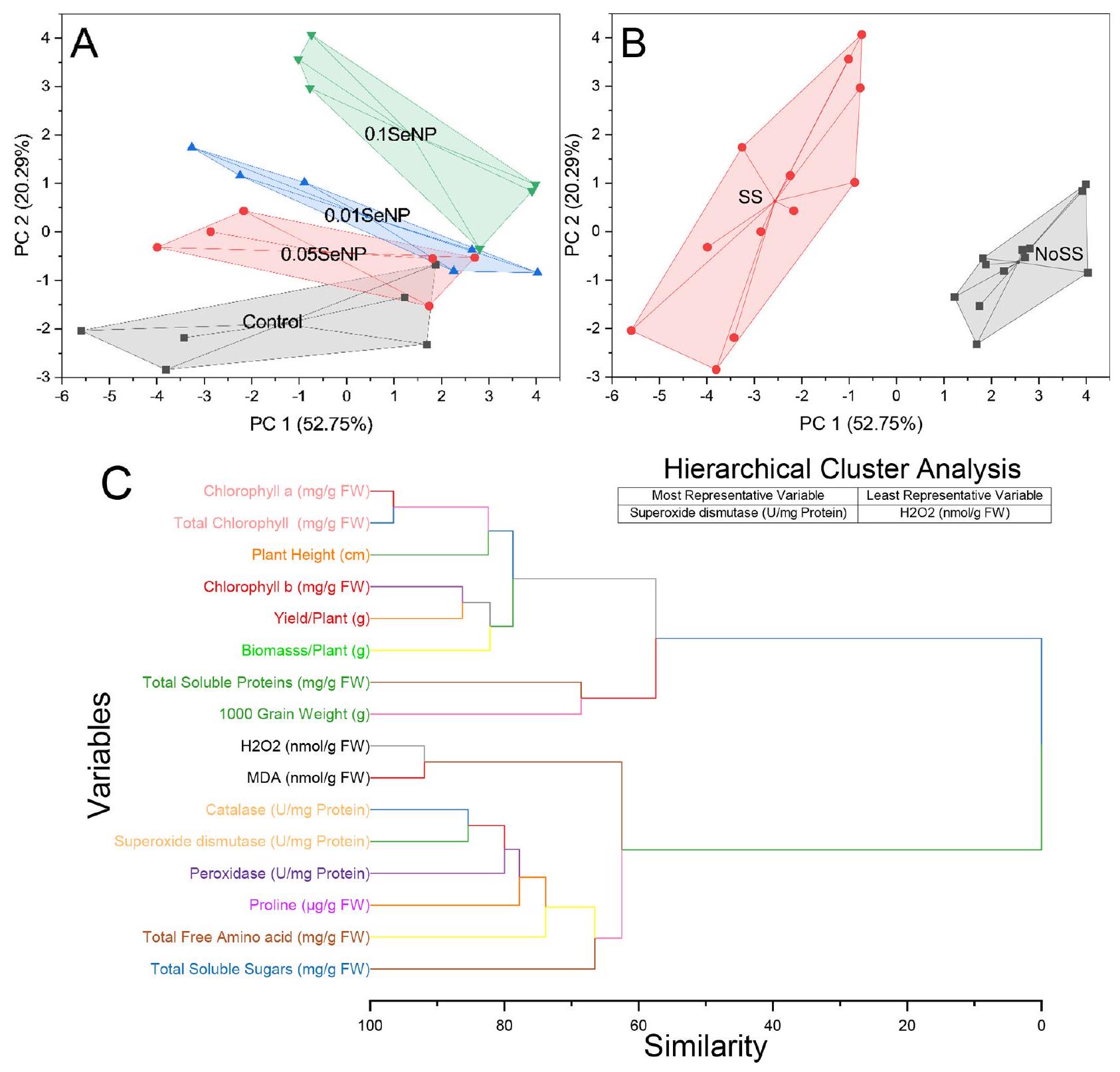
الشكل 7 مخطط التجمع مع الغلاف المحدب لـ SeNP (A)، إجهاد الملوحة (B) ومخطط التجمع الهرمي للسمات المدروسة (C)
يمكن لجزيئات السيلينيوم النانوية، وخاصة عند تركيزات محددة تحت ظروف إجهاد الملوحة، أن تعدل محتوى H2O2 في النباتات. تشير النتائج إلى أن جزيئات السيلينيوم النانوية قد تؤثر على إنتاج أنواع الأكسجين التفاعلية واستجابات الإجهاد التأكسدي في النباتات، مما يبرز دورها المحتمل في آليات الدفاع النباتية ضد الأضرار التأكسدية الناتجة عن الملوحة.
تظهر مجموعة التحكم قربًا بين النقاط المميزة بإحداثيات مثل (1.8836، -0.67912)، (1.69031، -2.32132)، (1.22389، -1.34951)، وغيرها. تجمع SeNP يشمل النقاط المشار إليها بـ (1.7486، -1.53412)، (1.82026، -0.55258)، (2.70553، -0.53308)، وغيرها، مما يدل على ارتباطها بـ
فئة SeNP. في مجموعة SeNP بنسبة 0.01%، تظهر نقاط مثل (2.2673، -0.81394)، (2.64986، -0.37447)، (4.03619، -0.84702)، وغيرها قربًا وثيقًا، مما يدل على تصنيفها كـ “ SeNP. الـ يتكون تجمع SeNP من نقاط تشمل (2.81082، -0.35018)، (3.9151، 0.83544)، (3.99095، 0.97508)، وغيرها، والتي تظهر القرب، مما يدل على عضويتها في الـ فئة SeNP (الشكل 7A). يتكون العنقود 1 (NoSS) من عدة نقاط بإحداثيات مثل (1.8836، -0.67912)، (1.69031، -2.32132)، (1.22389، -1.34951)، وغيرها. هذه النقاط متناثرة عبر الرسم البياني، ويتم رسم غلاف محدب حولها، مما يشكل مضلعًا يحيط بالعنقود. العنقود 2 (SS) ممثل
نقاط مثل (-5.59553، -2.04089)، (-3.80546، -2.84626)، (-3.42874، -2.18605)، وغيرها. تقع هذه النقاط بشكل منفصل عن الكتلة 1، ويتم رسم غلاف محدب حولها أيضًا، مما يخلق مضلعًا مميزًا يحيط بالكتلة الثانية (الشكل 7B). تُظهر المتغيرات الكلوروفيل أ (ملغ/غ من الوزن الرطب) والكلوروفيل الكلي (ملغ/غ من الوزن الرطب) معامل تشابه قدره 3.45938، مما يشير إلى تشابه قوي في قياساتهما. وهذا يشير إلى ارتباط وثيق بين هذه المتغيرات، مما يعكس دورها المترابط في تقييم محتوى الكلوروفيل. وبالمثل، فإن المتغيرات H 2 O 2 ( FW) و MDA ( تظهر (FW) درجة تشابه قدرها 8.07886. تشير هذه الدرجة المتوسطة من التشابه إلى وجود علاقة محتملة بين هذه المتغيرات، مما قد يدل على مشاركتها في استجابات الإجهاد التأكسدي أو آليات تأكسد الدهون. بالمقابل، المتغيرات الكلوروفيل ب ( تظهر قيمة التشابه بين (FW) والعائد/النبات (غ) 13.75976. وهذا يشير إلى ارتباط أضعف بين هذه المتغيرات، مما يلمح إلى تأثير محتمل لمحتوى الكلوروفيل ب على العائد لكل نبات. علاوة على ذلك، تُظهر المتغيرات الكاتالاز (U/mg بروتين) وسوبر أكسيد ديسموتاز (U/mg بروتين) معامل تشابه قدره 14.56703، مما يعني وجود تشابه ملحوظ في قياساتهما. يبرز هذا التشابه ارتباطهما المحتمل في آليات الدفاع المضادة للأكسدة، نظرًا لمشاركتهما في الأنشطة الإنزيمية المتعلقة بأنواع الأكسجين التفاعلية. يُظهر المتغير ارتفاع النبات (سم) ومتغير غير محدد قيمة تشابه قدرها 17.59582. وهذا يشير إلى درجة معينة من الشبه، مما يقترح وجود علاقة محتملة بين ارتفاع النبات والمتغير غير المحدد، والذي يتطلب مزيدًا من التحقيق للتعرف عليه. وبالمثل، تُظهر المتغيرات الكتلة الحيوية/نبات (غ) ومتغير غير محدد قيمة تشابه قدرها 17.86124. تشير هذه الدرجة المتوسطة من التشابه إلى وجود ارتباط محتمل بين هذه المتغيرات، ربما تشير إلى اعتمادهما المتبادل في تقييم الكتلة الحيوية للنبات لكل وحدة. بالإضافة إلى ذلك، تشترك المتغيرات البيروكسيداز (U/mg بروتين) ومتغير غير محدد في درجة تشابه قدرها 20.01115، مما يدل على تشابه ملحوظ. يشير هذا التشابه إلى ارتباط محتمل بين نشاط البيروكسيداز والمتغير غير المحدد، مما يستدعي مزيدًا من الاستكشاف. علاوة على ذلك، تُظهر المتغيرات البرولين ( تظهر (FW) ومتغير غير محدد معامل تشابه قدره 22.24545، مما يشير إلى تشابه كبير. وهذا يقترح وجود علاقة محتملة بين محتوى البرولين والمتغير غير المحدد، مما يبرز الحاجة إلى مزيد من التحقيق لتحديد طبيعته. تظهر المتغيرات إجمالي الأحماض الأمينية الحرة (ملغ/غ FW) ومتغير غير محدد قيمة تشابه قدرها 26.15454، مما يعني وجود تشابه كبير. وهذا يشير إلى وجود ارتباط محتمل بين محتوى الأحماض الأمينية الحرة الإجمالية والمتغير غير المحدد، مما يتطلب
البحث الإضافي من أجل التعرف والفهم. علاوة على ذلك، تشترك المتغيرات البروتينات القابلة للذوبان الكلية (ملغ/غ وزن رطب) ووزن 1000 حبة (غ) في تشابه قدره 31.41099، مما يشير إلى ارتباط ملحوظ بين هذه المتغيرات. وهذا يقترح وجود علاقة محتملة بين محتوى البروتينات القابلة للذوبان الكلية ووزن 1000 حبة، مما يعكس اعتمادها المتبادل في تطوير الحبوب وتقييم الجودة. أخيرًا، تظهر المتغيرات السكريات القابلة للذوبان الكلية (ملغ/غ وزن رطب) ومتغير غير محدد قيمة تشابه قدرها 33.47375، مما يدل على تشابه كبير. وهذا يقترح وجود علاقة محتملة بين محتوى السكريات القابلة للذوبان الكلية والمتغير غير المحدد، مما يستدعي مزيدًا من التحقيق للتعرف والتوصيف (الشكل 7C).

نقاش

يمكن أن يُعزى تحسين محتويات الكلوروفيل، والبروتين القابل للذوبان الكلي، والسكر، والكتلة الحيوية، والمحصول في النباتات بواسطة نانو جزيئات السيلينيوم (SeNPs) في سياق تقليل إجهاد الملوحة إلى عدة آليات. أولاً، تمتلك نانو جزيئات السيلينيوم خصائص مضادة للأكسدة، مما يمكن أن يعاكس الآثار الضارة للإجهاد التأكسدي الناتج عن الملوحة. يؤدي إجهاد الملوحة إلى تراكم أنواع الأكسجين التفاعلية (ROS) في خلايا النبات، مما يسبب ضررًا لمكونات خلوية مختلفة، بما في ذلك جزيئات الكلوروفيل. يمكن أن تقوم نانو جزيئات السيلينيوم بالتقاط ROS وحماية الكلوروفيل من الضرر التأكسدي، وبالتالي الحفاظ على محتواه. ثانيًا، لقد أظهرت نانو جزيئات السيلينيوم أنها تعزز نشاط إنزيمات مضادات الأكسدة في النباتات. ي disrupt إجهاد الملوحة التوازن بين إنتاج ROS وآليات الدفاع المضادة للأكسدة، مما يؤدي إلى ضرر تأكسدي لجزيئات الكلوروفيل. يمكن أن يؤدي تطبيق نانو جزيئات السيلينيوم إلى زيادة نشاط إنزيمات مثل الكاتالاز (CAT) والسوبر أكسيد ديسموتاز (SOD) والبيروكسيداز (POD)، التي تلعب دورًا حيويًا في إزالة سمية ROS. يقوم السوبر أكسيد ديسموتاز بتحويل الجذور الحرة السوبر أكسيد (O2-) إلى بيروكسيد الهيدروجين والأكسجين الجزيئي. من خلال تقليل مستويات الجذور الحرة السوبر أكسيد شديدة التفاعل، يساعد SOD في التخفيف من الأضرار الناتجة عن ROS. بالإضافة إلى ذلك، تقوم إنزيمات البيروكسيداز بإزالة سمية بيروكسيد الهيدروجين بفعالية من خلال استخدامه كعامل مؤكسد في تفاعلات مختلفة. من خلال استخدام القوة المخفضة للركائز، تقوم البيروكسيداز بتحويل بيروكسيد الهيدروجين إلى ماء، مما يعادل آثارها الضارة بشكل فعال. يساهم البرولين في استقرار الجزيئات الكبيرة والهياكل الخلوية. يمكن أن يتفاعل مع البروتينات والأحماض النووية والأغشية، مما يمنع تحللها أو تدميرها في ظل ظروف الإجهاد. تجعل الخصائص الشكلية الفريدة للبرولين وقدرته على تشكيل روابط هيدروجينية منه قيمة في الحفاظ على السلامة الهيكلية للجزيئات الحيوية. من خلال تعزيز نشاط إنزيمات مضادات الأكسدة، تساعد نانو جزيئات السيلينيوم في الحفاظ على سلامة جزيئات الكلوروفيل ومنع تدهورها. علاوة على ذلك، لقد كانت نانو جزيئات السيلينيوم
تم الإبلاغ عن تنظيم توازن الأيونات في النباتات تحت ضغط الملوحة [37]. من ناحية أخرى، غالبًا ما يتسبب ضغط الملوحة العالي في تعطيل امتصاص وتوزيع العناصر الغذائية الأساسية، بما في ذلك المغنيسيوم (Mg) والبوتاسيوم (K)، والتي تعتبر ضرورية لتخليق الكلوروفيل [38]. يمكن لجزيئات السيلينيوم النانوية (SeNPs) تعديل ناقلات الأيونات والقنوات، مما يعزز الامتصاص الفعال والنقل للعناصر الغذائية الأساسية. وهذا يضمن توافر كافٍ من المغنيسيوم والبوتاسيوم لتخليق الكلوروفيل، مما يؤدي إلى زيادة محتوى الكلوروفيل [38].

الخاتمة

يستنتج أن استخدام معدل تطبيق SeNPs هو نهج أفضل لتخفيف إجهاد الملوحة مقارنةً بـ و SeNPs. إضافة يمكن أن تلعب جزيئات السيلينيوم النانوية دورًا حيويًا في تعزيز خصائص نمو القمح ومحتويات الكلوروفيل تحت ضغط الملوحة. كما يمكنها تنظيم مضادات الأكسدة التي يمكن أن تخفف من الضغط الناتج عن الملوحة في القمح. يُوصى المزارعون بتطبيق نانو الجسيمات السيلينيوم لتحقيق أقصى إنتاج من القمح في ظروف الإجهاد الناتج عن الملوحة. يُقترح إجراء المزيد من التحقيقات على مستوى الحقل على محاصيل الحبوب المختلفة لإعلان نانو الجسيمات السيلينيوم كواحدة من أفضل التعديلات للتخفيف من إجهاد الملوحة. في الختام، فإن تطبيق إن استخدام SeNPs بمعدل أعلى يثبت أنه نهج أكثر فعالية في التخفيف من إجهاد الملوحة مقارنة بتطبيق و SeNPs. ومع ذلك، هناك حاجة إلى مزيد من التحقيقات على مستوى الميدان، مع التركيز على محاصيل الحبوب المختلفة، للإعلان رسميًا عن SeNPs كواحد من أفضل التعديلات لتخفيف ضغط الملوحة.

شكر وتقدير

تم دعم هذا المشروع من قبل مشروع دعم الباحثين رقم (RSP2024R5) جامعة الملك سعود، الرياض، المملكة العربية السعودية.

مساهمات المؤلفين

S.Z.; Z.H.; S.F.; M.L.B.; ساهموا في تصور وتصميم الدراسة، بالإضافة إلى جمع البيانات وتحليلها وتفسيرها. S.Z.; Z.H.; M.J.A.; S.A.A.; ساهموا في التحليل الإحصائي وتفسير البيانات. S.D.; S.F.; M.L.B.; M.J.A.; S.A.A.; ساهموا في كتابة وتحليل وتحرير المخطوطة. جميع المؤلفين قد راجعوا ووافقوا على النسخة النهائية من المخطوطة.

التمويل

تم دعم هذا المشروع من قبل مشروع دعم الباحثين رقم (RSP2024R5) جامعة الملك سعود، الرياض، المملكة العربية السعودية.

توفر البيانات

جميع البيانات التي تم إنشاؤها أو تحليلها خلال هذه الدراسة مدرجة في هذه المقالة المنشورة.

الإعلانات

نحن جميعًا نعلن أن المخطوطة التي تبلغ عن الدراسات لا تشمل أي مشاركين بشريين، أو بيانات بشرية، أو أنسجة بشرية. تم جمع عينات النباتات من منطقة البحث الجامعي. يجب أن يتوافق بروتوكول الدراسة مع الإرشادات والتشريعات المؤسسية والوطنية والدولية ذات الصلة. تجربتنا تتبع الإرشادات والتشريعات المؤسسية والوطنية والدولية ذات الصلة.
غير قابل للتطبيق.

المصالح المتنافسة

يعلن المؤلفون عدم وجود مصالح متنافسة.
تاريخ الاستلام: 1 يوليو 2023 / تاريخ القبول: 1 يناير 2024
تم النشر عبر الإنترنت: 08 يناير 2024

References

  1. Shereen A, Asma A, Shirazi MU, Khan MA, Ali M, Arif M. Physio-biochemical analysis of salinity tolerance in sodium contrasting rice (Oryza sativa L.) genotypes. Pakistan J Bot. 2022;54:787-94.
  2. Ali F, Bano A, Hassan TU, Nazir M, Khan RT. Plant growth promoting rhizobacteria induced modulation of physiological responses in rice under salt and drought stresses. Pakistan J Bot. 2023;55:447-52.
  3. Bouabdallah M, Mahmoudi H, Ghnaya T, Hannachi H, Taheri A, Ouerghi Z et al. Spermidine as an elevator of salinity induced stress on two varieties of Triticum durum Desf. (Karim and Razzek). Pakistan J Bot. 2022;54: 771-9.
  4. Khan A, Shafi M, Bakht J, Anwar S, Khan MO. Effect of salinity (NaCl) and seed priming on biochemical parameters and biological yield of wheat. Pakistan J Bot. 2021;53:779-89.
  5. NazT, Akhtar J, Mazhar lqbal M, Anwar-Ul-Haq M, Murtaza G, Khan Niazi N, et al. Assessment of gas exchange attributes, chlorophyll contents, ionic composition and antioxidant enzymes of bread wheat genotypes in boron toxic, saline and boron. Researchrepository Murdoch Edu Au. 2019;21:1271-8.
  6. Omara AE-D, Hafez EM, Osman HS, Rashwan E, El-Said MAA, Alharbi K, et al. Collaborative impact of Compost and beneficial rhizobacteria on soil properties, physiological attributes, and productivity of wheat subjected to deficit irrigation in salt affected soil. Plants. 2022;11:877.
  7. Hu J, Hu X, Duan H, Zhang H, Yu Q. Na and homeostasis is important for salinity and drought tolerance of Calligonum mongolicum. Pakistan J Bot. 2021;53:1927-34.
  8. Ait-El-Mokhtar M, Baslam M, Ben-Laouane R, Anli M, Boutasknit A, Mitsui T, et al. Alleviation of detrimental effects of salt stress on date palm (Phoenix dactylifera L .) by the application of arbuscular mycorrhizal fungi and/or compost. Front Sustain Food Syst. 2020;4:131.
  9. Kravchik M, Bernstein N. Effects of salinity on the transcriptome of growing maize leaf cells point at cell-age specificity in the involvement of the antioxidative response in cell growth restriction. BMC Genomics. 2013;14:24.
  10. Naz T, Mazhar lqbal M, Tahir M, Hassan MM, Rehmani MIA, Zafar MI, et al. Foliar application of potassium mitigates salinity stress conditions in spinach (Spinacia oleracea L.) through reducing nacl toxicity and enhancing the activity of antioxidant enzymes. Hortic. 2021;7:566.
  11. Kaya C, Akram NA, Ashraf M, Sonmez O. Exogenous application of humic acid mitigates salinity stress in maize (Zea mays L.) plants by improving some key physico-biochemical attributes. Cereal Res Commun. 2018;46:67-78.
  12. Huang S, Gill S, Ramzan M, Ahmad MZ, Danish S, Huang P, et al. Uncovering the impact of AM fungi on wheat nutrient uptake, ion homeostasis, oxidative stress, and antioxidant defense under salinity stress. Sci Rep. 2023;13:8249.
  13. Ahmed N, Khalid S, Grewal AG, Ali MA, Anjum MA, Rahi AA, et al. Performance of mango scion cultivars under various levels of artificially induced salinity stress. Pakistan J Bot. 2020;52:1143-58.
  14. Zafar-ul-Hye M, Yaseen R, Abid M, Abbas M, Ahmad M, Rahi AA, et al. Rhizobacteria having ACC-deaminase and biogas slurry can mitigate salinity adverse effects in wheat. Pakistan J Bot. 2022;54:297-303.
  15. Farooq F, Rashid N, Ibrar D, Hasnain Z, Ullah R, Nawaz M, et al. Impact of varying levels of soil salinity on emergence, growth and biochemical attributes of four Moringa oleifera landraces. PLoS ONE. 2022;17:e0263978.
  16. Hossen MS, Karim MF, Fujita M, Bhuyan MHMB, Nahar K, Masud AAC, et al. Comparative physiology of Indica and Japonica rice under salinity and drought stress: an intrinsic study on osmotic adjustment, oxidative stress, antioxidant defense and methylglyoxal detoxification. Stresses. 2022;2:156-78.
  17. Hasanuzzaman M, Parvin K, Bardhan K, Nahar K, Anee TI, Masud AAC, et al. Biostimulants for the regulation of reactive oxygen species metabolism in plants under abiotic stress. Cells. 2021;10:2537.
  18. Shareef HJ, Abdi G, Fahad S. Change in photosynthetic pigments of date palm offshoots under abiotic stress factors. Folia Oecol. 2020;47:45-51.
  19. Taqdees Z, Khan J, Khan W-D, Kausar S, Afzaal M, Akhtar I. Silicon and zinc nanoparticles-enriched miscanthus biochar enhanced seed germination, antioxidant defense system, and nutrient status of radish under NaCl stress. Crop Pasture Sci. 2022;73:556-72.
  20. Azmat R, Altaf I, Moin S, Ahmed W, Alrefaei AF, Ali S. A study of photo-biological reactions under nanoparticle accumulation in Spinacia oleracea. Pakistan J Bot. 2023;55:1359-64.
  21. Adhikari A, Khan MA, Imran M, Lee K-E, Kang S-M, Shin JY et al. The combined inoculation of Curvularia lunata AR11 and biochar stimulates synthetic silicon and potassium phosphate use efficiency, and mitigates Salt and drought stresses in rice. Front Plant Sci. 2022;13.
  22. Kareem HA, Saleem MF, Saleem S, Rather SA, Wani SH, Siddiqui MH, et al. Zinc oxide nanoparticles interplay with physiological and biochemical attributes in terminal heat stress alleviation in Mungbean (Vigna radiata L). Front Plant Sci. 2022;13:101.
  23. Alagesan , Venugopal S. Green synthesis of selenium nanoparticle using leaves extract of withania somnifera and its biological applications and photocatalytic activities. Bionanoscience. 2019;9:105-16.
  24. Arnon DI. Copper enzymes in isolated chloroplasts. Polyphenoloxidase in Beta vulgaris. Plant Physiol. 1949;24:1-15.
  25. Giannopolitis CN, Ries SK. Superoxide dismutases: I. occurrence in higher plants. Plant Physiol. 1977;59:309-14.
  26. Chance B, Maehly AC. Assay of catalases and peroxidases. Methods Enzymol. 1955;2 C:764-75.
  27. Cakmak I, Horst WJ. Effect of aluminium on lipid peroxidation, superoxide dismutase, catalase, and peroxidase activities in root tips of soybean (Glycine max). Physiol Plant. 1991;83:463-8.
  28. Velikova V, Yordanov I, Edreva A. (2000). Oxidative stress and some antioxidant systems in acid rain-treated bean plants: protective role of exogenous polyamines. Plant Science. 2000; 151: 59-66.
  29. OriginLab Corporation. OriginPro. Northampton. MA, USA.: OriginLab; 2021.
  30. Chellapa LR, Shanmugam R, Indiran MA, Samuel SR. Biogenic nanoselenium synthesis, its antimicrobial, antioxidant activity and toxicity. Bioinspired, Biomim Nanobiomaterials. 2020;9:184-9.
  31. Šoln K, Koce JD. Oxidative stress in roots: detection of lipid peroxidation and total antioxidative capacity. Methods Mol Biol. 2022;2447:221-31.
  32. Qi W-Y, Li Q, Chen H, Liu J, Xing S-F, Xu M, et al. Selenium nanoparticles ameliorate Brassica napus L. cadmium toxicity by inhibiting the respiratory burst and scavenging reactive oxygen species. J Hazard Mater. 2021;417:125900.
  33. Hussein H-AA, Darwesh OM, Mekki BB. Environmentally friendly nanoselenium to improve antioxidant system and growth of groundnut cultivars under sandy soil conditions. Biocatal Agric Biotechnol. 2019;18:101080.
  34. Farouk S, Elhindi KM, Alotaibi MA. Silicon supplementation mitigates salinity stress on Ocimum basilicum L. via improving water balance, ion homeostasis, and antioxidant defense system. Ecotoxicol Environ Saf. 2020;206:111396.
  35. Ikram M, Raja NI, Mashwani Z-U-R, Omar AA, Mohamed AH, Satti SH, et al. Phytogenic selenium nanoparticles elicited the physiological, biochemical, and antioxidant Defense System Amelioration of Huanglongbing-infected ‘Kinnow’ Mandarin plants. Nanomaterials. 2022;12:356.
  36. Shafi A, Zahoor I, Mushtaq U. Proline accumulation and oxidative stress: diverse roles and mechanism of tolerance and adaptation under salinity stress. Salt stress, microbes, and plant interactions: mechanisms and molecular approaches. Springer; 2019. pp. 269-300.
  37. Sardar R, Ahmed S, Shah AA, Yasin NA. Selenium nanoparticles reduced cadmium uptake, regulated nutritional homeostasis and antioxidative system in Coriandrum sativum grown in cadmium toxic conditions. Chemosphere. 2022;287:132332.
  38. Ghassemi-Golezani K, Abdoli S. Alleviation of salt stress in rapeseed (Brassica napus L .) plants by biochar-based rhizobacteria: new insights into the mechanisms regulating nutrient uptake, antioxidant activity, root growth and productivity. Arch Agron Soil Sci. 2023;69:1548-65.

ملاحظة الناشر

تظل Springer Nature محايدة فيما يتعلق بالمطالبات القضائية في الخرائط المنشورة والانتماءات المؤسسية.

Journal: BMC Plant Biology, Volume: 24, Issue: 1
DOI: https://doi.org/10.1186/s12870-024-04720-6
PMID: https://pubmed.ncbi.nlm.nih.gov/38185637
Publication Date: 2024-01-08

Modulations of wheat growth by selenium nanoparticles under salinity stress

Sara Zafar , Zuhair Hasnain , Subhan Danish , Martin Leonardo Battaglia , Shah Fahad , Mohammad Javed Ansari and Sulaiman Ali Alharbi

Abstract

Salinity stress is a prominent environmental factor that presents obstacles to the growth and development of plants. When the soil contains high salt concentrations, the roots face difficulties in absorbing water, resulting in water deficits within the plant tissues. Consequently, plants may experience inhibited growth, decreased development, and a decline in biomass accumulation. The use of nanoparticles has become a popular amendment in recent times for the alleviation of salinity stress. The study investigated the biological approach for the preparation of Se nanoparticles (NP) and their effect on the growth of wheat plants under saline conditions. The leaf extract of lemon (Citrus limon L.) was used for the green synthesis of selenium nanoparticles (Se-NPs). The synthesized NPs were characterized by X-ray diffraction (XRD) and Fourier-transform infrared spectroscopy (FTIR) and were applied foliar in the range of and on wheat plants. Results showed that SeNP alone exhibited a significantly higher yield per plant, biomass per plant, 1000 grains weight, chlorophyll a, chlorophyll and total chlorophyll over the SS (salt stress) control. A significant decline in MDA and also validated the effectiveness of 0.1% SeNP over the SS control.

Keywords Selenium nanoparticles, Biological synthesis, Antioxidants, Growth, Wheat plants
*Correspondence:
Zuhair Hasnain
zuhair@uaar.edu.pk
Subhan Danish
sd96850@gmail.com
¹Botany Department, Government College University, Faisalabad, Pakistan
PMAS Arid Agriculture University, Rawalpindi, Pakistan
Department of Soil Science, Faculty of Agricultural Sciences and Technology, Bahauddin Zakariya University, Multan, Punjab, Pakistan
The Nature Conservancy, Arlington, VA 22203, USA
Department of Agronomy, Abdul Wali Khan University Mardan, Mardan, Khyber Pakhtunkhwa 23200, Pakistan
Department of Natural Sciences, Lebanese American University, Byblos, Lebanon
Department of Botany, Hindu College Moradabad (MJP Rohilkhand University Bareilly), Moradabad 244001, India
Department of Botany and Microbiology, College of Science, King Saud University, PO Box-2455, Riyadh 11451, Saudi Arabia

Introduction

Salinity stress is a significant environmental factor that poses challenges to plant growth and development [1-3]. When plants are exposed to high salinity levels in their surrounding soil or irrigation water, it disrupts their normal physiological processes, leading to various detrimental effects [4, 5]. One of the primary impacts of salinity stress on plants is inhibited growth [6, 7]. High salt concentrations in the soil hinder water uptake by roots, leading to water deficits within the plant tissues [8]. This water deficit, coupled with osmotic stress caused by excess salts, reduces cell expansion and overall plant growth [9, 10]. As a result, plants may exhibit stunted growth, reduced shoot and root development, and a decrease in biomass accumulation [11-15]. Salinity stress also triggers oxidative stress in plants. The presence of high salt levels generates reactive oxygen species
(ROS) within plant cells. ROS, including hydrogen peroxide ( ) and superoxide radicals (O2-), cause oxidative damage to cellular components such as lipids, proteins, and DNA. This oxidative stress disrupts normal cellular functions and can lead to cell death [16, 17]. High salt concentrations also interfere with chlorophyll synthesis and disrupt its stability. As a result, plants experiencing salinity stress often exhibit a decline in chlorophyll content, leading to reduced photosynthetic efficiency [2,18].
To combat the detrimental effects of salinity stress, the use of nanoparticles is becoming center of attention [19]. Nanoparticles possess unique physicochemical properties that make them promising candidates for enhancing plant tolerance to salinity stress. One approach involves the application of nanoparticles for targeted delivery of essential nutrients and growth-promoting substances to plants [20]. Salinity stress often disrupts nutrient uptake and transport processes in plants, leading to nutrient deficiencies. By encapsulating nutrients within nanoparticles, their release can be controlled, ensuring efficient delivery to plant roots. This targeted nutrient delivery helps alleviate nutrient imbalances caused by salinity stress and promotes optimal plant growth and development [21]. Additionally, can act as carriers for beneficial compounds such as antioxidants and plant growth regulators. These nanoparticles can protect the encapsulated bioactive molecules from degradation and deliver them directly to the plant tissues [22].
Although many scientists have documented the effect of nanoparticles, the need to study the use of selenium nanoparticles (SeNPs) in the context of salinity stress arises from their specific application rate for cereals, especially wheat. By exploring the application of SeNPs, this study aims to contribute to the development of innovative approaches for enhancing wheat plant tolerance to salinity stress. The novelty of our work lies in the selection of SeNPs best application rate as a potential solution to mitigate the detrimental effects of salinity stress on plants. It is hypothesized that SeNPs will enhance plant growth, alleviate oxidative stress, improve chlorophyll content, and regulate ion balance in plants exposed to salinity stress.

Materials and methods

The leaves of Citrus limon L. were thoroughly rinsed with distilled water on three separate occasions. After drying, 10 g of homogeneous leaves were finely chopped and immersed in 90 mL of distilled water. The mixture was then boiled at for 20 min and subsequently filtered and centrifuged at 1500-2000 rpm for ten minutes. The resulting supernatant was collected and stored at for later use in the synthesis of Se nanoparticles.

Green synthesis approach of SeNPs

Selenium nanoparticles (SeNPs) were synthesized through a simple yet effective procedure. Initially, 20 mL of the filtered supernatant, obtained from the boiled and centrifuged C. limon L. leaves, was mixed with 80 mL of a solution. This solution was then subjected to sonication at a temperature of approximately for one hour [23].

Nanoparticles characterization

The diameter of selenium nanoparticles (SeNPs) was calculated by using the X-ray diffraction.

Seed germination

In this study, wheat seeds of the Ghazi variety were procured from the Ayub Agricultural Research Institute, Faisalabad. To ensure sterility, the seeds were treated with a sodium hypochlorite solution for 15 min and then thoroughly washed with distilled water. Subsequently, ten sterilized seeds were sown in individual plastic pots, each containing 8 kg of soil with specific properties as described in Table 1. The sowing took place at the experimental station of Government College University Faisalabad, Pakistan. The objective was to impose salinity stress on the wheat plants, and this was achieved by introducing NaCl solution (1%) prepared in distilled water to the soil two weeks after sowing. For the assessment of electrical conductivity EC meter was used. The target level of salinity was set at , developed by taking into account salinity of control ( ).
After 45 days of growth, exogenous foliar application of SeNPs was carried out on the wheat plants. Different concentrations of SeNPs, , and , were applied to the 45 -days-old plants. To assess the effects of the application of SeNPs on the wheat plants, three plants were harvested from each plot 15 days after the application of nanoparticles. Various parameters were examined, including plant growth, antioxidant levels, and malondialdehyde (MDA) content. The harvested plants were subjected to oven-drying for 72 h to determine their dry weight.
The following Arnon [24] method was used to calculate chlorophyll (Chl) contents. The chlorophyll and carotenoid contents in freshly chopped leaves ( 0.5 g ) were extracted using 10 mL of acetone ( ) at overnight. The mixture was then centrifuged for 5 min at , and the optical density of the resulting
Table 1 Physico-chemical properties of soil
Soil texture Sandy-clay-loam (meq/L) Nil
ECe 0.60 2.45
pH 7.6 1.90
Organic matter 0.49 Available 7.3
Saturation 36 Available 40
supernatant was measured at three different wavelengths , and 663 nm – using a spectrophotometer (U-2800, Hitachi, Japan).
Where Acar optical density, sample extract volume and sample weight.

Analysis of activity of antioxidant enzymes

In order to calculate the contents of antioxidant enzymes, 0.5 g leaves were homogenized in 50 mM phosphate buffer pH 7.8 and centrifuged at for 20 min at . Supernatant was carefully shifted to a new tube and used for the determination of enzyme activity.

Superoxide dismutase (SOD) activity

SOD activity was analyzed by following the method of Giannopolitis and Ries [25], based on inhibition of photochemical reduction of nitrobluetetrazolium (NBT) at . The reaction starts by adding of the enzymatic extract to a mixture containing NBT, methionine, and 50 mM phosphate buffer at pH 7.8. The reaction mixture was then placed in a chamber under a 30 W fluorescent light source. The SOD activity was determined based on its ability to inhibit the reduction of NBT catalyzed by xanthine oxidase. As the SOD enzyme converts the superoxide radicals to hydrogen peroxide and molecular oxygen, it inhibits the reduction of NBT. The absorbance of the reaction mixture was measured using a UV-visible spectrophotometer at 560 nm . The definition of one SOD unit in this experiment is the amount of enzyme required to cause a inhibition rate of NBT reduction.

Catalase (CAT) activity

The reaction starts by adding 50 mM phosphate buffer , and 0.1 ml enzyme extract. After every 20 s , the absorbance was recorded at 240 nm . Each unit activity is change in the absorbance of 0.01 unit [26].

Peroxidase (POD) activity

In this study, the peroxidase activity of wheat plants treated with selenium nanoparticles (SeNPs) was evaluated by monitoring the peroxidation of guaiacol and . The reaction mixture used for this assay consisted
of 50 mM phosphate buffer guaiacol ( 100 , and 0.1 mL of the enzyme extract from the wheat plants. The experiment involved measuring the absorbance at 470 nm at regular intervals of every 20 s [26].

Malondialdehyde (MDA) contents

To measure the MDA content, 0.5 g of chopped leaf tissue was extracted using trichloroacetic acid (TCA) and then centrifuged at for 10 min . Next, 1 mL of the resulting supernatant was combined with 4 mL of thiobarbituric acid (TBA) solution, prepared at a concentration of in 20% TCA. The mixture was then heated at in a water bath for 30 min . After the incubation, the sample was centrifuged for an additional 10 min . The absorbance of the samples was measured using a spectrophotometer at two specific wavelengths: 532 and 600 nm [27].
MDA values were determined using an extinction coefficient of .

Total free amino acids (TFA)

About 0.5 g of plant material was chopped in a 0.2 M buffer with pH 7.0 . In a test tube, 1 mL of extract was added with 1 mL of ninhydrin ( ) and 1 mL of pyridine ( ). After heating for 30 min , the reaction mixture was cooled at normal temperature. Absorbance was determined at 570 nm using a spectrophotometer.

Hydrogen peroxide ( )

About 0.5 g of fresh leaves were chopped with 5 mL of TCA ( ), and centrifuged for 15 min at . One mL of potassium iodide and 0.5 mL of phosphate buffer ( pH 7.0 ) were added to about 0.5 mL of supernatant. Following vortexing, the absorbance at 390 nm was calculated using a UV-visible spectrophotometer [28].

Yield attributes

Plant height, thousand-grain weight, plant biomass, and plant yield were calculated at the maturity of the crop.

Statistical analysis

Data analysis was performed statistically using OriginPro 2021 [29]. It was also used for making paired comparison graphs with probability values. The least significant difference (LSD) test with a probability level was used to observe the difference in means. Cluster plots with convex hull and hierarchical cluster plots were also made using OriginPro 2021.

Results

Characterization

The XRD scan covered a diffraction angle range from 20 to 80 degrees (Fig. 1). The resulting XRD plot provided conclusive evidence that the material exhibited a crystalline structure. Notably, a distinct and intense peak was observed at a diffraction angle of , corresponding to the (101) plane orientation. To determine the crystallite size of the prepared SeNPs, Scherrer’s formula ( ) was employed. In this formula, represents the crystallite size, denotes the wavelength of the X-ray used ( ), (in radians) represents the Bragg angle, and stands for the full width at half maximum (FWHM, in radians) of the diffracted peak. Based on the calculations, the crystallite size of the synthesized SeNPs was found to be approximately 37 nm [23].
By utilizing FTIR, researchers can identify the possible functional groups residing on the SeNPs’ surface, which play a crucial role in the reduction of selenate during the biochemically synthesized SeNPs formation process. In this study, a small amount of the prepared SeNPs was used as the sample specimen for FTIR analysis. The FTIR spectrum was collected in the range of wavelengths from 650 to , with a resolution of . The obtained FTIR results revealed the presence of seven distinct peaks, each representing specific stretching and vibrational functions. The observed FTIR peaks occurred at wavelengths of 733.54, 867.19, 1018.42, 1394, 1584.68,
2914.82, and (Fig. 2). These peaks correspond to the following functional groups: aromatic bending, bending, stretch, stretch, asymmetric stretch, free hydroxyl stretch, and stretch. The identification of these functional groups provides crucial insights into the surface chemistry and the roles of various compounds acting as capping agents on the SeNPs [23].

Plant height

In the no salinity stress (NoSS) condition, there were no significant differences in plant height between the control and SeNP, SeNP, or the combination of SeNP and SeNP (no-significant variation). Similarly, in the salinity stress (SS) condition, there were no significant variations in plant height between the control and SeNP or the combination of SeNP and 0.05% SeNP (no-significant variation). However, noteworthy findings emerged in the SS condition. In the SS control, the application of SeNP resulted in a significant improvement in plant height over the control, with a -value less than 0.001 . Similarly, in the SS condition, the application of SeNP led to a significant increase in plant height over the control, also with a -value less than 0.001 . Interestingly, when comparing the effects of different SeNP concentrations in the SS condition, no significant variations in plant height between 0.01% SeNP and 0.05% SeNP (no-significant
Fig. 1 XRD pattern of SeNPs
Fig. 2 FTIR spectrum of SeNPs
variation) were found. However, in the SS condition, the application of SeNP and SeNP resulted in a significant improvement in plant height over the SS control, with a -value 0.010 . Overall, these results suggest that the application of SeNPs, particularly at concentrations of SeNP and SeNP, can positively influence plant height under salinity stress conditions. However, SeNP and SeNP showed the most pronounced effect in enhancing plant height in the presence of salinity stress (Fig. 3A).

Biomass/plant

Under the NoSS condition, no significant variations in biomass/plant were noted between the NoSS control, SeNP, 0.01% SeNP, and 0.1% SeNP. However, the NoSS experimental group treated with SeNP displayed a statistically significant increase in biomass/plant growth over the NoSS control, with -value 0.018. Similarly, in the SS.
condition, no significant variations were found in biomass/plant growth between the SS control and the SS experimental groups treated with SeNP or the combination of SeNP and SeNP (no-significant variation). In contrast, the SS experimental groups treated with SeNP exhibited significantly higher biomass/plant growth than the SS control group. The -value was less than 0.001 for the SS experimental group treated with SeNP alone and less than 0.01 for the SS experimental group treated with the combination
of SeNP and SeNP. Regarding the effects of SeNP concentrations within the SS condition, no significant variations in biomass/plant growth were noted between the SS experimental groups treated with 0.05% SeNP and the control (no-significant variation). In contrast, the SS experimental group treated with 0.01% SeNP showed significantly higher biomass/plant growth over the SS control, with -value 0.018 . Moreover, the combination of SeNP and SeNP led to significantly increased biomass/plant growth over the SS control, with a -value less than 0.001 . Similarly, the SS experimental group treated with the combination of SeNP and SeNP demonstrated significantly higher biomass/ plant growth over the SS control, with -value 0.043 . These findings indicate that the application of SeNPs, particularly at concentrations of SeNP and SeNP, can positively influence biomass/plant growth under both NoSS and SS conditions. Moreover, the combination of SeNP and SeNP exhibited notable effects in promoting biomass/plant growth in the presence of salinity stress (Fig. 3B).

1000 grains weight

In the context of the NoSS condition, no significant variations were noted in the 1000 grains weight between the NoSS control and SeNP or the combination of SeNP and SeNP ( ). However, the NoSS experimental group treated with SeNP exhibited a statistically significant increase in 1000 grains
Fig. 3 Effect of variable application rates of Se nanoparticles on plant height (A), biomass/plant (B), 1000 grains weight (C) and yield/plant (D). Bars are means of 3 replicates. Different values on bars are probability values showing significant alteration at . SS = Salinity stress; NoSS=No salinity stress; SeNP = Selenium nanoparticles
weight over the NoSS control ( ). Likewise, in the SS condition, the SS control displayed a significantly lower 1000 grain weight over the experimental group treated with SeNP ( ). Additionally, the SS experimental group treated with SeNP demonstrated a significantly higher 1000 grains weight over the SS control ( ). However, no significant variations were noted in the 1000 grains weight between the SS control and the experimental group treated with the combination of SeNP and SeNP ( ). In terms of the effects of SeNP concentrations within the SS condition, no significant variations were found in the 1000 grains weight between SeNP or the combination of SeNP and SeNP, and the SS control ( ). However, the SS experimental groups treated with SeNP alone or in combination with SeNP displayed significantly higher 1000 grain weights than the SS control group. The -value was less than 0.001 for
the SS experimental group treated with SeNP alone and 0.040 for the SS experimental group treated with the combination of SeNP and SeNP. These findings indicate that the application of SeNPs, particularly at a concentration of SeNP, has a positive influence on the 1000 grains weight of plants under both NoSS and SS conditions. Moreover, the effects of SeNP and SeNP vary depending on the presence or absence of salinity stress (Fig. 3C).

Yield/plant

No significant variations in the yield per plant were noted between the NoSS control and SeNP, SeNP, or the combination of SeNP and SeNP under the NoSS condition ( ). Similarly, in the SS condition, there were no significant variations in the yield per plant between the control and the SS experimental groups treated with SeNP, SeNP, or the
Fig. 4 Effect of variable application rates of Se nanoparticles on chlorophyll a (A), chlorophyll b (B) and total chlorophyll (C). Bars are means of 3 replicates. Different values on bars are probability values showing significant alteration at . SS = Salinity stress; NoSS = No salinity stress; SeNP = Selenium nanoparticles
combination of SeNP and SeNP ( ). However, within the SS condition, the SS experimental group treated with SeNP alone exhibited a significantly higher yield per plant over the SS control ( ). Moreover, the SS experimental group treated with the combination of SeNP and SeNP demonstrated a statistically significant variation in yield per plant over the SS control ( ). These findings indicate that the application of SeNPs, particularly in conjunction with SeNP, can positively influence the yield per plant under salinity stress conditions. However, there was no significant effect on the yield per plant when SeNPs were applied under the NoSS condition (Fig. 3D).

Chlorophylla

In the SS condition, there were no significant variations in chlorophyll a content between the SS control and the SS experimental groups treated with 0.05% SeNP, 0.01% SeNP, or the combination of SeNP and SeNP ( ). However, within the SS condition, the
SS experimental group treated with SeNP alone displayed a significant variation in chlorophyll a content over the SS control ( ). For the remaining experimental groups within the SS condition, no significant variations in chlorophyll a content were noted ( ). These findings suggest that the application of SeNPs did not have a significant impact on chlorophyll a content under both NoSS and SS conditions, except for the SS experimental group treated with SeNP alone, which exhibited a significant variation (Fig. 4A).

Chlorophyll b

The analysis of chlorophyll content revealed no significant variations between the NoSS control and the NoSS experimental groups treated with SeNP, SeNP, or the combination of SeNP and SeNP under the NoSS condition ( ). Likewise, there were no significant variations in chlorophyll b content between the SS control and the SS experimental groups treated with SeNP, SeNP, or the combination
of SeNP and SeNP under the SS condition . However, in the SS condition, the SS experimental group treated with SeNP alone exhibited a statistically significant variation in chlorophyll b content over the SS control ( ). Conversely, no significant variations in chlorophyll b content were noted among the remaining SS experimental groups ( ). These findings indicate that the application of SeNPs did not significantly affect chlorophyll b content under both NoSS and SS conditions, except the SS experimental group treated with SeNP alone, which displayed a significant variation (Fig. 4B).

Total chlorophyll

For total chlorophyll content, no significant variations were noted between the NoSS control and the NoSS experimental groups treated with various concentrations of selenium nanoparticles (SeNPs) under the NoSS condition ( ). Similarly, there were no significant variations in total chlorophyll content noted between the SS control and the SS experimental groups subjected to different SeNP treatments ( ). Nevertheless, within the SS condition, the SS experimental group treated with SeNP alone exhibited a substantial increase in total chlorophyll content over the SS control, with a -value lower than 0.01. Furthermore, the SS experimental group treated with the combination of SeNP and SeNP demonstrated a statistically significant variation in total chlorophyll content over the SS control, with -value 0.034 . These findings indicate that the application of SeNPs did not exert a considerable influence on total chlorophyll content under both NoSS and SS conditions, except for the SS experimental group treated with SeNP alone and the combination of SeNP and SeNP, which exhibited significant variations (Fig. 4C).

Catalase

There were no significant variations noted in catalase activity between the NoSS control and the NoSS experimental groups treated with SeNP, SeNP, or the combination of SeNP and SeNP under the NoSS condition ( ). Similarly, no significant variations in catalase activity were found between the SS control and the SS experimental groups treated with SeNP, SeNP, or the combination of SeNP and SeNP ( ). However, within the SS condition, the SS experimental group treated with SeNP alone exhibited a statistically significant variation in catalase activity over the SS control, with -value 0.038 . For the remaining experimental groups within the SS condition, no significant variations in catalase activity were noted ( ). These findings suggest that the application of SeNPs did not significantly affect catalase activity under both NoSS and SS conditions, except for
the SS experimental group treated with SeNP alone, which exhibited a significant variation (Fig. 5A).

Superoxide dismutase

There were no significant variations in superoxide dismutase (SOD) activity between the NoSS control and the NoSS experimental groups treated with SeNP, SeNP, or the combination of SeNP and SeNP under the NoSS condition ( ). Similarly, SOD activity did not significantly differ between the SS control and the SS experimental groups treated with SeNP, SeNP, or the combination of SeNP and SeNP under the SS condition ( ). However, in the SS condition, significant variations in SOD activity were noted. The SS experimental group treated with SeNP showed significantly higher SOD activity over the SS control ( ). Likewise, the SS experimental group treated with SeNP exhibited significantly higher SOD activity over the SS control ( ). No significant difference in SOD activity was noted between the SS experimental group treated with the combination of SeNP and SeNP and the SS control ( ). Furthermore, the SS experimental group treated with SeNP alone demonstrated significantly higher SOD activity over the SS control ( ). Similarly, the SS experimental group treated with the combination of SeNP and SeNP showed a statistically significant variation in SOD activity over the SS control ( ) (Fig. 5B).

Peroxidase

There were no significant changes in peroxidase activity relating the NoSS control and the NoSS experimental groups treated with SeNP, SeNP, or the combination of SeNP and SeNP under the NoSS condition ( ). Similarly, no significant variations in peroxidase activity were noted between the SS control and the SS experimental groups treated with SeNP, SeNP, or the combination of SeNP and SeNP under the SS condition ( ). However, within the SS condition, significant variations in peroxidase activity were noted. The SS experimental group treated with SeNP alone exhibited significantly higher peroxidase activity over the SS control ( ). Similarly, the SS experimental group treated with the combination of SeNP and SeNP showed significantly higher peroxidase activity over the SS control ( ). Additionally, the SS experimental group treated with SeNP and SeNP also displayed significantly higher peroxidase activity over the SS control ( ) (Fig. 5C).
Fig. 5 Effect of variable application rates of Se nanoparticles on catalase (A), superoxide dismutase (B) and peroxidase (C). Bars are means of 3 replicates. Different values on bars are probability values showing significant alteration at . SS = Salinity stress; NoSS = No salinity stress; SeNP = Selenium nanoparticles

Total free amino acids

NoSS experimental group treated with SeNP exhibited a significant variation in total free amino acid content over the NoSS control, with -value 0.025 . Similarly, no significant variations in total free amino acid content were found between the SS control and the SS experimental groups treated with 0.05% SeNP, 0.01% SeNP, or the combination of SeNP and SeNP under the SS condition ( ). However, the SS experimental group treated with SeNP alone displayed a significant variation in total free amino acid content over the SS control, with -value 0.034 . These results indicate that the application of SeNP in the NoSS condition and SeNP in the SS condition had a significant impact on the total free amino acid content (Fig. 6A).

MDA

For the NoSS condition, the NoSS experimental group treated with 0.05% SeNP exhibited a significant variation
in MDA content over the NoSS control, with -value 0.018 . Similarly, the NoSS experimental group treated with SeNP showed a significant variation in MDA content over the NoSS control, with -value less than 0.001. Additionally, the NoSS experimental group treated with the combination of SeNP and SeNP displayed a significant variation in MDA content, with -value 0.017 . Similarly, the NoSS experimental group treated with SeNP alone and SeNP in combination with SeNP both showed significant variations in MDA content over the NoSS control, with -values of less than 0.001 and less than 0.001 , respectively. However, no significant variation in MDA content was noted between the NoSS control and the NoSS experimental group treated with SeNP and SeNP ( ). Under the SS condition, the SS experimental group treated with , , and the combination of SeNP and SeNP all displayed significant variations in MDA content over the SS
Fig. 6 Effect of variable application rates of Se nanoparticles on total free amino acids (A), MDA (B), and H2O2 (C). Bars are means of 3 replicates. Different values on bars are probability values showing significant alteration at . SS = Salinity stress; NoSS = No salinity stress; SeNP = Selenium nanoparticles
control, with -values of less than 0.001 , less than 0.001 , and 0.025 , respectively. Similarly, the SS experimental group treated with SeNP alone and SeNP in combination with SeNP exhibited significant variations in MDA content over the SS control, with -values of less than 0.001 and less than 0.001, respectively. However, no significant variation in MDA content was noted between the SS control and the SS experimental group treated with and (Fig. 6B).

Hydrogen peroxide

No significant variations in hydrogen peroxide ( ) content were noted between the NoSS control and the NoSS experimental groups treated with SeNP, SeNP, or the combination of SeNP and SeNP under the NoSS condition ( ). Similarly, no significant variations in H 2 O 2 content were found between the SS control and the SS experimental
groups treated with SeNP, SeNP, or the combination of SeNP and SeNP under the SS condition ( ). However, within the SS condition, significant variations in H2O2 content were noted. The SS experimental group treated with SeNP displayed a significantly higher H 2 O 2 content over the SS control, with -value less than 0.01 . Additionally, the SS experimental group treated with the combination of SeNP and SeNP showed a statistically significant variation in H 2 O 2 content over the SS control, with -value 0.022 . Furthermore, the SS experimental group treated with SeNP alone and in combination with SeNP both exhibited significantly higher H 2 O 2 content over the SS control, with -values of less than 0.001 and less than 0.001, respectively. Additionally, the SS experimental group treated with the combination of SeNP and SeNP displayed significantly higher content over the SS control, with -value less than 0.01 . These findings suggest that the application
Fig. 7 Cluster plot with convex hull for SeNP (A), salinity stress (B) and hierarchical cluster plot for studied attributes (C)
of SeNPs, particularly at specific concentrations under salinity stress conditions, can modulate the H 2 O 2 content in plants. The results indicate that SeNPs may influence the production of reactive oxygen species and oxidative stress responses in plants, highlighting their potential role in plant defense mechanisms against salin-ity-induced oxidative damage (Fig. 6C).
The control cluster exhibits proximity among points characterized by coordinates such as (1.8836, -0.67912), (1.69031, -2.32132), (1.22389, -1.34951), and others. The SeNP cluster encompasses points denoted by (1.7486, -1.53412), (1.82026, -0.55258), (2.70553, -0.53308 ), and more, indicating their association with the
SeNP category. In the 0.01% SeNP cluster, points such as (2.2673, -0.81394), (2.64986, -0.37447), (4.03619, -0.84702), and others manifest close proximity, signifying their classification as SeNP. The SeNP cluster comprises points including (2.81082, -0.35018), (3.9151, 0.83544), (3.99095, 0.97508), and more, which demonstrate adjacency, indicative of their membership in the SeNP category (Fig. 7A). Cluster 1 (NoSS) consists of several points with coordinates such as (1.8836, -0.67912), (1.69031, -2.32132), (1.22389, -1.34951), and more. These points are scattered across the plot, and a convex hull is drawn around them, forming a polygon that encapsulates the cluster. Cluster 2 (SS) is represented
by points like (-5.59553, -2.04089), (-3.80546, -2.84626), (-3.42874, -2.18605), and others. These points are located separately from Cluster 1, and a convex hull is drawn around them as well, creating a distinct polygon that encompasses the second cluster (Fig. 7B). The variables Chlorophyll a (mg/g FW) and Total Chlorophyll (mg/g FW) demonstrate a similarity coefficient of 3.45938, indicating a strong resemblance in their respective measurements. This suggests a close association between these variables, potentially reflecting their interconnected role in chlorophyll content assessment. Similarly, the variables H 2 O 2 ( FW) and MDA ( FW) exhibit a similarity score of 8.07886 . This moderate level of similarity implies a potential relationship between these variables, possibly indicating their involvement in oxidative stress responses or lipid peroxidation mechanisms. In contrast, the variables Chlorophyll b ( FW) and Yield/Plant (g) demonstrate a similarity value of 13.75976 . This suggests a somewhat weaker association between these variables, hinting at a potential influence of chlorophyll b content on the yield per plant. Furthermore, the variables Catalase (U/mg Protein) and Superoxide dismutase (U/mg Protein) showcase a similarity coefficient of 14.56703 , implying a notable likeness in their measurements. This similarity underscores their potential correlation in antioxidant defense mechanisms, given their involvement in enzymatic activities related to reactive oxygen species. The variable Plant Height (cm) and an unidentified variable display a similarity score of 17.59582. This indicates a certain degree of resemblance, suggesting a potential relationship between plant height and the unidentified variable, which requires further investigation for identification. Likewise, the variables Biomass/Plant (g) and an unidentified variable exhibit a similarity value of 17.86124 . This moderate level of similarity suggests a potential connection between these variables, perhaps pointing to their interdependence in assessing plant biomass per unit. Additionally, the variables Peroxidase (U/mg Protein) and an unidentified variable share a similarity score of 20.01115, indicating a noteworthy resemblance. This similarity hints at a potential association between peroxidase activity and the unidentified variable, necessitating further exploration. Moreover, the variables Proline ( FW) and an unidentified variable demonstrate a similarity coefficient of 22.24545 , indicating a substantial likeness. This suggests a potential relationship between proline content and the unidentified variable, underscoring the need for additional investigation to determine its nature. The variables Total Free Amino acid (mg/g FW) and an unidentified variable exhibit a similarity value of 26.15454, implying a significant resemblance. This points to a potential connection between the total free amino acid content and the unidentified variable, necessitating
further research for identification and understanding. Furthermore, the variables Total Soluble Proteins (mg/g FW) and 1000 Grain Weight (g) share a similarity of 31.41099, indicating a notable association between these variables. This suggests a potential relationship between total soluble protein content and the weight of 1000 grains, potentially reflecting their interdependency in grain development and quality assessment. Finally, the variables Total Soluble Sugars (mg/g FW) and an unidentified variable exhibit a similarity value of 33.47375 , signifying a substantial resemblance. This suggests a potential relationship between total soluble sugar content and the unidentified variable, warranting further investigation for identification and characterization (Fig. 7C).

Discussion

The improvement of chlorophyll contents, total soluble protein, sugar, biomass, and yield in plants by selenium nanoparticles (SeNPs) in the context of decreasing salinity stress can be attributed to several mechanisms. Firstly, SeNPs possess antioxidant properties, which can counteract the harmful effects of salinity-induced oxidative stress [30]. Salinity stress leads to the accumulation of reactive oxygen species (ROS) in plant cells, causing damage to various cellular components, including chlorophyll molecules [31]. SeNPs can scavenge ROS and protect chlorophyll from oxidative damage, thereby preserving its content [32]. Secondly, SeNPs have been shown to enhance the activity of antioxidant enzymes in plants [33]. Salinity stress disrupts the balance between ROS production and antioxidant defense mechanisms, resulting in oxidative damage to chlorophyll molecules [34]. Application of SeNPs can upregulate the activity of enzymes such as catalase (CAT), superoxide dismutase (SOD), and peroxidase (POD), which play a vital role in detoxifying ROS. Superoxide dismutase converts superoxide radicals (O2-) into hydrogen peroxide and molecular oxygen. By diminishing the levels of highly reactive superoxide radicals, SOD helps to mitigate ROS-induced harm. Additionally, peroxidase enzymes effectively detoxify hydrogen peroxide by utilizing it as an oxidizing agent in various reactions. By utilizing the reducing power of substrates, peroxidases convert hydrogen peroxide into water, effectively neutralizing its detrimental effects [35]. Proline contributes to the stabilization of macromolecules and cellular structures. It can interact with proteins, nucleic acids, and membranes, preventing their denaturation or disruption under stressful conditions. Proline’s unique conformational properties and ability to form hydrogen bonds make it valuable in maintaining the structural integrity of biomolecules [36]. By enhancing the antioxidant enzyme activity, SeNPs help maintain the integrity of chlorophyll molecules and prevent their degradation. Furthermore, SeNPs have been
reported to regulate ion homeostasis in plants under salinity stress [37]. On the other hand high salinity stress often interrupts the uptake and distribution of essential nutrients, including magnesium ( Mg ) and potassium ( K ), which are crucial for chlorophyll synthesis [38]. SeNPs can modulate ion transporters and channels, promoting the efficient uptake and translocation of essential nutrients. This ensures an adequate supply of Mg and K for chlorophyll biosynthesis, leading to increased chlorophyll content [38].

Conclusion

It is concluded that use of SeNPs application rate is a better approach for the alleviation of salinity stress compared to and SeNPs. Addition of SeNPs can play an imperative role in enhancement of wheat growth attributes and chlorophyll contents under salinity stress. It can also regulate the antioxidants which can alleviate the stress induce by salinity in wheat. Growers are recommended to apply SeNPs for achievement of maximum wheat production in salinity stress conditions. More investigations are suggested at field level on different cereal crops for declaration of 1Se NPs as one of the best amendments for mitigation of salinity stress. In conclusion, the application of SeNPs at a higher rate proves to be a more effective approach in mitigating salinity stress compared to the application of and SeNPs. However, further investigations are needed at the field level, focusing on different cereal crops, to officially declare SeNPs as one of the best amendments for mitigating salinity stress.

Acknowledgements

This project was supported by Researchers Supporting Project number (RSP2024R5) King Saud University, Riyadh, Saudi Arabia.

Author contributions

S.Z.; Z.H.; S.F.; M.L.B.; contributed to the conceptualization and design of the study, as well as data collection, analysis, and interpretation. S.Z.; Z.H.; M.J.A.; S.A.A.; contributed to the statistical analysis and interpretation of the data. S.D.; S.F.; M.L.B.; M.J.A.; S.A.A.; contributed to the writing, statistical analysis and editing of the manuscript. All authors have reviewed and approved the final version of the manuscript.

Funding

This project was supported by Researchers Supporting Project number (RSP2024R5) King Saud University, Riyadh, Saudi Arabia.

Data availability

All data generated or analysed during this study are included in this published article.

Declarations

We all declare that manuscript reporting studies do not involve any human participants, human data, or human tissue. Plant samples were collected from university research area. Study protocol must comply with relevant institutional, national, and international guidelines and legislation. Our experiment follows the with relevant institutional, national, and international guidelines and legislation.
Not Applicable.

Competing interests

The authors declare no competing interests.
Received: 1 July 2023 / Accepted: 1 January 2024
Published online: 08 January 2024

References

  1. Shereen A, Asma A, Shirazi MU, Khan MA, Ali M, Arif M. Physio-biochemical analysis of salinity tolerance in sodium contrasting rice (Oryza sativa L.) genotypes. Pakistan J Bot. 2022;54:787-94.
  2. Ali F, Bano A, Hassan TU, Nazir M, Khan RT. Plant growth promoting rhizobacteria induced modulation of physiological responses in rice under salt and drought stresses. Pakistan J Bot. 2023;55:447-52.
  3. Bouabdallah M, Mahmoudi H, Ghnaya T, Hannachi H, Taheri A, Ouerghi Z et al. Spermidine as an elevator of salinity induced stress on two varieties of Triticum durum Desf. (Karim and Razzek). Pakistan J Bot. 2022;54: 771-9.
  4. Khan A, Shafi M, Bakht J, Anwar S, Khan MO. Effect of salinity (NaCl) and seed priming on biochemical parameters and biological yield of wheat. Pakistan J Bot. 2021;53:779-89.
  5. NazT, Akhtar J, Mazhar lqbal M, Anwar-Ul-Haq M, Murtaza G, Khan Niazi N, et al. Assessment of gas exchange attributes, chlorophyll contents, ionic composition and antioxidant enzymes of bread wheat genotypes in boron toxic, saline and boron. Researchrepository Murdoch Edu Au. 2019;21:1271-8.
  6. Omara AE-D, Hafez EM, Osman HS, Rashwan E, El-Said MAA, Alharbi K, et al. Collaborative impact of Compost and beneficial rhizobacteria on soil properties, physiological attributes, and productivity of wheat subjected to deficit irrigation in salt affected soil. Plants. 2022;11:877.
  7. Hu J, Hu X, Duan H, Zhang H, Yu Q. Na and homeostasis is important for salinity and drought tolerance of Calligonum mongolicum. Pakistan J Bot. 2021;53:1927-34.
  8. Ait-El-Mokhtar M, Baslam M, Ben-Laouane R, Anli M, Boutasknit A, Mitsui T, et al. Alleviation of detrimental effects of salt stress on date palm (Phoenix dactylifera L .) by the application of arbuscular mycorrhizal fungi and/or compost. Front Sustain Food Syst. 2020;4:131.
  9. Kravchik M, Bernstein N. Effects of salinity on the transcriptome of growing maize leaf cells point at cell-age specificity in the involvement of the antioxidative response in cell growth restriction. BMC Genomics. 2013;14:24.
  10. Naz T, Mazhar lqbal M, Tahir M, Hassan MM, Rehmani MIA, Zafar MI, et al. Foliar application of potassium mitigates salinity stress conditions in spinach (Spinacia oleracea L.) through reducing nacl toxicity and enhancing the activity of antioxidant enzymes. Hortic. 2021;7:566.
  11. Kaya C, Akram NA, Ashraf M, Sonmez O. Exogenous application of humic acid mitigates salinity stress in maize (Zea mays L.) plants by improving some key physico-biochemical attributes. Cereal Res Commun. 2018;46:67-78.
  12. Huang S, Gill S, Ramzan M, Ahmad MZ, Danish S, Huang P, et al. Uncovering the impact of AM fungi on wheat nutrient uptake, ion homeostasis, oxidative stress, and antioxidant defense under salinity stress. Sci Rep. 2023;13:8249.
  13. Ahmed N, Khalid S, Grewal AG, Ali MA, Anjum MA, Rahi AA, et al. Performance of mango scion cultivars under various levels of artificially induced salinity stress. Pakistan J Bot. 2020;52:1143-58.
  14. Zafar-ul-Hye M, Yaseen R, Abid M, Abbas M, Ahmad M, Rahi AA, et al. Rhizobacteria having ACC-deaminase and biogas slurry can mitigate salinity adverse effects in wheat. Pakistan J Bot. 2022;54:297-303.
  15. Farooq F, Rashid N, Ibrar D, Hasnain Z, Ullah R, Nawaz M, et al. Impact of varying levels of soil salinity on emergence, growth and biochemical attributes of four Moringa oleifera landraces. PLoS ONE. 2022;17:e0263978.
  16. Hossen MS, Karim MF, Fujita M, Bhuyan MHMB, Nahar K, Masud AAC, et al. Comparative physiology of Indica and Japonica rice under salinity and drought stress: an intrinsic study on osmotic adjustment, oxidative stress, antioxidant defense and methylglyoxal detoxification. Stresses. 2022;2:156-78.
  17. Hasanuzzaman M, Parvin K, Bardhan K, Nahar K, Anee TI, Masud AAC, et al. Biostimulants for the regulation of reactive oxygen species metabolism in plants under abiotic stress. Cells. 2021;10:2537.
  18. Shareef HJ, Abdi G, Fahad S. Change in photosynthetic pigments of date palm offshoots under abiotic stress factors. Folia Oecol. 2020;47:45-51.
  19. Taqdees Z, Khan J, Khan W-D, Kausar S, Afzaal M, Akhtar I. Silicon and zinc nanoparticles-enriched miscanthus biochar enhanced seed germination, antioxidant defense system, and nutrient status of radish under NaCl stress. Crop Pasture Sci. 2022;73:556-72.
  20. Azmat R, Altaf I, Moin S, Ahmed W, Alrefaei AF, Ali S. A study of photo-biological reactions under nanoparticle accumulation in Spinacia oleracea. Pakistan J Bot. 2023;55:1359-64.
  21. Adhikari A, Khan MA, Imran M, Lee K-E, Kang S-M, Shin JY et al. The combined inoculation of Curvularia lunata AR11 and biochar stimulates synthetic silicon and potassium phosphate use efficiency, and mitigates Salt and drought stresses in rice. Front Plant Sci. 2022;13.
  22. Kareem HA, Saleem MF, Saleem S, Rather SA, Wani SH, Siddiqui MH, et al. Zinc oxide nanoparticles interplay with physiological and biochemical attributes in terminal heat stress alleviation in Mungbean (Vigna radiata L). Front Plant Sci. 2022;13:101.
  23. Alagesan , Venugopal S. Green synthesis of selenium nanoparticle using leaves extract of withania somnifera and its biological applications and photocatalytic activities. Bionanoscience. 2019;9:105-16.
  24. Arnon DI. Copper enzymes in isolated chloroplasts. Polyphenoloxidase in Beta vulgaris. Plant Physiol. 1949;24:1-15.
  25. Giannopolitis CN, Ries SK. Superoxide dismutases: I. occurrence in higher plants. Plant Physiol. 1977;59:309-14.
  26. Chance B, Maehly AC. Assay of catalases and peroxidases. Methods Enzymol. 1955;2 C:764-75.
  27. Cakmak I, Horst WJ. Effect of aluminium on lipid peroxidation, superoxide dismutase, catalase, and peroxidase activities in root tips of soybean (Glycine max). Physiol Plant. 1991;83:463-8.
  28. Velikova V, Yordanov I, Edreva A. (2000). Oxidative stress and some antioxidant systems in acid rain-treated bean plants: protective role of exogenous polyamines. Plant Science. 2000; 151: 59-66.
  29. OriginLab Corporation. OriginPro. Northampton. MA, USA.: OriginLab; 2021.
  30. Chellapa LR, Shanmugam R, Indiran MA, Samuel SR. Biogenic nanoselenium synthesis, its antimicrobial, antioxidant activity and toxicity. Bioinspired, Biomim Nanobiomaterials. 2020;9:184-9.
  31. Šoln K, Koce JD. Oxidative stress in roots: detection of lipid peroxidation and total antioxidative capacity. Methods Mol Biol. 2022;2447:221-31.
  32. Qi W-Y, Li Q, Chen H, Liu J, Xing S-F, Xu M, et al. Selenium nanoparticles ameliorate Brassica napus L. cadmium toxicity by inhibiting the respiratory burst and scavenging reactive oxygen species. J Hazard Mater. 2021;417:125900.
  33. Hussein H-AA, Darwesh OM, Mekki BB. Environmentally friendly nanoselenium to improve antioxidant system and growth of groundnut cultivars under sandy soil conditions. Biocatal Agric Biotechnol. 2019;18:101080.
  34. Farouk S, Elhindi KM, Alotaibi MA. Silicon supplementation mitigates salinity stress on Ocimum basilicum L. via improving water balance, ion homeostasis, and antioxidant defense system. Ecotoxicol Environ Saf. 2020;206:111396.
  35. Ikram M, Raja NI, Mashwani Z-U-R, Omar AA, Mohamed AH, Satti SH, et al. Phytogenic selenium nanoparticles elicited the physiological, biochemical, and antioxidant Defense System Amelioration of Huanglongbing-infected ‘Kinnow’ Mandarin plants. Nanomaterials. 2022;12:356.
  36. Shafi A, Zahoor I, Mushtaq U. Proline accumulation and oxidative stress: diverse roles and mechanism of tolerance and adaptation under salinity stress. Salt stress, microbes, and plant interactions: mechanisms and molecular approaches. Springer; 2019. pp. 269-300.
  37. Sardar R, Ahmed S, Shah AA, Yasin NA. Selenium nanoparticles reduced cadmium uptake, regulated nutritional homeostasis and antioxidative system in Coriandrum sativum grown in cadmium toxic conditions. Chemosphere. 2022;287:132332.
  38. Ghassemi-Golezani K, Abdoli S. Alleviation of salt stress in rapeseed (Brassica napus L .) plants by biochar-based rhizobacteria: new insights into the mechanisms regulating nutrient uptake, antioxidant activity, root growth and productivity. Arch Agron Soil Sci. 2023;69:1548-65.

Publisher’s Note

Springer Nature remains neutral with regard to jurisdictional claims in published maps and institutional affiliations.