تقييم مستقل عن النموذج للطاقة المظلمة بعد بيانات DESI DR1 BAO
بيكاش ر. دينداروي مارتنزقسم الفيزياء وعلم الفلك، جامعة كيب الغربية، كيب تاون 7535، جنوب أفريقيامعهد علم الكون والجاذبية، جامعة بورتسموث، بورتسموث PO1 3FX، المملكة المتحدةالمعهد الوطني للعلوم النظرية والحاسوبية، كيب تاون 7535، جنوب أفريقياالبريد الإلكتروني: bikashrdinda@gmail.com، roy.maartens@gmail.com
الملخص
قياسات تذبذبات الباريونات الصوتية بواسطة أداة الطيف الضوئي للطاقة المظلمة (إصدار البيانات 1) قد كشفت عن نتائج مثيرة تظهر أدلة على الطاقة المظلمة الديناميكية عندعند دمجها مع خلفية الميكروويف الكونية وملاحظات المستعرات الأعظمية من النوع Ia. تستند هذه القياسات إلىنموذج CDM للطاقة المظلمة. الأدلة أقل في نماذج الطاقة المظلمة الأخرى مثلنموذج CDM. من أجل تجنب فرض نموذج لطاقة مظلمة، نقوم بإعادة بناء مقاييس المسافة ومعادلة حالة الطاقة المظلمة بشكل مستقل عن أي نموذج لطاقة مظلمة، مدفوعين فقط بالبيانات الرصدية. تظهر نتائجنا أن الأدلة غير المرتبطة بالنموذج (من حيث النماذج المتأخرة) لطاقة مظلمة ديناميكية من DESI ليست ذات دلالة. كما يوفر تحليلنا قيودًا مستقلة عن النموذج على المعلمات الكونية مثل ثابت هابل ومعامل كثافة المادة والطاقة في الوقت الحاضر. على الرغم من أننا استخدمنا قيود المسافة من CMB (وليس بيانات CMB الكاملة) من نموذج CDM في الوقت المبكر، تظل نتائجنا مشابهة إلى حد كبير للنماذج الكونية الأخرى، بشرط ألا تختلف هذه النماذج بشكل كبير عن النموذج القياسي.
المحتويات
1 المقدمة ….. 2 2 المعادلات الخلفية ….. 3 3 البيانات الملاحظة ….. 4 3.1 بيانات DESI وبيانات BAO الأخرى ….. 4 3.2 قيود المسافة من إشعاع الخلفية الكونية ….. 5 3.3 بيانات السوبرنوفا ….. 6 4 نتائج ….. 7 4.1 DESI DR1 و BAO غير DESI ….. 7 4.2 CMB+DESI DR1 BAO و CMB+non-DESI BAO ….. 10 4.3 DESI DR1 BAO+بانثيون بلس ….. 11 4.4 CMB+DESI DR1 BAO+بانثيون بلس ….. 13 4.5 CMB+Non-DESI BAO+PantheonPlus ….. 14 4.6 الثوابت المعاد بناؤها والتحقق من التناسقCDM ….. 15 4.7 توتر هابل،التوتر وارتباطه بـ ….. 17 5 الاستنتاجات ….. 17 حساب لـ و من قيود المسافة من إشعاع الخلفية الكوني الميكروي ….. 19 الانحدار باستخدام العمليات الغاوسية ….. 20 ب. 1 انحدار عملية غاوس ذات مهمة واحدة حتى المشتق من الدرجة الثانية ….. 20 ب.1.1 تدريب نموذج GPR لمهمة واحدة ….. 20 ب.1.2 التنبؤ من GPR لمهمة واحدة ….. 21 ب. 2 الانحدار متعدد المهام GP حتى المشتق من الدرجة الثانية ….. 22 ب.2.1 تدريب نموذج GPR متعدد المهام ….. 23 ب.2.2 التنبؤ من GPR متعدد المهام ….. 24 ب. 3 استعادة GPR لمهمة واحدة من GPR لمهام متعددة ….. 26 تدوين C المستخدم في تحليل GPR ….. 27 تطبيق GPR ذو المهمة الواحدة على بيانات PantheonPlus ودوره ….. 28 د. 1 بانثيون بلس + أحذية و CMB + بانثيون بلس + أحذية ….. 28 د. 2 بانثيون بلس، بانثيون بلس و بانثيون بلس ….. 31 د. 3 قائمة موسعة من الثوابت المعاد بناؤها ….. 31 اعتماد على قيود المسافة المختلفة من الخلفية الكونية الميكروويفية ….. 32 اعتماد دالة المتوسط F على توقعات GPR ….. 34
1 المقدمة
إصدار البيانات 1 (DR1) من المسح الجديد لأداة الطيف الضوئي للطاقة المظلمة (DESI) قد أسفر عن نتائج مثيرة من قياسات التذبذبات الصوتية الباريونية (BAO) التي تبدو وكأنها تشير إلى درجة من التوتر مع المعيارنموذج CDM لعلم الكون [1]. تم فحص النتائج الأولية لـ DESI بشكل مكثف واستخدامها في الأعمال اللاحقة (على سبيل المثال [2-40]). تفضل الورقة الأصلية لـ DESI [1] سلوكًا شبحياً للطاقة المظلمة.على مدى نطاق انزياح أحمر كبير، مع تفضيل للعبور إلى المنطقة غير الوهمية عند انزياح أحمر أقل. تنشأ هذه النتيجة عندما يتم تمثيل معادلة حالة الطاقة المظلمة في نموذج فريدمان-ليمتر-روبرتسون-وكر (FLRW) المسطح في الزمن المتأخر على النحو التالي [41، 42].
هنا هو عامل المقياس، حيث هو الانزياح الأحمر الكوني. هذا النموذج للطاقة المظلمة يعمم النموذج القياسينموذج ( )، مما يسمح بالطاقة المظلمة الديناميكية (المتطورة) بتكلفة 2 معلمة فقط. بالإضافة إلى ذلك، يمكن تقريب العديد من نماذج الطاقة المظلمة الممكنة بواسطة نموذج.
ومع ذلك، هناك قضايا متنوعة مرتبطة باستخدام (1.1) لتقييد تطور الطاقة المظلمة (انظر [7، 8، 43]). على الرغم من أنه يسهل حساب مجموعة واسعة من تطورات الطاقة المظلمة، إلا أنه فرضية ظاهرة ليست مبنية على نموذج فيزيائي ومتسق ذاتيًا للطاقة المظلمة. على وجه الخصوص، لا يوجد عائق أمام نظام الشبح.، وهو غير فيزيائي في النسبية العامة (وفي بعض نظريات الجاذبية المعدلة [39])، وسرعة الصوت للطاقة المظلمة عشوائية. بالمقابل، فإن نماذج الكوانتسنس للطاقة المظلمة [2-7، 44-48] متسقة فيزيائيًا: لا يوجد نظام شبح وسرعة الصوت للكوانتسنس دائمًا (سرعة الضوء في الفراغ)، مما يضمن أن الطاقة المظلمة لا تتجمع وأن السببية محترمة [49].
من عيوب افتراض نموذج الكوانتس الفيزيائي هو أنه يستبعد نماذج غير قياسية أخرى يمكن أن تنتج تسارعًا في الزمن المتأخر. من الأمثلة على ذلك الطاقة المظلمة التي لا ترتبط جاذبيًا بالمادة المظلمة [18-20، 50-54]، ونماذج الجاذبية المعدلة التي تنتج تسارعًا في الزمن المتأخر من التعديلات على النسبية العامة [9-12، 55-57].
نهج غير معتمد على نموذج معين هو تجنب اختيار نوع معين من النماذج للسماح للبيانات نفسها بتقييد تطور [24,58,59]. يمكن أن تتضمن هذه المقاربة أيضًا نماذج غير قياسية. في حالة أن الجاذبية المعدلة تدفع التسارع في الزمن المتأخر، تصبح معادلة حالة للطاقة المظلمة الفعالة – أي درجة الحرية الجاذبية المعدلة التي تحاكي الطاقة المظلمة في الخلفية المسطحة FLRW. نحن نقيد تحليلنا إلى نماذج التسارع في الزمن المتأخر – أي، النماذج التي لا تؤثر فيها الطاقة المظلمة (الفعالة) على الخلفية الكونية الميكروية (CMB) أو العمليات السابقة في الكون الشاب.
يوفر التعلم الآلي طرقًا متعددة غير مرتبطة بالنموذج، بما في ذلك الانحدار باستخدام العمليات الغاوسية (GP) [60-69]، والتي تمكّن من إعادة بناء الاتجاهات في تطورفي هذه الورقة، نطبق انحدار GP على بيانات DESI DR1 BAO، المدمجة مع بيانات أخرى، من أجل اشتقاق سلوكالذي يتماشى مع مجموعات البيانات وأخطائها.
الورقة منظمة على النحو التالي. في القسم 2، نقدم الكميات الزمنية والمكانية والديناميكية ذات الصلة في كون FLRW مسطح في وقت متأخر حيث يتسارع التوسع. كما نعبر عنمن حيث بيانات BAO والمستعرات العظمى (SNIa). تلخص القسم 3 البيانات الرصدية ذات الصلة، بما في ذلك بيانات DESI DR1 وبيانات BAO الأخرى، وبيانات مسافة CMB، وبيانات SNIa. يقدم الملحق A تفاصيل حول قيود مسافة CMB. تُعرض نتائجنا في القسم 4، باستخدام منهجية GP متعددة المهام. يتم تلخيص كل من التحليل البسيط لل posterior (مهمة واحدة) وتحليل GP متعدد المهام في الملحق B، مع إدراج الملحق C للترميز المستخدم. يتم مناقشة بعض تطبيقات GP لمهمة واحدة على بيانات PantheonPlus في الملحق D. كما نتناول تأثير (1) أولويات مسافة CMB المختلفة على النتائج، في الملحق E، و(2) دوال المتوسط المختلفة لـ GP والهايبر بارامترات، في الملحق F. يتم تقديم استنتاجاتنا في القسم 5.
2 المعادلات الخلفية
إهمال المساهمة من الإشعاع، في مقياس FLRW المسطح، معامل هابلللتطور في الوقت المتأخر هو
أينهو القيمة الحالية لمعلمة كثافة طاقة المادة. المسافة الشعاعية المتحركة ونصف قطر هابل هما
لكي
حيث يرمز القوس. من (2.1)، نجدمن حيث و :
أين
استخدام (2.3) في (2.5) يؤدي إلى
أين
في استخداممن (2.4) و (2.7)، نجد تعبيرًا بديلاً
تتضمن قياسات BAO غير المتجانسة بيانات تتعلق بالمتغيرين القابلين للرصد.
أينهو أفق الصوت في عصر سحب الباريونات. باستخدام (2.4) و(2.10)، يمكننا إعادة كتابة (2.9) كـ
أين
لاحظ أن هو ثابت بلا أبعاد، على عكس و . تستخدم ملاحظات SNIa معامل المسافةكظاهرة قابلة للرصد، والتي تتعلق بمسافة اللمعانعبر
هنا و هي السطوع المرصود والمطلق لأقصى سطوع للسوبرنوفا. ثم
من الملائم أن يتم تطبيعكما
لاحظ أن الثابتيتم تعريفه بطريقة تجعل مقدارهباستخدام (2.15) يمكننا إعادة كتابة (2.9) كـ
أين
3 بيانات رصدية
3.1 بيانات DESI وبيانات BAO الأخرى
نركز بشكل أساسي على خمسة قياسات مختلفة من DESI DR1 لخصائص BAO غير المتجانسة. و عند خمسة انزياحات حمراء فعالة مختلفة،تم استبعاد قياسين آخرين يتوافقان مع الملاحظات المتساوية BAO، بسبب صعوبة تضمينها في تحليل مستقل عن النموذج. المتوسط، والانحراف المعياري، وقيم الارتباط لـ و عند الخمسةمبين في الجدول 1. في الجدول 1 وأماكن أخرى تشير إلى الانحراف المعياري ( مستوى الثقة و هو الارتباط:
نحن نعتبر أيضًا بيانات BAO غير DESI غير متساوية عند خمسة انزياحات حمراء فعالة مختلفة، كما هو مدرج في الجدول 2.
تتبع (DESI DR1)
المراجع.
1
LRG
0.510
-0.445
[70]
2
LRG
0.706
-0.420
[70]
٣
LRG+ELG
0.930
-0.389
[1]
٤
إل جي
1.317
-0.444
[71]
٥
لي-
2.330
-0.477
[1]
الجدول 1. قياسات الملاحظات غير المتجانسة لـ BAO و والارتباطات بينها عند خمسة انزياحات حمراء فعالة مختلفة من بيانات DESI DR1 BAO [1].
متعقب (غير DESI BAO)
المراجع.
1
LRG (بوس DR12)
0.38
-0.228
[72]
2
LRG (بوس DR12)
0.51
-0.233
[72]
٣
LRG (eBOSS DR16)
0.698
-0.239
[73]
٤
QSO (eBOSS DR16)
1.48
0.039
[74]
٥
لي-QSO (eBOSS DR16)
٢.٣٣٤
-0.45
[75]
الجدول 2. قياسات الملاحظات غير المتجانسة لـ BAO و والارتباطات بينها عند خمسة انزياحات حمراء فعالة مختلفة من بيانات BAO غير DESI [73].
3.2 قيود المسافة من إشعاع الخلفية الكونية
يمكن إجراء تحليل بيانات الكون في الزمن المتأخر باستخدام ثلاثة معلمات من إشعاع الخلفية الكونية الميكروي بدلاً من احتمال إشعاع الخلفية الكونية الكامل [25، 76-79]:
أينهو انزياح الفوتون عن الطيف الأحمر،هو معامل انزياح الخلفية الكونية الميكروويفية،هو مقياس الطول الصوتي عند هو القيمة الحالية لمعلمة كثافة الباريونات، و هو أفق الصوت. لأن يظهر في كلا و ، لا يمكننا استخدام هذين المعلمين بشكل فردي في تحليل البيانات المستقل عن النموذج. لهذا الغرض، النسبةمن هذين المعلمين يتم استخدامه. ثم يتم حساب المتوسط والانحراف المعياري للمعلمين CMB الاثنين، من نتائج بلانك 2018 لـ TT وTE وEE+lowE+lensing (مع الأخذ في الاعتبار النموذج القياسي، أي القاعدةنموذج) هي [80]
من أجل العثور على القيم المذكورة أعلاه، نستخدم أرشيف بيانات بلانك 2018 كأساسنموذج، في سلسلة base_plikHM_TTTEEE_lowl_lowE_lensing.
في تقريبات الفيزياء في الزمن المبكر القياسية، أفق الصوت عند انفصال الفوتوناتيصبح دالة فقط على و . لمزيد من التفاصيل، انظر الملحق أ. في هذه الحالة،هو أيضًا دالة فقط و باستخدام هذا الافتراض وحل المعادلات (3.5)-(3.7)، نجد
بالإضافة إلى ذلك، أفق الصوتفي عصر سحب الباريوناتهو أيضًا دالة فقط و باستخدام (3.6) و(3.8) و(3.9)، لدينا
والتغاير المعاير بين و هو
للتحقق من هذه القيم، نستخدم صيغة ملائمة من [1] [معادلتهم (2.5)]:
هنا استخدمنا القيمة القياسية 3.04 لعدد الأنواع النسبية الفعالة. من (3.6) و(3.8) و(3.9) نحصل على
الذي يتماشى مع (3.10). نستخدم (3.10) في تحليلنا. من القيود المذكورة أعلاه نجد قيودًا على و :
هذه النتائج هي بيانات CMB الخاصة بنا. خلال تحليلنا، نعتبر القيم السابقة لهذه المعلمات كبديل لاحتمالية CMB الكاملة. القيم السابقة لـ، و ، تم الحصول عليه باستخدام القاعدة نموذج CDM من بيانات CMB المضغوطة، هو تقريبا جيد، ونسخة مبسطة من بيانات CMB الكاملة، بشرط أن لا ينحرف النموذج الحقيقي للكون بشكل كبير عن[77، 78]. نلاحظ أيضًا أن قيم هذه المعلمات ستكون مختلفة قليلاً بالنسبة لنماذج كونية أخرى. ومع ذلك، فإن النتيجة الرئيسية، أي إعادة بناء معادلة حالة الطاقة المظلمة، لا تختلف بشكل كبير عندما نأخذ في الاعتبار نماذج أخرى بخلافنؤكد على أن استخدام القاعدةنموذج CDM لا يسبب انحيازًا كبيرًا في نتائجنا نحوقيمة CDM – كما هو موضح صراحة في الملحق E.
3.3 بيانات السوبرنوفا
نعتبر بانثيون + عينة – التي نطلق عليها بانثيون بلس – لبيانات SNIa حول اللمعان الظاهر. يتكون هذا من 1701 منحنيات ضوئية لـ 1550 طيفياً
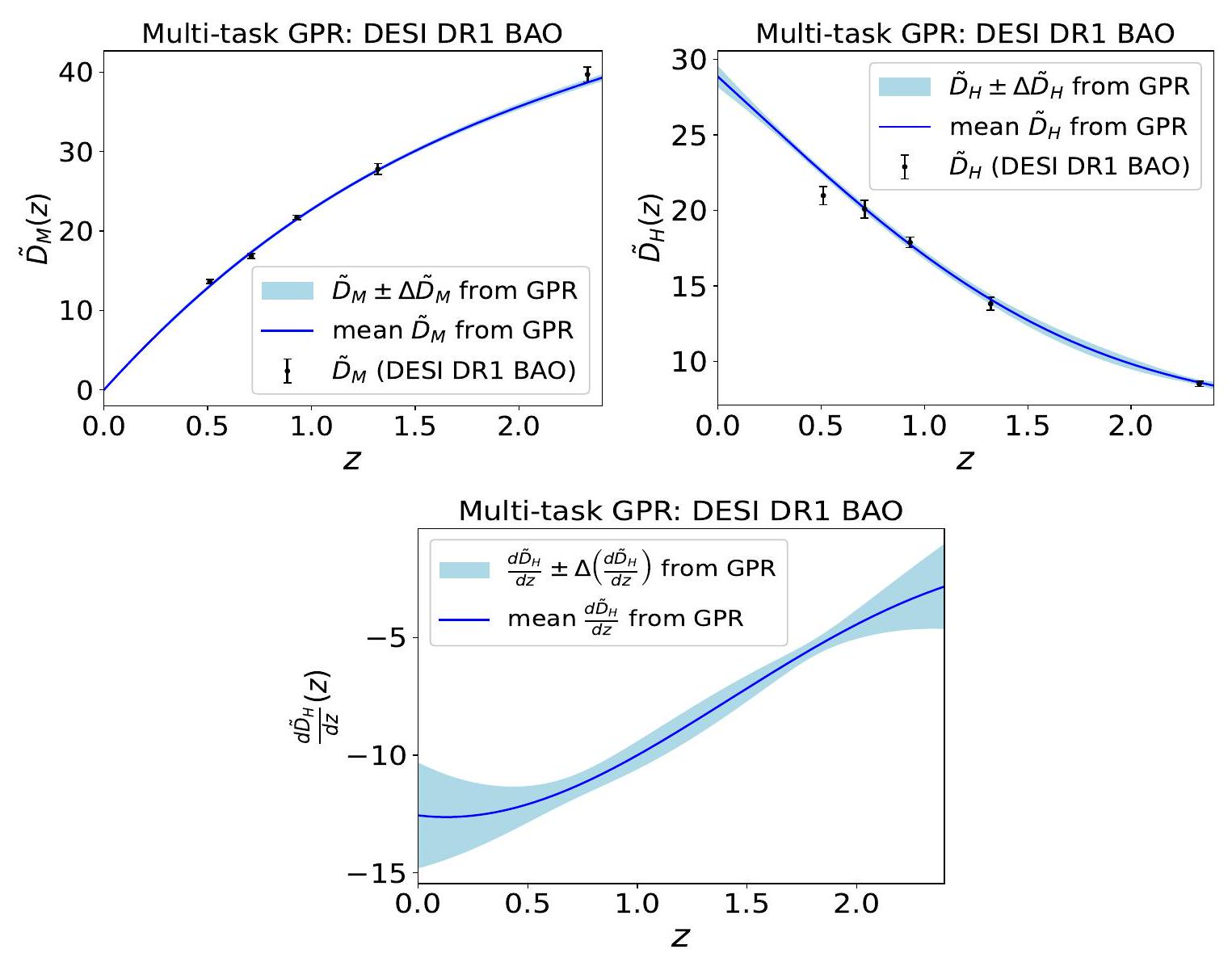
الشكل 1. إعادة بناء (أعلى اليسار)، (أعلى اليمين)، و (أسفل) من بيانات DESI DR1 BAO (الجدول 1)، باستخدام الانحدار متعدد المهام بواسطة عملية غاوسية. المناطق الزرقاء هي المعاد بناؤهافترات الثقة. الخطوط الزرقاء الصلبة تمثل القيم الأفضل ملاءمة. في الألواح العلوية، تتوافق القضبان السوداء مع بيانات BAO من DESI DR1.
تم تأكيد SNIa في نطاق الانزياح الأحمر [81]. نستبعد 111 منحنيات ضوئية عند الانزياحات الحمراء المنخفضة، لتجنب الاعتماد القوي على سرعة الخصوصية [82]. في تحليلنا، نحدد العينة الفرعية
في هذا القسم، نطبق منهجية الانحدار باستخدام العمليات الجبرية (GPR) الموضحة في الملحق ب، على مجموعات البيانات، من أجل إعادة بناء المسافات ثم معادلة حالة الطاقة المظلمة (أو الطاقة المظلمة الفعالة)..
4.1 DESI DR1 و BAO غير DESI
نبدأ ببيانات DESI DR1 BAO من و . لأن و مرتبطان والارتباطات كبيرة، لا يمكننا ببساطة استخدام نموذج GPR لمهمة واحدة فقط. تم مناقشته في القسم ب.1، بشكل فردي إلى و . بدلاً من ذلك، نحتاج إلى GPR متعدد المهام، الذي يتعامل مع التغاير بين متغير ومشتقته (انظر القسم B.2). بالتفصيل:
هو متجه جميع نقاط الانزياح الأحمر الفعالة.
هو متجه جميع القيم المتوسطة لـ.
منذهو متجه جميع القيم المتوسطة لـ.
هي مصفوفة جميع التغايرات الذاتية لـ.
هي مصفوفة جميع التغايرات المتقاطعة بين و .
هي مصفوفة جميع التغايرات الذاتية لـ.
نعتبر دالة التغاير الأساسية الأكثر شيوعًا، وهي الدالة الأسية المربعة، حيث يكون التغاير الأساسي بين و هو
أين و هما معلمتان فرعيتان للنواة. لاحظ أنه يجب اختيار نواة قابلة للاشتقاق على الأقل حتى الدرجة التي نريد منها التنبؤ من GPR. نواة الأس exponential المربعة قابلة للاشتقاق بلا حدود. لهذا السبب، يمكن استخدامها في أي مهمة GPR للتنبؤ بأي درجة من الدالة.
نحتاج أيضًا إلى دالة متوسطة لأداء مهمة GPR. نختار دالة الصفر المتوسطة لتجنب أي انحياز يعتمد على نموذج كوني.
بالمثل مع النواة، يحتاج دالة المتوسط إلى أن تكون قابلة للاشتقاق حتى الدرجة التي نريدها للتنبؤ. دالة المتوسط الصفري قابلة للاشتقاق بلا حدود وفي أي درجة، تكون دائمًا دالة المتوسط الصفري.
على الرغم من أن دالة المتوسط الصفري هي خيار شائع لتجنب أي انحياز يعتمد على نموذج كوني، إذا لم تكن جودة البيانات جيدة بما فيه الكفاية، فإن إعادة بناء GP ستعاني من انحياز نحو القيم الصفرية. وينطبق نفس الشيء على أي دالة متوسط أخرى مفترضة. إذا كانت جودة البيانات جيدة، فلن تكون النتائج المعاد بناؤها بواسطة GP منحازة بشكل كبير نحو دالة متوسط مختارة. لحسن الحظ، فإن تركيبات البيانات التي نعتبرها هنا جيدة بما يكفي لوضع قيود معقولة على تاريخ توسع الكون، ودالة المتوسط الصفري هي خيار آمن في تحليلنا. نحن نوضح ذلك بالتفصيل في الملحق F.
نستخدم المعلومات المذكورة أعلاه في (B.27)-(B.46) من أجل حساب اللوغاريتم الهامشي السالب. هذه دالة تعتمد على معلمات هايبر بارامتر النواة، بما في ذلك معلمات دالة المتوسط ومعلمات أخرى (إذا كانت موجودة). ثم نقوم بتقليل السالب من هذا.احتمالية هامشية للعثور على أفضل القيم الملائمة لجميع المعلمات.
تُستخدم قيم المعلمات الأفضل ملاءمة في التنبؤ بالوظائف (هنا ) ، (هنا ، و (هنا ) عند نقاط الانزياح الأحمر المستهدفة. نريد التنبؤات
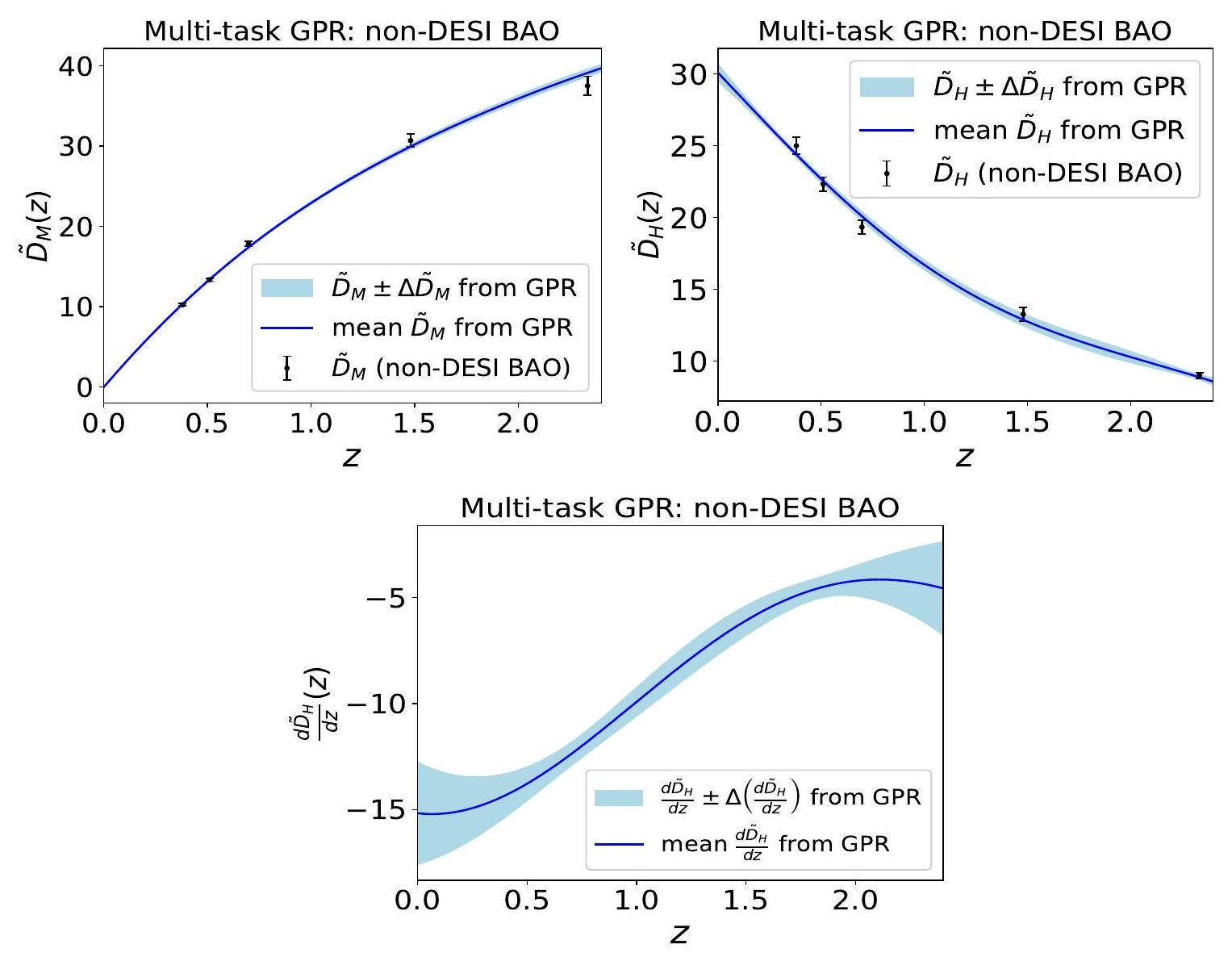
الشكل 2. كما في الشكل 1، لبيانات BAO غير المتعلقة بـ DESI (الجدول 2).
للدوال السلسة للانزياح الأحمرللقيام بذلك، نحتاج إلى النظر في عدد كبير من النقاط المستهدفة، ونستخدم
أخيرًا، نحصل على القيم المتوسطة لـ (المقابل لـ ) باستخدام (B.55) ومنطقة الثقة من توقع الجذر التربيعي للاعتمادية الذاتية (التباينات عند كل نقطة هدف) باستخدام (B.59). نقوم برسم هذه القيم في اللوحة العلوية اليسرى من الشكل 1. يتم تمثيل دالة المتوسط بواسطة الخط الأزرق المتصل والمنطقة ممثلة بالتظليل الأزرق. لمقارنة النتيجة المتوقعة من GPR مع بيانات DESI DR1 BAO الفعلية، نقوم أيضًا برسمبيانات مع أعمدة خطأ سوداء.
نرى أن التوقعات متسقة تمامًا مع البيانات. وبالمثل، نحصل على قيم المتوسط والانحراف المعياري لـ (المقابل لـ ) باستخدام (B.56) و(B.60)، الموضحة في الزاوية العلوية اليمنى من الشكل 1. نقارن هذه التنبؤات مع بيانات DESI DR1 BAO من خلال رسم بيانات مع أشرطة خطأ سوداء. هنا التوقعات متوافقة أيضًا مع البيانات.
توقعات للمتوسط والانحراف المعياري لـ (المقابل لـ )، باستخدام (B.57) و (B.61)، تظهر في اللوحة السفلية من الشكل 1. لاحظ أنه بالنسبة لتنبؤ المشتق من الدرجة الثانية هذا، لا توجد بيانات للمقارنة مع النتائج المتوقعة.
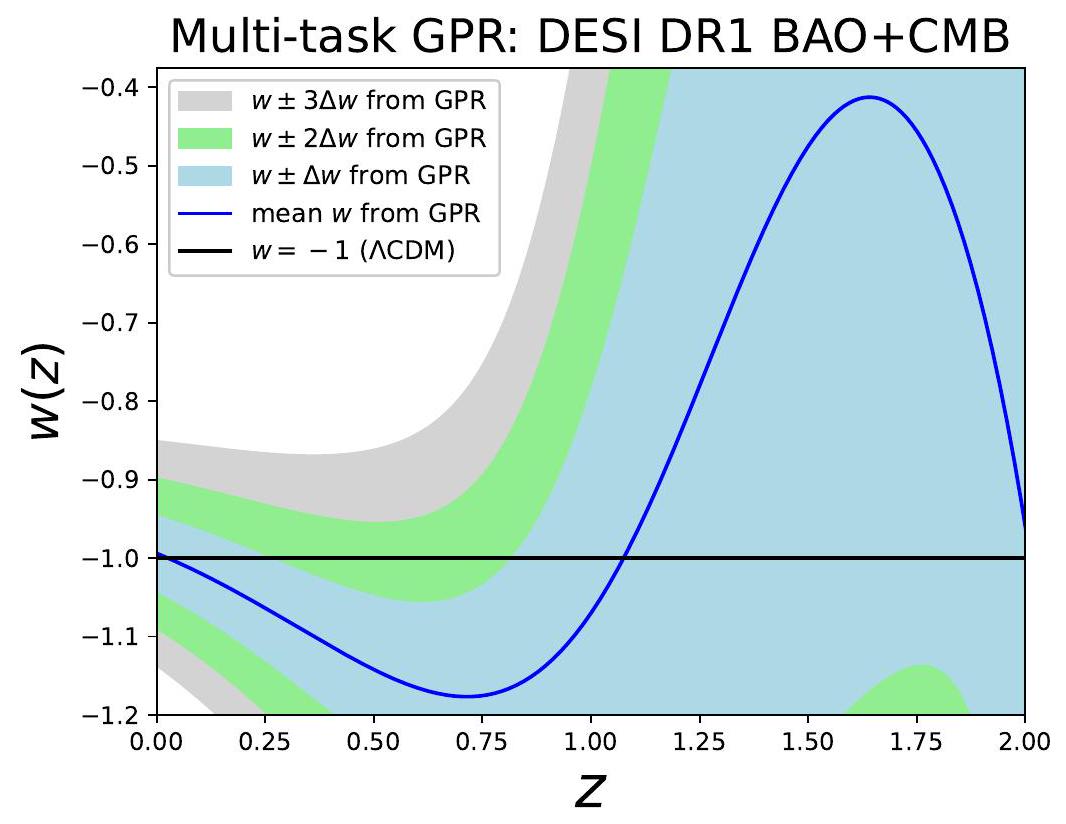
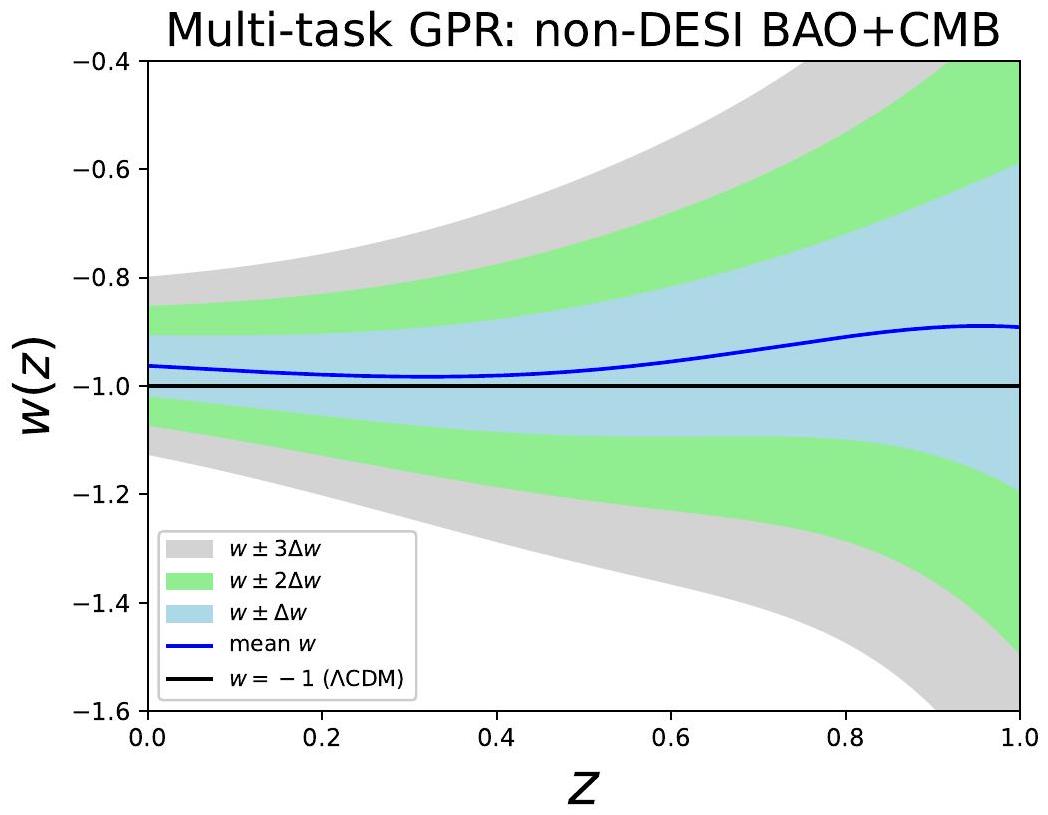
الشكل 3. تطور الانزياح الأحمر المعاد بناءه لمعادلة حالة الطاقة المظلمة (الفعالة) )، تم الحصول عليها عبر (2.11) من المعادلة المعاد بناؤها و (من DESI DR1 BAO مع GPR متعدد المهام)، مع القيود على المستمدة من (3.16) (بلانك 2018 CMB). التظليل الأزرق والأخضر والرمادي هو، و فترات الثقة لـالخط الأزرق هو القيمة الأفضل للتناسبوالخط الأسود هو ( ).
بالنسبة لـ BAO غير DESI، نتبع نفس الإجراء لحساب الدوال المتوسطة المتوقعة لـ، و وال correspondenteالمناطق. يتم عرضها في الشكل 2 بنفس رموز الألوان. تُظهر بيانات BAO غير DESI كنقاط سوداء مع أشرطة خطأ. نجد مرة أخرى أن القيم المتوقعة متوافقة مع البيانات.
4.2 CMB+DESI DR1 BAO و CMB+non-DESI BAO
بعد ذلك، من القيم المعاد بناؤها لـ، و نحسب تطور الانزياح الأحمر لـ باستخدام (2.11). لاحظ أنه من أجل حساب نحن بحاجة أيضًا إلى قيمةالمعطاة في (3.16)، والتي نجدها من نتائج CMB لعام 2018 من بلانك (مع الأخذ في الاعتبار فيزياء الزمن المبكر القياسية) لـ TT وTE وEE+lowE+التشويه. وبالتالي حسابيتطلب مجموعة من بيانات DESI DR1 BAO وبيانات CMB، المشار إليها بـ CMB+DESI DR1 BAO. كما يجب ملاحظة أنه عند حساب الأخطاء فيباستخدام انتشار عدم اليقين، نحتاج إلى قيم التغايرات المتقاطعة بين و بالإضافة إلى التغايرات الذاتية الخاصة بهم (التباينات). نقوم بحساب هذه التغايرات المتقاطعة باستخدام (B.64). الدالة المتوسطة المعاد بناؤها لـ (الخط الأزرق) و (أزرق)، (أخضر + أزرق) و تظهر مناطق الثقة (الرمادي + الأخضر + الأزرق) في الشكل 3.
من الواضح أنه بالنسبة لنطاق الانزياح الأحمرأفضل معادلة حالة تناسب هي الشبح ونموذج CDM هوبعيدًا. حول، هناك معبر شبح وبعد ذلكليس وهميًا. ومع ذلك، فإن هذا العبور الوهمي ليس ذا أهمية كبيرة، لأنالنموذج ضمنحد عند.
بالنسبة لبيانات CMB+non-DESI BAO، نتبع نفس الإجراء لحساب والأخطاء المرتبطة بها. تظهر النتائج في الشكل 4 بنفس رموز الألوان كما في الشكل 3.
الشكل 4. كما في الشكل 3، بالنسبة لـ CMB+non-DESI BAO (GPR متعدد المهام).
في حالة عدم وجود DESI،نموذج CDM هو ضمنالمنطقة لكامل نطاق الانزياح الأحمر.
4.3 DESI DR1 BAO+بانثيون بلس
بعد ذلك، نقوم بدمج بيانات DESI DR1 مع بيانات PantheonPlus. نحن لا نأخذ في الاعتبار أيالمعلومات السابقة، حيث يمكن أن يقيّد دمج هذه المجموعات البيانية في المبدأمعامل باستخدام قيود CMB علىيمكن رؤية ذلك من خلال العلاقة بين المتغيرات و : من (2.10) و (2.15)، نجد
وبالمثل، باستخدام (2.4) و(4.4)، نحصل على
تشير هذه المعادلات إلى أن مجموعة من ملاحظات SNIa و BAO تحدد المعامل. نحن نستخدم من BAO كدالة لـ عبر (4.4). نستخدم أيضًا PantheonPlus . ثم نطبق GPR متعدد المهام، حيث يتم توفير معلومات المشتق الأول بواسطة
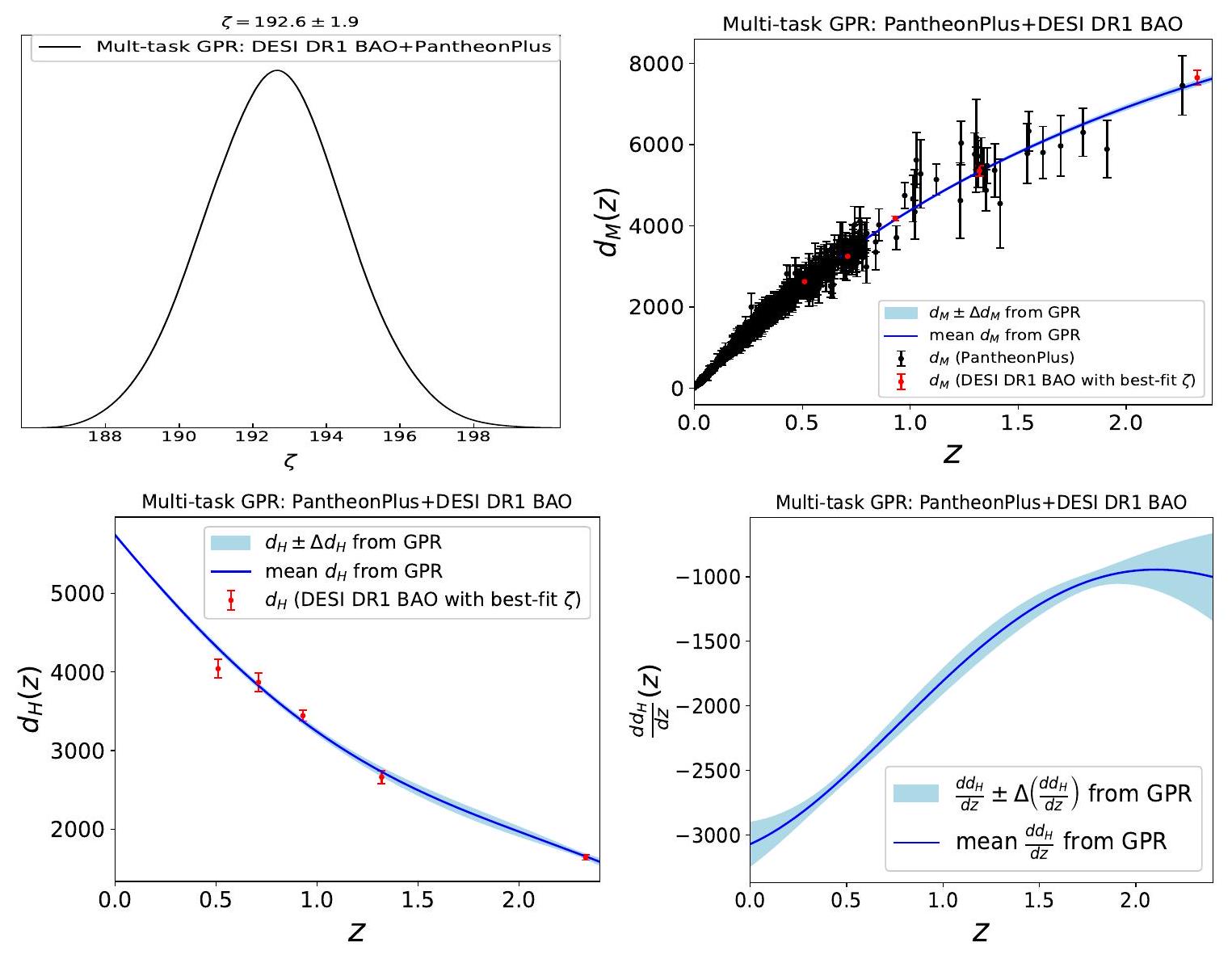
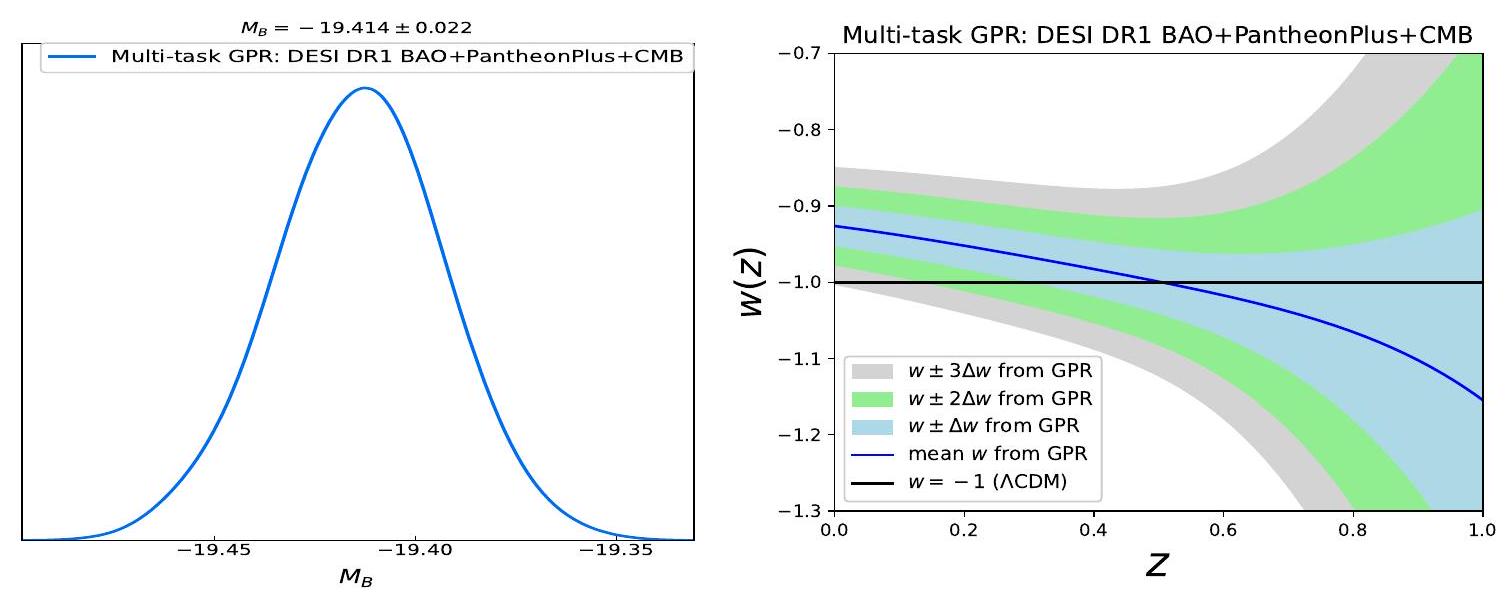
الشكل 5. تحليل GPR متعدد المهام لمجموعة DESI DR1 BAO+PantheonPlus. توزيع الاحتمالات الهامشية لـمعامل (الزاوية العليا اليسرى). تظهر أشرطة الخطأ السوداء (الزاوية العليا اليمنى) من الملاحظبيانات PantheonPlus، باستخدام (2.15) (كما في الشكل 10). تظهر القضبان الحمراء للأخطاءلـ DESI DR1 BAO من (أعلى اليمين) أو من (أسفل اليسار)، باستخدام القيد على الخطوط الصلبة الزرقاء والتظليل في الزاوية العليا اليمنى، والزاوية السفلى اليسرى، والزاوية السفلى اليمنى تتوافق مع إعادة بناءوالمتعلقة بـمناطق الثقة.
من DESI DR1 BAO كدالة لـباستخدام (4.6). هذا يتوافق مع
ثم نقوم بإجراء تحليل GPR متعدد المهام. إن تقليل اللوغاريتم السالب لاحتمالية الهامش يوفر قيودًا على معلمات النواة بالإضافة إلى :
احتمالية الهامشالمستخلص من التقليل موضح في الزاوية العليا اليسرى من الشكل 5.
الشكل 6. من أجل التركيبةDR1 BAO+PantheonPlus (GPR متعدد المهام)، تُظهر اللوحة اليسرى الاحتمالية الهامشية لـمعامل، تم الحصول عليه من القيود علىومن الـالافتراض الغاوسي في (3.10). المعاد إعادة بناؤهاومناطق الثقة المرتبطة بها معروضة في اللوحة اليمنى، باستخدام (2.16)، (2.17) و(3.15) مع النتائج التي تم الحصول عليهاالقيود.
في الزاوية العلوية اليمنى من الشكل 5، نرسم المعادلة المعاد بناؤهاوالمتعلقة الثقة (الخط الأزرق الصلب والتظليل). تظهر الأشرطة السوداء للخطأ (في أعلى اليمين) تم الحصول عليها مباشرة من بيانات PantheonPlus لـ باستخدام (2.15). تشير القضبان الحمراء للخطأ أيضًا إلى ولكن تم الحصول عليه من بيانات DESI DR1 BAO لـ، باستخدام القيد على في (4.12). نرى أن الدالة المعاد بناؤها التي تم الحصول عليها منمن GPR متعدد المهام يتماشى معالمستمدة من كل من بيانات PantheonPlus وبيانات DESI DR1 BAO.
المتوقعوالمتعلقةفترات الثقة موضحة في الزاوية السفلية اليسرى من الشكل 5 باللون الأزرق. في نفس اللوحة، تتوافق القضبان الحمراء معالمستمدة من بيانات DESI DR1 BAO لـوالقيود على باستخدام (4.12). من الواضح أن التنبؤ بـيتماشى معالمستمدة من DESI DR1 BAO (مع القيمة).
وبالمثل، المشتق الثاني المتوقعوالمرتبطتظهر منطقة الثقة في اللوحة السفلية اليمنى من الشكل 5. في هذه الحالة، لا توجد بيانات لمقارنة النتيجة المتوقعة من GPR متعدد المهام.
4.4 CMB+DESI DR1 BAO+بانثيون بلس
في اللوحة اليسرى من الشكل 6، نرسم الاحتمالية الهامشية لـمعامل. يتم الحصول على ذلك باستخدامالقيود والافتراض الغاوسي المذكور في (4.12) و (3.10) على التوالي. لأننا ندرجقبل من CMB لكسر التماثل بين و ، هذا يتوافق مع تضمين بيانات الخلفية الكونية الميكروية والقيود على من CMB + DESI DR1 BAO + PantheonPlus هو
لاحظ أن هذه القيمة لـأصغر من قيمة الأحذية. من المعاد بناءه، قيد على من (4.13)، وقيود علىمن (3.15)، نحسب والأخطاء المرتبطة باستخدام (2.16) و (2.17). تم رسمها في اللوحة اليمنى من الشكل 6. الخط الأزرق الصلب، المنطقة الزرقاء، المنطقة الخضراء (بما في ذلك المنطقة الزرقاء)، والمنطقة الرمادية (بما في ذلك المناطق الزرقاء والخضراء) تت correspond إلى الدالة المتوسطة لـ مرتبطمناطق الثقة على التوالي. نرى أنه عند مستويات أدنى
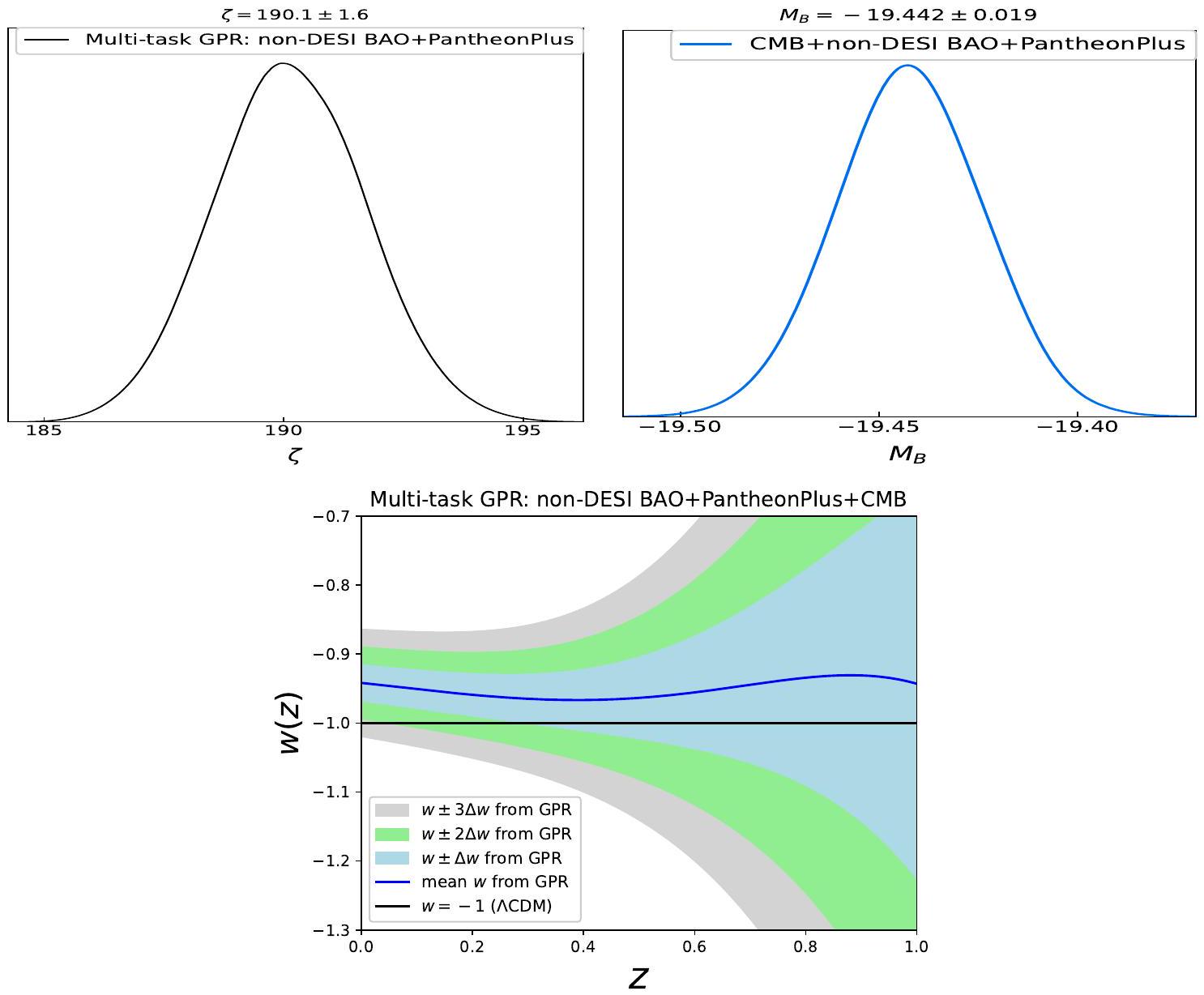
الشكل 7. تركيبات BAO غير DESI + PantheonPlus و CMB + BAO غير DESI + PantheonPlus، باستخدام GPR متعدد المهام. الألواح العلوية: احتمالات هامشية لـ، بدون CMB (يسار) و، مع CMB (يمين). تم إعادة بناءومناطق الثقة المرتبطة بها موضحة في اللوحة السفلية لـ CMB+non-DESI BAO+PantheonPlus (GPR متعدد المهام) باستخدام نفس المنهجية كما في الأشكال 5 و 6.
الانزياحات الحمراءتُفضل المناطق غير الوهمية لمجموعة بيانات CMB + DESI DR1 BAO + PantheonPlus. في هذه المنطقة من الانزياح الأحمر،نموذج CDM يدور حول أكثر منأقل منبعيدًا (يتناقص تدريجيًا مع زيادة الانزياح الأحمر) عن المتوسط المعاد بناؤه لـوفي مناطق الانزياح الأحمر الأخرى، فإنه يقع ضمنمناطق الثقة.
4.5 CMB+غير DESI BAO+بانثيون بلس
بالنسبة لبيانات BAO غير DESI، نبدأ بدمج GPR متعدد المهام مع PantheonPlus، دون استخدام معلومات CMB. نجد قيدًا على،
تقديم بيانات CMB عبر القيود، نحصل على قيود على الـ معامل لـ CMB+non-DESI BAO+PantheonPlus:
دمج البيانات
[مج]
ديزي
–
–
–
غير ديسي
–
–
–
ديزي + بي بي
–
–
–
غير ديسي + بي بي
–
–
–
CMB+DESI
–
CMB+غير DESI
–
CMB+DESI+PP
CMB+غير DESI+PP
الجدول 3. القيم المعاد بناؤها لـ و . تشير PP إلى بيانات PantheonPlus (3.17).
لاحظ أن هذه القيمة أصغر قليلاً من تلك التي تم الحصول عليها من CMB + DESI DR1 BAO + PantheonPlus في (4.13). الاحتمالات الهامشية المقابلة لـ و مُعروضة في اللوحات العلوية اليسرى واليمنى من الشكل 7.
باتباع نفس المنهجية كما في الحالة السابقة، نقوم بإعادة بناءومناطق الثقة المرتبطة بها. يتم عرضها في اللوحة السفلية من الشكل 7. نجد أنه في نطاق الانزياح الأحمرالمعاد بناءهيفضل أن يكون في المنطقة غير الوهمية بأكثر منالثقة. في نفس نطاق الانزياح الأحمر،نموذج CDM يدور حولإلىبعيدًا وفي مناطق أخرى، هو ضمنمنطقة.
4.6 الثوابت المعاد بناؤها والتحقق من التناسقCDM
بمجرد أن نحصل على جميع الدوال المعاد بناؤها المقابلة وبالتالي قيمها الحالية (نحصل على قيود على الثوابت المستخدمة في التحليل الكوني. نقوم بحساب هذه الثوابت باستخدام تركيبات من مجموعات البيانات على النحو التالي:
تُدرج قيم المتوسط والانحراف المعياري في الجدول 3. بمجرد أن نعرف و بشكل منفصل، يمكننا التحقق من اتساق الـنموذج مع تركيبات مختلفة من البيانات بطريقة أخرى من خلال المعامل
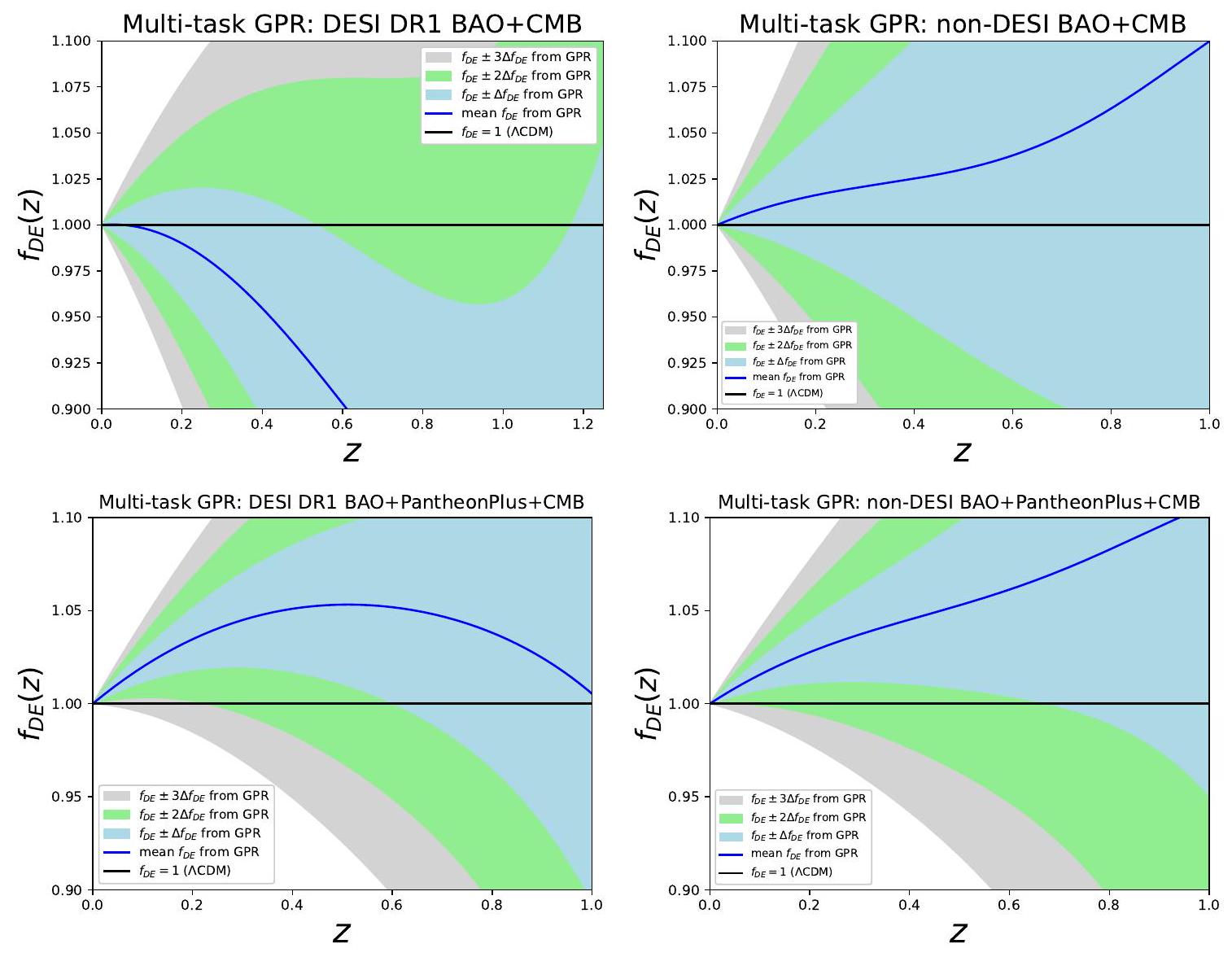
الشكل 8. إعادة بناءاستخدام (4.21) باستخدام بيانات CMB+DESI DR1 BAO، CMB+non-DESI BAO، CMB+DESI DR1 BAO+PantheonPlus وCMB+non-DESI BAO+PantheonPlus. الخطوط الزرقاء هي القيم المتوسطة لـالمستمدة من تحليل GPR متعدد المهام. مناطق الثقة تتوافق مع، و الخطوط السوداء الأفقية تتوافق مع.
لـنموذج،باستخدام (2.1) و (2.6)
هذا يسمح لنا بإعادة كتابةمن حيث المتغيرات الأخرى المستخدمة في تحليلنا. الشكل 8 يوضح الدالة المعاد بناؤهاللمجموعات البيانية
BAO من CMB+DESI DR1، BAO من CMB+غير DESI DR1 BAO+بانثيون بلس، CMB+غير DESI BAO+بانثيون بلس. الخطوط الزرقاء الصلبة تعطي المتوسط المعاد بناؤهتتوافق المناطق الزرقاء والخضراء (بما في ذلك الزرقاء) والرمادية (بما في ذلك الزرقاء والخضراء) مع، و مناطق الثقة. تمثل الخطوط السوداء الأفقية، بما يتوافق مع المعيارنموذج.
بالنسبة لمجموعة بيانات CMB+DESI DR1 BAO، نجد أننموذج CDM هو أكثر بقليل منبعيدًا في نطاق الانزياح الأحمر. في مناطق الانزياح الأحمر الأخرى، هو ضمن المنطقة. هذا يعني أنه لا توجد انحرافات كبيرة عن الـنموذج في مجموعة بيانات CMB+DESI DR1 BAO.
لـمن خلال مجموعة بيانات DESI DR1 BAO + PantheonPlus، نجد أنه في الـ النموذج هو أكثر بقليل منبعيداً. في، الـ النموذج حواليإلىبعيدًا (يتناقص تدريجيًا مع زيادة الانزياح الأحمر). في مناطق الانزياح الأحمر الأخرى، يكون ضمنحد. هذا يعني أن الانحرافات منخفضة إلى متوسطة، لكنها ليست ذات دلالة كبيرة.
لتركيبة بيانات CMB+non-DESI BAO،النموذج ضمنالمنطقة في كامل منطقة الانزياح الأحمر. هذا يعني أنه لا يوجد دليل على الانحرافات عننموذج CDM.
بالنسبة لمجموعة بيانات CMB+non-DESI BAO+PantheonPlus، فإننموذج CDM هو أكثر بقليل منبعيدًا في نطاق الانزياح الأحمر حولوهو ضمنالمنطقة في مناطق الانزياح الأحمر الأخرى. هذا يعني أنه بالنسبة لهذا التركيب من البيانات، فإن الانحرافات عننموذج CDM معتدل.
4.7 توتر هابل،التوتر وارتباطه بـ
تظهر الجدول 3 علاقات مثيرة للاهتمام بين، و التي تحمل توتر هابل والمتعلق بـالتوتر. هذا التوتر هو الخلاف بين القياس المباشر ذو الانزياح الأحمر المنخفض من SNIa والقياس غير المباشر من الخلفية الكونية الميكروية (CMB).
المعاد بناءهالقيم، حيث لا تتعلق بيانات الأحذية أو المعنيةقيمةلا يُعتبر، أقل منتم الحصول عليها من بيانات SHOES من معايرة SNIa وملاحظات المتغيرات سيفيد. هذه هي التوتر المعروف في هابل [89-91].
يمكن تطبيق استنتاج مشابه لـ، الذي يتوافق مع التوتر [92-94].
نرى أنه كلما زادت قيمةكلما زادت قيمة، والعكس صحيح عندما تكون بيانات SNIa متضمنة. وهذا واضح أيضًا في الجدول 4 في الملحق D.3. هذه حقيقة معروفة جيدًا في علم الكونيات [92-94].
لا نجد أي ارتباط فوري بين و عندما لا تكون بيانات SNIa متضمنة. ومع ذلك، عندما تكون بيانات SNIa (بانثيون بلس) متضمنة، نرى زيادة أعلى، الذي يتوافق مع القيمة الأعلى لـ عند الانزياح الأحمر المنخفض. ينطبق نفس الشيء على العلاقة بين و . وبالمثل، ينطبق العلاقة العكسية بين و عند الانزياح الأحمر المنخفض عندما تكون بيانات SNIa متضمنة.
يوجد ارتباط عكسي بين و عندما تكون بيانات CMB متضمنة (مع أو بدون SNIa) [95، 96]. يوجد نفس الارتباط العكسي بين و عندما تكون بيانات SNIa متضمنة. يمكن رؤية ذلك أيضًا في الجدول 4 في الملحق D.3. هذه أيضًا حقيقة معروفة جيدًا في علم الكونيات.
5 استنتاجات
تشير النتائج الأخيرة من بيانات DESI DR1 BAO [1] إلى وجود دليل على الطاقة المظلمة الديناميكية، مع تفضيل لسلوك الشبح في نطاقات انزياح أحمر كبيرة. تعتمد هذه النتائج على معادلة حالة معلمة ظاهريًا.لطاقة الظلام (أو الطاقة المظلمة الفعالة). نظرًا للقيود المفروضة على فرض مثل هذه المعادلة للحالة، استخدمنا نهجًا غير مرتبط بنموذج لإعادة بناءمباشرة من البيانات.
بالإضافة إلى بيانات DESI DR1 BAO، أخذنا في الاعتبار بيانات BAO الأخرى غير التابعة لـ DESI، وبيانات مسافة CMB من Planck 2018، وبيانات SNIa من PantheonPlus. تعتمد المنهجية غير المعتمدة على نموذج على الانحدار البسيط (مهمة واحدة) باستخدام عملية غاوسية خلفية، بالإضافة إلى الانحدار باستخدام عملية غاوسية متعددة المهام. يتطلب استخدام عملية غاوسية متعددة المهام دمج الارتباط بشكل صحيح بين الملاحظات غير المتجانسة لـ BAO الموازية والعمودية على خط الرؤية.
من بيانات مجموعة CMB+DESI DR1 BAO (انظر الشكل 3)، نجد أن الدالة المتوسطة المعاد بناؤهاعلى الجانب الشبح؛ ومع ذلك، فإن هذه الأدلة ليست ذات دلالة. لتكون أكثر تحديدًا، في نطاق الانزياح الأحمر، الـ النموذج هو أكثر بقليل منبعيدًا، بينما في فترة الانزياح الأحمر الأخرى يكون ضمنحد.
في الشكل 6، عندما نأخذ في الاعتبار بيانات SNIa من PantheonPlus، فإن إعادة بناء الانزياح الأحمر المنخفض لـتسيطر على هذه البيانات، التي تفضل السلوك غير الوهمي. تؤدي بيانات CMB + DESI DR1 BAO + PantheonPlus إلى إعادة بناءهذا ليس في تناقض معنموذج – الذي هوإلىبعيدًا في نطاق الانزياح الأحمر.
عندما نستبدل بيانات DESI DR1 BAO ببيانات BAO غير DESI السابقة، باستخدام التركيبات CMB+BAO غير DESI (الشكل 4) وCMB+BAO غير DESI+PantheonPlus (الشكل 7)، لا نجد أي دليل على الانحراف عن الـنموذج CDM، الذي يقع ضمن و الحدود على التوالي.
نحن أيضًا نحسب القيود على الثوابت المختلفة المعنية في تحليل كوني، مثل ثابت هابل والقيمة الحالية لمعلمة كثافة طاقة المادة. تعكس هذه القيود توتر هابل وما يتناسب معه.التوتر. عندما تُستخدم بيانات SNIa، نلاحظ ارتفاعًا فيمع ارتفاع متناسبعند الانزياح الأحمر المنخفض.
أخيرًا، نقوم بإعادة بناء معامل كثافة الطاقة المظلمة المعاير،، كأداة للتحقق من اتساق الـنموذج CDM مقابل جميع هذه الملاحظات في الشكل 8. نجد استنتاجًا مشابهًا: الانحرافات عن الـ قيمة ( ) ليست ذات أهمية كبيرة.
لاحظ أن جميع هذه النتائج تستخدم قيود المسافة من إشعاع الخلفية الكوني، والتي تم الحصول عليها من القاعدة القياسية.نموذج بدلاً من احتمال CMB الكامل. ستكون النتائج مشابهة لنماذج أخرى من الكوزمولوجيا، بشرط أن لا يختلف النموذج المعتمد بشكل كبير عن الأساس.نموذج CDM.
باختصار، تشير طريقتنا المستقلة عن النماذج إلى وجود أدلة منخفضة بشكل كبير على الطاقة المظلمة الديناميكية، وهذه الأدلة ليست قوية بما يكفي لاستنتاج قاطع بوجود أدلة على الطاقة المظلمة الديناميكية.
شكر وتقدير
يدعم المؤلفون مرصد جنوب أفريقيا لرصد الراديو ومؤسسة البحث الوطنية (رقم المنحة 75415).
حساب لـ و من قيود المسافة من إشعاع الخلفية الكوني
أفق الصوت هو
للأوقات المبكرة
أين و هو القيمة الحالية لمعلمة كثافة طاقة الفوتون. في أوقات مبكرة كافية من اهتمامنا، يمكن تقريب معامل هابل بواسطة
أينهو القيمة الحالية لمعلمة كثافة طاقة الإشعاع. في هذه التقريب، أفق الصوت هو [25]
حيث [25، 76-79]
هنا و عند تساوي الإشعاع والمادة [25، 76-79]:
الانزياح نحو الأحمر لحقبة انفصال الفوتونلديه تعبير تقريبي لفيزياء الزمن المبكر القياسية [25، 76-79]:
أين
وبالمثل، انزياح الطيف لعصر سحب الباريونات له تعبير تقريبي في فيزياء الزمن المبكر القياسية [76]:
أين
بالنظر إلى جميع التعبيرات المذكورة أعلاه، نجد أن كلا من و هي دوال فقط و .
ب عملية الانحدار باستخدام العمليات الغاوسية
ب. 1 الانحدار باستخدام عملية غاوسية لمهمة واحدة حتى مشتق من الدرجة الثانية
تحليل الانحدار باستخدام العمليات الغاوسية (GPR) مفيد للتنبؤ بدالة سلسة من مجموعة بيانات معينة. دعنا نرمز إلى متجهات نقاط البيانات والقيم المرصودة لأي observable بـ و على التوالي مع الأخطاء الملاحظة المشار إليها بمصفوفةيتوافق مع جميع التباينات والتغايرات. يعتبر GPR مفيدًا فقط إذا كانت هذه الأخطاء غاوسية. مع هذا الشرط، في تحليل GPR، تُعتبر مجموعات البيانات توزيعًا غاوسيًا متعدد المتغيرات (طبيعي) مع دالة تغاير نواة محددة.ودالة متوسطة :
أينهو توزيع غاوسي متعدد المتغيرات مشترك،هو متجه المتوسط المقابل لدالة المتوسط المختارة عند و هو مصفوفة التغاير الكلية:
الصيغة المتجهة الدقيقة لـوأشكال المصفوفات لـ و مقدمة في الملحق ج.
ب.1.1 تدريب نموذج GPR لمهمة واحدة
قبل أي توقع من GPR، يتم تدريبه في نهج لاحق عن طريق تقليل السالب للاحتمالية الهامشية اللوغاريتمية.
أين هو العدد الإجمالي لنقاط البيانات، والرمز يمثل محدد أي مصفوفة. نستخدم هذا الرمز لمحدد المصفوفة طوال هذا التحليل. يتم وصف دالة التغاير للنواة بواسطة معلمات النواة الفائقة، وتُستخرج أفضل القيم لهذه المعلمات من تقليل الاحتمالية الهامشية السالبة، المذكورة أعلاه.
ب.1.2 التنبؤ من GPR لمهمة واحدة
تُستخدم القيم المناسبة الأفضل، التي تم الحصول عليها من تقليل اللوغاريتم السالب للاحتمالية الهامشية، المذكورة في (B.6)، لتوقع الدالة أو قيم الدالة عند مجموعة محددة من النقاط المستهدفة. يمكن اعتبار القيم المتوقعة للدالة ومشتقاتها توزيعًا غاوسيًا مشتركًا متعدد المتغيرات مع البيانات الملاحظة. التوزيع حتى توقع المشتق من الدرجة الثانية للدالة هو
حيث تحت السطر ‘ ‘ يتوافق مع النقاط المستهدفة حيث يتنبأ GPR بقيم دالة ومشتقاتها. جميع الرموز المختصرة المستخدمة أعلاه هي رموز قياسية. للحصول على فكرة عن هذه الرموز المختصرة، نقوم بإدراجها في الملحق C. تعتمد تنبؤات GPR على التوزيعات الشرطية التي تتوافق مع التوزيع الاحتمالي المشترك لـ (لـ ، و معطى و يمكن رؤيتها بسهولة إذا قمنا بإعادة كتابة التوزيع المشترك (B.7) على النحو التالي
أين
لاحظ أنه يمكن اعتبار، و بشكل منفصل لتوزيع شرطي لإيجاد القيم المتوسطة والتغايرات الذاتية لكل كمية، ولكن هذا لا يمكن أن يعطي توقعًا للتغايرات المتقاطعة. ستكون النتائج هي نفسها بالنسبة للقيم المتوسطة والتغايرات الذاتية. التوزيع الشرطي لتوقعمعطىالذي يتوافق مع التوزيع المشترك الغاوسي بالشكل المعطى في (B.8) يصبح
أين و يتم التنبؤ بالمتوسط (المتجه) والتغاير (المصفوفة) على التوالي. طوال هذا التحليل، يشير الخط العلوي على أي كمية إلى متوسط تلك الكمية. عند وضع التعبيرات المقابلة لـ (B.9) و (B.11) في (B.13)، نحصل على المتوسط المتوقع للدالة ومشتقاتها عند النقاط المستهدفة:
يمكن دمج المعادلات الثلاثة أعلاه كالتالي
حيث النص العلويهو ترتيب المشتق. يمكن أيضًا استخدام التعبير العام أعلاه لتوقع القيم المتوسطة للمشتقات من الدرجة الثالثة وما فوق. من خلال وضع التعبيرات المقابلة لـ (B.10) و (B.11) و (B.12) في (B.14)، نحصل على التقديرات الذاتية للتغايرات،
وبالمثل، باستخدام (B.10)-(B.12) في (B.14)، نجد التغايرات المتقاطعة:
يمكن كتابة المعادلات الستة أعلاه على النحو التالي
يمكن استخدام هذا التعبير العام للاشتقاقات من الدرجة الثالثة وما فوق.
ب. 2 الانحدار متعدد المهام GP حتى المشتق من الدرجة الثانية
الهدف الرئيسي من هذا التحليل هو استخدام GPR في ملاحظات BAO. لأن هناك تباينات كبيرة بين و ، يجب ألا نطبق GPR البسيط على كل منها بشكل منفصل. لهذا الغرض، نعتبر GPR متعدد المهام حيث يتم أخذ معلومات الدالة في الاعتبار.ومشتقها الأوليتم اعتباره في الوقت نفسه عند نقاط البيانات و على التوالي. لاحظ أنه في مجموعة بيانات BAO، تكون الدالة ومشتقتها في نفس نقاط البيانات، ولكن هنا من أجل عمومية المنهجية، نعتبر و أن تكون مختلفة بشكل عام (يمكن أن تكون المجموعة الفرعية هي نفس نقاط البيانات). في هذه الحالة، نفترض أن و يتبع توزيع غاوسي متعدد المتغيرات المشترك
أين هو المتجه المشترك الذي يتكون من المتجه تليها المتجه هو المتجه المشترك الذي يتكون من المتجه تليها المتجهة، و هو مصفوفة الكتل المشتركة التي تتكون من المصفوفات، و :
في (ب.29)،، و تتوافق مع التغايرات الذاتية الكلية لـإجمالي التغايرات المتقاطعة بين و إجمالي التغايرات المتقاطعة بين و وإجمالي التغايرات الذاتية لـ :
هنا، و هي التغايرات الذاتية لـالتغايرات المتقاطعة بين و التغايرات المتقاطعة بين و والتغايرات الذاتية لـعلى التوالي، مما يتوافق مع المساهمة الناتجة فقط عن الأخطاء الملاحظة. الأشكال الفعلية لهذه المصفوفات موضحة في الملحق ج.
ب.2.1 تدريب نموذج GPR متعدد المهام
مماثل للحالة السابقة، هنا أيضًا يتم تدريب GPR عن طريق تقليل
أينهو متجه نقاط البيانات المشتركة الذي يتكون من المتجه يتبعها المتجه و هو العدد الإجمالي لنقاط البيانات في الملاحظات المتعلقة بالدالة ومشتقتها الأولى. ثم بعد ذلك تكون أبعاد المتجه هو
محدد مصفوفة الكتليمكن التعبير عنها بواسطة محددات مصفوفاتها المكونة.
وضع (B.35) و (B.44) و (B.45) في (B.34)، نحصل على
ب.2.2 التنبؤ من GPR متعدد المهام
البيانات الملاحظة للدالة الرئيسيةومشتقهاويمكن تمثيل القيم المتوقعة للدالة ومشتقاتها بواسطة توزيع غاوسي مشترك متعدد المتغيرات:
هنا التدوينات قياسية لجميع المتجهات والمصفوفات وهذه موضحة في الملحق ج. يمكن إعادة كتابة هذا التوزيع في شكل مكافئ للشكل في (ب.7) باستخدام التعريفات لـ، و من (ب.27)-(ب.29):
هنا
بالمثل،
عند مقارنة نفس الهيكل بين (B.7) و(B.48)، نجد توقعات بنفس الهيكل. بالنسبة للقيم المتوسطة للدوال ومشتقاتها:
يمكن كتابة هذه المعادلات على النحو التالي
التي يمكن استخدامها لتوقع القيم المتوسطة للمشتقات من الدرجة الثالثة وما فوق. وبالمثل، نحصل على التوقع للتغايرات الذاتية.
وللتغايرات المتقاطعة،
يمكن كتابة المعادلات الستة أعلاه بالشكل
يمكن أيضًا استخدام هذا التعبير العام للمشتقات من الدرجة الثالثة وما فوق.
ب. 3 استعادة GPR لمهمة واحدة من GPR لمهام متعددة
يمكننا استعادة نتائج GPR لمهمة واحدة إذا لم يكن لدينا أي معلومات من مشتق الدالة الرئيسية.. يمكن القيام بذلك إما عن طريق إزالة جميع الكميات المكونة من البيانات في المشتق الأول للدالة أو يمكن القيام بذلك عن طريق تحديد الانحراف المعياري في المشتق للدالة الذي يتوافق مع أخطاء الملاحظة اللانهائية، أي،
باستخدام هذا في (B.40)، نحصل على مصفوفة الصفر:
من (B.37)-(B.43)،
ثم (B.44) يعطي
باستخدام (B.67) و (B.70) في (B.46)، يصبح اللوغاريتم الهامشي السلبي للاحتمالية
مظهرًا أنه لا توجد قيود تأتي من معلومات المشتق. الآن يمكننا أن نرى أنه إذا استخدمنا (B.69) في (B.55)-(B.58)، فإننا نستعيد النتائج القياسية لـ (B.15)-(B.18)، حيث لا توجد معلومات عن مشتق الدالة. وبالمثل، فإن وضع شروط (B.68) في (B.59)-(B.65) يعيد لنا النتائج القياسية (B.19)-(B.25).
تدوين C المستخدم في تحليل GPR
هنا ندرج جميع الرموز القصيرة التي تم استخدامها في تحليل GPR في النص الرئيسي. الرموز القصيرة للمتجهات هي كما يلي:
أين هو عدد النقاط، حيث نريد التنبؤات من GPR للدالة ومشتقاتها. مشابهة لرموز المتجهات في (C.1)، تنطبق نفس القاعدة على رموز المتجهات.، و من البعد.
مصفوفة التغايرالمطابقة للتغايرات الذاتية للدالة الرئيسية له الشكل المصفوفي المعطى كـ
أين و تشغيل من 1 إلى. سننظر أيضًا في المؤشرات و التي تمتد من 1 إلىوالمؤشرات و التي تمتد من 1 إلى :
مصفوفة التغايرالمطابقة لتغايرات التقاطع للدالة الرئيسيةومشتقهايمتلك الشكل المصفوفي
مصفوفة التغايرالمطابقة للتغايرات الذاتية لمشتقة الدالةيمتلك الشكل المصفوفي
التدوينات القصيرة للمصفوفات الأخرى هي
تُطبق نفس رموز المصفوفات على مصفوفات أخرى بنفس القواعد. بعض رموز المصفوفات ذات الصلة مدرجة أدناه دون عرض المصفوفة الفعلية:
وهكذا، حيث و هي أوامر التفاضل للنواة بالنسبة للحجتين الأولى والثانية.
تطبيق GPR ذو المهمة الواحدة على بيانات PantheonPlus ودوره
مجموعة بيانات بانثيون بلس (3.17) توفر السطوع الظاهروأيضًا بيانات عن معامل المسافة، تم الحصول عليه من المعايرة مع قياسات سيفيد المحلية من SHOES
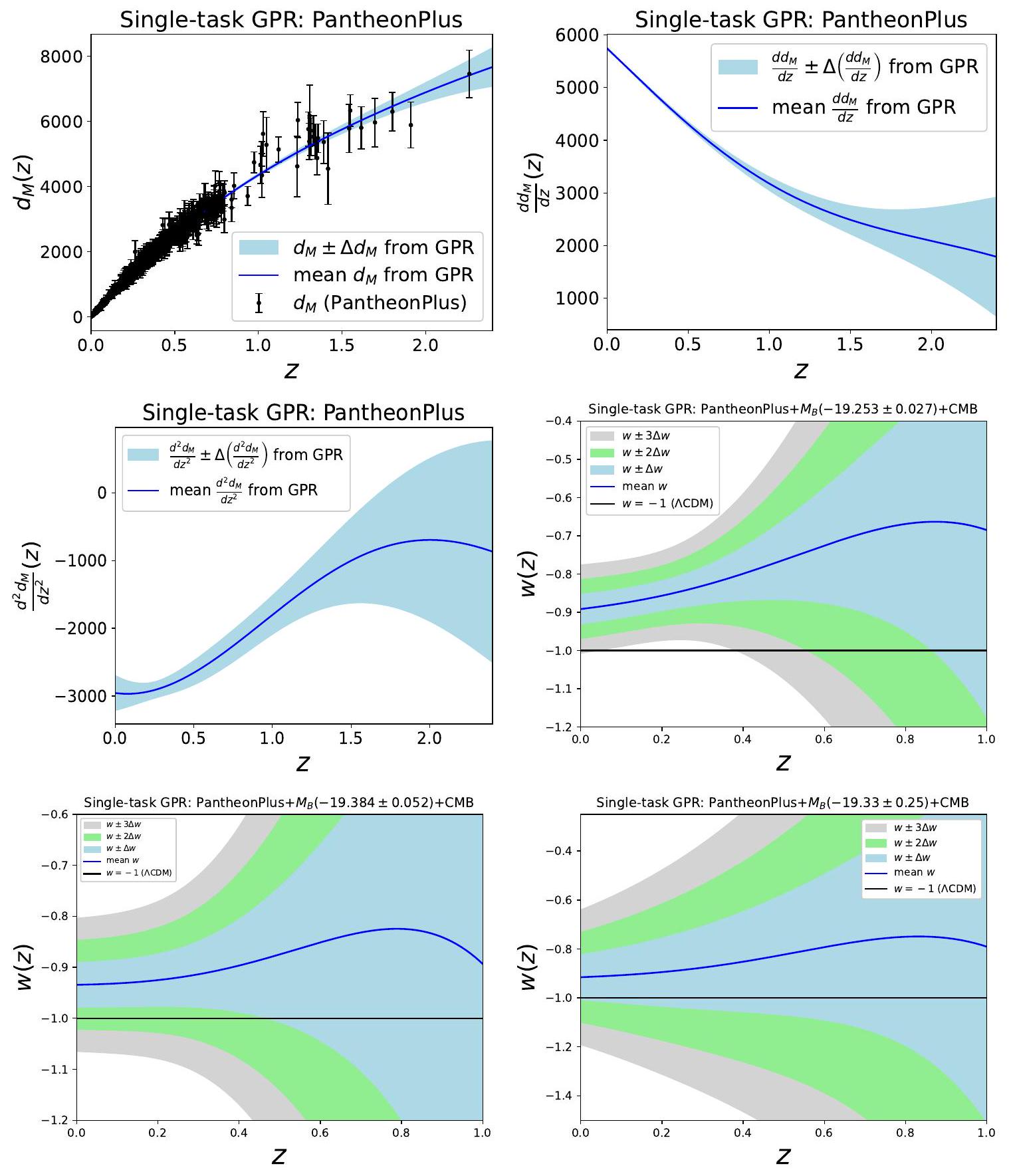
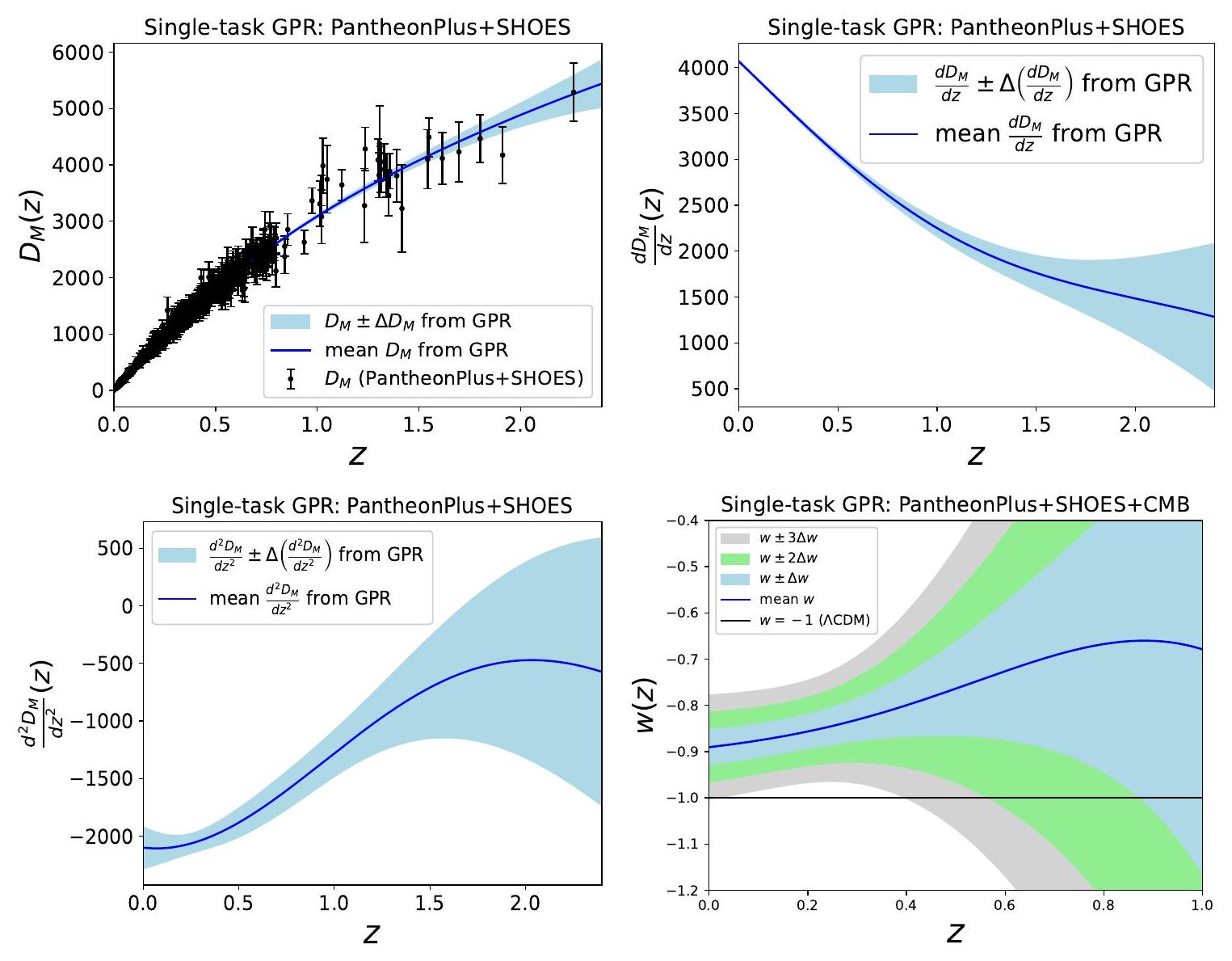
الشكل 9. تعطي الأشرطة السوداء في الزاوية العلوية اليسرىالمستمدة من الملاحظاتمن PantheonPlus+SHOES، باستخدام (2.14). الخطوط الزرقاء الصلبة والتظليل الأزرق في الزاوية العليا اليسرى، الزاوية العليا اليمنى، والزاوية السفلى اليسرى تتوافق مع ، و مع المرتبطمناطق الثقة، باستخدام GPR لمهمة واحدة. تُظهر اللوحة السفلية اليمنى الصورة المعاد بناؤهاومناطق الثقة المرتبطة لـ CMB+PantheonPlus+SHOES (GPR لمهمة واحدة) باستخدام (2.9) و(3.15).
الملاحظات. عندما نفكر فيالبيانات، نحن نستخدم فقط بيانات PantheonPlus. من ناحية أخرى، عندما نأخذ في الاعتبارنحن نستخدم بيانات PantheonPlus وبيانات SHOES معًا.
نحن نعتبر أولاًالبيانات والأخطاء المرتبطة بها. لهذا، نأخذ في الاعتبار التغاير الكامل الناتج عن كل من الإحصائيات والنظاميات. ثم نقوم بحساب باستخدام (2.14) والخطأ المقابل من خلال انتشار عدم اليقين. يتم عرضها في الزاوية العلوية اليسرى من الشكل 9 مع أشرطة خطأ سوداء. نقوم بتطبيق تحليل GPR على هذه البيانات. على عكس بيانات BAO، تتعلق هذه البيانات بوظيفة واحدة فقط . لذلك، في هذه الحالة، فإن GPR ذو المهمة الواحدة قابل للتطبيق. عند تطبيق GPR ذو المهمة الواحدة، نقوم بحساب التوقعات للقيم المتوسطة لـالمشتقة الأولى، والمشتقة الثانية باستخدام (B.15)-(B.17). كما نقوم بحساب الأخطاء باستخدام (B.19)-(B.21). التنبؤ بـوالمرتبطتظهر فترات الثقة في الزاوية العلوية اليسرى من الشكل 9 كخط أزرق وتظليل أزرق.
وبالمثل، نوضح و مع ما يرتبط بهفترات الثقة، في الزاويتين العلويتين اليمنى والسفلية اليسرى من الشكل 9. ثم نقوم بحساب التغايرات المتقاطعة بين و باستخدام (B.24).
باستخدام المعاد بناءه و التغايرات الذاتية والتغايرات المشتركة الخاصة بهم، نحن
الشكل 10. تُظهر الألواح العلوية واللوحة الوسطى اليسرى الصورة المعاد بناؤها، و والمتعلقةمناطق الثقة على التوالي باستخدام GPR لمهمة واحدة. القضبان السوداء في الزاوية العلوية اليسرى هي من الملاحظاتبيانات PantheonPlus، باستخدام (2.15). تُظهر اللوحات الثلاثة المتبقية البيانات المعاد بناؤهاومناطق الثقة المرتبطة بها لـ CMB+PantheonPlus (GPR أحادي المهمة) مع ثلاثة أنواع مختلفةالمعلومات الأولية الغاوسية (D.1)-(D.3)، باستخدام (2.16)، (2.17) و(3.15).
احسب تطور الانزياح الأحمر لـمن (2.9)، مع المعلومات الإضافية من إشعاع الخلفية الكونية في (3.15). المعاد بناءه وأخطاؤها معروضة في اللوحة السفلية اليمنى من الشكل 9، مع نفس رموز الألوان كما في الشكل 3. من هذا الرسم، نرى أنالنموذج أكثر منبعيد في نطاق الانزياح الأحمر، لمجموعة بيانات CMB+PantheonPlus+SHOES. إنهإلىبعيدًا في نطاق الانزياح الأحمر حول. لإنه ضمنحد. في معظم نطاق الانزياح الأحمر المنخفض، تم إعادة بناءفي المنطقة غير الوهمية.
د. 2 بانثيون بلس، بانثيون بلس و بانثيون بلس
ليس من الضروري أن نقوم بمعايرة بيانات PantheonPlus مع ملاحظات SHOES. للحفاظ على خيارات أخرى مفتوحة، نقوم بدمج بيانات PantheonPlus مع مجموعات بيانات أخرى. بدون المعايرة مع SHOES، لا يمكننا الاستخدام. بيانات من PantheonPlus. في هذه الحالة، نعتبر بدلاً من ذلك البيانات. هنا، نأخذ في الاعتبار أيضًا التغاير الكامل بما في ذلك الأخطاء المنهجية من بيانات بانثيون بلس. من هذا البيانات، نقوم بحساب باستخدام (2.15) والخطأ المرتبط باستخدام انتشار عدم اليقين. تظهر النتيجة في الزاوية العلوية اليسرى من الشكل 10 مع أشرطة خطأ سوداء. نطبق GPR لمهمة واحدة على البيانات من أجل التنبؤ بالوظيفة السلسة لـومشتقاتها الأولى والثانية، والأخطاء المرتبطة بها (الخط الأزرق والتظليل). نرى أن التنبؤاتيتماشى مع البيانات. التنبؤ بـ و والمرتبطتم رسم فترات الثقة في الزاوية العليا اليمنى والجزء الأوسط الأيسر من الشكل 10.
من أجل إعادة بناءمن المتوقع و باستخدام (2.16)، نحتاج إلى قيم المعاملفي (2.17)، الذي يتضمن معلمات و . نحن نستخدم القيمة من بيانات CMB، كما في (3.15). معلومات إضافية حول المعلمة مطلوبة. لهذا، نستخدم ثلاثة توزيعات غاوسية مختلفة بشكل ملحوظ على[97]:
المعلومات السابقة I مأخوذة من الأحذية، وتستخدم للتحقق من التناسق مع النتيجة السابقة [98]. المعلومات السابقة II تم الحصول عليها من معايرة عينة بانثيون باستخدام ملاحظات الكرونومتر الكوني لمعامل هابل [99]. المعلومات السابقة III مأخوذة من 18 SNIa [100] تم الحصول عليها باستخدام أشكال منحنيات الضوء متعددة الألوان [101].
معقبل I، نحن نعيد بناءومناطق الخطأ المرتبطة بها، الموضحة في اللوحة اليمنى الوسطى من الشكل 10. عند المقارنة مع اللوحة اليمنى السفلية من الشكل 9، نرى أن النتائج متسقة وأن نفس الاستنتاج ينطبق هنا.
استخدامقبل الثاني، نعيد بناءومناطق الثقة المرتبطة، الموضحة في اللوحة السفلية اليسرى من الشكل 10. في هذه الحالة،النموذج هوإلىبعيدًا في نطاق الانزياح الأحمروداخل بشكل جيدمنطقة في نطاق الانزياح الأحمر.
اليؤدي الخيار الثالث إلى اللوحة السفلية اليمنى من الشكل 10. هنا نرى أنCDM هو ضمنالمنطقة في نطاق الانزياح الأحمر بالكامل. لاحظ أنه عند الانزياحات الحمراء المنخفضة، فإن الدالة المتوسطة المعاد بناؤها لـيكمن ضمن الدوال المتوسطة المرتبطة بـقبل أنا والأولوية الثانية. وذلك لأن القيمة المتوسطة لـفي Prior III يقع ضمن القيم المتوسطة لـ Priors I و II. كلما زاد القيمة السابقة، كلما زادت القيمة المتوسطةفي المنطقة غير الوهمية. منطقة الثقة هي الأكبر لـالأولوية الثالثة منذ الخطأ فيهو الأكبر في هذه الحالة.
د. 3 قائمة موسعة من الثوابت المعاد بناؤها
دمج البيانات
[مج]
الأولوية الأولى
–
–
بي بيبرايور II
–
–
بي بيبراير III
–
–
الأولوية الأولى
برايور II
براير III
الجدول 4. قائمة موسعة للقيم المعاد بناؤها لـ و .
اعتماد على قيود المسافة المختلفة من إشعاع الخلفية الكوني
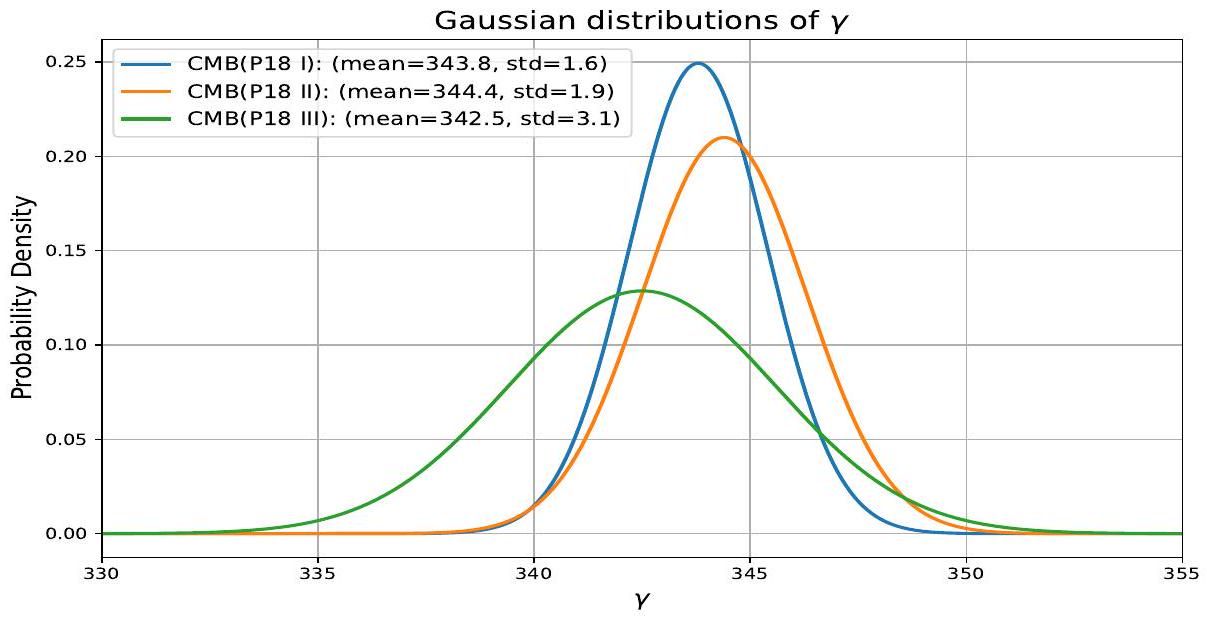
لحساب أولويات مسافة CMB استخدمنا base_plikHM_TTTEEE_lowl_lowE_lensing من أرشيف بيانات بلانك مع القياسيةCDM [79]. نشير إلى المسافة الناتجة من CMB كـ CMB (P18 I). هنا نتحقق من كيفية تغير النتائج إذا قمنا بتغيير المسافة السابقة لـ CMB [102، 103]. بالنسبة للمسافة الثانية لـ CMB، CMB(P18 II)، نستبعد القيود الناتجة عن العدسات، أي أننا نستخدم بيانات Planck 2018 TT، TE، EE + lowE، ونفترضبدلاً من. تستخدم قيود المسافة المتعلقة بخلفية الإشعاع الكوني الميكروي سلسلة base_w_plikHM_TTTEEE_lowl_lowE مع نموذج [77]. بالنسبة للقياس الثالث لمسافة CMB، III)، نقوم بتعميم الفيزياء المبكرة لـCDM إلى مجموع كتل النيوترينو المتغيرة وعدد الأنواع النسبية الفعالة المتغيرة، من أجل الحصول على انحرافات معيارية أوسع نسبيًا في أولويات المسافة. لهذا، نستخدم سلسلة base_nnu_mnu_plikHM_TT_lowl_lowE_post_lensing [78]. نحصل علىالقيم
القيم المتوسطة تختلف قليلاً في الحالات الثلاث. CMB(P18 II) لديها انحراف معياري أكبر قليلاً من CMB(P18 I)، بينما CMB(P18 III) لديها انحراف معياري أكبر بشكل ملحوظ. الشكل 11 يظهر التوزيعات الغاوسية لـ.
في الشكل 12، نرسم معادلة حالة الطاقة المظلمة لبيانات DESI DR1 BAO المجمعة مع ثلاثة قيود مسافة مختلفة من CMB. من الواضح أنه لا توجد اختلافات كبيرة فيلثلاثة مختلفين.
الشكل 13 يكرر الرسوم البيانية في الشكل 12، ولكن مع إضافة بيانات PantheonPlus، أي لبيانات DESI DR1 BAO+PantheonPlus المدمجة مع ثلاثة قيود مسافة مختلفة من CMB. مرة أخرى، نرى أن النتائج متشابهة.
الشكل 11. توزيع الاحتمالات لـالمستمدة من ثلاثة مراجع مسافة CMB.
الشكل 12. معادلة حالة الطاقة المظلمة لبيانات DESI DR1 BAO المجمعة مع ثلاثة قيود مسافة مختلفة من إشعاع الخلفية الكونية.
الشكل 13. معادلة حالة الطاقة المظلمة لبيانات DESI DR1 BAO+PantheonPlus المدمجة مع ثلاثة قيود مسافة مختلفة من إشعاع الخلفية الكونية.
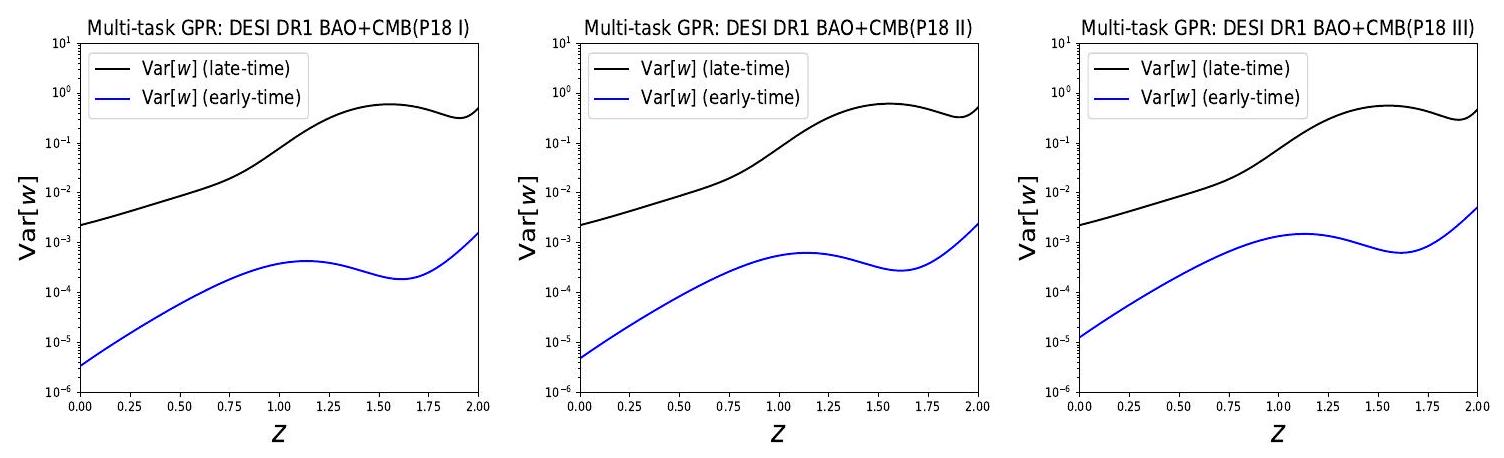
السبب في أن النتائج متشابهة لثلاثة قيود مسافة CMB مختلفة هو أن المساهمة الرئيسية في الخطأ في تأتي من الخطأ في بيانات الوقت المتأخر، وليس من خطأ بيانات الوقت المبكر – الخطأ في من بيانات الوقت المتأخر يهيمن على ذلك من بيانات الوقت المبكر. يمكن رؤية ذلك إذا قمنا برسم المساهمتين بشكل منفصل، من خلال إعادة كتابة
الشكل 14. مساهمة الخطأ في (من خلال التباين) من الخطأ في بيانات الوقت المتأخر (الخطوط السوداء)، مقارنة بالخطأ من بيانات الوقت المبكر (الخطوط الزرقاء)، للثلاثة قيود مسافة CMB.
التباين الكلي لـ كمجموع:
يعرض الشكل 14 التباينات في الوقت المتأخر (الخطوط السوداء) والوقت المبكر (الخطوط الزرقاء) لثلاثة قيود مسافة CMB مختلفة. هذا يظهر أن (المتأخر) هو أوامر من الحجم أكبر من (المبكر). الانحراف المعياري في المعاد إعادة بنائه يهيمن عليه بوضوح الأخطاء في بيانات الوقت المتأخر. ومن ثم فإن تقدير الانحراف المعياري لـ يعتمد بالكاد على الخطأ في بيانات CMB المبكرة.
تمت المناقشات في هذا القسم مع تركيبات معينة من البيانات، لكن الاستنتاج والنتائج متشابهة لتركيبات بيانات أخرى تم النظر فيها في هذه الدراسة.
اعتماد دالة المتوسط على توقعات GPR
هنا نوضح بشكل صريح كيف تعتمد النتائج على دوال المتوسط المختلفة بخلاف دالة المتوسط الصفرية [83]. نعتبر ثلاثة من النماذج الكونية الرئيسية: , , و.
عند إعادة بناء الأخطاء، نستخدم التهميش الكامل على جميع المعلمات، أي جميع معلمات دالة المتوسط وجميع المعلمات الفائقة لدالة التغاير للنواة. على وجه الخصوص، هذا مهم عندما تكون دالة المتوسط المختارة قريبة من القيم المتوسطة الفعلية للبيانات لأن استخدام القيم الأفضل لهذه المعلمات من تحسين احتمال الهامش اللوجاريتمي سيكون له أشرطة خطأ صغيرة جدًا في تقدير أي دالة باستخدام GP.
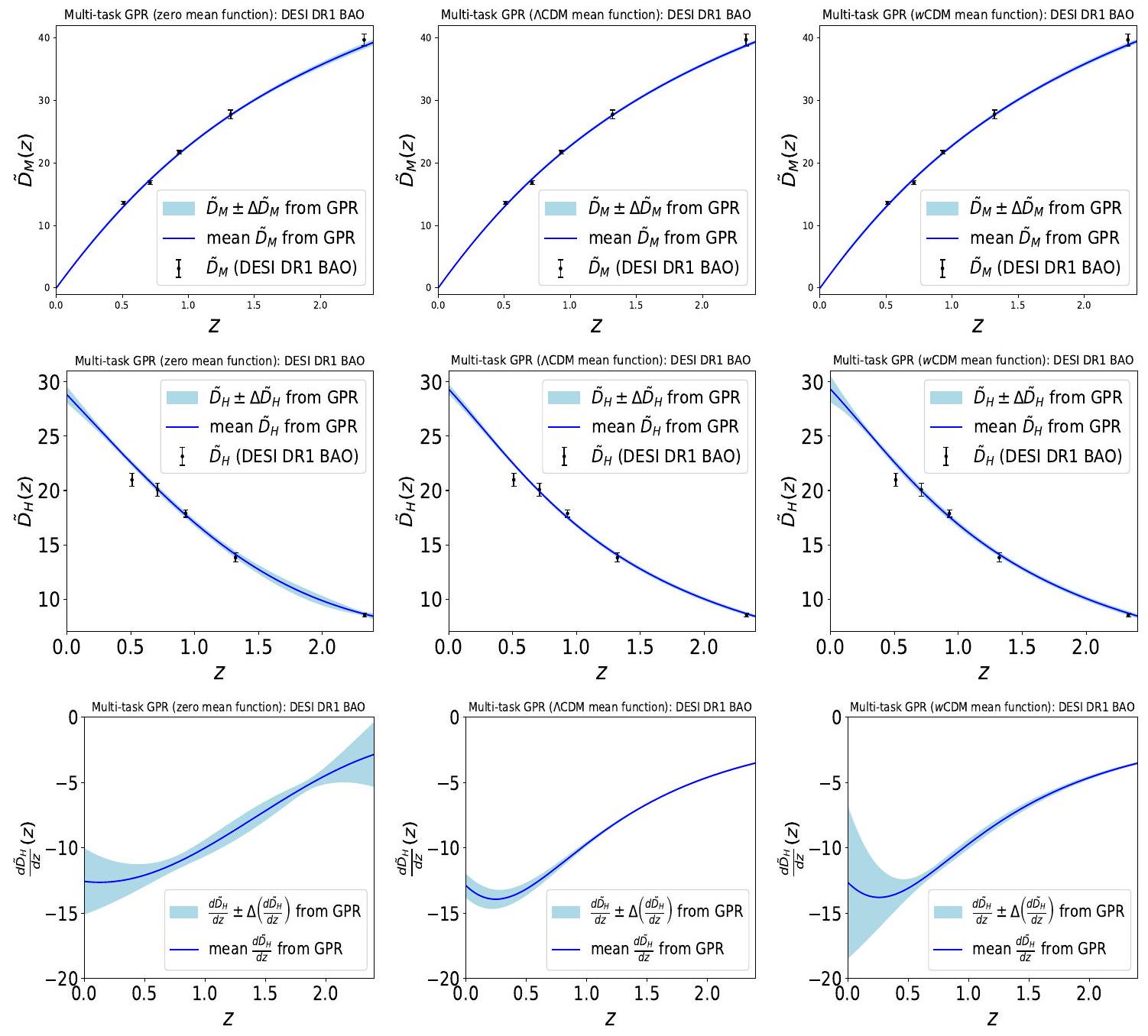
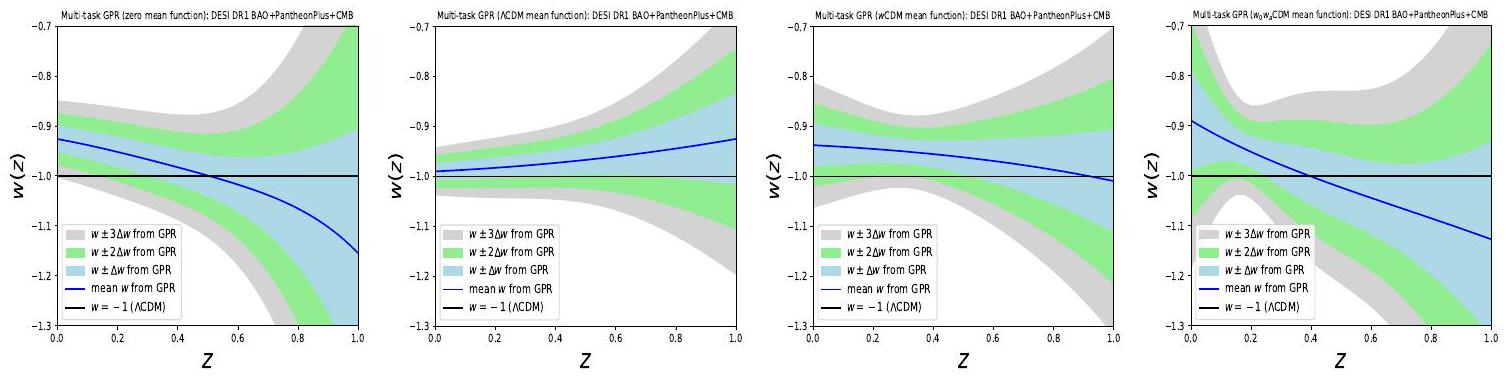
يعرض الشكل 15 متوسط و فترات الثقة (الانحرافات المعيارية) لـ (الصف العلوي)، (الصف الأوسط)، و (الصف السفلي)، للثلاثة دوال متوسط، أي، صفر (العمود الأيسر)، CDM (العمود الأوسط)، و CDM (العمود الأيمن). تم الحصول على هذه باستخدام GPR متعدد المهام على بيانات DESI DR1 BAO. لم نجد أي اختلافات كبيرة في هذه الدوال المعاد بناؤها لثلاثة دوال متوسط مختلفة، باستثناء . توقعات
الشكل 15. توقعات GPR متعدد المهام لـ (الصف العلوي)، (الصف الأوسط)، و (الصف السفلي)، لثلاثة دوال متوسط: صفر (العمود الأيسر)، CDM (العمود الأوسط)، و CDM (العمود الأيمن)، باستخدام بيانات DESI DR1 BAO.
تختلف قليلاً، نوضح أدناه أن هذا له تأثير ضئيل على إعادة بناء الكمية الرئيسية ذات الأهمية، أي، معادلة حالة الطاقة المظلمة.
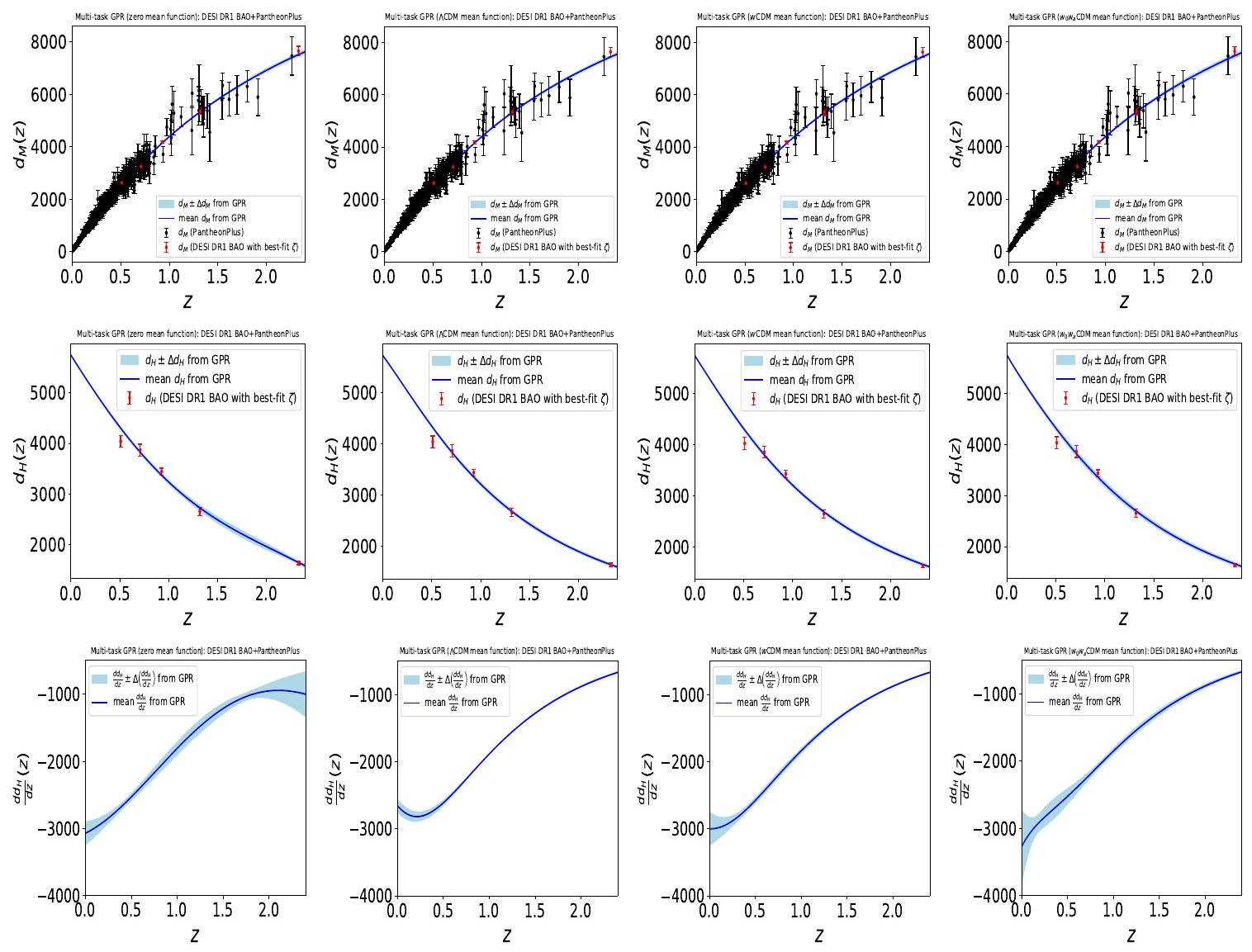
في الشكل 16، نكرر الرسوم البيانية في الشكل 15، ولكن باستخدام تركيبات بيانات DESI DR1 BAO و PantheonPlus، ومع دالة متوسط رابعة، نجد استنتاجًا مشابهًا كما في الشكل 15.
من و المعاد بناؤهما، نحسب معادلة الحالة (الفعالة) للطاقة المظلمة (كما فعلنا من قبل في النص الرئيسي) مع إضافة بيانات CMB لكل من دوال المتوسط. بالنسبة لبيانات DESI DR1 BAO و CMB المجمعة، نرسم والمناطق المقابلة لـ و في الشكل 17. تركيبات الألوان هي نفسها كما في النص الرئيسي. نجد أن القيم المتوسطة المعاد بناؤها لـ تختلف قليلاً لدوال المتوسط المختلفة، لكن الاختلافات أصغر بكثير من
الشكل 16. توقعات GPR متعدد المهام لـ (الصف العلوي)، (الصف الأوسط)، و (الصف السفلي) لأربع دوال متوسط: صفر (العمود 1)، (العمود 2)، (العمود 3)، و (العمود 4) باستخدام بيانات DESI DR1 BAO+PantheonPlus.
الشكل 17. المعاد بناؤه لـ مع المناطق المقابلة لـ و التي تم الحصول عليها من بيانات DESI DR1 BAO+CMB لثلاثة دوال متوسط، كما في الشكل 15.
الانحراف المعياري المقدر المقابل لأي من دوال المتوسط. وبالتالي، من حيث الثقة الإحصائية، النتائج متشابهة تقريبًا. يمكن القول بطريقة أخرى: أننا لا نجد أي دليل كبير على الانحراف عن نموذج CDM وهذا الاستنتاج هو نفسه لجميع دوال المتوسط الثلاثة المختارة.
الشكل 18. المعاد بناؤه لـ من بيانات DESI DR1 BAO+PantheonPlus+CMB، مع مناطق الثقة لـ لأربع دوال متوسط، كما في الشكل 16.
يكرر الشكل 18 الرسوم البيانية في الشكل 17، ولكن الآن مع إضافة بيانات PantheonPlus. نحن أيضًا ندرج دالة المتوسط . تنطبق هنا استنتاجات مشابهة: في معظم منطقة الانزياح الأحمر، نموذج CDM إما بعيد أو ضمنه. هذه النتيجة مستقلة بشكل كبير عن دالة المتوسط المختارة.
تعليقنا النهائي هو أنه لا يوجد دليل كبير على الطاقة المظلمة الديناميكية وهذا يبقى مستقلًا عن أي دالة متوسط.
References
[1] DESI Collaboration, A. G. Adame et al., DESI 2024 VI: Cosmological Constraints from the Measurements of Baryon Acoustic Oscillations, arXiv:2404.03002.
[2] Y. Tada and T. Terada, Quintessential interpretation of the evolving dark energy in light of DESI observations, Phys. Rev. D 109 (2024), no. 12 L121305, [arXiv:2404.05722].
[3] W. Yin, Cosmic clues: DESI, dark energy, and the cosmological constant problem, JHEP 05 (2024) 327, [arXiv:2404.06444].
[4] K. V. Berghaus, J. A. Kable, and V. Miranda, Quantifying scalar field dynamics with DESI 2024 Y1 BAO measurements, Phys. Rev. D 110 (2024), no. 10 103524, [arXiv:2404.14341].
[5] D. Shlivko and P. J. Steinhardt, Assessing observational constraints on dark energy, Phys. Lett. B 855 (2024) 138826, [arXiv:2405.03933].
[6] O. F. Ramadan, J. Sakstein, and D. Rubin, DESI constraints on exponential quintessence, Phys. Rev. D 110 (2024), no. 4 L041303, [arXiv:2405.18747].
[7] I. D. Gialamas, G. Hütsi, K. Kannike, A. Racioppi, M. Raidal, M. Vasar, and H. Veermäe, Interpreting DESI 2024 BAO: late-time dynamical dark energy or a local effect?, arXiv:2406.07533.
[8] V. Patel, A. Chakraborty, and L. Amendola, The prior dependence of the DESI results, arXiv:2407.06586.
[9] D. Wang, Constraining Cosmological Physics with DESI BAO Observations, arXiv:2404.06796.
[10] Y. Yang, X. Ren, Q. Wang, Z. Lu, D. Zhang, Y.-F. Cai, and E. N. Saridakis, Quintom cosmology and modified gravity after DESI 2024, Sci. Bull. 69 (2024) 2698-2704, [arXiv:2404.19437].
[11] C. Escamilla-Rivera and R. Sandoval-Orozco, gravity after DESI Baryon acoustic oscillation and DES supernovae 2024 data, JHEAp 42 (2024) 217-221, [arXiv:2405.00608].
[12] A. Chudaykin and M. Kunz, Modified gravity interpretation of the evolving dark energy in light of DESI data, arXiv:2407.02558.
[13] O. Luongo and M. Muccino, Model-independent cosmographic constraints from DESI 2024, Astron. Astrophys. 690 (2024) A40, [arXiv:2404.07070].
[14] M. Cortês and A. R. Liddle, Interpreting DESI’s evidence for evolving dark energy, JCAP 12 (2024) 007, [arXiv:2404.08056].
[15] E. O. Colgáin, M. G. Dainotti, S. Capozziello, S. Pourojaghi, M. M. Sheikh-Jabbari, and D. Stojkovic, Does DESI 2024 Confirm 1CDM?, arXiv:2404.08633.
[16] Y. Carloni, O. Luongo, and M. Muccino, Does dark energy really revive using DESI 2024 data?, arXiv:2404.12068.
[17] D. Wang, The Self-Consistency of DESI Analysis and Comment on “Does DESI 2024 Confirm ACDM?”, arXiv:2404.13833.
[18] W. Giarè, M. A. Sabogal, R. C. Nunes, and E. Di Valentino, Interacting Dark Energy after DESI Baryon Acoustic Oscillation measurements, arXiv:2404.15232.
[19] O . Seto and Y . Toda, DESI constraints on the varying electron mass model and axionlike early dark energy, Phys. Rev. D 110 (2024), no. 8 083501, [arXiv:2405.11869].
[20] T.-N. Li, P.-J. Wu, G.-H. Du, S.-J. Jin, H.-L. Li, J.-F. Zhang, and X. Zhang, Constraints on Interacting Dark Energy Models from the DESI Baryon Acoustic Oscillation and DES Supernovae Data, Astrophys. J. 976 (2024), no. 1 1, [arXiv:2407.14934].
[21] F. J. Qu, K. M. Surrao, B. Bolliet, J. C. Hill, B. D. Sherwin, and H. T. Jense, Accelerated inference on accelerated cosmic expansion: New constraints on axion-like early dark energy with DESI BAO and ACT DR6 CMB lensing, arXiv:2404.16805.
[22] H. Wang and Y.-S. Piao, Dark energy in light of recent DESI BAO and Hubble tension, arXiv:2404.18579.
[23] C.-G. Park, J. de Cruz Perez, and B. Ratra, Using non-DESI data to confirm and strengthen the DESI 2024 spatially-flat CDM cosmological parameterization result, arXiv:2405.00502.
[24] DESI Collaboration, R. Calderon et al., DESI 2024: reconstructing dark energy using crossing statistics with DESI DR1 BAO data, JCAP 10 (2024) 048, [arXiv:2405.04216].
[25] B. R. Dinda, A new diagnostic for the null test of dynamical dark energy in light of DESI 2024 and other BAO data, JCAP 09 (2024) 062, [arXiv:2405.06618].
[26] DESI Collaboration, K. Lodha et al., DESI 2024: Constraints on Physics-Focused Aspects of Dark Energy using DESI DR1 BAO Data, arXiv:2405.13588.
[27] P. Mukherjee and A. A. Sen, Model-independent cosmological inference post DESI DR1 BAO measurements, Phys. Rev. D 110 (2024), no. 12 123502, [arXiv:2405.19178].
[28] L. Pogosian, G.-B. Zhao, and K. Jedamzik, A Consistency Test of the Cosmological Model at the Epoch of Recombination Using DESI Baryonic Acoustic Oscillation and Planck Measurements, Astrophys. J. Lett. 973 (2024), no. 1 L13, [arXiv:2405.20306].
[29] N. Roy, Dynamical dark energy in the light of DESI 2024 data, arXiv:2406.00634.
[30] X. D. Jia, J. P. Hu, and F. Y. Wang, Uncorrelated estimations of redshift evolution from DESI baryon acoustic oscillation observations, arXiv:2406.02019.
[31] J. J. Heckman, O. F. Ramadan, and J. Sakstein, First Constraints on a Pixelated Universe in Light of DESI, arXiv:2406.04408.
[32] A. Notari, M. Redi, and A. Tesi, Consistent theories for the DESI dark energy fit, JCAP 11 (2024) 025, [arXiv:2406.08459].
[33] G. P. Lynch, L. Knox, and J. Chluba, DESI observations and the Hubble tension in light of modified recombination, Phys. Rev. D 110 (2024), no. 8 083538, [arXiv:2406.10202].
[34] G. Liu, Y. Wang, and W. Zhao, Impact of LRG1 and LRG2 in DESI 2024 BAO data on dark energy evolution, arXiv:2407.04385.
[35] L. Orchard and V. H. Cárdenas, Probing dark energy evolution post-DESI 2024, Phys. Dark Univ. 46 (2024) 101678, [arXiv:2407.05579].
[36] A. Hernández-Almada, M. L. Mendoza-Martínez, M. A. García-Aspeitia, and V. Motta, Phenomenological emergent dark energy in the light of DESI Data Release 1, Phys. Dark Univ. 46 (2024) 101668, [arXiv:2407.09430].
[37] S. Pourojaghi, M. Malekjani, and Z. Davari, Cosmological constraints on dark energy parametrizations after DESI 2024: Persistent deviation from standard CDM cosmology, arXiv:2407.09767.
[38] U. Mukhopadhayay, S. Haridasu, A. A. Sen, and S. Dhawan, Inferring dark energy properties from the scale factor parametrisation, arXiv:2407. 10845.
[39] G. Ye, M. Martinelli, B. Hu, and A. Silvestri, Non-minimally coupled gravity as a physically viable fit to DESI 2024 BAO, arXiv:2407.15832.
[40] W. Giarè, M. Najafi, S. Pan, E. Di Valentino, and J. T. Firouzjaee, Robust preference for Dynamical Dark Energy in DESI BAO and SN measurements, JCAP 10 (2024) 035, [arXiv:2407.16689].
[41] M. Chevallier and D. Polarski, Accelerating universes with scaling dark matter, Int. J. Mod. Phys. D 10 (2001) 213-224, [gr-qc/0009008].
[42] E. V. Linder, Exploring the expansion history of the universe, Phys. Rev. Lett. 90 (2003) 091301, [astro-ph/0208512].
[43] W. J. Wolf and P. G. Ferreira, Underdetermination of dark energy, Phys. Rev. D 108 (2023), no. 10 103519, [arXiv:2310.07482].
[44] R. R. Caldwell, R. Dave, and P. J. Steinhardt, Cosmological imprint of an energy component with general equation of state, Phys. Rev. Lett. 80 (1998) 1582-1585, [astro-ph/9708069].
[45] I. Zlatev, L.-M. Wang, and P. J. Steinhardt, Quintessence, cosmic coincidence, and the cosmological constant, Phys. Rev. Lett. 82 (1999) 896-899, [astro-ph/9807002].
[46] S. Tsujikawa, Quintessence: A Review, Class. Quant. Grav. 30 (2013) 214003, [arXiv:1304.1961].
[47] B. R. Dinda and A. A. Sen, Imprint of thawing scalar fields on the large scale galaxy overdensity, Phys. Rev. D 97 (2018), no. 8 083506, [arXiv:1607.05123].
[48] C. García-García, E. Bellini, P. G. Ferreira, D. Traykova, and M. Zumalacárregui, Theoretical priors in scalar-tensor cosmologies: Thawing quintessence, Phys. Rev. D 101 (2020), no. 6 063508, [arXiv:1911.02868].
[49] G. Ellis, R. Maartens, and M. A. H. MacCallum, Causality and the speed of sound, Gen. Rel. Grav. 39 (2007) 1651-1660, [gr-qc/0703121].
[50] L. Amendola, C. Quercellini, D. Tocchini-Valentini, and A. Pasqui, Constraints on the interaction and selfinteraction of dark energy from cosmic microwave background, Astrophys. J. Lett. 583 (2003) L53, [astro-ph/0205097].
[51] T. Clemson, K. Koyama, G.-B. Zhao, R. Maartens, and J. Valiviita, Interacting Dark Energy – constraints and degeneracies, Phys. Rev. D 85 (2012) 043007, [arXiv:1109.6234].
[52] A. Pourtsidou, C. Skordis, and E. J. Copeland, Models of dark matter coupled to dark energy, Phys. Rev. D 88 (2013), no. 8 083505, [arXiv:1307.0458].
[53] R. Murgia, S. Gariazzo, and N. Fornengo, Constraints on the Coupling between Dark Energy and Dark Matter from CMB data, JCAP 04 (2016) 014, [arXiv:1602.01765].
[54] E. Di Valentino, A. Melchiorri, O. Mena, and S. Vagnozzi, Interacting dark energy in the early 2020s: A promising solution to the and cosmic shear tensions, Phys. Dark Univ. 30 (2020) 100666, [arXiv:1908.04281].
[55] S. Tsujikawa, Modified gravity models of dark energy, Lect. Notes Phys. 800 (2010) 99-145, [arXiv:1101.0191].
[56] T. Clifton, P. G. Ferreira, A. Padilla, and C. Skordis, Modified Gravity and Cosmology, Phys. Rept. 513 (2012) 1-189, [arXiv:1106.2476].
[57] K. Koyama, Cosmological Tests of Modified Gravity, Rept. Prog. Phys. 79 (2016), no. 4 046902, [arXiv:1504.04623].
[58] L. Perenon, M. Martinelli, R. Maartens, S. Camera, and C. Clarkson, Measuring dark energy with expansion and growth, Phys. Dark Univ. 37 (2022) 101119, [arXiv:2206.12375].
[59] B. R. Dinda and N. Banerjee, A comprehensive data-driven odyssey to explore the equation of state of dark energy, Eur. Phys. J. C 84 (2024), no. 7 688, [arXiv:2403.14223].
[60] C. Williams and C. Rasmussen, Gaussian processes for regression, Advances Neural Information Processing Systems 8 (1995).
[61] C. Rasmussen and C. Williams, Gaussian Processes for Machine Learning. MIT Press, 2006.
[62] A. Shafieloo, A. G. Kim, and E. V. Linder, Gaussian Process Cosmography, Phys. Rev. D 85 (2012) 123530, [arXiv:1204.2272].
[63] M. Seikel, C. Clarkson, and M. Smith, Reconstruction of dark energy and expansion dynamics using Gaussian processes, JCAP 06 (2012) 036, [arXiv:1204.2832].
[64] B. S. Haridasu, V. V. Luković, M. Moresco, and N. Vittorio, An improved model-independent assessment of the late-time cosmic expansion, JCAP (2018) 015, [arXiv:1805.03595].
[65] P. Mukherjee and N. Banerjee, Non-parametric reconstruction of the cosmological jerk parameter, Eur. Phys. J. C 81 (2021), no. 1 36, [arXiv:2007.10124].
[66] eBOSS Collaboration, R. E. Keeley, A. Shafieloo, G.-B. Zhao, J. A. Vazquez, and H. Koo, Reconstructing the Universe: Testing the Mutual Consistency of the Pantheon and SDSS/eBOSS BAO Data Sets with Gaussian Processes, Astron. J. 161 (2021), no. 3 151, [arXiv:2010.03234].
[67] L. Perenon, M. Martinelli, S. Ilić, R. Maartens, M. Lochner, and C. Clarkson, Multi-tasking the growth of cosmological structures, Phys. Dark Univ. 34 (2021) 100898, [arXiv:2105.01613].
[68] B. R. Dinda, Minimal model-dependent constraints on cosmological nuisance parameters and cosmic curvature from combinations of cosmological data, Int. J. Mod. Phys. D 32 (2023), no. 11 2350079, [arXiv:2209.14639].
[69] M. A. Sabogal, O. Akarsu, A. Bonilla, E. Di Valentino, and R. C. Nunes, Exploring new physics in the late Universe’s expansion through non-parametric inference, Eur. Phys. J. C 84 (2024), no. 7703 , [arXiv:2407.04223].
[70] DESI Collaboration, R. Zhou et al., Target Selection and Validation of DESI Luminous Red Galaxies, Astron. J. 165 (2023), no. 2 58, [arXiv:2208.08515].
[71] A. Raichoor et al., Target Selection and Validation of DESI Emission Line Galaxies, Astron. J. 165 (2023), no. 3 126, [arXiv:2208.08513].
[72] BOSS Collaboration, S. Alam et al., The clustering of galaxies in the completed SDSS-III Baryon Oscillation Spectroscopic Survey: cosmological analysis of the DR12 galaxy sample, Mon. Not. Roy. Astron. Soc. 470 (2017), no. 3 2617-2652, [arXiv:1607.03155].
[73] eBOSS Collaboration, S. Alam et al., Completed SDSS-IV extended Baryon Oscillation Spectroscopic Survey: Cosmological implications from two decades of spectroscopic surveys at the Apache Point Observatory, Phys. Rev. D 103 (2021), no. 8 083533, [arXiv:2007.08991].
[74] eBOSS Collaboration, J. Hou et al., The Completed SDSS-IV extended Baryon Oscillation Spectroscopic Survey: BAO and RSD measurements from anisotropic clustering analysis of the Quasar Sample in configuration space between redshift 0.8 and 2.2, Mon. Not. Roy. Astron. Soc. 500 (2020), no. 1 1201-1221, [arXiv:2007.08998].
[75] eBOSS Collaboration, H. du Mas des Bourboux et al., The Completed SDSS-IV Extended Baryon Oscillation Spectroscopic Survey: Baryon Acoustic Oscillations with Lya Forests, Astrophys. J. 901 (2020), no. 2 153, [arXiv:2007.08995].
[76] W. Hu and N. Sugiyama, Small scale cosmological perturbations: An Analytic approach, Astrophys. J. 471 (1996) 542-570, [astro-ph/9510117].
[77] L. Chen, Q.-G. Huang, and K. Wang, Distance Priors from Planck Final Release, JCAP 02 (2019) 028, [arXiv:1808.05724].
[78] Z. Zhai, C.-G. Park, Y. Wang, and B. Ratra, CMB distance priors revisited: effects of dark energy dynamics, spatial curvature, primordial power spectrum, and neutrino parameters, JCAP 07 (2020) 009, [arXiv:1912.04921].
[79] Z. Zhai and Y. Wang, Robust and model-independent cosmological constraints from distance measurements, JCAP 07 (2019) 005, [arXiv:1811.07425].
[80] Planck Collaboration, N. Aghanim et al., Planck 2018 results. VI. Cosmological parameters, Astron. Astrophys. 641 (2020) A6, [arXiv:1807.06209]. [Erratum: Astron.Astrophys. 652, C4 (2021)].
[81] D. Scolnic et al., The Pantheon + Analysis: The Full Data Set and Light-curve Release, Astrophys. J. 938 (2022), no. 2 113, [arXiv:2112.03863].
[82] D. Brout et al., The Pantheon+ Analysis: Cosmological Constraints, Astrophys. J. 938 (2022), no. 2 110, [arXiv:2202.04077].
[83] S.-g. Hwang, B. L’Huillier, R. E. Keeley, M. J. Jee, and A. Shafieloo, How to use GP: effects of the mean function and hyperparameter selection on Gaussian process regression, JCAP (2023) 014, [arXiv:2206.15081].
[84] A. Heinesen, C. Blake, and D. L. Wiltshire, Quantifying the accuracy of the Alcock-Paczyński scaling of baryon acoustic oscillation measurements, JCAP (2020) 038, [arXiv:1908. 11508].
[85] J. L. Bernal, T. L. Smith, K. K. Boddy, and M. Kamionkowski, Robustness of baryon acoustic oscillation constraints for early-Universe modifications of CDM cosmology, Phys. Rev. 102 (2020), no. 12 123515, [arXiv:2004.07263].
[86] J. Pan, D. Huterer, F. Andrade-Oliveira, and C. Avestruz, Compressed baryon acoustic oscillation analysis is robust to modified-gravity models, JCAP (2024) 051, [arXiv:2312.05177].
[87] S. Anselmi, G. D. Starkman, and A. Renzi, Cosmological forecasts for future galaxy surveys with the linear point standard ruler: Toward consistent bao analyses far from a fiducial cosmology, Phys. Rev. D 107 (Jun, 2023) 123506.
[88] M. O’Dwyer, S. Anselmi, G. D. Starkman, P.-S. Corasaniti, R. K. Sheth, and I. Zehavi, Linear point and sound horizon as purely geometric standard rulers, Phys. Rev. D 101 (Apr, 2020) 083517.
[89] E. Di Valentino, O. Mena, S. Pan, L. Visinelli, W. Yang, A. Melchiorri, D. F. Mota, A. G. Riess, and J. Silk, In the realm of the Hubble tension-a review of solutions, Class. Quant. Grav. 38 (2021), no. 15 153001, [arXiv:2103.01183].
[90] S. Vagnozzi, New physics in light of the tension: An alternative view, Phys. Rev. (2020), no. 2 023518, [arXiv:1907.07569].
[91] C. Krishnan, R. Mohayaee, E. O. Colgáin, M. M. Sheikh-Jabbari, and L. Yin, Does Hubble tension signal a breakdown in FLRW cosmology?, Class. Quant. Grav. 38 (2021), no. 18 184001, [arXiv:2105.09790].
[92] D. Camarena and V. Marra, On the use of the local prior on the absolute magnitude of Type Ia supernovae in cosmological inference, Mon. Not. Roy. Astron. Soc. 504 (2021) 5164-5171, [arXiv:2101.08641].
[93] G. Efstathiou, To H0 or not to H0?, Mon. Not. Roy. Astron. Soc. 505 (2021), no. 3 3866-3872, [arXiv:2103.08723].
[94] B. R. Dinda, Cosmic expansion parametrization: Implication for curvature and HO tension, Phys. Rev. D 105 (2022), no. 6 063524, [arXiv:2106.02963].
[95] Z. Sakr, Testing the hypothesis of a matter density discrepancy within LCDM model using multiple probes, Phys. Rev. D 108 (2023), no. 8 083519, [arXiv:2305.02846].
[96] B. R. Dinda, Analytical Gaussian process cosmography: unveiling insights into matter-energy density parameter at present, Eur. Phys. J. C 84 (2024), no. 4 402, [arXiv:2311.13498].
[97] Y. Chen, S. Kumar, B. Ratra, and T. Xu, Effects of Type Ia Supernovae Absolute Magnitude Priors on the Hubble Constant Value, Astrophys. J. Lett. 964 (2024), no. 1 L4, [arXiv:2401.13187].
[98] A. G. Riess et al., A Comprehensive Measurement of the Local Value of the Hubble Constant with Mpc Uncertainty from the Hubble Space Telescope and the SHOES Team, Astrophys. J. Lett. 934 (2022), no. 1 L7, [arXiv:2112.04510].
[99] B. R. Dinda and N. Banerjee, Model independent bounds on type Ia supernova absolute peak magnitude, Phys. Rev. D 107 (2023), no. 6 063513, [arXiv:2208.14740].
[100] Y. Wang, Flux-averaging analysis of type ia supernova data, Astrophys. J. 536 (2000) 531, [astro-ph/9907405].
[101] Supernova Search Team Collaboration, A. G. Riess et al., Observational evidence from supernovae for an accelerating universe and a cosmological constant, Astron. J. 116 (1998) 1009-1038, [astro-ph/9805201].
[102] V. Poulin, T. L. Smith, R. Calderón, and T. Simon, On the implications of the ‘cosmic calibration tension’ beyond and the synergy between early- and late-time new physics, arXiv:2407. 18292.
[103] D. Pedrotti, J.-Q. Jiang, L. A. Escamilla, S. S. da Costa, and S. Vagnozzi, Multidimensionality of the Hubble tension: the roles of and , arXiv:2408.04530.
Corresponding author.
Note that our results are based on the BAO data, which may change if either the primordial or late-time model or both are far from the fiducial model used to obtain the BAO data [84-88].
We did not include CDM in Fig. 15, since we do not find any proper constraints due to the poor constraining power of DESI DR1 BAO data alone on a general model like .
Model-agnostic assessment of dark energy after DESI DR1 BAO
Bikash R. Dinda Roy Maartens Department of Physics & Astronomy, University of the Western Cape, Cape Town 7535, South Africa Institute of Cosmology & Gravitation, University of Portsmouth, Portsmouth PO1 3FX, United Kingdom National Institute for Theoretical & Computational Science, Cape Town 7535, South AfricaE-mail: bikashrdinda@gmail.com, roy.maartens@gmail.com
Abstract
Baryon acoustic oscillation measurements by the Dark Energy Spectroscopic Instrument (Data Release 1) have revealed exciting results that show evidence for dynamical dark energy at when combined with cosmic microwave background and type Ia supernova observations. These measurements are based on the CDM model of dark energy. The evidence is less in other dark energy models such as the CDM model. In order to avoid imposing a dark energy model, we reconstruct the distance measures and the equation of the state of dark energy independent of any dark energy model and driven only by observational data. Our results show that the model-agnostic (in terms of late-time models) evidence for dynamical dark energy from DESI is not significant. Our analysis also provides model-independent constraints on cosmological parameters such as the Hubble constant and the matter-energy density parameter at present. Although we used CMB distance priors (not full CMB data) from a CDM early-time model, our results remain largely similar for other cosmological models, provided that these models do not differ significantly from the standard model.
Contents
1 Introduction ….. 2
2 Background equations ….. 3
3 Observational data ….. 4
3.1 DESI and other BAO data ….. 4
3.2 CMB distance priors ….. 5
3.3 Supernova data ….. 6
4 Results ….. 7
4.1 DESI DR1 and non-DESI BAO ….. 7
4.2 CMB+DESI DR1 BAO and CMB+non-DESI BAO ….. 10
4.3 DESI DR1 BAO+PantheonPlus ….. 11
4.4 CMB+DESI DR1 BAO+PantheonPlus ….. 13
4.5 CMB+Non-DESI BAO+PantheonPlus ….. 14
4.6 Reconstructed constants and consistency check of CDM ….. 15
4.7 Hubble tension, tension and their connection to ….. 17
5 Conclusions ….. 17
A Computation of and from CMB distance priors ….. 19
B Gaussian Process Regression ….. 20
B. 1 Single-task Gaussian Process regression up to second order derivative ….. 20
B.1.1 Training the single-task GPR ….. 20
B.1.2 Prediction from single-task GPR ….. 21
B. 2 Multi-task GP regression up to second-order derivative ….. 22
B.2.1 Training the multi-task GPR ….. 23
B.2.2 Prediction from multi-task GPR ….. 24
B. 3 Recovering single-task GPR from multi-task GPR ….. 26
C Notation used in the GPR analysis ….. 27
D Application of single-task GPR to PantheonPlus data and role of ….. 28
D. 1 PantheonPlus+SHOES and CMB+PantheonPlus+SHOES ….. 28
D. 2 PantheonPlus, PantheonPlus and PantheonPlus ….. 31
D. 3 Extended list of reconstructed constants ….. 31
E Dependence on different CMB distance priors ….. 32
F Mean function dependence of GPR predictions ….. 34
1 Introduction
Data Release 1 (DR1) from the new Dark Energy Spectroscopic Instrument (DESI) survey has produced exciting results from baryonic acoustic oscillation (BAO) measurements that seem to imply a degree of tension with the standard CDM model of cosmology [1]. The initial DESI results have been extensively examined and used in follow-up work (e.g. [2-40]). The original DESI paper [1] favours a phantom behaviour of dark energy ( ) over a significant redshift range, with a preference for crossing to the non-phantom region at lower redshift. This conclusion arises when the dark energy equation of state in a late-time, spatially flat Friedmann-Lemaître-Robertson-Walker (FLRW) model is parametrised as [41, 42]
Here is the scale factor, where is the cosmological redshift. This dark energy model generalises the standard model ( ), allowing for dynamical (evolving) dark energy at the cost of only 2 parameters. In addition, many possible dark energy models can be approximated by the model.
However, there are various issues associated with using (1.1) to constrain dark energy evolution (see [7, 8, 43]). Although it facilitates the computation of a wide variety of dark energy evolutions, it is a phenomenological ansatz that is not based on a physical and selfconsistent model of dark energy. In particular, there is no obstacle to the phantom regime , which is unphysical in general relativity (and in some modified gravity theories [39]), and the speed of sound of dark energy is arbitrary. By contrast, quintessence models of dark energy [2-7, 44-48] are physically self-consistent: there is no phantom regime and the quintessence speed of sound is always (speed of light in vacuum), which ensures that dark energy does not cluster and that causality is respected [49].
A disadvantage of assuming a physical quintessence model is that this rules out other non-standard models which can produce late-time acceleration. Examples are dark energy that is non-gravitationally coupled to dark matter [18-20, 50-54], and modified gravity models which produce late-time acceleration from modifications to general relativity [9-12, 55-57].
A model-agnostic approach is to avoid choosing a particular type of model so as to allow the data itself to constrain the evolution of [24,58,59]. This approach can also incorporate non-standard models. In the case that modified gravity drives the late-time acceleration, becomes an equation of state for the effective dark energy – i.e. the modified gravitational degree of freedom that mimics dark energy in the flat FLRW background. We limit our analysis to late-time accelerating models – i.e., models in which the (effective) dark energy does not affect the cosmic microwave background (CMB) or earlier processes in the young universe.
Machine learning provides various model-agnostic methods, including Gaussian Process (GP) regression [60-69], which enable data-driven reconstructions of the trends in the evolution of . In this paper, we apply GP regression to the DESI DR1 BAO data, combined with other data, in order to derive the behaviour of that is consistent with the data sets and their errors.
The paper is organized as follows. In Section 2, we present the relevant spacetime and dynamical quantities in a flat late-time FLRW universe whose expansion is accelerating. We also express in terms of BAO and supernova (SNIa) observables. Section 3 summarises the relevant observational data, including DESI DR1 and other BAO data, CMB distance data, and SNIa data. Appendix A gives details of CMB distance priors. Our results are given
in Section 4, using the multi-task GP methodology. Both the simple posterior (single-task) and the multi-task GP analysis are summarised in Appendix B, with Appendix C listing the notation used. Some applications of single-task GP to PantheonPlus data are discussed in Appendix D. We also address the effect on the results of (1) different CMB distance priors, in Appendix E, and (2) different GP mean functions and hyperparameters, in Appendix F. Our conclusions are presented in Section 5.
2 Background equations
Neglecting the contribution from radiation, in the flat FLRW metric, the Hubble parameter for the late-time evolution is
where is the present value of the matter energy density parameter. The comoving radial distance and the Hubble radius are
so that
where a prime denotes .
From (2.1), we find in terms of and :
where
Using (2.3) in (2.5) leads to
where
on using . From (2.4) and (2.7), we find an alternative expression
The anisotropic BAO measurements have data corresponding to the two observables
where is the sound horizon at the baryon drag epoch. Using (2.4) and (2.10), we can rewrite (2.9) as
where
Note that is a dimensionless constant, unlike and .
SNIa observations use the distance modulus as an observable, which is related to the luminosity distance via
Here and are the observed and absolute peak magnitudes of the supernova. Then
It is convenient to normalise as
Мрс
Note that the constant is defined in such a way that its magnitude is of . Using (2.15) we can rewrite (2.9) as
where
3 Observational data
3.1 DESI and other BAO data
We mainly focus on five different DESI DR1 measurements of anisotropic BAO observables and at five different effective redshifts, . Two other measurements which correspond to the isotropic BAO observable are excluded, because of the difficulty to include these in a model-independent analysis. The mean, standard deviation, and correlation values of and at the five are shown in Table 1. In Table 1 and elsewhere indicates the standard deviation ( confidence level) of and is the correlation:
We also consider other non-DESI anisotropic BAO data at another five different effective redshifts, as listed in Table 2.
tracer (DESI DR1)
Refs.
1
LRG
0.510
-0.445
[70]
2
LRG
0.706
-0.420
[70]
3
LRG+ELG
0.930
-0.389
[1]
4
ELG
1.317
-0.444
[71]
5
Ly-
2.330
-0.477
[1]
Table 1. Measurements of anisotropic BAO observables and and correlations between them at five different effective redshifts from DESI DR1 BAO data [1].
tracer (non-DESI BAO)
Refs.
1
LRG (BOSS DR12)
0.38
-0.228
[72]
2
LRG (BOSS DR12)
0.51
-0.233
[72]
3
LRG (eBOSS DR16)
0.698
-0.239
[73]
4
QSO (eBOSS DR16)
1.48
0.039
[74]
5
Ly- QSO (eBOSS DR16)
2.334
-0.45
[75]
Table 2. Measurements of anisotropic BAO observables and and correlations between them at five different effective redshifts from non-DESI BAO data [73].
3.2 CMB distance priors
The late-time cosmological data analysis can be done with three CMB parameters instead of the full CMB likelihood [25, 76-79]:
where is the photon decoupling redshift, is the CMB shift parameter, is the acoustic length scale at is the present value of the baryonic density parameter, and is the sound horizon. Because appears in both and , we can not individually use these two parameters in a model-independent data analysis. For this purpose, the ratio of these two parameters is used. Then the mean and standard deviation of the two CMB parameters, from Planck 2018 results for TT, TE, EE+lowE+lensing (considering the standard model, i.e. the base model) are [80]
In order to find the above values, we use the Planck 2018 data archive for the base model, in the chain base_plikHM_TTTEEE_lowl_lowE_lensing.
In standard early-time physics approximations, the sound horizon at photon decoupling becomes a function of only and . For details, see Appendix A. In this case, is also a function of only and . Using this assumption and solving (3.5)-(3.7), we find
In addition, the sound horizon at the baryon drag epoch is also a function of only and . Using (3.6), (3.8), and (3.9), we have
and the normalised covariance between and is
To cross-check these values, we use a fitting formula from [1] [their eq. (2.5)]:
Here we used the standard value 3.04 for the effective number of relativistic species. From (3.6), (3.8), and (3.9) we obtain
which is consistent with (3.10). We use (3.10) for our analysis.
From the above constraints we find constraints on and :
These results are our CMB data.
Throughout our analysis, we consider priors on these parameters as an alternative to the full CMB likelihood. The prior values of , and , obtained using the base CDM model from compressed CMB data, are a good approximation to, and a simplified version of, the full CMB data, provided that the true model of the Universe does not deviate significantly from [77, 78]. We also note that the values of these parameters would be slightly different for other cosmological models. Still, the main result, i.e. the reconstruction of the equation of state of dark energy, does not differ significantly when we consider other models beyond . We emphasize that the use of the base CDM model does not significantly bias our result toward a CDM value – as shown explicitly in Appendix E.
3.3 Supernova data
We consider the Pantheon + sample – which we denote PantheonPlus – for SNIa data on the apparent magnitude . This consists of 1701 light curves for 1550 spectroscopically
Figure 1. Reconstruction of (top left), (top right), and (bottom) from DESI DR1 BAO data (Table 1), using multi-task Gaussian Process regression. Blue regions are the reconstructed confidence intervals. Blue solid lines are the best-fit values. In the top panels, black error bars correspond to the DESI DR1 BAO data.
confirmed SNIa in the redshift range [81]. We exclude 111 light curves at low redshifts, , in order to avoid strong peculiar velocity dependence [82]. In our analysis, we define the sub-sample
In this section, we apply the GP regression (GPR) methodology, which is described in Appendix B , to the datasets, in order to reconstruct the distances and then the dark energy (or effective dark energy) equation of state .
4.1 DESI DR1 and non-DESI BAO
We start with the DESI DR1 BAO data of and . Because and are correlated and the correlations are large, we cannot simply use the simple single-task GPR,
discussed in Section B.1, individually to and . Instead, we need the multi-task GPR, which deals with the covariance between a variable and its derivative (see Section B.2). In detail:
is the vector of all effective redshift points.
is the vector of all mean values of .
since is the vector of all mean values of .
is the matrix of all self-covariances of .
is matrix of all cross covariances between and .
is the matrix of all cross covariances between and .
is the matrix of all self-covariances of .
We consider the most popular kernel covariance function, the squared-exponential, in which the kernel covariance between and is
where and are the two kernel hyperparameters. Note that one has to choose a kernel that is differentiable at least up to the order at which we want the prediction from GPR. The squared exponential kernel is infinitely differentiable. For this reason, it can be used in any GPR task for the prediction of any order of the function.
We also need a mean function to perform a GPR task. We choose the zero mean function to avoid any cosmological model-dependent bias
Similarly to the kernel, the mean function needs to be differentiable up to the order we want the prediction. The zero mean function is infinitely differentiable and at any order, it is always the zero mean function.
Although the zero mean function is a popular choice to avoid any cosmological modeldependent bias, if the quality of data is not good enough, then the GP reconstruction will have a bias towards the zero values. The same applies to any other mean function assumed [83]. If the quality of data is good, then the reconstructed results of GP will not be significantly biased towards a chosen mean function. Fortunately, the data combinations we consider here are good enough to put reasonable constraints on the expansion history of the Universe and the zero mean function is a safe choice in our analysis. We show this in detail in Appendix F.
We use the above information in (B.27)-(B.46) in order to compute the negative log marginal likelihood. This is a function of the kernel hyperparameters, including mean function parameters and other parameters (if present). We then minimise the negative of this marginal likelihood to find the best-fit values of all the parameters.
These best-fit parameter values are used in the prediction of the functions (here ), (here , and (here ) at target redshift points. We want predictions
Figure 2. As in Fig. 1, for non-DESI BAO data (Table 2).
for smooth functions of redshift . To do so, we need to consider a large number of target points, and we use
Finally, we obtain the mean values of (corresponding to ) using (B.55) and the corresponding confidence region from the prediction of the square root of self-covariances (variances at each target point) using (B.59). We plot these values in the top left panel of Fig. 1. The mean function is represented by the solid blue line and the region is represented by the blue shading. To compare the predicted outcome of the GPR with the actual DESI DR1 BAO data, we also plot the data with black error bars.
We see that the predictions are quite consistent with the data. Similarly, we get the mean and standard deviation values of (corresponding to ) using (B.56) and (B.60), shown in the top right panel of Fig. 1. We compare this prediction with the DESI DR1 BAO data by plotting the data with black error bars. Here the predictions are also consistent with the data.
Predictions for the mean and standard deviation of (corresponding to ), using (B.57) and (B.61), are displayed in the bottom panel of Fig. 1. Note that for this secondorder derivative prediction, there is no data for comparison with the predicted outcomes.
Figure 3. Reconstructed redshift evolution of equation of state of (effective) dark energy ( ), obtained via (2.11) from the reconstructed and (from DESI DR1 BAO with multi-task GPR), with the constraints on obtained from (3.16) (Planck 2018 CMB ). Blue, green, and grey shadings are the , and confidence intervals of . The blue line is the best-fit value of and the black line is ( ).
For the non-DESI BAO, we follow the same procedure to compute the predicted mean functions of , and and the corresponding regions. These are shown in Fig. 2 with the same color codes. The non-DESI BAO data are shown as black points with error bars. We find again that the predicted values are consistent with the data.
4.2 CMB+DESI DR1 BAO and CMB+non-DESI BAO
Next, from the reconstructed values of , and , we compute the redshift evolution of using (2.11). Note that in order to compute , we also need the value of given in (3.16), which we find from Planck 2018 CMB results (considering standard early time physics) for TT, TE, EE+lowE+lensing. Thus computation of requires a combination of DESI DR1 BAO data and CMB data, denoted as CMB+DESI DR1 BAO. Also note that when we compute the errors in using the propagation of uncertainty, we need values of the cross covariances between and along with their self-covariances (variances). We compute these cross covariances using (B.64). The reconstructed mean function of (blue line) and the (blue), (green + blue) and (grey + green + blue) confidence regions are displayed in Fig. 3.
It is evident that for the redshift range , the best-fit equation of state is phantom and the CDM model is away. Around , there is a phantom crossing and after that is non-phantom. However, this phantom crossing is not that significant, because the model is within the limit at .
For the CMB+non-DESI BAO data, we follow the same procedure to compute and the associated errors. The results are shown in Fig. 4 with the same color codes as in Fig. 3.
Figure 4. As in Fig. 3, for CMB+non-DESI BAO (multi-task GPR).
In the non-DESI case, the CDM model is well within the region for the entire redshift range.
4.3 DESI DR1 BAO+PantheonPlus
Next, we combine DESI DR1 data with PantheonPlus data. We do not consider any priors, since the combination of these datasets can in principle constrain the parameter using the CMB constraint on . This can be seen through the connection between variables and : from (2.10) and (2.15), we find
Similarly, using (2.4) and (4.4), we get
These equations suggest that a combination of SNIa and BAO observations constrains the parameter . We use from BAO as a function of via (4.4). We also use the PantheonPlus . We then apply multi-task GPR, where the first derivative information is provided by
Figure 5. Multi-task GPR analysis of the combination DESI DR1 BAO+PantheonPlus. Marginalised probability distribution of parameter (top left). Black error bars (top right) show from observed of PantheonPlus data, using (2.15) (as in Fig. 10). Red error bars show for DESI DR1 BAO from (top right) or from (bottom left), using the constraint on . Blue solid lines and shadings in the top right, bottom left, and bottom right panels correspond to reconstructed , and associated confidence regions.
from DESI DR1 BAO as a function of using (4.6). This corresponds to
Then we perform a multi-task GPR analysis. Minimisation of the negative log marginal likelihood provides constraints on kernel hyperparameters as well as on :
Мрс
The marginalised probability of obtained from the minimisation is shown in the top left panel of Fig. 5.
Figure 6. For the combination DR1 BAO+PantheonPlus (multi-task GPR), the left panel shows the marginalised probability of the parameter, obtained from constraints on and from the Gaussian prior in (3.10). The reconstructed and associated confidence regions are displayed in the right panel, using (2.16), (2.17) and (3.15) with the obtained constraints.
In the top right panel of Fig. 5, we plot the reconstructed and associated confidence (solid blue line and shading). The black error bars (top right) show obtained directly from PantheonPlus data of using (2.15). The red error bars also correspond to but obtained from DESI DR1 BAO data of , using the constraint on in (4.12). We see that the obtained reconstructed function of from multi-task GPR is consistent with the obtained from both PantheonPlus and DESI DR1 BAO data.
The predicted and associated confidence interval are shown in the bottom left panel of Fig. 5 in blue. In the same panel, the red error bars correspond to obtained from DESI DR1 BAO data of and constraints on using (4.12). It is evident that the predicted is consistent with the obtained from DESI DR1 BAO (with value).
Similarly, the predicted second derivative and the associated confidence region are shown in the bottom right panel of Fig. 5. In this case, there is no data to compare the predicted outcome from multi-task GPR.
4.4 CMB+DESI DR1 BAO+PantheonPlus
In the left panel of Fig. 6, we plot the marginalised probability of the parameter. This is obtained using the constraint and the Gaussian prior mentioned in (4.12) and (3.10) respectively. Because we include prior from CMB to break the degeneracy between and , this corresponds to the inclusion of CMB data and the constraint on from CMB + DESI DR1 BAO + PantheonPlus is
Note that this value of is smaller than the SHOES value.
From the reconstructed , constraint on from (4.13), and constraint on from (3.15), we compute and the associated errors using (2.16) and (2.17). These are plotted in the right panel of Fig. 6. The solid blue line, the blue region, the green region (including the blue region), and the gray region (including blue and green regions) correspond to the mean function of , associated confidence regions respectively. We see that at lower
Figure 7. Non-DESI BAO + PantheonPlus and CMB + non-DESI BAO + PantheonPlus combinations, using multi-task GPR. Top panels: marginalised probabilities of , without CMB (left) and of , with CMB (right). Reconstructed and associated confidence regions are shown in the bottom panel for CMB+non-DESI BAO+PantheonPlus (multi-task GPR) using the same methodology as for Figs. 5 and 6.
redshifts non-phantom regions are preferable for the CMB + DESI DR1 BAO + PantheonPlus combination of data. In this redshift region, the CDM model is around more than to less than away (gradually decreasing with increasing redshift) from the reconstructed mean of and in other redshift regions, it is well within the confidence regions.
4.5 CMB+Non-DESI BAO+PantheonPlus
For the non-DESI BAO data, we start with the multi-task GPR combination with PantheonPlus, without using CMB information. We find a constraint on ,
Introducing CMB data via constraints, we obtain constraints on the parameter for CMB+non-DESI BAO+PantheonPlus:
Data combination
[mag]
DESI
–
–
–
non-DESI
–
–
–
DESI+PP
–
–
–
non-DESI+PP
–
–
–
CMB+DESI
–
CMB+non-DESI
–
CMB+DESI+PP
CMB+non-DESI+PP
Table 3. Reconstructed values of and . PP denotes PantheonPlus data (3.17).
Note that this value is slightly smaller than the one obtained from CMB + DESI DR1 BAO + PantheonPlus in (4.13). The corresponding marginalised probabilities of and are shown in the top left and top right panels of Fig. 7.
Following the same methodology as in the previous case, we reconstruct and the associated confidence regions. These are displayed in the bottom panel of Fig. 7. We find that in the redshift range , the reconstructed is preferably in the non-phantom region at more than confidence. In the same redshift range, the CDM model is around to away and in other regions, it is well within the region.
4.6 Reconstructed constants and consistency check of CDM
Once we have all the corresponding reconstructed functions and consequently their values at present ( ), we obtain constraints on the constants used in the cosmological analysis. We compute these constants using combinations of data sets as follows:
The mean and standard deviation values are listed in Table 3.
Once we know and separately, we can check the consistency of the model with different combinations of data in another way through the parameter
Figure 8. Reconstruction of using (4.21) using CMB+DESI DR1 BAO, CMB+non-DESI BAO, CMB+DESI DR1 BAO+PantheonPlus and CMB+non-DESI BAO+PantheonPlus data. Blue lines are the mean values of obtained from multi-task GPR analysis. Confidence regions correspond to , and . Horizontal black lines correspond to .
For the model, . Using (2.1) and (2.6),
This allows us to rewrite in terms of the other variables used in our analysis. Figure 8 shows the reconstructed function for the datasets
CMB+DESI DR1 BAO, CMB+non-DESI BAO, DR1 BAO+PantheonPlus, CMB+non-DESI BAO+PantheonPlus.
Solid blue lines give the reconstructed mean . The blue, green (including blue), and gray (including blue and green) regions correspond to , and confidence regions. Horizontal black lines represent , corresponding to the standard model.
For the CMB+DESI DR1 BAO combination of data, we find that the CDM model is little more than away in the redshift range . In other redshift regions, it is well within the region. This means there are no significant deviations from the model in the CMB+DESI DR1 BAO data combination.
For the DESI DR1 BAO+PantheonPlus combination of data, we find that in the model is little more than away. In , the model is around to away (gradually decreasing with increasing redshift). In other redshift regions, it is within the limit. This means that the deviations are low to moderate, but not very significant.
For the CMB+non-DESI BAO combination of data, the model is well within the region in the entire redshift region. This means there is no evidence for the deviations from the CDM model.
For the CMB+non-DESI BAO+PantheonPlus combination of data, the CDM model is little more than away in the redshift range around and it is well within the region in the other redshift regions. This means for this combination of data the deviations from the CDM model are mild.
4.7 Hubble tension, tension and their connection to
Table 3 reveals interesting correlations between , and which bear the Hubble tension and the related tension. This tension is the disagreement between the direct low-redshift measurement from SNIa and the indirect measurement from the CMB.
The reconstructed values, where no SHOES data is involved or the corresponding value is not considered, are lower than the obtained via the SHOES data from the calibration of SNIa and observations of Cepheid variables. This is the well-established Hubble tension [89-91].
A similar conclusion is applicable for , corresponding to the tension [92-94].
We see that the higher the value of , the higher the value of , and vice-versa when SNIa data is involved. It is also apparent in Table 4 in Appendix D.3. This is a well-known fact in cosmology [92-94].
We do not find any immediate connection between and when SNIa data are not involved. However, when SNIa (PantheonPlus) data is involved, we see a higher , corresponding to the higher value of at lower redshift. The same applies to the correlation between and . Similarly, the inverse relation applies between and at lower redshift when SNIa data is involved.
There is an inverse correlation between and , when CMB data is involved (with or without SNIa) [95, 96]. The same inverse correlation exists between and when SNIa data is involved. This can also be seen in Table 4 in Appendix D.3. This is also a well-known fact in cosmology.
5 Conclusions
Recent results from DESI DR1 BAO data [1] suggest evidence for dynamical dark energy, with a preference for phantom behaviour in significant redshift ranges. These results rely on a phenomenological parametrised equation of state for dark energy (or effective dark energy). Given the limitations of imposing such an equation of state, we used a model-agnostic approach to reconstruct directly from the data.
In addition to the DESI DR1 BAO data, we considered other non-DESI BAO data, CMB distance data from Planck 2018, and SNIa data from PantheonPlus. The model-agnostic methodology is based on the simple (single-task) posterior Gaussian Process regression as well as the multi-task GP regression. Multi-task GP is required to correctly incorporate the correlation between anisotropic BAO observables parallel and perpendicular to the line of sight.
From the CMB+DESI DR1 BAO combination data (see Fig. 3), we find that the reconstructed mean function is on the phantom side; however, this evidence is not significant. To be more specific, in the redshift range , the model is little more than away, while in other redshift interval it is well within limit.
In Fig. 6, when we consider SNIa data from PantheonPlus, the low redshift reconstruction of is dominated by this data, which has a preference for non-phantom behaviour. The CMB + DESI DR1 BAO + PantheonPlus data leads to a reconstructed that is not in tension with model – which is to away in the redshift range .
When we replace the DESI DR1 BAO data with the previous non-DESI BAO data, using the combinations CMB+non-DESI BAO (Fig. 4) and CMB+non-DESI BAO+PantheonPlus (Fig. 7), we find no evidence for deviation from the CDM model, which are within the and limits respectively.
We also compute constraints on different constants involved in a cosmological analysis, such as the Hubble constant and the present value of the matter energy density parameter. These constraints reflect the Hubble tension and the corresponding tension. When SNIa data are used, we note a higher together with a corresponding higher at low redshift.
Finally, we reconstruct the normalised energy density parameter of dark energy, , as a probe to check the consistency of the CDM model against all these observations in Fig. 8. We find a similar conclusion: the deviations from the value ( ) are not very significant.
Note that all these results use CMB distance priors, which are obtained from the standard base model instead of the full CMB likelihood. The results would be similar for other models of cosmology, provided that the considered model does not differ significantly from the base CDM model.
In summary, our model-agnostic approach suggests significantly low evidence for dynamical dark energy and this evidence is not strong enough to firmly conclude that there is evidence for dynamical dark energy.
Acknowledgments
The authors are supported by the South African Radio Astronomy Observatory and the National Research Foundation (Grant No. 75415).
A Computation of and from CMB distance priors
The sound horizon is
For early times
where and is the present value of the photon energy density parameter. At sufficiently early times of our interest, the Hubble parameter can be approximated by
where is the present value of the radiation energy density parameter. In this approximation, the sound horizon is [25]
where [25, 76-79]
Here and is at radiation-matter equality [25, 76-79]:
The redshift of the photon decoupling epoch has an approximate expression for standard early time physics [25, 76-79]:
where
Similarly, the redshift of the baryon drag epoch has an approximate expression in standard early time physics [76]:
where
Considering all the above expressions, we find that both and are functions of only and .
B Gaussian Process Regression
B. 1 Single-task Gaussian Process regression up to second order derivative
Gaussian process regression (GPR) analysis is useful to predict a smooth function from a given data set. Let us denote vectors of data points and the observed values of any observable by and respectively with the observational errors denoted by a matrix corresponding to all the variances and covariances. GPR is only useful if these errors are Gaussian. With this condition, in GPR analysis, data sets are considered to be a multivariate Gaussian (normal) distribution with a specified kernel covariance function and a mean function :
where is a joint multivariate Gaussian distribution, is the mean vector corresponding to the chosen mean function at and is the total covariance matrix:
The exact vector form of and the matrix forms of and are given in Appendix C.
B.1.1 Training the single-task GPR
Before any prediction from GPR, in a posterior approach, it is trained by minimizing the negative of the logarithmic marginal likelihood
where is the total number of data points, and the notation represents the determinant of any matrix . We use this notation for the determinant throughout this analysis. The kernel covariance function is described by the kernel hyper-parameters, and best-fit values of these parameters are obtained from the minimisation of the negative log marginal likelihood, mentioned above.
B.1.2 Prediction from single-task GPR
The best-fit values, obtained from the minimization of the negative log marginal likelihood, mentioned in (B.6), are used for the prediction of the function or the function values at a specific target set of points. The predicted values of the function and its derivatives can be considered to be a joint multivariate Gaussian distribution with the observed data. The distribution up to the second-order derivative prediction of the function is
where subscript ‘ ‘ corresponds to the target points where GPR predicts the values of a function and its derivatives. All the short notations used above are standard. To have ideas of these short notations, we list this in Appendix C. The predictions of GPR are based on the conditional distributions corresponding to the joint probability distribution of (for , and given and . These can be easily seen if we rewrite the joint distribution (B.7) as
where
Note that one can consider , and separately for a conditional distribution to find mean values and self-covariances of each quantity, but this can not give a prediction for cross covariances. The results would be the same for mean and self-covariances. The conditional distribution for the prediction of given corresponding to the Gaussian joint distribution in the form given in (B.8) becomes
where and are predicted mean (vector) and covariance (matrix) respectively. Throughout this analysis, the overbar on any quantity denotes the mean of the quantity. Putting the corresponding expressions of (B.9) and (B.11) in (B.13), we get the predicted mean of the function and its derivatives at target points:
The above three equations can be combined as
where superscript is the order of the derivative. The above general expression can also be used for the prediction of mean values of the third and higher-order derivatives. Putting the corresponding expressions of (B.10), (B.11), and (B.12) in (B.14), we get the predicted self-covariances,
Similarly, using (B.10)-(B.12) in (B.14), we find the cross covariances:
The above six equations can be written as
This general expression can be used for third and higher-order order derivatives as well.
B. 2 Multi-task GP regression up to second-order derivative
The main aim of this analysis is to use GPR in BAO observations. Because there are large covariances between and , we should not apply simple GPR to each of them separately. For this purpose, we consider multi-task GPR in which the information of function ( and its first derivative is considered simultaneously at data points and respectively. Note that, in the BAO data set the function and its derivative are in the same data points, but here for generality of the methodology, we consider and to be different in general (the subset can be the same data points). In this case, we assume that and follow a joint-multivariate Gaussian distribution
where is the joint vector consisting of vector followed by vector is the joint vector consisting of vector followed by vector , and is the joint block matrix consisting of matrices , and :
In (B.29), , and correspond to the total self covariances of , total cross covariances between and , total cross covariances between and , and total self covariances of :
Here , and are the self covariances of , cross covariances between and , cross covariances between and , and self covariances of respectively, corresponding to the contribution only from the observational errors. The actual matrix forms of these matrices are given in Appendix C.
B.2.1 Training the multi-task GPR
Similar to the previous case, here also the GPR is trained by minimizing
where is the joint data points vector consisting of vector followed by the vector and is the total number of data points in the observations corresponding to the function and its first derivative. Then the dimension of the vector is
The inverse of block matrix can be represented by its constituent matrices:
where
The combination is a vector:
The combination is a scalar:
The determinant of the block matrix can be expressed by the determinants of its constituent matrices,
Putting (B.35), (B.44) and (B.45) into (B.34), we have
B.2.2 Prediction from multi-task GPR
The observed data of the main function and its derivative and the predicted values of the function and its derivatives can be represented by a joint-multivariate Gaussian distribution:
Here the notations are standard for all the vectors and matrices and these are given in Appendix C. This distribution can be rewritten in a form equivalent to the form in (B.7) using definitions of , and from (B.27)-(B.29):
Here
Similarly,
Comparing the same structure between (B.7) and (B.48), we find predictions with the similar structure. For the mean values of the functions and their derivatives:
These equations can be written as
which can be used for the prediction of mean values of the third and higher-order derivatives too. Similarly, we get the prediction for the self-covariances
and for the cross covariances,
The above six equations can be written in the form
This general expression can also be used for third and higher-order derivatives.
B. 3 Recovering single-task GPR from multi-task GPR
We can recover the single-task GPR results if we do not have any information from the derivative of the main function . This can either be done by removing all the quantities which are made up of data in the first derivative of the function or it can done by quantifying the standard deviation in the derivative of the function corresponding to infinite observational errors, i.e.,
Using this in (B.40), we get the zero matrix:
From (B.37)-(B.43),
Then (B.44) gives
Using (B.67) and (B.70) in (B.46), the negative log marginal likelihood becomes
showing that no constraints come from the derivative information.
Now we can see that if we use (B.69) in (B.55)-(B.58), we recover the standard results of (B.15)-(B.18), where there is no information on the derivative of the function. Similarly, putting conditions of (B.68) in (B.59)-(B.65), we recover the standard results (B.19)-(B.25).
C Notation used in the GPR analysis
Here we list all the short notations which were used in the GPR analysis in the main text. The short notations for vectors are as follows:
where is the number of points, where we want the predictions from GPR for the function and its derivatives. Similar to the notations of vectors in (C.1), the same rule applies for the notations of vectors , and of dimension .
The covariance matrix corresponding to the self covariances of the main function has the matrix form given as
where and run from 1 to . We shall also consider indices and which run from 1 to and indices and which run from 1 to :
The covariance matrix corresponding to the cross covariances of the main function and its derivative has the matrix form
The covariance matrix corresponding to the self covariances of the derivative of the function has the matrix form
The short notations for the other matrices are
The same matrix notations are applied to other matrices with the same rules. Some relevant matrix notations are listed below without showing the actual matrix:
and so on, where and are the orders of the differentiation of the kernel with respect to the first and second arguments.
D Application of single-task GPR to PantheonPlus data and role of
D. 1 PantheonPlus+SHOES and CMB+PantheonPlus+SHOES
The PantheonPlus dataset (3.17) provides apparent magnitude and also data on distance modulus , obtained from the calibration with local Cepheid measurements from SHOES
Figure 9. Black error bars in the top left panel give obtained from observed of PantheonPlus+SHOES, using (2.14). Solid blue lines and blue shadings in the top left, top right, and bottom left panels correspond to the reconstructed , and , with associated confidence regions, using single-task GPR. The bottom right panel shows the reconstructed and associated confidence regions for CMB+PantheonPlus+SHOES (single-task GPR) using (2.9) and (3.15).
observations. When we consider data, we are using only PantheonPlus data. On the other hand, when we consider data, we are using PantheonPlus and SHOES data together.
We first consider the data and the associated errors. For this, we consider the full covariance coming from both statistics and systematics. Then we compute using (2.14) and the corresponding error by propagation of uncertainty. These are shown in the top left panel of Fig. 9 with black error bars. We apply the GPR analysis to these data. Unlike BAO data, these data correspond to only one function . So, in this case, single-task GPR is applicable. Applying single-task GPR, we compute predictions for mean values of , its first derivative, and its second derivative using (B.15)-(B.17). We also compute errors using (B.19)-(B.21). The predicted and the associated confidence interval are shown in the top left panel of Fig. 9 as a blue line and blue shading.
Similarly, we show and , together with the associated confidence intervals, in the top right and bottom left panels of Fig. 9. We then compute cross covariances between and using (B.24).
Using the reconstructed and , their self-covariances and cross-covariances, we
Figure 10. The top panels and the middle left panel show the reconstructed , and and associated confidence regions respectively using single-task GPR. Black error bars in the top left panel are from the observed of PantheonPlus data, using (2.15). The remaining three panels show the reconstructed and associated confidence regions for CMB+PantheonPlus (single-task GPR) with three different Gaussian priors (D.1)-(D.3), using (2.16), (2.17) and (3.15).
compute the redshift evolution of from (2.9), with the additional CMB information of in (3.15). The reconstructed and its errors are displayed in the bottom right panel of Fig. 9,
with the same color codes as in Fig. 3. From this plot, we see that the model is more than away in the redshift range , for the CMB+PantheonPlus+SHOES combination of data sets. It is to away in the redshift range around . For it is well within the limit. In most of the lower redshift range, the reconstructed is in the non-phantom region.
D. 2 PantheonPlus, PantheonPlus and PantheonPlus
It is not essential that we calibrate PantheonPlus data with the SHOES observations. To keep other options open, we combine PantheonPlus data with other data sets. Without calibration with SHOES, we cannot use data from PantheonPlus. For this case, we consider instead data. Here, also we consider full covariance including systematic errors from PantheonPlus data. From this data, we compute using (2.15) and the associated error using propagation of uncertainty. The result is shown in the top left panel of Fig. 10 with black error bars. We apply single-task GPR to the data in order to predict the smooth function of and its first and second derivatives, and the associated errors (the blue line and shading). We see that the predicted is consistent with the data. The predicted and and the associated confidence intervals are plotted in the top right and middle left panels of Fig. 10.
In order to reconstruct from the predicted and using (2.16), we need values of the parameter in (2.17), which involves parameters and . We use the value from CMB data, as in (3.15). Additional information on the parameter is needed. For this, we use three significantly different Gaussian priors on [97]:
Prior I is from SHOES, used to cross-check the consistency with the previous result [98]. Prior II is obtained from the calibration of the Pantheon sample with cosmic chronometer observations of the Hubble parameter [99]. Prior III is from 18 SNIa [100] obtained using multicolor light curve shapes [101].
With Prior I, we reconstruct and the associated error regions, shown in the middle right panel of Fig. 10. Comparing with the bottom right panel of Fig. 9, we see that the results are consistent and the same conclusion is applicable here.
Using Prior II, we reconstruct and associated confidence regions, shown in the bottom left panel of Fig. 10. In this case, the model is to away in the redshift range and well within region in the redshift range .
The Prior III leads to the bottom right panel of Fig. 10. Here we see that CDM is within the region in the entire redshift range. Note that, at lower redshifts, the reconstructed mean function of lies within the mean functions corresponding to Prior I and Prior II. This is because the mean value of in Prior III lies within the mean values of Priors I and II. The higher the prior value, the higher the mean value of in the non-phantom region. The confidence region is largest for Prior III since the error in is largest in this case.
D. 3 Extended list of reconstructed constants
Data combination
[mag]
Prior I
–
–
PP Prior II
–
–
PP Prior III
–
–
Prior I
Prior II
Prior III
Table 4. Extended list of reconstructed values of and .
E Dependence on different CMB distance priors
To compute CMB distance priors we used base_plikHM_TTTEEE_lowl_lowE_lensing from the Planck data archive with standard CDM [79]. We denote the resulting CMB distance prior CMB (P18 I). Here we check how the results change if we change the CMB distance prior [102, 103]. For the second CMB distance prior, CMB(P18 II), we exclude the constraints from lensing, i.e. we use Planck 2018 TT, TE, EE + lowE, and we assume instead of . The corresponding CMB distance priors use the chain base_w_plikHM_TTTEEE_lowl_lowE with the model [77]. For the third CMB distance prior, III), we generalize the early physics of CDM to the varying sum of neutrino masses and varying effective number of relativistic species, in order to get comparatively broader standard deviations in distance priors. For this, we use the chain base_nnu_mnu_plikHM_TT_lowl_lowE_post_lensing [78]. We obtain the values
The mean values are slightly different in the three cases. CMB(P18 II) has a slightly larger standard deviation than CMB(P18 I), whereas CMB(P18 III) has a significantly larger standard deviation. Figure 11 shows the Gaussian distributions of .
In Fig. 12, we plot the dark energy equation of state for DESI DR1 BAO combined with three different CMB distance priors. It is evident that there are no significant differences in for the three different .
Figure 13 repeats the plots in Fig. 12, but with the addition of the PantheonPlus data, i.e. for DESI DR1 BAO+PantheonPlus combined with three different CMB distance priors. Again, we see that the results are similar.
Figure 11. Probability distribution of obtained from three CMB distance priors.
Figure 12. Dark energy equation of state for DESI DR1 BAO combined with three different CMB distance priors.
Figure 13. Dark energy equation of state for DESI DR1 BAO+PantheonPlus combined with three different CMB distance priors.
The reason that the results are similar for three different CMB distance priors is that the main contribution to the error in is from the error in the late-time data, not from the error of early-time data – the error in from late-time data dominates over that from early-time data. This can be seen if we plot the two contributions separately, by rewriting
Figure 14. Contribution of error in (through variance) from error in late-time data (black lines), compared to the error from early-time data (blue lines), for the three CMB distance priors.
the total variance of as a sum:
Figure 14 displays the late-time (black lines) and early-time (blue lines) variances for three different CMB distance priors. This shows that (late) is orders of magnitude larger than (early). The standard deviation in the reconstructed is clearly dominated by errors in the late-time data. Hence the estimation of the standard deviation of hardly depends on the error in the early CMB data.
The discussions in this section have been done with certain combinations of data, but the conclusion and results are similar for other combinations of data considered in this study.
F Mean function dependence of GPR predictions
Here we explicitly show how the results depend on the different mean functions other than on the zero mean function [83]. We consider three of the main cosmological models: , , and .
When we reconstruct the errors, we use the full marginalization over all the parameters, i.e., all parameters of the mean function and all hyper-parameters of the kernel covariance function. In particular, this is important when the chosen mean function is close to the actual mean values of the data because only using best-fit values of these parameters from the optimization of the log marginal likelihood would have very small error bars in the estimation of any function using GP.
Figure 15 displays the mean and confidence intervals (standard deviations) of (top row), (middle row), and (bottom row), for the three mean functions, i.e, zero (left column), CDM (middle column), and CDM (right column). These are obtained using multi-task GPR on DESI DR1 BAO data. We find no significant differences in these reconstructed functions for three different mean functions, except for . The predictions of
Figure 15. Predictions of multi-task GPR for (top row), (middle row), and (bottom row), for three mean functions: zero (left column), CDM (middle column), and CDM (right column), using DESI DR1 BAO data.
slightly differ we show below that this has minimal impact on the reconstruction of the main quantity of interest, i.e., the dark energy equation of state.
In Fig. 16, we repeat the plots in Fig. 15, but using the combinations of DESI DR1 BAO and PantheonPlus data, and with a fourth mean function, We find a similar conclusion as for Fig. 15.
From the reconstructed and , we compute the (effective) equation of state of dark energy (as we did before in the main text) with the addition of CMB data for each of the mean functions. For the DESI DR1 BAO and CMB combined data, we plot and the corresponding , and confidence regions in Fig. 17. The color combinations are the same as in the main text. We find that the reconstructed mean values of are slightly different for the different mean functions, but the differences are significantly smaller than the
Figure 16. Predictions of multi-task GPR for (top row), (middle row), and (bottom row) for four mean functions: zero (column 1), (column 2), (column 3), and (column 4) using DESI DR1 BAO+PantheonPlus data.
Figure 17. Reconstructed with the corresponding , and confidence regions obtained from DESI DR1 BAO+CMB data for three mean functions, as in Fig. 15.
estimated standard deviation corresponding to any of the mean functions. Thus in the sense of statistical confidence, the results are almost similar. This can be stated in another way: that we find no significant evidence of deviation from the CDM model and this conclusion is the same for all three chosen mean functions.
Figure 18. Reconstructed from DESI DR1 BAO+PantheonPlus+CMB data, with confidence regions, for four mean functions, as in Fig. 16.
Figure 18 repeats the plots in Fig. 17, but now with the addition of the PantheonPlus data. We also include the mean function. Similar conclusions apply here: in almost the entire redshift region the CDM model is either away or well within it. This result is significantly independent of the chosen mean function.
Our final comment is that there is no significant evidence of dynamical dark energy and this remains independent of any mean function.
References
[1] DESI Collaboration, A. G. Adame et al., DESI 2024 VI: Cosmological Constraints from the Measurements of Baryon Acoustic Oscillations, arXiv:2404.03002.
[2] Y. Tada and T. Terada, Quintessential interpretation of the evolving dark energy in light of DESI observations, Phys. Rev. D 109 (2024), no. 12 L121305, [arXiv:2404.05722].
[3] W. Yin, Cosmic clues: DESI, dark energy, and the cosmological constant problem, JHEP 05 (2024) 327, [arXiv:2404.06444].
[4] K. V. Berghaus, J. A. Kable, and V. Miranda, Quantifying scalar field dynamics with DESI 2024 Y1 BAO measurements, Phys. Rev. D 110 (2024), no. 10 103524, [arXiv:2404.14341].
[5] D. Shlivko and P. J. Steinhardt, Assessing observational constraints on dark energy, Phys. Lett. B 855 (2024) 138826, [arXiv:2405.03933].
[6] O. F. Ramadan, J. Sakstein, and D. Rubin, DESI constraints on exponential quintessence, Phys. Rev. D 110 (2024), no. 4 L041303, [arXiv:2405.18747].
[7] I. D. Gialamas, G. Hütsi, K. Kannike, A. Racioppi, M. Raidal, M. Vasar, and H. Veermäe, Interpreting DESI 2024 BAO: late-time dynamical dark energy or a local effect?, arXiv:2406.07533.
[8] V. Patel, A. Chakraborty, and L. Amendola, The prior dependence of the DESI results, arXiv:2407.06586.
[9] D. Wang, Constraining Cosmological Physics with DESI BAO Observations, arXiv:2404.06796.
[10] Y. Yang, X. Ren, Q. Wang, Z. Lu, D. Zhang, Y.-F. Cai, and E. N. Saridakis, Quintom cosmology and modified gravity after DESI 2024, Sci. Bull. 69 (2024) 2698-2704, [arXiv:2404.19437].
[11] C. Escamilla-Rivera and R. Sandoval-Orozco, gravity after DESI Baryon acoustic oscillation and DES supernovae 2024 data, JHEAp 42 (2024) 217-221, [arXiv:2405.00608].
[12] A. Chudaykin and M. Kunz, Modified gravity interpretation of the evolving dark energy in light of DESI data, arXiv:2407.02558.
[13] O. Luongo and M. Muccino, Model-independent cosmographic constraints from DESI 2024, Astron. Astrophys. 690 (2024) A40, [arXiv:2404.07070].
[14] M. Cortês and A. R. Liddle, Interpreting DESI’s evidence for evolving dark energy, JCAP 12 (2024) 007, [arXiv:2404.08056].
[15] E. O. Colgáin, M. G. Dainotti, S. Capozziello, S. Pourojaghi, M. M. Sheikh-Jabbari, and D. Stojkovic, Does DESI 2024 Confirm 1CDM?, arXiv:2404.08633.
[16] Y. Carloni, O. Luongo, and M. Muccino, Does dark energy really revive using DESI 2024 data?, arXiv:2404.12068.
[17] D. Wang, The Self-Consistency of DESI Analysis and Comment on “Does DESI 2024 Confirm ACDM?”, arXiv:2404.13833.
[18] W. Giarè, M. A. Sabogal, R. C. Nunes, and E. Di Valentino, Interacting Dark Energy after DESI Baryon Acoustic Oscillation measurements, arXiv:2404.15232.
[19] O . Seto and Y . Toda, DESI constraints on the varying electron mass model and axionlike early dark energy, Phys. Rev. D 110 (2024), no. 8 083501, [arXiv:2405.11869].
[20] T.-N. Li, P.-J. Wu, G.-H. Du, S.-J. Jin, H.-L. Li, J.-F. Zhang, and X. Zhang, Constraints on Interacting Dark Energy Models from the DESI Baryon Acoustic Oscillation and DES Supernovae Data, Astrophys. J. 976 (2024), no. 1 1, [arXiv:2407.14934].
[21] F. J. Qu, K. M. Surrao, B. Bolliet, J. C. Hill, B. D. Sherwin, and H. T. Jense, Accelerated inference on accelerated cosmic expansion: New constraints on axion-like early dark energy with DESI BAO and ACT DR6 CMB lensing, arXiv:2404.16805.
[22] H. Wang and Y.-S. Piao, Dark energy in light of recent DESI BAO and Hubble tension, arXiv:2404.18579.
[23] C.-G. Park, J. de Cruz Perez, and B. Ratra, Using non-DESI data to confirm and strengthen the DESI 2024 spatially-flat CDM cosmological parameterization result, arXiv:2405.00502.
[24] DESI Collaboration, R. Calderon et al., DESI 2024: reconstructing dark energy using crossing statistics with DESI DR1 BAO data, JCAP 10 (2024) 048, [arXiv:2405.04216].
[25] B. R. Dinda, A new diagnostic for the null test of dynamical dark energy in light of DESI 2024 and other BAO data, JCAP 09 (2024) 062, [arXiv:2405.06618].
[26] DESI Collaboration, K. Lodha et al., DESI 2024: Constraints on Physics-Focused Aspects of Dark Energy using DESI DR1 BAO Data, arXiv:2405.13588.
[27] P. Mukherjee and A. A. Sen, Model-independent cosmological inference post DESI DR1 BAO measurements, Phys. Rev. D 110 (2024), no. 12 123502, [arXiv:2405.19178].
[28] L. Pogosian, G.-B. Zhao, and K. Jedamzik, A Consistency Test of the Cosmological Model at the Epoch of Recombination Using DESI Baryonic Acoustic Oscillation and Planck Measurements, Astrophys. J. Lett. 973 (2024), no. 1 L13, [arXiv:2405.20306].
[29] N. Roy, Dynamical dark energy in the light of DESI 2024 data, arXiv:2406.00634.
[30] X. D. Jia, J. P. Hu, and F. Y. Wang, Uncorrelated estimations of redshift evolution from DESI baryon acoustic oscillation observations, arXiv:2406.02019.
[31] J. J. Heckman, O. F. Ramadan, and J. Sakstein, First Constraints on a Pixelated Universe in Light of DESI, arXiv:2406.04408.
[32] A. Notari, M. Redi, and A. Tesi, Consistent theories for the DESI dark energy fit, JCAP 11 (2024) 025, [arXiv:2406.08459].
[33] G. P. Lynch, L. Knox, and J. Chluba, DESI observations and the Hubble tension in light of modified recombination, Phys. Rev. D 110 (2024), no. 8 083538, [arXiv:2406.10202].
[34] G. Liu, Y. Wang, and W. Zhao, Impact of LRG1 and LRG2 in DESI 2024 BAO data on dark energy evolution, arXiv:2407.04385.
[35] L. Orchard and V. H. Cárdenas, Probing dark energy evolution post-DESI 2024, Phys. Dark Univ. 46 (2024) 101678, [arXiv:2407.05579].
[36] A. Hernández-Almada, M. L. Mendoza-Martínez, M. A. García-Aspeitia, and V. Motta, Phenomenological emergent dark energy in the light of DESI Data Release 1, Phys. Dark Univ. 46 (2024) 101668, [arXiv:2407.09430].
[37] S. Pourojaghi, M. Malekjani, and Z. Davari, Cosmological constraints on dark energy parametrizations after DESI 2024: Persistent deviation from standard CDM cosmology, arXiv:2407.09767.
[38] U. Mukhopadhayay, S. Haridasu, A. A. Sen, and S. Dhawan, Inferring dark energy properties from the scale factor parametrisation, arXiv:2407. 10845.
[39] G. Ye, M. Martinelli, B. Hu, and A. Silvestri, Non-minimally coupled gravity as a physically viable fit to DESI 2024 BAO, arXiv:2407.15832.
[40] W. Giarè, M. Najafi, S. Pan, E. Di Valentino, and J. T. Firouzjaee, Robust preference for Dynamical Dark Energy in DESI BAO and SN measurements, JCAP 10 (2024) 035, [arXiv:2407.16689].
[41] M. Chevallier and D. Polarski, Accelerating universes with scaling dark matter, Int. J. Mod. Phys. D 10 (2001) 213-224, [gr-qc/0009008].
[42] E. V. Linder, Exploring the expansion history of the universe, Phys. Rev. Lett. 90 (2003) 091301, [astro-ph/0208512].
[43] W. J. Wolf and P. G. Ferreira, Underdetermination of dark energy, Phys. Rev. D 108 (2023), no. 10 103519, [arXiv:2310.07482].
[44] R. R. Caldwell, R. Dave, and P. J. Steinhardt, Cosmological imprint of an energy component with general equation of state, Phys. Rev. Lett. 80 (1998) 1582-1585, [astro-ph/9708069].
[45] I. Zlatev, L.-M. Wang, and P. J. Steinhardt, Quintessence, cosmic coincidence, and the cosmological constant, Phys. Rev. Lett. 82 (1999) 896-899, [astro-ph/9807002].
[46] S. Tsujikawa, Quintessence: A Review, Class. Quant. Grav. 30 (2013) 214003, [arXiv:1304.1961].
[47] B. R. Dinda and A. A. Sen, Imprint of thawing scalar fields on the large scale galaxy overdensity, Phys. Rev. D 97 (2018), no. 8 083506, [arXiv:1607.05123].
[48] C. García-García, E. Bellini, P. G. Ferreira, D. Traykova, and M. Zumalacárregui, Theoretical priors in scalar-tensor cosmologies: Thawing quintessence, Phys. Rev. D 101 (2020), no. 6 063508, [arXiv:1911.02868].
[49] G. Ellis, R. Maartens, and M. A. H. MacCallum, Causality and the speed of sound, Gen. Rel. Grav. 39 (2007) 1651-1660, [gr-qc/0703121].
[50] L. Amendola, C. Quercellini, D. Tocchini-Valentini, and A. Pasqui, Constraints on the interaction and selfinteraction of dark energy from cosmic microwave background, Astrophys. J. Lett. 583 (2003) L53, [astro-ph/0205097].
[51] T. Clemson, K. Koyama, G.-B. Zhao, R. Maartens, and J. Valiviita, Interacting Dark Energy – constraints and degeneracies, Phys. Rev. D 85 (2012) 043007, [arXiv:1109.6234].
[52] A. Pourtsidou, C. Skordis, and E. J. Copeland, Models of dark matter coupled to dark energy, Phys. Rev. D 88 (2013), no. 8 083505, [arXiv:1307.0458].
[53] R. Murgia, S. Gariazzo, and N. Fornengo, Constraints on the Coupling between Dark Energy and Dark Matter from CMB data, JCAP 04 (2016) 014, [arXiv:1602.01765].
[54] E. Di Valentino, A. Melchiorri, O. Mena, and S. Vagnozzi, Interacting dark energy in the early 2020s: A promising solution to the and cosmic shear tensions, Phys. Dark Univ. 30 (2020) 100666, [arXiv:1908.04281].
[55] S. Tsujikawa, Modified gravity models of dark energy, Lect. Notes Phys. 800 (2010) 99-145, [arXiv:1101.0191].
[56] T. Clifton, P. G. Ferreira, A. Padilla, and C. Skordis, Modified Gravity and Cosmology, Phys. Rept. 513 (2012) 1-189, [arXiv:1106.2476].
[57] K. Koyama, Cosmological Tests of Modified Gravity, Rept. Prog. Phys. 79 (2016), no. 4 046902, [arXiv:1504.04623].
[58] L. Perenon, M. Martinelli, R. Maartens, S. Camera, and C. Clarkson, Measuring dark energy with expansion and growth, Phys. Dark Univ. 37 (2022) 101119, [arXiv:2206.12375].
[59] B. R. Dinda and N. Banerjee, A comprehensive data-driven odyssey to explore the equation of state of dark energy, Eur. Phys. J. C 84 (2024), no. 7 688, [arXiv:2403.14223].
[60] C. Williams and C. Rasmussen, Gaussian processes for regression, Advances Neural Information Processing Systems 8 (1995).
[61] C. Rasmussen and C. Williams, Gaussian Processes for Machine Learning. MIT Press, 2006.
[62] A. Shafieloo, A. G. Kim, and E. V. Linder, Gaussian Process Cosmography, Phys. Rev. D 85 (2012) 123530, [arXiv:1204.2272].
[63] M. Seikel, C. Clarkson, and M. Smith, Reconstruction of dark energy and expansion dynamics using Gaussian processes, JCAP 06 (2012) 036, [arXiv:1204.2832].
[64] B. S. Haridasu, V. V. Luković, M. Moresco, and N. Vittorio, An improved model-independent assessment of the late-time cosmic expansion, JCAP (2018) 015, [arXiv:1805.03595].
[65] P. Mukherjee and N. Banerjee, Non-parametric reconstruction of the cosmological jerk parameter, Eur. Phys. J. C 81 (2021), no. 1 36, [arXiv:2007.10124].
[66] eBOSS Collaboration, R. E. Keeley, A. Shafieloo, G.-B. Zhao, J. A. Vazquez, and H. Koo, Reconstructing the Universe: Testing the Mutual Consistency of the Pantheon and SDSS/eBOSS BAO Data Sets with Gaussian Processes, Astron. J. 161 (2021), no. 3 151, [arXiv:2010.03234].
[67] L. Perenon, M. Martinelli, S. Ilić, R. Maartens, M. Lochner, and C. Clarkson, Multi-tasking the growth of cosmological structures, Phys. Dark Univ. 34 (2021) 100898, [arXiv:2105.01613].
[68] B. R. Dinda, Minimal model-dependent constraints on cosmological nuisance parameters and cosmic curvature from combinations of cosmological data, Int. J. Mod. Phys. D 32 (2023), no. 11 2350079, [arXiv:2209.14639].
[69] M. A. Sabogal, O. Akarsu, A. Bonilla, E. Di Valentino, and R. C. Nunes, Exploring new physics in the late Universe’s expansion through non-parametric inference, Eur. Phys. J. C 84 (2024), no. 7703 , [arXiv:2407.04223].
[70] DESI Collaboration, R. Zhou et al., Target Selection and Validation of DESI Luminous Red Galaxies, Astron. J. 165 (2023), no. 2 58, [arXiv:2208.08515].
[71] A. Raichoor et al., Target Selection and Validation of DESI Emission Line Galaxies, Astron. J. 165 (2023), no. 3 126, [arXiv:2208.08513].
[72] BOSS Collaboration, S. Alam et al., The clustering of galaxies in the completed SDSS-III Baryon Oscillation Spectroscopic Survey: cosmological analysis of the DR12 galaxy sample, Mon. Not. Roy. Astron. Soc. 470 (2017), no. 3 2617-2652, [arXiv:1607.03155].
[73] eBOSS Collaboration, S. Alam et al., Completed SDSS-IV extended Baryon Oscillation Spectroscopic Survey: Cosmological implications from two decades of spectroscopic surveys at the Apache Point Observatory, Phys. Rev. D 103 (2021), no. 8 083533, [arXiv:2007.08991].
[74] eBOSS Collaboration, J. Hou et al., The Completed SDSS-IV extended Baryon Oscillation Spectroscopic Survey: BAO and RSD measurements from anisotropic clustering analysis of the Quasar Sample in configuration space between redshift 0.8 and 2.2, Mon. Not. Roy. Astron. Soc. 500 (2020), no. 1 1201-1221, [arXiv:2007.08998].
[75] eBOSS Collaboration, H. du Mas des Bourboux et al., The Completed SDSS-IV Extended Baryon Oscillation Spectroscopic Survey: Baryon Acoustic Oscillations with Lya Forests, Astrophys. J. 901 (2020), no. 2 153, [arXiv:2007.08995].
[76] W. Hu and N. Sugiyama, Small scale cosmological perturbations: An Analytic approach, Astrophys. J. 471 (1996) 542-570, [astro-ph/9510117].
[77] L. Chen, Q.-G. Huang, and K. Wang, Distance Priors from Planck Final Release, JCAP 02 (2019) 028, [arXiv:1808.05724].
[78] Z. Zhai, C.-G. Park, Y. Wang, and B. Ratra, CMB distance priors revisited: effects of dark energy dynamics, spatial curvature, primordial power spectrum, and neutrino parameters, JCAP 07 (2020) 009, [arXiv:1912.04921].
[79] Z. Zhai and Y. Wang, Robust and model-independent cosmological constraints from distance measurements, JCAP 07 (2019) 005, [arXiv:1811.07425].
[80] Planck Collaboration, N. Aghanim et al., Planck 2018 results. VI. Cosmological parameters, Astron. Astrophys. 641 (2020) A6, [arXiv:1807.06209]. [Erratum: Astron.Astrophys. 652, C4 (2021)].
[81] D. Scolnic et al., The Pantheon + Analysis: The Full Data Set and Light-curve Release, Astrophys. J. 938 (2022), no. 2 113, [arXiv:2112.03863].
[82] D. Brout et al., The Pantheon+ Analysis: Cosmological Constraints, Astrophys. J. 938 (2022), no. 2 110, [arXiv:2202.04077].
[83] S.-g. Hwang, B. L’Huillier, R. E. Keeley, M. J. Jee, and A. Shafieloo, How to use GP: effects of the mean function and hyperparameter selection on Gaussian process regression, JCAP (2023) 014, [arXiv:2206.15081].
[84] A. Heinesen, C. Blake, and D. L. Wiltshire, Quantifying the accuracy of the Alcock-Paczyński scaling of baryon acoustic oscillation measurements, JCAP (2020) 038, [arXiv:1908. 11508].
[85] J. L. Bernal, T. L. Smith, K. K. Boddy, and M. Kamionkowski, Robustness of baryon acoustic oscillation constraints for early-Universe modifications of CDM cosmology, Phys. Rev. 102 (2020), no. 12 123515, [arXiv:2004.07263].
[86] J. Pan, D. Huterer, F. Andrade-Oliveira, and C. Avestruz, Compressed baryon acoustic oscillation analysis is robust to modified-gravity models, JCAP (2024) 051, [arXiv:2312.05177].
[87] S. Anselmi, G. D. Starkman, and A. Renzi, Cosmological forecasts for future galaxy surveys with the linear point standard ruler: Toward consistent bao analyses far from a fiducial cosmology, Phys. Rev. D 107 (Jun, 2023) 123506.
[88] M. O’Dwyer, S. Anselmi, G. D. Starkman, P.-S. Corasaniti, R. K. Sheth, and I. Zehavi, Linear point and sound horizon as purely geometric standard rulers, Phys. Rev. D 101 (Apr, 2020) 083517.
[89] E. Di Valentino, O. Mena, S. Pan, L. Visinelli, W. Yang, A. Melchiorri, D. F. Mota, A. G. Riess, and J. Silk, In the realm of the Hubble tension-a review of solutions, Class. Quant. Grav. 38 (2021), no. 15 153001, [arXiv:2103.01183].
[90] S. Vagnozzi, New physics in light of the tension: An alternative view, Phys. Rev. (2020), no. 2 023518, [arXiv:1907.07569].
[91] C. Krishnan, R. Mohayaee, E. O. Colgáin, M. M. Sheikh-Jabbari, and L. Yin, Does Hubble tension signal a breakdown in FLRW cosmology?, Class. Quant. Grav. 38 (2021), no. 18 184001, [arXiv:2105.09790].
[92] D. Camarena and V. Marra, On the use of the local prior on the absolute magnitude of Type Ia supernovae in cosmological inference, Mon. Not. Roy. Astron. Soc. 504 (2021) 5164-5171, [arXiv:2101.08641].
[93] G. Efstathiou, To H0 or not to H0?, Mon. Not. Roy. Astron. Soc. 505 (2021), no. 3 3866-3872, [arXiv:2103.08723].
[94] B. R. Dinda, Cosmic expansion parametrization: Implication for curvature and HO tension, Phys. Rev. D 105 (2022), no. 6 063524, [arXiv:2106.02963].
[95] Z. Sakr, Testing the hypothesis of a matter density discrepancy within LCDM model using multiple probes, Phys. Rev. D 108 (2023), no. 8 083519, [arXiv:2305.02846].
[96] B. R. Dinda, Analytical Gaussian process cosmography: unveiling insights into matter-energy density parameter at present, Eur. Phys. J. C 84 (2024), no. 4 402, [arXiv:2311.13498].
[97] Y. Chen, S. Kumar, B. Ratra, and T. Xu, Effects of Type Ia Supernovae Absolute Magnitude Priors on the Hubble Constant Value, Astrophys. J. Lett. 964 (2024), no. 1 L4, [arXiv:2401.13187].
[98] A. G. Riess et al., A Comprehensive Measurement of the Local Value of the Hubble Constant with Mpc Uncertainty from the Hubble Space Telescope and the SHOES Team, Astrophys. J. Lett. 934 (2022), no. 1 L7, [arXiv:2112.04510].
[99] B. R. Dinda and N. Banerjee, Model independent bounds on type Ia supernova absolute peak magnitude, Phys. Rev. D 107 (2023), no. 6 063513, [arXiv:2208.14740].
[100] Y. Wang, Flux-averaging analysis of type ia supernova data, Astrophys. J. 536 (2000) 531, [astro-ph/9907405].
[101] Supernova Search Team Collaboration, A. G. Riess et al., Observational evidence from supernovae for an accelerating universe and a cosmological constant, Astron. J. 116 (1998) 1009-1038, [astro-ph/9805201].
[102] V. Poulin, T. L. Smith, R. Calderón, and T. Simon, On the implications of the ‘cosmic calibration tension’ beyond and the synergy between early- and late-time new physics, arXiv:2407. 18292.
[103] D. Pedrotti, J.-Q. Jiang, L. A. Escamilla, S. S. da Costa, and S. Vagnozzi, Multidimensionality of the Hubble tension: the roles of and , arXiv:2408.04530.
Corresponding author.
Note that our results are based on the BAO data, which may change if either the primordial or late-time model or both are far from the fiducial model used to obtain the BAO data [84-88].
We did not include CDM in Fig. 15, since we do not find any proper constraints due to the poor constraining power of DESI DR1 BAO data alone on a general model like .