تنبؤ سوق الأسهم المعتمد على التعلم العميق مع دمج مشاعر ESG والمؤشرات الفنية Deep-learning-based stock market prediction incorporating ESG sentiment and technical indicators

المجلة: Scientific Reports، المجلد: 14، العدد: 1
DOI: https://doi.org/10.1038/s41598-024-61106-2
PMID: https://pubmed.ncbi.nlm.nih.gov/38704434
تاريخ النشر: 2024-05-04

تنبؤ سوق الأسهم المعتمد على التعلم العميق مع دمج مشاعر ESG والمؤشرات الفنية

الملخص

هاين لي جانغ هيون كيم و هاي سون جونغ مع ظهور الاستدامة كعامل حاسم في تطوير المؤسسات الحديثة، أصبح دمج المعلومات البيئية والاجتماعية والحوكمة (ESG) في التقييمات المالية أمرًا ضروريًا. تعتبر مؤشرات ESG مقاييس مهمة في تقييم ممارسات الشركة المستدامة وفعالية الحوكمة، مما يؤثر على ثقة المستثمرين وإمكانات النمو المستقبلية، وفي النهاية يؤثر على أسعار الأسهم. تقترح هذه الدراسة نهجًا مبتكرًا يجمع بين مؤشر مشاعر ESG المستخرج من الأخبار مع المؤشرات الفنية للتنبؤ بمؤشر S&P 500. من خلال استخدام نموذج تعلم عميق واستكشاف أحجام النوافذ المثلى، تستكشف الدراسة أفضل نموذج من خلال خطأ النسبة المئوية المطلقة المتوسطة (MAPE) كمقياس للتقييم. بالإضافة إلى ذلك، يوضح اختبار الإزالة تأثير ESG وسببيته مع مؤشر S&P 500. تظهر النتائج التجريبية دقة تنبؤية محسنة عند أخذ مشاعر ESG في الاعتبار مقارنة بالاعتماد فقط على المؤشرات الفنية أو البيانات التاريخية. تعزز هذه المنهجية الشاملة ميزة التنبؤ بأسعار الأسهم من خلال دمج المؤشرات الفنية، التي تأخذ في الاعتبار التقلبات قصيرة الأجل، مع معلومات ESG، مما يوفر تأثيرات طويلة الأجل. علاوة على ذلك، تقدم رؤى قيمة للمستثمرين وخبراء السوق المالية، مما يثبت ضرورة أخذ ESG في الاعتبار للأصول المالية ويقدم منظورًا جديدًا لتطوير استراتيجيات الاستثمار وعمليات اتخاذ القرار.

الكلمات الرئيسية: الحوكمة البيئية والاجتماعية والمؤسسية (ESG)، معالجة اللغة الطبيعية (NLP)، توقع السلاسل الزمنية، التعلم العميق
تمثل الاستدامة اتجاهًا عالميًا حاسمًا في تشكيل تقدم المؤسسات الحديثة. نظرًا للتركيز المتزايد على الممارسات المستدامة، أصبح دمج مؤشرات البيئة والمجتمع والحوكمة (ESG) لتقييم أداء الشركة أمرًا لا غنى عنه. تقيس مؤشرات ESG أداء الشركة في مجال البيئة والمجتمع والحوكمة، مما يوفر رؤى قيمة حول الممارسات التشغيلية. عندما تتبنى الشركة نموذج عمل مستدام، وتفي بالمسؤوليات الاجتماعية، وتحافظ على حوكمة فعالة، يمكن للمستثمرين أن يضعوا درجة عالية من الثقة في الشركة ويقيموا إمكانيات نموها المستقبلية بشكل إيجابي. . يمكن أن تترجم هذه النظرة الإيجابية لإمكانات النمو المستقبلية إلى زيادات في أسعار الأسهم للشركة. وبالتالي، تؤثر مؤشرات ESG بشكل كبير على اتخاذ قرارات المستثمرين. ، مما يشجع الشركات على تبني ممارسات مستدامة بشكل استباقي وتحسين مقاييس البيئة والمجتمع والحوكمة (ESG) لديها، بينما يظهر أيضًا أن استراتيجيات الأعمال المستدامة تقدم مزايا لكل من المستثمرين والشركات.
تسلط العلاقة بين الاستدامة ومؤشرات ESG وتأثيرها على اختيارات المستثمرين الضوء على الأهمية المتزايدة لدمج معايير ESG في التقييمات المالية، مما يجسر الفجوة بين المسؤولية الاجتماعية للشركات واستراتيجيات الاستثمار. علاوة على ذلك، مع تطور الأسواق المالية لاستيعاب هذه التحولات، يمكن أن يكون دمج مؤشرات ESG للتنبؤ بمؤشر S&P 500 نهجًا مبتكرًا يأخذ في الاعتبار الوضع الذي تؤثر فيه عوامل ESG بشكل متزايد على اختيارات الاستثمار. السبب في استخدام مؤشر S&P 500 كهدف للتنبؤ هنا هو أن هذا المؤشر يعتبر مؤشراً مهماً يمثل الوضع الاقتصادي في الولايات المتحدة وحالة شركاتها، وأحياناً يُستخدم لعكس الاتجاهات في سوق الأسهم العالمي. يظهر المستثمرون اهتمامًا متزايدًا بفهم كيفية تأثير أداء الشركة في مجال البيئة والمجتمع والحوكمة (ESG) على سعر سهمها، مما يبرز الأهمية المتزايدة لمؤشرات ESG في المجال المالي. .
بالإضافة إلى مؤشرات ESG، تلعب المؤشرات الفنية دورًا مهمًا في التحليل المالي. . يتم حساب هذه المؤشرات باستخدام بيانات تاريخية مثل تحركات الأسعار السابقة وحجم التداول للأصول المحددة، ومن الضروري أخذ أنماط الأسعار أو الاتجاهات السابقة في الاعتبار للتنبؤ بالحركات المستقبلية. . بالنظر إلى
الأهمية الأساسية للمؤشرات الفنية في التحليل المالي، فإن تكاملها مع مقاييس ESG يظهر وعدًا كبيرًا، كما يتضح من النهج الشامل المقترح في هذه الدراسة.
لذلك، يمكن أن توفر الأبحاث التي تدمج معلومات ESG مع المؤشرات الفنية لتوقع مؤشر S&P 500 منهجيات مبتكرة ورؤى قيمة للمستثمرين وخبراء السوق المالية. يمكن أن تساعد هذه المقاربة الشاملة في التنبؤ بسلوك الأسهم ومن المتوقع أن تضيف بعدًا جديدًا في صياغة استراتيجيات الاستثمار واتخاذ القرارات. في التجربة، استخدم المؤلفون 18 ميزة فنية للتنبؤ بالقيمة الختامية لمؤشر S&P 500. بالإضافة إلى ذلك، تم دمج معلومات المشاعر المتعلقة بـ ESG التي تم الحصول عليها من خلال تحليل مشاعر بيانات أخبار LexisNexis مع المؤشرات الفنية وتطبيقها على نموذج انحدار للتنبؤ بالقيمة المستقبلية لمؤشر S&P 500، وتم استخدام متوسط الخطأ المطلق النسبي (MAPE) كمعيار تقييم. ونتيجة لذلك، حصل المؤلفون على نتائج مثالية من خلال التحقق عبر مجموعة من أحجام النوافذ والمعلمات. بالإضافة إلى ذلك، أثبت اختبار الإزالة أن اعتبار معلومات مشاعر ESG أكثر فعالية من استخدام المؤشرات الفنية أو بيانات الأسعار التاريخية فقط.

البحث السابق في توقع أسعار الأسهم مع الأخذ في الاعتبار تحليل مشاعر نص الأخبار

البحوث التي أجريت على مدار السنوات القليلة الماضية قد كرست جهدًا كبيرًا للتحقيق في العلاقة بين مشاعر الأخبار وأسعار الأسهم. زبير وسيوس جمعوا الأخبار من رويترز على مدى سبع سنوات وأجروا تحليل المشاعر باستخدام استقصاء هارفارد العام بشكل يومي. استخدم المؤلفون مرشح كالمان للتنعيم وكشفوا عن علاقة قوية بين مؤشر S&P 500 ودرجات المشاعر. خضر وياسين استخلصوا مؤشرًا للعواطف من المقالات الإخبارية المتعلقة بتوزيعات أرباح الشركات، وتوزيعات الأسهم، وعمليات اندماج الأسهم. باستخدام سمات البيانات الرقمية مثل أسعار الافتتاح، والإغلاق، والارتفاع، والانخفاض، نفذ المؤلفون منهجية من مرحلتين تتضمن بايزي البسيط لتحليل العواطف، محققين معدل الدقة في توقع الأسهم. لي وبان تم تعديل كل من بيانات الأخبار وبيانات الأسهم لاكتشاف الاتجاهات المستقبلية في سوق الأسهم وقدم طريقة تجميع، مما أدى إلى انخفاض في متوسط الخطأ التربيعي (MSE) مقارنة بالنماذج الأساسية.
في النهاية، تؤكد هذه الدراسات على التفاعلات الديناميكية بين بيانات الأخبار، وتحليل المشاعر، وتوقع أسعار الأسهم، مما يبرز الأساليب المختلفة والتقدم الكبير الذي تم تحقيقه في هذا المجال.

استكشاف تأثير معايير البيئة والمجتمع والحوكمة على أداء الأسهم

أظهرت الأبحاث السابقة أن عوامل البيئة والمجتمع والحوكمة تؤثر على تقييم الشركات والتصور الإيجابي لها، مما قد يؤدي إلى تأثير إيجابي على أسعار أسهمها. العريني وحمدان أجرى تحليلًا إحصائيًا للإفصاحات المتعلقة بالبيئة والمجتمع والحوكمة (ESG) ومقاييس أداء الشركات على مدى 4869 يومًا لشركات في مؤشر S&P 500 بين عامي 2009 و2018، كاشفًا أن الإفصاحات المتعلقة بـ ESG تؤثر بشكل إيجابي على مقاييس أداء الشركات. مينوتولو وآخرون. فحص أداء الشركات لـ 467 شركة مدرجة في مؤشر S&P 500 بين عامي 2009 و2015، ووجد أن معايير البيئة والمجتمع والحوكمة (ESG) لها تأثير إيجابي على نسبة توبين وعائد الأصول (ROA) عبر جميع النماذج، مع تأثيرات متفاوتة بناءً على حجم الشركة. جيلان وآخرون. فحصت الدراسة معايير البيئة والمجتمع والحوكمة (ESG) والمسؤولية الاجتماعية للشركات (CSR)، مع التركيز على التمويل المؤسسي. تبرز الدراسة أن أنشطة ESG وCSR مرتبطة ارتباطًا وثيقًا بخصائص السوق الخاصة بالشركة بالإضافة إلى مخاطرها وأدائها وقيمتها. زينغ وآخرون. أفاد أن أداء ESG عزز بشكل كبير القيمة السوقية للشركات المدرجة، لا سيما من خلال الأدوار الوسيطة للاهتمام الإعلامي وتغطية المحللين. تعتبر عوامل ESG عوامل خطر حاسمة للشركات. تسعى الشركات إلى اتخاذ إجراءات مسؤولة اجتماعيًا للنظر في مخاطر ESG والسمعة. ستيلنر وآخرون. استكشفت ما إذا كان الأداء الممتاز في المسؤولية الاجتماعية للشركات يقلل من مخاطر الائتمان، ووجدت أن أداء الدولة في مجال البيئة والمجتمع والحوكمة يخفف من العلاقة بين الأداء الاجتماعي للشركات ومخاطر الائتمان. بالإضافة إلى ذلك، يبرز هذا الفحص الشامل الدور الحاسم لتقييمات ESG في تشكيل سعر سهم الشركة والقيمة الكلية للشركة.
مع هذا الاعتراف، تسعى الشركات إلى اعتماد استراتيجيات تعزز مسؤوليتها الاجتماعية وتأثيرها البيئي من خلال دمج معلومات ESG، ويمكن أن تنعكس هذه الجهود على الجمهور من خلال المقالات الإخبارية. علاوة على ذلك، عندما تتعرض هذه المعلومات للجمهور، يمكن أن تؤثر في النهاية على قيمة الشركات وبالتالي على أسعار الأسهم.

استغلال المؤشرات الفنية في توقع أسعار الأصول

لقد كان الباحثون يبتكرون ويفكرون في مؤشرات فنية متنوعة في محاولات للتنبؤ بأداء الأصول. شيو وكيسيلج جمع بيانات الأسهم لـ 11 صناعة، بالإضافة إلى تغريدات مالية. للتنبؤ ببيانات الأسهم بشكل فعال، قام المؤلفون بحساب المؤشرات الفنية، بما في ذلك AD وADX وEMA وKAMA وMA وMACD وRSI وPSAR وSMA (الجدول 1). حسين زاده وهارتي زاده تحسين أداء توقعات المستقبل لسوق باستخدام استخراج الميزات. على وجه التحديد، قاموا بتصميم بنية تستخدم مؤشرات فنية مثل MOM وROC وEMA. بالإضافة إلى ذلك، قام المؤلفون بإدراج بيانات تاريخية، مما أدى إلى تحسين في أداء مقياس F. أسيز وآخرون. تم حساب المؤشرات الفنية باستخدام مكتبة التحليل الفني (TA-Lib) واستخدام آلات بولتزمان المقيدة لالتقاط الميزات الكامنة وتحليل بيانات السلاسل الزمنية المالية من خلال آلات الدعم الناقل. ونتيجة لذلك، أظهرت النتائج التجريبية دقة أفضل مقارنة بعدم استخدام المؤشرات الفنية. يونغ وآخرون. دمج المؤشرات الفنية ومؤشرات المشاعر للتنبؤ باتجاهات سعر البيتكوين باستخدام مؤشرات RSI وSMA وEMA وMACD والإشارة وStochastic RSI ومؤشر Stochastic Oscillator. ونتيجة لذلك، وُجد أن اعتبار 11 مؤشراً فنياً كان فعالاً، حيث أظهر XGBoost أداءً في التنبؤ بـ .
باختصار، تمتد توقعات الأسهم عبر مجالات متنوعة، مما يدفع الباحثين لاستكشاف متغيرات مختلفة لتحقيق توقعات دقيقة. لقد حسنت الأساليب التي تحسب المؤشرات الفنية من بيانات الأسهم وتستخدم مؤشرات المشاعر بشكل كبير من دقة التوقعات، مما يوفر أساسًا قويًا للحصول على معرفة مالية شاملة واتخاذ قرارات مستنيرة.
مؤشر وصف
المتوسط المتحرك البسيط (SMA) يوفر تأثيرًا ملسًا على بيانات الأسعار على مدى فترة زمنية محددة
المتوسط المتحرك الأسي (EMA) يوفر منظورًا أكثر سلاسة لاتجاهات الأسعار، مع التركيز على البيانات الحديثة
خط تجميع/توزيع تشايكن (AD) يقيس الضغط التراكمي للشراء والبيع للتنبؤ باتجاهات الأسعار
مؤشر الحركة الاتجاهية المتوسطة (ADX) مؤشر الحركة الاتجاهية المتوسطة
المتوسط المتحرك التكيفي لكوفمان (KAMA) يتكيف مع ظروف السوق المتغيرة، مما يساعد في تحديد نقاط الدخول والخروج المثلى
مؤشر تقارب/تباعد المتوسط المتحرك (MACD) تقارب وتباعد المتوسطات المتحركة
مؤشر القوة النسبية (RSI) يقيم حالات الشراء المفرط أو البيع المفرط للأصل، موجهًا نحو الانعكاسات المحتملة
التوقف العكسي البارابولي (PSAR) يقدم مستويات وقف خسارة ديناميكية، وهي ضرورية لإدارة المخاطر
الزخم (MOM) قياس معدل التغير
معدل التغير (ROC) قم بقياس نسبة التغير في السعر من فترة سابقة إلى الفترة الحالية
إشارة توفير تنعيم بصري جزئي للمؤشرات الفنية واكتشاف انعكاسات الاتجاه والتقاطعات
مؤشر القوة النسبية العشوائي دمج مؤشر القوة النسبية ومؤشر الاستوكاستك
المؤشر العشوائي الموقع النسبي للأسعار على مدى فترة معينة
الجدول 1. أوصاف المؤشرات الفنية المستخدمة في الأبحاث السابقة.

طريقة

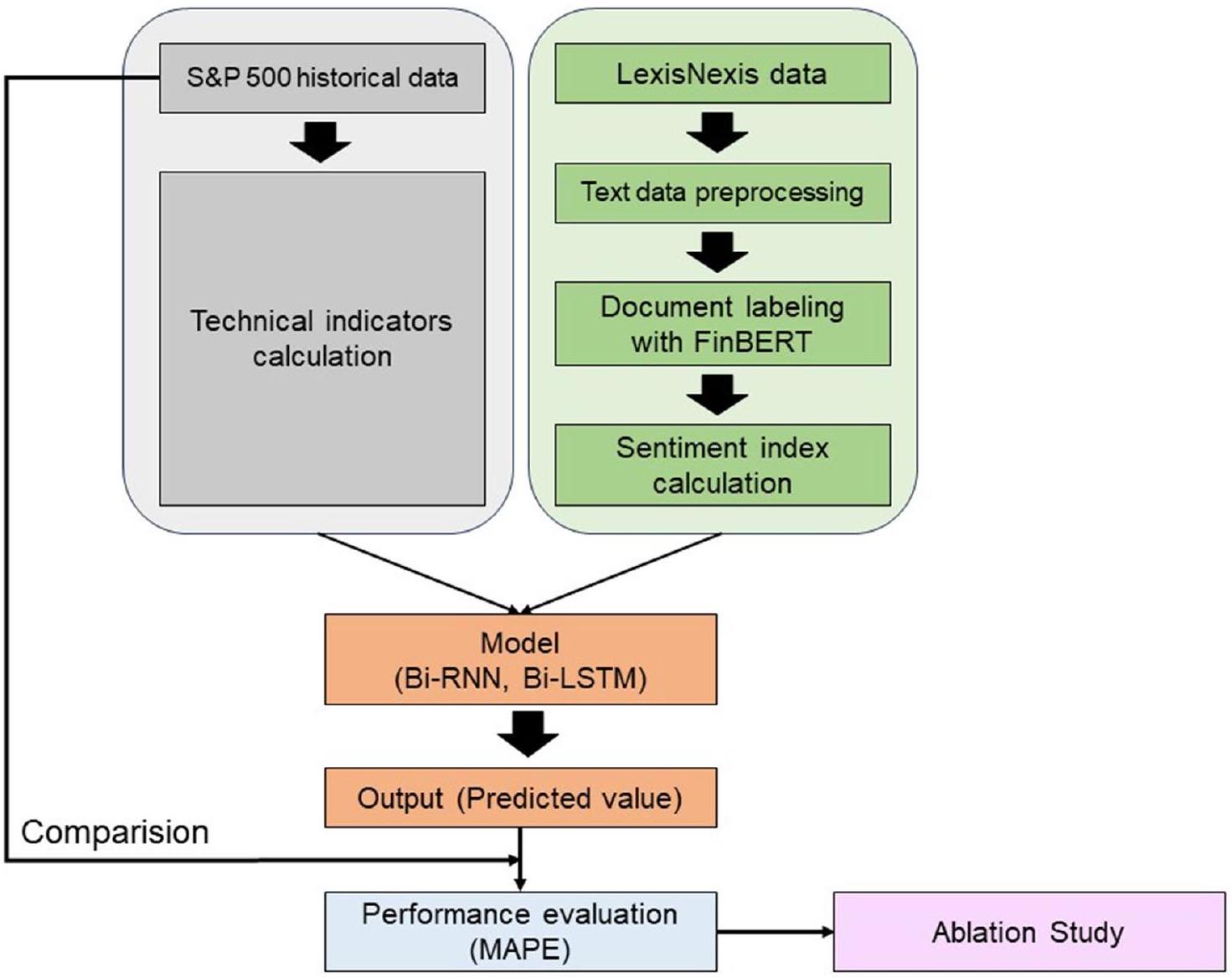
تصف هذه القسم تدفق التجربة. أولاً، تم جمع البيانات للتجربة. بعد ذلك، تم إجراء معالجة مسبقة لإزالة البيانات النصية غير ذات الصلة. ثالثًا، تم اشتقاق مؤشرات فنية من مجموعة بيانات S&P 500، مع توليد درجات المشاعر من بيانات الأخبار المتعلقة بالبيئة والمجتمع والحوكمة. بعد دمج البيانات المعالجة، تم تعديل البيانات المقاسة كبيانات إدخال لنماذج التعلم العميق للتنبؤ بالأسعار المستقبلية. أخيرًا، تم استخدام MAPE كمعيار لتقييم أداء الانحدار. بالإضافة إلى ذلك، تم إجراء اختبارات الإزالة لتقييم فعالية كل ميزة إدخال. يتم توضيح إجراء التجربة في الشكل 1.

جمع البيانات

يتم استخدام مؤشر S&P 500 لفهم ومراقبة الاتجاهات العامة لسوق الأسهم ويعتبر واحدًا من المؤشرات التي تمثل صحة الأسواق المالية في الولايات المتحدة. يمثل مؤشر S&P 500 مؤشرًا لـ 500 شركة كبرى في الولايات المتحدة، ويعكس تحركات السوق بشكل عام بدلاً من أسعار أسهم الشركات الفردية. بالإضافة إلى ذلك، يتضمن مؤشر S&P 500 شركات من مجموعة متنوعة من الصناعات والقطاعات. لذلك، فإن بناء نموذج لتوقع أسعار الأسهم يشمل بيانات من صناعات مختلفة يعادل تصميم نموذج عام يتمتع بالمرونة. علاوة على ذلك، بينما يجب أن تأخذ أسهم الشركات الفردية في الاعتبار أيضًا تأثير العوامل الداخلية، فإن مؤشر S&P 500 يتأثر بالتصور العام للسوق. وبالتالي، فإن بناء نموذج محسّن لتوقع أسعار الأسهم من خلال دمج معلومات ESG ومؤشر S&P 500 يمكن أن يبرز أهمية وتأثير معلومات الاستدامة عبر السوق للمستثمرين والباحثين المعنيين.
تم إجراء التجارب من خلال جمع مجموعتين من البيانات تمتد من 1 يناير 2016 إلى 31 يوليو 2023. من خلال LexisNexis، قام المؤلفون بالوصول إلى مجموعة من 14,049 مقالة إخبارية باستخدام مصطلح البحث “ESG.” قد يتطلب الوصول إلى قاعدة بيانات LexisNexis اشتراكًا مدفوعًا، مثل الوصول المؤسسي. بالإضافة إلى ذلك، تم الحصول على بيانات تاريخية عن مؤشر S&P 500، والتي تحتوي على معلومات مثل التاريخ، القيمة الختامية، القيمة الافتتاحية، القيمة العليا، القيمة الدنيا، حجم التداول، والتقلب، لنفس الفترات الزمنية مناستثمار.كوم.

هندسة الميزات

استنادًا إلى الأبحاث السابقة، حصل المؤلفون على مؤشرات فنية متنوعة ثبت أنها تؤثر على أسعار الأسهم باستخدام وحدة TA-lib. تم اختيار الميزات التالية: سعر الافتتاح، سعر الإغلاق، السعر الأعلى، السعر الأدنى، حجم التداول، مؤشر القوة النسبية (RSI)، المتوسط المتحرك البسيط لمدة 5 أيام (SMA_5)، المتوسط المتحرك البسيط لمدة 20 يومًا (SMA_20)، المتوسط المتحرك الأسي (EMA)، تقاطع المتوسط المتحرك (MACD)، الإشارة، مؤشر ستوكاستيك RSI_fastk، مؤشر ستوكاستيك RSI_fastd، مؤشر الستوكاستيك أوسيليتر (Index_slowk)، مؤشر الستوكاستيك أوسيليتر (Index_slowd)، مؤشر الستوكاستيك أوسيليتر (index_slowd)، ويليامR، الزخم، ومعدل التغيير (ROC). تم تقديم أوصاف مفصلة لهذه المؤشرات الفنية أدناه.
سعر الافتتاح هو سعر السهم في بداية جلسة التداول ويشير إلى أول صفقة تمت خلال اليوم. تمثل الأسعار العالية أعلى قيمة لتداول السهم خلال فترة تداول محددة، بينما تشير الأسعار المنخفضة إلى الأدنى. حجم التداول، الذي يعكس نشاط السوق، هو عدد الأسهم أو العقود المتداولة خلال فترة محددة.
مؤشر القوة النسبية هو مذبذب زخم يقيس سرعة وتغير حركة الأسعار ويساعد في تحديد حالات الشراء المفرط أو البيع المفرط. المتوسطات المتحركة البسيطة هي أسعار الإغلاق المتوسطة على مدى عدد محدد من الفترات. على سبيل المثال، يمثل SMA_5 وSMA_20 المتوسطات المتحركة لمدة 5 أيام و20 يومًا، على التوالي. يستجيب المتوسط المتحرك الأسي بشكل أفضل للتغيرات الأخيرة في الأسعار من خلال إعطائها وزنًا أكبر. .
الشكل 1. مخطط انسيابي لتوقع مؤشر S&P 500.
MACD هو مؤشر زخم يتبع الاتجاهات من خلال توضيح التفاعل بين متوسطين متحركين لسعر الأمان. تلعب خطوط الإشارة، أي المتوسطات المتحركة المستمدة من خطوط MACD، دورًا مهمًا في توليد إشارات شراء وبيع قيمة للتجار والمستثمرين. .
تم حساب مؤشر القوة النسبية العشوائي السريع RSI_fastk و RSI_fastd بناءً على كل من مؤشر القوة النسبية ومؤشر العشوائية بشكل فعال لفهم النقاط المحتملة لعكس الأسعار وتعزيز دقة التنبؤات . لضمان السلاسة، تم اعتبار مؤشرات العشوائية البطيئة indices_slowk و indices_slowd مكونات تكميلية لمؤشر العشوائية.
جانب آخر أساسي من التحليل كان ويليامز , المعروف عادةً باسم ويليامز R. يقيم هذا المؤشر الزخم ما إذا كانت ظروف السوق تشير إلى سيناريوهات شراء مفرط أو بيع مفرط، مما يساهم في فهم شامل لمشاعر السوق .
المؤشر التالي المستخدم هو الزخم. يمكن استخدام مفهوم الزخم لقياس معدل تغير السعر. يوفر الزخم رؤى حول المعدل الذي تتغير به الأسعار من خلال قياس معدل التغير في أسعار الأسهم. أخيرًا، يشمل ROC، وهو مقياس مشابه للزخم، حساب التغيرات في الأسعار على مدى فترة معينة، مما يوفر رؤى حول مدى تقلبات الأسعار .

حساب مؤشر المشاعر باستخدام تمثيلات الترميز ثنائية الاتجاه المالية من المحولات (FinBERT)

تم إجراء معالجة مسبقة بما في ذلك إزالة الكلمات الشائعة والتصريف على بيانات الأخبار، تلتها تحليل المشاعر باستخدام FinBERT. تم بناء FinBERT على بنية BERT، وهي نموذج لغوي فعال لمعالجة وفهم اللغة الطبيعية من خلال ترميز النص مع مراعاة السياق بشكل ثنائي الاتجاه . يتخصص FinBERT في المعرفة المتعلقة بالمجال من خلال إعادة تدريب نموذج BERT المدرب مسبقًا باستخدام بيانات مالية. يأخذ FinBERT نصوصًا تتعلق بالمال مثل الأخبار المالية والتقارير والمشاركات على الويب كمدخلات، ويحلل ويتنبأ بمشاعر النص، مصنفًا إياها على أنها إيجابية أو سلبية أو محايدة.
تم تصنيف الدرجات في البيانات 0 للمشاعر السلبية و1 للمشاعر الإيجابية (Eq. (1)). بالإشارة إلى دراسة قام بها وو وآخرون , تم حساب قياسات المشاعر كفرق بين عدد المشاركات السلبية والإيجابية في مجموعة بيانات معينة.
حيث يمثل عدد المقالات الإخبارية الإيجابية و يمثل عدد المقالات السلبية في اليوم . كان نطاق قيم مؤشر المشاعر بين -1 و . إذا اقتربت قيمة مؤشر المشاعر من -1، فإن ذلك يشير إلى نغمة سلبية في الأخبار لذلك التاريخ. وعلى العكس، إذا اقتربت من 1، فإن ذلك يشير إلى نغمة إيجابية عامة في الأخبار. قبل استخدام الميزات المختارة كمدخلات للإطار، تم تطبيق مقياس min-max لتوحيد نطاق هذه القيم بين 0 و 1.

حجم النافذة

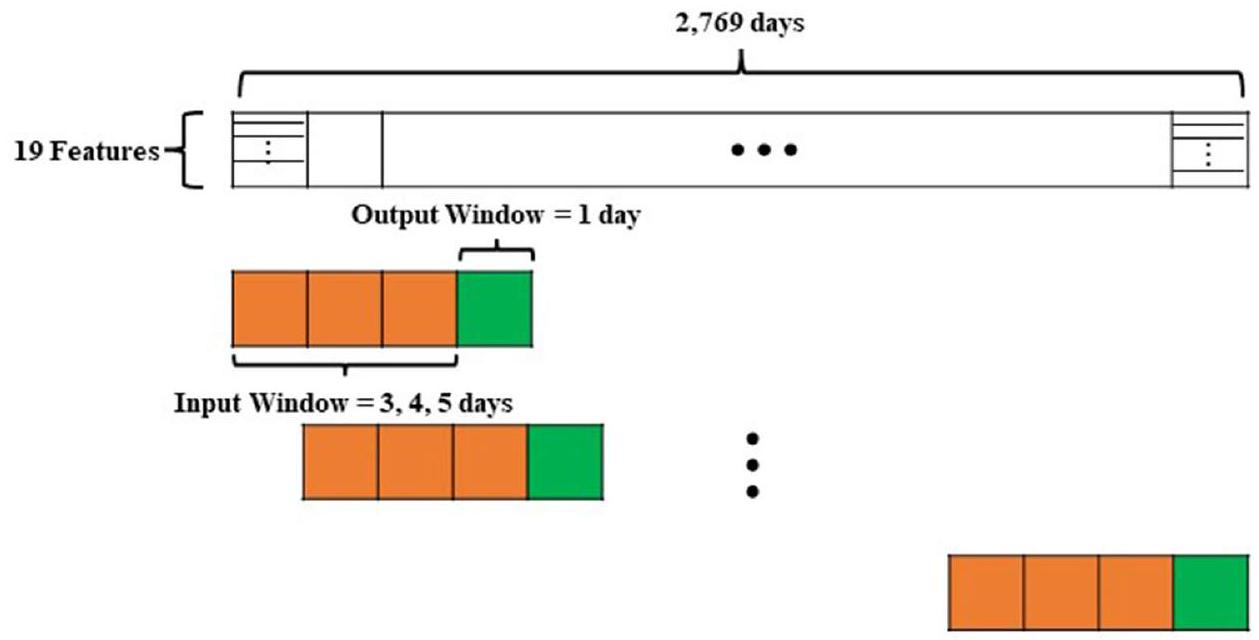
بعد ذلك، تم إنشاء مجموعات بيانات متعددة، كل منها يتوافق مع نافذة معلمات فرعية مميزة. حجم النافذة هو مفهوم أساسي في توقعات أسعار الأسهم لمعالجة وتوقع بيانات السلاسل الزمنية . يحدد حجم النافذة فترة وحدة ثابتة، حيث يتم استخدام البيانات داخل هذه النافذة لتوقع أسعار الأسهم المستقبلية. لذلك، فإن اختيار حجم نافذة مناسب أمر حاسم لتحسين أداء نماذج توقع أسعار الأسهم. في هذه الدراسة، تم إجراء تجارب باستخدام ثلاثة أحجام نوافذ: 3 و4 و5 (الشكل 2). أخيرًا، تم تقسيم مجموعات بيانات التدريب والاختبار بنسبة . تتكون مجموعة بيانات التحقق من الصحة من من مجموعة بيانات التدريب.

نماذج التعلم العميق

الشبكات العصبية التكرارية ثنائية الاتجاه (Bi-RNN) هي نوع من الشبكات العصبية التكرارية القادرة على مراعاة كل من السياقات السابقة واللاحقة لتسلسل ما. تتيح هذه الخاصية ثنائية الاتجاه لها التقاط الأنماط في اتجاهات زمنية مختلفة . علاوة على ذلك، نظرًا لأن العوامل قصيرة المدى يمكن أن تؤثر على تقلب أسعار الأسهم، فإن هيكل RNN مع الطبقات التكرارية بارع في التقاط هذه التغيرات، مما يجعله مناسبًا للتطبيق كنموذج سلسلة زمنية. بالإضافة إلى ذلك، يتمتع Bi-RNN بهيكل مرن يمكن تطبيقه على أنواع مختلفة من بيانات السلاسل الزمنية، مما يجعله مفيدًا لمعالجة الأنماط. بالمقابل، تمثل الشبكات العصبية طويلة المدى قصيرة المدى ثنائية الاتجاه (Bi-LSTM) تكرارًا محسّنًا من RNNs التي تتضمن خلايا LSTM . إنها تتفوق في تعلم الاعتماديات بعيدة المدى وتكون فعالة بشكل خاص في المهام التي تتضمن بيانات تسلسلية، مثل توقع السلاسل الزمنية .

النتائج

تم الحصول على نتائج هذه الدراسة من خلال إجراء تجارب باستخدام مجموعات متنوعة من أحجام النوافذ (3 و4 و5) والمعلمات، مع اعتبار أحجام الدفعات كمجموعات من و8؛ تم تعيين أحجام مخفية عند 32 و64؛ عدد الطبقات عند 4 و6 و8؛ تم تثبيت عدد الدورات عند 10 لاستكشاف جميع السيناريوهات الممكنة. النماذج المستخدمة كانت Bi-RNN وBi-LSTM.
تم تقييم الأداء باستخدام MAPE، المحسوبة باستخدام Eq. (2):
حيث هو القيمة الفعلية، و هو القيمة المتوقعة في الوقت t، وn هو العدد الإجمالي للملاحظات. تتراوح قيمة MAPE من 0 إلى ، مع قيم أقرب إلى تشير إلى توقعات أكثر دقة من قبل النموذج .
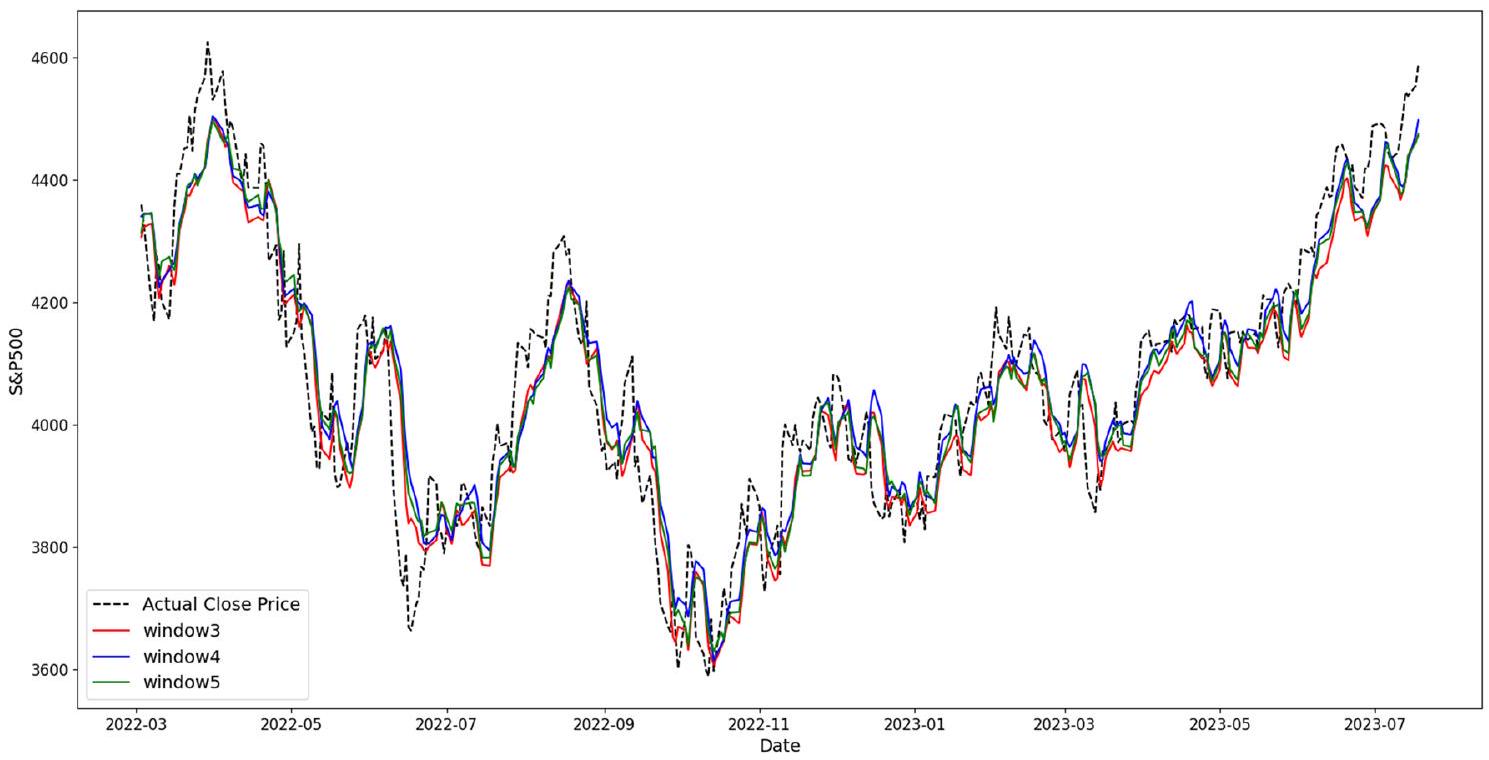
نتيجة لذلك، مع حجم نافذة 3، وحجم دفعة 64، وأحجام مخفية 64 و32، وعدد طبقات 2، أظهر نموذج Bi-LSTM أعلى أداء بقيمة MAPE قدرها على بيانات الاختبار (الجدول 2). بالإضافة إلى ذلك، لتحويل وتصوير نطاق القيم الفعلية لمؤشر S&P 500، تم إجراء تحويل عكسي لكل حجم نافذة في نموذج Bi-LSTM، وتمت مقارنة النتائج (الشكل 3).
بعد ذلك، تم إجراء اختبار إلغاء للتحقق من فعالية الميزات المدخلة. اختبار الإلغاء هو طريقة تستخدم للتحقيق في السببية. تختبر هذه الطريقة عناصر أو متغيرات معينة من خلال إزالتها لرؤية كيف تؤثر على النظام . قام المؤلفون بتثبيت حجم النافذة عند 3 و4 و5 وقسموا الاختبارات
الشكل 2. توضيح حجم النافذة.
حجم النافذة النموذج
Bi-RNN Bi-LSTM
3 4.65 3.05
4 6.85 3.2
5 5.07 3.55
الجدول 2. نتائج كل مُرجع (MAPE، %).
الشكل 3. مقارنة نتائج Bi-LSTM بناءً على حجم النافذة مع القيمة الإغلاق الفعلية لمؤشر S&P 500.
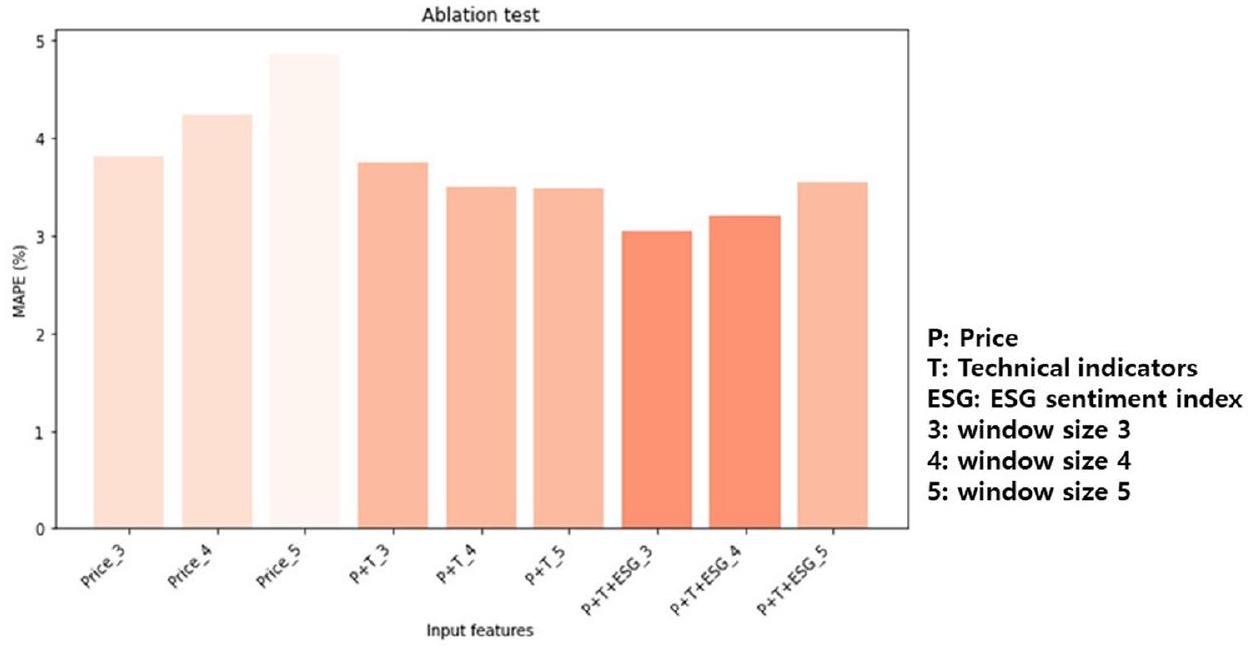
إلى ثلاث حالات (أي، ‘سعر فقط’، ‘سعر ومؤشرات فنية’، ‘سعر ومؤشرات فنية ومؤشر مشاعر ESG). أظهرت النتائج أن دمج مشاعر ESG والبيانات الفنية والسعرية أدى إلى أداء أفضل مقارنة بالاعتماد فقط على بيانات السعر. في الختام، تم تحقيق الأداء الأمثل لنموذج Bi-LSTM عندما تم دمج جميع المدخلات الثلاثة. تؤكد هذه النتائج من خلال اختبار الإلغاء أن هناك علاقة سببية بين أداء نموذج التنبؤ لمؤشر S&P 500 ومعلومات ESG. يتم توضيح النتائج المحددة لقيم MAPE في الجدول 3، مع تمثيل بصري لهذه النتائج موضح في الشكل 4.

المناقشة

أصبحت الاستدامة اتجاهًا عالميًا مهمًا يشكل مشهد الأعمال الحديثة، مما يتطلب دمج مقاييس ESG لتقييم أداء الشركات. توفر مقاييس ESG رؤى قيمة حول الممارسات التشغيلية وتؤثر بشكل كبير على ثقة المستثمرين واتخاذ القرار عندما تتبنى الشركة ممارسات مستدامة وإدارة فعالة. إن الاتصال المتزايد بين الاستدامة ومقاييس ESG واختيارات المستثمرين يبرز أهمية دمج معايير ESG في التقييمات المالية، مما يدمج المسؤولية الاجتماعية مع استراتيجيات الاستثمار . مع هذا الفهم، تسعى الشركات
ميزات المدخلات Bi-LSTM
سعر فقط (حجم النافذة ) 3.81
سعر فقط (حجم النافذة ) 4.24
سعر فقط (حجم النافذة ) 4.87
سعر ومؤشرات فنية (حجم النافذة ) 3.75
سعر ومؤشرات فنية (حجم النافذة ) 3.51
سعر ومؤشرات فنية (حجم النافذة ) 3.48
سعر ومؤشرات فنية ومؤشر مشاعر ESG (حجم النافذة ) 3.05
سعر ومؤشرات فنية ومؤشر مشاعر ESG (حجم النافذة ) 3.2
سعر ومؤشرات فنية ومؤشر مشاعر ESG (حجم النافذة ) 3.55
الجدول 3. نتائج اختبار الإلغاء بناءً على ميزات المدخلات المختلفة (MAPE، %).
الشكل 4. تصور نتائج اختبار الإلغاء.
اعتماد استراتيجيات تعزز المسؤولية الاجتماعية والأثر البيئي من خلال دمج معلومات ESG، ويمكن أن تنعكس هذه الجهود للجمهور من خلال المقالات الإخبارية. يمكن أن يؤثر التعرض من خلال مثل هذه الوسائط في النهاية على قيمة الشركات، وبالتالي، أسعار الأسهم.
مع تطور الأسواق المالية التي تتكيف مع هذه التغييرات، يمثل دمج مؤشرات ESG للتنبؤ بمؤشر S&P 500 استراتيجية تفكير مستقبلي تتماشى مع هذه الاتجاهات المتطورة. علاوة على ذلك، فإن دمج مؤشرات التحليل الفني الأساسية لتحليل اتجاهات الأسعار مع مؤشرات ESG يشكل نهجًا شاملاً يأخذ في الاعتبار بشكل كبير كل من تحركات الأسعار على المدى الطويل واتجاهات الأسعار على المدى القصير.
بالإضافة إلى ذلك، لم يتم استغلال تطبيق التعلم الآلي في الدراسات السابقة بشكل كامل للاستفادة من إمكانيات الاستفادة من الخوارزميات المتقدمة لتحليل تفاعل مقاييس ESG ومؤشرات التحليل الفني بشكل شامل للتنبؤ بمؤشر S&P 500، مما يشير إلى أن الدراسات السابقة قد لا تكون قد استكشفت بدقة الإمكانيات التي تقدمها التعلم الآلي.
لتجاوز هذه القيود، طبق المؤلفون نموذج تعلم عميق على درجات المشاعر التي تم الحصول عليها من خلال تطبيق FinBERT على بيانات أخبار LexisNexis و18 مؤشرًا فنيًا تم الحصول عليها من البيانات التاريخية لمؤشر S&P 500. بعد ذلك، تم استخدام MAPE كمقياس لتقييم الأداء للإطار. بعد الخضوع للتحقق المتقاطع مع معلمات مختلفة، أظهر نموذج Bi-LSTM MAPE متفوقًا قدره 3.05 على مجموعة بيانات الاختبار عند استخدام حجم نافذة قدره 3، وحجم دفعة قدره 64، وحجم مخفي قدره 32 و64، وعدد طبقات قدره 2. علاوة على ذلك، أظهرت اختبارات الإزالة التي أجريت في هذه الدراسة قوة الميزات المدخلة المختارة لتنبؤ مؤشر S&P 500. على وجه التحديد، فإن اعتبار مؤشر المشاعر الذي يتضمن معلومات ESG جنبًا إلى جنب مع مؤشرات التحليل الفني ومعلومات الأسعار قد أسفر عن أفضل أداء.
نتيجة لذلك، فإن دمج مقاييس ESG ومؤشرات التحليل الفني للتنبؤ بمؤشر S&P 500 له آثار عملية كبيرة. مع ظهور معايير ESG كعوامل مواتية لتنبؤات الأسهم، فإنها تدفع الشركات لتقييم ممارساتها التشغيلية وجهود الاستدامة. علاوة على ذلك، يمكن للمستثمرين الذين يدركون تأثير مقاييس ESG اتخاذ قرارات مستنيرة من خلال الثقة في الشركات التي تعطي الأولوية للاستدامة والحوكمة الفعالة. يسلط هذا التفاعل بين اعتبارات الاستدامة ومقاييس ESG واختيارات المستثمرين الضوء على الحاجة إلى دمج عناصر ESG في التقييمات المالية ومواءمة المسؤولية الشركات مع استراتيجيات الاستثمار.
علاوة على ذلك، تتماشى هذه الدراسة مع اتجاهات السوق المالية وتظهر إمكانيات دمج مؤشرات ESG ومؤشرات التحليل الفني للتنبؤ بسلوك سوق الأسهم. توفر نماذج التعلم العميق فرصًا مبتكرة لفحص الروابط المعقدة بين ESG ومؤشرات التحليل الفني بشكل شامل، مما يؤدي إلى توقعات دقيقة لمؤشر S&P 500.

قيود الدراسة

تحتوي هذه الدراسة على عدة قيود. أولاً، قد لا تمثل النتائج بشكل شامل الديناميات المعقدة للسوق المالية بأكملها بسبب اعتمادها على مجموعة بيانات S&P 500. يجب على الأبحاث المستقبلية التحقق من صحة هذه النتائج وتوسيعها من خلال دمج بيانات من طيف أوسع من الأسواق المالية. ثانيًا، تم اشتقاق مؤشر المشاعر المستخدم في هذا التحليل فقط من بيانات الأخبار، وهو ما يمثل قيدًا محتملاً. لذلك، فإن استكشاف دمج بيانات نصية متنوعة تتعلق بـ ESG يمكن أن يساعد في إجراء تحليل أكثر شمولاً وقوة. ثالثًا، تختلف قيمة التركيز على ESG حسب الصناعة. لذلك، يمكن أن تحاول الأبحاث المستقبلية التنبؤ بالأسهم حسب مجموعة الصناعة بدلاً من السوق المالية بأكملها.

توفر البيانات

لم يتم إنشاء أو تحليل أي مجموعات بيانات خلال الدراسة الحالية.
تاريخ الاستلام: 21 ديسمبر 2023؛ تاريخ القبول: 2 مايو 2024
تم النشر عبر الإنترنت: 04 مايو 2024

References

  1. Egorova, A. A., Grishunin, S. V. & Karminsky, A. M. The impact of ESG factors on the performance of information technology companies. Procedia Comput. Sci. 199, 339-345 (2022).
  2. Lee, H., Lee, S. H., Lee, K. R. & Kim, J. H. ESG discourse analysis through BERTopic: Comparing news articles and academic papers. Comput., Mater. Continua 75(3), 6023-6037 (2023).
  3. Lee, H., Lee, S. H., Park, H., Kim, J. H. & Jung, H. S. ESG2PreEM: Automated ESG grade assessment framework using pre-trained ensemble models. Heliyon 10(4), e26404 (2024).
  4. Aybars, A., Ataünal, L., & Gürbüz, A. O. ESG and financial performance: impact of environmental, social, and governance issues on corporate performance. In Handbook of Research on Managerial Thinking in Global Business Economics, 520-536 (IGI Global, 2019).
  5. In, S. Y., Rook, D. & Monk, A. Integrating alternative data (also known as ESG data) in investment decision making. Glob. Econ. Rev. 48(3), 237-260 (2019).
  6. Alareeni, B. A. & Hamdan, A. ESG impact on performance of US S&P 500-listed firms. Corp. Gov.: Int. J. Bus. Soc. 20(7), 1409-1428 (2020).
  7. Huang, R. D. & Kracaw, W. A. Stock market returns and real activity: a note. J. Financ. 39(1), 267-273 (1984).
  8. Fama, E. F. Stock returns, real activity, inflation, and money. Am. Econ. Rev. 71(4), 545-565 (1981).
  9. Scatigna, M., Xia, F. D., Zabai, A., & Zulaica, O. Achievements and challenges in ESG markets. BIS Quarterly Review, December (2021).
  10. Kiesel, F. & Lücke, F. ESG in credit ratings and the impact on financial markets. Financ. Mark. Inst. Instrum. 28(3), 263-290 (2019).
  11. Peng, Y., Albuquerque, P. H. M., Kimura, H. & Saavedra, C. A. P. B. Feature selection and deep neural networks for stock price direction forecasting using technical analysis indicators. Mach. Learn. Appl. 5, 100060 (2021).
  12. Shynkevich, Y., McGinnity, T. M., Coleman, S. A., Belatreche, A. & Li, Y. Forecasting price movements using technical indicators: Investigating the impact of varying input window length. Neurocomputing 264, 71-88 (2017).
  13. Zubair, S., & Cios, K. J. Extracting news sentiment and establishing its relationship with the s&p 500 index. In 2015 48th Hawaii International Conference on System Sciences, 969-975 (IEEE, 2015).
  14. Khedr, A. E. & Yaseen, N. Predicting stock market behavior using data mining technique and news sentiment analysis. Int. J. Intell. Syst. Appl. 9(7), 22 (2017).
  15. Li, Y., & Pan, Y. A novel ensemble deep learning model for stock prediction based on stock prices and news. Int. J. Data Sci. Anal., 1-11 (2022).
  16. Bauer, R., Guenster, N. & Otten, R. Empirical evidence on corporate governance in Europe: The effect on stock returns, firm value and performance. J. Asset Manag. 5, 91-104 (2004).
  17. Chen, R. C., Hung, S. W. & Lee, C. H. Does corporate value affect the relationship between corporate social responsibility and stock returns?. J. Sustain. Finance Invest. 7(2), 188-196 (2017).
  18. Minutolo, M. C., Kristjanpoller, W. D. & Stakeley, J. Exploring environmental, social, and governance disclosure effects on the S&P 500 financial performance. Bus. Strateg. Environ. 28(6), 1083-1095 (2019).
  19. Gillan, S. L., Koch, A. & Starks, L. T. Firms and social responsibility: A review of ESG and CSR research in corporate finance. J. Corp. Finan. 66, 101889 (2021).
  20. Zheng, Y., Wang, B., Sun, X. & Li, X. ESG performance and corporate value: Analysis from the stakeholders’ perspective. Front. Environ. Sci. 10, 1084632 (2022).
  21. Stellner, C., Klein, C. & Zwergel, B. Corporate social responsibility and Eurozone corporate bonds: The moderating role of country sustainability. J. Bank. Finance 59, 538-549 (2015).
  22. Xu, Y., & Keselj, V. Stock prediction using deep learning and sentiment analysis. In 2019 IEEE international conference on big data (big data), 5573-5580 (IEEE, 2019).
  23. Hoseinzade, E. & Haratizadeh, S. CNNpred: CNN-based stock market prediction using a diverse set of variables. Expert Syst. Appl. 129, 273-285 (2019).
  24. Assis, C. A., Pereira, A. C., Carrano, E. G., Ramos, R., & Dias, W. Restricted Boltzmann machines for the prediction of trends in financial time series. In 2018 International Joint Conference on Neural Networks (IJCNN), 1-8 (IEEE, 2018).
  25. Jung, H. S., Lee, S. H., Lee, H. & Kim, J. H. Predicting bitcoin trends through machine learning using sentiment analysis with technical indicators. Comput. Syst. Sci. Eng. 46(2), 2231-2246 (2023).
  26. Ademi, B. & Klungseth, N. J. Does it pay to deliver superior ESG performance? Evidence from US S&P 500 companies. J. Glob. Responsib. 13(4), 421-449 (2022).
  27. Chu, Q. C., Hsieh, W. L. G. & Tse, Y. Price discovery on the S&P 500 index markets: An analysis of spot index, index futures, and SPDRs. Int. Rev. Financ. Anal. 8(1), 21-34 (1999).
  28. Pieterse, B. Comparing the returns of technical analysis strategies with market index returns (Master’s thesis, University of Pretoria (South Africa)) (2021).
  29. Hajimiri, H. Use of genetic algorithm in algorithmic trading to optimize technical analysis in the international stock market (Forex). J. Cyberspace Stud. 6(1), 21-29 (2022).
  30. Rosillo, R., De la Fuente, D. & Brugos, J. A. L. Technical analysis and the Spanish stock exchange: testing the RSI, MACD, momentum and stochastic rules using Spanish market companies. Appl. Econ. 45(12), 1541-1550 (2013).
  31. Yazdi, S. H. M. & Lashkari, Z. H. Technical analysis of Forex by MACD Indicator. Int. J. Human. Manag. Sci. (IJHMS) 1(2), 159-165 (2013).
  32. Vaiz, J. S. & Ramaswami, M. A study on technical indicators in stock price movement prediction using decision tree algorithms. Am. J. Eng. Res. (AJER) 5(12), 207-212 (2016).
  33. Zhai, Y., Hsu, A., & Halgamuge, S. K. Combining news and technical indicators in daily stock price trends prediction. In Advances in Neural Networks-ISNN 2007: 4th International Symposium on Neural Networks, 1087-1096 (Springer, 2007).
  34. Huang, J. Z., Huang, W. & Ni, J. Predicting bitcoin returns using high-dimensional technical indicators. J. Finance Data Sci. 5(3), 140-155 (2019).
  35. Araci, D. Finbert: Financial sentiment analysis with pre-trained language models. Preprint at https://doi.org/10.48550/arXiv.1908. 10063 (2019).
  36. Wu, S., Liu, Y., Zou, Z. & Weng, T. H. S_I_LSTM: stock price prediction based on multiple data sources and sentiment analysis. Connect. Sci. 34(1), 44-62 (2022).
  37. Rajabi, S., Roozkhosh, P. & Farimani, N. M. MLP-based Learnable Window Size for Bitcoin price prediction. Appl. Soft Comput. 129, 109584 (2022).
  38. Das, G., Lin, K. I., Mannila, H., Renganathan, G., & Smyth, P. Rule Discovery from time series. In KDD, 16-22 (1998).
  39. Schuster, M. & Paliwal, K. K. Bidirectional recurrent neural networks. IEEE Trans. Signal Process. 45(11), 2673-2681 (1997).
  40. Lee, H., Jung, H. S., Lee, S. H. & Kim, J. H. Robust sentiment classification of metaverse services using a pre-trained language model with soft voting. KSII Trans. Internet Inf. Syst. 17(9), 2334-2347 (2023).
  41. Hochreiter, S. & Schmidhuber, J. Long short-term memory. Neural Comput. 9(8), 1735-1780 (1997).
  42. De Myttenaere, A., Golden, B., Le Grand, B. & Rossi, F. Mean absolute percentage error for regression models. Neurocomputing 192, 38-48 (2016).
  43. Huang, S., Wang, D., Wu, X., & Tang, A. Dsanet: Dual self-attention network for multivariate time series forecasting. In Proceedings of the 28th ACM international conference on information and knowledge management, 2129-2132 (ACM, 2019).

الشكر والتقدير

نود أن نشكر Editage (www.editage.co.kr) على تحرير اللغة الإنجليزية. تم دعم هذه الدراسة من قبل منحة مؤسسة البحث الوطنية الكورية (NRF) (http://nrf.re.kr/eng/index) الممولة من الحكومة الكورية (RS-2023-00208278).

مساهمات المؤلفين

يؤكد المؤلفون مساهماتهم في الورقة على النحو التالي: تصميم الدراسة وتصميمها: H. L. وJ. H. K. وH. S. J؛ جمع البيانات: H. L. وH. S. J؛ تحليل النموذج وتفسير النتائج: H. L. وH. S. J؛ إعداد مسودة المخطوطة: H. L. وJ. H. K. وH. S. J. راجع جميع المؤلفين النتائج ووافقوا على النسخة النهائية من المخطوطة.

المصالح المتنافسة

يعلن المؤلفون عدم وجود مصالح متنافسة.

معلومات إضافية

يجب توجيه المراسلات والطلبات للحصول على المواد إلى H.S.J.
معلومات إعادة الطبع والتصاريح متاحة على www.nature.com/reprints.
ملاحظة الناشر تظل Springer Nature محايدة فيما يتعلق بالمطالبات القضائية في الخرائط المنشورة والانتماءات المؤسسية.
الوصول المفتوح هذه المقالة مرخصة بموجب رخصة المشاع الإبداعي للاستخدام والمشاركة والتكيف والتوزيع وإعادة الإنتاج في أي وسيلة أو تنسيق، طالما أنك تعطي الائتمان المناسب للمؤلفين الأصليين والمصدر، وتوفر رابطًا لرخصة المشاع الإبداعي، وتوضح ما إذا كانت هناك تغييرات قد تم إجراؤها. الصور أو المواد الأخرى من طرف ثالث في هذه المقالة مشمولة في رخصة المشاع الإبداعي للمقالة، ما لم يُشار إلى خلاف ذلك في سطر ائتمان للمادة. إذا لم تكن المادة مشمولة في رخصة المشاع الإبداعي للمقالة واستخدامك المقصود غير مسموح به بموجب اللوائح القانونية أو يتجاوز الاستخدام المسموح به، فستحتاج إلى الحصول على إذن مباشرة من صاحب حقوق الطبع والنشر. لعرض نسخة من هذه الرخصة، قم بزيارة http://creativecommons.org/licenses/by/4.0/.
© المؤلفون 2024

  1. قسم الذكاء الاصطناعي التطبيقي / قسم تفاعل الإنسان والذكاء الاصطناعي، جامعة سونغكيوكوان، سيول 03063، جمهورية كوريا. قسم علوم التفاعل / قسم تفاعل الإنسان والذكاء الاصطناعي، جامعة سونغكيوكوان، سيول 03063، جمهورية كوريا. قسم الذكاء الاصطناعي التطبيقي، جامعة سونغكيوكوان، سيول 03063، جمهورية كوريا. البريد الإلكتروني: jestiriel@g.skku.edu

Journal: Scientific Reports, Volume: 14, Issue: 1
DOI: https://doi.org/10.1038/s41598-024-61106-2
PMID: https://pubmed.ncbi.nlm.nih.gov/38704434
Publication Date: 2024-05-04

Deep-learning-based stock market prediction incorporating ESG sentiment and technical indicators

Abstract

Haein Lee , Jang Hyun Kim & Hae Sun Jung As sustainability emerges as a crucial factor in the development of modern enterprises, integrating environmental, social, and governance (ESG) information into financial assessments has become essential. ESG indicators serve as important metrics in evaluating a company’s sustainable practices and governance effectiveness, influencing investor trust and future growth potential, ultimately affecting stock prices. This study proposes an innovative approach that combines ESG sentiment index extracted from news with technical indicators to predict the S&P 500 index. By utilizing a deep learning model and exploring optimal window sizes, the study explores the best model through mean absolute percentage error (MAPE) as an evaluation metric. Additionally, an ablation test clarifies the influence of ESG and its causality with the S&P 500 index. The experimental results demonstrate improved predictive accuracy when considering ESG sentiment compared to relying solely on technical indicators or historical data. This comprehensive methodology enhances the advantage of stock price prediction by integrating technical indicators, which consider short-term fluctuations, with ESG information, providing long-term effects. Furthermore, it offers valuable insights for investors and financial market experts, validating the necessity to consider ESG for financial assets and introducing a new perspective to develop investment strategies and decision-making processes.

Keywords ESG, Natural language processing (NLP), Time series prediction, Deep learning
Sustainability represents a crucial global trend in shaping the progress of modern enterprises. Given the increasing emphasis on sustainable practices, integrating environmental, social, and governance (ESG) indicators to assess a company’s performance has become indispensable . ESG indicators measure a company’s ESG performance, providing valuable insights into operational practices . When a company embraces sustainable business model, fulfills social responsibilities, and upholds effective governance, investors can place a high degree of trust in the company and evaluate its future growth potential positively . This positive perception of future growth potential can translate into stock price increases for the company. Consequently, ESG indicators significantly influence decision-making of investors , thereby encouraging companies to proactively adopt sustainable practices and improve their ESG metrics while also demonstrating that sustainable business strategies offer advantages to both investors and companies.
The interconnection between sustainability and ESG metrics and their impact on investor choices highlights the increasing importance of incorporating ESG criteria into financial assessments, bridging corporate responsibility and investment strategies. Moreover, as financial markets evolve to accommodate these shifts, combining ESG indices to predict the S&P 500 index can be an innovative approach that considers the situation where ESG factors are increasingly affecting investment choices . The reason for using the S&P 500 as the target for prediction here is because this index is considered an important indicator representing the economic situation of the United States and the health status of its companies, and it is sometimes used to reflect trends in the global stock market . Investors are showing a growing interest in understanding how a company’s ESG performance impacts its stock price, underscoring the rising significance of ESG metrics in the financial domain. .
In addition to ESG indicators, technical indicators play an important role in financial analysis . These indicators are calculated using historical data such as past price movements and trading volume of specific assets, and it is crucial for considering past price patterns or trends and predicting future movements . Given the
fundamental importance of technical indicators in financial analysis, their integration with ESG metrics shows significant promise, as exemplified by the comprehensive approach suggested in this study.
Therefore, research that incorporates ESG information with technical indicators for predicting S&P 500 index can provide innovative methodologies and valuable insights for investors and financial market experts. This comprehensive approach can assist in forecasting stock behavior and is anticipated to bring a fresh dimension to formulating investment strategies and decision-making. For the experiment, the authors utilized 18 technical features to predict the closing value of the S&P 500 index. Additionally, the ESG-related sentiment information obtained through the sentiment analysis of LexisNexis news data were integrated with technical indicators and applied to a regression model to predict future value of S&P 500 index and the mean absolute percentage error (MAPE) was used as an evaluation metric. As a result, the authors obtained optimal results by validating across a range of window sizes and parameters. In addition, conducting an ablation test verified that considering the ESG sentiment information is more effective than solely using technical indicators or historical price data.

Previous research on stock price prediction considering news text sentiment analysis

Research conducted over the past few years has devoted significant effort for investigating the correlation between news sentiment and stock prices. Zubair and Cios collected news from Reuters over a period of seven years and conducted sentiment analysis using the Harvard General Inquirer on a daily basis. The authors utilized the Kalman filter for smoothing and revealed a strong correlation between the S&P 500 index and sentiment scores. Khedr and Yaseen derived a sentiment index from news articles concerning company dividends, stock dividends, and stock mergers. Employing numerical data attributes such as open, close, high, and low prices, the authors implemented a two-stage methodology incorporating naïve Bayes for sentiment analysis, achieving an accuracy rate in stock prediction. Li and Pan modified both news and stock data to detect forthcoming stock market trends and introduced an ensemble method, resulting in a decrease in mean squared error (MSE) compared to baseline models.
Ultimately, these studies emphasize the dynamic interactions among news data, sentiment analysis, and stock price prediction, showcasing the various approaches and significant progress achieved in the field.

Exploring the influence of ESG on the stock performance

Prior research has demonstrated that ESG factors affect both the valuation of corporations and the favorable perception of companies, potentially leading to a positive impact on their stock prices . Alareeni and Hamdan conducted a statistical analysis of ESG disclosures and corporate performance metrics over 4869 days for companies in the S&P 500 index between 2009 and 2018, revealing that ESG disclosures positively influence corporate performance metrics. Minutolo et al. examined corporate performance for 467 companies included in the S&P 500 between 2009 and 2015, found that ESG has a positive impact on Tobin’s q and Return on Assets (ROA) across all models, with varying effects based on company size. Gillan et al. examined ESG and corporate social responsibility (CSR), focusing on corporate finance. The study highlights that ESG and CSR activities are closely associated with a company’s market characteristics as well as with its risks, performance, and value. Zheng et al. reported that ESG performance significantly enhanced the corporate value of listed companies, particularly through the mediating roles of media attention and analyst coverage. ESG factors are crucial risk factors for firms. Companies endeavor to take socially responsible actions to consider ESG and reputational risk. Stellner et al. explored whether excellent CSR performance reduces credit risk, finding that a country’s ESG performance alleviates the relationship between corporate social performance and credit risk. Additionally, this comprehensive examination underscores the pivotal role of ESG evaluations in shaping a company’s stock price and overall corporate value.
With this recognition, companies are striving to adopt strategies that strengthen their social responsibility and environmental impact by integrating ESG information, and these efforts can be reflected to the public through news articles. Furthermore, when exposed to the public, this information can ultimately influence corporate value and, consequently, stock prices.

Leveraging technical indicators in asset price prediction

Researchers have been devising and considering various technical indicators in attempts to predict asset performance. Xu and Keselj gathered stock data for 11 industries, along with financial tweets. To predict the stock data effectively, the authors calculated technical indicators, including AD, ADX, EMA, KAMA, MA, MACD, RSI, PSAR, and SMA (Table 1). Hoseinzade and Haratizadeh improved the futures prediction performance of a market using feature extraction. Specifically, they designed an architecture that employing technical indicators such as MOM, ROC, and EMA. In addition, the authors incorporated historical data, resulting in a enhancement in F-measure performance. Assis et al. calculated technical indicators utilizing technical analysis library (TA-Lib) and employed restricted Boltzmann machines for capturing latent features and analyzed financial time series data through support vector machines. As a result, the experimental result demonstrated better accuracy compared to not using technical indicators. Jung et al. combined technical and sentiment indicators to predict Bitcoin price trends using the RSI, SMA, EMA, MACD, signal, Stochastic RSI, and Stochastic Oscillator indices. As a result, considering 11 technical indicators was found to be effective, with XGBoost exhibiting a prediction performance of .
In summary, stock predictions span various domains, prompting researchers to explore diverse variables for accurate forecasts. Approaches that calculate technical indicators from stock data and utilize sentiment indicators have significantly improved prediction accuracy, providing a solid foundation for obtaining comprehensive financial knowledge and making informed decisions.
Indicator Description
Simple Moving Average (SMA) Provides a smoothing effect on price data over a designated time frame
Exponential Moving Average (EMA) Provides a smoother perspective of price trends, emphasizing recent data
Chaikin Accumulation/Distribution Line (AD) Measures cumulative buying and selling pressure for predicting price trends
Average Directional Movement Index (ADX) Mean directional movement indicator
Kaufman Adaptive Moving Average (KAMA) Adapts to changing market conditions, aiding in identifying optimal entry and exit points
Moving Average Convergence/Divergence (MACD) Convergence and divergence of moving averages
Relative Strength Index (RSI) Evaluates asset’s overbought or oversold conditions, guiding potential reversals
Parabolic Stop and Reverse (PSAR) Offers dynamic stop-loss levels, crucial for risk management
Momentum (MOM) Measure the rate of change
Rate of Change (ROC) Measure the percentage change in price from a previous period to the current period
Signal Provide partial visual smoothing of technical indicators and detect trend reversals and crossovers
Stochastic RSI Combination of the RSI and Stochastic indicator
Stochastic Oscillator Relative position of prices over a given period
Table 1. Descriptions of technical indicators employed in previous research.

Method

This section describes the experimental flow. First, data were collected for the experiment. Subsequently, preprocessing was performed to eliminate irrelevant textual data. Third, technical indicators were derived from the S&P 500 dataset, with sentiment scores generated from ESG-related news data. After combining the processed data, the scaled data were adjusted as input data for the deep learning models to forecast future prices. Lastly, MAPE was employed as the assessment measure for regression performance. In addition, ablation tests were performed to evaluate the effectiveness of each input feature. The experimental procedure is illustrated in Fig. 1.

Data collection

The S&P 500 index is used to grasp and monitor the overall trends of the stock market and is considered one of the indicators representing the health of the United States’ financial markets . The S&P 500 represents an index 500 major U.S. companies, it reflects market-wide movements rather than individual company stock prices. In addition, the S&P 500 includes companies from a variety of industries and sectors. Therefore, constructing a stock price prediction model including data from various industries is equivalent to designing a generalized model with versatility. Moreover, while stocks of individual companies must also consider the influence of internal factors, the S&P 500 is influenced by the overall market perception . Consequently, building an enhanced stock price prediction model by integrating ESG information and the S&P 500 can underscore the significance and impact of sustainability information across the market to investors and relevant researchers.
The experiments were conducted by gathering two datasets spanning from January 1, 2016, to July 31, 2023. Through LexisNexis, the authors accessed and collected a collection of 14,049 news articles using the search term “ESG.” Access to the LexisNexis database may require a paid subscription, such as institutional access. Additionally, historical data on the S&P 500 index, containing information such as date, closing value, opening value, high value, low value, trading volume, and volatility, for the same time periods were sourced from investing.com.

Feature engineering

Based on previous research, the authors obtained various technical indicators that have been shown to impact stock prices using the TA-lib module . The chosen features were opening price, closing price, high price, low price, trading volume, RSI, SMA_5, SMA_20, EMA, MACD, signal, Stochastic RSI_fastk, Stochastic RSI_fastd, Stochastic Oscillator Index_slowk, Stochastic Oscillator Index_slowd, stochastic oscillator index_slowd, WilliamR, Momentum, and ROC. Detailed descriptions of these technical indicators are provided below.
The opening price is the price of a stock at the beginning of a trading session and indicates the first transaction made for the day. High prices represent the highest value of a stock trade within a specific trading period, whereas low prices signify the lowest. Trading volume, which reflects market activity, is the number of shares or contracts traded during a specific period.
The RSI is a momentum oscillator that measures the speed and change in price movements and helps identify overbought or oversold conditions. SMAs are average closing prices over a specified number of periods. For instance, SMA_5 and SMA_20 represent the 5-day and 20-day moving averages, respectively. The EMA responds better to recent price changes by assigning more weight to them .
Figure 1. Flowchart for predicting S&P 500 index.
MACD is a momentum indicator that follows trends by illustrating the interaction between two moving averages of a security’s price. Signal lines, i.e., the moving averages derived from MACD lines, play an important role in generating valuable buy-and-sell signals for traders and investors .
Stochastic RSI_fastk and Stochastic RSI_fastd computed based on both the RSI and stochastic oscillator effectively grasp potential points of price reversal and enhance the accuracy of predictions . To ensure smoothness, the stochastic oscillator indices_slowk and stochastic oscillator indices_slowd were considered supplementary components of the stochastic oscillator.
Another integral aspect of the analysis was William’s , commonly referred to as Williams R. This momentum indicator assesses whether market conditions indicate overbought or oversold scenarios, thereby contributing to a comprehensive understanding of market sentiment .
Next indicators employed is momentum. The concept of momentum can be used to measure the rate of price change. Momentum provides insights into the rate at which prices change by quantifying the rate of change in stock prices. Finally, the ROC, a metric similar to momentum, involves calculating changes in prices over a specific period, providing insights into the extent of price fluctuations .

Sentiment index calculation using financial bidirectional encoder representations from transformers (FinBERT)

Preprocessing including stopwords removal and lemmatization was conducted on the news data, followed by sentiment analysis using FinBERT. FinBERT is built upon the BERT architecture, which is an effective language model for natural language processing and understanding by encoding text by considering context bidirectionally . FinBERT specializes in domain knowledge by retraining BERT’s pretrained model with financial data. FinBERT takes financial-related texts such as financial news, reports, and web posts as inputs, and analyses and predicts the sentiment of the text, categorizing it as either positive, negative, or neutral.
The scores in the data were labeled 0 for negative sentiments and 1 for positive sentiments (Eq. (1)). Referring to a study by Wu et al. , sentiment measurements were calculated as the difference between the number of negative and positive posts in a specific dataset.
where represents the number of positive news articles and represents the number of negative articles on day . The range of values for the sentiment index was between -1 and . If the sentiment index value approaches -1 , it suggests a negative tone in the news for that date. Conversely, if it approaches 1 , it indicates an overall positive tone in the news. Before employing the selected features as input to the framework, a min-max scaler was applied to standardize the range of these values between 0 and 1 .

Window size

Subsequently, multiple datasets are generated, each corresponding to a distinct hyperparameter window. Window size is a fundamental concept in stock price predictions for processing and predicting time-series data . The window size defines a fixed unit period, with the data within this window used to predict future stock prices. Therefore, selecting an appropriate window size is crucial to improving the performance of stock price prediction models. In this study, experiments were conducted using three window sizes: 3,4 , and 5 (Fig. 2). Finally, the training and test datasets were split at an ratio. The validation dataset comprises of the training dataset.

Deep learning models

Bidirectional recurrent neural networks (Bi-RNN) are a type of recurrent neural network capable of considering both the preceding and subsequent contexts of a sequence. This bidirectional characteristic enables them to capture patterns in different temporal directions . Moreover, since short-term factors can influence the fluctuation in stock prices, the RNN structure with recurrent layers is adept at capturing these changes, rendering it suitable for application as a time series model. Additionally, Bi-RNN has a flexible structure that can be applied to various types of time series data, making it useful for processing patterns. By contrast, bidirectional long short-term memory networks (Bi-LSTM) represent an enhanced iteration of RNNs that incorporate LSTM cells . They excel at learning long-range dependencies and are particularly effective in tasks involving sequential data, such as time-series forecasting .

Results

The results of this study were obtained by conducting experiments using various combinations of window sizes ( 3,4 , and 5 ) and parameters, with batch sizes considered as combinations of , and 8 ; hidden sizes were set at 32 and 64 ; layer numbers at 4,6 , and 8 ; the number of epochs was fixed at 10 to explore all possible scenarios. The models used were Bi-RNN and Bi-LSTM.
Performance was evaluated using the MAPE, calculated using Eq. (2):
where is the actual value, is the predicted value at time t , and n is the total number of observations. The MAPE value ranges from 0 to , with values closer to indicating more accurate predictions by the model .
Consequently, with a window size of 3 , batch size of 64 , hidden sizes of 64 and 32 , and layer count of 2 , the Bi-LSTM model exhibited the highest performance with a MAPE value of on the test data (Table 2). Additionally, to convert and visualize the range of actual values of the S&P 500, an inverse transformation was performed for each window size in the Bi-LSTM model, and the results were compared (Fig. 3).
Subsequently, an ablation test was conducted to validate the effectiveness of the input features. The ablation test is a method used to investigate causation. This method tests specific elements or variables by removing them to see how they affect the system . The authors fixed the window size to 3,4 , and 5 and divided the tests
Figure 2. Window size illustration.
Window size Model
Bi-RNN Bi-LSTM
3 4.65 3.05
4 6.85 3.2
5 5.07 3.55
Table 2. Results of each regressor (MAPE, %).
Figure 3. Comparison of Bi-LSTM results based on window size with the actual S&P 500 closing value.
into three cases (i.e., ‘only price,’ ‘price and technical indicators,’ ‘price, technical indicators, and ESG sentiment index.). The findings revealed that combining ESG sentiment and technical and price data resulted in superior performance compared to relying solely on price data. In conclusion, the optimal performance of the Bi-LSTM model was achieved when all three inputs were integrated. These findings validate through ablation testing that there was a causal relationship between the predictive model performance of the S&P 500 index and ESG information. The specific outcomes of the MAPE values are outlined in Table 3, with a visual representation of these results shown in Fig. 4.

Discussion

Sustainability has emerged as a significant global trend that shapes the landscape of modern businesses, requiring the integration of ESG metrics to evaluate corporate performance. ESG metrics provide valuable insights into operational practices and significantly affect investor trust and decision-making when a company embraces sustainable practices and effective governance. The increasing connection between sustainability, ESG metrics, and investor choices underscores the significance of incorporating ESG criteria into financial assessments, thereby merging corporate responsibility with investment strategies . With this understanding, companies are striving
Input features Bi-LSTM
Only Price (window size ) 3.81
Only Price (window size ) 4.24
Only Price (window size ) 4.87
Price and technical indicators (window size ) 3.75
Price and technical indicators (window size ) 3.51
Price and technical indicators (window size ) 3.48
Price, technical indicators, and ESG sentiment index (window size ) 3.05
Price, technical indicators, and ESG sentiment index (window size ) 3.2
Price, technical indicators, and ESG sentiment index (window size ) 3.55
Table 3. Ablation test results based on different input features (MAPE, %).
Figure 4. Visualization of the ablation test results.
to adopt strategies that enhance social responsibility and environmental impact by integrating ESG information, and these efforts can be reflected to the public through news articles. The exposure through such media can ultimately influence corporate value and, consequently, stock prices.
With the evolution of financial markets adapting to these changes, integrating ESG indicators to forecast the S&P 500 index represents a forward-thinking strategy aligned with these evolving trends . Moreover, integrating fundamental technical indicators for price trend analysis with ESG indicators constitutes a comprehensive approach that significantly consider both long-term price movements and short-term price trends.
In addition, the application of machine learning in previous studies has not fully utilized the potential of leveraging advanced algorithms to comprehensively analyze the interaction of ESG metrics and technical indicators for S&P 500 prediction, indicating that previous studies may not have thoroughly explored the potential offered by machine learning.
To overcome these limitations, the authors applied a deep learning model to sentiment scores obtained by applying FinBERT to LexisNexis news data and 18 technical indicators acquired from historical data of S&P 500 index. Subsequently, the MAPE was used as the performance evaluation metric for the framework. After undergoing cross-validation with various parameters, the Bi-LSTM model demonstrated a superior MAPE of 3.05 on the test dataset when employing a window size of 3 , batch size of 64 , hidden size of 32 and 64 , and a layer count of 2 . Moreover, ablation tests conducted in this study demonstrated the strength of the selected input features for the S&P 500 index prediction. Specifically, considering a sentiment index incorporating ESG information alongside technical indicators and price information yielded the best performance.
Consequently, integrating ESG metrics and technical indicators to predict the S&P 500 index has significant practical implications. As ESG criteria emerge as favorable factors for stock predictions, they drive companies to evaluate their operational practices and sustainability efforts. Moreover, investors who recognize the influence of ESG metrics can make informed decisions by trusting companies that prioritize sustainability and effective governance. This interaction among sustainability considerations, ESG metrics, and investor choices highlights the need to integrate ESG elements into financial assessments and align corporate responsibility with investment strategies.
Furthermore, this study aligns with financial market trends and demonstrates the potential of combining ESG and technical indicators to predict stock market behavior. Deep learning models provide innovative opportunities for comprehensively examining the intricate connections between ESG and technical indicators, leading to precise S&P 500 forecasts.

Limitations of the study

This study has several limitations. First, the findings may not comprehensively represent the intricate dynamics of the entire financial market due to their reliance on the S&P 500 dataset. Future research should validate and extend these results by incorporating data from a wider spectrum of financial markets. Second, the sentiment index used in this analysis was derived solely from news data, which is a potential limitation. Therefore, exploring the integration of diverse textual data related to ESG could help conduct a more comprehensive and robust analysis. Third, the value of focusing on ESG is different depending on the industry. Therefore, future research could attempt to predict stocks by industry group rather than the entire stock market.

Data availability

No datasets were generated or analysed during the current study.
Received: 21 December 2023; Accepted: 2 May 2024
Published online: 04 May 2024

References

  1. Egorova, A. A., Grishunin, S. V. & Karminsky, A. M. The impact of ESG factors on the performance of information technology companies. Procedia Comput. Sci. 199, 339-345 (2022).
  2. Lee, H., Lee, S. H., Lee, K. R. & Kim, J. H. ESG discourse analysis through BERTopic: Comparing news articles and academic papers. Comput., Mater. Continua 75(3), 6023-6037 (2023).
  3. Lee, H., Lee, S. H., Park, H., Kim, J. H. & Jung, H. S. ESG2PreEM: Automated ESG grade assessment framework using pre-trained ensemble models. Heliyon 10(4), e26404 (2024).
  4. Aybars, A., Ataünal, L., & Gürbüz, A. O. ESG and financial performance: impact of environmental, social, and governance issues on corporate performance. In Handbook of Research on Managerial Thinking in Global Business Economics, 520-536 (IGI Global, 2019).
  5. In, S. Y., Rook, D. & Monk, A. Integrating alternative data (also known as ESG data) in investment decision making. Glob. Econ. Rev. 48(3), 237-260 (2019).
  6. Alareeni, B. A. & Hamdan, A. ESG impact on performance of US S&P 500-listed firms. Corp. Gov.: Int. J. Bus. Soc. 20(7), 1409-1428 (2020).
  7. Huang, R. D. & Kracaw, W. A. Stock market returns and real activity: a note. J. Financ. 39(1), 267-273 (1984).
  8. Fama, E. F. Stock returns, real activity, inflation, and money. Am. Econ. Rev. 71(4), 545-565 (1981).
  9. Scatigna, M., Xia, F. D., Zabai, A., & Zulaica, O. Achievements and challenges in ESG markets. BIS Quarterly Review, December (2021).
  10. Kiesel, F. & Lücke, F. ESG in credit ratings and the impact on financial markets. Financ. Mark. Inst. Instrum. 28(3), 263-290 (2019).
  11. Peng, Y., Albuquerque, P. H. M., Kimura, H. & Saavedra, C. A. P. B. Feature selection and deep neural networks for stock price direction forecasting using technical analysis indicators. Mach. Learn. Appl. 5, 100060 (2021).
  12. Shynkevich, Y., McGinnity, T. M., Coleman, S. A., Belatreche, A. & Li, Y. Forecasting price movements using technical indicators: Investigating the impact of varying input window length. Neurocomputing 264, 71-88 (2017).
  13. Zubair, S., & Cios, K. J. Extracting news sentiment and establishing its relationship with the s&p 500 index. In 2015 48th Hawaii International Conference on System Sciences, 969-975 (IEEE, 2015).
  14. Khedr, A. E. & Yaseen, N. Predicting stock market behavior using data mining technique and news sentiment analysis. Int. J. Intell. Syst. Appl. 9(7), 22 (2017).
  15. Li, Y., & Pan, Y. A novel ensemble deep learning model for stock prediction based on stock prices and news. Int. J. Data Sci. Anal., 1-11 (2022).
  16. Bauer, R., Guenster, N. & Otten, R. Empirical evidence on corporate governance in Europe: The effect on stock returns, firm value and performance. J. Asset Manag. 5, 91-104 (2004).
  17. Chen, R. C., Hung, S. W. & Lee, C. H. Does corporate value affect the relationship between corporate social responsibility and stock returns?. J. Sustain. Finance Invest. 7(2), 188-196 (2017).
  18. Minutolo, M. C., Kristjanpoller, W. D. & Stakeley, J. Exploring environmental, social, and governance disclosure effects on the S&P 500 financial performance. Bus. Strateg. Environ. 28(6), 1083-1095 (2019).
  19. Gillan, S. L., Koch, A. & Starks, L. T. Firms and social responsibility: A review of ESG and CSR research in corporate finance. J. Corp. Finan. 66, 101889 (2021).
  20. Zheng, Y., Wang, B., Sun, X. & Li, X. ESG performance and corporate value: Analysis from the stakeholders’ perspective. Front. Environ. Sci. 10, 1084632 (2022).
  21. Stellner, C., Klein, C. & Zwergel, B. Corporate social responsibility and Eurozone corporate bonds: The moderating role of country sustainability. J. Bank. Finance 59, 538-549 (2015).
  22. Xu, Y., & Keselj, V. Stock prediction using deep learning and sentiment analysis. In 2019 IEEE international conference on big data (big data), 5573-5580 (IEEE, 2019).
  23. Hoseinzade, E. & Haratizadeh, S. CNNpred: CNN-based stock market prediction using a diverse set of variables. Expert Syst. Appl. 129, 273-285 (2019).
  24. Assis, C. A., Pereira, A. C., Carrano, E. G., Ramos, R., & Dias, W. Restricted Boltzmann machines for the prediction of trends in financial time series. In 2018 International Joint Conference on Neural Networks (IJCNN), 1-8 (IEEE, 2018).
  25. Jung, H. S., Lee, S. H., Lee, H. & Kim, J. H. Predicting bitcoin trends through machine learning using sentiment analysis with technical indicators. Comput. Syst. Sci. Eng. 46(2), 2231-2246 (2023).
  26. Ademi, B. & Klungseth, N. J. Does it pay to deliver superior ESG performance? Evidence from US S&P 500 companies. J. Glob. Responsib. 13(4), 421-449 (2022).
  27. Chu, Q. C., Hsieh, W. L. G. & Tse, Y. Price discovery on the S&P 500 index markets: An analysis of spot index, index futures, and SPDRs. Int. Rev. Financ. Anal. 8(1), 21-34 (1999).
  28. Pieterse, B. Comparing the returns of technical analysis strategies with market index returns (Master’s thesis, University of Pretoria (South Africa)) (2021).
  29. Hajimiri, H. Use of genetic algorithm in algorithmic trading to optimize technical analysis in the international stock market (Forex). J. Cyberspace Stud. 6(1), 21-29 (2022).
  30. Rosillo, R., De la Fuente, D. & Brugos, J. A. L. Technical analysis and the Spanish stock exchange: testing the RSI, MACD, momentum and stochastic rules using Spanish market companies. Appl. Econ. 45(12), 1541-1550 (2013).
  31. Yazdi, S. H. M. & Lashkari, Z. H. Technical analysis of Forex by MACD Indicator. Int. J. Human. Manag. Sci. (IJHMS) 1(2), 159-165 (2013).
  32. Vaiz, J. S. & Ramaswami, M. A study on technical indicators in stock price movement prediction using decision tree algorithms. Am. J. Eng. Res. (AJER) 5(12), 207-212 (2016).
  33. Zhai, Y., Hsu, A., & Halgamuge, S. K. Combining news and technical indicators in daily stock price trends prediction. In Advances in Neural Networks-ISNN 2007: 4th International Symposium on Neural Networks, 1087-1096 (Springer, 2007).
  34. Huang, J. Z., Huang, W. & Ni, J. Predicting bitcoin returns using high-dimensional technical indicators. J. Finance Data Sci. 5(3), 140-155 (2019).
  35. Araci, D. Finbert: Financial sentiment analysis with pre-trained language models. Preprint at https://doi.org/10.48550/arXiv.1908. 10063 (2019).
  36. Wu, S., Liu, Y., Zou, Z. & Weng, T. H. S_I_LSTM: stock price prediction based on multiple data sources and sentiment analysis. Connect. Sci. 34(1), 44-62 (2022).
  37. Rajabi, S., Roozkhosh, P. & Farimani, N. M. MLP-based Learnable Window Size for Bitcoin price prediction. Appl. Soft Comput. 129, 109584 (2022).
  38. Das, G., Lin, K. I., Mannila, H., Renganathan, G., & Smyth, P. Rule Discovery from time series. In KDD, 16-22 (1998).
  39. Schuster, M. & Paliwal, K. K. Bidirectional recurrent neural networks. IEEE Trans. Signal Process. 45(11), 2673-2681 (1997).
  40. Lee, H., Jung, H. S., Lee, S. H. & Kim, J. H. Robust sentiment classification of metaverse services using a pre-trained language model with soft voting. KSII Trans. Internet Inf. Syst. 17(9), 2334-2347 (2023).
  41. Hochreiter, S. & Schmidhuber, J. Long short-term memory. Neural Comput. 9(8), 1735-1780 (1997).
  42. De Myttenaere, A., Golden, B., Le Grand, B. & Rossi, F. Mean absolute percentage error for regression models. Neurocomputing 192, 38-48 (2016).
  43. Huang, S., Wang, D., Wu, X., & Tang, A. Dsanet: Dual self-attention network for multivariate time series forecasting. In Proceedings of the 28th ACM international conference on information and knowledge management, 2129-2132 (ACM, 2019).

Acknowledgements

We would like to thank Editage (www.editage.co.kr) for English language editing. This study was supported by a National Research Foundation of Korea (NRF) grant (http://nrf.re.kr/eng/index) funded by the Korean government (RS-2023-00208278).

Author contributions

The authors confirm their contributions to the paper as follows: Study conception and design: H. L., J. H. K., and H. S. J; data collection: H. L. and H. S. J.; model analysis and interpretation of results: H. L. and H. S. J.; draft manuscript preparation: H. L., J. H. K., and H. S. J. All the authors reviewed the results and approved the final version of the manuscript.

Competing interests

The authors declare no competing interests.

Additional information

Correspondence and requests for materials should be addressed to H.S.J.
Reprints and permissions information is available at www.nature.com/reprints.
Publisher’s note Springer Nature remains neutral with regard to jurisdictional claims in published maps and institutional affiliations.
Open Access This article is licensed under a Creative Commons Attribution 4.0 International License, which permits use, sharing, adaptation, distribution and reproduction in any medium or format, as long as you give appropriate credit to the original author(s) and the source, provide a link to the Creative Commons licence, and indicate if changes were made. The images or other third party material in this article are included in the article’s Creative Commons licence, unless indicated otherwise in a credit line to the material. If material is not included in the article’s Creative Commons licence and your intended use is not permitted by statutory regulation or exceeds the permitted use, you will need to obtain permission directly from the copyright holder. To view a copy of this licence, visit http://creativecommons.org/licenses/by/4.0/.
© The Author(s) 2024

  1. Department of Applied Artificial Intelligence/Department of Human-Artificial Intelligence Interaction, Sungkyunkwan University, Seoul 03063, Republic of Korea. Department of Interaction Science/Department of Human-Artificial Intelligence Interaction, Sungkyunkwan University, Seoul 03063, Republic of Korea. Department of Applied Artificial Intelligence, Sungkyunkwan University, Seoul 03063, Republic of Korea. email: jestiriel@g.skku.edu