توازن النحاس والموت الخلوي الناتج عن النحاس في تصلب الشرايين: الأيض، الآليات والاستراتيجيات العلاجية المحتملة Copper homeostasis and cuproptosis in atherosclerosis: metabolism, mechanisms and potential therapeutic strategies

المجلة: Cell Death Discovery، المجلد: 10، العدد: 1
DOI: https://doi.org/10.1038/s41420-023-01796-1
PMID: https://pubmed.ncbi.nlm.nih.gov/38218941
تاريخ النشر: 2024-01-13

توازن النحاس والموت الخلوي الناتج عن النحاس في تصلب الشرايين: الأيض، الآليات والاستراتيجيات العلاجية المحتملة

شينغجيه يانغ يو جوان ليجون زو شينيوي وانغ لونغتاو ليو ومين وو (د)

هذا عمل حكومي أمريكي وليس محميًا بموجب حقوق الطبع والنشر في الولايات المتحدة؛ قد تنطبق حماية حقوق الطبع والنشر الأجنبية 2024

الملخص

النحاس هو عنصر غذائي أساسي يلعب دورًا محوريًا في العديد من العمليات الفسيولوجية في جميع أنواع الخلايا تقريبًا. ومع ذلك، فإن عدم تنظيم توازن النحاس، سواء نحو الزيادة أو النقص، يمكن أن يؤدي إلى تغييرات مرضية، مثل تصلب الشرايين. مع ظهور مفهوم موت الخلايا الناتج عن النحاس، المعروف باسم الكوبروبتوسيس، أصبح الباحثون يركزون بشكل متزايد على الدور المحتمل لعدم توازن النحاس في تصلب الشرايين. في هذه المراجعة، نقدم نظرة عامة شاملة على استقلاب النحاس الخلوي والنظامي. ثم نقوم بتلخيص الأدلة التي تربط عدم توازن النحاس بتصلب الشرايين ونوضح الآليات المحتملة التي تكمن وراء تطور تصلب الشرايين من حيث زيادة النحاس ونقصه. علاوة على ذلك، نناقش الأدلة والآليات المتعلقة بالكوبروبتوسيس، ونتناول تفاعلاته مع أنماط أخرى من موت الخلايا، ونبرز دور خلل الميتوكوندريا المرتبط بالكوبروبتوسيس في تصلب الشرايين. أخيرًا، نستكشف الاستراتيجية العلاجية لاستهداف هذه الصورة الجديدة من موت الخلايا، بهدف تقديم بعض الرؤى لإدارة تصلب الشرايين.

اكتشاف موت الخلايا (2024) 10:25 ؛https://doi.org/10.1038/s41420-023-01796-1

حقائق

  1. النحاس عنصر أساسي نادر مطلوب في عمليات فسيولوجية مختلفة في جسم الإنسان.
  2. لقد تم ربط عدم تنظيم توازن النحاس، سواء نحو الزيادة أو النقص، بمشاكل صحية متنوعة، بما في ذلك تصلب الشرايين.
  3. يُعترف بأن عدم تنظيم توازن النحاس والموت الخلوي الناتج عن النحاس (الكوبروتوبسيس) هما من العوامل المحتملة المساهمة في مسببات تصلب الشرايين.

أسئلة مفتوحة

  1. ما هو النطاق الآمن لمستويات النحاس لتجنب تطور تصلب الشرايين؟ كيف يمكن تحديد تركيز النحاس المناسب لعلاج تصلب الشرايين؟
  2. ما هي العلامات البيولوجية المرشحة المحتملة التي يمكن أن تشير بشكل موثوق وحساس إلى حدوث الكوبرتوبيس في سياق تصلب الشرايين؟
  3. ما هي الأدوار المحتملة غير المكتشفة للنحاس في وظيفة الميتوكوندريا، وهل هناك تفاعل بين النحاس وديناميات الميتوكوندريا أو الميتوفاجي؟

مقدمة

تصلب الشرايين هو مرض مزمن وتقدمي يتميز بتراكم الدهون والخلايا الالتهابية والعناصر الليفية في جدار الشرايين، مما يؤدي إلى تكوين لويحات تصلب الشرايين [1،2]. يمكن أن تؤدي هذه اللويحات إلى مشاكل خطيرة
العواقب السريرية، مثل احتشاء عضلة القلب (MI) والسكتة الدماغية، التي تعد من الأسباب الرئيسية للمراضة والوفيات في جميع أنحاء العالم [3]. تتضمن آلية حدوث تصلب الشرايين عوامل وراثية وبيئية واستقلابية متعددة [4].
النحاس عنصر أساسي نادر يشارك في التنفس الميتوكوندري، والدفاع المضاد للأكسدة، وتخليق الناقلات العصبية [5، 6]. يتم تنظيم توازن النحاس بشكل دقيق. يمكن أن يؤدي فائض النحاس أو نقصه إلى تغييرات مرضية، وبالتالي يؤثر سلبًا على صحة الإنسان [7]. قد يساهم عدم توازن النحاس في مسببات تصلب الشرايين من خلال زيادة الإجهاد التأكسدي، والالتهاب، واضطراب وظيفة البطانة، ومستويات أيض الدهون [8-10]. علاوة على ذلك، تم وصف نوع جديد من موت الخلايا، الذي يعتمد على النحاس، مؤخرًا. قد يساهم هذا الموت الخلوي الناتج عن النحاس، والذي يُطلق عليه اسم كوبروبتوسيس، في تطور تصلب الشرايين من خلال التسبب في موت الخلايا وإضعاف وظيفة الميتوكوندريا [11، 12].
في هذه المراجعة، نستكشف دور توازن النحاس والموت النحاسي في تصلب الشرايين. كما نناقش استراتيجيات علاجية محتملة ضد الموت النحاسي ونقدم توجيهات للبحوث المستقبلية حول الموت النحاسي وتصلب الشرايين.

أيض النحاس
توازن النحاس الجهازي

النحاس عنصر أساسي نادر مطلوب في عمليات فسيولوجية متنوعة في جسم الإنسان. تظهر الأبحاث أن مستويات النحاس تختلف عبر الأعضاء والأنسجة، حيث تتراوح القيم من 3 ملغ (في الكلى) إلى 46 ملغ (في العظام) [13]. يعمل النحاس كعامل مساعد للعديد من الإنزيمات المشاركة في استقلاب الطاقة، وتخليق الناقلات العصبية، والدفاع المضاد للأكسدة [5، 6، 14]. الإفراط في
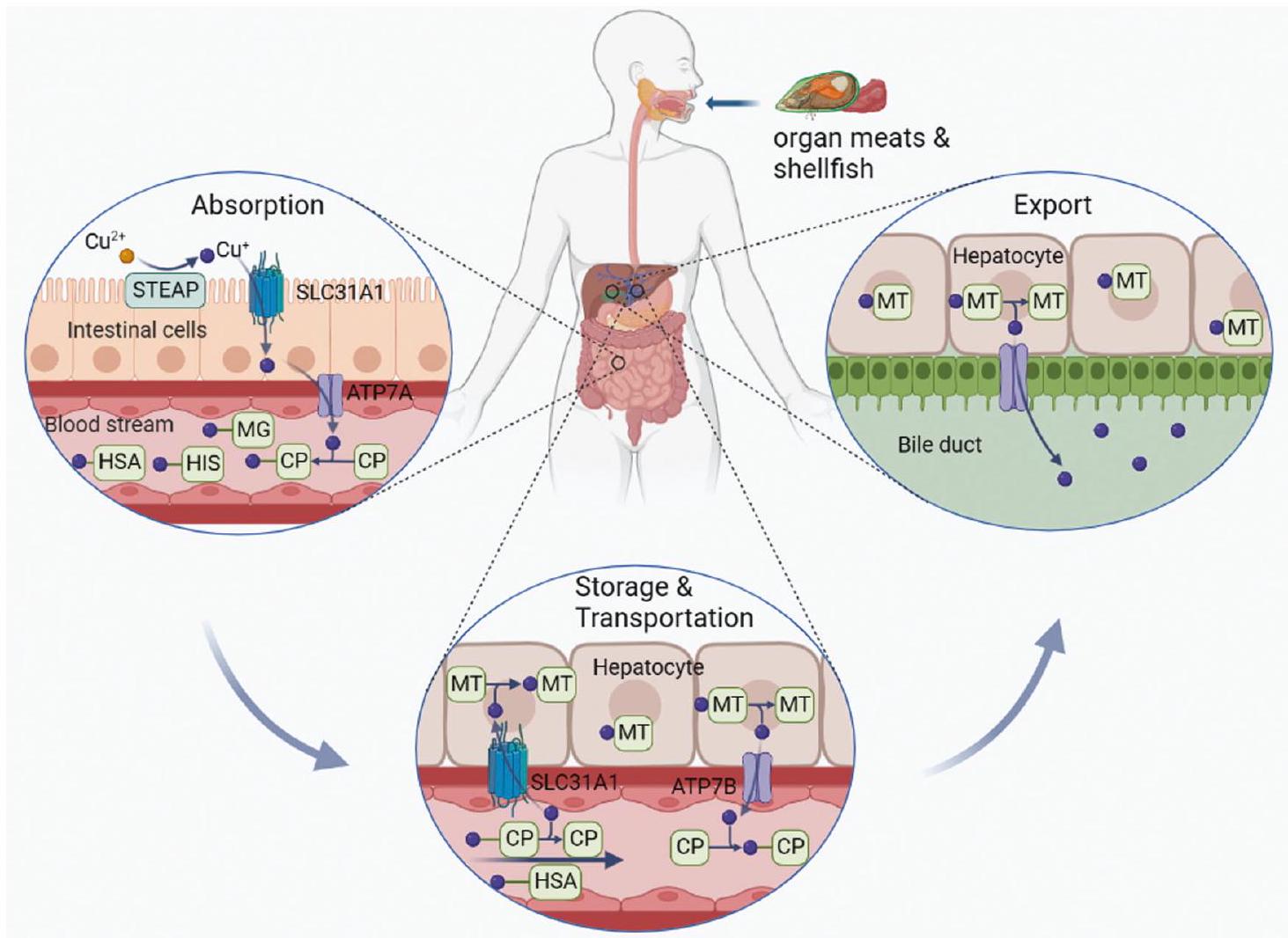
الشكل 1 مخطط تخطيطي لعملية استقلاب النحاس في الجسم. يحدث امتصاص النحاس بشكل أساسي في الأمعاء الدقيقة، وهي عملية تتوسطها SLC31A1. يتم نقل النحاس ثم تصديره إلى مجرى الدم من خلال عمل ATP7A، بالاشتراك مع الشابيرات القابلة للذوبان، وينقل عبر النظام البابي إلى الكبد، حيث يتم تخزينه ونقله بشكل إضافي. يتم إخراج النحاس الزائد بواسطة الكبد إلى الصفراء. الشكل تم إنشاؤه باستخدام BioRender. SLC31A1 عائلة ناقلات المواد الذائبة 31 العضو 1، ATP7A و ATP7B مضخات النحاس ATPase 7 A و 7B، STEAP مستضد الظهارة الستة عبر الغشاء للبروستاتا، HSA ألبومين مصل الإنسان، CP سيرولوبلازمين، MT ميتالوثيونين، HIS هيستيدين، MG ماكروغلوبيولين.
ومع ذلك، يمكن أن تؤدي مستويات النحاس الناقصة إلى السمية الخلوية والتغيرات المرضية [7]. لذلك، من الضروري الحفاظ على مستويات النحاس النظامية ضمن نطاق ضيق (الشكل 1).
امتصاص النحاس. يتم الحصول على النحاس بشكل رئيسي من المصادر الغذائية مثل اللحوم العضوية والمحار. يتم امتصاص النحاس بشكل أساسي بواسطة الخلايا المعوية في الأمعاء الدقيقة، ويتم تنظيم امتصاصه بواسطة ناقل النحاس 1 (CTR1)، المعروف أيضًا باسم عضو عائلة ناقلات المواد الذائبة 31 (SLC31A1). يبدو أن CTR1 يلعب دورًا رئيسيًا في هذا الامتصاص، كما تشير الأبحاث التي تظهر انخفاضًا كبيرًا في تراكم النحاس في الأنسجة الطرفية للفئران حديثة الولادة التي تفتقر إلى CTR1. يسهل المستضد الظهاري عبر الستة أغشية للبروستاتا (STEAP) هذه العملية عن طريق تقليل الثنائي. إلى .
تخزين النحاس ونقله. بعد امتصاصه بواسطة خلايا الظهارة المعوية، يتم نقل النحاس وتصديره إلى مجرى الدم بواسطة الناقل ATPase للنحاس 7A (ATP7A) [18]. هنا، يتم نقل النحاس عبر النظام البابي إلى الكبد عن طريق الارتباط بالشابيرات القابلة للذوبان مثل الألبومين البشري (HSA)، السيرولوبلاسمين، الهيستيدين، والماكروغلوبولين [19، 20]. يتم أيضًا تسهيل امتصاص النحاس بواسطة الخلايا الكبدية في الكبد بواسطة CTR1. يلعب الكبد دورًا حاسمًا في تنظيم استقلاب النحاس من خلال تخزينه وإفرازه. يتم تخزين النحاس بواسطة بروتين ربط النحاس الميتالوثيونين (MT)، وهو جزيء مختزل غني بمجموعات الثيول وله affinity عالية لأيونات النحاس [21]. يلعب MT دورًا حيويًا في توازن النحاس من خلال تخزين وإطلاق النحاس الزائد عند الحاجة. يتم نقل النحاس بواسطة الناقل ATPase للنحاس 7B (ATP7B) في الخلايا الكبدية، الذي يضخ أيونات النحاس من
يعود النحاس إلى مجرى الدم. هنا، ترتبط أيونات النحاس بشركائها القابلين للذوبان وتُنقل إلى أنسجة وأعضاء محددة [22].
إزالة النحاس. يتم إزالة النحاس بشكل أساسي عن طريق الإخراج الصفراوي. يتم إفراز النحاس الزائد بواسطة الكبد إلى الصفراء ثم يتم إخراجه من خلال البراز. ينظم الناقل ATP7B إزالة النحاس من الكبد إلى القنوات الصفراوية. في حالات خلل ATP7B، مثل مرض ويلسون، يتراكم النحاس في الكبد، مما يؤدي إلى تلف الكبد ومشاكل صحية لاحقة.
باختصار، يعتبر استقلاب النحاس عملية معقدة تتضمن آليات متعددة لتنظيم امتصاص النحاس ونقله وتخزينه وإخراجه.

توازن النحاس الخلوي

صيانة توازن النحاس داخل الخلايا هي عملية معقدة ومنظمة بدقة تتضمن العمل المنسق لمُركبات النحاس، والمساعدات، والإنزيمات النحاسية (الشكل 2). يتم الحفاظ على تركيز النحاس ضمن نطاق ضيق من خلال العمل التعاوني لهذه البروتينات المعتمدة على النحاس.
امتصاص النحاس. في خلايا الثدييات، يتم تنظيم امتصاص النحاس بشكل أساسي بواسطة CTR1 [6]، وهو بروتين عبر الغشاء يشكل قناة ثلاثية لتسهيل مرور أيونات النحاس عبر الغشاء البلازمي [26]. يتم تنظيم تعبير CTR1 بواسطة مستويات النحاس. مستويات النحاس المنخفضة تزيد من تعبير CTR1 لزيادة امتصاص النحاس، بينما المستويات العالية تقلل من تعبير CTR1 لمنع السمية الخلوية للنحاس [27، 28]. تسلط هذه النتائج الضوء على أهمية CTR1 في توازن النحاس.
الشكل 2 مخطط تخطيطي لتمثيل النحاس الخلوي. إن الحفاظ على توازن النحاس داخل الخلايا هو عملية معقدة ومنظمة بدقة. يتم امتصاص أيونات النحاس بشكل أساسي بواسطة الخلايا عبر SLC31A1، بينما يتم تسهيل تصديرها بواسطة ATP7A/B. بمجرد دخولها إلى الخلية، يتم نقل النحاس للتفاعل مع الشابيرات النحاسية السيتوبلازمية، بما في ذلك COX17 وCCS وATOX1. تقوم هذه الشابيرات بنقل النحاس إلى حُجرات خلوية محددة، مثل الميتوكوندريا والشبكة الغولجية المتجاوزة والنواة. الشكل تم إنشاؤه باستخدام BioRender. SLC31A1 ناقل المواد العضوية العائل 31 العضو 1، ATP7A وATP7B مضخة النحاس ATP 7A و7B، ATOX1 الشابير النحاسي المضاد للأكسدة 1، CCS الشابير النحاسي لإنزيم سوبر أكسيد ديسموتاز، COX17 الشابير النحاسي لإنزيم السيتوكروم ج أكسيداز 17، COX11 الشابير النحاسي لإنزيم السيتوكروم ج أكسيداز 11، COX إنزيم السيتوكروم ج أكسيداز، ROS أنواع الأكسجين التفاعلية، SCO1 تخليق إنزيم السيتوكروم ج أكسيداز 1، SOD1 إنزيم سوبر أكسيد ديسموتاز 1، TGN الشبكة الغولجية المتجاوزة، GSH الجلوتاثيون، MT1/2 الميتالوثيونين 1/2، وSTEAP المستضد الظهاري ذو الستة أغشية من البروستاتا.
توزيع النحاس داخل الخلايا. بعد دخول النحاس إلى الخلية، يتم أولاً توصيله إلى حوامل النحاس السيتوبلازمية، التي تنقله بعد ذلك إلى الحُجرات داخل الخلايا مثل الميتوكوندريا، والشبكة الغولجية المتجاوزة (TGN)، والنواة. في خلايا الثدييات، تم تحديد ثلاثة حوامل رئيسية للنحاس: حامل النحاس المضاد للأكسدة 1 (ATOX1)، حامل النحاس لإنزيم سوبر أكسيد ديسموتاز (CCS)، وحامل النحاس لإنزيم السيتوكروم ج أكسيداز 17 (COX17) [29، 30].
يوفر ATOX1 النحاس لـ ATP7A و ATP7B في الشبكة الغشائية الداخلية [31]. بالإضافة إلى ذلك، تم إثبات أن ATOX1 يعمل كنوع جديد من عوامل النسخ المعتمدة على النحاس التي تتوسط في تكاثر الخلايا المستحث بالنحاس [32].
CCS هو بروتين ناقل للنحاس قابل للذوبان في السيتوبلازم ينقل أيونات النحاس إلى موقع ربط النحاس في إنزيم سوبر أكسيد ديسموتاز 1 (SOD1) [33]. SOD1 هو إنزيم مضاد للأكسدة رئيسي يحفز تحويل الجذور الحرة من سوبر أكسيد إلى أكسجين وبيروكسيد الهيدروجين، مما يحافظ على توازن أنواع الأكسجين التفاعلية (ROS) ويحمي الخلايا من أضرار الإجهاد التأكسدي [34]. وقد تم إثبات هذه الوظيفة في الفئران التي تم حذف جين SOD1 منها، حيث زاد غياب SOD1 من الإجهاد التأكسدي وأدى أولاً إلى تلف خلايا الكبد وفي النهاية إلى سرطان الكبد [35].
COX17 مسؤول عن توصيل أيونات النحاس إلى تجميع السيتوكروم ج أكسيداز (COX)، وهو مكون رئيسي في سلسلة نقل الإلكترون المرتبطة بالتنفس الخلوي [36]. بعد ذلك، تتبرع COX11 و SCO1، اللذان هما أيضًا مكونان مهمان في تجميع COX، بالنحاس إلى و المواقع في وحدات COX2 وCOX1 الأساسية لـ COX في الغشاء الداخلي للميتوكوندريا، على التوالي. بالإضافة إلى ذلك، COX17
كما يعمل كمانح للنحاس داخل الفضاء بين الغشائين الميتوكوندريين (IMS) [37]. وبالتالي، فإن COX17 ضروري للتجميع السليم لـ COX، حيث أظهرت الطفرات في COX17 أنها تقلل من نشاط COX، مما يؤدي إلى خلل في الميتوكوندريا وإجهاد أكسيدي [38].
تخزين النحاس داخل الخلايا وتصديره. يتم تصدير النحاس داخل الخلايا بشكل رئيسي بواسطة ATP7A و ATP7B، وهما ناقلا النحاس الموجودان في الشبكة الغشائية الداخلية التي تنظم توصيل النحاس إلى المسارات الإفرازية وغشاء البلازما. في الظروف الطبيعية، يقوم ATP7A و ATP7B بنقل أيونات النحاس من الشبكة الغشائية الداخلية إلى أجزاء خلوية أخرى لأداء وظائف خلوية متنوعة. عند مستويات النحاس داخل الخلايا المفرطة، يتم تنشيط ATP7A و ATP7B لتصدير أيونات النحاس الزائدة من الشبكة الغشائية الداخلية وتخزينها في بروتينات ربط النحاس مثل الميتالوثيونين. كما تنظم هذه البروتينات توازن النحاس عن طريق تقليل الامتصاص وزيادة الطرد. يمكن أن تؤدي الطفرات في ATP7A و ATP7B إلى اضطرابات في استقلاب النحاس مثل مرض منكس ومرض ويلسون.

أدلة تربط عدم توازن النحاس بتصلب الشرايين

تصلب الشرايين هو مرض التهابي مزمن يتميز بتراكم اللويحات على جدران الشرايين، مما يؤدي إلى تضيق وتصلب الشرايين. يمكن أن تؤدي هذه العملية إلى مضاعفات خطيرة، بما في ذلك مرض الشريان التاجي، والسكتة الدماغية، ومرض الشرايين الطرفية. الأدلة المتزايدة
الجدول 1. الأدلة التي تربط بين زيادة النحاس وتصلب الشرايين.
البلد، المؤلف، السنة طرق وسكان الدراسة نتيجة
فنلندا، ريونانن وآخرون [47] 230 رجلًا توفوا بسبب أمراض القلب والأوعية الدموية و298 مجموعة متطابقة؛ متابعة لمدة 10 سنوات. كان الخطر النسبي المعدل لوفيات مرض القلب التاجي بين أعلى وأدنى ثلثين من النحاس في المصل 2.86 ( كانت مستويات النحاس في المصل المرتفعة مرتبطة بشكل كبير بزيادة خطر الوفاة من جميع أمراض القلب والأوعية الدموية، وخاصة من مرض الشريان التاجي.
الولايات المتحدة، فورد، وآخرون [48] 4574 مشاركًا تتراوح أعمارهم توفي 151 شخصًا بسبب مرض القلب التاجي خلال متابعة استمرت 16 عامًا. كان هناك زيادة في مستويات النحاس في المصل بين الأفراد الذين توفوا بسبب مرض القلب التاجي مقارنةً بأولئك الذين لم يتوفوا كانت تركيزات النحاس في المصل المرتفعة مرتبطة بزيادة خطر الوفاة من مرض الشريان التاجي.
الهولندي، كوك وآخرون [49] سرطان ) و CVD ( ) الوفيات، مع الضوابط المتطابقة الخاصة بهم، متابعة لمدة ستة إلى تسع سنوات. الأفراد الذين لديهم مستويات مرتفعة من النحاس في المصل (أعلى من أظهر مستوى النحاس في المصل (باللتر) خطرًا معدلًا للوفاة من السرطان وأمراض القلب والأوعية الدموية يزيد بنحو أربع مرات مقارنةً بأولئك الذين لديهم مستويات النحاس في المصل ضمن النطاق الطبيعي.
شرق فنلندا، سالونين وآخرون [50] 1666 رجلًا تم اختيارهم عشوائيًا تتراوح أعمارهم بين 42 و48 و54 أو 60 عامًا دون وجود أعراض مرض القلب الإقفاري. مستوى النحاس في المصل المرتفع هو عامل خطر لمرض القلب الإقفاري الذي يعمل بشكل مستقل، كما يتضح من زيادة خطر النوبة القلبية الحادة بمعدل يتراوح بين 3.5 إلى 4.0 أضعاف المرتبطة بمستويات النحاس المرتفعة في المصل (1.021.16 ملغ / لتر و لتر أو أكثر).
نادينا، روبن وآخرون [51] مرضى تصلب الشرايين الذين تتراوح أعمارهم سنوات وضوابط صحية. كانت مستويات النحاس في الطبقة الداخلية من الآفات أعلى بشكل ملحوظ في مرضى تصلب الشرايين مقارنةً بتلك الموجودة في الأفراد الأصحاء. مقابل نسيج ).
بنغلاديش، بيغوم وآخرون [52] 60 مريضًا تم تشخيصهم بالنوبة القلبية الحادة و60 شخصًا سليمًا. كان مستوى النحاس في المصل أعلى بشكل ملحوظ في مرضى احتشاء عضلة القلب الحاد مقارنةً بالتحكم. مقابل .
غريغورز، باربرا وآخرون [53] 74 مشاركًا من مرضى MI و72 شاهدًا صحيًا. كان مستوى النحاس في المصل المرتفع مرتبطًا بشكل كبير بالنوبة القلبية (MI) ).
إيطاليا، تارانتينو وآخرون [54] 100 مريضًا بدينًا كان لديهم انتشار منخفض للأمراض المصاحبة. تمت علاقة سلبية بين توافر النحاس المعدل وسماكة جدار الشريان السباتي (IMT) وقد يتنبأ بتصلب الشرايين المبكر لدى المرضى البدينين.
صربيا، تاسيć وآخرون [55] 91 مريضًا (متوسط العمر ) مع تصلب الشرايين السباتية و 27 مريضًا (متوسط العمر ) بدون تصلب الشرايين السباتية. كان لدى المرضى الذين يعانون من لويحات نزفية مستويات أعلى بشكل ملحوظ من النحاس في المصل مقارنةً بأولئك الذين يعانون من لويحات متكلسة؛ قد تساهم تركيزات النحاس العالية في تصلب الشرايين.
أمراض القلب والأوعية الدموية، أمراض القلب التاجية؛ احتشاء عضلة القلب الحاد؛ مرض القلب الإقفاري؛ سمك الطبقة الداخلية والوسطى.
من خلال العديد من الدراسات، تم ربط عدم توازن النحاس والزيادة أو النقص الناتج في النحاس بتصلب الشرايين.

أدلة تربط بين زيادة النحاس وتصلب الشرايين

أظهرت الأبحاث المكثفة وجود علاقة بين مستويات النحاس المرتفعة وأمراض القلب والأوعية الدموية (الجدول 1). على سبيل المثال، أظهرت عدة دراسات جماعية مستقبلية وجود علاقة كبيرة بين مستويات النحاس في المصل المرتفعة ومعدلات الوفيات الأعلى المرتبطة بأمراض القلب والأوعية الدموية، وخاصة مرض الشريان التاجي [47-49]. كما أظهرت مستويات النحاس المرتفعة أنها عامل خطر مستقل لمرض القلب الإقفاري [50]. بالإضافة إلى الأدلة من الدراسات المستقبلية، قام ستادلر وآخرون بالكشف مباشرة عن أيونات المعادن الانتقالية وقياسها في لويحات تصلب الشرايين البشرية ووجدوا زيادة في مستويات النحاس في البطانة المريضة [51]. تدعم الدراسات على السكان الذين يعانون من احتشاء عضلة القلب الحاد (AMI) هذه النتائج، حيث أظهر المرضى الذين يعانون من AMI مستويات أعلى بكثير من النحاس في المصل مقارنة بأولئك الذين لا يعانون من AMI [52]. علاوة على ذلك، وُجد أن زيادة مستويات النحاس في المصل بين المرضى بعد احتشاء عضلة القلب لها قيمة تشخيصية كبيرة لحدوث احتشاء عضلة القلب [53]. بالإضافة إلى ذلك، يرتبط تغير توافر النحاس الحيوي سلبًا بسماكة البطانة الداخلية المتوسطة للشريان السباتي (IMT)، مما قد يكون مؤشرًا موثوقًا للتصلب العصيدي المبكر لدى المرضى الذين يعانون من السمنة [54]. علاوة على ذلك، تختلف تركيزات النحاس في المصل بين المرضى الذين لديهم أشكال مختلفة من لويحات تصلب الشرايين السباتية. على وجه التحديد، فإن المرضى الذين لديهم لويحات نزفية لديهم تركيزات أعلى بكثير من النحاس في المصل مقارنة بأولئك الذين لديهم لويحات متكلسة [55]. تشير هذه النتائج إلى احتمال وجود دور لمستويات النحاس المرتفعة في مسببات تصلب الشرايين.

أدلة تربط نقص النحاس وتصلب الشرايين

يُعترف بنقص النحاس أيضًا كعامل مساهم رئيسي في تطور تصلب الشرايين. ويتضح ذلك من خلال فوائد تناول كميات عالية من النحاس في النظام الغذائي والمكملات النحاسية. توصي معهد الطب بحد يومي من النحاس يبلغ 900 ميكروغرام للبالغين، مع حد أعلى مقبول من يوم لمنع تلف الكبد [56]. على الرغم من أن التوصيات تختلف بين السلطات الوطنية، إلا أن معظمها توصي بتناول 800 إلى اليوم [15]. تشير الأبحاث الكبيرة إلى أن تناول النحاس الكافي يقلل من خطر تصلب الشرايين. على سبيل المثال، وجد روك وزملاؤه أن مكملات النحاس لدى الأفراد في منتصف العمر تعزز القدرة المضادة للأكسدة للخلايا، مما قد يساعد في منع تلف الأوعية الدموية وبالتالي تقليل خطر تصلب الشرايين [57]. أظهرت دراسة أخرى على مجموعة من الأشخاص وجود ارتباط بين تناول النحاس الغذائي الكافي (المساوي أو أعلى من المتطلبات المتوسطة المقدرة) وانخفاض خطر الوفاة بسبب جميع الأسباب والأمراض القلبية الوعائية. ومع ذلك، كان هذا الارتباط محدودًا بتناول النحاس من مصادر غذائية [58]. تؤكد الدراسات على نماذج حيوانية هذه النتائج، حيث أظهر لامب وزملاؤه أن نقص النحاس الغذائي أو زيادته يزيد من القابلية لتصلب الشرايين في الأبهر لدى الأرانب التي تتغذى على الكوليسترول [59]. وبالمثل، وُجد أن مكملات النحاس تعكس التغيرات المرضية الناتجة عن زيادة الحديد الغذائي في الفئران، مما يعيد جزئيًا الوضع الطبيعي لتضخم القلب [60] ويحسن وظيفة القلب في اعتلال عضلة القلب المتوسع الناتج عن زيادة الضغط [61]. ومع ذلك، تظل آثار مكملات النحاس على الجهاز القلبي الوعائي مثيرة للجدل. أظهرت دراسة أجراها دياف وزملاؤه على نساء في منتصف العمر من الجزائر أن هناك ارتباطًا ضئيلًا بين النظام الغذائي.
الشكل 3 عدم توازن النحاس يعزز تصلب الشرايين من خلال الإجهاد التأكسدي. يتفاعل النحاس الزائد مع عبر تفاعل فنتون، مما يولد جذور هيدروكسيل شديدة التفاعل. هذه الجذور تحفز تأكسد الدهون، وكسر خيوط الحمض النووي، وأكسدة القواعد، وتعيق وظيفة إنزيمات مضادات الأكسدة، مما يؤدي في النهاية إلى زيادة الإجهاد التأكسدي وإمكانية تلف الخلايا. من ناحية أخرى، فإن نقص النحاس يعيق أيضًا وظيفة بعض إنزيمات مضادات الأكسدة، مما يسبب انخفاضًا في نشاط SOD1 و COX. هذه النشاطات المنخفضة تؤدي إلى انخفاض مستويات NO، وتعطيل المركب I، وزيادة إنتاج ROS، مما يزيد من الإجهاد التأكسدي داخل الخلايا. معًا، تعزز هذه العمليات تطور تصلب الشرايين. الشكل تم إنشاؤه باستخدام BioRender. SLC31A1 عائلة ناقلات المواد 31 العضو 1، STEAP مستضد الظهارة الستة عبر الغشاء للبروستاتا. بيروكسيد الهيدروجين الجذور الحرة الهيدروكسيلية التفاعلية، ROS أنواع الأكسجين التفاعلية، ATP7A و ATP7B ناقل النحاس ATPase 7A و 7B، CAT الكاتلاز، GSH-Px بيروكسيداز الجلوتاثيون، CP السيرولوبلاسمين، LOX أوكسيداز الليزين، SOD1 ديسموتاز السوبر أكسيد 1، COX أكسيداز السيتوكروم ج، و AS تصلب الشرايين.
تناول النحاس وانتشار تصلب الشرايين في مرض السكري [62]. قد تكون هذه النتائج المتضاربة ناتجة عن اختلافات في تصميم الدراسة وجرعة ومدة مكملات النحاس.

آليات محتملة لتطور تصلب الشرايين بسبب عدم توازن النحاس

آليات تطور تصلب الشرايين بسبب مستويات النحاس المتغيرة ليست مفهومة تمامًا. تشمل عدة آليات محتملة الإجهاد التأكسدي، الالتهاب، خلل وظيفة البطانة، واستقلاب الدهون.

الإجهاد التأكسدي

الإجهاد التأكسدي هو عامل رئيسي في تطور تصلب الشرايين، والذي يتضمن عادةً عدم التوازن في إنتاج الأنواع التفاعلية من الأكسجين (ROS) والدفاعات المضادة للأكسدة [63]. نظرًا لأن النحاس معدن نشط في تفاعلات الأكسدة والاختزال، فإن التغيرات في مستويات النحاس يمكن أن تساهم في توليد ROS وبالتالي تعزز الإجهاد التأكسدي [15، 64] (الشكل 3).
زيادة النحاس والإجهاد التأكسدي. تميل مستويات النحاس الحرة المرتفعة إلى التفاعل بشكل أكبر مع بيروكسيد الهيدروجين من خلال تفاعلات فنتون، مما يؤدي إلى إنتاج جذور الهيدروكسيل شديدة التفاعل. تسبب هذه الجذور أكسدة الدهون، وأكسدة البروتينات، وتلف الحمض النووي، مما يساهم في النهاية في بدء وتقدم تصلب الشرايين. أكسدة الدهون هي تفاعل متسلسل يبدأ بهجوم الجذور الحرة على الأحماض الدهنية غير المشبعة في دهون أغشية الخلايا، والتي ثم
يؤدي إلى تلف الأكسدة لجزيئات الدهون. يمكن أن تعزز مستويات النحاس المرتفعة أكسدة الدهون وتؤدي إلى تكوين البروتين الدهني منخفض الكثافة المؤكسد (ox-LDL)، وهو عامل خطر لتصلب الشرايين. علاوة على ذلك، أظهرت الدراسات أن مستويات النحاس المرتفعة تقلل من نشاط إنزيمات مضادات الأكسدة، مثل الكاتالاز، وبيروكسيداز الجلوتاثيون، في كريات الدم الحمراء، والدم الكامل، والأنسجة الحية، وأنسجة الدماغ لدى الجرذان (67، 68، 69). في أنسجة دماغ الجرذان، ينشأ انخفاض نشاط SOD ومستويات الجلوتاثيون بسبب زيادة النحاس التي تحفز تأكسد الدهون [68]. النحاس قادر أيضًا على التسبب في انكسارات في خيوط الحمض النووي وأكسدة القواعد عبر الجذور الحرة المشتقة من الأكسجين [69]. تشير هذه النتائج إلى أن زيادة النحاس تسبب ضعف نظام الدفاع المضاد للأكسدة في عدة أنسجة.
نقص النحاس والإجهاد التأكسدي. لقد تم اقتراح أن نقص النحاس يساهم أيضًا في تطور وتقدم تصلب الشرايين من خلال الإجهاد التأكسدي. النحاس هو عامل مساعد أساسي لمجموعة متنوعة من الإنزيمات المضادة للأكسدة، بما في ذلك Cu/Zn-SOD، السيرولوبلاسمين، وأكسيداز الليسين [70]. وبالتالي، قد يؤدي نقص النحاس إلى إضعاف وظيفة هذه الإنزيمات، مما يؤدي إلى نظام دفاع مضاد للأكسدة معطل وزيادة القابلية للإجهاد التأكسدي [70، 71]. تدعم هذه الفرضية ملاحظة أن نقص النحاس في الجرذان يؤدي إلى تقليل -نشاط SOD وزيادة الضرر التأكسدي لمختلف وحدات سبكتين كريات الدم الحمراء [72]. انخفاض نشاط SOD1، الذي يشفر تمت ملاحظة SOD أيضًا في الكبد وخلايا الدم الحمراء في الفئران التي تعاني من نقص النحاس [73]. الانخفاض في SOD1 الناتج عن النحاس
نقص النحاس يؤدي إلى انخفاض مستويات أكسيد النيتريك (NO)، مما قد يعزز من خلل وظيفة البطانة، ويقلل من استرخاء الأوعية الدموية، ويزيد من الإجهاد التأكسدي، وبالتالي يساهم في تطور تصلب الشرايين [70]. بالإضافة إلى تأثيره على إنزيمات مضادات الأكسدة، قد يؤدي نقص النحاس أيضًا إلى تقليل نشاط COX ويؤدي إلى التفاعل التأكسدي المعطل للمركب الأول (NADH: أكسيد الكوينون). قد يؤدي هذا التفاعل التأكسدي بعد ذلك إلى زيادة إنتاج الجذور الحرة في الخلايا التي تعاني من نقص النحاس، مما يزيد من الإجهاد التأكسدي الخلوي [74].

التهاب

قد يعزز النحاس أيضًا من تطور تصلب الشرايين من خلال تعديل الاستجابات الالتهابية المرتبطة بالمرض.
النحاس الزائد والالتهاب. تم ربط النحاس الزائد بتطور تصلب الشرايين بسبب قدرته على تحفيز الالتهاب. تم الإبلاغ سابقًا عن أن مستويات النحاس العالية تحفز إنتاج السيتوكينات المؤيدة للالتهاب وبالتالي تعزز الالتهاب داخل جدران الشرايين [75]. على سبيل المثال، في خلايا القلب الأولية، يزيد من إفراز إنترلوكين-6 (IL-6) وينشط كينازات MAP، المرتبطة بالالتهاب القلبي والتضخم [76]. كما أن الإجهاد التأكسدي الناتج عن النحاس يساهم أيضًا في الالتهاب لأن النحاس الزائد يولد الجذور الحرة، مما يسبب ضررًا تأكسديًا للدهون والبروتينات والحمض النووي ويعزز الالتهاب [15]. علاوة على ذلك، يمكن أن تؤدي الزيادات في مستويات الجذور الحرة بسبب زيادة مستويات النحاس إلى تنشيط عامل النسخ النووي-кВ ( ), وهو بروتين حاسم يشارك في تنظيم التعبير عن الجينات المؤيدة للالتهاب [77]. تشير هذه النتائج إلى أن مستويات النحاس العالية يمكن أن تفاقم الالتهاب في جدران الأوعية الدموية وبالتالي تعزز من تطور تصلب الشرايين.
نقص النحاس والالتهاب. تم ربط نقص النحاس أيضًا بتطور تصلب الشرايين من خلال تأثيره على الالتهاب. قد يؤدي نقص النحاس إلى تقليل التعبير عن جزيئات الالتصاق، مثل ICAM-1 و VCAM-1، التي تسهل التصاق الكريات البيضاء على خلايا البطانة المنشطة [78]. تدعم الأدلة من الدراسات الحيوانية أيضًا دور نقص النحاس في الالتهاب. على سبيل المثال، تزداد تراكم الكريات البيضاء بسبب زيادة التعبير عن ICAM-1 في كبد الفئران التي تعاني من نقص النحاس بعد نقص التروية/إعادة التروية [79]. علاوة على ذلك، تم إظهار أن هذا التعبير المرتفع عن ICAM-1 ينشط الكريات البيضاء وخلايا البطانة، كما يتضح من تفاعل F-actin وزيادة تراكم الكريات البيضاء داخل الدورة الدموية الدقيقة للرئة [80-82]. كما تتعزز الاستجابات الالتهابية الرئوية في الحيوانات التي تعاني من نقص النحاس [83]. أخيرًا، يؤدي نقص النحاس إلى إضعاف نشاط -SOD كما ذُكر سابقًا، مما يؤدي إلى زيادة تراكم الجذور الحرة وتفاقم الإجهاد التأكسدي، مما يمكن أن يعزز المزيد من الالتهاب وتطور تصلب الشرايين [84].

خلل وظيفة البطانة

تم ربط عدم توازن النحاس بتصلب الشرايين، حيث يساهم كل من الزائد والنقص في النحاس في خلل وظيفة البطانة، وهو خطوة مبكرة حاسمة في تطور تصلب الشرايين.
النحاس الزائد وخلل وظيفة البطانة. يمكن أن يؤدي النحاس الزائد إلى تعطيل التوازن بين إنتاج وتحلل أكسيد النيتريك (NO)، وهو منظم رئيسي لنغمة الأوعية ووظيفة البطانة [85]. يمكن أن تؤدي زيادة مستويات النحاس إلى زيادة التعبير عن إنزيم NO الاصطناعي (iNOS)، مما يؤدي إلى إنتاج مفرط من NO و بيروكسي نيتريت، وهو مؤكسد قوي يسبب مزيدًا من الضرر التأكسدي [86]. علاوة على ذلك، يتفاعل النحاس أيضًا مع عوامل خطر تصلب الشرايين مثل الهوموسيستين، مما يؤدي إلى زيادة أكسدة الهيدروجين والإجهاد التأكسدي. على وجه التحديد، تظهر دراسة أن الحضانة مع الهوموسيستين والنحاس لمدة 4 ساعات قادرة على التسبب في ضرر كبير لخلايا البطانة [87].
نقص النحاس وخلل وظيفة البطانة. يرتبط نقص النحاس أيضًا بزيادة خلل وظيفة البطانة. يمكن أن يؤدي خلل وظيفة البطانة إلى تقليل إنتاج NO، وهو موسع للأوعية ومثبط لتجمع الصفائح الدموية، وبالتالي يعزز من بيئة مؤيدة لتصلب الشرايين [88]. يمكن أن يؤدي نقص النحاس أيضًا إلى تقليل مستويات NO من خلال تقليل مستويات SOD1. يمكن أن تؤدي مستويات NO المنخفضة بعد ذلك إلى تثبيط وظيفة البطانة وتوسع الأوعية، وزيادة الإجهاد التأكسدي، وبالتالي تعزيز تصلب الشرايين [70].

تمثيل الدهون

النحاس الزائد وتمثيل الدهون. يساهم النحاس الزائد بشكل كبير في تطور تصلب الشرايين من خلال تأثيراته على LDL المؤكسد، الذي يلعب دورًا مركزيًا في تصلب الشرايين [89]. على وجه التحديد، يشارك النحاس في أكسدة جزيئات LDL، وقد تؤثر التغيرات في مستويات النحاس على قابلية جزيئات LDL للأكسدة. يمكن أن تزيد مستويات النحاس الزائدة من أكسدة جزيئات LDL وتحفز إنتاج LDL المؤكسد، مما يساهم بعد ذلك في تطور تصلب الشرايين [67].
بالإضافة إلى تأثيراته على LDL المؤكسد، يشارك النحاس في عدة أشكال من تمثيل الدهون، بما في ذلك تخليق الأحماض الدهنية والكوليسترول وتمثيل البروتينات الدهنية. قد تكون التغيرات في مستويات النحاس مرتبطة بتغيرات في تركيزات الدهون والبروتينات الدهنية. على سبيل المثال، وُجد أن مستويات النحاس في المصل والسيرولوبلاسمين مرتبطة إيجابيًا مع بيروكسايد الدهون، والكوليسترول الكلي، والدهون الثلاثية، والأبوليبوبروتين B في الأفراد الأصحاء [90]. في دراسة أخرى، وُجد أن مستويات النحاس في المصل لدى المرضى الإيرانيين الذين تم تعريفهم بواسطة تصوير الأوعية القلبية كانت مرتبطة إيجابيًا مع الدهون الثلاثية في المصل الصائم [91]. في الجسم الحي، تدعم الأدلة من التجارب الحيوانية أيضًا دور النحاس الزائد في تمثيل الدهون. أظهرت دراسة على سمك السلور الأصفر أن الإجهاد الناتج عن النحاس في الشبكة الإندوبلازمية وتعطيل توازن الكالسيوم يغير من تمثيل الدهون في الكبد، مما يؤدي إلى زيادة تراكم الدهون في الكبد [92].
نقص النحاس وتمثيل الدهون. قد تساهم مستويات النحاس غير الكافية أيضًا في تطور تصلب الشرايين من خلال تأثيرها على تمثيل الدهون. نظرًا لأن النحاس يشارك في تخليق الأحماض الدهنية والكوليسترول، فإن مستويات النحاس غير الكافية قد تؤدي إلى ضعف تمثيل الدهون، وبالتالي تطور مرض الكبد الدهني. كما يزيد نقص النحاس من مستويات الكوليسترول الكلي أيضًا [7]. يمكن أن تؤثر مستويات النحاس غير الكافية على نشاط بروتينات ربط عنصر تنظيم الستيرول 1 و 2 (SREBP-1 و SREBP2)، وهي عوامل نسخ تشارك في تمثيل الأحماض الدهنية والكوليسترول [93]. على وجه التحديد، تشارك كلا الشكلين من SREBP-1 (SREBP-1a و SREBP-1c) في تنظيم تخليق الأحماض الدهنية، بينما يشارك SREBP-2 بشكل رئيسي في تنظيم تخليق الكوليسترول [94]. وُجد أن الحميات المنخفضة في النحاس تؤدي إلى تراكم الشكل الناضج من SREBP-1 في نوى خلايا كبد الفئران، ومع ذلك لم يُلاحظ أي تغيير في موقع ارتباط الحمض النووي لـ SREBP-1 [95]. وبالتالي، قد يلعب النحاس دورًا في تنظيم الموقع الفرعي لـ SREBP-1، مما يؤثر على نشاطه وبالتالي على تمثيل الدهون. هناك حاجة إلى مزيد من البحث لفهم الآليات التي يؤثر من خلالها النحاس على نشاط SREBP-1 وعوامل النسخ الأخرى المشاركة في تمثيل الدهون.

عوامل خطر أخرى

ترتبط مستويات النحاس أيضًا بعوامل خطر أخرى لتصلب الشرايين، مثل ارتفاع ضغط الدم. يمنع النحاس نشاط إنزيمات تحويل الأنجيوتنسين، بحيث يؤدي نقص النحاس إلى زيادة مستويات الأنجيوتنسين، وبالتالي احتباس الماء والصوديوم وارتفاع ضغط الدم [96]. علاوة على ذلك، يعتبر النحاس عامل مساعد لـ SOD، الذي يلعب دورًا رئيسيًا في نظام الدفاع المضاد للأكسدة. وبالتالي، قد يؤدي نقص النحاس إلى زيادة مستويات الجذور الحرة الفائقة، مما يؤدي إلى ارتفاع مستويات الأنجيوتنسين وارتفاع ضغط الدم الناتج [97].
الشكل 4 مخطط توضيحي لآليات الكوبروتوبسيس. ينقل أيون النحاس ES النحاس الخارجي إلى داخل الخلية. بعد ذلك، يرتبط النحاس داخل الخلية بالإنزيمات الميتوكوندرية المربوطة بالليبوي (مثل DLAT) المشاركة في دورة TCA. يؤدي هذا الارتباط إلى تجمع هذه البروتينات، مما يمكن أن يعطل دورة TCA وبالتالي يتداخل مع إنتاج الطاقة الخلوية. تلعب العوامل التنظيمية العليا FDX1 وLIAS دورًا حاسمًا في هذه العملية. يعزز تجمع البروتينات الميتوكوندرية المربوطة بالليبوي وفقدان مجموعات Fe-S الضغط البروتيني، مما يؤدي في النهاية إلى موت الخلايا. الشكل تم إنشاؤه باستخدام BioRender. SLC31A1 ناقل المواد السائلة العائلية 31 العضو 1، STEAP المستضد الظهاري ذو الستة أغشية للبروستاتا، ATP7A وATP7B الناقل النحاسي ATPase 7A و7B، ES إلسكلومول. كجم -كيتوجلوتارات، DLAT دihydrolipoamide S-acetyltransferase، FDX1 فيردوكسين-1، Fe-S حديد-كبريت، LIAS ليوبيك أسيد سينثيتاز، TCA حمض ثلاثي الكربوكسيل، وGSH غلوتاثيون.

موت الخلايا الناتج عن النحاس وتصلب الشرايين من موت الخلايا الناتج عن النحاس إلى الكوبروتوبسيس

تعود اكتشاف وفاة الخلايا الناتجة عن النحاس إلى أوائل الثمانينيات [98]. وُجد أن زيادة مستويات النحاس تعزز من توليد الجذور الحرة (ROS) وبالتالي تؤدي إلى الإجهاد التأكسدي، تلف الحمض النووي، وفي النهاية وفاة الخلايا [99]. أدت هذه النتائج إلى مزيد من التحقيقات في الآليات الجزيئية الكامنة وراء وفاة الخلايا الناتجة عن النحاس وآثارها المحتملة على الأمراض البشرية. في الواقع، تشير النتائج المتضاربة إلى أنه، بالإضافة إلى تراكم الجذور الحرة، قد يؤدي النحاس الزائد إلى وفاة الخلايا من خلال الاستماتة أو وفاة الخلايا المستقلة عن الكاسبيز [100، 101]. بشكل عام، لم تكن الآليات المسؤولة عن وفاة الخلايا الناتجة عن النحاس مفهومة جيدًا.
ومع ذلك، في مارس 2022، نشر تسفيتكوف وآخرون دراسة رائدة تكشف عن آلية موت الخلايا الناتج عن النحاس، والذي أطلق عليه اسم الكوبروبتوسيس. يمثل الكوبروبتوسيس شكلًا فريدًا من موت الخلايا يتم تحفيزه بواسطة فائض من أيونات النحاس. في دراستهم، أظهر تسفيتكوف وآخرون أن العلاج بمركب أيون النحاس إلسكلومول أدى إلى موت الخلايا. ومن المRemarkable، أن الخافض للنحاس فقط يمكنه إنقاذ الخلايا من موت الخلايا الناتج عن إلسكلومول. على النقيض من ذلك، لا يمكن الإنقاذ باستخدام أي من مثبطات الموت المبرمج، أو النخر، أو الإجهاد التأكسدي، أو موت الخلايا الناتج عن ROS، أو الفيروبتوسيس. تؤكد هذه النتائج بشكل قاطع أن الكوبروبتوسيس يختلف عن غيره من أنماط موت الخلايا المعروفة، مما يبرز آلياته ومسارات الإشارة الفريدة. ومن الجدير بالذكر أن الكوبروبتوسيس يتم تنظيمه بواسطة التنفس الميتوكوندري، كما تدعمه الأبحاث التي تشير إلى أن الخلايا المعتمدة على الميتوكوندريا تظهر حساسية لمركبات أيون النحاس تقارب 1000 مرة أعلى من الخلايا التي تمر بعملية التحلل السكري. وقد تم تسليط الضوء على أهمية التنفس الميتوكوندري في الكوبروبتوسيس في أبحاث إضافية، مما يكشف عن علاقة وثيقة بين الكوبروبتوسيس ودورة الحمض الثلاثي الكربوكسيلي. خلال الكوبروبتوسيس، يرتبط النحاس داخل الخلايا بالمكونات المليئة بالليبوي من دورة الحمض الثلاثي الكربوكسيلي.
يؤدي إلى تجمع البروتينات الميتوكوندرية المرتبطة بالنحاس والمعدلة بالليبويد، مما يمكن أن يعطل دورة TCA وبالتالي يتداخل مع إنتاج الطاقة الخلوية. العوامل التنظيمية العليا FDX1 و LIAS حاسمة في هذه العملية. تجمع هذه البروتينات والتقليل اللاحق من العناقيد، التي تعد عوامل مساعدة أساسية لعمليات خلوية متنوعة، بما في ذلك نقل الإلكترونات والتفاعلات الإنزيمية [102]، تعزز الإجهاد البروتيني في النهاية مما يؤدي إلى موت الخلايا (الشكل 4).

التفاعلات المحتملة بين موت الخلايا الناتج عن النحاس ومسارات موت الخلايا الأخرى

تشير الأدلة المتزايدة إلى وجود تواصل واسع النطاق وتفاعلات بين المحفزات الرئيسية، والعوامل المؤثرة، والمنفذين المشاركين في البيروبتوز، والنكروبوتوز، والفيروبتوز، والكوبروتوز.
البيروبتوز. البيروبتوز هو نوع من الموت الخلوي المبرمج المؤيد للالتهابات، والذي يقوده بشكل أساسي تجميع الإنفلامازوم، مصحوبًا بتقطيع GSDMD و IL-1. وإطلاق IL-18 [103-105]. تعتبر NLRP1 وNLRP3 وNLRC4 وAIM2 وpyrin حساسات معروفة للالتهاب تتجمع لتكوين التهابيات نموذجية في عملية تحفزها المحفزات الالتهابية مثل تلك الناتجة عن العدوى الميكروبية [106، 107]. وقد أظهرت أيونات النحاس، التي تعد مغذيات دقيقة أساسية للعديد من العمليات الفسيولوجية، أنها تحفز إنتاج ROS وتactivate NF- مسار الإشارة. يؤدي ذلك إلى زيادة تنظيم الجينات والبروتينات الالتهابية، مما قد يؤثر على تقدم تصلب الشرايين [108-110]. لذلك، هناك اقتراح معقول بوجود تواصل بين أيونات النحاس والبيوربتوس.
تظهر الأدلة من الدراسات الحيوانية أن تحميل النحاس في خلايا الكبد للفئران يؤدي إلى زيادة كبيرة في التعبير عن mRNA للجينات المرتبطة بالبايروبتوسيس (كاسبيز-1، IL-18، IL-1) ، و NLRP3) وتعبير البروتين عن كاسبيز-1[111]. بالمثل،
تعرض خلايا الميكروغليا في الفئران للنحاس يحفز استجابة التهابية، مما يؤدي إلى زيادة تنظيم بروتينات محور NLRP3/caspase 1/GSDMD وحدوث البيروبتوس. من المحتمل أن تكون هذه التأثيرات ناتجة عن التنشيط المبكر لمسار ROS/NF-кВ والتعطيل اللاحق للميتوفاجي. علاوة على ذلك، لوحظت نتائج مماثلة في البلعميات الفئران المعالجة بجزيئات أكسيد النحاس النانوية. يؤدي تعرض جزيئات أكسيد النحاس النانوية إلى تحفيز الإجهاد التأكسدي وتنشيط إنزيمات NLRP3، مما يؤدي إلى التعبير عن pro-IL-1. من خلال مسار الإشارة TLR4 المعتمد على MyD88، تليها تنشيط NF-кВ في البلعميات الفأرية [108].
باختصار، تُظهر هذه النتائج وجود تداخل بين موت الخلايا الناتج عن النحاس والبيوربتوس. يؤثر التعرض للنحاس على تعبير الجينات والبروتينات المرتبطة بالبيوربتوس في أنواع مختلفة من الخلايا، حيث تكون الآليات الأساسية هي تنشيط مسار ROS/NF-кВ والاستجابة الالتهابية. هناك حاجة إلى مزيد من البحث لتوضيح الآليات الأساسية الدقيقة واستكشاف تداعيات هذا التفاعل.
النخر المبرمج. النخر المبرمج هو شكل من أشكال النخر المبرمج المرتبط بتصلب الشرايين من خلال دوره المحتمل في زعزعة استقرار اللويحات وانفجارها. وقد أظهرت الدراسات مؤخرًا أن النخر المبرمج ينشط إنزيم NLRP3 عن طريق التسبب في تدفق البوتاسيوم من خلال مسام MLKL في البلعميات. كما أشار التحليل المعلوماتي الحيوي إلى وجود ارتباط بين ZBP1 والنخر النحاسي وكذلك النخر المبرمج. أدى تنشيط ZBP1 إلى استقطاب RIPK3 وcaspase-8 لتنشيط إنزيم NLRP3، مما يؤدي بدوره إلى تحفيز النخر المبرمج والنخر الحراري.
فيروبتوز. الفيروبتوز، وهو شكل من أشكال موت الخلايا المعتمد على الحديد الذي يتم تحفيزه بواسطة أكسدة الدهون وتراكم الأنواع التفاعلية للأكسجين المستندة إلى الدهون، يبدو أنه يتأثر بمستويات النحاس بسبب الخصائص النشطة للأكسدة لأيونات النحاس. يمكن أن يؤثر الكوبرتوبيس على تعبير الجينات الرئيسية المعنية في تنظيم الفيروبتوز، مثل الجلوتاثيون بيروكسيداز 4 (GPX4)، من خلال القضاء على هيدروبيروكسيدات الفوسفوليبيد وعضو عائلة أسيل كوإنزيم A سينثيتاز طويل السلسلة 4 (ACSL4)، مما ينظم حساسية الخلايا لمؤشرات الفيروبتوز. من الجدير بالذكر أن خافضات النحاس يمكن أن تقلل الحساسية للفيروبتوز بشكل خاص بينما تترك أشكال موت الخلايا الأخرى غير متأثرة. في دراسة أجراها شيوي وآخرون، وُجد أن النحاس يلعب دورًا جديدًا في تعزيز الفيروبتوز من خلال تحلل GPX4 عبر البلعمة الذاتية. علاوة على ذلك، تكشف أبحاث قاو وآخرون عن تفاعل بين موت الخلايا الناتج عن النحاس والنخر. تشير نتائجهم إلى أن إعطاء الإليسكلومول لخلايا سرطان القولون والمستقيم زاد من مستويات Cu(II) في الميتوكوندريا، وانخفض تعبير ATP7A، وزاد من تراكم ROS. أدى هذا العملية إلى تحلل SLC7A11، مما زاد من الإجهاد التأكسدي وأدى إلى الفيروبتوز. بالإضافة إلى ذلك، زاد نقص النحاس بشكل كبير من الفيروبتوز من خلال اضطراب الميتوكوندريا وتعطيل آليات مضادات الأكسدة. بشكل محدد، يحد نقص النحاس من تعبير بروتين GPX4 ويقلل من حساسية الخلايا لمؤشرات الفيروبتوز، مما يثبت وجود رابط مباشر بين مستويات النحاس والفيروبتوز.
استنادًا إلى الدراسات المذكورة أعلاه، من الواضح أن النحاس مرتبط ارتباطًا وثيقًا بالنخر الخلوي، والانفجار الخلوي، والحديد الخلوي، مما يشير إلى وجود تواصل كبير بين هذه المسارات المختلفة لموت الخلايا. إن فهم الآليات الأساسية التي تربط بين هذه الأنماط من موت الخلايا أمر في غاية الأهمية لتطوير استراتيجيات علاجية جديدة تصلب الشرايين يمكن أن تستهدف مسارات متعددة في وقت واحد.
الميتوكوندريا عرضة للتلف الناتج عن النحاس، مما يسبب ضررًا أكسيديًا لغشائها [129، 130].
قد disrupt النحاس داخل الخلايا أيضًا وظيفة الميتوكوندريا عن طريق تغيير نشاط العديد من الإنزيمات الرئيسية، مثل تلك المشاركة في دورة حمض ثلاثي الكربوكسيليك (TCA) والفوسفوريلation التأكسدية. لوحظت خلل شديد في الميتوكوندريا وانخفاض في أنشطة العديد من إنزيمات الكبد، بما في ذلك المركب I، المركب II، المركب III، المركب IV، والأكونيتاز، في المرضى الذين يعانون من زيادة النحاس. هذه التأثيرات قد تكون متوسطة من خلال تراكم النحاس في الميتوكوندريا. علاوة على ذلك، يؤدي علاج النحاس إلى تغييرات انتقائية في الإنزيمات الأيضية من خلال الليبويلايشن، وهو تعديل ما بعد الترجمة للّيسين محفوظ بشكل كبير. تحدث بروتينات الليبويلايشن فقط على Dihydrolipoamide S-Acetyltransferase (DLAT)، Dihydrolipoamide S-Succinyltransferase (DLST)، Dihydrolipoamide Branched Chain Transacylase E2 (DBT)، وGlycine Cleavage System Protein H (GCSH)، وكلها تشارك في المجمعات الأيضية التي تنظم نقاط دخول الكربون إلى دورة TCA. بالإضافة إلى ذلك، قد يؤدي زيادة النحاس إلى فتح ثقب الانتقال النفاذية للميتوكوندريا ويسبب إطلاق عوامل مؤيدة للاستماتة، مما يؤدي في النهاية إلى موت الخلايا.
يُعتبر خلل الميتوكوندريا مرتبطًا بتطور وتقدم تصلب الشرايين [136]. يُعزز ضعف وظيفة الميتوكوندريا تراكم الدهون، والإجهاد التأكسدي، والاستجابات الالتهابية، وتكاثر خلايا العضلات الملساء الوعائية، وكلها تساهم في تشكيل اللويحات وعدم استقرارها [137، 138]. بالنظر إلى تأثيره على وظيفة الميتوكوندريا، قد تساهم الكوبرتوبيس في تقدم تصلب الشرايين من خلال تفاقم خلل الميتوكوندريا.

استراتيجيات علاجية محتملة تستهدف الكوبرتوسيس في تصلب الشرايين: مخلبات النحاس

تربط عوامل خلب النحاس وتحتجز أيونات النحاس. لقد أظهرت عدة عوامل خلب النحاس وعودًا في الدراسات الحيوانية والتجارب السريرية لعلاج تصلب الشرايين.
لقد أظهرت مادة التترايثيوموليبدات (TTM) أنها خالب نحاس فعال مع آثار علاجية محتملة في تقليل تقدم تصلب الشرايين، كما تم إثباته في نماذج حيوانية [139، 140]. في دراسة استخدمت ApoE الفئران، أدى علاج TTM لمدة 10 أسابيع إلى تقليل كبير في تطور آفات الشريان الأورطي، مما يشير إلى إمكانيته كعامل مضاد للتصلب العصيدي [139]. تم عزو الآثار المفيدة لـ TTM إلى قدرته على تقليل مستويات النحاس المتاح حيوياً وكبح الالتهاب الوعائي [140]. النحاس مرتبط بالالتهاب الوعائي كعامل مسبب لمرض الأوعية الدموية التصلبي، ومن خلال خلب النحاس، قد يقوم TTM بتعديل المسارات المرتبطة بالنحاس المعنية بالتصلب العصيدي والالتهاب. أظهر وي وآخرون أن خلب النحاس بواسطة TTM كبح الاستجابات الالتهابية المستحثة بواسطة الليبوساكاريد (LPS) في الشريان الأورطي للفئران وأنسجة أخرى. قد يحدث هذا الكبح من خلال قمع عوامل النسخ الحساسة للأكسدة NF-кВ وAP-1، التي تلعب أدواراً حاسمة في الالتهاب [140]. من خلال استهداف المسارات المرتبطة بالنحاس وتعديل العمليات الالتهابية، يظهر TTM إمكانيته كعامل مضاد للتصلب العصيدي.
حمض الإيثيلين ثنائي الأمين رباعي الأسيتيك ملح ثنائي الصوديوم (EDTA) هو عامل خالب للمعادن واسع الطيف تم التحقيق فيه أيضًا من أجل إمكانيته في علاج تصلب الشرايين [141]. على سبيل المثال، تجربة مزدوجة التعمية خاضعة للرقابة مع دواء وهمي ( ) يظهر أن العلاج بالتخلب باستخدام ثنائي الصوديوم EDTA قلل من خطر النتائج القلبية الوعائية السلبية لدى المرضى المستقرين الذين لديهم تاريخ من احتشاء عضلة القلب (MI). حدثت النقطة النهائية الرئيسية بشكل أقل تكرارًا في مجموعة التخلب مقارنة بمجموعة الدواء الوهمي ( مقابل 30%) [142]. تقدم هذه النتائج أدلة أولية لتوجيه الدراسات المستقبلية لكنها لا توفر في حد ذاتها أدلة كافية لتبرير الاستخدام الروتيني لعلاج الخلب في المرضى الذين يعانون من احتشاء عضلة القلب. فشلت دراسة تحليلية أخرى لخمسة دراسات تغطي ما مجموعه 1,993 مشاركًا عشوائيًا في تحديد أدلة كافية لتحديد فعالية علاج الخلب في
علاج مرض القلب والأوعية الدموية الناتج عن تصلب الشرايين [143]. قد تُعزى النتائج المتناقضة بين هذه الدراسات إلى اختلافات في تصميم البحث و/أو خصائص مجموعات الدراسة. لذلك، هناك حاجة إلى مزيد من البحث قبل أن يمكن التوصية بالاستخدام الروتيني لعلاج الإزالة.

تنظيم تعبير بروتين ناقل النحاس

تلعب بروتينات الشابيرون النحاسية دورًا حاسمًا في الحفاظ على توازن النحاس الخلوي من خلال تسهيل نقل أيونات النحاس إلى البروتينات والأعضاء المستهدفة. قد يوفر تعديل تعبير بروتينات الشابيرون النحاسية نهجًا بديلاً لتنظيم مستويات النحاس والحد من مساهمة موت الخلايا الناتج عن النحاس في تصلب الشرايين.
ATOX1 هو بروتين ناقل للنحاس له أهمية كبيرة في خلايا الثدييات. لقد أظهرت الدراسات أن ATOX1 ينتقل إلى النواة استجابةً للسيتوكينات الالتهابية أو النحاس الخارجي. علاوة على ذلك، يتمركز ATOX1 في نواة خلايا البطانية في الشريان الأورطي المتصلب الملتهب. إن هجرة خلايا العضلات الملساء الوعائية (VSMCs) ضرورية لتكوين الطبقة الداخلية الجديدة بعد إصابة الأوعية الدموية وتكوين الآفات التصلبية. وُجد أن ATOX1 يعزز هجرة خلايا VSMC وتجنيد الخلايا الالتهابية إلى الأوعية المصابة. علاوة على ذلك، فإن الارتباط المعتمد على النحاس لـ ATOX1 مع TRAF4 ضروري لتسهيل الانتقال النووي لـ ATOX1 والاستجابات الالتهابية المعتمدة على ROS في TNF- -الخلايا البطانية المحفزة (ECs) [146]. وهذا يبرز إمكانية استهداف محور ATOX1-TRAF4 كاستراتيجية علاجية جديدة لعلاج تصلب الشرايين. باختصار، يمثل ATOX1 هدفًا علاجيًا واعدًا للأمراض الوعائية المرتبطة بالالتهابات مثل تصلب الشرايين.

أيونوفورات النحاس

تنقل أيونات النحاس النحاس إلى الخلايا، مما يؤدي إلى زيادة مستويات النحاس داخل الخلايا ووفاة الخلايا لاحقًا. ومع ذلك، يمكن لمخلبات النحاس تثبيط هذه العملية. يمكن أن تعمل عدة أدوية كأيونات نحاس، بما في ذلك الديسلفيرام، البيريثيون، الكلوروكين، والإليسكلومول [147]. من بين هذه الأدوية، حصل الإليسكلومول على أكبر قدر من الاهتمام وتم إخضاعه لعدة تجارب سريرية لاستخدامه في علاج السرطان. على الرغم من أن الغالبية العظمى من هذه التجارب لم تظهر نتائج واعدة بشأن تطوير الإليسكلومول كدواء، إلا أنها أكدت سلامته [148]. كما يتم حاليًا التحقيق على نطاق واسع في الأدوية النانوية التي تجمع بين أيونات النحاس وأيونات النحاس. مؤخرًا، صمم الباحثون بنجاح جزيئات نانوية متعددة الوظائف تتمتع بخصائص استجابة للرقم الهيدروجيني واستهداف CD44. يتيح استخدام جزيئات السيليكا المسامية الشجرية المغطاة بكبريتيد النحاس والمطلية بحمض الهيالورونيك توصيل دواء دقيق وإطلاقًا محكومًا في البيئة الدقيقة الحمضية للالتهاب الشرياني [149]. تسلط هذه النتائج الضوء على إمكانيات الأدوية النانوية القائمة على النحاس في تطوير أساليب مبتكرة لعلاج تصلب الشرايين المستهدف. من الجدير بالذكر أن جانبًا مهمًا يجب مراعاته في تقدم أيونات النحاس للتطبيقات العلاجية السريرية هو التأثير الملحوظ الذي يمكن أن تمارسه التغيرات الهيكلية الطفيفة على خصائصها ووظائفها [16]. بالإضافة إلى ذلك، فإن وفاة الخلايا التي تتوسطها أيونات النحاس مرتبطة ارتباطًا وثيقًا بعملية التمثيل الغذائي الميتوكوندري وترتبط ارتباطًا وثيقًا بتطور تصلب الشرايين. بناءً على هذه النتائج، قد تمثل أيونات النحاس استراتيجية علاجية جديدة لاستهداف وفاة الخلايا الناتجة عن النحاس في تصلب الشرايين.

الاستنتاجات وآفاق المستقبل

في الختام، يتضمن الدور المتعدد الأوجه للنحاس في تصلب الشرايين عمليات أيضية خلوية ونظامية معقدة. يعزز نقص النحاس أو زيادته تصلب الشرايين من خلال تحفيز الإجهاد التأكسدي، الالتهاب، خلل وظيفة البطانة، وآثار سلبية على أيض الدهون. هناك حاجة إلى مزيد من البحث لتوضيح التفاعلات بين هذه العوامل ودورها في تطوير آفات تصلب الشرايين.
لقد وسعت وفاة الخلايا الناتجة عن النحاس وظهور مفهوم الكوبروبتوس فهمنا لدور النحاس في تصلب الشرايين. يبرز انخراط الكوبروبتوس والخلل الوظيفي الميتوكوندري المرتبط به في تصلب الشرايين الحاجة إلى مزيد من البحث في الآليات الجزيئية الكامنة وراء هذه العمليات. تم تحديد أهداف واستراتيجيات علاجية للتخفيف من الآثار الضارة لوفاة الخلايا الناتجة عن النحاس في تصلب الشرايين، بما في ذلك تعديل مستويات النحاس، تثبيط الكوبروبتوس، أو تعزيز الدفاعات الخلوية ضد الكوبروبتوس. ومع ذلك، يجب أيضًا مراعاة الآثار الجانبية المحتملة حيث أن تقليل مستويات النحاس بشكل مفرط قد يعيق العمليات الفسيولوجية الأساسية أو يؤدي في حد ذاته إلى تصلب الشرايين. بالإضافة إلى ذلك، فإن غياب علامات حيوية محددة للكوبروبتوس هو حاجز كبير يعيق المزيد من تطوير التطبيقات السريرية المتعلقة بالكوبروبتوس. قد يسهل تحديد مثل هذه العلامات الحيوية تصنيف المخاطر وتطوير أساليب علاجية مخصصة.

REFERENCES

  1. Libby P. The changing landscape of atherosclerosis. Nature. 2021;592:524-33.
  2. Libby P, Buring JE, Badimon L, Hansson GK, Deanfield J, Bittencourt MS, et al. Atherosclerosis. Nat Rev Dis Prim. 2019;5:56.
  3. Herrington W, Lacey B, Sherliker P, Armitage J, Lewington S. Epidemiology of atherosclerosis and the potential to reduce the global burden of Atherothrombotic disease. Circ Res. 2016;118:535-46.
  4. Björkegren JLM, Lusis AJ. Atherosclerosis: recent developments. Cell. 2022;185:1630-45.
  5. Festa RA, Thiele DJ. Copper: an essential metal in biology. Curr Biol. 2011;21:R877-83.
  6. Kim BE, Nevitt T, Thiele DJ. Mechanisms for copper acquisition, distribution and regulation. Nat Chem Biol. 2008;4:176-85.
  7. Chen L, Min J, Wang F. Copper homeostasis and cuproptosis in health and disease. Signal Transduct Target Ther. 2022;7:378.
  8. Chen X, Cai Q, Liang R, Zhang D, Liu X, Zhang M, et al. Copper homeostasis and copper-induced cell death in the pathogenesis of cardiovascular disease and therapeutic strategies. Cell Death Dis. 2023;14:105.
  9. Uriu-Adams JY, Keen CL. Copper, oxidative stress, and human health. Mol Asp Med. 2005;26:268-98.
  10. Fukai T, Ushio-Fukai M, Kaplan JH. Copper transporters and copper chaperones: roles in cardiovascular physiology and disease. Am J Physiol Cell Physiol. 2018;315:C186-c201.
  11. Tang D, Chen X, Kroemer G. Cuproptosis: a copper-triggered modality of mitochondrial cell death. Cell Res. 2022;32:417-8.
  12. Tsvetkov P, Coy S, Petrova B, Dreishpoon M, Verma A, Abdusamad M, et al. Copper induces cell death by targeting lipoylated TCA cycle proteins. Science. 2022;375:1254-61.
  13. Yang L, Yang P, Lip GYH, Ren J. Copper homeostasis and cuproptosis in cardiovascular disease therapeutics. Trends Pharm Sci. 2023;44:573-85.
  14. Maung MT, Carlson A, Olea-Flores M, Elkhadragy L, Schachtschneider KM, Navarro-Tito N, et al. The molecular and cellular basis of copper dysregulation and its relationship with human pathologies. FASEB J. 2021;35:e21810.
  15. Bost M, Houdart S, Oberli M, Kalonji E, Huneau JF, Margaritis I. Dietary copper and human health: current evidence and unresolved issues. J Trace Elem Med Biol. 2016;35:107-15.
  16. Xie J, Yang Y, Gao Y, He J. Cuproptosis: mechanisms and links with cancers. Mol Cancer. 2023;22:46.
  17. Nose Y, Kim BE, Thiele DJ. Ctr1 drives intestinal copper absorption and is essential for growth, iron metabolism, and neonatal cardiac function. Cell Metab. 2006;4:235-44.
  18. Lönnerdal B. Intestinal regulation of copper homeostasis: a developmental perspective. Am J Clin Nutr. 2008;88:846s-50s.
  19. Lutsenko S. Dynamic and cell-specific transport networks for intracellular copper ions. J Cell Sci. 2021;134:96-114.
  20. Ramos D, Mar D, Ishida M, Vargas R, Gaite M, Montgomery A, et al. Mechanism of copper uptake from blood plasma ceruloplasmin by mammalian cells. PLoS One. 2016;11:e0149516.
  21. Santoro A, Calvo JS, Peris-Díaz MD, Krężel A, Meloni G, Faller P. The glutathione/ metallothionein system challenges the design of efficient -activating copper complexes. Angew Chem Int Ed Engl. 2020;59:7830-5.
  22. La Fontaine S, Ackland ML, Mercer JF. Mammalian copper-transporting P-type ATPases, ATP7A and ATP7B: emerging roles. Int J Biochem Cell Biol. 2010;42:206-9.
  23. Wijmenga C, Klomp LW. Molecular regulation of copper excretion in the liver. Proc Nutr Soc. 2004;63:31-9.
  24. Hernandez S, Tsuchiya Y, García-Ruiz JP, Lalioti V, Nielsen S, Cassio D, et al. ATP7B copper-regulated traffic and association with the tight junctions: copper excretion into the bile. Gastroenterology. 2008;134:1215-23.
  25. Huster D, Kühne A, Bhattacharjee A, Raines L, Jantsch V, Noe J, et al. Diverse functional properties of Wilson disease ATP7B variants. Gastroenterology. 2012;142:947-56.e5.
  26. Maryon EB, Molloy SA, Ivy K, Yu H, Kaplan JH. Rate and regulation of copper transport by human copper transporter 1 (hCTR1). J Biol Chem. 2013;288:18035-46.
  27. Liang ZD, Tsai WB, Lee MY, Savaraj N, Kuo MT. Specificity protein 1 (sp1) oscillation is involved in copper homeostasis maintenance by regulating human high-affinity copper transporter 1 expression. Mol Pharm. 2012;81:455-64.
  28. Kuo YM, Gybina AA, Pyatskowit JW, Gitschier J, Prohaska JR. Copper transport protein (Ctr1) levels in mice are tissue specific and dependent on copper status. J Nutr. 2006;136:21-6.
  29. Muller PA, Klomp LW. ATOX1: a novel copper-responsive transcription factor in mammals? Int J Biochem Cell Biol. 2009;41:1233-6.
  30. Prohaska JR, Gybina AA. Intracellular copper transport in mammals. J Nutr. 2004;134:1003-6.
  31. Yang D, Xiao P, Qiu B, Yu HF, Teng CB. Copper chaperone antioxidant 1: multiple roles and a potential therapeutic target. J Mol Med Berl. 2023;101:527-42.
  32. Itoh S, Kim HW, Nakagawa O, Ozumi K, Lessner SM, Aoki H, et al. Novel role of antioxidant-1 (Atox1) as a copper-dependent transcription factor involved in cell proliferation. J Biol Chem. 2008;283:9157-67.
  33. Rosenzweig AC. Copper delivery by metallochaperone proteins. Acc Chem Res. 2001;34:119-28.
  34. Dong , Zhang , Zhao J, Lei J, Chen Y, Li X, et al. The rational design of specific SOD1 inhibitors via copper coordination and their application in ROS signaling research. Chem Sci. 2016;7:6251-62.
  35. Elchuri S, Oberley TD, Qi W, Eisenstein RS, Jackson Roberts L, Van Remmen H, et al. CuZnSOD deficiency leads to persistent and widespread oxidative damage and hepatocarcinogenesis later in life. Oncogene. 2005;24:367-80.
  36. Ding Y, Chen Y, Wu Z, Yang N, Rana K, Meng X, et al. SsCox17, a copper chaperone, is required for pathogenic process and oxidative stress tolerance of Sclerotinia sclerotiorum. Plant Sci. 2022;322:111345.
  37. Horng YC, Cobine PA, Maxfield AB, Carr HS, Winge DR. Specific copper transfer from the Cox17 metallochaperone to both Sco1 and Cox11 in the assembly of yeast cytochrome C oxidase. J Biol Chem. 2004;279:35334-40.
  38. Takahashi Y, Kako K, Kashiwabara S, Takehara A, Inada Y, Arai H, et al. Mammalian copper chaperone Cox17p has an essential role in activation of cytochrome oxidase and embryonic development. Mol Cell Biol. 2002;22:7614-21.
  39. Lutsenko S, Barnes NL, Bartee MY, Dmitriev OY. Function and regulation of human copper-transporting ATPases. Physiol Rev. 2007;87:1011-46.
  40. La Fontaine S, Mercer JF. Trafficking of the copper-ATPases, ATP7A and ATP7B: role in copper homeostasis. Arch Biochem Biophys. 2007;463:149-67.
  41. Horn N, Wittung SP. et al. ATP7A-regulated enzyme metalation and trafficking in the menkes disease puzzle. Biomedicines. 2021;9:123-142.
  42. Chen J, Jiang Y, Shi H, Peng Y, Fan X, Li C. The molecular mechanisms of copper metabolism and its roles in human diseases. Pflug Arch. 2020;472:1415-29.
  43. Wolf D, Ley K. Immunity and inflammation in atherosclerosis. Circ Res. 2019;124:315-27.
  44. Weber C, Noels H. Atherosclerosis: current pathogenesis and therapeutic options. Nat Med. 2011;17:1410-22.
  45. Campia U, Gerhard-Herman M, Piazza G, Goldhaber SZ. Peripheral artery disease: past, present, and future. Am J Med. 2019;132:1133-41.
  46. Endres M, Moro MA, Nolte CH, Dames C, Buckwalter MS, Meisel A. Immune pathways in etiology, acute phase, and chronic sequelae of ischemic stroke. Circ Res. 2022;130:1167-86.
  47. Reunanen A, Knekt P, Marniemi J, Mäki J, Maatela J, Aromaa A. Serum calcium, magnesium, copper and zinc and risk of cardiovascular death. Eur J Clin Nutr. 1996;50:431-7.
  48. Ford ES. Serum copper concentration and coronary heart disease among US adults. Am J Epidemiol. 2000;151:1182-8.
  49. Kok FJ, Van Duijn CM, Hofman A, Van der Voet GB, De Wolff FA, Paays CH, et al. Serum copper and zinc and the risk of death from cancer and cardiovascular disease. Am J Epidemiol. 1988;128:352-9.
  50. Salonen JT, Salonen R, Korpela H, Suntioinen S, Tuomilehto J. Serum copper and the risk of acute myocardial infarction: a prospective population study in men in eastern Finland. Am J Epidemiol. 1991;134:268-76.
  51. Stadler N, Lindner RA, Davies MJ. Direct detection and quantification of transition metal ions in human atherosclerotic plaques: evidence for the presence of
    elevated levels of iron and copper. Arterioscler Thromb Vasc Biol. 2004;24:949-54.
  52. Begum S, Sultana I, Faysal MR, Alam S, Tasnim J, Akter T, et al. Study of changes in serum copper level in patients with acute myocardial infarction. Mymens Med J. 2023;32:39-43.
  53. Nowicki GJ, Ślusarska B, Prystupa A, Blicharska E, Adamczuk A, Czernecki T, et al. Assessment of concentrations of heavy metals in postmyocardial infarction patients and patients free from cardiovascular event. Cardiol Res Pr. 2021;2021:9546358.
  54. Tarantino G, Porcu C, Arciello M, Andreozzi P, Balsano C. Prediction of carotid intima-media thickness in obese patients with low prevalence of comorbidities by serum copper bioavailability. J Gastroenterol Hepatol. 2018;33:1511-7.
  55. Tasić NM, Tasić D, Otašević P, Veselinović M, Jakovljević V, Djurić D, et al. Copper and zinc concentrations in atherosclerotic plaque and serum in relation to lipid metabolism in patients with carotid atherosclerosis. Vojnosanit Pregl. 2015;72:801-6.
  56. Trumbo , Yates , Schlicker , Poos M. Dietary reference intakes: vitamin A, vitamin K, arsenic, boron, chromium, copper, iodine, iron, manganese, molybdenum, nickel, silicon, vanadium, and zinc. J Am Diet Assoc. 2001;101:294-301.
  57. Rock E, Mazur A, O’Connor JM, Bonham MP, Rayssiguier Y, Strain JJ. The effect of copper supplementation on red blood cell oxidizability and plasma antioxidants in middle-aged healthy volunteers. Free Radic Biol Med. 2000;28:324-9.
  58. Chen F, Du M, Blumberg JB, Ho Chui KK, Ruan M, Rogers G, et al. Association among dietary supplement use, nutrient intake, and mortality among U.S. adults: a cohort study. Ann Intern Med. 2019;170:604-13.
  59. Lamb DJ, Avades TY, Ferns GA. Biphasic modulation of atherosclerosis induced by graded dietary copper supplementation in the cholesterol-fed rabbit. Int J Exp Pathol. 2001;82:287-94.
  60. Wang T, Xiang P, Ha JH, Wang X, Doguer C, Flores SRL, et al. Copper supplementation reverses dietary iron overload-induced pathologies in mice. J Nutr Biochem. 2018;59:56-63.
  61. Hughes WM Jr, Rodriguez WE, Rosenberger D, Chen J, Sen U, Tyagi N, et al. Role of copper and homocysteine in pressure overload heart failure. Cardiovasc Toxicol. 2008;8:137-44.
  62. Diaf M, Khaled MB. Associations between dietary antioxidant intake and markers of atherosclerosis in middle-aged women from North-Western Algeria. Front Nutr. 2018;5:29.
  63. Kim YW, Byzova TV. Oxidative stress in angiogenesis and vascular disease. Blood. 2014;123:625-31.
  64. Fang Y, Xing C, Wang X, Cao H, Zhang C, Guo X, et al. Activation of the ROS/HO1/NQO1 signaling pathway contributes to the copper-induced oxidative stress and autophagy in duck renal tubular epithelial cells. Sci Total Environ. 2021;757:143753.
  65. Valko M, Morris H, Cronin MT. Metals, toxicity and oxidative stress. Curr Med Chem. 2005;12:1161-208.
  66. Dhalla NS, Temsah RM, Netticadan T. Role of oxidative stress in cardiovascular diseases. J Hypertens. 2000;18:655-73.
  67. Esterbauer H, Gebicki J, Puhl H, Jürgens G. The role of lipid peroxidation and antioxidants in oxidative modification of LDL. Free Radic Biol Med. 1992;13:341-90.
  68. Ozcelik D, Uzun H. Copper intoxication; antioxidant defenses and oxidative damage in rat brain. Biol Trace Elem Res. 2009;127:45-52.
  69. Brezová V, Dvoranová D, Zúbor V, Breza M, Mazúr M, Valko M. Photochemical properties of camptothecin in the presence of copper(II) ions: the role of radicals as prospective species in photodynamic therapy. Mol Biotechnol. 2007;37:48-51.
  70. AI-Bayati MA, Jamil DA, AI-Aubaidy HA. Cardiovascular effects of copper deficiency on activity of superoxide dismutase in diabetic nephropathy. N. Am J Med Sci. 2015;7:41-6.
  71. Linder MC, Hazegh-Azam M. Copper biochemistry and molecular biology. Am J Clin Nutr. 1996;63:797s-811s.
  72. Sukalski KA, LaBerge TP, Johnson WT. In vivo oxidative modification of erythrocyte membrane proteins in copper deficiency. Free Radic Biol Med. 1997;22:835-42.
  73. Bertinato J, Iskandar M, L’Abbé MR. Copper deficiency induces the upregulation of the copper chaperone for superoxide dismutase in weanling male rats. J Nutr. 2003;133:28-31.
  74. Johnson WT, Thomas AC. Copper deprivation potentiates oxidative stress in HL60 cell mitochondria. Proc Soc Exp Biol Med. 1999;221:147-52.
  75. Malekahmadi M, Firouzi S, Rezayi M, Ghazizadeh H, Ranjbar G, Ferns GA, et al. Association of zinc and copper status with cardiovascular diseases and their assessment methods: a review study. Mini Rev Med Chem. 2020;20:2067-78.
  76. Ansteinsson V, Refsnes M, Skomedal T, Osnes JB, Schiander I, Låg M. Zinc- and copper-induced interleukin-6 release in primary cell cultures from rat heart. Cardiovasc Toxicol. 2009;9:86-94.
  77. Zhou Q, Zhang Y, Lu L, Zhang H, Zhao C, Pu Y, et al. Copper induces microgliamediated neuroinflammation through ROS/NF-кB pathway and mitophagy disorder. Food Chem Toxicol. 2022;168:113369.
  78. Schuschke DA, Saari JT, Miller FN. Leukocyte-endothelial adhesion is impaired in the cremaster muscle microcirculation of the copper-deficient rat. Immunol Lett. 2001;76:139-44.
  79. Sakai N, Shin T, Schuster R, Blanchard J, Lentsch AB, Johnson WT, et al. Marginal copper deficiency increases liver neutrophil accumulation after ischemia/ reperfusion in rats. Biol Trace Elem Res. 2011;142:47-54.
  80. Gordon SA, Lominadze D, Saari JT, Lentsch AB, Schuschke DA. Impaired deformability of copper-deficient neutrophils. Exp Biol Med Maywood. 2005;230:543-8.
  81. Schuschke DA, Percival SS, Lominadze D, Saari JT, Lentsch AB. Tissue-specific ICAM-1 expression and neutrophil transmigration in the copper-deficient rat. Inflammation. 2002;26:297-303.
  82. Lominadze D, Saari JT, Percival SS, Schuschke DA. Proinflammatory effects of copper deficiency on neutrophils and lung endothelial cells. Immunol Cell Biol. 2004;82:231-8.
  83. Lentsch AB, Kato A, Saari JT, Schuschke DA. Augmented metalloproteinase activity and acute lung injury in copper-deficient rats. Am J Physiol Lung Cell Mol Physiol. 2001;281:L387-93.
  84. Paynter DI, Moir RJ, Underwood EJ. Changes in activity of the Cu-Zn superoxide dismutase enzyme in tissues of the rat with changes in dietary copper. J Nutr. 1979;109:1570-6.
  85. Förstermann U, Münzel T. Endothelial nitric oxide synthase in vascular disease: from marvel to menace. Circulation. 2006;113:1708-14.
  86. Pacher P, Beckman JS, Liaudet L. Nitric oxide and peroxynitrite in health and disease. Physiol Rev. 2007;87:315-424.
  87. Starkebaum G, Harlan JM. Endothelial cell injury due to copper-catalyzed hydrogen peroxide generation from homocysteine. J Clin Invest. 1986;77:1370-6.
  88. Versari D, Daghini E, Virdis A, Ghiadoni L, Taddei S. Endothelial dysfunction as a target for prevention of cardiovascular disease. Diabetes Care. 2009;32:S314-21.
  89. Kattoor AJ, Kanuri SH, Mehta JL. Role of Ox-LDL and LOX-1 in Atherogenesis. Curr Med Chem. 2019;26:1693-700.
  90. Craig WY, Poulin SE, Palomaki GE, Neveux LM, Ritchie RF, Ledue TB. Oxidationrelated analytes and lipid and lipoprotein concentrations in healthy subjects. Arterioscler Thromb Vasc Biol. 1995;15:733-9.
  91. Kazemi-Bajestani SM, Ghayour-Mobarhan M, Ebrahimi M, Moohebati M, Esmaeili HA, Parizadeh MR, et al. Serum copper and zinc concentrations are lower in Iranian patients with angiographically defined coronary artery disease than in subjects with a normal angiogram. J Trace Elem Med Biol. 2007;21:22-8.
  92. Song YF, Luo Z, Zhang LH, Hogstrand C, Pan YX. Endoplasmic reticulum stress and disturbed calcium homeostasis are involved in copper-induced alteration in hepatic lipid metabolism in yellow catfish Pelteobagrus fulvidraco. Chemosphere. 2016;144:2443-53.
  93. Morrell A, Tallino S, Yu L, Burkhead JL. The role of insufficient copper in lipid synthesis and fatty-liver disease. IUBMB Life. 2017;69:263-70.
  94. Ye J, DeBose RA. Regulation of cholesterol and fatty acid synthesis. Cold Spring Harb Perspect Biol. 2011;3:96-105.
  95. Tang Z, Gasperkova D, Xu J, Baillie R, Lee JH, Clarke SD. Copper deficiency induces hepatic fatty acid synthase gene transcription in rats by increasing the nuclear content of mature sterol regulatory element binding protein 1. J Nutr. 2000;130:2915-21.
  96. Loyke HF. Copper and zinc in experimental hypertension. Biol Trace Elem Res. 1991;29:45-9.
  97. Ozumi K, Sudhahar V, Kim HW, Chen GF, Kohno T, Finney L, et al. Role of copper transport protein antioxidant 1 in angiotensin II-induced hypertension: a key regulator of extracellular superoxide dismutase. Hypertension. 2012;60:476-86.
  98. Halliwell B, Gutteridge JM. Oxygen toxicity, oxygen radicals, transition metals and disease. Biochem J. 1984;219:1-14.
  99. Gaetke LM, Chow CK. Copper toxicity, oxidative stress, and antioxidant nutrients. Toxicology. 2003;189:147-63.
  100. Tardito S, Bassanetti I, Bignardi C, Elviri L, Tegoni M, Mucchino C, et al. Copper binding agents acting as copper ionophores lead to caspase inhibition and paraptotic cell death in human cancer cells. J Am Chem Soc. 2011;133:6235-42.
  101. Nagai M, Vo NH, Shin Ogawa L, Chimmanamada D, Inoue T, Chu J, et al. The oncology drug elesclomol selectively transports copper to the mitochondria to induce oxidative stress in cancer cells. Free Radic Biol Med. 2012;52:2142-50.
  102. Lill R, Freibert SA. Mechanisms of mitochondrial iron-sulfur protein biogenesis. Annu Rev Biochem. 2020;89:471-99.
  103. Yu P, Zhang X, Liu N, Tang L, Peng C, Chen X. Pyroptosis: mechanisms and diseases. Signal Transduct Target Ther. 2021;6:128.
  104. Cookson BT, Brennan MA. Pro-inflammatory programmed cell death. Trends Microbiol. 2001;9:113-4.
  105. Nunes T, de Souza HS. Inflammasome in intestinal inflammation and cancer. Mediat Inflamm. 2013;2013:654963.
  106. Broz P, Dixit VM. Inflammasomes: mechanism of assembly, regulation and signalling. Nat Rev Immunol. 2016;16:407-20.
  107. Aachoui Y, Sagulenko V, Miao EA, Stacey KJ. Inflammasome-mediated pyroptotic and apoptotic cell death, and defense against infection. Curr Opin Microbiol. 2013;16:319-26.
  108. Tao X, Wan X, Wu D, Song E, Song Y. A tandem activation of NLRP3 inflammasome induced by copper oxide nanoparticles and dissolved copper ion in J774A. 1 macrophage. J Hazard Mater. 2021;411:125134.
  109. Liu H, Guo H, Deng H, Cui H, Fang J, Zuo Z, et al. Copper induces hepatic inflammatory responses by activation of MAPKs and NF-kB signalling pathways in the mouse. Ecotoxicol Environ Saf. 2020;201:110806.
  110. Deng H, Zhu S, Yang H, Cui H, Guo H, Deng J, et al. The dysregulation of inflammatory pathways triggered by copper exposure. Biol Trace Elem Res. 2023;201:539-48.
  111. Liao J, Yang F, Tang Z, Yu W, Han Q, Hu L, et al. Inhibition of caspase-1dependent pyroptosis attenuates copper-induced apoptosis in chicken hepatocytes. Ecotoxicol Environ Saf. 2019;174:110-9.
  112. Zhang X, Ren Z, Xu W, Jiang Z. Necroptosis in atherosclerosis. Clin Chim Acta. 2022;534:22-8.
  113. Li M, Wang ZW, Fang LJ, Cheng SQ, Wang X, Liu NF. Programmed cell death in atherosclerosis and vascular calcification. Cell Death Dis. 2022;13:467.
  114. Gutierrez KD, Davis MA, Daniels BP, Olsen TM, Ralli-Jain P, Tait SW, et al. MLKL activation triggers NLRP3-mediated processing and release of IL-1 independently of gasdermin-D. J Immunol. 2017;198:2156-64.
  115. Miao Y, Liu J, Liu X, Yuan Q, Li H, Zhang Y, et al. Machine learning identification of cuproptosis and necroptosis-associated molecular subtypes to aid in prognosis assessment and immunotherapy response prediction in low-grade glioma. Front Genet. 2022;13:951239.
  116. Kuriakose T, Man SM, Malireddi RK, Karki R, Kesavardhana S, Place DE, et al. ZBP1/DAI is an innate sensor of influenza virus triggering the NLRP3 inflammasome and programmed cell death pathways. Sci Immunol. 2016;1:52-68.
  117. Jiao H, Wachsmuth L, Kumari S, Schwarzer R, Lin J, Eren RO, et al. Publisher Correction: Z-nucleic-acid sensing triggers ZBP1-dependent necroptosis and inflammation. Nature. 2020;580:E10.
  118. Dixon SJ, Lemberg KM, Lamprecht MR, Skouta R, Zaitsev EM, Gleason CE, et al. Ferroptosis: an iron-dependent form of nonapoptotic cell death. Cell. 2012;149:1060-72.
  119. Hirschhorn T, Stockwell BR. The development of the concept of ferroptosis. Free Radic Biol Med. 2019;133:130-43.
  120. Yang WS, Stockwell BR. Ferroptosis: death by lipid peroxidation. Trends Cell Biol. 2016;26:165-76.
  121. Yang F, Pei R, Zhang Z, Liao J, Yu W, Qiao N, et al. Copper induces oxidative stress and apoptosis through mitochondria-mediated pathway in chicken hepatocytes. Toxicol Vitr. 2019;54:310-6.
  122. Ren X, Li Y, Zhou Y, Hu W, Yang C, Jing Q, et al. Overcoming the compensatory elevation of NRF2 renders hepatocellular carcinoma cells more vulnerable to disulfiram/copper-induced ferroptosis. Redox Biol. 2021;46:102122.
  123. Bersuker K, Hendricks JM, Li Z, Magtanong L, Ford B, Tang PH, et al. The CoQ oxidoreductase FSP1 acts parallel to GPX4 to inhibit ferroptosis. Nature. 2019;575:688-92.
  124. Yang WS, SriRamaratnam R, Welsch ME, Shimada K, Skouta R, Viswanathan VS, et al. Regulation of ferroptotic cancer cell death by GPX4. Cell. 2014;156:317-31.
  125. Doll S, Proneth B, Tyurina YY, Panzilius E, Kobayashi S, Ingold I, et al. ACSL4 dictates ferroptosis sensitivity by shaping cellular lipid composition. Nat Chem Biol. 2017;13:91-8.
  126. Xue Q, Yan D, Chen X, Li X, Kang R, Klionsky DJ, et al. Copper-dependent autophagic degradation of GPX4 drives ferroptosis. Autophagy. 2023;19:1982-96.
  127. Gao W, Huang Z, Duan J, Nice EC, Lin J, Huang C. Elesclomol induces copperdependent ferroptosis in colorectal cancer cells via degradation of ATP7A. Mol Oncol. 2021;15:3527-44.
  128. Li F, Wu X, Liu H, Liu M, Yue Z, Wu Z, et al. Copper depletion strongly enhances ferroptosis via mitochondrial perturbation and reduction in antioxidative mechanisms. Antioxid Basel. 2022;11:652-98.
  129. Arciello M, Rotilio G, Rossi L. Copper-dependent toxicity in SH-SY5Y neuroblastoma cells involves mitochondrial damage. Biochem Biophys Res Commun. 2005;327:454-9.
  130. Cobine PA, Moore SA, Leary SC. Getting out what you put in: Copper in mitochondria and its impacts on human disease. Biochim Biophys Acta Mol Cell Res. 2021;1868:118867.
  131. Sheline CT, Choi DW. Cu2+ toxicity inhibition of mitochondrial dehydrogenases in vitro and in vivo. Ann Neurol. 2004;55:645-53.
  132. Gu M, Cooper JM, Butler P, Walker AP, Mistry PK, Dooley JS, et al. Oxidativephosphorylation defects in liver of patients with Wilson’s disease. Lancet. 2000;356:469-74.
  133. Solmonson A, DeBerardinis RJ. Lipoic acid metabolism and mitochondrial redox regulation. J Biol Chem. 2018;293:7522-30.
  134. Rowland EA, Snowden CK, Cristea IM. Protein lipoylation: an evolutionarily conserved metabolic regulator of health and disease. Curr Opin Chem Biol. 2018;42:76-85.
  135. Su R, Wang R, Cao H, Pan J, Chen L, Li C, et al. High copper levels promotes broiler hepatocyte mitochondrial permeability transition in vivo and in vitro. Biol Trace Elem Res. 2011;144:636-46.
  136. Chistiakov DA, Shkurat TP, Melnichenko AA, Grechko AV, Orekhov AN. The role of mitochondrial dysfunction in cardiovascular disease: a brief review. Ann Med. 2018;50:121-7.
  137. Ciccarelli G, Conte S, Cimmino G, Maiorano P, Morrione A, Giordano A, et al. Mitochondrial dysfunction: the hidden player in the pathogenesis of atherosclerosis? Int J Mol Sci. 2023;24:56-68.
  138. Huynh DTN, Heo KS. Role of mitochondrial dynamics and mitophagy of vascular smooth muscle cell proliferation and migration in progression of atherosclerosis. Arch Pharm Res. 2021;44:1051-61.
  139. Wei H, Zhang WJ, McMillen TS, Leboeuf RC, Frei B. Copper chelation by tetrathiomolybdate inhibits vascular inflammation and atherosclerotic lesion development in apolipoprotein E-deficient mice. Atherosclerosis. 2012;223:306-13.
  140. Wei H, Frei B, Beckman JS, Zhang WJ. Copper chelation by tetrathiomolybdate inhibits lipopolysaccharide-induced inflammatory responses in vivo. Am J Physiol Heart Circ Physiol. 2011;301:H712-20.
  141. Clarke CN, Clarke NE, Mosher RE. Treatment of angina pectoris with disodium ethylene diamine tetraacetic acid. Am J Med Sci. 1956;232:654-66.
  142. Lamas GA, Goertz C, Boineau R, Mark DB, Rozema T, Nahin RL, et al. Effect of disodium EDTA chelation regimen on cardiovascular events in patients with previous myocardial infarction: the TACT randomized trial. JAMA. 2013;309:1241-50.
  143. Villarruz-Sulit MV, Forster R, Dans AL, Tan FN, Sulit DV. Chelation therapy for atherosclerotic cardiovascular disease. Cochrane Database Syst Rev. 2020;5:Cd002785.
  144. Sudhahar V, Shi Y, Kaplan JH, Ushio-Fukai M, Fukai T, et al. Whole-transcriptome sequencing analyses of nuclear antixoxidant-1 in endothelial cells: role in inflammation and atherosclerosis. Cells. 2022;11:881-96.
  145. Kohno T, Urao N, Ashino T, Sudhahar V, McKinney RD, Hamakubo T, et al. Novel role of copper transport protein antioxidant-1 in neointimal formation after vascular injury. Arterioscler Thromb Vasc Biol. 2013;33:805-13.
  146. Das A, Sudhahar V, Ushio-Fukai M, Fukai T. Novel interaction of antioxidant-1 with TRAF4: role in inflammatory responses in endothelial cells. Am J Physiol Cell Physiol. 2019;317:C1161-c71.
  147. Xue Q, Kang R, Klionsky DJ, Tang D, Liu J, Chen X, et al. Copper metabolism in cell death and autophagy. Autophagy. 2023;12:65-104.
  148. O’Day SJ, Eggermont AM, Chiarion-Sileni V, Kefford R, Grob JJ, Mortier L, et al. Final results of phase III SYMMETRY study: randomized, double-blind trial of elesclomol plus paclitaxel versus paclitaxel alone as treatment for chemotherapy-naive patients with advanced melanoma. J Clin Oncol. 2013;31:1211-8.
  149. Liu S, Zhao Y, Shen M, Hao Y, Wu X, Yao Y, et al. Hyaluronic acid targeted and pH-responsive multifunctional nanoparticles for chemo-photothermal synergistic therapy of atherosclerosis. J Mater Chem B. 2022;10:562-70.

مساهمات المؤلفين

قدم MW و LL التوجيه لهذه الدراسة. أعد SY المخطوطة الأصلية والرسوم التوضيحية. ساعد YL و LZ و XW في مراجعة المخطوطة وتعديلها. قرأ جميع المؤلفين ووافقوا على النسخة النهائية من المخطوطة.

التمويل

تم دعم هذه الدراسة من قبل المؤسسة الوطنية للعلوم الطبيعية في الصين (الأرقام 81202805، 82074254، 82374281)، ومؤسسة بكين للعلوم الطبيعية (رقم 7172185)، ومشروع الابتكار العلمي والتكنولوجي لأكاديمية العلوم الطبية الصينية (C12021A01413).

المصالح المتنافسة

يعلن المؤلفون عدم وجود مصالح متنافسة.

معلومات إضافية

يجب توجيه المراسلات وطلبات المواد إلى لونغتاو ليو أو مين وو.
معلومات إعادة الطبع والإذن متاحة على http://www.nature.com/ إعادة الطبع
ملاحظة الناشر: تظل Springer Nature محايدة فيما يتعلق بالمطالبات القضائية في الخرائط المنشورة والانتماءات المؤسسية.
الوصول المفتوح: هذه المقالة مرخصة بموجب رخصة المشاع الإبداعي للاستخدام والمشاركة والتكيف والتوزيع وإعادة الإنتاج في أي وسيلة أو صيغة، طالما أنك تعطي الائتمان المناسب للمؤلفين الأصليين والمصدر، وتوفر رابطًا لرخصة المشاع الإبداعي، وتوضح ما إذا كانت هناك تغييرات قد أُجريت. الصور أو المواد الأخرى من طرف ثالث في هذه المقالة مشمولة في رخصة المشاع الإبداعي للمقالة، ما لم يُذكر خلاف ذلك في سطر ائتمان للمادة. إذا لم تكن المادة مشمولة في رخصة المشاع الإبداعي للمقالة وكان استخدامك المقصود غير مسموح به بموجب اللوائح القانونية أو يتجاوز الاستخدام المسموح به، ستحتاج إلى الحصول على إذن مباشرة من صاحب حقوق الطبع والنشر. لعرض نسخة من هذه الرخصة، قم بزيارة http:// creativecommons.org/licenses/by/4.0/.
هذا عمل حكومي أمريكي وليس محميًا بموجب حقوق الطبع والنشر في الولايات المتحدة؛ قد تنطبق حماية حقوق الطبع والنشر الأجنبية 2024

  1. مستشفى جوانغ آن، أكاديمية العلوم الطبية الصينية، بكين 100053، الصين. مستشفى شييوان، أكاديمية العلوم الطبية الصينية، بكين 100091، الصين. البريد الإلكتروني: liulongtao1976@126.com; wumin19762000@126.com

Journal: Cell Death Discovery, Volume: 10, Issue: 1
DOI: https://doi.org/10.1038/s41420-023-01796-1
PMID: https://pubmed.ncbi.nlm.nih.gov/38218941
Publication Date: 2024-01-13

Copper homeostasis and cuproptosis in atherosclerosis: metabolism, mechanisms and potential therapeutic strategies

Shengjie Yang , Yujuan , Lijun Zhou , Xinyue Wang , Longtao Liu and Min Wu (D)

This is a U.S. Government work and not under copyright protection in the US; foreign copyright protection may apply 2024

Abstract

Copper is an essential micronutrient that plays a pivotal role in numerous physiological processes in virtually all cell types. Nevertheless, the dysregulation of copper homeostasis, whether towards excess or deficiency, can lead to pathological alterations, such as atherosclerosis. With the advent of the concept of copper-induced cell death, termed cuproptosis, researchers have increasingly focused on the potential role of copper dyshomeostasis in atherosclerosis. In this review, we provide a broad overview of cellular and systemic copper metabolism. We then summarize the evidence linking copper dyshomeostasis to atherosclerosis and elucidate the potential mechanisms underlying atherosclerosis development in terms of both copper excess and copper deficiency. Furthermore, we discuss the evidence for and mechanisms of cuproptosis, discuss its interactions with other modes of cell death, and highlight the role of cuproptosis-related mitochondrial dysfunction in atherosclerosis. Finally, we explore the therapeutic strategy of targeting this novel form of cell death, aiming to provide some insights for the management of atherosclerosis.

Cell Death Discovery (2024)10:25 ; https://doi.org/10.1038/s41420-023-01796-1

FACTS

  1. Copper is an essential trace element required in various physiological processes in the human body.
  2. Dysregulation of copper homeostasis, whether towards excess or deficiency, has been implicated in various health problems, including atherosclerosis.
  3. Dysregulation of copper homeostasis and copper-induced cell death (cuproptosis) are acknowledged as potential contributors to the pathogenesis of atherosclerosis.

OPEN QUESTIONS

  1. What is the safe window for copper levels to avoid the development of atherosclerosis? How can the suitable copper concentration be determined for the treatment of atherosclerosis?
  2. What are the potential candidate biomarkers that can reliably and sensitively indicate the occurrence of cuproptosis in the context of atherosclerosis?
  3. What are the potential undiscovered roles of copper in mitochondrial function, and is there interplay between copper and mitochondrial dynamics or mitophagy?

INTRODUCTION

Atherosclerosis is a chronic, progressive disease characterized by the accumulation of lipids, inflammatory cells, and fibrous elements in the arterial wall, leading to the formation of atherosclerotic plaques [1,2]. These plaques can lead to serious
clinical consequences, such as myocardial infarction (MI) and stroke, which are major causes of morbidity and mortality worldwide [3]. The pathogenesis of atherosclerosis involves multiple genetic, environmental, and metabolic factors [4].
Copper is an essential trace element involved in mitochondrial respiration, antioxidant defense, and neurotransmitter synthesis [5, 6]. Copper homeostasis is tightly regulated. Copper excess or deficiency can lead to pathological alterations, and thus negatively affect human health [7]. Copper dyshomeostasis may contribute to the pathogenesis of atherosclerosis by increasing oxidative stress, inflammation, endothelial dysfunction, and lipid metabolism levels [8-10]. Moreover, a novel type of cell death, which is copperdependent, has recently been described. This copper-induced cell death, termed cuproptosis, may contribute to atherosclerosis development by causing cell death and impairing mitochondrial function [11, 12].
In this review, we explore the role of copper homeostasis and cuproptosis in atherosclerosis. We also discuss potential therapeutic strategies against cuproptosis and provide directions for future research on cuproptosis and atherosclerosis.

COPPER METABOLISM
Systemic copper homeostasis

Copper is an essential trace element required in various physiological processes in the human body. Research shows that Cu levels vary across organs and tissues, with values ranging from 3 mg (kidneys) to 46 mg (bone) [13]. Copper serves as a cofactor for numerous enzymes involved in energy metabolism, neurotransmitter synthesis, and antioxidant defense [5, 6, 14]. Excessive
Fig. 1 Schematic diagram of systemic copper metabolism process. Copper absorption occurs primarily in the small intestine, a process mediated by SLC31A1. Copper is then transported and exported to the bloodstream through the action of ATP7A, combined with soluble chaperones, and transported through the portal system to the liver, where it is stored and further transported. Excess copper is excreted by the liver into the bile. Figure created with BioRender. SLC31A1 solute carrier family 31 member 1, ATP7A and ATP7B ATPase copper transporters 7 A and 7B, STEAP six-transmembrane epithelial antigen of the prostate, HSA human serum albumin, CP ceruloplasmin, MT metallothionein, HIS histidine, MG macroglobulin.
or deficient copper levels can, however, lead to cytotoxicity and pathological alterations [7]. Therefore, it is essential to maintain systemic copper levels within a narrow range (Fig. 1).
Copper absorption. Copper is mainly obtained from dietary sources such as organ meat and shellfish [15]. Copper is primarily absorbed by enterocytes in the small intestine, and its uptake is mediated by copper transporter 1 (CTR1), also known as solute carrier family 31 member 1 (SLC31A1) [16]. CTR1 appears to play a primary role in this uptake, as indicated by research showing greatly reduced copper accumulation in the peripheral tissues of neonatal mice lacking CTR1 [17]. The six-transmembrane epithelial antigen of the prostate (STEAP) facilitates this process by reducing divalent to .
Copper storage and transportation. After uptake by the intestinal epithelial cells, copper is transported and exported into the bloodstream by the ATPase copper transporter 7 A (ATP7A) [18]. Here, copper is transported through the portal system to the liver by binding to soluble chaperones such as human serum albumin (HSA), ceruloplasmin, histidine, and macroglobulin [19, 20]. Copper uptake by the hepatocytes in the liver is also mediated by CTR1. The liver is crucial in regulating copper metabolism by storing and excreting copper. Copper storage is mediated by the copper-binding protein metallothionein (MT), a reducing molecule rich in thiol groups with a high affinity for copper ions [21]. MT plays a crucial role in copper homeostasis by storing and releasing excess copper when required. Copper transport is performed by ATPase copper transporter 7B (ATP7B) in hepatocytes, which pumps copper ions from the
liver back into the bloodstream. Here, copper ions bind to their soluble partners and are transported to specific tissues and organs [22].
Copper elimination. Copper is primarily eliminated via biliary excretion [7]. Excess copper is secreted by the liver into the bile and then excreted through feces [23]. The ATP7B transporter regulates the elimination of copper from the liver to bile canaliculi [24]. In cases of ATP7B dysfunction, such as Wilson’s disease, copper accumulates in the liver, leading to liver damage and subsequent health issues [25].
In summary, copper metabolism is a complex process that involves multiple mechanisms to regulate copper absorption, transport, storage, and elimination.

Cellular copper homeostasis

The maintenance of intracellular copper homeostasis is a complex and tightly regulated process involving the coordinated action of copper transporters, chaperones, and cuproenzymes (Fig. 2). Copper concentration is maintained within a narrow range through the collaborative action of these copper-dependent proteins.
Copper uptake. In mammalian cells, copper uptake is primarily mediated by CTR1 [6], a transmembrane protein that forms a trimeric channel to facilitate the passage of Cu ions across the plasma membrane [26]. CTR1 expression is regulated by copper levels. Low copper levels upregulate CTR1 expression to increase copper uptake, whereas high levels downregulate CTR1 expression to prevent copper cytotoxicity [27, 28]. These findings highlight the importance of CTR1 in copper homeostasis.
Fig. 2 Schematic diagram of cellular copper metabolism. The maintenance of intracellular copper homeostasis is a complex and tightly regulated process. Copper ions are primarily taken up by cells via SLC31A1, whereas their export is facilitated by ATP7A/B. Once inside the cell, copper is transported to interact with cytoplasmic copper chaperones, including COX17, CCS, and ATOX1. These chaperones transport copper to specific cellular compartments, such as the mitochondria, TGN, and nucleus. Figure created with BioRender. SLC31A1 solute carrier family 31 member 1, ATP7A and ATP7B ATPase copper transporter 7A and 7B, ATOX1 antioxidant 1 copper chaperone, CCS copper chaperone for superoxide dismutase, COX17 cytochrome c oxidase copper chaperone 17, COX11 cytochrome c oxidase copper chaperone 11, COX cytochrome c oxidase, ROS reactive oxygen species, SCO1 synthesis of cytochrome c oxidase 1, SOD1 superoxide dismutase 1, TGN trans-Golgi network, GSH glutathione, MT1/2 metallothionein 1/2, and STEAP six-transmembrane epithelial antigen of the prostate.
Intracellular copper distribution. After entering the cell, copper is first delivered to cytoplasmic copper chaperones, which then transport it to intracellular compartments such as the mitochondria, trans-Golgi network (TGN), and nucleus. In mammalian cells, three major copper chaperones have been identified: antioxidant 1 copper chaperone (ATOX1), copper chaperone for superoxide dismutase (CCS), and cytochrome c oxidase copper chaperone 17 (COX17) [29, 30].
ATOX1 delivers copper to ATP7A and ATP7B in the TGN [31]. Additionally, ATOX1 has been shown to function as a new type of copper-dependent transcription factor that mediates copperinduced cell proliferation [32].
CCS is a soluble cytoplasmic copper-chaperone protein that transfers copper ions to the copper-binding site of superoxide dismutase 1 (SOD1) [33]. SOD1 is a major antioxidant enzyme that catalyzes the conversion of superoxide radicals into oxygen and hydrogen peroxide, thereby maintaining reactive oxygen species (ROS) homeostasis and protecting the cells from oxidative stress damage [34]. This function has been shown in SOD1-knockout mice, where the absence of SOD1 increased oxidative stress and led first to liver cell damage and eventually liver cancer [35].
COX17 is responsible for delivering copper ions to the assembly of cytochrome c oxidase (COX), a key component of the electron transport chain involved in cellular respiration [36]. Subsequently, COX11 and SCO1, which are also important components of the COX assembly, donate copper to and sites in COX2 and COX1 core subunits of COX in the mitochondrial inner membrane, respectively. Additionally, COX17
also acts as a copper donor within the mitochondrial intermembrane space (IMS) [37]. COX17 is thus essential for proper COX assembly, with mutations in COX17 shown to further reduce COX activity, resulting in mitochondrial dysfunction and oxidative stress [38].
Intracellular copper storage and export. Intracellular copper export is mainly mediated by ATP7A and ATP7B, which are copper transporters located in the TGN that regulate copper delivery to secretory pathways and the plasma membrane [39]. Under normal conditions, ATP7A and ATP7B transport copper ions from the TGN to other cellular compartments for various cellular functions. At excessive intracellular copper levels, ATP7A and ATP7B are activated to export excess copper ions from the TGN and sequester them in copper-binding proteins such as metallothionein [40]. These proteins also regulate copper homeostasis by reducing uptake and increasing efflux. Mutations in ATP7A and ATP7B can lead to copper metabolism disorders such as Menkes disease and Wilson’s disease [41, 42].

EVIDENCE LINKING COPPER DYSHOMEOSTASIS TO ATHEROSCLEROSIS

Atherosclerosis is a chronic inflammatory disease characterized by plaque accumulation on the arterial walls, leading to narrowing and hardening of the arteries [43]. This process can result in serious complications, including coronary artery disease (CAD), stroke, and peripheral artery disease [44-46]. Growing evidence
Table 1. Evidence linking copper excess and atherosclerosis.
Country, author, year Methods and study population Result
Finland, Reunanen et al. [47] 230 men who died from CVDs and 298 matched controls; 10 years follow up. The adjusted relative risk of CHD mortality between the highest and lowest tertiles of serum copper were 2.86 ( ). Elevated serum copper levels were significantly associated with an increased risk of mortality from all CVDs, especially from CHD.
United States, Ford, et al. [48] 4,574 participants aged years; 151 died from CHD during 16-year follow-up. There was an increase in serum copper levels among individuals who died from CHD compared to those who did not ( ). Elevated serum copper concentrations were associated with an increased risk of mortality from CHD.
Dutch, Kok et al. [49] Cancer ( ) and CVD ( ) deaths, together with their respective matched controls, follow-up of six to 9 years. Individuals with elevated serum copper levels (above liter) exhibited a roughly four times higher adjusted risk of mortality from cancer and CVD compared to those with serum copper levels within the normal range.
Eastern Finland, Salonen et al. [50] 1666 randomly selected men aged 42,48,54, or 60 years with no symptomatic IHD. Elevated serum copper level is a risk factor for IHD that acts independently, as shown by a 3.5 -fold to 4.0 -fold increased risk of AMI associated with high serum copper levels (1.021.16 mg /liter and liter or more).
Nadina, Robyn et al. [51] Atherosclerotic patients aged years and healthy controls. Copper levels in the intima of lesions were notably higher in atherosclerotic patients compared to those in healthy controls ( vs tissue, ).
Bangladesh, Begum et al. [52] 60 patients diagnosed with AMI and 60 healthy controls. The mean serum copper level was significantly higher in AMI patients compared to that in controls ( vs .
Grzegorz, Barbara et al. [53] 74 participants of MI and 72 healthy controls. Higher serum copper level was significantly associated with MI ( ).
Italy, Tarantino et al. [54] 100 obese patients who had a low prevalence of comorbidities. Altered copper bioavailability was negatively associated with carotid IMT ( ) and may predict early atherosclerosis in obese patients.
Serbia, Tasić et al. [55] 91 patients (mean age ) with carotid atherosclerosis and 27 patients (mean age ) without carotid atherosclerosis. Patients with hemorrhagic plaque had significantly higher serum copper levels compared to those with calcified plaque; high copper concentrations may contribute to atherosclerosis.
CVDs, cardiovascular disease; CHD, coronary heart disease; AMI, acute myocardial infarction; IHD, ischemic heart disease; IMT, intima-media thickness.
from numerous studies has linked copper dyshomeostasis and the resultant excess or deficiency of copper to atherosclerosis.

Evidence linking copper excess and atherosclerosis

Extensive research has revealed a correlation between elevated copper levels and cardiovascular disease (Table 1). For instance, several prospective cohort studies have shown a significant correlation between elevated serum copper levels and higher mortality rates related to cardiovascular diseases, particularly coronary heart disease [47-49]. Elevated copper levels have also been shown to be an independent risk factor for ischemic heart disease [50]. In addition to evidence from prospective studies, Stadler et al. directly detected and quantified transition metal ions in human atherosclerotic plaques and found increased copper levels in the diseased intima [51]. Studies on populations with acute myocardial infarction (AMI) also support these findings, with patients with AMI exhibiting significantly higher serum copper levels than those without AMI [52]. Moreover, an increase in serum copper levels among post-Ml patients was found to have considerable diagnostic value for the occurrence of MI [53]. Furthermore, altered copper bioavailability is negatively correlated with carotid intimamedia thickness (IMT), which may serve as a reliable predictor for early atherosclerosis in patients with obesity [54]. Furthermore, serum copper concentrations differ among patients with different carotid atherosclerotic plaque morphologies. Specifically, patients with hemorrhagic plaques have significantly higher serum copper concentrations than those with calcified plaques [55]. These findings suggest a potential involvement of elevated copper levels in the pathogenesis of atherosclerosis.

Evidence linking copper deficiency and atherosclerosis

Copper deficiency is also recognized as a major contributing factor to the development of atherosclerosis. This is evidenced by the benefit of high dietary copper and copper supplementation. The Institute of Medicine recommends a daily dietary allowance of 900 ug of copper for adults, with a tolerable upper limit of day to prevent liver damage [56]. Although recommendations vary between national authorities, most recommend an intake of 800 to day [15]. Substantial research suggests that adequate copper intake reduces the risk of atherosclerosis. For example, Rock et al. found that copper supplementation in middle-aged individuals enhanced the antioxidative capacity of cells, which may help prevent vascular damage and thus reduce the risk of atherosclerosis [57]. Another cohort study showed an association between adequate dietary intake of copper (equal to or above the estimated average requirement) and a reduced risk of all-cause- and cardiovascular disease-related mortality. However, this association was limited to copper intake from food sources [58]. Studies on animal models corroborate these findings with Lamb et al., showing that dietary copper deficiency or excess increases susceptibility to atherosclerosis of the aorta in cholesterol-fed rabbits [59]. Similarly, copper supplementation was found to reverse pathological changes induced by dietary iron overload in mice, partially normalizing cardiac hypertrophy [60] and improving cardiac function in pressure overload-induced dilated cardiomyopathy [61]. Nevertheless, the effects of copper supplementation on the cardiovascular system remain controversial. A study by Diaf et al. conducted on middle-aged women from Algeria showed that there is little association between dietary
Fig. 3 Copper dyshomeostasis promotes atherosclerosis through oxidative stress. Excessive copper interacts with via the Fenton reaction, generating highly reactive hydroxyl radicals. These radicals induce lipid peroxidation, DNA strand breaks, and base oxidation and impair the function of antioxidant enzymes, ultimately leading to increased oxidative stress and potential damage to cells. On the other hand, copper deficiency also impairs the function of certain antioxidant enzymes, causing a decrease in SOD1 and COX activity. This reduced activity results in lowered NO levels, inactivation of complex I, and increased production of ROS, thereby exacerbating oxidative stress within cells. Together, these processes promote the development of atherosclerosis. Figure created with BioRender. SLC31A1 solute carrier family 31 member 1, STEAP six-transmembrane epithelial antigen of the prostate, hydrogen peroxide, reactive hydroxyl radicals, ROS reactive oxygen species, ATP7A and ATP7B ATPase copper transporter 7A and 7B, CAT catalase, GSH-Px glutathione peroxidase, CP ceruloplasmin, LOX lysyl oxidase, SOD1 superoxide dismutase 1, COX cytochrome c oxidase, and AS atherosclerosis.
copper intake and atherosclerosis prevalence in diabetes [62]. These conflicting results may be due to differences in study design and the dose and duration of copper supplementation.

POTENTIAL MECHANISMS OF ATHEROSCLEROSIS DEVELOPMENT DUE TO COPPER DYSHOMEOSTASIS

The mechanisms of atherosclerosis development due to altered copper levels are not fully understood. Several potential mechanisms include oxidative stress, inflammation, endothelial dysfunction, and lipid metabolism.

Oxidative stress

Oxidative stress is a key factor in atherosclerosis development, which typically involves an imbalance in reactive oxygen species (ROS) production and antioxidant defenses [63]. Since copper is a redox-active metal, changes in copper levels can contribute to the generation of ROS and thereby promote oxidative stress [15, 64] (Fig. 3).
Copper excess and oxidative stress. Elevated levels of free copper ions tend to interact more with hydrogen peroxide through Fenton reactions, leading to the production of highly-reactive hydroxyl radicals [65]. These radicals cause lipid peroxidation, protein oxidation, and DNA damage, ultimately contributing to the initiation and progression of atherosclerosis [66]. Lipid peroxidation is a chain reaction initiated by an attack of ROS on polyunsaturated fatty acids in cell membrane lipids, which then
leads to the oxidative damage of lipid molecules. Increased copper levels can promote lipid peroxidation and result in the formation of oxidized low-density lipoprotein (ox-LDL), which is an atherosclerosis risk factor [67]. Furthermore, increased copper levels have been shown to reduce the activity of antioxidant enzymes, such as , catalase, and glutathione peroxidase, in the red blood cells, whole blood, live tissue, and brain tissue of rats (67, 68, 69). In rat brain tissue, the decrease in SOD activity and glutathione levels arises because copper overload induces lipid peroxidation [68]. Copper is also capable of causing DNA strand breaks and the oxidation of bases via oxygen-derived free radicals [69]. These findings suggest that copper overload causes impairment of the antioxidant defense system in several tissues.
Copper deficiency and oxidative stress. Copper deficiency has also been suggested to contribute to the development and progression of atherosclerosis via oxidative stress. Copper is an essential cofactor of various antioxidant enzymes, including Cu/Zn-SOD, ceruloplasmin, and lysyl oxidase [70]. Copper deficiency may thus impair the function of these enzymes, leading to an impaired antioxidant defense system and increased susceptibility to oxidative stress [70, 71]. This suggestion is supported by copper deficiency in rats being found to reduce -SOD activity and increase oxidative damage to various subunits of the erythrocyte spectrin [72]. Decreased activity of SOD1, which encodes SOD, has also been observed in the liver and red blood cells of copper-deficient rats [73]. The decrease in SOD1 caused by copper
deficiency leads to a reduction in NO levels, which may promote endothelial dysfunction, reduce vascular relaxation, and increase oxidative stress, thus ultimately contributing to atherosclerosis development [70]. In addition to affecting antioxidant enzymes, copper deficiency may also reduce COX activity and lead to oxidative inactivation of complex I (NADH: ubiquinone oxidoreductase). This oxidative inactivation may then lead to elevated production of ROS in copper-deficient cells, thereby exacerbating cellular oxidative stress [74].

Inflammation

Copper may also promote atherosclerosis development by modulating inflammatory responses associated with the disease.
Copper excess and inflammation. Excess copper has been implicated in atherosclerosis pathogenesis due to its ability to induce inflammation. High copper levels were previously reported to stimulate pro-inflammatory cytokine production and thereby promote inflammation within arterial walls [75]. For example, in primary cardiac cells, increases the release of interleukin-6 (IL-6) and activates MAP kinases, which are linked to cardiac inflammation and hypertrophy [76]. Copper-induced oxidative stress also contributes to inflammation because excessive copper generates ROS, which causes oxidative damage to lipids, proteins, and DNA and promotes inflammation [15]. Furthermore, increases in ROS levels due to increased copper levels can, in turn, lead to the activation of nuclear factor-кВ ( ), a crucial protein involved in regulating the expression of proinflammatory genes [77]. These findings suggest that high copper levels can exacerbate inflammation of the vascular walls and thus promote atherosclerosis development.
Copper deficiency and inflammation. Copper deficiency has also been linked to atherosclerosis development through its impact on inflammation. Copper deficiency may result in decreased expression of adhesion molecules, such as ICAM-1 and VCAM-1, which facilitate leukocyte adhesion onto activated endothelial cells [78]. Evidence from animal studies also supports the role of copper deficiency in inflammation. For example, neutrophil accumulation increases due to increased ICAM-1 expression in the livers of copper-deficient rats following ischemia/reperfusion [79]. Further, this elevated ICAM-1 expression has been shown to activate neutrophils and endothelial cells, as evidenced by F-actin polymerization and increased accumulation of neutrophils within the lung microcirculation [80-82]. Pulmonary inflammatory responses are also intensified in copper-deficient animals [83]. Finally, copper deficiency impairs the activity of -SOD as previously mentioned, leading to an increased accumulation of ROS and exacerbation of oxidative stress, which can further promote inflammation and atherosclerosis development [84].

Endothelial dysfunction

Copper dyshomeostasis has been linked to atherosclerosis, with both an excess and deficiency of copper contributing to endothelial dysfunction, a critical early step in atherogenesis.
Copper excess and endothelial dysfunction. Excessive copper can disrupt the balance between the production and degradation of nitric oxide (NO), a key regulator of vascular tone and endothelial function [85]. Increased copper levels can upregulate inducible NO synthase (iNOS) expression, resulting in excessive NO production and peroxynitrite, a potent oxidant that causes further oxidative damage [86]. Moreover, copper also interacts with atherosclerosis risk factors such as homocysteine and thereby causes increased hydrogen peroxidation and oxidative stress. Specifically, a study shows that incubation with homocysteine and copper for 4 h is able to cause significant damage to endothelial cells [87].
Copper deficiency and endothelial dysfunction. Copper deficiency is associated with increased endothelial dysfunction as well. Endothelial dysfunction can result in decreased production of NO, a vasodilator and inhibitor of platelet aggregation, and thereby promote a proatherogenic environment [88]. Copper deficiency can also lead to decreased NO levels by reducing the levels of SOD1. Reduced NO levels can then inhibit endothelial function and vasodilation, increase oxidative stress, and thereby promote atherosclerosis [70].

Lipid metabolism

Copper excess and lipid metabolism. Excess copper strongly contributes to atherosclerosis development via its effects on the ox-LDL, which plays a central role in atherosclerosis [89]. Specifically, copper participates in the oxidation of LDL particles, and alterations in copper levels may affect the susceptibility of LDL particles to oxidation. Excess copper levels can increase the oxidation of LDL particles and trigger the production of ox-LDL, which then contributes to atherosclerosis development [67].
In addition to its effects on ox-LDL, copper is involved in several forms of lipid metabolism, including fatty acid and cholesterol synthesis and lipoprotein metabolism. Alterations in copper levels may be associated with changes in lipid and lipoprotein concentrations. For example, serum copper and ceruloplasmin levels were found to be positively associated with lipid peroxides, total cholesterol, triglycerides, and apolipoprotein B in healthy individuals [90]. In another study, the serum copper levels of Iranian patients with angiographically defined CAD were found to be positively correlated with fasting serum triglycerides [91]. In vivo, evidence from animal experiments also supports the role of excess copper in lipid metabolism. A study on yellow catfish demonstrated that copper-induced endoplasmic reticulum stress and disrupted calcium homeostasis alter hepatic lipid metabolism, leading to increased lipid accumulation in the liver [92].
Copper deficiency and lipid metabolism. Insufficient copper levels may also contribute to atherosclerosis development by affecting lipid metabolism. Since copper is involved in the synthesis of fatty acids and cholesterol, insufficient copper levels may lead to impaired lipid metabolism and, thus, the development of fatty liver disease. Copper deficiency increases total cholesterol levels as well [7]. Insufficient copper levels can affect the activity of sterol regulatory element-binding proteins 1 and 2 (SREBP-1 and SREBP2 ), which are transcription factors involved in fatty acid and cholesterol metabolism [93]. Specifically, both SREBP-1 isoforms (SREBP-1a and SREBP-1c) are involved in the regulation of fatty acid synthesis, whereas SREBP-2 is mainly involved in the regulation of cholesterol biosynthesis [94]. Low copper diets were found to induce accumulation of the mature form of SREBP-1 in the nuclei of rat liver cells, yet no change was observed in the DNA-binding site of SREBP-1 [95]. Hence, copper may play a role in regulating the subcellular localization of SREBP-1, potentially affecting its activity and, in turn, lipid metabolism. Further research is needed to fully understand the mechanisms through which copper affects the activity of SREBP-1 and other transcription factors involved in lipid metabolism.

Other risk factors

Copper levels are also associated with other atherosclerosis risk factors, such as high blood pressure. Copper inhibits the activity of angiotensin-converting enzymes, such that copper deficiency leads to increasing angiotensis levels and, thus, water and sodium retention and hypertension [96]. Moreover, copper is a cofactor of SOD, which is a major player in the antioxidant defense system. Hence, copper deficiency may increase the levels of superoxide free radicals, leading to elevated angiotensin levels and consequent hypertension [97].
Fig. 4 Schematic diagram of the mechanisms of cuproptosis. The copper ionophore ES transports extracellular copper into the cell. Subsequently, intracellular copper binds to lipoylated mitochondrial enzymes (such as DLAT) involved in the TCA cycle. This binding leads to the aggregation of these proteins, which can disrupt the TCA cycle and, therefore, interfere with cellular energy production. The upstream regulatory factors FDX1 and LIAS play a critical role in this process. The aggregation of lipoylated mitochondrial proteins and loss of Fe-S clusters promote proteotoxic stress and ultimately lead to cell death. Figure created with BioRender. SLC31A1 solute carrier family 31 member 1, STEAP the six-transmembrane epithelial antigen of the prostate, ATP7A and ATP7B ATPase copper transporter 7A and 7B, ES elesclomol, KG -ketoglutarate, DLAT dihydrolipoamide S-acetyltransferase, FDX1 ferredoxin-1, Fe-S iron-sulfur, LIAS lipoic acid synthetase, TCA tricarboxylic acid, and GSH glutathione.

COPPER-INDUCED CELL DEATH AND ATHEROSCLEROSIS From copper-induced cell death to cuproptosis

The discovery of copper-induced cell death dates back to the early 1980s [98]. Increased copper levels were found to promote ROS generation and thereby lead to oxidative stress, DNA damage, and, ultimately cell death [99]. These findings have led to further investigations into the molecular mechanisms underlying copperinduced cell death and their potential implications for human diseases. Indeed, conflicting findings suggest that, in addition to ROS accumulation, excess copper may induce cell death through apoptosis or caspase-independent cell death [100, 101]. Overall, the mechanisms responsible for copper-induced cell death were not well understood.
However, in March 2022, Tsvetkov et al. published a groundbreaking study unveiling the mechanism of copper-induced cell death, which was termed cuproptosis [12]. Cuproptosis represents a unique form of cell death triggered by an excess of copper ions. In their study, Tsvetkov et al. showed that treatment with the copper ionophore elesclomol induced cell death. Remarkably, only the copper chelator can rescue cells from elesclomol-induced cell death. In contrast, rescue is not possible with any of the inhibitors for apoptosis, necroptosis, oxidative stress, ROS induced cell death, or ferroptosis. These findings unequivocally establish that cuproptosis is distinct from other known cell death modalities, underscoring its unique mechanisms and signaling pathways. Notably, cuproptosis is regulated by mitochondrial respiration, as supported by research indicating that mitochondria-dependent cells exhibit a sensitivity to copper ionophores nearly 1,000 times higher than cells undergoing glycolysis [12]. The importance of mitochondrial respiration in cuproptosis has been highlighted in further research, revealing a close correlation between cuproptosis and the tricarboxylic acid (TCA) cycle. During cuproptosis, intracellular copper binds to the lipoylated components of the TCA cycle. This
leads to the aggregation of copper-bound lipoylated mitochondrial proteins, which can disrupt the TCA cycle and, therefore, interfere with cellular energy production. The upstream regulatory factors FDX1 and LIAS are critical in this process. Aggregation of these proteins and the subsequent reduction of clusters, which are essential cofactors for various cellular processes, including electron transport and enzymatic reactions [102], promote proteotoxic stress and ultimately lead to cell death (Fig. 4).

Potential interactions between copper-induced cell death and other cell death pathways

Accumulating evidence suggests widespread cross-talk and interactions among the primary initiators, effectors, and executioners involved in pyroptosis, necroptosis, ferroptosis, and cuproptosis.
Pyroptosis. Pyroptosis is a pro-inflammatory programmed cell death that is primarily driven by inflammasome assembly, accompanied by GSDMD cleavage and IL-1 and IL-18 release [103-105]. NLRP1, NLRP3, NLRC4, AIM2, and pyrin are wellestablished inflammasome sensors that assemble canonical inflammasomes in a process induced by inflammatory stimuli such as those resulting from microbial infections [106, 107]. Copper ions, which are essential micronutrients for many physiological processes, have been shown to trigger ROS production and activate the NF- signaling pathway. This leads to the upregulation of pro-inflammatory genes and cytokines, potentially influencing the progression of atherosclerosis [108-110]. Therefore, there is a plausible suggestion of crosstalk between copper ions and pyroptosis.
Evidence from animal studies demonstrates that copper loading in rat hepatocytes leads to a significant increase in the mRNA expression of pyroptosis-related genes (caspase-1, IL-18, IL-1 , and NLRP3) and the protein expression of caspase-1[111]. Similarly,
copper exposure in mouse microglial cells triggers an inflammatory response, resulting in the upregulation of NLRP3/caspase 1/ GSDMD axis proteins and subsequent pyroptosis. These effects are likely mediated by the early activation of the ROS/NF-кВ pathway and subsequent disruption of mitophagy [77]. Moreover, comparable outcomes were observed in murine macrophages treated with copper oxide nanoparticles. Copper oxide nanoparticle exposure induces oxidative stress and activates NLRP3 inflammasomes, leading to the expression of pro-IL-1 through the MyD88dependent TLR4 signaling pathway, followed by NF-кВ activation in murine macrophages [108].
In summary, these findings demonstrate the presence of crosstalk between copper-induced cell death and pyroptosis. Copper exposure influences gene and protein expression associated with pyroptosis in various cell types, with the underlying mechanisms being ROS/NF-кВ pathway activation and the inflammatory response. Further research is needed to elucidate the precise underlying mechanisms and explore the implications of this interaction.
Necroptosis. Necroptosis is a form of programmed necrosis linked to atherosclerosis via its potential involvement in plaque destabilization and rupture [112, 113]. Necroptosis was recently shown to activate the NLRP3 inflammasome by causing potassium efflux through MLKL pores in macrophages [114]. Bioinformatics analysis further indicated an association between ZBP1 and cuproptosis as well as necroptosis [115]. ZBP1 activation led to the recruitment of RIPK3 and caspase-8 to activate the NLRP3 inflammasome, which in turn triggers necroptosis and pyroptosis [116, 117].
Ferroptosis. Ferroptosis, a form of iron-dependent cell death triggered by lipid peroxidation and accumulation of lipid-based reactive oxygen species [118-120], appears to be influenced by copper levels due to the redox-active properties of copper ions [121, 122]. Cuproptosis can modulate the expression of key genes involved in ferroptosis regulation, such as glutathione peroxidase 4 (GPX4), by eliminating phospholipid hydroperoxides [123, 124] and acylcoenzyme A synthetase long-chain family member 4 (ACSL4) [125], thereby regulating the sensitivity of cells to ferroptosis inducers. Notably, copper chelators can reduce sensitivity to ferroptosis specifically while leaving other forms of cell death unaffected. In a study by Xue et al., copper was found to play a novel role in promoting ferroptotisis through the degradation of GPX4 via macroautophagy/autophagy [126]. Furthermore, research by Gao et al. reveals an interaction between copper-induced cell death and necroptosis. Their findings indicate that elesclomol administration to colorectal cancer cells increased Cu(II) levels in the mitochondria, downregulated ATP7A expression, and increased ROS accumulation. This process triggered SLC7A11 degradation, intensifying oxidative stress and resulting in ferroptosis [127]. Additionally, copper depletion greatly enhanced ferroptosis through mitochondrial perturbation and the disruption of antioxidant mechanisms [128]. Specifically, copper depletion limits GPX4 protein expression and reduces cellular sensitivity to ferroptosis inducers, establishing a direct link between copper levels and ferroptosis [128].
Based on the aforementioned studies, it is evident that copper is closely linked to necroptosis, pyroptosis, and ferroptosis, suggesting a significant cross-talk between these different cell death pathways. Understanding the underlying mechanisms that connect these modes of cell death is of paramount importance for the development of novel atherosclerotic therapeutic strategies that can target multiple pathways simultaneously.
Mitochondria are vulnerable to copper-induced damage, which causes oxidative damage to its membrane [129, 130]. Excessive
intracellular copper may also disrupt mitochondrial function by altering the activity of several key enzymes, such as those involved in the tricarboxylic acid (TCA) cycle and oxidative phosphorylation [131]. Severe mitochondrial dysfunction and decreases in the activities of several liver enzymes, including complex I, complex II, complex III, complex IV, and aconitase, were observed in patients with copper overload. These effects are potentially mediated by the accumulation of copper in the mitochondria [132]. Furthermore, copper treatment induces selective changes in metabolic enzymes through lipoylation, which is a highly conserved lysine post-translational modification. Protein lipoylation occurs only on Dihydrolipoamide S-Acetyltransferase (DLAT), Dihydrolipoamide S-Succinyltransferase (DLST), Dihydrolipoamide Branched Chain Transacylase E2 (DBT), and Glycine Cleavage System Protein H (GCSH), all of which are involved in metabolic complexes that regulate carbon entry points to the TCA cycle [133, 134]. Additionally, copper overload may trigger the opening of the mitochondrial permeability transition pore and cause the release of pro-apoptotic factors, ultimately resulting in cell death [135].
Mitochondrial dysfunction is implicated in atherosclerosis development and progression [136]. Impaired mitochondrial function promotes lipid accumulation, oxidative stress, inflammatory responses, and proliferation of vascular smooth muscle cells, all of which contribute to plaque formation and destabilization [137, 138]. Considering its impact on mitochondrial function, cuproptosis may contribute to the progression of atherosclerosis by aggravating mitochondrial dysfunction.

POTENTIAL THERAPEUTIC STRATEGIES TARGETING CUPROPTOSIS IN ATHEROSCLEROSIS Copper chelators

Copper chelators bind and sequester copper ions. Several copper chelators have shown promise in animal studies and clinical trials for atherosclerosis treatment.
Tetrathiomolybdate (TTM) has been shown to be an effective copper chelator with potential therapeutic implications in attenuating atherosclerosis progression, as demonstrated in animal models [139, 140]. In a study using ApoE mice, TTM treatment for 10 weeks significantly reduced aortic lesion development, indicating its potential as an anti-atherosclerotic agent [139]. The beneficial effects of TTM were attributed to its ability to reduce bioavailable copper levels and inhibit vascular inflammation [140]. Copper is involved in vascular inflammation as an etiologic factor of atherosclerotic vascular disease, and by chelating copper, TTM may modulate copper-related pathways involved in atherosclerosis and inflammation. Wei et al. demonstrated that TTM copper chelation inhibited lipopolysaccharide (LPS)-induced inflammatory responses in mice aorta and other tissues. This inhibition may occur by suppressing redox-sensitive transcription factors NF-кВ and AP-1, which play crucial roles in inflammation [140]. By targeting copper-related pathways and modulating inflammatory processes, TTM exhibits potential as an anti-atherosclerotic agent.
Ethylenediaminetetraacetic acid disodium salt (EDTA) is a broad-spectrum metal-chelating agent that has also been investigated for its potential to treat atherosclerosis [141]. For instance, a double-blind placebo-controlled trial ( ) shows that chelation therapy with disodium EDTA reduced the risk of adverse cardiovascular outcomes in stable patients with a history of myocardial infarction (MI). The primary endpoint occurred less frequently in the chelation group than in the placebo group ( vs. 30%) [142]. These findings offer preliminary evidence to direct further studies but do not in themselves provide sufficient evidence to justify the routine use of chelation therapy in patients with MI. Another meta-analysis of five studies covering a total of 1,993 randomized participants failed to identify sufficient evidence to determine the effectiveness of chelation therapy in the
treatment of atherosclerotic cardiovascular disease [143]. The contradictory results among these studies may be attributed to variations in research design and/or characteristics of the study populations. Therefore, further research is needed before routine use of chelation therapy can be recommended.

Regulation of copper chaperone protein expression

Copper chaperones play a crucial role in maintaining cellular copper homeostasis by facilitating the transfer of copper ions to target proteins and organelles. Modulating the expression of copper chaperone proteins potentially offers an alternative approach to regulate copper levels and limit the contribution of copper-induced cell death to atherosclerosis.
ATOX1 is a copper chaperone protein that is of major importance in mammalian cells. ATOX1 has been shown to translocate to the nucleus in response to inflammatory cytokines or exogenous copper. Furthermore, ATOX1 is localized in the nucleus of endothelial cells in the inflamed atherosclerotic aorta [144]. The migration of VSMCs is crucial for neointimal formation following vascular injury and atherosclerotic lesion formation. ATOX1 was found to promote VSMC migration and inflammatory cell recruitment to injured vessels [145]. Furthermore, copperdependent binding of ATOX1 to TRAF4 is required to facilitate nuclear translocation of ATOX1 and ROS-dependent inflammatory responses in TNF- -stimulated endothelial cells (ECs) [146]. This highlights the potential of targeting the ATOX1-TRAF4 axis as a novel therapeutic strategy for the treatment of atherosclerosis. In summary, ATOX1 represents a promising therapeutic target for inflammation-related vascular diseases such as atherosclerosis.

Copper ionophores

Copper ionophores transport copper into the cells, leading to an increase in intracellular copper levels and subsequent cell death. However, copper chelators can inhibit this process. Several drugs can act as copper ionophores, including disulfiram, pyrithione, chloroquine, and elesclomol [147]. Among these, elesclomol has received the most attention and has been subjected to several clinical trials for use in cancer treatment. Although the majority of these trials have not shown promising results regarding further development of elesclomol as a drug, they have verified its safety [148]. Nanomedicines combining copper ions with copper ionophores are also currently being widely investigated. Recently, the researchers successfully designed multifunctional nanoparticles with pH-responsive and CD44-targeted properties. The utilization of dendritic mesoporous silica nanoparticles capped with copper sulfide and coated with hyaluronic acid enables precise drug delivery and controlled release in the acidic microenvironment of atherosclerotic inflammation [149]. These findings highlight the potential of copper-based nanomedicines in developing innovative approaches for targeted atherosclerosis therapy. Notably, an important aspect to consider in the advancement of copper ionophores for clinical therapeutic applications is the notable impact that slight structural changes can exert on their properties and functions [16]. In addition, copper ionophore-mediated cell death is strongly correlated with mitochondrial metabolism and closely associated with atherosclerosis development. Based on these findings, copper ionophores may represent a novel therapeutic strategy for targeting copper-induced cell death in atherosclerosis.

CONCLUSIONS AND FUTURE PERSPECTIVES

In conclusion, the multifaceted role of copper in atherosclerosis involves complex cellular and systemic metabolic processes. Copper deficiency or excess promotes atherosclerosis by inducing oxidative stress, inflammation, endothelial dysfunction, and adverse effects on lipid metabolism. Further research is required to elucidate the interactions between these factors and their role in the development of atherosclerotic lesions.
Copper-induced cell death and the subsequent emergence of the concept of cuproptosis have expanded our understanding of the role of copper in atherosclerosis. The involvement of cuproptosis and the associated mitochondrial dysfunction in atherosclerosis highlights the need for further research into the molecular mechanisms underlying these processes. Therapeutic targets and strategies for mitigating the detrimental effects of copper-induced cell death in atherosclerosis have also been identified, including modulating copper levels, inhibiting cuproptosis, or enhancing cellular defenses against cuproptosis. However, potential side effects should also be considered since an excessive reduction in copper levels may impair essential physiological processes or, in itself, lead to atherosclerosis. Additionally, the absence of cuproptosis-specific biomarkers is a significant barrier that hinders further development of clinical applications regarding cuproptosis. Identifying such biomarkers may facilitate risk stratification and the development of personalized therapeutic approaches.

REFERENCES

  1. Libby P. The changing landscape of atherosclerosis. Nature. 2021;592:524-33.
  2. Libby P, Buring JE, Badimon L, Hansson GK, Deanfield J, Bittencourt MS, et al. Atherosclerosis. Nat Rev Dis Prim. 2019;5:56.
  3. Herrington W, Lacey B, Sherliker P, Armitage J, Lewington S. Epidemiology of atherosclerosis and the potential to reduce the global burden of Atherothrombotic disease. Circ Res. 2016;118:535-46.
  4. Björkegren JLM, Lusis AJ. Atherosclerosis: recent developments. Cell. 2022;185:1630-45.
  5. Festa RA, Thiele DJ. Copper: an essential metal in biology. Curr Biol. 2011;21:R877-83.
  6. Kim BE, Nevitt T, Thiele DJ. Mechanisms for copper acquisition, distribution and regulation. Nat Chem Biol. 2008;4:176-85.
  7. Chen L, Min J, Wang F. Copper homeostasis and cuproptosis in health and disease. Signal Transduct Target Ther. 2022;7:378.
  8. Chen X, Cai Q, Liang R, Zhang D, Liu X, Zhang M, et al. Copper homeostasis and copper-induced cell death in the pathogenesis of cardiovascular disease and therapeutic strategies. Cell Death Dis. 2023;14:105.
  9. Uriu-Adams JY, Keen CL. Copper, oxidative stress, and human health. Mol Asp Med. 2005;26:268-98.
  10. Fukai T, Ushio-Fukai M, Kaplan JH. Copper transporters and copper chaperones: roles in cardiovascular physiology and disease. Am J Physiol Cell Physiol. 2018;315:C186-c201.
  11. Tang D, Chen X, Kroemer G. Cuproptosis: a copper-triggered modality of mitochondrial cell death. Cell Res. 2022;32:417-8.
  12. Tsvetkov P, Coy S, Petrova B, Dreishpoon M, Verma A, Abdusamad M, et al. Copper induces cell death by targeting lipoylated TCA cycle proteins. Science. 2022;375:1254-61.
  13. Yang L, Yang P, Lip GYH, Ren J. Copper homeostasis and cuproptosis in cardiovascular disease therapeutics. Trends Pharm Sci. 2023;44:573-85.
  14. Maung MT, Carlson A, Olea-Flores M, Elkhadragy L, Schachtschneider KM, Navarro-Tito N, et al. The molecular and cellular basis of copper dysregulation and its relationship with human pathologies. FASEB J. 2021;35:e21810.
  15. Bost M, Houdart S, Oberli M, Kalonji E, Huneau JF, Margaritis I. Dietary copper and human health: current evidence and unresolved issues. J Trace Elem Med Biol. 2016;35:107-15.
  16. Xie J, Yang Y, Gao Y, He J. Cuproptosis: mechanisms and links with cancers. Mol Cancer. 2023;22:46.
  17. Nose Y, Kim BE, Thiele DJ. Ctr1 drives intestinal copper absorption and is essential for growth, iron metabolism, and neonatal cardiac function. Cell Metab. 2006;4:235-44.
  18. Lönnerdal B. Intestinal regulation of copper homeostasis: a developmental perspective. Am J Clin Nutr. 2008;88:846s-50s.
  19. Lutsenko S. Dynamic and cell-specific transport networks for intracellular copper ions. J Cell Sci. 2021;134:96-114.
  20. Ramos D, Mar D, Ishida M, Vargas R, Gaite M, Montgomery A, et al. Mechanism of copper uptake from blood plasma ceruloplasmin by mammalian cells. PLoS One. 2016;11:e0149516.
  21. Santoro A, Calvo JS, Peris-Díaz MD, Krężel A, Meloni G, Faller P. The glutathione/ metallothionein system challenges the design of efficient -activating copper complexes. Angew Chem Int Ed Engl. 2020;59:7830-5.
  22. La Fontaine S, Ackland ML, Mercer JF. Mammalian copper-transporting P-type ATPases, ATP7A and ATP7B: emerging roles. Int J Biochem Cell Biol. 2010;42:206-9.
  23. Wijmenga C, Klomp LW. Molecular regulation of copper excretion in the liver. Proc Nutr Soc. 2004;63:31-9.
  24. Hernandez S, Tsuchiya Y, García-Ruiz JP, Lalioti V, Nielsen S, Cassio D, et al. ATP7B copper-regulated traffic and association with the tight junctions: copper excretion into the bile. Gastroenterology. 2008;134:1215-23.
  25. Huster D, Kühne A, Bhattacharjee A, Raines L, Jantsch V, Noe J, et al. Diverse functional properties of Wilson disease ATP7B variants. Gastroenterology. 2012;142:947-56.e5.
  26. Maryon EB, Molloy SA, Ivy K, Yu H, Kaplan JH. Rate and regulation of copper transport by human copper transporter 1 (hCTR1). J Biol Chem. 2013;288:18035-46.
  27. Liang ZD, Tsai WB, Lee MY, Savaraj N, Kuo MT. Specificity protein 1 (sp1) oscillation is involved in copper homeostasis maintenance by regulating human high-affinity copper transporter 1 expression. Mol Pharm. 2012;81:455-64.
  28. Kuo YM, Gybina AA, Pyatskowit JW, Gitschier J, Prohaska JR. Copper transport protein (Ctr1) levels in mice are tissue specific and dependent on copper status. J Nutr. 2006;136:21-6.
  29. Muller PA, Klomp LW. ATOX1: a novel copper-responsive transcription factor in mammals? Int J Biochem Cell Biol. 2009;41:1233-6.
  30. Prohaska JR, Gybina AA. Intracellular copper transport in mammals. J Nutr. 2004;134:1003-6.
  31. Yang D, Xiao P, Qiu B, Yu HF, Teng CB. Copper chaperone antioxidant 1: multiple roles and a potential therapeutic target. J Mol Med Berl. 2023;101:527-42.
  32. Itoh S, Kim HW, Nakagawa O, Ozumi K, Lessner SM, Aoki H, et al. Novel role of antioxidant-1 (Atox1) as a copper-dependent transcription factor involved in cell proliferation. J Biol Chem. 2008;283:9157-67.
  33. Rosenzweig AC. Copper delivery by metallochaperone proteins. Acc Chem Res. 2001;34:119-28.
  34. Dong , Zhang , Zhao J, Lei J, Chen Y, Li X, et al. The rational design of specific SOD1 inhibitors via copper coordination and their application in ROS signaling research. Chem Sci. 2016;7:6251-62.
  35. Elchuri S, Oberley TD, Qi W, Eisenstein RS, Jackson Roberts L, Van Remmen H, et al. CuZnSOD deficiency leads to persistent and widespread oxidative damage and hepatocarcinogenesis later in life. Oncogene. 2005;24:367-80.
  36. Ding Y, Chen Y, Wu Z, Yang N, Rana K, Meng X, et al. SsCox17, a copper chaperone, is required for pathogenic process and oxidative stress tolerance of Sclerotinia sclerotiorum. Plant Sci. 2022;322:111345.
  37. Horng YC, Cobine PA, Maxfield AB, Carr HS, Winge DR. Specific copper transfer from the Cox17 metallochaperone to both Sco1 and Cox11 in the assembly of yeast cytochrome C oxidase. J Biol Chem. 2004;279:35334-40.
  38. Takahashi Y, Kako K, Kashiwabara S, Takehara A, Inada Y, Arai H, et al. Mammalian copper chaperone Cox17p has an essential role in activation of cytochrome oxidase and embryonic development. Mol Cell Biol. 2002;22:7614-21.
  39. Lutsenko S, Barnes NL, Bartee MY, Dmitriev OY. Function and regulation of human copper-transporting ATPases. Physiol Rev. 2007;87:1011-46.
  40. La Fontaine S, Mercer JF. Trafficking of the copper-ATPases, ATP7A and ATP7B: role in copper homeostasis. Arch Biochem Biophys. 2007;463:149-67.
  41. Horn N, Wittung SP. et al. ATP7A-regulated enzyme metalation and trafficking in the menkes disease puzzle. Biomedicines. 2021;9:123-142.
  42. Chen J, Jiang Y, Shi H, Peng Y, Fan X, Li C. The molecular mechanisms of copper metabolism and its roles in human diseases. Pflug Arch. 2020;472:1415-29.
  43. Wolf D, Ley K. Immunity and inflammation in atherosclerosis. Circ Res. 2019;124:315-27.
  44. Weber C, Noels H. Atherosclerosis: current pathogenesis and therapeutic options. Nat Med. 2011;17:1410-22.
  45. Campia U, Gerhard-Herman M, Piazza G, Goldhaber SZ. Peripheral artery disease: past, present, and future. Am J Med. 2019;132:1133-41.
  46. Endres M, Moro MA, Nolte CH, Dames C, Buckwalter MS, Meisel A. Immune pathways in etiology, acute phase, and chronic sequelae of ischemic stroke. Circ Res. 2022;130:1167-86.
  47. Reunanen A, Knekt P, Marniemi J, Mäki J, Maatela J, Aromaa A. Serum calcium, magnesium, copper and zinc and risk of cardiovascular death. Eur J Clin Nutr. 1996;50:431-7.
  48. Ford ES. Serum copper concentration and coronary heart disease among US adults. Am J Epidemiol. 2000;151:1182-8.
  49. Kok FJ, Van Duijn CM, Hofman A, Van der Voet GB, De Wolff FA, Paays CH, et al. Serum copper and zinc and the risk of death from cancer and cardiovascular disease. Am J Epidemiol. 1988;128:352-9.
  50. Salonen JT, Salonen R, Korpela H, Suntioinen S, Tuomilehto J. Serum copper and the risk of acute myocardial infarction: a prospective population study in men in eastern Finland. Am J Epidemiol. 1991;134:268-76.
  51. Stadler N, Lindner RA, Davies MJ. Direct detection and quantification of transition metal ions in human atherosclerotic plaques: evidence for the presence of
    elevated levels of iron and copper. Arterioscler Thromb Vasc Biol. 2004;24:949-54.
  52. Begum S, Sultana I, Faysal MR, Alam S, Tasnim J, Akter T, et al. Study of changes in serum copper level in patients with acute myocardial infarction. Mymens Med J. 2023;32:39-43.
  53. Nowicki GJ, Ślusarska B, Prystupa A, Blicharska E, Adamczuk A, Czernecki T, et al. Assessment of concentrations of heavy metals in postmyocardial infarction patients and patients free from cardiovascular event. Cardiol Res Pr. 2021;2021:9546358.
  54. Tarantino G, Porcu C, Arciello M, Andreozzi P, Balsano C. Prediction of carotid intima-media thickness in obese patients with low prevalence of comorbidities by serum copper bioavailability. J Gastroenterol Hepatol. 2018;33:1511-7.
  55. Tasić NM, Tasić D, Otašević P, Veselinović M, Jakovljević V, Djurić D, et al. Copper and zinc concentrations in atherosclerotic plaque and serum in relation to lipid metabolism in patients with carotid atherosclerosis. Vojnosanit Pregl. 2015;72:801-6.
  56. Trumbo , Yates , Schlicker , Poos M. Dietary reference intakes: vitamin A, vitamin K, arsenic, boron, chromium, copper, iodine, iron, manganese, molybdenum, nickel, silicon, vanadium, and zinc. J Am Diet Assoc. 2001;101:294-301.
  57. Rock E, Mazur A, O’Connor JM, Bonham MP, Rayssiguier Y, Strain JJ. The effect of copper supplementation on red blood cell oxidizability and plasma antioxidants in middle-aged healthy volunteers. Free Radic Biol Med. 2000;28:324-9.
  58. Chen F, Du M, Blumberg JB, Ho Chui KK, Ruan M, Rogers G, et al. Association among dietary supplement use, nutrient intake, and mortality among U.S. adults: a cohort study. Ann Intern Med. 2019;170:604-13.
  59. Lamb DJ, Avades TY, Ferns GA. Biphasic modulation of atherosclerosis induced by graded dietary copper supplementation in the cholesterol-fed rabbit. Int J Exp Pathol. 2001;82:287-94.
  60. Wang T, Xiang P, Ha JH, Wang X, Doguer C, Flores SRL, et al. Copper supplementation reverses dietary iron overload-induced pathologies in mice. J Nutr Biochem. 2018;59:56-63.
  61. Hughes WM Jr, Rodriguez WE, Rosenberger D, Chen J, Sen U, Tyagi N, et al. Role of copper and homocysteine in pressure overload heart failure. Cardiovasc Toxicol. 2008;8:137-44.
  62. Diaf M, Khaled MB. Associations between dietary antioxidant intake and markers of atherosclerosis in middle-aged women from North-Western Algeria. Front Nutr. 2018;5:29.
  63. Kim YW, Byzova TV. Oxidative stress in angiogenesis and vascular disease. Blood. 2014;123:625-31.
  64. Fang Y, Xing C, Wang X, Cao H, Zhang C, Guo X, et al. Activation of the ROS/HO1/NQO1 signaling pathway contributes to the copper-induced oxidative stress and autophagy in duck renal tubular epithelial cells. Sci Total Environ. 2021;757:143753.
  65. Valko M, Morris H, Cronin MT. Metals, toxicity and oxidative stress. Curr Med Chem. 2005;12:1161-208.
  66. Dhalla NS, Temsah RM, Netticadan T. Role of oxidative stress in cardiovascular diseases. J Hypertens. 2000;18:655-73.
  67. Esterbauer H, Gebicki J, Puhl H, Jürgens G. The role of lipid peroxidation and antioxidants in oxidative modification of LDL. Free Radic Biol Med. 1992;13:341-90.
  68. Ozcelik D, Uzun H. Copper intoxication; antioxidant defenses and oxidative damage in rat brain. Biol Trace Elem Res. 2009;127:45-52.
  69. Brezová V, Dvoranová D, Zúbor V, Breza M, Mazúr M, Valko M. Photochemical properties of camptothecin in the presence of copper(II) ions: the role of radicals as prospective species in photodynamic therapy. Mol Biotechnol. 2007;37:48-51.
  70. AI-Bayati MA, Jamil DA, AI-Aubaidy HA. Cardiovascular effects of copper deficiency on activity of superoxide dismutase in diabetic nephropathy. N. Am J Med Sci. 2015;7:41-6.
  71. Linder MC, Hazegh-Azam M. Copper biochemistry and molecular biology. Am J Clin Nutr. 1996;63:797s-811s.
  72. Sukalski KA, LaBerge TP, Johnson WT. In vivo oxidative modification of erythrocyte membrane proteins in copper deficiency. Free Radic Biol Med. 1997;22:835-42.
  73. Bertinato J, Iskandar M, L’Abbé MR. Copper deficiency induces the upregulation of the copper chaperone for superoxide dismutase in weanling male rats. J Nutr. 2003;133:28-31.
  74. Johnson WT, Thomas AC. Copper deprivation potentiates oxidative stress in HL60 cell mitochondria. Proc Soc Exp Biol Med. 1999;221:147-52.
  75. Malekahmadi M, Firouzi S, Rezayi M, Ghazizadeh H, Ranjbar G, Ferns GA, et al. Association of zinc and copper status with cardiovascular diseases and their assessment methods: a review study. Mini Rev Med Chem. 2020;20:2067-78.
  76. Ansteinsson V, Refsnes M, Skomedal T, Osnes JB, Schiander I, Låg M. Zinc- and copper-induced interleukin-6 release in primary cell cultures from rat heart. Cardiovasc Toxicol. 2009;9:86-94.
  77. Zhou Q, Zhang Y, Lu L, Zhang H, Zhao C, Pu Y, et al. Copper induces microgliamediated neuroinflammation through ROS/NF-кB pathway and mitophagy disorder. Food Chem Toxicol. 2022;168:113369.
  78. Schuschke DA, Saari JT, Miller FN. Leukocyte-endothelial adhesion is impaired in the cremaster muscle microcirculation of the copper-deficient rat. Immunol Lett. 2001;76:139-44.
  79. Sakai N, Shin T, Schuster R, Blanchard J, Lentsch AB, Johnson WT, et al. Marginal copper deficiency increases liver neutrophil accumulation after ischemia/ reperfusion in rats. Biol Trace Elem Res. 2011;142:47-54.
  80. Gordon SA, Lominadze D, Saari JT, Lentsch AB, Schuschke DA. Impaired deformability of copper-deficient neutrophils. Exp Biol Med Maywood. 2005;230:543-8.
  81. Schuschke DA, Percival SS, Lominadze D, Saari JT, Lentsch AB. Tissue-specific ICAM-1 expression and neutrophil transmigration in the copper-deficient rat. Inflammation. 2002;26:297-303.
  82. Lominadze D, Saari JT, Percival SS, Schuschke DA. Proinflammatory effects of copper deficiency on neutrophils and lung endothelial cells. Immunol Cell Biol. 2004;82:231-8.
  83. Lentsch AB, Kato A, Saari JT, Schuschke DA. Augmented metalloproteinase activity and acute lung injury in copper-deficient rats. Am J Physiol Lung Cell Mol Physiol. 2001;281:L387-93.
  84. Paynter DI, Moir RJ, Underwood EJ. Changes in activity of the Cu-Zn superoxide dismutase enzyme in tissues of the rat with changes in dietary copper. J Nutr. 1979;109:1570-6.
  85. Förstermann U, Münzel T. Endothelial nitric oxide synthase in vascular disease: from marvel to menace. Circulation. 2006;113:1708-14.
  86. Pacher P, Beckman JS, Liaudet L. Nitric oxide and peroxynitrite in health and disease. Physiol Rev. 2007;87:315-424.
  87. Starkebaum G, Harlan JM. Endothelial cell injury due to copper-catalyzed hydrogen peroxide generation from homocysteine. J Clin Invest. 1986;77:1370-6.
  88. Versari D, Daghini E, Virdis A, Ghiadoni L, Taddei S. Endothelial dysfunction as a target for prevention of cardiovascular disease. Diabetes Care. 2009;32:S314-21.
  89. Kattoor AJ, Kanuri SH, Mehta JL. Role of Ox-LDL and LOX-1 in Atherogenesis. Curr Med Chem. 2019;26:1693-700.
  90. Craig WY, Poulin SE, Palomaki GE, Neveux LM, Ritchie RF, Ledue TB. Oxidationrelated analytes and lipid and lipoprotein concentrations in healthy subjects. Arterioscler Thromb Vasc Biol. 1995;15:733-9.
  91. Kazemi-Bajestani SM, Ghayour-Mobarhan M, Ebrahimi M, Moohebati M, Esmaeili HA, Parizadeh MR, et al. Serum copper and zinc concentrations are lower in Iranian patients with angiographically defined coronary artery disease than in subjects with a normal angiogram. J Trace Elem Med Biol. 2007;21:22-8.
  92. Song YF, Luo Z, Zhang LH, Hogstrand C, Pan YX. Endoplasmic reticulum stress and disturbed calcium homeostasis are involved in copper-induced alteration in hepatic lipid metabolism in yellow catfish Pelteobagrus fulvidraco. Chemosphere. 2016;144:2443-53.
  93. Morrell A, Tallino S, Yu L, Burkhead JL. The role of insufficient copper in lipid synthesis and fatty-liver disease. IUBMB Life. 2017;69:263-70.
  94. Ye J, DeBose RA. Regulation of cholesterol and fatty acid synthesis. Cold Spring Harb Perspect Biol. 2011;3:96-105.
  95. Tang Z, Gasperkova D, Xu J, Baillie R, Lee JH, Clarke SD. Copper deficiency induces hepatic fatty acid synthase gene transcription in rats by increasing the nuclear content of mature sterol regulatory element binding protein 1. J Nutr. 2000;130:2915-21.
  96. Loyke HF. Copper and zinc in experimental hypertension. Biol Trace Elem Res. 1991;29:45-9.
  97. Ozumi K, Sudhahar V, Kim HW, Chen GF, Kohno T, Finney L, et al. Role of copper transport protein antioxidant 1 in angiotensin II-induced hypertension: a key regulator of extracellular superoxide dismutase. Hypertension. 2012;60:476-86.
  98. Halliwell B, Gutteridge JM. Oxygen toxicity, oxygen radicals, transition metals and disease. Biochem J. 1984;219:1-14.
  99. Gaetke LM, Chow CK. Copper toxicity, oxidative stress, and antioxidant nutrients. Toxicology. 2003;189:147-63.
  100. Tardito S, Bassanetti I, Bignardi C, Elviri L, Tegoni M, Mucchino C, et al. Copper binding agents acting as copper ionophores lead to caspase inhibition and paraptotic cell death in human cancer cells. J Am Chem Soc. 2011;133:6235-42.
  101. Nagai M, Vo NH, Shin Ogawa L, Chimmanamada D, Inoue T, Chu J, et al. The oncology drug elesclomol selectively transports copper to the mitochondria to induce oxidative stress in cancer cells. Free Radic Biol Med. 2012;52:2142-50.
  102. Lill R, Freibert SA. Mechanisms of mitochondrial iron-sulfur protein biogenesis. Annu Rev Biochem. 2020;89:471-99.
  103. Yu P, Zhang X, Liu N, Tang L, Peng C, Chen X. Pyroptosis: mechanisms and diseases. Signal Transduct Target Ther. 2021;6:128.
  104. Cookson BT, Brennan MA. Pro-inflammatory programmed cell death. Trends Microbiol. 2001;9:113-4.
  105. Nunes T, de Souza HS. Inflammasome in intestinal inflammation and cancer. Mediat Inflamm. 2013;2013:654963.
  106. Broz P, Dixit VM. Inflammasomes: mechanism of assembly, regulation and signalling. Nat Rev Immunol. 2016;16:407-20.
  107. Aachoui Y, Sagulenko V, Miao EA, Stacey KJ. Inflammasome-mediated pyroptotic and apoptotic cell death, and defense against infection. Curr Opin Microbiol. 2013;16:319-26.
  108. Tao X, Wan X, Wu D, Song E, Song Y. A tandem activation of NLRP3 inflammasome induced by copper oxide nanoparticles and dissolved copper ion in J774A. 1 macrophage. J Hazard Mater. 2021;411:125134.
  109. Liu H, Guo H, Deng H, Cui H, Fang J, Zuo Z, et al. Copper induces hepatic inflammatory responses by activation of MAPKs and NF-kB signalling pathways in the mouse. Ecotoxicol Environ Saf. 2020;201:110806.
  110. Deng H, Zhu S, Yang H, Cui H, Guo H, Deng J, et al. The dysregulation of inflammatory pathways triggered by copper exposure. Biol Trace Elem Res. 2023;201:539-48.
  111. Liao J, Yang F, Tang Z, Yu W, Han Q, Hu L, et al. Inhibition of caspase-1dependent pyroptosis attenuates copper-induced apoptosis in chicken hepatocytes. Ecotoxicol Environ Saf. 2019;174:110-9.
  112. Zhang X, Ren Z, Xu W, Jiang Z. Necroptosis in atherosclerosis. Clin Chim Acta. 2022;534:22-8.
  113. Li M, Wang ZW, Fang LJ, Cheng SQ, Wang X, Liu NF. Programmed cell death in atherosclerosis and vascular calcification. Cell Death Dis. 2022;13:467.
  114. Gutierrez KD, Davis MA, Daniels BP, Olsen TM, Ralli-Jain P, Tait SW, et al. MLKL activation triggers NLRP3-mediated processing and release of IL-1 independently of gasdermin-D. J Immunol. 2017;198:2156-64.
  115. Miao Y, Liu J, Liu X, Yuan Q, Li H, Zhang Y, et al. Machine learning identification of cuproptosis and necroptosis-associated molecular subtypes to aid in prognosis assessment and immunotherapy response prediction in low-grade glioma. Front Genet. 2022;13:951239.
  116. Kuriakose T, Man SM, Malireddi RK, Karki R, Kesavardhana S, Place DE, et al. ZBP1/DAI is an innate sensor of influenza virus triggering the NLRP3 inflammasome and programmed cell death pathways. Sci Immunol. 2016;1:52-68.
  117. Jiao H, Wachsmuth L, Kumari S, Schwarzer R, Lin J, Eren RO, et al. Publisher Correction: Z-nucleic-acid sensing triggers ZBP1-dependent necroptosis and inflammation. Nature. 2020;580:E10.
  118. Dixon SJ, Lemberg KM, Lamprecht MR, Skouta R, Zaitsev EM, Gleason CE, et al. Ferroptosis: an iron-dependent form of nonapoptotic cell death. Cell. 2012;149:1060-72.
  119. Hirschhorn T, Stockwell BR. The development of the concept of ferroptosis. Free Radic Biol Med. 2019;133:130-43.
  120. Yang WS, Stockwell BR. Ferroptosis: death by lipid peroxidation. Trends Cell Biol. 2016;26:165-76.
  121. Yang F, Pei R, Zhang Z, Liao J, Yu W, Qiao N, et al. Copper induces oxidative stress and apoptosis through mitochondria-mediated pathway in chicken hepatocytes. Toxicol Vitr. 2019;54:310-6.
  122. Ren X, Li Y, Zhou Y, Hu W, Yang C, Jing Q, et al. Overcoming the compensatory elevation of NRF2 renders hepatocellular carcinoma cells more vulnerable to disulfiram/copper-induced ferroptosis. Redox Biol. 2021;46:102122.
  123. Bersuker K, Hendricks JM, Li Z, Magtanong L, Ford B, Tang PH, et al. The CoQ oxidoreductase FSP1 acts parallel to GPX4 to inhibit ferroptosis. Nature. 2019;575:688-92.
  124. Yang WS, SriRamaratnam R, Welsch ME, Shimada K, Skouta R, Viswanathan VS, et al. Regulation of ferroptotic cancer cell death by GPX4. Cell. 2014;156:317-31.
  125. Doll S, Proneth B, Tyurina YY, Panzilius E, Kobayashi S, Ingold I, et al. ACSL4 dictates ferroptosis sensitivity by shaping cellular lipid composition. Nat Chem Biol. 2017;13:91-8.
  126. Xue Q, Yan D, Chen X, Li X, Kang R, Klionsky DJ, et al. Copper-dependent autophagic degradation of GPX4 drives ferroptosis. Autophagy. 2023;19:1982-96.
  127. Gao W, Huang Z, Duan J, Nice EC, Lin J, Huang C. Elesclomol induces copperdependent ferroptosis in colorectal cancer cells via degradation of ATP7A. Mol Oncol. 2021;15:3527-44.
  128. Li F, Wu X, Liu H, Liu M, Yue Z, Wu Z, et al. Copper depletion strongly enhances ferroptosis via mitochondrial perturbation and reduction in antioxidative mechanisms. Antioxid Basel. 2022;11:652-98.
  129. Arciello M, Rotilio G, Rossi L. Copper-dependent toxicity in SH-SY5Y neuroblastoma cells involves mitochondrial damage. Biochem Biophys Res Commun. 2005;327:454-9.
  130. Cobine PA, Moore SA, Leary SC. Getting out what you put in: Copper in mitochondria and its impacts on human disease. Biochim Biophys Acta Mol Cell Res. 2021;1868:118867.
  131. Sheline CT, Choi DW. Cu2+ toxicity inhibition of mitochondrial dehydrogenases in vitro and in vivo. Ann Neurol. 2004;55:645-53.
  132. Gu M, Cooper JM, Butler P, Walker AP, Mistry PK, Dooley JS, et al. Oxidativephosphorylation defects in liver of patients with Wilson’s disease. Lancet. 2000;356:469-74.
  133. Solmonson A, DeBerardinis RJ. Lipoic acid metabolism and mitochondrial redox regulation. J Biol Chem. 2018;293:7522-30.
  134. Rowland EA, Snowden CK, Cristea IM. Protein lipoylation: an evolutionarily conserved metabolic regulator of health and disease. Curr Opin Chem Biol. 2018;42:76-85.
  135. Su R, Wang R, Cao H, Pan J, Chen L, Li C, et al. High copper levels promotes broiler hepatocyte mitochondrial permeability transition in vivo and in vitro. Biol Trace Elem Res. 2011;144:636-46.
  136. Chistiakov DA, Shkurat TP, Melnichenko AA, Grechko AV, Orekhov AN. The role of mitochondrial dysfunction in cardiovascular disease: a brief review. Ann Med. 2018;50:121-7.
  137. Ciccarelli G, Conte S, Cimmino G, Maiorano P, Morrione A, Giordano A, et al. Mitochondrial dysfunction: the hidden player in the pathogenesis of atherosclerosis? Int J Mol Sci. 2023;24:56-68.
  138. Huynh DTN, Heo KS. Role of mitochondrial dynamics and mitophagy of vascular smooth muscle cell proliferation and migration in progression of atherosclerosis. Arch Pharm Res. 2021;44:1051-61.
  139. Wei H, Zhang WJ, McMillen TS, Leboeuf RC, Frei B. Copper chelation by tetrathiomolybdate inhibits vascular inflammation and atherosclerotic lesion development in apolipoprotein E-deficient mice. Atherosclerosis. 2012;223:306-13.
  140. Wei H, Frei B, Beckman JS, Zhang WJ. Copper chelation by tetrathiomolybdate inhibits lipopolysaccharide-induced inflammatory responses in vivo. Am J Physiol Heart Circ Physiol. 2011;301:H712-20.
  141. Clarke CN, Clarke NE, Mosher RE. Treatment of angina pectoris with disodium ethylene diamine tetraacetic acid. Am J Med Sci. 1956;232:654-66.
  142. Lamas GA, Goertz C, Boineau R, Mark DB, Rozema T, Nahin RL, et al. Effect of disodium EDTA chelation regimen on cardiovascular events in patients with previous myocardial infarction: the TACT randomized trial. JAMA. 2013;309:1241-50.
  143. Villarruz-Sulit MV, Forster R, Dans AL, Tan FN, Sulit DV. Chelation therapy for atherosclerotic cardiovascular disease. Cochrane Database Syst Rev. 2020;5:Cd002785.
  144. Sudhahar V, Shi Y, Kaplan JH, Ushio-Fukai M, Fukai T, et al. Whole-transcriptome sequencing analyses of nuclear antixoxidant-1 in endothelial cells: role in inflammation and atherosclerosis. Cells. 2022;11:881-96.
  145. Kohno T, Urao N, Ashino T, Sudhahar V, McKinney RD, Hamakubo T, et al. Novel role of copper transport protein antioxidant-1 in neointimal formation after vascular injury. Arterioscler Thromb Vasc Biol. 2013;33:805-13.
  146. Das A, Sudhahar V, Ushio-Fukai M, Fukai T. Novel interaction of antioxidant-1 with TRAF4: role in inflammatory responses in endothelial cells. Am J Physiol Cell Physiol. 2019;317:C1161-c71.
  147. Xue Q, Kang R, Klionsky DJ, Tang D, Liu J, Chen X, et al. Copper metabolism in cell death and autophagy. Autophagy. 2023;12:65-104.
  148. O’Day SJ, Eggermont AM, Chiarion-Sileni V, Kefford R, Grob JJ, Mortier L, et al. Final results of phase III SYMMETRY study: randomized, double-blind trial of elesclomol plus paclitaxel versus paclitaxel alone as treatment for chemotherapy-naive patients with advanced melanoma. J Clin Oncol. 2013;31:1211-8.
  149. Liu S, Zhao Y, Shen M, Hao Y, Wu X, Yao Y, et al. Hyaluronic acid targeted and pH-responsive multifunctional nanoparticles for chemo-photothermal synergistic therapy of atherosclerosis. J Mater Chem B. 2022;10:562-70.

AUTHOR CONTRIBUTIONS

MW and LL provided the guidance for this study. SY prepared the original manuscript and the illustrations. YL, LZ, and XW assisted with manuscript review and revision. All the authors have read and approved the final version of the manuscript.

FUNDING

This study was supported by the National Natural Science Foundation of China (Nos. 81202805, 82074254, 82374281), the Beijing Natural Science Foundation (No. 7172185), and the Science and Technology Innovation Project of China Academy of Chinese Medical Science (C12021A01413).

COMPETING INTERESTS

The authors declare no competing interests.

ADDITIONAL INFORMATION

Correspondence and requests for materials should be addressed to Longtao Liu or Min Wu.
Reprints and permission information is available at http://www.nature.com/ reprints
Publisher’s note Springer Nature remains neutral with regard to jurisdictional claims in published maps and institutional affiliations.
Open Access This article is licensed under a Creative Commons Attribution 4.0 International License, which permits use, sharing, adaptation, distribution and reproduction in any medium or format, as long as you give appropriate credit to the original author(s) and the source, provide a link to the Creative Commons license, and indicate if changes were made. The images or other third party material in this article are included in the article’s Creative Commons license, unless indicated otherwise in a credit line to the material. If material is not included in the article’s Creative Commons license and your intended use is not permitted by statutory regulation or exceeds the permitted use, you will need to obtain permission directly from the copyright holder. To view a copy of this license, visit http:// creativecommons.org/licenses/by/4.0/.
This is a U.S. Government work and not under copyright protection in the US; foreign copyright protection may apply 2024

  1. Guang’an men Hospital, China Academy of Chinese Medical Sciences, Beijing 100053, China. Xiyuan Hospital, China Academy of Chinese Medical Sciences, Beijing 100091, China. email: liulongtao1976@126.com; wumin19762000@126.com