توجيه عدسة النظام البيئي نحو دراسات الابتكار Focusing the ecosystem lens on innovation studies

المجلة: Research Policy، المجلد: 53، العدد: 3
DOI: https://doi.org/10.1016/j.respol.2023.104949
تاريخ النشر: 2024-01-15

تركيز عدسة النظام البيئي على دراسات الابتكار

الاستشهاد بالإصدار المنشور (APA):

بالدوين، سي. واي.، بوغرز، م. ل. أ. م.، كابور، ر.، وويست، ج. (2024). تركيز عدسة النظام البيئي على دراسات الابتكار. سياسة البحث، 53(3)، المقال 104949.https://doi.org/10.1016/j.respol.2023.104949

ترخيص الوثيقة:

CC BY-NC-ND

DOI:

10.1016/j.respol.2023.104949

حالة الوثيقة وتاريخها:

منشور: 01/04/2024

نسخة الوثيقة:

PDF الناشر، المعروف أيضًا بإصدار السجل (يشمل الصفحة النهائية، رقم العدد ورقم المجلد)

يرجى التحقق من نسخة الوثيقة لهذا المنشور:

  • المخطوطة المقدمة هي نسخة المقال عند التقديم وقبل المراجعة من قبل الأقران. قد تكون هناك اختلافات مهمة بين النسخة المقدمة والنسخة الرسمية المنشورة من السجل. يُنصح الأشخاص المهتمون بالبحث بالاتصال بالمؤلف للحصول على النسخة النهائية من المنشور، أو زيارة DOI لموقع الناشر.
  • النسخة النهائية للمؤلف وإثبات المعرض هما نسختان من المنشور بعد مراجعة الأقران.
  • تتميز النسخة النهائية المنشورة بالتخطيط النهائي للورقة بما في ذلك رقم المجلد، العدد وأرقام الصفحات.
    رابط المنشور

الحقوق العامة

تحتفظ المؤلفون و/أو مالكو حقوق الطبع والنشر الآخرون بحقوق الطبع والنشر والحقوق المعنوية للمنشورات المتاحة في البوابة العامة، ومن شروط الوصول إلى المنشورات أن يعترف المستخدمون ويلتزموا بالمتطلبات القانونية المرتبطة بهذه الحقوق.
  • يمكن للمستخدمين تنزيل ونسخ نسخة واحدة من أي منشور من البوابة العامة لغرض الدراسة الخاصة أو البحث.
  • لا يجوز لك توزيع المادة بشكل إضافي أو استخدامها لأي نشاط يهدف إلى الربح أو الكسب التجاري
  • يمكنك توزيع عنوان URL الذي يحدد المنشور في البوابة العامة بحرية.
إذا تم توزيع المنشور بموجب شروط المادة 25fa من قانون حقوق الطبع والنشر الهولندي، المشار إليها برخصة “تافيرني” أعلاه، يرجى اتباع الرابط أدناه لاتفاقية المستخدم النهائي:
www.tue.nl/taverne

سياسة الإزالة

إذا كنت تعتقد أن هذه الوثيقة تنتهك حقوق الطبع والنشر، يرجى الاتصال بنا على:
openaccess@tue.nl
تقديم التفاصيل وسنحقق في ادعائك.

توجيه عدسة النظام البيئي نحو دراسات الابتكار

كارليس واي. بالدوين ، مارسيل ل. أ. م. بوغرز ، راهول كابور ، جويل ويست كلية هارفارد للأعمال، بوسطن، ماساتشوستس، الولايات المتحدة الأمريكية جامعة إيندهوفن للتكنولوجيا، إيندهوفن، هولندا جامعة كوبنهاغن، فريدريكسبرغ، الدنمارك جامعة كاليفورنيا، بيركلي، بيركلي، كاليفورنيا، الولايات المتحدة الأمريكية مدرسة وارتون، جامعة بنسلفانيا، فيلادلفيا، بنسلفانيا، الولايات المتحدة الأمريكية جامعة ولاية سان خوسيه، سان خوسيه، كاليفورنيا، الولايات المتحدة الأمريكية كلية هيلدغارد، كوستا ميسا، كاليفورنيا، الولايات المتحدة الأمريكية

معلومات المقال

الكلمات المفتاحية:

الأنظمة البيئية
المنصات
خلق القيمة
استحواذ القيمة
التكامل
حوكمة النظام البيئي

الملخص

على مدى ما يقرب من قرن، تم الاعتراف بالدور الرئيسي للابتكار في النمو الاقتصادي ودراسته. اليوم، يتم فهم الابتكارات بشكل متزايد على أنها متجذرة في أنظمة بيئية من الفاعلين المستقلين، سواء كانت شركات أو منظمات أخرى أو أفراد. يساهم هؤلاء الفاعلون بطرق تكاملية لإنشاء عرض قيمة أكبر من مجموع الأجزاء، مع دمج منتجاتهم وعملياتهم التي تجعلها ممكنة من خلال واجهات معيارية بين الفاعلين. هنا نستعرض ظهور عدسة النظام البيئي ضمن دراسات الابتكار في سياق العدد الخاص حول أنظمة الابتكار وابتكار النظام البيئي. بعد تلخيص تاريخ العدد الخاص، نستعرض المقالات التسعة في العدد الخاص ونظهر كيف ترتبط بتعريف الفاعلين، وخلق القيمة المشتركة من قبل الفاعلين، وتنسيق الفاعلين، واستحواذ القيمة من قبل الفاعلين، ثم القضية الكبيرة لتحليل الأنظمة البيئية كوحدة تحليل. من هذا، نقدم اقتراحات للبحث المستقبلي في النظام البيئي، بما في ذلك الفرص لدمج عدسة النظام البيئي مع عدسات أخرى مستخدمة في دراسات الابتكار، وطرق جديدة لدراسة ظواهر النظام البيئي.

1. المقدمة

لقد تم تأسيس دور الابتكار كمحرك رئيسي لأداء الشركات والنمو الاقتصادي، كما وضعه شومبيتر قبل ما يقرب من قرن، وهو الآن راسخ جيدًا بين الممارسين وصانعي السياسات والباحثين. قد تشمل الابتكارات منتجات جديدة أو عمليات أو خدمات أو تقنيات. لقد حقق الباحثون خطوات كبيرة في كشف جوانب مختلفة من هذه الظاهرة، بما في ذلك توليد الاختراعات المحورية في المنبع، والتسويق في المنبع للاختراعات إلى ابتكارات، والخلق الناتج للقيمة، وأخيرًا، استحواذ القيمة من قبل المخترعين والمبتكرين وغيرهم. ولكن حتى بينما كان الباحثون يفككون تداعيات التدمير الإبداعي الشومبيترية على الشركات والصناعات (على سبيل المثال، تييس، 2006؛ فاجربيرغ وفيرسباجن، 2009؛ كوهين، 2010؛ مارتن، 2012)، كانت نقطة الابتكار تتحول تدريجيًا من الشركات الفردية ضمن الصناعات التقليدية إلى مجموعات من الشركات والأفراد الذين يقدمون سلعًا وخدمات تكاملية، تمتد عبر صناعات متعددة (مور، 1996؛ بالدوين وكلارك، 2000؛ جاور وكوسومانو، 2002؛ أدنر، 2006؛ كابور، 2018).
نتيجة لهذا التحول في النشاط الابتكاري، ينظر الباحثون والممارسون،
وصانعو السياسات الآن بشكل متزايد إلى الابتكارات على أنها متجذرة في أنظمة بيئية تتكون من فاعلين مستقلين، بما في ذلك الأفراد والشركات ومنظمات أخرى مثل الجامعات والوكالات العامة. يخلق أعضاء النظام البيئي منتجات وأنظمة تكون قيمتها أكبر من مجموع أجزائها المنفصلة. ثم يستحوذ كل عضو على جزء من “الفائض التكميلي” الناتج – الفرق بين القيمة المشتركة التي أنشأها الجميع ومجموع القيم التي يمكنهم إنشاؤها بشكل منفصل. (تتكون الأنظمة البيئية في العلوم الاجتماعية من فاعلين فرديين وأنواع مختلفة من المنظمات. وهي متميزة عن الأنظمة البيئية “الطبيعية” المكونة من الكائنات الحية والأنواع.)
في دراسات الابتكار، تم استخدام مصطلح “النظام البيئي” في البداية كاستعارة لتسليط الضوء على حقيقة أن الشركات قد تتعاون وكذلك تتنافس – وغالبًا ما يشار إلى هذه باسم “الأنظمة البيئية التجارية” (مور، 1996؛ إيانسيتي وليفيين، 2004). في الإدارة والاقتصاد، يُستخدم المصطلح الآن على نطاق واسع للإشارة إلى شبكة من الفاعلين الاقتصاديين المستقلين الذين يتفاعلون لإنشاء قيمة، بما في ذلك فائض تكميلي، يتم توزيعه عبر الفاعلين. هذه هي التعريف الذي نستخدمه في هذه المقالة.
ومع ذلك، كما هو الحال مع أي وجهة نظر ناشئة، لا يزال هناك ارتباك
حول ما الذي تتضمنه بالضبط وجهة نظر النظام البيئي حول الابتكار، وكيف تختلف عن النهج السابقة. في هذه المقالة، نشرح كيف قدمت وجهة نظر النظام البيئي عدسة جديدة ضمن مجال دراسات الابتكار ونحدد مبادئها الأساسية. ثم نستخدم عدسة النظام البيئي لتحديد الموضوعات المشتركة الموجودة في المقالات التسعة المنشورة في العدد الخاص حول “أنظمة الابتكار وابتكار النظام البيئي.” ننتهي بمناقشة الفرص للبحث الإضافي.

2. دمج عدسة النظام البيئي ضمن دراسات الابتكار

2.1. تاريخ موجز لدراسات الابتكار

نشأت دراسات الابتكار في مجال تنظيم الصناعة (IO) بدءًا من أواخر الخمسينيات والستينيات. مدفوعة بتقدير متزايد لأهمية الابتكار للتقدم الاقتصادي والرفاه الاجتماعي، ركز اقتصاديون IO في البداية على العلاقة بين خصائص الصناعة وحجم الشركة ومعدل وتوجه التغيير التكنولوجي (كامين وشوارز، 1982؛ كوهين، 2010). تضمنت خصائص الصناعة سمات مثل هيكل السوق، الطلب، الفرصة التكنولوجية، وظروف الاستحواذ. استكشف الباحثون في هذا التقليد حوافز الشركات للاستثمار في البحث والتطوير والميزة التي قد تكتسبها الشركات الكبيرة، وهي أطروحة أساسية قدمها شومبيتر (1942) (على سبيل المثال، شموكلر، 1966؛ شيرر، 1986).
في السبعينيات والثمانينيات، تم تقديم نموذج جديد للاقتصاد التطوري كبديل للاقتصاد الكلاسيكي الجديد. تم تقديمه من قبل نيلسون ووينتر (1982)، مع مساهمات مهمة من فريمان (1974)، دوسي (1982)، روزنبرغ (1982)، بافيت (1999)، وآخرين، حيث جمع الاقتصاد التطوري بين وجهة نظر شومبيتر حول التدمير الإبداعي والنظرية السلوكية للشركة (سايمون، 1947، 1962، 1969؛ سايرت ومارش، 1963). أكدت هذه النظرية على البحث التنظيمي والروتينات، مع افتراض أن الأفراد لديهم قدرة معرفية محدودة وبالتالي يظهرون “عقلانية محدودة”. ركز العلماء الذين اعتمدوا النموذج التطوري على العمليات على مستوى التنظيم المتعلقة بالتعلم وتراكم القدرات داخل الشركات المبتكرة، فضلاً عن الديناميات على مستوى الصناعة المتعلقة بدخول الشركات وخروجها (أوترباك وأبرناثي، 1975؛ أبرناثي وأوترباك، 1978؛ توشمان وأندرسون، 1986؛ أندرسون وتوشمان، 1990، 2001؛ هندرسون وكلارك، 1990؛ كليبر، 1996، 1997؛ كريستنسن، 2013). كانت الأهداف الرئيسية هي فهم كيفية تطور الشركات والصناعات، فضلاً عن تداعيات التغيير التطوري على إدارة الابتكار.
مرت أبحاث الابتكار في التقليد التطوري بانتقال رئيسي في أواخر الثمانينيات مع عمل تييس. حساب التكميلات الحرجة التي تؤثر غالبًا على اعتماد الابتكارات وتجارته. كان السؤال الأساسي لتيس: تحت أي ظروف تستطيع الشركات المبتكرة استغلال القيمة من ابتكاراتها؟ الجواب، كما جادل تيس، يعتمد على ما إذا كانت الجهات الأخرى تتحكم في الوصول إلى الأصول التكميلية المتخصصة (مثل: التوزيع، التصنيع، التسويق، المبيعات، إلخ) التي كانت مطلوبة لوضع الابتكار في أيدي المستخدمين. أي جهة تتحكم في أصل تكميلي أساسي وفريد ستكون قادرة على المطالبة بحصة من القيمة الفائضة التي تم إنشاؤها بواسطة الابتكار. بالمقابل، يمكن الحصول على التكميلات غير الأساسية أو غير الفريدة من قبل المبتكر (أو من قبل المستخدمين) بأسعار السوق (بالدوين، 2024، الفصل 4).
في التسعينيات وأوائل العقد الأول من القرن الحادي والعشرين، ظهرت ثلاثة تيارات جديدة في أدبيات الابتكار. أولاً، رسم مور (1996) وإيانسيتي وليفيان (2004) تشبيهاً بين النظم البيئية الطبيعية والعلاقات التعاونية والتنافسية بين الشركات، خاصة في صناعة الكمبيوتر. وتبعهم أدنر (2006) وأدنر وكابور (2010) الذين اعتبروا الشركات المبتكرة معتمدة على نظام بيئي من الموردين في المنبع والمكملين في المصب من أجل خلق القيمة. في خط عمل منفصل يركز على صناعة الكمبيوتر، وصف بريسنهاين وغرينشتاين (1999) وغاور وكوسومانو (2002) كيف يمكن لمالكي المنصات مثل إنتل ومايكروسوفت استخدام السيطرة على المعايير لتجنيد المكملين الذين سيبتكرون ويقدمون أجهزة وبرامج متوافقة للمستخدمين.
بشكل منفصل، جادل آندي غروف (1996) بأنه في أواخر الثمانينيات وأوائل التسعينيات، انتقلت صناعة الكمبيوتر من هيمنة مجموعة من الشركات المتكاملة عمودياً إلى هيكل “أفقي” حيث قامت شركات مختلفة بإنشاء مكونات، والتي تم دمجها بعد ذلك من قبل مُدمجي الأنظمة والمستخدمين في أنظمة كاملة. درس بالدوين وكلارك (1997، 2000) الأسس التقنية لأنظمة الكمبيوتر وجادلوا بأنه في نظام معقد، ستسمح “الوحدات” بتقسيم التصميم والإنتاج بين العديد من الشركات المختلفة، المنسقة بواسطة “قواعد التصميم.” كانت الوحدات خاصية رئيسية للتقنيات والمنتجات والمنظمات، لكن الشركات قد “تعرف أكثر مما تصنع” (بروسوني وبرينسيبي، 2001؛ بروسوني وآخرون، 2001؛ كابور وأدنر، 2012).
تقدمت مجالات البحث الثلاثة – النظم البيئية، والمنصات، والتجزئة – بشكل منفصل لأكثر من عقد من الزمن حتى اجتمع الممارسون حول مفهوم نظم المنصات البيئية (Kretschmer et al., 2022) وتم الاعتراف بالتجزئة كشرط مسبق لإنشاء كل من المنصات والنظم البيئية (Jacobides et al., 2018). ضمن هذه مجالات البحث، توجد فكرة ضمنية تفيد بأن النظم البيئية يمكن أن تنشأ من خلال عملية تطورية من التفكيك من الهياكل المتكاملة إلى الهياكل الأكثر تجزئة أو من خلال عملية التجميع التي يتم فيها ربط مكونات جديدة أو موجودة بطرق جديدة من أجل خلق قيمة مشتركة (Kapoor, 2018).
استجابةً للتأكيد الجديد على المنظمات الموزعة والتكاملات، تغيرت النصائح الموجهة لمديري الشركات حول كيفية إدارة الابتكار. في أوائل العقد الأول من القرن الحادي والعشرين. حيث كان يُنصح الشركات سابقًا بحماية ملكيتها الفكرية من خلال السيطرة الوثيقة، وبراءات الاختراع، والسرية، كان يُشجع الآن المديرون على الاستفادة من المصادر الخارجية للمعرفة بما في ذلك الموردين، والمكملين، والمستخدمين، والشركات الناشئة، والجامعات، والمؤسسات البحثية العامة. في الوقت نفسه، يمكنهم الاستفادة من فتح حدودهم التنظيمية ومشاركة معرفتهم. وبالتالي، ظهرت “الابتكار المفتوح” كإطار جديد لإدارة الابتكار (تشيسبرو، 2003؛ تشيسبرو وآخرون، 2006؛ لورسن وسالتر، 2006؛ ويست وآخرون، 2014؛ تشيسبرو وبوغرز، 2014؛ داهلندر وآخرون، 2021).

2.2. عدسة النظام البيئي في دراسات الابتكار

كما يشير هذا العرض التاريخي لدراسات الابتكار، حتى وقت قريب، تم دراسة ظاهرة التدمير الإبداعي الشومبيترية من خلال عدسة مستوى الصناعة، وعدسة مستوى الشركة، وعدسة مستوى الابتكار. إن تطبيق عدسة النظام البيئي يغير تركيز البحث من أصول وانتشار ابتكار معين إلى “عرض القيمة” الذي يراه المستخدمون. على وجه الخصوص، فإنه يعترف بأن العمل المنسق من قبل مجموعة من الفاعلين قد يكون ضروريًا لكي يخلق الابتكار قيمة في عيون المستخدمين. لهذا السبب، وعلى عكس العلماء الذين يطبقون عدسات أخرى، يكون الباحثون في النظام البيئي أكثر وضوحًا بشأن جانب الطلب في الابتكار.
غالبًا ما تتواجد الأصول والمعرفة اللازمة لتحقيق عرض قيمة معين في قطاعات مختلفة، سواء كانت عامة أو خاصة، وفي صناعات متعددة. على سبيل المثال، تلعب الشركات المساندة غالبًا دورًا مهمًا في النظم البيئية من خلال إنشاء منتجات وخدمات متوافقة يمكن دمجها مع الابتكار الرئيسي عند نقطة الاستخدام (أدنر وكابور، 2010، 2016؛ جاكوبيدس وآخرون، 2018؛ تييس، 2018).
نظرًا لأن أنشطة الابتكار موزعة عبر العديد من الفاعلين المختلفين، فإن القابلية للتجزئة تعتبر مُمكّنًا أساسيًا لعمل النظم البيئية. وبناءً عليه، تركز عدسة النظام البيئي ليس فقط على التكميلات في أنظمة الاستخدام، ولكن أيضًا على هيكل الاعتماد المتبادل الذي يوجد بين المكونات التقنية للنظام (بارناس، 1972، 1972ب، 2001؛ بالدوين، 2024، الفصل 3). هذه الاعتمادات المتبادلة ناتجة عن الهندسة التقنية التي يتم تضمين منتج أو خدمة معينة فيها (أي، الروابط بين الوحدات الفرعية المختلفة والأنظمة الفرعية)، فضلاً عن هيكل الإنتاج لتدفقات المدخلات والمخرجات (غانكو وآخرون، 2020). على سبيل المثال، تخلق نظم الابتكار البيئية، مثل تلك المحيطة بهاتف آيفون، قيمة من خلال الهندسات التقنية والإنتاجية التي توحد مالك المنصة (أبل) مع الموردين في المراحل العليا (صانعي المكونات)، والمراحل الدنيا.
المكملون (مطورو تطبيقات البرمجيات) ومستخدمي آيفون.
تمكن الهياكل المودولارية الفاعلين الذين لديهم روابط تنظيمية قليلة جداً من اتخاذ إجراءات تكاملية، لكنها يمكن أن تكون أيضاً عرضة للاختناقات في الأداء في مواقع مختلفة (إيثيراج، 2007؛ أدنر وكابور، 2010؛ بالدوين، 2018؛ هانا وآيزنهاوردت، 2018؛ كابور، 2018). لهذا السبب، يجب الاعتراف بالاعتماد المتبادل في نظام مودولاري وإدارته بشكل صريح من خلال أشكال مختلفة من الحوكمة، مثل المعايير، والقيود على الوصول، أو التفاوض بالإضافة إلى المعاملات والعقود (شتاودنماير وآخرون، 2005؛ كابور ولي، 2013). في نظام بيئي، من غير المرجح أن تكون خيارات الحوكمة ثنائية تشمل فاعلين اثنين، ومن المرجح أن تكون متعددة الأطراف، تشمل مجموعة من الفاعلين وتسهيلها من قبل منسق مركزي (أدنر، 2017؛ أوزونكا وآخرون، 2022).

2.3. إطار لبحث النظام البيئي

عدسة النظام البيئي غالبًا ما توفر وسيلة لفهم الظواهر الموجودة (انظر وورث وآخرون، 2022). في الوقت نفسه، كشفت عن ظواهر جديدة، بما في ذلك مصادر جديدة للابتكار، وأنماط جديدة من التفاعل بين المبتكرين والمستخدمين، وطرق جديدة لإنشاء القيمة. تعقيد هذه النتائج يتطلب إطار عمل يمكن استخدامه لتنظيم البحث وتحديد مجالات العمل ذات الصلة. يجب أن يسمح إطار العمل القوي للباحثين بتحديد الأشكال التنظيمية التي هي أنظمة بيئية وكذلك تلك التي ليست كذلك. علاوة على ذلك، ضمن مجموعة المنظمات التي تتأهل كأنظمة بيئية، يجب أن يسهل الإطار تقسيمات معقولة إلى مجالات بحث مختلفة. يمكن بعد ذلك وضع مشاريع البحث الجديدة في علاقة مع الأعمال السابقة، مما يمكّن من التقدم التراكمي في هذا المجال.
نقترح استخدام المعايير التالية لتحديد الأنظمة البيئية في الاقتصاد:
  1. الاستقلالية: الفاعلون في النظام البيئي هم منظمات وأفراد مستقلون. وبالتالي، فإنهم يخضعون لحوكمة موزعة والتقاط القيمة.
  2. التكامل: يساهم الفاعلون بطرق تكاملية في عرض القيمة المحوري. القيمة المشتركة التي يتم إنشاؤها بواسطة النظام بأكمله أكبر من مجموع قيم الأجزاء المنفصلة.
  3. الوحدات: المنتجات والعمليات في النظام البيئي هي وحدات ضمن بنية تقنية أكبر.
تم اختيار أبعاد إطار عملنا بعناية، بحيث يمكن تصنيف منظمة بشكل منفصل على كل بعد. أولاً، الفاعلون المستقلون، حسب التعريف، لديهم حقوق قرار منفصلة. أيضًا، في اقتصاد السوق الحرة، يجب أن يبقى كل فاعل مستقل سليمًا ماليًا أو يتم إعادة تنظيمه. وهذا بدوره يعني أن كل فاعل (فرد أو منظمة) يجب أن يلتقط قيمة كافية لتغطية التكاليف التي يتحملها. ومع ذلك، بشكل عام، لا يتعين على الفاعلين المستقلين المساهمة بمدخلات تكاملية في عرض القيمة المحوري ولا يعملون بالضرورة ضمن بنية تقنية وحدوية.
التكامل يعني أن القيمة المشتركة لمساهمات جميع الأعضاء أكبر من القيمة التي يمكن أن تحققها الأعضاء الفردية (أو المجموعات الفرعية) بشكل منفصل (ميلغرم وروبرتس، 1995). الوحدات تعني أن الأفعال التي تخلق هذه المساهمات التكاملية ليست مرتبطة ارتباطًا وثيقًا بحيث يؤدي انسحاب واحد إلى تدمير قيمة الكل (بالدوين وكلارك، 2000).
التكامل بدون وحدات ينشأ عندما يرتبط اثنان أو أكثر من الوكلاء بروابط علاقات قوية، مما يشكل “نقطة عبور كثيفة” في شبكة المهام الأساسية (بالدوين، 2008). يمكن العثور على أمثلة على العلاقات “التكاملية ولكن غير الوحدوية” في شبكات الموردين اليابانية، مثل نظام إنتاج تويوتا (وماك وآخرون، 1990؛ ساكو وهيلبر، 1998؛ ساكو، 2004؛ هيلبر وساكو، 2010) وكذلك في الأنظمة التي تكون فيها محاولات التوحيد غير مكتملة أو مبكرة (شتاودنماير وآخرون، 2005؛ كولفر وبالدوين، 2016).
الوحدات بدون التكامل تنشأ في الشركات القابضة، والشركات القابضة، والمحافظ المالية: كل وحدة عمل أو استثمار تشكل وحدة منفصلة، لكن قيمتها المشتركة هي
مجرد مجموع قيمها المنفصلة.
إذا كانت مجموعة من الفاعلين تلبي جميع الشروط الثلاثة، فإنها تتأهل كنظام بيئي ضمن هذا الإطار. من بين جميع الأنظمة البيئية، من المفيد أيضًا التمييز بين الأنظمة البيئية المنصة وغير المنصة. يتم تنسيق الأنظمة البيئية المنصة بواسطة محور مركزي واحد أو أكثر (المنصات). تستخدم الأنظمة البيئية غير المنصة وسائل تنسيق أخرى، بما في ذلك المعاملات الثنائية والعقود، والاتفاقيات متعددة الأطراف التي تنظمها “المنسقون”، والروابط المؤقتة التي تنظمها “مكاملات الأنظمة” (كريتشمر وآخرون، 2022؛ جاكوبيدس وآخرون، 2024؛ بالدوين، 2024، الفصل 3).
في نظام بيئي للابتكار، يتم إنشاء القيمة المشتركة من خلال الابتكارات التي تكون مكوناتها (حسب التعريف) تكاملية ووحدوية. لا يتعين بيع المنتجات والعمليات الابتكارية في سوق بسعر، ولكن يجب أن يكون المستخدمون مستعدين لإنفاق الموارد (المال أو العمل) للحصول عليها (فون هيبل، 1988، 2005، 2019؛ بالدوين وكلارك، 2006؛ بالدوين وفون هيبل، 2011). مثل جميع الأنظمة البيئية، يمكن تنسيق أنظمة الابتكار عبر المنصات، والمعاملات، والعقود، والاتفاقيات متعددة الأطراف، أو بعض تركيبات هذه الآليات.
مرتبطة ارتباطًا وثيقًا ولكن ليست متطابقة مع أنظمة الابتكار هي الأنظمة البيئية الريادية (أو الإقليمية) وأنظمة المعرفة، التي تركز أيضًا على إنشاء شيء جديد (الجدول 1). تخلق هذه الأنظمة البيئية قيمة بشكل إجمالي، بينما تخلق أنظمة الابتكار قيمة للمستخدمين يتم تقديمها من خلال سلسلة من المنتجات أو العمليات الجديدة. تخلق الأنظمة البيئية الريادية قيمة من خلال ريادة الأعمال الإنتاجية (نيكوترا وآخرون، 2018)، بينما تخلق أنظمة المعرفة وتوزع أفكارًا جديدة لا تمتلك بالضرورة قيمة تجارية أو قيمة في الاستخدام (كوبن وآخرون، 2022).
في العديد من الحالات، قد يكون لنظام الابتكار أو الريادة أو المعرفة أيضًا تركيز إقليمي أو مكاني صريح، وقد تكون، في الممارسة العملية، متداخلة أيضًا. على سبيل المثال، تظهر الأنظمة البيئية الإقليمية المعروفة مثل وادي السيليكون في الولايات المتحدة أو برينبورت آيندهوفن في هولندا سمات جميع أنواع الأنظمة البيئية الثلاثة. وبالمثل، قد يتداخل نظام الابتكار مع نظام المعرفة (ميريتش وجيبس، 2023).
تمامًا كما تتطور الأنظمة البيئية الطبيعية، تتطور أيضًا الأنظمة البيئية الاجتماعية والاقتصادية. مع مرور الوقت، في نظام بيئي صحي، ستتغير الفاعلون والأنشطة والهياكل، حيث تتغير التفضيلات وتتيح الابتكارات عروض قيمة جديدة (كابور، 2018). باستخدام استعارة من الفيزياء، على المستوى الأساسي، يتم تشكيل التطور داخل الأنظمة البيئية التجارية بواسطة قوى مركزية تدفع الأنشطة الاقتصادية نحو التكامل وقوى طاردة تسحب الأنشطة الاقتصادية إلى منظمات منفصلة أو إلى السوق (هولجرسون وآخرون، 2022؛ بالدوين، 2024، الفصل 3). على سبيل المثال، تعني التكاملات التكنولوجية القوية الناتجة عن تزامن تدفق العمليات، والجهود غير القابلة للعقد، و/أو الأصول المتخصصة المشتركة قوى مركزية تتطلب حوكمة موحدة، واستخدام السلطة المباشرة، والهرميات الإدارية. بالمقابل، تخلق وحدات المنتجات، والمعرفة الموزعة، وتأثيرات الشبكة قوى طاردة تكافئ المنظمات المستقلة بسياسات وهياكل متنوعة، قادرة على البحث المستقل والتجريب.
باختصار، في العلوم الاجتماعية، نعرف النظام البيئي بأنه مجموعة من المنظمات والأفراد المستقلين المتفاعلين المتحدين حول عرض قيمة محوري. يلتقط أعضاء النظام البيئي كل منهم ما يكفي من القيمة التي أنشأتها المجموعة لإبقائهم مشاركين. القيمة التي يتم إنشاؤها من خلال التركيبة مطروحًا منها القيمة التي تم إنشاؤها من الأجزاء المنفصلة هي الفائض التكاملية للنظام البيئي. في نظام بيئي للابتكار، يتم إنشاء القيمة من خلال الابتكارات – منتجات وخدمات جديدة مرتبطة بهيكل يتطلب من المستخدمين (بما في ذلك المبتكرين المستخدمين) أن يكونوا مستعدين لإنفاق الموارد للحصول عليها.
إطار عملنا وتعريفنا متسقان بشكل عام مع التعريفات السابقة الموجودة في أدبيات الإدارة والابتكار. تشمل هذه “هيكل التوافق لمجموعة الشركاء متعددة الأطراف التي تحتاج إلى التفاعل من أجل أن يتحقق عرض القيمة المحوري” (أدنر، 2017: 40)؛ “مجموعة من الفاعلين الذين يساهمون في عرض قيمة المستخدم للعرض المحوري” (كابور، 2018)؛ “شبكة مترابطة من الذات-
الجدول 1
مقارنة سمات النظام البيئي.
نظام بيئي للابتكار نظام بيئي للمنصة نظام بيئي ريادي نظام بيئي للمعرفة
مصدر إنشاء القيمة ابتكار محوري منصة محورية ريادة أعمال إنتاجية معرفة جديدة
الفاعلون النموذجيون المبتكرون، الموردون، المساهمون مالك(و) المنصة، المساهمون رواد الأعمال، الممولون، منظمات البحث، المسرعات الجامعات، معاهد البحث، الشركات، الوكالات الحكومية
التفاعل الأساسي التدفقات التكنولوجية ومدخلات-مخرجات التدفقات التكنولوجية والأسواق متعددة الجوانب تدفقات المعرفة والموارد تدفقات المعرفة
الرابط مع دراسات الابتكار الابتكار والتغيير التكنولوجي الابتكار من قبل مالكي المنصات، والمكملين مجموعات الابتكار والأنظمة الإقليمية تدفقات المعرفة بين الجامعات والصناعة
“الممثلون المهتمون الذين يخلقون القيمة بشكل مشترك” (بوجرز وآخرون، 2019: 2)؛ و”مجموعة الممثلين والأنشطة والقطع الأثرية المتطورة، والمؤسسات والعلاقات […] التي تعتبر مهمة للأداء الابتكاري لممثل” (جرانستراند وهولجرسون، 2020: 1). ومع ذلك، يوفر إطارنا طريقة واضحة لتحديد ما إذا كانت مجموعة من الممثلين المستقلين هي نظام بيئي أم لا، وإذا كانت كذلك، فما نوعها. نعتقد أن هذه البنية يمكن أن تقلل من الغموض والارتباك الذي يوجد حاليًا في هذا المجال.
تتطلع عدسة النظام البيئي بشكل صريح إلى التوافقات الاقتصادية والاعتماد التكنولوجي بين مختلف الفاعلين الذين يعملون ضمن نظام أكبر. يعترف النهج على مستوى النظام بمجموعة أكثر تعقيدًا من العلاقات بين المكونات التقنية والعوامل الاقتصادية مقارنةً بالرؤية التقليدية للمنتج والشركة والصناعة والسوق الموجودة في دراسات التنظيم الصناعي والابتكار الكلاسيكية. كما جادل أدنر (2012)، في الأنظمة التقنية المعقدة والمتطورة، فإن “توسيع العدسة” للتركيز على النظم البيئية يوفر رؤية أفضل للظواهر الأساسية وبالتالي يمكن أن يكون أساسًا للبحث التراكمي المستقبلي.
لقد تقدمت مجالات البحث الأخرى في مجال دراسات الابتكار أيضًا برؤية “الأنظمة”، من خلال اعتبار مجموعة المؤسسات والجهات الفاعلة الأوسع التي تساهم في الابتكار داخل منطقة معينة (انظر نيلسون، 1993؛ فريمان، 1995؛ إدوكويست، 1997)، أو قطاع أو أمة (بافيت، 1984؛ مويري ونيلسون، 1999؛ ماليربا، 2002). ومع ذلك، كان التركيز في هذه الأعمال على عمليات توليد المعرفة والتعلم التي تدعم الابتكار في سياق إقليمي أو صناعي معين والآثار الناتجة عن ذلك على السياسة. بالمقابل، يركز بحثنا وموضوع العدد الخاص على خلق القيمة والتقاطها المتعلقة بتقديم ابتكارات محددة للمستخدمين – منتجات جديدة، عمليات، خدمات، أو تقنيات – والآثار المترتبة على نجاح أو فشل آليات التسليم المختلفة على إدارة الابتكار والاستراتيجية.

3. حول العدد الخاص

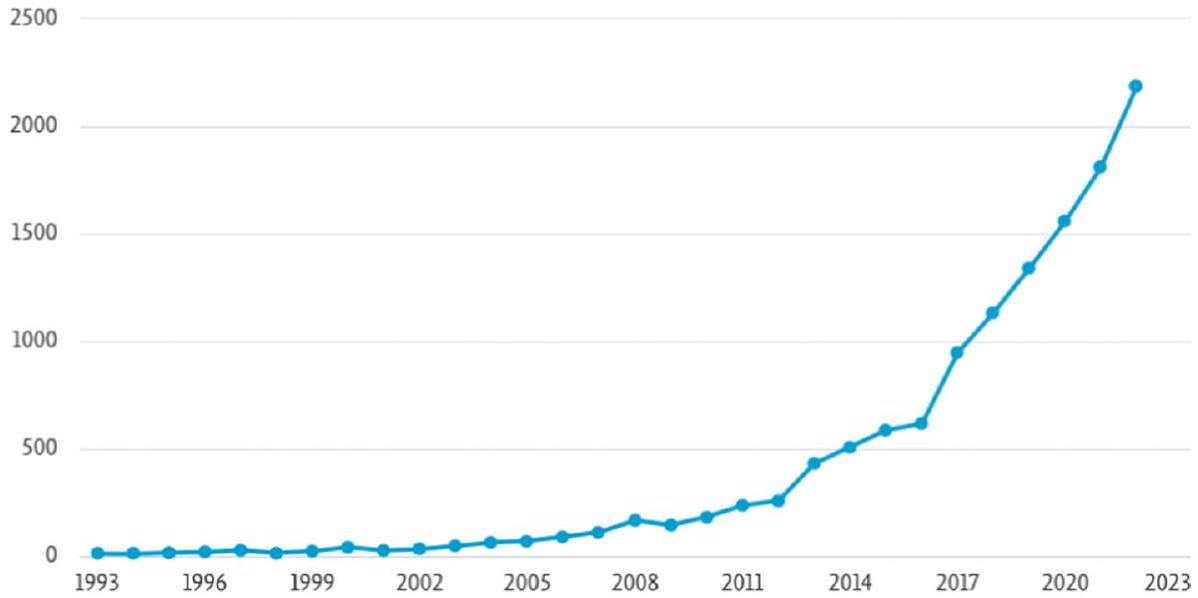
منذ عام 2010، كان هناك ارتفاع أسي في عدد المنشورات الأكاديمية التي تفحص بشكل صريح النظم البيئية المتعلقة بالأعمال (انظر الشكل 1). وقد شملت هذه الأبحاث نظم الابتكار (أدنر، 2006، 2012؛ أدنر وكابور، 2010)، نظم المنصات (باركر وآخرون، 2017؛ كريتشمر وآخرون، 2022)، النظم البيئية الريادية (أكس وآخرون، 2017؛ ستام وسبايجل، 2018)، ونظم المعرفة (يارفي وآخرون، 2018؛ أولك وغرب، 2023).
تم إصدار دعوة لتقديم الأوراق في أوائل عام 2020 لمؤتمر وهذه القضية الخاصة، وكانت محدودة بالابتكار ونظم المنصات الابتكارية. تلقينا استجابة قوية، في موجتين منفصلتين من التقديمات. تم تقديم ما مجموعه 75 ورقة للمؤتمر الخاص بقضية يونيو 2020، تم قبول 33 منها للعرض؛ تم هيكلة المؤتمر لتقديم ملاحظات مفصلة لكل ورقة. بعد أربعة أشهر، تم تقديم 60 ورقة للنظر فيها في القضية الخاصة. من بين هذه الأوراق، أكملت تسع أوراق الحد الأدنى من أربع جولات من المراجعات وتم نشرها.
يوفر الجدول 2 نظرة عامة على محتويات العدد الخاص، بما في ذلك المؤلفين وعنوان كل ورقة، والسياق التجريبي (إن وجد)، وأنواع النظام البيئي التي تم النظر فيها في كل مقال. بموجب القواعد الحالية للناشر، يتم تنظيم المقالات في هذه الأعداد الخاصة من سياسة البحث كـ “عدد افتراضي” ولكن لم تعد تظهر في نفس الوقت في الورق أو على الموقع الإلكتروني. مقالتنا، بدلاً من أن تكون الأولى كما في العدد الخاص المطبوع، تم الانتهاء منها وتقديمها أخيرًا، بعد أن كانت جميع المقالات الأخرى في شكلها النهائي.
كمديرين ضيوف، نحن متحمسون لإمكانية المقالات المنشورة في أن يكون لها تأثير كبير على مجال دراسات الابتكار. ومع ذلك، لقد تأثرنا بعدد الأوراق المقدمة، التي، على الرغم من دراستها لظواهر جديدة ومثيرة للاهتمام، لم تتمكن من التعبير بشكل مقنع عن مساهمات أبحاثها في أبحاث النظم البيئية والمجال الأوسع لدراسات الابتكار. وقد دعم هذا فرضيتنا الأصلية بأن النظم البيئية هي مجال جديد نسبيًا.
الشكل 1. مقالات النظام البيئي في المجلات المفهرسة في سكوبس، 1993-2022.
المصدر: إجمالي 12,794 مقالة مدرجة في سكوبس من 1993 إلى 2022 تحتوي على مجال موضوعي يتضمن “بزنس” وعنوان أو ملخص أو كلمات مفتاحية تحتوي على “نظام بيئي” أو “أنظمة بيئية”.
الجدول 2
ملخص مقالات العدد الخاص.
المؤلفون عنوان السياق التجريبي نوع النظام البيئي
بورنر وآخرون (2023) مسار آخر للتكامل: كيف يحدد المستخدمون والوسطاء ويخلقون تركيبات جديدة في نظم الابتكار منتجات المنزل الذكي نظام الابتكار، مع كل من المنصات والوسطاء، منسق بواسطة أدوات العمل
كوزولينو وجايجر (2024) تعطيل النظام البيئي والموقف التنظيمي: استراتيجيات دخول منسقي ومكملات الشركات الناشئة في الصحة الرقمية شركات ناشئة في تكنولوجيا المعلومات الصحية نظام الابتكار، وليس قائمًا على المنصات
جاكوبيديس وآخرون (2024) الآثار الخارجية والتكاملات في المنصات والأنظمة البيئية: من الحلول الهيكلية إلى الفشل الداخلي نظرية منصات الابتكار، منصات المعاملات، جميع نظم الأعمال (ليس فقط نظم الابتكار)
كوان وغرب (2023) الواجهات، التعديل، وظهور النظام البيئي: كيف قامت DARPA بتعديل نظام أشباه الموصلات أشباه الموصلات بدون مصانع نظام بيئي مبتكر متعدد الأطراف من تنسيق DARPA
ميرك وجيبسِن (2023) كيف تؤثر المنافسة على الجهود الابتكارية داخل نظام بيئي قائم على المنصات؟ مقارنة بين المساهمين المدفوعين وغير المدفوعين تطبيقات آيفون المجانية مقابل المدفوعة نظام الابتكار القائم على المنصات
بوجاداس وآخرون (2024) دور القيمة والتكوين لواجهات برمجة التطبيقات على الويب في نظم الابتكار الرقمي: حالة نظام السفر عبر الإنترنت مواقع شراء السفر عبر الإنترنت نظام بيئي معقد مع منصات متعددة
رايتر وآخرون (2024) إدارة أنظمة الابتكار متعددة المستويات صناعة البنوك الأوروبية مقارنة بين خمسة أنظمة ابتكار قائمة على المنصات
سونغ وآخرون (2024) من الفضول المبكر إلى شبكة الفضاء الواسعة: ظهور نظام ابتكار الأقمار الصناعية الصغيرة الأقمار الصناعية الصغيرة نظام بيئي للابتكار متعدد الأطراف، يتم تنسيقه بواسطة “الجهات الأساسية” التي تقوم باستثمارات متخصصة
فان دايك وآخرون (2024) من المنتج إلى المنصة: كيف تشكل افتراضات واختيارات الشركات القائمة استراتيجيتها للمنصة مصنعي المعدات الزراعية مقارنة بين نظامي ابتكار قائمين على المنصات
ظاهرة في أبحاث الإدارة، يفتقر العديد من المؤلفين إلى أساس مفاهيمي قوي يمكنهم من تأصيل أبحاثهم. وبالتالي، بينما يُعتبر الارتفاع في الاهتمام بالنظم البيئية تطورًا ملحوظًا، لا يزال الباحثون الذين يدرسون النظم البيئية لا يتشاركون في إطار مفاهيمي يسمح لهم بتحديد نتائجهم بالنسبة للأعمال السابقة وشرح جدّة وأهمية أعمالهم.

4. المواضيع في العدد الخاص

في هذا القسم، نوضح قيمة عدسة النظام البيئي في مجال دراسات الابتكار من خلال تحديد الموضوعات الرئيسية التي أبرزتها مقالات متعددة. كانت الموضوعات التي ظهرت في مقالات متعددة هي: (1) من هم الفاعلون في النظام البيئي ولماذا ينضمون؟ (2)
كيف يخلق الممثلون قيمة مشتركة من خلال الابتكار ووسائل أخرى؟ (3) كيف يتم تنسيق الأعضاء وإدارة الاعتماد المتبادل؟ (4) من الذي يلتقط القيمة وكيف؟ و (5) ما هي عواقب اعتبار النظم البيئية وحدة التحليل؟ نناقش المواضيع في الأقسام الفرعية أدناه.

4.1. من هم الفاعلون في النظام البيئي؟

تناولت جميع المقالات القضية المركزية المتمثلة في تحديد الأنواع المختلفة من الفاعلين في النظام البيئي، فضلاً عن العمليات والآليات التي مكنتهم من المساهمة في عرض القيمة المحوري. بالنسبة لكل من كوان وغرب (2023) وسونغ وآخرون (2024)، لعبت الأبحاث الأكاديمية دورًا مهمًا في تقليل حواجز الدخول وإطلاق نظام بيئي جديد. في الحالة الأولى، اعتمدت وكالة الدفاع DARPA استراتيجية واضحة لتعزيز إنشاء صناعة أشباه الموصلات بدون مصانع. في الحالة الثانية، المتعلقة بالأقمار الصناعية الصغيرة، سعى الوافدون الجدد إلى الفرص التجارية التي اقترحتها تجارب رائد أكاديمي.
يظهر كل من رايتر وآخرون (2024) وفان دايك وآخرون (2024) كيف أن الشركات القائمة أنشأت منصات لجذب شركات جديدة ومستخدمين من شأنهم تكملة عروض القيمة الأساسية الخاصة بهم. يوضح كوزولينو وجايجر (2024) كيف تمكن الوافدون الجدد الذين تكمل منتجاتهم عروض الشركات الكبيرة من الشراكة مع تلك الشركات ومجموعات الصناعة. توثق بوجاداس وآخرون (2024) كيف استغلت كل من الشركات القائمة والشركات الجديدة حواجز الدخول المنخفضة (ولكن أيضًا تكاليف التحويل المنخفضة) حيث انتقلت معاملات حجز الفنادق من الحجوزات الفردية إلى المجمعات المدعومة عبر الويب.
هناك بعض الخلاف في الأدبيات حول من يجب اعتباره “أعضاء” أو “مشاركين” في نظام بيئي. غالبًا ما يتم تأطير القضية كتمييز بين “التكامل العام” مقابل “التكامل المحدد”. يمكن استخدام المكونات ذات التكامل العام خارج النظام البيئي المحوري: وغالبًا ما تُسمى “المكونات التجارية الجاهزة” أو “COTS”. تعمل المكونات ذات التكامل المحدد (أو المتخصص) فقط داخل النظام البيئي المحوري.
اقترح بعض المؤلفين أنه، نظرًا لأن موردي “التكامل العام” لا يحتاجون إلى تنسيق صريح وقد لا يكونون على علم بوجود النظام البيئي، فلا ينبغي اعتبارهم جزءًا من النظام البيئي. على سبيل المثال، يوصي أدنر (2017) “ابدأ بعرض قيمة و… حدد مجموعة الفاعلين الذين يحتاجون إلى التفاعل لكي يتحقق العرض”. (أدنر، 2017، ص. 41، مع التركيز المضاف؛ انظر أيضًا جاكوبيدس وآخرون، 2018). ومع ذلك، كما يظهر سونغ وآخرون، يمكن لمقدمي التكامل العام أحيانًا أن يلعبوا دورًا أساسيًا في ظهور النظام البيئي – حتى لو لم يلعبوا أي دور في إدارة النظام البيئي. على وجه التحديد، يمكن بناء أنظمة بيئية جديدة بشكل تدريجي، بدءًا من المكونات العامة في الغالب وإضافة المزيد من المكونات المتخصصة شيئًا فشيئًا.
في الوقت نفسه، يظهر سونغ وآخرون أن هناك خطرًا على النظام البيئي عندما لا يقوم الفاعلون الرئيسيون بإجراء استثمارات متخصصة. في نظام الأقمار الصناعية الصغيرة، كانت المكونات العامة الأولية تتناسب بشكل سيئ مع عرض القيمة المركزي للنظام البيئي. كانت المفتاح للنمو والنجاح هو جذب المزيد من الأعضاء الملتزمين الذين استثمروا في مكونات متخصصة وأخيرًا حلوا محل المساهمين العامين.
سؤال ذي صلة هو: هل ينبغي اعتبار المزعج المحتمل جزءًا من نظام بيئي؟ في دراستهم لستة شركات ناشئة رقمية في النظام البيئي الصحي الأكبر بكثير، يظهر كوزولينو وجايجر (2024) أن الأنظمة البيئية لديها طرق لمقاومة الاضطراب من قبل الوافدين الجدد. ومع ذلك، يمكن التغلب على المقاومة (1) إذا كان الوافد مدعومًا من قبل السلطات التنظيمية أو (2) لا تنطبق اللوائح الحالية على الوافد الجديد. يمكن استخلاص نفس الاستنتاج من كوان وغرب: بدون الدعم والتمويل المستمر من DARPA، لكان انتشار أتمتة التصميم الإلكتروني (EDA) وفصل تصميم الرقائق عن التصنيع قد حدث لاحقًا بكثير، إن حدث على الإطلاق.
أخيرًا، تفترض العديد من التعريفات للأنظمة البيئية في العلوم الاجتماعية أن الفاعلين الرئيسيين هم الشركات (مور، 1993، 1996؛ أدنر، 2006، 2012) أو منظمات أخرى (أوتيو وتوماس، 2021). يظهر كوان وغرب وكوزولينو وجايجر أن الوكالات الحكومية – DARPA و
منظمي الرعاية الصحية على التوالي – يمكن أن تلعب دورًا حاسمًا في إجبار الشركات القائمة على تغيير استراتيجياتها وتمكين فرص الدخول للشركات الناشئة المبتكرة.
فقط عدد قليل من تعريفات النظام البيئي تسمح صراحة بوجود فاعلين فرديين (تشيو وآخرون، 2017؛ بوغرز وآخرون، 2019؛ ألتمان وآخرون، 2023؛ بالدوين، 2024، الفصل 3). ومع ذلك، يتم إثبات أهمية الأفراد في مقالتين في العدد الخاص. أولاً، في نظام المنزل الذكي الذي درس بواسطة بورنر وآخرون (2023)، كان الرعاة الأوليون للمنصة هم مصنعي الأجهزة المنزلية (BHS) أو أنظمة الإضاءة (Philips Signify). ومع ذلك، مع بدء المستخدمين في دمج المنتجات من منصات مختلفة، ظهرت طبقة جديدة من الوسطاء الذين قدموا أدوات جعلت مثل هذه التركيبات سهلة (فرانكي وفون هيبل، 2003). ثم تمكن المستخدمون من إنشاء تعديلات مخصصة وأنظمة استخدام. ثم قام الوسطاء بتجميع التركيبات المحددة التي أنشأها المستخدمون، ونشروا هذه المعلومات لمستخدمين آخرين (وللمنصات)، وحسبوا عدد مرات ظهور كل تركيبة. من البيانات، أصبح من الواضح أن “المستخدمين قادرون بشكل أفضل على تحديد أي التركيبات تخلق قيمة لهم (وللآخرين)” (بورنر وآخرون، ص. 10). اليوم، يعتبر المتحمسون والهواة من بين أكثر المبتكرين نشاطًا في هذا النظام البيئي.
يعتبر الهواة أيضًا جزءًا لا يتجزأ من سوق منصة “كسر الحماية” الخاصة بـ iPhone، وهو محور مقال ميريك وجيبسِن (2023). يوجد سوق كسر الحماية لغرض نشر التطبيقات التي لا يسمح بها في متجر تطبيقات آبل الأكبر. أعضاؤه هم مطورو برامج فرديون (ليسوا شركات) يمكنهم اختيار أن يتقاضوا أجرًا أو لا يتقاضوا أجرًا عن منتجاتهم. في هذه العينة، كان عدد المطورين غير المدفوعين يفوق عدد المطورين المدفوعين بحوالي خمسة وعشرين إلى واحد (10,132 إلى 440). قد يستفيد المطورون غير المدفوعين (1) من الرضا الداخلي لتطوير ومشاركة إبداعاتهم مع أشخاص ذوي اهتمامات مشابهة؛ (2) يحصلون على فوائد سمعة على شكل زيادة في المكانة داخل المجتمع؛ أو (3) يحصلون على فوائد مالية غير مباشرة وطويلة الأجل على شكل فرص مهنية محسنة. كما هو الحال في بورنر وآخرون، فإن مساهمة مهمة في هذه المقالة هي إظهار أن الدوافع غير المرتبطة بالربح المالي المباشر يمكن أن تكون مصادر قيمة للأفراد وبالتالي محركات في تطور ونمو النظام البيئي.

4.2. كيف يتم إنشاء القيمة المشتركة؟

تقدم عدة مقالات في العدد الخاص فهمنا لكيفية إنشاء القيمة المشتركة في الأنظمة البيئية. أولاً، كما تم مناقشته أعلاه، يبرز سونغ وآخرون التوتر بين المكونات العامة والمكونات المحددة في النظام البيئي. قد تكون المكونات ذات التكامل العام هي الخيار الوحيد القابل للتطبيق عندما يكون النظام البيئي جديدًا جدًا: تخلق المكونات المحددة قيمة أكبر للعملاء، لكن الموردين يؤجلون إجراء استثمارات متخصصة عندما يكون الطلب محدودًا. يوثق المؤلفون عملية تكرارية حيث قام الأعضاء الأوليون في النظام البيئي بتوحيد بنية تقنية وخلق قيمة كافية مع المكونات العامة لجذب المزيد من الفاعلين والمزيد من الاستثمارات المتخصصة.
يبرز بوجاداس وآخرون القيمة المشتركة التي تم إنشاؤها من خلال توفير والوصول وإعادة تجميع البيانات عبر واجهات برمجة التطبيقات على الويب في نظام وكالات السفر عبر الإنترنت (OTA). شبكة وكالات السفر عبر الإنترنت ومقدمي الخدمات ذات الصلة كبيرة وموزعة، مع حواجز دخول منخفضة وقليل من المحاور المهيمنة. قد يتم مشاركة الإيرادات من حجز واحد مع عدة لاعبين يتم نشر واجهات برمجة التطبيقات الخاصة بهم في مرحلة ما في عملية النهاية إلى النهاية. تجد الدراسة أنه في هذا النظام البيئي المدفوع بالبيانات، فإن الميزة التنافسية المكتسبة من التحكم في واجهات برمجة التطبيقات الخاصة ليست طويلة الأمد.
يجد بورنر وآخرون أن الابتكارات الناجحة في المنزل الذكي كانت في الغالب إعادة تركيبات للمنتجات الموجودة، قادمة من أصحاب المنازل في الأسفل بدلاً من المنتجين في الأعلى. يبرز ميريك وجيبسِن أهمية الابتكارات من المساهمين غير المدفوعين في الأنظمة البيئية ويظهران كيف استجاب الفاعلون المدفوعون وغير المدفوعين بشكل مختلف للمنافسة من حيث طبيعة وسرعة ابتكاراتهم.
من خلال استخدام دراسات حالة متباينة لخمس بنوك أوروبية، يظهر ريتير وآخرون كيف اختلفت نهج البنوك القائمة في أوروبا تجاه تنسيق نظم الابتكار اعتمادًا على درجة عدم اليقين.
حول قيمة العرض. وبالمثل، يقارن فان دايك وآخرون الطرق التي اتبعتها شركتان راسختان في صناعة المعدات الزراعية العالمية في اتباع استراتيجيات مختلفة لإدارة الابتكارات التكميلية. أدت استراتيجياتهما المتباينة إلى نتائج مختلفة تمامًا من حيث الكمية وطبيعة التطبيقات المقدمة من قبل المساهمين الخارجيين.
بالإضافة إلى إظهار كيفية إنشاء قيمة مشتركة، تناقش عدة مقالات في العدد الخاص العوامل السابقة لإنشاء القيمة في النظم البيئية. يشير كوزولينو وجيجر (2024) إلى الصعوبة التي تواجهها الشركات الناشئة في إعادة توجيه نظام بيئي إلى نموذج جديد لإنشاء القيمة، وكيف يمكن أن تمكّن اللوائح أو تعيق أو لا تؤثر على مثل هذا التوجيه. يُظهر كوان وويست كيف أن إنشاء بنية معمارية معيارية بتمويل من DARPA مع واجهات مفتوحة قد عزز دخول وابتكار شركات EDA وشركات أشباه الموصلات “بدون مصنع”.

4.3. كيف يتم تنسيق أعضاء النظام البيئي؟

سؤال آخر يُطرح بشكل شائع هو: كيف يتم تنسيق أعضاء النظام البيئي (أو محاذاتهم بطريقة أخرى) لتحقيق خلق قيمة مشتركة؟ تاريخياً، كانت الأنظمة البيئية للمنصات تُدار بواسطة شركة واحدة (بريسنهاين وغرينشتاين، 1999؛ جاكوبيدس وآخرون، 2018؛ بالدوين، 2024، الفصل 9) أو ائتلاف من الشركات (أوماهوني وكارب، 2022). في هذه الحالات، يحدد الراعي أهداف خلق القيمة، وقواعد التفاعل، و(غالباً) من يُسمح له بالمشاركة. ومع ذلك، في بعض الحالات، قد تتنافس عدة رعاة للمنصات على حصة السوق. تصف المقالات التي كتبها رايتر وآخرون وفان ديك وآخرون في هذا العدد الخاص مثل هذه الحالات في صناعات البنوك الأوروبية ومعدات الزراعة العالمية على التوالي.
يتميز جاكوبيدس وآخرون في العدد الخاص بالتمييز بين نظم المنصات البيئية و”النظم البيئية التجارية” بدون منصات. في الحالة الأولى، يقوم رعاة المنصة بالحكم من خلال المعايير (“قواعد التصميم”) و/أو الأسعار المفروضة على “الأطراف” المختلفة. كما يحدد الراعي قواعد الوصول. في النظم البيئية بدون منصات، تجمع الترتيبات التعاونية المتفق عليها الأعضاء في النظام البيئي معًا. قد يتفق الأعضاء أيضًا على إنشاء أصول مشتركة وتطوير عمليات مشتركة تسمح لهم بتحقيق أهدافهم المشتركة (جاكوبيدس وآخرون، 2024 المعرض 3).
في العمل المتعلق، يجادل بالدوين (2024، الفصل 3) بأنه، في غياب المنصات، يمكن تنسيق النظم البيئية عبر أسعار السوق، والعقود الثنائية، والمفاوضات متعددة الأطراف (غالبًا ما تكون منسقة)، ودمج الأنظمة. وتضيف أن الميزة الرئيسية للمنصات مقارنة بوسائل التنسيق الأخرى هي أنه من خلال توحيد قواعد التصميم، يمكن للمنصات أن تتوسع بكفاءة. وبالتالي، مع زيادة عدد المشاركين والأنشطة في النظام البيئي، من المحتمل أن تظهر المنصات من أجل التعامل بشكل فعال من حيث التكلفة مع الزيادات في معدلات الابتكار و/أو حجم التجارة (بالدوين، 2024، الفصل 7).
بالنسبة للشركات والصناعات التي لم يُنظر فيها سابقًا إلى إنشاء القيمة المعتمد على النظام البيئي كطريقة عمل، يتطلب تنسيق وتوافق المصالح مهارات جديدة وحتى معايير ثقافية جديدة. يُظهر ريتير وآخرون أنه في الأنظمة البيئية المدعومة من قبل خمسة بنوك مختلفة، استخدم الرعاة آليات حوكمة رسمية لحل المشكلات المحددة جيدًا، وآليات غير رسمية للمشكلات الأكثر غموضًا أو عدم يقين. وبالمثل، في دراستهم لاستراتيجيات الأنظمة البيئية المتنافسة لشركتين مصنعتين لمعدات الزراعة، يُظهر فان دايك وآخرون كيف كانت هذه الاستراتيجيات مقيدة بالشركاء الحاليين، وخاصة الوكلاء.
تكون الحوافز والحوكمة أكثر تعقيدًا في حالات النظم البيئية المتداخلة. تحدث التداخلات الأفقية عندما تتنافس منصتان أو أكثر على المكملين والمستخدمين، وهي ممارسة تُعرف بالتعددية (Eisenmann et al.، 2011؛ Zhu و Iansiti، 2012؛ Cennamo و Santalo، 2013). في العدد الخاص، يظهر Pujadas وآخرون أنه، نظرًا لانخفاض التخصص وتكاليف التحويل، فإن تحليل النظم البيئية “المتداخلة” لا معنى له: بدلاً من ذلك، فإن أعضاء النظام البيئي هم جميعًا جزء من شبكة واحدة غير قابلة للتجزئة ومتشابكة.
التداخلات الأفقية ممكنة أيضًا في النظم البيئية غير المتنافسة. على سبيل المثال، شركة أشباه الموصلات بدون مصنع تقع في سانتا كلارا هي جزء من نظام الابتكار العالمي في أشباه الموصلات وعضو في
نظام ريادة الأعمال في وادي السيليكون. قد يساهم في أنظمة المعرفة المختلفة، على سبيل المثال، اتحادات البحث المدعومة من الجامعات التي تركز على التقنيات المتطورة. سيكون زبونًا لمصنع أشباه الموصلات مثل TSMC (منصة) وموردًا لصانعي الكمبيوتر والأجهزة في الأسفل. أخيرًا، قد تكون رقائقه منصة بحد ذاتها (على سبيل المثال، رقائق معالجة الرسوميات من Nvidia هي منصة لتطبيقات الذكاء الاصطناعي). لا يزال يتعين دراسة كيفية توازن الشركات والأفراد بين مساهماتهم والصراعات المحتملة في الأهداف في مثل هذه الحالات.
تظهر التداخلات الهرمية (أو المتداخلة) في اتحادات الصناعة، عندما تنضم الشركات أو الأفراد إلى اتحاد معين ضمن نظام بيئي صناعي أكبر (أولك وويست، 2023) أو عندما ينشئ اتحاد هرمية من المشاريع ويخصص حقوق الحوكمة لمديري كل من المشاريع والمشاريع الفرعية (أوماهوني وكارب، 2022؛ بالدوين، 2024، الفصل 16). في العدد الخاص، يظهر كوزولينو وجيجر، ريتير وآخرون، وفان دايك وآخرون كيف أن الشركات أنشأت أنظمة بيئية جديدة من خلال جذب أعضاء من نظام بيئي أكبر إلى مشاريع أو منصات محددة. كما يظهر ريتير وآخرون كيف أن الهياكل الهرمية المتعددة (مستويات الحوكمة) داخل كل نظام بيئي سمحت لرعاة المنصة بالتفاعل بشكل انتقائي مع مكملاتهم في تطوير مقترحات القيمة المشتركة الخاصة بهم.
مؤخراً، قام الباحثون بدراسة أشكال أضعف من السيطرة تُعرف غالباً بالتنسيق (Reypens et al., 2021; Altman et al., 2022; Olk and West, 2023). يقترح كوزولينو وجيجر أنه في صناعة منظمة، سيواجه الوافدون الجدد صعوبة في تنسيق مجموعة جديدة من العلاقات ما لم يكن التغيير المقترح مدعومًا من قبل السلطات التنظيمية أو القوانين القائمة.
في الوقت نفسه، على المستويين العالمي والمحلي، توفر الواجهات المحددة جيدًا نقاط عبور رفيعة لهيكلة تعاون يخلق قيمة بين شركتين أو أكثر (بالدوين، 2008؛ بالدوين، 2024، الفصل 2). عادةً ما تركز الأبحاث حول الواجهات على تلك التي يوفرها راعي المنصة ضمن بنية المنصة العامة (ويست وديدريك، 2000؛ بالدوين وودارد، 2009؛ جاور، 2021). ومع ذلك، في العدد الخاص، يظهر فان ديك وآخرون كيف استخدمت شركتان في مجال المعدات الزراعية أنواعًا مختلفة من الواجهات لإدارة أنظمة منصات الابتكار الرقمي الخاصة بهما. رأت إحدى الشركات أن منصتها مشروع منفصل عن خط إنتاجها الحالي: حيث أنشأت جهاز اتصال معياري يمكنه ربط المنصة بأي قطعة من الآلات، بغض النظر عن العلامة التجارية. قاموا بنشاط بتجنيد مستخدمين لمنصتهم الرقمية الذين لم يستخدموا آلاتهم. وأخيرًا، قاموا بتحقيق إيرادات من المنصة من خلال فرض رسوم على مزودي التطبيقات من الطرف الثالث. رسوم إضافية.
رأت الشركة الثانية أن منصتها الرقمية وسيلة لتعزيز خط إنتاجها الحالي. قامت بتعديل خط إنتاجها بالكامل ليكون متوافقًا مع المنصة الرقمية وأنشأت واجهة برمجة تطبيقات مفتوحة. لم تفرض رسومًا على المساهمين للوصول إلى المنصة، بل سمحت لهم باختيار الأسعار والاحتفاظ بجميع الإيرادات من تطبيقاتهم. وليس من المستغرب أنها جذبت العديد من المساهمين أكثر من الشركة الأولى، ونتيجة لذلك، لم يكن عليها توظيف مجموعة كبيرة من مهندسي البرمجيات الداخليين. على الرغم من هذه الاختلافات، اعتبارًا من وقت النشر، يبدو أن استراتيجيات المنصات لكلا الشركتين قابلة للتطبيق.
تتمثل إحدى الفوائد الرئيسية للواجهات المستقرة في دعم الابتكار اللامركزي. عادةً ما يُفترض أن هذه الواجهات ستُنشأ كقواعد تصميم من قبل راعي منصة مركزي. (بالدوين وكلارك، 2000؛ غاور وكوسومانو، 2002؛ بالدوين وودارد، 2009). تصف مقالتان في العدد الخاص استثناءات لهذه القاعدة. أولاً، يوضح بورنر وآخرون أن المستخدمين النهائيين يمكنهم إعادة دمج المنتجات الجاهزة باستخدام الواجهات التي توفرها الوسائط في شكل أدوات. ثانياً، يقدم بوجاداس وآخرون نموذجاً لامركزياً جذرياً لإنشاء الواجهات – وهو نقيض لرعاية المنصة المركزية. في نظام OTA البيئي، سمحت تكاليف التحويل والبرمجة المنخفضة جداً لكل من المبدعين والمستخدمين بتوليد وإعادة دمج مجموعة واسعة من الواجهات المتطورة باستمرار. تحتوي الشبكة الناتجة على عدد كبير من المنصات المترابطة، ولكن لا يوجد محور مهيمن (بوجاداس وآخرون، الشكل 9). إنها تشبه أكثر شبكة النقل أو الكهرباء الكلاسيكية مع العديد من نقاط النقل بدلاً من المنصة الفردية أو المتداخلة الكلاسيكية.
النظم البيئية التي تُرى في صناعة الكمبيوتر.
أخيرًا، عند النظر في قضايا مثل الحوكمة، خلق القيمة، أو الحوافز، كانت الأبحاث السابقة تميل إلى التمييز بين أنواع مختلفة من الفاعلين بناءً على موقعهم الهيكلي داخل النظام البيئي، والذي يُعرف عادةً بأنه الشركة المحورية، المورد أو المكمل (على سبيل المثال، أدنر وكابور، 2010؛ داتي وآخرون، 2018). ومع ذلك، توضح مقالتان في العدد الخاص (رايتير وآخرون، سونغ وآخرون) كيف أن الاختلافات في الأفعال والاستراتيجية في نظام بيئي قد لا تكون دائمًا مدفوعة بموقع الفاعلين الهيكلي. على سبيل المثال، قد تكون الحوافز والمساهمات في القيمة متشابهة بين الموردين والمكملين في شريحة عملاء واحدة، بينما تكون غير متشابهة عبر شريحة عملاء مختلفة. وبالتالي، قد تبحث الأبحاث المستقبلية في الاعتماد المتبادل بين الفاعلين باستخدام تعريفات أكثر أساسية للتكامل، مثل تطبيق ملاحظة ميلغرام وروبرتس (1995) بأن المقياس النهائي للتكامل هو عندما يؤدي غياب المكمل إلى تقليل قيمة العرض.

4.4. من الذي يلتقط القيمة في نظام بيئي وكيف؟

مقالتان في العدد الخاص تفحصان العوامل التي يمكن أن تحد من قدرة الشركات والأفراد على تحقيق القيمة. في دراستهم حول أنظمة السفر المعتمدة على البيانات، يظهر بوجاداس وآخرون أن التهديد المستمر للدخول الجديد، والتقليد، وإلغاء الوساطة يعني أن فرص تحقيق القيمة تتلاشى عادةً بسرعة، مما يجبر الشركات على تحديث استراتيجياتها باستمرار وإعادة تشكيل علاقاتها. في الوقت نفسه، من خلال مقارنة استراتيجيات نظام المنصة لشركتين مصنعتين لمعدات زراعية، يظهر فان دايك وآخرون أن الراعي للمنصة الذي شارك القيمة بشكل أكثر سخاءً مع المكمّلين جذب كما أن لديها العديد من المزايا مثل منافستها. هذا المثال يوضح كيف أن “فرض الضرائب” على نظام بيئي يمكن أن يقلل من خلق القيمة.
على الرغم من Van Dyck وآخرين، فإن أبحاث النظام البيئي نادراً ما وثقت أو قيست هذا التوتر الكامن بين خلق القيمة والتقاط القيمة، والذي تم ملاحظته منذ فترة طويلة في مجالات أخرى من أبحاث الابتكار (انظر، على سبيل المثال، Simcoe، 2006؛ Laursen وSalter، 2014). قد تبحث الأبحاث المستقبلية في العوامل الممكنة التي قد تؤثر على هذا التبادل، مثل النمو، التعقيد، ودرجة السيطرة، وجود أنظمة بيئية متنافسة، ونظام الاستحواذ الخارجي (Teece، 1986). يمكن أيضاً أن تتحقق الأبحاث المستقبلية من التوقع الذي قدمه Jacobides وآخرون (الجدول 2، العمود 1) بأن الحوكمة المركزية من قبل راعي المنصة يمكن أن تتجنب أو تقلل من خطر أن القيم المخصصة بشكل خاطئ (أو غير المؤكدة) ستثني المشاركة في النظام البيئي، مما يقلل من القيمة المخلوقة وقد يتسبب في فشل الابتكار.

4.5. النظم البيئية كوحدة تحليل

يعتبر الباحثون بشكل متزايد النظم البيئية وحدة تحليل متميزة عن الشركات والصناعات والأسواق. في هذا الصدد، من المفيد التمييز بين المقالات التي تبحث في تأثير النظم البيئية على مختلف الفاعلين وتلك التي تبحث في تأثير الأفعال التي يقوم بها الأعضاء وعوامل أخرى على النظم البيئية. بينما تسير العلاقة السببية في أي نظام بيئي في كلا الاتجاهين، إلا أنه لا يزال من المفيد النظر في كل اتجاه بشكل منفصل.
لقد درست العديد من الأبحاث السابقة فوائد النظام البيئي الذي يعمل بشكل ناجح لأعضائه، بما في ذلك الرعاة، والمنظمين، والمكملين، والمستخدمين (مور، 1993، 1996؛ أدنر، 2006، 2012؛ تشيكاغنولي وآخرون، 2012؛ ويست وود، 2013؛ تشينامو وسنتالو، 2019؛ أولك ويست، 2020). ولكن كيف يؤثر نجاح النظام البيئي على بقية الاقتصاد؟ يظهر سونغ وآخرون كيف أن نضوج نظام الأقمار الصناعية الصغيرة – مع التحسينات المصاحبة في السعر والأداء – قد مكن من إنشاء أعمال اتصالات جديدة تمامًا لم تكن قابلة للتطبيق اقتصاديًا بالنظر إلى التصاميم السابقة الأكثر تكاملاً والأكثر تكلفة للأقمار الصناعية. كما يظهر بوجاداس وآخرون كيف تم بناء أعمال جديدة، توفر كل من المنصات والسلع والخدمات التكميلية، على أساس واجهات برمجة التطبيقات الجديدة على الويب.
تولي المقالات في العدد الخاص اهتمامًا أكبر نسبيًا لتأثير الفاعلين على النظم البيئية. على وجه الخصوص، تتناول عدة مقالات
سؤالان رئيسيان: (1) من أين تأتي النظم البيئية؟ و (2) لماذا تتغير؟ كانت إحدى النتائج الشائعة في عدة مقالات هي أن النظم البيئية قد تُنشأ لبدء استراتيجية خلق القيمة لشركة ربحية أو جهة تنظيمية. وبالتالي، يصف كوان وويست تاريخ واجهة رئيسية مكنت من التخصص العمودي داخل صناعة أشباه الموصلات. تم تصميم الواجهة من قبل باحثين أكاديميين ممولين من الحكومة الذين توقعوا أن تقسيم تصميمات الرقائق إلى وحدات سيسمح بتحسين أداء الرقائق بمعدل يتماشى مع ما تنبأ به قانون مور. بدعم من DARPA، نشأت نظام بيئي ثلاثي يتكون من صانعي أدوات EDA، ومصممي الرقائق بدون مصانع، ومصانع أشباه الموصلات، وأصبح تنافسياً مع الشركات المصنعة للأجهزة المتكاملة الراسخة مثل إنتل (بالدوين، 2024، الفصل 8).
وبالمثل، حصل ثلاثة من ستة شركات الرعاية الصحية التي أسسها كوزولينو وجايجر على مساعدة من جهة تنظيمية أو تم تأسيسها استجابة لمبادرة تنظيمية جديدة أو قانون. ويصف سونغ وآخرون كيف قامت جامعة ساري ببناء وإطلاق أول قمر صناعي صغير كدليل على أن الفكرة قابلة للتطبيق.
تعكس أربع مقالات أخرى في العدد الخاص السبب الأكثر شيوعًا لظهور نظام الابتكار: حيث يرى أحد رعاة المنصة أو أكثر فائدة في الاستفادة من مصادر الابتكار الخارجية ويقوم بإنشاء منصة بواجهات مفتوحة (وثابتة) لهذا الغرض. في حالتين، ريتير وآخرون وفان دايك وآخرون، كان رعاة المنصة من الشركات القائمة في الصناعات التقليدية – البنوك ومعدات الزراعة على التوالي.
في الحالتين الأخريين، ظهرت منصات جديدة استجابت لمطالب المستخدمين الأفراد. أولاً، كما هو موصوف أعلاه، في نظام المنزل الذكي الذي درسه بورنر وآخرون، عندما بدأ المستخدمون في دمج المنتجات من منصات مختلفة، ظهرت طبقة جديدة من الوسطاء الذين قدموا أدوات جعلت هذه التركيبات سهلة. ثانياً، في نظام كسر حماية آيفون، الذي وصفه ميريك وجيبسِن، عندما فتحت آبل متجر التطبيقات، انتقل معظم مطوري آيفون من منصة كسر الحماية الأولية إلى المتجر. ومع ذلك، كانت هناك بعض التطبيقات التي لم ترغب آبل في تشجيعها، ولم تسمح بها على موقعها. تواصل المنصة الأولية لكسر الحماية خدمة هذه السوق المتخصصة.
لقد اقترح نداءنا الأصلي للمقالات طريقة أخرى لدراسة النظم البيئية كوحدة تحليل: حيث طلب البحث في ابتكار النظم البيئية، والذي يُعرف بأنه “نماذج جديدة لإنشاء وإدارة النظم البيئية.” بينما كان لكل من النظم البيئية الابتكارية التي تم دراستها في هذا العدد الخاص قصة فريدة من نوعها، في معظم الحالات، كانت النظام البيئي النهائي يتوافق مع إطارنا القائم على الاستقلالية والتكامل والمرونة. ومع ذلك، فإن النظام البيئي للسفر عبر الإنترنت الذي وصفه بوجاداس وآخرون هو شكل جديد من أشكال النظام البيئي: شبكة لامركزية بشكل جذري، ومترابطة للغاية من الشركات والمستخدمين. يمكن العثور على هذا الشكل من التنظيم في إعدادات أخرى، مثل شبكات الاتصالات الدولية، وشبكات الكهرباء، وشبكات خطوط الطيران. في الوقت نفسه، فإن النظام البيئي “الضخم القابل للتعديل” الذي يصمم ويصنع أجهزة الاتصالات المحمولة يعكس مزيجًا من النموذج اللامركزي المتخلل بعدد قليل من نظم المنصات المدعومة من الشركات (ثون وآخرون، 2022).

5. مستقبل أبحاث النظم البيئية

نختتم هذه المقالة بمناقشة منطقتين واسعتين للبحث المستقبلي. تتعلق الأولى بالمنظورات المتقاربة – الأسئلة عند تقاطع أبحاث نظم الابتكار البيئية وغيرها من خطوط البحث المعروفة. بينما تقترح الثانية طرقًا أخرى قد تكون مفيدة لتوسيع أبحاث النظم البيئية في اتجاهات جديدة.

5.1. المنظورات المتقاربة في دراسات الابتكار

في هذا القسم نقترح كيف يمكن دمج عدسة النظام البيئي مع عدسات أخرى تُستخدم عادة من قبل الباحثين في الابتكار لإنتاج صورة أكثر وضوحًا للظواهر الأساسية. نؤكد على الرؤى التي قدمتها المقالات التجريبية.

5.1.1. نماذج الأعمال

غالبًا ما تمكّن التقنيات الجديدة من ظهور نماذج أعمال جديدة (بادن فولر وهايفليجر، 2013) ونظم بيئية جديدة (ويست وود، 2013). مثل أبحاث النظم البيئية، تركز أبحاث نماذج الأعمال على خلق القيمة من جانب الطلب (ماسا وآخرون، 2017)، لكنها أكثر وضوحًا بكثير بشأن الخيارات المتعلقة بالتقاط القيمة (تيش، 2018؛ أدنر، 2017؛ كابور، 2018؛ سنهور وآخرون، 2021). في العدد الخاص، أظهر كوزولينو وجيجر، كوان وويست، وسونغ وآخرون جميعًا أن الوافدين الجدد إلى النظام البيئي يمكنهم التقاط قيمة كافية لتعطيل نماذج أعمال الشركات القائمة بشكل كبير، مما يضيف إلى الموضوع الناشئ حول كيفية تعطيل الوافدين الجدد لنماذج أعمال الشركات القائمة داخل نظام بيئي (انظر أيضًا أنصاري وآخرون، 2016). ومع ذلك، هناك حاجة إلى مزيد من البحث لتسليط الضوء على العلاقات بين الظاهرتين، مع التركيز على ديناميات خلق القيمة والتقاطها بين عدة فاعلين في نظام بيئي.
مثال أيقوني على هذه العلاقات المعقدة هو ظهور صناعة الكمبيوتر الشخصي. في السبعينيات، مكنت ولادة المعالج الدقيق من ظهور نظام بيئي جديد من الحواسيب الصغيرة، والأجهزة الطرفية، والإكسسوارات. سمح ذلك لشركة أبل للكمبيوتر ثم IBM بإنشاء نماذج أعمال جديدة تعتمد على النظام البيئي للأجهزة والبرامج التكميلية (فرايبرجر وسوين، 1984؛ تشبوسكي وليونسي، 1988؛ كرينغلي، 1992؛ بالدوين، 2024، الفصل 9). بعد ذلك، عندما قامت شركة كومباك وتكنولوجيا فينيكس بإعادة هندسة البرنامج الثابت لجهاز IBM PC، ظهر نموذج عمل آخر يعتمد على التحكم في المعايير الحرجة التي تضمن التوافق بين الكمبيوتر الأساسي، وأجهزة الأجهزة، وتطبيقات البرمجيات (فروت، 1992؛ موريس وفيرغسون، 1993؛ لجنة تاريخ إنتل الشفوي، 2008).
في التسعينيات، أدى الهيمنة العالمية لمنصة المعايير Wintel إلى تشكيل “شبكة إنتاج قابلة للتعديل” – نظام بيئي موزع عالميًا يتكون من الشركات المصنعة المتعاقدة، والشركات المصنعة للتصميم الأصلي (ODMs)، والشركات الرائدة (مثل كومباك، NEC، توشيبا، وديل) التي تتحكم في الوصول إلى العملاء النهائيين (سترجون، 2002؛ سترجون وكاواكامي، 2011؛ ثون وآخرون، 2022؛ بالدوين، 2024، الفصل 11). كانت كل من هذه الأدوار المتخصصة مرتبطة بنموذج عمل مطابق. أدى صعود الإنترنت إلى تمكين منصات المعاملات عبر الإنترنت الجديدة التي تجاوزت تجار التجزئة التقليديين. إن نمط الابتكار التكنولوجي، وابتكار نموذج الأعمال، وتكيف النظام البيئي هو نمط شائع، ويستحق مزيدًا من التحليل.

5.1.2. الابتكار المفتوح

ساعدت عدسة النظام البيئي في توسيع الابتكار المفتوح من استراتيجية خلق القيمة الثنائية إلى استراتيجية متعددة الأطراف (ويست، 2014). من جانبها، تم استخدام نموذج الابتكار المفتوح لشرح أساس خلق القيمة في مجموعة من النظم البيئية (روهر بيك وآخرون، 2009؛ بوغرز وآخرون، 2017؛ راندهاوا وآخرون، 2021)، على الرغم من أن الأدلة الحديثة تظهر علاقة معقدة بين الابتكار المفتوح والأداء المالي (شابر وآخرون، 2023). في المستقبل، ستستفيد أبحاث الابتكار المفتوح من استخدام عدسة خلق القيمة التعاونية من أبحاث النظم البيئية، بينما يمكن أن تتعلم أبحاث النظم البيئية من الفحص الدقيق للابتكار المفتوح لدوافع الشركاء المتعاونين والآثار المترتبة على التقاط القيمة. أخيرًا، هناك فرصة لدراسة العلاقة بين الابتكار المفتوح، ونماذج الأعمال، والنظم البيئية، نظرًا للتركيز المشترك على خلق القيمة والتقاطها عبر الحدود التنظيمية (زوت وآخرون، 2011؛ تشيسبرو وبوغرز، 2014).

5.1.3. اتحادات البحث، ومنظمات وضع المعايير، ومشاريع المصدر المفتوح

توفر اتحادات البحث، ومنظمات وضع المعايير (SSOs)، ومشاريع المصدر المفتوح أمثلة متوازية على كيفية دعم ائتلاف من الشركات (أو منظمات أخرى) لنظام بيئي للابتكار (أوماهوني وكارب، 2022؛ أولك وويست، 2023). في معظم الحالات، يتم تقديم هذا الدعم من قبل منظمة مسجلة (غالبًا غير ربحية)، والتي لديها قواعد رسمية للعضوية والحكم. يمكن أن تمتلك هذه المنظمة ملكية مشتركة وتحقق مزايا فصل الأصول، والحد من المسؤولية، والحياة غير المحدودة. في الوقت نفسه، يتم إدراج هذه المنظمة الراعية ضمن نظم بيئية أكبر تكون
هيكلها وعضويتها أكثر سيولة.
لقد كانت الأبحاث السابقة تميل إلى التركيز على الحوكمة على مستوى واحد ولكن ليس على كلا هذين المستويين من التنظيم. يمكن أن تعترف الأبحاث المستقبلية بالعلاقة الهرمية بين النظام البيئي الأكبر وهذه المنظمات ذات الأغراض الخاصة، وتفحص تفاعلها. على سبيل المثال، متى تقيد معايير النظام البيئي الأكبر سياسات الهيئة الحاكمة المركزية؟ ومتى تؤثر الهيئة المركزية على اتجاه الابتكار في النظام البيئي الأكبر؟ لقد تم دراسة هذه القضايا في سياق مشاريع البرمجيات مفتوحة المصدر والمجتمعات، ولكن ليس في النظم البيئية الابتكارية بشكل عام.

5.1.4. الملكية الفكرية (IP)

لقد كانت تخصيص حقوق الملكية الفكرية أمرًا حاسمًا لعمل العديد من النظم البيئية بشكل فعال، سواء كانت منصات مفتوحة المصدر (ويست وغالاغر، 2006؛ أوماهوني وكارب، 2022) أو تلك التي تنظمها اتحادات البحث والتطوير لتوجيه التعاون بين الأكاديميين والصناعة (سيدو وآخرون، 2012؛ ليتن وآخرون، 2013؛ أولك وويست، 2020) أو تلك التي تنسقها منظمات وضع المعايير (تو وآخرون، 2017). في الواقع، تم تحديد خصائص شبكة الشركاء المتعاونين كواحدة من العناصر التي تحدد التوازن بين مشاركة الملكية الفكرية وحمايتها (بوغرز، 2011). لفهم أفضل للاعتماد المتبادل والتكامل، تم استخدام استشهادات براءات الاختراع لقياس هيكل تدفقات المعرفة في النظم البيئية الابتكارية (لي وآخرون، 2016؛ جونز وآخرون، 2021). يمكن أن تدرس الأبحاث المستقبلية تأثير أنواع مختلفة من أنظمة أو استراتيجيات الملكية الفكرية داخل نظام بيئي للابتكار، سواء كانت داخلية (مطلوبة أو مختارة من قبل الأعضاء) أو خارجية (مفروضة من قبل السلطات القانونية أو التنظيمية). يمكن أن تستكشف الأبحاث المستقبلية أيضًا كيف تستفيد الشركات في نظام بيئي من ملكيتها الفكرية وتتنقل بين التوتر بين خلق القيمة والتقاطها.

5.1.5. القدرات التنظيمية

لقد أكدت الأبحاث السابقة على تأثير القدرات على قيادة النظام البيئي، بما في ذلك كيف يمكن أن تساعد الجامعات في قيادة نظام بيئي ريادي (هيتون وآخرون، 2019)، وتمكين الوسطاء من تشكيل أنظمة الخدمة (راندهوا وآخرون، 2022)، أو السماح لرعاة المنصات بتشجيع أعضاء النظام البيئي على أن يكونوا أكثر ابتكارًا (غاور وفيليبس، 2013؛ هاكي وآخرون، 2022). ومع ذلك، تفترض معظم الأعمال المتعلقة بالقدرات العادية والديناميكية أن هذه المهارات تُزرع وتبقى داخل الشركات أو وحدات الأعمال (نيلسون ووينتر، 1982؛ تشاندلر، 1977؛ تييس، وآخرون، 1997؛ دوسي وآخرون، 2000؛ هيلفات، 2000؛ تييس، 2009؛ هيلفات وبيتراب، 2015).
قد تأخذ الأبحاث المستقبلية في الاعتبار تطوير القدرات للشركات في نظام بيئي (هيلفات وراوبتشيك، 2018)، وانتشار القدرات التكميلية عبر الشركات في نظام بيئي، وربما نقل القدرات من نظام بيئي إلى آخر. على سبيل المثال، على عكس شركات السيارات الأمريكية، تُعرف تويوتا بأنها تبني بنشاط قدرات داخل مورديها (ساكو وهيلبر، 1998؛ ساكو، 2004). توفر منصة الابتكار المفتوح لشركة TSMC مجموعة أدوات لنمذجة تركيبات التصميمات والخدمات المقدمة من TSMC والشركات التابعة لها في نظامها البيئي، واختبار التركيبات لمعرفة ما إذا كانت ستعمل بشكل صحيح. تتجنب مجموعة الأدوات إعادة العمل المكلفة لتصميمات الرقائق، مما يقلل من وقت العملاء للوصول إلى السوق (تشيسبرغ، 2020).

5.1.6. الأنظمة البيئية الريادية والإقليمية

بينما تركز الأبحاث حول أنظمة الابتكار على القيمة المقدمة للمستخدمين وتفاعل الاعتماد التكنولوجي والتكامل الاقتصادي بين أعضاء النظام البيئي، فإن الأبحاث حول الأنظمة البيئية الريادية تؤكد عمومًا على الظروف داخل منطقة جغرافية معينة التي تدعم ظهور ونمو المشاريع الجديدة والأنشطة الريادية (لوك، 1996؛ ساكسينيان، 1996؛ تشانغ، 2009؛ ستورجون وكاواكامي، 2011؛ بليد، 2014؛ ستام، 2015؛ أكس وآخرون، 2017؛ وورث وآخرون، 2022). تشير العضويات المتداخلة من قبل المنظمات في أنظمة الابتكار والأنظمة البيئية الريادية إلى العديد من الفرص للبحث في كيفية تمكين أو تقييد أو تسريع تطوير نوع واحد من
النظام البيئي لتطوير الآخر.

5.1.7. أنظمة المعرفة

ركزت الأبحاث حول أنظمة المعرفة على كيفية تسهيل شبكات المشاركين في النظام البيئي المعتمد على المعرفة لإنشاء ومشاركة المعرفة، غالبًا ضمن تحالفات استراتيجية ومجموعات بحثية (فان دير بورغ وآخرون، 2012؛ كوبن وآخرون، 2022؛ كلاريس وآخرون، 2014). تكمن فرصة البحث الرئيسية عند تقاطع أنظمة المعرفة والابتكار في دراسة كيفية تأثير الآليات المستخدمة لتعزيز الثقة والتعاون في أنظمة المعرفة على عمليات الابتكار والتسويق في أنظمة الابتكار. كما هو الحال مع الأنظمة البيئية الريادية، هناك إمكانيات لدراسة تأثيرات العضويات المتداخلة مع أنظمة الابتكار، ولكن أيضًا التعشيش، والسيطرة المشتركة، وروابط أخرى أقوى تربط أحيانًا بين أنظمة المعرفة والابتكار (ليتن وآخرون، 2013؛ أولك وغرب، 2023).

5.2. رؤى جديدة من طرق جديدة

استخدمت جميع الأوراق المقدمة والمقبولة في العدد الخاص تقريبًا دراسات حالة نوعية مقارنة و/أو طرق طولية لإجراء أبحاثها. كانت الاستثناءات في العدد الخاص هي ميريك وجيبس، اللذان استخدما اختبار الفرضيات على عينة كبيرة وبوجاداس وآخرون الذين تتبعوا تطور نظام OTA باستخدام تصورات الشبكة. يسمح تطبيق الطرق النوعية والتاريخية بعرض وتحليل عميق للظواهر الأساسية.
على الرغم من أن أنظمة الابتكار، بحكم تعريفها، تخلق قيمة من خلال ابتكارات جديدة، نادرًا ما يسعى الباحثون لقياس جودة أو كمية الابتكار الناتج. بالمقابل، هناك تقليد طويل في قياس كل من الجودة والكمية على مستوى الشركات (مثل، غارسيا وكالانتون، 2002؛ هاجيدورن وكلودت، 2003)، والتقنيات (سواريز، 2004)، والاقتصادات الوطنية (سميث، 2006؛ غولت، 2018). يمكن أن تسعى الأبحاث المستقبلية بالمثل إلى مقارنة الجودة أو جوانب أخرى من الابتكار مع القيمة الإجمالية التي أنشأها نظام بيئي. يمكن استخدام مثل هذه القياسات لشرح مصادر القيمة داخل نظام بيئي معين، أو لمقارنة أنظمة بيئية مختلفة.
أيضًا، بينما يعتبر التقاط القيمة مركزيًا لمفهوم النظام البيئي، فإنه من الصعب قياسه بشكل مشهور (ريتفيلد وآخرون، 2019). وبالتالي، تميل دراسات التقاط القيمة إلى استخدام مقاييس نوعية، مثل النجاح مقابل الفشل (ويست وود، 2013) أو الاتجاه على مر الزمن – أعلى، أقل، أو نفس الشيء (شرايك وآخرون، 2021).
علاوة على ذلك، من المهم ليس فقط تحديد هياكل وآليات الحوكمة في الأنظمة البيئية وتتبع تطورها، ولكن أيضًا إظهار أي الهياكل والآليات شائعة وأيها نادرة. يتطلب ذلك، بدوره، قياسًا كميًا منهجيًا عبر مجموعات كبيرة من الفاعلين ومجموعة واسعة من الصناعات. يمكن أيضًا استخدام الأساليب الكمية لدراسة طبيعة ومعدل الابتكار في الأنظمة البيئية، وكيف تساهم في التقدم الاقتصادي العام والأداء المحدد للفاعلين المختلفين على مر الزمن (مثل، أدنر وكابور، 2016؛ كابور وماكغراث، 2014).
أهم عائق أمام مثل هذه الأبحاث هو نقص مجموعات البيانات المناسبة. الأنظمة البيئية هي، بحكم تعريفها، مجموعات من الفاعلين، مرتبطة بطرق رسمية وغير رسمية متنوعة. البيانات التفصيلية حول المعاملات بين الشركات محدودة جدًا: جداول المدخلات والمخرجات الحكومية مجمعة جدًا بحيث لا تكون مفيدة كثيرًا في تحديد المعاملات في الأنظمة البيئية، على الرغم من أن أدوات الشبكات الاجتماعية قد تسلط الضوء على طبيعة وتأثير الاعتماد المتبادل بين الفاعلين الأفراد أو المنظمات.
منهجية واعدة أخرى هي النظر إلى آثار البرمجيات، مثل واجهات برمجة التطبيقات على الويب. هذه عمومًا قابلة للاختبار باستخدام فرضيات عينة كبيرة (كابور وأغاروال، 2017؛ أغاروال وكابور، 2022) بالإضافة إلى طرق تصور الشبكة والتفكيك (ماككورماك وآخرون، 2006، 2012؛ بالدوين وآخرون، 2014؛ بوجاداس وآخرون، 2024). مصادر البيانات المحتملة الأخرى للدراسات ذات العينة الكبيرة هي الإحصائيات المنشورة من قبل مجموعات ومنصات مفتوحة متنوعة، مثل مؤسسات لينكس وأباتشي ومستودع جيثب.
تعتبر المفاهيم المزدوجة للتكامل وخلق القيمة المشتركة مركزية لتطبيق عدسة النظام البيئي. ومع ذلك، من الصعب اليوم قياس القيمة الإضافية التي يتم إنشاؤها من خلال تركيبات من المكونات التكميلية. لذلك، فإن تحديد أسباب التكامل داخل نظام بيئي، ووصف كيف تتغير القيمة المشتركة التي تم إنشاؤها مع مرور الوقت هي طرق مهمة للبحث المستقبلي (مثل، أغاروال وكابور، 2022).
ومع ذلك، تتطلب مثل هذه التحليلات طرقًا جديدة. يمكن استخدام تحليل هيكلي للمكونات الوظيفية التي تساهم في القيمة في الأنظمة التقنية المعقدة لتفكيك خلق القيمة المشتركة وربطها بنتائج الابتكار (أدنر، 2021، الفصل 1؛ بالدوين، 2024، الفصل 4). يوفر تحليل “هيكل القيمة” أيضًا وسيلة للتمييز بين المكونات المتخصصة والعامة وبالتالي التنبؤ بأي المساهمين في النظام من المحتمل أن يلتقطوا نسبة كبيرة من الفائض التكاملي. حتى الآن، ومع ذلك، نادراً ما تم استخدام هذه الطرق.

6. الخاتمة

منذ عمل شومبيتر الرائد، انتقل مجال دراسات الابتكار من التركيز الأولي على الصناعات والشركات إلى التركيز المتزايد على الأنظمة البيئية. ومع ذلك، على الرغم من الزيادة الملحوظة في أهمية الأنظمة البيئية، لا يزال هناك غموض كبير حول ما يشكل نظامًا بيئيًا وكيف يمكن تطبيق “عدسة النظام البيئي” على الابتكار بطرق تسهل التقدم التراكمي في معرفتنا.
لمعالجة هذا الغموض، يقدم هذا المقال ثلاثة معايير يمكن استخدامها لتعريف النظم البيئية. أولاً، تتكون النظم البيئية من فاعلين مستقلين (منظمات وأفراد) يخضعون لحوكمة موزعة تلتقط قيمة كافية لتبرير مشاركتهم. ثانياً، يساهم الفاعلون بطرق تكاملية في اقتراح قيمة محورية، بحيث تكون القيمة المشتركة للنظام بأكمله أكبر من مجموع قيم أجزائه المنفصلة. أخيراً، المكونات التقنية في النظام البيئي هي وحدات ضمن بنية تقنية أكبر. يركز منظور النظام البيئي على الابتكار على الابتكارات والمنظمات التي تلبي هذه المعايير.
تسلط المقالات في العدد الخاص الضوء على فوائد استخدام منظور النظام البيئي لدراسة الابتكار. تشمل هذه الفوائد: (1) تحديد أنواع مختلفة من الفاعلين (مثل المستخدمين، الموردين، المكملين، الموزعين، الفاعلين العموميين، والوسطاء)؛ (2) أوصاف العمليات التي تشكل الابتكار وخلق القيمة المشتركة في الصناعات الراسخة والناشئة؛ و(3) كشف الميزات والمواضيع المشتركة عبر المقالات المختلفة. يمكن أن يساعدنا هذا المنظور أيضًا في فهم الاختلافات بين أنواع النظم البيئية. على سبيل المثال، يمكننا التمييز بين النظم البيئية للابتكار المنسقة بواسطة المنصات وتلك المنسقة بوسائل أخرى، وكذلك بين النظم البيئية المعنية أساسًا بالابتكار مقابل تلك التي تركز على ريادة الأعمال أو التنمية الإقليمية أو إنشاء معرفة جديدة.
بشكل عام، تسلط المقالات الضوء على كيفية تمكن الشركات القائمة والوافدين من خلق اقتراحات قيمة جديدة من خلال تنسيق نظمهم البيئية الخاصة، مع الاعتراف بالتحديات المرتبطة بحوكمة الفاعلين المستقلين والحفاظ على التوافق متعدد الأطراف في بيئة دائمة التغير. بالإضافة إلى تقديم رؤى جديدة لفهم أفضل لنظم الابتكار البيئية، نأمل أيضًا أن يحفز عددنا الخاص بحثًا وممارسة وسياسة أفضل حول ابتكار النظم البيئية.

بيان مساهمة المؤلفين

كارليس ي. بالدوين: التصور، الكتابة – المراجعة والتحرير. مارسيل ل.أ.م. بوغرز: التصور، الكتابة – المراجعة والتحرير. راهول كابور: التصور، الكتابة – المراجعة والتحرير. جويل ويست: التصور، الكتابة – المراجعة والتحرير.

إعلان عن تضارب المصالح

يعلن المؤلفون أنهم ليس لديهم مصالح مالية متنافسة معروفة أو علاقات شخصية قد تؤثر على العمل المبلغ عنه في هذه الورقة.

توفر البيانات

لم يتم استخدام أي بيانات للبحث الموصوف في المقال.

شكر وتقدير

أولاً، نود أن نشكر المراجعين للأوراق المقدمة إلى العدد الخاص، الذين قدموا ملاحظات ممتازة حسنت بشكل كبير كل تقديم. كما نود أن نشكر إليزابيث ألتمن، فرانك بيلر وإريك ستام على ملاحظاتهم حول المسودات السابقة من هذا المقال.
تم دعم هذا البحث جزئيًا من قبل مؤسسة نوفو نورديسك، رقم المنحة NNF 160 C 0021630.
ساهم جميع المؤلفين بالتساوي.

References

Abernathy, William J., Utterback, James, 1978. Patterns of industrial innovation. Technol. Rev. 80, 41-47.
Acs, Z.J., Stam, E., Audretsch, D.B., O’Connor, A., 2017. The lineages of the entrepreneurial ecosystem approach. Small Bus. Econ. 49, 1-10.
Adner, R., 2006. Match your innovation strategy to your innovation ecosystem. Harv. Bus. Rev. 84 (4), 98.
Adner, R., 2012. The Wide Lens: A New Strategy for Innovation. Penguin.
Adner, R., 2017. Ecosystem as structure: an actionable construct for strategy. J. Manag. 43 (1), 39-58.
Adner, R., 2021. Winning the Right Game: How to Disrupt, Defend, and Deliver in a Changing World. MIT Press.
Adner, R., Kapoor, R., 2010. Value creation in innovation ecosystems: how the structure of technological interdependence affects firm performance in new technology generations. Strategic Manag. J. 31 (3), 306-333.
Adner, R., Kapoor, R., 2016. Innovation ecosystems and the pace of substitution: reexamining technology S-curves. Strategic Manag. J. 37 (4), 625-648.
Agarwal, S., Kapoor, R., 2022. Value creation tradeoff in business ecosystems: leveraging complementarities while managing interdependencies. Organization Sci. 34 (3), 987-1352.
Altman, E.J., Nagle, F., Tushman, M.L., 2022. The translucent hand of managed ecosystems: engaging communities for value creation and capture. Acad. Manag. Ann. 16 (1), 70-101.
Altman, E.J., Kiron, D., Schwartz, J., Jones, R., 2023. Workforce Ecosystems: Reaching Strategic Goals with People, Partners, and Technologies. MIT Press.
Anderson, P., Tushman, M.L., 1990. Technological discontinuities and dominant designs: a cyclical model of technological change. Adm. Sci. Q. 35 (4), 604-634.
Anderson, P., Tushman, M.L., 2001. Organizational environments and industry exit: the effects of uncertainty, munificence and complexity. Ind. Corp. Chang. 10 (3), 675-711.
Ansari, S., Garud, R., Kumaraswamy, A., 2016. The disruptor’s dilemma: TiVo and the US television ecosystem. Strateg. Manag. J. 37 (9), 1829-1853.
Autio, E., Thomas, L.D., 2021. Researching ecosystems in innovation contexts. Innov. Manag. Rev. 19 (1), 12-25.
Baden-Fuller, C., Haefliger, S., 2013. Business models and technological innovation. Long Range Plann. 46 (6), 419-426.
Baldwin, C.Y., 2008. Where do transactions come from? Modularity, transactions, and the boundaries of firms. Ind. Corp. Chang. 17 (1), 155-195.
Baldwin, C.Y., 2018. Bottlenecks, modules, and dynamic architectural capabilities. In: Teece, D.J., Leih, S. (Eds.), The Oxford Handbook of Dynamic Capabilities. Oxford University Press.
Baldwin, C.Y., 2024. Design Rules, Volume 2: How Technology Shapes Organizations. MIT Press.
Baldwin, C.Y., Clark, K.B., 1997. Managing in an age of modularity. Harv. Bus. Rev. 75 (5), 84-93.
Baldwin, C.Y., Clark, K.B., 2000. Design Rules, Volume 1, The Power of Modularity. MIT Press, Cambridge, MA.
Baldwin, C.Y., Clark, K.B., 2006. The architecture of participation: does code architecture mitigate free riding in the open source development model? Manag. Sci. 52 (7), 1116-1127.
Baldwin, C.Y., Von Hippel, E., 2011. Modeling a paradigm shift: from producer innovation to user and open collaborative innovation. Organization Sci. 22 (6), 1399-1417.
Baldwin, C.Y., Woodard, C.J., 2009. The architecture of platforms: a unified view. Platforms Markets Innov. 19-44.
Baldwin, C.Y., MacCormack, A.D., Rusnak, J., 2014. Hidden structure: using network methods to map product architecture. Research Policy 43, 1381-1397.
Blyde, J.S., 2014. Synchronized Factories: Latin America and the Caribbean in the Era of Global Value Chains. Springer Nature.
Bogers, M., 2011. The open innovation paradox: knowledge sharing and protection in R&D collaborations. Eur. J. Innov. Manag. 14 (1), 93-117.
Bogers, M., Zobel, A.K., Afuah, A., Almirall, E., Brunswicker, S., Dahlander, L., Ter Wal, A.L., 2017. The open innovation research landscape: established perspectives and emerging themes across different levels of analysis. Ind. Innov. 24 (1), 8-40.
Bogers, M., Sims, J., West, J., 2019. What Is an Ecosystem? Incorporating 25 Years of Ecosystem Research. Working Paper. https://ssrn.com/abstract=3437014.
Borner, K., Berends, H., Deken, F., Feldberg, F., 2023. Another pathway to complementarity: how users and intermediaries identify and create new combinations in innovation ecosystems. Res. Policy 52 (7), 104788. https://doi.org/ 10.1016/j.respol.2023.104788.
Bresnahan, T.F., Greenstein, S., 1999. Technological competition and the structure of the computer industry. J. Ind. Econ. 47 (1), 1-40.
Brusoni, Stefano, Prencipe, Andrea, 2001. Unpacking the black box of modularity: technologies, products and organizations. Ind. Corp. Change 10 (1), 179-205.
Brusoni, Stefano, Prencipe, Andrea, Pavitt, Keith, 2001. Knowledge specialization, organizational coupling and the boundaries of the firm: why do firms know more than they make? Adm. Sci. Q. 46 (4), 597-621.
Ceccagnoli, M., Forman, C., Huang, P., Wu, D.J., 2012. Cocreation of value in a platform ecosystem! The case of enterprise software. MIS Q. 263-290.
Cennamo, C., Santalo, J., 2013. Platform competition: strategic trade-offs in platform markets. Strategic Manag. J. 34 (11), 1331-1350.
Cennamo, C., Santaló, J., 2019. Generativity tension and value creation in platform ecosystems. Organ. Sci. 30 (3), 617-641.
Chandler, Alfred D., 1977. The Visible Hand: The Managerial Revolution in American Business. Harvard University Press, Cambridge, MA.
Chang, L.T., 2009. Factory Girls: From Village to City in a Changing China. Random House Digital, Inc.
Chesbrough, H.W., 2003. Open Innovation: The New Imperative for Creating and Profiting from Technology. Harvard Business Press.
Chesbrough, H., 2020. Open Innovation Results: Going Beyond the Hype and Getting Down to Business. Oxford University Press.
Chesbrough, H., Bogers, M., 2014. Explicating open innovation: Clarifying an emerging paradigm for understanding innovation. In: Chesbrough, H., Vanhaverbeke, W., West, J. (Eds.), New Frontiers in Open Innovation. Oxford University Press, pp. 3-28.
Chesbrough, H., Vanhaverbeke, W., West, J. (Eds.), 2006. Open Innovation: Researching a New Paradigm. Oxford University Press.
Chposky, J., Leonsis, T., 1988. Blue Magic: The People, Power and Politics Behind the IBM Personal Computer. Facts on File Publications, New York, NY.
Christensen, C.M., 2013. The Innovator’s Dilemma: When New Technologies Cause Great Firms to Fail. Harvard Business Review Press.
Clarysse, B., Wright, M., Bruneel, J., Mahajan, A., 2014. Creating value in ecosystems: crossing the chasm between knowledge and business ecosystems. Res. Policy 43 (7), 1164-1176.
Cobben, D., Ooms, W., Roijakkers, N., Radziwon, A., 2022. Ecosystem types: a systematic review on boundaries and goals. J. Bus. Res. 142, 138-164.
Cohen, W.M., 2010. Fifty years of empirical studies of innovative activity and performance. In: Handbook of the Economics of Innovation, 1, pp. 129-213.
Colfer, L.J., Baldwin, C.Y., 2016. The mirroring hypothesis: theory, evidence, and exceptions. Ind. Corp. Change 25 (5), 709-738.
Cozzolino, A., Geiger, S., 2024. Ecosystem disruption and regulatory positioning: entry strategies of digital health startup orchestrators and complementors. Res. Policy 53 (2), 104913. https://doi.org/10.1016/j.respol.2023.104913.
Cringely, Robert X., 1992. Accidental Empires. Addison-Wesley, Reading, MA.
Cyert, R.M., March, J.G., 1963. A Behavioral Theory of the Firm. Prentice Hall, Englewood Cliffs, NJ.
Dahlander, L., Gann, D.M., Wallin, M.W., 2021. How open is innovation? A retrospective and ideas forward. Res. Policy 50 (4), 104218.
Dattée, B., Alexy, O., Autio, E., 2018. Maneuvering in poor visibility: how firms play the ecosystem game when uncertainty is high. Acad. Manage. J. 61 (2), 466-498.
Dosi, G., 1982. Technological paradigms and technological trajectories: a suggested interpretation of the determinants and directions of technical change. Res. Policy 11 (3), 147-162.
Dosi, Giovanni, Nelson, Richard R., Winter, Sidney G. (Eds.), 2000. The Nature and Dynamics if Organizational Capabilities. Oxford University Press, Oxford, UK.
Edquist, C., 1997. Systems of Innovation: Technologies, Institutions, and Organizations. Pinter, London.
Eisenmann, T., Parker, G., Van Alstyne, M., 2011. Platform envelopment. Strategic Manag. J. 32 (12), 1270-1285.
Ethiraj, S.K., 2007. Allocation of inventive effort in complex product systems. Strategic Manag. J. 28 (6), 563-584.
Fagerberg, J., Verspagen, B., 2009. Innovation studies-the emerging structure of a new scientific field. Res. Policy 38 (2), 218-233.
Franke, N., von Hippel, E., 2003. Satisfying heterogeneous user needs via innovation toolkits: the case of Apache security software. Res. Policy 32 (7), 1199-1215.
Freeman, C., 1974. The Economics of Industrial Innovation. Penguin, London.
Freeman, C., 1995. The ‘National System of Innovation’ in historical perspective. Camb. J. Econ. 19 (1), 5-24.
Freiberger, P., Swaine, M., 1984. Fire in the Valley. Osborne/McGraw-Hill, Berkeley, p. 279.
Froot, K.A., 1992. Intel Corporation, 1992. Harvard Business School Publishing.
Ganco, M., Kapoor, R., Lee, G.K., 2020. From rugged landscapes to rugged ecosystems: structure of interdependencies and firms’ innovative search. Acad. Manage. Rev. 45 (3), 646-674.
Garcia, R., Calantone, R., 2002. A critical look at technological innovation typology and innovativeness terminology: a literature review. J. Prod. Innov. Manag. 19 (2), 110-132.
Gault, F., 2018. Defining and measuring innovation in all sectors of the economy. Res. Policy 47 (3), 617-622.
Gawer, A., 2021. Digital platforms’ boundaries: the interplay of firm scope, platform sides, and digital interfaces. Long Range Plann. 54 (5), 102045.
Gawer, A., Cusumano, M.A., 2002. Platform Leadership: How Intel, Microsoft, and Cisco Drive Industry Innovation. Harvard Business School Press, Boston.
Gawer, A., Phillips, N., 2013. Institutional work as logics shift: the case of Intel’s transformation to platform leader. Organization Stud. 34 (8), 1035-1071.
Granstrand, O., Holgersson, M., 2020. Innovation ecosystems: a conceptual review and a new definition. Technovation 90, 102098.
Grove, Andrew S., 1996. Only the Paranoid Survive. Doubleday, New York.
Hagedoorn, J., Cloodt, M., 2003. Measuring innovative performance: is there an advantage in using multiple indicators? Res. Policy 32 (8), 1365-1379.
Haki, K., Blaschke, M., Aier, S., Winter, R., Tilson, D., 2022. Dynamic capabilities for transitioning from product platform ecosystem to innovation platform ecosystem. Eur. J. Inf. Syst. 1-19.
Hannah, D.P., Eisenhardt, K.M., 2018. How firms navigate cooperation and competition in nascent ecosystems. Strateg. Manag. J. 39 (12), 3163-3192.
Heaton, S., Siegel, D.S., Teece, D.J., 2019. Universities and innovation ecosystems: a dynamic capabilities perspective. Industrial Corp. Change 28 (4), 921-939.
Helfat, C.E., 2000. Guest editor’s introduction to the special issue: the evolution of firm capabilities. Strategic Manag. J. 21 (10-11), 955-959.
Helfat, C.E., Peteraf, M.A., 2015. Managerial cognitive capabilities and the microfoundations of dynamic capabilities. Strategic Manag. J. 36 (6), 831-850.
Helfat, C.E., Raubitschek, R.S., 2018. Dynamic and integrative capabilities for profiting from innovation in digital platform-based ecosystems. Res. Policy 47 (8), 1391-1399.
Helper, S., Sako, M., 2010. Management innovation in supply chain: appreciating Chandler in the twenty-first century. Industrial Corp. Change 19 (2), 399-429.
Henderson, R.M., Clark, K.B., 1990. Architectural innovation: the reconfiguration of existing systems and the failure of established firms. Adm. Sci. Q. 35 (1), 9-30.
Holgersson, M., Baldwin, C.Y., Chesbrough, H., Bogers, M.L., 2022. The forces of ecosystem evolution. Calif. Manage. Rev. 64 (3), 5-23.
Iansiti, Marco, Levien, Roy, 2004. The Keystone Advantage: What the New Dynamics of Business Ecosystems Mean for Strategy, Innovation, and Sustainability. Harvard Business School Press, Boston.
Intel Oral History Panel, 2008. Computer History Museum, Mountain View, CA. http://ar chive.computerhistory.org/resources/text/oral_history/Intel_386_Business_Strategy/ 102701962.05.01.pdf. August 14, (viewed April 18, 2017).
Jacobides, M.G., Cennamo, C., Gawer, A., 2018. Towards a theory of ecosystems. Strategic Manag. J. 39 (8), 2255-2276.
Jacobides, M.G., Cennamo, C., Gawer, A., 2024. Externalities and complementarities in platforms and ecosystems: from structural solutions to endogenous failures. Res. Policy 53 (1), 104906. https://doi.org/10.1016/j.respol.2023.104906.
Järvi, K., Almpanopoulou, A., Ritala, P., 2018. Organization of knowledge ecosystems: prefigurative and partial forms. Res. Policy 47 (8), 1523-1537.
Jones, S.L., Leiponen, A., Vasudeva, G., 2021. The evolution of cooperation in the face of conflict: evidence from the innovation ecosystem for mobile telecom standards development. Strategic Manag. J. 42 (4), 710-740.
Kamien, M.I., Schwartz, N.L., 1982. Market Structure and Innovation. Cambridge University Press.
Kapoor, R., 2018. Ecosystems: broadening the locus of value creation. J. Organ. Des. 7 (1), 1-16.
Kapoor, R., Adner, R., 2012. What firms make vs. what they know: how firms’ production and knowledge boundaries affect competitive advantage in the face of technological change. Organ. Sci. 23 (5), 1227-1248.
Kapoor, R., Agarwal, S., 2017. Sustaining superior performance in business ecosystems: evidence from application software developers in the iOS and Android smartphone ecosystems. Organization Sci. 28 (3), 531-551.
Kapoor, R., Lee, J.M., 2013. Coordinating and competing in ecosystems: how organizational forms shape new technology investments. Strategic Manag. J. 34 (3), 274-296.
Kapoor, R., McGrath, P.J., 2014. Unmasking the interplay between technology evolution and R&D collaboration: evidence from the global semiconductor manufacturing industry, 1990-2010. Res. Policy 43 (3), 555-569.
Klepper, S., 1996. Entry, exit, growth, and innovation over the product life cycle. Am. Econ. Rev. 562-583.
Klepper, S., 1997. Industry life cycles. Ind. Corp. Change 6 (1), 145-182.
Kretschmer, T., Leiponen, A., Schilling, M., Vasudeva, G., 2022. Platform ecosystems as meta-organizations: implications for platform strategies. Strategic Manag. J. 43 (3), 405-424.
Kuan, J., West, J., 2023. Interfaces, modularity and ecosystem emergence: how DARPA modularized the semiconductor ecosystem. Res. Policy 52 (8), 104789. https://doi. org/10.1016/j.respol.2023.104789.
Laursen, K., Salter, A., 2006. Open for innovation: the role of openness in explaining innovation performance among UK manufacturing firms. Strategic Manag. J. 27 (2), 131-150.
Laursen, K., Salter, A., 2014. The paradox of openness: appropriability, external search and collaboration. Res. Policy 43 (5), 867-878.
Lee, S., Kim, W., Lee, H., Jeon, J., 2016. Identifying the structure of knowledge networks in the US mobile ecosystems: patent citation analysis. Tech. Anal. Strat. Manag. 28 (4), 411-434.
Leten, B., Vanhaverbeke, W., Roijakkers, N., Clerix, A., Van Helleputte, J., 2013. IP models to orchestrate innovation ecosystems: IMEC, a public research institute in nano-electronics. Calif. Manage. Rev. 55 (4), 51-64.
Locke, R.M., 1996. The composite economy: local politics and industrial change in contemporary Italy. Econ. Soc. 25 (4), 483-510.
MacCormack, Alan, Rusnak, John, Baldwin, Carliss, 2006. Exploring the structure of complex software designs: an empirical study of open source and proprietary code. Manag. Sci. 52 (7), 1015-1030.
MacCormack, Alan, Baldwin, Carliss, Rusnak, John, 2012. Exploring the duality between product and organizational architectures: a test of the “mirroring” hypothesis. Res. Policy 41 (8), 1309-1324.
Malerba, F., 2002. Sectoral systems of innovation and production. Res. Policy 31 (2), 247-264.
Martin, B.R., 2012. The evolution of science policy and innovation studies. Res. Policy 41 (7), 1219-1239.
Massa, L., Tucci, C.L., Afuah, A., 2017. A critical assessment of business model research. Acad. Manag. Ann. 11 (1), 73-104.
Milgrom, P., Roberts, J., 1995. Complementarities and fit strategy, structure, and organizational change in manufacturing. J. Account. Econ. 19 (2), 179-208.
Miric, M., Jeppesen, L.B., 2023. How does competition influence innovative effort within a platform-based ecosystem? Contrasting paid and unpaid contributors. Res. Policy 52 (7), 104790. https://doi.org/10.1016/j.respol.2023.104790.
Moore, J.F., 1993. Predators and prey: a new ecology of competition. Harv. Bus. Rev. 71 (3), 75-86.
Moore, J.F., 1996. The Death of Competition: Leadership and Strategy in the Age of Business Ecosystems. HarperBusiness.
Morris, Charles R., Ferguson, Charles H., 1993. How Architecture Wins Technology Wars, March-April. Harvard Business Review, pp. 86-96.
Mowery, D.C., Nelson, R.R. (Eds.), 1999. Sources of Industrial Leadership. Cambridge University Press, Cambridge.
Nelson, Richard R. (Ed.), 1993. National Innovation Systems: A Comparative Analysis. Oxford University Press, New York.
Nelson, R.R., Winter, S.G., 1982. An Evolutionary Theory of Economic Change. Harvard University Press.
Nicotra, M., Romano, M., Del Giudice, M., Schillaci, C.E., 2018. The causal relation between entrepreneurial ecosystem and productive entrepreneurship: a measurement framework. J. Technol. Transfer. 43 (3), 640-673.
Olk, P., West, J., 2020. The relationship of industry structure to open innovation: cooperative value creation in pharmaceutical consortia. R&D Manag. 50 (1), 116-135.
Olk, P., West, J., 2023. Distributed governance of a complex ecosystem: how R&D consortia orchestrate the Alzheimer’s knowledge ecosystem. Calif. Manage. Rev. 65 (2), 93-128.
O’Mahony, S., Karp, R., 2022. From proprietary to collective governance: how do platform participation strategies evolve? Strategic Manag. J. 43 (3), 530-562.
Parker, G., Van Alstyne, M., Jiang, X., 2017. Platform ecosystems. MIS Q. 41 (1), 255-266.
Parnas, David L., 1972. A technique for software module specification with examples. Commun. ACM 15, 330-336.
Parnas, David L., 1972b. On the Criteria to Be Used in Decomposing Systems into Modules. In: Communications of the ACM 15: 1053-58. Software Fundamentals: Collected Papers of David Parnas. Addison-Wesley, Boston MA reprinted in Hoffman and Weiss (eds.).
Parnas, David L., 2001. In: Hoffman, D.M., Weiss, D.M. (Eds.), Software Fundamentals: Collected Papers by David L. Parnas. Addison-Wesley, Boston MA.
Pavitt, K., 1984. Sectoral patterns of technical change: towards a taxonomy and a theory. Res. Policy 13 (6), 343-373.
Pavitt, K., 1999. Technology, Management and Systems of Innovation. Edward Elgar Publishing.
Pujadas, R., Valderrama, E., Venters, W., 2024. The value and structuring role of web APIs in digital innovation ecosystems: the case of the online travel ecosystem. Res. Policy 53 (2), 104931. https://doi.org/10.1016/j.respol.2023.104931.
Qiu, Y., Gopal, A., Hann, I.H., 2017. Logic pluralism in mobile platform ecosystems: a study of indie app developers on the iOS app store. Inf. Syst. Res. 28 (2), 225-249.
Randhawa, K., West, J., Skellern, K., Josserand, E., 2021. Evolving a value chain to an open innovation ecosystem: cognitive engagement of stakeholders in customizing medical implants. Calif. Manage. Rev. 63 (2), 101-134.
Randhawa, K., Wilden, R., Akaka, M.A., 2022. Innovation intermediaries as collaborators in shaping service ecosystems: the importance of dynamic capabilities. Ind. Mark. Manag. 103, 183-197.
Reiter, A., Stonig, J., Frankenberger, K., 2024. Managing multi-tiered innovation ecosystems. Res. Policy 53 (1), 104905. https://doi.org/10.1016/j. respol.2023.104905.
Reypens, C., Lievens, A., Blazevic, V., 2021. Hybrid orchestration in multi-stakeholder innovation networks: practices of mobilizing multiple, diverse stakeholders across organizational boundaries. Organization Stud. 42 (1), 61-83.
Rietveld, J., Schilling, M.A., Bellavitis, C., 2019. Platform strategy: managing ecosystem value through selective promotion of complements. Organization Sci. 30 (6), 1232-1251.
Rohrbeck, R., Hölzle, K., Gemünden, H.G., 2009. Opening up for competitive advantage-how Deutsche Telekom creates an open innovation ecosystem. R&D Manag. 39 (4), 420-430.
Rosenberg, N., 1982. Inside the Black Box: Technology and Economics. Cambridge University Press.
Sako, M., 2004. Supplier development at Honda, Nissan and Toyota: comparative case studies of organizational capability enhancement. Industrial Corp. Change 13 (2), 281-308.
Sako, M., Helper, S., 1998. Determinants of trust in supplier relations: evidence from the automotive industry in Japan and the United States. J. Econ. Behav. Organ. 34 (3), 387-417.
Saxenian, A., 1996. Regional Advantage: Culture and Competition in Silicon Valley and Route 128, With a New Preface by the Author. Harvard University Press.
Schäper, T., Jung, C., Foege, J.N., Bogers, M.L.A.M., Fainshmidt, S., Nüesch, S., 2023. The S -shaped relationship between open innovation and financial performance: a longitudinal perspective using a novel text-based measure. Res. Policy 52 (6), 104764.
Scherer, F.M., 1986. Innovation and Growth: Schumpeterian Perspectives. MIT Press.
Schmookler, J., 1966. Invention and Economic Growth. Harvard University Press.
Schreieck, M., Wiesche, M., Krcmar, H., 2021. Capabilities for value co-creation and value capture in emergent platform ecosystems: A longitudinal case study of SAP’s cloud platform. J. Inf. Technol. 36 (4), 365-390. https://doi.org/10.1177/ 02683962211023780.
Schumpeter, Joseph A., 1934. The Theory of Economic Development. Harvard University Press, Cambridge, MA.
Schumpeter, Joseph A., 1942. Capitalism, Socialism, and Democracy. Harper & Brothers, New York.
Simcoe, T., 2006. Open standards and intellectual property rights. In: Open Innovation: Researching a New Paradigm. Oxford University Press.
Simon, H.A., 1947. Administrative Behavior. Simon and Schuster.
Simon, Herbert A., 1962. The Architecture of Complexity. Proceedings of the American Philosophical Society 106: 467-482, reprinted in Simon (1981) The Sciences of the Artificial, 2nd ed. MIT Press, Cambridge, MA, pp. 193-229.
Simon, Herbert A., 1969. The Sciences of the Artificial. MIT Press, Cambridge MA.
Smith, K., 2006. Measuring innovation. In: Fagerberg, Jan, Mowery, David C. (Eds.), Oxford Handbook of Innovation (Oxford).
Snihur, Y., Zott, C., Amit, R., 2021. Managing the value appropriation dilemma in business model innovation. Strat. Sci. 6 (1), 22-38. https://doi.org/10.1287/ stsc.2020.0113.
Song, Y., Gnyawali, D., Qian, L., 2024. From early curiosity to space wide web: the emergence of the small satellite innovation ecosystem. Res. Policy 53 (2), 104932. https://doi.org/10.1016/j.respol.2023.104932.
Stam, E., 2015. Entrepreneurial ecosystems and regional policy: a sympathetic critique. Eur. Plan. Stud. 23 (9), 1759-1769. https://doi.org/10.1080/ 09654313.2015.1061484.
Stam, E., Spigel, B., 2018. Entrepreneurial Ecosystems. In: Blackburn, R., De Clercq, D., Heinonen, J. (Eds.), Sage Handbook of Entrepreneurship and Small Business. SAGE, London, pp. 407-422.
Staudenmayer, Nancy, Tripsas, Mary, Tucci, Christopher L., 2005. Interfirm modularity and its implications for product development. J. Product Innov. Manag. 22 (4), 303-321.
Sturgeon, Timothy J., 2002. Modular production networks: a new American model of industrial organization. Ind. Corp. Change 11 (3), 451-496.
Sturgeon, T.J., Kawakami, M., 2011. Global value chains in the electronics industry: characteristics, crisis, and upgrading opportunities for firms from developing countries. Int. J. Technol. Learn. Innov. Develop. 4 (1-3), 120-147.
Suarez, F.F., 2004. Battles for technological dominance: an integrative framework. Res. Policy 33 (2), 271-286.
Sydow, J., Windeler, A., Schubert, C., Möllering, G., 2012. Organizing R&D consortia for path creation and extension: the case of semiconductor manufacturing technologies. Organ. Stud. 33 (7), 907-936.
Teece, D.J., 1986. Profiting from technological innovation: implications for integration, collaboration, licensing and public policy. Res. Policy 15 (6), 285-305.
Teece, D.J., 2006. Reflections on “profiting from innovation”. Res. Policy 35 (8), 1131-1146.
Teece, D.J., 2009. Dynamic capabilities and strategic management: Organizing for innovation and growth. Oxford University Press.
Teece, D.J., 2018. Profiting from innovation in the digital economy: enabling technologies, standards, and licensing models in the wireless world. Res. policy 47 (8), 1367-1387.
Teece, David J., Pisano, Gary, Shuen, Amy, 1997. Dynamic capabilities and strategic management. Strategic Manag. J. 18 (7), 509-533.
Thun, E., Taglioni, D., Sturgeon, T., Dallas, M.P., 2022. Massive Modularity: Understanding Industry Organization in the Digital Age-The Case of Mobile Phone Handsets. No. 10164. The World Bank.
Toh, P.K., Miller, C.D., 2017. Pawn to save a chariot, or drawbridge into the fort? Firms’ disclosure during standard setting and complementary technologies within ecosystems. Strategic Manag. J. 38 (11), 2213-2236.
Tushman, M.L., Anderson, P., 1986. Technological discontinuities and organizational environments. Adm. Sci. Q. 31 (3), 439-465.
Utterback, J.M., Abernathy, W.J., 1975. A dynamic model of process and product innovation. Omega 3 (6), 639-656.
Uzunca, B., Sharapov, D., Tee, R., 2022. Governance rigidity, industry evolution, and value capture in platform ecosystems. Res. Policy 51 (7), 104560.
van der Borgh, M., Cloodt, M., Romme, A.G.L., 2012. Value creation by knowledge-based ecosystems: evidence from a field study. R&D Manag. 42 (2), 150-169.
van Dyck, M., Lüttgens, D., Diener, K., Piller, F., Pollok, P., 2024. From product to platform: how incumbents’ assumptions and choices shape their platform strategy. Res. Policy 53 (1), 104904. https://doi.org/10.1016/j.respol.2023.104904.
von Hippel, E., 1988. The Sources of Innovation (Oxford).
von Hippel, E., 2005. Democratizing Innovation. MIT Press.
von Hippel, E., 2019. Free Innovation. MIT Press.
West, J., 2014. Challenges of funding open innovation platforms: lessons from Symbian Ltd. In: Chesbrough, H., Vanhaverbeke, W., West, J. (Eds.), New Frontiers in Open Innovation. Oxford University Press, Oxford, pp. 71-93.
West, J., Dedrick, J., 2000. Innovation and control in standards architectures: the rise and fall of Japan’s PC-98. Inform. Syst. Res. 11 (2), 197-216.
West, J., Gallagher, S., 2006. Challenges of open innovation: the paradox of firm investment in open-source software. R&D Manag. 36 (3), 319-331.
West, J., Wood, D., 2013. Evolving an open ecosystem: the rise and fall of the Symbian platform. Adv. Strateg. Manag. 30, 27-68.
West, J., Salter, A., Vanhaverbeke, W., Chesbrough, H., 2014. Open innovation: the next decade. Res. Policy 43 (5), 805-811.
Womack, J.P., Jones, D.T., Roos, D., 1990. The Machine That Changed the World: The Story of Lean Production. Rawson Associates, New York, NY.
Wurth, B., Stam, E., Spigel, B., 2022. Toward an entrepreneurial ecosystem research program. Entrep. Theory Pract. 46 (3), 729-778.
Zhu, F., Iansiti, M., 2012. Entry into platform-based markets. Strategic Manag. J. 33 (1), 88-106.
Zott, C., Amit, R., Massa, L., 2011. The business model: recent developments and future research. J. Manag. 37 (4), 1019-1042.

    • Corresponding author.
    E-mail address: dr.joel.west@gmail.com (J. West).

Journal: Research Policy, Volume: 53, Issue: 3
DOI: https://doi.org/10.1016/j.respol.2023.104949
Publication Date: 2024-01-15

Focusing the ecosystem lens on innovation studies

Citation for published version (APA):

Baldwin, C. Y., Bogers, M. L. A. M., Kapoor, R., & West, J. (2024). Focusing the ecosystem lens on innovation studies. Research Policy, 53(3), Article 104949. https://doi.org/10.1016/j.respol.2023.104949

Document license:

CC BY-NC-ND

DOI:

10.1016/j.respol.2023.104949

Document status and date:

Published: 01/04/2024

Document Version:

Publisher’s PDF, also known as Version of Record (includes final page, issue and volume numbers)

Please check the document version of this publication:

  • A submitted manuscript is the version of the article upon submission and before peer-review. There can be important differences between the submitted version and the official published version of record. People interested in the research are advised to contact the author for the final version of the publication, or visit the DOI to the publisher’s website.
  • The final author version and the galley proof are versions of the publication after peer review.
  • The final published version features the final layout of the paper including the volume, issue and page numbers.
    Link to publication

General rights

Copyright and moral rights for the publications made accessible in the public portal are retained by the authors and/or other copyright owners and it is a condition of accessing publications that users recognise and abide by the legal requirements associated with these rights.
  • Users may download and print one copy of any publication from the public portal for the purpose of private study or research.
  • You may not further distribute the material or use it for any profit-making activity or commercial gain
  • You may freely distribute the URL identifying the publication in the public portal.
If the publication is distributed under the terms of Article 25fa of the Dutch Copyright Act, indicated by the “Taverne” license above, please follow below link for the End User Agreement:
www.tue.nl/taverne

Take down policy

If you believe that this document breaches copyright please contact us at:
openaccess@tue.nl
providing details and we will investigate your claim.

Focusing the ecosystem lens on innovation studies

Carliss Y. Baldwin , Marcel L.A.M. Bogers , Rahul Kapoor , Joel West Harvard Business School, Boston, MA, United States of America Eindhoven University of Technology, Eindhoven, Netherlands University of Copenhagen, Frederiksberg, Denmark University of California, Berkeley, Berkeley, CA, United States of America The Wharton School, University of Pennsylvania, Philadelphia, PA, United States of America San José State University, San José, CA, United States of America Hildegard College, Costa Mesa, CA, United States of America

A R T I C L E I N F O

Keywords:

Ecosystems
Platforms
Value creation
Value capture
Complementarity
Ecosystem governance

Abstract

For nearly a century, the key role of innovation in economic growth has been acknowledged and studied. Today, innovations are increasingly understood as being embedded in ecosystems of autonomous actors, whether firms, other organizations, or individuals. These actors contribute in complementary ways to create a value proposition that is greater than the sum of the parts, with the integration of their products and processes made possible by modular interfaces between actors. Here we review the emergence of the ecosystem lens within innovation studies in the context of the Special Issue on Innovation Ecosystems and Ecosystem Innovation. After summarizing the history of the special issue, we review the nine articles in the special issue and show how they relate to defining the actors, joint value creation by the actors, coordinating the actors, value capture by the actors, and then the large issue of analyzing ecosystems as the unit of analysis. From this, we offer suggestions for future ecosystem research, including opportunities to combine the ecosystem lens with other lenses used in innovation studies, and new methods for studying ecosystem phenomena.

1. Introduction

The role of innovation as a key driver of firm performance and economic growth, as laid out by Schumpeter almost a century ago, is now well established among practitioners, policymakers, and scholars. Innovations may involve new products, processes, services, or technologies. Scholars have made major strides in uncovering different facets of this phenomenon, including upstream generation of focal inventions, downstream commercialization of inventions into innovations, the resulting value creation, and, finally, value capture by inventors, innovators, and others. But even as scholars were deciphering implications of Schumpeterian creative destruction for firms and industries (e.g., Teece, 2006; Fagerberg and Verspagen, 2009; Cohen, 2010; Martin, 2012), the locus of innovation was gradually shifting from single firms within traditional industries to groups of firms and individuals offering complementary goods and services, spanning multiple industries (Moore, 1996; Baldwin and Clark, 2000; Gawer and Cusumano, 2002; Adner, 2006; Kapoor, 2018).
As a result of this shift in innovative activity, scholars, practitioners,
and policymakers now increasingly view innovations as embedded in ecosystems made up of autonomous actors, including individuals, firms and other organizations such as universities and public agencies. Members of an ecosystem create products and systems whose value is greater than the sum of their separate parts. Each member then captures a part of the resulting “complementary surplus” – the difference between the joint value created by all and the sum of the values they could create separately. (Ecosystems in the social sciences are made up of individual actors and various kinds of organizations. They are distinct from “natural” ecosystems made up of organisms and species.)
In innovation studies, the term “ecosystem” was initially used as a metaphor to highlight the fact that firms might cooperate as well as compete – these are often referred to as “business ecosystems” (Moore, 1996; Iansiti and Levien, 2004). In management and economics, the term is now widely used to denote a network of autonomous economic actors interacting to create value, including a complementary surplus, which is distributed across actors. This is the definition we use in this article.
However, as with any emerging point of view, there is still confusion
about what exactly the ecosystem perspective on innovation entails, and how it differs from previous approaches. In this article, we explain how the ecosystem perspective has provided a new lens within the field of innovation studies and define its key tenets. We then use the ecosystem lens to identify common themes found in the nine articles published in the special issue on “Innovation Ecosystems and Ecosystem Innovation.” We end by discussing opportunities for further research.

2. Incorporating an ecosystem lens within innovation studies

2.1. A brief history of innovation studies

Innovation studies originated in the field of industrial organization (IO) beginning in the late 1950s and 1960s. Spurred by an increasing appreciation of the importance of innovation to economic progress and social welfare, IO economists initially focused on the relationship between industry characteristics and firm size and the rate and direction of technological change (Kamien and Schwartz, 1982; Cohen, 2010). Industry characteristics included attributes such as market structure, demand, technological opportunity, and appropriability conditions. Scholars in this tradition explored firms’ incentives to invest in R&D and the advantage that might accrue to large firms, a core thesis advanced by Schumpeter (1942) (e.g., Schmookler, 1966; Scherer, 1986).
In the 1970s and 1980s, a new evolutionary economics paradigm was put forward as an alternative to neoclassical economics. Introduced by Nelson and Winter (1982), with important contributions by Freeman (1974), Dosi (1982), Rosenberg (1982), Pavitt (1999), and others, evolutionary economics combined Schumpeter’s view of creative destruction with the behavioral theory of the firm (Simon, 1947, 1962, 1969; Cyert and March, 1963). This theory emphasized organizational search and routines, under the assumption that individuals have limited cognitive capacity and thus exhibit “bounded rationality.” Scholars adopting the evolutionary paradigm focused on organizational-level processes related to learning and the accumulation of capabilities within innovating firms, as well as industry-level dynamics related to firm entry and exit (Utterback and Abernathy, 1975; Abernathy and Utterback, 1978; Tushman and Anderson, 1986; Anderson and Tushman, 1990, 2001; Henderson and Clark, 1990; Klepper, 1996, 1997; Christensen, 2013). The primary goals were to understand how firms and industries evolve, as well as the implications of evolutionary change for innovation management.
Innovation research in the evolutionary tradition went through a key transition in the late 1980s with Teece’s account of the critical complementarities that often influence the adoption and commercialization of innovations. Teece’s core question was: under what conditions do innovating firms capture value from their innovations? The answer, Teece argued, depended on whether other actors controlled access to specialized complementary assets (e.g., distribution, manufacturing, marketing, sales, etc.) that were needed to place the innovation in the hands of users. Any actor controlling an essential and unique complementary asset would be able to claim a share of the surplus value created by an innovation. In contrast, nonessential or non-unique complements could be obtained by the innovator (or by users) at market prices (Baldwin, 2024, Ch. 4).
In the 1990s and early 2000s, three new streams emerged in the innovation literature. First, Moore (1996) and Iansiti and Levien (2004) drew an analogy between natural ecosystems and cooperative and competitive relations between firms, especially in the computer industry. They were followed by Adner (2006) and Adner and Kapoor (2010) who considered innovating firms as dependent on an ecosystem of upstream suppliers and downstream complementors for value creation. In a separate line of work focused on the computer industry, Bresnahan and Greenstein (1999) and Gawer and Cusumano (2002) described how platform owners like Intel and Microsoft could use control over standards to recruit complementors who would innovate and supply compatible hardware and software to users.
Separately, Andy Grove (1996) argued that, in the late 1980s and early 1990s, the computer industry shifted from being dominated by a set of vertically integrated companies to a “horizontal” structure where different companies created components, which were then combined by system integrators and users into complete systems. Baldwin and Clark (1997, 2000) studied the technical underpinnings of computer systems and argued that, in a complex system, “modularity” would permit design and production to be divided among many different firms, coordinated by “design rules.” Modularity was a key property of technologies, products and organizations, but firms might “know more than they make” (Brusoni and Prencipe, 2001; Brusoni et al., 2001; Kapoor and Adner, 2012).
The three research streams – ecosystems, platforms, and modularity – proceeded separately for more than a decade until practitioners converged on the concept of platform ecosystems (Kretschmer et al., 2022) and modularity was recognized as a precondition for the creation of both platforms and ecosystems (Jacobides et al., 2018). Implicit within these research streams is the notion that ecosystems can arise through an evolutionary process of disaggregation from integrated to more modular architectures or a process of aggregation in which new or existing components are linked in new ways for joint-value creation (Kapoor, 2018).
Responding to the new emphasis on distributed organizations and complementarities, advice to corporate managers on how to manage innovation shifted in the early 2000s. Where once companies were advised to protect their intellectual property via close control, patents, and secrecy, managers were now encouraged to draw on external sources of knowledge including suppliers, complementors, users, startups, universities, and public research institutions. At the same time, they could benefit by opening their own organizational boundaries and sharing their knowledge. As such, “open innovation” emerged as a new paradigm for innovation management (Chesbrough, 2003; Chesbrough et al., 2006; Laursen and Salter, 2006; West et al., 2014; Chesbrough and Bogers, 2014; Dahlander et al., 2021).

2.2. The ecosystem lens in innovation studies

As this historical overview of innovation studies suggests, until recently, the Schumpeterian phenomenon of creative destruction has been studied through an industry-level lens, a firm-level lens, and an innovation-level lens. Applying an ecosystem lens changes the focus of inquiry from the origins and diffusion of a specific innovation to the “value proposition” seen by users. In particular, it recognizes that concerted action by a group of actors may be needed for an innovation to create value in the eyes of the users. For this reason, in contrast to scholars applying other lenses, ecosystem researchers are much more explicit about the demand-side of innovation.
The assets and knowledge needed to realize a given value proposition often reside in different sectors, both public and private, and multiple industries. For example, complementors often play an important role in ecosystems by creating compatible products and services that can be bundled with the focal innovation at the point of use (Adner and Kapoor, 2010, 2016; Jacobides et al., 2018; Teece, 2018).
Because innovation activities are distributed across many different actors, modularity is an important underlying enabler for the functioning of ecosystems. Accordingly, the ecosystem lens focuses not only on complementarities in systems of use, but also on the structure of interdependencies that exist between technical components of the system (Parnas, 1972, 1972b, 2001; Baldwin, 2024, Ch. 3). These interdependencies are caused by the technical architecture in which a given product or service is embedded (i.e., the linkages between different modules and subsystems), as well as the production architecture of input-output flows (Ganco et al., 2020). For example, innovation ecosystems, such as the one surrounding the iPhone, create value via the technical and production architectures that unite the platform owner (Apple) to upstream suppliers (component makers), downstream
complementors (application software developers), and iPhone users.
Modular architectures enable actors with very few organizational ties to take complementary actions, but they can also be subject to performance bottlenecks at different locations (Ethiraj, 2007; Adner and Kapoor, 2010; Baldwin, 2018; Hannah and Eisenhardt, 2018; Kapoor, 2018). For this reason, the interdependencies in a modular system must be explicitly recognized and managed through different forms of governance, e.g., via standards, restrictions on access, or negotiation as well as transactions and contracts (Staudenmayer et al., 2005; Kapoor and Lee, 2013). In an ecosystem, governance choices are less likely to be bilateral involving two actors and more likely to be multilateral, involving a group of actors and facilitated by a focal orchestrator (Adner, 2017; Uzunca et al., 2022).

2.3. A framework for ecosystem research

The ecosystem lens often provides a way of understanding existing phenomena (cf. Wurth et al., 2022). At the same time, it has revealed new phenomena, including new sources of innovation, new patterns of interaction among innovators and users, and new approaches to value creation. The complexity of these findings calls for a framework that can be used to structure research and identify related streams of work. A robust framework should permit researchers to identify organizational forms that are ecosystems as well as those that are not. Furthermore, within the set of organizations that qualify as ecosystems, the framework should facilitate sensible divisions into different research streams. New research projects can then be placed in relation to prior work, enabling cumulative progress in the field.
We propose using the following criteria to identify ecosystems in the economy:
  1. Autonomy: The actors in the ecosystem are autonomous organizations and individuals. As such, they are subject to distributed governance and value capture.
  2. Complementarity: The actors contribute in complementary ways to a focal value proposition. The joint value created by the whole system is greater than the sum of the values of the separate parts.
  3. Modularity: The products and processes in the ecosystem are modules within a larger technical architecture.
The dimensions of our framework have been chosen carefully, so that an organization can be separately classified on each dimension. First, autonomous actors, by definition, have separate decision rights. Also, in a free market economy, every autonomous actor must remain solvent or be reorganized. This in turn implies that each actor (individual or organization) must capture enough value to pay for the costs they incur. However, in general, autonomous actors do not have to contribute complementary inputs to a focal value proposition and they do not necessarily operate within a modular technical architecture.
Complementarity means that the joint value of all the members’ contributions is greater than the value single members (or subsets) can attain separately (Milgrom and Roberts, 1995). Modularity means that the actions creating these complementary contributions are not so tightly connected that withdrawal of one will destroy the value of the whole (Baldwin and Clark, 2000).
Complementarity without modularity arises when two or more agents are linked by strong relational ties, thus forming a “thick crossing point” in the underlying task network (Baldwin, 2008). Examples of “complementary but not modular” relationships can be found in Japanese supplier networks, such as the Toyota Production System (Womack et al., 1990; Sako and Helper, 1998; Sako, 2004; Helper and Sako, 2010) as well as in systems where attempts to modularize are incomplete or premature (Staudenmayer et al., 2005; Colfer and Baldwin, 2016).
Modularity without complementarity arises in conglomerate corporations, holding companies, and financial portfolios: each business unit or investment constitutes a separate module, but their joint value is
simply the sum of their separate values.
If a group of actors satisfies all three conditions, they qualify as an ecosystem within this framework. Among all ecosystems, it is also useful to distinguish between platform ecosystems and non-platform ecosystems. Platform ecosystems are coordinated by one or more central hubs (platforms). Non-platform ecosystems use other means of coordination, including bilateral transactions and contracts, multilateral agreements arranged by “orchestrators,” and temporary linkages organized by “system integrators” (Kretschmer et al., 2022; Jacobides et al., 2024; Baldwin, 2024, Ch. 3).
In an innovation ecosystem, joint value is created through innovations whose components are (by definition) both complementary and modular. The innovative products and/or processes do not have to be sold in a market for a price, but users must be willing to expend resources (money or labor) to obtain them (von Hippel, 1988, 2005, 2019; Baldwin and Clark, 2006; Baldwin and Von Hippel, 2011). Like all ecosystems, innovation ecosystems can be coordinated via platforms, transactions, contracts, multilateral agreements, systems integration, or some combinations of these mechanisms.
Closely related but not identical to innovation ecosystems are entrepreneurial (or regional) ecosystems and knowledge ecosystems, which also focus on creating something new (Table 1). These ecosystems create value in the aggregate, while innovation ecosystems create value for users that is delivered through a series of new products or processes. Entrepreneurial ecosystems create value through productive entrepreneurship (Nicotra et al., 2018), while knowledge ecosystems create and disseminate new ideas that do not necessarily have commercial value or value-in-use (Cobben et al., 2022).
In many cases, an innovation, entrepreneurial, or knowledge ecosystem may also have an explicit regional or place-based focus, and they may, in practice, be overlapping as well. For example, well-known regional ecosystems such as Silicon Valley in the US or Brainport Eindhoven in the Netherlands demonstrate attributes of all three ecosystem types. Similarly, an innovation ecosystem may overlap with a knowledge ecosystem (Miric and Jeppesen, 2023).
Just as natural ecosystems evolve, so do socio-economic ecosystems. Over time, in a healthy ecosystem, actors, activities, and architectures will change, as preferences shift and innovations make new value propositions possible (Kapoor, 2018). Using a metaphor from physics, at the most basic level, evolution within business ecosystems is shaped by centripetal forces that push economic activities toward integration and centrifugal forces that pull economic activities into separate organizations or out onto the market (Holgersson et al., 2022; Baldwin, 2024, Ch. 3 ). For example, strong technological complementarities caused by process flow synchronization, non-contractible effort, and/or cospecialized assets imply centripetal forces that call for unified governance, the use of direct authority, and managerial hierarchies. In contrast, product modularization, distributed knowledge, and network effects create centrifugal forces that reward autonomous organizations with diverse policies and structures, capable of independent search and experimentation.
In summary, in the social sciences, we define an ecosystem as a set of interacting autonomous organizations and individuals united around a focal value proposition. Members of the ecosystem each capture enough of the value created by the group to keep them involved. The value created by the combination minus the value created by the separate parts is the complementary surplus of the ecosystem. In an innovation ecosystem, value is created by innovations – new products and services linked by an architecture that users (including user-innovators) are willing to expend resources to acquire.
Our framework and definition are broadly consistent with earlier definitions found in the management and innovation literatures. These include “the alignment structure of the multilateral set of partners that need to interact in order for a focal value proposition to materialize” (Adner, 2017: 40); “a set of actors that contribute to the focal offer’s user value proposition” (Kapoor, 2018); “an interdependent network of self-
Table 1
Comparing ecosystem attributes.
Innovation ecosystem Platform ecosystem Entrepreneurial ecosystem Knowledge ecosystem
Source of value creation Focal innovation Focal platform Productive entrepreneurship Novel knowledge
Typical actors Innovators, Suppliers, Complementors Platform owner(s), Complementors Entrepreneurs, Funders, Research Organizations, Accelerators Universities, research institutes, firms, government agencies
Primary Interaction Technological and inputoutput flows Technological and multi-sided markets Knowledge and resource flows Knowledge flows
Link with Innovation studies Innovation and technological change Innovation by platform owners, complementors Innovation clusters and regional ecosystems University-industry knowledge flows
interested actors jointly creating value” (Bogers et al., 2019: 2); and “the evolving set of actors, activities, and artifacts, and the institutions and relations […] that are important for the innovative performance of an actor” (Granstrand and Holgersson, 2020: 1). However, our framework provides an explicit way to determine whether a group of autonomous actors is or is not an ecosystem, and if so, what type it is. We believe this structure can reduce the ambiguity and confusion that currently exists in the field.
An ecosystem lens explicitly looks at economic complementarities and technological interdependencies among different actors operating within a larger system. The system-level approach recognizes a more complex set of relationships between technical components and economic agents than the traditional product-firm-industry-market view found in classic industrial organization and innovation studies. As Adner (2012) has argued, in complex evolving technical systems, “widening the lens” to focus on ecosystems offers a better view of the underlying phenomena and thus can serve as a foundation for future cumulative research.
Other research streams in the field of innovation studies have also advanced a “systems” view, by considering the broader set of institutions and actors contributing to innovation within a given region (cf. Nelson, 1993; Freeman, 1995; Edquist, 1997), sector or nation (Pavitt, 1984; Mowery and Nelson, 1999; Malerba, 2002). However, the focus in these works has been on the processes of knowledge generation and learning that underpin innovation in a given regional or industrial context and the resulting implications for policy. In contrast, our focus and that of the special issue is on value creation and capture related to the delivery of specific innovations to users – new products, processes, services, or technologies – and the implications of the success or failure of different delivery mechanisms for innovation management and strategy.

3. About the special issue

Since 2010, there has been an exponential rise in the number of academic publications explicitly examining business-related ecosystems (see Fig. 1). Such research has included innovation ecosystems (Adner, 2006, 2012; Adner and Kapoor, 2010), platform ecosystems (Parker et al., 2017; Kretschmer et al., 2022), entrepreneurial (or regional) ecosystems (Acs et al., 2017; Stam and Spigel, 2018), and knowledge ecosystems (Järvi et al., 2018; Olk and West, 2023).
Released in early 2020, our call for papers for a conference and this special issue was limited to innovation and innovative platform ecosystems. We received a strong response, in two separate waves of submissions. A total of 75 papers were submitted to the June 2020 special issue conference, of which 33 were accepted for presentation; the conference was structured to provide detailed feedback for each paper. Four months later, 60 papers were submitted for consideration in the special issue. Of these, nine papers completed a minimum of four rounds of reviews and have been published.
Table 2 provides an overview of the contents of the special issue, including the authors and title of each paper, the empirical context (if any), and the types of ecosystem considered in each article. Under the publisher’s current rules, the articles in this and other Research Policy special issues are organized as a “virtual issue” but no longer appear simultaneously in paper or on the website. Our article, rather than being first as in a physical special issue, was finalized and submitted last, after all the other articles were in final form.
As guest editors, we are excited about the published articles’ potential to have a significant impact on the field of innovation studies. However, we were struck by the number of submitted papers, which, despite studying novel and interesting phenomena, could not convincingly articulate the contributions of their research to ecosystem research and the broader field of innovation studies. This supported our original conjecture that, because ecosystems are a comparatively new
Fig. 1. Ecosystem articles in Scopus-indexed journals, 1993-2022.
Source: A total of 12,794 Scopus-indexed articles from 1993 to 2022 that have a Subject Area containing “busi” and Title, Abstract or Keywords that contain “ecosystem” or “ecosystems”.
Table 2
Summary of special issue articles.
Authors Title Empirical context Type of ecosystem
Borner et al. (2023) Another pathway to complementarity: How users and intermediaries identify and create new combinations in innovation ecosystems Smart home products Innovation ecosystem, w/ both platforms and intermediaries, coordinated by toolkits
Cozzolino and Geiger (2024) Ecosystem disruption and regulatory positioning: Entry strategies of digital health startup orchestrators and complementors Healthcare IT startups Innovation ecosystem, not platform-based
Jacobides et al. (2024) Externalities and complementarities in platforms and ecosystems: From structural solutions to eendogenous failures Theory Innovation platforms, transaction platforms, all business ecosystems (not only innovation ecosystems)
Kuan and West (2023) Interfaces, modularity and ecosystem emergence: How DARPA modularized the semiconductor ecosystem Fabless semiconductors Multilateral innovation ecosystem orchestrated by DARPA
Miric and Jeppesen (2023) How does competition influence innovative effort within a platform-based ecosystem? Contrasting paid and unpaid contributors Free vs. paid iPhone apps Platform-based innovation ecosystem
Pujadas et al. (2024) The value and structuring role of web APIs in digital innovation ecosystems: The case of the online travel ecosystem Online travel purchase sites Complex ecosystem with multiple platforms
Reiter et al. (2024) Managing multi-tiered innovation ecosystems European banking industry Comparison of five platform-based innovation ecosystems
Song et al. (2024) From early curiosity to space wide web: The emergence of the small satellite innovation ecosystem Small satellites Multilateral innovation ecosystem, orchestrated by “core actors” making specialized investments
van Dyck et al. (2024) From product to platform: How incumbents’ assumptions and choices shape their platform strategy Agricultural equipment manufacturers Comparison of two nascent platformbased innovation ecosystems
phenomenon in management research, many authors lack a strong conceptual foundation on which to ground their research. Thus, while the upsurge in interest in ecosystems is a noteworthy development, scholars studying ecosystems do not yet share a conceptual framework that would allow them to position their findings relative to prior work and to explicate their own work’s novelty and importance.

4. Themes in the special issue

In this section, we demonstrate the value of the ecosystem lens to the field of innovation studies by identifying the key themes that multiple articles brought to the fore. The themes appearing in multiple articles were: (1) Who are the actors in the ecosystem and why do they join? (2)
How do the actors jointly create value through innovation and other means? (3) How are members coordinated and interdependencies managed? (4) Who captures value and how? and (5) What are the consequences of taking ecosystems as the unit of analysis? We discuss the themes in subsections below.

4.1. Who are the actors in an ecosystem?

All of the articles touched on the central issue of identifying the different types of actors in an ecosystem, as well as the processes and mechanisms that enabled them to contribute to the focal value proposition. For both Kuan and West (2023) and Song et al. (2024), academic research played an important role in reducing entry barriers and getting a new ecosystem off the ground. In the former case, the defense agency DARPA adopted an explicit strategy of fostering the creation of a fabless semiconductor industry. In the second case, involving small satellites, new entrants pursued commercial opportunities suggested by the experiments of an academic pioneer.
Both Reiter et al. (2024) and van Dyck et al. (2024) show how incumbents created platforms precisely to attract new firms and users that would complement their core value propositions. Cozzolino and Geiger (2024) show how new entrants whose products complemented the offerings of large incumbents were able to partner with those incumbents and industry groups. Pujadas et al. (2024) document how both incumbents and new firms exploited low entry barriers (but also low switching costs) as hotel booking transactions shifted from one-to-one reservations to web-enabled aggregators.
There is some disagreement in the literature about who should be considered “members” or “participants” in an ecosystem. The issue is often framed as a distinction between “generic” vs. “specific” complementarity. Components with generic complementarity can be used outside the focal ecosystem: they are sometimes called “commercial off-the-shelf” or “COTS” components. Components with specific (or specialized) complementarity work only within the focal ecosystem.
Some authors have suggested that, because suppliers of “generic” complements do not require explicit coordination and may be unaware that the ecosystem even exists, they need not be considered part of the ecosystem. Adner (2017), for example, recommends “start with a value proposition and … identify the set of actors that need to interact in order for the proposition to come about.” (Adner, 2017, p. 41, emphasis added; see also Jacobides et al., 2018). However, as Song et al. show, providers of generic complements can sometimes play essential role in ecosystem emergence – even if they may play no role in ecosystem governance. Specifically, new ecosystems can be built piecemeal, starting with mostly generic components and adding more specialized components bit by bit.
At the same time, Song et al. show that there is risk to the ecosystem when key actors do not make specialized investments. In the small satellite ecosystem, the initial generic components fit poorly into the ecosystem’s central value proposition. The key to growth and success was attracting more committed members who invested in specialized components and eventually supplanted the generic contributors.
A related question is: should a would-be disruptor be viewed as part of an ecosystem? In their study of six digital startups in the much larger healthcare ecosystem, Cozzolino and Geiger (2024) show that ecosystems have ways of resisting disruption by new entrants. However, the resistance can be overcome (1) if the entrant is supported by regulatory authorities or (2) existing regulations do not apply to the new entrant. The same conclusion can be drawn from Kuan & West: without DARPA’s consistent support and funding, the diffusion of Electronic Design Automation (EDA) and the separation of chip design and fabrication would have occurred much later, if at all.
Finally, many definitions of ecosystems in the social sciences assume that the main actors are firms (Moore, 1993, 1996; Adner, 2006, 2012) or other organizations (Autio and Thomas, 2021). Kuan & West and Cozzolino & Geiger both show that government agencies – DARPA and
healthcare regulators respectively – can play a crucial role both in forcing incumbents to change strategies and enabling entry opportunities for innovative startups.
Only a handful of ecosystem definitions explicitly allow for individual actors (Qiu et al., 2017; Bogers et al., 2019; Altman et al., 2023; Baldwin, 2024, Ch. 3). However, the importance of individuals is demonstrated in two articles in the special issue. First, in the smart home ecosystem studied by Borner et al. (2023), the initial platform sponsors were manufacturers of domestic appliances (BHS) or lighting systems (Philips Signify). However, as users began to combine products from different platforms, a new layer of intermediaries emerged supplying toolkits that made such combinations easy (Franke and von Hippel, 2003). Users could then create custom adaptations and systems of use. The intermediaries then tabulated the specific combinations users created, disseminated this information to other users (and the platforms), and counted how often each combination appeared. From the data, it became apparent that “users are better able to identify which combinations create value for them (and for others)” (Borner et al., p. 10). Today enthusiasts and hobbyists are among the most active innovators in this ecosystem.
Hobbyists are also integral to the iPhone’s “jailbreak” platform marketplace, the focus of Miric and Jeppesen’s (2023) article. The jailbreak market exists for the purpose of disseminating applications not allowed in Apple’s larger App Store. Its members are individual software developers (not companies) who can elect to be paid or not paid for their products. In this sample, unpaid developers outnumbered paid developers by around twenty-five to one ( 10,132 to 440 ). Unpaid developers may (1) benefit from the intrinsic satisfaction of developing and sharing their creations with like-minded people; (2) receive reputational benefits in the form of increased status within the community; or (3) obtain indirect, long-term financial benefits in the form of enhanced career opportunities. As in Borner et al., an important contribution of this article is to demonstrate that motives unrelated to direct financial gain can be sources of value for individuals and thus drivers in the evolution and growth of an ecosystem.

4.2. How is joint value created?

Several articles in the special issue advance our understanding of how joint value is created in ecosystems. First, as discussed above, Song et al. highlight the tension between generic and specific components in the ecosystem. Components with generic complementarities may be the only viable option when the ecosystem is very new: specific components create more value for customers, but suppliers defer making specialized investments when there is limited demand. The authors document an iterative process in which the initial ecosystem members standardized a technical architecture and created enough value with generic components to attract more actors and more specialized investments.
Pujadas et al. highlight the joint value created by providing, accessing and recombining data via Web APIs in the online travel agency (OTA) ecosystem. The network of OTAs and related service providers is both large and decentralized, with low barriers to entry and few dominant hubs. The revenue from a single booking may be shared with multiple players whose Web APIs are deployed at some point in the end-to-end process. The study finds that, in this data-driven ecosystem, the competitive advantage gained from controlling specific Web APIs is not very long-lasting.
Borner et al. find that successful smart home innovations were predominantly recombinations of existing products, coming from downstream homeowners rather than upstream producers. Miric & Jeppesen highlight the importance of innovations by unpaid complementors in ecosystems and show how paid and unpaid actors responded differently to competition in terms of nature and speed of their innovations.
Using contrasting case studies of five European banks, Reiter et al. show how the approach by incumbent banks in Europe to orchestrated innovation ecosystems differed depending on the degree of uncertainty
about the value proposition. Similarly, van Dyck et al. contrast the ways in which two established incumbents in the global agricultural equipment industry pursued different strategies for managing complementary innovations. Their divergent strategies resulted in very different results for both the quantity and nature of the applications provided by thirdparty complementors.
In addition to showing how joint value is created, several articles in the special issue discuss the antecedents to value creation in ecosystems. Cozzolino and Geiger (2024) point to the difficulty that startup firms face in realigning an ecosystem to a new model of value creation, and how regulation can enable, impede or have no effect on such realignment. Kuan & West show how the DARPA-funded creation of a modular architecture with open interfaces fueled entry and innovation by EDA firms and “fabless” semiconductor firms.

4.3. How are ecosystem members coordinated?

Another commonly asked question is: how are ecosystem members coordinated (or otherwise aligned) to achieve joint value creation? Platform ecosystems have historically been governed by a single firm (Bresnahan and Greenstein, 1999; Jacobides et al., 2018; Baldwin, 2024, Ch. 9) or a coalition of firms (O’Mahony and Karp, 2022). In these cases, the sponsor defines the value creation goals, the rules of interaction, and (often) who is allowed to participate. In some cases, however, multiple platform sponsors may vie for market share. The articles by Reiter et al. and van Dyck et al. in this special issue describe such cases in the European banking and global agricultural equipment industries respectively.
Jacobides et al. in the special issue distinguish between platform ecosystems and “business” ecosystems without platforms. In the former, the platform sponsor(s) govern via standards (“design rules”) and/or prices charged to different “sides.” The sponsor also determines the rules of access. In ecosystems without platforms, mutually agreed-upon collaborative arrangements bring members of the ecosystem together. Members may also agree to create shared assets and develop common processes that allow them to achieve their joint goals (Jacobides et al., 2024 Exhibit 3).
In related work, Baldwin (2024, Ch. 3) argues that, in the absence of platforms, ecosystems can be coordinated via market prices, bilateral contracts, multilateral negotiations (often orchestrated), and systems integration. She further argues that the primary advantage of platforms relative to other means of coordination is that, by standardizing design rules, platforms can scale efficiently. Thus, as the numbers of participants and activities in an ecosystem grow, platforms are likely to emerge in order to cost-effectively handle the increased rates of innovation and/ or volume of trade (Baldwin, 2024, Ch. 7).
For firms and industries where ecosystem-based value creation was not previously viewed as modus operandi, coordinating and aligning interests requires new competencies and even cultural norms. Reiter et al. show that, in the ecosystems sponsored by five different banks, the sponsors used formal governance mechanisms to solve well-defined problems, and informal mechanisms for more uncertain or ambiguous ones. Similarly, in their study of rival ecosystem strategies of two agricultural equipment manufacturers, van Dyck et al. show how these strategies were constrained by existing partners, particularly dealers.
Incentives and governance are more complicated in cases of overlapping ecosystems. Horizontal overlaps arise when two or more platforms compete for complementors and users, a practice known as multihoming (Eisenmann et al., 2011; Zhu and Iansiti, 2012; Cennamo and Santalo, 2013). In the special issue, Pujadas et al. show that, given very low specialization and switching costs, analyzing “overlapping” ecosystems is meaningless: instead, ecosystem members are all part of a single indivisible, interwoven network.
Horizontal overlaps are also possible in non-competing ecosystems. For example, a fabless semiconductor firm located in Santa Clara is part of the global semiconductor innovation ecosystem and a member of the
Silicon Valley entrepreneurial ecosystem. It might contribute to different knowledge ecosystems, for example, university-sponsored research consortia focused on state-of-the-art technologies. It will be the customer of a semiconductor foundry like TSMC (a platform) and a supplier of downstream computer and device makers. Finally, its chips may be a platform in their own right (e.g., Nvidia’s graphic processing chips are a platform for AI applications). How firms and individuals balance their contributions and potential goal conflicts in such situations has yet to be studied.
Hierarchical (or nested) overlaps arise in industry consortia, when firms or individuals join a specific consortium within a larger industry ecosystem (Olk and West, 2023) or when a consortium creates a hierarchy of projects and allocates governance rights to managers of both projects and subprojects (O’Mahony and Karp, 2022; Baldwin, 2024, Ch. 16). In the special issue, Cozzolino & Geiger, Reiter et al., and van Dyck et al. all show how firms created new ecosystems by attracting members from a larger ecosystem to specific projects or platforms. Reiter et al. also show how layered hierarchies (tiers of governance) within each ecosystem allowed the platform sponsors to selectively engage their complementors in the development of their respective shared value propositions.
Recently, researchers have examined weaker forms of control often termed orchestration (Reypens et al., 2021; Altman et al., 2022; Olk and West, 2023). Cozzolino & Geiger suggest that in a regulated industry, new entrants will face difficulty in orchestrating a new set of relationships unless the proposed change is supported by existing regulatory authorities or laws.
Meanwhile, at both a global and local level, well-defined interfaces provide thin crossing points to structure a value-creating collaboration between two or more firms (Baldwin, 2008; Baldwin, 2024, Ch. 2). Research on interfaces has typically focused on those provided by a platform sponsor within an overall platform architecture (West and Dedrick, 2000; Baldwin and Woodard, 2009; Gawer, 2021). However, in the special issue, van Dyck et al. show how two agricultural equipment companies used different types of interfaces to manage their respective digital innovation platform ecosystems. One company saw its platform as a venture separate from its existing product line: they created a modular connectivity device that could link the platform to any piece of machinery, regardless of brand. They actively recruited users to their digital platform who did not use their machinery. Finally, they monetized the platform by charging third-party app suppliers a surcharge.
The second company saw its digital platform as a way to enhance its existing product line. They retrofitted their entire product line to be compatible with the digital platform and created an open API. They did not charge complementors for access to the platform, but allowed them to choose prices and keep all the revenue from their apps. Not surprisingly, they attracted many more complementors than the first company, and, as a result, did not have to staff a large internal group of software engineers. Despite these differences, as of the time of publication, both platform strategies appear viable.
A key benefit of stable interfaces is support for decentralized innovation. Normally, it is assumed that such interfaces will be established as design rules by a central platform sponsor. (Baldwin and Clark, 2000; Gawer and Cusumano, 2002; Baldwin and Woodard, 2009). Two articles in the special issue describe exceptions to this rule. First, Borner et al. demonstrate that end users can recombine off-the-shelf products using interfaces provided by intermediaries in the form of toolkits. Second, Pujadas et al. present a radically decentralized model of interface creation – the antithesis of centralized platform sponsorship. In the OTA ecosystem, very low switching and programming costs allowed both creators and users to generate and recombine a broad range of everevolving interfaces. The resulting network contains a large number of interconnected platforms, but no dominant hub (Pujadas et al., Fig. 9). It is more like a classic transportation or electrical network with many transfer points than the classic single or overlapping platform
ecosystems seen in the computer industry.
Finally, when considering issues such as governance, value creation, or incentives, prior research has tended to distinguish between different types of actors based on their structural position within the ecosystem typically defined as focal firm, supplier or complementor (e.g., Adner and Kapoor, 2010; Dattée et al., 2018). However, two articles in the special issue (Reiter et al., Song et al.) illustrate how differences in actions and strategy in an ecosystem may not always be driven by structural position of the actors. For example, the incentives and contributions to value may be similar between suppliers and complementors in one customer segment, while dissimilar across a different customer segment. Future research might thus examine interdependence between actors using more fundamental definitions of complementarity, such as by applying Milgrom and Roberts’ (1995) observation that the ultimate measure of complementarity is when absence of the complementor reduces the value of the offering.

4.4. Who captures value in an ecosystem and how?

Two articles in the special issue examine factors that can limit firms’ and individuals’ ability to capture value. In their study of data-based travel ecosystems, Pujadas et al. show that the constant threat of new entry, imitation and disintermediation meant that value capture opportunities typically dissipated rather quickly, forcing firms to constantly update their strategies and reconfigure their ties. Meanwhile, by contrasting the platform ecosystem strategies of two agricultural equipment makers, van Dyck et al. show that the platform sponsor that shared value more generously with complementors attracted as many complements as its rival. This example demonstrates how “taxing” an ecosystem can reduce value creation.
Van Dyck et al. notwithstanding, ecosystem research has rarely documented or measured this inherent tension between value creation and value capture, which has long been observed in other streams of innovation research (see, for example, Simcoe, 2006; Laursen and Salter, 2014). Future research might examine possible moderators of this tradeoff, such as growth, complexity, and degree of control, the presence of competing ecosystems, and the external appropriability regime (Teece, 1986). Future research could also validate the prediction set forth in Jacobides et al. (Table 2, Column 1) that centralized governance by a platform sponsor can avoid or reduce the risk that misallocated (or uncertain) values will discourage participation in the ecosystem, thus reducing value created and possibly causing innovation failure.

4.5. Ecosystems as the unit of analysis

Researchers increasingly consider ecosystems to be a unit of analysis distinct from firms, industries, and markets. In this regard, it is useful to distinguish between articles that look at the impact of ecosystems on different actors and those that look at the impact on ecosystems of actions taken by members and other agents. While causality in any ecosystem runs both ways, it is still useful to view each direction separately.
Much prior research has examined the benefits of a successfully functioning ecosystem for its members, including sponsors, orchestrators, complementors and users (Moore, 1993, 1996; Adner, 2006, 2012; Ceccagnoli et al., 2012; West and Wood, 2013; Cennamo and Santaló, 2019; Olk and West, 2020). But how does an ecosystem’s success impact the rest of the economy? Song et al. show how the maturation of the small satellite ecosystem – with the concomitant improvements in price and performance – enabled the creation of entirely new communication businesses that were not economically viable given earlier, more integrated, and more expensive satellite designs. Pujadas et al. also show how new businesses, supplying both platforms and complementary goods and services were built on top of new Web APIs.
The articles in the special issue pay relatively more attention to the impact of actors on ecosystems. In particular, several articles address
two key questions: (1) where do ecosystems come from? and (2) why do they change? A common finding in several articles was that ecosystems may be created to jump-start the value creation strategy of a for-profit firm or a regulator. Thus, Kuan & West describe the history of a key interface that enabled vertical specialization within the semiconductor industry. The interface was prototyped by government-funded academic researchers who predicted that the modularization of chip designs would allow chip performance to continue to improve at the rate predicted by Moore’s Law. With DARPA’s backing, a tripartite ecosystem made up of EDA toolmakers, fabless chip designers, and semiconductor foundries arose and became competitive with established integrated device manufacturers like Intel (Baldwin, 2024, Ch. 8).
Similarly, three of Cozzolino and Geiger’s six health care startups received assistance from a regulator or were founded in response to a new regulatory initiative or law. And Song et al. describe how the University of Surrey built and launched the first small satellite as a proof that the concept was viable.
Four other articles in the special issue reflect the more common reason for an innovation ecosystem to emerge: one or more platform sponsors sees the benefit of tapping external sources of innovation and creates a platform with open (and stable) interfaces for that purpose. In two cases, Reiter et al. and van Dyck et al., the platform sponsors were incumbents in traditional industries-banking and agricultural equipment respectively.
In the two other cases, new platforms emerged that responded to the demands of individual users. First, as described above, in the smart home ecosystem studied by Borner et al., when users began to combine products from different platforms, a new layer of intermediaries emerged supplying toolkits that made such combinations easy. Second, in the iPhone jailbreak ecosystem, described by Miric & Jeppesen, when Apple opened the App Store, most iPhone developers migrated from the initial jailbreak platform to the Store. However, there were some applications that Apple did not want to encourage, and would not allow on its site. The initial jailbreak platform continues to serve this niche market.
Our original call for articles suggested another way to study ecosystems as the unit of analysis: it asked for research on ecosystem innovation, defined as “new models of ecosystem creation and management.” While each of the innovation ecosystems studied in this special issue had unique story of emergence, in most cases, the eventual ecosystem conformed to our framework based on autonomy, complementarity and modularity. However, the online travel ecosystem described by Pujadas et al. is arguably a new form of ecosystem: a radically decentralized, highly interconnected network of firms and users. This form of organization can be found in other settings, e.g. international communication networks, electricity grids and airlines route networks. Meanwhile, the “massive modular” ecosystem that that designs and manufactures mobile communication devices reflects an admixture of the decentralized model interspersed with a small number of firm-sponsored platform ecosystems (Thun et al., 2022).

5. The future of ecosystem research

We end this article by discussing two broad areas for future research. The first concerns convergent perspectives – questions at the intersection of innovation ecosystem research and other established lines of inquiry. The second suggests other methods that might fruitfully be used to extend ecosystem research in new directions.

5.1. Convergent perspectives in innovation studies

In this section we suggest how the ecosystem lens might be combined with other lenses commonly used by innovation researchers to produce a sharper picture of the underlying phenomena. We emphasize insights provided by the empirical articles.

5.1.1. Business models

New technologies often enable both new business models (BadenFuller and Haefliger, 2013) and new ecosystems (West and Wood, 2013). Like ecosystem research, business model research focuses on demand-side value creation (Massa et al., 2017), but it is much more explicit about choices with respect to value capture (Teece, 2018; Adner, 2017; Kapoor, 2018; Snihur et al., 2021). In the special issue, Cozzolino & Geiger, Kuan & West, and Song et al. all show that new entrants to an ecosystem can capture enough value to severely disrupt incumbents’ business models, adding to the emerging theme of how new entrants disrupt incumbents’ business models within an ecosystem (see also Ansari et al., 2016). However, more research is needed to illuminate the relationships between the two phenomena, focusing on the dynamics of value creation and capture among multiple actors in an ecosystem.
An iconic example of these complex relationships is the emergence of the personal computer industry. In the 1970s, the birth of the microprocessor enabled a new ecosystem of microcomputers, peripherals and accessories. This allowed Apple Computer and then IBM to create new platform business models that depended on the ecosystem for complementary hardware and software (Freiberger and Swaine, 1984; Chposky and Leonsis, 1988; Cringely, 1992; Baldwin, 2024, Ch. 9). Subsequently, when Compaq and Phoenix Technologies reverse engineered IBM PC firmware, another business model emerged based on the control of critical standards that ensured interoperability between the basic computer, hardware devices, and software applications (Froot, 1992; Morris and Ferguson, 1993; Intel Oral History Panel, 2008).
In the 1990s, the worldwide dominance of the Wintel standardsbased platform led to the formation of a “modular production network” – a globally distributed ecosystem comprised of contract manufacturers, original design manufacturers (ODMs), and lead firms (such as Compaq, NEC, Toshiba, and Dell) which controlled access to final customers (Sturgeon, 2002; Sturgeon and Kawakami, 2011; Thun et al., 2022; Baldwin, 2024, Ch. 11). Each of these specialized roles was associated with a corresponding business model. The rise of the Internet enabled new online transaction platforms that bypassed traditional retailers. Such a pattern of technological innovation, business model innovation and ecosystem adaptation is common, and deserves further analysis.

5.1.2. Open innovation

The ecosystem lens helped extend open innovation from a dyadic to multilateral value creation strategy (West, 2014). For its part, the open innovation paradigm has been used to explain the basis of value creation in a range of ecosystems (Rohrbeck et al., 2009; Bogers et al., 2017; Randhawa et al., 2021), although recent evidence shows a complex relationship between open innovation and financial performance (Schäper et al., 2023). In the future, open innovation research would benefit by using the lens of collaborative value creation from ecosystem research, while ecosystem research could learn from open innovation’s careful examination of the motives of the collaborating partners and the implications for value capture. Finally, there is an opportunity to study the nexus of open innovation, business models, and ecosystems, given the common focus on value creation and capture across organizational boundaries (Zott et al., 2011; Chesbrough and Bogers, 2014).

5.1.3. Research consortia, standards-setting organizations, and open source projects

Research consortia, standards-setting organizations (SSOs), and open source projects provide parallel examples of how a coalition of firms (or other organizations) can sponsor an innovation ecosystem (O’Mahony and Karp, 2022; Olk and West, 2023). In most cases, this sponsorship is provided by an incorporated (often nonprofit) organization, which has formal rules for membership and governance. This organization can hold title to common property and gain the advantages of asset separation, limited liability, and indefinite life. At the same time, this sponsoring organization is lodged within larger ecosystems whose
structure and membership are more fluid.
Prior research has tended to focus on governance at one but not both of these levels of organization. Future research could recognize the hierarchical relation between the larger ecosystem and these specialpurpose organizations, and examine their interaction. For example, when do the norms of the larger ecosystem constrain the policies of the central governing body? And when does the center affect the direction of innovation of the larger ecosystem? These issues have been studied in the context of open source software projects and communities, but not in innovation ecosystems more generally.

5.1.4. Intellectual property (IP)

The allocation of IP rights has been crucial for the effective operation of many ecosystems, whether open source platforms (West and Gallagher, 2006; O’Mahony and Karp, 2022) or those organized by R&D consortia to guide academic-industry collaboration (Sydow et al., 2012; Leten et al., 2013; Olk and West, 2020) or those coordinated by standard setting organizations (Toh and Miller, 2017). Indeed, the attributes of the network of collaborating partners have been identified as one of the elements that determine the balance between IP sharing and protection (Bogers, 2011). To better understand interdependencies and complementarities, patent citations have been used to measure the structure of knowledge flows in innovation ecosystems (Lee et al., 2016; Jones et al., 2021). Future research could study the impact of different types of IP regimes or strategies within an innovation ecosystem, whether endogenous (demanded or chosen by the members) or exogenous (imposed by legal or regulatory authorities). Future research could also explore how firms in an ecosystem leverage their IP and navigate the tension between value creation and value capture.

5.1.5. Organizational capabilities

Previous research has emphasized the influence of capabilities upon ecosystem leadership, including how they can help universities lead an entrepreneurial ecosystem (Heaton et al., 2019), enable intermediaries to shape service ecosystems (Randhawa et al., 2022), or allow platform sponsors to encourage ecosystem members to be more innovative (Gawer and Phillips, 2013; Haki et al., 2022). However, most work on both ordinary and dynamic capabilities assumes that these skills are cultivated and remain within companies or business units (Nelson and Winter, 1982; Chandler, 1977; Teece et al., 1997; Dosi et al., 2000; Helfat, 2000; Teece, 2009; Helfat and Peteraf, 2015).
Future research might consider the development of capabilities for firms in an ecosystem (Helfat and Raubitschek, 2018), the diffusion of complementary capabilities across firms in an ecosystem, and perhaps the transmission of capabilities from one ecosystem to another. For example, in contrast to U.S. automakers, Toyota is known to actively build capabilities within its suppliers (Sako and Helper, 1998; Sako, 2004). TSMC’s Open Innovation Platform provides a toolkit for modeling combinations of designs and services provided by TSMC and third-party companies in its ecosystem, and testing the combinations to see they will function properly. The toolkit avoids expensive rework of chip designs, lowering the customers’ time to market (Chesbrough, 2020).

5.1.6. Entrepreneurial and regional ecosystems

While research on innovation ecosystems focuses on the value proposition to users and the interplay of technological interdependencies and economic complementarities among members of the ecosystem, research on entrepreneurial ecosystems generally emphasizes the conditions within a given geographic region that support the emergence and growth of new ventures and entrepreneurial activities (Locke, 1996; Saxenian, 1996; Chang, 2009; Sturgeon and Kawakami, 2011; Blyde, 2014; Stam, 2015; Acs et al., 2017; Wurth et al., 2022). The overlapping memberships by organizations in innovation and entrepreneurial ecosystems suggest numerous opportunities to research how actors, activities or coordination within one type of
ecosystem can enable, constrain or accelerate the development of the other.

5.1.7. Knowledge ecosystems

Research on knowledge ecosystems has focused on how networks of knowledge-intensive ecosystem participants facilitate knowledge creation and sharing, often within strategic alliances and research consortia (van der Borgh et al., 2012; Cobben et al., 2022; Clarysse et al., 2014). A key research opportunity at the nexus of knowledge and innovation ecosystems lies in examining how the mechanisms used to foster trust and cooperation in knowledge ecosystems influence the processes of innovation and commercialization in innovation ecosystems. As with entrepreneurial ecosystems, there are possibilities to study the impacts of overlapping memberships with innovation ecosystems, but also nesting, joint control and other stronger ties that sometimes link knowledge and innovation ecosystems (Leten et al., 2013; Olk and West, 2023).

5.2. New insights from new methods

Virtually all papers submitted to and accepted for the special issue used qualitative, comparative case studies and/or longitudinal methods to conduct their research. Exceptions in the special issue were Miric & Jeppesen, who use large-sample hypothesis testing and Pujadas et al. who trace the evolution of the OTA ecosystem using network visualizations. The application of qualtitative and historical methods allows for a deep exposition and analysis of the underlying phenomena.
Although by definition innovation ecosystems create value through new innovations, researchers rarely seek to measure the quality or quantity of innovation generated. In contrast, there is a long tradition of measuring both quality and quantity at the level of firms (e.g., Garcia and Calantone, 2002; Hagedoorn and Cloodt, 2003), technologies (Suarez, 2004), and national economies (Smith, 2006; Gault, 2018). Future research could similarly seek to contrast the quality or other aspects of the innovation with the overall value created by an ecosystem. Such measures could be used to explain the sources of value within a given ecosystem, or to compare different ecosystems.
Also, while value capture is central to the ecosystem concept, it is notoriously difficult to measure (Rietveld et al., 2019). Thus, studies of value capture have tended to use qualitative measures, such as bifurcated success vs. failure (West and Wood, 2013) or the trend over time – higher, lower, or the same (Schreieck et al., 2021).
Further, it is important not only to identify governance structures and mechanisms in ecosystems and trace their evolution, but also to show which structures and mechanisms are common and which are rare. This, in turn, requires systematic quantitative measurement across large sets of actors and a broad range of industries. Quantitative approaches can also be employed to study the nature and rate of innovation in ecosystems, and how they contribute to the overall economic progress and the specific performance of the different actors over time (e.g., Adner and Kapoor, 2016; Kapoor and McGrath, 2014).
The most important impediment to such research is the lack of appropriate datasets. Ecosystems are, by definition, groups of actors, linked in various formal and informal ways. Detailed data on interfirm transactions is very limited: government input-output tables are too aggregated to be of much use in identifying transactions in ecosystems, although social network tools might shed light on the nature and impact of interdependencies between individual or organizational actors.
Another promising methodology is to look at software traces, such as web APIs. These are generally susceptible to large-sample hypothesis testing (Kapoor and Agarwal, 2017; Agarwal and Kapoor, 2022) as well as network visualization and deconstruction methods (MacCormack et al., 2006, 2012; Baldwin et al., 2014; Pujadas et al., 2024). Other potential sources of data for large-sample studies are the statistics published by various open consortia and platforms, such as the Linux and Apache Foundations and the GitHub repository.
The dual concepts of complementarity and joint-value creation are central to the application of the ecosystem lens. Today, however, it is difficult to measure the incremental value created by combinations of complementary components. Identifying the causes of complementarity within an ecosystem, and describing how the joint value created changes over time are thus important avenues of future research (e.g., Agarwal and Kapoor, 2022).
Such analysis requires new methods, however. A structural analysis of the functional components contributing to value in complex technical systems can be used to deconstruct joint-value creation and connect it to innovation outcomes (Adner, 2021, Ch. 1; Baldwin, 2024, Ch. 4). “Value structure” analysis also provides a way to distinguish between specialized and generic complements and thus predict which contributors to the system are likely to capture a significant percentage of the complementary surplus. To date, however, these methods have been rarely used.

6. Conclusion

Since Schumpeter’s path-breaking work, the field of innovation studies has moved from an initial focus on industries and firms to an increasing focus on ecosystems. However, despite the rising prominence of ecosystems, there remains significant ambiguity about what constitutes an ecosystem and how an “ecosystem lens” can be applied to innovation in ways that facilitate cumulative progress in our knowledge.
To address this ambiguity, this article provides three criteria that can be used to define ecosystems. First, ecosystems are comprised of autonomous actors (organizations and individuals) subject to distributed governance that capture enough value to justify their participation. Second, the actors contribute in complementary ways to a focal value proposition, so that the joint value of the whole system is greater than the sum of the values of its separate parts. Finally, the technical components in an ecosystem are modules within a larger technical architecture. An ecosystem lens on innovation focuses on innovations and organizations satisfying these criteria.
The articles in the special issue highlight the benefits of using an ecosystem lens to study innovation. These benefits include: (1) the identification of different types of actors (e.g., users, suppliers, complementors, distributors, public actors, and intermediaries); (2) descriptions of the processes that shape innovation and joint-value creation in both established and emerging industries; and (3) uncovering common features and themes across the different articles. This lens can also help us to understand differences between types of ecosystems. For example, we can distinguish between innovation ecosystems coordinated by platforms and those coordinated by other means, as well as between ecosystems concerned primarily with innovation vs. those focused on entrepreneurship, regional development, or the creation of new knowledge.
Taken as a whole, the articles shed light on how incumbents and entrants can create novel value propositions by orchestrating their respective ecosystems, while acknowledging the challenges associated with governing autonomous actors and maintaining multilateral alignment in an ever-changing environment. Beyond offering new insights to better understand innovation ecosystems, we also hope that our special issue will spur better research, practice and policy on ecosystem innovation.

CRediT authorship contribution statement

Carliss Y. Baldwin: Conceptualization, Writing – review & editing. Marcel L.A.M. Bogers: Conceptualization, Writing – review & editing. Rahul Kapoor: Conceptualization, Writing – review & editing. Joel West: Conceptualization, Writing – review & editing.

Declaration of competing interest

The authors declare that they have no known competing financial interests or personal relationships that could have appeared to influence the work reported in this paper.

Data availability

No data was used for the research described in the article.

Acknowledgements

First, we wish to thank the reviewers of the papers submitted to the special issue, who provided excellent feedback that greatly improved each submission. We also wish to thank Elizabeth Altman, Frank Piller and Erik Stam for feedback on earlier drafts of this article.
This research was partially supported by the Novo Nordisk Foundation, grant number NNF 160 C 0021630.
All authors contributed equally.

References

Abernathy, William J., Utterback, James, 1978. Patterns of industrial innovation. Technol. Rev. 80, 41-47.
Acs, Z.J., Stam, E., Audretsch, D.B., O’Connor, A., 2017. The lineages of the entrepreneurial ecosystem approach. Small Bus. Econ. 49, 1-10.
Adner, R., 2006. Match your innovation strategy to your innovation ecosystem. Harv. Bus. Rev. 84 (4), 98.
Adner, R., 2012. The Wide Lens: A New Strategy for Innovation. Penguin.
Adner, R., 2017. Ecosystem as structure: an actionable construct for strategy. J. Manag. 43 (1), 39-58.
Adner, R., 2021. Winning the Right Game: How to Disrupt, Defend, and Deliver in a Changing World. MIT Press.
Adner, R., Kapoor, R., 2010. Value creation in innovation ecosystems: how the structure of technological interdependence affects firm performance in new technology generations. Strategic Manag. J. 31 (3), 306-333.
Adner, R., Kapoor, R., 2016. Innovation ecosystems and the pace of substitution: reexamining technology S-curves. Strategic Manag. J. 37 (4), 625-648.
Agarwal, S., Kapoor, R., 2022. Value creation tradeoff in business ecosystems: leveraging complementarities while managing interdependencies. Organization Sci. 34 (3), 987-1352.
Altman, E.J., Nagle, F., Tushman, M.L., 2022. The translucent hand of managed ecosystems: engaging communities for value creation and capture. Acad. Manag. Ann. 16 (1), 70-101.
Altman, E.J., Kiron, D., Schwartz, J., Jones, R., 2023. Workforce Ecosystems: Reaching Strategic Goals with People, Partners, and Technologies. MIT Press.
Anderson, P., Tushman, M.L., 1990. Technological discontinuities and dominant designs: a cyclical model of technological change. Adm. Sci. Q. 35 (4), 604-634.
Anderson, P., Tushman, M.L., 2001. Organizational environments and industry exit: the effects of uncertainty, munificence and complexity. Ind. Corp. Chang. 10 (3), 675-711.
Ansari, S., Garud, R., Kumaraswamy, A., 2016. The disruptor’s dilemma: TiVo and the US television ecosystem. Strateg. Manag. J. 37 (9), 1829-1853.
Autio, E., Thomas, L.D., 2021. Researching ecosystems in innovation contexts. Innov. Manag. Rev. 19 (1), 12-25.
Baden-Fuller, C., Haefliger, S., 2013. Business models and technological innovation. Long Range Plann. 46 (6), 419-426.
Baldwin, C.Y., 2008. Where do transactions come from? Modularity, transactions, and the boundaries of firms. Ind. Corp. Chang. 17 (1), 155-195.
Baldwin, C.Y., 2018. Bottlenecks, modules, and dynamic architectural capabilities. In: Teece, D.J., Leih, S. (Eds.), The Oxford Handbook of Dynamic Capabilities. Oxford University Press.
Baldwin, C.Y., 2024. Design Rules, Volume 2: How Technology Shapes Organizations. MIT Press.
Baldwin, C.Y., Clark, K.B., 1997. Managing in an age of modularity. Harv. Bus. Rev. 75 (5), 84-93.
Baldwin, C.Y., Clark, K.B., 2000. Design Rules, Volume 1, The Power of Modularity. MIT Press, Cambridge, MA.
Baldwin, C.Y., Clark, K.B., 2006. The architecture of participation: does code architecture mitigate free riding in the open source development model? Manag. Sci. 52 (7), 1116-1127.
Baldwin, C.Y., Von Hippel, E., 2011. Modeling a paradigm shift: from producer innovation to user and open collaborative innovation. Organization Sci. 22 (6), 1399-1417.
Baldwin, C.Y., Woodard, C.J., 2009. The architecture of platforms: a unified view. Platforms Markets Innov. 19-44.
Baldwin, C.Y., MacCormack, A.D., Rusnak, J., 2014. Hidden structure: using network methods to map product architecture. Research Policy 43, 1381-1397.
Blyde, J.S., 2014. Synchronized Factories: Latin America and the Caribbean in the Era of Global Value Chains. Springer Nature.
Bogers, M., 2011. The open innovation paradox: knowledge sharing and protection in R&D collaborations. Eur. J. Innov. Manag. 14 (1), 93-117.
Bogers, M., Zobel, A.K., Afuah, A., Almirall, E., Brunswicker, S., Dahlander, L., Ter Wal, A.L., 2017. The open innovation research landscape: established perspectives and emerging themes across different levels of analysis. Ind. Innov. 24 (1), 8-40.
Bogers, M., Sims, J., West, J., 2019. What Is an Ecosystem? Incorporating 25 Years of Ecosystem Research. Working Paper. https://ssrn.com/abstract=3437014.
Borner, K., Berends, H., Deken, F., Feldberg, F., 2023. Another pathway to complementarity: how users and intermediaries identify and create new combinations in innovation ecosystems. Res. Policy 52 (7), 104788. https://doi.org/ 10.1016/j.respol.2023.104788.
Bresnahan, T.F., Greenstein, S., 1999. Technological competition and the structure of the computer industry. J. Ind. Econ. 47 (1), 1-40.
Brusoni, Stefano, Prencipe, Andrea, 2001. Unpacking the black box of modularity: technologies, products and organizations. Ind. Corp. Change 10 (1), 179-205.
Brusoni, Stefano, Prencipe, Andrea, Pavitt, Keith, 2001. Knowledge specialization, organizational coupling and the boundaries of the firm: why do firms know more than they make? Adm. Sci. Q. 46 (4), 597-621.
Ceccagnoli, M., Forman, C., Huang, P., Wu, D.J., 2012. Cocreation of value in a platform ecosystem! The case of enterprise software. MIS Q. 263-290.
Cennamo, C., Santalo, J., 2013. Platform competition: strategic trade-offs in platform markets. Strategic Manag. J. 34 (11), 1331-1350.
Cennamo, C., Santaló, J., 2019. Generativity tension and value creation in platform ecosystems. Organ. Sci. 30 (3), 617-641.
Chandler, Alfred D., 1977. The Visible Hand: The Managerial Revolution in American Business. Harvard University Press, Cambridge, MA.
Chang, L.T., 2009. Factory Girls: From Village to City in a Changing China. Random House Digital, Inc.
Chesbrough, H.W., 2003. Open Innovation: The New Imperative for Creating and Profiting from Technology. Harvard Business Press.
Chesbrough, H., 2020. Open Innovation Results: Going Beyond the Hype and Getting Down to Business. Oxford University Press.
Chesbrough, H., Bogers, M., 2014. Explicating open innovation: Clarifying an emerging paradigm for understanding innovation. In: Chesbrough, H., Vanhaverbeke, W., West, J. (Eds.), New Frontiers in Open Innovation. Oxford University Press, pp. 3-28.
Chesbrough, H., Vanhaverbeke, W., West, J. (Eds.), 2006. Open Innovation: Researching a New Paradigm. Oxford University Press.
Chposky, J., Leonsis, T., 1988. Blue Magic: The People, Power and Politics Behind the IBM Personal Computer. Facts on File Publications, New York, NY.
Christensen, C.M., 2013. The Innovator’s Dilemma: When New Technologies Cause Great Firms to Fail. Harvard Business Review Press.
Clarysse, B., Wright, M., Bruneel, J., Mahajan, A., 2014. Creating value in ecosystems: crossing the chasm between knowledge and business ecosystems. Res. Policy 43 (7), 1164-1176.
Cobben, D., Ooms, W., Roijakkers, N., Radziwon, A., 2022. Ecosystem types: a systematic review on boundaries and goals. J. Bus. Res. 142, 138-164.
Cohen, W.M., 2010. Fifty years of empirical studies of innovative activity and performance. In: Handbook of the Economics of Innovation, 1, pp. 129-213.
Colfer, L.J., Baldwin, C.Y., 2016. The mirroring hypothesis: theory, evidence, and exceptions. Ind. Corp. Change 25 (5), 709-738.
Cozzolino, A., Geiger, S., 2024. Ecosystem disruption and regulatory positioning: entry strategies of digital health startup orchestrators and complementors. Res. Policy 53 (2), 104913. https://doi.org/10.1016/j.respol.2023.104913.
Cringely, Robert X., 1992. Accidental Empires. Addison-Wesley, Reading, MA.
Cyert, R.M., March, J.G., 1963. A Behavioral Theory of the Firm. Prentice Hall, Englewood Cliffs, NJ.
Dahlander, L., Gann, D.M., Wallin, M.W., 2021. How open is innovation? A retrospective and ideas forward. Res. Policy 50 (4), 104218.
Dattée, B., Alexy, O., Autio, E., 2018. Maneuvering in poor visibility: how firms play the ecosystem game when uncertainty is high. Acad. Manage. J. 61 (2), 466-498.
Dosi, G., 1982. Technological paradigms and technological trajectories: a suggested interpretation of the determinants and directions of technical change. Res. Policy 11 (3), 147-162.
Dosi, Giovanni, Nelson, Richard R., Winter, Sidney G. (Eds.), 2000. The Nature and Dynamics if Organizational Capabilities. Oxford University Press, Oxford, UK.
Edquist, C., 1997. Systems of Innovation: Technologies, Institutions, and Organizations. Pinter, London.
Eisenmann, T., Parker, G., Van Alstyne, M., 2011. Platform envelopment. Strategic Manag. J. 32 (12), 1270-1285.
Ethiraj, S.K., 2007. Allocation of inventive effort in complex product systems. Strategic Manag. J. 28 (6), 563-584.
Fagerberg, J., Verspagen, B., 2009. Innovation studies-the emerging structure of a new scientific field. Res. Policy 38 (2), 218-233.
Franke, N., von Hippel, E., 2003. Satisfying heterogeneous user needs via innovation toolkits: the case of Apache security software. Res. Policy 32 (7), 1199-1215.
Freeman, C., 1974. The Economics of Industrial Innovation. Penguin, London.
Freeman, C., 1995. The ‘National System of Innovation’ in historical perspective. Camb. J. Econ. 19 (1), 5-24.
Freiberger, P., Swaine, M., 1984. Fire in the Valley. Osborne/McGraw-Hill, Berkeley, p. 279.
Froot, K.A., 1992. Intel Corporation, 1992. Harvard Business School Publishing.
Ganco, M., Kapoor, R., Lee, G.K., 2020. From rugged landscapes to rugged ecosystems: structure of interdependencies and firms’ innovative search. Acad. Manage. Rev. 45 (3), 646-674.
Garcia, R., Calantone, R., 2002. A critical look at technological innovation typology and innovativeness terminology: a literature review. J. Prod. Innov. Manag. 19 (2), 110-132.
Gault, F., 2018. Defining and measuring innovation in all sectors of the economy. Res. Policy 47 (3), 617-622.
Gawer, A., 2021. Digital platforms’ boundaries: the interplay of firm scope, platform sides, and digital interfaces. Long Range Plann. 54 (5), 102045.
Gawer, A., Cusumano, M.A., 2002. Platform Leadership: How Intel, Microsoft, and Cisco Drive Industry Innovation. Harvard Business School Press, Boston.
Gawer, A., Phillips, N., 2013. Institutional work as logics shift: the case of Intel’s transformation to platform leader. Organization Stud. 34 (8), 1035-1071.
Granstrand, O., Holgersson, M., 2020. Innovation ecosystems: a conceptual review and a new definition. Technovation 90, 102098.
Grove, Andrew S., 1996. Only the Paranoid Survive. Doubleday, New York.
Hagedoorn, J., Cloodt, M., 2003. Measuring innovative performance: is there an advantage in using multiple indicators? Res. Policy 32 (8), 1365-1379.
Haki, K., Blaschke, M., Aier, S., Winter, R., Tilson, D., 2022. Dynamic capabilities for transitioning from product platform ecosystem to innovation platform ecosystem. Eur. J. Inf. Syst. 1-19.
Hannah, D.P., Eisenhardt, K.M., 2018. How firms navigate cooperation and competition in nascent ecosystems. Strateg. Manag. J. 39 (12), 3163-3192.
Heaton, S., Siegel, D.S., Teece, D.J., 2019. Universities and innovation ecosystems: a dynamic capabilities perspective. Industrial Corp. Change 28 (4), 921-939.
Helfat, C.E., 2000. Guest editor’s introduction to the special issue: the evolution of firm capabilities. Strategic Manag. J. 21 (10-11), 955-959.
Helfat, C.E., Peteraf, M.A., 2015. Managerial cognitive capabilities and the microfoundations of dynamic capabilities. Strategic Manag. J. 36 (6), 831-850.
Helfat, C.E., Raubitschek, R.S., 2018. Dynamic and integrative capabilities for profiting from innovation in digital platform-based ecosystems. Res. Policy 47 (8), 1391-1399.
Helper, S., Sako, M., 2010. Management innovation in supply chain: appreciating Chandler in the twenty-first century. Industrial Corp. Change 19 (2), 399-429.
Henderson, R.M., Clark, K.B., 1990. Architectural innovation: the reconfiguration of existing systems and the failure of established firms. Adm. Sci. Q. 35 (1), 9-30.
Holgersson, M., Baldwin, C.Y., Chesbrough, H., Bogers, M.L., 2022. The forces of ecosystem evolution. Calif. Manage. Rev. 64 (3), 5-23.
Iansiti, Marco, Levien, Roy, 2004. The Keystone Advantage: What the New Dynamics of Business Ecosystems Mean for Strategy, Innovation, and Sustainability. Harvard Business School Press, Boston.
Intel Oral History Panel, 2008. Computer History Museum, Mountain View, CA. http://ar chive.computerhistory.org/resources/text/oral_history/Intel_386_Business_Strategy/ 102701962.05.01.pdf. August 14, (viewed April 18, 2017).
Jacobides, M.G., Cennamo, C., Gawer, A., 2018. Towards a theory of ecosystems. Strategic Manag. J. 39 (8), 2255-2276.
Jacobides, M.G., Cennamo, C., Gawer, A., 2024. Externalities and complementarities in platforms and ecosystems: from structural solutions to endogenous failures. Res. Policy 53 (1), 104906. https://doi.org/10.1016/j.respol.2023.104906.
Järvi, K., Almpanopoulou, A., Ritala, P., 2018. Organization of knowledge ecosystems: prefigurative and partial forms. Res. Policy 47 (8), 1523-1537.
Jones, S.L., Leiponen, A., Vasudeva, G., 2021. The evolution of cooperation in the face of conflict: evidence from the innovation ecosystem for mobile telecom standards development. Strategic Manag. J. 42 (4), 710-740.
Kamien, M.I., Schwartz, N.L., 1982. Market Structure and Innovation. Cambridge University Press.
Kapoor, R., 2018. Ecosystems: broadening the locus of value creation. J. Organ. Des. 7 (1), 1-16.
Kapoor, R., Adner, R., 2012. What firms make vs. what they know: how firms’ production and knowledge boundaries affect competitive advantage in the face of technological change. Organ. Sci. 23 (5), 1227-1248.
Kapoor, R., Agarwal, S., 2017. Sustaining superior performance in business ecosystems: evidence from application software developers in the iOS and Android smartphone ecosystems. Organization Sci. 28 (3), 531-551.
Kapoor, R., Lee, J.M., 2013. Coordinating and competing in ecosystems: how organizational forms shape new technology investments. Strategic Manag. J. 34 (3), 274-296.
Kapoor, R., McGrath, P.J., 2014. Unmasking the interplay between technology evolution and R&D collaboration: evidence from the global semiconductor manufacturing industry, 1990-2010. Res. Policy 43 (3), 555-569.
Klepper, S., 1996. Entry, exit, growth, and innovation over the product life cycle. Am. Econ. Rev. 562-583.
Klepper, S., 1997. Industry life cycles. Ind. Corp. Change 6 (1), 145-182.
Kretschmer, T., Leiponen, A., Schilling, M., Vasudeva, G., 2022. Platform ecosystems as meta-organizations: implications for platform strategies. Strategic Manag. J. 43 (3), 405-424.
Kuan, J., West, J., 2023. Interfaces, modularity and ecosystem emergence: how DARPA modularized the semiconductor ecosystem. Res. Policy 52 (8), 104789. https://doi. org/10.1016/j.respol.2023.104789.
Laursen, K., Salter, A., 2006. Open for innovation: the role of openness in explaining innovation performance among UK manufacturing firms. Strategic Manag. J. 27 (2), 131-150.
Laursen, K., Salter, A., 2014. The paradox of openness: appropriability, external search and collaboration. Res. Policy 43 (5), 867-878.
Lee, S., Kim, W., Lee, H., Jeon, J., 2016. Identifying the structure of knowledge networks in the US mobile ecosystems: patent citation analysis. Tech. Anal. Strat. Manag. 28 (4), 411-434.
Leten, B., Vanhaverbeke, W., Roijakkers, N., Clerix, A., Van Helleputte, J., 2013. IP models to orchestrate innovation ecosystems: IMEC, a public research institute in nano-electronics. Calif. Manage. Rev. 55 (4), 51-64.
Locke, R.M., 1996. The composite economy: local politics and industrial change in contemporary Italy. Econ. Soc. 25 (4), 483-510.
MacCormack, Alan, Rusnak, John, Baldwin, Carliss, 2006. Exploring the structure of complex software designs: an empirical study of open source and proprietary code. Manag. Sci. 52 (7), 1015-1030.
MacCormack, Alan, Baldwin, Carliss, Rusnak, John, 2012. Exploring the duality between product and organizational architectures: a test of the “mirroring” hypothesis. Res. Policy 41 (8), 1309-1324.
Malerba, F., 2002. Sectoral systems of innovation and production. Res. Policy 31 (2), 247-264.
Martin, B.R., 2012. The evolution of science policy and innovation studies. Res. Policy 41 (7), 1219-1239.
Massa, L., Tucci, C.L., Afuah, A., 2017. A critical assessment of business model research. Acad. Manag. Ann. 11 (1), 73-104.
Milgrom, P., Roberts, J., 1995. Complementarities and fit strategy, structure, and organizational change in manufacturing. J. Account. Econ. 19 (2), 179-208.
Miric, M., Jeppesen, L.B., 2023. How does competition influence innovative effort within a platform-based ecosystem? Contrasting paid and unpaid contributors. Res. Policy 52 (7), 104790. https://doi.org/10.1016/j.respol.2023.104790.
Moore, J.F., 1993. Predators and prey: a new ecology of competition. Harv. Bus. Rev. 71 (3), 75-86.
Moore, J.F., 1996. The Death of Competition: Leadership and Strategy in the Age of Business Ecosystems. HarperBusiness.
Morris, Charles R., Ferguson, Charles H., 1993. How Architecture Wins Technology Wars, March-April. Harvard Business Review, pp. 86-96.
Mowery, D.C., Nelson, R.R. (Eds.), 1999. Sources of Industrial Leadership. Cambridge University Press, Cambridge.
Nelson, Richard R. (Ed.), 1993. National Innovation Systems: A Comparative Analysis. Oxford University Press, New York.
Nelson, R.R., Winter, S.G., 1982. An Evolutionary Theory of Economic Change. Harvard University Press.
Nicotra, M., Romano, M., Del Giudice, M., Schillaci, C.E., 2018. The causal relation between entrepreneurial ecosystem and productive entrepreneurship: a measurement framework. J. Technol. Transfer. 43 (3), 640-673.
Olk, P., West, J., 2020. The relationship of industry structure to open innovation: cooperative value creation in pharmaceutical consortia. R&D Manag. 50 (1), 116-135.
Olk, P., West, J., 2023. Distributed governance of a complex ecosystem: how R&D consortia orchestrate the Alzheimer’s knowledge ecosystem. Calif. Manage. Rev. 65 (2), 93-128.
O’Mahony, S., Karp, R., 2022. From proprietary to collective governance: how do platform participation strategies evolve? Strategic Manag. J. 43 (3), 530-562.
Parker, G., Van Alstyne, M., Jiang, X., 2017. Platform ecosystems. MIS Q. 41 (1), 255-266.
Parnas, David L., 1972. A technique for software module specification with examples. Commun. ACM 15, 330-336.
Parnas, David L., 1972b. On the Criteria to Be Used in Decomposing Systems into Modules. In: Communications of the ACM 15: 1053-58. Software Fundamentals: Collected Papers of David Parnas. Addison-Wesley, Boston MA reprinted in Hoffman and Weiss (eds.).
Parnas, David L., 2001. In: Hoffman, D.M., Weiss, D.M. (Eds.), Software Fundamentals: Collected Papers by David L. Parnas. Addison-Wesley, Boston MA.
Pavitt, K., 1984. Sectoral patterns of technical change: towards a taxonomy and a theory. Res. Policy 13 (6), 343-373.
Pavitt, K., 1999. Technology, Management and Systems of Innovation. Edward Elgar Publishing.
Pujadas, R., Valderrama, E., Venters, W., 2024. The value and structuring role of web APIs in digital innovation ecosystems: the case of the online travel ecosystem. Res. Policy 53 (2), 104931. https://doi.org/10.1016/j.respol.2023.104931.
Qiu, Y., Gopal, A., Hann, I.H., 2017. Logic pluralism in mobile platform ecosystems: a study of indie app developers on the iOS app store. Inf. Syst. Res. 28 (2), 225-249.
Randhawa, K., West, J., Skellern, K., Josserand, E., 2021. Evolving a value chain to an open innovation ecosystem: cognitive engagement of stakeholders in customizing medical implants. Calif. Manage. Rev. 63 (2), 101-134.
Randhawa, K., Wilden, R., Akaka, M.A., 2022. Innovation intermediaries as collaborators in shaping service ecosystems: the importance of dynamic capabilities. Ind. Mark. Manag. 103, 183-197.
Reiter, A., Stonig, J., Frankenberger, K., 2024. Managing multi-tiered innovation ecosystems. Res. Policy 53 (1), 104905. https://doi.org/10.1016/j. respol.2023.104905.
Reypens, C., Lievens, A., Blazevic, V., 2021. Hybrid orchestration in multi-stakeholder innovation networks: practices of mobilizing multiple, diverse stakeholders across organizational boundaries. Organization Stud. 42 (1), 61-83.
Rietveld, J., Schilling, M.A., Bellavitis, C., 2019. Platform strategy: managing ecosystem value through selective promotion of complements. Organization Sci. 30 (6), 1232-1251.
Rohrbeck, R., Hölzle, K., Gemünden, H.G., 2009. Opening up for competitive advantage-how Deutsche Telekom creates an open innovation ecosystem. R&D Manag. 39 (4), 420-430.
Rosenberg, N., 1982. Inside the Black Box: Technology and Economics. Cambridge University Press.
Sako, M., 2004. Supplier development at Honda, Nissan and Toyota: comparative case studies of organizational capability enhancement. Industrial Corp. Change 13 (2), 281-308.
Sako, M., Helper, S., 1998. Determinants of trust in supplier relations: evidence from the automotive industry in Japan and the United States. J. Econ. Behav. Organ. 34 (3), 387-417.
Saxenian, A., 1996. Regional Advantage: Culture and Competition in Silicon Valley and Route 128, With a New Preface by the Author. Harvard University Press.
Schäper, T., Jung, C., Foege, J.N., Bogers, M.L.A.M., Fainshmidt, S., Nüesch, S., 2023. The S -shaped relationship between open innovation and financial performance: a longitudinal perspective using a novel text-based measure. Res. Policy 52 (6), 104764.
Scherer, F.M., 1986. Innovation and Growth: Schumpeterian Perspectives. MIT Press.
Schmookler, J., 1966. Invention and Economic Growth. Harvard University Press.
Schreieck, M., Wiesche, M., Krcmar, H., 2021. Capabilities for value co-creation and value capture in emergent platform ecosystems: A longitudinal case study of SAP’s cloud platform. J. Inf. Technol. 36 (4), 365-390. https://doi.org/10.1177/ 02683962211023780.
Schumpeter, Joseph A., 1934. The Theory of Economic Development. Harvard University Press, Cambridge, MA.
Schumpeter, Joseph A., 1942. Capitalism, Socialism, and Democracy. Harper & Brothers, New York.
Simcoe, T., 2006. Open standards and intellectual property rights. In: Open Innovation: Researching a New Paradigm. Oxford University Press.
Simon, H.A., 1947. Administrative Behavior. Simon and Schuster.
Simon, Herbert A., 1962. The Architecture of Complexity. Proceedings of the American Philosophical Society 106: 467-482, reprinted in Simon (1981) The Sciences of the Artificial, 2nd ed. MIT Press, Cambridge, MA, pp. 193-229.
Simon, Herbert A., 1969. The Sciences of the Artificial. MIT Press, Cambridge MA.
Smith, K., 2006. Measuring innovation. In: Fagerberg, Jan, Mowery, David C. (Eds.), Oxford Handbook of Innovation (Oxford).
Snihur, Y., Zott, C., Amit, R., 2021. Managing the value appropriation dilemma in business model innovation. Strat. Sci. 6 (1), 22-38. https://doi.org/10.1287/ stsc.2020.0113.
Song, Y., Gnyawali, D., Qian, L., 2024. From early curiosity to space wide web: the emergence of the small satellite innovation ecosystem. Res. Policy 53 (2), 104932. https://doi.org/10.1016/j.respol.2023.104932.
Stam, E., 2015. Entrepreneurial ecosystems and regional policy: a sympathetic critique. Eur. Plan. Stud. 23 (9), 1759-1769. https://doi.org/10.1080/ 09654313.2015.1061484.
Stam, E., Spigel, B., 2018. Entrepreneurial Ecosystems. In: Blackburn, R., De Clercq, D., Heinonen, J. (Eds.), Sage Handbook of Entrepreneurship and Small Business. SAGE, London, pp. 407-422.
Staudenmayer, Nancy, Tripsas, Mary, Tucci, Christopher L., 2005. Interfirm modularity and its implications for product development. J. Product Innov. Manag. 22 (4), 303-321.
Sturgeon, Timothy J., 2002. Modular production networks: a new American model of industrial organization. Ind. Corp. Change 11 (3), 451-496.
Sturgeon, T.J., Kawakami, M., 2011. Global value chains in the electronics industry: characteristics, crisis, and upgrading opportunities for firms from developing countries. Int. J. Technol. Learn. Innov. Develop. 4 (1-3), 120-147.
Suarez, F.F., 2004. Battles for technological dominance: an integrative framework. Res. Policy 33 (2), 271-286.
Sydow, J., Windeler, A., Schubert, C., Möllering, G., 2012. Organizing R&D consortia for path creation and extension: the case of semiconductor manufacturing technologies. Organ. Stud. 33 (7), 907-936.
Teece, D.J., 1986. Profiting from technological innovation: implications for integration, collaboration, licensing and public policy. Res. Policy 15 (6), 285-305.
Teece, D.J., 2006. Reflections on “profiting from innovation”. Res. Policy 35 (8), 1131-1146.
Teece, D.J., 2009. Dynamic capabilities and strategic management: Organizing for innovation and growth. Oxford University Press.
Teece, D.J., 2018. Profiting from innovation in the digital economy: enabling technologies, standards, and licensing models in the wireless world. Res. policy 47 (8), 1367-1387.
Teece, David J., Pisano, Gary, Shuen, Amy, 1997. Dynamic capabilities and strategic management. Strategic Manag. J. 18 (7), 509-533.
Thun, E., Taglioni, D., Sturgeon, T., Dallas, M.P., 2022. Massive Modularity: Understanding Industry Organization in the Digital Age-The Case of Mobile Phone Handsets. No. 10164. The World Bank.
Toh, P.K., Miller, C.D., 2017. Pawn to save a chariot, or drawbridge into the fort? Firms’ disclosure during standard setting and complementary technologies within ecosystems. Strategic Manag. J. 38 (11), 2213-2236.
Tushman, M.L., Anderson, P., 1986. Technological discontinuities and organizational environments. Adm. Sci. Q. 31 (3), 439-465.
Utterback, J.M., Abernathy, W.J., 1975. A dynamic model of process and product innovation. Omega 3 (6), 639-656.
Uzunca, B., Sharapov, D., Tee, R., 2022. Governance rigidity, industry evolution, and value capture in platform ecosystems. Res. Policy 51 (7), 104560.
van der Borgh, M., Cloodt, M., Romme, A.G.L., 2012. Value creation by knowledge-based ecosystems: evidence from a field study. R&D Manag. 42 (2), 150-169.
van Dyck, M., Lüttgens, D., Diener, K., Piller, F., Pollok, P., 2024. From product to platform: how incumbents’ assumptions and choices shape their platform strategy. Res. Policy 53 (1), 104904. https://doi.org/10.1016/j.respol.2023.104904.
von Hippel, E., 1988. The Sources of Innovation (Oxford).
von Hippel, E., 2005. Democratizing Innovation. MIT Press.
von Hippel, E., 2019. Free Innovation. MIT Press.
West, J., 2014. Challenges of funding open innovation platforms: lessons from Symbian Ltd. In: Chesbrough, H., Vanhaverbeke, W., West, J. (Eds.), New Frontiers in Open Innovation. Oxford University Press, Oxford, pp. 71-93.
West, J., Dedrick, J., 2000. Innovation and control in standards architectures: the rise and fall of Japan’s PC-98. Inform. Syst. Res. 11 (2), 197-216.
West, J., Gallagher, S., 2006. Challenges of open innovation: the paradox of firm investment in open-source software. R&D Manag. 36 (3), 319-331.
West, J., Wood, D., 2013. Evolving an open ecosystem: the rise and fall of the Symbian platform. Adv. Strateg. Manag. 30, 27-68.
West, J., Salter, A., Vanhaverbeke, W., Chesbrough, H., 2014. Open innovation: the next decade. Res. Policy 43 (5), 805-811.
Womack, J.P., Jones, D.T., Roos, D., 1990. The Machine That Changed the World: The Story of Lean Production. Rawson Associates, New York, NY.
Wurth, B., Stam, E., Spigel, B., 2022. Toward an entrepreneurial ecosystem research program. Entrep. Theory Pract. 46 (3), 729-778.
Zhu, F., Iansiti, M., 2012. Entry into platform-based markets. Strategic Manag. J. 33 (1), 88-106.
Zott, C., Amit, R., Massa, L., 2011. The business model: recent developments and future research. J. Manag. 37 (4), 1019-1042.

    • Corresponding author.
    E-mail address: dr.joel.west@gmail.com (J. West).