
حليب الإبل هو مصدر مهمل للحمى المالطية بين المجتمعات العربية الريفية Camel milk is a neglected source of brucellosis among rural Arab communities

المجلة: Nature Communications، المجلد: 16، العدد: 1
DOI: https://doi.org/10.1038/s41467-024-55737-2
PMID: https://pubmed.ncbi.nlm.nih.gov/39833143
تاريخ النشر: 2025-01-20

حليب الإبل هو مصدر مهمل للحمى المالطية بين المجتمعات العربية الريفية

تاريخ الاستلام: 16 نوفمبر 2023
تم القبول: 22 ديسمبر 2024
نُشر على الإنترنت: 20 يناير 2025
مع تقدير حدوث أكثر من مليوني حالة بشرية سنويًا في جميع أنحاء العالم، وصفت منظمة الصحة العالمية (WHO) داء البروسيلات بأنه واحد من الأمراض الحيوانية المنشأ الرائدة في العالم. تحدث معظم الحالات في البلدان ذات الدخل المنخفض والمتوسط (LMIC) التي تفتقر إلى الموارد اللازمة للوقاية والسيطرة، مما دفع منظمة الصحة العالمية إلى تصنيف داء البروسيلات كمرض مهمل عالميًا. تسبب العدوى البشرية مجموعة متنوعة من الأعراض بما في ذلك الحمى المتكررة، والصداع، وآلام المفاصل، والشعور بالتعب المزمن، بينما تحدث أيضًا أعراض تتعلق بالتكاثر، بما في ذلك الإجهاض، والعقم، والتهاب الخصية. . بالإضافة إلى ذلك، يمكن أن تتطور العدوى لتسبب التهاب العظم والنخاع، التهاب الشغاف، التهاب السحايا والدماغ، وفي بعض الحالات الوفاة تحدث العدوى البشرية بشكل كبير من خلال استهلاك الحليب الخام والمنتجات الألبانية الملوثة ومن خلال الاتصال الجسدي مع الماشية المصابة، عبر المنتجات المستخدمة في الولادة والتفريغ التناسلي الملوث. وبالتالي، تمثل الحمى المالطية أيضًا مرضًا مهمًا في الإنتاج الحيواني، مما يؤدي إلى

بيتر هولواي ماثيو جيبسون تانجا هولواي لاين بيكيت بريتاني كروك جاكلين م. كاردويل (1) ستيفن ناش عماد الدين مسلم بلال العُمري أحمد المجالي ويل حيجنة إيهاب أبو بشا بونام مانغتاني وجافيير غويتيان

الملخص

تصف منظمة الصحة العالمية داء البروسيلات بأنه واحد من الأمراض الحيوانية المنشأ الرائدة في العالم، حيث تُعتبر منطقة الشرق الأوسط نقطة ساخنة عالمية. بروسيلة ميلتينسيس متوطنة بين قطعان الماشية في المنطقة، حيث يحدث الانتقال الحيواني إلى الإنسان عبر استهلاك الحليب الخام، من بين طرق أخرى. يتم التحكم في المرض بشكل كبير من خلال تطعيم قطعان الأغنام الصغيرة والماشية. بسبب التأثيرات الاجتماعية والثقافية والدينية، يُستهلك حليب الإبل (الجمل العربي) بشكل واسع خامًا، بينما يُغلى حليب الأنواع الأخرى من الماشية بشكل كبير. للتحقيق في التأثير المحتمل على الصحة العامة لبروسيلة في الإبل، نقوم بإجراء دراسة مقطعية في جنوب الأردن تشمل 227 قطيعًا و202 أسرة تمتلك الماشية. هنا نوضح أن الاستهلاك اليومي لحليب الإبل الخام مرتبط بحالة إيجابية لبروسيلة بين سكان الدراسة. في التحليل متعدد المتغيرات، مع تسليط الضوء على الحاجة إلى تدابير رقابية مناسبة اجتماعيًا وثقافيًا؛ حيث تعتبر التدخلات المستهدفة بين خزان الجمال ضرورية للسيطرة الفعالة.

التهاب الرحم، التهاب الخصية والعقم .
يمثل الشرق الأوسط نقطة ساخنة عالمية مهمة لمرض البروسيلا، حيث يُقدّر حدوث أكثر من نصف مليون حالة بشرية سنويًا. ب. ميليتينسيس هو العامل المسبب السائد (إلى جانب، بدرجة أقل، ب. أبورتوس)، مع تسجيل انتشار الأجسام المضادة في الماشية عبر المنطقة من بين الأعلى في العالم. تحدث الغالبية العظمى من الحالات البشرية في المنطقة بين الفئات الفرعية التي تعمل عن كثب مع الماشية، حيث يعتبر استهلاك منتجات الألبان غير المبسترة والتعرض المهني لتربية المجترات من أكثر عوامل الخطر المحددة للإصابة. داخل الأردن، تم تحديد الحمى المالطية كواحدة من أهم الأمراض الحيوانية المنشأ التي تؤثر على الصحة العامة، حيث تركزت استراتيجيات السيطرة التي تقودها الحكومة بشكل كبير على برامج تطعيم الماشية. . ومع ذلك، على الرغم من عدة عقود من الاستدامة
مبادرات التطعيم، تظل معدلات انتشار الأجسام المضادة بين قطعان الأغنام الصغيرة والماشية مرتفعة بينما تظل مستويات انتشار الأجسام المضادة على مستوى السكان في الأردن غير مفحوصة إلى حد كبير، أفادت دراسات سابقة بوجود انتشار للأجسام المضادة بين الفئات الفرعية بما في ذلك الأطفال، واللاجئين، والأفراد الذين يعملون مع الماشية، وأولئك الذين يستهلكون منتجات الماشية، وبين المرضى الذين تم إدخالهم إلى المستشفى بسبب الحمى. .
نظرًا للتصورات الاجتماعية والثقافية والدينية، يتم استهلاك حليب الإبل بشكل واسع نيئًا في المنطقة، بينما يتم عادة غلي حليب الأنواع الأخرى من الماشية. نتيجة لذلك، تشكل الإبل (الجمل العربي) تهديدًا فريدًا للصحة العامة من مسببات الأمراض المنقولة عبر الحليب، بما في ذلك بروسيلة. . ومع ذلك، بينما يُعترف على نطاق واسع بالتهديد الصحي العام المرتبط بالبروسيلا بين أنواع الماشية الأخرى في المنطقة لا يزال التأثير المحتمل للأمراض الحيوانية المنشأ من الجمال العربية غير مُفحَص بشكل كبير – على الرغم من التقارير السابقة عن تفشيات صغيرة في المنطقة نُسبت إلى استهلاك الحليب الخام من الجمال المصابة. . بالإضافة إلى ذلك، فإن عدم وجود لقاح متاح تجارياً ضد البروسيلات مرخص للاستخدام في الإبل يعني أن التطعيم يقتصر على الاستخدام غير المصرح به فقط، وعلى الرغم من أنه يُمارس في بعض الدول، إلا أنه ليس شائعاً في المنطقة (بما في ذلك الأردن حيث لا تشمل برامج التطعيم الحكومية ضد البروسيلات للماشية الإبل، ويقتصر الوصول من قبل القطاع الخاص). .
تمثل هذه الدراسة إذن أول دراسة واسعة النطاق قائمة على السكان تفحص التهديد المحتمل الذي تشكله بكتيريا البروسيلا في الإبل بين سكان معرضين لمخاطر عالية في الشرق الأوسط. لمعالجة الفجوات المعرفية الرئيسية، أجرينا دراسة مقطعية بين المجتمعات المالكة للماشية وجمالها في جنوب الأردن (محافظتي العقبة ومعان). كانت أهداف هذه الدراسة هي: 1) تقدير انتشار الأجسام المضادة لبكتيريا البروسيلا بين سكان الجمال، 2) تقدير انتشار الأجسام المضادة لبكتيريا البروسيلا بين أفراد الأسر المالكة للماشية (مالكي الجمال وغير مالكي الجمال)، 3) تحديد عوامل الخطر لحالة إيجابية للأجسام المضادة للبروسيلا بين سكان الجمال، 4) تحديد عوامل الخطر لحالة إيجابية للأجسام المضادة للبروسيلا بين أفراد الأسر المالكة للماشية، و5) تحديد استراتيجيات السيطرة المناسبة ثقافياً واجتماعياً. في هذا العمل، نوضح أن الاستهلاك اليومي للحليب الخام من الجمال مرتبط بالبروسيلا.
حالة إيجابية للفيروس في التحليل متعدد المتغيرات، مما يبرز الحاجة إلى تدابير تحكم مناسبة اجتماعيًا وثقافيًا، مع أهمية التدخلات المستهدفة بين خزان الجمال لتحقيق السيطرة الفعالة.

النتائج

الجمال
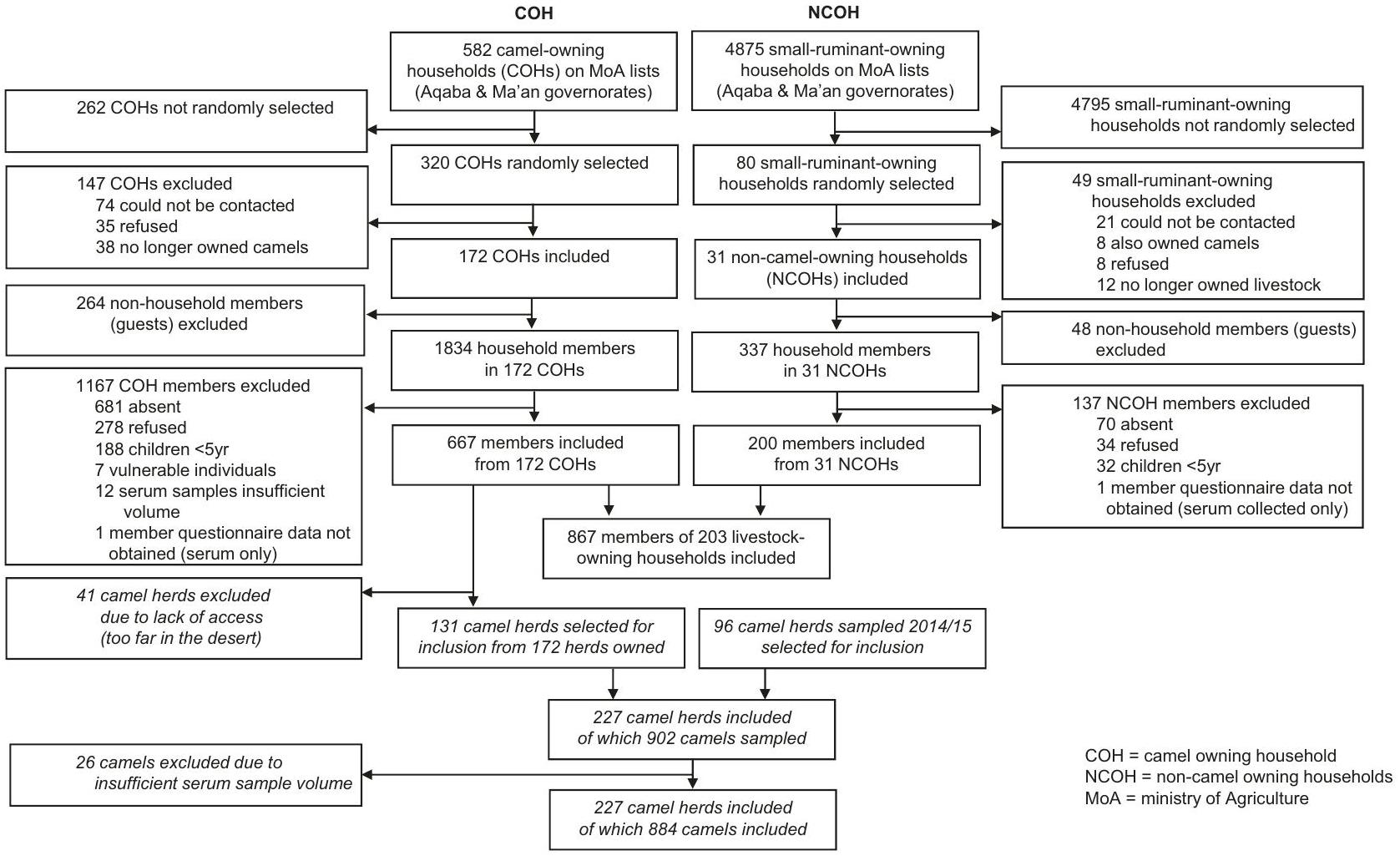
قمنا بجمع عينات دم من 902 جمل، منها 26 عينة كانت بحجم غير كافٍ للاختبار، مما ترك 884 عينة تمثل 227 قطيعًا. من بين هذه القطعان الـ 227، كان 131 قطيعًا (455 جملًا) مملوكة لأسر شملتها دراسة إنسانية موازية، حيث تم اختبار أفراد الأسرة أيضًا بحثًا عن دليل على حالة إيجابية لمستضد البروسيلة. كان الحجم الوسيط للقطيع 10 [نطاق الربيع بين الربعين (IQR) 5-20]، مع متوسط 3.9 جمل تم أخذ عينات منها لكل قطيع (الشكل 1). كان العمر الوسيط للجمال المأخوذة عينات منها 5 سنوات (نطاق الربيع بين الربعين [IQR] 2-8 سنوات). كان هناك الجمال إيجابية في اختبار صفيحة روز بنغال (RBPT)، من بينها كانت النتائج إيجابية في اختبار تثبيت المجاملة (CFT)، 9/884 (1.0%) كانت إيجابية في اختبار ELISA غير المباشر؛ 10/884 (1.1%) كانت إيجابية في أي من CFT أو ELISA غير المباشر.
في معان والعقبة على التوالي، كان هناك 7/340 (2.1%) و 1/ الجمال الإيجابية (إيجابية على RBPT ومؤكدة من قبل CFT، وفقًا لإرشادات OIE) ، مع انتشار الأجسام المضادة الحقيقي (المعدل وفقًا لقيم أداء الاختبار) هو و على التوالي؛ الانتشار الحقيقي للأجسام المضادة هو ( عبر كلا المنطقتين. كان هناك القطعان التي تم أخذ عينة من جمل واحد على الأقل منها إيجابي للأجسام المضادة، من بينها كانوا في معان و (0.7%) كانوا في العقبة. كانت نسبة انتشار الأجسام المضادة على مستوى القطيع المعدلة (المعدلة لقيم أداء الاختبار ونسبة عينة القطيع) هي ( ) في معان و في العقبة؛ تم تعديل مستوى انتشار الأجسام المضادة في القطيع (أيضًا موزون حسب المنطقة) عبر كلا المنطقتين ليكون 18.7% (فترة الثقة 95% 14.3-23.3) (الجدول 1).
نظرًا لانخفاض انتشار الأجسام المضادة الإيجابية في اختبار RBPT وCFT (8/ )، وخصوصية نماذج الانحدار اللوجستي المتعدد المتغيرة اللاحقة التي تم إنشاؤها، العينات الإيجابية على RBPT وCFT أو ELISA اعتُبرت إيجابية لوجود دليل على التعرض للبروسيلا لأغراض تحليلات الانحدار اللوجستي لتحديد
الشكل 1 | ملف الدراسة.
الجدول 1 | انتشار الأجسام المضادة لبكتيريا البروسيلا على مستوى الجمال والقطيع بين سكان الجمال في جنوب الأردن
انتشار الأجسام المضادة في السكان انتشار الأجسام المضادة على مستوى القطيع
الانتشار الظاهر الانتشار الحقيقي غير معدّل معدل*
الجمال الإيجابية / إجمالي الجمال % % (95% فترة الثقة) قطعان إيجابية / إجمالي القطعان % % (95% فترة الثقة)
جنوب الأردن (معان والعقبة) 8/884 (0.9%) 1.0% (0.5-2.1) 7/227 ٣.١٪ 18.7% (14.3-23.3)
معاً 7/340 (٢.١٪) ٢.٤٪ (1.1-4.8) 6/81 ٧.٤٪ 30.4% (22.2-39.5)
العقبة 1/544 (0.2%) 0.1% (0.0-1.1) 1/146 0.7% ٤.٨٪ (2.1-8.2)
  • تم تعديلها لقيم أداء الاختبار المجمعة؛ كما تم وزن تقدير جنوب الأردن (معان والعقبة) حسب المنطقة.
    إيجابي بشأن RBPT و CFT.
    القطيع يحتوي على جمل واحد أو أكثر إيجابي، إيجابي في اختبار RBPT وCFT.
    عوامل الخطر المحتملة للإصابة. في التحليل الأحادي المتغير، وُجد أن المتغيرات التالية مرتبطة ( ) مع حالة إيجابية للفيروس، المنطقة، شراء الجمال (في العام الماضي)، ممارسات إدارة القطيع المغلق وامتلاك واحدة أو أكثر من الماعز أيضًا (الجدول 2). في التحليل متعدد المتغيرات، كانت الحالة الإيجابية مرتبطة بالمنطقة (معان) وشراء الجمال ; مع أدلة تشير إلى أن ممارسات إدارة القطيع المغلق توفر الحماية (أو ) في نموذج فردي (الخصوصية ناتجة عن غياب أي جِمال إيجابية مأخوذة من بين القطعان المغلقة) (الجدول 3).

البشر

قمنا بجمع عينات دم من 879 عضوًا من الأسر المالكة للماشية، حيث كانت 12 عينة غير كافية للحجم لإجراء الاختبارات التشخيصية، مع بقاء 867 عينة تمثل 203 أسر (الجدول 4). كان حجم الأسرة الوسيط 10 [IQR 7-13]، بمتوسط 4.2 أعضاء تم أخذ عينات منهم لكل أسرة. كان العمر الوسيط للأفراد الذين تم أخذ عينات منهم 27 (IQR 15-44). من بين 203 أسر تم أخذ عينات منها، كانت 172 أسرة تملك الإبل. (حجم الأسرة المتوسط 10 [IQR 7-14]) بما في ذلك 667 عضوًا من الأسر (العمر الوسيط 27 عامًا [IQR 16-44])، بمتوسط 3.8 أعضاء تم أخذ عينات منهم لكل أسرة. كانت الأسر الـ 31 المتبقية أسرًا غير مالكة للجمال (NCOH) (حجم الأسرة المتوسط 11 [IQR 9-13])، بما في ذلك 200 عضو من الأسر (العمر الوسيط 26 عامًا [IQR 15-44])، بمتوسط 6.5 فردًا تم أخذ عينات منهم لكل أسرة (الشكل 1). من بين الأسر المالكة للجمال (COH)، كان هناك 131/172 (76.2%) من الأسر التي تم اختبار واحد أو أكثر من الجمال من القطيع أيضًا لحالة بكتيريا البروسيلا المصلية. تظهر سجلات وزارة الزراعة الأردنية (MoA) وجود 3089 أسرة مالكة للماشية في معان، منها 317/3089 ( يمتلكون الجمال، و1359 أسرة تمتلك الماشية في العقبة، من بينها 265/1389 (19.1%) تمتلك الجمال، مع كون ملكية الجمال 582/4448. بشكل عام. لم تقم أي من الأسر المشاركة في الدراسة بالإبلاغ عن امتلاكها للماشية (حيث أن الماشية غائبة تقريبًا عن جنوب الأردن، بسبب البيئة الصحراوية الجافة).
كان هناك 68/867 (7.8%) من الأفراد إيجابيين على اختبار RBPT و62/867 (7.2%) من الأفراد إيجابيين على اختبار IgG ELISA، مع 91/867 ( موجب للفيروس في أي من الاختبارين. معامل كابا 0.57 ( ) تشير إلى اتفاق معتدل بين نتائج الاختبارات، حيث يُعتبر الأفراد إيجابيين إذا كانت نتائجهم إيجابية في أي من الاختبارين تم تقدير معامل الارتباط داخل العنقود (ICC) لوجود الأجسام المضادة داخل الأسر لأي من الاختبارين بـ 0.46 تم تعديل انتشار السكان بين أعضاء الأسر المالكة للماشية (تم تعديله لقيم أداء الاختبار المجمعة ووزنه حسب المنطقة وحالة ملكية الإبل) كان . في منطقتي معان والعقبة، 75/478 ( ) و 16/389 ( ) الأفراد كانوا إيجابيين للأجسام المضادة على التوالي، وكانت النسب المعدلة للإيجابية 10.0% ( ) و ( ) على التوالي (معدلة لقيم أداء الاختبار المجمعة وحالة ملكية الجمال) (الجدول 5).
من بين COH، كان 79/667 (11.8%) من الأعضاء إيجابيين للأجسام المضادة، وتم تعديل انتشار الأجسام المضادة (تم تعديله لقيم أداء الاختبار المجمعة و
موزون حسب المنطقة . في منطقتي معان والعقبة على التوالي، كان هناك و (3.8%) من الأفراد الإيجابيين للأجسام المضادة في COH؛ كانت النسب المعدلة للإيجابية 19.5% (95% CI 15.7-23.6) و4.8% (95% CI 2.7-7.7) على التوالي. من بين NCOH، كان 12/200 (6.0%) من الأعضاء إيجابيين للأجسام المضادة، وكانت النسبة المعدلة للإيجابية ; كان هناك (7.1%) و 5/101 الأفراد الإيجابيين في معان والعقبة على التوالي، كانت معدلات انتشار الأجسام المضادة المعدلة و على التوالي (الجدول 5).
المتغيرات التالية، مع تم العثور على القيم المفقودة مرتبطة بـ ) مع وجود الأجسام المضادة في RBPT أو ELISA في التحليل الأحادي المتغير: المنطقة، المنطقة الفرعية، المنطقة مع حالة ملكية الجمال، الجنس، تاريخ الإصابة بالبروسيلا، نوع سكن الأسرة (خيمة)، غسل اليدين (>5 مرات/يوم)، ملكية الأسرة للأغنام، شرب حليب الجمال الخام، شرب حليب المجترات الصغيرة الخام، استهلاك منتجات الألبان من المجترات الصغيرة الخام، ولادة الجمال، ولادة المجترات الصغيرة، التخلص من مشيمة الجمل، التخلص من مشيمة المجترات الصغيرة، ذبح الجمال، ذبح المجترات الصغيرة، التفاعل المتكرر مع الماشية، أي انخراط مع الماشية ونظافة اليدين عند العمل مع الماشية (الجدول 6).
الارتباطات الزوجية ) تم تحديدها بين ولادة الجمال، والتخلص من مشيمة الجمل، وذبح الجمال، مع اختيار ولادة الجمال للإدراج في النماذج متعددة المتغيرات. كما تم تحديد علاقات ثنائية بين التكرار ( العمل الأسبوعي مع الماشية، والعمل المتكرر مع المجترات الصغيرة، والعمل المتكرر مع الإبل وأي تاريخ من الانخراط مع الماشية، مع اختيار العمل المتكرر مع الماشية للإدراج. كما تم ربط المنطقة، والفرعية، والمنطقة مع حالة ملكية الإبل بشكل ثنائي، مع اختيار المنطقة للإدراج. بالإضافة إلى ذلك، تم تحديد ارتباط بين ولادة المجترات الصغيرة والتخلص من مشيمة المجترات الصغيرة، مع اختيار ولادة المجترات الصغيرة للإدراج في النماذج متعددة المتغيرات. كان هناك ارتباط بين شرب الحليب الخام من المجترات الصغيرة واستهلاك منتجات الألبان الخام من المجترات الصغيرة، حيث تم اختبار كل متغير في نموذج متعدد المتغيرات منفصل، تم تعديله لنفس المتغيرات المشتركة. كان المتغير المركب لنظافة اليدين عند العمل المتكرر مع الماشية مرتبطًا بالمتغيرات المكونة للعمل المتكرر مع الماشية وغسل اليدين، وبالتالي تم اختباره في نموذج منفصل تم تعديله لنفس المتغيرات المشتركة.
في التحليل متعدد المتغيرات، وُجد دليل على وجود ارتباط بين إيجابية الأجسام المضادة والمنطقة (معان). [1.86-6.07] )، شرب حليب الإبل الخام يوميًا (قطعي، تربية الحيوانات المجترة الصغيرة أسبوعيًا، في الموسم) [1.02-3.39] )، وسوء نظافة اليدين (غسل اليدين مرات/يوم) عند العمل مع الماشية ( أسبوعي) (تصنيفي، ) (الجدول 7).
بين الأفراد الذين يشربون حليب الإبل النيء يوميًا، كانوا إيجابيين للفيروس في معان و كانوا إيجابيين للفيروس في العقبة (OR 9.42 [2.36-62.70]، )، مع استهلاك يومي من حليب الإبل النيء مرتبط بالحالة الإيجابية للأجسام المضادة في معان، ( [3.22-13.74]) على الرغم من عدم وجودها في العقبة ( [0.23-3.47]) في نموذج انحدار لوجستي بعد الحدث، مع العقبة (عدم شرب حليب الإبل يوميًا) كخط أساس والأسرة كأثر عشوائي، تم تعديله لـ
الجدول 2 | الإحصائيات الوصفية والوحيدة المتغيرة لوجود الأجسام المضادة لبرسيلا بين الجمال من 227 قطيعًا في جنوب الأردن، باستخدام تحليل الانحدار اللوجستي، واختبار نسبة الاحتمالات
متغير
الإجمالي (المفقود) +ve % أو فترة الثقة 95% ب
884 جمل تم أخذ عينات منها
فترة الدراسة
2014-15 429 ٥ 1.2٪ 0.94 0.26-3.41 0.93
2017-18 ٤٥٥ ٥ 1.1%
منطقة
معان ٣٤٠ ٨ ٢.٤٪ 6.53 1.62-43.44 0.0069
العقبة 544 2 0.4%
جنس
أنثى 669 9 1.3% 2.81 0.52-51.96 0.26
ذكر ٢٠٧ (٨) 1 0.5%
العمر > الوسيط (5 سنوات)
نعم ٤٠٥ ٧ 1.5% 0.41 0.09-1.50 0.18
لا ٤٧٤ (٥) ٣ 0.7%
حجم القطيع > الوسيط (10)
نعم ٥٥٢ ٨ 1.4٪ 2.43 0.60-16.14 0.23
لا ٣٣٢ 2 0.6%
عدد قطعان الإبل القريبة (ضمن مسافة 15 دقيقة بالسيارة) >20
نعم ٣٦٤ ٦ 1.6٪ 2.06 0.58-8.10 0.26
لا ٤٩٥ (٢٥) ٤ 0.8%
يتم الاحتفاظ بالقطيع معًا كمجموعة واحدة على مدار السنة
نعم ٦٠٠ ٦ 1.0% 0.66 0.19-2.62 0.54
لا 267 (17) ٤ 1.5%
القطيع على اتصال مع قطعان محلية أخرى
نعم ٥١٩ ٨ 1.3% 1.15 0.32-5.36 0.84
لا 255 (110) ٣ 1.2%
يتم نقل القطيع إلى مناطق بعيدة لأغراض الرعي الموسمي (التنقل الرعوي)
نعم ٣٦٧ ٤ 1.1% 0.90 0.23-3.18 0.87
لا 497 (20) ٦ 1.2٪
تم شراء جمال جديدة
نعم 318 ٧ ٢.٢٪ ٤.١٠ 1.13-19.11 0.032
لا 549 (17) ٣ 0.5%
تُستعير الجمال لأغراض التزاوج
نعم ٤٤٩ ٧ 1.6٪ 2.19 0.60-10.22 0.24
لا 418 (17) ٣ 0.7%
قطيع مغلق
نعم 142 0 0.0% 0.00 0.056
لا 713 (29) 10 1.4%
تُمتلك الأغنام أيضًا
نعم ٥٣٣ ٨ 1.5% 2.53 0.63-16.83 0.21
لا ٣٣٤ (١٧) 2 0.6%
تُمتلك أيضًا الماعز
نعم ٦٠٣ 9 1.5% 3.98 0.74-73.67 0.12
لا 264 (17) 1 0.4%
تم تطعيم قطعان الحيوانات المجترة الصغيرة، حيثما كانت مملوكة، ضد البروسيلات (لقاح Rev 1)
نعم 263 ٤ 1.5% 1.17 0.26-6.00 0.84
لا 231 (383) ٣ 1.3%
الكلاب موجودة بالقرب من القطيع
نعم 648 9 1.4٪ 3.07 0.57-56.79 0.22
لا ٢١٩ (١٧) 1 0.5%
نفس المتغيرات المشتركة (العمر، الجنس، المنطقة، نوع سكن الأسرة، امتلاك الأغنام، شرب حليب الإبل، استهلاك منتجات الألبان من الحيوانات الصغيرة، ولادة الحيوانات الصغيرة وولادة الإبل). وبالمثل، كانت المنطقة مع حالة امتلاك الإبل مرتبطة بالإيجابية المصلية (معان COH مع Aqaba COH كخط أساس)، عند التعديل لنفس المتغيرات المشتركة. بين COH حيث تم اختبار إبل واحدة على الأقل لحالة إيجابية المصل، كانت نسبة الإيجابية المصلية بين الأفراد الذين يشربون الحليب الخام من قطيع تم اختبار إبل إيجابية فيه هي ، مقارنة بـ بين الأسر التي كانت الإبل المختبرة في القطيع سلبية (OR 24.31 [0.69-851.92]، ). في مسح متابعة تم إجراؤه بين 69/172 (40.1%) من COH بما في ذلك 503 من أفراد الأسرة، أفاد 308/503 (61.2%) بتاريخ استهلاك حليب الإبل في الأشهر الستة الماضية، من بينهم 285/ أفادوا بأنهم يستهلكون هذا الحليب الخام دائمًا. بين 320/503 الذين أفادوا بتاريخ استهلاك حليب الحيوانات الصغيرة في الأشهر الستة الماضية، أفاد 278/320 ( ) بأنهم لم يستهلكوا هذا الحليب الخام أو نادرًا ما فعلوا ذلك.
بين 577 فردًا يعملون بشكل متكرر ( أسبوعيًا) مع الماشية، وُجد أن غسل اليدين مرات/يوم كان واقيًا ، في نموذج انحدار لوجستي مع الأسرة كأثر عشوائي تم تعديله لنفس المتغيرات المشتركة (العمر، الجنس، المنطقة، نوع سكن الأسرة، امتلاك الأغنام، شرب حليب الإبل، استهلاك منتجات الألبان من الحيوانات الصغيرة، ولادة الحيوانات الصغيرة وولادة الإبل). كان استخدام الصابون (أمس) عند غسل اليدين مرات/يوم واقيًا [0.29-0.91]).
بين الأسر التي تمتلك حيوانات صغيرة وتبلغ عن حالة تطعيم ضد البروسيلات مع لقاح Rev 1 الذي تم إعطاؤه من قبل وزارة الزراعة (مرة واحدة على الأقل خلال السنوات الخمس الماضية)، كانت نسبة أخذ اللقاح هي (44/55) بين القطعان في معان و70.5% ( ) بين القطعان في العقبة، و بشكل عام. عند الوزن لحالة امتلاك الإبل، كانت نسبة أخذ اللقاح المقدرة بين السكان المدروسين هي في معان و في العقبة، و بشكل عام (نسبة أخذ اللقاح بين قطعان COH كانت مقارنة بـ (18/20) بين قطعان NCOH في عينة السكان، OR 0.29 ). وُجد أن تطعيم قطعان الحيوانات الصغيرة كان واقيًا بين أفراد الأسرة الذين يمتلكون قطعانًا تم تطعيمها؛ 17.8% (19/107) من الأفراد كانوا إيجابيين مصلين بين الأسر التي تمتلك قطعانًا غير مطعمة، مقارنة بـ من الأفراد بين الأسر التي تمتلك قطعانًا مطعمة ( )، تم تعديله للمتغيرات الأولية (العمر والجنس) والمنطقة.
بين الأطفال في سن المدرسة ( )، كانت الإيجابية المصلية بين الذين لا يحضرون المدرسة هي ، مقارنة بـ بين الذين يحضرون المدرسة؛ عدم حضور المدرسة مرتبط بحالة إيجابية مصلية ( )، عند التعديل للمتغيرات الأولية (العمر والجنس) والمنطقة. بين البالغين ( )، وُجد أن التعليم الثانوي كان واقيًا ( ، عند التعديل لنفس المتغيرات المشتركة. بين الأفراد الإيجابيين مصلين الذين تم تضمينهم في الدراسة، كان (68/91) ليس لديهم تاريخ معروف للبروسيلات.

نقاش

تاريخيًا، كانت الإبل الجملية توفر الوسيلة الوحيدة للبقاء، والنقل، والوجود المستدام في البيئات الصحراوية القاسية في الشرق الأوسط وشمال إفريقيا . وبالتالي، فإنها تحتل مكانة فريدة ضمن الثقافة العربية الإسلامية . يدعو القرآن (السورة 88) غير المؤمنين للتفكر في أربعة أشياء صنعها الله: الأرض، والسماء، والجبال، والإبل – حيث تُعتبر الإبل مثالًا على قوة الله؛ معجزة من الخلق تحمل مكانة مختلفة تمامًا عن جميع الحيوانات الأخرى . تصف الأحاديث الإسلامية (حياة وتعاليم النبي، التي كتبها أتباعه) قوى الشفاء لشرب حليب الإبل وبولها . نتيجة لذلك، تُعتبر الإبل حيوانات نظيفة بشكل فريد
الجدول 3 | الارتباطات متعددة المتغيرات بين عوامل الخطر المحتملة والإيجابية المصلية للبروسيلات بين الإبل من 227 قطيعًا في جنوب الأردن باستخدام تحليل الانحدار اللوجستي، اختبار نسبة الاحتمالات
المتغير** الفئة OR المعدل مسبقًا قيمة p OR المعدل بالكامل قيمة p
المنطقة معان 7.11 1.75-47.55 0.0050 6.23 1.53-41.81 0.0093
العمر >الوسيط (5 سنوات) 0.41 0.09-1.50 0.18 0.35 0.074-1.32 0.12
الجنس أنثى 3.56 0.64-66.50 0.17 3.86 0.68-72.73 0.14
تم شراء الإبل نعم 4.32 1.19-20.20 0.026 3.84 1.04-18.09 0.043
قطيع مغلق نعم 0.00 NE 0.047 0.00 NE 0.072
¹تم التعديل للمتغيرات الأولية: العمر، الجنس.
تم التعديل للمتغيرات الأولية العمر والجنس، المنطقة وشراء الإبل.
الملاحظات.
في السنة الماضية.
متغير فردي، تم التعديل للمنطقة، العمر، الجنس وشراء الإبل، 842 ملاحظة.
NE غير قابل للتقدير.
الأنواع بين المجتمعات الإسلامية في الشرق الأوسط وما وراءه . أعرب المشاركون في الدراسة عن إدراكهم أن امتلاك الإبل كان شيئًا ذا شرف كبير – حيث تُعتبر الإبل حيوانات ‘صحيحة’ و’نظيفة’ بشكل فريد، مقارنة بأنواع الماشية الأخرى . كان الإدراك الذي تم التعبير عنه بشكل متكرر بين سكان الدراسة هو أن شرب حليب الإبل يمنح فوائد طبية حيوية، بما في ذلك زيادة الرغبة الجنسية لدى الذكور، والتحكم في مستويات السكر في الدم، وعلاج مشاكل الجهاز الهضمي، وعلاج السرطان، من بين خصائص طبية أخرى . بين سكان الدراسة، يشرب الأطفال حليب الإبل الخام من سن مبكرة، حيث يشرح المشاركون أن الحليب يأتي من الإبل ‘نقي وجاهز للشرب’ – ولا ينبغي غليه أبدًا، خوفًا من إتلاف خصائصه الشفائية . هذا الإدراك، جنبًا إلى جنب مع تغيير غير مواتٍ في الطعم بعد الغلي، يعني أن حليب الإبل يُستهلك تقريبًا بشكل خام بين المجتمعات المالكة للإبل عبر المنطقة، بينما يُغلى حليب الحيوانات الصغيرة (والأبقار حيثما وُجدت) عادةً بسبب إدراك خطر الأمراض الحيوانية، مثل الحمى المالطية (البروسيلات) .
في هذا السياق، حددت نتائج دراستنا أن الاستهلاك اليومي لحليب الإبل الخام مرتبط بحالة إيجابية مصلية للبروسيلات بين سكان الدراسة 1.23-3.94)، بعد تحليل متعدد المتغيرات للتعديل لعوامل الارتباك المحتملة. عند تقسيمها حسب المنطقة، وُجد أن الاستهلاك اليومي لحليب الإبل الخام مرتبط بحالة إيجابية مصلية في معان، على الرغم من عدم وجوده في العقبة. يعكس ذلك النسب العالية من الإيجابية المصلية على مستوى القطيع التي تم تحديدها في معان، حيث تم تقدير أن ما يقرب من ثلث القطعان كانت إيجابية (تحتوي على إبل إيجابية مصلية واحدة أو أكثر)، مقارنة بالعقبة، حيث تم تقدير أن أقل من واحد من كل عشرين قطيعًا كانت إيجابية. وبالمثل، وُجد أن نصف جميع أفراد الأسر المالكة للإبل المصابة والذين يشربون حليب الإبل الخام كانوا إيجابيين مصلين، مقارنة بـ بين أولئك الذين يشربون حليب الإبل من قطعان كانت جميع الإبل المختبرة سلبية. حتى عندما قد تكون نسب الإيجابية المصلية الفردية للإبل منخفضة نسبيًا ( بين سكان الإبل في معان، على سبيل المثال)، فإن الاستهلاك الواسع لحليب الإبل الخام يعني أن التعرض لحيوان مصاب يصبح أكثر احتمالًا مع مرور الوقت، خاصة عند الشرب يوميًا . وبالتالي، سيكون لغلي حليب الإبل قبل الاستهلاك تأثير وقائي مهم، خاصة في المناطق التي تكون فيها نسب الإيجابية المصلية للإبل أعلى (مثل معان) . ومع ذلك، بسبب التأثيرات الاجتماعية والثقافية القوية الموصوفة (وتغيير غير مواتٍ في الطعم بعد الغلي) من المحتمل أن تكون الجهود لتعزيز مثل هذا التغيير السلوكي العميق صعبة .
لهذا السبب، فإن السيطرة على البروسيلات بين خزان الإبل (جنبًا إلى جنب مع تدابير أخرى) هي في غاية الأهمية . بعد تحليل متعدد المتغيرات، وُجد أن شراء الإبل (في السنة الماضية) مرتبط بحالة إيجابية مصلية بين الحيوانات في القطعان المستقبلة . بسبب قيمتها الاقتصادية العالية، غالبًا ما تُباع الإبل التي تجهض في السوق، بدلاً من
ذبحها، مع كون المشترين المحتملين غير مدركين لتاريخها الإنجابي وحالتها المحتملة الإيجابية للبروسيلات (كما أفاد المشاركون في الدراسة) . على العكس من ذلك، اقترحت نتائج الدراسة أدلة على أن ممارسات إدارة القطعان المغلقة تحمي من دخول البروسيلات إلى القطيع ( )، في نموذج فردي (جميع الإبل المختبرة في القطعان المغلقة كانت سلبية) . لتقليل احتمال انتقال العدوى داخل القطيع، يجب فصل الإبل المخصصة للتربية عن القطيع الرئيسي أثناء الولادة، كما تم وصفه سابقًا . لتقليل احتمال انتقال العدوى بين أنواع الماشية، يجب إدارة قطعان الإبل بعيدًا عن الحيوانات الصغيرة حيثما أمكن، خاصة خلال فترات الولادة/الولادة، كما تم وصفه سابقًا تُعرف معدلات انتشار الأجسام المضادة في الحيوانات المجترة الصغيرة في المنطقة بأنها مرتفعة. ، مع تطعيم Rev 1 (B. melitensis) للقطعان الذي يقدم تأثيرًا وقائيًا محتملاً، حيث يتم إدارة قطعان الإبل والماشية الصغيرة معًا .
لم يتم تطعيم قطعان الإبل في عينة الدراسة ضد البروسيلات. لا تشمل برامج التطعيم التي تقودها الحكومة في الأردن الإبل، كما أن الوصول الخاص إلى لقاح Rev 1 مقيد بشدة، حيث أفاد أصحاب القطعان الذين تم استطلاع آرائهم بعدم وجود تطعيم في قطعانهم. بالإضافة إلى ذلك، فإن استيراد الإبل من الدول المجاورة، بما في ذلك المملكة العربية السعودية (حيث قد يكون قد تم التطعيم بلقاح Rev 1)، محظور إلا للذبح المباشر، مما يشير إلى أن التحول المصلي للبروسيلات الذي تم تحديده في عينة الدراسة من المحتمل أن يكون ناتجًا عن عدوى طبيعية. بينما يجب النظر في الاستخدام غير المصرح به للقاح Rev 1 المعطل الحي في الجمال حيثما كان ذلك مناسبًا (انظر إرشادات منظمة الأغذية والزراعة)، فإن التحديات المتعلقة بالفعالية ومخاطر الحليب الملوث تعني أن استراتيجيات إدارة القطيع الوقائية تقدم على الأرجح أكثر الوسائل سهولة للتحكم للعديد من مالكي القطعان (حتى تصبح اللقاحات المرخصة متاحة). تقدم خطط الاختبار والذبح، باستخدام اختبار PCR المصل حيثما أمكن، بما في ذلك الذكور المرباة المشتركة بين القطعان، مسارًا محتملاً نحو تقليل خطر الإصابة ببكتيريا البروسيلا من حليب الإبل الخام في الأردن والمنطقة الأوسع (على الرغم من أن هذه الخطط تتطلب توفير تعويض مالي كافٍ لتحقيق النجاح). .
Rev 1، كونه لقاحًا حيًا مُضعفًا، ينطوي على خطر العدوى للأطباء البيطريين عند إعطاء اللقاح، وخطر الإجهاض بين الماشية الحوامل إذا تم تلقيحها عن طريق الخطأ – وهذان العاملان يخلقان تحديات في نشر اللقاح عبر المنطقة. تم الإبلاغ عن معدل تلقي لقاح Rev 1 (مرة واحدة على الأقل خلال السنوات الخمس الماضية) بين قطعان الحيوانات المجترة الصغيرة كان في معان و بين القطعان في العقبة، و بشكل عام (مع مراعاة حالة امتلاك الجمال)، مما يشير إلى أن الفرق الملحوظ في انتشار الأجسام المضادة بين المناطق لا يمكن أن يُعزى إلى اختلافات في معدل تلقي اللقاح. وُجد أن تطعيم قطعان الحيوانات الصغيرة يقدم تأثيرًا وقائيًا كبيرًا بين أفراد الأسرة، مع انتشار واضح للأجسام المضادة بـ (19/107) بين الأفراد الذين يمتلكون قطعان غير ملقحة، مقارنةً بـ بين أولئك الذين يمتلكون قطعانًا ملقحة،
الجدول 4 | الإحصائيات الوصفية لأعضاء الأسر المالكة للماشية في جنوب الأردن، الأسر المالكة للجمال (COH) والأسر غير المالكة للجمال (NCOH)
COH ( ) NCOH ( ) كل )
العمر*
5-14 143 (21.5%) 47 (24%) 190 (22%)
15-24 151 (22.7%) 50 (25%) 201 (23%)
25-39 161 (24.2%) 40 (20%) 201 (23%)
40-59 137 (20.6%) 44 (22%) 181 (21%)
74 (11.1%) 18 (9%) 92 (11%)
الوسيط (المدى interquartile) 27 (16-45) ٢٦ (١٥-٤٤) 27 (16-44)
جنس
أنثى 384 (57.6%) 118 (59%) 401 (46%)
ذكر 283 (42.4%) 82 (41%) ٤٦٦ (٥٤٪)
الجنسية**
أردني 565 (93.1%) 192 (99%) 757 (95%)
السعودي 23 (3.8%) 0 (0%) 23 (3%)
مصري 8 (1.3%) 0 (0%) 8 (1%)
سوداني 8 (1.3%) 0 (0%) 8 (1%)
آخر 3 (0.5%) 2 (1%) 5 (1%)
تاريخ البروسيلوز
نعم 18 (2.8%) 5 (2.6%) 23 (3%)
لا 629 (97.2%) 189 (97.4%) 818 (97%)
التعليم الثانوي
نعم 180 (35.6%) 53 (37%) 233 (36%)
لا 326 (64.4%) 90 (63%) 414 (64%)
حجم الأسرة (عدد الأعضاء >10)
0-10 287 (43.0%) 76 (38.0%) 363 (42%)
11-20 ٣٠٩ (٤٦.٣٪) ١٠٩ (٥٤.٥٪) 418 (48%)
>20 71 (10.6%) 15 (7.5%) 86 (10%)
الأسرة تمتلك الجمال
نعم 667 (100%) 0 (0%) 667 (77%)
لا 0 (0%) 200 (100%) 200 (23%)
الأسرة تمتلك الماشية
نعم 0 (0%) 0 (0%) 0 (0%)
لا 667 (100%) 200 (100%) 867 (100%)
تملك الأسر حيوانات مجترة صغيرة
نعم 590 (88.5%) 200 (100%) 790 (91.1%)
لا 77 (11.5%) 0 (0%) 77 (8.9%)
حيثما كانت مملوكة، يتم الإبلاغ عن تلقيح الحيوانات المجترة الصغيرة
نعم 255 (72.9%) 118 (90.8%) 373 (77.7%)
لا 95 (27.1%) 12 (9.2%) 107 (22.3%)
أي تاريخ من الانخراط في تربية الماشية §
نعم 571 (85.6%) 711 (82.0%) 711 (82%)
لا 96 (14.4%) 156 (18.0%) 156 (18%)
متكرر العمل مع الماشية (أسبوعيًا)
نعم 478 (71.7%) 577 (66.6%) 577 (67%)
لا 189 (28.3%) 290 (33.4%) 290 (33%)
المنزل المنزلي يحتوي على نظام تبريد الهواء
نعم 169 (42.9%) 56 (31.6%) 225 (39.4%)
لا 225 (57.1%) 121 (68.4%) 346 (60.6%)
*القيم المفقودة: العمر الجنسية التعليم الثانوي . جنسيات أخرى شملت الأوغندية ( سوري )، بريطاني ( ). مؤشر الحالة الاجتماعية والاقتصادية، بسبب أسباب سوسيوثقافية لم يتم قياس الحالة الاجتماعية والاقتصادية بشكل مباشر. §أي تاريخ لنشاط الثروة الحيوانية (>لم يحدث أبداً).
مشارك في أي نشاط مسجل للثروة الحيوانية أسبوعيًا أو أكثر.
( [ ])، عند تعديلها للمتغيرات المسبقة (العمر والجنس) والمنطقة. تسلط هذه النتائج الضوء على أهمية تطعيم الحيوانات المجترة الصغيرة في حماية المجتمعات عالية المخاطر. كان معدل أخذ اللقاح أقل بين مقارنة بـ يمكن تفسير ذلك بزيادة التحديات في الوصول الجغرافي إلى COH، مقارنةً بـ NCOH، مما يشير إلى أن التدخلات المستهدفة التي تهدف إلى زيادة معدل استهلاك Rev 1 بين قطعان الحيوانات الصغيرة المملوكة لـ COH سيكون لها تأثيرات مفيدة في تقليل معدلات الإصابة البشرية بين هذه المجتمعات. .
ولادة المجترات الصغيرة كان مرتبطًا بالحالة الإيجابية للأجسام المضادة في التحليل متعدد المتغيرات، [1.00-3.38]، متسق مع النتائج السابقة، مع دليل ضعيف على أن شرب حليب المجترات الصغيرة الخام (يوميًا) يمثل أيضًا خطر الإصابة، [0.95-3.93]. تسلط هذه النتائج الضوء على الحاجة إلى رسائل تعليمية تؤكد على أهمية غليان حليب الأغنام والماعز ومنتجات الألبان قبل الاستهلاك. ، (نظرًا لهيكله الغروي وتركيبته البروتينية، فإن حليب الإبل غير مناسب لصنع منتجات الألبان)، واستخدام القفازات عند الولادة، حيثما كان ذلك ممكنًا .
تقوم الماشية المصابة بإفراز كميات كبيرة من بكتيريا البروسيلة في المواد الناتجة عن الإجهاض والإفرازات الرحمية، مع حدوث انتقال zoonotic لاحق عبر عدة طرق محتملة، بما في ذلك تناول المواد الملوثة بواسطة الأيدي المتسخة والتعرض للجروح الجلدية (خصوصًا على اليدين والذراعين) أو الأغشية المخاطية (العينين والأنف والفم) للمواد الملوثة. في هذا السياق، وُجد أن ضعف نظافة اليدين مرتبط بحالة إيجابية لمستضد بروسيلة بين الأفراد الذين يعملون بشكل متكرر مع الماشية، حيث وُجد أن النظافة الجيدة (غسل اليدين أكثر من 5 مرات في اليوم بالصابون) توفر حماية. لذلك، تقدم مبادرات نظافة اليدين، مثل WASH، استراتيجية تحكم مهمة محتملة لمكافحة داء البروسيلات بين المجتمعات عالية المخاطر في الأردن والمنطقة الأوسع. . (نظرًا لأن تكرار غسل اليدين مرتبط ارتباطًا وثيقًا بمفاهيم الصلاة وغسل الطهارة (‘الوضوء’) بين المجتمعات الإسلامية، تم تحديد تكرار غسل اليدين الأساسي عند يوم .
كمرض مهمل من قبل منظمة الصحة العالمية، تعتبر البروسيلا مرضًا مرتبطًا بالفقر، حيث وُجد أن التعليم الثانوي يوفر حماية بين سكان الدراسة. )، بينما كان الأطفال غير الملتحقين بالمدرسة معرضين لخطر أكبر للإصابة، مقارنة بأقرانهم في المدرسة ( كانت معدلات التشخيص بين سكان الدراسة منخفضة، حيث أفاد ربع الأفراد الإيجابيين للفيروس بتاريخ معروف من داء البروسيلات، مما يشير إلى الحاجة لتعزيز الوعي بشأن الأعراض والتشخيص والعلاج بين المجتمعات الريفية في الأردن (وربما في المنطقة الأوسع)، بالإضافة إلى الحاجة لزيادة القدرة في الخدمات التشخيصية والطبية بين هذه المجتمعات. .
بين أعضاء الأسر المالكة للماشية في جنوب الأردن، تم تقدير انتشار الأجسام المضادة لبكتيريا البروسيلة بـ CI 7.0-10.7) بشكل عام (معدلة لقيم أداء الاختبار ومرجحة حسب المنطقة وحالة ملكية الجمال)، مع انتشار الأجسام المضادة المعدل في معان والعقبة هو و على التوالي. بين COH، كانت النسب المعدلة للإيجابية 19.5% (95% CI ) و في معان والعقبة على التوالي، مما يعكس مستويات انتشار الأجسام المضادة العالية في قطيع الإبل التي تم تحديدها في معان، مقارنة بالعقبة. ( ) و ( ) على التوالي). كانت قيمة معامل التوافق الداخلي بين الأسر المشمولة 0.46 ( )، مما يشير إلى تكتل معتدل؛ من المحتمل أن يعكس الأسر التي تمتلك قطعان مصابة (أو أسراب) مع انتقال زونوتي لاحق عبر استهلاك الحليب المصاب (أو منتجات الحليب)، إلى جانب طرق محتملة أخرى.
تحتوي هذه الدراسة على بعض القيود، حيث تم استخدام طرق أخذ العينات غير الاحتمالية والاحتمالية بين قطعان الإبل خلال فترتين متميزتين (2014-2015 و2017-2018 على التوالي)، ومع ذلك، لا نعتقد أن هذا قد أثر بشكل كبير على تقديرات انتشار الأجسام المضادة أو تحليل عوامل الخطر (مع انتشار الأجسام المضادة بين العينات العشوائية
الجدول 5 | انتشار الأجسام المضادة لبروسيلا بين أفراد الأسر المالكة للماشية في جنوب الأردن
معدل*
الأفراد الإيجابيون غير المعدلين / إجمالي الأفراد % % (95% فترة الثقة)
جنوب الأردن (معان والعقبة) 79/667 (١١.٨٪) 12.7% (10.3-15.4)
12/200 (6.0%) ٨.٢٪ (4.9-12.5)
جميع الأسر 91/867 (10.5%) ٨.٧٪ (6.9-10.7)
معاً 68/379 (١٧.٩٪) 19.5% (15.7-23.6)
7/99 (٧.١٪) 9.0% (4.4-15.7)
جميع الأسر 75/478 (15.7%) 10.0% (7.5-12.9)
العقبة 11/288 (٣.٨٪) ٤.٨٪ (2.7-7.7)
5/101 (٥٫٠٪) 6.2% (2.6-12.0)
جميع الأسر 16/389 (٤.١٪) ٥.٩٪ (3.9-8.6)
أسرة تمتلك جمل.
أسرة غير مالكة للجمال (حيوانات مجترة صغيرة فقط).
*تم تعديلها لقيم أداء الاختبارات المجمعة، مع تقديرات جنوب الأردن (معان والعقبة) التي تم وزنها أيضًا حسب المنطقة. كما تم تعديل جميع تقديرات الأسر حسب حالة امتلاك الجمال.
تم اختيار قطعان الإبل لتكون مشابهة لتلك الموجودة بين القطعان التي لم يتم اختيارها بطريقة احتمالية، على مدار فترة الدراسة).
في الختام، تمثل داء البروسيلات تهديدًا خطيرًا للصحة العامة بين المجتمعات التي تمتلك الماشية في جنوب الأردن والمنطقة الأوسع، حيث تعتبر الإبل مصدرًا مهمًا للانتقال الزونوتي من خلال استهلاك الحليب الخام (بينما يتم استهلاك حليب الأنواع الأخرى من الماشية بشكل كبير بعد غليه). نظرًا للتصورات الاجتماعية والثقافية العميقة، من المحتمل أن تكون الجهود المبذولة لتشجيع غلي حليب الإبل قبل الاستهلاك تحديًا، (على الرغم من أنه يجب المحاولة على أي حال، في سياق ثقافي مناسب). لهذا السبب، فإن تقليل معدلات الإصابة بالبروسيلات بين سكان الإبل في الأردن والمنطقة الأوسع يعد أمرًا بالغ الأهمية لحماية السكان البشريين المرتبطين بتلك القطعان من العدوى عبر استهلاك حليب الإبل الخام. ومن المحتمل أن يتم تحقيق ذلك بشكل أفضل من خلال مجموعة من الممارسات الإدارية المستهدفة (مثل إدارة القطعان المغلقة، مع الشراء فقط عند الضرورة من مصادر موثوقة (يفضل أن تكون مختبرة))، إلى جانب إمكانية وجود برامج حكومية للاختبار والذبح واستخدام لقاح B. melitensis Rev 1 خارج التسمية، حيثما كان ذلك مناسبًا. كان للتطعيم ضد الحيوانات الصغيرة تأثير وقائي كبير على أفراد الأسرة المرتبطين، مما يبرز أهمية برامج التطعيم التي تقودها الحكومة والحاجة إلى زيادة القدرة، من أجل تحسين استيعاب اللقاح حيثما كان ذلك ممكنًا (لم يتم تطعيم ربع القطعان في عينة السكان خلال السنوات الخمس الماضية). بين الأفراد الذين يعملون بشكل متكرر مع الماشية ( غسل اليدين بالصابون (أسبوعيًا) تم العثور على أن غسل اليدين عدة مرات في اليوم كان له تأثير وقائي كبير، مما يبرز أهمية المبادرات التي تعزز من نظافة اليدين، مثل برامج المياه والصرف الصحي والنظافة، بين المجتمعات الريفية عالية المخاطر في المنطقة. كان للتعليم تأثير وقائي كبير (بما في ذلك من خلال التواجد في المدرسة)، مما يبرز أهمية استراتيجيات تعزيز التعليم وزيادة القدرة (بما في ذلك الوصول) بين المجتمعات الريفية عالية المخاطر في المنطقة (مع التحديات التي تواجهها المجتمعات البدوية شبه المتنقلة التي تعيش في الصحراء، مثل عينة الدراسة). كانت مستويات التشخيص منخفضة، مما يشير إلى الحاجة إلى تحسين استراتيجيات الوعي وزيادة القدرة على الاختبارات التشخيصية والعلاج بين المجتمعات الريفية عالية المخاطر في المنطقة.

طرق

الموافقة الأخلاقية

تمت الدراسة الحالية بموافقات من مجلس المراجعة الأخلاقية المؤسسية من الكلية الملكية البيطرية ومدرسة لندن للصحة العامة والطب الاستوائي (كلاهما في لندن، المملكة المتحدة) وجامعة العلوم والتكنولوجيا الأردنية (JUST) (إربد، الأردن).

الجمال

تصميم الدراسة والمشاركون. تم جمع عينات من الإبل في محافظتي العقبة ومعان في جنوب الأردن على مدار فترتين متميزتين خلال 2014-2015 و2017-2018 (الشكل 2). نظرًا لعدم وجود إطار عينة مناسب بين فبراير وديسمبر في عام 2015، قمنا بإجراء أخذ عينات غير احتمالية من قطعان تعود لعملاء يمتلكون الإبل في عيادة بيطرية خاصة تقع في موقع مركزي (القويره، محافظة العقبة) وعملاء يمتلكون الإبل من الأطباء البيطريين الحكوميين المحليين الذين يعملون في منطقة الدراسة. بين 27 سبتمبر 2017، وأكتوبر في عام 2018، أجرينا دراسة مقطعية باستخدام إطار عينة قدمته وزارة الزراعة يتضمن قائمة بجميع الأسر التي تمتلك جملًا واحدًا أو أكثر ضمن المناطق الفرعية الأربع (العقبة الشرقية، العقبة الغربية، معان الشرقية، ومعان الغربية)، حيث تم اختيار القطعان بشكل عشوائي بواسطة أحد المؤلفين المشاركين (SN) باستخدام قوائم عشوائية تم إنشاؤها بواسطة الكمبيوتر (Stata، الإصدار 15.1)؛ (كانت هذه الأسر المالكة للجمال مؤهلة أيضًا للاشتراك في الدراسة البشرية الموازية).
تم اتباع الإرشادات المؤسسية والوطنية لرعاية الحيوانات في جميع الأوقات. تم الحصول على موافقة مستنيرة من جميع مالكي القطيع في وقت أخذ العينات، حيث قام جراح بيطري بفحص جميع الجمال المشمولة في الدراسة سريرياً قبل أخذ العينات.
جمع العينات وإجراءات المختبر. تم زيارة القطعان المختارة من قبل أعضاء فريق أخذ العينات، بما في ذلك طبيب بيطري وميسر مجتمعي، الذين قدموا معلومات الدراسة، وقيموا الأهلية، وحصلوا على الموافقة. بناءً على توقعات امتثال المالك، في القطعان قمنا بأخذ عينات من 12 جملًا لكل قطيع وفي قطعان من قمنا بأخذ عينات من جميع الجمال، مع مراعاة إمكانية الوصول وإذن المالكين. تم جمع عينات الدم من الجمال المختارة جنبًا إلى جنب مع إدارة استبيان منظم حول عوامل الخطر المحتملة على مستوى الجمل وقطيع الجمال للتعرض لبكتيريا البروسيلا خلال العام السابق، بما في ذلك تطعيم البروسيلا. تم إجراء الاستبيانات باللهجة المحلية على الورق (2014-2015) وعلى أجهزة التابلت الأندرويد (2017-2018) باستخدام تطبيق Open Data Kit (الإصدار 1.10). تم جمع عينات الدم في أنابيب فراغية عادية بسعة 8 مل وتم فصلها مركزيًا في العقبة، بسرعة 2000 دورة في الدقيقة. ) لمدة 10 دقائق، تليها جمع المصل وتخزينه في تم تخزين جميع العينات مركزيًا في العقبة قبل نقلها إلى المختبر التشخيصي في مركز الصحة البيطرية، جامعة العلوم والتكنولوجيا الأردنية، إربد لإجراء الفحوصات المخبرية.
تم اختبار عينات المصل باستخدام اختبار روز-بنغال (RBPT) للكشف عن الأجسام المضادة ضد مستضدات البروسيلة المقدمة من جوفاك، عمان، الأردن. باختصار، تم خلط عينة من المصل (0.05 مل) مع
الجدول 6 | الإحصائيات الوصفية والانحدارية الأحادية لإيجابية مصل بروسيلة بين 867 عضوًا من 203 أسر تمتلك الماشية في جنوب الأردن باستخدام تحليل الانحدار اللوجستي مع اعتبار الأسرة كأثر عشوائي، اختبار نسبة الاحتمالات
الفئة* الإجمالي 867 (مفقود) +ve % أو فترة الثقة 95% ب
البيانات المكانية
منطقة
معاً 478 75 15.7% 5.32 2.42-11.67 <0.0001
العقبة ٣٨٩ 16 ٤.١٪ 1.00
الفرعية
العقبة الغربية 186 ٥ ٢.٧٪ 1.00 0.0002
العقبة الشرقية ٢٠٣ 11 5.4٪ 2.06 0.55-7.70
معان الشرقية 222 27 12.2% 6.14 1.80-20.94
معان الغربية 256 ٤٨ 18.8% 9.64 ٢.٩٦-٣١.٤٥
منطقة ذات حالة ملكية الجمال
العقبة COH ٢٨٨ 11 3.8٪ 1.00 0.0001
العقبة NCOH ١٠١ ٥ 5.0% 1.29 0.27-5.46
معاً COH ٣٧٩ 68 17.9% 6.57 2.91-16.85
معاً NCOH 99 ٧ ٧.١٪ ٢.١٧ 0.58-8.11
المعلومات الشخصية
جنس
أنثى 401 ٣٤ ٨.٥٪ 0.70 0.42-1.18 0.18
ذكر ٤٦٦ ٥٧ 12.2% 1.00
عمر
5-15 ١٩٠ (٢) 17 8.9٪ 1.00 0.39
>15-25 ٢٠١ 30 14.9% 2.14 1.01-4.56
>25-40 ٢٠١ 17 ٨.٥٪ 1.45 0.62-3.38
>40-60 181 19 10.5% 1.62 0.72-3.66
>60 92 ٨ ٨.٧٪ 1.35 0.47-3.84
الجنسية
أردني 757 (66) 81 10.7% 1.00 لا 0.62
مصري ٨ 2 25.0% 6.17
سوداني ٨ 0 0.0% 0.00
السعودي 23 0 0.0% 0.00
آخر ٥ 0 0.0% 0.00
موظف منزلي
لا 832 87 10.5% 1.00 0.74
عامل مزرعة 23 2 8.7% 1.11 0.19-6.40
جزار 12 2 16.7% 2.37 0.26-21.28
التعليم الثانوي
نعم ٢٣٣ (٢١٨) 17 ٧.٣٪ 0.47 0.24-0.93 0.029
لا ٤١٦ ٥٥ 13.2% 1.00
حالياً في المدرسة (إذا كان من العمر)
نعم 175 (649) 11 6.3% 0.32 0.11-0.92 0.035
لا 43 ٨ 18.6٪ 1.00
معلومات الأسرة
نوع السكن المنزلي (خيمة)
نعم ٢٩٦ ٤٧ 15.9% ٢.٢٩ 1.11-4.74 0.025
لا 571 ٤٤ ٧.٧٪ 1.00
حجم الأسرة
١-١٠ ٣٦٣ ٣٦ 9.9% 1.00 0.51
11-20 418 43 10.3% 0.91 0.42-1.96
>20 86 12 14.0% 2.05 0.52-8.05
الجدول 6 (مستمر) | الإحصائيات الوصفية والوحيدة المتغيرات لوجود الأجسام المضادة لبرسيلا بين 867 عضوًا من 203 أسر تمتلك الماشية في جنوب الأردن باستخدام تحليل الانحدار اللوجستي مع الأسرة كأثر عشوائي، اختبار نسبة الاحتمالات
الفئة* الإجمالي 867 (مفقود) +ve % أو فترة الثقة 95% ب
الأسرة تمتلك الجمال
0 ٢٠٠ 12 6.0% 1.00 0.33
1-6 267 ٢٩ 10.9٪ 1.73 0.58-5.16
>6 ٤٠٠ 50 12.5% 2.17 0.78-6.04
الأسرة تمتلك أغنام
لا ٢٤٨ 17 6.9٪ 1.00 0.033
٣٣٨ 32 9.5% 1.59 0.61-4.16
>50 ٢٨١ 42 14.9% ٣.٥٤ 1.32-9.53
الأسرة تمتلك الماعز
لا ١١٨ ١٣ 11.0% 1.00 0.94
٤٧٩ 50 10.4% 1.11 0.37-3.34
>50 ٢٧٠ ٢٨ 10.4% 1.24 0.37-4.14
تم الإبلاغ عن تلقيح الحيوانات المجترة الصغيرة ضد البروسيلات (حيث تمتلك الحيوانات المجترة الصغيرة)
نعم 373 (387) ٣٣ ٨.٨٪ 0.45 0.17-1.18 0.10
لا ١٠٧ 19 17.8% 1.00
استهلاك منتجات الماشية
شرب حليب الإبل النيء
لا ٤٧٤ 32 6.8٪ 1.00 0.0001
أسبوعي ١٧٦ ١٣ ٧.٤٪ 1.09 0.51-2.36
يومي 217 ٤٦ 21.2% ٤.٠١ 2.05-7.82
الاستهلاك اليومي من الإبل حسب المنطقة
العقبة 61 ٣ ٤.٩٪ 1.00 2.36-62.70 0.0047
معاً 156 43 ٢٧.٦٪ 9.42
شرب حليب الأغنام أو الماعز النيء (امتلاك الأغنام، امتلاك الماعز)
لا ٧٠٧ ٥٩ 8.3٪ 1.00 0.012
أسبوعي 89 ١٣ 14.6% 2.02 0.92-4.40
يومي 71 19 ٢٦.٨٪ 2.97 1.33-6.60
استهلاك منتجات الألبان النيئة المصنوعة من حليب المجترات الصغيرة
لا 630 ٥٦ 8.9٪ 1.00 0.054
أسبوعي ١٧٧ 19 10.7% 1.29 0.67-2.49
يومي 60 16 ٢٦.٧٪ 2.80 1.21-6.48
أنشطة المشاركة في الثروة الحيوانية
ولادة الجمال (>أبداً)
نعم ٢٩٩ ٤٤ 14.7% 1.70 0.98-2.94 0.058
لا 568 ٤٧ 8.3٪ 1.00
ولادة المجترات الصغيرة أسبوعيًا في الموسم
نعم ١٢٢ 27 ٢٢.١٪ ٢.٩٥ 1.58-5.50 0.0007
لا 745 64 ٨.٦٪ 1.00
التخلص من مشيمة الجمل (أبداً)
نعم 634 ٥٧ 9.0% 1.00 0.11
لا 233 ٣٤ 14.6% 1.60 0.90-. 82
التخلص من مشيمة الحيوانات المجترة الصغيرة أسبوعيًا في الموسم
نعم ١١٧ ٢٢ 18.8٪ ٢.٢٧ 1.18-4.38 0.014
لا 750 69 9.2% 1.00
ذبح الحيوانات المجترة الصغيرة أسبوعي)
نعم 82 15 ١٨.٣٪ 3.02 1.36-6.70 0.0065
لا 785 76 9.7% 1.00
الجدول 6 (مستمر) | الإحصائيات الوصفية والانفرادية لوجود الأجسام المضادة لبرسيلا بين أعضاء 203 أسر تمتلك الماشية في جنوب الأردن باستخدام تحليل الانحدار اللوجستي مع اعتبار الأسرة كأثر عشوائي، واختبار نسبة الاحتمالات.
الفئة* الإجمالي 867 (مفقود) +ve % أو فترة الثقة 95% ب
بشكل متكرر العمل مع الجمال (أسبوعيًا)
نعم ٤٣٩ 61 13.9٪ 1.81 0.99-3.28 0.053
لا ٤٢٨ 30 ٧٫٠٪ 1.00
بشكل متكرر الأسبوعي) العمل مع المجترات الصغيرة
نعم ٥٠٩ 73 14.3% 3.06 1.62-5.78 0.0006
لا 358 18 ٥٫٠٪ 1.00
بشكل متكرر الأسبوعي) العمل مع الماشية
نعم 577 75 ١٣٫٠٪ ٢.٤٩ 1.27-4.89 0.0080
لا ٢٩٠ 16 5.5% 1.00
أي تاريخ لمشاركة الثروة الحيوانية
نعم 711 83 11.7% 2.09 0.87-4.99 0.099
لا 156 ٨ 5.1٪ 1.00
نظافة اليدين
غسل اليدين أكثر من 5 مرات في اليوم
نعم 528 42 ٨٫٠٪ 0.54 0.32-0.91 0.021
لا ٣٣٩ ٤٩ 14.5% 1.00
صابون مستخدم بالأمس
نعم 777 77 9.9% 0.75 0.35-1.63 0.47
لا 90 14 15.6% 1.00
بشكل متكرر الأسبوعي) العمل مع الماشية، مع تكرار غسل اليدين
لا 428 30 ٥.٥٪ 1.00 0.0009
نعم (>5 مرات/اليوم) 255 26 9.4% 1.78 0.85-3.69
نعم ( مرات/اليوم) 184 35 18.3% 3.87 1.83-8.15
بين الأفراد الذين يعملون بشكل متكرر مع الماشية، غسل اليدين أكثر من 5 مرات في اليوم
نعم ٣٤٢ (٢٩٠) 32 9.4% 0.46 0.25-0.84 0.012
لا 235 43 ١٨.٣٪ 1.00
بين الأفراد الذين يعملون بشكل متكرر مع الماشية، استخدام الصابون أمس
نعم 504 (290) 62 12.3% 0.70 0.30-1.64 0.41
لا 73 ١٣ 17.8% 1.00
بين الأفراد الذين يعملون بشكل متكرر مع الماشية، غسل اليدين مع أو بدون الإبلاغ عن استخدام الصابون يوم أمس
مرات/يوم 235 (290) 43 18.3% 1.00 0.036
أكثر من 5 مرات في اليوم بدون صابون 26 ٣ 11.5% 0.70 0.15-3.28
أكثر من 5 مرات في اليوم بالصابون 316 ٢٩ 9.2% 0.44 0.24-0.82
تم اختبار قطيع الإبل لوجود الأجسام المضادة لمرض البروسيلا
جمل في القطيع أظهر نتيجة إيجابية للفيروس البروسيللا (إيجابي في اختبار RBPT، تم تأكيد إيجابيته في اختبار CFT)
نعم ٧ 2 ٢٨.٦٪ 1.00 0.36-139.38 0.20
لا ٤٨٩ ٥٦ 11.5% ٧.١٠
شرب حليب الإبل حيث تم اختبار إبل في القطيع إيجابي المصل لمرض البروسيلا (إيجابي في اختبار RBPT، مؤكد إيجابي في اختبار CFT)
نعم ٤ 2 50٪ 1.00 0.69-851.92 0.079
لا ٢٨١ ٤٤ 16% ٢٤.٣١
0.05 مل من المستضد على شريحة ميكروسكوبية، مما ينتج منطقة بقطر حوالي 2 سم. ثم تم تحريك هذا المزيج برفق في درجة حرارة الغرفة لمدة أربع دقائق ومراقبته للتكتل، حيث يعتبر العينة إيجابية عندما تكون هناك استجابة مرئية.
تمت ملاحظته. تم افتراض الحساسية والنوعية أن تكون و على التوالي تم اختبار عينات المصل الإيجابية في اختبار RBPT أيضًا باستخدام اختبار تثبيت المكمل (CFT) باستخدام مستضدات بروسيلا القياسية المقدمة من جوفاك، عمان، الأردن، كما هو موضح في تم ترك ألواح CFT لتستقر لمدة ساعة للسماح للخلايا غير المكسرة بالاستقرار قبل قراءة النتائج، مع تشغيل ضوابط إيجابية وسلبية للتحقق من صحة الاختبار. النتائج اعتُبرت إيجابية، استنادًا إلى غياب الانحلال الدموي. تم تقدير الحساسية والنوعية بـ و على التوالي . (تم تأكيد القيم المشتركة لأداء RBPT على CFT بنسبة 85.8% و على التوالي).
تم اختبار عينات المصل الإيجابية في اختبار RBPT أيضًا باستخدام اختبار ELISA غير المباشر IgG متعدد الأنواع لبروسيلا المتاح تجاريًا من Idvet (حيث تم استخدام هذه النتائج لأغراض تحليل عوامل الخطر، جنبًا إلى جنب مع تلك العينات الإيجابية في اختبار CFT). تم إجراء الاختبارات وفقًا لتعليمات الشركة المصنعة، مع قياس الكثافات الضوئية عند 450 نانومتر. لكل عينة، الـ تم الحصول عليه كالتالي: حيث S هو العينة هو OD التحكم السلبي و P هو OD التحكم الإيجابي. العينات التي تحتوي على % OD اعتُبرت إيجابية. تم تقدير الحساسية والنوعية على أنها و على التوالي .
النتائج. كانت النتيجة الرئيسية هي وجود دليل على حالة إيجابية لمستضد البروسيلة (إيجابية على اختبار RBPT، مؤكدة إيجابية على اختبار CFT) كانت النتائج الثانوية هي الروابط المحتملة بين عوامل الخطر الممكنة وأدلة التعرض لبروسيلا (إيجابية المصل في اختبار RBPT، مؤكدة من خلال إيجابية المصل في اختبار CFT أو ELISA).
تحليل إحصائي. تم استخدام تقدير حجم العينة البالغ 903 جمل، مع إجمالي عدد سكان الجمال البالغ 7750 (أرقام وزارة الزراعة لمحافظتي العقبة ومعان)، مع توقع انتشار مصلي بنسبة 12.1% (المجالي وآخرون). دقة فترة الثقة وتأثير التصميم 1.0. تقديرات انتشار الأجسام المضادة و تم حساب فترات الثقة على مستوى الجمال والقطيع، حيث تم تعريف انتشار القطيع على أنه يتعلق بالقطعان التي تحتوي على فرد واحد على الأقل إيجابي المصل.
لتعديل نسبة أخذ العينات من القطيع، تم تقدير انتشار الأجسام المضادة على مستوى القطيع مع الأخذ في الاعتبار عدم اليقين الناجم عن أخذ عينات من نسبة فقط من كل قطيع (حيث كانت النسبة مختلفة في كل قطيع)، استنادًا إلى الطريقة التي وصفها بوفايس وآخرون. نظرًا لانخفاض الانتشار، تم استخدام توزيع أولي ثنائي الحدين لعدد الإيجابيات في كل قطيع، باستخدام توزيع انتشار حقيقي تم حسابه لكل منطقة. تم استخدام ذلك في حساب بايزي مع نتائج عينة القطيع، مما أعطى توزيع احتمالي منفصل للإيجابيات داخل القطيع. ثم تم محاكاة كل قطيع على أنه إيجابي أو سلبي باستخدام عينة عشوائية من توزيع ثنائي الحدين. تم تكرار ذلك 1,000 مرة لإنشاء توزيع عدم اليقين، حيث أعطت النسب المئوية 2.5 و 97.5 فترة الثقة والنسبة المئوية الخمسين أعطت أكثر انتشار محتمل على مستوى القطيع.
تم تقييم العلاقات الأحادية المتغيرة بين عوامل الخطر الافتراضية والحالة المصلية باستخدام الانحدار اللوجستي، مع اعتبار الحالة المصلية كنتيجة ثنائية، دون وزن للمنطقة. تم تحليل عوامل الخطر المحتملة، بما في ذلك العمر والجنس وحالة السباق وممارسات إدارة القطيع خلال العام السابق، كمتغيرات فئوية على المستوى الفردي (بما في ذلك متغيرات ممارسات إدارة القطيع على المستوى الجماعي).
المتغيرات ذات قيمة p تم اعتبار التحليلات أحادية المتغير للإدراج في النماذج متعددة المتغيرات تم فحص التوازي بين المتغيرات باستخدام معامل بيرسون، مع حد أدنى من أو أكبر لتعريف التوازي المباشر و للتوازي العكسي. كان من المقرر استبعاد أي متغيرات متوازية من نفس النموذج المتعدد المتغيرات واختبارها في نماذج منفصلة، باستثناء المتغيرات المحددة مسبقًا (العمر والجنس)، التي تم تضمينها جنبًا إلى جنب مع أي متغيرات متوازية في نفس النموذج. تم إعادة بناء النماذج التي تحتوي على متغير فردي باستخدام المتغير الفردي.
الجدول 7 | الارتباطات المتعددة المتغيرات بين عوامل الخطر المحتملة وإيجابية مصل بروسيلا بين أعضاء 203 أسرة تمتلك الماشية في جنوب الأردن باستخدام تحليل الانحدار اللوجستي مع الأسرة كأثر عشوائي، اختبار نسبة الاحتمالات
متغير** فئة نسبة الأرجحية المعدلة مسبقًا قيمة تم التعديل بالكامل قيمة
جنس أنثى 0.71 0.42-1.18 0.19 0.86 0.51-1.45 0.57
عمر ٥-١٥ 1.00 0.25 1.00 0.12
>15-25 2.32 1.09-4.94 2.02 1.01-4.15
>25-40 1.40 0.61-3.25 0.96 0.44-2.08
>40-60 1.78 0.79-4.01 1.46 0.68-3.17
>60 1.28 0.46-3.61 0.88 0.33-2.20
منطقة معاً ٥.٥١ 2.53-12.03 <0.0001 3.27 1.86-6.07 <0.0001
خيمة السكن الرئيسية نعم ٢.٢٥ 1.15-4.42 0.018 1.52 0.92-2.51 0.10
الأسر تمتلك الأغنام لا 1.00 0.065 1.00 0.43
1-50 1.85 0.73-4.66 1.22 0.63-2.41
>50 3.04 1.19-7.72 1.52 0.80-2.98
ولادة الجمال نعم 1.45 0.80-2.62 0.22 0.88 0.50-1.54 0.65
ولادة المجترات الصغيرة نعم 2.45 1.31-4.58 0.0050 1.87 1.02-3.39 0.044
بشكل متكرر العمل مع الماشية (أسبوعيًا) نعم 2.02 1.02-4.03 0.045 1.30 0.68-2.58 0.43
غسل اليدين مرات يوميًا نعم 0.57 0.34-0.98 0.041 0.64 0.39-1.04 0.069
شرب حليب الإبل نادراً/أبداً 1.00 0.0012 1.00 0.016
أسبوعي/شهري 1.12 0.51-2.45 1.02 0.48-2.06
يومي 3.26 1.66-6.41 ٢.١٩ 1.23-3.94
استهلاك منتجات الألبان من الحيوانات المجترة الصغيرة نادراً/أبداً 1.00 0.088 1.00 0.65
أسبوعي/شهري 1.39 0.72-2.67 1.11 0.60-1.99
يومي ٢.٤٦ 1.08-5.63 1.43 0.66-2.97
شرب حليب الأغنام أو الماعز النيء نادراً/أبداً 1.00 0.0047 1.00 0.071
أسبوعي/شهري 2.32 1.07-5.05 1.93 0.92-3.82
يومي ٣.١٥ 1.43-6.93 1.96 0.95-3.93
العمل بشكل متكرر مع الماشية تكرار الغسيل اليدوي (أسبوعيًا)* لا يعمل بشكل متكرر مع الماشية 1.00 0.0063 1.00 0.047
العمل بشكل متكرر مع الماشية وغسل اليدين أكثر من 5 مرات في اليوم 1.45 0.68-3.07 0.94 0.46-1.95
العمل بشكل متكرر مع الماشية وغسل اليدين مرات/يوم 3.03 1.42-6.47 1.82 0.90-3.77
1معدلة للمتغيرات المسبقة: العمر، الجنس.
تم تعديلها وفقًا للمتغيرات المسبقة مثل العمر، الجنس، المنطقة، نوع مسكن الأسرة، امتلاك الأغنام، شرب حليب الإبل، استهلاك منتجات الألبان من الحيوانات الصغيرة، ولادة الحيوانات الصغيرة وولادة الإبل.
  • في الأشهر الاثني عشر الماضية (باستثناء العمر والجنس).
    بسبب التوازي (معامل بيرسون R) تم اختبار هذا المتغير في نموذج متعدد المتغيرات منفصل بدلاً من استهلاك منتجات الألبان الخام من الأغنام أو الماعز. في هذا النموذج، استمر شرب حليب الإبل الخام، وولادة المجترات الصغيرة، والمنطقة في إظهار ارتباط كبير (p< 0.05) مع حالة إيجابية لمستضد بروسيلة.
    بسبب التوازي (بيرسون معامل ) مع المتغيرات التي تعمل بشكل متكرر مع الماشية وغسل اليدين تم اختبار هذا المتغير في نموذج متعدد المتغيرات بشكل منفصل بدلاً من العمل بشكل متكرر مع الماشية وغسل اليدين. يوم. في هذا النموذج، شرب حليب الإبل الخام، وولادة المجترات الصغيرة، واستمر الإقليم في إظهار ارتباط كبير ( ) مع حالة إيجابية لمستضد بروسيلة.
    الملاحظات في جميع النماذج.
    تم استبعادها، مع تعديل المتغير الفردي بعد ذلك في نموذج منفصل باستخدام نفس المتغيرات المشتركة.
تم بناء نماذج متعددة المتغيرات باستخدام الانحدار اللوجستي، مع اعتبار القطيع كأثر عشوائي. تم بناء النماذج أولاً بطريقة الخطوة التراجعية؛ حيث تم تحديد المتغير الذي سيتم إزالته في كل خطوة من خلال مقارنة النماذج مع كل من المتغيرات غير المسبقة المحذوفة واختيار النموذج الذي لديه أدنى درجة لمعيار أكايك للمعلومات، بشرط أن إزالة المتغير لم يغير نسبة الأرجحية اللوغاريتمية لأي من المتغيرات غير المسبقة بأكثر من ثم تم بناء النماذج باستخدام طريقة الخطوات الأمامية لضمان بناء نفس النموذج بأي من الطريقتين. تم توليد فترات الثقة لتحليل الانحدار باستخدام تقنية احتمالية الملف الشخصي.
تم إجراء جميع التحليلات الإحصائية باستخدام R (الإصدار 4.0.3).

البشر

تصميم الدراسة والمشاركون. أجرينا دراسة مقطعية بين 27 سبتمبر 2017، وأكتوبر 2018، من بين
تم اختيار الأسر المالكة للماشية عشوائيًا من قبل أحد المؤلفين المشاركين (SN) باستخدام قوائم عشوائية تم إنشاؤها بواسطة الكمبيوتر (Stata، الإصدار 15.1) من إطار أخذ العينات الذي قدمته وزارة الزراعة، والذي يتضمن قائمة بجميع الأسر التي تمتلك جملًا واحدًا أو أكثر، وقائمة بتلك التي تمتلك أغنامًا أو ماعز، ضمن المناطق الفرعية الأربع (العقبة الشرقية، العقبة الغربية، معان الشرقية، ومعان الغربية) (الشكل 3). كانت كل من المنازل والخيام مؤهلة للإدراج.
تمت دعوة جميع أفراد الأسرة الحاضرين في وقت أخذ العينة للمشاركة، باستثناء الأطفال الذين تقل أعمارهم عن 5 سنوات أو الأفراد الذين لا يملكون القدرة على تقديم الموافقة المستنيرة (كما حكم عليه طبيب طبي ورئيس الأسرة؛ حيث يكون رئيس الأسرة هو مالك القطيع أو القطيع المدرج في قوائم وزارة الزراعة). تم تعريف عضوية الأسرة على أنها إما: 1) التعريف الذاتي كعضو في الأسرة والنوم في الأسرة الليلة السابقة؛ أو 2) كونهم موظفين في الأسرة.
تم الحصول على موافقة مستنيرة مكتوبة من جميع الأفراد المشاركين في وقت أخذ العينات، بالإضافة إلى موافقة الوالد أو الوصي.
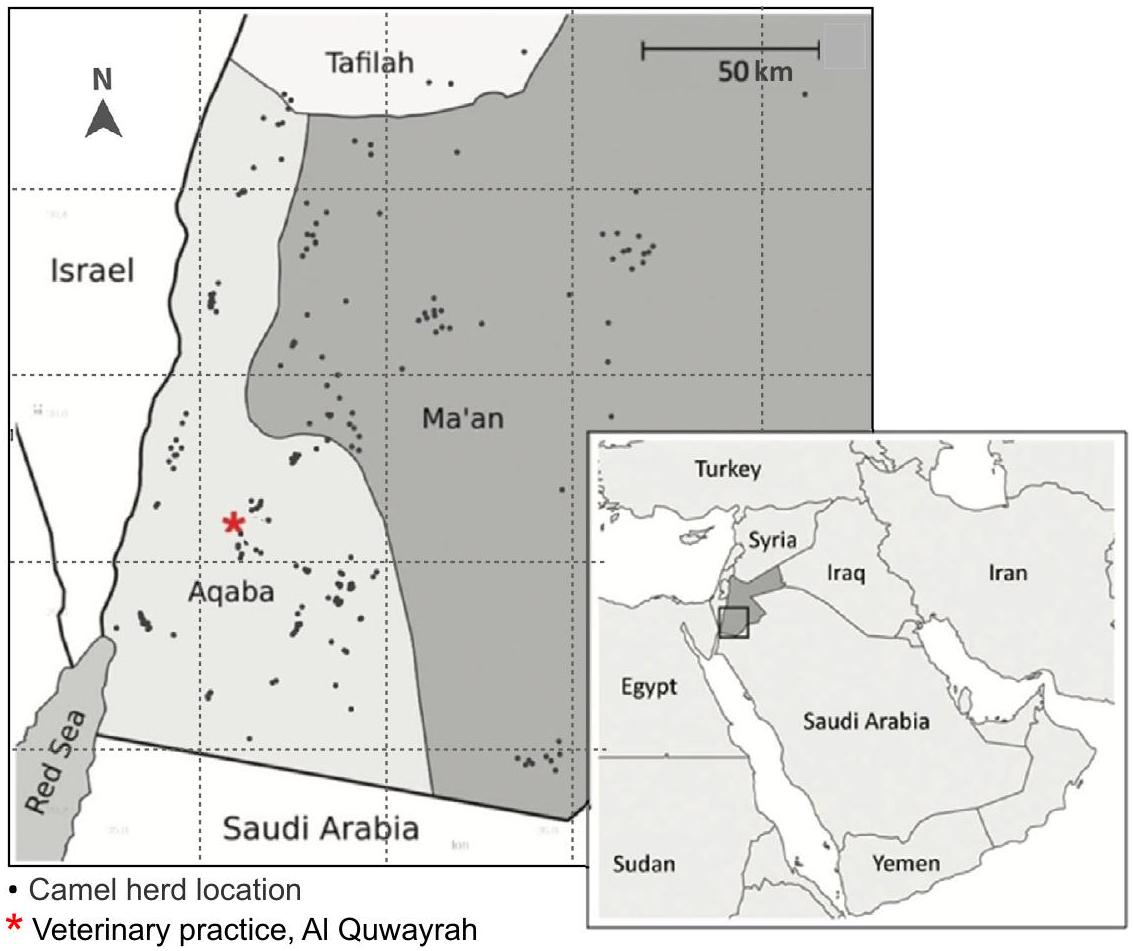
الشكل 2 | موقع 227 قطيع من الإبل تم أخذ عينات منها لفحص البروسيلات في جنوب الأردن من فبراير 2014 إلى أكتوبر 2018 (نظرًا لحركات الرعي المحلية، تم اختيار ثلاثة قطعان من قائمة وزارة الزراعة لمنطقة معان (الغرب) التي تم أخذ عينات منها في المنطقة المجاورة، الطفيلة. تم اعتبار نتائج هذه القطعان كجزء من معان.)
الشكل 3 | موقع 203 أسرة تمتلك الماشية تم أخذ عينات منها لفحص البروسيلات في جنوب الأردن، من سبتمبر 2017 إلى أكتوبر 2018.
موافقة للأطفال الذين تتراوح أعمارهم بين 5-15 سنة. تم اتباع الإرشادات المؤسسية والوطنية لرعاية الأفراد المشاركين في جميع الأوقات.
جمع العينات وإجراءات المختبر. تم زيارة الأسر المختارة من قبل أعضاء فريق أخذ العينات، بما في ذلك ممارس طبي وميسر مجتمعي، الذين قدموا الدراسة
تم جمع المعلومات، وتقييم الأهلية، والحصول على الموافقة. تم جمع عينات الدم من الأفراد المشاركين مع إدارة استبيان منظم حول عوامل الخطر المحتملة للتعرض للبروسيلا خلال الأشهر الستة الماضية، بما في ذلك أسئلة تتعلق بالبيانات المكانية، والمعلومات الشخصية (بما في ذلك العمر والجنس (الملاحظ)، ومعلومات الأسرة، واستهلاك الماشية.
المنتجات، أنشطة تربية الماشية ونظافة اليدين (مع استبيان متابعة تم إجراؤه بين أعضاء المجتمع حول ممارسات غلي الحليب). تم إجراء استبيان إضافي لرئيس الأسرة حول عوامل الخطر على مستوى الأسرة، بما في ذلك العمر والجنس لأي أعضاء غير مأخوذين في العينة. تم إجراء الاستبيانات باللهجة المحلية على أجهزة لوحية تعمل بنظام أندرويد باستخدام تطبيق Open Data Kit (الإصدار 1.10). نظرًا للحساسية الثقافية، تم الحصول على معلومات حول جنس المشاركين من خلال ملاحظة المحاور. تم الإبلاغ عن معلومات حول الجنسية بشكل ذاتي، وفقًا لتفاصيل بطاقة الهوية الوطنية أو جواز السفر.
تم جمع عينات الدم في أنابيب فراغية سعة 8 مل من السيروم العادي وتم طردها مركزيًا في العقبة، بسرعة 2000 دورة في الدقيقة. ) لمدة 10 دقائق، تليها جمع المصل وتخزينه في تم تخزين جميع العينات مركزيًا في العقبة قبل نقلها إلى المختبر التشخيصي في مركز الصحة البيطرية، جامعة العلوم والتكنولوجيا الأردنية، إربد لإجراء الفحوصات المخبرية.
تم اختبار عينات المصل للأجسام المضادة ضد البروسيلة باستخدام اختبار ELISA الكلاسيكي للأجسام المضادة IgG للبروسيلة المتوفر تجارياً، المقدم من معهد فيريون/سيريون، GmbH، فيورزبرغ، ألمانيا. تم تنفيذ التقنية وفقًا لتعليمات الشركة المصنعة، مع قياس الكثافات الضوئية عند 450 نانومتر. تم اعتبار العينات التي تحتوي على عيار أعلى من 25 وحدة دولية/مل إيجابية لـ IgG. كانت الحساسية والنوعية المقدمة من قبل الشركة المصنعة هي و على التوالي .
تم اختبار عينات المصل أيضًا باستخدام اختبار روز-بينغال (RBPT) للكشف عن الأجسام المضادة ضد مستضد بروسيلة المقدم من جوفاك، عمان، الأردن. باختصار، تم خلط عينة من المصل (0.05 مل) مع 0.05 مل من المستضد على شريحة ميكروسكوبية لإنتاج منطقة بقطر حوالي 2 سم. تم تحريك المزيج برفق لمدة أربع دقائق في درجة حرارة الغرفة ومراقبته للتجلط، حيث تعتبر العينة إيجابية عندما يتم ملاحظة تفاعل مرئي. تم افتراض الحساسية والنوعية على أنها و على التوالي . (تم حساب القيم المشتركة للأداء، الإيجابية على إما RBPT أو ELISA بنسبة 90% و99.3% على التوالي).
النتائج. كانت النتيجة الرئيسية هي الحالة المصلية الإيجابية لبروسيلا على إما اختبار RBPT أو ELISA. وكانت النتائج الثانوية هي العلاقات المحتملة بين عوامل الخطر الممكنة والحالة المصلية الإيجابية.
تحليل إحصائي. كانت حسابات حجم العينة تعتمد على انتشار مصل متوقع لـ بين أفراد الأسر المالكة للماشية، نسبة أعضاء COH إلى القوة، مع مستوى الثقة، وتأثير التصميم لـ تم حساب حجم العينة المستهدفة كـ 946 فردًا: 757 عضوًا من COH و 189 عضوًا من NCOH. تم اختيار 160 من COH (40 لكل منطقة) و 40 من NCOH (10 لكل منطقة) بشكل عشوائي للإدراج المحتمل، استنادًا إلى حجم عينة الأسر المقدرة. ، مع اختيار أسر إضافية بشكل عشوائي لكل منطقة؛ و20 NCOH، خمسة لكل منطقة) حسب الحاجة.
تم حساب تقديرات انتشار الأجسام المضادة ونسب الثقة 95% على المستوى الفردي لمجموعات الأسر المتجانسة وغير المتجانسة، مع وزنها بعدد مجموعات الأسر المتجانسة وغير المتجانسة في كل منطقة إدارية. تم حساب معامل الارتباط داخل الفئة لتقييم مدى تجمع الأفراد الإيجابيين للأجسام المضادة داخل الأسر. كوهين’s تم حساب معامل كقياس للاتفاق بين نتائج ELISA و RBPT.
تم تقييم العلاقات الأحادية المتغيرة بين عوامل الخطر الافتراضية والحالة المصلية باستخدام تحليل الانحدار اللوجستي المختلط، مع اعتبار الأسرة كعامل عشوائي والحالة المصلية كنتيجة ثنائية، دون وزن للمنطقة. تم تحليل عوامل الخطر المحتملة بما في ذلك البيانات الزمنية والمكانية، والمعلومات الشخصية، وبيانات الصحة والنظافة، وتاريخ الاتصال بالماشية خلال الأشهر الستة الماضية، كمتغيرات فئوية على مستوى الفرد (بما في ذلك المتغيرات على مستوى الأسرة مثل حجم الأسرة، نوع المسكن، مصدر المياه، أي نظام تبريد هواء منزلي، عدد قطعان/مواشي الماشية القريبة، وجميع المتغيرات الخاصة بالقطيع/القطيع).
المتغيرات التي لها قيمة p أقل من في التحليل أحادي المتغير تم اعتبارها للإدراج في النماذج متعددة المتغيرات، باستثناء أي متغيرات مفقودة أكثر من للقيم، التي تم فحصها بشكل منفصل تم فحص التوازي بين المتغيرات باستخدام معامل بيرسون، مع حد أدنى من أو أكبر لتعريف التوازي المباشر و للتداخل العكسي. تم استبعاد المتغيرات المتوازية من نفس النموذج المتعدد المتغيرات واختبارها في نماذج منفصلة، باستثناء المتغيرات المحددة مسبقًا (العمر والجنس)، التي تم تضمينها جنبًا إلى جنب مع أي متغيرات متوازية في نفس النموذج.
تم بناء نماذج متعددة المتغيرات باستخدام الانحدار المختلط التأثيرات، مع اعتبار الأسرة كأثر عشوائي. تم بناء النماذج أولاً بطريقة الخطوات التراجعية؛ حيث تم تحديد المتغير الذي سيتم إزالته في كل خطوة من خلال مقارنة النماذج مع كل من المتغيرات غير المسبقة المحذوفة واختيار النموذج الذي لديه أدنى درجة لمعيار أكايك للمعلومات، بشرط أن إزالة المتغير لم تغير نسبة الأرجحية اللوغاريتمية لأي من المتغيرات غير المسبقة بأكثر من ثم تم بناء النماذج باستخدام طريقة الخطوات الأمامية لضمان بناء نفس النموذج بأي من الطريقتين. تم توليد فترات الثقة لتحليل الانحدار باستخدام تقنية احتمالية الملف الشخصي.
تم إجراء جميع التحليلات الإحصائية في R (الإصدار 4.0.3) باستخدام نماذج التأثيرات المختلطة التي تم إنشاؤها باستخدام دالة glmer من حزمة Ime4 (الإصدار 1.1-26).

ملخص التقرير

معلومات إضافية حول تصميم البحث متاحة في ملخص تقارير مجموعة ناتشر المرتبط بهذه المقالة.

توفر البيانات

كان لدى جميع المؤلفين وصول كامل إلى جميع البيانات في الدراسة. البيانات التي تدعم نتائج هذه الدراسة متاحة عند الطلب المعقول من المؤلف المراسل، رهناً بموافقة لجنة الأخلاقيات المعنية، بالإضافة إلى استبيانات الدراسة.

References

  1. World Health Organization. Brucellosis Fact Sheet, WHO, [Available from: https://www.who.int/news-room/fact-sheets/detail/ brucellosis (2020).
  2. World Health Organization. Estimates of the global burden of foodborne diseases: foodborne disease burden epidemiology reference group 2007-2015. WHO Geneva, (2015).
  3. Franc, K. A., Krecek, R. C., Häsler, B. N. & Arenas-Gamboa, A. M. Brucellosis remains a neglected disease in the developing world: a call for interdisciplinary action. BMC Public Health 18, e125 (2018).
  4. Dean, A. S. et al. Clinical manifestations of human brucellosis: a systematic review and meta-analysis. PLoS Negl. Trop. Dis. 6, e1929 (2012).
  5. Abo-shehada, M. N. & Abu-Halaweh, M. Seroprevalence of Brucella species among women with miscarriage in Jordan. East Mediterr. Health J. 17, 871-874 (2011).
  6. Radostits O. M., GAY, C., Hinchcliff, K. W. & Constable, P. D. A textbook of the diseases of cattle, horses, sheep, pigs and goats. Veterinary Medicine 10th edition London: Saunders. 1548-1551 (2007).
  7. Laine, C. G., Johnson, V. E., Scott, H. M. & Arenas-Gamboa, A. M. Global Estimate of Human Brucellosis Incidence. Emerg. Infect. Dis. 29, 1789-1797 (2023).
  8. Dadar, M. et al. Human brucellosis and associated risk factors in the Middle East region: A comprehensive systematic review, metaanalysis, and meta-regression. Heliyon 10, e34324 (2024).
  9. Alhussain, H. et al. Seroprevalence of camel brucellosis in Qatar. Trop. Anim. Health Prod. 54, e351 (2022).
  10. Musallam, I. I., Abo-Shehada, M. N., Hegazy, Y. M., Holt, H. R. & Guitian, F. J. Systematic review of brucellosis in the Middle East: disease frequency in ruminants and humans and risk factors for human infection. Epidemiol. Infect. 144, 671-685 (2016).
  11. Bagheri Nejad, R., Krecek, R. C., Khalaf, O. H., Hailat, N. & ArenasGamboa, A. M. Brucellosis in the Middle East: Current situation and a pathway forward. PLoS Negl. Trop. Dis. 14, e0008071 (2020).
  12. Al-Ani, F. et al. Human and animal brucellosis in the Sultanate of Oman: an epidemiological study. J. Infect. Dev. Ctries 17, 52-58 (2023).
  13. Al-Marzooqi, W. et al. Seroprevalence and Risk Factors of Brucellosis in Ruminants in Dhofar Province in Southern Oman. Vet. Med Int 2022, e3176147 (2022).
  14. Shaqra QM, Abu Epidemiological aspects of brucellosis in Jordan. Eur. J. Epidemiol. 16, 581-584 (2000).
  15. Abutarbush, S. M. et al. Implementation of One Health approach in Jordan: Review and mapping of ministerial mechanisms of zoonotic disease reporting and control, and inter-sectoral collaboration. One Health 15, e100406 (2022).
  16. McAlester, J. & Kanazawa, Y. Situating zoonotic diseases in peacebuilding and development theories: Prioritizing zoonoses in Jordan. PLoS One 17, e0265508 (2022).
  17. Abo-Shehada, M. N., Odeh, J. S., Abu-Essud, M. & Abuharfeil, N. Seroprevalence of brucellosis among high risk people in northern Jordan. Int J. Epidemiol. 25, 450-454 (1996).
  18. Dajani, Y. F., Masoud, A. A. & Barakat, H. F. Epidemiology and diagnosis of human brucellosis in Jordan. J. Trop. Med Hyg. 92, 209-214 (1989).
  19. Samadi, A., Ababneh, M. M., Giadinis, N. D. & Lafi, S. Q. Ovine and Caprine Brucellosis (Brucella melitensis) in Aborted Animals in Jordanian Sheep and Goat Flocks. Vet. Med Int 2010, e458695 (2010).
  20. Al-Talafhah, A. H., Lafi, S. Q. & Al-Tarazi, Y. Epidemiology of ovine brucellosis in Awassi sheep in Northern Jordan. Prev. Vet. Med 60, 297-306 (2003).
  21. Aldomy, F. M., Jahans, K. L. & Altarazi, Y. H. Isolation of Brucella melitensis from aborting ruminants in Jordan. J. Comp. Pathol. 107, 239-42 (1992).
  22. Musallam, I. I., Abo-Shehada, M., Omar, M. & Guitian, J. Crosssectional study of brucellosis in Jordan: Prevalence, risk factors and spatial distribution in small ruminants and cattle. Prev. Vet. Med 118, 387-96 (2015).
  23. Abo-Shehada, M. N., Rabi, A. Z. & Abuharfeil, N. The prevalence of brucellosis among veterinarians in Jordan. Ann. Saudi Med 11, 356-357 (1991).
  24. Al-Amr, M. et al. Epidemiology of human brucellosis in military hospitals in Jordan: A five-year study. J. Infect. Dev. Ctries 16, 1870-1876 (2022).
  25. Abo-Shehada, M. N. & Abu-Halaweh, M. Risk factors for human brucellosis in northern Jordan. East Mediterr. Health J. 19, 135-140 (2013).
  26. Issa, H. & Jamal, M. Brucellosis in children in south Jordan. East Mediterr. Health J. 5, 895-902 (1999).
  27. Galali, Y. & Al-Dmoor, H. M. Miraculous properties of camel milk and perspective of modern science. J. Fam. Med. Dis. Prev. 5, e095 (2019).
  28. Shimol, S. B. et al. Human brucellosis outbreak acquired through camel milk ingestion in southern Israel. Isr. Med Assoc. J. 14, 475-478 (2012).
  29. Zhu, S., Zimmerman, D. & Deem, S. L. A review of zoonotic pathogens of dromedary camels. Ecohealth 16, 356-377 (2019).
  30. Sprague, L. D., Al-Dahouk, S. & Neubauer, H. A review on camel brucellosis: a zoonosis sustained by ignorance and indifference. Pathog. Glob. Health 106, 144-149 (2012).
  31. Almuzaini, A. M. An epidemiological study of brucellosis in different animal species from the al-qassim region, Saudi Arabia. Vaccines (Basel). 11, e694 (2023).
  32. Dahl, M. O. Brucellosis in food-producing animals in Mosul, Iraq: A systematic review and meta-analysis. PLoS One 15, e0235862 (2020).
  33. Hegazy, Y. M., Moawad, A., Osman, S., Ridler, A. & Guitian, J. Ruminant brucellosis in the Kafr El Sheikh Governorate of the Nile
Delta, Egypt: prevalence of a neglected zoonosis. PLoS Negl. Trop. Dis. 5, e944 (2011).
34. Bardenstein, S., Gibbs, R. E., Yagel, Y., Motro, Y. & Moran-Gilad, J. Brucellosis Outbreak Traced to Commercially Sold Camel Milk through Whole-Genome Sequencing, Israel. Emerg. Infect. Dis. 27, 1728-1731 (2021).
35. Garcell, H. G. et al. Outbreaks of brucellosis related to the consumption of unpasteurized camel milk. J. Infect. Public Health 9, 523-527 (2016).
36. Al-Majali, A. M., Al-Qudah, K. M., Al-Tarazi, Y. H. & Al-Rawashdeh, O. F. Risk factors associated with camel brucellosis in Jordan. Trop. Anim. Health Prod. 40, 193-200 (2008).
37. World Organizarion of Animal Health. Manual of diagnostic tests and vaccines for terrestrial animals Ch 3.1.4 (WOAH, Paris, 2022).
38. Mangtani, P. et al. The prevalence and risk factors for human Brucella species infection in a cross-sectional survey of a rural population in Punjab, India. Trans. R. Soc. Trop. Med Hyg. 114, 255-263 (2020).
39. Alnaeem, A. et al. Some pathological observations on the naturally infected dromedary camels (Camelus dromedarius) with the Middle East respiratory syndrome coronavirus (MERS-CoV) in Saudi Arabia 2018-2019. Vet. Q 40, 190-197 (2020).
40. Chatty D. From Camel to Truck: The Bedouin in the Modern World. (White Horse Press, Cambridge, 2013).
41. Qur’an, Al-Ghashiyah (Surra 88), verse 17.
42. Al Zahrani, A. et al. Use of camel urine is of no benefit to cancer patients: observational study and literature review. East Mediterr. Health J. 29, 657-663 (2023).
43. Sahih Al Bukhari, The Book of Medicine (Book 76), Hadith 9.
44. Abutarbush, A. S., Hijazeen, Z., Doodeen, R. & Hawaosha, M. Analysis, description and mapping of camel value chain in jordan ministry of agriculture. Glob. Veterinaria 20, 144-152 (2019).
45. Abuelgasim, K. A. et al. The use of complementary and alternative medicine by patients with cancer: a cross-sectional survey in Saudi Arabia. BMC Complement Alter. Med 18, e88 (2018).
46. Shaalan, M. A. et al. Brucellosis in children: clinical observations in 115 cases. Int J. Infect. Dis. 6, 182-186 (2002).
47. Musallam, I. I., Abo-Shehada, M. N. & Guitian, J. Knowledge, attitudes, and practices associated with brucellosis in livestock owners in jordan. Am. J. Trop. Med Hyg. 93, 1148-1155 (2015).
48. Holloway, P. et al. Risk factors for middle east respiratory syndrome coronavirus infection among camel populations, Southern Jordan, 2014-2018. Emerg. Infect. Dis. 27, 2301-2311 (2021).
49. Dadar, M., Tiwari, R., Sharun, K. & Dhama, K. Importance of brucellosis control programs of livestock on the improvement of one health. Vet. Q 41, 137-151 (2021).
50. Radwan, A. I. et al. Control of Brucella melitensis infection in a large camel herd in Saudi Arabia using antibiotherapy and vaccination with Rev. 1 vaccine. Rev. Sci. Tech. 14, 719-732 (1995).
51. Food and Agriculture Organisation, Animal Production and Health Paper 156 Ch. 9 (FAO, Rome, 2003)
52. Holloway, P. et al. A cross-sectional study of Q fever in Camels: Risk factors for infection, the role of small ruminants and public health implications for desert-dwelling pastoral communities. Zoonoses Public Health 70, 238-247 (2023).
53. Ahad, A. A., Megersa, B. & Edao, B. M. Brucellosis in camel, small ruminants, and Somali pastoralists in Eastern Ethiopia: a One Health approach. Front Vet. Sci. 11, e1276275 (2024).
54. Mohammed, A. et al. Seroprevalence and risk factors of brucellosis in dromedary camels (Camelus dromedarius) in Sudan from 1980 to 2020: a systematic review and meta-analysis. Vet. Q 43, 1-15 (2023).
55. Dadar, M. & Alamian, S. Isolation of Brucella melitensis from seronegative camel: potential implications in brucellosis control. Prev. Vet. Med 185, e105194 (2020).
56. Blasco, J. M. A review of the use of B. melitensis Rev 1 vaccine in adult sheep and goats. Prev. Vet. Med 31, 275-283 (1997).
57. Vives-Sotoa, M. P.-G. A., Pereirab, J., Rodríguez-Sánchez, J. & Solerac, E. J. What risk do Brucella vaccines pose to humans? A systematic review of the scientific literature on occupational exposure. PLoS Negl. Trop. Dis. 18, e0011889 (2024).
58. Ducrotoy, M. J. et al. Integrated health messaging for multiple neglected zoonoses: Approaches, challenges and opportunities in Morocco. Acta Trop. 152, 17-25 (2015).
59. Mbye, M., Ayyash, M., Abu-Jdayil, B. & Kamal-Eldin, A. The texture of camel milk cheese: effects of milk composition, coagulants, and processing conditions. Front Nutr. 9, e868320 (2022).
60. Al-Zoubi, M. et al. WASH in Islam. Guide on Water, Sanitation and Hygiene (WASH) from an Islamic Perspective. (Sanitation for Millions, Deutsche Gesellschaft für Internationale Zusammenarbeit (GIZ) GmbH, Germany 2020).
61. Elsohaby, I. et al. Bayesian Evaluation of Three Serological Tests for Diagnosis of Brucella infections in Dromedary Camels Using Latent Class Models. Prev. Vet. Med 208, e105771 (2022).
62. Khan, F. K. R. et al. Comparative performance study of four different serological tests for the diagnosis of dromedary brucellosis. J. Camel Pract. Res. 23, 213-217 (2016).
63. IDvet. ID Screen Brucellosis Serum Indirect Multi-species, (https:// www.innovative-diagnostics.com/produit/id-screen-brucellosis-serum-indirect-multi-species/) (2023).
64. Gwida, M. M. et al. Comparison of diagnostic tests for the detection of Brucella spp. in camel sera. BMC Res Notes 4, e525 (2011).
65. Getachew, T., Getachew, G., Sintayehu, G., Getenet, M. & Fasil, A. Bayesian Estimation of Sensitivity and Specificity of Rose Bengal, Complement Fixation, and Indirect ELISA Tests for the Diagnosis of Bovine Brucellosis in Ethiopia. Vet. Med Int 2016, e8032753 (2016).
66. Wernery, U. Camelid brucellosis: a review. Rev. Sci. Tech. 33, 839-857 (2014).
67. Beauvais, W., Orynbayev, M. & Guitian, J. Empirical Bayes estimation of farm prevalence adjusting for multistage sampling and uncertainty in test performance: a Brucella cross-sectional serostudy in southern Kazakhstan. Epidemiol. Infect. 144, 3531-3539 (2016).
68. Serion ELISA classic Brucella spp. IgG. https://www.serion-diagnostics.de/en/products/serion-elisa-classic-antigen/ brucella/ (2023).
69. Al Dahouk, S., Tomaso, H., Nöckler, K., Neubauer, H. & Frangoulidis, D. Laboratory-based diagnosis of brucellosis-a review of the literature. Part II: serological tests for brucellosis. Clin. Lab 49, 577-589 (2003).
70. Ekiri, A. B. et al. Utility of the rose bengal test as a point-of-care test for human brucellosis in endemic african settings: a systematic review. J. Trop. Med 2020, e6586182(2020).

شكر وتقدير

نشكر بصدق وزارة الصحة ووزارة الزراعة في الأردن. كما نشكر فارس أ. التخيّنة، غصّب ح. حسنات، حسن ح. الحسينات، عبد المجيد م. العجلوني، سوك وو لي، يونغ كيونغ كانغ، وهيتش باتيل. تم دعم هذا البحث من قبل منحة مؤسسة مجلس البحث الطبي لصندوق تحديات البحث العالمية (2017-2018، رقم المرجع 2017 1735-3، ج.غ)، ومنحة برنامج ثنائي من وزارة الخارجية والكومنولث (2013-2014، ج.غ) من
السفارة البريطانية في عمان وبرنامج الأمن البيولوجي الدولي في المملكة المتحدة (في سياق مبادرة التوأمة بين منظمة الصحة الحيوانية العالمية وRVC وJUST).

مساهمات المؤلفين

صمم الدراسة كل من P.H. و J.G. و P.M. و J.C. وساعد كل من A.A. و E.A. و W.H. في العمل الميداني في الأردن، وقام كل من T.H. و P.H. و M.G. بتنسيق وتنفيذ العمل الميداني. أجرى B.A. اختبارات مختبرية. أدار M.G. البيانات، وأجرى التحليل الإحصائي، وأنشأ الرسوم البيانية، وشارك P.H. و J.G. و S.N. في التحليل الإحصائي. كتب P.H. المخطوطة، وشارك M.G. و J.G. و P.M. و J.C. و I.M. و I.P. و T.H. و B.C. في كتابة المخطوطة. قام جميع المؤلفين بمراجعة المخطوطة بشكل نقدي وقدموا تعليقاتهم عليها.

المصالح المتنافسة

كان E.A. منسق المشروع لمشروع “تقليل تهديد فيروس كورونا الشرق الأوسط (MERS-CoV) وإنفلونزا الطيور في الأردن وتعزيز قدرة المراقبة الإقليمية للأمراض”، المدعوم من وكالة الدفاع الأمريكية للحد من التهديدات، برنامج الحد من التهديدات البيولوجية. جميع المؤلفين الآخرين يعلنون عدم وجود مصالح متنافسة.

معلومات إضافية

معلومات إضافية النسخة الإلكترونية تحتوي على مواد إضافية متاحة فيhttps://doi.org/10.1038/s41467-024-55737-2.
يجب توجيه المراسلات والطلبات للحصول على المواد إلى بيتر هولواي.
تُعرب مجلة Nature Communications عن شكرها لعبد المالك إبراهيم خلف الله والمراجعين الآخرين المجهولين على مساهمتهم في مراجعة هذا العمل. يتوفر ملف مراجعة الأقران.
معلومات إعادة الطباعة والتصاريح متاحة علىhttp://www.nature.com/reprints
ملاحظة الناشر: تظل شركة سبرينجر ناتشر محايدة فيما يتعلق بالمطالبات القضائية في الخرائط المنشورة والانتماءات المؤسسية.
الوصول المفتوح هذه المقالة مرخصة بموجب رخصة المشاع الإبداعي النسب 4.0 الدولية، التي تسمح بالاستخدام والمشاركة والتكيف والتوزيع وإعادة الإنتاج بأي وسيلة أو صيغة، طالما أنك تعطي الائتمان المناسب للمؤلفين الأصليين والمصدر، وتوفر رابطًا لرخصة المشاع الإبداعي، وتوضح ما إذا كانت هناك تغييرات قد أُجريت. الصور أو المواد الأخرى من طرف ثالث في هذه المقالة مشمولة في رخصة المشاع الإبداعي الخاصة بالمقالة، ما لم يُشار إلى خلاف ذلك في سطر الائتمان للمواد. إذا لم تكن المادة مشمولة في رخصة المشاع الإبداعي الخاصة بالمقالة وكان استخدامك المقصود غير مسموح به بموجب اللوائح القانونية أو يتجاوز الاستخدام المسموح به، فستحتاج إلى الحصول على إذن مباشرة من صاحب حقوق الطبع والنشر. لعرض نسخة من هذه الرخصة، قم بزيارةhttp://creativecommons.org/رخص/بواسطة/4.0/.
(ج) المؤلفون 2025

  1. مجموعة الوبائيات البيطرية والاقتصاد والصحة العامة، مركز التعاون التابع لمنظمة الصحة الحيوانية العالمية لتحليل المخاطر والنمذجة، قسم علم الأمراض وعلم السكان، الكلية البيطرية الملكية، هاتفيلد، المملكة المتحدة. ²قسم وبائيات الأمراض المعدية والصحة الدولية، كلية لندن للصحة العامة والطب الاستوائي، لندن، المملكة المتحدة. قسم الوبائيات الطبية والإحصاء الحيوي، معهد كارولينسكا، ستوكهولم، السويد. كلية الطب البيطري، جامعة العلوم والتكنولوجيا الأردنية، إربد، الأردن. قسم طب الأطفال، كلية الطب، جامعة سانت لويس، سانت لويس، ميزوري، الولايات المتحدة الأمريكية. ساهم هؤلاء المؤلفون بالتساوي: بونام مانغتاني، خافيير غويتان. البريد الإلكتروني:pholloway3@rvc.ac.uk
  2. *إيجابي على RBPT وإيجابي على CFT أو ELISA.
    مرة واحدة، أو أكثر، في السنوات الخمس الماضية.

Journal: Nature Communications, Volume: 16, Issue: 1
DOI: https://doi.org/10.1038/s41467-024-55737-2
PMID: https://pubmed.ncbi.nlm.nih.gov/39833143
Publication Date: 2025-01-20

Camel milk is a neglected source of brucellosis among rural Arab communities

Received: 16 November 2023
Accepted: 22 December 2024
Published online: 20 January 2025
With over two million human cases estimated to occur annually worldwide, the World Health Organization (WHO) has described brucellosis as one of the world’s leading zoonotic diseases. Most cases occur within lower-and-middle-income countries (LMIC) with limited resources for prevention and control, prompting WHO to designate brucellosis a global Neglected Disease . Human infection causes a variety of symptoms including recurrent fevers, headaches, arthralgia and chronic malaise, while reproductive symptoms also occur, including miscarriages, infertility and orchitis . In addition, infection can also progress to cause osteomyelitis, endocarditis, meningoencephalitis, and in some cases death . Human infections occur largely via consumption of infected raw milk and dairy products and through physical contact with infected livestock, via contaminated birthing products and reproductive discharges . As such, brucellosis also represents an important production disease in livestock, resulting in

Peter Holloway , Matthew Gibson , Tanja Holloway , lain Pickett , Brittany Crook , Jacqueline M. Cardwell (1) , Stephen Nash , Imadidden Musallam , Bilal Al-Omari , Ahmad Al-Majali , Wail Hayajneh , Ehab Abu-Basha , Punam Mangtani & Javier Guitian

Abstract

The World Health Organization describes brucellosis as one of the world’s leading zoonotic diseases, with the Middle East a global hotspot. Brucella melitensis is endemic among livestock populations in the region, with zoonotic transmission occurring via consumption of raw milk, amongst other routes. Control is largely via vaccination of small ruminant and cattle populations. Due to sociocultural and religious influences camel milk (camelus dromedarius) is widely consumed raw, while milk from other livestock species is largely boiled. To investigate the potential public health impact of Brucella in camels we conduct a cross-sectional study in southern Jordan including 227 herds and 202 livestock-owning households. Here we show daily consumption of raw camel milk is associated with Brucella seropositive status among the study population, on multivariable analysis, highlighting the need for socioculturally appropriate control measures; targeted interventions among the camel reservoir being crucial for effective control.

metritis, orchitis and infertility .
The Middle East represents an important global hotspot for brucellosis, with more than half a million human cases estimated to occur annually . B. melitensis is the dominant causative agent (alongside, to a lesser extent, B. abortus), with reported livestock seroprevalences across the region being among the highest in the world . The majority of human cases in the region occur among sub-populations working closely with livestock, with consumption of unpasteurized dairy products and occupational exposure to breeding ruminants being the most frequently identified risk factors for infection . Within Jordan, brucellosis has been identified as one of the most important zoonotic diseases of public health impact, with government-led control strategies largely focussed on livestock vaccination schemes . However, despite several decades of sustained
vaccination initiatives, seroprevalences among small ruminant and cattle populations remain high . While population level seroprevalences in Jordan remain largely unexamined, previous studies have reported seroprevalences among sub-populations including children, refugees, individuals working with livestock, those consuming livestock products and among hospitalised pyrexic patients .
Due to sociocultural and religious perceptions, camel milk is widely consumed raw across the region, while milk from other livestock species is usually boiled . As a result, camels (camelus dromedarius) pose a unique public health threat from milk-borne pathogens, including Brucella . However, while the public health threat associated with brucellosis among other livestock species in the region is widely recognized , the potential zoonotic impact of dromedary camels remains largely unexamined – despite previous reports of small-scale outbreaks in the region traced to the consumption of raw milk from infected camels . In addition, the lack of a commercially available Brucella vaccine licensed for use in camels means that vaccination is limited to off-label use only, and while practiced in some countries, is not widespread across the region (including Jordan where governmentled Brucella livestock vaccination programmes do not include camels, and access by the private sector is restricted) .
This study therefore represents the first large-scale populationbased study examining the potential zoonotic threat posed by Brucella in camels among a high-risk population in the Middle East . To address key knowledge gaps, we conducted a cross-sectional study among livestock-owning communities and their camels in southern Jordan (Aqaba and Ma’an governorates). The aims of this study were to, i) estimate the seroprevalence of Brucella among the camel population, ii) estimate the seroprevalence of Brucella among members of livestock-owning households (camel owning and non-camel owning), iii) identify risk factors for Brucella seropositive status among camel populations, iv) identify risk factors for Brucella seropositive status among livestock-owning household members, and v) identify socioculturally appropriate control strategies. In this work we show daily consumption of raw camel milk as being associated with Brucella
seropositive status on multivariable analysis, highlighting the need for socioculturally appropriate control measures, with targeted interventions among the camel reservoir being crucial for effective control.

Results

Camels

We collected blood samples from 902 camels, of which 26 samples were of insufficient volume for testing, with 884 samples remaining representing 227 herds. Of these 227 herds, 131 herds ( 455 camels) were owned by households included in a parallel human study, where household members were also tested for evidence of Brucella seropositive status. Median herd size was 10 [interquartile range (IQR) 5-20], with a mean of 3.9 camels sampled per herd (Fig. 1). The median age of camels sampled was 5 years (interquartile range [IQR] 2-8 years). There were camels positive on Rose Bengal Plate test (RBPT), of which were positive on Compliment Fixation Test (CFT), 9/884 (1.0%) were positive on indirect ELISA; 10/884 (1.1%) being positive on either CFT or indirect ELISA.
In Ma’an and Aqaba respectively, there were 7/340 (2.1%) and 1/ positive camels (positive on RBPT and confirmed by CFT, as per OIE guidelines) , with true seroprevalence (adjusted for test performance values) being and respectively; true seroprevalence being ( ) across both regions. There were herds with at least one seropositive camel sampled, of which were in Ma’an and (0.7%) were in Aqaba. Adjusted herd-level seroprevalence (adjusted for test performance values and herd sampling proportion) was ( ) in Ma’an and in Aqaba; adjusted herd level seroprevalence (also weighted for region) across both regions being 18.7% (95% CI 14.3-23.3) (Table 1).
Due to the low seroprevalence of positives on RBPT and CFT (8/ ), and the singularity of subsequent multivariable logistic regression models created, samples positive on RBPT and CFT or ELISA were considered positive for evidence of Brucella exposure for purposes of logistic regression analyses to determine
Fig. 1 | Study profile.
Table 1 | Camel and herd-level Brucella seroprevalence among camel populations in southern Jordan
Population seroprevalence Herd-level seroprevalence
Apparent prevalence True prevalence Unadjusted Adjusted*
Positive camels / total camels % % (95% CI) Positive herds / total herds % % (95% CI)
Southern Jordan (Ma’an & Aqaba) 8/884 (0.9%) 1.0% (0.5-2.1) 7/227 3.1% 18.7% (14.3-23.3)
Ma’an 7/340 (2.1%) 2.4% (1.1-4.8) 6/81 7.4% 30.4% (22.2-39.5)
Aqaba 1/544 (0.2%) 0.1% (0.0-1.1) 1/146 0.7% 4.8% (2.1-8.2)
  • Adjusted for combined test performance values; southern Jordan (Ma’an & Aqaba) estimate also weighted for region.
    Positive on RBPT and CFT.
    Herd contains one or more positive camels, positive on RBPT and CFT.
    potential risk factors for infection. On univariable analysis, the following variables were found to be associated ( ) with seropositive status, region, purchasing camels (in the last year), closed herd management practices and one or more goats also being owned (Table 2). On multivariable analysis, positive status was associated with region (Ma’an) and purchasing camels ; with evidence to suggest closed herd management practices are protective (OR ) in a singular model (singularity being due to the absence of any positive camels sampled from among closed herds) (Table 3).

Humans

We collected blood samples from 879 members of livestock-owning households of which 12 samples were of insufficient volume for diagnostic testing, with 867 samples remaining representing 203 households (Table 4). Median household size was 10 [IQR 7-13]), with a mean of 4.2 members sampled per household. The median age of individuals sampled was 27 (IQR 15-44). Of the 203 households sampled, 172 were camel-owning households (medium household size 10 [IQR 7-14]) including 667 household members (median age 27 years [IQR 16-44]), with a mean of 3.8 members sampled per household. The remaining 31 households were noncamel owning households (NCOH) (medium household size 11 [IQR 9-13]), including 200 household members (median age 26 years [IQR 15-44], with a mean of 6.5 individuals sampled per household (Fig. 1). Among COH, there were 131/172 (76.2%) households from which one or more camels from the herd were also tested for Brucella serological status. Jordanian Ministry of Agriculture (MoA) records show 3089 livestock owning households in Ma’an, of which 317/3089 ( ) own camels, and 1359 livestock-owning households in Aqaba, of which 265/1389 (19.1%) own camels, with camel ownership being 582/4448 overall. No households included in the study reported owning cattle (with cattle almost entirely absent from the south of Jordan, due to the arid, desert environment).
There were 68/867 (7.8%) individuals seropositive on RBPT and 62/867 (7.2%) individuals seropositive on IgG ELISA, with 91/867 ( ) seropositive to either test. A Kappa coefficient of 0.57 ( ) indicated moderate agreement between test results, individuals being considered positive if positive to either test . The estimated intracluster correlation coefficient (ICC) for within household seropositivity to either test was 0.46 ( ). Adjusted population prevalence among members of livestock-owning households (adjusted for combined test performance values and weighted for region and camel ownership status) was . In Ma’an and Aqaba regions, 75/478 ( ) and 16/389 ( ) individuals were seropositive respectively, adjusted seroprevalences being 10.0% ( ) and ( ) respectively (adjusted for combined test performance values and camel ownership status) (Table 5).
Among COH, 79/667 (11.8%) members were seropositive, adjusted seroprevalence (adjusted for combined test performance values and
weighted for region) being . In Ma’an and Aqaba regions respectively, there were and (3.8%) seropositive individuals in COH ; adjusted seroprevalences being 19.5% (95% CI 15.7-23.6) and 4.8% (95% CI 2.7-7.7) respectively. Among NCOH, 12/200 (6.0%) members were seropositive, with adjusted seroprevalence being ; there were (7.1%) and 5/101 positive individuals in Ma’an and Aqaba respectively, adjusted seroprevalences being and respectively (Table 5).
The following variables, with missing values, were found to be associated ( ) with seropositivity on RBPT or ELISA on univariable analysis: region, sub-region, region with camel owning status, sex, history of brucellosis, household dwelling type (tent), handwashing (>5 times/day), household owns sheep, drinking raw camel milk, drinking raw small ruminant milk, consuming raw small ruminant dairy products, birthing camels, birthing small ruminants, disposing of camel afterbirth, disposing of small ruminant afterbirth, slaughtering camels, slaughtering small ruminants, frequent interaction with livestock, any livestock engagement and hand hygiene when working with livestock (Table 6).
Pairwise correlations ( ) were identified between birthing camels, disposing of camel afterbirth and slaughtering camels, with birthing of camels selected for inclusion in multivariable models. Pairwise correlations were also identified between frequently ( weekly) working with livestock, frequently working with small ruminants, frequently working with camels and any history of livestock engagement, with frequently working with livestock selected for inclusion. Region, sub-region and region with camel owning status were also pairwise correlated, with region selected for inclusion. In addition, correlation was also identified between birthing small ruminants and disposing of small ruminant afterbirth, with birthing small ruminants selected for inclusion in multivariable models. Drinking raw milk from small ruminants and consuming raw small ruminant dairy products were correlated, with each variable tested in a separate multivariable model, adjusted for the same covariates. The composite variable hand hygiene when frequently working with livestock, was correlated with constituent variables frequently working with livestock and handwashing and therefore tested in a separate model adjusted for the same covariates.
On multivariable analysis, evidence of association was found between seropositivity and region (Ma’an) ( [1.86-6.07], ), drinking raw camel milk daily (categorical, ), birthing small ruminants ( weekly, in season) ( [1.02-3.39], ), and poor hand hygiene (handwashing times/day) when working with livestock ( weekly) (categorical, ) (Table 7).
Among individuals drinking raw camel milk daily, were seropositive in Ma’an and were seropositive in Aqaba (OR 9.42 [2.36-62.70], ), with daily consumption of raw camel milk associated with seropositive status in Ma’an, ( [3.22-13.74]) though not in Aqaba ( [0.23-3.47]) in a posthoc logistic regression model, with Aqaba (not drinking camel milk daily) as a baseline and household as a random effect, adjusted for the
Table 2 | Descriptive and univariable statistics of Brucella seropositivity among camels from 227 herds in southern Jordan, using logistic regression analysis, likelihood ratio test
Variable
Total (missing) +ve % OR 95%CI p
884 camels sampled
Study period
2014-15 429 5 1.2% 0.94 0.26-3.41 0.93
2017-18 455 5 1.1%
Region
Ma’an 340 8 2.4% 6.53 1.62-43.44 0.0069
Aqaba 544 2 0.4%
Sex
Female 669 9 1.3% 2.81 0.52-51.96 0.26
Male 207 (8) 1 0.5%
Age >median ( 5 yr )
Yes 405 7 1.5% 0.41 0.09-1.50 0.18
No 474 (5) 3 0.7%
Herd size >median (10)
Yes 552 8 1.4% 2.43 0.60-16.14 0.23
No 332 2 0.6%
Number of camel herds nearby (within a 15-minute drive) >20
Yes 364 6 1.6% 2.06 0.58-8.10 0.26
No 495 (25) 4 0.8%
Herd is kept together as single group throughout the year
Yes 600 6 1.0% 0.66 0.19-2.62 0.54
No 267 (17) 4 1.5%
Herd has contact with other local herds
Yes 519 8 1.3% 1.15 0.32-5.36 0.84
No 255 (110) 3 1.2%
Herd is moved to distant areas for seasonal grazing purposes (transhumance)
Yes 367 4 1.1% 0.90 0.23-3.18 0.87
No 497 (20) 6 1.2%
New camels are purchased
Yes 318 7 2.2% 4.10 1.13-19.11 0.032
No 549 (17) 3 0.5%
Camels are borrowed for breeding purposes
Yes 449 7 1.6% 2.19 0.60-10.22 0.24
No 418 (17) 3 0.7%
Closed herd
Yes 142 0 0.0% 0.00 0.056
No 713 (29) 10 1.4%
Sheep are also owned
Yes 533 8 1.5% 2.53 0.63-16.83 0.21
No 334 (17) 2 0.6%
Goats are also owned
Yes 603 9 1.5% 3.98 0.74-73.67 0.12
No 264 (17) 1 0.4%
Small ruminant flocks, where owned, have been vaccinated against Brucella (Rev 1 vaccine)
Yes 263 4 1.5% 1.17 0.26-6.00 0.84
No 231 (383) 3 1.3%
Dogs are present near the herd
Yes 648 9 1.4% 3.07 0.57-56.79 0.22
No 219 (17) 1 0.5%
same covariates (age, sex, region, household dwelling type, owning sheep, drinking camel milk, consuming small ruminant dairy products, birthing small ruminants and birthing camels). Similarly, region with camel owning status was associated with seropositivity (Ma’an COH with Aqaba COH as a baseline), when adjusted for the same covariates. Among COH where at least one camel was tested for Brucella seropositive status, seroprevalence among individuals drinking raw milk from a herd with a positive camel tested was , compared to among households where camels tested in the herd were negative (OR 24.31 [0.69-851.92], ). In a follow-up survey conducted among 69/172 (40.1%) of COH including 503 household members, 308/503 (61.2%) reported history of consuming camel milk in the past 6 months, of whom 285/ reported always consuming this raw. Among 320/503 who reported history of consuming small ruminant milk in the past 6 months, 278/320 ( ) reported they never or rarely consumed this raw.
Among 577 individuals working frequently ( weekly) with livestock, hand washing times/day was found to be protective , in a logistic regression model with household as a random effect adjusted for the same covariates (age, sex, region, household dwelling type, owning sheep, drinking camel milk, consuming small ruminant dairy products, birthing small ruminants and birthing camels). Use of soap (yesterday) when handwashing times/day was protective [0.29-0.91]).
Among households owning small ruminants and reporting Brucella vaccination status with Rev 1 vaccine administered by the MoA (at least once during the previous 5 years), vaccine uptake was (44/55) among flocks in Ma’an and 70.5% ( ) among flocks in Aqaba, and overall. When weighted for camel owning status, estimated vaccine uptake among the study population was in Ma’an and in Aqaba, and overall (vaccine uptake among COH flocks being compared to (18/20) among NCOH flocks in the sample population, OR 0.29 ). Vaccination of small ruminant flocks was found to be protective among household members owning vaccinated flocks; 17.8% (19/107) of individuals being seropositive among households owning unvaccinated flocks, compared to of individuals among households owning vaccinated flocks ( ), adjusted for a priori variables (age and sex) and region.
Among children of school age ( ), seropositivity among those not attending school was , compared to among those attending school; not attending school being associated with seropositive status ( ), when adjusted for priori variables (age and sex) and region. Among adults ( ), secondary education was found to be protective ( , when adjusted for the same covariates. Among Brucella seropositive individuals included in the study, (68/91) had no known history of a brucellosis.

Discussion

Historically, dromedary camels have provided the only means of survival, transport, and sustained existence in the harsh desert environments of the Middle East and North Africa . Consequently, they occupy a unique status within Arab Islamic culture . The Qur’an (surra 88) entreats unbelievers to consider four things that God has made: the earth, the heavens, the mountains, and the camel – with camels perceived as being an example of God’s power; a miracle of creation holding an entirely different position to all other animals . The Islamic Hadith (the life and teachings of the prophet, transcribed by his followers), describes the healing powers of drinking camels’ milk and urine . As a result, camels are perceived as a uniquely clean livestock
Table 3 | Multivariable associations between potential risk factors and Brucella seropositivity among camels from 227 herds in southern Jordan using logistic regression analysis, likelihood ratio test
Variable** Category A-priori adjusted OR p value Fully adjusted OR p value
Region Ma’an 7.11 1.75-47.55 0.0050 6.23 1.53-41.81 0.0093
Age >median ( 5 yr ) 0.41 0.09-1.50 0.18 0.35 0.074-1.32 0.12
Sex Female 3.56 0.64-66.50 0.17 3.86 0.68-72.73 0.14
Camels are purchased Yes 4.32 1.19-20.20 0.026 3.84 1.04-18.09 0.043
Closed herd Yes 0.00 NE 0.047 0.00 NE 0.072
¹Adjusted for a-priori variables: age, sex.
Adjusted for a-priori variables age and sex, region and camels are purchased.
observations.
In the last year.
Singular variable, adjusted for region, age, sex and camels are purchased, 842 observations.
NE non-estimable.
species among Islamic communities in the Middle East and beyond . Study participants expressed the perception that owning camels was something of great honor – camels being seen as uniquely ‘righteous’ and ‘clean’ animals, compared to other livestock species . A perception frequently expressed among the study population was that drinking camel milk imparted vital medicinal benefits, including increasing male libido, controlling blood sugar levels, healing gastrointestinal problems, and treating of cancer, amongst other medicinal properties . Among the study population children drink camel’s milk raw from an early age, with participants explaining that milk comes from the camel ‘pure and ready to drink’ – and should never be boiled, for fear of damaging its healing properties . This perception, combined with an unfavourable change in taste after boiling, means that camel milk is almost universally consumed raw among camelowning communties across the region, while milk from small ruminants (and cattle where present) is usually boiled due to a perception of risk from zoonotic diseases, such as alhumaa almalitia (brucellosis) .
It is within this context that our study findings identified daily consumption of raw camel milk as being associated with Brucella seropositive status among the study population 1.23-3.94), following multivariable analysis to adjust for potential confounders. When stratified by region, daily consumption of raw camel milk was found to be associated with seropositive status in Ma’an, though not in Aqaba. This reflects the high herd-level seroprevalences identified in Ma’an, where almost a third of herds were estimated to be positive (containing one or more seropositive camels), compared to Aqaba, where less than one in twenty herds were estimated to be positive. Likewise, half of all households members owning infected camels and drinking raw camel milk were found to be seropositive, compared to among those drinking camel milk from herds where all sampled camels were seronegative. Even where individual camel seroprevalences may be relatively low ( among camel populations in Ma’an, for example), widespread consumption of camel milk raw means that exposure to an infected animal becomes increasingly likely over time, particularly when drinking daily . As such, boiling camel milk prior to consumption would have an important protective effect, particularly in areas where camel seroprevalences are higher (such as Ma’an) . However, due to the strong sociocultural influences described (and an unfavourable change in taste after boiling) efforts to promote such profound behavioural change are likely to be challenging .
For this reason, control of Brucella among the camel reservoir (alongside other measures) is of paramount importance . Following multivariable analysis, purchasing of camels (in the past year) was found to be associated with seropositive status among animals in the receiving herds . Due to their high economic value camels that abort are often sold at market, rather than
slaughtered, with potential purchasers then unaware of their reproductive history and potential Brucella positive status (as reported by study participants) . Conversely, study findings suggested evidence that closed herd management practices are protective against Brucella entering the herd ( ), in a singular model (all camels sampled in closed herds testing negative) . To reduce potential within herd transmission, breeding camels should be separated from the main herd during parturition, as previously described . To reduce potential transmission between livestock species, camel herds should be managed away from small ruminants where possible, particularly during lambing/kidding periods, as previously described . Small ruminant seroprevalences in the region are known to be high , with Rev 1 (B. melitensis) vaccination of flocks offering a potentially protective effect, where camel herds and small ruminant flocks are managed together .
Camel herds in the study population had not been vaccinated against Brucella. Government-led vaccination programmes in Jordan do not include camels and private access to the Rev 1 vaccine is heavily restricted, with those herd owners surveyed reporting absence of vaccination in their herds. In addition, importing of camels from neighbouring countries, including Saudi Arabia (where Rev 1 vaccination may potentially have occurred), is prohibited unless for direct slaughter, suggesting the Brucella seroconversion identified in the study population is likely attributable to natural infection . While off-label use of the live-attenuated Rev 1 vaccine in camels should be considered where appropriate (see FAO guidelines), challenges with efficacy and the risk of contaminated milk mean that protective herd management strategies likely offer the most accessible means of control for many herd owners (until licensed vaccines become available) . Testing and slaughter schemes, using serum PCR testing where possible, including breeding males shared between herds, also offer a potential route toward reducing the risk of Brucella infection from raw camel milk in Jordan and the wider region (though such schemes require sufficient financial compensation be provided to succeed) .
Rev 1, being a live-attenuated vaccine, incurs risk of infection for veterinarians when administering the vaccine, and risk of abortion among pregnant livestock if accidently inoculated – both factors creating challenges in vaccine deployment across the region . Reported Rev 1 vaccine uptake (at least once during the past 5 years) among small ruminant flocks was in Ma’an and among flocks in Aqaba, and overall (weighted for camel-owning status), suggesting the observed difference in seroprevalence between regions is not attributable to differences in vaccine uptake. Vaccination of small ruminant flocks was found to offer a significantly protective effect among household members, with an apparent seroprevalence of (19/107) among individuals owning unvaccinated flocks, compared to among those owning vaccinated flocks,
Table 4 | Descriptive statistics of included members of livestock-owning households in southern Jordan, camelowning (COH) and non-camel owning (NCOH) households
COH ( ) NCOH ( ) All ( )
Age*
5-14 143 (21.5%) 47 (24%) 190 (22%)
15-24 151 (22.7%) 50 (25%) 201 (23%)
25-39 161 (24.2%) 40 (20%) 201 (23%)
40-59 137 (20.6%) 44 (22%) 181 (21%)
74 (11.1%) 18 (9%) 92 (11%)
Median (IQR) 27 (16-45) 26 (15-44) 27 (16-44)
Sex
Female 384 (57.6%) 118 (59%) 401 (46%)
Male 283 (42.4%) 82 (41%) 466 (54%)
Nationality**
Jordanian 565 (93.1%) 192 (99%) 757 (95%)
Saudi Arabian 23 (3.8%) 0 (0%) 23 (3%)
Egyptian 8 (1.3%) 0 (0%) 8 (1%)
Sudanese 8 (1.3%) 0 (0%) 8 (1%)
Other 3 (0.5%) 2 (1%) 5 (1%)
History of brucellosis
Yes 18 (2.8%) 5 (2.6%) 23 (3%)
No 629 (97.2%) 189 (97.4%) 818 (97%)
Secondary education**
Yes 180 (35.6%) 53 (37%) 233 (36%)
No 326 (64.4%) 90 (63%) 414 (64%)
Household size (no. of members >10)
0-10 287 (43.0%) 76 (38.0%) 363 (42%)
11-20 309 (46.3%) 109 (54.5%) 418 (48%)
>20 71 (10.6%) 15 (7.5%) 86 (10%)
Household owns camels
Yes 667 (100%) 0 (0%) 667 (77%)
No 0 (0%) 200 (100%) 200 (23%)
Household owns cattle
Yes 0 (0%) 0 (0%) 0 (0%)
No 667 (100%) 200 (100%) 867 (100%)
Household owns small ruminants
Yes 590 (88.5%) 200 (100%) 790 (91.1%)
No 77 (11.5%) 0 (0%) 77 (8.9%)
Where owned, small ruminants are reported as being vaccinated
yes 255 (72.9%) 118 (90.8%) 373 (77.7%)
No 95 (27.1%) 12 (9.2%) 107 (22.3%)
Any history of livestock engagement §
Yes 571 (85.6%) 711 (82.0%) 711 (82%)
No 96 (14.4%) 156 (18.0%) 156 (18%)
Frequent ( weekly) working with livestock
Yes 478 (71.7%) 577 (66.6%) 577 (67%)
No 189 (28.3%) 290 (33.4%) 290 (33%)
Household home has an air-cooling system
Yes 169 (42.9%) 56 (31.6%) 225(39.4%)
No 225 (57.1%) 121 (68.4%) 346 (60.6%)
*Missing values: Age , Nationality , Secondary education . Other nationalities included Ugandan ( ), Syrian ( ), British ( ). Socioeconomic status indicator, due to sociocultural reasons socioeconomic status was not directly measured. § Any history of livestock activity (>never).
Involved in any recorded livestock activity weekly or more.
( [ ]), when adjusted for a priori variables (age and sex) and region. These findings highlight the importance of small ruminant vaccination in protecting high-risk communities. Vaccine uptake was lower among compared to , potentially explained by increased challenges in geographic accessibility to COH , compared to NCOH , and suggesting targeted interventions aimed at increasing Rev 1 uptake among small ruminant flocks owned by COH would have beneficial effects in reducing human rates of infection among such communities .
Birthing of small ruminants ( weekly in season) was associated with seropositive status on multivariable analysis, [1.00-3.38], consistent with previous findings, with weak evidence that drinking raw small ruminant milk (daily) also presents risk of infection, [0.95-3.93]. These findings highlight the need for educational messages that reaffirm the importance of boiling small ruminant milk and dairy products before consumption , (due to its colloidal structure and protein composition, camel milk is unsuitable for making dairy products), and the use of gloves when birthing, where possible .
Infected livestock shed high volumes of Brucella in aborted materials and uterine discharges, with subsequent zoonotic transmission occurring via several potential routes, including ingestion of contaminated material on dirty hands and exposure of skin wounds (particularly on the hands and arms) or mucus membranes (eyes, nose and mouth) to contaminated materials . Within this context, poor hand hygiene was found to be associated with Brucella seropositive status among individuals frequently working with livestock, with good hygiene (handwashing >5 times/day with soap) found to be protective . Hand hygiene initiatives, such as WASH, therefore offer a potentially important control strategy for brucellosis among high risk communities in Jordan and the wider region . (Due to frequency of handwashing being closely connected to concepts of prayer and ritual washing (‘wudu’) among Islamic communities, baseline handwashing frequency was set at day .
As a WHO neglected disease, brucellosis presents a disease of poverty, with secondary education found to be protective among the study population ( ), while children not in school were at greater risk of infection, compared to contemporaries in school ( . Diagnosis rates among the study population were low, with just a quarter of seropositive individuals reporting a known history of brucellosis, suggesting a need for promotion of awareness regarding symptoms, diagnosis and treatment among rural communities in Jordan (and potentially the wider region), together with a need for increased capacity in diagnostic and medical services among such communities .
Among members of livestock-owning households in southern Jordan, Brucella seroprevalence was estimated to be CI 7.0-10.7) overall (adjusted for test performance values and weighted for region and camel ownership status), with adjusted seroprevalences in Ma’an and Aqaba being and respectively. Among COH, adjusted seroprevalences were 19.5% (95% CI ) and in Ma’an and Aqaba respectively, reflecting the high camel-herd level seroprevalences identified in Ma’an, compared to Aqaba ( ( ) and ( ) respectively). The ICC among included households was 0.46 ( ), suggesting moderate clustering; likely reflecting households owning infected herds (or flocks) with subsequent zoonotic transmission via consumption of infected milk (or milk products), alongside other potential routes.
This study has some limitations, with non-probabilistic and probabilistic sampling methods being used among camel herds during two distinct periods (2014-15 and 2017-18 respectively), however, we do not believe this has had an important impact on seroprevalence estimates or risk factor analysis (with seroprevalence among randomly
Table 5 | Individual Brucella seroprevalence among livestock-owning household members in southern Jordan
Adjusted*
Unadjusted Positive individuals / total individuals % % (95% CI)
Southern Jordan (Ma’an & Aqaba) 79/667 (11.8%) 12.7% (10.3-15.4)
12/200 (6.0%) 8.2% (4.9-12.5)
All households 91/867 (10.5%) 8.7% (6.9-10.7)
Ma’an 68/379 (17.9%) 19.5% (15.7-23.6)
7/99 (7.1%) 9.0% (4.4-15.7)
All households 75/478 (15.7%) 10.0% (7.5-12.9)
Aqaba 11/288 (3.8%) 4.8% (2.7-7.7)
5/101 (5.0%) 6.2% (2.6-12.0)
All households 16/389 (4.1%) 5.9% (3.9-8.6)
TCamel owning household.
Non-camel owning household (small ruminants only).
*Adjusted for combined test performance values, with Southern Jordan (Ma’an & Aqaba) estimates also weighted for region. All households estimates are also adjusted for camel owning status.
selected camel herds being similar to those among nonprobabilistically sampled herds, across the study period).
In conclusion, Brucellosis represents a serious public health threat among livestock-owning communities in southern Jordan and the wider region, with camels presenting an important source of zoonotic transmission via consumption of raw milk (with milk from other livestock species being largely consumed boiled). Due to deep sociocultural perceptions, efforts to encourage boiling of camel milk prior to consumption are likely to be challenging, (though should be attempted nonetheless, in a culturally appropriate context). For this reason, reducing Brucella infection rates among camel populations in Jordan, and the wider region, is of crucial importance in protecting human populations associated with such herds from infection via consumption of raw camel milk. This is potentially best achieved through a combination of targeted management practices (such as closed herd management, with purchasing only where necessary from trusted (preferably tested) sources), alongside possible governmentled test and slaughter schemes and off-label use of the B. melitensis Rev 1 vaccine, where appropriate. Small ruminant vaccination had a significantly protective effect on associated household members, highlighting the importance of government-led vaccination programmes and the need for increased capacity, so as to improve vaccine uptake where possible (a quarter of flocks in sample population had not being vaccinated during the previous 5 years). Among individuals working frequently with livestock ( weekly) handwashing with soap times/ day was found to be significantly protective, highlighting the importance of initiatives that promote hand hygiene, such as WASH, among high-risk rural communities in the region. Education had a significantly protective effect (including through being in school), highlighting the importance of education promotion strategies and increased capacity (including accessibility) among high-risk rural communities in the region (with challenges to this for desert dwelling, semi-nomadic Bedouin communities, such as the study population). Levels of diagnosis were low, suggesting the need for improved awareness strategies and increased capacity for diagnostic testing and treatment among high-risk rural communities in the region.

Methods

Ethical approval

The present study was done with institutional ethical review board approvals from The Royal Veterinary College and London School of Hygiene & Tropical Medicine (both London, UK) and Jordan University of Science and Technology (JUST) (Irbid, Jordan).

Camels

Study design and participants. Camel sampling was conducted in Aqaba and Ma’an governorates of southern Jordan across two distinct periods during 2014-2015 and 2017-2018 (Fig. 2). Due to the absence of an adequate sampling frame between February and December 2015, we conducted non-probabilistic sampling of herds belonging to camel-owing clients of a centrally located private veterinary practice (Al Quwayrah, Aqaba governorate) and camelowing clients of local government veterinarians working in the study area. Between September 27 , 2017, and October , 2018, we conducted a cross-sectional study using a sampling frame provided by the MoA comprising a list of all households owning one or more camels within the four sub-regions (Aqaba East, Aqaba West, Ma’an East, and Ma’an West), with herds being randomly selected by a co-author (SN) using computer-generated randomisation lists (Stata, version 15.1); (these camel-owning households being also eligible for inclusion in the parallel human study).
Institutional and national guidelines for the care of animals were followed at all times. Informed consent was obtained from all herd owners at the time of sampling, with a veterinary surgeon clinically examining all camels included in the study before sampling.
Sample collection and laboratory procedures. Selected herds were visited by members of the sampling team, including a veterinarian and community facilitator, who provided study information, assessed eligibility, and obtained consent. Based on expected owner compliance, in herds camels we sampled 12 camels per herd and in herds of , we sampled all camels, subject to accessibility and owner permissions. Blood samples were collected from selected camels alongside administration of a structured questionnaire regarding potential camel-level and herd-level risk factors for Brucella exposure during the previous year, including Brucella vaccination. Questionnaires were administered in the local dialect on paper (2014-2015) and on android tablets (2017-2018) using the application Open Data Kit (version 1.10). Blood samples were collected in 8 mL plain serum vacutainer tubes and centrifuged centrally in Aqaba, at 2000 revolutions per minute ( ) for 10 min , followed by serum collection and storage at . All samples were stored centrally in Aqaba before transport to the diagnostic laboratory at the Veterinary Health Centre, JUST, Irbid for laboratory testing.
Serum samples were tested using the Rose-Bengal test (RBPT) for the detection of antibodies against Brucella antigens supplied by Jovac, Amman, Jordan. Briefly, a sample of serum ( 0.05 ml ) was mixed with
Table 6 | Descriptive and univariate statistics of Brucella seropositivity among 867 members of 203 livestock owning households in southern Jordan using logistic regression analysis with household as a random effect, likelihood ratio test
Category* Total 867 (missing) +ve % OR 95% CI p
Spatial data
Region
Ma’an 478 75 15.7% 5.32 2.42-11.67 <0.0001
Aqaba 389 16 4.1% 1.00
Sub-region
Aqaba West 186 5 2.7% 1.00 0.0002
Aqaba East 203 11 5.4% 2.06 0.55-7.70
Ma’an East 222 27 12.2% 6.14 1.80-20.94
Ma’an West 256 48 18.8% 9.64 2.96-31.45
Region with camel owning status
Aqaba COH 288 11 3.8% 1.00 0.0001
Aqaba NCOH 101 5 5.0% 1.29 0.27-5.46
Ma’an COH 379 68 17.9% 6.57 2.91-16.85
Ma’an NCOH 99 7 7.1% 2.17 0.58-8.11
Personal information
Sex
Female 401 34 8.5% 0.70 0.42-1.18 0.18
Male 466 57 12.2% 1.00
Age
5-15 190 (2) 17 8.9% 1.00 0.39
>15-25 201 30 14.9% 2.14 1.01-4.56
>25-40 201 17 8.5% 1.45 0.62-3.38
>40-60 181 19 10.5% 1.62 0.72-3.66
>60 92 8 8.7% 1.35 0.47-3.84
Nationality
Jordanian 757 (66) 81 10.7% 1.00 NE 0.62
Egyptian 8 2 25.0% 6.17
Sudanese 8 0 0.0% 0.00
Saudi Arabian 23 0 0.0% 0.00
Other 5 0 0.0% 0.00
Household employee
No 832 87 10.5% 1.00 0.74
Farm Worker 23 2 8.7% 1.11 0.19-6.40
Slaughterer 12 2 16.7% 2.37 0.26-21.28
Secondary education
Yes 233 (218) 17 7.3% 0.47 0.24-0.93 0.029
No 416 55 13.2% 1.00
Currently in school (if of age)
Yes 175 (649) 11 6.3% 0.32 0.11-0.92 0.035
No 43 8 18.6% 1.00
Household information
Household dwelling type (tent)
Yes 296 47 15.9% 2.29 1.11-4.74 0.025
No 571 44 7.7% 1.00
Household size
1-10 363 36 9.9% 1.00 0.51
11-20 418 43 10.3% 0.91 0.42-1.96
>20 86 12 14.0% 2.05 0.52-8.05
Table 6 (continued) | Descriptive and univariate statistics of Brucella seropositivity among 867 members of 203 livestock owning households in southern Jordan using logistic regression analysis with household as a random effect, likelihood ratio test
Category* Total 867 (missing) +ve % OR 95% CI p
Household owns camels
0 200 12 6.0% 1.00 0.33
1-6 267 29 10.9% 1.73 0.58-5.16
>6 400 50 12.5% 2.17 0.78-6.04
Household owns sheep
No 248 17 6.9% 1.00 0.033
338 32 9.5% 1.59 0.61-4.16
>50 281 42 14.9% 3.54 1.32-9.53
Household owns goats
No 118 13 11.0% 1.00 0.94
479 50 10.4% 1.11 0.37-3.34
>50 270 28 10.4% 1.24 0.37-4.14
Small ruminants are reported vaccinated against Brucella (where small ruminants owned)
Yes 373 (387) 33 8.8% 0.45 0.17-1.18 0.10
No 107 19 17.8% 1.00
Consumption of livestock products
Drinking raw camels’ milk
No 474 32 6.8% 1.00 0.0001
weekly 176 13 7.4% 1.09 0.51-2.36
Daily 217 46 21.2% 4.01 2.05-7.82
Daily consumption of camel by region
Aqaba 61 3 4.9% 1.00 2.36-62.70 0.0047
Ma’an 156 43 27.6% 9.42
Drinking raw sheep or goat milk (owning sheep, owning goats)
No 707 59 8.3% 1.00 0.012
weekly 89 13 14.6% 2.02 0.92-4.40
Daily 71 19 26.8% 2.97 1.33-6.60
Consuming raw dairy products made from small ruminant milk
No 630 56 8.9% 1.00 0.054
weekly 177 19 10.7% 1.29 0.67-2.49
Daily 60 16 26.7% 2.80 1.21-6.48
Livestock engagement activities
Birthing camels (>never)
Yes 299 44 14.7% 1.70 0.98-2.94 0.058
No 568 47 8.3% 1.00
Birthing small ruminants ( weekly in season)
Yes 122 27 22.1% 2.95 1.58-5.50 0.0007
No 745 64 8.6% 1.00
Disposing of camel afterbirth (>never)
Yes 634 57 9.0% 1.00 0.11
No 233 34 14.6% 1.60 0.90-. 82
Disposing of small ruminant afterbirth ( weekly in season)
Yes 117 22 18.8% 2.27 1.18-4.38 0.014
No 750 69 9.2% 1.00
Slaughtering small ruminants ( weekly)
Yes 82 15 18.3% 3.02 1.36-6.70 0.0065
No 785 76 9.7% 1.00
Table 6 (continued) | Descriptive and univariate statistics of Brucella seropositivity among members of 203 livestock owning households in southern Jordan using logistic regression analysis with household as a random effect, likelihood ratio test
Category* Total 867 (missing) +ve % OR 95% CI p
Frequently ( weekly) working with camels
Yes 439 61 13.9% 1.81 0.99-3.28 0.053
No 428 30 7.0% 1.00
Frequently ( weekly) working with small ruminants
Yes 509 73 14.3% 3.06 1.62-5.78 0.0006
No 358 18 5.0% 1.00
Frequently ( weekly) working with livestock
Yes 577 75 13.0% 2.49 1.27-4.89 0.0080
No 290 16 5.5% 1.00
Any history livestock engagement
Yes 711 83 11.7% 2.09 0.87-4.99 0.099
No 156 8 5.1% 1.00
Hand hygiene
Hand washing >5 times / day
Yes 528 42 8.0% 0.54 0.32-0.91 0.021
No 339 49 14.5% 1.00
Used soap yesterday
Yes 777 77 9.9% 0.75 0.35-1.63 0.47
No 90 14 15.6% 1.00
Frequently ( weekly) working with livestock, with handwashing frequency
No 428 30 5.5% 1.00 0.0009
Yes (>5 times/day) 255 26 9.4% 1.78 0.85-3.69
Yes ( times/day) 184 35 18.3% 3.87 1.83-8.15
Among individuals frequently working with livestock, handwashing >5 times day
Yes 342 (290) 32 9.4% 0.46 0.25-0.84 0.012
No 235 43 18.3% 1.00
Among individuals frequently working with livestock, use of soap yesterday
Yes 504 (290) 62 12.3% 0.70 0.30-1.64 0.41
No 73 13 17.8% 1.00
Among individuals frequently working with livestock, handwashing with or without reported use of soap yesterday
times/day 235 (290) 43 18.3% 1.00 0.036
>5 times/day without soap 26 3 11.5% 0.70 0.15-3.28
>5 times/day with soap 316 29 9.2% 0.44 0.24-0.82
Camel herd tested for brucella seropositivity
A camel in the herd tested seropositive for Brucella (positive on RBPT, confirmed positive on CFT)
Yes 7 2 28.6% 1.00 0.36-139.38 0.20
No 489 56 11.5% 7.10
Drinking camel milk where a camel in the herd tested seropositive for Brucella (positive on RBPT, confirmed positive on CFT)
Yes 4 2 50% 1.00 0.69-851.92 0.079
No 281 44 16% 24.31
0.05 ml of antigen on a microscope slide, producing a zone approximately 2 cm in diameter. This mixture was then gently agitated at room temperature for four minutes and observed for agglutination, the sample being considered positive where a visible reaction was
observed. Sensitivity and specificity were assumed to be and respectively . Serum samples positive on RBPT were also tested using Compliment Fixation Test (CFT) using standardized Brucella antigens supplied by Jovac, Amman, Jordan, as described by the . CFT plates were left to stand for one hour to allow unlysed cells to settle before results were read, with positive and negative controls being run for test validation. Results were considered positive, based on an absence of haemolysis. Sensitivity and specificity were estimated to be and respectively . (Combined performance values of RBPT confirmed on CFT being 85.8% and respectively).
Serum samples positive on RBPT were also tested using a commercially available multispecies Brucella IgG indirect ELISA supplied by Idvet (with these results being used for purposes of risk factor analysis, together with those samples positive on CFT) Tests were performed according to the instructions of the manufacturer, with optical densities measured at 450 nm . For each sample, the was obtained as: , where S is the sample is the OD of the negative control and P the OD of the positive control. Samples with a % OD were considered positive. Sensitivity and specificity were estimated as being and respectively .
Outcomes. The primary outcome was evidence of Brucella seropositive status (seropositive on RBPT, confirmed seropositive on CFT) . Secondary outcomes were potential associations between possible risk factors and evidence of Brucella exposure (seropositive on RBPT, confirmed by seropositivity on either CFT or ELISA).
Statistical analysis. A sample size estimate of 903 camels was used, with a total camel population size of 7750 (MoA figures for Aqaba and Ma’an governorates), an expected seroprevalence of 12.1% (Al Majali et al.) precision, confidence interval and design effect of 1.0 . Seroprevalence estimates and their CIs were calculated at the camel and herd levels, with herd-level prevalence defined according to herds with at least one seropositive individual.
To adjust for herd sampling proportion, herd-level seroprevalence was estimated accounting for the uncertainty arising from sampling only a proportion of each herd (the proportion being different in each herd), based on the method described by Beauvais et al. . Due to low prevalence, a binomial prior distribution for the number of positives in each herd was used, using a true prevalence distribution calculated for each region. This was used in a Bayesian computation with herd sample results, giving a discrete probability distribution for positives within a herd. Each herd was then simulated as being positive or negative using a random sample from a binomial distribution. This was repeated 1,000 times to create an uncertainty distribution, where the 2.5th and 97.5th percentiles gave a credible interval and the 50th percentile gave the most likely herd-level prevalence.
Univariable associations between hypothetical risk factors and serological status were assessed using logistic regression, with serological status as a binary outcome, without weighting for region. Potential risk factors, including age, sex, racing status and herd management practices during the previous year, were analysed as categorical variables at the individual level (including the herd-level management practice variables).
Variables with a p value in univariable analysis were considered for inclusion in the multivariable models . Collinearities between variables were examined with use of the Pearson’s coefficient, with a threshold of or greater to define direct collinearity and for inverse collinearity. Any collinear variables were to be excluded from the same multivariable model and tested in separate models, except for a-priori variables (age and sex), which were included alongside any collinear variables in the same model. Models that contained a singular variable were rebuilt with the singular variable
Table 7 | Multivariable associations between potential risk factors and Brucella seropositivity among members of 203 livestock owning households in southern Jordan using logistic regression analysis with household as a random effect, likelihood ratio test
Variable** Category A-priori adjusted OR value Fully adjusted OR value
Sex Female 0.71 0.42-1.18 0.19 0.86 0.51-1.45 0.57
Age 5-15 1.00 0.25 1.00 0.12
>15-25 2.32 1.09-4.94 2.02 1.01-4.15
>25-40 1.40 0.61-3.25 0.96 0.44-2.08
>40-60 1.78 0.79-4.01 1.46 0.68-3.17
>60 1.28 0.46-3.61 0.88 0.33-2.20
Region Ma’an 5.51 2.53-12.03 <0.0001 3.27 1.86-6.07 <0.0001
Primary dwelling tent Yes 2.25 1.15-4.42 0.018 1.52 0.92-2.51 0.10
Household own sheep No 1.00 0.065 1.00 0.43
1-50 1.85 0.73-4.66 1.22 0.63-2.41
>50 3.04 1.19-7.72 1.52 0.80-2.98
Birthing camels Yes 1.45 0.80-2.62 0.22 0.88 0.50-1.54 0.65
Birthing small ruminants Yes 2.45 1.31-4.58 0.0050 1.87 1.02-3.39 0.044
Frequently ( weekly) working with livestock Yes 2.02 1.02-4.03 0.045 1.30 0.68-2.58 0.43
Handwashing times daily Yes 0.57 0.34-0.98 0.041 0.64 0.39-1.04 0.069
Drinking camel milk Rarely/never 1.00 0.0012 1.00 0.016
Weekly/monthly 1.12 0.51-2.45 1.02 0.48-2.06
Daily 3.26 1.66-6.41 2.19 1.23-3.94
Consuming small ruminant dairy products Rarely/never 1.00 0.088 1.00 0.65
Weekly/monthly 1.39 0.72-2.67 1.11 0.60-1.99
Daily 2.46 1.08-5.63 1.43 0.66-2.97
Drinking raw sheep or goat milk Rarely/never 1.00 0.0047 1.00 0.071
Weekly/monthly 2.32 1.07-5.05 1.93 0.92-3.82
Daily 3.15 1.43-6.93 1.96 0.95-3.93
Frequently working with livestock ( weekly) and handwashing frequency* Not frequently working with livestock 1.00 0.0063 1.00 0.047
Frequently working with livestock & hand washing >5 times/day 1.45 0.68-3.07 0.94 0.46-1.95
Frequently working with livestock & hand washing times/day 3.03 1.42-6.47 1.82 0.90-3.77
1Adjusted for a-priori variables: age, sex.
Adjusted for a-priori variables age, sex, region, household dwelling type, owning sheep, drinking camel milk, consuming small ruminant dairy products, birthing small ruminants and birthing camels.
  • In the last 12 months (with exception of age and sex).
    Due to collinearity (Pearson R coefficient ) with consumption of raw sheep or goat dairy products this variable was tested in separate multivariable model in place of consumption of raw sheep or goat dairy products. In this model drinking raw camel milk, birthing small ruminants and region continued to demonstrate significant association (p< 0.05 ) with Brucella seropositive status.
    Due to collinearity (Pearson coefficient ) with the variables frequently working with livestock and handwashing day, this variable was tested in separate multivariable model in place of frequently working with livestock and handwashing day. In this model drinking raw camel milk, birthing small ruminants and region continued to demonstrate significant association( ) with Brucella seropositive status.
    observations in all models.
    excluded, with the singular variable then adjusted in a separate model using the same covariates.
Multivariable models were constructed using logistic regression, with herd as a random effect. Models were first constructed with a backwards stepwise method; the variable to be removed at each step was identified by comparing models with each of the non-a-priori variables removed and selecting the model with the lowest Akaike Information Criterion score, provided that removing the variable did not change the log odds ratio of any non-a-priori variables by more than . Models were then constructed with a forward stepwise method to ensure the same model was constructed by either method. Regression analysis confidence intervals were generated with the profile likelihood technique.
All statistical analyses were done in R (version 4.0.3).

Humans

Study design and participants. We conducted a cross-sectional study between September 27 , 2017, and October , 2018, among
livestock-owning households in four sub-regions of southern Jordan (Aqaba East, Aqaba West, Ma’an East, and Ma’an West) (Fig. 3). Livestock-owning households were randomly selected by a co-author (SN) using computer-generated randomisation lists (Stata, version 15.1) from a sampling frame provided by the MoA, comprising a list of all households owning one or more camels, and a list of those owning sheep or goats, within the four sub-regions. Both house and tent dwellings were eligible for inclusion.
All household members present at the time of sampling were invited to participate, except children younger than 5 years or individuals without the capacity to provide informed consent (as judged by a medical clinician and household head; the household head being the listed herd or flock owner in MoA lists). Household membership was defined as either: 1) self-identifying as a household member and sleeping in the household the previous night; or 2 ) being a household employee.
Written informed consent was obtained from all participating individuals at the time of sampling, along with parent or guardian
Fig. 2 | Location of 227 camel herds sampled for Brucella in southern Jordan February 2014 to October 2018 (due to local grazing movements there were three herds selected from the MoA list for Ma’an (west) that were sampled in the neighbouring region, Tafilah. Results from these herds were attributed to Ma’an.).
Fig. 3 | Location of 203 livestock-owning households sampled for Brucella in southern Jordan, September 2017 to October 2018.
consent for children aged 5-15 years. Institutional and national guidelines for the care of participating individuals were followed at all times.
Sample collection and laboratory procedures. Selected households were visited by members of the sampling team, including a medical practitioner and community facilitator, who provided study
information, assessed eligibility, and obtained consent. Blood samples were collected from participating individuals together with administration of a structured questionnaire regarding potential risk factors for Brucella exposure during the previous 6 months, including questions regarding spatial data, personal information (including age and sex (observed), household information, consumption of livestock
products, livestock engagement activities and hand hygiene (with a follow-up questionnaire administered among COH regarding milk boiling practices). An additional questionnaire was administered to the household head regarding household-level risk factors, including age and sex of any unsampled members. Questionnaires were administered in the local dialect on android tablets using the application Open Data Kit (version 1.10). Due to cultural sensitivity, information regarding participant sex was obtained from interviewer observation. Information regarding nationality was self-reported, according to national identity card or passport details.
Blood samples were collected in 8 mL plain serum vacutainer tubes and centrifuged centrally in Aqaba, at 2000 revolutions per minute ( ) for 10 min , followed by serum collection and storage at . All samples were stored centrally in Aqaba before transport to the diagnostic laboratory at the Veterinary Health Centre, JUST, Irbid for laboratory testing.
Serum samples were tested for antibodies against Brucella using the commercially available Brucella IgG ELISA classic, supplied by Institut Virion/Serion, GmbH, Würzburg, Germany . The technique was performed according to the manufacturer’s instructions, with optical densities measured at 450 nm . Samples with a titre above 25 IU/ml were considered positive for IgG. Sensitivity and specificity provided by the manufacturer were and respectively .
Serum samples were also tested using the Rose-Bengal test (RBPT) for the detection of antibodies against Brucella antigen supplied by Jovac, Amman, Jordan. Briefly, a sample of serum ( 0.05 ml ) was mixed with 0.05 ml of antigen on a microscope slide to produce a zone approximately 2 cm in diameter. The mixture was agitated gently for four minutes at room temperature and observed for agglutination, the sample being considered positive where a visible reaction was observed. Sensitivity and specificity were assumed to be and respectively . (Combined performance values, positive on either RBPT or ELISA being calculated as 90% and 99.3% respectively).
Outcomes. The primary outcome was Brucella seropositive status on either RBPT or ELISA. Secondary outcomes were potential associations between possible risk factors and seropositive status.
Statistical analysis. Sample size calculations were based on an expected seroprevalence of among livestock-owning household members, a ratio of COH members to power, with confidence level, and a design effect of . The target sample size was calculated as 946 individuals: 757 COH members and 189 NCOH members. 160 COH ( 40 per region) and 40 NCOH ( 10 per region) were randomly selected for potential inclusion, based on an estimated mean household sample size of , with additional households randomly selected per region; and 20 NCOH , five per region) as required.
Seroprevalence estimates and their 95% CIs were calculated at the individual level for COHs and NCOHs , weighted by the number of COHs and NCOHs in each administrative region. The intraclass correlation coefficient was calculated to assess the extent to which seropositive individuals clustered within households. Cohen’s coefficient was calculated as a measure of agreement between ELISA and RBPT results.
Univariable associations between hypothetical risk factors and serological status were assessed by means of mixed-effects logistic regression, with household as a random effect and serological status as a binary outcome, without weighting for the region. Potential risk factors including temporospatial data, personal information, health and hygiene data and history of livestock contact during the previous 6 months, were analysed as categorical variables at the individual level (including the household-level variables of household size, dwelling type, water source, any home air-cooling system, number of livestock herds/flocks nearby, and all herd/flock-specific variables).
Variables with a p value of less than in univariable analysis were considered for inclusion in the multivariable models, except for any variables missing more than of values, which were examined separately . Collinearities between variables were examined with use of the Pearson’s coefficient, with a threshold of or greater to define direct collinearity and for inverse collinearity. Collinear variables were excluded from the same multivariable model and tested in separate models, except for a-priori variables (age and sex), which were included alongside any collinear variables in the same model.
Multivariable models were constructed using mixed-effects regression, with household as a random effect. Models were first constructed with a backwards stepwise method; the variable to be removed at each step was identified by comparing models with each of the non-a-priori variables removed and selecting the model with the lowest Akaike Information Criterion score, provided that removing the variable did not change the log odds ratio of any non-a-priori variables by more than . Models were then constructed with a forward stepwise method to ensure the same model was constructed by either method. Regression analysis confidence intervals were generated with the profile likelihood technique.
All statistical analyses were done in R (version 4.0.3) with mixedeffects models generated with use of the glmer function of the package Ime4 (version 1.1-26).

Reporting summary

Further information on research design is available in the Nature Portfolio Reporting Summary linked to this article.

Data availability

All authors had full access to all data in the study. The data supporting the findings of this study is available upon reasonable request to the corresponding author, subject to approval by the relevant ethics committee, along with study questionnaires.

References

  1. World Health Organization. Brucellosis Fact Sheet, WHO, [Available from: https://www.who.int/news-room/fact-sheets/detail/ brucellosis (2020).
  2. World Health Organization. Estimates of the global burden of foodborne diseases: foodborne disease burden epidemiology reference group 2007-2015. WHO Geneva, (2015).
  3. Franc, K. A., Krecek, R. C., Häsler, B. N. & Arenas-Gamboa, A. M. Brucellosis remains a neglected disease in the developing world: a call for interdisciplinary action. BMC Public Health 18, e125 (2018).
  4. Dean, A. S. et al. Clinical manifestations of human brucellosis: a systematic review and meta-analysis. PLoS Negl. Trop. Dis. 6, e1929 (2012).
  5. Abo-shehada, M. N. & Abu-Halaweh, M. Seroprevalence of Brucella species among women with miscarriage in Jordan. East Mediterr. Health J. 17, 871-874 (2011).
  6. Radostits O. M., GAY, C., Hinchcliff, K. W. & Constable, P. D. A textbook of the diseases of cattle, horses, sheep, pigs and goats. Veterinary Medicine 10th edition London: Saunders. 1548-1551 (2007).
  7. Laine, C. G., Johnson, V. E., Scott, H. M. & Arenas-Gamboa, A. M. Global Estimate of Human Brucellosis Incidence. Emerg. Infect. Dis. 29, 1789-1797 (2023).
  8. Dadar, M. et al. Human brucellosis and associated risk factors in the Middle East region: A comprehensive systematic review, metaanalysis, and meta-regression. Heliyon 10, e34324 (2024).
  9. Alhussain, H. et al. Seroprevalence of camel brucellosis in Qatar. Trop. Anim. Health Prod. 54, e351 (2022).
  10. Musallam, I. I., Abo-Shehada, M. N., Hegazy, Y. M., Holt, H. R. & Guitian, F. J. Systematic review of brucellosis in the Middle East: disease frequency in ruminants and humans and risk factors for human infection. Epidemiol. Infect. 144, 671-685 (2016).
  11. Bagheri Nejad, R., Krecek, R. C., Khalaf, O. H., Hailat, N. & ArenasGamboa, A. M. Brucellosis in the Middle East: Current situation and a pathway forward. PLoS Negl. Trop. Dis. 14, e0008071 (2020).
  12. Al-Ani, F. et al. Human and animal brucellosis in the Sultanate of Oman: an epidemiological study. J. Infect. Dev. Ctries 17, 52-58 (2023).
  13. Al-Marzooqi, W. et al. Seroprevalence and Risk Factors of Brucellosis in Ruminants in Dhofar Province in Southern Oman. Vet. Med Int 2022, e3176147 (2022).
  14. Shaqra QM, Abu Epidemiological aspects of brucellosis in Jordan. Eur. J. Epidemiol. 16, 581-584 (2000).
  15. Abutarbush, S. M. et al. Implementation of One Health approach in Jordan: Review and mapping of ministerial mechanisms of zoonotic disease reporting and control, and inter-sectoral collaboration. One Health 15, e100406 (2022).
  16. McAlester, J. & Kanazawa, Y. Situating zoonotic diseases in peacebuilding and development theories: Prioritizing zoonoses in Jordan. PLoS One 17, e0265508 (2022).
  17. Abo-Shehada, M. N., Odeh, J. S., Abu-Essud, M. & Abuharfeil, N. Seroprevalence of brucellosis among high risk people in northern Jordan. Int J. Epidemiol. 25, 450-454 (1996).
  18. Dajani, Y. F., Masoud, A. A. & Barakat, H. F. Epidemiology and diagnosis of human brucellosis in Jordan. J. Trop. Med Hyg. 92, 209-214 (1989).
  19. Samadi, A., Ababneh, M. M., Giadinis, N. D. & Lafi, S. Q. Ovine and Caprine Brucellosis (Brucella melitensis) in Aborted Animals in Jordanian Sheep and Goat Flocks. Vet. Med Int 2010, e458695 (2010).
  20. Al-Talafhah, A. H., Lafi, S. Q. & Al-Tarazi, Y. Epidemiology of ovine brucellosis in Awassi sheep in Northern Jordan. Prev. Vet. Med 60, 297-306 (2003).
  21. Aldomy, F. M., Jahans, K. L. & Altarazi, Y. H. Isolation of Brucella melitensis from aborting ruminants in Jordan. J. Comp. Pathol. 107, 239-42 (1992).
  22. Musallam, I. I., Abo-Shehada, M., Omar, M. & Guitian, J. Crosssectional study of brucellosis in Jordan: Prevalence, risk factors and spatial distribution in small ruminants and cattle. Prev. Vet. Med 118, 387-96 (2015).
  23. Abo-Shehada, M. N., Rabi, A. Z. & Abuharfeil, N. The prevalence of brucellosis among veterinarians in Jordan. Ann. Saudi Med 11, 356-357 (1991).
  24. Al-Amr, M. et al. Epidemiology of human brucellosis in military hospitals in Jordan: A five-year study. J. Infect. Dev. Ctries 16, 1870-1876 (2022).
  25. Abo-Shehada, M. N. & Abu-Halaweh, M. Risk factors for human brucellosis in northern Jordan. East Mediterr. Health J. 19, 135-140 (2013).
  26. Issa, H. & Jamal, M. Brucellosis in children in south Jordan. East Mediterr. Health J. 5, 895-902 (1999).
  27. Galali, Y. & Al-Dmoor, H. M. Miraculous properties of camel milk and perspective of modern science. J. Fam. Med. Dis. Prev. 5, e095 (2019).
  28. Shimol, S. B. et al. Human brucellosis outbreak acquired through camel milk ingestion in southern Israel. Isr. Med Assoc. J. 14, 475-478 (2012).
  29. Zhu, S., Zimmerman, D. & Deem, S. L. A review of zoonotic pathogens of dromedary camels. Ecohealth 16, 356-377 (2019).
  30. Sprague, L. D., Al-Dahouk, S. & Neubauer, H. A review on camel brucellosis: a zoonosis sustained by ignorance and indifference. Pathog. Glob. Health 106, 144-149 (2012).
  31. Almuzaini, A. M. An epidemiological study of brucellosis in different animal species from the al-qassim region, Saudi Arabia. Vaccines (Basel). 11, e694 (2023).
  32. Dahl, M. O. Brucellosis in food-producing animals in Mosul, Iraq: A systematic review and meta-analysis. PLoS One 15, e0235862 (2020).
  33. Hegazy, Y. M., Moawad, A., Osman, S., Ridler, A. & Guitian, J. Ruminant brucellosis in the Kafr El Sheikh Governorate of the Nile
Delta, Egypt: prevalence of a neglected zoonosis. PLoS Negl. Trop. Dis. 5, e944 (2011).
34. Bardenstein, S., Gibbs, R. E., Yagel, Y., Motro, Y. & Moran-Gilad, J. Brucellosis Outbreak Traced to Commercially Sold Camel Milk through Whole-Genome Sequencing, Israel. Emerg. Infect. Dis. 27, 1728-1731 (2021).
35. Garcell, H. G. et al. Outbreaks of brucellosis related to the consumption of unpasteurized camel milk. J. Infect. Public Health 9, 523-527 (2016).
36. Al-Majali, A. M., Al-Qudah, K. M., Al-Tarazi, Y. H. & Al-Rawashdeh, O. F. Risk factors associated with camel brucellosis in Jordan. Trop. Anim. Health Prod. 40, 193-200 (2008).
37. World Organizarion of Animal Health. Manual of diagnostic tests and vaccines for terrestrial animals Ch 3.1.4 (WOAH, Paris, 2022).
38. Mangtani, P. et al. The prevalence and risk factors for human Brucella species infection in a cross-sectional survey of a rural population in Punjab, India. Trans. R. Soc. Trop. Med Hyg. 114, 255-263 (2020).
39. Alnaeem, A. et al. Some pathological observations on the naturally infected dromedary camels (Camelus dromedarius) with the Middle East respiratory syndrome coronavirus (MERS-CoV) in Saudi Arabia 2018-2019. Vet. Q 40, 190-197 (2020).
40. Chatty D. From Camel to Truck: The Bedouin in the Modern World. (White Horse Press, Cambridge, 2013).
41. Qur’an, Al-Ghashiyah (Surra 88), verse 17.
42. Al Zahrani, A. et al. Use of camel urine is of no benefit to cancer patients: observational study and literature review. East Mediterr. Health J. 29, 657-663 (2023).
43. Sahih Al Bukhari, The Book of Medicine (Book 76), Hadith 9.
44. Abutarbush, A. S., Hijazeen, Z., Doodeen, R. & Hawaosha, M. Analysis, description and mapping of camel value chain in jordan ministry of agriculture. Glob. Veterinaria 20, 144-152 (2019).
45. Abuelgasim, K. A. et al. The use of complementary and alternative medicine by patients with cancer: a cross-sectional survey in Saudi Arabia. BMC Complement Alter. Med 18, e88 (2018).
46. Shaalan, M. A. et al. Brucellosis in children: clinical observations in 115 cases. Int J. Infect. Dis. 6, 182-186 (2002).
47. Musallam, I. I., Abo-Shehada, M. N. & Guitian, J. Knowledge, attitudes, and practices associated with brucellosis in livestock owners in jordan. Am. J. Trop. Med Hyg. 93, 1148-1155 (2015).
48. Holloway, P. et al. Risk factors for middle east respiratory syndrome coronavirus infection among camel populations, Southern Jordan, 2014-2018. Emerg. Infect. Dis. 27, 2301-2311 (2021).
49. Dadar, M., Tiwari, R., Sharun, K. & Dhama, K. Importance of brucellosis control programs of livestock on the improvement of one health. Vet. Q 41, 137-151 (2021).
50. Radwan, A. I. et al. Control of Brucella melitensis infection in a large camel herd in Saudi Arabia using antibiotherapy and vaccination with Rev. 1 vaccine. Rev. Sci. Tech. 14, 719-732 (1995).
51. Food and Agriculture Organisation, Animal Production and Health Paper 156 Ch. 9 (FAO, Rome, 2003)
52. Holloway, P. et al. A cross-sectional study of Q fever in Camels: Risk factors for infection, the role of small ruminants and public health implications for desert-dwelling pastoral communities. Zoonoses Public Health 70, 238-247 (2023).
53. Ahad, A. A., Megersa, B. & Edao, B. M. Brucellosis in camel, small ruminants, and Somali pastoralists in Eastern Ethiopia: a One Health approach. Front Vet. Sci. 11, e1276275 (2024).
54. Mohammed, A. et al. Seroprevalence and risk factors of brucellosis in dromedary camels (Camelus dromedarius) in Sudan from 1980 to 2020: a systematic review and meta-analysis. Vet. Q 43, 1-15 (2023).
55. Dadar, M. & Alamian, S. Isolation of Brucella melitensis from seronegative camel: potential implications in brucellosis control. Prev. Vet. Med 185, e105194 (2020).
56. Blasco, J. M. A review of the use of B. melitensis Rev 1 vaccine in adult sheep and goats. Prev. Vet. Med 31, 275-283 (1997).
57. Vives-Sotoa, M. P.-G. A., Pereirab, J., Rodríguez-Sánchez, J. & Solerac, E. J. What risk do Brucella vaccines pose to humans? A systematic review of the scientific literature on occupational exposure. PLoS Negl. Trop. Dis. 18, e0011889 (2024).
58. Ducrotoy, M. J. et al. Integrated health messaging for multiple neglected zoonoses: Approaches, challenges and opportunities in Morocco. Acta Trop. 152, 17-25 (2015).
59. Mbye, M., Ayyash, M., Abu-Jdayil, B. & Kamal-Eldin, A. The texture of camel milk cheese: effects of milk composition, coagulants, and processing conditions. Front Nutr. 9, e868320 (2022).
60. Al-Zoubi, M. et al. WASH in Islam. Guide on Water, Sanitation and Hygiene (WASH) from an Islamic Perspective. (Sanitation for Millions, Deutsche Gesellschaft für Internationale Zusammenarbeit (GIZ) GmbH, Germany 2020).
61. Elsohaby, I. et al. Bayesian Evaluation of Three Serological Tests for Diagnosis of Brucella infections in Dromedary Camels Using Latent Class Models. Prev. Vet. Med 208, e105771 (2022).
62. Khan, F. K. R. et al. Comparative performance study of four different serological tests for the diagnosis of dromedary brucellosis. J. Camel Pract. Res. 23, 213-217 (2016).
63. IDvet. ID Screen Brucellosis Serum Indirect Multi-species, (https:// www.innovative-diagnostics.com/produit/id-screen-brucellosis-serum-indirect-multi-species/) (2023).
64. Gwida, M. M. et al. Comparison of diagnostic tests for the detection of Brucella spp. in camel sera. BMC Res Notes 4, e525 (2011).
65. Getachew, T., Getachew, G., Sintayehu, G., Getenet, M. & Fasil, A. Bayesian Estimation of Sensitivity and Specificity of Rose Bengal, Complement Fixation, and Indirect ELISA Tests for the Diagnosis of Bovine Brucellosis in Ethiopia. Vet. Med Int 2016, e8032753 (2016).
66. Wernery, U. Camelid brucellosis: a review. Rev. Sci. Tech. 33, 839-857 (2014).
67. Beauvais, W., Orynbayev, M. & Guitian, J. Empirical Bayes estimation of farm prevalence adjusting for multistage sampling and uncertainty in test performance: a Brucella cross-sectional serostudy in southern Kazakhstan. Epidemiol. Infect. 144, 3531-3539 (2016).
68. Serion ELISA classic Brucella spp. IgG. https://www.serion-diagnostics.de/en/products/serion-elisa-classic-antigen/ brucella/ (2023).
69. Al Dahouk, S., Tomaso, H., Nöckler, K., Neubauer, H. & Frangoulidis, D. Laboratory-based diagnosis of brucellosis-a review of the literature. Part II: serological tests for brucellosis. Clin. Lab 49, 577-589 (2003).
70. Ekiri, A. B. et al. Utility of the rose bengal test as a point-of-care test for human brucellosis in endemic african settings: a systematic review. J. Trop. Med 2020, e6586182(2020).

Acknowledgements

We sincerely thank the Ministry of Health and Ministry of Agriculture in Jordan. Also Fares A. Altakhainah, Ghassab H. Hasanat, Hassan H. Alhusainat, Abdalmajeed M. Alajlouni, Suk Woo Lee, Yeong Kyoung Kang, and Hitesh Patel. This research was supported by a Medical Research Council Global Challenges Research Fund Foundation award (2017-2018, URN 2017 1735-3, JG), a Foreign and Commonwealth Office Bilateral Programme Budget Fund award (2013-2014, JG) from the
British Embassy in Amman and the UK International Biosecurity Programme (within the context of a WOAH twinning initiative between the RVC and JUST).

Author contributions

P.H., J.G., P.M., and J.C. designed the study, A.A., E.A., and W.H. facilitated fieldwork in Jordan, and T.H., P.H., and M.G. coordinated and carried out the field work. B.A. performed laboratory testing. M.G. managed the data, performed the statistical analysis, and generated figures, P.H., J.G., and S.N. participated in the statistical analysis. P.H. wrote the manuscript, M.G., J.G., P.M., J.C., I.M., I.P., T.H., and B.C. participated in writing the manuscript. All authors critically reviewed and commented on the manuscript.

Competing interests

E.A. was project coordinator for the project “Reducing the threat of MERS-CoV and avian influenza in Jordan and strengthening regional disease surveillance capacity”, supported by the US Department of Defence Threat Reduction Agency, Biological Threat Reduction Program. All other authors declare no competing interests.

Additional information

Supplementary information The online version contains supplementary material available at https://doi.org/10.1038/s41467-024-55737-2.
Correspondence and requests for materials should be addressed to Peter Holloway.
Peer review information Nature Communications thanks Abdelmalik Ibrahim Khalafalla and the other, anonymous, reviewer(s) for their contribution to the peer review of this work. A peer review file is available.
Reprints and permissions information is available at http://www.nature.com/reprints
Publisher’s note Springer Nature remains neutral with regard to jurisdictional claims in published maps and institutional affiliations.
Open Access This article is licensed under a Creative Commons Attribution 4.0 International License, which permits use, sharing, adaptation, distribution and reproduction in any medium or format, as long as you give appropriate credit to the original author(s) and the source, provide a link to the Creative Commons licence, and indicate if changes were made. The images or other third party material in this article are included in the article’s Creative Commons licence, unless indicated otherwise in a credit line to the material. If material is not included in the article’s Creative Commons licence and your intended use is not permitted by statutory regulation or exceeds the permitted use, you will need to obtain permission directly from the copyright holder. To view a copy of this licence, visit http://creativecommons.org/ licenses/by/4.0/.
(c) The Author(s) 2025

  1. Veterinary Epidemiology, Economics and Public Health Group, WOAH Collaborating Centre for Risk Analysis and Modelling, Department of Pathobiology and Population Sciences, The Royal Veterinary College, Hatfield, UK. ²Department of Infectious Disease Epidemiology and International Health, London School of Hygiene & Tropical Medicine, London, UK. Department of Medical Epidemiology and Biostatistics, Karolinska Institutet, Stockholm, Sweden. Faculty of Veterinary Medicine, Jordan University of Science and Technology, Irbid, Jordan. Department of Paediatrics, School of Medicine, Saint Louis University, St Louis, MO, USA. These authors contributed equally: Punam Mangtani, Javier Guitian. e-mail: pholloway3@rvc.ac.uk
  2. *Positive on RBPT and positive on CFT or ELISA.
    TOnce, or more, in the past 5 years.