
المجلة: Humanities and Social Sciences Communications، المجلد: 12، العدد: 1
DOI: https://doi.org/10.1057/s41599-024-04334-1
تاريخ النشر: 2025-01-02
DOI: https://doi.org/10.1057/s41599-024-04334-1
تاريخ النشر: 2025-01-02
دور التواصل بين الوالدين والأطفال في توقعات التعليم للأطفال الصينيين المتروكين في الريف: تحليل الوساطة المعدل
الوالدان هما أكثر المؤثرين قربًا وتأثيرًا على تطور الطفل. قد تشكل غياب الوالدين بسبب الهجرة في الريف الصيني تهديدًا كبيرًا لتطور التعليم للأطفال المتروكين بسبب نقص التواصل بين الوالدين والأطفال. على الرغم من تزايد الاهتمام الأكاديمي، إلا أننا نعرف القليل عن تأثير هجرة الوالدين على التواصل بين الوالدين والأطفال أو توقعات التعليم للطلاب الريفيين من حالات ترك مختلفة (أي، ترك من قبل كلا الوالدين؛ ترك من قبل أحد الوالدين؛ أو العيش مع كلا الوالدين). استنادًا إلى البيانات الطولية من مسح التعليم في الصين (
مقدمة
أدى التوسع الاقتصادي السريع في الصين والتحضر بعد إصلاحها الاقتصادي الذي فتح الأبواب، إلى جانب رفع قيود الهجرة الداخلية، إلى حركة غير مسبوقة من الريف إلى المدينة. في عام 2021، انتقل حوالي 292 مليون عامل ريفي إلى المدن بحثًا عن عمل (المكتب الوطني للإحصاء في الصين (2022)). بسبب نظام تسجيل الأسر المزدوج (هوكو) وآلية توزيع الموارد العامة المعتمدة على المكان، لا يُمنح المهاجرون الريفيون الذين ليس لديهم مواطنة حضرية الوصول إلى الخدمات الاجتماعية في مدنهم المضيفة (هي وآخرون 2022). كما أن أطفالهم الريفيين لديهم وصول محدود إلى التعليم العام الحضري (وانغ وزو، 2021؛ تشن وزو، 2024). وبالتالي، على الرغم من الزيادة الطفيفة في عدد الأطفال الريفيين الذين ينتقلون مع والديهم المهاجرين إلى المدن، لا تزال الهجرة الفردية أو هجرة الوالدين فقط (مع ترك الأطفال في القرى) هي السائدة (جين وآخرون 2017). هنا، نعرف “الأطفال المتروكين في الريف” على أنهم الأطفال الذين تقل أعمارهم عن 18 عامًا والذين تُركوا في مواقع أسرهم المسجلة الأصلية عندما يهاجر أحد الوالدين أو كلاهما إلى المناطق الحضرية للعمل (دونغ وآخرون، 2019).
على الرغم من النمو السريع في الاقتصاد الريفي للبلاد، لا تزال هناك فجوة كبيرة بين الريف والحضر في تطوير الطلاب، حيث يظهر الطلاب الريفيون تحصيلًا أكاديميًا أقل، ورفاهية اجتماعية وعاطفية، ودرجات معرفية، وقدرات غير معرفية (عباسي وآخرون 2022؛ تشن وآخرون 2015؛ لو (2012)). بدون مشاركة كافية من الوالدين، يكون الطلاب المتروكون في الريف أكثر عرضة للخطر من أقرانهم غير المتروكين في هذه الجوانب (هانيوم وآخرون 2018؛ هونغ، 2021؛ وين وآخرون 2023). يمثل الطلاب المتروكون أكثر من خُمس إجمالي عدد الأطفال في البلاد (شياو وآخرون 2020)، وتطورهم التعليمي لا يحدد فقط مساراتهم المهنية اللاحقة والتنقل الاجتماعي – بل يؤثر أيضًا على الاستدامة الاقتصادية والانتقال الاجتماعي للبلاد ككل (وو وتشين، 2022).
يلعب الوالدان دورًا مميزًا في التطور الشامل للطفل. إنهم أكثر المؤثرين قربًا وتأثيرًا على هوية الطفل وتطور شخصيته (سيد وسيفج كرينكي، 2013). التفاعل، والإرشاد، والحماية، والرعاية من الوالدين أمر حاسم لنمو الأطفال البدني والاجتماعي والمعرفي والعاطفي (بيرين وآخرون 2016). بالنسبة للتطور التعليمي بشكل خاص، تجعل هويات الوالدين المزدوجة (أي، كأوصياء وكمعلمين) منهم نماذج يحتذى بها لأطفالهم (تشكا وموراتي، 2016). تحدد قيمهم وسلوكهم وتفاعلاتهم مناخ التطور الأسري، الذي يشكل بدوره نتائج تطور الطفل (ميلبي وآخرون 2008).
في الريف الصيني، على الرغم من أن نظريات الهجرة قد تقترح أن هجرة الوالدين ستؤدي إلى تراكم في رأس المال الاقتصادي الأسري وتمكن من زيادة الاستثمار المالي الأسري في التعليم الرسمي وغير الرسمي للأطفال المتروكين، يبدو أن غياب مشاركة الوالدين نتيجة للهجرة قد أضر بالأطفال المتروكين من حيث التطور التعليمي. إنهم يتلقون تواصلًا أقل بين الوالدين والأطفال، ورعاية بدنية، وإشرافًا من الوالدين (عباسي وآخرون 2023؛ هو، 2019؛ روزيل وهيل، 2020). على سبيل المثال، كشفت دراسة تشاو وتشين (2022) أن متوسط درجة التواصل بين الوالدين والأطفال بين الأطفال المتروكين في الريف هو
نتائج التعليم للطلاب (وين ولين، 2012). على سبيل المثال، أظهر الأطفال المتروكون في الصين الذين لا يتلقون تواصلًا كافيًا بين الوالدين والأطفال توقعات تعليمية منخفضة وكفاءة ذاتية (هونغ وفولر، 2019).
نتائج التعليم للطلاب (وين ولين، 2012). على سبيل المثال، أظهر الأطفال المتروكون في الصين الذين لا يتلقون تواصلًا كافيًا بين الوالدين والأطفال توقعات تعليمية منخفضة وكفاءة ذاتية (هونغ وفولر، 2019).
تشدد الأدبيات الحالية على أهمية مشاركة الوالدين في تطوير التعليم للأطفال الريفيين وتقترح التأثير السلبي لهجرة الوالدين على مشاركتهم الوالدية المستلمة، والتي يُعتقد بدورها أنها تضر بالتطور التعليمي (زوانغ وآخرون 2024؛ هونغ وفولر، 2019؛ جين وآخرون 2020؛ وانغ، 2014). ومع ذلك، لم تُبذل جهود أكاديمية كبيرة لفك هذا التعقيد وتحديد العلاقات المتبادلة بين هجرة الوالدين، ومشاركة الوالدين، وتطور التعليم للطلاب في الريف الصيني. بالإضافة إلى ذلك، على الرغم من زيادة الدراسات المخصصة للتحقيق في تطوير التعليم للطلاب المتروكين في الريف الصيني، يقتصر العديد منها على هذه الفئة الفرعية على أولئك الذين تُركوا من قبل كلا الوالدين (على سبيل المثال، فو وآخرون 2024؛ شياو وليو 2023). مثل هذا التعريف يستبعد بشكل منهجي الأطفال الريفيين الذين تُركوا بمفردهم من قبل أحد الوالدين ويعيشون مع الوالد الآخر؛ بالنسبة لهؤلاء الأطفال، قد تتأثر مشاركة الوالدين وتطور التعليم أيضًا بهجرة الوالدين ولكن بطرق أقل وضوحًا (سو وآخرون 2017؛ جوانغ وآخرون 2017).
لأسبابٍ عديدة، واستنادًا إلى البيانات الطولية من مسح التعليم الوطني الممثل للصين (CEPS)، تسعى هذه الدراسة إلى الإسهام في الأدبيات من خلال تحديد العلاقة بين التواصل بين الوالدين والأبناء، وهو عنصر أساسي من المشاركة الأبوية، والتوقعات التعليمية، وهو مؤشر حاسم للنتائج التعليمية، بين المراهقين الريفيين الذين لديهم خصائص مختلفة من ترك الأهل (أي، الأطفال الذين تُركوا من قبل كلا الوالدين، LBCB؛ الأطفال الذين تُركوا من قبل أحد الوالدين، LBCS؛ والأطفال غير المتروكين، NLBC). لتحقيق ذلك، نفحص العلاقة بين التواصل بين الوالدين والأبناء وتوقعات الأطفال التعليمية في السياق الريفي الصيني. على وجه التحديد، ندرس كيف تختلف مجموعات المراهقين الريفيين المختلفة من حيث التواصل بين الوالدين والأبناء، مع تأثيرات إضافية على توقعاتهم التعليمية. وهذا يمكننا من تحديد التأثير الوسيط للتواصل بين الوالدين والأبناء على العلاقة بين حالة ترك الأهل للطلاب الريفيين وتوقعاتهم التعليمية. بالإضافة إلى ذلك، ننظر أيضًا في كيفية اختلاف العلاقة بين التواصل بين الوالدين والأبناء وتوقعات التعليم بين مجموعات الطلاب الريفيين المختلفة. وبالتالي، نفحص التأثير المعدل لحالة ترك الأهل للأطفال الريفيين على العلاقة بين تواصلهم مع الوالدين وتوقعاتهم التعليمية.
مراجعة الأدبيات
التوقعات التعليمية. يُعرف التوقع التعليمي بأنه أعلى مستوى تعليمي يُتوقع أن يحققه الفرد (Wells et al. 2013). إنه يعكس تقييم الطلاب لقدراتهم الأكاديمية ونجاحهم السابق بالإضافة إلى التقييم الذاتي للتحديات والفرص المتاحة والدعم الخارجي (Andres et al. 2007). تستند المناقشات الأكاديمية حول التوقعات التعليمية إلى نموذج ويسكونسن لتحقيق المكانة، حيث يتم التأكيد على تأثيره الوسيط على العلاقة بين الظروف الخارجية وإنجاز الفرد التعليمي والمهني (Bozick et al. 2010؛ Kristensen et al. 2009). تتشكل توقعات الطلاب التعليمية من خلال عملية التأمل الذاتي بناءً على التفاعل مع الأشخاص المهمين في حياتهم، بما في ذلك والديهم ومعلميهم وأقرانهم (Yuan and Olivos, 2023؛ Nurmi, 2004). تعكس هذه الصورة إلى حد ما مفاهيم بورديو عن العادات ورأس المال الاجتماعي/الثقافي. القيم التعليمية الأبوية وبيئات التعلم المنزلية المتجذرة بعمق في التوجهات الأسرية تشكل توقعات الأطفال التعليمية ومعتقداتهم من خلال عملية الأسرة
التواصل (Coleman, 2001). بين الأسر الريفية الصينية، تساهم التوقعات التعليمية العالية والإيجابية التي يدركها الطلاب الريفيون من الآباء في توقعاتهم التعليمية ودافعهم الداخلي للتعلم (Chen et al. 2023). وهذا يتماشى مع التوقعات العالية الفريدة بين الأطفال المهاجرين في جميع أنحاء العالم (Feliciano and Lanuza, 2016؛ Portes et al. 2010؛ Goyette and Xie, 1999). على سبيل المثال، أشار تحليل Feliciano وLanuza (2016) إلى أن الموارد الثقافية الغنية (مثل: التوقعات العالية من الوالدين، الاهتمام بالمدرسة، وأخلاقيات الالتزام) التي يمتلكها الأطفال في الأسر المهاجرة تساهم في توقعاتهم الأكاديمية العالية.
التواصل (Coleman, 2001). بين الأسر الريفية الصينية، تساهم التوقعات التعليمية العالية والإيجابية التي يدركها الطلاب الريفيون من الآباء في توقعاتهم التعليمية ودافعهم الداخلي للتعلم (Chen et al. 2023). وهذا يتماشى مع التوقعات العالية الفريدة بين الأطفال المهاجرين في جميع أنحاء العالم (Feliciano and Lanuza, 2016؛ Portes et al. 2010؛ Goyette and Xie, 1999). على سبيل المثال، أشار تحليل Feliciano وLanuza (2016) إلى أن الموارد الثقافية الغنية (مثل: التوقعات العالية من الوالدين، الاهتمام بالمدرسة، وأخلاقيات الالتزام) التي يمتلكها الأطفال في الأسر المهاجرة تساهم في توقعاتهم الأكاديمية العالية.
في خطاب التوقعات التعليمية بين الطلاب الريفيين الصينيين، بينما يقيد الوضع الاجتماعي والاقتصادي المنخفض نسبيًا للأسر الريفية الاستثمار المالي الملموس للآباء في تعليم أطفالهم، فإن العوامل الأسرية غير المالية (مثل: التواصل بين الوالدين والأبناء، ورعاية الوالدين والوقت، والتربية السلطوية، وإشراف الوالدين) هي الطرق الحاسمة لتعزيز توقعات الطلاب الريفيين التعليمية (Xu and Montgomery, 2021؛ Chen et al. 2023). علاوة على ذلك، بين هذه العوامل الأبوية الحاسمة، يبرز التواصل بين الوالدين والأبناء عندما يتم اعتبار سكان الطلاب المتروكين (Liu and Leung, 2017). تقيد الانفصال الأسري الناتج عن الهجرة مشاركة الآباء المهاجرين جسديًا في تعليم أطفالهم المتروكين؛ بدلاً من ذلك، تعتبر المحادثات عبر الإنترنت (مكالمات صوتية/مرئية أو رسائل نصية) هي الطريقة التي يحافظون بها على الروابط الأسرية وينقلون قيمهم وتوقعاتهم التعليمية (Ye and Pan, 2011). في هذا السياق، تفحص هذه الدراسة تأثير هجرة الوالدين على التواصل بين الوالدين والأبناء وكذلك الروابط بين التواصل بين الوالدين والأبناء وتوقعات التعليم، بين الأطفال الريفيين ذوي الخصائص المختلفة من ترك الأهل.
يعزز التواصل بين الوالدين والأبناء توقعات الطلاب التعليمية. التواصل بين الوالدين والأبناء هو التواصل، سواء كان لفظيًا أو غير لفظي، بين الآباء والأبناء الذي يحدث داخل النظام الأسري (Munz, 2015). إنه مؤشر مهم على العلاقة بين الوالدين والأبناء، وجودته تعكس قوة الحميمية والثقة بين الأطفال ووالديهم (Laursen and Collins, 2004). كما أنه أحد العوامل الأسرية الرئيسية التي تؤثر على توقعات الطلاب التعليمية (Seginer and Vermulst, 2002). هناك نهجان في هذا الصدد. أولاً، تعتبر المحادثات الأسرية بين جيلين قنوات حاسمة لنقل المواقف والقيم والممارسات عبر الأجيال. إحدى المبادئ النظرية الشائعة، كما تم التأكيد عليه في نظرية التعلم الاجتماعي لألبرت باندورا ونظرية نظام الأسرة لموراي بوين، هي الدور المحوري الذي تلعبه التنشئة الاجتماعية الأسرية في تشكيل وجهات نظر الطفل وشخصيته (Bandura (1997)؛ McGinnis and Wright, 2023). تعتبر الملاحظات والانطباعات من التفاعلات الاجتماعية مع الأشخاص المهمين جزءًا لا يتجزأ من إدراك الطفل (Froiland et al. 2013). يعمل الآباء كـ ‘موجهين للتوقعات’ ونماذج يحتذى بها للأطفال (Rumberger, 1983). ضمن الإعداد الأسري ومن خلال الاتصالات الأسرية، يمكن للآباء أن يتواصلوا بشكل مباشر وصريح توقعاتهم التعليمية وبالتالي يساعدون الأطفال في تأسيس مواقفهم التعليمية الخاصة (Fan and Chen, 2001). من خلال التواصل غير المباشر، يمكنهم نقل مواقفهم التعليمية المعترف بها وقيمهم وزرع قيم الأطفال التعليمية الخاصة بهم ومفهوم النجاح الأكاديمي (Nihal Lindberg et al. 2019).
ثانيًا، لا تتشكل مواقف الطلاب التعليمية فقط من خلال بيئتهم الاجتماعية والثقافية الخارجية ولكن تختلف وفقًا لحالتهم النفسية الداخلية (Rothon et al. 2011). من المعروف على نطاق واسع في الأدبيات التعليمية أن الأطفال الذين يتمتعون برفاهية نفسية أفضل يظهرون توقعات تعليمية أعلى، وكفاءة ذاتية، ودافع للتعلم (Ma et al. 2018). في
هذا السياق، يمكن أن يوفر التواصل المفتوح المتكرر بين الوالدين والأبناء للأطفال رعاية أبوية ودفء، مما يحفز بدوره الكفاءة الذاتية وتقدير الذات في التعلم (Bireda and Pillay, 2018؛ Ying et al. 2018). يعتبر هذا التواصل الإيجابي بين الوالدين والأبناء ذا أهمية خاصة للأطفال المتروكين. كشفت الدراسات الدولية أن غياب الوالدين من المحتمل أن يسبب للأطفال اضطرابًا عاطفيًا ويعطل جهودهم التعليمية ويجعلهم يشعرون بخيبة الأمل (Lu (2012)؛ Ren and Treiman, 2016؛ Coe, 2014). أظهر تحليل مقارن أن الأطفال الريفيين الصينيين الذين لديهم والدين مهاجرين، مقارنة بالأطفال غير المتروكين، عانوا من مستوى معيشة أقل ورضا أكاديمي أقل وإحساس أكبر بالوحدة (Su et al. 2013). ومع ذلك، لاحظ المؤلفون أن التواصل الكافي بين الوالدين والأبناء يمكن أن يكون عامل حماية كبير للأطفال المتروكين. يمكن أن يعوض التأثير السلبي لهجرة الوالدين على الرفاهية النفسية وإدراك الحياة إلى حد ما ويحسن توقعات الأطفال المتروكين الأكاديمية، وتقدير الذات، والانخراط في المدرسة، ورضا الحياة (Goings and Shi, 2018؛ Wang et al. 2019؛ Su et al. 2013؛ Sun et al. 2015).
هذا السياق، يمكن أن يوفر التواصل المفتوح المتكرر بين الوالدين والأبناء للأطفال رعاية أبوية ودفء، مما يحفز بدوره الكفاءة الذاتية وتقدير الذات في التعلم (Bireda and Pillay, 2018؛ Ying et al. 2018). يعتبر هذا التواصل الإيجابي بين الوالدين والأبناء ذا أهمية خاصة للأطفال المتروكين. كشفت الدراسات الدولية أن غياب الوالدين من المحتمل أن يسبب للأطفال اضطرابًا عاطفيًا ويعطل جهودهم التعليمية ويجعلهم يشعرون بخيبة الأمل (Lu (2012)؛ Ren and Treiman, 2016؛ Coe, 2014). أظهر تحليل مقارن أن الأطفال الريفيين الصينيين الذين لديهم والدين مهاجرين، مقارنة بالأطفال غير المتروكين، عانوا من مستوى معيشة أقل ورضا أكاديمي أقل وإحساس أكبر بالوحدة (Su et al. 2013). ومع ذلك، لاحظ المؤلفون أن التواصل الكافي بين الوالدين والأبناء يمكن أن يكون عامل حماية كبير للأطفال المتروكين. يمكن أن يعوض التأثير السلبي لهجرة الوالدين على الرفاهية النفسية وإدراك الحياة إلى حد ما ويحسن توقعات الأطفال المتروكين الأكاديمية، وتقدير الذات، والانخراط في المدرسة، ورضا الحياة (Goings and Shi, 2018؛ Wang et al. 2019؛ Su et al. 2013؛ Sun et al. 2015).
تظهر علاقة إيجابية بين التواصل بين الوالدين والأطفال وموقف الأطفال التعليمي بشكل واضح بين الأسر الصينية الريفية. هنا، يجب ملاحظة جانبين مهمين من السياق الصيني لفهم أفضل للتوقعات التعليمية بين الطلاب الريفيين الصينيين. أولاً، لا يزال مفهوم البر بالوالدين سائداً في المجتمع الصيني: آلية التبادل بين الأجيال (مثل تربية الأطفال كـ “تأمين” للشيخوخة) تستمر بين الأجيال (غوه، 2011). ثانياً، من المحتمل أن يولي الآباء والأطفال الصينيون أهمية كبيرة للتعليم ويربطون النجاح التعليمي بالتحصيل المهني العالي والوضع الاجتماعي والاقتصادي بسبب معتقداتهم الكونفوشيوسية المتجذرة (كونغ 2015). يعتقد الكثيرون اعتقاداً راسخاً أن التعليم هو الطريق إلى النجاح المهني في المستقبل. نظراً لأن معظم الآباء الريفيين الصينيين يعلقون أهمية كبيرة على التعليم ولديهم توقعات عالية لتعليم أطفالهم (لي وشيا، 2020)، فإن التواصل بين الوالدين والأطفال هو قناتهم لنقل القيم التعليمية وبناء توقعات تعليمية خاصة بالأطفال (تشن وآخرون 2023). تعتبر دراسة شيو ومونتغومري (2021) النوعية حول وصول الطلاب الريفيين الصينيين إلى الجامعات النخبوية مثالاً بارزاً. على الرغم من أن الآباء الريفيين مقيدون في قدرتهم على الاستثمار اقتصادياً في تعليم أطفالهم، فإن تعبيرهم اللفظي عن توقعات عالية لأطفالهم وطرق التعليم إلى الجامعات النخبوية يمكن أن يحول ضعف أسرهم المالي إلى قوة – دافع للتعلم وطموحات لتحقيق الإنجازات التعليمية.
باختصار، يعمل التواصل بين الوالدين والأطفال كقناة للآباء لنقل التوقعات التعليمية والقيم والرعاية لأطفالهم. في السياق الصيني، نظراً لأن الآباء عمومًا يحملون موقفًا إيجابيًا تجاه التعليم، فإن المزيد من التواصل بين الوالدين والأطفال قد يسهل بشكل أفضل نقل التوقعات التعليمية من الآباء الريفيين إلى أطفالهم ويؤدي إلى توقعات تعليمية أعلى بين هؤلاء الأطفال. لذلك، نقترح الفرضية التالية (انظر الشكل 1):
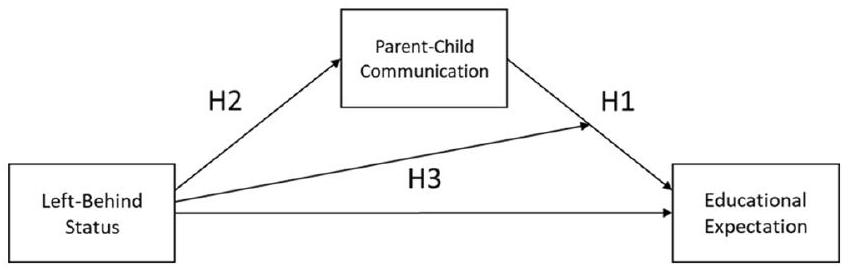
الشكل 1 النموذج المفاهيمي حول علاقات الوساطة المعتدلة بين حالة الأطفال المتروكين، والتواصل بين الوالدين والأطفال، والتوقعات التعليمية.
الفرضية
التواصل بين الوالدين والأطفال عبر مجموعات ريفية مختلفة. بينما يتم التعرف على العلاقة الإيجابية بين التواصل بين الوالدين والأطفال وتوقعات الطلاب الريفيين التعليمية، قد تؤثر هجرة الآباء على توقعات الطلاب الريفيين التعليمية بسبب انخفاض التواصل بين الوالدين والأطفال. أسباب هذا الانخفاض في التواصل بين الوالدين والأطفال مزدوجة. أولاً، تعني الفجوة الجسدية الناتجة عن الهجرة بين الوالدين المهاجرين وأطفالهم المتروكين تقليل الاتصال المباشر. خاصة بالنسبة للآباء الذين ينتقلون عبر خطوط المقاطعات، فإن عيد رأس السنة الصينية هو تقريبًا الوقت الوحيد في السنة الذي يمكنهم فيه العودة إلى الوطن ومقابلة أطفالهم شخصيًا (يي وبان، 2011). بالإضافة إلى ذلك، على الرغم من أن الأطفال المتروكين يعيشون مع أحد الوالدين، فإن تواصلهم بين الوالدين والأطفال يميل إلى أن يكون ضئيلاً. غالبًا ما لا يكون الآباء غير المهاجرين الذين يقيمون مع أطفالهم في القرى الريفية ربات بيوت أو ربات منازل، بل عمال بدوام كامل (مثل العمل الزراعي أو الوظائف اليومية المدفوعة في الصناعة المحلية/البناء) (مورفي، 2020). وقتهم وطاقتهم للتواصل بين الوالدين والأطفال بعد العمل محدودة.
ثانيًا، بديل للمحادثة المباشرة بين الوالدين المهاجرين وأطفالهم المتروكين هو التواصل عبر الإنترنت. أظهرت دراسة أن حوالي تسعين في المئة من التواصل بين الوالدين والأطفال بين الآباء المهاجرين الصينيين وأطفالهم المتروكين يحدث افتراضيًا (دوان وآخرون 2014). ومع ذلك، من المحتمل أن يشارك الآباء المهاجرون في المدن في وظائف ثانوية وخدمية ذات أجر منخفض تتميز بجدول عمل غير منتظم وساعات عمل طويلة (رين وآخرون 2017). هذا يقيد التواصل عبر الإنترنت بين الآباء المهاجرين وأطفالهم المتروكين (لي ولي، 2007؛ تونغ وآخرون 2015). بالإضافة إلى ذلك، هناك نقص في الأجهزة الذكية في الأسر الريفية لاستخدامها في التواصل بين الوالدين والأطفال (شيو، 2016)، لكن هذا ليس فقط لأسباب مالية. على الرغم من أن العديد من الآباء المهاجرين قادرون على شراء أجهزة ذكية، فإنهم يختارون عدم القيام بذلك، لسببين رئيسيين. أولاً، عندما ينتقل كلا الوالدين إلى المدن للعمل، قد لا يعرف الأجداد المسنون والأطفال المتروكون كيفية استخدام الأجهزة الذكية (يي وبان، 2011). ثانيًا، على الرغم من أن بعض الأطفال المتروكين أو الأطفال المتروكين قد أتقنوا مهارات الهاتف الأساسية، قد يقيد والديهم وصولهم إلى الأجهزة الذكية لأن إدمان الإنترنت والانحرافات الشبابية ذات الصلة تمثل مصدر قلق كبير بين الأطفال المتروكين دون إشراف ورعاية كافية من الوالدين (شيو، 2016؛ رين وآخرون 2017).
وثقت الدراسات التجريبية مستوى أقل من التواصل بين الوالدين والأطفال بعد هجرة الآباء (وانغ وآخرون 2019؛ تشاو وتشين، 2022؛ سو وآخرون 2013؛ وانغ وآخرون 2015؛ سو وآخرون 2017). على سبيل المثال، وجدت التحليل المقارن لتشاو وتشين (2022)، باستخدام مجموعة بيانات تمثيلية وطنية، أن متوسط درجة التواصل بين الوالدين والأطفال للأطفال المتروكين كان
الفرضية
بالنظر إلى
الدور المعتدل لحالة الأطفال المتروكين. بخلاف النطاق المنخفض، لاحظت الدراسات أن هجرة الآباء تؤثر أيضًا على محتوى وعمق التواصل بين الوالدين المهاجرين وأطفالهم المتروكين (وانغ وآخرون 2015؛ وانغ وآخرون 2019). كشفت دراسة ليو وليونغ (2017) شملت 378 والدًا مهاجرًا من جنوب الصين أن تواصل الآباء المهاجرين مع أطفالهم يميل إلى أن يكون قصيرًا وسطحياً وفوريًا، غالبًا لأغراض الوصول الفوري والطمأنينة، والمعاملات عبر الإنترنت، والمودة، والاسترخاء. كان لدى يي وبان (2011) نفس الملاحظة – أن التواصل الذي يبدأه الآباء المهاجرون يركز على الصحة والسلامة. قد يسألون فقط عن روتينهم اليومي وأدائهم الأكاديمي ولا يشاركون في محادثات أعمق معهم بشأن الأحداث في المدرسة. أفاد ما يقرب من ثلاثة أرباع الطلاب المتروكين الذين شاركوا في استبيان يي وبان (2011) أن محادثاتهم عبر الإنترنت مع آبائهم المهاجرين استمرت
بعيدًا عن قيودها في النقل المباشر للقيم التعليمية بين الأجيال، يهدد التواصل السطحي بين الوالدين المهاجرين وأطفالهم المتروكين الروابط العائلية. اقترحت الدراسة التي أجراها دوان وآخرون (2014) أن
قد تهدد التواصل عبر الإنترنت بين الآباء والأبناء ليس فقط الصحة النفسية للأطفال المتروكين، ولكن أيضًا إدراكهم التعليمي. الأطفال الذين يفشلون في فهم جهود والديهم المهاجرين لتحسين الوضع الاقتصادي للأسرة قد يشعرون بالتخلي ويعانون من التوتر لأنهم يدركون نقص الدعم في تحقيق أهدافهم الأكاديمية (ليانغ وما 2004؛ تشين وآخرون 2023). وبالتالي، بالإضافة إلى فرضيتينا الأوليين، نتوقع أيضًا أن عدد الآباء المقيمين قد يعزز تأثير التواصل بين الآباء والأبناء على توقعات الأطفال التعليمية. وبناءً عليه، نفترض أن (انظر الشكل 1):
فرضية
المنهجية
البيانات. تستند الدراسة إلى بيانات طولية من CEPS (الموجتين الأولى والثانية). تم إطلاق CEPS من قبل مركز أبحاث المسح الوطني في جامعة رينمين في الصين، وهو مسح longitudinal تمثيلي على مستوى البلاد في الصين. يجمع معلومات شاملة من طلاب المدارس المتوسطة، وأولياء أمورهم، والمعلمين، ويحقق في تأثير السياقات الأسرية، وعمليات المدرسة، وهياكل المجتمع والمجتمع على نتائج التعليم للطلاب (شين 2020). سمة أخرى حاسمة لـ CEPS هي أنه يحتوي على موجتين من البيانات. تتيح لنا البيانات الطولية فحص التأثير الزمني لـ اليسار-
خلفية الوضع حول تواصل الآباء والأبناء لدى الطلاب الريفيين وتوقعاتهم التعليمية، والتي قد تكون أفضل من التأثير المتزامن. يتم تقديم تفاصيل حول التحكم في التأثيرات الذاتية في القسم الخاص باستراتيجية التحليل.
خلفية الوضع حول تواصل الآباء والأبناء لدى الطلاب الريفيين وتوقعاتهم التعليمية، والتي قد تكون أفضل من التأثير المتزامن. يتم تقديم تفاصيل حول التحكم في التأثيرات الذاتية في القسم الخاص باستراتيجية التحليل.
تم تطبيق طريقة أخذ العينات متعددة المراحل مع احتمالات تتناسب مع الحجم. في البداية، تم اختيار 28 وحدة أخذ عينة أولية من إجمالي 2870 مقاطعة أو منطقة من نفس المستوى. ثانياً، تم اختيار أربع مدارس من جميع المدارس التي تخدم الصفين السابع والتاسع ضمن الـ 28 وحدة أخذ عينة أولية. في المرحلة الثالثة، تم اختيار فصلين دراسيين من الصف السابع وفصلين دراسيين من الصف التاسع بشكل عشوائي من كل مدرسة عينة. أخيراً، تم دعوة جميع الطلاب من الفصل المختار لإكمال الاستبيان، الذي تم إدارته في شكل استبيان.
المشاركون. شملت دراسة الموجة الأولى 19,487 طالبًا في الصف السابع والتاسع في 2013-2014. تم إجراء دراسة الموجة الثانية بعد عام واحد مع 10,279 طالبًا من الصف السابع فقط من دراسة الموجة الأولى. من بين هؤلاء، تم متابعة 9449 طالبًا بنجاح، بينما فقد 830 طالبًا بسبب الانتقال إلى مدارس أخرى والانسحاب. في موجة 2013-2014، كان 7997 من هؤلاء
إجراءات
حالة الأطفال المتروكين. تشير حالة الأطفال المتروكين إلى عدد الآباء الذين يعيشون معهم في القرى الريفية. تم تصنيف الطلاب الريفيين إلى أطفال غير متروكين يعيشون مع كلا الوالدين (NLBC؛ حالة المتروكين
| الجدول 1 الخصائص السكانية للمشاركين. | ||
| الخصائص السكانية | التردد (
|
نسبة مئوية (%) |
| جنس | ||
| ذكر | ١١٢٥ | 50.6 |
| أنثى | 1099 | ٤٩.٤ |
| عمر | ||
| 12 | 63 | 2.8 |
| ١٣ | 1009 | ٤٥.٢ |
| 14 | 938 | 42.1 |
| 15 | 187 | ٨.٤ |
| 16 | 31 | 1.4 |
| 17 | 1 | 0.04 |
| 18 | 1 | 0.04 |
| حالة الطفل الوحيد | ||
| طفل وحيد | 612 | ٢٦.٩ |
| غير الطفل الوحيد | 1663 | 73.1 |
| حالة المتروكين (عدد الوالدين المقيمين) | ||
| 0 | ٣٣٠ | 14.5 |
| 1 | 297 | 13.1 |
| 2 | 1648 | 72.4 |
التواصل بين الوالدين والطفل. تم قياس التواصل بين الوالدين والطفل في الموجة الأولى باستخدام 10 عناصر. طُلب من المشاركين تقييم تكرار تواصل والديهم (الأب والأم بشكل منفصل؛ خمسة أسئلة لكل منهما) معهم بشأن الأمور التي حدثت في المدرسة، وعلاقاتهم مع الأصدقاء، وعلاقاتهم مع المعلمين، ومزاجهم، وأفكارهم ومشاكلهم. تم حذف السؤال الرابع (المزاج) من الموجة الأولى في الموجة الثانية. لجعل مقاييس التواصل بين الوالدين والطفل في الموجتين قابلة للمقارنة، قمنا بإزالة السؤال الرابع من الموجة الأولى واختيار نفس الأسئلة الأربعة (8 عناصر إجمالاً) لبناء مقياس التواصل بين الوالدين والطفل. تم استخدام مقياس مشابه في دراسات سابقة لقياس التواصل بين الوالدين الصينيين في المناطق الريفية وأطفالهم (على سبيل المثال، سو وآخرون 2013). أظهر مقياسنا المكون من 8 عناصر موثوقية جيدة في كلا الموجتين.
التوقعات التعليمية. تُعرّف التوقعات التعليمية على أنها المستوى الذي يرغب الأفراد في تحقيقه في المدرسة. في كلا الموجتين، تم قياس توقعات المراهقين التعليمية من خلال عنصر واحد (ما هو أعلى مستوى من التعليم تتوقع أن تحصل عليه؟)، والذي تم تطبيقه على نطاق واسع في الدراسات الدولية (فليسيانو، 2006؛ ريمكوتي وآخرون، 2012؛ يو وداراغانوفا، 2015). كانت الإجابات المحتملة هي “التسرب الآن”، “التخرج من المدرسة الإعدادية”، “الذهاب إلى المدرسة الثانوية الفنية أو المدرسة الفنية”، “الذهاب إلى المدرسة الثانوية المهنية”، “الذهاب إلى المدرسة الثانوية العامة”، “التخرج من الكلية المتوسطة”، “الحصول على درجة البكالوريوس”، و”الحصول على درجة الماجستير”، و”الحصول على درجة الدكتوراه”. تم ترميز الردود بشكل مستمر من 1 (التسرب الآن) إلى 9 (الحصول على درجة الدكتوراه).
متغير التحكم. أولاً، تشير نظرية رأس المال لبورديو إلى انتقال رأس المال الاقتصادي العائلي إلى توقعات الطلاب التعليمية وإنجازاتهم اللاحقة (دينغ وو، 2023). أي أن الطلاب الذين يمتلكون موارد تعليمية أفضل من المرجح أن تكون لديهم توقعات تعليمية أعلى. ثانياً، وجدت الدراسات في سياق ريفي صيني أن الفتيات والأبناء الوحيدين من المرجح أن يتلقوا مزيدًا من التواصل من والديهم مقارنةً بالأطفال من عائلات متعددة الأطفال والأولاد، على التوالي (ليو وجيانغ 2021). ثالثاً، تشير الأبحاث في الصين وخارجها إلى أن الآباء الذين يمتلكون مؤهلات تعليمية أعلى يميلون إلى التفاعل بشكل أكثر تكرارًا مع أطفالهم لأنهم أكثر ثقة في القيام بذلك (هان 2023؛ يوي وآخرون 2017). رابعاً، توجد اختلافات بين الطلاب من الجنسين والدرجات المختلفة فيما يتعلق بتوقعاتهم من تحصيلهم التعليمي (ريغسبي وآخرون 2013). لذلك، بالإضافة إلى التحكم في مقاييس الأساس في التحليل (انظر استراتيجية التحليل أدناه)، قمنا أيضًا بالتحكم في العمر، وحالة الطفل الوحيد (
استراتيجية التحليل. لاختبار نموذجنا المفاهيمي في الشكل 1، تم استخدام تحليل المسار مع إجراء من خطوتين. في الخطوة 1، تم اختبار نموذج الوساطة لفحص تأثير الوساطة للتواصل بين الوالدين والأطفال على العلاقة بين حالة البقاء خلف الأهل وتوقعات التعليم (للفرضيتين 1 و2). على وجه التحديد، تم تحليل التواصل بين الوالدين والأطفال في الوقت 2 بناءً على حالة البقاء خلف الأهل في الوقت 1، بينما تم تحليل توقعات التعليم في الوقت 2 بناءً على كل من التواصل بين الوالدين والأطفال.
| الجدول 2 الإحصائيات الوصفية والارتباطات الثنائية بين المتغيرات. | |||||||||
| م (انحراف معياري) | 1 | ٢ | ٣ | ٤ | |||||
| 1. LBS1 | – | – | |||||||
| 2. PCC1 | 16.52 (3.87) | 0.11 | *** | – | |||||
| 3. PCC2 | 16.58 (3.99) | 0.13 | *** | 0.44 | *** | – | |||
| 4. EE1 | 6.90 (1.66) | 0.02 | 0.19 | *** | 0.14 | *** | – | ||
| 5. EE2 | 6.63 (1.60) | 0.04 | † | 0.15 | *** | 0.20 | *** | 0.52 | *** |
| ملاحظة. حالة LBS1 المتروكة في الوقت 1، PCC1 التواصل بين الوالدين والطفل في الوقت 1، PCC2 التواصل بين الوالدين والطفل في الوقت 2، EE1 التوقعات التعليمية في الوقت 1، EE2 التوقعات التعليمية في الوقت 2.
|
|||||||||
التواصل في الوقت 2 وحالة المتروكين في الوقت 1. الخطوة 2، التي بُنيت على نموذج الوساطة، فحصت التأثير المعتدل لحالة المتروكين على العلاقة بين التواصل بين الوالدين والأطفال والتوقعات التعليمية (للفرضية 3). على وجه التحديد، بخلاف التواصل بين الوالدين والأطفال في الوقت 2 وحالة المتروكين في الوقت 1، تم إجراء تحليل إضافي للتوقعات التعليمية بناءً على مصطلح التفاعل بين التواصل بين الوالدين والأطفال في الوقت 2 وحالة المتروكين في الوقت 1. في هذه الخطوة، تم استخدام تحليل الميل البسيط أيضًا لتوضيح نمط التعديل. بشكل عام، سيوضح النموذج الذي تم اختباره في الخطوة 2 ما إذا كان التأثير الوسيط للتواصل بين الوالدين والأطفال يعتمد على حالة المتروكين، مما يؤدي إلى نموذج وساطة معتدلة (انظر النموذج 74 في هايز (2018) والنموذج 1 في بريشر وآخرون (2007)). تم اتباع مواصفات نموذجنا واختبار مؤشر الوساطة المعتدلة وفقًا لهايز (2018) وبريشر وآخرون (2007). من الجدير بالذكر أنه، عبر الخطوتين 1 و 2، سيتم التحكم في التأثيرات الذاتية للتواصل بين الوالدين والأطفال والتوقعات التعليمية حيث سيتم تحليل التواصل بين الوالدين والأطفال والتوقعات التعليمية في الوقت 2 بناءً على التواصل بين الوالدين والأطفال والتوقعات التعليمية في الوقت 1.
النتائج
الإحصائيات الوصفية. تم تلخيص الإحصائيات الوصفية والارتباطات الثنائية في الجدول 2. بما يتماشى مع النتائج السابقة (مثل، تشاو وتشين، 2022؛ وانغ وآخرون، 2019؛ جوانغ وآخرون، 2017)، كانت درجة التواصل بين الوالدين والأطفال التي يتلقاها الأطفال الريفيون في الوقت 2 مرتبطة إيجابيًا بعدد الوالدين المقيمين معهم في القرى.
أثر الوساطة في التواصل بين الوالدين والطفل. في الخطوة 1، تم إنشاء نموذج الوساطة لفحص أثر الوساطة للتواصل بين الوالدين والطفل بين حالة ترك الأطفال وتوقعات التعليم. أظهرت تحليل المسار أن نموذج الوساطة كان له ملاءمة جيدة مع البيانات.
الجدول 3 نتائج تحليل المسار في نماذج الوساطة والوساطة التعديلية.
| نموذج الوساطة الخطوة 1 | الخطوة 2 نموذج الوساطة المعتدلة | |||||
|
|
|
|
|
|
|
|
| النتيجة: PCC2 | ||||||
| PCC1 | 0.449 | 0.435 | <0.001 | 0.449 | 0.435 | <0.001 |
| LBS1 | 0.413 | 0.076 | <0.001 | 0.413 | 0.076 | <0.001 |
| النتيجة: EE2 | ||||||
| EE1 | 0.489 | 0.507 | <0.001 | 0.487 | 0.505 | <0.001 |
| PCC2 | 0.050 | 0.126 | <0.001 | 0.018 | 0.044 | 0.283 |
| LBS1 | 0.022 | 0.010 | 0.566 | -0.315 | -0.144 | 0.043 |
| PCC2 | ||||||
| ملاحظة. حالة LBS1 المتروكة في الوقت 1، PCC1 التواصل بين الوالدين والطفل في الوقت 1، PCC2 التواصل بين الوالدين والطفل في الوقت 2، EE1 التوقعات التعليمية في الوقت 1، EE2 التوقعات التعليمية في الوقت 2. | ||||||
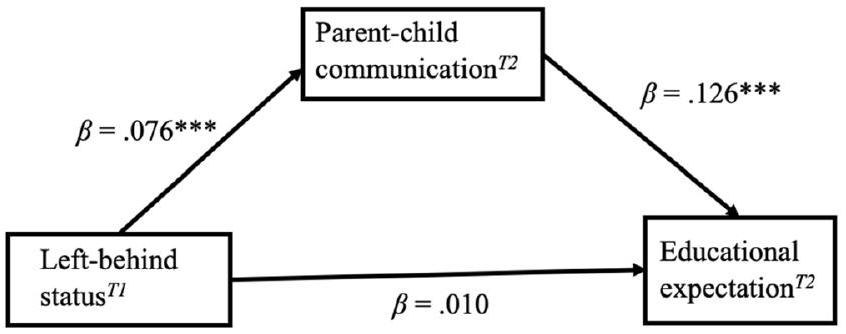
الشكل 2 نموذج الوساطة المعتدلة بين حالة التخلي، والتواصل بين الوالدين والطفل، والتوقعات التعليمية. ملاحظة.
تم التحكم في التأثيرات الذاتية للتواصل بين الوالدين والأطفال وتوقعات التعليم في النموذج. يمثل المسار العريض تأثير التعديل لحالة ترك الأطفال التي تم اختبارها في الخطوة 2. *
الوقت
أثر الحالة المتروكة كعامل معتدل. في الخطوة 2، استنادًا إلى نموذج الوساطة في الخطوة 1، قمنا بمزيد من الفحص لمعرفة ما إذا كانت الحالة المتروكة ستعدل العلاقة بين الوالد والطفل
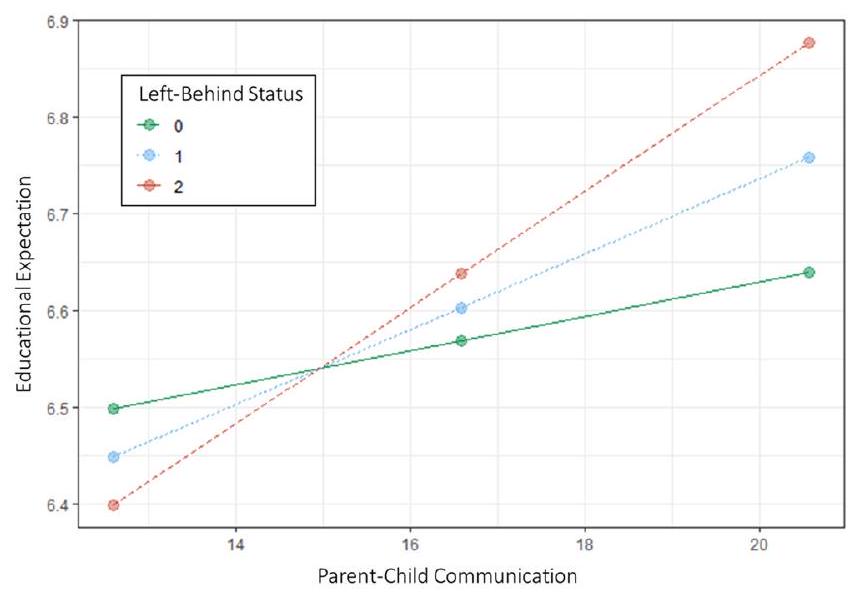
الشكل 3 رسم بياني للمنحدر البسيط لتأثير حالة البقاء خلفًا على العلاقة بين التواصل بين الوالدين والطفل والتوقعات التعليمية.
التواصل وتوقعات التعليم، مما أسفر عن نموذج وساطة معتدل مقترح في الشكل 1. مشابهًا لنموذج الوساطة، كان نموذج الوساطة المعتدل مناسبًا للبيانات بشكل جيد،
من خلال أخذ الخطوتين 1 و 2 معًا في نموذج الوساطة المعدلة، قمنا بفحص ما إذا كان تأثير الوساطة للتواصل بين الوالدين والأطفال يختلف عبر مستويات مختلفة من حالة البقاء خلفًا. وفقًا لـ هايز (2018)، تم حساب مؤشر الوساطة المعدلة ووجد أنه ذو دلالة إحصائية.
تم اختبار نفس مجموعات تحليلات المسار في الخطوتين 1 و 2 مع التحكم في المعلومات الديموغرافية، وهي: العمر، الجنس، حالة الطفل الوحيد، مستوى تعليم الوالدين، الوضع الاقتصادي للأسرة، والموارد التعليمية. لم تكشف النتائج الرئيسية عن تغيير كبير. يتم تقديم معاملات المسار في هذه النماذج في الجدول A1 في الملحق.
نقاش
الشباب هم أصول قيمة للأمة. أكثر من 70 مليون طفل من الأطفال المتروكين في الريف في الصين هم مفتاح لاستدامة الاقتصاد والتنمية الاجتماعية في الصين (وو وتشين، 2022). مثل الصين، تعاني دول أخرى ذات دخل منخفض/متوسط في آسيا وأفريقيا وأوروبا الشرقية وأمريكا اللاتينية أيضًا من نسب كبيرة من الأطفال المتروكين في الريف بسبب هجرة الآباء الداخلية والدولية (تشو وآخرون، 2023). على سبيل المثال، تشير الإحصائيات إلى أن
أثر التواصل بين الوالدين والأطفال. لم يتم إجراء تحليل تجريبي كبير على تواصل الوالدين والأطفال لدى الأطفال الريفيين الذين لديهم خصائص مختلفة من ترك الوالدين. الدراسات الأكثر صلة أجرت بشكل رئيسي مقارنات بين الطلاب المتروكين (عادةً LBCB) وأقرانهم غير المتروكين. قامت تحليلنا الكمي المقارن بتصنيف الطلاب الريفيين الصينيين بشكل أكثر تحديدًا إلى ثلاث مجموعات وفقًا لعدد الوالدين الذين يعيشون معهم. أدى هذا المستوى الأكبر من التفاصيل إلى إدراك أن الأطفال الريفيين الذين لديهم عدد أكبر من الوالدين المقيمين من المحتمل أن يتلقوا مستويات أعلى من التواصل بين الوالدين والأطفال. تشير النتائج إلى أن هجرة الوالدين تقلل بشكل كبير من مدى التواصل الأسري بين الوالدين المهاجرين والأطفال المتروكين. بالنسبة لـ LBCB، فإن التواصل عبر الإنترنت الذي يتلقونه لا يعادل التواصل الجسدي الذي يتلقاه أقرانهم غير المتروكين. في عصر الإنترنت، الأجهزة الذكية متاحة بسهولة، وقد لا يكون نقص الأجهزة الرقمية هو السبب الرئيسي في ضعف التواصل عبر الإنترنت بين الوالدين والأطفال (Xu، 2016). بدلاً من ذلك، قد يُعزى ذلك إلى جدول العمل غير المنتظم للوالدين المهاجرين ونواياهم للحد من استخدام أطفالهم المتروكين للهواتف المحمولة و/أو الوصول إلى الإنترنت (Li و Li، 2007؛ Ye و Pan، 2011). بالنسبة لـ LBCS، بالإضافة إلى قلة التواصل عبر الإنترنت من الوالد المهاجر، قد يتلقون أيضًا تواصلًا جسديًا أقل من الوالد المقيم مقارنةً بما يتلقاه أقرانهم غير المتروكين من والديهم. تؤدي الهجرة الداخلية إلى تغيير هيكل الأسرة. من المحتمل أن يتلقى NLBC تواصلًا وفيرًا بين الوالدين والأطفال لأن والديهم يمكن أن يعملوا كفريق من اثنين، مما قد يمنحهم مزيدًا من المرونة في التعامل مع الأنشطة الاقتصادية وتربية الأطفال. على العكس من ذلك، فإن الوالد المقيم الوحيد لـ LBCS – الذي يعيش في قرية ريفية – يجب أن يتحمل كل من المسؤوليات الاقتصادية وتربية الأطفال. غالبًا، نظرًا للمعاناة الاقتصادية للعديد من الأسر الريفية، فإن الحصول على ما يكفي من المال يأتي في المقام الأول على قضاء الوقت مع الأطفال (Murphy، 2020).
ومع ذلك، تلعب التواصل بين الوالدين والأطفال دورًا مهمًا في تطوير التعليم للأطفال. إنه القناة التي يستخدمها الآباء لنقل التوقعات التعليمية والقيم والرعاية لأطفالهم (سيغينر وفيرمولست، 2002). مثل هذه التواصلات اللفظية وغير اللفظية
تُشكّل التعبيرات اللفظية من الآباء مواقف الطلاب التعليمية الخاصة وتعزز من رفاههم النفسي (Froiland et al. 2013; Bireda and Pillay, 2018). في التحليل الحالي، قمنا بالتحقق من العلاقة الإيجابية بين التواصل بين الآباء والأبناء وتوقعات التعليم لدى الطفل في سياق ريفي صيني. يميل الطلاب في المناطق الريفية الذين يتلقون المزيد من التواصل مع آبائهم إلى السعي لتحقيق إنجازات تعليمية أعلى. في الأسر الريفية الصينية، على العموم، على الرغم من أن الظروف الاجتماعية والاقتصادية تقيد الدعم المالي الملموس الذي يمكن أن يتلقاه الأطفال الريفيون، إلا أن التواصل الوفير بين الآباء والأبناء أثبت أنه قادر على بناء دافع التعلم وتوقعات التعليم (Xu and Montgomery, 2021; Chen et al. 2023). أما بالنسبة للأطفال المتروكين بشكل خاص، في حين أن أشكال المشاركة الأبوية الأخرى مقيدة إلى حد كبير بفعل الانفصال الجسدي، يبدو أن التواصل بين الآباء والأبناء هو واحد من الطرق القليلة التي يمكن للآباء المهاجرين من خلالها المشاركة في تعلم ونمو الأطفال. بالإضافة إلى ذلك، تشير المنح الدراسية الدولية إلى أن إجازة الوالدين قد تعطي الأطفال المتروكين انطباعًا خاطئًا عن كونهم مهجورين، مما يؤثر سلبًا على صحتهم النفسية ويضر بدافعهم وتوقعاتهم التعليمية (Su et al. 2013; Coe, 2014). تشير نتائجنا إلى أن التواصل المتكرر بين الآباء والأبناء قد يخفف من هذا التأثير السلبي ويحمي توقعات التعليم للأطفال المتروكين (Wang et al. 2019).
تُشكّل التعبيرات اللفظية من الآباء مواقف الطلاب التعليمية الخاصة وتعزز من رفاههم النفسي (Froiland et al. 2013; Bireda and Pillay, 2018). في التحليل الحالي، قمنا بالتحقق من العلاقة الإيجابية بين التواصل بين الآباء والأبناء وتوقعات التعليم لدى الطفل في سياق ريفي صيني. يميل الطلاب في المناطق الريفية الذين يتلقون المزيد من التواصل مع آبائهم إلى السعي لتحقيق إنجازات تعليمية أعلى. في الأسر الريفية الصينية، على العموم، على الرغم من أن الظروف الاجتماعية والاقتصادية تقيد الدعم المالي الملموس الذي يمكن أن يتلقاه الأطفال الريفيون، إلا أن التواصل الوفير بين الآباء والأبناء أثبت أنه قادر على بناء دافع التعلم وتوقعات التعليم (Xu and Montgomery, 2021; Chen et al. 2023). أما بالنسبة للأطفال المتروكين بشكل خاص، في حين أن أشكال المشاركة الأبوية الأخرى مقيدة إلى حد كبير بفعل الانفصال الجسدي، يبدو أن التواصل بين الآباء والأبناء هو واحد من الطرق القليلة التي يمكن للآباء المهاجرين من خلالها المشاركة في تعلم ونمو الأطفال. بالإضافة إلى ذلك، تشير المنح الدراسية الدولية إلى أن إجازة الوالدين قد تعطي الأطفال المتروكين انطباعًا خاطئًا عن كونهم مهجورين، مما يؤثر سلبًا على صحتهم النفسية ويضر بدافعهم وتوقعاتهم التعليمية (Su et al. 2013; Coe, 2014). تشير نتائجنا إلى أن التواصل المتكرر بين الآباء والأبناء قد يخفف من هذا التأثير السلبي ويحمي توقعات التعليم للأطفال المتروكين (Wang et al. 2019).
في هذا السياق، تساهم التحليل الحالي في توثيق تأثير التواصل بين الوالدين والأبناء كوسيط في العلاقة بين حالة الطلاب الصينيين في المناطق الريفية الذين تُركوا وراءهم وتوقعاتهم التعليمية. إن الانخفاض في عدد الوالدين المقيمين بسبب هجرة الوالدين يؤدي إلى انخفاض في التواصل بين الوالدين والأبناء، مما يؤثر سلبًا على توقعات الطلاب الريفيين التعليمية. على الرغم من أن الدراسات السابقة (مثل، سو وآخرون 2013) قد ناقشت على نطاق واسع العلاقات بين هجرة الوالدين والتواصل بين الوالدين والأبناء، والعلاقة بين التواصل بين الوالدين والأبناء وتوقعات الطلاب التعليمية، لم تقم أي دراسة بفحص الدور الوسيط للتواصل بين الوالدين والأبناء. ربطت هذه الدراسة حالة الطلاب الصينيين في المناطق الريفية الذين تُركوا وراءهم وتوقعاتهم التعليمية بمدى التواصل الذي تلقوه من والديهم ووجدت أن هجرة الوالدين تضر بتوقعات الطلاب الريفيين التعليمية من خلال انخفاض مدى التواصل بين الوالدين والأبناء. وعلى العكس، تبرز التأثير الوقائي للتواصل بين الوالدين والأبناء على توقعات الطلاب الريفيين الذين تُركوا وراءهم. نظرًا للعلاقة الإيجابية المثبتة بين التواصل بين الوالدين والأبناء وتوقعات التعليم لدى الطلاب الريفيين، فإن إحدى الطرق الممكنة لتحسين توقعات التعليم للأطفال الريفيين الذين تُركوا وراءهم هي توفير مستوى أكبر من التواصل بين الوالدين والأبناء (إما التواصل الجسدي مع الوالدين المقيمين أو التواصل عبر الإنترنت مع الوالدين المهاجرين). تتناغم هذه النتيجة، المستندة إلى سكان ريفيين صينيين، مع دراسات مماثلة عبر العديد من المناطق النامية (مثل، أسيز، 2006؛ هوانغ ويهو، 2012؛ غراهام وآخرون 2012). يمكن أيضًا استخلاص استنتاج مشابه، وهو أن التواصل المنتظم والمتكرر بين الوالدين والأبناء يحسن من قدرة الطلاب الذين تُركوا وراءهم على التكيف ويحافظ على موقفهم الإيجابي وقيمتهم تجاه التعليم.
أثر حالة ترك الأطفال. بالإضافة إلى الأثر الوسيط، تكشف نتائجنا أن حالة ترك الأطفال لدى الطلاب الريفيين تعدل العلاقة الإيجابية بين التواصل بين الوالدين والأطفال وتوقعاتهم التعليمية. لاحظنا أن العلاقة الإيجابية بين التواصل بين الوالدين والأطفال وتوقعات الطلاب التعليمية أقوى بين الطلاب الريفيين الذين لديهم المزيد من الوالدين المقيمين. تشير هذه النتيجة إلى أن التواصل مع الوالدين يؤثر بشكل مختلف على توقعات التعليم لدى الطلاب الريفيين اعتمادًا على خصائصهم المتعلقة بالترك.
قد يكمن السبب في الاختلاف في محتوى وعمق التواصل بين الوالدين والأطفال بين كل من المجموعات الثلاث من الأطفال ووالديهم المقيمين والمهاجرين.
قد يكمن السبب في الاختلاف في محتوى وعمق التواصل بين الوالدين والأطفال بين كل من المجموعات الثلاث من الأطفال ووالديهم المقيمين والمهاجرين.
أشارت الدراسات التجريبية المتعلقة بالهجرة الداخلية والدولية باستمرار إلى أن التواصل عبر الإنترنت بين الوالدين المهاجرين وأطفالهم المتروكين لا يمكن مقارنته بالتفاعل وجهًا لوجه (ليو وليونغ، 2017؛ ماهلر، 2001؛ هوانغ وييو، 2012؛ أسيز 2006). على سبيل المثال، أكد الوالدان المهاجران الفلبينيان في بحث أسيز (2006) أن التواصل بين الوالدين والأطفال ليس مجرد حديث بل هو قناة للحفاظ على الترابط وتعزيزه. وقد عبروا عن الصعوبة المحبطة في الانخراط في محادثات عميقة مع الأطفال والحفاظ على علاقات أسرية وثيقة من خلال الأجهزة الرقمية. في الصين، أشارت الدراسات أيضًا إلى أن التواصل عبر الإنترنت بين الأطفال المتروكين ووالديهم المهاجرين محدود في العمق (يي وبان، 2011؛ سو وآخرون 2013). يُبلغ عن أن محتوى الحوار عبر الإنترنت سطحي؛ فهو يتناول العديد من جوانب تعليم وحياة الأطفال الريفيين ولكن دون تبادلات ومشاركة عميقة. هذا التواصل الافتراضي بين الوالدين المهاجرين وأطفالهم المتروكين لا يعوق فقط نقل القيم والمعتقدات التعليمية عبر الأجيال ولكنه يعيق أيضًا تقديم الرعاية والدفء الأبوي. وهذا له تأثير سلبي مزدوج على توقعات التعليم لدى الطلاب الريفيين.
من خلال أخذ الآثار الوسيطة والمعدلة الملاحظة معًا، تدعم النتائج الحالية نموذج الوساطة المعدلة فيما يتعلق بحالة ترك الأطفال الريفيين، وتواصلهم مع والديهم، وتوقعاتهم التعليمية. تشير نتائجنا إلى أن الانفصال الجسدي عن الأطفال الناتج عن هجرة الوالدين لا يقلل فقط من درجة التواصل بين الوالدين والأطفال بين الوالدين المهاجرين وأطفالهم المتروكين ولكنه يضعف أيضًا تأثير التواصل بين الوالدين والأطفال على توقعات التعليم لدى الأطفال الريفيين.
القيود. بينما نعتقد أن نتائج هذا التحليل الممثل وطنيًا تعزز فهمنا للعلاقة المعقدة بين توقعات الوالدين وتطور المراهقين، يجب ملاحظة بعض المخاوف المتعلقة بمقاييس البحث والإطار المفاهيمي. أولاً، فيما يتعلق بتوقعات التعليم، فإن المقياس الذي تم تطبيقه من قبل CFPS يتعلق بتوقعات الطلاب لتحقيق إنجازاتهم التعليمية على المدى الطويل. تم اعتبار توقعات الطلاب لتحقيق إنجازاتهم الأكاديمية على المدى القصير (مثل درجات الامتحانات) أيضًا على نطاق واسع في الدراسات والاستطلاعات الدولية، وإدراجها في نموذجنا قد يكمل نتائجنا. من المحتمل أن يؤثر التواصل بين الوالدين والأطفال على مواقف الطلاب الريفيين تجاه أدائهم الأكاديمي على مدى فترة أقصر. بالإضافة إلى ذلك، على الرغم من أن مقاييس التواصل بين الوالدين والأطفال وتوقعات التعليم المستخدمة هنا قد تم استخدامها على نطاق واسع في الدراسات الدولية وتم التحقق من موثوقيتها وصلاحيتها، إلا أنها مقاييس ذاتية قد تتعرض لتحيز الرغبة الاجتماعية وتحقيق الذكريات. يجب أن تستخدم الدراسات المستقبلية طرق جمع بيانات متعددة – مثل الملاحظات السلوكية، والمقابلات الثنائية، وتقارير الوالدين – لتوليد بيانات أكثر موضوعية. يمكن أن توفر بيانات المقابلات النوعية من المقابلات الفردية المتعمقة مع الطلاب المتروكين أو المقابلات الثنائية مع الطلاب المتروكين ووالديهم فهمًا أعمق وأكثر دقة لتأثير هجرة الوالدين على تكرار وعمق التواصل بين الوالدين والأطفال وتأثير التواصل بين الوالدين والأطفال على توقعات التعليم لدى الطلاب.
قيود أخرى هي التباين في العلاقة بين التواصل بين الوالدين والأطفال وتوقعات التعليم بين الأطفال المتروكين من قبل الأم أو الأب. نحن
ندرك الآثار غير المتسقة للتواصل الأمومي والأبوي على توقعات التعليم لدى الأطفال. ومع ذلك، نظرًا لأن عدد الأطفال المتروكين في عيّنتنا كان صغيرًا (
ندرك الآثار غير المتسقة للتواصل الأمومي والأبوي على توقعات التعليم لدى الأطفال. ومع ذلك، نظرًا لأن عدد الأطفال المتروكين في عيّنتنا كان صغيرًا (
الآثار العملية. تحتوي النتائج الحالية على عدة آثار عملية لتعزيز توقعات التعليم لدى الأطفال المتروكين في المناطق الريفية. على الرغم من أن الانفصال الناتج عن الهجرة يشكل تهديدًا لتوقعات التعليم لدى الأطفال المتروكين، فإن التواصل المتكرر وعالي الجودة بين الوالدين والأطفال – سواء كان جسديًا أو عبر الإنترنت – يمكن أن يخفف من هذه العلاقة السلبية ويحمي توقعات الأطفال المتروكين بشأن إنجازاتهم التعليمية.
بالنسبة للتواصل بين الوالدين والأطفال، فإن إحدى الطرق لزيادة التواصل الأبوي الذي يتلقاه الأطفال المتروكون هي أن يبدأ الوالدان المهاجران بمزيد من المكالمات الهاتفية أو الرسائل. يمكن للوالدين إنشاء منصات تواصل عبر الإنترنت مستقرة لإجراء محادثات منتظمة عبر الإنترنت مع أطفالهم. يجب أن تكون هذه المنصات سهلة الاستخدام ومتاحة، وتوفر ميزات مثل مكالمات الفيديو، ومشاركة الملفات، وجدولة المهام لتعزيز التفاعلات المنتظمة والمعنوية. تتطلب هذه التعاون من مقدمي الرعاية المحليين ومعلمي المدارس حيث أن الطلاب المتروكين عادةً لا يمتلكون أجهزة ذكية خاصة بهم. يمكن للوالدين المهاجرين تحديد وقت مع الأجداد، لأولئك الذين يعيشون في المنزل، أو مع معلمي المدارس، لأولئك الذين يقيمون في المدارس، لإجراء محادثات منتظمة عبر الإنترنت مع أطفالهم. علاوة على ذلك، يجب على المكاتب التعليمية المحلية والمنظمات غير الحكومية تنظيم ورش عمل لتعليم مهارات الأبوة والأمومة للوالدين المهاجرين للتركيز على استراتيجيات التواصل عن بُعد، وحل النزاعات، والروابط العاطفية مع أطفالهم المتروكين. يمكن تقديم هذه الورش عبر الإنترنت أو من خلال مراكز المجتمع المحلية. وبالمثل، يجب توفير الدعم والتدريب لمقدمي الرعاية المحليين المسؤولين عن تسهيل التواصل بين الوالدين المهاجرين وأطفالهم المتروكين. يمكن أن يشمل ذلك إرشادات حول مراقبة وقت الشاشة واستخدام الإنترنت للأطفال، وحل المشكلات التقنية، وخلق بيئة ملائمة لتفاعلات الوالدين والأطفال. على مستوى المدرسة، يُوصى بتدخلات قائمة على المدرسة تدمج أنشطة التواصل بين الوالدين والأطفال في المنهج الدراسي للأطفال المتروكين. يمكن أن يتضمن ذلك تخصيص وقت مخصص لمكالمات الفيديو مع الوالدين، وإنشاء مشاريع كتابة رسائل أو رسائل فيديو، أو تنظيم فعاليات عائلية يمكن أن يشارك فيها الوالدين المهاجرين افتراضيًا.
بالإضافة إلى التواصل المنتظم والمتكرر عبر الإنترنت، فإن الزيارات المنزلية الأكثر تكرارًا هي علاج آخر محتمل، إذا كانت الأوضاع المالية للعائلة تسمح بذلك. أما بالنسبة لـ LBCS، فبخلاف زيادة تواصلهم مع الوالد المهاجر، قد تكون الحلول الأكثر قابلية للتطبيق هي تكثيف المحادثات الجسدية مع الوالد المقيم. بالإضافة إلى توسيع العلاقة بين الوالد والطفل.
نقترح أيضًا أن يحتاج كل من الآباء المهاجرين والآباء المقيمين إلى الاستفسار بعمق، من خلال التواصل بين الآباء والأبناء، عن التعليم المدرسي للأطفال المتروكين، والحالة النفسية، والعلاقات الشخصية. يمكن أن يمكّن ذلك الآباء من تقديم الرعاية والدفء لأطفالهم المتروكين والحفاظ على الروابط النفسية للعائلة. وبالمثل، يجب على الآباء استغلال الفرصة للتعبير عن قيمهم التعليمية وتوقعاتهم لأطفالهم المتروكين للتأثير على توقعات الجيل القادم التعليمية. يجب تنفيذ برامج تدخل ذات صلة لتنمية مهارات واستراتيجيات التواصل لدى الآباء الريفيين مع أطفالهم المتروكين لتحسين تقديم رعايتهم الأبوية، وقيمهم التعليمية، ومواقفهم.
نقترح أيضًا أن يحتاج كل من الآباء المهاجرين والآباء المقيمين إلى الاستفسار بعمق، من خلال التواصل بين الآباء والأبناء، عن التعليم المدرسي للأطفال المتروكين، والحالة النفسية، والعلاقات الشخصية. يمكن أن يمكّن ذلك الآباء من تقديم الرعاية والدفء لأطفالهم المتروكين والحفاظ على الروابط النفسية للعائلة. وبالمثل، يجب على الآباء استغلال الفرصة للتعبير عن قيمهم التعليمية وتوقعاتهم لأطفالهم المتروكين للتأثير على توقعات الجيل القادم التعليمية. يجب تنفيذ برامج تدخل ذات صلة لتنمية مهارات واستراتيجيات التواصل لدى الآباء الريفيين مع أطفالهم المتروكين لتحسين تقديم رعايتهم الأبوية، وقيمهم التعليمية، ومواقفهم.
توفر البيانات
تتوفر مجموعات البيانات التي تم إنشاؤها و/أو تحليلها خلال الدراسة الحالية في مسح التعليم في الصين، [http:// ceps.ruc.edu.cn/Arabic/نظرة عامة/نظرة عامة.htm]. مجموعة البيانات (بصيغة .xlsx) لهذا التحليل المحدد متاحة في مستودع داتافيرس، [https://doi.org/10.7910/DVN/ZWBRX0].
تاريخ الاستلام: 27 مارس 2024؛ تاريخ القبول: 19 ديسمبر 2024؛
نُشر على الإنترنت: 02 يناير 2025
نُشر على الإنترنت: 02 يناير 2025
References
Abbasi BN, Luo Z, Sohail A (2023) Effect of parental migration on the noncognitive abilities of left-behind school-going children in rural China. Hum Soc Sci Commun 10(1):1-14
Abbasi BN, Luo Z, Sohail A, Shasha W (2022) Research on non-cognitive ability disparity of Chinese adolescent students: a rural-urban analysis. Glob Econ Rev 51(2):159-174
Andres L, Adamuti-Trache M, Yoon ES, Pidgeon M, Thomsen JP (2007) Educational expectations, parental social class, gender, and postsecondary attainment: a 10 year perspective. Youth Soc 39(2):135-163
Asis MM (2006) Living with migration: experiences of left-behind children in the Philippines. Asian Popul Stud 2(1):45-67
Bandura A (1997). Self-efficacy and health behaviour. In: Baum A, Newman S, Wienman J, West R & McManus C (Eds.) Cambridge handbook of psychology, health and medicine, Cambridge University Press, pp 678
Bennett R, Hosegood V, Newell ML, McGrath N (2015) An approach to measuring dispersed families with a particular focus on children ‘left behind’ by migrant parents: findings from rural South Africa. Popul Space Place 21(4):322-334. https://doi.org/10.1002/psp. 1843
Bireda AD, Pillay J (2018) Perceived parent-child communication and well-being among Ethiopian adolescents. Int J Adolescence Youth 23(1):109-117
Bozick R, Alexander K, Entwisle D, Dauber S, Kerr K (2010) Framing the future: revisiting the place of educational expectations in status attainment. Soc Forces 88(5):2027-2052. https://doi.org/10.1353/sof.2010.0033
Ceka A, Murati R (2016) The role of parents in the education of children. J Educ Pract 7(5):61-64
Chen LJ, Yang DL & Ren Q (2015) Report on the state of children in China. Chicago, IL: Chapin Hall at the University of Chicago. https:// d3qi0qp55mx5f5.cloudfront.net/beijing/i/docs/CFPS-Report-20161.pdf Accessed 0ct 2015
Chen X, Allen JL, Flouri E, Cao X & Hesketh T (2023) Parent-child communication about educational aspirations: experiences of adolescents in rural China. J Child Family Stud 32:2776-2788
Coe C (2014) The scattered family: parenting, African migrants, and global inequality. University of Chicago Press
Coleman JS (2001) Social capital in the creation of human capital. Am J Sociol 94:S95-S120
Ding Q, Wu Q (2023) Effects of economic capital, cultural capital and social capital on the educational expectation of Chinese migrant children. Appl Res Qual Life 18(3):1407-1432
Dominguez GB & Hall BJ (2022) The health status and related interventions for children left behind due to parental migration in the Philippines: a scoping review. Lancet Reg Health West Pac 28:100566
Dong B, Yu D, Ren Q, Zhao D, Li J, Sun YH (2019) The resilience status of Chinese left-behind children in rural areas: a meta-analysis. Psychol Health Med 24(1):1-3
Duan C, Lv L, Wang Z (2014) Research on left-behind children’s home education and school education. Peking. Univ. Educ. Rev. 12(3):13-29
Abbasi BN, Luo Z, Sohail A, Shasha W (2022) Research on non-cognitive ability disparity of Chinese adolescent students: a rural-urban analysis. Glob Econ Rev 51(2):159-174
Andres L, Adamuti-Trache M, Yoon ES, Pidgeon M, Thomsen JP (2007) Educational expectations, parental social class, gender, and postsecondary attainment: a 10 year perspective. Youth Soc 39(2):135-163
Asis MM (2006) Living with migration: experiences of left-behind children in the Philippines. Asian Popul Stud 2(1):45-67
Bandura A (1997). Self-efficacy and health behaviour. In: Baum A, Newman S, Wienman J, West R & McManus C (Eds.) Cambridge handbook of psychology, health and medicine, Cambridge University Press, pp 678
Bennett R, Hosegood V, Newell ML, McGrath N (2015) An approach to measuring dispersed families with a particular focus on children ‘left behind’ by migrant parents: findings from rural South Africa. Popul Space Place 21(4):322-334. https://doi.org/10.1002/psp. 1843
Bireda AD, Pillay J (2018) Perceived parent-child communication and well-being among Ethiopian adolescents. Int J Adolescence Youth 23(1):109-117
Bozick R, Alexander K, Entwisle D, Dauber S, Kerr K (2010) Framing the future: revisiting the place of educational expectations in status attainment. Soc Forces 88(5):2027-2052. https://doi.org/10.1353/sof.2010.0033
Ceka A, Murati R (2016) The role of parents in the education of children. J Educ Pract 7(5):61-64
Chen LJ, Yang DL & Ren Q (2015) Report on the state of children in China. Chicago, IL: Chapin Hall at the University of Chicago. https:// d3qi0qp55mx5f5.cloudfront.net/beijing/i/docs/CFPS-Report-20161.pdf Accessed 0ct 2015
Chen X, Allen JL, Flouri E, Cao X & Hesketh T (2023) Parent-child communication about educational aspirations: experiences of adolescents in rural China. J Child Family Stud 32:2776-2788
Coe C (2014) The scattered family: parenting, African migrants, and global inequality. University of Chicago Press
Coleman JS (2001) Social capital in the creation of human capital. Am J Sociol 94:S95-S120
Ding Q, Wu Q (2023) Effects of economic capital, cultural capital and social capital on the educational expectation of Chinese migrant children. Appl Res Qual Life 18(3):1407-1432
Dominguez GB & Hall BJ (2022) The health status and related interventions for children left behind due to parental migration in the Philippines: a scoping review. Lancet Reg Health West Pac 28:100566
Dong B, Yu D, Ren Q, Zhao D, Li J, Sun YH (2019) The resilience status of Chinese left-behind children in rural areas: a meta-analysis. Psychol Health Med 24(1):1-3
Duan C, Lv L, Wang Z (2014) Research on left-behind children’s home education and school education. Peking. Univ. Educ. Rev. 12(3):13-29
Fan X & Chen M (2001) Parental involvement and students’ academic achievement: a meta-analysis. Edu Psychol Rev 13:1-22
Fellmeth G, Rose-Clarke K, Zhao C, Busert LK, Zheng Y, Massazza A, Sonmez H, Eder B, Blewitt A, Lertgrai W, Orcutt M, Ricci K, Mohamed-Ahmed HO, Burns B, Knipe D, Hargreaves S, Hesketh T, Opondo C, Devakumar D (2018) Health impacts of parental migration on left-behind children and adolescents: a systematic review and meta-analysis. Lancet 392(10164):2567-2582
Feliciano C (2006) Beyond the family: the influence of premigration group status on the educational expectations of immigrants’ children. Sociol Educ 79(4):281-303. https://www.jstor.org/stable/25054321
Fu W, Zhu Y, Chai H, Xue R (2024) Discrimination perception and problem behaviors of left-behind children in China: the mediating effect of grit and social support. Humanit Social Sci Commun 11(1):1-9
Feliciano C, Lanuza YR (2016) The immigrant advantage in adolescent educational expectations. Int Migr Rev 50(3):758-792
Froiland JM, Peterson A, Davison ML (2013) The long-term effects of early parent involvement and parent expectation in the USA. Sch Psychol Int 34(1):33-50
Gao Y, Bai Y, Ma Y & Shi Y (2019) Parental migration’s effects on the academic and non-academic performance of left-behind children in rural China. China Econ 5:67-80
Goh E (2011) China’s one-child policy and multiple caregiving: raising little suns in Xiamen, Routledge
Goings R, Shi Q (2018) Black male degree attainment: do expectations and aspirations in high school make a difference? Spectr A J Black Men 6(2):1-20
Goyette K & Xie Y (1999) Educational expectations of Asian American youths: determinants and ethnic differences. Sociol Edu 72:22-36
Graham E, Jordan LP, Yeoh BS, Lam T, Asis M, Su-Kamdi (2012) Transnational families and the family nexus: perspectives of Indonesian and Filipino children left behind by migrant parent (s). Environ Plan A 44(4):793-815
Guang Y, Feng Z, Yang G, Yang Y, Wang L, Dai Q, Hu C, Liu K, Zhang R, Xia F, Zhao M (2017) Depressive symptoms and negative life events: what psycho-social factors protect or harm left-behind children in China? BMC psychiatry 17:1-16
Hannum E, Hu L & Shen W (2018) Short- and long-term outcomes of the left behind in China: education, well-being and life opportunities. Global Edu Monitoring Rep 88
Han J, Hao Y, Cui N, Wang Z, Lyu P, Yue L (2023) Parenting and parenting resources among Chinese parents with children under three years of age: rural and urban differences. BMC Primary Care. 24(1):38. https://doi.org/10. 1186/s12875-023-01993-y
Hayes AF (2018) Partial, conditional, and moderated moderated mediation: quantification, inference, and interpretation. Commun Monogr 85(1):4-40
He X, Wang H, Friesen D, Shi Y, Chang F, Liu H (2022) Cognitive ability and academic performance among left-behind children: evidence from rural China. Comp A J Comp Int Educ 52(7):1033-1049
Hoang LA, Yeoh BS (2012) Sustaining families across transnational spaces: Vietnamese migrant parents and their left-behind children. Asian Stud Rev 36(3):307-325
Hong Y (2021) The educational hopes and ambitions of left-behind children in rural China: an ethnographic case study, Routledge
Hong Y, & Fuller C (2019) Alone and “left behind”: a case study of “left-behind children” in rural China. Cogent Edu 6:1
Hu S (2019) It’s for our education”: perception of parental migration and resilience among left-behind children in rural China. Soc Indic Res 145(2):641-661
Jin X, Chen W, Sun IY, Liu L (2020) Physical health, school performance and delinquency: a comparative study of left-behind and non-left-behind children in rural China. Child Abus Negl 109:104707
Jin X, Liu H, Liu L (2017) Family education support to rural migrant children in China: evidence from Shenzhen. Eurasia Geogr Econ 58(2):169-200
Kristensen P, Gravseth HM, Bjerkedal T (2009) Educational attainment of Norwegian men: influence of parental and early individual characteristics. J Biosoc Sci 41(6):799-814
Kong PA. Parenting, education, and social mobility in rural China: Cultivating dragons and phoenixes. Routledge; 2015
Laursen B & Collins WA (2004) Parent-child communication during adolescence. In: Vangelisti AL (ed) The routledge handbook of family communication, 2nd edn. Lawrence Erlbaum Associates, pp 616
Li P, Li W (2007) Economic status and social attitudes of migrant workers in China. China World Econ 15(4):1-16
Li W, Xie Y (2020) The influence of family background on educational expectations: a comparative study. Chin Sociol Rev 52(3):269-294
Liang Z, Ma Z (2004) Chinaas floating population: new evidence from the 2000 census Popul Develop Rev 30(3):4. https://doi.org/10.1111/j.1728-4457.2004.00024.x
Liu PL, Leung L (2017) Migrant parenting and mobile phone use: building quality relationships between Chinese migrant workers and their left-behind children. Appl Res Qual Life 12:925-946
Liu Y, Jiang Q (2021) Who benefits from being an only child? A study of parent-child relationship among Chinese junior high school students. Front Psychol 11:608995. https://doi.org/10.3389/fpsyg.2020.608995
Fellmeth G, Rose-Clarke K, Zhao C, Busert LK, Zheng Y, Massazza A, Sonmez H, Eder B, Blewitt A, Lertgrai W, Orcutt M, Ricci K, Mohamed-Ahmed HO, Burns B, Knipe D, Hargreaves S, Hesketh T, Opondo C, Devakumar D (2018) Health impacts of parental migration on left-behind children and adolescents: a systematic review and meta-analysis. Lancet 392(10164):2567-2582
Feliciano C (2006) Beyond the family: the influence of premigration group status on the educational expectations of immigrants’ children. Sociol Educ 79(4):281-303. https://www.jstor.org/stable/25054321
Fu W, Zhu Y, Chai H, Xue R (2024) Discrimination perception and problem behaviors of left-behind children in China: the mediating effect of grit and social support. Humanit Social Sci Commun 11(1):1-9
Feliciano C, Lanuza YR (2016) The immigrant advantage in adolescent educational expectations. Int Migr Rev 50(3):758-792
Froiland JM, Peterson A, Davison ML (2013) The long-term effects of early parent involvement and parent expectation in the USA. Sch Psychol Int 34(1):33-50
Gao Y, Bai Y, Ma Y & Shi Y (2019) Parental migration’s effects on the academic and non-academic performance of left-behind children in rural China. China Econ 5:67-80
Goh E (2011) China’s one-child policy and multiple caregiving: raising little suns in Xiamen, Routledge
Goings R, Shi Q (2018) Black male degree attainment: do expectations and aspirations in high school make a difference? Spectr A J Black Men 6(2):1-20
Goyette K & Xie Y (1999) Educational expectations of Asian American youths: determinants and ethnic differences. Sociol Edu 72:22-36
Graham E, Jordan LP, Yeoh BS, Lam T, Asis M, Su-Kamdi (2012) Transnational families and the family nexus: perspectives of Indonesian and Filipino children left behind by migrant parent (s). Environ Plan A 44(4):793-815
Guang Y, Feng Z, Yang G, Yang Y, Wang L, Dai Q, Hu C, Liu K, Zhang R, Xia F, Zhao M (2017) Depressive symptoms and negative life events: what psycho-social factors protect or harm left-behind children in China? BMC psychiatry 17:1-16
Hannum E, Hu L & Shen W (2018) Short- and long-term outcomes of the left behind in China: education, well-being and life opportunities. Global Edu Monitoring Rep 88
Han J, Hao Y, Cui N, Wang Z, Lyu P, Yue L (2023) Parenting and parenting resources among Chinese parents with children under three years of age: rural and urban differences. BMC Primary Care. 24(1):38. https://doi.org/10. 1186/s12875-023-01993-y
Hayes AF (2018) Partial, conditional, and moderated moderated mediation: quantification, inference, and interpretation. Commun Monogr 85(1):4-40
He X, Wang H, Friesen D, Shi Y, Chang F, Liu H (2022) Cognitive ability and academic performance among left-behind children: evidence from rural China. Comp A J Comp Int Educ 52(7):1033-1049
Hoang LA, Yeoh BS (2012) Sustaining families across transnational spaces: Vietnamese migrant parents and their left-behind children. Asian Stud Rev 36(3):307-325
Hong Y (2021) The educational hopes and ambitions of left-behind children in rural China: an ethnographic case study, Routledge
Hong Y, & Fuller C (2019) Alone and “left behind”: a case study of “left-behind children” in rural China. Cogent Edu 6:1
Hu S (2019) It’s for our education”: perception of parental migration and resilience among left-behind children in rural China. Soc Indic Res 145(2):641-661
Jin X, Chen W, Sun IY, Liu L (2020) Physical health, school performance and delinquency: a comparative study of left-behind and non-left-behind children in rural China. Child Abus Negl 109:104707
Jin X, Liu H, Liu L (2017) Family education support to rural migrant children in China: evidence from Shenzhen. Eurasia Geogr Econ 58(2):169-200
Kristensen P, Gravseth HM, Bjerkedal T (2009) Educational attainment of Norwegian men: influence of parental and early individual characteristics. J Biosoc Sci 41(6):799-814
Kong PA. Parenting, education, and social mobility in rural China: Cultivating dragons and phoenixes. Routledge; 2015
Laursen B & Collins WA (2004) Parent-child communication during adolescence. In: Vangelisti AL (ed) The routledge handbook of family communication, 2nd edn. Lawrence Erlbaum Associates, pp 616
Li P, Li W (2007) Economic status and social attitudes of migrant workers in China. China World Econ 15(4):1-16
Li W, Xie Y (2020) The influence of family background on educational expectations: a comparative study. Chin Sociol Rev 52(3):269-294
Liang Z, Ma Z (2004) Chinaas floating population: new evidence from the 2000 census Popul Develop Rev 30(3):4. https://doi.org/10.1111/j.1728-4457.2004.00024.x
Liu PL, Leung L (2017) Migrant parenting and mobile phone use: building quality relationships between Chinese migrant workers and their left-behind children. Appl Res Qual Life 12:925-946
Liu Y, Jiang Q (2021) Who benefits from being an only child? A study of parent-child relationship among Chinese junior high school students. Front Psychol 11:608995. https://doi.org/10.3389/fpsyg.2020.608995
Lu Y (2012) Education of children left behind in rural China. J Marriage Fam 74(2):328-341. https://doi.org/10.1111/j.1741-3737.2011.00951.x
Ma L, Du X, Hau KT, Liu J (2018) The association between teacher-student relationship and academic achievement in Chinese EFL context: a serial multiple mediation model. Educ Psychol 38(5):687-707. https://doi.org/10. 1080/01443410.2017.1412400
Mahler SJ (2001) Transnational relationships: the struggle to communicate across borders. Identities Glob Stud Cult Power 7(4):583-619. https://doi.org/10. 1080/1070289X.2001.9962679
McGinnis, H, & Wright, AW (2023). Psychological and behavioral factors. In: Halpern-Felsher B (ed), Encyclopedia of child and adolescent health, Academic Press pp 582-598
Melby JN, Conger RD, Fang SA, Wickrama KAS, Conger KJ (2008) Adolescent family experiences and educational attainment during early adulthood. Dev Psychol 44(6):1519, https://psycnet.apa.org/doi/10.1037/a0013352
Munz EA (2015) Parent-child communication. In: Munnz EA (ed) The international encyclopedia of interpersonal communication, John Wiley & Sons, Inc, pp 1-5
Murphy R (2020) The children of China’s great migration, Cambridge University Press
National Bureau of Statistics of China (2022) National bureau of statistics of China: 2021 monitoring report on rural migrant workers. http://www.stats.gov.cn/sj/ zxfb/202302/t20230203_1901452.html Accessed 29 April 2022
Nihal Lindberg E, Yildirim E, Elvan Ö, Öztürk D, Recepoğlu S (2019) Parents’ educational expectations: does It matter for academic success? SDU Int J Educ Stud 6(2):150-160. https://doi.org/10.33710/sduijes. 596569
Nurmi JE (2004) Socialization and self-development: channeling, selection, adjustment, and reflection. In: Lerner RM & Steinberg L (eds) Handbook of adolescent psychology, 2nd edn. John Wiley & Sons, Inc, pp 85-124
Peng B (2021) Chinese migrant parents’ educational involvement: shadow education for left-behind children. Hung. Educ Res J 11(2):101-123. https://doi. org/10.1556/063.2020.00030
Perrin EC, Leslie LK, Boat T (2016) Parenting as primary prevention. JAMA Pediatr 170(7):637-638. https://doi.org/10.1001/jamapediatrics.2016.0225
Portes A, Aparicio R, Haller W, Vickstrom E (2010) Moving ahead in Madrid: aspirations and expectations in the Spanish second generation. Int Migr Rev 44(4):767-801. 10.1111%2Fj.1747-7379.2010.00825.x
Preacher KJ, Rucker DD, Hayes AF (2007) Addressing moderated mediation hypotheses: theory, methods, and prescriptions. Multivar Behav Res 42(1):185-227. https://doi.org/10.1080/00273170701341316
Ren Q, Treiman DJ (2016) The consequences of parental labor migration in China for children’s emotional wellbeing. Soc Sci Res 58:46-67. https://doi.org/10. 1016/j.ssresearch.2016.03.003
Ren Y, Yang J, Liu L (2017) Social anxiety and internet addiction among rural leftbehind children: the mediating effect of loneliness. Iran J Public Health 46(12):1659
Rimkute L, Hirvonen R, Tolvanen A, Aunola K, Nurmi JE (2012) Parents’ role in adolescents’ educational expectations. Scand J Educ Res 56(6):571-590. https://doi.org/10.1080/00313831.2011.621133
Rigsby LC, Stull JC, Morse-Kelley N (2013) Determinants of student educational expectations and achievement:Race/ethnicity and gender differences. InSocial and emotional adjustment and family relations in ethnic minorityfamilies, Routledge pp. 201-224
Rothon C, Arephin M, Klineberg E, Cattell V, Stansfeld S (2011) Structural and socio-psychological influences on adolescents’ educational aspirations and subsequent academic achievement. Soc Psychol Educ 14:209-231. https://doi. org/10.1007/s11218-010-9140-0
Rozelle S & Hell N (2020) Invisible China: how the urban-rural divide threatens China’s rise, University of Chicago Press, pp 248
Rumberger RW (1983) Dropping out of high school: the influence of race, sex, and family background. Am Educ Res J 20(2):199-220. https://doi.org/10.3102/ 00028312020002199
Seginer R, Vermulst A (2002) Family environment, educational aspirations, and academic achievement in two cultural settings. J Cross Cultural Psychol 33(6):540-558. https://doi.org/10.1177/00220022102238268
Shen W (2020) A tangled web: the reciprocal relationship between depression and educational outcomes in China. Soc Sci Res 85:102353. https://doi.org/10. 1016/j.ssresearch.2019.102353
Su S, Li X, Lin D, Zhu M (2017) Future orientation, social support, and psychological adjustment among left-behind children in rural China: a longitudinal study. Front Psychol 8:1309. https://doi.org/10.3389/fpsyg.2017.01309
Su S, Li X, Lin D, Xu X, Zhu M (2013) Psychological adjustment among left-behind children in rural China: the role of parental migration and parent-child communication. Child Care Health Dev 39(2):162-170. https://doi.org/10. 1111/j.1365-2214.2012.01400.x
Sun X, Tian Y, Zhang Y, Xie X, Heath MA, Zhou Z (2015) Psychological development and educational problems of left-behind children in rural China. Sch Psychol Int 36(3):227-252. https://doi.org/10.1177/0143034314566669
Ma L, Du X, Hau KT, Liu J (2018) The association between teacher-student relationship and academic achievement in Chinese EFL context: a serial multiple mediation model. Educ Psychol 38(5):687-707. https://doi.org/10. 1080/01443410.2017.1412400
Mahler SJ (2001) Transnational relationships: the struggle to communicate across borders. Identities Glob Stud Cult Power 7(4):583-619. https://doi.org/10. 1080/1070289X.2001.9962679
McGinnis, H, & Wright, AW (2023). Psychological and behavioral factors. In: Halpern-Felsher B (ed), Encyclopedia of child and adolescent health, Academic Press pp 582-598
Melby JN, Conger RD, Fang SA, Wickrama KAS, Conger KJ (2008) Adolescent family experiences and educational attainment during early adulthood. Dev Psychol 44(6):1519, https://psycnet.apa.org/doi/10.1037/a0013352
Munz EA (2015) Parent-child communication. In: Munnz EA (ed) The international encyclopedia of interpersonal communication, John Wiley & Sons, Inc, pp 1-5
Murphy R (2020) The children of China’s great migration, Cambridge University Press
National Bureau of Statistics of China (2022) National bureau of statistics of China: 2021 monitoring report on rural migrant workers. http://www.stats.gov.cn/sj/ zxfb/202302/t20230203_1901452.html Accessed 29 April 2022
Nihal Lindberg E, Yildirim E, Elvan Ö, Öztürk D, Recepoğlu S (2019) Parents’ educational expectations: does It matter for academic success? SDU Int J Educ Stud 6(2):150-160. https://doi.org/10.33710/sduijes. 596569
Nurmi JE (2004) Socialization and self-development: channeling, selection, adjustment, and reflection. In: Lerner RM & Steinberg L (eds) Handbook of adolescent psychology, 2nd edn. John Wiley & Sons, Inc, pp 85-124
Peng B (2021) Chinese migrant parents’ educational involvement: shadow education for left-behind children. Hung. Educ Res J 11(2):101-123. https://doi. org/10.1556/063.2020.00030
Perrin EC, Leslie LK, Boat T (2016) Parenting as primary prevention. JAMA Pediatr 170(7):637-638. https://doi.org/10.1001/jamapediatrics.2016.0225
Portes A, Aparicio R, Haller W, Vickstrom E (2010) Moving ahead in Madrid: aspirations and expectations in the Spanish second generation. Int Migr Rev 44(4):767-801. 10.1111%2Fj.1747-7379.2010.00825.x
Preacher KJ, Rucker DD, Hayes AF (2007) Addressing moderated mediation hypotheses: theory, methods, and prescriptions. Multivar Behav Res 42(1):185-227. https://doi.org/10.1080/00273170701341316
Ren Q, Treiman DJ (2016) The consequences of parental labor migration in China for children’s emotional wellbeing. Soc Sci Res 58:46-67. https://doi.org/10. 1016/j.ssresearch.2016.03.003
Ren Y, Yang J, Liu L (2017) Social anxiety and internet addiction among rural leftbehind children: the mediating effect of loneliness. Iran J Public Health 46(12):1659
Rimkute L, Hirvonen R, Tolvanen A, Aunola K, Nurmi JE (2012) Parents’ role in adolescents’ educational expectations. Scand J Educ Res 56(6):571-590. https://doi.org/10.1080/00313831.2011.621133
Rigsby LC, Stull JC, Morse-Kelley N (2013) Determinants of student educational expectations and achievement:Race/ethnicity and gender differences. InSocial and emotional adjustment and family relations in ethnic minorityfamilies, Routledge pp. 201-224
Rothon C, Arephin M, Klineberg E, Cattell V, Stansfeld S (2011) Structural and socio-psychological influences on adolescents’ educational aspirations and subsequent academic achievement. Soc Psychol Educ 14:209-231. https://doi. org/10.1007/s11218-010-9140-0
Rozelle S & Hell N (2020) Invisible China: how the urban-rural divide threatens China’s rise, University of Chicago Press, pp 248
Rumberger RW (1983) Dropping out of high school: the influence of race, sex, and family background. Am Educ Res J 20(2):199-220. https://doi.org/10.3102/ 00028312020002199
Seginer R, Vermulst A (2002) Family environment, educational aspirations, and academic achievement in two cultural settings. J Cross Cultural Psychol 33(6):540-558. https://doi.org/10.1177/00220022102238268
Shen W (2020) A tangled web: the reciprocal relationship between depression and educational outcomes in China. Soc Sci Res 85:102353. https://doi.org/10. 1016/j.ssresearch.2019.102353
Su S, Li X, Lin D, Zhu M (2017) Future orientation, social support, and psychological adjustment among left-behind children in rural China: a longitudinal study. Front Psychol 8:1309. https://doi.org/10.3389/fpsyg.2017.01309
Su S, Li X, Lin D, Xu X, Zhu M (2013) Psychological adjustment among left-behind children in rural China: the role of parental migration and parent-child communication. Child Care Health Dev 39(2):162-170. https://doi.org/10. 1111/j.1365-2214.2012.01400.x
Sun X, Tian Y, Zhang Y, Xie X, Heath MA, Zhou Z (2015) Psychological development and educational problems of left-behind children in rural China. Sch Psychol Int 36(3):227-252. https://doi.org/10.1177/0143034314566669
Syed M, Seiffge-Krenke I (2013) Personality development from adolescence to emerging adulthood: linking trajectories of ego development to the family context and identity formation. J Personal Soc Psychol 104(2):371. https:// doi.org/10.1037/a0030070
Tong Y, Luo W, Piotrowski M (2015) The association between parental migration and childhood illness in rural China. Eur J Popul 31:561-586. https://doi.org/ 10.1007/s10680-015-9355-z
Tong Y, Luo W, Piotrowski M (2015) The association between parental migration and childhood illness in rural China. Eur J Popul 31:561-586. https://doi.org/ 10.1007/s10680-015-9355-z
Wang F, Lin L, Xu M, Li L, Lu J, Zhou X (2019) Mental health among left-behind children in rural China in relation to parent-child communication. Int J Environ Res Public Health 16(10):1855
Wang H, Zhu R (2021) Social spillovers of China’s left-behind children in the classroom. Labour Econ 69:101958. https://doi.org/10.1016/j.labeco.2020. 101958
Wang L, Feng Z, Yang G, Yang Y, Dai Q, Hu C, Liu K, Guang Y, Zhang R, Xia F, Zhao M (2015) The epidemiological characteristics of depressive symptoms in the left-behind children and adolescents of Chongqing in China. J Affect Disord 177:36-41. https://doi.org/10.1016/j.jad.2015.01.002
Wang SX (2014) The effect of parental migration on the educational attainment of their left-behind children in rural China. BE J Econ Anal Policy 14(3):1037-1080. https://doi.org/10.1515/bejeap-2013-0067
Wells RS, Seifert TA, Saunders DB (2013) Gender and realized educational expectations: the roles of social origins and significant others. Res High Educ 54:599-626. https://doi.org/10.1007/s11162-013-9308-5
Wen M, Lin D (2012) Child development in rural China: children left behind by their migrant parents and children of nonmigrant families. Child Dev 83(1):120-136. https://doi.org/10.1111/j.1467-8624.2011.01698.x
Wen M, Wang W, Ahmmad Z, Jin L (2023) Parental migration and self-efficacy among rural-origin adolescents in China: patterns and mechanisms. J Commun Psychol 51(2):626-647. https://doi.org/10.1002/jcop. 22976
Wu Q, Lu D, Kang M (2015) Social capital and the mental health of children in rural China with different experiences of parental migration. Soc Sci Med 132:270-277. https://doi.org/10.1016/j.socscimed.2014.10.050
Wu Z & Qin Y (2022) Report of rural education development in China (20202022), Chineese edition, China Science Publishing & Media
Wang H, Zhu R (2021) Social spillovers of China’s left-behind children in the classroom. Labour Econ 69:101958. https://doi.org/10.1016/j.labeco.2020. 101958
Wang L, Feng Z, Yang G, Yang Y, Dai Q, Hu C, Liu K, Guang Y, Zhang R, Xia F, Zhao M (2015) The epidemiological characteristics of depressive symptoms in the left-behind children and adolescents of Chongqing in China. J Affect Disord 177:36-41. https://doi.org/10.1016/j.jad.2015.01.002
Wang SX (2014) The effect of parental migration on the educational attainment of their left-behind children in rural China. BE J Econ Anal Policy 14(3):1037-1080. https://doi.org/10.1515/bejeap-2013-0067
Wells RS, Seifert TA, Saunders DB (2013) Gender and realized educational expectations: the roles of social origins and significant others. Res High Educ 54:599-626. https://doi.org/10.1007/s11162-013-9308-5
Wen M, Lin D (2012) Child development in rural China: children left behind by their migrant parents and children of nonmigrant families. Child Dev 83(1):120-136. https://doi.org/10.1111/j.1467-8624.2011.01698.x
Wen M, Wang W, Ahmmad Z, Jin L (2023) Parental migration and self-efficacy among rural-origin adolescents in China: patterns and mechanisms. J Commun Psychol 51(2):626-647. https://doi.org/10.1002/jcop. 22976
Wu Q, Lu D, Kang M (2015) Social capital and the mental health of children in rural China with different experiences of parental migration. Soc Sci Med 132:270-277. https://doi.org/10.1016/j.socscimed.2014.10.050
Wu Z & Qin Y (2022) Report of rural education development in China (20202022), Chineese edition, China Science Publishing & Media
Xiao Y, He L, Chang W, Zhang S, Wang R, Chen X, Li X, Wang Z, Risch HA (2020) Self-harm behaviors, suicidal ideation, and associated factors among rural left-behind children in west China. Ann. Epidemiol. 42:42-49. https:// doi.org/10.1016/j.annepidem.2019.12.014
Xiao J, Liu X (2023) How does family cultural capital influence the individuals’ development?-case study about left-behind children in China. Asia Pacific Edu Rev 24(1):167-178. https://doi.org/10.1007/s12564-022-09744-x
Xu JH (2016) Media discourse on cell phone technology and “left-behind children” in China. Glob Media J 9(1):87
Xu Y, Montgomery C (2021) Understanding the complexity of Chinese rural parents’ roles in their children’s access to elite universities. Br J Sociol Educ 42(4):555-570. https://doi.org/10.1080/01425692.2021.1872364
Ye J, Pan L (2011) Differentiated childhoods: impacts of rural labor migration on left-behind children in China. J peasant Stud 38(2):355-377. https://doi.org/ 10.1080/03066150.2011.559012
Xiao J, Liu X (2023) How does family cultural capital influence the individuals’ development?-case study about left-behind children in China. Asia Pacific Edu Rev 24(1):167-178. https://doi.org/10.1007/s12564-022-09744-x
Xu JH (2016) Media discourse on cell phone technology and “left-behind children” in China. Glob Media J 9(1):87
Xu Y, Montgomery C (2021) Understanding the complexity of Chinese rural parents’ roles in their children’s access to elite universities. Br J Sociol Educ 42(4):555-570. https://doi.org/10.1080/01425692.2021.1872364
Ye J, Pan L (2011) Differentiated childhoods: impacts of rural labor migration on left-behind children in China. J peasant Stud 38(2):355-377. https://doi.org/ 10.1080/03066150.2011.559012
Ying L, Zhou H, Yu S, Chen C, Jia X, Wang Y, Lin C (2018) Parent-child communication and self-esteem mediate the relationship between interparental conflict and children’s depressive symptoms. Child Care Health Dev 44(6):908-915. https://doi.org/10.1111/cch. 12610
Yu, M, & Daraganova, G (2015). The educational expectations of Australian children and their mothers. In Australian Institute of Family Studies, The Longitudinal Study of Australian Children Annual Statistical Report 2014 (pp. 105-129). Melbourne: AIFS
Yue A, Shi Y, Luo R, Chen J, Garth J, Zhang J, Medina A, Kotb S, Rozelle S (2017) China’s invisible crisis: Cognitive delays among rural toddlers and the absence of modern parenting. China J 78(1):50-80. https://doi.org/10.1086/692290
Yuan X, Olivos F (2023) Conformity or contrast? simultaneous effect of grademates and classmates on students’ educational aspirations. Soc Sci Res 114:102908. https://doi.org/10.1016/j.ssresearch.2023.102908
Yue A, Shi Y, Luo R, Chen J, Garth J, Zhang J, Medina A, Kotb S, Rozelle S(2017) China’s invisible crisis: Cognitive delays among rural toddlers and the absence of modern parenting China J 78(1):50-80. https://doi.org/10.1086/ 692290
Yu, M, & Daraganova, G (2015). The educational expectations of Australian children and their mothers. In Australian Institute of Family Studies, The Longitudinal Study of Australian Children Annual Statistical Report 2014 (pp. 105-129). Melbourne: AIFS
Yue A, Shi Y, Luo R, Chen J, Garth J, Zhang J, Medina A, Kotb S, Rozelle S (2017) China’s invisible crisis: Cognitive delays among rural toddlers and the absence of modern parenting. China J 78(1):50-80. https://doi.org/10.1086/692290
Yuan X, Olivos F (2023) Conformity or contrast? simultaneous effect of grademates and classmates on students’ educational aspirations. Soc Sci Res 114:102908. https://doi.org/10.1016/j.ssresearch.2023.102908
Yue A, Shi Y, Luo R, Chen J, Garth J, Zhang J, Medina A, Kotb S, Rozelle S(2017) China’s invisible crisis: Cognitive delays among rural toddlers and the absence of modern parenting China J 78(1):50-80. https://doi.org/10.1086/ 692290
Zhao C, Chen B (2022) Parental migration and non-cognitive abilities of leftbehind children in rural China: causal effects by an instrumental variable approach. Child Abus Negl 123:105389. https://doi.org/10.1016/j.chiabu. 2021.105389
Zheng X, Zhou Y (2024) Social spillovers of parental absence: the classroom peer effects of ‘left-behind’ children on household human capital investments in rural China. J Dev Stud 60(2):288-308
Zhuang J, Ng JC, Wu Q (2024) I am better because of your expectation: examining how left-behind status moderates the mediation effect of perceived parental educational expectation on cognitive ability among Chinese rural students. Child Care Health Dev 50(4):e13283
Zhuang, J, & Wu, Q (2024). Interventions for left-behind children in Mainland China: a scoping review. Child Youth Serv Rev 166:107933
Zhu Z, Wang Y, Pan X. (2023) Health problems faced by left-behind children in low/middle-income countries. BMJ Global Health. 8(8):e013502. https://doi. org/10.1136/bmjgh-2023-013502
Zhuang J, Ng JC, Wu Q (2024) I am better because of your expectation: examining how left-behind status moderates the mediation effect of perceived parental educational expectation on cognitive ability among Chinese rural students. Child Care Health Dev 50(4):e13283
Zhuang, J, & Wu, Q (2024). Interventions for left-behind children in Mainland China: a scoping review. Child Youth Serv Rev 166:107933
Zhu Z, Wang Y, Pan X. (2023) Health problems faced by left-behind children in low/middle-income countries. BMJ Global Health. 8(8):e013502. https://doi. org/10.1136/bmjgh-2023-013502
مساهمات المؤلفين
جيا زوانغ: التصور؛ التحقيق؛ التحقق؛ التحليل الرسمي؛ إدارة المشروع؛ كتابة المسودة الأصلية؛ الكتابة – المراجعة والتحرير؛ المنهجية؛ تنظيم البيانات. جاكي سي. كيه. نج: المنهجية؛ البرمجيات؛ التصور؛ كتابة المسودة الأصلية؛ الكتابة – المراجعة والتحرير؛ التحليل الرسمي؛ التحقيق. تشياوبينغ وو: الإشراف؛ الكتابة – المراجعة والتحرير؛ التصور.
المصالح المتنافسة
لم يتلق المؤلفون أي دعم من أي منظمة للعمل المقدم. يعلن المؤلفون أنهم ليس لديهم أي تضارب في المصالح.
الموافقة الأخلاقية
العمل المقدم يعتمد على بيانات مفتوحة المصدر. لم يتم الحصول على موافقة أخلاقية.
الموافقة المستنيرة
العمل المقدم يعتمد على بيانات المصادر المفتوحة: مسح التعليم في الصين. تم الحصول على موافقة مستنيرة من مسح التعليم في الصين.
معلومات إضافية
معلومات إضافية النسخة الإلكترونية تحتوي على مواد إضافية متاحة علىhttps://doi.org/10.1057/s41599-024-04334-1.
يجب توجيه المراسلات والطلبات للحصول على المواد إلى قياوبينغ وو.
معلومات إعادة الطبع والإذن متاحة علىhttp://www.nature.com/reprints
ملاحظة الناشر: تظل شركة سبرينغر ناتشر محايدة فيما يتعلق بالمطالبات القضائية في الخرائط المنشورة والانتماءات المؤسسية.
معلومات إعادة الطبع والإذن متاحة علىhttp://www.nature.com/reprints
ملاحظة الناشر: تظل شركة سبرينغر ناتشر محايدة فيما يتعلق بالمطالبات القضائية في الخرائط المنشورة والانتماءات المؤسسية.
الوصول المفتوح هذه المقالة مرخصة بموجب رخصة المشاع الإبداعي النسبية-غير التجارية-بدون اشتقاقات 4.0 الدولية، التي تسمح بأي استخدام غير تجاري، ومشاركة، وتوزيع، واستنساخ في أي وسيلة أو صيغة، طالما أنك تعطي الائتمان المناسب للمؤلفين الأصليين والمصدر، وتوفر رابطًا لرخصة المشاع الإبداعي، وتوضح إذا قمت بتعديل المادة المرخصة. ليس لديك إذن بموجب هذه الرخصة لمشاركة المواد المعدلة المشتقة من هذه المقالة أو أجزاء منها. الصور أو المواد الأخرى من طرف ثالث في هذه المقالة مشمولة في رخصة المشاع الإبداعي الخاصة بالمقالة، ما لم يُشار إلى خلاف ذلك في سطر الائتمان للمادة. إذا لم تكن المادة مشمولة في رخصة المشاع الإبداعي الخاصة بالمقالة وكان استخدامك المقصود غير مسموح به بموجب اللوائح القانونية أو يتجاوز الاستخدام المسموح به، فستحتاج إلى الحصول على إذن مباشرة من صاحب حقوق الطبع والنشر. لعرض نسخة من هذه الرخصة، قم بزيارةhttp://creativecommons.org/رخص/باستخدام-غير تجاري-بدون تعديل/4.0/.
- ¹قسم العلوم الاجتماعية التطبيقية، جامعة بوليتكنك هونغ كونغ، منطقة هونغ كونغ الإدارية الخاصة، الصين.
البريد الإلكتروني:qiaobing.wu@polyu.edu.hk - © المؤلف(ون) 2025
Journal: Humanities and Social Sciences Communications, Volume: 12, Issue: 1
DOI: https://doi.org/10.1057/s41599-024-04334-1
Publication Date: 2025-01-02
DOI: https://doi.org/10.1057/s41599-024-04334-1
Publication Date: 2025-01-02
The role of parent-child communication on Chinese rural left-behind children’s educational expectation: a moderated mediation analysis
Parents are the most intimate and proximal influences on a child’s development. Migrationinduced parental absence in rural China might pose a considerable threat to the educational development of left-behind children because of insufficient parent-child communication. Despite growing scholarly attention, we know little of the effect of parental migration on either parent-child communication or the educational expectations of rural students of different left-behind status (i.e., left behind by two parents; left behind by one parent; or living with both parents). Drawing upon the longitudinal data of the China Education Panel Survey (
Introduction
China’s fast economic expansion and urbanization after its open-door economic reform, coupled with the lifting of domestic migration restrictions, have sparked an unprecedented rural-to-urban move. In 2021, an estimated 292 million rural workers moved to cities for employment (National Bureau of Statistics of China (2022)). Due largely to the nation’s dual household registration system (hukou) and to the place-based public-resource distribution mechanism, rural migrants without urban citizenship are not granted access to social services in their host cities (He et al. 2022). Their rural children likewise have limited access to urban public education (Wang and Zhu, 2021; Zheng and Zhou, 2024). Thus, despite the slightly increased number of rural children moving with their migrant parents to cities, single-person or parent-only migration (with children left behind in villages) still prevails (Jin et al. 2017). Here, we define “rural left-behind children” as children under 18 years old who are left at their original registered household locations when one or both parents migrate to urban areas for work (Dong et al., 2019).
Despite rapid growth in the nation’s rural economy, a substantial rural-urban disparity persists in students’ development, with rural students demonstrating poorer academic achievement, socio-emotional wellbeing, cognitive scores, and non-cognitive abilities (Abbasi et al. 2022; Chen et al. 2015; Lu (2012)). Without sufficient parental involvement, rural left-behind students are more vulnerable than their non-left-behind peers on these fronts (Hannum et al. 2018; Hong, 2021; Wen et al. 2023). Rural leftbehind students account for more than one-fifth of the nation’s entire child population (Xiao et al. 2020), and their educational development not only defines their later career pathways and social mobility-it affects the economic sustainability and social transition of the nation as a whole (Wu and Qin, 2022).
Parents play a distinctive role in a child’s all-round development. They are the most intimate and proximal influences on a child’s identity and personality development (Syed and SeiffgeKrenke, 2013). Interaction, guidance, protection, and care from parents are critical to children’s physical, social, cognitive, and emotional growth (Perrin et al. 2016). For educational development in particular, parents’ dual identities (i.e., as caregivers and as educators) make them role models for their kids (Ceka and Murati, 2016). Their values, behavior, and interactions define the family developmental climate, which further shapes a child’s developmental outcomes (Melby et al. 2008).
In rural China, although migration theories might suggest that parental migration would lead to an accumulation in family economic capital and enable an increase in family financial investment in left-behind children’s formal and informal education, the absence of parental involvement as a result of migration appears to have harmed left-behind children in terms of educational development. They receive less parent-child communication, physical parenting, and parental supervision (Abbasi et al. 2023; Hu, 2019; Rozelle and Hell, 2020). For example, the study of Zhao and Chen (2022) revealed that the average score of parent-child communication among rural left-behind children is
students’ educational outcomes (Wen and Lin, 2012). For example, left-behind children in China without sufficient parent-child communication exhibited low educational expectations and self-efficacy (Hong and Fuller, 2019).
students’ educational outcomes (Wen and Lin, 2012). For example, left-behind children in China without sufficient parent-child communication exhibited low educational expectations and self-efficacy (Hong and Fuller, 2019).
Existing literature stresses the significance of parental involvement in rural children’s educational development and suggests the negative impact of parental migration on their received parental involvement, which, in turn, is believed to harm educational development (Zhuang et al. 2024; Hong and Fuller, 2019; Jin et al. 2020; Wang, 2014). Yet, little scholarly effort has been spent on disentangling this complexity and ascertaining the interrelations between parental migration, parental involvement, and students’ educational development in rural China. In addition, despite the increasing studies dedicated to investigating the educational development of left-behind students in rural China, many limit this sub-population to those who are left behind by both parents (e.g., Fu et al. 2024; Xiao and Liu 2023). Such a definition systematically excludes rural children left alone by one parent and living with the other parent; for these children, parental involvement and educational development might also be affected by parental migration but in ways that are less clear (Su et al. 2017; Guang et al. 2017).
For these reasons, drawing upon the longitudinal data from the nationally representative China Education Panel Survey (CEPS), this study seeks to contribute to the literature by determining the nexus between parent-child communication, an integral component of parental involvement, and educational expectations, a crucial indicator of educational outcomes, among rural adolescents with different left-behind characteristics (i.e., children leftbehind by both parents, LBCB; children left-behind by a single parent, LBCS; and non-left-behind children, NLBC). To do that, we examine the relationship between parent-child communication and children’s educational expectations in the rural Chinese rural context. Specifically, we study how different rural adolescent groups differ in terms of parent-child communication, with further impacts on their educational expectations. This enables us to determine the mediating effect of parent-child communication on the association between rural students’ left-behind status and their educational expectations. On top of this, we also look at how the association between parent-child communication and educational expectations varies among different rural student groups. We thus examine the moderating effect of rural children’s leftbehind status on the association between their communication with parents and their educational expectations.
Literature review
Educational expectations. Educational expectation is defined as the intended highest educational level that one expects to attain (Wells et al. 2013). It reflects students’ appraisal of their academic capabilities and past success as well as subjective evaluation of the challenges, available opportunities, and external support (Andres et al. 2007). Academic discussions of educational expectation are grounded on the Wisconsin Model of Status Attainment, in which its mediating effect on the association between external conditions and individual’s educational and occupational achievement is accentuated (Bozick et al. 2010; Kristensen et al. 2009). Students’ educational expectation is formed through the process of self-reflection based on interaction with their significant others, consisting of their parents, teachers, and peers (Yuan and Olivos, 2023; Nurmi, 2004). Such an illustration mirrors Bourdieu’s concepts of habitus and social/cultural capital to a certain extent. Parental educational values and home learning environments deeply ingrained in family dispositions construct the children’s educational expectations and beliefs through the process of family
communication (Coleman, 2001). Among Chinese rural families, the high and positive parental educational expectations perceived by rural students contribute to their educational expectations and intrinsic learning motivation (Chen et al. 2023). This echoes the uniquely high expectations among migrant children worldwide (Feliciano and Lanuza, 2016; Portes et al. 2010; Goyette and Xie, 1999). For instance, the analysis of Feliciano and Lanuza (2016) pointed out that the rich cultural resources (e.g., high parental expectations, interest in school, & obligation ethos) held by children in immigrant families contribute to their high academic expectations.
communication (Coleman, 2001). Among Chinese rural families, the high and positive parental educational expectations perceived by rural students contribute to their educational expectations and intrinsic learning motivation (Chen et al. 2023). This echoes the uniquely high expectations among migrant children worldwide (Feliciano and Lanuza, 2016; Portes et al. 2010; Goyette and Xie, 1999). For instance, the analysis of Feliciano and Lanuza (2016) pointed out that the rich cultural resources (e.g., high parental expectations, interest in school, & obligation ethos) held by children in immigrant families contribute to their high academic expectations.
In the discourse of educational expectation among Chinese rural students, while rural families’ relatively low socioeconomic status constrains rural parents’ concrete financial investment in their children’s education, non-pecuniary familial factors (e.g., parent-child communication, parental care and time, authoritative parenting, and parental supervision) are the crucial pathways to enhance rural students’ educational expectations (Xu and Montgomery, 2021; Chen et al. 2023). Furthermore, among these crucial parental factors, parent-child communication stands out when the left-behind student population is considered (Liu and Leung, 2017). Migration-induced family separation restrains migrant parents’ physical involvement in their left-behind children’s education; online conversations (audio/video calls or text messages) are instead how they sustain family bonding and transmit their educational values and expectations (Ye and Pan, 2011). In this light, this study scrutinizes the influence of parental migration on parent-child communication as well as the linkages between parent-child communication and educational expectation, among rural children with different left-behind characteristics.
Parent-child communication enhances students’ educational expectations. Parent-child communication is the communication, either verbal or non-verbal, between parents and kids that occurs within the family system (Munz, 2015). It is an important indicator of the parent-child relationship, and its quality reflects the strength of intimacy and trust between children and their parents (Laursen and Collins, 2004). It is also one of the key family factors affecting students’ educational expectations (Seginer and Vermulst, 2002). Two approaches exist in this regard. First, family conversations between two generations are crucial channels for the intergenerational transmission of attitudes, values, and practices. One common theoretical tenet, as emphasized in Albert Bandura’s Social Learning Theory and Murray Bowen’s Family System Theory, is the pivotal role played by family socialization in forming the worldviews and personality of a child (Bandura (1997); McGinnis and Wright, 2023). Observations and perceptions from social interactions with significant others are integral to a child’s cognition (Froiland et al. 2013). Parents serve as ‘expectancy socializers’ and role models for children (Rumberger, 1983). Within a family setting and through family communications, parents can directly and explicitly communicate their educational expectations and thus help children establish their own educational attitudes (Fan and Chen, 2001). Communicating indirectly, they can convey their recognized educational attitudes and values and cultivate children’s own educational values and notion of academic success (Nihal Lindberg et al. 2019).
Second, students’ educational attitudes are not only shaped by their external sociocultural environment but vary according to their internal psychological status (Rothon et al. 2011). It is widely acknowledged in education scholarship that children with better psychological well-being exhibit higher educational expectations, self-efficacy, and learning motivation (Ma et al. 2018). In
this vein, frequent open parent-child communication can deliver children parental care and warmth, which in turn stimulate selfefficacy and self-esteem in learning (Bireda and Pillay, 2018; Ying et al. 2018). Such positive parent-child communication is of particular importance to left-behind children. International studies have revealed that parental absence is likely to cause children emotional turmoil and further derail their learning efforts and make them feel disillusioned (Lu (2012); Ren and Treiman, 2016; Coe, 2014). A comparative analysis revealed that Chinese rural children with two migrating parents, compared with non-left-behind kids, experienced a lower standard of living and academic satisfaction and a greater sense of loneliness (Su et al. 2013). Yet, the authors noticed that sufficient parent-child communication could be a significant protective factor for leftbehind children. It could offset the negative impact of parental migration on psychological wellbeing and life perception to some extent and improve left-behind children’s academic expectations, self-esteem, school engagement, and life satisfaction (Goings and Shi, 2018; Wang et al. 2019; Su et al. 2013; Sun et al. 2015).
this vein, frequent open parent-child communication can deliver children parental care and warmth, which in turn stimulate selfefficacy and self-esteem in learning (Bireda and Pillay, 2018; Ying et al. 2018). Such positive parent-child communication is of particular importance to left-behind children. International studies have revealed that parental absence is likely to cause children emotional turmoil and further derail their learning efforts and make them feel disillusioned (Lu (2012); Ren and Treiman, 2016; Coe, 2014). A comparative analysis revealed that Chinese rural children with two migrating parents, compared with non-left-behind kids, experienced a lower standard of living and academic satisfaction and a greater sense of loneliness (Su et al. 2013). Yet, the authors noticed that sufficient parent-child communication could be a significant protective factor for leftbehind children. It could offset the negative impact of parental migration on psychological wellbeing and life perception to some extent and improve left-behind children’s academic expectations, self-esteem, school engagement, and life satisfaction (Goings and Shi, 2018; Wang et al. 2019; Su et al. 2013; Sun et al. 2015).
Such a positive correlation between parent-child communication and children’s educational attitude is evident among rural Chinese families. Here, two significant aspects of the Chinese context should be noted for a better comprehension of the educational expectations among Chinese rural students. First, the ethos of filial piety still prevails in Chinese society: the intergenerational reciprocity mechanism (e.g., raising children as “insurance” for old age) persists among generations (Goh, 2011). Second, Chinese parents and kids are likely to attach significant importance to education and connect educational success with high occupational attainment and socioeconomic status due to their deeply rooted Confucian beliefs (Kong 2015). Many hold the firm belief that education is the pathway to later career success. Given that most Chinese rural parents attach great importance to education and have high expectations for their kids’ education (Li and Xie, 2020), parent-child communication is their channel to transmit educational values and build up children’s own educational expectations (Chen et al. 2023). Xu and Montgomery’s (2021) qualitative investigation of Chinese rural students’ access to elite universities is a striking example. Although rural parents are constrained in their ability to invest economically in their children’s education, their verbal expression of high expectations for their kids and schooling pathways to elite universities could transform their families’ financial weakness into a strength – learning motivation and aspirations for educational achievement.
In sum, parent-child communication serves as the channel for parents to deliver educational expectations, value, and care to their children. In the Chinese context, given that parents generally hold a positive attitude towards education, more parent-child communication may better facilitate the transmission of educational expectation from rural parents to their children and lead to higher educational expectations among these children. Therefore, we propose the following hypothesis (see Fig. 1):
Fig. 1 The Conceptual Model About the Moderated Mediation Relationships Among Left-Behind Status, Parent-Child Communication, and Educational Expectation.
Hypothesis
Parent-child communication across different rural groups. While the positive relationship between parent-child communication and rural students’ educational expectations is recognized, parental migration might affect rural students’ educational expectations due to decreased parent-child communication. The reasons for this decrease in parent-child communication are twofold. First, migration-induced physical separation between migrant parent(s) and their left-behind children means less face-to-face contact. Especially for parents moving across provincial lines, Chinese New Year is virtually the only time of the year when they can return home and meet their kids in person (Ye and Pan, 2011). In addition, although LBCS do live with one parent, their parent-child communication tends to be scanty. Nonmigrating parents residing with their kids in rural villages are often not housewives or househusbands but instead full-time laborers (e.g., agricultural work or daily paid jobs in local industry/construction) (Murphy, 2020). Their time and energy for parent-child communication after work are limited.
Second, an alternative to face-to-face conversation between migrant parent(s) and their left-behind children is online communication through the Internet. A study indicated that around ninety percent of parent-child communication between Chinese migrant parents and their left-behind children happens virtually (Duan et al. 2014). Yet, migrant parents in the cities are likely to engage in low-paying secondary and service jobs which are characterized by irregular working schedules and long working hours (Ren et al. 2017). This restricts online parent-child communication between migrant parents and their left-behind kids (Li and Li, 2007; Tong et al. 2015). In addition, there is a lack of smart devices in rural families to use for parent-child communication (Xu, 2016), but this is not only for financial reasons. Although many migrant parents are able to buy smart devices, they opt not to, for two main reasons. First, when both parents move to cities for work, elderly grandparents and the LBCB might not know how to use smart devices (Ye and Pan, 2011). Second, even though some LBCB or LBCS have mastered basic phone skills, their parents might constrain their access to smart devices because Internet addiction and related juvenile delinquency are a considerable concern among left-behind children without sufficient parental supervision and care (Xu, 2016; Ren et al. 2017).
Empirical studies have documented a lower level of parent-child communication after parental migration (Wang et al. 2019; Zhao and Chen, 2022; Su et al. 2013; Wang et al. 2015; Su et al. 2017). For example, the comparative analysis of Zhao and Chen (2022), using a national representative dataset, found that LBCBs’ average score of parent-child communication was
Hypothesis
Considering
The moderating role of left-behind status. Apart from the low extent, studies have noticed that parental migration also affects the content and depth of the communication between migrant parent(s) and their left-behind kids (Wang et al. 2015; Wang et al. 2019). Liu and Leung’s (2017) survey of 378 migrant parents from southern China revealed that migrant parents’ communication with their kids tended to be short, superficial, and instantaneous, often for the purposes of immediate access and reassurance, online transactions, affection, and relaxation. Ye and Pan (2011) had the same observation-that communication initiated by migrant parents focuses on health and safety. They might ask only about their daily routine and academic performance and not engage in deeper conversations with them regarding events at school. Nearly three-quarters of the left-behind student informants in Ye and Pan’s (2011) survey reported that their online conversations with their migrant parents lasted
Aside from its limitations in the direct intergenerational transmission of educational values, superficial parent-child communication between migrant parents and their left-behind kids threatens relational connections. The study performed by Duan et al. (2014) suggested that
Online parent-child communication might threaten not only left-behind children’s psychological health but also their educational perception. Children who fail to understand their migrant parents’ efforts at improving the family’s economic situation might feel abandoned and experience stress because they perceive a lack of support in achieving their academic goals (Liang and Ma 2004; Chen et al. 2023). Thus, on top of our first two hypotheses, we further expect that the number of residing parents may strengthen the impact of parent-child communication on children’s educational expectation. Accordingly, we hypothesize that (see Fig. 1):
Hypothesis
Methodology
Data. The study draws on longitudinal data from the CEPS (waves one and two). Launched by the National Survey Research Center at Renmin University of China, the CEPS is a nationally representative longitudinal survey in China. It collects comprehensive information from middle-school students, their parents, and teachers and investigates the influence of family contexts, school processes, and community and society structures on students’ educational outcomes (Shen 2020). Another crucial characteristic of CEPS is that it has two waves of data. The longitudinal data allows us to examine the temporal effect of left-
behind status on rural students’ parent-child communication and educational expectation, which might be better than the concurrent effect. Details about controlling autoregressive effects are provided in the section on Analytic Strategy.
behind status on rural students’ parent-child communication and educational expectation, which might be better than the concurrent effect. Details about controlling autoregressive effects are provided in the section on Analytic Strategy.
The survey applied a multistage sampling method with probabilities proportional to size. At first, 28 primary sampling units were selected from a total of 2870 counties or districts of the same level. Second, four schools were selected from all schools serving 7th and 9th grades within the 28 primary sampling units. At the third stage, two 7th-grade and two 9th-grade classrooms were randomly selected from each sample school. Finally, all students from the selected class were invited to complete the survey, which was administered in questionnaire form.
Participants. The wave one survey included 19,487 7th and 9th graders in 2013-2014. The wave two survey was conducted a year later with only the 10,279 7th graders from the wave one survey. Of these, a total of 9449 students were successfully followed up, with the remaining 830 students lost mainly to school transfer and withdrawal. In the 2013-2014 wave, 7997 of these
Measures
Left-behind status. Students’ left-behind status refers to the number of parents living together with them in rural villages. Rural students were categorized into non-left-behind children residing with two parents (NLBC; left-behind status
| Table 1 Demographics of Participants. | ||
| Demographic characteristics | Frequency (
|
Percentage (%) |
| Gender | ||
| Male | 1125 | 50.6 |
| Female | 1099 | 49.4 |
| Age | ||
| 12 | 63 | 2.8 |
| 13 | 1009 | 45.2 |
| 14 | 938 | 42.1 |
| 15 | 187 | 8.4 |
| 16 | 31 | 1.4 |
| 17 | 1 | 0.04 |
| 18 | 1 | 0.04 |
| Single child status | ||
| Single child | 612 | 26.9 |
| Non-single child | 1663 | 73.1 |
| Left-behind status (no. of residing parent) | ||
| 0 | 330 | 14.5 |
| 1 | 297 | 13.1 |
| 2 | 1648 | 72.4 |
Parent-child communication. Parent-child communication in the first wave was measured with 10 items. Participants were asked to rate on a three-point Likert scale the frequency of their parents (father and mother separately; five questions for each) communicating with them regarding things that happened at school, their relationships with friends, relationships with teachers, their mood, and thoughts and troubles. The fourth question (mood) from wave one was removed in wave two. To make the measures of parent-child communication in the two waves comparable, we removed the fourth question from wave one and chose the same four questions ( 8 items in total) to construct the parent-child communication measure. A similar scale had been utilized in previous studies to measure parent-child communication between Chinese rural parents and children (e.g., Su et al. 2013). Our 8-item scale showed good reliability in both waves (
Educational expectation. Educational expectation is defined as the level individuals want to achieve in school. In both waves, adolescents’ educational expectation was measured with one item (What is the highest level of education you expect to receive?), which has been widely applied in international studies (Feliciano, 2006; Rimkute et al. 2012; Yu and Daraganova, 2015). Possible answers were “drop out now”, “graduate from junior high school”, “go to technical secondary school or technical school”, “go to vocational high school”, “go to senior high school”, “graduate from junior college”, “get a bachelor degree”, and “get a master’s degree”, and “get a doctoral degree”. Responses were continuously coded from 1 (drop now) to 9 (get a Doctoral degree).
Control variable. First, Bourdieu’s capital theory suggests a transmission of familial economic capital to students’ educational expectation and further achievement (Ding and Wu, 2023). That is, students with better educational resources are likely to have higher educational expectation. Second, studies in a rural Chinese context found that girls and only children are likely to receive more communication from their parents compared with children from multiple-child families and boys, respectively (Liu and Jiang 2021). Third, research in China and beyond suggests that parents with higher educational qualifications are inclined to have more frequent interaction with their kids because they are more confident in doing so (Han 2023; Yue et al. 2017). Fourth, variations exist between students of different sexes and grades regarding their expectations of their educational attainment (Rigsby et al. 2013). Therefore, apart from controlling baseline measures in the analysis (see analysis strategy below), we further controlled for age, single-child status (
Analytic strategy. To test our conceptual model in Fig. 1, path analysis was employed with a two-step procedure. In Step 1, a mediation model was tested to examine the mediating effect of parent-child communication on the association between leftbehind status and educational expectation (for Hypotheses 1 and 2). Specifically, parent-child communication at Time 2 was regressed on left-behind status at Time 1, while educational expectation at Time 2 was further regressed on both parent-child
| Table 2 Descriptive Statistics and Bivariate Correlations Among Variables. | |||||||||
| M (SD) | 1 | 2 | 3 | 4 | |||||
| 1. LBS1 | – | – | |||||||
| 2. PCC1 | 16.52 (3.87) | 0.11 | *** | – | |||||
| 3. PCC2 | 16.58 (3.99) | 0.13 | *** | 0.44 | *** | – | |||
| 4. EE1 | 6.90 (1.66) | 0.02 | 0.19 | *** | 0.14 | *** | – | ||
| 5. EE2 | 6.63 (1.60) | 0.04 | † | 0.15 | *** | 0.20 | *** | 0.52 | *** |
| Note. LBS1 left-behind status at Time 1, PCC1 parent-child communication at Time 1, PCC2 parent-child communication at Time 2, EE1 educational expectation at Time 1, EE2 educational expectation at Time 2.
|
|||||||||
communication at Time 2 and left-behind status at Time 1. Step 2 , built upon the mediation model, examined the moderating effect of left-behind status on the association between parent-child communication and educational expectation (for Hypothesis 3). Specifically, other than parent-child communication at Time 2 and left-behind status at Time 1, educational expectation was further regressed on the interaction term between parent-child communication at Time 2 and left-behind status at Time 1. In this step, simple slope analysis was also employed to delineate the pattern of moderation. As a whole, the model tested in Step 2 would reveal whether the mediating effect of parent-child communication would be contingent on left-behind status, yielding a moderated mediation model (see Model 74 in Hayes (2018) and Model 1 in Preacher et al. (2007)). Our model specification and the test of the index of moderated mediation followed Hayes (2018) and Preacher et al. (2007). It is noteworthy that, across Steps 1 and 2, the autoregressive effects of parent-child communication and educational expectation would be controlled in which parent-child communication and educational expectation at Time 2 would be regressed on parent-child communication and educational expectation at Time 1.
Results
Descriptive Statistics. Descriptive statistics and bivariate correlations are summarized in Table 2. Consistent with previous findings (e.g., Zhao and Chen, 2022; Wang et al. 2019; Guang et al. 2017), the extent of parent-child communication that the rural children receive at Time 2 was positively correlated with the number of parents residing with them in the villages (
The Mediating Effect of Parent-Child Communication. In Step 1, a mediation model was established to examine the mediating effect of parent-child communication between left-behind status and educational expectation. Path analysis indicated that the mediation model showed a good fit to the data,
Table 3 Results of Path Analysis in the Mediation and Moderation Mediation Models.
| Step 1 Mediation model | Step 2 Moderated mediation model | |||||
|
|
|
|
|
|
|
|
| Outcome: PCC2 | ||||||
| PCC1 | 0.449 | 0.435 | <0.001 | 0.449 | 0.435 | <0.001 |
| LBS1 | 0.413 | 0.076 | <0.001 | 0.413 | 0.076 | <0.001 |
| Outcome: EE2 | ||||||
| EE1 | 0.489 | 0.507 | <0.001 | 0.487 | 0.505 | <0.001 |
| PCC2 | 0.050 | 0.126 | <0.001 | 0.018 | 0.044 | 0.283 |
| LBS1 | 0.022 | 0.010 | 0.566 | -0.315 | -0.144 | 0.043 |
| PCC2 | ||||||
| Note. LBS1 left-behind status at Time 1, PCC1 parent-child communication at Time 1, PCC2 parent-child communication at Time 2, EE1 educational expectation at Time 1, EE2 educational expectation at Time 2. | ||||||
Fig. 2 The moderated mediation model among left-behind status, parent-child communication, and educational expectation. Note.
Autoregressive effects of parent-child communication and educational expectation were controlled in the model. The bold path represents the moderating effect of left-behind status tested in Step 2. *
Time
The moderating effect of left-behind status. In Step 2, built on the mediation model in Step 1, we further examined whether leftbehind status would moderate the association between parent-child
Fig. 3 Simple slope plot for the moderating effect of left-behind status on the association between parent-child communication and educational expectation.
communication and educational expectation, yielding a moderated mediation model proposed in Fig. 1. Similar to the mediation model, the moderated mediation model fitted the data well,
Taking Steps 1 and 2 together in the moderated mediation model, we examined whether the mediating effect of parent-child communication differed across different levels of left-behind status. Following Hayes (2018), the index of moderated mediation was computed and found to be significant,
The same sets of path analyses in Steps 1 and 2 were tested while controlling for demographic information, namely, age, gender, single child status, parents’ education level, family economic status, and educational resources. The key results did not reveal a substantial change. The path coefficients in these models are presented in Table A1 in the Appendix.
Discussion
The youth are a valuable asset for a nation. The more than 70 million Chinese rural left-behind children are key to China’s economic sustainability and social development (Wu and Qin, 2022). Like China, other low/middle-income countries in Asia, Africa, Eastern Europe, and Latin America also have large proportions of rural left-behind children caused by domestic and international parental migration (Zhu et al. 2023). For instance, statistics suggest that
The mediating effect of parent-child communication. Little empirical analysis has been done on the parent-child communication of rural children with different left-behind characteristics. The most relevant studies have mainly performed comparisons between left-behind students (usually LBCB) and their non-left-behind peers. Our quantitative comparative analysis categorized Chinese rural students more specifically-into three groups according to the number of parents with whom they lived. This greater level of detail led to the insight that rural children with more residing parents are likely to receive higher levels of parent-child communication. The results indicate that parental migration significantly decreases the extent of family communication between migrating parents and left-behind kids. As for LBCB, the online parent-child communication they receive is not equivalent to the physical communication received by their non-left-behind peers. In this Internet era, smart devices are easily accessible, and the lack of digital devices might not be the main reason for the impaired online parent-child communication (Xu, 2016). Rather, this may be attributed to migrant parents’ irregular working schedule and their intention to limit their left-behind children’s use of mobile phones and/or access to the Internet (Li and Li, 2007; Ye and Pan, 2011). As for LBCS, apart from the scant online parent-child communication from the migrating parent, they might also receive less physical communication from the residing parent than their non-left-behind counterparts receive from their parents. Domestic migration alters family structure. NLBC are likely to receive abundant parent-child communication because their parents can function as a team of two, which may give them more flexibility in handling economic activities and parenting. Conversely, the single residing parent of LBCS-living in a rural village-has to take both economic and parenting responsibilities. Often, given the economic plight of many rural families, having enough money takes priority over spending time with children (Murphy, 2020).
Nevertheless, parent-child communication plays a significant role in children’s educational development. It is the channel for parents to deliver educational expectations, values, and care to their kids (Seginer and Vermulst, 2002). Such verbal and non-
verbal expressions from parents construct students’ own educational attitudes and boost their mental wellbeing (Froiland et al. 2013; Bireda and Pillay, 2018). In the present analysis, we validated the positive correlation between parent-child communication and the educational expectation of the child in a Chinese rural context. Rural students who receive more parent-child communication tend to aim higher in terms of educational achievement. In Chinese rural families, by and large, although socioeconomic conditions constrain the concrete financial support rural children can receive, abundant parent-child communication is proven to be able to build up learning motivation and educational expectations (Xu and Montgomery, 2021; Chen et al. 2023). As for left-behind children in particular, while the other forms of parental involvement are largely constrained by physical separation, parent-child communication appears to be one of the only ways for migrating parent(s) to engage in children’s learning and growth. In addition, international scholarship suggests that parental leave would give left-behind children a false perception of being abandoned, which further impacts their mental health and harms their learning motivation and expectation (Su et al. 2013; Coe, 2014). Our results suggest that frequent parent-child communication might mitigate this negative impact and protect left-behind children’s educational expectations (Wang et al. 2019).
verbal expressions from parents construct students’ own educational attitudes and boost their mental wellbeing (Froiland et al. 2013; Bireda and Pillay, 2018). In the present analysis, we validated the positive correlation between parent-child communication and the educational expectation of the child in a Chinese rural context. Rural students who receive more parent-child communication tend to aim higher in terms of educational achievement. In Chinese rural families, by and large, although socioeconomic conditions constrain the concrete financial support rural children can receive, abundant parent-child communication is proven to be able to build up learning motivation and educational expectations (Xu and Montgomery, 2021; Chen et al. 2023). As for left-behind children in particular, while the other forms of parental involvement are largely constrained by physical separation, parent-child communication appears to be one of the only ways for migrating parent(s) to engage in children’s learning and growth. In addition, international scholarship suggests that parental leave would give left-behind children a false perception of being abandoned, which further impacts their mental health and harms their learning motivation and expectation (Su et al. 2013; Coe, 2014). Our results suggest that frequent parent-child communication might mitigate this negative impact and protect left-behind children’s educational expectations (Wang et al. 2019).
In this light, one contribution of the current analysis is that it authenticates the mediating effect of parent-child communication on the association between Chinese rural students’ leftbehind status and their educational expectations. The decrease in the number of residing parents caused by parental migration leads to a drop in parent-child communication, which further negatively affects rural students’ educational expectations. Although previous studies (e.g., Su et al. 2013) have widely discussed the relationships between parental migration and parent-child communication and the one between parent-child communication and students’ educational expectation, no study has examined the mediating role of parent-child communication. This study linked Chinese rural students’ left-behind status and educational expectations with their received parent-child communication extent and found that parental migration harms rural students’ educational expectations through the decreased extent of parent-child communication. Conversely, it highlights the protective effect of parent-child communication on rural leftbehind students’ educational expectations. Given the established positive relationship between parent-child communication and rural students’ education expectations, one possible way to improve rural left-behind children’s educational expectations is to provide them with a greater level of parent-child communication (either physical communication with residing parents or online communication with migrating parent(s)). This finding, based on a rural Chinese population, resonates with similar studies across many developing regions (e.g., Asis, 2006; Hoang and Yeoh, 2012; Graham et al. 2012). A similar conclusion, that regular and frequent parent-child communication improves left-behind students’ coping capacity and preserves their positive attitude and value towards education, can also be drawn.
The moderating effect of left-behind status. On top of the mediating effect, our results reveal that rural students’ left-behind status moderates the positive association between parent-child communication and their educational expectations. We noticed that the positive correlation between parent-child communication and students’ educational expectation is stronger among rural students with more residing parents. This result indicates that communication with parents exerts different impacts on the educational expectation of rural students depending on their left-
behind characteristics. The reason might lie in the difference in the content and depth of parent-child communication between each of the three children groups and their residing and migrating parents.
behind characteristics. The reason might lie in the difference in the content and depth of parent-child communication between each of the three children groups and their residing and migrating parents.
Empirical studies concerning both internal and international migration have consistently pointed out that online communication between migrating parents and their left-behind kids is not comparable to face-to-face interaction (Liu and Leung, 2017; Mahler, 2001; Hoang and Yeoh, 2012; Asis 2006). For example, Filipino migrant parents in Asis’s (2006) research stressed that parent-child communication is not just talking but a channel to maintain and promote connectedness. They articulated the frustrating difficulty of engaging in deep conversation with the kids and sustaining close family relations through digital devices. In China, studies have also pointed out that online parent-child communication between left-behind children and their migrating parent(s) is limited in depth (Ye and Pan, 2011; Su et al. 2013). The content of the online dialog is reported to be superficial; it touches many aspects of rural kids’ education and life but without in-depth exchanges and sharing. This virtual parent-child communication, between migrating parents and their leftbehind kids, not only obstructs the intergenerational conveying of educational values and beliefs but also hinders the giving of parental care and warmth. This has a two-fold negative impact on rural students’ educational expectations.
Taking the observed mediating and moderating effects together, the current findings support a moderated mediation model concerning rural children’s left-behind status, their parent-child communication, and educational expectations. Our results indicate that physical separation from kids caused by parental migration not only reduces the degree of parent-child communication between migrating parent(s) and their leftbehind kids but also impairs the effect of parent-child communication on rural kids’ educational expectations.
Limitations. While we believe that the findings of this nationally representative analysis advance our understanding of the complicated nexus between parental expectation and adolescents’ development, a few concerns regarding the research measures and conceptual framework should be noted. First, regarding educational expectation, the measure applied by CFPS relates to students’ expectation of their long-term educational achievement. Students’ expectations of their short-term academic attainment (e.g., examination grades) have also been widely considered in international studies and surveys and including it in our model could supplement our results. Parent-child communication is indeed likely to affect rural students’ attitudes toward their academic performance over a shorter period. In addition, though the measures of parent-child communication and educational expectation used here have been widely used in international studies and their reliability and validity have been verified, they are self-reported measures that are subject to social-desirability bias and recall bias. Future studies should utilize multiple datacollection methods-such as behavioral observations, dyadic interviews, and parent reports-to generate more objective data. Qualitative interview data from either in-depth individual interviews with left-behind students or dyadic interviews with leftbehind students and their parents can provide a deeper, more nuanced understanding of both the impact of parental migration on the frequency and depth of parent-child communication and the impact of parent-child communication on students’ educational expectation.
Another limitation is the discrepancy in the association between parent-child communication and educational expectations among children left behind by a mother or father. We are
aware of the inconsistent effects of maternal and paternal communication on children’s educational expectations. Yet, because the number of LBCS in our sample was small (
aware of the inconsistent effects of maternal and paternal communication on children’s educational expectations. Yet, because the number of LBCS in our sample was small (
Practical implications. The current findings have several practical implications for promoting rural left-behind children’s educational expectations. Although migration-induced parental separation poses a threat to left-behind children’s educational expectations, frequent and high-quality parent-child commu-nication-either physical or online-can mitigate this negative association and safeguard left-behind children’s expectations of their educational achievement.
For parent-child communication, one way for LBCB to increase their received parental communication is for migrating parents to initiate more phone calls or messages. Parents can establish stable online communication platforms to have regular online conversations with their kids. These platforms should be easy to use and accessible, and provide features like video calls, file-sharing, and task-scheduling to foster regular and meaningful interactions. They require collaboration from local caregivers and school teachers since left-behind students usually do not have their own smart devices. Migrant parents can schedule a time with grandparents, for those living at home, or school teachers, for those boarding at school, to have regular online conversations with their children. Further, local educational bureaus and NGOs should organize parenting skills workshops for migrant parents to focus on long-distance communication strategies, conflict resolution, and emotional connections with their left-behind children. These workshops could be delivered online or through local community centers. Likewise, caregiver support and training should be provided to local caregivers who are responsible for facilitating communication between migrant parents and their left-behind children. This could include guidance on monitoring children’s screen time and Internet usage, troubleshooting technical issues, and creating a conducive environment for parent-child interactions. At the school level, school-based interventions integrating parent-child communication activities into the school curriculum for left-behind children are recommended. This could involve setting aside dedicated time for video calls with parents, creating letter-writing or video-message projects, or organizing family events in which migrant parents can virtually participate.
In addition to frequent and regular online communication, more frequent home visits are another possible remedy, if family finances allow. As for LBCS, apart from increasing their communication with the migrant parent, a more feasible solution might be the intensification of physical conversation with the residing parent. In addition to the extension of parent-child
communication, we further suggest that both migrating parents and residing parents need to inquire deeply, through parent-child communication, about their left-behind children’s school education, mental status, and interpersonal relationships. This can enable parents to give care and warmth to their left-behind children and maintain the family’s psychological bonding. Likewise, parents should take the chance to express their educational values and expectations to their left-behind children to impact the next generation’s educational expectations. Relevant intervention programs should be implemented to nurture rural parents’ communication skills and strategies with their leftbehind kids to better deliver their parental care, educational values, and attitudes (Zhuang and Wu, 2024).
communication, we further suggest that both migrating parents and residing parents need to inquire deeply, through parent-child communication, about their left-behind children’s school education, mental status, and interpersonal relationships. This can enable parents to give care and warmth to their left-behind children and maintain the family’s psychological bonding. Likewise, parents should take the chance to express their educational values and expectations to their left-behind children to impact the next generation’s educational expectations. Relevant intervention programs should be implemented to nurture rural parents’ communication skills and strategies with their leftbehind kids to better deliver their parental care, educational values, and attitudes (Zhuang and Wu, 2024).
Data availability
The datasets generated during and/or analysed during the current study are available in the China Education Panel Survey, [http:// ceps.ruc.edu.cn/English/Overview/Overview.htm]. The dataset (in .xlsx formart) for this specific analysis is available in Dataverse repository, [https://doi.org/10.7910/DVN/ZWBRX0].
Received: 27 March 2024; Accepted: 19 December 2024;
Published online: 02 January 2025
Published online: 02 January 2025
References
Abbasi BN, Luo Z, Sohail A (2023) Effect of parental migration on the noncognitive abilities of left-behind school-going children in rural China. Hum Soc Sci Commun 10(1):1-14
Abbasi BN, Luo Z, Sohail A, Shasha W (2022) Research on non-cognitive ability disparity of Chinese adolescent students: a rural-urban analysis. Glob Econ Rev 51(2):159-174
Andres L, Adamuti-Trache M, Yoon ES, Pidgeon M, Thomsen JP (2007) Educational expectations, parental social class, gender, and postsecondary attainment: a 10 year perspective. Youth Soc 39(2):135-163
Asis MM (2006) Living with migration: experiences of left-behind children in the Philippines. Asian Popul Stud 2(1):45-67
Bandura A (1997). Self-efficacy and health behaviour. In: Baum A, Newman S, Wienman J, West R & McManus C (Eds.) Cambridge handbook of psychology, health and medicine, Cambridge University Press, pp 678
Bennett R, Hosegood V, Newell ML, McGrath N (2015) An approach to measuring dispersed families with a particular focus on children ‘left behind’ by migrant parents: findings from rural South Africa. Popul Space Place 21(4):322-334. https://doi.org/10.1002/psp. 1843
Bireda AD, Pillay J (2018) Perceived parent-child communication and well-being among Ethiopian adolescents. Int J Adolescence Youth 23(1):109-117
Bozick R, Alexander K, Entwisle D, Dauber S, Kerr K (2010) Framing the future: revisiting the place of educational expectations in status attainment. Soc Forces 88(5):2027-2052. https://doi.org/10.1353/sof.2010.0033
Ceka A, Murati R (2016) The role of parents in the education of children. J Educ Pract 7(5):61-64
Chen LJ, Yang DL & Ren Q (2015) Report on the state of children in China. Chicago, IL: Chapin Hall at the University of Chicago. https:// d3qi0qp55mx5f5.cloudfront.net/beijing/i/docs/CFPS-Report-20161.pdf Accessed 0ct 2015
Chen X, Allen JL, Flouri E, Cao X & Hesketh T (2023) Parent-child communication about educational aspirations: experiences of adolescents in rural China. J Child Family Stud 32:2776-2788
Coe C (2014) The scattered family: parenting, African migrants, and global inequality. University of Chicago Press
Coleman JS (2001) Social capital in the creation of human capital. Am J Sociol 94:S95-S120
Ding Q, Wu Q (2023) Effects of economic capital, cultural capital and social capital on the educational expectation of Chinese migrant children. Appl Res Qual Life 18(3):1407-1432
Dominguez GB & Hall BJ (2022) The health status and related interventions for children left behind due to parental migration in the Philippines: a scoping review. Lancet Reg Health West Pac 28:100566
Dong B, Yu D, Ren Q, Zhao D, Li J, Sun YH (2019) The resilience status of Chinese left-behind children in rural areas: a meta-analysis. Psychol Health Med 24(1):1-3
Duan C, Lv L, Wang Z (2014) Research on left-behind children’s home education and school education. Peking. Univ. Educ. Rev. 12(3):13-29
Abbasi BN, Luo Z, Sohail A, Shasha W (2022) Research on non-cognitive ability disparity of Chinese adolescent students: a rural-urban analysis. Glob Econ Rev 51(2):159-174
Andres L, Adamuti-Trache M, Yoon ES, Pidgeon M, Thomsen JP (2007) Educational expectations, parental social class, gender, and postsecondary attainment: a 10 year perspective. Youth Soc 39(2):135-163
Asis MM (2006) Living with migration: experiences of left-behind children in the Philippines. Asian Popul Stud 2(1):45-67
Bandura A (1997). Self-efficacy and health behaviour. In: Baum A, Newman S, Wienman J, West R & McManus C (Eds.) Cambridge handbook of psychology, health and medicine, Cambridge University Press, pp 678
Bennett R, Hosegood V, Newell ML, McGrath N (2015) An approach to measuring dispersed families with a particular focus on children ‘left behind’ by migrant parents: findings from rural South Africa. Popul Space Place 21(4):322-334. https://doi.org/10.1002/psp. 1843
Bireda AD, Pillay J (2018) Perceived parent-child communication and well-being among Ethiopian adolescents. Int J Adolescence Youth 23(1):109-117
Bozick R, Alexander K, Entwisle D, Dauber S, Kerr K (2010) Framing the future: revisiting the place of educational expectations in status attainment. Soc Forces 88(5):2027-2052. https://doi.org/10.1353/sof.2010.0033
Ceka A, Murati R (2016) The role of parents in the education of children. J Educ Pract 7(5):61-64
Chen LJ, Yang DL & Ren Q (2015) Report on the state of children in China. Chicago, IL: Chapin Hall at the University of Chicago. https:// d3qi0qp55mx5f5.cloudfront.net/beijing/i/docs/CFPS-Report-20161.pdf Accessed 0ct 2015
Chen X, Allen JL, Flouri E, Cao X & Hesketh T (2023) Parent-child communication about educational aspirations: experiences of adolescents in rural China. J Child Family Stud 32:2776-2788
Coe C (2014) The scattered family: parenting, African migrants, and global inequality. University of Chicago Press
Coleman JS (2001) Social capital in the creation of human capital. Am J Sociol 94:S95-S120
Ding Q, Wu Q (2023) Effects of economic capital, cultural capital and social capital on the educational expectation of Chinese migrant children. Appl Res Qual Life 18(3):1407-1432
Dominguez GB & Hall BJ (2022) The health status and related interventions for children left behind due to parental migration in the Philippines: a scoping review. Lancet Reg Health West Pac 28:100566
Dong B, Yu D, Ren Q, Zhao D, Li J, Sun YH (2019) The resilience status of Chinese left-behind children in rural areas: a meta-analysis. Psychol Health Med 24(1):1-3
Duan C, Lv L, Wang Z (2014) Research on left-behind children’s home education and school education. Peking. Univ. Educ. Rev. 12(3):13-29
Fan X & Chen M (2001) Parental involvement and students’ academic achievement: a meta-analysis. Edu Psychol Rev 13:1-22
Fellmeth G, Rose-Clarke K, Zhao C, Busert LK, Zheng Y, Massazza A, Sonmez H, Eder B, Blewitt A, Lertgrai W, Orcutt M, Ricci K, Mohamed-Ahmed HO, Burns B, Knipe D, Hargreaves S, Hesketh T, Opondo C, Devakumar D (2018) Health impacts of parental migration on left-behind children and adolescents: a systematic review and meta-analysis. Lancet 392(10164):2567-2582
Feliciano C (2006) Beyond the family: the influence of premigration group status on the educational expectations of immigrants’ children. Sociol Educ 79(4):281-303. https://www.jstor.org/stable/25054321
Fu W, Zhu Y, Chai H, Xue R (2024) Discrimination perception and problem behaviors of left-behind children in China: the mediating effect of grit and social support. Humanit Social Sci Commun 11(1):1-9
Feliciano C, Lanuza YR (2016) The immigrant advantage in adolescent educational expectations. Int Migr Rev 50(3):758-792
Froiland JM, Peterson A, Davison ML (2013) The long-term effects of early parent involvement and parent expectation in the USA. Sch Psychol Int 34(1):33-50
Gao Y, Bai Y, Ma Y & Shi Y (2019) Parental migration’s effects on the academic and non-academic performance of left-behind children in rural China. China Econ 5:67-80
Goh E (2011) China’s one-child policy and multiple caregiving: raising little suns in Xiamen, Routledge
Goings R, Shi Q (2018) Black male degree attainment: do expectations and aspirations in high school make a difference? Spectr A J Black Men 6(2):1-20
Goyette K & Xie Y (1999) Educational expectations of Asian American youths: determinants and ethnic differences. Sociol Edu 72:22-36
Graham E, Jordan LP, Yeoh BS, Lam T, Asis M, Su-Kamdi (2012) Transnational families and the family nexus: perspectives of Indonesian and Filipino children left behind by migrant parent (s). Environ Plan A 44(4):793-815
Guang Y, Feng Z, Yang G, Yang Y, Wang L, Dai Q, Hu C, Liu K, Zhang R, Xia F, Zhao M (2017) Depressive symptoms and negative life events: what psycho-social factors protect or harm left-behind children in China? BMC psychiatry 17:1-16
Hannum E, Hu L & Shen W (2018) Short- and long-term outcomes of the left behind in China: education, well-being and life opportunities. Global Edu Monitoring Rep 88
Han J, Hao Y, Cui N, Wang Z, Lyu P, Yue L (2023) Parenting and parenting resources among Chinese parents with children under three years of age: rural and urban differences. BMC Primary Care. 24(1):38. https://doi.org/10. 1186/s12875-023-01993-y
Hayes AF (2018) Partial, conditional, and moderated moderated mediation: quantification, inference, and interpretation. Commun Monogr 85(1):4-40
He X, Wang H, Friesen D, Shi Y, Chang F, Liu H (2022) Cognitive ability and academic performance among left-behind children: evidence from rural China. Comp A J Comp Int Educ 52(7):1033-1049
Hoang LA, Yeoh BS (2012) Sustaining families across transnational spaces: Vietnamese migrant parents and their left-behind children. Asian Stud Rev 36(3):307-325
Hong Y (2021) The educational hopes and ambitions of left-behind children in rural China: an ethnographic case study, Routledge
Hong Y, & Fuller C (2019) Alone and “left behind”: a case study of “left-behind children” in rural China. Cogent Edu 6:1
Hu S (2019) It’s for our education”: perception of parental migration and resilience among left-behind children in rural China. Soc Indic Res 145(2):641-661
Jin X, Chen W, Sun IY, Liu L (2020) Physical health, school performance and delinquency: a comparative study of left-behind and non-left-behind children in rural China. Child Abus Negl 109:104707
Jin X, Liu H, Liu L (2017) Family education support to rural migrant children in China: evidence from Shenzhen. Eurasia Geogr Econ 58(2):169-200
Kristensen P, Gravseth HM, Bjerkedal T (2009) Educational attainment of Norwegian men: influence of parental and early individual characteristics. J Biosoc Sci 41(6):799-814
Kong PA. Parenting, education, and social mobility in rural China: Cultivating dragons and phoenixes. Routledge; 2015
Laursen B & Collins WA (2004) Parent-child communication during adolescence. In: Vangelisti AL (ed) The routledge handbook of family communication, 2nd edn. Lawrence Erlbaum Associates, pp 616
Li P, Li W (2007) Economic status and social attitudes of migrant workers in China. China World Econ 15(4):1-16
Li W, Xie Y (2020) The influence of family background on educational expectations: a comparative study. Chin Sociol Rev 52(3):269-294
Liang Z, Ma Z (2004) Chinaas floating population: new evidence from the 2000 census Popul Develop Rev 30(3):4. https://doi.org/10.1111/j.1728-4457.2004.00024.x
Liu PL, Leung L (2017) Migrant parenting and mobile phone use: building quality relationships between Chinese migrant workers and their left-behind children. Appl Res Qual Life 12:925-946
Liu Y, Jiang Q (2021) Who benefits from being an only child? A study of parent-child relationship among Chinese junior high school students. Front Psychol 11:608995. https://doi.org/10.3389/fpsyg.2020.608995
Fellmeth G, Rose-Clarke K, Zhao C, Busert LK, Zheng Y, Massazza A, Sonmez H, Eder B, Blewitt A, Lertgrai W, Orcutt M, Ricci K, Mohamed-Ahmed HO, Burns B, Knipe D, Hargreaves S, Hesketh T, Opondo C, Devakumar D (2018) Health impacts of parental migration on left-behind children and adolescents: a systematic review and meta-analysis. Lancet 392(10164):2567-2582
Feliciano C (2006) Beyond the family: the influence of premigration group status on the educational expectations of immigrants’ children. Sociol Educ 79(4):281-303. https://www.jstor.org/stable/25054321
Fu W, Zhu Y, Chai H, Xue R (2024) Discrimination perception and problem behaviors of left-behind children in China: the mediating effect of grit and social support. Humanit Social Sci Commun 11(1):1-9
Feliciano C, Lanuza YR (2016) The immigrant advantage in adolescent educational expectations. Int Migr Rev 50(3):758-792
Froiland JM, Peterson A, Davison ML (2013) The long-term effects of early parent involvement and parent expectation in the USA. Sch Psychol Int 34(1):33-50
Gao Y, Bai Y, Ma Y & Shi Y (2019) Parental migration’s effects on the academic and non-academic performance of left-behind children in rural China. China Econ 5:67-80
Goh E (2011) China’s one-child policy and multiple caregiving: raising little suns in Xiamen, Routledge
Goings R, Shi Q (2018) Black male degree attainment: do expectations and aspirations in high school make a difference? Spectr A J Black Men 6(2):1-20
Goyette K & Xie Y (1999) Educational expectations of Asian American youths: determinants and ethnic differences. Sociol Edu 72:22-36
Graham E, Jordan LP, Yeoh BS, Lam T, Asis M, Su-Kamdi (2012) Transnational families and the family nexus: perspectives of Indonesian and Filipino children left behind by migrant parent (s). Environ Plan A 44(4):793-815
Guang Y, Feng Z, Yang G, Yang Y, Wang L, Dai Q, Hu C, Liu K, Zhang R, Xia F, Zhao M (2017) Depressive symptoms and negative life events: what psycho-social factors protect or harm left-behind children in China? BMC psychiatry 17:1-16
Hannum E, Hu L & Shen W (2018) Short- and long-term outcomes of the left behind in China: education, well-being and life opportunities. Global Edu Monitoring Rep 88
Han J, Hao Y, Cui N, Wang Z, Lyu P, Yue L (2023) Parenting and parenting resources among Chinese parents with children under three years of age: rural and urban differences. BMC Primary Care. 24(1):38. https://doi.org/10. 1186/s12875-023-01993-y
Hayes AF (2018) Partial, conditional, and moderated moderated mediation: quantification, inference, and interpretation. Commun Monogr 85(1):4-40
He X, Wang H, Friesen D, Shi Y, Chang F, Liu H (2022) Cognitive ability and academic performance among left-behind children: evidence from rural China. Comp A J Comp Int Educ 52(7):1033-1049
Hoang LA, Yeoh BS (2012) Sustaining families across transnational spaces: Vietnamese migrant parents and their left-behind children. Asian Stud Rev 36(3):307-325
Hong Y (2021) The educational hopes and ambitions of left-behind children in rural China: an ethnographic case study, Routledge
Hong Y, & Fuller C (2019) Alone and “left behind”: a case study of “left-behind children” in rural China. Cogent Edu 6:1
Hu S (2019) It’s for our education”: perception of parental migration and resilience among left-behind children in rural China. Soc Indic Res 145(2):641-661
Jin X, Chen W, Sun IY, Liu L (2020) Physical health, school performance and delinquency: a comparative study of left-behind and non-left-behind children in rural China. Child Abus Negl 109:104707
Jin X, Liu H, Liu L (2017) Family education support to rural migrant children in China: evidence from Shenzhen. Eurasia Geogr Econ 58(2):169-200
Kristensen P, Gravseth HM, Bjerkedal T (2009) Educational attainment of Norwegian men: influence of parental and early individual characteristics. J Biosoc Sci 41(6):799-814
Kong PA. Parenting, education, and social mobility in rural China: Cultivating dragons and phoenixes. Routledge; 2015
Laursen B & Collins WA (2004) Parent-child communication during adolescence. In: Vangelisti AL (ed) The routledge handbook of family communication, 2nd edn. Lawrence Erlbaum Associates, pp 616
Li P, Li W (2007) Economic status and social attitudes of migrant workers in China. China World Econ 15(4):1-16
Li W, Xie Y (2020) The influence of family background on educational expectations: a comparative study. Chin Sociol Rev 52(3):269-294
Liang Z, Ma Z (2004) Chinaas floating population: new evidence from the 2000 census Popul Develop Rev 30(3):4. https://doi.org/10.1111/j.1728-4457.2004.00024.x
Liu PL, Leung L (2017) Migrant parenting and mobile phone use: building quality relationships between Chinese migrant workers and their left-behind children. Appl Res Qual Life 12:925-946
Liu Y, Jiang Q (2021) Who benefits from being an only child? A study of parent-child relationship among Chinese junior high school students. Front Psychol 11:608995. https://doi.org/10.3389/fpsyg.2020.608995
Lu Y (2012) Education of children left behind in rural China. J Marriage Fam 74(2):328-341. https://doi.org/10.1111/j.1741-3737.2011.00951.x
Ma L, Du X, Hau KT, Liu J (2018) The association between teacher-student relationship and academic achievement in Chinese EFL context: a serial multiple mediation model. Educ Psychol 38(5):687-707. https://doi.org/10. 1080/01443410.2017.1412400
Mahler SJ (2001) Transnational relationships: the struggle to communicate across borders. Identities Glob Stud Cult Power 7(4):583-619. https://doi.org/10. 1080/1070289X.2001.9962679
McGinnis, H, & Wright, AW (2023). Psychological and behavioral factors. In: Halpern-Felsher B (ed), Encyclopedia of child and adolescent health, Academic Press pp 582-598
Melby JN, Conger RD, Fang SA, Wickrama KAS, Conger KJ (2008) Adolescent family experiences and educational attainment during early adulthood. Dev Psychol 44(6):1519, https://psycnet.apa.org/doi/10.1037/a0013352
Munz EA (2015) Parent-child communication. In: Munnz EA (ed) The international encyclopedia of interpersonal communication, John Wiley & Sons, Inc, pp 1-5
Murphy R (2020) The children of China’s great migration, Cambridge University Press
National Bureau of Statistics of China (2022) National bureau of statistics of China: 2021 monitoring report on rural migrant workers. http://www.stats.gov.cn/sj/ zxfb/202302/t20230203_1901452.html Accessed 29 April 2022
Nihal Lindberg E, Yildirim E, Elvan Ö, Öztürk D, Recepoğlu S (2019) Parents’ educational expectations: does It matter for academic success? SDU Int J Educ Stud 6(2):150-160. https://doi.org/10.33710/sduijes. 596569
Nurmi JE (2004) Socialization and self-development: channeling, selection, adjustment, and reflection. In: Lerner RM & Steinberg L (eds) Handbook of adolescent psychology, 2nd edn. John Wiley & Sons, Inc, pp 85-124
Peng B (2021) Chinese migrant parents’ educational involvement: shadow education for left-behind children. Hung. Educ Res J 11(2):101-123. https://doi. org/10.1556/063.2020.00030
Perrin EC, Leslie LK, Boat T (2016) Parenting as primary prevention. JAMA Pediatr 170(7):637-638. https://doi.org/10.1001/jamapediatrics.2016.0225
Portes A, Aparicio R, Haller W, Vickstrom E (2010) Moving ahead in Madrid: aspirations and expectations in the Spanish second generation. Int Migr Rev 44(4):767-801. 10.1111%2Fj.1747-7379.2010.00825.x
Preacher KJ, Rucker DD, Hayes AF (2007) Addressing moderated mediation hypotheses: theory, methods, and prescriptions. Multivar Behav Res 42(1):185-227. https://doi.org/10.1080/00273170701341316
Ren Q, Treiman DJ (2016) The consequences of parental labor migration in China for children’s emotional wellbeing. Soc Sci Res 58:46-67. https://doi.org/10. 1016/j.ssresearch.2016.03.003
Ren Y, Yang J, Liu L (2017) Social anxiety and internet addiction among rural leftbehind children: the mediating effect of loneliness. Iran J Public Health 46(12):1659
Rimkute L, Hirvonen R, Tolvanen A, Aunola K, Nurmi JE (2012) Parents’ role in adolescents’ educational expectations. Scand J Educ Res 56(6):571-590. https://doi.org/10.1080/00313831.2011.621133
Rigsby LC, Stull JC, Morse-Kelley N (2013) Determinants of student educational expectations and achievement:Race/ethnicity and gender differences. InSocial and emotional adjustment and family relations in ethnic minorityfamilies, Routledge pp. 201-224
Rothon C, Arephin M, Klineberg E, Cattell V, Stansfeld S (2011) Structural and socio-psychological influences on adolescents’ educational aspirations and subsequent academic achievement. Soc Psychol Educ 14:209-231. https://doi. org/10.1007/s11218-010-9140-0
Rozelle S & Hell N (2020) Invisible China: how the urban-rural divide threatens China’s rise, University of Chicago Press, pp 248
Rumberger RW (1983) Dropping out of high school: the influence of race, sex, and family background. Am Educ Res J 20(2):199-220. https://doi.org/10.3102/ 00028312020002199
Seginer R, Vermulst A (2002) Family environment, educational aspirations, and academic achievement in two cultural settings. J Cross Cultural Psychol 33(6):540-558. https://doi.org/10.1177/00220022102238268
Shen W (2020) A tangled web: the reciprocal relationship between depression and educational outcomes in China. Soc Sci Res 85:102353. https://doi.org/10. 1016/j.ssresearch.2019.102353
Su S, Li X, Lin D, Zhu M (2017) Future orientation, social support, and psychological adjustment among left-behind children in rural China: a longitudinal study. Front Psychol 8:1309. https://doi.org/10.3389/fpsyg.2017.01309
Su S, Li X, Lin D, Xu X, Zhu M (2013) Psychological adjustment among left-behind children in rural China: the role of parental migration and parent-child communication. Child Care Health Dev 39(2):162-170. https://doi.org/10. 1111/j.1365-2214.2012.01400.x
Sun X, Tian Y, Zhang Y, Xie X, Heath MA, Zhou Z (2015) Psychological development and educational problems of left-behind children in rural China. Sch Psychol Int 36(3):227-252. https://doi.org/10.1177/0143034314566669
Ma L, Du X, Hau KT, Liu J (2018) The association between teacher-student relationship and academic achievement in Chinese EFL context: a serial multiple mediation model. Educ Psychol 38(5):687-707. https://doi.org/10. 1080/01443410.2017.1412400
Mahler SJ (2001) Transnational relationships: the struggle to communicate across borders. Identities Glob Stud Cult Power 7(4):583-619. https://doi.org/10. 1080/1070289X.2001.9962679
McGinnis, H, & Wright, AW (2023). Psychological and behavioral factors. In: Halpern-Felsher B (ed), Encyclopedia of child and adolescent health, Academic Press pp 582-598
Melby JN, Conger RD, Fang SA, Wickrama KAS, Conger KJ (2008) Adolescent family experiences and educational attainment during early adulthood. Dev Psychol 44(6):1519, https://psycnet.apa.org/doi/10.1037/a0013352
Munz EA (2015) Parent-child communication. In: Munnz EA (ed) The international encyclopedia of interpersonal communication, John Wiley & Sons, Inc, pp 1-5
Murphy R (2020) The children of China’s great migration, Cambridge University Press
National Bureau of Statistics of China (2022) National bureau of statistics of China: 2021 monitoring report on rural migrant workers. http://www.stats.gov.cn/sj/ zxfb/202302/t20230203_1901452.html Accessed 29 April 2022
Nihal Lindberg E, Yildirim E, Elvan Ö, Öztürk D, Recepoğlu S (2019) Parents’ educational expectations: does It matter for academic success? SDU Int J Educ Stud 6(2):150-160. https://doi.org/10.33710/sduijes. 596569
Nurmi JE (2004) Socialization and self-development: channeling, selection, adjustment, and reflection. In: Lerner RM & Steinberg L (eds) Handbook of adolescent psychology, 2nd edn. John Wiley & Sons, Inc, pp 85-124
Peng B (2021) Chinese migrant parents’ educational involvement: shadow education for left-behind children. Hung. Educ Res J 11(2):101-123. https://doi. org/10.1556/063.2020.00030
Perrin EC, Leslie LK, Boat T (2016) Parenting as primary prevention. JAMA Pediatr 170(7):637-638. https://doi.org/10.1001/jamapediatrics.2016.0225
Portes A, Aparicio R, Haller W, Vickstrom E (2010) Moving ahead in Madrid: aspirations and expectations in the Spanish second generation. Int Migr Rev 44(4):767-801. 10.1111%2Fj.1747-7379.2010.00825.x
Preacher KJ, Rucker DD, Hayes AF (2007) Addressing moderated mediation hypotheses: theory, methods, and prescriptions. Multivar Behav Res 42(1):185-227. https://doi.org/10.1080/00273170701341316
Ren Q, Treiman DJ (2016) The consequences of parental labor migration in China for children’s emotional wellbeing. Soc Sci Res 58:46-67. https://doi.org/10. 1016/j.ssresearch.2016.03.003
Ren Y, Yang J, Liu L (2017) Social anxiety and internet addiction among rural leftbehind children: the mediating effect of loneliness. Iran J Public Health 46(12):1659
Rimkute L, Hirvonen R, Tolvanen A, Aunola K, Nurmi JE (2012) Parents’ role in adolescents’ educational expectations. Scand J Educ Res 56(6):571-590. https://doi.org/10.1080/00313831.2011.621133
Rigsby LC, Stull JC, Morse-Kelley N (2013) Determinants of student educational expectations and achievement:Race/ethnicity and gender differences. InSocial and emotional adjustment and family relations in ethnic minorityfamilies, Routledge pp. 201-224
Rothon C, Arephin M, Klineberg E, Cattell V, Stansfeld S (2011) Structural and socio-psychological influences on adolescents’ educational aspirations and subsequent academic achievement. Soc Psychol Educ 14:209-231. https://doi. org/10.1007/s11218-010-9140-0
Rozelle S & Hell N (2020) Invisible China: how the urban-rural divide threatens China’s rise, University of Chicago Press, pp 248
Rumberger RW (1983) Dropping out of high school: the influence of race, sex, and family background. Am Educ Res J 20(2):199-220. https://doi.org/10.3102/ 00028312020002199
Seginer R, Vermulst A (2002) Family environment, educational aspirations, and academic achievement in two cultural settings. J Cross Cultural Psychol 33(6):540-558. https://doi.org/10.1177/00220022102238268
Shen W (2020) A tangled web: the reciprocal relationship between depression and educational outcomes in China. Soc Sci Res 85:102353. https://doi.org/10. 1016/j.ssresearch.2019.102353
Su S, Li X, Lin D, Zhu M (2017) Future orientation, social support, and psychological adjustment among left-behind children in rural China: a longitudinal study. Front Psychol 8:1309. https://doi.org/10.3389/fpsyg.2017.01309
Su S, Li X, Lin D, Xu X, Zhu M (2013) Psychological adjustment among left-behind children in rural China: the role of parental migration and parent-child communication. Child Care Health Dev 39(2):162-170. https://doi.org/10. 1111/j.1365-2214.2012.01400.x
Sun X, Tian Y, Zhang Y, Xie X, Heath MA, Zhou Z (2015) Psychological development and educational problems of left-behind children in rural China. Sch Psychol Int 36(3):227-252. https://doi.org/10.1177/0143034314566669
Syed M, Seiffge-Krenke I (2013) Personality development from adolescence to emerging adulthood: linking trajectories of ego development to the family context and identity formation. J Personal Soc Psychol 104(2):371. https:// doi.org/10.1037/a0030070
Tong Y, Luo W, Piotrowski M (2015) The association between parental migration and childhood illness in rural China. Eur J Popul 31:561-586. https://doi.org/ 10.1007/s10680-015-9355-z
Tong Y, Luo W, Piotrowski M (2015) The association between parental migration and childhood illness in rural China. Eur J Popul 31:561-586. https://doi.org/ 10.1007/s10680-015-9355-z
Wang F, Lin L, Xu M, Li L, Lu J, Zhou X (2019) Mental health among left-behind children in rural China in relation to parent-child communication. Int J Environ Res Public Health 16(10):1855
Wang H, Zhu R (2021) Social spillovers of China’s left-behind children in the classroom. Labour Econ 69:101958. https://doi.org/10.1016/j.labeco.2020. 101958
Wang L, Feng Z, Yang G, Yang Y, Dai Q, Hu C, Liu K, Guang Y, Zhang R, Xia F, Zhao M (2015) The epidemiological characteristics of depressive symptoms in the left-behind children and adolescents of Chongqing in China. J Affect Disord 177:36-41. https://doi.org/10.1016/j.jad.2015.01.002
Wang SX (2014) The effect of parental migration on the educational attainment of their left-behind children in rural China. BE J Econ Anal Policy 14(3):1037-1080. https://doi.org/10.1515/bejeap-2013-0067
Wells RS, Seifert TA, Saunders DB (2013) Gender and realized educational expectations: the roles of social origins and significant others. Res High Educ 54:599-626. https://doi.org/10.1007/s11162-013-9308-5
Wen M, Lin D (2012) Child development in rural China: children left behind by their migrant parents and children of nonmigrant families. Child Dev 83(1):120-136. https://doi.org/10.1111/j.1467-8624.2011.01698.x
Wen M, Wang W, Ahmmad Z, Jin L (2023) Parental migration and self-efficacy among rural-origin adolescents in China: patterns and mechanisms. J Commun Psychol 51(2):626-647. https://doi.org/10.1002/jcop. 22976
Wu Q, Lu D, Kang M (2015) Social capital and the mental health of children in rural China with different experiences of parental migration. Soc Sci Med 132:270-277. https://doi.org/10.1016/j.socscimed.2014.10.050
Wu Z & Qin Y (2022) Report of rural education development in China (20202022), Chineese edition, China Science Publishing & Media
Wang H, Zhu R (2021) Social spillovers of China’s left-behind children in the classroom. Labour Econ 69:101958. https://doi.org/10.1016/j.labeco.2020. 101958
Wang L, Feng Z, Yang G, Yang Y, Dai Q, Hu C, Liu K, Guang Y, Zhang R, Xia F, Zhao M (2015) The epidemiological characteristics of depressive symptoms in the left-behind children and adolescents of Chongqing in China. J Affect Disord 177:36-41. https://doi.org/10.1016/j.jad.2015.01.002
Wang SX (2014) The effect of parental migration on the educational attainment of their left-behind children in rural China. BE J Econ Anal Policy 14(3):1037-1080. https://doi.org/10.1515/bejeap-2013-0067
Wells RS, Seifert TA, Saunders DB (2013) Gender and realized educational expectations: the roles of social origins and significant others. Res High Educ 54:599-626. https://doi.org/10.1007/s11162-013-9308-5
Wen M, Lin D (2012) Child development in rural China: children left behind by their migrant parents and children of nonmigrant families. Child Dev 83(1):120-136. https://doi.org/10.1111/j.1467-8624.2011.01698.x
Wen M, Wang W, Ahmmad Z, Jin L (2023) Parental migration and self-efficacy among rural-origin adolescents in China: patterns and mechanisms. J Commun Psychol 51(2):626-647. https://doi.org/10.1002/jcop. 22976
Wu Q, Lu D, Kang M (2015) Social capital and the mental health of children in rural China with different experiences of parental migration. Soc Sci Med 132:270-277. https://doi.org/10.1016/j.socscimed.2014.10.050
Wu Z & Qin Y (2022) Report of rural education development in China (20202022), Chineese edition, China Science Publishing & Media
Xiao Y, He L, Chang W, Zhang S, Wang R, Chen X, Li X, Wang Z, Risch HA (2020) Self-harm behaviors, suicidal ideation, and associated factors among rural left-behind children in west China. Ann. Epidemiol. 42:42-49. https:// doi.org/10.1016/j.annepidem.2019.12.014
Xiao J, Liu X (2023) How does family cultural capital influence the individuals’ development?-case study about left-behind children in China. Asia Pacific Edu Rev 24(1):167-178. https://doi.org/10.1007/s12564-022-09744-x
Xu JH (2016) Media discourse on cell phone technology and “left-behind children” in China. Glob Media J 9(1):87
Xu Y, Montgomery C (2021) Understanding the complexity of Chinese rural parents’ roles in their children’s access to elite universities. Br J Sociol Educ 42(4):555-570. https://doi.org/10.1080/01425692.2021.1872364
Ye J, Pan L (2011) Differentiated childhoods: impacts of rural labor migration on left-behind children in China. J peasant Stud 38(2):355-377. https://doi.org/ 10.1080/03066150.2011.559012
Xiao J, Liu X (2023) How does family cultural capital influence the individuals’ development?-case study about left-behind children in China. Asia Pacific Edu Rev 24(1):167-178. https://doi.org/10.1007/s12564-022-09744-x
Xu JH (2016) Media discourse on cell phone technology and “left-behind children” in China. Glob Media J 9(1):87
Xu Y, Montgomery C (2021) Understanding the complexity of Chinese rural parents’ roles in their children’s access to elite universities. Br J Sociol Educ 42(4):555-570. https://doi.org/10.1080/01425692.2021.1872364
Ye J, Pan L (2011) Differentiated childhoods: impacts of rural labor migration on left-behind children in China. J peasant Stud 38(2):355-377. https://doi.org/ 10.1080/03066150.2011.559012
Ying L, Zhou H, Yu S, Chen C, Jia X, Wang Y, Lin C (2018) Parent-child communication and self-esteem mediate the relationship between interparental conflict and children’s depressive symptoms. Child Care Health Dev 44(6):908-915. https://doi.org/10.1111/cch. 12610
Yu, M, & Daraganova, G (2015). The educational expectations of Australian children and their mothers. In Australian Institute of Family Studies, The Longitudinal Study of Australian Children Annual Statistical Report 2014 (pp. 105-129). Melbourne: AIFS
Yue A, Shi Y, Luo R, Chen J, Garth J, Zhang J, Medina A, Kotb S, Rozelle S (2017) China’s invisible crisis: Cognitive delays among rural toddlers and the absence of modern parenting. China J 78(1):50-80. https://doi.org/10.1086/692290
Yuan X, Olivos F (2023) Conformity or contrast? simultaneous effect of grademates and classmates on students’ educational aspirations. Soc Sci Res 114:102908. https://doi.org/10.1016/j.ssresearch.2023.102908
Yue A, Shi Y, Luo R, Chen J, Garth J, Zhang J, Medina A, Kotb S, Rozelle S(2017) China’s invisible crisis: Cognitive delays among rural toddlers and the absence of modern parenting China J 78(1):50-80. https://doi.org/10.1086/ 692290
Yu, M, & Daraganova, G (2015). The educational expectations of Australian children and their mothers. In Australian Institute of Family Studies, The Longitudinal Study of Australian Children Annual Statistical Report 2014 (pp. 105-129). Melbourne: AIFS
Yue A, Shi Y, Luo R, Chen J, Garth J, Zhang J, Medina A, Kotb S, Rozelle S (2017) China’s invisible crisis: Cognitive delays among rural toddlers and the absence of modern parenting. China J 78(1):50-80. https://doi.org/10.1086/692290
Yuan X, Olivos F (2023) Conformity or contrast? simultaneous effect of grademates and classmates on students’ educational aspirations. Soc Sci Res 114:102908. https://doi.org/10.1016/j.ssresearch.2023.102908
Yue A, Shi Y, Luo R, Chen J, Garth J, Zhang J, Medina A, Kotb S, Rozelle S(2017) China’s invisible crisis: Cognitive delays among rural toddlers and the absence of modern parenting China J 78(1):50-80. https://doi.org/10.1086/ 692290
Zhao C, Chen B (2022) Parental migration and non-cognitive abilities of leftbehind children in rural China: causal effects by an instrumental variable approach. Child Abus Negl 123:105389. https://doi.org/10.1016/j.chiabu. 2021.105389
Zheng X, Zhou Y (2024) Social spillovers of parental absence: the classroom peer effects of ‘left-behind’ children on household human capital investments in rural China. J Dev Stud 60(2):288-308
Zhuang J, Ng JC, Wu Q (2024) I am better because of your expectation: examining how left-behind status moderates the mediation effect of perceived parental educational expectation on cognitive ability among Chinese rural students. Child Care Health Dev 50(4):e13283
Zhuang, J, & Wu, Q (2024). Interventions for left-behind children in Mainland China: a scoping review. Child Youth Serv Rev 166:107933
Zhu Z, Wang Y, Pan X. (2023) Health problems faced by left-behind children in low/middle-income countries. BMJ Global Health. 8(8):e013502. https://doi. org/10.1136/bmjgh-2023-013502
Zhuang J, Ng JC, Wu Q (2024) I am better because of your expectation: examining how left-behind status moderates the mediation effect of perceived parental educational expectation on cognitive ability among Chinese rural students. Child Care Health Dev 50(4):e13283
Zhuang, J, & Wu, Q (2024). Interventions for left-behind children in Mainland China: a scoping review. Child Youth Serv Rev 166:107933
Zhu Z, Wang Y, Pan X. (2023) Health problems faced by left-behind children in low/middle-income countries. BMJ Global Health. 8(8):e013502. https://doi. org/10.1136/bmjgh-2023-013502
Author contributions
Jia Zhuang: Conceptualization; investigation; validation; formal analysis; project administration; writing-original draft; writing-review and editing; methodology; data curation. Jacky C. K. Ng: Methodology; software; conceptualization; writing-original draft; writing-review and editing; formal analysis; investigation. Qiaobing Wu: Supervision; writing-review and editing; conceptualization.
Competing interests
The authors did not receive support from any organization for the submitted work. The authors declare they have no conflicts of interest.
Ethical approval
The submitted work is based on open-sources data. No ethical approval was obtained.
Informed consent
The submitted work is based on open-sources data: China Education Panel Survey. Informed consent was obtained by China Education Panel Survey.
Additional information
Supplementary information The online version contains supplementary material available at https://doi.org/10.1057/s41599-024-04334-1.
Correspondence and requests for materials should be addressed to Qiaobing Wu.
Reprints and permission information is available at http://www.nature.com/reprints
Publisher’s note Springer Nature remains neutral with regard to jurisdictional claims in published maps and institutional affiliations.
Reprints and permission information is available at http://www.nature.com/reprints
Publisher’s note Springer Nature remains neutral with regard to jurisdictional claims in published maps and institutional affiliations.
Open Access This article is licensed under a Creative Commons Attribution-NonCommercial-NoDerivatives 4.0 International License, which permits any non-commercial use, sharing, distribution and reproduction in any medium or format, as long as you give appropriate credit to the original author(s) and the source, provide a link to the Creative Commons licence, and indicate if you modified the licensed material. You do not have permission under this licence to share adapted material derived from this article or parts of it. The images or other third party material in this article are included in the article’s Creative Commons licence, unless indicated otherwise in a credit line to the material. If material is not included in the article’s Creative Commons licence and your intended use is not permitted by statutory regulation or exceeds the permitted use, you will need to obtain permission directly from the copyright holder. To view a copy of this licence, visit http://creativecommons.org/ licenses/by-nc-nd/4.0/.
- ¹Department of Applied Social Sciences, The Hong Kong Polytechnic University, HKSAR, China.
email: qiaobing.wu@polyu.edu.hk - © The Author(s) 2025