المجلة: International Journal of Multicultural and Multireligious Understanding، المجلد: 11، العدد: 5 DOI: https://doi.org/10.18415/ijmmu.v11i5.5712 تاريخ النشر: 2024-05-07
عامل التأثير لرأس المال باستخدام طريقة الحساسية
كونستانتينوس تشالوميسالجامعة الوطنية وكابوديستريان في أثينا، اليونان
تتناول هذه الورقة قضية خاصة حول حساسية الضرائب في رأس المال، والتي تستند إلى طريقة الحساسية. لذلك، تم إجراء دراسة حول عامل التأثير لعائدات الضرائب في الدول التي تعتبر ملاذات ضريبية، والتي تخضع لموثوقية النظام الضريبي. من وجهة نظر مدى تأثير الشركات التي تشارك في المعاملات الخاضعة للرقابة، يمكن الحصول على تأثير رأس المال، عندما لا يكون هناك ذلك العامل مع الحالة الموجودة في تحليل تسعير التحويل. تحدد هذه الدراسة سلوك النظام الضريبي الخاضع لرأس المال.
الكلمات الرئيسية: دورة المال؛ طريقة الحساسية؛ رأس المال
مقدمة
“يتم إجراء تحليل الكمية لحساسية النظام الضريبي تجاه رأس المال من خلال تطبيق طريقة الحساسية (Bergh، 2009؛ Bourdin & Nadou، 2018؛ Challoumis، 2020d، 2020a، 2021d؛ Corti et al.، 2020؛ Ginsburgh & Weber، 2020؛ Levi، 2021؛ Ortun et al.، 2017؛ Paes-Sousa et al.، 2019؛ Rumayya et al.، 2020؛ Tvaronavičienė et al.، 2018؛ Urwannachotima et al.، 2020؛ Woody & Viney، 2017؛ Палакшvatavtivov et al.، 2013). تستند خلفية هذه الطريقة إلى تحليل سلوك المعادلات الرياضية. وفقًا للمراجع (Challoumis، 2018a، 2018b، 2023g، 2023b، 2023a، 2023i، 2023c، 2023j، 2023k، 2023d، 2023l، 2023e، 2020a، 2023m، 2023o، 2024b، 2024c، 2024a، 2020b، 2021b، 2021a، 2022a، 2022b، 2023h، 2023f). دورة المال هي النظرية التي تم تطبيق طريقة Q.E. وطريقة الحساسية أيضًا (Aitken، 2019؛ Arai et al.، 2018؛ Biernaski & Silva، 2018؛ Buonomo et al.، 2020؛ Challoumis، 2018c؛ Diallo et al.، 2021؛ Fernandez & Raine، 2019؛ Hasselman & Stoker، 2017؛ Hyeon Sik Seo & YoungJun Kim، 2020؛ Kananen، 2012؛ Khadzhyradieva et al.، 2019؛ Kroth et al.، 2020؛ Leckel et al.، 2020؛ Loayza & Pennings، 2020؛ Montenegro Martínez et al.، 2020؛ Nielsen et al.،
يجب تعريفه على أنه المعادلة التي يتم فحصها، وفقًا للنظرية المطبقة.
اتباعًا لنفس مفهوم طريقة Q.E.، توجد حالة واحدة فيها متغير واحد، والحالة الأخرى يتم حذفها. الفرق الأساسي بين طريقة الحساسية وطريقة Q.E. هو أن طريقة الحساسية لا تستخدم المولد لإنتاج قيم عشوائية، ولكن هناك في كل مرة شرط يجب أن يتم الوفاء به.
من المحتمل تطبيق طريقة S.M. (طريقة الحساسية) باستخدام مزيج من الرياضيات والبرمجة (تشالوميس، 2018c، 2021i، 2022c، 2023p، 2023n، 2023q، 2023r، 2023u، 2023t، 2023s، 2024e، 2024d، 2021j، 2021e، 2021c، 2021d، 2021g، 2021h، 2021f، 2022d؛ تشالوميس وسافيك، 2024). إن قياس بيانات الجودة هو مفهوم طريقة S.M. (نفس الشيء يحدث مع طريقة Q.E.، ولكن من وجهة نظر مختلفة (أكير ورابيلكي، 2010؛ بيكر وآخرون، 2020؛ بلونديل وبريستون، 2019؛ بولينغ وآخرون، 2019؛ براونيل وفريدن، 2009؛ ج. ن. ب. كامبوس، 2015؛ كاراتيني وآخرون، 2018؛ دياز وآخرون، 2020؛ فان وآخرون، 2020؛ فرونزاجليا وآخرون، 2019؛ غوجكلي وكومرتلر، 2021؛ غرايبس وآخرون، 2020؛ هاي، 2016؛ ليو وآخرون، 2018؛ ماستري-أندريس وآخرون، 2019؛ ماركيس، 2019؛ منظمة التعاون والتنمية الاقتصادية، 2017، 2020؛ بيرسون وتينغهوغ، 2020؛ سيلفا وآخرون، 2020؛ توتر، 2020؛ رايت وآخرون، 2017).” ثم، من المحتمل قياس بيانات الجودة. في تحليلنا، تُستخدم هذه الطريقة لتوضيح سلوك عامل التأثير في الإيرادات الضريبية العالمية.
مراجعة الأدبيات
أثر عامل الإيرادات الضريبية للدول التي تعتبر ملاذات ضريبية،وفقًا للببليوغرافيا (تشالومي، 2018ج، 2021ي، 2022ج، 2023ب، 2023ن، 2023ق، 2023ر، 2023ت، 2023س، 2024هـ، 2024د، 2021ج، 2024و، 2024ز، 2021خ، 2021ط، 2021د، 2021ز، 2021ح، 2021ف، 2022د؛ تشالومي وسافيتش، 2024). يتم تحديده على أنه:
لذلك هناك دول تستقبل المنتجات التي تُفرض عليها ضرائب في دول مختلفة. هذه التوزيعة للأرباح بين الأرباح والخسائر تتيح للمؤسسات التي تشارك في المعاملات الخاضعة للرقابة في أنشطة تسعير التحويل تعظيم منفعتها. ولكن، في الوقت نفسه، فإن الإيرادات الضريبية من منظور عالمي قد انخفضت. ثم، فإن خسارة الدخل الضريبي من بعض الدول أكبر من الأرباح التي تحققها الدول التي تعتبر ملاذات ضريبية. ومن ثم، فإن رمز عامل تأثير إيرادات الضرائب من منظور عالمي، وهناك بعض المعاملات التي هي، و . وبالتالي، رمز يتعلق بعامل تأثير رأس المال، هو عامل التأثير حول مسؤولية السلطات عن نظام الضرائب. تفسير المسؤولية يتعلق بمدى عدم توازن نظام الضرائب. معلمة يتعلق بالمخاطر، يتعلق بمدى موثوقية نظام الضرائب من وجهة نظر رأس المال (عربيان، 2016؛ أربيل وآخرون، 2019؛ كاموس وجيمبر، 2018؛ ج. كامبوس وآخرون، 2019؛ تشوباروفا وآخرون، 2020؛ دي أ. دانتاس وآخرون، 2018؛ دي فاسكونسيلوس وآخرون، 2019؛ فرح، 2011؛ غولدشتاين وآخرون، 2020ب، 2020أ؛ هارتز وجون، 2009؛ هيرينغتون، 2015؛ إسلام وآخرون، 2020؛ جيا وآخرون، 2020؛ كارتيني وآخرون، 2019؛ لاجاس وماكاريو، 2020؛ مارتينيز ورودريغيز، 2020؛ مارومي، 2016؛ ناش وآخرون، 2017؛ نولاند، 2020؛ بيريس وآخرون، 2020؛ توريس وريانو-كاسالاس، 2018؛ تومرز، 2019). وهذا يعني أنيفحص حالة حساسية النظام الضريبي لرأس المال. بالإضافة إلى ذلك، فإن الرمز c يتعلق برأس مال المؤسسات. الرموز التي تحتوي على “~” هي بالتالي نفس الشيء ولكن من وجهة نظر المعاملات غير المنضبطة (Acs et al., 2016; Adhikari et al., 2006; Andriansyah et al., 2019; Kanthak & Spies, 2018; Korenik & Wegrzyn, 2020; Kreft & Sobel, 2005; Ladvocat & Lucas, 2019; Nayak, 2019; Ud Din et al., 2016). علاوة على ذلك، بالنسبة لـ :
يتم تحديد الأثر الإجمالي لعائدات الضرائب، والذي يرمز إليه بـ، ويُعرَّف بالمعادلة التالية:
استنادًا إلى المعادلات السابقة، من المعقول المضي قدمًا في تحديد سلوك عوامل تأثير الإيرادات الضريبية في حالة الملاذات الضريبية وحالة عدم الملاذات الضريبية. ثم،هو عامل يسمح بالمقارنة بين المعاملات الخاضعة للرقابة والمعاملات غير الخاضعة للرقابة. ومن ثم، من المعقول أن يكون هناك تحليل سلوكي مستقل للمعاملات الخاضعة للرقابة وتحليل سلوكي مشترك بين المعاملات الخاضعة للرقابة والمعاملات غير الخاضعة للرقابة. القسم التالي يحلل عامل تأثير الإيرادات الضريبية مع بقية عوامل التأثير.
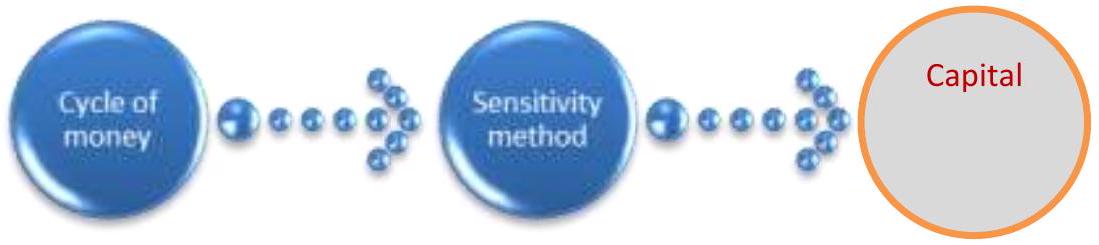
توضح هذه المنهجية أدناه:
الشكل 1: س.م. (طريقة الحساسية)
اتبعت الخطة السابقة منهجية طريقة الحساسية لتحديد سلوك الإيرادات الضريبية العالمية في حالة وجود رأس المال والحالة المثالية التي يتم فيها تجنب هذا العامل.
النتائج
العاصمة تتفاعل مع عامل تأثير الإيرادات الضريبية. في هذا التحليل السلوكي يتم تحديد النموذج الذي يوضح سلوك عامل تأثير الإيرادات الضريبية مع وجود وتجنب عامل تأثير الضريبة (تشالوميس، 2018e، 2018d، 2022e، 2023y، 2023x، 2023w، 2023v، 2023z، 2024h، 2024l، 2024m، 2024j، 2019e، 2024k، 2019a، 2019d، 2019c، 2019b، 2020d، 2020c، 2021k). ثم، لتطبيق طريقة الحساسية:
لذلك، من المعقول المضي قدمًا في تحليل الكمية باستخدام المعادلات (1) و(2) و(4). لذلك، يتم تطبيق طريقة الحساسية واختيار القيم المناسبة للمعامل:
الجدول: تجميع المعاملات
عوامل
قيم s
قيم s’
ك
0,4
–
أنا
0.6
0.6
ل
0.7
0.7
ر
0.5
0.5
ج
0.3
0.3
ت
0.8
0.8
fs
الجدول السابق يعرض البيانات التي يتم فحصها من أجل القدرة على تجميع النموذج وتأكيد أن عامل تأثير رأس المال يزيد من الإيرادات الضريبية (تشالومي، 2018e، 2018f، 2020d،
في الأشكال اللوغاريتمية، الخط الأزرق يتعلق بالحالة التي لا يوجد فيها رأس المال، والخط الأخضر هو الحالة التي يوجد فيها رأس المال. يتم تأكيد ذلك من خلال الخلفية النظرية لنظرية دورة المال (أو نظرية دورة المال) أن رأس المال يزيد من إيرادات الضرائب.
استنتاجات
تناولت هذه الورقة حالة رأس المال والطريقة التي يتفاعل بها مع الإيرادات الضريبية العالمية. ثم تفضل الشركات التي تشارك في المعاملات الخاضعة للرقابة كما هو متوقع البيئات الضريبية التي تحتوي على قواعد قانونية غير مستقرة واقتصادات غير آمنة. يؤثر ذلك على الشركات التي تشارك في المعاملات الخاضعة للرقابة لزيادة أعدادها لأن هذه الطريقة يمكن أن تخصص أرباحها وخسائرها بشكل أفضل. ثم، قد يؤدي زيادة رأس المال إلى زيادة الدخل الضريبي.
ملحق
% Sensitivity Plot of Cycle of money (C)(R)2024 Constantinos Challoumis
m=0:0.05:1;
k=0.4*m;
l=0.7*m;
%j=0.6*m;
%r=0.5*m;
%c=0.3*m;
%t=0.8*m;
p=0.6*m+0.5*m+0.3*m+0.8*m;
s1=k+l/p*m;
s2=l/p*m;
i=0;
plot(m,s1,m,s2)
grid on
title('Sensitivity method')
xlabel('m')
ylabel('s1, s2')
while (s1(i)>s1(i+1))
    i=i+1;
end
m(i)
s1(i)
References
Aakre, S., & Rübbelke, D. T. G. (2010). Objectives of public economic policy and the adaptation to climate change. Journal of Environmental Planning and Management, 53(6). https://doi.org/10.1080/09640568.2010.488116.
Acs, Z., Åstebro, T., Audretsch, D., & Robinson, D. T. (2016). Public policy to promote entrepreneurship: a call to arms. Small Business Economics, 47(1). https://doi.org/10.1007/s11187-016-9712-2.
Adhikari, A., Derashid, C., & Zhang, H. (2006). Public policy, political connections, and effective tax rates: Longitudinal evidence from Malaysia. Journal of Accounting and Public Policy, 25(5). https://doi.org/10.1016/j.jaccpubpol.2006.07.001.
Andriansyah, A., Taufiqurokhman, T., & Wekke, I. S. (2019). Responsiveness of public policy and its impact on education management: An empirical assessment from Indonesia. Management Science Letters, 9(3). https://doi.org/10.5267/j.msl.2018.12.008.
Arabyan, O. (2016). Public infrastructure policies and economic geography. Glasnik Srpskog Geografskog DrustvaBulletin of the Serbian Geographical Society, 96(1). https://doi.org/10.2298/gsgd1601093a.
Arai, R., Naito, K., & Ono, T. (2018). Intergenerational policies, public debt, and economic growth: A politico-economic analysis. Journal of Public Economics, 166. https://doi.org/10.1016/j.jpubeco.2018.08.006.
Arbel, Y., Fialkoff, C., & Kerner, A. (2019). Public policy for reducing tax evasion: implications of the Yule-Simpson paradox. Applied Economics Letters, 26(13). https://doi.org/10.1080/13504851.2018.1537471.
Baker, S. D., Hollifield, B., & Osambela, E. (2020). Preventing controversial catastrophes. Review of Asset Pricing Studies, 10(1). https://doi.org/10.1093/RAPSTU/RAZ001.
Biernaski, I., & Silva, C. L. (2018). Main variables of Brazilian public policies on biomass use and energy. Brazilian Archives of Biology and Technology, 61(Specialissue). https://doi.org/10.1590/1678-4324-smart-2018000310.
Blundell, R., & Preston, I. (2019). Principles of Tax Design, Public Policy and Beyond: The Ideas of James Mirrlees, 1936-2018. Fiscal Studies, 40(1). https://doi.org/10.1111/1475-5890.12183.
Bourdin, S., & Nadou, F. (2018). French tech: A new form of territorial mobilization to face up to global competition? Annales de Geographie, 2018(723-724). https://doi.org/10.3917/ag.723.0612.
Bowling, S. J., Boyland, L. G., & Kirkeby, K. M. (2019). Property Tax Cap Policy in Indiana and Implications for Public School Funding Equity. International Journal of Education Policy and Leadership, 15(9). https://doi.org/10.22230/ijepl.2019v15n9a881.
Brownell, K. D., & Frieden, T. R. (2009). Ounces of Prevention – The Public Policy Case for Taxes on Sugared Beverages. New England Journal of Medicine, 360(18). https://doi.org/10.1056/nejmp0902392.
Buonomo, I., Benevene, P., Barbieri, B., & Cortini, M. (2020). Intangible Assets and Performance in Nonprofit Organizations:A Systematic Literature Review. Frontiers in Psychology, 11. https://doi.org/https://doi.org/10.3389/fpsyg.2020.00729.
Campos, J., Braga, V., & Correia, A. (2019). Public policies for entrepreneurship and internationalization: Is there a government reputation effect? Journal of Science and Technology Policy Management, 10(4). https://doi.org/10.1108/JSTPM-04-2018-0044.
Campos, J. N. B. (2015). Paradigms and Public Policies on Drought in Northeast Brazil: A Historical Perspective. Environmental Management, 55(5). https://doi.org/10.1007/s00267-015-0444-x.
Carattini, S., Carvalho, M., & Fankhauser, S. (2018). Overcoming public resistance to carbon taxes. In Wiley Interdisciplinary Reviews: Climate Change (Vol. 9, Issue 5). https://doi.org/10.1002/wcc.531.
Challoumis, C. (2018a). Analysis of the velocities of escaped savings with that of financial liquidity. Ekonomski Signali, 13(2), 1-14. https://doi.org/10.5937/ekonsig1802001c.
Challoumis, C. (2018b). Identification of Significant Economic Risks to the International Controlled Transactions. Economics and Applied Informatics, 2018(3), 149-153. https://doi.org/https://doi.org/10.26397/eai1584040927.
Challoumis, C. (2018c). Methods of Controlled Transactions and the Behavior of Companies According to the Public and Tax Policy. Economics, 6(1), 33-43. https://doi.org/10.2478/eoik-2018-0003.
Challoumis, C. (2018e). The Keynesian Theory and the Theory of Cycle of Money. Hyperion Economic Journal, 6(3), 3-8. https://hej.hyperion.ro/articles/3(6)_2018/HEJ nr3(6)_2018_A1Challoumis.pdf.
Challoumis, C. (2019b). The cycle of money with and without the escaped savings. Ekonomski Signali, 14(1), 89-99. https://doi.org/336.76 336.741.236.5.
Challoumis, C. (2020d). The Impact Factor of Education on the Public Sector – The Case of the U.S. International Journal of Business and Economic Sciences Applied Research, 13(1), 69-78. https://doi.org/10.25103/ijbesar.131.07.
Challoumis, C. (2021a). Chain of cycle of money.Acta Universitatis Bohemiae Meridionalis,24(2),49-74.
Challoumis, C. (2021b). Index of the cycle of money – The case of Belarus. Economy and Banks, 2.
Challoumis, C. (2021c). Index of the cycle of money – The case of Greece. IJBESAR (International Journal of Business and Economic Sciences Applied Research), 14(2), 58-67.
Challoumis, C. (2021d). Index of the Cycle of Money – The Case of Latvia. Economics and Culture, 17(2), 5-12. https://doi.org/10.2478/jec-2020-0015.
Challoumis, C. (2021e). Index of the cycle of money – The case of Montenegro. Montenegrin Journal for Social Sciences, 5(1-2), 41-57.
Challoumis, C. (2021f). Index of the cycle of money – The case of Serbia. Open Journal for Research in Economics (OJRE), 4(1). https://centerprode.com/ojre.html.
Challoumis, C. (2021g). Index of the cycle of money – The case of Slovakia. STUDIACOMMERC I A LI A B R A T I S L A VE N S I A Ekonomická Univerzita v Bratislave, 14(49), 176-188.
Challoumis, C. (2021i). Index of the cycle of money – The case of Ukraine. Actual Problems of Economics, 243(9), 102-111. doi:10.32752/1993-6788-2021-1-243-244-102-111.
Challoumis, C. (2021k). The cycle of money with and without the enforcement savings. Complex System Research Centre.
Challoumis, C. (2022a). Conditions of the CM (Cycle of Money). In Social and Economic Studies within the Framework of Emerging Global Developments, Volume -1, V. Kaya (pp. 13-24). https://doi.org/10.3726/b19907.
Challoumis, C. (2022b). Impact Factor of the Rest Rewarding Taxes. In Complex System Research Centre. https://doi.org/10.2139/ssrn. 3154753.
Challoumis, C. (2022c). Index of the cycle of money – The case of Moldova. Eastern European Journal of Regional Economics, 8(1), 77-89.
Challoumis, C. (2022e). Structure of the economy. Actual Problems of Economics, 247(1).
Challoumis, C. (2023a). A comparison of the velocities of minimum escaped savings and financial liquidity. In Social and Economic Studies within the Framework of Emerging Global Developments, Volume – 4, V. Kaya (pp. 41-56). https://doi.org/10.3726/b21202.
Challoumis, C. (2023b). Capital and Risk in the Tax System. In Complex System Research Centre (pp. 241-244).
Challoumis, C. (2023c). Chain of the Cycle of Money with and without Maximum and Minimum Mixed Savings. European Multidisciplinary Journal of Modern Science, 23(2023), 1-16.
Challoumis, C. (2023d). Chain of the Cycle of Money with and Without Maximum Mixed Savings (Three-Dimensional Approach). Academic Journal of Digital Economics and Stability, 34(2023), 4365.
Challoumis, C. (2023e). Chain of the Cycle of Money with and without Minimum Mixed Savings (ThreeDimensional Approach). International Journal of Culture and Modernity, 33(2023), 22-33.
Challoumis, C. (2023f). Comparisons of the Cycle of Money Based on Enforcement and Escaped Savings. Pindus Journal of Culture, Literature, and ELT, 3(10), 19-28.
Challoumis, C. (2023g). Comparisons of the cycle of money with and without the mixed savings. Economics & Law. http://el.swu.bg/ikonomika/.
Challoumis, C. (2023h). Currency rate of the CM (Cycle of Money). Research Papers in Economics and Finance, 7(1).
Challoumis, C. (2023j). FROM SAVINGS TO ESCAPE AND ENFORCEMENT SAVINGS. Cogito, XV(4), 206-216.
Challoumis, C. (2023k). G7 – Global Minimum Corporate Tax Rate of . International Journal of Multicultural and Multireligious Understanding (IJMMU), 10(7).
Challoumis, C. (2023I). Impact factor of capital to the tax system. Ekonomski Signali, 18(2), 12.
Challoumis, C. (2023m). Impact Factor of Liability of Tax System According to the Theory of Cycle of Money. In Social and Economic Studies within the Framework of Emerging Global Developments Volume 3, V. Kaya (Vol. 3, pp. 31-42). https://doi.org/10.3726/b20968.
Challoumis, C. (2023t). Multiple Axiomatics Method and the Fuzzy Logic. MIDDLE EUROPEAN SCIENTIFIC BULLETIN, 37(1), 63-68.
Challoumis, C. (2023u). Principles for the Authorities on Activities with Controlled Transactions. Academic Journal of Digital Economics and Stability, 30(1), 136-152.
Challoumis, C. (2023v). The Cycle of Money (C.M.) Considers Financial Liquidity with Minimum Mixed Savings. Open Journal for Research in Economics, 6(1), 1-12.
Challoumis, C. (2023w). The Cycle of Money with and Without the Maximum and Minimum Mixed Savings. Middle European Scientific Bulletin, 41(2023), 47-56.
Challoumis, C. (2023x). The cycle of money with and without the maximum mixed savings (Twodimensional approach). International Journal of Culture and Modernity, 33(2023), 34-45.
Challoumis, C. (2023y). The Cycle of Money with and Without the Minimum Mixed Savings. Pindus Journal of Culture, Literature, and ELT, 3(10), 29-39.
Challoumis, C. (2023z). The cycle of money with mixed savings. Open Journal for Research in Economics, 6(2), 41-50.
Challoumis, C. (2023aa). The Theory of Cycle of Money – How Do Principles of the Authorities on Public Policy, Taxes, and Controlled Transactions Affect the Economy and Society? International Journal of Social Science Research and Review (IJSSRR), 6(8).
Challoumis, C. (2023ab). The Velocities of Maximum Escaped Savings with than of Financial Liquidity to the Case of Mixed Savings. International Journal on Economics, Finance and Sustainable Development, 5(6), 124-133.
Challoumis, C. (2023ac). The Velocity of Escaped Savings and Maximum Financial Liquidity. Journal of Digital Economics and Stability, 34(2023), 55-65.
Challoumis, C. (2023ad). The Velocity of Escaped Savings and Velocity of Financial Liquidity. Middle European Scientific Bulletin, 41(2023), 57-66.
Challoumis, C. (2023ae). Utility of cycle of money with and without the enforcement savings. GOSPODARKA INNOWACJE, 36(1), 269-277.
Challoumis, C. (2023af). Utility of Cycle of Money with and without the Escaping Savings. International Journal of Business Diplomacy and Economy, 2(6), 92-101.
Challoumis, C. (2023ag). Utility of Cycle of Money without the Escaping Savings (Protection of the Economy). In Social and Economic Studies within the Framework of Emerging Global Developments Volume 2, V. Kaya (pp. 53-64). https://doi.org/10.3726/b20509.
Challoumis, C. (2023ah). Velocity of Escaped Savings and Minimum Financial Liquidity According to the Theory of Cycle of Money. European Multidisciplinary Journal of Modern Science, 23(2023), 17-25.
Challoumis, C. (2024a). Approach on arm’s length principle and fix length principle mathematical representations. In Innovations and Contemporary Trends in Business & Economics.
Challoumis, C. (2024b). Estimations of the cycle of money without escape savings. International Journal of Multicultural and Multireligious Understanding, 11(3).
Challoumis, C. (2024c). Impact Factors of Global Tax Revenue – Theory of Cycle of Money. International Journal of Multicultural and Multireligious Understanding, 11(1).
Challoumis, C. (2024e). Minimum escaped savings and financial liquidity in mathematical representation. Ekonomski Signali, 19(1).
Challoumis, C. (2024f). Rewarding taxes on the cycle of money. In Social and Economic Studies within the Framework of Emerging Global Developments (Vol. 5).
Challoumis, C. (2024g). Rewarding taxes on the economy (The theory of cycle of money). International Journal of Multicultural and Multireligious Understanding (IJMMU), 11(3).
Challoumis, C. (2024h). Synopsis of principles for the authorities and controlled transactions. Pindus.
Challoumis, C. (2024i). Synopsis of principles for the authorities and controlled transactions. SEPIKE.
Challoumis, C. (2024j). The cycle of money – Escape savings and the minimum financial liquidity. International Journal of Multicultural and Multireligious Understanding (IJMMU), 11(4).
Challoumis, C. (2024k). The cycle of money – Minimum escape savings and financial liquidity. International Journal of Multicultural and Multireligious Understanding (IJMMU), 11(5).
Challoumis, C. (2024l). The impact factor of Tangibles and Intangibles of controlled transactions on economic performance. Economic Alternatives.
Challoumis, C. (2024m). THE INFLATION ACCORDING TO THE CYCLE OF MONEY (C.M.). Economic Alternatives.
Challoumis, C. (2024n). Velocity of the escaped savings and financial liquidity on maximum mixed savings. Open Journal for Research in Economics, 7(1).
Challoumis, C. (2024o). Velocity of the escaped savings and financial liquidity on minimum mixed savings. Open Journal for Research in Economics, 7(2).
Challoumis, C. (2024p). Velocity of the escaped savings and financial liquidity on mixed savings. Open Journal for Research in Economics, 7(2).
Challoumis, C., & Savic, M. (2024). Rational and Behavioral economics. Ekonomski Signali, 19(1).
Chubarova, T., Maly, I., & Nemec, J. (2020). Public policy responses to the spread of COVID-19 as a potential factor determining health results: A comparative study of the Czech Republic, the Russian Federation, and the Slovak Republic. Central European Journal of Public Policy, 14(2). https://doi.org/10.2478/cejpp-2020-0008.
Corti, I. N., Roldán, C. D., & Benito, S. M. R. (2020). Fiscal pressure and fraud, predisposition to pay taxes and personal satisfaction in Spain. Revista Espanola de Investigaciones Sociologicas, 172. https://doi.org/10.5477/cis/reis.172.101.
de A. Dantas, G., de Castro, N. J., Dias, L., Antunes, C. H., Vardiero, P., Brandão, R., Rosental, R., & Zamboni, L. (2018). Public policies for smart grids in Brazil. Renewable and Sustainable Energy Reviews, 92. https://doi.org/10.1016/j.rser.2018.04.077.
de Vasconcelos, F. de A. G., Machado, M. L., de Medeiros, M. A. T., Neves, J. A., Recine, E., & Pasquim, E. M. (2019). Public policies of food and nutrition in Brazil: From Lula to Temer. Revista de Nutricao, 32. https://doi.org/10.1590/1678-9865201932e180161.
Diallo, S. Y., Shults, F. L. R., & Wildman, W. J. (2021). Minding morality: ethical artificial societies for public policy modeling. AI and Society, 36(1). https://doi.org/10.1007/s00146-020-01028-5.
Díaz, M. L. A., Ordoñez, F. A. R., & Muñoz, R. A. T. (2020). Open innovation and public policies in developing countries. International Journal for Quality Research, 14(3). https://doi.org/10.24874/IJQR14.03-09.
Fan, Y., Yang, S., & Jia, P. (2020). Preferential Tax Policies: An Invisible Hand behind Preparedness for Public Health Emergencies. International Journal of Health Policy and Management. https://doi.org/10.34172/ijhpm.2020.139.
Fernandez, M. A., & Raine, K. D. (2019). Insights on the Influence of Sugar Taxes on Obesity Prevention Efforts. In Current Nutrition Reports (Vol. 8, Issue 4). https://doi.org/10.1007/s13668-019-00282-4.
Fronzaglia, M. L., de Moura Júnior, Á. A., Racy, J. C., & Vartanian, P. R. (2019). Possible Effects of Economic Public Policies Implemented in Brazil after the Financial Crisis of 2008 on Foreign Direct Investment. Theoretical Economics Letters, 09(08). https://doi.org/10.4236/tel.2019.98176.
Gocekli, S. G. B., & Comertler, N. (2021). On “The Human” and behavioral economics. Contemporary Issues with Multidisciplinary Perspectives on Social Science, 37-47.
Goldsztejn, U., Schwartzman, D., & Nehorai, A. (2020a). Public policy and economic dynamics of COVID-19 spread: A mathematical modeling study. PLoS ONE, 15(12 December). https://doi.org/10.1371/journal.pone. 0244174.
Goldsztejn, U., Schwartzman, D., & Nehorai, D. A. (2020b). Public policy and economic dynamics of COVID-19 spread: A mathematical modeling study. In medRxiv. https://doi.org/10.1101/2020.04.13.20062802.
Grabs, J., Auld, G., & Cashore, B. (2020). Private regulation, public policy, and the perils of adverse ontological selection. Regulation and Governance. https://doi.org/10.1111/rego.12354.
Hai, D. . (2016). Process of Public Policy Formulation in Developing Countries. Public Policy, C.
Hartz, S., & John, J. (2009). Public health policy decisions on medical innovations: What role can early economic evaluation play? Health Policy, 89(2). https://doi.org/10.1016/j.healthpol.2008.05.011.
Hasselman, L., & Stoker, G. (2017). Market-based governance and water management: the limits to economic rationalism in public policy. Policy Studies, 38(5). https://doi.org/10.1080/01442872.2017.1360437.
Herrington, C. M. (2015). Public education financing, earnings inequality, and intergenerational mobility. Review of Economic Dynamics, 18(4). https://doi.org/10.1016/j.red.2015.07.006.
Hyeon Sik Seo, & YoungJun Kim. (2020). INTANGIBLE ASSETS INVESTMENT AND FIRMS’ PERFORMANCE: EVIDENCE FROM SMALL AND MEDIUM-SIZED ENTERPRISES IN KOREA. Journal of Business Economics and Management, 21(2), 421-445.
Islam, A., Rashid, M. H. U., Hossain, S. Z., & Hashmi, R. (2020). Public policies and tax evasion: evidence from SAARC countries. Heliyon, 6(11). https://doi.org/10.1016/j.heliyon.2020.e05449.
Jia, M., Liu, Y., Lieske, S. N., & Chen, T. (2020). Public policy change and its impact on urban expansion: An evaluation of 265 cities in China. Land Use Policy, 97. https://doi.org/10.1016/j.landusepol.2020.104754.
Kananen, J. (2012). International ideas versus national traditions: Nordic economic and public policy as proposed by the OECD. Journal of Political Power, 5(3). https://doi.org/10.1080/2158379X.2012.735118.
Kanthak, L., & Spies, D. C. (2018). Public support for European Union economic policies. European Union Politics, 19(1). https://doi.org/10.1177/1465116517740638.
Kartini, D. S., Mulyawan, R., & Muradi, M. (2019). Public Policy Pragmatism on Special Economic Zone in Tanjung Lesung, Pandeglang Regency. MIMBAR : Jurnal Sosial Dan Pembangunan, 35(1). https://doi.org/10.29313/mimbar.v35i1.4283.
Khadzhyradieva, S., Hrechko, T., & Smalskys, V. (2019). Institutionalisation of behavioural insights in public policy. In Public Policy and Administration (Vol. 18, Issue 3). https://doi.org/10.5755/J01.PPAA.18.3.24726.
Korenik, D., & Wegrzyn, M. (2020). Public policy timing in a sustainable approach to shaping public policy. Sustainability (Switzerland), 12(7). https://doi.org/10.3390/su12072677.
Kreft, S. F., & Sobel, R. S. (2005). Public policy, entrepreneurship, and economic freedom. In Cato Journal (Vol. 25, Issue 3).
Ladvocat, M., & Lucas, V. (2019). REGIONAL DISPARITIES, PUBLIC POLICIES AND ECONOMIC GROWTH IN BRAZIL. Revista Baru – Revista Brasileira de Assuntos Regionais e Urbanos, 5(2). https://doi.org/10.18224/baru.v5i2.7687.
Lajas, R., & Macário, R. (2020). Public policy framework supporting “mobility-as-a-service” implementation. Research in Transportation Economics, 83. https://doi.org/10.1016/j.retrec.2020.100905.
Leckel, A., Veilleux, S., & Dana, L. P. (2020). Local Open Innovation: A means for public policy to increase collaboration for innovation in SMEs. Technological Forecasting and Social Change, 153. https://doi.org/10.1016/j.techfore.2019.119891.
Levi, S. (2021). Why hate carbon taxes? Machine learning evidence on the roles of personal responsibility, trust, revenue recycling, and other factors across 23 European countries. Energy Research and Social Science, 73. https://doi.org/10.1016/j.erss.2020.101883.
Liu, N., Liu, R., Huang, J., & Chen, L. (2018). Pollution, happiness and willingness to pay taxes: The value effect of public environmental policies. Problemy Ekorozwoju, 13(1).
Loayza, N., & Pennings, S. M. (2020). Macroeconomic Policy in the Time of COVID-19 : A Primer for Developing Countries. World Bank Research and Policy Briefs, 147291.
Maestre-Andrés, S., Drews, S., & van den Bergh, J. (2019). Perceived fairness and public acceptability of carbon pricing: a review of the literature. Climate Policy, 19(9). https://doi.org/10.1080/14693062.2019.1639490.
Martinez, M. C. V., & Rodríguez, M. C. M. (2020). Public policies of electronic governance and corruption in Mexico. Public Policy and Administration, 19(3). https://doi.org/10.5755/J01.PPAA.19.3.27769.
Marume, S. B. M. (2016). Public Policy and Factors Influencing Public Policy. International Journal of Engineering Science Invention, 5(6).
Montenegro Martínez, G., Carmona Montoya, A., & Franco Giraldo, Á. (2020). Models for public health policy analysis reported in scientific publications. In Gaceta Sanitaria. https://doi.org/10.1016/j.gaceta.2019.11.007.
Nash, V., Bright, J., Margetts, H., & Lehdonvirta, V. (2017). Public Policy in the Platform Society. In Policy and Internet (Vol. 9, Issue 4). https://doi.org/10.1002/poi3.165.
Nayak, B. S. (2019). Reconceptualising Public Private Partnerships (PPPs) in global public policy. World Journal of Entrepreneurship, Management and Sustainable Development, 15(3). https://doi.org/10.1108/WJEMSD-04-2018-0041.
Nielsen, T. D., Holmberg, K., & Stripple, J. (2019). Need a bag? A review of public policies on plastic carrier bags – Where, how and to what effect? Waste Management, 87. https://doi.org/10.1016/j.wasman.2019.02.025.
Noland, M. (2020). Protectionism under Trump: The China Shock, Deplorables, and the First White President. In Asian Economic Policy Review (Vol. 15, Issue 1). https://doi.org/10.1111/aepr.12274.
OECD. (2017). OECD Transfer Pricing Guidelines for Multinational Enterprises and Tax Administrations 2017. OECD Publications.
Ortun, V., Lopez-Valcarcel, B. G., & Pinilla, J. (2017). Tax on Sugar Sweetened Beverages in Spain. SSRN Electronic Journal. https://doi.org/10.2139/ssrn. 3004464.
Paes-Sousa, R., De Andrade Schramm, J. M., & Pereira Mendes, L. V. (2019). Fiscal Austerity and the health sector: The capital of adjustments. Ciencia e Saude Coletiva, 24(12). https://doi.org/10.1590/1413-812320182412.23232019.
Peres, M. F. P., Oliveira, A. B., Sarmento, E. M., Rocha-Filho, P. S., Peixoto, P. M., Kowacs, F., Goulart, A. C., & Benseñor, I. M. (2020). Public policies in headache disorders: Needs and possibilities. Arquivos de Neuro-Psiquiatria, 78(1). https://doi.org/10.1590/0004-282X20190144.
Persson, E., & Tinghög, G. (2020). Opportunity capital neglect in public policy. Journal of Economic Behavior and Organization, 170. https://doi.org/10.1016/j.jebo.2019.12.012.
Ruiz, J. C., Jurado, E. B., Moral, A. M., Uclés, D. F., & Viruel, M. J. M. (2017). Measuring the social and economic impact of public policies on entrepreneurship in Andalusia. CIRIEC-Espana Revista de Economia Publica, Social y Cooperativa, 1(90).
Rumayya, Rammohan, A., Purwono, R., & Harymawan, I. (2020). The local economy and Re-election of incumbent district leaders in Indonesia. Heliyon, 6(5). https://doi.org/10.1016/j.heliyon.2020.e04098.
Scholvin, S., & Malamud, A. (2020). Is Brazil a Geoeconomic Node? Geography, Public Policy, and the Failure of Economic Integration in South America. Brazilian Political Science Review, 14(2). https://doi.org/10.1590/1981-3821202000020004.
Silva, S. E., Venâncio, A., Silva, J. R., & Gonçalves, C. A. (2020). Open innovation in science parks: The role of public policies. Technological Forecasting and Social Change, 151. https://doi.org/10.1016/j.techfore.2019.119844.
Soboleva I.V. (2019). Instrumental support for the implementation of the state antimonopoly policy. Actual Problems of Economics, 12(222).
Syukur, M. (2020). Insentif Pajak terhadap Sumbangan Covid-19 dari Perspektif Relasi Hukum Pajak Indonesia dengan Hak Asasi Manusia. Jurnal Suara Hukum, 2(2). https://doi.org/10.26740/jsh.v2n2.p184-214.
Taub, R. (2015). New Deal Ruins: Race, Economic Justice, and Public Housing Policy. Contemporary Sociology: A Journal of Reviews, 44(4). https://doi.org/10.1177/0094306115588487x.
Torres, S. H. Á., & Riaño-Casallas, M. I. (2018). Public policy for safety and health at the worksite: The Colombian case. In Revista Gerencia y Politicas de Salud (Vol. 17, Issue 35). https://doi.org/10.11144/Javeriana.rgps17-35.ppss.
TUTER, C. (2020). PERSEPSI MASYARAKAT TERHADAP ISU PAJAK LINGKUNGAN DI KABUPATEN KEPULAUAN SIAU TAGULANDANG BIARO (SITARO). Jurnal Ekonomi Dan Bisnis Airlangga, 30(1). https://doi.org/10.20473/jeba.v30i12020.1-13.
Tvaronavičienė, M., Tarkhanova, E., & Durglishvili, N. (2018). Sustainable economic growth and innovative development of educational systems. Journal of International Studies, 11(1). https://doi.org/10.14254/2071-8330.2018/11-1/19.
Ud Din, M., Mangla, I. U., & Jamil, M. (2016). Public Policy, Innovation and Economic Growth: An Economic and Technological Perspective on Pakistan’s Telecom Industry. THE LAHORE JOURNAL OF ECONOMICS, 21(Special Edition). https://doi.org/10.35536/lje.2016.v21.isp.a16.
Urwannachotima, N., Hanvoravongchai, P., Ansah, J. P., Prasertsom, P., & Koh, V. R. Y. (2020). Impact of sugar-sweetened beverage tax on dental caries: A simulation analysis. BMC Oral Health, 20(1). https://doi.org/10.1186/s12903-020-1061-5.
Ustinovich, E., & Kulikov, M. (2020). National projects, socio-economic policy and public equilibrium. Social’naja Politika i Social’noe Partnerstvo (Social Policy and Social Partnership), 6. https://doi.org/10.33920/pol-01-2006-01.
Watanabe, C., Naveed, K., Tou, Y., & Neittaanmäki, P. (2018). Measuring GDP in the digital economy: Increasing dependence on uncaptured GDP. Technological Forecasting and Social Change, 137. https://doi.org/10.1016/j.techfore.2018.07.053.
Wright, A., Smith, K. E., & Hellowell, M. (2017). Policy lessons from health taxes: A systematic review of empirical studies. In BMC Public Health (Vol. 17, Issue 1). https://doi.org/10.1186/s12889-017-4497-z.
Палакоvotavívov, А., Каvá , л., & Ntóкас, I. (2013). Ouкоvouía & uкрɛ́с . Ivotıtov́то .
حقوق الطبع والنشر
تحتفظ المؤلف(ون) بحقوق الطبع والنشر لهذه المقالة، مع منح حقوق النشر الأولى للمجلة.
هذه مقالة مفتوحة الوصول موزعة بموجب الشروط والأحكام الخاصة برخصة المشاع الإبداعي (http://creativecommons.org/licenses/by/4.0/).
Journal: International Journal of Multicultural and Multireligious Understanding, Volume: 11, Issue: 5 DOI: https://doi.org/10.18415/ijmmu.v11i5.5712 Publication Date: 2024-05-07
Impact Factor of Capital Using the Sensitivity Method
Constantinos ChalloumisNational and Kapodistrian University of Athens, Greece
This paper is a special issue about the sensibility of taxation in the capital, that is based on the Sensitivity Method. Therefore, it has been done a study for the impact factor of the tax revenues of the countries that are tax havens subject to the trustworthiness of the tax system. From the view of how much is affected the companies that participate in controlled transactions, can obtain the impact of capital, when there is not that factor with the case that exists in the analysis of transfer pricing. It determines the behavior of the tax system subject to the capital.
Keywords: Cycle of Money; Sensitivity Method; Capital
Introduction
The quantification analysis of the sensitivity of the tax system to the capital is done by the application of the the Sensitivity Method (Bergh, 2009; Bourdin & Nadou, 2018; Challoumis, 2020d, 2020a, 2021d; Corti et al., 2020; Ginsburgh & Weber, 2020; Levi, 2021; Ortun et al., 2017; Paes-Sousa et al., 2019; Rumayya et al., 2020; Tvaronavičienė et al., 2018; Urwannachotima et al., 2020; Woody & Viney, 2017; Палакшvatavtivov et al., 2013). The background of this method stands on the behavior analysis of mathematical equations. According to bibliography (Challoumis, 2018a, 2018b, 2023g, 2023b, 2023a, 2023i, 2023c, 2023j, 2023k, 2023d, 2023l, 2023e, 2020a, 2023m, 2023o, 2024b, 2024c, 2024a, 2020b, 2021b, 2021a, 2022a, 2022b, 2023h, 2023f). The cycle of money is the theory where the Q.E. method and also the Sensitivity Method have been applied (Aitken, 2019; Arai et al., 2018; Biernaski & Silva, 2018; Buonomo et al., 2020; Challoumis, 2018c; Diallo et al., 2021; Fernandez & Raine, 2019; Hasselman & Stoker, 2017; Hyeon Sik Seo & YoungJun Kim, 2020; Kananen, 2012; Khadzhyradieva et al., 2019; Kroth et al., 2020; Leckel et al., 2020; Loayza & Pennings, 2020; Montenegro Martínez et al., 2020; Nielsen et al., 2019; Ruiz et al., 2017; Scholvin & Malamud, 2020; Soboleva I.V., 2019; Syukur, 2020; Taub, 2015; Ustinovich & Kulikov, 2020; Watanabe et al., 2018). The Sensitivity Method is based on the concept of how sensitive is a variable. To achieve this there are two steps:
It should be defined as the equation that is under examination, according to the applied theory.
Following the same concept of the Q.E. method it is the case that one variable is there in the one case, and the other case is omitted. The basic difference between the Sensitivity Method to the Q.E. method is that Sensitivity does not use the generator, to produce random values, but there is each time a condition that should be satisfied.
The S.M. (Sensitivity Method) is plausible to be applied using a combination of mathematics and programming (Challoumis, 2018c, 2021i, 2022c, 2023p, 2023n, 2023q, 2023r, 2023u, 2023t, 2023s, 2024e, 2024d, 2021j, 2021e, 2021c, 2021d, 2021g, 2021h, 2021f, 2022d; Challoumis & Savic, 2024). The quantification of quality data is the concept of the S.M. (the same happens with the Q.E. method, but from a different point of view (Aakre & Rübbelke, 2010; Baker et al., 2020; Blundell & Preston, 2019; Bowling et al., 2019; Brownell & Frieden, 2009; J. N. B. Campos, 2015; Carattini et al., 2018; Díaz et al., 2020; Fan et al., 2020; Fronzaglia et al., 2019; Gocekli & Comertler, 2021; Grabs et al., 2020; Hai, 2016; Liu et al., 2018; Maestre-Andrés et al., 2019; Marques, 2019; OECD, 2017, 2020; Persson & Tinghög, 2020; Silva et al., 2020; TUTER, 2020; Wright et al., 2017).” Then, it is plausible to quantify quality data. In our analysis, this method is used for clarification of the behavior of the impact factor of the global tax revenue.
Literature Review
The impact factor of tax revenues of countries which are tax heaves, according to the bibliography (Challoumis, 2018c, 2021j, 2022c, 2023p, 2023n, 2023q, 2023r, 2023u, 2023t, 2023s, 2024e, 2024d, 2021c, 2024f, 2024g, 2021e, 2021i, 2021d, 2021g, 2021h, 2021f, 2022d; Challoumis & Savic, 2024). It is determined as that:
“Therefore are countries that receive the products that are taxed in different countries. This allocation of profits between profits and losses permits the enterprises that participate in controlled transactions of the transfer pricing activities to maximize their utility. But, contemporaneously the tax revenue from a global view is declined. Then, the loss of tax income from some countries is more than the profits that make the countries which are tax havens. Thereupon, the symbol of the impact factor of tax revenue from a global view, and there are some coefficients which are , and . Thus, the symbol of is about the impact factor of capital, is the impact factor about the liability of the authorities on the tax system. The interpretation of the liability is about how unbalanced it is the tax system. The parameter of is about the risk, the is about how much trustworthy is the tax system from the view of capital (Arabyan, 2016; Arbel et al., 2019; Camous & Gimber, 2018; J. Campos et al., 2019; Chubarova et al., 2020; de A. Dantas et al., 2018; de Vasconcelos et al., 2019; Farah, 2011; Goldsztejn et al., 2020b, 2020a; Hartz & John, 2009; Herrington, 2015; Islam et al., 2020; Jia et al., 2020; Kartini et al., 2019; Lajas & Macário, 2020; Martinez & Rodríguez, 2020; Marume, 2016; Nash et al., 2017; Noland, 2020; Peres et al., 2020; Torres & Riaño-Casallas, 2018; Tummers, 2019). This means that examines the case of the sensitivity of the tax system to the capital. Additionally, the symbol of c is about the capital of enterprises. The symbols with the “~” are accordingly the same thing but from the view of the uncontrolled transactions (Acs et al., 2016; Adhikari et al., 2006; Andriansyah et al., 2019; Kanthak & Spies, 2018; Korenik & Wegrzyn, 2020; Kreft & Sobel, 2005; Ladvocat & Lucas, 2019; Nayak, 2019; Ud Din et al., 2016). Moreover, for :
It is determined the aggregate impact factor of tax revenues, which is symbolized by , and is defined by the next equation:
Based on the prior equations it is plausible to proceed to the identification of the behavior of the impact factors of tax revenues in the case of tax heavens and the case of the non-tax heavens. Then, is a factor that allows the comparison between the controlled with the uncontrolled transactions. Thence is plausible to have a standalone behavior analysis of controlled transactions and a combined behavior analysis between the controlled transactions with the uncontrolled transactions. The next section analyzes the impact factor of tax revenues with the rest impact factors.”
This methodology is illustrated below:
Figure 1: S.M. (Sensitivity Method)
The previous scheme followed the methodology of the Sensitivity Method to determine the behavior of the global tax revenue in the case that the existence of the capital and the ideal case that this factor is avoided.
Results
The capital is in interaction with the impact factor of tax revenues. In this behavioral analysis is determined the model which clarifies the behavior of the impact factor of tax revenues with the existence and with the avoidance of the impact factor of tax (Challoumis, 2018e, 2018d, 2022e, 2023y, 2023x, 2023w, 2023v, 2023z, 2024h, 2024l, 2024m, 2024j, 2019e, 2024k, 2019a, 2019d, 2019c, 2019b, 2020d, 2020c, 2021k). Then, for the application of the Sensitivity Method:
Therefore, it is plausible to proceed to a quantity analysis using equations (1), (2), and (4). Therefore, applying the Sensitivity Method and choosing the appropriate magnitudes for the coefficient:
Table: Compiling coefficients
Factors
Values of s
Values of s’
k
0,4
–
i
0.6
0.6
l
0.7
0.7
r
0.5
0.5
c
0.3
0.3
t
0.8
0.8
fs
The prior table presents the data that are under examination to be able to compile the model and confirm that the impact factor of capital increases the tax revenue (Challoumis, 2018e, 2018f, 2020d,
In logarithmic forms, the blue line is about the case that there doesn’t exist capital, and the green line is the case that there does exist capital. It is confirmed by the theoretical background of the theory of the money cycle (or the theory of the cycle of money) that capital increases tax revenue.
Conclusions
This paper examined the case of capital and the way it interacts with global tax revenue. Then the companies that participate in controlled transactions prefer as expected the tax environments that have unstable law rules and insecure economies. This has an impact on the companies that participate in controlled transactions to be increased in numbers because that way can allocate their profits and losses better. Then, the capital increase could increase the tax income.
Appendix
% Sensitivity Plot of Cycle of money (C)(R)2024 Constantinos Challoumis
m=0:0.05:1;
k=0.4*m;
l=0.7*m;
%j=0.6*m;
%r=0.5*m;
%c=0.3*m;
%t=0.8*m;
p=0.6*m+0.5*m+0.3*m+0.8*m;
s1=k+l/p*m;
s2=l/p*m;
i=0;
plot(m,s1,m,s2)
grid on
title('Sensitivity method')
xlabel('m')
ylabel('s1, s2')
while (s1(i)>s1(i+1))
    i=i+1;
end
m(i)
s1(i)
References
Aakre, S., & Rübbelke, D. T. G. (2010). Objectives of public economic policy and the adaptation to climate change. Journal of Environmental Planning and Management, 53(6). https://doi.org/10.1080/09640568.2010.488116.
Acs, Z., Åstebro, T., Audretsch, D., & Robinson, D. T. (2016). Public policy to promote entrepreneurship: a call to arms. Small Business Economics, 47(1). https://doi.org/10.1007/s11187-016-9712-2.
Adhikari, A., Derashid, C., & Zhang, H. (2006). Public policy, political connections, and effective tax rates: Longitudinal evidence from Malaysia. Journal of Accounting and Public Policy, 25(5). https://doi.org/10.1016/j.jaccpubpol.2006.07.001.
Andriansyah, A., Taufiqurokhman, T., & Wekke, I. S. (2019). Responsiveness of public policy and its impact on education management: An empirical assessment from Indonesia. Management Science Letters, 9(3). https://doi.org/10.5267/j.msl.2018.12.008.
Arabyan, O. (2016). Public infrastructure policies and economic geography. Glasnik Srpskog Geografskog DrustvaBulletin of the Serbian Geographical Society, 96(1). https://doi.org/10.2298/gsgd1601093a.
Arai, R., Naito, K., & Ono, T. (2018). Intergenerational policies, public debt, and economic growth: A politico-economic analysis. Journal of Public Economics, 166. https://doi.org/10.1016/j.jpubeco.2018.08.006.
Arbel, Y., Fialkoff, C., & Kerner, A. (2019). Public policy for reducing tax evasion: implications of the Yule-Simpson paradox. Applied Economics Letters, 26(13). https://doi.org/10.1080/13504851.2018.1537471.
Baker, S. D., Hollifield, B., & Osambela, E. (2020). Preventing controversial catastrophes. Review of Asset Pricing Studies, 10(1). https://doi.org/10.1093/RAPSTU/RAZ001.
Biernaski, I., & Silva, C. L. (2018). Main variables of Brazilian public policies on biomass use and energy. Brazilian Archives of Biology and Technology, 61(Specialissue). https://doi.org/10.1590/1678-4324-smart-2018000310.
Blundell, R., & Preston, I. (2019). Principles of Tax Design, Public Policy and Beyond: The Ideas of James Mirrlees, 1936-2018. Fiscal Studies, 40(1). https://doi.org/10.1111/1475-5890.12183.
Bourdin, S., & Nadou, F. (2018). French tech: A new form of territorial mobilization to face up to global competition? Annales de Geographie, 2018(723-724). https://doi.org/10.3917/ag.723.0612.
Bowling, S. J., Boyland, L. G., & Kirkeby, K. M. (2019). Property Tax Cap Policy in Indiana and Implications for Public School Funding Equity. International Journal of Education Policy and Leadership, 15(9). https://doi.org/10.22230/ijepl.2019v15n9a881.
Brownell, K. D., & Frieden, T. R. (2009). Ounces of Prevention – The Public Policy Case for Taxes on Sugared Beverages. New England Journal of Medicine, 360(18). https://doi.org/10.1056/nejmp0902392.
Buonomo, I., Benevene, P., Barbieri, B., & Cortini, M. (2020). Intangible Assets and Performance in Nonprofit Organizations:A Systematic Literature Review. Frontiers in Psychology, 11. https://doi.org/https://doi.org/10.3389/fpsyg.2020.00729.
Campos, J., Braga, V., & Correia, A. (2019). Public policies for entrepreneurship and internationalization: Is there a government reputation effect? Journal of Science and Technology Policy Management, 10(4). https://doi.org/10.1108/JSTPM-04-2018-0044.
Campos, J. N. B. (2015). Paradigms and Public Policies on Drought in Northeast Brazil: A Historical Perspective. Environmental Management, 55(5). https://doi.org/10.1007/s00267-015-0444-x.
Carattini, S., Carvalho, M., & Fankhauser, S. (2018). Overcoming public resistance to carbon taxes. In Wiley Interdisciplinary Reviews: Climate Change (Vol. 9, Issue 5). https://doi.org/10.1002/wcc.531.
Challoumis, C. (2018a). Analysis of the velocities of escaped savings with that of financial liquidity. Ekonomski Signali, 13(2), 1-14. https://doi.org/10.5937/ekonsig1802001c.
Challoumis, C. (2018b). Identification of Significant Economic Risks to the International Controlled Transactions. Economics and Applied Informatics, 2018(3), 149-153. https://doi.org/https://doi.org/10.26397/eai1584040927.
Challoumis, C. (2018c). Methods of Controlled Transactions and the Behavior of Companies According to the Public and Tax Policy. Economics, 6(1), 33-43. https://doi.org/10.2478/eoik-2018-0003.
Challoumis, C. (2018e). The Keynesian Theory and the Theory of Cycle of Money. Hyperion Economic Journal, 6(3), 3-8. https://hej.hyperion.ro/articles/3(6)_2018/HEJ nr3(6)_2018_A1Challoumis.pdf.
Challoumis, C. (2019b). The cycle of money with and without the escaped savings. Ekonomski Signali, 14(1), 89-99. https://doi.org/336.76 336.741.236.5.
Challoumis, C. (2020d). The Impact Factor of Education on the Public Sector – The Case of the U.S. International Journal of Business and Economic Sciences Applied Research, 13(1), 69-78. https://doi.org/10.25103/ijbesar.131.07.
Challoumis, C. (2021a). Chain of cycle of money.Acta Universitatis Bohemiae Meridionalis,24(2),49-74.
Challoumis, C. (2021b). Index of the cycle of money – The case of Belarus. Economy and Banks, 2.
Challoumis, C. (2021c). Index of the cycle of money – The case of Greece. IJBESAR (International Journal of Business and Economic Sciences Applied Research), 14(2), 58-67.
Challoumis, C. (2021d). Index of the Cycle of Money – The Case of Latvia. Economics and Culture, 17(2), 5-12. https://doi.org/10.2478/jec-2020-0015.
Challoumis, C. (2021e). Index of the cycle of money – The case of Montenegro. Montenegrin Journal for Social Sciences, 5(1-2), 41-57.
Challoumis, C. (2021f). Index of the cycle of money – The case of Serbia. Open Journal for Research in Economics (OJRE), 4(1). https://centerprode.com/ojre.html.
Challoumis, C. (2021g). Index of the cycle of money – The case of Slovakia. STUDIACOMMERC I A LI A B R A T I S L A VE N S I A Ekonomická Univerzita v Bratislave, 14(49), 176-188.
Challoumis, C. (2021i). Index of the cycle of money – The case of Ukraine. Actual Problems of Economics, 243(9), 102-111. doi:10.32752/1993-6788-2021-1-243-244-102-111.
Challoumis, C. (2021k). The cycle of money with and without the enforcement savings. Complex System Research Centre.
Challoumis, C. (2022a). Conditions of the CM (Cycle of Money). In Social and Economic Studies within the Framework of Emerging Global Developments, Volume -1, V. Kaya (pp. 13-24). https://doi.org/10.3726/b19907.
Challoumis, C. (2022b). Impact Factor of the Rest Rewarding Taxes. In Complex System Research Centre. https://doi.org/10.2139/ssrn. 3154753.
Challoumis, C. (2022c). Index of the cycle of money – The case of Moldova. Eastern European Journal of Regional Economics, 8(1), 77-89.
Challoumis, C. (2022e). Structure of the economy. Actual Problems of Economics, 247(1).
Challoumis, C. (2023a). A comparison of the velocities of minimum escaped savings and financial liquidity. In Social and Economic Studies within the Framework of Emerging Global Developments, Volume – 4, V. Kaya (pp. 41-56). https://doi.org/10.3726/b21202.
Challoumis, C. (2023b). Capital and Risk in the Tax System. In Complex System Research Centre (pp. 241-244).
Challoumis, C. (2023c). Chain of the Cycle of Money with and without Maximum and Minimum Mixed Savings. European Multidisciplinary Journal of Modern Science, 23(2023), 1-16.
Challoumis, C. (2023d). Chain of the Cycle of Money with and Without Maximum Mixed Savings (Three-Dimensional Approach). Academic Journal of Digital Economics and Stability, 34(2023), 4365.
Challoumis, C. (2023e). Chain of the Cycle of Money with and without Minimum Mixed Savings (ThreeDimensional Approach). International Journal of Culture and Modernity, 33(2023), 22-33.
Challoumis, C. (2023f). Comparisons of the Cycle of Money Based on Enforcement and Escaped Savings. Pindus Journal of Culture, Literature, and ELT, 3(10), 19-28.
Challoumis, C. (2023g). Comparisons of the cycle of money with and without the mixed savings. Economics & Law. http://el.swu.bg/ikonomika/.
Challoumis, C. (2023h). Currency rate of the CM (Cycle of Money). Research Papers in Economics and Finance, 7(1).
Challoumis, C. (2023j). FROM SAVINGS TO ESCAPE AND ENFORCEMENT SAVINGS. Cogito, XV(4), 206-216.
Challoumis, C. (2023k). G7 – Global Minimum Corporate Tax Rate of . International Journal of Multicultural and Multireligious Understanding (IJMMU), 10(7).
Challoumis, C. (2023I). Impact factor of capital to the tax system. Ekonomski Signali, 18(2), 12.
Challoumis, C. (2023m). Impact Factor of Liability of Tax System According to the Theory of Cycle of Money. In Social and Economic Studies within the Framework of Emerging Global Developments Volume 3, V. Kaya (Vol. 3, pp. 31-42). https://doi.org/10.3726/b20968.
Challoumis, C. (2023t). Multiple Axiomatics Method and the Fuzzy Logic. MIDDLE EUROPEAN SCIENTIFIC BULLETIN, 37(1), 63-68.
Challoumis, C. (2023u). Principles for the Authorities on Activities with Controlled Transactions. Academic Journal of Digital Economics and Stability, 30(1), 136-152.
Challoumis, C. (2023v). The Cycle of Money (C.M.) Considers Financial Liquidity with Minimum Mixed Savings. Open Journal for Research in Economics, 6(1), 1-12.
Challoumis, C. (2023w). The Cycle of Money with and Without the Maximum and Minimum Mixed Savings. Middle European Scientific Bulletin, 41(2023), 47-56.
Challoumis, C. (2023x). The cycle of money with and without the maximum mixed savings (Twodimensional approach). International Journal of Culture and Modernity, 33(2023), 34-45.
Challoumis, C. (2023y). The Cycle of Money with and Without the Minimum Mixed Savings. Pindus Journal of Culture, Literature, and ELT, 3(10), 29-39.
Challoumis, C. (2023z). The cycle of money with mixed savings. Open Journal for Research in Economics, 6(2), 41-50.
Challoumis, C. (2023aa). The Theory of Cycle of Money – How Do Principles of the Authorities on Public Policy, Taxes, and Controlled Transactions Affect the Economy and Society? International Journal of Social Science Research and Review (IJSSRR), 6(8).
Challoumis, C. (2023ab). The Velocities of Maximum Escaped Savings with than of Financial Liquidity to the Case of Mixed Savings. International Journal on Economics, Finance and Sustainable Development, 5(6), 124-133.
Challoumis, C. (2023ac). The Velocity of Escaped Savings and Maximum Financial Liquidity. Journal of Digital Economics and Stability, 34(2023), 55-65.
Challoumis, C. (2023ad). The Velocity of Escaped Savings and Velocity of Financial Liquidity. Middle European Scientific Bulletin, 41(2023), 57-66.
Challoumis, C. (2023ae). Utility of cycle of money with and without the enforcement savings. GOSPODARKA INNOWACJE, 36(1), 269-277.
Challoumis, C. (2023af). Utility of Cycle of Money with and without the Escaping Savings. International Journal of Business Diplomacy and Economy, 2(6), 92-101.
Challoumis, C. (2023ag). Utility of Cycle of Money without the Escaping Savings (Protection of the Economy). In Social and Economic Studies within the Framework of Emerging Global Developments Volume 2, V. Kaya (pp. 53-64). https://doi.org/10.3726/b20509.
Challoumis, C. (2023ah). Velocity of Escaped Savings and Minimum Financial Liquidity According to the Theory of Cycle of Money. European Multidisciplinary Journal of Modern Science, 23(2023), 17-25.
Challoumis, C. (2024a). Approach on arm’s length principle and fix length principle mathematical representations. In Innovations and Contemporary Trends in Business & Economics.
Challoumis, C. (2024b). Estimations of the cycle of money without escape savings. International Journal of Multicultural and Multireligious Understanding, 11(3).
Challoumis, C. (2024c). Impact Factors of Global Tax Revenue – Theory of Cycle of Money. International Journal of Multicultural and Multireligious Understanding, 11(1).
Challoumis, C. (2024e). Minimum escaped savings and financial liquidity in mathematical representation. Ekonomski Signali, 19(1).
Challoumis, C. (2024f). Rewarding taxes on the cycle of money. In Social and Economic Studies within the Framework of Emerging Global Developments (Vol. 5).
Challoumis, C. (2024g). Rewarding taxes on the economy (The theory of cycle of money). International Journal of Multicultural and Multireligious Understanding (IJMMU), 11(3).
Challoumis, C. (2024h). Synopsis of principles for the authorities and controlled transactions. Pindus.
Challoumis, C. (2024i). Synopsis of principles for the authorities and controlled transactions. SEPIKE.
Challoumis, C. (2024j). The cycle of money – Escape savings and the minimum financial liquidity. International Journal of Multicultural and Multireligious Understanding (IJMMU), 11(4).
Challoumis, C. (2024k). The cycle of money – Minimum escape savings and financial liquidity. International Journal of Multicultural and Multireligious Understanding (IJMMU), 11(5).
Challoumis, C. (2024l). The impact factor of Tangibles and Intangibles of controlled transactions on economic performance. Economic Alternatives.
Challoumis, C. (2024m). THE INFLATION ACCORDING TO THE CYCLE OF MONEY (C.M.). Economic Alternatives.
Challoumis, C. (2024n). Velocity of the escaped savings and financial liquidity on maximum mixed savings. Open Journal for Research in Economics, 7(1).
Challoumis, C. (2024o). Velocity of the escaped savings and financial liquidity on minimum mixed savings. Open Journal for Research in Economics, 7(2).
Challoumis, C. (2024p). Velocity of the escaped savings and financial liquidity on mixed savings. Open Journal for Research in Economics, 7(2).
Challoumis, C., & Savic, M. (2024). Rational and Behavioral economics. Ekonomski Signali, 19(1).
Chubarova, T., Maly, I., & Nemec, J. (2020). Public policy responses to the spread of COVID-19 as a potential factor determining health results: A comparative study of the Czech Republic, the Russian Federation, and the Slovak Republic. Central European Journal of Public Policy, 14(2). https://doi.org/10.2478/cejpp-2020-0008.
Corti, I. N., Roldán, C. D., & Benito, S. M. R. (2020). Fiscal pressure and fraud, predisposition to pay taxes and personal satisfaction in Spain. Revista Espanola de Investigaciones Sociologicas, 172. https://doi.org/10.5477/cis/reis.172.101.
de A. Dantas, G., de Castro, N. J., Dias, L., Antunes, C. H., Vardiero, P., Brandão, R., Rosental, R., & Zamboni, L. (2018). Public policies for smart grids in Brazil. Renewable and Sustainable Energy Reviews, 92. https://doi.org/10.1016/j.rser.2018.04.077.
de Vasconcelos, F. de A. G., Machado, M. L., de Medeiros, M. A. T., Neves, J. A., Recine, E., & Pasquim, E. M. (2019). Public policies of food and nutrition in Brazil: From Lula to Temer. Revista de Nutricao, 32. https://doi.org/10.1590/1678-9865201932e180161.
Diallo, S. Y., Shults, F. L. R., & Wildman, W. J. (2021). Minding morality: ethical artificial societies for public policy modeling. AI and Society, 36(1). https://doi.org/10.1007/s00146-020-01028-5.
Díaz, M. L. A., Ordoñez, F. A. R., & Muñoz, R. A. T. (2020). Open innovation and public policies in developing countries. International Journal for Quality Research, 14(3). https://doi.org/10.24874/IJQR14.03-09.
Fan, Y., Yang, S., & Jia, P. (2020). Preferential Tax Policies: An Invisible Hand behind Preparedness for Public Health Emergencies. International Journal of Health Policy and Management. https://doi.org/10.34172/ijhpm.2020.139.
Fernandez, M. A., & Raine, K. D. (2019). Insights on the Influence of Sugar Taxes on Obesity Prevention Efforts. In Current Nutrition Reports (Vol. 8, Issue 4). https://doi.org/10.1007/s13668-019-00282-4.
Fronzaglia, M. L., de Moura Júnior, Á. A., Racy, J. C., & Vartanian, P. R. (2019). Possible Effects of Economic Public Policies Implemented in Brazil after the Financial Crisis of 2008 on Foreign Direct Investment. Theoretical Economics Letters, 09(08). https://doi.org/10.4236/tel.2019.98176.
Gocekli, S. G. B., & Comertler, N. (2021). On “The Human” and behavioral economics. Contemporary Issues with Multidisciplinary Perspectives on Social Science, 37-47.
Goldsztejn, U., Schwartzman, D., & Nehorai, A. (2020a). Public policy and economic dynamics of COVID-19 spread: A mathematical modeling study. PLoS ONE, 15(12 December). https://doi.org/10.1371/journal.pone. 0244174.
Goldsztejn, U., Schwartzman, D., & Nehorai, D. A. (2020b). Public policy and economic dynamics of COVID-19 spread: A mathematical modeling study. In medRxiv. https://doi.org/10.1101/2020.04.13.20062802.
Grabs, J., Auld, G., & Cashore, B. (2020). Private regulation, public policy, and the perils of adverse ontological selection. Regulation and Governance. https://doi.org/10.1111/rego.12354.
Hai, D. . (2016). Process of Public Policy Formulation in Developing Countries. Public Policy, C.
Hartz, S., & John, J. (2009). Public health policy decisions on medical innovations: What role can early economic evaluation play? Health Policy, 89(2). https://doi.org/10.1016/j.healthpol.2008.05.011.
Hasselman, L., & Stoker, G. (2017). Market-based governance and water management: the limits to economic rationalism in public policy. Policy Studies, 38(5). https://doi.org/10.1080/01442872.2017.1360437.
Herrington, C. M. (2015). Public education financing, earnings inequality, and intergenerational mobility. Review of Economic Dynamics, 18(4). https://doi.org/10.1016/j.red.2015.07.006.
Hyeon Sik Seo, & YoungJun Kim. (2020). INTANGIBLE ASSETS INVESTMENT AND FIRMS’ PERFORMANCE: EVIDENCE FROM SMALL AND MEDIUM-SIZED ENTERPRISES IN KOREA. Journal of Business Economics and Management, 21(2), 421-445.
Islam, A., Rashid, M. H. U., Hossain, S. Z., & Hashmi, R. (2020). Public policies and tax evasion: evidence from SAARC countries. Heliyon, 6(11). https://doi.org/10.1016/j.heliyon.2020.e05449.
Jia, M., Liu, Y., Lieske, S. N., & Chen, T. (2020). Public policy change and its impact on urban expansion: An evaluation of 265 cities in China. Land Use Policy, 97. https://doi.org/10.1016/j.landusepol.2020.104754.
Kananen, J. (2012). International ideas versus national traditions: Nordic economic and public policy as proposed by the OECD. Journal of Political Power, 5(3). https://doi.org/10.1080/2158379X.2012.735118.
Kanthak, L., & Spies, D. C. (2018). Public support for European Union economic policies. European Union Politics, 19(1). https://doi.org/10.1177/1465116517740638.
Kartini, D. S., Mulyawan, R., & Muradi, M. (2019). Public Policy Pragmatism on Special Economic Zone in Tanjung Lesung, Pandeglang Regency. MIMBAR : Jurnal Sosial Dan Pembangunan, 35(1). https://doi.org/10.29313/mimbar.v35i1.4283.
Khadzhyradieva, S., Hrechko, T., & Smalskys, V. (2019). Institutionalisation of behavioural insights in public policy. In Public Policy and Administration (Vol. 18, Issue 3). https://doi.org/10.5755/J01.PPAA.18.3.24726.
Korenik, D., & Wegrzyn, M. (2020). Public policy timing in a sustainable approach to shaping public policy. Sustainability (Switzerland), 12(7). https://doi.org/10.3390/su12072677.
Kreft, S. F., & Sobel, R. S. (2005). Public policy, entrepreneurship, and economic freedom. In Cato Journal (Vol. 25, Issue 3).
Ladvocat, M., & Lucas, V. (2019). REGIONAL DISPARITIES, PUBLIC POLICIES AND ECONOMIC GROWTH IN BRAZIL. Revista Baru – Revista Brasileira de Assuntos Regionais e Urbanos, 5(2). https://doi.org/10.18224/baru.v5i2.7687.
Lajas, R., & Macário, R. (2020). Public policy framework supporting “mobility-as-a-service” implementation. Research in Transportation Economics, 83. https://doi.org/10.1016/j.retrec.2020.100905.
Leckel, A., Veilleux, S., & Dana, L. P. (2020). Local Open Innovation: A means for public policy to increase collaboration for innovation in SMEs. Technological Forecasting and Social Change, 153. https://doi.org/10.1016/j.techfore.2019.119891.
Levi, S. (2021). Why hate carbon taxes? Machine learning evidence on the roles of personal responsibility, trust, revenue recycling, and other factors across 23 European countries. Energy Research and Social Science, 73. https://doi.org/10.1016/j.erss.2020.101883.
Liu, N., Liu, R., Huang, J., & Chen, L. (2018). Pollution, happiness and willingness to pay taxes: The value effect of public environmental policies. Problemy Ekorozwoju, 13(1).
Loayza, N., & Pennings, S. M. (2020). Macroeconomic Policy in the Time of COVID-19 : A Primer for Developing Countries. World Bank Research and Policy Briefs, 147291.
Maestre-Andrés, S., Drews, S., & van den Bergh, J. (2019). Perceived fairness and public acceptability of carbon pricing: a review of the literature. Climate Policy, 19(9). https://doi.org/10.1080/14693062.2019.1639490.
Martinez, M. C. V., & Rodríguez, M. C. M. (2020). Public policies of electronic governance and corruption in Mexico. Public Policy and Administration, 19(3). https://doi.org/10.5755/J01.PPAA.19.3.27769.
Marume, S. B. M. (2016). Public Policy and Factors Influencing Public Policy. International Journal of Engineering Science Invention, 5(6).
Montenegro Martínez, G., Carmona Montoya, A., & Franco Giraldo, Á. (2020). Models for public health policy analysis reported in scientific publications. In Gaceta Sanitaria. https://doi.org/10.1016/j.gaceta.2019.11.007.
Nash, V., Bright, J., Margetts, H., & Lehdonvirta, V. (2017). Public Policy in the Platform Society. In Policy and Internet (Vol. 9, Issue 4). https://doi.org/10.1002/poi3.165.
Nayak, B. S. (2019). Reconceptualising Public Private Partnerships (PPPs) in global public policy. World Journal of Entrepreneurship, Management and Sustainable Development, 15(3). https://doi.org/10.1108/WJEMSD-04-2018-0041.
Nielsen, T. D., Holmberg, K., & Stripple, J. (2019). Need a bag? A review of public policies on plastic carrier bags – Where, how and to what effect? Waste Management, 87. https://doi.org/10.1016/j.wasman.2019.02.025.
Noland, M. (2020). Protectionism under Trump: The China Shock, Deplorables, and the First White President. In Asian Economic Policy Review (Vol. 15, Issue 1). https://doi.org/10.1111/aepr.12274.
OECD. (2017). OECD Transfer Pricing Guidelines for Multinational Enterprises and Tax Administrations 2017. OECD Publications.
Ortun, V., Lopez-Valcarcel, B. G., & Pinilla, J. (2017). Tax on Sugar Sweetened Beverages in Spain. SSRN Electronic Journal. https://doi.org/10.2139/ssrn. 3004464.
Paes-Sousa, R., De Andrade Schramm, J. M., & Pereira Mendes, L. V. (2019). Fiscal Austerity and the health sector: The capital of adjustments. Ciencia e Saude Coletiva, 24(12). https://doi.org/10.1590/1413-812320182412.23232019.
Peres, M. F. P., Oliveira, A. B., Sarmento, E. M., Rocha-Filho, P. S., Peixoto, P. M., Kowacs, F., Goulart, A. C., & Benseñor, I. M. (2020). Public policies in headache disorders: Needs and possibilities. Arquivos de Neuro-Psiquiatria, 78(1). https://doi.org/10.1590/0004-282X20190144.
Persson, E., & Tinghög, G. (2020). Opportunity capital neglect in public policy. Journal of Economic Behavior and Organization, 170. https://doi.org/10.1016/j.jebo.2019.12.012.
Ruiz, J. C., Jurado, E. B., Moral, A. M., Uclés, D. F., & Viruel, M. J. M. (2017). Measuring the social and economic impact of public policies on entrepreneurship in Andalusia. CIRIEC-Espana Revista de Economia Publica, Social y Cooperativa, 1(90).
Rumayya, Rammohan, A., Purwono, R., & Harymawan, I. (2020). The local economy and Re-election of incumbent district leaders in Indonesia. Heliyon, 6(5). https://doi.org/10.1016/j.heliyon.2020.e04098.
Scholvin, S., & Malamud, A. (2020). Is Brazil a Geoeconomic Node? Geography, Public Policy, and the Failure of Economic Integration in South America. Brazilian Political Science Review, 14(2). https://doi.org/10.1590/1981-3821202000020004.
Silva, S. E., Venâncio, A., Silva, J. R., & Gonçalves, C. A. (2020). Open innovation in science parks: The role of public policies. Technological Forecasting and Social Change, 151. https://doi.org/10.1016/j.techfore.2019.119844.
Soboleva I.V. (2019). Instrumental support for the implementation of the state antimonopoly policy. Actual Problems of Economics, 12(222).
Syukur, M. (2020). Insentif Pajak terhadap Sumbangan Covid-19 dari Perspektif Relasi Hukum Pajak Indonesia dengan Hak Asasi Manusia. Jurnal Suara Hukum, 2(2). https://doi.org/10.26740/jsh.v2n2.p184-214.
Taub, R. (2015). New Deal Ruins: Race, Economic Justice, and Public Housing Policy. Contemporary Sociology: A Journal of Reviews, 44(4). https://doi.org/10.1177/0094306115588487x.
Torres, S. H. Á., & Riaño-Casallas, M. I. (2018). Public policy for safety and health at the worksite: The Colombian case. In Revista Gerencia y Politicas de Salud (Vol. 17, Issue 35). https://doi.org/10.11144/Javeriana.rgps17-35.ppss.
TUTER, C. (2020). PERSEPSI MASYARAKAT TERHADAP ISU PAJAK LINGKUNGAN DI KABUPATEN KEPULAUAN SIAU TAGULANDANG BIARO (SITARO). Jurnal Ekonomi Dan Bisnis Airlangga, 30(1). https://doi.org/10.20473/jeba.v30i12020.1-13.
Tvaronavičienė, M., Tarkhanova, E., & Durglishvili, N. (2018). Sustainable economic growth and innovative development of educational systems. Journal of International Studies, 11(1). https://doi.org/10.14254/2071-8330.2018/11-1/19.
Ud Din, M., Mangla, I. U., & Jamil, M. (2016). Public Policy, Innovation and Economic Growth: An Economic and Technological Perspective on Pakistan’s Telecom Industry. THE LAHORE JOURNAL OF ECONOMICS, 21(Special Edition). https://doi.org/10.35536/lje.2016.v21.isp.a16.
Urwannachotima, N., Hanvoravongchai, P., Ansah, J. P., Prasertsom, P., & Koh, V. R. Y. (2020). Impact of sugar-sweetened beverage tax on dental caries: A simulation analysis. BMC Oral Health, 20(1). https://doi.org/10.1186/s12903-020-1061-5.
Ustinovich, E., & Kulikov, M. (2020). National projects, socio-economic policy and public equilibrium. Social’naja Politika i Social’noe Partnerstvo (Social Policy and Social Partnership), 6. https://doi.org/10.33920/pol-01-2006-01.
Watanabe, C., Naveed, K., Tou, Y., & Neittaanmäki, P. (2018). Measuring GDP in the digital economy: Increasing dependence on uncaptured GDP. Technological Forecasting and Social Change, 137. https://doi.org/10.1016/j.techfore.2018.07.053.
Wright, A., Smith, K. E., & Hellowell, M. (2017). Policy lessons from health taxes: A systematic review of empirical studies. In BMC Public Health (Vol. 17, Issue 1). https://doi.org/10.1186/s12889-017-4497-z.
Палакоvotavívov, А., Каvá , л., & Ntóкас, I. (2013). Ouкоvouía & uкрɛ́с . Ivotıtov́то .
Copyrights
Copyright for this article is retained by the author(s), with first publication rights granted to the journal.
This is an open-access article distributed under the terms and conditions of the Creative Commons Attribution license (http://creativecommons.org/licenses/by/4.0/).