عبء الأمراض اللثوية العالمي بين السكان في سن العمل من 1990 إلى 2021: نتائج دراسة العبء العالمي للأمراض 2021 Global burden of periodontal diseases among the working-age population from 1990–2021: results from the Global Burden of Disease Study 2021

المجلة: BMC Public Health، المجلد: 25، العدد: 1
DOI: https://doi.org/10.1186/s12889-025-22566-x
PMID: https://pubmed.ncbi.nlm.nih.gov/40200262
تاريخ النشر: 2025-04-08

عبء الأمراض اللثوية العالمي بين السكان في سن العمل من 1990 إلى 2021: نتائج دراسة العبء العالمي للأمراض 2021

هاوجي فُو , شينيو , روحونغ تشانغ , جياشوي تشو و شودونغ وانغ

الملخص

خلفية تمثل الأمراض اللثوية بين الأفراد في سن العمل ( سنوات) تحديًا صحيًا عالميًا كبيرًا، يؤثر على صحة الفم، وجودة الحياة، والإنتاجية الاقتصادية. تم تعريفها وفقًا لإطار العبء العالمي للأمراض (GBD) لعام 2021، تشمل الأمراض اللثوية في هذه الدراسة أعراضًا مثل رائحة الفم الكريهة، وتغير إحساس التذوق، ونزيف اللثة العرضي الذي لا يؤثر على الأنشطة اليومية. على الرغم من انتشارها، تظل التحليلات الشاملة للعبء العالمي للأمراض اللثوية ضمن هذه الفئة السكانية محدودة. الطرق قمنا بتحليل بيانات من دراسة GBD 2021، حيث قمنا بدراسة عبء الأمراض اللثوية بين الأفراد الذين تتراوح أعمارهم بين 15-69 عامًا عبر 204 دول وأقاليم من 1990 إلى 2021. تم حساب معدلات الانتشار، والحوادث، وسنوات الحياة المعدلة حسب الإعاقة (DALYs) المعدلة حسب العمر. استخدمنا تحليل الانحدار النقطي لتقييم الاتجاهات الزمنية، وتحليل التحلل لفحص العوامل المساهمة، وتحليل الحدود لتقييم العلاقة بين عبء المرض والتنمية الاجتماعية والديموغرافية. النتائج. في عام 2021، وصلت حالات الأمراض اللثوية العالمية إلى 951.3 مليون ( UI: 729.0-1,183.3 مليون)، مع معدل انتشار معدل حسب العمر (ASPR: 17,011.6 لكل 100,000 شخص) و80.3 مليون حالة جديدة (ASIR: 1,464.7 لكل 100,000). شكل العبء 6.2 مليون DALYs عالميًا (معدل DALY المعدل حسب العمر: 110.8 لكل 100,000). أظهرت آسيا أعلى المعدلات المعدلة حسب العمر عبر جميع المقاييس، بينما أظهرت مناطق SDI المنخفضة والمتوسطة أعلى ASPR ( لكل 100,000) وASIR ( لكل 100,000). على المستوى الوطني، كانت سيراليون، غامبيا، وكابو فيردي لديها أعلى عبء مرضي. أظهر الذكور باستمرار معدلات انتشار أعلى من الإناث، مع ملاحظة أعلى المعدلات في الفئة العمرية 50-59. كشف تحليل الانحدار النقطي عن اتجاه عام متزايد من 1990 إلى 2021 (AAPC: 0.04، 95% UI: 0.01-0.06)، مع اختلافات ملحوظة عبر فترات زمنية مختلفة. بينما شهدت بعض الدول مثل قطر، الإمارات، والأردن زيادة تزيد عن 500% في الانتشار منذ 1990، حققت دول جزر المحيط الهادئ مثل تونغا

الملخص

وتوكلاو تخفيضات تتجاوز 70%. حدد تحليل التحلل نمو السكان (74.56%) والشيخوخة (23.00%) كعوامل رئيسية لزيادة عبء المرض. التفسير. تكشف تحليلاتنا عن تفاوتات عالمية كبيرة في عبء الأمراض اللثوية بين السكان في سن العمل، مع زيادات مقلقة في العديد من المناطق من 1990 إلى 2021. يبرز العبء غير المتناسب في مناطق SDI المنخفضة والمتوسطة وجنوب آسيا، جنبًا إلى جنب مع التأثير الكبير لنمو السكان والشيخوخة، الحاجة الملحة للتدخلات المستهدفة. بينما حققت بعض الدول تخفيضات ملحوظة في عبء المرض، فإن الزيادات الدرامية في دول أخرى تؤكد أهمية تعزيز أنظمة الرعاية الصحية الوقائية للفم ومعالجة المحددات الاجتماعية والاقتصادية. تؤكد هذه النتائج على الحاجة لاستراتيجيات محددة لكل دولة، خاصة في المناطق التي تشهد زيادة في العبء، ويمكن أن تُعلم صنع السياسات القائمة على الأدلة لتقليل تأثير الأمراض اللثوية على القوى العاملة العالمية.

الكلمات الرئيسية الأمراض اللثوية، العبء العالمي للأمراض، السكان في سن العمل، الانتشار، سنوات الحياة المعدلة حسب الإعاقة

المقدمة

تمثل الأمراض اللثوية تحديًا كبيرًا للصحة العامة العالمية، خاصة بين السكان في سن العمل ( سنوات). لا تؤثر هذه الحالات فقط على صحة الفم ولكن لها أيضًا آثار كبيرة على الصحة العامة للفرد، وجودة الحياة، والإنتاجية الاجتماعية والاقتصادية [1-3]. مثل غيرها من الحالات الصحية التي تؤثر على الأفراد في سن العمل، يمكن أن تؤثر الأمراض اللثوية على فرص العمل، وإنتاجية العمل، وتؤدي إلى زيادة العبء الاقتصادي على المستويين الفردي والمجتمعي [1، 3]. أكدت منظمة الصحة العالمية أن الأمراض الفموية، بما في ذلك الحالات اللثوية، تؤثر على ما يقرب من 3.5 مليار شخص في جميع أنحاء العالم، حيث تعتبر الأمراض اللثوية واحدة من أكثر الحالات الالتهابية المزمنة انتشارًا [2]. على الرغم من هذا العبء الكبير، كانت التحليلات العالمية الشاملة التي تركز بشكل خاص على السكان في سن العمل محدودة [1،2].
قدمت الدراسات السابقة للعبء العالمي للأمراض (GBD) رؤى قيمة حول العبء العام للأمراض اللثوية عبر جميع الفئات العمرية. ومع ذلك، فإن فهم الأنماط والاتجاهات المحددة بين السكان في سن العمل أمر بالغ الأهمية، حيث تمثل هذه الفئة السكانية القوة العاملة الرئيسية ومحركات الاقتصاد في المجتمع. يمكن أن يكون لتأثير الأمراض اللثوية في هذه الفئة العمرية عواقب بعيدة المدى، بما في ذلك انخفاض إنتاجية العمل، وزيادة تكاليف الرعاية الصحية، وانخفاض جودة الحياة. علاوة على ذلك، يظهر عبء الأمراض اللثوية اختلافات كبيرة عبر مناطق ومجموعات اجتماعية واقتصادية مختلفة، مما يعكس التفاوتات في الوصول إلى الرعاية الصحية، والخدمات الوقائية، وتوافر العلاج [1]. يعد فهم هذه الأنماط أمرًا أساسيًا لتطوير تدخلات مستهدفة وسياسات صحية [2].
تهدف هذه الدراسة إلى تقديم تحليل شامل للعبء العالمي للأمراض اللثوية بين السكان في سن العمل من 1990 إلى 2021، باستخدام
بيانات من GBD 2021. سيساعد هذا التحليل في تحديد الاتجاهات، والأنماط، والتفاوتات في عبء المرض عبر مناطق وسياقات اجتماعية واقتصادية مختلفة، مما قد يُعلم السياسات الصحية والتدخلات المستقبلية.

المواد والطرق

تصميم الدراسة وجمع البيانات

استخدم هذا التحليل بيانات شاملة من دراسة GBD 2021، تشمل تقييمات عبء المرض وعوامل الخطر عبر 204 دول وأقاليم على مدى فترة 31 عامًا (1990-2021) [4]. نظرًا لأن هذه الدراسة قامت بتحليل بيانات مجهولة، ومجمعة، ومتاحة للجمهور، فقد منح لجنة الأخلاقيات الطبية بجامعة واشنطن الموافقة مع إعفاء من متطلبات الموافقة المستنيرة [4،5]. تم إعداد المخطوطة وهيكلتها وفقًا لإرشادات تعزيز تقارير الدراسات الملاحظة في علم الأوبئة (STROBE) للدراسات الملاحظة.
تم تصنيف الأمراض اللثوية في هذه الدراسة وفقًا لتعريفات GBD 2021. تم تمييز الأمراض اللثوية بأعراض تشمل رائحة الفم الكريهة، وتغير إحساس التذوق، ونزيف اللثة العرضي الذي لا يؤثر على الأنشطة اليومية. اتبعت تصنيفات الأمراض رموز تشخيصية موحدة، تحديدًا ICD-10 (K05.0-K05.6) وICD-9 (523.0-523.9). تم وصف طرق تقدير عبء الأمراض اللثوية سابقًا [6]. تم استخراج بيانات العبء العالمي لالتهاب اللثة من أداة الاستعلام عبر الإنترنت GHDx (https://ghdx.healthdata.org/gbd-results-tool). جمعنا مقاييس شاملة تشمل الانتشار السنوي، والحوادث، وسنوات الحياة المعدلة حسب الإعاقة (DALYs)، سواء بالأرقام المطلقة أو المعدلات المعدلة حسب العمر (ASR)، تمتد من 1990 إلى 2021 عبر 25 منطقة و204 دول/أقاليم. يتم الإبلاغ عن معدلات الانتشار المعدلة حسب العمر (ASPR) لكل 100,000 نسمة، محسوبة باستخدام معيار GBD 2021.

وصف العبء

لتوصيف عبء الأمراض اللثوية بين عامي 1990 و2021، قمنا بتحليل توزيع معدل السنوي المعدل (ASR) لكل 100,000 نسمة عبر 25 منطقة من مناطق العبء العالمي للأمراض (GBD) و204 دول/أقاليم. تم تصور التباينات الجغرافية في عبء المرض من خلال خرائط عالمية، مما يبرز أنماط ASR الخاصة بكل دولة/إقليم. بالإضافة إلى ذلك، استخدمنا الرسوم البيانية الخطية المركبة لتوضيح العلاقة بين مؤشر السوسيوديموغرافي (SDI) وASR عبر مناطق GBD، مما يكشف كيف يرتبط عبء الأمراض اللثوية بالتنمية الاجتماعية والاقتصادية. يُعتبر SDI، الذي يتراوح من 0 إلى 100، مؤشراً مركباً للتنمية السوسيوديموغرافية، ويشمل ثلاثة مقاييس رئيسية: الدخل الموزع المتأخر لكل فرد، ومتوسط التحصيل التعليمي، ومعدل الخصوبة الكلي.

تحليل الانحدار بنقاط الانضمام

قمنا بتوظيف تحليل الانحدار باستخدام نقاط الانضمام لتقييم الاتجاهات الزمنية لأمراض اللثة من 1990 إلى 2021 [8]. هذه الطريقة التحليلية المتقدمة تستخدم الانحدار المجزأ ضمن إطار نموذج لوغاريتمي خطي لتحديد التغيرات الهامة في اتجاهات عبء المرض من خلال نقاط الانعطاف. تم تحديد نقاط الانعطاف المثلى باستخدام طريقة البحث الشبكي (GSM)، التي تحدد النقاط ذات الحد الأدنى من متوسط الخطأ التربيعي (MSE). بعد ذلك، قمنا بتطبيق اختبار تبديل مونت كارلو لتحديد العدد الأمثل من نقاط الانضمام، مما يسمح بوجود 0 إلى 5 نقاط. قمنا بتوظيف تحليل الانحدار باستخدام نقاط الانضمام لتقييم الاتجاهات الزمنية لأمراض اللثة من 1990 إلى 2021. لت quantifying وتفسير هذه التغيرات الزمنية، قمنا بحساب عدة مقاييس موحدة: 1) ASPR، الذي يمثل عدد الحالات السائدة لكل 100,000 نسمة، مع تعديل للاختلافات في الهيكل العمري؛ 2) نسبة التغير السنوي (APC)، التي تقيس معدل التغير من سنة إلى أخرى ضمن فترات زمنية محددة تم تحديدها بواسطة نموذج نقاط الانضمام؛ و 3) متوسط نسبة التغير السنوي (AAPC)، الذي يوفر مقياسًا ملخصًا للاتجاه على مدار فترة الدراسة بأكملها، محسوبًا كمتوسط مرجح لنسب APC الخاصة بكل قطاع. هذه المقاييس تمكن من مقارنة صارمة لاتجاهات عبء المرض عبر فترات زمنية مختلفة، ومناطق، وسكان، مع التحكم في التباينات الديموغرافية.

تحليل التحلل

من خلال تحليلات التحلل، قمنا بدراسة العوامل الدافعة وراء تغييرات DALY على المستويات العالمية والإقليمية والوطنية خلال فترة الدراسة [9]. يوفر هذا النهج التحليلي رؤى مفصلة حول الأسباب الكامنة التي تؤثر على اتجاهات DALY. على وجه التحديد، نحن
تم تحليل التغيرات في سنوات الحياة المعدلة حسب الإعاقة المرتبطة بأمراض اللثة إلى ثلاثة مكونات أساسية: نمو السكان، شيخوخة السكان، والتغيرات الوبائية، مما يتيح قياس مساهماتها في الاتجاهات العامة لسنوات الحياة المعدلة حسب الإعاقة. لحساب مساهمة نمو السكان، قمنا بتقدير ما ستكون عليه إجمالي سنوات الحياة المعدلة حسب الإعاقة في عام 2021 إذا تغير إجمالي السكان فقط عن مستويات عام 1990 بينما ظلت هيكلية الأعمار ومعدلات الأعمار ثابتة عند قيمها لعام 1990. الفرق بين هذا السيناريو الافتراضي والقاعدة الأساسية لعام 1990، المعبر عنه كنسبة مئوية من التغير الكلي في سنوات الحياة المعدلة حسب الإعاقة، يمثل المساهمة المنسوبة فقط إلى نمو السكان. تم تطبيق إجراءات مماثلة لتحديد مساهمات شيخوخة السكان والتغيرات الوبائية (التغيرات في معدلات الأعمار). تم الحصول على بيانات السكان لهذا التحليل من مراجعة آفاق السكان العالمية لعام 2022 التابعة لقسم السكان في الأمم المتحدة، مع الحفاظ على التناسق مع تحليلات أخرى لمشروع العبء العالمي للأمراض لعام 2021. تتيح هذه المنهجية القياسية للتحليل المقارن إجراء مقارنات ذات مغزى بين المحركات الديموغرافية والوبائية عبر مناطق وفترات زمنية مختلفة.

تحليل الحدود

لفحص العلاقة بين عبء مرض اللثة والتنمية الاجتماعية والديموغرافية، قمنا بإجراء تحليل الحدود لبناء نموذج حدودي قائم على معدل السن المعياري باستخدام مؤشر التنمية الاجتماعية. بدلاً من استخدام الأساليب التقليدية في الانحدار، استخدمنا طرقًا إحصائية معقدة لأخذ العلاقة غير الخطية بين مؤشر التنمية الاجتماعية وعبء المرض في الاعتبار، مما يعكس العوامل متعددة الأبعاد التي تؤثر على عبء مرض اللثة. تحدد منهجية تحليل الحدود الحد الأدنى النظري لمعدل السن المعياري القابل للتحقيق لكل دولة أو إقليم بناءً على مستوى تنميتها، مما يضع معيارًا للأداء الأمثل. يحدد هذا النهج الفجوة بين عبء المرض الحالي والعبء الأدنى المحتمل، مما يحدد الفرص للتحسين عبر مناطق مختلفة. قمنا بتنفيذ الانحدار الموزون محليًا (LOESS) مع الانحدار متعدد الحدود المحلي، مستخدمين مجموعة متنوعة من نطاقات التنعيم. ) لتوليد خطوط حدود سلسة تلتقط العلاقة غير الخطية بين SDI و ASR [13]. لضمان القوة التحليلية، قمنا بإجراء 1000 عينة بوتستراب وحساب متوسط قيم ASR لكل مستوى من مستويات SDI. تم تقييم إمكانيات التحسين لكل دولة أو إقليم من خلال قياس المسافة المطلقة بين ASR لعام 2021 وخط الحدود (الفرق الفعال) [13].

توقع نموذج BAPC

استخدمت هذه الدراسة نموذج بايزيان العمر-الفترة-الجيل (BAPC) للتنبؤ بعبء مرض اللثة المستقبلي، نظرًا لقدرتها المتطورة على التعامل مع
البيانات المعقدة وعالية الأبعاد والندرة التي تتميز بها الدراسات الوبائية واسعة النطاق مثل GBD 2021. نموذج BAPC يوسع إطار النموذج الخطي العام التقليدي ضمن سياق بايزي، مما يتيح التكامل الديناميكي لتأثيرات العمر والفترة والجيل. يتم نمذجة هذه التأثيرات لتتطور بشكل مستمر مع مرور الوقت ويتم تنعيمها باستخدام عملية عشوائية من الدرجة الثانية، مما يؤدي إلى توقعات أكثر دقة لاحتمالات ما بعد. ميزة رئيسية لنموذج BAPC هي استخدامه لطريقة تقريب لابلاس المتداخلة (INLA) لتقريب التوزيعات الهامشية الاحتمالية. هذه الطريقة تتجنب بفعالية التحديات الشائعة مثل مشاكل الخلط والتقارب المرتبطة عادة بتقنيات سلسلة ماركوف مونت كارلو، مع الحفاظ على الكفاءة الحسابية. تجعل مرونة النموذج وقوته في التعامل مع بيانات السلاسل الزمنية مناسبة بشكل خاص لتوقعات عبء المرض على المدى الطويل. نظرًا لنطاقه الشامل وقدرته على التقاط الاتجاهات الزمنية، تم التحقق من صحة نموذج BAPC بشكل موسع وتطبيقه في الأبحاث الوبائية، خاصة في الدراسات التي تتضمن بيانات سكانية مرتبة حسب العمر وتأثيرات الجيل المعقدة. في هذه الدراسة، استخدمنا حزمة “BAPC” في R للتنبؤ بالعبء العالمي لمرض اللثة، مستفيدين من بيانات GBD 2021 وتوقعات ديموغرافية من IHME. تتيح هذه المنهجية توقعات متطورة لعبء المرض في المستقبل مع الأخذ في الاعتبار التفاعل المعقد لتأثيرات العمر والفترة والجيل.

التحليل الإحصائي

قمنا بتحليل العبء العالمي للأمراض اللثوية من خلال دراسة معدل الحدوث، الانتشار، وبيانات سنوات الحياة المعدلة بالعجز (DALYs) التي تم الحصول عليها مباشرة من مجموعة بيانات GBD 2021 [15]. جميع المعدلات موحدة ومبلغ عنها لكل 100,000 نسمة. تم حساب فترات عدم اليقين (UIs) ضمن إطار عمل GBD باستخدام النسب المئوية 2.5 و 97.5 من 1000 تقدير مرتب [15]. تضمنت منهجية حساب UI توليد 1000 عينة من التوزيع البعدي، باستخدام طريقة إعادة التعيين في كل خطوة تقدير [15]. مكن هذا النهج من الكمية الشاملة ونشر عدم اليقين عبر جميع المتغيرات الوبائية ضمن إطار عمل GBD. يمثل اختيار 1000 تكرار من إعادة التعيين توازنًا مثاليًا بين الدقة وكفاءة الحوسبة. بينما يمكن أن تكون الأعداد الأكبر من التكرارات ممكنة، فإنها تحقق تحسينات طفيفة في تقدير UI بينما تتطلب موارد حوسبة أكبر بكثير. لقد تم إثبات أن حجم العينة هذا يوفر تقديرات موثوقة لعدم اليقين مع الحفاظ على الجدوى العملية في التحليلات الوبائية على نطاق واسع. كانت جميع الإجراءات للتحليل والتمثيل الرسومي
تم التنفيذ باستخدام أداة تقييم العدالة الصحية التابعة لمنظمة الصحة العالمية وبرنامج الحوسبة الإحصائية R (الإصدار 3.5.2).

النتائج

المستوى العالمي والقاري

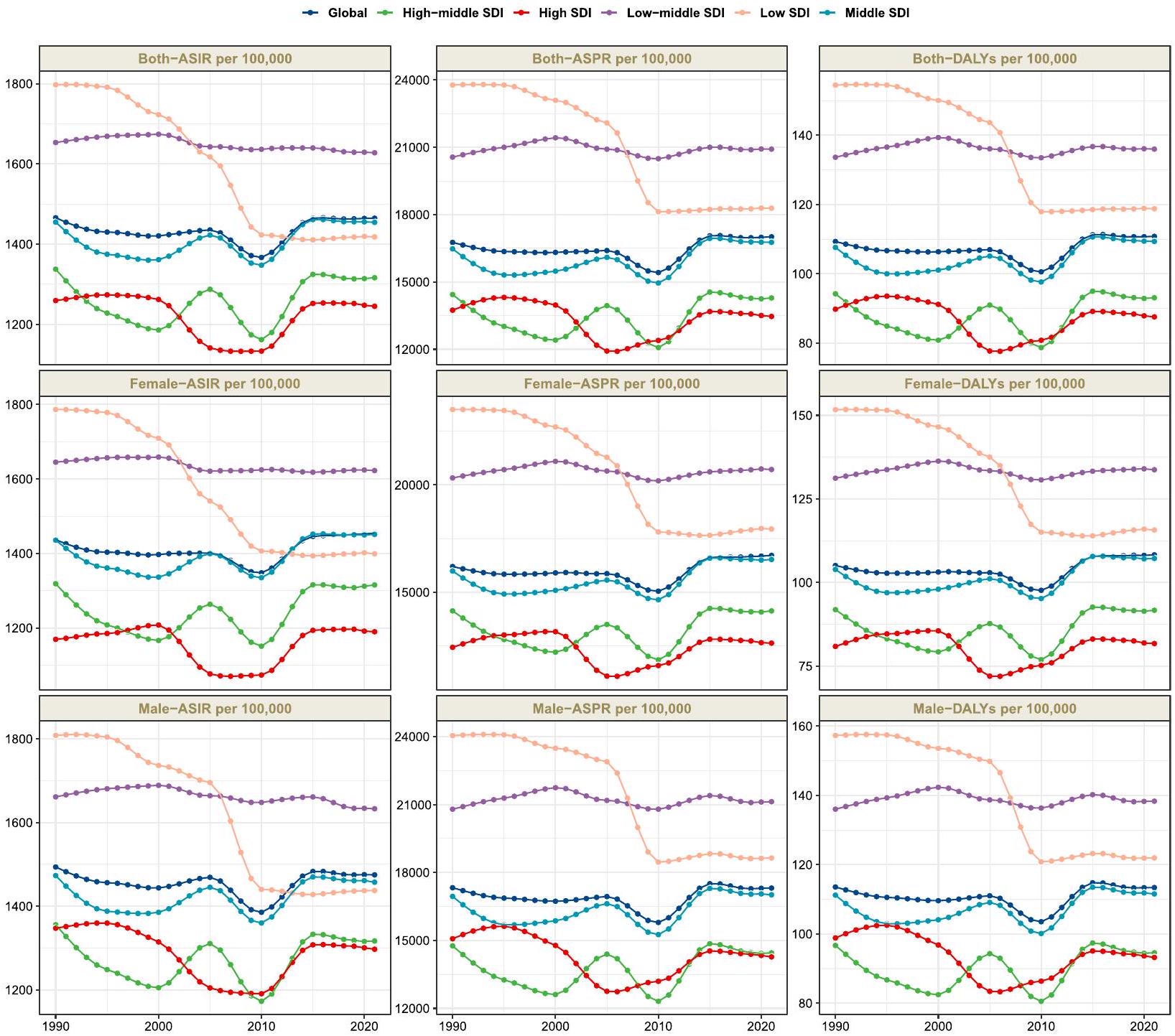
في عام 2021، بلغ العبء العالمي لأمراض اللثة 951,256,232.8 حالة. واجهة المستخدم: 729,035,190.8 )، مع ASPR من لكل 100,000 شخص ( واجهة المستخدم: 12,996.8-21,229.2) (الجدول 1، الشكل 1). هذا يمثل زيادة عن مستويات عام 1990. بلغ العدد العالمي للحالات 80,274,873.1 حالة جديدة ( واجهة المستخدم: )، مما يتوافق مع معدل حدوث موحد حسب العمر (ASIR) يبلغ 1,464.7 لكل 100,000 شخص ( UI: 934.9-2,027.1) (الجدول S1، الشكل 1). من حيث عبء المرض، كانت الأمراض اللثوية مسؤولة عن 6,192,220.2 سنة من الحياة المعدلة حسب الإعاقة (DALYs) على مستوى العالم (95% UI: 2,414,774.6-12,836,557)، بمعدل DALY موحد حسب العمر يبلغ 110.8 لكل 100,000 شخص ( واجهة المستخدم: 43.2-230.2) (الجدول S2، الشكل 1).
كشفت التحليلات القارية عن أنماط جغرافية مميزة واتجاهات زمنية من 1990 إلى 2021. في عام 2021، أظهرت آسيا أعلى معدلات موحدة حسب العمر عبر جميع المقاييس – الانتشار، الحدوث، وDALYs لأمراض اللثة، مما يعكس عبئًا غير متناسب في هذه المنطقة. أظهرت التغيرات الزمنية في معدلات الإصابة الموحدة حسب العمر اتجاهات متباينة واضحة عبر القارات: حيث أظهرت آسيا وأمريكا زيادات تدريجية مقارنة بمستوياتها في عام 1990، مما قد يعكس التحولات السكانية وتغيرات في ملفات عوامل الخطر في هذه المناطق. في المقابل، شهدت أفريقيا وأوروبا انخفاضات ملحوظة خلال نفس الفترة، مما قد يشير إلى تنفيذ ناجح لمبادرات صحة الفم أو تغييرات في عوامل الخطر البيئية.
لقد تم عكس هذا التباين القاري بشكل مشابه في أنماط معدل الإصابة القياسي. فقط آسيا وأمريكا أظهرت اتجاهات إيجابية في حدوث الأمراض: زاد معدل الإصابة القياسي في آسيا من 1,460 (نطاق عدم اليقين 95%: 779.4-2,161.2) في عام 1990 إلى 1,517.9 ( واجهة المستخدم: 995.6-2,065.7) في عام 2021، بينما ارتفعت في أمريكا من 1,475.3 ( واجهة المستخدم: 814.9-2,162) إلى 1,489.2 ( واجهة المستخدم: 937.1-2,083.6). بالمقابل، أظهرت كل من أفريقيا وأوروبا اتجاهات انخفاض ملحوظة في معدل الإصابة المعدل حسب العمر مقارنة بمستوياتها في عام 1990، مما يتماشى مع أنماط انتشارها. تبعت معدلات سنوات الحياة المعدلة حسب العمر أنماطًا متسقة، حيث أظهرت آسيا وأمريكا زيادات بينما شهدت أفريقيا وأوروبا انخفاضات خلال نفس الفترة، مما يشير إلى أن العبء العام للإعاقة يتتبع عن كثب التغيرات في حدوث الأمراض.

المستوى الإقليمي

أظهر التحليل الإقليمي في عام 2021 تفاوتات كبيرة في عبء مرض اللثة عبر مناطق سكانية وجغرافية مختلفة. عندما
الجدول 1 الحالات السائدة لأمراض اللثة في عام 2021 لكلا الجنسين وتغير معدل المعدلات الموحدة حسب العمر وفقًا لعبء المرض العالمي (GBD)
الموقع 1990 2021
رقم ASR رقم ASR
عالمي 511,273,721.9 (348,066,669.6681,372,362.6) 16,763.3 (11,516.1-22,153) ٩٥١,٢٥٦,٢٣٢.٨ (٧٢٩,٠٣٥,١٩٠.٨١,١٨٣,٣٢١,٤٥٩.٩) 17,011.6 (12,996.8-21,229.2)
أفريقيا ٦٣,٢٠٢,٨٦٣.٥ (٤٤,٤٧٥,٥٥٢.٥٨٢,٠٨٦,٩٨١.٨) 22,464.1 (16,156.4-28,670.1) ١٠٨,٠٩١,٠٩٤.٥ (٧٩,٩٥٠,١٤٤.٥١٤٠,٧٢٦,٨٣١.٤) 15,962.4 (11,912.6-20,534.2)
أمريكا 66,585,898 (44,694,130.989,621,499.2) 15,832.4 (10,736.8-21,117.4) ١٢٦,٣٧٦,٣٦٦.١ (٩٦,٠٢٧,٩٩٢.٤١٥٩,١٤٤,١١٦.٧) 16,405.6 (12,384.3-20,791.8)
أوروبا 86,818,068.9 (61,009,471.1114,247,019.4) 14,393.3 (10,039.3-19,027.3) 100,823,255.5 (68,802,122137210478) 13,908.9 (9298.7-19,372.6)
آسيا ٢٩٣,٥٨٨,٠٢٣.٨ (١٩٦,٢٢٠,٠٨٨.٥٣٩٥,٣٠٣,٩٦٦.٤) 16,851.9 (11,422.1-22,413.8) 614,676,733.5 (476,510,903.8755,271,722.4) 17,880.7 (13,810.7-22,044.5)
مؤشر التنمية البشرية العالي 89,612,454.2 (62,181,808.6119,083,548.8) 13,743.5 (9510.1-18,296.3) 126,843,491.6 (92,931,314.8165,324,976) 13,463.7 (9704.2-17,889.5)
مؤشر التنمية البشرية العالي المتوسط ١٠١,٤٤٠,٣٢٠ (٦٦,٦٨٤,٢٩٧.٨١٣٨,٠٧٣,٥٧٦.٢) 14,440.2 (9497.8-19,583) 165,170,486.4 (122,978,911.9213,817,271.5) 14,288.2 (10,493-18,812.5)
مؤشر التنمية المستدامة المتوسط 150,035,720.7 (100,646,529.5202,066,204.2) 16,476.1 (11,244.5-21,861.4) 313,921,462 (243,587,402.5385,827,907.9) 16,767 (12,950.9-20,693.9)
مؤشر التنمية البشرية المنخفضة والمتوسطة 116,744,061.6 (80,440,610.8154,287,969.6) 20,564.1 (14,409.4-26,782.5) ٢٤٨,٧٤٣,٨٥٥.٩ (١٨٩,٦٦٤,٢٨٥.٧٣٠٧,٥٧١,٩٨٩.٣) 20,920.5 (16,055-25,711)
مؤشر التنمية البشرية المنخفض 52,976,349 (36,945,623.569,275,404.9) 23,778.5 (16,918.9-30,561.1) 95,923,866.8 (72,989,707.7120,107,289.2) 18,289 (14,088.5-22,600.1)
أمريكا اللاتينية الأنديزية 3,023,916.5 (2,236,7563,868,293.7) 16,505.3 (12,415.8-20,810.4) 7,225,713.6 (4,762,953.610,097,958.1) 16,554.2 (10,976.5-23,001.8)
أسترالاسيا 1,615,132.5 (987,961.62,320,562.6) 11,252.8 (6875.2-16,167) 3,339,317.1 (2,132,344.14,840,026.6) 13,654 (8606.3-20,120.1)
الكاريبي 4,155,532.9 (2,866,049.15,522,078.2) 21,146.1 (14,826.9-27,700.2) 6,373,235.7 (4,377,728.48,601,141.2) 18,857.7 (12,884.6-25,582.6)
آسيا الوسطى 4,832,210 (3,111,346.56,684,239.2) 13,540.9 (8764.1-18,557.5) 8,432,943.4 (5,336,718.412,351,201.1) 12,742.7 (8079.9-18,604.2)
أوروبا الوسطى 11,715,457.2 (7,694,823.816,084,220.8) 12,353.6 (8041.4-17,062.8) 13,915,095.8 (9,198,270.519,396,692.5) 13,605.6 (8803.8-19,449.1)
أمريكا اللاتينية الوسطى 15,591,451.9 (10,535,502.621,068,168.5) ٢٠٠٧٥.٦ (١٣٩٤٩.٦-٢٦٤٩٧.٨) ٣٤,٨٦٦,٢٦٨.٥ (٢٥,٧٩١,٨٤٠.٦٤٤,٤٨٦,٠١٧.٤) 19,761.8 (14,613.7-25,224.7)
وسط أفريقيا جنوب الصحراء 5,625,458.2 (3,835,120.17,488,908.6) ٢٣,٧٠٤.٢ (١٦,٦٠٤.١-٣٠,٧٦٤.٨) 7,553,853.9 (4,548,21811,691,758.5) 12,549.5 (7704-18933.2)
شرق آسيا ١٠٤,٣٩١,٧٩٥.٥ (٦٨,١٢٥,٧٣٣.٥١٤٢,٨٤٦,٠٦٦.٤) 14,655.5 (9678.7-19,818.5) 195,893,145.5 (147,616,998.2-245,292,159) 14,212.7 (10,553.5-18,061.5)
أوروبا الشرقية 28,014,948 (19,173,423.337,291,849.9) 16,031.7 (10,840.1-21,493.5) 27,392,361.4 (18,475,561.937,895,424.1) 14,698.9 (9714.9-20,813)
شرق أفريقيا جنوب الصحراء 19,659,000.2 (13,551,253.926,010,889.7) 25,247.3 (17,980.3-32,504.4) 31,837,615.9 (23,299,412.341,861,466.8) 16,900.1 (12,558.1-21,831)
آسيا والمحيط الهادئ ذات الدخل المرتفع 15,673,158.7 (9,866,399.921,919,046.5) 11,505.3 (7219.9-16,152) 19,889,733.8 (12,888,538.527,984,201.4) 11,564.8 (7326.3-16,830.4)
أمريكا الشمالية ذات الدخل المرتفع 27,038,189.7 (17,836,680.436,772,309.7) 13,523.7 (8915.9-18,365.7) ٣٩,٣٣٦,٨٢٨.٥ (٢٩,٦٤١,٤٤٦٥٠,٠١٩,٧٩٧) 12,605 (9352.4-16,308.9)
شمال أفريقيا والشرق الأوسط 19,982,083.1 (12,734,808.728,271,233.4) 12,972 (8409.9-18,040.7) 64,902,272.1 (46,075,358.487,750,846.2) 15,879.6 (11,376.7-21,253.1)
أوقيانوسيا 381,098.8 (236,524.1542,110.2) 13,292.4 (8427.9-18,567.7) 207,199.3 (121,353.5344,656.1) 2847.3 (1680.5-4681.5)
جنوب آسيا ١٢٥,٠١٠,٩٨٩.٥ (٨٦,٢٥٠,٣٢٣.٨١٦٥,٠٩٧,٧٦١.٧) 22,553.3 (15,844.6-29,320.8) ٢٩١,٣٤٥,٦١٠.٣ (٢٢٤,٤٠٤,٥٨٠.٨٣٥٦,٤٠٨,٦٠٢.٧) 24,235.8 (18,781.4-29,490.3)
الجدول 1 (مستمر)
الموقع 1990 ٢٠٢١
رقم ASR رقم ASR
جنوب شرق آسيا 34,372,108.5 (22,682,947.847,211,272.7) 14,813.6 (9953.8-20,031) 67,596,721.1 (50,640,660.284,924,395.2) 13,222.9 (9897.2-16,629.3)
أمريكا اللاتينية الجنوبية 5,207,902.9 (3,420,620.97,113,362.8) 16,834.7 (11,069.3-22,948.7) 8,953,183.8 (5,913,850.512,441,455) 17,841.5 (11,719.8-24,949.2)
جنوب الصحراء الكبرى الأفريقية 2,138,598.1 (1,267,048.33,204,387.9) 9218.8 (5534.8-13,626.8) 3,485,853 (2,383,363.44,964,504.5) 7133.1 (4894.4-10,092.7)
أمريكا اللاتينية الاستوائية 12,306,220.8 (8,100,847.216,918,219.8) 15,301.2 (10,248.6-20,730.4) 30,467,127.4 (22,646,256.838,368,319.1) 17,612.2 (13,053.3-22,254.7)
أوروبا الغربية ٤٣,٧٨٦,٨٨٧.٢ (٣٢,٠٥٣,٤٤٤.٢٥٦,٧٤٠,٦٠٥.٤) 14,738 (10,728.1-19,176.9) ٤٧٠٤٨٣٩٠.٥ (٣٢٦٥١٨٩٦.٣٦٣٤٩٥١٥٨.١) 12,726.5 (8650.2-17,577.4)
غرب أفريقيا جنوب الصحراء ٢٦,٧٥١,٥٨١.٧ (١٩,٦٨٧,٢٦٩٣٣,٧٠٠,٥٦١.٥) 30,342.3 (22,809.3-37,593.1) 41,193,762.2 (32,216,310.650,918,502.9) 18,231.9 (14,405.1-22,294.6)
الشكل 1 اتجاهات حدوث أمراض اللثة، الانتشار وسنوات الحياة المعدلة بالعجز من 1990 إلى 2021
مصنفة حسب التنمية الاجتماعية والاقتصادية، كانت مناطق SDI المنخفضة والمتوسطة لديها أعلى معدل انتشار للأمراض اللثوية. لكل 100,000 شخص ( واجهة المستخدم: 16,055-25,711) (الجدول 1 والشكل 2)، مما يشير إلى
عبء غير متناسب في المناطق ذات مستويات التنمية المتوسطة.
جغرافياً، أظهر العبء تبايناً ملحوظاً، حيث أظهرت جنوب آسيا أعلى معدل إقليمي
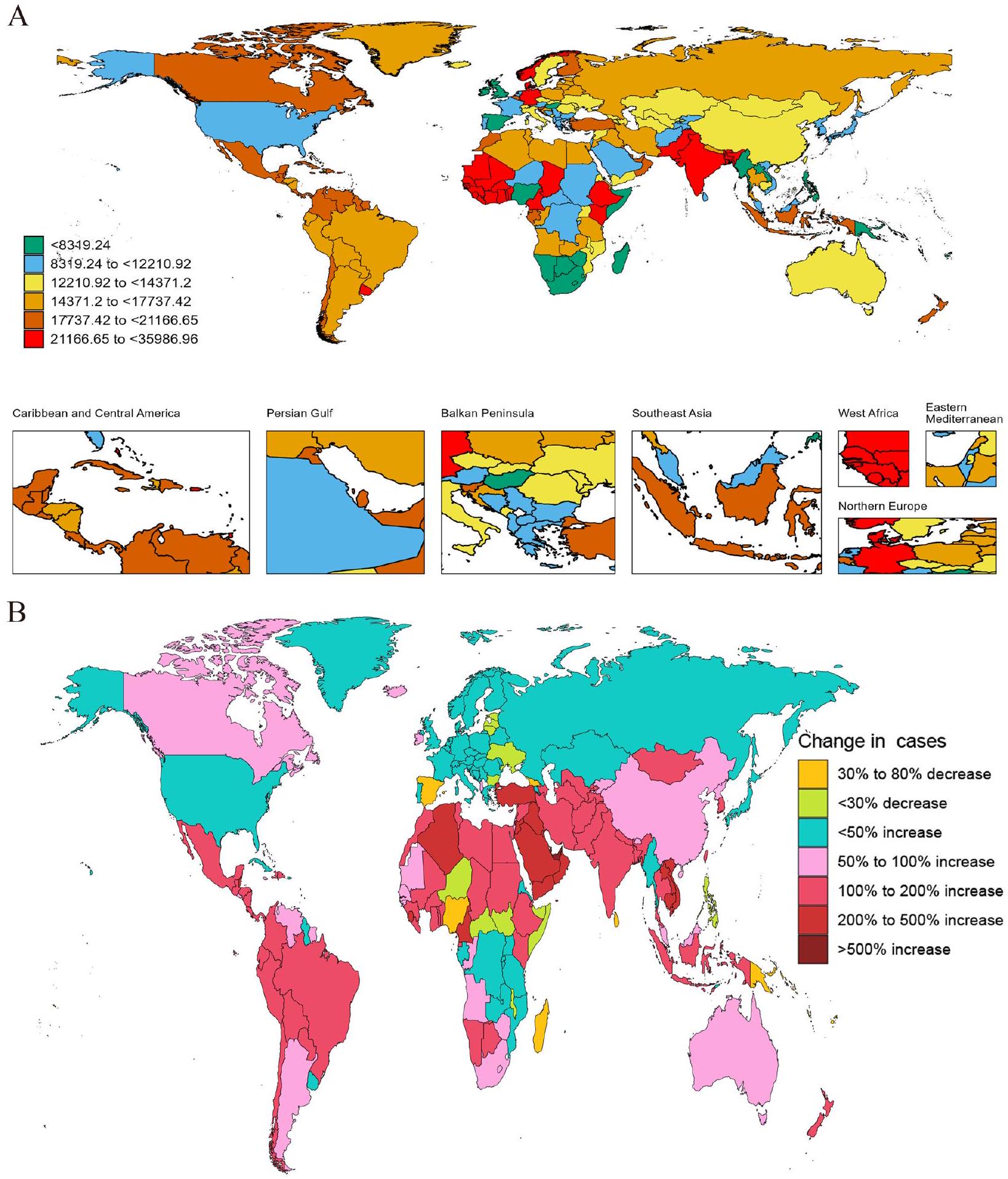
الشكل 2 عبء الأمراض العالمي لأمراض اللثة معدل الانتشار لكلا الجنسين في 204 دول وأقاليم
عبء مع ASPR من لكل 100,000 شخص ( واجهة المستخدم: 18,781.4-29,490.3)، تليها أمريكا اللاتينية الوسطى بمعدل 19,761.8 لكل 100,000 شخص ( واجهة المستخدم: ). تتباين هذه المناطق ذات العبء العالي بشكل حاد مع المناطق التي تظهر انتشارًا أقل بكثير للأمراض، بما في ذلك أوقيانوسيا ( لكل 100,000 شخص؛ 95% UI: 1,680.5-4,681.5)، جنوب الصحراء الكبرى الأفريقية (7,133.1 لكل 100,000 شخص؛ 95% UI: 4,894.4-10,092.7)، آسيا والمحيط الهادئ ذات الدخل المرتفع ( لكل 100,000 شخص؛ UI: 7,326.3-16,830.4)، وأفريقيا الوسطى جنوب الصحراء الكبرى (12,549.5 لكل 100,000 شخص؛ 95% UI: 7,704-18,933.2). تشير هذه الاختلافات الإقليمية إلى أن هناك عوامل تتجاوز التنمية الاقتصادية تؤثر على أنماط الأمراض.
كانت أنماط الحدوث متوازية مع توزيع الانتشار في عام 2021، حيث حافظت مناطق الدخل المنخفض والمتوسط على أعلى معدل حدوث قياسي بين مناطق الدخل. لكل 100,000 شخص ( واجهة المستخدم: )، تليها مناطق SDI الوسطى بمعدل 1,454.4 لكل 100,000 شخص ( واجهة المستخدم: 958.5-1,984.4) (الجدول S1 والشكل S1). أبلغت المناطق ذات مؤشر التنمية الاجتماعية المرتفع عن أدنى معدل سنوي موحد للعمر (ASIR) بمعدل 1,245.1 لكل 100,000 شخص ( من الناحية الجغرافية، أظهرت جنوب آسيا وأمريكا اللاتينية الوسطى وأمريكا اللاتينية الاستوائية أعلى معدل حدوث معيار العمر المعدل، بينما أظهرت منطقة آسيا والمحيط الهادئ ذات الدخل المرتفع وجنوب الصحراء الكبرى الأفريقية وأوقيانوسيا أدنى معدلات الحدوث.
أظهر عبء الإعاقة، المقاس بمعدلات DALY المعدلة حسب العمر، تدرجات اجتماعية واقتصادية مماثلة ولكن مع تغييرات زمنية ملحوظة. في عام 2021، تم ملاحظة أعلى عبء في مناطق الدخل المنخفض والمتوسط عند 136 لكل 100,000 شخص. واجهة المستخدم: بينما أبلغت المناطق ذات مؤشر التنمية البشرية العالي عن أدنى معدل وهو 87.6 لكل 100,000 شخص (فترة الثقة 95%: 32.9-185.6) (الجدول S2، الشكل S2).
أظهر مقارنة بيانات عامي 1990 و2021 تحسنًا كبيرًا في بعض المناطق. أظهرت المناطق ذات مؤشر التنمية الاجتماعية المنخفض تقدمًا ملحوظًا، حيث انخفضت معدلات سنوات الحياة المعدلة حسب العمر (DALY) من 154.5 لكل 100,000 شخص (95% UI: 59.7-326) في عام 1990 إلى 118.8 لكل 100,000 شخص ( UI: 46.8-245.3) في عام 2021 (الجدول S2، الشكل S2). كان الأكثر لفتًا للنظر هو تحول أوقيانوسيا، التي شهدت أكبر انخفاض دراماتيكي في معدلات DALY المعدلة حسب العمر، حيث انخفضت من 86.5 لكل 100,000 شخص ( UI: 32-192.6) إلى 18.4 لكل 100,000 شخص واجهة المستخدم: يمثل الخفض. على الرغم من هذه التحسينات في بعض المناطق، استمرت جنوب آسيا وأمريكا اللاتينية الوسطى ومنطقة الكاريبي في إظهار معدلات DALY الموحدة حسب العمر المرتفعة بشكل مستمر في عام 2021، حيث تجاوزت كل منها 120 لكل 100,000 شخص.

المستوى الوطني

يتراوح معدل انتشار الأمراض اللثوية (ASPR) من حوالي 2384.9 إلى 35,987 لكل 100,000 فرد. ومن الجدير بالذكر أن سيراليون تسجل 35,987 لكل 100,000 شخص؛ 95% UI:
28,897.9-42,839.9)، غامبيا (35,015.4 لكل 100,000 شخص؛ 95% UI: 27,521.6-42,300)
كابو فيردي ( لكل 100,000 شخص؛ 95% UI: غانا لكل 100,000 شخص؛ 95% UI: 25,647.1-40,508)، الكاميرون ( لكل 100,000 شخص؛ 95% UI: 24,555.7-39,699)، مالي (31,608 لكل 100,000 شخص؛ 95% UI: 23,344.2-39,210.8)، وبوركينا فاسو ( لكل 100,000 شخص؛ 95% UI: 23,321.7-39,113.8) لديها أعلى معدل للوفاة المعدل حسب العمر (الشكل 2A والجدول 1). من 1990 إلى 2021، تم ملاحظة اختلافات في تغيير معدل الوفاة المعدل حسب العمر عبر البلدان. ومن الجدير بالذكر، تركيا ( لكل 100,000 شخص؛ 95% UI: 12,311.9-24,890.7)، سيراليون (35,987 لكل 100,000 شخص؛ 95% UI: 28,897.9-42,839.9)، وجمهورية لاو الديمقراطية الشعبية (7169.6 لكل 100,000 شخص؛ 95% UI: 4227.6-11,257.3) شهدت أكبر الزيادات النسبية في معدل انتشار الأمراض (ASPR) (الجدول 1). في انحراف ملحوظ عن البيانات المسجلة في عام 1990، ارتفعت حالات الانتشار في قطر، والإمارات العربية المتحدة، والأردن بشكل كبير بأكثر من (الشكل 2B). على العكس من ذلك، أظهرت دول جزر المحيط الهادئ مثل تونغا، توكيلاو، نيي، وناورو تقدمًا ملحوظًا، مع انخفاض كبير يزيد عن في حالات انتشارها بالنسبة للأرقام من عام 1990 (الشكل 2B).
تراوحت نسبة الإصابة السنوية للأمراض اللثوية بين 261.2 و 2235.9 لكل 100,000 نسمة. في عام 2021، كانت سيراليون (2235.9 لكل 100,000 شخص؛ 95% فاصل الثقة: 1447.9-2870.1)، غامبيا (2170.2 لكل 100,000 شخص؛ 95% فاصل الثقة: 1346.1-2854)، غانا (2120.2 لكل 100,000 شخص؛ واجهة المستخدم: 1269.3-2843.9)، الدنمارك (2103 لكل 100,000 شخص؛ واجهة المستخدم: 1304.4-2802)، والكاميرون (2091.2 لكل 100,000 شخص؛ كان لدى UI: 1215.7-2840.4 أعلى معدل ASIR (الشكل S1 والجدول التكميلي S1). في تحول ديموغرافي ملحوظ منذ عام 1990، شهدت قطر والإمارات العربية المتحدة والأردن زيادة استثنائية في حالات الإصابة، حيث ارتفعت المعدلات بأكثر من أربعة أضعاف عن أرقامها الأساسية. في الوقت نفسه، رسمت دول الجزر في المحيط الهادئ مثل توكيلاو ونيوي وناورو صورة مختلفة تمامًا، حيث أظهرت تقدمًا استثنائيًا في مبادرات الصحة العامة، ونجحت في تقليل حالات الإصابة بأكثر من سبعين في المئة عن مستوياتها في عام 1990 (الشكل S3). مشابهًا لمعدل ASIR، هناك 8 دول لديها أكثر من 200 DALYs موحدة حسب العمر (سيراليون، غامبيا، كابو فيردي، غانا، الكاميرون، مالي، بوركينا فاسو، غينيا). كانت سيراليون لديها أعلى DALYs موحدة حسب العمر (235.9، 95% UI: 90.2-481.7، الجدول التكميلي S2) في عام 2021.

أنماط العمر والجنس

فيما يتعلق بأنماط الانتشار، بلغت نسبة الإصابة بالسرطان ذروتها عالميًا وفي جميع مناطق مؤشر التنمية الاجتماعية الخمس بين الأفراد الذين تتراوح أعمارهم بين 50-59 عامًا. أظهر الذكور باستمرار نسبة إصابة أعلى مقارنة بالإناث. بين مناطق مؤشر التنمية الاجتماعية الخمس،
فقط فئة SDI المنخفضة أظهرت انخفاضًا ملحوظًا في ASPR مقارنة بمستويات عام 1990، بينما حافظت المناطق الأخرى من SDI على معدلات مستقرة نسبيًا خلال هذه الفترة (الشكل 3). أظهرت أنماط DALYs اتجاهات مشابهة لتلك التي لوحظت في الانتشار (الشكل S4). فيما يتعلق بأنماط الحدوث، كانت الفئة العمرية الذروة هي سنوات عبر معظم المناطق، مع كون المناطق ذات مؤشر التنمية البشرية المنخفضة هي الاستثناء، حيث حدث أعلى معدل الإصابة بالعمر في الفئة العمرية 65-69. في المناطق ذات مؤشر التنمية البشرية المرتفع، أظهر الذكور معدل إصابة أعلى من الإناث، بينما أظهرت المناطق الأخرى ذات مؤشر التنمية البشرية معدلات إصابة مشابهة بين الذكور والإناث (الشكل S5).

تحليل الانحدار بنقطة الانضمام

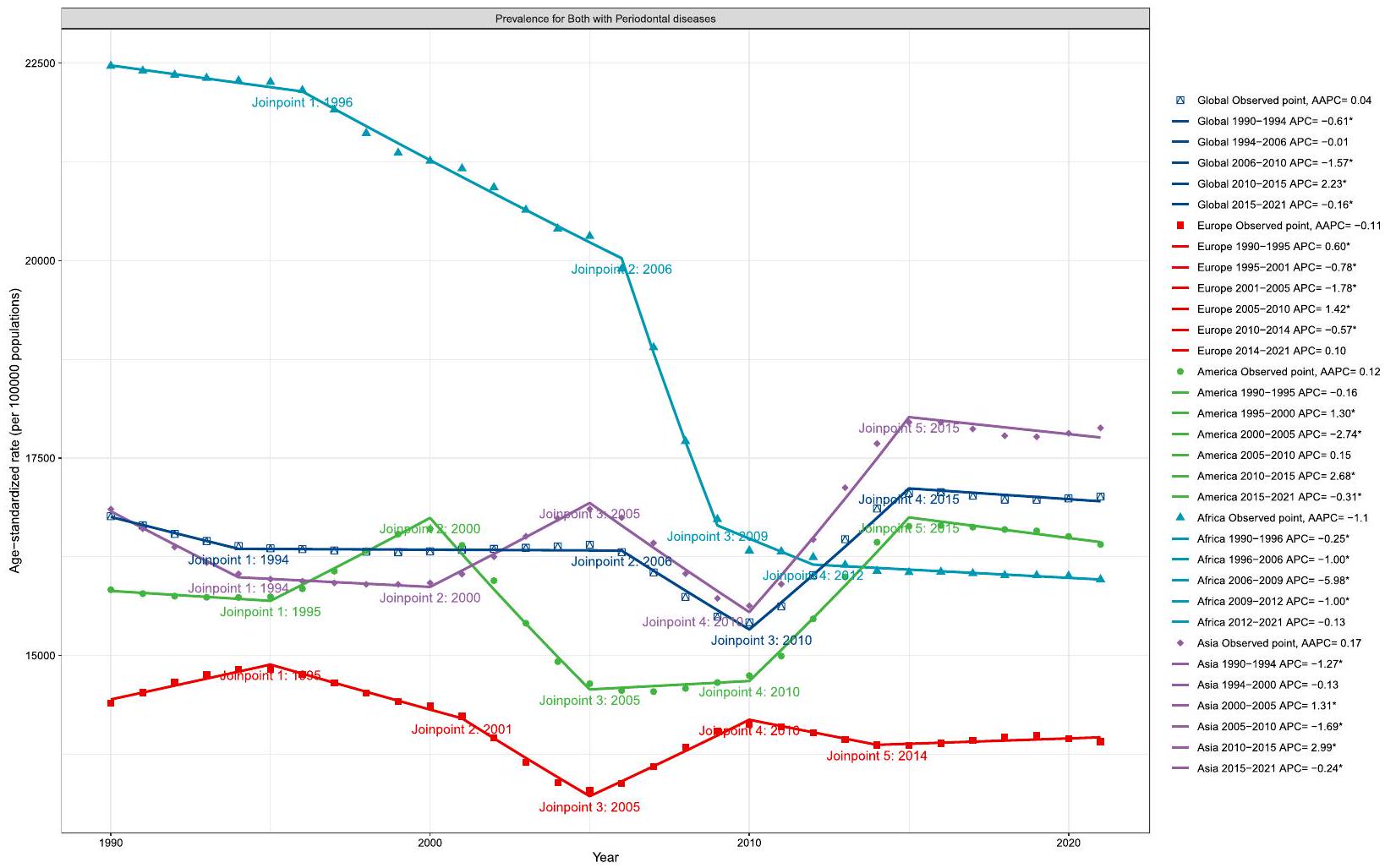
أظهر تحليل الاتجاه الزمني لعبء مرض اللثة أنماطًا مميزة مع عدة نقاط تحول بين عامي 1990 و2021 (الشكل 4). بشكل عام، أظهر معدل انتشار مرض اللثة العالمي زيادة متواضعة ولكن ذات دلالة إحصائية خلال فترة الـ 31 عامًا بأكملها، مع معدل التغير السنوي المئوي المعدل (AAPC) قدره 0.04. واجهة المستخدم: 0.01 إلى 0.06).
يمكن تقسيم هذا الاتجاه العام إلى أربع مراحل متميزة، كل منها لها معدل تغيير خاص بها يشير إلى معدل التغير خلال تلك الفترة المحددة. في البداية، من 1990 إلى 1994، كان هناك انخفاض كبير بمعدل تغيير قدره -0.61 (95% UI: – 1.04 إلى – 0.37)، والذي قد يتوافق
إلى التنفيذ المبكر لتدابير صحة الفم الوقائية في العديد من المناطق. أظهر الفترة من 1994 إلى 2006 استقرارًا نسبيًا. بعد ذلك، من 2006 إلى 2010، كان هناك تراجع أكثر وضوحًا مع معدل تغيير سنوي قدره -1.57 ( UI: -1.72 إلى -1.36 )، مما قد يعكس تحسينات في الوصول إلى رعاية صحة الفم واستراتيجيات الوقاية خلال هذه الفترة. وقد عكس هذا الاتجاه التنازلي خلال الفترة من 2010 إلى 2015، عندما زاد معدل ASPR بشكل كبير مع معدل نمو سنوي مركب قدره 2.23 (95% UI: 2.1 إلى 2.36)، مما قد يعكس تغيرات في التركيبة السكانية، وتحسين اكتشاف الأمراض، أو تغييرات في انتشار عوامل الخطر. أخيرًا، من 2015 إلى 2021، استأنف المعدل اتجاهه التنازلي، وإن كان بوتيرة أبطأ، مع معدل نمو سنوي مركب قدره إلى -0.05 .
لقد شهدت فترة 2010-2015 انحرافًا كبيرًا عن الاتجاهات التنازلية السابقة، حيث أظهرت زيادة كبيرة بمعدل نمو سنوي مركب قدره 2.23 (95% UI: 2.1 إلى 2.36). وقد تزامن هذا التحول الملحوظ مع عدة تطورات هامة في علم الأوبئة اللثوية وأنظمة الرعاية الصحية. أولاً، جاءت هذه الفترة بعد الركود الاقتصادي العالمي في 2009-2010، والذي من المحتمل أنه قلل من الوصول إلى الرعاية الوقائية للأسنان في العديد من المناطق. ثانيًا، شهدت هذه الفترة تنفيذ تعريفات حالات CDCAAP لعام 2012 للمراقبة القائمة على السكان.
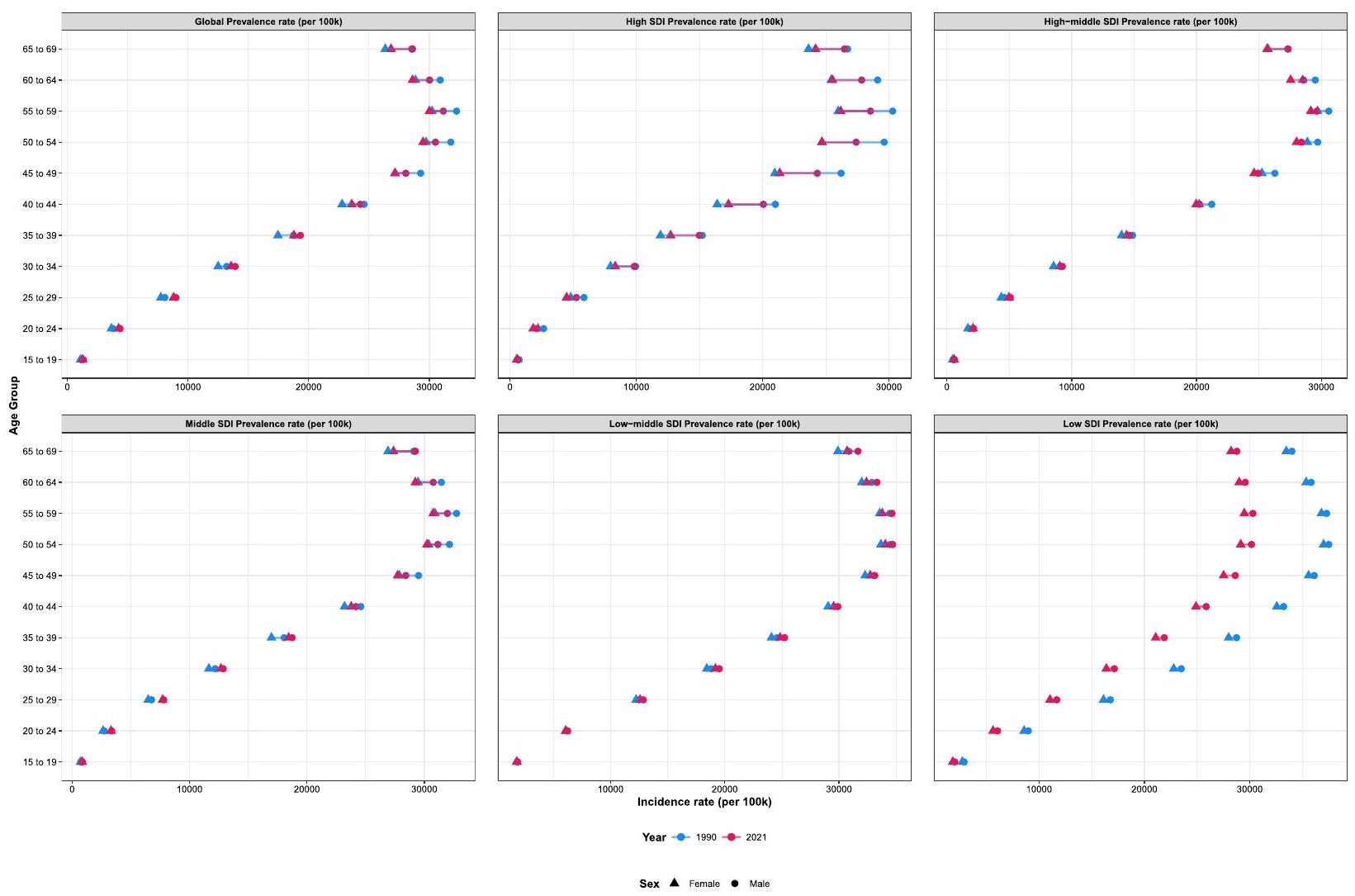
الشكل 3 معدلات انتشار الأمراض اللثوية المعدلة حسب العمر حسب الجنس، مجموعة العمر، ومؤشر السوسيو-ديموغرافي، 1990 و2021
الشكل 4 تحليل الانحدار النقاطي لمعدل انتشار الأمراض اللثوية من 1990 إلى 2021
للتهاب دواعم الأسنان، الذي حسّن معدلات الكشف وموحد التشخيص. ثالثًا، خضعت طرق جمع البيانات لدراسة العبء العالمي للأمراض (GBD) للتنقيح خلال هذه الفترة، مما قد يساعد في التقاط حالات كانت قد تم الإبلاغ عنها بشكل أقل. بالإضافة إلى ذلك، تزامنت هذه الفترة مع شيخوخة السكان في العديد من المناطق ذات الدخل المتوسط المنخفض وزيادة انتشار عوامل الخطر مثل السكري والتدخين في الاقتصادات النامية. أظهر التحليل الإقليمي أن هذه الزيادة كانت أكثر وضوحًا في المناطق ذات الدخل المتوسط المنخفض، مما يشير إلى أن هذه العوامل كان لها تأثيرات متفاوتة عبر الطبقات الاجتماعية والاقتصادية. أخيرًا، من 2015 إلى 2021، استأنف المعدل اتجاهه التنازلي، وإن كان بوتيرة أبطأ، مع معدل تغيير سنوي قدره -0.16. واجهة المستخدم: – 0.28 إلى ربما تعكس جهود الوقاية المتجددة والسياسات المحسّنة لرعاية صحة الفم بعد الزيادة المثيرة للقلق في الفترة السابقة.
عند تحليلها حسب مستوى التنمية الاجتماعية والديموغرافية، ظهرت أنماط متباينة. أظهرت المناطق ذات مؤشر التنمية الاجتماعية المنخفض والمتوسط ومؤشر التنمية الاجتماعية المتوسط اتجاهات زيادة عامة من 1990 إلى 2021، مع معدلات النمو السنوي المركب البالغة 0.05 (فترة الثقة 95%: 0.04 إلى 0.06) و0.05 ( مؤشر التنمية البشرية: 0.02 إلى 0.08)، على التوالي. قد تعكس هذه الزيادات نمو السكان، وعمليات التحضر، والتغيرات في عوامل نمط الحياة في هذه المناطق. بالمقابل، أظهرت مناطق مؤشر التنمية البشرية الأخرى اتجاهات تنازلية: حيث أظهرت مناطق التنمية البشرية العالية والمتوسطة
انخفاض طفيف مع معدل النمو السنوي المركب – 0.05 ( واجهة المستخدم: – 0.1 إلى 0 )، بينما أظهرت المناطق ذات مؤشر التنمية الاجتماعية المنخفض أكبر انخفاض مع معدل التغير السنوي المئوي -0.84 ( واجهة المستخدم: -0.86 إلى يشير الانخفاض الأكثر وضوحًا في المناطق ذات مؤشر التنمية البشرية المنخفض على الرغم من قيود الموارد إلى فوائد محتملة من التدخلات المستهدفة في صحة الفم أو التغييرات في عوامل الخطر البيئية في هذه المناطق.

تحليل التحلل

كشفت تحليلات التحلل عن أنماط مميزة في مساهمات محددات مستوى السكان (الشيخوخة، نمو السكان، والتغير الوبائي) في التغيرات في مقاييس عبء المرض على المستويات العالمية، وطبقات مؤشر التنمية الاجتماعية، والمستويات الفائقة الإقليمية لجدول الأمراض العالمية (الشكل S6 والجدول التكميلي S3). على المستوى العالمي، برز نمو السكان كالعامل الرئيسي، حيث يمثل لتغيرات في سنوات الحياة المعدلة حسب الإعاقة (DALYs)، بينما ساهم الشيخوخة والتغير الوبائي و على التوالي. لوحظت أنماط مماثلة لتغيرات الحدوث، حيث ساهم نمو السكان ، تليها الشيخوخة (13.30%) والتغير الوبائي (0.33%). بالنسبة لتغيرات الانتشار، ظل نمو السكان هو المساهم الرئيسي في ، مع تقدم العمر الذي يمثل وتغيير وبائي يساهم في المنطقة الأفريقية، ظهرت زيادة سكانية
كعامل رئيسي، يمثل من زيادة في سنوات الحياة المعدلة حسب الإعاقة (DALYs)، في حين ساهمت العوامل الوبائية بشكل سلبي ( ) ، وكانت آثار الشيخوخة ضئيلة ( أظهرت الأمريكتان أنماطًا أكثر اعتدالًا، حيث ساهم نمو السكان بنسبة 70.63% في تغييرات سنوات الحياة المعدلة حسب الإعاقة، مدعومًا بالشيخوخة. ) وعوامل وبائية ( ). لوحظ نمط مميز في أوروبا، حيث هيمنت الشيخوخة ( )، مع مساهمات إضافية من نمو السكان ( ) وآثار وبائية سلبية ( ). أظهرت المنطقة الآسيوية أنماطًا متوسطة، حيث ساهم نمو السكان الشيخوخة ، والتغيرات الوبائية .
أظهرت المناطق ذات المؤشر التنموي العالي مساهمات كبيرة من كل من نمو السكان ( ) والشيخوخة مع آثار وبائية سلبية ( في مناطق SDI المتوسطة العليا، ساهم النمو السكاني والشيخوخة تقريبًا بالتساوي و ، على التوالي). أظهرت مناطق SDI المتوسطة تأثيرات نمو سكاني سائدة ( التأثيرات المعتدلة للشيخوخة )، وتغيرات وبائية طفيفة ( ). أظهرت المناطق ذات مؤشر التنمية البشرية المنخفض إلى المتوسط تأثيرات ملحوظة على نمو السكان ( ) مع مساهمات أقل من الشيخوخة (11.78%). ومن الجدير بالذكر أن المناطق ذات مؤشر التنمية البشرية المنخفض أظهرت أعلى مساهمة في نمو السكان ( )، مصحوبًا بتقدم العمر السلبي ( ) وعلم الأوبئة ( ) التأثيرات.

تحليل الحدود

لفهم التحسينات الممكنة في معدلات DALY لأمراض اللثة بالنسبة للتطور الاجتماعي والديموغرافي، قمنا بإجراء تحليل حدودي باستخدام معدلات DALY المعدلة حسب العمر وبيانات SDI من 1990 إلى 2021 (الشكل 5A). تمثل خط الحدود أدنى معدلات DALY الملحوظة بين الدول والأقاليم عند كل مستوى من مستويات SDI، مما يحدد معايير الأداء المثلى. قمنا بت quantifying الفرق الفعال – الفجوة بين DALYs الملحوظة وDALYs المحتملة القابلة للتحقيق – والتي تمثل التحسين النظري الممكن بالنظر إلى الموارد الاجتماعية والديموغرافية لموقع معين. أظهر تحليل بيانات 2021 أن أعلى الفروق الفعالة من الحدود (النطاق، 155.28-214.16) لوحظت في غامبيا، سيراليون، كابو فيردي، غانا، باكستان، غينيا، بوركينا فاسو، ليبيريا، بوتان، وبنغلاديش، مما يشير إلى عبء أكبر بكثير من أمراض اللثة مما كان متوقعًا لتطورهم الاجتماعي والديموغرافي (الشكل 5B، الجدول التكميلي S4). على العكس، كانت أدنى الفروق الفعالة (النطاق، 0.34-6.09) موجودة في فيجي، توكيلاو، إسبانيا، تونغا، ساموا، جزر مارشال، بابوا غينيا الجديدة، ميكرونيزيا، فانواتو، وجزر سليمان، مما يشير إلى أداء مثالي بالنسبة لوضعهم التنموي (الشكل 5B، الجدول التكميلي S4).

توقع نموذج BAPC

استنادًا إلى تحليل معدل الإصابة القياسي للأمراض اللثوية على مدى الـ 32 عامًا الماضية، قمنا بتوقع تغييرات معدل الإصابة القياسي للـ 25 عامًا القادمة، مع الأخذ في الاعتبار التغيرات الزمنية والمرتبطة بالعمر. تشير توقعاتنا للانتشار إلى اتجاه تصاعدي مستمر عبر معظم الفئات العمرية. على وجه التحديد، بحلول عام 2046، من المتوقع أن يصل معدل الإصابة القياسي إلى لكل 100,000 شخص في فئة العمر لكل 100,000 شخص في فئة العمر (الشكل S7، الجدول S5). وبالمثل، من المتوقع أن تصل نسبة الإصابة العمرية المعدلة في فئة العمر 45-49 إلى لكل 100,000 شخص (الشكل S8، الجدول S5). من المتوقع أن تظل عبء المرض، المقاس بوحدات سنوات الحياة المعدلة بالإعاقة (DALYs)، الأعلى في الفئة العمرية 50-54، حيث تصل إلى 259.198 لكل 100,000 شخص بحلول عام 2046 (الشكل S9، الجدول S5).

نقاش

تقدم هذه الدراسة أول تحليل شامل لعبء مرض اللثة العالمي مع التركيز بشكل خاص على فئة السكان في سن العمل من 1990 إلى 2021. تكشف نتائجنا عن تباينات كبيرة في عبء المرض عبر المناطق والدول، مع اتجاهات مقلقة تتطلب اهتمامًا فوريًا من محترفي الصحة العامة وصانعي السياسات. يتبع تعريف حالة مرض اللثة في هذه الدراسة منهجية الدراسات السابقة لعبء المرض العالمي لضمان قابلية المقارنة للتقديرات عبر الفترات الزمنية. بينما يشمل هذا التعريف أعراضًا تتداخل مع التهاب اللثة، تم الحفاظ على هذا النهج لضمان التناسق مع منهجية عبء المرض العالمي المعتمدة ولتغطية العبء الكامل لحالات مرض اللثة.
يمثل العبء العالمي الكبير للأمراض اللثوية، الذي يؤثر على 951.3 مليون فرد في عام 2021، تحديًا كبيرًا للصحة العامة لا يمكن تجاهله. تشير نسبة انتشار الأمراض اللثوية البالغة 17,011.6 لكل 100,000 شخص إلى أن هذه الأمراض لا تزال شائعة جدًا بين السكان في سن العمل، مما يتماشى مع الدراسات السابقة التي تسلط الضوء على الطبيعة الواسعة الانتشار لهذه الحالات على مستوى العالم. إن حجم هذا العبء مقلق بشكل خاص نظرًا لتأثيره المحتمل على إنتاجية القوى العاملة وجودة الحياة.
تحليل الاتجاهات الزمنية يكشف عن زيادة متواضعة ولكن ثابتة في عبء المرض من 1990 إلى 2021، مع معدل سنوي متوسط للنمو يبلغ 0.04. تشير هذه الاتجاهات الصاعدة المستمرة إلى أنه على الرغم من التقدم في رعاية الأسنان واستراتيجيات الوقاية، لم تنجح المجتمع العالمي في تقليل عبء الأمراض اللثوية. وقد أشار تونتي وآخرون سابقًا إلى مخاوف مماثلة بشأن الطبيعة التحديّة للسيطرة على تقدم الأمراض اللثوية على مستوى السكان. قد يُعزى الاتجاه المتزايد إلى تحسين الكشف والتشخيص، وشيخوخة السكان، وتغيرات في عوامل الخطر.
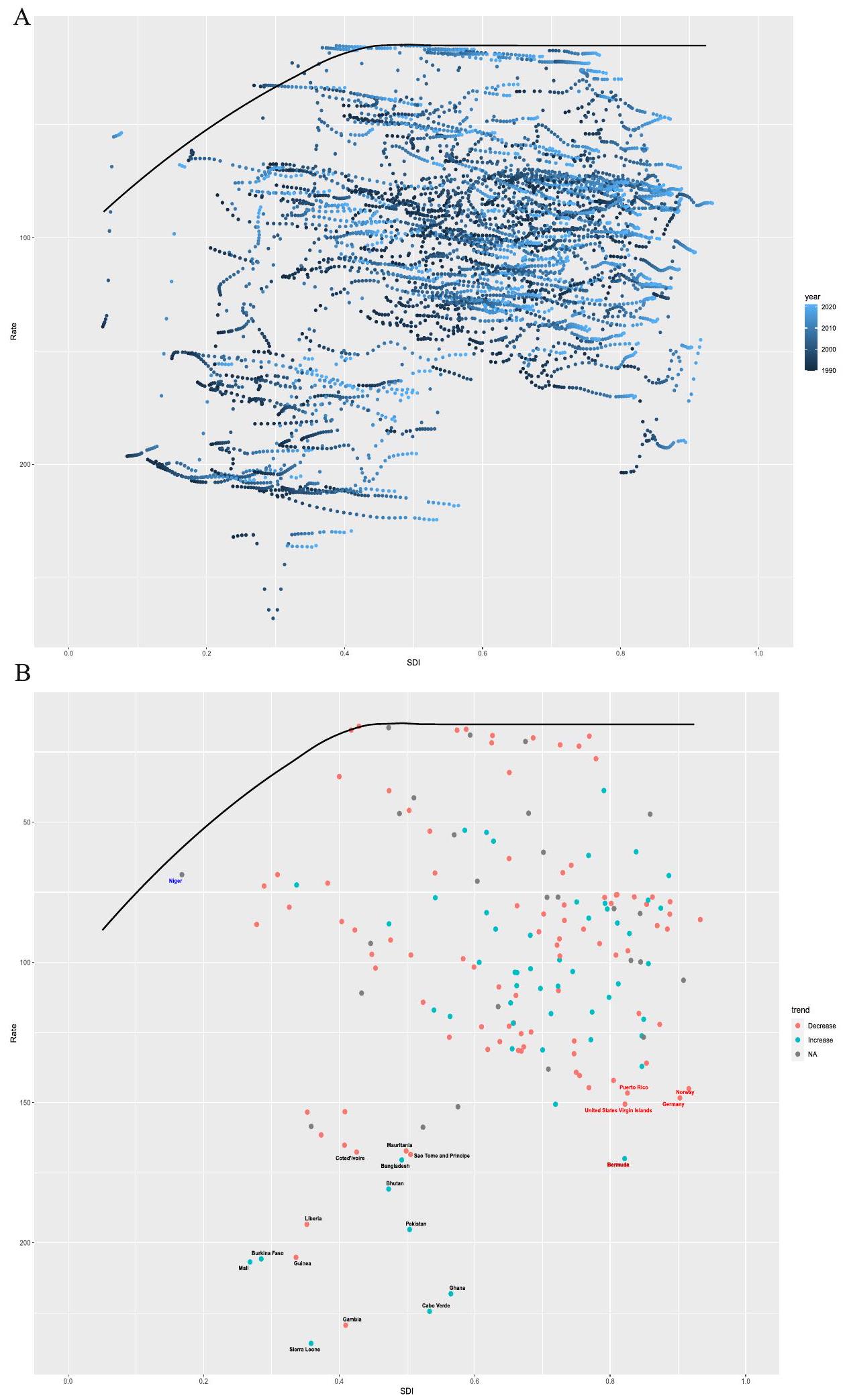
الشكل 5 تحليل الحدود لاستكشاف العلاقة بين مؤشر التنمية المستدامة ومعدلات سنوات الحياة المعدلة حسب الإعاقة للأمراض اللثوية
مثل انتشار التدخين والسكري، كما اقترحت الدراسات الوبائية الحديثة [20]. تظهر نتائجنا اختلافات إقليمية كبيرة في عبء المرض، حيث تظهر آسيا أعلى معدل موحد للعمر عبر جميع المقاييس. يعكس العبء غير المتناسب في مناطق الدخل المنخفض والمتوسط، مع معدل انتشار موحد للعمر قدره لكل 100,000 شخص، الفجوات الكبيرة في الرعاية الصحية التي تعكس عدم المساواة الاجتماعية والاقتصادية الأوسع. وقد أكد بيريس وآخرون [21] سابقًا كيف أن مثل هذه الفجوات في صحة الفم غالبًا ما تعكس عدم المساواة النظامية في الوصول إلى الرعاية الصحية وتوزيع الموارد. إن النجاح الملحوظ لبعض دول جزر المحيط الهادئ في تقليل عبء مرضها بأكثر من منذ عام 1990 يوفر رؤى قيمة لتطوير السياسات. تُظهر هذه الإنجازات أن التحسينات الكبيرة ممكنة مع التدخلات المناسبة، على الرغم من أن العوامل المحددة التي تسهم في هذه النجاحات تستدعي مزيدًا من التحقيق. من ناحية أخرى، فإن الزيادات الكبيرة في الانتشار (> ) التي لوحظت في دول مثل قطر والإمارات والأردن تثير مخاوف كبيرة. قد تُعزى هذه الاتجاهات إلى التحضر السريع، وتغيرات نمط الحياة، وتحسين اكتشاف الأمراض، وتحولات التركيبة السكانية، كما هو موثق في الدراسات الحديثة حول انتقالات صحة الفم في الاقتصادات النامية [22،23].
تحليلنا للتفكيك يكشف أن النمو السكاني ( ) والشيخوخة ( ) هما المحركان الرئيسيان لزيادة عبء المرض. لهذه النتيجة آثار عميقة على تخطيط الرعاية الصحية وتتوافق مع الأبحاث السابقة [24]. تشير العلاقة بين التنمية الاجتماعية الديموغرافية وعبء المرض، كما كشفت تحليلاتنا الحدودية، إلى تفاعل معقد يتطلب اعتبارًا دقيقًا في تطوير السياسات.
تشير الزيادة الأكبر في عبء المرض في مناطق الدخل المنخفض والمتوسط إلى أن التنمية الاقتصادية وحدها قد لا تضمن تحسين نتائج صحة الفم دون تدخلات مستهدفة وتدابير سياسية [25]. تدعم هذه الملاحظة النتائج السابقة المتعلقة بالحاجة إلى نهج شامل لتحسين صحة الفم يعالج كل من الوصول إلى الرعاية الصحية والعوامل الاجتماعية المحددة للصحة [26].
يجب الاعتراف بعدة قيود في هذه الدراسة. أولاً، مثل الدراسات الأخرى التي تستخدم قاعدة بيانات GBD، كانت تحليلاتنا مقيدة بالقيود المتأصلة في منهجية دراسة GBD. تعتمد تقديرات GBD بشكل كبير على النمذجة في المناطق التي تفتقر إلى بيانات أولية أو لا تحتوي عليها، مما قد يؤثر على دقة التقديرات في هذه المناطق. ثانيًا، الطبيعة المقطعية للعديد من الدراسات المضمنة تحد من قدرتنا على إقامة علاقات سببية بين الاتجاهات الملاحظة ومحركاتها المحتملة. أخيرًا، لم تأخذ دراستنا في الاعتبار التباينات المحتملة في شدة المرض ضمن
فئة التهاب اللثة الشديد، مما قد يخفي أنماطًا سريرية وبائية مهمة. يمكن أن توفر الأبحاث المستقبلية التي تتضمن تصنيفات شدة أكثر تفصيلًا رؤى أفضل للممارسة السريرية وتخطيط الصحة العامة.

الاستنتاجات

لقد زاد العبء العالمي لالتهاب اللثة بشكل كبير من عام 1990 إلى عام 2021، مع ارتفاع معدل الانتشار الموحد للعمر بنسبة على مستوى العالم. كان النمو السكاني هو المحرك الرئيسي، حيث يمثل من الزيادة في الحالات السائدة. تظهر المناطق الأقل تطورًا أعباء مرضية أعلى بشكل غير متناسب، مما يشير إلى فجوات كبيرة في الرعاية الصحية. تؤكد هذه النتائج الحاجة الملحة إلى إصلاحات سياسية شاملة، بما في ذلك تنفيذ برامج صحة الفم في أماكن العمل، وتوسيع تغطية التأمين الصحي للأسنان، وتعزيز خدمات الرعاية الوقائية. يجب أن يتبع دمج رعاية اللثة في خدمات الصحة الأولية نماذج ناجحة تم إثباتها في دول مثل السويد والدنمارك، حيث يعمل أخصائيو صحة الأسنان جنبًا إلى جنب مع أطباء الرعاية الأولية وتُدرج الفحوصات الروتينية للثة في الفحوصات الصحية العادية. في نيوزيلندا وأستراليا، أظهرت تنفيذ تقييمات صحة الفم في إعدادات الرعاية الأولية والتنسيق بين المهنيين الطبيين وطب الأسنان نتائج واعدة في الكشف المبكر وإدارة أمراض اللثة. يجب أن تعطي المبادرات الصحية العامة المستقبلية الأولوية لاستراتيجيات وقائية محددة، بما في ذلك: (1) برامج تعليم صحة الفم في المدارس التي تركز على تقنيات الفرشاة الصحيحة والتنظيف بين الأسنان؛ (2) فلورة مياه المجتمع حيثما كان ذلك ممكنًا؛ (3) دعم تنظيف الأسنان المحترف بانتظام للسكان المعرضين للخطر؛ و(4) برامج مستهدفة للإقلاع عن التدخين لمعالجة هذا العامل الرئيسي. يجب أن تركز أساليب الإدارة على الكشف المبكر من خلال الفحوصات الروتينية، وبروتوكولات العلاج الموحدة، وبرامج الصيانة طويلة الأجل، مع مراعاة التحديات المحددة للمنطقة وتوافر الموارد.
الاختصارات
AAPC متوسط التغير السنوي النسبة المئوية
ASIR معدل الإصابة الموحد للعمر
ASPR معدل الانتشار الموحد للعمر
BAPC نموذج بايزي للفترة العمرية
DALY سنة الحياة المعدلة بالإعاقة
GBD عبء المرض العالمي
GHDx تبادل بيانات الصحة العالمية
ICD التصنيف الدولي للأمراض
INLA تقريب لابلاس المتداخل المتكامل
LOESS الانحدار الموزون محليًا
SDI مؤشر السوسيوديموغرافي
UI فترة عدم اليقين

المعلومات التكميلية

تحتوي النسخة الإلكترونية على مواد تكميلية متاحة على https://doi. org/10.1186/s12889-025-22566-x.
المادة التكميلية 1: الجدول S1 معدل حدوث أمراض اللثة في عام 2021 لكلا الجنسين وتغير معدل المعدلات الموحدة للعمر حسب عبء المرض العالمي (GBD).
المادة التكميلية 2: الجدول S2 سنوات الحياة المعدلة بالإعاقة لأمراض اللثة في عام 2021 لكلا الجنسين وتغير معدل المعدلات الموحدة للعمر حسب عبء المرض العالمي (GBD).
المادة التكميلية 3: الجدول S3: تحليل التفكيك.
المادة التكميلية 4: الجدول S4: تحليل الحدود.
المادة التكميلية 5: الجدول S5: توقع نموذج BAPC.
المادة التكميلية 6: الشكل S1: العبء العالمي لمرض التهاب اللثة معدل حدوثه لكلا الجنسين في 204 دول وأقاليم.
المادة التكميلية 7: الشكل S2: العبء العالمي لمرض التهاب اللثة سنوات الحياة المعدلة بالإعاقة لكلا الجنسين في 204 دول وأقاليم.
المادة التكميلية 8: الشكل S3: تغيير حالات حدوث أمراض اللثة.
المادة التكميلية 9: الشكل S4: معدلات سنوات الحياة المعدلة بالإعاقة لأمراض اللثة حسب الجنس، وفئة العمر، ومؤشر السوسيوديموغرافي، 1990 و2021.
المادة التكميلية 10: الشكل S5: معدلات الإصابة الموحدة للعمر لأمراض اللثة حسب الجنس، وفئة العمر، ومؤشر السوسيوديموغرافي، 1990 و2021.
المادة التكميلية 11: الشكل S6: تغييرات محددات مستوى السكان في الشيخوخة، ونمو السكان، والتغيرات الوبائية لأمراض اللثة.
المادة التكميلية 12: الشكل S7: التوقعات المستقبلية لعبء انتشار أمراض اللثة العالمية عبر فئات العمر.
المادة التكميلية 13: الشكل S8: التوقعات المستقبلية لعبء حدوث أمراض اللثة العالمية عبر فئات العمر.
المادة التكميلية 14: الشكل S9: التوقعات المستقبلية لعبء سنوات الحياة المعدلة بالإعاقة لأمراض اللثة العالمية عبر فئات العمر.
المادة التكميلية 15.

الشكر والتقدير

لا ينطبق.

مساهمات المؤلفين

قدم جميع المؤلفين (هاوجي فو، شينيو لي، روحونغ زانغ، جياشوي زو، شودونغ وانغ) مساهمات كبيرة في التصور والتصميم، واكتساب البيانات، أو تحليل البيانات وتفسيرها؛ شاركوا في صياغة المقالة أو مراجعتها بشكل نقدي لمحتوى فكري مهم؛ وافقوا على تقديمها إلى المجلة الحالية؛ أعطوا الموافقة النهائية على النسخة التي ستُنشر؛ ويتفقون على أن يكونوا مسؤولين عن جميع جوانب العمل.

التمويل

لا يوجد دعم تمويلي في هذه الدراسة.

توفر البيانات

كانت موارد بيانات دراسة GBD 2021 متاحة عبر الإنترنت من أداة استعلام تبادل بيانات الصحة العالمية (GHDx) (http://ghdx.healthdata.org/ أداة نتائج GBD).

الإعلانات

لم تكن هناك حاجة لموافقة أخلاقية والموافقة على المشاركة.
وافق جميع المشاركين في هذه الدراسة على النشر.

المصالح المتنافسة

يعلن المؤلفون عدم وجود مصالح متنافسة.

تفاصيل المؤلف

قسم جراحة الفم والوجه والفكين، مستشفى الشعب التاسع في شنغهاي، كلية الطب بجامعة شنغهاي جياو تونغ، شنغهاي، الصين.
قسم جراحة التجميل والترميم، مستشفى الشعب التاسع في شنغهاي، كلية الطب بجامعة شنغهاي جياو تونغ، شنغهاي، الصين.
مركز الشذوذ الوعائي، قسم العلاج التدخلي، مستشفى الشعب التاسع في شنغهاي، كلية الطب بجامعة شنغهاي جياو تونغ، شنغهاي، الصين.
تاريخ الاستلام: 10 يناير 2025 تاريخ القبول: 1 أبريل 2025
تم النشر على الإنترنت: 08 أبريل 2025

References

  1. Chen MX, Zhong YJ, Dong QQ, Wong HM, Wen YF. Global, regional, and national burden of severe periodontitis, 1990-2019: An analysis of the Global Burden of Disease Study 2019. J Clin Periodontol. 2021;48:116588. https://doi.org/10.1111/jcpe.13506.
  2. Wu L, Zhang S, Zhao L, Ren Z, Hu C. Global, regional, and national burden of periodontitis from 1990 to 2019: Results from the Global Burden of Disease study 2019. J Periodontol. 2022;93:1445-54. https://doi.org/10. 1002/JPER.21-0469.
  3. Reynolds I, Duane B. Periodontal disease has an impact on patients’ quality of life. Evid Based Dent. 2018;19:14-5. https://doi.org/10.1038/sj.ebd. 6401287.
  4. GBD. Diseases and Injuries Collaborators (2024). Global incidence, prevalence, years lived with disability (YLDs), disability-adjusted lifeyears (DALYs), and healthy life expectancy (HALE) for 371 diseases and injuries in 204 countries and territories and 811 subnational locations, 1990-2021: a systematic analysis for the Global Burden of Disease Study 2021. Lancet (London, England). 2021;403:2133-61. https://doi.org/10. 1016/S0140-6736(24)00757-8.
  5. Li X, Kong X, Yang C, Cheng Z, Lv J, Guo H, et al. Global, regional, and national burden of ischemic stroke, 1990-2021: an analysis of data from the global burden of disease study 2021. Eclinicalmedicine. 2024;75: 102758. https://doi.org/10.1016/j.eclinm.2024.102758.
  6. GBD. Diseases and Injuries Collaborators (2020). Global burden of 369 diseases and injuries in 204 countries and territories, 1990-2019: a systematic analysis for the Global Burden of Disease Study 2019. Lancet (London, England). 2019;396:1204-22. https://doi.org/10.1016/S0140-6736(20)30925-9.
  7. GBD. Demographics Collaborators (2020) . Global age-sex-specific fertility, mortality, healthy life expectancy (HALE), and population estimates in 204 countries and territories, 1950-2019: a comprehensive demographic analysis for the Global Burden of Disease Study 2019. Lancet (London, England). 2019;396:1160-203. https://doi.org/10.1016/S0140-6736(20) 30977-6.
  8. Kim HJ, Fay MP, Feuer EJ, Midthune DN. Permutation tests for joinpoint regression with applications to cancer rates. Stat Med. 2000;19:335-51.
  9. GBD. Causes of Death Collaborators (2024). Global burden of 288 causes of death and life expectancy decomposition in 204 countries and territories and 811 subnational locations, 1990-2021: a systematic analysis for the Global Burden of Disease Study 2021. Lancet (London, England). 2021;403:2100-32. https://doi.org/10.1016/S0140-6736(24)00367-2.
  10. Hu J, Ke R, Teixeira W, Dong Y, Ding R, Yang J, et al. Global, Regional, and National Burden of CKD due to Glomerulonephritis from 1990 to 2019: A Systematic Analysis from the Global Burden of Disease Study 2019. Clinical Journal of the American Society of Nephrology : Cjasn. 2023;18:60-71. https://doi.org/10.2215/CJN.0000000000000017.
  11. Das Gupta P. A general method of decomposing a difference between two rates into several components. Demography. 1978;15:99-112.
  12. GBD. Neck Pain Collaborators (2024). Global, regional, and national burden of neck pain, 1990-2020, and projections to 2050: a systematic analysis of the Global Burden of Disease Study 2021. The Lancet Rheumatology. 2021;6:e142-55. https://doi.org/10.1016/S2665-9913(23)00321-1.
  13. Xie Y, Bowe B, Mokdad AH, Xian H, Yan Y, Li T, et al. Analysis of the Global Burden of Disease study highlights the global, regional, and national
    trends of chronic kidney disease epidemiology from 1990 to 2016. Kidney Int. 2018;94:567-81. https://doi.org/10.1016/j.kint.2018.04.011.
  14. Knoll M, Furkel J, Debus J, Abdollahi A, Karch A, Stock C. An R package for an integrated evaluation of statistical approaches to cancer incidence projection. BMC Med Res Methodol. 2020;20:257. https://doi.org/10. 1186/s12874-020-01133-5.
  15. GBD. Risk Factors Collaborators (2020). Global burden of 87 risk factors in 204 countries and territories, 1990-2019: a systematic analysis for the Global Burden of Disease Study 2019. Lancet (London, England). 2019;396:1223-49. https://doi.org/10.1016/S0140-6736(20)30752-2.
  16. Kassebaum NJ, Bernabé E, Dahiya M, Bhandari B, Murray CJL, Marcenes W. Global burden of severe periodontitis in 1990-2010: a systematic review and meta-regression. J Dent Res. 2014;93:1045-53. https://doi.org/10. 1177/0022034514552491.
  17. Dai X, Tao Y, Zhou J, Zhou Y, Liang S, Ma X. Global burden and trends of severe periodontitis among women of childbearing age, 1990-2021. J Periodontol. 2025. https://doi.org/10.1002/JPER.24-0615.
  18. Jin LJ, Lamster IB, Greenspan JS, Pitts NB, Scully C, Warnakulasuriya S. Global burden of oral diseases: emerging concepts, management and interplay with systemic health. Oral Dis. 2016;22:609-19. https://doi.org/ 10.1111/odi. 12428.
  19. Tonetti MS, Jepsen S, Jin L, Otomo-Corgel J. Impact of the global burden of periodontal diseases on health, nutrition and wellbeing of mankind: call for global action. J Clin Periodontol. 2017;44:456-62. https://doi.org/ 10.1111/jcpe.12732.
  20. Nazir M, Al-Ansari A, Al-Khalifa K, Alhareky M, Gaffar B, Almas K. Global Prevalence of Periodontal Disease and Lack of Its Surveillance. TheScientificWorldJOURNAL. 2020;2020:2146160. https://doi.org/10.1155/2020/ 2146160.
  21. Peres MA, Macpherson LMD, Weyant RJ, Daly B, Venturelli R, Mathur MR, et al. Oral diseases: a global public health challenge. Lancet (London, England). 2019;394:249-60. https://doi.org/10.1016/S0140-6736(19) 31146-8.
  22. Kassebaum NJ, Bertozzi-Villa A, Coggeshall MS, Shackelford KA, Steiner C, Heuton KR, et al. Global, regional, and national levels and causes of maternal mortality during 1990-2013: a systematic analysis for the Global Burden of Disease Study 2013. Lancet (London, England). 2014;384:9801004. https://doi.org/10.1016/S0140-6736(14)60696-6.
  23. Elani HW, Harper S, Thomson WM, Espinoza IL, Mejia GC, Ju X, et al. Social inequalities in tooth loss: A multinational comparison. Commun Dent Oral Epidemiol. 2017;45:266-74. https://doi.org/10.1111/cdoe.12285.
  24. Thomson WM. Social inequality in oral health. Commun Dent Oral Epidemiol. 2012;40(Suppl 2):28-32. https://doi.org/10.1111/j.1600-0528.2012. 00716.x.
  25. Frencken JE, Sharma P, Stenhouse L, Green D, Laverty D, Dietrich T. Global epidemiology of dental caries and severe periodontitis – a comprehensive review. J Clin Periodontol. 2017;44(Suppl 18):S94-105. https://doi. org/10.1111/jcpe.12677.
  26. Watt RG, Daly B, Allison P, Macpherson LMD, Venturelli R, Listl S, et al. Ending the neglect of global oral health: time for radical action. Lancet (London, England). 2019;394:261-72. https://doi.org/10.1016/S0140-6736(19)31133-X.

ملاحظة الناشر

تظل Springer Nature محايدة فيما يتعلق بالمطالبات القضائية في الخرائط المنشورة والانتماءات المؤسسية.

  1. هاوجي فو وشينيو لي مؤلفان مشاركان.
    *المراسلة:
    روهونغ تشانغ
    zhangruhong@163.com
    جياكسيو زو
    zhuxile521@163.com
    شودونغ وانغ
    xudongwang70@hotmail.com

Journal: BMC Public Health, Volume: 25, Issue: 1
DOI: https://doi.org/10.1186/s12889-025-22566-x
PMID: https://pubmed.ncbi.nlm.nih.gov/40200262
Publication Date: 2025-04-08

Global burden of periodontal diseases
Check for updates among the working-age population from 19902021: results from the Global Burden of Disease Study 2021

Haojie Fu , Xinyu , Ruhong Zhang , Jiaxue Zhu and Xudong Wang

Abstract

Background Periodontal diseases among working-age individuals ( years) represent a significant global health challenge, impacting oral health, quality of life, and economic productivity. Defined according to the 2021 Global Burden of Disease (GBD) framework, periodontal disease in this study encompasses symptoms such as halitosis, altered taste sensation, and occasional gingival bleeding that do not impair daily activities. Despite their prevalence, comprehensive analyses of the global burden of periodontal diseases specifically within this demographic remain limited. Methods We analyzed data from the GBD 2021 study, examining periodontal disease burden among individuals aged 15-69 years across 204 countries and territories from 1990 to 2021. Age-standardized rates of prevalence, incidence, and disability-adjusted life years (DALYs) were calculated. We employed joinpoint regression analysis to assess temporal trends, decomposition analysis to examine contributing factors, and frontier analysis to evaluate the relationship between disease burden and sociodemographic development. Findings. In 2021, global periodontal disease cases reached 951.3 million ( UI: 729.0-1,183.3 million), with an age-standardized prevalence rate (ASPR: 17,011.6 per 100,000 persons) and 80.3 million new cases (ASIR: 1,464.7 per 100,000). The burden accounted for 6.2 million DALYs globally (age-standardized DALY rate: 110.8 per 100,000). Asia demonstrated the highest age-standardized rates across all metrics, while Low-middle SDI regions showed the highest ASPR ( per 100,000) and ASIR ( per 100,000). At the national level, Sierra Leone, Gambia, and Cabo Verde had the highest disease burden. Males consistently showed higher prevalence rates than females, with peak rates observed in the 50-59 age group. Joinpoint regression analysis revealed an overall increasing trend from 1990 to 2021 (AAPC: 0.04, 95% UI: 0.01-0.06), with notable variations across different time periods. While some countries like Qatar, UAE, and Jordan experienced over 500% increase in prevalence since 1990, Pacific island nations like Tonga

Abstract

and Tokelau achieved reductions exceeding 70%. Decomposition analysis identified population growth (74.56%) and aging (23.00%) as primary drivers of increased disease burden. Interpretation. Our analysis reveals significant global disparities in periodontal disease burden among the working-age population, with concerning increases in many regions from 1990 to 2021. The disproportionate burden in Low-middle SDI regions and South Asia, coupled with the substantial impact of population growth and aging, highlights the urgent need for targeted interventions. While some countries have achieved remarkable reductions in disease burden, the dramatic increases in others underscore the importance of strengthening preventive oral healthcare systems and addressing socioeconomic determinants. These findings emphasize the need for country-specific strategies, particularly in regions with rising burden, and can inform evidence-based policy making to reduce the impact of periodontal diseases on the global workforce.

Keywords Periodontal diseases, Global burden of disease, Working-age population, Prevalence, Disability-adjusted life years

Introduction

Periodontal diseases represent a significant global public health challenge, particularly among the workingage population ( years). These conditions not only affect oral health but also have substantial implications for individual’seneral health, quality of life, and socioeconomic productivity [1-3]. Like other health conditions affecting working-age individuals, periodontal diseases can impact employment prospects, work productivity, and lead to increased economic burden both at individual and societal levels [1, 3]. The World Health Organization has emphasized that oral diseases, including periodontal conditions, affect nearly 3.5 billion people worldwide, with periodontal disease being one of the most prevalent chronic inflammatory conditions [2]. Despite this significant burden, comprehensive global analyses focusing specifically on the working-age population have been limited [1,2].
Previous Global Burden of Disease (GBD) studies have provided valuable insights into the overall burden of periodontal diseases across all age groups. However, understanding the specific patterns and trends among the working-age population is crucial, as this demographic represents the primary workforce and economic drivers of society. The impact of periodontal diseases in this age group can have far-reaching consequences, including decreased work productivity, increased healthcare costs, and reduced quality of life. Furthermore, the burden of periodontal diseases shows significant variations across different regions and socioeconomic groups, reflecting disparities in healthcare access, preventive services, and treatment availability [1]. Understanding these patterns is essential for developing targeted interventions and health policies [2].
This study aims to provide a comprehensive analysis of the global burden of periodontal diseases among the working-age population from 1990 to 2021, utilizing
data from the GBD 2021. This analysis will help identify trends, patterns, and disparities in disease burden across different regions and socioeconomic contexts, potentially informing future healthcare policies and interventions.

Materials and methods

Study design and data collection

This analysis utilized comprehensive data from the GBD 2021 study, encompassing disease burden and risk factor assessments across 204 countries and territories over a 31 -year period (1990-2021) [4]. Given that this study analyzed anonymous, aggregated, and publicly accessible data, the University of Washington’s Medical Ethics Committee granted approval with an exemption from the informed consent requirement [4,5]. The manuscript was prepared and structured following the Strengthening the Reporting of Observational Studies in Epidemiology (STROBE) guidelines for observational studies.
Periodontal diseases in this study were classified according to the 2021 GBD definitions. Periodontal disease was characterized by symptoms including halitosis, altered taste sensation, and occasional gingival bleeding that does not impair daily activities. The disease classification followed standardized diagnostic codes, specifically ICD-10 (K05.0-K05.6) and ICD-9 (523.0-523.9). A description of the methods for the estimation of the burden of periodontal diseases have been described previously [6]. Data on the global burden of periodontitis were extracted from the GHDx online query tool (https:// ghdx.healthdata.org/gbd-results-tool). We collected comprehensive metrics including annual prevalence, incidence, and disability-adjusted life years (DALYs), both in absolute numbers and age-standardized rates (ASR), spanning from 1990 to 2021 across 25 regions and 204 countries/territories. Age-standardized prevalence rates (ASPR) are reported per 100,000 population, calculated using the GBD 2021 reference standard.

Burden description

To characterize the burden of periodontal diseases between 1990 and 2021, we analyzed the distribution of ASR per 100,000 population across 25 GBD regions and 204 countries/territories. Geographic variations in disease burden were visualized through global map plots, highlighting country/territory-specific ASR patterns. Additionally, we employed compound line graphs to illustrate the relationship between sociodemographic index (SDI) and ASR across GBD regions, revealing how periodontal disease burden correlates with socioeconomic development. The SDI, scaled from 0 to 100, serves as a composite indicator of socio-demographic development, incorporating three key metrics: lagged distributed income per capita, mean educational attainment, and total fertility rate [7].

Joinpoint regression analysis

We employed Joinpoint regression analysis to evaluate the temporal trends of periodontal diseases from 1990 to 2021 [8]. This sophisticated analytical approach utilizes segmented regression within a log-linear model framework to identify significant changes in disease burden trends through inflection points. The optimal inflection points were determined using the grid search method (GSM), which identifies points with the minimal mean squared error (MSE). Subsequently, we applied Monte Carlo permutation testing to determine the optimal number of join points, allowing for 0 to 5 points. We employed Joinpoint regression analysis to evaluate the temporal trends of periodontal diseases from 1990 to 2021. To quantify and interpret these temporal changes, we calculated several standardized metrics: 1) ASPR, which represents the number of prevalent cases per 100,000 population, adjusted for differences in age structure; 2) Annual percentage change (APC), which quantifies the year-to-year rate of change within specific time segments identified by the joinpoint model; and 3) Average annual percentage change (AAPC), which provides a summary measure of the trend over the entire study period, calculated as a weighted average of segment-specific APCs. These metrics enable rigorous comparison of disease burden trends across different time periods, regions, and populations, controlling for demographic variations.

Decomposition analysis

Through decomposition analyses, we examined the driving factors behind DALY changes across global, regional, and national levels during the study period [9]. This analytical approach provides detailed insights into the underlying causes influencing DALY trends. Specifically, we
decomposed changes in periodontal disease-associated DALYs into three fundamental components: population growth, population aging, and epidemiological changes, enabling quantification of their respective contributions to overall DALY trends [9-11]. For calculating the population growth contribution, we estimated what the total DALYs would be in 2021 if only the total population had changed from 1990 levels while age structure and agespecific rates remained constant at their 1990 values. The difference between this counterfactual and the 1990 baseline, expressed as a percentage of the total change in DALYs, represents the contribution attributable to population growth alone. Analogous procedures were applied to determine the contributions of population aging and epidemiological changes (changes in age-specific rates). Population data for this analysis were derived from the UN Population Division’s World Population Prospects 2022 revision, maintaining consistency with other GBD 2021 analyses [12]. This standardized decomposition methodology enables meaningful comparisons of demographic and epidemiological drivers across different regions and time periods.

Frontier analysis

To examine the relationship between periodontal disease burden and sociodemographic development, we conducted frontier analysis to construct an ASR-based frontier model using the SDI. Rather than employing traditional regression approaches, we utilized complex statistical methods to account for the non-linear relationship between SDI and disease burden, capturing the multidimensional factors influencing periodontal disease burden. The frontier analysis methodology determines the theoretical minimum ASR achievable for each country or territory based on its development level, establishing a benchmark for optimal performance. This approach quantifies the gap between current disease burden and potential minimum burden, identifying opportunities for improvement across different regions. We implemented locally weighted regression (LOESS) combined with local polynomial regression, utilizing various smoothing spans ( ) to generate smooth frontier lines that capture the nonlinear SDI-ASR relationship [13]. To ensure analytical robustness, we performed 1000 bootstrap samples and calculated average ASR values for each SDI level. The improvement potential for each country or territory was assessed by measuring the absolute distance between their 2021 ASR and the frontier line (effective difference) [13].

BAPC model projection

This study employed the Bayesian Age-Period-Cohort (BAPC) model for predicting future periodontal disease burden, given its sophisticated capability to handle
complex, high-dimensional, and sparse data characteristic of large-scale epidemiological studies like GBD 2021 [14]. The BAPC model extends the traditional generalized linear model (GLM) framework within a Bayesian context, enabling dynamic integration of age, period, and cohort effects. These effects are modeled to evolve continuously over time and are smoothed using a second-order random walk, yielding more precise posterior probability predictions. A key advantage of the BAPC model is its utilization of the Integrated Nested Laplace Approximation (INLA) method for approximating marginal posterior distributions. This approach effectively circumvents common challenges such as mixing and convergence issues typically associated with Markov Chain Monte Carlo techniques, while maintaining computational efficiency. The model’s adaptability and robustness in handling time series data make it particularly appropriate for long-term disease burden projections. Given its comprehensive scope and ability to capture temporal trends, the BAPC model has been extensively validated and applied in epidemiological research, especially in studies involving age-structured population data and complex cohort effects. In this study, we utilized the”BAPC”R package to forecast the global burden of periodontal disease, leveraging GBD 2021 data and demographic projections from the IHME. This methodology enables sophisticated predictions of future disease burden while accounting for the complex interplay of age, period, and cohort effects.

Statistical analysis

We analyzed the global burden of periodontal diseases by examining incidence, prevalence, DALYs data obtained directly from the GBD 2021 dataset [15]. All rates are standardized and reported per 100,000 population. The uncertainty intervals (UIs) were calculated within the GBD framework using the 2.5 th and 97.5 th percentiles from 1000 ordered estimates [15]. The UI calculation methodology involved generating 1000 draws from the posterior distribution, employing a bootstrapping method with replacement at each estimation step [15]. This approach enabled comprehensive quantification and propagation of uncertainty across all epidemiological variables within the GBD framework. The selection of 1000 bootstrap replications represents an optimal balance between accuracy and computational efficiency. While larger numbers of replications are possible, they yield minimal improvements in UI estimation while demanding substantially greater computational resources. This sampling size has been demonstrated to provide reliable uncertainty estimates while maintaining practical feasibility in large-scale epidemiological analyses. All procedures for analysis and graphic representation were
performed utilizing the World Health Organization’s Health Equity Assessment Toolkit and the statistical computing software, R (Version 3.5.2).

Results

Global and continental level

In 2021, the global burden of periodontal diseases reached 951,256,232.8 cases ( UI: 729,035,190.8 ), with an ASPR of per 100,000 persons ( UI: 12,996.8-21,229.2) (Table 1, Fig. 1). This represents a increase from 1990 levels. The global incidence comprised 80,274,873.1 new cases ( UI: ), corresponding to an agestandardized incidence rate (ASIR) of 1,464.7 per 100,000 persons ( UI: 934.9-2,027.1) (Table S1,Fig. 1). In terms of disease burden, periodontal diseases accounted for 6,192,220.2 DALYs globally (95% UI: 2,414,774.612,836,557), with an age-standardized DALY rate of 110.8 per 100,000 persons ( UI: 43.2-230.2) (Table S2,Fig. 1).
Continental analysis revealed distinct geographical patterns and temporal trends from 1990 to 2021. In 2021, Asia exhibited the highest age-standardized rates across all metrics-prevalence, incidence, and DALYs of periodontal diseases, reflecting a disproportionate burden in this region. The temporal changes in ASPR demonstrated clear divergent trends across continents: Asia and America showed progressive increases compared to their 1990 levels, potentially reflecting demographic transitions and changing risk factor profiles in these regions. In contrast, Africa and Europe experienced notable decreases over the same period, which may indicate successful implementation of oral health initiatives or changes in environmental risk factors.
This continental divergence was similarly reflected in ASIR patterns. Only Asia and America demonstrated positive trends in disease incidence: Asia’s ASIR increased from 1,460 (95% UI: 779.4-2,161.2) in 1990 to 1,517.9 ( UI: 995.6-2,065.7) in 2021, while America’s rose from 1,475.3 ( UI: 814.9-2,162) to 1,489.2 ( UI: 937.1-2,083.6). In contrast, both Africa and Europe showed significant declining trends in ASIR compared to their 1990 levels, aligning with their prevalence patterns. Age-standardized DALY rates followed consistent patterns, with Asia and America showing increases while Africa and Europe experienced declines over the same period, suggesting that the overall disability burden closely tracked changes in disease occurrence.

Regional level

Regional analysis in 2021 revealed substantial disparities in periodontal disease burden across different sociodemographic and geographic regions. When
Table 1 Prevalent cases for periodontal diseases in 2021 for both sexes and rate change of age-standardised rates by Global Burden of Disease (GBD)
Location 1990 2021
Number ASR Number ASR
Global 511,273,721.9 (348,066,669.6681,372,362.6) 16,763.3 (11,516.1-22,153) 951,256,232.8 (729,035,190.81,183,321,459.9) 17,011.6 (12,996.8-21,229.2)
Africa 63,202,863.5 (44,475,552.582,086,981.8) 22,464.1 (16,156.4-28,670.1) 108,091,094.5 (79,950,144.5140,726,831.4) 15,962.4 (11,912.6-20,534.2)
America 66,585,898 (44,694,130.989,621,499.2) 15,832.4 (10,736.8-21,117.4) 126,376,366.1 (96,027,992.4159,144,116.7) 16,405.6 (12,384.3-20,791.8)
Europe 86,818,068.9 (61,009,471.1114,247,019.4) 14,393.3 (10,039.3-19,027.3) 100,823,255.5 (68,802,122137210478) 13,908.9 (9298.7-19,372.6)
Asia 293,588,023.8 (196,220,088.5395,303,966.4) 16,851.9 (11,422.1-22,413.8) 614,676,733.5 (476,510,903.8755,271,722.4) 17,880.7 (13,810.7-22,044.5)
High SDI 89,612,454.2 (62,181,808.6119,083,548.8) 13,743.5 (9510.1-18,296.3) 126,843,491.6 (92,931,314.8165,324,976) 13,463.7 (9704.2-17,889.5)
High-middle SDI 101,440,320 (66,684,297.8138,073,576.2) 14,440.2 (9497.8-19,583) 165,170,486.4 (122,978,911.9213,817,271.5) 14,288.2 (10,493-18812.5)
Middle SDI 150,035,720.7 (100,646,529.5202,066,204.2) 16,476.1 (11,244.5-21,861.4) 313,921,462 (243,587,402.5385,827,907.9) 16,767 (12,950.9-20,693.9)
Low-middle SDI 116,744,061.6 (80,440,610.8154,287,969.6) 20,564.1 (14,409.4-26,782.5) 248,743,855.9 (189,664,285.7307,571,989.3) 20,920.5 (16,055-25711)
Low SDI 52,976,349 (36,945,623.569,275,404.9) 23,778.5 (16,918.9-30,561.1) 95,923,866.8 (72,989,707.7120,107,289.2) 18,289 (14,088.5-22,600.1)
Andean Latin America 3,023,916.5 (2,236,7563,868,293.7) 16,505.3 (12,415.8-20,810.4) 7,225,713.6 (4,762,953.610,097,958.1) 16,554.2 (10,976.5-23,001.8)
Australasia 1,615,132.5 (987,961.62,320,562.6) 11,252.8 (6875.2-16,167) 3,339,317.1 (2,132,344.14,840,026.6) 13,654 (8606.3-20,120.1)
Caribbean 4,155,532.9 (2,866,049.15,522,078.2) 21,146.1 (14,826.9-27,700.2) 6,373,235.7 (4,377,728.48,601,141.2) 18,857.7 (12,884.6-25,582.6)
Central Asia 4,832,210 (3,111,346.56,684,239.2) 13,540.9 (8764.1-18,557.5) 8,432,943.4 (5,336,718.412,351,201.1) 12,742.7 (8079.9-18,604.2)
Central Europe 11,715,457.2 (7,694,823.816,084,220.8) 12,353.6 (8041.4-17,062.8) 13,915,095.8 (9,198,270.519,396,692.5) 13,605.6 (8803.8-19,449.1)
Central Latin America 15,591,451.9 (10,535,502.621,068,168.5) 20,075.6 (13,949.6-26,497.8) 34,866,268.5 (25,791,840.644,486,017.4) 19,761.8 (14,613.7-25,224.7)
Central Sub-Saharan Africa 5,625,458.2 (3,835,120.17,488,908.6) 23,704.2 (16,604.1-30,764.8) 7,553,853.9 (4,548,21811,691,758.5) 12,549.5 (7704-18933.2)
East Asia 104,391,795.5 (68,125,733.5142,846,066.4) 14,655.5 (9678.7-19,818.5) 195,893,145.5 (147,616,998.2-245,292,159) 14,212.7 (10,553.5-18,061.5)
Eastern Europe 28,014,948 (19,173,423.337,291,849.9) 16,031.7 (10,840.1-21,493.5) 27,392,361.4 (18,475,561.937,895,424.1) 14,698.9 (9714.9-20,813)
Eastern Sub-Saharan Africa 19,659,000.2 (13,551,253.926,010,889.7) 25,247.3 (17,980.3-32,504.4) 31,837,615.9 (23,299,412.341,861,466.8) 16,900.1 (12,558.1-21,831)
High-income Asia Pacific 15,673,158.7 (9,866,399.921,919,046.5) 11,505.3 (7219.9-16,152) 19,889,733.8 (12,888,538.527,984,201.4) 11,564.8 (7326.3-16,830.4)
High-income North America 27,038,189.7 (17,836,680.436,772,309.7) 13,523.7 (8915.9-18,365.7) 39,336,828.5 (29,641,44650,019,797) 12,605 (9352.4-16,308.9)
North Africa and Middle East 19,982,083.1 (12,734,808.728,271,233.4) 12,972 (8409.9-18,040.7) 64,902,272.1 (46,075,358.487,750,846.2) 15,879.6 (11,376.7-21,253.1)
Oceania 381,098.8 (236,524.1542,110.2) 13,292.4 (8427.9-18,567.7) 207,199.3 (121,353.5344,656.1) 2847.3 (1680.5-4681.5)
South Asia 125,010,989.5 (86,250,323.8165,097,761.7) 22,553.3 (15,844.6-29,320.8) 291,345,610.3 (224,404,580.8356,408,602.7) 24,235.8 (18,781.4-29,490.3)
Table 1 (continued)
Location 1990 2021
Number ASR Number ASR
Southeast Asia 34,372,108.5 (22,682,947.847,211,272.7) 14,813.6 (9953.8-20,031) 67,596,721.1 (50,640,660.284,924,395.2) 13,222.9 (9897.2-16,629.3)
Southern Latin America 5,207,902.9 (3,420,620.97,113,362.8) 16,834.7 (11,069.3-22,948.7) 8,953,183.8 (5,913,850.512,441,455) 17,841.5 (11,719.8-24,949.2)
Southern Sub-Saharan Africa 2,138,598.1 (1,267,048.33,204,387.9) 9218.8 (5534.8-13,626.8) 3,485,853 (2,383,363.44,964,504.5) 7133.1 (4894.4-10,092.7)
Tropical Latin America 12,306,220.8 (8,100,847.216,918,219.8) 15,301.2 (10,248.6-20,730.4) 30,467,127.4 (22,646,256.838,368,319.1) 17,612.2 (13,053.3-22,254.7)
Western Europe 43,786,887.2 (32,053,444.256,740,605.4) 14,738 (10,728.1-19,176.9) 47,048,390.5 (32,651,896.363,495,158.1) 12,726.5 (8650.2-17,577.4)
Western Sub-Saharan Africa 26,751,581.7 (19,687,26933,700,561.5) 30,342.3 (22,809.3-37,593.1) 41,193,762.2 (32,216,310.650,918,502.9) 18,231.9 (14,405.1-22,294.6)
Fig. 1 Trends in periodontal diseases incidence, prevalence and disability-adjusted life-years from 1990 to 2021
categorized by socioeconomic development, Lowmiddle SDI regions had the highest ASPR of periodontal diseases at per 100,000 persons ( UI: 16,055-25,711) (Table 1 and Fig. 2), indicating a
disproportionate burden in regions with intermediate development levels.
Geographically, the burden showed marked variation, with South Asia demonstrating the highest regional
Fig. 2 The global disease burden of periodontal diseases prevalence rate for both sexes in 204 countries and territories
burden with an ASPR of per 100,000 persons ( UI: 18,781.4-29,490.3), followed by Central Latin America at 19,761.8 per 100,000 persons ( UI: ). These high-burden regions contrast sharply with regions exhibiting markedly lower disease prevalence, including Oceania ( per 100,000 persons; 95% UI: 1,680.5-4,681.5), Southern Sub-Saharan Africa (7,133.1 per 100,000 persons; 95% UI: 4,894.410,092.7), High-income Asia Pacific ( per 100,000 persons; UI: 7,326.3-16,830.4), and Central Sub-Saharan Africa (12,549.5 per 100,000 persons; 95% UI: 7,704-18,933.2). This regional variation suggests that factors beyond economic development influence disease patterns.
The incidence patterns paralleled prevalence distribution in 2021, with Low-middle SDI regions maintaining the highest ASIR among SDI regions at per 100,000 persons ( UI: ), followed by Middle SDI regions at 1,454.4 per 100,000 persons ( UI: 958.5-1,984.4) (Table S1 and Fig S1). High SDI regions reported the lowest ASIR at 1,245.1 per 100,000 persons ( UI: 732.3-1,838.6). Geographically, South Asia, Central Latin America, and Tropical Latin America demonstrated the highest ASIR, while High-income Asia Pacific, Southern Sub-Saharan Africa, and Oceania exhibited the lowest incidence rates.
The disability burden, measured by age-standardized DALY rates, showed similar socioeconomic gradients but with notable temporal changes. In 2021, the highest burden was observed in Low-middle SDI regions at 136 per 100,000 persons ( UI: ), while High SDI regions reported the lowest rate at 87.6 per 100,000 persons (95% UI: 32.9-185.6) (Table S2, Fig S2).
Comparing 1990 and 2021 data revealed significant improvements in some regions. Low SDI regions demonstrated substantial progress, with age-standardized DALY rates declining from 154.5 per 100,000 persons (95% UI: 59.7-326) in 1990 to 118.8 per 100,000 persons ( UI: 46.8-245.3) in 2021 (Table S2, Fig S2). Most remarkable was Oceania’s transformation, which experienced the most dramatic decrease in age-standardized DALY rates, falling from 86.5 per 100,000 persons ( UI: 32-192.6) to 18.4 per 100,000 persons UI: , representing a reduction. Despite these improvements in some regions, South Asia, Central Latin America, and the Caribbean continued to exhibit persistently high agestandardized DALY rates in 2021, each exceeding 120 per 100,000 persons.

National level

The ASPR of periodontal diseases ranges from approximately 2384.9 to 35,987 per 100,000 individuals. Notably, Sierra Leone (35,987 per 100,000 persons; 95% UI:
28,897.9-42,839.9), Gambia (35,015.4 per 100,000 persons; 95% UI: 27,521.6-42,300),
Cabo Verde ( per 100,000 persons; 95% UI: ), Ghana ( per 100,000 persons; 95% UI: 25,647.1-40,508), Cameroon ( per 100,000 persons; 95% UI: 24,555.7-39,699), Mali (31,608 per 100,000 persons; 95% UI: 23,344.2-39,210.8), and Burkina Faso ( per 100,000 persons; 95% UI: 23,321.7-39,113.8) have the highest ASPR (Fig. 2A and Table 1). From 1990 to 2021, variations in the change of the ASPR were observed across countries. Notably, Turkey ( per 100,000 persons; 95% UI: 12,311.924,890.7), Sierra Leone (35,987 per 100,000 persons; 95% UI: 28,897.9-42,839.9), and Lao People’s Democratic Republic (7169.6 per 100,000 persons; 95% UI: 4227.611,257.3) experienced the most substantial relative increases in ASPR (Table 1). In a remarkable divergence from the data recorded in 1990, the prevalence cases in Qatar, the United Arab Emirates, and Jordan have skyrocketed by more than (Fig. 2B). Conversely, the Pacific island nations of Tonga, Tokelau, Niue, and Nauru have demonstrated remarkable progress, with a dramatic reduction of over in their prevalence cases relative to the figures from 1990 (Fig. 2B).
The ASIR for periodontal diseases ranged from 261.2 to 2235.9 per 100,000 population. In 2021, Sierra Leone (2235.9 per 100,000 persons; 95% UI: 1447.9-2870.1), Gambia (2170.2 per 100,000 persons; 95% UI: 1346.12854), Ghana ( 2120.2 per 100,000 persons; UI: 1269.3-2843.9), Denmark ( 2103 per 100,000 persons; UI: 1304.4-2802), and Cameroon (2091.2 per 100,000 persons; UI: 1215.7-2840.4) had the highest ASIR (Fig.S1 and Supplementary Table S1). In a remarkable demographic transformation since 1990, Qatar, the United Arab Emirates, and Jordan have experienced an extraordinary surge in incidence cases, with rates climbing more than fourfold above their baseline figures. Meanwhile, painting a starkly different picture, the Pacific island nations of Tokelau, Niue, and Nauru have demonstrated exceptional progress in public health initiatives, successfully reducing their incidence cases by more than seventy percent from their 1990 levels (Fig S3). Similar to the ASIR, 8 nations with more than 200 agestandardized DALYs (Sierra Leone, Gambia, Cabo Verde, Ghana, Cameroon, Mali, Burkina Faso, Guinea). Sierra Leone had the highest age-standardized DALYs (235.9, 95% UI: 90.2-481.7, Supplementary Table S2) in 2021.

Age and sex patterns

Regarding prevalence patterns, ASPR peaked globally and across all five SDI regions among individuals aged 50-59 years. Males consistently demonstrated higher ASPR compared to females. Among the five SDI regions,
only the Low SDI category showed a notable decline in ASPR compared to 1990 levels, while the remaining SDI regions maintained relatively stable rates over this period (Fig. 3). The DALYs patterns showed similar trends to those observed in prevalence (Fig S4). In terms of incidence patterns, the peak age group was years across most regions, with low SDI regions being the exception, where the highest ASIR occurred in the 65-69 age group. In High SDI regions, males exhibited higher ASIR than females, while other SDI regions showed similar ASIR between males and females (Fig S5).

Joinpoint regression analysis

Temporal trend analysis of periodontal disease burden revealed distinct patterns with several inflection points between 1990 and 2021 (Fig. 4). Overall, the global ASPR showed a modest but statistically significant increase during the entire 31-year period, with an AAPC of 0.04 ( UI: 0.01 to 0.06).
This overall trend can be divided into four distinct phases, each with its own APC indicating the rate of change during that specific period. Initially, from 1990 to 1994, there was a significant decline with an APC of -0.61 (95% UI: – 1.04 to – 0.37), which may correspond
to early implementation of preventive oral health measures in many regions. The period from 1994 to 2006 showed relative stability. Subsequently, from 2006 to 2010, there was a more pronounced decline with an APC of -1.57 ( UI: -1.72 to -1.36 ), potentially reflecting improvements in oral healthcare access and preventive strategies during this period. This declining trend reversed during 2010-2015, when the ASPR increased substantially with an APC of 2.23 (95% UI: 2.1 to 2.36), which may reflect changing population demographics, improved disease detection, or shifts in risk factor prevalence. Finally, from 2015 to 2021, the rate resumed a declining trend, albeit at a slower pace, with an APC of to -0.05 .
The 2010-2015 period marked a significant deviation from the previous declining trends, showing a substantial increase with an APC of 2.23 (95% UI: 2.1 to 2.36). This notable reversal coincided with several important developments in periodontal epidemiology and healthcare systems. First, this period followed the 2009-2010 global economic recession, which likely reduced access to preventive dental care in many regions. Second, this timeframe saw the implementation of the 2012 CDCAAP case definitions for population-based surveillance
Fig. 3 Age-standardized prevalence rates of periodontal diseases by sex, age group, and socio-demographic index, 1990 and 2021
Fig. 4 Joinpoint regression analysis of ASPR of periodontal diseases from 1990 to 2021
of periodontitis, which improved detection rates and standardized diagnosis. Third, data collection methods for the GBD study underwent refinement during this period, potentially capturing previously under-reported cases. Additionally, this period coincided with aging populations in many middle-SDI regions and increasing prevalence of risk factors such as diabetes and smoking in developing economies. The regional analysis revealed that this increase was most pronounced in Low-middle SDI regions, suggesting these factors had differential impacts across socioeconomic strata. Finally, from 2015 to 2021, the rate resumed a declining trend, albeit at a slower pace, with an APC of – 0.16 ( UI: – 0.28 to , possibly reflecting renewed prevention efforts and improved oral healthcare policies following the concerning increase in the previous period.
When analyzed by sociodemographic development level, contrasting patterns emerged. Low-middle SDI and middle SDI regions both exhibited overall increasing trends from 1990 to 2021, with AAPCs of 0.05 (95% UI: 0.04 to 0.06 ) and 0.05 ( UI: 0.02 to 0.08 ), respectively. These increases may reflect population growth, urbanization processes, and changes in lifestyle factors in these regions. In contrast, other SDI regions showed decreasing trends: high-middle SDI regions demonstrated a
slight decline with an AAPC of – 0.05 ( UI: – 0.1 to 0 ), while low SDI regions exhibited the most substantial decrease with an AAPC of -0.84 ( UI: -0.86 to . The more pronounced decline in low SDI regions despite resource limitations suggests potential benefits from targeted oral health interventions or changes in environmental risk factors in these areas.

Decomposition analysis

The decomposition analyses revealed distinct patterns in the contributions of population-level determinants (aging, population growth, and epidemiologic change) to changes in disease burden metrics at global, SDI strata, and GBD super-regional levels (Fig.S6 and Supplementary Table S3). Globally, population growth emerged as the predominant driver, accounting for of changes in DALYs, while aging and epidemiological change contributed and , respectively. Similar patterns were observed for incidence changes, with population growth contributing , followed by aging (13.30%) and epidemiological change (0.33%). For prevalence changes, population growth remained the leading contributor at , with aging accounting for and epidemiological change contributing . In the African region, population growth emerged
as the predominant driver, accounting for of the increase in DALYs, whereas epidemiological factors contributed negatively ( ), and aging effects were minimal ( ). The Americas demonstrated more moderate patterns, with population growth contributing 70.63% to DALYs changes, complemented by aging ( ) and epidemiological factors ( ). A distinct pattern was observed in Europe, where aging predominated ( ), with additional contributions from population growth ( ) and negative epidemiological effects ( ). The Asian region showed intermediate patterns, with population growth contributing , aging , and epidemiological changes .
High-SDI regions showed substantial contributions from both population growth ( ) and aging , with negative epidemiological effects ( ). In high-middle-SDI regions, population growth and aging contributed nearly equally ( and , respectively). Middle-SDI regions demonstrated predominant population growth effects ( ), moderate aging impacts ( ), and minimal epidemiological changes ( ). Low-middle-SDI regions showed marked population growth effects ( ) with lesser contributions from aging (11.78%). Most notably, low-SDI regions exhibited the highest population growth contribution ( ), accompanied by negative aging ( ) and epidemiological ( ) effects.

Frontier analysis

To understand the achievable improvements in periodontal disease DALY rates relative to sociodemographic development, we conducted a frontier analysis utilizing age-standardized DALY rates and SDI data from 1990 to 2021 (Fig. 5A). The frontier line represents the lowest observed DALY rates among countries and territories at each SDI level, defining optimal performance benchmarks. We quantified the effective difference-the gap between observed and potentially achievable DALYswhich represents the theoretical improvement possible given a location’s sociodemographic resources. Analysis of 2021 data revealed that the highest effective differences from the frontier (range, 155.28-214.16) were observed in the Gambia, Sierra Leone, Cabo Verde, Ghana, Pakistan, Guinea, Burkina Faso, Liberia, Bhutan, and Bangladesh, indicating substantially higher periodontal disease burden than expected for their sociodemographic development (Fig. 5B, Supplementary Table S4). Conversely, the lowest effective differences (range, 0.34-6.09) were found in Fiji, Tokelau, Spain, Tonga, Samoa, Marshall Islands, Papua New Guinea, Micronesia, Vanuatu, and Solomon Islands, suggesting optimal performance relative to their development status (Fig. 5B, Supplementary Table S4).

BAPC model projection

Based on the analysis of ASR of periodontal diseases over the past 32 years, we projected ASR changes for the next 25 years, accounting for temporal and age-related variations. Our prevalence projections indicate a consistent upward trend across most age groups. Specifically, by 2046, the ASPR are projected to reach per 100,000 persons in the age group and per 100,000 persons in the age group (Figure S7, TableS5). Similarly, the ASIR in the 45-49 age group is expected to reach per 100,000 persons (Figure S8,TableS5). The burden of disease, measured in DALYs, is projected to remain highest in the 50-54 age group, reaching 259.198 per 100,000 persons by 2046 (Figure S9,TableS5).

Discussion

This study presents the first comprehensive analysis of global periodontal disease burden specifically focusing on the working-age population from 1990 to 2021. Our findings reveal substantial variations in disease burden across regions and countries, with concerning trends that demand immediate attention from public health professionals and policymakers. The case definition of periodontal disease in this study follows the methodology of previous GBD studies to ensure comparability of estimates across time periods. While this definition encompasses symptoms that overlap with gingivitis, this approach was maintained to ensure consistency with established GBD methodology and to capture the complete burden of periodontal conditions [16, 17].
The substantial global burden of periodontal diseases, affecting 951.3 million individuals in 2021, represents a significant public health challenge that cannot be ignored. The observed ASPR of 17,011.6 per 100,000 persons indicates that periodontal diseases remain highly prevalent among the working-age population, aligning with previous studies highlighting the pervasive nature of these conditions globally [18]. This burden’s magnitude is particularly concerning given its potential impact on workforce productivity and quality of life [19].
The analysis of temporal trends reveals a modest but steady increase in disease burden from 1990 to 2021, with an AAPC of 0.04 . This persistent upward trend suggests that despite advances in dental care and prevention strategies, the global community has not successfully reduced the burden of periodontal diseases [19]. Tonetti et al. [19] previously highlighted similar concerns regarding the challenging nature of controlling periodontal disease progression at a population level. The increasing trend might be attributed to improved detection and diagnosis, aging populations, and changes in risk factors
Fig. 5 Frontier analysis exploring the relationship between SDI and age-standardized DALY rates for periodontal diseases
such as smoking and diabetes prevalence, as suggested by recent epidemiological studies [20]. Our findings demonstrate substantial regional variations in disease burden, with Asia showing the highest ASR across all metrics. The disproportionate burden in Low-middle SDI regions, with an ASPR of per 100,000 persons, reflects significant healthcare disparities that mirror broader socioeconomic inequalitie. Peres et al. [21] have previously emphasized how such disparities in oral health often reflect systemic inequalities in healthcare access and resource distribution. The remarkable success of some Pacific island nations in reducing their disease burden by over since 1990 provides valuable insights for policy development. These achievements demonstrate that significant improvements are possible with appropriate interventions, though the specific factors contributing to these successes warrant further investigation. Conversely, the substantial increases in prevalence (> ) observed in countries like Qatar, UAE, and Jordan raise significant concerns. These trends might be attributed to rapid urbanization, lifestyle changes, improved disease detection, and population demographic shifts, as documented in recent studies of oral health transitions in developing economies [22,23].
Our decomposition analysis reveals that population growth ( ) and aging ( ) are the primary drivers of increased disease burden. This finding has profound implications for healthcare planning and aligns with previous research [24]. The relationship between sociodemographic development and disease burden, as revealed by our frontier analysis, suggests a complex interaction that requires careful consideration in policy development.
The higher burden in Low-middle SDI regions indicates that economic development alone may not guarantee improved oral health outcomes without targeted interventions and policy measure [25]. This observation supports previous findings regarding the need for comprehensive approaches to oral health improvement that address both healthcare access and social determinants of health [26].
Several limitations of this study should be acknowledged. First, like other studies using the GBD database, our analysis was constrained by the limitations inherent to the GBD study methodology. The GBD estimates rely heavily on modeling in regions with limited or no primary data, which may affect the accuracy of estimates in these areas. Second, the cross-sectional nature of many included studies limits our ability to establish causal relationships between observed trends and their potential drivers. Finally, our study did not account for potential variations in disease severity within the
category of severe periodontitis, which could mask important clinical and epidemiological patterns. Future research incorporating more detailed severity classifications could provide better insights for clinical practice and public health planning.

Conclusions

The global burden of periodontitis has increased substantially from 1990 to 2021, with the age-standardized prevalence rate rising by worldwide. Population growth has been the primary driver, accounting for of the increase in prevalent cases. Less developed regions show disproportionately higher disease burdens, indicating significant healthcare disparities. These findings emphasize the urgent need for comprehensive policy reforms, including implementing workplace oral health programs, expanding dental insurance coverage, and strengthening preventive care services. Integration of periodontal care into primary health services should follow successful models demonstrated in countries like Sweden and Denmark, where dental hygienists work alongside primary care physicians and routine periodontal screenings are incorporated into regular health check-ups. In New Zealand and Australia, the implementation of oral health assessments in primary care settings and coordination between dental and medical professionals has shown promising results in early detection and management of periodontal diseases. Future public health initiatives should prioritize specific preventive strategies, including: (1) school-based oral health education programs focusing on proper brushing techniques and interdental cleaning; (2) community water fluoridation where feasible; (3) regular professional dental cleaning subsidies for high-risk populations; and (4) targeted smoking cessation programs to address this major risk factor. Management approaches should emphasize early detection through routine screenings, standardized treatment protocols, and long-term maintenance programs, while considering region-specific challenges and resource availability.
Abbreviations
AAPC Average Annual Percentage Change
ASIR Age-Standardized Incidence Rate
ASPR Age-Standardized Prevalence Rate
BAPC Bayesian Age-Period-Cohort
DALY Disability-Adjusted Life Year
GBD Global Burden of Disease
GHDx Global Health Data Exchange
ICD International Classification of Diseases
INLA Integrated Nested Laplace Approximation
LOESS Locally Weighted Regression
SDI Socio-Demographic Index
UI Uncertainty Interval

Supplementary Information

The online version contains supplementary material available at https://doi. org/10.1186/s12889-025-22566-x.
Supplementary Material 1: TableS1 Incidenece for periodontal diseases in 2021 for both sexes and rate change of age-standardised rates by Global Burden of Disease (GBD).
Supplementary Material 2: TableS2 DALYs for periodontal diseases in 2021 for both sexes and rate change of age-standardised rates by Global Burden of Disease (GBD).
Supplementary Material 3: TableS3:Decomposition analysis.
Supplementary Material 4: TableS4: Frontier analysis.
Supplementary Material 5: TableS5: BAPC model projection.
Supplementary Material 6: Fig.S1: The global disease burden of periodontal diseases incidence rate for both sexes in 204 countries and territories.
Supplementary Material 7: Fig.S2: The global disease burden of periodontal diseases DALYs rate for both sexes in 204 countries and territories.
Supplementary Material 8: Fig.S3: Change incidence cases of periodontal diseases.
Supplementary Material 9: Fig.S4: Age-standardized DALYs rates of periodontal diseases by sex, age group, and socio-demographic index, 1990 and 2021.
Supplementary Material 10: Fig.S5: Age-standardized incidence rates of periodontal diseases by sex, age group, and socio-demographic index, 1990 and 2021.
Supplementary Material 11: Fig.S6:Population-level determinant changes in aging, population growth, and epidemiological changes for periodontal diseases.
Supplementary Material 12: Fig.S7: Future forecasts of global prevalence burden of periodontal diseases across age groups.
Supplementary Material 13: Fig.S8: Future forecasts of global incidence burden of periodontal diseases across age groups.
Supplementary Material 14: Fig.S9: Future forecasts of global DALYs burden of periodontal diseases across age groups.
Supplementary Material 15.

Acknowledgements

Not applicable.

Authors’ contributions

All authors (Haojie Fu, Xinyu Li, Ruhong Zhang, Jiaxue Zhu, Xudong Wang) made substantial contributions to conception and design, acquisition of data, or analysis and interpretation of data; took part in drafting the article or revising it critically for important intellectual content; agreed to submit to the current journal; gave final approval of the version to be published; and agree to be accountable for all aspects of the work.

Funding

There is no funding support in this study.

Data availability

GBD study 2021 data resources were available online from the Global Health Data Exchange (GHDx) query tool (http://ghdx.healthdata.org/ gbd-results-tool).

Declarations

An ethics approval and the consent to participate was not necessary.
All participants in this study consented to publication.

Competing interests

The authors declare no competing interests.

Author details

Department of Oral and Craniomaxillofacial Surgery, Shanghai Ninth People’S Hospital, Shanghai Jiao Tong University School of Medicine, Shanghai, China.
Department of Plastic and Reconstructive Surgery, Shanghai Ninth People’S Hospital, Shanghai Jiao Tong University School of Medicine, Shanghai, China.
Vascular Anomaly Center, Department of Interventional Therapy, Shanghai Ninth People’S Hospital, Shanghai Jiao Tong University School of Medicine, Shanghai, China.
Received: 10 January 2025 Accepted: 1 April 2025
Published online: 08 April 2025

References

  1. Chen MX, Zhong YJ, Dong QQ, Wong HM, Wen YF. Global, regional, and national burden of severe periodontitis, 1990-2019: An analysis of the Global Burden of Disease Study 2019. J Clin Periodontol. 2021;48:116588. https://doi.org/10.1111/jcpe.13506.
  2. Wu L, Zhang S, Zhao L, Ren Z, Hu C. Global, regional, and national burden of periodontitis from 1990 to 2019: Results from the Global Burden of Disease study 2019. J Periodontol. 2022;93:1445-54. https://doi.org/10. 1002/JPER.21-0469.
  3. Reynolds I, Duane B. Periodontal disease has an impact on patients’ quality of life. Evid Based Dent. 2018;19:14-5. https://doi.org/10.1038/sj.ebd. 6401287.
  4. GBD. Diseases and Injuries Collaborators (2024). Global incidence, prevalence, years lived with disability (YLDs), disability-adjusted lifeyears (DALYs), and healthy life expectancy (HALE) for 371 diseases and injuries in 204 countries and territories and 811 subnational locations, 1990-2021: a systematic analysis for the Global Burden of Disease Study 2021. Lancet (London, England). 2021;403:2133-61. https://doi.org/10. 1016/S0140-6736(24)00757-8.
  5. Li X, Kong X, Yang C, Cheng Z, Lv J, Guo H, et al. Global, regional, and national burden of ischemic stroke, 1990-2021: an analysis of data from the global burden of disease study 2021. Eclinicalmedicine. 2024;75: 102758. https://doi.org/10.1016/j.eclinm.2024.102758.
  6. GBD. Diseases and Injuries Collaborators (2020). Global burden of 369 diseases and injuries in 204 countries and territories, 1990-2019: a systematic analysis for the Global Burden of Disease Study 2019. Lancet (London, England). 2019;396:1204-22. https://doi.org/10.1016/S0140-6736(20)30925-9.
  7. GBD. Demographics Collaborators (2020) . Global age-sex-specific fertility, mortality, healthy life expectancy (HALE), and population estimates in 204 countries and territories, 1950-2019: a comprehensive demographic analysis for the Global Burden of Disease Study 2019. Lancet (London, England). 2019;396:1160-203. https://doi.org/10.1016/S0140-6736(20) 30977-6.
  8. Kim HJ, Fay MP, Feuer EJ, Midthune DN. Permutation tests for joinpoint regression with applications to cancer rates. Stat Med. 2000;19:335-51.
  9. GBD. Causes of Death Collaborators (2024). Global burden of 288 causes of death and life expectancy decomposition in 204 countries and territories and 811 subnational locations, 1990-2021: a systematic analysis for the Global Burden of Disease Study 2021. Lancet (London, England). 2021;403:2100-32. https://doi.org/10.1016/S0140-6736(24)00367-2.
  10. Hu J, Ke R, Teixeira W, Dong Y, Ding R, Yang J, et al. Global, Regional, and National Burden of CKD due to Glomerulonephritis from 1990 to 2019: A Systematic Analysis from the Global Burden of Disease Study 2019. Clinical Journal of the American Society of Nephrology : Cjasn. 2023;18:60-71. https://doi.org/10.2215/CJN.0000000000000017.
  11. Das Gupta P. A general method of decomposing a difference between two rates into several components. Demography. 1978;15:99-112.
  12. GBD. Neck Pain Collaborators (2024). Global, regional, and national burden of neck pain, 1990-2020, and projections to 2050: a systematic analysis of the Global Burden of Disease Study 2021. The Lancet Rheumatology. 2021;6:e142-55. https://doi.org/10.1016/S2665-9913(23)00321-1.
  13. Xie Y, Bowe B, Mokdad AH, Xian H, Yan Y, Li T, et al. Analysis of the Global Burden of Disease study highlights the global, regional, and national
    trends of chronic kidney disease epidemiology from 1990 to 2016. Kidney Int. 2018;94:567-81. https://doi.org/10.1016/j.kint.2018.04.011.
  14. Knoll M, Furkel J, Debus J, Abdollahi A, Karch A, Stock C. An R package for an integrated evaluation of statistical approaches to cancer incidence projection. BMC Med Res Methodol. 2020;20:257. https://doi.org/10. 1186/s12874-020-01133-5.
  15. GBD. Risk Factors Collaborators (2020). Global burden of 87 risk factors in 204 countries and territories, 1990-2019: a systematic analysis for the Global Burden of Disease Study 2019. Lancet (London, England). 2019;396:1223-49. https://doi.org/10.1016/S0140-6736(20)30752-2.
  16. Kassebaum NJ, Bernabé E, Dahiya M, Bhandari B, Murray CJL, Marcenes W. Global burden of severe periodontitis in 1990-2010: a systematic review and meta-regression. J Dent Res. 2014;93:1045-53. https://doi.org/10. 1177/0022034514552491.
  17. Dai X, Tao Y, Zhou J, Zhou Y, Liang S, Ma X. Global burden and trends of severe periodontitis among women of childbearing age, 1990-2021. J Periodontol. 2025. https://doi.org/10.1002/JPER.24-0615.
  18. Jin LJ, Lamster IB, Greenspan JS, Pitts NB, Scully C, Warnakulasuriya S. Global burden of oral diseases: emerging concepts, management and interplay with systemic health. Oral Dis. 2016;22:609-19. https://doi.org/ 10.1111/odi. 12428.
  19. Tonetti MS, Jepsen S, Jin L, Otomo-Corgel J. Impact of the global burden of periodontal diseases on health, nutrition and wellbeing of mankind: call for global action. J Clin Periodontol. 2017;44:456-62. https://doi.org/ 10.1111/jcpe.12732.
  20. Nazir M, Al-Ansari A, Al-Khalifa K, Alhareky M, Gaffar B, Almas K. Global Prevalence of Periodontal Disease and Lack of Its Surveillance. TheScientificWorldJOURNAL. 2020;2020:2146160. https://doi.org/10.1155/2020/ 2146160.
  21. Peres MA, Macpherson LMD, Weyant RJ, Daly B, Venturelli R, Mathur MR, et al. Oral diseases: a global public health challenge. Lancet (London, England). 2019;394:249-60. https://doi.org/10.1016/S0140-6736(19) 31146-8.
  22. Kassebaum NJ, Bertozzi-Villa A, Coggeshall MS, Shackelford KA, Steiner C, Heuton KR, et al. Global, regional, and national levels and causes of maternal mortality during 1990-2013: a systematic analysis for the Global Burden of Disease Study 2013. Lancet (London, England). 2014;384:9801004. https://doi.org/10.1016/S0140-6736(14)60696-6.
  23. Elani HW, Harper S, Thomson WM, Espinoza IL, Mejia GC, Ju X, et al. Social inequalities in tooth loss: A multinational comparison. Commun Dent Oral Epidemiol. 2017;45:266-74. https://doi.org/10.1111/cdoe.12285.
  24. Thomson WM. Social inequality in oral health. Commun Dent Oral Epidemiol. 2012;40(Suppl 2):28-32. https://doi.org/10.1111/j.1600-0528.2012. 00716.x.
  25. Frencken JE, Sharma P, Stenhouse L, Green D, Laverty D, Dietrich T. Global epidemiology of dental caries and severe periodontitis – a comprehensive review. J Clin Periodontol. 2017;44(Suppl 18):S94-105. https://doi. org/10.1111/jcpe.12677.
  26. Watt RG, Daly B, Allison P, Macpherson LMD, Venturelli R, Listl S, et al. Ending the neglect of global oral health: time for radical action. Lancet (London, England). 2019;394:261-72. https://doi.org/10.1016/S0140-6736(19)31133-X.

Publisher’s Note

Springer Nature remains neutral with regard to jurisdictional claims in published maps and institutional affiliations.

  1. Haojie Fu and Xinyu Li co-first author.
    *Correspondence:
    Ruhong Zhang
    zhangruhong@163.com
    Jiaxue Zhu
    zhuxile521@163.com
    Xudong Wang
    xudongwang70@hotmail.com