فك الغموض وتحقيق تشبع البيانات في البحث النوعي من خلال التحليل الموضوعي Demystification and Actualisation of Data Saturation in Qualitative Research Through Thematic Analysis

المجلة: International Journal of Qualitative Methods، المجلد: 23
DOI: https://doi.org/10.1177/16094069241229777
تاريخ النشر: 2024-01-01

فك الغموض وتحقيق تشبع البيانات في البحث النوعي من خلال التحليل الموضوعي

محمد نعيم، ويلسون أوزويم ، كيري هاول ، وسيلفيا رنفاغني

الملخص

مفهوم التشبع في البحث النوعي هو موضوع نقاش واسع. يشير التشبع إلى النقطة التي لا تظهر فيها بيانات أو مواضيع جديدة من مجموعة البيانات، مما يدل على أن البيانات قد تم استكشافها بالكامل. يعتبر مفهومًا مهمًا لأنه يساعد على ضمان أن النتائج قوية وأن البيانات تُستخدم إلى أقصى إمكاناتها لتحقيق هدف البحث. التشبع، أو النقطة التي لن تؤدي فيها الملاحظات الإضافية للبيانات إلى اكتشاف مزيد من المعلومات المتعلقة بأسئلة البحث، هو جانب مهم من البحث النوعي. ومع ذلك، هناك بعض الغموض والنقاش الدلالي المحيط بمصطلح التشبع، وليس من الواضح دائمًا عدد جولات البحث المطلوبة للوصول إلى التشبع أو المعايير المستخدمة لتحديد ذلك خلال عملية التحليل الموضوعي. تركز هذه الورقة على تحقيق التشبع في سياق التحليل الموضوعي وتطور نهج منهجي لاستخدام البيانات لتبرير مساهمة البحث. وبالتالي، نقدم نموذجًا متميزًا لمساعدة الباحثين على الوصول إلى التشبع من خلال تنقيح أو توسيع الاقتباسات الحالية، الرموز، المواضيع والمفاهيم حسب الحاجة.

الكلمات المفتاحية

التشبع، التحليل الموضوعي، التوجه، التلخيص، التكامل، التبلور

المقدمة

يتم تقييم البحث النوعي من خلال تقييم ما إذا كانت جميع المعلومات الضرورية لمعالجة أسئلة البحث قد تم جمعها وتقييمها، وبشكل خاص إذا تم تحقيق نقطة تشبع البيانات (كير وآخرون، 2010). يعتبر التشبع مفهومًا حاسمًا في البحث النوعي، حيث يضمن أن البيانات قد تم فحصها بدقة وأن النتائج قوية وموثوقة (غلاسر وستراوس، 1967). “يشير التشبع إلى النقطة التي لا يمكن العثور فيها على بيانات إضافية، مما يمنع عالم الاجتماع من تطوير خصائص الفئة بشكل أكبر.” يتم تحقيق حالة التشبع النظري من خلال العملية المشتركة لجمع وفحص البيانات (نفسه، ص. 61). يشير التشبع في البحث النوعي إلى المرحلة التي تم فيها فحص وتحليل جمع البيانات بشكل شامل وفهمها، ولا تظهر مواضيع إضافية. عندما يحدث التشبع، سيتأكد الباحث من أن عملية بحثه قد ملأت فجوة في النظرية بالكامل أو تقريبًا. ومع ذلك، بالإضافة إلى أهميته الواضحة،
فإن فكرة التشبع هي موضوع اختلاف بين الباحثين النوعيين الذين لديهم اختلافات في الرأي بشأن معناها ووضوحها وعمليتها (أوريلي وباركر، 2013؛ ستراوس وكوربين، 1998). في الواقع، ليس من الواضح ما الذي يشمله المصطلح فعليًا (باوين، 2008) وما هي العملية المحددة المطلوبة للمطالبة بأن التشبع قد تم تحقيقه (أوريلي وباركر، 2013). بشكل أساسي، تُستخدم تقديرات القاعدة العامة لتحديد عدد الملاحظات أو المقابلات المطلوبة وتُقدم ادعاءات عن
التشبع أحيانًا دون تحديد المعايير المستخدمة لدعم الادعاء (غلاسر وستراوس، 1967).
التشبع هو مفهوم يُستخدم في البحث النوعي لتحديد العتبة التي تكون فيها البيانات المجمعة كافية لمعالجة استفسارات البحث أو دعم الادعاءات والنتائج التي يطرحها الباحث. وهذا يضمن أن البيانات المجمعة ذات صلة وشاملة (شارماز، 2006؛ كير وآخرون، 2010). يساعد التشبع الباحث على اتخاذ قرارات مستنيرة بشأن جمع البيانات وتحليلها. يستخدم الباحثون مفهوم التشبع لتقييم ما إذا كان يجب عليهم الاستمرار في جمع البيانات، أو إيقافها، أو تعديل منهجيات البحث لاستكشاف المجالات التي تفتقر إلى التشبع الكافي في عملية الدراسة (مالتيرود وآخرون، 2015؛ روي وآخرون، 2015). تركز هذه الدراسة بشكل كبير على مرحلة جمع البيانات لتحديد التشبع. في المقابل، تبحث هذه الدراسة بشكل خاص في كل من جمع البيانات وتحليل الموضوعات لقياس التشبع. يشير التشبع، في إطار التحليل الموضوعي، إلى النقطة التي لا تُكتشف فيها مواضيع أو أنماط إضافية من المواد المدروسة. حاليًا، تم استخدام البيانات بالكامل لتوليد رؤى مبتكرة وزيادة مستودع المعرفة الحالي. وهذا يعني أن الباحث قد اكتشف جميع المواضيع المهمة، الرموز والأنماط داخل مجموعة البيانات، وأن جميع هذه الأمور قد تم تفسيرها بالكامل لإضافة معرفة جديدة (نعيم وآخرون، 2023). التشبع هو تحليل وتفسير البيانات إلى أقصى إمكاناتها. إن المفهوم المذكور أعلاه حاسم في البحث النوعي بسبب قدرته على تعزيز عملية البيانات المجمعة، مما يعزز بذلك صحة وموثوقية الاستنتاجات المستخلصة من التحليل الموضوعي. تهدف هذه الورقة إلى توضيح كيف يمكن تحسين التحليل الموضوعي كوسيلة لضمان التشبع. في الواقع، من خلال تنقيح وتوسيع الأنماط، الرموز، المواضيع والمفاهيم الموجودة مسبقًا بشكل متكرر، نقدم إطارًا لتحقيق التشبع في مراحل مختلفة من عملية التحليل الموضوعي.

إعادة النظر في التشبع في البحث النوعي: دمج رؤى الأدبيات الحالية مع النهج المقترح للتشبع

مفهوم التشبع هو محور في البحث النوعي، مما يدل على النقطة التي تم فيها جمع وتحليل بيانات كافية للإجابة بشكل شامل على أسئلة البحث.
كما أظهر غانلي (2016) من خلال نهجهم السردي ونتائج مجموعات التركيز، يؤثر التشبع على حجم المعلومات المجمعة وكذلك جودة التحليل المنفذ. ومع ذلك، فإن تنفيذ نظرية التشبع ليس خاليًا من الصعوبات. يجادل كير وآخرون (2010) بأن استخدام التشبع في تحليل البيانات النوعية يمكن أن يوفر تحديات. يعترف غيست (2006) وأوريلي وباركر (2013) بتحدي تقييم التشبع بسبب نقص
المعايير العملية والوضوح في تحديد المستويات الكافية. التشبع هو إجراء متعدد الأبعاد ومتكرر يهدف إلى تطوير فهم شامل من خلال جمع، جمع، وتحليل البيانات بشكل مستمر، كما وصفه غلاسر وستراوس (1967). تسلط شارماز (2006) الضوء على أن التشبع يتعلق أكثر بشمولية النظرية بدلاً من حجم العينة. يتفق ديوبي وآخرون (2016) وبودي (2016) على أن التشبع يجب أن يؤثر على كل من قابلية التطبيق والصلابة النظرية للتحقيقات. قدم أوركارت (2013) وبيركس وميلز (2015) وجهات نظر أخرى حول التشبع، مؤكدين على تشكيل رموز أو مواضيع جديدة. وهذا يبرز الانتقال نحو البعد التحليلي للبحث. في دراستهم، قدم ستاركس وبراون ترينيداد (2007) مفهوم التشبع النظري كالإدماج الكامل والشامل للبنى الموجودة في البيانات التي تساهم في تطوير النظرية.
يمكن تنفيذ التشغيل الفعلي للإشباع بكفاءة فقط بعد جمع البيانات، مما يقدم مستوى إضافيًا من الصعوبة في تحديد أحجام العينات مسبقًا (هامرسلي، 2015). وتزداد هذه المشكلة سوءًا بسبب عدم وجود إرشادات واضحة لتحقيق الإشباع، وهي قضية أشار إليها مورس، بارنت، مايان، أولسون، وسبيرز (2002) وضيف (2006) على الرغم من أهميتها في العديد من السياقات المؤسسية. يؤكد غلاسر وستراوس (2009) على قيمة العملية التكرارية ويبرزون أهمية الإشباع النظري كمؤشر رئيسي لنظرية مؤصلة متطورة جيدًا. تستخدم النظرية المؤصلة استراتيجية مقارنة مستمرة لتحقيق إشباع الموضوعات والترميز (شارماز، 2006). في البحث النوعي، فإن مفهوم الإشباع شامل، ويشمل عدة جوانب مثل تقييم كفاية جمع البيانات وضمان تحليل شامل وعميق من الناحية المفاهيمية. الإشباع هو جانب أساسي من البحث النوعي، لكن تنفيذه يختلف وغالبًا ما يكون موضوعًا للخلاف بسبب العديد من الطرق والأهداف للبحث النوعي. على الرغم من أن الإشباع هو مفهوم حاسم في البحث النوعي، إلا أنه يثير العديد من العقبات والتعقيدات. لذلك، هناك حاجة إلى نهج أكثر منهجية، خاصة في التحليل الموضوعي. إن توسيع استخدام الإشباع إلى ما بعد تطبيقه الأولي في تحليل البيانات النوعية أمر صعب، حيث يميل إلى فقدان صلته بالعملية المستمرة لجمع البيانات وتحليلها. وقد تم التأكيد على هذه القضية من قبل كير وآخرين (2010). إن غياب إرشادات واضحة وشفافة لتعريف وتحقيق الإشباع، كما أشار إليه بوين (2008) وأوريلي وباركر (2013)، يضيف مزيدًا من التعقيد إلى تنفيذه، مما يثير الشكوك حول أهميته الفعلية وأفضل الطرق لتحقيقه.
تناقش براون وكلارك (2022) التحديات الشائعة التي تواجه تحليل الموضوعات (TA) وتقترح نهج “الممارسة المعرفية”، مؤكدة على أهمية أن يكون الباحثون متعمدين وواعين لذاتهم. يشارك المؤلفون في نقاش حول تنوع طرق TA،
مؤكدين على أهمية تجنب عدم الاتساق المنهجي عند دمج أساليب مختلفة. يشجعون على اعتماد وجهة نظر تحليلية فردية، م differentiating بين التحليل الوصفي والتفسيري (TA)، وينفون فكرة تحيز الباحث لصالح الذاتية كأداة بحث. تهدف تعليقاتهم إلى توجيه ممارسة TA الدقيقة، وهي ذات صلة خاصة بالباحثين الذين يسعون لتحقيق إشباع البيانات، مما يبرز الطبيعة التفسيرية لتحديد الموضوعات وأهمية الانعكاسية في العملية. يعيد هذا العمل توجيه الانتباه من النظرية المؤصلة إلى جانب متميز من البحث النوعي، وهو التحليل الموضوعي. بينما تهدف النظرية المؤصلة إلى إنشاء نظريات جديدة، يمكن أن يدعم التحليل الموضوعي هذا الهدف ولكنه يمتلك نطاقًا أوسع، كما ذكر نعيم وآخرون (2023). لذلك، قد لا يكون مفهوم الإشباع كما هو مستخدم في النظرية المؤصلة قابلًا للتطبيق مباشرة على التحليل الموضوعي. تركز هذه الدراسة على تحقيق الإشباع في التحليل الموضوعي، والذي يشير إلى المرحلة التي تم فيها استخدام البيانات بشكل شامل لتحقيق أهداف البحث. على الرغم من أن التحليل الموضوعي والنظرية المؤصلة يشتركان في بعض أوجه التشابه، فإن هذه الورقة تستمد من نهج النظرية المؤصلة نحو الإشباع حيثما كان ذلك مناسبًا، لإبلاغ عملية التحليل الموضوعي بشكل أفضل.
يتردد صدى هذا النهج من قبل شارماز (2006) وسندلوسكي (1995)، اللذان يضعان تركيزًا أكبر على جودة العينة وتقدم النظرية بدلاً من مجرد حجمها. يشير ديوبي وآخرون (2016) وبودي (2016) إلى أن هذه الدقة غالبًا ما تضيع عندما يتم تطبيق الإشباع خارج النظرية المؤصلة، مثلما هو الحال في التحليل الموضوعي. كما يزعم نعيم وآخرون (2023، ص. 1) “أن عملية التحليل الموضوعي التي أنشأناها تظهر قابلية تكيف كبيرة وإمكانية للاستخدام فيما يتعلق بالنظرية المؤصلة (GT) والنهج الإثنوغرافي والنهج السردي، ومع بعض التكيف، ستستفيد المزيد من المنهجيات الوصفية القائمة على الوضعية”. يمكن استخدام التحليل الموضوعي جنبًا إلى جنب مع أساليب منهجية أخرى. ومن ثم، فإن تركيز هذه الورقة هو توضيح عملية الوصول إلى الإشباع ضمن التحليل الموضوعي، موضحًا النقطة التي يمكن أن يستنتج فيها الباحثون المرحلة التحليلية.
لقد أغنى النقاش حول الإشباع في البحث النوعي بشكل كبير من قبل العلماء، الذين يركزون بشكل أساسي على مرحلة جمع البيانات. يفحص فوش وآخرون (2015) الإشباع البياني بشكل نقدي، متسائلين عن كفايته في التحليل النوعي. يوسع تران وآخرون (2017) هذا التدقيق من خلال النماذج الرياضية، بينما يستقصي مويتا (2022) العوامل التي تسهم في الإشباع، مقدمًا إطارًا شاملاً لتشغيله. يركز نيكسون وويلد (2008) وكير وآخرون (2010) على النتائج المبلغ عنها من قبل المرضى لإظهار تحقيق الإشباع البياني في البحث النوعي. يقترح لو وآخرون (2018) نهجًا كميًا لقياس متى يتوقف تطوير الموضوعات، ويتجاوز لادونا وآخرون (2021) الإشباع لاستكشاف الصرامة في المقابلات النوعية، ويقدم غوجيو وآخرون (2020) طريقة لدعم قرارات الإشباع البياني المتعلقة بأحجام العينات. يستخدم علام (2021) دراسة حالة نوعية منهجية
لتحليل عملية جمع البيانات وضمان الإشباع بشكل شامل.
يستكشف وراي وآخرون (2007) مفهوم “إشباع الباحث” ويحققون كيف يؤثر التثليث البياني على عملية البحث. يدعو أونويغوزي (2003) إلى زيادة الإشباع أثناء تحليل البيانات من خلال استخدام عدة طرق تحليلية. يتم التأكيد على أهمية النظر في عدة وجهات نظر من قبل أوريلي وباركر (2013) وهانكوك وآخرون (2016)، الذين يقدمون نهجًا جديدًا لتحليل بيانات مجموعات التركيز من أجل تحديد الإشباع. ومن الجدير بالذكر أنه بينما تستهدف هذه الدراسات الإشباع في جمع البيانات، تهدف هذه الورقة إلى وضع عملية منهجية لتحقيق الإشباع أثناء التحليل الموضوعي. تؤكد الأعمال الأكاديمية، بما في ذلك الاختبارات التجريبية من هينينك وكايسر (2022)، والتحقيقات المفاهيمية والتشغيلية من ساونديرز وآخرون (2018)، جنبًا إلى جنب مع طريقة الإثنوغرافيا ذات الثلاث مراحل من ديستيفانو ويانغ (2023)، على تنوع نهج الإشباع. ومع ذلك، فإن وجود طريقة منظمة أمر ضروري للوصول إلى الإشباع في التحليل الموضوعي، مما يضمن أن البيانات تصل إلى إمكاناتها الكاملة لتحقيق أهداف البحث. يبرز هذا الفجوة الميل إلى التركيز على الإشباع البياني أثناء الجمع بدلاً من اعتماد نهج دقيق ومنهجي أثناء التحليل الموضوعي لفهم جوهر الإشباع الحقيقي، حيث تساهم البيانات بالكامل في أهداف البحث.
يُعرف الإشباع بأنه النقطة التي يكون فيها الباحث قد استنفد جميع الاستخدامات الممكنة للبيانات المجمعة. تُميز هذه المرحلة الحرجة بوقف ظهور أنماط جديدة، ورموز، وموضوعات، مما يشير إلى أن فائدة البيانات في معالجة أسئلة البحث قد تم تعظيمها. الهدف الرئيسي من هذه الورقة هو توضيح نهج منهجي لتحقيق هذا المستوى من الاستخدام الشامل للبيانات ضمن التحليل الموضوعي، مبتعدًا عن التركيز التقليدي على الإشباع أثناء مرحلة جمع البيانات. بدلاً من ذلك، يبرز أهمية الوصول إلى الإشباع أثناء التحليل الموضوعي نفسه، مما يضمن أن الباحث قد استغل تمامًا قدرة البيانات على المساهمة في أهداف البحث.

نقاش

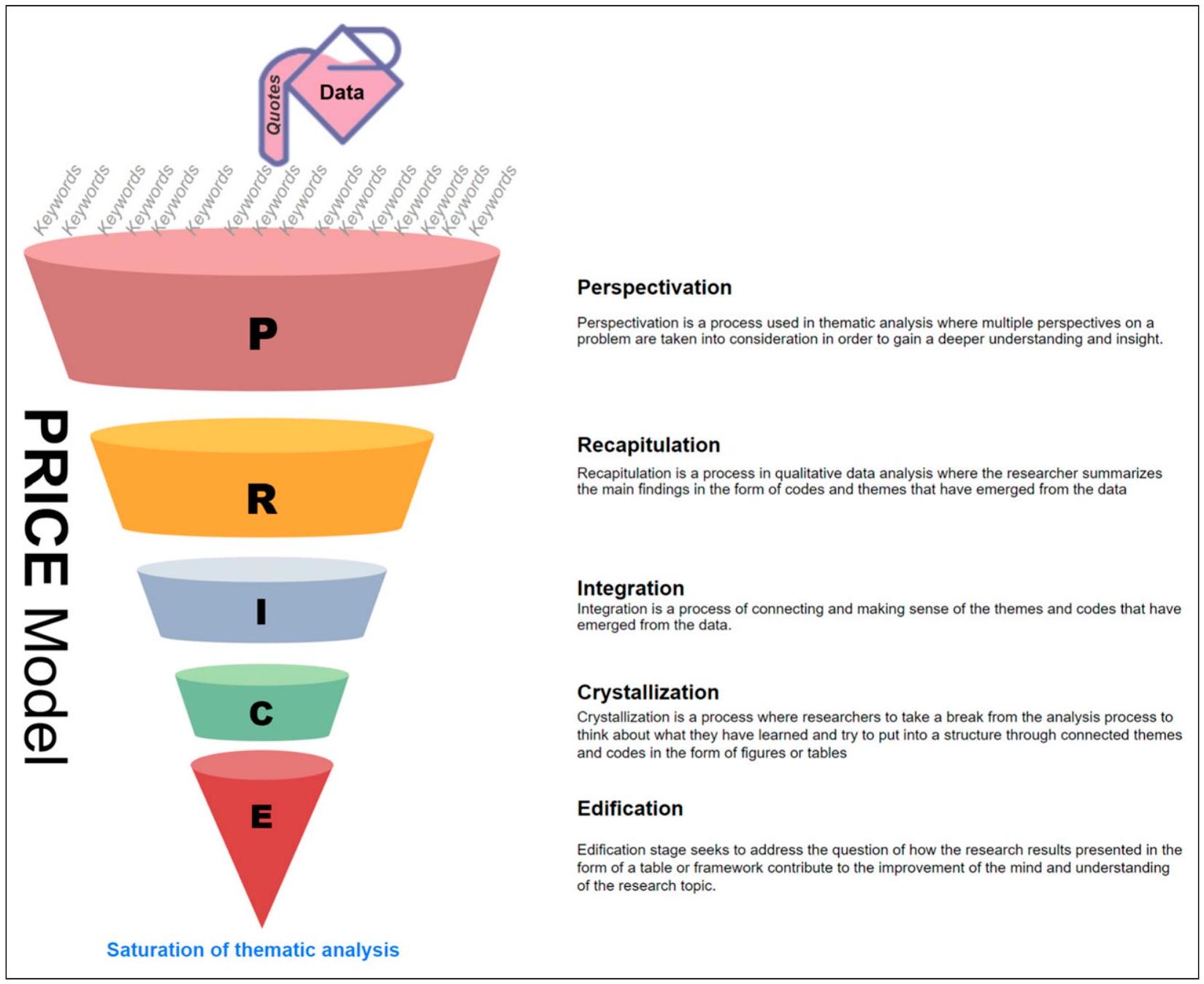
تطويرت هذه الورقة نموذج PRICE (الشكل 1) الذي يمكن أن يساعد الباحثين في الوصول إلى نقطة التشبع في التحليل الموضوعي. يشير التشبع في هذه الورقة إلى النقطة التي لا تظهر فيها كلمات رئيسية جديدة أو أنماط أو رموز أو مواضيع من مجموعة البيانات المجمعة، مما يدل على أن البيانات قد تم استكشافها وفهمها واستخدامها بالكامل لتحقيق الهدف المطلوب من البحث. تعتبر عملية التشبع في التحليل الموضوعي مفهومًا مهمًا في سياق عملية التحليل الموضوعي في هذه الورقة. يصف الجدول 1 المصطلحات الرئيسية لنموذج PRICE، والتي سيتم مناقشتها وتلخيصها واحدة تلو الأخرى في هذا القسم. التوجه: لضمان أن يكون التحليل الموضوعي شاملاً ويحقق نتائج موثوقة، تتضمن هذه المرحلة رؤية البيانات من
الشكل I. نموذج PRICE للوصول إلى التشبع في التحليل الموضوعي.
جميع المنظورات الممكنة، مثل أسئلة البحث، والأطر النظرية، والأطر المعرفية. يتطلب اختيار الاقتباسات والكلمات الرئيسية ذات الصلة لتطوير الرموز التي تنبثق من البيانات التفكير واستكشاف وجهات نظر متنوعة من أجل الحصول على فهم أفضل للبيانات. هذه هي الطريقة التي يتم بها الوصول إلى مرحلة التشبع في التحليل الموضوعي: من خلال تنقيح وتوسيع الكلمات الرئيسية، والاقتباسات، والرموز، والمواضيع التي تم تأسيسها سابقًا.

توجيه الرؤية

يمكن استخدام التوجهات للوصول إلى التشبع في التحليل الموضوعي؛ يشير التوجه إلى محاولة الباحث أخذ وجهات نظر مختلفة لمشكلة البحث بعين الاعتبار، مما يؤدي إلى رؤى أغنى. يمكن القيام بالتوجه عندما يتم اعتبار المشكلة من وجهة نظر معينة، وإطارها لغويًا من تلك الوجهة، ومناقشتها من قبل مشاركين مختلفين أو التقاطها من قبل الباحث من خلال
مراقبة أحداث مختلفة في جمع البيانات النوعية. يمكن أن يصل الإبلاغ الصريح عن وجهات نظر مختلفة في تحليل البيانات إلى التشبع لضمان وضوح التحليل.

اختيار الكلمات الرئيسية والاقتباسات الدقيقة

اختيار الاقتباسات والكلمات الرئيسية هو أساس التوجه للوصول إلى العنصر الأول من التشبع. اقترح بيك (1993) أن أهداف الباحثين في اختيار الاقتباسات كانت مزدوجة: عرض اتساع اللغة (اللزاجة-العمق) والروابط بين المصطلحات والمفاهيم، وإظهار شدة الشعور أو الارتباك أو التردد. أصبح اختيار الاقتباسات الدقيقة لما قاله المشاركون هو “المعيار الذهبي” في التحقيقات النوعية، وسيكون هناك عدد من هذه الاقتباسات للإبلاغ عن وجهات نظر مختلفة (براون، 2010؛ غيست وآخرون، 2012). يمكن أن تجعل الاقتباسات المحتوى ينبض بالحياة (وايت وآخرون، 2014)، وتطبيق كفء لأخلاقيات البحث.
يتجنب (سوء) استخدام الكلمات الجذابة (سيلفرمان، 2017). قد يساعد النظر في الاقتباسات القوية واقتباسات الإثبات الباحث في اختيار الاقتباسات المناسبة. تُظهر الاقتباسات القوية للقارئ أهم نقاط البيانات، ويمكن أيضًا استخدام هذه الاقتباسات لوصف النتائج. تُعرف الاقتباسات القوية بأنها “إحساس بوجودك هناك، بتصور [المشارك]، والشعور بصراعاتهم وعواطفهم” (أمبرت وآخرون، 1995، ص. 885). الاقتباسات القوية “هي أكثر أجزاء البيانات إقناعًا التي لديك، تلك التي توضح نقاطك بفعالية” (برات، 2009، ص. 860). اقترح نعيم وويلسون (2022) أنه إذا كانت بعض الكلمات الرئيسية تُستخدم بشكل شائع من قبل المشاركين وإذا كانت هذه الكلمات الرئيسية يمكن أن تجيب على سؤال البحث من خلال صنع قصة، فيجب اختيار هذه الكلمات الرئيسية القوية، ويجب اختيار جميع الاقتباسات التي تحتوي على هذه الكلمات الرئيسية في المرحلة الأولى من التحليل الموضوعي (نعيم وأوزويم، 2021، 2021ب).
لقد تم فحص مفهوم التشبع بشكل شامل في البحث النوعي، حيث ساهمت دراسات متنوعة في فهم أعمق لهذا الجانب المنهجي الرئيسي. تتناول دراسة غيست (2006) عدد المقابلات المطلوبة للوصول إلى التشبع، مع التأكيد على أهمية تشبع البيانات وتنوعها في هذا السياق. اقترح فوغارد وبوتس (2015) أن إحدى الطرق للوصول إلى تشبع النتائج هي النظر في ما إذا كان حجم العينة كبيرًا بما يكفي للوصول إلى التشبع. وقد اقترح آخرون أن الباحث يجب أن يأخذ في اعتباره أيضًا مصدر البيانات، وما إذا كانت البيانات المجمعة من ذلك المصدر كافية للوصول إلى التشبع (غالفي، 2015؛ غيست، 2006؛ مالترود وآخرون، 2015؛ ساندلوسكي، 1995). ومع ذلك، تشير جميع هذه الاقتراحات إلى عملية جمع البيانات؛ لذلك، هناك حاجة للإجابة على سؤال كيف يمكن للباحث أن يصل إلى تشبع الاقتباسات المستخدمة في التحليلات؛ وسيتم الإجابة على ذلك في المناقشة في القسم التالي من هذه الورقة.

تكرار الكلمات الرئيسية

أخذ وجهات نظر مختلفة في الاعتبار، فإن استخدام التمثيلات العددية للمواضيع هو موضوع نقاش شائع عند مناقشة نشر النتائج النوعية. وفقًا لـ Sandelowski (2001)، يميل الباحثون النوعيون إلى الانقسام إلى معسكرين: “مناهضون للأرقام” أو “مؤيدون للأرقام”. يجادل معسكر المناهضين للأرقام بأن عد المواضيع يتعارض مع أهداف العمل النوعي، وهو الانخراط في فحص عميق للعملية والمعنى. بينما يجادل مؤيدو التحليل العددي بأن استخدام الأرقام يسهل تحديد تكرار حدوث ظاهرة معينة (Morse، 1994). غالبًا ما يؤدي النقاش المستمر حول هذه المسألة إلى الإغفال المتعمد أو الاستخدام غير الكافي أو تجاهل البيانات العددية في البحث النوعي (Olson، 2000). على الرغم من الطبيعة غير المهمة نسبيًا للتحليل العددي في الاستفسارات النوعية، فإن الكفاءة في هذا المجال أمر حاسم لتنفيذ ناجح للبحث القائم على البيانات الكمية (Sandelowski، 2001).
تبحث دراسة غالفين لعام 2015 في استهلاك الطاقة في المباني في موثوقية المعرفة الناتجة عن الأساليب النوعية
المقابلات ودورها في تحقيق التشبع. تركز دراسة Guest وآخرون (2017) على مجموعات التركيز، بهدف إنشاء قاعدة أدلة لأحجام العينات غير الاحتمالية اللازمة لتحقيق التشبع. يمكن أن تثري الحقائق والأرقام وتوضح القصص بطرق ملحوظة (Olson، 2000). يواجه الباحثون النوعيون مجموعة فريدة من التحديات عندما يتعلق الأمر باستخدام الأساليب الكمية التي تؤدي إلى نتائج موثوقة. إذا أرادوا أن تكون جهودهم العددية ذات مغزى، سيتعين عليهم تحديد متى وماذا يعدون (DeSantis & Ugarriza، 2000). الطريقة التي يمثل بها المشاركون نفس الوضع من خلال استخدام مفردات وتعبيرات متنوعة لها تأثير كبير على تفسير الأهمية النصية في البحث النوعي. لذلك، لفهم المصطلحات المستخدمة وفهم الآثار العديدة الموجودة في مجموعة بيانات معينة، من الضروري وجود مجموعة واسعة من المصطلحات والتعبيرات (Dey، 2003). تم تقديم نهج كمي من قبل Lowe وآخرون (2018) لتقييم التشبع الموضوعي في تحليل البيانات النوعية. توفر هذه الطريقة أداة قابلة للقياس لتحديد العتبة التي يتم عندها تحقيق التشبع. علاوة على ذلك، فإن تحليل أحجام التأثير في البحث النوعي الذي أجراه Onwuegbuzie (2003) يحظى بتقدير كبير ويساهم بشكل كبير في النقاش الأوسع حول التشبع. علاوة على ذلك، تعتبر الأرقام أدوات بلاغية قوية، مما يمكّن المرء من التأكيد على الصعوبة والتعقيد المتأصلين في البحث النوعي. على سبيل المثال، سيكون من غير المناسب للباحثين تقديم مبررات لأحجام العينات المحدودة ظاهريًا المستخدمة (Greenhalgh & Taylor، 1997؛ Sandelowski، 2001).

تسجيل تردد البيانات

جادل بأن العد له مزايا: فهو يضمن أن الباحث يتسم بالموضوعية في تحليله ويقدم دليلاً على أن الأحداث أو السلوكيات التي يتم تصنيفها على أنها “ناشئة” تحدث بشكل متكرر. في المقابل، أشار غست وآخرون (2012) إلى أن العد غير مناسب إذا تم استخدام العينة النظرية ومبادئ التصميم الناشئة، وشرحوا أن تكرار الكلمات مرتبط مباشرة بعدد المرات التي يجيب فيها المشارك على سؤال باستخدام نفس الكلمات أو كلمات مختلفة تحمل نفس المعنى. “إذا كنا نسأل السؤال بشكل استراتيجي في بعض المقابلات وليس في أخرى كوسيلة لبناء النظرية، فإن التكرار [يكشف القليل عن أهمية الفئة]” (دالي، 2007، ص. 234).
إحدى طرق تلخيص المعلومات هي إنشاء جدول يوضح عدد المشاركين الذين دعموا كل موضوع (فريز، 2013). تقترح هذه الورقة الحالية أن ملاحظة عدد مرات تكرار الكلمات الرئيسية من قبل المشاركين باستخدام نفس الكلمة أو كلمات مختلفة تحمل معاني مشابهة ستساعد في تقليل عدد الاقتباسات المطلوبة لتوضيح الكلمات الرئيسية (نعيم وأوزوم، 2021، 2021ب). سرعة الكلمات الرئيسية هي عدد المرات التي تم تكرارها؛ اللزوجة هي غنى اللغة المستخدمة من قبل المشاركين لشرح نفس السرد ولكن باستخدام كلمات مختلفة. تؤدي اللزوجة إلى غنى المفاهيم التي يتم تطويرها من خلال استخدام الكلمات المختلفة التي يستخدمها المشاركون.

الإشباع في الترميز والموضوعات

تتكرر عملية تحليل البيانات النوعية حتى لا تظهر موضوعات أو أنماط جديدة من البيانات، مما يشير إلى أنه قد تم الوصول إلى الإشباع في جمع البيانات (غلاسر وستراوس، 1967). طريقة أخرى هي كتابة الملاحظات والترميز، والتي يمكن أن تدعم تحليل الموضوعات لتطوير وجهات نظر مختلفة للبيانات (دينزين ولينكولن، 2011). تتضمن كتابة الملاحظات تسجيل الملاحظات الحاسمة، والرؤى، والرموز كما تظهر من البيانات لتطوير وجهات نظر وسرد مختلفة من البيانات التي يتم تطويرها من قبل الباحث طوال فترة البحث (ستراوس وكوربين، 1997). تثار أسئلة حول ما يجب على الباحث اختياره من البيانات ومدة الاقتباس للوصول إلى الإشباع. يصف كريسويل وبوث (2018) أن البحث يمكن أن يستغرق عدة جولات للعثور على أنماط البيانات حتى لا تظهر أنماط جديدة من البيانات.
تتعلق الأسئلة التي أثارها دراسة التوجه بالوظيفة التي تلعبها مشاركة المنظور في التواصل المكتوب والشفهي، بالإضافة إلى أكثر الطرق فعالية التي يتم فيها ممارسة أخذ المنظور في بيئات مختلفة (بن باجي، 2004). من هنا، هناك قفزة صغيرة لتحليل الحركات المرجعية في النصوص (فون ستوترهايم، 1989) وتفسيرها كتصويرات للتغيرات في وجهة النظر لتشمل وجهات نظر مختلفة حول نفس الموضوع. يتطلب الإجابة على سؤال ببيانات متماسكة من الباحث الانتقال بين مجالات دلالية مختلفة، أو “مجالات المرجعية”، مثل الأشخاص، والمواقع، والأوقات. تعكس أدوات لغوية مختلفة، مثل استخدام العناصر الإشارية بدلاً من العبارات الاسمية غير المحددة، واختيار ترتيب كلمات معين، ونبرة معينة، وما إلى ذلك، كل هذا الحركة المرجعية (فون، 1989). يقترح جاياسينغهي وآخرون (2021) أن الباحثين يجب أن يأخذوا في الاعتبار الحركة المرجعية في البيانات من مجموعة واسعة من المشاركين ويجب أن يمارسوا الحذر عند اختيار الاقتباسات لدعم ادعاءاتهم. يجب عليهم تجنب الاستشهاد بمصدر واحد أو اثنين بشكل متكرر، مما يتعلق بالسرعة، والنظر في حركات مرجعية مختلفة، مما يتعلق باللزوجة، للوصول إلى التوجه. إذا جاء عدد غير متناسب من الاقتباسات من مصدر واحد، فقد يبدو أن المؤلفين يختارون اقتباسات تدعم أفكارهم أو يقتبسون فقط عددًا قليلاً من المشاركين الذين أسفرت مقابلاتهم عن مواد قابلة للاقتباس.

وجهة نظر هيكل اللغة

تدرس اللغة واستخدامها للمنظور، المعروف باسم “الانعكاس الصريح” في علم اللغة، (غراومان وكالمير، 2002). لذا، فإن المنظور متجذر بعمق في هيكل اللغة نتيجة للتجسيد (كانيشيوس، 1987)؛ تركيز الاهتمام التحليلي هو على التواصل لكل من العناصر المنظورية الظاهرة والمخفية في مورفولوجيا اللغة. سيساعد هذا المنظور في تحليل البيانات على تحليل الكلمات الفردية وعلاقاتها بكلمات أخرى ضمن لغة معينة؛ الكلمات ومكوناتها، مثل جذورها، وأغصانها، والبادئات واللواحق (براتلي وآخرون، 2022؛ ساغارا وإيليس، 2013). لذلك، يركز “التوجه” في سياق التحليل على
الطرق التي يستخدم بها المتحدثون اللغة لنقل وجهات نظرهم ووجهات نظر الآخرين، بالإضافة إلى العلاقات بين هذه المنظورات. هنا، نستفسر عن كيفية استخدام المشاركين لخيارات لغتهم للتعبير عن وجهات نظر (كلمات رئيسية) ستضفي حيوية على تحليل البيانات، الذي يستكشف الواقع الاجتماعي المبني. إن تحقيق أقصى حيوية للبيانات النوعية المجمعة خلال مرحلة التحليل يتعلق بالمرحلة التي يمتلك فيها الباحث فهمًا شاملاً وعميقًا لكيفية استخدام الكلمات وقادرًا على التقاط وفرة وتعقيد البيانات بناءً على المنظور النظري والمعرفي للبحث.

المنظور النظري

تحتاج أهمية الأسس النظرية إلى أن تؤخذ بعين الاعتبار عند تحليل البيانات لاستكشاف البيانات من منظور نظري. لكي يتمكن القراء من تقدير كيف يمكن تطبيق إطار نظري مختلف على نفس البيانات ويؤدي إلى استنتاجات مختلفة (كريسويل وبوث، 2018)، يجب على المؤلفين السعي للتواصل حول كيفية ومتى يتم استخدام عدستهم التفسيرية لجمع البيانات، واستكشافها، وفهمها، وتحليلها، وشرحها، وتفسيرها (نيو مان، 2018)، و”استنباط الرؤى من البيانات. قد يكون من المفيد تأهيل ملاحظاتنا للإشارة بوضوح إلى [أنها] استنتاجات [م]” (وولكوت، 1990، ص. 32). لجعل تجميع النتائج شفافًا وقابلًا للنقل، من الضروري أن يدمج المؤلفون الأفكار النظرية التي توجه الدراسة قبل جمع البيانات، وكذلك أثناء تحليل البيانات وعرض النتائج (مورسي، 1994). بالإضافة إلى ذلك، يجب أيضًا أخذ المنظور المعرفي في الاعتبار، لأنه، في الواقع، يتقاطع التحقيق السوسيولوجي والسوسيولغوي للبناء الاجتماعي كشكل من أشكال التواصل اليومي مع دراسة الصور النمطية الاجتماعية (ساكس، 1972ب، ب). المزيد والمزيد من الدراسات حول تعريف الهويات الاجتماعية أو العرقية، والتمييز، والاستبعاد الاجتماعي (فيدلر وسيمين، 1992) تعطي التصنيف الاجتماعي دورًا مركزيًا في تحليل المحادثة، مما يؤدي إلى النظر في وجهات نظر مختلفة حول نفس الموضوع بسبب الفئات الاجتماعية المختلفة للمشاركين.
إن التصنيف الاجتماعي للأفراد وسلوكهم النموذجي والقابل للتنبؤ له أهمية كبيرة بالطبع في تعريف المنظورات المعتادة وتمثيلها في التواصل والتفاعل، حتى لو لم يكن هذا النهج دائمًا موجودًا في إطار نظري للتوجه (نازير وآخرون، 2022). لقد تم التعرف منذ فترة طويلة على كيفية تأثير وجهة النظر على النصوص والكلمات المستخدمة من قبل المشاركين كفكرة مركزية في دراسة الأدب (رامزاني، 2021). يمكن اعتبار كلمات المشاركين من خلال تطبيق عدسات أدبية ونظرية وفلسفية. إن أنماط السرد ووجهات النظر المختلفة التي يمكن أن تنشأ من اعتماد مجموعة متنوعة من وجهات النظر (اللزوجة) حول نفس القضايا تعزز حيوية التحليل (فان ديك، 1984). لذلك، سيكون من الصحيح أن نقول إن سرعة ولزوجة وجهات النظر المختلفة ستعزز أيضًا حيوية التحليل.
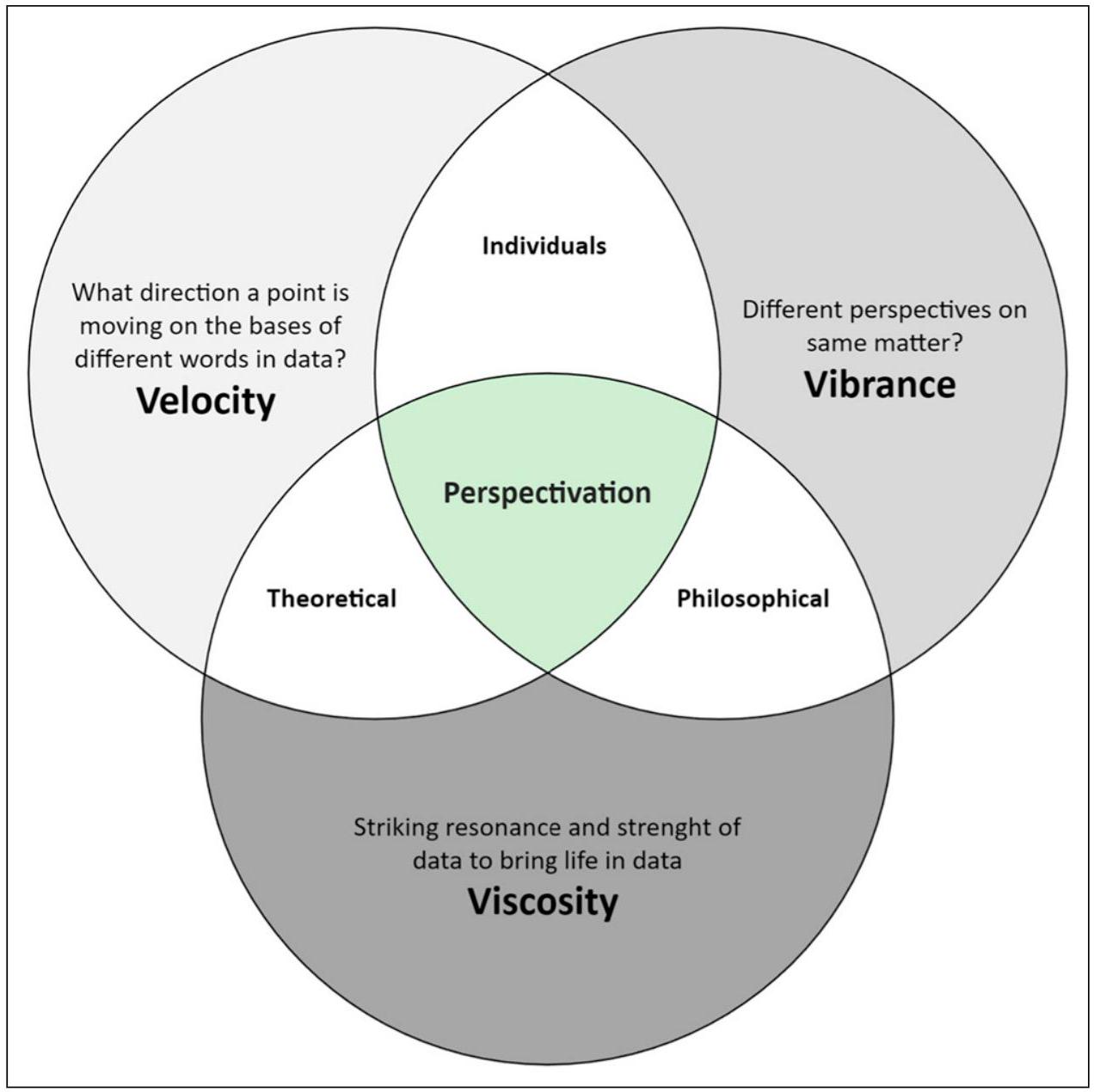
يمكن للباحثين استخدام التوجهات للحصول على فهم عميق لمشكلة ما من خلال النظر إليها من زوايا متعددة، وهو ما يتناقض مع الأساليب التقليدية التي تعتمد على منظور واحد. تتضمن هذه الطريقة استخدام وجهات نظر متعددة، مثل وجهات النظر النظرية، لتحليل البيانات والنظر في كيفية تأثير وجهات النظر المختلفة على تفسير البيانات (كريبندورف، 2004). من الممكن ضمان وضوح التحليل إلى أقصى حد من خلال الإبلاغ الصريح عن وجهات النظر النظرية والمعرفية المتعددة المعنية. استنادًا إلى هذا التبرير، تم إثبات أن السرعة واللزوجة والحيوية للوجهات يمكن أن تحقق عنصر التوجه في التحليل الموضوعي. وبالتالي، يمكن للمرء أن يستخدم مجموعة واسعة من الاقتباسات ويستفيد منها بطريقتين رئيسيتين. بعض الاقتباسات والكلمات الرئيسية توضح الأفكار المختلفة في ذلك الوقت، والتي يمكن اعتبارها لزوجة، ولكن يمكن اعتبار عدد الكلمات الرئيسية المتعلقة بنفس المنظور سرعة التوجه. كيف ترتبط المفردات (الكلمات الرئيسية) ببعضها البعض في المحادثة يتعلق بالحيوية (انظر الشكل 2). لذلك، فإن عدد مرات تكرار نفس المفردات (الكلمات الرئيسية) وتنوعها.
يمكن اعتبار أنواع المفردات المستخدمة للتعبير عن نفس المسألة أو القضية تباينًا. على سبيل المثال، يمكن التعبير عن المشاعر القوية (الرضا، المتعة، خيبة الأمل، الألم) بالإضافة إلى الارتباك والتردد في بعض الاقتباسات، مما سيكون حيوية البيانات. هذه السرعة اللغوية، واللزوجة، والحيوية تتماشى أيضًا مع وجهات النظر الإبستمولوجية للبناء الاجتماعي التي ستؤدي إلى تطوير واقع اجتماعي مُنشأ حول موضوع البحث. وبالتالي، فإن الحيوية النظرية والفلسفية ستؤدي أيضًا إلى تحقيق التوجه. التوجه في تحليل البيانات النوعية يتعلق بالمرحلة التي يمتلك فيها الباحث فهمًا عميقًا للبيانات وقادرًا على إدراكها من وجهات نظر متعددة. يمكن تحقيق ذلك باستخدام السرعة واللزوجة والحيوية في اختيار الكلمات الرئيسية والرموز.

إعادة تلخيص
الهدف الرئيسي من إعادة التلخيص هو تقديم ملخص واضح وموجز في شكل مفاهيم أكاديمية. تتضمن هذه العملية فحص البيانات لصياغة أفكار مستندة إلى
الشكل 2. عناصر التوجه
على الرموز المكتشفة، وترتيب المادة بطريقة تسهل الفهم والتفسير. المفهوم هو فكرة أو تصور تم صياغته نتيجة للتفكير في الاقتباسات والكلمات الرئيسية التي تم اختيارها من البيانات؛ وبالتالي، يمكن اعتبار إعطاء معنى للبيانات بمثابة مفهوم. تعمل المفاهيم كأركان هيكلية لتقديم بيانات البحث. قدرة الباحث على فهم الكلمات الرئيسية والاقتباسات التي اختارها وتسميتها كرموز ومواضيع هي تجسيد للبيانات. جميع الأشياء والأفكار والروابط مرتبطة بالبيانات، والتي يجب أن تبقى في الاعتبار في شكل تمثيلات ذهنية. قد يقوم الباحث أيضًا بإنشاء وسائل بصرية، مثل المصفوفات أو المخططات أو خرائط المفاهيم، للمساعدة في تنظيم وتقديم البيانات لتطوير المفاهيم بناءً على البيانات الحقيقية. يعد التلخيص مرحلة حاسمة في التحليل الموضوعي لأنه يمكّن الباحث من فهم البيانات وتقديمها بطريقة ذات دلالة (من حيث المفاهيم) ومفيدة للمحترفين والباحثين. إنه يعمل كجسر بين جمع البيانات والتأطير النهائي والتجسيد.
سيتم مناقشة ارتباط وجهات النظر المختلفة في الجزء التالي من هذه الورقة، والذي يتعلق بالاندماج كقصة تقدمية للبحث. إن نسب مؤشرات ‘الجودة’ إلى الاقتباسات من المشاركين التي لا تتوافق مع الاستخدام الفعلي أو الاعتماد على الكلمات المنطوقة من قبل المشاركين هو ملاحظة مثيرة للاهتمام (بريسفورد وآخرون، 1999؛ شليختويغ وهارتل، 2020). غالبًا ما يتم الاستشهاد بالاقتباسات من قبل الباحثين النوعيين كوسيلة لإثبات مصداقية الدراسة وإيجاد ارتباط بين الحجة التي يقدمها المشاركون (بيك، 1993) أو لتأكيد نتائجها (سانديلوسكي، 2003). ومع ذلك، فإن اختيار عدد الاقتباسات والكلمات الرئيسية يتعلق بإيجاد وجهات نظر مختلفة حول نفس الرمز أو المفهوم الذي يتم تطويره من البيانات (نعيم وآخرون، 2023؛ نعيم وأوزويم، 2022)، من خلال سرعة ولزوجة الاقتباسات والكلمات الرئيسية، والتي قد تتماشى أيضًا مع وجهات النظر الإبستيمولوجية الاجتماعية البنائية والتفسيرية للبحث. يذكر ألاسوتاري (1995) أن الباحثين الذين يعملون ضمن نماذج البنائية الاجتماعية والتفسيرية يؤكدون على أهمية السماح للناس بالتحدث عن أنفسهم؛ حيث يجادل البعض بأن الاقتباسات تزيد من تنوع النص (اللزوجة) لجعل الأمور أكثر إثارة للاهتمام (هولواي وويلر، 1996). وبالتالي، فإن اختيار الاقتباسات الغنية سيكون مصدرًا لثراء التحليل (إلد، وآخرون، 2020). لم يتوقع الباحثون استخدام الاقتباسات بهذه الطريقة وهم غير متأكدين من الآثار المحتملة للاختلاف في وجهات نظر المشاركين. إن دمج آراء المشاركين أمر حاسم لإثراء عمق البحث (غوردون، 2020).
كما تم مناقشته في القسم الفرعي السابق، يمكن أن تساعد عملية التوجه في تمكين الباحث من الحصول على رؤى غنية من البيانات. لا يمكن أن تتم إعادة التلخيص دون توضيح جميع الروابط بين المفاهيم، مما يتطلب تصوّر الرموز والمواضيع. أحيانًا تبدأ عملية التصور بتفسير مباشر لملاحظة بسيطة يتم سحبها بعد ذلك.
تم تفكيكها وإعادة تجميعها بطريقة أكثر معنى (ساوندر وآخرون، 2018). يحدث التشبع النظري عندما لا يمكن لأي دليل جديد تحسين جودة النظرية المستمدة (غلاسر وستراوس، 2009). يمكن أن تساعد المنظورات الفلسفية في استكشاف وجهات نظر مختلفة. يتطلب التلخيص، كمفتاح للتشبع، عملية تحليل موضوعي تكرارية، تحدد وتقوم بتنقيح المفاهيم المهمة من خلال النظر في الرموز والمواضيع المطورة.
تحليل البيانات النوعية هو دورة مستمرة تبدأ أثناء جمع البيانات، بدلاً من أن تكون بعد ذلك (هيل وهانسن، 1960). يقوم المحللون النوعيون بتدوين ملاحظات حول ما يعتقدون أن النص (ملاحظات ميدانية أو نصوص مقابلات) يعنيه وكيف يرتبط بقضايا أخرى (ساوندير وآخرون، 2018). قد يزنون فوائد اعتماد نهج “التركيز التدريجي” بشكل رسمي، والذي يتضمن تضييق وتركيز البحث تدريجياً أثناء العمل الميداني لأخذ القضايا الفريدة والمحددة (الإيميك) لسلوكيات الثقافة الاجتماعية في الاعتبار، حيث أن ذهاب المحلل وإيابه بين البيانات وتفسيره لها هو عملية مستمرة طوال المشروع (ستيك، 2010). عندما يتضح أن هناك مفاهيم أو علاقات أخرى تحتاج إلى استكشاف، يقوم المحلل بتعديل عملية جمع البيانات نفسها. يصف التركيز التدريجي هذه الطريقة (سينكوفيتش، 2018)، والتي تساعد في تطوير مفاهيم جديدة بناءً على الفهم النظري للمحلل وعلى الأدبيات. وبالتالي، يمكن للباحث تغيير أسماء الرموز ونظرياتها لتتوافق مع عبارات الرموز والمواضيع مع الموقف النظري والفلسفي للبحث.
في قسم النتائج، قد يكون من الصعب معرفة ما إذا كان ينبغي مقارنة النتائج مع نتائج الدراسات السابقة، وكيف، وإلى أي مدى. لتجنب التقليل من عملهم الخاص، يختار بعض المؤلفين عدم الإشارة إلى الأدبيات السابقة ذات الصلة في أقسام النتائج الخاصة بهم (ماثيوز، 2005). بينما يشير آخرون إلى الأدبيات السابقة ذات الصلة، حيث إن القيام بذلك غالبًا ما يوفر السياق الضروري للنقاش الحالي ويمكن أن يساعد في تطوير مفاهيم جديدة بناءً على الرموز والمواضيع (نيلسون، 2017)؛ وهذا يمكن أن يكون مفيدًا بطريقتين. لذا، يمكن أن يساعد الباحث في اختيار العبارات الأكثر قوة وأكاديمية للرموز والمواضيع كمفاهيم. يذكر لانغلي (2013) أنه لا توجد طريقة متفق عليها لمعالجة مشكلة تشبع التصور؛ لذلك، يجب على المؤلفين أن يقرروا ما إذا كانوا سيشملون الأدبيات السابقة في نتائجهم أم لا لتعريف الرموز والمواضيع بشكل عام. من الضروري للباحثين استخدام الأطر النظرية والأدبيات لتطوير المفاهيم من البيانات في شكل فئات. بعد ذلك، يجب مراجعة الرموز والمواضيع لتأسيس مفاهيم جديدة بناءً على نتائج البحث (ويكر، 1985). ومع ذلك، من الضروري ملاحظة أن الرموز والمواضيع يجب أن تكون مستندة إلى البيانات الحقيقية (نعيم وآخرون، 2023؛ نعيم وأوزويم، 2022). لتحقيق ذلك، يمكن استخدام الكلمات الرئيسية كخطوة إضافية في التحليل الموضوعي، مما يمكّن من تطوير المفاهيم بناءً على معاني الكلمات المستخدمة من قبل المشاركين. يتماشى هذا النهج مع المنظور الإبستمولوجي للبناء الاجتماعي، الذي يدعم تطوير الواقع الاجتماعي (برجر ولوكنمان، 1967).
اقترح والاس (1926) أنه لا ضرر في استخدام كلمات المشاركين لتطوير المفاهيم، لكن الباحث يحتاج إلى أن يكون حذرًا بشأن المعنى والإحساس بالكلمات في سياقات مختلفة. كان بعض المشاركين مرتاحين لرؤية الكلمات التي استخدموها لشرح تجربة سلبية تُستخدم لتوضيح وجهات نظر إيجابية في أماكن أخرى من البحث (سميث وهيت، 2005)؛ لذلك، يحتاج الباحث إلى اختيار كلمات يمكن تفسيرها بنفس المعنى، سواء كانت إيجابية أو سلبية، مما يؤدي إلى قفزات مفاهيمية.
يشير مصطلح القفزة المفاهيمية في البحث النوعي إلى التطوير الواعي لفكرة نظرية مجردة ضمن دراسة تجريبية. قد تؤدي الشكل النهائي لمثل هذه الفكرة إلى مساهمة نظرية أو لا تؤدي (كلاغ ولانغلي، 2013). الانتقال من كتلة الكلمات والبيانات الأخرى (عالم الميدان) من خلال وآليات التحليل إلى مجموعة مجردة وصريحة من المفاهيم والعلاقات والتفسيرات التي لها معنى وملاءمة تتجاوز السياق المحدد الذي تم تطويرها فيه هو ما يعنيه إجراء قفزة مفاهيمية (عالم الأفكار). غالبًا ما تتداخل مكونان من القفزة المفاهيمية، الرؤية والتعبير (فان مانين، 2010). أكد تسوكاس (2009) على أهمية القدرة على التقاط الخصوصية المكانية من أجل تقديم إجابة على السؤال “ماذا يحدث هنا؟” ومع ذلك، فإن هذا السؤال الأول في توتر حواري مستمر مع سؤال آخر، أكثر تجريدًا ولكنه مهم، “ما هي هذه الحالة؟”. يتطلب ذلك من الباحثين ربط الخصوصيات المكانية بفهم المفاهيم “موسعًا نطاق تطبيق المفاهيم المعنية، مما يساعد على إجراء تمييزات جديدة” (تسوكاس، 2009، ص. 298).
تشير فكرة الصرامة بالاتفاق إلى المخاطر في تطبيق المعايير المنهجية المعمول بها بشكل ميكانيكي وغير متأمل على الحالات التي لا تنطبق عليها. هذه الاستراتيجية لديها القدرة على إبهار الأشخاص المؤثرين مثل المحررين والمراجعين، لكنها قد تعزز أيضًا “صرامة زائفة” (أيزنهاورد وآخرون، 2016، ص. 1121). “الممارسات التي من خلالها يبني الباحثون معنى الصرامة أقل فهمًا. يمكن أن يحجب هذا الاختلافات السياقية والمحددة بالانضباط المهمة في كيفية تعريف الصرامة” (بيل وآخرون، 2017، ص. 535). الكمية المفرطة من الصرامة ضارة لأنها تؤدي إلى إنتاج المعرفة أي غير ذات أهمية لتحقيق التأثير الاجتماعي وخلق نظرية ضعيفة ومنفصلة تفشل في وصف القضية المدروسة بشكل كافٍ. ومع ذلك، فإن وجهات النظر القائمة على الحرفية (أي، التي تتضمن مهارات ضمنية وخيال) والمحددة بالسياق تكتسب أرضية (ريوبر وفيشر، 2021). لذلك، يتم اعتبار السياق كعامل تشبع في تحليل البيانات. بالإضافة إلى ذلك، يجادل ويلش وآخرون (2022) بأن هناك فكرة سائدة مفادها أن البحث الإداري يجب أن يكون قابلاً للتطبيق على جميع السيناريوهات الممكنة ليعتبر علميًا صالحًا. تصبح ثراء السياق، الذي من المفترض أن يكون جوهر البحث النوعي، عائقًا في هذه الحالة (بلاكويايناكي وآخرون، 2019). يمكن أن تعكس تعقيد العالم الاجتماعي (ماكلارين ودوريبوس، 2021، ص. 74) بشكل أفضل من خلال تلخيص الأحداث المختلفة في البيانات. ” يصف الكتاب ما بعد الاستعمار وما بعد الاستعمار
السياق في البحث الإداري كأجندة تعزز الحوار والفهم والانخراط مع المجتمعات المهمشة التي تم استبعادها تاريخيًا من المجتمع السائد. يتعارض هذا النهج السياسي مع الأساليب الأكثر تقليدية المتبعة في البحث الإداري السائد (سميث، 2002).
يتم تقييم صرامة التحقيق ليس من خلال مجموعة من المعايير المحددة مسبقًا ولكن من خلال اتساقه الداخلي وجودته (فان مانين وآخرون، 2007). يؤدي الجمع بين الخبرة التقنية، والأصالة في التصميم، والتأمل والانفتاح على النقد إلى تحقيق الصرامة (بانسال وكورلي، 2011). يمكن وضع عملية البحث والأساليب، ونتائج البحث، والباحثين أنفسهم في سياقاتهم الخاصة لتحقيق الصرامة ضمن السياق (تسارنياوفسكا، 2016). تختلف الأساليب المتعلقة بالسياق بشكل كبير اعتمادًا على المعتقدات الفلسفية الأساسية للباحث. يرى غير الإيجابيين أن السياق هو “مجموعة من الروابط ذات الصلة التي نبنيها كجزء من عملية البحث لتحقيق هدف بحثي”، بينما يميل الإيجابيون إلى رؤية السياق كحاوية ثابتة ومحددة مسبقًا لوضع الظاهرة قيد الدراسة (ماكلارين ودوريبوس، 2021، ص. 74). يخلق السياق روابط لمجموعة واسعة من أحداث الخطاب والمفاهيم التي يمكن دمجها كمفهوم جديد يتشكل بناءً على البيانات (غومبرز، 1982؛ 1992)، بما في ذلك أطر التفسير التي قد تكون موجودة ضمن النص أو الوحدة التفاعلية نفسها. لا يوجد شيء مثل إنتاج الكلام بدون سياق (أوير، ودي لوزيو، 1992). لوضع شيء في السياق هو “ربط الملاحظات بمجموعة من الحقائق والأحداث أو وجهات النظر ذات الصلة التي تجعل البحث ممكنًا والنظرية التي تشكل جزءًا من كل أكبر” (روسو وفريد، 2001، ص. 1). تُعتبر المقابلات المسجلة والمكتوبة والمشفرة غالبًا ممارسات بحثية معيارية، ومن المتوقع أن يعتمد الباحثون بشكل كبير على الاقتباسات المتعمقة من نصوص المقابلات لتوفير دعم تجريبي لفرضياتهم (بليكستاد بالاس، 2017). يعد التحليل النصي للنصوص جزءًا حاسمًا من بناء النظرية لأن البيانات غير المقابلة تلعب عادةً دورًا تكميليًا فقط (سيلفرمان، 2017). يقترح جيفارت (2004) أن تطبيق العدسات السياقية، مع مراعاة النظرية المختارة والموقف الفلسفي، يمكن أن يساعد في تحقيق التشبع وتطوير المفاهيم من البيانات. يمكن أن يكون موقف البناء الاجتماعي مفيدًا بشكل خاص في فهم دور اللغة والمعايير والثقافة والقيم، بينما يمكن أن توفر الأسس النظرية للبحث فرصًا لتصور البيانات في أشكال ذات معنى ومفاهيمية.
يمكن أن يساعد اعتماد سياق ما في فهم العالم، ولكنه يمكن أيضًا أن “يربط تفسيرنا بالسياق الذي أنشأته المجموعة الاجتماعية السائدة” (ماكلارين ودوريبوس، 2021، ص. 78). يأتي تأثيره الإدراكي من حقيقة أنه يكشف عن التفسير المقصود للمتحدث لكلماته، ومن ثم، نوع الخلفية المعلوماتية التي اختار المتحدث اعتمادها عند إلقاء تلك الكلمات. المراجع داخل النصوص والروابط التي يمكن رسمها بين النصوص من خلال السياق هي أمثلة على
التداخل النصي (باختين، 2010). تتضمن إزالة السياق وإعادة السياق تفسير العبارات أو النصوص من خلال وضعها في سياقات جديدة قد لا تتماشى مع السياق الأصلي. العمليات المماثلة شائعة ويمكن ملاحظتها ليس فقط في التداخل النصي للنصوص الكبيرة وعوالم الخطاب الواسعة، ولكن أيضًا في الهيكلة المحلية لتسلسل التفاعل لتطوير المفاهيم من خلال النظر في السياق المحلي والنظري والفلسفي (بيل وآخرون، 2017). إنها تعمل كجسر بين جمع البيانات والتسوية النهائية والتصور. النتيجة النهائية هي ملخص متماسك وواضح للاكتشافات التي يمكن استخدامها لتعزيز الأهداف العامة للدراسة.
على الرغم من عدم وجود قاعدة عالمية قابلة للتطبيق، إلا أنه مقبول عمومًا أن تهدف الدراسات إلى مستوى من التحليل يحافظ على المعلومات الخلفية اللازمة لتطوير التصور لنتائج البحث (راي وويتن، 2011). يؤكد ميس-بوس، ويلش، وبيكاري (2020) أنه من أجل وضع نتائج البحث في السياق، يجب على الباحثين المرور بعدة تكرارات من التفسير مع المترجمين والمخبرين. من أجل تحسين سياق النتائج، من المفيد مشاركة النتائج الأولية مع المخبرين المحليين. يمكن أن يساعد ذلك في تقليل احتمال فقدان أهمية السياق الاجتماعي. يمكن اعتبار الباحثين الذين يتم منحهم الوصول إلى رؤى وتفسيرات المتحدثين المحليين المألوفين بقيم ومعايير المنطقة الاجتماعية أنهم يطورون المفاهيم من البيانات (هارتل وأوكونور، 2014). يمكن توليد غنى المعرفة المتموضعة من خلال تقدير والحفاظ على الأطر والتعبيرات المحلية خلال مرحلة التحليل والتفكير النظري. في ضوء ذلك، وعلى افتراض أن جميع العوامل الأخرى تظل ثابتة، يُنصح الباحث النوعي بالميل نحو استخدام وحدة تحليل أوسع وأكثر ارتباطًا بالسياق بدلاً من مستوى تحليل أكثر دقة (مثل الجمل) من أجل بناء المفهوم بناءً على سياق الدراسة. تحمل الكلمات التي نختارها دلالة، وتعتمد التصورات التي يطورها الناس عنا على الظروف التي يتم فيها مواجهة تلك الكلمات (تسارنياوكا، 2016). تتأثر أهمية الكلمات الرئيسية ليس فقط بقربها من كلمات أخرى، ولكن أيضًا باستخدامها في مصطلحات وعبارات راسخة كمفاهيم مستمدة من البحث. يؤكد روجرز (2015) على ضرورة مراعاة سياق المشاركين والتفسيرات المحتملة المختلفة للبيانات عند بناء مفهوم. تتضمن هذه العملية استخدام المعاني الفعلية المستمدة من البيانات. من خلال الاعتراف وفحص الطرق المختلفة لتصنيف البيانات، يظهر الباحث فهمًا للطبيعة المعقدة لبيئته ويعزز من احتمالية استنباط رؤى عميقة من التحقيق.

الاندماج

يمكن أن يمكّن تحليل الاندماج الموضوعي من بناء سرد متماسك أو نشر فهم أكثر شمولاً لنتائج الدراسة من خلال ربط مواضيع متميزة. إن إنشاء ارتباط شفاف و
قابل للتحقق بين البيانات واستنتاجات الباحث بشأن كل موضوع، فيما يتعلق بالرموز والمواضيع البحثية المقابلة، هو هدف عملية الاندماج. من أجل تقديم تحليل شامل وشامل لنتائج البحث، من الضروري أن تكون المواضيع متماسكة ومتميزة بوضوح عن بعضها البعض (براون وكلارك، 2006). من الضروري إنشاء علاقة تكون شفافة وقابلة للتحقق بين البيانات واستنتاجات الباحث بشأن كل موضوع، مع الأخذ في الاعتبار الرموز والمواضيع ذات الصلة بالدراسة (كوجنو وتوماس، 2016). من أجل التأكد من إثبات جميع الاستنتاجات المستخلصة من البيانات، يمكن تقييم كفاية الإشارة من خلال مقارنة البيانات غير المعالجة بالارتباطات التي تم إنشاؤها بين المواضيع والرموز المطورة ضمن الإطار أو النموذج البحثي النهائي. وفقًا للينكولن وغوبا (1985)، فإن مجرد تقديم جدول أو قائمة بالمواضيع أو عدد المشاركين الذين أيدوا موضوعًا معينًا غير كافٍ. يتحمل المؤلفون عبء إثبات الاعتماد المتبادل والتفاعل بين هذه المفاهيم، كما يتضح من إليوت وآخرون (1999، ص. 223)، من خلال استخدام “قصة/سرد مدفوع بالبيانات، إطار، أو هيكل أساسي للظاهرة أو المجال.” يتطلب ذلك دمج الأفكار التي تم تطويرها سابقًا. “دي سانتيس وأوغاريزا، 2000، ص. 369] يذكران، “يمكن مقارنة المواضيع المحددة جيدًا في دراسات معينة، ومقارنتها، واستخدامها ككتل بناء.”
يساعد التفكير النظري في توجيه الرحلة التحليلية من الميكرو إلى الماكرو، بطرق تكشف عن ترابطها وعلاقاتها (بوراوي، 2009). ومع ذلك، فإن استخدام نظرية موجودة مسبقًا لاستنتاج من المجهري إلى الماكروي هو مهمة صعبة، خاصة إذا كانت النظرية الموجودة مسبقًا لا تقدم إشارات أو رؤى حول السياقات التي تتعلق بفهم وتفكير الظاهرة المحورية (نجوين وتول، 2022). يقول سالدانا (2016) إن محلل البيانات النوعية يستخدم عادةً نهجًا استقرائيًا لاكتشاف الفئات والنماذج والعلاقات ذات الصلة في البيانات. مثل تسمية الموضوع، تتضمن الترميز ربط المفاهيم ببعضها البعض ثم بالبيانات (سالدانا، 2016). إحدى الطرق لتلخيص البيانات هي استخدام جدول يوضح عدد الأشخاص الذين دعموا كل موضوع (فريز، 2013)؛ ومع ذلك، هناك أيضًا حاجة لدمج هذه المواضيع والرموز معًا كقصة كاملة، وهي مرحلة الاندماج المطلوبة للوصول إلى التشبع الكامل لدمج المفاهيم المطورة (برتون وآخرون، 1991). يمكن استخدام التجميع الموضوعي لجعل هذا التركيب أكثر قابلية للإدارة، وتطوير إطار كطريقة سرد (دييفنباخ، 2009). بدلاً من ذلك، يمكن استخدام تمثيل بصري لتلخيص النظرية المستندة أو الروابط بين أهم المفاهيم التي ظهرت من البيانات (غانونغ وآخرون، 2011؛ غولدبرغ، 2009). اعتمادًا على نتائج عملية تحليل البيانات، يمكن تقديم النتائج كتصنيف للاستجابات المختلفة بين المشاركين، أو يمكن تقديم البيانات كنموذج مفاهيمي ونص وصفي لأن هدف الدراسة كان توليد نظرية حول عملية.

التبلور

تُعرّف مرحلة التبلور في هذه الورقة على أنها عملية يجب فيها أخذ استراحة من عملية التحليل (الانغماس) من أجل التفكير فيما تم تعلمه وصياغة الموضوعات والأنماط المتكررة التي ظهرت خلال فحص البيانات. تحسينات جمع البيانات هي مجرد مجال واحد يمكن استخدام رؤى التبلور فيه؛ فهي أيضًا مفيدة لتفصيل تفسيرات أكثر دقة وعمقًا. يشير ماركيز ومونيوز (2012) إلى أن الباحثين قد يتم تشجيعهم من خلال قدرتهم على عزل الموضوعات الرئيسية، لكنهم سيحتاجون إلى ممارسة مزيد من التركيب الإبداعي للتقدم من هذه اللبنات الأساسية إلى أنماط وتفسيرات ونظريات أعلى. يتطلب فهم البيانات، أو “الدروس المستفادة”، التعرف على الأنماط كمهارة تفسيرية أساسية (هولنباخ وآخرون، 2012). تتضمن التفسير التجريد إلى ما هو أبعد من الرموز والموضوعات إلى المعنى الأكبر للبيانات في البحث النوعي (كلين وآخرون، 1994)، مما قد يكون مفيدًا للإجابة عن سبب تقديم بحثك لمساهمة حقيقية وأين تكمن خصوصية الدراسة. نعتقد أن الأشخاص غير المتمرسين غالبًا ما يجدون التعرف على الأنماط صعبًا، لكن هنا يمكن للباحث استخدام مفاهيم جديدة في ضوء الموضوعات المتطورة لتفسير وشرح الإطار المتطور.
كما ذُكر أعلاه، يمكن أن تسهل الرؤى المستخلصة من التبلور تحسينات في إعادة ترتيب الصناديق أو الأشكال والمفاهيم في الإطار المفاهيمي النهائي. بالإضافة إلى ذلك، يجب أيضًا إجراء تأمل لتبرير العلاقة بين المفاهيم والعوامل المختلفة في الإطار المفاهيمي النهائي (Cugno & Thomas، 2016). يمكن للمرء أن يقوم بالتبلور بمفرده أو مع مجموعة، مستفيدًا من ملاحظاتهم حول الإطار المفاهيمي النهائي المطور. اقترح ستيوارت، غاب، وهارود (2017) أن العمل في فرق البحث يمكن أن يوفر فوائد التبلور، بما في ذلك الفرصة المعززة للتفاعل الديناميكي الذي يمكن أن يؤدي إلى توضيح الموضوعات والأنماط والتفسيرات الأساسية في شكل الإطار المفاهيمي النهائي. علاوة على ذلك، يتطلب التبلور تأكيد النتائج والبحث عن تفسيرات بديلة بعد الوصول إلى التفسيرات. يمكن أن تجعل ملاحظات المشاركين حول نتائج التبلور والاتجاهات والتفسيرات تفسيرات أكثر دقة بالإضافة إلى التحقق من صحة تفسيرات وموضوعية وسياق الإطار المفاهيمي المطور.

تثقيف

التثقيف هو عملية تُستخدم في التحليل الموضوعي تركز على المساهمات والرؤى التي يمكن أن توفرها نتائج البحث لتحسين الفهم والمعرفة بموضوع البحث. يُشتق المصطلح من الكلمة اللاتينية “aedificationem”، التي تعني البناء أو التشييد (غونجي، 2017)؛ وكان يُستخدم في الأصل فقط في سياق ديني. كلمة “بناية” تعني مبنى كبير ومهيب (غوميز-تشاكون، 2015) وهي مشتقة من
التثقيف يُستخدم لوصف كيف يمكن أن تساهم نتائج البحث، المقدمة في شكل جداول أو أطر، في نمو وتطور الأفراد، فكريًا وأخلاقيًا وروحيًا. تبدأ عملية التثقيف من خلال تمييز مكونات نظرية شاملة، بالإضافة إلى علاقاتها المتبادلة والمبررات لضمها في النمو العام للنظرية. يستخدم الباحثون فرضية أو اقتراح كأساس لتطوير نظرية أو نموذج. مكونات البيانات التجريبية وعلاقاتها المتبادلة هي العناصر الأساسية لإطار مفاهيمي، يمكن التعبير عنه كاقتراحات. من أجل تحقيق حالة التثقيف الكامل، يجب على الباحث أن يأخذ في الاعتبار متغيرات مختلفة مثل الشمولية، ووجهة النظر، ومدى تضمين السياق. وهذا يتطلب معالجة استفسارات مثل: ما العوامل التي يجب أخذها في الاعتبار لتقديم فهم أكثر شمولاً للظاهرة قيد البحث؟ ما العلاقة بين هذه العوامل؟ ما الذي يبرر اختيار هذه النظرية كضرورية ومناسبة للبحث؟
المعنى الذي تطوره هذه الورقة حول التثقيف يتعلق بما يتم تقديمه بالإضافة إلى البحث نفسه. يركز مفهوم التثقيف على معالجة السؤال حول كيفية مساهمة نتائج البحث المقدمة في شكل جدول أو إطار عمل في تحسين العقل وفهم موضوع البحث. اقترح سوجاثا وألوا (2020) أن يجعل المرء شخصًا أفضل بطريقة ما، سواء كان ذلك على المستوى الفكري أو الأخلاقي أو الروحي. كن حذرًا من أي شيء يحمل تسمية “بناء الروح” (غوميز-تشاكون، 2015)، حيث يشير ذلك إلى أنه يهدف إلى مساعدة المرء على النمو بطريقة ما، سواء كان ذلك فكريًا أو أخلاقيًا أو روحيًا. في هذه الورقة، يشير التثقيف إلى عملية زيادة معرفة المجتمع الأكاديمي والمهني بالمساهمة الفعلية للبحث. ومن ثم، فإن تقدم ودمج هذه المفاهيم يمكن أن يؤدي إلى وجهات نظر جديدة حول الموضوع أو يقدم نهجًا جديدًا لفحص المشكلة. كان على الباحث تبرير المساهمات التي تم تحقيقها من خلال دمج المفاهيم الجديدة المستندة إلى تحليل البيانات. يعتبر هذا الدمج جزءًا من تحليل البيانات لأنه مدعوم ببيانات حقيقية.
للوصول إلى مرحلة التشبع في التثقيف، يجب أولاً تحديد مكونات نظرية كاملة، جنبًا إلى جنب مع ترابطها والأسباب التي يجب أن تؤخذ في الاعتبار في تطوير النظرية ككل (دوبين، 1978). باستخدام اقتراح أو فرضية كنقطة انطلاق، يقوم الباحثون الاستقرائيون ببناء نظرية أو نموذج (فيريداي وموير-كوكراين، 2006). الفرق الرئيسي بين الاقتراحات والفرضيات هو أن الأولى تتضمن مفاهيم، بينما تتطلب الأخيرة قياسات (ويتن، 1989، ص. 491). بينما سيكون من غير المعقول توقع أن يأخذ المنظرون في الاعتبار كل قيد حدودي محتمل، إلا أنه لا يزال من المفيد إجراء بعض الاختبارات الذهنية السريعة لمعرفة مدى تعميم الفرضيات المركزية (ويتن، 1989). هذه التمرين الذهني مستند إلى الكلمات الرئيسية والرموز والمواضيع والمفاهيم في البحث التي يمكن استخدامها لإقامة روابط بين
عناصر غير مرتبطة سابقًا. تشكل المفاهيم التي تتكون منها البيانات الواقعية والروابط بينها اللبنات الأساسية لإطار مفاهيمي، ويمكن التعبير عن علاقات الإطار بين المفاهيم في شكل مقترحات (ريتشاردز، 2015). وفقًا لجيرجن (1982)، من الضروري أن تكون النظريات المستندة إلى التجربة حساسة للسياق. بمعنى، وفقًا للسياقيين، فإنها تتطور بشكل عضوي من التجارب الحياتية للمشاركين والباحث على حد سواء. لذلك، فإن فهم الباحث الخاص يشكل الأساس للعلاقات بين المفاهيم في الإطار المفاهيمي، الذي يُستخدم لتأسيس الرابط بين العوامل المختلفة بطريقة مقترحة. مصدر موثوق حول تطوير النظرية (دوبين، 1978) ينص على أن النظرية الكاملة يجب أن تتضمن العناصر الثلاثة الموضحة أدناه.
ما هي العناصر (المتغيرات، البنى، والمفاهيم) التي ينبغي أخذها بعين الاعتبار من أجل تقديم صورة أكثر شمولاً عن الظواهر المعنية، سواء كانت جماعية أو شخصية في طبيعتها؟ ما الذي يتم استكشافه من خلال استخدام النظرية المحددة والموقف الفلسفي؟ ما الذي كان مفقودًا في النظرية المختارة؟ ما هو الإضافة إلى النظرية الموجودة؟ يمكن تقييم درجة تضمين السياق، الذي يتم مناقشته كتحليل سياقي، باستخدام معيارين: الشمولية (أي، هل تم اعتبار جميع العوامل ذات الصلة؟) والتوجه. يساعد التوجه في استكشاف وجهات النظر الغنية للبيانات التي تؤدي إلى إجابات تتعلق بأهمية البحث من حيث الغنى والسياق. ما هي الإضافة القيمة إلى حالة المعرفة؟ يوضح ويتن (1989) أن الخبراء في مجال المراجعة لا يبحثون دائمًا عن أفكار جديدة رائدة. ومع ذلك، ينبغي أن تؤدي التعديلات والتوسعات على النظريات الموجودة إلى تغييرات كبيرة في الآراء الراسخة للأكاديميين (كورلي وجيويا، 2011). يمكن أن تكون التعديلات متدرجة حسب مقدار أو قلة ما تغيره في النظام وما هو التغيير الفعلي في النظرية الموجودة.
كيف: بمجرد تحديد مجموعة من العوامل المساهمة، فإن السؤال التالي للباحث هو كيف ترتبط هذه العوامل (كورلي وجيويا، 2011). ميكانيكيًا، يتضمن ذلك رسم خطوط بين الصناديق للإشارة إلى الحركة أو التفاعل، مما يجلب هيكلًا إلى التصور من خلال تعريف الأنماط الأساسية بشكل أكثر دقة. يتم أيضًا تقديم مفهوم السببية عادةً مع المنطق في البيانات. ومع ذلك، يجب على الباحث أيضًا أن يشرح كيف توجد هذه الروابط ومدى أهميتها في فهم البيانات. لماذا: هل من الضروري شرح العوامل المختارة والعلاقات السببية المقترحة، بالإضافة إلى الديناميات النفسية أو الاقتصادية أو الاجتماعية الأساسية التي تلعب دورًا (ويتن، 1989)؟ الافتراضات، أو الغراء النظري الذي يجمع النموذج معًا، تستند إلى هذا التبرير. لذلك، هناك أيضًا حاجة لتبرير لماذا كانت النظرية المختارة ضرورية ومناسبة لتكون أساسًا للنموذج المطور. القضية الرئيسية التي تم مناقشتها هي لماذا ينبغي أن تأخذ هذه التفسير المحدد للظاهرة موقفًا فلسفيًا معينًا. في منطق النموذج، يمكن العثور على الإجابة من خلال منطق الروابط
بين العوامل، ويجب أن يشرح تدفق القصة لماذا يجب أخذ القصة بهذه الطريقة المحددة. لذلك، اقترح سلام زاده (2020) أنه يجب التحقق من جميع الروابط تجريبيًا قبل أن يمكن استخدام النموذج في الفصل الدراسي؛ وإلا، فإنه يخدم غرضًا ضئيلًا خارج المختبر. من أجل تحقيق ذلك، من الضروري تقديم تفسير للدوافع وراء ما تم إعادة بنائه حديثًا من “ما” و”كيف”.

الخاتمة

الإشباع هو مصطلح حاسم يشكل أساس تقنية تحليل الموضوعات التي تم مناقشتها في الورقة، حيث يضمن دراسة شاملة لجميع المواد ذات الصلة. قد يكون نموذج PRICE، الذي يتكون من التوجه، والتلخيص، والتكامل، والتبلور، والتثقيف، مفيدًا للباحثين الذين يسعون لتحقيق الإشباع خلال عملية تحليل الموضوعات. يتم تنظيم تقنية التحليل بشكل منهجي وفقًا للنموذج، مما يتضمن اكتشاف وتصنيف الموضوعات من منظور معين. ثم يتم تحليل هذه الموضوعات وتحسينها من خلال التلخيص. من خلال دمج العديد من مصادر البيانات، يمكن للباحث أن يميز الأنماط والارتباطات، بينما يقوم أيضًا بإنشاء روابط بين الموضوعات المختلفة. من خلال استخدام التبلور، يمكن للمحقق تحديد الموضوعات الأساسية والنتائج الحاسمة. في الأساس، يعزز التثقيف قدرة الباحث على التعبير عن النتائج بوضوح وشمولية. من خلال استخدام هذا الإطار، يمكن للعلماء ضمان أن تحليلهم شامل ومنهجي، ويشمل جميع المكونات ذات الصلة. علاوة على ذلك، يتضمن نموذج PRICE عملية “التبلور”، وهي الترتيب المنهجي والتوحيد للموضوعات المحددة. هذا يعزز الضمان بأن النتائج ذات مغزى ومتسقة. المرحلة النهائية من “التثقيف” تمنح الباحث الفرصة للتأمل في النتائج ونقلها للآخرين بطريقة واضحة وموجزة.
بينما يواصل الباحثون ترميز وتحليل البيانات، سيبحثون عن الأنماط والروابط بين الموضوعات الناشئة من أجل الوصول إلى الإشباع. من الممكن أيضًا أن الباحثين قد لا يصلون إلى الإشباع، خاصة في حالة مجموعات البيانات الكبيرة؛ قد يختار الباحثون التوقف عن التحليل بعد عدد معين من الحالات التي تم تحليلها لضمان أن التحليل قابل للإدارة وقابل للتطبيق. لأغراض هذه الورقة، تم فهم “الإشباع” كنقطة يتم فيها استكشاف مجموعة البيانات المجمعة وفهمها بشكل كافٍ لإنتاج النتيجة المرغوبة للبحث. عندما يقوم الباحثون بترميز نفس الموضوع في عدة مناسبات، يتعلمون تحديد ما إذا كانت الحالة أو الحادثة توجه البحث نحو جوانب أخرى. “إذا كانت الإجابة نعم، يتم ترميز الحادثة ومقارنتها. إذا كانت الإجابة لا، فإن الحادثة لا يتم ترميزها لأنها تضيف فقط حجمًا إلى البيانات المرمزة ولا تضيف شيئًا إلى النظرية” (غلاسر وستراوس، 1967، ص 111).
يمكن للباحثين استخدام نموذج PRICE لتحقيق الإشباع في تحليلهم الموضوعي. المنهجية التي يوفرها منهجية منظمة وتساعد الباحثين في عملية
تمييز وتصنيف وفحص الموضوعات داخل مجموعة بياناتهم. إنها نهج مميز لتحليل الموضوعات بسبب نهجها الشمولي في تحليل البيانات واستخدام التوجه؛ يمكن أن تساعد الباحثين في تحقيق إشباع البيانات وتوفير إرشادات للمستقبل. نموذج PRICE، على الرغم من أنه يعتمد على النقاش المستمر حول الإشباع في البحث النوعي، يتضمن بشكل أساسي مبادئ ونظريات من النظرية المستندة إلى الأرض وغيرها من المنهجيات النوعية، كل منها مدعوم من منظور فلسفي فريد. يهدف هذا البحث إلى تقديم نهج منهجي لتحقيق الإشباع ضمن هذا الإطار المحدد من خلال تحليل العناصر ذات الصلة بشكل انتقائي. ضمن هذا الإطار المحدد، يتم تحديد الإشباع كنقطة التقاء حيث استخدم الباحثون جميع التطبيقات المحتملة للبيانات، مما يشير إلى انتهاء إجراء جمع البيانات. يمكن أن تستكشف الاستفسارات الإضافية ملاءمة نموذج PRICE لأطر فلسفية ومنهجيات بحثية مختلفة، وفعاليته في تعزيز موثوقية ودقة التحليل النوعي، ودوره في تحسين إجراءات تحليل الموضوعات.

إعلان عن تضارب المصالح

لم يعلن المؤلف (المؤلفون) عن أي تضارب محتمل في المصالح فيما يتعلق بالبحث أو التأليف أو نشر هذه المقالة.

تمويل

لم يتلق المؤلف (المؤلفون) أي دعم مالي للبحث أو التأليف أو نشر هذه المقالة.

بيان أخلاقي

الموافقة الأخلاقية

تمت الموافقة على هذه الدراسة أخلاقيًا وهي متوافقة مع المعايير الأخلاقية.

بيان الامتثال

تمت الموافقة على هذه الدراسة أخلاقيًا وهي متوافقة مع المعايير الأخلاقية.

References

Alam, M. K. (2021). A systematic qualitative case study: Questions, data collection, NVivo analysis and saturation. Qualitative Research in Organizations and Management: An International Journal, 16(1), 1-31. https://doi.org/10.1108/qrom-09-2019-1825
Alasuutari, P. (1995). Researching culture: Qualitative method and cultural studies. Sage.
Ambert, A. M., Adler, P. A., Adler, P., & Detzner, D. F. (1995). Understanding and evaluating qualitative research. Journal of Marriage and Family, 57(4), 879-893. https://doi.org/10.2307/ 353409
Auer, P., & di Luzio, A. (Eds.), (1992). The contextualization of language. John Benjamins.
Bakhtin, M. M. (2010). The dialogic imagination: Four essays. University of texas Press.
Bansal, P. T., & Corley, K. (2011). The coming of age for qualitative research: Embracing the diversity of qualitative methods. Academy of Management Journal, 54(2), 233-237. https://doi. org/10.5465/amj.2011.60262792
Beck, C. T. (1993). Qualitative research: The evaluation of its credibility, fittingness and auditability. Western Journal of Nursing Research, 15(2), 263-266. https://doi.org/10.1177/ 019394599301500212
Bell, E., Kothiyal, N., & Willmott, H. (2017). Methodology as Technique and the meaning of rigour in globalized management research. British Journal of Management, 28(3), 534-550. https://doi.org/10.1111/1467-8551.12205
Benbaji, Y. (2004). A demonstrative analysis of ‘open quotation. Mind and Language, 19(5), 534-547. https://doi.org/10.1111/j. 0268-1064.2004.00271.x
Beresford, P., Green, D., Lister, R., & Woodward, K. (1999). Poverty first hand: Poor people speak for themselves. Child Poverty Action Group.
Berger, P. L., & Luckmann, T. (1967). The social construction of reality: A treatise in the sociology of knowledge. Anchor. Retrieved https://www.amazon.com/The_Social_Construction_ Reality_Sociology/dp/0385058985
Birks, M., & Mills, J. (2015). Grounded theory: A practical guide. Sage.
Blikstad-Balas, M. (2017). Key challenges of using video when investigating social practices in education: Contextualization, magnification, and representation. International Journal of Research and Method in Education, 40(5), 511-523. https://doi. org/10.1080/1743727x.2016.1181162
Boddy, C. R. (2016). Sample size for qualitative research. Qualitative Market Research: An International Journal, 19(4), 426-432. https://doi.org/10.1108/qmr-06-2016-0053
Bowen, G. A. (2008). Naturalistic inquiry and the saturation concept: A research note. Qualitative Research, 8(1), 137-152. https:// doi.org/10.1177/1468794107085301
Bratlie, S. S., Brinchmann, E. I., Melby-Lervåg, M., & Torkildsen, J. v. K. (2022). Morphology – a gateway to advanced language: Meta-analysis of morphological knowledge in languageminority children. Review of Educational Research, 92(4), 614-650. https://doi.org/10.3102/00346543211073186
Braun, V., & Clarke, V. (2006). Using thematic analysis in psychology. Qualitative Research in Psychology, 3(2), 77-101. https://doi.org/10.1191/1478088706qp063oa
Braun, V., & Clarke, V. (2022). Toward good practice in thematic analysis: Avoiding common problems and be(com)ing a knowing researcher. Qualitative Research in Psychology, 24, 1-6. https://doi.org/10.1080/26895269.2022.2129597
Brown, A. (2010). Qualitative method and compromise in applied social research. Qualitative Research, 10(2), 229-248. https:// doi.org/10.1177/1468794109356743
Burawoy, M. (2009). The extended case method: Four countries, four decades, four great transformations, and one theoretical tradition. Univ of California Press.
Burton, A., Ferguson, A., Fox, K., Gamson, J., Gartrell, N., Hurst, L., Kurzman, C., Salzinger, L., Schiffman, J., & Ui, S. (1991). Ethnography unbound: Power and resistance in the modern metropolis. University of California Press.
Canisius, P. (1987). Perspektivität in Sprache und Text (2nd ed.). Brockmeyer.
Charmaz, K. (2006). Constructing grounded theory: A practical guide through qualitative analysis. Sage.
Corley, K. G., & Gioia, D. A. (2011). Building theory about theory building: What constitutes a theoretical contribution? Academy of Management Review, 36(1), 12-32. https://doi.org/10.5465/ amr.2009.0486
Creswell, J. W., & Poth, C. N. (2018). Qualitative inquiry and research design: Choosing among five approaches (4th ed.). Sage Publications.
Cugno, R., & Thomas, K. (2016). A book review of Laura Ellingson’s engaging crystallization in qualitative research: An introduction. Qualitative Report.
Czarniawska, B. (2016). Reflexivity versus rigor. Management Learning, 47(5), 615-619. https://doi.org/10.1177/1350507616663436
Daly, K. J. (2007). Qualitative methods for family studies and human development. Sage.
Denzin, N. K., & Lincoln, Y. S. (2011). The Sage handbook of qualitative research. Sage publications.
DeSantis, L., & Ugarriza, D. (2000). The concept of theme as used in qualitative nursing research. Western Journal of Nursing Research, 22(3), 351-372. https://doi.org/10.1177/ 019394590002200308
Dey, I. (2003). Qualitative data analysis: A user friendly guide for social scientists. Routledge.
Diefenbach, T. (2009). Are case studies more than sophisticated storytelling? Methodological problems of qualitative empirical research mainly based on semi-structured interviews. Quality and Quantity, 43(6), 875-894. https://doi.org/10. 1007/s11135-008-9164-0
DiStefano, A. S., Gagneur, A., & Yang, J. S. (2023). Sample size and saturation: A three-phase method for ethnographic research with multiple qualitative data sources. Field Methods.
Dubé, E., Vivion, M., Sauvageau, C., Gagneur, A., Gagnon, R., & Guay, M. (2016). “Nature does things well, why should we interfere?” Vaccine hesitancy among mothers. Qualitative Health Research, 26(3), 411-425. https://doi.org/10.1177/ 1049732315573207
Dubin, R. (1978). Theory development. Free Press.
Eisenhardt, K. M., Graebner, M. E., & Sonenshein, S. (2016). Grand challenges and inductive methods: Rigour without rigour mortis. Academy of Management Journal, 59(4), 1113-1123. https://doi.org/10.5465/amj.2016.4004
Eldh, A. C., Årestedt, L., & Berterö, C. (2020). Quotations in qualitative studies: Reflections on constituents, custom, and purpose. International Journal of Qualitative Methods, 19, 160940692096926. https://doi.org/10.1177/1609406920969268
Elliott, R., Fischer, C., & Rennie, D. (1999). Evolving guidelines for publication of qualitative research studies in psychology and
related fields. British Journal of Clinical Psychology, 38(3), 215-229. https://doi.org/10.1348/014466599162782
Fereday, J., & Muir-Cochrane, E. (2006). Demonstrating rigor using thematic analysis: A hybrid approach of inductive and deductive coding and theme development. International Journal of Qualitative Research, 5(1), 80-92. https://doi.org/10.1177/ 160940690600500107
Fiedler, K., & Semin, G. R. (1992). Attribution and language as a socio-cognitive environment. In G. R. Semin, & K. Fiedler (Eds.), Language, interaction and social cognition (pp. 79-101). Sage Publications, Inc.
Frieze, I. H. (2013). Guidelines for qualitative research being published in Sex Roles. Sex Roles, 69(1-2), 1-2. https://doi.org/10. 1007/s11199-013-0286-z
Fugard, A. J. B., & Potts, H. W. W. (2015). Supporting thinking on sample sizes for thematic analyses: A quantitative tool. International Journal of Social Research Methodology, 18(6), 669-684. https://doi.org/10.1080/13645579.2015.1005453
Fusch Ph, D, & Ness, L. R. (2015). Are we there yet? Data saturation in qualitative research. Qualitative Report, 9(20), 1408-1416.
Galvin, R. (2015). How many interviews are enough? Do qualitative interviews in building energy consumption research produce reliable knowledge? Journal of Building Engineering, 1, 2-12. https://doi.org/10.1016/j.jobe.2014.12.001
Ganle, J. K. (2016). Hegemonic masculinity, HIV/AIDS risk perception, and sexual behavior change among young people in Ghana. Qualitative Health Research, 26(6), 763-781. https:// doi.org/10.1177/1049732315573204
Ganong, L., Coleman, M., & Jamison, T. B. (2011). Patterns of stepchild-stepparent relationship development. Journal of Marriage and Family, 73(2), 396-413. https://doi.org/10.1111/j. 1741-3737.2010.00814.x
Gephart, R. P. (2004). Qualitative research and the academy of management journal. Academy of Management Journal, 47(4), 454-462. https://doi.org/10.5465/amj.2004.14438580
Gergen, K. (1982). Toward transformation in social knowledge. Springer-Verlag.
Glaser, B. G., & Strauss, A. L. (1967). The discovery of grounded theory: Strategies for qualitative research. Routledge.
Glaser, B. G., & Strauss, A. L. (2009). The discovery of grounded theory: Strategies for qualitative research (4th ed.). Aldine.
Goldberg, A. E. (2009). Lesbian and heterosexual preadoptive couples’ openness to transracial adoption. American Journal of Orthopsychiatry, 79(1), 103-117. https://doi.org/10.1037/ a0015354
Gómez-Chacón, D. L. (2015). Claustrum animae” or the edification of the soul. The building scenes in the cloister of santa maria la Real de Nieva (segovia). Anales de Historia del Arte, 24(0), 59-77. https://doi.org/10.5209/rev_anha.2014.v24.48691
Gordon, J. (2020). The turn of the page: Spoken quotation in shared reading. Classroom Discourse, 11(4), 366-387. https://doi.org/ 10.1080/19463014.2019.1665562
Graumann, C. F., & Kallmeyer, W. (2002). Perspective and perspectivation in discourse: An introduction. In C. F. Graumann,
& W. Kallmeyer (Eds.), Perspective and perspectivation in discourse (pp. 1-11). John Benjamins Publishing Company.
Greenhalgh, T., & Taylor, R. (1997). How to read a paper: Papers that go beyond numbers (qualitative research). British Medical Journal, 315(7110), 740-743. https://doi.org/10.1136/bmj.315. 7110.740
Guest, G. (2006). How many interviews are enough? An experiment with data saturation and variability. Field Methods, 18(1), 59-82. https://doi.org/10.1177/1525822×05279903
Guest, G., MacQueen, K. M., & Namey, E. E. (2012). Applied thematic analysis. Sage Publications.
Guest, G., Namey, E., & McKenna, K. (2017). How many focus groups are enough? Building an evidence base for nonprobability sample sizes. Field Methods, 29(1), 3-22. https:// doi.org/10.1177/1525822×16639015
Gugiu, C., Randall, J., Gibbons, E., Hunter, T., Naegeli, A., & Symonds, T. (2020). PNS217 bootstrap saturation: A quantitative approach for supporting data saturation in sample sizes in qualitative research. Value in Health, 23(2), S677. https://doi. org/10.1016/j.jval.2020.08.1661
Gumperz, J. (1982). Discourse strategies. Cambridge University Press.
Gumperz, J. (1992). Contextualization revisited. In P. Auer, & A. di Luzio (Eds.), The contextualization of language (pp. 39-53). John Benjamins.
Gunji, N. (2017). Heike paintings in the early edo period: Edification and ideology for elite men and women. Archives of Asian Art, 67(1), 1-24. https://doi.org/10.1215/00666637-3788627
Hammersley, M. (2015). Sampling and thematic analysis: A response to fugard and Potts. International Journal of Social Research Methodology, 18(6), 687-688. https://doi.org/10.1080/ 13645579.2015.1005456
Hancock, M. E., Amankwaa, L., Revell, M. A., & Mueller, D. (2016). Focus group data saturation: A new approach to data analysis. Qualitative Report, 21(11), 2124. https://doi.org/10.46743/ 2160-3715/2016.2330
Härtel, C. E. J., & O’Connor, J. M. (2014). Contextualizing research: Putting context back into organizational behavior research. Journal of Management and Organization, 20(4), 417-422. https://doi.org/10.1017/jmo.2014.61
Hennink, M., & Kaiser, B. N. (2022). Sample sizes for saturation in qualitative research: A systematic review of empirical tests. Social Science & Medicine, 292, 114523. https://doi.org/10. 1016/j.socscimed.2021.114523
Hill, R., & Hansen, D. A. (1960). The identification of conceptual frameworks utilized in family study. Marriage and Family Living, 22(4), 299-311. https://doi.org/10.2307/347242
Hollenbach, J. A., Holcomb, C., Hurley, C. K., Mabdouly, A., Maiers, M., Noble, J. A., Robinson, J., Schmidt, A. H., Shi, L., Turner, V., Yao, Y., & Mack, S. J. (2012). 16th IHIW: Immunogenomic data-management methods. Report from the immunogenomic data analysis working group (IDAWG). International Journal of Immunogenetics, 40(1), 46-53. https:// doi.org/10.1111/iji. 12026
Holloway, I., & Wheeler, S. (1996). Qualitative research in nursing. Blackwell Science.
Jayasinghe, L., Velupillai, S., & Stewart, R. (2021). Quoted text in the mental healthcare electronic record: An analysis of the distribution and content of single-word quotations. BMJ Open, 11(12), Article e049249. https://doi.org/10.1136/bmjopen-2021-049249
Kerr, C., Nixon, A., & Wild, D. (2010). Assessing and demonstrating data saturation in qualitative inquiry supporting patient-reported outcomes research. Expert Review of Pharmacoeconomics and Outcomes Research, 10(3), 269-281. https://doi.org/10.1586/ erp.10.30
Klag, M., & Langley, A. (2013). Approaching the conceptual leap in qualitative research. International Journal of Management Reviews, 15(2), 149-166. https://doi.org/10.1111/j.1468-2370. 2012.00349.x
Klein, K. J., Dansereau, F., & Hall, R. J. (1994). Levels issues in theory development, data collection, and analysis. Academy of Management Review, 19(2), 195. https://doi.org/10.2307/258703
Krippendorff, K. (2004). Reliability in content analysis: Some common misconceptions and recommendations. Human Communication Research, 30(3), 411-433. https://doi.org/10. 1093/hcr/30.3.411
LaDonna, K. A., Artino, A. R., & Balmer, D. F. (2021). Beyond the guise of saturation: Rigor and qualitative interview data. Journal of Graduate Medical Education, 13(5), 607-611. https://doi. org/10.4300/JGME-D-21-00752.1
Langley, A. (2013). Approaching the conceptual leap in qualitative research. International Journal of Management Reviews, 15(2), 149-166. https://doi.org/10.1111/j.1468-2370.2012. 00349.x
Lincoln, Y. S., & Guba, E. G. (1985). Naturalistic inquiry. Sage.
Lowe, A., Norris, A. C., Farris, A. J., & Babbage, D. R. (2018). Quantifying thematic saturation in qualitative data analysis. Field Methods, 30(3), 191-207. https://doi.org/10.1177/
Malterud, K., Siersma, V. D., & Dorrit Guassora, A. (2015). Sample size in qualitative interview studies guided by information power. Qualitative Health Research, 26(13), 1753-1760. https://doi.org/10.1177/1049732315617444
Márquez, F. P. G., & Muñoz, J. M. C. (2012). A pattern recognition and data analysis method for maintenance management. International Journal of Systems Science, 43(6), 1014-1028. https://doi.org/10.1080/00207720903045809
Matthews, S. H. (2005). Crafting qualitative research articles on marriages and families. Journal of Marriage and Family, 67(4), 799-808. https://doi.org/10.1111/j.1741-3737.2005.00176.x
McLaren, P. G., & Durepos, G. (2021). A call to practice context in management and organization studies. Journal of Management Inquiry, 30(1), 74-84. https://doi.org/10.1177/1056492619837596
Mees-Buss, J., Welch, C., & Piekkari, R. (2020). From templates to heuristics: How and why to move beyond the Gioia methodology. Organizational Research Methods, 25(2), 405-429. https://doi.org/10.1177/1094428120967716
Morse, J. M. (1994). Designing funded qualitative research. Sage.
Morse, J. M., Barrett, M., Mayan, M., Olson, K., & Spiers, J. (2002). Verification strategies for establishing reliability and validity in
qualitative research. International Journal of Qualitative Methods, 1(2), 13-22. https://doi.org/10.1177/160940690200100202
Mwita, K. (2022). Factors influencing data saturation in qualitative studies. International Journal of Research in Business and Social Science 11(4), 414-420. https://doi.org/10.20525/ijrbs. v11i4.1776
Naeem, M., & Ozuem, W. (2021a). Developing UGC social brand engagement model: Insights from diverse consumers. Journal of Consumer Behaviour, 20(2), 426-439. https://doi.org/10.1002/ cb. 1873
Naeem, M., & Ozuem, W. (2021b). The role of social media in internet banking transition during COVID-19 pandemic: Using multiple methods and sources in qualitative research. Journal of Retailing and Consumer Services, 60, 102483-102483. https:// doi.org/10.1016/j.jretconser.2021.102483
Naeem, M., & Ozuem, W. (2022). Understanding misinformation and rumors that generated panic buying as a social practice during COVID-19 pandemic: Evidence from twitter, YouTube and focus group interviews. Information Technology and People, 35(7), 2140-2166. https://doi.org/10.1108/itp-01-2021-0061
Naeem, M., Ozuem, W., Howell, K., & Ranfagni, S. (2022). Understanding the process of meanings, materials, and competencies in adoption of mobile banking. Electronic Markets, 32(4), 2445-2469. https://doi.org/10.1007/s12525-022-00610-7
Naeem, M., Ozuem, W., Howell, K., & Ranfagni, S. (2023). A step-by-step process of thematic analysis to develop a conceptual model in qualitative research. International Journal of Qualitative Methods, 22, 16094069231205789. https://doi.org/10. 1177/16094069231205789
Nazir, Z., Shahzad, K., Malik, M. K., Anwar, W., Bajwa, I. S., & Mehmood, K. (2022). Authorship attribution for a resource poor language-Urdu. ACM Transactions on Asian and LowResource Language Information Processing, 21(3), 1-23. https://doi.org/10.1145/3487061
Nelson, J. (2017). Using conceptual depth criteria: Addressing the challenge of reaching saturation in qualitative research. Qualitative Research, 17(5), 554-570. https://doi.org/10.1177/ 1468794116679873
Neuman, W. L (2018). Social research methods: Qualitative and quantitative approaches. Pearson.
Nguyen, D. C., & Tull, J. (2022). Context and contextualization: The extended case method in qualitative international business research. Journal of World Business, 57(5), 101348. https://doi. org/10.1016/j.jwb.2022.101348
Olson, T. (2000). Numbers, narratives, and nursing history. The Social Science Journal, 37(1), 137-144. https://doi.org/10. 1016/s0362-3319(99)00060-9
Onwuegbuzie, A. J. (2003). Effect sizes in qualitative research: A prolegomenon. Quality and Quantity, 37(4), 393-409. https:// doi.org/10.1023/a:1027379223537
O’Reilly, M, & Parker, N. (2013). Unsatisfactory saturation: A critical exploration of the notion of saturated sample sizes in qualitative research. Qualitative Research, 13(2), 190-197. https://doi.org/10.1177/1468794112446106
Plakoyiannaki, E., Wei, T., & Prashantham, S. (2019). Rethinking qualitative scholarship in emerging markets: Researching, theorizing, and reporting. Management and Organization Review, 15(02), 217-234. https://doi.org/10.1017/mor.2019.27
Pratt, M. G. (2009). From the editors: For the lack of a boilerplate: Tips on writing up (and reviewing) qualitative research. Academy of Management Journal, 52(5), 856-862. https://doi. org/10.5465/amj.2009.44632557
Ramezani, R. (2021). A language-independent authorship attribution approach for author identification of text documents. Expert Systems with Applications, 180, 115139. https://doi.org/10. 1016/j.eswa.2021.115139
Reay, T., & Whetten, D. A. (2011). What constitutes a theoretical contribution in family business? Family Business Review, 24(2), 105-110. https://doi.org/10.1177/0894486511406427
Reuber, A. R., & Fischer, E. (2021). Putting qualitative international business research in context(s). Journal of International Business Studies, 53, 27-38. https://doi.org/10.1057/s41267-021-00478-3
Richards, K. A. R. (2015). Role socialization theory: The sociopolitical realities of teaching physical education. European Physical Education Review, 21(3), 379-393. https://doi.org/10. 1177/1356336×15574367
Rogers, M. (2015). Contextualizing theories and practices of bricolage research. Qualitative Report.
Rousseau, D. M., & Fried, Y. (2001). Editorial: Location, location, location: Contextualizing organizational research. Journal of Organizational Behavior, 22(1), 1-13. https://doi.org/10.1002/job. 78
Roy, K., Zvonkovic, A., Goldberg, A., Sharp, E., & LaRossa, R. (2015). Sampling richness and qualitative integrity: Challenges for research with families. Journal of Marriage and Family, 77(1), 243-260. https://doi.org/10.1111/jomf. 12147
Sacks, H. (1972a). An initial investigation of the usability of conversational data for doing sociology. In D. Sudnow (Ed.), Studies in social interaction.
Sacks, H. (1972b). On the analyzability of stories by children. In J.J. Gumperz, & D.H. Hymes (Eds.), Directions in sociolinguistics: The ethnography of communication. Holt, Rinehart and Winston.
Sagarra, N., & Ellis, N. C. (2013). From seeing adverbs to seeing verbal morphology: Language experience and adult acquisition of L2 tense. Studies in Second Language Acquisition, 35(2), 261-290. https://doi.org/10.1017/s0272263112000885
Salamzadeh, A. (2020). What constitutes a theoretical contribution? Journal of Organizational Culture, Communications and Conflict, 24(1), 1-2.
Saldana, J. M. (2016). The coding manual for qualitative researchers (4th ed.). Sage Publications.
Sandelowski, M. (1995). Sample size in qualitative research. Research in Nursing and Health, 18(2), 179-183. https://doi. org/10.1002/nur.4770180211
Sandelowski, M. (2001). Real qualitative researchers do not count: The use of numbers in qualitative research. Research in Nursing and Health, 24(3), 230-240. https://doi.org/10.1002/nur. 1025
Sandelowski, M. (2003). Tables or tableaux? The challenges of writing and reading mixed methods studies. In A. Tashakkori, &
C. Teddlie (Eds.), Handbook of mixed methods in social and behavioral research (pp. 143-165): Sage.
Saunders, B., Sim, J., Kingstone, T., Baker, S., Waterfield, J., Bartlam, B., Burroughs, H., & Jinxs, C. (2018). Saturation in qualitative research: Exploring its conceptualization and operationalization. Quality and Quantity, 52(4), 1893-1907. https:// doi.org/10.1007/s11135-017-0574-8
Schlechtweg, M., & Härtl, H. (2020). Do we pronounce quotation? An analysis of name-informing and non-name-informing contexts. Language and Speech, 63(4), 769-798. https://doi.org/10. 1177/0023830919893393
Silverman, D. (2017). How was it for you? The interview society and the irresistible rise of the (poorly analyzed) interview. Qualitative Research, 17(2), 144-158. https://doi.org/10.1177/ 1468794116668231
Sinkovics, N. (2018). Pattern matching in qualitative analysis. The sage handbook of qualitative business and management research methods, 468-485.
Smith, A.D. (2002). From process data to publication: A personal sensemaking. Journal of Management Inquiry, 11(4), 383-406. https://doi.org/10.1177/1056492602238847
Smith, K.G., & Hitt, M. (Eds.), (2005). Great minds in management: The process of theory development. Oxford University Press.
Stake, R. E. (2010). Qualitative research: Studying how things work: Guilford Press.
Starks, H., & Brown Trinidad, S. (2007). Choose your method: A comparison of phenomenology, discourse analysis, and grounded theory. Qualitative Health Research, 17(10), 1372-1380. https://doi.org/10.1177/1049732307307031
Stewart, H., Gapp, R., & Harwood, I. (2017). Exploring the alchemy of qualitative management research: Seeking trustworthiness, credibility and rigor through crystallization. Qualitative Report, 22(1), 1. https://doi.org/10.46743/2160-3715/2017.2604
Strauss, A., & Corbin, J. (1997). Grounded theory in practice. Sage Publications.
Strauss, A., & Corbin, J. (1998). Basics of qualitative research: Techniques and procedures for developing grounded theory (2nd ed.). Sage.
Sujatha, R., & Alva, J. (2020). Effectiveness of cognitive edification programme on knowledge and reported practice of early ambulation among nursing students in a selected nursing institute. Nursing Journal of India, 111(3), 108-113.
Tran, V. T., Porcher, R., Tran, V. C., & Ravaud, P. (2017). Predicting data saturation in qualitative surveys with mathematical models from ecological research. Journal of Clinical Epidemiology, 82, 71-78.
Tsoukas, H. (2009). Craving for generality and small-N studies: A wittgensteinian approach towards the epistemology of the particular in organization and management studies. In D. Buchanan, & A. Bryman (Eds.), Sage handbook of organizational research. Sage Publications.
Urquhart, C. (2013). Quantitative approaches. Research, evaluation and audit: Key steps in demonstrating your value (p. 121).
Van Dijk, T. A. (1984). Prejudice and discourse: An analysis of ethnic prejudice in cognition and conversation. John Benjamins.
Van Maanen, J. (2010). A song for my supper: More tales of the field. Organizational Research Methods, 13(2), 240-255. https://doi. org/10.1177/1094428109343968
Van Maanen, J., Sorensen, J. B., & Mitchell, T. R. (2007). The interplay between theory and method. Academy of Management Review, 32(4), 1145-1154. https://doi.org/10.5465/amr.2007. 26586080
Von, C. S. (1989). Referential movement in descriptive and narrative discourse. In R. Dietrich, & C. F. Graumann (Eds.), Language processing in social context. Elsevier Science Publishers B.V. [pages not specified]).
Wallas, G. (1926). The art of thought. Harcourt Brace.
Welch, C., Paavilainen-Mäntymäki, E., Piekkari, R., & Plakoyiannaki, E. (2022). Reconciling theory and context: How the case study can set a new agenda for international business research. Journal of International Business Studies, 53(1), 4-26. https://doi.org/10.1057/s41267-021-00484-5
Whetten, D. A. (1989). What constitutes a theoretical contribution? Academy of Management Review, 14(4), 490-495. https://doi. org/10.5465/amr.1989.4308371
White, C., Woodfield, K., Ritchie, J., & Ormston, R. (2014). Writing up qualitative research. In J. Ritchie, J. Lewis, C. Nicholls McNaughton, & R. Ormston (Eds.), Qualitative research practice (pp. 368-400). Sage.
Wicker, A. W. (1985). Getting out of our conceptual ruts: Strategies for expanding conceptual frameworks. American Psychologist, 40(10), 1094-1103. https://doi.org/10.1037/0003-066x.40.10.1094
Wolcott, H. (1990). Writing up qualitative research. Sage Publications.
Wray, N., Markovic, M., & Manderson, L. (2007). ‘Researcher saturation’: The impact of data triangulation and intensiveresearch practices on the researcher and qualitative research process. Qualitative Health Research, 17(10), 1392-1402. https://doi.org/10.1177/104973230730830

  1. ‘The School of Business and Technology, University of Gloucestershire, UK
    Business School for the Creative Industries, University for the Creative Arts, UK
    Newcastle Business School, Northumbria University, UK
    Department of Economics and Business, University of Florence, Italy
    Corresponding Author:
    Muhammad Naeem, School of Business & Management, University of Gloucestershire, Arden House, Middlemarch Park, Coventry CV3 4JF, UK.
    Email: dr.muhammadnaeem222@gmail.com

Journal: International Journal of Qualitative Methods, Volume: 23
DOI: https://doi.org/10.1177/16094069241229777
Publication Date: 2024-01-01

Demystification and Actualisation of Data Saturation in Qualitative Research Through Thematic Analysis

Muhammad Naeem’, Wilson Ozuem , Kerry Howell , and Silvia Ranfagni

Abstract

The concept of saturation in qualitative research is a widely debated topic. Saturation refers to the point at which no new data or themes are emerging from the data set, which indicates that the data have been fully explored. It is considered an important concept as it helps to ensure that the findings are robust and that the data are being used to their full potential to achieve the research aim. Saturation, or the point at which further observation of data will not lead to the discovery of more information related to the research questions, is an important aspect of qualitative research. However, there is some mystification and semantic debate surrounding the term saturation, and it is not always clear how many rounds of research are needed to reach saturation or what criteria are used to make that determination during the thematic analysis process. This paper focuses on the actualisation of saturation in the context of thematic analysis and develops a systematic approach to using data to justify the contribution of research. Consequently, we introduce a distinct model to help researchers reach saturation through refining or expanding existing quotations, codes, themes and concepts as necessary.

Keywords

saturation, thematic analysis, perspectivation, recapitulation, integration, crystallisation

Introduction

Qualitative research is assessed by assessing if all the necessary information to address the research questions has been gathered and evaluated, specifically if a point of data saturation has been achieved (Kerr et al., 2010). Saturation is a crucial notion in qualitative research, as it guarantees that the data have been thoroughly examined and that the findings are strong and trustworthy (Glaser & Strauss, 1967). “Saturation refers to the point at which no further data can be found, preventing the sociologist from further developing the characteristics of the category.” The state of theoretical saturation is achieved by the combined process of gathering and examining data (ibid., p. 61). Saturation in qualitative research denotes the stage at which the data collection and analysis have been exhaustively examined and comprehended, and no additional themes are emerging. When saturation occurs, the researcher will ascertain that their research process has completely or almost filled a gap in theory. However, above and beyond its obvious importance,
the idea of saturation is a subject of difference among qualitative researchers who have differences in opinion regarding its meaning, clarity, and practicality (O’Reilly & Parker, 2013; Strauss & Corbin, 1998). Indeed, it is unclear what the term actually encompasses (Bowen, 2008) and what specific process is required to claim that saturation has been accomplished (O’Reilly & Parker, 2013). Fundamentally, rule-of-thumb estimates are used to determine how many observations or interviews are needed and claims of
saturation are sometimes made without specifying the criterion used to support the claim (Glaser & Strauss, 1967).
Saturation is a concept employed in qualitative research to ascertain the threshold at which the gathered data is sufficient to address research inquiries or substantiate assertions and findings posited by the researcher. This ensures that the data collected is relevant and comprehensive (Charmaz, 2006; Kerr et al., 2010). Saturation helps the researcher make informed decisions about data collection and analysis. Researchers utilise the notion of saturation to assess whether to continue data collection, stop it, or modify research methodologies to investigate areas that lack enough saturation in the study process (Malterud et al., 2015; Roy et al., 2015). This study largely focuses on the data collection stage to determine saturation. In contrast, this research particularly investigates both data collection and theme analysis to measure saturation. Saturation, under the framework of thematic analysis, denotes the point at which no further themes or patterns are discerned from the scrutinised material. Presently, the data has been fully utilised to generate innovative insights and augment the existing knowledge repository. This means that the researcher has discovered all significant themes, codes and patterns within the data set, and that all of these are fully interpreted so as to add new knowledge (Naeem, et al., 2023). Saturation is the analysis and interpretation of data to their full potential. The aforementioned notion is critical in qualitative research due to its capacity to augment the practicality of the collected data, thereby bolstering the validity and dependability of the conclusions drawn from the thematic analysis. This paper aims to illustrate how thematic analysis may be further improved as a means of ensuring saturation. Indeed, through iteratively refining and expanding upon pre-existing patterns, codes, themes and concepts, we provide a framework for achieving saturation at various stages of the thematic analysis process.

Revisiting Saturation in Qualitative Research: Integrating Current Literature Insights with the Proposed Saturation Approach

The concept of saturation is pivotal in qualitative research, signifying the point at which sufficient data have been collected and analyzed to comprehensively answer research questions.
As Ganle (2016) have demonstrated with their narrative approaches and focus group results, respectively, saturation affects the volume of information collected as well as the quality of the analysis carried out. Nevertheless, the implementation of saturation theory is not without of difficulties. Kerr et al. (2010) argue that the use of saturation in qualitative data analysis can provide challenges. Guest (2006) and O’Reilly and Parker (2013) both acknowledge the challenge of evaluating saturation due to the lack of
practical standards and clarity in identifying sufficient levels. Saturation is a multifaceted and repetitive procedure that aims to develop a thorough understanding by continuously gathering, collecting, and analysing data, as described by Glaser and Strauss (1967). Charmaz (2006) highlight that saturation pertains more to the comprehensiveness of the theory rather than the size of the sample. Dube et al. (2016) and Boddy (2016) agree, asserting that saturation should impact both the applicability and theoretical soundness of investigations. Urquhart (2013) and Birks and Mills (2015) have offered other perspectives on saturation, emphasising the formation of new codes or themes. This highlights a transition towards the analytical dimension of research. In their study, Starks and Brown Trinidad (2007) introduce the concept of theoretical saturation as the complete and thorough inclusion of constructs found in the data that contribute to the development of the theory.
The operationalization of saturation can only be done efficiently once data collection has taken place, which introduces an additional level of difficulty in establishing sample sizes beforehand (Hammersley, 2015). This issue is made worse by the lack of clear guidelines for achieving saturation, an issue that Morse, Barrett, Mayan, Olson, and Spiers (2002) and Guest (2006) have brought to attention despite its importance in many institutional contexts. Glaser and Strauss (2009) emphasise the value of an iterative process and highlight the importance of theoretical saturation as a key indicator of a well-developed grounded theory. Grounded Theory employs a persistent comparative strategy to achieve saturation of themes and coding (Charmaz, 2006). In qualitative research, the notion of saturation is comprehensive, embracing several aspects such as assessing the sufficiency of data collection and ensuring thorough and conceptually profound analysis. Saturation is an essential aspect of qualitative research, but its implementation varies and is often a subject of disagreement because to the many methods and goals of qualitative research. Although saturation is a crucial notion in qualitative research, it brings up numerous obstacles and complications. Therefore, a more systematic approach, especially in thematic analysis, is required. Extending the use of saturation beyond its initial application in qualitative data analysis is difficult, as it tends to lose its connection to the ongoing process of gathering and analysing data. This issue was emphasised by Kerr et al. (2010). The absence of clear and transparent guidelines for defining and attaining saturation, as pointed out by Bowen (2008) and O’Reilly and Parker (2013), adds more complexity to its implementation, giving rise to uncertainties over its actual significance and the most effective methods to achieve it.
Braun and Clarke (2022) discuss prevalent challenges encountered in theme analysis (TA) and propose a “knowing practice” approach, emphasising the importance of researchers being intentional and self-aware. The authors engage in a discourse regarding the variety of TA methods,
emphasising the importance of avoiding methodological inconsistency when combining different approaches. They promote the adoption of an individual’s analytical viewpoint, differentiating between descriptive and interpretive Transactional Analysis (TA), and refute the notion of researcher bias in favour of subjectivity as a research instrument. Their commentary aims to guide rigorous TA practice, especially relevant for researchers striving for data saturation, emphasizing the interpretative nature of identifying themes and the importance of reflexivity in the process. This work redirects the attention from grounded theory to a distinct facet of qualitative research, namely thematic analysis. While grounded theory aims to create new theories, thematic analysis can also support this goal but has a broader scope, as mentioned by Naeem et al. (2023). Therefore, the concept of saturation as used in grounded theory may not be directly applicable to thematic analysis. This study focuses on the attainment of saturation in thematic analysis, which refers to the stage where the data has been exhaustively employed to fulfil the research objectives. Although thematic analysis and grounded theory share some similarities, this paper draws from the grounded theory approach to saturation where relevant, to better inform the thematic analysis process.
This approach is echoed by Charmaz (2006) and Sandelowski (1995), who place greater emphasis on the quality of the sample and the advancement of the theory rather than simply its size. Dube et al. (2016) and Boddy (2016) note that this subtlety is often lost when saturation is applied outside of grounded theory, such as in thematic analysis. As Naeem et al., (2023, p.,1) “posit that the thematic analysis process we have constructed exhibits considerable adaptability and potential for utilization in relation to grounded theory (GT), ethnographic approaches, and narrative approaches and, with some adaptation, more descriptive positivist-based methodologies would benefit”. Thematic analysis can be used alongside other methodological approaches. Hence, the focus of this paper is to elucidate the process of reaching saturation within thematic analysis, delineating the point at which researchers may conclude the analytical phase.
The discussion on saturation in qualitative research has been extensively enriched by scholars, predominantly focusing on the data collection phase. Fusch Ph et al., 2015 critically examine data saturation, questioning its adequacy in qualitative analysis. Tran et al. (2017) extends this scrutiny through mathematical models, while Mwita (2022) investigates factors contributing to saturation, offering a comprehensive framework for its operationalization. Nixon and Wild (2008), and Kerr et al. (2010), concentrate on patient-reported outcomes to demonstrate the realization of data saturation in qualitative inquiry. Lowe et al. (2018) propose a quantitative approach to measure when thematic development ceases, LaDonna et al. (2021) venture beyond saturation to probe the rigor in qualitative interviews, and Gugiu et al. (2020) introduce a method for supporting data saturation decisions concerning sample sizes. Alam (2021) employs a methodical
qualitative case study to thoroughly analyse the process of collecting data and ensuring saturation.
Wray et al. (2007) explore the concept of ‘researcher saturation’ and investigate how data triangulation impacts the research process. Onwuegbuzie (2003) advocates for increasing saturation during data analysis through the use of several analytical methods. The importance of considering several perspectives is emphasised by O’Reilly and Parker (2013) and Hancock et al. (2016), who provide novel approaches for analysing focus group data in order to determine saturation. Notably, while these studies target saturation in data collection, this paper aims to devise a systematic process for achieving saturation during thematic analysis. The scholarly work, including empirical tests by Hennink and Kaiser (2022), and the conceptual and operational investigations by Saunders et al. (2018), together with DiStefano and Yang’s (2023) three-phase ethnographic method, underscores the diversity in saturation approaches. Yet, a structured method is essential for reaching saturation in thematic analysis, ensuring data reach their full potential to meet the research aims. This gap highlights the tendency to concentrate on data saturation during collection rather than adopting a nuanced, systematic approach during thematic analysis to grasp saturation’s true essence, where data fully contribute to the research’s goals.
Saturation is defined as the point at which the researcher has exhausted all possible uses of the gathered data. This critical stage is marked by a cessation in the emergence of new patterns, codes, and themes, indicating that the data’s utility in addressing the research questions has been maximized. The primary objective of this paper is to elucidate a systematic approach to attaining this level of comprehensive data utilization within the thematic analysis, diverging from the conventional focus on saturation during the data collection phase. Instead, it underscores the importance of reaching saturation during the thematic analysis itself, ensuring that the researcher has thoroughly exploited the data’s capacity to contribute to the research objectives.

Discussion

This paper developed the PRICE model (Figure 1) which could help researchers to reach the saturation point in thematic analysis. Saturation in this paper refers to the point at which no new keywords, patterns, codes or themes are emerging from the collected data set, indicating that the data have been fully explored, understood and used to their full potential to achieve the required aim of the research. The saturation process in thematic analysis is considered an important concept in the context of the thematic analysis process in this paper. Table 1 describes the major terms of the PRICE model, which will be discussed and synthesised one by one in this section. Perspectivation: In order to ensure the thematic analysis is comprehensive and yields reliable results, this stage involves viewing the data from
Figure I. PRICE model to reach saturation in thematic analysis.
all possible perspectives, such as research questions, theoretical frameworks and epistemological frameworks. Selecting relevant quotations and keywords to develop the codes that emerge from the data requires thinking and exploration of various perspectives in order to gain a better understanding of the data. This is how the saturation stage of thematic analysis is reached: by refining and expanding upon previously established keywords, quotations, codes and themes.

Perspectivation

Perspectivation can be used to reach saturation in thematic analysis; perspectivation refers to a researcher’s attempt to take into consideration different perspectives of the research problem, which leads to richer insights. Perspectivation can be done when a problem is considered from a certain point of view, framed linguistically from that point of view, discussed by different participants or captured by the researcher through
observation of different events in qualitative data collection. The explicit reporting of different perspectives in the data analysis can reach saturation to ensure the clarity of the analysis.

Selection of Accurate Keywords and Quotes

The selection of quotations and keywords is the foundation of the perspectivation to reach the first element of saturation. Beck (1993) suggested that researchers’ goals in selecting quotations were twofold: to display the breadth of language (viscosity-depth) and the connections between terms and concepts, and to show the intensity of feeling, confusion or hesitance. The selection of accurate quotes of what participants have said has become the “gold standard” in qualitative investigations, and there will be a number of such quotations to report different perspectives (Brown, 2010; Guest, et al., 2012). Quotations can bring content to life (White et al., 2014), and a competent application of research ethics
avoids the (mis)use of catchy words (Silverman, 2017). Consideration of power quotes and proof quotes might help a researcher to choose appropriate quotes. Power quotations show the reader the most important data points, and these quotes can also be used to describe the results. Power quotes are defined as a “sense of being there, of visualising the [participant], feeling their conflict and emotions” (Ambert et al., 1995, p. 885). Power quotes “are the most compelling bits of data you have, the ones that effectively illustrate your points” (Pratt, 2009, p. 860). Naeem and Wilson (2022) suggested that if some keywords are commonly used by the participants and if these keywords can answer the research question through making a story, then these strong keywords should be selected, and all quotations containing these keywords should be selected at the first stage of the thematic analysis (Naeem & Ozuem, 2021, 2021b).
The concept of saturation has been thoroughly examined in qualitative research, with various studies contributing to a deeper understanding of this key methodological aspect. Guest (2006) study delve into the number of interviews required to reach saturation, emphasizing the significance of data saturation and variability in this context. Fugard and Potts (2015) suggested that one way to reach saturation of findings is to consider whether the sample size is large enough to reach saturation. Others have suggested that the researcher should also consider the data source, and whether the data collected from that source is enough to reach saturation (Galvin, 2015; Guest, 2006; Malterud et al., 2015; Sandelowski, 1995). However, all of these suggestions refer to the data collection process; therefore, there is a need to answer the question of how a researcher can reach saturation of quotations used in analyses; this will be answered in the discussion in next section of this paper.

Frequency of Keywords

Taking different perspectives into account, the use of numerical representations of themes is a common topic of debate when discussing the dissemination of qualitative findings. According to Sandelowski (2001), qualitative researchers tend to fall into one of two camps: “anti-number” or “pro-number”. The anti-number camp argue that counting themes runs counter to the goals of qualitative work, which is to engage in an in-depth examination of process and meaning. Proponents of numerical analysis argue that the utilisation of numbers facilitates the determination of the frequency at which a given phenomenon occurs (Morse, 1994). The continuous discourse surrounding this matter often leads to the deliberate omission, underutilization, or disregard of numerical data in qualitative research (Olson, 2000). In spite of the relatively inconsequential nature of numerical analysis in qualitative inquiries, adeptness in this domain is critical for the successful execution of quantitative data-driven research (Sandelowski, 2001).
Galvin’s 2015 research in building energy consumption examines the reliability of knowledge produced by qualitative
interviews and their role in achieving saturation. Guest et al., (2017) study shifts focus to focus groups, aiming to establish an evidence base for nonprobability sample sizes necessary for saturation. Facts and figures can enrich and elucidate stories in remarkable ways (Olson, 2000). Qualitative researchers face a unique set of challenges when it comes to utilising quantitative methods that yield credible findings. If they want their numerical efforts to matter, they will have to determine when and what to count (DeSantis & Ugarriza, 2000). The manner in which the participants represent the same situation through the use of varied vocabulary and expressions has a substantial effect on the interpretation of the textual significance in qualitative research. Therefore, for researchers to comprehend the terminology utilised and fully understand the numerous implications present in a specific dataset, a wide array of terms and expressions is necessary (Dey, 2003). A quantitative approach is introduced by Lowe et al. (2018) to assess thematic saturation in qualitative data analysis. This method provides a quantifiable tool for identifying the threshold at which saturation is achieved. Furthermore, the analysis of effect sizes in qualitative research conducted by Onwuegbuzie (2003) is highly regarded and significantly contributes to the broader discourse surrounding saturation. Moreover, numbers serve as potent rhetorical devices, enabling one to emphasise the arduousness and intricacy inherent in qualitative research. For example, it would be inappropriate for researchers to offer justifications for the seemingly limited sample sizes employed (Greenhalgh & Taylor, 1997; Sandelowski, 2001).

Recording the Frequency of Data

Argued that counting has merit: it ensures the researcher is being objective in their analysis and provides proof that the events or behaviours being categorised as “emerging” are occurring frequently. In contrast, Guest, et al., (2012) noted that counting is inappropriate if theoretical sampling and emergent design principles are employed and explained that the frequency of words is directly related to the number of times a participant answers a question using the same words or different words that have the same meaning. “If we are strategically asking the question in some interviews and not others as a way of building theory, then frequency [reveals little about the salience of the category]” (Daly, 2007, p. 234).
One method for summarising information is to create a table detailing the number of participants who supported each theme (Frieze, 2013). This current paper suggests that noting the number of times keywords are repeated by participants using the same word or different words with similar meaning would help to reduce the number of quotations required to illustrate keywords (Naeem & Ozuem, 2021, 2021b). The velocity of keywords is the number of times they have been repeated; viscosity is the richness of the language used by participants to explain the same narrative but using different words. Viscosity leads to a richness of the concepts being developed through the use of the different words used by the participants.

Saturation in Coding and Theming

Qualitative data analysis process is repeated until no new themes or patterns emerge from the data, which indicates that saturation has been reached in data collection (Glaser & Strauss, 1967). Another way is memo-writing and coding, which can support topic analysis to develop different perspectives of the data (Denzin & Lincoln, 2011). Memo-writing entails noting crucial observations, insights and codes as they emerge from the data to develop different perspectives and narratives from the data being developed by the researcher throughout the research (Strauss & Corbin, 1997). Questions arise concerning what the researcher should pick from the data and how long the quotation should be to reach saturation. Creswell and Poth (2018) describe that research can take many rounds to find data patterns until no new patterns emerge from the data.
Questions raised by the study of perspectivation concern the function of perspective-sharing in written and spoken communication, as well as the most effective ways in which perspective-taking is practised in various settings (Benbaji, 2004). From here, it is a small leap to analyse referential movements in texts (von Stutterheim, 1989) and interpret them as depictions of shifts in point of view to include different perspectives on the same matter. Answering a question with a coherent piece of data necessitates the researcher to move between different semantic domains, or “domains of reference”, such as people, locations, and times. Different linguistic devices, such as the use of anaphoric elements instead of indefinite noun phrases, and the selection of a particular word order, intonation contour, and so on, all reflect this referential movement (Von, 1989). Jayasinghe et al. (2021) suggest that researchers should consider referential movement in the data from a wide range of participants and should exercise caution when selecting quotes to support their claims. They should avoid citing one or two sources repeatedly, which relates to velocity, and consider different referential movements, which relates to viscosity, to reach perspectivation. If a disproportionate number of the quotes come from a single source, then it could seem that the authors are cherry picking quotes that support their ideas or only quoting a small number of participants whose interviews yielded fruitful quotable material.

Language Structure Perspective

The study of language and its use of perspective, known as “explicit reflexion” in linguistics, (Graumann & Kallmeyer, 2002). So, perspective is deeply embedded in language structure as a result of anthropomorphism (Canisius, 1987); the focus of analytical interest is on the communication of both overt and covert perspectival elements in the language’s morphology. This perspective in data analysis would help analysis of individual words and their relationships to other words within a given language; words and their constituents, such as their roots, stems, prefixes and suffixes (Bratlie et al., 2022; Sagarra & Ellis, 2013). Therefore, “perspectivation” in the context of analysis focuses on
the ways in which speakers use language to convey their own and other people’s points of view, as well as the relationships between these perspectives. Here, we inquire as to how participants make use of their language options to express viewpoints (keywords) that will bring vibrancy to the data analysis, which explores socially constructed reality. Attaining the utmost vividness of the gathered qualitative data during the analysis phase pertains to the stage at which the researcher possesses a thorough and profound comprehension of how words have been employed and is capable of capturing the abundance and intricacy of the data based on the theoretical and epistemological standpoint of the research.

Theoretical Perspective

The importance of the theoretical underpinnings needs to be considered when analysing data to explore the data from a theoretical perspective. In order for readers to appreciate how a different theoretical framework might be applied to the same data and lead to different conclusions (Creswell & Poth, 2018), authors should aim to communicate how and when their interpretive lens is used to collect data, explore, understand, analyse, explain and interpret the data (Neuman, 2018), and “draw forth insights from the data. It may be helpful to qualify our observations to clearly indicate [that they are] inference [s]” (Wolcott, 1990, p. 32). In order to make the synthesis of the findings transparent and transferable, it is crucial that authors incorporate the theoretical ideas that guide the study prior to data collection, as well as during data analysis and presentation of the findings (Morse, 1994). Additionally, the epistemological perspective should also be considered, because, in reality, the sociological and sociolinguistic investigation of social constructionism as a form of everyday communication intersects with the study of social stereotypes (Sacks, 1972b, b). More and more studies on the definition of social or ethnic identities, discrimination and social exclusion (Fiedler & Semin, 1992) give social categorisation a central role in conversation analysis, which leads to considering different perspectives of the same matter due to the different social categories of the participants.
The social typification of individuals and their typical, predictable behavior is of course highly relevant to the definition of habitual perspectives and their representation in communication and interaction, even if this approach is not always theoretically situated within a framework of perspectivism (Nazir et al., 2022). Consideration of how point of view affects texts and the words used by participants has long been recognised as a central concept in the study of literature (Ramezani, 2021). Participants’ words can be considered through the application of literature, theoretical and philosophical lenses. The different narrative and perspective styles that can emerge from adopting a variety of points of view (viscosity) on the same issues improve the vibrancy of the analysis (Van Dijk, 1984). Therefore, it would be right to say that the velocity and viscosity of different perspectives would also improve the vibrancy of the analysis.
Researchers can use perspectivation to gain deep insight into a problem by considering it from multiple angles, which contrasts with traditional, single-perspective approaches. This method involves using multiple perspectives, such as theoretical perspectives, to analyse the data and consideration of how different perspectives may influence the interpretation of the data (Krippendorff, 2004). It is possible to ensure clarity of the analysis to its fullest extent through the explicit reporting of the multiple theoretical and epistemological perspectives involved. Based on this justification, it has been established that the velocity, viscosity and vibrancy of the perspectives can achieve the perspectivation element of thematic analysis. Hence, one might employ a wide range of quotations and utilise them in two primary manners. Some of the quotes and keywords illustrate the different ideas of the time, which can be taken as viscosity, but the number of keywords related to the same perspective can be considered the velocity of perspectivation. How vocabularies (keywords) are related to one another in conversation is related to the vibrancy (see Figure 2). Therefore, the number of times the same vocabulary (keywords) has been repeated and different
types of vocabulary used to express the same matter or issue can be considered variance. For example, strong emotions (satisfaction, enjoyment, disappointment, hurt) as well as confusion and hesitancy might be expressed in some quotes, which will be the vibrancy of the data. This linguistic velocity, viscosity and vibrancy is also aligned with social constructionist epistemological perspectives that would lead to the development of a socially constructed reality of the research topic. Consequently, theoretical and philosophical vibrancy would also lead to achieve perspectivation. Perspectivation in qualitative data analysis pertains to the stage where the researcher possesses a profound comprehension of the data and is capable of perceiving it from many viewpoints. This can be achieved using velocity, viscosity and vibrancy in the selection of keywords and codes.

Recapitulation

The main goal of recapitulation is to provide a clear and concise summary in the form of academic concepts. This procedure entails examining the data to formulate ideas based
Figure 2. Elements of perspectivation
on the detected codes, and arranging the material in a manner that facilitates comprehension and interpretation. A concept is an idea or notion that has been formulated as a result of consideration of the quotations and keywords that were selected from the data; therefore, giving meaning to the data can be considered a concept. Concepts serve as the structural cornerstones to present the research data. A researcher’s ability to comprehend their selected keywords and quotations and to name them as codes and themes is conceptualisation of the data. All objects, ideas and connections are linked back to the data, which should be kept in mind in the form of mental representations. The researcher may also create visual aids, such as matrices, diagrams or concept maps, to help organise and present the data to develop concepts on the basis of real data. Recapitulation is a crucial stage in thematic analysis as it enables the researcher to comprehend the data and present it in a manner that is significant (in terms of concepts) and beneficial for professionals and researchers. It serves as a bridge between the data collection and the final contextualisation and conceptualisation.
The connection of the different perspectives will be discussed in the next part of this paper, which is related to the integration as a progressive story of the research. The attribution of ‘quality’ indicators to quotations by participants that do not correspond to the participant’s actual use or reliance on the spoken words is an interesting observation (Beresford et al., 1999; Schlechtweg & Härtl, 2020). Quotations are often cited by qualitative researchers as a means of establishing a study’s credibility and finding connection between the argument being made by the participants (Beck, 1993) or validating its findings (Sandelowski, 2003). However, the selection of the number of quotations and keywords is about finding different perspectives on the same code or concept that is being developed from the data (Naeem, et al., 2023; Naeem & Ozuem, 2022), through the velocity and viscosity of the quotations and keywords, which might also align with the research’s social constructivist and interpretivist epistemological perspectives. Alasuutari (1995) state that researchers who operate within the paradigms of social constructivism and interpretivism stress the importance of allowing people to speak for themselves; some argue that quotations increase textual diversity (viscosity) to make things more interesting (Holloway & Wheeler, 1996). Consequently, the selection of rich quotations would be a source of richness of the analysis (Eldh et al., 2020). Researchers did not anticipate the use of quotations in this manner and are uncertain about the possible implications of the difference in participant perspectives. Incorporating the opinions of participants is crucial for enriching the research’s depth (Gordon, 2020).
As discussed in the previous subsection, perspectivation can help a researcher to get rich insights from the data. Recapitulation is not possible without elucidating all of the connections between concepts, which requires conceptualisation of the codes and themes. Sometimes the process of conceptualisation begins with a direct interpretation of a simple observation that is then pulled
apart and reassembled in a more meaningful way (Saunder et al., 2018). Theoretical saturation occurs when no new evidence can improve the quality of the derived theory (Glaser & Strauss, 2009). Philosophical perspectives can help to explore different perspectives. Recapitulation, as a key to saturation, requires the iterative process of thematic analysis, which identifies and refines important concepts through consideration of the developed codes and themes.
Analysing qualitative data is an ongoing cycle that starts while data are still being gathered, rather than after (Hill & Hansen, 1960). Qualitative analysts make notes about what they think the text (field notes or interview transcripts) means and how it relates to other issues (Saunder et al., 2018). They might weigh the benefits of formally adopting a “progressive focusing” approach, which entails progressively narrowing and refining the research focus during fieldwork to account for highly unique and specific issues (emic) of socio-cultural behaviour an analyst’s going back and forth between the data and their interpretation of it is an ongoing process throughout the project (Stake, 2010). When it becomes apparent that more concepts or relationships need to be explored, the analyst modifies the data collection process itself. Progressive focusing describes this method (Sinkovics, 2018), which is helpful to develop new concepts on the basis of the analyst’s theoretical understanding and on the literature. Consequently, a researcher can change the names of the codes and their theories to align the phrases of the codes and themes with the theoretical and philosophical stance of the research.
In the results section, it can be difficult to know whether, how and to what extent the findings should be compared with the findings of previous studies. To avoid detracting from their own work, some authors choose not to reference relevant prior literature in their results sections (Matthews, 2005). Others do reference relevant prior literature, as doing so often provides necessary context for the current discussion and can help to develop new concepts on the basis of the codes and themes (Nelson, 2017); this can be helpful in two ways. So, it can help the researcher to decide on the most powerful and academic phrases for the codes and themes as concepts. Langley (2013) state that there is no agreed-upon method for addressing the problem of saturation of conceptualisation; therefore, authors should decide whether to include prior literature in their results or not to define the codes and themes in general. It is essential for researchers to utilize theoretical frameworks and literature to develop concepts from the data in the form of categories. Subsequently, codes and themes should be revised to establish new concepts based on research findings (Wicker, 1985). However, it is imperative to note that codes and themes must be grounded in the real data (Naeem, et al., 2023; Naeem & Ozuem, 2022). To achieve this, keywords can be used as an additional step in thematic analysis, enabling the development of concepts based on the meanings of the words used by the participants. This approach aligns with the social constructionist epistemological perspective, which supports the development of social reality (Berger & Luckmann, 1967).
Wallas (1926) suggested that there is no harm in using participants’ words to develop concepts, but the researcher needs to be careful about the sense and meaning of the words in different contexts. Some participants were relieved to see the words that they had used to explain a negative experience used to illustrate positive perspectives elsewhere in the research (Smith & Hitt, 2005); therefore, a researcher needs to choose words that can be interpreted in same sense, either positive or negative, that would lead towards conceptual leaps.
The term conceptual leap in qualitative research refers to the conscious development of an abstract theoretical idea within an empirical study. The final shape of such an idea may or may not result in a theoretical contribution (Klag & Langley, 2013). Moving from the mass of words and other data (the world of the field) through and beyond the mechanics of analysis to an abstract and explicit set of concepts, relations and explanations that have meaning and relevance beyond the specific context in which they were developed is what is meant by making a conceptual leap (the world of ideas). Two components of a conceptual leap, seeing and articulating, are frequently intertwined (Van Maanen, 2010). Tsoukas (2009) stressed the importance of being able to capture situated specificity in order to provide an answer to the question “What is going on here?” And yet, this first question is in constant dialogical tension with another, more abstract but important, question, “What is this a case of?”. This requires researchers to link situated particularities with conceptual understandings “extending the radius of application of the concepts at hand, thus helping to make new distinctions” (Tsoukas, 2009, p. 298).
The notion of rigor-by-convention suggests dangers in mechanically and unreflectively applying established methodological norms to situations where they do not apply. This strategy has the potential to impress influential people like editors and reviewers, but it could also foster a “false rigour” (Eisenhardt et al., 2016, p. 1121). “The practices through which researchers construct the meaning of rigour are less well understood. This can obscure important contextual and discipline-specific differences in how rigour is defined” (Bell et al., 2017, p. 535). The excessive amount of rigour is detrimental as it results in the production of knowledge i.e. inconsequential for achieving social effect and the creation of weak, detached theory that fails to sufficiently describe the issue being studied. However, craft-based (i.e., involving tacit skills and imagination), context-specific views of rigour are gaining ground (Reuber & Fischer, 2021). Therefore, contextualisation is taken as a factor of saturation in the analysis of data. In addition, Welch et al. (2022) argue that there is a prevailing idea that management research must be applicable to all conceivable scenarios in order to be considered scientifically valid. The richness of context, which is supposed to be the essence of qualitative research, becomes a hindrance in this situation (Plakoyiannaki et al., 2019). The complexity of the social world (McLaren & Durepos, 2021, p. 74) can be better reflected through recapitulation of the different events in the data. ” Post-colonial and decolonial writers describe
contextualization in management research as an agenda that promotes dialogue, understanding, and engagement with marginalized communities that have been historically excluded from mainstream society. This political approach is in contrast to the more conventional approaches taken in mainstream management research (Smith, 2002).
An investigation’s rigour is evaluated not by some set of predetermined standards but by its own internal consistency and quality (Van Maanen et al., 2007). Combining technical expertise, originality in design, introspection and openness to criticism results in rigour (Bansal & Corley, 2011). The research process and methods, the research results, and the researcher themselves can all be placed in their respective contexts to achieve rigor-within-context (Czarniawska, 2016). Approaches to context vary greatly depending on the researcher’s underlying philosophical beliefs. Non-positivists view context as “a set of relevant connections that we construct as part of the research process to help achieve a research goal”, whereas positivists tend to view context as an already established, fixed container within which to place the phenomenon under study (McLaren & Durepos, 2021, p. 74). Contextualisation creates links to a wide range of discourse events and concepts being indicated that could be merged as a new concept formed on the basis of data (Gumperz, 1982; 1992), including frames of interpretation that may be situated within the text or interactional unit itself. There is no such thing as speech production without contextualisation (Auer, & di LuzioRefstyled, 1992). To put something into context is to “link observations to a set of relevant facts, events, or points of view that make research possible and theory that forms part of a larger whole” (Rousseau & Fried, 2001, p. 1). Recorded, transcribed and coded interviews are often regarded as gold standard research practices, and researchers are expected to rely heavily on in-depth citations from interview transcripts to provide empirical support for their hypotheses (BlikstadBalas, 2017). Textual analysis of transcripts is a crucial part of theory construction because non-interview data typically play a merely supplementary role (Silverman, 2017). Gephart (2004) suggests that applying contextual lenses, with consideration of the chosen theory and philosophical position, can aid in achieving saturation and developing concepts from the data. The social constructionism position can be particularly useful in comprehending the role of language, norms, culture, and values, while theoretical underpinnings of the research can provide opportunities to conceptualize the data into meaningful and conceptual forms.
Adopting a context can help us understand the world, but it can also subconsciously “bind our interpretation to the context constructed by the dominant social group” (McLaren & Durepos, 2021, p. 78). Its perceptual impact comes from the fact that it reveals the speaker’s intended interpretation of his or her words and, by extension, the kind of informational backdrop the speaker has chosen to adopt when giving those words. References within texts and the connections that can be drawn between texts through contextualisation are both examples of
intertextuality (Bakhtin, 2010). Decontextualization and recontextualization involve the interpretation of utterances or texts by placing them in new contexts that may not align with the original context. Similar processes are widespread and can be observed not only in the intertextuality of large texts and extensive discourse worlds, but also in the local structuring of interaction sequences to develop the concepts through consideration of the local, theoretical and philosophical context (Bell et al., 2017). It serves as a bridge between the data collection and the final contextualisation and conceptualisation. The ultimate result is a cohesive and lucid synopsis of the discoveries that may be utilised to bolster the overarching study goals.
Although there is no universally applicable rulebook, it is generally accepted that studies should aim for a level of analysis that preserves the background information needed to develop conceptualisation of the research results (Reay & Whetten, 2011). Mees-Buss, Welch, and Piekkari (2020) assert that in order to put research results in context, researchers must go through several iterations of interpretation with interpreters and informants. In order to better contextualise findings, it is helpful to share preliminary results with local informants. This can help lessen the likelihood of missing the significance of social context. Researchers who are given access to the insights and interpretations of local speakers familiar with the area’s social norms and values could be considered to develop the concepts from the data (Härtel & O’Connor, 2014). Richness of contextualised knowledge can be generated by appreciating and preserving local frameworks and expressions during the analysis and theorising phase. In light of this, and on the assumption that all other factors remain constant, it is advisable for the qualitative researcher to lean towards employing a wider, more contextually grounded unit of analysis rather than a more precise level of analysis (such as sentences) in order to construct the concept based on the study context. The words we choose carry significance, and the perceptions people develop of us depend on the circumstances in which those words are encountered (Czarniawska, 2016). The significance of keywords is influenced not only by their proximity to other words, but also by their utilisation in established terms and phrases as concepts derived from the research. Rogers (2015) emphasises the need of considering participants’ context and the various possible interpretations of the data when constructing a concept. This process involves utilising the actual meanings derived from the data. By acknowledging and examining the different methods of categorising data, a researcher demonstrates an understanding of the intricate nature of their surroundings and enhances their likelihood of deriving profound insights from the investigation.

Integration

Thematic integration analysis enables the construction of a cohesive narrative or the dissemination of a more comprehensive understanding of the study’s findings through the connection of distinct themes. Establishing a transparent and
verifiable connection between the data and the researcher’s deductions regarding each theme, in relation to the corresponding research codes and themes, is the aim of the integration process. In order to present a thorough and inclusive analysis of the research outcomes, it is essential that the themes are coherent and clearly differentiated from each other (Braun & Clarke, 2006). It is imperative to establish a correlation that is both transparent and verifiable between the data and the researcher’s deductions regarding each theme, taking into account the relevant codes and themes of the study (Cugno & Thomas, 2016). In order to ascertain the substantiation of all deductions made from the data, referential adequacy can be evaluated by juxtaposing the unprocessed data with the correlations established between the developed themes and codes within the ultimate research framework or model. According to Lincoln and Guba (1985), merely providing a table or a list of themes or the number of participants who endorsed a specific theme is insufficient. The authors bear the onus of demonstrating the interdependence and interaction of these concepts, as illustrated by Elliott et al. (1999, p. 223), through the use of a “data-driven story/narrative, framework, or underlying structure for the phenomenon or domain.” This necessitates the integration of previously developed ideas. “DeSantis & Ugarriza, 2000, p. 369] state, “Well-defined themes in particular studies can be compared, contrasted, and utilised as building blocks.”
Theorising helps guide the analytical journey from the micro to the macro, in ways that reveal their interconnections and relationships (Burawoy, 2009). However, using preexisting theory to extrapolate from the microscopic to the macroscopic is a difficult task, especially if the pre-existing theory does not provide cues or insights as to what contexts are germane to understanding and theorising about the focal phenomenon (Nguyen & Tull, 2022). Saldana (2016) says that an analyst of qualitative data typically uses an inductive approach to discover relevant categories, patterns and relationships in the data. Like theme naming, coding involves linking concepts to one another and then to data (Saldana, 2016). One way to summarise the data is with a table showing how many people supported each theme (Frieze, 2013); however, there is also a need to integrate these themes and codes together as a whole story, which is the integration stage required to reach the full saturation of integration of the developed concepts (Burton et al., 1991). Thematic clustering can be used to make this synthesis more manageable, developing a framework as a storytelling method (Diefenbach, 2009). An alternative would be to use a visual representation to summarise the grounded theory or the connections between the most important concepts that emerged from the data (Ganong et al., 2011; Goldberg, 2009). Depending on the findings of the data analysis process, the findings may be presented as a categorisation of the various responses among the participants, or the data could be presented as a conceptual model and descriptive text because the study’s aim was to generate a theory about a process.

Crystallisation

The crystallisation stage is defined in this paper as a process in which one must take a break from the analysis process (immersion) in order to reflect on what was learned and articulate the recurring themes and patterns that emerged during the data examination. Improvements in data collection are just one area where crystallisation’s insights can be put to use; they are also useful for elaborating ever more nuanced and insightful interpretations. Márquez and Muñoz (2012) imply that researchers may be encouraged by their ability to isolate key themes, but they will need to exercise additional creative synthesis to progress from these building blocks to higher order patterns, interpretations and theory. Understanding the data, or the “lessons learned”, requires pattern recognition as a foundational interpretive skill (Hollenbach et al., 2012). Interpretation involves abstracting out beyond the codes and themes to the larger meaning of the data in qualitative research (Klein et al., 1994), which might be helpful to answer why your research provides a real contribution and where the uniqueness of the study lies. We believe that inexperienced people often find pattern recognition to be difficult, but here the researcher can use new concepts in the light of developed themes to interpret and explain the developed framework.
As mentioned above, the insights from crystallisation can facilitate improvements in the rearrangement of the boxes or shapes and concepts in the final conceptual framework. Additionally, reflection should also be done to justify the connection between different concepts and factors of the final conceptual framework (Cugno & Thomas, 2016). One can crystallise alone or with a group, gaining their feedback on the final developed conceptual framework. Stewart, Gapp, and Harwood (2017) suggested that working in research teams could provide crystallisation benefits, including the enhanced opportunity for dynamic interaction that can lead to the clarification of underlying themes, patterns and interpretations in the form of the final conceptual framework. Furthermore, crystallisation is required to corroborate the findings and to search for alternative interpretations after interpretations have been reached. Participant feedback on crystallisation findings, trends and interpretations can make possible more nuanced interpretations in addition to checks that interpretations and the developed conceptual framework’s subjectivity and context are correct.

Edification

Edification is a process used in thematic analysis that focuses on the contributions and insights that research results can provide to improve understanding and knowledge of a research topic. The term originates from the Latin word “aedificationem”, which means construction or building (Gunji, 2017); it was originally used only in a religious context. The word “edifice” means a large and imposing building (Gómez-Chacón, 2015) and it originates from the
same root. Edification is used to describe how research results, presented in the form of tables or frameworks, can contribute to the growth and development of individuals, intellectually, morally and spiritually. The process of edification commences by discerning the constituents of a comprehensive theory, as well as their interrelationships and the justifications for their inclusion in the overall growth of the theory. Researchers utilise a proposition or hypothesis as a foundation to develop a theory or model. The constituents of empirical data and their interrelationships are the fundamental elements of a conceptual framework, which can be articulated as propositions. In order to achieve the state of complete edification, the researcher must take into account various variables such as thoroughness, perspective, and the extent to which context is incorporated. This entails addressing inquiries such as: What factors should be considered to present a more comprehensive understanding of the phenomenon under investigation? What is the relationship between the factors? What justifies the selection of this theory as necessary and suitable for the research?
The meaning of edification developed by this paper is about what is being provided in addition to the research itself. The focus of the edification concept is to address the question of how the research results presented in the form of a table or framework contribute to the improvement of the mind and understanding of the research topic. Sujatha and Alva (2020) suggested to make one a better person in some way, whether that be intellectually, ethically or spiritually. Be wary of anything labelled “building up of the soul” (Gómez-Chacón, 2015), as this indicates that it is intended to help one grow in some way, whether that be intellectually, morally or spiritually. In this paper, edification refers to the process of increasing the academic and professional community’s familiarity with the research’s actual contribution. Hence, the advancement and incorporation of these notions could potentially yield novel perspectives on the subject matter or offer a fresh approach to examining the problem. The researcher needed to justify the contributions made by integrating newly developed concepts based on data analysis. This integration is considered part of the data analysis because it is supported by real data.
Getting to the saturation stage of edification, the components of a complete theory must first be identified, along with their interconnections and the reasons they should be considered in the development of the theory as a whole (Dubin, 1978). Using a proposition or hypothesis as a starting point, inductive researchers construct a theory or model (Fereday & Muir-Cochrane, 2006). The main distinction between propositions and hypotheses is that the former involve concepts, while the latter require measures (Whetten, 1989, p. 491). While it would be unreasonable to expect theorists to take into account every possible boundary constraint, it is still helpful to perform some quick mental tests to see how well central hypotheses generalise (Whetten, 1989). This mental exercise is grounded in the research’s keywords, codes, themes and concepts that can be used to establish connections between
previously unrelated elements. The concepts that make up real-world data and the connections between them form the building blocks of a conceptual framework, and the framework’s relations between concepts can be expressed in the form of propositions (Richards, 2015). According to Gergen (1982), it is essential for experience-based theories to be sensitive to context. Meaning, according to contextualists, they develop organically out of the lived experiences of participants and the researcher alike. Therefore, the researcher’s own understanding forms the basis for the relationships among concepts in the conceptual framework, which is used to establish the link between various factors in a propositional fashion. An authoritative source on theory development (Dubin, 1978) states that a full theory must include the three elements described below.
What: elements (variables, constructs, and concepts) ought to be taken into account in order to provide a fuller picture of the phenomena of interest, whether they be collective or personal in nature? What is being explored through using the specific theory and philosophical position? What was missing in the selected theory? What is the addition to the existing theory? The degree to which context is included, which is discussed as contextualisation, can be evaluated using two criteria: comprehensiveness (i.e., are all relevant factors considered?) and perspectivation. Perspectivation helps to explore the rich perspectives of the data that leads to answers regarding the importance of the research in terms of richness and context. What is the worthwhile addition to the state of knowledge? Whetten (1989) explain that experts in the field of reviewing are not always looking for ground-breaking new ideas. Yet, revisions and expansions of existing theories ought to cause substantial shifts in the established views of academics (Corley & Gioia, 2011). Modifications can be scaled up or down depending on how much or little they alter the system and what is the actual alteration in the existing theory.
How: once a set of contributing factors has been identified, the next question for the researcher is how these factors are connected (Corley & Gioia, 2011). Mechanically, this involves drawing lines between the boxes to indicate movement or interaction, which brings structure to the conceptualisation by defining the underlying patterns more precisely. The concept of causality is also typically introduced with the logic in the data. However, the researcher must also explain how these connections exist and how important they are in understanding the data. Why: is it necessary to explain the factors chosen and the proposed causal relationships, as well as the underlying psychological, economic or social dynamics at play (Whetten, 1989)? Assumptions, or the theoretical glue that holds the model together, are based on this justification. Therefore, there is also a need to justify why the selected theory was necessary and appropriate to take as the basis of the developed model. The main issue discussed is why this particular interpretation of the phenomenon should take a specific philosophical stance. In the model’s reasoning, the answer can be found through the logic of the connections
between factors, and the flow of the story should explain why the story needs to be taken in that specific way. Therefore, Salamzadeh (2020) suggested that all connections must be empirically verified before the model can be used in the classroom; otherwise, it serves little purpose outside of the lab. In order to accomplish this, it is necessary to provide an explanation for the motivations behind the newly reconstructed what’s and how’s.

Conclusion

Saturation is a crucial term that forms the foundation of the theme analysis technique discussed in the paper, since it ensures a comprehensive study of all pertinent material. The PRICE model, consisting of Perspectivation, Recapitulation, Integration, Crystallisation, and Edification, may be beneficial for researchers aiming to achieve saturation throughout the thematic analysis process. The analysis technique is methodically organised following the model, involving the discovery and classification of themes from a particular standpoint. These motifs are then analysed and improved through recapitulation. Through the integration of many data sources, the researcher can discern patterns and correlations, while also establishing links between different themes. By employing crystallisation, the investigator can identify the fundamental themes and crucial findings. Essentially, enlightenment improves the researcher’s ability to clearly and fully express and convey the findings. By utilising this framework, scholars may ensure that their analysis is thorough and methodical, incorporating all relevant components. Furthermore, the PRICE model incorporates the process of “crystallisation,” which is the systematic arrangement and consolidation of identified themes. This enhances the guarantee that the outcomes are meaningful and uniform. The ultimate phase of “edification” affords the researcher the opportunity to contemplate the findings and convey them to others in a lucid and succinct manner.
As researchers continue to code and analyse data, they will look for patterns and connections between the emerging themes in order to reach saturation. It is also possible that researchers may not reach saturation, especially in the case of large data sets; researchers may choose to desist analysis after a certain number of cases have been analysed to ensure the analysis is manageable and feasible. For the purposes of this paper, “saturation” was understood as the point at which the collected data set has been sufficiently explored and understood to produce the desired result of the research. When researchers code the same theme on numerous occasions, they learn to identify whether the situation or incident directs the research towards further aspects. “If yes, then the incident is coded and compared. If no, the incident is not coded since is only adds bulk to the coded data and nothing to the theory” (Glaser & Strauss, 1967, p. 111).
Researchers can utilise the PRICE model to achieve saturation in their thematic analysis. The methodology it provides is systematic and aids researchers in the process of
discerning, classifying, and scrutinising themes within their dataset. It is a distinctive approach to thematic analysis due to its holistic approach to data analysis and utilisation of perspectivation; it can assist researchers in achieving data saturation and provide guidance for the future. The PRICE model, although based on the ongoing discussion on saturation in qualitative research, primarily incorporates principles and theories from grounded theory and other qualitative methodologies, each of which is supported by a unique philosophical standpoint. This research aims to provide a systematic approach to achieving saturation within this specific framework by selectively analysing relevant elements. Within this particular framework, saturation is delineated as the juncture wherein researchers have fully used all potential applications of the data, indicating the conclusion of the data collection procedure. Further inquiries could explore the suitability of the PRICE model for different philosophical frameworks and research methodologies, its effectiveness in strengthening the dependability and precision of qualitative analysis, and its role in improving theme analysis procedures.

Declaration of conflicting interests

The author(s) declared no potential conflicts of interest with respect to the research, authorship, and/or publication of this article.

Funding

The author(s) received no financial support for the research, authorship, and/or publication of this article.

Ethical Statement

Ethical Approval

This study has been ethically approved and is in compliance with ethical standards.

Compliance Statement

This study has been ethically approved and is in compliance with ethical standards.

References

Alam, M. K. (2021). A systematic qualitative case study: Questions, data collection, NVivo analysis and saturation. Qualitative Research in Organizations and Management: An International Journal, 16(1), 1-31. https://doi.org/10.1108/qrom-09-2019-1825
Alasuutari, P. (1995). Researching culture: Qualitative method and cultural studies. Sage.
Ambert, A. M., Adler, P. A., Adler, P., & Detzner, D. F. (1995). Understanding and evaluating qualitative research. Journal of Marriage and Family, 57(4), 879-893. https://doi.org/10.2307/ 353409
Auer, P., & di Luzio, A. (Eds.), (1992). The contextualization of language. John Benjamins.
Bakhtin, M. M. (2010). The dialogic imagination: Four essays. University of texas Press.
Bansal, P. T., & Corley, K. (2011). The coming of age for qualitative research: Embracing the diversity of qualitative methods. Academy of Management Journal, 54(2), 233-237. https://doi. org/10.5465/amj.2011.60262792
Beck, C. T. (1993). Qualitative research: The evaluation of its credibility, fittingness and auditability. Western Journal of Nursing Research, 15(2), 263-266. https://doi.org/10.1177/ 019394599301500212
Bell, E., Kothiyal, N., & Willmott, H. (2017). Methodology as Technique and the meaning of rigour in globalized management research. British Journal of Management, 28(3), 534-550. https://doi.org/10.1111/1467-8551.12205
Benbaji, Y. (2004). A demonstrative analysis of ‘open quotation. Mind and Language, 19(5), 534-547. https://doi.org/10.1111/j. 0268-1064.2004.00271.x
Beresford, P., Green, D., Lister, R., & Woodward, K. (1999). Poverty first hand: Poor people speak for themselves. Child Poverty Action Group.
Berger, P. L., & Luckmann, T. (1967). The social construction of reality: A treatise in the sociology of knowledge. Anchor. Retrieved https://www.amazon.com/The_Social_Construction_ Reality_Sociology/dp/0385058985
Birks, M., & Mills, J. (2015). Grounded theory: A practical guide. Sage.
Blikstad-Balas, M. (2017). Key challenges of using video when investigating social practices in education: Contextualization, magnification, and representation. International Journal of Research and Method in Education, 40(5), 511-523. https://doi. org/10.1080/1743727x.2016.1181162
Boddy, C. R. (2016). Sample size for qualitative research. Qualitative Market Research: An International Journal, 19(4), 426-432. https://doi.org/10.1108/qmr-06-2016-0053
Bowen, G. A. (2008). Naturalistic inquiry and the saturation concept: A research note. Qualitative Research, 8(1), 137-152. https:// doi.org/10.1177/1468794107085301
Bratlie, S. S., Brinchmann, E. I., Melby-Lervåg, M., & Torkildsen, J. v. K. (2022). Morphology – a gateway to advanced language: Meta-analysis of morphological knowledge in languageminority children. Review of Educational Research, 92(4), 614-650. https://doi.org/10.3102/00346543211073186
Braun, V., & Clarke, V. (2006). Using thematic analysis in psychology. Qualitative Research in Psychology, 3(2), 77-101. https://doi.org/10.1191/1478088706qp063oa
Braun, V., & Clarke, V. (2022). Toward good practice in thematic analysis: Avoiding common problems and be(com)ing a knowing researcher. Qualitative Research in Psychology, 24, 1-6. https://doi.org/10.1080/26895269.2022.2129597
Brown, A. (2010). Qualitative method and compromise in applied social research. Qualitative Research, 10(2), 229-248. https:// doi.org/10.1177/1468794109356743
Burawoy, M. (2009). The extended case method: Four countries, four decades, four great transformations, and one theoretical tradition. Univ of California Press.
Burton, A., Ferguson, A., Fox, K., Gamson, J., Gartrell, N., Hurst, L., Kurzman, C., Salzinger, L., Schiffman, J., & Ui, S. (1991). Ethnography unbound: Power and resistance in the modern metropolis. University of California Press.
Canisius, P. (1987). Perspektivität in Sprache und Text (2nd ed.). Brockmeyer.
Charmaz, K. (2006). Constructing grounded theory: A practical guide through qualitative analysis. Sage.
Corley, K. G., & Gioia, D. A. (2011). Building theory about theory building: What constitutes a theoretical contribution? Academy of Management Review, 36(1), 12-32. https://doi.org/10.5465/ amr.2009.0486
Creswell, J. W., & Poth, C. N. (2018). Qualitative inquiry and research design: Choosing among five approaches (4th ed.). Sage Publications.
Cugno, R., & Thomas, K. (2016). A book review of Laura Ellingson’s engaging crystallization in qualitative research: An introduction. Qualitative Report.
Czarniawska, B. (2016). Reflexivity versus rigor. Management Learning, 47(5), 615-619. https://doi.org/10.1177/1350507616663436
Daly, K. J. (2007). Qualitative methods for family studies and human development. Sage.
Denzin, N. K., & Lincoln, Y. S. (2011). The Sage handbook of qualitative research. Sage publications.
DeSantis, L., & Ugarriza, D. (2000). The concept of theme as used in qualitative nursing research. Western Journal of Nursing Research, 22(3), 351-372. https://doi.org/10.1177/ 019394590002200308
Dey, I. (2003). Qualitative data analysis: A user friendly guide for social scientists. Routledge.
Diefenbach, T. (2009). Are case studies more than sophisticated storytelling? Methodological problems of qualitative empirical research mainly based on semi-structured interviews. Quality and Quantity, 43(6), 875-894. https://doi.org/10. 1007/s11135-008-9164-0
DiStefano, A. S., Gagneur, A., & Yang, J. S. (2023). Sample size and saturation: A three-phase method for ethnographic research with multiple qualitative data sources. Field Methods.
Dubé, E., Vivion, M., Sauvageau, C., Gagneur, A., Gagnon, R., & Guay, M. (2016). “Nature does things well, why should we interfere?” Vaccine hesitancy among mothers. Qualitative Health Research, 26(3), 411-425. https://doi.org/10.1177/ 1049732315573207
Dubin, R. (1978). Theory development. Free Press.
Eisenhardt, K. M., Graebner, M. E., & Sonenshein, S. (2016). Grand challenges and inductive methods: Rigour without rigour mortis. Academy of Management Journal, 59(4), 1113-1123. https://doi.org/10.5465/amj.2016.4004
Eldh, A. C., Årestedt, L., & Berterö, C. (2020). Quotations in qualitative studies: Reflections on constituents, custom, and purpose. International Journal of Qualitative Methods, 19, 160940692096926. https://doi.org/10.1177/1609406920969268
Elliott, R., Fischer, C., & Rennie, D. (1999). Evolving guidelines for publication of qualitative research studies in psychology and
related fields. British Journal of Clinical Psychology, 38(3), 215-229. https://doi.org/10.1348/014466599162782
Fereday, J., & Muir-Cochrane, E. (2006). Demonstrating rigor using thematic analysis: A hybrid approach of inductive and deductive coding and theme development. International Journal of Qualitative Research, 5(1), 80-92. https://doi.org/10.1177/ 160940690600500107
Fiedler, K., & Semin, G. R. (1992). Attribution and language as a socio-cognitive environment. In G. R. Semin, & K. Fiedler (Eds.), Language, interaction and social cognition (pp. 79-101). Sage Publications, Inc.
Frieze, I. H. (2013). Guidelines for qualitative research being published in Sex Roles. Sex Roles, 69(1-2), 1-2. https://doi.org/10. 1007/s11199-013-0286-z
Fugard, A. J. B., & Potts, H. W. W. (2015). Supporting thinking on sample sizes for thematic analyses: A quantitative tool. International Journal of Social Research Methodology, 18(6), 669-684. https://doi.org/10.1080/13645579.2015.1005453
Fusch Ph, D, & Ness, L. R. (2015). Are we there yet? Data saturation in qualitative research. Qualitative Report, 9(20), 1408-1416.
Galvin, R. (2015). How many interviews are enough? Do qualitative interviews in building energy consumption research produce reliable knowledge? Journal of Building Engineering, 1, 2-12. https://doi.org/10.1016/j.jobe.2014.12.001
Ganle, J. K. (2016). Hegemonic masculinity, HIV/AIDS risk perception, and sexual behavior change among young people in Ghana. Qualitative Health Research, 26(6), 763-781. https:// doi.org/10.1177/1049732315573204
Ganong, L., Coleman, M., & Jamison, T. B. (2011). Patterns of stepchild-stepparent relationship development. Journal of Marriage and Family, 73(2), 396-413. https://doi.org/10.1111/j. 1741-3737.2010.00814.x
Gephart, R. P. (2004). Qualitative research and the academy of management journal. Academy of Management Journal, 47(4), 454-462. https://doi.org/10.5465/amj.2004.14438580
Gergen, K. (1982). Toward transformation in social knowledge. Springer-Verlag.
Glaser, B. G., & Strauss, A. L. (1967). The discovery of grounded theory: Strategies for qualitative research. Routledge.
Glaser, B. G., & Strauss, A. L. (2009). The discovery of grounded theory: Strategies for qualitative research (4th ed.). Aldine.
Goldberg, A. E. (2009). Lesbian and heterosexual preadoptive couples’ openness to transracial adoption. American Journal of Orthopsychiatry, 79(1), 103-117. https://doi.org/10.1037/ a0015354
Gómez-Chacón, D. L. (2015). Claustrum animae” or the edification of the soul. The building scenes in the cloister of santa maria la Real de Nieva (segovia). Anales de Historia del Arte, 24(0), 59-77. https://doi.org/10.5209/rev_anha.2014.v24.48691
Gordon, J. (2020). The turn of the page: Spoken quotation in shared reading. Classroom Discourse, 11(4), 366-387. https://doi.org/ 10.1080/19463014.2019.1665562
Graumann, C. F., & Kallmeyer, W. (2002). Perspective and perspectivation in discourse: An introduction. In C. F. Graumann,
& W. Kallmeyer (Eds.), Perspective and perspectivation in discourse (pp. 1-11). John Benjamins Publishing Company.
Greenhalgh, T., & Taylor, R. (1997). How to read a paper: Papers that go beyond numbers (qualitative research). British Medical Journal, 315(7110), 740-743. https://doi.org/10.1136/bmj.315. 7110.740
Guest, G. (2006). How many interviews are enough? An experiment with data saturation and variability. Field Methods, 18(1), 59-82. https://doi.org/10.1177/1525822×05279903
Guest, G., MacQueen, K. M., & Namey, E. E. (2012). Applied thematic analysis. Sage Publications.
Guest, G., Namey, E., & McKenna, K. (2017). How many focus groups are enough? Building an evidence base for nonprobability sample sizes. Field Methods, 29(1), 3-22. https:// doi.org/10.1177/1525822×16639015
Gugiu, C., Randall, J., Gibbons, E., Hunter, T., Naegeli, A., & Symonds, T. (2020). PNS217 bootstrap saturation: A quantitative approach for supporting data saturation in sample sizes in qualitative research. Value in Health, 23(2), S677. https://doi. org/10.1016/j.jval.2020.08.1661
Gumperz, J. (1982). Discourse strategies. Cambridge University Press.
Gumperz, J. (1992). Contextualization revisited. In P. Auer, & A. di Luzio (Eds.), The contextualization of language (pp. 39-53). John Benjamins.
Gunji, N. (2017). Heike paintings in the early edo period: Edification and ideology for elite men and women. Archives of Asian Art, 67(1), 1-24. https://doi.org/10.1215/00666637-3788627
Hammersley, M. (2015). Sampling and thematic analysis: A response to fugard and Potts. International Journal of Social Research Methodology, 18(6), 687-688. https://doi.org/10.1080/ 13645579.2015.1005456
Hancock, M. E., Amankwaa, L., Revell, M. A., & Mueller, D. (2016). Focus group data saturation: A new approach to data analysis. Qualitative Report, 21(11), 2124. https://doi.org/10.46743/ 2160-3715/2016.2330
Härtel, C. E. J., & O’Connor, J. M. (2014). Contextualizing research: Putting context back into organizational behavior research. Journal of Management and Organization, 20(4), 417-422. https://doi.org/10.1017/jmo.2014.61
Hennink, M., & Kaiser, B. N. (2022). Sample sizes for saturation in qualitative research: A systematic review of empirical tests. Social Science & Medicine, 292, 114523. https://doi.org/10. 1016/j.socscimed.2021.114523
Hill, R., & Hansen, D. A. (1960). The identification of conceptual frameworks utilized in family study. Marriage and Family Living, 22(4), 299-311. https://doi.org/10.2307/347242
Hollenbach, J. A., Holcomb, C., Hurley, C. K., Mabdouly, A., Maiers, M., Noble, J. A., Robinson, J., Schmidt, A. H., Shi, L., Turner, V., Yao, Y., & Mack, S. J. (2012). 16th IHIW: Immunogenomic data-management methods. Report from the immunogenomic data analysis working group (IDAWG). International Journal of Immunogenetics, 40(1), 46-53. https:// doi.org/10.1111/iji. 12026
Holloway, I., & Wheeler, S. (1996). Qualitative research in nursing. Blackwell Science.
Jayasinghe, L., Velupillai, S., & Stewart, R. (2021). Quoted text in the mental healthcare electronic record: An analysis of the distribution and content of single-word quotations. BMJ Open, 11(12), Article e049249. https://doi.org/10.1136/bmjopen-2021-049249
Kerr, C., Nixon, A., & Wild, D. (2010). Assessing and demonstrating data saturation in qualitative inquiry supporting patient-reported outcomes research. Expert Review of Pharmacoeconomics and Outcomes Research, 10(3), 269-281. https://doi.org/10.1586/ erp.10.30
Klag, M., & Langley, A. (2013). Approaching the conceptual leap in qualitative research. International Journal of Management Reviews, 15(2), 149-166. https://doi.org/10.1111/j.1468-2370. 2012.00349.x
Klein, K. J., Dansereau, F., & Hall, R. J. (1994). Levels issues in theory development, data collection, and analysis. Academy of Management Review, 19(2), 195. https://doi.org/10.2307/258703
Krippendorff, K. (2004). Reliability in content analysis: Some common misconceptions and recommendations. Human Communication Research, 30(3), 411-433. https://doi.org/10. 1093/hcr/30.3.411
LaDonna, K. A., Artino, A. R., & Balmer, D. F. (2021). Beyond the guise of saturation: Rigor and qualitative interview data. Journal of Graduate Medical Education, 13(5), 607-611. https://doi. org/10.4300/JGME-D-21-00752.1
Langley, A. (2013). Approaching the conceptual leap in qualitative research. International Journal of Management Reviews, 15(2), 149-166. https://doi.org/10.1111/j.1468-2370.2012. 00349.x
Lincoln, Y. S., & Guba, E. G. (1985). Naturalistic inquiry. Sage.
Lowe, A., Norris, A. C., Farris, A. J., & Babbage, D. R. (2018). Quantifying thematic saturation in qualitative data analysis. Field Methods, 30(3), 191-207. https://doi.org/10.1177/
Malterud, K., Siersma, V. D., & Dorrit Guassora, A. (2015). Sample size in qualitative interview studies guided by information power. Qualitative Health Research, 26(13), 1753-1760. https://doi.org/10.1177/1049732315617444
Márquez, F. P. G., & Muñoz, J. M. C. (2012). A pattern recognition and data analysis method for maintenance management. International Journal of Systems Science, 43(6), 1014-1028. https://doi.org/10.1080/00207720903045809
Matthews, S. H. (2005). Crafting qualitative research articles on marriages and families. Journal of Marriage and Family, 67(4), 799-808. https://doi.org/10.1111/j.1741-3737.2005.00176.x
McLaren, P. G., & Durepos, G. (2021). A call to practice context in management and organization studies. Journal of Management Inquiry, 30(1), 74-84. https://doi.org/10.1177/1056492619837596
Mees-Buss, J., Welch, C., & Piekkari, R. (2020). From templates to heuristics: How and why to move beyond the Gioia methodology. Organizational Research Methods, 25(2), 405-429. https://doi.org/10.1177/1094428120967716
Morse, J. M. (1994). Designing funded qualitative research. Sage.
Morse, J. M., Barrett, M., Mayan, M., Olson, K., & Spiers, J. (2002). Verification strategies for establishing reliability and validity in
qualitative research. International Journal of Qualitative Methods, 1(2), 13-22. https://doi.org/10.1177/160940690200100202
Mwita, K. (2022). Factors influencing data saturation in qualitative studies. International Journal of Research in Business and Social Science 11(4), 414-420. https://doi.org/10.20525/ijrbs. v11i4.1776
Naeem, M., & Ozuem, W. (2021a). Developing UGC social brand engagement model: Insights from diverse consumers. Journal of Consumer Behaviour, 20(2), 426-439. https://doi.org/10.1002/ cb. 1873
Naeem, M., & Ozuem, W. (2021b). The role of social media in internet banking transition during COVID-19 pandemic: Using multiple methods and sources in qualitative research. Journal of Retailing and Consumer Services, 60, 102483-102483. https:// doi.org/10.1016/j.jretconser.2021.102483
Naeem, M., & Ozuem, W. (2022). Understanding misinformation and rumors that generated panic buying as a social practice during COVID-19 pandemic: Evidence from twitter, YouTube and focus group interviews. Information Technology and People, 35(7), 2140-2166. https://doi.org/10.1108/itp-01-2021-0061
Naeem, M., Ozuem, W., Howell, K., & Ranfagni, S. (2022). Understanding the process of meanings, materials, and competencies in adoption of mobile banking. Electronic Markets, 32(4), 2445-2469. https://doi.org/10.1007/s12525-022-00610-7
Naeem, M., Ozuem, W., Howell, K., & Ranfagni, S. (2023). A step-by-step process of thematic analysis to develop a conceptual model in qualitative research. International Journal of Qualitative Methods, 22, 16094069231205789. https://doi.org/10. 1177/16094069231205789
Nazir, Z., Shahzad, K., Malik, M. K., Anwar, W., Bajwa, I. S., & Mehmood, K. (2022). Authorship attribution for a resource poor language-Urdu. ACM Transactions on Asian and LowResource Language Information Processing, 21(3), 1-23. https://doi.org/10.1145/3487061
Nelson, J. (2017). Using conceptual depth criteria: Addressing the challenge of reaching saturation in qualitative research. Qualitative Research, 17(5), 554-570. https://doi.org/10.1177/ 1468794116679873
Neuman, W. L (2018). Social research methods: Qualitative and quantitative approaches. Pearson.
Nguyen, D. C., & Tull, J. (2022). Context and contextualization: The extended case method in qualitative international business research. Journal of World Business, 57(5), 101348. https://doi. org/10.1016/j.jwb.2022.101348
Olson, T. (2000). Numbers, narratives, and nursing history. The Social Science Journal, 37(1), 137-144. https://doi.org/10. 1016/s0362-3319(99)00060-9
Onwuegbuzie, A. J. (2003). Effect sizes in qualitative research: A prolegomenon. Quality and Quantity, 37(4), 393-409. https:// doi.org/10.1023/a:1027379223537
O’Reilly, M, & Parker, N. (2013). Unsatisfactory saturation: A critical exploration of the notion of saturated sample sizes in qualitative research. Qualitative Research, 13(2), 190-197. https://doi.org/10.1177/1468794112446106
Plakoyiannaki, E., Wei, T., & Prashantham, S. (2019). Rethinking qualitative scholarship in emerging markets: Researching, theorizing, and reporting. Management and Organization Review, 15(02), 217-234. https://doi.org/10.1017/mor.2019.27
Pratt, M. G. (2009). From the editors: For the lack of a boilerplate: Tips on writing up (and reviewing) qualitative research. Academy of Management Journal, 52(5), 856-862. https://doi. org/10.5465/amj.2009.44632557
Ramezani, R. (2021). A language-independent authorship attribution approach for author identification of text documents. Expert Systems with Applications, 180, 115139. https://doi.org/10. 1016/j.eswa.2021.115139
Reay, T., & Whetten, D. A. (2011). What constitutes a theoretical contribution in family business? Family Business Review, 24(2), 105-110. https://doi.org/10.1177/0894486511406427
Reuber, A. R., & Fischer, E. (2021). Putting qualitative international business research in context(s). Journal of International Business Studies, 53, 27-38. https://doi.org/10.1057/s41267-021-00478-3
Richards, K. A. R. (2015). Role socialization theory: The sociopolitical realities of teaching physical education. European Physical Education Review, 21(3), 379-393. https://doi.org/10. 1177/1356336×15574367
Rogers, M. (2015). Contextualizing theories and practices of bricolage research. Qualitative Report.
Rousseau, D. M., & Fried, Y. (2001). Editorial: Location, location, location: Contextualizing organizational research. Journal of Organizational Behavior, 22(1), 1-13. https://doi.org/10.1002/job. 78
Roy, K., Zvonkovic, A., Goldberg, A., Sharp, E., & LaRossa, R. (2015). Sampling richness and qualitative integrity: Challenges for research with families. Journal of Marriage and Family, 77(1), 243-260. https://doi.org/10.1111/jomf. 12147
Sacks, H. (1972a). An initial investigation of the usability of conversational data for doing sociology. In D. Sudnow (Ed.), Studies in social interaction.
Sacks, H. (1972b). On the analyzability of stories by children. In J.J. Gumperz, & D.H. Hymes (Eds.), Directions in sociolinguistics: The ethnography of communication. Holt, Rinehart and Winston.
Sagarra, N., & Ellis, N. C. (2013). From seeing adverbs to seeing verbal morphology: Language experience and adult acquisition of L2 tense. Studies in Second Language Acquisition, 35(2), 261-290. https://doi.org/10.1017/s0272263112000885
Salamzadeh, A. (2020). What constitutes a theoretical contribution? Journal of Organizational Culture, Communications and Conflict, 24(1), 1-2.
Saldana, J. M. (2016). The coding manual for qualitative researchers (4th ed.). Sage Publications.
Sandelowski, M. (1995). Sample size in qualitative research. Research in Nursing and Health, 18(2), 179-183. https://doi. org/10.1002/nur.4770180211
Sandelowski, M. (2001). Real qualitative researchers do not count: The use of numbers in qualitative research. Research in Nursing and Health, 24(3), 230-240. https://doi.org/10.1002/nur. 1025
Sandelowski, M. (2003). Tables or tableaux? The challenges of writing and reading mixed methods studies. In A. Tashakkori, &
C. Teddlie (Eds.), Handbook of mixed methods in social and behavioral research (pp. 143-165): Sage.
Saunders, B., Sim, J., Kingstone, T., Baker, S., Waterfield, J., Bartlam, B., Burroughs, H., & Jinxs, C. (2018). Saturation in qualitative research: Exploring its conceptualization and operationalization. Quality and Quantity, 52(4), 1893-1907. https:// doi.org/10.1007/s11135-017-0574-8
Schlechtweg, M., & Härtl, H. (2020). Do we pronounce quotation? An analysis of name-informing and non-name-informing contexts. Language and Speech, 63(4), 769-798. https://doi.org/10. 1177/0023830919893393
Silverman, D. (2017). How was it for you? The interview society and the irresistible rise of the (poorly analyzed) interview. Qualitative Research, 17(2), 144-158. https://doi.org/10.1177/ 1468794116668231
Sinkovics, N. (2018). Pattern matching in qualitative analysis. The sage handbook of qualitative business and management research methods, 468-485.
Smith, A.D. (2002). From process data to publication: A personal sensemaking. Journal of Management Inquiry, 11(4), 383-406. https://doi.org/10.1177/1056492602238847
Smith, K.G., & Hitt, M. (Eds.), (2005). Great minds in management: The process of theory development. Oxford University Press.
Stake, R. E. (2010). Qualitative research: Studying how things work: Guilford Press.
Starks, H., & Brown Trinidad, S. (2007). Choose your method: A comparison of phenomenology, discourse analysis, and grounded theory. Qualitative Health Research, 17(10), 1372-1380. https://doi.org/10.1177/1049732307307031
Stewart, H., Gapp, R., & Harwood, I. (2017). Exploring the alchemy of qualitative management research: Seeking trustworthiness, credibility and rigor through crystallization. Qualitative Report, 22(1), 1. https://doi.org/10.46743/2160-3715/2017.2604
Strauss, A., & Corbin, J. (1997). Grounded theory in practice. Sage Publications.
Strauss, A., & Corbin, J. (1998). Basics of qualitative research: Techniques and procedures for developing grounded theory (2nd ed.). Sage.
Sujatha, R., & Alva, J. (2020). Effectiveness of cognitive edification programme on knowledge and reported practice of early ambulation among nursing students in a selected nursing institute. Nursing Journal of India, 111(3), 108-113.
Tran, V. T., Porcher, R., Tran, V. C., & Ravaud, P. (2017). Predicting data saturation in qualitative surveys with mathematical models from ecological research. Journal of Clinical Epidemiology, 82, 71-78.
Tsoukas, H. (2009). Craving for generality and small-N studies: A wittgensteinian approach towards the epistemology of the particular in organization and management studies. In D. Buchanan, & A. Bryman (Eds.), Sage handbook of organizational research. Sage Publications.
Urquhart, C. (2013). Quantitative approaches. Research, evaluation and audit: Key steps in demonstrating your value (p. 121).
Van Dijk, T. A. (1984). Prejudice and discourse: An analysis of ethnic prejudice in cognition and conversation. John Benjamins.
Van Maanen, J. (2010). A song for my supper: More tales of the field. Organizational Research Methods, 13(2), 240-255. https://doi. org/10.1177/1094428109343968
Van Maanen, J., Sorensen, J. B., & Mitchell, T. R. (2007). The interplay between theory and method. Academy of Management Review, 32(4), 1145-1154. https://doi.org/10.5465/amr.2007. 26586080
Von, C. S. (1989). Referential movement in descriptive and narrative discourse. In R. Dietrich, & C. F. Graumann (Eds.), Language processing in social context. Elsevier Science Publishers B.V. [pages not specified]).
Wallas, G. (1926). The art of thought. Harcourt Brace.
Welch, C., Paavilainen-Mäntymäki, E., Piekkari, R., & Plakoyiannaki, E. (2022). Reconciling theory and context: How the case study can set a new agenda for international business research. Journal of International Business Studies, 53(1), 4-26. https://doi.org/10.1057/s41267-021-00484-5
Whetten, D. A. (1989). What constitutes a theoretical contribution? Academy of Management Review, 14(4), 490-495. https://doi. org/10.5465/amr.1989.4308371
White, C., Woodfield, K., Ritchie, J., & Ormston, R. (2014). Writing up qualitative research. In J. Ritchie, J. Lewis, C. Nicholls McNaughton, & R. Ormston (Eds.), Qualitative research practice (pp. 368-400). Sage.
Wicker, A. W. (1985). Getting out of our conceptual ruts: Strategies for expanding conceptual frameworks. American Psychologist, 40(10), 1094-1103. https://doi.org/10.1037/0003-066x.40.10.1094
Wolcott, H. (1990). Writing up qualitative research. Sage Publications.
Wray, N., Markovic, M., & Manderson, L. (2007). ‘Researcher saturation’: The impact of data triangulation and intensiveresearch practices on the researcher and qualitative research process. Qualitative Health Research, 17(10), 1392-1402. https://doi.org/10.1177/104973230730830

  1. ‘The School of Business and Technology, University of Gloucestershire, UK
    Business School for the Creative Industries, University for the Creative Arts, UK
    Newcastle Business School, Northumbria University, UK
    Department of Economics and Business, University of Florence, Italy
    Corresponding Author:
    Muhammad Naeem, School of Business & Management, University of Gloucestershire, Arden House, Middlemarch Park, Coventry CV3 4JF, UK.
    Email: dr.muhammadnaeem222@gmail.com