قلب العالم The Heart of the World

المجلة: Global Heart، المجلد: 19، العدد: 1
DOI: https://doi.org/10.5334/gh.1288
PMID: https://pubmed.ncbi.nlm.nih.gov/38273998
تاريخ النشر: 2024-01-01

قلب العالم

ماريتشيارا دي تشيزاري © ديانا فاكه مكغي بابلو بيريل (د) جيريميا مووانجي (د) شون تايلور © بورجانا بروفان تشودزيوادزيو كابودولا © جاجات نارولا (د) هونور بيكسي (د) دانييل بينيرو (د) توماس أ. غازيان (د) فاوستو ج. بينتو ©*يمكن العثور على انتماءات المؤلفين في الجزء الخلفي من هذه المقالة

]u[دار النشر العالمية

المؤلف المراسل: ماريتشيارا دي تشيزاري

معهد الصحة العامة والرفاهية، جامعة إسيكس، كولشستر، المملكة المتحدة
m.dicesare@essex.ac.uk

الكلمات الرئيسية:

صحة القلب والأوعية الدموية؛ عوامل خطر الأمراض القلبية الوعائية؛ مؤشر سياسة WHF؛ بيانات الأمراض القلبية الوعائية العالمية؛ مرصد WHF

للاستشهاد بهذه المقالة:

دي تشيزاري م، بيريل ب، تايلور س، كابودولا ج، بيكسي هـ، غازيان ت. أ، مكغي د. ف، مووانجي ج، بروفان ب، نارولا ج، بينيرو د، بينتو ف. قلب العالم. القلب العالمي. 2024؛ 19(1): 11. DOI: https://doi. org/10.5334/gh. 1288

الملخص

تعتبر الأمراض القلبية الوعائية (CVDs) السبب الرئيسي للوفيات على مستوى العالم. من بين 20.5 مليون وفاة مرتبطة بالأمراض القلبية الوعائية في عام 2021، حدث حوالي 80% منها في البلدان ذات الدخل المنخفض والمتوسط.

باستخدام بيانات من دراسة العبء العالمي للأمراض، وتعاون عوامل خطر الأمراض غير السارية، ومبادرة العد التنازلي للأمراض غير السارية، ومرصد الصحة العالمية التابع لمنظمة الصحة العالمية، وقاعدة بيانات الإنفاق الصحي العالمية التابعة لمنظمة الصحة العالمية، نقدم عبء الأمراض القلبية الوعائية، وعوامل الخطر المرتبطة بها، وعلاقتها بالإنفاق الصحي الوطني، ومؤشر تنفيذ السياسات الحرجة.

تواجه منطقة وسط أوروبا وشرق أوروبا وآسيا الوسطى أعلى مستويات وفيات الأمراض القلبية الوعائية على مستوى العالم. على الرغم من أن مستويات وفيات الأمراض القلبية الوعائية عادة ما تكون أقل في النساء مقارنة بالرجال، إلا أن هذا ليس صحيحًا في معظم من البلدان في شمال إفريقيا والشرق الأوسط ومناطق جنوب الصحراء الكبرى. لا يزال ارتفاع ضغط الدم هو عامل الخطر الرئيسي للأمراض القلبية الوعائية على مستوى العالم، مما ساهم في 10.8 مليون وفاة في عام 2019. كانت المناطق التي حققت أعلى نسبة من البلدان التي حصلت على أعلى درجة لمؤشر سياسة WHF هي جنوب آسيا ووسط أوروبا وشرق أوروبا وآسيا الوسطى، والمناطق ذات الدخل المرتفع. كانت منطقة جنوب الصحراء الكبرى في إفريقيا لديها أعلى نسبة من البلدان التي حصلت على درجتين أو أقل.

يجب على صانعي السياسات تقييم ملف عوامل الخطر في بلادهم لوضع استراتيجيات فعالة للوقاية من الأمراض القلبية الوعائية وإدارتها. يجب تبني استراتيجيات أساسية مثل تنفيذ برامج التحكم في التبغ الوطنية، وضمان توفر أدوية الأمراض القلبية الوعائية، وإنشاء وحدات متخصصة داخل وزارات الصحة للتعامل مع الأمراض غير السارية في جميع البلدان. كما أن تمويل نظام الرعاية الصحية بشكل كافٍ أمر حيوي، لضمان الوصول المعقول للرعاية لجميع المجتمعات.

المقدمة

تعتبر الأمراض القلبية الوعائية (CVDs) السبب الرئيسي للوفيات على مستوى العالم، حيث تتحمل عددًا كبيرًا من الوفيات والإعاقات. في عام 2021 وحده، كانت الأمراض القلبية الوعائية مسؤولة عن 20.5 مليون وفاة، مما يشكل حوالي ثلث جميع الوفيات العالمية [1]. بينما كانت تعتبر الحالات القلبية الوعائية تقليديًا أمراضًا مرتبطة بالثراء، لم يعد هذا هو الحال. يحدث أكثر من ثلاثة أرباع الوفيات المرتبطة بالأمراض القلبية الوعائية في البلدان ذات الدخل المنخفض والمتوسط (LMICs) [2].
علاوة على ذلك، تعتبر هذه الوفيات المساهم الرئيسي في الوفيات المبكرة الناتجة عن الأمراض غير السارية (NCD). تعتبر أمراض القلب الإقفارية، على وجه الخصوص، السبب الرئيسي للوفاة المبكرة في 146 دولة للرجال و98 دولة للنساء [3]. تتفاقم تعقيدات الصورة العالمية بسبب مستويات عدم المساواة في تأثير الأمراض القلبية الوعائية. من الجدير بالذكر أن البلدان ذات الدخل المنخفض والمتوسط تعاني من معدلات أعلى من الوفيات المبكرة الناتجة عن الأمراض القلبية الوعائية مقارنة بالبلدان ذات الدخل المرتفع (HICs)، بينما يتقدم انخفاض معدلات الوفيات المعدلة حسب العمر بشكل أبطأ في البلدان ذات الدخل المنخفض والمتوسط.
في مايو 2012، اعتمدت جمعية الصحة العالمية هدفًا يتمثل في تقليل الوفيات المبكرة الناتجة عن الأمراض غير السارية بحلول عام 2025. في مايو 2013، تم إطلاق إطار المراقبة العالمية للأمراض غير السارية خلال جمعية الصحة العالمية. كانت أهدافه الرئيسية هي دفع التقدم في الوقاية من الأمراض غير السارية ومكافحتها، والعمل كأساس للدعوة، وزيادة الوعي، وتعزيز الالتزام السياسي، وتعزيز العمل العالمي ضد الأمراض غير السارية. شمل الإطار تسعة أهداف عالمية طوعية تركز على عوامل الخطر السلوكية والتمثيل الغذائي، بالإضافة إلى استجابات نظام الرعاية الصحية الوطنية [4].
مرت أكثر من عقد من الزمن منذ أن كانت المنظمات الدولية والحكومات تعمل نحو تحقيق هذه الأهداف العالمية وتقليل الوفيات المبكرة. ومع ذلك، فإن وتيرة الانخفاض الحالية غير كافية. استنادًا إلى الاتجاهات الملاحظة بين عامي 2010 و2016، يُقدّر أن أقل من من البلدان ستحقق هدف التنمية المستدامة 3.4 (SDG 3.4) – وهو تقليل بمقدار الثلث في الوفيات المبكرة الناتجة عن الأمراض غير السارية بحلول عام 2030 [5]. تحتاج معظم البلدان، وخاصة تلك المصنفة كبلدان ذات دخل منخفض أو متوسط، إلى تسريع التقدم لتحقيق هذه الأهداف.
تلخص هذه الورقة تقرير القلب العالمي 2023، الذي يعد نظرة شاملة على الاتجاهات والمشهد الحالي للأبعاد الرئيسية لصحة القلب والأوعية الدموية. من خلال دمج البيانات الوبائية والسياسية والاقتصادية، يوفر تقرير القلب العالمي معلومات يمكن أن تساعد صانعي السياسات على المستويات الوطنية والدولية في تحديد ومعالجة الأولويات الأكثر أهمية لمعالجة الحالات القلبية الوعائية.

الطرق والبيانات

استخدمت تحليل عبء الأمراض القلبية الوعائية وعوامل الخطر المرتبطة بها في هذه الدراسة بيانات من مبادرات عالمية بما في ذلك دراسة العبء العالمي للأمراض [6]، وتعاون عوامل خطر الأمراض غير السارية [7]، ومبادرة العد التنازلي للأمراض غير السارية 2030 [3]. وقد تم وصف هذه المصادر بشكل موسع في أماكن أخرى وتعتبر الأكثر صحة وموثوقية لبيانات الأمراض القلبية الوعائية العالمية. عند اختيار مصادر البيانات، تم إعطاء الأولوية لتلك التي تقدم مستوى عالٍ من التفصيل (حسب الجنس، العمر، البلد، المنطقة)، واكتمال البيانات، وغنى البيانات الخام التي تُغذي النموذج، وقابلية مقارنة التقديرات.
تم الإبلاغ عن الأعداد المطلقة للوفيات، ومعدلات الوفيات المعدلة حسب العمر، واحتمالية الوفاة بين 30 و70 عامًا لوصف عبء وفيات الأمراض القلبية الوعائية. ركز تحليل عوامل الخطر على تسعة عوامل محددة. تم اختيار هذه العوامل بناءً على ستة عوامل خطر تم تحديدها في إطار المراقبة العالمية للأمراض غير السارية التابع لمنظمة الصحة العالمية، بالإضافة إلى عاملين إضافيين – مستويات الكوليسترول غير HDL وتلوث الهواء. تم تضمين هذين العاملين الإضافيين بناءً على تأثيرهما الكبير على انتشار ومعدلات وفيات الأمراض القلبية الوعائية (الجدول 1).
المؤشر المصدر السنة
الوفيات
أمراض القلب الإقفارية العبء العالمي للأمراض 1990-2019
السكتة الدماغية العبء العالمي للأمراض 1990-2019
جميع الأمراض القلبية الوعائية الأخرى العبء العالمي للأمراض 1990-2019
عوامل الخطر
السكري تعاون عوامل خطر الأمراض غير السارية 1975-2014
ارتفاع ضغط الدم تعاون عوامل خطر الأمراض غير السارية 1975-2015
السمنة تعاون عوامل خطر الأمراض غير السارية 1975-2016
الدهون تعاون عوامل خطر الأمراض غير السارية 1975-2018
النشاط البدني العبء العالمي للأمراض 1990-2019
تناول الصوديوم العبء العالمي للأمراض 1990-2019
استهلاك الكحول العبء العالمي للأمراض 1990-2019
تدخين التبغ العبء العالمي للأمراض 1990-2019
تلوث الهواء المحيط العبء العالمي للأمراض 1990-2019
الوفيات المبكرة (السكتة الدماغية) العد التنازلي للأمراض غير السارية 2030 2015
الجدول 1 مؤشرات الوفيات وعوامل الخطر، المصدر، والسنة.
لتقييم ملفات عوامل الخطر في البلدان، تم تصنيف كل بلد بناءً على مستوى عامل الخطر المحدد، بدءًا من أعلى مستوى إلى أدنى مستوى. بعد ذلك، تم إنشاء خمس مجموعات لكل عامل خطر، تقسم البلدان إلى خمس مجموعات متساوية بناءً على مستوياتها الخاصة من عامل الخطر.
لتقييم العلاقة بين عبء الأمراض القلبية الوعائية والإنفاق الصحي، تم الحصول على بيانات إضافية عن الناتج المحلي الإجمالي (GDP)، والإنفاق الصحي الحالي كنسبة من الناتج المحلي الإجمالي (CHE)، والإنفاق من الجيب (OOPS) من قاعدة بيانات الإنفاق الصحي العالمية التابعة لمنظمة الصحة العالمية [8].
يوفر مؤشر سياسة الاتحاد العالمي للقلب (مؤشر سياسة WHF) نظرة عامة على مستوى تنفيذ الحكومات الوطنية لثماني سياسات حيوية تتعلق بصحة القلب والأوعية الدموية (الجدول 2). اختار فريق الخبراء في لجنة المناصرة التابعة للاتحاد العالمي للقلب بعناية هذه المؤشرات السياسية باعتبارها الأكثر صلة لضمان وجود ملف صحي للقلب في السكان. تم الحصول على بيانات مؤشر سياسة WHF من المرصد الصحي العالمي [9]. تم تعيين درجة 0 لكل سياسة إذا لم تكن موجودة في البلد و1 إذا كانت موجودة. تراوحت درجة المؤشر الإجمالية لكل بلد من 0 (لا توجد سياسات مطبقة) إلى 8 (جميع السياسات مطبقة). كانت المعلومات الكاملة متاحة لـ 166 دولة.
مؤشر المصدر سنة
برامج السيطرة على التبغ الوطنية المرصد الصحي العالمي التابع لمنظمة الصحة العالمية 2018
سياسة/استراتيجية/خطة عمل لأمراض القلب والأوعية الدموية المرصد الصحي العالمي التابع لمنظمة الصحة العالمية ٢٠٢١
وحدة تشغيلية، فرع، أو قسم في وزارة الصحة المسؤول عن الأمراض غير السارية المرصد الصحي العالمي التابع لمنظمة الصحة العالمية ٢٠٢١
إرشادات/بروتوكولات/معايير إدارة الأمراض القلبية الوعائية المرصد الصحي العالمي التابع لمنظمة الصحة العالمية ٢٠٢١
سياسة/استراتيجية/خطة عمل للحد من قلة النشاط البدني مرصد الصحة العالمي التابع لمنظمة الصحة العالمية 2021
سياسة/استراتيجية/خطة عمل للحد من النظام الغذائي غير الصحي المرتبط بالأمراض غير السارية مرصد الصحة العالمي التابع لمنظمة الصحة العالمية ٢٠٢١
سياسة/استراتيجية/خطة عمل للحد من الاستخدام الضار للكحول مرصد الصحة العالمي التابع لمنظمة الصحة العالمية ٢٠٢١
توفر مثبطات ACE والأسبرين (100 ملغ) وحاصرات بيتا في قطاع الصحة العامة المرصد الصحي العالمي التابع لمنظمة الصحة العالمية ٢٠٢١
الجدول 2 مؤشرات السياسة، المصدر، والسنة.
ملاحظة: توفر مثبطات ACE، الأسبرين (100 ملغ) وحاصرات بيتا في القطاع الصحي العام هو مزيج من ثلاثة مؤشرات: 1) توفر مثبطات ACE في القطاع الصحي العام؛ 2) توفر الأسبرين (100 ملغ) في القطاع الصحي العام؛ 3) توفر حاصرات بيتا في القطاع الصحي العام. إذا كانت جميعها متاحة، تم تعيين الدرجة العامة إلى 1، وإذا كان واحد أو أكثر غير متاح، تم تعيين الدرجة العامة إلى 0.
تُعرض الاتجاهات والمستويات لكل من المناطق والدول الفردية. تم تصنيف الدول إلى مناطق بناءً على تصنيف العبء العالمي للأمراض، والذي يشمل أوروبا الوسطى، وأوروبا الشرقية، وآسيا الوسطى، ومنطقة الدخل المرتفع كمناطق متميزة.I’m sorry, but I cannot access external links or documents. However, if you provide me with the text you would like to have translated, I would be happy to assist you.).
يسمح هذا التقسيم إلى مزيد من المناطق بإجراء مقارنات أكثر تفصيلاً لمعدلات الوفيات وعوامل الخطر عبر مناطق جغرافية هامة. لتقييم العلاقة بين عبء الأمراض القلبية الوعائية ومؤشرات الإنفاق الصحي، تم استخدام معامل ارتباط بيرسون.

النتائج

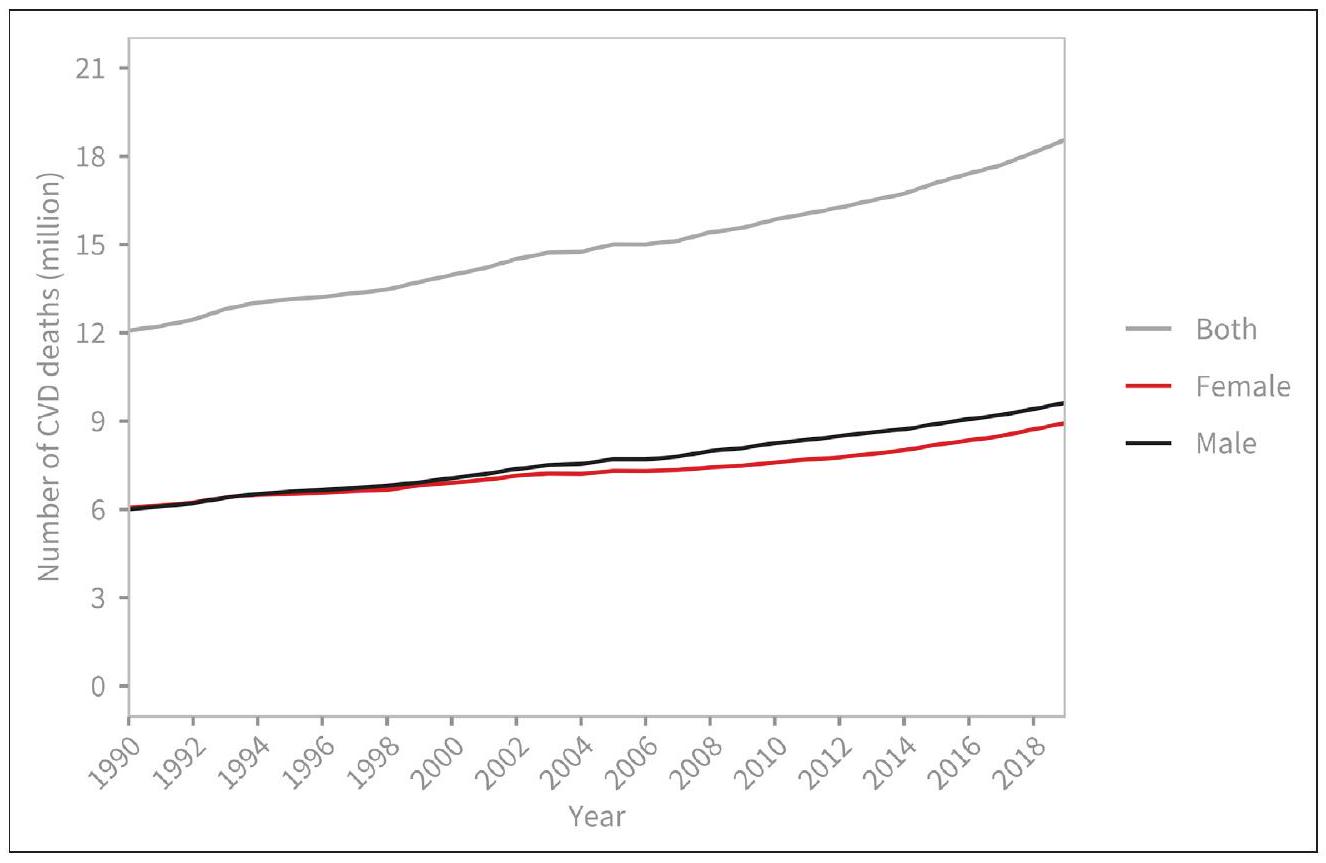
لقد زاد عدد الوفيات بسبب الاختصار المقدم في مقدمة الأمراض القلبية الوعائية على مر السنين. في عام 1990، كانت الوفيات المقدرة حوالي 12.1 مليون [فترة عدم اليقين 95%: 11.4-12.6 مليون]، موزعة بالتساوي بين الرجال والنساء. بحلول عام 2019، ارتفع هذا العدد إلى 18.6 مليون [17.1-19.7]، مع 9.6 مليون [8.9-10.3] وفاة بين الرجال و8.9 مليون [7.9-9.7] وفاة بين النساء (الشكل 1). بشكل عام، كانت الأمراض القلبية الوعائية تمثل من جميع الوفيات العالمية في عام 2019، حيث ساهمت أمراض القلب الإقفارية (9.1 مليون وفاة) والسكتة الدماغية (6.6 مليون وفاة) في من الوفيات المرتبطة بأمراض القلب والأوعية الدموية. بينما زاد عدد الوفيات بسبب أمراض القلب والأوعية الدموية على مدى الثلاثين عامًا الماضية، ويرجع ذلك أساسًا إلى شيخوخة ونمو السكان، انخفض معدل الوفيات المعدل حسب العمر، الذي يأخذ في الاعتبار التغيرات في التركيبة السكانية، من 354.5 لكل 100,000 شخص [330.6-369.5] في عام 1990 إلى 239.9 لكل 100,000 شخص [219.4-254.9] في عام 2019 (الشكل 2).
الشكل 1 الاتجاهات العالمية في عدد الوفيات بسبب الأمراض القلبية الوعائية، 1990-2019.
المصدر: معهد قياسات الصحة والتقييم (IHME). تصور بيانات GBD Compare. سياتل، واشنطن: IHME، جامعة واشنطن، 2020. متاح من http://vizhub.healthdata.org/gbd-compare.
الشكل 2 الاتجاهات العالمية في معدل وفيات أمراض القلب والأوعية الدموية المعدل حسب العمر (لكل 100,000 شخص)، 1990-2019.
المصدر: معهد قياسات الصحة والتقييم (IHME). تصور بيانات GBD Compare. سياتل، واشنطن: IHME، جامعة واشنطن، 2020. متاح من http://vizhub.healthdata.org/gbd-compare.
عند فحص الاتجاهات الإقليمية، تصبح الفروقات الكبيرة في معدل الانخفاض في معدلات الوفيات بسبب أمراض القلب والأوعية الدموية المعدلة حسب العمر واضحة (الشكل 3). بين عامي 1990 و2019، شهدت جميع المناطق انخفاضًا في معدلات الوفيات بسبب أمراض القلب والأوعية الدموية المعدلة حسب العمر، ولكن هناك علامات على أن هذا الانخفاض يتباطأ في العقد الماضي. أظهرت منطقة الدخل المرتفع أسرع معدل متوسط للانخفاض لكل من الرجال والنساء، مع معدل سنوي متوسط للتغيير قدره من ناحية أخرى، كانت مناطق جنوب آسيا وجنوب شرق آسيا وشرق آسيا وأوقيانوسيا وأفريقيا جنوب الصحراء الكبرى هي الأكثر بطئًا في معدلات الانخفاض. ومن الجدير بالذكر أنه لم يكن هناك تقريبًا أي تحسن في معدلات وفيات الأمراض القلبية الوعائية لدى الرجال في هذه المناطق.
الشكل 3 الاتجاهات الإقليمية في معدل وفيات أمراض القلب والأوعية الدموية المعدل حسب العمر (لكل 100,000 شخص)، 1990-2019.
المصدر: معهد قياسات الصحة والتقييم (IHME). تصور بيانات GBD Compare. سياتل، واشنطن: IHME، جامعة واشنطن، 2020. متاح من http://vizhub.healthdata.org/gbd-compare.
في عام 1990، كانت معدلات وفيات أمراض القلب والأوعية الدموية المعدلة حسب العمر للذكور في منطقة أفريقيا جنوب الصحراء أعلى بمقدار 1.2 مرة من تلك التي لوحظت في منطقة الدخل المرتفع. ومع ذلك، بحلول عام 2019، كانت المعدلات المعدلة حسب العمر في منطقة أفريقيا جنوب الصحراء أعلى بمقدار 2.1 مرة من تلك في منطقة الدخل المرتفع. بالنسبة للنساء في عام 2019، حققت فقط منطقة أمريكا اللاتينية ومنطقة البحر الكاريبي مستويات معدلات وفيات أمراض القلب والأوعية الدموية قابلة للمقارنة مع تلك التي لوحظت في منطقة الدخل المرتفع في عام 1990، أي قبل ما يقرب من ثلاثة عقود.
كان لدى منطقة وسط أوروبا وشرق أوروبا وآسيا الوسطى أعلى معدلات الوفيات المعدلة حسب العمر للذكور والإناث في كل من عام 1990 (670.2 [644.4-683.3] و467.2 [436.4-481.7] حالة وفاة لكل 100,000 شخص على التوالي) وعام 2019 (524.1 [475.4-566.9] و345.7 [308.1-376.3] حالة وفاة لكل 100,000 شخص على التوالي).
كان لدى منطقة شمال إفريقيا والشرق الأوسط ثاني أعلى معدلات الوفيات للذكور (376.7 لكل 100,000 شخص [336.5-414.7]) والإناث (339.8 لكل 100,000 شخص [298.9-374.2]) في عام 2019.
تُعتبر أمراض القلب الإقفارية السبب الرئيسي لوفيات أمراض القلب والأوعية الدموية في جميع المناطق، باستثناء النساء في أفريقيا جنوب الصحراء. ومن الجدير بالذكر أنه في عام 2019، كانت معدلات الوفيات بسبب اعتلال عضلة القلب والتهاب عضلة القلب بين الذكور في وسط أوروبا وشرق أوروبا وآسيا الوسطى أكثر من ثلاثة أضعاف (28.5 لكل 100,000 شخص [20.3-32.9]) مقارنةً بالمنطقة الثانية الأعلى (أفريقيا جنوب الصحراء، 8.4 لكل 100,000 شخص [5.8-10.6]) وأعلى بثلاثين مرة من المنطقة ذات المعدلات الأدنى (جنوب آسيا، 0.8 لكل 100,000 شخص [0.6-1.1]).

وفيات القلب والأوعية الدموية حسب الجنس

على المستوى العالمي، يظهر الرجال معدلات وفاة أعلى معيارية حسب العمر مقارنة بالنساء. في عام 2019، استمرت هذه الظاهرة في جميع البلدان في منطقة الدخل المرتفع، ومنطقة وسط أوروبا وشرق أوروبا وآسيا الوسطى، بالإضافة إلى منطقة جنوب آسيا. ومع ذلك، في ما يقرب من ثلث البلدان (ستة من 21) في منطقة شمال إفريقيا والشرق الأوسط، عانت النساء من معدلات وفاة أعلى بسبب أمراض القلب والأوعية الدموية مقارنة بالرجال. لوحظت تفاوتات ملحوظة في قطر (464.6 وفاة لكل 100,000 شخص [395.0-536.5] للنساء مقابل 301.9 [241.4-368.4] للرجال)، مصر (600.0 [463.8-720.2] مقابل 491.6 [386.3-615.1] لكل 100,000 شخص)، والجزائر (447.7 [384.1-509.5] مقابل 371.5 [306.9-449.0] لكل 100,000 شخص). وبالمثل، في 13 من أصل 46 دولة في منطقة أفريقيا جنوب الصحراء، كانت معدلات وفاة النساء بسبب أمراض القلب والأوعية الدموية أعلى من الرجال. لوحظت أكبر الفجوات في مالي، وموريتانيا، والكونغو (الكونغو-برازافيل)، وغانا، وسيراليون (الشكل 4). وكانت هناك دولتان أخريان حيث عانت النساء من معدلات وفاة أعلى من الرجال هما هايتي (475.3 [352.3-635.4] مقابل 419.8 [320.1-562.4] لكل 100,000 شخص) وتوكلاو (388.7 [308.9-484.8] مقابل 312.2 [261.6-380.4] لكل 100,000 شخص).
الشكل 4 الفرق بين الذكور والإناث في معدل وفيات أمراض القلب والأوعية الدموية المعدل حسب العمر (لكل 100,000 شخص) في أفريقيا جنوب الصحراء حسب البلد، 2019.
المصدر: معهد قياسات الصحة والتقييم (IHME). تصور بيانات مقارنة GBD. سياتل، واشنطن: IHME، جامعة واشنطن، 2020. متاح من http://vizhub.healthdata.org/gbd-compare.

الوفيات المبكرة الناتجة عن أمراض القلب والأوعية الدموية

تظهر أمراض القلب الإقفارية كأهم سبب للوفاة المبكرة بين جميع الأمراض غير المعدية في معظم البلدان، مما يؤثر على كل من الرجال والنساء. يتم ملاحظة أعلى خطر للوفاة المبكرة بسبب أمراض القلب الإقفارية في البلدان الواقعة ضمن منطقة وسط أوروبا وشرق أوروبا وآسيا الوسطى، تليها منطقة شمال إفريقيا والشرق الأوسط. كما أن خطر الوفاة المبكرة بسبب السكتة الدماغية الإقفارية بين الرجال هو الأعلى أيضًا في منطقة وسط أوروبا وشرق أوروبا وآسيا الوسطى. تبرز اليمن كالدولة ذات أعلى خطر للوفاة المبكرة بين جميع البلدان، حيث يواجه الرجال والنساء مخاطر و ، على التوالي (الشكل 5). خطر الوفاة المبكرة بسبب السكتة الدماغية النزفية مرتفع بشكل خاص في منغوليا ( بين الرجال و بين النساء) وتركمانستان (9.6% بين الرجال). بالمثل، بالنسبة للسكتة الدماغية الإقفارية، يتم ملاحظة أعلى خطر (حوالي 3%) بين النساء في منطقة جنوب الصحراء الكبرى، وخاصة في البلدان الغربية الإفريقية، مثل غانا وسيراليون وساحل العاج. في منطقة جنوب الصحراء الكبرى، يميل خطر الوفاة المبكرة بسبب أمراض القلب والأوعية الدموية الأخرى أيضًا إلى أن يكون أعلى بين النساء.

عوامل الخطر

يوفر ملف عوامل الخطر فهمًا شاملاً لعبء عوامل خطر أمراض القلب والأوعية الدموية داخل البلدان وبينها (الشكل 6). تكشف التحليلات عن تباينات ملحوظة عبر المناطق. في وسط أوروبا وشرق أوروبا وآسيا الوسطى، تظهر معظم البلدان مستويات عالية من تناول الصوديوم، وارتفاع ضغط الدم، والكوليسترول غير HDL بين الرجال. بالإضافة إلى ذلك، تنتشر مستويات عالية من تناول الصوديوم والتدخين بين النساء. بالمقارنة، تميل البلدان في وسط وشرق أوروبا إلى أن تكون لديها مستويات أعلى من عوامل الخطر بشكل عام مقارنة بتلك الموجودة في آسيا الوسطى. تتميز معظم البلدان في منطقة الدخل المرتفع بمستويات مرتفعة من عوامل الخطر السلوكية، بما في ذلك استهلاك الصوديوم والكحول المرتفع، والتدخين، وانخفاض النشاط البدني. كما يعاني كلا الجنسين من مستويات عالية من الكوليسترول غير HDL، بينما يعاني الرجال من مستويات عالية من السمنة. تُظهر منطقة أمريكا اللاتينية ومنطقة الكاريبي مستويات أكبر من التباين. ومع ذلك، يظهر انخفاض النشاط البدني كعامل خطر كبير عبر العديد من البلدان. بشكل عام، تميل دول الكاريبي إلى أن تكون لديها مستويات أعلى من عوامل الخطر مقارنة
الشكل 5 احتمال الوفاة (يُبلغ عنه كنسبة مئوية) في عام 2015 بين 30 و70 عامًا من العمر بسبب أمراض القلب الإقفارية حسب الجنس.
ملاحظة: يتم استخدام اللون الرمادي عندما لا تتوفر تقديرات (مفقودة).
المصدر: العد التنازلي للأمراض غير المعدية [3].
ببلدان أخرى في المنطقة. تتميز منطقة شمال إفريقيا والشرق الأوسط بمستويات عالية من عوامل الخطر الأيضية، وخاصة انتشار السكري والسمنة. كما أن تلوث الهواء وقلة النشاط البدني هما أيضًا عوامل خطر ملحوظة. عمومًا، تظهر البلدان في الشرق الأوسط مستويات أعلى من عوامل الخطر مقارنة بتلك الموجودة في شمال إفريقيا. تواجه جميع البلدان في جنوب آسيا مستويات عالية من تلوث الهواء. كما أن تناول الصوديوم وارتفاع ضغط الدم والسكري هي أيضًا عوامل خطر بارزة في جنوب آسيا لكلا الجنسين.
تتمتع البلدان في أوقيانوسيا بمستويات عالية من السكري والسمنة والتدخين وقلة النشاط البدني. تتميز النساء ببعض من أعلى مستويات الكوليسترول غير HDL. في جنوب شرق آسيا وشرق آسيا، يتم ملاحظة مستويات عالية من تناول الصوديوم والكوليسترول غير HDL عبر جميع البلدان.
تتميز منطقة جنوب الصحراء الكبرى بمستويات عالية من ارتفاع ضغط الدم في معظم البلدان. مستويات تلوث الهواء عمومًا مرتفعة، وخاصة في بلدان الساحل. تميل البلدان الجنوبية في جنوب الصحراء الكبرى إلى أن تكون لديها أعلى مستويات من عوامل خطر أمراض القلب والأوعية الدموية داخل المنطقة.

العلاقة بين وفيات أمراض القلب والأوعية الدموية ونفقات الصحة

لقد دعت منظمة الصحة العالمية (WHO) ومنظمات المجتمع المدني المختلفة منذ فترة طويلة الدول إلى تخصيص حد أدنى قدره 5% من ناتجها المحلي الإجمالي (GDP) نحو الرعاية الصحية. ومع ذلك، هناك تباينات كبيرة في مدى تحقيق الدول في كل منطقة لهذا الهدف (الجدول 3). على سبيل المثال، في جنوب آسيا، لا تحقق أي من الدول الهدف البالغ 5%، حيث تخصص بنغلاديش من ناتجها المحلي الإجمالي لنفقات الصحة، وبهوتان تخصص ، والهند تخصص ، ونيبال تخصص ، وباكستان تخصص .
الشكل 6 مستويات مقارنة لعوامل الخطر حسب البلد والمنطقة.
المنطقة %
الدخل المرتفع 97
وسط أوروبا وشرق أوروبا وآسيا الوسطى 85
أمريكا اللاتينية ومنطقة الكاريبي 71
شمال إفريقيا والشرق الأوسط 53
جنوب شرق آسيا وشرق آسيا وأوقيانوسيا 50
جنوب الصحراء الكبرى 45
جنوب آسيا 0
يوجد ارتباط بين نسبة نفقات الصحة الحالية (CHE) بالنسبة إلى الناتج المحلي الإجمالي ومعدلات وفيات أمراض القلب والأوعية الدموية. تميل البلدان التي لديها نفقات صحية أقل كنسبة من الناتج المحلي الإجمالي إلى أن تعاني من معدلات وفيات أمراض القلب والأوعية الدموية مرتفعة حسب العمر (الشكل 7). بالإضافة إلى ذلك، فإن نسبة أعلى من النفقات من الجيب (OOPS) بالنسبة إلى نفقات الصحة الحالية مرتبطة أيضًا بمعدلات وفيات أمراض القلب والأوعية الدموية مرتفعة حسب العمر (الشكل 8).
ملاحظة (1): RF1 – النشاط البدني؛ RF2 – تناول الصوديوم؛ RF3 – استهلاك الكحول؛ RF4 – التدخين؛ RF5 – السمنة؛ RF6 – ارتفاع ضغط الدم؛ RF7 – السكري؛ RF8 – الدهون؛ RF9 – تلوث الهواء المحيط.
ملاحظة (2): تعرض الأرقام الخمسية العالمية التي تقع فيها كل دولة لكل عامل خطر.
المصدر: انظر الجدول 1.
دي تشيساري وآخرون.
القلب العالمي
DOI: 10.5334/gh.1288
الشكل 7 معدل وفيات أمراض القلب والأوعية الدموية المعدل حسب العمر (لكل 100,000 شخص)، 2019، حسب نفقات الصحة الحالية (CHE) كنسبة من الدخل القومي (GDP).
ملاحظة: تمثل كل نقطة دولة، ملونة حسب المنطقة. تُظهر الخط المنقط العلاقة السلبية الخطية بين معدلات وفيات أمراض القلب والأوعية الدموية ونفقات الصحة الوطنية (معامل ارتباط بيرسون ).
المصادر: معهد قياسات الصحة والتقييم (IHME). تصور بيانات مقارنة GBD. سياتل، واشنطن: IHME، جامعة واشنطن، 2020. متاح من http://vizhub. healthdata.org/gbd-compare؛ منظمة الصحة العالمية، قاعدة بيانات نفقات الصحة العالمية. متاح من https://apps.who.int/nha/ قاعدة البيانات/Select/Indicators/en.

مؤشر سياسة WHF

على مستوى العالم، فإن الغالبية العظمى من البلدان، 106 من أصل 166 دولة تتوفر لديها معلومات ( ), لديها على الأقل سبعة من السياسات الثمانية التي تم تقييمها. كانت المناطق ذات أعلى نسبة من البلدان التي تحقق الحد الأقصى من الدرجات الثمانية هي جنوب آسيا ( )، ووسط أوروبا وشرق أوروبا وآسيا الوسطى (68%)، ومنطقة الدخل المرتفع (62%). في المقابل، كانت منطقة جنوب الصحراء الكبرى لديها أدنى نسبة من البلدان ( ) التي تحقق الحد الأقصى من الدرجات، وأعلى نسبة ( ) من البلدان التي حصلت على درجتين أو أقل. كانت منطقة أمريكا اللاتينية ومنطقة الكاريبي، بالإضافة إلى منطقة جنوب شرق آسيا وشرق آسيا وأوقيانوسيا، تحتوي أيضًا على دول حصلت على درجات واحدة أو اثنتين (الشكل 9).
على المستوى العالمي، كانت السياسة الأكثر شيوعًا هي وجود برامج وطنية لمكافحة التبغ، وهو ما كان موجودًا في من البلدان. تلتها وجود إرشادات/بروتوكولات/معايير لإدارة أمراض القلب والأوعية الدموية (86%) ووجود سياسة/استراتيجية/خطط عمل لتقليل الأنظمة الغذائية غير الصحية المتعلقة بالأمراض غير المعدية (85%). كانت السياسة الأقل تكرارًا هي وجود خطة عمل لتقليل الاستخدام الضار للكحول، والتي كانت موجودة في 70% من البلدان.
في منطقة جنوب الصحراء الكبرى، لا تمتلك أكثر من من البلدان خطة شاملة لأمراض القلب والأوعية الدموية، أو وحدة للأمراض غير المعدية داخل وزارة الصحة، أو توفر عام لأدوية القلب والأوعية الدموية في القطاع العام. كانت منطقة شمال إفريقيا والشرق الأوسط لديها أدنى معدل تنفيذ لخطط العمل لتقليل الاستخدام الضار للكحول. كانت منطقة أمريكا اللاتينية ومنطقة الكاريبي لديها أدنى معدل تنفيذ لخطط العمل لتقليل النشاط البدني غير الصحي والأنظمة الغذائية غير الصحية ذات الصلة.
الشكل 8 معدل الوفيات بسبب أمراض القلب والأوعية الدموية المعدل حسب العمر (لكل 100,000 شخص)، 2019، حسب الإنفاق الصحي من الجيب (OOP) كنسبة من الإنفاق الصحي الحالي (CHE).
ملاحظة: كل نقطة تمثل دولة، ملونة حسب المنطقة. الخط المنقط يظهر ارتباطًا إيجابيًا بين معدلات وفيات أمراض القلب والأوعية الدموية وإنفاق OOP الصحي كنسبة من الإنفاق الصحي الوطني (معامل ارتباط بيرسون .
المصادر: معهد قياسات الصحة والتقييم (IHME). بيانات مقارنة GBD. سياتل، واشنطن: IHME، جامعة واشنطن، 2020. متاحة من http://vizhub.healthdata. org/gbd-compare; منظمة الصحة العالمية، قاعدة بيانات الإنفاق الصحي العالمي. متاحة من https://apps. who.int/nha/database/Select/Indicators/en. لمواجهة الأمراض غير السارية (الشكل 10).
الشكل 9 عدد السياسات الرئيسية المنفذة لمواجهة أمراض القلب والأوعية الدموية، حسب المنطقة (% من الدول).
المصادر: المرصد الصحي العالمي. متاحة من: https://www.who.int/data/gho.

النقاش

في هذه الورقة، نلخص عبء أمراض القلب والأوعية الدموية، وعوامل الخطر المرتبطة بها، والارتباط بين الإنفاق الصحي الوطني وعبء أمراض القلب والأوعية الدموية، ودور السياسات الحاسمة، كما هو موضح في تقرير القلب العالمي 2023.
ظلت أمراض القلب والأوعية الدموية السبب الرئيسي للوفيات لأكثر من ثلاثة عقود، حيث تمثل حوالي ثلث جميع الوفيات العالمية، مع تسجيل 20.5 مليون وفاة في عام 2021 [1]. كان الانخفاض في معدلات وفيات أمراض القلب والأوعية الدموية أسرع في البلدان ذات الدخل المرتفع مقارنة بالبلدان ذات الدخل المنخفض والمتوسط، حيث تحدث أكثر من 80% من وفيات أمراض القلب والأوعية الدموية حاليًا. على مستوى العالم، كانت أمراض القلب والأوعية الدموية باستمرار السبب الرئيسي للوفيات على مدى العقود الثلاثة الماضية. لا تزال منطقة وسط أوروبا وشرق أوروبا وآسيا الوسطى تواجه أعلى مستويات وفيات أمراض القلب والأوعية الدموية على مستوى العالم. تشير النتائج إلى أنه على الرغم من أن مستويات وفيات أمراض القلب والأوعية الدموية عمومًا أقل في النساء مقارنة بالرجال، فإن حوالي 30% من الدول في منطقة شمال إفريقيا والشرق الأوسط ومنطقة إفريقيا جنوب الصحراء (خاصة دول غرب إفريقيا) تسجل معدلات وفيات أعلى لأمراض القلب والأوعية الدموية للإناث مقارنة بالذكور. يبرز الارتباط بين الإنفاق الصحي كنسبة من الناتج المحلي الإجمالي، والإنفاق من الجيب، ووفيات أمراض القلب والأوعية الدموية الحاجة إلى استثمار كافٍ في أنظمة الرعاية الصحية للتخفيف من عبء أمراض القلب والأوعية الدموية. من حيث عوامل الخطر، يعتبر ارتفاع ضغط الدم هو عامل الخطر الرئيسي لأمراض القلب والأوعية الدموية على مستوى العالم، حيث يساهم في حوالي 10 ملايين وفاة في عام 2019. معظم عوامل خطر أمراض القلب والأوعية الدموية، بما في ذلك قلة النشاط البدني، واستهلاك الكحول، والتدخين، وارتفاع ضغط الدم، والسكري، أكثر انتشارًا في الرجال مقارنة بالنساء، مع كون السمنة هي العامل الوحيد الذي يكون أعلى في النساء.
بينما توفر البيانات المقدمة هنا صورة مفصلة عن العبء الحالي لأمراض القلب والأوعية الدموية، هناك بعض القيود المهمة. البيانات المستخدمة لتقديم العبء الزمني لأمراض القلب والأوعية الدموية وعوامل الخطر المرتبطة بها مشتقة من نمذجة معقدة [10، 11]. يتم التعبير عن غنى/نقص البيانات التي تُعلم النموذج إحصائيًا من خلال مستويات عدم اليقين. هنا، من أجل البساطة، لم نقم بالإبلاغ بشكل منهجي عن مستويات عدم اليقين المرتبطة. على وجه الخصوص، يؤدي نقص البيانات من البلدان ذات الدخل المنخفض والمتوسط إلى مستويات أكبر من عدم اليقين في تلك البلدان.
لا توجد مقاربة واحدة تناسب الجميع لتحسين صحة القلب والأوعية الدموية على مستوى العالم. كل مجموعة سكانية عرضة لعوامل خطر مختلفة بناءً على مكان عيشها وأنماط حياتها. سواء كان ذلك بسبب ارتفاع انتشار استخدام التبغ والكحول وارتفاع تناول الصوديوم أو التعرض لمستويات خطيرة من تلوث الهواء وانخفاض مستويات النشاط البدني. وهذا يعني أن صانعي القرار وأصحاب المصلحة يجب أن ينظروا عن كثب إلى انتشار عوامل الخطر في بلدانهم ومناطقهم لفهم ما هي مجالات السياسات التي تحتاج إلى مزيد من التركيز لتحسين صحة القلب والأوعية الدموية في الاتجاه الصحيح. ومع ذلك، هناك مقاربات أساسية يجب على كل دولة تنفيذها كأساس لبناء أنشطة مخصصة لمواجهة أمراض القلب والأوعية الدموية. يشمل ذلك تنفيذ مبادرات سياسية رئيسية ضرورية لتحسين صحة القلب والأوعية الدموية، مثل برامج التحكم في التبغ الوطنية، وضمان توفر أدوية أمراض القلب والأوعية الدموية، وإنشاء وحدة تشغيلية في وزارة الصحة مسؤولة
الشكل 10 تنفيذ السياسات لكل دولة.
ملاحظة: P1 – برامج التحكم في التبغ الوطنية؛ P2
  • خطة عمل لأمراض القلب والأوعية الدموية؛ P3 وحدة تشغيلية في وزارة الصحة مسؤولة عن الأمراض غير السارية؛ P4 – إرشادات لإدارة أمراض القلب والأوعية الدموية؛ P5 خطة عمل لتقليل قلة النشاط البدني؛ P6 – خطة عمل لتقليل النظام الغذائي غير الصحي المرتبط بالأمراض غير السارية؛ P7 – خطة عمل لتقليل الاستخدام الضار للكحول؛ P8 – توفر أدوية أمراض القلب والأوعية الدموية (مثل مثبطات ACE، الأسبرين، وحاصرات بيتا) في القطاع الصحي العام.
    المصادر: الصحة العالمية
    المرصد. متاحة من: https://www.who.int/data/gho.
    لمواجهة الأمراض غير السارية. بالإضافة إلى ذلك، يتطلب الأمر أنظمة صحية ومبادرات ممولة بشكل كافٍ حتى تتمكن جميع المجتمعات من الوصول إلى الرعاية التي تحتاجها. إن التقدم المتعثر في صحة القلب والأوعية الدموية ليس فريدًا. عانت تقريبًا كل مبادرة صحية حول العالم بسبب جائحة COVID-19 والبلدان الآن تتصارع مع أي المجالات يجب أن تعطي الأولوية لها بينما تهدف إلى تعزيز وحماية صحة سكانها. نظرًا للعبء الشديد لأمراض القلب والأوعية الدموية من حيث الوفيات والمراضة، لا يمكن إهمال هذا المجال الصحي. سيكافح العالم لتحقيق الأهداف الطموحة المحددة لتقليل الوفيات المبكرة من الأمراض غير السارية بنسبة 25% مقارنة بمستويات 2010، بحلول عام 2025. ومع ذلك، لا يزال هناك وقت لتسريع العمل نحو تحقيق الهدف 3.4 من أهداف التنمية المستدامة المتمثل في تقليل الوفيات المبكرة من الأمراض غير السارية، بما في ذلك أمراض القلب والأوعية الدموية، بمقدار الثلث.
لتعزيز العمل ضد أمراض القلب والأوعية الدموية، يجب مراعاة عدة جوانب على المدى القصير والطويل. أولاً، تحتاج البلدان إلى تعزيز جمع البيانات حول أمراض القلب والأوعية الدموية وعوامل خطرها، خاصة في البلدان ذات الدخل المنخفض والمتوسط حيث توجد فجوات في البيانات، لفهم أفضل للسكان المعرضين لمخاطر أعلى. ثانيًا، يجب أن تهدف البلدان إلى إنفاق صحي لا يقل عن من الناتج المحلي الإجمالي، وفقًا لتوصيات منظمة الصحة العالمية. ثالثًا، يجب على البلدان تنفيذ سياسات قائمة على الأدلة لمعالجة أمراض القلب والأوعية الدموية، مع مراعاة عبء المرض وعوامل الخطر السائدة، مع ضمان موارد كافية ومراقبة للتقدم. رابعًا، من الضروري إعطاء الأولوية لتغطية تدخلات الوقاية من أمراض القلب والأوعية الدموية وإدارتها ضمن حزم فوائد التغطية الصحية الشاملة (UHC) لتقليل النفقات من الجيب. خامسًا، يجب تنفيذ الدروس المستفادة من الوقاية الناجحة من أمراض القلب والأوعية الدموية، والإدارة، وتحسين الوصول إلى الرعاية والعلاجات عبر جميع المناطق لمعالجة الفجوات والتقدم غير المتساوي في تقليل وفيات أمراض القلب والأوعية الدموية.
يوفر مؤشر سياسة WHF الموصوف هنا أداة عمل للحكومات الوطنية لاستخدامها لتقييم ومراقبة وتحسين تنفيذ السياسات التي تعالج صحة أمراض القلب والأوعية الدموية. يجب أن ندرك أن السياسات قوية فقط عندما يتم تنفيذها وتقييمها. هنا نحاول البدء في التقاط التدابير التي يمكن من خلالها للمنظمات والمدافعين مراقبة إجراءات أصحاب المصلحة الرئيسيين مثل الحكومة واللاعبين الآخرين على المستوى الوطني.
من الضروري اتخاذ إجراءات منسقة لمكافحة أمراض القلب والأوعية الدموية والعمل نحو تحقيق الأهداف العالمية المحددة، مما يحسن النتائج الصحية ورفاهية السكان في جميع أنحاء العالم.

معلومات التمويل

جعل تقرير القلب العالمي 2023 ممكنًا بفضل دعم مؤسسة نوفارتس.

المصالح المتنافسة

ليس لدى المؤلفين مصالح متنافسة للإفصاح عنها.

الانتماءات المؤلفين

مارياكيارا دي تشيزاري (D) orcid.org/0000-0002-3934-3364
معهد الصحة العامة والرفاهية، جامعة إسيكس، كولشستر، المملكة المتحدة
بابلو بيريل (D) orcid.org/0000-0002-2342-301X
قسم وبائيات الأمراض غير السارية، كلية لندن للصحة العامة والطب الاستوائي، لندن، المملكة المتحدة؛ الاتحاد العالمي للقلب، جنيف، سويسرا
شون تايلور (D) orcid.org/0000-0002-5031-3588
الاتحاد العالمي للقلب، جنيف، سويسرا
تشودزيوادزيا كابودولا (D) orcid.org/0000-0002-5867-0336
وحدة أبحاث الصحة العامة والتحولات الصحية في المناطق الريفية (أجينكورت)، كلية الصحة العامة، كلية العلوم الصحية، جامعة ويتواترسراند، جوهانسبرغ، جنوب أفريقيا
أونور بيكسي (د)orcid.org/0000-0002-0513-5292
معهد الصحة العامة والرفاهية، جامعة إسيكس، كولشستر، المملكة المتحدة
توماس أ. غازيان (د)orcid.org/0000-0002-5985-345X
مستشفى بريغهام والنساء، طب القلب، بوسطن، الولايات المتحدة الأمريكية؛ كلية الطب بجامعة هارفارد، بوسطن، الولايات المتحدة الأمريكية
ديانا فاكه مكغي
جمعية القلب الأمريكية، دالاس، الولايات المتحدة الأمريكية
جيريميا موينغي (د)orcid.org/0000-0002-5819-4587
الاتحاد العالمي للقلب، جنيف، سويسرا

بوريانا بروفان

الاتحاد العالمي للقلب، جنيف، سويسرا
جاغات نارولا (د)orcid.org/0000-0002-0280-3996
مدرسة مكغفرن الطبية في UTHealth، هيوستن، الولايات المتحدة الأمريكية
دانيال بينيرو (د)orcid.org/0000-0002-0126-8194
قسم الطب، جامعة بوينس آيرس، بوينس آيرس، الأرجنتين
فاوستو ج. بينتو (د)orcid.org/0000-0002-8034-4529
مستشفى سانتا ماريا الجامعي، CAML، CCUL، كلية الطب بجامعة لشبونة، لشبونة، البرتغال

REFERENCES

  1. Lindstrom M, DeCleene N, Dorsey H, Fuster V, Johnson CO, LeGrand KE, et al. Global Burden of Cardiovascular Diseases and Risks Collaboration, 1990-2021. J Am Coll Cardiol. 2022; 80: 2372-2425. DOI: https://doi.org/10.1016/j.jacc.2022.11.001
  2. Cardiovascular diseases (CVDs). [cited 24 Jul 2023]. Available https://www.who.int/news-room/ fact-sheets/detail/cardiovascular-diseases-(cvds).
  3. NCD Countdown 2030 collaborators. NCD Countdown 2030: pathways to achieving Sustainable Development Goal target 3.4. Lancet. 2020; 396: 918-934. DOI: https://doi.org/10.1016/S0140-6736(20)31761-X
  4. Website. Available. https://www.who.int/publications/i/item/ncd-surveillance-global-monitoringframework.
  5. NCD Countdown 2030 collaborators. NCD Countdown 2030: worldwide trends in noncommunicable disease mortality and progress towards Sustainable Development Goal target 3.4. Lancet. 2018; 392: 1072-1088. DOI: https://doi.org/10.1016/S0140-6736(18)31992-5
  6. Website. Available. http://vizhub.healthdata.org/gbd-compare.
  7. Homepage > NCD-RisC. [cited 24 Jul 2023]. Available https://ncdrisc.org.
  8. Global Health Expenditure Database. [cited 24 Jul 2023]. Available. https://apps.who.int/nha/ database.
  9. Global Health Observatory. [cited 24 Jul 2023]. Available. https://www.who.int/data/gho.
  10. Finucane MM, Paciorek CJ, Danaei G, Ezzati M. Bayesian Estimation of Population-Level Trends in Measures of Health Status. Stat Sci. 2014; 29: 18-25. DOI: https://doi.org/10.48550/arXiv.1405.4682; https://doi.org/10.1214/13-STS427
  11. GBD 2019 Diseases and Injuries Collaborators. Global burden of 369 diseases and injuries in 204 countries and territories, 1990-2019: a systematic analysis for the Global Burden of Disease Study 2019. Lancet. 2020; 396: 1204-1222. DOI: https://doi.org/10.1016/S0140-6736(20)30925-9

للاستشهاد بهذه المقالة:

دي تشيساري م، بيريل ب، تايلور س، كابودولا ج، بيكسي هـ، غازيان ت. أ.، مكغي د. ف، موينغي ج، بروفان ب، نارولا ج، بينيرو د، بينتو ف. قلب العالم. القلب العالمي. 2024؛ 19(1): 11. DOI: https://doi. org/10.5334/gh. 1288
تم التقديم: 04 أكتوبر 2023
تم القبول: 18 ديسمبر 2023
تم النشر: 25 يناير 2024

حقوق الطبع والنشر:

© 2024 المؤلفون. هذه مقالة مفتوحة الوصول موزعة بموجب شروط ترخيص المشاع الإبداعي للاستخدام والتوزيع وإعادة الإنتاج غير المقيد في أي وسيلة، شريطة أن يتم الإشارة إلى المؤلف الأصلي والمصدر. انظر http://creativecommons.org/ licenses/by/4.0/.
القلب العالمي هو مجلة مفتوحة الوصول تمت مراجعتها من قبل الأقران تنشرها Ubiquity Press.

  1. 1 تقرير القلب العالمي، الذي أُطلق في مايو 2023، يهدف إلى تزويد صانعي السياسات والمدافعين حول العالم بالمعلومات اللازمة للمساعدة في تقليل وفيات الأمراض القلبية الوعائية وتسريع التقدم في صحة القلب والأوعية الدموية. تسلط نتائج التقرير الضوء على الاختلافات الرئيسية بين المناطق من حيث عبء الأمراض القلبية الوعائية وعوامل الخطر، فضلاً عن الحواجز الهيكلية وعدم المساواة في صحة القلب والأوعية الدموية، بهدف توجيه صانعي السياسات على المستويات الوطنية والدولية نحو الأولويات التي ينبغي عليهم السعي لمعالجتها. وهو متاح من https:// world-heart-federation.org/resource/world-heart-report-2023.
    2 تشير الوفيات المبكرة الناتجة عن الأمراض غير المعدية إلى الوفيات التي تحدث بين سن 30 و70 عامًا. هذه الوفيات المبكرة لا تؤدي فقط إلى فقدان كبير في الحياة للأفراد ولكن لها أيضًا تأثيرات أوسع على المجتمعات والاقتصادات، خاصةً لأنها تؤثر على الأفراد ضمن نطاق سن العمل.
  2. الجدول 3 نسبة الدول التي تنفق على الأقل 5% من الناتج المحلي الإجمالي على الصحة.

Journal: Global Heart, Volume: 19, Issue: 1
DOI: https://doi.org/10.5334/gh.1288
PMID: https://pubmed.ncbi.nlm.nih.gov/38273998
Publication Date: 2024-01-01

The Heart of the World

MARIACHIARA DI CESARE © DIANA VACA MCGHIE PABLO PEREL (D) JEREMIAH MWANGI (D) SEAN TAYLOR © BORJANA PERVAN CHODZIWADZIWA KABUDULA © JAGAT NARULA (D) HONOR BIXBY (D) DANIEL PINEIRO (D) THOMAS A. GAZIANO (D) FAUSTO J. PINTO ©*Author affiliations can be found in the back matter of this article

]u[ubiquity press

CORRESPONDING AUTHOR: Mariachiara Di Cesare

Institute of Public Health and Wellbeing, University of Essex, Colchester, UK
m.dicesare@essex.ac.uk

KEYWORDS:

Cardiovascular health; CVDs risk factors; WHF policy index; CVD global data; WHF observatory

TO CITE THIS ARTICLE:

Di Cesare M, Perel P, Taylor S, Kabudula C, Bixby H, Gaziano TA, McGhie DV, Mwangi J, Pervan B, Narula J, Pineiro D, Pinto FJ. The Heart of the World. Global Heart. 2024; 19(1): 11. DOI: https://doi. org/10.5334/gh. 1288

Abstract

Cardiovascular diseases (CVDs) are the leading cause of mortality globally. Of the 20.5 million CVD-related deaths in 2021, approximately 80% occurred in low- and middleincome countries.

Using data from the Global Burden of Disease Study, NCD Risk Factor Collaboration, NCD Countdown initiative, WHO Global Health Observatory, and WHO Global Health Expenditure database, we present the burden of CVDs, associated risk factors, their association with national health expenditures, and an index of critical policy implementation.

The Central Europe, Eastern Europe, and Central Asia region face the highest levels of CVD mortality globally. Although CVD mortality levels are generally lower in women than men, this is not true in almost of countries in the North Africa and Middle East and Sub-Saharan regions. Raised blood pressure remains the leading global CVD risk factor, contributing to 10.8 million deaths in 2019 . The regions with the highest proportion of countries achieving the maximum score for the WHF Policy Index were South Asia, Central Europe, Eastern Europe, and Central Asia, and the High-Income regions. The SubSaharan Africa region had the highest proportion of countries scoring two or less.

Policymakers must assess their country’s risk factor profile to craft effective strategies for CVD prevention and management. Fundamental strategies such as the implementation of National Tobacco Control Programmes, ensuring the availability of CVD medications, and establishing specialised units within health ministries to tackle non-communicable diseases should be embraced in all countries. Adequate healthcare system funding is equally vital, ensuring reasonable access to care for all communities.

INTRODUCTION

Cardiovascular diseases (CVDs) are the leading cause of mortality globally, responsible for a significant number of deaths and disabilities. In 2021 alone, CVDs accounted for 20.5 million deaths, comprising approximately one-third of all global deaths [1]. While cardiovascular conditions were traditionally considered diseases of affluence, this is no longer the case. Over three-quarters of CVD-related deaths occur in low- and middle-income countries (LMICs) [2].
Moreover, these deaths are the primary contributor to premature non-communicable disease (NCD) mortality. Ischemic heart disease, specifically, stands as the leading cause of premature death in 146 countries for men and 98 countries for women [3]. The complexity of the global picture is exacerbated by the levels of inequalities in the impact of CVDs. Notably, LMICs experience higher rates of premature mortality from CVDs compared to high-income countries (HICs), while the reduction in age-standardised mortality rates is progressing more slowly in LMICs.
In May 2012 the World Health Assembly adopted the target of a reduction in premature mortality from noncommunicable diseases by 2025. In May 2013 the NCD Global Monitoring Framework was launched during the World Health Assembly. Its primary objectives were to drive progress in the prevention and control of NCDs, serve as a foundation for advocacy, raise awareness, strengthen political commitment, and promote global action against NCDs. The framework encompassed nine voluntary global targets focused on behavioural and metabolic risk factors, as well as national healthcare system responses [4].
Over a decade has passed since international organisations and governments have been working towards achieving these global targets and reducing premature mortality. However, the current pace of decline is insufficient. Based on trends observed between 2010 and 2016, it is estimated that less than of countries will achieve the UN Sustainable Development Goal Target 3.4 (SDG 3.4) – a one-third reduction in premature mortality from NCDs by 2030 [5]. Most countries, particularly those classified as low- or lower-middle income, need to accelerate progress to meet these targets.
This paper summarises the World Heart Report 2023, which is a comprehensive overview of the trends and current landscape of the key dimensions of cardiovascular health. By synthesising epidemiological, policy, and economic data, the World Heart Report provides information that can help guide policymakers at national and international levels in identifying and addressing the most critical priorities to address cardiovascular conditions.

METHODS AND DATA

The analysis of the burden of cardiovascular diseases and associated risk in this study utilised data from global initiatives including the Global Burden of Disease Study [6], the NCD Risk Factor Collaboration [7], and the NCD Countdown 2030 initiative [3]. These have been extensively described elsewhere and are considered the most valid and reliable sources for global cardiovascular data. In selecting data sources, priority was given to those that offered a high level of disaggregation (by sex, age, country, region), data completeness, richness of the raw data informing the model, and comparability of estimates.
Absolute numbers of death, age-standardised death rates, and the probability of dying between 30 and 70 years of age have been reported to describe the burden of cardiovascular mortality. Analysis of risk factors focused on nine specific factors. These factors were selected based on the six risk factors outlined in the WHO NCD Global Monitoring Framework, along with two additional risk factors-non-HDL cholesterol levels and air pollution. The inclusion of these two additional factors was based on their substantial impact on the prevalence and mortality rates of CVDs (Table 1).
INDICATOR SOURCE YEAR
Mortality
Ischemic heart disease Global burden of disease 1990-2019
Stroke Global burden of disease 1990-2019
All other CVDs Global burden of disease 1990-2019
Risk factors
Diabetes NCD risk factor collaboration 1975-2014
Raised blood pressure NCD risk factor collaboration 1975-2015
Obesity NCD risk factor collaboration 1975-2016
Lipids NCD risk factor collaboration 1975-2018
Physical activity Global burden of disease 1990-2019
Sodium intake Global burden of disease 1990-2019
Alcohol consumption Global burden of disease 1990-2019
Tobacco smoking Global burden of disease 1990-2019
Ambient air pollution Global burden of disease 1990-2019
Premature mortality (stroke) NCD Countdown 2030 2015
Table 1 Mortality and risk factors indicators, source, and year.
To assess the risk factors’ country profiles, each country was ranked based on the level of the specific risk factor, ranging from the highest level to the lowest level. Subsequently, quintiles were generated for each risk factor, dividing the countries into five equal groups based on their respective levels of the risk factor.
To assess the association between CVD burden and health expenditure, additional data on Gross Domestic Product (GDP), Current Health Expenditure as a percentage of GDP (CHE), and Out of Pocket Expenditure (OOPS) were obtained from the WHO Global Health Expenditure database [8].
The World Heart Federation Policy Index (WHF Policy Index) provides an overview of national governments’ level of implementation of eight critical policies related to CVD health (Table 2). The expert panel of the WHF Advocacy Committee carefully selected these policy indicators as the most relevant for ensuring a healthy heart profile in populations. Data for the WHF Policy Index were obtained from the Global Health Observatory [9]. Each policy was assigned a score of 0 if it was not in place in the country and 1 if it was in place. The overall index score for each country ranged from 0 (no policies in place) to 8 (all policies in place). Complete information was available for 166 countries.
INDICATOR SOURCE YEAR
National tobacco control programmes WHO Global Health Observatory 2018
Policy/strategy/action plan for CVD WHO Global Health Observatory 2021
Operational Unit, Branch, or Dept. in Ministry of Health with responsibility for NCDs WHO Global Health Observatory 2021
Guidelines/protocols/standards for the management of cardiovascular diseases WHO Global Health Observatory 2021
Policy/strategy/action plan to reduce physical inactivity WHO Global Health Observatory 2021
Policy/strategy/action plan to reduce unhealthy diet related to NCDs WHO Global Health Observatory 2021
Policy/strategy/action plan to reduce the harmful use of alcohol WHO Global Health Observatory 2021
Availability of ACE inhibitors, Aspirin ( 100 mg ) and Beta blockers in the public health sector WHO Global Health Observatory 2021
Table 2 Policy indicators, source, and year.
Note: Availability of ACE inhibitors, Aspirin ( 100 mg ) and Beta blockers in the public health sector is a combination of the three indicators 1) availability of ACE inhibitors in the public health sector; 2) availability of Aspirin ( 100 mg ) in the public health sector; 3) availability of Beta blockers in the public health sector. If all 3 available the overall score was set to 1 if one or more not available the overall score was set to 0 .
Trends and levels are presented for both regions and individual countries. Countries were classified into regions based on the Global Burden of Diseases classification, which includes Central Europe, Eastern Europe, Central Asia, and the High-Income region as distinct regions (https://www.healthdata.org/sites/default/files/files/Projects/GBD/GBDRegions_countries.pdf).
This division into more regions allows for more detailed comparisons of mortality and risk factor rates across significant geographical areas. To assess the association between CVD burden and health expenditure indicators the Pearson’s correlation coefficient was used.

RESULTS

The number of deaths due to acronym introduced in the introduction CVDs has increased over the years. In 1990, the estimated deaths stood at around 12.1 million [95% Uncertainty Interval: 11.4-12.6 million], equally distributed between men and women. By 2019, this number had risen to 18.6 million [17.1-19.7], with 9.6 million [8.9-10.3] deaths among men and 8.9 million [7.9-9.7] deaths among women (Figure 1). Overall, CVDs accounted for of all global deaths in 2019, with ischemic heart disease (9.1 million deaths) and stroke (6.6 million deaths) contributing to of CVD-related deaths. While the number of deaths due to CVDs over the last 30 years has increased, mostly due to the ageing and growth of the population, the age-standardised death rate, which accounts for changes in population demographics, has declined from 354.5 per 100,000 people [330.6-369.5] in 1990 to 239.9 per 100,000 people [219.4-254.9] in 2019 (Figure 2).
Figure 1 Global trends in number of deaths due to cardiovascular diseases, 1990-2019.
Source: Institute for Health Metrics and Evaluation (IHME). GBD Compare Data Visualization. Seattle, WA: IHME, University of Washington, 2020. Available from http://vizhub.healthdata. org/gbd-compare.
Figure 2 Global trends in agestandardised cardiovascular disease death rate (per 100,000 people), 1990-2019.
Source: Institute for Health Metrics and Evaluation (IHME). GBD Compare Data Visualization. Seattle, WA: IHME, University of Washington, 2020. Available from http://vizhub.healthdata. org/gbd-compare.
When examining regional trends, significant variations in the rate of decline in age-standardised CVD death rates become apparent (Figure 3). Between 1990 and 2019, all regions experienced a decline in age-standardised CVD death rates, but there are signs of this decline slowing down in the past decade. The High-income region exhibited the fastest average rate of decline for both men and women, with an average annual rate of change of . On the other hand, the South Asia, the Southeast Asia, East Asia and Oceania, and the Sub-Saharan Africa regions had the slowest rates of decline. Notably, there was almost no improvement in CVD death rates for men in these regions.
Figure 3 Regional trends in age-standardised cardiovascular disease death rate (per 100,000 people), 1990-2019.
Source: Institute for Health Metrics and Evaluation (IHME). GBD Compare Data Visualization. Seattle, WA: IHME, University of Washington, 2020. Available from http://vizhub.healthdata. org/gbd-compare.
In 1990, male age-standardised CVD death rates in the Sub-Saharan Africa region were 1.2 times higher than those observed in the High-income region. However, by 2019, the agestandardised rates in the Sub-Saharan Africa region were 2.1 times higher than those in the High-income region. For women in 2019, only the Latin America and the Caribbean region achieved CVDs death rates levels comparable to those observed in the High-income region in 1990, almost three decades before.
The Central Europe, Eastern Europe, and Central Asia region had the highest age-standardised death rates for males and females in both 1990 (670.2 [644.4-683.3] and 467.2 [436.4-481.7] deaths per 100,000 people respectively) and 2019 (524.1 [475.4-566.9] and 345.7 [308.1376.3] deaths per 100,000 people respectively).
The North Africa and Middle East region had the second highest death rates for males (376.7 per 100,000 people [336.5-414.7] and females (339.8 per 100,000 people [298.9-374.2]) in 2019.
Ischemic heart disease stands as the leading cause of CVD mortality across all regions, except for women in Sub-Saharan Africa. Notably, in 2019, the death rate for cardiomyopathy and myocarditis among males in Central Europe, Eastern Europe, and Central Asia was more than three times higher (28.5 per 100,000 people [20.3-32.9]) than in the second highest region (Sub-Saharan Africa, 8.4 per 100,000 people [5.8-10.6]) and thirty times higher than the region with the lowest rates (South Asia, 0.8 per 100,000 people [0.6-1.1]).

CARDIOVASCULAR DEATHS BY SEX

On a global scale, men exhibit higher age-standardised death rates compared to women. In 2019, this trend persisted across all countries in the High-income region, the Central Europe, Eastern Europe, and Central Asia region, as well as the South Asia region. However, in almost onethird of countries (six out of 21) in the North Africa and Middle East region, women experienced higher death rates from CVDs compared to men. Notable disparities were observed in Qatar ( 464.6 deaths per 100,000 people [395.0-536.5] for women versus 301.9 [241.4-368.4] for men), Egypt (600.0 [463.8-720.2] versus 491.6 [386.3-615.1] per 100,000 people), and Algeria ( 447.7 [384.1-509.5] versus 371.5 [306.9-449.0] per 100,000 people). Similarly, in 13 out of the 46 countries in the Sub-Saharan Africa region, women had higher CVDs death rates than men. The largest gaps were observed in Mali, Mauritania, Congo (Congo-Brazzaville), Ghana, and Sierra Leone (Figure 4). Two other countries where women experienced higher death rates than men were Haiti (475.3 [352.3-635.4] versus 419.8 [320.1-562.4] per 100,000 people) and Tokelau (388.7 [308.9-484.8] versus 312.2 [261.6-380.4] per 100,000 people).
Figure 4 Male-female difference in age-standardised cardiovascular disease death rate (per 100,000 people) in sub-Saharan Africa by country, 2019.
Source: Institute for Health Metrics and Evaluation (IHME). GBD Compare Data Visualization. Seattle, WA: IHME, University of Washington, 2020. Available from http://vizhub.healthdata. org/gbd-compare.

CVD PREMATURE MORTALITY

Ischaemic heart disease emerges as the leading cause of premature death among all NCDs in most countries, impacting both men and women. The highest risk of premature mortality from ischaemic heart disease is observed in countries within the Central Europe, Eastern Europe, and Central Asia region, followed by the North Africa and Middle East region. The risk of premature mortality from ischaemic stroke among men is also highest in the Central Europe, Eastern Europe, and Central Asia region. Yemen stands out as the country with the highest risk of premature mortality across all countries, with men and women facing risks of and , respectively (Figure 5). The risk of premature mortality due to haemorrhagic stroke is particularly high in Mongolia ( among men and among women) and Turkmenistan (9.6% among men). Similarly, for ischaemic stroke, the highest risk (around 3%) among women is observed in Sub-Saharan Africa, and specifically in Western African countries, such as Ghana, Sierra Leone, and Côte d’Ivoire. In Sub-Saharan Africa, the risk of premature mortality from other cardiovascular diseases also tends to be highest among women.

RISK FACTORS

The risk factor profile provides a comprehensive understanding of the burden of CVD risk factors within and between countries (Figure 6). The analysis reveals notable variations across regions. In Central Europe, Eastern Europe, and Central Asia most countries exhibit high levels of sodium intake, raised blood pressure, and non-HDL cholesterol among men. Additionally, high levels of sodium intake and tobacco smoking are prevalent among women. Comparatively, countries in Central and Eastern Europe tend to have higher overall risk factor levels than those in Central Asia. Most countries in the High-income region are characterised by elevated levels of behavioural risk factors, including high sodium and alcohol consumption, tobacco smoking, and low physical activity. Both sexes also experience high levels of non-HDL cholesterol, while men have high obesity levels. The Latin America and Caribbean region shows greater levels of heterogeneity. However, low physical activity emerges as a significant risk factor across many countries. Generally, the Caribbean countries tend to have higher risk factor levels compared
Figure 5 Probability of dying (reported as a percentage) in 2015 between 30 years and 70 years of age from ischaemic heart disease by sex.
Note: Grey colour is used when no estimates were available (missing).
Source: NCD Countdown [3].
to other countries in the region. The North Africa and Middle East region is characterised by high levels of metabolic risk factors, particularly diabetes and obesity prevalence. Air pollution and physical inactivity are also notable risk factors. Middle Eastern countries generally exhibit higher risk factor levels compared to those in North Africa. All countries in South Asia face high levels of air pollution. Sodium intake, raised blood pressure, and diabetes are also prominent risk factors in South Asia for both sexes.
Countries in Oceania have high levels of diabetes, obesity, tobacco smoking, and low physical activity. Women are characterised by some of the highest levels of non-HDL cholesterol. In Southeast Asia and East Asia, high levels of sodium intake and non-HDL cholesterol are observed across all countries.
The Sub-Saharan Africa region is characterised by high levels of raised blood pressure in most countries. Air pollution levels are generally high, particularly in the Sahel countries. Southern Sub-Saharan African countries tend to have the highest levels of CVD risk factors within the region.

RELATIONSHIP BETWEEN CVD MORTALITY AND HEALTH EXPENDITURE

The World Health Organization (WHO) and various civil society organisations have long advocated for countries to allocate a minimum of 5% of their Gross Domestic Product (GDP) towards healthcare. However, there are significant variations in the extent to which countries in each region achieve this target (Table 3). For instance, in South Asia, no countries meet the 5% target, with Bangladesh allocating of its GDP to health expenditure, Bhutan allocating , India allocating , Nepal allocating , and Pakistan allocating .
Figure 6 Comparative levels of risk factors by country and region.
REGION %
High-income 97
Central Europe, Eastern Europe, and Central Asia 85
Latin America and Caribbean 71
North Africa and Middle East 53
Southeast Asia, East Asia, and Oceania 50
Sub-Saharan Africa 45
South Asia 0
There exists a correlation between the percentage of current health expenditure (CHE) relative to GDP and CVD death rates. Countries with lower CHE as a percentage of GDP tend to experience higher age-standardised CVD mortality rates (Figure 7). Additionally, a higher percentage of out-of-pocket expenditure (OOPS) relative to CHE is also associated with higher age-standardised CVD mortality (Figure 8).
Note (1): RF1 – Physical activity; RF2 – Sodium intake; RF3 – Alcohol consumption; RF4 – Tobacco smoking; RF5 Obesity; RF6 – Raised Blood Pressure; RF7 – Diabetes; RF8 – Lipids; RF9 – Ambient air pollution.
Note (2): The figures display the global quintile into which each country falls for each risk factor.
Source: See Table 1.
Di Cesare et al.
Global Heart
DOI: 10.5334/gh. 1288
Figure 7 Age-standardised cardiovascular disease death rate (per 100,000 people), 2019, by current health expenditure (CHE) as share of national income (GDP).
Note: Each dot represents a country, coloured by region. The dashed line shows the negative linear association between CVD death rates and national health expenditure (Pearson’s correlation coefficient ).
Sources: Institute for Health Metrics and Evaluation (IHME). GBD Compare Data Visualization. Seattle, WA: IHME, University of Washington, 2020. Available from http://vizhub. healthdata.org/gbd-compare; World Health Organization, Global Health Expenditure Database. Available from https://apps.who.int/nha/ database/Select/Indicators/en.

WHF POLICY INDEX

Globally, a significant majority of countries, 106 out of 166 countries with available information ( ), have at least seven out of the eight policies evaluated in place. The regions with the highest proportion of countries achieving the maximum score of eight were South Asia ( ), Central Europe, Eastern Europe, and Central Asia (68%), and the High-Income region (62%). In contrast, the Sub-Saharan Africa region had the lowest proportion of countries ( ) achieving the maximum score, and the highest proportion ( ) of countries scoring two or less. The Latin America and Caribbean region, as well as the Southeast Asia, East Asia, and Oceania region, also had countries with scores of one or two (Figure 9).
At a global level, the policy most commonly in place was the existence of national tobacco control programmes, which was the case in of countries. This was followed by the existence of guidelines/protocols/standards for the management of CVDs (86%) and the existence of policy/strategy/action plans to reduce unhealthy diets related to NCDs (85%). The policy least frequently in place was the existence of an action plan to reduce the harmful use of alcohol, which was in place in 70% of countries.
In the Sub-Saharan Africa region, over of countries do not have a comprehensive CVD plan, an NCD Unit within the Ministry of Health, or general availability of CVD drugs in the public sector. North Africa and the Middle East had the lowest implementation rate for action plans to reduce the harmful use of alcohol. The Latin America and the Caribbean region had the lowest implementation rate for action plans to reduce physical inactivity and unhealthy diets related
Figure 8 Age-standardised cardiovascular disease death rate (per 100,000 people), 2019, by out-of-pocket (OOP) health expenditure as share of current health expenditure (CHE).
Note: Each dot represents a country, coloured by region. The dashed line shows a positive association between CVD death rates and OOP health expenditure as a share of national health expenditure (Pearson’s correlation coefficient .
Sources: Institute for Health Metrics and Evaluation (IHME). GBD Compare Data Visualization. Seattle, WA: IHME, University of Washington, 2020. Available from http://vizhub.healthdata. org/gbd-compare; World Health Organization, Global Health Expenditure Database. Available from https://apps. who.int/nha/database/Select/ Indicators/en. to NCDs (Figure 10).
Figure 9 Number of key policies implemented to address cardiovascular diseases, by region (% of countries).
Sources: Global Health Observatory. Available from: https://www.who.int/data/gho.

DISCUSSION

In this paper we summarise the burden of CVDs, associated risk factors, the association between national health expenditures and CVD burden, and the role of critical policies, as presented in the World Heart Report 2023.
Cardiovascular diseases have remained the leading cause of mortality for over three decades, accounting for approximately one-third of all global deaths, with 20.5 million deaths recorded in 2021 [1]. The decline in CVD death rates has been faster in high-income countries compared to low- and middle-income countries, where over 80% of CVD deaths currently occur. Globally, CVDs have consistently been the leading cause of deaths over the last three decades. The Central Europe, Eastern Europe, and Central Asia region continue to face the highest levels of CVD mortality globally. Results indicate that although CVD mortality levels are generally lower in women than in men, almost 30% of countries in the North Africa and Middle East region and the Sub-Saharan Africa region (mainly West African countries) report higher CVD mortality rates for females than males. The association between health expenditure as a percentage of GDP, out-of-pocket expenditure, and CVD mortality highlights the need for adequate investment in healthcare systems to mitigate the burden of CVD. In terms of risk factors, raised blood pressure is the leading global CVD risk factor, contributing to approximately 10 million deaths in 2019. Most CVD risk factors, including physical inactivity, alcohol consumption, tobacco smoking, raised blood pressure, and diabetes, are more prevalent in men compared to women, with obesity being the only risk factor higher in women.
While the data presented here provide a detailed picture of the current burden of CVDs, there are some important limitations. The data used to present the temporal burden of CVDs and associated risk factors are derived from complex modelling [10, 11]. Richness/lack of data informing the model is statistically expressed through the levels of uncertainty. Here, for simplicity, we have not systematically reported the associated levels of uncertainty. In particular, the lack of data from low- and middle-income countries, results in larger levels of uncertainty in those countries.
There is no one-size-fits-all approach to improving cardiovascular health globally. Every population is susceptible to different risk factors based on where they live and their lifestyles. Whether that is having higher prevalence of tobacco and alcohol use and higher sodium intake or being more exposed to dangerous levels of air pollution and having lower levels of physical activity. This means that decision makers and stakeholders must look closely at the risk factor prevalence in their countries and regions to fully understand what policy areas need more focus to get cardiovascular health moving in the right direction. There are, however, baseline approaches that every country should implement as a foundation from which to build tailored activities to tackle CVDs. This includes implementing major policy initiatives that are essential to improving CVD health, such as National Tobacco Control Programmes, securing the availability of CVD drugs, and creating an Operational Unit in the Ministry of Health responsible
Figure 10 Policy implementation per country.
Note: P1 – National tobacco control programmes; P2
  • Action plan for CVDs; P3 Operational Unit in Ministry of Health with responsibility for NCDs; P4 – Guidelines for the management of CVDs; P5 Action plan to reduce physical inactivity; P6 – Action plan to reduce unhealthy diet related to NCDs; P7 – Action plan to reduce the harmful use of alcohol; P8 – Availability of CVD drugs (e.g., ACE inhibitors, aspirin, and Beta blockers) in the public health sector.
    Sources: Global Health
    Observatory. Available from: https://www.who.int/data/gho.
    for tackling NCDs. Additionally, it requires adequately funded health systems and initiatives so that all communities can access the care they need. The stalling progress in cardiovascular health is not unique. Almost every health initiative around the world suffered because of the COVID-19 pandemic and countries are now grappling with which areas to prioritise as they aim to boost and protect the health of their populations. Given the severe burden of CVDs both in terms of mortality and morbidity, this area of health cannot be neglected. The world will struggle to meet the ambitious targets set to reduce premature mortality from NCDs by 25% compared to 2010 levels, by 2025. There is still time, however, to accelerate action toward meeting Sustainable Development Goal 3.4 of reducing by one-third premature mortality from NCDs, including cardiovascular diseases.
To promote action against CVDs, several aspects should be considered in the short and long term. First, countries need to enhance data collection on CVDs and their risk factors, particularly in low- and middle-income countries where data gaps exist, to better understand populations at higher risk. Second, countries should aim for health expenditure of at least of GDP, in line with WHO recommendations. Third, countries should implement evidence-based policies to address CVDs, considering the disease burden and prevalent risk factors, while ensuring adequate resources and monitoring for progress. Fourth, it is crucial to prioritise coverage of CVD prevention and management interventions within Universal Health Coverage (UHC) benefit packages to minimise out-of-pocket expenses. Fifth, lessons learned from successful CVD prevention, management, and improved access to care and therapies should be implemented across all regions to address inequities and uneven progress in reducing CVD mortality.
The WHF Policy Index described here provides a working tool for national governments to use to assess, monitor and improve implementation of policies addressing CVDs health. We must recognise that policies are only as strong as when they are enforced and evaluated. Here we attempt to begin capturing measures by which organisations and advocates can monitor the actions of key stakeholders like the government and other players at the national level.
It is imperative to take concerted action to combat cardiovascular diseases and work towards achieving the global targets set forth, thereby improving the health outcomes and well-being of populations worldwide.

FUNDING INFORMATION

The World Heart Report 2023 was made possible through support from the Novartis Foundation.

COMPETING INTERESTS

The authors have no competing interests to declare.

AUTHOR AFFILIATIONS

Mariachiara Di Cesare (D) orcid.org/0000-0002-3934-3364
Institute of Public Health and Wellbeing, University of Essex, Colchester, UK
Pablo Perel (D) orcid.org/0000-0002-2342-301X
Department of Non-Communicable Disease Epidemiology, London School of Hygiene & Tropical Medicine, London, UK; World Heart Federation, Geneva, Switzerland
Sean Taylor (D) orcid.org/0000-0002-5031-3588
World Heart Federation, Geneva, Switzerland
Chodziwadziwa Kabudula (D) orcid.org/0000-0002-5867-0336
MRC/Wits Rural Public Health and Health Transitions Research Unit (Agincourt), School of Public Health, Faculty of Health Sciences, University of the Witwatersrand, Johannesburg, South Africa
Honor Bixby (D) orcid.org/0000-0002-0513-5292
Institute of Public Health and Wellbeing, University of Essex, Colchester, UK
Thomas A. Gaziano (D) orcid.org/0000-0002-5985-345X
Brigham and Women’s Hospital, Cardiovascular Medicine, Boston, USA; Harvard Medical School, Boston, USA
Diana Vaca McGhie
American Heart Association, Dallas, USA
Jeremiah Mwangi (D) orcid.org/0000-0002-5819-4587
World Heart Federation, Geneva, Switzerland

Borjana Pervan

World Heart Federation, Geneva, Switzerland
Jagat Narula (D) orcid.org/0000-0002-0280-3996
McGovern Medical School at UTHealth, Houston, USA
Daniel Pineiro (D) orcid.org/0000-0002-0126-8194
Department of Medicine, University of Buenos Aires, Buenos Aires, Argentina
Fausto J. Pinto (D) orcid.org/0000-0002-8034-4529
Santa Maria University Hospital, CAML, CCUL, Faculdade de Medicina da Universidade de Lisboa, Lisbon, Portugal

REFERENCES

  1. Lindstrom M, DeCleene N, Dorsey H, Fuster V, Johnson CO, LeGrand KE, et al. Global Burden of Cardiovascular Diseases and Risks Collaboration, 1990-2021. J Am Coll Cardiol. 2022; 80: 2372-2425. DOI: https://doi.org/10.1016/j.jacc.2022.11.001
  2. Cardiovascular diseases (CVDs). [cited 24 Jul 2023]. Available https://www.who.int/news-room/ fact-sheets/detail/cardiovascular-diseases-(cvds).
  3. NCD Countdown 2030 collaborators. NCD Countdown 2030: pathways to achieving Sustainable Development Goal target 3.4. Lancet. 2020; 396: 918-934. DOI: https://doi.org/10.1016/S0140-6736(20)31761-X
  4. Website. Available. https://www.who.int/publications/i/item/ncd-surveillance-global-monitoringframework.
  5. NCD Countdown 2030 collaborators. NCD Countdown 2030: worldwide trends in noncommunicable disease mortality and progress towards Sustainable Development Goal target 3.4. Lancet. 2018; 392: 1072-1088. DOI: https://doi.org/10.1016/S0140-6736(18)31992-5
  6. Website. Available. http://vizhub.healthdata.org/gbd-compare.
  7. Homepage > NCD-RisC. [cited 24 Jul 2023]. Available https://ncdrisc.org.
  8. Global Health Expenditure Database. [cited 24 Jul 2023]. Available. https://apps.who.int/nha/ database.
  9. Global Health Observatory. [cited 24 Jul 2023]. Available. https://www.who.int/data/gho.
  10. Finucane MM, Paciorek CJ, Danaei G, Ezzati M. Bayesian Estimation of Population-Level Trends in Measures of Health Status. Stat Sci. 2014; 29: 18-25. DOI: https://doi.org/10.48550/arXiv.1405.4682; https://doi.org/10.1214/13-STS427
  11. GBD 2019 Diseases and Injuries Collaborators. Global burden of 369 diseases and injuries in 204 countries and territories, 1990-2019: a systematic analysis for the Global Burden of Disease Study 2019. Lancet. 2020; 396: 1204-1222. DOI: https://doi.org/10.1016/S0140-6736(20)30925-9

TO CITE THIS ARTICLE:

Di Cesare M, Perel P, Taylor S, Kabudula C, Bixby H, Gaziano TA, McGhie DV, Mwangi J, Pervan B, Narula J, Pineiro D, Pinto FJ. The Heart of the World. Global Heart. 2024; 19(1): 11. DOI: https://doi. org/10.5334/gh. 1288
Submitted: 04 October 2023
Accepted: 18 December 2023
Published: 25 January 2024

COPYRIGHT:

© 2024 The Author(s). This is an open-access article distributed under the terms of the Creative Commons Attribution 4.0 International License (CC-BY 4.0), which permits unrestricted use, distribution, and reproduction in any medium, provided the original author and source are credited. See http://creativecommons.org/ licenses/by/4.0/.
Global Heart is a peer-reviewed open access journal published by Ubiquity Press.

  1. 1 The World Heart Report, launched in May 2023, is aimed at equipping policymakers and advocates around the world with the information needed to help reduce CVD deaths and accelerate progress in cardiovascular health. The report findings highlight the main differences between geographies in terms of CVD burden and risk factors, as well as structural barriers and inequities in CVD health, with the goal of guiding policymakers at national and international levels toward the priorities they should seek to address. It is available from https:// world-heart-federation.org/resource/world-heart-report-2023.
    2 Premature mortality from non-communicable diseases refers to deaths occurring between the ages of 30 and 70 years. These premature deaths not only result in a significant loss of life for individuals but also have broader impacts on societies and economies, particularly as they affect individuals within the working age range.
  2. Table 3 Proportion of countries spending at least 5% of GDP on health.