
DOI: https://doi.org/10.1186/s42055-024-00102-w
تاريخ النشر: 2025-01-14
كسر الحواجز: نهج متكاملة لتعزيز التنمية المستدامة والعمل المناخي
الملخص
تستمر مجموعة من الفجوات الحرجة عبر القطاعات والجهات الفاعلة في التأثير على تنفيذ الإجراءات المتعلقة بالتنمية المستدامة والعمل المناخي. حتى عندما تكون الحلول التقنية، والالتزامات السياسية، ومصادر التمويل متاحة، غالبًا ما يبقى التنفيذ معزولًا ومجزأً. لا يقدم هذا المقال النقاشي حلولًا نهائية أو أدلة قاطعة؛ بل يهدف إلى تعزيز التفكير النقدي حول كيفية أن يساعد التصميم المشترك، والنهج التشاركية، والمختبرات الحية، والتحالفات المعرفية المتصلة في كسر الحواجز المؤسسية والمفاهيمية. يقترح إطار العمل SCALE [أسس معرفية مشتركة، التكامل عبر القطاعات، التصميم التكيفي المشترك، البيئات المحلية الممكنة، والتقييم والتوسع] كوسيلة لتفعيل مفهوم الأنظمة الآمنة للتنمية المستدامة المقدم في لا 2024، مستكشفًا كيف يمكن أن تساعد تكامل المعرفة، والتجريب التكراري، والحلول المستندة محليًا في إنشاء شراكات تنفيذية تدوم. يبرز هذا النهج الأسئلة المتعلقة بكثافة الموارد، وطول العمر، وقابلية التوسع التي يجب معالجتها. من خلال تسهيل التصميم المشترك، واختبار والتحقق من الحلول الملموسة على المستوى المحلي، يدعو النهج المقدم في هذه الورقة صانعي السياسات، والباحثين، والممارسين، وجهات المجتمع المدني إلى الانخراط في نقاش أكثر دقة وبناءً حول ما إذا كانت، وكيف، وتحت أي ظروف تعتبر حلول التنمية المستدامة قابلة للتطبيق وبالتالي يمكن أن تستمر حتى في البيئات السياسية المتقلبة.
مقدمة
تُعتبر هذه الورقة قطعة نقاش، تعكس التجارب من مشاريع الابتكار والتنفيذ والأدبيات ذات الصلة. وهي تستند إلى مفهوم الأنظمة الآمنة للتنمية المستدامة الذي تم تقديمه سابقًا في هذه المجلة [4]، وتهدف إلى تقديم بعض الخطوات العملية لدمج المنهجيات التشاركية في مشاريع البحث والتعاون في التنمية للمساعدة في سد الفجوات المستمرة. تشير الحجة الأساسية إلى أن التصميم التشاركي في المختبرات الحية يمكن أن يساعد في إنشاء تحالفات مرتبطة معرفيًا من الفاعلين، مما يوفر طرقًا للتوفيق بين الأهداف السياسية المختلفة، ودمج المعرفة عبر التخصصات، وتعزيز التنمية المحلية.
الملكية. ينظم مفهوم SCALE – الأسس المعرفية المشتركة، التكامل عبر القطاعات، التصميم التكيفي المشترك، البيئات المحلية الممكّنة، والتقييم والتوسع – هذه الأفكار في إطار متماسك.
تقر هذه الورقة أيضًا بالشكوك والنقاشات المحيطة بهذه الأساليب. لقد تساءل النقاد عن كثافة الموارد، وقابلية التوسع، وطول عمر الحلول المشتركة بعد توقف التمويل الخارجي. الهدف هنا ليس الادعاء بوجود حل عالمي، بل تشجيع الحوار، والتفاصيل الدقيقة، وتعزيز الأساليب الأكثر جرأة عند تصميم المشاريع الموجهة نحو التنفيذ. بينما تركز هذه الورقة في الغالب على سياق تشغيل مشاريع الابتكار والتنفيذ في الاقتصادات النامية والناشئة، فإن النقاط الرئيسية حول الحاجة إلى ربط القطاعات والجهات الفاعلة تنطبق في كل مكان.
تحديد الفجوات الحرجة في التنمية المستدامة
غالبًا ما تعيق مبادرات التنمية المستدامة وجهود العمل المناخي الانفصالات المتجذرة. تتجلى هذه الانفصالات – لا سيما بين القطاعات والجهات الفاعلة – في التخطيط المجزأ، والأولويات غير المتوافقة، وتخصيص الموارد غير الفعال. يتناول هذا الفصل السمات الرئيسية لهذه الانفصالات والتحديات الناتجة عنها، مما يوفر الأساس لمناقشة الاستراتيجيات لمعالجتها.
بعدان حرجان من هذه الحواجز – الفجوات القطاعية وفجوات الفاعلين – تعيق بشكل كبير قدرة السياسات والمبادرات على تحقيق النتائج المرجوة. تمثل هذه الفجوات أكثر من كونها كفاءات تشغيلية؛ فهي قضايا هيكلية متجذرة بعمق في عمليات الحوكمة والتخطيط والتنفيذ للتنمية المستدامة.
فجوات قطاعية: تجزئة الأنظمة المعتمدة على بعضها البعض
الميزات الرئيسية للفجوات القطاعية عمليات التخطيط المستقلة
سياسات وأهداف مجزأة
تجاهل الفوائد المشتركة عبر القطاعات
نتائج الانفصالات القطاعية استخدام غير فعال للموارد
مسارات غير مستدامة
تناقضات السياسة
إن استمرار الفجوات القطاعية يبرز الحاجة الملحة إلى أطر تكاملية تأخذ في الاعتبار الطبيعة المترابطة للتنمية المستدامة. يمكن أن تساعد أساليب مثل الحوكمة متعددة المستويات، والتخطيط التعاوني، وأنظمة الإدارة متعددة المراكز في مواءمة الاستراتيجيات القطاعية، مما يضمن أن السياسات تعزز بعضها البعض بدلاً من أن تضعفها.
تواجه المنظمات والقطاع الخاص والمجتمع المدني والمجتمعات المحلية صعوبة في التعاون بشكل فعال. تتطلب أهداف التنمية المستدامة الانخراط عبر المجالات السياسية والاجتماعية والاقتصادية، ومع ذلك، فإن العزلة المؤسسية، وعدم توازن القوى، وآليات المشاركة المحدودة تعيق العمل المتماسك [30-32].
الهياكل الحاكمة التي تعطي الأولوية للمكاسب قصيرة الأجل أو تعمل ضمن تفويضات محددة ضيقة تفشل في استيعاب تعقيد تحديات الاستدامة [33، 34]. علاوة على ذلك، فإن المشاركة المحدودة للجهات الفاعلة المحلية والمجتمعات غالبًا ما تؤدي إلى تدخلات تفتقر إلى الشرعية المحلية والفعالية [35-37]. تحمل الجهود لتعزيز الحوكمة التشاركية وصنع القرار التعاوني وعدًا لسد الفجوات بين الفاعلين [38].
الميزات الرئيسية لفجوات الفاعلين
ضعف التعاون بين مجموعات أصحاب المصلحة
أهداف غير متوافقة وهياكل حوكمة مجزأة
مشاركة غير كافية للجهات الفاعلة المحلية
نتائج فجوات الفاعلين
عدم توافق السياسات
التجزئة وعدم كفاءة الحوكمة
إهدار الموارد
تأخيرات في التنفيذ
تعزز فجوات الفاعلين أهمية تعزيز آليات قوية تسهل التعاون وبناء الثقة ومشاركة المعرفة بين الفاعلين المتنوعين. وقد ظهرت ترتيبات الحوكمة متعددة المراكز، وعمليات الإنتاج المشترك، ومنصات أصحاب المصلحة متعددة المستويات كطرق محتملة لمواءمة المصالح والموارد، مما يعزز شرعية وفعالية مبادرات الاستدامة [27،28،44].
| فجوة رئيسية | الميزات الرئيسية | النتائج | ||||||
| الفجوات القطاعية |
|
|
||||||
| فجوات الفاعلين |
|
|
تقدم هذه الورقة نهجًا قائمًا على عمليات التصميم المشترك وبناء التحالفات لمعالجة هذه الفجوات. يبني الإطار المقترح تحالفات مرتبطة معرفيًا من أصحاب المصلحة ويعزز التكامل عبر القطاعات. تفصل الفصول اللاحقة كيف يمكن أن تفتح هذه الاستراتيجيات آفاق التآزر، وتعزز الحوكمة، وتسرع التقدم نحو أهداف الاستدامة.
من خلال إنشاء فهم واضح للفجوات الرئيسية، وميزاتها، وعواقبها، تفكك الفصول التالية الميزات الرئيسية للفجوات وتحدد الرافعات العملية للتغلب عليها. الآن يتحول التركيز إلى كيفية أن الأساليب المبتكرة، التي سيتم تقديمها في هذه الورقة والتي قد تساعد في التغلب على هذه الحواجز لبدء التغيير النظامي.
ربط القطاعات: التغلب على الأساليب المعزولة
غالبًا ما تؤدي الأساليب المعزولة في قطاع التنقل إلى أنظمة نقل غير فعالة، وبيئية ضارة، واجتماعية غير عادلة. يمكن أن تؤدي الاستثمارات في البنية التحتية للطرق دون النظر في وسائل النقل العامة أو خيارات النقل غير الآلي إلى زيادة الاعتماد على المركبات الخاصة، مما يؤدي إلى تفاقم الازدحام المروري وتلوث الهواء. بدون دمج تخطيط التنقل مع سياسات الطاقة واستراتيجيات التنمية الحضرية، تظل الجهود المبذولة لتقليل الانبعاثات وتحسين التنقل غير كافية. يصبح هذا الأمر أكثر وضوحًا في مجال التنقل الكهربائي، حيث تكون أنظمة التنقل والطاقة مترابطة بشكل حاسم. لا تعمل المركبات الكهربائية (EVs) فقط كمستهلكين للطاقة ولكنها تحمل أيضًا إمكانات كبيرة كوحدات تخزين الطاقة من خلال تقنيات السيارة إلى الشبكة (V2G). يمكن أن يدعم التكامل المناسب للمركبات الكهربائية في أنظمة الطاقة استقرار الشبكة، ويعزز تكامل الطاقة المتجددة، ويخلق فرصًا لحلول الطاقة اللامركزية [46، 47]. ومع ذلك، لا يمكن تحقيق هذه الإمكانات إلا إذا تم تنسيق تخطيط التنقل وتطوير البنية التحتية للطاقة لتمكين أنظمة V2G من الازدهار.
وبالمثل، عندما يعمل قطاع الطاقة في عزلة، قد يفشل في حساب الطلبات الطاقية للتنمية الحضرية وأنظمة النقل ومن المحتمل أن يستغل الإمكانات بشكل غير كاف. إن الاعتماد المستمر على الوقود الأحفوري لتوليد الطاقة لا يسهم فقط في تغير المناخ ولكنه يتجاهل أيضًا الإمكانية لتكامل الطاقة المتجددة في البنية التحتية الحضرية والنقل. اعتبارًا من عام 2020، لا يزال الوقود الأحفوري يمثل أكثر من
الوصول إلى الطاقة في المناطق الحضرية التي تتوسع بسرعة. تقدر الأمم المتحدة أن حوالي 759 مليون شخص على مستوى العالم يفتقرون إلى الوصول إلى الكهرباء، حيث يقيم الغالبية في أفريقيا جنوب الصحراء الكبرى [49].
يمكن أن يؤدي التطوير الحضري الذي يتم دون دمج اعتبارات التنقل والطاقة إلى التمدد الحضري، واستخدام الأراضي بشكل غير فعال، وزيادة استهلاك الموارد. وغالبًا ما يؤدي التوسع الحضري غير المخطط أو المخطط بشكل سيئ إلى انتشار المستوطنات غير الرسمية التي تفتقر إلى الخدمات الأساسية والبنية التحتية. يعيش أكثر من مليار شخص في الأحياء الفقيرة في جميع أنحاء العالم، وخاصة في البلدان النامية [50]. وغالبًا ما تكون هذه المستوطنات مفصولة عن مراكز العمل والخدمات العامة، مما يزيد من الفجوات الاجتماعية والاقتصادية وتدهور البيئة.
تظهر عيوب النهج المعزول بوضوح في الطريقة التي يتم بها استثمار البنية التحتية دون النظر في التأثيرات عبر القطاعات. يمكن أن يؤدي الاستثمار الكبير في بنية الطرق التحتية دون استثمارات متوازية في وسائل النقل العامة والنقل غير الآلي إلى حبس المدن في أنماط تنقل تعتمد على السيارات. وهذا لا يزيد فقط من انبعاثات غازات الدفيئة، بل يؤدي أيضًا إلى الازدحام وتقليل قابلية العيش في المدن. تقدر منظمة الصحة العالمية [51] أن تلوث الهواء الخارجي يتسبب في 4.2 مليون وفاة مبكرة سنويًا، حيث تعتبر وسائل النقل مساهمًا كبيرًا.
يمكن استغلال التآزر الرئيسي من خلال ربط قطاعات التنقل والطاقة والتنمية الحضرية. يعزز التخطيط الحضري المتكامل الذي يجمع بين استخدام الأراضي وتخطيط النقل التنمية المدمجة والموجهة نحو النقل (TOD). يشجع TOD على تطويرات ذات كثافة أعلى واستخدام مختلط تتركز حول أنظمة النقل العامة عالية الجودة، مما يقلل من الحاجة لاستخدام المركبات الخاصة ويخفض الانبعاثات. أظهرت الدراسات أن TOD يمكن أن يقلل من كيلومترات السفر بالسيارات بنسبة تصل إلى
يمكن أن يعزز دمج حلول الطاقة المتجددة في البنية التحتية الحضرية والنقل نتائج الاستدامة بشكل أكبر. يمكن أن يقلل نشر المركبات الكهربائية (EVs)، عند اقترانها بمصادر الطاقة المتجددة، بشكل كبير من الانبعاثات من قطاع النقل. تجاوزت المخزون العالمي من سيارات الركاب الكهربائية 10 ملايين في عام 2020، وهو
في الاقتصادات النامية والناشئة، تتعقد تحديات ربط القطاعات بسبب التجزئة المؤسسية على مستوى الحكومة ولكن أيضًا بين فاعلي التعاون الإنمائي. غالبًا ما تفتقر الهياكل الحكومية الضعيفة إلى آليات للنهج عبر القطاعات وتنسيق الفاعلين الرئيسيين داخل و
خارج الحكومة. قد تعمل الوزارات والوكالات بشكل مستقل، مما يؤدي إلى عدم اتساق السياسات وتعارض الأولويات. على سبيل المثال، قد تعطي وزارة النقل الأولوية لتوسيع الطرق لتحفيز النمو الاقتصادي، بينما تسعى وكالة التعاون الإنمائي إلى تقليل الانبعاثات، مما يؤدي إلى نهج متناقض.
تحد القيود المالية من قدرة الدول النامية على الاستثمار في مشاريع البنية التحتية المتكاملة. غالبًا ما يتم تخصيص الموارد النادرة للاحتياجات الفورية بدلاً من التخطيط على المدى الطويل. يمكن أن تعقد الاعتماد على المساعدات الخارجية الأمور، حيث قد لا تتماشى أولويات المانحين مع الاحتياجات المحلية الشاملة. تقدر احتياجات تمويل البنية التحتية في الدول النامية بأكثر من
تعيق فجوات القدرات، بما في ذلك نقص المهنيين المهرة في التخطيط المتكامل والتقنيات المستدامة، تنفيذ المبادرات عبر القطاعات. إن نقص البيانات الموثوقة والأدوات التحليلية يعيق اتخاذ القرارات المستندة إلى الأدلة. تزيد التحضر السريع من تفاقم هذه التحديات. بحلول عام 2050، من المتوقع أن يعيش ما يقرب من
تتضمن تدفقات الاستثمار في التنقل والطاقة والبنية التحتية الحضرية دون منظور عبر القطاعات مخاطر خلق آثار سلبية من الحبس. تعتبر استثمارات البنية التحتية التزامات طويلة الأجل؛ بمجرد بنائها، تشكل أنماط السلوك والتنمية لعقود. على سبيل المثال، يؤدي الاستثمار في محطات الطاقة التي تعمل بالفحم إلى حبس انبعاثات الكربون العالية ويمنع الاستثمار في الطاقة المتجددة. تحذر 17، من أن الاستثمارات المخطط لها في الطاقة الفحمية قد تؤدي إلى أكثر من
في قطاع التنقل، يمكن أن يؤدي بناء الطرق السريعة دون الاستثمار في بنية النقل العامة إلى حبس المدن في الاعتماد على السيارات. وهذا لا يسهم فقط في زيادة الانبعاثات، بل يقوض أيضًا الجهود الرامية إلى تعزيز التنمية الحضرية المستدامة. زادت انبعاثات النقل بنسبة
لتجنب هذه الآثار السلبية من الحبس، يجب أن تتبنى برامج الاستثمار منظورًا عبر القطاعات. يمكن أن optimize التخطيط المتكامل والاستثمار تخصيص الموارد، وتعظيم التآزر، وتعزيز استدامة مشاريع البنية التحتية. يمكن أن يوفر دمج توليد الطاقة المتجددة مع التنمية الحضرية طاقة نظيفة وموثوقة لسكان المدن مع تقليل الانبعاثات. يمكن أن تعزز أنظمة الطاقة المتجددة الموزعة، مثل الألواح الشمسية على الأسطح، الوصول إلى الطاقة في المناطق الحضرية
وتقليل الاعتماد على توليد الطاقة المركزية المعتمدة على الوقود الأحفوري. في الهند، على سبيل المثال، يهدف برنامج الحكومة للطاقة الشمسية على الأسطح إلى تركيب 40 جيجاوات من قدرة الطاقة الشمسية على الأسطح بحلول عام 2022، مما يساهم في الوصول إلى الطاقة والاستدامة [55].
يمكن أن يؤدي اعتماد حلول التنقل المتكاملة، مثل أنظمة النقل السريع بالحافلات (BRT) وبنية النقل غير الآلية، إلى تحسين التنقل الحضري مع تقليل الانبعاثات. أدى إدخال BRT في مدن مثل بوغوتا، كولومبيا، إلى
تقدم مختبرات المعيشة نهجًا عمليًا لربط القطاعات والفاعلين لمعالجة هذه التحديات. من خلال تسهيل التعاون، والاختبار، وتنفيذ الحلول المبتكرة في البيئات الواقعية، تسد مختبرات المعيشة الفجوات بين البحث والممارسة. تعزز مشاركة أصحاب المصلحة، وتعزز التنسيق بين القطاعات، وتدعم تطوير الحلول المحددة للسياق. يمثل مشروع SOLUTIONSplus مثالًا على كيفية استخدام مختبرات المعيشة لدمج قطاعات التنقل والطاقة والتنمية الحضرية في الدول النامية.
في كيغالي، رواندا، نفذ مشروع SOLUTIONSplus مشروع دراجات نارية كهربائية يدمج بين قطاعات التنقل والطاقة. بالتعاون مع أصحاب المصلحة المحليين، بما في ذلك الوكالات الحكومية والشركات الخاصة والمؤسسات الأكاديمية، طور المشروع دراجات نارية كهربائية تناسب الاحتياجات المحلية وأسس بنية تحتية لتبديل البطاريات تعمل بالطاقة المتجددة. لا يقلل هذا المبادرة من الانبعاثات فحسب، بل يعالج أيضًا تحديات التنقل الحضري ويدعم التنمية الاقتصادية المحلية. لدى المشروع القدرة على تقليل
في كيتو، الإكوادور، ركز المشروع على دمج حلول التنقل الكهربائي مع اللوجستيات الحضرية. أدى إدخال دراجات شحن كهربائية وشاحنات للتسليم في آخر ميل إلى تقليل الازدحام والانبعاثات في وسط المدينة. تضمن التعاون مع الشركات المحلية والوكالات الحكومية ومنظمات المجتمع المحلي أن تكون الحلول مصممة لتناسب السياقات المحلية. تشير النتائج الأولية إلى تقليل بنسبة 60% في أوقات التسليم وانخفاض كبير في التكاليف التشغيلية بسبب انخفاض تكاليف الطاقة والصيانة [57].
إن نجاح هذه المبادرات يبرز أهمية ربط القطاعات واعتماد نهج متكامل. يتطلب توسيع نطاق هذه الحلول معالجة التحديات الأساسية في الاقتصادات النامية والناشئة. هناك حاجة إلى إصلاحات مؤسسية لإنشاء هيئات تنسيق تسهل التخطيط عبر القطاعات. تعزيز هياكل الحوكمة و
تعزيز التناسق في السياسات هي خطوات أساسية. على سبيل المثال، يمكن أن يؤدي إنشاء لجان أو وكالات بين الوزارات مخصصة للتنمية الحضرية المستدامة إلى تعزيز التعاون وتوافق السياسات.
بناء القدرات أمر حاسم لتطوير الخبرة الفنية المطلوبة للتخطيط المتكامل وتنفيذ التقنيات المستدامة. إن الاستثمار في برامج التعليم والتدريب يزود المهنيين بالمهارات اللازمة. إن تعزيز أنظمة جمع البيانات وإدارتها يدعم اتخاذ القرارات المستندة إلى الأدلة والتحليل عبر القطاعات. يمكن أن تسهل الشراكات مع المنظمات الدولية ومؤسسات المعرفة تطوير القدرات. تدعم منصة البنك الدولي العالمية للمدن المستدامة (GPSC) المدن في تطوير أطر التخطيط الحضري المتكامل وبناء القدرات المحلية.
تحتاج المشاريع المتكاملة إلى آليات مالية مبتكرة لتحفيز الموارد. يمكن أن يساهم التمويل المختلط، الذي يجمع بين الأموال العامة والخاصة، في جذب موارد إضافية. يمكن أن تجمع الشراكات بين القطاعين العام والخاص بين نقاط القوة في القطاعات المختلفة. يمكن أن تدعم المؤسسات المالية الدولية ووكالات التنمية المشاريع المتكاملة من خلال مواءمة معايير التمويل مع أهداف الاستدامة. يوفر صندوق المناخ الأخضر (GCF) التمويل للمشاريع التي تسهم في التنمية منخفضة الانبعاثات والمقاومة لتغير المناخ، داعماً المبادرات عبر القطاعات.
إن المشاركة المجتمعية ضرورية لضمان تلبية المشاريع لاحتياجات السكان المحليين وكسب الدعم العام. تشمل عمليات التخطيط التشاركي إشراك المجتمعات في اتخاذ القرارات، مما يعزز من ملاءمة وقبول التدخلات. يمكن أن تسهل منصات تبادل المعرفة تبادل أفضل الممارسات والدروس المستفادة بين المدن والمناطق. يتيح شبكة مدن C40 للمدن التعاون في العمل المناخي، من خلال تبادل التجارب والحلول.
معالجة تحديات النهج المنعزل في التنقل والطاقة والتنمية الحضرية أمر ضروري لتحقيق أهداف التنمية المستدامة. ربط القطاعات يفتح آفاق التآزر التي تعزز نتائج الاستدامة، وتحسن كفاءة الموارد، وتعزز العدالة الاجتماعية. في الاقتصادات النامية والناشئة، يعد معالجة التجزئة المؤسسية، وفجوات القدرات، والقيود المالية أمرًا حيويًا. يمكن أن يساعد اعتماد استراتيجيات التخطيط والاستثمار المتكاملة، المدعومة بأساليب مبتكرة مثل المختبرات الحية، في تجنب آثار الإغلاق السلبية وتمهيد الطريق نحو تنمية مستدامة ومرنة وشاملة.
النقاط الرئيسية – ربط القطاعات
- كسر الحواجز في التنقل والطاقة والتنمية الحضرية يفتح الباب لتحقيق مكاسب كبيرة في الكفاءة والعدالة والاستدامة.
- يمكن أن تمنع التخطيط المتكامل الانغلاق السلبي وتحقق فوائد مشتركة، بدءًا من تقليل الانبعاثات إلى تحسين قابلية العيش في المدن.
- بناء القدرات، والابتكار المالي، والإصلاحات المؤسسية، جنبًا إلى جنب مع الأساليب التشاركية مثل المختبرات الحية، هي ضرورية لتوسيع الحلول المتكاملة في الاقتصادات النامية والناشئة.
ربط الفاعلين: التغلب على التجزئة في التعاون الإنمائي
تحدث التجزئة المؤسسية عندما تتوزع المسؤوليات والسلطات بين عدة منظمات ومستويات حكومية دون وجود آليات تنسيق كافية. في العديد من البلدان، تعمل الوزارات الموجهة نحو القطاعات في عزلة، حيث تركز بشكل ضيق على تفويضاتها المحددة دون النظر في التداخلات مع القطاعات الأخرى. على سبيل المثال، قد تقوم وزارة الطاقة بتطوير سياسات بشكل مستقل عن وزارات النقل أو التنمية الحضرية، مما يؤدي إلى استراتيجيات متضاربة وعدم كفاءة. على المستوى دون الوطني، غالبًا ما تعكس إدارات المدن هذه التجزئة، مع تعاون محدود بين الإدارات المسؤولة عن النقل والإسكان والبيئة والتنمية الاقتصادية.
إن نقص التنسيق ليس فقط أفقيًا (عبر القطاعات) ولكن أيضًا عموديًا (عبر مستويات الحكومة). تتضمن الحوكمة متعددة المستويات تفاعلات بين المؤسسات على المستويات المحلية والإقليمية والوطنية والدولية. ومع ذلك، دون وجود آليات فعالة للتنسيق، قد تكون السياسات والإجراءات على مستويات مختلفة غير متوافقة. قد تواجه الحكومات المحلية صعوبة في تنفيذ السياسات الوطنية إذا لم تكن متكيفة مع السياقات المحلية أو إذا كان هناك دعم غير كاف. وعلى العكس، قد تتجاهل الحكومات الوطنية الاحتياجات المحلية.
وأولويات، مما يؤدي إلى سياسات غير فعالة أو حتى مضادة للإنتاجية على المستوى المحلي [65].
في سياق التعاون الإنمائي، تتفاقم هذه التحديات بسبب مشاركة الفاعلين الدوليين. تجلب وكالات المساعدات، والمنظمات غير الحكومية الدولية، والشركات متعددة الجنسيات أجندات وأولويات وإجراءات إضافية قد لا تتماشى مع تلك الخاصة بالحكومات المحلية والمجتمعات المحلية. يمكن أن تؤدي كثرة الفاعلين إلى تكرار الجهود، والتنافس على الموارد، وعدم اتساق السياسات. يشير بورغينيون وسوندبرغ إلى أن تجزئة المساعدات تزيد من تكاليف المعاملات وتضغط على القدرات الإدارية للحكومات المستفيدة، التي قد تكون محدودة بالفعل.
غالبًا ما تكون التنسيق بين فاعلي التعاون الإنمائي غير كافية. قد يركز المانحون على مشاريعهم الخاصة دون تعاون كافٍ مع مانحين آخرين أو توافق مع الاستراتيجيات الوطنية للتنمية. يمكن أن تؤدي هذه الفجوة في التنسيق إلى تداخل المشاريع، وطرق غير متسقة، وفرص ضائعة للتآزر. علاوة على ذلك، قد تفشل المشاريع التنموية في التفاعل بشكل فعال مع الجهات الحكومية، خاصة على المستوى المحلي. تعتبر الحكومات المحلية حاسمة في تنفيذ السياسات والبرامج، لكنها غالبًا ما تُتجاوز لصالح العمل مباشرة مع الحكومات الوطنية أو الجهات غير الحكومية.
القطاع الخاص والمجتمع المدني هما أيضًا فاعلان أساسيان في التنمية المستدامة، ولكنهما غالبًا ما يكونان غير مدمجين بشكل كافٍ في جهود التعاون التنموي. يمكن أن يسهم انخراط القطاع الخاص في تقديم الابتكار والاستثمار والخبرة، ومع ذلك فإن الآليات المعنية بإشراك الشركات في المبادرات التنموية قد تكون أحيانًا غير موجودة أو غير متطورة. يمكن أن تسهم منظمات المجتمع المدني في تقديم المعرفة المحلية، وتحفيز المجتمعات، والدفاع عن الفئات المهمشة، لكنها قد تُستبعد من عمليات التخطيط وصنع القرار.
تحديات التنسيق هذه لها آثار كبيرة على تحقيق نتائج فعالة، خاصة في قطاعات الطاقة المستدامة، والتنقل، والتنمية الحضرية. في قطاع الطاقة، على سبيل المثال، يمكن أن تعيق قلة التعاون بين الوزارات المسؤولة عن الطاقة والبيئة والمالية تطوير وتنفيذ استراتيجيات شاملة للطاقة المتجددة [70]. وبالمثل، في التنقل، يمكن أن تؤدي الجهود غير المنسقة بين إدارات النقل والمخططين الحضريين إلى بنية تحتية لا تعالج الازدحام أو الانبعاثات أو إمكانية الوصول بشكل كافٍ [71]. قد تؤدي مشاريع التنمية الحضرية التي تفشل في دمج الاعتبارات من قطاعات الطاقة والتنقل إلى انتشار حضري غير مستدام، وزيادة الانبعاثات، وتقليل جودة الحياة [14].
تصميم أنشطة التنفيذ الموجهة نحو القطاع دون نهج عبر القطاعات يعزز هذه
المشكلات. قد لا تأخذ المشاريع التي تركز بشكل ضيق على قطاع واحد في الاعتبار النظام الأوسع الذي تعمل فيه، مما يؤدي إلى عواقب غير مقصودة أو تأثير محدود. على سبيل المثال، يمكن أن يؤدي إدخال المركبات الكهربائية دون معالجة مصدر الطاقة ببساطة إلى تحويل الانبعاثات من قطاع النقل إلى قطاع الطاقة إذا كانت الكهرباء تُنتج من الوقود الأحفوري [6]. لذلك، فإن النهج عبر القطاعات التي تدمج السياسات والإجراءات عبر القطاعات ضرورية لتحقيق نتائج مستدامة.
علاوة على ذلك، فإن نقص نهج التصميم المشترك وبناء التحالفات في التعاون التنموي يحد من فعالية واستدامة التدخلات. يتضمن التصميم المشترك إشراك أصحاب المصلحة في تخطيط وتنفيذ المشاريع، مما يضمن أن تكون الحلول مصممة لتلبية السياقات والاحتياجات المحلية [72]. بدون مشاركة حقيقية مع الفاعلين المحليين، قد تفتقر المشاريع إلى الصلة، وتواجه مقاومة، أو تفشل في بناء القدرات المحلية [73]. يجمع بناء التحالفات بين فاعلين متنوعين لتجميع الموارد، ومشاركة المعرفة، وتنسيق الجهود نحو أهداف مشتركة [74]. في غياب ذلك، يمكن أن تؤدي التجزئة والمنافسة بين الفاعلين إلى تقويض العمل الجماعي.
يوفر مشروع SOLUTIONSplus رؤى قيمة حول كيفية معالجة هذه التحديات من خلال نهج تعاونية ومتكاملة. SOLUTIONSplus هو مبادرة دولية تهدف إلى تطوير حلول التنقل الكهربائي المبتكرة في المناطق الحضرية، بمشاركة مجموعة واسعة من أصحاب المصلحة، بما في ذلك الحكومات المحلية والوطنية، وشركات القطاع الخاص، والمؤسسات البحثية، والمنظمات الدولية [75]. يعتمد المشروع نهج مختبر حي، مما يخلق بيئات حيث يشارك أصحاب المصلحة في إنشاء واختبار وتنفيذ الحلول في إعدادات العالم الحقيقي.
في كيغالي، رواندا، سهل مشروع SOLUTIONSplus التعاون بين حكومة المدينة والجامعات المحلية والشركات الخاصة ومنظمات المجتمع المدني لتطوير ونشر دراجات نارية كهربائية مع خدمات تبديل البطاريات. ضمنت هذه الطريقة أن تكون الحلول متوافقة مع الاحتياجات المحلية، مستفيدة من المعرفة المحلية وبناء القدرات المحلية. كما دمجت اعتبارات من قطاع الطاقة من خلال إنشاء بنية تحتية لشحن الطاقة المتجددة، مما يعالج الروابط عبر القطاعات [57].
في كيتو، الإكوادور، جمع المشروع بين الفاعلين من قطاعات التخطيط الحضري والنقل والبيئة لتطوير دراجات شحن كهربائية وشاحنات للتسليم الحضري. من خلال تنسيق الجهود عبر هذه القطاعات، عالج المشروع قضايا الازدحام الحضري والانبعاثات وكفاءة اللوجستيات. ضمنت مشاركة الشركات المحلية ومنظمات المجتمع في عملية التصميم المشترك أن تكون الحلول قابلة للتطبيق اقتصاديًا ومقبولة اجتماعيًا [57].
توضح هذه الأمثلة كيف يمكن أن تعزز نهج التصميم المشترك وبناء التحالفات التنسيق بين
الفاعلين، ودمج الاعتبارات عبر القطاعات، وتقود إلى نتائج أكثر فعالية واستدامة. كما تظهر أهمية إشراك الحكومات المحلية والقطاع الخاص والمجتمع المدني في المبادرات التنموية. من خلال إشراك هؤلاء الفاعلين، يمكن للمشاريع الاستفادة من الخبرات المحلية والموارد والشبكات، مما يزيد من صلتها وتأثيرها.
لتجاوز تحديات التجزئة المؤسسية ونقص التنسيق، يمكن استخدام عدة استراتيجيات. يمكن أن يسهل إنشاء آليات تنسيق رسمية، مثل اللجان بين الوزارات أو مجموعات العمل، التواصل والتعاون بين الوزارات والإدارات الموجهة نحو القطاع [61]. يمكن أن يعزز تطوير أطر سياسات متكاملة تتماشى مع الأهداف والإجراءات عبر القطاعات ومستويات الحكومة من تماسك السياسات [76].
في سياق التعاون التنموي، يمكن أن يقلل تنسيق جهود المانحين من خلال آليات مثل البرمجة المشتركة، أو التمويل المجمع، أو النهج عبر القطاعات من التجزئة ويعزز التوافق مع استراتيجيات التنمية الوطنية [42]. يضمن إشراك الحكومات المحلية وغيرها من الفاعلين المحليين في تخطيط وتنفيذ المشاريع التنموية أن تكون التدخلات استجابة للاحتياجات والسياقات المحلية [35]. يمكن أن يؤدي بناء شراكات مع القطاع الخاص والمجتمع المدني إلى الاستفادة من موارد إضافية، والابتكار، والقدرات [69].
تعتبر نهج التصميم المشترك فعالة بشكل خاص في تعزيز التعاون والملكية بين أصحاب المصلحة. من خلال إشراك الفاعلين في مرحلة التصميم، يمكن للمشاريع بناء توافق، وتنسيق التوقعات، وضمان أن تكون الحلول قابلة للتطبيق ومقبولة [72]. يعزز هذا النهج أيضًا استدامة التدخلات من خلال بناء القدرات المحلية ودمج المعرفة داخل المجتمعات [77].
يعد بناء التحالفات أمرًا أساسيًا لتحفيز العمل الجماعي والموارد. يمكن أن تجمع التحالفات بين فاعلين ذوي نقاط قوة وموارد مكملة، مما يخلق تآزرًا ويعزز التأثير [74]. في قطاع الطاقة، على سبيل المثال، يمكن أن تسهل الشراكات بين القطاعين العام والخاص نشر تقنيات الطاقة المتجددة من خلال دمج دعم القطاع العام مع الابتكار والاستثمار من القطاع الخاص [6].
يعد ربط الفاعلين أمرًا حيويًا لتجاوز التجزئة المؤسسية وتعزيز فعالية مبادرات التنمية المستدامة. إن نقص التعاون بين الوزارات الموجهة نحو القطاع وإدارات المدينة، وعدم كفاية التنسيق عبر مستويات الحكومة، والتعقيدات التي تطرحها فاعلو التعاون التنموي تشكل تحديات كبيرة. من خلال اعتماد نهج عبر القطاعات، ومنهجيات التصميم المشترك، وبناء التحالفات، يمكن معالجة هذه التحديات. يوضح مشروع SOLUTIONSplus إمكانيات مثل هذه النهج لتحقيق نتائج فعالة
في الطاقة المستدامة، والتنقل، والتنمية الحضرية. إن إشراك الحكومات المحلية والقطاع الخاص والمجتمع المدني بطرق ذات مغزى يعزز الصلة والملكية واستدامة التدخلات التنموية. بينما تسعى المجتمع الدولي لتحقيق أهداف التنمية المستدامة، يبقى تعزيز التعاون والتنسيق بين الفاعلين عبر القطاعات والمستويات أمرًا حيويًا.
النقاط الرئيسية – ربط الفاعلين
- تجاوز التجزئة المؤسسية ونقص التنسيق أمر ضروري للتعاون الفعال في التنمية المستدامة.
- يضمن التصميم المشترك وبناء التحالفات أن تشكل المعرفة المحلية والقدرات والأولويات التدخلات، مما يعزز الشرعية والاستدامة.
- إن إشراك فاعلين متنوعين – الحكومات، والقطاع الخاص، والمجتمع المدني – يخلق تآزرًا، ويقلل من التكرار، ويحسن التأثير العام.
ربط القطاعات والفاعلين: التصميم المشترك في مختبرات المعيشة الحضرية كأداة للتغيير التحويلي
تتطلب تعقيدات وترابط تحديات التنمية المستدامة – بما في ذلك إزالة الكربون، وإدارة الموارد، والعدالة الاجتماعية، والتكيف مع المناخ – نهجًا متكاملًا ومتعدد المستويات والقطاعات. بدلاً من التركيز الضيق على الأهداف المعزولة، يتطلب التصدي للتحديات الكبرى اليوم تشكيل تحالفات عبر القطاعات، ودمج السياسات لفتح الفوائد المشتركة، وضمان أن مجموعة واسعة من أصحاب المصلحة – الحكومات، والمنظمات غير الحكومية، والشركات، والمجتمعات المحلية، والأوساط الأكاديمية – تعمل معًا في سبيل تحقيق مصالح مشتركة. ومع ذلك، غالبًا ما تكافح الهياكل التقليدية للحكم ونماذج التعاون في التنمية لتحقيق هذه الشروط. تظل التجزئة، وسوء التوافق، ونقص التنسيق شائعة.
بدورها، تقوم مختبرات المعيشة بتفعيل مبادئ التصميم المشترك في بيئات العالم الحقيقي. تعمل كمراكز ابتكار مفتوحة، حيث تشجع مختبرات المعيشة على التجريب المتمركز حول المستخدم، والتغذية الراجعة التكرارية، والتنقيح التعاوني للحلول الجديدة. إنها تأخذ مفاهيم صنع السياسات المتكاملة ومشاركة أصحاب المصلحة إلى أرض الواقع، مما يسمح باختبار السياسات والتقنيات والاستراتيجيات والتحقق منها وتكييفها قبل التنفيذ الأوسع. تساعد مختبرات المعيشة في سد الفجوة بين البحث والتنفيذ من خلال وضع عمليات الابتكار داخل المجتمعات، ومواءمة أفضل الممارسات العالمية مع الأولويات المحلية، وإشراك مجموعة واسعة من الفاعلين الذين يمكنهم دعم النتائج الناجحة.
هذا الفصل يجمع بين النتائج المستخلصة من التحليلات السابقة لتجزئة القطاعات، وعدم توافق السياسات، وفشل تنسيق أصحاب المصلحة، والفجوة بين البحث والتنفيذ. كما يتضمن رؤى من مراجعات أدبية شاملة حول التصميم المشترك، والأساليب التشاركية، والتفكير التصميمي، وطرق مختبرات العيش. من هذه المناقشات، تظهر رسالة واضحة: إن ربط الفاعلين والقطاعات من خلال عمليات التصميم المشترك التشاركية ودمج هذه الجهود في مختبرات العيش يمكن أن يساعد في كسر الحواجز السياسية، واستغلال الفوائد المشتركة، ورعاية التحالفات، وترجمة الإمكانيات إلى ممارسة. الأقسام التالية توضح هذه المنطق، بدءًا من تحدي ربط الفاعلين المتنوعين، إلى دمج القطاعات المعزولة، إلى تطبيق التصميم التشاركي ومختبرات العيش كطريق نحو تغيير تحويلي فعال وعادل ومستدام.
ربط الممثلين: بناء أسس تعاونية
يمكن أن تتغلب عمليات اتخاذ القرار الشاملة على هذه الفجوات. من خلال إشراك العديد من أصحاب المصلحة في التخطيط وتشكيل السياسات، من الممكن تحديد الأولويات المشتركة وتقليل تكرار الجهود. يضمن التعاون المشترك أن تتماشى التدخلات مع الواقع المحلي، مما يعزز شرعية ودوام النتائج.
في سياقات التعاون الإنمائي، يعتبر هذا أمرًا حاسمًا بشكل خاص. غالبًا ما تعتمد النماذج التقليدية بشكل كبير على الاستشاريين الدوليين والخبرات الخارجية، مما قد يطغى على القدرات المحلية ويتجاهل المعرفة الأصلية. إن تعزيز المؤسسات البحثية المحلية وضمان تخصيصات تمويل متوازنة بين المستشارين الدوليين والكيانات المحلية يعزز من ملكية المجتمع المحلي وتمكينه. وهذا يؤدي إلى تدخلات أكثر استدامة، حيث تبقى القدرات في المنطقة بعد انتهاء المشاريع. تؤكد الأدبيات [81، 82] أن بناء القدرات المحلية والتركيز على خلق القيمة المحلية يقلل من الاعتماد على الفاعلين الخارجيين، مما يحسن من الأهمية والتأثير على المدى الطويل لبرامج التنمية.
لربط الفاعلين بشكل فعال، يجب على الممولين والمنفذين إنشاء منتديات منظمة، ومنصات تعاونية، ومجموعات عمل. يمكن للوكالات الحكومية دعم هذه الترتيبات من خلال تعديل السياسات وهياكل الحوافز لتشجيع الشراكات وتبادل المعرفة. يمكن أن تعمل منظمات المجتمع المدني والمنظمات المحلية كقنوات للرؤية المحلية، مما يضمن أن تكون الحلول مناسبة ثقافياً وعادلة اجتماعياً. يمكن للقطاع الخاص أن يجلب الابتكار والاستثمار وإمكانيات التوسع، بينما توفر الأوساط الأكاديمية الدقة والبحث والإرشادات المنهجية. يتيح التصميم المشترك لهؤلاء الفاعلين المتنوعين إيجاد أرضية مشتركة والتعلم من قيود وفرص بعضهم البعض.
ربط القطاعات: التغلب على التجزئة واستغلال الفوائد المشتركة
تدرك الاستراتيجيات الشاملة أن هذه الأهداف ليست متنافسة بل تكمل بعضها البعض. يمكن أن يكشف الدمج الصحيح بين القطاعات عن فوائد مشتركة – حيث تعزز الأهداف البيئية والاقتصادية والاجتماعية بعضها البعض.
تظهر الأدبيات حول دمج السياسات البيئية والتنمية الحضرية المستدامة أن إنشاء تآزر عبر القطاعات يعزز التأثير. يمكن أن تؤدي السياسات التي تتماشى، على سبيل المثال، مع نشر وسائل النقل العامة الكهربائية مع إمدادات الطاقة المتجددة والتخطيط الحضري العادل إلى تقليل الانبعاثات، وتحسين جودة الهواء، وتعزيز الوصول إلى التنقل للمجتمعات المحرومة، ودعم النشاط الاقتصادي المحلي في الوقت نفسه.
لتحقيق مثل هذا التماسك، يجب على صانعي القرار اعتماد أطر سياسات متكاملة وتشجيع التعاون بين الوكالات. يتضمن ذلك تشكيل لجان عبر القطاعات أو فرق عمل مشتركة، وتعزيز البحث بين التخصصات، والاستثمار في بناء القدرات التي تساعد الخبراء في القطاعات على فهم وتقدير المجالات الأخرى. يمكن لوكالات التمويل مكافأة المقترحات التي تظهر تفكيرًا عبر القطاعات ومشاركة أصحاب المصلحة، مما يحفز النهج المتكاملة. يمكن لصانعي السياسات سن إرشادات تتطلب التشاور والتنسيق بين الوزارات والإدارات، مما يقلل من احتمال أن تعمل الاستراتيجيات القطاعية في اتجاهات متعارضة.
في جوهرها، يعتمد ربط القطاعات على التحول من صنع السياسات الخطية والمعزولة إلى الحوكمة التكيفية والشبكية. يتطلب ذلك إعادة التفكير في عمليات التخطيط بحيث تعترف خطط كل قطاع وتبني على أهداف القطاعات الأخرى. من خلال القيام بذلك، يمكن للحكومات وشركائها تحديد الفوائد المشتركة بدلاً من التنقل بين التنازلات، مما يؤدي إلى نتائج أكثر شمولية تخدم المجتمعات والأنظمة البيئية بشكل أفضل.
ربط القطاعات والجهات: التصميم المشترك والتخطيط التشاركي كوسائل تكاملية
يُعزز التصميم المشترك هذه العمليات من مجرد استشارة إلى تعاون حقيقي. بدلاً من تقديم خطة نهائية للموافقة عليها، تتيح جلسات التصميم المشترك للمعنيين تشكيل الأولويات، وتحديد العوائق، واكتشاف التآزر. من خلال الاستفادة من وجهات نظر متنوعة، يقلل التصميم المشترك من احتمالية العواقب غير المقصودة ويزيد من فرصة أن تكون الحلول متجذرة بشكل جيد، ومقبولة، وقابلة للتنفيذ.
تعتبر هذه المقاربة ذات قيمة خاصة عند سد الفجوة بين البحث والتنفيذ. الأكاديميون و
يمكن للباحثين، الذين غالبًا ما يكونون معزولين في مجالاتهم الخاصة، التفاعل مباشرة مع الممارسين وصانعي السياسات ورجال الأعمال المحليين والسكان. يضمن ذلك أن يتم تحويل النتائج الأكاديمية إلى تدخلات عملية. في الوقت نفسه، يحصل الممارسون وصانعو السياسات على الوصول إلى أبحاث متطورة لتوجيه قراراتهم. ونتيجة لذلك، يقلل التصميم المشترك من الاحتكاك بين النظرية والممارسة، مما يعزز البحث التحويلي الذي يتوقع ويتغلب على التحديات الواقعية.
المختبرات الحية: مؤسسية التصميم المشترك وخلق مساحات لبناء التحالفات
يختبر المشاركون في مختبرات العيش النماذج الأولية، ويراقبون التأثيرات، ويقدمون الملاحظات. يمكنهم مشاهدة مدى فعالية الحلول المتكاملة قبل الالتزام باستثمارات كبيرة. هذا يقلل من المخاطر ويسمح بإجراء تصحيحات مبكرة. والأهم من ذلك، تعمل مختبرات العيش أيضًا كأماكن لبناء التحالفات. من خلال تمكين أصحاب المصلحة من التعاون في المشاريع التجريبية، يتم بناء الثقة، ويرى أصحاب المصلحة الفوائد المباشرة للاستراتيجيات المتكاملة. مع نضوج هذه التعاونات، يمكنهم توسيع النجاحات، وتكييف الدروس المستفادة، وتشكيل شبكات أو تحالفات طويلة الأمد تدوم بعد المشاريع الأولية.
النقاط الرئيسية – ربط الفاعلين والقطاعات من خلال التصميم المشترك والمختبرات الحية
- يسهل التصميم التشاركي والمختبرات الحية التعاون الحقيقي، مما يكسر الحواجز على مستوى الفاعلين والقطاعات.
- تضمن هذه الأساليب أن تُسهم الأبحاث في الممارسة وأن توجه السياقات المحلية تكييف الحلول العالمية، مما يقلل من خطر العواقب غير المقصودة.
- يمكن أن تعمل المختبرات الحية كمنصات لبناء التحالفات تعزز الثقة، وتزيد من القدرات المحلية، وتمكن من توسيع نطاق التدخلات الناجحة.
تساعد هذه الأساليب في سد الفجوة بين البحث والتنفيذ، مما يضمن أن تؤثر الرؤى الأكاديمية على الحلول العملية، وأن تؤثر التجارب المحلية على أجندات البحث. ومع ذلك، تتطلب هذه المنهجيات موارد وإرادة سياسية. يبقى ضمان أن يكون التصميم المشترك شاملاً حقًا وليس مجرد إجراء شكلي تحديًا. تشجع هذه الورقة على النقاش حول ما إذا كانت هذه الاستراتيجيات يمكن أن تعزز التخطيط المتكامل، والأهمية المحلية، والتعلم التكيفي حيث فشلت الأساليب السابقة.
مفهوم SCALE: نهج متكامل
- أسس معرفية مشتركة (S): إقامة فهم مشترك بين أصحاب المصلحة من خلال بناء رؤية مشتركة، ومشاركة البيانات، وتطوير السيناريوهات، والحوار النشط [27].
- ج (التكامل عبر القطاعات): مواءمة السياسات والاستثمارات عبر القطاعات، وتقليل التناقضات وضمان التآزر [15].
- أ (التصميم التكيفي): استخدام التعاون التكراري والمشاركة في إنشاء الحلول في مختبرات المعيشة، مع تحسينها بناءً على ملاحظات المستخدمين [5، 85].
- ل (البيئات المحلية الممكنة): بناء القدرات المحلية، إشراك المجتمعات، ودعم المؤسسات البحثية المحلية لضمان الصلة الثقافية والملكية.
- هـ (التقييم والتوسع): مراقبة وتقييم وتعلم مستمر، مما يوجه التحسينات التكرارية والتوسع المستنير [31، 88].
تفعيل SCALE
- أسس معرفية مشتركة (S): يقوم المسؤولون في البلديات، ومهندسو النقل، ومرافق الطاقة، ومجموعات المجتمع، والأكاديميون بتطوير فهم مشترك للظروف الحالية من خلال نمذجة السيناريوهات [13].
- ج (التكامل عبر القطاعات): تعمل اللجان بين الإدارات على مواءمة التخطيط الحضري مع أهداف الطاقة المتجددة، من خلال نشر شحن السيارات الكهربائية المدعوم من الميكروجرادات الشمسية بالقرب من الإسكان الميسور [89].
- أ (التصميم التعاوني التكيفي): مختبر حي يختبر الحافلات الكهربائية والدراجات النارية، ويقوم بتحسين التكنولوجيا والعمليات بناءً على ملاحظات أصحاب المصلحة [5].
- ل (البيئات المحلية الممكنة): برامج التدريب تبني الخبرة الفنية المحلية وتمكن رواد الأعمال المجتمعيين في خدمات المركبات الكهربائية [35].
- هـ (التقييم والتوسع): يساهم الرصد المستمر للانبعاثات وموثوقية الخدمة ورضا المستخدمين في تحسينات متكررة وتكرار النجاح في أماكن أخرى [31].
دمج الخمسة I مع مفهوم SCALE: تجربة SOLUTIONSplus
اعتمدت SOLUTIONSplus إطار عمل الخمسة I’s: الإعلام، الإلهام، البدء، التنفيذ، والأثر – لتوجيه أنشطة المشاركة وبناء القدرات:
- الإعلام: تعزز ورش العمل والندوات لبناء القدرات معرفة أصحاب المصلحة، مما يوفر لهم الخلفية والبيانات والأدوات اللازمة. تتماشى هذه المرحلة مع S (الأسس المعرفية المشتركة) في SCALE. من خلال إعلام أصحاب المصلحة، تعزز SOLUTIONSplus فهمًا مشتركًا وبيئة غنية بالمعرفة لاتخاذ القرار.
- الإلهام: تحفز دراسات الحالة الناجحة وأفضل الممارسات أصحاب المصلحة للنظر في الحلول المتكاملة. يتناغم الإلهام مع C (التكامل عبر القطاعات) في SCALE، حيث يشجع التعرض للأمثلة الشاملة الفاعلين على تقدير الروابط بين القطاعات. تضمن هذه الخطوة التحفيزية أن يرى المشاركون قيمة ربط التنقل بالطاقة والتخطيط الحضري.
- البدء: يشارك أصحاب المصلحة في إنشاء مفاهيم عرضية في مختبرات حية، مما يعكس بُعد A (التصميم التعاوني التكيفي) في SCALE. من خلال بدء التجارب، تمكن SOLUTIONSplus من التجريب، والنمذجة، والتعلم التكراري. يدمج إطلاق مختبرات حية مباشرة ملاحظات المستخدمين والظروف المحلية، مما يضمن التكيف المستمر.
- التنفيذ: يمثل التطبيق العملي للحلول التي تم إنشاؤها بشكل مشترك في ظروف العالم الحقيقي تجسيدًا ملموسًا لـ
(البيئات الممكنة المحلية) في SCALE. يعتمد التنفيذ على بناء القدرات المحلية، مما يضمن أن
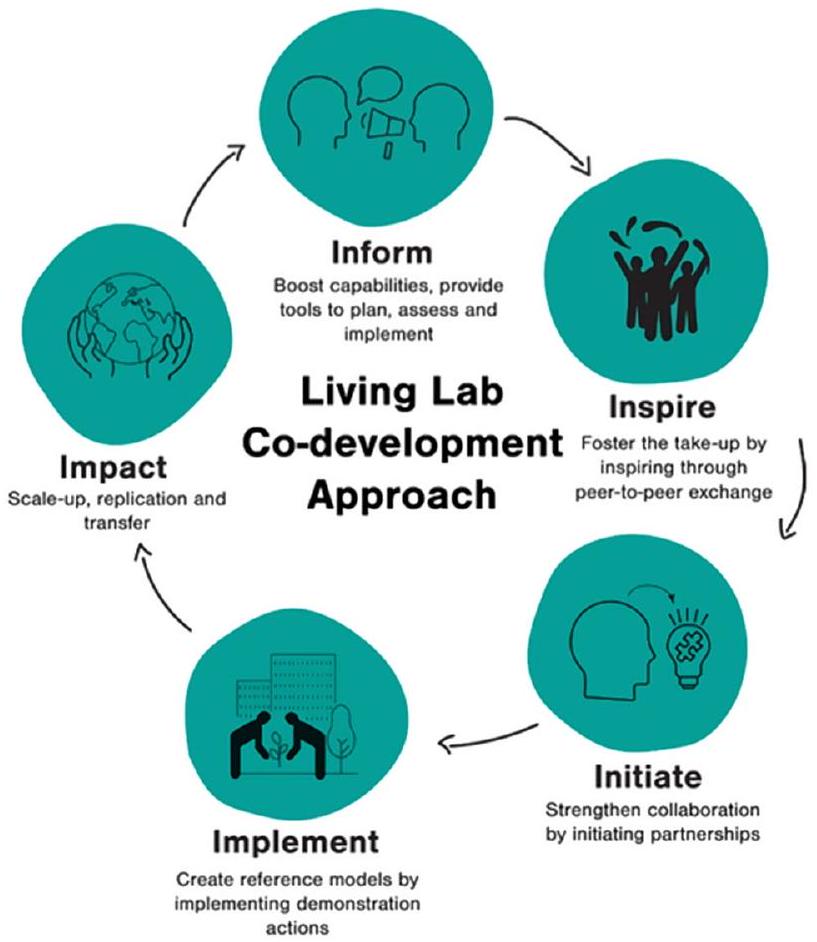
5. الأثر: يرتبط التقييم الدقيق ونشر النتائج بـ E (التقييم والتوسع) في SCALE. من خلال توثيق النتائج، وتقييم الأداء، ومشاركة الدروس، تضع SOLUTIONSplus الأساس لتوسيع التدخلات الناجحة وإبلاغ التعديلات السياسية الأوسع.
على سبيل المثال، في كيغالي، رواندا، سهلت SOLUTIONSplus تطوير الدراجات النارية الكهربائية مع خدمات تبديل البطاريات، المدعومة بالطاقة المتجددة [57، 86]. في مرحلة الإعلام، تعلم أصحاب المصلحة عن تقنيات التنقل الكهربائي وفوائدها البيئية
عندما جمعت مختبرات حية الشركات المحلية، ومشغلي النقل، ومخططي المدن لتصميم بنية تحتية لتبديل البطاريات (A). تم دعم التنفيذ من خلال جهود بناء القدرات، وتدريب الفنيين، وتكييف التكنولوجيا مع الظروف المحلية (L). تم تقييم الأثر الناتج من خلال أطر المراقبة التي قيست تخفيضات الانبعاثات، وموثوقية الخدمة، ورضا المستخدمين، مما يوجه المزيد من التحسينات والتوسعات المستقبلية (E) (انظر الشكل 1 أدناه).
من خلال دمج 5 I’s في مفهوم SCALE، يظهر مشروع SOLUTIONSplus كيف تدعم تسلسلات المشاركة المنظمة الحلول المتكاملة، والتكيفية، والمحلية الصدى. ينتقل هذا النهج المدمج إلى ما هو أبعد من المفاهيم النظرية، موضحًا كيف يمكن للمشاريع الفعلية تفعيل هذه المبادئ لربط الفاعلين والقطاعات بشكل فعال.
معالجة التحديات: التوسع، الديمومة، وكثافة الموارد
يتطلب توسيع الحلول إلى سياقات مختلفة التكيف بدلاً من التكرار [35]. تؤثر الاختلافات الثقافية، والترتيبات المؤسسية، وتوافر الموارد على كيفية تنفيذ التدخلات. تساعد عملية التقييم والتعلم المستمرة (E) في SCALE في هذا الترجمة، كما يتضح من نهج SOLUTIONSplus في مشاركة الدروس بين المدن الشريكة لإلهام التكيف بدلاً من فرض نماذج موحدة.
يعد ضمان الشمولية في عمليات التصميم التعاوني أمرًا حيويًا أيضًا. إذا لم يتم تمثيل المجموعات المهمشة بشكل كافٍ، فإن الأساليب التشاركية تخاطر بتعزيز عدم التوازنات القائمة في السلطة [73، 77]. يجب على المشاريع تصميم استراتيجيات مشاركة تدعو وتمنح القوة للفاعلين غير الممثلين، وهي قضية تم تناولها في كل من 5 I’s (مراحل الإعلام والإلهام لتوسيع المشاركة) وSCALE (L، بناء القدرات المحلية والشمولية).
الآثار المترتبة على صانعي السياسات، ووكالات التمويل، والمنفذين، والأوساط الأكاديمية
صانعو السياسات
وكالات التمويل
المنفذون (الحكومات، المنظمات غير الحكومية، القطاع الخاص)
الأوساط الأكاديمية
مؤسسية التغيير وتكثير الأثر
مع مرور الوقت، مع رؤية أصحاب المصلحة لتحسينات ملموسة – انخفاض الانبعاثات، وتحسين الوصول إلى التنقل، واقتصادات محلية قوية – ينمو رأس المال السياسي والاجتماعي الذي يدعم الاستراتيجيات المتكاملة [1،3]. يوفر الجمع بين مبادئ SCALE وتسلسل مشاركة 5 I’s طريقة منظمة للتطور المستمر بدلاً من نموذج ثابت.
تؤكد هذه الورقة على أن SCALE و5 I’s ليست نقاط نهاية. إنها نهج بسيطة لتفعيل عمليات التحول المعقدة في مشاريع الابتكار والتنفيذ الموجهة نحو العمل. يوفر مثال SOLUTIONSplus لمحة عن كيفية عمل هذه المفاهيم، ولكن يُشجع على مزيد من النقاش لتطوير هذه الأطر لتطبيق أوسع.
الخاتمة
تقترح هذه القطعة النقاشية أن التصميم التشاركي، ومختبرات حية، والتحالفات المعرفية المتصلة توفر مسارات محتملة لدمج القطاعات، والمشاركة
الممثلون، وضمان الصلة المحلية. من خلال تقديم إطار العمل SCALE وربطه بنهج 5 I’s كما هو موضح في SOLUTIONSplus، يقدم هذا البحث دليلاً مفاهيمياً لبناء المشاركة، ودمج المعرفة، والتعلم التكراري. ومع ذلك، لا تزال هناك عدم يقين. تظل قيود الموارد، وتحديات التوسع، ومخاوف العدالة قائمة. بدلاً من تقديم صيغة عالمية، يشجع هذا البحث أصحاب المصلحة على الانخراط في مزيد من النقاش، واختبار هذه الأفكار، وتكييفها مع سياقاتهم.
تعقيد التنمية المستدامة والعمل المناخي يتطلب نهجاً مرناً، حساساً للسياق، ومتطوراً. من خلال فحص هذه الأطر بشكل نقدي وتنقيحها، يمكن للمجتمع العالمي الاقتراب من تحقيق التقدم الشامل، العادل، والدائم الذي تم تصوره في الأهداف الدولية للاستدامة والالتزامات المناخية.
الشكر والتقدير
مساهمات المؤلف
التمويل
توفر البيانات
الإعلانات
موافقة الأخلاقيات والموافقة على المشاركة
الموافقة على النشر
المصالح المتنافسة
تم النشر على الإنترنت: 14 يناير 2025
References
- UN (United Nations). Transforming Our World: the 2030 Agenda for Sustainable Development. UN. 2015.
- UNEP (United Nations Environment Programme). Emissions Gap Report 2022. UNEP. 2022.
- IPCC (Intergovernmental Panel on Climate Change). Global Warming of
. Cambridge University Press. 2018. - Lah O. Safe system for sustainable development. Sustain Earth Rev. 2024;7:9. https://doi.org/10.1186/s42055-024-00072-z.
- Evans J, Karvonen A, Raven R (Eds.). The Experimental City. Routledge. 2016
- Sovacool BK, Brown MA. Competing dimensions of energy security. Annu Rev Environ Resour. 2010;35:77-108.
- Bulkeley H. Reconfiguring environmental governance: towards a politics of scales and networks. Polit Geogr. 2005;24(8):875-902. https://doi.org/10.1016 /j.polgeo.2005.07.002
- Biermann F, Pattberg P, van Asselt H, Zelli F. The fragmentation of global governance architectures. Global Environ Pol. 2009;9(4):14-40.
- Ostrom E. Understanding Institutional Diversity. Princeton University Press. 2005
- Pahl-Wostl C. Transitions towards adaptive management. Ecol Soc. 2007;12(2):30.
- Leck H, Conway D, Bradshaw M, Rees J. Tracing the water-energy-food nexus: description, theory and practice. Geogr J. 2015;181(4):389-99. https:// doi.org/10.1111/geoj. 12129
- Bulkeley H, Castán Broto V, Maassen A. Governing urban low carbon transitions. Eur Planning Stud. 2010;18(9):1295-311.
- Cervero R, Murakami J. Effects of built environments on vehicle miles traveled: evidence from 370 US urbanized areas. Environ Plan A. 2010;42(2):400-18.
- Seto KC, Dhakal S, Bigio A, Blanco H, & others. Human settlements, infrastructure and spatial planning. In: Edenhofer O, et al. (Eds.), Climate Change 2014: mitigation of Climate Change. Cambridge University Press. 2014
- Jordan A, Lenschow A. Environmental policy integration: a state of the art review. Environ Policy Gov. 2010;20(3):147-58.
- Biggs R, Schlüter M, Schoon ML, editors. Principles for building resilience: sustaining ecosystem services in social-ecological systems. Cambridge: Cambridge University Press; 2015. https://doi.org/10.1017/CBO9781316014240
- Albrecht TR, Crootof A, Scott CA. The water-energy-food nexus: a systematic review of methods for nexus assessment. Environ Res Lett. 2018;13(4):043002. https://doi.org/10.1088/1748-9326/aaa9c6
- Healey P. Collaborative Planning: shaping Places in Fragmented Societies. UBC Press. 1997.
- Swilling M, Hajer M. Governance of urban transitions: towards sustainable resource-efficient urban infrastructures. Environ Policy Gov. 2017;27(6):360-3. https://doi.org/10.1002/eet. 1778
- Meadowcroft J. Politics and scale. Global Environ Change. 2002;12(3):169-76.
- Newig J, Fritsch O. Environmental governance. J Environ Manage. 2009:90(1):1-7.
- Sovacool BK. How long will it take? Conceptualizing the temporal dynamics of energy transitions. Energy Res Soc Sci. 2016;13:202-15. https://doi.org/10.1 016/j.erss.2015.12.020
- Pahl-Wostl C, Nilsson C, Gupta J, Tockner K. Governance and the global water system: a theoretical exploration. Glob Gov. 2011;18(2):1-18.
- Carbon Tracker Initiative. Powering down Coal: navigating the Economic and Financial Risks in the Last Years of Coal Power. 2018.
- Geels FW. Regime resistance against low-carbon transitions. Environ Innov Soc Trans. 2014;1:1-7.
- Jordan A, Huitema D, van Asselt H, Rayner T, Berkhout F, editors. Climate change policy in the European Union: confronting the dilemmas of mitigation and adaptation? Cambridge: Cambridge University Press; 2010.
- Cash DW, Adger WN, Berkes F, Garden P, Lebel L, et al. Scale and cross-scale dynamics: governance and information in a multilevel world. Ecol Soc. 2006;11(2):8.
- Ostrom E. Polycentric systems for coping with collective action and global environmental change. Global Environ Change. 2010;20(4):550-57.
- Olsson P, Folke C, Galaz V, Hahn T, Schultz L. Enhancing the fit through adaptive co-management: creating and maintaining bridging functions for matching scales in the Kristianstads Vattenrike Biosphere Reserve, Sweden. Ecol Soc. 2007;12(1):28.
- Banks N, Hulme D, Edwards M. NGOs, states, and donors revisited: still too close for comfort? World Dev. 2015;66:707-18.
- Meadowcroft J. What about the politics? Sustainable development, transition management, and long term energy transitions. Policy Sci. 2009;42(4):323-40.
- Biermann F. Earth system governance: world politics in the anthropocene. Cambridge, MA: MIT Press; 2014. https://doi.org/10.7551/mitpress/9878.001.0 001
- Bulkeley H, Betsill MM. Revisiting the Urban Politics of Climate Change. Routledge. 2013.
- Mercer C. Performing partnership: civil society and the illusions of good governance in Tanzania. Political Geo. 2003;22(7), 741-63.
- Mansuri G, Rao V. Localizing Development: does Participation Work? World Bank. 2013.
- Chambers R. Revolutions in development inquiry. London: Earthscan; 2008.
- von KorffY, d’Aquino P, Daniell KA, Bijlsma R. Designing participation processes for water management and beyond. Ecol Soc. 2010;15(3):1. Available from: http://www.ecologyandsociety.org/vol15/iss3/art1/
- Koontz TM, Newig J. From planning to implementation: top-down and bottom-up approaches for collaborative watershed management. Policy Stud J. 2014;42(3):416-42. https://doi.org/10.1111/psj. 12067
- Emerson K, Nabatchi T, Balogh S. An integrative framework for collaborative governance. J Public Admin Res Theory. 2012;22(1):1-29. https://doi.org/10.1 093/jopart/mur011
- Adger WN, Jordan A, editors. Governing sustainability. Cambridge: Cambridge University Press; 2009.
- Agrawal A, Gibson CC. Enchantment and disenchantment: the role of community in natural resource conservation. World Dev. 1999;27(4):629-49. https://doi.org/10.1016/S0305-750X(98)00161-2
- Bigsten A, Tengstam S. International coordination and the effectiveness of aid. World Dev. 2015;69:75-85.
- Young OR. Institutional dynamics. Global Environ Change. 2010;20(1):115-23.
- Emerson K, Nabatchi T. Collaborative governance regimes. Washington, DC: Georgetown University Press; 2015.
- Leach M, Scoones I, Stirling A. Dynamic sustainabilities: technology, environment, social justice. London: Earthscan; 2010.
- Liu C, Chau KT, Wu D, Gao S. Opportunities and challenges of vehicle-to-grid technologies. Proc IEEE. 2019;107(9):1779-94.
- Tan KM, Ramachandaramurthy VK, Yong JY. Integration of electric vehicles in smart grid: a review on vehicle to grid technologies and optimization techniques. Renewable Sustainable Energy Rev. 2020;115:109400.
- IEA (International Energy Agency). Global EV Outlook 2021. OECD/IEA. 2021.
- UN (United Nations). The Sustainable Development Goals Report 2021. UN. 2021.
- UN-Habitat. World Cities Report 2020: the value of sustainable urbanization. UN-Habitat. 2020
- WHO (World Health Organization). Ambient (outdoor) air quality and health. 2018 Retrieved from https://www.who.int
- Global Infrastructure Hub. Global infrastructure outlook. 2017. Retrieved from https://outlook.gihub.org
- UN DESA (United Nations Department of Economic and Social Affairs). World Urbanization Prospects 2019. UN. 2019
- Friedlingstein P, et al. Global carbon budget 2020. Earth Syst Sci Data. 2020;12(4):3269-340. https://doi.org/10.5194/essd-12-3269-2020
- MNRE (Ministry of New and Renewable Energy, India). Rooftop solar program. 2019. Retrieved from https://mnre.gov.in
- ITDP (Institute for Transportation & Development Policy). The BRT Standard 2016. ITDP. 2016.
- SOLUTIONSplus. Project documentation. 2021. Retrieved from https://www.s olutionsplus.eu
- World Bank. Global Platform for Sustainable Cities (GPSC). 2020. Retrieved from https://www.worldbank.org
- GCF (Green Climate Fund). GCF in Brief. 2021. Retrieved from https://www.gr eenclimate.fund
- C40 Cities. C40 Knowledge Hub. 2021. Available from: https://www.c40.org/k nowledgehub
- Peters BG. The Politics of Bureaucracy. Routledge. 2018.
- Bouckaert G, Peters BG, Verhoest K. The Coordination of Public Sector Organizations. Palgrave Macmillan. 2010.
- Hooghe L, Marks G. Unraveling the central state, but how? Types of multilevel governance. Am Polit Sci Rev. 2003;97(2):233-43. https://doi.org/10.101 7/S0003055403000649
- Bache I, Flinders M, editors. Multi-level governance. Oxford: Oxford University Press; 2004.
- Peters BG, Pierre J. Multi-level governance and democracy: a Faustian bargain? In: Bache I, Flinders M, editors. Multi-level governance. Oxford: Oxford University Press; 2004. p. 75-92.
- Easterly WThe Elusive Quest for Growth: economists’ Adventures and Misadventures in the Tropics. MIT Press. 2002.
- Acharya A. How ideas spread: whose norms matter? Norm localization and institutional change in Asian regionalism. Int Organ. 2004;58(2):239-75. https://doi.org/10.1017/S0020818304582024
- Bourguignon F, Sundberg M. Aid effectiveness: opening the black box. Am Econ Rev. 2007;97(2):316-21.
- Brinkerhoff DW, Brinkerhoff JM Public-private partnerships. Public Administration Dev. 2011;31(1):2-14.
- Ockwell D, Byrne R, editors. Sustainable energy for all: innovation, technology and pro-poor green transformations. London: Routledge; 2017. https://doi.or g/10.4324/9781315621531
- Geerlings H, Stead D. The integration of land use planning, transport and environment in European policy and research. Transport Policy. 2003;10(3):187-96. https://doi.org/10.1016/S0967-070X(03)00020-9
- Reason P, Bradbury H (Eds.). The SAGE Handbook of Action Research. SAGE. 2008.
- Cooke B, Kothari U (Eds.). Participation: the New Tyranny? Zed Books. 2001.
- Batley R. Engaged or divorced? Cross-service findings on government relations with non-state service providers. Public Admin Dev. 2006;26(3):241-51. https://doi.org/10.1002/pad. 422
- SOLUTIONSplus. Project documentation and results. 2022. Retrieved from https://www.solutionsplus.eu
- Candel JJL, Biesbroek R. Toward a processual understanding of policy integration. Policy Sci. 2016;49(3):211-31. https://doi.org/10.1007/s11077-016-924 8-y
- Cleaver F. Institutions, agency, and the limitations of participatory approaches to development. In: Cooke B, Kothari U (Eds.), Participation: the New Tyranny? Zed Books. 2001.
- Ansell C, Gash A. Collaborative governance in theory and practice. J Public Admin Res Theory. 2008;18(4):543-71. https://doi.org/10.1093/jopart/mum03 2
- Chambers R. Whose Reality Counts? Putting the First Last. Intermediate Technology Publications. 1997.
- Arnstein SR. A ladder of citizen participation. J Am Inst Planners. 1969;35(4): 216-24.
- Liverani A. Climate change and individual behavior: considerations for policy. Washington, DC: World Bank; 2009. https://doi.org/10.1596/978-0-8213-816 6-0
- Mauser W, Klepper G, Rice M, Schmalzbauer B, Hackmann H, et al. Transdisciplinary global change research: the co-creation of knowledge for sustainability. Curr Opin Environm Sustain. 2013;5(3-4):420-31.
- Brandt P, Ernst A, Gralla F, Luederitz C, Lang DJ, Newig J, Reinert F, Abson DJ, von Wehrden H. A review of transdisciplinary research in sustainability science. Ecol Econ. 2013;92:1-15. https://doi.org/10.1016/j.ecolecon.2013.04.008
- Brown T. Change by Design: how Design Thinking Transforms Organizations and Inspires Innovation. HarperBusiness. 2008.
- Sanders EB-N, Stappers PJ. Co-creation and the new landscapes of design. CoDesign. 2008;4(1):5-18.
- Lah O. Transformative Living Labs: a Co-development Approach for Effective Sustainable Urban Development Solutions. Urban Living Lab Center, Berlin. 2020.
- Van Kerkhoff L, Lebel L. Linking knowledge and action for sustainable development. Annu Rev Environ Resour. 2006;31:445-77.
- Innes JE, Booher DE. Planning with complexity: an introduction to collaborative rationality for public policy. London: Routledge; 2010. https://doi.org/10. 4324/9781315244259
- Hoff H. Understanding the Nexus. Stockholm Environment Institute. 2011.
- Peters BG, Pierre J. Multi-level governance and democracy: a Faustian bargain? In: Bache I, Flinders M (Eds.), Multi-level Governance (pp. 75-89). Oxford University Press. 2014.
- Hidalgo D, Carrigan A. BRT in Latin America: high capacity and performance, yet controversial. Transp Res Procedia. 2017;27:496-503.
- Lah O. Continuity and change: dealing with political volatility to advance climate change mitigation strategies-Examples from the transport sector. Sustainability. 2017;9(6):959.
ملاحظة الناشر
- *المراسلة:
أوليفر لاه
oliver.lah@un.org
مركز مختبر الحياة الحضرية، مركز متعاون مع UN-Habitat، معهد ووبيرتال، شارع تشاوسه 86، 10115 برلين، ألمانيا
معهد برلين للتكنولوجيا، شارع 17 يونيو 135، 10623 برلين، ألمانيا
مبادرة التنقل الكهربائي الحضري (UEMI)، شارع كوبنهاجن 31E 10437 برلين، ألمانيا
DOI: https://doi.org/10.1186/s42055-024-00102-w
Publication Date: 2025-01-14
Breaking the silos: integrated approaches to foster sustainable development and climate action
Abstract
A number of critical disconnects across sectors, actors continue to affect implementation action on sustainable development and climate action. Even when technical solutions, political commitments, and funding streams are avaiable, implementation often remains siloed and fragmented. This debate piece does not present definitive solutions or conclusive evidence; rather, it aims to foster critical reflection on how co-design, participatory approaches, Living Labs, and epistemically connected actor coalitions may help break down institutional and conceptual barriers. It proposes the SCALE framework [Shared epistemic foundations, Cross-sectoral integration, Adaptive co-design, Local enabling environments, and Evaluation & expansion) as way of operationalising the Safe Systems for Sustainable Development concept presented in Lah 2024, exploring how knowledge integration, iterative experimentation, and locally grounded solutuions can help creating implementation partnerships that last. This approach highlights questions concerning resource intensity, longevity, and scalability that must be addressed. By facilitating co-design, testing and validation of concrete solutions at the local level, the approach presented in this paper invites policymakers, researchers, practitioners, and civil society actors to engage in a more nuanced and constructive debate on whether, how, and under what conditions sustainable development solutions are considered to be viable and hence can endure even in politically volatile environments.
Introduction
This paper is conceived as a debate piece, reflecting on experiences from innovation and implementation projects and the relevant literature. It builds on the Safe Systems for Sustainable Development concept presented earlier in this journal [4], and aims to provide some practical steps to integrate participatory methodologies in research and development cooperation projects to help bridging persistent gaps. The core argument suggests that participatory co-design in Living Labs can help creating epistemically connected coalitions of actors, offering pathways to reconcile differing policy objectives, integrate knowledge across disciplines, and enhance local
ownership. The SCALE concept-Shared epistemic foundations, Cross-sectoral integration, Adaptive co-design, Local enabling environments, and Evaluation & expan-sion-organizes these ideas into a coherent framework.
This paper also acknowledges uncertainties and debates surrounding these approaches. Critics have questioned the resource-intensity, feasibility of scaling, and the longevity of co-created solutions once external funding ceases [5, 6]. The intention here is not to claim a universal solution but to encourage dialogue, nuance, and foster bolder approaches when designing implemen-tation-oriented projects. While this paper focuses mostly on the operating context of innovation and implementation projects in developing and emerging economies, the main points of a need to connect sectors and actors are applicable everywhere.
Identifying critical disconnects in sustainable development
Sustainable development initiatives and climate action efforts are often hindered by deeply rooted disconnects. These disconnects-particularly between sectors and actors-manifest as fragmented planning, misaligned priorities, and inefficient resource allocation. This chapter examines the main features of these disconnects and their resulting challenges, providing the foundation for discussing strategies to address them.
Two critical dimensions of these barriers-sectoral disconnects and actor disconnects-significantly hinder the ability of policies and initiatives to achieve intended outcomes. These disconnects represent more than operational inefficiencies; they are structural issues deeply embedded in the governance, planning, and implementation processes of sustainable development [7-9].
Sectoral disconnects: fragmentation of interdependent systems
Key features of sectoral disconnects Independent planning processes
Fragmented policies and objectives
Overlooking cross-sectoral co-benefits
Results of sectoral disconnects Inefficient resource use
Unsustainable trajectories
Policy contradictions
The persistence of sectoral disconnects highlights the urgent need for integrative frameworks that account for the interconnected nature of sustainable development. Approaches such as multi-level governance, collaborative planning, and polycentric management systems can help align sectoral strategies, ensuring that policies reinforce rather than undermine each other [27-29].
organizations, the private sector, civil society, and local communities-struggle to collaborate effectively. Sustainable development goals require engagement across political, social, and economic spheres, yet institutional silos, power imbalances, and limited participatory mechanisms inhibit cohesive action [30-32].
Governance structures that prioritize short-term gains or operate within narrowly defined mandates fail to accommodate the complexity of sustainability challenges [33, 34]. Moreover, limited involvement of local actors and communities often results in interventions that lack local legitimacy and effectiveness [35-37]. Efforts to enhance participatory governance and collaborative deci-sion-making hold promise for bridging actor disconnects [38].
Key features of actor disconnects
Weak collaboration across stakeholder groups
Misaligned goals and fragmented governance structures
Insufficient engagement of local actors
Results of actor disconnects
Policy misalignment
Fragmentation and governance inefficiencies
Wasted resources
Implementation delays
Actor disconnects reinforce the importance of fostering robust mechanisms that facilitate collaboration, trust-building, and knowledge-sharing among diverse actors. Polycentric governance arrangements, co-production processes, and multi-level stakeholder platforms have emerged as potential pathways to align interests and resources, thereby enhancing the legitimacy and effectiveness of sustainability initiatives [27,28,44].
| Key Disconnect | Main Features | Results | ||||||
| Sectoral Disconnects |
|
|
||||||
| Actor Disconnects |
|
|
This paper introduces an approach grounded in codesign processes and coalition building to tackle these disconnects. The proposed framework builds epistemically connected coalitions of stakeholders and promotes integration across sectors. Later chapters detail how these strategies can unlock synergies, enhance governance, and accelerate progress toward sustainability goals.
By establishing a clear understanding of the key disconnects, their features, and their consequences, the following chapters disnetangle the key features of the disconnects and identify practical levers to overcome them. The focus now shifts to how innovative approaches, which will be introduced in this paper and which may help overcoming these barriers to initiate systemic change.
Connecting sectors: overcoming silo approaches
A siloed approach in the mobility sector often results in transportation systems that are inefficient, environmentally detrimental, and socially inequitable. Investments in road infrastructure without consideration for public transportation or non-motorized transport options can increase reliance on private vehicles, exacerbating traffic congestion and air pollution. Without integrating mobility planning with energy policies and urban development strategies, efforts to reduce emissions and improve mobility remain insufficient. This becomes particularly pronounced in the area of electric mobility, where mobility and energy systems are critically interdependent. Electric vehicles (EVs) not only act as energy consumers but also hold significant potential as energy storage units through vehicle-to-grid (V2G) technologies. Proper integration of EVs into energy systems can support grid stability, enhance renewable energy integration, and create opportunities for decentralized energy solutions [46, 47]. However, this potential can only be realized if mobility planning and energy infrastructure development are coordinated to enable V2G systems to thrive.
Similarly, when the energy sector operates in isolation, it may fail to account for the energy demands of urban development and transportation systems and is likely to underutilize potential. Continued reliance on fossil fuels for energy generation not only contributes to climate change but also overlooks the potential for renewable energy integration into urban and transport infrastructure. As of 2020, fossil fuels still accounted for over
energy access in rapidly expanding urban areas. The United Nations estimates that approximately 759 million people globally lack access to electricity, with the majority residing in sub-Saharan Africa [49].
Urban development pursued without integrating mobility and energy considerations can result in urban sprawl, inefficient land use, and increased resource consumption. Unplanned or poorly planned urban expansion often leads to the proliferation of informal settlements lacking basic services and infrastructure. Over one billion people live in slums worldwide, primarily in developing countries [50]. These settlements are frequently disconnected from employment centers and public services, exacerbating socioeconomic inequalities and environmental degradation.
The pitfalls of a siloed approach are evident in the way infrastructure investments are made without considering cross-sectoral impacts. Investing heavily in road infrastructure without parallel investments in public transportation and non-motorized transport can lock cities into car-dependent mobility patterns. This not only increases greenhouse gas emissions but also leads to congestion and reduced urban livability. The World Health Organization [51] estimates that outdoor air pollution causes 4.2 million premature deaths annually, with transportation being a significant contributor.
Key synergies can be harnessed by connecting the mobility, energy, and urban development sectors. Integrated urban planning that combines land use with transportation planning promotes compact, transit-oriented development (TOD). TOD encourages higher-density, mixed-use developments centered around high-quality public transportation systems, reducing the need for private vehicle use and lowering emissions. Studies have shown that TOD can reduce vehicle kilometers traveled by up to
Integrating renewable energy solutions into urban and transport infrastructure can further enhance sustainability outcomes. The deployment of electric vehicles (EVs), when coupled with renewable energy sources, can substantially reduce emissions from the transport sector. The global stock of electric passenger cars surpassed 10 million in 2020, a
In developing and emerging economies, the challenges of connecting sectors are compounded by institutional fragmentation at the government level but also among development cooperation actors. Weak governance structures often lack mechanisms for cross-sectoral approaches and coordination of key actors inside and
outside the government. Ministries and agencies may operate independently, leading to policy incoherence and conflicting priorities. For instance, a transportation ministry might prioritize road expansion to stimulate economic growth, while an development cooperation agency seeks to reduce emissions, resulting in contradictory approaches.
Financial constraints limit the ability of developing countries to invest in integrated infrastructure projects. Scarce resources are often allocated to immediate needs rather than long-term planning. Dependence on external aid can further complicate matters, as donor priorities may not align with holistic local needs. Infrastructure financing needs in developing countries are estimated to exceed
Capacity gaps, including shortages of skilled professionals in integrated planning and sustainable technologies, hinder the implementation of cross-sectoral initiatives. The lack of reliable data and analytical tools impedes evidence-based decision-making. Rapid urbanization exacerbates these challenges. By 2050, nearly
Investment flows into mobility, energy, and urban infrastructure without a cross-sectoral perspective risk creating negative lock-in effects. Infrastructure investments are long-term commitments; once built, they shape patterns of behavior and development for decades. For example, investing in coal-fired power plants locks in high carbon emissions and deters investment in renewable energy. The 17,warns that planned investments in coal power could result in over
In the mobility sector, constructing highways without investing in public transportation infrastructure can lock cities into car dependency. This not only contributes to increased emissions but also undermines efforts to promote sustainable urban development. Transportation emissions have increased by
To avoid these negative lock-in effects, investment programs must adopt a cross-sectoral perspective. Integrated planning and investment can optimize resource allocation, maximize synergies, and enhance the sustainability of infrastructure projects. Integrating renewable energy generation with urban development can provide reliable, clean energy to urban residents while reducing emissions. Distributed renewable energy systems, such as rooftop solar panels, can enhance energy access in urban
areas and reduce reliance on centralized, fossil fuelbased power generation. In India, for example, the government’s rooftop solar program aims to install 40 GW of rooftop solar capacity by 2022, contributing to energy access and sustainability [55].
The adoption of integrated mobility solutions, such as Bus Rapid Transit (BRT) systems and non-motorized transport infrastructure, can improve urban mobility while reducing emissions. The introduction of BRT in cities like Bogotá, Colombia, has resulted in a
Living Labs offer a practical approach to connecting sectors and actors to address these challenges. By facilitating the co-creation, testing, and implementation of innovative solutions in real-world settings, Living Labs bridge the gaps between research and practice. They promote stakeholder engagement, enhance coordination among sectors, and support the development of contextspecific solutions. The SOLUTIONSplus project exemplifies how Living Labs can be used to integrate mobility, energy, and urban development sectors in developing countries.
In Kigali, Rwanda, SOLUTIONSplus implemented an electric motorcycle project that integrates mobility and energy sectors. Collaborating with local stakeholders, including government agencies, private companies, and academic institutions, the project developed electric motorcycles suited to local needs and established a battery-swapping infrastructure powered by renewable energy. This initiative not only reduces emissions but also addresses urban mobility challenges and supports local economic development. The project has the potential to reduce
In Quito, Ecuador, the project focused on integrating e-mobility solutions with urban logistics. Introducing electric cargo bikes and vans for last-mile deliveries reduces congestion and emissions in the city center. Collaborations with local businesses, government agencies, and community organizations ensure that solutions are tailored to local contexts. Initial results indicate a 60% reduction in delivery times and a significant decrease in operational costs due to lower energy and maintenance expenses [57].
The success of these initiatives highlights the importance of connecting sectors and adopting integrated approaches. Scaling up such solutions requires addressing underlying challenges in developing and emerging economies. Institutional reforms are needed to establish coordinating bodies that facilitate cross-sectoral planning. Strengthening governance structures and
enhancing policy coherence are essential steps. For instance, creating inter-ministerial committees or agencies dedicated to sustainable urban development can promote collaboration and policy alignment.
Capacity building is critical to developing the technical expertise required for integrated planning and implementing sustainable technologies. Investing in education and training programs equips professionals with necessary skills. Enhancing data collection and management systems supports evidence-based decision-making and cross-sectoral analysis. Partnerships with international organizations and knowledge institutions can facilitate capacity development. The World Bank’s Global Platform for Sustainable Cities (GPSC) supports cities in developing integrated urban planning frameworks and building local capacity [58].
Innovative financial mechanisms are needed to mobilize resources for integrated projects. Blended finance, which combines public and private funds, can leverage additional resources. Public-private partnerships can bring together strengths of different sectors. International financial institutions and development agencies can support integrated projects by aligning funding criteria with sustainability goals. The Green Climate Fund (GCF) provides financing for projects that contribute to low-emission and climate-resilient development, supporting cross-sectoral initiatives [59].
Community engagement is vital to ensure that projects meet the needs of local populations and gain public support. Participatory planning processes involve communities in decision-making, enhancing the relevance and acceptability of interventions. Knowledge-sharing platforms can facilitate the exchange of best practices and lessons learned among cities and regions. The C40 Cities network enables cities to collaborate on climate action, sharing experiences and solutions [60].
Addressing the challenges of silo approaches in mobility, energy, and urban development is essential for achieving sustainable development goals. Connecting sectors unlocks synergies that enhance sustainability outcomes, improve resource efficiency, and promote social equity. In developing and emerging economies, addressing institutional fragmentation, capacity gaps, and financial constraints is crucial. Adopting integrated planning and investment strategies, supported by innovative approaches like Living Labs, can help avoid negative lock-in effects and pave the way toward sustainable, resilient, and inclusive development.
Key takeaways-connecting sectors
- Breaking down silos in mobility, energy, and urban development unlocks significant efficiency, equity, and sustainability gains.
- Integrated planning can prevent negative lock-ins and yield co-benefits, from reducing emissions to improving urban livability.
- Capacity building, financial innovation, and institutional reforms, coupled with participatory approaches like Living Labs, are vital for scaling integrated solutions in developing and emerging economies.
Connecting actors: overcoming fragmentation in development cooperation
Institutional fragmentation occurs when responsibilities and authority are dispersed among multiple organizations and levels of government without adequate coordination mechanisms [61]. In many countries, sec-tor-oriented ministries operate in silos, focusing narrowly on their specific mandates without considering the interdependencies with other sectors. For example, the energy ministry may develop policies independently of the transportation or urban development ministries, leading to conflicting strategies and inefficiencies [62]. At the subnational level, city departments often mirror this fragmentation, with limited collaboration between departments responsible for transportation, housing, environment, and economic development [18].
The lack of coordination is not only horizontal (across sectors) but also vertical (across levels of government). Multilevel governance involves interactions among institutions at local, regional, national, and international levels [63]. However, without effective mechanisms for coordination, policies and actions at different levels may be misaligned. Local governments may struggle to implement national policies if they are not adapted to local contexts or if there is insufficient support [64]. Conversely, national governments may overlook local needs
and priorities, leading to policies that are ineffective or even counterproductive at the local level [65].
In the context of development cooperation, these challenges are exacerbated by the involvement of international actors. Donor agencies, international NGOs, and multinational corporations bring additional agendas, priorities, and procedures that may not align with those of domestic governments and local communities [66]. The proliferation of actors can lead to duplication of efforts, competition for resources, and policy incoherence [67]. Bourguignon and Sundberg [68] note that aid fragmentation increases transaction costs and strains the administrative capacities of recipient governments, which may already be limited.
Coordination among development cooperation actors is often insufficient. Donors may focus on their own projects without adequate collaboration with other donors or alignment with national development strategies [42]. This lack of coordination can result in overlapping projects, inconsistent approaches, and missed opportunities for synergy. Furthermore, development projects may fail to engage effectively with government actors, particularly at the local level. Local governments are crucial for implementing policies and programs, but they are frequently bypassed in favor of working directly with national governments or non-state actors [34].
The private sector and civil society are also essential actors in sustainable development but are often inadequately integrated into development cooperation efforts. Private sector involvement can bring innovation, investment, and expertise, yet mechanisms for engaging businesses in development initiatives are sometimes lacking or underdeveloped [69]. Civil society organizations (CSOs) can contribute local knowledge, mobilize communities, and advocate for marginalized groups, but they may be excluded from planning and decision-making processes [30].
These coordination challenges have significant implications for delivering effective outcomes, especially in the sectors of sustainable energy, mobility, and urban development. In the energy sector, for instance, the lack of collaboration between ministries responsible for energy, environment, and finance can hinder the development and implementation of comprehensive renewable energy strategies [70]. Similarly, in mobility, uncoordinated efforts between transportation departments and urban planners can lead to infrastructure that does not adequately address congestion, emissions, or accessibility [71]. Urban development projects that fail to integrate considerations from energy and mobility sectors may result in unsustainable urban sprawl, increased emissions, and reduced quality of life [14].
The design of sector-oriented implementation activities without cross-sectoral approaches perpetuates these
issues. Projects focused narrowly on one sector may not consider the broader system in which they operate, leading to unintended consequences or limited impact. For example, introducing electric vehicles without addressing the energy source can simply shift emissions from the transportation sector to the energy sector if the electricity is generated from fossil fuels [6]. Therefore, cross-sectoral approaches that integrate policies and actions across sectors are essential for achieving sustainable outcomes.
Furthermore, the lack of co-design approaches and coalition building in development cooperation limits the effectiveness and sustainability of interventions. Co-design involves stakeholders in the planning and implementation of projects, ensuring that solutions are tailored to local contexts and needs [72]. Without genuine engagement with local actors, projects may lack relevance, face resistance, or fail to build local capacity [73]. Coalition building brings together diverse actors to pool resources, share knowledge, and align efforts toward common goals [74]. In its absence, fragmentation and competition among actors can undermine collective action.
The SOLUTIONSplus project provides valuable insights into how these challenges can be addressed through collaborative and integrated approaches. SOLUTIONSplus is an international initiative aimed at developing innovative e-mobility solutions in urban areas, involving a wide range of stakeholders, including local and national governments, private sector companies, research institutions, and international organizations [75]. The project adopts a Living Lab approach, creating environments where stakeholders co-create, test, and implement solutions in real-world settings.
In Kigali, Rwanda, SOLUTIONSplus facilitated collaboration between the city government, local universities, private companies, and civil society organizations to develop and deploy electric motorcycles with bat-tery-swapping services. This approach ensured that the solutions were adapted to local needs, leveraging local knowledge and building local capacity. It also integrated considerations from the energy sector by establishing renewable energy-powered charging infrastructure, thus addressing cross-sectoral linkages [57].
In Quito, Ecuador, the project brought together actors from urban planning, transportation, and environmental sectors to develop electric cargo bikes and vans for urban deliveries. By coordinating efforts across these sectors, the project addressed issues of urban congestion, emissions, and logistics efficiency. The involvement of local businesses and community organizations in the codesign process ensured that the solutions were economically viable and socially acceptable [57].
These examples illustrate how co-design approaches and coalition building can enhance coordination among
actors, integrate cross-sectoral considerations, and lead to more effective and sustainable outcomes. They also demonstrate the importance of involving local governments, private sector, and civil society in development initiatives. By engaging these actors, projects can tap into local expertise, resources, and networks, increasing their relevance and impact.
To overcome the challenges of institutional fragmentation and lack of coordination, several strategies can be employed. Establishing formal coordination mechanisms, such as inter-ministerial committees or working groups, can facilitate communication and collaboration among sector-oriented ministries and departments [61]. Developing integrated policy frameworks that align objectives and actions across sectors and levels of government can enhance policy coherence [76].
In the context of development cooperation, harmonizing donor efforts through mechanisms like joint programming, pooled funding, or sector-wide approaches can reduce fragmentation and enhance alignment with national development strategies [42]. Engaging local governments and other local actors in the planning and implementation of development projects ensures that interventions are responsive to local needs and contexts [35]. Building partnerships with the private sector and civil society can leverage additional resources, innovation, and capacities [69].
Co-design approaches are particularly effective in fostering collaboration and ownership among stakeholders. By involving actors in the design phase, projects can build consensus, align expectations, and ensure that solutions are feasible and acceptable [72]. This approach also enhances the sustainability of interventions by building local capacity and embedding knowledge within communities [77].
Coalition building is essential for mobilizing collective action and resources. Coalitions can bring together actors with complementary strengths and resources, creating synergies and amplifying impact [74]. In the energy sector, for example, public-private partnerships can facilitate the deployment of renewable energy technologies by combining public sector support with private sector innovation and investment [6].
Connecting actors is crucial for overcoming institutional fragmentation and enhancing the effectiveness of sustainable development initiatives. The lack of collaboration between sector-oriented ministries and city departments, insufficient coordination across levels of government, and the complexities introduced by development cooperation actors pose significant challenges. By adopting cross-sectoral approaches, co-design methodologies, and coalition building, these challenges can be addressed. The SOLUTIONSplus project demonstrates the potential of such approaches to deliver effective
outcomes in sustainable energy, mobility, and urban development. Engaging local governments, private sector, and civil society in meaningful ways enhances relevance, ownership, and sustainability of development interventions. As the global community strives to achieve the Sustainable Development Goals, fostering collaboration and coordination among actors across sectors and levels remains a critical imperative.
Key takeaways-connecting actors
- Overcoming institutional fragmentation and lack of coordination is essential for effective sustainable development cooperation.
- Co-design and coalition building ensure that local knowledge, capabilities, and priorities shape interventions, enhancing legitimacy and sustainability.
- Engaging diverse actors-governments, private sector, civil society-creates synergies, reduces duplication, and improves overall impact.
Connecting sectors and actors: co-design in urban living labs as tool for transformative change
The complexity and interconnectedness of sustainable development challenges-including decarbonization, resource management, social equity, and climate adapta-tion-demand integrated, multi-level, and multi-sectoral approaches. Rather than focusing narrowly on isolated goals, addressing today’s grand challenges requires forging cross-sectoral coalitions, integrating policies to unlock co-benefits, and ensuring that a broad array of stakeholders-governments, NGOs, businesses, local communities, and academia-work together in pursuit of common interests. Traditional governance structures and development cooperation models, however, often struggle to achieve these conditions. Fragmentation, misalignment, and lack of coordination remain pervasive.
In turn, Living Labs operationalize co-design principles in real-world settings. Acting as open innovation ecosystems, Living Labs encourage user-centric experimentation, iterative feedback, and collaborative refinement of new solutions. They bring the concepts of integrated policy-making and stakeholder engagement down to earth, allowing policies, technologies, and strategies to be tested, validated, and adapted before broader implementation. Living Labs help bridge the gap between research and implementation by situating innovation processes within communities, aligning global best practices with local priorities, and involving a wide range of actors who can champion successful outcomes.
This chapter synthesizes the findings from previous analyses of sectoral fragmentation, policy misalignment, stakeholder coordination failures, and the researchimplementation divide. It also incorporates insights from extensive literature reviews on co-design, participatory methods, design thinking, and Living Labs approaches. From these discussions, a clear message emerges: connecting actors and sectors through participatory codesign processes and embedding these efforts in Living Labs can help break down policy silos, harness co-benefits, nurture coalitions, and translate potential into practice. The following sections unfold this logic, moving from the challenge of connecting diverse actors, to integrating siloed sectors, to applying participatory design and Living Labs as a route toward effective, equitable, and sustainable transformative change.
Connecting actors: building collaborative foundations
inclusive decision-making processes can overcome these divides. By involving multiple stakeholders in planning and policy formation, it is possible to identify shared priorities and reduce duplication of efforts. Co-creation ensures that interventions resonate with local realities, enhancing the legitimacy and durability of outcomes [73, 80].
In development cooperation contexts, this is especially critical. Traditional models often rely heavily on international consultants and external expertise, potentially overshadowing local capacities and ignoring indigenous knowledge. Strengthening local research institutions and ensuring balanced funding allocations between international advisors and local entities fosters local ownership and empowerment. This leads to interventions that are more sustainable, as capacity remains in the region after projects end. Literature [81, 82] confirms that building local capabilities and focusing on local value creation reduce dependency on external actors, improving the long-term relevance and impact of development programs.
To connect actors effectively, therefore, funders and implementers must create structured forums, collaborative platforms, and working groups. Government agencies can support such arrangements by adjusting policies and incentive structures to encourage partnerships and knowledge-sharing. Civil society and community-based organizations can serve as conduits of local insight, ensuring that solutions are culturally appropriate and socially equitable. The private sector can bring innovation, investment, and scaling potential, while academia provides rigor, research, and methodological guidance. Co-design enables these diverse actors to find common ground and learn from each other’s constraints and opportunities.
Connecting sectors: overcoming fragmentation and harnessing co-benefits
Holistic strategies recognize that these goals are not competing but complementary. Properly integrating sectors can reveal co-benefits-where environmental, economic, and social objectives reinforce one another. The
literature on environmental policy integration and sustainable urban development [15,31,83] shows that creating cross-sectoral synergies amplifies impact. Policies that align, for instance, the deployment of electric public transport with renewable energy supply and equitable urban planning can simultaneously reduce emissions, improve air quality, advance mobility access for disadvantaged communities, and support local economic activity.
To achieve such coherence, decision-makers must adopt integrated policy frameworks and encourage inter-agency cooperation. This involves forming crosssectoral committees or joint task forces, promoting interdisciplinary research, and investing in capacity-building that helps sectoral experts understand and appreciate other domains. Funding agencies can reward proposals that demonstrate cross-sectoral thinking and stakeholder engagement, thereby incentivizing integrated approaches. Policymakers can enact guidelines that require consultation and coordination across ministries and departments, reducing the likelihood that sectoral strategies work at cross-purposes.
In essence, connecting sectors relies on a shift from linear, siloed policy-making to adaptive, networked governance. This involves rethinking planning processes so that each sector’s plans acknowledge and build upon the goals of others. By doing so, governments and their partners can identify co-benefits rather than navigate tradeoffs, delivering more holistic outcomes that better serve communities and ecosystems.
Connecting sectors and actors: co-design and participatory planning as integrative vehicles
Co-design elevates these processes from mere consultation to genuine collaboration. Rather than presenting a finished plan for rubber-stamping, co-design sessions allow stakeholders to shape priorities, identify barriers, and uncover synergies. By harnessing diverse perspectives, co-design reduces the likelihood of unintended consequences and increases the chance that solutions are well-grounded, acceptable, and implementable.
This approach is particularly valuable when bridging the research-implementation gap. Academics and
researchers, often isolated in their own spheres, can engage directly with practitioners, policymakers, local entrepreneurs, and residents. Doing so ensures that academic findings are translated into practical interventions. Simultaneously, practitioners and policymakers gain access to cutting-edge research to guide their decisionmaking. As a result, co-design reduces friction between theory and practice, fostering translational research that anticipates and overcomes real-world challenges.
Living labs: institutionalizing co-design and creating spaces for coalition-building
Participants in Living Labs test prototypes, monitor impacts, and provide feedback. They can witness how well integrated solutions work before committing to large-scale investments. This reduces risks and allows for early course corrections. Critically, Living Labs also function as coalition-building arenas. By enabling stakeholders to collaborate on pilot projects, trust is built, and stakeholders see first-hand the benefits of integrated strategies. As these collaborations mature, they can scale up successes, adapt lessons learned, and form longerterm networks or coalitions that endure beyond the initial projects.
Key takeaways-connecting actors and sectors through co-design and living labs
- Participatory co-design and Living Labs facilitate genuine collaboration, breaking down both actorlevel and sectoral silos.
- These approaches ensure that research informs practice and that local contexts guide the adaptation of global solutions, reducing the risk of unintended consequences.
- Living Labs can serve as coalition-building platforms that foster trust, enhance local capacity, and enable scaling of successful interventions.
these approaches help bridge the research-implementation gap, ensuring that academic insights inform practical solutions, and that local experiences influence research agendas [82, 87]. However, these methodologies demand resources and political will. Ensuring that co-design is genuinely inclusive and not merely a box-ticking exercise remains a challenge [73, 77]. This paper encourages debate on whether and how these strategies can enhance integrated planning, local relevance, and adaptive learning where previous approaches have failed.
The SCALE concept: an integrated approach
- S (Shared Epistemic Foundations): Establish common understandings among stakeholders via joint vision building, data sharing, scenario development, and active dialogue [27].
- C (Cross-Sectoral Integration): Align policies and investments across sectors, reducing contradictions and ensuring synergies [15].
- A (Adaptive Co-Design): Employ iterative and participatory co-creation of solutions in Living Labs, refined by user feedback [5, 85].
- L (Local Enabling Environments): Build local capacities, engage communities, and support local research institutions to ensure cultural relevance and ownership [18, 35].
- E (Evaluation & Expansion): Continuously monitor, evaluate, and learn, guiding iterative improvements and informed scaling [31, 88].
Operationalizing SCALE
- S (Shared Epistemic Foundations): Municipal officials, transport engineers, energy utilities, community groups, and academics develop a common understanding of current conditions through scenario modeling [13].
- C (Cross-Sectoral Integration): Interdepartmental committees align urban planning with renewable energy targets, deploying EV charging powered by solar microgrids near affordable housing [89].
- A (Adaptive Co-Design): A Living Lab tests e-buses and cargo bikes, refining technology and operations based on stakeholder feedback [5].
- L (Local Enabling Environments): Training programs build local technical expertise and empower community-based entrepreneurs in EV servicing [35].
- E (Evaluation & Expansion): Continuous monitoring of emissions, service reliability, and user satisfaction informs iterative improvements and the replication of success elsewhere [31].
Integrating the 5 I’s with the SCALE concept: the SOLUTIONSplus experience
SOLUTIONSplus adopted a Five I’s FrameworkInform, Inspire, Initiate, Implement, and Impact-to guide engagement and capacity-building activities:
- Inform: Capacity-building workshops and seminars enhance stakeholder knowledge, providing them with the necessary background, data, and tools. This stage aligns with the S (Shared Epistemic Foundations) in SCALE. By informing stakeholders, SOLUTIONSplus fosters a common understanding and a knowledge-rich environment for decision-making.
- Inspire: Successful case studies and best practices motivate stakeholders to consider integrated solutions. Inspiration resonates with C (CrossSectoral Integration) in SCALE, as exposure to holistic examples encourages actors to appreciate connections between sectors. This motivational step ensures that participants see the value of linking mobility with energy and urban planning.
- Initiate: Stakeholders co-create demonstration concepts in Living Labs, reflecting the A (Adaptive Co-Design) dimension of SCALE. By initiating pilots, SOLUTIONSplus enables experimentation, prototyping, and iterative learning. The launch of Living Labs directly incorporates user feedback and local conditions, ensuring continuous adaptation.
- Implement: Practical application of co-created solutions in real-world conditions represents a tangible manifestation of
(Local Enabling Environments) in SCALE. Implementation relies on building local capabilities, ensuring that
5. Impact: Rigorous evaluation and dissemination of results link to E (Evaluation & Expansion) in SCALE. By documenting outcomes, assessing performance, and sharing lessons, SOLUTIONSplus sets the stage for scaling successful interventions and informing broader policy adjustments.
For example, in Kigali, Rwanda, SOLUTIONSplus facilitated the co-development of electric motorcycles with battery-swapping services, powered by renewable energy [57, 86]. At the Inform stage, stakeholders learned about e-mobility technologies and their environmental benefits
as Living Labs brought together local businesses, transport operators, and urban planners to prototype bat-tery-swapping infrastructure (A). Implementation was supported by capacity-building efforts, training technicians, and adapting the technology to local conditions (L). The resulting Impact was assessed through monitoring frameworks that measured emissions reductions, service reliability, and user satisfaction, guiding further refinements and future expansions (E) (see Fig. 1 below).
By weaving the 5 I’s into the SCALE concept, the SOLUTIONSplus project demonstrates how structured engagement sequences support integrated, adaptive, and locally resonant solutions. This combined approach moves beyond theoretical constructs, illustrating how actual projects can operationalize these principles to connect actors and sectors effectively.
Addressing challenges: scaling, longevity, and resource intensiveness
Scaling solutions to different contexts requires adaptation rather than replication [35]. Cultural differences, institutional arrangements, and resource availability influence how interventions play out. The continuous evaluation and learning process (E) in SCALE aids this translation, as demonstrated by SOLUTIONSplus’s approach of sharing lessons among partner cities to inspire adaptation rather than imposing uniform models.
Ensuring inclusivity in co-design processes is also crucial. If marginalized groups are not adequately represented, participatory approaches risk reinforcing existing power imbalances [73, 77]. Projects must design engagement strategies that specifically invite and empower underrepresented actors, a concern addressed in both the 5 I’s (Inform and Inspire stages to broaden participation) and SCALE (L, building local capacity and inclusivity).
Implications for policymakers, funding agencies, implementers, and academia
Policymakers
Funding agencies
Implementers (governments, NGOs, private sector)
Academia
Institutionalizing change and multiplying impact
Over time, as stakeholders witness tangible improve-ments-lower emissions, better mobility access, robust local economies-the political and social capital supporting integrated strategies grows [1,3]. The combination of SCALE principles and the 5 I’s engagement sequence offers a structured method for ongoing evolution rather than a static model.
This paper emphasizes that SCALE and the 5 I’s are not endpoints. They are simple approaches to operationalise complex transformation processes in action-oriented innovation and implementation projects. The SOLUTIONSplus example provides a glimpse into how these concepts work, but further debate is encouraged to refine these frameworks for wider applicability.
Conclusion
This debate piece suggests that participatory co-design, Living Labs, and epistemically connected actor coalitions provide potential pathways to integrate sectors, engage
actors, and ensure local relevance. By introducing the SCALE framework and linking it with the 5 I’s approach as demonstrated in SOLUTIONSplus, this paper offers a conceptual guide to structuring engagement, knowledge integration, and iterative learning. However, uncertainties remain. Resource constraints, scaling challenges, and equity concerns persist. Rather than presenting a universal formula, this paper encourages stakeholders to engage in further debate, test these ideas, and adapt them to their contexts.
The complexity of sustainable development and climate action demands flexible, context-sensitive, and evolving approaches. By critically examining these frameworks and refining them, the global community can move closer to achieving the holistic, equitable, and enduring progress envisioned in international sustainability goals and climate commitments.
Acknowledgements
Author contributions
Funding
Data availability
Declarations
Ethics approval and consent to participate
Consent for publication
Competing interests
Published online: 14 January 2025
References
- UN (United Nations). Transforming Our World: the 2030 Agenda for Sustainable Development. UN. 2015.
- UNEP (United Nations Environment Programme). Emissions Gap Report 2022. UNEP. 2022.
- IPCC (Intergovernmental Panel on Climate Change). Global Warming of
. Cambridge University Press. 2018. - Lah O. Safe system for sustainable development. Sustain Earth Rev. 2024;7:9. https://doi.org/10.1186/s42055-024-00072-z.
- Evans J, Karvonen A, Raven R (Eds.). The Experimental City. Routledge. 2016
- Sovacool BK, Brown MA. Competing dimensions of energy security. Annu Rev Environ Resour. 2010;35:77-108.
- Bulkeley H. Reconfiguring environmental governance: towards a politics of scales and networks. Polit Geogr. 2005;24(8):875-902. https://doi.org/10.1016 /j.polgeo.2005.07.002
- Biermann F, Pattberg P, van Asselt H, Zelli F. The fragmentation of global governance architectures. Global Environ Pol. 2009;9(4):14-40.
- Ostrom E. Understanding Institutional Diversity. Princeton University Press. 2005
- Pahl-Wostl C. Transitions towards adaptive management. Ecol Soc. 2007;12(2):30.
- Leck H, Conway D, Bradshaw M, Rees J. Tracing the water-energy-food nexus: description, theory and practice. Geogr J. 2015;181(4):389-99. https:// doi.org/10.1111/geoj. 12129
- Bulkeley H, Castán Broto V, Maassen A. Governing urban low carbon transitions. Eur Planning Stud. 2010;18(9):1295-311.
- Cervero R, Murakami J. Effects of built environments on vehicle miles traveled: evidence from 370 US urbanized areas. Environ Plan A. 2010;42(2):400-18.
- Seto KC, Dhakal S, Bigio A, Blanco H, & others. Human settlements, infrastructure and spatial planning. In: Edenhofer O, et al. (Eds.), Climate Change 2014: mitigation of Climate Change. Cambridge University Press. 2014
- Jordan A, Lenschow A. Environmental policy integration: a state of the art review. Environ Policy Gov. 2010;20(3):147-58.
- Biggs R, Schlüter M, Schoon ML, editors. Principles for building resilience: sustaining ecosystem services in social-ecological systems. Cambridge: Cambridge University Press; 2015. https://doi.org/10.1017/CBO9781316014240
- Albrecht TR, Crootof A, Scott CA. The water-energy-food nexus: a systematic review of methods for nexus assessment. Environ Res Lett. 2018;13(4):043002. https://doi.org/10.1088/1748-9326/aaa9c6
- Healey P. Collaborative Planning: shaping Places in Fragmented Societies. UBC Press. 1997.
- Swilling M, Hajer M. Governance of urban transitions: towards sustainable resource-efficient urban infrastructures. Environ Policy Gov. 2017;27(6):360-3. https://doi.org/10.1002/eet. 1778
- Meadowcroft J. Politics and scale. Global Environ Change. 2002;12(3):169-76.
- Newig J, Fritsch O. Environmental governance. J Environ Manage. 2009:90(1):1-7.
- Sovacool BK. How long will it take? Conceptualizing the temporal dynamics of energy transitions. Energy Res Soc Sci. 2016;13:202-15. https://doi.org/10.1 016/j.erss.2015.12.020
- Pahl-Wostl C, Nilsson C, Gupta J, Tockner K. Governance and the global water system: a theoretical exploration. Glob Gov. 2011;18(2):1-18.
- Carbon Tracker Initiative. Powering down Coal: navigating the Economic and Financial Risks in the Last Years of Coal Power. 2018.
- Geels FW. Regime resistance against low-carbon transitions. Environ Innov Soc Trans. 2014;1:1-7.
- Jordan A, Huitema D, van Asselt H, Rayner T, Berkhout F, editors. Climate change policy in the European Union: confronting the dilemmas of mitigation and adaptation? Cambridge: Cambridge University Press; 2010.
- Cash DW, Adger WN, Berkes F, Garden P, Lebel L, et al. Scale and cross-scale dynamics: governance and information in a multilevel world. Ecol Soc. 2006;11(2):8.
- Ostrom E. Polycentric systems for coping with collective action and global environmental change. Global Environ Change. 2010;20(4):550-57.
- Olsson P, Folke C, Galaz V, Hahn T, Schultz L. Enhancing the fit through adaptive co-management: creating and maintaining bridging functions for matching scales in the Kristianstads Vattenrike Biosphere Reserve, Sweden. Ecol Soc. 2007;12(1):28.
- Banks N, Hulme D, Edwards M. NGOs, states, and donors revisited: still too close for comfort? World Dev. 2015;66:707-18.
- Meadowcroft J. What about the politics? Sustainable development, transition management, and long term energy transitions. Policy Sci. 2009;42(4):323-40.
- Biermann F. Earth system governance: world politics in the anthropocene. Cambridge, MA: MIT Press; 2014. https://doi.org/10.7551/mitpress/9878.001.0 001
- Bulkeley H, Betsill MM. Revisiting the Urban Politics of Climate Change. Routledge. 2013.
- Mercer C. Performing partnership: civil society and the illusions of good governance in Tanzania. Political Geo. 2003;22(7), 741-63.
- Mansuri G, Rao V. Localizing Development: does Participation Work? World Bank. 2013.
- Chambers R. Revolutions in development inquiry. London: Earthscan; 2008.
- von KorffY, d’Aquino P, Daniell KA, Bijlsma R. Designing participation processes for water management and beyond. Ecol Soc. 2010;15(3):1. Available from: http://www.ecologyandsociety.org/vol15/iss3/art1/
- Koontz TM, Newig J. From planning to implementation: top-down and bottom-up approaches for collaborative watershed management. Policy Stud J. 2014;42(3):416-42. https://doi.org/10.1111/psj. 12067
- Emerson K, Nabatchi T, Balogh S. An integrative framework for collaborative governance. J Public Admin Res Theory. 2012;22(1):1-29. https://doi.org/10.1 093/jopart/mur011
- Adger WN, Jordan A, editors. Governing sustainability. Cambridge: Cambridge University Press; 2009.
- Agrawal A, Gibson CC. Enchantment and disenchantment: the role of community in natural resource conservation. World Dev. 1999;27(4):629-49. https://doi.org/10.1016/S0305-750X(98)00161-2
- Bigsten A, Tengstam S. International coordination and the effectiveness of aid. World Dev. 2015;69:75-85.
- Young OR. Institutional dynamics. Global Environ Change. 2010;20(1):115-23.
- Emerson K, Nabatchi T. Collaborative governance regimes. Washington, DC: Georgetown University Press; 2015.
- Leach M, Scoones I, Stirling A. Dynamic sustainabilities: technology, environment, social justice. London: Earthscan; 2010.
- Liu C, Chau KT, Wu D, Gao S. Opportunities and challenges of vehicle-to-grid technologies. Proc IEEE. 2019;107(9):1779-94.
- Tan KM, Ramachandaramurthy VK, Yong JY. Integration of electric vehicles in smart grid: a review on vehicle to grid technologies and optimization techniques. Renewable Sustainable Energy Rev. 2020;115:109400.
- IEA (International Energy Agency). Global EV Outlook 2021. OECD/IEA. 2021.
- UN (United Nations). The Sustainable Development Goals Report 2021. UN. 2021.
- UN-Habitat. World Cities Report 2020: the value of sustainable urbanization. UN-Habitat. 2020
- WHO (World Health Organization). Ambient (outdoor) air quality and health. 2018 Retrieved from https://www.who.int
- Global Infrastructure Hub. Global infrastructure outlook. 2017. Retrieved from https://outlook.gihub.org
- UN DESA (United Nations Department of Economic and Social Affairs). World Urbanization Prospects 2019. UN. 2019
- Friedlingstein P, et al. Global carbon budget 2020. Earth Syst Sci Data. 2020;12(4):3269-340. https://doi.org/10.5194/essd-12-3269-2020
- MNRE (Ministry of New and Renewable Energy, India). Rooftop solar program. 2019. Retrieved from https://mnre.gov.in
- ITDP (Institute for Transportation & Development Policy). The BRT Standard 2016. ITDP. 2016.
- SOLUTIONSplus. Project documentation. 2021. Retrieved from https://www.s olutionsplus.eu
- World Bank. Global Platform for Sustainable Cities (GPSC). 2020. Retrieved from https://www.worldbank.org
- GCF (Green Climate Fund). GCF in Brief. 2021. Retrieved from https://www.gr eenclimate.fund
- C40 Cities. C40 Knowledge Hub. 2021. Available from: https://www.c40.org/k nowledgehub
- Peters BG. The Politics of Bureaucracy. Routledge. 2018.
- Bouckaert G, Peters BG, Verhoest K. The Coordination of Public Sector Organizations. Palgrave Macmillan. 2010.
- Hooghe L, Marks G. Unraveling the central state, but how? Types of multilevel governance. Am Polit Sci Rev. 2003;97(2):233-43. https://doi.org/10.101 7/S0003055403000649
- Bache I, Flinders M, editors. Multi-level governance. Oxford: Oxford University Press; 2004.
- Peters BG, Pierre J. Multi-level governance and democracy: a Faustian bargain? In: Bache I, Flinders M, editors. Multi-level governance. Oxford: Oxford University Press; 2004. p. 75-92.
- Easterly WThe Elusive Quest for Growth: economists’ Adventures and Misadventures in the Tropics. MIT Press. 2002.
- Acharya A. How ideas spread: whose norms matter? Norm localization and institutional change in Asian regionalism. Int Organ. 2004;58(2):239-75. https://doi.org/10.1017/S0020818304582024
- Bourguignon F, Sundberg M. Aid effectiveness: opening the black box. Am Econ Rev. 2007;97(2):316-21.
- Brinkerhoff DW, Brinkerhoff JM Public-private partnerships. Public Administration Dev. 2011;31(1):2-14.
- Ockwell D, Byrne R, editors. Sustainable energy for all: innovation, technology and pro-poor green transformations. London: Routledge; 2017. https://doi.or g/10.4324/9781315621531
- Geerlings H, Stead D. The integration of land use planning, transport and environment in European policy and research. Transport Policy. 2003;10(3):187-96. https://doi.org/10.1016/S0967-070X(03)00020-9
- Reason P, Bradbury H (Eds.). The SAGE Handbook of Action Research. SAGE. 2008.
- Cooke B, Kothari U (Eds.). Participation: the New Tyranny? Zed Books. 2001.
- Batley R. Engaged or divorced? Cross-service findings on government relations with non-state service providers. Public Admin Dev. 2006;26(3):241-51. https://doi.org/10.1002/pad. 422
- SOLUTIONSplus. Project documentation and results. 2022. Retrieved from https://www.solutionsplus.eu
- Candel JJL, Biesbroek R. Toward a processual understanding of policy integration. Policy Sci. 2016;49(3):211-31. https://doi.org/10.1007/s11077-016-924 8-y
- Cleaver F. Institutions, agency, and the limitations of participatory approaches to development. In: Cooke B, Kothari U (Eds.), Participation: the New Tyranny? Zed Books. 2001.
- Ansell C, Gash A. Collaborative governance in theory and practice. J Public Admin Res Theory. 2008;18(4):543-71. https://doi.org/10.1093/jopart/mum03 2
- Chambers R. Whose Reality Counts? Putting the First Last. Intermediate Technology Publications. 1997.
- Arnstein SR. A ladder of citizen participation. J Am Inst Planners. 1969;35(4): 216-24.
- Liverani A. Climate change and individual behavior: considerations for policy. Washington, DC: World Bank; 2009. https://doi.org/10.1596/978-0-8213-816 6-0
- Mauser W, Klepper G, Rice M, Schmalzbauer B, Hackmann H, et al. Transdisciplinary global change research: the co-creation of knowledge for sustainability. Curr Opin Environm Sustain. 2013;5(3-4):420-31.
- Brandt P, Ernst A, Gralla F, Luederitz C, Lang DJ, Newig J, Reinert F, Abson DJ, von Wehrden H. A review of transdisciplinary research in sustainability science. Ecol Econ. 2013;92:1-15. https://doi.org/10.1016/j.ecolecon.2013.04.008
- Brown T. Change by Design: how Design Thinking Transforms Organizations and Inspires Innovation. HarperBusiness. 2008.
- Sanders EB-N, Stappers PJ. Co-creation and the new landscapes of design. CoDesign. 2008;4(1):5-18.
- Lah O. Transformative Living Labs: a Co-development Approach for Effective Sustainable Urban Development Solutions. Urban Living Lab Center, Berlin. 2020.
- Van Kerkhoff L, Lebel L. Linking knowledge and action for sustainable development. Annu Rev Environ Resour. 2006;31:445-77.
- Innes JE, Booher DE. Planning with complexity: an introduction to collaborative rationality for public policy. London: Routledge; 2010. https://doi.org/10. 4324/9781315244259
- Hoff H. Understanding the Nexus. Stockholm Environment Institute. 2011.
- Peters BG, Pierre J. Multi-level governance and democracy: a Faustian bargain? In: Bache I, Flinders M (Eds.), Multi-level Governance (pp. 75-89). Oxford University Press. 2014.
- Hidalgo D, Carrigan A. BRT in Latin America: high capacity and performance, yet controversial. Transp Res Procedia. 2017;27:496-503.
- Lah O. Continuity and change: dealing with political volatility to advance climate change mitigation strategies-Examples from the transport sector. Sustainability. 2017;9(6):959.
Publisher’s Note
- *Correspondence:
Oliver Lah
oliver.lah@un.org
Urban Living Lab Center, UN-Habitat Collaborating Center, Wuppertal Institute, Chausseestr. 86, 10115 Berlin, Germany
Technische Universitaet Berlin, Str. des 17. Juni 135, 10623 Berlin, Germany
Urban Electric Mobility Initiative (UEMI), Kopenhagener Straße 31E 10437 Berlin, Germany