تاريخ الاستلام: 14 فبراير 2024 تم القبول: 7 نوفمبر 2024 نُشر على الإنترنت: 06 يناير 2025 تحقق من التحديثات
جي زانغغو شياتشونغ-وانغ ووتينغ تشينتشان زانغي شيوين-بو سو®وي ووتشنغ-وي تشيوبينغ شينغ تشينويبين ليهوي جينغويان لي تشو.
ظاهرة قديمة وغير بديهية تُعرف بتأثير ميمبا (يمكن أن يبرد الماء بشكل أسرع عندما يتم تسخينه في البداية) تُظهر الدور الحاسم للظروف الأولية في عمليات الاسترخاء. كيفية إدراك هذا التأثير واستخدامه لتسريع الاسترخاء هي مهمة مهمة ولكنها صعبة في الأنظمة الكمية البحتة حتى الآن. هنا، ندرس تجريبيًا تأثير ميمبا القوي في نظام أيون محاصر واحد حيث يتم ملاحظة استرخاء متسارع بشكل أسي في الزمن من خلال إعداد حالة كمومية أولية مثالية دون إثارة الوضع الأكثر بطئًا في الانحلال. أيضًا، نوضح أن شرط تحقيق مثل هذا التأثير يتزامن مع نقطة استثنائية ليوفيل، مما يميز تداخل كل من القيم الذاتية والأوضاع الذاتية للأنظمة. يوفر عملنا استراتيجية فعالة لتصميم ديناميات النظام الكمومي المفتوح، ويقترح رابطًا غير مستكشف بعد بين تأثير ميمبا وفيزياء غير هيرميتية.
الاسترخاءات أو التطورات المبددة من الحالات الأولية إلى حالة مستقرة، التي توجد على نطاق واسع في الطبيعة، هي ضرورية للدراسات الأساسية للظواهر غير المتوازنة والتحكم العملي في الأجهزة الديناميكية.في المجال الكمومي، تعتبر الاسترخاءات السريعة مرغوبة للغاية من أجل تحضير الحالة الكمومية بكفاءة وهندسة الكيوبت.كاستراتيجية محتملة لتحقيق هذا الهدف، تأثير ميمبا (ME)، المعروف في المثال غير البديهي بأن الماء يمكن أن يبرد بشكل أسرع عندما يتم تسخينه في البداية، قد جذب اهتمامًا متزايدًا في كلاسيكياتوالأنظمة الكمومية في السنوات الأخيرةغالبًا ما تقبل هذه الظاهرة والظواهر ذات الصلة تفسيرًا عامًا. : حالة النظام الأكثر سخونة تتداخل أقل مع الوضع الأبطأ في الانحلال (SDM) للديناميات المبددة أو المبردة، مما يشير إلى الدور الحاسم للظروف الأولية في الاسترخاءات (انظر الشكل 1 (أ، ب)).
بالنسبة للأنظمة الكمومية البحتة عند درجة حرارة صفر، التحدي الرئيسي هو تحديد الاسترخاءات السريعة الناتجة عن التأثيرات الميكانيكية التي لا تتأثر بالتراكب الكمومي.مؤخراً جداً، كارولو وآخرون. اقترح أن تسريع الاسترخاء القوي (sME) أو التسريع الأسي يمكن أن يظهر في الأنظمة الكمية المفتوحة ماركوفية من خلال تصميم حالة أولية مثالية (أي، حالة sME) لمنع إثارة الوضعية الأبطأ في الانحلال (SDM، انظر الشكل 1(c)). ومع ذلك، لم يتم تحقيق هذا التنبؤ حول sME الكمي تجريبياً حتى الآن، مما يعيق تطبيقاته المحتملة في، على سبيل المثال، الديناميات الاسترخائية ‘المهندسة’ للنظام الكمي المفتوح..
هنا، نبلغ عن ملاحظة الـ sME في نظام كمي حقيقي، وهو تأثير كمي حقيقي ولا يمكن التقاطه بواسطة الطرق شبه الكلاسيكية. كخطوة أساسية نحو هذا الهدف، نقوم ببناء حالة sME من خلال عمليات بوابة فعالة على أيون محاصر واحد ونظهر أنه مع هذه الحالة النقية الخاصة، التي تتميز بعدم وجود تداخل مع SDM، يمكن ملاحظة تسريع أسي للاسترخاءات (انظر الشكل 1 (د-ز)). كما نجد أن نقطة حرجة يمكن أن تظهر في نظامنا، تفصل بين الأنظمة التي تحتوي على تسريع أسي للاسترخاءات أو التي لا تحتوي عليه، وهو ما يتوافق جيدًا مع
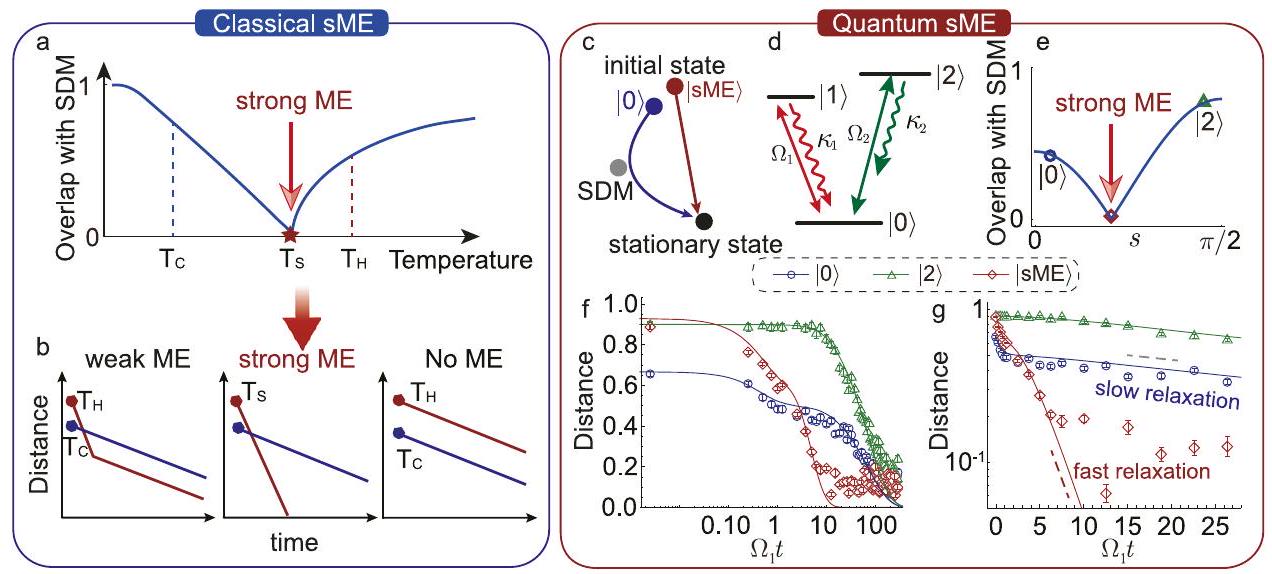
الشكل 1 | مقارنة بين تأثير ميمبا الكلاسيكي والكمومي. أ يمكن فهم تأثير ميمبا بطريقة بديهية: تعتمد سعة التداخل بين الحالة الأولية وأبطأ وضع متلاشي (SDM) على درجة الحرارة الأولية بطريقة غير أحادية. يظهر تأثير ميمبا الصغير (sME) عندما يتلاشى التداخل مع SDM. ب تأثير ميمبا الضعيف: إذا كانت الحالة الأولية ذات درجة حرارة عالية لديها سعة SDM أصغر من تلك الخاصة بالحالة ذات درجة الحرارة المنخفضة، يمكن أن تصل إلى التوازن الحراري بشكل أسرع. تأثير ميمبا القوي: يصل النظام إلى التوازن بمعدل أسرع بشكل أسي. لا يوجد تأثير ميمبا: الحالة الأولية ذات درجة الحرارة العالية لديها تداخل أكبر مع SDM وبالتالي تصل إلى التوازن بشكل أبطأ. ج من خلال تطبيق عملية موحدة، يمكن تحقيق حالة sME أولية والاقتراب من الحالة الثابتة بمعدل أسرع. د مستويات الطاقة لـ مراقبة الـ sME (مع ). تداخل لحالة عشوائية أولية مدارة مع SDM كدالة لزاوية الدوران. المسافة بين حالة الاسترخاء الزمنية والحالة الثابتةلحالات ابتدائية مختلفة: (أزرق)، (الأخضر) و |sME (الأحمر)، على التوالي. تبدأ حالة sME الأولية بمسافة أطول من من الحالة الأوليةلكن يصلأسرع.يتطور المقياس اللوغاريتمي للمسافة مع الزمن لحالات ابتدائية مختلفة. يُلاحظ بوضوح تسريع أسي للاسترخاء لحالة sME الابتدائية. المعلمات التجريبية لـ (e-g) هيوالخطوط الصلبة هنا هي التوقعات النظرية المستندة إلى المعلمات التجريبية.
نقطة استثنائية ليوفيليان (LEP)علاوة على ذلك، نلاحظ أن القيم الذاتية وأنماط القيم الذاتية تتجمع عند LEP في التجربة من خلال قياس التداخلات مع الأنماط المتلاشية. تشير نتائجنا إلى وجود رابط محتمل لم يتم استكشافه بعد بين ميكانيكا الكم والفيزياء غير الهيرميتية.والتي قد تحفز جهودًا أكثر إثارة في، على سبيل المثال، هندسة السمي الكمي مع LEPs من الرتبة الأعلى أو الطوبولوجية.
النتائج
نظرية تأثير ميمبا القوي الكمي
لفهم sME الكمي، نعتبر معادلة ليندبلاد الرئيسية، حيث هو المشغل الفائق ليوفيليان
هنا هو الهاميلتوني للنظام و هي مشغلات القفز الكمومي. مشغل الكثافةيمكن توسيعه كمجموع لجميع الأوضاع الذاتية ( ) من
هناهي المصفوفات الذاتية اليمنى (اليسرى) لمشغل ليوفيليان، مع القيم الذاتية المقابلة، و أو مصفوفة القيم الذاتية الخاصة بهايدل على الحالة الثابتةالذي هو مستقل عن أي حالة ابتدائيةبينما الأجزاء الحقيقية للقيم الذاتية الأخرىتشير إلى معدلات الاسترخاء للأوضاع الذاتيةالمعاملاتأعطِ التداخل لـمع، و يمثل عدد أوضاع التحلل.
بشكل عام، يمكن أن تتداخل الحالة الأولية مع جميع أوضاع الانحلال لديناميات ليندبلاد، ولكن على المدى الطويل، تهيمن عملية الاسترخاء على الأبطأ منها.معدل تدهور الوضع eigenmodeيحدد مقياس زمن أسي للاسترخاء، والتي تكون عادة مستقلة عن الحالة الأولية. ولكن في حالة ME، يمكن تحقيق الاسترخاءات السريعة الشاذة من خلال تصميم شكل خاص من التداخلتتميز بتداخل أصغر أو حتى صفر مع نموذج البيانات المكانية.
يمكن تحقيق sME الكمي من خلال تصميم حالة أولية |sME| تلبي،
هذه الحالة المثلى |sME) يتم إعدادها من خلال تطبيق تحويل وحدوي مصمم بشكل جيد على حالة كمومية نقية أولية للنظام.. لذلك، فإن حالة sME عادةً ما تكون حالة تراكب كمومي، مما يمثل فرقًا أساسيًا عن sME الكلاسيكية، وبالتالي لا يمكن التقاط السلوك الديناميكي الناتج بواسطة الأساليب شبه الكلاسيكية (انظر الملاحظة التكميلية 1). نظرًا لأن هذه الحالة الأولية لـ sME ليس لها تداخل مع SDM، فإن معدل استرخاء النظام هو إذن، مع الإطار الزمنيبدلاً من. وهذا يعني تقاربًا أسرع بشكل أسي نحو الحالة الثابتة بعامل.
النهج التجريبي
يظهر الإعداد التجريبي والمستويات الطاقية ذات الصلة لنموذج السلوك الكمي في الشكل 2 (أ، ب). الحالة الأساسيةمرتبط بشكل رنان بالحالة و بواسطة شعاع ليزر بطول موجي 729 نانومتر مع مكونين تردديين والترددات رابي المقابلة هي و “، على التوالي. ليزر آخر عند 854 نانومتر مع استقطاب دائري يميني يحفز قناة انحلال قابلة للتعديل بين الحالة و مع معدل التدهورمن خلال الربطإلى مستوى قصير العمر، والتي ستتحلل بسرعة إلى الحالة (انظر الملاحظة التكميلية 2). ستسبب الاستقطابية غير المثالية عند 854 نانومتر تدهورًا بطيئًا من الحالةإلىمع معدل التحللوأيضًا تسرب السكان إلى حالة زيمان الأرضية الأخرى. لحسن الحظ، يمكن إصلاح مشكلة التسرب من خلال إدخال شعاع ضخ بصري ضعيف عند 397 نانومتر خلال عملية جمع البيانات. ثم بالنسبة لنظام الثلاث مستويات الفعال، لدينا الهاميلتونيانواثنان من مشغلات القفز.
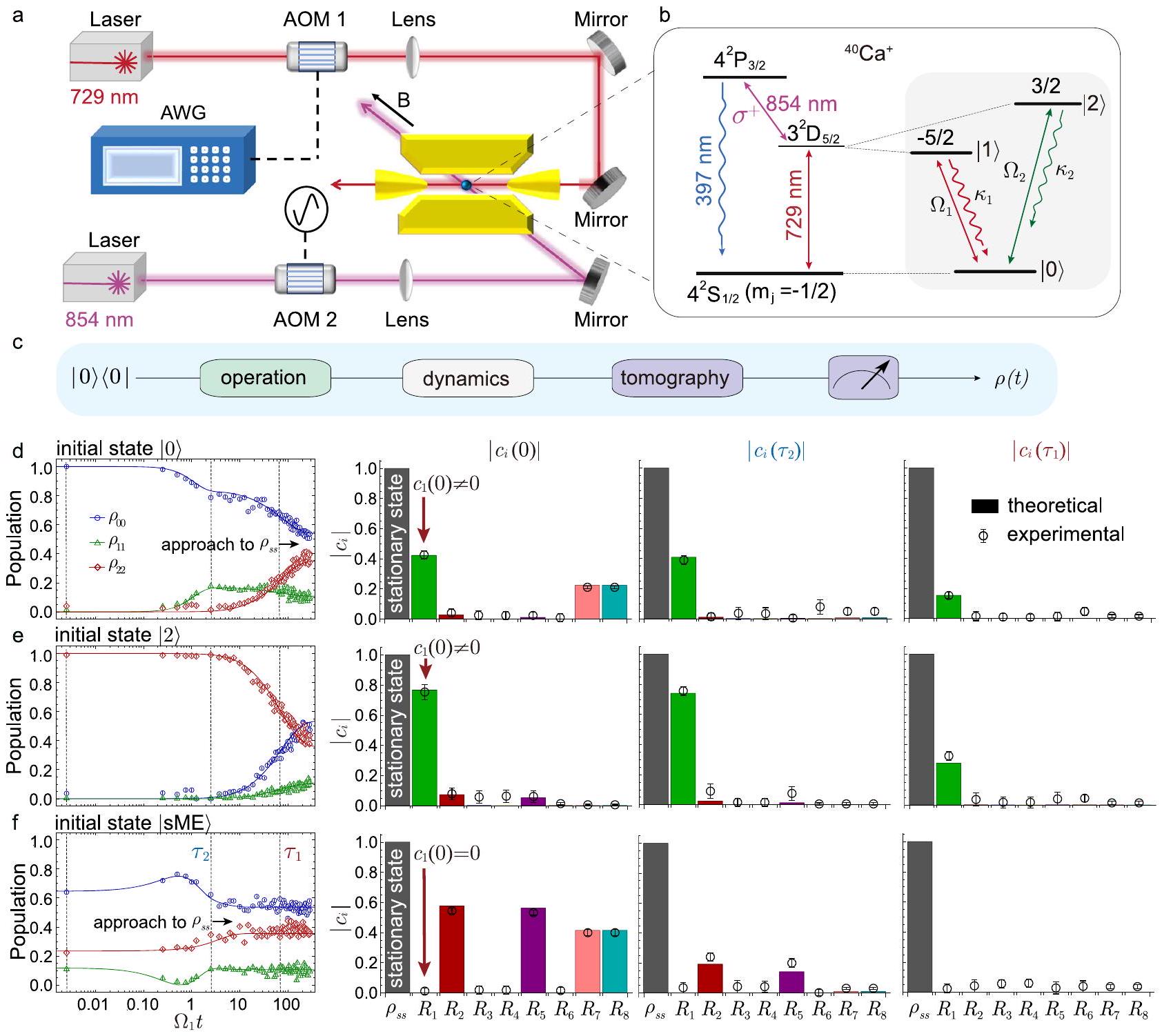
الشكل 2 | إعداد التجربة وديناميات الاسترخاء لحالات أولية مختلفة. أ إعداد التجربة لـ sME الكمومية. يتم تحقيق القيادة المتماسكة بين حالة S وحالة D باستخدام شعاع ليزر بطول 729 نانومتر بعرض نطاق يبلغ حوالي 100 هرتز. يتم دفع الانتقالين المطلوبين (كما هو موضح في ب) في نفس الوقت عن طريق حقن ترددين RF إلى مغير الصوت البصري (AOM1) عبر مولد موجات عشوائية (AWG). يتم التحكم في معدل انحلال حالة D بواسطة قوة ليزر 854 نانومتر. ب المستويات الطاقية ذات الصلة لواحدالأيون المعني في التجربة، مع الحالةمشفرة في مستويات الطاقة، و ، على التوالي. فجوة الطاقة للحالة و يمكن أن يقلل من التأثير الضار الناتج عن شوائب الاستقطاب في 854 شعاع الليزر nm. بروتوكول لتوليد الحالة الأولية لـ sME وتصوير مصفوفة الكثافة. بعد توليد حالة sME الأولية من خلال تطبيق بوابتين دوران على الحالةيتطور النظام مع المشغل الفائق ليوفيليانمن الاهتمام. بعد فترةتُجرى القياسات الإسقاطية لتصوير الحالةيسار: ديناميات سكان الدولةللحالات الأولية و (ف) على مقياس زمني لوغاريتمي. اليمين: التداخل المتطورلثلاث طوابع زمنية فيتشير الخطوط الصلبة إلى النتائج النظرية المستندة إلى المعلمات التجريبية نفسها كما في الشكل 1(e-g) وتم توليد أشرطة الخطأ باستخدام محاكاة مونت كارلو.
لمراقبة sME الكمومية، نقوم بتهيئة الأيون في الحالة الأساسيةثم قم بتدويره من خلال تطبيق عملية وحدوية (انظر الشكل 2(c)). على الرغم من أنه يمكن بناء هذا التحويل بدقة من خلال طريقة التحليلومع ذلك، لا يزال من الصعب تحقيق ذلك بدقة عالية في التجربة، حيث يتطلب الأمر على الأقل ست عمليات بوابة في حالتنا. للتغلب على هذه العقبة، نقوم هنا بتحسين العمليات إلى دورانين كيوبيت (انظر “الطرق” للتفاصيل الفنية). ثم يسترخي الحالة المدارة مع المشغل السوبرليوفيلي المرغوب.الخطوة النهائية هي توموغرافيا الحالة الكمومية، أي إجراء القياسات الإسقاطية على الحالة المسترخية زمنياًبينما تسترخي من الحالة الأوليةإلى الوضع الثابت النهائي. نلاحظ أن كل من العملية الديناميكية وقراءة الحالة تحتاج إلى يجب تنظيمها بعناية، مصاحبةً بإجراء التحسين (انظر “الطرق”).
مي القوي الكمي
بمساعدة التصوير المقطعي لـيمكننا وصف عملية الاسترخاء باستخدام مسافة هيلبرت-شميت
مع التدوينكما هو موضح في الشكل 1 (و)، فإن الحالة الابتدائية لـ sME التي تم إنشاؤها بواسطة طريقتنا أبعد من الحالة الثابتة مقارنة بالحالات الابتدائية العادية.. هذا بسبب حقيقة أنه بينما
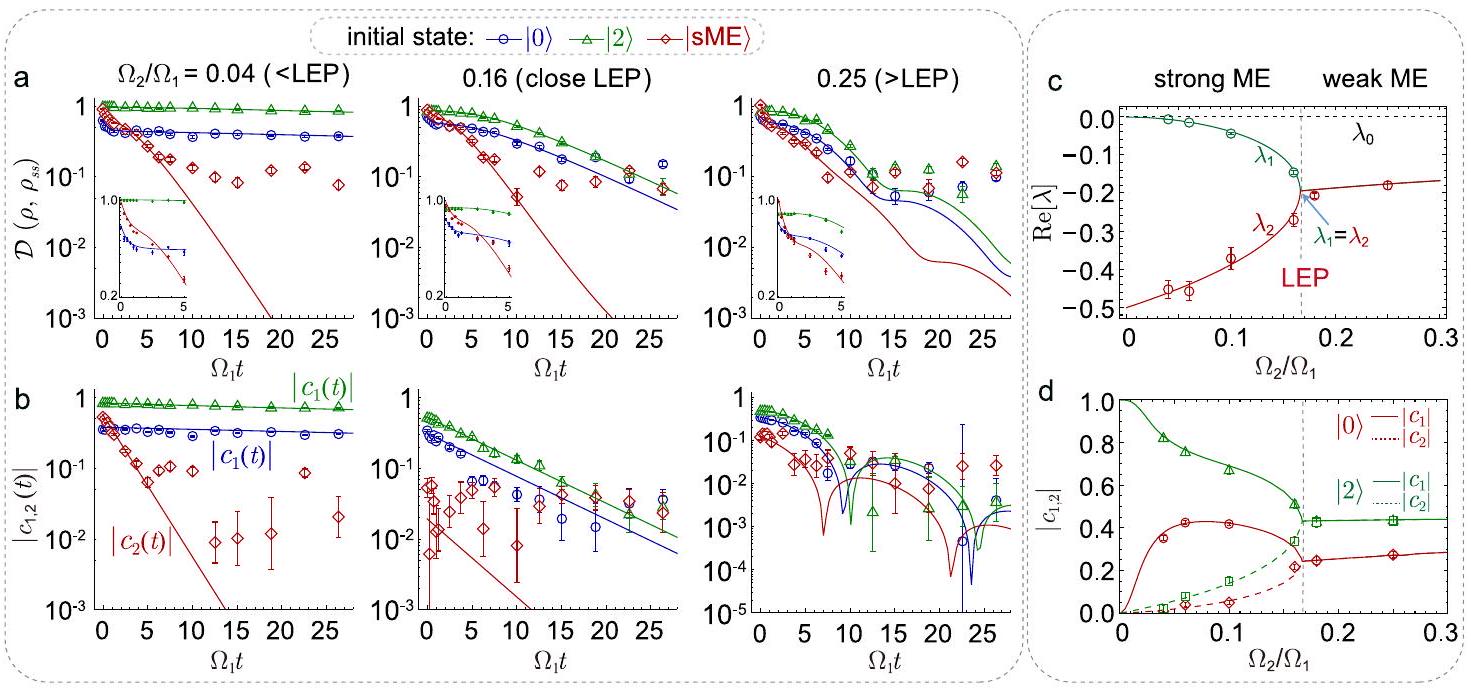
الشكل 3 | من ME قوي إلى ME ضعيف. أ مقياس لوغاريتمي للمسافةيتطور مع الزمن لحالات ابتدائية مختلفة: (أزرق)، (أخضر) و سمي (أحمر)، على التوالي.المعاملات المقابلة (من الحالة الأولية ) و (لحالة البداية |sME)). يتم ملاحظة sME الذي يخرج من التسارع الأسي لـ (< LEP). عندما ( LEP)، |sMEلها نفس معدل التحلل مع الحالات الأولية العادية، مما يعني أن ME القوي يختفي ولكن يُسمح بـ ME الضعيف. الأجزاء الحقيقية من القيم الذاتية لمشغل ليوفيل كدالة لـ. تداخلات (صلب) و (منقوط) لحالات ابتدائية مختلفة (أحمر) و (الأخضر)، على التوالي. المعلمات هي تم حساب جميع أشرطة الخطأ في هذه الشكل باستخدام محاكاة مونت كارلو. يزيل إثارة SDM، كما أنه يعدل إثارة الباقي منها. ومع ذلك، فإن النهج نحو الثبات لحالة sME الأولية لا يزال أسرع حيث أن SDMيتم قطعها بواسطةشكليعطي مقياس اللوغاريتمات للمسافةمقارنةً بالحالات الأولية العادية، يتم الوصول إلى تسريع أسي في الاسترخاء لحالة SME الأولية، وهو دليل واضح على sME الكمي. يمكن ملاحظته أيضًا من خلال مقاييس المسافة الأخرى، على سبيل المثال، مسافة التتبع.أو مسافة بوريز (انظر الملاحظة التكميلية 1).
الشكل 2(د-و) يوضح ديناميات الاسترخاء للحالات الأولية“، |2 ) و |sME)، على التوالي، تحت نفس المعايير التجريبية. نجد أنهم جميعًا يصلون إلى نفس الحالة المستقرة بعد فترة زمنية كافية، لكن زمن الاسترخاء للحالة الأولية sME أقصر بشكل ملحوظ. بالنسبة للحالات الأولية العادية (انظر الشكل 2 (د، هـ))، عندما يستقر النظام في حالة ضمن الغلاف الميتاستابي حتى. بشكل مختلف، كما هو موضح في الشكل 2(و)، تطبيق قطع تحفيز الـ SDM يؤدي إلى اقتراب ملحوظ أسرع من الحالة المستقرة مع مقياس الزمنمن أجل تصور تداخلاتها في كل وضع متعفن، نقدم جميع المعاملاتمنتحلل إلى جميع أوضاع التحلل في الوقت، و على التوالي. كما هو موضح في الشكل 2 (د، هـ)، عندما يكون الوقتعادةً ما تتداخل الحالة الأولية العامة مع الأبطأ، أي، . عندما يحين الوقتتداخل الحالة الابتدائية مع أوضاع الإثارة قصيرة العمر ) يصبح صغيرًا جدًا، بينما الـ SDM ( ) لا يزال ذا صلة ويُبقي النظام بعيدًا عن الاستقرارية لفترة طويلة حتى . ومع ذلك، بالنسبة لحالة sME الأولية، لذلك، يتم تقليل مقياس زمن الاسترخاء إلىمع معدل تدهور أسرع (انظر الشكل 2(و)). لاحظ أن معامل (أي، الحالة الثابتة) لها الشكل ويظل باستمرار عند 1 طوال الوقت، بينما المعاملات على أوضاع التدهور الأخرىتقل مع الوقت للسبب.
من أنا قوية إلى أنا ضعيفة
هل يمكن أن يحدث هذا التسارع الأسي دائمًا لحالة السME الأولية؟ للتحقق من ذلك، نقوم بقياس المسافةوالتداخلاتلأنماط مختلفة من النظام. كما هو موضح في الشكل 3(أ-ب)، للحالة الأولية العادية، المسافة لها سلوك ديناميكي مشابه للتداخلفي المرحلة النهائية من الاسترخاء، أي،. بينما بالنسبة لحالة sME الأولية، فإنها يصبح إلى. عندما الاسترخاء المتسارع الذي تم تحقيقه لحالة sME الأولية هو أمر مهم للغاية، حيث في هذا النظامكما هو موضح في الشكل 3(c). بينما كمايزيد، هذه الزيادة الأسيةيقل وحتى يختفي عندمايمر عبر LEP، حيث و . السبب هو أنه عندماLEP، القيمة الذاتية لمصفوفة SDM لـتشكل زوجًا معقدًا مترافقًا، أي، (انظر الشكل 3(c))، مما يعني أن الأوضاع المتدهورة و لها نفس معدل التحلل. في الوقت نفسه، الأجزاء التخيلية للقيم الذاتيةيؤدي إلى التذبذب خلال عملية الاسترخاء (ملاحظة إضافية 1). على الرغم من ذلك، بالمقارنة مع الحالات الأولية العادية التي تحتوي على نموذجين ديناميكيين ذاتيين، فإن الحالة الأولية لـ sME هنا تحتوي فقط على واحد، مما قد يجعلها أسرع للوصول إلى الحالة الثابتة. تختلف sME التي تتميز بمعدل تدهور أسرع، حيث أن هذا التسارع هنا يتوافق مع ME الضعيف المرتبط بتداخل أصغر مع النموذج الديناميكي الذاتي.. ونتيجة لذلك، فإن LEP هو الحد الفاصل بين ME القوي الكمي وME الضعيف، مما يظهر أن وجود ME القوي الكمي محدود بالنظام الذيهو حقيقي. إنه مفيد لتعميق فهم حد سرعة الاسترخاء من كل من وجهات نظر LEPs و ME الكمومية.
استنادًا إلى قياسات التداخلات، نوضح أيضًا أن القيم الذاتية (الشكل 3(c)) وأنماط القيم الذاتية (الشكل 3(d)) تتجمع عند LEP في التجربة. بينما يكون تأثير الأنماط المتلاشية غالبًا محدودًا بالديناميات العابرة، فإنه يمثل تحديًا عمليًا للملاحظة التجريبية لأكثر من قيمة ذاتية واحدة.. عادةً ما يحدث LEP في النقطة التي يتغير فيها القيم الذاتية من حقيقية إلى مركبة. ومع ذلك، يمكن أن تُظهر هذه التغييرات فقط مكان حدوث LEP، لكنها لا تُظهر تجمع LEP، لأن تجمع LEPs يحدث عادةً في قيم eigen متعددة. يمكن حل هذه المشكلة من خلال ملاءمة القياسات لـباستخدام دالة أسية واحدة للزمن. بناءً على ذلك، يمكن نظريًا الحصول على الطيف الكامل لـ. لنظامنا هنا، مع الأخذ في الاعتبار التداخلصغير جدًا للحالة الأوليةنحن نختار أن نحصل علىعن طريق القياسحالة SME الأولية وعن طريق القياسالحالة الأولية. النتائج، كما هو موضح في الشكل 3(c)، تتطابق جيدًا مع النتائج النظرية وتظهر أن LEP يتم الإشارة إليه من خلال التدهور لـ.
كما هو موضح في الشكل 3(d)، تداخل الأوضاع الذاتية و في LEP يُشار إليه بـلحالة ابتدائية ثابتة، لأنه في LEP. هذا يعني أن تداخل المعاملات هو وسيلة قابلة للاكتشاف لإظهار تداخل الأوضاع الذاتية لـ LEP. لاحظ أنه، كما رأينا في الشكل 3 (ج-د)، فإن تفرد التفرع للطيف
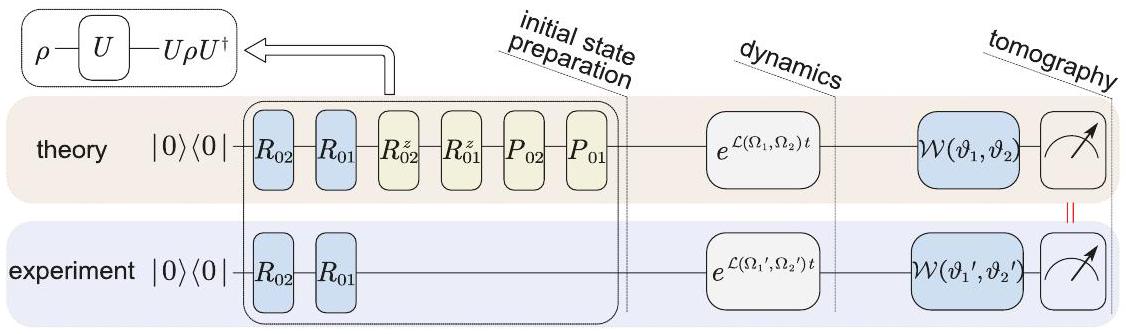
الشكل 4 | بروتوكول لتحضير حالات كيوترِت (ثلاثية المستويات) النقية بشكل عشوائي والحصول على مصفوفة الكثافةفي التجربة. أولاً، نقوم ببناء الحالة الكمومية من خلال تصميم تحويل موحد ‘افتراضي’ ولكنه فعال.. ثم في العملية الديناميكية، معلمات الليزرتُعدل وفقًا لـ و . أخيرًا، يتم تغيير عمليات توموغرافيا الحالة وفقًا لـ. والتداخلاتلا يمكن اكتشافه في الحالة المستقرة بل في عملية الاسترخاء.. في الواقع، بالنسبة للديناميات على المدى الطويل، ، وبالتالي فإن LEP يتوافق مع التغيير النهائي في اتجاه الديناميات من إلى. إن تغيير الاتجاه الذي يحدث في LEP هو دليل إضافي على وجود صلة مباشرة مع الظواهر الشاذة التي تنشأ في عملية الاسترخاء مثل sME والانتقال الديناميكي للطور.
نقاش
باختصار، لقد لاحظنا الـ sME الكمي في نظام أيون محاصر واحد من خلال إعداد حالة نقية مثالية ليس لها تداخل مع الـ SDM. بالنسبة لحالة الس sME الكمية الأولية، نقترح تقنية تحكم كمي فعالة لإعداد الحالة، والهندسة الديناميكية، وتوموغرافيا الحالة. بالإضافة إلى ذلك، نكشف أن الـ sME الكمي يحدث فقط ضمن نطاق معين من المعلمات، والذي تحدده LEP. مع تقنيات الهندسة المتطورة لحالات الكم، لا توفر أعمالنا أداة قوية لاستكشاف واستخدام الـ sME الكمي كأمثلة على ديناميات الاسترخاء المهندسة فحسب، بل أيضاً.ولكنه أيضًا يجسر بين LEP وME الكمومي، وهما تأثيران كانا مستقلين سابقًا. بالإضافة إلى ذلك، فإن الطرق القابلة للوصول تجريبيًا التي تم مناقشتها في المخطوطة الحالية، مثل التحويل الوحدوي الفعال وقياس التداخلات، ستكون أدوات قيمة لتقييم جودة إعداد الحالة والتحكم في استرخاء النظام.
ملاحظة مضافة: أثناء تقديم مخطوطتنا، أصبحنا على علم بدراستين تجريبيتين أخريين لتأثير ميمبا تم إجراؤهما باستخدام أنظمة الأيونات المحصورة، وقد نُشرت حاليًا في مجلة فيزيكال ريفيو ليترز..
طرق
نشرح هنا كيفية وضع التحويل الوحدويلإنشاء الحالة الأولية (النقية) للـ sME الكمومية. نستخدم أولاً الطريقة المنفذة في المرجع 18 للحصول على |sME)، ثم نقوم بإنشاء عملية قابلة للتنفيذ بشكل صريحاستنادًا إلى إعدادنا التجريبي (انظر الشكل 4).
كما تم مناقشته في المرجع 18، يمكن التعبير عن صيغة هذه الوحدة على النحو التالي
أينهي الحالات الذاتية لمصفوفة القيم الذاتية اليسرىمع القيم الذاتية السلبية (الإيجابية) المقابلة، . هذه الكيوترت (ثلاثية المستويات) يمكن تحليل العمليات إلى عدة دورات كيوبيت (مستويين)بالمقارنة مع عمليات الكيوبت، فإن التحدي الملحوظ في عمليات الكيوترت هو أن العمليات الأساسية للكيوبت تفقد حرية قياس ‘الطور العالمي’ لأنها تقاس بالنسبة لمستوى المتفرج..
الآن نناقش كيفية التغلب على هذا التحدي الفني من خلال تطبيق طريقة أكثر كفاءة وعملية للتفكيك، والتي تتطلب فقط عمليتين للدوران على مستويين في التجربة (انظر الشكل 4). لنفترض حالة نقية عشوائية من الكيوتر.و ، ثم يمكن أن يتم تحليله إلى حاصل ضرب مصفوفتين وحدويتين من مستويين، حيث
معالوحدة و يمكن كتابته بالشكل
أين
و
هنا قمنا بترجمة بوابات المرحلة و عكسيًا الذي ينفذ تغييرات الطور المناسبة بين حالات الكيوترت. ثم العملية الوحدوية النهائية المتحللة لـيمكن كتابته كـ
مع. يمكننا تبسيط العملية الأحادية أكثر بطريقة أكثر كفاءة من خلال ترجمة مراحل البوابات و إلى العملية بالعكس حتى الكشف بسبب أن الكشف لا يحتاج إلى معلومات الطورمن خلال حساب الطور المترجم في البرنامج، نحتاج فقط إلى عمليتي دوران.لإنتاج حالة نقية عشوائية من الثلاثيات تجريبيًا، والتي يمكن أن تبسط العمليات بشكل كبير، ولكن أيضًا تحسن من دقة حالة sME.
كما هو موضح في الشكل 4، تظهر تحليلاتنا الدقيقة أن العمليات الديناميكية المقابلة وعمليات توموغرافيا الحالة تحتاج إلى تعديل وفقًا لذلك.
يتطلب تصوير الحالة لنظام الكيوترِيت هنا 9 قواعد قياس، وهي، . ومع ذلك، يمكن فقط الكشف عن حالة S أو D في نظام الأيونات المحصورة، لذلك نحتاج إلى تدوير الأساس إلى الحالةقبل تطبيق شعاع الكشف لأننا قمنا بتشفير الحالة و في مجموعة حالة D. عملية الدورانيمكن تحقيق توموغرافيا الحالة ببساطة من خلال دمج أو نبضات مع مرحلة الترجمةفي الانتقال و في الانتقالعلى التوالي. بعد الحصول على نتائج القياس الإسقاطي لهذه الأسس، يمكننا إعادة بناء مصفوفة الكثافة باستخدام طريقة الاحتمالية القصوى، ويتم الحصول على أشرطة الخطأ لمصفوفة الكثافة من خلال استخدام المحاكاة العددية..
توفر البيانات
البيانات التي تدعم النتائج مقدمة في المقال والمعلومات التكميلية. تم توفير بيانات المصدر مع هذه الورقة.
توفر الشيفرة
الشفرة المستخدمة في تحليل البيانات والمحاكاة متاحة من المؤلف المراسل عند الطلب. يتم توفير بيانات المصدر مع هذه الورقة.
References
Breuer, H.-P. & Petruccione, F. The Theory Of Open Quantum Systems. (Oxford University Press, 2007).
Mohseni, M. et al. Quantum Effects In Biology. (Cambridge University Press, 2014).
Verstraete, F., Wolf, M. M. & Cirac, J. I. Quantum computation and quantum-state engineering driven by dissipation. Nat. Phys. 5, 633 (2009).
Harrington, P. M., Mueller, E. J. & Murch, K. W. Engineered dissipation for quantum information science. Nat. Rev. Phys. 4, 660 (2022).
Dann, R., Tobalina, A. & Kosloff, R. Shortcut to equilibration of an open quantum system. Phys. Rev. Lett. 122, 250402 (2019).
Wu, S. L., Ma, W., Huang, X. L. & Yi, X. Shortcuts to adiabaticity for open quantum systems and a mixed-state inverse engineering scheme. Phys. Rev. Appl. 16, 044028 (2021).
Khandelwal, S., Brunner, N. & Haack, G. Signatures of liouvillian exceptional points in a quantum thermal machine. PRX Quantum 2, 040346 (2021).
Kumar, P., Snizhko, K., Gefen, Y. & Rosenow, B. Optimized steering: quantum state engineering and exceptional points. Phys. Rev. A 105, L010203 (2022).
Mpemba, E. B. & Osborne, D. G. Cool? Phys. Educ. 4, 172 (1969).
Lu, Z. & Raz, O. Nonequilibrium thermodynamics of the Markovian Mpemba effect and its inverse. Proc. Natl Acad. Sci. USA 114, 5083 (2017).
Klich, I., Raz, O., Hirschberg, O. & Vucelja, M. Mpemba index and anomalous relaxation. Phys. Rev. X 9, 021060 (2019).
Gal, A. & Raz, O. Precooling strategy allows exponentially faster heating. Phys. Rev. Lett. 124, 060602 (2020).
Kumar, A. & Bechhoefer, J. Exponentially faster cooling in a colloidal system. Nature 584, 64 (2020).
Bechhoefer, J., Kumar, A. & Chétrite, R. A fresh understanding of the mpemba effect. Nat. Rev. Phys. 3, 534 (2021).
Teza, G., Yaacoby, R. & Raz, O. Eigenvalue crossing as a phase transition in relaxation dynamics. Phys. Rev. Lett. 130, 207103 (2023).
Pemartín, I. G.-A., Mompó, E., Lasanta, A., Martín-Mayor, V. & Salas, J. Shortcuts of freely relaxing systems using equilibrium physical observables. Phys. Rev. Lett. 132, 117102 (2024).
Ibáñez, M., Dieball, C., Lasanta, A., Godec, A. & Rica, R. A. Heating and cooling are fundamentally asymmetric and evolve along distinct pathways. Nat. Phys. 20, 135-141 (2024).
Carollo, F., Lasanta, A. & Lesanovsky, I. Exponentially accelerated approach to stationarity in markovian open quantum systems through the mpemba effect. Phys. Rev. Lett. 127, 060401 (2021).
Nava, A. & Fabrizio, M. Lindblad dissipative dynamics in the presence of phase coexistence. Phys. Rev. B 100, 125102 (2019).
Kochsiek, S., Carollo, F. & Lesanovsky, I. Accelerating the approach of dissipative quantum spin systems towards stationarity through global spin rotations. Phys. Rev. A 106, 012207 (2022).
Manikandan, S. K. Equidistant quenches in few-level quantum systems. Phys. Rev. Res. 3, 043108 (2021).
Ares, F., Murciano, S. & Calabrese, P. Entanglement asymmetry as a probe of symmetry breaking. Nat. Commun. 14, 2036 (2023).
Rylands, C. et al. Microscopic origin of the quantum mpemba effect in integrable systems. Phys. Rev. Lett. 133, 010401 (2024).
Ivander, F., Anto-Sztrikacs, N. & Segal, D. Hyperacceleration of quantum thermalization dynamics by bypassing long-lived coherences: An analytical treatment. Phys. Rev. E 108, 014130 (2023).
Chatterjee, A. K., Takada, S. & Hayakawa, H. Quantum mpemba effect in a quantum dot with reservoirs. Phys. Rev. Lett. 131, 080402 (2023).
Chatterjee, A. K., Takada, S. & Hayakawa, H. Multiple quantum mpemba effect: exceptional points and oscillations. Phys. Rev. A 110, 022213 (2024).
Moroder, M., Culhane, O., Zawadzki, K. & Goold, J. Thermodynamics of the quantum mpemba effect. Phys. Rev. Lett. 133, 140404 (2024).
Boubakour, M., Endo, S., Fogarty, T. & Busch, T. Dynamical invariant based shortcut to equilibration in open quantum systems. arXiv:2401.11659 (2024).
Joshi, L. K. et al. Observing the quantum mpemba effect in quantum simulations. Phys. Rev. Lett. 133, 010402 (2024).
Aharony Shapira, S. et al. Inverse mpemba effect demonstrated on a single trapped ion qubit. Phys. Rev. Lett. 133, 010403 (2024).
Lasanta, A., Vega Reyes, F., Prados, A. & Santos, A. When the hotter cools more quickly: Mpemba effect in granular fluids. Phys. Rev. Lett. 119, 148001 (2017).
Bender, C. M., Brody, D. C., Jones, H. F. & Meister, B. K. Faster than hermitian quantum mechanics. Phys. Rev. Lett. 98, 040403 (2007).
Chen, W., Özdemir, Ş. K., Zhao, G., Wiersig, J. & Yang, L. Exceptional points enhance sensing in an optical microcavity. Nature 548, 192 (2017).
Hodaei, H. et al. Enhanced sensitivity at higher-order exceptional points. Nature 548, 187 (2017).
Miri, M. A. & Alù, A. Exceptional points in optics and photonics. Science 363, eaar7709 (2019).
Minganti, F., Miranowicz, A., Chhajlany, R. W. & Nori, F. Quantum exceptional points of non-hermitian hamiltonians and liouvillians: the effects of quantum jumps. Phys. Rev. A 100, 062131 (2019).
Naghiloo, M., Abbasi, M., Joglekar, Y. N. & Murch, K. W. Quantum state tomography across the exceptional point in a single dissipative qubit. Nat. Phys. 15, 1232-1236 (2019).
Chen, W., Abbasi, M., Joglekar, Y. N. & Murch, K. W. Quantum jumps in the non-hermitian dynamics of a superconducting qubit. Phys. Rev. Lett. 127, 140504 (2021).
Chen, W. et al. Decoherence induced exceptional points in a dissipative superconducting qubit. Phys. Rev. Lett. 128, 110402 (2022).
Ding, K., Ma, G., Xiao, M., Zhang, Z. Q. & Chan, C. T. Emergence, coalescence, and topological properties of multiple exceptional points and their experimental realization. Phys. Rev. X 6, 021007 (2016).
Zhou, Y.-L. et al. Accelerating relaxation through liouvillian exceptional point. Phys. Rev. Res. 5, 043036 (2023).
Purkayastha, A., Kulkarni, M. & Joglekar, Y. N. Emergent symmetry in a double-quantum-dot circuit qed setup. Phys. Rev. Res. 2, 043075 (2020).
Zhang, J. W. et al. Dynamical control of quantum heat engines using exceptional points. Nat. Commun. 13, 6225 (2022).
Bu, J.-T. et al. Enhancement of quantum heat engine by encircling a liouvillian exceptional point. Phys. Rev. Lett. 130, 110402 (2023).
Macieszczak, K., Guță, M., Lesanovsky, I. & Garrahan, J. P. Towards a theory of metastability in open quantum dynamics. Phys. Rev. Lett. 116, 240404 (2016).
Minganti, F., Biella, A., Bartolo, N. & Ciuti, C. Spectral theory of Liouvillians for dissipative phase transitions. Phys. Rev. A 98, 042118 (2018).
Žnidarič, M. Relaxation times of dissipative many-body quantum systems. Phys. Rev. E 92, 042143 (2015).
Nielsen, M. A. & Chuang, I. L. Quantum computation and quantum information (10th anniversary edition) (Oxford University Press, 2011).
Van Vu, T. & Hasegawa, Y. Geometrical bounds of the irreversibility in markovian systems. Phys. Rev. Lett. 126, 010601 (2021).
García-Pintos, L. P., Nicholson, S. B., Green, J. R., del Campo, A. & Gorshkov, A. V. Unifying quantum and classical speed limits on observables. Phys. Rev. X 12, 011038 (2022).
Orgad, D., Oganesyan, V. & Gopalakrishnan, S. Dynamical transitions from slow to fast relaxation in random open quantum systems. Phys. Rev. Lett. 132, 040403 (2024).
Ringbauer, M. et al. A universal qudit quantum processor with trapped ions. Nat. Phys. 18, 1053-1057 (2022).
McKay, D. C., Wood, C. J., Sheldon, S., Chow, J. M. & Gambetta, J. M. Efficient Z gates for quantum computing. Phys. Rev. A 96, 022330 (2017).
Thew, R. T., Nemoto, K., White, A. G. & Munro, W. J. Qudit quantumstate tomography. Phys. Rev. A 66, 012303 (2002).
Hu, X.-M. et al. Self-testing of a single quantum system from theory to experiment. npj Quantum Inf. 9, 103 (2023).
شكر وتقدير
تم دعم هذا العمل من قبل مؤسسة كورنرستون التابعة لجامعة NUDT (Y.L.Z.)، ومؤسسة العلوم الطبيعية لمقاطعة هونان في الصين بموجب منحة
الأرقام 2023JJ30626 (Y.L.Z.)، 2022 RC1194 (J.Z.)، 2023JJ10052 (J.Z.)، مؤسسة العلوم الطبيعية الوطنية في الصين تحت المنح رقم 12004430 (J.Z.)، 12174448 (C.W.W.)، 12074433 (P.X.C.)، 12174447 (W.W.) و 12204543 (T.C.). H.J. مدعوم من NSFC (رقم المنحة 11935006)، برنامج الابتكار في العلوم والتكنولوجيا لمقاطعة هونان (رقم المنحة 2020RC4047)، البرنامج الوطني الرئيسي للبحث والتطوير في الصين (رقم 2024YFE0102400) وبرنامج العلوم والتكنولوجيا الرئيسي لمقاطعة هونان (رقم 2023ZJ1010)، و P.X.C. يعترف بالدعم من برنامج الابتكار للعلوم والتكنولوجيا الكمومية تحت رقم المنحة 2021ZD0301605.
مساهمات المؤلفين
قام Y.L.Z. بتصميم البحث بالتعاون مع H.J. وW.L. وP.X.C.; كان J.Z. وG.X. مسؤولين عن تنفيذ التجارب، وجمع البيانات وتقييمها؛ صمم J.Z. وY.L.Z. وC.W.W. التجربة بمساعدة T.C. وY.X. وW.W. وP.X.C.; قام Y.L.Z. بإجراء المحاكاة؛ قام Y.L.Z. وJ.Z. وG.X. بتحليل البيانات؛ كتب Y.L.Z. وJ.Z. وH.J. وW.L. وC.W.Q. الورقة بمساهمات من G.X. وT.C. وQ.Z. وW.B.S.; أشرف H.J. وW.L. وP.X.C. على هذا المشروع. ناقش جميع المؤلفين النتائج وساهموا في المخطوطة.
يجب توجيه المراسلات والطلبات للحصول على المواد إلى ويبين لي، هوي جينغ أو يان-لي تشو.
معلومات مراجعة الأقران تشكر مجلة Nature Communications أنطونيو لاسانتا، بينغفاي وانغ والمراجعين الآخرين المجهولين على مساهمتهم في مراجعة هذا العمل. يتوفر ملف مراجعة الأقران.
ملاحظة الناشر: تظل شركة سبرينغر ناتشر محايدة فيما يتعلق بالمطالبات القضائية في الخرائط المنشورة والانتماءات المؤسسية.
الوصول المفتوح. هذه المقالة مرخصة بموجب رخصة المشاع الإبداعي النسب-غير التجاري-عدم الاشتقاق 4.0 الدولية، التي تسمح بأي استخدام غير تجاري، ومشاركة، وتوزيع، وإعادة إنتاج في أي وسيلة أو صيغة، طالما أنك تعطي الائتمان المناسب للمؤلفين الأصليين والمصدر، وتوفر رابطًا لرخصة المشاع الإبداعي، وتوضح إذا قمت بتعديل المادة المرخصة. ليس لديك إذن بموجب هذه الرخصة لمشاركة المواد المعدلة المشتقة من هذه المقالة أو أجزاء منها. الصور أو المواد الأخرى من طرف ثالث في هذه المقالة مشمولة في رخصة المشاع الإبداعي الخاصة بالمقالة، ما لم يُشار إلى خلاف ذلك في سطر الائتمان للمادة. إذا لم تكن المادة مشمولة في رخصة المشاع الإبداعي الخاصة بالمقالة وكان استخدامك المقصود غير مسموح به بموجب اللوائح القانونية أو يتجاوز الاستخدام المسموح به، ستحتاج إلى الحصول على إذن مباشرة من صاحب حقوق الطبع والنشر. لعرض نسخة من هذه الرخصة، قم بزيارة http:// creativecommons.org/licenses/by-nc-nd/4.0/.
(ج) المؤلفون 2025
معهد العلوم والتكنولوجيا الكمومية، كلية العلوم، الجامعة الوطنية لتكنولوجيا الدفاع، تشانغشا، الصين. مختبر هونان الرئيسي لآلية وتكنولوجيا المعلومات الكمومية، تشانغشا، الصين. المختبر الوطني في هيفي، هيفي، آنهوي، الصين. المختبر الرئيسي للهياكل الكمومية منخفضة الأبعاد والتحكم الكمومي بوزارة التعليم، جامعة هونان العادية، تشانغشا، الصين. قسم الهندسة الكهربائية وهندسة الكمبيوتر، الجامعة الوطنية في سنغافورة، سنغافورة، سنغافورة. مدرسة الفيزياء وعلم الفلك، جامعة نوتنغهام، نوتنغهام، المملكة المتحدة. مركز الرياضيات والفيزياء النظرية للأنظمة الكمومية غير المتوازنة، جامعة نوتنغهام، نوتنغهام، المملكة المتحدة. كلية العلوم، الجامعة الوطنية لتكنولوجيا الدفاع، تشانغشا، الصين. ساهم هؤلاء المؤلفون بالتساوي: جي زانغ، غانغ شيا.
® البريد الإلكتروني: weibin.li@nottingham.ac.uk; jinghui73@foxmail.com; ylzhou@nudt.edu.cn
Received: 14 February 2024
Accepted: 7 November 2024
Published online: 06 January 2025
Check for updates
Jie Zhang , Gang Xia , Chun-Wang Wu , Ting Chen , Qian Zhang , Yi Xie , Wen-Bo Su® , Wei Wu , Cheng-Wei Qiu , Ping-Xing Chen , Weibin Li , Hui Jing & Yan-Li Zhou .
An ancient and counterintuitive phenomenon known as the Mpemba effect (water can cool faster when initially heated up) showcases the critical role of initial conditions in relaxation processes. How to realize and utilize this effect for speeding up relaxation is an important but challenging task in purely quantum system till now. Here, we experimentally study the strong Mpemba effect in a single trapped ion system in which an exponentially accelerated relaxation in time is observed by preparing an optimal quantum initial state with no excitation of the slowest decaying mode. Also, we demonstrate that the condition of realizing such effect coincides with the Liouvillian exceptional point, featuring the coalescence of both the eigenvalues and the eigenmodes of the systems. Our work provides an efficient strategy to engineer the dynamics of open quantum system, and suggests a link unexplored yet between the Mpemba effect and the non-Hermitian physics.
Relaxations or dissipative evolutions from initial states to a stationary state, widely existing in nature, are vital for fundamental studies of nonequilibrium phenomena and practical control of dynamical devices . In quantum realm, rapid relaxations are highly desirable for efficient quantum state preparation and qubit engineering . As a possible strategy to achieve this goal, the Mpemba effect (ME) , wellknown in the counterintuitive example that water can cool faster when initially heated up, has attracted growing interests both in classical and quantum systems in recent years . Often, this and related phenomena admits a general explanation : the state of the hotter system overlaps less with the slowest decaying mode (SDM) of the dissipative or cooling dynamics, implying the critical role of initial conditions in relaxations (see Fig. 1(a, b)).
For purely quantum systems at zero temperature, the main challenge is to identify ME-induced rapid relaxations that are not smeared out by quantum superposition . Very recently, Carollo et al.
proposed that strong ME (sME) or exponential speed-up of relaxation can emerge in Markovian open quantum systems by devising an optimal initial state (i.e., sME state) to prohibit excitation of the slowest decaying mode (SDM, see Fig. 1(c)). This prediction of quantum sME, however, has not been experimentally realized till now, hindering its possible applications in e.g., ‘engineered’ relaxation dynamics of the open quantum system .
Here, we report the observation of the sME in a truly quantum system, which is a genuine quantum effect and cannot be captured by semi-classical methods. As an essential step towards this target, we construct the sME state via efficient gate operations on a single trapped ion and show that with such special pure state, featuring zero overlap with the SDM, exponential speeding-up of relaxations can be observed (see Fig. 1(d-g)). Also we find that a critical point can appear in our system, separating the regimes with or without exponential acceleration of relaxations, which coincides well with the
Fig. 1 | Comparison for classic and quantum Mpemba effect. a The ME can be understood in an intuitive way: the amplitude of the overlap of the initial state with the slowest decaying mode (SDM) depends on the initial temperature in a nonmonotonic way. The sME appears when the overlap with the SDM vanishes. b Weak ME: If an initial high temperature state has a smaller SDM amplitude than that of the lower temperature state, it can reach the thermal equilibrium faster. Strong ME: the system reaches equilibrium at an exponentially faster rate. No ME: the initial high temperature state has a larger overlap with the SDM and thus reaches the equilibrium slower. c By applying a unitary operation, one can realize an initial sME state and approaches the stationary state with a faster rate. d The energy levels for
observing the sME (with ). e The overlap of a rotated initial random state with the SDM as a function of the rotation angle . The distance between the timerelaxed state and the stationary state for different initial states: (blue), (green) and |sME (red), respectively. The initial sME state starts with a longer distance from than the initial state but reaches faster. The logarithmic scale of the distance evolves with time for different initial states. An exponential speed-up of relaxation is clearly observed for the sME initial state. The experimental parameters for (e-g) are , and the solid lines here are the theoretical predictions based on the experimental parameters.
Liouvillian exceptional point (LEP) . Furthermore, we observe both eigenvalues and eigenmodes coalesce at the LEP in the experiment by measuring the overlaps with the decaying modes. Our findings indicate a possible link unexplored yet between quantum ME and non-Hermitian physics , which may stimulate more exciting efforts on e.g., engineering quantum sME with higher-order or topological LEPs .
Results
Theory of quantum strong Mpemba effect
To understand the quantum sME, we consider a Lindblad master equation , where is the Liouvillian superoperator
Here is the Hamiltonian of the system and are the quantum jump operators. The density operator can be expanded as the sum of all eigenmodes ( ) of
Here are the right (left) eigenmatrices of the Liouvillian superoperator , with the corresponding eigenvalues , and or its eigenmatrix denotes the stationary state , which is independent of any initial state , while the real parts of other eigenvalues indicate the relaxation rates of the eigenmodes . Coefficients give the overlap of with , and denotes the number of the decay modes.
Generally, an initial state can overlap with all decaying modes of Lindblad dynamics, but at long times the relaxation is dominated by the slowest one . The decay rate of the eigenmode sets an exponential timescale of the relaxation , which is normally independent of the initial state. But for the ME case, anomalous fast relaxations can be achieved by designing a special form of
the overlap featuring smaller or even zero overlap with the SDM .
The quantum sME can be realized by designing such an initial state |sME| satisfying ,
This optimal state |sME) is prepared by applying a well devised unitary transformation to an initially pure quantum state of the system . Therefore the sME state is normally a quantum superposition state, which represents a fundamental difference from classic sME, and thus the resulting dynamical behaviour cannot be captured by semiclassical approaches (see Supplementary note 1). Since this sME initial state has zero overlap with the SDM, the relaxation rate of the system is thus , with the timescale , instead of . This implies an exponentially faster convergence to the stationary state by a factor .
Experimental approach
The experimental setup and relevant energy levels for the quantum sME are shown in Fig. 2(a, b). The ground state is resonantly coupled to state and by one 729 nm laser beam with two frequency components and the corresponding Rabi frequencies are and , respectively. Another laser at 854 nm with right circular polarization induces a tunable decay channel between state and with decay rate , by coupling to a short-life level , which will decay quickly back to the state (see Supplementary note 2). The imperfect polarization of 854 nm will cause slow decay from state to with decay rate and also the leakage of population to the other Zeeman ground state. Fortunately, the leakage problem can be fixed by introducing a weak optical pumping beam at 397 nm during the data acquisition process. Then for the effective three-level system, we have the Hamiltonian and two jump operators .
Fig. 2 | Experimental setup and relaxation dynamics for different initial states. a Experimental setup of quantum sME. The coherent driving between the S state and D state is realized by using a 729 nm laser beam with linewidth about 100 Hz . Two transitions required (as shown in b) are simultaneously driven by injecting two RF frequencies to an acoustic-optic modulator (AOM1) via an arbitrary waveform generator (AWG). The decay rate of the D state is controlled by the power of 854 nm laser. b The relevant energy levels of a single ion involved in the experiment, with state are encoded in the energy levels , and , respectively. The energy gap of state and can minimize detrimental effect from the polarization impurity of the 854
nm laser beam. c Protocol to generate the sME initial state and tomography of the density matrix . After generating the initially sME state by applying two rotation gates on the state , the system evolves with the Liouvillian superoperator of interest. After a time , projective measurements are performed for the tomography of the state Left: The dynamics of the state population for initial states and (f) on a logarithmic timescale. Right: The evolving overlap for three time stamps at . The solid lines indicate the theoretical results based on the experimental parameters same with Fig. 1(e-g) and the error bars are generated by using Monte Carlo simulation.
To observe quantum sME, we initialize the ion in the ground state and subsequently rotate it by applying a unitary operation (see Fig. 2(c)). Although this transformation can be exactly constructed through the decomposition method , it is still challenging to realize it with high fidelity in the experiment since at least six gate operations are required for our case. To overcome this obstacle, here we optimize the operations to two qubit-rotations (see “Methods” for technical details). The rotated state then relaxes with the desired Liouvillian superoperator . The final step is quantum state tomography, i.e., performing the projective measurements on the time-relaxed state as it relaxes from the initial state to the final stationary . We remark that both the dynamical process and the state readout need to
be carefully regulated, accompanying with the optimization procedure (see “Methods”).
Quantum strong ME
With the aid of tomography of , we can characterize the relaxation process by using the Hilbert-Schmidt distance
with the notation . As presented in Fig. 1(f), the sME initial state generated by our method is farther from the stationary state than normal initial states . This is due to the fact that while
Fig. 3 | From strong ME to weak ME. a Logarithmic scale of distance evolves with time for different initial state: (blue), (green) and sME (red), respectively. The corresponding coefficients (of initial state ) and (of initial state |sME)). The sME that exits exponential acceleration is observed for (< LEP). When ( LEP), |sME has the same decay rate
with the normal initial states , meaning the strong ME disappears but weak ME is allowed. c Real parts of the eigenvalues of the Liouvillian operator as a function of . d Overlaps (solid) and (dashed) for different initial states (red) and (green), respectively. The parameters are . All error bars in this figure are calculated by using Monte Carlo simulation.
removes the SDM excitation, it also modifies the excitation of the remaining ones . Nonetheless, the approach to stationarity for sME initial state is still faster since the SDM is cut off by . Figure gives the Logarithmic scale of distance . Compared with the normal initial states, an exponential speeding-up of the relaxation is reached for the SME initial state, a clear evidence of quantum sME. It can also be observed by other distance measures, for instance, the trace distance or Bures distance (see Supplementary note 1).
Figure 2(d-f) illustrates the relaxation dynamics of initial states , |2 ), and |sME), respectively, under same experimental parameters. We find that they all reach the same steady state after a sufficiently long time, but the relaxation time of the sME initial state is significantly shorter. For the normal initial states (see Fig. 2(d, e)), when the system relaxes into a state in the metastable manifold till . Differently, as seen in Fig. 2(f), the application of , cutting of the excitation of the SDM, leads to striking faster approach to the steady state with the time scale . In order to visualise their overlaps on each decaying mode, we give all coefficients of decomposition into all the decaying modes at time , and , respectively. As depicted in Fig. 2(d, e), when time , a generic initial state will normally overlap with the slowest one, i.e., . When time , the overlap of initial state with the short-life excitation modes ( ) becomes very small, while the SDM ( ) is still relevant and keeps the system away from stationarity for a long time till . However, for the sME initial state, , therefore, the relaxation time scale is reduced to with a faster decay rate (see Fig. 2(f)). Note that the coefficient on (i.e., the stationary state) has the form and consistently remains at 1 for all the time, while the coefficients on other decay modes decrease with time for the reason .
From strong ME to weak ME
Can this exponential acceleration always happen for the sME initial state? To check this, we measure the distance and the overlaps for different parameters of the system. As shown in Fig. 3(a-b), for the normal initial state , the distance has similar dynamical behavior with the overlap at the final stage of the relaxation, i.e., . While for sME intial state, it
becomes to . When , the accelerated relaxation achieved for sME initial state is very significant, since in this regime , as shown in Fig. 3(c). While as increases, this exponential gain decreases and even disappears when passes across the LEP, where and . The reason is that when LEP, the eigenvalue of the SDM of the forms a complex conjugate pair, i.e., (see Fig. 3(c)), which means that the decaying modes and have the same decay rate. Meanwhile, the imaginary parts of eigenvalues result in the oscillating during the relaxation process (Supplementary note 1). Even though, comparing with normal initial states which have two SDMs, the sME initial state here just has one so that it may still be faster to the stationary state. Different with sME featuring a faster decay rate, this acceleration here corresponds to the weak ME which is associated with a smaller overlap with the SDM . As a consequence, LEP is the boundary between the quantum strong ME and weak ME, showing that an existence of the quantum strong ME is limited to the regime in which is real. It is helpful for deepening the understanding of the relaxation speed limit from both LEPs and quantum ME perspectives.
Based on the measurements of the overlaps, we further demonstrate both eigenvalues (Fig. 3(c)) and eigenmodes (Fig. 3(d)) coalesce at LEP in the experiment. Whereas the impact of the decaying modes is often limited to transient dynamics, it presents a practical challenge for experimental observation of more than one eigenvalue of . Normally, LEP happens at the point that an eigenvalue changes from real to complex . However, this change just can show where LEP happens, but does not demonstrate the coalesce of the LEP, because the coalesce of LEPs typically occur in two or more eigenvalues. This challenge could be solved by fitting the measurement of using a single exponential function of time. Based on this, theoretically, one can get the full spectrum of . For our system here, considering the overlap is very small for initial state ), we choose to get by measuring of initial sME state and by measuring of initial state . The results, as depicted in Fig. 3(c), match well with the theoretical results and show that LEP is signaled by the degenerated of .
As shown in Fig. 3(d), the coalesce of the eigenmodes and at LEP is indicated by for a fixed initial state, because at LEP . This means the coalesce the coefficients is a detectable way to show the eigenmodes coalesce of LEP. Note that, as we observed in Fig. 3(c-d), the bifurcation singularity of the spectrum
Fig. 4 | Protocol to prepare arbitrary pure qutrit (three-level) states and to get the density matrix in the experiment. First, we construct the quantum state by engineering an ‘virtual’ but efficient unitary transformation . Then in
the dynamical process, the parameters of the lasers are adjusted accordingly to and . Finally, the state tomography operations are changed accordingly to .
and the overlaps is not detectable in the steady state but rather in the relaxation process . In fact, for the dynamics at long times, , thus LEP corresponds the final direction change of the dynamics from to . This direction change occurring at LEP is the further evidence of a direct link with anomalous phenomena arising in the relaxation process such as sME and the dynamical phase transition .
Discussion
In summary, we have observed the quantum sME in a single trappedion system by preparing an optimal pure state that has zero overlap with the SDM. For the quantum sME initial state, we propose an efficient quantum control technique for state preparation, dynamical engineering and state tomography. In addition, we reveal that quantum sME only happens within a certain parameter range, which is determined by LEP. Together with well-developed techniques of engineering quantum states, our work not only provides a powerful tool for exploring and utilizing the quantum sME as examples of engineered relaxation dynamics but also bridges the LEP and quantum ME, two previously independent effects. Besides, the experimentally accessible methods discussed in the present manuscript, such as the the efficient unitary transformation and the overlaps measurement, will be valuable tools to assess the quality of the state preparation and the control of the system relaxation.
Note added: While submitting our manuscript, we became aware of another two experimental studies of the Mpemba effect performed with trapped ion systems appeared on arXiv, and currently they have been published on Phys. Rev. Lett .
Methods
We explain here how to devise the unitary transformation to generate the quantum sME initial (pure) state . We firstly use the method performed in ref. 18 to get |sME), then we explicitly construct feasible operation based on our experimental setting (see Fig. 4).
As discussed in ref. 18, the formula of this unitary can be expressed as
where are the eigenstates of the left-hand eigenmatrix with the corresponding negative (positive) eigenvalues , . This qutrit (three-level) operations can be decomposed into several qubit (two-level) rotations . Compared with qubit operations, a notable challenge in qutrit operations is that the elementary qubit operations lose their ‘global-phase’ gauge freedom because any phase shift is measured relative to the spectator level .
Now we discuss how to overcome this technical challenge by applying a more efficient and practical way of decomposition, which requires only 2 two-level rotation operations in the experiment (see Fig. 4). Suppose an arbitrary qutrit pure state and , then can be decomposed into a product of 2 twolevel unitary matrices , where
with . The unitary and can be written in the form
where
and
Here we have translated the phase gates and backwards which implement appropriate phase-shifts between the qutrit states . Then the final decomposed unitary operation for can be written as
with .
We can further simplify the unitary operation in a more efficient way by translating phase gates and to the operation backwards till the detection due to the fact that the detection does not need phase information . By calculating the translated phase in software, we just need two rotation operations to generate arbitrary qutrit pure state experimentally, which can not only greatly simplify operations, but also improve the fidelity of sME state.
As shown in Fig. 4, our careful analysis shows that the corresponding dynamical operator and state tomography operations need to be modulated accordingly,
The state tomography for the qutrit system here requires 9 measurement basis, which are , . However, only S or D state can be detected in the trapped ion system, therefore we need to rotate the basis to state before applying the detection beam since we have encoded state and in D state manifold. The rotation operation in the state tomography can be realized by simply combining the or pulses with translating phase on the transition and on the transition respectively. After we get the projective measurement results of these basis, we can reconstruct density matrix by using maximum-likelihood method, and the error bars for the density matrix are obtained by using numerical simulations .
Data availability
The data that supports the findings are presented in the article and Supplementary Information. Source data are provided with this paper.
Code availability
The code used for data analysis and simulation is available from the corresponding author upon request. Source data are provided with this paper.
References
Breuer, H.-P. & Petruccione, F. The Theory Of Open Quantum Systems. (Oxford University Press, 2007).
Mohseni, M. et al. Quantum Effects In Biology. (Cambridge University Press, 2014).
Verstraete, F., Wolf, M. M. & Cirac, J. I. Quantum computation and quantum-state engineering driven by dissipation. Nat. Phys. 5, 633 (2009).
Harrington, P. M., Mueller, E. J. & Murch, K. W. Engineered dissipation for quantum information science. Nat. Rev. Phys. 4, 660 (2022).
Dann, R., Tobalina, A. & Kosloff, R. Shortcut to equilibration of an open quantum system. Phys. Rev. Lett. 122, 250402 (2019).
Wu, S. L., Ma, W., Huang, X. L. & Yi, X. Shortcuts to adiabaticity for open quantum systems and a mixed-state inverse engineering scheme. Phys. Rev. Appl. 16, 044028 (2021).
Khandelwal, S., Brunner, N. & Haack, G. Signatures of liouvillian exceptional points in a quantum thermal machine. PRX Quantum 2, 040346 (2021).
Kumar, P., Snizhko, K., Gefen, Y. & Rosenow, B. Optimized steering: quantum state engineering and exceptional points. Phys. Rev. A 105, L010203 (2022).
Mpemba, E. B. & Osborne, D. G. Cool? Phys. Educ. 4, 172 (1969).
Lu, Z. & Raz, O. Nonequilibrium thermodynamics of the Markovian Mpemba effect and its inverse. Proc. Natl Acad. Sci. USA 114, 5083 (2017).
Klich, I., Raz, O., Hirschberg, O. & Vucelja, M. Mpemba index and anomalous relaxation. Phys. Rev. X 9, 021060 (2019).
Gal, A. & Raz, O. Precooling strategy allows exponentially faster heating. Phys. Rev. Lett. 124, 060602 (2020).
Kumar, A. & Bechhoefer, J. Exponentially faster cooling in a colloidal system. Nature 584, 64 (2020).
Bechhoefer, J., Kumar, A. & Chétrite, R. A fresh understanding of the mpemba effect. Nat. Rev. Phys. 3, 534 (2021).
Teza, G., Yaacoby, R. & Raz, O. Eigenvalue crossing as a phase transition in relaxation dynamics. Phys. Rev. Lett. 130, 207103 (2023).
Pemartín, I. G.-A., Mompó, E., Lasanta, A., Martín-Mayor, V. & Salas, J. Shortcuts of freely relaxing systems using equilibrium physical observables. Phys. Rev. Lett. 132, 117102 (2024).
Ibáñez, M., Dieball, C., Lasanta, A., Godec, A. & Rica, R. A. Heating and cooling are fundamentally asymmetric and evolve along distinct pathways. Nat. Phys. 20, 135-141 (2024).
Carollo, F., Lasanta, A. & Lesanovsky, I. Exponentially accelerated approach to stationarity in markovian open quantum systems through the mpemba effect. Phys. Rev. Lett. 127, 060401 (2021).
Nava, A. & Fabrizio, M. Lindblad dissipative dynamics in the presence of phase coexistence. Phys. Rev. B 100, 125102 (2019).
Kochsiek, S., Carollo, F. & Lesanovsky, I. Accelerating the approach of dissipative quantum spin systems towards stationarity through global spin rotations. Phys. Rev. A 106, 012207 (2022).
Manikandan, S. K. Equidistant quenches in few-level quantum systems. Phys. Rev. Res. 3, 043108 (2021).
Ares, F., Murciano, S. & Calabrese, P. Entanglement asymmetry as a probe of symmetry breaking. Nat. Commun. 14, 2036 (2023).
Rylands, C. et al. Microscopic origin of the quantum mpemba effect in integrable systems. Phys. Rev. Lett. 133, 010401 (2024).
Ivander, F., Anto-Sztrikacs, N. & Segal, D. Hyperacceleration of quantum thermalization dynamics by bypassing long-lived coherences: An analytical treatment. Phys. Rev. E 108, 014130 (2023).
Chatterjee, A. K., Takada, S. & Hayakawa, H. Quantum mpemba effect in a quantum dot with reservoirs. Phys. Rev. Lett. 131, 080402 (2023).
Chatterjee, A. K., Takada, S. & Hayakawa, H. Multiple quantum mpemba effect: exceptional points and oscillations. Phys. Rev. A 110, 022213 (2024).
Moroder, M., Culhane, O., Zawadzki, K. & Goold, J. Thermodynamics of the quantum mpemba effect. Phys. Rev. Lett. 133, 140404 (2024).
Boubakour, M., Endo, S., Fogarty, T. & Busch, T. Dynamical invariant based shortcut to equilibration in open quantum systems. arXiv:2401.11659 (2024).
Joshi, L. K. et al. Observing the quantum mpemba effect in quantum simulations. Phys. Rev. Lett. 133, 010402 (2024).
Aharony Shapira, S. et al. Inverse mpemba effect demonstrated on a single trapped ion qubit. Phys. Rev. Lett. 133, 010403 (2024).
Lasanta, A., Vega Reyes, F., Prados, A. & Santos, A. When the hotter cools more quickly: Mpemba effect in granular fluids. Phys. Rev. Lett. 119, 148001 (2017).
Bender, C. M., Brody, D. C., Jones, H. F. & Meister, B. K. Faster than hermitian quantum mechanics. Phys. Rev. Lett. 98, 040403 (2007).
Chen, W., Özdemir, Ş. K., Zhao, G., Wiersig, J. & Yang, L. Exceptional points enhance sensing in an optical microcavity. Nature 548, 192 (2017).
Hodaei, H. et al. Enhanced sensitivity at higher-order exceptional points. Nature 548, 187 (2017).
Miri, M. A. & Alù, A. Exceptional points in optics and photonics. Science 363, eaar7709 (2019).
Minganti, F., Miranowicz, A., Chhajlany, R. W. & Nori, F. Quantum exceptional points of non-hermitian hamiltonians and liouvillians: the effects of quantum jumps. Phys. Rev. A 100, 062131 (2019).
Naghiloo, M., Abbasi, M., Joglekar, Y. N. & Murch, K. W. Quantum state tomography across the exceptional point in a single dissipative qubit. Nat. Phys. 15, 1232-1236 (2019).
Chen, W., Abbasi, M., Joglekar, Y. N. & Murch, K. W. Quantum jumps in the non-hermitian dynamics of a superconducting qubit. Phys. Rev. Lett. 127, 140504 (2021).
Chen, W. et al. Decoherence induced exceptional points in a dissipative superconducting qubit. Phys. Rev. Lett. 128, 110402 (2022).
Ding, K., Ma, G., Xiao, M., Zhang, Z. Q. & Chan, C. T. Emergence, coalescence, and topological properties of multiple exceptional points and their experimental realization. Phys. Rev. X 6, 021007 (2016).
Zhou, Y.-L. et al. Accelerating relaxation through liouvillian exceptional point. Phys. Rev. Res. 5, 043036 (2023).
Purkayastha, A., Kulkarni, M. & Joglekar, Y. N. Emergent symmetry in a double-quantum-dot circuit qed setup. Phys. Rev. Res. 2, 043075 (2020).
Zhang, J. W. et al. Dynamical control of quantum heat engines using exceptional points. Nat. Commun. 13, 6225 (2022).
Bu, J.-T. et al. Enhancement of quantum heat engine by encircling a liouvillian exceptional point. Phys. Rev. Lett. 130, 110402 (2023).
Macieszczak, K., Guță, M., Lesanovsky, I. & Garrahan, J. P. Towards a theory of metastability in open quantum dynamics. Phys. Rev. Lett. 116, 240404 (2016).
Minganti, F., Biella, A., Bartolo, N. & Ciuti, C. Spectral theory of Liouvillians for dissipative phase transitions. Phys. Rev. A 98, 042118 (2018).
Žnidarič, M. Relaxation times of dissipative many-body quantum systems. Phys. Rev. E 92, 042143 (2015).
Nielsen, M. A. & Chuang, I. L. Quantum computation and quantum information (10th anniversary edition) (Oxford University Press, 2011).
Van Vu, T. & Hasegawa, Y. Geometrical bounds of the irreversibility in markovian systems. Phys. Rev. Lett. 126, 010601 (2021).
García-Pintos, L. P., Nicholson, S. B., Green, J. R., del Campo, A. & Gorshkov, A. V. Unifying quantum and classical speed limits on observables. Phys. Rev. X 12, 011038 (2022).
Orgad, D., Oganesyan, V. & Gopalakrishnan, S. Dynamical transitions from slow to fast relaxation in random open quantum systems. Phys. Rev. Lett. 132, 040403 (2024).
Ringbauer, M. et al. A universal qudit quantum processor with trapped ions. Nat. Phys. 18, 1053-1057 (2022).
McKay, D. C., Wood, C. J., Sheldon, S., Chow, J. M. & Gambetta, J. M. Efficient Z gates for quantum computing. Phys. Rev. A 96, 022330 (2017).
Thew, R. T., Nemoto, K., White, A. G. & Munro, W. J. Qudit quantumstate tomography. Phys. Rev. A 66, 012303 (2002).
Hu, X.-M. et al. Self-testing of a single quantum system from theory to experiment. npj Quantum Inf. 9, 103 (2023).
Acknowledgements
This work was supported by the Cornerstone fundation of NUDT (Y.L.Z.), Natural Science Foundation of Hunan Province of China under grant
Nos. 2023JJ30626 (Y.L.Z.), 2022 RC1194 (J.Z.), 2023JJ10052 (J.Z.), National Natural Science Foundation of China under grant Nos. 12004430 (J.Z.), 12174448 (C.W.W.), 12074433 (P.X.C.), 12174447 (W.W.) and 12204543 (T.C.). H.J. is supported by the NSFC (grant No.11935006), the Science and Technology Innovation Program of Hunan Province (grant No. 2020RC4047), National Key R&D Program of China (No. 2024YFE0102400) and Hunan provincial major sci-tech program (No. 2023ZJ1010), and P.X.C. acknowledges the support from Innovation Program for Quantum Science and Technology under grant No. 2021ZD0301605.
Author contributions
Y.L.Z. conceived and designed the research with helpful discussions with H.J.,W.L. and P.X.C.; J.Z. and G.X. were responsible for the experimental implementation, the data acquisition and its evaluation; J.Z., Y.L.Z. and C.W.W. designed the experiment with the help of T.C., Y.X., W.W. and P.X.C.; Y.L.Z. performed the simulations; Y.L.Z., J.Z. and G.X. analyzed the data; Y.L.Z., J.Z, H.J., W.L. and C.W.Q. wrote the paper with inputs from G.X., T.C., Q.Z. and W.B.S. ; H.J., W.L. and P.X.C. supervised this project. All authors discussed the results and contributed to the manuscript.
Correspondence and requests for materials should be addressed to Weibin Li, Hui Jing or Yan-Li Zhou.
Peer review information Nature Communications thanks Antonio Lasanta, Pengfei Wang and the other, anonymous, reviewer(s) for their contribution to the peer review of this work. A peer review file is available.
Publisher’s note Springer Nature remains neutral with regard to jurisdictional claims in published maps and institutional affiliations.
Open Access This article is licensed under a Creative Commons Attribution-NonCommercial-NoDerivatives 4.0 International License, which permits any non-commercial use, sharing, distribution and reproduction in any medium or format, as long as you give appropriate credit to the original author(s) and the source, provide a link to the Creative Commons licence, and indicate if you modified the licensed material. You do not have permission under this licence to share adapted material derived from this article or parts of it. The images or other third party material in this article are included in the article’s Creative Commons licence, unless indicated otherwise in a credit line to the material. If material is not included in the article’s Creative Commons licence and your intended use is not permitted by statutory regulation or exceeds the permitted use, you will need to obtain permission directly from the copyright holder. To view a copy of this licence, visit http:// creativecommons.org/licenses/by-nc-nd/4.0/.
(c) The Author(s) 2025
Institute for Quantum Science and Technology, College of Science, National University of Defense Technology, Changsha, China. Hunan Key Laboratory of Mechanism and technology of Quantum Information, Changsha, China. Hefei National Laboratory, Hefei, Anhui, China. Key Laboratory of Low-Dimensional Quantum Structures and Quantum Control of Ministry of Education, Hunan Normal University, Changsha, China. Department of Electrical and Computer Engineering, National University of Singapore, Singapore, Singapore. School of Physics and Astronomy, University of Nottingham, Nottingham, United Kingdom. Centre for the Mathematics and Theoretical Physics of Quantum Non-equilibrium Systems, University of Nottingham, Nottingham, United Kingdom. College of Science, National University of Defense Technology, Changsha, China. These authors contributed equally: Jie Zhang, Gang Xia.
® e-mail: weibin.li@nottingham.ac.uk; jinghui73@foxmail.com; ylzhou@nudt.edu.cn