
DOI: https://doi.org/10.56808/2985-1130.3785
تاريخ النشر: 2025-04-10
المجلة التايلاندية للطب البيطري
العدد 2 أبريل – يونيو
المقال 1
مزايا وعيوب والعوامل المؤثرة على الأداء التناسلي للإناث الصغيرة والإناث الكبيرة التي تربى في أنظمة الإسكان الجماعي أثناء الحمل وأنظمة الولادة الحرة
قسم التوليد وأمراض النساء والتكاثر، كلية العلوم البيطرية، جامعة تشولالونغكورن،natchanon.tul@gmail.com
جزء من علوم الحيوان
الاستشهاد الموصى به
DOI: https://doi.org/10.56808/2985-1130.3785
متاح في: https://digital.car.chula.ac.th/tjvm/vol55/iss2/1
المزايا والعيوب والعوامل المؤثرة على الأداء التناسلي للإناث والخنازير التي تربى في أنظمة الإسكان الجماعي أثناء الحمل وأنظمة الولادة الحرة
ملاحظة في أسفل الصفحة
المزايا والعيوب والعوامل المؤثرة على الأداء التناسلي للإناث والخنازير التي تربى في أنظمة الإسكان الجماعي أثناء الحمل وأنظمة الولادة الحرة
الملخص
في صناعة الخنازير العالمية الحديثة، هناك اهتمام متزايد بالزراعة الصديقة للحيوانات، مما يشجع المزارعين على إعطاء الأولوية للممارسات الإنسانية وتلبية احتياجات رفاهية حيواناتهم. في الدول المتقدمة، يزداد قلق المستهلكين بشأن رفاهية الحيوانات، خاصة فيما يتعلق بالخنازير كحيوانات اجتماعية، مما يدعو إلى إسكانها في مجموعات تعكس سلوكها الطبيعي في البرية. هناك ضغط اجتماعي كبير للتخلص من أنظمة الأقفاص، التي تسبب عدم الراحة للحيوانات في الزراعة التجارية. في هذه الأنظمة، غالبًا ما تكون الإناث المربيات مقيدة في الحركة طوال دورة التكاثر. نتيجة لذلك، تم تطوير أنظمة تربية وإسكان بديلة لتحسين رفاهية الحيوانات والسماح بالتعبير عن السلوكيات الطبيعية في ظل ظروف شبه طبيعية. إحدى هذه الطرق هي اعتماد أنظمة الإسكان الجماعي للخنازير الحوامل وأنظمة الإسكان الفضفاضة أثناء الولادة والرضاعة. توفر هذه الأنظمة للإناث المربيات حرية أكبر في الحركة من خلال تمكين التربية الجماعية وزيادة المساحة المخصصة لكل حيوان. لقد برزت تايلاند كمنتج رئيسي لحم الخنزير في جنوب شرق آسيا الاستوائية، لكن استخدام أقفاص الحمل وأقفاص الولادة لا يزال شائعًا عبر قطعان الخنازير التجارية. على مدار العقد الماضي، كان هناك اهتمام متزايد بين الجمهور والمجتمع التايلاندي برفاهية الحيوانات الزراعية. وبالتالي، هناك حاجة لفهم شامل لممارسات الإدارة للأنظمة البديلة لتسهيل الانتقال من أنظمة الأقفاص إلى أنظمة الإسكان الفضفاضة. وهذا يقدم فرصة كبيرة للبحث الجديد الذي يهدف إلى دراسة آثار أنظمة الإسكان البديلة على الصحة والتكاثر والإنتاجية في الإناث المربيات تحت الظروف الاستوائية. تهدف هذه المراجعة إلى تحديث المعرفة الحالية حول المزايا والعيوب والعوامل المؤثرة على الأداء التناسلي للإناث والخنازير التي تربى في أنظمة الإسكان الجماعي أثناء الحمل وأنظمة الولادة الحرة ضمن صناعة الخنازير الحديثة تحت الظروف الاستوائية.
تم القبول في 19 مارس 2025
المقدمة
المعنيين، بما في ذلك منتجي لحم الخنزير، والجمهور، والمستهلكين، والوكالات الحكومية، والمؤسسات الأكاديمية، قبل تنفيذ أي سياسات (فيسيتنوي ونيلس، 2014). لذلك، هناك حاجة لفهم شامل لممارسات الإدارة في الأنظمة البديلة لتسهيل الانتقال من أنظمة الأقفاص إلى أنظمة الإسكان الفضفاضة (دومنييم وآخرون، 2023). وهذا يبرز الفرصة الكبيرة للبحث الجديد لتقييم آثار أنظمة الإسكان البديلة على الصحة والتكاثر والإنتاجية في الإناث المربيات تحت الظروف الاستوائية. تهدف هذه المراجعة إلى تحديث المعرفة الحالية حول المزايا والعيوب والعوامل المؤثرة على الأداء التناسلي للإناث والخنازير التي تربى في أنظمة الإسكان الجماعي أثناء الحمل وأنظمة الولادة الحرة ضمن صناعة الخنازير الحديثة تحت الظروف الاستوائية.
عيوب أنظمة الإسكان التقليدية للصناديق
الضغط، والرفاهية المهددة للخنازير السفلية (D’Eath وTurner، 2009؛ Maes وآخرون، 2016). هذه التحديات تبرز الحاجة إلى أخذ عوامل نظام الإسكان بعين الاعتبار، خاصة خلال مراحل الإنتاج المرتبطة بالضغط الشديد.
الاتجاه العالمي في وجهات نظر رفاهية الحيوان
مزايا نظام الإسكان الجماعي خلال فترة الحمل
حاليًا، لا يوجد توافق عالمي حول أفضل التصاميم وممارسات الإدارة لتربية الإناث في أنظمة الإسكان الجماعي تحت الظروف الاستوائية. لذلك، يجب أخذ عدة عوامل بعين الاعتبار بعناية قبل تنفيذ هذا النظام السكني لضمان تحقيق توازن بين إنتاجية الخنازير ورفاهيتها في البيئات الاستوائية. تشمل الاعتبارات الرئيسية نظام التغذية، حجم المجموعة، وتوقيت اختلاط المجموعات.
2015). في البيئات الاستوائية، يمكن أن يؤدي زيادة مستويات التغذية في الخنازير الأمهات الأولى في نظام الإيواء الجماعي خلال فترة الحمل المبكرة إلى استعادة حالتها الجسمانية بشكل فعال دون أي آثار سلبية على النسل اللاحق (Dumniem et al., 2025). زيادة تناول العلف خلال أول 35 يومًا من الحمل من 1.9 إلى
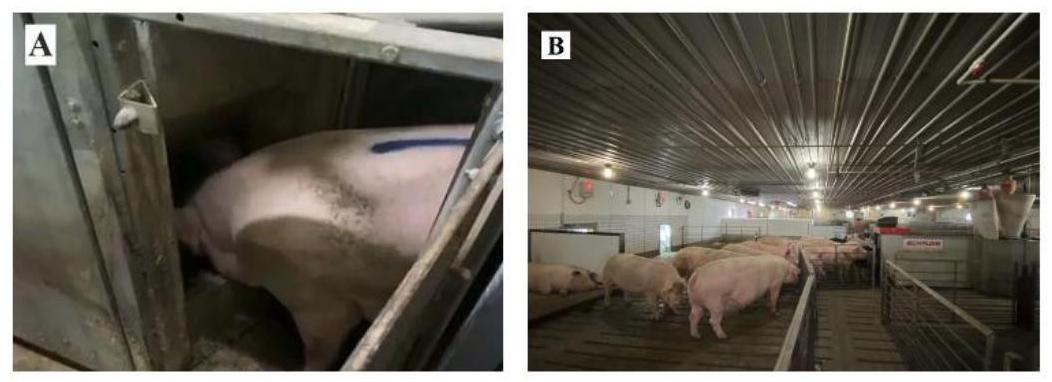
وحماية الخنازير أثناء التغذية. في الأنظمة التنافسية، قد تحتل الخنازير السائدة أماكن التغذية، مما يمنع الخنازير الخاضعة من الوصول إلى العلف. بالإضافة إلى ذلك، فإن التعديلات الفردية على العلف غالبًا ما تكون غير عملية. لمعالجة هذه المشكلة في الأنظمة التنافسية، تسمح حظائر الوصول الحر مع أبواب خلفية قابلة للقفل بدخول خنزير واحد فقط للتغذية في كل مرة. يوفر جهاز التغذية الإلكتروني للخنازير (ESF) حلاً آليًا للتغذية الفردية في أنظمة الإيواء الجماعي. عندما تدخل خنزير إلى جهاز التغذية، يقوم قارئ تحديد الهوية بتردد الراديو بالتعرف عليها ويقوم بتوزيع العلف وفقًا للإعدادات المبرمجة مسبقًا والمخصصة لاحتياجات الحيوانات. يقدم هذا النظام مرونة في تكوينات الأقفاص وهو مناسب لكل من الأحجام الصغيرة والكبيرة من المجموعات. ومع ذلك، يتطلب تنفيذه تركيبًا مكلفًا، وحيوانات مدربة، وموظفين ذوي خبرة لإدارة أجهزة التغذية. في نظام ESF، غالبًا ما تصطف الخنازير للوصول إلى العلف، مما يؤدي إلى العدوانية وإمكانية حدوث إصابات. لاحظ أولسون وآخرون (2011) أن مدة إعدادات التغذية تؤثر بشكل كبير على سلوك الاصطفاف ووقوع عض الفرج. كما تؤدي أوقات التغذية الأطول إلى الازدحام، مما يقلل من سعة أجهزة التغذية بشكل عام. تؤكد هذه النتائج على الديناميات التنافسية والمحبطة لتفاعلات الخنازير من أجل العلف داخل نظام ESF. إن الإدارة السليمة لإعدادات العلف، وعدد أجهزة التغذية، والتصميم، والموقع، ومستويات التغذية أمر ضروري للتخفيف من مشاكل الاصطفاف في أنظمة الإيواء الجماعي باستخدام ESF.
لديهم إصابات جلدية أعلى مقارنةً بأولئك الذين لديهم نسبة واحد إلى واحد (أنجرمان وآخرون، 2021). تسلط هذه النتائج الضوء على أهمية توفر المغذيات في التخفيف من عدوانية الخنازير أثناء التغذية مع زيادة حجم المجموعة. لذلك، فإن أحجام المجموعات الكبيرة مع إدارة تغذية غير مناسبة تشكل عامل خطر محتملاً لتطور الإجهاد المزمن في أنظمة الإسكان الجماعي.
محطة شرب الماء. كل محطة تغذية تقيس
أي ارتباط بين إصابات الجلد بعد ثلاثة أسابيع من الخلط وتركيزات الكورتيزول في الشعر.
أداء التكاثر للخنازير في أنظمة الإسكان الجماعي خلال الحمل
تأكيد الحمل (35 يومًا بعد التلقيح) إلى معدلات ولادة قابلة للمقارنة بتلك الموجودة في الصناديق. تم ملاحظة فوائد محتملة لمعدل الولادة وحجم الولادة في الخنازير عالية الإنتاجية المرباة في مجموعات عند خلطها بعد تأكيد الحمل (38 إلى 42 يومًا من الحمل) مقارنة بنظام الصناديق (بيريني وآخرون، 2021). يتطلب الإدارة الفعالة للخنازير خلال الحمل المبكر مساحة كافية واستراتيجيات تغذية لتعزيز الشبع وتقليل شدة إعادة الهيكلة الاجتماعية بعد الخلط.
نظام الولادة الحرة
مرتبط بزيادة النشاط داخل الحظيرة. يسبب الاحتجاز أثناء الولادة تأثيرات سلبية على سلوك الخنزير، مما يؤدي إلى مستويات أعلى من السلوكيات النمطية، وتقليل بناء الأعشاش، وتغير الاستجابة تجاه الخنازير الصغيرة، واضطراب سلوك الرضاعة والاستلقاء (سانشيز-سالcedo ويانيس-بيزانا، 2024). يمكن أن تؤثر هذه التأثيرات سلبًا على صحة الأم بعد الولادة وتزيد من معدل وفيات الخنازير الصغيرة.
| دراسة | الإسكان الحمل | نظام التغذية | حجم المجموعة | وقت الخلط (د) | مساحة السماح
|
معدل الولادة (%) | السل | با | SB | بلد |
| صندوق | – | – | – | 1.3 | – | 12.9 | 12.1* | 0.7 | ||
| إستييان وهاربر (2010) | مجموعة | إطعام على الأرض | خمسة إلى ستة | 0 | 2.6 إلى 3.2 | – | 11.6 | 9.1* | 1.7 | الولايات المتحدة الأمريكية |
| مجموعة | إطعام على الأرض | خمسة إلى ستة | 30 | 2.6 إلى 3.2 | – | 12.9 | 11.3* | 0.6 | ||
| صندوق | من خلال | – | – | 1.3 | – | غير متوفر | غير متوفر | 1.2* | ||
| تشابينال وآخرون (2010أ) | مجموعة | ESF غير محمي | 10 | – | 2.3 | – | غير متوفر | غير متوفر | 0.5* | إسبانيا |
| مجموعة | تغذية بالتقطير | 10 | – | 2.3 | – | غير متوفر | غير متوفر | 1.0* | ||
| صندوق | – | – | – | 1.2 | 87.5 | 13.4 | 11.1 | 1.9 | ||
| تشاو وآخرون (2013) | مجموعة | – | ٣ | ٣٥ | 2.5 | 86.5 | 12.4 | 10.4 | 1.7 | الولايات المتحدة الأمريكية |
| صندوق | من خلال | – | – | 1.2 | 97.6* | ١٣.١ | 12.3 | 0.9 | ||
| جونستون ولي (2013) | مجموعة | تغذية الأرض | 26 | ٣٥ | 1.5 | 92.2* | ١٣.٢ | 12.5 | 0.7 | الولايات المتحدة الأمريكية |
| مجموعة | تغذية الأرض | ٦ | ٣٥ | 1.5 | 94.8* | 13.1 | 12.2 | 0.9 | ||
| صندوق | – | – | – | 1.3 | 92.8* | 12.4 | 11.8 | 0.6 | ||
| نوكس وآخرون | مجموعة | ESF | ٥٨ | 3 إلى 7 | 1.7 | 82.8* | 11.9 | ١١.٣ | 0.5 | |
| (2014) | مجموعة | ESF | ٥٨ | 13 إلى 17 | 1.7 | 87.8* | 12.4 | 11.6 | 0.7 | الولايات المتحدة الأمريكية |
| مجموعة | ESF | ٥٨ | ٣٥ | 1.7 | 90.5* | 12.2 | 11.5 | 0.6 | ||
| لي وآخرون | صندوق | – | – | – | 1.3 | – | 12.3 | 11.5 | 0.7 | الولايات المتحدة الأمريكية |
| (2014) | مجموعة | ESF | 50 | ٧ | 2.2 | – | 11.9 | 11.0 | 0.8 | |
| تشو وآخرون | صندوق | – | – | – | 1.2 | – | – | 10.2^ | 0.7 | |
| (2014) | مجموعة | – | ٤ | – | 2.5 | – | – |
|
0.6 | الصين |
| جانغ وآخرون | صندوق | – | – | – | 1.3 | 97.6* | 11.4 | 10.6 | 0.7 | جنوب |
| (2015) | مجموعة | ESF | 42 | ٣٥ | 3.8 | 95.2* | 11.5 | 10.8 | 0.6 | كوريا |
| كيم وآخرون | صندوق | – | – | – | 1.4 | – | 11.5 | 10.0 | – | جنوب |
| (2016) | مجموعة | – | 16 | ٨٠ | ٣.٥ | – | 11.5 | 10.2 | – | كوريا |
| رين وآخرون | صندوق | – | – | – | 1.3 | – | 14.9 | ١٣.٠ | 1.2 | الولايات المتحدة الأمريكية |
| (2018) | مجموعة | ESF | ٥٥ | ٣٥ | 2.2 | – | 14.9 | 13.4 | 1.1 | |
| تشوي وآخرون | صندوق | – | – | – | 1.2 | – | 11.9 | 11.4 |
|
|
| (2018) | مجموعة | ESF | ٢٨ | – | 1.3 | – | 11.9 | 10.6 |
|
الولايات المتحدة الأمريكية |
| دروب | ||||||||||
| صندوق | ميت في | – | – | 1.3 | 89.7* | 14.8 | 12.1 | 1.5* | ||
| كونها وآخرون (2018) | البرازيل | |||||||||
| مجموعة | ESF | ٥٥ | 70 | ٢.٢ | 83.2* | 14.8 | 12.6 | 1.2* | ||
| مجموعة | ESF | ٥٥ | 30 | 2.2 | 84.9* | 14.6 | 12.4 | 1.4* | ||
| صندوق | – | – | – | 1.5 | – | 12.0 | 10.9 | 1.0 | ||
| مين وآخرون (2020) | مجموعة | ESF غير محمي | 10 | ٥٦ | ٢.٤ | – | 10.8 | 10.1 | 0.4 | كوريا الجنوبية |
| مجموعة | فاس | 10 | ٥٦ | 2.5 | – | 11.3 | 9.8 | 1.3 | ||
| مجموعة | ESF | 10 | ٥٦ | 2.8 | – | 13.1 | 11.0 | 1.4 | ||
| جونغ وآخرون | صندوق | من خلال | – | 30 | 1.5 | – | 12.1 | 11.0 | 1.1 | جنوب |
| (2020) | مجموعة | فاس | ٢٥ | 30 | ٢.٤ | – | 12.3 | 11.2 | 1.2 | كوريا |
| شوارز إت | صندوق | – | – | – | 2.2 | 82.0* | 11.6* | 11.4* | 0.3* | |
| ال. (2021) | مجموعة | – | ٧ إلى ٨ | عند الفطام | 3.0 إلى 3.4 | 85.3* | 12.2 | 11.6* | 0.5* | بولندا |
| كابوفرّي إت | صندوق | – | – | – | – | 88.0* | 12.0 | 11.0 | – | |
| ال. (2021) | مجموعة | ESF | 60 | 1 | 2.2 | 78.0* | 12.0 | 11.0 | – | إيطاليا |
| بيريني وآخرون | صندوق | – | – | – | 1.3 | 91.7* | 14.2* | 11.7* | 0.3* | |
| مجموعة | ESF | ٨٠ | 3 إلى 5 | 2.2 | غير متوفر | 15.0* | 12.6 | 0.3* | البرازيل | |
| (2021) | مجموعة | ESF | ٨٠ | ٣٨ إلى ٤٢ | 2.2 | 92.6* | 14.9* | 12.5* | 0.3* |
يمكن أن تؤثر التغيرات، مثل الاستلقاء والدوران، بشكل مباشر على معدل وفيات الخنازير الصغيرة (دام et al.، 2005). تحدث حوادث السحق بشكل رئيسي خلال الأيام الثلاثة الأولى من حياة الخنازير الصغيرة (دومنييم et al.، 2023)، حيث تكون الخنازير الصغيرة المسحوقة غالبًا أخف وزنًا عند الولادة وأقل قابلية للحياة من تلك التي تنجو (سبوري-فونتوبل et al.، 2023). يمكن أن تساعد تخصيص المساحة المناسبة وتعديلات تصميم الحظائر في التخفيف من تغييرات وضعية الخنازير الأم. على سبيل المثال، فإن توفير جدران دعم للخنزير الأم لتت lean against قبل الاستلقاء يعزز استجابة الأم ويقلل من خطر سحق الخنازير الصغيرة (دام et al.، 2005؛ زينغ وزانغ، 2023). لذلك، فإن ممارسات الإدارة التي تقلل من التداخل المفاجئ من قبل الخنازير الأم وتضمن تناول كافٍ من اللبأ للخنازير الصغيرة حديثة الولادة ضرورية في أنظمة الولادة الحرة (دومنييم et al.، 2024).
معدل وفيات الخنازير الصغيرة قبل الفطام
بسبب الصدمة. من المحتمل أن تتعرض هذه الخنازير الصغيرة للضغط من قبل الأم، حيث تحدث معظم الوفيات في اليوم الأول من الحياة. وقد شملت النتائج المرضية في الخنازير الصغيرة الم crushedة الكدمات، وتمزق الكبد، والنزيف الداخلي في الصدر و/أو البطن، ولسان بارز (Chidgey et al., 2022). نسبة أكبر بكثير من الخنازير الصغيرة تتعرض للضغط من قبل الأمهات في أنظمة الولادة الحرة مقارنة بأنظمة الأقفاص التقليدية، كما تم الإبلاغ عنه في دراسات في المناطق المعتدلة والاستوائية (Dumniem et al., 2023). في الصين،
شكر وتقدير
References
Adi YK, Boonprakob R, Kirkwood RN and Tummaruk P 2024. Factors affecting birth weight and stillbirth in sows housed in a tropical environment. Reprod Domest Anim. 59: e14500.
Akkhaphan T, Boonprakob R, Grahofer A and Tummaruk P 2025. Seasonal effect on farrowing duration in sows within a temporarily confined farrowing system under tropical climates. Theriogenology. 238: 117364.
Angermann E, Raoult CMC, Wensch-Dorendorf M, Frenking S, Kemper N and von Borell E 2021. Development of a group-adapted housing system for pregnant sows: A field study on performance and welfare aspects. Agriculture. 11: 28.
Anil L, Anil SS, Deen J, Baidoo SK and Walker RD 2006. Effect of group size and structure on the welfare and performance of pregnant sows in pens with electronic sow feeders. Can J Vet Res. 70: 128-136.
Arey D and Edwards S 1998. Factors influencing aggression between sows after mixing and the consequences for welfare and production. Livest Prod Sci. 56: 61-70.
Baxter EM, Adeleye OO, Jack MC, Farish M, Ison SH and Edwards SA 2015. Achieving optimum performance in a loose-housed farrowing system for sows: The effects of space and temperature. Appl Anim Behav Sci. 169: 9-16.
Baxter EM, Moustsen VA, Goumon S, Illmann G and Edwards SA 2022. Transitioning from crates to free farrowing: A roadmap to navigate key decisions. Front Vet Sci. 9: 998192.
Bortolozzo FP, Zanin GP, Ulguim RD and Mellagi APG 2023. Managing reproduction in hyperprolific sow herds. Animals. 13: 1842.
Brajon S, Ahloy-Dallaire J, Devillers N and Guay F 2021. Social status and previous experience in the group as predictors of welfare of sows housed in large semi-static groups. PLoS One. 16: e0244704.
Brito AA, da Silva NAM, Alvarenga Dias ALN and Nascimento MRBM 2022. Heat wave exposure impairs reproductive performance in primiparous sows and gilts in a tropical environment. Int J Biometeorol. 66: 2417-2424.
Bumpenkul R and Imboonta N 2021. Genetic correlations between gestation length and litter traits of sows. Thai J Vet Med. 51: 675-682.
Capoferri R, Parati K, Puglisi R, Moscati L, Sensi M, Lombardi G, Sandri G, Briani C and Galli A 2021. Comparison between single- and group-housed pregnant sows for direct and indirect physiological, reproductive, welfare indicators and gene expression profiling. J Appl Anim Welf Sci. 24: 246259.
Chapinal N, de la Torre JLR, Cerisuelo A, Gasa J, Baucells MD, Coma J, Vidal A and Manteca X 2010a. Evaluation of welfare and productivity in pregnant sows kept in stalls or in 2 different group housing systems. J Vet Behav. 5: 82-93.
Chapinal N, Ruiz-De-La-Torre JL, Cerisuelo A, Gasa J, Baucells MD and Manteca X 2010b. Aggressive behavior in two different group-housing systems for pregnant sows. J Appl Anim Welf Sci. 13: 137153.
Choe J, Kim S, Cho JH, Lee JJ, Park S, Kim B, Kim J, Baidoo SK, Oh S, Kim HB and Song M 2018. Effects of different gestation housing types on reproductive performance of sows. Anim Sci J. 89: 722-726.
Cronin G, Barnett J, Hodge F, Smith J and McCallum T 1991. The welfare of pigs in two farrowing/lactation environments: cortisol responses of sows. Appl Anim Behav Sci. 32: 117127.
D’Eath RB and Turner SP 2009. The natural behaviour of the pig. In: The Welfare of Pigs. Marchant-Forde JN (ed). Dordrecht: Springer 13-45.
Damm BI, Forkman B and Pedersen LJ 2005. Lying down and rolling behaviour in sows in relation to piglet crushing. Appl Anim Behav Sci. 90: 3-20.
Damm BI, Lisborg L, Vestergaard KS and Vanicek J 2003. Nest-building, behavioural disturbances and heart rate in farrowing sows kept in crates and Schmid pens. Livest Prod Sci. 80: 175-187.
de Castro Lippi IC, Caldara FR, de Lima Almeida Paz IC and Odakura AM 2022. Global and Brazilian scenario of guidelines and legislation on welfare in pig farming. Animals. 12: 2615.
Dumniem N, Boonprakob R, Panvichitra C, Thongmark S, Laohanarathip N, Parnitvoraphoom T, Changduangjit S, Boonmakaew T, Teshanukroh N and Tummaruk P 2024. Impacts of fiber supplementation in sows during the transition period on constipation, farrowing duration, colostrum production, and pre-weaning piglet mortality in the free-farrowing system. Animals. 14: 854.
Dumniem N, Parsons TD and Tummaruk P 2025. Feeding levels during early gestation in a grouphousing system for primiparous sows: Impact on piglet birthweight and litter uniformity. Anim Biosci. 38: 360-370.
Dumniem N, Boonprakob R, Parsons TD and Tummaruk P 2023. Pen versus crate: A comparative study on the effects of different farrowing systems
on farrowing performance, colostrum yield and piglet preweaning mortality in sows under tropical conditions. Animals. 13: 233.
Einarsson S, Sjunnesson Y, Hulten F, Eliasson-Selling L, Dalin AM, Lundeheim N and Magnusson U 2014. A 25 years experience of group-housed sowsreproduction in animal welfare-friendly systems. Acta Vet Scand. 56: 37.
Estienne MJ and Harper AF 2010. Type of accommodation during gestation affects growth performance and reproductive characteristics of gilt offspring. J Anim Sci. 88: 400-407.
Ferreira SV, Rodrigues LA, Ferreira MA, Alkmin DV, Dementshuk JM, Almeida RFCL and Fontes DO 2021. Plane of nutrition during gestation affects reproductive performance and retention rate of hyperprolific sows under commercial conditions. Animal. 15: 100153.
Glencorse D, Plush K, Hazel S, D’Souza D and Hebart M 2019. Impact of non-confinement accommodation on farrowing performance: A systematic review and meta-analysis of farrowing crates versus pens. Animals. 9: 957.
Goumon S, Illmann G, Moustsen VA, Baxter EM and Edwards SA 2022. Review of temporary crating of farrowing and lactating sows. Front Vet Sci. 9: 811810.
Greenwood EC, Plush KJ, van Wettere WHEJ and Hughes PE 2016. Group and individual sow behavior is altered in early gestation by space allowance in the days immediately following grouping. J Anim Sci. 94: 385-393.
Gu ZB, Gao YJ, Lin BZ, Zhong ZZ, Liu ZH, Wang CY and Li BM 2011. Impacts of a freedom farrowing pen design on sow behaviours and performance. Prev Vet Med. 102: 296-303.
Hemsworth PH, Rice M, Nash J, Giri K, Butler KL, Tilbrook AJ and Morrison RS 2013. Effects of group size and floor space allowance on grouped sows: Aggression, stress, skin injuries, and reproductive performance. J Anim Sci. 91: 4953-4964.
Hulbert LE and McGlone JJ 2006. Evaluation of drop versus trickle-feeding systems for crated or grouppenned gestating sows. J Anim Sci. 84: 1004-1014.
Illmann G, Chaloupková H and Melisová M 2016. Impact of sow prepartum behavior on maternal behavior, piglet body weight gain, and mortality in farrowing pens and crates. J Anim Sci. 94: 39783986.
Jarvis S, Lawrence AB, McLean KA, Deans LA, Chirnside J and Calvert SK 1997. The effect of environment on behavioural activity, ACTH, (
Jensen TB, Bonde MK, Kongsted AG, Toft N and Sorensen JT 2010. The interrelationships between clinical signs and their effect on involuntary culling among pregnant sows in group-housing systems. Animal. 4: 1922-1928.
Jeong Y, Choi Y, Kim D, Kim J, Min Y, Jung H and Kim Y 2020. Improving behavior characteristics and stress indices of gestating sows housed with group housing facility. J Anim Sci Technol. 62: 875-883.
Johnston LJ and Li YZ 2013. Performance and wellbeing of sows housed in pens retrofitted from gestation stalls. J Anim Sci. 91: 5937-5945.
Juthamanee
Kielland C, Wisloff H, Valheim M, Fauske AK, Reksen O and Framstad T 2018. Preweaning mortality in piglets in loose-housed herds: etiology and prevalence. Animal. 12: 1950-1957.
Kim KH, Hosseindoust A, Ingale SL, Lee SH, Noh HS, Choi YH, Jeon SM, Kim YH and Chae BJ 2016b. Effects of gestational housing on reproductive performance and behavior of sows with different backfat thickness. Asian-Australas J Anim Sci. 29: 142-148.
Kinane O, Butler F and O’Driscoll K 2021. Freedom to grow: Improving sow welfare also benefits piglets. Animals. 11: 1181.
Kinane O, Butler F and O’Driscoll K 2022. Freedom to move: Free lactation pens improve sow welfare. Animals. 12: 1762.
Kirkwood RN, Langendijk P and Carr J 2021. Management str Management strategies for impr ategies for improving sur ving survival of piglets fr al of piglets from hyperprolific sows. Thai J Vet Med. 51: 629-636.
Knox R, Salak-Johnson J, Hopgood M, Greiner L and Connor J 2014. Effect of day of mixing gestating sows on measures of reproductive performance and animal welfare. J Anim Sci. 92: 1698-1707.
Koketsu Y and Iida R 2017. Sow housing associated with reproductive performance in breeding herds. Mol Reprod Dev. 84: 979-986.
Lagoda ME, Marchewka J, O’Driscoll K and Boyle LA 2022. Risk factors for chronic stress in sows housed in groups, and associated risks of prenatal stress in their offspring. Front Vet Sci. 9: 883154.
Lagoda ME, O’Driscoll K, Marchewka J, Foister S, Turner SP and Boyle LA 2021. Associations between skin lesion counts, hair cortisol concentrations and reproductive performance in group housed sows. Livest Sci. 246: 104463.
Langendijk P 2021. Latest advances in sow nutrition during early gestation. Animals. 11: 1720.
Laothong K, Kamlangsaeng S, Laipasu K, Tirakarn K and Tummaruk P 2024. Colostrum intake and neonatal characteristics in piglets experiencing varying lengths of expulsion phase. Theriogenology. 227: 128-137.
Li X, Baidoo SK, Li YZ, Shurson GC and Johnston LJ 2014. Interactive effects of distillers dried grains
with solubles and housing system on reproductive performance and longevity of sows over three reproductive cycles. J Anim Sci. 92: 1562-1573.
Loftus L, Bell G, Padmore E, Atkinson S, Henworth A and Hoyle M 2020. The effect of two different farrowing systems on sow behaviour, and piglet behaviour, mortality and growth. Appl Anim Behav Sci. 232: 105102.
Maes D, Pluym L and Peltoniemi O 2016. Impact of group housing of pregnant sows on health. Porcine Health Manag. 2: 17.
Maria N, Jinhyeon Y, Shah HS, Stefan B, Anna V, Nicoline S, Chantal F and Olli P 2023. Sow nestbuilding behavior in communal farrowing relates to productivity and litter size. Appl Anim Behav Sci. 269: 106117.
McGlone JJ 2013. Updated scientific evidence on the welfare of gestating sows kept in different housing systems. Prof Anim Sci. 29: 189-198.
Melchior R, Zanella I, Lovatto PA, Lehnen CR, Lanferdini E and Andretta I 2012. Meta-analysis on the relationship among feeding characteristics, salivary and plasmatic cortisol levels, and performance of pregnant sows housed in different systems. Livest Sci. 150: 310-315.
Min Y, Choi Y, Kim J, Kim D, Jeong Y, Kim Y, Song M and Jung H 2020. Comparison of the productivity of primiparous sows housed in individual stalls and group housing systems. Animals. 10: 1940.
Muns R, Nuntapaitoon M and Tummaruk P 2016. Noninfectious causes of pre-weaning mortality in piglets. Livest Sci. 184: 46-57.
Muns Vila R and Tummaruk P 2016. Management strategies in farrowing house to improve piglet preweaning survival and growth. Thai J Vet Med. 46: 347-354.
Oliviero C, Heinonen A, Valros A, Hälli O and Peltoniemi OAT 2008. Effect of the environment on the physiology of the sow during late pregnancy, farrowing and early lactation. Anim Reprod Sci. 105: 365-377.
Olsson AC, Andersson M, Botermans J, Rantzer D and Svendsen J 2011. Animal interaction and response to electronic sow feeding (ESF) in 3 different herds and effects of function settings to increase capacity. Livest Sci. 137: 268-272.
Peltoniemi O, Bjorkman S and Maes D 2016. Reproduction of group-housed sows. Porcine Health Manag. 2: 15.
Perini JEGN, Ludtke CB, Tanure CB, Seixas L, Peripolli V and McManus C 2021. Effect of housing system during pregnancy on reproductive parameters of sows. Arq Bras Med Vet Zootec. 73: 123-131.
Plush KJ, Hewitt RJ, D’Souza DN and van Barneveld RJ 2024. Review: Towards truly stall free pork production?. Animal. 18: 101002.
Prasomsri P 2022. Effect of lameness on daily milk yield in dairy cow. Thai J Vet Med. 52: 679-687.
Razdan P, Tummaruk P, Kindahl H, RodriguezMartinez H, Hulten F and Einarsson S 2004. Hormonal profiles and embryo survival of sows subjected to induced stress during days 13 and 14 of pregnancy. Anim Reprod Sci. 81: 295-312.
Ren P, Yang XJ, Railton R, Jendza J, Anil L and Baidoo SK 2018. Effects of different levels of feed intake
during four short periods of gestation and housing systems on sows and litter performance. Anim Reprod Sci. 188: 21-34.
Rhodes RT, Appleby MC, Chinn K, Douglas L, Firkins LD, Houpt KA, Irwin C, McGlone JJ, Sundberg P, Tokach L and Wills RW 2005. A comprehensive review of housing for pregnant sows. J Am Vet Med Assoc. 227: 1580-1590.
Ryan EB, Fraser D and Weary DM 2015. Public attitudes to housing systems for pregnant pigs. PLoS One. 10: e0141878.
Salak-Johnson JL 2017. Social status and housing factors affect reproductive performance of pregnant sows in groups. Mol Reprod Dev. 84: 905913.
Schalk C, Pfaffinger B, Schmucker S, Weiler U and Stefanski V 2018. Effects of repeated social mixing on behavior and blood immune cells of grouphoused pregnant sows (Sus scrofa domestica). Livest Sci. 217: 148-156.
Schütz A, Busch G and Sonntag WI 2023. Systematically analyzing the acceptability of pig farming systems with different animal welfare levels when considering intra-sustainability tradeoffs: Are citizens willing to compromise?. PLoS One. 18: e0282530.
Schwarz T, Malopolska M, Nowicki J, Tuz R, Lazic S, Kopyra M and Bartlewski PM 2021. Effects of individual versus group housing system during the weaning-to-estrus interval on reproductive performance of sows. Animal. 15: 100122.
Séguin MJ, Barney D and Widowski TM 2005. Assessment of a group-housing system for gestating sows: Effects of space allowance and pen size on the incidence of superficial skin lesions, changes in body condition, and farrowing performance. J Swine Health Prod. 14: 89-96.
Spoolder HAM, Geudeke MJ, Van der Peet-Schwering CMC and Soede NM 2009. Group housing of sows in early pregnancy: A review of success and risk factors. Livest Sci. 125: 1-14.
Sporri-Vontobel C, Simmler M, Wechsler B and Scriba MF 2023. Risk factors differ for viable and low viable crushed piglets in free farrowing pens. Front Vet Sci. 10: 1172446.
Stevens B, Karlen GM, Morrison R, Gonyou HW, Butler KL, Kerswell KJ and Hemsworth PH 2015. Effects of stage of gestation at mixing on aggression, injuries and stress in sows. Appl Anim Behav Sci. 165: 40-46.
Thiengpimol P , Koonawootrittriron S and Suwanasopee T 2024. Assessing reproductive performance and predictive models for litter size in Landrace sows under tropical conditions. Anim Biosci. 37: 1333-1344.
Tripipat T, Saeng-Chuto K, Madapong A, Stott CJ, Tantituvanont A, Kaewprommal P, Piriyapongsa J and Nilubol D 2021. Dynamics and evolution of genotype 1 porcine reproductive and respiratory syndrome virus following its introduction into a
herd concurrently infected with genotypes 1 and 2 . Thai J Vet Med. 51: 519-529.
Tummaruk P, De Rensis F and Kirkwood RN 2023. Managing prolific sows in tropical environments. Mol Reprod Dev. 90: 533-545.
Tummaruk P, Tantasuparuk W, Techakumphu M and Kunavongkrit A 2010. Seasonal influences on the litter size at birth of pigs are more pronounced in the gilt than sow litters. J Agric Sci. 148: 421-432.
Tuyttens FAM, Van Gansbeke S and Ampe B 2011. Survey among Belgian pig producers about the introduction of group housing systems for gestating sows. J Anim Sci. 89: 845-855.
Vandresen B and Hotzel MJ 2021. “Mothers should have freedom of movement”-Citizens’ attitudes regarding farrowing housing systems for sows and their piglets. Animals. 11: 3439.
Verdon M, Hansen CF, Rault JL, Jongman E, Hansen LU, Plush K and Hemsworth PH 2015. Effects of group housing on sow welfare: a review. J Anim Sci. 93: 1999-2017.
Verdon M, Morrison R, Rice M and Hemsworth P 2016. Individual variation in sow aggressive behavior and its relationship with sow welfare. J Anim Sci. 94: 1203-1214.
Visetnoi S and Nelles W 2014. Higher education and sustainability in Thailand: a review of National Research University roles in sustainable agriculture education. Int Soc Sci J. 65: 185-198.
Visetnoi S and Nelles W 2023. Can organic pork help achieve sustainable development goals in Thailand?. Agriculture. 13: 1822.
Weber R, Keil NM, Fehr M and Horat R 2009. Factors affecting piglet mortality in loose farrowing systems on commercial farms. Livest Sci. 124: 216222.
Yun J, Swan KM, Oliviero C, Peltoniemi O and Valros A 2015. Effects of prepartum housing environment on abnormal behaviour, the farrowing process, and interactions with circulating oxytocin in sows. Appl Anim Behav Sci. 162: 20-25.
Yun J, Swan KM, Vienola K, Farmer C, Oliviero C, Peltoniemi O and Valros A 2013. Nest-building in sows: Effects of farrowing housing on hormonal modulation of maternal characteristics. Appl Anim Behav Sci. 148: 77-84.
Zeng FW and Zhang SQ 2023. Impacts of sow behaviour on reproductive performance: current understanding. J Appl Anim Res. 51: 256-264.
Zhao Y, Flowers WL, Saraiva A, Yeum KJ and Kim SW 2013. Effect of social ranks and gestation housing systems on oxidative stress status, reproductive performance, and immune status of sows. J Anim Sci. 91: 5848-5858.
Zhou Q, Sun Q, Wang G, Zhou B, Lu M, Marchant JN, Yang X and Zhao R 2014. Group housing during gestation affects the behaviour of sows and the physiological indices of offspring at weaning. Animal. 8: 1162-1169.
- Keywords: animal welfare, housing system, pig, reproduction, tropics
Department of Obstetrics, Gynaecology and Reproduction, Faculty of Veterinary Science, Chulalongkorn University, Bangkok 10330, Thailand
Swine Teaching and Research Unit – New Bolton Center, School of Veterinary Medicine, University of Pennsylvania, Kennett Square, PA 19348, USA
Centre of Excellence in Swine Reproduction, Chulalongkorn University, Bangkok 10330, Thailand
*Correspondence: natchanon.d@chula.ac.th (N. Dumniem) indicated , * indicated .
‘-‘ indicated no available data, and ‘‘ indicated data was mentioned, but no actual number was provided.
the total number of piglets born per litter, the number of piglets born alive per litter, the number of stillborn piglets per litter, electronic sow feeder, free access stalls.
DOI: https://doi.org/10.56808/2985-1130.3785
Publication Date: 2025-04-10
The Thai Journal of Veterinary Medicine
Issue 2 April – June
Article 1
Advantages, disadvantages, and factors influencing the reproductive performance of gilts and sows raised in gestational group housing and free-farrowing systems
Department of Obstetrics, Gynaecology and Reproduction, Faculty of Veterinary Science, Chulalongkorn University, natchanon.tul@gmail.com
Part of the Animal Sciences Commons
Recommended Citation
DOI: https://doi.org/10.56808/2985-1130.3785
Available at: https://digital.car.chula.ac.th/tjvm/vol55/iss2/1
Advantages, disadvantages, and factors influencing the reproductive performance of gilts and sows raised in gestational group housing and freefarrowing systems
Cover Page Footnote
Advantages, disadvantages, and factors influencing the reproductive performance of gilts and sows raised in gestational group housing and free-farrowing systems
Abstract
In the modern global pig industry, there is a growing interest in animal-friendly agriculture, encouraging farmers to prioritize humane practices and meet the welfare needs of their animals. In developed countries, consumers are increasingly concerned about animal welfare, particularly regarding pigs as social animals, advocating for their housing in groups that reflect their natural behaviors in the wild. There is significant societal pressure to eliminate the use of crate systems, which cause discomfort to animals in commercial farming. In these systems, breeding females are often restricted in movement throughout the reproductive cycle. As a result, alternative husbandry and housing systems have been developed to improve animal welfare and allow the expression of natural behaviors under semi-natural conditions. One such approach is the adoption of group housing systems for pregnant pigs and loose housing systems during farrowing and lactation. These systems provide breeding females with greater freedom of movement by enabling group rearing and increasing the space allocated per animal. Thailand has emerged as a significant pork producer in tropical Southeast Asia, but the use of gestation stalls and farrowing crates remains common across commercial swine herds. Over the past decade, there has been a growing interest among the Thai public and society in farm animal welfare. Consequently, there is a need for a comprehensive understanding of management practices for alternative systems to facilitate the transition from crate systems to loose housing systems. This presents a significant opportunity for novel research aimed at investigating the effects of alternative housing systems on health, reproduction, and productivity in female breeders under tropical conditions. This review aims to update the existing knowledge on the advantages, disadvantages, and factors influencing the reproductive performance of gilts and sows raised in gestational group housing and free-farrowing systems within the modern swine industry under tropical conditions.
Accepted March 19, 2025
Introduction
stakeholders, including pork producers, the public, consumers, government agencies, and academic institutions, before implementing any policies (Visetnoi and Nelles, 2014). Therefore, there is a need for a comprehensive understanding of management practices in alternative systems to facilitate the transition from crate systems to loose housing systems (Dumniem et al., 2023). This highlights the significant opportunity for novel research to evaluate the effects of alternative housing systems on health, reproduction, and productivity in female breeders under tropical conditions. This review aims to update existing knowledge on the advantages, disadvantages, and factors influencing the reproductive performance of gilts and sows raised in gestational group housing and free-farrowing systems within the modern swine industry under tropical conditions.
Disadvantages of the conventional crate housing systems
stress, and compromised welfare for subordinate sows (D’Eath and Turner, 2009; Maes et al., 2016). These challenges underscore the need to consider factors of the housing system, particularly during the production stages associated with intense stress.
The global trend in animal welfare perspectives
Advantage of group housing system during gestation
2017). Currently, there is no universal consensus on the best designs and management practices for breeding females in group housing systems under tropical conditions. Therefore, several factors must be carefully considered before implementing this housing system to ensure a balance between sow productivity and welfare in tropical environments. Key considerations include the feeding system, group size, and the timing of group mixing.
2015). In tropical environments, increasing feeding levels in primiparous sows in a group-housed system during early pregnancy can effectively restore their body condition without any detrimental effects on subsequent litters (Dumniem et al., 2025). Increasing feed intake during the first 35 days of gestation from 1.9 to
and protect sows during feeding. In competitive systems, dominant sows may occupy feeders, preventing submissive sows from accessing feed. Additionally, individual feed adjustments are often impractical. To address this issue in competitive systems, free access stalls with lockable rear gates allow only one sow to feed at a time. The electronic sow feeder (ESF) provides an automated solution for individualized feeding in group housing systems (Fig. 1A). When a sow enters the feeder, a radio-frequency identification reader identifies her and dispenses feed according to pre-programmed settings tailored to animals’ needs. This system offers flexibility in pen configurations and is suitable for both small and large group sizes. However, its implementation requires costly installation, trained animals, and experienced staff to manage the feeders. In the ESF system, sows often queue to access the feed (Fig. 1B), leading to aggression and potential injuries (Chapinal et al., 2010b; Olsson et al., 2011). Olsson et al. (2011) observed that the duration of feeding settings significantly impacts queuing behavior and the incidence of vulva biting. Longer feeding times also lead to overcrowding, reducing overall feeder capacity. These findings underscore the competitive and frustrating dynamics of sow interactions for feed within the ESF system. Proper management of feed settings, feeder numbers, design, location, and feeding levels is essential to mitigate queuing issues in group housing systems using ESF.
have higher skin injuries compared to those with a one-to-one ratio (Angermann et al., 2021). These findings highlight the importance of feeder availability in mitigating sow aggression during feeding as group size increases. Therefore, large group sizes with inappropriate feeding management pose a potential risk factor for the development of chronic stress in group housing systems.
drinking water. Each feeding station measures
found no association between skin lesions three weeks after mixing and hair cortisol concentrations.
Reproductive performances of sows in group housing systems during gestation
pregnancy confirmation ( 35 days after insemination) resulted in farrowing rates comparable to those in crates. Potential benefits for farrowing rate and litter size have been observed in group-housed hyperprolific sows when mixed after pregnancy confirmation ( 38 to 42 days of gestation) compared to the crate system (Perini et al., 2021). Effective management of sows during early pregnancy requires adequate space and feeding strategies to promote satiety and reduce the intensity of social restructuring after mixing.
Free-farrowing system
linked to increased activity within the pen. Confinement during farrowing has negative impacts on sow behavior, leading to higher levels of stereotypies, reduced nest building, altered responsiveness toward piglets, and disrupted nursing and lying behaviors (Sánchez-Salcedo and YáñezPizaña, 2024). These effects can compromise maternal postpartum health and increase piglet mortality.
| Study | Gestational housing | Feeding system | Group size | Mixing time (d) | Space allowance (
|
Farrowing rate (%) | TB | BA | SB | Country |
| Crate | – | – | – | 1.3 | – | 12.9 | 12.1* | 0.7 | ||
| Estienne and Harper (2010) | Group | Floor feeding | 5 to 6 | 0 | 2.6 to 3.2 | – | 11.6 | 9.1* | 1.7 | USA |
| Group | Floor feeding | 5 to 6 | 30 | 2.6 to 3.2 | – | 12.9 | 11.3* | 0.6 | ||
| Crate | Through | – | – | 1.3 | – | n/a | n/a | 1.2* | ||
| Chapinal et al. (2010a) | Group | Unprote cted ESF | 10 | – | 2.3 | – | n/a | n/a | 0.5* | Spain |
| Group | Trickle feeding | 10 | – | 2.3 | – | n/a | n/a | 1.0* | ||
| Crate | – | – | – | 1.2 | 87.5 | 13.4 | 11.1 | 1.9 | ||
| Zhao et al. (2013) | Group | – | 3 | 35 | 2.5 | 86.5 | 12.4 | 10.4 | 1.7 | USA |
| Crate | Through | – | – | 1.2 | 97.6* | 13.1 | 12.3 | 0.9 | ||
| Johnston and Li (2013) | Group | Floor feeding | 26 | 35 | 1.5 | 92.2* | 13.2 | 12.5 | 0.7 | USA |
| Group | Floor feeding | 6 | 35 | 1.5 | 94.8* | 13.1 | 12.2 | 0.9 | ||
| Crate | – | – | – | 1.3 | 92.8* | 12.4 | 11.8 | 0.6 | ||
| Knox et al. | Group | ESF | 58 | 3 to 7 | 1.7 | 82.8* | 11.9 | 11.3 | 0.5 | |
| (2014) | Group | ESF | 58 | 13 to 17 | 1.7 | 87.8* | 12.4 | 11.6 | 0.7 | USA |
| Group | ESF | 58 | 35 | 1.7 | 90.5* | 12.2 | 11.5 | 0.6 | ||
| Li et al. | Crate | – | – | – | 1.3 | – | 12.3 | 11.5 | 0.7 | USA |
| (2014) | Group | ESF | 50 | 7 | 2.2 | – | 11.9 | 11.0 | 0.8 | |
| Zhou et al. | Crate | – | – | – | 1.2 | – | – | 10.2^ | 0.7 | |
| (2014) | Group | – | 4 | – | 2.5 | – | – |
|
0.6 | China |
| Jang et al. | Crate | – | – | – | 1.3 | 97.6* | 11.4 | 10.6 | 0.7 | South |
| (2015) | Group | ESF | 42 | 35 | 3.8 | 95.2* | 11.5 | 10.8 | 0.6 | Korea |
| Kim et al. | Crate | – | – | – | 1.4 | – | 11.5 | 10.0 | – | South |
| (2016) | Group | – | 16 | 80 | 3.5 | – | 11.5 | 10.2 | – | Korea |
| Ren et al. | Crate | – | – | – | 1.3 | – | 14.9 | 13.0 | 1.2 | USA |
| (2018) | Group | ESF | 55 | 35 | 2.2 | – | 14.9 | 13.4 | 1.1 | |
| Choe et al. | Crate | – | – | – | 1.2 | – | 11.9 | 11.4 |
|
|
| (2018) | Group | ESF | 28 | – | 1.3 | – | 11.9 | 10.6 |
|
USA |
| Droppe | ||||||||||
| Crate | dead at | – | – | 1.3 | 89.7* | 14.8 | 12.1 | 1.5* | ||
| Cunha et al. (2018) | Brazil | |||||||||
| Group | ESF | 55 | 70 | 2.2 | 83.2* | 14.8 | 12.6 | 1.2* | ||
| Group | ESF | 55 | 30 | 2.2 | 84.9* | 14.6 | 12.4 | 1.4* | ||
| Crate | – | – | – | 1.5 | – | 12.0 | 10.9 | 1.0 | ||
| Min et al. (2020) | Group | Unprote cted ESF | 10 | 56 | 2.4 | – | 10.8 | 10.1 | 0.4 | South Korea |
| Group | FAS | 10 | 56 | 2.5 | – | 11.3 | 9.8 | 1.3 | ||
| Group | ESF | 10 | 56 | 2.8 | – | 13.1 | 11.0 | 1.4 | ||
| Jeong et al. | Crate | Through | – | 30 | 1.5 | – | 12.1 | 11.0 | 1.1 | South |
| (2020) | Group | FAS | 25 | 30 | 2.4 | – | 12.3 | 11.2 | 1.2 | Korea |
| Schwarz et | Crate | – | – | – | 2.2 | 82.0* | 11.6* | 11.4* | 0.3* | |
| al. (2021) | Group | – | 7 to 8 | At wean | 3.0 to 3.4 | 85.3* | 12.2 | 11.6* | 0.5* | Poland |
| Capoferri et | Crate | – | – | – | – | 88.0* | 12.0 | 11.0 | – | |
| al. (2021) | Group | ESF | 60 | 1 | 2.2 | 78.0* | 12.0 | 11.0 | – | Italy |
| Perini et al. | Crate | – | – | – | 1.3 | 91.7* | 14.2* | 11.7* | 0.3* | |
| Group | ESF | 80 | 3 to 5 | 2.2 | n/a | 15.0* | 12.6 | 0.3* | Brazil | |
| (2021) | Group | ESF | 80 | 38 to 42 | 2.2 | 92.6* | 14.9* | 12.5* | 0.3* |
changes, such as lying down and rolling, can directly impact piglet mortality (Damm et al., 2005). Crushing incidents predominantly occur within the first three days of piglet life (Dumniem et al., 2023), with crushed piglets often being lighter at birth and less viable than those that survive (Sporri-Vontobel et al., 2023). Proper space allocation and pen design adjustments can help mitigate sow postural changes. For example, providing support walls for the sow to lean against before lying down enhances maternal responsiveness and reduces the risk of piglet crushing (Damm et al., 2005; Zeng and Zhang, 2023). Therefore, management practices that minimize sudden overlaying by sows and ensure adequate colostrum intake for newborn piglets are essential in free-farrowing systems (Dumniem et al., 2024).
Piglets preweaning mortality
due to trauma. These piglets are likely to be overlain by the sow, with most deaths occurring within the first day of life. Pathological findings in crushed piglets have included bruising, liver rupture, internal bleeding in the thorax and/or abdomen, and protruding tongues (Chidgey et al., 2022). A significantly higher proportion of piglets are crushed by sows in freefarrowing systems compared to conventional crate systems, as reported in both temperate and tropical studies (Dumniem et al., 2023). In China,
Acknowledgments
References
Adi YK, Boonprakob R, Kirkwood RN and Tummaruk P 2024. Factors affecting birth weight and stillbirth in sows housed in a tropical environment. Reprod Domest Anim. 59: e14500.
Akkhaphan T, Boonprakob R, Grahofer A and Tummaruk P 2025. Seasonal effect on farrowing duration in sows within a temporarily confined farrowing system under tropical climates. Theriogenology. 238: 117364.
Angermann E, Raoult CMC, Wensch-Dorendorf M, Frenking S, Kemper N and von Borell E 2021. Development of a group-adapted housing system for pregnant sows: A field study on performance and welfare aspects. Agriculture. 11: 28.
Anil L, Anil SS, Deen J, Baidoo SK and Walker RD 2006. Effect of group size and structure on the welfare and performance of pregnant sows in pens with electronic sow feeders. Can J Vet Res. 70: 128-136.
Arey D and Edwards S 1998. Factors influencing aggression between sows after mixing and the consequences for welfare and production. Livest Prod Sci. 56: 61-70.
Baxter EM, Adeleye OO, Jack MC, Farish M, Ison SH and Edwards SA 2015. Achieving optimum performance in a loose-housed farrowing system for sows: The effects of space and temperature. Appl Anim Behav Sci. 169: 9-16.
Baxter EM, Moustsen VA, Goumon S, Illmann G and Edwards SA 2022. Transitioning from crates to free farrowing: A roadmap to navigate key decisions. Front Vet Sci. 9: 998192.
Bortolozzo FP, Zanin GP, Ulguim RD and Mellagi APG 2023. Managing reproduction in hyperprolific sow herds. Animals. 13: 1842.
Brajon S, Ahloy-Dallaire J, Devillers N and Guay F 2021. Social status and previous experience in the group as predictors of welfare of sows housed in large semi-static groups. PLoS One. 16: e0244704.
Brito AA, da Silva NAM, Alvarenga Dias ALN and Nascimento MRBM 2022. Heat wave exposure impairs reproductive performance in primiparous sows and gilts in a tropical environment. Int J Biometeorol. 66: 2417-2424.
Bumpenkul R and Imboonta N 2021. Genetic correlations between gestation length and litter traits of sows. Thai J Vet Med. 51: 675-682.
Capoferri R, Parati K, Puglisi R, Moscati L, Sensi M, Lombardi G, Sandri G, Briani C and Galli A 2021. Comparison between single- and group-housed pregnant sows for direct and indirect physiological, reproductive, welfare indicators and gene expression profiling. J Appl Anim Welf Sci. 24: 246259.
Chapinal N, de la Torre JLR, Cerisuelo A, Gasa J, Baucells MD, Coma J, Vidal A and Manteca X 2010a. Evaluation of welfare and productivity in pregnant sows kept in stalls or in 2 different group housing systems. J Vet Behav. 5: 82-93.
Chapinal N, Ruiz-De-La-Torre JL, Cerisuelo A, Gasa J, Baucells MD and Manteca X 2010b. Aggressive behavior in two different group-housing systems for pregnant sows. J Appl Anim Welf Sci. 13: 137153.
Choe J, Kim S, Cho JH, Lee JJ, Park S, Kim B, Kim J, Baidoo SK, Oh S, Kim HB and Song M 2018. Effects of different gestation housing types on reproductive performance of sows. Anim Sci J. 89: 722-726.
Cronin G, Barnett J, Hodge F, Smith J and McCallum T 1991. The welfare of pigs in two farrowing/lactation environments: cortisol responses of sows. Appl Anim Behav Sci. 32: 117127.
D’Eath RB and Turner SP 2009. The natural behaviour of the pig. In: The Welfare of Pigs. Marchant-Forde JN (ed). Dordrecht: Springer 13-45.
Damm BI, Forkman B and Pedersen LJ 2005. Lying down and rolling behaviour in sows in relation to piglet crushing. Appl Anim Behav Sci. 90: 3-20.
Damm BI, Lisborg L, Vestergaard KS and Vanicek J 2003. Nest-building, behavioural disturbances and heart rate in farrowing sows kept in crates and Schmid pens. Livest Prod Sci. 80: 175-187.
de Castro Lippi IC, Caldara FR, de Lima Almeida Paz IC and Odakura AM 2022. Global and Brazilian scenario of guidelines and legislation on welfare in pig farming. Animals. 12: 2615.
Dumniem N, Boonprakob R, Panvichitra C, Thongmark S, Laohanarathip N, Parnitvoraphoom T, Changduangjit S, Boonmakaew T, Teshanukroh N and Tummaruk P 2024. Impacts of fiber supplementation in sows during the transition period on constipation, farrowing duration, colostrum production, and pre-weaning piglet mortality in the free-farrowing system. Animals. 14: 854.
Dumniem N, Parsons TD and Tummaruk P 2025. Feeding levels during early gestation in a grouphousing system for primiparous sows: Impact on piglet birthweight and litter uniformity. Anim Biosci. 38: 360-370.
Dumniem N, Boonprakob R, Parsons TD and Tummaruk P 2023. Pen versus crate: A comparative study on the effects of different farrowing systems
on farrowing performance, colostrum yield and piglet preweaning mortality in sows under tropical conditions. Animals. 13: 233.
Einarsson S, Sjunnesson Y, Hulten F, Eliasson-Selling L, Dalin AM, Lundeheim N and Magnusson U 2014. A 25 years experience of group-housed sowsreproduction in animal welfare-friendly systems. Acta Vet Scand. 56: 37.
Estienne MJ and Harper AF 2010. Type of accommodation during gestation affects growth performance and reproductive characteristics of gilt offspring. J Anim Sci. 88: 400-407.
Ferreira SV, Rodrigues LA, Ferreira MA, Alkmin DV, Dementshuk JM, Almeida RFCL and Fontes DO 2021. Plane of nutrition during gestation affects reproductive performance and retention rate of hyperprolific sows under commercial conditions. Animal. 15: 100153.
Glencorse D, Plush K, Hazel S, D’Souza D and Hebart M 2019. Impact of non-confinement accommodation on farrowing performance: A systematic review and meta-analysis of farrowing crates versus pens. Animals. 9: 957.
Goumon S, Illmann G, Moustsen VA, Baxter EM and Edwards SA 2022. Review of temporary crating of farrowing and lactating sows. Front Vet Sci. 9: 811810.
Greenwood EC, Plush KJ, van Wettere WHEJ and Hughes PE 2016. Group and individual sow behavior is altered in early gestation by space allowance in the days immediately following grouping. J Anim Sci. 94: 385-393.
Gu ZB, Gao YJ, Lin BZ, Zhong ZZ, Liu ZH, Wang CY and Li BM 2011. Impacts of a freedom farrowing pen design on sow behaviours and performance. Prev Vet Med. 102: 296-303.
Hemsworth PH, Rice M, Nash J, Giri K, Butler KL, Tilbrook AJ and Morrison RS 2013. Effects of group size and floor space allowance on grouped sows: Aggression, stress, skin injuries, and reproductive performance. J Anim Sci. 91: 4953-4964.
Hulbert LE and McGlone JJ 2006. Evaluation of drop versus trickle-feeding systems for crated or grouppenned gestating sows. J Anim Sci. 84: 1004-1014.
Illmann G, Chaloupková H and Melisová M 2016. Impact of sow prepartum behavior on maternal behavior, piglet body weight gain, and mortality in farrowing pens and crates. J Anim Sci. 94: 39783986.
Jarvis S, Lawrence AB, McLean KA, Deans LA, Chirnside J and Calvert SK 1997. The effect of environment on behavioural activity, ACTH, (
Jensen TB, Bonde MK, Kongsted AG, Toft N and Sorensen JT 2010. The interrelationships between clinical signs and their effect on involuntary culling among pregnant sows in group-housing systems. Animal. 4: 1922-1928.
Jeong Y, Choi Y, Kim D, Kim J, Min Y, Jung H and Kim Y 2020. Improving behavior characteristics and stress indices of gestating sows housed with group housing facility. J Anim Sci Technol. 62: 875-883.
Johnston LJ and Li YZ 2013. Performance and wellbeing of sows housed in pens retrofitted from gestation stalls. J Anim Sci. 91: 5937-5945.
Juthamanee
Kielland C, Wisloff H, Valheim M, Fauske AK, Reksen O and Framstad T 2018. Preweaning mortality in piglets in loose-housed herds: etiology and prevalence. Animal. 12: 1950-1957.
Kim KH, Hosseindoust A, Ingale SL, Lee SH, Noh HS, Choi YH, Jeon SM, Kim YH and Chae BJ 2016b. Effects of gestational housing on reproductive performance and behavior of sows with different backfat thickness. Asian-Australas J Anim Sci. 29: 142-148.
Kinane O, Butler F and O’Driscoll K 2021. Freedom to grow: Improving sow welfare also benefits piglets. Animals. 11: 1181.
Kinane O, Butler F and O’Driscoll K 2022. Freedom to move: Free lactation pens improve sow welfare. Animals. 12: 1762.
Kirkwood RN, Langendijk P and Carr J 2021. Management str Management strategies for impr ategies for improving sur ving survival of piglets fr al of piglets from hyperprolific sows. Thai J Vet Med. 51: 629-636.
Knox R, Salak-Johnson J, Hopgood M, Greiner L and Connor J 2014. Effect of day of mixing gestating sows on measures of reproductive performance and animal welfare. J Anim Sci. 92: 1698-1707.
Koketsu Y and Iida R 2017. Sow housing associated with reproductive performance in breeding herds. Mol Reprod Dev. 84: 979-986.
Lagoda ME, Marchewka J, O’Driscoll K and Boyle LA 2022. Risk factors for chronic stress in sows housed in groups, and associated risks of prenatal stress in their offspring. Front Vet Sci. 9: 883154.
Lagoda ME, O’Driscoll K, Marchewka J, Foister S, Turner SP and Boyle LA 2021. Associations between skin lesion counts, hair cortisol concentrations and reproductive performance in group housed sows. Livest Sci. 246: 104463.
Langendijk P 2021. Latest advances in sow nutrition during early gestation. Animals. 11: 1720.
Laothong K, Kamlangsaeng S, Laipasu K, Tirakarn K and Tummaruk P 2024. Colostrum intake and neonatal characteristics in piglets experiencing varying lengths of expulsion phase. Theriogenology. 227: 128-137.
Li X, Baidoo SK, Li YZ, Shurson GC and Johnston LJ 2014. Interactive effects of distillers dried grains
with solubles and housing system on reproductive performance and longevity of sows over three reproductive cycles. J Anim Sci. 92: 1562-1573.
Loftus L, Bell G, Padmore E, Atkinson S, Henworth A and Hoyle M 2020. The effect of two different farrowing systems on sow behaviour, and piglet behaviour, mortality and growth. Appl Anim Behav Sci. 232: 105102.
Maes D, Pluym L and Peltoniemi O 2016. Impact of group housing of pregnant sows on health. Porcine Health Manag. 2: 17.
Maria N, Jinhyeon Y, Shah HS, Stefan B, Anna V, Nicoline S, Chantal F and Olli P 2023. Sow nestbuilding behavior in communal farrowing relates to productivity and litter size. Appl Anim Behav Sci. 269: 106117.
McGlone JJ 2013. Updated scientific evidence on the welfare of gestating sows kept in different housing systems. Prof Anim Sci. 29: 189-198.
Melchior R, Zanella I, Lovatto PA, Lehnen CR, Lanferdini E and Andretta I 2012. Meta-analysis on the relationship among feeding characteristics, salivary and plasmatic cortisol levels, and performance of pregnant sows housed in different systems. Livest Sci. 150: 310-315.
Min Y, Choi Y, Kim J, Kim D, Jeong Y, Kim Y, Song M and Jung H 2020. Comparison of the productivity of primiparous sows housed in individual stalls and group housing systems. Animals. 10: 1940.
Muns R, Nuntapaitoon M and Tummaruk P 2016. Noninfectious causes of pre-weaning mortality in piglets. Livest Sci. 184: 46-57.
Muns Vila R and Tummaruk P 2016. Management strategies in farrowing house to improve piglet preweaning survival and growth. Thai J Vet Med. 46: 347-354.
Oliviero C, Heinonen A, Valros A, Hälli O and Peltoniemi OAT 2008. Effect of the environment on the physiology of the sow during late pregnancy, farrowing and early lactation. Anim Reprod Sci. 105: 365-377.
Olsson AC, Andersson M, Botermans J, Rantzer D and Svendsen J 2011. Animal interaction and response to electronic sow feeding (ESF) in 3 different herds and effects of function settings to increase capacity. Livest Sci. 137: 268-272.
Peltoniemi O, Bjorkman S and Maes D 2016. Reproduction of group-housed sows. Porcine Health Manag. 2: 15.
Perini JEGN, Ludtke CB, Tanure CB, Seixas L, Peripolli V and McManus C 2021. Effect of housing system during pregnancy on reproductive parameters of sows. Arq Bras Med Vet Zootec. 73: 123-131.
Plush KJ, Hewitt RJ, D’Souza DN and van Barneveld RJ 2024. Review: Towards truly stall free pork production?. Animal. 18: 101002.
Prasomsri P 2022. Effect of lameness on daily milk yield in dairy cow. Thai J Vet Med. 52: 679-687.
Razdan P, Tummaruk P, Kindahl H, RodriguezMartinez H, Hulten F and Einarsson S 2004. Hormonal profiles and embryo survival of sows subjected to induced stress during days 13 and 14 of pregnancy. Anim Reprod Sci. 81: 295-312.
Ren P, Yang XJ, Railton R, Jendza J, Anil L and Baidoo SK 2018. Effects of different levels of feed intake
during four short periods of gestation and housing systems on sows and litter performance. Anim Reprod Sci. 188: 21-34.
Rhodes RT, Appleby MC, Chinn K, Douglas L, Firkins LD, Houpt KA, Irwin C, McGlone JJ, Sundberg P, Tokach L and Wills RW 2005. A comprehensive review of housing for pregnant sows. J Am Vet Med Assoc. 227: 1580-1590.
Ryan EB, Fraser D and Weary DM 2015. Public attitudes to housing systems for pregnant pigs. PLoS One. 10: e0141878.
Salak-Johnson JL 2017. Social status and housing factors affect reproductive performance of pregnant sows in groups. Mol Reprod Dev. 84: 905913.
Schalk C, Pfaffinger B, Schmucker S, Weiler U and Stefanski V 2018. Effects of repeated social mixing on behavior and blood immune cells of grouphoused pregnant sows (Sus scrofa domestica). Livest Sci. 217: 148-156.
Schütz A, Busch G and Sonntag WI 2023. Systematically analyzing the acceptability of pig farming systems with different animal welfare levels when considering intra-sustainability tradeoffs: Are citizens willing to compromise?. PLoS One. 18: e0282530.
Schwarz T, Malopolska M, Nowicki J, Tuz R, Lazic S, Kopyra M and Bartlewski PM 2021. Effects of individual versus group housing system during the weaning-to-estrus interval on reproductive performance of sows. Animal. 15: 100122.
Séguin MJ, Barney D and Widowski TM 2005. Assessment of a group-housing system for gestating sows: Effects of space allowance and pen size on the incidence of superficial skin lesions, changes in body condition, and farrowing performance. J Swine Health Prod. 14: 89-96.
Spoolder HAM, Geudeke MJ, Van der Peet-Schwering CMC and Soede NM 2009. Group housing of sows in early pregnancy: A review of success and risk factors. Livest Sci. 125: 1-14.
Sporri-Vontobel C, Simmler M, Wechsler B and Scriba MF 2023. Risk factors differ for viable and low viable crushed piglets in free farrowing pens. Front Vet Sci. 10: 1172446.
Stevens B, Karlen GM, Morrison R, Gonyou HW, Butler KL, Kerswell KJ and Hemsworth PH 2015. Effects of stage of gestation at mixing on aggression, injuries and stress in sows. Appl Anim Behav Sci. 165: 40-46.
Thiengpimol P , Koonawootrittriron S and Suwanasopee T 2024. Assessing reproductive performance and predictive models for litter size in Landrace sows under tropical conditions. Anim Biosci. 37: 1333-1344.
Tripipat T, Saeng-Chuto K, Madapong A, Stott CJ, Tantituvanont A, Kaewprommal P, Piriyapongsa J and Nilubol D 2021. Dynamics and evolution of genotype 1 porcine reproductive and respiratory syndrome virus following its introduction into a
herd concurrently infected with genotypes 1 and 2 . Thai J Vet Med. 51: 519-529.
Tummaruk P, De Rensis F and Kirkwood RN 2023. Managing prolific sows in tropical environments. Mol Reprod Dev. 90: 533-545.
Tummaruk P, Tantasuparuk W, Techakumphu M and Kunavongkrit A 2010. Seasonal influences on the litter size at birth of pigs are more pronounced in the gilt than sow litters. J Agric Sci. 148: 421-432.
Tuyttens FAM, Van Gansbeke S and Ampe B 2011. Survey among Belgian pig producers about the introduction of group housing systems for gestating sows. J Anim Sci. 89: 845-855.
Vandresen B and Hotzel MJ 2021. “Mothers should have freedom of movement”-Citizens’ attitudes regarding farrowing housing systems for sows and their piglets. Animals. 11: 3439.
Verdon M, Hansen CF, Rault JL, Jongman E, Hansen LU, Plush K and Hemsworth PH 2015. Effects of group housing on sow welfare: a review. J Anim Sci. 93: 1999-2017.
Verdon M, Morrison R, Rice M and Hemsworth P 2016. Individual variation in sow aggressive behavior and its relationship with sow welfare. J Anim Sci. 94: 1203-1214.
Visetnoi S and Nelles W 2014. Higher education and sustainability in Thailand: a review of National Research University roles in sustainable agriculture education. Int Soc Sci J. 65: 185-198.
Visetnoi S and Nelles W 2023. Can organic pork help achieve sustainable development goals in Thailand?. Agriculture. 13: 1822.
Weber R, Keil NM, Fehr M and Horat R 2009. Factors affecting piglet mortality in loose farrowing systems on commercial farms. Livest Sci. 124: 216222.
Yun J, Swan KM, Oliviero C, Peltoniemi O and Valros A 2015. Effects of prepartum housing environment on abnormal behaviour, the farrowing process, and interactions with circulating oxytocin in sows. Appl Anim Behav Sci. 162: 20-25.
Yun J, Swan KM, Vienola K, Farmer C, Oliviero C, Peltoniemi O and Valros A 2013. Nest-building in sows: Effects of farrowing housing on hormonal modulation of maternal characteristics. Appl Anim Behav Sci. 148: 77-84.
Zeng FW and Zhang SQ 2023. Impacts of sow behaviour on reproductive performance: current understanding. J Appl Anim Res. 51: 256-264.
Zhao Y, Flowers WL, Saraiva A, Yeum KJ and Kim SW 2013. Effect of social ranks and gestation housing systems on oxidative stress status, reproductive performance, and immune status of sows. J Anim Sci. 91: 5848-5858.
Zhou Q, Sun Q, Wang G, Zhou B, Lu M, Marchant JN, Yang X and Zhao R 2014. Group housing during gestation affects the behaviour of sows and the physiological indices of offspring at weaning. Animal. 8: 1162-1169.
- Keywords: animal welfare, housing system, pig, reproduction, tropics
Department of Obstetrics, Gynaecology and Reproduction, Faculty of Veterinary Science, Chulalongkorn University, Bangkok 10330, Thailand
Swine Teaching and Research Unit – New Bolton Center, School of Veterinary Medicine, University of Pennsylvania, Kennett Square, PA 19348, USA
Centre of Excellence in Swine Reproduction, Chulalongkorn University, Bangkok 10330, Thailand
*Correspondence: natchanon.d@chula.ac.th (N. Dumniem) indicated , * indicated .
‘-‘ indicated no available data, and ‘‘ indicated data was mentioned, but no actual number was provided.
the total number of piglets born per litter, the number of piglets born alive per litter, the number of stillborn piglets per litter, electronic sow feeder, free access stalls.