معرفة ومواقف وممارسات مربي الماعز الأستراليين تجاه السيطرة على الطفيليات المعوية Knowledge, attitudes and practices of Australian dairy goat farmers towards the control of gastrointestinal parasites

المجلة: Parasites & Vectors، المجلد: 18، العدد: 1
DOI: https://doi.org/10.1186/s13071-024-06650-6
PMID: https://pubmed.ncbi.nlm.nih.gov/39856711
تاريخ النشر: 2025-01-24

معرفة ومواقف وممارسات مربي الماعز الأستراليين تجاه السيطرة على الطفيليات المعوية

أندريس أ. علي , غازانفار عباس , إيان بيفريدج , ساندرا باكسنديل , بيروين سكوير , مارك أ. ستيفنسون , عبد الغفار وعبد الجبار

الملخص

خلفية: الطفيليات المعوية مثل الديدان الخيطية والكوكيديا مسؤولة عن خسائر اقتصادية كبيرة في صناعة الماعز على مستوى العالم. أدى الاستخدام العشوائي للأدوية المضادة للطفيليات، المسجلة أساسًا للاستخدام في الأغنام والأبقار، في الماعز إلى ظهور طفيليات معوية مقاومة للأدوية. لا يُعرف الكثير عن ممارسات السيطرة على الطفيليات المعوية المستخدمة من قبل مربي الماعز الأستراليين والتي تعتبر حيوية لتحقيق السيطرة المستدامة على الطفيليات الاقتصادية الهامة. توفر الدراسة المبلغ عنها هنا رؤى حول ممارسات السيطرة على الطفيليات المعوية لمربي الماعز الأستراليين بناءً على ردود على استبيان عبر الإنترنت. الطرق: شمل الاستبيان 58 سؤالًا حول ديموغرافيا المزرعة، وإدارة التربية والرعي، ومعرفة الطفيليات المعوية وأهميتها في الماعز الحلوب، وتشخيص العدوى، والأدوية المضادة للطفيليات وخيارات السيطرة البديلة. بعد استبيان تجريبي ( المشاركين) كان الرابط إلى الاستبيان متاحًا لجميع ( ) الأعضاء المسجلين في جمعية الماعز الحلوب الأسترالية المحدودة من 17 أبريل إلى 16 يونيو 2023. تم إجراء تحليلات متعددة للارتباط (MCA) لاستكشاف العلاقة بين ممارسات السيطرة على الطفيليات المختارة. النتائج: أكمل 66 ( ) من المشاركين الاستبيان. من بين هؤلاء، (

) لاحظوا أمراضًا مرتبطة بالطفيليات في ماعزهم؛ وقد قام ثلثاهم بتقييم عبء الديدان باستخدام عدد بيض البراز (FECs)، حيث قام 26% (39/149) بتجريد ماعزهم بناءً على نتائج FECs. اعتبر معظم المشاركين (97%; 183/188) أن الطفيليات المعوية تسببت في خسائر إنتاجية واحتل هيمونشوس كونتورتي كأهم طفيلي. استخدم 94% (62/66) من المشاركين الأدوية المضادة للطفيليات، وكانت أكثر الأدوية المستخدمة شيوعًا عبارة عن مزيج تجاري من أربعة أدوية مضادة للطفيليات (ليفاميسول، كلوسانتيل، ألبندازول وأبامكتين)، بنزيميدازولات وماكروسيكلين لاكتونات. لم يكن معظم المشاركين (77%; 51/66) على دراية بمقاومة الأدوية المضادة للطفيليات في ممتلكاتهم. حددت نتائج MCA مجموعتين من إدارة الطفيليات المعوية. الاستنتاجات: توفر هذه الدراسة رؤى حول ديموغرافيا مزارع الماعز الحلوب الأسترالية، وممارسات التربية والرعي المستخدمة من قبل مربي الماعز الحلوب، ومعرفتهم بشأن الطفيليات المعوية وممارساتهم للسيطرة على الطفيليات الداخلية، مما يمهد الطريق لمواجهة مقاومة الأدوية في الطفيليات المعوية في الماعز الحلوب.

الكلمات الرئيسية: الأدوية المضادة للطفيليات، مقاومة الأدوية المضادة للطفيليات، الماعز الحلوب، الطفيليات المعوية، هيمونشوس كونتورتي، الاستبيان

خلفية يعتبر الطفيلي أحد القيود الكبيرة على إنتاج المجترات الصغيرة على مستوى العالم حيث يمكن أن يسبب انخفاضًا في نمو وجودة الصوف، وإنتاج الحليب، ونمو الهيكل العظمي وزيادة الوزن الحي. من بين الطفيليات المختلفة التي تصيب الماعز، تظل الديدان الخيطية المعوية (GINs) تحديًا كبيرًا لصناعة الماعز وقد كانت موضوعًا للعديد من المراجعات [6، 7] حيث يمكن أن تكون إصابات GIN أعلى في الماعز مقارنة بالأغنام ولكنها تظهر مستويات أقل من اكتساب واستجابة المناعة. على الرغم من الإبلاغ عن أكثر من 20 نوعًا من GIN في الماعز في جميع أنحاء العالم خلال السنوات العشر الماضية [8-15]، فإن أسباب التهاب المعدة والأمعاء الطفيلي والخسائر الإنتاجية المرتبطة به ترتبط بشكل أساسي بهيمونشوس كونتورتي، وتيلادورساجيا سيركومسينكتا، وTrichostrongylus spp. [16، 17]. يمكن أن تؤدي الطفيليات الداخلية الأخرى للماعز، مثل فاسيولا هيباتيكا وEimeria spp.، أيضًا إلى خسائر اقتصادية بسبب مستويات عالية نسبيًا من المرض والوفيات. على سبيل المثال، تم تقدير التكلفة السنوية للطفيليات الداخلية، والتي تعود أساسًا إلى GINs، لصناعة الماعز الأسترالية بمبلغ 2.54 مليون دولار أسترالي (AUD) في عام 2015 [18] (ما يعادل 3.33 مليون دولار أسترالي في عام 2024)، حيث تمثل معظم هذه التكاليف خسارة في الإنتاج. من المتوقع أن يحدث تأثير مشابه في صناعات الماعز في أماكن أخرى. في صناعة الماعز الحلوب، قد تكون هذه التأثيرات أكثر أهمية، حيث تؤدي GINs إلى انخفاض كبير في إنتاج الحليب [19، 20] وأيضًا خسارة في مبيعات الحليب بسبب فترات حجب الحليب بعد العلاج.
حاليًا، تعتمد السيطرة على الطفيليات المعوية في الماعز بشكل رئيسي على الاستخدام العشوائي للأدوية المضادة للطفيليات المسجلة أساسًا للاستخدام في الأغنام والأبقار، مما يؤدي إلى مقاومة الأدوية في GINs الاقتصادية الهامة للماعز [21]. مؤخرًا، قام بودينيت وآخرون [22] بمراجعة شاملة للأدبيات حول مقاومة الأدوية المضادة للطفيليات (AR) في GINs للماعز ووجدوا أن جميع الأجناس الرئيسية من الديدان الخيطية (أي، هيمونشوس، تريشسترانغيلوس، تيلادورساجيا، أوزوفاجوستوموم وكوبرية) مقاومة للأدوية المضادة للطفيليات المستخدمة بشكل شائع، مما يشير إلى أن AR أصبحت قضية كبيرة لصناعة الماعز على مستوى العالم. تتعقد هذه الحالة أكثر عندما يكون الاستخدام غير المصرح به للأدوية المضادة للطفيليات شائعًا في الماعز. تشير الدراسات الحالية حول حركية الأدوية إلى أن الماعز يستقلب الأدوية المضادة للطفيليات بشكل أسرع من الأغنام [23-25]. علاوة على ذلك، فإن متطلبات الشركات المصنعة المسجلة للأدوية المضادة للطفيليات لتوفير فترة سحب الحليب تحد من الخيارات المتاحة لمربي الماعز الحلوب للسيطرة على GINs في جميع أنحاء العالم.
نظرًا للتحديات المرتبطة بالسيطرة الكيميائية على طفيليات الماعز، تم إجراء استبيانات في عدة دول لتقييم ممارسات السيطرة على الطفيليات المستخدمة من قبل مربي الماعز [26-35]. ومع ذلك، فإن المعرفة بالطفيليات المعوية، وأهميتها و
ممارسات السيطرة في الماعز الحلوب محدودة. على سبيل المثال، أجرت ثلاث دراسات استبيانات لمربي الماعز الأستراليين، وخاصة مربي الماعز اللحم الموجودين في ولايتين (أي نيو ساوث ويلز وكوينزلاند)، لتقييم ممارسات السيطرة على الطفيليات [36-38]. في الاستبيان الأكثر حداثة، أفاد برونت وآخرون [38] أن من مربي الماعز الذين أكملوا الاستبيان اعتبروا GINs قيدًا مهمًا للصناعة وأن من هؤلاء المشاركين كانوا يستخدمون الأدوية المضادة للطفيليات للسيطرة على GINs في الماعز، مع منهم قد استخدموا أدوية مضادة للطفيليات غير مسجلة للاستخدام في الماعز. اعترف الغالبية ( ) من المشاركين بأن AR تمثل تحديًا كبيرًا و منهم أبلغوا عن وجود AR في ممتلكاتهم. تعكس هذه النتائج معرفة المزارعين وممارساتهم ومواقفهم تجاه السيطرة على الطفيليات في الماعز الأسترالي (بشكل رئيسي اللحم) حيث تكون أنظمة الإنتاج عادةً واسعة و/أو شبه واسعة. حتى الآن، لم تركز أي من الدراسات على تقييم ممارسات السيطرة على الطفيليات المعوية في مزارع الماعز الحلوب.
من الجدير بالذكر أن أنظمة الإنتاج، وإدارة الماعز وممارسات التربية تختلف بشكل كبير عن تلك الخاصة بالماعز اللحم، وخاصة الماعز في المراعي، وأنه تم تسجيل دواء واحد فقط، مع فترة سحب الحليب، للاستخدام في الماعز الحلوب ضد الطفيليات الداخلية في أستراليا. في الدراسة المبلغ عنها هنا، استخدمنا استبيانًا عبر الإنترنت لتقييم تصورات وممارسات السيطرة على الطفيليات المعوية لمربي الماعز الحلوب الأستراليين. ستساعد نتائج الدراسة في تحديد التحديات لتحقيق السيطرة المستدامة على الطفيليات الداخلية للماعز مع الخيارات المتاحة المحدودة.

الطرق

مزارع الماعز الحلوب في أستراليا

تعتبر صناعة الماعز الحلوب الأسترالية واحدة من الصناعات الحيوانية الناشئة، حيث تنتج 16.8 مليون لتر من الحليب سنويًا بقيمة مزرعة تتراوح بين 20-27 مليون دولار أسترالي [39]. من بين 46,152 ماعز حلوب مقدرة في أستراليا، يقع معظمها في الولايات الجنوبية الشرقية من نيو ساوث ويلز (NSW) وكوينزلاند (QLD) وفيكتوريا (VIC)، مع أعداد أقل في أستراليا الجنوبية (SA) وأستراليا الغربية (WA) وتسمانيا (TAS) [39].
لا تزال صناعة الماعز الحلوب في أستراليا في مراحلها الأولى مقارنة بصناعات الأغنام والماشية وكذلك صناعات الماعز الحلوب في أماكن أخرى، ولا يُعرف الكثير عن مستويات إنتاج القطيع الوطني أو تأثيره الاقتصادي. يمارس معظم مربي الماعز التزاوج الموسمي، حيث أن نسبة الحمل باستخدام التزاوج الاصطناعي أقل (بشكل رئيسي بسبب المشاكل التقنية) من التزاوج الطبيعي. على الرغم من أن نظام الإنتاج شبه المكثف، الذي يجمع بين الرعي في المراعي المدعومة بمخلفات المحاصيل والعلف الإضافي، هو النوع السائد والمتزايد، إلا أن بعض مزارع الماعز الحلوب الأسترالية تعمل بنظام مكثف (أي عادةً تغذية داخلية وتجارية).
تربية الماعز الحلوب) [39] وأنظمة الإنتاج شبه المكثفة (أي نهج وسيط يتضمن الرعي المنظم، مع وصول محدود إلى المراعي مقارنة بالنظام شبه الواسع وتغذية إضافية أكثر انتظامًا). في كلتا الحالتين، فإن تصميم الحظائر غير المناسب شائع، مما يؤدي إلى ارتفاع تكاليف العمالة، وظروف صحية دون المستوى وقلق بشأن صحة الحيوانات. القيود الصحية الرئيسية هي الديدان المعوية (خاصة للماعز الذي يتغذى على المراعي) [12، 18]، مرض جون [18]، مشاكل التمثيل الغذائي (الإدارة المكثفة مع الحظائر) [40، 41]، الكوكسيديا في الماعز الصغيرة [42]، وفيات الصغار [43، 44]، التهاب المفاصل الدماغي في الماعز [18، 45، 46]، التهاب الضرع [47] ومشاكل القدم [48].

استبيان

تم إجراء استبيان باستخدام أداة برمجية عبر الإنترنت، وهي نظام جمع البيانات الإلكترونية للبحث (REDCap) (www.project-redcap.org). كانت الاستبيان (الملف الإضافي 1: النص S1) يتكون من 58 سؤالًا مقسمة إلى خمسة مواضيع، بما في ذلك: (ط) المزرعة والديموغرافيا الخاصة بالمستجيب (عدد الأسئلة، ); (ii) إدارة تربية الحيوانات وإدارة الرعي ( ); (iii) المعرفة حول الطفيليات المعوية وأهميتها ( ); (iv) تشخيص الطفيليات المعوية ( ); و (v) الأدوية المضادة للطفيليات وطرق السيطرة تم طرح أسئلة محددة على المستجيبين أيضًا عن الكوكسيديوز. معظم الأسئلة كانت مغلقة، مع خيارات متعددة، مقياس ليكرت أو خيارات نعم/ لا. بالنسبة لمعظم الأسئلة المغلقة ( )، تم تضمين فئة إضافية من “أخرى” إذا كان لدى المستجيبين إجابة مختلفة. سمحت ستة أسئلة مفتوحة للمستجيبين بتقديم معلومات وصفية أو قيم عددية. تم استخدام منطق التفرع للأسئلة التي كانت مترابطة أو مرتبطة ببعضها البعض، مما يوجه المستجيبين بناءً على إجاباتهم السابقة. تم تصنيف أعمار الماعز إلى ثلاث مجموعات: صغار (حتى 6 أشهر)، مفطومات ( من شهر إلى سنة) والبالغين ( سنة). تم تصنيف الماعز بشكل إضافي إلى صغار (حتى 6 أشهر)، ومفطومات ( الأشهر إلى سنة واحدة)، الحلابات/الإناث والذكور للأسئلة حول عدد الماعز في المزارع وتكرار تغيير الفراش. استنادًا إلى العدد الإجمالي للماعز في كل فئة عمرية، تم تصنيف حجم القطيع على أنه صغير (<20 ماعز)، متوسط (20-100 ماعز) وكبير (>100 ماعز).
تشكل مزارع الماعز الحلوب المسجلة لدى جمعية الماعز الحلوب الأسترالية المحدودة (DGSA) مصدر السكان للدراسة، وكانت مشاركتهم في الدراسة طوعية بالكامل. تم إجراء المسح التجريبي مع 15 مزارع ماعز حلوب وتم استبعاد هذه البيانات من التحليلات النهائية. تم دمج التعليقات الواردة من المسح التجريبي في المسح النهائي. بعد ذلك، تم تسجيل الأعضاء ( تم دعوة ( ) من شركة DGSA المحدودة (عبر البريد الإلكتروني) للمشاركة في الاستطلاع حول
17 أبريل 2023. تضمن البريد الإلكتروني رابطًا للاستبيان عبر الإنترنت المقدم من المكتب الرئيسي لشركة DGSA Ltd. علاوة على ذلك، تم إرسال رابط الاستبيان أيضًا إلى أعضائهم من قبل الفروع الحكومية لشركة DGSA Ltd. كما تم استخدام منصات التواصل الاجتماعي مثل تويتر وفيسبوك للترويج للاستبيان. أرسل المكتب الرئيسي لشركة DGSA Ltd خمس رسائل تذكير إلى جميع الأعضاء. ظل الاستبيان متاحًا لمزارعي الماعز الأستراليين حتى 16 يونيو 2023 (لمدة شهرين). كان بإمكان المشاركين إكمال الاستبيان بشكل مجهول. كانت هذه الهوية المجهولة مهمة حيث أن التشريعات في العديد من الولايات الأسترالية لا تسمح بعلاجات الديدان بجرعات أعلى من الجرعات المحددة على الملصق أو لعلاجات ديدان الأغنام أو الماشية للماعز دون وصفة طبية بيطرية.

تحليلات البيانات

تم تنزيل بيانات الاستبيان من REDCap كملف قيم مفصولة بفواصل يحتوي على 115 استجابة مسجلة، تلاها التحقق اليدوي من اكتمال البيانات والقيم غير المعقولة باستخدام Microsoft Excel. الإصدار 2016 (شركة مايكروسوفت، ريدموند، واشنطن، الولايات المتحدة الأمريكية). كانت مجموعة البيانات النهائية تتكون من ردود استبيانات تم إكمالها بالكامل ( ) كما هو موضح بواسطة REDCap أو مكتمل جزئيًا، مع من الأسئلة التي تم الإجابة عليها بعد إجراء فحوصات دقيقة للأخطاء ومراجعة التعليقات النصية الحرة، تم ترميز البيانات إلى فئات إضافية حيثما كان ذلك ضروريًا. تم دمج أو إعادة تصنيف الأسئلة المفتوحة التي تحتوي على خيارات ‘أخرى’ حسب الاقتضاء. تم تقدير أنماط ‘الغياب’ في البيانات باستخدام طريقة التقدير المتعدد باستخدام حزمة MICE المساهمة في برنامج R [49]. تم تقدير القيم المفقودة لجميع متغيرات استجابة الاستبيان الفئوية والمستمرة باستخدام طريقة شجرة التصنيف والانحدار. بعد التقدير، تم إجراء تحليلات وصفية لكل سؤال، مما أدى إلى توليد تكرارات للمتغيرات الفئوية وحساب المتوسطات والوسائط للمتغيرات المستمرة. تم تحديد نسبة الاستجابات من خلال قسمة عدد الاستجابات على العدد الإجمالي للمستجيبين في الاستبيان. في الحالات التي سمحت فيها الأسئلة بإجابات متعددة، تجاوز إجمالي المقام عدد المستجيبين في الاستبيان بشكل عام.
تم استخدام مؤشر التشابه النسبي (PSI) لتقييم تمثيل المزارع المشاركة في صناعة الماعز الحلوب في أستراليا. قام PSI بت quantifying الاتفاق في توزيع التردد لمزارع الماعز الحلوب التي استجابت للاستطلاع، مقسمة حسب الولاية، مع توزيع التردد لمجموع مزارع الماعز الحلوب المسجلة لدى DGSA Ltd في ست ولايات من أستراليا.
تم إجراء تحليل المراسلات المتعددة (MCA) لتحديد الهياكل الأساسية بين المستجيبين للاستطلاع [51] استنادًا إلى ممارسات التحكم في GIN المختارة في الماعز الموصى بها من قبل WormBoss https://wormboss.com.au (الملف الإضافي 2: الجدول S1). مجموعة
تم إجراء التحليل باستخدام التجميع الهرمي على المكونات الرئيسية (HCPC) باستخدام معيار وورد لتحديد مجموعات المستجيبين الذين أبلغوا عن ممارسات تحكم GIN إما ‘جيدة’ (مثالية) أو ‘سيئة’ (دون المستوى الأمثل). تم استخدام حزمة FactoMine R [52] لتنفيذ MCA و HCPC في R.
تم إجراء جميع التحليلات وإجراءات تصور البيانات باستخدام R الإصدار 4.3.1 [53] و GraphPad Prism الإصدار 10.3.0 لنظام Windows.www.graphpad.comتم استخدام حزمة برنامج QGIS 3.34 لإنشاء خريطة توضح منطقة الرمز البريدي لمستجيبي الاستطلاع (انظر الشكل 1).

النتائج

الخصائص العامة لمزارع الماعز الحلوب
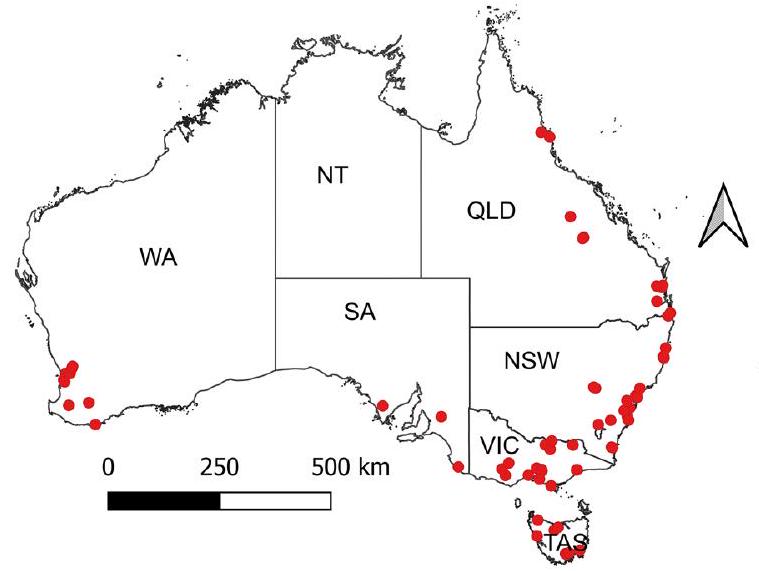
وصل إجمالي عدد المزارعين الذين دخلوا على رابط دعوة الاستطلاع إلى 115، مما أسفر عن 68 استبيانًا مكتملًا و47 استبيانًا غير مكتمل.
الشكل 1 خريطة أستراليا توضح توزيع مزارعي الماعز الحلوب الذين استجابوا للاستطلاع. كل مزرعة مشاركة تظهر كنقطة حمراء. الولايات والأقاليم في أستراليا: NSW، نيو ساوث ويلز؛ NT، الإقليم الشمالي؛ QLD، كوينزلاند؛ SA، أستراليا الجنوبية؛ TAS، تسمانيا؛ VIC، فيكتوريا؛ WA، أستراليا الغربية.
الردود. بعد تقييم الردود غير المكتملة، تحقق خمسة منها معايير الإدراج المحددة مسبقًا (أي تناولت الأسئلة الرئيسية حول ديموغرافيات المزرعة، واستخدام التشخيصات، وإدارة الأدوية المضادة للطفيليات) وتم تضمينها في تحليلات البيانات لدينا. كان سبعة من المستجيبين مزارعي الماعز من أجل اللحم/الكشمير، وبالتالي تم استبعادهم من التحليل الإضافي، مما ترك 66 ردًا مؤهلاً للتحليل النهائي. كانت نسبة الاستجابة للاستبيان هي ( 66 من 456).
من بين 66 مستجيبًا تم تضمينهم في التحليل النهائي، كان أعلى عدد من نيو ساوث ويلز يتبعها VIC ( )، كوينزلاند ( )، WA ( )، تاس ( ) و SA تشابه الترددات بين إجمالي مزارع الماعز الحلوب المسجلة لدى DGSA Ltd وتلك التي استجابت للاستطلاع كان (نطاق كانت الترددات النسبية للمستجيبين (مجموعة الدراسة) متوافقة مع تلك الخاصة بمربي الماعز الحلوب المسجلين لدى DGSA Ltd (الشكل 2). كان لدى معظم المستجيبين قطيع متوسط الحجم من الماعز. ) يتبعها صغير ( ) و كبير ( ) قطعان. بشكل عام، كان متوسط عدد الماعز في مزارع المستجيبين 69 (النطاق )، مع الأطفال (المتوسط 27؛ النطاق )، حلبات/إناث ( 27؛ نطاق ) والعجول ( 11 ؛ النطاق ) الفئات العمرية الأكثر شيوعًا (الجدول 1).
المتوسط الكلي لمساحة 66 مزرعة كان 76 (النطاق فدان، بمتوسط 56 (نطاق 0.25-2000) فدان مخصصة لمنطقة الرعي (الجدول 1). كانت معظم المستجيبين من الإناث ( ) ، امتلكوا مزارعهم ( )، لم يكن لديه مؤهلات رسمية ( ) وكان لديهم من 1 إلى 10 سنوات من الخبرة في العمل في صناعة الماعز الحلوب (الجدول 2). من بين المستجيبين المؤهلين ( ) ، و كان لديهم شهادة أو دبلوم في إدارة الحيوانات الزراعية، على التوالي. كانت معظم المزارع قد انخرطت في تربية الماعز الحلوب لمدة تتراوح بين 1 إلى 5 سنوات. ; 25/66) (الجدول 2).
الشكل 2 مخططات عمودية تظهر الترددات النسبية لمجموعات المصدر والدراسة مقسمة حسب ولايات أستراليا. NSW، نيو ساوث ويلز؛ QLD، كوينزلاند؛ SA، أستراليا الجنوبية؛ TAS، تسمانيا؛ VIC، فيكتوريا؛ WA، أستراليا الغربية
الجدول 1 المعلومات الديموغرافية عن مزارع الماعز الأسترالية ) الذي أبلغ عنه مزارعو الماعز الأستراليون الذين استجابوا للاستطلاع
سؤال معنى الوسيط (Q1، Q3) الحد الأدنى، الحد الأقصى
مساحة المزرعة (فدان) 76 0.75، 2000
مساحة الرعي (فدان) ٥٦ 0.25، 2000
عدد الماعز في العام الماضي 69 3, 1,428
– الأطفال ( شهور) 27 0.700
– الفطام (أكثر من 6 أشهر إلى 1 سنة) 11 0,200
– حلبات/إناث الماعز 27 0.600
– باكس ٤ 0,30
الحد الأقصى ماكس، الحد الأدنى مين، الربع الأول Q1، الربع الثالث Q3

إدارة تربية الحيوانات والرعي

السلالات الرئيسية من الماعز التي يحتفظ بها مزارعو الماعز الحلوب كانت الأنغلو-نوبية نغمة نيجيرية قزمة )، سانين (14%) وتوجينبرغ (14%) (الجدول 3). معظم المستجيبين ( كانوا يستخدمون نظام إنتاج الماعز شبه المكثف، مع متوسط مساحة التغطية المسموح بها لكل ماعز في الحظيرة . على الرغم من أن الربيع كان هو موسم الولادة الرئيسي في معظم المزارع ( )، وقد حدث ذلك أيضًا في مواسم أخرى، وكان عمر الفطام > 10 أسابيع في معظم المزارع
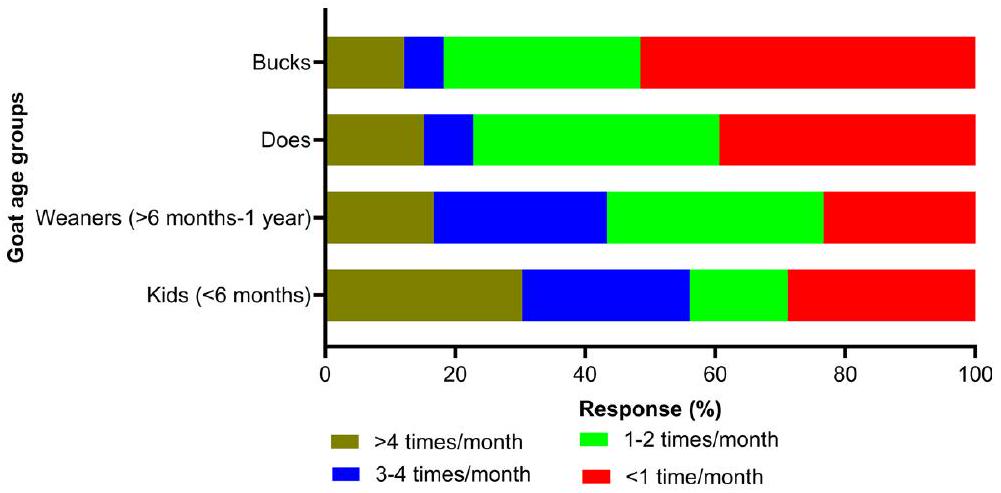
(86%; 57/66) (الجدول 3). قام معظم المستجيبين (76%، 50/66) بتنظيف الأقلام قبل كل ولادة (ملف إضافي 3: الشكل S1). كانت قش القمح أو رقائق الخشب على الأرضيات الصلبة هي المواد الأكثر استخدامًا كفرش. ; 38/69) لتربية الإناث في الأماكن المغلقة (الجدول 3)، حيث قام معظم المستجيبين بتغيير مواد الفراش أقل من مرة واحدة في الشهر و/أو 1-2 مرة في الشهر لجميع الفئات العمرية من الماعز (الشكل 3). تم تربية الماعز الحلوب مع حيوانات المزرعة الأخرى بواسطة (93/109) من المستجيبين، بما في ذلك الماشية ( الخراف ) والخيول ( ). بالنسبة للمراعي المشتركة (58%; 38/66)، كانت ممارسات الرعي الدائري أو الرعي المشترك شائعة ( )، وخاصة مع الماشية ( الخيل الأغنام ) (الجدول 3).
تم جمع اللبأ الطازج من الأمهات المحتفظ بها في المزرعة وكان هو المصدر الرئيسي لللبأ للصغار. )، مع إطعام الزجاجة ( ; 53/113) والرضاعة الطبيعية ( ) كونها الطرق الرئيسية التي تم إطعام الأطفال بها. كانت الأعلاف الرئيسية المستخدمة للرضع هي الخشونة ( ; 66/179) ويركز بينما كانت تلك للأبقار العلف الخشن والتركيز (كل واحد ; 64/175) والتصفح والرعي ( ) (الملف الإضافي 3: الجدول S1). معظم المستجيبين ( ) قدمت تغذية إضافية للماعز، خاصة لتوفير طاقة إضافية للإناث المرضعة ( ) بسبب ضعف جودة المراعي ( ) أو عدم كفاية العلف المعروض ( ) ،
الجدول 2 المعلومات الديموغرافية عن مزارعي الماعز الأستراليين من استجاب للاستطلاع
سؤال مستويات النسبة المئوية (العدادات)
الدور في المزرعة مالك المزرعة 94 (62)
مدير المزرعة 5 (3)
عامل موظف 1 (1)
جنس أنثى 91 (60)
ذكر 8 (5)
يفضل عدم الإفصاح 1 (1)
الخبرة في تربية الماعز (بالسنوات) 1-5 ٣٨ (٢٥)
٦-١٠ 18 (12)
١١-١٥ 12 (8)
>15 32 (21)
استخدام العقار لتربية الماعز (سنوات) <1 3 (2)
١-١٠ 62 (41)
11-20 18 (12)
21-30 5 (3)
31-40 8 (5)
>40 5 (3)
المؤهل الرسمي لا 80 (53)
نعم ٢٠ (١٣)
نوع المؤهل ( ) شهادة في الحيوانات الزراعية ٣٩ (٥)
دبلوم في الحيوانات الزراعية 31 (4)
تمريض بيطري 15 (2)
درجة البكالوريوس أو أعلى 15 (2)
الجدول 3 ممارسات تربية وإدارة الرعي في مزارع الماعز الأسترالي الحلوب التي أبلغ عنها مزارعو الماعز الأسترالي الحلوب الذين استجابوا للاستطلاع
سؤال (الردود) مستويات النسبة المئوية (العدادات)
سلالة ) أنغلو-نوبى ٢٥ (٣٥)
قزم نيجيري 16 (22)
سانن 14 (20)
توغنبرغ 14 (19)
جبال الألب البريطانية 9 (12)
جبلي ٤ (٦)
ميلان الأسترالي 3 (4)
لامانشا 2 (3)
البني الأسترالي 1 (2)
سابل 1 (2)
الألبان السويسرية 1 (1)
آخر 10 (14)
نظام الإنتاج ( ) نصف موسع 65 (43)
واسع ٢٣ (١٥)
نصف مكثف 12 (8)
متوسط مساحة المنطقة المغطاة المخصصة لكل ماعز ) أكثر من /ماعز ٣٩ (٢٦)
/ماعز 17 (11)
/ماعز 15 (10)
/ماعز 12 (8)
/ماعز 9 (6)
/ماعز 5 (3)
/ماعز 3 (2)
مواد الفراش للإيواء الداخلي للإناث أرضية صلبة من قش القمح أو نشارة الخشب 61 (42)
أرضية ترابية 27 (19)
أرضية مشطوفة مع بلاستيك أو خشب أو معدن ممتد 9 (6)
لا شيء (الإسكان الداخلي غير متوفر) 3 (2)
موسم الولادة ) ربيع 64 (42)
الشتاء ٢٣ (١٥)
الخريف 6 (4)
الصيف 5 (3)
غير موسمي 3 (2)
متوسط عمر الفطام ) > 10 أسابيع ٨٦ (٥٧)
8-10 أسابيع 14 (9)
تربية الماعز مع أنواع الماشية الأخرى المواشي 25 (27)
خروف ٢٠ (٢٢)
خيول 15 (16)
الألباكا/الجمال 12 (13)
الطيور 9 (10)
خنازير 5 (5)
لا شيء 15 (16)
مشاركة المراعي ) لا 42 (28)
نعم ٣٨ (٢٥)
أحيانًا ٢٠ (١٣)
ممارسة الرعي في المزارع عندما تتشارك المراعي الرعي المشترك مع أنواع الماشية الأخرى 60 (29)
الرعي الدائري 40 (19)
الجدول 3 (مستمر)
سؤال (الردود) مستويات النسبة المئوية (العدادات)
أنواع الماشية الأخرى التي ترعى مع الماعز المواشي ٢٩ (٢٠)
خيول ٢٦ (١٨)
خروف ٢٠ (١٤)
الألباكا/الجمال 16 (11)
آخر 10 (7)
فئة عمرية من الماشية ترعى مع الماعز ) المواشي بين 1-2 سنة ٣٥ (٧)
المواشي > 2 سنوات 30 (6)
عجول مفطومة أقل من سنة 20 (4)
عجول غير مُرضعة 15 (3)
كانت لهذه الأسئلة أكثر من إجابة واحدة
الكشمير، البور، الأسترالي المصغر أو البيغمي
الشكل 3 نسبة المستجيبين تقرير عن تكرار تغيير مواد الفراش في حظائر الماعز في مزارع الماعز الأسترالية.
و من المستجيبين لم يكن لديهم وصول إلى المياه السطحية بخلاف تلك التي تم توفيرها بشكل صناعي (الملف الإضافي 2: الجدول S2).

معرفة الطفيليات المعوية

غالبية المستجيبين ( ; 49/66) قد لاحظوا الأمراض المرتبطة بالطفيليات في ماشيتهن بناءً على العلامات السريرية مثل الإسهال و/أو تلوث المنطقة المحيطة بالشرج ( فقر الدم ) ، فرو خشن ( فقدان الوزن )، درجة FAMACHA© العالية ( فك الزجاجة ضعف ) والموت ( ). علاوة على ذلك، لاحظ المستجيبون الأمراض المرتبطة بالطفيليات/خسائر الإنتاج، بشكل أساسي في الربيع ( ; 34/105) تليها الخريف (19%)، الصيف (18%) والشتاء . هل/حلب والفطام كان يُنظر إليهم دائمًا و/أو عادةً على أنهم عرضة للطفيليات المعوية (الشكل 4).
من بين 66 مستجيبًا، و صنفت دودة عمود الحلاق (H. contortus) والكوكسيديا (Eimeria spp.) على أنهما الطفيليان المهمان لماعز الألبان. من بين غيرها من الأمراض المعوية
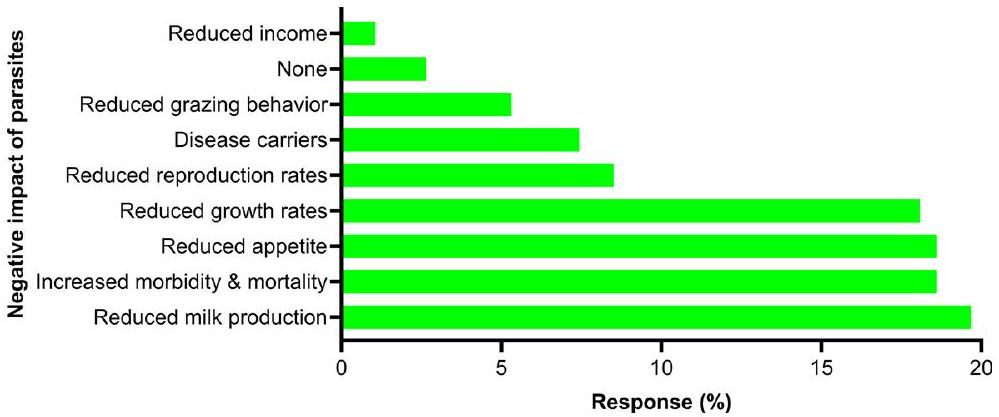
الطفيليات، دودة العلق الأسود (Trichostrongylus spp.) (67%; 44/66)، دودة المعدة البنية (T. circumcincta) (65%)، دودة الكبد (F. hepatica) ( دودة الرئة الصغيرة (مويليريوس كابيلاريس) ) ودودة الشريط (Moniezia spp.) كانت تعتبر أيضًا مهمة لصحة وإنتاج الماعز (الشكل 5). استنادًا إلى تشخيص الطفيليات المعوية، من بين المستجيبين، اعتقد أن دودة عمود الحلاق كانت الطفيل الأكثر تشخيصًا في حيواناتهم تليها ديدان الإسهال السوداء. ) و الكوكسيديا ( ) (الملف الإضافي 3: الشكل S2). اعتقد المستجيبون أن الأثر الأكثر أهمية للطفيليات المعوية على ماعزهم كان انخفاض إنتاج الحليب ( ; 37/188) تليها معدلات مرضية ووفيات أعلى ( الشره المرضي (19%) وانخفاض النمو (18%) ومعدلات التكاثر (9%) (الشكل 6).
أفاد المستجيبون بأن تلوث العلف بالمواد البرازية الرعي الجائر كثافة تخزين أعلى (19%)، ظروف صحية دون المستوى الأمثل ( )، الاستخدام غير الصحيح للأدوية المضادة للطفيليات ( سوء التغذية ) وعوامل أخرى ( ) كانت الأكثر شيوعًا
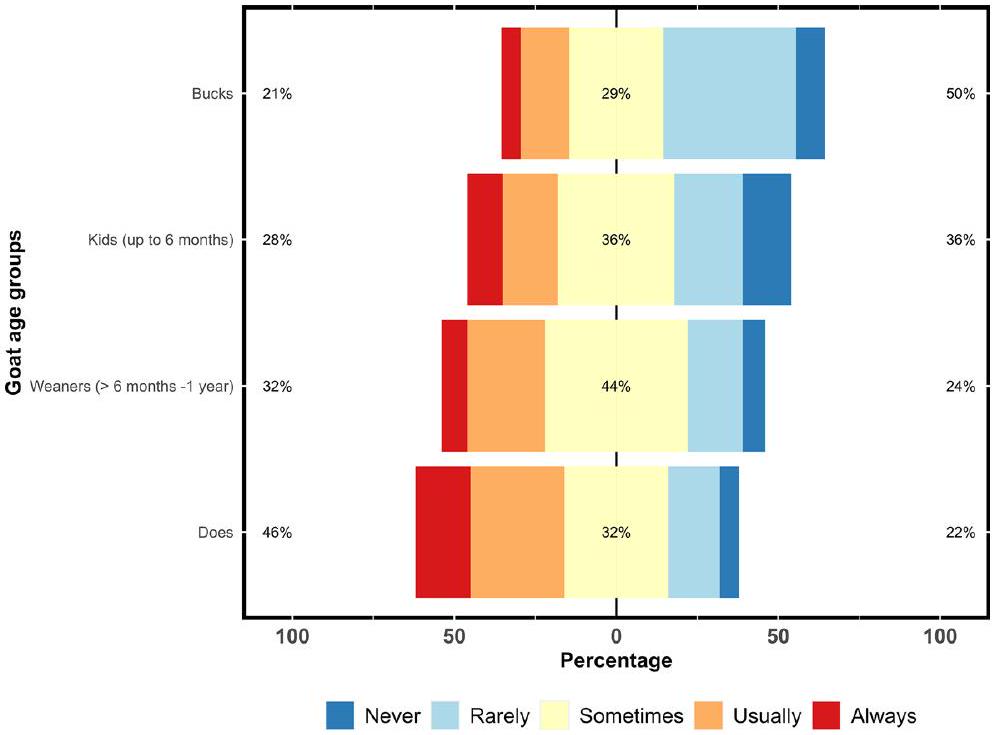
الشكل 4 نسبة المستجيبين ( ) الإبلاغ عن تصوراتهم حول خطر الطفيليات المعوية في مجموعات عمرية مختلفة من مزارع الماعز الأسترالية باستخدام مقياس ليكرت. تستخدم الصورة مقياس ليكرت من 5 نقاط، مما يسمح للمستجيبين بالتعبير عن تصوراتهم حول خطر الطفيليات المعوية في مجموعات عمرية مختلفة من مزارع الماعز الأسترالية. يتراوح المقياس من ‘دائمًا’ (اتفاق قوي) إلى ‘أبدًا’ (اختلاف قوي)
الشكل 5 نسبة المستجيبين ( ) الإبلاغ عن تصوراتهم حول حدوث أنواع مختلفة من الطفيليات المعوية في مزارع الماعز الأسترالية باستخدام مقياس ليكرت. تستخدم الصورة مقياس ليكرت من 3 نقاط يسمح لمربي الماعز الحلوب بالإبلاغ عن تصوراتهم حول حدوث أنواع مختلفة من الطفيليات المعوية في مزارعهم. يتراوح المقياس من ‘مهم’ (اتفاق قوي) إلى ‘غير مهم’ (اختلاف قوي)، مع خيار محايد (‘غير متأكد’)
عوامل الخطر لنقل الطفيليات المعوية في الماعز الحلوب. أولئك المستجيبون الذين اختاروا خيار ‘أخرى’ (20/106) اعتقدوا أن الطقس الرطب و/أو أحداث مثل عروض الماعز (9/20)، نقص الأدوية المضادة للطفيليات المسجلة للماعز الحلوب و AR (3/20)، الرعي
مرعى صغار الماعز في المزرعة الحيوانات البرية/الشرسة في المراعي ) والعلف الأخضر في المراعي مع ظروف دافئة ورطبة ( كانت هناك عوامل أخرى محتملة تساهم في انتقال الطفيليات المعوية.
الشكل 6 نسبة المستجيبين الإبلاغ عن تصوراتهم حول تأثير الطفيليات المعوية على الماعز الحلوب في أستراليا

تشخيص الطفيليات المعوية

تقريباً من المستجيبين الذين طلبوا نصيحة بيطرية لتشخيص وعلاج الأمراض المشتبه بها المتعلقة بالطفيليات المعوية في ماشيته. قام المستجيبون بتشخيص طفيليات الماعز بناءً على عدد بيض البراز (FECs) ( ; 51/155)، العلامات السريرية ( )، ثقافة اليرقات (14%) أو ملاحظة الطفيليات في البراز (12%) (الجدول 4). الغالبية العظمى من المستجيبين ( ; 44/66) استخدمت FECs لمراقبة عبء الديدان ( قرارات التخلص من الديدان )، تقييم فعالية الأدوية المضادة للطفيليات ( ) أو تشخيص مرض يُشتبه في كونه طفيليًا ( ). تم إجراء FECs إما في المزرعة ( ; 28/66) أو في مختبر تشخيصي ( )، مع جمع عينات من البراز من جميع مجموعات الماعز، بما في ذلك الإناث/ الحلابات ( ، الفطام ( ) و دولارات ( ) (الجدول 4).

الأدوية المضادة للطفيليات وطرق السيطرة الأخرى على الطفيليات المعوية

الغالبية العظمى من المستجيبين ( ; 62/66) استخدموا أدوية مضادة للطفيليات عن طريق الفم ( ) أو قابلة للحقن ( طرق للسيطرة على الطفيليات في الماعز (الجدول 5). كان استخدام الأدوية المضادة للطفيليات يعتمد بشكل أساسي على فحص البيض في البراز (FECs). ; 42/129)، معرفة المستجيبين بطفيلات الماعز ( ) أو توصيات الأطباء البيطريين ( (الشكل 7أ). كانت المصادر الرئيسية للنصائح حول استخدام الأدوية المضادة للطفيليات هي WormBoss ( ; 58/236 [https://wormboss.com.auالأطباء البيطريون ) ومزارعي الماعز الآخرين ( ) (الشكل 7ب). تم استخدام استراتيجية مستهدفة لمكافحة الديدان للرضع ( )، البالغين ( ) والأطفال ( ) (الشكل 8). بينما من مزارعي الماعز الحلوب لم يتبعوا أي جدول لتجريع الديدان (أي شهر أو موسم)، وأشار البعض إلى تفضيلهم لفصل الصيف. الخريف الشتاء ) و الربيع ( ) (الجدول 5).
كان اختيار الأدوية المضادة للطفيليات المتنوعة يختلف بين المزارع ولكنه كان مهيمنًا بواسطة
تركيبة من أربعة أدوية مضادة للطفيليات (أبامكتين، ألبندازول، ليفاميزول وكلوسانتيل) ( “; 45/177) تليها البنزيميدازولات (BZs؛ 24%) واللاكتونات الحلقية الكبيرة (MLs؛ 23%) (الملف الإضافي 3: الشكل S3؛ الجدول 5). من بين فئات BZ و ML، الفينبندازول ( ) وإيفرمكتين ( ) كانت المنتجات النشطة الفردية الأكثر استخدامًا بشكل متكرر، على التوالي (الجدول 5). حوالي من بين المستجيبين، قاموا بتدوير الأدوية المضادة للطفيليات، مع تدوير الأدوية كل عام (الجدول 5). بالإضافة إلى استخدام الأدوية المضادة للطفيليات، BioWorma ( ; 43/76)، كريات سلك أكسيد النحاس (COWP) )، ولقاح باربرفاكس تم استخدامها أيضًا للتحكم في GINs للماعز، وكان حوالي خُمس المستجيبين ( ) استخدمت أدوية عشبية مثل الثوم ومقوي عشبي تم تصنيعه بواسطة AJ Products في أستراليا الجنوبية (https://ajproducts.com.au).
نصف المستجيبين ( ) أبلغت عن الاستخدام الأول للأدوية المضادة للطفيليات عند الفطام أو قبل الفطام تلاه بناءً على التشخيص (FECs أو الأمراض المشتبه بها المتعلقة بالطفيليات) ( ) وما بعد الفطام على الرغم من أن معظم مربي الماعز الحلوب 35/66) استخدموا جرعة تعادل 1.5 مرة من الجرعة الموصى بها للأغنام، ولم يستخدموا مسدس السقي ( ; 34/66) وعندما تم استخدام بندقية الرش، لم يتحققوا من دقتها ( ). بالإضافة إلى ذلك، استخدم عدد كبير من المزارعين الأدوية الطاردة للديدان بجرعة تعادل ضعف جرعة الأغنام ( )، وجرعة واحدة من الغنم ( )، 2.5 إلى ثلاثة أضعاف جرعة الأغنام ( )، مع المستجيبون الذين اختاروا ‘خيار آخر’ (على سبيل المثال، بناءً على وصفة الطبيب البيطري). تم حساب جرعة الأدوية المضادة للطفيليات بناءً على وزن الماعز الذي تم قياسه باستخدام جدول محيط الصدر. التقدير البصري لكل ماعز ) ووزن الجسم الفعلي للماعز (20%) (الشكل 9). معظم المستجيبين ( ; 51/66) لم يكونوا على دراية بتأثير الأدوية المضادة للطفيليات المختلفة على خصائصها. فقط تم اختبار AR باستخدام اختبارات تقليل FEC (FECRTs)، وأفاد الجميع أن الفينبندازول كان غير فعال في مزارعهم.
الجدول 4 معرفة تشخيص الطفيليات المعوية المعروفة من قبل مربي الماعز الحلوب الأستراليين الذين استجابوا للاستطلاع
سؤال (الردود) مستويات النسبة المئوية (العدادات)
تم طلب نصيحة بيطرية ) نعم ٥٥ (٣٦)
لا ٤٦ (٣٠)
طرق التشخيص المستخدمة عدّ بيض البراز ٣٣ (٥١)
علامات سريرية 32 (50)
ثقافة اليرقات 13 (21)
مراقبة الديدان في البراز 12 (19)
تشريح الجثة 5 (7)
فحص دموي 2 (3)
فاماشاك/فقر الدم 2 (3)
لا شيء 1 (1)
استخدام FEC ( ) نعم 67 (44)
لا 32 (21)
لا أعرف 2 (1)
هدف FEC مراقبة عبء الديدان ٢٨ (٤١)
قرارات التخلص من الديدان ٢٦ (٣٩)
تقييم فعالية أدوية التخلص من الديدان 25 (37)
تشخيص الأمراض الناتجة عن الديدان 21 (31)
اختبار الماعز الجديدة في الحجر الصحي 1 (1)
موقع اختبار FEC ) في المزرعة بواسطة الموظفين 42 (28)
مختبر تشخيصي ٤٠ (٢٦)
عيادة بيطرية 18 (12)
الماعز المختبر من أجل FEC أطفال شهور) 16 (31)
الرضع (أكثر من 6 أشهر – سنة واحدة) 20 (39)
الأبقار/الحلابات 21 (42)
الأغنام الذكور 13 (26)
باكس 18 (36)
عمره أكثر من 6 سنوات 11 (22)
فاماشاك فافا مالان شارت (نهج انتقائي لـ H. contortus)، FEC عدد بيض البراز
كانت لهذه الأسئلة أكثر من إجابة واحدة

تحليلات المراسلات المتعددة وتحليل المكونات الرئيسية

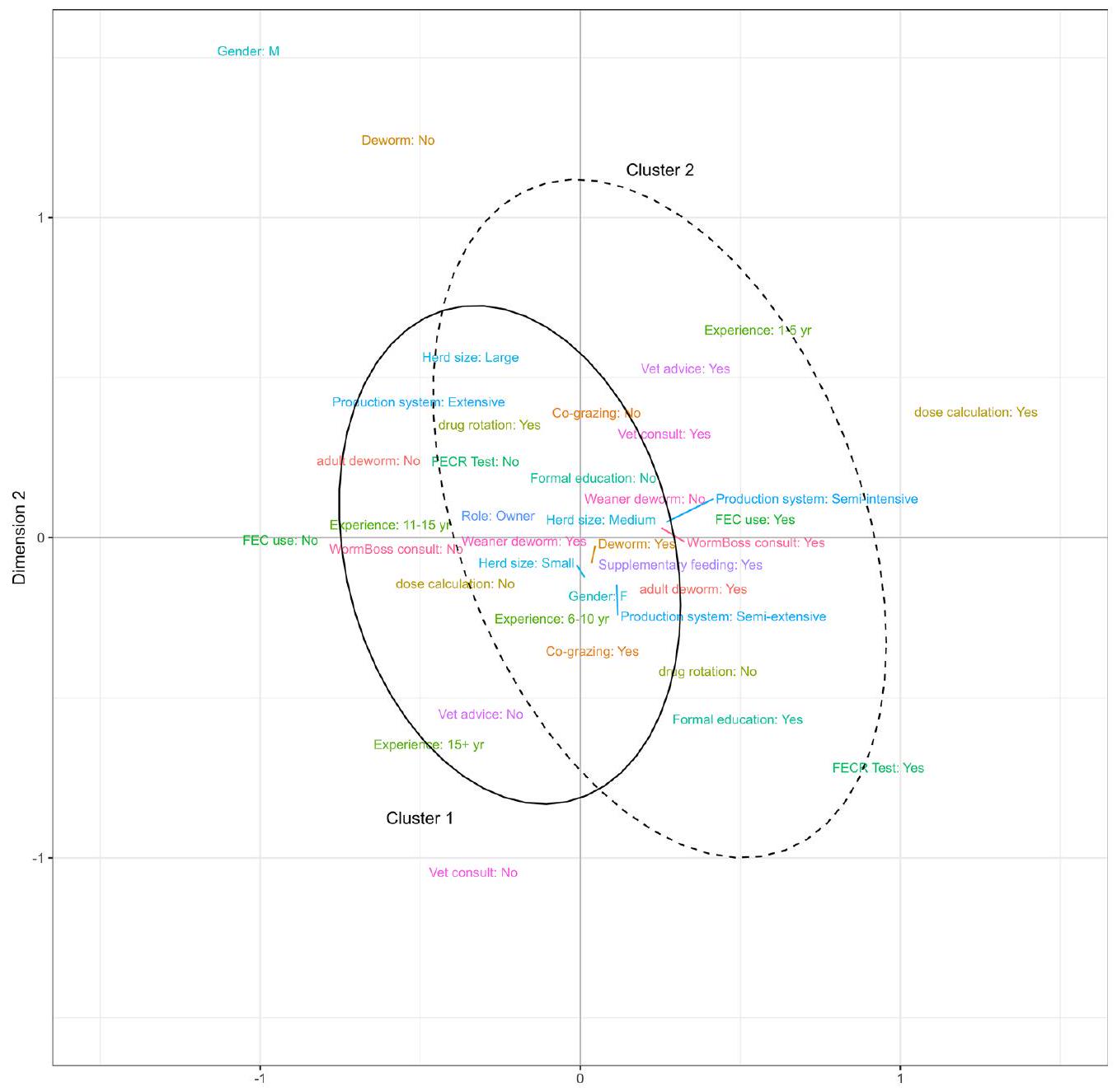
أظهرت نتائج MCA لممارسات التحكم GIN المختارة عبر البعدين الأولين تباينًا ملحوظًا، حيث يمثل كلا البعدين معًا التباين (الشكل 10). تعكس مواضع المتغيرات على هذه الأبعاد علاقاتها، حيث تشير القرب الأقرب على أي محور من محاور البايلوت إلى ارتباطات أقوى بين الممارسات. تصنيف الاستجابات إلى مجموعتين، وهما المجموعة 1 والمجموعة 2، يمثلان ممارسات التحكم في GIN ‘الضعيفة’ و’الجيدة’ على التوالي. كان المستجيبون في المجموعة 1 في الغالب من مالكي/مديري المزارع الذين يديرون أنظمة إنتاج واسعة مع سنوات أو أكثر من خبرة في تربية الماعز الحلوب. كان من غير المرجح أن يسعى هؤلاء المستجيبون للحصول على نصيحة بيطرية لتشخيص وعلاج الأمراض المرتبطة بالطفيلات المعوية المشتبه بها ولم يفعلوا
يحسبون بانتظام الجرعات المناسبة من الأدوية المضادة للطفيليات لماعزهم. بالمقابل، كان المستجيبون في المجموعة 2 يديرون أنظمة إنتاج شبه موسعة أو شبه مكثفة وكان لديهم سنوات من خبرة تربية الماعز الحلوب. كانوا يبحثون عن نصيحة بيطرية لتشخيص وعلاج الأمراض المشتبه بها المتعلقة بالطفيليات المعوية في ماعزهم بالإضافة إلى إجراء اختبارات فحص البيض واختبارات فعالية العلاج.

الكوكيديات

تقريبًا نصف المستجيبين ( “; 34/66) أبلغوا عن وجود الكوكسيديا في مزارعهم. كانت العلامات السريرية الرئيسية ملحوظة في الصغار حتى 8 أسابيع، بما في ذلك الإسهال و/أو تلوث المنطقة المحيطة بالشرج، وانخفاض زيادة الوزن، والشعور بالحاجة المتكررة للتبرز (ملف إضافي 3: الشكل S4). كان الدواء الأكثر استخدامًا لمكافحة الكوكسيديا هو التولترزول. ; 29/34) بينما فقط استخدمت مضادات الكوكسيديا للأطفال ) أو الفطام ( ).
الجدول 5 الأدوية المضادة للطفيليات المستخدمة للسيطرة على الطفيليات المعوية كما أبلغ عنها مزارعو الماعز الأستراليون الذين استجابوا للاستطلاع
سؤال (الردود) مستويات النسبة المئوية (العدادات)
استخدم الأدوية المضادة للطفيليات ( ) نعم 94 (62)
لا 6 (4)
فئة الدواء المستخدمة (
البنزيميدازولات ( ) فينبندازول ٨٣ (٣٥)
ألبندازول 14 (6)
BZs غير محددة 2 (1)
لاكتونات ماكروسيكلية ( ) إيفرمكتين ٤٠ (١٦)
دورامكتين 30 (12)
أبامكتين ٢٨ (١١)
موكسيدكتين 3 (1)
أخرى ( ) ليفاميزول ٢٦ (٥)
تولترزول ٢٦ (٥)
كلوسانتيل 21 (4)
سترات المورانتيل 21 (4)
مونيبانتيلي 5 (1)
تركيبة تجارية(ات) ( ) 4 (BZs + MLs + LEV + كلوسانتيل) ٥٩ (٤٥)
2 (MLs + مونيبانتيلي) ٢٤ (١٨)
2 (MLs + ديركوانتيل) ٧ (٥)
3 (BZs + MLs + LEV) ٧ (٥)
2 (BZs + LEV) 2 (2)
2 (MLs + PZQT) 1 (1)
تحضير أدوية مضادة للطفيليات المستخدمة عن طريق الفم 69 (49)
قابلة للحقن 10 (7)
عن طريق الفم وقابلة للحقن 8 (6)
عن طريق الفم وصب على 6 (4)
عن طريق الفم، قابلة للحقن وصب على 4 (3)
صب على 3 (2)
موسم(ات) الديدان لا جدول ثابت 38 (48)
الربيع 20 (26)
الخريف 16 (21)
الصيف 16 (21)
الشتاء 14 (18)
تدوير/تغيير أدوية مضادة للطفيليات ( ) لا تدوير 45 (30)
سنويًا 30 (20)
كل عامين 23 (15)
كل ثلاث سنوات 2 (1)
BZ بنزيميدازول، LEV ليفاميسول، MLs لاكتونات ماكروسيكلية، PZQT برازكوانتيل
هذه الأسئلة كان لها أكثر من إجابة واحدة
الدواء الوحيد المضاد للديدان المسجل حاليًا للاستخدام في الماعز الحلوب في أستراليا

نقاش

هذه هي الدراسة الشاملة الأولى لتقييم المعرفة والتصورات لدى مربي الماعز الحلوب حول ممارسات مكافحة الطفيليات في أستراليا. حوالي 74% (49/66) من المزارعين الذين استجابوا لاحظوا أمراضًا مرتبطة بالطفيليات المعوية في ماعزهم وثلثي ( ) قاموا بتقييم عبء الديدان باستخدام FECs. تقريبًا جميع المستجيبين ( ) أدركوا أن
العدوى الطفيلية المعوية تسببت في خسائر إنتاجية، مما أدى إلى استخدام واسع النطاق للأدوية المضادة للطفيليات (94%; 62/66) المسجلة أساسًا للاستخدام في الأغنام والأبقار. كانت الأدوية المضادة للديدان الأكثر استخدامًا عبارة عن تركيبة تجارية من أربعة أدوية مضادة للديدان (أبامكتين، ألبندازول، ليفاميسول وكلوسانتيل)، تليها BZs وMLs. على الرغم من أن التخلص المستهدف من الديدان كان مستخدمًا في معظم مزارع المستجيبين، إلا أن القليل
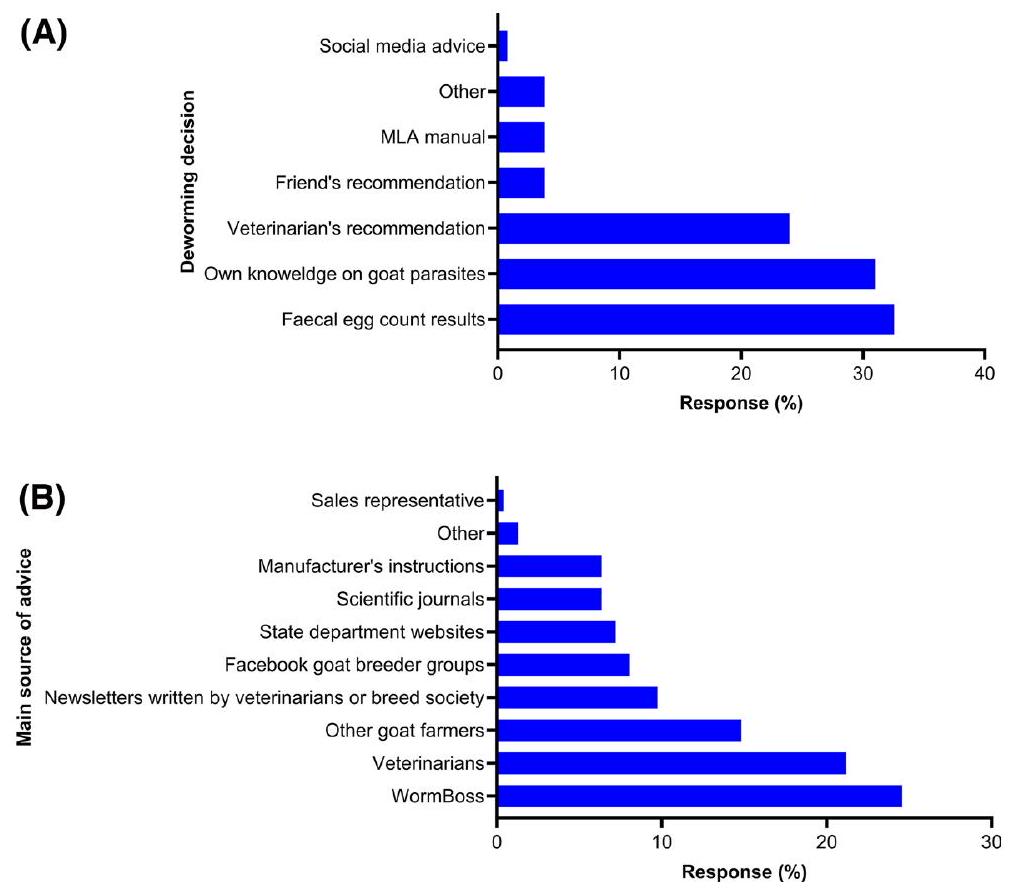
الشكل 7 نسبة المستجيبين ( ) الذين أبلغوا عن تصوراتهم حول اتخاذ القرار ( ) ومصادر النصيحة (B) لمكافحة الطفيليات المعوية في الماعز الحلوب الأسترالي. MLA، اللحوم والماشية الأسترالية
الشكل 8 نسبة المستجيبين ( ) الذين أبلغوا عن تصوراتهم حول اختيار استراتيجيات التخلص من الديدان في مزارع الماعز الحلوب الأسترالية
الشكل 9 نسبة المستجيبين الذين أبلغوا عن المعايير المستخدمة لتقدير وزن الماعز الحلوب لحساب جرعة الأدوية المضادة للديدان
الشكل 10 رسم ثنائي يوضح نتائج تحليل التوافق المتعدد والتجميع الهرمي على تحليل المكونات الرئيسية، لأفضل ممارسات مكافحة GIN في مزارع الماعز الحلوب الأسترالية. تم تحديد مجموعتين مختلفتين: المجموعة 1، تمثل ‘ممارسات مكافحة GIN الضعيفة’، والمجموعة 2، تمثل ‘ممارسات مكافحة GIN الجيدة’. تعكس مواقع المتغيرات على البعدين علاقاتها، مع قرب أكبر يشير إلى ارتباطات أقوى بين الممارسات. FEC، عدد بيض البراز؛ GIN، الديدان الخيطية المعوية
كان القليل من المستجيبين على دراية بالتخلص الاستراتيجي من الديدان ومشكلة AR. توفر نتائج هذه الدراسة رؤى قيمة حول ممارسات مكافحة الطفيليات المعوية الحالية المستخدمة من قبل مربي الماعز الحلوب الأستراليين. على الرغم من أن نتائج مماثلة تم الإبلاغ عنها من أوروبا [15، 28، 30، 31، 34، 54، 55]، وأمريكا الجنوبية [33] وأوقيانوسيا [26، 27، 29]، إلا أن القليل معروف عن ممارسات مكافحة الطفيليات المستخدمة من قبل مربي الماعز في الدول الآسيوية والأفريقية، حيث من السكان العالمي للماعز موجود. ومع ذلك، لم تقيم أي من هذه الدراسات بشكل شامل ممارسات مكافحة الطفيليات المعوية في الماعز الحلوب، بما في ذلك أهمية هذه الطفيليات في صناعة الماعز الحلوب، ومعرفة المزارعين وفهمهم للتشخيص ومكافحة الطفيليات المعوية.
وجدنا أن من المستجيبين لاحظوا أمراضًا مرتبطة بالطفيليات المعوية في ماعزهم، بشكل رئيسي في الربيع ( ). كان لدى هؤلاء المزارعين فهم جيد للـ GINs ذات الأهمية الاقتصادية واحتلوا H. contortus وT. circumcincta وTrichostrongylus spp. مرتبة ‘مهمة’ لحيواناتهم. تعتبر هذه الـ GINs الطفيليات الداخلية ذات الأهمية الاقتصادية للأغنام والماعز على مستوى العالم، وهي أيضًا مهمة في الماعز الأسترالي في المناطق ذات الأمطار العالية (أي ) [36]. على الرغم من أن فقط من المستجيبين أرسلوا عينات براز من الماعز الحلوب لتحديد جنس الطفيليات باستخدام تقنية زراعة اليرقات، كانت معرفتهم حول وجود طفيليات معوية مختلفة قابلة للمقارنة مع تلك التي أبلغ عنها مكينزي وآخرون [56] وبيفريدج وآخرون.
[57]. كانت الغالبية العظمى من المستجيبين ( ; 183/188) يدركون أن الطفيليات المعوية يمكن أن تسبب سوء الصحة وانخفاض إنتاج الحليب في الماعز الحلوب. وجدت الدراسات السابقة عن الماعز الأسترالي أيضًا أن GINs كانت مشكلة رئيسية لمربي الماعز [3638]. في عام 2015، تم تقدير التكلفة السنوية للطفيليات الداخلية (بسبب GINs) على صناعة الماعز الأسترالية بمبلغ 2.54 مليون دولار أسترالي [18]. ومع ذلك، فإن فهمنا الحالي لعلم الأوبئة للطفيليات المعوية وتأثيرها على الماعز الحلوب الأسترالي في مناطق زراعية مناخية مختلفة محدود.
نطاق المنتجات المضادة للطفيليات المسجلة لعلاج الماعز في أستراليا محدود ( منتجات) مقارنة بتلك الخاصة بالأغنام (https://wormboss.com.au/ drenches-for-goats-using-products-correctly-and-legally/)، مع وجود واحد فقط للماعز الحلوب. من المتوقع أن يكون هذا الاتجاه مشابهًا في مناطق أخرى من العالم، حيث تم تسجيل عدد قليل أو لا توجد أدوية مضادة للطفيليات للاستخدام في الماعز الحلوب بسبب متطلبات فترات سحب الحليب، على الرغم من أن بعض الدول لديها فترة سحب حليب افتراضية (مثل نيوزيلندا، حيث تكون هذه الفترة 35 يومًا). في الدراسة الحالية، وجدنا أن من المستجيبين استخدموا أدوية مضادة للطفيليات (انظر الجدول 5) وأن الأدوية المضادة للديدان الثلاثة الأكثر استخدامًا كانت تركيبة تجارية من أربعة أدوية مضادة للديدان (أبامكتين، ألبندازول، ليفاميسول وكلوسانتيل)، BZs وMLs. تختلف هذه النتيجة عن نتائج ثلاث دراسات سابقة استطلعت آراء مربي الماعز الأستراليين [36-38]، حيث تم الإبلاغ عن نسبة استخدام الأدوية المضادة للديدان كـ و (75/88) على التوالي. يمكن أن تُعزى الفجوات في استخدام الأدوية المضادة للديدان بين دراستنا وهذه الدراسات السابقة إلى عوامل مختلفة، بما في ذلك عدد المستجيبين في الاستطلاع والسكان المستهدفين. ركزت دراستنا على مربي الماعز الحلوب مع 66 مستجيبًا، بينما استطلعت الدراسات السابقة مجموعات أكبر أو أصغر من مربي الماعز المعنيين بإنتاج اللحوم أو الألبان أو الألياف. علاوة على ذلك، قد تكون الاختلافات في فترات الدراسة، والمواقع الجغرافية، وممارسات إدارة الطفيليات المعوية وأنظمة الإنتاج بين السكان المستطلعين قد أثرت على اختيار وتكرار استخدام الأدوية المضادة للديدان. تم توثيق اتجاهات مماثلة لاستخدام كبير للأدوية المضادة للديدان في الماعز على مستوى العالم، بما في ذلك (عدد المستجيبين في الاستطلاع ) في إيطاليا [15]، في نيوزيلندا [29]، في فرنسا [30]، في اليونان [31]، في البرازيل [33]، في الدنمارك [54]، في النرويج [55] و ( ) في البرتغال [58]، مع كون BZs و/أو MLs هي الأدوية المضادة للديدان الأولى. تظهر هذه الدراسات أن مكافحة الطفيليات المعوية في الماعز اعتمدت تقريبًا بالكامل على الأدوية المضادة للديدان، وهو السبب الرئيسي لارتفاع انتشار AR في الماعز [22].
في الدراسة الحالية، استخدم غالبية المستجيبين على الأقل دواءً مضادًا للديدان لم يتم تسجيله للاستخدام في الماعز في أستراليا (انظر الجدول 5)، وهو ما يتماشى مع نتائج برونت وآخرون [38]. هذه النتيجة مثيرة للقلق لأن معظم المستجيبين كانوا يحتفظون أيضًا بالأغنام والأبقار في مزارعهم للماعز، وكانت هذه الأنواع تشارك نفس المراعي مع الماعز. نظرًا لأن الماعز والأغنام تشترك في GINs مماثلة [59]، هناك خطر كبير من انتقال أنواع الديدان المقاومة للأدوية بين الأغنام والماعز [38]، وأستراليا لديها أعلى مستويات من GINs المقاومة للأدوية [60]. إن وجود مستويات عالية من AR وتوافر محدود للمنتجات المسجلة للماعز في أستراليا يمثل تحديًا لمربي الماعز الأستراليين، مما يدفعهم لاختيار المنتجات المضادة للديدان المسجلة للأبقار والأغنام. بالإضافة إلى ذلك، تحتوي العديد من الأدوية المضادة للديدان على عبارة ‘لا تستخدم’ على الحيوانات التي يُستخدم حليبها للاستهلاك البشري على ملصقها، مما يعني أنه لا يمكن للطبيب البيطري وصفها لهذه الماعز، حتى لو كانت لديهم بيانات من أبحاث خارجية حول فترات سحب الحليب. وبالتالي، هناك حاجة ملحة لتسجيل أدوية مضادة للديدان إضافية، مثل المنتجات المركبة، وتوفير معلومات حول فترات السحب لمختلف منتجات الحليب واللحوم.
يمكن أن يشكل الاستخدام غير المصرح به لمضادات الديدان في الماعز تحديات إضافية عندما تختلف معدلات الجرعات. يُوصى عمومًا بإعطاء ليفاميزول للماعز بجرعة تعادل 1.5 ضعف الجرعة الموصى بها للأغنام [5، 61] ومضادات الديدان الأخرى بجرعة تتراوح بين 1.5 إلى ضعف الجرعة الموصى بها للأغنام [5]. وجدنا أن أكثر من نصف المستجيبين ( ; 35/66) قاموا بتجريد الماعز من الديدان باستخدام جرعة تعادل 1.5 ضعف الجرعة الموصى بها للأغنام. لم يستخدم معظمهم ( ; 34/66) بندقية سقي لإعطاء مضادات الديدان؛ وعندما تم استخدام بندقية سقي، فقط قام بمعايرة البندقية قبل الاستخدام. تظل معدلات الجرعة للماعز مثيرة للجدل حيث أفادت دراسات سابقة في إيطاليا [15]، نيوزيلندا [27]، فرنسا [30] وأيرلندا [34] باستخدام جرعة تتراوح بين 1.5 إلى 2 ضعف الجرعة الموصى بها للأغنام. يعتمد إعطاء الجرعة الصحيحة من مضادات الديدان في الماعز أيضًا على قياس وزن الحيوان بدقة. وجدنا أن فقط ( ) من مزارعي الماعز الأستراليين استخدموا الوزن الفعلي للجسم و قدروا ذلك بصريًا. أفادت دراسة حديثة أن من مزارعي الماعز الألبانيين في إيطاليا قاموا بحساب جرعة مضادات الديدان بناءً على الوزن المقدر لأثقل ماعز في القطيع [15]، وهو ما يزيد بشكل كبير عن ذلك في الدراسة الحالية ( ). تم الإبلاغ عن نتائج مماثلة من الدنمارك [28]، فرنسا [30]، أيرلندا [34] والنرويج [55]. استخدام مضادات الديدان في الماعز بجرعة موصى بها للأغنام (على سبيل المثال 7/66 في هذه الدراسة) له تداعيات كبيرة على تطور مقاومة الأدوية، حيث أن الماعز يستقلب مضادات الديدان أسرع من الأغنام، مما يؤدي إلى تركيزات بلازما أقل وزيادة تعرض الطفيليات لمستويات الأدوية دون العلاج [59].
يمكن أن يؤدي ذلك إلى تطور أسرع لمقاومة الأدوية في الماعز مقارنة بالأغنام [62]. يُوصى بقياس وزن الجسم بدقة لتجنب الجرعات الناقصة، مما قد يساعد في تقليل تطور مقاومة الأدوية في الماعز.
حسب علم المؤلفين، لا يوجد حاليًا منتج مضاد للديدان موصوف للاستخدام في الماعز في أستراليا (https://wormboss.com.au/drenches-for-goats-using-products-correctly-and-legally/). ومع ذلك، كشفت هذه الدراسة أن بعض المزارعين كانوا يستخدمون تحضيرات قابلة للحقن (إيفرمكتين) و/أو تحضيرات سائلة (انظر الجدول 5)؛ هذه النتيجة تتوافق مع نتائج برونت وآخرين [38]. استخدام المنتجات المضادة للطفيليات الموضعية أو القابلة للحقن في الماعز ليس فقط غير فعال ولكن أيضًا سام للماعز حيث أن الماعز يحتوي على دهون تحت الجلد أقل بكثير من الأغنام والماشية (https://wormboss.com.au). بالإضافة إلى ذلك، قد تكون العلاجات غير المصرح بها في الماعز لها فترات انسحاب متغيرة، خاصة بسبب استقلابها المختلف، مما يؤدي إلى دخول الحيوانات أو منتجات الحيوانات إلى أنظمة الإمداد ويشكل خطرًا على الصحة العامة [63]. في أستراليا، يتطلب الاستخدام القانوني للأدوية المضادة للطفيليات التي لم يتم تسجيلها للاستخدام في الماعز وصفة بيطرية غير مصرح بها (https://wormboss.com.au). أظهرت دراستنا أن WormBoss والأطباء البيطريين كانا المصدرين الأكثر موثوقية (108/236) للحصول على نصائح حول استخدام الأدوية المضادة للطفيليات في الماعز الألباني (الشكل 7ب). في الظروف المعطاة، من الحكمة أن يساعد الاستخدام القائم على الوصفات الطبية للأدوية المضادة للطفيليات في تجنب الجرعات الناقصة التي يمكن أن تؤدي إلى مقاومة الأدوية وتشكل مخاطر على سلامة الماعز بالإضافة إلى المخلفات المحتملة في الحليب أو اللحم.
يمكن أن يقلل استخدام مضادات الديدان الموصوفة فقط مع استراتيجية تجريد مستهدفة من الضغط الانتقائي المرتبط بمقاومة الأدوية من خلال زيادة عدد السكان المحميين. في الدراسة الحالية، من المستجيبين قاموا بتقييم عبء الديدان باستخدام FECs. كان معظم هؤلاء المستجيبين ( ) يستخدمون تجريدًا مستهدفًا للماعز الصغير والبالغ (الشكل 8)، وهو ما يتوافق مع الدراسات السابقة على الماعز من أستراليا [36-38] ولكنه يختلف عن تلك من إيطاليا [12]، نيوزيلندا [26]، أيرلندا [34] والبرازيل [33] حيث كانت استراتيجية التجريد القائمة على الفترات شائعة. أفادت دراسة سابقة في أستراليا أن من مزارعي الماعز كانوا يستخدمون FECs لمراقبة عبء الديدان [38]؛ وهذا مشابه لـ من المستجيبين في هذه الدراسة الذين استخدموا FECs. في المناطق الحارة والرطبة في أستراليا (أي شمال نيو ساوث ويلز وجنوب كوينزلاند) حيث يكون H. contortus شائعًا جدًا، يمكن أن تساعد درجة FAMACHA© في تطبيق تجريد مستهدف في الماعز. ومع ذلك، فقط من المستجيبين استخدموا هذه الطريقة لتشخيص الهيمونكوس. كان معظم المستجيبين ( ) في دراستنا غير مدركين لمقاومة الأدوية في مزارعهم، حيث قام فقط منهم بتقييم فعالية مضادات الديدان، ربما بسبب نقص المعلومات حول الوضع الحالي لمقاومة الأدوية في الماعز في أستراليا. تم الإبلاغ عن مقاومة الأدوية في الماعز على نطاق واسع
في الخارج [22]، مع وجود تقارير منشورة محدودة جدًا متاحة في أستراليا [64-67]. ومع ذلك، يُعتقد أن الماعز والأغنام عادة ما تحمل أنواعًا مشابهة من الديدان الأسطوانية وغالبًا ما توجد في نفس المزارع (22 مزرعة في هذا الاستطلاع كانت تمتلك أغنامًا وماعز؛ الجدول 3). نفترض أن وضع مقاومة الأدوية في الماعز في أستراليا قابل للمقارنة مع ما لوحظ في الأغنام [68]. تعتبر المستويات المتزايدة من مقاومة الأدوية لـ . contortus مصدر قلق كبير [69].
كشفت نتائج MCA أن ممارسات التحكم الأفضل في GIN تم اعتمادها في مزارع الماعز الألباني ذات الأنظمة الإنتاجية شبه المكثفة أو شبه الواسعة، على عكس المزارع ذات الأنظمة الإنتاجية الواسعة؛ حيث شكلت الأولى الغالبية من المستجيبين في الدراسة الحالية. بالإضافة إلى ذلك، قام المزارعون الذين لديهم ممارسات جيدة في التحكم في GIN بإجراء FECs وطبقوا استراتيجيات تجريد مستهدفة و/أو استراتيجية للماعز الألباني البالغ. من المثير للاهتمام أن المزارعين في هذه المجموعة أيضًا طلبوا نصيحة بيطرية. ومع ذلك، لم يقوموا بتدوير الأدوية المضادة للطفيليات. قد يكون غياب تدوير الأدوية هذا لأن المزارعين من المحتمل أن يسعوا بنشاط للحصول على نصيحة بيطرية، ومن الممكن أن الأطباء البيطريين لن ينصحوا باستخدام الأدوية المضادة للطفيليات خارج التسمية، خاصة في الماعز الحلوب البالغ، حيث أنه حاليًا لا يوجد سوى دواء مضاد للطفيليات واحد مسجل للاستخدام في الماعز الألباني الأسترالي. على الرغم من أن هذه النتائج مشجعة، يجب على مزارعي الماعز الألباني الذين يستخدمون النظام الإنتاجي الواسع اعتماد هذه الممارسات الأفضل لاتخاذ قرارات مخصصة في المزرعة بناءً على تجريد مستهدف، مما قد يبطئ من تطور مقاومة الأدوية في GINs للماعز.
يمكن استخدام طرق غير كيميائية، مثل التحكم البيولوجي والتطعيم، للسيطرة على الديدان الأسطوانية المقاومة للأدوية في الماعز. في الدراسة الحالية، من المستجيبين استخدموا BioWorma , استخدموا كريات COWP و استخدموا Barbervax للسيطرة على GINs وH. contortus، على التوالي. BioWorma هو فطر مفترس تمت الموافقة عليه مؤخرًا في أستراليا ونيوزيلندا والولايات المتحدة الأمريكية، وينتظر الموافقة النهائية في الاتحاد الأوروبي (www.bioworma.com). يحتوي على كيسات الفطر النيماتوفاج Duddingtonia flagrans السلالة IAH1297، والتي تضاف إلى العلف كمكمل لتقليل تلوث اليرقات في المراعي. أظهرت التجارب الميدانية في أستراليا فعالية BioWorma في تقليل عدد يرقات GIN في المراعي في الماعز (مع انخفاض قدره ) وغيرها من الماشية [70،71]. تم تقييم فعالية D. flagrans ضد GINs الشائعة في الماعز في دراسات مختلفة أجريت في جميع أنحاء العالم [72-75]. على الرغم من أن COWP تمت الموافقة عليه لعلاج نقص النحاس في الماعز في بعض مناطق أستراليا، اعترف 22% (17/76) من المستجيبين باستخدام COWP للسيطرة على H. contortus. ومع ذلك، من المهم ملاحظة أن استخدام كريات COWP للسيطرة على H. contortus يعتبر استخدامًا غير مصرح به ويجب أن يتم فقط تحت وصفة بيطرية. بالإضافة إلى ذلك، يُوصى
بعدم استخدام كريات COWP أكثر من 4 مرات في السنة. وجدنا أن من المستجيبين كانوا يستخدمون لقاح Barbervax . ومع ذلك، نظرًا لأن استخدام Barbervax (https://barbervax.com/) في الماعز الأسترالي هو استخدام غير مصرح به، فإنه يتطلب مزيدًا من العمل حيث تم نشر بعض النتائج الواعدة [76، 77]. نظرًا لأن هناك دواء مضاد للطفيليات واحد فقط مسجل حاليًا للاستخدام في الماعز الألباني والدراسات الحالية تشير إلى أن الأجناس الرئيسية من الديدان الأسطوانية في الماعز (بما في ذلك Haemonchus وTrichostrongylus وTeladorsagia وOesophagostomum وCooperia) قد طورت بالفعل مقاومة لـ BZs وMLs وlevamisole على مستوى العالم [22]، يُنصح باستخدام طرق أخرى للتحكم في الطفيليات، مثل BioWorma وإدارة المراعي في الماعز. علاوة على ذلك، BioWorma يقدم الفائدة الإضافية المتمثلة في عدم الحاجة إلى فترة سحب الحليب، وهو أمر مثالي لمربي الماعز الحلوب الصغار بشكل خاص حيث يجب إطعامه للحيوانات يوميًا. في قطعان الماعز الحلوب الكبيرة، يمكن استخدامه بشكل استراتيجي أثناء إدخال ماعز جديدة في الحجر الصحي وفي فترة الارتفاع حول الولادة (www.goatvetoz.au).
في هذه الدراسة، من المستجيبين اعتبروا الكوكسيديا ثاني أهم طفيلي معوي للماعز (الشكل 5) لكن فقط منهم اعتقدوا أنه مشكلة صحية في ماعزهم، حيث استخدم حوالي نصفهم (16/34) الكوكسيديوستات في الصغار والمفطومات. في دراسة سابقة في أستراليا، (61/195) من المستجيبين اعتبروا الكوكسيديوس مشكلة أحيانًا، و عالجوا الماعز من الكوكسيديوس [36]. قد يكون الاختلاف بين الدراسات الحالية والسابقة بسبب اختلافات في عينة الدراسة وعدد المستجيبين في الاستطلاع. في الدراسة السابقة [36]، كانت الغالبية العظمى من المستجيبين مربي الماعز من أجل اللحم (ماعز المراعي)، وكان عدد المستجيبين أيضًا أعلى . على العكس، كانت الدراسة الحالية تعتمد فقط على 66 مربي ماعز حلوب يحتفظون بالصغار والمفطومات بالقرب من بعضهم البعض، مما يزيد من خطر الكوكسيديوس بسبب زيادة كثافة التخزين.
على الرغم من أن الكوكسيديوس هو في الأساس مرض يصيب الصغار، وجدنا أن فقط ( ) من المزارع أفادت باستخدام FECs في الصغار (الجدول 4). علاوة على ذلك، تم تحديد كيسات الكوكسيديا في فقط من المزارع خلال FECs. في هذه الدراسة، كانت الربيع هي موسم الولادة الرئيسي في معظم المزارع ( )، ونسبة كبيرة من المستجيبين ( ; 50/66) كانوا ينظفون الحظائر قبل الولادة (الملف الإضافي 2: الشكل S1)، حيث قام معظمهم بتغيير مواد الفراش 3 إلى 4 مرات أو أكثر من 4 مرات في الشهر للصغار (الشكل 3). يمكن أن تساعد هذه الممارسات الزراعية في تقليل حدوث الكوكسيديوس عند تنفيذها بشكل صحيح. أشار استطلاع سابق أيضًا إلى أن المستجيبين كانوا على دراية بمتطلبات النظافة للسيطرة على الكوكسيديوس [36]. إن ضمان الحد الأدنى من التلوث البرازي في الطعام والماء أمر حيوي لإدارة الماعز الصغيرة بشكل مكثف
. لتحقيق ذلك، من الضروري رفع حظائر الطعام والماء عن الأرض ومنع تسرب الماء، حيث يمكن أن تبقى كيسات الإيميريا حية في الظروف الرطبة. تنشأ تحديات كبيرة في أنظمة إنتاج الماعز الحلوب المكثفة عندما تحدث الولادة عدة مرات على مدار العام للحفاظ على إمدادات الحليب على مدار السنة. إذا استخدم المربي نفس الحظائر باستمرار لمجموعات متعاقبة أو أدخل صغارًا حديثي الولادة إلى حظيرة تحتوي بالفعل على حيوانات أكبر سنًا، فإن الصغار المولودة لاحقًا تتعرض على الفور لتحدٍ ثقيل ويمكن أن تظهر عليها أعراض الكوكسيديوس الشديدة في الأسابيع القليلة الأولى من الحياة [78]. يجب أن يكون مربي الماعز الحلوب الأستراليون على دراية بالعوامل الممرضة وعوامل الخطر البيئية والموطن التي قد تؤدي إلى زيادة حدوث الكوكسيديوس. على سبيل المثال، صغار الماعز في سن صغيرة (أي، أشهر)، وكثافات التخزين العالية، والولادة في الهواء الطلق، وتناول جرعة كبيرة من كيسات الإيميريا، ووجود أنواع ممرضة من الإيميريا (E. arloingi، E. ninakohlyakimovae، E. christenseni وE. caprina)، والظروف القذرة، ونظام الإنتاج المكثف، والظروف المجهدة والاستخدام المتكرر لحظائر التربية لمجموعات عمرية مختلفة من الماعز الصغيرة مرتبطة بمستويات عالية من الكوكسيديوس [36، 58، 78، 79].
على الرغم من حداثة هذه الدراسة، من المهم تفسير النتائج بعناية بسبب بعض القيود. اعتبارًا من نوفمبر 2023، كان العدد الإجمالي لمربي الماعز الحلوب المسجلين لدى DGSA Ltd هو 456 (تواصل شخصي). يشمل ذلك المربين الذين إما خرجوا من الممارسة أو توقفوا عن عضويتهم، مما يقلل على الأرجح من حجم عينة المصدر لدينا ويزيد من نسبة عينة الدراسة (المستجيبين). ومع ذلك، كانت نسبة الاستجابة لهذه الدراسة 14% (66/456)، على الرغم من أن DGSA Ltd أرسلت تذكيرات متابعة لأعضائها على مدى شهرين. قد تؤدي هذه النسبة المنخفضة للاستجابة إلى إدخال تحيز من خلال تمثيل بعض النتائج بشكل زائد أو ناقص، مما قد يتأثر بإرهاق الاستطلاع. هذه النسبة من الاستجابة ( ) مشابهة لدراسة استطلاع سابقة كانت نسبة الاستجابة فيها [36]. اعترفت الدراسة الأحدث بأن تقدير نسبة الاستجابة كان صعبًا بسبب استخدام التوزيع الإلكتروني [38]. هذه الطريقة مريحة وفعالة من حيث التكلفة، وتوفر وصولًا سريعًا إلى العديد من مربي الماعز [80]. ومع ذلك، بالنظر إلى حجم صناعة الماعز الحلوب الأسترالية، يجب ملاحظة أن المستجيبين في دراستنا يمثلون مجموعة متنوعة من أحجام المزارع وأنظمة الإنتاج ومستويات الخبرة، وأن تكرارهم النسبي كان متسقًا مع توزيع تكرار مربي الماعز الحلوب المسجلين لدى DGSA Ltd ( ) مع PSI قدره (الشكل 2). بالإضافة إلى ذلك، قد يؤثر تحيز الاختيار على تفسير النتائج. على سبيل المثال، لم يكن هناك مستجيب من أنظمة الإنتاج المكثفة. مصدر آخر محتمل للتحيز قد يكون البيانات المفقودة. في الدراسة الحالية، تم تفضيل الإحلال، وهي طريقة مستخدمة بشكل شائع في الصحة [81] واستطلاعات الزراعة [81]
على الحذف أو استبدال المتوسط للتعامل مع البيانات المفقودة [82].

الاستنتاجات

أظهرت هذه الدراسة أن تقريبًا جميع ( ) من مربي الماعز الحلوب الذين تم استطلاع آرائهم اعتبروا الطفيليات المعوية سببًا للخسائر الإنتاجية في الماعز و . contortus هو الطفيلي الأكثر أهمية. يستخدم مربي الماعز الحلوب الأستراليون عادةً الأدوية المضادة للطفيليات المسجلة للاستخدام في الأغنام والأبقار ويطلبون المشورة البيطرية لاستخدام هذه الأدوية المضادة للطفيليات. تسلط هذه الدراسة أيضًا الضوء على أن الاستخدام غير المصرح به للأدوية المضادة للطفيليات بجرعات دون المستوى الأمثل قد يساهم في تطوير مقاومة الأدوية في الماعز ويشكل خطرًا على الصناعة فيما يتعلق بإمكانية انتهاك بقايا المنتجات الماعز. يمكن أن تمهد نتائج هذه الدراسة الطريق لمواجهة مقاومة الأدوية في الطفيليات المعوية في الماعز وتعزيز السيطرة المستدامة على الديدان والكوكسيديا من خلال إدارة الطفيليات المتكاملة.

الاختصارات

AR مقاومة الأدوية المضادة للطفيليات
DGSA جمعية الماعز الحلوب الأسترالية المحدودة
GINs الديدان المعوية
MCA تحليلات المراسلات المتعددة

المعلومات التكميلية

تحتوي النسخة الإلكترونية على مواد تكميلية متاحة علىhttps://doi. org/10.1186/s13071-024-06650-6.
الملف الإضافي 1: النص S1. الاستبيان المستخدم في هذه الدراسة.
الملف الإضافي 2: الجدول S1. المتغيرات المختارة لتحليل المراسلات المتعددة لتحديد أفضل ممارسات السيطرة على الديدان المعوية في الماعز الحلوب الأسترالية. الجدول S2. الوصول إلى الطعام والماء في مزارع الماعز الحلوب الأسترالية التي استجابت للاستطلاع.
الملف الإضافي 3: الشكل S1. نسبة المستجيبين الذين أبلغوا عن تكرار تنظيف الحظائر قبل كل ولادة في مزارع الماعز الحلوب الأسترالية. الشكل S2. نسبة المستجيبين الذين أبلغوا عن تصوراتهم حول الطفيليات المعوية التي تم تشخيصها في مزارع الماعز الحلوب الأسترالية. الشكل S3. نسبة المستجيبين الذين أبلغوا عن استخدام الأدوية المضادة للطفيليات في الماعز الحلوب الأسترالية. الشكل S4. نسبة المستجيبين الذين أبلغوا عن تصوراتهم حول العلامات السريرية الرئيسية للكوكسيديوس التي لوحظت في الصغار.

الشكر

نحن ممتنون للمالكين والمديرين والموظفين التنفيذيين لجمعية الماعز الحلوب الأسترالية المحدودة على مساعدتهم وتعاونهم في إكمال الاستبيانات. تم دعم هذا العمل من قبل جامعة ملبورن. الطالب في الدكتوراه، إندريس أ. علي، هو متلقي ممتن لمنحة تدريب الأبحاث من الحكومة الأسترالية من خلال جامعة ملبورن.

مساهمات المؤلفين

أندريس أ. علي: التصور، المنهجية، التحقيق، التحليل الرسمي، تنظيم البيانات، الكتابة – المسودة الأصلية، الكتابة – المراجعة والتحرير. غزنفار عباس: التحليل الرسمي، تنظيم البيانات، الكتابة – المراجعة والتحرير. إيان بيفريدج: التصور، الإشراف، المنهجية، الكتابة – المراجعة والتحرير. ساندرا باكسنديل: المنهجية، الكتابة – المراجعة والتحرير. بيروين سكواير: المنهجية، الكتابة – المراجعة والتحرير. مارك ستيفنسون: المنهجية، الكتابة – المراجعة والتحرير. عبد الغفار: التصور، الإشراف، المنهجية، الكتابة – المراجعة والتحرير. عبد الجبار: الإشراف، الموارد، المنهجية، التحقيق، الحصول على التمويل، البيانات.
تنسيق، تصور، مراجعة الكتابة وتحرير. لقد قرأ جميع المؤلفين ووافقوا على النسخة النهائية من المخطوطة.

تمويل

لم تتلقَ هذه الدراسة أي تمويل.

توفر البيانات والمواد

لم يتم إنشاء أو تحليل أي مجموعات بيانات خلال الدراسة الحالية.

الإعلانات

تمت الموافقة على استبيان المسح من قبل لجنة الأخلاقيات البشرية (معرف الأخلاقيات: 25037) في جامعة ملبورن.
قدم المشاركون موافقتهم على نشر ردودهم المجمعة بشكل مجهول وفقًا لموافقة الأخلاقيات المذكورة أعلاه.

المصالح المتنافسة

يعلن المؤلفون عدم وجود مصالح متنافسة.

تفاصيل المؤلف

¹كلية الطب البيطري في ملبورن، جامعة ملبورن، ويريبى، فيكتوريا 3030، أستراليا. استشارات بيطرية للماعز – goatvetoz، كيبيرا، كوينزلاند 4054، أستراليا. وزارة الطاقة والبيئة والعمل المناخي، سوان هيل، فيكتوريا 3585، أستراليا.
تاريخ الاستلام: 27 سبتمبر 2024 تاريخ القبول: 27 ديسمبر 2024
نُشر على الإنترنت: 24 يناير 2025

References

  1. Van Houtert MF, Sykes AR. Implications of nutrition for the ability of ruminants to withstand gastrointestinal nematode infections. Int J Parasitol. 1996;26:1151-67.
  2. Waller PJ. Sustainable helminth control of ruminants in developing countries. Vet Parasitol. 1997;71:195-207.
  3. Githigia SM, Thamsborg SM, Munyua WK, Maingi N. Impact of gastrointestinal helminths on production in goats in Kenya. Small Ruminant Res. 2001;42:21-9.
  4. Hoste H, Sotiraki S, Landau SY, Jackson F, Beveridge I. Goat-nematode interactions: think differently. Trends Parasitol. 2010;26:376-81.
  5. Hoste H, Sotiraki S, de Jesús Torres-Acosta JF. Control of endoparasitic nematode infections in goats. Vet Clinic Food Anim Pract. 2011;27:163-73.
  6. Rinaldi L, Veneziano V, Cringoli G. Dairy goat production and the importance of gastrointestinal strongyle parasitism. Trans R Soc Trop Med Hyg. 2007;101:745-6.
  7. Fthenakis GC, Papadopoulos E. Impact of parasitism in goat production. Small Ruminant Res. 2018;163:21-3.
  8. Airs PM, Ventura-Cordero J, Mvula W, Takahashi T, Van Wyk J, Nalivata P, et al. Low-cost molecular methods to characterise gastrointestinal nematode co-infections of goats in Africa. Parasit Vectors. 2023;16:1-15.
  9. Ghimire TR, Bhattarai N. A survey of gastrointestinal parasites of goats in a goat market in Kathmandu. Nepal J Parasit Dis. 2019;43:686-95.
  10. Karshima SN, Karshima MN. A systematic review and meta-analysis on the prevalence, distribution and nematode species diversity in small ruminants: a Nigerian perspective. J Parasit Dis. 2020;44:702-18.
  11. Lianou DT, Arsenopoulos K, Michael CK, Mavrogianni VS, Papadopoulos E, Fthenakis GC. Dairy goats helminthosis and its potential predictors in Greece: findings from an extensive countrywide study. Vet Parasitol. 2023;320:109962.
  12. Maurizio A, Stancampiano L, Tessarin C, Pertile A, Pedrini G, Asti C, et al. Survey on endoparasites of dairy goats in North-Eastern Italy using a farm-tailored monitoring approach. Vet Sci. 2021;8:69.
  13. Mohammedsalih KM, Khalafalla A, Bashar A, Abakar A, Hessain A, Juma FR, et al. Epidemiology of strongyle nematode infections and first report
    of benzimidazole resistance in Haemonchus contortus in goats in South Darfur State, Sudan. BMC Vet Res. 2019;15:1-13.
  14. Radavelli WM, Pazinato R, Klauck V, Volpato A, Balzan A, Rossett J, et al. Occurence of gastrointestinal parasites in goats from the Western Santa Catarina, Brazil. Rev Bras Parasitol Vet. 2014;23:101-4.
  15. Zanzani SA, Gazzonis AL, Di Cerbo A, Varady M, Manfredi MT. Gastrointestinal nematodes of dairy goats, anthelmintic resistance and practices of parasite control in Northern Italy. BMC Vet Res. 2014;10:1-10.
  16. Levine ND. Nematode parasites of domestic animals and of man. 2nd ed. Minneapolis: Burgess Publishing; 1980.
  17. Zajac AM. Gastrointestinal nematodes of small ruminants: life cycle, anthelmintics, and diagnosis. Vet Clinic Food Anim Pract. 2006;22:529-41.
  18. Joe L, Tristan J, Richard S, John WW, Fordyce G. Priority list of endemic diseases for the red meat industries. North Sydney: Meat and Livestock Australia Ltd; 2015.
  19. Alberti EG, Zanzani SA, Ferrari N, Bruni G, Manfredi MT. Effects of gastrointestinal nematodes on milk productivity in three dairy goat breeds. Small Ruminant Res. 2012;106:12-7.
  20. Alberti EG, Zanzani SA, Gazzonis AL, Zanatta G, Bruni G, Villa M, et al. Effects of gastrointestinal infections caused by nematodes on milk production in goats in a mountain ecosystem: comparison between a cosmopolite and a local breed. Small Ruminant Res. 2014;120:155-63.
  21. Paraud C, Chartier C. Facing anthelmintic resistance in goats. In: Simoes J, Gutierrez C, editors. Sustainable goat production in adverse environments. Cham: Springer International; 2017. p. 267-292. https://doi.org/10. 1007/978-3-319-71855-2_16.
  22. Baudinette E, O’Handley R, Trengove C. Anthelmintic resistance of gastrointestinal nematodes in goats: a systematic review and meta-analysis. Vet Parasitol. 2022;312:109809.
  23. Galtier P, Escoula L, Camguilhem R, Alvinerie M. Comparative bioavailability of levamisole in non-lactating ewes and goats. Ann Rech Vet. 1981;12:109-15.
  24. Hennessy DR. Physiology, pharmacology and parasitology. Int J Parasitol. 1997;27:145-52.
  25. Dupuy J, Chartier C, Sutra JF, Alvinerie M. Eprinomectin in dairy goats: dose influence on plasma levels and excretion in milk. Parasitol Res. 2001;87:294-8.
  26. Kettle PR, Vlassoff A, Reid TC, Hotton CT. A survey of nematode control measures used by milking goat farmers and of anthelmintic resistance on their farms. N Z Vet J. 1983;31:139-43.
  27. Pearson AB, MacKenzie R. Parasite control in fibre goats: results of a postal questionnaire. N Z Vet J. 1986;34:198-9.
  28. Maingi N, Bjørn H, Thamsborg SM, Dangolla A, Kyvsgaard NC. A questionnaire survey of nematode parasite control practices on goat farms in Denmark. Vet Parasitol. 1996;66:25-37.
  29. Scherrer AM, Pomroy WE, Charleston WAG. Anthelmintic usage on goat farms in New Zealand: results of a postal survey. N Z Vet J. 1990;38:133-5.
  30. Hoste H, Chartier C, Etter E, Goudeau C, Soubirac F, Lefrileux Y. A questionnaire survey on the practices adopted to control gastrointestinal nematode parasitism in dairy goat farms in France. Vet Res Commun. 2000;24:459-69.
  31. Theodoropoulos G, Theodoropoulos H, Zervas G, Bartziokas E. Nematode parasite control practices of sheep and goat farmers in the region of Trikala, Greece. J Helminthol. 2000;74:89-93.
  32. Torres-Acosta JFJ, Aguilar-Caballero AJ, Le Bigot C, Hoste H, Canul-Ku HL, Santos-Ricalde R, et al. Comparing different formulae to test for gastrointestinal nematode resistance to benzimidazoles in smallholder goat farms in Mexico. Vet Parasitol. 2005;134:241-8.
  33. de Sá Guimarães A, Gouveia AMG, do Carmo FB, Gouveia GC, Silva MX, da Silva Vieira L, et al. Management practices to control gastrointestinal parasites in dairy and beef goats in Minas Gerais, Brazil. Vet Parasitol. 2011;176:265-69.
  34. de Waal T, Rinaldi L. Survey of endoparasite and parasite control practices by Irish goat owners. Kukovics S, editor. In: Goat science: from keeping to precision production. Rijeka: IntechOpen; 2023. https://doi.org/10.5772/ intechopen. 104279.
  35. Rufino-Moya PJ, Leva RZ, Reis LG, García IA, Di Genova DR, Gómez AS, et al. Prevalence of gastrointestinal parasites in small ruminant farms in southern Spain. Animals. 2024;14:1668.
  36. Lyndal-Murphy M, James P, Bowles P, Watts R, Baxendell S. Options for the control of parasites in the Australian goat industry: a situational analysis
    of parasites and parasite control. North Sydney: Meat and Livestock Australia Ltd; 2007.
  37. Nogueira M, Gummow B, Gardiner CP, Cavalieri J, Fitzpatrick LA, Parker AJ. A survey of the meat goat industry in Queensland and New South Wales. 2. Herd management, reproductive performance and animal health. Anim Prod Sci. 2015;56:1533-44.
  38. Brunt LM, Rast L, Hernandez-Jover M, Brockwell YM, Woodgate RG. A producer survey of knowledge and practises on gastrointestinal nematode control within the Australian goat industry. Vet Parasitol Reg Stud Rep. 2019;18:100325.
  39. Zalcman E, Cowled B. Farmer survey to assess the size of the Australian dairy goat industry. Aust Vet J. 2018;96:341-5.
  40. Mahmood AK, Khan MS, Khan MA, Bilal M, Farooq U. Lactic acidosis in goats: prevalence, intra-ruminal and haematological investigations. J Anim Plant Sci. 2013;23:1527-31.
  41. Zhang RY, Liu YJ, Yin YY, Jin W, Mao SY, Liu JH. Response of rumen microbiota, and metabolic profiles of rumen fluid, liver and serum of goats to high-grain diets. Animal. 2019;13:1855-64.
  42. Andrews AH. Some aspects of coccidiosis in sheep and goats. Small Ruminant Res. 2013;110:93-5.
  43. Anzuino K, Knowles TG, Lee MRF, Grogono-Thomas R. Survey of husbandry and health on UK commercial dairy goat farms. Vet Rec. 2019;185:267-267.
  44. Todd CG, Bruce B, Deeming L, Zobel G. Survival of replacement kids from birth to mating on commercial dairy goat farms in New Zealand. J Dairy Sci. 2019;102:9382-8.
  45. Leitner G, Krifucks O, Weisblit L, Lavi Y, Bernstein S, Merin U. The effect of caprine arthritis encephalitis virus infection on production in goats. Vet J. 2010;183:328-31.
  46. Echeverría I, De Miguel R, De Pablo-Maiso L, Glaria I, Benito AA, De Blas I, et al. Multi-platform detection of small ruminant lentivirus antibodies and provirus as biomarkers of production losses. Front Vet Sci. 2020;7:182.
  47. Dore S, Liciardi M, Amatiste S, Bergagna S, Bolzoni G, Caligiuri V, et al. Survey on small ruminant bacterial mastitis in Italy, 2013-2014. Small Ruminant Res. 2016;141:91-3.
  48. Battini M, Vieira A, Barbieri S, Ajuda I, Stilwell G, Mattiello S. Invited review: animal-based indicators for on-farm welfare assessment for dairy goats. J Dairy Sci. 2014;97:6625-48.
  49. Van Buuren S, Groothuis-Oudshoorn K. mice: multivariate imputation by chained equations in R. J Stat Softw. 2011;45:1-67.
  50. Feinsinger P, Spears EE, Poole RW. A simple measure of niche breadth. Ecology. 1981;62:27-32.
  51. Kassambara A. Practical guide to principal component methods in R (multivariate analysis book 2). PCA, M(CA), FAMD, MFA, HCPC, factoextra. 2017. https://www.sthda.com/english/.
  52. Lê S, Josse J, Husson F. FactoMineR: an R package for multivariate analysis. J Stat Softw. 2008;25:1-18.
  53. R Core Team. R: a language and environment for statistical computing. Vienna: R Foundation for Statistical Computing; 2023.
  54. Holm SA, Sörensen CRL, Thamsborg SM, Enemark HL. Gastrointestinal nematodes and anthelmintic resistance in Danish goat herds. Parasite. 2014;21:37.
  55. Domke AVM, Chartier C, Gjerde B, Leine N, Vatn S, Østerås O, et al. Worm control practice against gastro-intestinal parasites in Norwegian sheep and goat flocks. Acta Vet Scand. 2011;53:1-9.
  56. McKenzie RA, Green PE, Thornton AM, Blackall PJ. Feral goats and infectious disease: an abattoir survey. Aust Vet J. 1979;55:441-2.
  57. Beveridge I, Pullman AL, Henzell R, Martin RR. Helminth parasites of feral goats in South Australia. Aust Vet J. 1987;64:111-2.
  58. Silva LMR, Carrau T, Vila-Viçosa MJM, Musella V, Rinaldi L, Failing K, et al. Analysis of potential risk factors of caprine coccidiosis. Vet Parasitol Reg Stud Rep. 2020;22:100458.
  59. Jackson F, Varady M, Bartley DJ. Managing anthelmintic resistance in goats: can we learn lessons from sheep? Small Ruminant Res. 2012;103:3-9.
  60. Playford MC, Smith AN, Love S, Besier RB, Kluver P, Bailey JN. Prevalence and severity of anthelmintic resistance in ovine gastrointestinal nematodes in Australia (2009-2012). Aust Vet J. 2014;92:464-71.
  61. Chartier C, Pors I, Sutra JF, Alvinerie M. Efficacy and pharmacokinetics of levamisole hydrochloride in goats with nematode infections. Vet Rec. 2000;146:350-1.
  62. Várady M, Papadopoulos E, Dolinská M, Königová A. Anthelmintic resistance in parasites of small ruminants: sheep versus goats. Helminthologia. 2011;48:137-44.
  63. Cutress D. Internal parasite control and goats: implications for a growing industry. 2022. http://businesswales.gov.wales/farmingconnect/business. Accessed July 2024.
  64. Barton NJ, Trainor BL, Urie JS, Atkins JW, Pymans MFS, Wolstencroft IR. Anthelmintic resistance in nematode parasites of goats. Aust Vet J. 1985;62:224-7.
  65. Veale PI. Resistance to macrocyclic lactones in nematodes of goats. Aust Vet J. 2002;80:303-4.
  66. Francis EK, Šlapeta J. Refugia or reservoir? Feral goats and their role in the maintenance and circulation of benzimidazole-resistant gastrointestinal nematodes on shared pastures. Parasitology. 2023;150:672-82.
  67. Gillham RJ, Obendorf DL. Therapeutic failure of levamisole in dairy goats. Aust Vet J. 1985;62:426-7.
  68. Kotze AC, Hunt PW. The current status and outlook for insecticide, acaricide and anthelmintic resistances across the Australian ruminant livestock industries: assessing the threat these resistances pose to the livestock sector. Aust Vet J. 2023;101:321-33.
  69. Arsenopoulos KV, Fthenakis GC, Katsarou El, Papadopoulos E. Haemonchosis: a challenging parasitic infection of sheep and goats. Animals. 2021;11:363.
  70. Healey K, Lawlor C, Knox MR, Chambers M, Lamb J. Field evaluation of Duddingtonia flagrans IAH 1297 for the reduction of worm burden in grazing animals: tracer studies in sheep. Vet Parasitol. 2018;253:48-54.
  71. Healey K, Lawlor C, Knox MR, Chambers M, Lamb J, Groves P. Field evaluation of Duddingtonia flagrans IAH 1297 for the reduction of worm burden in grazing animals: pasture larval studies in horses, cattle and goats. Vet Parasitol. 2018;258:124-32.
  72. Maingi N, Krecek RC, van Biljon N. Control of gastrointestinal nematodes in goats on pastures in South Africa using nematophagous fungi Duddingtonia flagrans and selective anthelmintic treatments. Vet Parasitol. 2006;138:328-36.
  73. Paraud C, Pors I, Chartier C. Efficiency of feeding Duddingtonia flagrans chlamydospores to control nematode parasites of first-season grazing goats in France. Vet Res Commun. 2007;31:305-15.
  74. Epe C, Holst C, Koopmann R, Schnieder T, Larsen M, von Samson-Himmelstjerna G. Experiences with Duddingtonia flagrans administration to parasitized small ruminants. Vet Parasitol. 2009;159:86-90.
  75. Vilela VL, Feitosa TF, Braga FR, de Araújo JV, de Oliveira Souto DV. Biological control of goat gastrointestinal helminthiasis by Duddingtonia flagrans in a semi-arid region of the northeastern Brazil. Vet Parasitol. 2012;188:127-33.
  76. de Matos AFIM, Nobre COR, Monteiro JP, Bevilaqua CML, Smith WD, Teixeira M. Attempt to control Haemonchus contortus in dairy goats with Barbervax , a vaccine derived from the nematode gut membrane glycoproteins. Small Ruminant Res. 2017;151:1-4.
  77. Nobre COR, de Matos AFIM, Monteiro JP, de Souza V, Smith WD, Teixeira M. Benefits of vaccinating goats against Haemonchus contortus during gestation and lactation. Small Ruminant Res. 2020;182:46-51.
  78. Taylor MA, Coop RL, Wall RL. Veterinary parasitology. 4th ed. Hoboken: Wiley-Blackwell Science; 2016.
  79. de Macedo LO, Bezerra-Santos MA, de Mendonça CL, Alves LC, Ramos RAN, de Carvalho GA. Prevalence and risk factors associated with infection by Eimeria spp. in goats and sheep in Northeastern Brazil. J Parasit Dis. 2020;44:607-12.
  80. Cobanoglu C, Moreo PJ, Warde B. A comparison of mail, fax and webbased survey methods. Int J Mark Res. 2001;43:1-15.
  81. Miok K, Nguyen-Doan D, Robnik-Šikonja M, Zaharie D. Multiple imputation for biomedical data using Monte Carlo dropout autoencoders. 2019 E-Health and Bioengineering Conference (EHB 2019), 21-23 Nov 2019, Iasi. New York: Institute of Electrical and Electronics Engineers; 2019. p. 1-4.
  82. Zhong H, Hu W, Penn JM. Application of multiple imputation in dealing with missing data in agricultural surveys: the case of bmp adoption. J Agric Resour Econ. 2018;43:78-102.

ملاحظة الناشر

تظل شركة سبرينجر ناتشر محايدة فيما يتعلق بالمطالبات القضائية في الخرائط المنشورة والانتماءات المؤسسية.

  1. *المراسلات:
    عبد الجبار
    jabbara@unimelb.edu.au
    قائمة كاملة بمعلومات المؤلف متاحة في نهاية المقال

Journal: Parasites & Vectors, Volume: 18, Issue: 1
DOI: https://doi.org/10.1186/s13071-024-06650-6
PMID: https://pubmed.ncbi.nlm.nih.gov/39856711
Publication Date: 2025-01-24

Knowledge, attitudes and practices of Australian dairy goat farmers towards the control of gastrointestinal parasites

Endris A. Ali , Ghazanfar Abbas , lan Beveridge , Sandra Baxendell , Berwyn Squire , Mark A. Stevenson , Abdul Ghafar and Abdul Jabbar

Abstract

Background Gastrointestinal parasites such as nematodes and coccidia are responsible for significant economic losses in the goat industry globally. An indiscriminate use of antiparasitic drugs, primarily registered for use in sheep and cattle, in goats has resulted in drug-resistant gastrointestinal parasites. Very little is known about the gastrointestinal parasite control practices used by Australian dairy goat farmers that are pivotal for achieving sustainable control of economically important parasites. The study reported here provides insights into gastrointestinal parasite control practices of Australian dairy goat farmers based on responses to an online survey. Methods The questionnaire comprised 58 questions on farm demography, husbandry and grazing management, knowledge of gastrointestinal parasites and their importance in dairy goats, diagnosis of infections, antiparasitic drugs and alternate control options. After a pilot survey ( respondents), a link to the questionnaire was available to all ( ) registered members of the Dairy Goat Society of Australia Ltd from 17 April to 16 June 2023. Multiple correspondence analyses (MCA) were performed to explore the association between selected parasite control practices. Results A total of 66 ( ) respondents completed the questionnaire. Of these, ( ) observed parasiterelated illnesses in their goats; two-thirds of them assessed worms burden using faecal egg counts (FECs), with 26% (39/149) deworming their goats based on the results of the FECs. Most respondents (97%; 183/188) perceived that gastrointestinal parasites caused production losses and ranked Haemonchus contortus as the most important parasite. Anitparasitic drugs were used by 94% (62/66) of respondents, with the most frequently used anthelmintics being a commercial combination of four anthelmintics (levamisole, closantel, albendazole and abamectin), benzimidazoles and macrocyclic lactones. Most respondents (77%; 51/66) were unaware of anthelmintic resistance on their property. MCA results delineated two clusters of gastrointestinal parasites management. Conclusions This study provides insights into the demography of Australian dairy goat farms, the husbandry and grazing practices used by dairy goat farmers, their knowledge regarding gastrointestinal parasites and their practices for internal parasite control, thereby paving the way for tackling drug resistance in gastrointestinal parasites in dairy goats.

Keywords Anthelmintics, Anthelmintic resistance, Dairy goats, Gastrointestinal parasites, Haemonchus contortus, Questionnaire

Background

Parasitism is one of the significant constraints to small ruminant production globally as it can cause a reduction in wool growth and quality, milk yield, skeletal growth and live-weight gain . Of the various parasites infecting goats, gastrointestinal nematodes (GINs) remain a significant challenge for the goat industry and have been the subject of several reviews [6, 7] as goats can have higher GIN infections than sheep but exhibit lower levels of acquisition and expression of immune responses. Although more than 20 GIN species have been reported in goats worldwide in the last 10 years [8-15], the causes of parasitic gastroenteritis and associated production losses are predominantly associated with Haemonchus contortus, Teladorsagia circumcincta and Trichostrongylus spp. [16, 17]. Other internal parasites of goats, such as Fasciola hepatica and Eimeria spp., can also lead to economic losses due to relatively high levels of morbidity and mortality. For example, the annual cost of internal parasites, primarily due to GINs, to the Australian goat industry was estimated at 2.54 million Australian dollars (AUD) in 2015 [18] (equivalent to AUD 3.33 million in 2024), with most of these costs attributed to the loss of production. A similar impact is expected to occur in goat industries elsewhere. In the dairy goat industry, these impacts could be even more significant, as GINs lead to a substantial reduction in milk yield [19, 20] and also loss of milk sales due to milk withholding periods after treatment.
Currently, the control of gastrointestinal parasites in goats mainly relies on the indiscriminate use of antiparasitic drugs primarily registered for use in sheep and cattle, resulting in drug resistance in economically important GINs of goats [21]. Recently, Baudinette et al. [22] comprehensively reviewed the literature on anthelmintic resistance (AR) in GINs of goats and found all major nematode genera (i.e., Haemonchus, Trichostrongylus, Teladorsagia, Oesophagostomum and Cooperia) to be resistant to commonly used anthelmintics, indicating that AR is becoming a significant issue for the goat industry globally. This situation is further complicated when the off-label use of antiparasitic drugs is common in goats. Current drug pharmacokinetic studies suggest that goats metabolise anthelmintics faster than sheep [23-25]. Moreover, the requirement for registered manufacturers of anthelmintics to provide a milk withdrawal period limits the options available to dairy goat farmers for controlling GINs worldwide.
Owing to the challenges associated with the chemical control of goat parasites, questionnaire surveys have been conducted in several countries to assess parasite control practices used by goat farmers [26-35]. However, knowledge of gastrointestinal parasites, their significance and
control practices in dairy goats is limited. For instance, three studies have surveyed Australian goat farmers, mainly meat goat farmers located in two states (i.e. New South Wales and Queensland), to assess parasite control practices [36-38]. In the most recent survey, Brunt et al. [38] reported that of goat farmers who completed the survey perceived GINs as an important constraint for the industry and that of these respondents were using anthelmintics to control GINs in goats, with of them having used anthelmintics not registered for use in goats. The majority ( ) of respondents acknowledged AR to be a significant challenge and of them reported the presence of AR on their properties. These findings reflect farmers’ knowledge, practices and attitudes towards parasite control in Australian goats (mainly meat) where production systems are usually extensive and/or semi-extensive. To date, none of the studies have focused on assessing the gastrointestinal parasite control practices on dairy goat farms.
It is worth noting that the production systems, management and husbandry practices of dairy goats significantly differ from those of meat goats, particularly the rangeland goats, and that only one drug, with a milk withholding period, is registered for use in dairy goats against internal parasites in Australia. In the study reported here, we used an online questionnaire to assess gastrointestinal parasite control perceptions and practices of Australian dairy goat farmers. The findings of the study will help identify challenges to achieving sustainable control of goat internal parasites with limited available options.

Methods

Dairy goat farms in Australia

The Australian dairy goat industry is one of the emerging livestock industries, producing 16.8 million litres of milk per year with a farm-gate value of AUD 20-27 million [39]. Of the estimated 46,152 dairy goats in Australia, the majority are located in the south-eastern states of New South Wales (NSW), Queensland (QLD) and Victoria (VIC), with smaller numbers in South Australia (SA), Western Australia (WA) and Tasmania (TAS) [39].
The Australian dairy goat industry is still in its infancy compared to the sheep and cattle industries as well as the dairy goat industries elsewhere, and little is known about the national herd’s production levels or economic impact. Most goat farmers practice seasonal breeding, as the percentage of pregnancies using artificial breeding is lower (mainly due to technical problems) than natural mating. Although the semi-extensive production system, which combines grazing on pastures supplemented with crop residues and supplementary feed, is the predominant type and increasing, some Australian dairy goat farms run intensive (i.e. usually indoor feeding and commercial
dairy goat farming) [39] and semi-intensive (i.e. an intermediate approach involving controlled grazing, with limited access to pasture than semi-extensive system and more regular supplementary feeding) production systems. In either case, improper shed design is common, resulting in high labour costs, suboptimal hygienic conditions and animal health concerns. The primary health constraints are GINs (mainly for pasture-fed goats) [12, 18], Johne’s disease [18], metabolic problems (intensive management with shedding) [40,41], coccidiosis in young goats [42], kid mortality [43, 44], caprine arthritis encephalitis [18, 45, 46], mastitis [47] and foot problems [48].

Questionnaire

A questionnaire survey was conducted using an online software tool, Research Electronic Data Capture (REDCap) (www.project-redcap.org). The questionnaire (Additional file 1: Text S1) consisted of 58 questions stratified into five themes, including: (i) farm and respondent demography (number of questions, ); (ii) husbandry and grazing management ( ); (iii) knowledge about gastrointestinal parasites and their importance ( ); (iv) diagnosis of gastrointestinal parasites ( ); and (v) antiparasitic drugs and control methods . Respondents were also asked specific questions about coccidiosis. Most questions were close-ended, with multiple choices, Likert scale or yes/ no options. For most close-ended questions ( ), an additional category of ‘other’ was included if the respondents had a different answer. Six open-ended questions allowed respondents to provide descriptive information or numerical values. Branching logic was used for questions that were interconnected or linked to each other, guiding respondents based on their previous answers. The age of goats was categorised into three groups: kids (up to 6 months), weaners ( months to 1 year) and adults ( year). Goats were further categorised into kids (up to 6 months), weaners ( months to 1 year), milkers/does and bucks for questions on the number of goats on farms and the frequency of changing bedding. Based on the total number of goats in each age category, herd size was categorised as small (<20 goats), medium (20100 goats) and large (>100 goats).
Dairy goat farms registered with the Dairy Goat Society of Australia Ltd (DGSA) constituted the source population for the survey and their participation in the study was entirely voluntary. The pilot survey was conducted with 15 dairy goat farmers and these data were excluded from the final analyses. The feedback received from the pilot survey was incorporated into the final survey. Subsequently, registered members ( ) of DGSA Ltd were invited (via email) to participate in the survey on
17 April 2023. The email included a link to the online questionnaire provided by the DGSA’s Ltd head office. Furthermore, the survey link was also sent to their members by state branches of the DGSA Ltd. Social media platforms such as Twitter and Facebook were also used to promote the survey. The DGSA’s Ltd head office sent five reminder emails to all members. The questionnaire remained accessible to Australian dairy goat farmers until 16 June 2023 (2 months). Participants were able to complete the survey anonymously. This anonymity was important as legislation in many Australian states does not allow worm treatments at higher-than-label dose rates or for sheep or cattle worm treatments for goats without a veterinary prescription.

Data analyses

Questionnaire data were downloaded from REDCap as a comma separated value file with 115 responses recorded, followed by manual checking of the completeness and implausible values of the data using Microsoft Excel version 2016 (Microsoft Corp., Redmond, WA, USA). The final dataset comprised questionnaire responses that were either fully completed ( ) as shown by REDCap or partially completed, with of questions answered . After thorough error checks and a review of free text comments, data were coded into additional categories where necessary. Open-ended questions with ‘other’ options were merged or reclassified as appropriate. The patterns of ‘missingness’ in the data were imputed by the multiple imputation method using the contributed MICE package in R software [49]. Missing values for all the categorical and continuous questionnaire response variables were imputed using a classification and regression tree method. Following imputation, descriptive analyses were conducted for each question, generating frequencies for categorical variables and calculating means and medians for continuous variables. The percentage of responses was determined by dividing the number of responses by the total number of survey respondents. In cases where questions allowed for multiple answers, the denominator’s total exceeded the overall survey respondent count.
The proportional similarity index (PSI) was used to assess the representativeness of the participating farms in the dairy goat industry of Australia [50]. The PSI quantified the agreement in the frequency distribution of dairy goat farms that responded to the survey, stratified by state, with the frequency distribution of total dairy goat farms registered with DGSA Ltd in six states of Australia.
Multiple correspondence analysis (MCA) was conducted to identify underlying structures among survey respondents [51] based on the selected GIN control practices in goats recommended by WormBoss https:// wormboss.com.au (Additional file 2: Table S1). Cluster
analysis was performed using hierarchical clustering on principal components (HCPC) using Ward’s criterion to identify clusters of respondents who reported either ‘good’ (optimal) or ‘poor’ (suboptimal) GIN control practices. The contributed FactoMine R package [52] was utilised to perform MCA and HCPC in R.
All analyses and data visualisation procedures were performed using R version 4.3.1 [53] and GraphPad Prism version 10.3.0 for Windows (www.graphpad.com). The QGIS 3.34 software package was used to generate a map showing the postcode area of survey respondents (see Fig. 1).

Results

General characteristics of dairy goat farms

A total of 115 farmers accessed the survey invitation link, resulting in 68 completed and 47 incomplete
Fig. 1 Map of Australia showing the distribution of dairy goat farmers that responded to the survey. Each participating farm is shown as a red dot. States and territories of Australia: NSW, New South Wales; NT, the Northern Territory; QLD, Queensland; SA, South Australia; TAS, Tasmania; VIC, Victoria; WA, Western Australia
responses. After appraising the incomplete responses, five fulfilled the pre-set inclusion criteria (i.e. addressed main questions on farm demographics, use of diagnostics and administration of antiparasitic drugs) and were included in our data analyses. Seven respondents were meat/cashmere goat farmers and were, therefore, excluded from further analysis, leaving 66 eligible responses for the final analysis. The response rate for the questionnaire was ( 66 of 456).
Of the 66 respondents included in the final analysis, the highest number was from NSW followed by VIC ( ), QLD ( ), WA ( ), TAS ( ) and SA . The similarity of frequencies between the total dairy goat farms registered with DGSA Ltd and those that responded to the survey was (range ). The relative frequencies of the respondents (study population) were consistent with those of dairy goat farmers registered with DGSA Ltd (Fig. 2). Most respondents had a medium-sized herd of goats ( ) followed by small ( ) and large ( ) herds. Overall, the mean number of goats on respondents farms was 69 (range ), with kids (mean 27 ; range ), milkers/does ( 27 ; range ) and weaners ( 11 ; range ) the most common age groups (Table 1).
The mean total area of the 66 farms was 76 (range acres, with a mean of 56 (range 0.25-2000) acres allocated to grazing area (Table 1). Most of the respondents were female ( ), owned their farms ( ), had no formal qualifications ( ) and had 1 to 10 years of experience working in the dairy goat industry (Table 2). Among the qualified respondents ( ), and had a certificate or a diploma in farm animal management, respectively. Most farms had been engaged in dairy goat farming for 1 to 5 years ( ; 25/66) (Table 2).
Fig. 2 Bar plots showing the relative frequencies of the source and study populations stratified by states of Australia. NSW, New South Wales; QLD, Queensland; SA, South Australia; TAS, Tasmania; VIC, Victoria; WA, Western Australia
Table 1 Demographic information on Australian dairy goat farms ( ) reported by Australian goat farmers who responded to survey
Question Mean Median (Q1, Q3) Min, Max
Farm area (acres) 76 0.75, 2,000
Grazing area (acres) 56 0.25, 2,000
Number of goats in the last year 69 3, 1,428
– Kids ( months) 27 0,700
– Weaners (> 6 months to 1 year) 11 0,200
– Milkers/does 27 0,600
– Bucks 4 0,30
Max Maximum, Min minimum, Q1 first quartile, Q3 third quartile

Husbandry and grazing management

The main goat breeds kept by the dairy goat farmers were Anglo-Nubian ( ), Nigerian Dwarf ( ), Saanen (14%) and Toggenburg (14%) (Table 3). Most of the respondents ( ) were using a semi-extensive goat production system, with the average covered area allowance per housed goat . Although spring was the main kidding season on most farms ( ), it also occurred in other seasons, and weaning age was > 10 weeks on the majority of farms
(86%; 57/66) (Table 3). Most respondents (76%, 50/66) cleaned pens before each kidding (Additional file 3: Figure S1). Wheat straw or wood shavings on solid floors were the most commonly used bedding material ( ; 38/69) for indoor housing of does (Table 3), with the majority of respondents changing bedding material less than 1 time/month and/or 1-2 times/month for all age groups of goats (Fig. 3). Dairy goats were raised with other livestock by (93/109) of respondents, including cattle ( ), sheep ( ) and equines ( ). For shared paddocks (58%; 38/66), rotational or co-grazing practices were common ( ), particularly with cattle ( ), horses ( ) and sheep ( ) (Table 3).
Fresh colostrum collected from does kept on the farm was the main source of colostrum for kids ( ), with bottle feeding ( ; 53/113) and natural suckling ( ) being the main methods kids were fed. The main feeds used for weaners were roughage ( ; 66/179) and concentrates while those for does were roughage and concentrate (each ; 64/175) and browsing and grazing ( ) (Additional file 3: Table S1). Most of the respondents ( ) provided supplementary feed to goats, particularly for the provision of additional energy for lactating does ( ), due to poor quality of pasture ( ) or insufficient feed on offer ( ),
Table 2 Demographic information on Australian dairy goat farmers who responded to the survey
Question Levels Percentage (counts)
Role on the farm Farm owner 94 (62)
Farm manager 5 (3)
Staff worker 1 (1)
Gender Female 91 (60)
Male 8 (5)
Prefer not to disclose 1 (1)
Experience in goat farming (years) 1-5 38 (25)
6-10 18 (12)
11-15 12 (8)
>15 32 (21)
Use of property for goat farming (years) <1 3 (2)
1-10 62 (41)
11-20 18 (12)
21-30 5 (3)
31-40 8 (5)
>40 5 (3)
Formal qualification No 80 (53)
Yes 20 (13)
Type of qualification ( ) Certificate in farm animals 39 (5)
Diploma in farm animals 31 (4)
Veterinary nursing 15 (2)
Bachelor’s degree or above 15 (2)
Table 3 Husbandry and grazing management practices on Australian dairy goat farms reported by Australian dairy goat farmers who responded to the survey
Question (responses) Levels Percentage (counts)
Breed ( ) Anglo-Nubian 25 (35)
Nigerian Dwarf 16 (22)
Saanen 14 (20)
Toggenburg 14 (19)
British Alpine 9 (12)
Alpine 4 (6)
Australian Melaan 3 (4)
Lamancha 2 (3)
Australian Brown 1 (2)
Sable 1 (2)
Swiss dairy 1 (1)
Other 10 (14)
Production system ( ) Semi-extensive 65 (43)
Extensive 23 (15)
Semi-intensive 12 (8)
Average covered area space allowance/housed goat ( ) More than /goat 39 (26)
/goat 17 (11)
/goat 15 (10)
/goat 12 (8)
/goat 9 (6)
/goat 5 (3)
/goat 3 (2)
Bedding material for indoor housing of does Solid floor with wheat straw or wood shaving 61 (42)
Dirt floor 27 (19)
Slatted floor with plastic, wood or extended metal 9 (6)
None (indoor housing not available) 3 (2)
Kidding season ( ) Spring 64 (42)
Winter 23 (15)
Autumn 6 (4)
Summer 5 (3)
Non-seasonal 3 (2)
Average weaning age ( ) > 10 weeks 86 (57)
8-10 weeks 14 (9)
Keeping goats with other livestock species Cattle 25 (27)
Sheep 20 (22)
Horses 15 (16)
Alpacas/camels 12 (13)
Birds 9 (10)
Pigs 5 (5)
None 15 (16)
Share paddocks ( ) No 42 (28)
Yes 38 (25)
Occasionally 20 (13)
Grazing practice of farms when paddocks shared Co-grazing with other livestock species 60 (29)
Rotational grazing 40 (19)
Table 3 (continued)
Question (responses) Levels Percentage (counts)
Other livestock species grazing with goats Cattle 29 (20)
Horses 26 (18)
Sheep 20 (14)
Alpacas/camels 16 (11)
Other 10 (7)
Age category of cattle grazing with goats ( ) Cattle between 1-2 years 35 (7)
Cattle > 2 years 30 (6)
Weaned calves < 1 year 20 (4)
Unweaned calves 15 (3)
These questions had more than one answer
Cashmere, Boer, Australian miniature or Pygmy
Fig. 3 Percentage of respondents ( ) reporting the frequency of changing bedding material in goat pens at Australian dairy goat farms
and of the respondents had no access to surface water other than that provided artificially (Additional file 2: Table S2).

Knowledge of gastrointestinal parasites

The majority of the respondents ( ; 49/66) had observed parasite-related illnesses in their goats based on clinical signs such as scouring/diarrhoea and/or perineal soiling ( ), anaemia ( ), rough hair coat ( ), weight loss ( ), high FAMACHA© score ( ), bottle jaw ( ), weakness ( ) and death ( ). Furthermore, the respondents observed parasite-related illnesses/production losses, primarily in spring ( ; 34/105) followed by autumn (19%), summer (18%) and winter . Does/milkers and weaners ( ) were always and/or usually perceived to be susceptible to gastrointestinal parasites (Fig. 4).
Of the 66 respondents, and ranked the barber’s pole worm (H. contortus) and coccidia (Eimeria spp.), respectively, as the two important parasites of dairy goats. Among other gastrointestinal
parasites, black scour worm (Trichostrongylus spp.) (67%; 44/66), brown stomach worm (T. circumcincta) (65%), liver fluke (F. hepatica) ( ), small lungworm (Muellerius capillaris) ( ) and tapeworm (Moniezia spp.) were also considered important for goat health and production (Fig. 5). Based on the diagnosis of gastrointestinal parasites, of the respondents believed that barber’s pole worm was the most commonly diagnosed parasite in their animals followed by black scour worms ( ) and coccidia ( ) (Additional file 3: Figure S2). The respondents believed that the most significant impact of gastrointestinal parasites on their goats was a decrease in milk production ( ; 37/188) followed by higher morbidity and mortality ( ), anorexia (19%) and reduced growth (18%) and reproductive rates (9%) (Fig. 6).
Respondents perceived that contamination of feed with faecal material ( ), over-grazing ( ), higher stocking density (19%), suboptimal hygienic conditions ( ), incorrect use of antiparasitic drugs ( ), malnutrition ( ) and other factors ( ) were the most common
Fig. 4 Percentage of respondents ( ) reporting their perceptions on the risk of gastrointestinal parasites in different age groups of Australian dairy goat farms using a Likert scale. The figure utilises a 5-point Likert scale, allowing respondents to express their perceptions of the risk of gastrointestinal parasites in different age groups of Australian dairy goat farms. The scale ranges from ‘always’ (strong) agreement to ‘never’ (strong disagreement)
Fig. 5 Percentage of respondents ( ) reporting their perceptions about the occurrence of various gastrointestinal parasites in Australian dairy goat farms using a Likert scale. The figure uses a 3-point Likert scale that allows dairy goat farmers to report their perceptions of the occurrence of various gastrointestinal parasites on their farms. The scale ranges from ‘important’ (strong agreement) to ‘not important’ (strong disagreement), with a neutral option (‘unsure’)
risk factors for the transmission of gastrointestinal parasites in dairy goats. Those respondents who selected the option of ‘other’ (20/106) thought that wet weather and/ or events such as goat shows (9/20), a lack of registered antiparasitic drugs for dairy goats and AR (3/20), grazing
pasture ( ), goat kids on the farm ( ), wild/feral animals in paddocks ( ) and green feed in paddocks with warm moist conditions ( ) were other plausible factors contributing to the transmission of gastrointestinal parasites.
Fig. 6 Percentage of respondents reporting their perceptions of the impact of gastrointestinal parasites on their dairy goats in Australia

Diagnosis of gastrointestinal parasites

Approximately of respondents sought veterinary advice to diagnose and treat suspected gastrointestinal parasite-related illnesses in their goats. Respondents diagnosed goat parasites based on faecal egg counts (FECs) ( ; 51/155), clinical signs ( ), larval culture (14%) or the observation of parasites in faeces (12%) (Table 4). The majority of respondents ( ; 44/66) used FECs for the monitoring of worms burden ( ), deworming decisions ( ), assessing the efficacy of anthelmintics ( ) or diagnosing illness suspected of parasitism ( ). FECs were performed either on the farm ( ; 28/66) or at a diagnostic laboratory ( ), with faecal samples being collected from all groups of goats, including does/ milkers ( ), weaners ( ) and bucks ( ) (Table 4).

Antiparasitic drugs and other control methods for gastrointestinal parasites

The overwhelming majority of respondents ( ; 62/66) used antiparasitic drugs via oral ( ) or injectable ( ) routes to control parasitism in their goats (Table 5). The use of antiparasitic drugs was mainly based on FECs ( ; 42/129), respondents’ knowledge of goat parasites ( ) or veterinarians’ recommendations ( ) (Fig. 7a). The main sources of advice on the use of antiparasitic drugs were WormBoss ( ; 58/236 [https://wormboss.com.au]), veterinarians ( ) and other goat farmers ( ) (Fig. 7b). A targeted deworming strategy was used for weaners ( ), adults ( ) and kids ( ) (Fig. 8). While of the dairy goat farmers did not follow any deworming schedule (i.e. month or season), some indicated a preference for summer ( ), autumn ( ), winter ( ) and spring ( ) (Table 5).
The choice of selecting various antiparasitic drugs varied among farms but it was dominated by a
combination of four anthelmintics (abamectin, albendazole, levamisole and closantel) ( ; 45/177) followed by benzimidazoles (BZs; 24%) and macrocyclic lactones (MLs; 23%) (Additional file 3: Figure S3; Table 5). Among the BZ and ML classes, fenbendazole ( ) and ivermectin ( ) were the most frequently used single-active products, respectively (Table 5). Approximately of the respondents rotated antiparasitic drugs, with of them rotating drugs every year (Table 5). In addition to the use of antiparasitic drugs, BioWorma ( ; 43/76), copper oxide wire particle (COWP) boluses ( ), and the vaccine Barbervax were also used to control GINs of goats, and almost one-fifth of the respondents ( ) used herbal medications such as garlic and a herbal tonic manufactured by AJ Products in South Australia (https://ajproducts.com.au).
Half of the respondents ( ) reported the first use of antiparasitic drugs at weaning or pre-weaning followed by based on diagnosis (FECs or suspected parasites-related illnesses) ( ) and post-weaning . Although most of the dairy goat farmers 35/66) used 1.5 -fold the dose rate recommended for sheep, they did not use a drenching gun ( ; 34/66) and when a drenching gun was used, they did not check its accuracy ( ). Additionally, a significant number of farmers used anthelmintics at two fold the sheep dose ( ), and onefold the sheep dose ( ), 2.5 – to three fold the sheep dose ( ), with respondents selecting ‘other option’ (e.g. based on the veterinarian prescription). The dose of antiparasitic drugs was calculated based on the weight of goats measured using a heart girth table ( ), visual estimation of each goat ( ) and the actual body weight of the goats (20%) (Fig. 9). Most respondents ( ; 51/66) were unaware of AR to different anthelmintics on their properties. Only had tested for AR using FEC reduction tests (FECRTs), and all reported that fenbendazole was ineffective on their farms.
Table 4 Knowledge of the diagnosis of gastrointestinal parasites known by Australian dairy goat farmers who responded to the survey
Question (responses) Levels Percentage (counts)
Veterinary advice sought ( ) Yes 55 (36)
No 46 (30)
Diagnostic method(s) used Faecal egg counts 33 (51)
Clinical signs 32 (50)
Larval culture 13 (21)
Observation of worms in the faeces 12 (19)
Post-mortem examination 5 (7)
Haematological examination 2 (3)
FAMACHAC/anaemia 2 (3)
None 1 (1)
Use of FEC ( ) Yes 67 (44)
No 32 (21)
Do not know 2 (1)
Aim of FEC Monitoring of worms burden 28 (41)
Deworming decisions 26 (39)
Assessing the efficacy of dewormers 25 (37)
Diagnosing illness due to worms 21 (31)
Testing new goats in quarantine 1 (1)
Location of FEC testing ( ) On-farm by the staff 42 (28)
Diagnostic laboratory 40 (26)
Veterinary clinic 18 (12)
Goats tested for FEC Kids ( months) 16 (31)
Weaners (> 6 months – 1 year) 20 (39)
Does/milkers 21 (42)
Wethers 13 (26)
Bucks 18 (36)
Aged (>6 years) 11 (22)
FAMACHAQ FAffa MAlan CHArt (a selective approach for H. contortus), FEC faecal egg count
These questions had more than one answer

Multiple correspondence and principal component analyses

The MCA results of the selected GIN control practices across the first two dimensions indicated notable variation, with both dimensions collectively accounting for of the variance (Fig. 10). The position of variables along these dimensions reflects their relationships, with closer proximity on either axis of the biplot indicating stronger associations between practices. The superimposed ellipses derived from HCPC analysis classified respondents into two groups, namely cluster 1 and cluster 2, representing ‘poor’ and ‘good’ GIN control practices, respectively. Respondents in cluster 1 were mainly farm owners/managers operating extensive production systems with years or more of dairy goat farming experience. These respondents were less likely to seek veterinary advice for diagnosing and treating suspected gastrointestinal parasite-related illnesses and did not
routinely calculate proper dewormer dosages for their goats. In contrast, respondents in cluster 2 managed semi-extensive or semi-intensive production systems and had years of dairy goat farming experience. They were seeking veterinary advice for diagnosing and treating suspected gastrointestinal parasite-related illnesses in their goats along with performing FECs and FECRTs.

Coccidiosis

Almost half of the respondents ( ; 34/66) reported the presence of coccidiosis on their farms. The main clinical signs were observed in kids up to 8 weeks, including diarrhoea and/or perineal soiling, reduced weight gain and tenesmus (Additional file 3: Figure S4). The most commonly used anticoccidial drug was toltrazuril ( ; 29/34) while only used coccidiostats for kids ( ) or weaners ( ).
Table 5 Antiparasitic drugs used to control gastrointestinal parasites reported by Australian dairy goat farmers who responded to the survey
Question (responses) Levels Percentage (counts)
Use antiparasitic drugs ( ) Yes 94 (62)
No 6 (4)
Drug class(es) used (
Benzimidazoles ( ) Fenbendazole 83 (35)
Albendazole 14 (6)
Non-specified BZs 2 (1)
Macrocyclic lactones ( ) Ivermectin 40 (16)
Doramectin 30 (12)
Abamectin 28 (11)
Moxidectin 3 (1)
Other ( ) Levamisole 26 (5)
Toltrazuril 26 (5)
Closantel 21 (4)
Morantel citrate 21 (4)
Monepantel 5 (1)
Commercial combination(s) ( ) 4 (BZs + MLs + LEV + Closantel) 59 (45)
2 (MLs + Monepantel) 24 (18)
2 (MLs + Derquantel) 7 (5)
3 (BZs + MLs + LEV) 7 (5)
2 (BZs + LEV) 2 (2)
2 (MLs + PZQT) 1 (1)
Preparation(s) of antiparasitic drugs used Oral 69 (49)
Injectable 10 (7)
Oral and injectable 8 (6)
Oral and pour on 6 (4)
Oral, injectable and pour on 4 (3)
Pour on 3 (2)
Season(s) of dewormer No fixed schedule 38 (48)
Spring 20 (26)
Autumn 16 (21)
Summer 16 (21)
Winter 14 (18)
Rotating/changing antiparasitic drug(s) ( ) No rotation 45 (30)
Annually 30 (20)
Every two years 23 (15)
Every three years 2 (1)
BZ Benzimidazoles, LEV levamisole, MLs macrocyclic lactones, PZQT praziquantel
These questions had more than one answers
The only anthelminthic drug currently registered for dairy goat use in Australia

Discussion

This is the first comprehensive study to assess the knowledge and perceptions of dairy goat farmers on parasite control practices in Australia. Approximately 74% (49/66) of farmers who responded had observed gastrointestinal parasite-related illnesses in their goats and two-thirds ( ) assessed worm burden using FECs. Almost all respondents ( ) perceived that
gastrointestinal parasitic infections caused production losses, resulting in widespread use of antiparasitic drugs (94%; 62/66) primarily registered for use in sheep and cattle. The most commonly used anthelmintics were a commercial combination of four anthelmintic drugs (abamectin, albendazole, levamisole and closantel), followed by BZs and MLs. Although targeted deworming was used on most respondents’ farms, very
Fig. 7 Percentage of respondents ( ) reporting their perceptions of decision-making ( ) and sources of advice (B) for controlling gastrointestinal parasites in Australian dairy goats. MLA, Meat and Livestock Australia
Fig. 8 Percentage of respondents ( ) reporting their perceptions on the selection of deworming strategies at Australian dairy goat farms
Fig. 9 Percentage of respondents reporting the criteria used for estimating the weight of dairy goats to calculate the dose of anthelmintics
Fig. 10 A biplot illustrating the results of a multiple correspondence analysis and hierarchical clustering on principal components analysis, for best GIN control practices in Australian dairy goat farms. Two different clusters are identified: cluster 1, representing ‘poor GIN control practices’, and cluster 2, representing ‘good GIN control practices’. The location of variables along the two dimensions reflects their relationships, with closer proximity indicating stronger associations between practices. FEC, Faecal egg count; GIN, gastrointestinal nematode
few were aware of strategic deworming and the issue of AR. The findings of this study provide valuable insights into the current gastrointestinal parasite control practices used by Australian dairy goat farmers. Although similar findings have been reported from Europe [15, 28, 30, 31, 34, 54, 55], South America [33] and Oceania [26, 27, 29], little is known about the parasite control practices used by goat farmers in Asian and African countries, where of the global goat population is located. However, none of these studies comprehensively assessed the gastrointestinal parasite control practices in dairy goats, including the significance of these parasites in the dairy goat industry, and farmer’s knowledge and understanding of the diagnosis and control of gastrointestinal parasites.
We found that of respondents observed gastrointestinal parasite-related illnesses in their goats, mainly in the spring ( ). These goat farmers had a good understanding of economically significant GINs and ranked H. contortus, T. circumcincta and Trichostrongylus spp. as ‘important’ for their animals. These GINs are the economically important internal parasites of sheep and goats globally and are also significant in Australian goats in regions of higher rainfall (i.e. ) [36]. Although only of respondents sent faecal samples of dairy goats for parasite genus identification using the larval culture technique, their knowledge about the presence of different gastrointestinal parasites was comparable to those reported by McKenzie et al. [56] and Beveridge et al.
[57]. An overwhelming majority of respondents ( ; 183/188) perceived gastrointestinal parasites could cause ill health and decreased milk production in dairy goats. Previous studies of Australian goats also found that GINs were a major problem for goat farmers [3638]. In 2015, the annual cost of internal parasites (due to GINs) to the Australian goat industry was estimated at AUD 2.54 million [18]. Yet, our current understanding of the epidemiology of gastrointestinal parasites and their impact on Australian dairy goats in different agroclimatic regions is limited.
The range of antiparasitic products registered for treating goats in Australia is limited ( products) compared to those for sheep (https://wormboss.com.au/ drenches-for-goats-using-products-correctly-and-legal ly/), with only one for dairy goats. This trend is expected to be similar in other regions of the world, where only a few or no antiparasitic drugs are registered for use in dairy goats due to the requirement of milk withdrawal periods, although some countries have a default milk withdrawal period (e.g. New Zealand, where this period is 35 days). In the present study, we found that of the respondents used antiparasitic drugs (see Table 5) and that the three most commonly used anthelmintics were a commercial combination of four anthelmintics (abamectin, albendazole, levamisole and closantel), BZs and MLs. This finding differs from those of three previous studies that surveyed Australian goat farmers [36-38], with the percentage of anthelmintic usage reported as and (75/88), respectively. The discrepancies in anthelmintic usage between our study and those in these previous studies can be attributed to various factors, including the number of survey respondents and the target populations. Our study focused on dairy goat farmers with 66 respondents, while the previous studies surveyed larger or smaller populations of goat farmers involved in meat, dairy or fibre production. Moreover, differences in study periods, geographical locations, gastrointestinal parasite management practices and production systems among the surveyed populations may have influenced the choice and frequency of anthelmintic usage. Similar trends of substantial anthelmintic usage in goats have been documented globally, including (number of survey respondents ) in Italy [15], in New Zealand [29], in France [30], in Greece [31], in Brazil [33], in Denmark [54], in Norway [55] and ( ) in Portugal [58], with BZs and/or MLs being the first-choice anthelmintics. These studies demonstrate that the control of gastrointestinal parasites in goats has relied almost entirely on anthelmintics, presumably the main reason for the high prevalence of AR in goats [22].
In the present study, the majority of respondents used at least one anthelmintic drug that was not registered for goat use in Australia (see Table 5), consistent with the findings of Brunt et al. [38]. This finding is concerning because most respondents also kept sheep and cattle on their goat farms and these species shared the same paddocks as goats. Given that goats and sheep share similar GINs [59], there is a high risk of drug-resistant nematode species being transferred between sheep and goats [38], and Australia has the most drug-resistant GINs [60]. The presence of high levels of AR and the limited availability of registered products for goats in Australia pose a challenge for Australian goat farmers, leading them to select anthelmintic products registered for cattle and sheep. In addition, many anthelmintics have a ‘DO NOT USE’ on animals’ whose milk is used for human consumption statement on their label, which means that a veterinarian cannot prescribe them for these goats, even if they have data from overseas research on milk withholding periods. Consequently, there is a pressing need to register additional anthelmintics, such as combination products, and provide information on withdrawal periods for various milk and meat products.
The off-label use of anthelmintics in goats can pose further challenges when the dose rates vary. It is generally recommended to administer levamisole to goats at 1.5 -fold the dose recommended for sheep [5, 61] and other anthelmintics at 1.5- to two fold the sheep dose [5]. We found that over half of the respondents ( ; 35/66) dewormed goats using 1.5 -fold the dose recommended for sheep. Most of them ( ; 34/66) did not use a drenching gun for administering anthelmintics; when a drenching gun was used, only calibrated the gun before use. The dose rate for goats remains controversial as previous studies in Italy [15], New Zealand [27], France [30] and Ireland [34] reported using 1.5- to 2 -fold the sheep dose. The administration of the correct dose of anthelmintics in goats also depends on accurately measuring the animal’s body weight. We found that only ( ) of Australian dairy goat farmers used the actual body weight and estimated it visually. A recent study reported that of Italian dairy goat farmers calculated the dose of anthelmintics based on the estimated body weight of the heaviest goat in the herd [15], which is substantially greater than that in the present study ( ). Similar findings have been reported from Denmark [28], France [30], Ireland [34] and Norway [55]. Using anthelmintics in goats at the dose rate recommended for sheep (e.g. 7/66 in this study) has significant implications for the development of AR, as goats metabolise anthelmintics faster than sheep, resulting in lower plasma concentrations and increased exposure of parasites to sub-therapeutic drug levels [59].
This can lead to more rapid development of AR in goats than sheep [62]. Accurate body weight measurement is recommended to prevent underdosing, which could help reduce the development of AR in goats.
To the authors’ knowledge, there is currently no registered topical or injectable anthelmintic product for use in goats in Australia (https://wormboss.com.au/drenches-for-goats-using-products-correctly-and-legally/). However, this study revealed that some farmers were using injectable (ivermectin) and/or pour-on preparations (see Table 5); this finding is in concordance with those of Brunt et al. [38]. Using topical or injectable antiparasitic products in goats is not only ineffective but also toxic to goats as goats have much less subcutaneous fat than sheep and cattle (https://wormboss.com.au). Additionally, unauthorised treatments in goats may have variable withdrawal periods, particularly due to their differing metabolism, leading to animals or animal products entering supply systems and posing a risk to public health [63]. In Australia, the legal use of antiparasitic drugs that are not registered for goat use requires an off-label veterinary prescription (https://wormboss.com.au). Our study showed that WormBoss and veterinarians were the two most trusted sources (108/236) for advice on the use of antiparasitic drugs in dairy goats (Fig. 7b). In the given circumstances, it is prudent that prescription-based use of antiparasitic drugs will help avoid underdosing which can lead to AR and pose risks to the safety of goats as well as the potential residues in milk or meat.
Using prescription-only anthelmintics with a targeted deworming strategy can reduce the selection pressure associated with AR by increasing the refugia population. In the present study, of respondents assessed worm burden using FECs. Most of these respondents ( ) were using targeted deworming for weaners and adult goats (Fig. 8), which is in concordance with previous studies on goats from Australia [36-38] but different from those from Italy [12], New Zealand [26], Ireland [34] and Brazil [33] where an interval-based deworming strategy was common. A previous Australian study reported that of goat farmers were using FECs to monitor worm burden [38]; this is similar to the of the respondents in this study who used FECs. In hot and humid zones in Australia (i.e. northern NSW and southern QLD) where H. contortus is highly prevalent, the FAMACHA© score could help apply targeted deworming in goats. However, only of respondents used this method to diagnose haemonchosis. Most respondents ( ) in our study were unaware of AR on their farms, as only of them assessed the efficacy of anthelmintics, possibly due to a lack of information on the current status of AR in goats in Australia. AR in goats has been widely reported
overseas [22], with very limited published reports available in Australia [64-67]. However, it is believed that goats and sheep typically harbour similar nematode species and are commonly found on the same premises ( 22 farms in this survey owned sheep and goats; Table 3). We assume that the AR situation in goats in Australia is comparable to that observed in sheep [68]. The increasing levels of AR for . contortus is a major concern [69].
The MCA results revealed that better GIN control practices were adopted on dairy goat farms with semiextensive or semi-intensive production systems, in contrast to farms with extensive production systems; the former constituted the majority of respondents in the present study. Additionally, farmers with good GIN control practices conducted FECs and employed targeted and/or strategic deworming strategies for adult dairy goats. Interestingly, farmers in this group also sought veterinary advice. However, they did not rotate antiparasitic drugs. This absence of drug rotation could be because farmers are likely actively seeking veterinary advice, and it is possible that veterinarians will not advise using antiparasitic drugs off-label, particularly in adult milking goats, as currently there is only one antiparasitic drug registered for use in Australian dairy goats. Although these findings are encouraging, dairy goat farmers using the extensive production system should adopt these best practices to make tailored on-farm decisions based on targeted deworming, which could slow the development of AR in GINs of goats.
Non-chemical methods, such as biological control and vaccination, can be used to control drug-resistant nematodes in goats. In the present study, of respondents used BioWorma , used COWP boluses and used Barbervax to control GINs and H. contortus, respectively. BioWorma is a recently approved predaceous fungus in Australia, New Zealand and the USA, and is awaiting final approval in the European Union (www.bioworma.com). It contains chlamydospores of the nematophagus fungus Duddingtonia flagrans strain IAH1297, which is added to feed as a supplement to reduce larval contamination on pastures. Field trials in Australia have shown the effectiveness of BioWorma in reducing the number of GIN larvae on pastures in goats (with an reduction) and other livestock [70,71]. The efficacy of D. flagrans against common GINs in goats has been assessed in various studies conducted worldwide [72-75]. Although COWP is approved for treating copper deficiency in goats in some regions of Australia, 22% (17/76) of respondents admitted to using COWP to control H. contortus. However, it is important to note that using COWP boluses for controlling H. contortus is considered an off-label use and should only be done under veterinary prescription. Additionally, it is recommended
that COWP boluses are not used more than 4 times per year. We found that of respondents were using the Barbervax vaccine. However, as the use of Barbervax (https://barbervax.com/) in Australian goats is off-label, it requires further work as some promising findings have been published [76, 77]. Given that only one antiparasitic drug is now registered for use in dairy goats and current studies indicate that major nematode genera in goats (including Haemonchus, Trichostrongylus, Teladorsagia, Oesophagostomum and Cooperia) have already developed resistance to BZs, MLs and levamisole globally [22], it is advisable to utilise other methods of parasite control, such as BioWorma and grazing management in goats. Furthermore, BioWorma offers the added benefit of not requiring a milk withdrawal period, which is ideal for small dairy goat farmers in particular as it needs to be fed to the animals daily. In large dairy goat herds, it can be used strategically while introducing new goats in quarantine and at the periparturient rise period (www.goatvetoz.au).
In this study, of respondents perceived coccidia to be the second-most important gastrointestinal parasite of goats (Fig. 5) but only of them thought it to be a health problem in their goats, with almost half (16/34) of these using coccidiostats in kids and weaners. In a previous Australian study, (61/195) of the respondents perceived coccidiosis as a problem occasionally, and treated goats for coccidiosis [36]. The discrepancy between the current and previous studies could be due to differences in the study population and the number of survey respondents. In the earlier study [36], the majority of the respondents were meat (rangeland goat) farmers, and the respondent number was also higher . To the contrary, the present study was solely based on 66 dairy goat farmers who kept kids and weaners in close proximity, thereby increasing the risk of coccidiosis due to increased stocking density.
Although coccidiosis is mainly a disease of kids, we found that only ( ) of farms reported using FECs in kids (Table 4). Furthermore, coccidia oocysts were identified on only of farms during FECs. In this study, spring was the main kidding season on most farms ( ), and a significant proportion of respondents ( ; 50/66) were cleaning pens before kidding (Additional file 2: Figure S1), with most of them changing bedding materials 3 to 4 times or more than 4 times per month for the kids (Fig. 3). These husbandry practices could help reduce the occurrence of coccidiosis when correctly carried out. A previous survey study also indicated that respondents were aware of the hygiene requirements for the control of coccidiosis [36]. Ensuring minimal faecal contamination in the food and water is vital for intensively managed young
goats. To achieve this, it is essential to elevate the feed and water troughs off the ground and prevent water leakage, as Eimeria oocysts can survive in moist conditions. A major challenge in intensive dairy goat production systems arises when kidding occurs multiple times over a year to maintain a consistent year-round milk supply. If the farmer uses the same pens constantly for successive batches or introduces newly born kids to a pen already housing older animals, the kids born later are immediately exposed to a heavy challenge and can show severe coccidiosis in the first few weeks of life [78]. Australian dairy goat farmers should be aware of pathogenic agents and host and environmental risk factors that may lead to a higher incidence of coccidiosis. For example, kids of a young age (i.e. months), high stocking densities, kidding outdoors, ingestion of a large dose of Eimeria oocysts, the presence of pathogenic species of Eimeria (E. arloingi, E. ninakohlyakimovae, E. christenseni and E. caprina), dirty conditions, intensive production system, stressful conditions and repeated use of rearing pens for different age groups of young goats are found to be associated with high levels of coccidiosis [36, 58, 78, 79].
Despite the novelty of this study, it is important to carefully interpret the results due to certain limitations. As of November 2023, the total number of dairy goat breeders registered with DGSA Ltd was 456 (personal communication). This includes breeders who are either out of practice or have ceased their membership, likely decreasing the size of our source population and increasing the proportion of the study population (respondents). Nevertheless, the response rate for this study was 14% (66/456), despite DGSA Ltd sending follow-up reminders to its members over a period of two months. This low response rate could introduce bias by either over-or-under representing certain results, potentially influenced by survey fatigue. This response rate ( ) is similar to a previous survey study with a response rate of [36]. The most recent study acknowledged that estimating the response rate was difficult due to the use of electronic distribution [38]. This method is convenient and cost-effective, and provides fast access to many goat farmers [80]. However, considering the size of the Australian dairy goat industry, it should be noted that the respondents in our study represented a diverse range of farm sizes, production systems and levels of experience, and that their relative frequency was consistent with the frequency distribution of dairy goat farmers registered with DGSA Ltd ( ) with a PSI of (Fig. 2). Additionally, selection bias may impact the interpretation of results. For example, there was no respondent from intensive production systems. Another potential source of bias could be missing data. In the present study, imputation, a commonly used method in health [81] and agricultural surveys [81],
has been favoured over deletion or mean replacement for handling missing data [82].

Conclusions

This study showed that nearly all ( ) of the surveyed dairy goat farmers perceived gastrointestinal parasites to be a cause of production losses in goats and . contortus to be the most significant parasite. Australian dairy goat farmers commonly use anthelmintics registered for use in sheep and cattle and they seek veterinary advice for the use of these antiparasitic drugs. This study also highlights that the off-label use of anthelmintics at suboptimal dose rates might contribute to the development of AR in goats and poses risk to the industry regarding the potential to violate residues in goat products. The findings of this study could pave the way for tackling drug resistance in gastrointestinal parasites in goats and promote sustainable control of worms and coccidia through integrated parasite management.

Abbreviations

AR Anthelmintic resistance
DGSA Dairy Goat Society of Australia Ltd
GINs Gastrointestinal nematodes
MCA Multiple correspondence analyses

Supplementary Information

The online version contains supplementary material available at https://doi. org/10.1186/s13071-024-06650-6.
Additional file 1: Text S1. Questionnaire used in this study.
Additional file 2: Table S1. Variables selected for multiple correspondent analysis to determine the best gastrointestinal nematode control practices in Australian dairy goats. Table S2. Feed and water access at Australian dairy goat farms that responded to the survey.
Additional file 3: Figure S1. Percentage of respondents reporting the frequency of cleaning of pens before each kidding at Australian dairy goat farms. Figure S2. Percentage of respondents reporting their perceptions of gastrointestinal parasites diagnosed at Australian dairy goat farms. Figure S3. Percentage of respondents reporting the use of antiparasitic drugs in Australian dairy goats. Figure S4. Percentage of respondents reporting their perceptions about the main clinical signs of coccidiosis observed in kids.

Acknowledgements

We are thankful to the owners, managers and executive staff of the Dairy Goat Society of Australia Ltd for their help and cooperation in completing the questionnaires. This work was supported by the University of Melbourne. The PhD student, Endris A. Ali, is a grateful recipient of the Australian Government Research Training Scholarship through the University of Melbourne.

Author contributions

Endris A Ali: Conceptualisation, methodology, investigation, formal analysis, data curation, writing—original draft, writing—review and editing. Ghazanfar Abbas: Formal analysis, data curation, writing-review and editing. Ian Beveridge: Conceptualisation, supervision, methodology, writing—review and editing. Sandra Baxendell: Methodology, writing—review and editing. Berwyn Squire: Methodology, writing—review and editing. Mark Stevenson: Methodology, writing-_review & editing. Abdul Ghafar: Conceptualisation, supervision, methodology, writing-review and editing. Abdul Jabbar: Supervision, resources, methodology, investigation, funding acquisition, data
curation, conceptualisation, writing-review and editing. All the authors have read and approved the final version of the manuscript.

Funding

This study did not receive any funding.

Availability of data and materials

No datasets were generated or analysed during the current study.

Declarations

The questionnaire survey was approved by the Human Ethics Committee (Ethics ID: 25037) of the University of Melbourne.
Participants provided their consent to the publication of their collated responses anonymously as per the above ethics approval.

Competing interests

The authors declare no competing interests.

Author details

¹Melbourne Veterinary School, The University of Melbourne, Werribee, VIC 3030, Australia. Goat Veterinary Consultancies – goatvetoz, Keperra, QLD 4054, Australia. Department of Energy, Environment and Climate Action, Swan Hill, VIC 3585, Australia.
Received: 27 September 2024 Accepted: 27 December 2024
Published online: 24 January 2025

References

  1. Van Houtert MF, Sykes AR. Implications of nutrition for the ability of ruminants to withstand gastrointestinal nematode infections. Int J Parasitol. 1996;26:1151-67.
  2. Waller PJ. Sustainable helminth control of ruminants in developing countries. Vet Parasitol. 1997;71:195-207.
  3. Githigia SM, Thamsborg SM, Munyua WK, Maingi N. Impact of gastrointestinal helminths on production in goats in Kenya. Small Ruminant Res. 2001;42:21-9.
  4. Hoste H, Sotiraki S, Landau SY, Jackson F, Beveridge I. Goat-nematode interactions: think differently. Trends Parasitol. 2010;26:376-81.
  5. Hoste H, Sotiraki S, de Jesús Torres-Acosta JF. Control of endoparasitic nematode infections in goats. Vet Clinic Food Anim Pract. 2011;27:163-73.
  6. Rinaldi L, Veneziano V, Cringoli G. Dairy goat production and the importance of gastrointestinal strongyle parasitism. Trans R Soc Trop Med Hyg. 2007;101:745-6.
  7. Fthenakis GC, Papadopoulos E. Impact of parasitism in goat production. Small Ruminant Res. 2018;163:21-3.
  8. Airs PM, Ventura-Cordero J, Mvula W, Takahashi T, Van Wyk J, Nalivata P, et al. Low-cost molecular methods to characterise gastrointestinal nematode co-infections of goats in Africa. Parasit Vectors. 2023;16:1-15.
  9. Ghimire TR, Bhattarai N. A survey of gastrointestinal parasites of goats in a goat market in Kathmandu. Nepal J Parasit Dis. 2019;43:686-95.
  10. Karshima SN, Karshima MN. A systematic review and meta-analysis on the prevalence, distribution and nematode species diversity in small ruminants: a Nigerian perspective. J Parasit Dis. 2020;44:702-18.
  11. Lianou DT, Arsenopoulos K, Michael CK, Mavrogianni VS, Papadopoulos E, Fthenakis GC. Dairy goats helminthosis and its potential predictors in Greece: findings from an extensive countrywide study. Vet Parasitol. 2023;320:109962.
  12. Maurizio A, Stancampiano L, Tessarin C, Pertile A, Pedrini G, Asti C, et al. Survey on endoparasites of dairy goats in North-Eastern Italy using a farm-tailored monitoring approach. Vet Sci. 2021;8:69.
  13. Mohammedsalih KM, Khalafalla A, Bashar A, Abakar A, Hessain A, Juma FR, et al. Epidemiology of strongyle nematode infections and first report
    of benzimidazole resistance in Haemonchus contortus in goats in South Darfur State, Sudan. BMC Vet Res. 2019;15:1-13.
  14. Radavelli WM, Pazinato R, Klauck V, Volpato A, Balzan A, Rossett J, et al. Occurence of gastrointestinal parasites in goats from the Western Santa Catarina, Brazil. Rev Bras Parasitol Vet. 2014;23:101-4.
  15. Zanzani SA, Gazzonis AL, Di Cerbo A, Varady M, Manfredi MT. Gastrointestinal nematodes of dairy goats, anthelmintic resistance and practices of parasite control in Northern Italy. BMC Vet Res. 2014;10:1-10.
  16. Levine ND. Nematode parasites of domestic animals and of man. 2nd ed. Minneapolis: Burgess Publishing; 1980.
  17. Zajac AM. Gastrointestinal nematodes of small ruminants: life cycle, anthelmintics, and diagnosis. Vet Clinic Food Anim Pract. 2006;22:529-41.
  18. Joe L, Tristan J, Richard S, John WW, Fordyce G. Priority list of endemic diseases for the red meat industries. North Sydney: Meat and Livestock Australia Ltd; 2015.
  19. Alberti EG, Zanzani SA, Ferrari N, Bruni G, Manfredi MT. Effects of gastrointestinal nematodes on milk productivity in three dairy goat breeds. Small Ruminant Res. 2012;106:12-7.
  20. Alberti EG, Zanzani SA, Gazzonis AL, Zanatta G, Bruni G, Villa M, et al. Effects of gastrointestinal infections caused by nematodes on milk production in goats in a mountain ecosystem: comparison between a cosmopolite and a local breed. Small Ruminant Res. 2014;120:155-63.
  21. Paraud C, Chartier C. Facing anthelmintic resistance in goats. In: Simoes J, Gutierrez C, editors. Sustainable goat production in adverse environments. Cham: Springer International; 2017. p. 267-292. https://doi.org/10. 1007/978-3-319-71855-2_16.
  22. Baudinette E, O’Handley R, Trengove C. Anthelmintic resistance of gastrointestinal nematodes in goats: a systematic review and meta-analysis. Vet Parasitol. 2022;312:109809.
  23. Galtier P, Escoula L, Camguilhem R, Alvinerie M. Comparative bioavailability of levamisole in non-lactating ewes and goats. Ann Rech Vet. 1981;12:109-15.
  24. Hennessy DR. Physiology, pharmacology and parasitology. Int J Parasitol. 1997;27:145-52.
  25. Dupuy J, Chartier C, Sutra JF, Alvinerie M. Eprinomectin in dairy goats: dose influence on plasma levels and excretion in milk. Parasitol Res. 2001;87:294-8.
  26. Kettle PR, Vlassoff A, Reid TC, Hotton CT. A survey of nematode control measures used by milking goat farmers and of anthelmintic resistance on their farms. N Z Vet J. 1983;31:139-43.
  27. Pearson AB, MacKenzie R. Parasite control in fibre goats: results of a postal questionnaire. N Z Vet J. 1986;34:198-9.
  28. Maingi N, Bjørn H, Thamsborg SM, Dangolla A, Kyvsgaard NC. A questionnaire survey of nematode parasite control practices on goat farms in Denmark. Vet Parasitol. 1996;66:25-37.
  29. Scherrer AM, Pomroy WE, Charleston WAG. Anthelmintic usage on goat farms in New Zealand: results of a postal survey. N Z Vet J. 1990;38:133-5.
  30. Hoste H, Chartier C, Etter E, Goudeau C, Soubirac F, Lefrileux Y. A questionnaire survey on the practices adopted to control gastrointestinal nematode parasitism in dairy goat farms in France. Vet Res Commun. 2000;24:459-69.
  31. Theodoropoulos G, Theodoropoulos H, Zervas G, Bartziokas E. Nematode parasite control practices of sheep and goat farmers in the region of Trikala, Greece. J Helminthol. 2000;74:89-93.
  32. Torres-Acosta JFJ, Aguilar-Caballero AJ, Le Bigot C, Hoste H, Canul-Ku HL, Santos-Ricalde R, et al. Comparing different formulae to test for gastrointestinal nematode resistance to benzimidazoles in smallholder goat farms in Mexico. Vet Parasitol. 2005;134:241-8.
  33. de Sá Guimarães A, Gouveia AMG, do Carmo FB, Gouveia GC, Silva MX, da Silva Vieira L, et al. Management practices to control gastrointestinal parasites in dairy and beef goats in Minas Gerais, Brazil. Vet Parasitol. 2011;176:265-69.
  34. de Waal T, Rinaldi L. Survey of endoparasite and parasite control practices by Irish goat owners. Kukovics S, editor. In: Goat science: from keeping to precision production. Rijeka: IntechOpen; 2023. https://doi.org/10.5772/ intechopen. 104279.
  35. Rufino-Moya PJ, Leva RZ, Reis LG, García IA, Di Genova DR, Gómez AS, et al. Prevalence of gastrointestinal parasites in small ruminant farms in southern Spain. Animals. 2024;14:1668.
  36. Lyndal-Murphy M, James P, Bowles P, Watts R, Baxendell S. Options for the control of parasites in the Australian goat industry: a situational analysis
    of parasites and parasite control. North Sydney: Meat and Livestock Australia Ltd; 2007.
  37. Nogueira M, Gummow B, Gardiner CP, Cavalieri J, Fitzpatrick LA, Parker AJ. A survey of the meat goat industry in Queensland and New South Wales. 2. Herd management, reproductive performance and animal health. Anim Prod Sci. 2015;56:1533-44.
  38. Brunt LM, Rast L, Hernandez-Jover M, Brockwell YM, Woodgate RG. A producer survey of knowledge and practises on gastrointestinal nematode control within the Australian goat industry. Vet Parasitol Reg Stud Rep. 2019;18:100325.
  39. Zalcman E, Cowled B. Farmer survey to assess the size of the Australian dairy goat industry. Aust Vet J. 2018;96:341-5.
  40. Mahmood AK, Khan MS, Khan MA, Bilal M, Farooq U. Lactic acidosis in goats: prevalence, intra-ruminal and haematological investigations. J Anim Plant Sci. 2013;23:1527-31.
  41. Zhang RY, Liu YJ, Yin YY, Jin W, Mao SY, Liu JH. Response of rumen microbiota, and metabolic profiles of rumen fluid, liver and serum of goats to high-grain diets. Animal. 2019;13:1855-64.
  42. Andrews AH. Some aspects of coccidiosis in sheep and goats. Small Ruminant Res. 2013;110:93-5.
  43. Anzuino K, Knowles TG, Lee MRF, Grogono-Thomas R. Survey of husbandry and health on UK commercial dairy goat farms. Vet Rec. 2019;185:267-267.
  44. Todd CG, Bruce B, Deeming L, Zobel G. Survival of replacement kids from birth to mating on commercial dairy goat farms in New Zealand. J Dairy Sci. 2019;102:9382-8.
  45. Leitner G, Krifucks O, Weisblit L, Lavi Y, Bernstein S, Merin U. The effect of caprine arthritis encephalitis virus infection on production in goats. Vet J. 2010;183:328-31.
  46. Echeverría I, De Miguel R, De Pablo-Maiso L, Glaria I, Benito AA, De Blas I, et al. Multi-platform detection of small ruminant lentivirus antibodies and provirus as biomarkers of production losses. Front Vet Sci. 2020;7:182.
  47. Dore S, Liciardi M, Amatiste S, Bergagna S, Bolzoni G, Caligiuri V, et al. Survey on small ruminant bacterial mastitis in Italy, 2013-2014. Small Ruminant Res. 2016;141:91-3.
  48. Battini M, Vieira A, Barbieri S, Ajuda I, Stilwell G, Mattiello S. Invited review: animal-based indicators for on-farm welfare assessment for dairy goats. J Dairy Sci. 2014;97:6625-48.
  49. Van Buuren S, Groothuis-Oudshoorn K. mice: multivariate imputation by chained equations in R. J Stat Softw. 2011;45:1-67.
  50. Feinsinger P, Spears EE, Poole RW. A simple measure of niche breadth. Ecology. 1981;62:27-32.
  51. Kassambara A. Practical guide to principal component methods in R (multivariate analysis book 2). PCA, M(CA), FAMD, MFA, HCPC, factoextra. 2017. https://www.sthda.com/english/.
  52. Lê S, Josse J, Husson F. FactoMineR: an R package for multivariate analysis. J Stat Softw. 2008;25:1-18.
  53. R Core Team. R: a language and environment for statistical computing. Vienna: R Foundation for Statistical Computing; 2023.
  54. Holm SA, Sörensen CRL, Thamsborg SM, Enemark HL. Gastrointestinal nematodes and anthelmintic resistance in Danish goat herds. Parasite. 2014;21:37.
  55. Domke AVM, Chartier C, Gjerde B, Leine N, Vatn S, Østerås O, et al. Worm control practice against gastro-intestinal parasites in Norwegian sheep and goat flocks. Acta Vet Scand. 2011;53:1-9.
  56. McKenzie RA, Green PE, Thornton AM, Blackall PJ. Feral goats and infectious disease: an abattoir survey. Aust Vet J. 1979;55:441-2.
  57. Beveridge I, Pullman AL, Henzell R, Martin RR. Helminth parasites of feral goats in South Australia. Aust Vet J. 1987;64:111-2.
  58. Silva LMR, Carrau T, Vila-Viçosa MJM, Musella V, Rinaldi L, Failing K, et al. Analysis of potential risk factors of caprine coccidiosis. Vet Parasitol Reg Stud Rep. 2020;22:100458.
  59. Jackson F, Varady M, Bartley DJ. Managing anthelmintic resistance in goats: can we learn lessons from sheep? Small Ruminant Res. 2012;103:3-9.
  60. Playford MC, Smith AN, Love S, Besier RB, Kluver P, Bailey JN. Prevalence and severity of anthelmintic resistance in ovine gastrointestinal nematodes in Australia (2009-2012). Aust Vet J. 2014;92:464-71.
  61. Chartier C, Pors I, Sutra JF, Alvinerie M. Efficacy and pharmacokinetics of levamisole hydrochloride in goats with nematode infections. Vet Rec. 2000;146:350-1.
  62. Várady M, Papadopoulos E, Dolinská M, Königová A. Anthelmintic resistance in parasites of small ruminants: sheep versus goats. Helminthologia. 2011;48:137-44.
  63. Cutress D. Internal parasite control and goats: implications for a growing industry. 2022. http://businesswales.gov.wales/farmingconnect/business. Accessed July 2024.
  64. Barton NJ, Trainor BL, Urie JS, Atkins JW, Pymans MFS, Wolstencroft IR. Anthelmintic resistance in nematode parasites of goats. Aust Vet J. 1985;62:224-7.
  65. Veale PI. Resistance to macrocyclic lactones in nematodes of goats. Aust Vet J. 2002;80:303-4.
  66. Francis EK, Šlapeta J. Refugia or reservoir? Feral goats and their role in the maintenance and circulation of benzimidazole-resistant gastrointestinal nematodes on shared pastures. Parasitology. 2023;150:672-82.
  67. Gillham RJ, Obendorf DL. Therapeutic failure of levamisole in dairy goats. Aust Vet J. 1985;62:426-7.
  68. Kotze AC, Hunt PW. The current status and outlook for insecticide, acaricide and anthelmintic resistances across the Australian ruminant livestock industries: assessing the threat these resistances pose to the livestock sector. Aust Vet J. 2023;101:321-33.
  69. Arsenopoulos KV, Fthenakis GC, Katsarou El, Papadopoulos E. Haemonchosis: a challenging parasitic infection of sheep and goats. Animals. 2021;11:363.
  70. Healey K, Lawlor C, Knox MR, Chambers M, Lamb J. Field evaluation of Duddingtonia flagrans IAH 1297 for the reduction of worm burden in grazing animals: tracer studies in sheep. Vet Parasitol. 2018;253:48-54.
  71. Healey K, Lawlor C, Knox MR, Chambers M, Lamb J, Groves P. Field evaluation of Duddingtonia flagrans IAH 1297 for the reduction of worm burden in grazing animals: pasture larval studies in horses, cattle and goats. Vet Parasitol. 2018;258:124-32.
  72. Maingi N, Krecek RC, van Biljon N. Control of gastrointestinal nematodes in goats on pastures in South Africa using nematophagous fungi Duddingtonia flagrans and selective anthelmintic treatments. Vet Parasitol. 2006;138:328-36.
  73. Paraud C, Pors I, Chartier C. Efficiency of feeding Duddingtonia flagrans chlamydospores to control nematode parasites of first-season grazing goats in France. Vet Res Commun. 2007;31:305-15.
  74. Epe C, Holst C, Koopmann R, Schnieder T, Larsen M, von Samson-Himmelstjerna G. Experiences with Duddingtonia flagrans administration to parasitized small ruminants. Vet Parasitol. 2009;159:86-90.
  75. Vilela VL, Feitosa TF, Braga FR, de Araújo JV, de Oliveira Souto DV. Biological control of goat gastrointestinal helminthiasis by Duddingtonia flagrans in a semi-arid region of the northeastern Brazil. Vet Parasitol. 2012;188:127-33.
  76. de Matos AFIM, Nobre COR, Monteiro JP, Bevilaqua CML, Smith WD, Teixeira M. Attempt to control Haemonchus contortus in dairy goats with Barbervax , a vaccine derived from the nematode gut membrane glycoproteins. Small Ruminant Res. 2017;151:1-4.
  77. Nobre COR, de Matos AFIM, Monteiro JP, de Souza V, Smith WD, Teixeira M. Benefits of vaccinating goats against Haemonchus contortus during gestation and lactation. Small Ruminant Res. 2020;182:46-51.
  78. Taylor MA, Coop RL, Wall RL. Veterinary parasitology. 4th ed. Hoboken: Wiley-Blackwell Science; 2016.
  79. de Macedo LO, Bezerra-Santos MA, de Mendonça CL, Alves LC, Ramos RAN, de Carvalho GA. Prevalence and risk factors associated with infection by Eimeria spp. in goats and sheep in Northeastern Brazil. J Parasit Dis. 2020;44:607-12.
  80. Cobanoglu C, Moreo PJ, Warde B. A comparison of mail, fax and webbased survey methods. Int J Mark Res. 2001;43:1-15.
  81. Miok K, Nguyen-Doan D, Robnik-Šikonja M, Zaharie D. Multiple imputation for biomedical data using Monte Carlo dropout autoencoders. 2019 E-Health and Bioengineering Conference (EHB 2019), 21-23 Nov 2019, Iasi. New York: Institute of Electrical and Electronics Engineers; 2019. p. 1-4.
  82. Zhong H, Hu W, Penn JM. Application of multiple imputation in dealing with missing data in agricultural surveys: the case of bmp adoption. J Agric Resour Econ. 2018;43:78-102.

Publisher’s Note

Springer Nature remains neutral with regard to jurisdictional claims in published maps and institutional affiliations.

  1. *Correspondence:
    Abdul Jabbar
    jabbara@unimelb.edu.au
    Full list of author information is available at the end of the article