نموذج رياضي لمرض الجلد المتكتل باستخدام مشتق كابوتو من الرتبة الكسرية عبر تقنية النقطة الثابتة Mathematical model of the lumpy skin disease using Caputo fractional-order derivative via invariant point technique

المجلة: Scientific Reports، المجلد: 15، العدد: 1
DOI: https://doi.org/10.1038/s41598-025-92884-y
PMID: https://pubmed.ncbi.nlm.nih.gov/40097509
تاريخ النشر: 2025-03-17

افتح

نموذج رياضي لمرض الجلد المتكتل باستخدام مشتق كابوتو من الرتبة الكسرية عبر تقنية النقطة الثابتة

غوناسيلا مانى , أرول جوزيف غنانابراكاسام , ساكثي رامالينغام , عبد الرحمن س. أ. عمر & إلياس خان

الملخص

الهدف من هذه الورقة هو دراسة النموذج الكسرى لمرض الجلد المتكتل، بهدف تعزيز فهمنا لهذا المرض. على وجه التحديد، نستخدم المشتق الكسرى كابوتو-فابريزيو (CFF) الذي تم تقديمه مؤخرًا لتحليل نموذج مرض الجلد المتكتل بالتفصيل. لدراسة حلول النموذج بشكل شامل، نستخدم نهج بيكارد-لينديلوف لتقييم وجودها وتفردها. علاوة على ذلك، نستخدم تقنيات عددية، وتحديدًا المشتق CFF مع النظرية الأساسية لحساب التفاضل الكسرى ونظرية النقطة الثابتة، للحصول على حلول مرض الجلد المتكتل في شكل قريب باستخدام الرتبة الكسرية. يقدم هذا النهج المبتكر رؤى جديدة حول ديناميات نموذج المرض التي لم يتم استكشافها سابقًا. بالإضافة إلى ذلك، يتم إجراء محاكاة عددية لاستكشاف التغير في تأثيرات معلمات التحكم على أقسام معينة داخل النموذج. توفر التمثيلات الهندسية للنموذج رؤى قيمة حول تعقيده وموثوقيته. من خلال محاكاة كل قسم من أقسام النموذج عند رتب كسرية مختلفة ومقارنتها بمحاكاة الرتب الصحيحة، نبرز فعالية المشتقات الحديثة. بشكل عام، يبرز تحليلنا الكسرى دقة المشتقات غير الصحيحة في التقاط ديناميات نموذج مرض الجلد المتكتل. تسهم هذه النتائج في تعزيز فهمنا للمرض وقد يكون لها آثار على استراتيجيات السيطرة والإدارة.

الكلمات الرئيسية: مشغل كابوتو-فابريزيو، مرض الجلد المتكتل من الرتبة الكسرية، الوجود والتفرد، نظرية النقطة الثابتة
تصنيف موضوع الرياضيات 26A33، 34A08
مرض الجلد المتكتل، الذي يتميز بآثاره المميزة، يُعزى إلى فيروس مرض الجلد المتكتل (LSDV) . هذا الفيروس، الذي يبلغ حجم جينومه حوالي 150 كيلوبايت، يُصنف كفيروس DNA مزدوج الشريط ويعتبر واحدًا من أنواع جنس كابريبوكفيروس ونوع آخر من الفيروس يسمى عائلة كوردوبوكفيريداي من عائلة بوكفيريداي . بالإضافة إلى ذلك، يوجد في نفس الجنس أعضاء بارزون آخرون مثل فيروس جدري الماعز (GTPV) وفيروس جدري الأغنام (SPPV). تُلاحظ التشابهات الشكلية لـ LSDV مقارنةً بأعضاء آخرين من عائلة بوكفيريداي مثل فيروس اللقاح من خلال المجهر الإلكتروني . من الجدير بالذكر أن LSDV هو مرض معدٍ من نوع غير زونوتي ويظهر عرضًا خاصًا بالموطن، حيث يصيب بشكل أساسي مجموعة الماشية، وهي (Bos indicus، Bos taurus) والحيوانات المستأنسة مثل الجاموس المائي (Bubalus bubalis) . علاوة على ذلك، تم توثيق إصابة LSDV بأنواع مختلفة من الثدييات في البرية، بما في ذلك الجمال والزرافات والوحوش البرية .
يحدث انتقال LSDV عبر طرق مختلفة، بما في ذلك الاتصال المباشر عبر آفات الجلد، والحليب، ومن خلال الحشرات الطفيلية مثل البعوض، والعث، والبعوض . يبدو أن معدل الإصابة أعلى خلال الفترات الدافئة والرطبة مقارنة بفصول الشتاء، ويعزى ذلك إلى زيادة نشاط الحشرات وحركتها خلال فصل الصيف . عادةً ما يحدث انتقال الفيروس من الحيوانات المصابة إلى الحيوانات السليمة من خلال إفراز الفيروس عبر اللعاب، على طول آفات الجلد، من خلال إفرازات الأنف وإفرازات الدموع . تم تسجيل ظهور فيروس مرض الجلد المتكتل لأول مرة في الهند في عام 2019، مما أدى لاحقًا إلى تفشي شديد. بدأ أحدث تفشي في مايو 2022، مما أثر على جميع الولايات تقريبًا في البلاد. من بين هذه الولايات، عانت 15 ولاية هندية من خسائر اقتصادية كبيرة، مع عدد وفيات يقترب من 100,000 رأس من الماشية . نظرًا لأن إنتاج الماشية هو وسيلة حيوية للعيش في دولة نامية مثل الهند، فإن ظهور مرض قاتل مثل مرض الجلد المتكتل قد أثر بشكل مباشر على الاقتصاد وأعاق إنتاج الماشية .
تحتوي الهند على تربية ماشية واسعة مع عدد سكان يبلغ حوالي 308 مليون، مما يبرز أهمية العناية والسيطرة على المرض المعدي الذي ينتشر بين مجموعة الماشية . تشمل الخسائر المباشرة وفيات الماشية وانخفاض إنتاج الحليب، بينما تشمل الخسائر غير المباشرة قيودًا على حركة الماشية عبر البلاد . تكشف الأبحاث السابقة حقائق حول الأعضاء والأنسجة للحيوانات المصابة التي تحمل التغيرات المرضية. تشمل التغيرات حدوثات رئيسية من التهاب الكبد، التهاب الضرع في الأبقار، التهاب الغدد اللمفاوية النخرية، التهاب الخصية، وتحديد تأثير تلف عضلة القلب . وقد صنفت منظمة الصحة العالمية (WHO) مرض الجلد المتكتل كمرض قابل للإبلاغ . تم اكتشافه في البداية في زامبيا في , ظل هذا المرض محصورًا إلى حد كبير في أفريقيا جنوب الصحراء حتى عام 1989، بعد ذلك بدأ ينتشر خارج حدود المنطقة إلى الشرق الأوسط وآسيا . تم التعرف على LSDV بشكل ملحوظ خلال عام 2016 في أكبر دولة روسيا والعديد من دول جنوب شرق أوروبا . في نوفمبر 2019، ظهر المرض في الهند جنبًا إلى جنب مع دول آسيوية أخرى مثل تايلاند، والدولة العملاقة المتطورة الصين، والدول المجاورة مثل نيبال، وبنغلاديش، وبهوتان . بينما كان LSD موجودًا في الهند منذ عام 2019، أصبح تأثيره ملحوظًا بشكل خاص في عام 2022، مع أكثر من مليوني رأس من الماشية المصابة.
يختلف التأثير العرضي لمرض الجلد المتكتل (LSD) من فرد إلى آخر ويعتمد على السبب الرئيسي للإصابة. عادةً ما يستغرق الأمر حوالي أسبوع إلى أربعة أسابيع لتحديد السمات بشكل واضح، والتي قد تشمل حمى شديدة، مشاكل في الرؤية وإفرازات أنفية، فقدان الشهية، وتطور آفات عقدية على الجلد . تشير البيانات إلى معدل وفيات يتراوح بين 5 إلى . بعض الولايات في الهند مثل أتر برديش، والبنجاب، وهاريانا، وكارناتاكا، وبنغال الغربية، وراجستان، وغوجارات وماهاراشترا هي الولايات الأكثر تأثرًا بمرض الجلد المتكتل (LSD)، حيث تعاني من مستويات عالية من كل من الوفيات والمراضة . لمكافحة انتشار LSD، نفذت الحكومة الهندية تدابير مختلفة، بما في ذلك حملات التطعيم الجماعي، وإنشاء الحجر الصحي مثل عزل الأفراد لتجنب الاتصال، وحظر حركة الأفراد المصابين، وتطبيق هذه القيود على بعض الحيوانات المعرضة للخطر. ومع ذلك، لا يزال المرض موجودًا بين المصابين، ويحتاج إلى السيطرة، مما يبقى مهمة صعبة بسبب نقص الوعي بشأن انتقال المعلومات والخيارات المختلفة التي يمكن تطبيقها للسيطرة، إلى جانب الكشف المبكر عن مجموعة الحيوانات المصابة.
يعتقد أن أصل LSDV يشير إلى أن فيروس مرض الجلد المتكتل (LSDV) قد نشأ في البداية من الأنواع السابقة من فيروس الجدري وتطور من خلال التكيف مع مضيفين مختلفين. يُعرف LSDV، الذي هو فيروس DNA مزدوج الشريط، باستخدامه لإعادة التركيب المتجانس كآلية تطورية، مما يمكنه من توسيع نطاق مضيفيه وزيادة ضراوته . في هذه الدراسة، تم استخدام تسلسل الجينوم لتحديد متغيرات LSDV التي تنتشر في الهند. كشفت التحليلات النشوء والتطور عن وجود فئتين متميزتين من المتغيرات الموجودة في البلاد. علاوة على ذلك، أظهرت تحليلات الطفرات (SNP) اختلافات كبيرة في عدد الطفرات بين هذه المجموعات.
لدراسة نموذج مرض الجلد المتكتل (LSD)، يمكن تقسيم إجمالي السكان إلى خمس فئات كما يلي:
  1. الأفراد المتأثرون، المشار إليهم بـ , يُطلق عليهم اسم القابلون للإصابة
  2. الأفراد، المشار إليهم بـ , يُطلق عليهم اسم الملقحين
  3. الأفراد، المشار إليهم بـ , يُطلق عليهم اسم المعرضين
  4. الأفراد، المشار إليهم بـ , المعروفون باسم المصابين
  5. الأفراد، المشار إليهم بـ , المعروفون باسم المتعافين
لذا، فإن مجموعة السكان بالكامل في أي لحظة زمنية تُعطى بمجموع هذه الفئات:
يسمح لنا هذا النموذج بتتبع ديناميات LSD داخل السكان بمرور الوقت، مع الأخذ في الاعتبار الانتقالات بين هذه الفئات المختلفة.
الفئة القابلة للإصابة، المشار إليها بـ , تشمل الماشية المعرضة للفيروس، مما قد يؤدي إلى المرض عند التفاعل مع الماشية المصابة. تُسمى الماشية التي تم تطعيمها بمجموعة الملقحة، المشار إليها بـ . عندما تتلامس الماشية المعرضة مع الأفراد المصابين، تنتقل إلى الفئة المعرضة، المشار إليها بـ . وبالتالي، تتكون الفئة المعرضة من الماشية التي أصيبت ولكنها ليست معدية بعد. بعد ذلك، تشمل الفئة المصابة، المشار إليها بـ ، الماشية التي استقر فيها الفيروس، مما يجعلها معدية. تمتلك الماشية المعدية القدرة على نقل الفيروس إلى الآخرين. أخيرًا، تتكون الفئة المتعافية، ، من الماشية ذات المناعة العالية التي تتعافى بسرعة، ربما بمساعدة الأدوية.
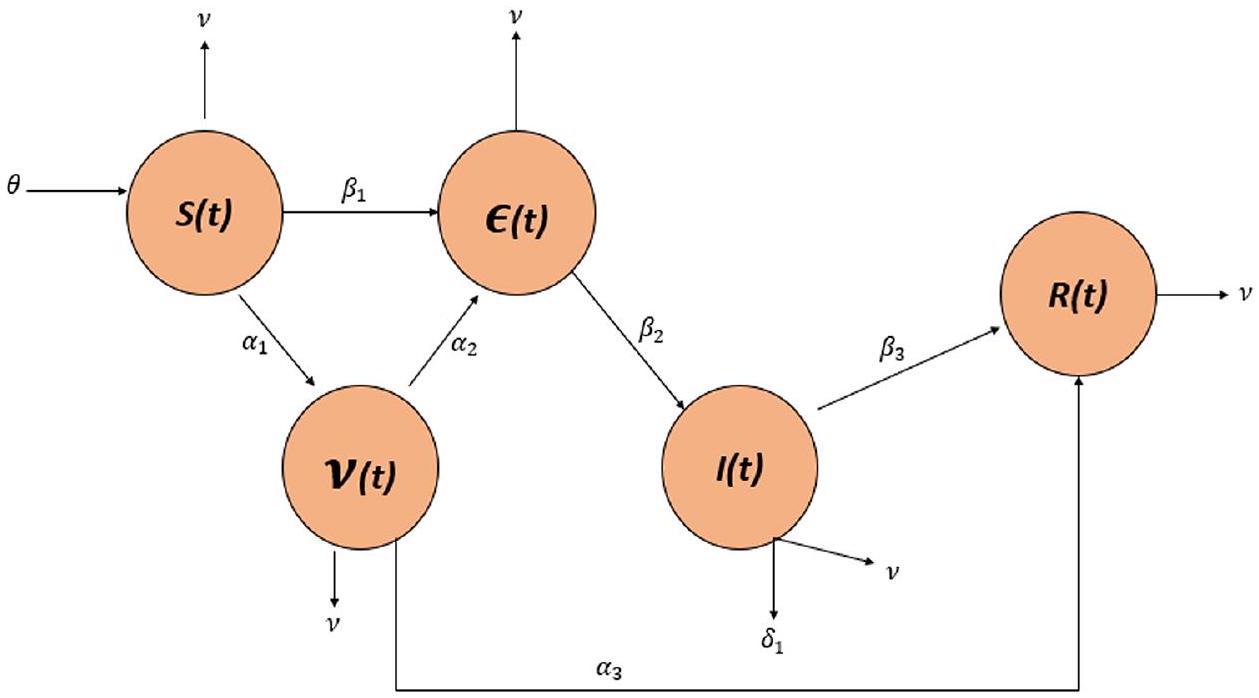
نفترض أن المتغيرات الحالة في الوقت مثل – المعرضة، – الملقحة، – المعرضة، – المصابة، و – المتعافية هي دوال قابلة للاشتقاق بشكل مستمر، حيث . يسمح لنا هذا التشكيل بنمذجة ديناميات مرض الجلد المتكتل داخل مجموعة الماشية، مع الأخذ في الاعتبار الانتقالات بين الحالات مع مرور الوقت. يمكن وصف نمط التدفق
لمرض الجلد المتكتل، كما هو موضح في الشكل 1، بواسطة معادلات غير خطية إلى جانب المعادلات التفاضلية العادية (ODEs) كما يلي:
بالإضافة إلى القيود غير السلبية التالية.
يمكن رؤية مفاهيم النمذجة الكسرية . اقترح كابوتو وفابريزيو مشتقًا كسريًا جديدًا بدون أي تفرد في نواته. درس مور وسيريسوبتاوي وكونبراسرت نموذج المعادلة التفاضلية الكسرية لكابوتو-فابريزيو لفيروس نقص المناعة البشرية/الإيدز مع حجرة العلاج. مستلهمين من العمل أعلاه، نقترح ونحلل نموذج كابوتو-فابريزيو الكسرية لمرض الجلد المتكتل. تم إثبات وجود وخصوصية نظام الحلول للنموذج باستخدام نظرية النقطة الثابتة لباناش. يرتبط مشتق قانون القوة لمشتق ريمان-ليوفيلي مع المعلومات الضوضائية بسبب خصائص الذاكرة الفريدة له. ينتج مشتق كابوتو-فابريزيو ضوضاء أقل من قانون القوة، بينما يوفر مشتق أتانغانا-بالينو شرحًا مفصلًا. العمل المنجز في هذه الورقة يتماشى كما يلي: في الجزء التمهيدي تحت قسم “المقدمة”، يتم توضيح هدف الدراسة. قسم “مرض الجلد المتكتل مع كابوتو-فابريزيو”: نموذج كابوتو-فابريزيو الكسرية لمرض الجلد المتكتل: يقدم نموذج كابوتو-فابريزيو الكسرية الجديد لمرض الجلد المتكتل، الذي يوضح مختلف مكونات النموذج مع المعلمات. يتضمن هذا القسم أيضًا تحليل وجود وخصوصية الحلول. قسم “استقرار ألام-هايرز لنموذج مرض الجلد المتكتل”: تحليل الاستقرار: يستكشف استقرار النموذج لفهم سلوكياته على المدى الطويل. قسم “النظام العددي”: المحاكاة العددية: يقدم المحاكاة العددية التي تم إجراؤها للتحقق من النتائج النظرية وتقديم رؤى حول سلوك النموذج تحت سيناريوهات مختلفة. قسم “الاستنتاجات”: الاستنتاج: يختتم الدراسة بتلخيص النتائج الرئيسية وآثارها، بالإضافة إلى اقتراح طرق محتملة للبحث المستقبلي. يوجه هذا الهيكل التنظيمي القارئ خلال تطوير وتحليل والتحقق من نموذج كابوتو-فابريزيو الكسرية المقترح، مما يؤدي إلى فهم شامل لدينامياته وآثاره.

مرض الجلد المتكتل مع كابوتو-فابريزيو

نموذج مرض الجلد المتكتل مع مشتق كابوتو-فابريزيو( ) يُعطى بواسطة
الشكل 1. مخطط التدفق لمرض الجلد المتكتل.
مع v تشير إلى ترتيب المشتق في شكل كسري مع خاضع لـ

المقدمات الأساسية للنموذج

إليك المقدمات الرياضية، المقدمة كالنظريات، والتي سيتم تطبيقها لإثبات إيجابية وخصوصية نموذج مرض الجلد المتكتل مع المشتق (2) كما هو معرف على التوالي. افترض أن الدالة معرفة كما في الفضاء مع .
التعريف 2.1 لـ , افترض أن الدالة مع . يتم إعطاء المشغل الكسرية كما هو
حيث مع الشروط الأولية، .
التعريف 2.2 المشتق من الرتبة الكسرية الممثل المقابل لمشغل التكامل للمشتق الكسرية يُعطى كما هو
التعريف 2.3 تحويل لابلاس للمشتق الكسرية هو هو
النظرية 2.1 إذا كانت فضاء فرعي مغلق من فضاء باناش و خريطة انكماش، فإن له نقطة ثابتة فريدة في .

إيجابية حل نموذج مرض الجلد المتكتل مع

النظرية 2.2 في البداية عند الوقت . المجموعة تقترب من الحلول الإيجابية لجميع حالات النظام من الرتبة الكسرية (2)، مع .
نستخدم اللممة 2.3 لإثبات النظرية 2.2.
اللممة 2.3 افترض أن و لجميع , ثم ، حيث ، لجميع .
استنادًا إلى اللممة 2.3، نقدم الملاحظة التالية.
الملاحظة 2.4 لجميع , افترض أن و . إذا كانت ، لجميع ، فإن غير متناقصة وإذا كانت لجميع ، فإن غير متناقصة.
الدليل يتبع باستخدام اللممة 2.3 والملاحظة 2.4 التي تظهر أن حل نموذج مرض الجلد المتكتل مع موجود وله حل فريد. هنا، المعدل ثابت إيجابي لكل مستوى فرعي، والربع الإيجابي من حقل المتجهات يشير إلى . يصبح النموذج المفترض في (2)
لذا، فإن النظام (2) له قيمة إيجابية ثابتة وجميع حلولها تجذب إيجابيًا من حيث مع

وجود وخصوصية الحلول

في هذا القسم، نثبت وجود وخصوصية الحل للحل المفترض للنموذج (2) باستخدام مشغل التكامل كما عرّفه المؤلفون لوسادا ونيتو الذي ينتج:
المؤلفون في ، يستخدمون المعادلة (8) كما هو
دون فقدان العمومية لدينا
مشارًا إلى مجموعة المعادلات أعلاه بـ ، نعتبر المتغيرات الحالة تكون مستمرة بحيث و ، لبعض الثوابت الإيجابية .
النظرية 2.5 افترض أن مع كل نواة تلبي شرط ليبشيتز
الدليل الآن،
حيث . لذا،
لذا، تلبي شرط ليبشيتز. بالاستمرار بهذه الطريقة، يمكننا إثبات أن تلبي شروط ليبشيتز،
الآن، من (9)، لدينا
مع الشروط الأولية
افترض، نعرف الأشكال التكرارية أدناه,
النظرية 2.6 هناك على الأقل حل لنموذج مرض الجلد المتكتل مع إذا كانت
الدليل دع
ثم، لدينا
نظرًا لأن . كما ، لدينا . بالمثل،
كما ، نحصل على مع لـ . لذا، نموذج مرض الجلد المتكتل مع (2) له حل.
النظرية 2.7 نموذج مرض الجلد المتكتل مع له حل فريد إذا كانت
الدليل افترض أن هناك حلًا آخر مع القيم الأولية بحيث
الآن،
مما يعني أن
لذا، . لذا، . بالمثل، يمكننا إثبات
لذا، نموذج مرض الجلد المتكتل مع (2) له حل فريد.

استقرار ألام-هايرز لنموذج مرض الجلد المتكتل

في هذا القسم، نحصل على استقرار ألام-هايرز لنموذج مرض الجلد المتكتل مع (2). نذكر التعريف المطلوب.
التعريف 3.1 نموذج مرض الجلد المتكتل مع (2) له استقرار ألام-هايرز إذا كانت هناك ثوابت تلبي: لكل ، إذا كانت
وهناك حل لنموذج مرض الجلد المتكتل مع و الذي يلبي النموذج المعطى، بحيث
الملاحظة 3.1 الدالة تلبي عدم المساواة الأولى (11) إذا وفقط إذا كانت هناك دالة مستمرة ، التي تعتمد على ، بحيث
بالمثل، يمكننا تعريف الفئات الأخرى من النموذج (11) لبعض حيث , 5.النظرية 3.2 افترض أن الفرضية ( ) صحيحة. ثم نموذج مرض الجلد المتكتل مع (2) مستقر ألام-هايرز إذا كانت
الدليل دع و الدالة تكون عشوائية بحيث
بموجب الملاحظة 3.1، لدينا
وبالتالي، نحصل على
دع يكون الحل الفريد لنموذج مرض الجلد المتكتل مع (2). ثم،
لذا،
ثم،
حيث
بالمثل، لدينا
لذا، نموذج مرض الجلد المتكتل مع مستقر ألام-هايرز.

النظام العددي

هنا، تم تطوير نظام عددي لنموذج مرض الجلد المتكتل مع (2). لهذا، نستخدم النهج المتعلق ببولنوميات التداخل لاغرانج. اعتبر مشكلة كوشي العامة مع مشغل تفاضلي كسري كسري كما يلي:
باستخدام مشغل التكامل الكسرية الكسري، نحصل على
وضع بواسطة ، مما يعطي
يتم إعطاء فرق الحدود المتتالية كما يلي:
على الفترة المغلقة ، يمكن تقريب الدالة بواسطة تداخل بولنوميات لاغرانج
حيث . وبالتالي،
وضع (15) في (13) وبعد التبسيط، نحصل على
لذا، تم الحصول على النظام العددي لـ (9) كما يلي:

النتائج العددية والنقاش

في الدراسة الحالية، ناقشنا النموذج الذي تم تطويره بواسطة (2) لرصد الانتشار الديناميكي للمرض في السكان وحصلنا على بعض النتائج للنموذج المعني. الغرض من هذا النموذج الشامل هو مراقبة ما يحدث عندما تتغير الأوامر الكسرية في النموذج. هنا، يتم تقديم النتائج العددية للنموذج الذي يستخدم قيم المعلمات المحددة في الجدول 1، والتي تتوافق مع مرض الجلد المتكتل لمختلف . الآن، من خلال أخذ القيم الأولية كـ
المعلمة الوصف القيم المصدر
معدل الولادة 0.6 مفترض
معدل الانتقال من إلى بسبب الحالة المصابة 0.032 مفترض
معدل الترجمة من إلى 0.59 67
معدل الترجمة من إلى 0.3 67
معدل الحالات القابلة للتطعيم 0.9 مفترض
معدل الماشية الملقحة التي تتعرض بسبب الاتصال مع الأفراد المصابين 0.055 67
معدل الماشية الملقحة التي تتعافى 0.3 مفترض
معدل الوفيات بسبب مرض الحالة المصابة 0.03 مفترض
معدل الوفيات الذي حدث بشكل طبيعي 0.07 مفترض
الجدول 1. وصف المتغيرات والمعلمات المستخدمة في النموذج.
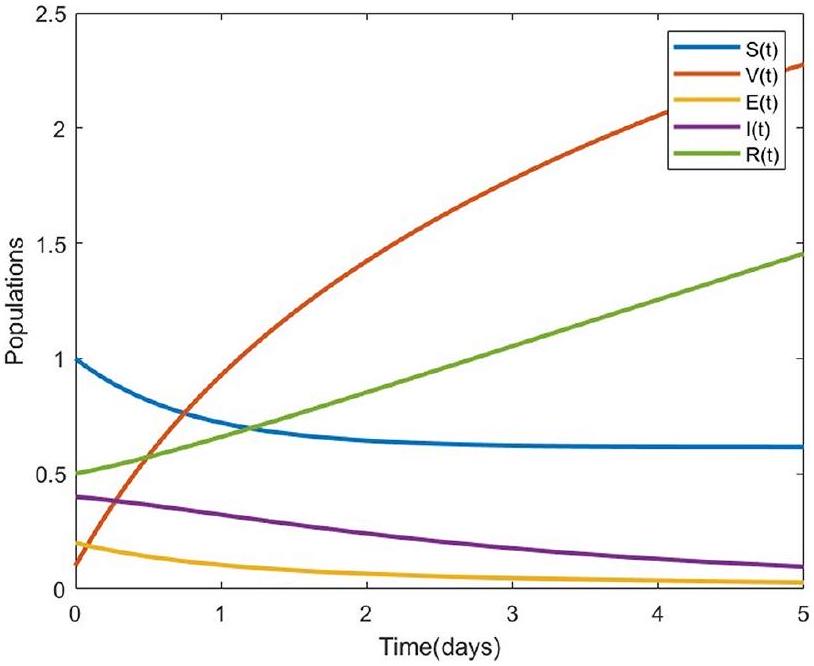
الشكل 2. سكان SVEIR.
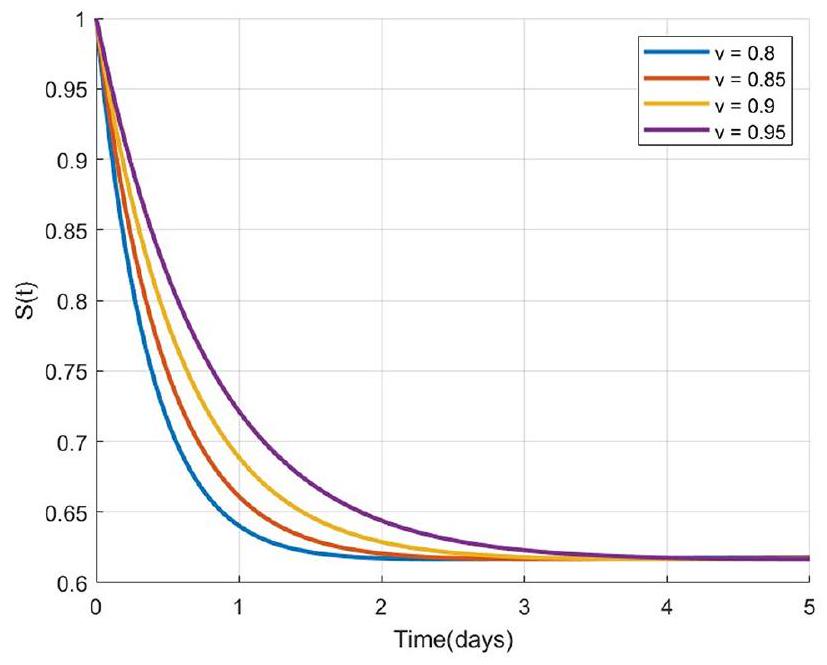
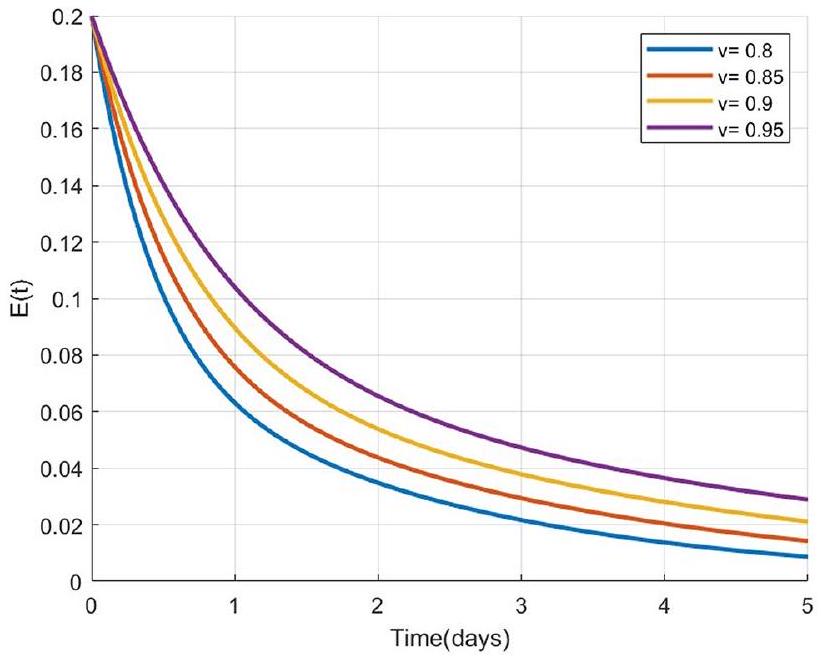
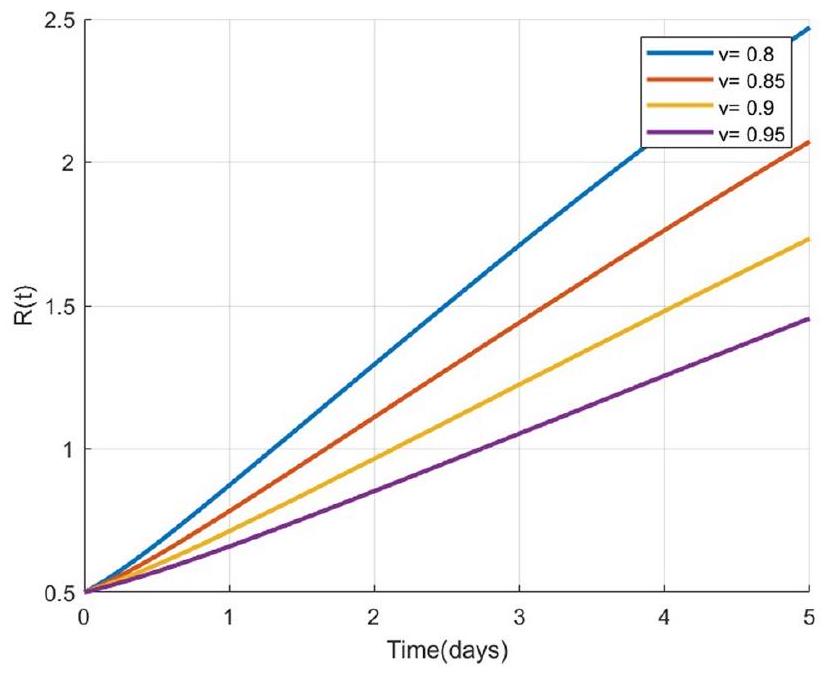
يوضح الشكل 2 تأثير ترتيب المشتقات والسلوك على النتائج المحققة من خلال إجراء الحل المقترح لـ . تم رسم النتائج لأوامر كسرية مختلفة و 0.95 في الشكل 2 من النموذج (2). من الشكل 3، يُلاحظ أن مجموعة الأشخاص القابلين للإصابة تتغير باستمرار مع المشتق الزمني. من الشكل 4، يُلاحظ أن مجموعة السكان الملقحين تتغير باستمرار مع المشتق الزمني. من الشكل 5، يُلاحظ أن مجموعة السكان المعرضين تتغير باستمرار مع المشتق الزمني. من الشكل 6، يُلاحظ أن مجموعة السكان المصابين تتغير باستمرار مع المشتق الزمني. من الشكل 7، من الواضح أن مجموعة الأشخاص المتعافين تزداد مع مرور الوقت.

الاستنتاجات

تقدم هذه الدراسة نموذجًا لمرض الجلد المتكتل (LSD) في إطار المشتق الكسرية كابوتو-فابريزيو. في البداية، نستنتج نظرية الوجود والتفرد للنموذج المفترض، من خلال إثبات وجود وتفرد الحلول باستخدام نهج النقطة الثابتة. بعد ذلك، نحقق في استقرار الحلول، من خلال استخدام معيار استقرار أولام-هايرز. للتحقق من نتائجنا النظرية، نطور مخططًا عدديًا ونطبقه للحصول على نتائج رسومية. تقدم محاكياتنا رسومات واقعية، والتي يتم شرحها بالتفصيل في القسم العددي من الورقة. نقوم بتحليل سلوك النموذج تحت أوامر مختلفة من المشتقات الكسرية، مما يوفر رؤى حول دينامياته وآثاره على إدارة LSD. نشجع القراء على استكشاف النموذج بشكل أكبر من خلال استخدام تقنيات عددية بديلة والنظر في مشغلين كسرين مختلفين. قد تقدم مثل هذه التحقيقات وجهات نظر إضافية وتعزز فهمنا لديناميات LSD واستراتيجيات السيطرة. إنها مشكلة مفتوحة مثيرة لدراسة ديناميات LSD تحت المشتق الكسرية ABC والمشتق الكسرية كابوتو-فابريزيو المتقطع.
الشكل 3. فئة القابلين للإصابة.
الشكل 4. سكان فئة الملقحين.
الشكل 5. فئة المعرضين.
الشكل 6. سكان فئة المصابين.
الشكل 7. سكان فئة المتعافين.

توفر البيانات

البيانات المستخدمة في هذا العمل متاحة من المؤلف المقابل بناءً على طلب معقول.
تاريخ الاستلام: 31 أغسطس 2024؛ تاريخ القبول: 3 مارس 2025
تم النشر عبر الإنترنت: 17 مارس 2025

References

  1. Alexander, R., Plowright, W. & Haig, D. Cytopathogenic agents associated with lumpy skin disease of cattle. Bull. Epizoot. Dis. Afr. 5, 489-492 (1957).
  2. Diallo, A. & Viljoen, G. J. Genus Capripoxvirus. In Poxviruses (eds Mercer, A. A. et al.) 167-181 (Birkhäuser Basel, 2007).
  3. Sanz-Bernardo, B. et al. Lumpy skin disease is characterized by severe multifocal dermatitis with necrotizing fibrinoid vasculitis following experimental infection. Vet. Pathol. 57, 388-396 (2020).
  4. Davies, F. G. Lumpy skin disease, an African capripox virus disease of cattle. Br. Vet. J. 147, 489-503 (1991).
  5. Babiuk, S., Bowden, T. R., Boyle, D. B., Wallace, D. B. & Kitching, R. P. Capripoxviruses: An emerging worldwide threat to sheep, goats and cattle. Transbound. Emerg. Dis. 55, 263-272 (2008).
  6. Davies, F. G. Lumpy skin disease of cattle: A growing problem in Africa and the Near East. World Anim. Rev. 68, 37-42 (1991).
  7. Young, E., Basson, P. A. & Weiss, K. E. Experimental infection of game animals with lumpy skin disease virus (prototype strain Neethling). Onderstepoort J. Vet. Res. 37, 79-87 (1970).
  8. Dao, T. D. et al. Characterization of Lumpy skin disease virus isolated from a giraffe in Vietnam. Transbound. Emerg. Dis. 69, e3268-e3272 (2022).
  9. Kumar, R. et al. Evidence of lumpy skin disease virus infection in camels. Acta Trop. 242, 7 (2023).
  10. Chihota, C. M., Rennie, L. F., Kitching, R. P. & Mellor, P. S. Mechanical transmission of lumpy skin disease virus by Aedes aegypti (Diptera: Culicidae). Epidemiol. Infect. 126, 317-321 (2001).
  11. Carn, V. M. & Kitching, R. P. An investigation of possible routes of transmission of lumpy skin disease virus (Neethling). Epidemiol. Infect. 114, 219-226 (1995).
  12. Chihota, C. M., Rennie, L. F., Kitching, R. P. & Mellor, P. S. Attempted mechanical transmission of lumpy skin disease virus by biting insects. Med. Vet. Entomol. 17, 294-300 (2003).
  13. Tuppurainen, E. S., Venter, E. H., Coetzer, J. A. & Bell-Sakyi, L. Lumpy skin disease: Attempted propagation in tick cell lines and presence of viral DNA in field ticks collected from naturally-infected cattle. Ticks Tick Borne Dis. 6, 134-140 (2015).
  14. Gubbins, S. Using the basic reproduction number to assess the risk of transmission of lumpy skin disease virus by biting insects. Transbound. Emerg. Dis. 66, 1873-1883 (2019).
  15. Weiss, K. Lumpy skin disease virus. In Cytomegaloviruses Rinderpest Virus Lumpy Skin Disease Virus (eds Weiss, K. & Gard, S.) 111-131 (Springer, 1968).
  16. Kumar, N. & Tripathi, B. N. A serious skin virus epidemic sweeping through the Indian subcontinent is a threat to the livelihood of farmers. Virulence 13(1), 1943-1944. https://doi.org/10.1080/21505594.2022.2141971 (2022).
  17. Department SR. Cattle population in India 2016-2023 (2022).
  18. Ali, A. A., Neamat-Allah, A. N. F., Sheire, H. A. E. & Mohamed, R. I. Prevalence, intensity, and impacts of non-cutaneous lesions of lumpy skin disease among some infected cattle flocks in Nile Delta Governorates, Egypt. Comp. Clin. Pathol. 30, 693-700 (2021).
  19. Diseases, O. O. -L. Version adopted by the World Assembly of Delegates of the OIE in May 2010 (Terrestrial Manual of Lumpy Skin Disease, OIE, Paris, 2010).
  20. MacOwan, K. Observations on the epizootiology of lumpy skin disease during the first year of its occurrence in Kenya. Bull. Epizootic Dis. Afr. 7, 7-20 (1959).
  21. Tuppurainen, E. S. & Oura, C. A. Review: Lumpy skin disease: An emerging threat to Europe, the Middle East and Asia. Transbound. Emerg. Dis. 59, 40-48 (2012).
  22. House, J. A. et al. The isolation of lumpy skin disease virus and bovine herpesvirus-from cattle in Egypt. J. Vet. Diagn. Invest. 2, 111-115 (1990).
  23. Lojkić, I., Šimić, I., Krešić, N. & Bedeković, T. Complete genome sequence of a lumpy skin disease virus strain isolated from the skin of a vaccinated animal. Genome Announc. 6, e00482-00418 (2018).
  24. Kumar, N. et al. Isolation and characterization of lumpy skin disease virus from cattle in India. PLoS ONE 16, e0241022 (2021).
  25. Salib, F. A. & Osman, A. H. Incidence of lumpy skin disease among Egyptian cattle in Giza Governorate, Egypt. Vet. World 4, 162-167 (2011).
  26. Babiuk, S. et al. Quantification of lumpy skin disease virus following experimental infection in cattle. Transbound. Emerg. Dis. 55, 299-307 (2008).
  27. Davies, F. Lumpy skin disease, an African capripox virus disease of cattle. Br. Vet. J. 147, 489-503 (1991).
  28. Irons, P., Tuppurainen, E. & Venter, E. Excretion of lumpy skin disease virus in bull semen. Theriogenology 63, 1290-1297 (2005).
  29. Mathivanan, E. M. E., Raju, K. & Murugan, R. Outbreak of Lumpy skin disease in India 2022- an emerging threat to livestock and livelihoods. Glob. Biosecurity 5 (2023).
  30. Sudhakar, S. B. et al. Lumpy skin disease (LSD) outbreaks in cattle in Odisha state, India in August 2019: Epidemiological features and molecular studies. Transbound. Emerg. Dis. 67, 2408-2422 (2020).
  31. Minor, P. D., John, A., Ferguson, M. & Icenogle, J. P. Antigenic and molecular evolution of the vaccine strain of type 3 poliovirus during the period of excretion by a primary vaccinee. J. Gen. Virol. 67, 693-706 (1986).
  32. Odibat, Z. M. & Shawagfeh, N. T. Generalized Taylor’s formula. Appl. Math. Comput. 186, 286-293 (2007).
  33. Diethelma, K. & Ford, N. J. Analysis of fractional differential equations. J. Math. Anal. Appl. 265, 229-248 (2002).
  34. Kilbas, A. A., Srivastava, H. M. & Trujillo, J. J. Theory and Applications of Fractional Differential Equations (Elsevier, 2006).
  35. Podlubny, I. Fractional Differential Equations (Academic Press, 1999).
  36. Petras, I. Fractional-Order Nonlinear Systems: Modeling, Analysis andSimulation (Springer, 2011).
  37. Caputo, M. Elasticità e dissipazione (Elasticity and Dissipation) (Zanichelli, 1969).
  38. Li, H. L., Zhang, L., Hu, C., Jiang, Y. L. & Teng, Z. Dynamical analysis of a fractional-order predator-prey model incorporating a prey refuge. J. Appl. Math. Comput. 54, 435-449 (2017).
  39. Nugraheni, K., Trisilowati, T. & Suryanto, A. Dynamics of a fractional order eco-epidemiological model. J. Trop. Life Sci. 7, 243250 (2017).
  40. Ahmad, Z., Arif, M., Ali, F., Khan, I. & Nisar, K. S. A report on COVID-19 epidemic in Pakistan using SEIR fractional model. Sci. Rep. 10, 22268 (2020).
  41. Panwar, V. S., Uduman, P. S. S. & Gómez-Aguilar, J. F. Mathematical modeling of coronavirus disease COVID-19 dynamics using CF and ABC non-singular fractional derivatives. Chaos Solitons Fractals 145, 110757 (2021).
  42. Kumar, P. & Erturk, V. S. The analysis of a time delay fractional COVID-19 model via Caputo type fractional derivative. Math. Methods Appl. Sci. 1-14 (2020).
  43. Ogunrinde, R. B., Nwajeri, U. K., Fadugba, S. E., Ogunrinde, R. R. & Oshinubi, K. I. Dynamic model of COVID-19 and citizens reaction using fractional derivative. Alex. Eng. J. 60, 2001-2012 (2021).
  44. Bahloul, M. A., Chahid, A. & Laleg-Kirati, T.-M. Fractional-order SEIQRDP model for simulating the dynamics of COVID-19 epidemic. IEEE Open J. Eng. Med. Biol. 1, 249-256 (2020).
  45. Peter, O. J. et al. Analysis and dynamics of fractional order mathematical model of COVID-19 in Nigeria using Atangana-Baleanu operator. Comput. Mater. Contin. 145, 1823-1848 (2021).
  46. Atangana, A. & Araz, S. I. Mathematical model of COVID-19 spread in Turkey and South Africa: Theory, methods and applications. Adv. Differ. Equ. 2020, 659 (2020).
  47. Atangana, A. & Araz, S. I. A novel COVID-19 model with fractional differential operators with singular and non-singular kernels: Analysis and numerical scheme based on Newton polynomial. Alex. Eng. J. 60, 3781-3806 (2021).
  48. Buonomo, B. Effects of information-dependent vaccination behavior on coronavirus outbreak: Insights from a SIRI model. Ric. Mat. 69, 483-499 (2020).
  49. Kassa, S. M., Njagarah, J. B. H. & Terefe, Y. A. Analysis of the mitigation strategies for COVID-19: From mathematical modelling perspective. Chaos Solitons Fractals 138, 109968 (2020).
  50. Shaikh, A. S., Shaikh, I. N. & Nisar, K. S. A mathematical model of COVID-19 using fractional derivative: Outbreak in India with dynamics of transmission and control. Adv. Differ. Equ. 373 (2020).
  51. Mohammad, M., Trounev, A. & Cattani, C. The dynamics of COVID-19 in the UAE based on fractional derivative modeling using Riesz wavelets simulation. Adv. Differ. Equ. 115 (2021).
  52. Naik, P. A., Yavuz, M., Qureshi, S., Zu, J. & Townley, S. Modeling and analysis of COVID-19 epidemics with treatment in fractional derivatives using real data from Pakistan. Eur. Phys. J. Plus 135, 795 (2020).
  53. Choi, S. K., Kang, B. & Koo, N. Stability for Caputo fractional differential systems. Abstr. Appl. Anal. 2014, 631419 (2014).
  54. Wei, Z., Li, Q. & Che, J. Initial value problems for fractional differential equations involving Riemann-Liouville sequential fractional derivative. J. Math. Anal. Appl. 367, 260-272 (2010).
  55. Van den Driessche, P. & Watmough, J. A simple SIS epidemic model with a backward bifurcation. J. Math. Biol. 40, 525-540 (2000).
  56. Huo, J., Zhao, H. & Zhu, L. The effect of vaccines on backward bifurcation in a fractional order HIV model. Nonlinear Anal. Real World Appl. 26, 289-305 (2015).
  57. Vargas-De-Leon, C. Volterra-type Lyapunov functions for fractional-order epidemic systems. Commun. Nonlinear Sci. Numer. Simul. 24, 75-85 (2015).
  58. Zarin, R., Khaliq, H., Khan, A., Ahmed, I. & Humphries, U. W. A numerical study based on Haar Wavelet collocation methods of fractional-order antidotal computer virus model. Symmetry 15, 621. https://doi.org/10.3390/sym15030621 (2023).
  59. Jitsinchayakul, S. et al. Fractional modeling of COVID-19 epidemic model with harmonic mean type incidence rate. Open Phys. 19(1), 693-709. https://doi.org/10.1515/phys-2021-0062 (2021).
  60. Thirthar, A. A., Abboubakar, H., Alaoui, A. L. & Nisar, K. S. Dynamical behavior of a fractional-order epidemic model for investigating two fear effect functions. Results Control Optim. 16, 100474 (2024).
  61. Muthuvel, K., Kaliraj, K., Nisar, K. S. & Vijayakumar, V. Relative controllability for -Caputo fractional delay control system. Results Control Optim. 16, 100475 (2024).
  62. Nisar, K. S. A constructive numerical approach to solve the fractional modified Camassa-Holm equation. Alex. Eng. J. 106, 19-24 (2024).
  63. Chu, Y.-M., Zarin, R., Khan, A. & Murtaza, S. A vigorous study of fractional order mathematical model for SARS-CoV-2 epidemic with Mittag-Leffler kernel. Alex. Eng. J. 71, 565-579. https://doi.org/10.1016/j.aej.2023.03.037 (2023).
  64. Caputo, M. & Fabrizio, M. A new definition of fractional derivative without singular kernel. Progr. Fract. Diff. Appl. 1, 1-13 (2015).
  65. Moore, E. J., Sirisubtawee, S. & Koonprasert, S. A Caputo-Fabrizio fractional differential equation model for HIV/AIDS with treatment compartment. Adv. Differ. Equ. 2019, 200. https://doi.org/10.1186/s13662-019-2138-9 (2019).
  66. Losada, J. & Nieto, J. J. Properties of a new fractional derivative without singular kernel. Progr. Fract. Diff. Appl. 1, 87-92 (2015).
  67. Butt, A. I. K., Aftab, H., Imran, M. & Ismaeel, T. Mathematical study of lumpy skin disease with optimal control analysis through vaccination. Alex. Eng. J. 72, 247-259. https://doi.org/10.1016/j.aej.2023.03.073 (2023).
  68. Deimling, K. Nonlinear Functional Analysis (Springer, 1985).

الشكر والتقدير

يقدم المؤلف عبد الرحمن س. أ. عمر الشكر لعمادة الدراسات العليا والبحث العلمي في جامعة المجمعه لتمويل هذا البحث من خلال رقم المشروع R-20251650.

مساهمات المؤلفين

ج.ن. التصور، المنهجية، البرمجيات. كتابة – إعداد المسودة الأصلية. أ.ج.غ: المحاكيات، التصور، التحقيق. س.ر.: المراجعة، المراجعة والتحرير. أ.س.أ. عمر: الحسابات العددية، النتائج والنقاش. إ.ك. المنهجية، البرمجيات. كتابة – إعداد المسودة الأصلية. راجع جميع المؤلفين المخطوطة.

الإعلانات

تعارض المصالح

لا يوجد لدى المؤلفين أي تعارض أو مصالح متنافسة.

معلومات إضافية

يجب توجيه المراسلات والطلبات للحصول على المواد إلى أ.س.أ.ع. أو إ.ك.
معلومات إعادة الطبع والتصاريح متاحة على www.nature.com/reprints.
ملاحظة الناشر تظل Springer Nature محايدة فيما يتعلق بالمطالبات القضائية في الخرائط المنشورة والانتماءات المؤسسية.
الوصول المفتوح هذه المقالة مرخصة بموجب ترخيص المشاع الإبداعي النسب-غير التجارية-بدون مشتقات 4.0 الدولية، والذي يسمح بأي استخدام غير تجاري، ومشاركة، وتوزيع وإعادة إنتاج في أي وسيلة أو صيغة، طالما أنك تعطي الائتمان المناسب للمؤلفين الأصليين والمصدر، وتوفر رابطًا إلى ترخيص المشاع الإبداعي، وتوضح إذا قمت بتعديل المادة المرخصة. ليس لديك إذن بموجب هذا الترخيص لمشاركة المواد المعدلة المشتقة من هذه المقالة أو أجزاء منها. الصور أو المواد الأخرى من طرف ثالث في هذه المقالة مشمولة في ترخيص المشاع الإبداعي للمقالة، ما لم يُذكر خلاف ذلك في سطر ائتمان للمادة. إذا لم تكن المادة مشمولة في ترخيص المشاع الإبداعي للمقالة واستخدامك المقصود غير مسموح به بموجب اللوائح القانونية أو يتجاوز الاستخدام المسموح به، ستحتاج إلى الحصول على إذن مباشرة من صاحب حقوق الطبع والنشر. لعرض نسخة من هذا الترخيص، قم بزيارة http://creativecommo ns.org/licenses/by-nc-nd/4.0/.
© المؤلفون (س) 2025

  1. قسم الرياضيات، معهد سافيثا للعلوم الطبية والتقنية، مدرسة سافيثا للهندسة، جامعة سافيثا، تشيناي، تاميل نادو 602105، الهند. قسم الرياضيات، كلية الهندسة والتكنولوجيا، كلية الهندسة والتكنولوجيا، معهد SRM للعلوم والتكنولوجيا، SRM ناغار، كاتانكولاثور، كانشيبورام، تشيناي، تاميل نادو 603203، الهند. قسم العلوم والإنسانية، كلية R.M.K للهندسة والتكنولوجيا، بودوفويال، تاميل نادو 601206، الهند. قسم نظم المعلومات، كلية علوم الحاسوب والمعلومات، جامعة المجمعه، 11952 المجمعه، المملكة العربية السعودية. قسم الرياضيات، كلية التربية، جامعة الفاشر، الفاشر، جنوب السودان. قسم الرياضيات، كلية العلوم، الزلف، جامعة المجمعه، 11952 المجمعه، المملكة العربية السعودية. مركز هوراني للبحث العلمي التطبيقي، جامعة عمان الأهلية، عمان، الأردن. البريد الإلكتروني: as.abdoalrahman@mu.edu.sa; i.said@mu.edu.sa

Journal: Scientific Reports, Volume: 15, Issue: 1
DOI: https://doi.org/10.1038/s41598-025-92884-y
PMID: https://pubmed.ncbi.nlm.nih.gov/40097509
Publication Date: 2025-03-17

OPEN

Mathematical model of the lumpy skin disease using Caputo fractional-order derivative via invariant point technique

Gunaseelan Mani , Arul Joseph Gnanaprakasam , Sakthi Ramalingam , Abdoalrahman S. A. Omer & Ilyas Khan

Abstract

The aim of this paper is to study the fractional model of Lumpy Skin Disease, aiming to enhance our understanding of this disease. Specifically, we employ the recently introduced Caputo-Fabrizio fractional (CFF) derivative to analyze the Lumpy Skin Disease model in detail. To comprehensively study the model’s solutions, we utilize the Picard-Lindelof approach to assess their existence and uniqueness. Furthermore, we employ numerical techniques, specifically the CFF derivative combined with the fundamental theorem of fractional calculus and fixed point theorem, to obtain the solutions of Lumpy Skin Disease in near form using fractional order. This innovative approach offers novel insights into the dynamics of the disease model that were previously unexplored. In addition, numerical simulations are conducted to explore the change in effects of control parameters on specific compartments within the model. The geometric representation of the model provides valuable insights into its complexity and reliability. By simulating each model compartment at various fractional orders and comparing them with integer-order simulations, we highlight the effectiveness of modern derivatives. Overall, our fractional analysis emphasizes the enhanced accuracy of non-integer order derivatives in capturing the dynamics of the Lumpy Skin Disease model. These findings contribute to advancing our understanding of the disease and may have implications for its control and management strategies.

Keywords Caputo-Fabrizio operator, Fractional order lumpy skin disease, Existence and uniqueness, Invariant point theory
Mathematics Subject Classification 26A33, 34A08
Lumpy Skin Disease, characterized by its distinct lesions, is attributed to the Lumpy Skin Disease Virus (LSDV) . This virus, with a genome size of approximately 150 kb , is categorized as a double-stranded DNA virus and is one among the variant of the Capripoxvirus genus and another type of the virus called the Chordopoxviridae sub-family of the Poxviridae family . Additionally, within the same genus are other notable members such as Goat poxvirus (GTPV) and Sheep poxvirus (SPPV). The morphological similarities of LSDV compared with the other members of the Poxviridae family like the vaccinia virus are observed through Electron microscopy . Notably, LSDV is an infectious disease of non-zoonotic type and exhibts the display of host specificity, primarily infecting the cattle group namely (Bos indicus, Bos taurus) and tamed animals like water buffaloes (Bubalus bubalis) . Moreover, LSDV has been documented to infect various mammalian species in the wild, including camels, giraffes, and wildebeests .
Transmission of LSDV occurs through various routs, including direct contact via skin lesions, milk, and through parasitic insects like biting midges, acari, and mosquitoes . On overview of the infection rate seems to be higher during warm and humid periods compared to winters, attributed to increased insect activity and mobility during the season of summer . The transmission of the virus usually occurs from infected to healthy animals through the shedding of the virus via saliva, along the skin lesions, through the nasal discharge and lachrymal secretion . The emergence of the Lumpy Skin Disease virus was first recorded in India in 2019, subsequently leading to severe outbreaks. The most recent outbreak began in May 2022, affecting nearly all states in the country. Among these, 15 Indian states suffered substantial economic losses, with a staggering death toll nearing 100,000 cattle . Given that livestock production is a crucial means of livelihood in a developing nation like India, the emergence of a lethal disease like Lumpy Skin Disease has directly impacted the economy and hindered livestock production .
India harbors a vast cattle breeding with count of the population around 308 million, underscoring the significance to care and control the infectious disease that spreads among the cattle group . Direct losses encompass cattle mortality and reduced milk production, while indirect losses involve constraints on cattle movement across the country . Past research reveals facts about the organs and tissues of the infected animals possesses the pathological change. The changes include major occurrences of the hepatitis, cow mastitis, necrotic lymphadenitis, orchitis, and identifications of of the effect of myocardial damage . The World Health Organization (WHO) has designated lumpy skin disease as a notifiable illness . Initially discovered in Zambia in , this disease remained largely confined to Sub-Saharan Africa until 1989, after which it began spreading beyond the region’s borders into the Middle East and Asia . LSDV was notably identified during the year 2016 in the largest country Russia and several Southeast countries of Europe . In November 2019, the disease made its debut in India along with other Asian nations like Thailand, well developed giant nation China, boarder sharing nations such as Nepal, Bangladesh, and Bhutan . While LSD has been present in India since 2019, its impact became notably severe in the year 2022, with more than two million infected cattle.
The symptomatic effect of Lumpy Skin Disease (LSD) differs from one individual to another individual animal and depend on the major cause of the infection. Typically, it takes almost one to four weeks to identify the traits apparently, which may include high fever, sight issues and nasal discharge, loss of appetite, and the development of nodular lesions on the skin . Data suggest a mortality rate ranging from 5 to . Some of the states in India like Uttar Pradesh, Punjab, Haryana, Karnataka, West Bengal, Rajasthan, Gujarat and Maharashtra are the states most severely affected by Lumpy Skin Disease (LSD), experiencing high levels of both mortality and morbidity . To combat the spread of LSD, the Indian government has implemented various measures, including mass vaccination campaigns, the establishment of quarantine like isolation of individuals to avoid contact, and block the movement of infected individual and this restriction applied to some susceptible animals. Nevertheless, the disease exists among the affected one need to be controlled remains a challenging task and due to inadequate awareness regarding the transmission of information and various options than can be applied to control, along with the early detection of infected group of animal.
The prevailing belief about the origin of LSDV projects that Lumpy Skin Disease Virus (LSDV) might have generated initially from the previous poxvirus species and got evolved through adaptation to various hosts. The LSDV which is a double-stranded DNA viruses are recognized for utilizing homologous recombination as an evolutionary mechanism, enabling them to broaden their host range and enhance virulence . In this study, genome sequencing was utilized to identify LSDV variants that spreads in India. Phylogenetic analysis revealed two distinct classes of variants present in the country. Furthermore, mutation (SNP) analysis indicated significant differences in the number of mutations between these groups.
To model the Lumpy Skin Disease (LSD) study, the total population can be divided into five classes as follows::
  1. Affected individuals, denoted by , called Susceptible
  2. Individuals, denoted by , called as Vaccinated
  3. Individuals, denoted by , called as Exposed
  4. Individuals, denoted by , known as Infected
  5. Individuals, denoted by , known as Recovered
Thus, the collection of the entire population at any time moment is given by the sum of these classes:
This model allows us to track the dynamics of LSD within a population over time, considering the transitions between these different classes.
The susceptible class, denoted as , encompasses cattle vulnerable to the virus, which can lead to illness upon interaction with infected cattle. Cattle that have been vaccinated are called vaccinated group, denoted by . When susceptible cattle come into contact with infected individuals, they transition to the exposed class, denoted as . Thus, the exposed class comprises cattle that have been infected but are not yet infectious. Subsequently, the infected class, denoted by , includes cattle in which the virus has established itself, rendering them infectious. An infectious cattle has the ability to spread the virus to others. Finally, the recovered class, , comprises cattle with high immunity who recover quickly, possibly with the aid of medication.
We assume that the state variables in time such as – Susceptible, – Vaccinated, – Exposed, – Infected, and – Recovered are differentiable functions continuously , where . This formulation allows us to model the dynamics of LSD within a cattle population, considering the transitions between the states over time. The flow pattern
for LSD, as depicted in Fig. 1, can be described by a nonlinear equations along with the ordinary differential equations (ODEs) as follows:
along with the following non-negative restrictions.
Fractional modeling concepts one can see . Caputo and Fabrizio proposed a new fractional derivative without any singularity in its kernel. Moore, Sirisubtawee and Koonprasert studied Caputo-Fabrizio fractional differential equation model for HIV/AIDS with treatment compartment. Motivated by the above work, we propose and analyze a Caputo-Fabrizio fractional LSD model. The existence and uniqueness of the system of solutions of the model are established using a Banach fixed-point theorem. The power law derivative of the Riemann-Liouville fractional derivative or Caputo-Fabrizio fractional derivative, is associated with noisy information due to its unique memory qualities. The Caputo-Fabrizio fractional derivative produces less noise than the power law, whereas the Atangana-Baleanu fractional derivative provides a detailed explanation. The work carried in this paper is aligned as follows: In the introduction part under Section “Introduction”, the objective of the study is outlined. Section “Lumpy Skin Disease with Caputo-Fabrizio”: Caputo-Fabrizio Fractional LSD Model: Introduces the newly proposed Caputo-Fabrizio fractional LSD model, which details the various receptacle of the model along with parameters. This section also includes an analysis of the existence and uniqueness of solutions. Section “Ulam-Hyers stability of the Lumpy Skin Disease model”: Stability Analysis: Explores the stability of the model to understand its long-term behaviors. Section “Numerical scheme”: Numerical Simulations: Presents numerical simulations conducted to validate the theoretical findings and provide insights into the model’s behavior under various scenarios. Section “Conclusions”: Conclusion: Concludes the study by summarizing the main findings and their implications, as well as suggesting potential avenues for future research. This organizational structure guides the reader through the development, analysis, and validation of the proposed Caputo-Fabrizio fractional LSD model, leading to a comprehensive understanding of its dynamics and implications.

Lumpy skin disease with Caputo-Fabrizio

The lumpy skin disease model with Caputo-Fabrizio( ) derivative is given by
Fig. 1. Flowchart for the LSD.
with v denote the derivative order in the form of fractional with subject to

Model basic preliminaries

Here are the mathematical preliminaries, presented as theorems, which will be applied to prove the positivity and uniqueness of the lumpy skin disease model with derivative (2) as defined respectively. Assume the function defined as in the space with .
Definition 2.1 For , assume that the function with . The fractional operator is given as
where with the initial conditions, .
Definition 2.2 Fractional order derivative represented corresponding to the integral operator for the fractional derivative is given as
Definition 2.3 The Laplace transform of fractional derivative is is
Theorem 2.1 If be a closed subspace of a Banach space and be a contraction mapping, then has a unique fixed point in .

Positivity of solution of LSD model with

Theorem 2.2 Initially at time . The set approaches positive solutions for all cases of the fractional order system (2), with .
We use Lemma 2.3 to prove Theorem 2.2.
Lemma 2.3 Suppose and for all , then , where , for all .
Following Lemma 2.3, we give obtain the following remark.
Remark 2.4 For all , assume that and . If , for all , then is non decreasing and if for all , then is non increasing.
Proof The proof follows by using Lemma 2.3 and Remark 2.4 which shows that the solution of LSD model with exist and has a unique solution. Here, the rate is positively invariant for each hyperplane bonding, the positive octant of the vector field points in . The model assumed in (2) becomes
Thus, the system (2) has fixed positive value and all its solutions are positively attracting in terms of with

Existence and uniqueness of the solutions

In this section, we prove the existence and uniqueness of the solution for the assumed model (2) by using the integral operator as defined by the authors Losada and Nieto which yields:
The authors in , uses the Eq (8) as
Without loss of generality we have
Denoting the above set of equations as , we consider the state variables be continuous such that and , for some positive constants .
Theorem 2.5 Assuming with each kernel satisfying the Lipschitz condition
Proof Now,
where . Hence,
Thus, satisfies the Lipschitz condition. Continuing in this manner, we can prove that satisfy the Lipschitz conditions,
Now, from (9), we have
with the initial conditions
Suppose, we define the iterative recursive forms below,
Theorem 2.6 Thereisatleastasolution oftheLumpySkinDiseasemodelwith if
Proof Let
Then, we have
Since . As , we have . Similarly,
As , we get with for . Hence, Lumpy Skin Disease model with (2) has a solution.
Theorem 2.7 The Lumpy Skin Disease model with has a unique solution if
Proof Assume that there exists another solution with initial values such that
Now,
which implies that
Therefore, . Hence, . Similarly, we can prove
Hence, Lumpy Skin Disease model with (2) has a unique solution.

Ulam-Hyers stability of the lumpy skin disease model

In this section, we obtain the Ulam-Hyers stability of the Lumpy Skin Disease model with (2). We state the required definition.
Definition 3.1 The Lumpy Skin Disease model with (2) has Ulam-Hyers stability if there exist constants satisfying: For every , if
and there exists a solution of the Lumpy Skin Disease model with and that statisfying the given model, such that
Remark 3.1 The function satisfies the first inequality (11) if and only if there exists a continuous function , which is dependent on , such that
Similarly, we can define for other classes of the model (11) for some where , 5.Theorem 3.2 Assume that the hypothesis ( ) holds true. Then the Lumpy Skin Disease model with (2) is Ulam-Hyers stable if
Proof Let and the function be arbitary such that
By the Remark 3.1, we have
Consequently, we get
Let be the unique solution of the Lumpy Skin Disease model with (2). Then,
Hence,
Then,
where
Similarly, we have
Thus, Lumpy Skin Disease model with is Ulam-Hyers stable.

Numerical scheme

Here, a numerical scheme for the Lumpy Skin Disease model with (2) is developed. For this, we use the approach related to Lagrange interpolation polynomials. Consider a general Cauchy problem with fractal fractional differential operator as:
Utilizing the fractal fractional integral operator, we obtain
Putting by , which gives
The successive terms difference is given as follows:
Over the closed interval , the function can be approximated by the Lagrange polynomial interpolation
where . Consequently,
Putting (15) in (13) and after simplification, we get
Hence, the numerical scheme for (9) is obtained as the following:

Numerical results and discussion

In the current study, we deliberated the model developed by (2) for observing the dynamic spread of the disease in the population and obtained some results for the considered model. The purpose of this extensive model is to observe what happens when fractional order changes in the model. Here, the numerical outcomes are presented for model employing the parameters values defined in Table 1, which are compatible with Lumpy Skin Disease for different . Now, by taking initial values as
Parameter Description Values Source
Rate of birth 0.6 Assumed
Transmission rate from to due to infected state 0.032 Assumed
Translation rate from to 0.59 67
Translation rate from to 0.3 67
Rate of the susceptible case gets vaccinated 0.9 Assumed
Rate of the vaccinated cattle that are exposed due to contact with infected individuals 0.055 67
Rate at of the vaccinated cattle that are getting recovered 0.3 Assumed
Death rate due to the cause of disease in the infected state 0.03 Assumed
death rate that happened naturally 0.07 Assumed
Table 1. Description of the variables and parameters used in the model.
Fig. 2. Population of SVEIR.
Fig. 2 exemplifies the effect of derivative order and behavior on achieved outcomes by the proposed solution procedure for . The outcomes have been plotted for different fractional orders and 0.95 in Fig. 2 of the model (2). From Fig. 3, it is observed that the group of susceptible people varies continuously with time derivative. From Fig. 4, it is observed that the group of vaccinated population varies continuously with time derivative. From Fig. 5, it is observed that the group of exposed population varies continuously with time derivative. From Fig. 6, it is observed that the group of infected population varies continuously with time derivative. From Fig. 7 it is clear that the group of recovered people increases with time.

Conclusions

This study presents a model for Lumpy Skin Disease (LSD) within the framework of the Caputo-Fabrizio fractional derivative. Initially, we derive the existence and uniqueness theory for the assumed model, by establishing the existence and uniqueness of solutions using a fixed point approach. Subsequently, we investigate the stability of the solutions, by employing the Ulam-Hyers stability criterion. To validate our theoretical findings, we develop a numerical scheme and apply it to obtain graphical results. Our simulations yield realistic graphs, which are thoroughly explained in the numerical section of the paper. We analyze the behavior of the model under various orders of fractional derivatives, providing insights into its dynamics and implications for LSD management. We encourage readers to explore the model further by employing alternative numerical techniques and considering different fractional operators. Such investigations may offer additional perspectives and deepen our understanding of LSD dynamics and control strategies. It is an interesting open problem to study LSD dynamics under ABC fractional derivative and piecewise Caputo-Fabrizio fractional derivative.
Fig. 3. Susceptible class.
Fig. 4. Population of Vaccinated class.
Fig. 5. Exposed class.
Fig. 6. Population of Infected class.
Fig. 7. Population of Recovered class.

Data availability

Data used in this work is available from the corresponding author based on a reasonable request.
Received: 31 August 2024; Accepted: 3 March 2025
Published online: 17 March 2025

References

  1. Alexander, R., Plowright, W. & Haig, D. Cytopathogenic agents associated with lumpy skin disease of cattle. Bull. Epizoot. Dis. Afr. 5, 489-492 (1957).
  2. Diallo, A. & Viljoen, G. J. Genus Capripoxvirus. In Poxviruses (eds Mercer, A. A. et al.) 167-181 (Birkhäuser Basel, 2007).
  3. Sanz-Bernardo, B. et al. Lumpy skin disease is characterized by severe multifocal dermatitis with necrotizing fibrinoid vasculitis following experimental infection. Vet. Pathol. 57, 388-396 (2020).
  4. Davies, F. G. Lumpy skin disease, an African capripox virus disease of cattle. Br. Vet. J. 147, 489-503 (1991).
  5. Babiuk, S., Bowden, T. R., Boyle, D. B., Wallace, D. B. & Kitching, R. P. Capripoxviruses: An emerging worldwide threat to sheep, goats and cattle. Transbound. Emerg. Dis. 55, 263-272 (2008).
  6. Davies, F. G. Lumpy skin disease of cattle: A growing problem in Africa and the Near East. World Anim. Rev. 68, 37-42 (1991).
  7. Young, E., Basson, P. A. & Weiss, K. E. Experimental infection of game animals with lumpy skin disease virus (prototype strain Neethling). Onderstepoort J. Vet. Res. 37, 79-87 (1970).
  8. Dao, T. D. et al. Characterization of Lumpy skin disease virus isolated from a giraffe in Vietnam. Transbound. Emerg. Dis. 69, e3268-e3272 (2022).
  9. Kumar, R. et al. Evidence of lumpy skin disease virus infection in camels. Acta Trop. 242, 7 (2023).
  10. Chihota, C. M., Rennie, L. F., Kitching, R. P. & Mellor, P. S. Mechanical transmission of lumpy skin disease virus by Aedes aegypti (Diptera: Culicidae). Epidemiol. Infect. 126, 317-321 (2001).
  11. Carn, V. M. & Kitching, R. P. An investigation of possible routes of transmission of lumpy skin disease virus (Neethling). Epidemiol. Infect. 114, 219-226 (1995).
  12. Chihota, C. M., Rennie, L. F., Kitching, R. P. & Mellor, P. S. Attempted mechanical transmission of lumpy skin disease virus by biting insects. Med. Vet. Entomol. 17, 294-300 (2003).
  13. Tuppurainen, E. S., Venter, E. H., Coetzer, J. A. & Bell-Sakyi, L. Lumpy skin disease: Attempted propagation in tick cell lines and presence of viral DNA in field ticks collected from naturally-infected cattle. Ticks Tick Borne Dis. 6, 134-140 (2015).
  14. Gubbins, S. Using the basic reproduction number to assess the risk of transmission of lumpy skin disease virus by biting insects. Transbound. Emerg. Dis. 66, 1873-1883 (2019).
  15. Weiss, K. Lumpy skin disease virus. In Cytomegaloviruses Rinderpest Virus Lumpy Skin Disease Virus (eds Weiss, K. & Gard, S.) 111-131 (Springer, 1968).
  16. Kumar, N. & Tripathi, B. N. A serious skin virus epidemic sweeping through the Indian subcontinent is a threat to the livelihood of farmers. Virulence 13(1), 1943-1944. https://doi.org/10.1080/21505594.2022.2141971 (2022).
  17. Department SR. Cattle population in India 2016-2023 (2022).
  18. Ali, A. A., Neamat-Allah, A. N. F., Sheire, H. A. E. & Mohamed, R. I. Prevalence, intensity, and impacts of non-cutaneous lesions of lumpy skin disease among some infected cattle flocks in Nile Delta Governorates, Egypt. Comp. Clin. Pathol. 30, 693-700 (2021).
  19. Diseases, O. O. -L. Version adopted by the World Assembly of Delegates of the OIE in May 2010 (Terrestrial Manual of Lumpy Skin Disease, OIE, Paris, 2010).
  20. MacOwan, K. Observations on the epizootiology of lumpy skin disease during the first year of its occurrence in Kenya. Bull. Epizootic Dis. Afr. 7, 7-20 (1959).
  21. Tuppurainen, E. S. & Oura, C. A. Review: Lumpy skin disease: An emerging threat to Europe, the Middle East and Asia. Transbound. Emerg. Dis. 59, 40-48 (2012).
  22. House, J. A. et al. The isolation of lumpy skin disease virus and bovine herpesvirus-from cattle in Egypt. J. Vet. Diagn. Invest. 2, 111-115 (1990).
  23. Lojkić, I., Šimić, I., Krešić, N. & Bedeković, T. Complete genome sequence of a lumpy skin disease virus strain isolated from the skin of a vaccinated animal. Genome Announc. 6, e00482-00418 (2018).
  24. Kumar, N. et al. Isolation and characterization of lumpy skin disease virus from cattle in India. PLoS ONE 16, e0241022 (2021).
  25. Salib, F. A. & Osman, A. H. Incidence of lumpy skin disease among Egyptian cattle in Giza Governorate, Egypt. Vet. World 4, 162-167 (2011).
  26. Babiuk, S. et al. Quantification of lumpy skin disease virus following experimental infection in cattle. Transbound. Emerg. Dis. 55, 299-307 (2008).
  27. Davies, F. Lumpy skin disease, an African capripox virus disease of cattle. Br. Vet. J. 147, 489-503 (1991).
  28. Irons, P., Tuppurainen, E. & Venter, E. Excretion of lumpy skin disease virus in bull semen. Theriogenology 63, 1290-1297 (2005).
  29. Mathivanan, E. M. E., Raju, K. & Murugan, R. Outbreak of Lumpy skin disease in India 2022- an emerging threat to livestock and livelihoods. Glob. Biosecurity 5 (2023).
  30. Sudhakar, S. B. et al. Lumpy skin disease (LSD) outbreaks in cattle in Odisha state, India in August 2019: Epidemiological features and molecular studies. Transbound. Emerg. Dis. 67, 2408-2422 (2020).
  31. Minor, P. D., John, A., Ferguson, M. & Icenogle, J. P. Antigenic and molecular evolution of the vaccine strain of type 3 poliovirus during the period of excretion by a primary vaccinee. J. Gen. Virol. 67, 693-706 (1986).
  32. Odibat, Z. M. & Shawagfeh, N. T. Generalized Taylor’s formula. Appl. Math. Comput. 186, 286-293 (2007).
  33. Diethelma, K. & Ford, N. J. Analysis of fractional differential equations. J. Math. Anal. Appl. 265, 229-248 (2002).
  34. Kilbas, A. A., Srivastava, H. M. & Trujillo, J. J. Theory and Applications of Fractional Differential Equations (Elsevier, 2006).
  35. Podlubny, I. Fractional Differential Equations (Academic Press, 1999).
  36. Petras, I. Fractional-Order Nonlinear Systems: Modeling, Analysis andSimulation (Springer, 2011).
  37. Caputo, M. Elasticità e dissipazione (Elasticity and Dissipation) (Zanichelli, 1969).
  38. Li, H. L., Zhang, L., Hu, C., Jiang, Y. L. & Teng, Z. Dynamical analysis of a fractional-order predator-prey model incorporating a prey refuge. J. Appl. Math. Comput. 54, 435-449 (2017).
  39. Nugraheni, K., Trisilowati, T. & Suryanto, A. Dynamics of a fractional order eco-epidemiological model. J. Trop. Life Sci. 7, 243250 (2017).
  40. Ahmad, Z., Arif, M., Ali, F., Khan, I. & Nisar, K. S. A report on COVID-19 epidemic in Pakistan using SEIR fractional model. Sci. Rep. 10, 22268 (2020).
  41. Panwar, V. S., Uduman, P. S. S. & Gómez-Aguilar, J. F. Mathematical modeling of coronavirus disease COVID-19 dynamics using CF and ABC non-singular fractional derivatives. Chaos Solitons Fractals 145, 110757 (2021).
  42. Kumar, P. & Erturk, V. S. The analysis of a time delay fractional COVID-19 model via Caputo type fractional derivative. Math. Methods Appl. Sci. 1-14 (2020).
  43. Ogunrinde, R. B., Nwajeri, U. K., Fadugba, S. E., Ogunrinde, R. R. & Oshinubi, K. I. Dynamic model of COVID-19 and citizens reaction using fractional derivative. Alex. Eng. J. 60, 2001-2012 (2021).
  44. Bahloul, M. A., Chahid, A. & Laleg-Kirati, T.-M. Fractional-order SEIQRDP model for simulating the dynamics of COVID-19 epidemic. IEEE Open J. Eng. Med. Biol. 1, 249-256 (2020).
  45. Peter, O. J. et al. Analysis and dynamics of fractional order mathematical model of COVID-19 in Nigeria using Atangana-Baleanu operator. Comput. Mater. Contin. 145, 1823-1848 (2021).
  46. Atangana, A. & Araz, S. I. Mathematical model of COVID-19 spread in Turkey and South Africa: Theory, methods and applications. Adv. Differ. Equ. 2020, 659 (2020).
  47. Atangana, A. & Araz, S. I. A novel COVID-19 model with fractional differential operators with singular and non-singular kernels: Analysis and numerical scheme based on Newton polynomial. Alex. Eng. J. 60, 3781-3806 (2021).
  48. Buonomo, B. Effects of information-dependent vaccination behavior on coronavirus outbreak: Insights from a SIRI model. Ric. Mat. 69, 483-499 (2020).
  49. Kassa, S. M., Njagarah, J. B. H. & Terefe, Y. A. Analysis of the mitigation strategies for COVID-19: From mathematical modelling perspective. Chaos Solitons Fractals 138, 109968 (2020).
  50. Shaikh, A. S., Shaikh, I. N. & Nisar, K. S. A mathematical model of COVID-19 using fractional derivative: Outbreak in India with dynamics of transmission and control. Adv. Differ. Equ. 373 (2020).
  51. Mohammad, M., Trounev, A. & Cattani, C. The dynamics of COVID-19 in the UAE based on fractional derivative modeling using Riesz wavelets simulation. Adv. Differ. Equ. 115 (2021).
  52. Naik, P. A., Yavuz, M., Qureshi, S., Zu, J. & Townley, S. Modeling and analysis of COVID-19 epidemics with treatment in fractional derivatives using real data from Pakistan. Eur. Phys. J. Plus 135, 795 (2020).
  53. Choi, S. K., Kang, B. & Koo, N. Stability for Caputo fractional differential systems. Abstr. Appl. Anal. 2014, 631419 (2014).
  54. Wei, Z., Li, Q. & Che, J. Initial value problems for fractional differential equations involving Riemann-Liouville sequential fractional derivative. J. Math. Anal. Appl. 367, 260-272 (2010).
  55. Van den Driessche, P. & Watmough, J. A simple SIS epidemic model with a backward bifurcation. J. Math. Biol. 40, 525-540 (2000).
  56. Huo, J., Zhao, H. & Zhu, L. The effect of vaccines on backward bifurcation in a fractional order HIV model. Nonlinear Anal. Real World Appl. 26, 289-305 (2015).
  57. Vargas-De-Leon, C. Volterra-type Lyapunov functions for fractional-order epidemic systems. Commun. Nonlinear Sci. Numer. Simul. 24, 75-85 (2015).
  58. Zarin, R., Khaliq, H., Khan, A., Ahmed, I. & Humphries, U. W. A numerical study based on Haar Wavelet collocation methods of fractional-order antidotal computer virus model. Symmetry 15, 621. https://doi.org/10.3390/sym15030621 (2023).
  59. Jitsinchayakul, S. et al. Fractional modeling of COVID-19 epidemic model with harmonic mean type incidence rate. Open Phys. 19(1), 693-709. https://doi.org/10.1515/phys-2021-0062 (2021).
  60. Thirthar, A. A., Abboubakar, H., Alaoui, A. L. & Nisar, K. S. Dynamical behavior of a fractional-order epidemic model for investigating two fear effect functions. Results Control Optim. 16, 100474 (2024).
  61. Muthuvel, K., Kaliraj, K., Nisar, K. S. & Vijayakumar, V. Relative controllability for -Caputo fractional delay control system. Results Control Optim. 16, 100475 (2024).
  62. Nisar, K. S. A constructive numerical approach to solve the fractional modified Camassa-Holm equation. Alex. Eng. J. 106, 19-24 (2024).
  63. Chu, Y.-M., Zarin, R., Khan, A. & Murtaza, S. A vigorous study of fractional order mathematical model for SARS-CoV-2 epidemic with Mittag-Leffler kernel. Alex. Eng. J. 71, 565-579. https://doi.org/10.1016/j.aej.2023.03.037 (2023).
  64. Caputo, M. & Fabrizio, M. A new definition of fractional derivative without singular kernel. Progr. Fract. Diff. Appl. 1, 1-13 (2015).
  65. Moore, E. J., Sirisubtawee, S. & Koonprasert, S. A Caputo-Fabrizio fractional differential equation model for HIV/AIDS with treatment compartment. Adv. Differ. Equ. 2019, 200. https://doi.org/10.1186/s13662-019-2138-9 (2019).
  66. Losada, J. & Nieto, J. J. Properties of a new fractional derivative without singular kernel. Progr. Fract. Diff. Appl. 1, 87-92 (2015).
  67. Butt, A. I. K., Aftab, H., Imran, M. & Ismaeel, T. Mathematical study of lumpy skin disease with optimal control analysis through vaccination. Alex. Eng. J. 72, 247-259. https://doi.org/10.1016/j.aej.2023.03.073 (2023).
  68. Deimling, K. Nonlinear Functional Analysis (Springer, 1985).

Acknowledgments

The author Abdoalrahman S.A. Omer extends the appreciation to the Deanship of Postgraduate Studies and Scientific Research at Majmaah University for funding this research work through the project number R-20251650.

Author contributions

G.N. Conceptualization, Methodology, Software. Writing-Original draft preparation. A.J.G: Simulations, Visualization, Investigation. S.R.: Revision, Reviewing and Editing. A.S.A. Omer: Numerical computations, results and discussion. I.K. Methodology, Software. Writing-Original draft preparation. All the authors reviewed the manuscript.

Declarations

Conflicts of interest

The authors do not have any conflict or competing interests.

Additional information

Correspondence and requests for materials should be addressed to A.S.A.O. or I.K.
Reprints and permissions information is available at www.nature.com/reprints.
Publisher’s note Springer Nature remains neutral with regard to jurisdictional claims in published maps and institutional affiliations.
Open Access This article is licensed under a Creative Commons Attribution-NonCommercial-NoDerivatives 4.0 International License, which permits any non-commercial use, sharing, distribution and reproduction in any medium or format, as long as you give appropriate credit to the original author(s) and the source, provide a link to the Creative Commons licence, and indicate if you modified the licensed material. You do not have permission under this licence to share adapted material derived from this article or parts of it. The images or other third party material in this article are included in the article’s Creative Commons licence, unless indicated otherwise in a credit line to the material. If material is not included in the article’s Creative Commons licence and your intended use is not permitted by statutory regulation or exceeds the permitted use, you will need to obtain permission directly from the copyright holder. To view a copy of this licence, visit http://creativecommo ns.org/licenses/by-nc-nd/4.0/.
© The Author(s) 2025

  1. Department of Mathematics, Saveetha Institute of Medical and Technical Sciences, Saveetha School of Engineering, Saveetha University, Chennai, Tamil Nadu 602105, India. Department of Mathematics, College of Engineering and Technology, Faculty of Engineering and Technology, SRM Institute of Science and Technology, SRM Nagar, Kattankulathur, Kanchipuram, Chennai, Tamil Nadu 603203, India. Department of Science and Humanities, R.M.K College of Engineering and Technology, Puduvoyal, Tamil Nadu 601206, India. Department of Information System, College of Computer and Information Sciences, Majmaah University, 11952 Al-Majmaah, Saudi Arabia. Department of Mathematics, College of Education, Elfasher University, Al-Fashir, South Sudan. Department of Mathematics, College of Science, Al-Zulf, Majmaah University, 11952 Al-Majmaah, Saudi Arabia. Hourani Center for Applied Scientific Research, Al-Ahliyya Amman University, Amman, Jordan. email: as.abdoalrahman@mu.edu.sa; i.said@mu.edu.sa