واجهة دماغ-كمبيوتر عالية الأداء لفك تشفير الأصابع والتحكم في لعبة الطائرات الرباعية لدى فرد مصاب بالشلل A high-performance brain–computer interface for finger decoding and quadcopter game control in an individual with paralysis

المجلة: Nature Medicine، المجلد: 31، العدد: 1
DOI: https://doi.org/10.1038/s41591-024-03341-8
PMID: https://pubmed.ncbi.nlm.nih.gov/39833405
تاريخ النشر: 2025-01-01

واجهة دماغ-كمبيوتر عالية الأداء لفك تشفير الأصابع والتحكم في لعبة الطائرات الرباعية لدى فرد مصاب بالشلل

تاريخ الاستلام: 31 يناير 2024
تاريخ القبول: 3 أكتوبر 2024
تاريخ النشر على الإنترنت: 20 يناير 2025
تحقق من التحديثات

ماثيو س. ويلسي , نيشال ب. شاه , دونالد ت. أفانسينو , نيك ف. هان © , رايان م. ياميوكوفسكي (1) , فورام ب. كامدار (1) , لي ر. هوكبيرغ , فرانسيس ر. ويليت & جيمي م. هندرسون

الملخص يعبر الأشخاص المصابون بالشلل عن احتياجات غير ملباة للدعم من الأقران، والأنشطة الترفيهية والأنشطة الرياضية. يعتمد الكثيرون في عموم السكان على وسائل التواصل الاجتماعي وألعاب الفيديو متعددة اللاعبين بشكل كبير لتلبية هذه الاحتياجات. قمنا بتطوير نظام واجهة دماغ-حاسوب عالية الأداء يعتمد على الأصابع، مما يسمح بالتحكم المستمر في ثلاث مجموعات أصابع مستقلة، يمكن التحكم في الإبهام في بعدين، مما ينتج عنه إجمالي أربعة درجات من الحرية. تم اختبار النظام في مشارك بحثي بشري مصاب بشلل رباعي بسبب إصابة في الحبل الشوكي خلال تجارب متتالية تتطلب من الأصابع الوصول إلى الأهداف والتمسك بها، بمعدل اكتساب متوسط يبلغ 76 هدفًا في الدقيقة ووقت إكمال قدره

ثوانٍ – مما يقارن بشكل إيجابي مع الدراسات السابقة على الحيوانات على الرغم من زيادة بمقدار الضعف في درجات الحرية المفككة. والأهم من ذلك، تم استخدام مواضع الأصابع بعد ذلك للتحكم في طائرة رباعية افتراضية – الأولوية الاستعادة رقم واحد للمشارك – باستخدام واجهة دماغ-إصبع-حاسوب للسماح بالتنقل البارع حول دورات العقبات الثابتة والعشوائية. أعرب المشارك عن أو أظهر شعورًا بالتمكين والترفيه والاتصال الاجتماعي الذي يلبي العديد من الاحتياجات غير الملباة للأشخاص المصابين بالشلل. يعيش أكثر من 5 ملايين شخص في الولايات المتحدة مع إعاقات حركية شديدة . على الرغم من تلبية العديد من الاحتياجات الأساسية للأشخاص المصابين بالشلل، يتم الإبلاغ عن احتياجات غير ملباة للدعم من الأقران، والأنشطة الترفيهية والرياضات، على التوالي، من قبل و من الأشخاص الذين تم استطلاع آرائهم من المصابين بالشلل بسبب إصابة في الحبل الشوكي . لقد لجأ الأشخاص الذين يعانون من إعاقات حركية تسمح لهم بالتحكم في وحدة تحكم ألعاب الفيديو إلى ألعاب الفيديو من أجل الاتصال الاجتماعي ومخرج تنافسي . في استطلاع للاعبين مع وبدون إعاقات
, ظهرت مجموعة متنوعة من الموضوعات (على سبيل المثال، الترفيه، التعبير الفني، الاتصال الاجتماعي)؛ ومع ذلك، في أولئك الذين لديهم إعاقات، أعرب العديد عن موضوع التمكين، مما يعني المساواة مع اللاعبين القادرين والتغلب على إعاقتهم. حتى مع التقنيات المساعدة/التكيفية، غالبًا ما يتعين على اللاعبين الذين يعانون من إعاقات حركية اللعب على مستوى صعوبة أسهل أو تجنب الألعاب متعددة اللاعبين مع اللاعبين القادرين التي تتطلب غالبًا تحكمًا بارعًا متعدد المؤثرات
. تُعتبر واجهات دماغ-حاسوب (BCIs) بشكل متزايد حلاً محتملاً لـ
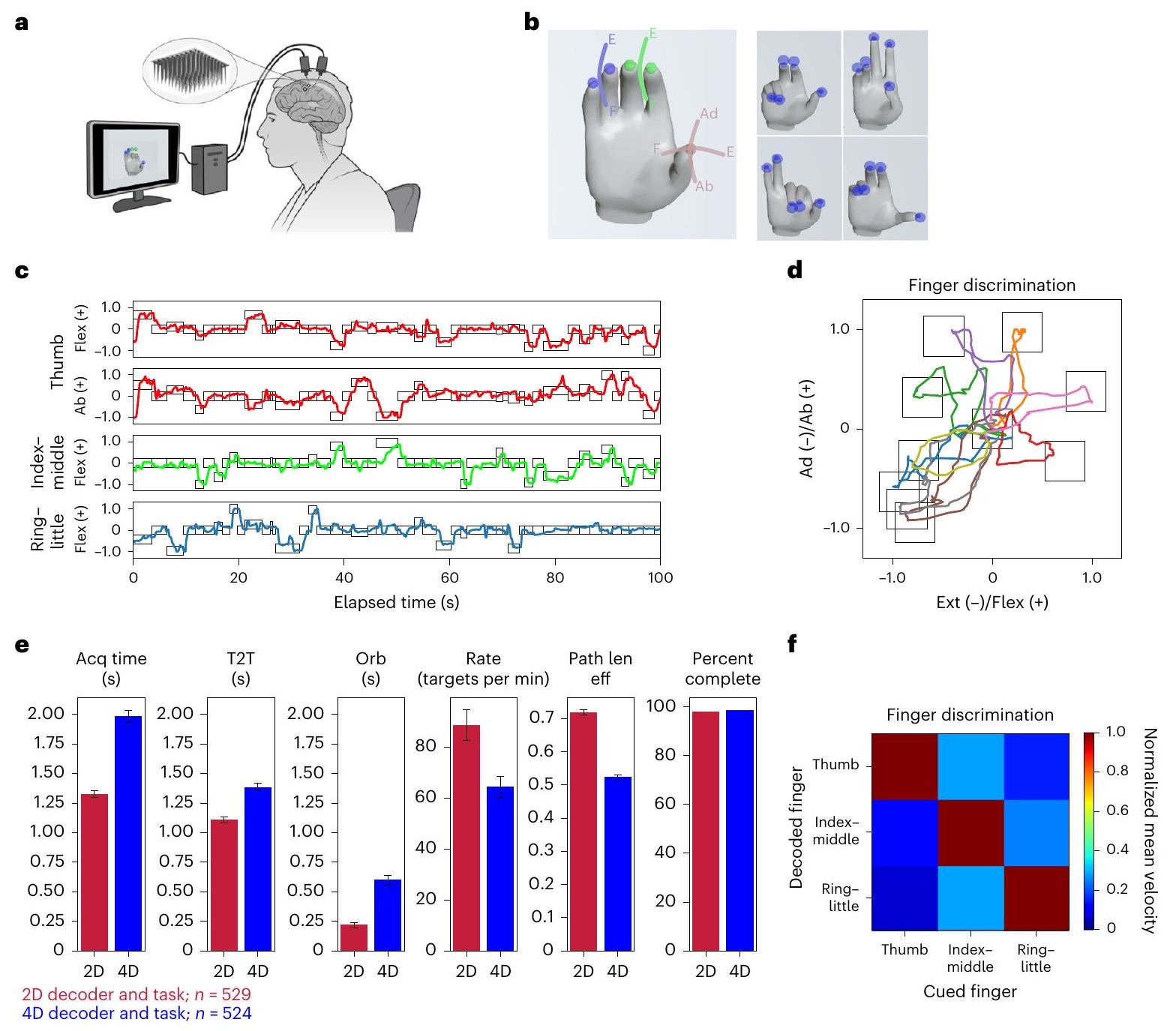
الشكل 1 | نظام iBCI لحركات الأصابع البارعة. أ، تم وضع شاشة الكمبيوتر أمام المشارك بحيث يمكنه أداء مهمة إصبع باستخدام يد افتراضية. خلال التحكم في الحلقة المغلقة، يتم رسم النشاط الكهربائي من المجموعة إلى إشارة تحكم للأصابع الافتراضية. تم تعديل اللوحة من المرجع 27. ب، يسار، يتحرك الإبهام في بعدين، التباعد (Ab) والتقارب (Ad) (الانثناء/التمديد والتباعد/التقارب)، وتتحرك الأصابع الوسطى والخاتمية في قوس أحادي البعد. يمين، تجارب تظهر أهدافًا نموذجية لجميع مجموعات الأصابع الثلاثة لمهمة الأربعة درجات من الحرية. ج، يتم تصوير مقطع زمني مدته 100 ثانية من الحركات المفككة النموذجية لمجموعة الأصابع الثلاثة، مهمة الأربعة درجات من الحرية. يتم وصف المسارات على مدى يتراوح من -1 إلى 1، حيث يشير 1 إلى الانثناء الكامل (flex) أو التباعد (ab) و-1 يشير إلى التمديد (ext) أو التقارب (ad). د، المسارات لكتلة تجريبية توضيحية من 50 تجربة لحركات الإبهام ثنائية الأبعاد، تظهر فقط التجارب التي يتحرك فيها الإبهام لمسافة أكبر من 0.3. يمثل كل لون تجارب متزاوجة متميزة، من المركز إلى الخارج. هـ، إحصائيات ملخصة تقارن بين مهمتي درجتين وأربعة درجات من الحرية لوقت الاكتساب (Acq time)، ووقت الهدف (T2T)، ووقت الدوران (Orb)، ومعدل الاكتساب (Rate)، وكفاءة طول المسار (Path len eff) ونسبة التجارب التي تم إكمالها بنجاح (نسبة الاكتمال). تمثل أشرطة الخطأ الخطأ المعياري للمتوسط. كانت هناك تجارب و تجارب لمهمتي درجتين وأربعة درجات من الحرية، على التوالي. و، أربع كتل حيث تم تنبيه إصبع واحد فقط في كل تجربة، توضح التحكم الفردي للأصابع. تم حساب متوسط السرعة لكل تجربة خلال فترة ‘اذهب’ لكل إصبع وتم تطبيعها بواسطة القيمة المتوسطة لمجموعة الأصابع ذات أعلى قيمة متوسطة. F، الانثناء؛ E، التمديد.
استعادة الحركة، يمكن أن تمكن التحكم المتقدم في ألعاب الفيديو للأشخاص المصابين بالشلل – وبشكل أوسع، التحكم في الواجهات الرقمية للتواصل الاجتماعي أو العمل عن بُعد.
في واجهات دماغ-حاسوب الحركية، تم التركيز معظم الجهود على التحكم في مؤثرات فردية مثل مؤشرات الكمبيوتر للتحكم في النقطة والنقر وأذرع الروبوت للوصول والإمساك (حيث تتحرك الأصابع كمجموعة) . لتوسيع معالجة الأجسام، قام المرجع 17 بفك تشفير مستمر لمجموعات خطية من أربع أوضاع إمساك متميزة. بخلاف الإمساكات البسيطة، سيوفر التحكم الموثوق في الأصابع الفردية أنشطة مثل الكتابة، والعزف على آلة موسيقية أو معالجة واجهة رقمية متعددة المؤثرات مثل وحدة تحكم ألعاب الفيديو. في البشر، تم إثبات فك تشفير الأصابع فقط في التنبؤ في التحليلات غير المتصلة أو التصنيف من النشاط العصبي المسجل . تم تقييد فك تشفير الأصابع المستمر لمجموعتين من الأصابع (درجتين من الحرية (DOF)) في الرئيسيات غير البشرية (NHPs).
في مشارك بحثي بشري مصاب بالشلل، قمنا بتطوير نظام BCI للأصابع أكثر فعالية من الأجهزة السابقة وقادر على فك تشفير ثلاث مجموعات أصابع مستقلة بشكل مستمر، حيث تم فك تشفير الإبهام في بعدين، مما ينتج عنه إجمالي أربعة درجات من الحرية (مضاعفة درجات الحرية المفككة في NHPs ). استخدمنا الحركات المفككة للأصابع لتوفير نقاط نهاية رقمية مستقلة للتحكم في طائرة رباعية افتراضية، في عرض لنظام BCI داخلي عالي الأداء، مستند إلى الأصابع (iBCI) يوضح قوة التحكم البديهي والفردي للأصابع كتمثيل وسيط بين رسم تسجيلات الدماغ إلى واجهات الكمبيوتر. تمامًا كما يستخدم المستخدمون القادرون على استخدام الأنظمة الرقمية أصابعهم للتلاعب بلوحات المفاتيح ووحدات التحكم في الألعاب، يتيح هذا النظام إطارًا بديهيًا لواجهة رقمية تتحكم فيها الدماغ، مما يوفر فرصًا للترفيه والتواصل الاجتماعي بالإضافة إلى إثارة مشاعر التمكين.

النتائج

تم تسجيل نشاط عصبي متعدد الوحدات من مجموعتين من مصفوفات الميكروإلكترود السيليكون ذات 96 قناة الموضوعة في منطقة ‘المقبض’ في التلافيف الجبهية اليسرى في أحد المشاركين (‘T5’) المسجلين في تجربة سريرية تجريبية BrainGate2 (الشكل البياني الممتد 1a). كان T5 رجلًا يبلغ من العمر 69 عامًا، يمين اليد، مصابًا بإصابة في الحبل الشوكي من نوع C4 AIS C، مما ترك له فقط حركات غير وظيفية وتقلصات دقيقة في أطرافه العليا والسفلى. تم عرض يد افتراضية للمشارك باستخدام Unity (v.2021.3.9f1، تقنيات Unity)، كما هو موضح في الشكل 1a. تم تصميم الإبهام للتحرك على سطح ثنائي الأبعاد (2D) محدد بواسطة محاور الانثناء-التمديد والتباعد-التقارب (الشكل 1b). تحرك كل من الأصابع الوسطى والخاتمية كمجموعات منفصلة في قوس أحادي البعد (1D) مقيد بمحور الانثناء-التمديد. تم تأكيد ضبط مصفوفات الميكروإلكترود لحركات الأصابع (الشكل البياني الممتد 1b، ج).
التحكم في حلقة مغلقة في الوقت الحقيقي لمهمة إصبع ذات درجتين وأربعة درجات من الحرية لأداء فك تشفير مستمر في حلقة مغلقة، تم رسم شبكة عصبية متقدمة زمنياً، تم تعديلها من المرجع 23، لرسم قوة النبض (SBP) إلى سرعات الأصابع المستخدمة للتحكم في حركات الأصابع الافتراضية على الشاشة (الشكل البياني الإضافي 2). تم تدريب معلمات الشبكة في البداية من تجارب الحلقة المفتوحة حيث حاول المشارك تحريك أصابعه بالتزامن مع الأصابع المتحركة على صورة اليد الافتراضية. ثم تم استخدام خوارزمية فك التشفير في تجارب التدريب ذات الحلقة المغلقة؛ حيث يتم تحسين المعلمات من خلال افتراض أن الحركات المفككة بعيدة عن الأهداف المقصودة كانت أخطاء.
تم تنفيذ مجموعتين من المهام. لترجمة النتائج من دراسات NHP السابقة. سعينا لإظهار فك شفرة مجموعتين من الأصابع (مهمة ثنائية الأبعاد) في مشاركنا في البحث البشري (في هذه المهمة، كان الإبهام مقيدًا فقط بمحور الانثناء والتمديد). تم توجيه T5 لتحريك كل من الإبهام ومجموعتي السبابة والوسطى من وضع مركزي إلى هدف عشوائي ضمن نطاق الحركة النشط للأصابع. في التجربة التالية، تم وضع الأهداف مرة أخرى في المركز. لإكمال التجربة بنجاح، كان يجب على الأصابع أن تبقى على الأهداف لمدة 500 مللي ثانية، وتم السماح بـ 10 ثوانٍ لإكمال التجربة (مسارات العينة في الشكل 3a من البيانات الموسعة؛ انظر الفيديو التوضيحي 1).
لتوسيع الوظائف التي تم عرضها في دراسات NHP، تم زيادة تعقيد المهمة من خلال تقديم مهمة رباعية الأبعاد مع حركات إبهام ثنائية الأبعاد وحركات مجموعة السبابة والوسطى وحركات مجموعة البنصر والخنصر أحادية الأبعاد (الشكل 1c). في كل تجربة، تم اختيار مجموعتين من الأصابع عشوائيًا لأهداف جديدة بينما ظل الهدف لمجموعة الأصابع الثالثة في نفس الموضع كما في التجربة السابقة، وتم فك تشفير وتحكم في حركات جميع الأصابع بشكل مستمر ومتزامن. تُظهر المسارات النموذجية للأهداف لهذه المهمة الرباعية الأبعاد الموسعة في الشكل 1c، وتوضح المسارات الثنائية الأبعاد لحركات الإبهام في الشكل 1d. الفيديو التوضيحي 2 يصور هذه المهمة.
تمت مقارنة أداء فك التشفير في الحلقة المغلقة لكل من فك التشفير ثنائي الأبعاد وأربعة الأبعاد باستخدام 529 تجربة (3 أيام) لفك التشفير ثنائي الأبعاد و524 تجربة (6 أيام) لفك التشفير أربعة الأبعاد (الشكل 1e). بالنسبة لفك التشفير ثنائي الأبعاد، كان متوسط وقت الاكتساب هو معدل اكتساب الهدف كان أهداف في الدقيقة، و تم الانتهاء بنجاح من التجارب. بالنسبة لفك التشفير رباعي الأبعاد، كان متوسط وقت الاكتساب هو معدل اكتساب الهدف كان أهداف في الدقيقة، و تم الانتهاء بنجاح من التجارب. أوقات الاستحواذ لكل تجربة (بيانات السكان) موضحة بشكل بياني في الشكل الإضافي 3b لشفرة الأبعاد الثنائية وفي الشكل الإضافي 3c لشفرة الأبعاد الرباعية. المسافات النموذجية للأصابع لكل تجربة موضحة بشكل بياني في الشكل الإضافي 4a للمهمة ثنائية الأبعاد وفي الشكل الإضافي 4b للمهمة رباعية الأبعاد.
بالنسبة لمقارنة مع جهاز فك التشفير ثنائي الأبعاد والمهمة، كانت أوقات الاكتساب قد زادت بـ للم decoder رباعي الأبعاد والمهمة ( د.ف. فترة الثقة إلى 775 مللي ثانية)، وقد تكون عوامل مثل زيادة المطالب على دقة فك التشفير وصعوبة إبقاء المزيد من الأصابع ثابتة على الأهداف (أي، الضوضاء المستقلة عن الإشارة) قد أدت إلى أداء أبطأ. ومع ذلك، بعد أن اعتاد المشارك أكثر على المهمة (الكتل الأربع الأخيرة)، انخفض وقت الاكتساب لبرنامج فك التشفير ثلاثي الأبعاد بمعدل 0.4 ثانية إلى
الجدول 1 | مقاييس الأداء لفك تشفير الأصابع ثنائية وثلاثية الأبعاد
فك التشفير ثنائي الأبعاد فك التشفير رباعي الأبعاد جهاز فك التشفير رباعي الأبعاد (آخر أربع كتل)
عدد التجارب 529 524 192
عدد الأيام ٣ ٦ ٣
وقت الاستحواذ (مللي ثانية)
وقت الاستهداف (مللي ثانية)
زمن المدار (مللي ثانية)
الأهداف في الدقيقة
نسبة الإنجاز 98.1٪ 98.7٪ 100%
طول المسار
تُبلغ البيانات الإحصائية كمتوسط ± الانحراف المعياري للخطأ.
معدل اكتساب الهدف من أهداف في الدقيقة)، و تم إكمال عدد من التجارب. لمقارنة هذا العمل مع مهمة الإصبعين السابقة في NHP حيث تراوحت الإنتاجية من 1.98 إلى 3.04 بت في الثانية مع مجموعة متنوعة من خوارزميات فك التشفير. تم حساب الإنتاجية للطريقة الحالية على أنها (انظر الطرق للتفاصيل). تلخص الجدول 1 الإحصائيات الخاصة بالمفكك/المهمة ثلاثية الأبعاد والمفكك/المهمة ثنائية الأبعاد.
تم إثبات تمييز الأصابع خلال التحكم في الحلقة المغلقة في مهمة 4D تستدعي مجموعة أصابع واحدة في كل تجربة. تم حساب متوسط سرعة مجموعات الأصابع خلال فترة ‘الانطلاق’. كانت حركة الأصابع غير المستدعاة أقل بكثير من حركة الإصبع المستدعى (الشكل 1f)، مما يدل على تمييز الأصابع.
تمت مقارنة جهاز فك التشفير رباعي الأبعاد للمهام التي تتضمن حركة واحدة (178 تجربة) وحركتين لمجموعات الأصابع الموجهة (187 تجربة). كان متوسط وقت الاكتساب هو لإصبع واحد و لإصبعين ( ، د.ف. إلى -96 مللي ثانية). كانت معدل اكتساب الهدف هو أهداف في الدقيقة لإصبع واحد و الأهداف في الدقيقة لاثنين من الأصابع الموجهة ، د.ف. إلى 48 هدفًا في الدقيقة) (الفيديو التكميلي 3، الشكل 5 أ من البيانات الموسعة والجدول 1 من البيانات الموسعة).

أبعاد النشاط العصبي

مع وجود علاقة غير خطية محتملة بين النشاط العصبي وحركة الأصابع قد تكون أبعاد النشاط العصبي مرتبطة بشكل غير خطي بزيادة درجات الحرية المفسرة. تم حساب أبعاد البيانات العصبية خلال فك التشفير ثنائي الأبعاد وأربعة الأبعاد باستخدام نسبة المشاركة المستخدمة في المرجع 27. كان متوسط أبعاد النشاط العصبي 2.4 لفك التشفير ثنائي الأبعاد، و3.1 لفك التشفير رباعي الأبعاد مع هدف جديد واحد/تجربة، و7.5 لفك التشفير رباعي الأبعاد مع هدفين جديدين/تجربة (الشكل 2أ). إذا كانت أبعاد النشاط العصبي تتغير بشكل خطي مع درجات الحرية المفسرة، فإن أبعاد فك التشفير رباعي الأبعاد ستكون ضعف أبعاد فك التشفير ثنائي الأبعاد: أي، ؛ ومع ذلك، وُجد أن الأبعاد باستخدام جهاز فك التشفير 4D كانت أكثر من القيمة المتوقعة لـ إلى 4.99 . وبالتالي، كانت أبعاد الحركات المجمعة للأصابع أكبر من مجموع المكونات الفردية. على الرغم من أن أبعاد الحركات المجمعة تحتاج إلى مزيد من الدراسة، قد تشير هذه النتائج إلى أن بعض الخلايا العصبية تشفر كل من الحركات الفردية و/أو المجمعة، كما اقترحت الدراسات التي تظهر أن الوحدات الفردية يمكن أن تشفر العضلة وما إذا كانت العضلة تعمل كمنشط أو مضاد. .

أثر عدد درجات الحرية النشطة على فك التشفير
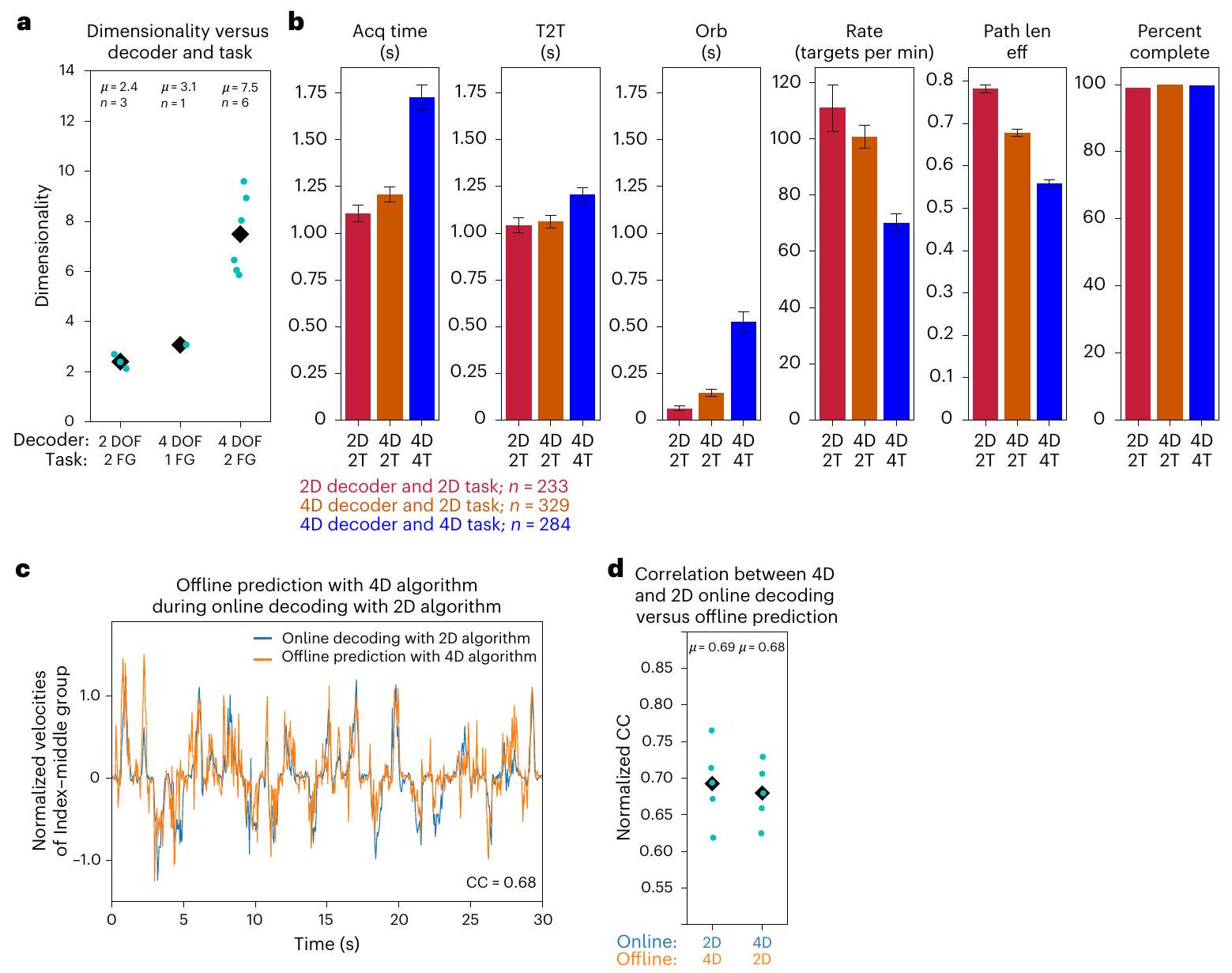
على الرغم من زيادة الأبعاد في النشاط العصبي عند فك تشفير المزيد من درجات الحرية، إلا أنه من غير الواضح ما إذا كان فك تشفير المزيد من درجات الحرية يؤثر على تمثيل النشاط العصبي عند فك تشفير عدد أقل من درجات الحرية. قد يتغير التمثيل العصبي لدرجات الحرية التي تم فك تشفيرها في المهمة ثنائية الأبعاد (ثني/مد إصبع الإبهام والسبابة والوسطى) خلال المهمة رباعية الأبعاد، على سبيل المثال، إذا كانت هناك حاجة لاستراتيجية تحكم مختلفة للمهمة رباعية الأبعاد مقارنة بالمهمة ثنائية الأبعاد – مشابهة لكيفية تطوير استراتيجيات تحكم جديدة.
الشكل 2 | الأبعاد. أ، أبعاد النشاط العصبي أثناء فك التشفير في الحلقة المغلقة باستخدام إما فك التشفير ثنائي الأبعاد/المهمة أو فك التشفير رباعي الأبعاد/المهمة لاستهداف مجموعة أصابع جديدة واحدة أو اثنتين (1FG أو 2FG) في كل تجربة. تمثل النقاط الزرقاء الفاتحة بيانات من يوم واحد، وتمثل الماس السوداء المتوسط، . ب، إحصائيات ملخصة تقارن جهاز فك التشفير ثنائي الأبعاد في المهمة ثنائية الأبعاد (2D، 2T؛ التجارب)، جهاز فك التشفير 4D في المهمة ثنائية الأبعاد (4D، 2T؛ التجارب) ومفكك الشيفرات 4D في المهمة 4D (4D، 4T؛ التجارب) بناءً على وقت الاستحواذ، ووقت الوصول إلى الهدف، ووقت الدوران، ومعدل الاستحواذ، وكفاءة طول المسار، ونسبة التجارب التي تم إكمالها بنجاح. تمثل أشرطة الخطأ الخطأ المعياري للمتوسط. ج، كتلة نموذجية عبر الإنترنت تظهر سرعات مجموعة إصبع الوسطى المفككة باستخدام 2D على 2T (باللون الأزرق) خلال كتلة عبر الإنترنت. في وضع عدم الاتصال، 4D
تم استخدام خوارزمية فك التشفير للتنبؤ بسرعات مجموعة المؤشر-الوسطى من نفس الكتلة (برتقالي). يتم إعطاء معامل الارتباط المنظم بين الإشارات عبر الإنترنت وخارج الإنترنت في الزاوية السفلى اليمنى. يتم الإشارة إلى الوحدات بحيث يكون نطاق الحركة لكل درجة حرية هو وحدة واحدة. د، بالنسبة للعشر كتل في المهمة ثنائية الأبعاد، تم استخدام خوارزمية فك التشفير رباعية الأبعاد للتنبؤ بسرعات الأصابع خلال الكتل عبر الإنترنت باستخدام فك التشفير ثنائي الأبعاد (عبر الإنترنت ثنائي الأبعاد باللون الأزرق، خارج الإنترنت رباعي الأبعاد باللون البرتقالي)، وتم استخدام خوارزمية فك التشفير ثنائية الأبعاد للتنبؤ بالسرعات عبر الإنترنت باستخدام فك التشفير رباعي الأبعاد (عبر الإنترنت رباعي الأبعاد باللون الأزرق، خارج الإنترنت ثنائي الأبعاد باللون البرتقالي). يتم تمثيل معامل الارتباط بين الإشارات خارج الإنترنت وعبر الإنترنت بالنقاط ومتوسطه عبر مجموعتي الأصابع. الماس و تشير إلى القيمة المتوسطة لمتوسط جميع الكتل الخمس لكل مقارنة مزدوجة.
لأخذ بعين الاعتبار اضطرابًا في التحويل من النشاط العصبي إلى درجات الحرية . بدلاً من ذلك، يمكن قمع التمثيل العصبي الأصلي عند تكليفه بفك تشفير أصابع إضافية، كما هو الحال عند فك تشفير الحركات أحادية الجانب مقابل الحركات ثنائية الجانب. فرضية ثالثة متنافسة هي أن التمثيل العصبي لحركة الأصابع في المهمة ثنائية الأبعاد محفوظ في المهمة رباعية الأبعاد، مشابهًا للحفاظ على التمثيل العصبي بين تخيل الحركة في حلقة مفتوحة والتحكم في حلقة مغلقة. .
لاستكشاف هذه الفرضيات، تم تدريب مقارنين ثنائي الأبعاد وأربعة الأبعاد ومقارنتها من خلال الاختبار على درجتي الحرية المشتركتين (ثني/مد الإبهام وثني/مد مجموعة السبابة والوسطى) على مدى يومين (662 تجربة)، في تجارب متناوبة (الشكل 2ب والبيانات الموسعة الجدول 2). كان متوسط وقت الاكتساب هو s لمشفر 2D في المهمة 2D ( ) ، للمفكك الرباعي الأبعاد في مهمة الرباعي الأبعاد و للمفكك الرباعي الأبعاد في المهمة ثنائية الأبعاد ). الفيديو التكميلية 4 يعرض جهاز فك التشفير 4D في المهمة ثنائية الأبعاد. أوقات اكتساب التجربة لكل مقارنة موضحة في الشكل 5b من البيانات الموسعة. كان أداء جهاز فك التشفير 4D أقرب بكثير إلى جهاز فك التشفير 2D عندما تم تقييده بنفس المهمة ثنائية الأبعاد ( زيادة أوقات الاستحواذ، ،
د.ف. لذا، فإن تدريب جهاز فك التشفير على مجموعة موسعة من الحركات لا يبدو أنه يؤدي إلى تدهور كبير في أداء فك التشفير (ملخص في الشكل 2b والجدول الإضافي 2).
تمت مقارنة الترجمة من النشاط العصبي إلى درجات الحرية الأصلية (DOF) لكل من أجهزة فك التشفير ثنائية الأبعاد (2D) وأربعة الأبعاد (4D). للقيام بذلك، تم استخدام جهاز فك التشفير رباعي الأبعاد للتنبؤ بالسرعات التي تم فك تشفيرها بواسطة جهاز فك التشفير ثنائي الأبعاد في المهمة ثنائية الأبعاد والعكس صحيح. كانت السرعات المتوقعة من جهاز فك التشفير رباعي الأبعاد مشابهة لتلك التي تم فك تشفيرها في الكتل المباشرة بواسطة جهاز فك التشفير ثنائي الأبعاد (الشكل 2c). لتQuantify هذه المقارنة، تم حساب دالة الارتباط المتقاطع المنظم (CC) بين السرعات المفككة والمقدرة خلال الكتل الثمانية (الشكل 2d). تم فصل النتائج بناءً على ما إذا كانت السرعات المفككة عبر الإنترنت من أجهزة فك التشفير رباعية الأبعاد أو ثنائية الأبعاد. كانت قيمة CC عندما تنبأ الخوارزمية رباعية الأبعاد بسرعات فك التشفير ثنائية الأبعاد هي وعندما توقع الخوارزمية ثنائية الأبعاد السرعات المفككة رباعية الأبعاد، كانت معامل الارتباط (الشكل 2ج). وبالتالي، بدا أن التمثيل العصبي لحركات الأصابع مشابه على الرغم من التحكم النشط في المزيد من درجات الحرية، وهو ما يتماشى مع تقارير أخرى حيث يتم تمثيل العديد من درجات الحرية ضمن نفس المجموعة العصبية في قشرة الدماغ الحركية. .
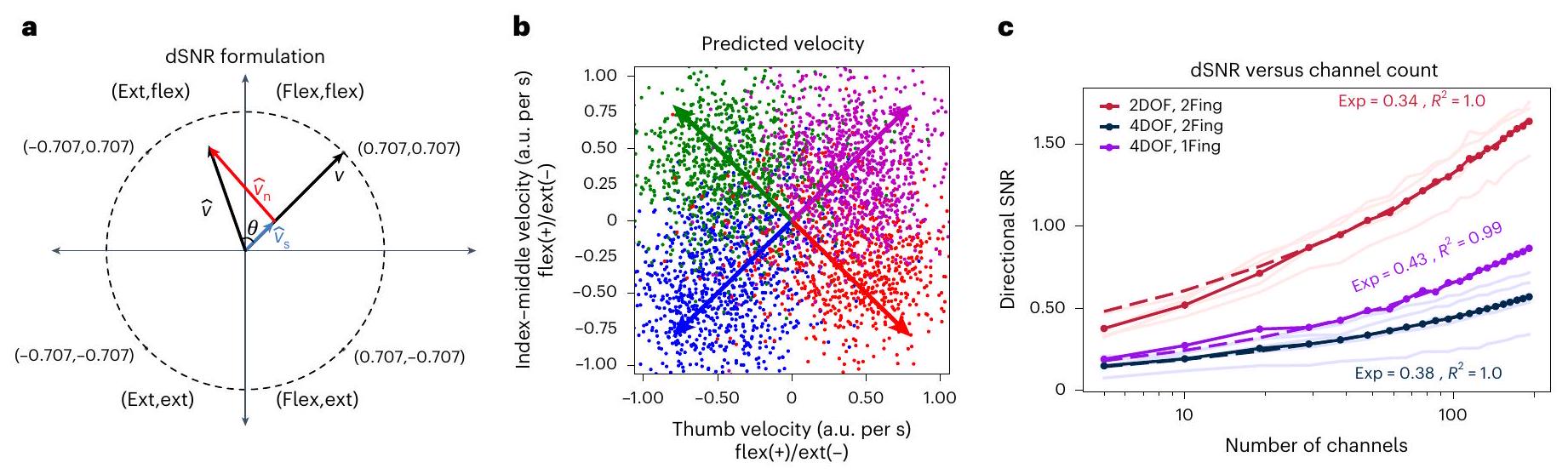
الشكل 3 | نسبة SNR مقابل عدد القنوات. أ، تمثيل بياني لـ dSNR الموجه لبرنامج فك التشفير ثنائي الأبعاد والمهمة. الإيجابي يمثل المحور السرعات التي تثني الإبهام، والقيم السلبية تمثل السرعات التي تمد الإبهام. يمثل المحور سرعات انثناء مجموعة الإصبعين السبابة والوسطى عندما يكون إيجابيًا ومد مجموعة الأصابع عندما يكون سالبًا. لأن متجه الإشارة، يُفترض أن يكون متجه الهدف مُعَدلًا، قيم يمكن أن تكون فقط النقاط الأربع المشار إليها على الدائرة. السرعة المفككة/المتوقعة، سوف يكون مائلًا بزاوية إلى ويمكن أن يتم تفكيكه إلى مكون إشارة متوازي، ومكون ضوضاء عمودي، . يمكن استخدام هذه المكونات لحساب dSNR.b، السرعات المتوقعة بواسطة الانحدار الخطي (باستخدام جميع القنوات) التي تربط النشاط العصبي بسرعات الأصابع، والتي مع
تُستخدم حركات الأصابع المقصودة لحساب dSNR. تمثل الأسهم القيمة المثالية/الحقيقية لكل وضعية إصبع ممكنة بناءً على حركة الإصبع المقصودة المفترضة. ج، يُظهر dSNR كدالة لعدد القنوات لمشفّر الأبعاد الثنائية في مهمة الهدفين/التجربة (2Fing، أحمر)، ومشفّر الأبعاد الرباعية في مهمة الهدفين/التجربة (2Fing، أزرق) ومشفّر الأبعاد الرباعية في مهمة الهدف الواحد/التجربة (1Fing، بنفسجي). يتم تصوير حساب تجريبي لـ dSNR لكل يوم في خطوط ملونة فاتحة والقيمة المتوسطة كخط صلب داكن. تتوافق الخطوط المنقطة مع ملاءمة خطية باستخدام طريقة المربعات الصغرى لـ علاقة اللوغاريتم في المعادلة (1)، حيث يدل على ميل و يمثل معامل التحديد للملاءمة الخطية. وحدات عشوائية؛ Fing، إصبع.

اعتماد دقة فك التشفير على عدد القنوات

نظرًا لأن أجهزة واجهة الدماغ-الكمبيوتر الأحدث ستحتوي على مزيد من الأقطاب الكهربائية مقارنةً بما تم استخدامه هنا، استكشفنا ما إذا كان من المتوقع أن تؤدي زيادة القنوات إلى زيادة دقة فك التشفير باستخدام مقياس نسبة الإشارة إلى الضوضاء (SNR) القائم على المتجه، ونسبة الإشارة إلى الضوضاء الاتجاهية (dSNR؛ الشكل 3أ). تم مقارنة سرعات الأصابع المتوقعة/المفككة مع السرعات المثالية المستنتجة من حركات الأصابع المقصودة. تم اعتبار المكون من السرعات المتوقعة/المفككة المتسق مع السرعات المثالية (أي، المكون الموازي للمتجه المثالي لسرعات الأصابع) هو مكون الإشارة، في حين تم اعتبار السرعات المتوقعة/المفككة غير المتسقة (أي، المكون العمودي على المتجه المثالي للسرعة) ضوضاء. كانت dSNR هي نسبة متوسط الإشارة المتوقع إلى الجذر التربيعي لقوة الضوضاء.
تم حساب قيمة dSNR خلال فترة ‘الذهاب’ من التجارب المغلقة (المعرفة كـ من بداية التجربة) لتشفير الإصبعين والثلاثة أصابع (الجدول 2). في كل يوم، تم استخدام الانحدار الخطي لتدريب خريطة (ضد اتجاه الإصبع المقصود) لتحويل ضغط الدم الانقباضي إلى سرعات الأصابع (باستخدام التحقق المتقاطع ست مرات). كانت السرعات المتوقعة (المحسوبة من جميع قنوات الإدخال الـ 192) تتجمع على طول الاتجاهات المثالية والمقصودة (الشكل 3ب).
لتحديد الاعتماد dSNR على عدد القنوات، تم تدريب خريطة خطية من SBP إلى السرعات لعدد معين من القنوات، التي تم استخدامها لحساب dSNR (باستخدام التحقق المتقاطع ست مرات حيث كان dSNR هو المتوسط باستخدام 25 مجموعة من القنوات المختارة عشوائيًا؛ انظر الطرق). بالنسبة لكل من المهام ثنائية الأبعاد وأربعة الأبعاد التي تتطلب حركة مجموعتين من الأصابع في وقت واحد، لم يتشبع dSNR مع زيادة عدد قنوات الإدخال (الشكل 3c). نظرًا لأن مقياس dSNR يفترض أن كلا مجموعتي الأصابع تتحركان في وقت واحد نحو أهدافهما الخاصة (بدلاً من التحرك واحدة تلو الأخرى)، تم استخدام المهمة الأبسط ذات الأربعة أبعاد التي تتطلب حركة إصبع واحد فقط في كل تجربة (الشكل 3c). باستخدام بيانات dSNR لأعلى لعدد القنوات لكل منحنى، تم ملاءمة علاقة لوغاريتمية-لوغاريتمية بين عدد القنوات و dSNR بشكل تجريبي لعلاقة خطية. كانت الملاءمة التجريبية للعلاقة اللوغاريتمية-اللوغاريتمية خطية بشكل قوي، مع معامل تحديد، بين 0.99 و 1.00 وانحدار، 0.34 لمهمة 2D التي تتطلب تحريك إصبعين، 0.38 لمهمة 4D التي تتطلب تحريك إصبعين و0.43 لمهمة 4D الأسهل سلوكياً التي تتطلب تحريك إصبع واحد. بالنظر إلى
المرتفع القيمة، العلاقة التجريبية بين dSNR وعدد القنوات تناسب العلاقة في المعادلة (1):
أين هو ثابت اعتباطي، هو الميل (المتغير ) و هو عدد القنوات. النمو الذي تم تحديده تجريبيًا ( قد تكون أقل من المثالي لـ بسبب العوامل السلوكية المربكة أو انتهاكات افتراضات الضوضاء (ضوضاء غاوسية مستقلة وموزعة بشكل متطابق؛ الطرق).

ترجمة إشارة إصبع iBCI للتحكم في الطائرة الرباعية الافتراضية

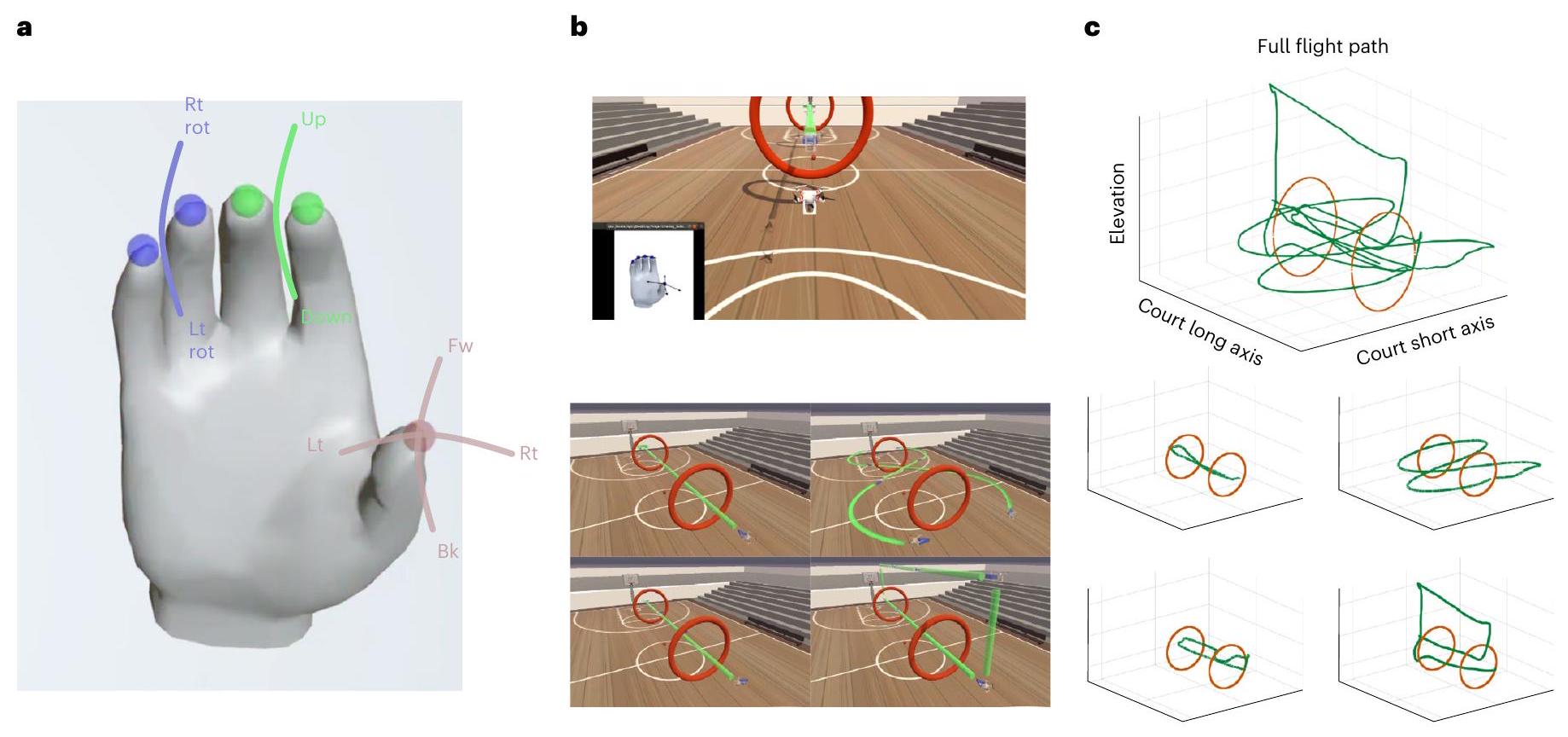
على الرغم من أن تطبيقًا سريريًا واضحًا لجهاز iBCI في الإصبع هو استعادة التحكم الدقيق في حركة ذراع روبوتية أو لإعادة تنشيط الطرف الأصلي يمكن أن يكون نظام iBCI القائم على الإصبع أيضًا نهجًا بديهيًا للتحكم في عدة نقاط رقمية متزامنة، مما يوسع من وظائف التحكم في المؤشر ثنائي الأبعاد. . تطبيق آخر للتحكم في الأصابع متعددة درجات الحرية هو ألعاب الفيديو، بهدف تمكين الأشخاص ذوي الإعاقة من المشاركة مع الآخرين. لتحقيق هذه الغاية، تم ربط كل حركة إصبع بدرجة حرية للتحكم في طائرة رباعية (الشكل 4أ). على عكس تنفيذ سابق لمحاكي الطيران تمت خريطة مواضع الأصابع مباشرة إلى التحكم في السرعة للطائرة الرباعية، ولم يتم تحويلها إلى ‘فضاء الطائرة الرباعية’ أثناء إعادة التدريب. يمكن أن يسمح ربط مواضع الأصابع بالتحكم في السرعة أيضًا بنموذج تحكم عام لمجموعة متنوعة من الألعاب. كانت التكيفات الخاصة بالمهمة الوحيدة هي تطبيق سرعة منخفضة للعودة إلى الوضع المحايد عندما كانت الأصابع ضمن 10% (من إجمالي نطاق الحركة) من الوضع المحايد. هذا أبقى الأصابع في الوضع المحايد ما لم يتحركها المشارك عمدًا. كانت مواضع الأصابع مرئية في الجزء السفلي الأيسر من الشاشة مع تعليقات توضح الوضع المحايد لكل إصبع والاتجاهات الأساسية لحركات الإبهام (الشكل 4ب، الأعلى).
لإظهار جميع الحركات الممكنة ذات الأربعة درجات من الحرية، تم إنشاء مسار عقبات (الشكل 4ب، الأسفل) حيث يمكن لكل جزء من المسار أن يظهر على الأقل واحدة من الحركات. في يوم واحد من الاختبار، قام المشارك بالتحكم في الطائرة الرباعية فوق المسار الكامل للعقبات 12 مرة بمتوسط زمن كتلة قدره 222 ثانية وانحراف معياري قدره 45 ثانية. تم عرض كتلة نموذجية، اكتملت في 163 ثانية، في
الجدول 2 | جلسات البيانات وتدريب خوارزمية فك التشفير المغلقة
رقم. يوم مهمة لا عمق المجال كتل OL (التجارب) كتل CL (التجارب) وقت تدريب CL (دقائق) شكل ملاحظات
1 ٢٣٩٥ فك تشفير إصبع CL 1 ٤ 2 (200) 7 (467) ٢٤.٣ 1، 3، ED 3، ED 4
2 2400 فك تشفير إصبع CL 2 ٤ 2 (200) 3 (180) 9.8 1، 3، ED 3، ED 4
٣ 2402 فك تشفير إصبع CL ٣ ٤ 2 (200) 5 (252) 14.1 1، 3، ED 3-5
+5 (250) 16.3 ED 5
٤ 2407 فك تشفير إصبع CL ٤ 2 2 (200) 2 (100) ٥.٩ 1، 3، ED 3، ED 4
٥ ٢٤٠٩ فك تشفير إصبع CL ٥ ٤ 2 (200) 9 (450) ٢٥.٧ 1، 3، ED 3-5
٦ ٢ 2 (200) 2 (100) 11.1 1، 3، ED 3، ED 4
٦ 2423 فك تشفير إصبع CL ٧ ٤ 2 (200) 12 (585) ٣٥.٨ 1-3، ED 1، ED 3-5 تم استخدام بيانات الحلقة المفتوحة لرسم الارتباك في الشكل الإضافي 1. وتم استخدام بيانات الحلقة المغلقة في الأشكال 2-4.
+2 (100) ٥.٥ 2، ED 5
٨ 2 2 (200) 7 (297) ٢٠.٢ 1، ED 3، ED 4 تمت محاولة الإفراط في تدريب جهاز فك التشفير من خلال إعادة تدريبه على العديد من الكتل المغلقة بعد الانتهاء من 100% من التجارب.
+3 (150) 5.1 2، 3، ED 5 يتضمن 1 كتلة (50 تجربة) باستخدام جهاز فك التشفير 4D
٧ ٢٤٣٠ فك تشفير إصبع CL 9 ٤ 2 (200) 3 (150) 8.2 1، ED 3، ED 4
+2 (100) 5.1 2، ED 5
9c +1 (50) 2.5 2، ED 5
+7 (331) 16.8 1-3 التعليمات 5 مستخدم في الشكل 3 لمزيد من التجارب (مقارنة بالكتل السابقة)
9e +1 (50) 2.0 1-3، ED 5 مستخدم في الشكل 3 لمزيد من التجارب (مقارنة بالكتل السابقة)
10 2 1 (100) 1 (50) 1.5 2، 3، ED 5 مستخدم في الشكل 3 لمزيد من التجارب (مقارنة بالكتل السابقة)
10ب +1 (50) 1.5 2، 3، ED 5 مستخدم في الشكل 3 لمزيد من التجارب (مقارنة بالكتل السابقة)
10 سنت +1 (50) 2.0 2أ، 3 مستخدم في الشكل 3 لمزيد من التجارب (مقارنةً بالكتل السابقة)
٨ 2520 مسار عقبات مراقبة الجودة 11 ٤ 2 (200) 3 (150) 8.3
11ب +4 (200) 10.3 ٤
11ج +2 (100) 5.8
11د +2 (100) ٤.٧
9 2569 خواتم عشوائية لمراقبة الجودة 12 ٤ 2 (200) 6 (269) ٢٠.٤ تم تنفيذ الكتل المفتوحة باستخدام مرجع متوسط مشترك، بينما استخدمت الكتل المغلقة مرجع الانحدار الخطي.
CL، الحلقة المغلقة؛ وقت تدريب CL، الوقت اللازم لإكمال كتل تدريب الحلقة المغلقة؛ D no.، رقم فك التشفير؛ ED، الشكل البياني للبيانات الموسعة؛ OL، الحلقة المفتوحة؛ كانت كتل OL تتطلب 5 دقائق لكل 100 تجربة؛ QC، الطائرة الرباعية؛ S، الجلسة. كتل تدريب إضافية وتجارب.
الفيديو التكميلية 5 مع مسار الطيران الموضح في الشكل 4c. نظرًا لأنه يمكن فك تشفير جميع الأصابع في الوقت نفسه، يمكن دمج حركات الطائرة الرباعية مع حركات الأصابع المتعددة، مثل عندما تتحرك الطائرة الرباعية للأمام وتدور خلال جزء الشكل 8 من مسار العقبات. علاوة على ذلك، نظرًا لأن مواضع الأصابع تقع على استمرارية، يمكن توفير مجموعة من السرعات للتحكم في الطائرة الرباعية، مما يسمح بحركات عالية السرعة لتغطية مسافات كبيرة أو حركات منخفضة السرعة للتعديلات الدقيقة.
على الرغم من أن مسار العقبات يظهر التحكم بأربعة درجات من الحرية، تم أيضًا اختبار الطائرة الرباعية في مهمة أقل تنظيمًا، حيث تم توجيه المشارك للطيران بالطائرة الرباعية من خلال حلقات تظهر بشكل عشوائي (توقف كل 20 ثانية). توضح هذه المهمة زمن الاستجابة، والقدرة على المناورة التصحيحية، والقدرة على دمج درجات الحرية المتزامنة. بعد تدريب جهاز فك التشفير، طُلب من المشارك الطيران عبر الحلقات. على مدار 10 دقائق، طار عبر 28 حلقة (2.8 حلقة في الدقيقة)؛ تم تقديم مقطع توضيحي من هذه الجلسة في الفيديو التكميلي 6. من المهم أن الأداء تأثر.
ليس فقط من خلال دقة فك الشفرات ولكن أيضًا إلى حد كبير من خلال العوامل السلوكية، حيث قد يجد حتى المشغلون الأصحاء الذين يستخدمون جهاز التحكم أحادي اليد لطائرة رباعية المراوح أن المهمة تمثل تحديًا.

تجربة المستخدم
كما هو موضح في دراسات أخرى غير متعلقة بالتحفيز الدماغي المباشر التي توضح التأثير السريري لألعاب الفيديو على الأشخاص ذوي الإعاقة عبّر T5 عن مواضيع الاتصال الاجتماعي، والتمكين، والترفيه خلال التحكم في الطائرة الرباعية باستخدام واجهة الدماغ الحاسوبية. وقد عبّر في مناسبات متعددة (حتى قبل التسجيل في التجربة السريرية) أن واحدة من أولوياته الشخصية الأكثر أهمية كانت استخدام واجهة الدماغ الحاسوبية للتحكم في الطائرة الرباعية؛ كان يشعر أن التحكم في الطائرة الرباعية سيمكنه، للمرة الأولى منذ إصابته، من “الارتفاع” مجازيًا عن سريره/كرسيه. كان يتطلع إلى جلسات الطائرة الرباعية، وغالبًا ما يسأل عن موعد الجلسة التالية، وغالبًا ما يطلب منا إرسال مقاطع فيديو لرحلات الطائرة الرباعية إلى صديقه. عندما لا يكون مشغولًا بتجارب محددة، كان يستمتع بالطيران بالطائرة الرباعية بشكل عفوي. كان يسأل باستمرار عن المزيد.
الشكل 4 | التحكم في الطائرة الرباعية الافتراضية باستخدام واجهة الدماغ-الكمبيوتر (iBCI) المستندة إلى الأصابع. أ، ربط موضع الأصابع بسرعات الطائرة الرباعية. يتم ربط موضع الإبهام بسرعة الترجمة للأمام (Fw) والخلف (Bk) واليسار (Lt) واليمين (Rt). يتم ربط موضع مجموعة الإصبعين السبابة والوسطى بسرعات موجهة لأعلى ولأسفل في الارتفاع. يتم ربط موضع مجموعة الإصبعين البنصر والخنصر بسرعات الدوران لليمين (Rt rot) والدوران لليسار (Lt rot). ب، في الأعلى، تخطيط التحكم في الطائرة الرباعية يظهر الطائرة الرباعية الافتراضية في وسط الشاشة. كما يمكن رؤية تصور لليد يشير إلى النقاط المحايدة لمجموعات الأصابع والاتجاهات الأساسية للإبهام. الحلقات مرئية في وسط العرض، والخط المستقيم الأخضر يشير إلى المسار الذي يجب أن تتبعه الطائرة الرباعية على طول مسار العقبات. في الأسفل، يظهر مسار العقبات للطائرة الرباعية التحكم بأربعة درجات من الحرية المطلوبة لإكمال مسار العقبات الذي يبلغ 4.5 لفة. في أعلى اليسار
يتطلب المسار من الطائرة بدون طيار التحرك للأمام، والدوران، والتحرك للأمام مرة أخرى عبر نفس الحلقات للعودة إلى نقطة البداية (لفة واحدة). يتطلب المسار في أعلى اليمين من المشارك التحرك للأمام والدوران في نفس الوقت لإكمال مسارين على شكل ‘ثمانية’ حول الحلقات والعودة إلى نقطة البداية (لفة واحدة). يتطلب المسار في أسفل اليسار منه التحرك إلى اليسار عبر كلا الحلقات، التوقف ثم التحرك إلى اليمين مرة أخرى عبر الحلقات (لفة واحدة). يتطلب المسار في أسفل اليمين التحرك للأمام عبر الحلقات، وزيادة الارتفاع، ثم التحرك للخلف فوق الحلقات، وتقليل الارتفاع، ثم التحرك للأمام عبر كلا الحلقات إلى نقطة النهاية (1.5 لفة). ج، في الأعلى، مسار طيران كامل نموذجي خلال كتلة من دورة العقبات. في الأسفل، يتم فصل مسار الطيران إلى لفات تتوافق مع المسار المخطط لكل لفة في (أسفل).
“وقت التدريب” حتى يتمكن من تحسين أدائه وصرح مرة بأنه “أشعر أننا يمكن أن نعمل حتى الساعة 9 الليلة”. لم يبدو أن التعب كان عاملاً في التحكم بالطائرة الرباعية، حيث لم يطلب T5 أبداً إنهاء أو تقصير أي من الجلسات التسع المضمنة في هذه الدراسة. في النهاية، كان هذا العمل تتويجاً لهدف طويل الأمد رآه كل من فريق البحث والمشارك كإنجاز تعاوني مشترك.
قدم T5 ملاحظات كبيرة حول استخدام النظام. شعر أن التدريب “ليس مملًا” وأن التدريب على مهمة إصبع عشوائي كان “تدريبًا أفضل” و”أكثر تشابهًا مع ما يشبه [الطائرة الرباعية]” من مهمة المركز للخارج. أدت المحادثات إلى عرض بصري للأصابع (مع تقاطعات للدلالة على الوضع المحايد) أثناء التحكم في الطائرة الرباعية في حلقة مغلقة وفي الوقت الحقيقي. أبلغ أن الرسوم البيانية للأصابع كانت تتطلب انتباهه في البداية عدة مرات في الثانية، على الرغم من أنه شعر أن التحكم في الطائرة بدون النظر إلى الأصابع كان ممكنًا وقابلًا للتعلم. مع الممارسة، أشار إلى الأصابع مرة كل بضع ثوانٍ قائلاً: “عندما تتحرك الطائرة وتتحرك الأصابع، يكون من الأسهل والأسرع أن تنظر إلى الطائرة فقط”.
وصف T5 التحكم البديهي: “إنه مثل ركوب دراجتك في طريقك إلى العمل، ‘ماذا سأفعل في العمل اليوم’، وأنت لا تزال تغير التروس على دراجتك وتتحرك بشكل جيد”. أكد T5 على البراعة المطلوبة، قائلاً “التحليق بها هو لمسات صغيرة جدًا عن خط وسط، قليلاً للأعلى، قليلاً للأسفل”، وقارن التحكم بلعب آلة موسيقية دقيقة. عند الانتقال من تدريب الأصابع إلى التحكم في الطائرة الرباعية، أوضح: “إنه مثل إذا كنت عازف كلارينيت وملتقطت كلارينيت شخص آخر. تعرف الفرق على الفور وهناك منحنى تعلم صغير متضمن ولكن ذلك يعتمد على أنك لديك كفاءة ضمنية مع كلارينيتك”. وصف الفرق في السياق بين الأصابع
والتحكم في الطائرة الرباعية موضحًا أن التحكم في الطائرة الرباعية كان “أكثر حساسية من الأصابع” وأنه كان عليه “أن يلمسها في اتجاه”. كما أكد على أهمية تخصيص الأصابع وكيف أن فشل التخصيص يؤدي إلى تدهور الأداء: “عندما تسحب لأسفل بإصبعك [الصغير]، من المفترض أن تبقى الأصابع الأخرى [المجموعات] هناك… لكنهم يتتبعون مع [الإصبع الصغير]، وهو ما يشتت انتباهي وكل شيء ينزل إلى اليسار بدلاً من أن يكون مجرد يسار أو أيًا كان”.

نقاش

غالبًا ما يعبر الأشخاص ذوو الشلل عن احتياجات غير ملباة للدعم من الأقران، والأنشطة الترفيهية والرياضات . لقد لجأ العديد من الأشخاص ذوي الإعاقات الحركية إلى ألعاب الفيديو من أجل التواصل الاجتماعي ومخرج تنافسي وقد عبروا عن شعور بالتمكين على إعاقتهم . لقد طورنا أكثر واجهة تحكم بالأصابع BCI قدرة حتى الآن والتي تمكن من التحكم المستمر في ثلاث مجموعات أصابع فردية للغاية، حيث تحرك الإبهام في بعدين (مكتسبًا أكثر من 75 هدفًا في الدقيقة). مثلما يقوم المستخدمون الأصحاء بتحريك وحدات تحكم ألعاب الفيديو بأصابعهم، نقدم واجهة تحكم بالأصابع iBCI بديهية حيث تتحكم مواضع الأصابع المفككة في ثلاثة مؤثرات رقمية (مع مؤثر واحد يتحرك في بعدين) من أجل التحكم عالي الأداء بأربعة درجات من الحرية لطائرة رباعية افتراضية. تم وصف التحكم البديهي للمشارك بشكل غير رسمي بأنه مثل لعب آلة موسيقية واستدعى شعورًا قويًا بالتمكين والترفيه والتواصل الاجتماعي.
عندما يتفاعل الأشخاص الذين ليس لديهم عجز حركي مع أجهزة الكمبيوتر أو ألعاب الفيديو، فإن نموذج التحكم يعتمد بشكل كبير على – أو حتى يتطلب – حركات أصابع بارعة لوحدة التحكم في الكمبيوتر أو وحدة تحكم ألعاب الفيديو للتحكم ليس فقط في مؤشر واحد ولكن في عدة
مؤشرات رقمية، ونقاط نهاية وأزرار. ومع ذلك، فإن معظم الأبحاث السابقة والتطوير التجاري قد ركزت على استخدام واجهات التحكم الدماغية للتحكم في المؤشر ثنائي الأبعاد / النقر ، والتي تم استخدامها سابقًا للتحكم في طائرة رباعية أو محاكي طيران مع دفع ثابت. قام كريجر وآخرون. بتكييف درجتين من الحرية من طرف صناعي تم تطويره سابقًا للتحكم في محاكي طيران، وأبلغوا عن الطيران عبر 10 من 11 حلقة متراصة في تسلسل قريب، مع مقاطع فيديو تظهر حاجة محتملة لمزيد من الاستقرار على مسار طيران شبه خطي . استخدم لافلور وآخرون. طائرة رباعية تتحكم بها تخطيط كهربائي للمخ للتنقل عبر 3.1 حلقات في 4 دقائق (مقابل 12.0 في التحكمات القابلة للحياة باستخدام لوحة مفاتيح). بالمقابل، سمح نظامنا بالتنقل عبر أو حول 18 حلقة في ذروة الأداء – في أقل من 3 دقائق، وهو زيادة تزيد عن ستة أضعاف في الأداء. كان النظام أيضًا قادرًا على الطيران الحر العفوي عبر حلقات تظهر بشكل عشوائي. يمكن أن تلبي هذه الطريقة لاستخدام التحكم الدقيق في الألعاب التي تتحكم بها iBCI الاحتياجات غير الملباة للأشخاص ذوي الشلل، حيث أن القيمة الترفيهية لألعاب الفيديو واضحة؛ تم تقدير أن 77% من لاعبي الفيديو كانوا يلعبون اجتماعيًا في عام 2021 (مرجع 36)، وقد ارتبطت المشاركة في ألعاب الفيديو متعددة اللاعبين بالرفاهية الاجتماعية والتواصل ، وتوفر مخرجًا تنافسي وتعزز العمل الجماعي . كانت هذه بالضبط الموضوعات التي تم التواصل بها إلينا من قبل مشاركنا.
يمكن أن يؤدي زيادة عدد قنوات نظام التسجيل إلى زيادة دقة فك التشفير. لم يبدو أن بديلنا لدقة فك التشفير، dSNR، قد تشبع عند عدد قنواتنا الحالي البالغ 192. تم إجراء ملاحظة مماثلة باستخدام واجهات التحكم الدماغية لفك تشفير الكلام ، حيث تم توقع انخفاض معدل خطأ الكلمات من إلى عند الانتقال من نظام 128 – إلى 256 -إلكترود، والذي تحقق عندما تم تحقيق معدل خطأ كلمات مع 256 إلكترود .

المحتوى عبر الإنترنت

أي طرق، مراجع إضافية، ملخصات تقارير Nature Portfolio، بيانات المصدر، بيانات موسعة، معلومات إضافية، شكر وتقدير، معلومات مراجعة الأقران؛ تفاصيل مساهمات المؤلفين والمصالح المتنافسة؛ وبيانات توفر البيانات والرموز متاحة على https://doi.org/10.1038/s41591-024-03341-8.

References

  1. Armour, B. S., Courtney-Long, E. A., Fox, M. H., Fredine, H. & Cahill, A. Prevalence and causes of paralysis-United States, 2013. Am. J. Public Health 106, 1855-1857 (2016).
  2. Trezzini, B., Brach, M., Post, M. & Gemperli, A. Prevalence of and factors associated with expressed and unmet service needs reported by persons with spinal cord injury living in the community. Spinal Cord 57, 490-500 (2019).
  3. Cairns, P. et al. Enabled players: the value of accessible digital games. Games Cult. 16, 262-282 (2021).
  4. Tabacof, L., Dewil, S., Herrera, J. E., Cortes, M. & Putrino, D. Adaptive esports for people with spinal cord injury: new frontiers for inclusion in mainstream sports performance. Front. Psychol. https://doi.org/10.3389/fpsyg.2021.612350 (2021).
  5. Beeston, J., Power, C., Cairns, P. & Barlet, M. in Computers Helping People with Special Needs (eds Miesenberger, K. & Kouroupetroglou, G.) 245-253 (Springer, 2018).
  6. Porter, J. R. & Kientz, J. A. An empirical study of issues and barriers to mainstream video game accessibility. In Proc. 15th International ACM SIGACCESS Conference on Computers and Accessibility (ed. Lewis, C.) 1-8 (ACM, 2013).
  7. Taheri, A., Weissman, Z. & Sra, M. Design and evaluation of a hands-free video game controller for individuals with motor impairments. Front. Comp. Sci. 3, 751455.1 (2021).
  8. Nuyujukian, P. et al. Cortical control of a tablet computer by people with paralysis. PLoS ONE 13, eO2O4566 (2018).
  9. Flesher, S. N. et al. A brain-computer interface that evokes tactile sensations improves robotic arm control. Science 372, 831-836 (2021).
  10. Ajiboye, A. B. et al. Restoration of reaching and grasping movements through brain-controlled muscle stimulation in a person with tetraplegia: a proof-of-concept demonstration. Lancet 389, 1821-1830 (2017).
  11. Carmena, J. M. et al. Learning to control a brain-machine interface for reaching and grasping by primates. PLoS Biol. 1, e42 (2003).
  12. Collinger, J. L. et al. High-performance neuroprosthetic control by an individual with tetraplegia. Lancet 381, 557-564 (2013).
  13. Hochberg, L. R. et al. Reach and grasp by people with tetraplegia using a neurally controlled robotic arm. Nature 485, 372-375 (2012).
  14. Pandarinath, C. et al. High performance communication by people with paralysis using an intracortical brain-computer interface. eLife 6, e18554 (2017).
  15. Velliste, M., Perel, S., Spalding, M. C., Whitford, A. S. & Schwartz, A. B. Cortical control of a prosthetic arm for self-feeding. Nature 453, 1098-1101 (2008).
  16. Hochberg, L. R. et al. Neuronal ensemble control of prosthetic devices by a human with tetraplegia. Nature 442, 164-171 (2006).
  17. Wodlinger, B. et al. Ten-dimensional anthropomorphic arm control in a human brain-machine interface: difficulties, solutions, and limitations. J. Neural Eng. 12, 016011 (2014).
  18. Guan, C. et al. Decoding and geometry of ten finger movements in human posterior parietal cortex and motor cortex. J. Neural Eng. 20, 036020 (2023).
  19. Jorge, A., Royston, D. A., Tyler-Kabara, E. C., Boninger, M. L. & Collinger, J. L. Classification of individual finger movements using intracortical recordings in human motor cortex. Neurosurgery 87, 630-638 (2020).
  20. Bouton, C. E. et al. Restoring cortical control of functional movement in a human with quadriplegia. Nature 533, 247-250 (2016).
  21. Nakanishi, Y. et al. Decoding fingertip trajectory from electrocorticographic signals in humans. Neurosci. Res. 85, 20-27 (2014).
  22. Nason, S. R. et al. Real-time linear prediction of simultaneous and independent movements of two finger groups using an intracortical brain-machine interface. Neuron 109, 3164-3177. e3168 (2021).
  23. Willsey, M. S. et al. Real-time brain-machine interface in non-human primates achieves high-velocity prosthetic finger movements using a shallow feedforward neural network decoder. Nat. Commun. 13, 6899 (2022).
  24. Nason, S. R. et al. A low-power band of neuronal spiking activity dominated by local single units improves the performance of brain-machine interfaces. Nat. Biomed. Eng. 4, 973-983 (2020).
  25. Costello, J. T. et al. Balancing memorization and generalization in RNNs for high performance brain-machine interfaces. Preprint at bioRxiv https://doi.org/10.1101/2023.05.28.542435 (2023).
  26. Shah, N. P. et al. Pseudo-linear summation explains neural geometry of multi-finger movements in human premotor cortex. Preprint at bioRxiv https://doi.org/10.1101/2023.10.11.561982 (2023).
  27. Willett, F. R., Avansino, D. T., Hochberg, L. R., Henderson, J. M. & Shenoy, K. V. High-performance brain-to-text communication via handwriting. Nature 593, 249-254 (2021).
  28. Griffin, D. M., Hoffman, D. S. & Strick, P. L. Corticomotoneuronal cells are “functionally tuned”. Science 350, 667-670 (2015).
  29. Sakellaridi, S. et al. Intrinsic variable learning for brain-machine interface control by human anterior intraparietal cortex. Neuron 102, 694-705. e693 (2019).
  30. Willett, F. R. et al. Hand knob area of premotor cortex represents the whole body in a compositional way. Cell 181, 396-409. e326 (2020).
  31. Zhang, C. Y. et al. Preservation of partially mixed selectivity in human posterior parietal cortex across changes in task context. Eneuro 7, ENEURO.0222-19.2019 (2020).
  32. Kryger, M. et al. Flight simulation using a brain-computer interface: a pilot, pilot study. Exp. Neurol. 287, 473-478 (2017).
  33. Gilja, V. et al. A high-performance neural prosthesis enabled by control algorithm design. Nat. Neurosci. 15, 1752 (2012).
  34. Kao, J. C., Nuyujukian, P., Ryu, S. I. & Shenoy, K. V. A high-performance neural prosthesis incorporating discrete state selection with hidden Markov models. IEEE Trans. Biomed. Eng. 64, 935-945 (2016).
  35. LaFleur, K. et al. Quadcopter control in three-dimensional space using a noninvasive motor imagery-based brain-computer interface. J. Neural Eng. 10, 046003 (2013).
  36. Essential facts about the computer and video game industry. Entertainment Software Association www.theesa.com/resource/2 021-essential-facts-about-the-video-game-industry/ (2021).
  37. Raith, L. et al. Massively multiplayer online games and well-being: a systematic literature review. Front. Psychol. https://doi.org/ 10.3389/fpsyg.2021.698799 (2021).
  38. Adeane, A. Quad gods: the world-class gamers who play with their mouths. BBC www.bbc.com/news/stories-55811621 (2021).
  39. Willett, F. R. et al. A high-performance speech neuroprosthesis. Nature 620, 1031-1036 (2023).
  40. Card, N. S. et al. An accurate and rapidly calibrating speech neuroprosthesis. N. Engl. J. Med. 391, 609-618 (2024).
Publisher’s note Springer Nature remains neutral with regard to jurisdictional claims in published maps and institutional affiliations.
Open Access This article is licensed under a Creative Commons Attribution 4.0 International License, which permits use, sharing, adaptation, distribution and reproduction in any medium or format, as long as you give appropriate credit to the original author(s) and the source, provide a link to the Creative Commons licence, and indicate if changes were made. The images or other third party material in this article are included in the article’s Creative Commons licence, unless indicated otherwise in a credit line to the material. If material is not included in the article’s Creative Commons licence and your intended use is not permitted by statutory regulation or exceeds the permitted use, you will need to obtain permission directly from the copyright holder. To view a copy of this licence, visit http://creativecommons. org/licenses/by/4.0/.
(c) The Author(s) 2025

طرق

التجربة السريرية والمشارك

تم إجراء جميع الأبحاث مع اتباع جميع اللوائح ذات الصلة، ومر المشارك بموافقة مستنيرة. تم تسجيل المشارك، T5، كمشارك في تجربة نظام واجهة الدماغ BrainGate2 (NCT00912041، المسجلة في 3 يونيو 2009) مع IDE من إدارة الغذاء والدواء (رقم IDE G090003). تمت الموافقة على هذه الدراسة من قبل مجلس المراجعة المؤسسية بجامعة ستانفورد (رقم البروتوكول 20804) ومجلس المراجعة المؤسسية لمستشفى ماس جنرال برايم (رقم البروتوكول 2009P000505). تم متابعة هذه التحقيق كجزء من مقياس النتيجة الثانوية للتجربة السريرية. لم يتم تعويض المشاركين عن المشاركة. لم يتم إجراء تحليل للجنس/الجندر، على الرغم من أنه تم تجنيد المشاركين بغض النظر عن الجنس/الجندر.
كان المشارك، T5، رجلًا يبلغ من العمر 69 عامًا يمين اليد مصابًا بإصابة في الحبل الشوكي C4 AIS C، مما ترك فقط حركات غير وظيفية وتقلصات دقيقة في أطرافه العلوية والسفلية. في عام 2016، تم وضع مصفوفتي ميكروإلكترود بــ 96 قناة (مصفوفات Neuroport بطول إلكترود 1.5 مم؛ Blackrock Microsystems) في منطقة ‘المقبض’ المحددة تشريحيًا في التلافيف الجبهية الأمامية اليسرى. يتم تصوير مواقع المصفوفة بالتفصيل على رسم بياني معاد بناؤه بواسطة التصوير بالرنين المغناطيسي في الشكل الموسع 1a (من المرجع 41).

جلسات المشارك

تم استخدام ما مجموعه تسع جلسات من ساعة لكل جلسة بين أيام التجربة 2395 و2569 لإظهار فك تشفير الأصابع عبر الإنترنت في حلقة مغلقة والتحكم في الطائرة الرباعية. كان المشارك مستلقيًا على السرير مع وضع الشاشة فوقه قليلاً إلى اليسار حتى يتمكن من الحفاظ على رقبته في الوضع المحايد. تم جمع البيانات في حوالي كتل. بين الكتل، تم تشجيع T5 على الراحة حسب الرغبة. تظهر أوصاف جلسات جمع البيانات في الجدول 2.

مهام الأصابع

تم تطوير عرض افتراضي للأصابع في Unity (الإصدار 2021.3.9f1) يسمح بالتحكم في الأصابع الافتراضية. تم برمجة الإبهام للسماح بالحركة في بعدين (ثني/تمديد وابتعاد/اقتراب)، وتم تجميع الأصابع الوسطى والسبابة للتحرك معًا ضمن قوس ثني/تمديد أحادي البعد، وتم تجميع الأصابع الخنصر والبنصر معًا للتحرك في قوس ثني/تمديد أحادي البعد. من خلال تزويد قيمة بين 0 و1 لكل من الأربعة درجات من الحرية، يمكن وضع موضع الإصبع في مواضع متغيرة باستمرار بين الثني الكامل والتمديد أو الابتعاد والاقتراب. تم تعيين قيم موضع الإصبع لتتبع المسارات المبرمجة مسبقًا خلال الكتل المفتوحة وتم تحديدها بواسطة خوارزمية فك التشفير خلال الكتل المغلقة.
مهمة الأصابع في الحلقة المفتوحة. تم تجميع تجارب المركز-خارج-وعودة معًا. في تجارب ‘المركز-خارج’، تم اختيار واحدة من ثلاث مجموعات أصابع بشكل عشوائي (أو واحدة من مجموعتين من الأصابع عند تدريب جهاز فك التشفير ثنائي الأبعاد) للتحرك من الوضع المحايد إلى إما الانثناء الكامل أو التمدد الكامل في 2 ثانية ثم الثبات لمدة 1 ثانية. طُلب من المشارك محاولة تحريك أصابعه بالتزامن مع الأصابع الافتراضية متبعة مسارًا متغيرًا بسلاسة. في تجربة ‘العودة’، كانت مجموعة الأصابع التي تم ثنيها أو تمديدها سابقًا تتحرك مرة أخرى نحو الوضع المحايد ثم الثبات لمدة 1 ثانية. تم تضمين تجارب الراحة بدون حركة أصابع أيضًا. تم تضمين جميع التجارب كبيانات تدريب لتدريب خوارزميات فك التشفير. كمثال للمقارنة مع الأعمال السابقة والمستقبلية في تصنيف الأصابع. تم تصنيف حركات الأصابع من جلسة واحدة، الجلسة 6، باستخدام النشاط العصبي على فترات زمنية طويلة عادة ما تستخدم في التصنيف (2 ثانية) وفترات زمنية قصيرة عادة ما تستخدم للتشفير المغلق (150 مللي ثانية؛ الشكل التمديدي 1b، c).
مهام الأصابع ثنائية الأبعاد ذات الحلقة المغلقة. تم استخدام مهمة الأصابع الثنائية المغلقة للتدريب واختبار خوارزمية فك التشفير. في هذه المهمة، كان على المشارك التحكم في مجموعتين من الأصابع في نفس الوقت ضمن قوس أحادي البعد: مجموعة الإبهام والسبابة-الوسطى. في التجارب المزدوجة، كان على المشارك
تم الإشارة لتحريك مجموعات الأصابع في نفس الوقت من وضع ‘محايد’ مركزي نحو أهداف عشوائية ضمن نطاق الحركة النشط. بمجرد الوصول إلى الهدف، كان مطلوبًا أن تكون جميع الأصابع داخل الهدف لمدة 500 مللي ثانية ليتم إكمال التجربة بنجاح. في التجربة التالية، تم وضع الأهداف مرة أخرى في المركز. كان عرض الهدف هو نطاق الحركة، وكان وقت انتهاء التجربة 10 ثوانٍ.
مهام الأصابع الرباعية الأبعاد في حلقة مغلقة. تم استخدام عدة مهام أصابع رباعية الأبعاد لتدريب واختبار خوارزمية فك الشيفرة. كانت المهمة الرباعية الأبعاد الأكثر اختبارًا، المشار إليها بـ 4T، تسمح للمشارك بالتحكم في ثلاث مجموعات أصابع في الوقت نفسه: الإبهام مع حركات ثنائية الأبعاد من الانثناء/التمديد والتبعيد/التقريب، ومجموعة السبابة والوسطى مع حركات أحادية البعد من الانثناء/التمديد، ومجموعة البنصر والخنصر مع حركات أحادية البعد في الانثناء/التمديد. في أول تجربة من التجارب المزدوجة، ستظهر هدفان عشوائيان جديدان لمجموعتين عشوائيتين من الأصابع، وسيتم تنبيه المشارك لتحريك الأصابع نحو الأهداف مع إبقاء المجموعة الثالثة من الأصابع ثابتة في موقعها المركزي الأصلي. ستكتمل التجربة بنجاح إذا كانت جميع مجموعات الأصابع الثلاثة ضمن أهدافها المعنية لمدة 500 مللي ثانية قبل انتهاء التجربة لمدة 10 ثوانٍ. في التجربة الثانية من التجارب المزدوجة، ستعود جميع الأهداف إلى موقع المركز، مما يحث الأصابع المتحركة من التجربة السابقة على العودة إلى أهداف المركز. كانت هناك مهمة مشابهة (الشكل 5a من البيانات الموسعة) تحتوي على هدف جديد واحد فقط لكل تجربة. أخيرًا، عند تدريب الطائرة الرباعية، تم استخدام مهمة أصابع عشوائية في حلقة مغلقة، حيث ظهرت هدفان عشوائيان جديدان لكل تجربة في نطاق الحركة النشط لمجموعات الأصابع؛ أي أنه لم تكن هناك تجارب مزدوجة من المركز إلى الخارج ثم العودة، وكانت كل تجربة مستقلة عن السابقة.
المهمة الأكثر استخدامًا للتدريب، المشار إليها بـ ، كانت مهمة ذات أربعة درجات من الحرية مشابهة لـ 4T أعلاه مع عدة اختلافات رئيسية بحيث يمكن استنتاج حركات المفسر المقصودة بدقة من مفسر مدرب بشكل سيء أو جزئي. أولاً، في نهاية كل تجربة، كانت مواقع الأصابع تعود إلى الوضع المركزي، مما يمنع الأصابع من أن تعلق بشكل دائم في الانثناء أو التمدد. عندما يتم تقديم هدفين جديدين في تجربة، كانت الإصبع التي لا تحتوي على هدف جديد تُثبت بشكل مصطنع في الوضع المركزي بحيث يمكن للمشارك التركيز على مجموعتين من الأصابع فقط في كل تجربة. تم إطالة الوقت المطلوب للاحتفاظ بالوضع لإكمال التجربة بنجاح إلى 1.5 ثانية لتوفير المزيد من بيانات التدريب عند محاولة تثبيت الأصابع، وتم تقليل مهلة التجربة إلى 5 ثوانٍ حتى لا يقلل المشارك من جهوده في نهاية تجربة أطول. أخيرًا، كانت كل تجربة أخرى تثبت الأهداف في الوضع المركزي وكانت الأصابع الافتراضية ثابتة في مكانها لتوفير كمية وفيرة من البيانات حيث كان المشارك يحاول البقاء ثابتًا على الأهداف.

مهام الطائرات الرباعية

لإظهار فائدة فك تشفير الأصابع المرنة عبر حلقة مغلقة على الإنترنت في مهمة تطبيقية، تم ربط التحكم في الأصابع بالتحكم في سرعة رباعية الطائرات الافتراضية. على وجه التحديد، تم ربط مواضع الأصابع بنموذج التحكم في السرعة، كما هو موضح في الشكل 4a. استخدم بيئة الطائرات الرباعية المستندة إلى الفيزياء مكون Microsoft AirSim الإضافي. ك simulator لطائرة رباعية المراوح في Unity (الإصدار 2019.3.12f1). تم تطوير مهمتين رئيسيتين لاختبار هذا التحكم: مسار العقبات لطائرة الرباعية المراوح الذي يظهر التحكم بجميع درجات الحرية الأربعة، ومهمة اكتساب الحلقات العشوائية التي يظهر فيها المشارك التحكم التلقائي باستخدام درجات حرية متعددة في نفس الوقت. تم منح المشارك الوقت ليصبح مرتاحًا مع نموذج التحكم في بعض الجلسات الأولية، ثم تم تقييمه في مسار العقبات ومهمة الحلقات العشوائية لمدة يوم واحد لكل منهما.
مسار عقبات الطائرة الرباعية. تم إنشاء ملعب كرة سلة افتراضي في Unity مع حلقتين كبيرتين موضعتين على طول المحور الطويل لملعب كرة السلة (الشكل 4ب). لإظهار التحكم في جميع درجات الحرية الأربعة، تم تصميم مسار من خلال وحول الحلقات (الشكل 4ب). خلال يوم واحد من الاختبار، تم السماح للمشارك بعدد غير محدود من المحاولات لإكمال العقبة بهدف تسجيل أفضل وقت شخصي له، مع تعليمات لـ
أكمل جميع أجزاء مسار العقبات بأسرع ما يمكن وبأكبر قدر من الدقة. أكمل المسار 12 مرة إجمالاً، وخلال هذه الجولات المكتملة، لم يتم فرض أي عقوبة لعدم البقاء بالضبط على المسار، أو ضرب الحلقات أو تفويت الحلقات (حيث أنه فاتته حلقتان من أصل 168 حلقة ممكنة).
الحصول على حلقة عشوائية. في يوم واحد من الاختبار، تم عرض حلقة واحدة فقط، تم توليدها عشوائيًا من حيث موقعها في الفضاء واتجاهها، وقام المشارك بتوجيه الطائرة الرباعية عبر هذه الحلقات العشوائية. تم حساب معدل الحصول على الحلقات خلال أول 10 دقائق، وتم تضمين فيديو لجزء زمني تمثيلي.

خوارزمية فك التشفير

تم تعديل خوارزمية فك التشفير المقدمة في المرجع 23 لهذا العمل. الخوارزمية هي شبكة عصبية ذات طبقات ضحلة مع طبقة تعلم ميزات زمنية أولية تم تنفيذها كمنتج عددي لصناديق زمنية تاريخية وأوزان متعلمة. تم استخدام وحدة خطية مصححة كغير خطية بعد طبقة الالتفاف وكل طبقة خطية باستثناء الطبقة الخطية الأخيرة. المدخلات كان مصفوفة الإدخال، حيث هو عدد الأقطاب الكهربائية (192) و 3 تمثل الثلاثة الأحدث صناديق. طبقة تعلم الميزات الزمنية تحول ثلاثة تم تحويل الحاويات إلى 16 ميزة متعلمة باستخدام أوزان مشتركة عبر جميع قنوات الإدخال. تم تسطيح المخرجات ثم تمريرها عبر أربع طبقات متصلة بالكامل. كانت المخرجات الوسيطة منظمة بشكل كبير باستخدام تطبيع الدفعة (batchnorm). وانخفاض بنسبة 50%. المتغير الناتج، يمثل مجموعة من سرعات الأصابع المفككة التي، إذا تم تدريبها بشكل مثالي، ستكون موحدة بمتوسط صفر مع تباين وحدة. ومع ذلك، تم حساب قيمة متوسطة تجريبية والانحراف المعياري لاحقًا من مجموعة بيانات التدريب، والتي تم استخدامها للتطبيع. ثم تم تطبيق مكسب مضبوط تجريبيًا على سرعات الأصابع المفككة.
في تغيير عن المرجع 23، لتقليل قدرة الشبكة العصبية على إنتاج سرعات بمتوسطات غير صفرية، تم تغيير الطبقة الخطية النهائية لمنع الخرج الأفيوني، ولم يُسمح لطبقة الباتش نورم النهائية بتعلم انحياز. علاوة على ذلك، خلال التدريب والاختبار، لم يُسمح لطبقة الباتش نورم النهائية بتطبيق تصحيح المتوسط، حيث كان مسموحًا فقط بتصحيح التباين. كان الغرض من هذه التغييرات هو معاقبة الكتل الخوارزمية السابقة خلال التدريب إذا كان للإشارة المفككة متوسط غير صفري.

برنامج فك التشفير ذو الحلقة المغلقة

تم استيراد SBP إلى نص برمجي يحسب من بيانات الإدخال (ثلاثة صناديق زمنية، 192 قناة). الإشارة تم تطبيعها باستخدام القيم المحسوبة أثناء التدريب، وتم تطبيق الكسب الذي تم ضبطه تجريبيًا أيضًا. لم يتم تطبيق أي تنعيم. تم تحديث مواضع الأصابع في كل خطوة زمنية باستخدام السرعات.
عندما تم استخدام مواضع الأصابع الافتراضية للتحكم في الطائرة الرباعية، تم تطبيق ‘الجاذبية’ على الأصابع عندما كانت الأصابع قريبة من الوضع المحايد بحيث لا تبدو الأصابع مهتزة عندما كانت النية هي إبقائها ثابتة. على وجه التحديد، عندما كانت الأصابع ضمن من نطاق حركة الوضع المحايد، تم إضافة قيمة ثابتة، منخفضة السعة وغير معتمدة على الوضع، إلى سرعة الإصبع المفسرة لتحييد السرعة نحو الوضع المحايد. تم تعديل السرعات المفسرة لتصل إلى حد أقصى من و للسرعات الخطية والدورانية، وتم ضبط كل درجة حرية تجريبيًا بقيم كسب تساوي 0.6 لثني/مد الإصبع الكبير، 0.8 لابتعاد/اقتراب الإصبع الكبير، 0.4 لثني/مد الإصبع السبابة والوسطى و0.6 لثني/مد الإصبعين الرابع والخامس.

تدريب الخوارزمية

تم تدريب الخوارزمية على مزيج من التجارب ذات الحلقة المفتوحة والحلقة المغلقة، وتفاصيل ذلك مدرجة في الطرق التكميلية. باختصار، تم تهيئة الخوارزمية (الشكل البياني الممتد 2) باستخدام طريقة تهيئة كايمينغ. . الشبكة العصبية قللت من
خطأ متوسط المربعات (torch.nn.MSELoss) بين سرعات الأصابع الفعلية خلال تدريب الحلقة المفتوحة ومخرجات الخوارزمية باستخدام خوارزمية تحسين آدم (torch.optim.Adam). بعد تدريب خوارزمية التعلم غير المتصل، تم إجراء جلسات مغلقة الحلقة عبر الإنترنت. بعد جلسة مغلقة الحلقة، تم استخدام خوارزمية نية التغذية المرتدة المعاد ضبطها والمعدلة (ReFIT) تم استخدامه لتحديث معلمات الشبكة العصبية. تم تعيين سرعات الأصابع المقابلة المستخدمة في التدريب قيمة تساوي السرعة المفككة عندما تكون السرعة موجهة نحو الهدف، ويتم عكس الإشارة عندما تكون السرعة موجهة بعيدًا عن الهدف. بدءًا من نفس المعلمات لخوارزمية الشبكة العصبية المستخدمة خلال الجلسة عبر الإنترنت، تم استخدام خوارزمية تحسين آدم. وزن التآكل تم تطبيقه وتدريبه على أكثر من 500 تكرار إضافي.

نظام BCI ومعالجة الإشارات في الواجهة الأمامية

تم إعداد جهاز BCI في ثلاث تكوينات متميزة أثناء انتقال مختبرنا من إعداد تناظري قديم إلى إعداد رقمي أحدث. التفاصيل موجودة في الطرق التكميلية.

بروتوكولات التدريب لبرنامج فك التشفير 4D

بعد تدريب معلمات الخوارزمية من جلسة الحلقة المفتوحة، تم استخدام التحكم في الحلقة المغلقة الذي كان من الأسهل التحكم فيه باستخدام جهاز فك تشفير غير مثالي، تم استخدامه حتى حوالي تم إكمال عدد من التجارب. ثم تم استخدام مهمة الأصابع الثلاثة، 4T، لـ 50 تجربة إضافية. بعد كل جلسة حلقة مغلقة، تم تحديث معلمات الخوارزمية وفقًا للقسم (‘تدريب الخوارزمية’).
كتحكم لفهم كيف تؤدي عدم الاستقرار العصبي يمكن أن تؤثر على أداء فك التشفير، تم تقييم استقرار جهاز فك التشفير رباعي الأبعاد خلال جلستين بحثيتين من خلال تدريب جهاز فك تشفير أولي، وتثبيت المعلمات واستخدام هذا الجهاز الثابت على كتل متتالية حتى لا يمكن إكمال التجارب بشكل موثوق. حدث ذلك بعد 20 دقيقة (5 كتل) في اليوم الأول و53 دقيقة (11 كتلة) في اليوم الثاني. في اليوم الأول، تم إعادة تدريب جهاز فك التشفير لإظهار استعادة الأداء مع إعادة التدريب (الشكل 5c من البيانات الموسعة). على الرغم من أنه لم يتم تنفيذه هنا، يمكن استكشاف عدة طرق لتثبيت فك التشفير ضد عدم استقرار الأعصاب، بما في ذلك المعايرة السريعة لجهاز فك التشفير. تدريب المفككات باستخدام تاريخ طويل من البيانات المسجلة سابقًا المفككات التكيفية باستخدام معرفة المهمة وخوارزميات تقوم بتقليل الأبعاد إلى مانيفولد مستقر يتبعه إعادة توجيه .
في بعض الأحيان تم تدريب جهاز فك التشفير ولكن كانت هناك حاجة لتحديث المعلمات إما لتحسين الأداء بسبب عدم الاستقرار أو لإجراء مقارنة عادلة مع جهاز فك تشفير آخر. عندما كان ذلك مطلوبًا، كانت هناك مجموعة من وتم استخدام 4T. يتم وصف تدريب كل جهاز فك تشفير مستخدم في الجلسات المغلقة في الجدول 2.

بروتوكولات التدريب لشفرة ثنائية الأبعاد

تم تدريب جهاز فك تشفير الأصابع ثنائي الأبعاد أولاً بجلسات مفتوحة ثم بجلسات مغلقة، مثل جهاز فك التشفير رباعي الأبعاد. على عكس جهاز فك التشفير رباعي الأبعاد، كانت مهمة الأصبعين لجهاز فك التشفير ثنائي الأبعاد هي المهمة الوحيدة التي تم تنفيذها. علاوة على ذلك، في بعض المناسبات، تم تدريب جهاز فك التشفير ثنائي الأبعاد حتى تم الانتهاء بنجاح من التجارب، وفي مناسبات أخرى استمر التدريب حتى بعد تم الانتهاء من التجارب. كما تم وصف تدريب هذه المفككات في الجدول 2.

المقاييس عبر الإنترنت

تم تعريف المقاييس عبر الإنترنت، بما في ذلك وقت الاستحواذ، ووقت الوصول إلى الهدف، ووقت الدوران، وكفاءة طول المسار، ومعدل النقل، بطريقة مشابهة للتقارير السابقة. وتم تفصيلها في الطرق التكميلية.

التحليلات غير المتصلة بالإنترنت

تم إجراء التحليلات غير المتصلة بالإنترنت باستخدام بايثون (الإصدار 3.9.12) من خلال دفتر ملاحظات Jupyterhttps://jupyter.org/) وفي MATLAB (الإصدار 2022a، ماث وركس). تم استخدام حزم بايثون التالية: scipy (الإصدار 1.7.3)، torch
(الإصدار 1.12.0)، torchvision (الإصدار 0.13.0)، numpy (الإصدار 1.21.5)، matplotlib (الإصدار 3.5.3)، PIL (الإصدار 9.0.1) و sklearn (الإصدار 1.0.2). تم تفصيل مصفوفات الالتباس وتحليلات الأبعاد في الطرق التكميلية وهي مشابهة للتحليلات في التقارير السابقة. تحليل أجهزة فك التشفير ثنائية الأبعاد وأربعة الأبعاد في المهمة ثنائية الأبعاد يعتمد بشكل أساسي على دالة CC المنضبطة ومفصل في الطرق التكميلية.
التحليل الإحصائي. جميع المقارنات الإحصائية استخدمت عينة مزدوجة، ذات طرفين -اختبار في MATLAB باستخدام الدالة ttest2.m. تُستخدم هذه الدالة للإبلاغ عن القيمة، -الإحصائية، درجات الحرية وفواصل الثقة.
نسبة الإشارة إلى الضوضاء. على الرغم من أنه تم اقتراح مقاييس نسبة الإشارة إلى الضوضاء للتحليلات غير المتصلة، إلا أن هناك نسبة إشارة إلى ضوضاء قائمة على المتجهات تم تكييفه خصيصًا لفك التشفير في الحلقة المغلقة، والذي يُشار إليه بـ dSNR. في هذه الصياغة، هو متجه مستهدف مُعَدل، ، من أجل DOF مع سعات إيجابية للانثناء/الابتعاد وسعات سلبية للتمديد/الابتعاد. وبالتالي، في المهمة ثنائية الأبعاد، في وقت معين صندوق الزمن يتم تمثيله رسوميًا في الشكل 3أ، حيث، كمثال، هو متجه ثنائي الأبعاد يشير إلى أن كلا الإصبعين يتطلبان الانثناء للوصول إلى الهدف. مصفوفة سرعات الأصابع المفككة/المتوقعة، يُفترض أن يكون متغيرًا مع الزمن، متجه ذو أبعاد. يمكن تحليل هذا المتجه إلى مكونات متعامدة، بما في ذلك مكون الإشارة، هذا هو التوقع لـ على طول ومكون ضوضائي، عمودي على كما هو موضح بشكل بياني في الشكل 3a لمهمة الأبعاد الثنائية. باستخدام هذه الصيغة، يتم تعريف dSNR في المعادلة 2:
تم حساب قيمة dSNR تجريبيًا من كتل الحلقة المغلقة لاثنين وثلاثة أصابع مفككة (الجدول 2) خلال فترة ‘الانطلاق’ من التجارب. بعد تقديم هدف جديد) قبل أن تكون الأصابع على أهدافها المعنية. لحساب dSNR تجريبيًا، يتم تقسيم بيانات SBP إلى ستة أجزاء: خمسة أجزاء تدريب وواحد اختبار. لتنظيم عدد المتغيرات (أي 192 قناة) للانحدار الخطي، تم استخدام تحليل المكونات الرئيسية (sklearn.decomposition.PCA) على صناديق الوقت بواسطة قنوات الإدخال ( ) من بيانات تدريب SBP، لتقليل عدد الأبعاد إلى مجموعة البيانات، باستخدام LinearRegression من مجموعة أدوات sklearn.linear_model، يتم تدريب خريطة خطية لتعيين إلى الـ سرعات التدريب، (أي، v في الشكل 3a). يتم تمثيل هذه الأوامر بالشفرة الزائفة في المعادلات (3)-(6):
أخيرًا، السرعات المتوقعة، من بيانات الاختبار، تم تحديدها من المعادلة (7):
سرعات الأصابع المتوقعة، ، لمكون الإشارة من السرعة المتوقعة، موضحة في الشكل 3ب. كما في الشكل 3أ، تم حسابه من حاصل الضرب النقطي لـ و وفقًا للمعادلة (8):
حيث * يدل على الضرب عنصرًا بعنصر، هو طول- مصفوفة لـ خطوات الزمن. لحساب مكون الضوضاء، الزاوية بين و في الشكل 3أ و تم حسابها وفقًا للمعادلتين (9) و(10). أخيرًا، في المعادلة (11)، تم حساب قيمة dSNR:
حيث ** يدل على الأس. تم بعد ذلك حساب متوسط قيمة dSNR على جميع الطيات الستة. البيانات في لكل الطيات ولكل الأيام هي بيانات السكان، الموضحة لمشفّر 2D في الشكل 3ب.
لحساب dSNR كدالة لعدد القنوات، تم حساب dSNR لمجموعة من قنوات الإدخال، ، مفهرس بواسطة ويتراوح من 5 إلى الكامل بحجم خطوة قدره في كل خطوة، تم حساب متوسط قيمة dSNR على مدار 25 تكرارًا، حيث في كل تكرار، تم اختيار قنوات إدخال عشوائية.
الملاءمة التجريبية لوغاريتم dSNR المتوسط على مدار جميع الأيام و من تم حسابه باستخدام بيانات من الأعلى قيم من واستخدام numpy.linalg.lstsq للتناسب التجريبي و sklearn.metrics.r2_score لمعامل التحديد، تم تقديم اشتقاق نظري لاعتماد dSNR على عدد القنوات في الطرق التكميلية.

ملخص التقرير

معلومات إضافية حول تصميم البحث متاحة في ملخص تقارير مجموعة ناتشر المرتبط بهذه المقالة.

توفر البيانات

البيانات اللازمة لإعادة إنتاج النتائج الرئيسية في هذه الدراسة متاحة للجمهور على موقع درايد عندhttps://doi.org/10.5061/dryad.1jwstqk4f(ref.54).

توفر الشيفرة

الكود لتنفيذ التحليل غير المتصل بالإنترنت للنتائج المركزية لهذه الدراسة متاح للجمهور على GitHub فيhttps://github.com/WillseyBCILab/BCI_Finger_Decoding_Quadcopter.

References

  1. Deo, D. R. et al. Brain control of bimanual movement enabled by recurrent neural networks. Sci. Rep. 14, 1598 (2024).
  2. Shah, S., Dey, D., Lovett, C. & Kapoor, A. Airsim: high-fidelity visual and physical simulation for autonomous vehicles. In Field and Service Robotics: Results of the 11th International Conference (eds Hutter, M. & Siegwart, R.) 621-635 (Springer, 2018).
  3. Ioffe, S. & Szegedy, C. Batch normalization: accelerating deep network training by reducing internal covariate shift. In Proc. 32nd International Conference on Machine Learning (eds Bach, F. & Blei, D.) 448-456 (JMLR, 2015).
  4. He, K., Zhang, X., Ren, S. & Sun, J. Delving deep into rectifiers: surpassing human-level performance on imagenet classification. In Proc. IEEE International Conference on Computer Vision 1026-1034 (IEEE, 2015).
  5. Kingma, D. P. & Ba, J. Adam: a method for stochastic optimization. Preprint at https://arxiv.org/abs/1412.6980 (2014).
  6. Perge, J. A. et al. Intra-day signal instabilities affect decoding performance in an intracortical neural interface system. J. Neural Eng. 10, 036004 (2013).
  7. Liu, R. et al. Drop, swap, and generate: a self-supervised approach for generating neural activity. Adv. Neural Inf. Process Syst. 34, 10587-10599 (2021).
  8. Sussillo, D., Stavisky, S. D., Kao, J. C., Ryu, S. I. & Shenoy, K. V. Making brain-machine interfaces robust to future neural variability. Nat. Commun. 7, 13749 (2016).
  9. Jarosiewicz, B. et al. Virtual typing by people with tetraplegia using a self-calibrating intracortical brain-computer interface. Sci. Transl. Med. 7, 313ra179-313ra179 (2015).
  10. Wilson, G. H. et al. Long-term unsupervised recalibration of cursor BCls. Preprint at bioRxiv https://doi. org/10.1101/2023.02.03.527022 (2023).
  11. Degenhart, A. D. et al. Stabilization of a brain-computer interface via the alignment of low-dimensional spaces of neural activity. Nat. Biomed. Eng. 4, 672-685 (2020).
  12. Karpowicz, B. M. et al. Stabilizing brain-computer interfaces through alignment of latent dynamics. Preprint at bioRxiv https://doi.org/10.1101/2022.04.06.487388 (2022).
  13. Tse, D. & Viswanath, P. Fundamentals of Wireless Communication (Cambridge Univ. Press, 2005).
  14. Willsey, M. et al. Data from: a high-performance brain-computer interface for finger decoding and quadcopter game control in an individual with paralysis [Dataset]. Dryad. https://doi.org/10.5061/ dryad.1jwstqk4f (2024).

شكر وتقدير

نشكر المشارك T5 على وقته وجهده الذي تطوع به بسخاء كجزء من تجربة BrainGate2 السريرية. نُعبر عن تقديرنا لـ K. Shenoy على إلهامه وجهوده في خلق بيئة ساهمت في إنجاز هذا العمل. نشكر D. Sussillo على مناقشاته المدروسة، و M. K. Lim على الدعم من قسم جراحة الأعصاب في جامعة ستانفورد، و B. Davis و K. Tsou و S. Kosasih على الدعم الإداري. تم دعم هذا العمل من قبل مكتب البحث والتطوير، خدمة إعادة التأهيل والبحث والتطوير، وزارة شؤون المحاربين القدامى (أرقام المنح: N2864C، A2295R) (L.R.H.); معهد وو تساي لعلوم الأعصاب (J.M.H.); معهد هوارد هيوز الطبي (D.T.A.، F.R.W.); L. و P. Garlick (J.M.H.); مؤسسة سيمونز للتعاون في منحة الدماغ العالمي رقم 543045 (J.M.H.); منحة رقم NIH-NIDCD RO1-DCO14O34 (J.M.H.); منحة رقم NIH-NIDCD U01-DCO17844 (L.R.H.); وزمالة ميلتون سافينوويتز لما بعد الدكتوراه من جمعية التصلب الجانبي الضموري (N.P.S.). المحتويات لا تمثل آراء وزارة شؤون المحاربين القدامى أو الحكومة الأمريكية.
تحذير: جهاز تجريبي. محدود بموجب القانون الفيدرالي للاستخدام التجريبي فقط.

مساهمات المؤلفين

تصور: م.س.و، ن.ب.س، د.ت.أ وج.م.هـ؛ منهجية: م.س.و، ن.ب.س، د.ت.أ، ف.ر.و وج.م.هـ؛ برمجيات: م.س.و، ن.ب.س، د.ت.أ.
و F.R.W.; التحقق: M.S.W.، N.P.S.، D.T.A. و F.R.W.; التحليل الرسمي: M.S.W.; التحقيق: M.S.W.، N.P.S.، D.T.A.، N.V.H.، R.M.J.، F.B.K.، F.R.W. و J.M.H.; الكتابة – المسودة الأصلية: M.S.W.; الكتابة – المراجعة والتحرير: M.S.W.، N.P.S.، D.T.A.، N.V.H.، R.M.J.، F.B.K.، L.R.H.، F.R.W. و J.M.H.; الإشراف: M.S.W.، F.R.W. و J.M.H.; إدارة المشروع: L.R.H. و J.M.H.; الحصول على التمويل: L.R.H. و J.M.H.

المصالح المتنافسة

L.R.H.: مركز الأبحاث السريرية الترجمي في مستشفى ماساتشوستس العام لديه اتفاقيات دعم أبحاث سريرية مع Axoft وNeuralink وNeurobionics وPrecision Neuro وSynchron وReach Neuro، حيث يقدم L.R.H. مدخلات استشارية. L.R.H. هو باحث مشارك في منحة أبحاث الابتكار الصغيرة من المعاهد الوطنية للصحة الأمريكية مع Paradromics، وهو عضو غير مدفوع في مجلس إدارة مؤسسة غير ربحية لتكنولوجيا أجهزة الاتصال المساعدة (مؤسسة Speak Your Mind). يقوم Mass General Brigham بتشكيل مجتمع التعاون لواجهة الدماغ-الكمبيوتر القابلة للزراعة (iBCI-CC)؛ تدعم اتفاقيات الهدايا الخيرية لمستشفى Mass General Brigham، بما في ذلك تلك التي تم تلقيها حتى الآن من Paradromics وSynchron وPrecision Neuro وNeuralink وBlackrock Neurotech، iBCI-CC، حيث يقدم L.R.H. جهوده. J.M.H. هو مستشار لـ Neuralink وEnspire DBS وParadromics؛ يمتلك أسهم (خيارات الأسهم) في MapLight Therapeutics؛ وهو مؤسس مشارك ومساهم في Re-EmergeDBS. J.M.H. وF.R.W. هما مخترعان لملكية فكرية مرخصة من جامعة ستانفورد إلى Blackrock Neurotech وNeuralink (‘أنظمة وطرق لفك رموز الرموز المقصودة من النشاط العصبي’. K.V. Shenoy، J.M. Henderson، F.R. Willett – براءة اختراع أمريكية 12,026,311، 2024). المؤلفون الآخرون يعلنون عدم وجود مصالح متنافسة.

معلومات إضافية

البيانات الموسعة متاحة لهذا البحث فيhttps://doi.org/10.1038/s41591-024-03341-8.
معلومات إضافية النسخة الإلكترونية تحتوي على مواد إضافية متاحة علىhttps://doi.org/10.1038/s41591-024-03341-8.
يجب توجيه المراسلات والطلبات للحصول على المواد إلى ماثيو س. ويلسي أو جايمي م. هندرسون.
معلومات مراجعة الأقران تشكر مجلة ناتشر ميديسين ماريانا برانكو، ماركو كابوغروسو والمراجعين الآخرين المجهولين على مساهمتهم في مراجعة هذا العمل. المحرر المسؤول الأول: جيروم ستال، بالتعاون مع فريق ناتشر ميديسين.
معلومات إعادة الطباعة والتصاريح متاحة علىwww.nature.com/reprints.
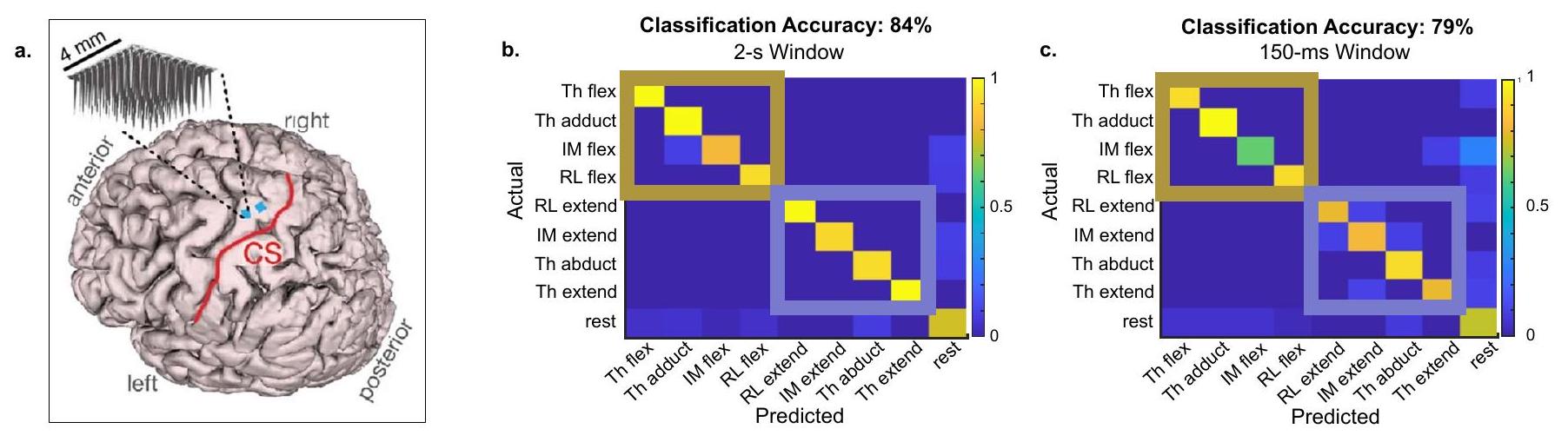
الشكل البياني الممتد 1| نظام واجهة الدماغ-الكمبيوتر داخل القشرة لحركات الأصابع الدقيقة. أ، إعادة بناء التصوير بالرنين المغناطيسي لدماغ المشارك مع مواقع الزرع موضحة كمربعات زرقاء. تم وضع مصفوفتي ميكروإلكترود سيليكونيت مكونتين من 96 قناة في منطقة ‘المقبض’ اليدوي في التلافيف الجبهية المركزية اليسرى.
2016. الخط الأحمر يشير إلى الشق المركزي (CS). لوحة من Deo وآخرون. .ب و ج، مصفوفات الارتباك التي تظهر احتمال تصنيف حركات الأصابع المحاولة بشكل صحيح باستخدام ، و نوافذ من تحليل غير متصل على بيانات الحلقة المفتوحة من اليوم 2423. IM، الوسطى؛ RL، الخنصر؛ TH، الإبهام.
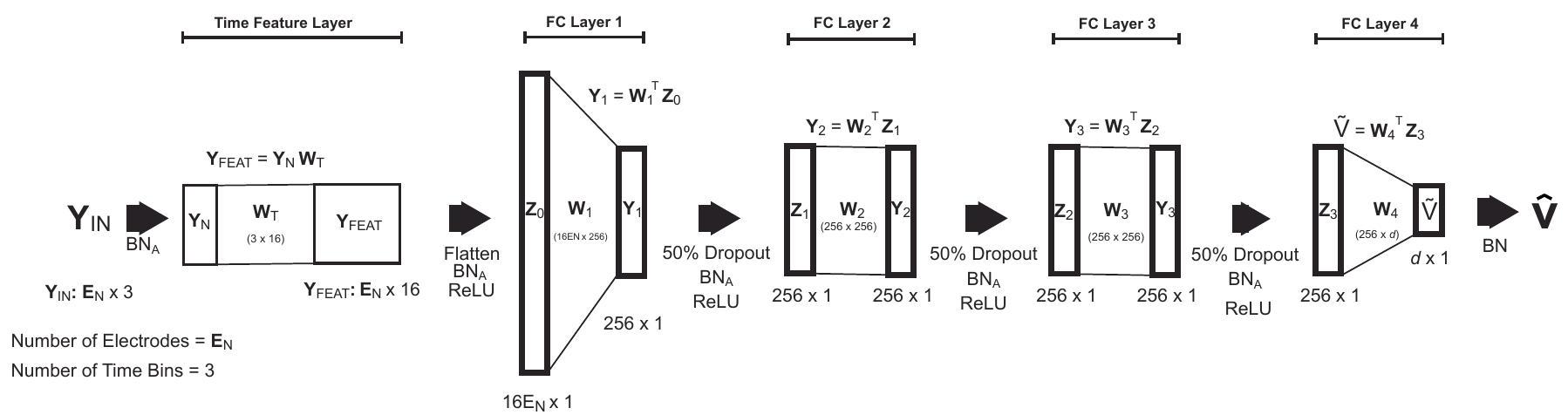
الشكل البياني الموسع خوارزمية فك التشفير. المدخلات هو مصفوفة الإدخال، حيث هو عدد الأقطاب الكهربائية (192) و3 تمثل أحدث 3 صناديق. المتغير الناتج، يمثل متجهًا موحدًا لكل من سرعات الأصابع. تم حساب السرعات الفعلية المفككة من خلال تطبيق قيمة متوسطة محسوبة تجريبياً وقيمة كسب. الطبقات الخطية ( ) تضمنت مصطلح انحياز قابل للتعلم باستثناء الطبقة الخطية النهائية، لتقليل حجم المتوسطات غير الصفرية. جميع حالات الـ batchnorm، ، كانوا
تم تنفيذه باستخدام التحويلات الخطية صحيح باستثناء الدفعة النهائية من التوحيد، BN، حيث التعديل خطأ في محاولة تقليل اعتماد خوارزمية فك التشفير على تصحيح الإزاحة من كتلة الباتش نورم النهائية. خلال وضع التدريب، لم يقم طبقة الباتش نورم، BN، بتصحيح القيم المتوسطة غير الصفرية أو تطبيق تصحيح متوسط لفرض الطبقة الخطية النهائية. لتعلم إشارة خرج بمتوسط صفر. BN، تطبيع الدفعة؛ FC، متصل بالكامل؛ ReLU، وحدة خطية مصححة. الشكل مُعدل من (Willsey et al. 2022) .
أ.

ب.
مجموعات الأصابع الاثنين، 2 درجات حرية
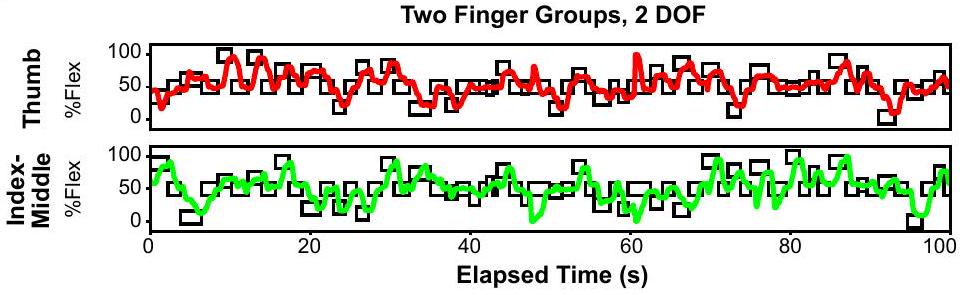
الشكل البياني الممتد 3 | فك التشفير في حلقة مغلقة لمهمة إصبع ذات درجتين و4 درجات من الحرية (DOF). أ، يتم تصوير مقطع زمني مدته 100 ثانية من الحركات الم decoded النموذجية لمجموعة الأصابع ذات الإصبعين، مهمة 2-DOF. يتم وصف المسارات كنسبة مئوية من الانثناء (%Flex). توزيعات أوقات الحصول على الهدف (مللي ثانية) لـ
مهمة ذات درجتين من الحرية ومهمة ذات 4 درجات من الحرية، ، على مدى عدة كتل من كل مهمة. كل نقطة تمثل تجربة، والماس الأسود يشير إلى القيمة المتوسطة. تشير إلى عدد التجارب لكل كتلة، و R تشير إلى معدل الأهداف المكتسبة في الأهداف/دقيقة، و يمثل القيمة المتوسطة.
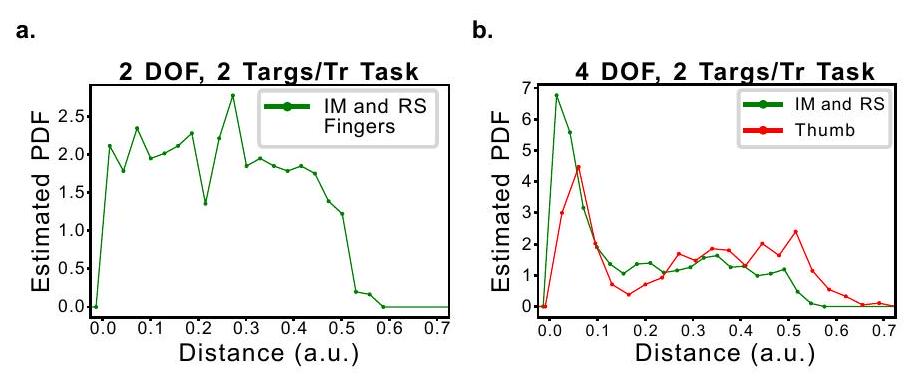
الشكل البياني الممتد 4 | توزيع مسافات الأصابع. بالنسبة لمهمة 2D و 4D مع هدفين جديدين/تجربة (في الشكل 1e)، توزيع المسافات للتجارب الناجحة لـ (أ) جهاز فك التشفير 2D و (ب) جهاز فك التشفير 4D. تم تطبيع المدرج التكراري بحيث تكون المساحة تحت المنحنى تساوي 1. يمثل المنحنى الأخضر المسافة لإصبع السبابة (IM) وإصبع الخاتم-الصغير (RL) عند الانثناء/التمديد مجتمعة عبر جميع التجارب لشفرة ثنائية الأبعاد وتجارب المهمة في الشكل 1e. في b، المنحنى الأخضر
يمثل المنحنى المسافات المجمعة لثني/مد إصبع IM وإصبع RL، ويمثل المنحنى البرتقالي المسافة ثنائية الأبعاد للإبهام (مجمعة من المكونات ثنائية الأبعاد للثني/المد والابتعاد/الاقتراب) للتجارب التي استخدمت جهاز فك التشفير رباعي الأبعاد والمهمة في الشكل 1e. وحدات عشوائية، DOF، درجة الحرية؛ PDF، دالة توزيع الاحتمالات.
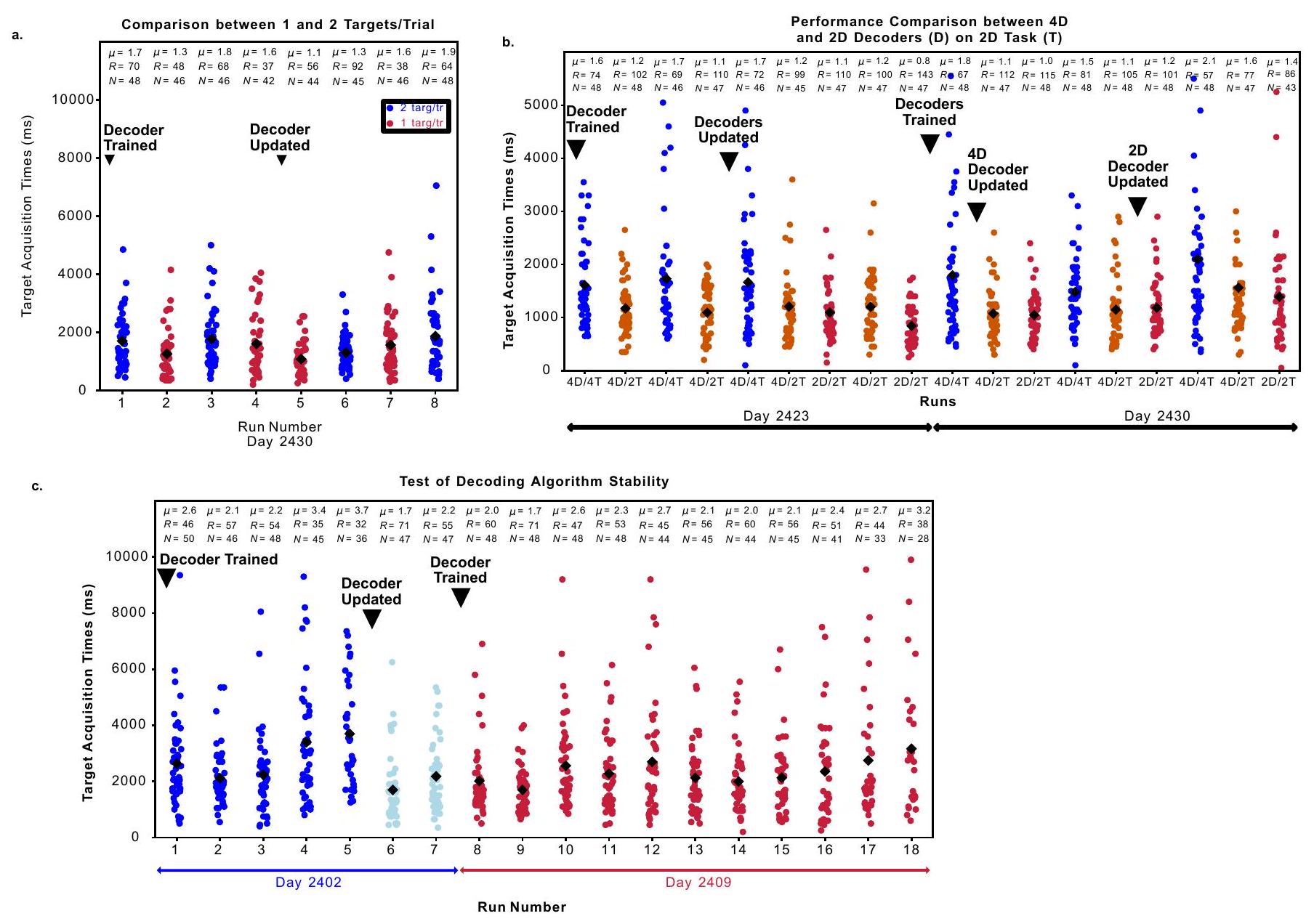
الشكل البياني الموسع | أوقات اكتساب الهدف لمجموعة متنوعة من المقارنات. أ، مقارنة الأداء بين هدفين جديدين مقابل هدف جديد واحد/تجربة (targ/tr). بيانات السكان لأوقات اكتساب الهدف (مللي ثانية) باستخدام جهاز فك التشفير 4D لهدفين جديدين/تجربة (أزرق) وهدف جديد واحد/تجربة (أحمر) على مدى كتل المهمة. كل نقطة تمثل تجربة، والماس الأسود يشير إلى القيمة المتوسطة. تشير إلى عدد التجارب لكل كتلة، يمثل القيمة المتوسطة، وR تمثل معدل الأهداف المكتسبة في الأهداف/دقيقة. يتم مقارنة أوقات اكتساب الأهداف (مللي ثانية) لمشفري 4D و2D في المهمة ثنائية الأبعاد مع مهمة جديدة تحتوي على هدفين/تجربة (2T). يتم أيضًا تشغيل المشفر 4D على مجموعة الأصابع الثلاثة، المهمة 4D (4T) مع هدفين جديدين/تجربة. الكتل في أيام التجربة 2423 و2430 من البيانات.
تمثل المجموعة كتل متتالية دون إعادة تدريب ما لم يُذكر خلاف ذلك. تشير التسميات 4D/4T إلى تشغيل وحدة فك التشفير 4D على 4T؛ 4D/2T تشير إلى وحدة فك التشفير 4D على 2T؛ و 2D/2T تشير إلى وحدة فك التشفير 2D على 2T. ج، اختبار استقرار وحدة فك التشفير لمدة يومين تجريبيين باستخدام وحدة فك التشفير 4-DOF لهدفين جديدين/تجربة. بالنسبة للأيام 2402 (الأزرق والفاتح) و2409 (الأحمر)، تم تدريب وحدة فك التشفير (مثلث مقلوب مع “وحدة فك التشفير مدربة”) ثم استخدمت في كتل متتالية حتى لم يكن بالإمكان إكمال التجارب بشكل موثوق. في اليوم 2402، تم إعادة تدريب وحدة فك التشفير (“وحدة فك التشفير محدثة”) لإظهار استعادة الأداء في كتلتين لاحقتين (الفاتح الأزرق).
الجدول البياني الموسع 1 | مقاييس الأداء لفك تشفير الأصابع ثلاثي الأبعاد مع هدفين جديدين في كل تجربة
1 هدف/تجربة جديدة هدفين/تجربة جديدة
عدد التجارب 178 187
عدد الأيام 1 1
وقت الاستحواذ
وقت الاستهداف
زمن المدارات
الأهداف في الدقيقة
نسبة الإنجاز
طول المسار
تُبلغ البيانات الإحصائية كمتوسط ± خطأ معياري في المتوسط.
البيانات الموسعة الجدول 2 | مقاييس الأداء لفك تشفير الأصابع باستخدام جهاز فك التشفير رباعي الأبعاد في مهمة ثنائية الأبعاد
فك التشفير ثنائي الأبعاد، مهمة ثنائية الأبعاد فك التشفير رباعي الأبعاد، مهمة رباعية الأبعاد فك التشفير 4D، مهمة 2D
عدد التجارب 233 284 ٣٢٩
عدد الأيام ٣ ٣ ٣
وقت الاستحواذ (مللي ثانية)
وقت الاستهداف (مللي ثانية)
زمن المدار (مللي ثانية)
الأهداف في الدقيقة
نسبة الإنجاز 99.1٪ 99.6% 100%
طول المسار
تُبلغ البيانات الإحصائية كمتوسط ± خطأ معياري في المتوسط.

محفظة الطبيعة

المؤلف (المؤلفون) المراسلون:
ماثيو ويلسي
جايمي هندرسون
آخر تحديث بواسطة المؤلف(ين): 20 سبتمبر 2024

ملخص التقرير

تسعى Nature Portfolio إلى تحسين إمكانية تكرار العمل الذي ننشره. يوفر هذا النموذج هيكلًا للاتساق والشفافية في التقرير. لمزيد من المعلومات حول سياسات Nature Portfolio، يرجى الاطلاع على سياسات التحرير وقائمة التحقق من سياسة التحرير.

الإحصائيات

لجميع التحليلات الإحصائية، تأكد من أن العناصر التالية موجودة في أسطورة الشكل، أسطورة الجدول، النص الرئيسي، أو قسم الطرق.
تحتوي مجموعتنا على الويب حول الإحصائيات لعلماء الأحياء على مقالات تتناول العديد من النقاط المذكورة أعلاه.


لاختبار الفرضية الصفرية، يتم استخدام إحصائية الاختبار (مثل F، t، r) مع فترات الثقة، أحجام التأثير، درجات الحرية و قيمة ملحوظة أعطِ القيم كقيم دقيقة كلما كان ذلك مناسبًا.

□ لتحليل بايزي، معلومات حول اختيار القيم الأولية وإعدادات سلسلة ماركوف مونت كارلو
□ لتصميمات هرمية ومعقدة، تحديد المستوى المناسب للاختبارات والتقارير الكاملة عن النتائج
□ تقديرات أحجام التأثير (مثل حجم تأثير كوهين) بيرسون )، مما يشير إلى كيفية حسابها
تم التأكيد
□ حجم العينة بالضبط لكل مجموعة/شرط تجريبي، معطاة كرقم منفصل ووحدة قياس
□ بيان حول ما إذا كانت القياسات قد أُخذت من عينات متميزة أو ما إذا كانت نفس العينة قد تم قياسها عدة مرات
اختبار(ات) الإحصاء المستخدمة وما إذا كانت أحادية الجانب أو ثنائية الجانب
يجب أن تُوصف الاختبارات الشائعة فقط بالاسم؛ واصفًا التقنيات الأكثر تعقيدًا في قسم الطرق.
□ وصف لجميع المتغيرات المرافقة التي تم اختبارها
□ وصف لأي افتراضات أو تصحيحات، مثل اختبارات الطبيعية والتعديل للمقارنات المتعددة
وصف كامل للمعلمات الإحصائية بما في ذلك الاتجاه المركزي (مثل المتوسطات) أو تقديرات أساسية أخرى (مثل معامل الانحدار) وَالتباين (مثل الانحراف المعياري) أو تقديرات مرتبطة بعدم اليقين (مثل فترات الثقة)

ل
ل

البرمجيات والشيفرة

معلومات السياسة حول توفر كود الكمبيوتر
جمع البيانات
تم تطوير عرض الإصبع الافتراضي في Unity (2021.3.9f1). استخدم بيئة الطائرة الرباعية المعتمدة على الفيزياء مكون Microsoft AirSim كمحاكي لطائرة رباعية في Unity (2019.3.12f1). يقوم معالج الإشارة العصبية بإرسال الإشارة الرقمية إلى جهاز SuperLogics يعمل بنظام Simulink Real-Time (v2019، Mathworks، ناتيك، ماساتشوستس). تواصل هذا الكمبيوتر مع جهاز كمبيوتر يعمل بنظام Linux ويستخدم Ubuntu مع Python (v3.7.11)، PyTorch (v1.12.1،https://pytorch.org/)، وRedis (v7.02)، حيث تم تنفيذ الشيفرة المخصصة لفك التشفير، والتحكم في البيئة الافتراضية في Unity، وتدريب الشبكة العصبية. تم توصيل النظام بالكامل بجهاز كمبيوتر إضافي يعمل بنظام Windows ويستخدم Matlab (v2019، Mathworks، ناتيك، ماساتشوستس) الذي تم توصيله بالنظام لإيقاف وبدء التجارب خلال الجلسات.
تحليل البيانات
تم إجراء التحليلات غير المتصلة بالإنترنت باستخدام بايثون (الإصدار 3.9.12) من خلال دفتر ملاحظات Jupyterhttps://jupyter.org/) وفي Matlab (v2022a، Mathworks، ناتيك، ماساتشوستس). تم استخدام الحزم التالية في بايثون: scipy (v1.7.3)، torch (v1.12.0)، torchvision (v0.13.0)، numpy (v1.21.5)، matplotlib (v3.5.3)، PIL (v9.0.1)، sklearn (v1.0.2). إصدارات حزم Jupyter الأساسية هي: IPython 8.2.0، ipykernel 6.9.1، ipywidgets 7.6.5، jupyter_client 6.1.12، jupyter_core 4.9.2، jupyter_server 1.13.5، jupyterlab 3.3.2، nbclient 0.5.13، nbconvert 6.4.4، nbformat 5.3.0، notebook 6.4.8، qtconsole 5.3.0، traitlets 5.1.1.
قسم توفر الشيفرة يقرأ الآن: الشيفرة لتنفيذ التحليل غير المتصل للنتائج المركزية لهذه الدراسة متاحة للجمهور على GitHub فيhttps://github.com/WillseyBCILab/BCI_Finger_Decoding_Quadcopter.
بالنسبة للمخطوطات التي تستخدم خوارزميات أو برامج مخصصة تكون مركزية في البحث ولكن لم يتم وصفها بعد في الأدبيات المنشورة، يجب أن تكون البرمجيات متاحة للمحررين والمراجعين. نحن نشجع بشدة على إيداع الشيفرة في مستودع مجتمعي (مثل GitHub). راجع إرشادات مجموعة Nature لتقديم الشيفرة والبرمجيات لمزيد من المعلومات.

بيانات

معلومات السياسة حول توفر البيانات

يجب أن تتضمن جميع المخطوطات بيانًا حول توفر البيانات. يجب أن يوفر هذا البيان المعلومات التالية، حيثما ينطبق:
  • رموز الانضمام، معرفات فريدة، أو روابط ويب لمجموعات البيانات المتاحة للجمهور
  • وصف لأي قيود على توفر البيانات
  • بالنسبة لمجموعات البيانات السريرية أو بيانات الطرف الثالث، يرجى التأكد من أن البيان يتماشى مع سياستنا.
البيانات اللازمة لإعادة إنتاج النتائج الرئيسية في هذه الدراسة متاحة للجمهور على موقع درايد عندhttps://doi.org/10.5061/dryad.1jwstqk4f.

البحث الذي يتضمن مشاركين بشريين، بياناتهم، أو مواد بيولوجية

معلومات السياسة حول الدراسات التي تشمل مشاركين بشريين أو بيانات بشرية. انظر أيضًا معلومات السياسة حول الجنس، الهوية/التقديم الجنسي، والتوجه الجنسي والعرق، والاثنية والعنصرية.
التقارير عن الجنس والنوع الاجتماعي
التقارير عن العرق أو الإثنية أو غيرها من المجموعات الاجتماعية ذات الصلة
خصائص السكان
شملت هذه الدراسة بيانات من مشارك واحد، T5، الذي هو ذكر بيولوجي. لم يتم إجراء أي تحليلات قائمة على الجنس أو النوع نظرًا لوجود مشارك واحد فقط وكانت الدراسة تقيم أداء واجهة الدماغ-الكمبيوتر.
لم يكن هناك أي تقارير عن العرق أو الإثنية أو غيرها من المجموعات الاجتماعية ذات الصلة.
تشمل هذه الدراسة بيانات من مشارك واحد (تم التعرف عليه باسم T5) الذي قدم موافقة مستنيرة وتم تسجيله في تجربة نظام واجهة الدماغ BrainGate2 السريرية.ClinicalTrials.govالمعرف: NCT00912041، مسجل في 3 يونيو 2009) لكن هذه الدراسة لم تبلغ عن نتائج التجارب السريرية. T5 هو رجل أعسر، يبلغ من العمر 69 عامًا خلال جمع البيانات، يعاني من إصابة في الحبل الشوكي من نوع C4 AIS C.
التوظيف
تم تسجيل المشارك T5 في تجربة BrainGate 2 السريرية بعد استيفاء معايير الإدراج بناءً جزئيًا على خصائص المرض. تتوفر معايير الإدراج والاستبعاد على الإنترنت.ClinicalTrials.gov). تم متابعة هذه التحقيق كجزء من مقياس النتائج الثانوية للتجربة السريرية. فيما يتعلق بالتحيزات المحتملة في الاختيار، يمكن أن تؤدي معايير الإدراج والاستبعاد الصارمة إلى اختيار مشاركين أكثر صحة من السكان النموذجيين الذين يعانون من الشلل.
رقابة الأخلاقيات
تمت الموافقة على تجربة النظام العصبي BrainGate2 تحت استثناء جهاز التحقيق (IDE) من قبل إدارة الغذاء والدواء الأمريكية (IDE #G09003). كما تم منح الإذن من قبل مجلس المراجعة المؤسسية في جامعة ستانفورد (البروتوكول #52060) ومجلس المراجعة المؤسسية في ماس جنرال برايغام (البروتوكول #2009P000505). تم إجراء جميع الأبحاث وفقًا للإرشادات/اللوائح ذات الصلة.
يرجى ملاحظة أنه يجب أيضًا تقديم معلومات كاملة حول الموافقة على بروتوكول الدراسة في المخطوطة.

التقارير الخاصة بالمجال

يرجى اختيار الخيار أدناه الذي يناسب بحثك بشكل أفضل. إذا لم تكن متأكدًا، اقرأ الأقسام المناسبة قبل اتخاذ قرارك.
علوم الحياة □ العلوم السلوكية والاجتماعية □ العلوم البيئية والتطورية والبيئية
لنسخة مرجعية من الوثيقة بجميع الأقسام، انظرnature.com/documents/nr-reporting-summary-flat.pdf

تصميم دراسة العلوم الحياتية

يجب على جميع الدراسات الإفصاح عن هذه النقاط حتى عندما يكون الإفصاح سلبياً.
حجم العينة لم يتم إجراء حساب لحجم العينة. تم جمع البيانات من مشارك واحد لتوصيف أداء واجهة الدماغ-الكمبيوتر. عدد التجارب قابل للمقارنة مع دراسات مماثلة، وتم تقدير عدم اليقين في تقديرات الأداء باستخدام الخطأ المعياري للمتوسط.
استبعاد البيانات لم يتم استبعاد أي بيانات. تم إجراء جلسات فك الشيفرة باستخدام الأصابع على مدى سلسلة من الأيام (من مارس إلى أبريل 2023). تم عرض دورة العقبات ذات الأربعة درجات من الحرية ومهمة الحلقة العشوائية في يوم واحد بعد جلسات تمهيدية لتطوير كل مهمة.
التكرار تم تقييم النتائج الأولية لفك تشفير الأصابع بنجاح وتم تأكيدها في 7 أيام مستقلة دون استبعاد.
العشوائية لم يكن هناك توزيع عشوائي للمشاركين على مجموعات العلاج حيث كان هناك مشارك واحد فقط. كان هناك توزيع عشوائي لمواقع أهداف الأصابع من المركز إلى الخارج لتجميع عشوائي لمساحة الأهداف المحتملة.
مُعَمي لم يكن هناك أي تعمية مرتبطة بمجموعات العلاج حيث كان هناك مشارك واحد فقط مسجل. لم يكن من الممكن تعمية المشارك عن المهمة التي كان يؤديها.

التقارير عن مواد وأنظمة وطرق محددة

نحتاج إلى معلومات من المؤلفين حول بعض أنواع المواد والأنظمة التجريبية والأساليب المستخدمة في العديد من الدراسات. هنا، يرجى الإشارة إلى ما إذا كانت كل مادة أو نظام أو طريقة مدرجة ذات صلة بدراستك. إذا لم تكن متأكدًا مما إذا كان عنصر القائمة ينطبق على بحثك، يرجى قراءة القسم المناسب قبل اختيار رد.
المواد والأنظمة التجريبية طرق
غير متوفر مشارك في الدراسة غير متوفر مشارك في الدراسة
إكس
إكس إكس
إكس
إكس
إكس
إكس

النباتات

مخزونات البذور
غير متوفر
أنماط جينية نباتية جديدة
غير متوفر
المصادقة
غير متوفر

  1. ¹قسم جراحة الأعصاب، جامعة ستانفورد، ستانفورد، كاليفورنيا، الولايات المتحدة الأمريكية. ²قسم جراحة الأعصاب، جامعة ميتشيغان، آن آربر، ميشيغان، الولايات المتحدة الأمريكية.
    قسم الهندسة الطبية الحيوية، جامعة ميتشيغان، آن آربر، ميشيغان، الولايات المتحدة الأمريكية. معهد الواجهات الحيوية، جامعة ميتشيغان، آن آربر، ميشيغان، الولايات المتحدة الأمريكية. معهد علوم الأعصاب في ميشيغان، جامعة ميشيغان، آن آربر، ميشيغان، الولايات المتحدة الأمريكية. معهد هوارد هيوز الطبي في جامعة ستانفورد، ستانفورد، كاليفورنيا، الولايات المتحدة الأمريكية. معهد روبرت ج. ونانسي د. كارني لعلوم الدماغ، جامعة براون، بروفيدنس، رود آيلاند، الولايات المتحدة الأمريكية. كلية الهندسة، جامعة براون، بروفيدنس، رود آيلاند، الولايات المتحدة الأمريكية. مركز أبحاث وتطوير VA لاستعادة الأعصاب والتكنولوجيا العصبية، خدمة أبحاث وتطوير إعادة التأهيل، نظام الرعاية الصحية VA بروفيدنس، بروفيدنس، رود آيلاند، الولايات المتحدة الأمريكية. مركز التكنولوجيا العصبية والتعافي العصبي، قسم الأعصاب، مستشفى ماساتشوستس العام، كلية هارفارد الطبية، بوسطن، ماساتشوستس، الولايات المتحدة الأمريكية. معهد وو تساي لعلوم الأعصاب، جامعة ستانفورد، ستانفورد، كاليفورنيا، الولايات المتحدة الأمريكية. معهد بايو-إكس، جامعة ستانفورد، ستانفورد، كاليفورنيا، الولايات المتحدة الأمريكية. البريد الإلكتروني:mwillsey@umich.edu; هندرj@ستانفورد.إديو

Journal: Nature Medicine, Volume: 31, Issue: 1
DOI: https://doi.org/10.1038/s41591-024-03341-8
PMID: https://pubmed.ncbi.nlm.nih.gov/39833405
Publication Date: 2025-01-01

A high-performance brain-computer interface for finger decoding and quadcopter game control in an individual with paralysis

Received: 31 January 2024
Accepted: 3 October 2024
Published online: 20 January 2025
Check for updates

Matthew S. Willsey , Nishal P. Shah , Donald T. Avansino , Nick V. Hahn © , Ryan M. Jamiolkowski (1) , Foram B. Kamdar (1) , Leigh R. Hochberg , Francis R. Willett & Jaimie M. Henderson

Abstract

People with paralysis express unmet needs for peer support, leisure activities and sporting activities. Many within the general population rely on social media and massively multiplayer video games to address these needs. We developed a high-performance, finger-based brain-computer-interface system allowing continuous control of three independent finger groups, of which the thumb can be controlled in two dimensions, yielding a total of four degrees of freedom. The system was tested in a human research participant with tetraplegia due to spinal cord injury over sequential trials requiring fingers to reach and hold on targets, with an average acquisition rate of 76 targets per minute and completion time of seconds-comparing favorably to prior animal studies despite a twofold increase in the decoded degrees of freedom. More importantly, finger positions were then used to control a virtual quadcopter-the number-one restorative priority for the participant-using a brain-to-finger-to-computer interface to allow dexterous navigation around fixed- and random-ringed obstacle courses. The participant expressed or demonstrated a sense of enablement, recreation and social connectedness that addresses many of the unmet needs of people with paralysis.

More than 5 million people in the United States live with severe motor impairments . Although many basic needs of people with paralysis are being met, unmet needs for peer support, leisure activities and sports are reported, respectively, by and of surveyed people with paralysis from spinal cord injury . People with motor impairments that spare enough function to manipulate a video game controller have turned to video games for social connectedness and a competitive outlet . In a survey of players with and without disabilities , a variety
of themes emerged (for example, recreation, artistic expression, social connectedness); however, in those with disabilities, many expressed a theme of enablement, meaning both equality with able-bodied players and overcoming their disability. Even with assistive/adaptive technologies, gamers with motor impairments often have to play at an easier level of difficulty or avoid multiplayer games with able-bodied players that often require dexterous multieffector control . Brain-computer interfaces (BCIs), increasingly recognized as a potential solution for
Fig. 1 |iBCI system for dexterous finger movements. a, A computer display is placed in front of the participant so that he can perform a finger task with a virtual hand. During closed-loop control, the electrical activity from the array is mapped to a control signal for the virtual fingers. Panel adapted from ref. 27. b, Left, thumb moves in two dimensions, abduction (Ab) and adduction (Ad) (flexion/extension and abduction/adduction), and index-middle and ring-little move in a 1D arc. Right, trials showing typical targets for all three finger groups for the four-DOF task.c, A 100 -s time segment of typical decoded movements are depicted for the three-finger group, four-DOF task. Trajectories are described along a range of -1 to 1 , where 1 denotes full flexion (flex) or abduction (ab) and -1 denotes extension (ext) or adduction (ad). d, The trajectories for an
illustrative 50-trial block of 2D thumb movements, showing only trials where the thumb travels a distance greater than 0.3. Each color represents distinct paired, center-out-center trial. e, Summary statistics comparing the two- and four-DOF tasks for acquisition time (Acq time), time to target (T2T), orbiting time (Orb), acquisition rate (Rate), path length efficiency (Path len eff) and the percent of trials successfully completed (Percent complete). The error bars represent the standard error of the mean. There were trials and trials for the twoand four-DOF tasks, respectively. f, Four blocks in which only one finger was cued per trial, illustrating individuated control of fingers. The mean velocity per trial was calculated during the ‘Go’ period for each finger and normalized by the mean value of the finger group with the highest mean value. F, flexion; E, extension.
motor restoration, could enable sophisticated control of video games for people with paralysis-and, more broadly, control of digital interfaces for social networking or remote work.
In motor BCIs, most effort has focused on controlling single effectors such as computer cursors for point-and-click cursor control and robotic arms for reaching and grasping (where fingers moved as a group) . To expand object manipulation, ref. 17 continuously decoded linear combinations of four distinct grasping postures. Beyond simple grasps, providing reliable individuated finger control would allow activities such as typing, playing a musical instrument or manipulating a multieffector digital interface such as a video game controller. In humans, finger decoding has only been demonstrated in prediction in offline analyses or classification from recorded neural activity . Continuous finger decoding has been limited to two finger groups (two degrees of freedom (DOF)) in non-human primates (NHPs).
In a human research participant with paralysis, we developed a finger BCI system that is more functional than previous devices and is capable of continuously decoding three independent finger groups, of which the thumb was decoded in two dimensions, yielding a total of four DOF (doubling the decoded DOF in NHPs ). We used the decoded finger movements to provide independent digital endpoints for control of a virtual quadcopter, in a demonstration of a high-performance, continuous, finger-based intracortical BCI (iBCI)illustrating the power of intuitive, individuated finger control as an intermediary representation between the mapping of brain recordings to computer interfaces. Just as able-bodied users of digital systems use their fingers to manipulate keyboards and game controllers, this system allows an intuitive framework for a brain-controlled digital interface, providing opportunities for recreation and socialization as well as eliciting feelings of enablement.

Results

Multiunit neural activity was recorded from two 96-channel silicon microelectrode arrays placed in the hand ‘knob’ area of the left precentral gyrus in one participant (‘T5’) enrolled in the BrainGate2 pilot clinical trial (Extended Data Fig. 1a). T5 was a 69-year-old right-handed man with C4 AIS C spinal cord injury, leaving only non-functional twitches and micromotion of his upper and lower extremities. A virtual hand was displayed to the participant using Unity (v.2021.3.9f1, Unity Technologies), as shown in Fig. 1a. The thumb was designed to move along a two-dimensional (2D) surface defined by the flexion-extension and abduction-adduction axes (Fig. 1b). Both the index-middle and ringlittle fingers moved as separate groups in a one-dimensional (1D) arc constrained to the flexion-extension axis. Tuning of the microelectrode arrays to finger movements was confirmed (Extended Data Fig. 1b,c).
Closed-loop real-time control of a two- and four-DOF finger task To perform closed-loop continuous decoding, a temporally convolved feed-forward neural network, adapted from ref. 23, mapped spike-band power (SBP) to finger velocities used to control virtual finger movements on screen (Extended Data Fig. 2). The network parameters were initially trained from open-loop trials where the participant attempted to move his fingers in sync with moving fingers on the hand avatar. The decoding algorithm was then used in closed-loop training trials; the parameters are refined by assuming that decoded movements away from intended targets were errors.
Two sets of tasks were performed. To translate findings from earlier NHP studies , we sought to demonstrate decoding of two finger groups (2D task) in our human research participant (in this task, the thumb was constrained only to the flexion-extension axis). T5 was cued to move both the thumb and index-middle groups from a center position to a random target within the active range of motion of the fingers. On the subsequent trial, targets were placed back at center. To successfully complete a trial, the fingers had to hold on the targets for 500 ms , and 10 s were allowed to complete the trial (sample trajectories in Extended Data Fig. 3a; see Supplementary Video 1).
To expand on the functionality demonstrated in NHP studies, task complexity was increased by introducing a 4D task with 2D thumb movements and 1D movements of the index-middle group and the ring-little group (Fig. 1c). On each trial, two finger groups were randomly selected for new targets while the target for the third finger group remained in the same position as the previous trial, and movements of all fingers were continuously and simultaneously decoded and controlled. Typical target trajectories for this expanded 4D task are shown in Fig. 1c, and 2D trajectories of the thumb movements are illustrated in Fig. 1d. Supplementary Video 2 depicts this task.
The closed-loop decoding performance for the 2D and 4D decoder was compared using 529 trials ( 3 days) for the 2D decoder and 524 trials (6 days) for the 4D decoder (Fig.1e). For the 2D decoder, the mean acquisition time was , the target acquisition rate was targets per minute, and of trials were successfully completed. For the 4D decoder, the mean acquisition time was , the target acquisition rate was targets per minute, and of trials were successfully completed. The acquisition times for each trial (population data) is shown graphically in Extended Data Fig. 3b for the 2D decoder and Extended Data Fig. 3c for the 4D decoder. Typical finger distances per trial are shown graphically in Extended Data Fig. 4a for the 2D task and Extended Data Fig. 4b for the 4D task.
In comparison to the 2D decoder and task, the acquisition times were increased by for the 4D decoder and task ( , d.f. , confidence interval to 775 ms ), and factors such as increased demands on decoding accuracy and the difficulty in keeping more fingers stationary on the targets (that is, signal-independent noise) may have led to slower performance. However, after the participant grew more accustomed to the task (final four blocks), acquisition time for the 4D decoder dropped by an average of 0.4 s to
Table 1 | Performance metrics for 2D and 4D finger decoding
2D decoder 4D decoder 4D decoder (last four blocks)
Number of trials 529 524 192
Number of days 3 6 3
Acquisition time (ms)
Time to target (ms)
Orbiting time (ms)
Targets per minute
Percent completed 98.1% 98.7% 100%
Path length
Statistical data are reported as mean ± s.e.m.
(a target acquisition rate of targets per minute), and of trials were completed. To compare this work with the previous NHP two-finger task where throughput varied from 1.98 to 3.04 bps with a variety of decoding algorithms , throughput for the current method was calculated as (see Methods for details). Table 1 summarizes statistics for the 4D decoder/task and 2D decoder/task.
Finger discrimination during closed-loop control was demonstrated on a 4D task cuing one finger group per trial. The mean velocity of the finger groups was calculated during the ‘Go’ period. The movement of the non-cued fingers was substantially less than the movement of the cued finger (Fig. 1f), demonstrating finger individuation.
The 4D decoder was compared for tasks with one (178 trials) and two cued finger-group movements ( 187 trials). The mean acquisition time was for one finger and for two fingers ( , d.f. to -96 ms ). The target acquisition rate was targets per minute for one finger and targets per minute for two cued fingers , d.f. to 48 targets per minute) (Supplementary Video 3, Extended Data Fig. 5a and Extended Data Table 1).

Dimensionality of the neural activity

With a potential nonlinear relationship between neural activity and finger movement , the dimensionality of the neural activity might be nonlinearly related to increases in decoded DOF. The dimensionality of the neural data during 4D and 2D decoding was calculated using the participation ratio used in ref. 27. The average dimensionality of neural activity was 2.4 for the 2D decoder, 3.1 for the 4D decoder with one new target/trial and 7.5 for the 4D decoder with two new targets/ trial (Fig. 2a). If the dimensionality of the neural activity varied linearly with the decoded DOF, the dimensionality of the 4D decoder would be twice that of the 2 D decoder: that is, ; however, dimensionality using the 4D decoder was found to be more than the expected value of to 4.99 . Thus, the dimensionality of combined finger movements was greater than the sum of the individual components. Although the dimensionality of combined movements awaits further study, these results may imply that some neurons encode both single and/or combined movements, as suggested by studies showing single units can encode the muscle and whether the muscle functions as agonist or antagonist .

Effect of number of active DOF on decoding

Despite increased dimensionality in neural activity when decoding more DOF, it is unclear whether decoding more DOF impacts the mapping of the neural activity when decoding a lower number of DOF. The neural representation of the DOF decoded in the 2D task (thumb and index-middle flexion/extension) could change during the 4D task, for example, if a different control strategy is required for the 4D compared to the 2D task-similar to how new control strategies can be developed
Fig. 2 | Dimensionality. a, Dimensionality of the neural activity during closedloop decoding using either the 2D decoder/task or the 4D decoder/task for either one or two new finger-group targets (1FG or 2FG) per trial. Light blue dots represent data from a day, and black diamonds represent the mean, . b, Summary statistics comparing the 2D decoder on the 2D task (2D,2T; trials), the 4D decoder on the 2D task (4D,2T; trials) and the 4D decoder on the 4D task (4D,4T; trials) based on the acquisition time, time to target, orbiting time, acquisition rate, path length efficiency and the percent of trials successfully completed. The error bars represent the standard error of the mean.c, A typical online block showing the decoded index-middle finger group velocities using the 2D on 2T (blue) during an online block. Offline, the 4D
decoding algorithm was used to predict index-middle group velocities from the same block (orange). The normalized CC between the online and offline signals is given in the bottom-right corner. Units are denoted so that the range of motion for each DOF is unity. d, For the ten blocks on the 2D task, the 4D decoding algorithm was used to predict finger velocities during online blocks using the 2D decoder (online 2D in blue, offline 4D in orange), and the 2D decoding algorithm was used to predict online velocities using the 4D decoder (online 4D in blue, offline 2D in orange). CC between the offline and online signals is represented by dots and averaged across both finger groups. The diamond and denote the mean value for the average of all five blocks for each paired comparison.
to account for a perturbation in the mapping from neural activity to the DOF . Alternatively, the original neural representation could be suppressed when tasked with decoding additional fingers, as is the case when decoding unilateral versus bilateral movements . A third competing hypothesis is that the neural representation of finger movement in the 2D task is preserved in the 4D task, similar to preservation of neural representation between open-loop motor imagery and closed-loop control .
To explore these hypotheses, 2D and 4D decoders were trained and compared by testing on the two shared DOF (thumb flexion/extension and index-middle group flexion/extension) over two days (662 trials), in alternating trials (Fig. 2b and Extended Data Table 2). The mean acquisition time was s for the 2D decoder on the 2D task ( ), for the 4D decoder on the 4D task and for the 4D decoder on the 2D task ( ). Supplementary Video 4 displays the 4D decoder on the 2D task. The trial-by-trial acquisition times for this comparison are given in Extended Data Fig. 5b. The 4D decoder performed much closer to the 2D decoder when restricted to the same 2D task ( increased acquisition times, ,
d.f. to 224 ms ). Thus, training a decoder on an expanded set of movements does not appear to substantially degrade decoding performance (summarized in Fig. 2b and Extended Data Table 2).
The mapping from neural activity to the original two DOF was compared for both 2D and 4D decoders. To do this, the 4D decoder was used to predict the velocities decoded by the 2D decoder on the 2D task and vice versa. The predicted velocities from the 4D decoder were similar to those decoded in online blocks by the 2D decoder (Fig. 2c). To quantify this comparison, the normalized cross-correlation (CC) function was calculated between the decoded and predicted velocities during the eight blocks (Fig. 2d). The results were separated based on whether the online decoded velocities were from the 4D or 2D decoders. The CC when the 4D algorithm predicted the 2D decoded velocities was , and when the 2D algorithm predicted the 4D decoded velocities, the CC was (Fig. 2c). Thus, the neural representation of finger movements appeared similar despite actively controlling more DOF, consistent with other reports where many DOF are represented within the same neural population in motor cortex .
Fig. 3 | SNR ratio versus channel count. a, Graphical representation for vectorized dSNR for the 2D decoder and task. The positive axis represents velocities flexing the thumb, and negative values represent velocities extending the thumb. The axis represents velocities flexing the index-middle finger group when positive and extending the finger group when negative. Because the signal vector, , is assumed to be a normalized target vector, the values of can be only the four points indicated on the circle. The decoded/predicted velocity, , will lie at an angle to and can be decomposed into a parallel signal component, and a perpendicular noise component, . These components can be used to calculate dSNR.b, Velocities predicted by linear regression (using all channels) that maps neural activity to finger velocities, which together with the
intended finger movements are used to calculate dSNR. The arrows represent the ideal/truth value for each possible finger position based on the assumed intended finger movement. c, The dSNR as a function of channel count for the 2D decoder on the two-target/trial task (2Fing, red), 4D decoder on the two-target/ trial task (2Fing, blue) and 4D decoder on the one target/trial task (1Fing, purple). An empirical calculation of dSNR for each day is depicted in lightly colored lines and the mean value as the dark solid line. The dashed lines correspond to a linear, least-squares fit for the -log relationship in equation (1), where denotes the slope and denotes the coefficient of determination of the linear fit. a.u., arbitrary units; Fing, finger.

Dependency of decoding accuracy on channel count

Because newer BCI devices will have more electrodes than used herein, we explored whether increased channels would be expected to increase decoding accuracy with a vector-based, sample-by-sample signal-to-noise ratio (SNR) metric, directional SNR (dSNR;Fig. 3a). The predicted/decoded finger velocities were compared with idealized velocities inferred from intended finger movements. The component of the predicted/decoded velocities consistent with idealized velocities (that is, the component parallel to the idealized vector of finger velocities) was considered the signal component, whereas the predicted/ decoded velocities inconsistent (that is, the component orthogonal to the idealized velocity vector) were considered noise. dSNR was the ratio of the expected signal mean over the square root of the noise power.
The value of dSNR was calculated during a ‘Go’ period of closed-loop trials (defined as from trial onset) of twoand three-finger decoding (Table 2). On each day, linear regression was used to train a mapping (against the intended finger direction) to convert SBP to finger velocities (using sixfold cross-validation). Predicted velocities (calculated from all 192 input channels) grouped along the idealized, intended directions (Fig. 3b).
To determine the dependency dSNR on channel count, a linear mapping of SBP to velocities was trained for a given number of channels, which was used to calculate dSNR (using sixfold cross-validation and where dSNR was the average using 25 sets of randomly selected channels; see Methods). For both the 2D and 4D tasks requiring movement of two simultaneous finger groups, dSNR did not saturate with increasing numbers of input channels (Fig. 3c). Because the dSNR metric assumes that both finger groups are simultaneously moving toward their respective targets (as opposed to moving one at a time), the simpler 4D task that required only one cued finger movement/ trial was also used (Fig. 3c). Using the dSNR data for the highest of channel counts of each curve, a log-log relationship between channel count and dSNR was empirically fit to a linear relationship. The empirical fit of the log-log relationship was strongly linear, with a coefficient of determination, , between 0.99 and 1.00 and a slope, , of 0.34 for the 2D task moving two fingers, 0.38 for the 4D task moving two fingers and 0.43 for the behaviorally simpler 4D task moving one finger. Given
the high value, the empirical relationship between the dSNR and channel count fit the relationship in equation (1):
where is an arbitrary constant, is the slope (varying ) and is the channel count. The empirically determined growth ( to 0.43 ) could be less than the ideal of because of behavioral confounders or violations of noise assumptions (independent, identically distributed gaussian noise; Methods).

Translation of a finger iBCI to virtual quadcopter control

Although an obvious clinical application of a finger iBCI is to restore fine motor control for a robotic arm or to reanimate the native limb , a finger iBCI system could also be an intuitive approach to controlling multiple simultaneous digital endpoints, extending the functionality of 2D cursor control . Another application for multiple-DOF finger control is video gaming, aimed at enabling people with disabilities to participate with others. To this end, each finger movement was mapped to a DOF for control of a virtual quadcopter (Fig. 4a). Unlike a previous implementation of a flight simulator , the finger positions were mapped directly to velocity control of the quadcopter and not transformed into ‘quadcopter space’ during retraining. Mapping finger positions to velocity control could also allow a general-purpose control paradigm for a variety of games. The only task-specific adaptation was to apply a low-level velocity back to neutral when the fingers were within 10% (of the total range of motion) of the neutral position. This kept the fingers in the neutral position unless the participant deliberately moved them. The positions of the fingers were visible in the bottom-left portion of the screen with annotations indicating the neutral position of each finger and the cardinal directions for the thumb movements (Fig. 4b, top).
To demonstrate all the possible four-DOF movements, an obstacle course was created (Fig. 4b, bottom) where each course segment could demonstrate at least one of the movements. On a single day of testing, the participant controlled the quadcopter over the complete obstacle course 12 times with an average block time of 222 s and a standard deviation of 45 s . An exemplary block, completed in 163 s , is shown in
Table 2 | Data sessions and training the closed-loop decoding algorithm
Sno. Day Task D no. DOF OL blocks (trials) CL blocks (trials) CL training time (min) Figure Notes
1 2395 CL finger decoding 1 4 2 (200) 7 (467) 24.3 1, 3, ED 3, ED 4
2 2400 CL finger decoding 2 4 2 (200) 3 (180) 9.8 1, 3, ED 3, ED 4
3 2402 CL finger decoding 3 4 2 (200) 5 (252) 14.1 1, 3, ED 3-5
3b +5 (250) 16.3 ED 5
4 2407 CL finger decoding 4 2 2 (200) 2 (100) 5.9 1, 3, ED 3, ED 4
5 2409 CL finger decoding 5 4 2 (200) 9 (450) 25.7 1, 3, ED 3-5
6 2 2 (200) 2 (100) 11.1 1, 3, ED 3,ED 4
6 2423 CL finger decoding 7 4 2 (200) 12 (585) 35.8 1-3, ED 1, ED 3-5 Open-loop data were used for the confusion plots in Extended Data Fig. 1. Closed-loop data were used in Figs. 2-4.
7b +2 (100) 5.5 2, ED 5
8 2 2 (200) 7 (297) 20.2 1, ED 3, ED 4 Attempted to overtrain the decoder by ReFIT training it over many closed-loop blocks after 100% of trials were completed
8b +3 (150) 5.1 2, 3, ED 5 Includes 1 block (50 trials) using the 4D decoder
7 2430 CL finger decoding 9 4 2 (200) 3 (150) 8.2 1, ED 3, ED 4
9b +2 (100) 5.1 2, ED 5
9c +1 (50) 2.5 2, ED 5
9d +7 (331) 16.8 1-3 ED 5 Used in Fig. 3 for more trials (than earlier blocks)
9e +1 (50) 2.0 1-3, ED 5 Used in Fig. 3 for more trials (than earlier blocks)
10 2 1 (100) 1 (50) 1.5 2, 3, ED 5 Used in Fig. 3 for more trials (than earlier blocks)
10b +1 (50) 1.5 2, 3,ED 5 Used in Fig. 3 for more trials (than earlier blocks)
10c +1 (50) 2.0 2a, 3 Used in Fig. 3 for more trials (than earlier blocks)
8 2520 QC obstacle course 11 4 2 (200) 3 (150) 8.3
11b +4 (200) 10.3 4
11c +2 (100) 5.8
11d +2 (100) 4.7
9 2569 QC random rings 12 4 2 (200) 6 (269) 20.4 Open-loop blocks were performed using common average referencing, and closed-loop blocks used linear regression referencing
CL, closed-loop; CL training time, time to complete the closed-loop training blocks; D no., decoder number; ED, Extended Data Fig.; OL, open-loop; OL blocks required 5 min per 100 trials; QC, quadcopter; S, session. , additional training blocks and trials.
Supplementary Video 5 with the flight path depicted in Fig. 4c. Because all fingers could be simultaneously decoded, multiple quadcopter movements could be combined with multiple finger movements, such as when the quadcopter moves forward and turns during the figure-8 segment of the obstacle course. Furthermore, because the finger positions lie along a continuum, a range of velocities can be provided for quadcopter control, which allows for high-velocity movements to cover large distances or low-velocity movements for fine adjustments.
Although the obstacle course demonstrates four-DOF control, the quadcopter was also tested in a less scripted, free-form task in which the participant was instructed to fly the quadcopter through randomly appearing rings (timeout every 20 s ). This task illustrates reaction time, corrective maneuverability and the ability to combine simultaneous DOF. After training the decoder, the participant was asked to fly through the rings. Over 10 min , he flew through 28 rings ( 2.8 rings per minute); an illustrative segment from this session is given in Supplementary Video 6. Importantly, performance was impacted
not only by decoding accuracy but also largely by behavioral factors, as even able-bodied operators using a unimanual quadcopter control might find the task challenging.

User experience

As seen in other non-BCI studies that illustrate the clinical impact of video games in people with disabilities , T5 expressed themes of social connectedness, enablement and recreation during BCI control of the quadcopter. He expressed on multiple occasions (even before enrollment in the clinical trial) that one of his most important personal priorities was to use a BCI to control a quadcopter; he felt controlling a quadcopter would enable him, for the first time since his injury, to figuratively “rise up” from his bed/chair. He looked forward to the quadcopter sessions, frequently asked when the next quadcopter session was and often requested that we send video clips of quadcopter flights to his friend. When not running protocoled experiments, he enjoyed spontaneously flying the quadcopter. He would constantly ask for more
Fig. 4 | Finger iBCI translated to virtual quadcopter control. a, Mapping finger position to quadcopter velocities. The thumb position is mapped to forward (Fw), backward (Bk), left (Lt) and right (Rt) translation velocity. The index-middle finger group position is mapped to velocities directed up and down in elevation. The position of the ring-little finger group is mapped to right rotation (Rt rot) and left rotation (Lt rot) velocities. b, Top, the layout for quadcopter control showing the virtual quadcopter in the center of the screen. A visualization of the hand indicating the neutral points for the finger groups and cardinal directions of the thumb is also visible. The rings are seen in the center of the display, and the green straight line indicates the trajectory the quadcopter is to follow along the obstacle course. Bottom, the quadcopter obstacle course demonstrates the four-DOF control required to complete the 4.5-lap obstacle course. The top-left
path requires the quadcopter to move forward, turn around and move forward through the same rings to return to the starting point (one lap). The top-right path requires the participant to simultaneously move forward and turn to complete two ‘figure-8’ paths around the rings and back to the starting point (one lap). The bottom-left path requires him to move left through both rings, stop and then move right back through the rings (one lap). The bottom-right path requires moving forward through the rings, increasing the elevation, moving backward over top of the rings, decreasing elevation and then moving forward through both rings to the ending point (1.5 laps). c, Top, an exemplary full-flight path during a block of the obstacle course. Bottom, the flight path is separated into laps corresponding to the planned flight path for each lap in (bottom).
“stick time” so he could improve his performance and exclaimed once that “I feel like we can work until 9 tonight”. Fatigue did not appear to be a factor in quadcopter control, with T5 never requesting to terminate or shorten any of the nine sessions included in this study. Ultimately, this work was the culmination of a long-held goal seen by both the research team and the participant as a joint collaborative achievement.
T5 provided substantial feedback on using the system. He felt that training was “not tedious” and that training on a random finger task was “better training” and “a lot more what the [quadcopter] is like” than a center-out task. Conversations led to a visual display of the fingers (with crosshairs to denote the neutral position) during closed-loop, real-time quadcopter control. He reported the finger graphic initially required his attention a couple of times a second, although he felt control of the drone without looking at the fingers was feasible and learnable. With practice, he referenced the fingers once every few seconds saying, “when the drone is moving and the fingers are moving, it’s easier and faster to just look at the drone”.
T5 described the intuitive control: “It’s like riding your bicycle on your way to work, ‘what am I going to do at work today’, and you’re still shifting gears on your bike and moving right along”. T5 emphasized the dexterity required, saying “Flying it is tiny little finesses off a middle line, a little bit up, a little bit down”, and compared the control to playing a delicate musical instrument. When transitioning from training the fingers to controlling the quadcopter, he explained: “It’s like if you’re a clarinet player and you pick up someone else’s clarinet. You know the difference instantly and there is a little learning curve involved but that’s based on you have an implied competency with your clarinet”. He described the context difference between the fingers
and quadcopter control explaining that the quadcopter control was “more sensitive than fingers” and he just had “to tickle it a direction”. He also emphasized the importance of individualization of the fingers and how failure of individualization degrades performance: “when you pull down with your [little finger], the other two finger [groups] are supposed to just stay there… but they track with the [little finger], which is what throws me off and the whole thing goes down and to the left instead of just left or whatever it is”.

Discussion

People with paralysis often express unmet needs for peer support, leisure activities and sports . Many people with motor impairments have turned to video games for social connectedness and a competitive outlet and have expressed a sense of enablement over their disability . We developed the most capable finger BCI to date that enables continuous control of three highly individuated finger groups, of which the thumb moved in two dimensions (acquiring more than 75 targets per minute). Like how able-bodied users manipulate video game controllers with their fingers, we introduce an intuitive, finger-based iBCI where decoded finger positions controlled three digital effectors (with one effector moving in two dimensions) for high-performance, four-DOF control of a virtual quadcopter. The participant’s intuitive control was anecdotally described as being like playing a musical instrument and evoked a strong sense of enablement, recreation and socialization.
When people without motor deficits interface with computers or video games, the control paradigm is heavily reliant upon-or even requires-dexterous finger movements for a computer keyboard or video game controller to manipulate not just one cursor but multiple
digital cursors, endpoints and buttons. However, most past research and commercial development has focused on using BCIs for 2D point/ click cursor control , which was used previously to control a quadcopter or flight simulator with constant thrust. Kryger et al. adapted two DOF from a previously developed prosthetic limb to control a flight simulator, reported to fly through 10 of 11 rings stacked in close sequence, with videos showing a potential need for more stability over a nearly linear flight path . LaFleur et al. used an electroencephalographic-controlled quadcopter to navigate through 3.1 rings in 4 min (versus 12.0 in able-bodied controls using a keyboard). In contrast, our system allowed navigation through or around 18 ringsat peak performance-in less than 3 min, a more than sixfold increase in performance. The system was also capable of spontaneous free-form flight through randomly appearing rings. This approach to use fine motor control for iBCI-controlled video games can meet unmet needs of people with paralysis, as the entertainment value of video games is self-evident; 77% of video gamers were estimated to play socially in 2021 (ref. 36), and participation in multiplayer video games has been linked to social well-being and connectedness , provides a competitive outlet and fosters teamwork . These were precisely the themes communicated to us by our participant.
Increasing the channel count of the recording system could lead to increased decoding accuracy. Our surrogate for decoding accuracy, dSNR, did not appear to saturate at our current channel count of 192.A similar observation was made using iBCIs for speech decoding , where a projected word error rate decrease from to was projected moving from a 128 – to 256 -electrode system, which was realized when a word error rate was achieved with 256 electrodes .

Online content

Any methods, additional references, Nature Portfolio reporting summaries, source data, extended data, supplementary information, acknowledgements, peer review information; details of author contributions and competing interests; and statements of data and code availability are available at https://doi.org/10.1038/s41591-024-03341-8.

References

  1. Armour, B. S., Courtney-Long, E. A., Fox, M. H., Fredine, H. & Cahill, A. Prevalence and causes of paralysis-United States, 2013. Am. J. Public Health 106, 1855-1857 (2016).
  2. Trezzini, B., Brach, M., Post, M. & Gemperli, A. Prevalence of and factors associated with expressed and unmet service needs reported by persons with spinal cord injury living in the community. Spinal Cord 57, 490-500 (2019).
  3. Cairns, P. et al. Enabled players: the value of accessible digital games. Games Cult. 16, 262-282 (2021).
  4. Tabacof, L., Dewil, S., Herrera, J. E., Cortes, M. & Putrino, D. Adaptive esports for people with spinal cord injury: new frontiers for inclusion in mainstream sports performance. Front. Psychol. https://doi.org/10.3389/fpsyg.2021.612350 (2021).
  5. Beeston, J., Power, C., Cairns, P. & Barlet, M. in Computers Helping People with Special Needs (eds Miesenberger, K. & Kouroupetroglou, G.) 245-253 (Springer, 2018).
  6. Porter, J. R. & Kientz, J. A. An empirical study of issues and barriers to mainstream video game accessibility. In Proc. 15th International ACM SIGACCESS Conference on Computers and Accessibility (ed. Lewis, C.) 1-8 (ACM, 2013).
  7. Taheri, A., Weissman, Z. & Sra, M. Design and evaluation of a hands-free video game controller for individuals with motor impairments. Front. Comp. Sci. 3, 751455.1 (2021).
  8. Nuyujukian, P. et al. Cortical control of a tablet computer by people with paralysis. PLoS ONE 13, eO2O4566 (2018).
  9. Flesher, S. N. et al. A brain-computer interface that evokes tactile sensations improves robotic arm control. Science 372, 831-836 (2021).
  10. Ajiboye, A. B. et al. Restoration of reaching and grasping movements through brain-controlled muscle stimulation in a person with tetraplegia: a proof-of-concept demonstration. Lancet 389, 1821-1830 (2017).
  11. Carmena, J. M. et al. Learning to control a brain-machine interface for reaching and grasping by primates. PLoS Biol. 1, e42 (2003).
  12. Collinger, J. L. et al. High-performance neuroprosthetic control by an individual with tetraplegia. Lancet 381, 557-564 (2013).
  13. Hochberg, L. R. et al. Reach and grasp by people with tetraplegia using a neurally controlled robotic arm. Nature 485, 372-375 (2012).
  14. Pandarinath, C. et al. High performance communication by people with paralysis using an intracortical brain-computer interface. eLife 6, e18554 (2017).
  15. Velliste, M., Perel, S., Spalding, M. C., Whitford, A. S. & Schwartz, A. B. Cortical control of a prosthetic arm for self-feeding. Nature 453, 1098-1101 (2008).
  16. Hochberg, L. R. et al. Neuronal ensemble control of prosthetic devices by a human with tetraplegia. Nature 442, 164-171 (2006).
  17. Wodlinger, B. et al. Ten-dimensional anthropomorphic arm control in a human brain-machine interface: difficulties, solutions, and limitations. J. Neural Eng. 12, 016011 (2014).
  18. Guan, C. et al. Decoding and geometry of ten finger movements in human posterior parietal cortex and motor cortex. J. Neural Eng. 20, 036020 (2023).
  19. Jorge, A., Royston, D. A., Tyler-Kabara, E. C., Boninger, M. L. & Collinger, J. L. Classification of individual finger movements using intracortical recordings in human motor cortex. Neurosurgery 87, 630-638 (2020).
  20. Bouton, C. E. et al. Restoring cortical control of functional movement in a human with quadriplegia. Nature 533, 247-250 (2016).
  21. Nakanishi, Y. et al. Decoding fingertip trajectory from electrocorticographic signals in humans. Neurosci. Res. 85, 20-27 (2014).
  22. Nason, S. R. et al. Real-time linear prediction of simultaneous and independent movements of two finger groups using an intracortical brain-machine interface. Neuron 109, 3164-3177. e3168 (2021).
  23. Willsey, M. S. et al. Real-time brain-machine interface in non-human primates achieves high-velocity prosthetic finger movements using a shallow feedforward neural network decoder. Nat. Commun. 13, 6899 (2022).
  24. Nason, S. R. et al. A low-power band of neuronal spiking activity dominated by local single units improves the performance of brain-machine interfaces. Nat. Biomed. Eng. 4, 973-983 (2020).
  25. Costello, J. T. et al. Balancing memorization and generalization in RNNs for high performance brain-machine interfaces. Preprint at bioRxiv https://doi.org/10.1101/2023.05.28.542435 (2023).
  26. Shah, N. P. et al. Pseudo-linear summation explains neural geometry of multi-finger movements in human premotor cortex. Preprint at bioRxiv https://doi.org/10.1101/2023.10.11.561982 (2023).
  27. Willett, F. R., Avansino, D. T., Hochberg, L. R., Henderson, J. M. & Shenoy, K. V. High-performance brain-to-text communication via handwriting. Nature 593, 249-254 (2021).
  28. Griffin, D. M., Hoffman, D. S. & Strick, P. L. Corticomotoneuronal cells are “functionally tuned”. Science 350, 667-670 (2015).
  29. Sakellaridi, S. et al. Intrinsic variable learning for brain-machine interface control by human anterior intraparietal cortex. Neuron 102, 694-705. e693 (2019).
  30. Willett, F. R. et al. Hand knob area of premotor cortex represents the whole body in a compositional way. Cell 181, 396-409. e326 (2020).
  31. Zhang, C. Y. et al. Preservation of partially mixed selectivity in human posterior parietal cortex across changes in task context. Eneuro 7, ENEURO.0222-19.2019 (2020).
  32. Kryger, M. et al. Flight simulation using a brain-computer interface: a pilot, pilot study. Exp. Neurol. 287, 473-478 (2017).
  33. Gilja, V. et al. A high-performance neural prosthesis enabled by control algorithm design. Nat. Neurosci. 15, 1752 (2012).
  34. Kao, J. C., Nuyujukian, P., Ryu, S. I. & Shenoy, K. V. A high-performance neural prosthesis incorporating discrete state selection with hidden Markov models. IEEE Trans. Biomed. Eng. 64, 935-945 (2016).
  35. LaFleur, K. et al. Quadcopter control in three-dimensional space using a noninvasive motor imagery-based brain-computer interface. J. Neural Eng. 10, 046003 (2013).
  36. Essential facts about the computer and video game industry. Entertainment Software Association www.theesa.com/resource/2 021-essential-facts-about-the-video-game-industry/ (2021).
  37. Raith, L. et al. Massively multiplayer online games and well-being: a systematic literature review. Front. Psychol. https://doi.org/ 10.3389/fpsyg.2021.698799 (2021).
  38. Adeane, A. Quad gods: the world-class gamers who play with their mouths. BBC www.bbc.com/news/stories-55811621 (2021).
  39. Willett, F. R. et al. A high-performance speech neuroprosthesis. Nature 620, 1031-1036 (2023).
  40. Card, N. S. et al. An accurate and rapidly calibrating speech neuroprosthesis. N. Engl. J. Med. 391, 609-618 (2024).
Publisher’s note Springer Nature remains neutral with regard to jurisdictional claims in published maps and institutional affiliations.
Open Access This article is licensed under a Creative Commons Attribution 4.0 International License, which permits use, sharing, adaptation, distribution and reproduction in any medium or format, as long as you give appropriate credit to the original author(s) and the source, provide a link to the Creative Commons licence, and indicate if changes were made. The images or other third party material in this article are included in the article’s Creative Commons licence, unless indicated otherwise in a credit line to the material. If material is not included in the article’s Creative Commons licence and your intended use is not permitted by statutory regulation or exceeds the permitted use, you will need to obtain permission directly from the copyright holder. To view a copy of this licence, visit http://creativecommons. org/licenses/by/4.0/.
(c) The Author(s) 2025

Methods

Clinical trial and participant

All research was performed while following all relevant regulations, and the participant underwent informed consent. The participant, T5, was enrolled as a participant in the BrainGate2 Neural Interface System clinical trial (NCT00912041, registered 3 June 2009) with an IDE from the FDA (IDE no. G090003). This study was approved by the Institutional Review Board of Stanford University (protocol no. 20804) and the Mass General Brigham Institutional Review Board (protocol no. 2009P000505). This investigation was pursued as part of the secondary outcome measure of the clinical trial. Participants were not compensated for participation. No sex/gender analysis was conducted, although participants were recruited regardless of sex/gender.
The participant, T5, was a 69-year-old right-handed man with C4 AIS C spinal cord injury, leaving only non-functional twitches and micromotion of his upper and lower extremities. In 2016, two 96-channel microelectrode arrays (Neuroport arrays with 1.5 mm electrode length;Blackrock Microsystems) were placed in the anatomically identified hand ‘knob’ area of the left precentral gyrus. Detailed array locations are depicted on an MRI-reconstructed graphic in Extended Data Fig. 1a (from ref. 41).

Participant sessions

A total of nine sessions of h per session between trial days 2395 and 2569 were used to demonstrate online, closed-loop finger decoding and quadcopter control. The participant lay flat in bed with the monitor positioned above and slightly to his left so that he could keep his neck in the neutral position. Data were collected in roughly blocks. In between blocks, T 5 was encouraged to rest as desired. Descriptions of the data collection sessions are shown in Table 2.

Finger tasks

A virtual finger display was developed in Unity (v.2021.3.9f1) that allows control of virtual fingers. The thumb was programmed to allow movement in two dimensions (flexion/extension and abduction/adduction), the index-middle fingers were grouped to move together within a 1D flexion/extension arc, and the ring-little fingers were grouped together to move in a 1D flexion/extension arc. By supplying a value between 0 and 1 for each of the four DOF, the finger position could be placed at continuously varying positions between full flexion and extension or abduction and adduction. Finger position values were set to follow preprogrammed trajectories during the open-loop blocks and were specified by the decoding algorithm during the closed-loop blocks.
Open-loop finger task. Center-out-and-back trials were paired together. On the ‘center-out’ trials, one of the three finger groups was randomly chosen (or one of the two finger groups when training the 2D decoder) to move from the neutral position to either full flexion or full extension in 2 s and then hold for 1 s . The participant was asked to attempt movement of his fingers in sync with the virtual fingers following a smoothly varying trajectory. On the ‘back’ trial, the previously flexed or extended finger group would move back toward the neutral position and then hold for 1 s . Rest trials without finger movement were also included. All trials were included as training data for training decoder algorithms. As an illustration for comparison with previous and future finger classification work , finger movements from one session, Session 6, were also classified using neural activity over long time windows typically used in classification ( 2 s ) and short time windows typically used for closed-loop decoding ( 150 ms ; Extended Data Fig. 1b,c).
Closed-loop 2D finger tasks. The closed-loop two-finger task was used for both training and testing the decoding algorithm. In this task, the participant controlled two simultaneous finger groups within a 1D arc: the thumb and index-middle group. On paired trials, the participant
was cued to simultaneously move the finger groups from a center ‘neutral’ position toward random targets within the active range of motion. Once reaching the target, all fingers were required to be within the target for 500 ms for the trial to be successfully completed. On the subsequent trial, targets were placed back at the center. The target width was of the range of motion, and the trial timeout time was 10 s .
Closed-loop 4D finger tasks. There were several 4D finger tasks used for training and testing the decoding algorithm. The most frequently tested 4D task, denoted 4T, allowed the participant to simultaneously control three finger groups: thumb with 2D movements of flexion/ extension and abduction/adduction, the index-middle group with 1D movements of flexion/extension and the ring-little group with 1D movements in flexion/extension. In the first of paired trials, two new random targets would appear for two randomly selected finger groups, and the participant would be cued to move the fingers to the targets while keeping the third finger group stationary within its original central position target. The trial was completed successfully if all three finger groups were within their respective targets for 500 ms before a 10 -s trial timeout. On the second of two paired trials, all targets would return to the center position, prompting the two moving fingers from the previous trial to return to center targets. A similar task (Extended Data Fig. 5a) had only one new target per trial. Finally, when training the quadcopter, a closed-loop random finger task was used, where two new random targets per trial appeared in the active range of motion for the finger groups; that is, there were no paired center-out-back trials, and each trial was independent of the previous.
The most-used task for training, denoted , was a four-DOF task similar to 4T above with several key differences so that intended decoder movements could be accurately inferred from a poorly/partially trained decoder. First, at the end of each trial, the positions of the fingers would return to the center position, which prevented fingers from becoming permanently stuck in flexion or extension. When two new targets were presented on a trial, the finger without a new target was artificially held fixed in the center position so that the participant could focus on only two finger groups per trial. The required hold time to successfully complete a trial was lengthened to 1.5 s to provide more training data when trying to steady the fingers, and trial timeout was reduced to 5 s so that the participant would not decrease his effort at the end of a longer trial. Finally, every other trial held the targets in the center position and the virtual fingers were fixed in place to provide an abundant amount of data where the participant was trying to remain stationary on the targets.

Quadcopter tasks

To demonstrate the utility of closed-loop, online dexterous finger decoding in an applied task, finger control was mapped to 4D control of a virtual quadcopter. Specifically, the finger positions were mapped to a velocity-control paradigm, as shown in Fig. 4a. A physics-based quadcopter environment used the Microsoft AirSim plugin as a quadcopter simulator in Unity (v.2019.3.12f1). Two main tasks were developed to test this control: the quadcopter obstacle course that demonstrates control with all four DOF and the random ring-acquisition task in which the participant demonstrates spontaneous control using multiple DOF at the same time. The participant was given time to become comfortable with the control paradigm in some preliminary sessions and was then evaluated on the obstacle course and random ring task for 1 day each.
Quadcopter obstacle course. A virtual basketball court was created in Unity with two large rings placed along the long axis of the basketball court (Fig. 4b). To demonstrate control of all four DOF, a path through and around the rings was designed (Fig. 4b). During one day of testing, the participant was allowed unlimited trials to complete the obstacle with the goal of recording his personal best time, with instructions to
complete all segments of the obstacle course as quickly and accurately as possible. He completed the course a total of 12 times, and during these completed runs, no penalty was assessed for not staying exactly on course, hitting rings or missing rings (he did miss two of the total 168 possible rings).
Random ring acquisition. On one day of testing, only one ring was displayed, which was randomly generated both in its location in space and orientation, and the participant navigated the quadcopter through these random rings. The rate of ring acquisition during the first 10 min was calculated, and a video of a representative time segment is included.

Decoding algorithm

The decoding algorithm presented in ref. 23 was adapted for this work. The algorithm is a shallow-layer feed-forward neural network with an initial time-feature learning layer implemented as a scalar product of historical time bins and learned weights. A rectified linear unit was used as the nonlinearity after the convolutional layer and each linear layer except for the last linear layer. The input was an input matrix, where is the number of electrodes (192) and 3 represents the three most recent bins. The time-feature learning layer converts three bins into 16 learned features using weights that are shared across all input channels. The output was flattened and then passed through four fully connected layers. The intermediate outputs were highly regularized with batch normalization (batchnorm) and 50% drop out. The output variable, , represents an array of decoded finger velocities that, if ideally trained, would be normalized with zero mean with unit variance. However, an empirical mean value and standard deviation were subsequently calculated from the training dataset, which were used to normalize , and then an empirically tuned gain was applied to the decoded finger velocities.
In a change from ref.23, to reduce the ability of the neural network to produce velocities with non-zero means, the final linear layer was changed to disallow an affine output, and the final batchnorm layer was not allowed to learn a bias. Furthermore, during training and testing, the final batchnorm was not allowed to apply a mean correction, as only a variance correction was allowed. The purpose of these changes was to penalize the preceding algorithmic blocks during training if the decoded signal had a non-zero mean.

Closed-loop decoding software

The SBP was imported to a script that calculated from the input data (three time bins, 192 channels). The signal was normalized using the values calculated during training, and the empirically tuned gain was also applied. No smoothing was applied. The positions of the fingers were updated at each time step using the velocities.
When the positions of the virtual fingers were used to control the quadcopter, ‘gravity’ was applied to the fingers when the fingers were near the neutral position so that the fingers did not appear to jitter when the intention was to hold them steady. Specifically, when the fingers were within of the range of motion of the neutral position, a position-independent, constant, low-amplitude value was added to the decoded velocity of the finger to bias the velocity toward the neutral position. Decoded velocities were scaled to a maximum of and for linear and rotational velocities, and each DOF was tuned empirically with gain values equal to 0.6 for thumb flexion/extension, 0.8 for thumb abduction/adduction, 0.4 for index-middle flexion/ extension and 0.6 for ring-little flexion/extension.

Algorithm training

The algorithm was trained on a combination of open- and closed-loop trials, and the details are included in the Supplementary Methods. Briefly, the algorithm (Extended Data Fig. 2) was initialized using the Kaiming initialization method . The neural network minimized the
mean-squared error (torch.nn.MSELoss) between the actual finger velocities during open-loop training and the algorithm output using the Adam optimization algorithm (torch.optim.Adam). After the offline algorithm training, the online, closed-loop sessions were performed. After a closed-loop session, the adapted recalibrated feedback intention-trained (ReFIT) algorithm was used to update the parameters of the neural network. The corresponding finger velocities used for training were assigned a value equal to the decoded velocity when the velocity is pointed toward the target, and the sign is inverted when the velocity is directed away from the target. Starting with the same parameters for the neural network algorithm used during the online session, the Adam optimization algorithm( , weight_decay ) was applied and trained over 500 additional iterations.

BCI rig and front-end signal processing

The BCI rig was set up in three distinct configurations as our lab transitioned from an older analog setup to the newer digital setup. The details are given in the Supplementary Methods.

Training protocols for the 4D decoder

After the algorithm parameters were trained from the open-loop session, closed-loop control using , which was easier to control with a suboptimal decoder, was used until approximately of trials were completed. Then the three-finger task, 4T, was used for 50 additional trials. After each closed-loop session, the algorithm parameters were updated according to the section (‘Algorithm training’).
As a control to understand how neural instabilities could affect decoding performance, the stability of the 4D decoder was evaluated during two research sessions by training an initial decoder, fixing the parameters and using this fixed decoder on consecutive blocks until trials could not be reliably completed. This occurred after 20 min (5 blocks) on the first day and 53 min (11 blocks) on the second. On the first day, the decoder was retrained to demonstrate recovery of performance with retraining (Extended Data Fig. 5c). Although not implemented here, several approaches could be explored to stabilize decoding to neural instabilities, including rapid decoder calibration , training decoders using a long history of previously recorded data , adaptive decoders using task knowledge and algorithms that perform dimensionality reduction to a stable manifold followed by realignment .
On occasion the decoder was trained but the parameters required updating either to improve performance from an instability or for a fair comparison with another decoder. When this was required, a combination of and 4T were used. The training of each decoder used in closed-loop sessions is described in Table 2.

Training protocols for the 2D decoder

The 2D finger decoder was trained with open-loop sessions first and then with closed-loop sessions, like the 4D decoder. Unlike the 4D decoder, the two-finger task for the 2D decoder was the only task performed. Furthermore, on some occasions, the 2D decoder was trained until of trials were completed successfully, and on other occasions training was continued even after of trials were completed. The training of these decoders is also described in Table 2.

Online metrics

The online metrics defined, including acquisition time, time to target, orbiting time, path length efficiency and throughput, were defined similar to previous reports and are detailed in the Supplementary Methods.

Offline analyses

The offline analyses were conducted in Python (v.3.9.12) using a Jupyter notebook (https://jupyter.org/) and in MATLAB (v.2022a, Mathworks). The following Python packages were used: scipy (v.1.7.3), torch
(v.1.12.0), torchvision (v.0.13.0), numpy (v.1.21.5), matplotlib (v.3.5.3), PIL (v.9.0.1) and sklearn (v.1.0.2). Confusion matrices and dimensionality analyses are detailed in the Supplementary Methods and are similar to analyses in previous reports . Analysis of the 2D and 4D decoders on the 2D task primarily relies on the normalized CC function and is detailed in the Supplementary Methods.
Statistical analysis. All statistical comparisons used a two-sample, two-tailed -test in MATLAB using the function ttest2.m. This function is used to report the value, -statistic, DOF and CIs.
dSNR. Although SNR metrics have been proposed for offline analyses, a vector-based SNR was adapted specifically for closed-loop decoding, denoted dSNR. In this formulation, is a normalized target vector, , for DOF with positive amplitudes for flexion/abduction and negative amplitudes for extension/ abduction. Thus, in the 2D task, , at a given time bin, , is represented graphically in Fig. 3a, where, as an example, is a 2D vector indicating that both fingers require flexion to reach the target. The array of decoded/predicted finger velocities, , is assumed to be a time-varying, -dimensional vector. This vector can be decomposed into orthogonal components, including a signal component, , that is the projection of along , and a noise component, , orthogonal to , as graphically depicted in Fig. 3a for the 2D task. Using this formulation, dSNR is defined in equation 2:
The value of dSNR was empirically calculated from closed-loop blocks of two and three decoded fingers (Table 2) during the ‘Go’ period of the trials ( after a new target was presented) before fingers were on their respective targets. To empirically calculate dSNR, the SBP data are divided into six folds: five training folds and one testing fold. To regularize the number of regressors (that is, 192 channels) for linear regression, principal component analysis decomposition was used (sklearn.decomposition.PCA) on the time bins by input channels ( ) of SBP training data, , to reduce the number of dimensions to an dataset, . Using LinearRegression from sklearn.linear_model toolbox, a linear mapping is trained to map to the training velocities, (that is, v in Fig. 3a). These commands are represented with the pseudocode in equations (3)-(6):
Finally, the predicted velocities, , of the test data, , were determined from equation (7):
The predicted finger velocities, , for the 2D decoder are shown in Fig. 3b. The magnitude of the signal component of the predicted velocity, as in Fig. 3a, was calculated from the dot product of and according to equation (8):
where * denotes element-by-element multiplication, is a length- array for time steps. To compute the noise component, , the angle between and in Fig. 3a and were calculated according to equations (9) and (10). Finally, in equation (11), the value of dSNR was calculated:
where ** denotes an exponent. The value of dSNR was then averaged over all six folds. The data in for all folds and all days are the population data, shown for the 2D decoder in Fig. 3b.
To calculate dSNR as a function of channel count, dSNR was calculated for an array of input channels, , indexed by and ranging from 5 to the full at a step size of . At each step, the value of dSNR was averaged over 25 iterations, where at each iteration, random input channels were selected.
The empirical fit for the log of dSNR averaged over all days and of was calculated using data from the highest of values of and using numpy.linalg.Istsq for the empirical fit and sklearn. metrics.r2_score for the coefficient of determination, . A theoretical derivation for the dependency of dSNR on channel count is given in the Supplementary Methods.

Reporting summary

Further information on research design is available in the Nature Portfolio Reporting Summary linked to this article.

Data availability

Data needed to reproduce the key findings in this study are publicly available on Dryad at https://doi.org/10.5061/dryad.1jwstqk4f(ref.54).

Code availability

Code to implement the offline analysis of the central findings of this study is publicly available on GitHub at https://github.com/ WillseyBCILab/BCI_Finger_Decoding_Quadcopter.

References

  1. Deo, D. R. et al. Brain control of bimanual movement enabled by recurrent neural networks. Sci. Rep. 14, 1598 (2024).
  2. Shah, S., Dey, D., Lovett, C. & Kapoor, A. Airsim: high-fidelity visual and physical simulation for autonomous vehicles. In Field and Service Robotics: Results of the 11th International Conference (eds Hutter, M. & Siegwart, R.) 621-635 (Springer, 2018).
  3. Ioffe, S. & Szegedy, C. Batch normalization: accelerating deep network training by reducing internal covariate shift. In Proc. 32nd International Conference on Machine Learning (eds Bach, F. & Blei, D.) 448-456 (JMLR, 2015).
  4. He, K., Zhang, X., Ren, S. & Sun, J. Delving deep into rectifiers: surpassing human-level performance on imagenet classification. In Proc. IEEE International Conference on Computer Vision 1026-1034 (IEEE, 2015).
  5. Kingma, D. P. & Ba, J. Adam: a method for stochastic optimization. Preprint at https://arxiv.org/abs/1412.6980 (2014).
  6. Perge, J. A. et al. Intra-day signal instabilities affect decoding performance in an intracortical neural interface system. J. Neural Eng. 10, 036004 (2013).
  7. Liu, R. et al. Drop, swap, and generate: a self-supervised approach for generating neural activity. Adv. Neural Inf. Process Syst. 34, 10587-10599 (2021).
  8. Sussillo, D., Stavisky, S. D., Kao, J. C., Ryu, S. I. & Shenoy, K. V. Making brain-machine interfaces robust to future neural variability. Nat. Commun. 7, 13749 (2016).
  9. Jarosiewicz, B. et al. Virtual typing by people with tetraplegia using a self-calibrating intracortical brain-computer interface. Sci. Transl. Med. 7, 313ra179-313ra179 (2015).
  10. Wilson, G. H. et al. Long-term unsupervised recalibration of cursor BCls. Preprint at bioRxiv https://doi. org/10.1101/2023.02.03.527022 (2023).
  11. Degenhart, A. D. et al. Stabilization of a brain-computer interface via the alignment of low-dimensional spaces of neural activity. Nat. Biomed. Eng. 4, 672-685 (2020).
  12. Karpowicz, B. M. et al. Stabilizing brain-computer interfaces through alignment of latent dynamics. Preprint at bioRxiv https://doi.org/10.1101/2022.04.06.487388 (2022).
  13. Tse, D. & Viswanath, P. Fundamentals of Wireless Communication (Cambridge Univ. Press, 2005).
  14. Willsey, M. et al. Data from: a high-performance brain-computer interface for finger decoding and quadcopter game control in an individual with paralysis [Dataset]. Dryad. https://doi.org/10.5061/ dryad.1jwstqk4f (2024).

Acknowledgements

We thank the participant T5 for his generously volunteered time and effort as part of the BrainGate2 clinical trial. We acknowledge K. Shenoy for his inspiration and effort toward creating an environment that spawned this work. We thank D. Sussillo for his thoughtful discussions, M. K. Lim for support from the Department of Neurosurgery at Stanford University and B. Davis, K. Tsou and S. Kosasih for administrative support. This work was supported by the Office of Research and Development, Rehabilitation R&D Service, Department of Veterans Affairs (grant nos. N2864C, A2295R) (L.R.H.); Wu Tsai Neurosciences Institute (J.M.H.); Howard Hughes Medical Institute (D.T.A., F.R.W.); L. and P. Garlick (J.M.H.); Simons Foundation Collaboration on the Global Brain grant no. 543045 (J.M.H.); grant no. NIH-NIDCD RO1-DCO14O34 (J.M.H.); grant no. NIH-NIDCD U01-DCO17844 (L.R.H.); and the Milton Safenowitz Postdoctoral Fellowship from the Amyotrophic Lateral Sclerosis Association (N.P.S.). The contents do not represent the views of the Department of Veterans Affairs or the US Government.
CAUTION: Investigational Device. Limited by Federal Law to Investigational Use.

Author contributions

Conceptualization: M.S.W., N.P.S., D.T.A. and J.M.H.; Methodology: M.S.W., N.P.S., D.T.A., F.R.W. and J.M.H.; Software: M.S.W, N.P.S., D.T.A.
and F.R.W.; Validation: M.S.W., N.P.S., D.T.A. and F.R.W.; Formal analysis: M.S.W.; Investigation: M.S.W., N.P.S., D.T.A., N.V.H., R.M.J., F.B.K., F.R.W. and J.M.H.; Writing—original draft: M.S.W.; Writing—review and editing: M.S.W., N.P.S., D.T.A., N.V.H., R.M.J., F.B.K., L.R.H., F.R.W. and J.M.H.; Supervision: M.S.W., F.R.W. and J.M.H.; Project administration: L.R.H. and J.M.H.; Funding acquisition: L.R.H. and J.M.H.

Competing interests

L.R.H.: the Massachusetts General Hospital Translational Research Center has clinical research support agreements with Axoft, Neuralink, Neurobionics, Precision Neuro, Synchron and Reach Neuro, for which L.R.H. provides consultative input. L.R.H. is a co-investigator on a US National Institutes of Health Small Business Innovation Research grant with Paradromics, and is a non-compensated member of the board of directors of a nonprofit assistive communication device technology foundation (Speak Your Mind Foundation). Mass General Brigham is convening the Implantable Brain-Computer Interface Collaborative Community (iBCI-CC); charitable gift agreements to Mass General Brigham, including those received so far from Paradromics, Synchron, Precision Neuro, Neuralink and Blackrock Neurotech, support the iBCI-CC, for which L.R.H. provides effort. J.M.H. is a consultant for Neuralink, Enspire DBS and Paradromics; holds equity (stock options) in MapLight Therapeutics; and is co-founder and shareholder in Re-EmergeDBS. J.M.H. and F.R.W. are inventors of intellectual property licensed by Stanford University to Blackrock Neurotech and Neuralink (‘Systems and methods for decoding intended symbols from neural activity’. K.V. Shenoy, J.M. Henderson, F.R. Willett – US Patent 12,026,311, 2024). The other authors declare no competing interests.

Additional information

Extended data is available for this paper at https://doi.org/10.1038/s41591-024-03341-8.
Supplementary information The online version contains supplementary material available at https://doi.org/10.1038/s41591-024-03341-8.
Correspondence and requests for materials should be addressed to Matthew S. Willsey or Jaimie M. Henderson.
Peer review information Nature Medicine thanks Mariana Branco, Marco Capogrosso and the other, anonymous, reviewer(s) for their contribution to the peer review of this work. Primary Handling Editor: Jerome Staal, in collaboration with the Nature Medicine team.
Reprints and permissions information is available at www.nature.com/reprints.
Extended Data Fig. 1| The intracortical brain-computer interface system for dexterous finger movements. a, MRI reconstruction of the participant’s brain with the implant locations depicted as blue squares. Two 96 -channel silicon microelectrode arrays were placed in hand ‘knob’ area of left precentral gyrus in
2016. The red line indicates the central sulcus (CS). Panel from Deo et al. .b and c, Confusion matrices showing the probability of correctly classifying attempted finger movements using , and , windows from an offline analysis on open-loop data from day 2423 . IM, index-middle; RL, ring-little; TH, thumb.
Extended Data Fig. Decoding algorithm. The input is input matrix, where is the number of electrodes (192) and 3 represents the most recent 3 bins. The output variable, , represents a normalized vector of each of finger velocities. The actual decoded velocities were calculated by applying an empirically calculated mean value and gain value. Linear layers ( ) included a learnable bias term except for the final linear layer, , to reduce the magnitude of non-zero means. All instances of batchnorm, , were
implemented with affine True except for the final batchnorm, BN, where affine False in an attempt to reduce the reliance of the decoding algorithm on an offset correction from the final batchnorm block. During training mode batchnorm layer, BN, did not correct for non-zero means or apply a mean correction to force the final linear layer, , to learn an output signal with zero mean. BN, batchnorm; FC, fully connected; ReLU, rectified linear unit. Figure adapted from (Willsey et al. 2022) .
a.

b.
Two Finger Groups, 2 DOF
Extended Data Fig. 3 | Closed-loop decoding for a 2 – and 4-degree-of-freedom (DOF) finger task. a, A 100 -s time segment of typical decoded movements is depicted for the 2-finger group, 2-DOF task. Trajectories are described as a percentage of flexion (%Flex). Distributions of target acquisition times (ms) for
the 2-DOF task, , and 4-DOF task, , over multiple blocks of each task. Each dot corresponds to a trial, and the black diamond indicates the mean value. denotes number of trials per block, R denotes the rate of targets acquired in targets/min, and denotes the mean value.
Extended Data Fig. 4 | Distribution of finger distances. For the 2D and 4D task with 2 new targets/trial (in Fig. 1e), the distribution of distances for successful trials for the (a) 2D decoder and (b) 4D decoder. The histogram is normalized so that the area under the curve equals 1 . In , the green curve represents the distance for index-middle (IM) finger and ring-little (RL) finger flexion/extension combined over all trials for the 2D decoder and task trials in Fig.1e. In b, the green
curve represents combined IM finger and RL finger flexion/extension distances, and the orange curve represents the 2D distance for the thumb (combining the 2D components of flexion/extension and abduction/adduction) for trials using the 4D decoder and task in Fig. 1e. a.u., arbitrary units; DOF, degree of freedom; PDF, probability distribution function.
Extended Data Fig. | Target acquisition times for a variety of comparisons. a, Performance comparison for 1 vs. 2 new targets/trial (targ/tr). Population data for the target acquisition times (ms) using the 4D decoder for 2 new targets/trial (blue) and 1 new target/trial (red) over blocks of the task. Each dot corresponds to a trial, and the black diamond indicates the mean value. denotes the number of trials per block, denotes the mean value, and R denotes the rate of targets acquired in targets/min.b, The 4D and 2D decoders on 2D task. Target acquisition times (ms) for the 4D and 2D decoders are compared on the 2D task with 2 new targets/trial task (2T). The 4D decoder is also run on the 3-finger group, 4D task (4T) with 2 new targets/trial. The blocks on the 2423 and 2430 trial days of data
collection represent consecutive blocks without re-training unless otherwise indicated. The labels 4D/4T indicate the 4D decoder run on 4T; 4D/2T indicates the 4D decoder on 2T; and 2D/2T indicates the 2D decoder on 2T. c, Decoder stability test for 2 trial days using the 4-DOF decoder for 2 new targets/trial. For days 2402 (blue and light blue) and 2409 (red), the decoder was trained (upside down triangle with “Decoder Trained”) and then used in consecutive blocks until trials could not be reliably completed. On day 2402 , the decoder was retrained (“Decoder Updated”) to demonstrate the recovery of performance on 2 subsequent blocks (light blue).
Extended Data Table 1 | Performance metrics for 4D finger decoding with 1 and 2 new targets per trial
1 New target/trial 2 New targets/trial
Number of trials 178 187
Number of days 1 1
Acquisition time
Time to target
Orbiting time
Targets per minute
Percent completed
Path length
Statistical data are reported as mean ± standard error of the mean.
Extended Data Table 2 | Performance metrics for finger decoding using 4D decoder on 2D task
2D Decoder, 2D task 4D Decoder, 4D task 4D Decoder, 2D task
Number of trials 233 284 329
Number of days 3 3 3
Acquisition time (ms)
Time to target (ms)
Orbiting time (ms)
Targets per minute
Percent completed 99.1% 99.6% 100%
Path length
Statistical data are reported as mean ± standard error of the mean.

natureportfolio

Corresponding author(s):
Matthew Willsey
Jaimie Henderson
Last updated by author(s): Sep 20, 2024

Reporting Summary

Nature Portfolio wishes to improve the reproducibility of the work that we publish. This form provides structure for consistency and transparency in reporting. For further information on Nature Portfolio policies, see our Editorial Policies and the Editorial Policy Checklist.

Statistics

For all statistical analyses, confirm that the following items are present in the figure legend, table legend, main text, or Methods section.
Our web collection on statistics for biologists contains articles on many of the points above.


For null hypothesis testing, the test statistic (e.g. F, t, r) with confidence intervals, effect sizes, degrees of freedom and value noted Give values as exact values whenever suitable.

□ For Bayesian analysis, information on the choice of priors and Markov chain Monte Carlo settings
□ For hierarchical and complex designs, identification of the appropriate level for tests and full reporting of outcomes
□ Estimates of effect sizes (e.g. Cohen’s , Pearson’s ), indicating how they were calculated
Confirmed
□ The exact sample size for each experimental group/condition, given as a discrete number and unit of measurement
□ A statement on whether measurements were taken from distinct samples or whether the same sample was measured repeatedly
The statistical test(s) used AND whether they are one- or two-sided
Only common tests should be described solely by name; describe more complex techniques in the Methods section.
□ A description of all covariates tested
□ A description of any assumptions or corrections, such as tests of normality and adjustment for multiple comparisons
A full description of the statistical parameters including central tendency (e.g. means) or other basic estimates (e.g. regression coefficient) AND variation (e.g. standard deviation) or associated estimates of uncertainty (e.g. confidence intervals)

L
L

Software and code

Policy information about availability of computer code
Data collection
The virtual finger display was developed in Unity (2021.3.9f1). A physics-based quadcopter environment used the Microsoft AirSim plugin41 as a quadcopter simulator in Unity (2019.3.12f1). The Neural Signal Processor sends the digital signal to a SuperLogics machine running Simulink Real-Time (v2019, Mathworks, Natick, MA). This computer communicated with a Linux computer running Ubuntu with Python (v3.7.11), PyTorch (v1.12.1, https://pytorch.org/), and Redis (v7.02), where custom code performed decoding, control of the virtual environment in Unity, and training of the neural network. The entire system was interfaced with an additional Windows computer running Matlab (v2019, Mathworks, Natick, MA) that was interfaced with the system to stop and start experimental runs during sessions.
Data analysis
The offline analyses were conducted in Python (v3.9.12) using a Jupyter notebook (https://jupyter.org/) and in Matlab (v2022a, Mathworks, Natick, MA). The following python packages were used: scipy (v1.7.3), torch (v1.12.0), torchvision (v0.13.0), numpy (v1.21.5), matplotlib (v3.5.3), PIL (v9.0.1), sklearn (v1.0.2). The versions of the Jupyter core packages are: IPython 8.2.0, ipykernel 6.9.1, ipywidgets 7.6.5, jupyter_client 6.1.12, jupyter_core 4.9.2, jupyter_server 1.13.5, jupyterlab 3.3.2, nbclient 0.5.13, nbconvert 6.4.4, nbformat 5.3.0, notebook 6.4.8, qtconsole 5.3.0, traitlets 5.1.1.
The Code Availability section now reads: Code to implement the offline analysis of the central findings of this study is publicly available on GitHub at https://github.com/WillseyBCILab/BCI_Finger_Decoding_Quadcopter.
For manuscripts utilizing custom algorithms or software that are central to the research but not yet described in published literature, software must be made available to editors and reviewers. We strongly encourage code deposition in a community repository (e.g. GitHub). See the Nature Portfolio guidelines for submitting code & software for further information.

Data

Policy information about availability of data

All manuscripts must include a data availability statement. This statement should provide the following information, where applicable:
  • Accession codes, unique identifiers, or web links for publicly available datasets
  • A description of any restrictions on data availability
  • For clinical datasets or third party data, please ensure that the statement adheres to our policy
Data needed to reproduce the key findings in this study are publicly available on Dryad at https://doi.org/10.5061/dryad.1jwstqk4f.

Research involving human participants, their data, or biological material

Policy information about studies with human participants or human data. See also policy information about sex, gender (identity/presentation), and sexual orientation and race, ethnicity and racism.
Reporting on sex and gender
Reporting on race, ethnicity, or other socially relevant groupings
Population characteristics
This study included data from one participant, T5, who is a biological male. No sex or gender based analyses were performed given there was only a single participant and the study was assessing brain-computer interface performance.
There was no reporting on race, ethnicity, or other socially relevant groupings.
This study includes data from one participant (identified as T5) who gave informed consent and was enrolled in the BrainGate2 Neural Interface System clinical trial (CliniclaTrials.gov Identifier: NCT00912041, registered June 3, 2009) but this study did not report clinical trial results. T5 is a right-handed man, 69 years old during data collection with with C4 AIS C spinal cord injury.
Recruitment
Participant T5 was enrolled in the BrainGate 2 clinical trial after meeting inclusion criteria based in part on disease characteristics. Inclusion and exclusion criteria are available online (ClinicalTrials.gov). This investigation was pursued as part of the secondary outcome measure of the clinical trial. Regarding potential selection biases, the strict inclusion and exclusion criteria could lead to selecting healthier participants than the typical population with paralysis.
Ethics oversight
The BrainGate2 Neural Interface System clinical trial was approved under an Investigation Device Exemption (IDE) by the US Food and Drug Administration (IDE #G09003). Permission was also granted by the Institutional Review Board of Stanford University (protocol #52060) and the Mass General Brigham IRB (protocol #2009P000505). All research was performed in accordance with relevant guidelines/regulations.
Note that full information on the approval of the study protocol must also be provided in the manuscript.

Field-specific reporting

Please select the one below that is the best fit for your research. If you are not sure, read the appropriate sections before making your selection.
Life sciences □ Behavioural & social sciences □ Ecological, evolutionary & environmental sciences
For a reference copy of the document with all sections, see nature.com/documents/nr-reporting-summary-flat.pdf

Life sciences study design

All studies must disclose on these points even when the disclosure is negative.
Sample size No sample-size calculation was performed. Data were collected in a single participant to characterize the performance of a brain-computer interface. The number of trials are comparable to similar studies, and uncertainty in performance estimates were quantified using the standard error of the mean.
Data exclusions No data was excluded. Finger decoding sessions were performed over a series of days (from March to April, 2023). The 4DOF obstacle course and random ring task were demonstrated on a single day after preliminary sessions to develop each task.
Replication Primary results of finger decoding were evaluated successfully confirmed on 7 independent days without exclusion.
Randomization There was not randomization of participants to treatment groups as there was only one participant. There was randomization of the positions of center-out-center finger targets to randomly sample the potential target space.
Blinding There was no blinding related to treatment groups as there was only one participant enrolled. It was not possible to blind the participant to the task he was performing.

Reporting for specific materials, systems and methods

We require information from authors about some types of materials, experimental systems and methods used in many studies. Here, indicate whether each material, system or method listed is relevant to your study. If you are not sure if a list item applies to your research, read the appropriate section before selecting a response.
Materials & experimental systems Methods
n/a Involved in the study n/a Involved in the study
X
X X
X
X
X
X

Plants

Seed stocks
n/a
Novel plant genotypes
n/a
Authentication
n/a

  1. ¹Department of Neurosurgery, Stanford University, Stanford, CA, USA. ²Department of Neurosurgery, University of Michigan, Ann Arbor, MI, USA.
    Department of Biomedical Engineering, University of Michigan, Ann Arbor, MI, USA. Biointerfaces Institute, University of Michigan, Ann Arbor, MI, USA. Michigan Neuroscience Institute, University of Michigan, Ann Arbor, MI, USA. Howard Hughes Medical Institute at Stanford University, Stanford, CA, USA. Robert J. and Nancy D. Carney Institute for Brain Science, Brown University, Providence, RI, USA. School of Engineering, Brown University, Providence, RI, USA. VA RR&D Center for Neurorestoration and Neurotechnology, Rehabilitation R&D Service, VA Providence Healthcare System, Providence, RI, USA. Center for Neurotechnology and Neurorecovery, Department of Neurology, Massachusetts General Hospital, Harvard Medical School, Boston, MA, USA. Wu Tsai Neurosciences Institute, Stanford University, Stanford, CA, USA. Bio-X Institute, Stanford University, Stanford, CA, USA. e-mail: mwillsey@umich.edu; henderj@stanford.edu