تاريخ الاستلام: 26 فبراير 2025 تم القبول: 5 يونيو 2025 نُشر على الإنترنت: 01 يوليو 2025
جِنْكْسِينغألوك جانايوي يوانكووانغ زانغ®، شاه نواز بوروكور و باتريس جينفيه (1)
تظهر المرحلة الكلاسيكية بانشاراتنام-بيري، وهي نوع من المرحلة الهندسية، بشكل خالص من تعديل حالة الاستقطاب لشعاع الضوء. نظرًا لاعتمادها على تغييرات الاستقطاب، لا يمكن استخدامها بشكل فعال في تشكيل واجهة الموجة في الأنظمة التي تتطلب الحفاظ على حالة استقطاب ثابتة (متزامنة). هنا، نقدم آلية جديدة لتعديل الطور محمية طوبولوجيًا قادرة على تحقيق التماثل المعاكس الكامل.تحولات الطور بكفاءة قريبة من الواحد لقناتين متعامدتين متساويتين في الاستقطاب. متوافقة -لكن متميزة عن- الطور الديناميكي، تستغل هذه الطريقة دوران الطور حول نقطة مفردة مخفية على سطح كرة بوانكاريه. نحن نتحقق من صحة هذا المفهوم في نطاق الميكروويف من خلال تنفيذ ميتاسطح حلزونية متعددة الطبقات. هذه الآلية الجديدة لتعديل الطور توسع مجموعة أدوات التصميم للبصريات المسطحة لتعديل الضوء بما يتجاوز التقنيات التقليدية.
تعتبر المراحل الهندسية، التي تنشأ من تطور الحالات الذاتية الفورية لهاميلتوني النظام في فضاء المعلمات، ميزات عالمية تلعب دورًا أساسيًا في مجموعة واسعة من الظواهر. إنها تجسيد للانحناء الأساسي لفضاء المعلمات، الذي تم ملاحظته لأول مرة في تجربة تداخل معممة مع الحقول المتجهة بواسطة بانشاراتنام.، والتي تم توثيقها لاحقًا بواسطة بيري في سياق التطور الأديباتيكي للحالات الكمومية. منذ اكتشافه، أدى الطور الهندسي إلى أساس راسخ لمجموعة متنوعة من الميزات الشائعة في عدة مجالات من الفيزياء، بما في ذلك الانتقالات الطوبولوجية في أنظمة المادة المكثفة، وتأثير أهرونوف-بوهm، وترابط الدوران-المدار، ومعالجة الاستقطاب، والبصريات الفرديةعلاوة على ذلك، مع التقدم السريع في تكنولوجيا النانو البصرية، أصبحت المرحلة الهندسية أداة روتينية للتلاعب والتحكم في واجهة الموجة بطريقة تعتمد على الدوران.. في السطوح الميتا، تأخذ في الاعتبار بشكل خاص الاتجاه الهندسي النسبي للذرات الميتا وعكس الحلزونية لحالات الاستقطاب المتطورة على كرة بوانكاريه – المعروفة شعبياً بمرحلة بانشاراتنام-بيري (P-B) . ومع ذلك، فإن جميع طرق مرحلة P-B الحالية تفشل في تعديل الضوء المستقطب المدخل، والذي نعرفه هنا بأنه قناة الاستقطاب المتزامن.
لمعالجة هذه المشكلة، نقترح ونظهر تجريبيًا آلية جديدة لمعالجة الطور تعمل بشكل مشابه لطور P-B ولكن لقناة متساوية القطبية، من خلال إحاطة بـتفرد الاستقطاب ذو النقطة في فضاء المعلماتفي هذا النهج، نستغل رسم ديناميات الطور من فضاء معلمات القيم الذاتية إلى كرة بوانكاري، كاشفين عن تفرد طور مخفي على سطح كرة بوانكاري، يُشار إليه بالطور المفرد المتزامن. هذا الطور المفرد المحمي طوبولوجيًا والذي لم يُستغل من قبل يمكّن من تحقيق أجهزة تحكم مبتكرة في واجهة الموجات. يتم تحقيق العرض التجريبي للطور المفرد المتزامن من خلال التلاعب بالاستجابة الحلزونية لسطح ميتا متعدد الطبقات خالٍ من الفقد يعمل في نطاق الموجات الميكروية. على عكس طور P-B الكلاسيكي، فإن الطور المفرد المتزامن يختلف جوهريًا ويمكن دمجه مع آليات معالجة الطور الأخرى، مثل الطور الديناميكي، لتحقيق تعديل غير متماثل للطور لقطبيتين مدخلتين متعامدتين، وهندسة واجهة الموجات ذات النطاق العريض وما إلى ذلك.، مما يتيح قدرات متقدمة في تعديل واجهة الموجات تتجاوز قيود التقنيات التقليدية.
النتائج
تُوصف خصائص الاستقطاب للضوء شبه المحوري الذي ينتشر في وسط ما، أو من خلال أي جهاز حساس للاستقطاب، بحقل مستقطب ثنائي الأبعاد، يُمثل رياضيًا بواسطة متجه كيت، ومصفوفة تمثل استجابة الاستقطاب للوسط. وبالتالي، فإن تغيير الاستقطاب هو رياضيًا مشابه لتطور حالة الدوران في نظام كمومي كلاسيكي ذو مستويين. يتم تعيين كل حالة استقطاب بشكل فريد على سطح كرة بوانكاريه تحت الإحداثيات الكارتيزية لمتجه ستوك، حيث تمثل القطبين الشمالي والجنوبي للكرة الاستقطاب الدائري لليد اليمنى واليسرى (RHCP و LHCP) على التوالي، وكلاهما يشكلان الأساس المتعامد للضوء المستقطب. في هذا التمثيل، يتم إعطاء درجة الاستقطاب، أي كمية الضوء التي تقدم حالة استقطاب محددة جيدًا، من خلال المسافة بين نقطة الاستقطاب التمثيلية داخل الكرة والمركز، والتي تتراوح من الصفر عند الأصل للضوء غير المستقطب، إلى الواحد (1) عند سطح الكرة للضوء المستقطب تمامًا. بافتراض وجود جهاز بصري هيرميتي (بدون فقدان) مع حالات ذات قيم ذاتية متعامدة.وقيم eigen المقابلةيمكن التعبير عن مصفوفة جونز المعتمدة على الاستقطاب الخاصة بها على النحو التالي:
أينهو متجه ستوكز لـو هو متجه مصفوفات سبين باولي (انظر النص التكميلية 1). المعلمات و تتوافق مع المرحلة الديناميكية (المعروفة أيضًا بمرحلة الانتشار) والانكسار الثنائي الخاص، على التوالي. هذه الكميات مرتبطة بالمتوسط والفرق بينو، على التوالي.
المعادلة 1 تشير إلى أن تطور الاستقطاب لأي حالة إدخال عشوائية يتحدد فقط بواسطة مشغل التطور.. خاصة، انحلال مصفوفة جونز (يحدث ذلك عندما تصبح جميع مكونات متجه ستوكز الذاتية الثلاثة صفرًا تمامًا، مما يتوافق مع حالة ذاتية غير قطبية تمامًا. بعبارة أخرى، تقع نقطة التدهور بالضبط في مركز كرة بوانكاريه، وتعمل كمصدر لانحناء بيري، وهو ما يعرف بالقطب المغناطيسي الافتراضي بشدة.جمع المجال المغناطيسي نحو الداخل. يجب أن نأخذ في الاعتبار أن استخدام المصطلحات المغناطيسية للتوضيح هو مجرد مسألة تقليد. كما هو موضح في الشكل 1A، فإن التدفق المغناطيسي المحصور بواسطة الحلقة المرتبطة بتطور الاستقطاب على طول منحنى مغلق يمثل المرحلة المعروفة باسم P-B في البصريات. على سبيل المثال، عندما تكون حالة RHCPيتم تحويله إلى حالة LHCP بواسطة جهاز ذو حالة ذاتية الذي يحتوي متجه ستوكز على زاوية أفقيةولايةيتطور من القطب الشمالي إلى القطب الجنوبي على طول خط الطول عند (خط الزوال الأزرق). مقارنةً بجهاز بزاوية أفقية صفر، يتطور على طول خط الزوال المنقط الأسود عند الزاوية الصلبة الممسوحة بعكس اتجاه عقارب الساعة من الخط الأسود إلى الخط الأزرق هي (المنطقة الزرقاء). على العكس، أدخل يتم تحويله إلى على نفس خط الطول مع اتجاه متقابل لمساحة الزاوية الصلبة، وبالتاليالفيض المغناطيسي يساوي نصف المساحة، أي،حيث تكون الإشارة على القناتين المتقاطعتين المستقطبتين عمودياً دائماً معاكسة. يتغير الاتجاه باستمرارحالة الجهاز الذاتية حتىتراكم طور P-B المتغير خطيًا كدالة لـ، يتراوح من 0 إلىيمكن أن يتم نقله على الموجة المستقطبة المتقاطعة.
في هذه الأثناء، فإن المرحلة الديناميكية هي عامة وقد تم تطبيقها على نطاق واسع في هندسة المراحل. تتوافق هذه المرحلة مع المرحلة المتوسطة.القيم الذاتيةالذي يُطبق بالتساوي على كلاهما
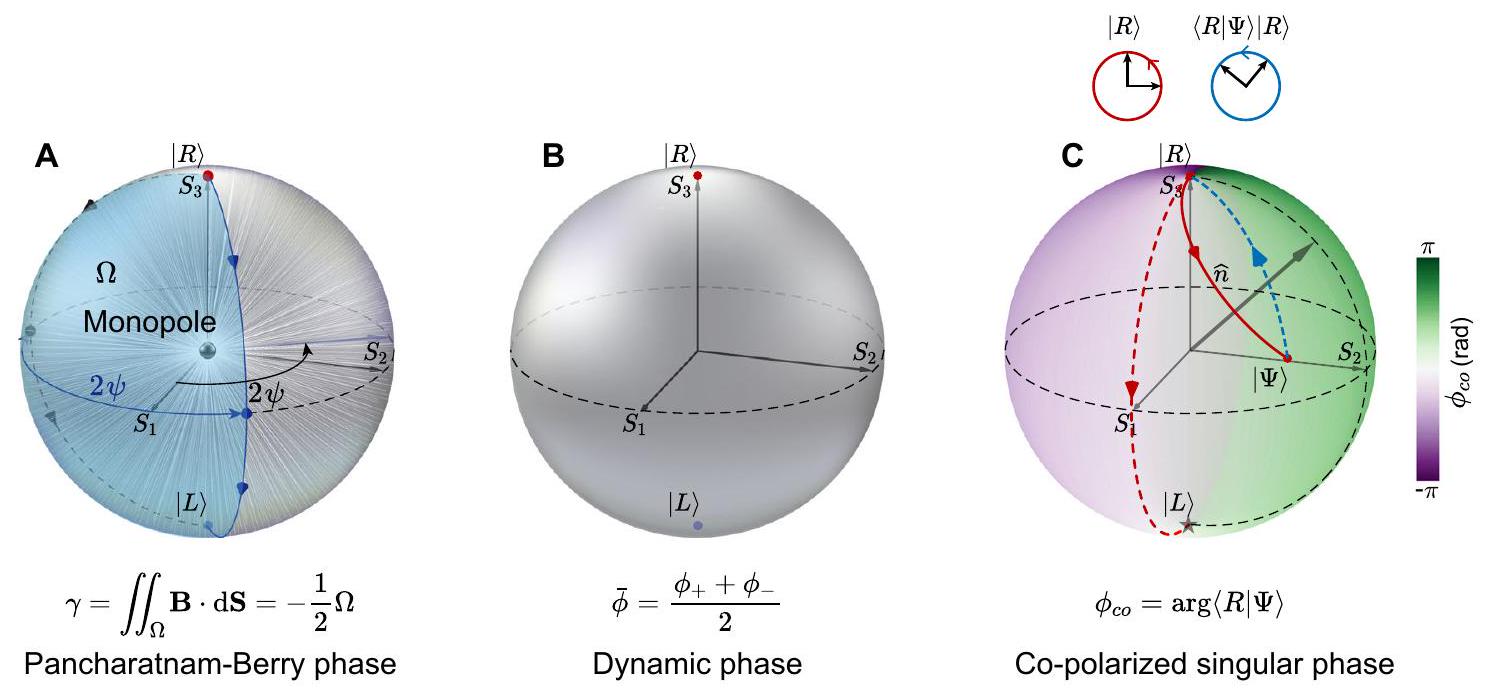
الشكل 1 | مقارنة بين آليات العنوان المختلفة للطور. الطور النموذجي بانشاراتنام-بيري، المرتبط بتعديل الطور المتقاطع والمستمد من تدهور مصفوفة جونز، يتوافق مع التدفق المغناطيسي ل monopole افتراضي من الشدةموجود في مركز كرة بوانكاريه. بالنظر إلى نقل موجة دائرية مستقطبة بشكل صحيح.من خلال المواد ثنائية الانكسار ذات الحالة الذاتية للزاوية (سهم أزرق سميك)، تتطور الاستقطابية على طول خط الطول من القطب الشمالي إلى القطب الجنوبي. عند اختيار خطي طول مختلفين، ستظهر شعاعان مستقطبان متقاطعتان تأخذان مسارين مختلفين على خط الطول فرق طور يساوي نصف التدفق المغناطيسي من خلال الزاوية الصلبة الزرقاء.تمتد في اتجاه عكس عقارب الساعة بين خطي الطول (الخط الأزرق والخط الأسود المتقطع). ب المرحلة الديناميكية غير معتمدة على الاستقطاب وتعتمد فقط على المرحلة المتوسطة.القيم الذاتية“، وبالتالي ينطبق على أي قناة استقطاب بشكل متساوٍ. C تطور حالة الاستقطاب وظهور تفرد الطور المتزامن على كرة بوانكاريه تحكمه معلمات النظام الذاتية ( ). حالة الإدخال يخضع للتقدم حول المحور الذاتيبواسطة زاويةالانتقال إلى حالة متوسطة، متتبعًا المنحنى الأحمر. يتبع الإسقاط اللاحق إلى الحالة الأولية المنحنى الأزرق المتقطع، مكتسبًا مرحلة إضافية، وهو ما يتضح من التكوين النسبي للحالة الأولية والنهائية.الدول. تعتمد المرحلة المتراكمة، التي تعتمد فقط على انحناء المسار المقطوع، على أصل هندسي بحت. تؤدي التغيرات في معلمات القيم الذاتية إلى تغيير مسار الاستقطاب على كرة بوانكاريه وبالتالي تعديل المرحلة الهندسية المتراكمة. عندما تعبر محور القيم الذاتية خط الاستواءثابتمع، الإدخال الدولة تعكس هيليستها (المنحنى الأحمر المتقطع)، والمرحلة الهندسية المتراكمة من خلال القياس الإسقاطي تعتمد على أقصر مسار جيوديسي. تغيير صغير جداً حول (يغير موضع، مما يؤثر على مسار الإسقاط. يؤدي ذلك إلى مرحلة مفردة متساوية القطبية، والتي تقع بالضبط عند النقطة المعاكسةالمشار إليه بعلامة النجمة. تظهر هذه التفردة الطورية في السعة المعقدة لقناة النقل المتزامنة عند موضع بارامتر ستوكز لـيمثل نوعًا طوبولوجيًا من مرحلة P-B الهندسية.
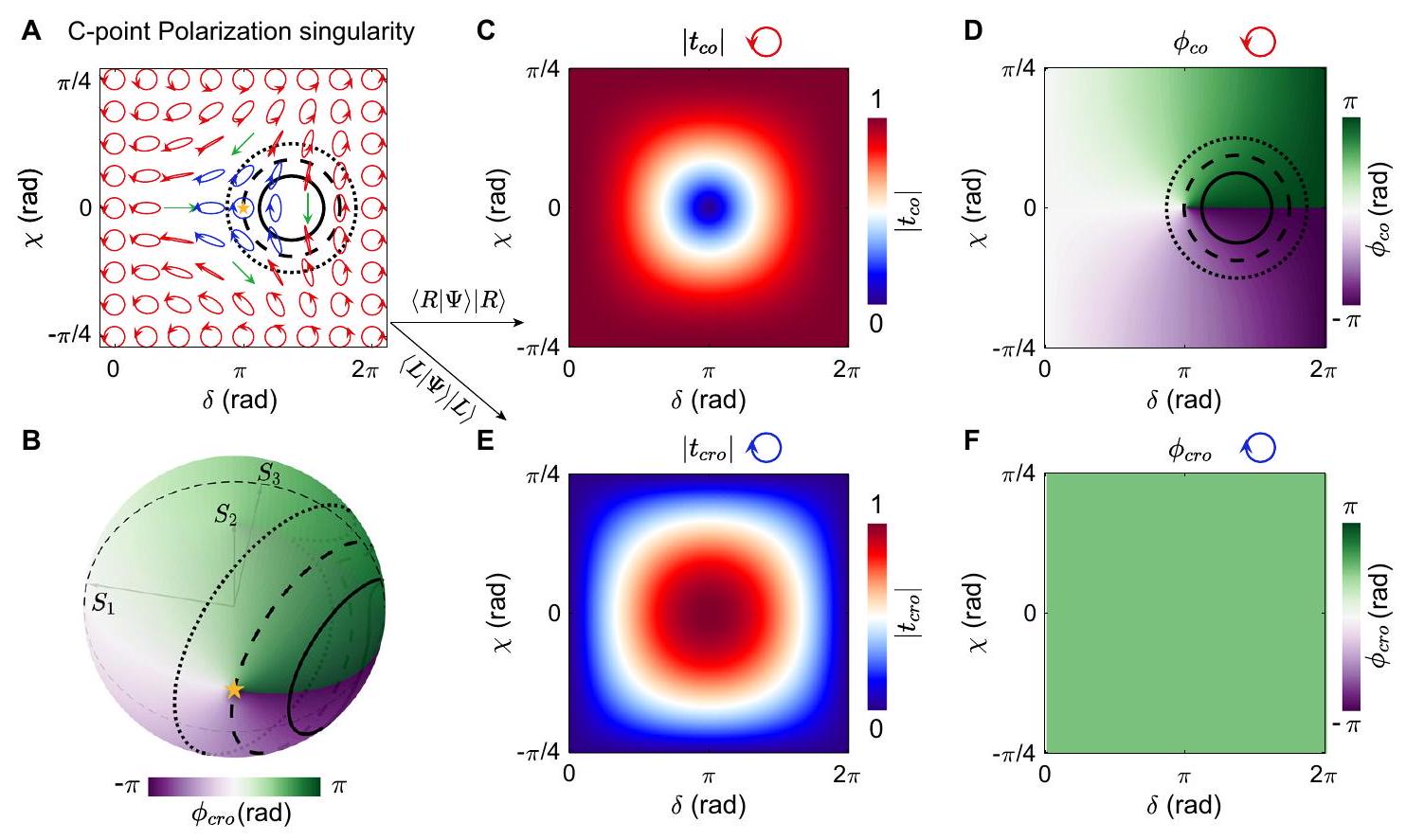
الشكل 2 |تفرد الاستقطاب ذو النقطة الواحدة والطور المترافق المرتبط به في فضاء المعامل الذاتي ). توزيع الإهليلجات القطبية لـ في فضاء معلمات القيم الذاتية. تطور حالة الإدخال يخلق تفرد استقطاب نقطة C عند، تحتوي على حالة LHCP المعاكسة عند النقطة المفردة. ثلاث حلقات مغلقة مختلفة خارج (دائرة صلبة)، تعبر (دائرة متقطعة)، وتحيط (دائرة منقطة) بالنقطة المفردة-تعتبر النقاط. ب المسارات المقابلة لـ، جنبًا إلى جنب مع الاستقطاب المشترك توزيع الطور معروض على كرة بوانكاريه. النجم الأصفر يمثل الموقع على كرة بوانكاريه حيث تظهر التفرد. ج-ف تحليل إلى القنوات المتقاطعة والمتوازية يتم بواسطة عوامل الإسقاط المعنية، التي تمثل توزيع السعة والطور في فضاء المعلمات الذاتية. ومن الجدير بالذكر، عند-النقطة، تصبح المرحلة المتزامنة قطبية وتتيح الدورة لهذه المرحلة المحمية طوبولوجيًا الكاملةتعديل واجهة الموجة بطريقة محفوظة للدوران. قنوات الاستقطاب الذاتية. من الجدير بالذكر أنه يمكن تعيين الطور الديناميكي إلى الصفر من خلال اختيار القيم الذاتية المعاكسة، أي،نظرًا لأنه تافه ويظهر بشكل متجانس لأي حالة استقطاب، فإن الطور الديناميكي موزع بشكل أحادي على كرة بوانكاري كما هو موضح في الشكل 1B.
بالنظر إلى خصائص الاستقطاب لكل من مراحل P-B والديناميكية، من الواضح أن هناك مرحلة غير تافهة لموجة الاستقطاب المشترك لا تزال مفقودة. تنخفض سعة النقل في قناة الاستقطاب المشترك النقي إلى الصفر عند النقطة المضادة، المقابلة مباشرة للاستقطاب الساقط على كرة بوانكاريه. تكشف هذه الملاحظة الأساسية أن هناك تفردًا موجودًا فقط عند النظر في إسقاط على قناة النقل المشترك. من المتوقع تراكم انزياح الطور عند اختيار تطور بارامترى مستمر يتتبع مسار الاستقطاب حول التفرد.
اعتبر أن الإدخال هو حالة RHCP، يُشار إليها بـ، وتتحكم مصفوفة جونز في تطور الاستقطاب على كرة بوانكاريه الذي يتميز بخصائصه الانكسارية الذاتيةوالإليبتية الذاتية. حالة الإدخال تدور عكس اتجاه عقارب الساعة حول محور القيم الذاتيةبمقدارتتبع المنحنى الأحمر منإلىكما هو موضح في الشكل 1C. إسقاطالعودة إلى حالة الإدخال الأوليةيتبعها المنحنى المتقطع الأزرق الذي يمثل أقصر الجيوديسية، والتي يمكن تنفيذها رياضيًا باستخدام عامل الإسقاط على النحو التاليمن الجدير بالذكر أن الحالة الأولية والمتوقعة تقعان بالضبط في نفس الموقع على كرة بوانكاريه، أي في القطب الشمالي. ومع ذلك، فإن الحالة النهائية المتوقعة اكتسبت طورًا إضافيًا، والذي يمكن رؤيته بوضوح من التكوين النسبي للحالة القطبية الأولية والنهائية.. هذه المرحلة الإضافية تنشأ بسبب الانحناء الأساسي للمسار على كرة بوانكاريه. من المهم أن نلاحظ أن تراكم هذه المرحلة مستقل عن معدل عبور المسار؛ بل يعتمد فقط على هندسة فضاء معلمات ستوك. لذلك، فإن المرحلة المتوقعة في القناة المتوافقة قطبيًا هي ذات أصل هندسي بحت، والتي يمكن أن تكون يشار إليه باسم الطور الهندسي المتزامن. النفاذية المعقدة المتزامنة عبر الإحداثيات البارامترية الذاتيةيمكن اشتقاقه من المعادلة 1 كالتالي:
الآن، من خلال ضبط المتجهات الذاتيةبينما يتم الحفاظ على نفس الاتجاه، يتحول اتجاه محور القيم الذاتية على طول خط الطول. وبالتالي، فإن إدخال RHCPيتبع مسارات مختلفة على كرة بوانكاريه، مما يؤدي إلى تراكم مراحل هندسية متفاوتة في قياس القناة المتوازية القطبية. ومن المثير للاهتمام أنه عندما يعبر محور eigen للمادة خط الاستواءمع تأخير قدره، تعكس حالة RHCP هيليتها. في هذه النقطة، تتراكم المرحلة الهندسية عند الإسقاط إلى الحالة الأولية الدولة تعتمد على أقصر مسار جيوديسي تم اتباعه. تغيير طفيف في معلمات القيم الذاتية حوليغير موقع الدولةوبذلك يعدل مسار الإسقاط. ستتبع أقصر جيوديسية أي مسار خط الطول عند النقطة المضادة، مما يؤدي إلى مرحلة مفردة متساوية القطبية عند النقطة المضادة المقابلة.من المدخلالدولة. هذه التفرد واضحة عند رسم طور سعة الإسقاط المعقدةفي موضع ستوكز البارامترية لـكما هو موضح في الشكل 1C. يمثل الطور الفردي المتزامن المقترح نوعًا مميزًا من طور P-B الهندسي، الذي له جذور طوبولوجية عميقة في ديناميات بيضاوي الاستقطاب، واعتماده على معلمات النظام الذاتية.
لتحليل السلوك الفريد لطور P-B الهندسي بشكل أعمق، نقوم برسم بيضاوية الاستقطاب للحالة الوسيطة.في فضاء المعاملات الذاتية ثنائي الأبعاد في الشكل 2A. كما يتضح بشكل كبير أنه في المركز، تظهر تفرد الاستقطاب النقطي مع سعة نقل موحدة حيث نتعامل فقط مع أنظمة هيرميتية خالية من الفقد. علاوة على ذلك، فإن الحالةيتحلل إلى اثنين
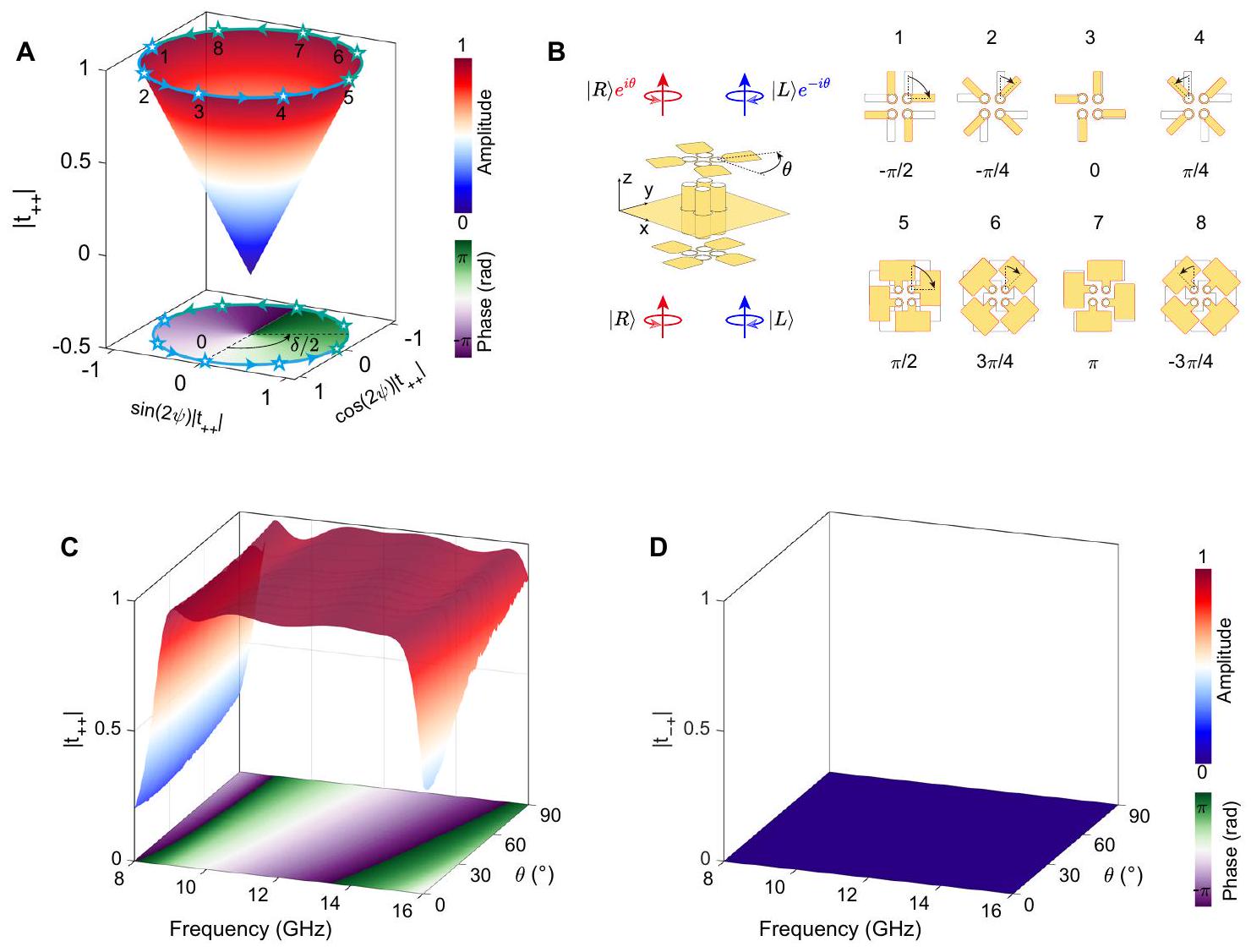
الشكل 3 | إحاطة التفرد بنقل موحد. A توسيع لكرة بوانكاريه وفقًا لنقل متزامن معقد. سطح مخروطي يمثل السعة، بالإضافة إلى خريطة الحرارة للطور المتوقع في الأسفل، تشير إلى سعة تتلاشى وطور يتغير بسرعة منخصائص التفرد الطوري. يمكن تحقيق اختيار مسار يحيط بنقطة المعامل المفرد مع نقل وحدة باستخدام الميتا-ذرات الدائرية ثنائية الانكسار المصممة المشار إليها بالنجوم. ب مخطط لـ هيكل الذرات الميتا ذات الانكسار الدائري والأشكال الثمانية للعناصر الموضحة في (A)، المصممة لضبطها بشكل شبه خطيالانكسار الدائري باستخدام زاوية دوران العناصر النسبية.مع ونقل الضوء المتقاطع لذرة ميتا أساسية بزاوية دوران نسبية منإلى، مما يشير إلى تحويل متقاطع قطبي شبه معدوم ومرحلة P-B صفر. المكونات الدائرية المتعامدة باستخدام مشغلات الإسقاط المعنية:لـ RHCP ولحالة LHCP. في الشكل 2C وD، يكشف الإسقاط المتزامن عن وجود تفرد طوري بسلوك يشبه الدوامة في فضاء المعامل الذاتي لسعة النقل المعقدة.. ومع ذلك، من المهم ملاحظة أن الشعاع المشترك الاستقطاب المتوقع لا ينبغي الخلط بينه وبين الشعاعات الحاملة للزخم المداري أو اللولبي، حيث إنه يحافظ دائمًا على أوضاعه المكانية المدخلة الأولية – هنا موجة مستوية. توفر هذه المرحلة الفردية المشتركة الاستقطاب أساسًا لتصميم الذرات الميتا لتعديل واجهات الموجات بطريقة تحافظ على الدوران. تكون سعة النقل للمكون المشترك الاستقطاب صفرًا عند النقطة الفردية.-النقطة وتصل إلى أقصى وحدة عند حواف فضاء المعلمات كما هو موضح في الشكل 2C. علاوة على ذلك، هناك ثلاث حلقات مغلقة في فضاء المعلمات الذاتية – الخط الصلب (الخارجي)، والخط المتقطع (العبور) والخط المنقط (الذي يحيط بالانفراديتم أخذ النقاط في الاعتبار. المسارات المقابلة للحالة، جنبًا إلى جنب مع توزيع الطور المتزامن، يظهر على سطح كرة بوانكاريه (الشكل 2B). عندما يكون المفرد -النقطة محاطة في فضاء معلمات القيم الذاتية، مثلما هو موضح على المسار المنقط، فإن قناة النقل المتزامنة تتعرض لتحول كامل من 0 إلىتعديل الطور، الذي يثبت المفهوم المقترح. بالمقابل، فإن القناة المستقطبة المتقاطعة لها طور ثابت عبر الطيف الذاتي كما هو موضح في الشكل 2F، وأقصى سعة نقل عند“-نقطة، التي تتلاشى تدريجياً نحو الحواف. بالنظر إلى أي مسار عشوائي يحيط بهذه التفرد، أي افتراض مسار في فضاء المعلمات المادية الذي يتيح تغيير ( ) القيم إلى تدور حول النقطة الفردية (” )، أيمكن الحصول على تراكم الطور. يمكن تحقيق هذه الدورة المعلمية لخصائص المواد، على سبيل المثال، من خلال تصميم الخصائص الهيكلية لمجموعة من الميتا-ذرات.
بالإضافة إلىتغطية الطور، السعة أيضًا حاسمة لأنها تحدد كفاءة النقل في التطبيقات. لعرض العلاقة الطوبولوجية بين السعة المعقدة للطريق حول التفرد بشكل صريح، يتم توسيع الكرة في الشكل 1C وفقًا للسعة والطور عند كل نقطة، كما هو موضح في الشكل 3A. السطح المخروطي يدل على سعة النقل، وي correspond إلى التفرد عند القطب الجنوبي للكرة، مما يشير أيضًا إلى أن الطور المعروض على السطح السفلي يتغير تدريجيًا بواسطةحول التفرد. من المهم أن المسار على قمة السطح المخروطي يوفر معامل نقل ثابت يقترب من الواحد، مما يتوافق مع حالة الدوران البصري معأي، إن الحالة الذاتية للميتا-ذرة واستقطاب الحزمة الساقطة متسقة (كلاهما CP هنا)، والطور الفردي المتزامن المفروض على نقل الضوء المحفوظ RHCP هو خطي بالنسبة لـاستغلال الذرات الميتا الدائرية الانكسارية، أي تصميم هياكل دون الطول الموجي تظهر دوران الاستقطاب من خلال التلاعب بتأخير الطور لـ و باستخدام الكيرالية البصرية، نقوم بتطويق التفرد بواسطة ثمانية عناصر تمثيلية. كما هو موضح في الشكل 3B، يتكون الميتا-ذرة من ثلاث طبقات من هيكل النحاس، حيث تحتوي كل من الطبقتين العلوية والسفلية على أربع بقع نحاسية متطابقة تشكل كيرالية.تماثل لحماية الحالة الذاتية كـ CP. الأجزاء العلوية والسفلية المقابلة موصولة كهربائياً
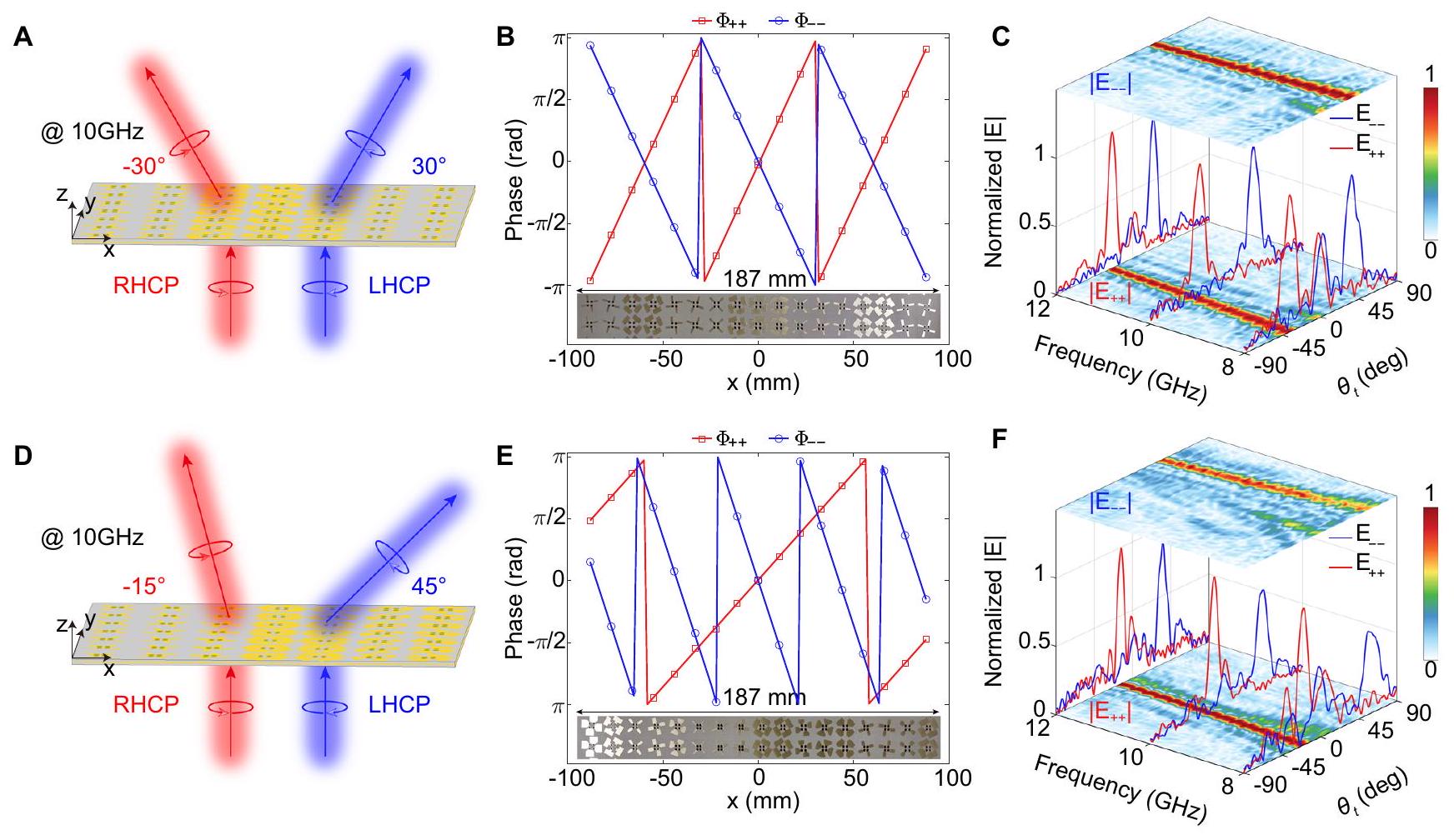
الشكل 4 | نتائج السطوح الميتا لتشكيل واجهات الموجات. أ مخطط للموصل غير المتماثل المصمم عند 10 جيجاهرتز. ب ملف الطور المصمم للقناة المتزامنة من RHCP (الأحمر) و LHCP (الأزرق) عند 10 جيجاهرتز للموصل، والتي تكون متعاكسة بسبب الاقتران المرافق بين الاستجابات. الصورة المصغرة هي صورة للبروتوتيب المصنع، الذي يتكون من نوعين من الهياكل. مع أحجام هندسية مختلفة. ج الأنماط المقاسة المعيارية في المجال البعيد للقناتين المتزامنتين. د مخطط للموصل غير المتناظر المصمم عند 10 جيجاهرتز. هـ ملف الطور المفصول للقناتين المتزامنتين، والهياكل المكونة في الصورة الصغيرة تظهر أحجام هندسية متعددة نظرًا لإدخال الطور الديناميكي. و الأنماط المقاسة المعيارية في المجال البعيد للموصل غير المتناظر. متصلة بواسطة فتحات معدنية عمودية، تم تجميعها بعناية لتجنب لمس مستوى الأرض الأوسط. بسبب هذه التكوين الهيكلي، يمكن للذرة الميتا التحكم في الانكسار الدائري.بشكل شبه خطي بواسطة زاوية الدوران النسبيةبين الرقع العليا والسفلى، التي تتبعوطور القناتين المتزامنتين هوالعناصر رقم 1 إلى 4 ورقم 5 إلى 8 تتوافق معزيادة منإلىوتناقص منإلىعلى التوالي (انظر النص التكميلية S4). توضح الشكل 3C بوضوح الطيفلذرة ميتا رقم 3 عندمايختلف منإلىتظل السعة فوق 0.9 ضمنبينمايتم نقله بواسطة. في هذه الأثناء، معامل النقل المتقاطع القطبية المقابليقترب من الصفر (الشكل 3D)، مما يثبت أن الحالة الذاتية للذرة الميتا هي بالضبط CP ويمكن ضبط انكسارها الدائري بواسطةبشكل قوي. لاحظ أن سعة الإرسال لـلا تصل إلى الوحدة بسبب خسائر الانعكاس (انظر الشكل S7).
تستغل تقنية السطح الميت تحول الطور بين الإشعاع الساقط والمشتت من الرنانات البصرية التي توضع عبر الواجهة. تتطلب طريقة التصميم توزيع الرنانات بأشكال هندسية مختلفة بشكل مكاني لإدخال ملف طور غير متصل يتماشى مع واجهة الموجة المحددة من قبل المستخدم. هنا، نقدم إثبات مفهوم هندسة واجهة الموجة في الاستقطاب المتزامن من خلال اختيار وتوزيع الذرات الميتة لتحقيق أسطح ميتة ذات تدرج في الطور بحجم فتحة.يعمل عند 10 جيجاهرتز. تستغل النتيجة الأولى الطور المتناظر المضاد المعتمد على الهيليسيتي المدخل، مما يؤدي إلى الانكسار و يُلوح بـ و ، على التوالي، كما هو موضح بشكل تخطيطي في الشكل 4A. المراحل المتغيرة تدريجياً كدالة للمساحة-تم الحصول على الوضع باستخدام حلول عددية تمثل خصائص نقل الميتا-ذرات، كما هو موضح في الشكل 4B، والذي يشير بالفعل إلى أن كلا من (أحمر) و القنوات المتزامنة (الزرقاء) تفرض قيم طور متقطعة متعاكسة. تظهر الأنماط البعيدة المقاسة تجريبياً والمُعَيارَة المقدمة في الشكل 4C زوايا الانكسار غير المتماثلة، التي تتناقص كدالة للتردد ضمن. عند تردد 10 جيجاهرتز، زوايا الانكسار لـوتتوافق مع الانكسار المثالي غير المتماثل، مما يوضح أن مثل هذا السلوك المثير، المماثل لمرحلة P-B التقليدية، يمكن أن يحدث أيضًا في القنوات المتزامنة. كما ذُكر في أمثلة متنوعة في الأدبيات المتعلقة بمرحلة P-B، من الممكن فصل مثل هذا الاستجابة غير المتماثلة بشكل أكبر من خلال إدخال آلية تعديل الطور إضافية، مثل الطور الديناميكي. في الواقع، من خلال ضبط حجم الذرات الميتا بينما يتم تثبيت زاوية الدوران النسبية لرقع الهيكل، يمكن الحفاظ على المرحلة الفردية المتزامنة. تُستخدم هذه المجموعة من المراحل لتصميم مكسّر غير متماثل (الشكل 4D) يقدم تدرجات طور مفصولة ومستقلة، المشار إليها بـوفي الشكل 4E، لكل من و ، على التوالي. هنا، اعتبرنا بشكل عشوائي تصميم سطح ميتا بزاوية انكسار و في القناتين عند تردد التشغيل 10 جيجاهرتز. الأنماط الميدانية البعيدة المقاسة تجريبياً والمُعَيارَة المرتبطة بكلتا القناتين موضحة في الشكل 4F، حيث تظهر زوايا الانكسار التي تتفق مع التصميم وتظهر كفاءة نقل عالية (انظر النص التكميلي S5). بالإضافة إلى إثبات الانكسار الشاذ باستخدام تدرجات الطور غير المتماثلة أحادية البعد، حققنا هندسة معقدة لموجات الطور المتزامنة بشكل عشوائي ومنفصل، كما تم الإبلاغ عنه غالبًا باستخدام ملفات الطور ثنائية الأبعاد، بما في ذلك توليد OAM من الطور الهندسي الفردي المتزامن (انظر النص التكميلي S6). هنا، لا ينتج OAM المتولد عن عكس الحلزونية، وبالتالي، لا يتم الحفاظ على الزخم الزاوي الكلي في قناة النقل المتزامنة. يتم تحقيق OAM من خلال وضع عناصر الطور المتزامنة بشكل استراتيجي في توزيع طور مكاني يشبه الدوامة، ونتيجة لذلك، يمكن استخدام هذه العملية لتوليد عزم الدوران على لوحة الطور الحلزونية..
نقاش
نقدم ونحقق تجريبيًا مفهومًا جديدًا للطور الفردي المتزامن للحفاظ على الاستقطاب في هندسة واجهة الموجات، مكملًا للطور التقليدي المتقاطع الاستقطاب P-B. تستغل هذه الآلية كامل -انقطاع الطور الناشئ من تفرد محمي طوبولوجيًا، متجذر بشكل جوهري في فضاء المعامل الذاتية ويظهر على سطح كرة بوانكاريه. علاوة على ذلك، يمكن أيضًا تفسير ظهور هذه المرحلة الهندسية المخفية والتفردات القطبية المرتبطة بها من خلال تداخل الأوضاع شبه الطبيعية، التي تحكمها مبادئ المعاملة بالمثل والتناظر فقط.. على عكس الأساليب التقليدية، فإنه يمكّن من تعديل الطور الهندسي في قنوات النقل المتوافقة، مع البقاء متوافقًا تمامًا مع آليات تعديل الطور الأخرى. هذه الاستراتيجية الفريدة في معالجة الطور توسع بشكل كبير من قدرات تصميم البصريات المسطحة، مما يمكّن من إنشاء فئة جديدة من الأجهزة البصرية التي تحافظ على الدوران. القدرة على تعديل الطور دون تغيير حالة الاستقطاب تعتبر ميزة خاصة في التطبيقات التي تتطلب الحفاظ على الحلزونية، بما في ذلك الميتا-بصريات الحلزونية، والأنظمة متعددة الاستقطاب، وطيفية المادة الحلزونية.
بعيدًا عن تأثيره المباشر، يحمل هذا الآلية إمكانيات قوية للتكامل في مجال الضوء المنظم ذي الأبعاد العليا.حيث يتم استغلال درجات حرية متعددة – مثل الاستقطاب، الأوضاع المكانية، الزخم الزاوي، والتشكيل الزمني – في الوقت نفسهتجعل القوة الطوبولوجية والتوافق للطور المفرد المتزامن أداة مثيرة للاهتمام لتشكيل مجالات متجهة غير قابلة للفصل، مما يمكّن من التحكم المتقدم في تفاعلات الدوران-المدار، وتشكيل الحزم المتجهة، وارتباط الضوء بالمادة على المستويين الكلاسيكي والكمومي. من المهم أن تضع هذه الطريقة الأساس للتطبيقات المستقبلية في الاتصالات الضوئية (مثل التعددية الحافظة للاستقطاب ذات السعة العالية)، والاستشعار الضوئي والقياس (عبر ترميز الطور الانتقائي للدوران)، ومعالجة المعلومات الآمنة (من خلال التحكم في الحالات الطوبولوجية القوية). مع تزايد الطلب على منصات ضوئية مدمجة ومتعددة الوظائف وقابلة للتوسع، يوفر آلية الطور المتزامن لدينا إضافة متعددة الاستخدامات وأساسية لأدوات هندسة السطح الميت.
طرق
تم وصف المنهجيات التفصيلية لتصنيع النماذج الأولية والتوصيف التجريبي بشكل شامل في المعلومات التكميلية الملاحظة 5.
توفر البيانات
جميع البيانات ذات الصلة متاحة في الورقة وملفات المعلومات التكميلية متاحة من المؤلف المراسل عند الطلب.
توفر الشيفرة
الرموز ذات الصلة المستخدمة في هذه الدراسة متاحة من المؤلفين المقابلين عند الطلب دون أي مصلحة تجارية.
References
Pancharatnam, S. Generalized theory of interference, and its applications. Proc. Indian Acad. Sci. A 44, 247-262 (1956).
Berry, M. V. Quantal phase factors accompanying adiabatic changes. Proc. R. Soc. A 392, 45-57 (1984).
Aharonov, Y. & Bohm, D. Significance of electromagnetic potentials in the quantum theory. Phys. Rev. 11, 485 (1959).
Samuel, Joseph & Bhandari, Rajendra General setting for Berry’s phase. Phys. Rev. Lett. 60, 2339 (1988).
Shapere, Alfred, and Frank Wilczek, eds. Geometric Phases in Physics. Vol. 5. (World Scientific, 1989).
Zak, J. Berry’s phase for energy bands in solids. Phys. Rev. Lett. 62, 2747 (1989).
Dattoli, G., Mignani, R. & Torre, A. Geometrical phase in the cyclic evolution of non-Hermitian systems. J. Phys. A Math. Gen. 23, 5795 (1990).
Cayssol, J. érôme & Fuchs, Jean-Noël Topological and geometrical aspects of band theory. J. Phys. Mater. 4, 034007 (2021). 3.
Bliokh, Konstantin et al. Spin-orbit interactions of light. Nat. Photon. 9, 796-808 (2015).
Cohen, Eliahu et al. Geometric phase from Aharonov-Bohm to Pancharatnam-Berry and beyond. Nat. Rev. Phys. 1, 437-449 (2019).
Ferrer-Garcia, Manuel F., et al. Topological transitions of the generalized Pancharatnam-Berry phase. Sci. Adv. 9, 6810 (2023).
Dennis, Mark R., Kevin O’holleran, and Miles J. Padgett. Singular optics: optical vortices and polarization singularities. vol. 53 Progress in Optics. 293-363. (Elsevier, 2009).
Bauer, Thomas et al. Observation of optical polarization Möbius strips. Science 347, 964-966 (2015).
Bliokh, KonstantinY., Alonso, MiguelA. & Dennis, MarkR. Geometric phases in 2D and 3D polarized fields: geometrical, dynamical, and topological aspects. Rep. Prog. Phys. 82, 122401 (2019).
Chandroth, J., Stefan Nolte, P. & Alberucci, A. Geometric phase in optics: from wavefront manipulation to waveguiding. Laser Photonics Rev. 15, 2100003 (2021).
Yin, Xiaobo et al. Photonic spin Hall effect at metasurfaces. Science 339, 1405-1407 (2013).
Slussarenko, Sergei et al. Guiding light via geometric phases. Nat. Photon. 10, 571-575 (2016).
Balthasar Mueller, J. P. et al. Metasurface polarization optics: independent phase control of arbitrary orthogonal states of polarization. Phys. Rev. Lett. 118, 113901 (2017).
Devlin, RobertC. et al. Arbitrary spin-to-orbital angular momentum conversion of light. Science 358, 896-901 (2017).
Song, Qinghua et al. Ptychography retrieval of fully polarized holograms from geometric-phase metasurfaces. Nat. Commun. 11, 2651 (2020).
Song, Qinghua et al. Plasmonic topological metasurface by encircling an exceptional point. Science 373, 1133-1137 (2021).
Choudhury, Sajid et al. Pancharatnam-Berry phase manipulating metasurface for visible color hologram based on low loss silver thin film. Adv. Opt. Mater. 5, 1700196 (2017).
Ding, Xumin et al. Ultrathin Pancharatnam-Berry metasurface with maximal cross-polarization efficiency. Adv. Mater. 27, 1195-1200 (2015).
Luo, Weijie et al. Photonic spin Hall effect with nearly efficiency. Adv. Opt. Mater. 3, 1102-1108 (2015).
Shen, Y., Wang, Z., Fu, X., Naidoo, D. & Forbes, A. SU(2) Poincaré sphere: a generalized representation for multidimensional structured light. Phys. Rev. A 102, 031501 (2020).
Gutiérrez-Cuevas, R., Wadood, S. A., Vamivakas, A. N. & Alonso, M. A. Modal majorana sphere and hidden symmetries of structuredGaussian beams. Phys. Rev. Lett. 125, 123903 (2020).
He, C., Shen, Y. & Forbes, A. Towards higher-dimensional structured light. Light. Sci. Appl. 11, 205 (2022).
شكر وتقدير
يقر المؤلفون بالدعم المالي من المؤسسة الوطنية للعلوم الطبيعية في الصين (رقم المنحة: U23B2014، 62171165، 62301193، 62401178).
مساهمات المؤلفين
قام ك.ز. و ب.ج. بتصميم الدراسة. طور ج.ل. و أ.ج. المنهجية وأجروا التحقيق، بدعم من ي.ي. و س.ن.ب. ساهم ج.ل. و أ.ج. و ي.ي. في تصور البيانات. تم كتابة المسودة الأصلية بواسطة ج.ل. و أ.ج.، مع مراجعات وتحريرات حاسمة من ي.ي. و ك.ز. و س.ن.ب. و ب.ج. قرأ المؤلفون ووافقوا على النسخة النهائية من المخطوطة.
يجب توجيه المراسلات والطلبات للحصول على المواد إلى كوانغ زانغ، شاه نواز بوروكور أو باتريس جينيفيت.
معلومات مراجعة الأقران تشكر مجلة Nature Communications ييجي شين والمراجعين المجهولين الآخرين على مساهمتهم في مراجعة هذا العمل. يتوفر ملف مراجعة الأقران.
ملاحظة الناشر: تظل شركة سبرينغر ناتشر محايدة فيما يتعلق بالمطالبات القضائية في الخرائط المنشورة والانتماءات المؤسسية.
الوصول المفتوح هذه المقالة مرخصة بموجب رخصة المشاع الإبداعي النسبية-غير التجارية-بدون اشتقاقات 4.0 الدولية، التي تسمح بأي استخدام غير تجاري، ومشاركة، وتوزيع، وإعادة إنتاج في أي وسيلة أو صيغة، طالما أنك تعطي الائتمان المناسب للمؤلفين الأصليين والمصدر، وتوفر رابطًا لرخصة المشاع الإبداعي، وتوضح إذا قمت بتعديل المادة المرخصة. ليس لديك إذن بموجب هذه الرخصة لمشاركة المواد المعدلة المشتقة من هذه المقالة أو أجزاء منها. الصور أو المواد الأخرى من طرف ثالث في هذه المقالة مشمولة في رخصة المشاع الإبداعي الخاصة بالمقالة، ما لم يُشار إلى خلاف ذلك في سطر الائتمان للمادة. إذا لم تكن المادة مشمولة في رخصة المشاع الإبداعي الخاصة بالمقالة واستخدامك المقصود غير مسموح به بموجب اللوائح القانونية أو يتجاوز الاستخدام المسموح به، ستحتاج إلى الحصول على إذن مباشرة من صاحب حقوق الطبع والنشر. لعرض نسخة من هذه الرخصة، قم بزيارة http:// creativecommons.org/licenses/by-nc-nd/4.0/. (ج) المؤلف(ون) 2025
¹قسم هندسة الميكروويف، معهد هاربين للتكنولوجيا، هاربين، الصين. ²قسم الفيزياء، مدرسة كولورادو للتعدين، 1523 إلينوي، شارع، غولدن، الولايات المتحدة الأمريكية.ليمي، جامعة باريس نانتير، مدينة أفراي، فرنسا.ساهم هؤلاء المؤلفون بالتساوي: جينشينغ لي، ألوك جانا، يويي يوان. ⟶ البريد الإلكتروني: zhangkuang@hit.edu.cn; sburokur@parisnanterre.fr; patrice.genevet@mines.edu
Exploiting hidden singularity on the surface of the Poincaré sphere
Received: 26 February 2025
Accepted: 5 June 2025
Published online: 01 July 2025
Jinxing , Aloke Jana , Yueyi Yuan , Kuang Zhang ®, Shah Nawaz Burokur & Patrice Genevet (1)
The classical Pancharatnam-Berry phase, a variant of the geometric phase, arises purely from the modulation of the polarization state of a light beam. Due to its dependence on polarization changes, it cannot be effectively utilized for wavefront shaping in systems that require maintaining a constant (co-polarized) polarization state. Here, we present a novel topologically protected phase modulation mechanism capable of achieving anti-symmetric full phase shifts with near-unity efficiency for two orthogonal co-polarized channels. Compatible with -but distinct from- the dynamic phase, this approach exploits phase circulation around a hidden singularity on the surface of the Poincaré sphere. We validate this concept in the microwave regime through the implementation of multi-layer chiral metasurfaces. This new phase modulation mechanism expands the design toolbox of flat optics for light modulation beyond conventional techniques.
Geometric phases, originating from the evolution of instantaneous eigenstates of a system’s Hamiltonian in parameter space, are universal features that play a fundamental role in a wide range of phenomena. It is a manifestation of the underlying curvature of the parameter space, which was first observed in a generalized interference experiment with vector fields by Pancharatnam , later formalized by Berry in the context of adiabatic evolution of quantum mechanical states . Since its discovery, the geometric phase has led to a foundational ground for a variety of ubiquitous features in several areas of physics, including topological phase transitions in condensed matter systems, AharonovBohm effect, spin-orbit coupling, polarization manipulation, and singular optics . Furthermore, with the rapid advancement of nanophotonic technology, the geometric phase has become a routine tool to manipulate and control wavefront in a spin-dependent manner . In metasurfaces, it specifically accounts for the relative geometric orientation of the meta-atoms and the helicity reversal of evolving polarization states on the Poincaré sphere-popularly known as the Pancharatnam-Berry (P-B) phase . However, all existing P-B phase methods fail to modulate the input polarized light, which we define herein as the co-polarized channel.
To address this issue, we propose and experimentally demonstrate a novel phase addressing mechanism that works similarly as the P-B phase but for co-polarized channel, by encircling a -point polarization singularity in the parameter space . In this approach, we exploit the mapping of the phase dynamics from the eigen parameter space onto the Poincaré sphere, uncovering a hidden phase singularity on the surface of the Poincaré sphere, referred to as the co-polarized singular phase. This previously untapped topologically protected singular phase enables the realization of innovative wavefront control devices. The experimental demonstration of the co-polarized singular phase is achieved through manipulating the chiral response of a lossless multi-layer metasurface that operates in the microwave regime. As opposed to the classical P-B phase, the co-polarized singular phase is fundamentally distinct and can be integrated with other phase addressing mechanisms, such as dynamic phase, to achieve asymmetric phase modulation for two orthogonal input polarizations, broadband wavefront engineering and so forth , thus enabling advanced wavefront modulation capabilities that go beyond the limitations of conventional techniques.
Results
The polarization properties of paraxial light propagating in a medium, or through any polarization-sensitive device, are described by a twodimensional incident polarized field, mathematically represented by a ket vector, and a matrix representing the polarization response of the medium. The change of polarization is therefore mathematically analogous to the evolution of a spin state in a classical two-level quantum system. Each polarization state is uniquely mapped onto the surface of the Poincaré sphere under the Cartesian coordinate of the Stokes vector, where the north and south pole of the sphere correspond to right- and left-hand circular polarization (RHCP and LHCP) respectively, both constituting the orthonormal basis of the polarized light. In this representation, the degree of polarization, that is the amount of light presenting a well-defined polarization state, is given by the distance of the representative polarization point inside the sphere from the center, ranging from zero at the origin for an unpolarized light, to unity (1) at the sphere surface for a completely polarized light. Assuming a Hermitian optical device (lossless) with orthonormal eigenstates and corresponding eigenvalues , its polarization-dependent Jones matrix can be expressed as:
where is the Stokes vector of and is the vector of Pauli spin matrices (see supplementary text 1). Parameters and correspond to the dynamic phase (also dubbed the propagation phase) and the eigen birefringence, respectively. These quantities are related to the mean and difference between and , respectively.
Equation 1 indicates that the polarization evolution for any arbitrary input state is solely determined by the evolution operator . Especially, the degeneracy of the Jones matrix ( ) occurs when all three components of the eigen Stokes vector become identically zerocorresponding to a completely unpolarized eigenstate. In other words, the degeneracy point lies exactly at the center of the Poincaré sphere, acting as the source of Berry curvature, namely a virtual magnetic monopole with intensity gathering magnetic field inward. We should keep in mind that using magnetic parlance for illustration is merely a matter of convention. As shown in Fig. 1A, the magnetic flux enclosed by the loop associated with a polarization evolution along a closed curve represents the well-known P-B phase in optics. For instance, when an RHCP state is converted to LHCP state by a device with eigenstate whose Stokes vector has an azimuth , state evolves from north pole to south pole along the meridian at (blue meridian). Compared to a device with an azimuth zero, evolving along the black dashed meridian at , the solid angle swept counterclockwise from the black meridian to the blue meridian is (blue area). Conversely, input is converted to along the same meridian with an opposite sweeping direction of the solid angle, and thus . The magnetic flux is equal to half of the area, i.e., , where the sign on the two orthogonal cross-polarized channels is always opposite. Continuously changing the azimuth of the device’s eigenstate up to , a linearly varying P-B phase accumulation as a function of , ranging from 0 to , can be imparted on the cross-polarized wave.
Meanwhile, the dynamic phase is generic and has been widely applied for phase engineering. Such phase corresponds to the mean phase of the eigenvalues , which is equally applied to both
Fig. 1 | Comparison between different phase-addressing mechanisms. A Typical Pancharatnam-Berry phase, associated to cross-polarized phase modulation and originating from the degeneracy of the Jones matrix, corresponds to the magnetic flux of a virtual monopole of intensity positioned at the center of the Poincaré sphere. Considering the transmission of a right incident circularly polarized wave through birefringent materials with eigenstate of azimuth (thick blue arrow), polarization evolves along the meridian from the north to the south pole. Choosing two different meridians, two cross-polarized beams taking two different meridian trajectories would present a phase difference equal to half of the magnetic flux through the blue solid angle swept counterclockwise between the two meridians (blue and dashed blacklines). B The dynamic phase is polarization-independent and only depends on mean phase of the eigenvalues , and therefore applies to any polarization channel equally. C The evolution of polarization state and the emergence of a co-polarized phase singularity on the Poincaré sphere are governed by the system’s eigen parameters ( ). The input state undergoes precession around the eigenaxis by an
angle , transitioning to an intermediate state , tracing the red curve. The subsequent projection back to the initial state follows the blue dashed curve, acquiring an additional phase, which is evident from the relative configuration of the initial and final states. The accumulated phase, solely depends on the curvature of the traversed path, has a pure geometric origin. Variation in the eigen parameters alters polarization trajectory on the Poincaré sphere and thereby modifying the accumulated geometric phase. When the eigen axis crosses the equator constant with , the input state reverses its helicity (red dashed curve), and the accumulated geometric phase through the projective measurement depends on the shortest geodesic path. A very small variation around ( ) shifts the position of , affecting the projection path. This leads to a co-polarized singular phase, which lies exactly at the antipodal point denoted with the star mark. This phase singularity emerges in complex amplitude of the co-polarized transmission channel at the Stokes parametric position of , representing a topological variant of the geometric P-B phase.
Fig. 2 | -point polarization singularity and associated co-polarized singular phase in the eigen parameter space( ). A Distribution of the polarization ellipses of in the eigen parameter space. The evolution of the input state creates a C-point polarization singularity at , containing the antipodal LHCP state at the singular point. Three different closed loops outside (solid circle), crossing (dashed circle), and encircling (dotted circle) the singular -point are considered. B The corresponding trajectories of , along with the co-polarized
phase distribution are displayed on the Poincaré sphere. The yellow star represents the position on the Poincaré sphere where the singularity appears. C-F The decomposition of the into the co-and cross-polarized channels is performed by the respective projection operators, representing amplitude and phase distribution in the eigen-parameter space. Notably, at the -point, the co-polarized phase becomes singular and circulation of this topologically protected phase enables complete wavefront modulation in a spin-preserved manner.
eigen polarization channels. Notably, the dynamic phase can be set to zero by selecting opposite eigenvalues, i.e., . Since it is trivial and exhibits homogeneously for any polarization state, the dynamic phase is monotonically distributed on the Poincaré sphere as shown in Fig. 1B.
Considering the polarization properties of both the P-B and dynamic phases, it is evident that a non-trivial phase for the copolarized wave is still missing. The transmission amplitude in a pure co-polarized channel drops to zero at the antipodal point, directly opposite the incident polarization on the Poincaré sphere. This basic observation reveals that a singularity exists only when considering a projection onto the co-polarized transmission channel. A continuous and topologically protected phase shift accumulation is expected when choosing a continuous parametric evolution that traces a polarization trajectory around the singularity.
Consider the input is a RHCP state, denoted as , and the polarization evolution on the Poincaré sphere is governed by the Jones matrix , characterized by its eigen birefringence and eigen ellipticity . The input state precesses counterclockwise around the eigen axis by an amount of , tracing the red curve from to as shown in Fig.1C. The projection of back to the initial input state , is followed by the blue dashed curve representing the shortest geodesic, which can be mathematically performed with the projection operator as . Notably, the initial and projected states are exactly at the same position on the Poincaré sphere, i.e., the north pole. However, the final projected state picked up an additional phase, which can be distinctly seen from the relative configuration of the initial and final polarization state . This additional phase arises due to the underlying curvature of the trajectory on the Poincaré sphere. Importantly, this phase accumulation is independent of the rate at which the path is traversed; rather, it depends solely on the geometry of the Stokes parameter space. Therefore, the projected phase in the co-polarized channel is purely geometric in origin, which can be
referred to as the co-polarized geometric phase. The complex copolarized transmittance across eigen parametric coordinates , can be derived from Eq. 1 as:
Now, by tuning the eigen vectors while keeping the same azimuth, the orientation of the eigen axis shifts along the meridian. Consequently, the RHCP input follows different trajectories on the Poincaré sphere, leading to varying accumulated geometric phases in the co-polarized channel projective measurement. Interestingly, when the eigen axis of the material crosses the equator , with a retardance of , the RHCP state reverses its helicity. At this point, the accumulated geometric phase upon projection to the initial state depends on the shortest geodesic path followed. A small variation of the eigen parameters around , alters the position of the state and thereby modifies the projection path. The shortest geodesic would follow any meridian trajectory at the antipodal point, leading to a co-polarized singular phase at the corresponding antipodal point of the input state. This singularity is evident when plotting the phase of the complex projection amplitude at the Stokes parametric position of as shown in Fig. 1C. The proposed co-polarized singular phase represents a distinct variant of the geometric P-B phase, that has a deep topological root in the polarization ellipse dynamics, and its dependence on the system’s eigen parameters.
To further analyze the singular behavior of the geometric P-B phase, we plot the polarization ellipse of the intermediate state in the 2D eigen-parameter space in Fig. 2A. As it is very evident that at the center , a -point polarization singularity appears with a unity transmission amplitude as we are dealing with only lossless Hermitian systems. Moreover, the state is decomposed into two
Fig. 3 | Encircling the singularity with unitary transmittance. A Expansion of the Poincaré sphere according to the complex co-polarized transmittance. A conical surface representing the amplitude, in addition to the heat map of the projected phase at the bottom, indicates a vanishing amplitude and a rapidly changing phase from characteristic of phase singularity. Choosing a path that encircles the singular parameter point with unit transmittance can be realized using the designed circular birefringent meta-atoms indicated by stars. B Schematic of the
structure of the circular birefringent meta-atoms and the shapes of the eight elements annotated in (A), designed to tune quasi-linearly ( ) the circular birefringence using the elements’ relative rotation angle. The co- and crosspolarized transmittance of an elementary meta-atom with relative rotation angle from to , indicating almost zero cross-polarized conversion and zero P-B phase.
orthogonal circular components using the respective projection operators: for RHCP and for LHCP state. In Fig.2C, D, the co-polarized projection reveals the existence of a phase singularity with a vortex like behavior in the eigen parameter space for complex transmission amplitude . However, it is important to note that the projected co-polarized beam should not be confused with vector vortex or orbital angular momentum (OAM) carrying beams, as it always preserves its initial input spatial modes-here a plane wave. This observed co-polarized singular phase provides a foundation for designing the meta-atoms to modulate wavefronts in a spin-preserved manner. The transmission amplitude of the co-polarized component is zero at the singular -point and reaches maximum unity at the edges of the parameter space as shown in Fig. 2C. Moreover, three closed loops in the eigen parameter space-the solid (outside), dashed (crossing) and dotted curve (enclosing the singular -point) are considered. The corresponding trajectories of the state , along with the co-polarized phase distribution, are shown on the surface of the Poincaré sphere (Fig. 2B). When the singular -point is enclosed in the eigen parameter space, such as along the dotted trajectory, the co-polarized transmission channel undergoes a complete 0 to phase modulation, which validates the proposed concept. In contrast, the cross-polarized channel has a constant phase across the eigen spectrum as shown in Fig. 2F, and a maximum transmission amplitude at the -point, which gradually decays toward the edges. Considering any arbitrary path enclosing this singularity, that is, assuming a path in material parameter space that enables continuously changing the ( ) values to
circulate around the singular point ( ), a phase accumulation can be obtained. This parametric circulation of the material parameters can potentially be realized, for example, by tailoring the structural properties of a set of meta-atoms.
In addition to phase coverage, the amplitude is also crucial since it delimits the transmission efficiency in applications. To explicitly display the topological relationship between the complex amplitude of the path around the singularity, the sphere in Fig. 1C is expanded according to the amplitude and phase at each point, as shown in Fig. 3A. The conical surface denotes the transmission amplitude, and the tip corresponds to the singularity at the south pole of the sphere, indicating as well that the phase projected on the bottom plane gradually varies by around the singularity. Significantly, the path on the top of the conical surface offers a constant transmission coefficient approaching unity, corresponding to the case of optical rotation with , i.e., the eigenstate of the meta-atom and incident polarization are consistent (both are CP here), and the copolarized singular phase imposed to the RHCP preserved transmittance is linear to . Exploiting circular birefringent meta-atoms, that is, designing subwavelength structures that exhibit polarization rotation by manipulating the phase delay of and using optical chirality, we encircle the singularity by eight representative elements. As shown in Fig. 3B, the meta-atom consists of three layers of copper structure, where both the top and bottom layers contain four identical copper patches forming chiral symmetry to protect the eigenstate as CP. The corresponding top and bottom patches are electrically
Fig. 4 | Results of metasurfaces for wavefronts tailoring. A Schematic of the designed antisymmetric refractor at 10 GHz . B The designed phase profile of the copolarized channel of RHCP (red) and LHCP (blue) at 10 GHz of refractor, which are opposite because of the conjugate coupling between the responses. The inset is the photograph of the fabricated prototype, which consists of two kinds of structures
with different geometric sizes. C The measured normalized far-field patterns of the two co-polarized channels. D Schematic of the designed asymmetric refractor at 10 GHz . E The decoupled phase profile of the two co-channels, and the constituent structures in the inset show multiple geometric sizes since the dynamic phase is introduced. F The measured normalized far-field patterns of the asymmetric refractor.
connected by vertical metal vias, carefully assembled to avoid touching the middle ground plane. Due to this structural configuration, the meta-atom can manipulate circular birefringence quasi-linearly by the relative rotation angle between the top and bottom patches, which follows and the phase of the two co-polarized channels is . Elements No. 1 to 4 and No. 5 to 8 correspond to increasing from to and decreasing from to respectively (see supplementary text S4). Figure 3C clearly illustrates the spectrum of meta-atom No. 3 when varies from to . The amplitude is maintained over 0.9 within while is shifted by . Meanwhile, the corresponding cross-polarized transmission coefficient approaches zero (Fig. 3D), proving the eigenstate of meta-atom is exactly CP and its circular birefringence can be tuned by robustly. Note that the transmission amplitude of does not reach unity due to the reflection losses (see Figure. S7).
Metasurface technology exploits the phase shift between the incident and scattered radiation of optical resonators that are placed across the interface. The design approach requires spatially distributing the resonators with different geometries to introduce a discontinuous phase profile in agreement with a user-defined wavefront. Here, we provide proof-of-concept wavefront engineering in cocircular polarization by choosing and distributing the meta-atoms to realize phase gradient metasurfaces with an aperture size of operating at 10 GHz . The first result exploits the antisymmetric co-polarized phase depending on the input helicity, refracting and waves at and , respectively, as schematically shown in Fig. 4A. The gradually varying phases as a function of the spatial -position is obtained using numerical solutions representing the meta-atoms’ transmission properties, as shown in Fig. 4B, which indeed indicate that both (red) and (blue) co-polarized channels are imposing opposite discontinuous phase values. The
experimentally measured normalized far-field patterns presented in Fig. 4C show the anti-symmetric refraction angles, which decrease as a function of the frequency within . At 10 GHz , the refraction angles of and are consistent with the ideal anti-symmetric refraction, demonstrating that such an intriguing behavior, identical to the conventional P-B phase, can also occur on the co-polarized channels. As mentioned in various examples in the literature related to the P-B phase, it is possible to further decouple such anti-symmetric response by introducing an additional phase modulation mechanism, such as the dynamic phase. Indeed, by simply tuning the size of the meta-atoms while fixing the relative rotation angle of the structure’s patches, the copolarized singular phase can be preserved. This combination of phases is used to design an asymmetric refractor (Fig. 4D) presenting decoupled and independent phase gradients, indicated as and in Fig. 4E, for both and , respectively. Here, we arbitrarily considered a metasurface design with refraction angle and in the two channels at the operation frequency of 10 GHz . The experimentally measured normalized far-field patterns associated with both channels are depicted in Fig. 4F, showing refraction angles in agreement with the design and exhibiting high transmission efficiency (see supplementary text S5). In addition to the demonstration of anomalous refraction using asymmetric one-dimensional phase gradients, we achieved arbitrary and decoupled co-polarized engineering of complex wavefronts, as often reported using two-dimensional phase profiles, including OAM generation from co-polarized singular geometric phase (see supplementary text S6). Here, the generated OAM does not result from helicity reversal, and consequently, the total angular momentum is not conserved in the co-polarized transmission channel. OAM is achieved by strategically placing the co-polarized phase elements in a vortex-like spatial phase distribution, and as a result, this process can be utilized to exert torque on the spiral phase plate .
Discussion
We introduce and experimentally validate a novel concept of the copolarized singular phase for polarization-preserving wavefront engineering, complementing the classical cross-polarized P-B phase. This mechanism exploits a full -phase discontinuity originating from a topologically protected singularity, intrinsically embedded in the eigen-parameter space and manifested on the surface of the Poincaré sphere. Furthermore, the emergence of this hidden geometric phase and the associated polarization singularities can also be interpreted through modal interference of quasi-normal modes, governed purely by reciprocity and symmetry principles . Unlike conventional approaches, it enables geometric phase modulation in co-polarized transmission channels, while remaining fully compatible with other phase modulation mechanisms. This unique phase addressing strategy significantly expands the design capabilities of flat optics, enabling a new class of spin-conserving optical devices. The ability to modulate phase without altering the polarization state is particularly advantageous in applications requiring helicity preservation, including chiral meta-optics, polarization-multiplexed systems, and chiral matter spectroscopy.
Beyond its immediate impact, this mechanism holds strong potential for integration into the domain of higher-dimensional structured light , where multiple degrees of freedom-such as polarization, spatial modes, OAM, and temporal shaping-are simultaneously exploited . The topological robustness and compatibility of the co-polarized singular phase make it a compelling tool for tailoring non-separable vector fields, enabling sophisticated control over spin-orbit interactions, vector beam shaping, and light-matter coupling at both classical and quantum levels. Importantly, this approach lays the groundwork for future applications in optical communication (e.g., high-capacity polarization-preserving multiplexing), optical sensing and metrology (via spin-selective phase encoding), and secure information processing (through topologically robust state control). As the demand grows for compact, multifunctional, and scalable photonic platforms, our co-polarized phase mechanism provides a versatile and foundational addition to the metasurface engineering toolkit.
Methods
Detailed methodologies for prototype fabrication and experimental characterization are comprehensively described in Supplementary Information Note 5.
Data availability
All relevant data are available in the paper and its Supplementary Information Files are available from the corresponding author upon request.
Code availability
The relevant codes used for this study are available from the corresponding authors upon request without any commercial interest.
References
Pancharatnam, S. Generalized theory of interference, and its applications. Proc. Indian Acad. Sci. A 44, 247-262 (1956).
Berry, M. V. Quantal phase factors accompanying adiabatic changes. Proc. R. Soc. A 392, 45-57 (1984).
Aharonov, Y. & Bohm, D. Significance of electromagnetic potentials in the quantum theory. Phys. Rev. 11, 485 (1959).
Samuel, Joseph & Bhandari, Rajendra General setting for Berry’s phase. Phys. Rev. Lett. 60, 2339 (1988).
Shapere, Alfred, and Frank Wilczek, eds. Geometric Phases in Physics. Vol. 5. (World Scientific, 1989).
Zak, J. Berry’s phase for energy bands in solids. Phys. Rev. Lett. 62, 2747 (1989).
Dattoli, G., Mignani, R. & Torre, A. Geometrical phase in the cyclic evolution of non-Hermitian systems. J. Phys. A Math. Gen. 23, 5795 (1990).
Cayssol, J. érôme & Fuchs, Jean-Noël Topological and geometrical aspects of band theory. J. Phys. Mater. 4, 034007 (2021). 3.
Bliokh, Konstantin et al. Spin-orbit interactions of light. Nat. Photon. 9, 796-808 (2015).
Cohen, Eliahu et al. Geometric phase from Aharonov-Bohm to Pancharatnam-Berry and beyond. Nat. Rev. Phys. 1, 437-449 (2019).
Ferrer-Garcia, Manuel F., et al. Topological transitions of the generalized Pancharatnam-Berry phase. Sci. Adv. 9, 6810 (2023).
Dennis, Mark R., Kevin O’holleran, and Miles J. Padgett. Singular optics: optical vortices and polarization singularities. vol. 53 Progress in Optics. 293-363. (Elsevier, 2009).
Bauer, Thomas et al. Observation of optical polarization Möbius strips. Science 347, 964-966 (2015).
Bliokh, KonstantinY., Alonso, MiguelA. & Dennis, MarkR. Geometric phases in 2D and 3D polarized fields: geometrical, dynamical, and topological aspects. Rep. Prog. Phys. 82, 122401 (2019).
Chandroth, J., Stefan Nolte, P. & Alberucci, A. Geometric phase in optics: from wavefront manipulation to waveguiding. Laser Photonics Rev. 15, 2100003 (2021).
Yin, Xiaobo et al. Photonic spin Hall effect at metasurfaces. Science 339, 1405-1407 (2013).
Slussarenko, Sergei et al. Guiding light via geometric phases. Nat. Photon. 10, 571-575 (2016).
Balthasar Mueller, J. P. et al. Metasurface polarization optics: independent phase control of arbitrary orthogonal states of polarization. Phys. Rev. Lett. 118, 113901 (2017).
Devlin, RobertC. et al. Arbitrary spin-to-orbital angular momentum conversion of light. Science 358, 896-901 (2017).
Song, Qinghua et al. Ptychography retrieval of fully polarized holograms from geometric-phase metasurfaces. Nat. Commun. 11, 2651 (2020).
Song, Qinghua et al. Plasmonic topological metasurface by encircling an exceptional point. Science 373, 1133-1137 (2021).
Choudhury, Sajid et al. Pancharatnam-Berry phase manipulating metasurface for visible color hologram based on low loss silver thin film. Adv. Opt. Mater. 5, 1700196 (2017).
Ding, Xumin et al. Ultrathin Pancharatnam-Berry metasurface with maximal cross-polarization efficiency. Adv. Mater. 27, 1195-1200 (2015).
Luo, Weijie et al. Photonic spin Hall effect with nearly efficiency. Adv. Opt. Mater. 3, 1102-1108 (2015).
Shen, Y., Wang, Z., Fu, X., Naidoo, D. & Forbes, A. SU(2) Poincaré sphere: a generalized representation for multidimensional structured light. Phys. Rev. A 102, 031501 (2020).
Gutiérrez-Cuevas, R., Wadood, S. A., Vamivakas, A. N. & Alonso, M. A. Modal majorana sphere and hidden symmetries of structuredGaussian beams. Phys. Rev. Lett. 125, 123903 (2020).
He, C., Shen, Y. & Forbes, A. Towards higher-dimensional structured light. Light. Sci. Appl. 11, 205 (2022).
Acknowledgements
The authors acknowledge the financial support from the National Natural Science Foundation of China (Grant No. U23B2014, 62171165, 62301193, 62401178).
Author contributions
K.Z. and P.G. conceived the study. J.L. and A.J. developed the methodology and performed the investigation, with support from Y.Y. and S.N.B. J.L., A.J., and Y.Y. contributed to data visualization. The original draft was written by J.L. and A.J., with critical revisions and editing by Y.Y., K.Z., S.N.B., and P.G. The authors read and approved the final manuscript.
Correspondence and requests for materials should be addressed to Kuang Zhang, Shah Nawaz Burokur or Patrice Genevet.
Peer review information Nature Communications thanks Yijie Shen and the other anonymous reviewer(s) for their contribution to the peer review of this work. A peer review file is available.
Publisher’s note Springer Nature remains neutral with regard to jurisdictional claims in published maps and institutional affiliations.
Open Access This article is licensed under a Creative Commons Attribution-NonCommercial-NoDerivatives 4.0 International License, which permits any non-commercial use, sharing, distribution and reproduction in any medium or format, as long as you give appropriate credit to the original author(s) and the source, provide a link to the Creative Commons licence, and indicate if you modified the licensed material. You do not have permission under this licence to share adapted material derived from this article or parts of it. The images or other third party material in this article are included in the article’s Creative Commons licence, unless indicated otherwise in a credit line to the material. If material is not included in the article’s Creative Commons licence and your intended use is not permitted by statutory regulation or exceeds the permitted use, you will need to obtain permission directly from the copyright holder. To view a copy of this licence, visit http:// creativecommons.org/licenses/by-nc-nd/4.0/.
(c) The Author(s) 2025
¹Department of Microwave Engineering, Harbin Institute of Technology, Harbin, China. ²Department of Physics, Colorado School of Mines, 1523 Illinois, St, Golden, USA. LEME, Univ Paris Nanterre, Ville d’Avray, France. These authors contributed equally: Jinxing Li, Aloke Jana, Yueyi Yuan.
⟶ e-mail: zhangkuang@hit.edu.cn; sburokur@parisnanterre.fr; patrice.genevet@mines.edu