استكشاف امتصاص الغاز ومرونة الإطار لـ CALF-20 من خلال التجارب والمحاكاة Gas adsorption and framework flexibility of CALF-20 explored via experiments and simulations

المجلة: Nature Communications، المجلد: 15، العدد: 1
DOI: https://doi.org/10.1038/s41467-024-48136-0
PMID: https://pubmed.ncbi.nlm.nih.gov/38724490
تاريخ النشر: 2024-05-09

استكشاف امتصاص الغاز ومرونة الإطار لـ CALF-20 من خلال التجارب والمحاكاة

تاريخ الاستلام: 10 أكتوبر 2023
تم القبول: 18 أبريل 2024
نُشر على الإنترنت: 09 مايو 2024
(أ) التحقق من التحديثات

راما أوكتافيان © روبين غومين لاوسون ت. غلاسبي بينغ سونغ راشيل هوان أوميد طاهري قزويني أوميد غفاري-نيك نيما ماسومي فرد ، جوان ل. كوردينر © بيير هوفنجتون فيرونيك فان سبيربروك © وبيمان ز. مغدّم

الملخص

في عام 2021، أفادت شركة سيفانتي، بالتعاون مع شركة BASF، بنجاح توسيع إنتاج CALF-20، وهو إطار معدني عضوي مستقر ذو سعة عالية لاحتجاز الكربون بعد الاحتراق. التقاط الذي يظهر استقرارًا ملحوظًا تجاه الماء. قصة نجاح CALF-20 في مجال تسويق MOF توفر أفكارًا جديدة حول المقاييس الهيكلية والامتصاصية المناسبة المهمة لـ التقاط. هنا، نجمع بين المحاكاة على مستوى الذرات والتجارب لدراسة الخصائص الامتصاصية لـ CALF-20 وإلقاء الضوء على هيكله البلوري المرن. نقارن بين القياسات والتوقعات وإيزوثيرم امتصاص الماء وشرح دور تفاعلات الماء مع الإطار وشبكات الروابط الهيدروجينية في سلوك CALF-20 الكاره للماء. علاوة على ذلك، تم إجراء محاكاة ديناميكية جزيئية عادية ومحسّنة باستخدام كل من نظرية الكثافة الوظيفية (DFT) والاحتمالات المعتمدة على التعلم الآلي (MLPs) المدربة على طاقات وقوى DFT. من خلال هذه المحاكاة، تم الكشف عن تأثيرات المرونة الناتجة عن الامتصاص في CALF-20. نتخيل أن هذا العمل سيشجع على تطوير مواد MOF أخرى مفيدة لـ التقاط التطبيقات في ظروف رطبة.

الإطارات العضوية المعدنية (MOFs)، واحدة من أكثر التطورات إثارة في علم المواد المسامية الحديثة، أصبحت الآن، أكثر من أي وقت مضى، محور الاهتمام حيث تحقق نجاحًا في تطبيقاتها الصناعية لعمليات امتصاص الغاز والفصل. . معظم تطبيقات الامتزاز، خاصةً الالتقاط من غاز العادم بعد الاحتراق أو من الهواء مباشرة يتم تشغيله حتماً في ظروف رطبة حيث تعاني العديد من المواد الإطار المعدني العضوي من الامتصاص التنافسي للماء. . في عام 2014، أبلغ مختبر شيميزو في جامعة كالغاري عن إطار MOF قائم على الزنك يسمى Calgary Framework 20 (CALF-20) للامتصاص الفيزيائي الاحتجاز تحت ظروف غاز العادم الحقيقية يظهر CALF-20 أداءً ممتازًا سعة الامتزاز عند 0.15 بار و الانتقائية ضد الماء تصل إلى نسبي
الرطوبة، بالإضافة إلى المتانة والثبات تجاه البخار، والغازات الحمضية الرطبة، والتعرض المطول لتيار غاز العادم المباشر .
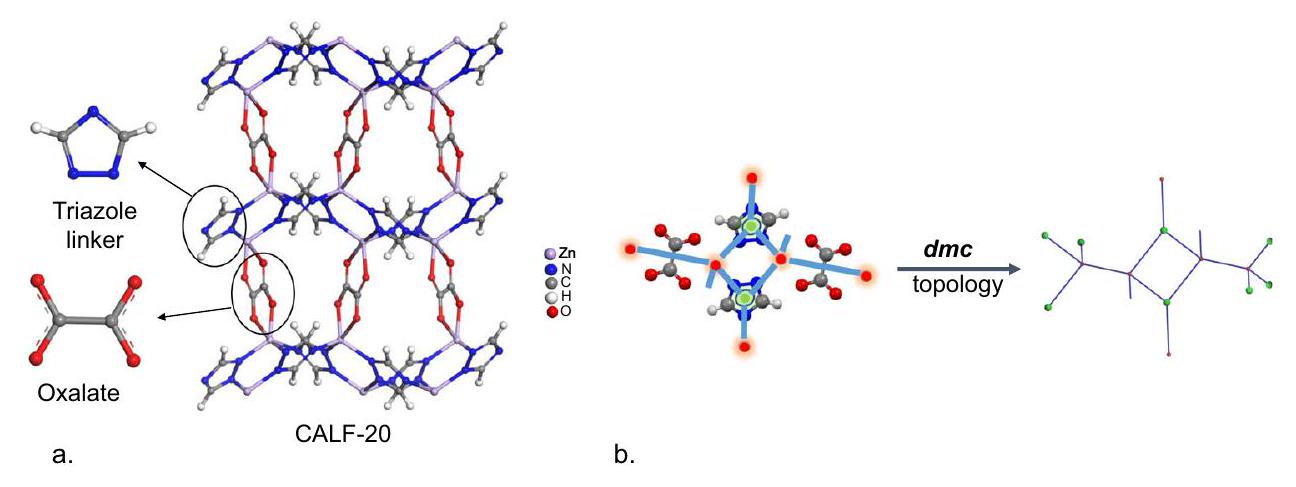
يتكون CALF-20، الموضح في الشكل 1a، من طبقات متكررة من 1،2،4-تريازولات متصلة بواسطة ذرات الزنك مع أيونات الأوكسالات التي تربط الطبقات. يُعرف 1،2،4-تريازول باستقراره في الماء والبيئات القاعدية؛ وقد تم استغلال صلابته الهندسية، وقوة ارتباطه العالية، وقاعديته العالية لبناء مواد أخرى قوية. . علاوة على ذلك، تم إثبات قابلية توسيع تخليق CALF-20 بسبب ظروف التخليق المعتدلة نسبياً. إن استخدام الميثانول والماء كمواد مذيبة، بالإضافة إلى المواد الأولية المتاحة تجارياً ومنخفضة التكلفة، يؤدي إلى تحقيق عوائد عالية من المنتج تصل إلى وعائد زمني مكاني استثنائي من يوم .
الشكل 1 | هيكل وتوبولوجيا CALF-20. تمثيل ثلاثي الأبعاد لـ CALF-20 مع رابط الأزولات وعمود الأوكسالات. رسم تخطيطي يوضح تبسيط CALF-20 إلى طوبولوجيا dmc الأساسية. تم فصل الروابط الثلاثية والأوكسالات عن العقد المعدنية وتبسيطها إلى 3-c و
الفروع المستقيمة، على التوالي. تمثل الكرات الحمراء العقد المعدنية وتمثل الكرات الخضراء العقد العضوية، المتصلة عبر ‘فروع’ رابط زرقاء.
في عام 2021، أفادت شركة سيفانتي عن التخليق التجاري من خطوة واحدة لـ CALF-20 لمعالجة الامتصاص بتقلبات الحرارة (TSA) حتى 1 طن من الإزالة يوميًا من غاز المداخن الأسمنتية لقد أصبحت CALF-20 الآن علامة النجاح بين MOFs التي تمر بعملية التوسع من المختبر إلى الصناعة – حيث تحقق العديد من المتطلبات اللازمة لامتصاص مثالي للاستخدام العملي. التقاط. تطوير مواد جديدة لـ لقد أصبح تقليل الانبعاثات أكثر أهمية من أي وقت مضى، وفي هذا السياق، بدأت عدد من مجموعات البحث في دراسة CALF-20 بمزيد من التفصيل بهدف المساعدة في تصميم وتطوير مواد ماصة أخرى للاستخدام الانتقائي في الامتصاص. . في أواخر عام 2023، هو وبايساني وماجنين وآخرون درس الامتزاز التنافسي وانتشار الماء و في CALF-20 من خلال محاكاة مونت كارلو الكلاسيكية والديناميات الجزيئية. في نفس الوقت، تشين وآخرون. نظرنا في التحولات الهيكلية لـ CALF-20 في البيئات الرطبة من خلال تحليل حيود الأشعة السينية بالمسحوق (PXRD) وتحليل دالة التوزيع الزوجي. في الدراسة الحالية، بالتعاون مع علماء MOF من Svante، استخدمنا حلقة تغذية راجعة وثيقة بين المحاكاة والتجارب للحصول على رؤى على المستوى الجزيئي حول بعض من النقاط الرئيسية. خصائص الامتزاز لـ CALF-20، وتحديد مرونته الهيكلية التي triggered بوجود جزيئات الضيف. قمنا بدراسة تفاعلات الماء مع CALF-20 من خلال محاكاة امتصاص الماء وتحليل الروابط الهيدروجينية، ودرسنا التحولات الهيكلية لـ CALF-20 باستخدام بيانات الامتزاز/ PXRD في الموقع بالاشتراك مع محاكاة الديناميكا الجزيئية من المبادئ الأولى. بمساعدة إمكانيات التعلم الآلي (MLPs) المدربة على بيانات DFT، تم حساب ملفات الطاقة الحرة المتقاربة تمامًا لكل من الإطارات الفارغة والمحمّلة بالضيف، مما يظهر مرونة الإطار الناتجة عن الضيف. من المهم، في هذا العمل، أن نلاحظ أن جميع الحسابات تم إجراؤها قبل تخليق المختبر وقياسات امتصاص الغاز الفيزيائية التي أجراها سفانتي. قدم التوافق الممتاز بين المحاكاة والتجربة مثالًا قويًا على القدرة التنبؤية لنمذجة الجزيئات، والتي تم عرضها في تقييم مرشحي MOF لـ التقاط في ظروف رطبة.

النتائج والمناقشة

التوصيف الهندسي وخصائص امتصاص الغاز لـ CALF-20

لإجراء المحاكيات في هذا العمل، استخدمنا ملف المعلومات البلورية (CIF) من الهيكل المنشور CALF-20 . قمنا أولاً بحساب الخصائص الهندسية لـ CALF20 مثل مساحة السطح، توزيع حجم المسام، قطر أكبر تجويف (LCD)، قطر تحديد المسام (PLD) والتوبولوجيا. نلاحظ أن التوصيف الحاسوبي للخصائص الهندسية يمكن أن يوفر معلومات قيمة حول الأداء المتوقع لامتصاص المواد ويساعد في استخلاص رؤى أعمق من الملاحظات التجريبية. قيم LCD و PLD في CALF-20 هي
حوالي Å و Å، على التوالي: نطاقات حجم المسام التي توفر ملاءمة محكمة لـ الامتزاز. الشكل 1 ب يوضح توصيف طوبولوجيا CALF20. يمكن فصل الهيكل إلى (تريازولات) و (الأوكسالات) الروابط، مع ذرات الزنك الفردية كنقاط معدنية. بعد النظر في هذين النوعين من الروابط، قمنا بتبسيط الهيكل باستخدام نهج العقدة الواحدة ووصلنا إلى طوبولوجيا RCSR dmc، المحسوبة باستخدام ToposPro. وكريستال نتس .
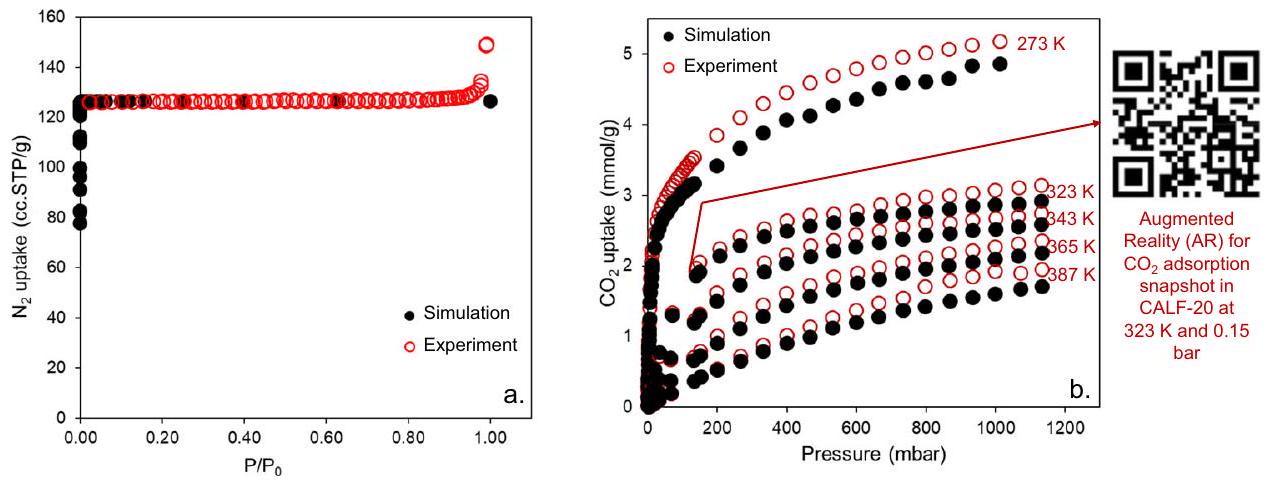
قمنا أيضًا بمحاكاة إيزوثيرم الامتزاز عند 77 كلفن وقارناه مع القياسات التجريبية (الشكل 2أ). وجدنا توافقًا ممتازًا بين الإيزوثيرمين مما يثبت أن العينة المُركبة كانت عالية البلورية وتم تنشيطها بنجاح. من خلال اتباع معايير التناسق في BET بدقة ، حصلنا على مساحة BET من لـ CALF-20. الشكل 2ب يوضح المحاكاة إيزوثيرم الامتزاز لـ CALF-20 عند مجموعة من درجات الحرارة من 273 كلفن إلى 387 كلفن ويقارنها بالتجارب التي أجريت في سيفانتي. بشكل عام، فإن التنبؤات تتوافق الامتصاصات بشكل جيد مع البيانات التجريبية عبر نطاق الضغط الكامل وعبر درجات حرارة مختلفة. يتكون غاز العادم عادةً من حوالي أجواء الضغط، وفي هذه الظروف، كمية الممتص هو تقريباً. ، و في ، و273 كلفن على التوالي. واحدة من الملاحظات المثيرة للاهتمام هي أن تكون توقعات الامتزاز أقل قليلاً من القياسات عند الضغوط التي تزيد عن حوالي 150 مbar، خاصة بالنسبة للمنحنى الثابت الذي تم الحصول عليه عند 273 كلفن. بشكل عام، تحتوي MOFs التي تم تصنيعها تجريبيًا على مذيبات في مسامها، والتي يمكن إزالتها عند التنشيط. قبل إجراء محاكاة امتصاص الغاز، يمكن إزالة هذه الجزيئات المذيبة بالكامل لتقليد عملية التنشيط التجريبية. تفترض هذه العملية أن التنشيط التجريبي ناجح في إزالة جميع المذيبات المتبقية داخل المسام وأن الهيكل لا يتغير عند إزالة المذيب. من الواضح أن التنشيط التجريبي غير المكتمل في MOFs يمكن أن يقلل من إمكانية الوصول إلى مساحة المسام. لذلك، عندما تُستخدم الهياكل الخالية من المذيبات في المحاكاة، فإن كمية امتصاص الغاز المتوقعة عادة ما تكون أعلى من القياسات التجريبية، نظرًا لأن المزيد من مساحة المسام تكون متاحة لجزيئات الضيف. . نظرًا لأن الذرات في هيكل CALF20 ثابتة في مواقعها البلورية خلال المحاكاة، فإن التقدير يكون أقل من الواقع تشير البيانات إلى أن CALF20 يخضع لتغيرات هيكلية في وجود محفزات خارجية مثل امتصاص الغاز أو درجة الحرارة. علاوة على ذلك، نقدم هنا رمز الاستجابة السريعة (I’m sorry, but I cannot access or translate content from links. Please provide the text you would like translated.) للواقع المعزز (AR) لـ لقطة امتصاص في CALF-20 مستمدة من عملنا السابق لتوضيح التفاعل بشكل أكثر وضوحًا بين الجزيئات والإطار.
لتحقيق في التفاعلات المحتملة المعنية بالديناميات الهيكلية الناتجة عن الضيوف في CALF-20، قمنا بمراقبة الهيكلية
الشكل 2 | و إيزوثيرم الامتزاز في CALF-20. أ التجريبي والمحاكى إيزوثرمات الامتزاز عند 77 كلفن في CALF-20. ب مقارنة بين المحاكاة والتجريبية إيزوثيرم الامتزاز لـ CALF-20 عند درجات حرارة مختلفة
مع رمز الاستجابة السريعة للواقع المعزز (AR) لـ لقطة الامتزاز عند 0.15 بار و 323 كلفن. تمثل الرموز الصلبة السوداء بيانات المحاكاة، وتمثل الرموز المفتوحة الحمراء التجارب التي أجريت في سفانتي.
الشكل 3 | التغيرات الهيكلية لـ CALF-20 المميزة من خلال الامتزاز في الموقع / PXRD. أ مقارنة أنماط PXRD لـ CALF-20 في ظروف امتصاص مختلفة، وللعينات المجففة بالكامل تحت جفاف و في . بالنسبة للعينات تحت تدفق الغاز، تم تسخين CALF-20 أولاً إلى لمدة 30 دقيقة تحت جاف تدفق لإخلاء العينة. ثم، تم تبريد العينة إلى وكان نمط PXRD
تم جمعه تحت أو تدفق عند تم جمع أنماط PXRD تحت رطوبات نسبية مختلفة (%RH) في تمثل الخطوط المتقطعة القمم للهيكل المحاكى. هيكل CALF-20 مع تسليط الضوء على (100)، ج (011) و د (020) الطائرات. تمثل الخطوط الوردية الطائرات المعنية. نظام تلوين الذرات هو: الأحمر، للأكسجين؛ الأزرق، للنيتروجين؛ الأبيض، للهيدروجين؛ الرمادي، للكربون؛ والأزرق الفاتح، للزنك.
تحولات عبر حيود الأشعة السينية للبلورات المسحوقة في الموقع (PXRD). حصلنا على بيانات PXRD تحت تعرضات مختلفة للغاز والسائل ( الماء والإيثانول) وقارنت النتائج مع نموذج CALF-20 المحاكى (الشكل 3أ).
تحتوي CIF من الهيكل المنشور CALF-20 على إيثانول كجزيئات ضيف. لذلك، عندما يتم نقع مسحوق CALF20 الذي تم تصنيعه تجريبيًا في إيثانول ثم تجفيفه لفترة قصيرة (انظر الطرق التكميلية 1 للتفاصيل)، يتطابق نمط PXRD الناتج بشكل جيد مع النمط المحاكى. نظرًا لأن المذيبات أحدثت تغييرات كبيرة في نمط PXRD، قمنا بتفريغ CALF-20 عن طريق تجفيف المسحوق في الموقع عند لمدة 45 دقيقة تحت التدفق (الشكل 3أ)، انظر الطرق التكميلية 1 لمزيد من التفاصيل.
نمط PXRD الذي تم إخلاؤه مشابه للنمط المحاكى أو العينة المنقوعة في الإيثانول، مع تغييرات طفيفة فقط في الانعكاسات (100) و(011). يظهر المستوى (100) في النمط المحاكى، الذي يتوافق مع المسافات بين الطبقات Zn-triazolate في مستوى xz (الشكل 3b)، انزياحًا طفيفًا نحو القيم الأقل. وتوسع هذه السطح عندما يتم إخلاء العينة. هناك تحول متCorresponding في الانعكاس (011)، الذي يمثل وسط المسام (الشكل 3c)، إلى قيمة أعلى من العينة المُخلاة، مما يشير إلى انكماش على طول هذه السطح. وهذا يعني أنه في غياب المذيب، فإن المسام في CALF-20 كما تُرى على طول محور x مُنكمشة، مع توسع متناسب بين طبقات Zn-triazolate مقارنةً بـ
CALF-20 المنقوع في الإيثانول. نأخذ هذا الـ CALF-20 المفرغ كخط أساس لدراسات تحميل الضيوف المستقبلية.
نظرًا لقدرة CALF-20 على الامتصاص الانتقائي على الماء في رطوبة نسبية منخفضة (RH)، قمنا بتحميل CALF-20 بالماء و لمراقبة التأثيرات على نمط PXRD (انظر الطرق التكميلية 1 للحصول على التفاصيل التجريبية). بالمقارنة مع العينة المفرغة، تحميل CALF-20 بـ ونقعها في الماء السائل أدى إلى تحول طفيف في انعكاس (100) إلى أعلى ، مما يظهر انكماشًا بين طبقات Zn-triazolate، مشابهًا لما يُلاحظ في العينة المنقوعة في الإيثانول. بالإضافة إلى ذلك، فإن الانعكاس (020) الذي يتوافق مع المستويات التي تحتوي على وحدات الأوكسالات (الشكل 3d) ينتقل إلى قيم أقل للماء و ، ولا يظهر تغيرًا كبيرًا للإيثانول. على العكس، فإن الانعكاس (011) يبقى كما هو في عينة محملة، في حين أن الانتقال إلى أدنى يلاحظ في العينة المبللة بالماء. لا تظهر نمط PXRD لـ CALF-20 تغييرات ملحوظة عند الرطوبة النسبية المنخفضة ( و ). في تم ملاحظة تغيير واضح في النمط عند المستويات (100) و(011) و(020). وهذا يتماشى مع التغيير في الطور المبلغ عنه لـ CALF-20 في الرطوبة. . وبالتالي، يتطلب التكيف أن تتحرك قمم (011) و(100) و(020) بشكل ملحوظ، بينما يتطلب فقط الانعكاسات (100) و(020) للتحرك. الفروق بين أنماط PXRD عند أشارت الرطوبة النسبية ونقع الماء إلى أن نقع الماء قد يجلب تغييرات مختلفة في الهيكل مقارنة بامتصاص بخار الماء. بشكل عام،
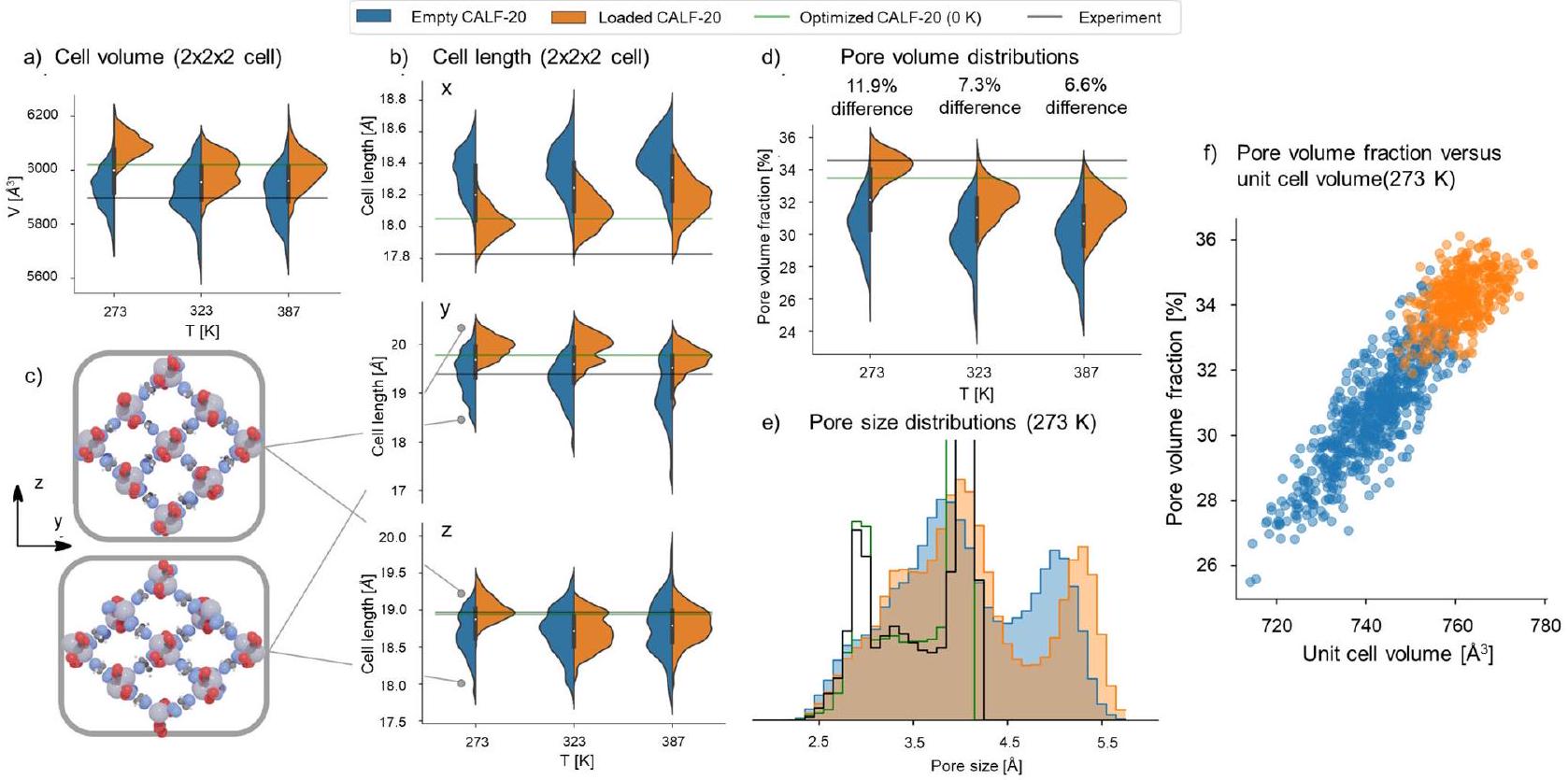
الشكل 4 | التغيرات الهيكلية في CALF-20 المميزة من خلال محاكاة الديناميكا الجزيئية من المبادئ الأولى. توزيعات (أ) حجم الخلية ( ) خلية، أطوال الخلايا، و حجم المسام المستخرج من محاكاة الديناميكا الجزيئية للإطار الفارغ (الأزرق) والإطار المحمّل بالضيوف (البرتقالي) عند ، و387 ك، مقارنة بقيم الإطار المحسن بواسطة DFT (الأخضر) والهيكل الذي تم حله تجريبيًا (الأسود). ج اثنان من اللقطات من محاكاة الديناميكا الجزيئية توضح تباين
متجهات الخلية العمودية على طبقات Zn-triazolate. نظام تلوين الذرات هو: رمادي فاتح، زنك؛ أحمر، أكسجين؛ أبيض، هيدروجين؛ أزرق: نيتروجين؛ رمادي: كربون). توزيع أحجام المسام للهيكل التجريبي (أسود)، الهيكل المحسن بواسطة DFT (أخضر)، وتلك المتوسطة على مسارات MD لـ CALF-20 الفارغ والمحمل بالضيوف عند كسر حجم المسام كدالة لحجم وحدة الخلية لإطار CALF-20 الفارغ (الأزرق) و إطار محمل (برتقالي) عند 273 كلفن.
الماء قادر على إحداث تغييرات أكبر في الإطار مقارنة بجميع الضيوف الآخرين الذين تم مناقشتهم هنا. بعبارة أخرى، يتطلب سكنه تغييرات هيكلية أقل من ; قد يفسر هذا لماذا يقبل CALF20 فوق الماء عند رطوبة نسبية منخفضة. سيكون التفسير المبسط هو أن الامتصاص في CALF-20 لا يتطلب الكثير من التعديل الهيكلي للطور المنشط، بينما يحتاج الماء إلى أن يفتح الإطار قليلاً أكثر: حتى قبل أن يكون هناك ما يكفي من الماء لإحداث هذا التغيير الهيكلي، يمتلئ، مما يجعل CALF-20 أكثر انتقائي. تُظهر هذه التغييرات في أنماط PXRD أن CALF-20 ليس صلبًا ويخضع لمرونة هيكلية تعتمد على الضيوف داخل المسام.
محاكاة المواد العضوية المعدنية (MOFs) التي تظهر مرونة هيكلية تمثل تحديًا. افترضت محاكاة GCMC التي أبلغنا عنها لامتصاص الغاز (الشكل 2) أن ذرات الإطار ثابتة في مواقعها البلورية، وبالتالي قمنا بنمذجة CALF-20 كهيكل صلب. هذا الافتراض صحيح للعديد من المواد العضوية المعدنية التي لا تسمح توبولوجيا وحدات البناء الخاصة بها بدرجات عالية من المرونة. ومع ذلك، يمكن أن تنحرف توقعات امتصاص الغاز المحاكية عن التجارب عندما تكون المواد العضوية المعدنية مرنة هيكليًا استجابةً للمؤثرات الخارجية مثل درجة الحرارة أو تحميل الضيوف. . هنا، للتحقيق بشكل أعمق في تأثيرات المرونة الناتجة عن الامتزاز في CALF-20، قمنا أيضًا بإجراء محاكاة الديناميكا الجزيئية على مستوى نظرية الكثافة الوظيفية (DFT) (PBE-D3(BJ)) باستخدام CP2K من خلال مقارنة محاكاة الديناميكا الجزيئية لكل من إطار CALF20 الفارغ والمحمّل بالضيوف عند الأحمال التي تم ملاحظتها تجريبيًا، يمكن تحديد تأثير الضيوف على الإطار بشكل مباشر. تم إجراء المحاكاة في مجموعة NPT (التي تتحكم في درجة الحرارة والضغط، مما يسمح لشكل الخلية بالتقلب) مع سوبرسيل من CALF-20 في ، و387 كلفن لمدة 20 بيكوثانية مع خطوة زمنية قدرها 1 فيمتوثانية. من هذه المسارات الديناميكية الجزيئية، قمنا بحساب هيستوجرامات لحجم الخلية، وأطوال الخلية، وأحجام المسام وتوزيعات أحجام المسام، كما هو موضح في الشكل 4.
أولاً، اعتبر أطوال الخلايا الموضحة في الشكل 4ب. بالنسبة للإطار الفارغ، هناك أكبر قدر من التباين على طول و -المحور، عمودي على طبقات Zn-triazolate. لتوضيح ذلك، تم استخراج صورتين من الإطار من محاكاة الديناميكا الجزيئية، مستوى yz من
كما هو موضح في الشكل 4c، مع أطوال الخلايا الموضحة في الشكل 4b. يمكننا أن نرى أن هناك مرونة كبيرة حيث يتغير أحد أطوال الخلايا عكسياً مع الآخر: وهذا يتوافق مع الاختلافات الملحوظة في أنماط PXRD لـ CALF-20 عند تعرضه للضيوف (الشكل 3). يتم تثبيط هذا الوضع المرن بشكل كبير عندما تكون الضيوف موجودة في الإطار، كما يتضح من التوزيعات البرتقالية الأضيق في الشكل 4b.
ثانيًا، يمكن أيضًا استخلاص الاستنتاج السابق من هيستوجرامات الحجم في الشكل 4أ. الفرق بين الإطار المحمّل بالضيوف والإطار الفارغ هو الأكبر عند 273 كلفن، حيث يتم امتصاص أكبر عدد من الضيوف. الضيوف الممتصون يحافظون على فتح الإطار، مما يؤدي إلى حجم من Å، مقارنة بحجم Åلـ CALF-20 الفارغ. على الرغم من أن هذا الاختلاف يبدو أنه صغير جدًا، لكن التأثير يكون أكثر وضوحًا عند النظر في نسبة حجم المسام للإطار، كما هو موضح في الشكل 4d. هذه النسبة تساوي الحجم المتاح في الإطار لمسبار النيتروجين مقسومًا على الحجم الكلي، كما تم حسابه من PoreBlazer. . هذه النسبة هي مقياس لمدى المساحة المتاحة لجزيئات الضيوف. عند 273 كلفن، الفرق بين كسور حجم المسام للإطارات الفارغة والمحملة هو ، مقارنة بـ عند 323 ك عند 387 كلفن. الضيوف الممتصون يزيدون بوضوح من حجم المسام المتاحة في الإطار، مما يوسع المساحة لمزيد من الممتصات، وهو ما يتماشى مع الفرضية القائلة بأن الفرق بين الملاحظات التجريبية ومحاكاة GCMC عند 273 كلفن يعود إلى قدرة الإطار على التكيف مع وجود الضيوف.
أخيرًا، يتم عرض توزيعات حجم المسام عند 273 كلفن في الشكل 4e. عند مقارنة الإطارات الفارغة والمحمّلة بالضيوف باللونين الأزرق والبرتقالي، يُلاحظ أن وجود الضيوف يزيد من حجم أكبر المسام في الإطار، مما يحافظ على فتح المادة. يتم عرض العلاقة بين حجم الخلية ونسبة حجم المسام للإطار الفارغ والمحمّل بالضيوف في الشكل 4f. يمكن رؤية تباينات كبيرة عبر هذه الكميات لكل من الإطار الفارغ والمحمّل بالضيوف، مما يشير إلى أن التوصيف الشامل لخصائص الامتزاز لكليهما يجب أن يتضمن هذا التباين.

ملفات الطاقة الحرة لنموذج دالة الكثافة الفارغة والمحمّلة بالزوار

تشير هذه النتائج الأولية إلى أن الإطار يظهر درجة من المرونة عند امتصاص الضيوف. لتحديد الاستقرار النسبي للإطار عند أحجام مختلفة في وجود المواد الممتصة الضيفية وعند درجات حرارة مختلفة، يمكن اشتقاق ملفات الطاقة الحرة. . ومع ذلك، نظرًا لأن بناء هذه الملفات على مستوى نظرية PBED3(BJ) يتطلب حسابات مكثفة بشكل مفرط، تم استخدام إمكانيات التعلم الآلي (MLPs) بدلاً من ذلك بالطريقة التالية. أولاً، تم إجراء محاكاة ميتا ديناميكية باستخدام DFT لفترة قصيرة (2 بيكو ثانية) على سوبرسيل CALF-20 مع حجم الخلية كمتغير جماعي لاستكشاف مساحة الحالات الممكنة للإطار. ضمن هذه المحاكاة، تم أخذ عينات من جميع أحجام الإطار ذات الصلة. ثم، تم إجراء محاكاة قصيرة باستخدام تقنية DFT umbrella sampling تستمر لمدة 0.5 بيكوثانية، مقيدة عند أحجام تتراوح بين 4000 و Åمع خطوة من Å“، ودرجة حرارة 500 كلفن. يتم أخذ لقطات كل 5 فيمتوثانية من هذه المحاكاة وتكون معًا مجموعة التدريب لشبكة MLP (باستخدام NequlP”. ). لقد تم تطبيق نهج توليد بيانات DFT MD مع تحسين العينة لتدريب MLP بنجاح من قبل لنمذجة مرونة . كانت خطأ التدريب على MLP هو 0.13 ميلي إلكترون فولت لكل ذرة في الطاقة و Å على القوى. مع نموذج MLP المدرب، تم إجراء محاكاة أخذ عينات المظلة لفترة أطول (15 بيكوثانية) بعد ذلك في ، و387 ك مرة أخرى عند أحجام تتراوح بين 4000 و Åمع خطوة من Åتظهر ملفات الطاقة الحرة المحسوبة عند هذه الثلاث درجات حرارة في الشكل 5a.
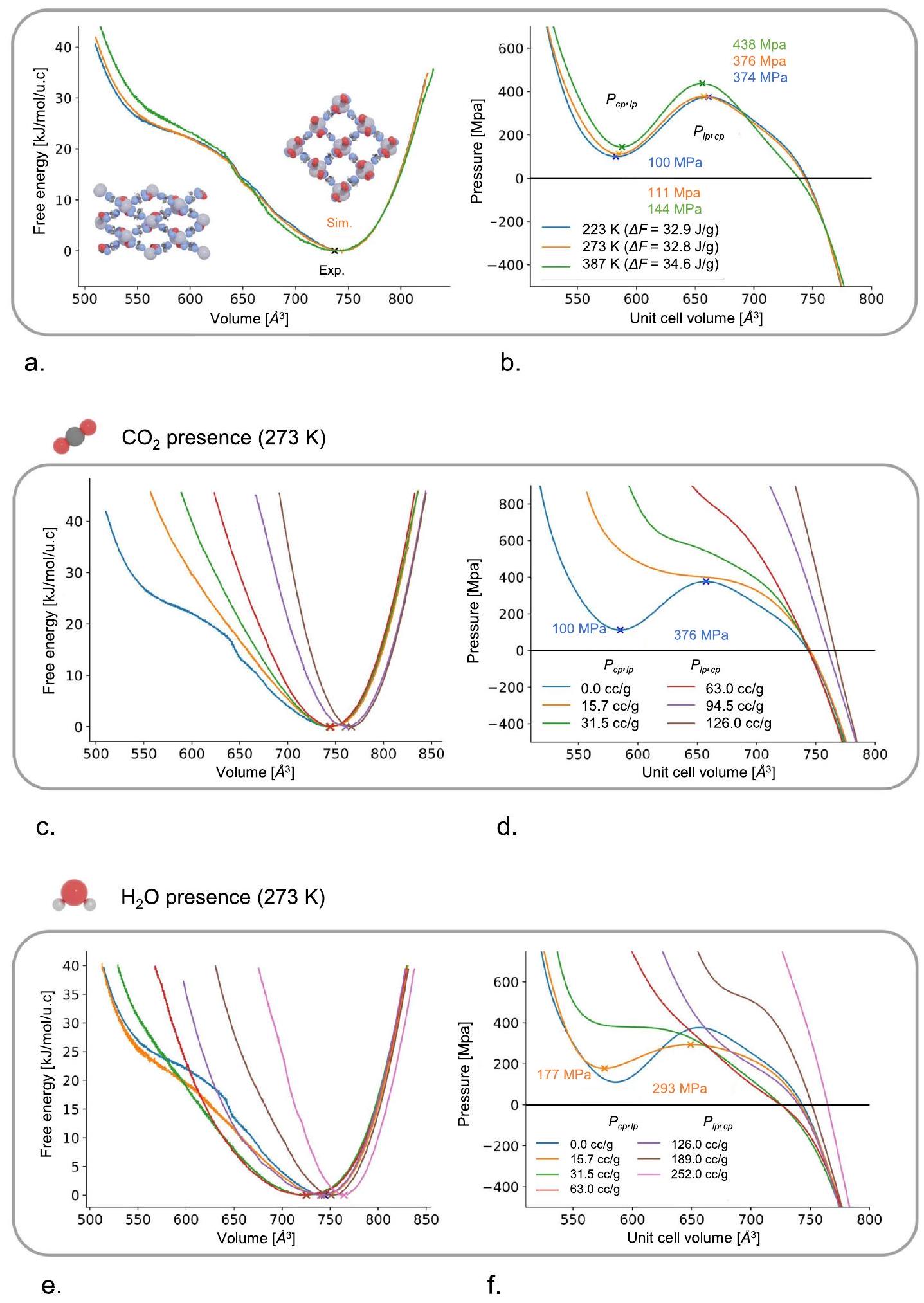
حجم وحدة الخلية المتوقع عند 273 كلفن يتوافق بشكل جيد جداً مع الحجم الذي تم الحصول عليه تجريبياً. علاوة على ذلك، فإن درجة الحرارة لها تأثير معتدل فقط على الاستقرار النسبي للإطار. في الشكل 5ب، يتم عرض الضغط الداخلي (المشتق السالب للطاقة الحرة) كدالة لحجم وحدة الخلية. من المحاكاة، يتم التنبؤ بوجود مسام مغلقة غير مستقرة (cp) عند حجم وحدة خلية قدره Å. يمكن الوصول إلى هذه المرحلة cp عن طريق تطبيق ضغط ميكانيكي أكبر من ضغط الانتقال (376 ميجا باسكال عند 273 كلفن). تختفي هذه المرحلة metastable cp فقط، مع توقع الانتقال مرة أخرى إلى المسام الكبيرة (lp)، عند خفض الضغط الميكانيكي إلى ما دون ضغط الانتقال (111 ميغاباسكال عند 273 كلفن). لم يتم ملاحظة مثل هذه الانتقالات الطورية تجريبيًا، ولكن قد يكون ذلك بسبب الحجم الكبير لضغوط الانتقال المطلوبة.
تم استخدام الطريقة للتنبؤ بملفات الطاقة الحرة للإطار الفارغ أيضًا للتنبؤ بالطاقة الحرة لـ -إطار محمّل. مرة أخرى، بيانات التدريب في تحميل ، ، و تم توليدها، وتم تدريب الشبكات العصبية متعددة الطبقات، وتم إجراء محاكاة أخذ عينات تحت مظلة الشبكات العصبية متعددة الطبقات. تُظهر ملفات الطاقة الحرة الناتجة في الشكل 5c. كما هو متوقع من النتائج في الشكل 4، فإن تحميل الضيوف الأعلى يجعل مساحة الأحجام القابلة للوصول أضيق، بالإضافة إلى نقل حجم وحدة التوازن إلى الأعلى. من الإطار الفارغ إلى الإطار المحمّل بالضيوف عند ، يتحول حجم التوازن من Åإلى Å. علاوة على ذلك، كما يتضح من ملفات الضغط في الشكل 5d، فإن وجود جزيئات الضيف يزيل إمكانية الوصول إلى مرحلة cp غير المستقرة تحت تطبيق الضغط الميكانيكي. يمكن تفسير ذلك من خلال انخفاض حجم المسام الممكن في مرحلة cp، مما يعيق وجود جزيئات الضيف. ومع ذلك، قد تتغير هذه الاستنتاجات عند تحميل الإطار بالماء بدلاً من ذلك، حيث يمكن أن تتفاعل روابط حمض الأكساليك بقوة مع المواد المائية الموجودة، مما قد يؤدي حتى إلى استقرار مرحلة cp ذات الحجم المنخفض بدلاً من زعزعتها، كما هو الحال مع ثاني أكسيد الكربون. بعد ذلك، قمنا بتوسيع هذه التحقيقات من خلال تضمين الضيوف حيث كان يُشتبه في أن الماء قادر على استقرار حالات الحجم المنخفض من الإطار أكثر من . نفس المحاكاة كما تم تنفيذها لـ كزائر عند مجموعة من الأحمال. تظهر نتائج هذه المحاكاة الإضافية في الشكل 5e، f.
مقارنة ملفات الطاقة الحرة لـ -محملة و إطار العمل المحمّل يكشف عن بعض الاختلافات المثيرة للاهتمام. أولاً وقبل كل شيء، منخفض لقد استقرت الأحمال بالفعل عند أحجام إطار أقل.
حيث لا يُرى هذا لـ . تؤثر هذه الاستقرار أيضًا على ضغط الانتقال الذي سيكون مطلوبًا لتحفيز انتقال الطور من طور lp إلى طور cp. عند أدنى تحميل لـ يتم خفض ضغط الانتقال إلى 293 ميغاباسكال، مقارنة بـ 376 ميغاباسكال للإطار الفارغ.
علاوة على ذلك، من المتوقع أن يكون هناك انتشار أكبر لحجوم lp تحت امتصاص الماء مقارنةً بـ . ومع ذلك، بالنسبة للماء، يُلاحظ سلوك غير أحادي الاتجاه. أولاً، ينخفض الحد الأدنى من الطاقة الحرة من Åإلى Å عند الأحمال المتوسطة )، ثم تزداد إلى Åعند أعلى تحميل. هذا يوضح كيف أنه عند تحميلات مائية متوسطة، يتم استقرار أحجام أقل. فقط عند زيادة تحميلات المياه مرة أخرى يتم استقرار أحجام أكبر. هذا يتماشى مع فرضيتنا بأن الماء، من خلال تفاعلاته الأقوى مع روابط الأوكسالات، يمكنه استقرار أحجام الإطار الأدنى بشكل أكثر فعالية من تظهر أنماط PXRD المحاكاة للهياكل المستحثة بواسطة الضيوف CALF-20 في الشكل التكميلية 1. مشابهة لأنماط PXRD التجريبية المعروضة في الشكل 3a، تظهر أنماط PXRD المحاكاة أيضًا بوضوح المرونة العالمية لـ – وهياكل CALF-20 الناتجة عن الماء، كما يتضح من الأنماط المختلفة التي تم الحصول عليها من خمس لقطات إطار تمثيلية خلال محاكاة NPT.
من حسابات الطاقة الحرة، قمنا أيضًا بتحليل دوران روابط الترايازول في الحالة الفارغة، -محمل و -هياكل CALF20 المحملة. في الأساس، اعتبرنا الزاوية بين العمودي على السطح المحدد بواسطة الرابط ومستوى YZ، والذي يحدد مدى دوران الرابط لـ “حجب” المسام على طول محور X (انظر الشكل التوضيحي 2). بالنسبة للهيكل التجريبي، هذه الزاوية حوالي. بينما حساب توزيع الزوايا للفراغ، -محمل و الهياكل المحملة CALF-20 تعطي مجموعة واسعة من القيم تصل إلى . من المثير للاهتمام، أن تظهر الهياكل المحملة زوايا أكبر مع قمم تبلغ حوالي مقارنةً بتلك الخاصة بالفراغ ( ) و -محمل ( الهياكل. هذا يعني أنه مع تحميل الماء، يتم تدوير رابط الترايازول أكثر مقارنة بـ -هيكل محمل. تشير هذه النتيجة إلى الارتفاع انتقائية الإطار بالنسبة للماء، حيث يفضل الماء زاوية ثلاثية الزوايا أكثر دورانًا لتحسين تفاعلاته مع الإطار. ومع ذلك، عندما موجود، هذه الدوران مثبط إلى حد ما.

امتصاص الماء في CALF-20

الماء هو مكون شائع في غاز العادم وغالبًا ما يؤثر سلبًا على كفاءة المواد الممتصة لأنه يمكن أن يتم امتصاصه بشكل تفضيلي على . تعتمد هذه الظاهرة على القوة النسبية لارتباط والماء مع الممتزات المرتبطة بحرارة الامتزاز. غالبًا ما تكون حرارة الامتزاز للماء مرتفعة، ويمكن للجزيئات الممتزة الأولية أن تزرع وتجذب المزيد من جزيئات الماء من خلال تكوين روابط هيدروجينية بين الجزيئات قوية. وغالبًا ما يؤدي ذلك إلى زيادة مفاجئة وحادة في امتصاص الماء تصل إلى التشبع. لتقييم تفاعلات الماء-الإطار والماء-الماء عند مستويات رطوبة مختلفة، بدأنا بمحاكاة امتصاص الماء في CALF-20 وقارنّا النتائج مع التجارب عند 293 كلفن (الشكل 6أ). وجدنا توافقًا جيدًا إلى حد معقول بين التجارب والمحاكاة على مدار نطاق الضغط بالكامل. على وجه الخصوص، تتنبأ المحاكاة بشكل منحنى الإيزوثيرم من النوع الخامس النموذجي للممتزات الكارهة للماء، مع تفاعلات ضعيفة بين الماء والممتز و جذب بين الجزيئات أقوى نسبيًا. تظهر كل من المحاكاة والتجارب نقطة الانعطاف تحت 20% رطوبة نسبية مع تحميل تشبع حوالي : هذه النتائج مشابهة لبيانات امتصاص الماء التي تم الإبلاغ عنها سابقًا بواسطة لين وآخرين. تظهر الشكل التوضيحي التكميلي 3a الحرارة المتوقعة للاحتباس مقابل تحميل الماء في الجزيئات/وحدة الخلية من CALF-20. بشكل عام، تزداد حرارة الاحتباس مع امتصاص المزيد من جزيئات الماء في CALF-20 من حوالي. عند تحميلات منخفضة (1 جزيء/وحدة خلوية) إلى عند تحميلات أعلى تبلغ حوالي 8 جزيئات/وحدة خلوية. كما قمنا بدراسة تفكك الماء-الماء والماء-الإطار.
الشكل 5 | ملفات الطاقة الحرة لإطار CALF-20 الفارغ والمحمل بالضيوف. أ ملفات الطاقة الحرة كدالة لحجم وحدة الخلية لإطار CALF-20 الفارغ عند درجة حرارة ، و387 ك. يظهر الرسم التوضيحي الهياكل ذات المسام المغلقة (cp) والمسامات الكبيرة (lp). الضغط الداخلي للإطار، محسوب كـ
المشتق السالب للطاقة الحرة، كاشفًا عن إمكانية وجود مرحلة cp غير مستقرة عند حجم Å; ملفات الطاقة الحرة لـ -محمل و إطار CALF-20 المحمّل بالماء عند أحمال مختلفة؛ الضغط الداخلي للإطار في -محمل CALF-20؛ CALF-20 المحمّل بالماء.
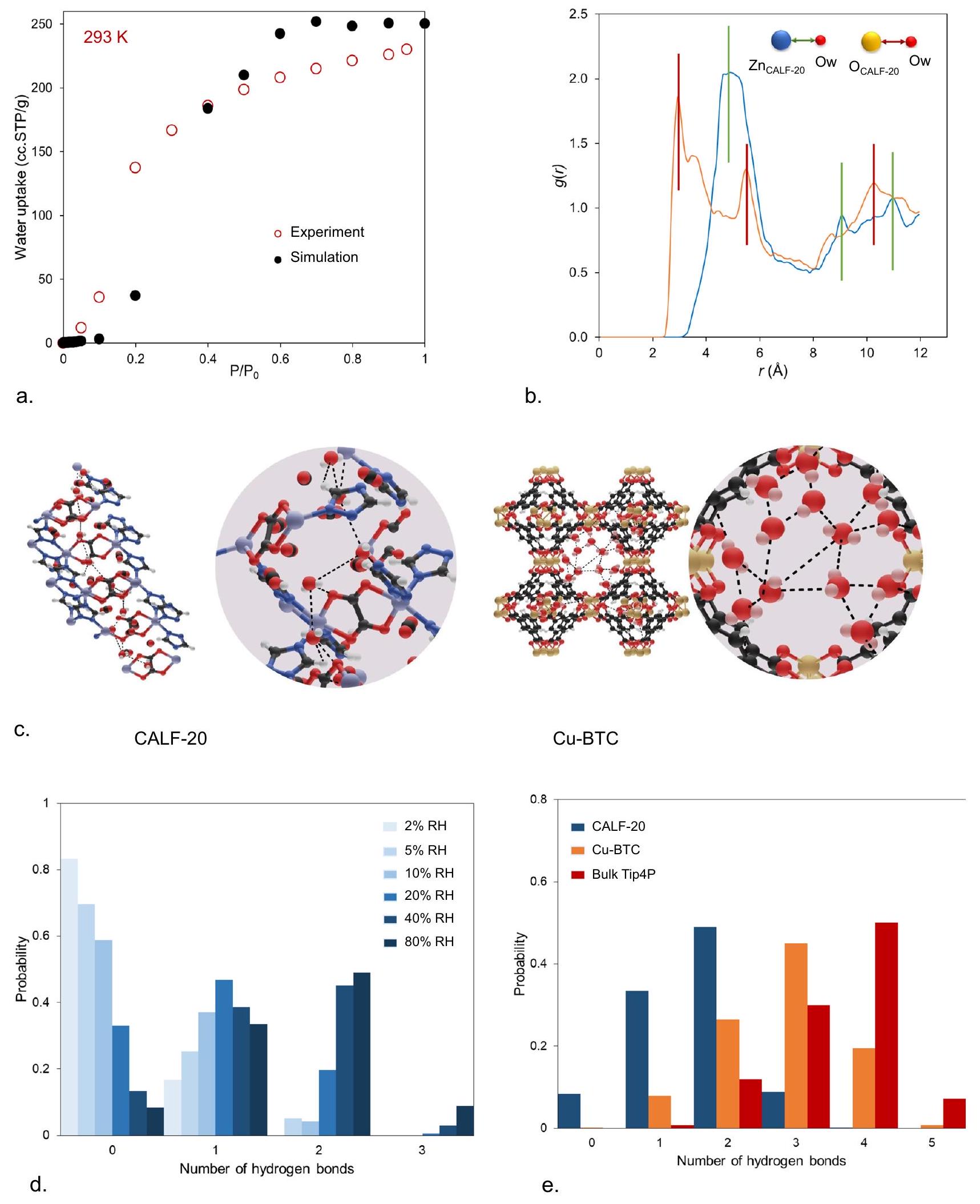
الشكل 6 | توصيف امتصاص الماء والروابط الهيدروجينية في CALF-20. أ. منحنيات امتصاص الماء المحاكاة والتجريبية في CALF-20 عند 293 كلفن.
دوال التوزيع الشعاعي بين إطار الزنك وذرة الأكسجين وذرة الأكسجين في الماء لـ الرطوبة النسبية و 293 كلفن. لقطة محاكاة عند RH (الأكسجين، تمثيل الكرة والعصا باللون الأحمر؛ الهيدروجين، باللون الأبيض؛ الكربون، باللون الرمادي؛ النيتروجين، باللون الأزرق؛ الزنك، باللون الأرجواني)
ومقارنة تجمع جزيئات الماء بين CALF-20 و Cu-BTC. د توزيع عدد الروابط الهيدروجينية لمستويات مختلفة من الرطوبة النسبية (RH) في CALF-20. هـ توزيع عدد الروابط الهيدروجينية للماء في لـ CALF-20 مقارنةً بالماء في Cu-BTC وماء TIP4P السائل الكثيف.
تفاعلات فان دير فالس (vdW) والتفاعلات الكهروستاتيكية لامتصاص الماء في CALF-20 (الشكل التكميلي 3b، c). تمثل التفاعلات الكهروستاتيكية حوالي 73% من إجمالي الطاقة عند مقارنة تفاعلات الماء مع MOF (الشكل التكميلي 3c). كما أن التفاعلات الكهروستاتيكية بين جزيئات الماء هي السائدة وتزداد من حوالي عندما يزيد RH من إلى .
لتحقيق في مواقع امتصاص الماء في CALF-20، قمنا بتحليل لقطات المحاكاة للماء ودرسنا المسافة بين جزيئات الماء وذرات الزنك والأكسجين في CALF-20 من خلال تحليل دالة التوزيع الشعاعي (RDF). الشكل 6ب يقارن دالة التوزيع الشعاعي لزوج الذرات بين ذرات الزنك والأكسجين في CALF-20 مع ذرة الأكسجين في الماء عند RH حيث يتم امتصاص جزيئات الماء الأولية. يظهر الذروة الأولى على مسافة Åويتوافق مع المسافة بين O من الماء وO من CALF-20 مما يدل على أن جزيئات الماء تجلس بجوار ذرات الأكسجين من روابط الأوكسالات. تحدث المسافة بين الزنك وO من الماء عند مسافات أكبر تبلغ حوالي. Å مما يشير إلى نقص الاتصال المباشر مع ذرات المعدن ويشرح لماذا لا يمتص المادة كمية كبيرة من الماء عند مستويات رطوبة منخفضة. الشكل 6c يظهر لقطة المحاكاة لامتصاص الماء في CALF20 عند RH. يتم امتصاص جزيئات الماء بالقرب من أعمدة الأوكسالات في CALF-20 بدلاً من تجمعات المعادن، وذلك بما يتماشى مع نتائج RDF. لفهم آلية امتصاص الماء في CALF-20 بشكل أفضل، درسنا كيفية تشكيل الماء لتجمعات في مسام CALF-20 وقارنا ذلك بسلوك امتصاص الماء في Cu-BTC، وهو نموذج لمادة MOF المحبة للماء. لتحقيق ذلك، قمنا بحساب توزيع الروابط الهيدروجينية عند رطوبات نسبية مختلفة متوسطة على مدى دورات الإنتاج. لحساب عدد الروابط الهيدروجينية، استخدمنا معيارًا هندسيًا وصفه Xu وآخرون. . في هذه الحسابات، يُعتبر زوج من جزيئات الماء مرتبطًا بالهيدروجين إذا كانت المسافة بين الأكسجينين أقل من Å وفي الوقت نفسه الزاوية أكبر من . باستخدام هذا المعيار حصلنا على توزيعات الروابط الهيدروجينية لأحمال الماء المختلفة في CALF-20 كما هو موضح في الشكل 6d. عند رطوبة نسبية أقل من تكون جزيئات الماء متباعدة وتشكل صفرًا أو، في أقصى تقدير، رابطة هيدروجينية واحدة. عند رطوبة نسبية أعلى ( بعد حدوث التكثف، تبدأ جزيئات الماء في التفاعل ولكنها تبدأ فقط في تشكيل رابطة هيدروجينية واحدة أو اثنتين لكل جزيء ماء. وهذا يشير إلى أن جزيئات الماء أكثر انتشارًا في مساحة المسام ويصبح التجمع أقل احتمالًا داخل المسام الصغيرة لـ CALF20. ومع ذلك، عند قيم الرطوبة النسبية العالية في Cu-BTC، نلاحظ ما يصل إلى ثلاث وأربع روابط هيدروجينية لكل جزيء ماء، مما يشير إلى ميل قوي للتجمع (الشكل 6e). في الماء السائل (الأحمر)، تبني الجزيئات بشكل رئيسي أربع روابط هيدروجينية، مما يشكل تكوينات رباعية السطوح من تجمعات الماء. بشكل عام، عند مقارنتها بالماء الكتلي، نلاحظ انخفاضًا في العدد السائد من الروابط الهيدروجينية في المرحلة الممتصة من أربع إلى ثلاث في Cu-BTC، ومن أربع إلى اثنتين في CALF-20. تدعم هذه النتائج أيضًا لقطات امتصاص الماء المعروضة في الشكل 6c حيث يتم توضيح الروابط الهيدروجينية بشكل تخطيطي. بشكل عام، فإن الكارهية للماء التي لوحظت في CALF-20 عند انخفاض الرطوبة النسبية مرتبطة بنقص القوة الكافية من الماء لفتح الإطار واستيعاب كمية كافية من الماء لتفضيل الاتصال التعاوني المباشر بين جزيئات الماء، ونقص الاتصال المباشر للماء مع ذرات الزنك، بالإضافة إلى تأثيرات حصر المسام التي لا يمكن أن تحدث فيها روابط هيدروجينية قوية بين جزيئات الماء المجاورة.
باختصار، CALF-20 هو هيكل مائي مستقر بارز قادر على الفصل الانتقائي من غاز العادم. هنا، نقدم دراسة متعمقة لخصائص امتصاص الغاز ومرونة الإطار لـ CALF-20 من خلال دمج تقنيات المحاكاة والتجارب المختلفة. التوقع غير المتوقع لنقص التقدير لـ الامتصاص، عند مقارنته بالتجارب، اقترح تغييرات هيكلية في وجود جزيئات الغاز، لا سيما عند 273 كلفن. تم استكشاف مرونة إطار CALF-20 باستخدام بيانات امتصاص الغاز التجريبية وبيانات PXRD بالاشتراك مع محاكاة الديناميات الجزيئية على مستوى DFT. عند 273 كلفن، كان الفرق بين كسور حجم المسام الفارغة و تم حساب الإطار المحمّل ليكون حوالي. مما يدل على أن الضيوف الممتصين يزيدون بوضوح من المسام
مساحة لمزيد من الممتزات، متوافقة مع الفرضية القائلة بأن الفرق بين الملاحظات التجريبية ومحاكاة مونت كارلو يعود إلى مرونة الإطار تحت امتصاص الضيف. علاوة على ذلك، تم حساب ملفات الطاقة الحرة الكاملة للإطارات الفارغة والمحمّلة بالضيف، باستخدام إمكانيات التعلم الآلي (MLPs) المدربة على بيانات DFT ذات العينة المعززة، مما يوضح المرونة المستحثة للإطار تحت امتصاص الضيف. نلاحظ أن نهجنا في توليد بيانات التدريب لـ MLP على مستوى DFT لتوصيف مرونة الإطار بالكامل كدالة لدرجة الحرارة وامتصاص الضيف لديه القدرة على التوسع بشكل واسع إلى مواد نانوية مسامية أخرى. لقد كانت دراسة مرونة الإطار المستحثة بالضيف على مستوى DFT محدودة في الغالب على تحسينات الطاقة. على النقيض من ذلك، يمكن استخدام الشبكات العصبية متعددة الطبقات المدربة بتكاليف حسابية منخفضة بشكل كبير، مما يسمح ببناء ملفات الطاقة الحرة المعتمدة على درجة الحرارة وتحميل الضيف من المبادئ الأساسية. بهذه الطريقة، يمكن وصف سلوك المواد الإطارية المعدنية العضوية في ظروف التشغيل ذات الصلة. علاوة على ذلك، يمكن أن تقلل التطبيقات الحديثة لدورات التعلم النشط لتدريب الشبكات العصبية متعددة الطبقات من عدد تقييمات نظرية الوظيفة الكثيفة المطلوبة، مما يمكّن من تطبيقات واسعة النطاق في مجال المواد النانوية المسامية. أظهرت التحقيقات في الطبيعة الكارهة للماء لـ CALF-20 أن جزيئات الماء لا تتفاعل مباشرة مع الزنك وبدلاً من ذلك تفضل الجلوس داخل المسام الصغيرة، كما يتضح من لقطات المحاكاة وتحليل دالة التوزيع الشعاعي. أظهر تحليل شبكة الروابط الهيدروجينية أن جزيئات الماء منتشرة في المسام الضيقة لـ CALF-20 مما يمنع تكوين أكثر من رابطتين هيدروجينيتين لكل جزيء ماء وبالتالي فإن تجمع الماء أقل احتمالاً. في الختام، أظهرنا مثالاً رائعاً على التعاون والتغذية الراجعة بين الباحثين في مجال MOF الحاسوبي والتجريبي لتشجيع تحديد وتصنيف مواد MOF كارهة للماء الأخرى المفيدة لـ تطبيقات الالتقاط.

طرق

محاكاة GCMC لامتصاص الغاز في CALF-20

تم إجراء محاكاة امتصاص الغاز من خلال حسابات مونت كارلو الكبرى (GCMC) التي تم تنفيذها في كود RASPA-2.0. في محاكاة GCMC، تم محاولة إدخال وحذف وتحركات الترجمة والدوران باحتمالية متساوية. تم نمذجة التفاعلات بين أنواع الغاز والإطار باستخدام إمكانيات لينارد-جونز (LJ) بالإضافة إلى إمكانيات كولوم. تم أخذ معلمات LJ لجميع الذرات في MOFs من مجال القوة درايدينغ (DFF). وتم اقتطاعها عند نصف قطر القطع Åتم جدولتها في الجداول التكميلية 1-4 في المعلومات الداعمة. تم استخدام قواعد خلط لورنتز-بيرثيلوت لحساب التفاعلات المتقاطعة. تم حساب الشحنات الذرية الجزئية لـ CALF-20 باستخدام طريقة REPEAT (الجهد الكهروستاتيكي المتكرر المستخرج الذري). وتم استخدام تقنية جمع إيوالد لحساب التفاعلات الكهروستاتيكية. تم إجراء محاكاة GCMC لـ و تم إجراء الامتزاز لمدة 20,000 دورة للتوازن و20,000 دورة إضافية لتوسيع الخصائص. و تم نمذجتها باستخدام نموذج TraPPE لعمليات محاكاة الماء، استخدمنا 100,000 دورة للتوازن و100,000 دورة لاحقة للإنتاج. تم نمذجة الماء باستخدام حقل القوة TIP4P. الرطوبة النسبية لـ يتوافق مع ضغط التشبع لنموذج TIP4P.
(MLP) محاكاة الديناميكا الجزيئية لـ CALF-20 الفارغ والمحمل بالضيوف. لتقييم مرونة إطار CALF-20، تم إجراء محاكاة ديناميكا جزيئية في ظروف NPT مع خلية وحدة مرنة بالكامل لكل من الإطار الفارغ والإطار المحمل بالضيوف في ، و387 كلفن مع مستوى نظرية PBED3(BJ) باستخدام حزمة البرمجيات CP2K (الإصدار 7.1) تم استخدام قطع طاقة الموجة المستوية عند 500 راي وموصلات GTH، مع استخدام مجموعة الأساس TZVP-MOLOPT. تم إجراء المحاكاة لمدة 20 بيكوثانية.
لحساب ملفات الطاقة الحرة للإطار الفارغ والمحمل بالضيف، تم تدريب واستخدام إمكانيات التعلم الآلي (MLPs) لتقليل الموارد الحاسوبية المطلوبة بشكل كبير. أولاً، تم إجراء محاكاة الميتا ديناميكا باستخدام DFT لمدة 2 بيكوثانية على سوبرسيل CALF-20 (كل من الإطار الفارغ والإطارات المحملة بالضيوف) مع حجم الخلية كمتغير جماعي لاستكشاف مساحة الحالات الممكنة للإطار. في هذه المحاكاة، تلال غاوسية بارتفاع وعرض قدره Åتُضاف كل 25 فيمتوثانية. بالنسبة للإطار الفارغ والمحمل بالضيوف، تم إجراء محاكاة عينة المظلة (US) باستخدام نظرية دالة الكثافة (DFT) لفترة قصيرة (0.5 بيكوثانية) من ثم تم تنفيذ الخلايا الفائقة، مقيدة بإمكانات انحياز بقوة Å عند أحجام بين Å و Åمع خطوة من Åتم استخدام PLUMED لتطبيق الجهد المنحاز .
تم استخدام الطاقة والقوى من اللقطات المستخرجة من هذه المحاكاة كل 5 فيمتوثانية لتدريب نموذج NequlP. تم تدريب نموذج بشكل منفصل لكل تحميل ضيف. تم تقسيم مجموعة البيانات عشوائيًا إلى مجموعة تدريب ومجموعة تحقق مع نسبة. تم تدريب نماذج MLPs باستخدام نصف قطر قطع Åكتل التفاعل، بحد أقصى لترتيب الدوران 1 و 64 ميزة. تحتوي دالة الخسارة على كل من الطاقات (بوزن 1) والقوى (بوزن 5). بالنسبة لجميع الشبكات العصبية متعددة الطبقات، يجب أن يكون خطأ التحقق أقل من 0.13 ميلي إلكترون فولت لكل ذرة بالنسبة للطاقة و تم الحصول على قوى Å. مع الشبكات العصبية متعددة الطبقات المدربة، تم إجراء محاكاة ديناميكية جزيئية باستخدام MLP MD، مقيدة بنفس مجموعة الأحجام كما تم تنفيذها مع CP2K. لفترة زمنية قدرها 15 بيكوثانية. للحصول على ملفات الطاقة الحرة غير المتحيزة، تم استخدام طريقة تحليل المدرج التكراري الموزون (WHAM). تم اشتقاق الضغط الداخلي كدالة للحجم من خلال ملاءمة كثيرات الحدود من الدرجة الثانية عشرة لملفات الطاقة الحرة، وحساب المشتق السالب بالنسبة للحجم. .

توفر البيانات

تفاصيل حسابات GCMC و MD و DFT و MLP جنبًا إلى جنب مع الطرق التجريبية موضحة في قسم الطرق والمعلومات التكميلية. جميع نقاط البيانات التي تدعم نتائج هذه الدراسة متاحة مجانًا داخل الورقة ومعلوماتها التكميلية بما في ذلك أنماط PXRD لهياكل CALF-20 المحملة بالضيوف (XLSX)؛ طاقات امتصاص الماء في CALF-20 ومعلمات مجال القوة (PDF). تم توفير بيانات المصدر مع هذه الورقة. الصور الأصلية لهياكل CALF-20، وتوبولوجيتها ولقطات الامتصاص متاحة أيضًا عند الطلب، والتي يمكن توجيهها إلى بييمان ز. مغدّم. تم توفير بيانات المصدر مع هذه الورقة.

References

  1. Silva, P., Vilela, S. M. F., Tomé, J. P. C. & Almeida Paz, F. A. Multifunctional Metal-Organic Frameworks: From Academia to Industrial Applications. Chem. Soc. Rev. 44, 6774-6803 (2015).
  2. Czaja, A. U., Trukhan, N. & Müller, U. Industrial Applications of Metal-Organic Frameworks. Chem. Soc. Rev. 38, 1284 (2009).
  3. Chen, Z. et al. The State of the Field: From Inception to Commercialization of Metal-Organic Frameworks. Faraday Discuss 225, 9-69 (2021).
  4. Faust, T. MOFs Move to Market. Nat. Chem. 8, 990-991 (2016).
  5. Ryu, U. et al. Recent Advances in Process Engineering and Upcoming Applications of Metal-Organic Frameworks. Coord. Chem. Rev. 426, 213544 (2021).
  6. Boyd, P. G. et al. Data-Driven Design of Metal-Organic Frameworks for Wet Flue Gas Capture. Nature 576, 253-256 (2019).
  7. Benoit, V. et al. A Promising Metal-Organic Framework (MOF), MIL96(Al), for Separation under Humid Conditions. J. Mater. Chem. A 6, 2081-2090 (2018).
  8. Kolle, J. M., Fayaz, M. & Sayari, A. Understanding the Effect of Water on Adsorption. Chem. Rev. 121, 7280-7345 (2021).
  9. Mason, J. A. et al. Application of a High-Throughput Analyzer in Evaluating Solid Adsorbents for Post-Combustion Carbon Capture via Multicomponent Adsorption of , and . J. Am. Chem. Soc. 137, 4787-4803 (2015).
  10. Masala, A. et al. Capture in Dry and Wet Conditions in UTSA-16 Metal-Organic Framework. ACS Appl. Mater. Interfaces 9, 455-463 (2017).
  11. Kim, E. J. et al. Cooperative Carbon Capture and Steam Regeneration with Tetraamine-Appended Metal-Organic Frameworks. Science 369, 392-396 (2020).
  12. Shimizu, G. K. H. et al. Metal Organic Framework, Production and Use Thereof. WO2014138878A1, (2014).
  13. Lin, J.-B. et al. A Scalable Metal-Organic Framework as a Durable Physisorbent for Carbon Dioxide Capture. Science 374, 1464-1469 (2021).
  14. Shi, Z. et al. Robust Metal-Triazolate Frameworks for Capture from Flue Gas. J. Am. Chem. Soc. 142, 2750-2754 (2020).
  15. Demessence, A., D’Alessandro, D. M., Foo, M. L. & Long, J. R. Strong Binding in a Water-Stable, Triazolate-Bridged Metal-Organic Framework Functionalized with Ethylenediamine. J. Am. Chem. Soc. 131, 8784-8786 (2009).
  16. Li, S. et al. Two Flexible Cationic Metal-Organic Frameworks with Remarkable Stability for Separation. Nano Res. 14, 3288-3293 (2021).
  17. Zhang, J.-P., Zhang, Y.-B., Lin, J.-B. & Chen, X.-M. Metal Azolate Frameworks: From Crystal Engineering to Functional Materials. Chem. Rev. 112, 1001-1033 (2012).
  18. Vaidhyanathan, R. et al. Direct Observation and Quantification of Binding Within an Amine-Functionalized Nanoporous Solid. Science 330, 650-653 (2010).
  19. Rosen, A. S. et al. Tuning the Redox Activity of Metal-Organic Frameworks for Enhanced, Selective Binding: Design Rules and Ambient Temperature Chemisorption in a Cobalt-Triazolate Framework. J. Am. Chem. Soc. 142, 4317-4328 (2020).
  20. Rosen, A. S., Notestein, J. M. & Snurr, R. Q. High-Valent Metal-Oxo Species at the Nodes of Metal-Triazolate Frameworks: The Effects of Ligand Exchange and Two-State Reactivity for C-H Bond Activation. Angew. Chem. 132, 19662-19670 (2020).
  21. Hovington, P. et al. Rapid Cycle Temperature Swing Adsorption Process Using Solid Structured Sorbent for Capture from Cement Flue Gas. In Proceedings of the 15th Greenhouse Gas Control Technologies Conference 15-18 March 2021; 2021; pp 1-11. https://doi.org/10.2139/ssrn. 3814414.
  22. Ho, C.-H. & Paesani, F. Elucidating the Competitive Adsorption of and in CALF-20: New Insights for Enhanced Carbon Capture Metal-Organic Frameworks. ACS Appl. Mater. Interfaces 15, 48287-48295 (2023).
  23. Magnin, Y., Dirand, E., Maurin, G. & Llewellyn, P. L. Abnormal CO2 and Diffusion in CALF-2O(Zn) Metal-Organic Framework: Fundamental Understanding of CO2 Capture. ACS Appl. Nano Mater. 6, 19963-19971 (2023).
  24. Chen, Z. et al. Humidity-Responsive Polymorphism in CALF-20: A Resilient MOF Physisorbent for Capture. ACS Mater. Lett. 5, 2942-2947 (2023).
  25. Blatov, V. A., Shevchenko, A. P. & Proserpio, D. M. Applied Topological Analysis of Crystal Structures with the Program Package ToposPro. Cryst. Growth Des. 14, 3576-3586 (2014).
  26. Zoubritzky, L. & Coudert, F.-X. CrystalNets.Jl: Identification of Crystal Topologies. SciPost Chem. 1, 005 (2022).
  27. Rouquerol, J., Llewellyn, P., Rouquerol, F. Is the Bet Equation Applicable to Microporous Adsorbents? In Characterization of Porous Solids VII; (eds Llewellyn, P. L., Rodriquez-Reinoso, F., Rouqerol, J., Seaton, N.) vol. 160, 49-56 (Elsevier, 2007). https://doi.org/10. 1016/S0167-2991(07)80008-5.
  28. Gómez-Gualdrón, D. A., Moghadam, P. Z., Hupp, J. T., Farha, O. K. & Snurr, R. Q. Application of Consistency Criteria To Calculate BET Areas of Micro- And Mesoporous Metal-Organic Frameworks. J. Am. Chem. Soc. 138, 215-224 (2016).
  29. Chung, Y. G. et al. In Silico Discovery of Metal-Organic Frameworks for Precombustion Capture Using a Genetic Algorithm. Sci. Adv. 2, e1600909 (2024).
  30. Sturluson, A. et al. The Role of Molecular Modelling and Simulation in the Discovery and Deployment of Metal-Organic Frameworks for Gas Storage and Separation*. Mol. Simul. 45, 1082-1121 (2019).
  31. Glasby, L. T. et al. Augmented Reality for Enhanced Visualization of MOF Adsorbents. J. Chem. Inf. Model. 63, 5950-5955 (2023).
  32. Schneemann, A. et al. Flexible Metal-Organic Frameworks. Chem. Soc. Rev. 43, 6062-6096 (2014).
  33. Kühne, T. D. et al. CP2K: An Electronic Structure and Molecular Dynamics Software Package – Quickstep: Efficient and Accurate Electronic Structure Calculations. J. Chem. Phys. 152, 194103 (2020).
  34. Sarkisov, L., Bueno-Perez, R., Sutharson, M. & Fairen-Jimenez, D. Materials Informatics with PoreBlazer v4.0 and the CSD MOF Database. Chem. Mater. 32, 9849-9867 (2020).
  35. Vanduyfhuys, L. et al. Thermodynamic Insight into StimuliResponsive Behaviour of Soft Porous Crystals. Nat. Commun. 9, 204 (2018).
  36. Batzner, S. et al. E(3)-Equivariant Graph Neural Networks for DataEfficient and Accurate Interatomic Potentials. Nat. Commun. 13, 2453 (2022).
  37. Xu, H., Stern, H. A. & Berne, B. J. Can Water Polarizability Be Ignored in Hydrogen Bond Kinetics? J. Phys. Chem. B 106, 2054-2060 (2002).
  38. Nazarian, D., Camp, J. S., Chung, Y. G., Snurr, R. Q. & Sholl, D. S. Large-Scale Refinement of Metal-Organic Framework Structures Using Density Functional Theory. Chem. Mater. 29, 2521-2528 (2017).
  39. Vandenhaute, S., Cools-Ceuppens, M., DeKeyser, S., Verstraelen, T. & Van Speybroeck, V. Machine Learning Potentials for MetalOrganic Frameworks Using an Incremental Learning Approach. npj Comput. Mater. 9, 19 (2023).
  40. Dubbeldam, D., Calero, S., Ellis, D. E. & Snurr, R. Q. RASPA: Molecular Simulation Software for Adsorption and Diffusion in Flexible Nanoporous Materials. Mol. Simul. 42, 81-101 (2016).
  41. Mayo, S. L., Olafson, B. D. & Goddard, W. A. DREIDING: A Generic Force Field for Molecular Simulations. J. Phys. Chem. 94, 8897-8909 (1990).
  42. Campañá, C., Mussard, B. & Woo, T. K. Electrostatic Potential Derived Atomic Charges for Periodic Systems Using a Modified Error Functional. J. Chem. Theory Comput. 5, 2866-2878 (2009).
  43. Potoff, J. J. & Siepmann, J. I. Vapor-Liquid Equilibria of Mixtures Containing Alkanes, Carbon Dioxide, and Nitrogen. AIChE J. 47, 1676-1682 (2001).
  44. Vega, C., Abascal, J. L. F. & Nezbeda, I. Vapor-Liquid Equilibria from the Triple Point up to the Critical Point for the New Generation of TIP4P-like Models: TIP4P/Ew, TIP4P/2005, and TIP4P/Ice. J. Chem. Phys. 125, 34503 (2006).
  45. Tribello, G. A., Bonomi, M., Branduardi, D., Camilloni, C. & Bussi, G. PLUMED 2: New Feathers for an Old Bird. Comput. Phys. Commun. 185, 604-613 (2014).
  46. Bonomi, M. et al. Promoting Transparency and Reproducibility in Enhanced Molecular Simulations. Nat. Methods 16, 670-673 (2019).
  47. Grossfield, A. WHAM: the weighted histogram analysis method, version 2.0.10. http://membrane.urmc.rochester.edu/wordpress/? page_id=126 (2002).

شكر وتقدير

يقر P.Z.M. بالدعم المقدم من وزارة العلوم والابتكار والتكنولوجيا (DSIT) والأكاديمية الملكية للهندسة
تحت برنامج الزمالات الصناعية (IF2223-110). كما يشكر الدعم من مجلس أبحاث الهندسة والعلوم الفيزيائية (EPSRC) ومركز بيانات البلورات في كامبريدج (CCDC) لتوفير تمويل منح الدكتوراه لـ L.T.G. كما يقر المؤلفون بالدعم المالي من مجلس أبحاث جامعة غنت (BOF). الموارد الحاسوبية (بنية تحتية للحواسيب الفائقة Stevin) والخدمات المقدمة من VSC (مركز الحواسيب الفائقة الفلمنكية)، الممولة من جامعة غنت، وFWO، والحكومة الفلمنكية، قسم EWI. R.O. يقر بالدعم المالي خلال دراسته للدكتوراه من صندوق المنح الدراسية الإندونيسي للتعليم (LPDP) برقم العقد 202002220216006.

مساهمات المؤلفين

ساهم R. O. و R. G. بالتساوي في الورقة. قام R. O. و R. G. و L. T. G. بإجراء المحاكاة. خطط ونفذ P. S. و R. H. و O. T. G و O. G. N و N. M. الدراسات التجريبية بما في ذلك قياسات PXRD وامتصاص الغاز. قام P. H. و J. L. C. و V. V. S و P. Z. M. بتصميم وإشراف المشروع. نشكر أيضًا Ramanathan Vaidhyanathan على مراجعة الورقة. قام جميع المؤلفين بمراجعة وتحرير المخطوطة.

المصالح المتنافسة

شركة سيفانتي حصلت على ترخيص لبراءتي اختراع CALF-20 (CA2904546A1 و EP3784824A1) لـ تطبيق الالتقاط. يعلن المؤلفون المتبقون عدم وجود مصالح متنافسة.

معلومات إضافية

معلومات إضافية النسخة الإلكترونية تحتوي على مواد إضافية متاحة فيhttps://doi.org/10.1038/s41467-024-48136-0.
يجب توجيه المراسلات والطلبات للحصول على المواد إلى بييمان ز. مغدّم.
معلومات مراجعة الأقران تشكر مجلة Nature Communications يوي-بياو تشانغ والمراجعين الآخرين المجهولين على مساهمتهم في مراجعة هذا العمل. يتوفر ملف مراجعة الأقران.
معلومات إعادة الطباعة والتصاريح متاحة علىhttp://www.nature.com/reprints
ملاحظة الناشر: تظل شركة سبرينغر ناتشر محايدة فيما يتعلق بالمطالبات القضائية في الخرائط المنشورة والانتماءات المؤسسية.
الوصول المفتوح هذه المقالة مرخصة بموجب رخصة المشاع الإبداعي النسب 4.0 الدولية، التي تسمح بالاستخدام والمشاركة والتكيف والتوزيع وإعادة الإنتاج بأي وسيلة أو صيغة، طالما أنك تعطي الائتمان المناسب للمؤلفين الأصليين والمصدر، وتوفر رابطًا لرخصة المشاع الإبداعي، وتوضح ما إذا تم إجراء تغييرات. الصور أو المواد الأخرى من طرف ثالث في هذه المقالة مشمولة في رخصة المشاع الإبداعي الخاصة بالمقالة، ما لم يُشار إلى خلاف ذلك في سطر الائتمان للمادة. إذا لم تكن المادة مشمولة في رخصة المشاع الإبداعي الخاصة بالمقالة وكان استخدامك المقصود غير مسموح به بموجب اللوائح القانونية أو يتجاوز الاستخدام المسموح به، فستحتاج إلى الحصول على إذن مباشرة من صاحب حقوق الطبع والنشر. لعرض نسخة من هذه الرخصة، قم بزيارةhttp://creativecommons.org/رخصة/بواسطة/4.0/.
© المؤلف(ون) 2024

  1. قسم الهندسة الكيميائية والبيولوجية، جامعة شيفيلد، شيفيلد S1 3JD، المملكة المتحدة. مركز النمذجة الجزيئية (CMM)، جامعة غنت، تكنولوجيا بارك 46، 9052 زوينارد، بلجيكا. شركة سفانتي، 8800 طريق غلينليون، برنابي، كولومبيا البريطانية V5J 5K3، كندا. قسم الهندسة الكيميائية، كلية جامعة لندن، لندن WC1E 7JE، المملكة المتحدة. ساهم هؤلاء المؤلفون بالتساوي: راما أوكتافيان، روبن غويمين.
    البريد الإلكتروني: p.moghadam@ucl.ac.uk

Journal: Nature Communications, Volume: 15, Issue: 1
DOI: https://doi.org/10.1038/s41467-024-48136-0
PMID: https://pubmed.ncbi.nlm.nih.gov/38724490
Publication Date: 2024-05-09

Gas adsorption and framework flexibility of CALF-20 explored via experiments and simulations

Received: 10 October 2023
Accepted: 18 April 2024
Published online: 09 May 2024
(A) Check for updates

Rama Oktavian © , Ruben Goeminne , Lawson T. Glasby , Ping Song , Racheal Huynh , Omid Taheri Qazvini , Omid Ghaffari-Nik , Nima Masoumifard , Joan L. Cordiner © , Pierre Hovington , Veronique Van Speybroeck © & Peyman Z. Moghadam

Abstract

In 2021, Svante, in collaboration with BASF, reported successful scale up of CALF-20 production, a stable MOF with high capacity for post-combustion capture which exhibits remarkable stability towards water. CALF-20’s success story in the MOF commercialisation space provides new thinking about appropriate structural and adsorptive metrics important for capture. Here, we combine atomistic-level simulations with experiments to study adsorptive properties of CALF-20 and shed light on its flexible crystal structure. We compare measured and predicted and water adsorption isotherms and explain the role of water-framework interactions and hydrogen bonding networks in CALF-20’s hydrophobic behaviour. Furthermore, regular and enhanced sampling molecular dynamics simulations are performed with both density-functional theory (DFT) and machine learning potentials (MLPs) trained to DFT energies and forces. From these simulations, the effects of adsorption-induced flexibility in CALF-20 are uncovered. We envisage this work would encourage development of other MOF materials useful for capture applications in humid conditions.

Metal-organic frameworks (MOFs), one of the most exciting developments in recent porous materials science, are now, more than ever, the center of attention as they make their way successfully into industrial applications for gas adsorption and separation processes . Most adsorption applications, especially capture from either post combustion flue gas or direct air capture are inevitably operated under humid conditions where many MOFs suffer from competitive adsorption of water . In 2014, Shimizu’s laboratory at the University of Calgary reported a Zn-based MOF named Calgary Framework 20 (CALF-20) for physisorptive capture under real flue gas conditions . CALF-20 demonstrates an excellent adsorption capacity of at 0.15 bar and selectivity against water of up to relative
humidity, as well as durability and stability towards steam, wet acid gases, and prolonged exposure to direct flue gas stream .
CALF-20, shown in Fig. 1a, consists of repeating layers of 1,2,4triazoles connected by Zn atoms with oxalate ions bridging the layers. 1,2,4-triazole is well known for its water and basic environment stability; and its geometric rigidity, strong binding affinity, and high basicity has been exploited for constructing other robust . Moreover, the scalability of CALF-20’s synthesis has been demonstrated due to its relatively benign synthesis conditions. The use of methanol and water as solvents, as well as low-cost, commercially available starting materials results in high product yields of up to and an exceptional space-time yield of day .
Fig. 1 | The structure and topology of CALF-20. a 3D representation of CALF-20 along with its azolate linker and oxalate pillar. A schematic diagram showing the simplification of CALF-20 into its underlying dmc topology. The triazolate and oxalate linkers are disconnected from the metal nodes and simplified into 3-c and
straight-through branches, respectively. The red spheres represent metallic nodes and the green spheres represent organic nodes, connected via blue linker ‘branches’.
In 2021, Svante reported single-step commercial synthesis of CALF-20 for Temperature Swing Adsorption (TSA) processing of up to 1 tonne of removal per day from cement flue gas . CALF-20 has now become the hallmark of success among MOFs undergoing the scale up process from laboratory to industry – as it ticks many of the required boxes for an optimum adsorbent for practical capture. Developing new materials for abatement has never been more critical, and in this context, a number of research groups have started examining CALF-20 in more detail with the aim of aiding the design and development of other adsorbent materials for selective adsorption of . In late 2023, Ho and Paesani and Magnin et al. studied competitive adsorption and diffusion of water and in CALF-20 via classical Monte Carlo and molecular dynamics simulations. At the same time, Chen et al. looked into structural transformations of CALF-20 in humid environments via powder X-ray diffraction (PXRD) and pair distribution function analysis. In the present study, in collaboration with MOF scientists from Svante, we used a close feedback loop between simulations and experiments to obtain molecular-level insights into some of the key adsorption properties of CALF-20, and determine its structural flexibility triggered by the presence of guest molecules. We investigated water-CALF-20 interactions through water adsorption simulations and hydrogen-bond analysis, and studied the structural transformations of CALF-20 using in-situ adsorption/PXRD data in combination with first-principles molecular dynamics (MD) simulations. With the aid of machine learning potentials (MLPs) trained to DFT data, fully converged free energy profiles of both the empty and guest-loaded frameworks were also computed, demonstrating the guest-induced flexibility of the framework. Importantly, in this work, we note that all the computations were performed before laboratory synthesis and physical gas adsorption measurements were carried out by Svante. The excellent agreement between simulation and experiment provided a powerful example of the predictive ability of molecular modeling, showcased in the assessment of MOF candidates for capture in wet conditions.

Results and discussion

Geometric characterization and gas adsorption properties of CALF-20

To perform the simulations in this work, we used the Crystallographic Information File (CIF) from the published CALF-20 structure . We first calculated the geometric properties of CALF20 such as the surface area, pore size distribution, largest cavity diameter (LCD), pore limiting diameter (PLD) and topology. We note that computational characterization of geometric properties can provide valuable information about the expected adsorption performance of materials and help to draw deeper insights from the experimental observations. The LCD and PLD values in CALF-20 are
ca. and , respectively: pore size ranges that provide a tight fit for adsorption. Figure 1 b shows the characterization of CALF20’s topology. The structure can be separated into (triazolate) and (oxalate) linkers, with individual zinc atoms as the metal nodes. After considering these two linker types, we simplified the structure using the SingleNode approach and arrived at the Reticular Chemistry Structure Resource (RCSR) dmc topology, calculated using ToposPro and CrystalNets .
We also simulated the adsorption isotherm at 77 K and compared it with experimental measurements (Fig. 2a). We found excellent agreement between the two isotherms proving that the synthesized sample was highly crystalline and successfully activated. By strictly following the BET consistency criteria , we obtained the BET area of for CALF-20. Figure 2b shows simulated adsorption isotherms for CALF-20 at a range of temperatures from 273 K to 387 K and compares them with experiments conducted at Svante. Overall, the predicted uptakes are in good agreement with experimental data for the entire pressure range and across different temperatures. Flue gas typically consists of about atmospheres of pressure, and at these conditions, the amount of adsorbed is ca. , and at , and 273 K respectively. One interesting observation is that the adsorption predictions are slightly lower than measurements at pressures higher than ca. 150 mbar especially for the isotherm obtained at 273 K . Generally, the experimentally synthesized MOFs contain solvents in their pores, which can be removed upon activation. Before performing gas adsorption simulations, these solvent molecules can be fully removed mimicking the experimental activation process. This process assumes that the experimental activation is successful in removing all residual solvent inside the pores and the structure is not changed upon removing the solvent. Clearly, incomplete experimental activation in MOFs can reduce the accessibility to the pore space. Therefore, when solvent-free structures are used in simulations, the amount of predicted gas adsorption is usually higher than experimental measurements, given that more pore space is accessible for guest molecules . Since the atoms in CALF20’s structure are fixed at their crystallographic positions during the simulations, underpredicting uptake indicated to us that CALF20 undergoes structural changes in the presence of external stimuli such as gas adsorption or temperature. Moreover, we present here the QR code (https://p3d.in/RIA6W) for the augmented reality (AR) of adsorption snapshot in CALF-20 adapted from our previous work to visualize more clearly the interaction between molecules and framework.
To investigate potential interactions involved for guestinduced structural dynamics of CALF-20, we monitored structural
Fig. 2 | and adsorption isotherms in CALF-20. a Experimental and simulated adsorption isotherms at 77 K in CALF-20. b Comparison between simulated and experimental adsorption isotherms for CALF-20 at different temperatures
along with QR code for augmented reality (AR) of adsorption snapshot at 0.15 bar and 323 K . Black solid symbols represent simulation data, and red open symbols represent experiments carried out at Svante.
Fig. 3 | CALF-20 structural changes characterized via in-situ adsorption/PXRD. a Comparison of PXRD patterns for CALF-20 at different adsorption conditions, and for fully dried samples under dry and at . For the samples under gas flow, CALF-20 was first heated to for 30 min under dry flow to evacuate the sample. Then, the sample was cooled to and the PXRD pattern was
collected under or flow at . PXRD patterns under different relative humidities (%RH) were all collected in . Dashed lines represent the peaks for the simulated structure. CALF-20 structure with highlighted (100), c (011) and d (020) planes. The pink lines represent the relevant planes. Atoms coloring scheme is: red, oxygen; blue, nitrogen; white, hydrogen; gray, carbon, and light blue, zinc.
transformations via in-situ powder crystal X-ray diffraction (PXRD). We obtained PXRD data under different gas and liquid exposures ( , water, and ethanol) and compared the results with the simulated CALF-20 (Fig. 3a).
The CIF from the published CALF-20 structure contains EtOH as guest molecules. Hence, when the experimentally synthesized CALF20 powder is soaked in EtOH and then briefly dried (see Supplementary Methods 1 for details), the PXRD obtained matches very well with the simulated one. Since solvents induced substantial changes to the PXRD pattern, we evacuated CALF-20 by drying the powder in-situ at for 45 min under flow (Fig. 3a), see Supplementary Methods 1 for more details.
The evacuated PXRD pattern is similar to the simulated or EtOH soaked sample, with only slight changes in the (100) and (011) reflections. The (100) plane in the simulated pattern, which corresponds to the interplanar distances between the Zn-triazolate layers in the xzplane (Fig. 3b), exhibits a slight shift to lower and expansion of this plane when the sample is evacuated. There is a corresponding shift in the (011) reflection, which represents the middle of the pore (Fig. 3c), to a higher of the evacuated sample, suggesting a contraction along this plane. This implies that in the absence of solvent, the pores of CALF-20 as viewed along the x axis are contracted, with a corresponding expansion between the Zn-triazolate layers compared to the
EtOH soaked CALF-20. We take this evacuated CALF-20 as a baseline for further guest loaded studies.
Given CALF-20’s ability to selectively adsorb over water at low relative humidity (RH), we loaded CALF-20 with water and to observe the effects on the PXRD pattern (see Supplementary Methods 1 for experimental details). Compared to the evacuated sample, loading CALF-20 with and soaking in liquid water induced a slight shift in the (100) reflection to higher , showing contraction between the Zn-triazolate layers, similar to what is observed in the EtOH soaked sample. In addition, the (020) reflection corresponding to the planes containing the oxalate moieties (Fig. 3d) shifts to lower for both water and , and it does not show much change for ethanol. In contrast, the (011) reflection remains the same in the loaded sample, whereas a shift to lower is observed in the water soaked sample. The PXRD pattern of CALF-20 does not show significant changes at low RH ( and ). At RH, an obvious change of pattern was observed at (100), (011) and (020) planes. This is consistent with the reported phase change of CALF-20 in moisture . Thus, accommodation requires the (011), (100) and (020) peaks to shift significantly, while requires only the (100) and (020) reflections to move. The differences between PXRD patterns at RH and water soaking indicated that water soaking might bring different changes to the structure compared to the adsorption of water vapor. Overall,
Fig. 4 | CALF-20 structural changes characterized via first-principles molecular dynamics simulations. Distributions of (a) cell volume ( ) cell, cell lengths, and pore volume obtained from MD simulations of the empty (blue) and guestloaded framework (orange) at , and 387 K , compared to the values of the DFT optimized framework (green) and the experimentally resolved structure (black). c Two snapshots from MD simulations demonstrating the variability of the
cell vectors perpendicular to the Zn-triazolate layers. Atom coloring scheme is: light gray, zinc; red, oxygen; white, hydrogen; blue: nitrogen; gray: carbon). e Pore size distributions of the experimental structure (black), the DFT optimized structure (green), and those averaged over MD trajectories of the empty and guest-loaded CALF-20 at Pore volume fraction as a function of the unit cell volume for the empty CALF-20 framework (blue) and the loaded framework (orange) at 273 K .
water is able to bring more changes to the framework compared to all other guests discussed here. In other words, ‘s accommodation requires less structural change than ; this could explain why CALF20 accepts over water at low RH. A simplified explanation would be that adsorption into CALF-20 does not require much structural adjustment of the activated phase, whereas water needs the framework to open slightly more: even before there is sufficient water to make this structural change, the fills up, making CALF-20 more selective. These changes in the PXRD patterns demonstrate that CALF-20 is not rigid and undergoes structural flexibility dependent on the guests inside the pores.
Simulation of MOFs exhibiting structural flexibility is challenging. Our reported GCMC simulations of gas adsorption (Fig. 2) made the assumption that framework atoms are fixed at their crystallographic positions, thus we modeled CALF-20 as rigid. This assumption is valid for many MOFs whose building block topology do not allow for high degrees of flexibility. However, simulated gas adsorption predictions can deviate from experiments when MOFs are structurally flexible in response to external stimuli such as temperature or guest loading . Here, to further investigate the effects of adsorption-induced flexibility in CALF-20, we also performed MD simulations at the densityfunctional (DFT) level of theory (PBE-D3(BJ)) using CP2K . By comparing MD simulations of both the empty and the guest-loaded CALF20 framework at experimentally observed loadings, the effect of guests on the framework can be directly determined. Simulations were performed in the NPT ensemble (controlling the temperature and pressure, allowing the cell shape to fluctuate) with a supercell of CALF-20 at , and 387 K for a duration of 20 ps with a time step of 1 fs . From these MD trajectories, we computed histograms of the cell volume, cell lengths, pore volumes and pore size distributions, as shown in Fig. 4.
Firstly, consider the cell lengths shown in Fig. 4b. For the empty framework there is most variability along the and -axis, perpendicular to the Zn-triazolate layers. To illustrate this, two snapshots of the framework are extracted from the MD simulations, the yz-plane of
which is shown in Fig. 4c, with cell lengths annotated on Fig. 4b. We can see there is significant flexibility where one of the cell lengths varies inversely with the other: this corroborates with the differences observed in the PXRD patterns of CALF-20 upon exposure to guests (Fig. 3). This flexible mode is significantly inhibited when guests are present in the framework, as can be seen from the narrower orange distributions in Fig. 4b.
Secondly, the previous conclusion can also be drawn from the volume histograms in Fig. 4a. The difference between the guestloaded and empty framework is largest at 273 K , at which the most guests are adsorbed. The adsorbed guests hold open the framework, resulting in a volume of , compared to a volume of for the empty CALF-20. Even though this difference of appears quite small, the effect is much more pronounced when considering the pore volume fraction of the framework, shown in Fig. 4d. This fraction is equal to the volume accessible in the framework for a nitrogen probe divided by the total volume, as computed from PoreBlazer . This fraction is a measure for the amount of space accessible for guest molecules. At 273 K , the difference between the pore volume fractions of the empty and loaded frameworks is , compared to at 323 K and at 387 K . The adsorbed guests clearly increase the pore volume available in the framework, expanding the space for more adsorbates, consistent with the hypothesis that the difference between the experimental observations and the GCMC simulations at 273 K is due to the ability of the framework to adapt to the presence of guests.
Lastly, the pore size distributions at 273 K are shown in Fig. 4 e . Comparing the empty and guest-loaded frameworks in blue and orange, it is observed that the presence of guests increases the size of the largest pores in the framework, holding the material open. The correlation between the cell volume and pore volume fraction of the empty and guest-loaded framework is shown in Fig. 4f. Large spreads across these quantities can be seen for both the empty and guestloaded framework suggesting that a thorough characterization of the adsorption properties for both should include this variation.

Empty and guest-loaded DFT free energy profiles

These initial results indicate that the framework shows a degree of flexibility upon guest adsorption. To determine the relative stability of the framework at different volumes in the presence of guest adsorbates and at different temperatures, the free energy profiles can be derived . However, as the construction of these profiles at the PBED3(BJ) level of theory is computationally excessively demanding, machine learning potentials (MLPs) were used instead in the following way. First, short (2 ps) DFT metadynamics simulations were performed on the CALF-20 supercell with the cell volume as a collective variable to explore the space of possible states of the framework. Within these simulations, all relevant volumes of the framework were sampled. Then, short DFT umbrella sampling simulations lasting 0.5 ps were performed, restrained at volumes between 4000 and with a step of , and a temperature of 500 K . Snapshots are taken every 5 fs from these simulations and together make up the training set for the MLP (using NequlP ). The approach of generating enhanced sampling DFT MD data for training an MLP has been successfully applied before to model the flexibility of . The training error on the MLP was 0.13 meV per atom on the energy and Å on the forces. With the trained MLP, longer ( 15 ps ) umbrella sampling simulations were then performed at , and 387 K again at volumes between 4000 and with a step of . The calculated free energy profiles at these three temperatures are shown in Fig. 5a.
The predicted unit cell volume at 273 K agrees very well with the experimentally obtained volume. Furthermore, temperature only has a moderate effect on the relative stability of the framework. In Fig. 5b, the internal pressure (negative derivative of the free energy) is shown as function of the unit cell volume. From the simulations, the existence of a metastable closed pore (cp) is predicted at a unit cell volume of . This cp phase can be reached by applying a mechanical pressure larger than the transition pressure ( 376 MPa at 273 K ). This metastable cp phase only disappears, with a transition back to the large pore (lp) being predicted, when lowering the mechanical pressure to below the transition pressure ( 111 MPa at 273 K ). Such phase transitions have not been observed experimentally, but this could be due to the large magnitude of the transition pressures required.
The method to predict the free energy profiles of the empty framework was also used to predict the free energy of the -loaded framework. Again, training data at a loading of , , and were generated, MLPs were trained, and MLP umbrella sampling simulations were performed. The resulting free energy profiles are shown in Fig. 5c. As expected from the results in Fig. 4, higher guest loadings make the space of accessible volumes narrower, as well as shifting the equilibrium unit cell volume upwards. From the empty framework to the guest-loaded framework at , the equilibrium volume shifts from to . Furthermore, as seen from the pressure profiles in Fig. 5d, the presence of guest molecules removes the possibility of a metastable cp phase being reached under the application of mechanical pressure. This can be rationalized from the lower possible pore volume in the cp phase, hindering the presence of guest molecules. However, these conclusions could change when loading the framework with water instead as the oxalic acid linkers could interact strongly with present water adsorbates, possibly even stabilizing the lower-volume cp phase instead of destabilizing it, as is the case for carbon dioxide. Subsequently, we expanded this investigation by including guests as water was suspected to be able to stabilize lower-volume states of the framework more than . The same simulations as were performed for as guest at a range of loadings. The results of these additional simulations are shown in Fig. 5e, f.
Comparing the free energy profiles of the -loaded and the -loaded framework reveals some interesting differences. First of all, low loadings indeed stabilized lower framework volumes,
where this is not seen for . This stabilization also affects the transition pressure that would be required to trigger a phase transition from the lp to cp phase. At the lowest loading of , the transition pressure is lowered to 293 MPa , compared to 376 MPa for the empty framework.
Moreover, a larger spread of lp volumes is predicted under water adsorption compared to . However, for water, a non-monotonic behavior is observed. The free energy minimum first decreases from to at intermediate loadings ( ), and subsequently increases to at the highest loading. This demonstrates how, at intermediate water loadings, lower volumes are stabilized. Only when further increasing the water loadings are larger volumes again stabilized. This is consistent with our hypothesis that water, through its stronger interactions with the oxalate linkers, can more effectively stabilize the lower framework volumes than . Simulated PXRD patterns for guest-induced CALF-20 structures are shown in Supplementary Fig. 1. Similar to experimental PXRDs shown in Fig. 3a, simulated PXRDs also clearly show global flexibility for – and waterinduced CALF-20 structures, demonstrated by the different patterns obtained from five representative framework snapshots during the NPT simulations.
From the free energy calculations, we also analyzed the rotation of the triazole linkers in the empty, -loaded and -loaded CALF20 structures. Essentially, we considered the angle between the normal on the plane defined by the linker and the YZ-plane, which determines how much the linker is rotated to “obstruct” the pore along the X -axis (see Supplementary Fig. 2). For the experimental structure, this angle is ca. whereas the calculation of the angle distributions for the empty, -loaded and -loaded CALF-20 structures yields a wide range of values up to . Interestingly, the -loaded structure exhibit larger angles with peaks of around compared to those for the empty ( ) and -loaded ( ) structures. This means that with water loading, the triazole linker is further rotated compared to the -loaded structure. This finding suggests the high selectivity of the framework with respect to water, as water likes a more rotated triazole angle to optimize its interactions with the framework. However, when is present, this rotation is somewhat inhibited.

Water adsorption in CALF-20

Water is a ubiquitous component in flue gas and often adversely affects the efficiency of adsorbents because it can be preferentially adsorbed over . This phenomenon depends on the relative binding affinity of and water with the adsorbent which is related to the heat of adsorption. The heat of adsorption for water is often high and the initial adsorbed molecules can seed and attract more water molecules through formation of strong intermolecular hydrogen bonds. This often results in a sudden and sharp increase in the water uptake reaching saturation. To evaluate the water-framework and water-water interactions at different levels of humidity, we began by simulating water adsorption in CALF-20 and compared the results with experiments at 293 K (Fig. 6a). We found a reasonably good agreement between the experiments and simulations throughout the entire pressure range. In particular, the simulations predict the shape of the type-V isotherm typical of hydrophobic adsorbents, with poor watersorbent interactions and relatively stronger intermolecular attraction. Both simulations and experiments show the inflection point below 20% RH with saturation loading of around : these findings are similar to water adsorption data previously reported by Lin et al. . Supplementary Fig. 3a shows the predicted heat of adsorption versus water loading in molecules/unit cell of CALF-20. Overall, the heat of adsorption increases as more water molecules adsorbed in CALF-20 from ca. at low loadings ( 1 molecules/unit cell) to at higher loadings of ca. 8 molecules/unit cell. We also investigated the breakdown of water-water and water-framework
Fig. 5 | Free energy profiles of the empty and guest-loaded CALF-20. a Free energy profiles as a function of the unit cell volume of the empty CALF-20 framework at temperature of , and 387 K . The inset shows closed pore (cp) and large pore (lp) structures. Internal pressure of the framework, calculated as
the negative derivative of the free energy, revealing the possibility of a metastable cp phase at a volume of ; Free energy profiles of -loaded and waterloaded CALF-20 framework at different loadings; Internal pressure of the framework in -loaded CALF-20; water-loaded CALF-20.
Fig. 6 | Characterization of water adsorption and hydrogen bonds in CALF-20. a Simulated and experimental water adsorption isotherms in CALF-20 at 293 K .
b Radial distribution functions between framework Zn and O atom and O atom in water for RH and 293 K. c Simulation snapshot at RH (oxygen, red ball and stick representation; hydrogen, white; carbon, gray; nitrogen, blue; zinc, purple)
and water molecule clustering comparison between CALF-20 and Cu-BTC. d Distribution of the number of hydrogen bonds for different levels of relative humidity (RH) in CALF-20. e Distribution of the number of hydrogen bonds for water at for CALF-20 compared with water in Cu-BTC and bulk TIP4P liquid water.
van der Waals (vdW) and electrostatic interactions for water adsorption in CALF-20 (Supplementary Fig. 3b, c). Electrostatic interactions account for ca. 73% of the total energy when water-MOF interactions are compared (Supplementary Fig. 3c). Electrostatic interactions between water molecules are also dominant and increase from to around when the RH increases from to .
To investigate water adsorption sites in CALF-20, we analyzed the simulation snapshots for water and studied the distance between water molecules and CALF-20’s Zn and O atoms through analysis of the Radial Distribution Function (RDF). Figure 6b compares the RDF of atom pairs between Zn and O atoms in CALF-20 with the O atom in water at RH where the initial water molecules are adsorbed. The first peak appears at a distance of and corresponds to the distance between O of water and O of CALF-20 demonstrating that water molecules sit next to the oxygen atoms from the oxalate linkers. The distance between the Zn, and O of water occurs at larger distances of ca. which indicates lack of direct contact with the metal atoms and explains why the material does not adsorb significant amount of water at low levels of humidity. Figure 6c shows the simulation snapshot for water adsorption in CALF20 at RH. Water molecules are adsorbed close to the oxalate pillars of CALF-20 rather than the metal clusters in agreement with the RDF results. To better understand the water adsorption mechanism in CALF20 we studied how water forms clusters in the pores of CALF-20 and compared it with water adsorption behavior in Cu-BTC, a representative hydrophilic MOF. To achieve this, we calculated the distribution of hydrogen bonds at different relative humidities averaged over the production cycles. To calculate the number of hydrogen bonds, we used a geometric criterion described by Xu et al. . In these calculations, a pair of water molecules is considered hydrogen bonded if the O-O distance is below and simultaneously the angle is greater than . Using this criterion we obtained the hydrogen bond distributions for different water loadings in CALF-20 shown in Fig. 6d. At relative humidities less than , water molecules are far apart and form zero or, at most, one hydrogen bond. At higher relative humidities ( ), after condensation occurs, water molecules start to interact but only begin to form one or two hydrogen bonds per water molecule. This indicates that water molecules are more spread out in the pore space and clustering becomes less probable within the small pores of CALF20. However, at high RH values in Cu-BTC, we observe up to three and four hydrogen bonds per water molecule, indicating a strong tendency for clustering (Fig. 6e). In liquid water (red), molecules construct mainly four hydrogen bonds, forming tetrahedral conformations of water clusters. In general, when compared with bulk water, we observe a reduction in the dominant number of hydrogen bonds in the adsorbed phase from four to three in Cu-BTC, and from four to two in CALF-20. These findings are also supported by the water adsorption snapshots displayed in Fig. 6c where the hydrogen bonds are schematically illustrated. Overall, the hydrophobicity observed in CALF-20 at low RH is related to the lack of sufficient force from water to open the framework and accommodate enough water to favor direct cooperative contact between water molecules, the lack of water’s direct contact with the Zn atoms, as well as pore confinement effects for which strong hydrogen bonding between neighboring water molecules cannot occur.
In summary, CALF-20 is an outstanding water stable structure capable of selectively separating from flue gas. Here, we provide an in-depth study of the gas adsorption properties and framework flexibility of CALF-20 combining different simulation and experimental techniques. The unexpected underprediction of adsorption, when compared with experiments, suggested structural changes in the presence of gas molecules most notably at 273 K . CALF-20’s framework flexibility was explored using experimental gas adsorption and PXRD data in combination with molecular dynamics simulations at the DFT level. At 273 K , the difference between the pore volume fractions of the empty and -loaded framework was calculated to be ca. demonstrating that the adsorbed guests clearly increase the pore
space for more adsorbates, consistent with the hypothesis that the difference between the experimental observations and the Monte Carlo simulations is due to the flexibility of the framework under guestadsorption. Furthermore, the complete free energy profiles of the empty and guest-loaded frameworks were computed, making use of machine learning potential (MLPs) trained to enhanced sampling DFT data, demonstrating the induced flexibility of the framework under guest adsorption. We note that, our approach of generating training data for an MLP at the DFT level to fully characterize the framework flexibility as a function of temperature and guest adsorption has the promise to be extended widely to other nanoporous materials. The investigation of guest-induced framework flexibility at the DFT level has mostly been limited to energy optimizations . In contrast, trained MLPs can be used at a significantly reduced computational costs, allowing for the first principles construction of temperature and guestloading dependent free energy profiles. In this way, the behavior of MOFs can be characterized at the relevant operating conditions. Furthermore, recent implementations of active learning loops for MLP training can further reduce the required number of DFT evaluations, enabling wide-scale applications to the field of nanoporous materials . The investigation into the hydrophobic nature of CALF-20 showed that water molecules do not interact directly with the Zn and instead prefer to sit inside the small pores, as evidenced by simulation snapshots and radial distribution function analysis. The analysis of the hydrogen bond network showed that water molecules are spread out in the tightly confined pores of CALF-20 which inhibits formation of more than two hydrogen bonds per water molecule and therefore water clustering is less probable. In conclusion, we demonstrated a great example of collaboration and feedback between computational and experimental MOF researchers to encourage identification and characterization of other hydrophobic MOF materials useful for capture applications.

Methods

GCMC simulations of gas adsorption in CALF-20

Gas adsorption simulations were carried out via the grand canonical Monte Carlo (GCMC) calculations performed in RASPA-2.0 code . In the GCMC simulations, insertion, deletion, and translation and rotation moves were attempted with equal probability. The interactions between the gas species and the framework were modeled using Lennard-Jones (LJ) plus Coulomb potentials. LJ parameters for all atoms in MOFs were taken from Dreiding force field (DFF) and were truncated at a cutoff radius of . The force field parameters for the adsorbates and CALF-20 are tabulated in Supplementary Tables 1-4 in the supporting information. The Lorentz-Berthelot mixing rules were used to calculate cross interactions. Partial atomic charges for CALF-20 were calculated using the REPEAT (Repeating Electrostatic Potential Extracted Atomic) method and the Ewald summation technique was used to calculate electrostatic interactions. GCMC simulations for and adsorption were run for 20,000 cycles for equilibration and a further 20,000 cycles to average properties. and were modeled using the TraPPE model . For water simulations we used 100,000 cycles for equilibration and subsequent 100,000 cycles for production. Water was modeled using the TIP4P force field . The relative humidity of corresponds to the saturation pressure of the TIP4P model.
(MLP) MD simulations of the empty and guest-loaded CALF-20 To assess the flexibility of the CALF-20 framework, NPT MD simulations with a fully flexible unit cell were performed for both the empty and guest-loaded frameworks at , and 387 K with the PBED3(BJ) level of theory using the CP2K software package (version 7.1) . A plane wave energy cutoff of 500 Ry and GTH pseudopotentials were used, employing the TZVP-MOLOPT basis set. Simulations were performed for a duration of 20 ps .
To compute the free energy profiles of the empty and guest-loaded framework, machine learning potentials (MLPs) were trained and employed to significantly reduce the required computational resources. First, DFT metadynamics simulations are performed for 2 ps on the CALF-20 supercell (both empty framework and guest-loaded frameworks) with the cell volume as a collective variable to explore the space of possible states of the framework. In these simulations, Gaussian hills with a height of and a width of are added every 25 fs. For both the empty and guest-loaded framework, short ( 0.5 ps ) DFT umbrella sampling (US) simulations of the supercells were then performed, restrained with a bias potential with a strength of at volumes between and with a step of . PLUMED was used to apply the bias potential .
The energy and forces of snapshots extracted from these simulations every 5 fs were then used to train a NequlP model . A model was trained separately for each guest-loading. The dataset was randomly divided into a training and validation set with a ratio. The MLPs were trained making use of a cutoff radius of interaction blocks, a maximum rotation order of 1 and 64 features. The loss function contains both energies (with weight 1 ) and forces (with weight 5 ). For all MLPs, a validation error lower than 0.13 meV per atom for energies and Å for forces were obtained. With the trained MLPs, US MLP MD simulations were performed, restrained at the same set of volumes as performed with CP2K , for a duration of 15 ps . To obtain the unbiased free energy profiles, the weighted histogram analysis method (WHAM) was used . The internal pressure as a function of the volume was derived by fitting a 12th order polynomial to the free energy profiles, and computing the negative derivative with respect to the volume .

Data availability

Details of the GCMC, MD, DFT and MLP calculations along with experimental methods are outlined in the Methods section and the Supplementary Information. All data points supporting the findings of this study are freely accessible within the paper and its Supplementary Information including PXRD patterns for guest-loaded CALF-20 structures (XLSX); Water adsorption energies in CALF-20 and force field parameters (PDF). Source data are provided with this paper. Original images of CALF-20 structures, its topology and adsorption snapshots are also available on request, which can be addressed to Peyman Z. Moghadam. Source data are provided with this paper.

References

  1. Silva, P., Vilela, S. M. F., Tomé, J. P. C. & Almeida Paz, F. A. Multifunctional Metal-Organic Frameworks: From Academia to Industrial Applications. Chem. Soc. Rev. 44, 6774-6803 (2015).
  2. Czaja, A. U., Trukhan, N. & Müller, U. Industrial Applications of Metal-Organic Frameworks. Chem. Soc. Rev. 38, 1284 (2009).
  3. Chen, Z. et al. The State of the Field: From Inception to Commercialization of Metal-Organic Frameworks. Faraday Discuss 225, 9-69 (2021).
  4. Faust, T. MOFs Move to Market. Nat. Chem. 8, 990-991 (2016).
  5. Ryu, U. et al. Recent Advances in Process Engineering and Upcoming Applications of Metal-Organic Frameworks. Coord. Chem. Rev. 426, 213544 (2021).
  6. Boyd, P. G. et al. Data-Driven Design of Metal-Organic Frameworks for Wet Flue Gas Capture. Nature 576, 253-256 (2019).
  7. Benoit, V. et al. A Promising Metal-Organic Framework (MOF), MIL96(Al), for Separation under Humid Conditions. J. Mater. Chem. A 6, 2081-2090 (2018).
  8. Kolle, J. M., Fayaz, M. & Sayari, A. Understanding the Effect of Water on Adsorption. Chem. Rev. 121, 7280-7345 (2021).
  9. Mason, J. A. et al. Application of a High-Throughput Analyzer in Evaluating Solid Adsorbents for Post-Combustion Carbon Capture via Multicomponent Adsorption of , and . J. Am. Chem. Soc. 137, 4787-4803 (2015).
  10. Masala, A. et al. Capture in Dry and Wet Conditions in UTSA-16 Metal-Organic Framework. ACS Appl. Mater. Interfaces 9, 455-463 (2017).
  11. Kim, E. J. et al. Cooperative Carbon Capture and Steam Regeneration with Tetraamine-Appended Metal-Organic Frameworks. Science 369, 392-396 (2020).
  12. Shimizu, G. K. H. et al. Metal Organic Framework, Production and Use Thereof. WO2014138878A1, (2014).
  13. Lin, J.-B. et al. A Scalable Metal-Organic Framework as a Durable Physisorbent for Carbon Dioxide Capture. Science 374, 1464-1469 (2021).
  14. Shi, Z. et al. Robust Metal-Triazolate Frameworks for Capture from Flue Gas. J. Am. Chem. Soc. 142, 2750-2754 (2020).
  15. Demessence, A., D’Alessandro, D. M., Foo, M. L. & Long, J. R. Strong Binding in a Water-Stable, Triazolate-Bridged Metal-Organic Framework Functionalized with Ethylenediamine. J. Am. Chem. Soc. 131, 8784-8786 (2009).
  16. Li, S. et al. Two Flexible Cationic Metal-Organic Frameworks with Remarkable Stability for Separation. Nano Res. 14, 3288-3293 (2021).
  17. Zhang, J.-P., Zhang, Y.-B., Lin, J.-B. & Chen, X.-M. Metal Azolate Frameworks: From Crystal Engineering to Functional Materials. Chem. Rev. 112, 1001-1033 (2012).
  18. Vaidhyanathan, R. et al. Direct Observation and Quantification of Binding Within an Amine-Functionalized Nanoporous Solid. Science 330, 650-653 (2010).
  19. Rosen, A. S. et al. Tuning the Redox Activity of Metal-Organic Frameworks for Enhanced, Selective Binding: Design Rules and Ambient Temperature Chemisorption in a Cobalt-Triazolate Framework. J. Am. Chem. Soc. 142, 4317-4328 (2020).
  20. Rosen, A. S., Notestein, J. M. & Snurr, R. Q. High-Valent Metal-Oxo Species at the Nodes of Metal-Triazolate Frameworks: The Effects of Ligand Exchange and Two-State Reactivity for C-H Bond Activation. Angew. Chem. 132, 19662-19670 (2020).
  21. Hovington, P. et al. Rapid Cycle Temperature Swing Adsorption Process Using Solid Structured Sorbent for Capture from Cement Flue Gas. In Proceedings of the 15th Greenhouse Gas Control Technologies Conference 15-18 March 2021; 2021; pp 1-11. https://doi.org/10.2139/ssrn. 3814414.
  22. Ho, C.-H. & Paesani, F. Elucidating the Competitive Adsorption of and in CALF-20: New Insights for Enhanced Carbon Capture Metal-Organic Frameworks. ACS Appl. Mater. Interfaces 15, 48287-48295 (2023).
  23. Magnin, Y., Dirand, E., Maurin, G. & Llewellyn, P. L. Abnormal CO2 and Diffusion in CALF-2O(Zn) Metal-Organic Framework: Fundamental Understanding of CO2 Capture. ACS Appl. Nano Mater. 6, 19963-19971 (2023).
  24. Chen, Z. et al. Humidity-Responsive Polymorphism in CALF-20: A Resilient MOF Physisorbent for Capture. ACS Mater. Lett. 5, 2942-2947 (2023).
  25. Blatov, V. A., Shevchenko, A. P. & Proserpio, D. M. Applied Topological Analysis of Crystal Structures with the Program Package ToposPro. Cryst. Growth Des. 14, 3576-3586 (2014).
  26. Zoubritzky, L. & Coudert, F.-X. CrystalNets.Jl: Identification of Crystal Topologies. SciPost Chem. 1, 005 (2022).
  27. Rouquerol, J., Llewellyn, P., Rouquerol, F. Is the Bet Equation Applicable to Microporous Adsorbents? In Characterization of Porous Solids VII; (eds Llewellyn, P. L., Rodriquez-Reinoso, F., Rouqerol, J., Seaton, N.) vol. 160, 49-56 (Elsevier, 2007). https://doi.org/10. 1016/S0167-2991(07)80008-5.
  28. Gómez-Gualdrón, D. A., Moghadam, P. Z., Hupp, J. T., Farha, O. K. & Snurr, R. Q. Application of Consistency Criteria To Calculate BET Areas of Micro- And Mesoporous Metal-Organic Frameworks. J. Am. Chem. Soc. 138, 215-224 (2016).
  29. Chung, Y. G. et al. In Silico Discovery of Metal-Organic Frameworks for Precombustion Capture Using a Genetic Algorithm. Sci. Adv. 2, e1600909 (2024).
  30. Sturluson, A. et al. The Role of Molecular Modelling and Simulation in the Discovery and Deployment of Metal-Organic Frameworks for Gas Storage and Separation*. Mol. Simul. 45, 1082-1121 (2019).
  31. Glasby, L. T. et al. Augmented Reality for Enhanced Visualization of MOF Adsorbents. J. Chem. Inf. Model. 63, 5950-5955 (2023).
  32. Schneemann, A. et al. Flexible Metal-Organic Frameworks. Chem. Soc. Rev. 43, 6062-6096 (2014).
  33. Kühne, T. D. et al. CP2K: An Electronic Structure and Molecular Dynamics Software Package – Quickstep: Efficient and Accurate Electronic Structure Calculations. J. Chem. Phys. 152, 194103 (2020).
  34. Sarkisov, L., Bueno-Perez, R., Sutharson, M. & Fairen-Jimenez, D. Materials Informatics with PoreBlazer v4.0 and the CSD MOF Database. Chem. Mater. 32, 9849-9867 (2020).
  35. Vanduyfhuys, L. et al. Thermodynamic Insight into StimuliResponsive Behaviour of Soft Porous Crystals. Nat. Commun. 9, 204 (2018).
  36. Batzner, S. et al. E(3)-Equivariant Graph Neural Networks for DataEfficient and Accurate Interatomic Potentials. Nat. Commun. 13, 2453 (2022).
  37. Xu, H., Stern, H. A. & Berne, B. J. Can Water Polarizability Be Ignored in Hydrogen Bond Kinetics? J. Phys. Chem. B 106, 2054-2060 (2002).
  38. Nazarian, D., Camp, J. S., Chung, Y. G., Snurr, R. Q. & Sholl, D. S. Large-Scale Refinement of Metal-Organic Framework Structures Using Density Functional Theory. Chem. Mater. 29, 2521-2528 (2017).
  39. Vandenhaute, S., Cools-Ceuppens, M., DeKeyser, S., Verstraelen, T. & Van Speybroeck, V. Machine Learning Potentials for MetalOrganic Frameworks Using an Incremental Learning Approach. npj Comput. Mater. 9, 19 (2023).
  40. Dubbeldam, D., Calero, S., Ellis, D. E. & Snurr, R. Q. RASPA: Molecular Simulation Software for Adsorption and Diffusion in Flexible Nanoporous Materials. Mol. Simul. 42, 81-101 (2016).
  41. Mayo, S. L., Olafson, B. D. & Goddard, W. A. DREIDING: A Generic Force Field for Molecular Simulations. J. Phys. Chem. 94, 8897-8909 (1990).
  42. Campañá, C., Mussard, B. & Woo, T. K. Electrostatic Potential Derived Atomic Charges for Periodic Systems Using a Modified Error Functional. J. Chem. Theory Comput. 5, 2866-2878 (2009).
  43. Potoff, J. J. & Siepmann, J. I. Vapor-Liquid Equilibria of Mixtures Containing Alkanes, Carbon Dioxide, and Nitrogen. AIChE J. 47, 1676-1682 (2001).
  44. Vega, C., Abascal, J. L. F. & Nezbeda, I. Vapor-Liquid Equilibria from the Triple Point up to the Critical Point for the New Generation of TIP4P-like Models: TIP4P/Ew, TIP4P/2005, and TIP4P/Ice. J. Chem. Phys. 125, 34503 (2006).
  45. Tribello, G. A., Bonomi, M., Branduardi, D., Camilloni, C. & Bussi, G. PLUMED 2: New Feathers for an Old Bird. Comput. Phys. Commun. 185, 604-613 (2014).
  46. Bonomi, M. et al. Promoting Transparency and Reproducibility in Enhanced Molecular Simulations. Nat. Methods 16, 670-673 (2019).
  47. Grossfield, A. WHAM: the weighted histogram analysis method, version 2.0.10. http://membrane.urmc.rochester.edu/wordpress/? page_id=126 (2002).

Acknowledgements

P.Z.M. acknowledges support from the Department of Science, Innovation and Technology (DSIT) and the Royal Academy of Engineering
under the Industrial Fellowships programme (IF2223-110). He also acknowledges support from the Engineering and Physical Science Research Council (EPSRC) and the Cambridge Crystallographic Data Center (CCDC) for the provision of Ph.D studentship funding to L.T.G. The authors also acknowledge financial support from the Research Board of Ghent University (BOF). The computational resources (Stevin Supercomputer Infrastructure) and services provided by the VSC (Flemish Supercomputer Center), funded by Ghent University, FWO, and the Flemish Government, department EWI. R.O. acknowledges funding support during his Ph.D. study from the Indonesian Endowment Fund for Education (LPDP) with contract no. 202002220216006.

Author contributions

R. O. and R. G. contributed equally to the paper. R. O., R. G., and L. T. G. performed the simulations. P. S., R. H., O. T. G, O. G. N, and N. M. planned and carried out experimental studies including PXRD and gas adsorption measurements. P. H., J. L. C., V. V. S and P. Z. M conceptualized and supervised the project. We also thank Ramanathan Vaidhyanathan for reviewing the paper. All authors reviewed and edited the manuscript.

Competing interests

Svante Inc. has licensed two CALF-20 patents (CA2904546A1 and EP3784824A1) for capture application. The remaining authors declare no competing interests.

Additional information

Supplementary information The online version contains supplementary material available at https://doi.org/10.1038/s41467-024-48136-0.
Correspondence and requests for materials should be addressed to Peyman Z. Moghadam.
Peer review information Nature Communications thanks Yue-Biao Zhang and the other, anonymous, reviewer(s) for their contribution to the peer review of this work. A peer review file is available.
Reprints and permissions information is available at http://www.nature.com/reprints
Publisher’s note Springer Nature remains neutral with regard to jurisdictional claims in published maps and institutional affiliations.
Open Access This article is licensed under a Creative Commons Attribution 4.0 International License, which permits use, sharing, adaptation, distribution and reproduction in any medium or format, as long as you give appropriate credit to the original author(s) and the source, provide a link to the Creative Commons licence, and indicate if changes were made. The images or other third party material in this article are included in the article’s Creative Commons licence, unless indicated otherwise in a credit line to the material. If material is not included in the article’s Creative Commons licence and your intended use is not permitted by statutory regulation or exceeds the permitted use, you will need to obtain permission directly from the copyright holder. To view a copy of this licence, visit http://creativecommons.org/ licenses/by/4.0/.
© The Author(s) 2024

  1. Department of Chemical and Biological Engineering, The University of Sheffield, Sheffield S1 3JD, UK. Center for Molecular Modeling (CMM), Ghent University, Technologiepark 46, 9052 Zwijnaarde, Belgium. Svante Inc., 8800 Glenlyon Pkwy, Burnaby, BC V5J 5K3, Canada. Department of Chemical Engineering, University College London, London WC1E 7JE, UK. These authors contributed equally: Rama Oktavian, Ruben Goeminne.
    e-mail: p.moghadam@ucl.ac.uk