الدور الوسيط للرضا في العلاقة بين الفائدة المدركة، وسهولة الاستخدام المدركة، ونية الطلاب السلوكية لاستخدام ChatGPT The mediating role of satisfaction in the relationship between perceived usefulness, perceived ease of use and students’ behavioural intention to use ChatGPT

المجلة: Scientific Reports، المجلد: 15، العدد: 1
DOI: https://doi.org/10.1038/s41598-025-91634-4
PMID: https://pubmed.ncbi.nlm.nih.gov/40021737
تاريخ النشر: 2025-02-28

تقارير علمية

مفتوح

الدور الوسيط للرضا في العلاقة بين الفائدة المدركة، وسهولة الاستخدام المدركة، ونية الطلاب السلوكية لاستخدام ChatGPT

سلطان حماد الشمري & إلدهو بابو

الملخص

ChatGPT هو نموذج لغوي متقدم للغاية يمكن أن يحدث ثورة في تجارب التعلم للطلاب من خلال تقديم المساعدة والمعلومات التي يحتاجونها. نظرًا للاتجاه المتزايد للمؤسسات التعليمية في دمج تقنيات الذكاء الاصطناعي في عمليات التعليم والتعلم، من الضروري فهم العوامل التي ستؤدي إلى قبول واستخدام هذه التقنيات من قبل الطلاب. باستخدام نموذج قبول التكنولوجيا، درست هذه الدراسة الدور الوسيط للرضا في العلاقة بين الفائدة المدركة (PU)، والسهولة المدركة (PEU)، ونية السلوك لاستخدام ChatGPT في تعلم الطلاب. استخدمت هذه الدراسة نهج البحث الكمي، وتم جمع البيانات من 297 طالبًا باستخدام استبيان منظم. تم إجراء التحليل باستخدام نمذجة المعادلات الهيكلية (SEM) في AMOS الإصدار 26. أشارت النتائج إلى أن الفائدة المدركة (PU) والسهولة المدركة (PEU) أثرت بشكل كبير على رضا الطلاب. كما أثرت الفائدة المدركة (PU) بشكل كبير على نوايا السلوك لاستخدام ChatGPT. ومع ذلك، لم يكن للسهولة المدركة (PEU) تأثير مباشر على نية السلوك للطلاب لاستخدام ChatGPT. كان للرضا تأثير كبير على نية السلوك للطلاب لاستخدام ChatGPT. علاوة على ذلك، تم تأكيد الرضا كوسيط جزئي كبير بين الفائدة المدركة (PU) ونية السلوك، وكذلك كوسيط كامل للعلاقة بين السهولة المدركة (PEU) ونية السلوك. تؤكد هذه النتائج على الحاجة لجعل ChatGPT أكثر فائدة في البيئات الأكاديمية لتسهيل زيادة التفاعل بين الطلاب وتحقيق نتائج تعلم أفضل. تعزز هذه الدراسة الأدبيات حول قبول التكنولوجيا في سياق التعليم، خاصة فيما يتعلق بتطبيق أدوات الذكاء الاصطناعي في فضاءات التعلم.

الكلمات الرئيسية: ChatGPT، TAM، ECM، الرضا، نية السلوك
أدى إطلاق ChatGPT واعتماده السريع إلى جذب انتباه الطلاب والمعلمين على مستوى العالم. في السياق التعليمي، يشعر بعض المعلمين بالتفاؤل بشأن تأثيراته التآزرية على التعلم، بينما يشارك آخرون الغموض بشأن المخاوف من أن وجوده قد يعيق الفوائد التعليمية أو ينشر معلومات مضللة. . على الرغم من هذه المخاوف، فإن ChatGPT يعزز الراحة الرقمية، والكفاءة التواصلية، ويدعم إنشاء المحتوى، مما يجعله تقنية تمكينية قوية في المجال التعليمي. . لذلك، تم تعريف ChatGPT كنموذج كبير يهدف إلى العمل كمساعد محادثة عالمي مسؤول عن الإجابة على أكبر عدد ممكن من الأسئلة لمساعدة الطلاب على التعلم. . من خلال طرح الأسئلة وأخذ الردود بعين الاعتبار، وهي أنشطة في صميم التعلم التفاعلي، تم تصميم ChatGPT لتعزيز التفاعلات، مما يحفز بدوره استخدام ChatGPT لأغراض التعلم. عند مقارنته باستخدام محرك بحث، فإن التجربة التي أنشأها ChatGPT مميزة لأنها تشجع على الاستفسارات المتابعة من خلال الحوار المستمر. . علاوة على ذلك، لقد ثبت أن ChatGPT يؤدي بشكل استثنائي في الأنشطة المتعلقة باللغة الطبيعية، بما في ذلك الترجمات، والإجابة على الاستفسارات، والتلخيص، وكتابة المقالات المعنوية، والبرمجة على الحواسيب. . وبالتالي، يساعد ChatGPT كمصدر مفيد لإدخال اللغة في التعلم، مما يوفر للطلاب الوصول إلى موارد التعلم، ويسمح لهم بتعزيز وممارسة مهاراتهم وفقًا لسرعتهم الخاصة مع سهولة الاستخدام. .
على عكس أسلافه، فإن استجابة ChatGPT الذكية والسريعة للأسئلة المطروحة بعدة لغات قد جذبت الباحثين والجمهور بسبب سرعة توليد النصوص. . ChatGPT مفيد للطلاب خلال عمليات تعلمهم. هناك العديد من مجالات تطبيق ChatGPT للطلاب، حيث يمكن استخدامه لتوليد مواد نصية جيدة الجودة ومقالات، ودردشة آلية، وفك تشفير اللغات، وأنظمة الإجابة على الأسئلة، ومساعدة في كتابة الأكواد البرمجية، إلخ. . علاوة على ذلك، يمكن استخدام البرنامج لتوليد مخططات وملخصات للنصوص، وهو مفيد للطلاب لفهم الأفكار الأساسية ونقاط الهيكل للكتابة. بالإضافة إلى ذلك، قد يساعد في تطوير مهاراتهم في البحث من خلال تقديم المعرفة والمصادر للطلاب حول موضوع معين، بالإضافة إلى تسليط الضوء على الجوانب غير المستكشفة والمواضيع الحديثة الناشئة حتى يتمكنوا من تحسين فهمهم والتفكير النقدي حول المحتوى. . لدى ChatGPT استخدام محتمل في التعليم والبحث في تسهيل تعلم اللغة، والتعلم الجماعي والبعيد، خاصة للمتعلمين ذوي الإعاقة. . علاوة على ذلك، تم استخدام ChatGPT من قبل الطلاب لتوليد أفكار للبحث، وتلخيص مراجعة الأدبيات، وضبط الجوانب المنهجية، بالإضافة إلى تفسير نتائج تحليل البيانات. . بينما يطور ChatGPT إمكانيات كبيرة لتعزيز نتائج التعلم الإيجابية بين الطلاب، فإن تنفيذ ChatGPT يطرح تحدي الوصول إلى شريحة الطلاب. يثير هذا السؤال حول ما الذي يحدد نية الطلاب لاستخدام ChatGPT.
يشير الرضا إلى الفرق بين تقييم الأداء المدرك لخدمة أو منتج والتقييم الأولي من قبل المستهلك. . البيئات الأكاديمية حساسة للرضا، ومن الضروري فهم العوامل المتعلقة برضا التعلم التي تلعب دورًا، خاصة للطلاب الذين يستخدمون ChatGPT للبحث. . من المحتمل أن يؤدي رضا المستهلك إلى ولاء المستهلك؛ وبالتالي، من المرجح أن يستمر المستهلكون في استخدام منتج تكنولوجي معين لعدة ساعات. . في الدراسات السابقة حول قبول التكنولوجيا، لعب الرضا دورًا وسيطًا. على سبيل المثال، تم التحقيق في تأثير الاعتماد من خلال قياس القدرة التعديلية لرضا وقت الانتظار ورضا تقنيات الخدمة الذاتية. علاوة على ذلك، تم تقييم العوامل المؤثرة على استخدام البيتكوين في معاملات الأعمال الرقمية وتأثير الرضا كعامل تعديل. في سياق ChatGPT، تم تصور الرضا وقياسه في الأبحاث السابقة. ريكه ومارتينز لاحظا أن رضا المستخدمين يؤثر بشكل كبير على نية استخدام الدردشة في المستقبل. نغو وآخرون أشاروا إلى أن الطلاب اعترفوا بفائدة ChatGPT لتعلمهم، مما أدى إلى زيادة الرضا وزيادة احتمال الاستمرار في الاستخدام.
على الرغم من أن الدراسات السابقة قد فحصت العديد من الوسطاء لاستخدام ChatGPT في التعليم، إلا أنها لم تستكشف الرضا كوسيط. كارتيكيت وكارتيكيت فحصا التأثير الوسيط لدافع التعلم على العلاقة بين ChatGPT، أداة المساعدة الأكاديمية، وإنجاز الطلاب الأكاديمي. علاوة على ذلك، تم التحقيق في كيفية تأثير التعليم العالي المدمج مع ChatGPT على الدافع الذاتي للطلاب، والانخراط، وكيفية وساطة هذه الخصائص للعلاقة بين استخدام ChatGPT وقدرات البحث. بالمقابل، استخدم تصورات الطلاب عن التعزيز، والتفكير الإبداعي، والأخلاق كوسطاء لفهم كيفية استخدام ChatGPT في البيئة التعليمية.
ومع ذلك، لم تفحص الدراسات الحالية الرضا كوسيط بين الفائدة المدركة (PU)، والسهولة المدركة (PEU)، ونية السلوك لاستخدام ChatGPT. القليل معروف عن الدور الوسيط للرضا بين هذه العوامل. قد يؤدي التحقيق في الرضا كوسيط إلى تقديم رؤى مهمة حول ترجمة الفوائد المدركة لـ ChatGPT إلى استخدام مستمر، وبالتالي تعزيز المعرفة الحالية. وبالتالي، تسد هذه الدراسة هذه الفجوة من خلال تقييم الدور الوسيط للرضا في العلاقة بين الفائدة المدركة (PU)، والسهولة المدركة (PEU)، ونية السلوك لاستخدام ChatGPT في تعلم الطلاب. هذه هي الدراسة الأولى المتعلقة باعتماد ChatGPT في التعلم حيث يتم وضع الرضا كوسيط.
ومع ذلك، لم تركز الأبحاث السابقة على الرضا كمتغير وسيط بين الاستخدام المفيد (PU) وسهولة الاستخدام (PEU) ونية السلوك لاستخدام تقنية ChatGPT. لا يزال هناك الكثير غير المعروف حول كيفية تأثير الرضا على هذه الجوانب وكيف يتم تحويل القيم المدركة لـ ChatGPT إلى استخدام مستمر في بيئات التعلم. يمكن أن يوفر فحص الرضا كوسيط أيضًا نتائج قيمة لتسليط الضوء على الفوائد المدركة المستمدة من ChatGPT التي ستساعد في تعزيز الاستخدام، مما يعزز المعرفة في الأدبيات الحالية بشأن اعتماد التكنولوجيا التعليمية. تسعى هذه الدراسة إلى سد هذه الفجوة من خلال تقييم الدور الوسيط للرضا بين الاستخدام المفيد وسهولة الاستخدام ونية السلوك لدى الطلاب لاستخدام ChatGPT في التعلم. بهذه الطريقة، تصبح الدراسة الأولى التي تحدد الرضا كوسيط رئيسي في سياق ChatGPT، مما يوفر معلومات جديدة حول كيفية استفادته من سياقات التعلم.

مراجعة الأدبيات

نموذج قبول التكنولوجيا (TAM)

وفقًا لنموذج قبول التكنولوجيا (TAM)، فإن البنيتين الرئيسيتين للقياس، وهما الفائدة المتوقعة (PU) وسهولة الاستخدام المتوقعة (PEU)، تتأثران بالعوامل السياقية الخارجية وتؤثران على نوايا المستهلكين تجاه تبني التكنولوجيا الجديدة. تلتقط PU المستوى الذي يدرك فيه مستخدم النظام تقنية معينة على أنها مفيدة فيما يتعلق بالأنشطة اليومية، بينما يقيس PEU إدراك المستخدم لسهولة استخدام تقنية معينة. إطار عمل TAM مستند بشكل جيد إلى النظرية وقد تم استخدامه لشرح قبول المستهلكين لتقنيات جديدة مثل إنترنت الأشياء. الحوسبة السحابية الواقع المعزز والواقع الافتراضي بلوك تشين والذكاء الاصطناعي . بالإضافة إلى ذلك، استخدمت الدراسات الحالية التي تستكشف استخدام ChatGPT مفاهيم مستمدة من إطار عمل TAM لشرح سلوكيات اعتماد الطلاب على ChatGPT في التعلم. على سبيل المثال حاولت تطوير علاقة بين ضغط الطلاب، والمخاوف السلوكية، والقلق المرتبط بالواجبات الأكاديمية واعتمادهم التكنولوجي من خلال نموذج قبول التكنولوجيا (TAM) بمساعدة Chat-GPT. علاوة على ذلك شمل 300 معلمًا مستقبليًا في نشاط تعلم قائم على سيناريو ChatGPT، وتم استخدام نموذج قبول التكنولوجيا (TAM) لتحديد مواقف المشاركين تجاه ChatGPT، بينما تم اعتبار الدور الوسيط للتعلم الذاتي المنظم الميتا معرفي في نية الاستخدام.

نموذج تأكيد التوقعات (ECM)

نموذج ECM هو نموذج نظري معروف تم تطويره بواسطة الذي جادل بأن رضا المستخدم عن التكنولوجيا يزداد مع مدى التوافق بين توقعات المستخدم لاستخدام نظم المعلومات والأداء الذي يواجهه. وفقًا لنموذج ECM، يتم تحديد رضا المستخدم من خلال التأكيد وفائدة التكنولوجيا. . هذا يشير إلى أن المستخدمين غالبًا ما يستخدمون تقنية معينة إذا تم تلبية توقعاتهم قليل من الدراسات حول استخدام الذكاء الاصطناعي والدردشة في التعليم استخدمت نموذج إدارة المعرفة. تم أيضًا تقييم معايير إدارة المعرفة بشأن الاستخدام المستمر لـ ChatGPT في السياقات التعليمية واستكشاف رضا الطلاب عن استخدامه في التعلم من خلال نموذج إدارة المعرفة. علاوة على ذلك طور نموذجًا نظريًا يجمع بين عناصر من نموذج تأكيد التوقعات (ECM) مع متغيرات إدارة المعرفة لفهم الاستخدام المستدام للدردشة الآلية في التعليم. اعتمدت هذه الدراسة على عنصر الرضا من نموذج تأكيد التوقعات. وقد تم اقتراح تأكيد التوقعات كعامل رئيسي يساهم في الرضا. .
من خلال دمج نموذج قبول التكنولوجيا (TAM) ونموذج تكامل التكنولوجيا (ECM)، تهدف هذه الدراسة إلى فحص كيفية تأثير الفائدة المتصورة (PU) وسهولة الاستخدام المتصورة (PEU) والرضا على النية السلوكية للطلاب لاستخدام ChatGPT في التعلم، وبالتالي تطوير إطار شامل يمكنه تقييم سلوك التبني. لا يساعد هذا الدمج فقط في سد الفجوة بين الحاجة/التوقعات المتصورة للمستخدم والاستخدام الفعلي للتطبيق، بل يركز أيضًا على كيفية كون الرضا أداة مهمة في ربط الفوائد المتصورة بالاستمرار في استخدام ChatGPT لأغراض تعليمية.

تطوير الفرضيات

فائدة متصورة

يُعترف بأن الاستخدام المتوقع (PU) هو عنصر مهم ضمن نموذج قبول التكنولوجيا (TAM)، حيث يؤثر بشكل عميق على وجهة نظر الفرد بشأن اعتماد التكنولوجيا. في سياق التعلم، من المحتمل أن ينظر الطلاب إلى استخدام Chat-GPT بشكل أكثر إيجابية إذا اعتبروه يعزز قدرتهم على إنجاز المهام الأكاديمية، كما ذكر ، مما يسهل تجربة تعلم محسّنة. علاوة على ذلك، يميل الطلاب إلى قبول واستمرار استخدام أدوات مثل ChatGPT، التي يعتبرونها مفيدة لتحقيق أهدافهم الأكاديمية. بالإضافة إلى ذلك وجد أن المتعلمين الذين لديهم تصور إيجابي لفائدة ChatGPT هم أكثر احتمالاً أن يكونوا متحمسين في جهودهم للتعلم ويشعرون بقدر أكبر من الرضا عن نتائج تعلمهم، مما يؤدي إلى نية لاستخدامه. تشير BI إلى الاحتمالية المدركة للفرد أو نيته لاستخدام تقنية معينة. في هذه الدراسة، تتوافق BI مع مدى تخطيط الطلاب لاستخدام ChatGPT لأغراض التعلم. تؤكد نموذج قبول التكنولوجيا (TAM) أن آراء المستخدمين حول فائدة التكنولوجيا وسهولة استخدامها يمكن أن تؤثر على نواياهم السلوكية تجاه استخدامها. وبالتالي، يتم اقتراح الفرضيات التالية:
لـ H1- PU تأثير كبير على نية الطلاب.
لـ H3- PU تأثير كبير على رضا الطلاب.

سهولة الاستخدام المدركة

وفقًا لـ PEU مرتبط ارتباطًا قويًا بكل من الاستخدام الحالي والمستقبلي، مما يظهر مدى سهولة وفائدة استخدام ChatGPT. عرفت PEU على أنها انطباع المستخدم حول مدى سهولة وبساطة التفاعل مع ChatGPT. من المرجح أن تُستخدم حلول التكنولوجيا التي يدركها الطلاب على أنها سهلة الاستخدام، مثل ChatGPT، وأن يتفاعلوا معها. تم التحقيق في PEU لـ ChatGPT بين الطلاب بواسطة كشفت نتائجهم أن تصورات الطلاب حول سهولة استخدام ChatGPT أثرت بشكل كبير على مواقفهم ونواياهم بشأن استخدامه لأغراض أكاديمية. وبالتالي، يتم طرح الفرضيات التالية:
H2- PEU له تأثير كبير على نية الطلاب.
لـ H4- PEU تأثير كبير على رضا الطلاب.

الرضا

يمكن تعريف رضا المستخدم عن ChatGPT بأنه الرضا العام الناتج عن العديد من التفاعلات مع روبوت الدردشة الذكي. لوحظت زيادة في ميل المستهلكين الذين يحصلون على رضا من استخدام تقنية ما للبقاء مخلصين عند استخدام تلك التقنية في المستقبل. يتم التقاط مستوى الرضا الذي يختبره طلاب الجامعات عند استخدام ChatGPT للتعلم من خلال رضاهم عن التعلم. . إنه يتضمن أدوار عدة عوامل تؤثر على رفاهية المتعلمين. يكشف هذا البناء أيضًا عن مستوى الرضا المتوسط الذي يشعر به طلاب الجامعات تجاه تعلمهم القائم على البحث بمساعدة ChatGPT. الذي يبسط عملية التعلم. علاوة على ذلك، يمكن أن يساعد ChatGPT في تحسين التعليم، وتقدم الحياة المهنية، ومعدل السعادة من خلال توفير برامج تدريبية تتناسب بشكل أفضل مع احتياجات كل متعلم ومتطلباته المحددة. نظرًا لأن الطلاب قد تم تقديم العديد من المزايا لهم من خلال استخدام ChatGPT، فإنه يظهر أنه يلبي احتياجات الطلاب التعليمية مما يجعلهم يشعرون بالرضا والتشجيع على الاستمرار في استخدامه في المستقبل. تحسين تخصيص التعليقات والمحادثات، تعزيز الوصول، تحسين تخطيط الدروس، تحسين دمج التقييم وإدخال استراتيجيات جديدة في التعليم والتعلم .
وبالتالي، يتم صياغة الفرضيات التالية.
H5 – الرضا يتوسط العلاقة بين الاستخدام المتوقع ونية الطلاب.
H6 – الرضا يتوسط العلاقة بين سهولة الاستخدام المدركة ونية الطلاب.
H7 – الرضا له تأثير كبير على نية الطلاب.
النموذج المقترح (الشكل 1) موضح أدناه:
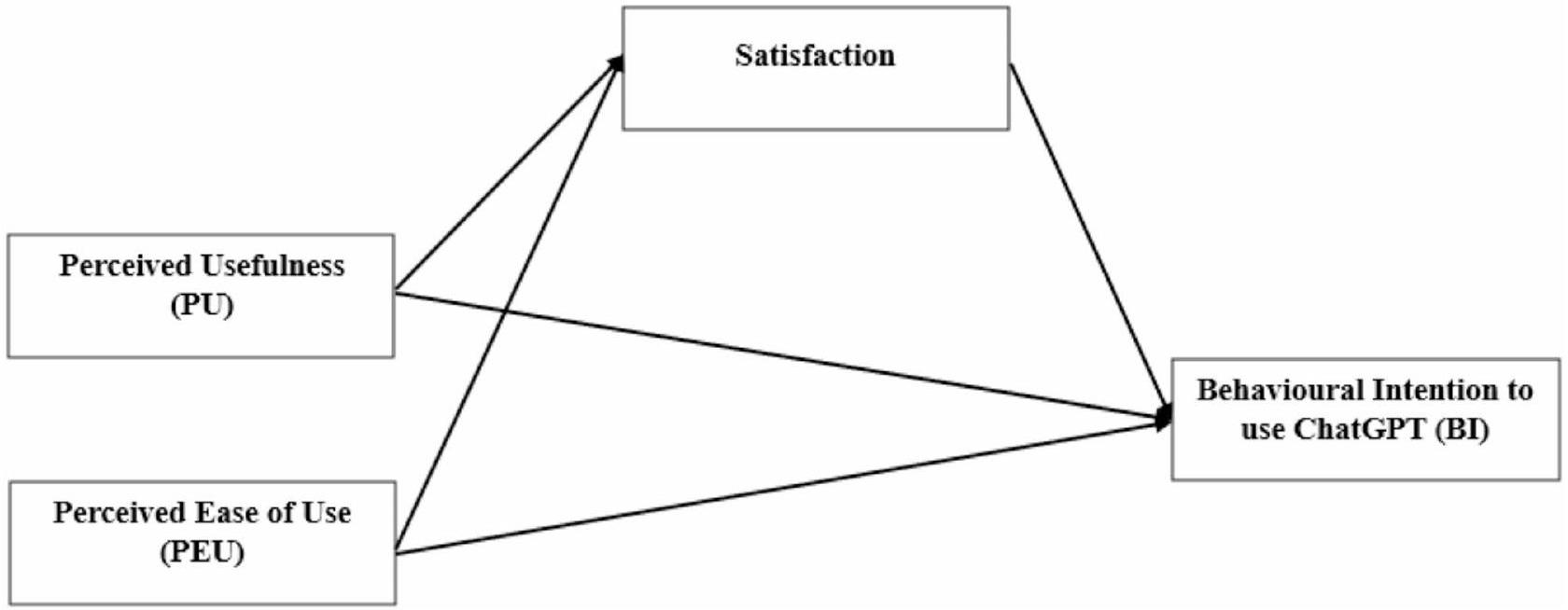
الشكل 1. النموذج المقترح.

المنهجية

تصميم البحث

استخدمت هذه الدراسة نهجًا كميًا يتضمن جمع البيانات من خلال استبيان. تعتمد الأبحاث الكمية على منهجيات تستند إلى التفكير السببي، وتقليل المتغيرات واختبار الفرضيات، واستخدام القياس، واختبار النظريات. . بالإضافة إلى ذلك، تم استخدامه لفحص علاقات البنى في النموذج المقترح.

الأدوات

تم جمع البيانات باستخدام استبيانات منظمة. ينقسم الاستبيان إلى قسمين. يتضمن القسم الأول بيانات ديموغرافية، بينما يحتوي الجزء التالي على عناصر متنوعة لضبط مفاهيم الدراسة. تدمج هذه الدراسة أربعة مفاهيم من تحقيقات سابقة. تم قياس PU باستخدام مقياس مكون من أربعة عناصر مستمدة من تم قياس PEU باستخدام مقياس مكون من أربعة عناصر تم تكييفه من تم قياس الرضا باستخدام مقياس مكون من خمسة عناصر تم تكييفه من وتم قياس الذكاء التجاري باستخدام مقياس مكون من ثلاثة عناصر مستعار من . بالإضافة إلى ذلك، تم تقديم الاستبيانات إلى الخبراء لتقييم صلاحيتها من حيث المظهر والمحتوى قبل توزيعها على الطلاب. علاوة على ذلك، تم استخدام نهج تحليل العوامل التأكيدي (CFA) لتقييم نموذج القياس والتحقق من العناصر من حيث الصلاحيات البنائية، والتقارب، والتمييز. قدمت صفحة الاستطلاع الأولية إذنًا لتوضيح أهداف الدراسة. تم قياس جميع العناصر باستخدام مقياس ليكرت المكون من 5 نقاط. علاوة على ذلك، كان الطلاب المشاركون في الدراسة طلابًا عربًا. لذلك، تم ترجمة الاستبيانات إلى العربية، وهي لغتهم الأم، لجعل الاستبيانات سهلة الفهم وأكثر وصولاً. الترجمة العكسية، وهي طريقة معروفة لضمان الدقة والتكافؤ في المواد المترجمة. تم استخدامه في عملية الترجمة. تُعرف ترجمة النص الأصلي إلى اللغة المستهدفة، وهي اللغة العربية، ثم ترجمتها مرة أخرى إلى اللغة المصدر بواسطة مترجمين مختلفين للتحقق من التناسق وحل التباينات في هذه العملية. يضمن ذلك أن النسخة تترجم من معنى العنصر الأصلي بحيث لا يكون هناك خطر من سوء تفسير النص بسبب اختلاف اللغة.

جمع البيانات

تم الحصول على البيانات من الطلاب في جامعة حائل في المملكة العربية السعودية باستخدام نماذج جوجل. خلال الفصل الدراسي الأول من 2023-2024، تم توزيع استبيان على الطلاب، مما أسفر عن 297 استجابة. تم استخدام العينة العشوائية البسيطة لجمع البيانات من المجتمع. طُلب من الطلاب ملء الاستبيانات، وكان لدى جميع المشاركين خيار الانسحاب من الدراسة إذا لم يرغبوا في التقييم.

تحليل البيانات

تم إجراء تحليل من خطوتين لتقييم البيانات. تم استخدام الحزمة الإحصائية للعلوم الاجتماعية (SPSS) الإصدار 23 لتحليل البيانات الديموغرافية للمستجيبين فيما يتعلق بالتكرار والنسب المئوية. تم استخدام منهجية SEM من خطوتين باستخدام AMOS الإصدار 26 لفحص التفاعلات بين البنى. تم إجراء CFA لتقييم قياس النموذج. بعد ذلك، تم استخدام SEM لتقييم الارتباطات وفحص الفرضيات. SEM هو أداة نمذجة إحصائية شاملة تُستخدم لتحليل البيانات متعددة المتغيرات التي تشمل تفاعلات معقدة بين المتغيرات. وفقًا لـ SEM هو مجموعة قوية من تقنيات التحليل المتعدد المتغيرات التي توضح العلاقات بين البنى باستخدام خطوتين رئيسيتين: القياس والمعادلات الهيكلية. علاوة على ذلك، تمتلك SEM القدرة الاستثنائية على استخدام عدة متغيرات مؤشرة في وقت واحد لتوضيح كل بنية داخل النموذج، مما يعزز من صحة نموذج القياس. .
تعتبر SEM أكثر ملاءمة من التقنيات الإحصائية الأخرى لأنها، كطريقة للتحليل وتفسير البيانات، قادرة على تحليل العلاقات البحثية التفاعلية والمعقدة بشكل متزامن. إنها تستوعب كل من المتغيرات التابعة والمستقلة وتقيّم كل من القياس والبنية.
جوانب النموذج المقترح. وهذا يجعل SEM مناسبًا بشكل خاص لاختبار العلاقات المفترضة بين البنى في هذه الدراسة، حيث توفر هذه التقنية تحليلًا أكثر شمولاً من أي من الطرق المستخدمة بشكل فردي.

النتائج

المعلومات الديموغرافية

أكمل 297 طالبًا جامعيًا الاستبيانات. تم تحليل ردودهم باستخدام برنامج SPSS. كما هو موضح في الجدول 1، كان هناك 168 طالبًا ذكراً. ) و 129 طالبة ( ). كان هناك 118 مشاركًا مسجلين في كلية علوم الحاسوب والهندسة ( )، تليها 66 في الفنون في العلوم ( )، 32 في إدارة الأعمال ( )، 23 في التعليم ( )، و 11 في كلية الطب بينما كان الأقل، 9، مسجلين في كلية الصحة العامة ومعلومات الصحة .

CFA

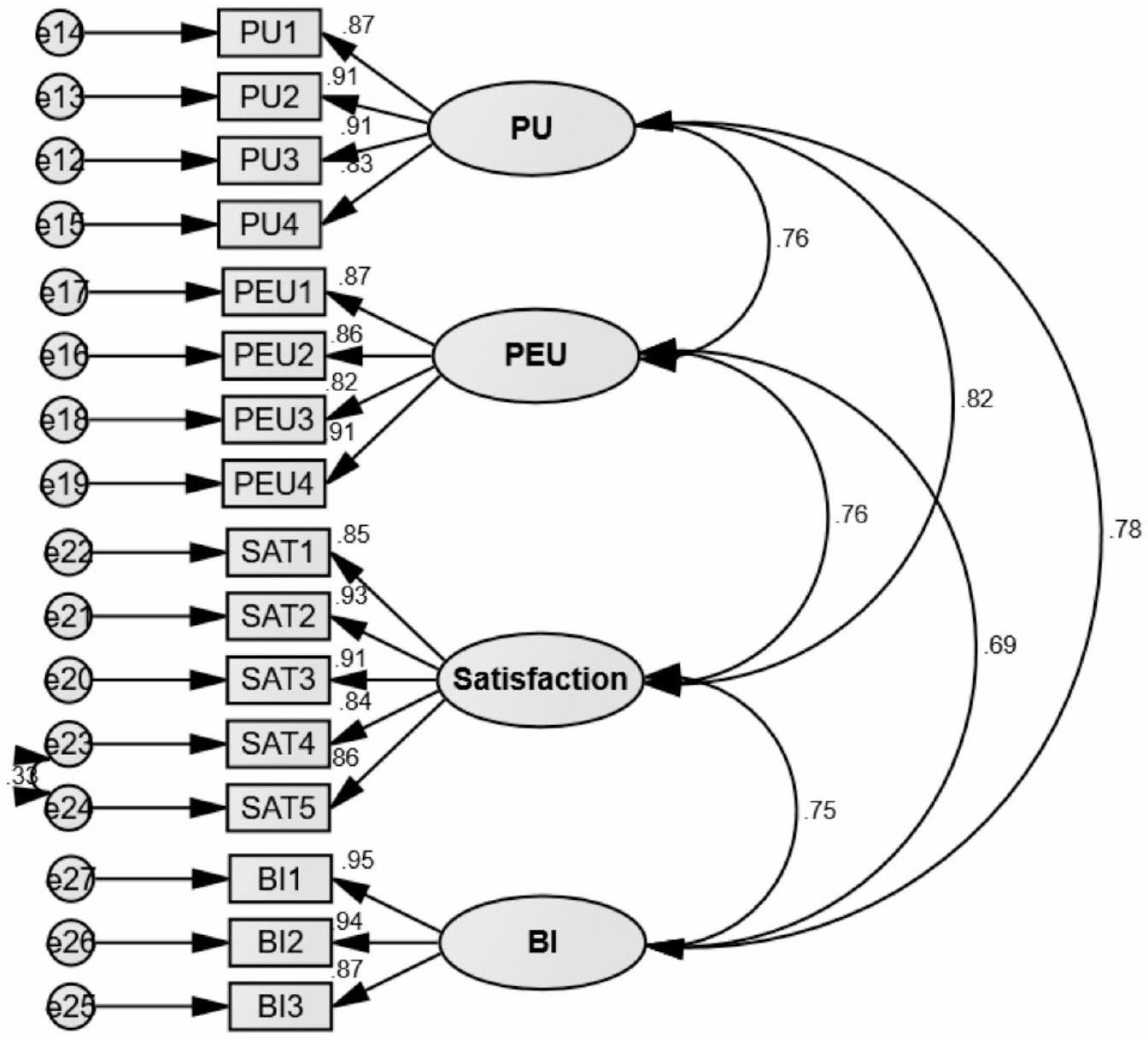
إجراء تحليل العوامل التأكيدية (CFA) ضروري لنموذج القياس لتقييم صلاحياته، بما في ذلك الصلاحية البنائية، والصلاحية التوافقية، والصلاحية التمييزية. . وفقًا لـ تتحقق صلاحية البناء عندما تكون جميع المؤشرات في النموذج لها قيم ملائمة، كما اقترحت الدراسات السابقة. الشكل 2 يوضح نتائج التحليل العاملي التأكيدي.
كما هو موضح في الشكل 2، جميع المؤشرات في النموذج توافقت مع القيم المقترحة في الأدبيات , وبالتالي، يتم تحقيق صلاحية البنى.
لذا، هناك حاجة لتقييم الصلاحية المتقاربة، والتي تتحقق عندما يكون CR و AVE وبالتالي، استنادًا إلى النتائج الموضحة في الجدول 2، تجاوزت جميع قيم CR وAVE القيم الموصى بها وحققت الصلاحية التوافقية. يتم تأكيد الصلاحية التمييزية عندما تكون جميع قيم BOLD، التي هي الجذور التربيعية لـ AVE، أعلى من القيم الأخرى، وهي ارتباطات البنى. وبالتالي، كما هو موضح في الجدول 2، تم تأكيد الصلاحية التمييزية لأن جميع قيم BOLD كانت أكبر من قيم الارتباط الأخرى. .

تقدير موحد

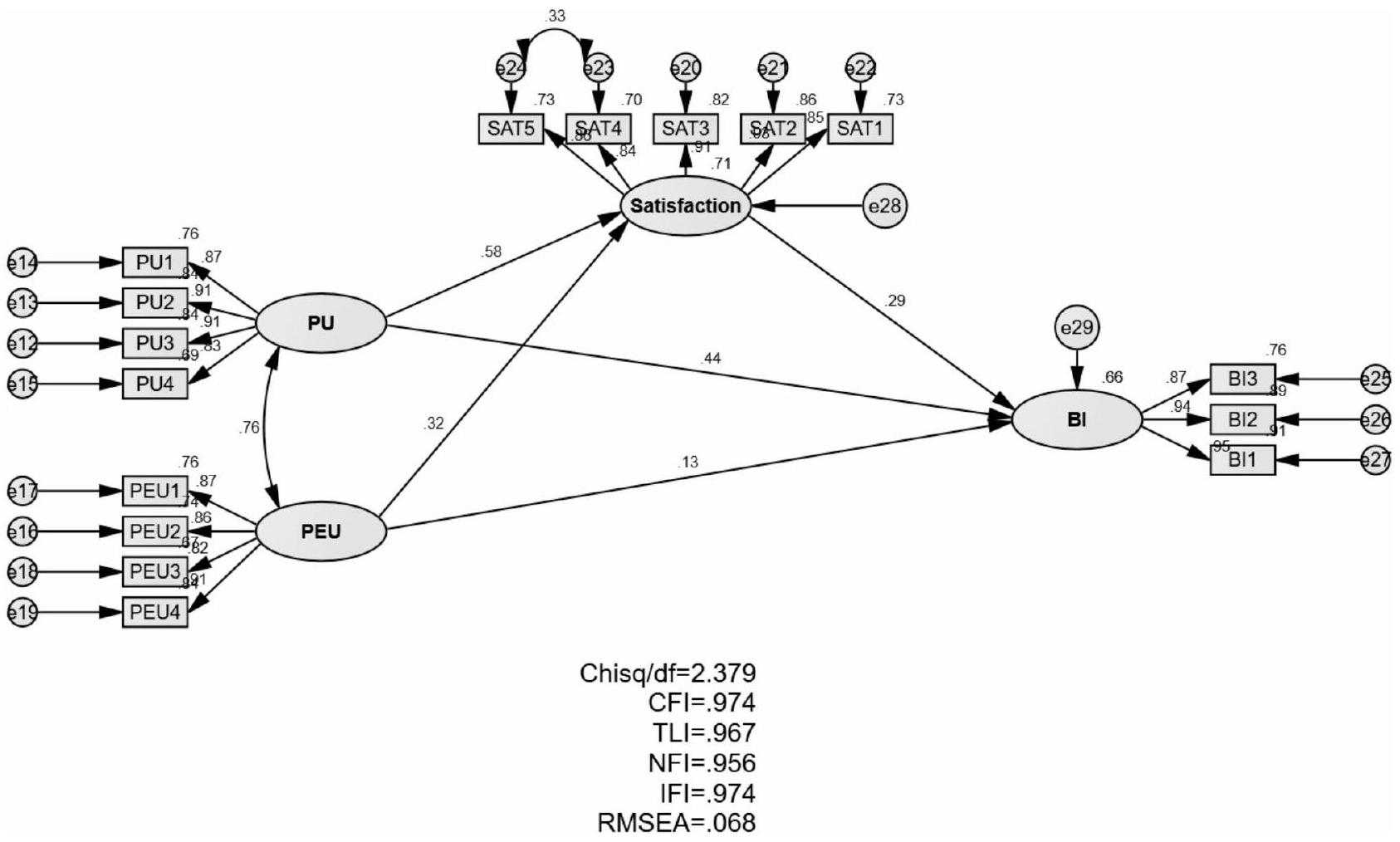
تشغيل التقدير القياسي في نمذجة المعادلات الهيكلية أمر ضروري لـ R2، ومعامل بيتا، وتحميل العوامل للعناصر في بنائها. الشكل 3 يوضح مخرجات التحليل العاملي التأكيدي للتقدير القياسي.
كما هو موضح في الشكل 3، تجاوزت جميع تحميلات العوامل للعناصر 0.60، وهو ما يعتبر قيمة مقبولة. . علاوة على ذلك، كانت المتغير التابع لاستخدام ChatGPT هو 0.66، مما يعني أن النموذج المقترح لديه قوة تفسيرية عالية. وفقًا لـ “، أ أكبر من 0.26 يؤكد أن النموذج لديه قوة تفسيرية عالية، مما يعني أن المتغير التابع يمكن تفسيره بواسطة متغيرات أخرى في النموذج المقترح.

تقدير غير موحد

تشغيل التقدير غير المعياري ضروري، حيث إنه يحسب النسبة الحرجة وبيتا الانحدار، وهما مطلوبان لتحليل العلاقات واختبار الفرضيات. يتم عرض ناتج التقديرات غير المعيارية في الشكل 4.

وزن الانحدار وتحليل التأثيرات المباشرة

أظهرت نتائج تحليل وزن الانحدار (الجدول 3) أن PU له تأثير إيجابي مباشر كبير على نية الطلاب لاستخدام ChatGPT. وبالتالي، يتم دعم H1. بالإضافة إلى ذلك، فإن PEU له تأثير غير ذي دلالة على BI. وبالتالي، تم رفض H2. علاوة على ذلك، كان لـ PU تأثير مباشر إيجابي كبير على رضا الطلاب. وبالتالي، يتم دعم H3. علاوة على ذلك، كان لـ PEU تأثير إيجابي مباشر وملحوظ على رضا الطلاب. وبالتالي، يتم دعم H4. أخيرًا، فإن الرضا له تأثير إيجابي مباشر كبير على نية الطلاب لاستخدام ChatGPT. وبذلك، يتم دعم H7.

تحليل الوساطة

هذه الدراسة قيمت الدور الوسيط للرضا في العلاقات بين الاستخدام المفيد (PU) وسهولة الاستخدام (PEU) ونية الاستخدام (BI). أظهرت النتائج أن التأثير المباشر للاستخدام المفيد (PU) على نية الاستخدام (BI) كان كبيرًا. ” والتأثير غير المباشر للقبول على نية الاستخدام من خلال وساطة الرضا كان أيضًا ذا دلالة ” ” الذي يؤكد الجزئي
تردد نسبة مئوية
جنس ذكر 168 ٥٦.٦
أنثى ١٢٩ ٤٣.٤
الكليات علوم الحاسوب والهندسة ١١٨ ٣٩.٧
الفنون 66 ٢٢.٢
علم ٣٨ 12.8
إدارة الأعمال ٣٢ 10.8
التعليم 23 ٧.٧
الطب 11 3.7
الصحة العامة ومعلومات الصحة 9 3.0
إجمالي 297 100.0
الجدول 1. المعلومات الديموغرافية.
Chisq/df=2.379 CFI=. 974
TLI=. 967
NFI=. 956
|F|=. 974
RMSEA = 0.068
الشكل 2. مخرجات CFA.
سي آر AVE MSV ماكس آر (H) الرضا PU بيو ذكاء الأعمال
الرضا 0.943 0.769 0.669 0.949 0.877
PU 0.934 0.780 0.669 0.940 0.818 0.883
بيو 0.924 0.753 0.578 0.930 0.756 0.760 0.868
ذكاء الأعمال 0.946 0.854 0.610 0.955 0.753 0.781 0.689 0.924
الجدول 2. موثوقية البناء (CR) ومتوسط التباين المستخرج (AVE) وصلاحية التمييز.
تأمل الرضا في العلاقات بين PU و BI. وبالتالي، يتم دعم H5. علاوة على ذلك، كان لـ PEU تأثير مباشر غير ذي دلالة على BI. ” وتأثير غير مباشر كبير على BI من خلال وساطة الرضا “ ” مما يؤكد أن الرضا يتوسط تمامًا العلاقات بين PEU و BI. وبالتالي، فإن H6 مدعوم. تقدم الجدول 4 تحليل نتائج الوساطة.

نقاش

هدفت هذه الدراسة إلى تقييم الدور الوسيط للرضا في العلاقة بين PU و PEU و BI عند استخدام ChatGPT لتعلم الطلاب.
تشير هذه النتائج إلى تأثير كبير لـ PU على نوايا الطلاب لاستخدام ChatGPT للتعلم، مما يؤكد الدراسات السابقة . على سبيل المثال ، أكدت أن PU هو أحد الجوانب الرئيسية لقبول التكنولوجيا بين طلاب الجامعات. كشفت دراستهم أن الطلاب كلما اعتبروا ChatGPT سهل الاستخدام
الشكل 3. التقدير القياسي.
الشكل 4. التقدير غير القياسي.
لا. الفرضيات التقدير S.E. C.R. Sig القرار
H1 0.476 0.089 5.378 *** ذو دلالة مدعوم
H2 BI<–PEU 0.148 0.077 1.921 0.055 غير ذي دلالة مرفوض
H3 الرضا<–PU 0.597 0.067 8.917 *** ذو دلالة مدعوم
H4 الرضا<–PEU 0.340 0.068 5.033 *** ذو دلالة مدعوم
H7 BI<–الرضا 0.302 0.083 3.631 *** ذو دلالة مدعوم
الجدول 3. أوزان الانحدار.
العلاقة التأثير المباشر التأثير غير المباشر الحد الأدنى الحد الأقصى -القيمة الاستنتاج
PU > Sat > BI 0.476 (0.000) ذو دلالة 0.180 0.069 0.318 0.002 وساطة جزئية
PEU > Sat > BI
0.148 (0.105)
غير ذو دلالة
0.103 0.034 0.217 0.002 وساطة كاملة
الجدول 4. تحليل الوساطة.
كلما اعتبر الطلاب ChatGPT مفيدًا في إنجاز مهامهم الأكاديمية، زادت احتمالية إدراكهم لـ ChatGPT كأداة مفيدة، وبالتالي، زادت نيتهم لاستخدامه. وبالتالي، تُعتبر التقنيات سهلة الاستخدام عمومًا أكثر فائدة، مما يزيد من نية التبني. بالمثل ، كشفت أن PU أثرت إيجابيًا على نوايا المستخدمين لتبني ChatGPT، مما زاد من التأكيد على PU للتكنولوجيا لتحقيق أهداف تعلم الطلاب. هذه النتيجة مهمة بشكل خاص فيما يتعلق بالتعلم، حيث قد يساهم الاعتراف بفائدة ChatGPT الأكاديمية في تشكيل مواقف المتعلمين تجاه استخدامه كأداة تعليمية مساعدة. كلما اعتبر الطلاب ChatGPT مفيدًا في تحقيق نتائجهم كمتعلمين، كان هناك بوضوح استعداد أكبر لدمج الأداة، مما يبرز أن تعزيز الرؤية الإيجابية لفائدة ChatGPT قد يكون فعالًا في تحفيز الطلاب على استخدام الذكاء الاصطناعي بشكل أكبر في التعليم.
علاوة على ذلك، استنادًا إلى النتائج، فإن النتيجة التي تفيد بأن PEU ليس له تأثير على BI الطلاب لتبني ChatGPT تتماشى مع الدراسات الحالية حول قبول التكنولوجيا . على سبيل المثال ، وجدت أن PEU لم يؤثر على BI الطلاب الكوريين تجاه الفصول الدراسية عبر الإنترنت. وقد لوحظ هذا الاتجاه أيضًا في مجالات دراسية أخرى غير التعليم . أثبتت أن PEU ليس له علاقة ذات دلالة مع نية تبني الخدمات المصرفية عبر الهاتف المحمول. تشير هذه النتائج المتسقة إلى أنه حتى مع زيادة سهولة الاستخدام التي تُعتبر عمومًا منطقة إيجابية، فإنه من النادر أن تعمل بمفردها كعامل محدد في نوايا تبني الناس. في حالة الطلاب، فإن قرار تبني ChatGPT يتأثر إلى حد كبير بـ PU للأداة أكثر من سهولة تشغيلها. وهذا يعني أن الطلاب يعتبرون الاستخدام العملي لـ ChatGPT لمساعدتهم في تحقيق أهدافهم الأكاديمية أكثر أهمية من مدى سهولة استخدامه.
لقد أثرت PU و PEU لـ ChatGPT بشكل إيجابي على مستويات رضا الطلاب في بيئة أكاديمية. دعمًا لهذه النتائج ، لاحظ أن الطلاب الذين اعتبروا ChatGPT مفيدًا في إنجاز أعمالهم الأكاديمية كان لديهم مستويات أعلى من الرضا المدرك والدافع في التعلم. يمكن استنتاج المزيد من الأدلة لدور PU في رضا المستخدم من من خلال نتائجهم حول روبوتات الدردشة الذكية. وفقًا لهذه الدراسات، فإن PU هو أحد العوامل الأكثر أهمية التي تؤثر على رضا المستخدم لأن الفائدة الوظيفية تلبي التوقعات المدركة للمستخدمين، وهو ما يتماشى مع الدراسة الحالية المتعلقة بـ ChatGPT. علاوة على ذلك، تفترض الأدبيات السابقة وجود علاقة بين PEU ورضا المستخدم، مما يدعم نتائج الدراسة الحالية التي حددت PEU و PU كالأبعاد الأساسية التي تؤثر على الرضا في سياق التعلم بالذكاء الاصطناعي.
كما وجدت الدراسة أن الرضا يلعب دورًا مهمًا في التأثير على BI الطلاب لاستخدام ChatGPT في تعلمهم، مما يؤكد الفرضية المفترضة لتأثير رضا المستخدم على الاستخدام المستمر للتكنولوجيا. تدعم هذه النتيجة الدراسات السابقة مثل تلك التي أجراها التي أثبتت وجود علاقة إيجابية بين مستويات الرضا في سياق التعلم الإلكتروني ونية استخدام النظام بطريقة أكثر تحديدًا واستمرارية. دعمًا لذلك، أثبتت الأبحاث ذات الصلة بواسطة أن درجة PEU و PU للطلاب من ChatGPT تؤثر مباشرة على رضاهم، وبالتالي، على استمرارهم في استخدام الأداة. كلما كان الطلاب أكثر رضا عن ChatGPT، زادت قوتهم في إدراك BI للاندماج في روتينهم التعليمي، مما يبرز الحاجة إلى مراعاة كل من تعزيز الوظائف وسهولة الإدراك في التقنيات التعليمية لتعزيز الاستخدام المستمر.
تشير نتائج تحليل الوساطة إلى أن الرضا عن التكنولوجيا يتوسط، على الأقل جزئيًا، العلاقة بين PU و BI لاستخدام ChatGPT. يتماشى هذا مع الذي ادعى أنه إذا كانت التكنولوجيا تلبي متطلبات العملاء، فإن هناك زيادة في الرضا، مما يعزز نية المستخدمين للمنتج. يبرز هذا الفهم الرضا كعامل نفسي يعزز العلاقة بين PU من قبل الطلاب على ChatGPT ورغبتهم في تبني الأداة. يشعر الطلاب بزيادة الرضا عن ChatGPT لأنه إذا وجدوا أنه مفيد في تلبية متطلباتهم الأكاديمية، فإنهم يكونون أكثر تحفيزًا للاستمرار في استخدامه. بالمثل أثبتت أن الرضا يعمل كوسيط بين PU ونية الاستخدام في أنظمة التعلم الإلكتروني، بما يتماشى مع المفهوم الذي يعزز PU إدراك الرضا وكذلك يعزز نية الاستخدام.
بالإضافة إلى ذلك، تُظهر هذه الدراسة أن الرضا يتوسط تمامًا العلاقة بين PEU و BI. يتماشى هذا مع الذي استنتج أن سهولة الاستخدام تزيد من رضا المستهلكين عن التقنيات الجديدة،
والتي بدورها يمكن أن ترفع من نية المستخدمين المستمرة فيما يتعلق بتقدير التقنيات الجديدة. أكدت هذه النتيجة دراسة لـ التي أثبتت أن الرضا المدرك يتوسط تمامًا العلاقة بين PEU و BI فيما يتعلق بتبني إدارة الموارد البشرية الإلكترونية. بالمثل كشفت أن الرضا يلعب دورًا وسيطًا في العلاقة بين PEU و BI المستخدمين عند استخدام VR في قطاع السياحة. وهذا يشير إلى أن PEU قد لا يؤثر مباشرة على BI، ولكن عندما يكون مرتفعًا، يمكن أن يعزز الرضا، مما يؤثر بدوره على BI.

الآثار النظرية

تقدم هذه الدراسة تداعيات نظرية لشرح قبول التكنولوجيا في بيئة تعليمية مع الإشارة إلى الأدوات المدعومة بالذكاء الاصطناعي مثل ChatGPT. في سياق ChatGPT، سعت هذه الدراسة إلى التحقيق في التأثير الوسيط للرضا على العلاقة بين الفائدة المتصورة (PU) وسهولة الاستخدام المتصورة (PEU) ونية السلوك (BI). بينما تم دراسة الرضا كوسيط لعلاقة السلوك-النية في نماذج قبول التكنولوجيا لمختلف التقنيات مثل البيتكوين والخدمات الذاتية، لم يتم استكشاف دوره الوسيط في استهلاك تطبيقات الذكاء الاصطناعي مثل ChatGPT في السياق التعليمي. لذلك، تسهم هذه الدراسة نظريًا من خلال اقتراح نموذج موسع يلتقط كيف يؤثر الرضا على قبول أدوات التعلم المعتمدة على الذكاء الاصطناعي بين الطلاب، مما يملأ فجوة معرفية، ويعدل نموذج قبول التكنولوجيا (TAM) في التعليم مع الأخذ في الاعتبار ChatGPT من خلال تضمين بناء الرضا من نموذج ECM. هذه هي أول دراسة تجريبية للتحقيق في الرضا كوسيط في اعتماد ChatGPT لأغراض التعلم. لذلك، يُنظر إلى الرضا كمتغير وسيط جديد يسهل التحليل النظري لاستخدام تطبيقات التعلم المعتمدة على الذكاء الاصطناعي، مما يملأ فجوة في الأدبيات ويضع الأساس لمزيد من البحث حول الأدوار الإضافية للرضا مع أدوات التعلم الرقمية المختلفة. أخيرًا، اقترحت هذه الدراسة أن الفائدة المتصورة (PU) لها تأثير أكبر من سهولة الاستخدام المتصورة (PEU) في تطبيق ChatGPT في البيئات التعليمية لأن السبب الرئيسي لاستخدام هذه الأداة من قبل الطلاب هو قدرتها على المساعدة في إكمال المهام. تدعم هذه النتيجة وجهة النظر القائمة على الأداة لنموذج قبول التكنولوجيا (TAM) وتفيد بأن النماذج النظرية المستقبلية يجب أن تركز على العناصر التي تشير إلى أهمية النتائج للقيم النفعية عند دراسة الذكاء الاصطناعي والأدوات الرقمية في السياق التعليمي.

التداعيات العملية

تشير النتائج إلى أن نية استخدام ChatGPT مدفوعة في الغالب بفائدة الطلاب المتصورة لهذه التكنولوجيا. لذلك، يجب على المؤسسات التعليمية والمطورين التركيز على تعزيز ميزات ChatGPT التي تعتبر نفعية لعمليات التعلم، مثل القدرة على المساعدة في البحث، وتعزيز الكتابة، أو المساعدة في التمارين المهيكلة. على سبيل المثال، مناقشة كيف يمكن أن يساعد ChatGPT في كتابة مراجعات الأدبيات أو وضع مخطط لمواضيع البحث ستضع ChatGPT بشكل أفضل في الأوساط الأكاديمية. نظرًا لأن العلاقة بين سهولة الاستخدام المتصورة (PEU) ونية السلوك (BI) تتوسطها الرضا، فإن الاستخدام المستمر لـ ChatGPT يعتمد على مستوى الرضا. وبالتالي، يمكن للمؤسسات التعليمية تعزيز الرضا من خلال تقديم جلسات تدريبية حول كيفية استخدام ChatGPT بشكل أفضل لفائدة الطلاب، مما يشجع على استخدامه المستمر في المستقبل. بناءً على فكرة الوساطة لتأثيرات الرضا، يُعتقد أن موارد الدعم، مثل الأسئلة الشائعة، ومقاطع الفيديو التعليمية، أو مجموعات الطلاب، يمكن أن تحسن الرضا عن النظام وبالتالي تشجع الطلاب على الانخراط في استخدامه. قد تشمل الجامعات ومزودو التكنولوجيا إرشادات داخل التطبيق أو تنظيم ندوات مباشرة للإجابة على استفسارات الطلاب. وفقًا للبحث، سيكون من المفيد دمج ChatGPT كإضافة مع مواقع أنظمة إدارة التعلم التقليدية، مثل Moodle أو Blackboard، لأنه سيكون من السهل على الطلاب الوصول إليه، مما يجعله سهل الاستخدام ومفيدًا في تصور الطلاب . يمكن أن يوفر هذا أيضًا للمعلمين فرصة لدمج ميزات الذكاء الاصطناعي بسلاسة في عملية التعلم، على سبيل المثال، استخدام ChatGPT في واجباتهم أو الحصول على مساعدة في الكتابة في نظام إدارة التعلم، مما يجعل الأداة أكثر تداخلًا ضمن الروتينات النمطية للطالب. يأتي ChatGPT مع تفاعل مستمر بفضل ملاحظاته، والإجابة على الأسئلة، وحتى إجراء اختبارات ممتعة. علاوة على ذلك، تعني توفر ChatGPT أيضًا أن العمليات المكتبية الشائعة مثل إعداد الواجبات، وتقييم الاختبارات، وإدارة، وجدولة، وكتابة التقارير ستكون أسهل أيضًا في الإدارة. وهذا، بطريقة ما، يسمح للمعلمين بالتدريس أكثر من كتابة الرسائل أو القيام بالأعمال الإدارية.

القيود ونطاق البحث المستقبلي

على الرغم من هذه النتائج، تحتوي هذه الدراسة على بعض القيود. أولاً، شملت العينة طلابًا جامعيين من جامعة واحدة؛ لذلك، لا يمكن تعميم النتائج عبر جامعات أو دول أو أنظمة تعليمية متنوعة. قد يقيّد استخدام طلاب جامعيين من جامعة واحدة كعينة أثناء إجراء هذا البحث عمومية النتائج. تقلل هذه التجانس من تنوع وجهات النظر، حيث من المحتمل أن يشارك هؤلاء الطلاب جميعًا نفس البيئات التعليمية، ونفس الموارد، ونفس السياق الثقافي. قد تحدد الخصائص المشتركة مثل هذه كيف يدرك هؤلاء المستخدمون الفائدة المتصورة (PU) وسهولة الاستخدام المتصورة (PEU) والرضا، مما قد يتسبب في ملاحظة علاقات بين هذه المتغيرات التي لا توجد. ومع ذلك، قد تكون التأثيرات المحتملة لـ PU و PEU مختلفة تمامًا في مجموعات سكانية أكثر تنوعًا (مثل الطلاب الخريجين، والطلاب بدوام جزئي، وأولئك في مؤسسات ذات بنية تحتية تكنولوجية متنوعة). علاوة على ذلك، كانت عينات الدراسة الحالية مكونة حصريًا من طلاب جامعيين من جامعة حائل في المملكة العربية السعودية. قد يحد هذا من عمومية النتائج. المشكلة في وجود مصدر واحد فقط من المشاركين هي أنه من الصعب تقديم تمثيل لمجموعات الطلاب من مناطق، وأنظمة تعليمية، وسياقات ثقافية متنوعة. ستحتوي مناطق أو جامعات مختلفة على طلاب مختلفين قد تكون لديهم تجارب مختلفة مع التكنولوجيا، وبيئة التعلم، والدعم المؤسسي، مما يؤدي إلى تصورات مختلفة عن الفائدة المتصورة (PU) وسهولة الاستخدام المتصورة (PEU) والرضا، ونية السلوك لاستخدام ChatGPT. بالإضافة إلى ذلك، قد يقيّد تجانس العينة عمومية نتائج البحث، أي أنه لا يأخذ في الاعتبار التباينات التي قد تحدث في بيئة أخرى. على سبيل المثال، قد يتم إدراك ChatGPT واعتماده بشكل مختلف من قبل الطلاب في نهج تربوي واحد أو آخر في المؤسسات التي توجد فيها موارد تكنولوجية مختلفة. بنفس الصدد، ستؤثر الاختلافات في المواقف الثقافية تجاه التكنولوجيا و
التعليم على العلاقات الموصوفة في هذه الدراسة. نتيجة لذلك، قد لا تعكس النتائج الديناميات الموجودة في مجموعات الطلاب الأكثر تنوعًا أو العالمية.
ثانيًا، ركزت هذه الدراسة على التأثيرات الوسيطة للرضا؛ ومن ثم، هناك احتمال لوجود متغيرات أخرى معتدلة أو وسيطة تؤثر على نوايا الطلاب. فيما يلي بعض السبل للبحث المستقبلي. من الضروري زيادة حجم العينة لتشمل طلابًا من دول مختلفة، يدرسون في تخصصات مختلفة، ومن أعمار مختلفة. من الممكن أيضًا إجراء تحليل عبر الثقافات قد يكشف كيف تؤثر الثقافة والتعليم على تصورات الطلاب وتفاعلاتهم مع الذكاء الاصطناعي أثناء التعلم. لتقليل الرغبة الاجتماعية والتحيزات الأخرى في الاستجابة المتعلقة بالاستبيانات الذاتية، يمكن أن تدمج الأبحاث المستقبلية طرق جمع البيانات النوعية مع الاستبيانات باستخدام المقابلات المتابعة أو مناقشات مجموعات التركيز. يمكن أن توسع الأبحاث المستقبلية النموذج من خلال دمج عوامل وسيطة ومعتدلة إضافية مثل الدافع الداخلي، والكفاءة الذاتية المدركة، والاستخدام السابق للتكنولوجيا، والثقة المدركة في استخدام الذكاء الاصطناعي. يمكن أن توفر دراسة هذه العوامل فهمًا أعمق للظروف التي يستخدم فيها الطلاب ChatGPT للتعلم، مما قد يكشف بدوره عن منظور أوسع لعملية التبني. سيكون من المفيد أيضًا للباحثين المستقبليين إجراء تحقيقات طولية، حيث من المحتمل أن تتطور تصورات الطلاب واستخدامهم لـ ChatGPT مع زيادة الألفة مع الأداة. على الرغم من أن هذه الدراسات المقترحة ضرورية، إلا أن الدراسة الحالية، التي فحصت الدور الوسيط للرضا في العلاقة بين الفائدة المدركة (PU)، وسهولة الاستخدام المدركة (PEU)، ونية السلوك لاستخدام ChatGPT في تعلم الطلاب، لا تزال جديرة بالاهتمام ومهمة. الرضا أمر حاسم ومع ذلك تم إعطاؤه اهتمامًا أقل في عملية قبول التكنولوجيا. تسهم الدراسة في فهم أكثر دقة لكيفية تأثير الرضا على استعداد الطلاب لاستخدام ChatGPT، من خلال إظهار دوره كوسيط جزئي بين PU ونية السلوك وكوسيط كامل بين PEU ونية السلوك.

الخاتمة

في الختام، تم التأكيد على أن الرضا هو وسيط رئيسي، مما يؤكد أنه إذا طور الطالب الانطباع بأن ChatGPT مفيد وسهل الاستخدام، فمن المرجح أن يستمر في استخدامه. كما أكدت الدراسة على PU و PEU في تحديد درجة رضا الطلاب عن ChatGPT ومدى استعدادهم لاستخدام الأداة في مواقف التعلم. كما كشفت الدراسة أن PU هو محدد مهم لنوايا الطلاب في استخدام ChatGPT للتعلم، بينما لا تؤثر PEU بشكل مباشر على نوايا الطلاب لاستخدام ChatGPT للتعلم، مما يشير إلى أن الفوائد المدركة لاستخدام ChatGPT أكثر أهمية للطلاب من سهولة استخدام الأداة. تمتد هذه النتائج إلى الأدبيات الحالية حول قبول التكنولوجيا لأدوات الذكاء الاصطناعي في السياق التعليمي وتبرز الحاجة إلى تحسين رضا المستخدم لتعزيز قبول هذه الأدوات. تقدم نتائج الدراسة الحالية دلالات مفيدة لتصميم أدوات الذكاء الاصطناعي في التعليم، خاصة من خلال التأكيد على أهمية قابلية استخدام الأدوات وفائدتها المدركة. يمكن أن تساعد هذه العوامل المطورين في تصميم أدوات ذكاء اصطناعي أفضل لتعزيز رضا التعلم بين الطلاب وزيادة استخدامها في أنظمة التعلم.

توفر البيانات

جميع البيانات التي تم إنشاؤها أو تحليلها خلال هذه الدراسة مدرجة في هذه المقالة المنشورة [وملفات المعلومات التكميلية الخاصة بها].
تاريخ الاستلام: 6 نوفمبر 2024؛ تاريخ القبول: 21 فبراير 2025
تم النشر عبر الإنترنت: 28 فبراير 2025

References

  1. Fütterer, T. et al. ChatGPT in education: Global reactions to AI innovations. Sci. Rep. 13 (1), 15310. https://doi.org/10.1038/s4159 8-023-42227-6 (2023).
  2. Rehman, A., Behera, R. K., Islam, M. S., Abbasi, F. A. & Imtiaz, A. Assessing the usage of ChatGPT on life satisfaction among higher education students: The moderating role of subjective health. Technol. Soc. 78, 102655. https://doi.org/10.1016/j.techsoc. 20 24.102655 (2024).
  3. Rejeb, A., Rejeb, K., Appolloni, A., Treiblmaier, H. & Iranmanesh, M. Exploring the impact of ChatGPT on education: A web mining and machine learning approach. Int. J. Manag. Educ. 22 (1), 100932. https://doi.org/10.1016/j.ijme.2024.100932 (2024).
  4. Rospigliosi, P. A. Artificial intelligence in teaching and learning: What questions should we ask of ChatGPT? Interact. Learn. Environ. 31 (1), 1-3. https://doi.org/10.1080/10494820.2023.2180191 (2023).
  5. Vázquez-Cano, E., Ramirez-Hurtado, J. M., Saez-Lopez, J. M. & Lopez-Meneses, E. ChatGPT: The brightest student in the class. Think. Skills Creat. 49 https://doi.org/10.1016/j.tsc.2023.101380 (2023).
  6. Bin-Hady, W. R. A., Al-Kadi, A., Hazaea, A. & Ali, J. K. M. Exploring the dimensions of ChatGPT in english Language learning: A global perspective. Libr. Hi Tech. ahead-of-print https://doi.org/10.1108/LHT-05-2023-0200 (2023).
  7. Barrot, J. S. ChatGPT as a Language learning tool: An emerging technology report. Technol. Knowl. Learn. 29 (2), 1151-1156 (2024).
  8. Yan, D. Impact of ChatGPT on learners in a L2 writing practicum: An exploratory investigation. Educ. Inform. Technol. 28 (11), 13943-13967. https://doi.org/10.1007/s10639-023-11742-4 (2023).
  9. Farhi, F. et al. Analyzing the students’ views, concerns, and perceived ethics about ChatGPT usage. Comput. Educ. Artif. Intell. https://doi.org/10.1016/j.caeai.2023.100180 (2023).
  10. Kasneci, E. et al. ChatGPT for good? On opportunities and challenges of large Language models for education. Learn. Individual Differ. 103, 102274. https://doi.org/10.1016/j.lindif.2023.102274 (2023).
  11. Li, Y., Sadiq, G., Qambar, G. & Zheng, P. The impact of students’ use of ChatGPT on their research skills: The mediating effects of autonomous motivation, engagement, and self-directed learning. Educ. Inform. Technol. 1-32. https://doi.org/10.1007/s10639-02 4-12981-9 (2024).
  12. Songkram, N., Chootongchai, S., Keereerat, C. & Songkram, N. Potential of ChatGPT in academic research: Exploring innovative thinking skills. Interact. Learn. Environ. 1-23. https://doi.org/10.1080/10494820.2024.2375342 (2024).
  13. Xu, Y., Goedegebuure, R. & Van der Heijden, B. Customer perception, customer satisfaction, and customer loyalty within Chinese securities business: Towards a mediation model for predicting customer behavior. J. Relat. Mark. 5 (4), 79-104. https://doi.org/10 .1300/j366v05n04_06 (2007).
  14. Almulla, M. A. Investigating influencing factors of learning satisfaction in AI ChatGPT for research: University students perspective. Heliyon. (2024). https://doi.org/10.1016/j.heliyon.2024.e32220
  15. Sarkar, S., Chauhan, S. & Khare, A. A meta-analysis of antecedents and consequences of trust in mobile commerce. Int. J. Inf. Manag. 50, 286-301. https://doi.org/10.1016/j.ijinfomgt.2019.08.008 (2020).
  16. Yang, H. E. & Wu, C. C. Effects of image interactivity technology adoption on e-shoppers’ BIs with risk as moderator. Prod. Plann. Control. 20 (4), 370-382. https://doi.org/10.1080/09537280902843755 (2009).
  17. Chen, X. et al. Factors affecting cryptocurrency adoption in digital business transactions: The mediating role of customer satisfaction. Technol. Soc. 70, 102059. https://doi.org/10.1016/j.techsoc.2022.102059 (2022).
  18. Rieke, T. & Martins, H. The relationship between motives for using a Chatbot and satisfaction with Chatbot characteristics: An exploratory study. In SHS Web of Conferences (Vol. 160, p. 01007). EDP Sciences. (2023). https://doi.org/10.1051/shsconf/2023160 01007
  19. Ngo, T. T. A., Tran, T. T., An, G. K. & Nguyen, P. T. ChatGPT for educational purposes: Investigating the impact of knowledge management factors on student satisfaction and continuous usage. IEEE Trans. Learn. Technol. https://doi.org/10.1109/TLT.2024. 3383773 (2024a).
  20. Caratiquit, K. D. & Caratiquit, L. J. C. ChatGPT as an academic support tool on the academic performance among students: The mediating role of learning motivation. J. Social Humanity Educ. 4 (1), 21-33. https://doi.org/10.35912/jshe.v4i1.1558 (2023).
  21. Chawla, U., Mohnot, R. & Singh, H. V. Unleashing the potential: An empirical study on student application of ChatGPT in education using serial mediation modeling. Educ. Inform. Technol. 1-35. https://doi.org/10.1007/s10639-024-12702-2 (2024).
  22. Kelly, S., Kaye, S. A. & Oviedo-Trespalacios, O. What factors contribute to the acceptance of artificial intelligence? A systematic review. Telemat. Inform. 77 https://doi.org/10.1016/j.tele.2022.101925 (2023).
  23. Davis, F. D. PU, PEU, and user acceptance of information technology. MIS Q. 319-340. https://doi.org/10.2307/249008 (1989).
  24. Gao, L. & Bai, X. A unified perspective on the factors influencing consumer acceptance of internet of things technology. Asia Pac. J. Mark. Logist. 26 (2), 211-231. https://doi.org/10.1108/APJML-06-2013-0061 (2014).
  25. Gangwar, H., Date, H. & Ramaswamy, R. Understanding determinants of cloud computing adoption using an integrated TAMTOE model. J. Enterp. Inform. Manag. 28 (1), 107-130. https://doi.org/10.1108/JEIM-08-2013-0065 (2015).
  26. Jang, J., Ko, Y., Shin, W. S. & Han, I. Augmented reality and virtual reality for learning: An examination using an extended technology acceptance model. IEEE Access. 9, 6798-6809. https://doi.org/10.1109/ACCESS.2020.3048708 (2021).
  27. Liu, N. & Ye, Z. Empirical research on the blockchain adoption-based on TAM. Appl. Econ. 53 (37), 4263-4275. https://doi.org/l 0.1080/00036846.2021.1898535 (2021).
  28. Wang, C., Ahmad, S. F., Ayassrah, A. Y. B. A., Awwad, E. M., Irshad, M., Ali, Y. A. & Han, H. (2023). An empirical evaluation of technology acceptance model for Artificial Intelligence in E-commerce. Heliyon 9 (8).https://doi.org/10.1016/j.heliyon.2023.e183 49.
  29. Saif, N. et al. Chat-GPT; validating technology acceptance model (TAM) in education sector via ubiquitous learning mechanism. Comput. Hum. Behav. 154, 108097. https://doi.org/10.1016/j.chb. 2023.108097 (2024).
  30. Dahri, N. A., Yahaya, N., Al-Rahmi, W. M., Aldraiweesh, A., Alturki, U., Almutairy,S. & Soomro, R. B. (2024). Extended TAM based acceptance of AI-Powered ChatGPT for supporting metacognitive self-regulated learning in education: A mixed-methods study.Heliyon 10 (8). https://doi.org/10.1016/j.heliyon.2024.e29317.
  31. Bhattacherjee, A. Understanding information systems continuance: An expectation-confirmation model. MIS Q. 351-370. https:/ /doi.org/10.2307/3250921 (2001).
  32. Sharabati, A. A. A. et al. The impact of TikTok user satisfaction on continuous intention to use the application. J. Open. Innovation: Technol. Market Complex. 8 (3). https://doi.org/10.3390/joitmc8030125 (2022).
  33. Ngo, T. T. A., An, G. K., Nguyen, P. T. & Tran, T. T. Unlocking educational potential: Exploring students’ satisfaction and sustainable engagement with ChatGPT using the ECM model. J. Inform. Technol. Educ. Res. 23 https://doi.org/10.28945/5344 (2024).
  34. Al-Sharafi, M. A. et al. Understanding the impact of knowledge management factors on the sustainable use of AI-based chatbots for educational purposes using a hybrid SEM-ANN approach. Interact. Learn. Environ. 31 (10), 7491-7510. https://doi.org/10.108 0/10494820.2022.2075014 (2023).
  35. Pereira, R. & Tam, C. Impact of enjoyment on the usage continuance intention of video-on-demand services. Inf. Manag. 58 (7). https://doi.org/10.1016/j.im.2021.103501 (2021).
  36. Ge, Y., Qi, H. & Qu, W. The factors impacting the use of navigation systems: A study based on the technology acceptance model. Transp. Res. Part. F: Traffic Psychol. Behav. 93, 106-117. https://doi.org/10.1016/j.trf.2023.01.005 (2023).
  37. Malinka, K., Peresíni, M., Firc, A., Hujnák, O. & Janus, F. On the educational impact of ChatGPT: Is artificial intelligence ready to obtain a university degree? In Proceedings of the 2023 Conference on Innovation and Technology in Computer Science Education V. 1 (pp. 47-53). (2023). https://doi.org/10.1145/3587102.3588827
  38. Romero-Rodríguez, J. M., Ramírez-Montoya, M. S., Buenestado-Fernández, M. & Lara-Lara, F. Use of ChatGPT at university as a tool for complex thinking: Students’ PU. J. New. Approach. Educ. Res. 12 (2), 323-339. https://doi.org/10.7821/naer.2023.7.1458 (2023).
  39. Strzelecki, A. To use or not to use ChatGPT in higher education? A study of students’ acceptance and use of technology. Interact. Learn. Environ. 1-14. https://doi.org/10.1080/10494820.2023.2209881 (2023).
  40. Camilleri, M. A. Factors affecting performance expectancy and intentions to use ChatGPT: Using SmartPLS to advance an information technology acceptance framework. Technol. Forecast. Soc. Chang. 201, 123247. https://doi.org/10.1016/j.techfore. 202 4.123247 (2024).
  41. Tiwari, C. K., Bhat, M. A., Khan, S. T., Subramaniam, R. & Khan, M. A. I. What drives students toward ChatGPT? An investigation of the factors influencing adoption and usage of ChatGPT. Interact. Technol. Smart Educ. 21 (3), 333-355. https://doi.org/10.1108 /ITSE-04-2023-0061 (2024).
  42. Al-Rahmi, W. M. et al. Integrating technology acceptance model with innovation diffusion theory: An empirical investigation on students’ intention to use E-learning systems. IEEE Access. 7, 26797-26809. https://doi.org/10.1109/ACCESS.2019.2899368 (2019).
  43. Na, S., Heo, S., Han, S., Shin, Y. & Roh, Y. Acceptance model of artificial intelligence (AI)-based technologies in construction firms: Applying the technology acceptance model (TAM) in combination with the technology-Organisation-Environment (TOE) framework. Buildings 12 (2), 90. https://doi.org/10.3390/buildings12020090 (2022).
  44. Kuhail, M. A., Alturki, N., Alramlawi, S. & Alhejori, K. Interacting with educational chatbots: A systematic review. Educ. Inform. Technol. 28 (1), 973-1018. https://doi.org/10.1007/s10639-022-11177-3 (2023).
  45. Alqahtani, M. A., Alamri, M. M., Sayaf, A. M. & Al-Rahmi, W. M. Exploring student satisfaction and acceptance of e-learning technologies in Saudi higher education. Front. Psychol. 13, 939336 (2022).
  46. Rahman, M. M. & Watanobe, Y. ChatGPT for education and research: Opportunities, threats, and strategies. Appl. Sci. 13 (9), 5783. https://doi.org/10.3390/app13095783 (2023).
  47. Creswell, J. W. Research design: Qualitative, quantitative, and mixed-methods approaches 2nd edn (Sage, 2003).
  48. Son, J. Back translation as a Documentation tool. Translation & interpreting. Int. J. Transl. Interpret. Res. 10 (2), 89-100. https://d oi.org/10.3316/informit. 864953916346703 (2018).
  49. Byrne, B. M. Structural equation modeling with AMOS: Basic concepts, applications, and programming (multivariate applications series). New. York: Taylor Francis Group. 396 (1), 7384 (2010).
  50. De Carvalho, J. & Chima, F. O. Applications of structural equation modeling in social sciences research. Am. Int. J. Contemp. Res. 4 (1), 6-11 (2014).
  51. Awang, P. SEM made simple: A gentle approach to learning structural equation modeling (MPWS Rich Publication, 2015).
  52. Hair, J. F. Jr, Black, W. C., Babin, B. J., Anderson, R. E. & Tatham, R. L. Multivariate data analysis (PrenticeHall, 2010).
  53. Rahlina, N. A., Awangb, Z., Afthanorhanc, A. & Aimrand, N. The Art of covariance based analysis in behaviour-based safety performance study using confirmatory factor analysis: Evidence from SMES. Measurement, 7(10). (2019).
  54. Lowry, P. B. & Gaskin, J. Partial least squares (PLS) structural equation modeling (SEM) for Building and testing behavioral causal theory: When to choose it and how to use it. IEEE Trans. Prof. Commun. 57 (2), 123-146. https://doi.org/10.1109/TPC.2014.2312 452 (2014).
  55. Sarstedt, M. et al. Progress in partial least squares structural equation modeling use in marketing research in the last decade. Psychol. Mark. 39 (5), 1035-1064. https://doi.org/10.1002/mar. 21640 (2022).
  56. Cohen, J. Statistical power for the behavioural sciences. Hilsdale. NY: Lawrence Erlbaum. 58 (1), 7-19 (1988).
  57. Almogren, A. S., Al-Rahmi, W. M. & Dahri, N. A. Exploring factors influencing the acceptance of ChatGPT in higher education: A smart education perspective. Heliyon https://doi.org/10.1016/j.heliyon.2024.e31887 (2024).
  58. Ma, J. et al. Exploring user adoption of ChatGPT: A technology acceptance model perspective. Int. J. Hum.-Comput. Interact., 1-15. (2024).
  59. Han, J. H. & Sa, H. J. Acceptance of and satisfaction with online educational classes through the technology acceptance model (TAM): The COVID-19 situation in Korea. Asia Pac. Educ. Rev. 23 (3), 403-415. https://doi.org/10.1007/s12564-021-09716-7 (2022).
  60. Widiar, G., Yuniarinto, A. & Yulianti, I. PEU’s effects on behavioral intention mediated by PU and trust. Interdiscip. Soc. Stud. 2 (4), 1829-1844. https://doi.org/10.55324/iss.v2i4.397 (2023).
  61. Xing, J. & Jiang, Q. Factors influencing user experience in AI chat systems-a satisfaction study based on factor analysis and linear regression. Kybernetes https://doi.org/10.1108/K-10-2023-2237 (2024).
  62. Kashive, N., Powale, L. & Kashive, K. Understanding user perception toward artificial intelligence (AI) enabled e-learning. Int. J. Inform. Learn. Technol. 38 (1), 1-19. https://doi.org/10.1108/IJILT-05-2020-0090 (2020).
  63. Liaw, S. S. & Huang, H. M. Perceived satisfaction, PU and interactive learning environments as predictors to self-regulation in e-learning environments. Comput. Educ. 60 (1), 14-24. https://doi.org/10.1016/j.compedu.2012.07.015 (2013).
  64. Yu, C., Yan, J. & Cai, N. ChatGPT in higher education: Factors influencing ChatGPT user satisfaction and continued use intention. In Frontiers in education. Front. Media SA. 9, 1354929. https://doi.org/10.3389/feduc.2024.1354929 (2024).
  65. Mohammadi, H. Social and individual antecedents of m-learning adoption in Iran. Comput. Hum. Behav. 49, 191-207. https://do i.org/10.1016/j.chb.2015.03.006 (2015).
  66. Arunachalam, T. An investigation on the role of PEU perceived use and self-efficacy in determining continuous usage intention towards an e-learning system. Online J. Distance Educ. e-Learn. 7 (4), 268-276 (2019).
  67. Peng, M. Y. P. & Yan, X. Exploring the influence of determinants on behavior intention to use of multiple media kiosks through technology readiness and acceptance model. Front. Psychol. 13, 852394. https://doi.org/10.3389/fpsyg. 2022.852394 (2022).
  68. Rawashdeh, A. M., Elayan, M. B., Alhyasat, W. & Shamout, M. D. Electronic human resources management PU, PEU and continuance usage intention: The mediating role of user satisfaction in Jordanian hotels sector. Int. J. Qual. Res. 15 (2), 679 (2021).
  69. Qazi, S. et al. AI-Driven learning management systems: Modern developments, challenges and future trends during the age of ChatGPT. Computers Mater. Continua. 80 (2). https://doi.org/10.32604/cmc. 2024.048893 (2024).
  70. De Winter, J. C., Dodou, D. & Stienen, A. H. ChatGPT in education: Empowering educators through methods for recognition and assessment. In Informatics (Vol. 10, No. 4, p. 87). MDPI. (2023). https://doi.org/10.3390/informatics10040087

مساهمات المؤلفين

حلل الدكتور سلطان البيانات، كتب المسودة الأولى، التعديلات، التمويل. كتابة المقدمة ومناقشة النتائج. ركز إلدهو بابو على المقدمة، جمع البيانات، كتابة المقدمة ومراجعة الأدبيات.

الإعلانات

المصالح المتنافسة

يعلن المؤلفون عدم وجود مصالح متنافسة.
تم الحصول على الموافقة المستنيرة كتابيًا من جميع المشاركين في هذه التحقيق.

معلومات إضافية

المعلومات التكميلية النسخة عبر الإنترنت تحتوي على مواد تكميلية متاحة على https://doi.org/1 .
يجب توجيه المراسلات وطلبات المواد إلى E.B.
معلومات إعادة الطبع والتصاريح متاحة على www.nature.com/reprints.
ملاحظة الناشر تظل Springer Nature محايدة فيما يتعلق بالمطالبات القضائية في الخرائط المنشورة والانتماءات المؤسسية.
الوصول المفتوح هذه المقالة مرخصة بموجب رخصة المشاع الإبداعي للاستخدام غير التجاري، والتي تسمح بأي استخدام غير تجاري، ومشاركة، وتوزيع، وإعادة إنتاج في أي وسيلة أو صيغة، طالما أنك تعطي الائتمان المناسب للمؤلفين الأصليين والمصدر، وتوفر رابطًا لرخصة المشاع الإبداعي، وتوضح إذا قمت بتعديل المادة المرخصة. ليس لديك إذن بموجب هذه الرخصة لمشاركة المواد المعدلة المشتقة من هذه المقالة أو أجزاء منها. الصور أو المواد الأخرى من طرف ثالث في هذه المقالة مشمولة في رخصة المشاع الإبداعي للمقالة، ما لم يُشار إلى خلاف ذلك في سطر ائتمان للمادة. إذا لم تكن المادة مشمولة في رخصة المشاع الإبداعي للمقالة واستخدامك المقصود غير مسموح به بموجب اللوائح القانونية أو يتجاوز الاستخدام المسموح به، ستحتاج إلى الحصول على إذن مباشرة من صاحب حقوق الطبع والنشر. لعرض نسخة من هذه الرخصة، قم بزيارة http://creativecommo ns.org/licenses/by-nc-nd/4.0/.
© المؤلفون 2025

  1. قسم تكنولوجيا التعليم، كلية التربية، جامعة حائل، جامعة حائل، حائل، المملكة العربية السعودية. قسم التجارة، كلية لويولا، تشيناي، الهند. قسم دراسات الإدارة، المعهد الهندي للتكنولوجيا، مدراس، تشيناي، الهند. البريد الإلكتروني: eldhob5101@gmail.com

Journal: Scientific Reports, Volume: 15, Issue: 1
DOI: https://doi.org/10.1038/s41598-025-91634-4
PMID: https://pubmed.ncbi.nlm.nih.gov/40021737
Publication Date: 2025-02-28

scientific reports

OPEN

The mediating role of satisfaction in the relationship between perceived usefulness, perceived ease of use and students’ behavioural intention to use ChatGPT

Sultan Hammad Alshammari & Eldho Babu

Abstract

ChatGPT is a highly sophisticated AI language model that can revolutionize students’ learning experiences by providing much-needed assistance and information. Given the growing trend of educational institutions integrating AI technologies into their teaching and learning processes, it is crucial to understand the factors that would lead to the acceptance and use of these technologies by students. Using a technology acceptance model, this study investigated the mediating role of satisfaction in the relationship between PU, PEU, and behavioral intention to use ChatGPT for student learning. This study used a quantitative research approach, and data were gathered from 297 students using a structured questionnaire. The analysis was conducted using structural equation modelling (SEM) in AMOS Version 26. The results indicated that PU and ease PEU significantly influenced student satisfaction. PU significantly influenced behavioral intentions to use ChatGPT. However, PEU had no direct impact on students’ behavioral intention to use ChatGPT. Satisfaction had a significant influence on students’ behavioral intention to use ChatGPT. Moreover, satisfaction was confirmed as a significant partial mediator between PU and behavioral intention, as well as a full mediator of the relationship between PEU and behavioral intention. These findings underscore the need to make ChatGPT more useful in academic environments to facilitate increased engagement among students and achieve better learning outcomes. This study enhances the literature on technology acceptance in the context of education, particularly regarding the application of AI tools in learning spaces.

Keywords ChatGPT, TAM, ECM, Satisfaction, Behavioural intention
The launch and swift adoption of ChatGPT captured the attention of students and educators globally. In educational context, some educators are positive about its synergistic effects on learning, while others share ambiguity about fears that its existence may hinder educational benefits or spread misinformation . Despite these apprehensions, ChatGPT advances digital convenience, communicational efficiency, and backs content creation, making it a powerful enabling technology in educational field . Therefore, ChatGPT has been defined as a large model aimed at working as a universal conversational assistant responsible for answering as many questions as possible to help students learn . By posing questions and taking into consideration the responses, which are activities that are at the core of interactive learning, ChatGPT is designed to enhance interactions, which in turn stimulates the utilisation of ChatGPT for learning objectives. When opposed to using a search engine, the experience created by ChatGPT is distinct because it encourages follow-up queries through continuous dialogue . Moreover, ChatGPT has been proven to perform exceptionally well in natural language-related activities, including translations, answering queries, summarizing, writing meaningful essays, and coding on computers . Thus, ChatGPT assists as a beneficial source for language input in learning, offering students access to learning resources, and allowing them to enhance and practice their skills at their own pace with ease of use .
Unlike its predecessors, ChatGPT’s smart and fast response to questions put forward in multiple languages has enticed researchers and the public owing to its fast text generation . ChatGPT is useful for students during their learning processes. There are numerous application domains of ChatGPT for students, where it can be used to generate good-quality text material and essays, chat-bot, decrypting languages, question-answering systems, and programming code assistance etc . Furthermore, the software could be utilised to generate outlines and summaries of texts, which is helpful for students to comprehend the core ideas and structure points for writing. Additionally, it may help develop their skills in research by offering students with knowledges and sources on a specific topic, as well as highlighting unexplored aspects and modern emerging topics so that they can improve their understanding and critical thinking about the content . ChatGPT has potential use in education and research in facilitating language learning, group and remote learning especially for the disabled learners . Moreover, ChatGPT has been used by students for generating ideas for research, synthesising the review of literature, fine tuning the methodological aspects, as well as interpreting the results of data analysis . While developing large potential for enhancing positive learning outcomes among students, ChatGPT’s implementation poses the challenge of reaching out to the student population. This raises the question of what determines students’ intention to use ChatGPT.
Satisfaction refers to the difference between the evaluation of perceived performance of a service or product and the initial assessment by the consumer . Academic settings are sensitive to satisfaction, and it is vital to understand which factors related to learning satisfaction play a role, especially for students using ChatGPT for research . Consumer satisfaction likely leads to consumer loyalty; hence, consumers are more likely to continue using a particular technological product for several hours . In previous studies on technology acceptance, satisfaction played a mediating role. For example , investigated the impact of adoption by measuring the moderating ability of waiting time satisfaction and satisfaction with self-service technologies. Moreover , assessed the factors affecting bitcoin use for transactions of digital business and the moderator effect of satisfaction. In the context of ChatGPT, satisfaction has been conceptualized and measured in prior research. Rieke and Martins observed that satisfaction of users significantly affects intention to utilise chatbots in the future. Ngo et al. noted that students acknowledged the utility of ChatGPT for their learning, which resulted in increased satisfaction and a greater likelihood of continued usage.
Although previous studies have examined several mediators of ChatGPTs’ educational use, they have not explored satisfaction as a mediator. Caratiquit and Caratiquit examined the mediating effect of motivation of learning on the relationship between ChatGPT, an academic assistance tool, and students’ academic achievement. Furthermore , investigated how ChatGPT-integrated higher education affects autonomous motivation of students, engagement, and self-directed, and how these characteristics mediate the relationship between ChatGPT use and research capabilities. In contrast , used students’ perceptions of amplification, creative thinking, and ethics as mediators to understand how ChatGPT is used in the educational environment.
However, extant studies have not examined satisfaction as a mediator between PU, PEU, and behavioral intention to utilise ChatGPT. A little is known regarding the mediating role of satisfaction among these factors. Investigating satisfaction as a mediator may yield significant insights into the translation of ChatGPT’s perceived advantages into continued usage, hence enhancing the current body of knowledge. Thus, this study bridges this gap by assessing the mediating role of satisfaction in the relationship between PU, PEU, and the behavioral intention to use ChatGPT for student learning. This is the first study pertaining to ChatGPT adoption in learning in which satisfaction is placed as a mediator.
However, prior research has not focused on satisfaction as a mediating variable between PU, PEU and behavioral intention to use ChatGPT technology. There is still much that is unknown about exactly how satisfaction impacts these aspects and how the perceived values of ChatGPT are translated into continued use in learning environments. Examining satisfaction as a mediator can also offer valuable findings to shed light on perceived benefits derived from ChatGPT that will help promote use, which enhances the knowledge in the current literature regarding the adoption of educational technology. This study seeks to fill this gap by evaluating the moderating role of satisfaction between PU, PEU, and the students’ behavioral intention to utilize ChatGPT for learning. In this way, it becomes the first study that sets satisfaction as the main mediator in the context of ChatGPT, providing new information on how it can benefit learning contexts.

Literature review

Technology acceptance model (TAM)

According to the TAM, its two primary measurement constructs, PU and PEU, are influenced by external contextual factors and impact on consumer intentions toward embracing new technology . PU captures the level to which a system’s user perceives a given technology as useful regarding everyday activities, while PEU measures the user’s perception of the ease of using a particular technology . The TAM framework is well grounded in theory and has been employed to explain consumers’ acceptance of establishing technologies such as the IoT cloud computing , augmented reality and virtual reality , blockchain and artificial intelligence . In addition, current studies exploring the utilisation of ChatGPT have used constructs derived from the TAM framework to explain students’ adoption behaviors toward ChatGPT in learning. For example , attempted to develop a relationship between students’ stress, behavioral concerns, and anxiety associated to academic duties and their technological adoption through the TAM with the help of Chat-GPT. Moreover , included 300 preservice educators in a ChatGPT-based scenario learning activity, and TAM was used to identify the participants’ attitudes regarding ChatGPT, while the moderating role of metacognitive self-regulated learning was considered for usage intention.

Expectation-confirmation model (ECM)

The ECM is a well-known theoretical model developed by , who argued that satisfaction of user with a technology increases with the extent of the fit between the user’s expectations of information systems usage and the performance encountered by him or her. According to the ECM, user satisfaction is determined by the confirmation and technology’s usefulness . This indicates that users often use certain technology if their expectations are met . Few studies on the utilisation of AI-Chatbots in education have employed ECM. Evaluating knowledge management parameters on the continuous utilisation of ChatGPT in educational contexts and exploring students’ satisfaction with its use in learning through the ECM model were also explored by . Moreover , developed a theoretical model conjoining elements from the ECM with variables of knowledge management to understand sustainable utilisation of chatbots in education. This study adopted element satisfaction from the ECM. Expectation confirmation has been proposed as a key contributor to satisfaction .
Through the integration of TAM and ECM, this study aims to examine how PU, PEU, and satisfaction impact the behavioral intention of the students to use ChatGPT in learning hence developing a comprehensive framework that can assess adoption behavior. This integration not only helps fill the gap between the perceived need/expectations of the user and the actual usage of the application but also draws focus on how satisfaction is instrumental in bridging the perceived benefits to continued usage of ChatGPT for educational purposes.

Hypotheses development

Perceived usefulness

PU is acknowledged as an important component within the TAM, profoundly influencing an individual’s viewpoint on the adoption of technology . In the context of learning, students are likely to regard the use of Chat-GPT more favorably if they perceive it as augmenting their capacity to accomplish academic tasks, as stated by , thereby facilitating an enhanced learning experience. Furthermore, students are more inclined to accept and continue to employ tools such as ChatGPT, which they consider beneficial for attaining their academic objectives . Additionally , found that learners who have a positive perception of the usefulness of ChatGPT are more likely to be motivated in their efforts to learn and feel a greater sense of satisfaction with the results of their learning, resulting in an intention to use it. The BI denotes an individual’s perceived probability of or intention to use a specific technology. In this study, BI corresponds to the extent to which students plan to use ChatGPT for learning purposes . The TAM asserts that users’ views of a technology’s usefulness and ease of use can affect their BI toward using them . Thus, the following hypotheses are proposed:
H1- PU has a significant influence on students’ BI.
H3- PU has a significant influence on student satisfaction.

Perceived ease of use

According to , PEU is strongly linked to both current and future usage, which shows how easy and useful it is to use ChatGPT . defined PEU as a user’s impression of how easy and simple it is to interact with ChatGPT. Technology solutions that students perceive as easy to use, such as ChatGPT, are more likely to be used and to interact with . The PEU of ChatGPT among students was investigated by . Their findings revealed that the students’ perceptions of ChatGPT’s PEU significantly influenced their attitudes and intentions regarding its use for academic reasons. Thus, the following hypotheses are posited:
H2- PEU has a significant influence on students’ BI.
H4- PEU has a significant influence on student satisfaction.

Satisfaction

User satisfaction with ChatGPT can be defined as overall satisfaction generated through numerous interactions with the AI chatbot . noted an increased tendency for consumers who obtain satisfaction with a technology to remain loyal when using that technology in the future. The level of satisfaction university students’ experiences in using ChatGPT for learning is captured by their satisfaction with learning . It incorporates the roles of several factors that affect learner welfare. This construct also reveals the average level of satisfaction that university students have with their research-based learning with the help of ChatGPT , which simplifies the learning process. Furthermore, ChatGPT can help improve education, career progression, and happiness quotient by providing training programs that are best suited to each learner’s needs and specific demands . Since students have been offered several advantages by using ChatGPT, it is shown to meet students’ educational needs thereby making them feel satisfied and encouraged to continue utilising in future , better personalization of feedback and conversation, enhanced accessibility, better lesson planning, better integration of assessment and infusing new strategies in teaching and learning .
Thus, the following hypotheses are formulated.
H5 – Satisfaction mediates the relationship between PU and students’ BI.
H6 – Satisfaction mediates the relationship between PEU and students’ BI.
H7 – Satisfaction has a significant influence on students’ BI.
The proposed model (Fig. 1) is outlined below:
Fig. 1. Proposed model.

Methodology

Research design

This study employed a quantitative approach involving the collection of data through a survey. Quantitative research employs methodologies grounded in causal reasoning, the reduction of variables and testing hypotheses, the utilization of measurement, and the testing of theories . Additionally, it was used to examine the relationships of constructs in the proposed model.

Instruments

Data were collected using structured questionnaires. The questionnaire is divided into two sections. The initial section comprises demographic data, whereas the subsequent segment features various items to calibrate the study’s constructs. This study integrates four constructs from previous investigations. PU was measured using a four-item scale derived from . The PEU was measured using a four-item scale adapted from . Satisfaction was measured using a five-item scale adapted from and BI was measured using a three-item scale borrowed from . Additionally, the questionnaires were submitted to experts to evaluate their face and content validity before being distributed to the students. Furthermore, the Confirmatory Factor Analysis (CFA) approach was employed to assess the measurement model and verify the items for construct, convergent, and discriminant validities. The initial survey page provided permission to outline the study’s goals. All items were measured using a 5 -point Likert scale. Moreover, the students participating in the study were Arab students. Therefore the questionnaires were translated into Arabic, which is their first language, to make the questionnaires as easy to understand and more accessible. Back translation, a well-known method for assuring accuracy and equivalence in translated materials , was used in the translation process. The translation of the original text into the target language, which is the Arabic Language, and then translated back into the source language by the different translators to check consistency, and solve discrepancies is called in this process. This ensures that the version translates from the original item’s meaning so that there is no risk of misinterpretation of the text due to a difference in language.

Data collection

Data were obtained from students at the University of Ha’il in Saudi Arabia using Google Forms. During the first semester of 2023-2024, a survey was distributed to students, which yielded 297 responses. Simple random sampling was used to gather data from the population. Students were asked to complete questionnaires, and all participants had the option to withdraw from the study if they did not wish to be evaluated.

Data analysis

A two-step analysis was performed to evaluate the data. Statistical Package for the Social Sciences (SPSS) version 23 was used to analyse the demographic data of the respondents regarding frequency and percentages. A two-step in SEM methodology using AMOS version 26 was utilised to examine the interactions among the constructs. CFA was conducted to evaluate the model measurement. Thereafter, SEM was used to assess the correlations and examine the hypotheses. SEM is an extensive statistical modelling instrument used to analyze multivariate data that encompasses intricate interactions between variables. According to , SEM is a robust array of multivariate analysis techniques that delineates the relationships between constructs utilising two primary steps: measurement and structural equations. Furthermore, SEM possesses the exceptional capability to concurrently employ several indicator variables to delineate each construct within the model, thereby enhancing the validity of the measurement model .
SEM is more appropriate than other statistical techniques because, as a method of analysis and data interpretation, it is capable of simultaneously analyzing various interactive and complex research relationships. It accommodates both dependent and independent variables and assesses both the measurement and structural
aspects of the proposed model. This makes SEM particularly suitable for testing the hypothesized relationships between constructs in this study, as the technique provides a more comprehensive analysis than any of the methods used individually.

Results

Demographic information

A total of 297 undergraduate students completed the questionnaires. Their responses were analyzed using SPSS software. As shown in Table 1, there were 168 male students ( ) and 129 female students ( ). There were 118 participants enrolled in the college of computer science and engineering ( ), followed by 66 in arts in science ( ), 32 in business administration ( ), 23 in education ( ), and 11 in college of medicine , while the least, 9 , were enrolled in public health and health informatic college .

CFA

Conducting a CFA is essential for measurement model to assess its validities, including construct, convergent, and discriminant validity . According to , construct validity is met when all indices in the model have fit values, as suggested in prior studies. Figure 2 shows the CFA results.
As shown in Fig. 2, all indices in the model met the suggested values in literature ( , . Thus, constructs validity is achieved.
Thus, there is a need to assess convergent validity, which is achieved when CR and AVE Thus, based on the results shown in Table 2, all the CR and AVE values exceeded the recommended values and achieved convergent validity. Discriminant validity is confirmed when all BOLD values, which are the square roots of AVE, are higher than the other values, which are the constructs’ correlations. Thus, as shown in Table 2, discriminant validity was confirmed because all BOLD values were greater than the other correlation values .

Standardized estimate

Running standardized estimate in SEM is essential for R2, coefficient beta and the items factor loading intro its constructs. Figure 3 shows the CFA output of the standardized estimate.
As shown in Fig. 3, all factor loadings of the items exceeded 0.60 which is considered an acceptable value . Furthermore, the the dependent variable of the BI to use ChatGPT was 0.66 , which means that the proposed model has high explanatory power. According to , an greater than 0.26 confirms that the model has a high explanatory power, which means that the dependent variable can be explained by other constructs in the proposed model.

Unstandardized estimate

Running the unstandardized estimate is necessary, as it calculates the critical ratio and the regression beta, which are needed for analysing relationships and testing the hypothesis. The output of the unstandardized estimates is shown in Fig. 4.

Regression weight and analysis of direct effects

The findings of the regression weight analysis (Table 3) showed that PU has a significant direct positive effect on students’ BI to use ChatGPT ” “. Thus, H1 is supported. In addition, PEU has insignificant effect on BI ” “. Thus, H2 is rejected. Furthermore, PU had a significant direct positive influence on student satisfaction ” “. Thus, H3 is supported. Moreover, PEU had a significant and direct positive influence on student satisfaction ” “. Thus, H4 is supported. Finally, satisfaction has a significant direct positive influence on students’ BI to use ChatGPT ” “. Thus, H7 is supported.

Mediation analysis

This study assessed the mediating role of satisfaction in the relationships between PU, PEU, and BI. The results revealed that the direct effect of PU on BI was significant ” ” and the indirect effect of PU on BI through the mediation of satisfaction was also significant ” ” which confirms the partial
Frequency Percent
Gender Male 168 56.6
Female 129 43.4
Colleges Computer Science and Engineering 118 39.7
Arts 66 22.2
Science 38 12.8
Business Administration 32 10.8
Education 23 7.7
Medicine 11 3.7
Public Health and Health Informatics 9 3.0
Total 297 100.0
Table 1. Demographic information.
Chisq/df=2.379 CFI=. 974
TLI=. 967
NFI=. 956
|F|=. 974
RMSEA=. 068
Fig. 2. CFA output.
CR AVE MSV MaxR(H) Satisfaction PU PEU BI
Satisfaction 0.943 0.769 0.669 0.949 0.877
PU 0.934 0.780 0.669 0.940 0.818 0.883
PEU 0.924 0.753 0.578 0.930 0.756 0.760 0.868
BI 0.946 0.854 0.610 0.955 0.753 0.781 0.689 0.924
Table 2. CR and AVE and discriminant validity.
meditation of satisfaction on the relationships between PU and BI. Thus, H5 is supported. Furthermore, PEU had insignificant direct effect on BI ” ” and indirect significant effect on BI through the mediation of satisfaction ” ” which confirms that satisfaction fully mediates the relationships between PEU and BI. Thus, H6 is supported. Table 4 presents the analysis of mediation findings.

Discussion

This study aimed to assess the mediating role of satisfaction in the relationship between PU, PEU, and BI when using ChatGPT for student learning.
These findings indicate a significant influence of PU on students’ intentions to use ChatGPT for learning, confirming previous studies . For instance , emphasized that PU is one of the key aspects of technology acceptance among university students. Their study revealed that the more students considered ChatGPT easy
Fig. 3. Standardized estimate.
Fig. 4. Unstandardized estimate.
No. Hypotheses Estimate S.E. C.R. Sig Decision
H1 0.476 0.089 5.378 *** Significant Supported
H2 BI<–PEU 0.148 0.077 1.921 0.055 Insignificant Rejected
H3 Satisfaction<–PU 0.597 0.067 8.917 *** Significant Supported
H4 Satisfaction<–PEU 0.340 0.068 5.033 *** Significant Supported
H7 BI<–Satisfaction 0.302 0.083 3.631 *** Significant Supported
Table 3. Regression weights.
Relationship Direct Effect Indirect Effect Lower Bound Upper Bound -value Conclusion
PU > Sat > BI 0.476 (0.000) Sig 0.180 0.069 0.318 0.002 Partial Mediation
PEU > Sat > BI
0.148 (0.105)
Not Sig
0.103 0.034 0.217 0.002 Full mediation
Table 4. Mediation analysis.
to use, the more likely they were to perceive ChatGPT as useful for their academic tasks and, therefore, have a higher intention to use the same. Thus, user-friendly technologies are generally viewed as more useful, thereby increasing the adoption intention. Similarly , revealed that PU positively affected user intentions to adopt ChatGPT, intensifying the emphasis placed on the technology’s PU to achieve students’ learning objectives. This finding is especially important in relation to learning, as the recognition of ChatGPT’s academic utility may contribute to learners’ attitudes toward its use as an auxiliary educational aid. Whenever students consider ChatGPT helpful in reaching their outcomes as learners, there is evidently more willingness to incorporate the tool, stressing that promoting the utility’s positive view of ChatGPT could be effective in motivating students for further interdisciplinary AI use in education.
Moreover, based on the results, the finding that PEU has no effect on students’ BI to adopt ChatGPT conforms to existing studies on technology acceptance . For instance , found that PEU did not affect Korean students’ BI toward online classes. This trend has also been observed in fields of study other than education . proved that PEU has no significant relationship with mobile-banking adoption intention. Such consistent results imply that even as increased ease of use is generally perceived as a positive area, it is rather rare for it to act alone as a determining factor in people’s adoption intentions. In the case of students, the decision to adopt ChatGPT is largely informed by the PU of the tool over its ease of operation. This implies that students consider the practical use of ChatGPT to help them fulfill their academic goals more important than how easy it is to use.
The PU and PEU of ChatGPT positively influenced student satisfaction levels in an academic environment. In support of these findings , noted that students who perceived ChatGPT as helpful in accomplishing their academic work had higher levels of perceived satisfaction and motivation in learning. More evidence for the role of PU in user satisfaction can be drawn from through their findings on AI chatbots. According to these studies, PU is the most significant factors which affect user satisfaction because the functional utility meets the perceived expectation of the users, which is consistent with the current study concerning ChatGPT. Furthermore, past literature posits a relationship between PEU and user satisfaction, which substantiates the findings of the current study . identified PEU and PU as the basic dimensions that impact satisfaction in AI learning context.
The study also found that satisfaction plays a significant role in affecting students’ BI to use ChatGPT in their learning, confirming the postulated hypothesis of the influence of user satisfaction on the continued use of the technology. This finding supports previous studies like that of who established a positive link between satisfaction levels in the context of e-learning and the intention to utilise the system in a more definite and continuous manner. In support of this, related research by proved that the degree of students’ PEU and PU of ChatGPT directly impacts their satisfaction and, therefore, their continued use of the tool. The more satisfied the students were with ChatGPT, the stronger they perceived BIs to integrate into their learning routines, thus underlining the need to consider both the enhancement of functionality and perceived ease in educational technologies to foster continuous use.
The results of the mediation analysis indicate that satisfaction with technology mediates, at least partially, the relationship between PU and BI to use ChatGPT. This is in line with , who claimed that if a technology meets customer requirements, there is increased satisfaction, which boosts the intention of users for the product. This understanding highlights satisfaction as a psychological factor that enhances the relationship between PU by students on ChatGPT and their willingness to adopt the tool. Students are increasingly satisfied with ChatGPT because, if they find it helpful in fulfilling their academic requirements, they are more motivated to continue using it. Similarly , proved that satisfaction acts as a mediator between PU and usage intention in e-learning systems, consistent with the concept that PU enhances the perception of satisfaction as well as enhances usage intention.
In addition, this study shows that satisfaction fully mediated the relationship between PEU and BI. This is in agreement with , who deduced that ease of use increases consumer satisfaction with new technologies,
which, in turn, can raise users’ continuing intention concerning the appreciation of new technologies. This result confirmed a study of who proved that perceived satisfaction fully mediates the relationship between PEU and BI concerning the adoption of electronic human resource management. Similarly , revealed that satisfaction plays a mediating role in the relationship between PEU and users’ BI when using VR in the tourism sector. This indicates that PEU may not directly impact BI, but when it is high, it could enhance satisfaction, which, in turn, affects BI.

Theoretical implications

This study offers theoretical implications for explaining technology acceptance in an educational setting with reference to AI-enabled tools such as ChatGPT. In ChatGPT context, this study sought to investigate the mediating influence of satisfaction on the relationship between PU, PEU, and BI. While satisfaction has been studied as a mediator of the attitude-intention behavior relationship in technology acceptance models for various technologies such as Bitcoin and self-service, its mediating role in the consumption of AI applications such as ChatGPT in educational context has not been explored. Therefore, this study contributes theoretically by proposing an extended model that captures how satisfaction impacts the acceptance of AI learning tools among students, filling a knowledge gap, and modifying TAM in education considering ChatGPT by including the satisfaction construct from the ECM model. This is the first empirical study to investigate satisfaction as a mediator in ChatGPT adoption for learning purposes. Therefore, satisfaction is viewed as a novel mediating variable that facilitates the theoretical analysis of usage of AI-based learning applications, filling a gap in the literature and laying the groundwork for further research on the additional roles of satisfaction with various digital learning tools. Finally, this study proposed that PU has a greater impact than PEU in applying ChatGPT in educational settings because the primary reason for the use of this tool by students is its ability to assist completion of tasks. This result supports the instrumentality-based view of the TAM and implies that future theoretical models should focus on elements that denote the relevance of outcomes to utilitarian values when studying AI and digital tools in educational context.

Practical implications

The results indicate that the intention to utilise ChatGPT is driven mostly by students’ PU for this technology. Educational institutions and developers should therefore focus on promoting ChatGPT features that are utilitarian for learning processes, such as the capability to help in research, enhance writing, or aid in framed exercises. For example, discussing how ChatGPT can help one write literature reviews or outline research themes will better position ChatGPT in academia. As the relationship between PEU and BI is mediated by satisfaction, continued use of ChatGPT depends on the level of satisfaction. Thus, educational institutions could enhance satisfaction by offering training sessions on how to best use ChatGPT for students’ benefit, encouraging its continued use in the future. Based on the idea of mediating the effects of satisfaction, it is believed that support resources, such as frequently asked questions, tutorial videos, or student groups, can improve satisfaction with the system and therefore encourage students to engage in its use. Universities and tech providers may include in-app guidance or arrange live webinars to answer student inquiries. According to the research, it would be beneficial to integrate ChatGPT as a plug-in with conventional learning management system sites, such as Moodle or Blackboard, because it would be convenient for students to access, which would make it easy and useful in the perception of students . This could also provide teachers an opportunity to seamlessly integrate AI features into the learning process to, for instance, use ChatGPT in their assignments or get real-time writing assistance in the learning management system, making the tool more intermeshed within the normative routines of a student. ChatGPT comes with sustained interaction owing to its feedback, answering questions, and even conducting fun quizzes. Furthermore, the availability of ChatGPT also means that common office operations like making assignments, evaluating tests, and administering, scheduling, and writing reports will also be easier to manage. This, in a way, lets the educators teach more than writing letters or doing administrative work.

Limitations and scope for future research

Despite these findings, this study has certain limitations. First, the sample included undergraduate students from one university; therefore, the results cannot be generalized across varied universities, countries, or educational systems. Using undergraduate students from a single University as the sample while conducting this research might constrain the universality of findings. This homogeneity reduces diversity of perspective, as these students all likely share the same educational environments, the same resources, and the same cultural context. Shared characteristics such as these may determine how these users perceive perceived usefulness (PU), perceived ease of use (PEU), and satisfaction which could cause us to observe relationships between these variables that do not exist. However, the potential effects of PU and PEU could be greatly different in more heterogeneous populations (e.g., graduate students, part-time students, and those in institutions with varying technology infrastructure). Furthermore, the current study samples were exclusively undergraduate students from the University of Ha’il in Saudi Arabia. This might limit the generality of the findings. The issue with just one source of participants is that it is difficult to provide a representation of student groups from various regions, education systems, and cultural contexts. Different regions or universities will have different students who might have different experiences with technology, learning environment, and institutional support which leads to different perceptions of perceived usefulness (PU), perceived ease of use (PEU), satisfaction, and behavioral intention to use ChatGPT. In addition, the homogeneity of the sample may constrain the universality of the research results, i.e. does not take into account variations that may occur in another environment. For instance, ChatGPT might be perceived and adopted differently by students in one pedagogic approach or another in institutions where there exist different technological resources. In the same regard, the differences in cultural attitudes concerning technology and
education would affect the relationships described in this study. The consequence of this is that the results might not reflect the dynamics found in higher diverse or global student populations.
Second, this study focused on the mediating effects of satisfaction; hence, there is a possibility of other moderating or mediating variables affecting students’ BIs. The following are a few avenues for future research. It is necessary to increase the sample size to include students from different countries, studying in different disciplines, and of different ages. It is also possible to conduct a cross-cultural analysis that may reveal how culture and education affect students’ perceptions of and interactions with AI when learning. To minimize social desirability and other response biases regarding self-administered questionnaires, future research could integrate qualitative data collection methods with questionnaires using follow-up interviews or focus group discussions. Future research could extend the model by incorporating additional mediating and moderating factors such as intrinsic motivation, perceived self-efficiency, past use of technology, and perceived trust in AI use. Studying these factors can provide a more profound understanding of the circumstances under which students use ChatGPT for learning, which, in turn, could reveal a broader perspective on the adoption process. It will also be helpful for future researchers to perform longitudinal investigations, since student perceptions and utilization of ChatGPT are likely to evolve with increasing familiarity with the tool. Although these suggested studies are needed, the present study, which examined the mediating role of satisfaction in the relationship between perceived usefulness (PU), perceived ease of use (PEU), and behavioural intention to use ChatGPT for student learning, is still worthwhile and important. Satisfaction is critical and yet has given less attention to the technology acceptance process. The study contributes to a more nuanced understanding of how satisfaction leads to students’ willingness to use ChatGPT, by showing its role as a partial mediator between PU and behavioural intention and as a full mediator between PEU and behavioural intention.

Conclusion

In conclusion, satisfaction was established as a key mediator, affirming that if a student develops the perception that ChatGPT is helpful and easy to use, they are more likely to continue using it. The study also emphasized PU and PEU in determining the degree of satisfaction of students with ChatGPT and the extent of their willingness to use the tool in learning situations. The study also revealed that PU is a significant determinant of students’ BI in using ChatGPT for learning, while PEU does not directly affect students’ intentions to use ChatGPT for learning, indicating that the perceived benefits of utilising ChatGPT are more important to students than the ease of using the tool. These findings extend the existing literature on technological acceptance of AI tools in educational context and highlight the need to improve user satisfaction to foster the acceptance of such tools. The results of the present study offer useful implications for the design of AI tools in education, especially by stressing the significance of tools’ perceived usability and utility. Such factors can help developers to design better AI tools for enhancing learning satisfaction among students and increase their usage in learning systems.

Data availability

All data generated or analysed during this study are included in this published article [and its supplementary information files].
Received: 6 November 2024; Accepted: 21 February 2025
Published online: 28 February 2025

References

  1. Fütterer, T. et al. ChatGPT in education: Global reactions to AI innovations. Sci. Rep. 13 (1), 15310. https://doi.org/10.1038/s4159 8-023-42227-6 (2023).
  2. Rehman, A., Behera, R. K., Islam, M. S., Abbasi, F. A. & Imtiaz, A. Assessing the usage of ChatGPT on life satisfaction among higher education students: The moderating role of subjective health. Technol. Soc. 78, 102655. https://doi.org/10.1016/j.techsoc. 20 24.102655 (2024).
  3. Rejeb, A., Rejeb, K., Appolloni, A., Treiblmaier, H. & Iranmanesh, M. Exploring the impact of ChatGPT on education: A web mining and machine learning approach. Int. J. Manag. Educ. 22 (1), 100932. https://doi.org/10.1016/j.ijme.2024.100932 (2024).
  4. Rospigliosi, P. A. Artificial intelligence in teaching and learning: What questions should we ask of ChatGPT? Interact. Learn. Environ. 31 (1), 1-3. https://doi.org/10.1080/10494820.2023.2180191 (2023).
  5. Vázquez-Cano, E., Ramirez-Hurtado, J. M., Saez-Lopez, J. M. & Lopez-Meneses, E. ChatGPT: The brightest student in the class. Think. Skills Creat. 49 https://doi.org/10.1016/j.tsc.2023.101380 (2023).
  6. Bin-Hady, W. R. A., Al-Kadi, A., Hazaea, A. & Ali, J. K. M. Exploring the dimensions of ChatGPT in english Language learning: A global perspective. Libr. Hi Tech. ahead-of-print https://doi.org/10.1108/LHT-05-2023-0200 (2023).
  7. Barrot, J. S. ChatGPT as a Language learning tool: An emerging technology report. Technol. Knowl. Learn. 29 (2), 1151-1156 (2024).
  8. Yan, D. Impact of ChatGPT on learners in a L2 writing practicum: An exploratory investigation. Educ. Inform. Technol. 28 (11), 13943-13967. https://doi.org/10.1007/s10639-023-11742-4 (2023).
  9. Farhi, F. et al. Analyzing the students’ views, concerns, and perceived ethics about ChatGPT usage. Comput. Educ. Artif. Intell. https://doi.org/10.1016/j.caeai.2023.100180 (2023).
  10. Kasneci, E. et al. ChatGPT for good? On opportunities and challenges of large Language models for education. Learn. Individual Differ. 103, 102274. https://doi.org/10.1016/j.lindif.2023.102274 (2023).
  11. Li, Y., Sadiq, G., Qambar, G. & Zheng, P. The impact of students’ use of ChatGPT on their research skills: The mediating effects of autonomous motivation, engagement, and self-directed learning. Educ. Inform. Technol. 1-32. https://doi.org/10.1007/s10639-02 4-12981-9 (2024).
  12. Songkram, N., Chootongchai, S., Keereerat, C. & Songkram, N. Potential of ChatGPT in academic research: Exploring innovative thinking skills. Interact. Learn. Environ. 1-23. https://doi.org/10.1080/10494820.2024.2375342 (2024).
  13. Xu, Y., Goedegebuure, R. & Van der Heijden, B. Customer perception, customer satisfaction, and customer loyalty within Chinese securities business: Towards a mediation model for predicting customer behavior. J. Relat. Mark. 5 (4), 79-104. https://doi.org/10 .1300/j366v05n04_06 (2007).
  14. Almulla, M. A. Investigating influencing factors of learning satisfaction in AI ChatGPT for research: University students perspective. Heliyon. (2024). https://doi.org/10.1016/j.heliyon.2024.e32220
  15. Sarkar, S., Chauhan, S. & Khare, A. A meta-analysis of antecedents and consequences of trust in mobile commerce. Int. J. Inf. Manag. 50, 286-301. https://doi.org/10.1016/j.ijinfomgt.2019.08.008 (2020).
  16. Yang, H. E. & Wu, C. C. Effects of image interactivity technology adoption on e-shoppers’ BIs with risk as moderator. Prod. Plann. Control. 20 (4), 370-382. https://doi.org/10.1080/09537280902843755 (2009).
  17. Chen, X. et al. Factors affecting cryptocurrency adoption in digital business transactions: The mediating role of customer satisfaction. Technol. Soc. 70, 102059. https://doi.org/10.1016/j.techsoc.2022.102059 (2022).
  18. Rieke, T. & Martins, H. The relationship between motives for using a Chatbot and satisfaction with Chatbot characteristics: An exploratory study. In SHS Web of Conferences (Vol. 160, p. 01007). EDP Sciences. (2023). https://doi.org/10.1051/shsconf/2023160 01007
  19. Ngo, T. T. A., Tran, T. T., An, G. K. & Nguyen, P. T. ChatGPT for educational purposes: Investigating the impact of knowledge management factors on student satisfaction and continuous usage. IEEE Trans. Learn. Technol. https://doi.org/10.1109/TLT.2024. 3383773 (2024a).
  20. Caratiquit, K. D. & Caratiquit, L. J. C. ChatGPT as an academic support tool on the academic performance among students: The mediating role of learning motivation. J. Social Humanity Educ. 4 (1), 21-33. https://doi.org/10.35912/jshe.v4i1.1558 (2023).
  21. Chawla, U., Mohnot, R. & Singh, H. V. Unleashing the potential: An empirical study on student application of ChatGPT in education using serial mediation modeling. Educ. Inform. Technol. 1-35. https://doi.org/10.1007/s10639-024-12702-2 (2024).
  22. Kelly, S., Kaye, S. A. & Oviedo-Trespalacios, O. What factors contribute to the acceptance of artificial intelligence? A systematic review. Telemat. Inform. 77 https://doi.org/10.1016/j.tele.2022.101925 (2023).
  23. Davis, F. D. PU, PEU, and user acceptance of information technology. MIS Q. 319-340. https://doi.org/10.2307/249008 (1989).
  24. Gao, L. & Bai, X. A unified perspective on the factors influencing consumer acceptance of internet of things technology. Asia Pac. J. Mark. Logist. 26 (2), 211-231. https://doi.org/10.1108/APJML-06-2013-0061 (2014).
  25. Gangwar, H., Date, H. & Ramaswamy, R. Understanding determinants of cloud computing adoption using an integrated TAMTOE model. J. Enterp. Inform. Manag. 28 (1), 107-130. https://doi.org/10.1108/JEIM-08-2013-0065 (2015).
  26. Jang, J., Ko, Y., Shin, W. S. & Han, I. Augmented reality and virtual reality for learning: An examination using an extended technology acceptance model. IEEE Access. 9, 6798-6809. https://doi.org/10.1109/ACCESS.2020.3048708 (2021).
  27. Liu, N. & Ye, Z. Empirical research on the blockchain adoption-based on TAM. Appl. Econ. 53 (37), 4263-4275. https://doi.org/l 0.1080/00036846.2021.1898535 (2021).
  28. Wang, C., Ahmad, S. F., Ayassrah, A. Y. B. A., Awwad, E. M., Irshad, M., Ali, Y. A. & Han, H. (2023). An empirical evaluation of technology acceptance model for Artificial Intelligence in E-commerce. Heliyon 9 (8).https://doi.org/10.1016/j.heliyon.2023.e183 49.
  29. Saif, N. et al. Chat-GPT; validating technology acceptance model (TAM) in education sector via ubiquitous learning mechanism. Comput. Hum. Behav. 154, 108097. https://doi.org/10.1016/j.chb. 2023.108097 (2024).
  30. Dahri, N. A., Yahaya, N., Al-Rahmi, W. M., Aldraiweesh, A., Alturki, U., Almutairy,S. & Soomro, R. B. (2024). Extended TAM based acceptance of AI-Powered ChatGPT for supporting metacognitive self-regulated learning in education: A mixed-methods study.Heliyon 10 (8). https://doi.org/10.1016/j.heliyon.2024.e29317.
  31. Bhattacherjee, A. Understanding information systems continuance: An expectation-confirmation model. MIS Q. 351-370. https:/ /doi.org/10.2307/3250921 (2001).
  32. Sharabati, A. A. A. et al. The impact of TikTok user satisfaction on continuous intention to use the application. J. Open. Innovation: Technol. Market Complex. 8 (3). https://doi.org/10.3390/joitmc8030125 (2022).
  33. Ngo, T. T. A., An, G. K., Nguyen, P. T. & Tran, T. T. Unlocking educational potential: Exploring students’ satisfaction and sustainable engagement with ChatGPT using the ECM model. J. Inform. Technol. Educ. Res. 23 https://doi.org/10.28945/5344 (2024).
  34. Al-Sharafi, M. A. et al. Understanding the impact of knowledge management factors on the sustainable use of AI-based chatbots for educational purposes using a hybrid SEM-ANN approach. Interact. Learn. Environ. 31 (10), 7491-7510. https://doi.org/10.108 0/10494820.2022.2075014 (2023).
  35. Pereira, R. & Tam, C. Impact of enjoyment on the usage continuance intention of video-on-demand services. Inf. Manag. 58 (7). https://doi.org/10.1016/j.im.2021.103501 (2021).
  36. Ge, Y., Qi, H. & Qu, W. The factors impacting the use of navigation systems: A study based on the technology acceptance model. Transp. Res. Part. F: Traffic Psychol. Behav. 93, 106-117. https://doi.org/10.1016/j.trf.2023.01.005 (2023).
  37. Malinka, K., Peresíni, M., Firc, A., Hujnák, O. & Janus, F. On the educational impact of ChatGPT: Is artificial intelligence ready to obtain a university degree? In Proceedings of the 2023 Conference on Innovation and Technology in Computer Science Education V. 1 (pp. 47-53). (2023). https://doi.org/10.1145/3587102.3588827
  38. Romero-Rodríguez, J. M., Ramírez-Montoya, M. S., Buenestado-Fernández, M. & Lara-Lara, F. Use of ChatGPT at university as a tool for complex thinking: Students’ PU. J. New. Approach. Educ. Res. 12 (2), 323-339. https://doi.org/10.7821/naer.2023.7.1458 (2023).
  39. Strzelecki, A. To use or not to use ChatGPT in higher education? A study of students’ acceptance and use of technology. Interact. Learn. Environ. 1-14. https://doi.org/10.1080/10494820.2023.2209881 (2023).
  40. Camilleri, M. A. Factors affecting performance expectancy and intentions to use ChatGPT: Using SmartPLS to advance an information technology acceptance framework. Technol. Forecast. Soc. Chang. 201, 123247. https://doi.org/10.1016/j.techfore. 202 4.123247 (2024).
  41. Tiwari, C. K., Bhat, M. A., Khan, S. T., Subramaniam, R. & Khan, M. A. I. What drives students toward ChatGPT? An investigation of the factors influencing adoption and usage of ChatGPT. Interact. Technol. Smart Educ. 21 (3), 333-355. https://doi.org/10.1108 /ITSE-04-2023-0061 (2024).
  42. Al-Rahmi, W. M. et al. Integrating technology acceptance model with innovation diffusion theory: An empirical investigation on students’ intention to use E-learning systems. IEEE Access. 7, 26797-26809. https://doi.org/10.1109/ACCESS.2019.2899368 (2019).
  43. Na, S., Heo, S., Han, S., Shin, Y. & Roh, Y. Acceptance model of artificial intelligence (AI)-based technologies in construction firms: Applying the technology acceptance model (TAM) in combination with the technology-Organisation-Environment (TOE) framework. Buildings 12 (2), 90. https://doi.org/10.3390/buildings12020090 (2022).
  44. Kuhail, M. A., Alturki, N., Alramlawi, S. & Alhejori, K. Interacting with educational chatbots: A systematic review. Educ. Inform. Technol. 28 (1), 973-1018. https://doi.org/10.1007/s10639-022-11177-3 (2023).
  45. Alqahtani, M. A., Alamri, M. M., Sayaf, A. M. & Al-Rahmi, W. M. Exploring student satisfaction and acceptance of e-learning technologies in Saudi higher education. Front. Psychol. 13, 939336 (2022).
  46. Rahman, M. M. & Watanobe, Y. ChatGPT for education and research: Opportunities, threats, and strategies. Appl. Sci. 13 (9), 5783. https://doi.org/10.3390/app13095783 (2023).
  47. Creswell, J. W. Research design: Qualitative, quantitative, and mixed-methods approaches 2nd edn (Sage, 2003).
  48. Son, J. Back translation as a Documentation tool. Translation & interpreting. Int. J. Transl. Interpret. Res. 10 (2), 89-100. https://d oi.org/10.3316/informit. 864953916346703 (2018).
  49. Byrne, B. M. Structural equation modeling with AMOS: Basic concepts, applications, and programming (multivariate applications series). New. York: Taylor Francis Group. 396 (1), 7384 (2010).
  50. De Carvalho, J. & Chima, F. O. Applications of structural equation modeling in social sciences research. Am. Int. J. Contemp. Res. 4 (1), 6-11 (2014).
  51. Awang, P. SEM made simple: A gentle approach to learning structural equation modeling (MPWS Rich Publication, 2015).
  52. Hair, J. F. Jr, Black, W. C., Babin, B. J., Anderson, R. E. & Tatham, R. L. Multivariate data analysis (PrenticeHall, 2010).
  53. Rahlina, N. A., Awangb, Z., Afthanorhanc, A. & Aimrand, N. The Art of covariance based analysis in behaviour-based safety performance study using confirmatory factor analysis: Evidence from SMES. Measurement, 7(10). (2019).
  54. Lowry, P. B. & Gaskin, J. Partial least squares (PLS) structural equation modeling (SEM) for Building and testing behavioral causal theory: When to choose it and how to use it. IEEE Trans. Prof. Commun. 57 (2), 123-146. https://doi.org/10.1109/TPC.2014.2312 452 (2014).
  55. Sarstedt, M. et al. Progress in partial least squares structural equation modeling use in marketing research in the last decade. Psychol. Mark. 39 (5), 1035-1064. https://doi.org/10.1002/mar. 21640 (2022).
  56. Cohen, J. Statistical power for the behavioural sciences. Hilsdale. NY: Lawrence Erlbaum. 58 (1), 7-19 (1988).
  57. Almogren, A. S., Al-Rahmi, W. M. & Dahri, N. A. Exploring factors influencing the acceptance of ChatGPT in higher education: A smart education perspective. Heliyon https://doi.org/10.1016/j.heliyon.2024.e31887 (2024).
  58. Ma, J. et al. Exploring user adoption of ChatGPT: A technology acceptance model perspective. Int. J. Hum.-Comput. Interact., 1-15. (2024).
  59. Han, J. H. & Sa, H. J. Acceptance of and satisfaction with online educational classes through the technology acceptance model (TAM): The COVID-19 situation in Korea. Asia Pac. Educ. Rev. 23 (3), 403-415. https://doi.org/10.1007/s12564-021-09716-7 (2022).
  60. Widiar, G., Yuniarinto, A. & Yulianti, I. PEU’s effects on behavioral intention mediated by PU and trust. Interdiscip. Soc. Stud. 2 (4), 1829-1844. https://doi.org/10.55324/iss.v2i4.397 (2023).
  61. Xing, J. & Jiang, Q. Factors influencing user experience in AI chat systems-a satisfaction study based on factor analysis and linear regression. Kybernetes https://doi.org/10.1108/K-10-2023-2237 (2024).
  62. Kashive, N., Powale, L. & Kashive, K. Understanding user perception toward artificial intelligence (AI) enabled e-learning. Int. J. Inform. Learn. Technol. 38 (1), 1-19. https://doi.org/10.1108/IJILT-05-2020-0090 (2020).
  63. Liaw, S. S. & Huang, H. M. Perceived satisfaction, PU and interactive learning environments as predictors to self-regulation in e-learning environments. Comput. Educ. 60 (1), 14-24. https://doi.org/10.1016/j.compedu.2012.07.015 (2013).
  64. Yu, C., Yan, J. & Cai, N. ChatGPT in higher education: Factors influencing ChatGPT user satisfaction and continued use intention. In Frontiers in education. Front. Media SA. 9, 1354929. https://doi.org/10.3389/feduc.2024.1354929 (2024).
  65. Mohammadi, H. Social and individual antecedents of m-learning adoption in Iran. Comput. Hum. Behav. 49, 191-207. https://do i.org/10.1016/j.chb.2015.03.006 (2015).
  66. Arunachalam, T. An investigation on the role of PEU perceived use and self-efficacy in determining continuous usage intention towards an e-learning system. Online J. Distance Educ. e-Learn. 7 (4), 268-276 (2019).
  67. Peng, M. Y. P. & Yan, X. Exploring the influence of determinants on behavior intention to use of multiple media kiosks through technology readiness and acceptance model. Front. Psychol. 13, 852394. https://doi.org/10.3389/fpsyg. 2022.852394 (2022).
  68. Rawashdeh, A. M., Elayan, M. B., Alhyasat, W. & Shamout, M. D. Electronic human resources management PU, PEU and continuance usage intention: The mediating role of user satisfaction in Jordanian hotels sector. Int. J. Qual. Res. 15 (2), 679 (2021).
  69. Qazi, S. et al. AI-Driven learning management systems: Modern developments, challenges and future trends during the age of ChatGPT. Computers Mater. Continua. 80 (2). https://doi.org/10.32604/cmc. 2024.048893 (2024).
  70. De Winter, J. C., Dodou, D. & Stienen, A. H. ChatGPT in education: Empowering educators through methods for recognition and assessment. In Informatics (Vol. 10, No. 4, p. 87). MDPI. (2023). https://doi.org/10.3390/informatics10040087

Author contributions

Dr. Sultan analysed data, written first draft, revisions, funding. Writing the introduction and discuss the findings and results. Eldho Babu focused on introduction, collected data, writing introduction and literature review.

Declarations

Competing interests

The authors declare no competing interests.
Informed consent in writing was obtained from all participants in this investigation.

Additional information

Supplementary Information The online version contains supplementary material available at https://doi.org/1 .
Correspondence and requests for materials should be addressed to E.B.
Reprints and permissions information is available at www.nature.com/reprints.
Publisher’s note Springer Nature remains neutral with regard to jurisdictional claims in published maps and institutional affiliations.
Open Access This article is licensed under a Creative Commons Attribution-NonCommercial-NoDerivatives 4.0 International License, which permits any non-commercial use, sharing, distribution and reproduction in any medium or format, as long as you give appropriate credit to the original author(s) and the source, provide a link to the Creative Commons licence, and indicate if you modified the licensed material. You do not have permission under this licence to share adapted material derived from this article or parts of it. The images or other third party material in this article are included in the article’s Creative Commons licence, unless indicated otherwise in a credit line to the material. If material is not included in the article’s Creative Commons licence and your intended use is not permitted by statutory regulation or exceeds the permitted use, you will need to obtain permission directly from the copyright holder. To view a copy of this licence, visit http://creativecommo ns.org/licenses/by-nc-nd/4.0/.
© The Author(s) 2025

  1. Department of Educational Technology, College of Education, University of Ha’il, University of Ha’il, Ha’il, Saudi Arabia. Department of Commerce, Loyola College, Chennai, India. Department of Management Studies, Indian Institute of Technology, Madras, Chennai, India. email: eldhob5101@gmail.com