
المجلة: Scientific Reports، المجلد: 15، العدد: 1
DOI: https://doi.org/10.1038/s41598-024-83450-z
PMID: https://pubmed.ncbi.nlm.nih.gov/39747988
تاريخ النشر: 2025-01-02
DOI: https://doi.org/10.1038/s41598-024-83450-z
PMID: https://pubmed.ncbi.nlm.nih.gov/39747988
تاريخ النشر: 2025-01-02
افتح
نهج متكامل باستخدام نظرية الدعم الاجتماعي ونموذج قبول التكنولوجيا للتحقيق في الاستخدام المستدام لتقنيات التعلم الرقمي
استكشفت الدراسة الحالية العوامل المؤثرة على نوايا الطلاب نحو استخدام تقنيات التعلم الرقمي (DLTs). وتقترح نموذج رؤية شاملة لاستخدام الطلاب لتقنيات التعلم الرقمي من خلال دمج نظرية الدعم الاجتماعي و”نموذج قبول التكنولوجيا” (TAM). تم جمع البيانات من 262 طالبًا من جامعة حائل من خلال استخدام استبيان. تم تطبيق خطوتين في SEM لتحليل البيانات: تم استخدام CFA لتطوير قياس النموذج، وتم إجراء SEM لتحليل العلاقات بين البنى. كشفت النتائج أن “الدعم التعليمي” (EDS) أثر بشكل كبير على “نية السلوك” (BI) للطلاب لاستخدام تقنيات التعلم الرقمي من خلال الفائدة المدركة (PU) (EDS
الكلمات الرئيسية: نظرية الدعم الاجتماعي، TAM، الدعم العاطفي، الدعم التعليمي، تقنية التعلم الرقمي
لقد حظيت تحول طرق التعلم في التعليم باهتمام كبير مؤخرًا
العقد القادم، بينما من المتوقع أن يشكل التعلم المدمج، الذي يشمل كل من التعليم التقليدي في الفصول الدراسية وتقنيات التعلم الموزعة (DLTs)، النسبة المتبقية من 70 إلى 80 في المئة
تدرس هذه الدراسة العوامل التي تؤثر على نوايا الطلاب السلوكية لاستخدام DLTs من خلال دمج “نظرية الدعم الاجتماعي” و”نموذج قبول التكنولوجيا” (TAM). وهذا يوفر عدة مساهمات للنظرية والممارسة. من منظور نظري، (1) دمج النماذج؛ إن دمج “نظرية الدعم الاجتماعي” في الإطار الذي تم تشكيله بناءً على TAM يساعد على توسيع الصورة للعوامل التي تعزز استخدام DLT. تضيف هذه المقاربة مفاهيم إضافية إلى الأساس العادي لأبحاث TAM مثل المتغيرات المختلفة مثل الدعم التعليمي والعاطفي. (2) دور الدعم؛ فيما يتعلق بفرضيات البحث التي تم تحليلها، يمكن القول إن الدعم العاطفي له تأثير إيجابي على كل من PU وPEU للتكنولوجيا، على الرغم من أن الدعم التعليمي يؤثر فقط على PU. وبالتالي، يتم تحديد العوامل العاطفية على أنها الأكثر تأثيرًا على PU واحتمالية استخدام DLTs بين الطلاب.
من منظور عملي، (1) تصميم سهل الاستخدام؛ يعني ذلك بشكل خاص أن المطورين يجب أن يعملوا على DLTs التي ستكون مفيدة وسهلة الاستخدام ومريحة. يتوافق هذا مع النتائج التي تشير إلى أن PU وPEU لهما تأثير مباشر على نوايا الطلاب لاستخدام هذه التقنيات. (2) دعم معزز؛ يجب أن تكون المؤسسات، وخاصة الجامعات، في وضع يمكنها من تقديم التعليم المناسب بالإضافة إلى مساعدة الطلاب في التعامل مع القضايا العاطفية. يشمل ذلك (أ) الدعم التعليمي؛ مساعدة الطلاب في تنفيذ عملياتهم وتوفير الاستخدام الفعال لـ DLTs. (ب) الدعم العاطفي؛ لتعزيز تفاعل الطلاب مع DLTs، تقديم التشجيع والاستجابة لمشاكلهم النفسية. (3) دور المعلم؛ يجب على المعلمين دمج الإجراءات الداعمة في أساليب التدريس، على سبيل المثال، إظهار التعاطف وتقديم المزيد من المساعدة، وهي خطوة ستساعد في تغيير مواقف الطلاب تجاه DLTs.
مراجعة الأدبيات
في الدراسة التي أجراها
في سياق تقنيات التعلم الرقمي، تم تطبيق نظريات متنوعة. على سبيل المثال، نموذج UTAUT الذي هو امتداد لنموذج TAM، يدمج جوانب من نماذج أخرى لشرح استخدام التكنولوجيا بشكل شامل
في مؤسسات التعلم
في مؤسسات التعلم
يتناول هذا الدمج قيود الأبحاث السابقة من حيث أنه يأخذ في الاعتبار العوامل الاجتماعية والسياقية لاستخدام التكنولوجيا، والتي لا يتم التقاطها في نموذج TAM بمفرده. وبالتالي، بالإشارة إلى كل من SST وTAM، ستحاول الدراسة الحالية تقديم منظور أفضل حول ما يؤثر على تبني تقنيات التعلم الرقمي. يتناسب هذا النهج جيدًا مع الاتجاهات الجديدة في أدبيات تبني تكنولوجيا المعلومات التي تؤكد على أهمية الدعم الاجتماعي وعوامل السياق
الفجوات البحثية الحالية وأهمية دمج SST-TAM
تشمل الدراسات السابقة حول الاستخدام المدرك لتقنيات التعلم الرقمي بشكل أساسي عوامل مثل PEU وPU كما هو موضح في نموذج TAM. يفشل هذا النهج في أخذ في الاعتبار كيف تساعد الهياكل الاجتماعية والداعمة في تحديد مدى تكامل التكنولوجيا. على وجه الخصوص، هناك نقص كبير في المعلومات حول دور الشبكات الاجتماعية وأنظمة الدعم في تغيير إدراك وقبول تقنيات التعلم الرقمي من قبل المستخدمين. تأخذ معظم النماذج الحالية منظورًا ضيقًا في تصنيف العوامل بشكل منفصل كعوامل فردية أو اجتماعية، مما يوفر رؤية مجزأة لعملية تبني التكنولوجيا.
هذا يخلق فجوة بين النموذجين. في هذه الحالة، يجسر دمج SST مع TAM هذه الفجوة حيث ينظر إلى العوامل الفردية والاجتماعية. يكمل SST نموذج TAM من خلال توفير الوعي بتأثير الشبكات الاجتماعية على قبول التكنولوجيا ويضيف معرفة أن الدعم الاجتماعي يمكن أن يكون عاملًا إيجابيًا أو سلبيًا لتبني تقنيات التعلم الرقمي. يمكّن هذا الدمج من تقنيات محسّنة ومنسقة بشكل جيد فيما يتعلق بإدماج الدعم الاجتماعي كاستراتيجية مؤثرة في تعزيز قبول التكنولوجيا، وهو نموذج أكثر شمولية وواقعية يصور العلاقة بين التقنيات المعرفية والاجتماعية في التأثير على تقنيات التعلم الرقمي.
الإطار النظري
أولاً، تستفيد دراسة تقييم فوائد تقنيات التعلم الرقمي من الإطار النظري الذي يشمل SST وTAM. ثانيًا، يوفر دمج SST وTAM لاختبار تبني تقنيات التعلم الرقمي تقدمًا نظريًا في هذا المجال البحثي. يساهم هذا الدمج في رؤى جديدة بعدة طرق:
- نضوج فهم الديناميات الاجتماعية في تنفيذ التكنولوجيا
يركز SST على تأثير الأشخاص في دائرة الفرد الاجتماعية ومواقفهم وسلوكياتهم. فيما يتعلق بتبني تقنيات التعلم الرقمي، يوضح SST كيف يمكن أن تؤثر التأثيرات من الأقران، والعائلات، والشبكات المهنية على قرار الأشخاص بقبول الحلول المبتكرة. كان نموذج TAM في الماضي يعتمد بشكل أساسي على PEU وPU كعوامل رئيسية لتبني التكنولوجيا. من خلال دمج SST، يمكن توسيع النموذج ليأخذ في الاعتبار كيف يؤثر الدعم الاجتماعي على هذه التصورات. رؤية جديدة: عند دمجها، تشير SST وTAM إلى أن عمليات الدعم الاجتماعي لديها القدرة على إحداث تغييرات كبيرة في مواقف المستخدمين تجاه تقنيات التعلم الرقمي. على سبيل المثال، يمكن أن يعزز التشجيع من العقد المؤثرة في الشبكة المستوى المدرك للفائدة والسهولة، مما قد يزيد بدوره من معدل قبول وتبني تقنيات التعلم الرقمي.
2. إدراك العوامل الاجتماعية على التكنولوجيا
2. إدراك العوامل الاجتماعية على التكنولوجيا
يؤكد دمج SST أن PEU وPU تتأثر ليس فقط بالتكنولوجيا ولكن أيضًا بالسياق الاجتماعي المحيط بالتكنولوجيا. رؤية جديدة: الدعم الاجتماعي قادر على التدخل مباشرة في إدراك المستخدمين لتكنولوجيا معينة. على سبيل المثال، إذا حصل المستخدم على تشجيع/ دعم واقتراحات من الأصدقاء أو المعلمين، قد تبدو هذه التكنولوجيا أكثر ودية ومساعدة لذلك المستخدم. بعبارة أخرى، فإن تبني التكنولوجيا هو أكثر من مجرد تمرين على التطور المعرفي ولكنه وظيفة من وجود الناس الاجتماعي وتفاعلهم.
3. الاعتراف بالدعم الاجتماعي كعامل معدل لعوامل تبني التكنولوجيا
3. الاعتراف بالدعم الاجتماعي كعامل معدل لعوامل تبني التكنولوجيا
يمكن تعديل عوامل TAM بواسطة الدعم الاجتماعي. على سبيل المثال، إذا كان هناك دعم اجتماعي، يمكن أن يدرك الناس التكنولوجيا على أنها مفيدة وسهلة الاستخدام، حتى لو كانت تقييماتهم الأولية خلاف ذلك. رؤية جديدة: تؤكد هذه الدراسة أن الدعم الاجتماعي يمكن أن يعمل كمسهل أو درع في عمليات تبني التكنولوجيا. وهذا يعني أن هناك طريقة يمكن من خلالها أن تساعد المحاولات لزيادة توفير الدعم الاجتماعي لمستخدمي تقنيات التعلم الرقمي في زيادة معدلات التبني من خلال تغييرات إيجابية في فهم المستخدمين ومواقفهم المسبقة.
وبالتالي، يشرح دمج SST مع TAM مفهوم اعتماد DLT من خلال تقديم المزيد من الرؤى حول تأثيرات الدعم الاجتماعي. هذه المقاربة تغني نماذج نظرية متنوعة من خلال دمج العوامل الفردية والاجتماعية من أجل تقديم فهم أعمق للعوامل التي تؤثر على قبول واعتماد التكنولوجيا.
TAM
في هذه الدراسة، قرر المؤلفون توسيع TAM بدلاً من نماذج نظرية بديلة مثل UTAUT أو UTAUT2 حيث أن TAM معروف بتقديم معرفة أساسية حول قبول التكنولوجيا وقد ثبت أنه ذو صلة بالبيئات التعليمية. تم تطوير TAM، الذي أنشأه ديفيس (1986)، على أساس نظري قوي يعتمد على متغيرين متأصلين في عملية اعتماد التكنولوجيا: “سهولة الاستخدام المدركة” و”الفائدة المدركة” للتكنولوجيا في سياقات متنوعة، بما في ذلك بيئات التعلم. TAM سهل الفهم والتطبيق، مما يجعله مناسبًا لدراسة قبول المستخدم في سياق DLTs.
على الرغم من أن UTAUT وUTAUT2 مجهزين بشكل أفضل بعدد من البنى وامتداد TAM
استنادًا إلى TAM الذي أنشأه ديفيس
H1 تؤثر PU للطلاب بشكل إيجابي على نيتهم نحو استخدام DLTs.
H2 تؤثر PEU للطلاب بشكل إيجابي على نيتهم نحو استخدام DLTs.
H3 تؤثر PEU للطلاب بشكل إيجابي على PU للطلاب.
H2 تؤثر PEU للطلاب بشكل إيجابي على نيتهم نحو استخدام DLTs.
H3 تؤثر PEU للطلاب بشكل إيجابي على PU للطلاب.
نظرية الدعم الاجتماعي
يشير الدعم الاجتماعي إلى المساعدة المقدمة للآخرين والحماية من النتائج السلبية والظروف غير المتوقعة
الدعم التعليمي (EDS)
يشير EDS إلى المساعدة الملموسة؛ على سبيل المثال، مساعدة المعلمين في دعم الطلاب في إنهاء مهام محددة مطلوبة وتزويدهم بالمواد الدراسية اللازمة
H4 يؤثر EDS بشكل إيجابي على PU.
H5 يؤثر EDS بشكل إيجابي على PEU.
H5 يؤثر EDS بشكل إيجابي على PEU.
الدعم العاطفي (EMS)
تشمل السلوكيات الداعمة عاطفيًا، والتي يشار إليها فيما بعد بالتفاعل التعاطفي، تقديم التعاطف والتشجيع والاحترام الإيجابي والتعبيرات عن الرعاية والمودة، مما يعزز شعورًا بالقيمة والانتماء لدى المتلقي
H6 يؤثر EMS بشكل إيجابي على PU.
H7 يؤثر EMS بشكل إيجابي على PEU.
مخطط نموذج البحث المقترح (الشكل 1).
H7 يؤثر EMS بشكل إيجابي على PEU.
مخطط نموذج البحث المقترح (الشكل 1).
المنهجية
جمع البيانات
استخدمت هذه الدراسة استبيانًا قائمًا على الإنترنت وكان مجتمع الدراسة مقصورًا على تقنية العينة الملائمة. تم إرسال الاستبيان عبر البريد الإلكتروني إلى عينة محددة ومستهدفة من مجتمع الطلاب عبر الإنترنت لدعوتهم للمشاركة. علاوة على ذلك، كان هدف الدراسة ورابط الاستبيان عبر الإنترنت متاحًا للمستجيبين من خلال بريدهم الإلكتروني الرسمي ومنصات التواصل الاجتماعي مثل مجموعات واتساب والحسابات الرسمية لوسائل التواصل الاجتماعي للجامعات. تم إجراء المشاركة في الدراسة بشكل طوعي تمامًا. تم إبلاغ جميع المستجيبين بسرية البيانات المجمعة وأسباب الدراسة. تم توزيع استبيان على طلاب البكالوريوس في جامعة حائل، المملكة العربية السعودية. شمل جمع البيانات توزيع 380 استبيانًا خلال الفصل الدراسي الثاني، وتم تضمين 262 مستجيبًا في التحليل الإضافي. كان عدد السكان في كلية التربية 817 (532 مسجلين في التربية البدنية والرياضة، و285 في علم النفس). اقترح
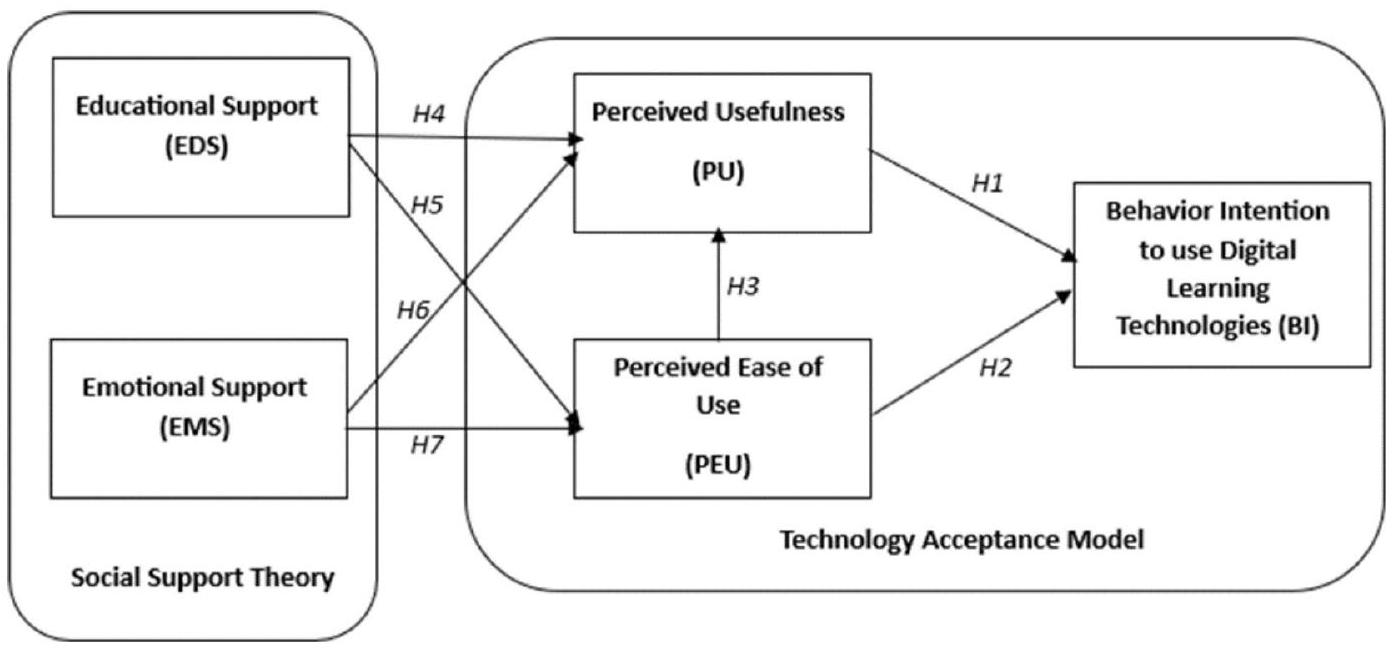
الشكل 1. نموذج الدراسة.
| التكرار | النسبة المئوية | ||
| القسم | علم النفس | 105 | 40.1 |
| التربية البدنية والرياضة | 157 | 59.9 | |
| استخدمت DLTs | نعم | 207 | 79.0 |
| لا | 55 | 21.0 | |
| الإجمالي | 262 | 100.0 |
الجدول 1. الخصائص الديموغرافية لعينة الدراسة.
أداة الدراسة
تم تقسيم أداة الاستبيان إلى جزئين. الجزء الأول جمع معلومات خلفية عن المشاركين، بما في ذلك خصائصهم الديموغرافية، على سبيل المثال، تخصصهم وتجاربهم مع استخدام DLTs. تم تصميم هذه العناصر ذاتيًا. القسم الثاني يتعلق بقياس البنى في النموذج. تم تعديل ثلاث عناصر تقيس PU من
تصميم البحث وتحليل البيانات
تم استخدام تقنية نهج كمي للبحث الحالي
النتائج
المعلومات الديموغرافية
استجاب ما مجموعه 262 طالبًا من كلية التربية في جامعة حائل للاستبيانات. كما هو موضح في الجدول 1، كان معظم الطلاب مسجلين في التربية البدنية والدعم (157،
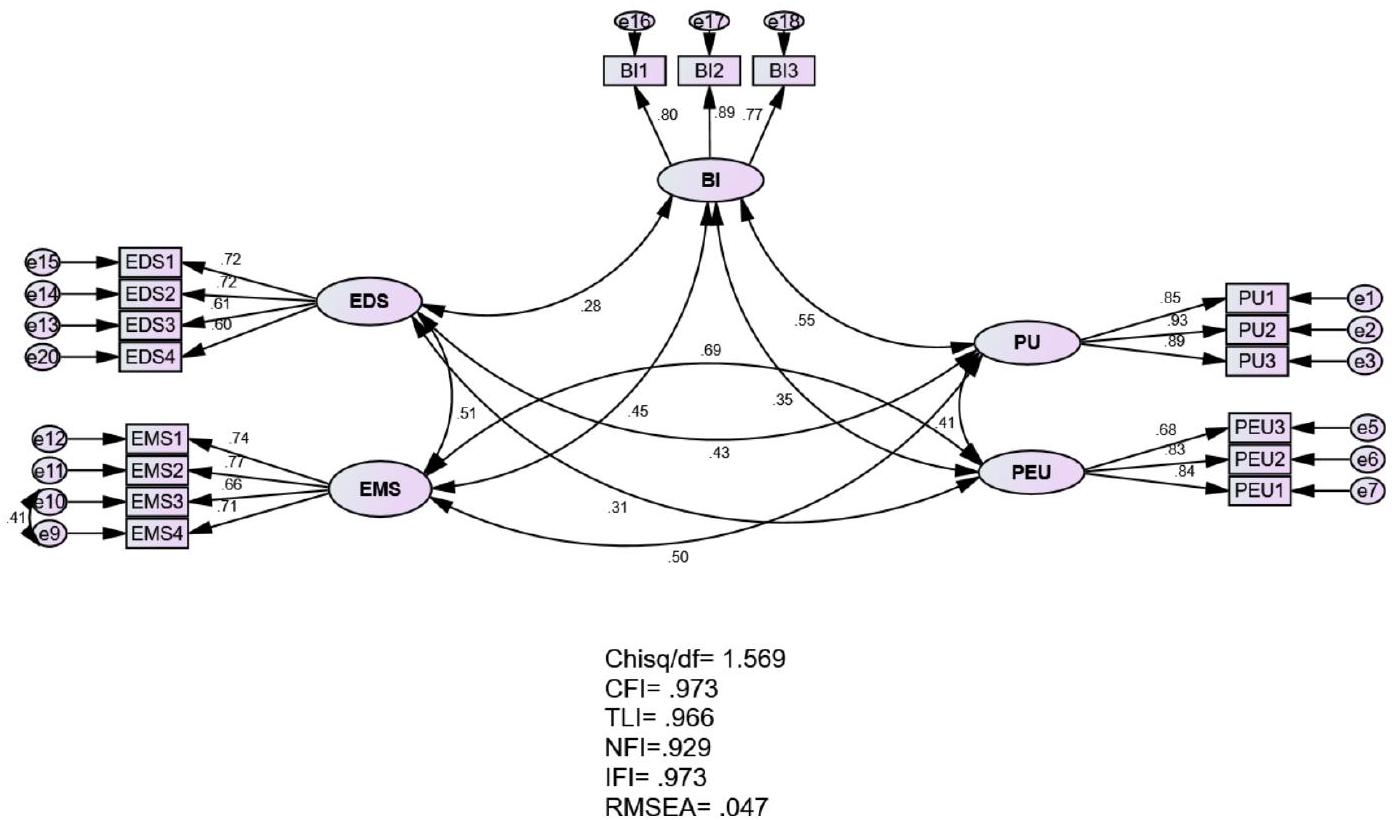
الشكل 2. مخرجات CFA.
| فئة | اسم الفهرس | قيمة المؤشر | القيمة المقبولة | المراجع | النتائج |
| تناسب مطلق | RMSEA | 0.047 | <0.08 | هير وآخرون
|
مقبول |
| الملاءمة التدريجية | CFI | 0.973 | > 0.90 | أوانغ
|
مقبول |
| TLI | 0.966 | >0.90 | أوانغ
|
مقبول | |
| NFI | 0.929 | > 0.90 | أوانغ
|
مقبول | |
| إي إف آي | 0.973 | >0.90 | أوانغ
|
مقبول | |
| شي مربع/درجات الحرية | 1.569 | <3.0 | أوانغ
|
مقبول | |
| ملاءمة اقتصادية | CFI | 0.973 | > 0.90 | أوانغ
|
مقبول |
الجدول 2. ملاءمة النموذج.
| سي آر | AVE | |
| إي دي إس | 0.760 | 0.513 |
| PU | 0.921 | 0.796 |
| بيو | 0.830 | 0.621 |
| EMS | 0.813 | 0.521 |
| ذكاء الأعمال | 0.864 | 0.679 |
الجدول 3. قيم CR وقيم AVE.
تحليل العوامل التأكيدية (CFA)
تم إجراء تحليل العوامل التأكيدية المجمعة للتحقق من صحة نموذج القياس وارتباطات البنى.
البناء على المرجع
ثم، يجب تقييم الصلاحية المتقاربة. وفقًا للمرجع.
| إي دي إس | PU | بيو | خدمات الطوارئ الطبية | ذكاء الأعمال | |
| إي دي إس |
|
||||
| بي يو | 0.434 |
|
|||
| بيو | 0.312 | 0.414 |
|
||
| EMS | 0.507 | 0.497 | 0.687 |
|
|
| ذكاء الأعمال | 0.280 | 0.555 | 0.350 | 0.450 |
|
الجدول 4. ملخص صلاحية التمييز للبناءات.
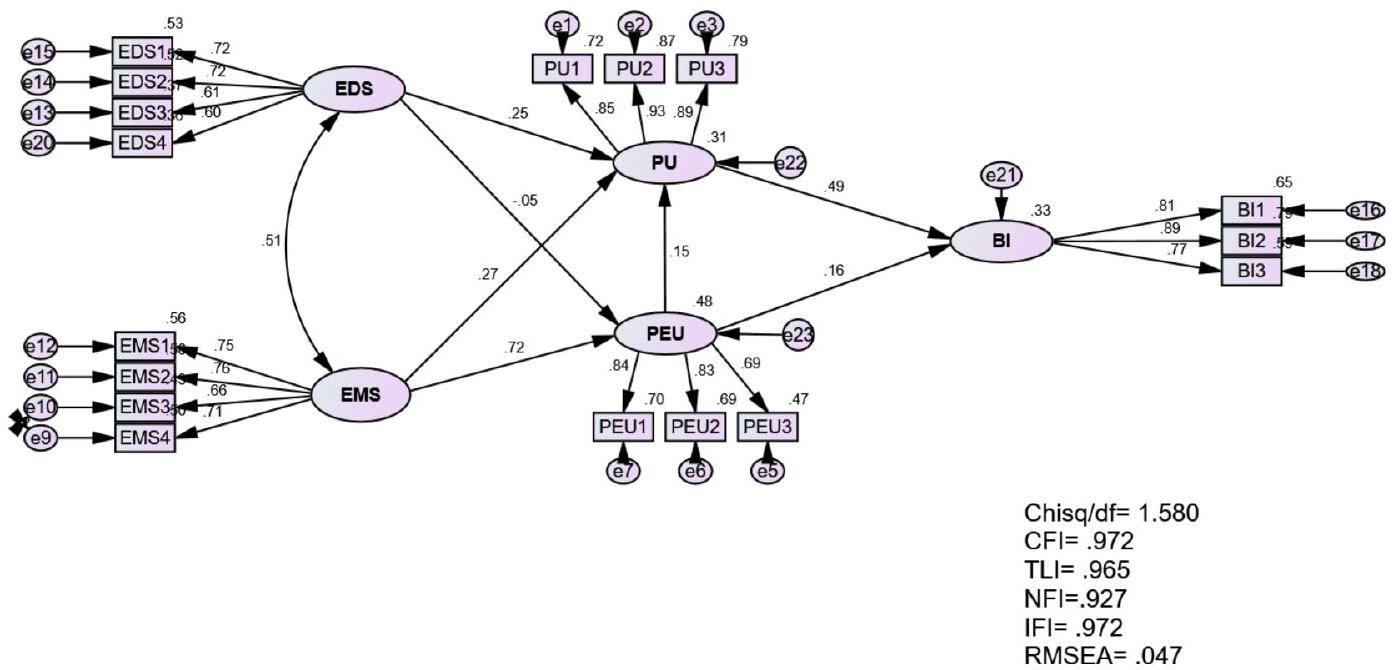
الشكل 3. التقدير القياسي.
أخيرًا، لضمان أن كل بناء في النموذج متميز عن البنى الأخرى، تم التحقق من الصلاحية التمييزية (انظر الجدول 4). وفقًا للمصدر.
نمذجة المعادلات الهيكلية (SEM)
تقدير موحد
لدى SEM مخرجان: التقديرات المعيارية وغير المعيارية. تم استخدام التقدير المعياري لتقييم تحميل العوامل للعناصر في بنائها، وR square، وقوة العلاقات بين البنى. يتم تشغيل التقدير المعياري، وتظهر مخرجاته في الشكل 3.
تقدير غير موحد
يعد حساب تقدير غير موحد ضروريًا للحصول على وزن الانحدار (تقدير بيتا) والنسبة الحرجة، والتي تعتبر أساسية لاختبار فرضية البحث.
وزن الانحدار
أظهرت النتائج أن PU و PEU أثرت بشكل كبير على BI
نقاش
تقترح الدراسة الحالية إطارًا نظريًا يجمع بين “نظرية الدعم الاجتماعي” ونموذج قبول التكنولوجيا (TAM) لفحص العوامل التي تؤثر على نية الطلاب في استخدام تقنيات التعلم الرقمية (DLTs). ثم تم استخدام خطوتين في تحليل المعادلات الهيكلية (SEM) باستخدام برنامج AMOS لتحليل البيانات المجمعة: التحليل العاملي التأكيدي (CFA) لتطوير نموذج القياس وتحليل المعادلات الهيكلية (SEM) لتحليل العلاقة بين المتغيرات واختبار الفرضيات. كشفت النتائج عن اكتشاف مثير سيتم مناقشته بالتفصيل.
بدءًا من مفاهيم نموذج قبول التكنولوجيا، كشفت النتائج أن الفائدة المتصورة والفائدة المتصورة تؤثران على نوايا الطلاب لاستخدام تقنيات التعلم الرقمية. هذه النتائج تتماشى مع التحقيقات السابقة.
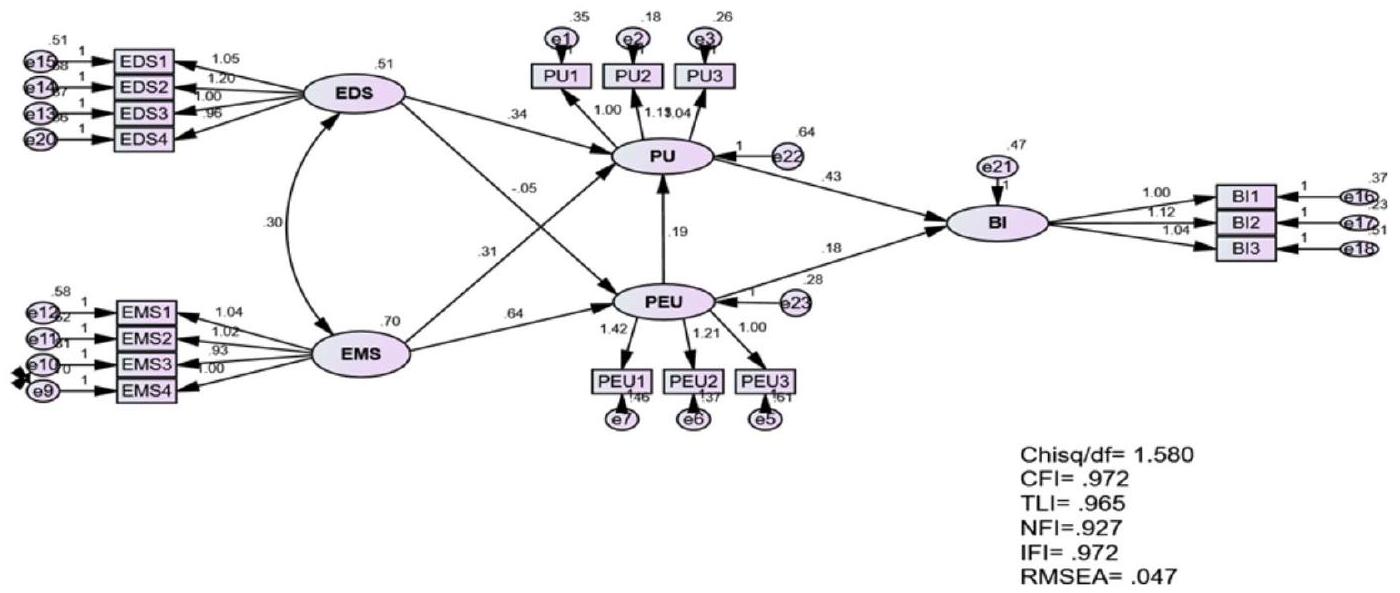
الشكل 4. تقدير غير موحد.
| تقدير | س.م. | سي.آر. |
|
النتائج | فرضية | قرار | |
| PEU <— EDS | -0.052 | 0.083 | -0.628 | 0.530 | غير مهم | H5 | مرفوض |
| PEU <— EMS | 0.635 | 0.093 | 6.859 | *** | مهم | H7 | مدعوم |
| PU <— EDS | 0.338 | 0.112 | ٣.٠١٨ | 0.003 | مهم | H4 | مدعوم |
| PU <— EMS | 0.310 | 0.135 | ٢.٢٩٣ | 0.022 | مهم | H6 | مدعوم |
| PU <— PEU | 0.195 | 0.129 | 1.505 | 0.132 | غير مهم | H3 | مرفوض |
| بي <— بي يو | 0.427 | 0.063 | 6.819 | *** | مهم | H1 | مدعوم |
| بي <— قليل | 0.185 | 0.079 | ٢.٣٣٠ | 0.020 | مهم | H2 | مدعوم |
الجدول 5. نتائج اختبار الفرضيات.
سوف يبنون نية إيجابية تجاه استخدامها. وبالتالي، يجب على المعلمين وصانعي السياسات التركيز على تزويد الطلاب بتقنيات التعلم الرقمية البسيطة والمفيدة التي تؤثر على نواياهم لاستخدامها. علاوة على ذلك، يجب على مطوري ومقدمي تكنولوجيا المعلومات والاتصالات تصميم أنظمة سهلة الاستخدام لتحسين تجربتهم في الاستخدام. بالإضافة إلى ذلك، يمكن للمعلمين أن يشرحوا للطلاب فعالية استخدام تقنيات التعلم الرقمية لتحسين نتائج التعلم. هذا سيؤثر بشكل إيجابي على نيتهم لاستخدام تقنيات التعلم الرقمية وبالتالي، لاستخدامها. علاوة على ذلك، لم تؤثر تجربة الاستخدام على الفائدة المدركة، مما يتعارض مع نتائج الأبحاث السابقة.
تم اعتبار الفرضية التي تنص على أن “سهولة الاستخدام المدركة” (PEU) للطلاب لها تأثير إيجابي على “فائدة الاستخدام المدركة” (PU) لتقنيات التعلم الرقمية غير ذات دلالة (لم يتم دعم H3). وهذا يعني أنه لا توجد علاقة بين “سهولة الاستخدام” لتقنيات التعلم الرقمية و”فائدة الاستخدام المدركة” من قبل الطلاب. بعبارة أبسط، فإن إدراك الطلاب لتقنية معينة ليس كافيًا لاستنتاج أن تلك التقنية تعزز التعلم بين الطلاب.
الأسباب المحتملة للتأثير غير الملحوظ قد تكون:
- تسود عوامل أخرى: قد تكون هناك عوامل أخرى، مثل الجودة، والعلاقة بمحتوى المنهج، أو الدعم المقدم من التعليمات، التي قد تؤثر أيضًا على الفائدة المدركة للطلاب بشكل أقوى من سهولة الاستخدام المدركة.
- نضج التكنولوجيا: قد يكون السبب في أن التكنولوجيا شائعة جدًا هو أن الطلاب يستخدمونها طوال الوقت، لذا فإن سهولة الاستخدام ليست عاملًا حاسمًا يعتبره الطلاب عند تحديد فائدة التكنولوجيا.
- العوامل السياقية: فيما يتعلق بتعميم النتائج، تم الإشارة إلى أن نوع التكنولوجيا المدروسة، وعمر الطلاب أو نوع التعليم قد يؤثر على العلاقة بين الاستخدام المتوقع (PEU) والفائدة المتوقعة (PU).
تشير هذه النتيجة إلى أن الجهود التي تسعى لجعل هذه التكنولوجيا مفهومة ربما لا تكون كافية لتعزيز استخدام الطلاب لهذه التكنولوجيا. يجب أيضًا أخذ ملاحظات حول العوامل المختلفة التي تشكل الفائدة المدركة، على سبيل المثال، كيف تدعم التكنولوجيا أهداف التعلم للدورة الدراسية بالإضافة إلى الممارسات التي تتماشى مع التعليم.
كشفت النتائج أيضًا أن الدعم العاطفي (EMS) أثر على نية الطلاب في استخدام تقنيات التعلم الرقمية (DLTs) من خلال سهولة الاستخدام (PEU) وفائدة الاستخدام (PU). تتماشى نتائجنا مع مجموعة الأبحاث الحالية.
الدعم من معلميهم يؤثر على PEU وPU، مما يؤدي إلى إدراك DLTs كأداة مفيدة و”سهلة الاستخدام”. وبالتالي، تأثرت نواياهم لاستخدام DLTs. علاوة على ذلك، من أجل تعزيز اعتماد DLTs، هناك حاجة إلى EMS، وهو الدعم الحماسي الذي يظهره المعلمون من خلال احتضانهم وإظهار الرعاية والشغف والتعليقات الإيجابية تجاه المتعلمين. هذا يعزز شعور الانتماء والاحترام بين الطلاب الآخرين في الفصل ويساعد في خلق أفضل جو للتعلم. على الرغم من أن EMS ليس مركزًا بشكل أساسي على محتوى الدورة، إلا أن قدرة EMS على مساعدة المتعلمين في إدارة توترهم وقلقهم تجاه الدروس عبر الإنترنت لا يمكن تجاهلها. وبالتالي، يمكن أن يزيد EMS من قدرة الطلاب على الانتباه إلى المعلومات ذات الصلة بالدورة ومعالجتها، بينما يقلل من متطلبات المشاعر السلبية على الموارد المعرفية.
الدعم من معلميهم يؤثر على PEU وPU، مما يؤدي إلى إدراك DLTs كأداة مفيدة و”سهلة الاستخدام”. وبالتالي، تأثرت نواياهم لاستخدام DLTs. علاوة على ذلك، من أجل تعزيز اعتماد DLTs، هناك حاجة إلى EMS، وهو الدعم الحماسي الذي يظهره المعلمون من خلال احتضانهم وإظهار الرعاية والشغف والتعليقات الإيجابية تجاه المتعلمين. هذا يعزز شعور الانتماء والاحترام بين الطلاب الآخرين في الفصل ويساعد في خلق أفضل جو للتعلم. على الرغم من أن EMS ليس مركزًا بشكل أساسي على محتوى الدورة، إلا أن قدرة EMS على مساعدة المتعلمين في إدارة توترهم وقلقهم تجاه الدروس عبر الإنترنت لا يمكن تجاهلها. وبالتالي، يمكن أن يزيد EMS من قدرة الطلاب على الانتباه إلى المعلومات ذات الصلة بالدورة ومعالجتها، بينما يقلل من متطلبات المشاعر السلبية على الموارد المعرفية.
علاوة على ذلك، أظهرت النتائج أن الدعم التعليمي المدرك أثر على نية الطلاب في استخدام تقنيات التعلم الرقمية من خلال الفائدة المدركة. كانت هذه النتائج متسقة مع الأبحاث السابقة.
يمكن أن تكون التفسيرات المحتملة كالتالي: (1) الدعم الحالي الكافي؛ في بعض الحالات، قد يكون الطلاب مدعومين بالفعل بالمساعدة التعليمية المناسبة، وفي أماكن معينة قد لا تساعد المساعدة الإضافية الطلاب ببساطة. قد يكون من الممكن أن تلعب متغيرات أخرى، مثل طبيعة التكنولوجيا كونها أكثر بساطة من، على سبيل المثال، الكمبيوتر، أو فعالية التعليمات المقدمة التي تترجم إلى تصميم تعليمي جيد، دورًا كبيرًا في مسألة الاستخدام الفعال للتكنولوجيا. (2) الدعم غير الفعال؛ قد لا يكون هذا الدعم المقدم للمتعلمين كافيًا ومناسبًا للمساعدة في حل المشكلات الناشئة عن استخدام التكنولوجيا. وبالتالي، يجب أن يتناول الدعم العوامل التي تشكل الصعوبة الكامنة في استخدام التكنولوجيا من أجل التأثير على الاستخدام الفعال للتكنولوجيا. (3) عوامل أخرى تهيمن على الاستخدام الفعال للتكنولوجيا؛ يمكن أن تكون هناك تأثيرات أخرى على الاستخدام الفعال للتكنولوجيا مثل معرفة الكمبيوتر، أو الاستخدام السابق لهذه التكنولوجيا (الخبرة السابقة) أو بعض معايير تصميم واجهة التكنولوجيا التي يمكن أن تلعب دورًا أكثر تحديدًا في الاستخدام الفعال للتكنولوجيا من الدعم التعليمي. قد تتجاوز هذه العوامل تأثيرات الدعم التعليمي.
لذلك، فإن هذا يحمل دلالة على أن تعزيز الدعم التعليمي قد لا يكون أفضل وسيلة لتعزيز إدراك الطلاب لسهولة الاستخدام للتقنيات الرقمية. من الواضح أن هناك حاجة إلى مزيد من الدراسات لفهم العوامل التي تؤثر على إدراك سهولة الاستخدام بشكل أعمق، بالإضافة إلى تحديد طبيعة التدخلات الداعمة التي يمكن تقديمها لتحسين أداء الطلاب. عامل آخر يؤهل في هذا البحث هو السياق الذي تم صياغته فيه. قد تكون النتائج محدودة، من حيث الإعداد أو الوقت، و/أو قد لا تكون قابلة للتطبيق على ظروف أو مجموعات بشرية أخرى.
الآثار النظرية
تختلف هذه الدراسة عن الدراسات السابقة في أنها توسع قاعدة المعرفة الحالية من خلال تقديم إطار نظري شامل يجمع بين نظرية الدعم الاجتماعي ونموذج قبول التكنولوجيا (TAM) لتحديد المتغيرات التي تؤثر على نوايا الطلاب في استخدام تقنيات التعلم الرقمية (DLTs). على عكس الدراسات السابقة التي أجريت في السياق السعودي.
التطبيق العملي
نظرًا لأن كل من الاستخدام المفيد (PU) والاستخدام المتوقع (PEU) يؤثران على نوايا الطلاب في استخدام تقنيات التعلم الرقمية (DLTs)، يجب على المطورين والمصممين توفير واجهة مستخدم صديقة لتقنيات التعلم الرقمية لجعلها سهلة الاستخدام ومفيدة. عندما يدرك الطلاب أن هذه التقنيات سهلة ومفيدة، فإن ذلك سيؤثر على نواياهم تجاه استخدامها، وبالتالي استخدامها. علاوة على ذلك، يتطلب تنفيذ تقنيات التعلم الرقمية جهودًا من الجامعات في التعليم العالي ليس فقط لتوفير هذه التقنيات الرقمية ولكن أيضًا لإعادة تقييمها من حيث مدى سهولتها ومدى فائدتها في تعلم الطلاب. بالإضافة إلى ذلك، أثر الدعم التعليمي والعاطفي على نوايا الطلاب في استخدام تقنيات التعلم الرقمية. لذلك، يجب على المعلمين وإداريي الجامعات أن يأخذوا في الاعتبار أهمية الدعم التعليمي والعاطفي للطلاب عند تنفيذ تقنيات التعلم الرقمية. سيؤدي ذلك إلى نية إيجابية لاستخدامها بين الطلاب. كما كشفت النتائج أن الدعم العاطفي أثر على كل من الاستخدام المفيد والاستخدام المتوقع، بينما أثر الدعم التعليمي فقط على الاستخدام المفيد. لذلك، يجب على المعلمين التركيز ليس فقط على التدريس ولكن أيضًا على تضمين الدعم التعليمي والعاطفي المطلوب، على سبيل المثال، التعبير عن التعاطف والرعاية، والحفاظ على التفاعل مع الطلاب، وتعزيز الشركة.
علاوة على ذلك، فإن الآثار العملية لهذه الدراسة هي دمج النتائج التي تم الحصول عليها في الدراسة الحالية مع المعرفة الموجودة من الأبحاث السابقة.
- “فائدة الإدراك” (PU) و”سهولة الاستخدام المدركة” (PEU) تؤثر على نوايا الطلاب: هذا يتماشى مع الدراسات السابقة، على سبيل المثال،
. يركز على البساطة ويبرز إمكانيات تقنيات دفتر الأستاذ الموزع التي يجب توضيحها للطلاب. - الدعم التعليمي الذي يؤثر على PU: هذا يتماشى مع النتائج التي توصلت إليها الأدبيات السابقة
. مرة أخرى، يؤكد على أن المعلمين والإداريين يجب أن يوجهوا المتعلمين حول تطبيق تقنيات التعلم الرقمي ويظهروا مدى فائدة هذه التقنيات في التعلم. - الدعم العاطفي يؤثر على PU و PEU: هذا يتماشى مع الأبحاث السابقة
. يؤكد على ضرورة مساعدة المعلمين للطلاب في التغلب على شكوكهم ومخاوفهم بشأن تقنيات التعلم الرقمية.
من خلال ربط هذه النتائج بالمعرفة الموجودة، يمكن للمؤلفين أيضًا اقتراح تداعيات عملية لـ:
- المطورون والمصممون: يجب عليهم تحسين واجهات تقنيات دفتر الأستاذ الموزع لتكون سهلة الاستخدام.
- الجامعات: يجب أن تكون قادرة أيضًا على توفير تقنيات دفتر الأستاذ الموزع وتقييم سهولة استخدامها وفعاليتها في تعلم الطلاب.
- المعلمون: عند تنفيذ تقنيات دفتر الأستاذ الموزع، يجب عليهم التركيز على الدعم الأكاديمي بما في ذلك الإرشاد والدعم العاطفي مثل التعاطف.
باختصار، تساهم المساهمات العملية في الدراسة الحالية لتعزيز المعرفة الحالية بالعوامل التي تدفع الطلاب لاستخدام تقنيات دفتر الأستاذ الموزع. يمكن أن يساعد ذلك أصحاب المصلحة في التخطيط والتنفيذ وتسهيل الاستخدام الصحيح لتقنيات دفتر الأستاذ الموزع في بيئات التعلم.
القيود والأعمال المستقبلية
تسلط القيود في البحث الحالي الضوء على المجالات الرئيسية للتحسين في التحقيقات المستقبلية. أولاً، كانت الاستنتاجات مقيدة بجامعة واحدة، ولهذا السبب لا يمكن تطبيقها على “المؤسسات التعليمية العليا” الأخرى. يُوصى في الدراسات المستقبلية بأخذ عينات من المزيد من الجامعات أو أن تغطي الدراسة كل من الجامعات العامة والخاصة عبر مناطق مختلفة من المملكة العربية السعودية. ستوسع هذه العملية من أجل ضمان أن السلوكيات والمواقف الملاحظة تجاه تقنيات دفتر الأستاذ الموزع متسقة عبر بيئات تعليمية مختلفة.
علاوة على ذلك، يقيّد النهج الكمي بالكامل في العمل البحثي التحليل الأعمق لمشاركة الطلاب مع تقنيات دفتر الأستاذ الموزع. يمكن أن يؤدي دمج النماذج إلى توسيع وجهات النظر الكمية أو، ربما، الأساليب المختلطة حول كيفية مساهمة جوانب مثل الدعم الاجتماعي في استخدام تقنيات دفتر الأستاذ الموزع بطريقة أكثر تعقيدًا من مجرد الأرقام. أيضًا، اعتمدت هذه الدراسة على “نظرية الدعم الاجتماعي” (SST) بالتزامن مع “نموذج قبول التكنولوجيا” (TAM)؛ ومع ذلك، قد تستخدم الأبحاث اللاحقة أطر نظرية أخرى مثل “نظرية تأكيد التوقع” (ECT). يمكن أن تكشف هذه عن أنماط إضافية لاستخدام تقنيات دفتر الأستاذ الموزع وتحسن ثراء النماذج النظرية ضمن هذا المجال.
الخاتمة
هدفت الدراسة الحالية إلى فحص كيفية تأثير الدعم التعليمي والعاطفي على نية الطلاب في استخدام تقنيات دفتر الأستاذ الموزع. وبالتالي، تم تطوير نموذج نظري مشترك لنظرية “الدعم الاجتماعي” وTAM. تم اختبار النموذج المتكامل المقترح نظريًا باستخدام تقنية تحليل من جيل ثانٍ من خطوتين في SEM AMOS: CFA وSEM. ساهم 262 طالبًا في هذه الدراسة وأكملوا استبيانًا. وجدت النتائج أن EMS أثرت بشكل غير مباشر على نية الطلاب BI لاستخدام تقنيات دفتر الأستاذ الموزع من خلال تأثيرها على PU وPET. في المقابل، أثر الدعم التعليمي على نية الطلاب في استخدام تقنيات دفتر الأستاذ الموزع من خلال PU. كما كشفت النتائج أن مكونات TAM، وهي PU وPEU، أثرت على نية الطلاب في استخدام تقنيات دفتر الأستاذ الموزع. توفر النتائج الحالية وجهة نظر مثيرة للاهتمام بشأن الدور المهم للدعم التعليمي والعاطفي، إلى جانب مكونات TAM PU وPEU، في تشكيل نية الطلاب لاستخدام تقنيات دفتر الأستاذ الموزع.
توفر البيانات
تحتوي البيانات على المقال.
تاريخ الاستلام: 28 يونيو 2024؛ تاريخ القبول: 16 ديسمبر 2024
تم النشر عبر الإنترنت: 02 يناير 2025
تاريخ الاستلام: 28 يونيو 2024؛ تاريخ القبول: 16 ديسمبر 2024
تم النشر عبر الإنترنت: 02 يناير 2025
References
- Almaiah, M. A. et al. Factors affecting the adoption of digital information technologies in higher education: An empirical study. Electronics 11(21), 3572 (2022).
- Alkhwaldi, A. F. Investigating the social sustainability of immersive virtual technologies in higher educational institutions: Students’ perceptions toward metaverse technology. Sustainability 16(2), 934. https://doi.org/10.3390/su16020934 (2024).
- Alshammari, S. H. & Alshammari, R. A. An integration of expectation confirmation model and information systems success model to explore the factors affecting the continuous intention to utilise virtual classrooms. Sci. Rep. 14, 18491. https://doi.org/10.1038/s 41598-024-69401-8 (2024).
- Alshammari, S. H. & Alshammari, M. H. Factors affecting the adoption and use of ChatGPT in higher education. Int. J. Inf. Commun. Technol. Educ. 20(1), 1-16 (2024).
- Khalifeh, A. et al. Influence of students’ self-control and smartphone E-Learning readiness on Smartphone-Cyberloafing. J. Inf. Technol. Educ.: Res. 23, 016 (2024).
- Ambalov, I. A. Resistance to online learning technology: Theoretical and empirical perspectives. Inf. Dev. 02666669241257197 (2024).
- Elkaseh, A., Wong, K. W. & Fung, C. C. A review of the critical success factors of implementing E-learning in higher education. Int. J. Technol. Learn. 22(2) (2015).
- Alksasbeh, M., Abuhelaleh, M. & Almaiah, M. Towards a model of quality features for mobile social networks apps in learning environments: An extended information system success model (2019).
- Almaiah, M. A., Jalil, M. A. & Man, M. Preliminary study for exploring the major problems and activities of mobile learning system: A case study of Jordan (2016).
- Almaiah, M. A. et al. The role of quality measurements in enhancing the usability of mobile learning applications during COVID-19. Electronics 11(13), 1951 (2022).
- Al-Adwan, A. S. et al. Unlocking future learning: Exploring higher education students’ intention to adopt meta-education. Heliyon 10(9), e29544. https://doi.org/10.1016/j.heliyon.2024.e29544 (2024).
- Songkram, N. & Chootongchai, S. Adoption model for a hybrid SEM-neural network approach to education as a service. Educ. Inform. Technol. 25(5), 5857-5887 (2022).
- Paechter, M., Maier, B. & Macher, D. Students’ expectations of, and experiences in e-learning: Their relation to learning achievements and course satisfaction. Comput. Educ. 54(1), 222-229 (2010).
- Sobaih, A. E. E., Hasanein, A. & Elshaer, I. A. Higher education in and after COVID-19: The impact of using social network applications for e-learning on students’ academic performance. Sustainability 14(9), 5195 (2022).
- Songkram, N. et al. Students’ adoption towards behavioral intention of digital learning platform. Educ. Inf. Technol. 28(9), 1165511677 (2023).
- McGill, T. J. & Klobas, J. E. A task-technology fit view of learning management system impact. Comput. Educ. 52(2), 496-508 (2009).
- Bates, T. Online Enrolments After Covid-19: A Prediction, Part 2-Policy Implications (Online Learning and Distance Education Resources, 2020).
- Börnert-Ringleb, M., Casale, G. & Hillenbrand, C. What predicts teachers’ use of digital learning in Germany? Examining the obstacles and conditions of digital learning in special education. Eur. J. Spec. Needs Educ. 36(1), 80-97 (2021).
- He, T. et al. Exploring students’ digital informal learning: The roles of digital competence and DTPB factors. Behav. Inf. Technol. 40(13), 1406-1416 (2021).
- Al-Gahtani, S. S. Empirical investigation of e-learning acceptance and assimilation: A structural equation model. Appl. Comput. Inf. 12(1), 27-50 (2016).
- Al-Rahmi, W. M. et al. Social media-based collaborative learning: The effect on learning success with the moderating role of cyberstalking and cyberbullying. Interact. Learn. Environ. 30(8), 1434-1447 (2022).
- Sayaf, A. M. et al. Information and communications technology used in higher education: An empirical study on digital learning as sustainability. Sustainability 13(13), 7074 (2021).
- Wahyuningsih, T., Oganda, F. P. & Anggraeni, M. Design and implementation of digital education resources blockchain-based authentication system. Blockchain Front. Technol. 1(01), 74-86 (2021).
- Aydin, E. & Erol, S. The views of Turkish language teachers on distance education and digital literacy during covid-19 pandemic. Int. J. Educ. Lit. Stud. 9(1), 60-71 (2021).
- Çetin, E. Digital storytelling in teacher education and its effect on the digital literacy of pre-service teachers. Think. Skills Creat. 39, 100760 (2021).
- Almaiah, M. A. et al. Determinants influencing the continuous intention to use digital technologies in higher education. Electronics 11(18), 2827 (2022).
- Venkatesh, V. et al. User acceptance of information technology: Toward a unified view. MIS Q. 425-478 (2003).
- Bhattacherjee, A. Understanding information systems continuance: An expectation-confirmation model. MIS Q. 351-370 (2001).
- Rogers, E. M. Diffusion of Innovations 551 (Free Press, 2003).
- Kong, F. et al. Technology acceptance model of mobile social media among Chinese college students. J. Technol. Behav. Sci. 6, 365-369 (2021).
- Yakubu, M. N. & Dasuki, S. I. Factors affecting the adoption of e-learning technologies among higher education students in Nigeria: A structural equation modelling approach. Inf. Dev. 35(3), 492-502 (2019).
- Alkhwaldi, A. F. & Al-Ajaleen, R. T. Toward a conceptual model for citizens’ adoption of smart mobile government services during the COVID-19 pandemic in Jordan. Inf. Sci. Lett. 11(2), 573-579 (2022).
- Dbesan, A. H., Abdulmuhsin, A. A. & Alkhwaldi, A. F. Adopting knowledge-sharing-driven blockchain technology in healthcare: a developing country’s perspective. VINE J. Inf. Knowl. Manag. Syst. Vol. ahead-of-print No. ahead-of-print. https://doi.org/10.110 8/VJIKMS-01-2023-0021 (2023).
- Venkatesh, V. & Davis, F. D. A theoretical extension of the technology acceptance model: Four longitudinal field studies. Manag. Sci. 46(2), 186-204 (2000).
- Venkatesh, V., Thong, J. Y. L. & Xu, X. Consumer acceptance and use of information technology: Extending the unified theory of acceptance and use of technology. MIS Q. 36(1), 157-178 (2012).
- Liu, G. & Ma, C. Measuring EFL learners’ use of ChatGPT in informal digital learning of English based on the technology acceptance model. Innov. Lang. Learn. Teach. 18(2), 125-138 (2024).
- Davis, F. D. A Technology Acceptance Model for Empirically Testing New End-User Information Systems: Theory and Results (Massachusetts Institute of Technology, 1985).
- Kamal, S. A., Shafiq, M. & Kakria, P. Investigating acceptance of telemedicine services through an extended technology acceptance model (TAM). Technol. Soc. 60, 101212 (2020).
- Zhang, T. et al. The roles of initial trust and perceived risk in public’s acceptance of automated vehicles. Transport. Res. Part C Emerg. Technol. 98, 207-220 (2019).
- Sánchez-Prieto, J. C., Olmos-Migueláñez, S. & García-Peñalvo, F. J. Informal tools in formal contexts: Development of a model to assess the acceptance of mobile technologies among teachers. Comput. Hum. Behav. 55, 519-528 (2016).
- Taherdoost, H. Development of an adoption model to assess user acceptance of e-service technology: E-service technology acceptance model. Behav. Inf. Technol. 37(2), 173-197(2018).
- Mailizar, M., Burg, D. & Maulina, S. Examining university students’ behavioural intention to use e-learning during the COVID-19 pandemic: An extended TAM model. Educ. Inf. Technol. 26(6), 7057-7077 (2021).
- Wortman, C. B. & Dunkel-Schetter, C. Conceptual and methodological issues in the study of social support. In Handbook of Psychology and Health: Stress, Vol. 5 (eds Baum, A. & Singer, J. E.) 63-108 ( Lawrence Erlbaum Associates, Inc., 1987).
- Hu, X. et al. Understanding the impact of emotional support on mental health resilience of the community in the social media in Covid-19 pandemic. J. Affect. Disord. 308, 360-368 (2022).
- Lin, T. C. et al. Exploring the relationship between receiving and offering online social support: A dual social support model. Inf. Manag. 52(3), 371-383 (2015).
- Liu, C. & Ma, J. Social support through online social networking sites and addiction among college students: The mediating roles of fear of missing out and problematic smartphone use. Curr. Psychol. 39(6), 1892-1899 (2020).
- Yao, Z. et al. Influence of online social support on the public’s belief in overcoming COVID-19. Inf. Process. Manag. 58(4), 102583 (2021).
- Marzouki, Y., Aldossari, F. S. & Veltri, G. A. Understanding the buffering effect of social media use on anxiety during the COVID-19 pandemic lockdown. Humanit. Social Sci. Commun. 8(1) (2021).
- Federici, R. A. & Skaalvik, E. M. Students’ perception of instrumental support and effort in mathematics: The mediating role of subjective task values. Soc. Psychol. Educ. 17, 527-540 (2014).
- Porumbescu, G. et al. Translating policy transparency into policy understanding and policy support: Evidence from a survey experiment. Public Adm. 95(4), 990-1008 (2017).
- Krejcie, R. V. & Morgan, D. W. Determining sample size for research activities. Educ. Psychol. Meas. 30(3), 607-610 (1970).
- Kline, R. B. Principles and Practice of Structural Equation Modeling (Guilford, 2015).
- Wu, B. & Chen, X. Continuance intention to use MOOCs: Integrating the technology acceptance model (TAM) and task technology fit (TTF) model. Comput. Hum. Behav. 67, 221-232 (2017).
- He, S. et al. The influence of educational and emotional support on e-learning acceptance: An integration of social support theory and TAM. Educ. Inf. Technol. 1-21 (2023).
- Creswell, J. W. & Creswell, J. D. Research Design: Qualitative, Quantitative, and Mixed Methods Approaches (Sage, 2017).
- Hair, J. F. et al. Multivariate Data Analysis New Jersey (Pearson Education, 2010).
- Awang, P. SEM Made Simple: A Gentle Approach to Learning Structural Equation Modeling (MPWS Rich Publication, 2015).
- Alshammari, S. H. & Alrashidi, M. E. Factors affecting the intention and use of metaverse: A structural equation modeling approach. Int. J. Inf. Commun. Technol. Educ. 20(1), 1-14 (2024).
- Alshammari, S. H. & Alshammari, M. H. Modelling the effects of perceived system quality and personal innovativeness on the intention to use metaverse: a structural equation modelling approach. PeerJ Comput. Sci. 10, e2331 (2024).
- Alkhwaldi, A. F. & Abdulmuhsin, A. A. Understanding user acceptance of IoT based healthcare in Jordan: Integration of the TTF and TAM. In Digital Economy, Business Analytics, and Big Data Analytics Applications. Studies in Computational Intelligence, Vol. 1010. (eds Yaseen, S. G.) (Springer, Cham, 2022). https://doi.org/10.1007/978-3-031-05258-3_17.
- Alkhwaldi, A. F., Alidarous, M. M. & Alharasis, E. E. Antecedents and outcomes of innovative blockchain usage in accounting and auditing profession: an extended UTAUT model. J. Organ. Change Manag. 37(5), 1102-1132. https://doi.org/10.1108/JOCM-03-2 023-0070 (2024).
- Alharasis, E. E. Evaluating AIS implementation to improve accounting information quality: the prospect in Jordanian family SMEs in the post-Covid-19 age. J. Fam. Bus. Manag. Vol. ahead-of-print No. ahead-of-print. https://doi.org/10.1108/JFBM-08-2024-019 4 (2024).
- Alrashidi, O. & Alshammari, S. H. The effects of self-efficacy, teacher support, and positive academic emotions on student engagement in online courses among EFL university students. Educ. Inf. Technol. https://doi.org/10.1007/s10639-024-13139-3 (2024).
- Al-Maroof, R. S. et al. Understanding an extension technology acceptance model of Google translation: A multi-cultural study in United Arab Emirates. Int. J. Interact. Mob. Technol. (3) (2020).
- Islam, A. Y. M. A. et al. ICT in higher education: An exploration of practices in Malaysian universities. IEEE Access 7, 16892-16908 (2019).
- Sapta, I., Muafi, M. & Setini, N. M. The role of technology, organizational culture, and job satisfaction in improving employee performance during the Covid-19 pandemic. J. Asian Finance Econ. Bus. 8(1), 495-505 (2021).
- Stockless, A. Acceptance of learning management system: The case of secondary school teachers. Educ. Inf. Technol. 23, 1101-1121 (2018).
- Devy, N. P. I. R., Wibirama, S. & Santosa, P. I. Evaluating user experience of english learning interface using User Experience Questionnaire and System Usability Scale. In 1st International Conference on Informatics and Computational Sciences (ICICoS), 2017 (IEEE, 2017).
- Granić, A. Experience with usability evaluation of e-learning systems. Univ. Access Inf. Soc. 7, 209-221 (2008).
- Huang, H. & Liu, G. Evaluating students’ behavioral intention and system usability of augmented reality-aided distance design learning during the COVID-19 pandemic. Univ. Access Inf. Soc., 1-15 (2022).
- Makmor, N., Alam, S. S. & Aziz, N. A. Social support, trust and purchase intention in social commerce era. Int. J. Supply Chain Manag. 7(5), 572-581 (2018).
- Aristovnik, A. et al. Impacts of the COVID-19 pandemic on life of higher education students: A global perspective. Sustainability 12(20), 8438 (2020).
- Cifuentes-Faura, J. et al. Cross-cultural impacts of COVID-19 on higher education learning and teaching practices in Spain, Oman, Nigeria and Cambodia: A cross-cultural study. J. Univ. Teach. Learn. Pract. 18(5), 8 (2021).
- Alamri, M. M., Almaiah, M. A. & Al-Rahmi, W. M. Social media applications affecting students’ academic performance: A model developed for sustainability in higher education. Sustainability 12(16), 6471 (2020).
- Alyoussef, I. Y., Alamri, M. M. & Al-Rahmi, W. M. Social media use (SMU) for teaching and learning in Saudi Arabia. Int. J. Recent. Technol. Eng. 8, 942-946 (2019).
مساهمات المؤلفين
ساهم كلا المؤلفين في جميع مراحل كتابة ومراجعة هذه المخطوطة.
التمويل
“لم تتلق هذه الدراسة تمويلًا خارجيًا”.
الإعلانات
المصالح المتنافسة
يعلن المؤلفون عدم وجود مصالح متنافسة.
بيان مراجعة المؤسسة
تمت مراجعة هذه الدراسة والموافقة عليها من قبل لجنة أخلاقيات البحث في جامعة حائل (رقم.
الموافقة المستنيرة
تم الحصول على الموافقة المستنيرة من جميع المشاركين في الدراسة.
معلومات إضافية
يجب توجيه المراسلات وطلبات المواد إلى A.F.A.
معلومات إعادة الطبع والتصاريح متاحة علىwww.nature.com/reprints.
ملاحظة الناشر: تظل Springer Nature محايدة فيما يتعلق بالمطالبات القضائية في الخرائط المنشورة والانتماءات المؤسسية.
معلومات إعادة الطبع والتصاريح متاحة علىwww.nature.com/reprints.
ملاحظة الناشر: تظل Springer Nature محايدة فيما يتعلق بالمطالبات القضائية في الخرائط المنشورة والانتماءات المؤسسية.
الوصول المفتوح: هذه المقالة مرخصة بموجب رخصة المشاع الإبداعي للاستخدام غير التجاري، والتي تسمح بأي استخدام غير تجاري، ومشاركة، وتوزيع، وإعادة إنتاج في أي وسيلة أو صيغة، طالما أنك تعطي الائتمان المناسب للمؤلفين الأصليين والمصدر، وتوفر رابطًا لرخصة المشاع الإبداعي، وتوضح إذا قمت بتعديل المادة المرخصة. ليس لديك إذن بموجب هذه الرخصة لمشاركة المواد المعدلة المشتقة من هذه المقالة أو أجزاء منها. الصور أو المواد الأخرى من طرف ثالث في هذه المقالة مشمولة في رخصة المشاع الإبداعي للمقال، ما لم يُذكر خلاف ذلك في سطر ائتمان للمادة. إذا لم تكن المادة مشمولة في رخصة المشاع الإبداعي للمقال واستخدامك المقصود غير مسموح به بموجب اللوائح القانونية أو يتجاوز الاستخدام المسموح به، ستحتاج إلى الحصول على إذن مباشرة من صاحب حقوق الطبع والنشر. لعرض نسخة من هذه الرخصة، قم بزيارةhttp://creativecommo ns.org/licenses/by-nc-nd/4.0/.
© المؤلفون 2024
© المؤلفون 2024
قسم تكنولوجيا التعليم، كلية التربية، جامعة حائل، حائل، المملكة العربية السعودية. قسم نظم المعلومات الإدارية، كلية الأعمال، جامعة مؤتة، الكرك 61710، الأردن. البريد الإلكتروني:abeerkh@mutah.edu.jo
Journal: Scientific Reports, Volume: 15, Issue: 1
DOI: https://doi.org/10.1038/s41598-024-83450-z
PMID: https://pubmed.ncbi.nlm.nih.gov/39747988
Publication Date: 2025-01-02
DOI: https://doi.org/10.1038/s41598-024-83450-z
PMID: https://pubmed.ncbi.nlm.nih.gov/39747988
Publication Date: 2025-01-02
OPEN
An integrated approach using social support theory and technology acceptance model to investigate the sustainable use of digital learning technologies
The present study explored the determinants influencing students’ intentions towards utilizing digital learning technologies (DLTs). It proposes a holistic view model for students’ utilization of digital learning technologies by integrating social support theory and the “Technology Acceptance Model” (TAM). Data were gathered from 262 students of the University of Ha’il through utilizing a questionnaire. Two steps in SEM were applied for data analysis: CFA was employed to develop the model measurement, and SEM was conducted to analyze the relationships between constructs. The results revealed that “Educational Support” (EDS) significantly affected students’ “behavior intention” (BI) to utilize digital learning technologies through perceived usefulness (PU) (EDS
Keywords Social support theory, TAM, Emotional support, Educational support, Digital learning technology
The transformation of learning methods in education has received considerable attention recently
the next decade, while blended learning, encompassing both traditional classroom instruction and distributed learning technologies (DLTs), is expected to constitute the remaining 70 to 80 per cent
This study examines the determinants that affect students’ behavioural intentions to use DLTs by combining the “Social Support Theory” and the “Technology Acceptance Model” (TAM). This provides several contributions to theory and practice. From a theoretical perspective, (1) Integration of models; the integration of “Social Support Theory” into the framework formulated based on TAM helps to expand the picture of the factors that promote the use of DLT. This approach adds extra concepts to the normal foundation of TAM research as different variables such as educational and emotional support. (2) Role of Support; concerning the analysed research hypotheses, it can be stated that emotional support has a positive influence on both PU and PEU of the technology, though educational support affects only PU. Thus, emotional factors are identified as having the most significant impact on the PU and the likelihood of utilising the DLTs among students.
From a practical standpoint, (1) User-Friendly design; specifically, the process means that developers should work on the DLTs that will be useful, easy to use and convenient. This corroborates with the findings that PU and PEU, have a direct influence on the students’ intentions to use these technologies. (2) Enhanced support; the institutions particularly universities should be in a position to offer appropriate education as well as help the student deal with emotional issues. This includes (a) Educational support; assist students in carrying out their operations and provide the effective usage of DLTs. (b) Emotional support; to enhance students’ interaction with DLTs, provide encouragement and respond to their psychological issues. (3) Instructor role; educators should incorporate supportive actions into the teaching approaches, for instance, showing empathy and offering further assistance, a move that will help shift students’ attitudes toward the DLTs.
Literature review
In the study by
In the context of DLTs, various theories were applied. For instance, the UTAUT which is an extension of TAM, integrates aspects of other models to explain the use of technology comprehensively
commodities in learning institutions
commodities in learning institutions
This integration addresses limitations of prior research in that it considers the social and contextual factors of using the technology, which are not captured in TAM alone. Thus, with reference to both the SST and the TAM, the present study will try to provide a better perspective on what influences DLT adoption. Such an approach fits well with the novel trends in IT adoption literature that stress the importance of social support and context factors
Existing research gaps and significance of SST-TAM integration
Previous studies on the perceived use of DLT primarily involve factors like PEU and PU as explained under the TAM. This approach fails to take into account how social and support structures help to determine the extent of technology integration. In particular, there is a significant lack of information on the role of social networks and support systems in changing the perception and acceptance of DLT by users. Most of the existing models take a narrow perspective of categorizing the factors separately as individual or social factors, thus providing a fragmented view of the technology adoption process.
This brings a gap between the two models. In this case, the integration of SST with TAM bridges this gap as it looks at the individual and social factors. SST complements TAM by providing awareness of social networks’ influence on technology acceptance and adds knowledge that social support can either be a positive or negative factor for DLT adoption. This integration enables enhanced and well-coordinated techniques concerning the incorporation of social support as an influential strategy in promoting the acceptance of technology, a more comprehensive and realistic model that depicts the relationship between cognitive and social techniques in influencing DLT.
Theoretical framework
First, the study’s assessment of DLTs benefits from the theoretical framework that encompasses SST and TAM. Second, the integration of SST and the TAM for testing the DLT’s adoption provides theoretical advances in this research area. This integration contributes to new insights in several ways:
- Maturation of understanding of social dynamics in technology implementation
SST focuses on the influence of the people in an individual’s social circle and their attitudes and behaviours. Regarding the adoption of DLT, SST explains how influences by peers, families, and professional networks may affect people’s decision to accept innovative solutions. TAM in the past has primarily been based on PEU and PU as key adoption constructs of technology. By integrating SST, the model can be expanded to consider how social support affects these perceptions. New insight: When integrated, SST and TAM indicate that social support processes have the potential to cause significant changes to users’ attitudes towards DLT. For example, encouragement by influential nodes in the network could boost the perceived level of usefulness and ease which could in turn increase the rate of acceptance and adoption of DLT.
2. Perception of social factors on technology
2. Perception of social factors on technology
Incorporating SST validates that PEU and PU are influenced not only by the technology but also by the social context surrounding the technology. New insight: social support is capable of intervening directly with users’ perception of a given technology. For instance, if a user gets encouragement/ support and suggestions from friends or teachers, such a technology may appear more friendly and helpful to such a user. In other words, technology adoption is much more than a cognitive development exercise but a function of people’s social presence and interaction.
3. Recognition of social support as a modulator of technology adoption factors
3. Recognition of social support as a modulator of technology adoption factors
TAM factors can be modulated by social support. For example, if there is social support, people can perceive technology as useful and easy to use, even if their initial assessment was otherwise. New insight: This work confirms that social support can function as a facilitator or a shield in technology adoption processes. This implies that there is a way through which attempts to increase the supply of social support to DLT users can help to increase the rates of adoption through positive changes in users’ understanding and predisposed attitudes.
Thus, the integration of SST with TAM explains the concept of DLT adoption by offering more insights into the effects of social support. This approach enriches various theoretical models by integrating individual and social factors in order to provide a more profound understanding of the factors that impact the acceptance and adoption of technology.
TAM
In this study, the authors decided to extend the TAM instead of alternative theoretical models like UTAUT or UTAUT2 since TAM is known to provide fundamental knowledge regarding technology acceptance and has been proven relevant for educational environments. TAM, originally developed by Davis (1986), has a strong theoretical background based on two variables inherent in the technology adoption process: “perceived ease of use” and “perceived usefulness” of the technology in various contexts, including learning settings. TAM is simple to understand and apply, which makes it suitable for studying user acceptance in the context of DLTs.
Although UTAUT and UTAUT2 are better equipped with a number of constructs and the extension of TAM
Drawing upon the TAM established by Davis
H1 Students’ PU positively affects their intention toward using DLTs.
H2 Students’ PEU positively affects their intention toward using DLTs.
H3 Students’ PEU positively affects students’ PU.
H2 Students’ PEU positively affects their intention toward using DLTs.
H3 Students’ PEU positively affects students’ PU.
Social support theory
Social support refers to assistance provided to others and protection from adverse outcomes and unforeseen contingencies
Educational support (EDS)
EDS refers to tangible assistance; for instance, teachers’ assistance in supporting students in finalizing specific required tasks and providing them with the necessary course materials
H4 EDS positively affects PU.
H5 EDS positively affects PEU.
H5 EDS positively affects PEU.
Emotional support (EMS)
Emotionally supportive behavior, hereafter referred to as empathic engagement, encompasses the active provision of compassion, encouragement, positive regard, and expressions of care and affection, fostering a sense of worth and belonging in the recipient
H6 EMS positively affects PU.
H7 EMS positively affects PEU.
Proposed research model diagram (Fig. 1).
H7 EMS positively affects PEU.
Proposed research model diagram (Fig. 1).
Methodology
Data collection
This research utilized an online-based questionnaire and the study population was confined to the convenience sampling technique. The online survey was e-mailed to a specific and targeted sample of a student-related online community to be invited to participate. Furthermore, the objective of the study and the link to the online questionnaire was to the respondents through their official e-mails and social media platforms such as the WhatsApp groups, and official social media accounts of the universities. Participation in the study was carried out completely voluntarily. All the respondents were made aware of the anonymity of the data collected and the reasons for the study. A questionnaire was administered to undergraduate students at the University of Ha’il, Saudi Arabia. The data collection involved the distribution of 380 questionnaires during the second semester, and 262 respondents were included in further analysis. The population in the College of Education was 817 ( 532 were enrolled in physical education and sports, and 285 in psychology). Ref
Fig. 1. Study model.
| Frequency | Percent | ||
| Department | Psychology | 105 | 40.1 |
| Physical education and sports | 157 | 59.9 | |
| Used DLTs | Yes | 207 | 79.0 |
| No | 55 | 21.0 | |
| Total | 262 | 100.0 |
Table 1. Demographic characteristics of study sample.
The study instrument
The survey instrument was divided into two parts. The first part collected background information on the participants, including their demographic characteristics, for example, their major and experiences with utilizing DLTs. These items were self-designed. The second section is concerned with measuring the constructs of the model. Three items measuring PU are adapted from
Research design and data analysis
A quantitative approach technique was employed for the current research
Results
Demographic information
A total of 262 male students from the College of Education at the University of Ha’il responded to questionnaires. As shown in Table 1, most students were enrolled in physical education and support (157,
Fig. 2. CFA output.
| Category | Index name | Index value | Accepted value | References | Results |
| Absolute fit | RMSEA | 0.047 | <0.08 | Hair et al.
|
Accepted |
| Incremental fit | CFI | 0.973 | > 0.90 | Awang
|
Accepted |
| TLI | 0.966 | >0.90 | Awang
|
Accepted | |
| NFI | 0.929 | > 0.90 | Awang
|
Accepted | |
| IFI | 0.973 | >0.90 | Awang
|
Accepted | |
| Chi sq/df | 1.569 | <3.0 | Awang
|
Accepted | |
| Parsimonious fit | CFI | 0.973 | > 0.90 | Awang
|
Accepted |
Table 2. Model fit.
| CR | AVE | |
| EDS | 0.760 | 0.513 |
| PU | 0.921 | 0.796 |
| PEU | 0.830 | 0.621 |
| EMS | 0.813 | 0.521 |
| BI | 0.864 | 0.679 |
Table 3. The values of CR and AVE values.
Confirmatory Factor Analysis (CFA)
A pooled CFA was run to validate the measurement model and the correlations of the constructs
Building on Ref.
Then, the convergent validity needs to be assessed. According to Ref.
| EDS | PU | PEU | EMS | BI | |
| EDS |
|
||||
| PU | 0.434 |
|
|||
| PEU | 0.312 | 0.414 |
|
||
| EMS | 0.507 | 0.497 | 0.687 |
|
|
| BI | 0.280 | 0.555 | 0.350 | 0.450 |
|
Table 4. Summary of the constructs’ discriminant validity.
Fig. 3. Standardized estimate.
Finally, to ensure that each construct in the model is discriminant from the other constructs, discriminant validity was checked (see Table 4). According to Ref.
Structural Equation Modeling (SEM)
Standardized estimate
SEM has two outputs: standardized and unstandardized estimates. The standardized estimate was used to assess the factor loading of items into its constructs, R square, and the strength of the relationships between constructs. The standardized estimate is run, and its output is shown in Fig. 3.
Unstandardized estimate
Calculating an unstandardized estimate is needed to obtain the regression weighting (beta estimate) and critical ratio, which are essential for testing the research hypothesis
Regression weight
The results revealed that PU and PEU significantly affected BI (
Discussion
The present study proposes a theoretical framework combining “social support theory” and the TAM to examine factors affecting students’ intention to utilize DLTs. Then, two steps in SEM AMOS were used to analyze the collected data: CFA for developing the measurement model and SEM for analyzing the relationship between constructs and testing the hypothesis. The results revealed an interesting finding that will be discussed in detail.
Starting with the TAM constructs, the findings revealed that PU and PU affect students’ intentions to utilize DLTs. These results are in line with prior investigations
Fig. 4. Unstandardized estimate.
| Estimate | S.E. | C.R. |
|
Results | Hypothesis | Decision | |
| PEU <— EDS | -0.052 | 0.083 | -0.628 | 0.530 | Insignificant | H5 | Rejected |
| PEU <— EMS | 0.635 | 0.093 | 6.859 | *** | Significant | H7 | Supported |
| PU <— EDS | 0.338 | 0.112 | 3.018 | 0.003 | Significant | H4 | Supported |
| PU <— EMS | 0.310 | 0.135 | 2.293 | 0.022 | Significant | H6 | Supported |
| PU <— PEU | 0.195 | 0.129 | 1.505 | 0.132 | Insignificant | H3 | Rejected |
| BI <— PU | 0.427 | 0.063 | 6.819 | *** | Significant | H1 | Supported |
| BI <— PEU | 0.185 | 0.079 | 2.330 | 0.020 | Significant | H2 | Supported |
Table 5. Results of hypothesis testing.
they would build a positive intention toward using them. Thus, educators and policymakers should focus on providing students with simple and useful DLTs that affect their intentions to utilize them. Furthermore, ICT developers and providers must design vital user-friendly systems to improve their PEU. Additionally, educators may explain to students the effectiveness of using DLTs to improve learning outcomes. This would positively affect their intention to use DLTs and, hence, to use them. Moreover, PEU did not affect PU, which contradicts the results of prior research
The hypothesis that stated that students’ “perceived ease of use” (PEU) has a positive impact on students’ “perceived usefulness” (PU) of “Digital Learning Technologies” was deemed not significant (H3 was not supported). This means that there is no correlation between the “ease of use” of DLTs and “perceived usefulness” by the students. In simpler terms, students’ perception of a certain technology is not enough to conclude that that particular technology enhances learning among students.
The possible reasons for the insignificant effect could be:
- Other Factors Dominate: There might be other factors, like the quality, the relation to the curriculum content, or the support given by the instructions that might also have an impact on students’ perceived usefulness that is stronger than the perceived ease of use.
- Technology Maturity: It could be that because the technology is so common that students use it all the time, then ease of use is not a critical factor that students consider in determining the usefulness of the technology.
- Contextual Factors: Concerning the generalization of the findings, it has been pointed out that the type of technology studied, the age of the students or the type of education may affect the relationship held between PEU and PU.
This finding therefore implies that efforts that seek to make this technology comprehensible are probably not adequate for the promotion of the use of the technology by students. Feedback should also be taken on different factors that makeup perceived usefulness, for example, how the technology supports the learning objectives of a course as well as the practices that are in line with instruction.
The findings also revealed that the emotional support (EMS) affected students’ intention to utilize DLTs through PEU and PU. Our results align with the existing body of research
support from their instructors, it affects their PEU and PU, resulting in the perception of DLTs as beneficial and “easy to use”. Hence, their intentions to utilize DLTs were affected. Furthermore, for enhancing the adoption of DLTs, there is a need of EMS which is the enthusiastic support shown through teachers embracing and demonstrating care, passion, and positive feedback towards learners. This fosters a sense of belonging and respect for other students in class and this helps create the best learning atmosphere. Though EMS is not primarily focused on course material, the ability of EMS to help learners manage their stress and anxiety towards online classes cannot be dismissed. Hence, EMS can increase students’ ability to attend to and process relevant course information and beliefs while decreasing the demands of negative emotions on cognitive resources
support from their instructors, it affects their PEU and PU, resulting in the perception of DLTs as beneficial and “easy to use”. Hence, their intentions to utilize DLTs were affected. Furthermore, for enhancing the adoption of DLTs, there is a need of EMS which is the enthusiastic support shown through teachers embracing and demonstrating care, passion, and positive feedback towards learners. This fosters a sense of belonging and respect for other students in class and this helps create the best learning atmosphere. Though EMS is not primarily focused on course material, the ability of EMS to help learners manage their stress and anxiety towards online classes cannot be dismissed. Hence, EMS can increase students’ ability to attend to and process relevant course information and beliefs while decreasing the demands of negative emotions on cognitive resources
Furthermore, the findings showed that the perceived educational support affected students’ intention to utilize DLTs through PU. These findings were consistent with earlier research
Potential explanations could be: (1) Adequate extant support; in some cases, students might indeed be supported by the appropriate educational aid, somewhere it is possible that extra support is simply not helping the students. It may be that other variables, such as the nature of the technology as being more straightforward than, say, a computer, or the effectiveness of the instructions provided which translate to good instructional design, play a significant role in the question of PEU. (2) Ineffective Support; such support given to the learners may not be adequate and suitable to aid in solving problems arising from the use of the technology. Thus, the support should address the factors that constitute the inherent difficulty with the use of the technology in order to influence PEU. (3) Other factors predominate in PEU; there can be other influences in PEU such as computer literacy, earlier use of this technology (prior experience) or some parameters of the technology’s interface design that can have a much more defining role in PEU than educational support. These factors could possibly overshadow the effects of EDS.
Therefore, this has a connotation of indicating that augmenting educational support may not be the best way of enhancing students’ PEU of DLTs. It is made clear that more studies are required in order to understand which factors affect PEU in a deeper manner as well as to identify the nature of support interventions which can be introduced to enhance students’ performance. Another factor to qualifies in this research is the context in which it has been formulated. The findings could be limited, in terms of setting or time, and/or may not be applicable to other conditions or human groups.
Theoretical implication
This study differs from previous studies in that it expands the existing body of knowledge by providing a holistic theoretical framework that combines social support theory and the TAM to determine the variables that affect students’ intentions to utilize DLTs. Unlike previous studies conducted in the Saudi Arabian context
Practical implication
Because both PU and PEU affect students’ intentions to utilize DLTs, developers, and designers should provide a friendly user interface for DLTs to make them easy to use and useful. When students perceive these DLTs as easy and useful, then that would affect their intention toward utilizing them, hence using them. Furthermore, implementing DLTs requires efforts from universities in higher education to not only provide these digital earning technologies but also to re-evaluate them in terms of how easy they are and how useful they are for students’ learning. Moreover, Educational and emotional support affected students’ intentions to utilize DLTs. Thus, instructors and university administrators should consider the importance of educational and emotional support for students when implementing DLTs. This will lead to a positive intention to utilize them among students. The findings also revealed that emotional support affected both PU and PU, whereas educational support only affected PU. Thus, instructors should focus not only on teaching but also on including the required educational and emotional support, for instance, expressing empathy and care, maintaining interaction with students, and enhancing company.
Furthermore, the practical implications of this study are the integration of the results obtained in the current study with existing knowledge from previous research. undefined.
- “Perceived Usefulness” (PU) and “Perceived Ease of Use” (PEU) affecting students’ intentions: This is in line with previous studies, e.g.,
. It focuses on simplicity and calls attention to the potential of DLTs that should be explained to students. - Educational Support affecting PU: This is in line with the findings made by earlier literature
. Again, it emphasizes that instructors and administrators must guide learners on the application of DLTs and demonstrate how helpful the technologies are in learning. - Emotional Support affecting PU and PEU: This accords with the prior research work
. It emphasizes the need for instructors to help students get over their uncertainties and concerns about DLTs.
By linking these results with existing knowledge, the authors can also propose practical implications for:
- Developers and designers: They should improve the interfaces of DLTs to be user-friendly.
- Universities: They should also be able to supply DLTs and assess the user-friendliness of the DLTs as well as their effectiveness for student learning.
- Instructors: When implementing DLTs, they should focus on academic support including guidance and emotional support such as empathy.
In sum, the practical contributions build on the current study to enhance extant knowledge of the factors that drive students’ use of DLTs. This can help stakeholders for planning, executing, and facilitating the proper use of DLTs in learning environments.
Limitations and future work
The limitation in the current research highlights key areas for improvement in future investigations. Firstly, the conclusions were restricted to a single university, and that is why they cannot be applicable to other “high education institutions” (HEIs). For future studies, it is recommended more universities should be sampled or the study should cover both public and private universities across different regions of Saudi Arabia. This procedure of sampling will broaden to ensure that observed behaviours and attitudes towards DLTs are consistent across different educational settings.
Further, the research work’s entirely quantitative approach restricts deeper analysis of the student’s engagement with the DLTs. Integrating paradigms could extend the perspectives of quantitative or, potentially, mixed methods into how aspects such as social support contribute to DLT utilization in a more sophisticated way than simply the numbers. Also, this study adopted “Social Support Theory” (SST) in conjunction with the “Technology Acceptance Model” (TAM); nevertheless, the subsequent research may use other theoretical frameworks like “Expectation Confirmation Theory” (ECT). This could reveal further patterns of DLTs’ utilisation and improve the richness of theoretical paradigms within this sphere.
Conclusion
The current study aimed to examine how educational and emotional support affects students’ intention to utilize DLTs. Thus, a combined theoretical model of “social support” theory and the TAM was developed. The theoretically proposed integrated model was tested using a two-step second-generation analysis technique in SEM AMOS: CFA and SEM. In total, 262 students contributed to this study and completed a questionnaire. The results found that the EMS indirectly affected students’ BI to utilize DLTs through its effect on PU and PET. In contrast, educational support affected students’ intention to utilize DLTs through PU. The findings also revealed that the TAM constructs, namely, PU and PEU, affected students’ intentions to utilize DLTs. The current findings provide an interesting view regarding the important role of educational and emotional support, along with the TAM constructs PU and PEU, in shaping students’ intention to utilize DLTs.
Data availability
Data are contained within the article.
Received: 28 June 2024; Accepted: 16 December 2024
Published online: 02 January 2025
Received: 28 June 2024; Accepted: 16 December 2024
Published online: 02 January 2025
References
- Almaiah, M. A. et al. Factors affecting the adoption of digital information technologies in higher education: An empirical study. Electronics 11(21), 3572 (2022).
- Alkhwaldi, A. F. Investigating the social sustainability of immersive virtual technologies in higher educational institutions: Students’ perceptions toward metaverse technology. Sustainability 16(2), 934. https://doi.org/10.3390/su16020934 (2024).
- Alshammari, S. H. & Alshammari, R. A. An integration of expectation confirmation model and information systems success model to explore the factors affecting the continuous intention to utilise virtual classrooms. Sci. Rep. 14, 18491. https://doi.org/10.1038/s 41598-024-69401-8 (2024).
- Alshammari, S. H. & Alshammari, M. H. Factors affecting the adoption and use of ChatGPT in higher education. Int. J. Inf. Commun. Technol. Educ. 20(1), 1-16 (2024).
- Khalifeh, A. et al. Influence of students’ self-control and smartphone E-Learning readiness on Smartphone-Cyberloafing. J. Inf. Technol. Educ.: Res. 23, 016 (2024).
- Ambalov, I. A. Resistance to online learning technology: Theoretical and empirical perspectives. Inf. Dev. 02666669241257197 (2024).
- Elkaseh, A., Wong, K. W. & Fung, C. C. A review of the critical success factors of implementing E-learning in higher education. Int. J. Technol. Learn. 22(2) (2015).
- Alksasbeh, M., Abuhelaleh, M. & Almaiah, M. Towards a model of quality features for mobile social networks apps in learning environments: An extended information system success model (2019).
- Almaiah, M. A., Jalil, M. A. & Man, M. Preliminary study for exploring the major problems and activities of mobile learning system: A case study of Jordan (2016).
- Almaiah, M. A. et al. The role of quality measurements in enhancing the usability of mobile learning applications during COVID-19. Electronics 11(13), 1951 (2022).
- Al-Adwan, A. S. et al. Unlocking future learning: Exploring higher education students’ intention to adopt meta-education. Heliyon 10(9), e29544. https://doi.org/10.1016/j.heliyon.2024.e29544 (2024).
- Songkram, N. & Chootongchai, S. Adoption model for a hybrid SEM-neural network approach to education as a service. Educ. Inform. Technol. 25(5), 5857-5887 (2022).
- Paechter, M., Maier, B. & Macher, D. Students’ expectations of, and experiences in e-learning: Their relation to learning achievements and course satisfaction. Comput. Educ. 54(1), 222-229 (2010).
- Sobaih, A. E. E., Hasanein, A. & Elshaer, I. A. Higher education in and after COVID-19: The impact of using social network applications for e-learning on students’ academic performance. Sustainability 14(9), 5195 (2022).
- Songkram, N. et al. Students’ adoption towards behavioral intention of digital learning platform. Educ. Inf. Technol. 28(9), 1165511677 (2023).
- McGill, T. J. & Klobas, J. E. A task-technology fit view of learning management system impact. Comput. Educ. 52(2), 496-508 (2009).
- Bates, T. Online Enrolments After Covid-19: A Prediction, Part 2-Policy Implications (Online Learning and Distance Education Resources, 2020).
- Börnert-Ringleb, M., Casale, G. & Hillenbrand, C. What predicts teachers’ use of digital learning in Germany? Examining the obstacles and conditions of digital learning in special education. Eur. J. Spec. Needs Educ. 36(1), 80-97 (2021).
- He, T. et al. Exploring students’ digital informal learning: The roles of digital competence and DTPB factors. Behav. Inf. Technol. 40(13), 1406-1416 (2021).
- Al-Gahtani, S. S. Empirical investigation of e-learning acceptance and assimilation: A structural equation model. Appl. Comput. Inf. 12(1), 27-50 (2016).
- Al-Rahmi, W. M. et al. Social media-based collaborative learning: The effect on learning success with the moderating role of cyberstalking and cyberbullying. Interact. Learn. Environ. 30(8), 1434-1447 (2022).
- Sayaf, A. M. et al. Information and communications technology used in higher education: An empirical study on digital learning as sustainability. Sustainability 13(13), 7074 (2021).
- Wahyuningsih, T., Oganda, F. P. & Anggraeni, M. Design and implementation of digital education resources blockchain-based authentication system. Blockchain Front. Technol. 1(01), 74-86 (2021).
- Aydin, E. & Erol, S. The views of Turkish language teachers on distance education and digital literacy during covid-19 pandemic. Int. J. Educ. Lit. Stud. 9(1), 60-71 (2021).
- Çetin, E. Digital storytelling in teacher education and its effect on the digital literacy of pre-service teachers. Think. Skills Creat. 39, 100760 (2021).
- Almaiah, M. A. et al. Determinants influencing the continuous intention to use digital technologies in higher education. Electronics 11(18), 2827 (2022).
- Venkatesh, V. et al. User acceptance of information technology: Toward a unified view. MIS Q. 425-478 (2003).
- Bhattacherjee, A. Understanding information systems continuance: An expectation-confirmation model. MIS Q. 351-370 (2001).
- Rogers, E. M. Diffusion of Innovations 551 (Free Press, 2003).
- Kong, F. et al. Technology acceptance model of mobile social media among Chinese college students. J. Technol. Behav. Sci. 6, 365-369 (2021).
- Yakubu, M. N. & Dasuki, S. I. Factors affecting the adoption of e-learning technologies among higher education students in Nigeria: A structural equation modelling approach. Inf. Dev. 35(3), 492-502 (2019).
- Alkhwaldi, A. F. & Al-Ajaleen, R. T. Toward a conceptual model for citizens’ adoption of smart mobile government services during the COVID-19 pandemic in Jordan. Inf. Sci. Lett. 11(2), 573-579 (2022).
- Dbesan, A. H., Abdulmuhsin, A. A. & Alkhwaldi, A. F. Adopting knowledge-sharing-driven blockchain technology in healthcare: a developing country’s perspective. VINE J. Inf. Knowl. Manag. Syst. Vol. ahead-of-print No. ahead-of-print. https://doi.org/10.110 8/VJIKMS-01-2023-0021 (2023).
- Venkatesh, V. & Davis, F. D. A theoretical extension of the technology acceptance model: Four longitudinal field studies. Manag. Sci. 46(2), 186-204 (2000).
- Venkatesh, V., Thong, J. Y. L. & Xu, X. Consumer acceptance and use of information technology: Extending the unified theory of acceptance and use of technology. MIS Q. 36(1), 157-178 (2012).
- Liu, G. & Ma, C. Measuring EFL learners’ use of ChatGPT in informal digital learning of English based on the technology acceptance model. Innov. Lang. Learn. Teach. 18(2), 125-138 (2024).
- Davis, F. D. A Technology Acceptance Model for Empirically Testing New End-User Information Systems: Theory and Results (Massachusetts Institute of Technology, 1985).
- Kamal, S. A., Shafiq, M. & Kakria, P. Investigating acceptance of telemedicine services through an extended technology acceptance model (TAM). Technol. Soc. 60, 101212 (2020).
- Zhang, T. et al. The roles of initial trust and perceived risk in public’s acceptance of automated vehicles. Transport. Res. Part C Emerg. Technol. 98, 207-220 (2019).
- Sánchez-Prieto, J. C., Olmos-Migueláñez, S. & García-Peñalvo, F. J. Informal tools in formal contexts: Development of a model to assess the acceptance of mobile technologies among teachers. Comput. Hum. Behav. 55, 519-528 (2016).
- Taherdoost, H. Development of an adoption model to assess user acceptance of e-service technology: E-service technology acceptance model. Behav. Inf. Technol. 37(2), 173-197(2018).
- Mailizar, M., Burg, D. & Maulina, S. Examining university students’ behavioural intention to use e-learning during the COVID-19 pandemic: An extended TAM model. Educ. Inf. Technol. 26(6), 7057-7077 (2021).
- Wortman, C. B. & Dunkel-Schetter, C. Conceptual and methodological issues in the study of social support. In Handbook of Psychology and Health: Stress, Vol. 5 (eds Baum, A. & Singer, J. E.) 63-108 ( Lawrence Erlbaum Associates, Inc., 1987).
- Hu, X. et al. Understanding the impact of emotional support on mental health resilience of the community in the social media in Covid-19 pandemic. J. Affect. Disord. 308, 360-368 (2022).
- Lin, T. C. et al. Exploring the relationship between receiving and offering online social support: A dual social support model. Inf. Manag. 52(3), 371-383 (2015).
- Liu, C. & Ma, J. Social support through online social networking sites and addiction among college students: The mediating roles of fear of missing out and problematic smartphone use. Curr. Psychol. 39(6), 1892-1899 (2020).
- Yao, Z. et al. Influence of online social support on the public’s belief in overcoming COVID-19. Inf. Process. Manag. 58(4), 102583 (2021).
- Marzouki, Y., Aldossari, F. S. & Veltri, G. A. Understanding the buffering effect of social media use on anxiety during the COVID-19 pandemic lockdown. Humanit. Social Sci. Commun. 8(1) (2021).
- Federici, R. A. & Skaalvik, E. M. Students’ perception of instrumental support and effort in mathematics: The mediating role of subjective task values. Soc. Psychol. Educ. 17, 527-540 (2014).
- Porumbescu, G. et al. Translating policy transparency into policy understanding and policy support: Evidence from a survey experiment. Public Adm. 95(4), 990-1008 (2017).
- Krejcie, R. V. & Morgan, D. W. Determining sample size for research activities. Educ. Psychol. Meas. 30(3), 607-610 (1970).
- Kline, R. B. Principles and Practice of Structural Equation Modeling (Guilford, 2015).
- Wu, B. & Chen, X. Continuance intention to use MOOCs: Integrating the technology acceptance model (TAM) and task technology fit (TTF) model. Comput. Hum. Behav. 67, 221-232 (2017).
- He, S. et al. The influence of educational and emotional support on e-learning acceptance: An integration of social support theory and TAM. Educ. Inf. Technol. 1-21 (2023).
- Creswell, J. W. & Creswell, J. D. Research Design: Qualitative, Quantitative, and Mixed Methods Approaches (Sage, 2017).
- Hair, J. F. et al. Multivariate Data Analysis New Jersey (Pearson Education, 2010).
- Awang, P. SEM Made Simple: A Gentle Approach to Learning Structural Equation Modeling (MPWS Rich Publication, 2015).
- Alshammari, S. H. & Alrashidi, M. E. Factors affecting the intention and use of metaverse: A structural equation modeling approach. Int. J. Inf. Commun. Technol. Educ. 20(1), 1-14 (2024).
- Alshammari, S. H. & Alshammari, M. H. Modelling the effects of perceived system quality and personal innovativeness on the intention to use metaverse: a structural equation modelling approach. PeerJ Comput. Sci. 10, e2331 (2024).
- Alkhwaldi, A. F. & Abdulmuhsin, A. A. Understanding user acceptance of IoT based healthcare in Jordan: Integration of the TTF and TAM. In Digital Economy, Business Analytics, and Big Data Analytics Applications. Studies in Computational Intelligence, Vol. 1010. (eds Yaseen, S. G.) (Springer, Cham, 2022). https://doi.org/10.1007/978-3-031-05258-3_17.
- Alkhwaldi, A. F., Alidarous, M. M. & Alharasis, E. E. Antecedents and outcomes of innovative blockchain usage in accounting and auditing profession: an extended UTAUT model. J. Organ. Change Manag. 37(5), 1102-1132. https://doi.org/10.1108/JOCM-03-2 023-0070 (2024).
- Alharasis, E. E. Evaluating AIS implementation to improve accounting information quality: the prospect in Jordanian family SMEs in the post-Covid-19 age. J. Fam. Bus. Manag. Vol. ahead-of-print No. ahead-of-print. https://doi.org/10.1108/JFBM-08-2024-019 4 (2024).
- Alrashidi, O. & Alshammari, S. H. The effects of self-efficacy, teacher support, and positive academic emotions on student engagement in online courses among EFL university students. Educ. Inf. Technol. https://doi.org/10.1007/s10639-024-13139-3 (2024).
- Al-Maroof, R. S. et al. Understanding an extension technology acceptance model of Google translation: A multi-cultural study in United Arab Emirates. Int. J. Interact. Mob. Technol. (3) (2020).
- Islam, A. Y. M. A. et al. ICT in higher education: An exploration of practices in Malaysian universities. IEEE Access 7, 16892-16908 (2019).
- Sapta, I., Muafi, M. & Setini, N. M. The role of technology, organizational culture, and job satisfaction in improving employee performance during the Covid-19 pandemic. J. Asian Finance Econ. Bus. 8(1), 495-505 (2021).
- Stockless, A. Acceptance of learning management system: The case of secondary school teachers. Educ. Inf. Technol. 23, 1101-1121 (2018).
- Devy, N. P. I. R., Wibirama, S. & Santosa, P. I. Evaluating user experience of english learning interface using User Experience Questionnaire and System Usability Scale. In 1st International Conference on Informatics and Computational Sciences (ICICoS), 2017 (IEEE, 2017).
- Granić, A. Experience with usability evaluation of e-learning systems. Univ. Access Inf. Soc. 7, 209-221 (2008).
- Huang, H. & Liu, G. Evaluating students’ behavioral intention and system usability of augmented reality-aided distance design learning during the COVID-19 pandemic. Univ. Access Inf. Soc., 1-15 (2022).
- Makmor, N., Alam, S. S. & Aziz, N. A. Social support, trust and purchase intention in social commerce era. Int. J. Supply Chain Manag. 7(5), 572-581 (2018).
- Aristovnik, A. et al. Impacts of the COVID-19 pandemic on life of higher education students: A global perspective. Sustainability 12(20), 8438 (2020).
- Cifuentes-Faura, J. et al. Cross-cultural impacts of COVID-19 on higher education learning and teaching practices in Spain, Oman, Nigeria and Cambodia: A cross-cultural study. J. Univ. Teach. Learn. Pract. 18(5), 8 (2021).
- Alamri, M. M., Almaiah, M. A. & Al-Rahmi, W. M. Social media applications affecting students’ academic performance: A model developed for sustainability in higher education. Sustainability 12(16), 6471 (2020).
- Alyoussef, I. Y., Alamri, M. M. & Al-Rahmi, W. M. Social media use (SMU) for teaching and learning in Saudi Arabia. Int. J. Recent. Technol. Eng. 8, 942-946 (2019).
Author contributions
Both authors contributed to all stages of writing and reviewing this manuscript.
Funding
“This research received no external funding”.
Declarations
Competing interests
The authors declare no competing interests.
Institutional review board statement
This study has been reviewed and approved by the research ethics committee at the University of Hai’l (No.
Informed consent
Informed consent was obtained from all subjects involved in the study.
Additional information
Correspondence and requests for materials should be addressed to A.F.A.
Reprints and permissions information is available at www.nature.com/reprints.
Publisher’s note Springer Nature remains neutral with regard to jurisdictional claims in published maps and institutional affiliations.
Reprints and permissions information is available at www.nature.com/reprints.
Publisher’s note Springer Nature remains neutral with regard to jurisdictional claims in published maps and institutional affiliations.
Open Access This article is licensed under a Creative Commons Attribution-NonCommercial-NoDerivatives 4.0 International License, which permits any non-commercial use, sharing, distribution and reproduction in any medium or format, as long as you give appropriate credit to the original author(s) and the source, provide a link to the Creative Commons licence, and indicate if you modified the licensed material. You do not have permission under this licence to share adapted material derived from this article or parts of it. The images or other third party material in this article are included in the article’s Creative Commons licence, unless indicated otherwise in a credit line to the material. If material is not included in the article’s Creative Commons licence and your intended use is not permitted by statutory regulation or exceeds the permitted use, you will need to obtain permission directly from the copyright holder. To view a copy of this licence, visit http://creativecommo ns.org/licenses/by-nc-nd/4.0/.
© The Author(s) 2024
© The Author(s) 2024
Department of Educational Technology, College of Education, University of Ha’il, Ha’il, Saudi Arabia. Department of Management Information Systems, College of Business, Mutah University, Karak 61710, Jordan. email: abeerkh@mutah.edu.jo